Miss Adnah was washing dishes in her spotless kitchen when the
inner door burst open and a wild-eyed Annie Laurie stood before
her.
“Child!” gasped Miss Adnah.
Annie Laurie stood panting breathlessly, her hands on her
sides, her eyes blazing.
“Well, you said I wasn’t to let myself be put
upon,” she managed to say at length. “So I
didn’t. I had my say. I’m
through!”
“What have you done?”
“I’m through,” she went on shrilly.
“To-morrow I’ll go back to the district school.
The other thing wasn’t for me.”
The anger in her eyes began to give way in misery. Miss
Adnah stared at her, trying for once to get at the girl’s
point of view. Then came the frantic ringing at the
bell.
“Mercy on us,” cried Miss Adnah, “what can
that mean?”
“Don’t go, aunt. Don’t you go.
It’s Azalea McBirney. She followed me. You
mustn’t—”
“Stand out of my way, Ann. How can you put
yourself between me and the door? When the bell rings, it
is to be answered. I do not approve of your actions, allow
me to say.”
But just then the breathless voice of Azalea was heard in the
hall. Miss Zillah had got to the door before them, and had
admitted her.
“Don’t try to talk, my dear,” they heard
Miss Zillah saying. “Whatever it is, it can wait till
you get your breath. Come in, please, and sit
down.”
In the kitchen, Annie Laurie was declaring that whatever came
she would not go into the parlor.
“I won’t talk the matter over, that’s
all,” she said. “It’s no use for you to
try to make me go in there.”
Miss Adnah moved back from her niece with a look of
displeasure.
“You’d better quiet down, Ann,” she said
severely. “I can’t imagine what you’ve
done or what’s been done to you, but I do feel certain that
you are making a mountain out of a molehill.”
At that moment something bobbed up at the window and then
bobbed down again.
“Mercy, what’s that?” cried Miss
Adnah.
“A head,” said Annie Laurie disgustedly.
“A head! Whose?”
“Hi Kitchell’s. He must have seen us running
and followed.”
“The inquisitive little imp! A pretty sight the
three of you must have made. Never have I heard such goings
on in the house of Simeon Pace. Let me pass, Ann. I
must look into this matter.”
Annie Laurie never yet had disobeyed when her aunt spoke in
that manner, and she stood aside, lifting her eyebrows with
annoyance at the “Ann” which was the sign of Miss
Adnah’s displeasure. She began to grow a little
calmer, but at the same time the feeling of heaviness at her
heart increased. It actually seemed as if it had turned
into a stone and was dragging her down. And worse still,
there was a hand of iron at her throat. That sharp despair
of the young was upon her—that foolish despair, which sees
no way out of hard circumstance.
Meantime Miss Adnah had gone on into the hall. She had
meant to make her way at once into that grim parlor upon which
her best efforts at cleanliness were so rigorously expended, but
the sound
of voices made her pause. She heard a girl’s excited
voice broken by tears.
“Oh, you’re Annie Laurie’s aunt,
aren’t you?” said the voice. “Which aunt,
please? Her aunt Zillah? Oh, yes. She has told
me about you. Oh, Miss Pace, it’s so dreadful!
We’ve broken Annie Laurie’s heart, that’s what
we’ve done. We didn’t intend it, you
know. It came about because—may I tell you
everything?”
“Yes, tell me everything,” answered Miss
Zillah.
“Of course Zillah will be soft with her,” thought
Miss Adnah. “She’s soft with everybody.
I’d like to go in and shake her—upsetting Annie
Laurie like that.”
There were long panes of glass running down beside the front
hall door, and at this moment the ferret face of Hi Kitchell,
seamed with anxiety, peered in one of them. This was really
too much for Miss Adnah. She rushed to the door and threw
it open, sending Hi off backward into the althea bush. It
was no trick at all for Miss Adnah to stoop and pick him up as if
he were a slug.
“What do you mean, you unmannerly, prying boy?”
she demanded. “Peeking in folk’s windows, like
you were a wild Indian!”
“Tell me what you’re doing to Azalea,”
squealed Hi defiantly. “Azalea’s all right,
ma’am. I don’t want anything done to
her.”
“Well, she wasn’t invited here any more than
you,” snapped Miss Adnah, dropping him on the brick
walk. “You run home and leave us to conduct our own
affairs. Hear?”
“Oh, aunt!” Annie Laurie whispered agonizingly,
“Azalea will hear you.”
“Why didn’t you stay in the kitchen, miss?
You seemed very anxious not to leave it a few minutes ago.
I won’t have boys looking in my windows.”
“But it’s only Hi. He’s crazy about
Azalea—like her little brother, you know. Azalea will
think we’re dreadful.”
“Dreadful? We may be a terror to evil
doers—well, hear that telephone, will you? Ringing
like mad. Never did I know such a morning. No,
I’ll answer it, Ann. Hello! Hello!
Yes. The Pace residence. Who? Carin
Carson. Very well, what is it? Yes, Ann is
home. All right? Of course she’s all
right. Why shouldn’t she be? You want to speak
to her? She’s busy just now.”
“Oh, oh, don’t speak like that, aunt,”
implored Annie Laurie. “Not in that tone of
voice. Let me have the telephone, Aunt Adnah,
please—please. I was bad, honestly, aunt—not at
all the way I ought to have been. Carin’s sorry, I
reckon.”
But Miss Adnah had hung up the receiver, and she turned toward
Annie Laurie with a stormy look in her eye.
“I reckon I did you an injustice, Ann. It must
have been something pretty bad they did to you. You can
back down as much as you please, but for my part I mean to teach
them that if they think they can fool with the Paces, they are
making a mistake.”
“But my child,” the clear tones of Miss Zillah
could be heard saying from the drawing room meantime, “why
didn’t you like Annie Laurie? She seems the nicest
sort of a girl to me. I’ve taken care of her—I
and my sister, that is—since she was a little one, and
she’s all that a daughter should be to us. Of course
I realize that we may not have succeeded in taking her
mother’s place to her. That was hardly to have been
expected. But we have done the best we could for her, and
when we saw her coming on in school so splendidly, and realized
that she was likely to do something fine, we were very proud
indeed. I can’t tell you how grateful we were to Mrs.
Carson for giving her a chance for special instruction, and for
being in with girls like you and Miss Carin. But we saw
from the first that something was going wrong. The child
seemed too excited to eat. Once or twice I’ve heard
her cry out in the night—she sleeps next me, and after
she’s asleep I open the door between our rooms so as to
hear if anything goes wrong.”
“And a very silly habit it is,” muttered Miss
Adnah from the hall.
“Oh, don’t say any more, Miss Pace,” Azalea
broke in with a sob in her voice. “If anybody in this
world ought to have been good to Annie Laurie it is myself, for I
haven’t any mother, either, you know, though of course Mrs.
McBirney is as good to me as any mother could be. I
can’t explain the way we’ve acted. It all came
about from Carin and myself having some lovely secrets together,
and games we liked to play that we didn’t want to share
with any one. And we were writing poems, and Carin was
painting me. We were happy in each other all the
time. Then Annie Laurie came and—and we didn’t know
her. It wouldn’t have made any difference who the
girl was that broke in on us, we wouldn’t have liked
it. Mrs. Carson said we were getting selfish and snobbish,
and I suppose we were. And Annie Laurie was proud,
too—and—and well, a little—”
“Say it, my dear. I am not laboring under the
delusion that Annie Laurie is wearing a halo on her
head.”
“Well, sulky. So she didn’t give us a chance
to see the—the nice side which she simply must have since
you love her so. And we wouldn’t show ours to
her. We were all stupid, I think. But of course we
didn’t have an idea how she really felt until this morning
when she got so angry. And then I was—was just
paralysed.”
“You talk very well, my child, for a person suffering
with paralysis. I can see very well how it came about,
however. Now may I ask why you came here?”
“To say how sorry we were—and to beg Annie Laurie
to come back with us.”
“But have you the right to do this? Did Mrs.
Carson tell you to come?”
Azalea, who had been sitting on the very edge of Miss
Zillah’s horsehair sofa, now got to her feet, her face
flaming till it was almost as red as her knitted reefer.
“No,” she said frankly. “She—she
didn’t tell me to come, Miss Pace. I just ran after
Annie Laurie as hard as I could.”
“And very sweet it was of you, my dear. It shows
you have a generous heart, and that you couldn’t imagine
Mrs. Carson or her daughter would feel any differently from
you. But you can see for yourself that I must wait till I
hear from them.”
“We have heard from them,” cried Annie Laurie
eagerly from the hall. “Carin telephoned, Aunt
Zillah; but Aunt Adnah wouldn’t let her talk.”
“I should think not, indeed,” came the voice of
Aunt Adnah.
“Oh, come in, Annie Laurie, please,” cried Azalea,
running toward the hall door.
Annie Laurie made a motion as if for flight, then brought
herself up sharply, and faced Azalea. Miss Zillah had
arisen and stood smiling and trembling a trifle, too, like a rose
bush softly shaken by the wind. Her lips moved slightly,
and Annie Laurie, flashing a glance at her as she came into
the room, understood that Aunt Zillah was putting up one of her
gentle supplications for peace.
“Oh, Annie Laurie,” Azalea burst forth,
“I’ve come to ask you to forgive me. You
really, really must. I had no idea how you were
feeling. I’m terribly unhappy about it.
Don’t you think you can forgive me?”
“What is there for me to forgive?” asked Annie
Laurie. “You didn’t want me—you and
Carin—and you showed it. That’s all there is to
it. I shan’t bother you any more.”
“Well, I want you now,” declared Azalea.
“You can see yourself that it would be impossible for Carin
and me to be happy with you leaving that way, all hurt and
angry. I don’t blame you a bit, really. Except,
of course, I think you shut up like a clam when you saw that we
didn’t like a third person in the classes. It
wasn’t that we objected to you in particular. We were
selfish, that’s all, and fond of our own good times; but it
won’t be like that again, honestly it won’t.
Your aunt says I mustn’t speak for Carin and Mrs. Carson,
and I see that I mustn’t, but I know so well that I am
saying just what they would want me to say, that I can’t
keep still.” She turned toward Miss Zillah, and caught
the worn hand of the woman in hers. “Truly,”
she said, “they’d be saying just what I am, if they
were here.”
“That boy again!” exploded Miss Adnah from the
hall. “He’s looking in the hall window
again.”
“It’s only poor Hi,” explained Azalea.
“You see, he’s always afraid something is going to
happen to me.”
“Well, if I had my way, it would,” snapped Miss
Adnah.
“Oh, sister, sister,” murmured Miss Zillah.
And just then the eyes of Azalea and Annie Laurie met.
There was a flash between them and then something
exploded—exploded in helpless laughter. Miss Zillah,
unable to believe her senses, called faintly, “Adnah!
Adnah!” And Adnah, on the point of making another
sortie into the yard for the prying Hi, answered her appeal, and
came to the parlor. There she saw the two girls in
convulsions of laughter, and Zillah stiff and incredulous on the
piano stool. Miss Adnah surveyed the scene for a moment in
wrath.
“Come, Zillah,” she commanded, and dragged
her sister from the room.
The girls heard the kitchen door slam behind the two, and
rocked again with painful mirth.
“Oh, oh,” half-sobbed Annie Laurie at length,
“how ridiculous we’ve been!”
“Dreadful,” agreed Azalea. “I’m
just as ashamed of myself as I can be. Can’t I go and
apologize to your aunts?”
“Not on any account,” said Annie Laurie
firmly. “They’ll never understand.
Never! You couldn’t expect them to.”
“Will you come back with me, Annie Laurie?
We’re bound to like each other now after we’ve
laughed together like that.”
Annie Laurie gave a final gurgle.
“I know,” she said. “Let’s go
out and tell Hi.”
“No, just let’s walk out together, arm in
arm. That will make it all right. Let’s never,
never tell anyone what happened.”
“Very well, then. And you think I ought to go
back?”
“I know it. You must go on Carin’s account
and on mine—just prove we’re not so horrid as you
thought us.”
The telephone rang again. They could hear Miss Zillah
begging to be allowed to answer it and Miss Adnah refusing.
So Annie Laurie took down the receiver.
“Yes, Mrs. Carson,” Azalea heard her say.
“Yes, it’s Annie Laurie. Yes, Azalea is
here. Forgive Carin? Yes, Mrs. Carson. I reckon
it was my fault, too. Oh, I’m sure it wasn’t
your fault, whosever it was, ma’am.
We’ve been bad, that’s all. Everybody is bad
sometimes, I suppose. I never was so horrid before, though,
honestly. You say Carin never was, either. Well,
I’m coming back now. Azalea and I were just
starting. What is it? Oh, yes, we’ll not talk
of it. Very well, Mrs. Carson. Good-bye.”
She turned to Azalea.
“Come,” she said, “if we go right along
we’ll be able to finish our South Sea Island study
hour.”
She put her head in the kitchen door. “Good-bye,
aunts,” she said. “Try to forget about it
all. I’m going back.”
“Annie Laurie,” came the austere voice of her Aunt
Adnah, “how can you?”
Annie Laurie ran in and threw her arms around her aunt’s
neck.
“Because I have to, auntie,” she said,
“to be happy and—”
“And good,” broke in Aunt Zillah. She
followed them out into the hall. Her pale face was shining,
and her short curls bobbed about on her trembling head. She
knew that her prayer for peace had been answered. It did
not matter to her that it had come in gusts of laughter.
Miss Zillah was not one to quarrel with ways and means.
As for the girls, they set out on the road with vigor.
The air was full of life, the mountains were brown beneath their
purple bloom, and the roadway was beginning to fill with folk
driving in to market. Azalea and Annie Laurie knew almost
every one—knew Mr. Disbrow, the undertaker, driving his
black horses—which now were hitched to a somewhat rickety
buggy—they knew “Haystack” Thompson, who was
eating up the road with his great strides, his fiddle under his
arm; they knew Elder Mills, twisted and tormented with
rheumatism, who was about to “accept a call” in
Florida, thus leaving vacant the pulpit of the Methodist church;
they were well acquainted with the grocer, and the miller, and
the postmaster, and the sheriff. From each they received
a salutation, and from most of them an inquiry as to why they
were not in school. Annie Laurie, used to the “yea
and nay” of the Pace household, wondered what they ought to
answer, and she was astonished that Azalea had no difficulty at
all in finding a fit reply.
“Oh, we’ve been to school this morning,” she
said smilingly. “And we’ve learned a hard
lesson, too. Now we’re on our way back
again.”
But they had got no more than half the way to The Shoals when
the familiar surrey of the Carsons appeared, with Mrs. Carson
sitting in it.
“Goodness,” cried Annie Laurie, “she’s
coming for me! What trouble I have put everybody
to.”
But Mrs. Carson didn’t seem to think that anybody was
making her trouble. She wore that pleasant, dreamy smile of
hers—her “moonlight” smile, as Carin called it,
and her voice was as even and low as ever as she bade Benjamin
turn the horses, and invited the girls to get in beside her.
“I thought I’d come to meet you,” she said
blandly, and quite as if nothing had happened. They rode
along together in silence for a while, almost wondering if anything
unpleasant really had occurred, Mrs. Carson seemed so unconscious
of it. But when they got out of the carriage at the house
door she said:
“I’m so glad you’ve talked everything
out. You’ll find it much better always, I
believe—to talk things out. By the way, Carin is up
in her studio. Lessons are to be up there this morning, for
a change. Azalea, will you kindly show Annie Laurie the
way? Your luncheon will be served there too. We
thought we’d celebrate the formation of the Triple
Alliance.
“What, ma’am?” said Azalea.
“The Three Girls’ Alliance,” smiled Mrs.
Carson. “Drive back to town, please Ben. I must
do my marketing.”
As she rode off, Annie Laurie looked at Azalea in a puzzled
way.
“How quiet she is,” she said. “I
can’t make her out. Nothing seems to matter to her,
yet she’s always doing good. I never heard of anyone
who did so much good. Can you understand her?”
Azalea shook her head.
“No—and yet a great sorrow, such as hers—it
makes you still, I reckon. My mother—I call Mrs. McBirney
my mother, you know—is still. Yet she has lost only
one child, and little Molly died right in her arms. But
Mrs. Carson lost her three sons in a theatre fire in Chicago, and
it did something to her, I suppose. The heart went out of
her, though not the goodness.”
“Oh, dear no,” agreed Annie Laurie, “not the
goodness.”
They left their outer wraps in the vacant schoolroom, and then
made their way up the wide mahogany stairs, with the gleaming
white banisters and mahogany rail. Curious old prints lined
the side of the wall, and Annie Laurie wanted to pause and look
at them, but Azalea urged her on.
“If you stopped to look at every interesting thing in
this house,” she said, “you’d never get
anywhere.”
They went on past the floor where the bedrooms were, and then
up a narrower flight of stairs to the third story.
“Half of this story is Carin’s,” explained
Azalea. “The servants sleep in the other
half.”
A tall, curious door, much paneled, with a shining brass knob,
stood before them. There was also a knocker of brass, shaped
like a lyre. Azalea rapped with it.
“Come in,” said the voice of Carin, and Azalea
threw wide the door and motioned Annie Laurie to enter.
What she saw then she was never to forget. It was as
bright to her, as different from anything she ever had seen, as
the green Azores are to one who has ridden long upon the gray
Atlantic. The room was paneled high in white, and above it,
decorations of tropical flowers and parokeets made the wall
gay. Muslin curtains hung at the dormer windows, beneath
draperies of delicate green. Near the north window was
Carin’s easel, with the unfinished portrait of Azalea upon
it. Chairs of green wicker stood about; a huge divan was
piled with dainty pillows; in the white wooden fireplace, with
its tiles of parrots, palms and pagodas, a bright fire
burned. Japanese rugs of gray and white lay on the floor,
and in jars of pale green, or gray, were beautiful blossoming
plants.
But exquisite as the room was, and deeply as it satisfied
Annie Laurie’s beauty-starved heart, it was as nothing to
the girl who was the center of it.
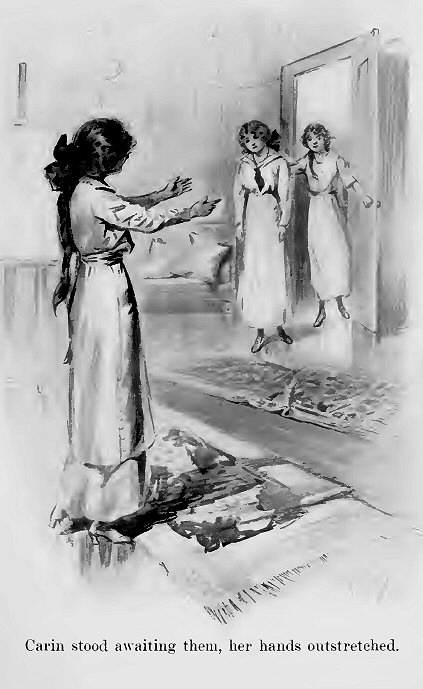
In her crimson school frock, soft and graceful, her
golden hair shining on her shapely head, her eyes full of tears
of repentance, Carin stood awaiting them, her hands
outstretched. It all seemed so different from what Annie
Laurie knew of her, that at first she hesitated to go forward,
but Carin came on, still with that look of solicitude in her
face.
“Oh, Annie Laurie,” she said, “I see
everything now. I see how I acted and how I made you
feel. You’ll have to forgive me. I never was
like that before. It was as if imps got inside me, and the
worst of it was that I seemed to want to hang on to them. I
knew I was wicked, but I liked to be that way. I just
wouldn’t give up, though I was unhappy all the time.
I told mother all about it, and she said that was the way it was
when you got perverse. You liked it. Perversity
seemed sweeter than anything. She said it was like being a
drunkard. You enjoyed the thing that ruined you. I
can see just what she meant. I’ll tell you now, Annie
Laurie, that after the first day or two I found myself liking
you, and I hated to admit it. I tried not to as hard as I
could. I didn’t like mamma’s putting a girl in
with us without talking it over, do you see? But I do like
you—I had to. The whole trouble was that I couldn’t
bear to give up. But you’ve made me, and now
I’m well again. For it’s just like a spell of
sickness, having a horrid, wicked idea like mine and holding on
to it. Do you understand?”
Annie Laurie’s face had flushed softly; her eyes were
misty, her handsome, large mouth slightly tremulous. She
withdrew her hands from Carin’s, and put her arms close
about her.
“When I say I forgive,” she said, “I
do.”
“And do you say it?”
Annie Laurie laughed deep in her throat—and again her
voice reminded one of an oriole’s.
“I do say it,” she said. “Your mother
called it the Triple Alliance—the Three Girls’
Alliance.”
“We must swear fealty!” cried Azalea. She
ran to the table and brought back Howard Pyle’s
“Robin Hood,” in which the story of the forester and
his faithful crew is told in equally beautiful words and
pictures.
“Swear!” she commanded. Carin, laughing
somewhat uncertainly, dropped her slender white hand on it.
Annie Laurie laid her firm brown one over it; Azalea placed on
top her sensitive, odd hand, which always quivered when she
cared about anything.
“We swear,” they said in chorus.
The door opened and Miss Parkhurst entered, her arms full of
books.


