Presbytery, the favourite form of religion in Scotland with the people, opposed by
James VI.—At first opposed afterwards sanctioned by Charles I.—Solemn League
and Covenant—Confession of Faith—Defeat of the Duke of Hamilton and death
of Charles—State of the Church—Charles II. crowned—Divisions among the
Presbyterians—Resolutioners—Remonstrators—Protectorate of Cromwell—State
of religion during that period—Restoration—Sharpe sent to London—Religious
parties in Scotland—Sharpe’s double dealing—Sudden change of manners—Rejoicings—Fears
of the Remonstrators—Difference with the Resolutioners—First
measures of the King—Promotes the enemies and persecutes the friends of the
Covenant—Proceedings of the Committee of Estates, urged on by Sharpe—King’s
letter to the Edinburgh ministers—Exultation of the Resolutioners—Persecute
their brethren—Committee of Estates order Lex Rex, &c. to be burned—Proclamation
against the Remonstrants—Interference with regard to elections—Proclamation
for a meeting of Parliament.
Ever since the days of the Reformation, Scotland has been distinguished
by the attachment of her inhabitants to simplicity in
the forms of their religious worship, and a dislike to pomp or
lordly power in their ministers. Presbytery, of which these are
the prominent features, has in consequence always been the
favoured mode of ecclesiastical polity with the people; unfortunately
her monarchs, previous to the Revolution of 1688, were as
decidedly averse to it; and their tyrannical attempts to substitute
2a hated hierarchy in its place, involved the country, for three generations,
in contention and bloodshed, persecution and distress,
till the struggle issued in the final expulsion of the Stuarts from
the throne.
James VI., after having given the Presbyterian church the
royal sanction, and paid it the highest encomiums as the “purest
kirk upon earth,” and having repeatedly promised and vowed “to
support it against all deadly,” spent the greater part of his life in
endeavours to overturn it. He succeeded in forcing upon an unwilling
people a kind of mongrel prelacy, and left to his son the
hazardous task of finishing his designed uniformity in religious
worship between the two kingdoms.
Charles proceeded with more violence; and, by attempting to
obtrude a detested liturgy, he destroyed the fabric it had cost his
father so much king-craft to rear, and led to the remarkable renewing
of the National Covenant, which, early in the year 1638,
was subscribed with enthusiastic fervour by all ranks throughout
the land. A free General Assembly, convened at Glasgow in
that year, November 21, accomplished what has usually been
termed the second glorious Reformation, by restoring Presbytery
to its primitive simplicity, and sweeping away all the innovations
against which they had so long struggled. The proceedings of
this assembly were afterwards solemnly confirmed by the estates;
and Scotland for a short period enjoyed a hollow peace, while the
king was contesting with his English parliament. Afraid, however,
if the king overcame in the contest, that they would hold
their own liberties by a very feeble tenure, they entered into a
solemn league and covenant with the parliament for the mutual
preservation of their religion and liberty, for promoting uniformity
in worship and doctrine between the two nations, and for exterminating
popery, prelacy, and schism: their weight decided the
fate of the war.
When the English hierarchy had fallen, and the king’s power
was reduced, an assembly of the most learned divines that perhaps
ever met in Britain, was called by authority of the English parliament.
Assisted by commissioners from Scotland, they drew
up the admirable Confession of Faith, with the Larger and Shorter
3Catechisms, still the standards of our national church; but they
differed on the Directory for Worship, against which some of the
most learned of the Independents dissented—a prelude to more
serious differences.
After Charles had been beaten out of the field, and was intriguing
in a variety of ways with the army and with the English
parliament, a majority in the Scottish estates, headed by the Duke
of Hamilton, rashly “engaged” by a secret treaty to attempt his
rescue. The church opposed war with England, as Charles would
give only an equivocal pledge for supporting the establishment of
Presbytery in that country; and they feared his duplicity in case
he regained unrestricted power; and the minority in the estates
also “protested” against it. The engagers being defeated at
Preston, the protesters, whose leader was the Marquis of Argyle,
came into power, and Scotland separated into two parties. Shortly
after the defeat of the Scots, the king was brought to trial and
executed, in spite of their remonstrances, which, now that they
were divided among themselves and had no army to back them,
were little regarded.
At this time the church of Scotland reached her greatest pitch
of splendour. “For though,” says a contemporary historian,
“alwayes since the assembly at Glasgow the work of the gospel
hade prospered, judicatories being reformed, godly ministers
entered, and holy constitutions and rules daily brought into the
church; yet now, after Duke Hamilton’s defeat, and in the interval
betwixt the two kings, religion advanced the greatest step it
had made for many years: now the ministrie was notably purified,
the magistracy altered, and the people strangly refined. It is
true, at this time hardly the fifth part of the lords of Scotland were
admitted to sit in parliament; but those that did sitt were esteemed
truly godly men; so were all the rest of the commissioners in
parliament elected of the most pious of every corporation. Also
godly men were employed in all offices, both civil and military;
and about this time the General Assembly, by sending abroad
visiters into the country, made almost ane entire change upon the
ministry in several places of the nation, purgeing out the scandalous
and insufficient, and planting in their place a sort of godly
4young men, whose ministry the Lord sealed with ane eminent
blessing of success, as they themselves sealed it with a seal of
heavy sufferings; but so they made full proof of their ministry.
“Scotland hath been even by emulous foreigners called Philadelphia;
and now she seemed to be in her flower. Every minister
was to be tried five times a-year, both for his personal and
ministerial behaviour; every congregation was to be visited by
the presbytery, that they might see how the vine flowrished and
the pomegranate budded. And there was no case nor question
in the meanest family in Scotland but it might become the object
of the deliberation of the General Assembly; for the congregational
session’s book was tried by the presbytery, the presbytery’s
by the synod, and the synod’s by the General Assembly. Likeways,
as the bands of the Scottish church were strong, so her
beauty was bright; no error so much as named; the people were
not only sound in the faith, but innocently ignorant of unsound
doctrine; no scandalous person could live; no scandal could be
concealed in all Scotland, so strict a correspondence there was
between ministers and congregations. The General Assembly
seemed to be the priest with Urim and Thumim; and there were
not ane hundreth persons in all Scotland to oppose their conclusions:
all submitted, all learned, all prayed; most part were really
godly, or at least counterfeited themselves Jews. Than was Scotland
a heap of wheat set about with lillies, uniform, or a palace
of silver beautifully proportioned; and this seems to me to have
been Scotland’s high noon. The only complaint of profane
people was, that the government was so strict they hade not
liberty enough to sin.
“But this season lasted not long.” The Presbyterians, who
were averse to the ruling party in England, as sectarians in religion
and republicans in politics, immediately proclaimed Charles
II.; and commissioners were sent to the Hague, where he was
subsisting on the bounty of his sister, to invite him upon conditions
to assume the government. During the negotiations, while
the terms were discussing, he authorized Montrose, already too
well known for his cruelties, to attempt his unconditional restoration
by force; and it was not till he heard of his failure, that he
5consented to take the oaths and become the covenanted king of
Scotland.
His arrival, however, instead of uniting, occasioned deep and
irreconcilable dissensions among the Scots—between those who
distrusted, and those who affected to believe, his professions; yet
as the church continued to maintain the ascendancy, they were
kept within bounds till after the fatal battle of Dunbar. But
when it became necessary to supply the loss occasioned by that
disaster, they became apparent. The king required that all those
who had hitherto been excluded as malignants, who had favoured
the engagement, and were understood to be friendly to his unlimited
power, should be restored to offices of trust both in the
army and state: this was resisted by the strictest and most devout
of the Presbyterians, who, considering them as enemies to the
church, dreaded their admission into the king’s councils, while he
himself was suspected. The virtues of the king, and his inimitable
improvement in adversity, were deemed sufficient answer, and
resolutions favourable to their claims having been obtained by
surprise from the major part of the commission, a schism took
place by the minority protesting against the concession.
From this date the Presbyterians separated into two parties,
who distracted the country for several years by their violent contentions;
those who arrogated to themselves the praise of liberality
and loyalty—their superior regard for the decrees of the
church and the letter of the covenant—ranging under the name of
resolutioners; while those esteemed the most holy, indefatigable,
and laborious ministers, who preferred the spirit to the form of
their religious constitution, were numbered among the protesters.
They were likewise called remonstrators, from having followed
up their protest by a remonstrance. Meanwhile Charles was
crowned at Scone with great solemnity, the Marquis of Argyle,
who was attached to the resolutioners, putting the crown upon his
head; but the divisions continued till Cromwell obtained the supreme
power, who granted free toleration to all sects, and liberty
to the Presbyterians in every thing, except permitting the General
Assembly to meet, which some of the more pious considered no
bad service.
6This period, down to the Restoration, has ever been considered
as that in the Scottish church most remarkably distinguished for
the prevalence of real personal religion; and it was evident that
God was preparing a people in this land for a day of hot and fiery
trial. “I verily believe,” says Kirkton, “there were more souls
converted to Christ in that short period of time than in any season
since the Reformation, though of treeple its duration. Nor
was there ever greater purity and plenty of the means of grace
than was in their time. Ministers were painful, people were diligent;
and if a man hade seen one of their solemn communions,
where many congregations mett in great multitudes—some dozens
of ministers used to preach, and the people continued as it were
in a sort of trance (so serious were they in spiritual exercises)
for three dayes at least—he would have thought it a solemnity
unknown to the rest of the world. Besides, the ministers, after
some years, began to look at the questions about which they had
divided, as inconsiderable: also it was found error made no great
progress, the genius of the people being neither very curious nor
easily changed.”
The numbers who stood the test and suffered to the death, bear
witness that the religious state of the country at the Restoration,
as given by him, must be substantially true; as the numbers who
apostatized make it evident that many must have dissembled.
“There be in all Scotland some nine hundred paroches.”[1] “At
the king’s return every paroch had a minister, every village had a
school, every family almost had a Bible; yea, in most of the
country, all the children of age could read the Scriptures, and
were provided of Bibles either by the parents or their ministers.
Every minister was a very full professor of the reformed religion,
according to the large Confession of Faith, framed at Westminster
by the divines of both nations. Every minister was obliged
to preach thrice a-week, to lecture and catechise once, besides
other private duties, wherein they abounded according to their
7proportion of faithfulness and abilities. None of them might be
scandalous in their conversation or negligent in their office, so
long as a presbyterie stood; and among them were many holy in
conversation and eminent in gifts. The dispensation of the ministry
being fallen from the noise of waters and sound of trumpets,
to the melody of harpers, which is alace the last messe in the
banquet. Nor did a minister satisfy himself except his ministry
had the seal of a divine approbation, as might witness him to be
really sent from God.”
“Indeed, in many places the spirit seemed to be poured out
with the word, both by the multitudes of sincere converts, and
also by the common work of reformation upon many who never
came the length of a communion; there were no fewer than sixty
aged people, men and women, who went to school, that even then
they might be able to read the Scriptures with their own eyes.
I have lived many years in a paroch where I never heard an oath;
and you might have ridde many miles before you heard any: also,
you could not for a great part of the country have lodged in a
family where the Lord was not worshipped by reading, singing,
and public prayer. Nobody complained more of our church-government
than our taverners, whose ordinary lamentation was,
their trade was broke, people were become so sober.”[2]
Such was the delightful picture drawn by an eyewitness; and
to render it perfect and permanent, the Presbyterians longed with
8desire for the restoration of their king, whose presence alone they
believed would remove the only spots that in their eyes dimmed its
lustre—the suspension of their General Assemblies, and the late
sinful toleration. As soon as there was the least prospect of the
desirable event, several ministers in Edinburgh—resolutioners—dispatched
Mr James Sharpe to London, with instructions to watch
over the interests of the church, particularly of their own party;
and as they knew that the king had a strong antipathy against the
remonstrants, who, during his stay in Scotland, had been assiduous
in their upright though ungrateful endeavours for his conversion,
and incurred his displeasure and that of his confidants by
their uncourtly reproofs and uncompromising adherence to their
principles, they were anxious to separate themselves from this the
honestest portion of their brethren, and directed their agent carefully
to remind his majesty of the difference between them and
their more uncomplying opponents.
During the protectorate, as no persecution had been allowed on
account of religious opinions, a few in Scotland seem to have
adopted the tolerant maxims of the decried usurper; and although
sectaries never flourished in that soil, they seem to have been sufficiently
numerous to have excited the fears of the resolutioners,
who, insensible to the benefits they enjoyed under the toleration
of Cromwell, and eager to secure the liberties of their own kirk
from the oppression of the prelatists, were equally anxious to
guard against any freedom being allowed to those whom they
termed fanatics.[3]
9There was, besides, a third party, who, although previously discernible
to those who understood the signs of the times, sprang
up at once upon the afflicted vision of the resolutioners, when the
rays of royalty again beamed above the horizon—a new race,
who, having never been acquainted with the work of reformation,
nor with the just proceedings of the nation, but weary of
Presbyterian strictness, were ready to condemn the covenant and
all the loyal and honest acting of the covenanters. These, consisting
chiefly of young men of rank, were prepared for any change,
and were supposed, in general, to be rather favourable to Episcopacy.
A knowledge of this circumstance, and the frequent representations
of the alarming fact by his correspondents, seem early
to have influenced Sharpe to desert his employers and go over to
the enemy.
In May, he went upon an embassage to Charles at Breda, and
there was confirmed in the treachery which he completed shortly
after the king’s landing in England. His villanous hypocrisy in
managing the overturn of the polity he was dispatched to support,
was consummate; yet now, when we know the part he played, it
is not difficult to perceive, in his most specious letters, an overacting
which must have betrayed him to men less confiding than
his employers.[4] Besides preventing all access to the king, and
representing the chief leaders in Scotland as favourable to prelacy,
he dissuaded his friends from addressing against it, and
cruelly widened the breach between them and the protesters. His
ambition was stimulated by his revenge; he wished to gratify
his private resentment against the most eminent of the latter—Samuel
Rutherford, James Guthrie, and Lord Warriston. Yet,
however much we may detest the traitor, it is matter of high gratulation
that his mission failed; for, had he acted faithfully and
succeeded, he would have procured for Scotland an iron yoke of
political presbytery, which might indeed have preserved the beloved
polity secured by acts of parliament, by prohibitions, and
10by every civil pain and penalty by which churchmen support their
power; but he would have destroyed religious liberty, and delivered
the nation over to a thraldom which would have been
worse, as it would probably have been more permanent, than the
prelacy that ensued—it would, it is likely, have been more moral,
but it might not have been less oppressively severe.[5]
When Charles was at last restored to the wishes and prayers of
his people, as if some enchanter’s wand had touched the frame of
society, the whole kingdom in an instant changed, and, from a state
of grave seriousness and exemplary decency, burst out into one disorderly
scene of riot and revelry; and the day of thanksgiving for
this happy event was celebrated in Edinburgh in a manner that
had been very unusual in that capital for at least a quarter of a
century. After sermon, the magistrates proceeded to the cross, on
which was a table covered with sweatmeats, and the well ran with
wine; there, amid the flourishing of trumpets and the beating of
drums, the royal healths were drank, and three hundred dozen of
glasses broken in honour of the day! On the Castle Hill, fireworks
were exhibited, the principal figures in which were Cromwell
and the Devil, who, after diverting the multitude with a
flight and pursuit, exploded and disappeared amid shouts of
applause.
The considerate part of the community viewed the unconditional
recall of the king with very different sensations; but these,
in that frantic hour, were few in number, and chiefly consisted of
the remonstrators, whose dark forebodings were deemed the offspring
of their own guilty consciences accusing them of their former
disloyalty. In vain did they ask for evidence of his being
changed from what he was, before they could trust their liberties
11into his hands without security. They had all along been jealous
of Sharpe, and their suspicions had been heightened by some surmises
of his transactions at London; but all their advances towards
their brethren had been repulsed by the resolutioners, who
put the most unbounded confidence in that traitor’s assurances of
the king’s friendly countenance towards themselves, and his intended
vengeance upon them. The first measures of Charles,
however, put an end to the differences of the truly pious among
both parties, who were soon undeceived, and sent to the furnace
to be refined together.
All the high offices of Scotland were disposed of to men either
of no religion, or of that very accommodating kind which is always
found on the side of interest and power. Middleton, a soldier
of fortune, created an Earl, was appointed commissioner to hold
the next parliament; the Earls Glencairn had the chancellorship—Crawford,
the treasury—Rothes, president of the council—and
Lauderdale, secretary of state, and one of the gentlemen of the
bedchamber, (the only Scottishman admitted to this honour;)
Sir Archibald Primson was clerk-register; and Sir John Fletcher,
king’s advocate. Meanwhile, those who were esteemed the leaders
of the covenanters, although they had ever sturdily maintained
their loyalty, after the greater part of the others had yielded, were
thrown into prison and threatened with prosecutions for treason.
The Marquis of Argyle was seized at London, whether he had
gone to congratulate the king, and sent to the tower; and orders
were forwarded to Scotland, to Major-General Morgan, commander-in-chief,
to secure Sir James Stewart, provost of Edinburgh;
Sir Archibald Johnstoun, Lord Warriston; and Sir John
Christy of Carswell. Warriston escaped for the time; but the
other two were arrested in a somewhat ludicrous manner. The
General having heard that Christy was in town upon private business,
waited upon the Provost, and required him, in virtue of his
office, to apprehend Sir John and carry him to the Castle, which
his lordship having done, when he was about to take leave, with
many expressions of regret, he was informed “that it behooved
him to bear his friend company;” nor did he obtain a release till
about ten years after.
12Until the meeting of a new parliament, the administration of
Scottish affairs was intrusted to the surviving members of the
committee of estates, nominated by the last Scottish parliament;
and as they had all concurred with the king in swearing the National
and Solemn League and Covenant, it was expected that
they would at least be favourable to the established religion of
the land; but it very soon appeared how little confidence can be
placed in the professions or even oaths of public men, when the
stream runs in an opposite direction. Their first meeting, at
which the chancellor presided, was held in Edinburgh, August 23,
and their first act was a proper prelude to the tyranny about to
be inflicted on their country.
On that day, a few of the protesters, who had in vain endeavoured
to convince their brethren of the critical situation in which
the Presbyterian church stood, met at Edinburgh to draw up a
humble address and supplication to the king, suited to the emergency.
They were in all nine ministers, of whom the chief were
Mr James Guthrie of Stirling, and Messrs Traill, and John Stirling
of Edinburgh, with two ruling elders. As the meeting and
its object were no secrets, the chancellor and committee dispatched
messengers, who seized their papers, containing a scroll of their
supplication, with copies of some letters to their brethren in Glasgow,
requesting a full meeting for considering the subject; and
immediately after issued a warrant for imprisoning in Edinburgh
Castle the whole of those who had been present at the unlawful
conventicle—terms about to become of frequent use and of fearful
import.
The scroll consisted of declarations of their abhorrence of the
murder of his majesty’s royal father, and the actings of the late
usurping power—of thankfulness for the Lord’s preservation of
his own sacred person, and for his quiet restoration without the
effusion of Christian blood—professions of zeal for the glory of
God, the good of the church, and faithful and loyal tenders of all
the duties of honour, subjection, and obedience, due from humble
and loving subjects to their native and lawful sovereign; but they
expressed their fears of the popish prelatical and malignant party,
of their attempting the overthrow of the pure religion as established,
13and the re-introduction of all the corruptions which were
formerly cast out;[6] and they reminded his majesty of his and
their solemn engagements to God, of the Lord’s mercy to him
and them, and their mutual obligations to faithfulness in the performance
of their vows.
They were therefore charged with proceedings expressly derogatory
to his majesty’s royal prerogative, and tending to the disturbance
of the present peace of his majesty’s dominions; and
next day the committee of estates prohibited, by proclamation, all
unlawful and unwarrantable meetings and conventicles in any place
within the kingdom of Scotland without his majesty’s special authority;
and likewise all seditious petitions and remonstrances
under what pretext soever which might tend to the disturbance of
the peace of the kingdom, or alienating or diminishing the affections
of his majesty’s subjects from their due obedience to his
majesty’s lawful authority, and that under the highest pains.
Sheriffs and magistrates of burghs were ordered to be careful
within their respective bounds, that no such pernicious or dangerous
14meetings should be permitted, but that they should be prevented,
hindered, and made known to the executive. These proceedings
were ostensibly directed against the remonstrants alone,
but were intended to answer the double purpose of overawing the
elections for the ensuing parliament, and paving the way for the
complete overturn of freedom in the state and presbytery in the
church.
Mr Sharpe, on his arrival from London, gave a keener edge to
the proceedings of the committee, and, by his duplicity, prevented
the good men among the resolutioners from taking any steps,
either for their own security or the relief of their oppressed
brethren. In answer to an epistle from his employers to the king,
entreating his favour and countenance for their church, he brought
the following, addressed to Mr Robert Douglas, minister, Edinburgh,
to be by him communicated to the presbytery:—
“Charles R., trusty and well beloved, we greet you well. By
the letters you sent to us with this bearer, Mr James Sharpe, and
by the account he gave of the state of our church there, we have
received full information of your sense of our sufferings and of
your constant affection and loyalty to our person and authority:
And therefore we will detain him here no longer—of whose good
services we are very sensible—nor will we delay to let you know
by him our gracious acceptance of your address, and how well we
are satisfied with your carriage and with the generality of the
ministers of Scotland in this time of trial, whilst some, under
specious pretences, swerved from that duty and allegiance they
owed to us. And because such, who by the countenance of usurpers
have disturbed the peace of that our church, may also labour
to create jealousies in the minds of well-meaning people, we have
thought fit by this to assure you, that, by the grace of God, we
resolve to discountenance profanity and all contemners and opposers
of the ordinances of the gospel. We do also resolve to
protect and preserve the government of the church of Scotland
as it is settled by law, without violation, and to countenance in the
due exercise of their functions all such ministers who shall behave
themselves dutifully and peaceably as becomes men of their calling.
We will also take care that the authority and acts of the
15General Assembly at St Andrew’s and Dundee, 1651,[7] be owned
and stand in force until we shall call another General Assembly,
which we purpose to do as soon as our affairs will permit. And
we do intend to send for Mr Robert Douglas, and some other
ministers, that we may speak with them in what may further concern
the affairs of that church. And as we are very well satisfied
with your resolution not to meddle without your sphere, so we do
expect that church judicatories in Scotland and ministers there
will keep within the compass of their station, meddling only with
matters ecclesiastick, and promoting our authority and interest
with our subjects against all opposers: and that they will take
special notice of such who, by preaching, or private conventicles,
or any other way, transgress the limits of their calling by endeavouring
to corrupt the people, or sow seeds of disaffection to us
or our government. This you shall make known to the several
presbyteries within that our kingdom. And as we do give assurance
of our favour and encouragement to you, and to all honest,
deserving ministers there, so we earnestly recommend it to you
that you be earnest in your prayers, publick and private, to Almighty
God, who is our Rock and our Deliverer, both for us and
for our government, that we may have fresh and constant supplies
of his grace, and the right improvement of all his mercies and
deliverances to the honour of his great name, and the peace,
safety, and benefit of all our kingdoms; and so we bid you
heartily farewell.”
Delighted with this most gracious epistle, the Edinburgh presbytery
printed and caused it to be transmitted to all the presbyteries
in Scotland, praised it from their pulpits, and procured a silver
box to preserve the precious original. It was not to be supposed
that, under language so explicitly guaranteeing the government of
the church of Scotland, as settled by law, that, by any lurking
inuendo, Episcopacy could be meant, the resolutioners therefore
considered the day as their own, and, with premature speed, hasted
to chant their victory. They warmly thanked his majesty for his
letter, which they told him in their address they had received
16upon a day formerly devoted by them to mourning, September 3,[8]
which had revived their spirits, and excited them to bless the
Lord who had put such a purpose in his royal heart to preserve
and protect the government of the church without violation; nor
was the “choice of such an able and faithful person,” as Lauderdale,
“for the weighty employment of secretary less an object of
gratulation!” But while we look back with pity upon the speedy
dissipation of all the good men’s hopes and anticipations, it is
impossible not to feel that they in some measure merited them
for the facility with which they allowed themselves to become the
dupes and the tools, in persecuting their own brethren, of these
very men by whom they themselves were afterwards persecuted.
Sharpe, whose composition the letter was, followed out his plan
of dividing the ministers. He was well aware that the remonstrators
were the most acute and least liable to be imposed upon
of the Presbyterians; he knew also that they suspected him, and
he hated them; he therefore, by an insinuation in it, pointed
them out as persons who, under specious pretences, had swerved
from their duty during the usurpation; and the church judicatories
hastened to inflict punishment upon them for this indefinite
crime—“Our synods after this,” says Kirkton, “doing little
other thing than censuring and laying aside those of that way.
And though the preceding harvest before the king’s return all the
synods of Scotland hade agreed to bury by-past differences, yet,
upon the receipt of this blessed letter, the old wounds opened;
and wherever the public resolution-men were the plurality, the
protesters were censured upon the burried differences. In the
synod of Merse, they laid aside five ministers; in Lothian, many
were laid aside both in Lithgow and Biggar presbyteries; so it
was in Perth and in the north: and the truth is, had not the
course of synods been interrupted by the introduction of bishops,
17few had keeped their places who were afterwards ejected by that
infamous proclamation at Glasgow in the year 1662.”
Nor was the committee idle; Mr Patrick Gillespie, principal
of Glasgow College, was brought prisoner to Edinburgh Castle,
and Mr Robert Row, minister of Abercorn, and W. Wiseheart
of Kinniel, were confined to their chambers in the town. Having
forbid any meetings for petitioning, they proceeded to display
their antipathy to those principles of freedom, for which their
fathers had contended, by emitting a proclamation against Rutherford’s
Lex Rex—a work which was held in high estimation by the
covenanters, as it advocated the cause of liberty and the legitimate
limitations on power, with an energy and clearness the enemies of
freedom could not bear; and another work, supposed to be written
by Mr James Guthrie, entitled “The Causes of God’s Wrath
against Scotland,” which enumerated the sins of the land, princes,
priests, and people, with a faithfulness that was intolerable.
They declared these two books to be full of seditious and treasonable
matter, animating his majesty’s good subjects to rise up
in rebellion against their lawful prince and sovereign, and poisoning
their hearts with many seditious and rebellious principles, prejudicial
to his royal person and authority, and to the peace of the
kingdom. All, therefore, possessed of copies of the obnoxious
publications were required to deliver them up to the king’s solicitor
within a certain time, under pain of being considered enemies to
his majesty’s authority, and liable to be punished accordingly.
They were both burnt at the cross—a favourite, if not a very convincing,
mode of answering such like productions. With revolting
meanness, they at the same time caused the inscriptions to
be effaced from the tombs of Alexander Henderson in Edinburgh,
and George Gillespie at Kirkaldy—men who needed not the frail
remembrance of a monumental stone to make their memories live
in the recollection of their country, and whose services have more
lasting record than a graving-iron could bestow.
Some few days after, they made a still more explicit disclosure
of their aversion to the “good old cause”—a sneering form of expression
become fashionable among the courtiers—by another proclamation
directed against the remonstrants and their adherents,
18not only forbidding meetings for consultation, which were still
legal, but likewise any adverting, in their sermons or otherwise,
to the state of the church, or the danger to be apprehended from
the introduction of the exploded and hated prelatical offices and
forms; and, as they knew the effect of popular preaching, they
appear to have been most anxious at once to suppress all pulpit
opposition to the course they were about to pursue.
Of the watchmen upon the Scottish Zion, the remonstrants
had been the most wakeful and most jealous of encroachments
upon the established covenanted constitution of the church and
state, and the committee were assured, that when they apprehended
danger, they would not be silent; they therefore expressly
commanded that none, in sermons, preachings, declamations, or
speeches, should presume to reflect on the conduct of his majesty
or his progenitors, misconstrue his proceedings, or meddle in his
affairs or estate, present, bygone, or in time coming, under the
highest penalties; and if any who heard what could be construed
into slander against the king did not reveal it, they were to be
liable to the same punishment as principals. This proclamation,
the anti-type of so many furious attacks upon the liberty of the
lieges, was calculated to ensnare those who, being accustomed
openly to speak their sentiments, were not prepared at once to
renounce all mention of public affairs in common conversation or
public discourses, whether ministers, elders, or private gentlemen;
and numbers of each description were immediately made to feel
its oppressive weight.
Had a free election been allowed, notwithstanding the loyal
phrenzy of many, and the hypocritical pretensions of more, there
might some troublesome members have procured admission to
the estates; but those whose influence and opposition were most
dreaded, being by this proclamation placed in very delicate circumstances—as
evidence of unguarded expressions might easily
have been procured—were happy to escape censure, and did not
stand forward at the only time when they could have done so with
some probability of success, in support of the constitution, freedom,
and religion of their country. The committee, however,
did not rest here: with the most unblushing effrontery, although
19conscious themselves of having to a man complied with the English,
they hung out a threat of prosecution for this common and
inevitable fault, which damped all who seemed inclined to assert
the independence of a Scottish parliament, or the privileges they
had obtained from the crown during the late struggle.[9]
Besides to pinion the country gentlemen more effectually, they
tendered a bond to all of whom they were suspicious, which they
obliged them to sign, with a sufficient cautioner, each binding
themselves—besides disowning the remonstrance—that they should
not in any way or manner, directly or indirectly, plot, contrive,
speak, or do any thing tending, or what might tend, to the hurt,
prejudice, or derogation of his majesty’s royal person or any of
that royal family—that they should not do any thing, directly or
indirectly, tending, or that might tend, to the breach or disturbance
of the public peace, nor connive or concur with any person
whatsoever who should contrive any such thing; but, to the utmost
of their power, stop and let any such plot and doing, and
appear personally before the committee, sub-committee, or parliament,
upon a lawful citation; and, in case of failure, the parties
bound themselves to pay a high fine, besides whatever other punishment
might be inflicted.
For a justification of proceedings so unwarrantable, we must
look to the sequel; it was not because the parties accused were
inimical either to kingly government or to the person or right of
Charles, but because the plan was already formed for sweeping
from the face of the country, had it been possible, whatever was
lovely or of good report—whatever in the institutions of the state
or the polity of the church was calculated to present any obstruction
to the tide of obscene licentiousness and faithless despotism
that was now fast flowing upon them. Their stretches of power
20against the liberties of the country, do not, however, seem to have
occasioned any remonstrance; and the synod of Lothian was
amused with a proclamation for calling a General Assembly, which
Mr William Sharpe had submitted for their amendment; but the
last acts of the committee, levying a cess, excited some remark as
to the legality of the tax or their power to exact it.
On the 1st of November, a proclamation announced the meeting
of parliament; and the same day another, that the king had
committed to them the consideration and judging of the conduct
of all his subjects during the late troubles, from whom alone he
would receive any applications, and promising, after his honour
and ancient royal prerogative were vindicated, he would grant a
free, full pardon and indemnity—a promise which, although conveyed
in very specious language, and accompanied by an assurance
that there was nothing his royal bosom was more desirous of than
that his people should be blessed with abundance of happiness,
peace, and plenty, was received with suspicion, and, like almost
all the other acts of grace, afforded little relief to the unfortunate,
while it secured the persons and plunder of those who had pillaged
and oppressed them.
BOOK II.
21
DECEMBER 1660 to 12th JULY 1661.
Lord High Commissioner arrives in Edinburgh—Parliament—Its composition—Act
of indemnity withheld—Lord Chancellor restored to the Presidentship—Oath of
allegiance—Retrogression in reformation-work—Divine right of Kings asserted—Solemn
League and Covenant repealed—Engagement approved, &c.—Declaration—Resolutioners
begin to perceive their error—Middleton amuses the ministers
of Edinburgh—Manner of concocting the Act rescissory and of getting it passed—Middleton’s
interview with D. Dickson and part of the Edinburgh presbytery—Distress
of the ministers—Dispersion of the synods—Concluding acts—Trial of
Argyle—His behaviour before and at the place of execution—Trial of James
Guthrie—His behaviour and execution—Captain Govan—Prosecutions of Mr
Traill of Edinburgh—Mr Moncrief of Scone—Intrepid reply of his wife—Mr
Robert Macwaird of Glasgow—His striking picture of the effects of the Restoration—His
accusation—Defence—Banishment—Swinton of Swinton—Sir John
Christy and Mr P. Gillespie’s escape—Parliament rises—Samuel Rutherford.
The Earl of Middleton, Lord High Commissioner, arrived at the
ancient Palace of Holyrood on the last day of December 1660.
He entered upon his office with great pomp; and, being allowed
a princely salary for the support of his establishment, he vied
with royalty itself in the profusion of his expenditure. Every
preparation had been made for his reception: he was met and conducted
to his residence by a large concourse of the nobility and
the magistrates of the capital; and the venerable cathedral of
St Giles had been elegantly fitted up with a throne for his Grace
and lofts for the parliament.
That parliament which met on the first day of the new year,
was one entirely suited for promoting the schemes of the Scottish
rulers. The old nobles, who had been active in the cause of the
22covenant, had almost all died out, their estates had been wasted,
and of the new race too many, neglected in their education,
were now dependant in their circumstances. When the king
arrived, they had flocked to London to put in their claims upon
his justice or generosity for their sufferings in the royal cause,
and had been received with specious condescension, and sent home
with empty pockets and magnificent expectations. But they had
learned at court to laugh at sobriety, to ridicule religion, and to
consider even common decency a mark of disloyalty, while they
looked to a rich harvest of fines and confiscations from the estates
of the remonstrators, as a reward for their sacrificing their principles
and profession at the shrine of prerogative. The commissioners
for counties and burghs were chosen entirely from among
those who were considered devoted to the court and averse to the
strict Presbyterians. In some cases, when persons of an opposite
description had been returned, the ruling party interfered and
procured others to be substituted; and to prevent such as were
distinguished for their attachment to the cause of religious freedom
from offering themselves as candidates, they got them accused
of complying with the usurpers, and summoned as criminals.[10]
From a parliament so constituted, the most servile compliance
might have been anticipated; but, to ensure their submission, an
act of indemnity had been withheld from Scotland; and, while
every one dreaded his individual safety, the whole assisted in destroying
that public liberty which might have afforded a better
chance for security than the will of a prince or the favour of a
parasite. The regalia, always carried before the commissioner at
the opening of a session, were borne—the crown by the Earl of
23Crawford, the sceptre by Sutherland, and the sword by Mar.
The Duke of Hamilton and the Marquis of Montrose rode immediately
behind. Mr Robert Douglas, who had preached the coronation
sermon before Charles when he was inaugurated at Scone,
delivered upon this occasion a faithful and appropriate discourse
from 2 Chron. xix. 6.—“Take heed what you do; for you judge
not for man but for the Lord, who is with you in the judgment.”
The Earl of Middleton’s commission was then presented, and,
as had been previously agreed upon, an act was brought forward
to restore to the Lord Chancellor the Presidentship of parliament.
This act, which struck at the root of the whole reformation in
Scotland, deserves particular notice. By several acts of the estates,
passed during the troublous times, particularly one of the last,
held in 1651, at which the king himself had presided, it was enacted,
that, before entering upon business, every member should
swear and subscribe the covenant, without which the constitution
of parliament would become null and void. To have set aside
these statutes openly and at once, was thought too flagrant; but
it had also been enacted during the late struggle, that the President
of the parliament should be elected by parliament, instead
of the Chancellor nominated by the king; and it was therefore
proposed to abolish this privilege, as trenching upon the royal prerogative.
In this act, however, brought forward for that purpose,
was inserted an oath of allegiance, which went to annul all preceding
oaths, and covertly to revive the abhorred supremacy of
the king. It was insidiously worded, in order that those who
wished to have an excuse for compliance might take it without
appearing undisguisedly to violate their former engagements, yet
sufficiently plain to justify a refusal by men who were not altogether
prepared to surrender their principles to their interest.
By it the sovereign was acknowledged only supreme governor
in the kingdom over all persons and in all causes; and it was declared
that no foreign prince, power, or state, nor person, civil nor
ecclesiastic, had any jurisdiction, power, or superiority over the
same; “and therefore,” it was added, “I utterly renounce and
forsake all foreign jurisdictions, powers, and authorities, and shall,
at my utmost power, defend, assist, and maintain his majesty’s
24jurisdiction aforesaid against all deadly, and never decline his
majesty’s power and jurisdiction.” The consistent and stricter
part of the Presbyterians were not imposed upon. They considered,
and correctly as it afterwards appeared, that this was a complete
acknowledgment of the king’s ecclesiastical supremacy, and
conferred upon him the power to alter or innovate at his pleasure
upon the religion of the country. In parliament, however, almost
the whole took the oath without remark, except the Earls of Cassils
and Melville of the nobles, and the Laird of Kilburnie of
the commissioners, who would not subscribe it unless allowed to
limit the king’s supremacy to civil matters—an explanation which
Middleton was disposed to admit of verbally, but, knowing the
extent to which allegiance was to be required, he refused to permit
this explanation to be recorded.
Having thus dispensed with the obligation of the covenant as a
parliament-oath, and reinstated his majesty in his ecclesiastical
power, they proceeded to restore to him a less questionable part
of the prerogative—the nomination of the officers of state, privy
councillors, and Lords of Session, the right of convoking and dissolving
parliament, of commanding the militia, and of making
peace and war. These powers, which are now deemed necessary
for the support of the crown in regular ordinary times, had been
assumed by the estates of Scotland (1649) on account of their
abuse by the English ministers and favourites, at a period when
our country, from being the poorest of the two united kingdoms,
and the most distant from the immediate presence of the king, was
peculiarly liable to be oppressed by those who obtained possession
of the royal ear:—and the whole of the succeeding melancholy
period, evince but too clearly how well founded was the jealousy
entertained of the power intrusted to a monarch who was a non-resident.
But what then particularly disgusted the friends of
freedom, was, to observe in their re-enactment, the express unqualified
avowal of the slavish tenets of the divine rights of kings,
and their accountability to God alone, the assertion of which had
occasioned all the troubles of the land, had brought Charles I.
to the block, and which was eventually to forfeit for the Stuarts
the throne of their fathers.
25Sudden and astonishing as had been the revolution that had
taken place in the public feelings and morals, and outrageously
violent as the shoutings of newfangled loyalty had been against
the treasons and insults of the remonstrators, still the covenants
were esteemed sacred bonds by an imposing number of the worthiest
part of the community, whom it might not have been adviseable
to shock too abruptly. These revered engagements were
therefore first attacked obliquely in an act which purported merely
to assert a constitutional truth respecting “his majesty’s royal prerogative
in making of leagues and the convention of the subjects,”
which, after narrating some enactments forbidding councils, conventions,
or assemblies, for determining matters of state, civil or ecclesiastic,
without his majesty’s command or license, declared that
any explanation or glosse that, during these troubles, had been put
upon these acts—“as, ‘that they are not to be extended against
any leagues, councils, conventions, assemblies, or meetings, made,
holden, or kept by the subjects for preservation of the king’s majesty,
the religion, laws, or liberties of the kingdom, or for the
public good either of kirk or kingdom,’ are false and disloyal.”
No opposition having been made to this act, a more decisive followed,
annulling the “pretended” convention of estates kept in
1643, which had entered into the Solemn League and Covenant,
but which, not having been convoked by the king, although afterwards
approved, afforded at least some pretext for disallowing it.
Next came an act “concerning the League and Covenant, declaring
that there was no obligation on the kingdom by covenant to
endeavour, by arms, a reformation of religion in the kingdom of
England; or to meddle in any seditious way in any thing concerning
the religion and government of the churches of England and Ireland.”
With this, perhaps, there was little quarrel. The attempts
to obtain uniformity in religion, and to procure a hollow profession
of the form, where the reality was notoriously wanting, was a political
sin, for which the covenanters had suffered severely already,
and the repetition of which it might be laudable to prevent; yet,
as the Solemn League and Covenant had been formally, fully,
and repeatedly sanctioned by all the members of the state in subsequent
parliaments, and was by many good men considered irreversible,
26it might have been more decorous to have allowed it to
remain a dead letter, especially as it had been renounced by the
English, and could not in such circumstances be acted upon by
the Scots. Considerable reluctance was expressed respecting this
measure; and, to silence opposition, the commissioner informed
the House that he had no orders from his royal master to encroach
upon the National Covenant or upon the consciences of the people;
but as to leagues with other nations, he conceived they could not
now subsist with the laws of the king. One honest man, however,
had the courage publicly to avow that he could do nothing against
his lawful oath and covenant; and numbers who could not approve
of the act, silently withdrew. To make the annulling of
the covenant more palatable, the managers sweetened the draught
by an act against papists, priests, and jesuits, whose numbers they
asserted more abounded of late, and insinuated as if the covenants
had been the cause of the increase!
Preparatory to the bloody tragedy with which they were to conclude,
an act was passed approving of the engagement, and vilifying
in the most bitter terms all who opposed that expedition,
ruinous equally to the king and to the country; and another,
condemning the transactions respecting the delivering up of
Charles I. at Newcastle, and declaring the approval of them by
the parliament, 1647, to have been the deed of a few factious, disloyal
persons, and not the deed of the nation. All the acts which
had been voted were embodied into a declaration, entitled an
acknowledgment of his majesty’s prerogative, which, together with
the oath of allegiance, every person holding a place of public
trust was required to subscribe, and all other persons who should
be required by his majesty’s privy council, or any having authority
from them, should be required to take and swear; and whoever
should refuse or delay to take them, were not only to be rendered
incapable of any office of public trust, but be looked upon
as persons disaffected to his majesty’s authority and government.
Hitherto, a majority of the Presbyterian ministers—the remonstrators
excepted—had remained silent, while those who, after Mr
Douglas, were employed to preach before parliament, shamefully
flattered the proceedings of the day, by declaiming against seditious
27bands and the irregularity of the times, and inculcating the
courtly doctrine of gratitude for their gracious deliverance from
tyranny and usurpation, and for the miraculous restoration of the
king—the duty of unlimited confidence on the best of princes;
and some went so far as to recommend Episcopacy as that form
of church-government that suited best with monarchy; but when
the plans of the managers began to be developed, even the resolutioners
were painfully constrained to suspect that they had been
duped, and that their brethren who wished at first to make an explicit
declaration of their fears, and to supplicate against encroachment,
acted the wiser and more reputable part. When too late,
they saw the folly of admitting to power men of bad principles,
and trusting either to their professions of repentance or the smallness
of their number. The ministers of Edinburgh now attempted
to stem the torrent; they had frequent interviews with
the Earl of Middleton, who, during the progress of the measures,
treated them with respect and fair promises. They entreated
that, in the oath of allegiance, the supremacy of the king might
be restricted to his right as supreme governor in civil affairs, and
in ecclesiastical, as defined in the Confession of Faith, ch. 23:
that it might be declared by parliament that they did not intend
to make void the oath of God: and that an act might be passed
ratifying anew the Confession of Faith and Directory of Worship.
His Grace politely promised to transmit their desires to
the king, and requested that they would draw out an act of ratification,
such as they would consider satisfactory, and he would
attend to it, which they accordingly did.
But, while he was amusing them in this manner, a measure was
in progress—the wildest and most extravagant ever tried in any
legislative body—for which, however, the Scottish parliament, by
a peculiarity in its constitution, afforded every facility. That
peculiarity consisted in having a committee, called the Lords of
the Articles, composed of from eight to twelve persons of each
estate, who prepared all the bills brought before the House; so
that when they were presented the members had little else to do
but to vote. This committee, at all times under the influence of
the crown, was, in the present instance, completely devoted to the
28king’s pleasure, and ready to approve and propose whatever he
desired. Every thing had been so arranged by them, that the
parliament was only required to meet in the afternoon of two days
in the week,[11] where the important acts already noticed, together
with others of a civil nature, of scarcely less consequence, had
passed precipitately almost without discussion. Even this method,
however, seemed too slow for accomplishing the total overthrow
of the work of reformation, and an idea was now revived,
which had been originally suggested in a meeting at London by
Sir George M’Kenzie of Tarbet, for disannulling at one sweep
the whole of the parliaments whose proceedings were disagreeable
to the present rulers, or presented any obstacle to the establishment
of unlimited despotism.
Middleton had brought to Scotland, not only the high monarchical
principles, but the shameless manners of the English court,
rendered still more disgraceful by the regardless habits of a rough
mercenary. Short as were the sessions of parliament, and late in
the day as they met, he and his companions occasionally reeled
to the House in such a state, that an immediate adjournment became
necessary. Their sederunts at the Palace were more protracted;
and the most important affairs were settled on these
occasions, when all difficulties were got rid of, with a facility far
beyond the reach of forenoon-disputants, engaging each other in a
dry debate. At some such carousal, a jocular remark of Primrose’s
is said to have decided the commissioner; and the draught
of a bill, rescinding all the parliaments which had met since 1640
as illegal and rebellious, was framed and attempted to be hurried
through parliament with the same rapidity as the rest. An unexpected
opposition delayed its passage. As “that incomparable
king,” Charles I., had freely presided at one, and the king himself
at two others, some of the best affected to the court did not approve
of an act, which they said went to throw a slur upon the
memory of the blessed martyr, and was highly disrespectful to his
present majesty. What staggered, however, even that assemblage,
29base and servile as it was, was the danger of destroying all
the legal foundations of security for private property. If parliaments,
regularly constituted in the royal presence, could be thus
easily set aside, another parliament following the precedent might
make this void, and render the tenures of their rights and possessions
as unstable as they would be under the firman of an eastern
sultan. To satisfy these, it was expressly provided, that all acts,
rights, and securities passed in any of the pretended meetings, or
by virtue thereof, in favour of any particular persons for their
civil and private interests, should stand good and valid unto them,
excepting only such as should be questioned before the act of indemnity;
and notwithstanding the efforts of the Earl of Loudon,
and a few others, a majority agreed to undo all that had been
done in favour of religion and liberty for the preceding twenty
years, and to wreath around their necks the yoke that had galled
their fathers for other twenty before.
Some indistinct rumours of the recissory act having reached the
ministers of Edinburgh, the presbytery assembled to draw up a
supplication, praying that their church-government might be preserved
to them amid this general wreck, and that some new civil
sanction might be granted in place of the statutes about to be repealed;
and three of the most complaisant were deputed to the
commissioner, to show it before presenting to parliament. His
Grace prevailed upon them to delay doing any thing in the business,
and they, who appear to have been very willing to oblige,
acceded, and the bill passed, like all the rest, without any representation
by the ministers against it. Next day, when they
learned it had been voted by a large majority, a deputation of a
different stamp, with Mr David Dickson at their head, waited
upon Middleton to remonstrate; but he had attained his object,
and they found him in a very different mood. He received their
paper in a very discourteous manner, and told them they were mistaken
if they thought to terrify him with their papers—he was no
coward. Dickson pointedly replied—“He knew well his Grace
was no coward, ever since the Bridge of Dee”—a sarcasm the
Earl seemed to feel, as he had there distinguished himself, fighting
in the cause of the covenant against the king’s army. Nor
30did his chagrin abate when he was reminded of the vows he had
made to serve the Lord and his interest, in 1645, when under
serious impressions in the prospect of death; but turning round
pettishly, asked, “What do you talk to me for about a fit of the
colic?” and entirely refused to have any thing to do with their
supplication.
An evasive deceitful act followed, allowing presbyteries and
synods to meet, but promising to make it his majesty’s care to
settle the government of the church in such a frame as should be
most agreeable to the word of God, most suitable to monarchical
government, and most complying with the public peace and quiet
of the kingdom. It did not tend to allay the fears of the ministers,
who wrote an urgent letter to Lauderdale, reminding him of
their sufferings for the king, of the steadiness of their loyalty,
and their opposition to the heats of some during the times of distraction;
and entreating him, by his zeal for his majesty’s service,
and his love for his mother church, to interpose with his majesty
to prevent any prejudice to her established government, and procure
the calling of a General Assembly as the king had promised.
Public fasts were now kept in various parishes throughout the
country, and the synods met to prepare supplications for some confirmatory
act to set the people at rest with regard to their religion.
No attention was paid by the secretary to their application, and
visiters were sent to the different synods to prevent their taking
any disagreeable steps, or dissolve them if they proved refractory.
Accordingly, the synod of Dumfries was dissolved by Queensberry
and Hartfield, who were both exceedingly drunk at the time,
and appear to have dispersed the ministers with very little ceremony,
and without any resistance. Fife was equally quietly dismissed
by the Earl of Rothes, who entered while they were in
the midst of their business; and, ordering them to dismiss in the
king’s name, they obeyed:[12] in their respective presbyteries, they
31afterwards approved of a petition, and declared their adherence to
the principles of the church of Scotland. Glasgow and Ayr
being the most obnoxious, was discharged by proclamation, after
they had drawn up a supplication, which was delayed being presented
through the manœuvres of a few among themselves who
afterwards became prelatic dignitaries. The synod of Lothian
split, and, at the desire of the Earl of Callendar, suspended five
of their most pious members, and removed two from their charges
before they were themselves forcibly turned off. The northern
judicatures were little disturbed, their majorities generally “falling
in with the times.”
The remaining acts of this parliament, respecting ecclesiastical
affairs, and which became instruments of cruelty and grounds of
persecution, were, the seventeenth, enjoining the 29th of May—the
anniversary of the Restoration, also the king’s birth-day—to
be set apart as a day holy unto the Lord for ever, to be part employed
in public prayers, thanksgiving, preaching, and praises to
God for so transcendent mercies, and the remaining part spent in
32lawful diversions suited to so solemn an occasion; and the thirty-sixth,
restoring “the unreasonable and unchristian burden of
patrons and presentations” upon the church.
Having virtually subverted Presbytery, restored every abolished
abuse, and obtained in the preambles of several of their acts
repeated expressions of the parliament’s detestation and abhorrence
of all that was done in the “rebellious and distracted times,”
it was requisite that those who had been the most strenuous assertors
of the civil and religious rights of their country, and who had
been the chief instruments of the late Reformation, should be
punished for their temerity. Accordingly, the most noble the
Marquis of Argyle, who stood first on the list, was, on the 13th
of February, brought to trial. He had been sent down from
London by sea, along with Swinton of that ilk, in the latter end
of 1660, and had encountered that storm in which the records of
Scotland were lost;[13] since when he had lain in the Castle; but
the first hurry being over, his case was proceeded in—the commissioner
anticipating a reward for his services from the confiscation
of his estates.
His activity in the cause of religion, and the great power he
had long enjoyed, had created him many enemies, and gave rise
to many calumnies, which made even his friends dread the investigation.
But the most painful endeavours could establish nothing
against him, except his compelled submission to the English,
after every county in Scotland had acknowledged their superiority.
His indictment consisted of fourteen distinct charges, narrating
almost all the public acts of the nation in which he had had any
share, since his first joining the covenanters, till the final protectorate
of Richard Cromwell, and attributing to him as treasonable
acts, his concurrence with the different parliaments, or his obedience
to their orders, and his submission to the usurper’s government,
33and sitting and voting in his parliament, together with having
positively advised Cromwell and Ireton, in a conference in
1648, to take away the late king’s life, without which they could
not be safe, or at least knew and concealed the horrid design. The
last charge, which the Marquis strenuously denied, was not insisted
on; nor does there appear to have been any foundation for it.
In his reply, he enumerated all the favours he had received
from the former and the reigning sovereign, and desired the parliament
to consider how unlikely it was that he should have entertained
any design to the hurt or dishonour of either. He could
say with Paul in another case, the things alleged against him
could not be proven; but this he would confess, that, in the way
allowed by solemn oaths and covenants, he served his God, his
king, and country: he besought those who were capable of understanding,
when those things for which he was challenged were
acted, to recollect what was the conduct of the whole kingdom at
the time, and how both themselves and others were led on in these
actions without any rebellious inclination; and entreated those
who were then young to be charitable to their predecessors, and
to censure sparingly these actions, with all the circumstances of
which they were unacquainted; for often the smallest circumstance
altered entirely the nature of an action. In all popular and universal
insurrections communis error facit jus: et consuetudo peccandi
minuit crimen et pænam. As to what he had done before
the year 1651, he pled his majesty’s indemnity granted in the
parliament at Perth; and for what he had done since, under the
usurpers, they were but common compliances, wherein all the
kingdom did share equally, and for doing which many had express
allowance from his majesty, who declared he thought it prudence,
and not rebellion, for honest men to preserve themselves from
ruin, and thereby reserve themselves till God should show some
probable way for his return. Besides, among all those who complied
passively, none was less favoured by the usurpers than himself—what
he did was but self-defence, and, being the effect of
force, could not amount to a crime.
When he had finished, his advocates, Messrs Sinclair, Cunningham,
34and M’Kenzie, afterwards Sir George, protested, that, seeing
they stood there by order of parliament, whatever should
escape them in pleading for the life, honour, and estate of their
client, might not thereafter be brought against them as treasonable—a
common form and usually sustained; but on this occasion
the parliament would not admit the protestation, lest they might
allow themselves upon that pretext the liberty of speaking things
prejudicial to his majesty’s government, and therefore desired them
to speak at their peril. His advocates being strangers to his cause,
as the ones he wished were afraid to appear, he requested a short
delay to prepare his defence fully; but this being referred to the
Lords of the Articles, they cruelly denied his reasonable request;
upon which he gave in a supplication and submission, throwing
himself entirely upon the king’s mercy, and entreating the intercession
of the parliament on his behalf. This, also, they refused
to listen to.
After which, his lordship gave in a bill, desiring to be remitted
for trial before the justice court, as the intricacy of his case would
require learned judges. Nor was it to be supposed that every
gentleman or burgess could understand points of law; neither were
they his peers; and a nobleman should be judged by his peers.
His prosecutors, bent upon his ruin, construed this application
into a declining the jurisdiction of parliament, and required him
to own it, or inform them who had written the petition. The Marquis,
perceiving that every possible advantage would be taken
against him, was extremely perplexed; but his advisers avowed
the paper, and, after a warm debate, the petition was rejected, but
the advocates were excused. He then requested to be allowed
the benefit of exculpatory proof, and to bring forward witnesses,
who could either attest his innocence or give such explanations as
would alleviate his guilt; even this, the last privilege of the lowest
criminal, he could not obtain, and was commanded immediately
to proceed to his defence—likewise an unusual and oppressive
mode of procedure, as it had been customary to discuss first
the relevancy of the indictment; that is, whether the facts charged
actually constituted the crimes alleged, and thus to give the accused
35a chance of escape from a cumulative treason, or from any
legal informality that might occur.
All the Marquis’s reasonable requests and objections being
thus disposed of, his defences, with the Lord Advocate’s replies,
duplies, and triplies—papers of enormous length—were fully read
before parliament, as tiresome, tedious, and unfair a mode of
conducting a trial before a court, consisting of some hundred
individuals, as could possibly have been contrived. When
ended, a debate ensued, and the Lord Advocate restricted his
charge to the acts committed after 1651, a letter having been procured
from the king forbidding any person to be prosecuted for
any deed antecedent to the indemnity of that year. This letter,
which was understood to have been procured by Lauderdale and
Lorn—who had staid at London to attend to his father’s interest—somewhat
disconcerted the managers, who were now persuaded
that the secretary had espoused Argyle’s cause; and therefore, to
counteract this influence, dispatched Glencairn and Rothes to
court, with a letter from parliament approving of the whole proceedings,
accompanied by Mr James Sharpe, to inform his majesty
respecting the state of the church.
Glencairn actively stirred up the vindictive feelings of the
treacherous Monk and the bigoted Hyde, while Rothes reminded
Lauderdale of the former treatment he had received from the
Marquis, how dangerous a competitor he might yet be if he
escaped, and hinted at the imprudence of committing himself too
far with a declining faction. Their arguments prevailed; and,
from the date of their arrival, repeated expresses were sent down
to Scotland, urging forward the trial.
The relevancy having been sustained, proof was led with regard
to his compliance with the usurpers; but the evidence was by no
means satisfactory, especially to judges almost all of whom had
been ten times more deeply implicated than he, and the issue was
doubtful; when, after the debate and examination were closed, and
parliament was proceeding to consider the whole matter, an express
from London knocked violently at the door. Upon being admitted,
he presented a packet to the commissioner, which was believed
to be a pardon or some warrant in favour of the Marquis, especially
36as the bearer was a Campbell, but, upon its being opened, it was
found to contain a great many letters addressed by Argyle to
Monk when commanding in Scotland, which he had perfidiously
reserved, to produce, if absolutely necessary, for the conviction of
his former friend; and, on being informed by the commissioner’s
agents of the “scantiness of probation,” had transmitted them by
post to supply the deficiency. There was now no room for hesitation;
the parliament were perfectly satisfied that the rebel English
General had received the reluctant submission and forced co-operation
of the last royalist nobleman in Scotland who yielded
to the fortune of the victorious republicans, and therefore Argyle
was guilty of a treason which Monk had obliged him to commit!
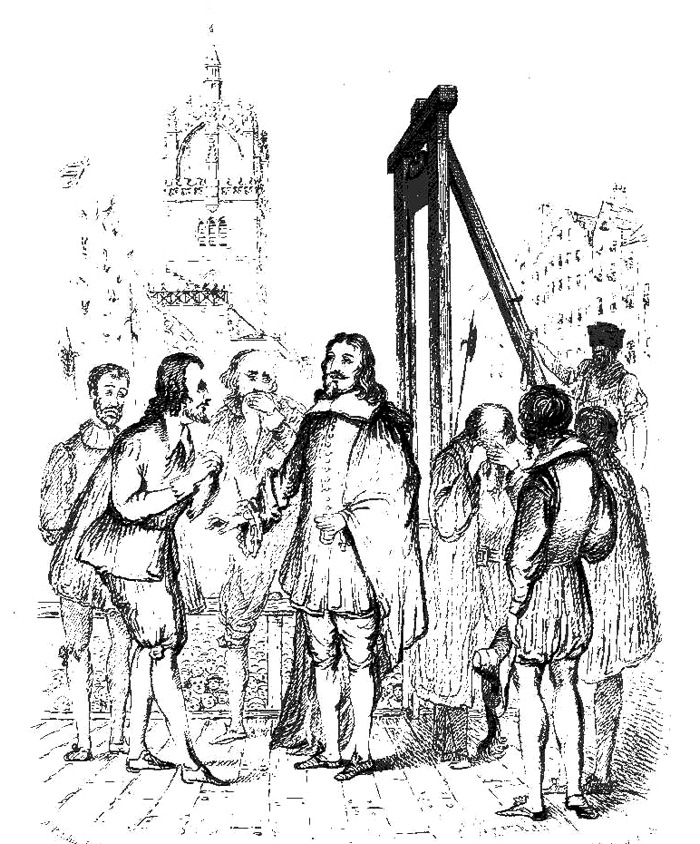
The proof of his compliance was complete; and next day he was
condemned and forfeited. The manner of his execution was put
to the vote, “hang or behead,” when it was carried that he should
be beheaded, and his head placed on the same spike, on the top
of the tolbooth, whence Montrose’s had been but lately removed.
During the whole of his protracted trial, which lasted from the
13th of February till the 25th of May, his behaviour was meek
and composed, although attacked with the most virulent abuse by
the reptiles who crouched before him in the hour of his prosperity.
When in his own defence he asked, how could I suppose
that I was acting criminally, when the learned gentleman,
his majesty’s advocate, took the same oaths to the Commonwealth
with myself? Sir John Fletcher replied to a question he could not
answer, by calling him an impudent villain. The Marquis mildly
said, he had learned in his affliction to endure reproach. After
his case appeared desperate, his friends planned an escape, partly
by force, and partly by stratagem, and a number of resolute gentlemen
had engaged in it; but, after he had consented, and had
even put on a female dress, in which he was to be carried out of
the Castle, he changed his mind, threw aside his disguise, and declared
he was determined not to disown the cause he had so long
appeared for, but was resolved to suffer to the utmost.
When brought to receive sentence, there were but few, and
these the most determined time-serving sycophants, in the House,
shame or compassion preventing a number who had decided his
37fate from hearing it announced; yet even they could not help
moralizing on the mutability of human glory, though, when he
requested a delay of only ten days that the king might be acquainted
with the result of his trial, they refused that short interval,
and prevented his last chance of mercy!
He heard his sentence with equanimity. The Earl of Crawford,
who pronounced it in absence of the Chancellor, told him
he must receive it kneeling, and he immediately knelt, saying,
“That I will with all humility.” When rising, he remarked,
“I had the honour to put the crown upon the king’s head, may
God bestow on him a crown of glory. Now he hastens me to a
better crown than his own.”[14] Then addressing the commissioner
and parliament, “you have the indemnity of an earthly king,”
said he, “among your hands, and have denied me a share in that;
but you cannot hinder me from the indemnity of the King of
kings; and shortly you must be before his tribunal. I pray he
may not mete out such measure to you as you have done to me,
when you are called to account for all your actings, and this among
the rest.”
After sentence, he was conducted to the common jail, where
his lady was waiting for him. “They have given me,” said he
as he entered, “till Monday, my dear, to be with you; let us
improve it.” As she embraced him, she sobbed out—“The Lord
will require it! The Lord will require it!” and wept bitterly.
Nor could the officer who attended him, nor any who were present,
avoid shedding tears at the scene. The Marquis, too, was at
first considerably affected, but becoming composed, “Forbear!”
said he affectionately to the Marchioness, “forbear! truly I pity
them—they know not what they are doing. They may shut me
in where they please, they cannot shut out God from me; for my
part, I am as content to be here as in the Castle. I was as content
in the Castle as in the Tower of London; and as content
there as when at liberty; and I hope to be as content on the
scaffold as in any of them all.” He then added, “he remembered
a text that had been cited to him by an honest minister—‘When
38Ziglag was taken and burnt, the people spake of stoning
David; but he encouraged himself in the Lord.’”
The solemn interval he spent in exercises befitting a dying
Christian; and though rather of a timid disposition, yet during
the short space that now separated him from eternity, and with
the immediate prospect of a violent death, his mind was elevated
above his natural temper, and he desired those about him to
observe “that the Lord had heard his prayers, and removed all
fear from him.” To some ministers permitted to attend him, he
said, “that they would shortly envy him who had got before,”
adding, “mind I tell it you; my skill fails me if you who are
ministers will not either suffer much or sin much; for though you
go along with these men in part, if you do it not in all things,
you are but where you were, and so must suffer; and if you go
not at all with them you can but suffer.” Mr Robert Douglas and
Mr George Hutchison preached in the tolbooth, at his desire, on
the Lord’s day; and at night his lady, at his particular request,
took leave. Mr David Dickson spent the last night with him
that he spent on earth, which passed delightfully in prayer, praise,
and spiritual conversation, except a few hours he enjoyed of calm
and tranquil repose. On Monday, he rose early, and was much
occupied in settling his worldly affairs; but, while signing some
conveyances, his spiritual joy was such, that he exclaimed with
rapture before the company, “I thought to have concealed the
Lord’s goodness, but it will not do. I am now ordering my affairs,
and God is sealing my charter to a better inheritance, saying,
‘Son, be of good cheer; thy sins are forgiven thee.’” He
wrote a letter to the king, expressing his satisfaction that nothing
had been proved against him but his being forced to submit to
the unlawful power of usurping rebels—the epidemic and fault of
the time—praying his majesty’s princely goodness and favour to
his wife and family after his decease, and requesting that his just
debts might be allowed to be paid out of his estate. He dined
with a number of friends at twelve o’clock; after which he retired
a little, and returned from his private devotions in a holy rapture.
A sense of the forgiveness of his sins made the tears of joy run
from his eyes; and, turning to Mr Hutchison, “I think,” said
39he, “His kindness overcomes me, but God is good to me; he
lets not out too much of it here, for he knows I could not bear
it;” and, thinking the time was expired, added, “Get me my
cloak—let us go;” but being told that the clock had been put
back, he answered they were far in the wrong, and kneeled down
and prayed. As he ended, notice was sent that the bailies waited
him, upon which he called for a glass of wine, and asked a blessing.
Then he declared his readiness—“Now let us go, and God
go with us.” When leaving the room, he said to those who remained,
“I could die like a Roman, but choose rather to die as
a Christian. Come away, gentlemen; he that goes first goes
cleanliest.” Calling Mr Guthrie as he went down, he embraced
him and took farewell. Mr Guthrie’s parting benediction was—“My
lord, God hath been with you, he is with you, and He will
be with you; and such is my respect for your lordship, that, if I
were not under the sentence of death myself, I could cheerfully
die for your lordship.”
The Marquis was accompanied to the place of execution by
several noblemen and gentlemen in mourning. He walked steadily
down the street, and, with the greatest serenity, mounted the
scaffold, which was filled with his friends, of whom he had given
in a list, and whose names were contained in a warrant subscribed
by the commissioner. After Mr Hutchison had prayed, his lordship
addressed the spectators. He did not attempt any explanation
of his conduct. “I came not here,” were his humble expressions,
“to justify myself but the Lord, who is holy in all his
ways and righteous in all his works; holy and blessed is his name.
Neither came I to condemn others. I know many will expect
that I should speak against the hardness of the sentence pronounced
against me, but I will say nothing of it. I bless the
Lord, I pardon all men, as I desire to be pardoned of the Lord
myself: let the will of the Lord be done.” He then, as in the
presence of God, disclaimed having entered upon the work of
reformation from any motive of self-interest or personal dissatisfaction
with the government. He had ever been cordial in his
desires to bring the king home, and in his endeavours for him
when he was at home; nor had he ever corresponded with his
40enemies during the time he was in the country. “I confess,” he
continued, “many look on my condition as a suffering condition;
but I bless God, He who hath gone before, hath trode the wine-press
of the Father’s wrath, by whose sufferings I hope my sufferings
shall not be eternal. I shall not speak much to those
things for which I am condemned, lest I seem to condemn others.
I wish the Lord to pardon them. I say no more.”
Then changing the subject, he continued—“There are some,
and those not openly profane, who, if their private interest go
well, they care not whether religion or the church of God sink or
swim. But, whatever they think, God hath laid engagements on
Scotland. We are tyed by covenants to religion and reformation,
and it passeth the power of all magistrates under heaven to absolve
a man from the oath of God. It is the duty of every Christian
to be loyal; but God must have his as well as Cæsar. Religion
must not be secondary. They are the best subjects who
are the best Christians. These times are like to prove very sinning
times or very suffering times; and let Christians make their
choice; and truely he that would choose the better part would
choose to suffer. Others that will choose to sin will not escape
suffering. Yet I cannot say of mine own condition, but that the
Lord in his providence hath mind of mercy to me even in this
world; for if I had been more favourably dealt with, I fear I
might have been overcome with temptations, as many others are,
and many more I fear will be; yea, blessed be his name, I am
kept from present evil and evil to come! I have no more to say
but to beg the Lord, since I go away, he would bless them who
stay behind.”[15]
Having again spent some time in devotion, he distributed some
last tokens of remembrance to the friends who were with him.
To the Earl of Caithness, his son-in-law, he gave his watch, saying,
with a smile, it was fit for men to pay their debts; and having
promised him that watch, he now performed it. After his
41doublet was off, and immediately before he laid his head upon the
block, he addressed those near him—“Gentlemen, I desire you
and all that hear me, again to take notice and remember, that,
now when I am entering into eternity and to appear before my
Judge, and as I desire salvation and expect eternal happiness from
him, I am free from any accession, by knowledge, contriving,
counsel, or any other ways, to his late majesty’s death; and I
pray the Lord to preserve our present king his majesty, and to
pour his best blessings upon his person and government; and the
Lord give him good and faithful councillors.” Mr Hutchison,
his attendant minister, on bidding him finally adieu, used a Scottish
phrase, peculiarly emphatic—“My lord, now hold your grip
sicker.” The appropriate force of the expression was felt by the
sufferer. “You know, Mr Hutchison, what I said to you in the
chamber, I am not afraid to be surprised with fear;” and the
Laird of Skelmorlie, who took him by the hand at this awful moment,
felt that no tremour in his veins belied the assertion. He
then knelt, offered up his last prayer, and upon dropping his
hands, the appointed signal, the axe of the maiden fell, and his
spirit fled to his God and Saviour. His body was carried to
Dunoon, and buried in Kilmun church.
Argyle has ever, by the unanimous verdict of his Presbyterian
countrymen, been considered a martyr, not for the form, but for
the reality of their religion. The form, perhaps, he might have
consented to modify—the essence he never durst think of forsaking.
There was a consistency in his adherence to his principles
that claims our admiration, especially as he sealed his testimony
by his blood. He may have given, as many of the excellent men
of his day did, an undue importance to points of inferior moment,
but the fundamental truths of the gospel were his hope, as, in so
far as we can trust the testimony of his friends, its precepts had
been the rule of his life. It is refreshing to know that his persecutors
did not share his spoil. Through the intercession of Lauderdale,
Lorn procured from the king all his father’s estates and
titles, except that of Marquis.
Mr James Guthrie, minister at Stirling, remarkable for his
piety, zeal, and consistency in the cause of reformation-principles,
42followed his friend to trial and judgment.[16] He was peculiarly
obnoxious to Middleton, having pronounced sentence of excommunication
upon him, and was considered the chief of the remonstrators,
who had uniformly resisted communion with the malignants;
but he was no less distinguished for his intrepid opposition
to the government of Cromwell, whom he had boldly stigmatized
as an usurper, at the time when all those who now made such
flaming professions of loyalty had crouched before him. Revered
and popular among the lower ranks, he was not less respected
among the worthy of the higher; for, although constrained by
terror to condemn, no political victim was ever sacrificed with
more reluctance by the subordinate ranks of the priesthood of
mammon, than was James Guthrie; and even the Moloch at whose
shrine he was immolated, expressed his regret, and bore testimony
to his worth—“Had I known,” said the callous-hearted Charles,
when he heard of Mr Gillespie being suffered to live, “that they
would have spared Gillespie, I would have saved Guthrie!”—a
noble testimony, but happily too late to deprive that holy man of
the honour his Lord had provided for him with them who were
slain for the word of God, and for the testimony which they held.
He was arraigned before a court, of which the director and the
president were his personal enemies, and of which a majority had
already prejudged his case. His pursuers were men who had
yielded to the blast that he had braved, who had deserted their
prince in the hour of his extremity, had flattered the very powers
that he had withstood, yet now came forward with a flagrant effrontery
to charge him with favouring an usurpation to which they had
done homage, but which he had suffered for withstanding.
On the 20th of February, he received his indictment, the general
charges of which were—his accession to the remonstrance—his
43writing and publishing that abominable pamphlet, “The Causes
of God’s Wrath”[17]—his contriving, and writing, and subscribing
“The humble Supplication of 23d August last”—but, chiefly,
his declining, in the year 1650, his majesty’s power in matters
purely ecclesiastical, which branch of the royal prerogative the
present managers were determined to assert, as they traced, and
justly, the chief, if not the whole, of the misery the nation had
endured under the king’s father and grandfather, to the opposition
made by the ministry to this anti-scriptural jurisdiction, or, in
the language of Sir George M’Kenzie, “because this principle
had not only vexed King James, but was the occasion of much
rebellion.” The indictment, framed upon certain obsolete or
repealed acts in favour of popery, prelacy, or the kingly power,
passed before the last full establishment of Presbytery, charged
him with convoking the lieges without warrant or authority to the
disturbance of the state and church. After it had been read, he
addressed the Lord Chancellor—
“He was glad,” he said, for he pled his own cause, “that the
law of God was named first as being indeed the only supreme law,
to which all other laws ought to be subordinate; and there being
an act of the first parliament of James VI., by which all clauses
of laws or acts of parliament repugnant to the word of God were
repealed, he hoped their lordships would give most respect to
this, that he might be judged by the law of God especially, and
by other laws in subordination thereto. As to the acts of parliament
upon which he was arraigned, he asserted the legal maxim,
44that where any difference between acts occurs, the last is that only
which is to be considered obligatory; and he farther affirmed,
what almost all his judges had previously, repeatedly, and upon
oath allowed, that it must also be granted that laws and acts of
parliament were to be understood and expounded by those solemn
public vows and covenants contracted with God by his majesty and
subjects, which were not only declared by the laws of the land to
have the strength of acts of parliament, but, both by the law of
God and common law and light of all the nations in the world,
are more binding and indispensable than any municipal law and
statute whatever.”
The general charge of abetting Cromwell, he defied all the
world to prove if he had justice allowed him; nor was it attempted.
His approval of the remonstrance he did not deny, but this
he only did in a legal manner, as a member of a legal assembly.
His participation in the authorship of “The Causes of God’s
Wrath,” he avowed and defended. But in this he said he acted
merely and singly from a constraining power of conscience to be
found faithful as a minister of the gospel, in the discovering of
sin and guiltiness, that it being acknowledged and repented of,
wrath might be taken away from the house of the king and from
these kingdoms. “Your lordship knows,” continued he, “what
charge is laid upon ministers of the gospel, to give faithful warning
to all sorts of persons, and how they expose their own souls
to the hazard of eternal damnation, and the guilt of the blood of
those with whom they have to do, if they do not this. And you
do also know, that the prophets and apostles of our Lord Jesus
Christ himself did faithfully warn all men, though it was their lot,
because of the same, to be reckoned traitors and seditious persons.
My lord, I wish it seriously to be pondered, that nothing is asserted
in these “Causes” as matter of sin and duty, but what hath
been the common received doctrine of the church of Scotland,
the truth of which is confirmed from the word of God; and as
to matters of fact, as far as regards the royal family, they are no
other than are mentioned in the solemn public causes of humiliation
condescended upon and kept by the whole church jointly,
and his majesty and family, with the commission of the General
45Assembly and committee of estates, before his coronation at
Perth.”
He also avowed the “Supplication” at Edinburgh, which he
vindicated as containing nothing more than a humble petition concerning
those things to which his majesty and all his subjects were
engaged by the solemn irreversible oath of the covenant, with a
serious representation of the dangers threatening religion, and the
duties of that sacred obligation, and did only put his majesty in
remembrance of holding fast the oaths of the covenant. The
meeting was presbyterial, and therefore legal; and was, besides,
a quiet, orderly convocation, without tumult, and requiring no
particular warrant.
Respecting his declining the king’s authority in things sacred,
he unhesitatingly acknowledged that he did decline the civil magistrate
as a competent judge of ministers’ doctrine in the first
instance.[18] His authority in all things civil, he said he did with
all his heart allow; but such declinations were agreeable to the
word of God, which clearly holds forth that Christ hath a visible
kingdom, which he exercises in or over his visible members by his
spiritual officers, which is wholly distinct from the civil power and
government of the world—to the Confession of Faith and doctrine
of the church of Scotland, which acknowledge no head over
the church of Christ but himself, nor any judgment or power in
or over his church, but that which he hath committed to the spiritual
office-bearers thereof under him, and had been the ordinary
practice of that kirk since the time of the reformation from Popery;
and were also agreeable to, and founded on, the National
Covenant and Solemn League and Covenant, by which the king’s
majesty himself, and all the subjects of that kingdom, were bound
to maintain the doctrine, worship, discipline, and government of
that church, with solemn vows and public oaths of God. “Upon
these grounds, therefore,” said he, “it is that I gave in and do
46assert that declination for vindicating the cause, dignity, and royal
prerogative of Jesus Christ, who is King of kings and Lord of
lords, but with all due respect to his majesty, his greatness, and
authority.” Then, after discussing the several acts of parliament
that had been quoted, he thus concluded an able and argumentative
speech:—
“That I did never purpose or intend to speak or act any thing
disloyal, seditious, or treasonable against his majesty’s person, authority,
or government, God is my witness; and that what I have
written, spoken, or acted, in any of those things wherewith I am
charged, hath been merely and singly from a principle of conscience;
that, according to the weak measure of light given me of
God, I might do my duty in my station and calling as a minister
of the gospel. But because the plea of conscience alone, although
it may extenuate, cannot wholly excuse, I do assert that I have
founded my speeches, writings, and actings, in these matters, on
the word of God, and on the doctrine, Confession of Faith, and
laws of this church and kingdom—upon the National Covenant of
Scotland, and the Solemn League and Covenant between these
three kingdoms. If these foundations fall, I must fall with them;
but if these sustain and stand in judgment, as I hope they will,
I cannot acknowledge myself, neither I hope will his majesty’s
commissioner and the honourable court of parliament judge me,
guilty either of sedition or treason.”
This trial lasted from the 20th of February till the 15th of
April; and the most strenuous efforts were made to induce Mr
Guthrie to submit and plead for mercy. He was even offered
a bishopric; but he deemed the object for which he contended
too important to be yielded up for any consideration of temporal
aggrandizement. When the protracted proceedings were drawing
to a close, on the 11th of April, after his defences, which were very
elaborate, had been read, he finished his pleading by a pointed
and solemn appeal, which was heard with the most profound attention,
and induced a number to withdraw, declaring, in the language
of Scripture, “They would have nothing to do with the
blood of that righteous man.”
Addressing the Chancellor, “My lord,” said the intrepid minister
47in conclusion, “I shall, in the last place, humbly beg—having
brought such pregnant and clear evidence from the word of
God, so much divine reason and human law, and so much of the
common practice of the kirk and kingdom in my own defence;
and being already cast out of my ministry, driven from my dwelling,
and deprived of my maintenance, myself and my family
thrown upon the charity of others; and having now suffered eight
months’ imprisonment—that your lordships would put no farther
burden upon me. But, in the words of the prophet, ‘Behold!
I am in your hands, do to me what seemeth good to you.’ I
know for certain that the Lord hath commanded me to speak all
these things, and that if you put me to death you shall bring innocent
blood upon yourself and upon the inhabitants of this city.
My lord! my conscience I cannot submit; but this old crazy
body and mortal flesh I do submit to do with whatever you will,
whether by death, by banishment, or imprisonment, or any thing
else, only I beseech you ponder well what profit there is in my
blood; it is not extinguishing me or many others that will extinguish
the covenant and the work of reformation since 1638.
No! my bondage, banishment, or blood, will contribute more for
their extension than my life or liberty could, were I to live many
years. I wish to my Lord Commissioner, his Grace, and to all
your lordships, the spirit of judgment, wisdom, and understanding,
and the fear of the Lord, that you may judge righteous judgment,
in which God may have glory, the king honour and happiness,
and yourselves peace in the great day of accounts.” But all
was of no avail; his life was determined on as an example to the
ministers, and he was found guilty, upon his own confession, of the
charges brought against him. Sentence was delayed till the 28th
of May, when the doom of a traitor was pronounced by the Earl
of Crawford, in absence of the Chancellor. As he arose from his
knees—for he had been ordered to kneel—“My lords,” said he,
“may never this sentence more affect you than it does me; and
let never my blood be required of the king’s family!” He had
assisted in managing his defence with an eloquence, acuteness,
and legal knowledge, that drew forth the admiration of the professional
gentlemen who were his advocates.
48When his case was decided, and he was removed to wait till
his sentence was written out, while he remained amid the soldiers,
and officers, and servants of the court, he afterwards declared he
never felt more of the sensible presence of God, of the sweet intimations
of peace, and the real manifestations of divine love and
favour, than when surrounded with all their bustle and confusion.
From that time till he went to the scaffold, he remained in a
serene, tranquil frame of mind. On the day of his execution,
June 1, several of his friends dined with him, when not only his
cheerfulness, but even his pleasantry, did not forsake him. After
dinner, he jocularly called for a little cheese, of which he was very
fond, but had been forbid by his physicians to eat on account of
a gravelish complaint, saying, “I hope I am now beyond reach
of the gravel.”
He delivered his last speech from the ladder with the same
composed earnestness with which he was wont to deliver his sermons.
“He thanked God that he suffered willingly, having had
it in his power to have made his escape, or by compliance to have
obtained favour, but he durst not redeem his life with the loss of
his integrity.” “I bless God,” he proceeded, “that I die not
as a fool, not that I have any thing wherein to glory in myself.
But I do believe that Jesus Christ came into the world to save
sinners, whereof I am chief; through faith in his righteousness
and blood, I have obtained mercy, and through him and him alone
have I the blessed hope of a blessed conquest over sin and Satan,
death and hell, and that I shall attain unto the resurrection of the
just, and be made partaker of eternal life. I know in whom I
have believed, and that he is able to keep that which I have committed
to him unto that day. I have preached salvation through
his name; and as I have preached, so do I believe, and do recommend
the riches of his free grace and faith in his name unto you
all, as the only way whereby ye can be saved.”
“And,” continued he, “as I bless the Lord I die not as a
fool, so also that I die not for evil-doing. God is my record, that
in these things for which sentence of death is passed against me,
I have a good conscience. My heart is conscious of no disloyalty.
The matters for which I am condemned, are matters belonging to
49my calling and function as a minister of the gospel; such as discovering
and reproving of sin, the pressing and holding fast of
the oath of God in the covenant, and preserving and carrying on
the work of reformation according thereto, and denying to acknowledge
the civil magistrate as the proper, competent, immediate
judge in causes ecclesiastical.” He then warned his hearers
that the wrath of God was hanging over the land for that deluge
of profanity that was overflowing it; for their perjury and breach
of covenant—“Be astonished, O ye heavens, at this! shall he
break the covenant and prosper? shall the throne of iniquity
have fellowship with God, which frameth mischief by a law?”
for their ingratitude; for their dreadful idolatry and sacrificing
to the creature—a corruptible man, in whom many had placed
almost all their salvation and all their desire; for a generation of
carnal, time-serving ministers, men who minded earthly things,
enemies to the cross of Christ, who pushed with the side and
shoulder, who strengthen the hands of evil-doers, and make themselves
transgressors by studying to build again what they did formerly
warrantably destroy.
Next, he earnestly exhorted the profane, the lukewarm, and
the indifferent, to repentance, and the godly to confidence and
zeal, expressing his belief that God would neither desert his people
nor cause in Scotland. “There is yet,” exclaimed he, “a
holy seed, a precious remnant, whom God will preserve and bring
forth; but how long or dark our night may be, I do not know;
the Lord shorten it for the sake of his chosen. In the mean
while, be patient, steadfast, and immovable, always abounding in
the work of the Lord. Beware of snares, decline not the cross,
and account the reproach of Christ greater riches than all the
treasure of the world. Let my death grieve none of you. I
forgive all men the guilt of it, and I desire you to do so also.
Pray for them that persecute you; bless them that curse you;
bless, I say, and curse not!” After bearing testimony to the
faith of the gospel, the doctrine and discipline of the church of
Scotland, the protestation, and against the course of backsliding
then afoot in the land,
He ended in this strain of triumphant exultation, well becoming
50a martyr for the truth—“Jesus Christ is my light and my
life, my righteousness, my strength, and my salvation, and all my
desire. Him! O him! do I with the strength of all my soul
commend unto you; blessed are they that are not offended in
him. Bless him, O my soul! from henceforth even for ever.
Rejoice, rejoice all ye that love him; be patient and rejoice in
tribulation. Blessed are you, and blessed shall you be for ever
and ever. Everlasting righteousness and eternal salvation is
yours; all is yours; and ye are Christ’s, and Christ is God’s!”
His last words were—“Remember me, O Lord, with the favour
thou bearest to thy people. O visit me with thy salvation, that
I may see the good of thy chosen; that I may rejoice in the
gladness of thy nation; that I may glory with thine inheritance.
Now let thy servant depart in peace, since my eyes have seen
thy salvation!”
An obscure individual, named William, sometimes Captain,
Govan, was executed along with Mr Guthrie. He met death
with the same joyful confidence, resting on the same sure foundation.
For what specific charges he suffered, is uncertain. In
his speech which he left, he says it was for laying down his arms
at Hamilton, as all the company did. Sir George M’Kenzie
alleges it was for joining in the English army in 1651. “But
so inconsiderable a person,” he adds, “had not died if he had not
been suspected to have been upon the scaffold when King Charles
the First was murdered, though he purged himself of this when he
died; and his guilt was, that he brought to Scotland the first
news of it, and seem’d to be well satisfied with it.” His chief
crime, however, appears to have been that he was a pious, consistent,
and zealous Presbyterian. Mr Guthrie was turned off first;
and his behaviour must have tended greatly to strengthen his fellow-sufferer,
who, in his last speech, after exhorting the licentious
and the lukewarm to repent, remarked—“As for myself, it
pleased the Lord, in the fourteenth year of my age, to manifest
his love to me; and now it is about twenty-four years since, all
which time I professed the truth which I suffer for and bear testimony
to at this day, and am not afraid of the cross upon that account.
It is sweet! it is sweet! otherwise how durst I look on
51the corpse of him who hangs there with courage, and smile upon
that gibbet as the gate of heaven?” When he had ended, he
took a ring from off his finger, and gave to a friend, desiring him
to take it to his wife and tell her—he died in humble confidence,
and found the cross of Christ sweet. Christ, he added, had done
all for him; and it was by him alone he was justified. Being desired
to look up to that Christ, he replied—“He looketh down
and smileth upon me;” and mounting the ladder—“Dear
friends,” said he to those around him, “pledge this cup of suffering
before you sin, as I have now done; for sin and suffering
have been presented to me, and I have chosen the suffering part.”
When the rope was put about his neck, he observed—“Middleton
and I went out to the field together upon the same errand;
now I am promoted to a cord and he to be Lord High Commissioner;
yet for a thousand worlds would I not change situations
with him! Praise and glory be to Christ for ever!”
Besides those who suffered unto death at this time, many others
were prosecuted and punished, by removal from their office, imprisonment,
or exile. Among these, the most conspicuous were,
Mr Robert Traill, minister of the Greyfriar’s church, Edinburgh.
He had been in the Castle while it held out against Cromwell,
had encouraged the governor and garrison to be faithful to their
trust, and had received a severe wound during the siege; yet he
was now charged with disloyalty and a participation in all the obnoxious
transactions for which Mr Guthrie laid down his life.
His indictment had been drawn up, as all the libels of that time
were, with great acrimony and peculiar virulence of expression, to
exaggerate the crime of disloyalty, which formed the prominent
feature of the accusation. In replying, Mr Traill averred he durst
appeal to the Lord Advocate’s own conscience, whether he believed
him to be such an one as he had represented him, and complained
of bitter and injurious words, but abstained from any
angry retort. “I have not,” was his meek answer, “so learned
Christ; yea, I have learned of him not to render evil for evil,
nor railing for railing, but contrariwise blessing; and therefore I
do from my heart pray for the honourable drawer up of the libel,
as I would do for myself, that the Lord would bless him with his
52best blessings, and would give him to find mercy in the day of
the Lord Jesus!” When the remonstrance was presented, he
was confined in the garrison; but, with respect to the other
charges, his replies were similar to Mr Guthrie’s, although not perhaps
quite so strongly expressed assertions of the legality, propriety,
and the imperative necessity of ministers being faithful in
the discharge of their duty. He had been seven months confined
before being brought to trial; and to that he alludes in the
following solemn conclusion of his defence:—
“Now, my lord, I must in all humility beg leave to entreat
your lordship that you would seriously consider what you do with
poor ministers, who have been so long kept, not only from their
liberty of preaching the gospel, but of hearing it—that so many
congregations are laid desolate for so long a time, and many poor
souls have put up their regrets on their deathbed for their being
deprived of a word of comfort from their ministers in the hour of
their greatest need! The Lord give you wisdom in all things,
and pour out upon you the spirit of your high and weighty employment,
of understanding and the fear of the Lord, that your
government may be blessed for this land and kirk—that you may
live long and happily—that your memory may be sweet and fragrant
when you are gone—that you may leave your name for a
blessing to the Lord’s people—and that your houses and families
may stand long and flourish to the years of many generations!
Above all, that you have solid peace and heart-joy in the hour of
the breaking of your heart-strings, when pale death shall sit on your
eyelids—when man must go to his long home and the mourners
go about the streets: for what man is he that liveth and shall
not see death? or who can deliver himself from the power of the
grave? Even those to whom he saith, ye are gods, must die as
men; for it is appointed to all men once to die, and after death
the judgment, and after judgment an endless eternity! Let me
therefore exhort your lordship, in the words of a great king, a
great warrior, and a holy prophet—Be wise, be taught, ye rulers
of the earth; serve the Lord with fear, and rejoice before him
with trembling. Kiss the Son, lest he be angry, and ye perish
from the way, when his wrath is kindled but for a little. Then
53blessed will all those, and those only, be who put their trust in
him. Now the Lord give you, in this your day, to consider the
things that belong to your eternal peace, and to remember your
latter end, that it may be well with you world without end!”
An address such as this, from a prisoner at the bar to his judges,
who had his life and death in their hands, could not fail but to
have been productive of a powerful effect upon the minds of such
as were not altogether hardened against every impression, and presents
the sufferer for truth and a good conscience upon a commanding
elevation, unattainable in any other cause, fearless of
personal safety, and anxious only that, while he be found faithful
in the service of his master, his persecutors may enjoy the same
privilege. How forcibly does it recall the Apostle’s address to
Agrippa—“I would to God, that not only thou, but also all that
hear me this day, were both almost and altogether such as I am,
except these bonds.” Mr Traill was remitted to prison, where
he lay for some time, and was afterwards banished to Holland.
While uncertain of his fate, he thus wrote to another minister
from his prison—“Your imprisoned and confined brethren are
kindly dealt with by our kind Lord, for we have large allowance
from him could we take it. We know it fares the better with us.
You and such as you, mind us at the throne. We are waiting
from day to day not knowing what man will do with us. We
are expecting banishment at the best; but our sentence must proceed
from the Lord, and whatsoever it be, it shall be good as
from him, and whithersoever he send us, he shall be with us;
for the earth is the Lord’s and the fulness thereof!”
A remarkable trait in all these proceedings is, that the men now
persecuted for alleged disloyalty were the men who, when the
throne was prostrate, and when these their persecutors had in
general deserted the cause as desperate, rallied round the standard
of royalty, refused to bow to the invaders, and had suffered for
their attachment to the legitimate prince! and it seemed as if the
measure of ingratitude meted out to them, was to be in proportion
to the steadfastness with which they had adhered to the fortunes
of that family in their lowest depression.
Mr Alexander Moncrief, minister of the gospel at Sconie, in
54Fife, had particularly distinguished himself by his loyalty during
the usurpation and domination of the English—and had
subjected himself to imprisonment by boldly praying for the
king; and so far had he been from joining with the sectaries,
that he presented a petition to Monk against their toleration;
but he had approved of the remonstrance, and had assisted in
drawing up “The Causes of God’s Wrath;” and he was therefore
a proper object for persecution. Highly esteemed in the
country where he lived, the greatest interest was made to procure
his life; and two ladies of the first rank presented a handsome service
of plate to the Lord Advocate’s wife—a practice, it seems,
not uncommon in these times!—to procure his interference; but
the plate was returned, and they were told that nothing could be
done to save him. The Earl of Atholl, likewise, and several
members of parliament, were anxious to protect him, but were informed
that he could expect no mercy, unless he would consent
to change his principles. When this was told to his wife, her
reply showed her to have been a woman of a similar spirit. “Ye
know that I am happy in a good husband, to whom I have ever
borne a great affection, and have had many children; but I know
him to be so steadfast to his principles, where conscience is concerned,
that nobody need speak to him upon that head; and, for
my part, before I would contribute any thing that would break
his peace with his master, I would rather choose to receive his
head at the cross!” Yet the numerous applications in his favour
from persons of influence—without his knowledge—procured a
mitigation of his punishment; and, after a tedious confinement,
he was only rendered incapable of all civil or ecclesiastical employment,
deprived of his living, and forbid to enter his parish.
Mr Robert Macwaird, minister, Glasgow, who had likewise
maintained his loyalty to his king in the face of his enemies, was
included in the noble band of sufferers; but the accusation
against him differed somewhat from the others. When he perceived
the general and awful course of defection from the very
profession of religion, and the design to overturn the whole covenanted
work of reformation, he commenced a series of sermons,
in his week-day exercise, from that striking text, Amos iii. 2.
55“You only have I known of all the families of the earth; therefore
I will punish you for all your iniquities.” In these, he first
addressed himself to his hearers, and pressed upon their consciences
their personal sins—for these worthies, who stood in the
front of the battle while contending earnestly for the national religion,
never failed to inculcate the inutility and danger of a public
profession without personal holiness—from personal, he ascended
to general and national sins; and, adverting to the open
profligacy and backsliding which pervaded a nation once so high
in profession, and so favoured in privilege, he pathetically asked,
“Alas! may not God expostulate with us, and say, ye are backslidden
with a perpetual backsliding, and what iniquity have you
found in him? We are backslidden in zeal and love. The glory
of a begun reformation in manners is eclipsed, and an inundation
of profanity come in. Many who once loved to walk abroad in
the garment of godliness, now persecute it. The faithful servants
of Christ are become enemies, because they tell the truth. The
upright seekers of God are the marks of the great men’s malice.”
And, interjecting this most remarkable prayer—“May it never
be said of faithful ministers and Christians in Scotland, ‘We
have a law, and by this law they must die’”—he continued,
“Backsliding is got up to the very head and corrupts the fountains;
and wickedness goeth forth already from some of the prophets
through the whole land! Are these the pastors and rulers
that bound themselves so solemnly and acknowledged their former
breaches? How hath the faithful city turned an harlot?”
These expressions, and many others of a like import, excited
the enmity of those whom they convicted, and to whom the exhortations
to repent and to return were addressed in vain; and
some of the apostate tribe transmitted to the managers information
against the preacher, as having been guilty of treason. The
following passage was that upon which the charge chiefly rested.
After entreating his audience to mourn, consider, repent, and return—to
wrestle, pray, and pour out their souls before the Lord,
he encouraged them, by remarking, that “God would look upon
these duties as their Dissent from what was done prejudicial to
his work and interest, and mark them among the mourners in
56Zion.” Then came the treason! “As for my own part, as a
poor member of the church of Scotland, and an unworthy minister
in it, I do this day call upon you who are the people of God
to witness, that I humbly offer my dissent to all acts which are
or shall be passed against the covenants or work of reformation in
Scotland. And, secondly, protest, that I am desirous to be free
of the guilt thereof, and pray that God may put it upon record in
heaven.” For this discourse he was arrested; and, on the Thursday
following Mr Guthrie’s execution, was brought before the
parliament.
Expecting nothing else than to follow that great man to heaven
from the scaffold, he was equally courageous and unhesitating in
his behaviour; and, when called upon to reply, June 6th, thus
honestly avowed his sentiments:—“My lord, I cannot, I dare
not, dissemble, that, having spoken nothing but what I hope will
be the truth of God when brought to the touchstone, and such a
truth as, without being guilty of lese-majesty against God, I could
not conceal while I spoke to the text, I conceive myself obliged
to own and adhere to it. So far from committing treason in this,
I am persuaded that it was the highest part of loyalty towards
my prince, the greatest note of respect I could put upon my superiors,
the most real and unquestionable evidence of a true and
tender affection to my countrymen and the congregation over
whom the Holy Ghost made me, though most unworthy, an overseer,
to give seasonable warning of the heavy judgment which the
sin of Scotland’s backsliding will bring on, that so we may be
instructed at length to search and try our ways and turn to the
Lord, lest his soul be separated from us; for wo unto us if our
glory depart! No man will or ought to doubt whether it be a
minister’s duty to preach this doctrine in season and out of season,
which yet is never unseasonable, and to avow that the backslider
in heart shall be filled with his own ways; and if any man draw
back, his soul shall have no pleasure in him. And if so, what evil
have I done, or whose enemy am I become for telling the truth?
“But in order to remove any thing that may seem to give
offence in my practice, I humbly desire it may be considered that
a ministerial protestation against, or a dissent from, any act or
57acts which a minister knows and is convinced to be contrary to the
word of God, is not a legal impugnation of that or these acts,
much less of the authority enacting them, which it doth rather
presuppose than deny; it is just a solemn and serious attested
declaration, witness, or testimony, against the evil and iniquity of
these things, which, by the word of God, is a warrantable practice,
as is clear from Samuel, where the prophet was directed by
the Lord himself to obey the voice of the people, howbeit yet
protest solemnly unto them, and show them the manner of the
king that shall reign over them; also Jeremiah xi. 7. There is
no act of parliament declaring that it shall be treason for a minister
to protest, in the Scripture sense, against such acts as are
contrary to the covenant and the work of reformation; nay more,
there were acts by which the covenants and vows made to God for
reformation in this church, according to his will revealed in his
word, received civil confirmation; and I, as his unworthy servant,
was authorized to protest that these rights be not invaded—that
these vows be not broken!
“Nor may I conceal, that, when I reflect upon and remember
what I have said and sworn to God in the day when, with an uplifted
hand to the most high, I bound my soul with the bond of
the covenant, and engaged solemnly, as I should answer to the
great God, the searcher of hearts, in that day when the secrets of
all hearts shall be disclosed, never to break these bonds, nor cast
away these cords from me, nor to suffer myself, either directly or
indirectly, by terror or persuasion, to be withdrawn from owning
them—when I recollect that, had they been even things indifferent,
I durst not have shaken them off when I had sworn to God,
and consider that, instead of this, they were duties of indispensable
obligation antecedently to all oaths, and remain unalterably
binding independently of them—and when I considered my duty
as a minister, to give warning, to declare, testify, and bear witness
against the sin of violating these covenants, in order to avoid the
wrath that shall follow, and that under no less a threatening than
banishment from the presence of the Lord and the glory of his
power—I had no choice.
“Now I humbly beseech I may not be looked upon as a disloyal
58person, either as to my principles or practice; and so clear
am I that there was neither iniquity in my heart, nor wickedness
in my hands, against his majesty, that I only wish the informer’s
conduct, be he who he may, in the place where I live, were compared
with mine, and the issue of my trial depended on this—whether
he or I had shown most loyalty during the prevalence
and usurpation of the enemy; but I suspect he has rather a little
more prudence than to agree to such a test. But as for me, my
lord, while I wait the coming forth of my sentence from his presence,
whose eyes behold the things that are equal, I declare, that
however I cannot submit my conscience to men, yet I humbly,
as becometh, submit my person.”
This case appears to have been ably managed; and the parliament
delayed proceeding to any immediate decision. In the interval,
he presented a supplication withdrawing the words “protest
and dissent,” as too legal and forensic, substituting the words
“declaring and bearing witness.” The reasons which he assigned
for so doing are satisfactory, and show that the witnesses of this
period did not stand with obstinacy upon any irrational punctilio,
or foolishly rush upon suffering for the sake of unmeaning distinctions
or of favourite phrases. “I am brought,” are his expressions,
“to offer this alteration, not so much, if my heart deceive
me not, for the fear of prejudice to my person—though
being but a weak man, I am easily reached by such discomposing
passions—as from an earnest desire to remove out of the way any,
the least, or remotest, occasion of stumbling, that there may be
the more ready and easy access, without prejudice of words, to
ponder and give judgment of the matter; and that, likewise, if
the Lord shall think fit to call me forth to suffer hard things on
this account, it may not be said that it was for wilful and peremptory
stickling to such expressions; whereas, I might, by using
others, without prejudice to the matter, and no less significant,
have escaped the danger; and lest I should seem to insinuate
that a minister of the gospel could not have sufficiently exonered
his conscience without such formal and legal terms.” But it was
necessary to get rid of men whose abilities were dreaded by their
apostate brethren, and whose consistent piety would have been a
59standing reproach to the new prelates. He was therefore, before
parliament rose, sentenced to banishment, though, by an uncommon
stretch of moderation, he was allowed to remain six months
in Scotland—one of them in Glasgow to arrange his affairs—and
empowered to receive his next year’s stipend.
What rendered these rigorous proceedings towards the ablest,
the most pious, and most conscientious loyalists, more flagrantly
unjust, was, the lenity shown to others who had been deeply implicated
in active compliances with the usurpers, not only after their
power became irresistible, but even while Charles was in the country
and at the head of an army. The Laird of Swinton had been
suspected, in the year 1650, of corresponding with Cromwell, and
being summoned to answer before the parliament at Perth, was
forfeited for failing to appear, on which he joined the English,
and was appointed a judge; but having now turned a quaker, he
was pardoned, and went to the north, where he succeeded in making
a few proselytes. Sir John Chiesly, also, who had acted cordially
with the English, and been forfeited by the same parliament,
was passed over; but his safety was attributed to the influence
of money; for rapacity and venality characterized almost
every member of government, and every court of justice, from
the Restoration to the Revolution.
The escape of Mr Patrick Gillespie was more surprising, as he
was personally disagreeable to the king, who had repeatedly refused
to listen to any solicitations on his behalf. Gillespie was a
minister in Glasgow, and afterwards principal of the College. He
had been the most conspicuous of the remonstrators—had approved
of “The Causes of God’s Wrath,” and had been appointed
principal by the English commissioners, or sequestrators
as they were called[19]—had been a great favourite with Cromwell—had
60preached before him—prayed for him as chief magistrate—and
had received from him several valuable gifts—all which were
now brought forward as charges against him. But he had many
friends in the House, and was induced to profess civil guilt and
throw himself upon the king’s mercy. His concessions, it is alleged,
were strained beyond what he intended, and represented as
of great importance at the time, as he had been eminent among
his brethren; and it was supposed his example would have a
mighty influence in inducing the more scrupulous to give way.
They were, however, grievous to the Presbyterians and not satisfactory
to his majesty; but they procured a mitigation of his
punishment, which was commuted to deprivation of his office, and
confinement to Ormiston and six miles round.
On the 12th of July, the parliament rose; and, on the last
day of that month, their public acts were proclaimed, with the
usual formalities, from the cross of Edinburgh—a ceremony that
employed the heralds and other functionaries from ten o’clock in
the forenoon till six at night.
About the same time, Samuel Rutherford was relieved by death.
BOOK III.
61
Lord High Commissioner sets out for Court—His reception—Deliberations of the
Council—Episcopacy resolved upon as the National Religion of Scotland—Glencairn,
Rothes, and Sharpe appointed to carry the tidings to Edinburgh—King’s
letter—Privy Council announce the overthrow of Presbytery—Forbid the election
of Presbyterian Magistrates in Burghs—Prosecute Tweeddale—Ministers
summoned to London to be episcopally ordained—Their characters—Their consecration—Grief
of the Presbyterians—Re-introduction of Episcopacy—Restrictions
on the press—Witchcraft—Synods discharged and Bishops ordered to be honoured
by royal patent—Their consecration—Parliament restores their rank—Asserts
the King’s supremacy—The Covenants declared unlawful—Act of fines—Defeated—Lord
Lorn—Blair and other ministers deprived—King’s birth-day—Middleton’s
visit to the West and South—Case of Mr Wylie—Brown of Wamphrey—Livingston,
&c.—Middleton removed and Lauderdale appointed.
Leaving the government in the hands of the privy council,[20]
Middleton, after parliament adjourned, set out for court, where
he was received by the Earl of Clarendon, Lord Chancellor, the
Duke of Ormond, and all the cavalier party, with the greatest
congratulations for having quenched the fanatic zeal of Scotland,
and carried his majesty’s prerogative beyond what any preceding
monarch, when present, had ever claimed.
At a council held upon his arrival, Charles, who utterly detested
62Presbytery, expressed himself highly gratified at the report of
what he had done; but his councillors were divided. Lauderdale
and some others, who knew perfectly that the established
religion was deeply rooted in the affections of Scottishmen, were
unwilling to hazard a change; and even some who wished an
Episcopacy were yet averse to its being too rashly introduced.[21]
Middleton, however, who had been previously tutored, immediately
addressed the king—“May it please your sacred majesty:
You may perceive by the account I have now given of your affairs
in Scotland, that there is no present government as yet established
in that church. Presbytery is, after a long usurpation,
now at last rescinded—the covenant, whereby men thought they
were obliged to it, is now declared to have been unlawful—and
the acts of parliament, whereby it was fenced, are now removed;
so that it is arbitrary to your majesty to choose what government
you will fix there; for to your majesty this is by the last act of
supremacy declared to belong. But if your majesty do not interpose,
then Episcopacy, which was unjustly invaded at once
with your royal power, will return to its former vigour.”
Glencairn followed, and affirmed that the insolence of the Presbyterian
ministers had so disgusted all loyal subjects, that six for
one longed for the Episcopalian government, which had ever inculcated
obedience and supported the royal interest; whereas,
Calvinism and Presbytery had never been introduced into any
country without blood and rebellion, and instanced, with the most
preposterous absurdity, the struggles for freedom at the Reformation—in
63 France, during the civil war—in Holland, when they
revolted from Spain—and now twice in Scotland; once by the
Regent Murray, when Queen Mary was banished, and lastly in
1637. Rothes added, although he had not seen the rise of the
innovations, yet he had witnessed the ruin of the engagement
and the treatment of the king by that persuasion. Lauderdale
contended that the proposition was of too great importance to be
slightly determined, and required much thought and much information;
for, upon their resolution, depended the quiet of the
Scots—a people very unmanageable in matters of religion—and
advised that either a General Assembly should be called, the provincial
synods consulted, which, as composed of ministers and
laymen, would acquaint his majesty with the inclinations of
his subjects—or, he might call the ablest divines on both sides,
and learn their sentiments, if neither of the other proposals were
approved of. Middleton replied that all these methods would
only tend to continue Presbytery; for it was probable the power
of the ministers, which had been so irresistible of late, would preponderate
in all. They would easily procure ruling elders of their
own cast to be chosen, and both would be unwilling to resign the
power they possessed; at all events, the leading men whom the
inferior clergy must follow, durst not quarrel the resolutions of
their rabbis, who would adhere to the oaths they had taken, and
stoutly defend their own supremacy; besides, to call General
Assemblies or synods, were to restore them, and thus to infringe
the act rescissory.
The Earl of Crawford, whose treasurer’s rod was a desirable
object for Middleton, had declined mingling in the debate, which
the Chancellor of England observing, requested his majesty that
he might be desired to give his opinion, in order that he might
either disclaim Presbytery or displease the king, and thus put his
principles or his place in jeopardy; for it appeared to be a settled
rule among the courtiers of Charles, that whatever Scottishmen
were allowed to interfere in the public affairs of their native country,
should sacrifice either their conscience or their interest.
Crawford perceived the Chancellor’s aim, and vehemently urged
that provincial synods might be consulted, assuring his majesty,
64the king, that six for one in Scotland were in favours of Presbytery.
“The offences of the reformers,” he warmly contended,
“were not to be charged upon the Reformation: the best innovations
were ever attended with much irregularity, and therefore
it was better to continue that government which had now past all
these hazards—at first unavoidable—than risk another, which, at
its outset, must be unhappy in the same inconveniences. Nor
did the act rescissory cut off Presbytery, for it was secured by
acts of General Assemblies, which had been countenanced by his
majesty’s father’s commissioners, and were yet unrepealed.”
The Duke of Hamilton supported him, and affirmed that the
reason why the act rescissory had so easily passed, was, because
his majesty had promised to continue Presbytery in his letter addressed
to the ministers of Edinburgh. Clarendon closed the
debate, by observing, that Crawford had owned all that ever was
done in Scotland in their rebellion; “and God preserve me,”
said he, “from living in a country where religion is independent
of the state, and clergy may subsist by their own acts; for there
all churchmen may be kings.” The king then told them that he
perceived a majority were for Episcopacy, and therefore he resolved
to settle it without any farther delay.
Immediately after, Glencairn and Rothes were dispatched to
Edinburgh, accompanied by Mr Sharpe, to convey his majesty’s
determination to the council. Were it not that, in humble life,
we see men equally base and shameless where their own self-interest
is concerned, we might wonder at the unblushing effrontery
of the royal communication; yet the pitiful evasion and vile duplicity
in which it was couched, render the king’s letter at once an
object of detestation and contempt. That the reader may compare
it with his former to the ministers of Edinburgh, I give it
at full length:—
“Charles R. Right trusty and well-beloved cousins and
councillors, We greet you well. Whereas, in the month of
August 1660, We did, by our letters to the presbytery of Edinburgh,
declare our purpose to maintain the government of the
church of Scotland as settled by law; and our parliament having
since that time not only rescinded all the acts since the troubles
65began, but also declared all these pretended parliaments null and
void, and left to us the settling and securing of church government:
Therefore, in compliance with that act rescissory, according
to our late proclamation, dated at Whitehall the 10th of June,
and in contemplation of the inconveniences from the church government,
as it hath been exercised these twenty-three years past—of
the unsuitableness thereof to our monarchical state—of the
sadly experienced confusions which have been caused during the
late troubles, by the violences done to our royal prerogative,
and to the government, civil and ecclesiastical, settled by unquestionable
authority, We, from respect to the glory of God and the
good and interest of the Protestant religion; from our pious care
and princely zeal for the order, unity, peace, and stability of that
church, and its better harmony with the government of the
churches of England and Ireland, have, after mature deliberation,
declared to those of our council here our firm resolution to interpose
our royal authority for restoring of that church to its right
government by bishops, as it was before the late troubles, during
the reigns of our royal father and grandfather, of blessed memory,
and as it now stands settled by law. Of this our royal pleasure
concerning church government you are to take notice, and to make
intimation thereof in such a way and manner as you shall judge
most expedient and effectual. And we require you, and every one
of you, and do expect, according to the trust and confidence we
have in your affections and duty to our service, that you will be
careful to use your best endeavours for curing the distempers contracted
during those late evil times—for uniting our good subjects
among themselves, and bringing them all to a cheerful acquiescing
and obedience to our sovereign authority, which we will employ,
by the help of God, for the maintaining and defending the
true reformed religion, increase of piety, and the settlement and
security of that church in her rights and liberties, according to
law and ancient custom. And, in order thereto, our will is, that
you forthwith take such course with the rents belonging to the
several bishopricks and deaneries that they may be restored and
made useful to the church, and that according to justice and the
standing law. And, moreover, you are to inhibit the assembling
66of ministers in their several synodical meetings through the kingdoms
until our further pleasure, and to keep a watchful eye over
all who, upon any pretext whatever, shall, by discoursing, preaching,
reviling, or any irregular or unlawful way, endeavour to alienate
the affections of our people, or dispose them to an ill opinion
of us and our government to the disturbance of the peace of the
kingdom. So, expecting your cheerful obedience and a speedy
account of your proceedings herein, We bid you heartily farewell.
Given at our court, at Whitehall, August 14, 1661, and
of our reign the thirteenth year, by his majesty’s command.”
(Signed) “Lauderdale.”
The privy council received with all due humility this intimation
of the royal pleasure; and, on the 6th of September, an act was
drawn up and published, announcing to the people of Scotland
the overthrow of their beloved Presbytery, under whose shade
they had reposed with so much tranquility during the few last
years of the much abused and unreasonably hated protectorate,
and the re-establishment of that system against which their fathers
had ever contended. A proclamation overturning the freedom of
elections, accompanied the act for overturning the constitution of
the church—so naturally and nearly are civil and ecclesiastical
tyranny connected. The royal burghs were commanded, under
the highest penalties, to elect none for their magistrates who were
fanatically—an epithet which it now became fashionable to apply
to the conscientious Presbyterians—inclined; and such and so
sudden had been the change wrought by the transfer of power,
that this illegal dictation was universally obeyed. Nor did their
conduct towards one of their own number evince a greater regard
for their own privileges or the rights of parliament, than their
ready servility had done for the religion and liberty of their country.
Tweeddale and Kincardine had pressed the council to request
the king that he would consult provincial synods, who would
declare the sense of the country; and, at all events, relieve his
majesty from obloquy whatever might be the ultimate decision.
This proposition, however, would have shown too much deference
to men whom it was intended to bring to unconditional subjection,
and was refused accordingly; but Charles was informed of Tweeddale’s
67hesitation, and an order was procured for his imprisonment,
not indeed ostensibly for his opinion delivered in council, but for
what was or ought to have been still more sacred, for his judgment
and voice in parliament, because he had spoken in vindication of
Mr James Guthrie, and had not voted him guilty of death! It
was to no purpose that he pled the freedom allowed in parliament,
where he was a councillor upon oath and expressly indemnified by
law for what was spoken there; and the danger which every member
would thus incur who voted any person accused of treason
innocent, if a majority should happen to find him guilty. He
was sent prisoner to the Castle, and was only, upon his submission
and petition, permitted to confine himself to Yester and
three miles round, finding caution to the amount of one hundred
thousand merks to answer when called for! Eight months after,
when it was thought his discipline had taught him obedience, he
was, through the mediation of the council, relieved; and, when
his relation Lauderdale came into power, he joined his government.
Although his majesty could establish Episcopacy by proclamation,
the peculiar holiness which was supposed necessarily to belong
to the office of a bishop, it was beyond his power to confer.
This essential attribute of a prelate, which had passed, as was believed,
untainted from the apostles, through all the corruption,
vileness, and abomination of the church of Rome, had, by hands
crimsoned in the blood of the saints, and defiled with all the pollutions
of their brethren, been communicated to the dignitaries of
the English hierarchy, upon whom it still rested in all its imaginary
purity and vigour. But the feeble portion of the sacred
virus that had reached Scotland upon a former occasion, when
James VI. procured the innoculation of his hierarchate, was now
confined to one aged and almost superannuated subject, Mr
Thomas Sydeserf, formerly bishop of Galloway; and he had been
excommunicated by a General Assembly. It was therefore resolved
that a select number of the Scottish ministers should be
consecrated by priests who had never been polluted by any unhallowed
contact with Presbyterians; and Messrs Sharpe, Fairfoul,
68and Hamilton were summoned to London to receive the
holy unction.
James Sharpe, designed for the primacy, was already the object
of detestation to every one who had the smallest regard for the
Presbyterian profession, or for consistency of principle. Andrew
Fairfoul, promoted to the archbishoprick of Glasgow, possessed
considerable learning, better skilled, however, in physic than in
theology—a pleasant, facetious companion, but never esteemed a
serious divine. He had taken the covenant and was first minister
in Leith, then in Dunse. Mr James Hamilton, brother to Lord
Belhaven, created bishop of Galloway, was also a covenanter, and
minister of Cambusnethan. His abilities were not above mediocrity,
and his cunning was more remarkable than his piety. They
were, however, joined at London by Mr Robert Leighton, a man
of a very different description, whose meek and gentle spirit, unfitted
for the stormy region of political polemics, delighted more
in communion with God than in contending with his fellows, and
who, counting himself a stranger and a pilgrim upon earth, was
only anxious to diffuse the gospel of the kingdom, and shed around
him the charities of life. He was educated during the reign of
pseudo-episcopacy, and never was a thorough Presbyterian. His
character and views may be estimated from a circumstance which
occurred during that period of his life when he was minister of
Newbattle. Some of his zealous co-presbyters urging on him the
duty of “preaching to the times,” (by no means an unnecessary
one, however, in its proper place,) he mildly replied—“When so
many of my brethren are preaching to the times, they may spare
one poor minister to preach for eternity.” He had retired to
London to enjoy the privacy he loved, and was unwillingly dragged
forward to assist in carrying Episcopacy to Scotland.[22]
A commission, under the great seal of England, was directed
to the bishops of London and Worcester, and some other suffragans
69of the diocese of Canterbury, to officiate upon this important
occasion; but an unexpected difficulty occurred by Dr Sheldon
proposing to set aside the Presbyterian ordination altogether
and commence de novo. Sharpe quoted the case of Bishop Spottiswood,
whose Presbyterian ordination had been sustained when
he was consecrated, and for a while resisted the proposal; but the
other was peremptory, and would not hear of the validity of any
other than prelatic imposition of hands; and Sharpe, who had
now gone too far to recede for a trifle, submitted to enter his new
profession by the lowest step, that he might attain the wretched
object of his ambition—to him a woful eminence. In the month
of December, they were with great pomp, and before a splendid
assemblage of nobility at Westminster, passed and raised through
the various degrees of the craft, from preaching-deacons to mitred
bishops, in one day, which was concluded by a magnificent entertainment
given by the new-made prelates to their English brethren
and a select party of Scottish and English nobles.
Convinced at length of their error, the honest Presbyterians, of
all parties, lamented that their intestine divisions should have been
allowed to divert them from attempting the security of their religion,
and that they should have indulged in bitterness of spirit
against each other about matters of comparatively lesser moment,
while the common enemy was making such rapid, though covert,
advances against their establishment. Uncertain how long they
might enjoy that liberty, they now throughout Scotland directed
the attention of their hearers to the principles of their church,
and the points in dispute between them and the Episcopalians[23]—they
held congregational fasts in every corner of the land to lament
over the misimprovement of their privileges and deprecate the
70impending wrath of God—and they continued their parochial duties
among a mourning people who, with a general sadness, anticipated
the lamentable change. Their synods had been forbid;
but they met with little interruption in their presbyterial duties
till the bishops were installed, when they were informed that their
power of ordination had ceased. This intimation was first made
by the council to the presbytery of Peebles, when, in the month
of December, they were proceeding to induct Mr John Hay to
the kirk of Manner; and from thenceforth all presentations to
benefices were ordered to be directed to the archbishops or bishops
within whose diocese the vacant church might lie.
The re-introduction of Episcopacy into Scotland was accompanied
by a restoration of all the most severe restrictions upon
the liberty of the press and a revival of the absurd and flagitious
proceedings against poor, old, and friendless creatures, ignorantly
or maliciously accused of witchcraft. The council, upon an information
that George Swinton and James Glen, booksellers in
Edinburgh, had printed and sold the speeches of the Marquis of
Argyle and Mr James Guthrie, with other seditious and scandalous
publications, such as the “Covenanter’s Plea,” ordered the
Lord Advocate and Lord Provost of Edinburgh, to seize upon
such books and papers, and prohibit them and the rest of the
printers from printing any other books or pamphlets without a
warrant from the king, parliament, or council; and, “for preventing
false intelligence,” they granted liberty to a creature of their
own, Robert Mein, keeper of the letter-office, Edinburgh, to
print the Diurnal, then the only newspaper in the kingdom. Commissions
for the trial of witches were at the same time issued to
gentlemen in almost every shire, and great numbers of unfortunate
71creatures, chiefly poor decrepit old women, were tortured and
murdered upon the most contradictory, ridiculous, and incredible
absurdities, which were alleged against them; or upon the incoherent
ravings which, after being kept for nights without sleep,
and tormented without intermission in the height of a delirium,
they uttered as their confessions. And yet such convictions stand
upon record as being in consequence of “clear probation” or voluntary
confessions! But it is deserving of especial notice, that
these trials took place chiefly in the north and the east—the districts
least infected with “fanaticism.”[24]
This eventful year was closed by a letter from the king, December
28, ordering the council to discharge by proclamation all
ecclesiastical meetings in synods, presbyteries, and sessions, until
authorized by the archbishops or bishops upon their entering upon
the government of their respective sees; and requiring that all
due deference and respect should be given by the lieges to these
dignitaries, or, to use the words of the king, “that they have all
countenance, assistance, and encouragement from the nobility,
gentry, and burghs, in the discharge of their office and service to
Us in the church; and that severe and exemplary notice be taken
of all and every one who shall presume to reflect or express any
disrespect to their persons or the authority with which they are
intrusted”—an ominous and unholy introduction to a Christian
ministry, which sufficiently marked the nature of the proposed
establishment; bore witness to the known dislike of the people
72towards such a priesthood, and the strong probability that pastors
created by royal patent, and sanctified by prelatic palmistry,
would be received with any thing but respect or affection by the
flock over whom they were to have the oversight.
The new year, 1662, was ushered in by a proclamation, January
9, from the privy council, announcing, in terms of the king’s
letter, the final extinction of Presbytery. Formerly, such a decree
would have encountered at any rate a formidable show of
opposition from the denounced ecclesiastical judicatories; nor
would they have separated without at least bearing testimony
against this unwarrantable invasion of their legal right. But the
blind confidence that the Presbyterians had so unaccountably reposed
in the king, produced a species of fatuity; nor would they
believe till they experienced the truth of the prognostications of
the more discerning, who saw from the first the ill-dissembled
hatred Charles bore to Presbyterianism as well as to piety. They
were like men amazed at the greatness of the calamity; and although
some few of them attempted to draw up petitions to the
council, no united effort was made to vindicate the oppressed
church.
An obsequious crowd of nobility, clergy, and gentry, awaited
the arrival of the new bishops, and obeyed to the letter the orders
of the king. From Cockburnspath to the capital, their numbers
increased; and, as the procession rolled on, it assumed more
the splendour of some earthly potentate marching to take possession
of a newly-acquired conquest, than that of spiritual guides
entering upon the humble duties of a gospel ministry. They
were greeted on their approach to Edinburgh with martial music,
and received at the gates by the magistrates in their robes,[25] and
spent several successive days in sumptuous entertainments. The
primate, vieing with the chief nobility in the elegance of his equipage
as well as the magnificence of his banquets, displayed upon
the occasion a handsome London-built chariot, and was attended
73by lackeys in purple liveries. Shortly afterwards, in great pomp,
he took possession of his see;[26] then, returning to Edinburgh on
the 7th of May, consecrated other six bishops in the Abbey of
Holyrood-house.
This ceremony, which had been deferred till the arrival of
the Commissioner, was conducted in the grandest and most imposing
style. His Grace, with all the nobles and gentlemen
who had come to town to attend parliament, together with the
magistrates of the city, were present; and none were admitted
but by tickets. The two archbishops who officiated were in their
full canonicals—black satin gowns, white surplices, lawn sleeves,
74copes, and all the long desecrated garments, known to the
Presbyterians of that day by the contemptuous epithet of their
forefathers—“Rags of Rome.” The others wore black satin
gowns. The passage leading from the pews, where the bishops
elect sat, to the altar, and the space before the altar, were covered
with rich carpets. Mr James Gordon, one of the northern ministers,
preached the consecration sermon from 1 Cor. iv. 1. “Let
a man so account of us as of the ministers of Christ, and stewards
of the mysteries of God;” in which, pointing out the errors of
the former, he exhorted the new prelates to beware of encroaching
on the nobles, nor exceed the bounds of their sacred function.
They were then led from their places by the archbishop of
Glasgow, and by him presented to the primate who presided, and
set them apart according to the ritual of the church of England,
and to whom they vowed clerical obedience during all the days of
their lives. The bishops this day consecrated were—Dunkeld,
George Halyburton, late minister of Perth; Ross, George Patterson,
minister of Aberdeen; Moray, Murdoch Mackenzie,
minister of Elgin; Brechin, David Strachan, minister of Fettercairn;
Argyle, David Fletcher, minister of Melrose; The Isles,
Robert Wallace, minister of Barnwell, Ayrshire;[27] none of whom
were men either of distinguished talents or exemplary piety, and
all had appeared zealots in the cause of the covenant. Common
report attributed to them a private dissoluteness of character
which might be exaggerated; but for their apostacy from a cause
which they had urged with more than ordinary heat, no apology
was ever attempted. Conviction could not be alleged, and as self-interest
appeared the only ostensible reason, they sunk in the
estimation of the people in proportion to the respect in which
they had been previously held; while they returned the contempt
with which they were deservedly treated by hatred and persecution—a
consequent usual with renegades, who ever remorselessly
75pursue to degradation and death the steadfast members of the
religion they have betrayed, whose unshaken integrity is a standing
reproof of their temporizing baseness.
Next day, May 9, the parliament met; and their first act was
to restore the bishops to the exercise of their episcopal function,
precedence in the church, power of ordination, inflicting of censures,
and all other acts of church discipline; and this their office
they were to exercise only with “the advice and assistance of
such of the clergy as they should find to be of known loyalty
and prudence.” Without entering into any of the puzzling questions
respecting the divine right of any form of church government,
they at once founded their Prelacy upon a principle most
repugnant to Presbytery—the spiritual supremacy of the king—“Forasmuch
as the ordering and disposal of the external government
and policy of the church doth properly belong unto his
majesty as an inherent right of the crown, by virtue of his royal
prerogative and supremacy in causes ecclesiastical.” In the preamble
were narrated as the causes of its re-establishment, the disorders
and exorbitancies that had been in the church, the encroachments
upon the prerogative and rights of the crown, the
usurpations upon the authority of parliaments, and the prejudice
inflicted on the liberty of the subject ever since the invasion made
upon the bishops and episcopal order—a form of church government
pronounced most agreeable to the word of God, most convenient
and effectual for the preservation of truth, regularity, and
unity, most suitable to monarchy, and the peace and quiet of the
state: “Therefore his majesty and his estates did redintegrate
the state of bishops to their ancient places and undoubted privileges
in parliament and all their other accustomed dignities.”
Nor was it among the least strange enactments of this extraordinary
act, that whatever his majesty, with the archbishops and
bishops, should determine respecting the external order of the
church, were “previously” declared valid and effectual.
Immediately upon this act being passed, a deputation of six
members, two noblemen, two barons, and two burgesses, was sent
to the prelates, who were waiting in the primate’s lodgings to invite
them to take their seats. They were accordingly conducted
76in state to the House—the two archbishops first, walking between
two noblemen, the Earls of Kellie and Wemyss, and the
bishops following, attended by the barons, gentlemen, and the
magistrates in their robes. When they entered, a congratulatory
speech was made them from the throne, the act restoring them
was read, and the parliament adjourned on purpose that the spiritual
lords might have the pleasure of dining with his Grace, the
Commissioner, who, to do them the greater honour, walked on
foot with them in procession to the Palace. They were preceded
by six macers with their maces, next three gentlemen-ushers, then
the purse-bearer uncovered. The Commissioner and Chancellor
followed, with two noblemen on their right and the two archbishops
on their left. A select party of noblemen and members
of parliament, with the bishops, made up the goodly company,
who, “at four of the clock, sat down to ane sumptuous entertainment,
and remained at table till eight.”
The bishops, as now thrust upon the Scottish church, differed
widely from those intruded by James VI. They pled no scriptural
authority, but an act of parliament, as the source of their
power, and acknowledged, in its fullest sense, a temporal prince
as the supreme head of the church. The old bishops were only
a set of constant moderators in the synods and presbyteries, possessing
merely a sort of negative voice, and were nominally at
least responsible to the General Assembly; but the whole form
of Presbytery was now swept away, and the prelates were amenable
to no church courts; nor could any assembly of ministers
meet, but under their sanction, or by their permission.
Having subverted the religion of the country, the next and most
natural step was to eradicate, if possible, the principles of civil
liberty. The sycophantish estates, therefore, proceeded to declare
rebellious and treasonable those positions for which their fathers
had contended unto blood, and which their children asserted at
the point of the sword:—That it is lawful in subjects, upon pretence
of reformation, or any other pretence whatsoever, to enter
into leagues or covenants, or to take up arms against the king:
or that it is lawful for subjects, pretending his majesty’s authority,
to take up arms against his person or those commissionated by
77him, or to suspend him from the exercise of his royal government,
or to put limitations on their due obedience and allegiance. As,
notwithstanding the acts of the former session, the Presbyterians
did not conceive themselves loosened from what they considered
the oaths of God—ratified by the highest ecclesiastical and civil
authorities of the land—the National Covenant, and the Solemn
League and Covenant, these were now declared unlawful oaths;
the subjects were relieved from their obligations; the acts of Assembly
respecting them, which had received the sanction both of
the parliament and of the king, but had hitherto escaped notice,
were annulled; and all ratifications, by whatsoever authority, cassed
and made void. At the same time, it was enacted, that if any person
should, by writing, printing, praying, preaching, or remonstrating,
express any thing calculated to create or cherish dislike in
the people towards the king’s supremacy in causes ecclesiastic, or
of the government of the church by archbishops and bishops, as
now settled, they were to be declared incapable of enjoying any
place or employment, civil, ecclesiastical, or military, and liable to
such farther pains as the law directs; that is, liable to the pains of
that detestable statute against leasing-making, of whose extent a
notable specimen was speedily given in the case of Argyle. This
was followed by an act obliging all persons in public trust to subscribe
a declaration in which the whole of the transactions, since
the commencement of the troubles, were affirmed to have been
illegal and seditious, and the covenants unlawful oaths, unwarrantably
imposed against the fundamental laws and liberties of the
kingdom, and not obligatory either on themselves or others.
By another retrospective act, repeating the restoration of patronage,
it was ordained that all the ministers who had entered to
parishes since the year 1649, had no right to their stipends; and
their charges were pronounced vacant, until they should procure
presentations anew from the lawful patrons and collocation from
the bishop of the diocese which he was enjoined to give to the
present incumbents, upon application, before the 20th of September
following, failing which, the presentation was to fall to the
bishop jure devoluto; and, to conclude the series of enactments
intended to establish Episcopacy upon a firm and immovable
78foundation, amid the ruins of Presbytery, all professors and
teachers in universities and colleges were required to take the oath
of allegiance on pain of deprivation—all ministers were ordered
to attend the diocesan synods and pay all clerical obedience to
their superiors under the like penalty—and all meetings in private
houses, for religious exercises, which might tend to alienate
this people from their lawful pastors, were strictly forbidden. Nor
were any persons to be permitted to preach in public or private,
to teach any school, or act as tutor in the family of any person of
quality, without the license of the ordinary of the diocese.
Ecclesiastical matters being thus arranged, and the session apparently
drawing to a termination, Lauderdale so strongly pressed
a bill of indemnity, that Middleton could no longer get it avoided;
but he introduced, as an accompaniment, the act of fines,
which in numerous instances rendered it nugatory.
Last year a complaint had been made to parliament of the
losses sustained by the Earl of Queensberry from the forces under
Colonels Strachan and Kerr in 1650, estimated at two thousand
pounds sterling, when a committee, consisting of the Earl of
Eglinton, Lord Cochrane, the Sheriff-depute of Nithsdale, and
some others, was appointed to meet at Cumnock, to inquire who
had served in that army, and to proportion the same upon such
of the guilty as were able to pay, which was accordingly done;
and a number of gentlemen who were opposed to the measures of
the present government, were assessed to make good the damage
alleged to have been suffered by his lordship. This easy but
arbitrary method of rewarding his supporters, and punishing or
silencing his opponents, having excited no murmurs among the
pusillanimous legislators, the plan was now followed out by the
Commissioner, and a secret committee appointed to inquire who
had been the most eminent compliers under the usurpers, in order
that their estates might be taxed to raise a sum sufficient to compensate
the king’s friends for what they had suffered as malignants
during the time of the late troubles. Their report included nearly
nine hundred noblemen, gentlemen, and tenants; and the money
to be produced from their fines amounted to about eighty-five
thousand pounds sterling—an enormous sum at that time, to be
79arbitrarily and vexatiously levied by political adversaries without
any check, there being neither accusation nor trial, nor any crime
alleged, of which those who now assumed the name of the king’s
friends, had not, in general, been far more guilty than they.
The act of fines, iniquitous and unjust in principle, was rendered
still more so by the manner in which the list was made up.
It included the names of many who were dead, absent from the
country, or infants at the breast at the time! They were represented
as favouring the usurpers. Others were inserted from private
revenge; and several were named who were living upon the
parish. But the chief weight of the imposition was intended to
fall upon such as had been distinguished for eminent piety and
a consistent Christian walk in their different stations, who were
deemed singular in a time of general profession, when religion
was the fashion, but who were destined to show the power of the
gospel in a day of general apostacy, when religion was persecuted
and a profession ridiculed.
Lauderdale, who saw that the produce of these fines was intended
to strengthen the Commissioner’s party, strenuously,
though ineffectually, endeavoured to thwart the measure; and
Middleton, justly supposing that such conduct would cool the
king’s affection for his secretary, dispatched Tarbet to London to
complete his ruin. The ostensible purpose of his mission was to
submit the act of indemnity to the king, and to obtain his sanction
to a clause for excepting twelve persons, to be named by the
parliament, from the benefit of the act, as incapable of holding
any place of public trust. Lauderdale knew that he was aimed
at, and exerted his every art and influence to prevent the exception
as unjust, but the Duke of York and the English Chancellor,
who were jealous of his influence, supported the clause; and
the king gave his consent to the proposed exception.
An incident which he could not have foreseen—so capricious
is the fate of royal favourites—prevented his fall, and gave him
the ascendancy his enemies were seeking to destroy. Middleton,
who wished to procure for himself Argyle’s estates, when disappointed
by their gift to his son, harassed the young Earl by every
means in his power, and procured that they should be burdened
80with an immense debt, which so irritated his lordship, that he expressed
himself very freely in a confidential letter to Lord Duffus,
saying, “he hoped that he would procure the friendship of
Clarendon,” and, in reference to the proceedings in parliament,
used these words—“then the king will see their tricks.” This
letter being intercepted at the post-office, a capital charge of lying
between the king and parliament was founded upon it, and a letter
written to the king, requesting that Argyle might be sent down
prisoner to stand trial. At Lauderdale’s earnest entreaty, he was
sent down not a prisoner, and with express instructions that no
sentence should be executed till his majesty saw and approved it.
Lorn, when brought to trial, convinced that any defence before
such a tribunal would be vain, made none, but threw himself on
the royal mercy, declaring the innocence of his intentions, and
noticing gently the provocation he had received. He was pronounced
guilty of death by parliament, but the king shortly after
remitted his punishment.
During these discussions, Tarbet had been gradually undermining
Lauderdale’s influence, and, by his insinuating manners,
had so far gained on Charles, that the fall of the favourite seemed
on very distant or doubtful event, when the indiscretion of Middleton
or his friends blighted all their flattering prospects. Afraid
openly to attack the present ministers, an act was brought into
parliament for incapacitating twelve persons by ballot, and lists
were so formed that Lauderdale and Crawford were included in
the number; and so anxious was Middleton to insure their dismissal,
that, as soon as the act passed, he ratified it without ever
communicating it to the king. Lauderdale, who had been apprised
of the whole proceedings by the vigilant gratitude of Argyle before
the official intelligence reached court, seized the opportunity
of representing the affront offered to his majesty in such glaring
colours, that, when the act arrived, he refused it his sanction, with
a sarcastic remark, that the proceedings of his Scottish ministers
were like those of madmen, or of men that were perpetually drunk.
Knowing the aversion of the Presbyterian ministers to the
proposed changes, the privy council, before the bishops returned
from court, endeavoured to overawe them and prevent opposition.
81They began with Mr Robert Blair, an eminent and aged minister,
that it was necessary to remove from his charge at St Andrews
to make room for Sharpe, to whom he was particularly obnoxious
on account of his having the preceding year, by order of the presbytery,
faithfully reproved him for his deceitful dealings at court
and his proudly grasping after the archbishoprick. Although at an
advanced age and in delicate health, the venerable saint was summoned
before the council at Edinburgh, and examined as to his
steadfastness in the principles he had professed through a long and
honourable life: when it was found that he held fast his integrity,
he was first sequestered from his parish, and confined successively
to Musselburgh, Kirkaldy, and Couston; and then, in his last
sickness, forced to send in his presentation to the council, to prevent
his being dragged to Edinburgh while labouring under a
mortal disease.
Upon the bishops’ arrival, it was deemed necessary to make
an example of some of the most steadfast and distinguished
Presbyterians in the west, as that part of the country had ever
been remarkable for attachment to their profession. The Chancellor
was, in consequence, directed to require the attendance of
such ministers as he thought fit; and, by the suggestion of the
prelates, wrote to Messrs John Carstair, Glasgow; James Nasmyth,
Hamilton; Matthew Mowat and James Rowat, Kilmarnock;
Alexander Blair, Galston; James Veitch, Mauchline; William
Adair and William Fullarton, at St Quivox, as if he had merely
wished the assistance of their advice. Upon their arrival, however,
in Edinburgh, they were charged with holding disloyal principles,
and particularly with some expressions they had used in
their sermons. From the charge of disloyalty, they easily vindicated
themselves, and desired that the particular passages in the
offensive sermons might be pointed out; but these the Chancellor
was unable to produce, and they were dismissed from their first
interview, with a hint that the easiest way to get rid of further
trouble, would be to comply with the king’s pleasure and acknowledge
his bishops. When they would not consent to this, they
were detained in town till the parliament met. No valid charges,
however, being found against them, they were carried before the
82Lords of the Articles, and commanded, as a test of their loyalty,
to subscribe the oath of allegiance.
As they were the first Presbyterian ministers to whom this oath
had been tendered, they required a few days to consider—for they
deemed it an object of high importance that they should be fully
satisfied in their own minds as to their line of duty—lest, on the
one hand, they should wound their consciences by the sin of
denying the supreme kingship of Christ in his church, or incur
the charge of disloyalty by refusing obedience to him whom they
considered their rightful sovereign. They therefore set apart some
time for solemn prayer to ask of the Lord light and direction.
Then, after serious deliberation, they gave in their explication of
the oath—which contained a brief but distinct statement of the
principles upon which they and all the succeeding consistent Presbyterians
refused to subscribe—what continued afterwards always
to be pressed upon them under the false and insidious name of the
oath of allegiance, while in fact and verity it was an explicit oath
of supremacy. “They heartily and cheerfully acknowledged his
majesty as the only lawful supreme governor under God within
the kingdom, and that his sovereignty reached all persons and all
causes, as well ecclesiastic as civil, having them both for its object;
albeit it be in its own nature only civil, and extrinsic as to
causes ecclesiastical; and, therefore, they utterly renounced all
foreign jurisdictions, powers, and authorities, and promised with
their utmost power to defend, assist, and maintain his majesty’s
jurisdiction aforesaid.” For this explanation six of the ministers—Messrs
Adair and Fullarton having through favour been passed
over—were committed close prisoners to the public jail, where
they were confined for several weeks; and the paper being laid
before parliament, it was put to the vote—“whether process them
criminally or banish them?”—when it was carried to banish them.
Upon a representation to the commissioner by Mr Robert Dougal,
that the sentiments of the explication were sound and orthodox, and
such as would be approved by the whole reformed churches abroad,
the sentence of banishment was changed into deprivation. But
their churches were declared vacant, and they were ordained to remove
their families and leave the possession of their manses and
83glebes at Martinmas next, their stipends for the current year were
seized, and themselves forbid to reside within the presbyteries where
their churches lie, or within the cities of Glasgow or Edinburgh.
Conscientious ministers were not only entrapped by these
tyrannical yet pitiful devices, but likewise harassed by the rigorous
enforcement of the act for celebrating the king’s birth-day as an
“holyday.” A proclamation was issued ordering its observance
by the ministers, under pain of deprivation; and numbers were
deprived of their year’s stipend for non-observance.[28] But such
had been the retrograde progress from the sobriety of their former
profession, that within little more than one short year, the return of
this holyday had become throughout the land the signal of universal
riot and drunken uproar, particularly in these towns that had the
misfortune to be burghs. On this occasion, Linlithgow signalized
itself, not only by its outrageous loyalty, but by its shameless and
profane contempt for the bonds their fathers had held so sacred,
and they themselves had solemnly sworn to observe. After the
farce of church-going which occupied the forenoon, bonfires were
kindled in every corner of the streets in the afternoon. The
magistrates, accompanied by the Earl of Linlithgow, assembled
in the open area before the council-house, around a table covered
with comfits, the beautiful gothic fountain all the while spouting
from its many mouths French and Spanish wines, when the curate
opened the evening service by singing a psalm and repeating what
was either a long blessing or a short prayer. The company then
tasted the confections and scattered the rest among the crowd.
An irreverent pageant closed this part of the performance.
At the cross, an arch was erected upon four pillars, on the one
side of which stood the statue of an old hag, having the covenant
in her hand, with this superscription—“A glorious Reformation;”
on the other, the figure of a Whig, with “the remonstrance in his
hand, inscribed “no association with malignants;” while the
devil, in the form of an angel of light, surmounted the keystone,
having a label issuing from his mouth—“Stand to the cause.”
On the pillar, beneath the covenant, were painted rocks, (distaffs,)
84reels, and repenting-stools. The other, under the remonstrance,
was adorned with brechams, (horse collars,) cogs, (wooden dishes,)
and spoons. Within the arch, on the right, was drawn “a committee
of estates,” with this legend—“Act for delivering up the
King.” Opposite was placed “a commission of the kirk,” and,
in prominent characters, “Act of the West Kirk.” In the
middle of the arch hung a tablet with this litany—
From covenanters, with uplifted hands;
From remonstrators, with associate bands;
From such committees as governed this nation;
From kirk commissions and their protestation;
Good Lord deliver us.
Upon the back of the arch, Rebellion was depicted under the
guise of Religion, in a devout attitude, with eyes turned up to
heaven, holding Rutherford’s “Lex Rex” in her right hand, and
in her left, “The Causes of God’s Wrath.” Around her were
scattered acts of parliament, of committees of estates, General Assemblies,
and commissions of the kirk, with all their protestations
and declarations for the last twenty years; and above was written
“Rebellion is as the sin of witchcraft.” At drinking the king’s
health, a lighted torch set the fabric in a blaze; and a number of
concealed fireworks exploding, the whole was instantly reduced to
ashes, whence arose two angels, bearing a tablet with the following
lines:—
Great Britain’s monarch on this day was born,
And to his kingdom happily restored—
The queen’s arrived—the mitre now is worn—
Let us rejoice this day is from the Lord.
Fly hence all traitors, who did mar our peace—
Fly hence schismatics, who our church did rent—
Fly covenanting, remonstrating race—
Let us rejoice that God this day hath sent.
The magistrates, with the Earl, then withdrew to the Palace,
where a large bonfire was lighted in its noble court; and the king,
queen, with other loyal toasts, were drunk; after which the festivities
of the semi-sacred carnival were concluded by the magistrates
85and a number of the inhabitants walking in procession
through the town and “saluting every person of account.”
Parliament rose on the 9th of September, and the privy council
entered upon the full exercise of their tyrannical powers, which
had been acknowledged and vowed to by the obsequious legislature,
who thus paved the way for their own lower degradation. By
an act of the 10th, the diocesan meetings which had been deferred
on account of the lords, archbishops, and bishops being engaged
in attending their parliamentary duty, were appointed to
be held within all dioceses of the south upon the second Tuesday
of October, excepting that of Galloway, which, together with
Aberdeen and some in the Highlands, Islands, and the north,
were to keep the third Tuesday of the same month, at which all
parsons, vicars, (uncouth titles in Presbyterian ears,) and ministers
were required to be present, under pain of being considered
contemners of his majesty’s authority. Every step taken to
thrust Episcopacy forcibly upon an unwilling people, was accompanied
by some new act of injustice and oppression to their respected
ministers. It was requisite that those of the capital
should set an example of obedience; and therefore, unless they
also would apostatize and violate their oaths and their consciences
by acknowledging the present Episcopacy, and concurring in their
discipline, before the 1st of October, they were to be deprived of
their office and banished the city—an arbitrary punishment, for
which the oppressors had not even the authority of their own iniquitous
parliament.
The western brethren being the most refractory, Middleton determined
to proceed thither with a quorum of the council to enforce
in person the obnoxious decrees. Accordingly, about the
latter end of September, accompanied by Earls Morton, Linlithgow,
Callender, and Lord Newburgh, with the king’s lifeguard,[29]
86the clerk of the council, and a great retinue of attendants, he set
out upon his progress, preceded by macers and military music.
Burghs and nobles regaled the party as they passed, evincing
their affection for the hierarchy by prodigal hospitality, while their
guests, conformably to the manners of the English court, displayed
their loyalty by pushing it to the most disgusting and
loathsome excess. In districts remarkable for the strict soberness
of their manners, scenes of revelry and profane riot were
exhibited by the Commissioner and his Episcopalian propaganda
that astonished the decent, while it afflicted the pious, portion of
the inhabitants. Their streets were disturbed by midnight inebriety;
and men who had conscientious scruples about drinking
healths at all, heard with sensations approaching to horror,
that in some of these debauches the devil himself had had his
health drunk! Ecclesiastical matters do not seem to have much
disturbed the thoughtless “joyeosity” of this outrageous crew
till they came to Glasgow, when Fairfoul entered a grievous complaint
to Middleton, that, notwithstanding the acts of parliament
and the time that had elapsed, not one of the younger ministers
who had entered the church since 1649, had acknowledged him
as archbishop—that he had incurred all the hatred attached to his
office without obtaining any of the power; and, unless his Grace
could devise some method for securing obedience, a bishop would
be merely a cipher in the state. Middleton, a rough mercenary,
requested the bishop’s directions. The archbishop, like a true son
of a temporal priesthood, knew of no better remedy than force.
He proposed that all the ministers who had entered since the year
1649, and who would not submit to receive collation and admission
from the bishop before the 1st of November, should be peremptorily
banished from their houses, parishes, and the bounds
of their presbyteries; and he assured the Commissioner that, if
this were rigorously enforced, he did not believe there were ten
in the whole of his diocese who would choose to lose their stipends.
A council was summoned, upon his Grace’s representation,
to meet in the front hall of Glasgow College; but when the worthies
assembled, the whole, except one or perhaps two, were in a
87high state of excitation, or, as Wodrow phrases it, flustered with
drink.[30] Sir James Lockhart of Lee, the only sober member present,
attempted to reason the matter. He affirmed that, so far
from accomplishing its object, such an act would have a diametrically
opposite effect—that the young ministers would suffer more
than the loss of their stipends before they would acknowledge the
bishops, and the inevitable consequences would be desolation in
the country and discontent among the people. But reasoning was
altogether out of the question. An act according to the archbishop’s
wish was agreed to without dispute, although it was not
quite so easily drawn up—“whether,” adds the honest historian,
“for want of a fresh man to dictate or write, I know not.” It was,
however, sufficiently severe; not only did the non-conforming
ministers forfeit their current year’s stipend and incur the penalty
of banishment, but their parishioners who should repair to their
sermons were subjected to the same punishment as the frequenters
of private conventicles. Besides this desolating act, the
council passed two of a more private nature, incapacitating individuals—Mr
Donald Cargill, minister of the barony parish, Glasgow,
(with whom we shall frequently meet in the course of the
Annals,) and Mr Thomas Wylie, minister at Kirkcudbright.
This latter was a distinguished member of a distinguished presbytery,
which had not one conformist in their bounds, and was
among the very few that presented petitions against their illegal
discontinuance, nor desisted from fulfilling their ministerial functions
till compelled by force.
He early foresaw the approaching blackness that was about to
overspread the land, and, anticipating for himself and his people
a share in the general calamity, he was earnestly desirous to dispense
the sacrament of the Lord’s Supper before the cloud came
on. A general seriousness seems also to have pervaded the country
side; for, on the Sabbath appointed for its administration,
June 8, the number of communicants who offered was so great,
that they could not all join in one day, and he intimated that on
88the Sabbath following, he would again dispense the ordinance,
when those who had not participated might come forward. On
Monday after sermon, he received a letter informing him that
the presbytery had been summoned to Edinburgh for holding
their meetings after the council had prohibited them. But he
determined to proceed in his work, leaving the consequences
to Providence, and he was favoured to conclude the solemnity
without farther interruption. On the Monday, however, certain
news arriving that a party was to be in the town that night to apprehend
him, he withdrew, and next day they searched his house
narrowly for him; but the bird for this time had escaped the snare
of the fowler. He continued under hiding, till, through the exertions
of his wife and the friendship of Lord Kenmure, he was
allowed to return to his parish on the 10th of September. Now,
without any new accusation, he was included in the same sentence
with Donald Cargill, and ordered to be banished beyond
the Tay.
England, on the 24th of August preceding, had exhibited the
sublime and heart-stirring spectacle of upwards of two thousand of
the ablest, most upright, and most devout ministers in the land,
surrendering without hesitation their livings rather than violate
their consciences by conforming to the restored national church.
Yet, with this instance before his eyes, of obedience to God in
preference to subjection to men, the Commissioner could not understand
how persons with large families would voluntarily throw
themselves upon the world, and leave their homes without any
certain dwelling-place, rather than submit to a change which the
prelates and he had found so easy; but they feared to sin; and
now that a century has rolled by, and they and their oppressors
rest in the grave together, who would not say that they did not
act the wisest part, who preferred a good conscience, and trusted to
the faithfulness of him who has promised never to leave, never,
never, to forsake his servants, rather than to place their confidence
in princes, and their trust in the sons of men? Of what
value are the mitres now, for which the prelates in Scotland destroyed
their usefulness, and which sat so uneasily for a few
troubled years upon their heads? At the time, the case was dreadfully
89trying. When a man’s temporal interest comes in competition
with his profession, then will appear the strength of his religious
principle. Nearly four hundred ministers of the church
of Scotland stood this severest of all tests. Turned from their
houses in the midst of winter, and deprived of their stipends, they
went out not knowing whither they went. Never did Scotland
witness such a Sabbath as that on which they took leave of their
parishioners; and the mourning and lamentation that filled the
south and the west, was only equalled by the hatred and detestation
excited against those who were the authors of so much sorrow,
who, for their own ambitious and worldly schemes, ruptured
ties so sacred and so dear as those that had subsisted between the
Presbyterian ministers and their affectionate congregations.
It was questioned at the time, and even since, whether the
Presbyterian ministers did not act improperly in all at once throwing
up their charges? That they acted scripturally, is plain.
They continued to exercise their calling as long as they could.
When illegally forbid, they continued to preach, acting upon the
apostolic precept of obeying God rather than man; but when a
tyrannical power, under the form of parliamentary or council
enactments, was ready to use force in ejecting them, then, as
ministers of the gospel, they had no other resource left than to
shake off the dust off their feet and go to another city—they bore
testimony against their persecutors and retired. Following the
advice of James v. 10., they took the prophets, who had spoken
in the name of the Lord, for an example of suffering and of patience.
That they acted, even in a political view, in the very best manner
that their circumstances admitted, is, I think, demonstrable. They
showed to the people that it was not the fleece but the flock that
had been the object of their care, and imprinted upon their minds
a sense of the worth of the truth for which they were contending,
beyond what they could have done in any other manner; and
that truth was one written as with a sunbeam throughout the
whole New Testament—that Christ is the king and head of his
church, and that whatever form of church government does not
acknowledge this, is essentially antichristian. It is not less evident,
90that the prelatists, as well as the papists, gave that dignity
and power to another; and the solemn and universal testimony
which so many godly men lifted up at once against acknowledging
such unholy usurpation, has not lost its effect even unto this day—an
effect it never could have had, had the ministers resisted and
allowed themselves to have been thrust out one by one.
From Glasgow, Middleton and his Episcopalian reformadoes
pursued their route, confirming their churches in the south, through
Galloway as far as Wigton; and, upon the last day of October,
returned to Holyrood-house.
On his arrival, the Commissioner was assailed by what was to
him unexpected intelligence, that the whole south and west were
thrown into confusion; and, enraged to find that both the archbishop
and himself had so entirely miscalculated, he expressed
his astonishment at the unaccountable conduct of the “madmen”
with a volley of oaths and execrations—the now fashionable dialect
of the court—and, on the first meeting of council, caused
letters be sent off express to his lordship and the primate, requesting
their presence and advice. Meanwhile, they proceeded
in the usual course of endeavouring to intimidate the humbler refractory
by their rigour to the more eminent. Mr Hugh M’Kail,
chaplain to Sir James Stewart of Kirkfield, a youth of high
promise, was forced into voluntary exile because he had defended
in a sermon what he considered the scriptural mode of church
government. Mr John Brown of Wamphrey, well known by
his historical, controversial, and practical writings, not less respected
for his piety than for his learning, having reproved some
ministers for attending the Archbishop of Glasgow’s diocesan
synod, styling them perjured, was banished to Holland—at that
time the asylum of the persecuted; there he remained for many
years, and, by his seasonable publications, strengthened the hands
of the sufferers in his native land, and proved a thorn in the side
of their tyrannical government.
Mr John Livingston, more honoured of God as the means of
converting sinners to Christ than almost any minister of the church
of Scotland since the Reformation, then minister at Ancrum, because
he would not promise to observe the 29th of May as an
91holyday, nor take the oath of allegiance without any explanation,
was subjected to a like punishment, as were Messrs Robert Traill
of Edinburgh, Neave of Newmills, and Gardner of Saddle. Mr
Livingston, in the true spirit of a Christian patriot, after sentence
was pronounced, thus replied—“Well! although it be not permitted
me to breathe my native air, yet into whatsoever part of
the world I may go, I shall not cease to pray for a blessing to
these lands, to his majesty, the government, and the inferior magistrates
thereof; but especially for the land of my nativity!”
In the same excellent spirit, having been denied the privilege of
paying a farewell visit to his wife, children, and people, he addressed
a pastoral letter to the flock of Jesus Christ in Ancrum.
Their sins and his own, he told them, had drawn down this severe
stroke; and, while it was their part to search out and mourn for
them, “it is not needful,” he adds, “to look much to instruments,
I have from my heart forgiven them all, and would wish
you to do the like, and pray for them that it be not laid to
their charge. For my part, I bless his name I have great peace
in the matter of my sufferings. I need not repeat, you know my
testimony of the things in controversy:—Jesus Christ is a king,
and only hath power to appoint the officers and government of his
house. It is a fearful thing to violate the oath of God, and fall
into the hands of the living God. It could not well be expected,”
he proceeds to remark, and the remark is applicable in all similar
cases when religion has been in repute among a people—“there
having been so fair and so general a profession throughout the
land, but that the Lord would put men to it; and it is like it
shall come to every man’s door, that, when every one according
to their inclination, may have acted their part—and he seems to
stand by—He may come at last and act his part, and vindicate his
glory and truth. I have often showed you that it is the greatest
difficulty under heaven to believe that there is a God and a life
after this; and have often told you that, for my part, I could never
make it a chief part of my work to insist upon the particular debates
of the time, as being assured that if a man drink in the
knowledge and the main foundations of the Christian religion, and
have the work of God’s spirit in his heart to make him walk with
92God, and make conscience of his ways, such an one shall not
readily mistake Christ’s quarrel, to join either with a profane
atheist party or a fanatic party. There may be diversity of judgment,
and sometimes sharp debates among them that are going to
heaven; but, certainly, a spirit guides the seed of the woman, and
another spirit the seed of the serpent.”
Several of lesser note were treated with not much less harshness,
being ordered to confinement in distant places of the country,
without the means of subsistence, and debarred from preaching
in the rugged and barren districts to which they were banished.
Such, however, was the outcry the wide desolation of the church
had occasioned, that the council were convinced they had acted
with unwise precipitation, and endeavoured in some measure to
retrace their steps. The author of the mischief, Fairfoul, though
repeatedly called upon, does not appear to have assisted their deliberations,
which were protracted, till the month of December,
when a proclamation was issued, extending the time allowed ministers
for procuring presentations and collocation to the 1st of
February, but ordering those who neglected to do so to remove
from their parishes and presbyteries; and such of them as belonged
to the dioceses of St Andrews and Edinburgh, to go into
banishment beyond the Tay. The older ministers, who had not
been touched by the Glasgow act, and had hitherto remained exercising
their parochial duties among their people, because they
had not attended the diocesan meetings, were confined to their
parishes. The people who left the hirelings intruded upon them,
travelling sometimes twenty miles to hear the gospel, were now
ordered to attend their parish churches, under a penalty of twenty
shillings for every day’s absence; and because in those places
where the ministers, in view of separation from their flocks, had
celebrated the sacrament of the Lord’s Supper to multitudes assembled
from the surrounding districts—and much of the divine
presence had appeared among them—these were stigmatized as
unlicentiate confluences of the people; and the discourses delivered
under such circumstances, with more than ordinary fervour,
and accompanied with more than ordinary power, abused as the
extravagant sermons of some ministers of unquiet and factious
93spirits—special engines to debauch people from their duty, and
lead them to disobedience, schism, and rebellion: therefore every
incumbent was prohibited from employing more than one or two of
his neighbours at a communion without a license from the bishop,
or admitting the people of any other parish to participate of the
sacrament without a certificate from his curate.
This was the last of Middleton’s acts in Scotland. His rival,
Lauderdale, had so well employed the access he had to the king
to undermine his influence, that he was called to court to answer
charges of having encroached upon the royal prerogative by the
balloting act, and defrauded the royal treasury by appropriating
the fines. While the affair was under discussion, Lauderdale procured
an order to delay levying the fines due the first term and
dismiss the collector. Middleton, who saw that this was a deadly
blow at his interest in Scotland, countermanded the royal letter
upon alleged verbal authority, which Charles either never gave,
or found it convenient to disown; and this completed his ruin.
His rashness and inconsideration were too palpable to be denied;
but, by the interest of his friends, Clarendon and the Bishop of
London, his fall was softened, and he was sent into a kind of
honourable banishment as governor of Tangiers. There he continued
to indulge his habits of intemperance, and, falling down a
stair in a fit of intoxication, broke his right arm so severely, that
the bone protruded through the flesh, and, penetrating his side, a
mortification ensued, which terminated his life.
Middleton, who never appears to have had any serious religion,
was the friend of Lord Clarendon—a statesman bigoted to Episcopacy,
rather on account of its political than its spiritual advantages—and
employed by him for rearing in Scotland, upon the
ruins of Presbytery, which he detested, an establishment more in
accordance with those high notions of the prerogative which, notwithstanding
the melancholy example of the first Charles, were
adopted and cherished by the court of his son. Well calculated
for carrying through the most despotic measures by force, he must
be acquitted of the mean duplicity of Charles’s letter to the
ministers of Edinburgh, the obloquy of which rests upon the
crafty politics of Sharpe. When first shown it, he considered it
94as opposed to Episcopacy, and expressed his regret; but when
told that, upon rescinding all the laws in favour of Presbytery,
then Episcopacy remained the church government settled by law,
he observed, “that might be done; but for his part he was not
fond of making his majesty’s first appearance in Scotland to be
in the character of a cheat.” Once, however, fairly embarked, he
never hesitated, and concurred with the bishops in their every
project, however treacherous or oppressive. He first overturned
the Presbyterian church government, which had been settled under
as solemn sanctions, and as strong legal guarantees, as can
ever possibly be devised to secure any religious establishment,
and then sent to the scaffold, from motives of avarice and revenge,
the noblest ornaments of that religion, whose only crime was, adhering
to a profession he himself had, with uplifted hand, sworn
to support.
In council, he unwarrantably extended the tyrannical acts of his
servile parliament, and wantonly laid waste hundreds of peaceable
and flourishing congregations. With a cunning worthy the priesthood
of Rome, he invited numbers of unsuspecting ministers
from distant parts of the country to Edinburgh, as if to consult
them on the affairs of the church, then ensnared them by insidious
questions, and punished their unsuspecting simplicity with
deprivation, imprisonment, and exile. Without any shadow of
law, and without the form of a trial, he turned ministers from
their congregations—prohibited them from preaching, praying, or
expounding the Scriptures, and sent them to the most distant corners
of the land, or forced them to seek an asylum in foreign
countries—then intruded on the desolated parishes worthless and
incapable hirelings—and concluded his career by commanding the
people to attend upon their ministrations under a severe and oppressive
penalty. His own expatriation to the barren coast of Africa
was looked upon by the sufferers as a righteous retribution, and
his melancholy end as an evident mark of divine displeasure; nor
could the coincidence between his own rash imprecation and the
manner of his death fail to strike the most careless. Like many
other political hypocrites, with a zeal as furious as false, he had
sworn and subscribed the covenants when it was the fashion of
95the time to do so; and, on retiring from the place where he had
taken these vows upon him, he said to some of those who were
with him, “that that was the pleasantest day he had ever seen;
and if ever he should do any thing against that blessed work, he
had been engaging in,” holding up his right arm, “he wished that
it might be his death!” The enormous fines he imposed, he
never was empowered to exact; and, in return for impoverishing
his country, he died an exile and a beggar.
Lauderdale having succeeded in removing his formidable antagonist,
from thenceforth for a number of years almost solely
directed Scottish affairs. The Presbyterians, who believed that
he was secretly attached to their cause, anticipated better days
under his protection; but ambition was his master-passion, and
to it he was prepared to sacrifice all his early attachments and
principles. While religion appeared the only road to power in
the state, he had been foremost in the ranks of the covenanters;
and, by the warmth of his professions, and the consistency of his
conduct, had gained the confidence of those who were sincerely
devoted to the cause; but when the path of preferment on Charles’s
restoration struck off in an opposite direction, he deserted to the
prelates, and evinced the sincerity of his change by at once forsaking
his sobriety of manners, and apostatizing from his form of
religion; and, as he understood well the principles he betrayed,
and at one time certainly had strong convictions of their truth,
his opposition was proportionably inveterate, and he became outrageously
furious at whatever tended to remind him of his former
“fanaticism.”
BOOK IV.
96
DECEMBER, A.D. 1662-1664.
State of the West and South—Bishops—Curates—Their reception—Tumult at Irongray—Commission
sent to Kirkcudbright and Dumfries—Field-preaching—Rothes
and Lauderdale arrive in Scotland—Parliament—Warriston’s arrest and
execution—Principal Wood of St Andrews and other ministers silenced and scattered—Troops
ordered to enforce the Acts of Parliament—Their outrages—Sir
James Turner—High Commission Court—Its atrocities—Privy Council—Its
exactions—Prohibits private prayer-meetings or contributing money for the relief
of the sufferers—William Guthrie of Fenwick laid aside—Donaldson of Dalgetty’s
case—Death of Glencairn—Political changes.
While these struggles were going forward at court, the affairs of
Scotland were in a state of the most woful confusion. Almost
the whole parishes in the west and south had been deprived of
their ministers; and as their own churches remained vacant, the
people in crowds flocked to those where the few old Presbyterian
ministers were yet allowed to officiate. These assemblies having
been denounced by the council’s proclamation, attracted the attention
of the soldiers; and numerous parties patrolled the country
to disturb the meetings and levy the fines to which offenders
were liable.
When the vacant charges came to be filled, (1663,) new
sources of disturbance arose. No preparation had been made for
such an exigence as bad now arisen. The regular candidates for
the ministry were too few; and of these but a small proportion
were willing to pursue their studies under the direction of the
bishops, or accept of Episcopal ordination. The north was therefore
ransacked, and a great number of ignorant, uneducated young
97men, not more deficient in talents and acquirements than in decent
common moral conduct,[31] were hastily brought forward to supply the
places of the ejected ministers, who in general were both pious,
learned, and of respectable abilities; many of them eminently so,
and all laborious in the discharge of their duties, exemplary in their
lives, and dear to their people. These presentees, who were contemptuously
styled by the people “bishops’ curates,” when intruded
upon them without any regard to their wishes or choice, were
received in many places with the most determined opposition; in
some, they were compelled to retire; and, in others, obliged to
enter by the windows, the doors being built up; and thus literally
to display the scriptural characteristic of spiritual thieves and
robbers. The Presbyterian ministers had uniformly classed prelacy
and popery together; and, at the settlement of the new
clergy, the prelates justified the charge by employing the military
to enforce their ecclesiastical appointments, and ordaining their
parsons at the point of the sword. The patrons, in most cases,
had allowed their rights to devolve upon the bishops; and thus
the whole undivided obloquy rested on their consecrated heads,
which was not lessened when some of the careless or profane heritors,
to ingratiate themselves with the rulers, feasted the clergy
at their settlements, and, aping the loyalty of their superiors,
conducted their entertainments with an equally jovial disregard of
decency and temperance.
But there was also an opposition of a more solemn and impressive
nature offered by the serious part of the people in different
parishes, who received the intruders when they came among them
with tears, and entreated them earnestly to be gone, nor ruin the
poor congregations and their own souls. Neither of these methods,
however, had any effect; the thoughtless wretches entered
upon that awful charge—the care of souls—as if they had been
98taking forcible possession of an heritable estate to which they had
a legal right.[32]
As the south had been favoured with remarkably faithful pastors,
the strongest resistance appeared there. Irongray was the
first settlement where open “tumultuating” took place. The
curate not being able to obtain peaceable admission, returned with
a party of soldiers to force an entrance, when a band of women,
led on by a Margaret Smith, attacked the guard with stones, and
triumphantly beat them off the field. Margaret, the fair heroine,
was brought to Edinburgh, and sentenced to slavery in Barbadoes;
but she “told her tale so innocently,” that the managers,
not yet steeled to compassion, permitted her to return home.
The parish was not, however, allowed to escape with impunity.
Upon hearing of this disturbance, and a similar one at Kirkcudbright,
the privy council, as if the country had been in an actual
state of rebellion, appointed the Earls of Linlithgow, Galloway,
and Annandale, with Lord Drumlanrig and Sir John Wauchope
of Niddry, to proceed on a commission of inquiry to that district,
attended by an hundred horse and two hundred foot of the
king’s guard, with power to suppress all meetings or insurrections
of the people, if any should happen.
At Kirkcudbright, the commission held several diets, and examined
a number of witnesses. Of about thirty-two women whom
they apprehended, five were sent to Edinburgh; and Bessie Laurie,
with thirteen others, were bound over to keep the peace. Lord
Kirkcudbright—who had declared if the minister came there he
should come over his body, and that he would lose his fortune before
he should be preacher there; but at the same time admitted,
that, if the minister had come in by his presentation, he could
have raised as many men as would have prevented a tumult—was
transmitted under a guard to Edinburgh. James Carson of Fenwick,
the late provost, although not in power, and John Ewart,
99who had refused to accept the office, because they had declined
interfering upon the occasion, were also sent prisoners to the
capital, where they were kept in confinement several months;[33]
besides, in addition, being severely fined. The five women were
sentenced to stand at the cross of Kirkcudbright two hours on
two market days, with labels on their foreheads denoting their
crimes, and thereafter to find bail to keep the peace. New magistrates
were appointed for the burgh, who, on accepting the
nomination, signed a bond in their own name and that of the haill
inhabitants of the place, binding and obliging them, and ilk one
of them, during their public trust, and all the inhabitants, to behave
themselves loyally, and in all things conform to his majesty’s
laws, made and to be made, both in civil and ecclesiastical affairs!
and besides, to protect the Lord Bishop of Galloway, the minister
of the burgh, and any other ministers that were or should be
established by authority.
At Dumfries, the commission also examined witnesses, but the
mighty insurrection dwindled into a “great convocation and
tumult of women;” yet the whole party, horse and foot, were
quartered upon the parish, and a bonus levied for remunerating
the clerks. The whole heritors were likewise compelled to sign
a bond of passive obedience to laws known and unknown, in terms
similar to that of the magistrates of Kirkcudbright.[34]
Instead of reconciling the people, or terrifying them back to
100the churches, these severities exasperated them; nor was it to be
expected that they would willingly attend the ministrations of men,
whose preaching they despised, and who were thus ushered in.
Outrageous expressions of dislike were not, however, approved of
by the godly and judicious Presbyterians, they mourned in private
over the desolation of the church, and sought, by attending the
family exercises of the younger ministers who were “outted,”[35] but
sojourned among them, to receive that instruction, and enjoy that
social worship, of which they were so tyrannically deprived! Sometimes
the numbers who assembled to enjoy this privilege were so
great, that a house could not contain them, and the minister
was constrained to officiate without doors; till at length they increased
so much that they were under the necessity of betaking
themselves to the open fields; and, like him whose servants they
were, beneath the wide canopy of heaven, preached the gospel of
the kingdom to multitudes upon the mountain’s side. Mr John
Welsh and Mr Gabriel Semple began the practice of field-preaching,
which quickly increased, and, to the great alarm of the bishops,
had pervaded almost every quarter of the country, when the political
arrangements being completed, Rothes arrived as commissioner
to open the parliament.
Lauderdale accompanied the Earl to Scotland, professedly to
inquire into the origin of that conspiracy against his majesty’s
royal prerogative—the balloting act;—in reality to secure his
own ascendancy in Scotland, and, by pushing to the utmost the
advantage he had gained over the Middleton faction, to prevent
any attempt being made against him from that quarter for the
future. The Chancellor made some feeble show of opposition,
but the universal spirit of submission to the will of the crown
which pervaded the higher classes, and their selfish eagerness to
obtain a share in the spoils of their unhappy country, not only
blighted every appearance of patriotism, but precluded every
plan of association among the aristocracy themselves for maintaining
their own rank and station independent of the minions of
the court. The Presbyterians who rejoiced in Middleton’s fall,
101soon found that they had gained very little by the change. At
the first diet of council, (June 15, 1663,) the two archbishops
were admitted, with Mr Charles Maitland, Lord Hatton, Lauderdale’s
brother; but Crawford having refused the declaration, was
deprived of the treasurership, and Rothes, the commissioner, that
same day was appointed to succeed him in the office.
On the 18th, parliament met, and, by an alteration in the
method of appointing the Lords of the Articles—allowing the
spiritual lords first to name eight temporal lords, then the temporal
lords to choose eight spiritual; and these sixteen, or such
of them as were present, to elect the representatives of the barons
and burghs—they virtually gave up the privilege of nominating
this important committee, to the servants of the crown, and
surrendered the last check they had upon the prerogative. The
tyranny of the council was next legalized, and a practice introduced
which continued till the Revolution:—the most oppressive
acts of the former sessions, together with the acts of
council, enlarging and explaining their vindictive clauses, were
approved of by a retrospective declaratory enactment; and every
mode of persecution which had been adopted upon trial since last
session, was incorporated into the statute law of the kingdom.
Thus an act against separation and disobedience of ecclesiastical
authority—introduced early in the session—besides recapitulating
all the penalties to which the non-conforming ministers had been
previously subjected, ordained those who still dared to preach in
contempt of law, or did not attend the diocesan meetings, to be
punished as seditious persons, and despisers of the royal authority.
Absence from church on Sundays—a finable offence—was
now denounced as sedition; and whoever wilfully should withdraw
from the ministrations of the parish priest, however incapable
he might be, were, if noblemen, gentlemen, or heritors, to
lose the fourth part of their yearly income—if yeomen, tenants,
or farmers, such proportion of their moveables, after payment of
their rents, as the council should think fit, not exceeding a fourth
part—but if a burgess, his freedom, along with the fourth of his
moveables, and, in addition, the council was authorized to inflict
such corporeal punishment as they should see proper. The declaration
102was ordered by another act to be taken by all who exercised
any public trust; and persons chosen to be councillors or
magistrates of burghs, if they declined to subscribe, were declared
for ever incapable of holding any office, or exercising any
occupation, trade, or merchandise. To complete the organization
of the hierarchy, an act was passed for the establishment and
constitution of a National Synod, bearing the same resemblance
to the estates of Scotland that the Houses of Convocation did
to the English parliament: both emanated from his majesty’s supremacy,
and consisted of the bishops and their satellites, only the
Scottish assembly was to meet in one place, and was even more servilely
abject than their elder Episcopalian sister, and could not be
constituted without the presence of the king or his commissioner.
The balloting act was, after long investigation, rescinded with
every mark of detestation, the parliament declaring they had
never consented to any such thing! and, that it might not appear
in judgment against them, was ordered to be erased from their
minutes. Sensible that the measures now pursued in Scotland
must necessarily lead to insurrection, and that a military force
would be requisite to carry them into effect, Lauderdale procured
from this servile crew the offer of an army of twenty thousand foot
and two thousand horse, to be raised for his majesty’s service
when required, under the ridiculous pretence of preserving Christendom
against the Turks!! This number never was demanded;
and it was alleged that the secretary had carried the measure to
ingratiate himself with the king, and to show him what assistance
he might derive from Scotland in any attempt to destroy the
liberties of England. From the beginning, the Scots had been
harassed by the king’s guard, but from this date the troopers
were more unsparingly employed to enforce clerical obedience,
while the act hung in terrorem over the hands of the dissatisfied
Presbyterians, and afterwards became the foundation of the militia.
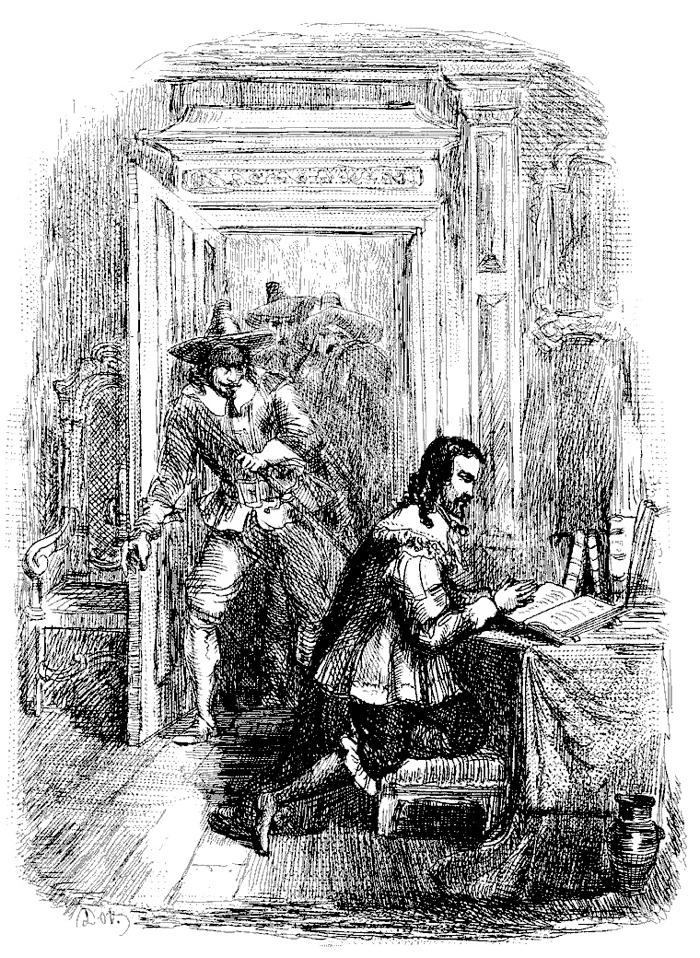
Arrest of Lord Warriston anno 1662.
Vide page 103
Edinr. Hugh Paton, Carver & Gilder to the Queen, 1842
Middleton’s first session set in blood; Rothes closed under as
deep a stain. Sir Archibald Johnston, Lord Warriston, had been
forfeited and condemned by parliament when Argyle and Guthrie
were arraigned, but escaping to the Continent, had remained concealed
103in Holland and Germany, chiefly at Hamburgh, till most
unadvisedly, in the latter end of 1662, he ventured to France.
Notice of this having been carried to London, the king, who
bore him a personal hatred for his free admonitions when in Scotland,[36]
sent over secretly a confidential spy, known by the name of
“Crooked Murray,” to trace him out and bring him to Britain.
By watching Lady Warriston, Murray soon discovered her lord’s
retreat at Rouen in Normandy, and had him seized while engaged
in the act of secret prayer. He then applied to the magistrates,
and, showing them the king’s commission, desired that they would
allow him to carry his victim a prisoner to England. The magistrates,
uncertain how to act, committed Warriston to close
custody, and sent to the French king for instructions. When
the question was debated in council, the greater part were for respecting
the rights of hospitality, and not giving up his lordship
till some better reasons were shown than had yet been given; but
Louis, who was extremely desirous to oblige Charles, and sympathized
cordially in his antipathies against the Protestant religion
and liberty, ordered him to be delivered to the messenger, who
carried him to London and lodged him in the tower in the month
of January 1663. While the parliament was sitting in June, he
was sent to Scotland with a letter from the king, ordering him “to
be proceeded against according to law and justice,” and landed at
Leith on the 8th, whence, next day, he was brought bareheaded to
the tolbooth of Edinburgh. Neither his wife, children, nor any
other friend, were permitted to see him, except in presence of the
keeper or guard, and that only for an hour, or at farthest two at a
time, betwixt eight o’clock in the morning and eight at night. Here
he was detained till July 8th, when, no more trial being deemed
necessary, he was brought before parliament to receive judgment.
His appearance on this occasion was humiliating to the pride of
104human genius, debilitated through excessive blood-letting and
the deleterious drugs that had been administered to him by his
physicians,[37] the faculties of his soul partook of the imbecility
of his body, and, on the spot where his eloquence had in former
days commanded breathless attention, he could scarcely now
utter one coherent sentence. The prelates basely derided his
mental aberrations, but many of the other members compassionated
the intellectual ruin of one who had shone among the foremost
in the brightest days of Scotland’s parliamentary annals.
When the question was put, whether the time of his execution
should be then fixed or delayed? a majority seemed inclined to
spare his life, which Lauderdale observing, rose, and, contrary
to all usage or propriety, in a furious speech, insisted upon the
sentence being carried into immediate effect; the submissive legislators
acquiesced, and he was doomed to be hanged at the cross
of Edinburgh on the 22d of the same month, and his head fixed
upon the Nether Bow Port, beside Mr Guthrie’s.
Mr James Kirkton, author of the “History of the Church
of Scotland,” who visited him, says—“I spake with him in prison,
and though he was sometimes under great heaviness, yet he
told me he could never doubt his own salvation, he had so often
seen God’s face in the house of prayer.” As he approached his
end, he grew more composed; and, on the night previous to his
execution, having been favoured with a few hours’ profound and
refreshing sleep, he awoke in the full possession of his vigorous
powers, his memory returned, and he experienced in an extraordinary
degree the strong consolations of the gospel, expressing
his assurance of being clothed with a white robe, and having a
105new song of praise put into his lips, even salvation to our God,
which sitteth upon the throne, and to the Lamb!
Before noon, he dined with great cheerfulness, hoping to sup
in heaven, and drink of the blood of the vine fresh and new in
his father’s kingdom. After spending some time in secret prayer,
he left the prison about two o’clock, attended by his friends in
mourning, full of holy confidence and courage, but perfectly composed
and serene. As he proceeded to the cross, where a high
gibbet was erected, he repeatedly requested the prayers of the
people; and there being some disturbance on the street when he
ascended the scaffold, he said with great composure—“I entreat
you, quiet yourselves a little, till this dying man deliver his last
words among you,” and requested them not to be offended that
he used a paper to refresh his memory, being so much wasted by
long sickness and the malice of physicians. He then read audibly,
first from the one side and then from the other, a short
speech that he had hurriedly written—what he had composed at
length and intended for his testimony having been taken from
him. It commenced with a general confession of his sins and
shortcomings in prosecuting the best pieces of work and service
to the Lord and to his generation, and that through temptation
he had been carried to so great a length, in compliance with the
late usurpers, after having so seriously and frequently made professions
of aversion to their way; “for all which,” he added, “as
I seek God’s mercy in Christ Jesus, so I desire that the Lord’s
people may, from my example, be the more stirred up to watch
and pray that they enter not into temptation.”
He then bare record to the glory of God’s free grace and
of his reconciled mercy through Christ Jesus—left “an honest
testimony to the whole covenanted work of reformation”—and
expressed his lively expectation of God’s gracious and wonderful
renewing and reviving all his former great interests in these nations,
particularly Scotland—yea, dear Scotland! He recommended
his poor afflicted wife and children to the choicest blessings
of God and the prayers and favours of his servants—prayed
for repentance and forgiveness to his enemies—for the king, and
blessings upon him and his posterity, that they might be surrounded
106with good and faithful councillors, and follow holy and
wise councils to the glory of God and the welfare of the people.
He concluded by committing himself, soul and body, his relations,
friends, the sympathizing and suffering witnesses of the
Lord, to his choice mercies and service in earth and heaven, in
time and through eternity:—“All which suits, with all others
which he hath at any time by his spirit moved and assisted me
to make, and put up according to his will, I leave before the
throne, and upon the Father’s merciful bowels, the Son’s mediating
merits, and the Holy Spirit’s compassionating groans, for now
and for ever!”
After he had finished reading, he prayed with the greatest fervour
and humility, thus beginning his supplication—“Abba!
Abba! Father, Father, accept this thy poor sinful servant, coming
unto thee through the merits of Jesus Christ.” Then he took
leave of his friends, and again, at the foot of the ladder, prayed
in a perfect rapture, being now near the end of that sweet work
he had been so much employed about, and felt so much sweetness
in through life. No ministers were allowed to be with him,
but his God abundantly supplied his every want. On account of
his weakness, he required help to ascend the ladder. Having
reached the top, he cried with a loud voice—“I beseech you all
who are the people of God not to scorn at suffering for the interest
of Christ, or stumble at any thing of this kind falling out in
these days. Be encouraged to suffer for him, for I assure you,
in the name of the Lord, he will bear your charges!” This he
repeated again while the rope was putting about his neck, forcibly
adding—“The Lord hath graciously comforted me.” Then
asking the executioner if he was ready to do his office, and being
answered that he was, he gave the signal, and was turned off, crying—“Pray!
pray! praise! praise!” His death was almost
without a struggle.
Sir Archibald Johnston, Lord Warriston, was an early, zealous,
and distinguished covenanter, and bore a conspicuous part in all
the remarkable transactions of the times, from 1638 till the
Restoration. The only blemish which his enemies could affix to
his character was, what he himself lamented, his accepting office
107under the usurpers, after having previously so violently opposed
this in others, when yet every prospect of restoring the Stuart
family seemed hopeless, and when numbers of his countrymen
and of his judges themselves had submitted to a tolerant commonwealth,
that did not burden the conscience with unnecessary oaths,
or require any compliances which might not, in the circumstances
of the case, have been considered venial, if not justifiable. His
talents for business were of the first order. His eloquence was
ready, and his judgment clear. He was prompt and intrepid in
action, and adhered steadily to his Presbyterian principles, notwithstanding
his officiating under a liberal government of a different
persuasion—conduct we now allow to be not incompatible
with integrity. His piety was ardent, and, amid a life of incessant
activity, he managed to spare a larger portion of time for private
devotion than many of more sequestered habits. He habitually
lived near to God, and died in the full assurance of hope.
Parliament having sat upwards of three months, rose on the 9th
of October. Even during its sitting, the council never intermitted
their oppressive acts; and, so far was this branch of the legislature
from interfering to check their immoderate abuse of power,
that they had shown themselves upon every occasion the willing
instruments of their oppression, ready when called upon to legitimate
without a murmur their foulest usurpations. On the other
hand, the executive acted as the humble tools of the prelates,
ready to support their most arrogant assumptions or gratify their
cowardly and cruel revenge. St Andrews, the primate’s seat, first
required to be thoroughly cleansed; and all who would not countenance
the archbishop in his treachery, were of necessity removed
as unwelcome remembrancers of his former profession. Mr James
Wood, principal of the Old College, pious, learned, and assiduous
in his duty, who had been an intimate friend and companion
of Sharpe’s, and one of the many excellent men who had been
his dupes, was, on the 23d of July, summoned before the council
and required to show by what authority he came to be principal.
Without being suffered to offer any remarks, when he acknowledged
“that he was called by the Faculty of the College at the
recommendation of the usurpers,” the place was declared vacant,
108and he was commanded to confine himself within the city of
Edinburgh till further orders.
Yet such was the estimation in which he was held, that his
enemy, though by falsehood, endeavoured to shelter his apostacy
under the shadow of his name. Not long after this, when Mr
Wood was on his deathbed, March 1664, and greatly weakened
by disease, Sharpe called once or twice upon him; and he having
said, as a dying man in the immediate view of eternity, that he
was taken up about greater business than forms of church government,
and that he was far more concerned about his personal interest
in Christ than about any external ordinance, Sharpe took
occasion to spread a report that he had said Presbyterian government
was a matter of no consequence, and no man should trouble
himself about it, which coming to the sufferer’s ears, he emitted
a declaration before witnesses of his unshaken attachment to
Presbytery as an ordinance of God, and so precious that a true
Christian is obliged to lay down his life for the profession thereof,
if the Lord should see meet to put him to his trial.
Along with Mr Wood, a great number of ministers from every
quarter of the country, were removed from their charges, some
confined to Edinburgh, others banished beyond the river Ness—all
forbid to preach the gospel under the threatening of severer
penalties. Heavy were the complaints of the clergy; the ministers
refused to attend their synods, and the people persisted in
neglecting their sermons. The council, therefore, appointed “the
Lords Archbishops of St Andrews and Glasgow, the Marquis of
Montrose, the Lord Secretary and Register, to wait on the Lord
Commissioner, his Grace, to think on a general course what shall
be done, as well anent those ministers that were admitted before
1649, and carry themselves disobediently to the laws of the kingdom,
as those who were admitted since.” While the committee
were deliberating, the evil increased; and, on the 30th of the
same month, six of the west country ministers were before the
council to answer the heavy charge of “convocating great multitudes
of his majesty’s subjects for hearing their factious and seditious
sermons, to the great scandal of religion and prejudice of
the government of the church.” To shorten their labours, however,
109and probably upon a report of the archbishops and their assistants,
a most harassing and contradictory act was passed, commanding
all “outted” ministers, under pain of sedition, i.e. being
processed criminally, to remove themselves and their families
twenty miles from the bounds of their own parishes, six miles
from every cathedral, and three miles from every royal burgh,
thus depriving them of any means of support they might have
derived from their own industry or that of their families, in the
only places of trade or traffic, and scattering them among strangers,
far from the bounty or assistance of their friends. But as one
“outted” minister only could reside in one parish, the act, besides,
involved an alternative of death or apostacy; for the whole
of Scotland could not have accommodated the sufferers, and no
relaxation could be obtained but from the privy council or the
bishop of the diocese. The older ministers, who still continued
to preach, but withdrew from the synods, were now to be treated
as contemners of his majesty’s authority.
To enforce their acts, the privy council ordered the Earl of
Linlithgow to send as many troops to Kirkcudbright as, with those
already there, would make up the number of eightscore footmen
with their officers in that district. Sir Robert Fleming was
directed to march two squads of his majesty’s life-guards to the
west, and to station one in Paisley and the other in Kilmarnock.
The object of these military missionaries was to episcopalize
the refractory south and west, by collecting the fines and
compelling subjection to the bishops and their curates. Sir
James Turner, who had signalized himself by his zeal in fighting
for the covenant, was singled out to superintend the pious
service in the south, which he performed so much to the satisfaction
of his employers, that, on the 24th of November, a letter
of thanks was recommended to be written him “for his care
and pains taken in seeing the laws anent church government
receive due obedience.” The excesses which were committed
under sanction of these orders and commendations, were never
attempted to be justified, though the parties afterwards mutually
endeavoured to shift the blame from themselves. When it was
deemed necessary to make the General the scape-goat, it was asserted
110that he had exceeded his instructions; but he averred, and
with greater probability of truth, that he had not even acted up
to their tenor.[38] The exactions were enormous; and, as the fines
for non-attendance were generally appropriated by the soldiers,
they were summarily levied, and not unfrequently to far more than
the legal amount. The process against non-conformists, in places
where there were Episcopalian incumbents, was short. The
curates were the accusers—the officers of the army, or sometimes
even private sentinels, the judges—no proof was required—and
no excuse was received, except money. If a tenant or householder
were unwilling or unable to pay, a party was quartered
upon him, till ten times the value of the fine was taken, and he
was ruined, or, as they termed it, “eaten up;”[39] then, after every
thing else was gone, the household furniture and clothes of the
poor defaulters were distrained and sold for a trifle.
The soldiery employed in this execrable work, were the lowest
and most abandoned characters, who readily copied the example
of their officers—measured their loyalty by their licentiousness,
and considered that they served the king in proportion as they
annoyed the Whigs. Religion was the object of their ridicule.
In the pious hamlets where they quartered, family worship was interrupted
by mockery or violence; and “The Cottar’s Saturday
Night,” not only treated with derision, but punished as a violation
of the laws of the land! Upon the Sabbath, the day peculiarly
devoted by the covenanters to holy rest, and the quiet performance
of their sacred duties—for the covenanters made conscience
of the moral obligation of the Sabbath—a scene of dismay
and distress hitherto unknown was commonly exhibited; and
the day to which they had in other times looked forward as the
glory of the week, was now dreaded as the signal of their renewed
torments. Multitudes were brutally driven to church, or dragged
111as felons to prison; and hesitation or remonstrance provoked only
additional insult or blows. Lists of the parishioners were no
longer kept for assisting the minister in his labours of love, but
were handed over to the troopers, with directions for them to visit
the families, and to catechise them upon their principles of loyalty
and their practice of obedience to their parsons. After sermon,
the roll was called by the curate, when all absent without leave
were delivered up as deserters to the mercy of the military. At
churches where the old Presbyterian ministers were yet allowed
to remain—for a few still continued to preach at their peril, or
through the interest of some influential person—the outrage and
confusion were indescribable. As they were generally crowded,
the forsaken bishops and their underlings were enraged, and the
soldiers were instigated to additional violence. Their custom was
to allow a congregation peaceably to assemble, while they sat
carousing in some alehouse nigh at hand, till public worship was
nearly over; then they sallied forth inflamed with liquor, and,
taking possession of the church-doors or churchyard-gates, obliged
the people, whom they only suffered to pass out one at a time, to
answer upon oath whether they belonged to the parish; if they
did not, although their own parish had no minister of any kind,
they were instantly fined at the pleasure of the soldiers; and if
they had no money, or not so much as would satisfy them, their
Bibles were seized, and they were stripped of their coats if men,
or their plaids if women; so that a party returning from such an
expedition, appeared like a parcel of villanous camp-followers,
after an engagement, returning from a battle-field, laden with the
spoils of the wounded and slain.
To such an extent had these plunderings been carried, that
even the privy council found it necessary to interfere. Towards
the end of the year, they issued an explanation of their former
acts, and restricted the exactions of the soldiery, “allenarly to
the penalty of twenty shillings Scots, from every person who staid
from their parish churches on the Sabbath days.”[40]
112[1664.] Even this symptom, small as it was, of moderation,
was not at all agreeable to the prelates. Like all upstarts, suddenly
raised beyond their expectations, their arrogance became
insupportable, and could brook no opposition. Glencairn, in
particular, who had been so instrumental in their rise, began to
feel the truth of what he had been repeatedly told—“that the
bishops would never rest content with being second in the state,
and that moderate Episcopacy was all a jest.” He had said to
Rothes that “it was the noblemen’s interest to repress the growing
power of bishops, otherwise they would be treated by them
now as they had been before 1638.” This remark being carried to
Sharpe, he treated the Chancellor with great hauteur, and publicly
threatened to destroy his interest at court—an affront that
Glencairn could never forget, and which is said to have preyed
upon his spirits to his dying day.
Fearing a relaxation of “the wholesome severities,” the primate
hastened to London with heavy complaints against many of
the noblemen, for their backwardness in executing the laws made
in favour of the church; and, through the influence of the English
bishops and high churchmen, prevailed upon the king to re-establish
in Scotland the most detested of all the arbitrary courts
that had been abolished—the High Commission Court.
His majesty, by virtue of his royal prerogative in all causes and
over all persons, as well ecclesiastic as civil, granted the most
exorbitant powers to that antitype of the Inquisition. It consisted
of thirty-five lay members,[41] and of all the prelates, except
113Leighton, who had the honour to be excluded from the nomination;
and any five constituted a quorum, provided always an archbishop
or bishop was of the number. Under pretext of seeing
all the acts of parliament and council in favour of Episcopacy put
in vigorous execution, they were authorized to suspend or depose,
fine, and imprison all ministers who dared to exercise any of their
sacred functions without the license of a bishop—who should
preach in private houses or elsewhere—who should keep meetings
for fasts or for the administration of the sacrament of the Lord’s
Supper not approven by authority: to summon, call before them,
and punish all who should speak, preach, write, or print to the
scandal, reproach, or detriment of the government of the church
or kingdom as now established—and all who should express any
dissatisfaction at his majesty’s authority. The commanders of
the forces and militia, the magistrates of every description, were
required to apprehend and incarcerate delinquents upon their warrants,
and the privy council to direct letters of horning for payment
of the fines—one half of which was appropriated to defray
the expenses of the court, and the other to be employed for such
pious uses as his majesty should appoint. And by a final comprehensive
clause, the High Commission, or their quorum, were
authorized to do and execute whatever they should find necessary
and convenient for his majesty’s service—for preventing and suppressing
of schism and separation—for planting of vacant churches—and
for procuring of reverence, submission, and obedience to
the ecclesiastical government established by law.
By this instrument the whole kingdom was laid at the feet of
the prelates; for no quorum of the Commission could be complete
without a bishop, while five bishops could form a quorum
without a layman. The practice was agreeable to the constitution
of the court, and such as may always be expected where
churchmen are intrusted with civil authority. True ministers of
Christ would never in their ministerial capacity accept it, and
114worldlings who have assumed that sacred office to serve purposes
of ambition, have ever been the greatest curse of Christendom.
The records have been mislaid or lost, but the cases that remain,
amply justify the epithets bestowed upon this nefarious tribunal
by all who have mentioned it.
James Hamilton of Aikenhead, near Glasgow, was among
the first brought before them, accused of not hearing Mr David
Hay, curate of the parish—Cathcart—-in which his estate was
situate. His defence was, the unclerical and ungentleman-like
conduct of the clergyman. In collecting his stipend, which he
did rigorously, Mr Hay had borne particularly hard upon some
of Mr Hamilton’s tenants, and, in consequence, a quarrel had
ensued, in which the curate had descended to very intemperate
and abusive language, and in return had been not less roughly
answered. Mr Blair, the “outted” minister, happening accidentally
to be upon the spot, interfered, and rescued Hay from
the hands of his furious parishioners. When the affray was
over, Mr Blair spoke seriously to the curate, and represented
how opposite it was to his own interest for him to turn informer
against his people. Hay, in return, thanked him for his
kindness and advice, and gave him his solemn promise that he
would follow it; yet within a very short time, he went to Glasgow
and “delated” (i. e. denounced) them to the archbishop,
who immediately dispatched Sir James Turner, then in the west,
with a party of soldiers, to seize the delinquents. When Mr
Hamilton came to be informed of the circumstances of the affair,
he considered the low prevaricating conduct of Hay as so base,
that he would never again enter the church door, and he kept his
promise; for this he was fined a fourth part of his yearly rent.
When he had paid the fine, the court was so fully sensible of the
misconduct of Hay, that the Archbishop of Glasgow came forward
and promised that he would be removed, but insisted that
Mr Hamilton should come under an obligation to hear and acknowledge
the minister he meant to place in his room; and, upon
refusing to do any such thing till he knew who that person should
be, he was mulcted another fourth of his income, and remitted to
the archbishop to give him satisfaction as to his loyal and peaceable
115behaviour. The prelate, however, not being satisfied, he was
again summoned before the court, upon some vexatious charges
of keeping up the church utensils and session-books from the
curate. Offering to swear he knew nothing at all about them,
he was accused of not assisting the curate in the session when
called upon, and suffering some of his family to absent themselves
from church! Whether he might have been able to acquit himself
of these heinous crimes is uncertain, for Rothes cut the business
short, by telling him he had seen him in some courts before,
but never for any thing loyal, and therefore tendered him the oath
of allegiance. He had no objections, he replied, to take the oath
of allegiance, were it not mixed up with the oath of supremacy.
Sharpe, interrupting him, said “that was the common cant, but
it would not do.” Then he requested to be allowed to explain,
but was politely answered by the president—“he deserved to be
hanged!” and, upon refusing to become bound for all his tenants’
good behaviour, he was fined three hundred pounds sterling,
and sent to confinement in Inverness, to remain during pleasure!
John Porterfield of Douchal, an excellent person, singled out
for more than common oppression, was summoned also for not hearing.
He alleged the unfounded calumnies the curate had spread
against him as the reason why he could not wait upon his ministry.
The reason was allowed to be cogent, and, at his own desire,
he was permitted to prove it. His first witness bore him
out in all that he advanced, and his vindication would have been
complete; but he was too much respected and esteemed in the
neighbourhood, and his acquittal might have encouraged others.
His proof was therefore stopped, and he was required to take the
oath of allegiance. As had been expected, he stuck at the supremacy,
and offered an explanation. The natural consequence
followed—the curate was sent home to enjoy his incumbency, and
Porterfield, for daring to offer a defence, was sentenced to pay a
fine of five hundred pounds sterling, his estate sequestrated till it
should be paid, and himself confined to the town of Elgin, where
he continued for four years.
Mr Alexander Smith, who had been turned out of his parish
116of Cowend, Dumfries-shire, by the Glasgow act, had since then
resided at Leith; but having been guilty of preaching or expounding
the Scriptures privately in his own house, was called before
the court to be examined. In answering some of the queries
Sharpe had put to him, he omitted the primate’s titles, and only
styled him, Sir, which Rothes observing, meanly truckling to the
priest, asked him, “if he knew to whom he was speaking?”
“Yes, my lords, I do,” answered the prisoner firmly; “I speak
to Mr James Sharpe, once a fellow-minister with myself.” For
this high misdemeanour, the worthy man was immediately laid in
irons and cast into the filthiest corner of the prison—the thieves’
hole. He was afterwards banished to one of the desolate Shetland
Isles.
At the settlement of Ancrum parish, where a James Scott, who
had been presbyterially excommunicated, was appointed to fill the
place of Mr Livingston, a country woman of the name of Turnbull,
with more zeal than prudence, attempted, as he was going
to be inducted, to dissuade him from undertaking the pastoral
charge of so unwilling a people; and when he would not stop to
listen to her reasoning, seized him by the cloak. Impatient at
this detention, he turned in wrath upon the female remonstrant,
and beat her unmercifully; which unmanly conduct provoking
some youths present, they threw a few stones, but none of them
touched Scott or any other person. This pitiful affair was instantly
magnified into a seditious tumult, and the ringleaders were
apprehended by the Sheriff and thrown into jail—a punishment
certainly more than adequate to the offence, but it was no sufficient
atonement for the indignity done to the clergy, and the
business was brought before the High Commission; there these
ministers of mercy sentenced the woman to be whipped through
Jedburgh—her two brothers, married men with families, they
banished to Virginia—and four boys, who confessed that they had
each thrown a stone, were first scourged through the city of Edinburgh,
then burnt in the face with a hot iron, and, finally, sold as
slaves, and sent to the island of Barbadoes, which severe punishment
they endured with a patient constancy that excited much
admiration.
117Bad as were the other courts in Scotland at this time, there
was at least a probability that even a Presbyterian might by accident
escape if accused, but before the High Commission no
such thing was known. If proof was wanting, the declaration
and the oath of allegiance were always at hand; and as the conscientious
adherents of that persuasion were well known when
brought before them, their trial was as short as their fate was certain.
The exorbitant assumptions of the prelates were for some
time supported by Rothes, but at length so disgusted the nobility,
and brought such odium upon the court, that few of them would
countenance its proceedings. While the uniform and flagrant
injustice of their sentences rendered men desperate, who, rather
than answer their summons, suffered themselves to be outlawed,
or withdrew into voluntary exile in Ireland; till, in little more
than a year and a half, the detested Crail court, as it was commonly
called,[42] sank first into contempt and then into disuse.
Presbyterians in the north of Ireland being at this time also
subject to persecution from the bishops, the ministers pursued in
one country sought occasionally refuge in the other. John Cruickshanks
and Michael Bruce who had fled to Scotland this year,
and were preaching with much success to the conventicles in the
west, were in consequence denounced as rebels, (June 23,) and
power given to the officers and the commanders of the forces to
seize them.
While the High Commission was in its vigour, the privy council
was thrown into the background; yet in its temporary shade
it was not unmarked by streaks of persecution, equally vivid with
any of the lineaments of its co-tyrannous judicatories. The declaration
was forced by them upon all who held places of public
trust; and their exertions were stimulated by a letter from the
king, commanding that “upon no terms was any explication or
declaration to be admitted upon the subscription of any;” yet
some few of the royal burghs refused, and several of the shires
hesitated; but a peremptory proclamation produced a very general
118compliance—for the conscientious demitted their offices, and
the privy council supplied their places with successors who were
less scrupulous. Nor did any of the burghs evince the smallest
inclination to assert their rights or privileges, or persist in any
election that was disagreeable to the managers.
His majesty likewise called their attention early this year to
the fines imposed by Middleton’s act, which the Presbyterians
were beginning to think had been forgotten, and for which leniency
Lauderdale had received much unmerited credit. After
several communications and delays, it was finally intimated, in
the month of November, by proclamation, that the iniquitous
imposition would be exigible—the first moiety at Candlemas, and
the other at Whitsunday 1665.
Prohibited from preaching, several of the “outted” ministers
who resided in Edinburgh, with others of those who feared the
Lord, and that thought upon his name, were in the habit of meeting
together in those days of sad calamity for social prayer in
private houses. This, also, was a nuisance that required to be
removed; and information having been given by the prelates or
their underlings, the council issued a warrant to the magistrates
of the city, “to cause search to be made anent the keeping of
any such meetings, and that they acquaint the Lord Chancellor
with what they discover, and the persons names, that order may be
taken about the same.” This was followed by a mandate for all
such ministers as had hitherto been allowed to remain by suffrance
in Edinburgh, or any burgh, instantly to remove to the distances
required by their former act, under the severest penalties of law.
But the most nefarious of their acts, and one opposed to every
good or amiable feeling of the human heart, was that of April 29,
forbidding any contribution to be made, or money collected,
for the relief of those who had been ejected from their livings,
banished from their friends, and prohibited from settling in places
where themselves or their families might have earned an honest
subsistence. The proclamation bears strong marks that its authors
were ashamed of so gross a violation of the dictates of common
humanity. It is worded in such an ambiguous manner as
to be capable of the most severe application, yet so as to be explained
119away when requisite. For jesuitical falsehood, and heartless
tyranny, the production is matchless:—“The lords of his
majesty’s privy council being informed that, without any public
warrant or authority, some disaffected persons to the present establishment,
presume and take upon them to require contributions
from such persons as they please, and do collect sums of money,
which are, or may be, employed for carrying on of their private
designs, prejudicial to the peace of the kingdom and his majesty’s
authority; and considering that such courses and underhand
dealing may strengthen seditious persons in their practices and
designs, to disturb the peace, if they be not timeously prevented:
Therefore, in his majesty’s name, they do prohibit and discharge
all persons whatsomever, to seek or demand any contributions or
supply, or to receive any sums of money. As likewise discharge
all persons to grant or deliver any contributions to any persons
whosoever shall require the same, unless it be upon occasions as
have been publicly allowed and known, and heretofore practised;
and that they have a special warrant and allowance of the lords of
the privy council, or lords of the clergy within whose dioceses
these collections are to be made. With certification, that if they
contravene, they shall be proceeded against as persons disaffected
to the present government, and movers of sedition.”[43]
Shortly before the Restoration, and within the few years that
had elapsed since it had pleased God to remove a great number
of his most eminent servants, who had sustained the heat and
burden of the day, during the troublous times of civil dissension,
others had been honoured to suffer death, imprisonment, or exile
120for the word of God, and for the testimony of Jesus Christ; and
of those who remained, the prelates were extremely anxious to
get rid. Among them, William Guthrie of Fenwick was too
conspicuous to escape. He had, through the interposition of the
Earl of Eglinton and the Chancellor, been allowed to continue
so long, but the crowds who were attracted to his church from the
neighbouring and even distant parishes, and the blessing of God
which in a remarkable manner followed his preaching, provoked
the jealousy of the prelates, particularly Archbishop Burnet, who,
when requested by Glencairn to overlook him, displayed his inveteracy
by replying—“That shall not be done; it cannot be;
he is a ringleader and keeper up of schism in my diocese;” and
Glencairn was not long dead before he was suspended by his
Grace. Such, however, was the respect in which Mr Guthrie was
held, that it was with difficulty he could find a curate to pronounce
his sentence, and not till he had procured him a guard of
soldiers and bribed him with the sum of five pounds. But Mr
Guthrie strictly forbade any opposition, and rather called them to
fasting and prayer. Early on the Sabbath on which his church
was declared vacant, he preached, as usual, two sermons from the
latter part of that text, Hosea xiii. 9, “O Israel, thou hast destroyed
thyself; but in me is thine help”—only had the whole
service over before nine o’clock.
Shortly after, the curate with a party of soldiers arrived, and,
leaving the privates outside, entered the manse with the officers.
Rudely accosting Mr Guthrie, he told him that the bishop and
committee, after much lenity shown to him for a long time, were
constrained to pass the sentence of suspension against him for
not keeping presbyteries and synods with his brethren, and for
his unpeaceableness in the church, of which sentence he was appointed
to make public intimation unto him, and for which he
had a commission under the Archbishop of Glasgow’s hand. Mr
Guthrie answered—“I judge it not convenient to say much in
answer to what you have spoken; only whereas you allege there
hath been much lenity shown toward me—be it known unto you,
that I take the Lord for a party in that, and thank him for it;
yea, I look upon it as a door which God opened to me for preaching
121this gospel, which neither you nor any man else was able to
shut, till it was given you of God. And as to that sentence
passed against me, I declare before these gentlemen—the officers
of the party—that I lay no weight upon it, as it comes from you
or those who sent you: though I do respect the civil authority
who, by their law, laid the ground for this sentence; and were it
not for the reverence I owe to the civil magistrate, I would not
surcease my preaching for all that sentence. And as to the
crimes I am charged with, I did keep presbyteries and synods
with my brethren; but I do not judge those who now sit in these
to be my brethren, but men who have made defection from the
truth and cause of God: nor do I judge those to be free or lawful
courts of Christ that are now sitting.
“And as to my unpeaceableness, I know I am bidden follow
peace with all men, but I know also I am bidden follow it with
holiness; and since I could not obtain peace without prejudice
to holiness, I thought myself obliged to let it go. And as for
your commission, to intimate this sentence, Sir, I here declare
I think myself called by the Lord to the work of the ministry,
and did forsake my nearest relations in the world, and give up
myself to the service of the gospel in this place, having received
an unanimous call from the parish, and been tried and ordained
by the presbytery; and I bless the Lord he hath given me some
success, and a seal of my ministry upon the souls and consciences
of not a few that are gone to heaven, and of some that are yet on
their way to it. And now, Sir, if you will take it upon you to
interrupt my work among this people, as I shall wish the Lord
may forgive you the guilt of it, so I cannot but leave all the bad
consequences that follow upon it, betwixt God and your own conscience.
And here I do further declare before these gentlemen,
that I am suspended from my ministry for adhering to the covenant
and work of God, from which you and others have apostatized.”
At this the curate interrupting him said, that the Lord had
a work before that covenant had a being, and that he judged
them apostates who adhered to that covenant; and that he wished
that not only the Lord would forgive him (Mr Guthrie,) but if it
122were lawful to pray for the dead—at which expression the officers
and soldiers burst into laughter—that the Lord would forgive the
sin of this church these hundred years bygone. “It is true,” answered
Mr Guthrie, “the Lord had a work before the covenant had
a beginning, but it is as true that it hath been more glorious since
that covenant; and it is a small thing for us to be judged of you
in adhering to that covenant, who have so deeply corrupted your
ways, and seem to reflect on the whole work of reformation from
popery these hundred years bygone, by intimating that the church
had need of pardon for the same.” Then directing himself to
the soldiers—“As for you, gentlemen, I wish the Lord may pardon
you for countenancing of this man in this business.” “I
wish we may never do a greater fault,” answered one of them
scoffing. “A little sin may damn a man’s soul,” Mr Guthrie
gravely replied. He then called for a glass of ale, and, after
craving a blessing, drank to the officers, who, having been civilly
entertained, quietly left the house and went to the church, where
the curate executed his office without disturbance, except from
a few boys, whom the soldiers easily chased away.[44]
Another instance was, Andrew Donaldson of Dalgetty, described
“as singular for a heavenly and spiritual temper,” and one
who had also been much blessed in his ministry. Through the interest
of the Earl of Dunfermline, Lord Privy Seal, he had been
allowed to continue in his parish till this year, when the Earl being
called to London, Archbishop Sharpe urged the Bishop of Dunkeld
123to depose him. He accordingly summoned Mr Donaldson to
attend his clerical duty under pain of suspension; but, for reasons
similar to those of Mr Guthrie, he declined attending the presbyteries
or owning the bishop’s authority, and was in consequence
(October 4th) formally deposed, “in the name, and by the authority
of Jesus Christ, and with the consent of all his (i. e. the
bishop’s) brethren, not only from his charge at Dalgetty, but
from all the parts of the ministerial function within any diocese
of the kirk of Scotland.” By his prudence, Mr Donaldson prevented
any disturbance—for his affectionate people were sufficiently
disposed to have made resistance—and even prevailed
upon the military deputation, who came with the curate to displace
him, to suffer him to preach and take farewell of his weeping
congregation who had assembled. Dunfermline, upon being
apprised of the whole before he left London, applied personally
to the king, and procured his warrant to present Mr Donaldson
to Dalgetty during life, which he brought to Scotland with him;
and, showing it to the primate, complained that he had taken advantage
of his absence to deprive him of a minister for whom he
had so high a value. Sharpe, dissembling his anger, apologized,
and, with many professions of regard for the Earl, promised obedience
to his majesty’s commands, only requesting, as a favour,
that the Earl would do nothing in it for three weeks, till he got
the young man now settled at Dalgetty provided for. To this
his lordship consented, supposing, as a matter of course, that Mr
Donaldson would then be restored. But the archbishop in the
interim, by his interest at court, got an order under the royal
sign manual, forbidding all “outted” ministers to return to their
charges, sent down express, long before the three weeks expired.
Dunfermline felt sufficiently fretted at the cheat, but there was
no remedy.
Field-preaching continuing on the increase in the west, in
the south, and in Fife, several of the ministers, at the instigation
of Archbishop Burnet, whose province they chiefly invaded, had
been summoned before the council and endured vexatious and
expensive prosecutions; others, who were more active and conspicuous,
who knew that no defence they could offer would prove
124availing, chose rather to allow sentence to pass in absence than
willingly to desist from proclaiming the gospel; and being determined
in this to obey God rather than man, they persisted at their
peril, in spite of acts of parliament and council, to exercise their
ministry wherever they could find opportunity. Deprived of their
livings and driven from their homes, they could furnish little
spoil to the persecutor, but they were most affectionately received
into the houses of their friends, who carefully provided for their
safety; and their sermons, of which intelligence was easily communicated,
were attended by numerous and attentive congregations.
That they should thus elude the grasp of their persecutors,
and be followed by the most respectable of the country population,
was irritating to the managers and galling to the prelates.
But many of those who protected them were possessed of
property; and as they were now made liable by law for hearing
the gospel, the council began to turn their attention to this lucrative
branch of oppression.
William Gordon of Earlston soon attracted their attention.
Descended from an ancient family, distinguished in the annals of
the Reformation, he, from his childhood, had attached himself
to the people of God, and in early life enjoyed the friendship of
Rutherford, but does not appear to have courted notice till persecution
dragged him into view. When the commission was sent
to Galloway to inquire into the disturbances at Irongray, they
wrote to him requiring him to take an active part in the settlement
of a curate, presented by the Bishop of Galloway, to the
church of Dalry. This he respectfully declined, because he
could not do it with a good conscience, as what did not tend to
God’s glory and the edification of his scattered people; and, also,
because he, as patron of the parish, had legally, and with the consent
of the people, appointed already a truly worthy and qualified
person and an actual minister to that charge. For this “seditious
carriage” he was called before the council, but they do not
appear to have found that his conduct amounted to a punishable
crime, and therefore, on the 24th November 1663, he was summoned
upon the more comprehensive accusation of keeping conventicles
and private meetings in his house; and, on the 1st of
125March this year, he was found guilty, upon his own confession, of
having been one at three several conventicles, when Mr Gabriel
Semple, a deposed minister, preached—one in Corsack wood, and
two in the wood of Airds; of hearing Mr Robert Paton, likewise
a deposed minister, expound a text of Scripture, and perform
divers acts of worship in his mother’s house; and of allowing Mr
Thomas Thomson, another of the same kind, to lecture in his
own house to his family on a Sabbath day—for these offences,
and because he would not engage never to repeat them, he was
banished forth of the kingdom, not to return under pain of death!
Besides all these various methods of harassing the Presbyterians,
Sir James Turner, during this year, continued his missionary exertions
with uniform persevering diligence, only increasing in
severity, as an unlicensed, unresisted soldiery ever do.
Several political changes took place in the course of the year
that require to be noticed, although they had no influence in
stopping or altering the tide of persecution, which, being directed
by the prelates, particularly the two archbishops, continued to roll
on with accumulating violence. The Earl of Glencairn died on
the anniversary of the king’s restoration. He was carried off rapidly
by a fever, believed to have been produced or exasperated
by the treatment he received from Sharpe, and which he could
find no opportunity to resent. In his last moments, he earnestly
desired the assistance of some Presbyterian ministers; but before
one could be procured, he was incapable of deriving any benefit or
comfort from their spiritual instructions or devotional exercises—a
circumstance neither uncommon among the noblemen of that time
nor strange; for, when men who had been religiously educated,
and had, for the sake of worldly ambition or licentious pleasure,
apostatized from their early profession, came to encounter the
solemnities of a deathbed, if the conscience has not been altogether
seared—a still more awful state—the partial knowledge
they had acquired would often awaken remorse for having forsaken
the guides of their youth, and lead them, when perhaps too late,
to seek those consolations they had despised, amid the hurry of
business or in high-day of pleasure and of health. Rothes, about
the end of the year, was made keeper of the great seal, which
126Sharpe, according to Burnet, had solicited. Sir John Fletcher
was removed from the office of lord advocate, and Sir John Nisbet
appointed in his room. In the month of August, Sharpe
and Rothes went to court, whence they returned in October—Rothes
loaded with civil appointments, and in addition named
commissioner for holding the national synod—a council which
the primate, who could bear no rival near the throne, continued
effectually to prevent being ever assembled.
BOOK V.
127
Partial moderation of the King—Sir James Turner’s campaign through Kirkcudbright
and Galloway—Unpaid fines levied—Students’ oaths—All meetings for religious
purposes forbid—Quietude of the country—Proclamation of the Council—Apologetical
relation—Sir James Turner’s third campaign extended to Nithsdale—Visits
Mr Blackadder at Troqueer—More troops raised—Rigorous acts more
rigorously enforced—Rising of the persecuted—They gather strength—Their
operations—Defeated at Pentland—Prelatic revenge—Testimony of the sufferers—Torture
introduced—Nielson of Corsack—Hugh M’Kail—Executions in Edinburgh
and the west country—William Sutherland—Executions at Ayr.
Prelacy, now fenced round with all the forms of law, and supported
by all the civil and military authorities, wanted only the
concurrence of the people to have become the permanent, as it
was the predominant, religion of Scotland; and so fickle is the
multitude—so little does real principle take hold on the minds
of the mob of mankind—that a little moderation in the use of
their power, by the prelates, seemed only wanting to have induced
the bulk of the congregations to return to their parish
churches, and to have sat down quietly under the ministrations of
the curates and the form of Episcopacy. A contemporary Presbyterian
writer says—“Truly, at this time the curates’ auditories
were reasonably throng: the body of the people, in most places
of Scotland, waited upon their preachings; and if they would
have been content with what they had, in the opinion of many,
they might have stood longer than they did; but their pride
vowed they would be more glorious and better followed than
128the Presbyterians, and because respect would not do it, force
should.”[45]
Much and justly as the king and courtiers have been blamed
for the perfidious manner in which Episcopacy was re-introduced
into Scotland, and for the establishment of despotism upon the
ruins of a free constitution, solemnly approved and sanctioned
both by his present majesty and his “martyred” father; yet in
this year, at least at the commencement, softened perhaps by the
state of the nations, they showed no disposition to proceed to
extremities had they not been pushed on by the prelates.
Charles, by his mean subservience to France, had plunged the
country into a ruinous war with Holland—an awful pestilence
had almost desolated the city of London—while an unusually severe
winter had interrupted all rural labour, till March threatened
to add famine to the list of plagues. These judgments, calculated
to solemnize the mind, and give weight to public instruction,
were improved by the non-conforming ministers to rouse the
attention of their hearers to their own sins and the sins of the
people among whom they dwelt; and the general open apostacy
from God which had accompanied the general defection from the
national religion, was too palpable to avoid being noticed in the
catalogue of crimes that had drawn down divine vengeance. These
national visitations were, in some degree, subservient to the preservation
of the Presbyterian cause, by impressing the guilt of
apostacy more deeply on the minds of the serious, and even recalling
the attention of the careless, while the public calamities
and disgrace occupied the attention of the king and English
government, and perhaps softening their rancour for the time,
rendered them less anxious about pursuing their labours of religious
persecution.
Although, however, government did not actively interfere to
urge on the prosecution of ministers or frequenters of conventicles,
the curates and their assistants, the troopers, continued their
exertions; and Sir James Turner opened another campaign in the
south and west, scouring the country and besieging the churches
129with a success and renown not unworthy his former fame. But
his commission this year was extended; for, dreading the desperation
to which the insulted peasantry might be driven, orders
were issued for disarming the south and west, under pretence
that the fanatics had an intention of joining the Dutch! As
these districts had been always the most zealous in the cause of
the covenants, so they were likewise the best supplied with arms,[46]
and were, in an especial manner, the objects of the prelates’ aversion
and dread. When they had got them deprived of arms,
therefore, the next step was to deprive them of leaders; and this
was effected by an arbitrary order from the Commissioner, to arrest
the principal gentlemen in the country who were known to
be unfriendly to Episcopacy, and, without accusation or trial, to
confine them prisoners in the Castles of Edinburgh, Stirling, and
Dumbarton. Among the gentlemen thus summarily proceeded
with, were Major-General Robert Montgomerie, brother to the
Earl of Eglinton; Sir William Cunningham of Cunninghamhead;
Sir George Maxwell of Nether Pollock; Sir Hugh
Campbell of Cesnock; Sir William Muir of Rowallan; Major-General
Holborne; Sir George Munro; Colonel Robert Halket;
Sir James Stuart, late provost of Edinburgh; Sir John Chiesly
of Carswell; and Dunlop of Dunlop, &c. Yet arbitrary though
these proceedings were, perhaps, upon the whole, they may be
deemed providential, as, had any insurrection taken place while
their leaders were at liberty and the people armed, the struggle
might have been protracted—much bloodshed ensued—and the
final result been far less propitious to the country and cause of
religious liberty.
A proclamation for levying the fines imposed by Middleton was
immediately planned, with such modifications as evidently showed
that not any disloyalty in the parties, but their sincere, tried attachment
to the free constitution of their country in church and
state, and their conscientious adherence to the religion in which
130they had been educated, were the delinquencies it was intended to
punish. The term of payment for the first half was enlarged to
such as had not already paid it, till the first of December; and
the second moiety was to be remitted to all who, upon paying the
first, should take the oath of allegiance and subscribe the declaration
in the express words of the act of parliament—conditions
which no true Presbyterian could comply with, and which therefore
drew a distinctive line between those who disregarded, and
those who feared, an oath; exposing the latter to all the penalties
of the various enactments with the expenses of collecting them—a
new and no trifling addition to the principal, and which was also
intrusted to the military to exact.
Unnecessarily multiplying oaths is a deep species of criminality,
of which the rulers of lands called Christian take little account,
although nothing tends more to demoralize a people. The
prelatic rulers of Scotland seemed to delight in it, and this year
introduced a most pernicious practice, afterwards improved upon,
of forcing students to take the oaths of allegiance and supremacy
before they could obtain an university degree; and thus initiated
them into the habit of taking oaths, about the propriety of which
some of the wisest and best men in the land were divided, and
concerning which they could not be supposed to be very accurately
informed.
Towards the end of this year, the privy council resumed its
cruel activity; and the primate being president, the High Commission
was allowed quietly to demit, while its spirit was effectually
transfused into the other. December 7th, an act was issued
extending the severities of all former acts against Presbyterian
ministers, to those who had been settled before 1649, who had
relinquished their ministry or had been deposed; and all heritors
were forbid to give them any countenance in their preaching or
any part of their ministerial office. But, as the general opinion
of the more moderate among the politicians was, that the change
in the form of religion had been too sudden, that it ought to
have been more gradual, to meet the prejudices of the older ministers,
whose only crimes consisted in absenting themselves from
the church courts—this act was accompanied by another, establishing
131a new kind of presbyteries, under the name of “meetings
for exercise,” which was intended to leave without excuse the
adherents of the abrogated system, as men who chose to differ
from the present establishment from motives of sedition, and who
refusing the substance because it was enacted by the king, would
fight for a shadow from mere humour. This species of mock-presbyteries
was specially declared to emanate from the royal supremacy,
and was to consist of such of the curates as the bishops
should judge qualified, who were to convene for exercise and assist
in discipline as they should direct them; but the whole power of
ecclesiastical censure, except parochial rebukes, was reserved to
the bishop, who alone could suspend, deprive, or excommunicate.
A kind of caricature session was at the same time brought forward,
which was afterwards turned into an instrument of persecution—the
established ministers were empowered to make choice of proper
persons to assist them in the exercise of discipline, who, if
they refused to obey his summons, were to be reported to the
bishop; and if they continued obstinate, given up to the secular
arm to be prosecuted as the heinousness of the case might require.
The usual strain of the curates’ pulpit services consisted of a
quarter or half-hour’s harangue upon those moral duties their lives
set at defiance, or in abusing or distorting doctrines they did not
understand. Such of the people, therefore, as had the least relish
for gospel truth, and who preferred the faithful sermons and earnest
manner of their late pastors, to the insipid discourses listlessly
read by the present incumbents, continued to follow after the private
meetings and public ministrations of the former. The council,
in consequence, determined that all such seditious practices
should be put down, and, in a virulent proclamation of the same
date, strictly charged and commanded all public officers to disperse
every meeting assembled under the pretence of the exercise
of religion, of whatever number they might consist, except such as
were allowed by authority, stigmatizing them as the ordinary seminaries
of separation and rendezvouses of rebellion, and subjecting
every person who should be present at or give the smallest
countenance to them, to the highest pains inflicted by law upon
seditious persons.
132Enormous as the oppression and injustice which desolated the
south and west of Scotland had been, the people had remained
quiet. They had seen their civil and religious liberties swept
away, the ministers they loved scattered, and hirelings they detested
settled in their stead. They had groaned beneath the
yoke of tyrannous enactments, the insolence of lordly prelacy,
and the licentiousness of military exaction, and yet had abstained
from any acts of rebellion. But their patient endurance only encouraged
the perpetration of new mischief, and their unexampled
loyalty was abused as the occasion of fresh aggression. For, notwithstanding
all that has been said about the disloyalty, faction,
and refractory spirit of the Scottish covenanters, they were men of
thorough monarchical principles, and possessed a more than ordinary
reverence and attachment for their royal family, under circumstances
that would have justified resistance long before they had
recourse to the last remedy. Affairs, however, had now reached
that crisis in which their duty to their God and their duty to
their king were placed in opposition, and as Christians no choice
was left. To have deserted the assembling of themselves together
for religious worship and edification, because their rulers forbade
it, would have been to acknowledge a regal power over the
conscience which neither Scripture nor nature allows; and as yet
no disturbances had occurred at any of those meetings, which were
peaceably conducted at a distance from places that could reasonably
give offence—in the open air, on hills, and in woods, and
sometimes under the covert of night, where the ordinances of the
Lord were administered in the way of his appointment, and the
word of his gospel preached in simplicity and truth. They therefore
continued; and, in spite of the tyrannical edicts of their
rulers, like the Israelites of old, did not only meet but multiply.
John Welsh, minister of Irongray, from the first betook himself
to the fields, and, with his co-presbyter Mr Gabriel Semple,
laboured constantly within the bounds of his presbytery, officiating
alternately in Corsack-wood and the surrounding country,
frequently acting as decoys to their persecutors, one of them
being actively engaged in preaching, while the curates with their
beagles were in full scent after the other in an opposite direction.
133For upwards of a year, Mr Welsh is asserted to have “preached
at least once every week in the parish of Irongray.” Afterwards
he extended his labours to the sheriffdom of Ayr; and on Galston
moor and various other places, held large conventicles, where
he baptized many children. Gabriel Semple was not less zealous.
He held large “unlawful assemblages” at Achmannock, Labrochhill,
besides many others, not only in the sheriffdom of Ayr, but
in Nithsdale, and within the stewartry of Kirkcudbright. Mr
John Blackadder ofttimes convened great numbers of the parish
of Glencairn and the neighbouring parishes, sometimes to the
number of a thousand. Mr Alexander Peden—who had been expelled
from New Glenluce, and was especially obnoxious for his
exertions and popularity in the west—held meetings under cloud
of night and in the winter season; these being now rendered
imperative, as the increased diligence of the archbishop and his
military satellites forbade more open assemblages. Encouraged
by their example, many others ventured to the high places of the
field; and their united active endeavours promised to supply, in
the districts of Galloway, shire of Ayr, and stewartry of Kirkcudbright,
in some degree, the want of a regular Presbyterian
ministry.
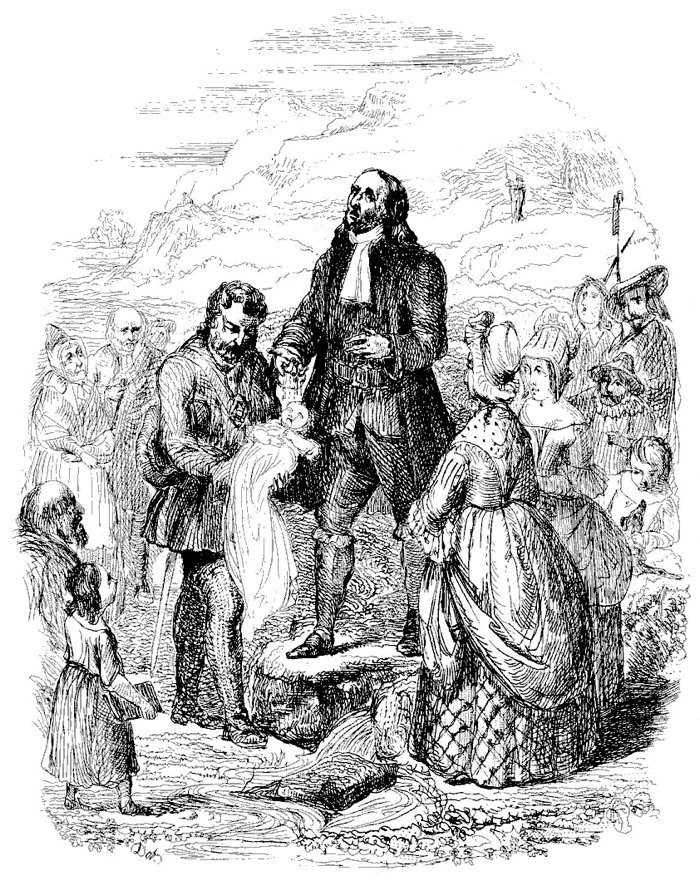
Mr. Welsh baptizing children anno 1665
Vide page 133
Edinr. Hugh Paton, Carver & Gilder to the Queen, 1842.
The council, now entirely under the direction of the primate,
on the 25th of January 1666, promulgated another thundering
proclamation, in which, reiterating their falsehoods, and re-asserting
“that conventicles, and unwarrantable meetings, and conventions,
under pretence and colour of religion and exercise thereof,
being the ordinary seminaries of separation and rebellion, are altogether
unlawful,” they denounced the eminent servants of God
mentioned before, who were said to convene, armed with swords
and pistols, and some of them to ride in disguise up and down
the country in gray clothes, together with Mr John Crookshanks,
who avowedly kept by him “that book called Buchanan De Jure
Regni, which he had translated out of Latin into English;” and
John Osburn in Keir, who acted as officer for giving notice to
the people of these unlawful meetings; and in regard they were
latent and kept themselves out of the way that they might not
be apprehended, and had no certain dwelling-place. They were
134charged at the market-crosses of Kirkcudbright, Dumfries, and
Edinburgh, and at the shore and pier of Leith, “to compear personally
before the council to answer to the premises,” which was,
in other words, to surrender themselves and be silenced, or sent
to join their brethren in exile.
A little before this the cause of the sufferers had been advocated
in “An Apologetical Relation of the Particular Sufferings of the
Faithful Ministers and Professors of the Church of Scotland, since
August 1660,” attributed to John Brown, late minister of Wamphrey,
and one of the banished—a performance written in a style
of elegance superior to many of the publications of that day, and
with a force of argument that defied reply, and which was peculiarly
galling to the managers, as it convicted them of the most flagrant
apostacy. The facts were too recent to admit of denial, while
the cause which the persecuted suffered for defending, continued
the same, as when it had been pronounced by their persecutors
themselves the cause of their king, their country, and their God!
An exposure more complete was never perhaps exhibited to the
world; and the sting was the more tormenting, because it was
true. The council felt it, and answered it in a becoming manner
by another proclamation, in the beginning of February, ordering
it to be burned by the hands of the common hangman, “to
vindicate,” as they said, “the honour of this kingdom, and to
witness and declare, that such principles and tenets as are contained
in the said pamphlet, are detested and abhorred by them.
With certification, that whosoever should retain any copies in
their possession, should be liable in the sum of two thousand
pounds, Scots money, to be exacted without any favour or defalcation;
and whoever should contribute to disperse it, were
declared liable to the punishment due the venders of seditious
libels!” And still more strongly to mark their sense of its merit,
on the very day this proclamation was issued, before the book had
been declared seditious, or keeping it in possession a crime, the
venerable relict of James Guthrie and her daughter were brought
before the council, and because they refused to give any information
respecting the author, they were sentenced to banishment to
Zetland, and to be confined there during pleasure. But the sentence
135which, it is likely, clerical vengeance had dictated, was, upon
a petition from the gentlewomen, referred to the Commissioner,
and by him remitted.
Winter gave some short respite to the Presbyterians, who as
yet were suffered, without much interruption, to attend their conventicles
amid the inclemencies of the weather; but, with the
return of spring, Sir James Turner was dispatched to commence
his third campaign. Formerly, Kirkcudbright and Galloway had
been the principal seat of his operations, now they stretched over
Nithsdale; nor was his circuit more extended than were his severities
increased. The exactions in his former expeditions had
been chiefly confined to the common people, now they were imposed
upon the gentlemen of the country; and the curates, attended
by files of soldiers, fined at their discretion all whom they
considered inimical, and of such sums as they judged proper.
The landlord was compelled to pay if his wife, children, servants,
or tenantry, were not regular church-goers. The tenant
was mulcted when his landlord withdrew from public worship—if
the curate’s services deserved the name—nor did it avail him,
although both himself and his family were as punctual as the parson.
The aged and the sick, the poor, the widow, and the fatherless—all
were compelled to liquidate the church-fines; and even
the beggar was forced to lay down his pittance to satisfy the unhallowed
demand. From mere wantonness, the ruffian soldiery
would eject from their dwellings the non-compliants—driving
husband from wife, and wife from husband—snatch the meat from
their children to give it to their dogs—then quarter in their houses
till they had wasted their substance, and finish by committing
to the flames what they could not otherwise destroy. Thus many
respectable families, reduced to utter indigence, were scattered
over the country, not only robbed of their property, but deprived
of the means of procuring subsistence. Complaints were useless
or worse—they were either disregarded, or answered by additional
outrage.
The following instances will give some faint idea of the nature
of these visitations. John Nielson of Corsack was a proprietor
to a considerable extent in the parish of Partan in Galloway—a
136gentleman of undoubted loyalty, whose only crime was non-conformity.
When Sir James Turner came into that county
last year, he was instantly delated by the curate for non-attendance—aggravated,
however, by his having shown hospitality to
Mr Welsh—fined an hundred pounds Scots, and sent prisoner
to Kirkcudbright, besides having four, six, or ten troopers quartered
on him constantly, from the beginning of March to the end
of May, to each of whom he paid half-a-crown per day, in addition
to their board and what they might abuse. This year, for
the same offence, he had six soldiers quartered upon him from
March to the middle of June, when he was forced to leave his
house and wander without any certain dwelling-place, while the
villanous banditti demolished his household stuff, and rioted upon
his provisions. When these were exhausted, they turned his lady
and children out of doors, and forced his tenants to bring them
sheep, lambs, oatmeal, and malt, till they also were nearly ruined,
and then they drove the whole of the black cattle upon the estate
to Glasgow and sold them!
Mr Blackadder being under hiding, the Bishop of Galloway
ordered Turner to apprehend him. His second son, then a boy
of ten years old, has left the following artless and affecting account
of Sir James’ visit to the manse:—
“About this time, winter 1666, Turner and his party of soldiers
from Galloway came to search for my father, who had gone
to Edinburgh to seek about where he might live in safety. These
rascally ruffians besett our house round about two o’clock in the
morning, then gave the cry—‘Damned Whigs open the door,’
upon which we all got up, young and old, excepting my sister,
with the nurse and the child at her breast. When they came in,
the fire was gone out: they roared out again, ‘Light a candle immediately,
and on with a fire quickly, or els we’l roast nurse, and
bairn, and all, in the fire, and mak a braw bleeze.’ When the
candle was lighted, they drew out their swords, and went to the
stools, and chairs, and clove them down to mak the fire withall;
and they made me hold the candle to them, trembling all along,
and fearing every moment to be thrown quick into the fire. Then
they went to search the house for my father, running their swords
137down through the beds and bedclothes; and among the rest, they
came where my sister was, then a child, and as yet fast asleep,
and with their swords, stabbed down through the bed where she
was lying, crying, ‘Come out rebell dogs.’ They made narrow
search for him in all corners of the house, ransacking presses,
chests, and flesh-stands. Then they went and threw down all his
books from the press upon the floor, and caused poor me hold
the candle all this while, till they had examined his books; and
all they thought Whiggish, as they termed it—and brave judges
they were!—they put into a great horse-creel and took away,
among which were a number of written sermons and printed
pamphlets. Then they ordered one of their fellow-ruffians to
climb up into the hen-baulks where the cocks and hens were, and
as they came to one, threw about its neck, and then down on the
floor we’t, and so on, till they had destroyed them all. Then
they went to the meat-ambry and took out what was there; then
to the meal and beef barrels, and left little or nothing there. All
this I was an eyewitness to, trembling and shivering all the while,
having nothing but my short shirt on me. So soon as I was relieved
of my office, I begins to think, if possible, of my making
my escape, rather than to be burned quick as I thought and
they threatened. I goes to the door, where there was a sentry on
every side standing with their swords drawn—for watches were
set round to prevent escape. I approached nearer and nearer by
small degrees, making as if I were playing myself. At last I gets
out there, making still as if I were playing, till I came to the
gate of the house; then, with all the little speed I had—looking
behind me now and then to see if they were pursuing after me—I
run the length of half-a-mile in the dark night, naked to the
shirt. I got to a neighbouring toune, called the Brigend of
Monnihyvie, when, thinking to creep into some house to save my
life, I found all the doors shut and the people sleeping; upon
which I went to the cross of the toune, and got up to the uppermost
step of it, and there I sat me down and fell fast asleep till
the morning. Between five and six a door opens and an old
woman comes out, and seeing a white thing upon the cross comes
138near it; and when she found it was a little boy, cries out, ‘Jesus
save us, what art thou?’ ‘With that I awaked and answered,
I am Mr Blackadder’s son.’ ‘O, my puir bairn, what brought
thee here.’ I answeres, ‘there’s a hantle of fearful men wi’ red
coats has burnt all our house, my brother, and sister, and all the
family.’ ‘O, puir thing,’ says she, ‘come in and lye down in my
warm bed’—which I did, and it was the sweetest bed I ever met
with.”
After this the whole family was dispersed. “We all behoved,”
continues the narrator, “to scatter; one neighbour laird
in the parish taking one child, and another. I was sent
to a place about a mile off, called the Peel-toune, who afterwards,
likewise, were quite ruined and all taken from them—the poor
mither begging but one lamb for meat to the bairns, but could
not get it. The meat they were not able to eat they destroyed,
threw down the butter-kirns, and hashed down the cheese with
their swords among the horses’ feet.”
Besides all other exactions, the parliamentary fines which had
hung so long suspended over the heads of the gentry, were ordered
to be levied with the utmost rigour from all who would not
take the oath of supremacy and subscribe the declaration; but to
those who would, the one-half was remitted, as had been proposed
the preceding year. This fine, like the rest, was collected by
troopers, whose charges, like those of modern lawyers, were always
as much and frequently more than the original debt. The only
consolation the sufferers had, was, that their plunder did not go
to enrich those who were the authors of the robbery. Neither
Middleton’s party, who imposed, nor Lauderdale’s, who uplifted,
the mulct, were allowed to pocket a farthing of the proceeds,
which were ultimately applied to support that worst and most dangerous
instrument of tyranny—a standing body of household
troops.
Sharpe, who assuredly was the cause of much of his country’s
calamity, and who was often execrated as almost the origin of the
whole, has usually got the credit of this arrangement. It is well
known that, although an imperious, he was by no means a fearless,
139character, and it is therefore not unlikely he may have been
the author of these precautionary measures which the country
viewed with so much detestation. At any rate, about the time
that he was in London, the affair was matured, and two regiments
of foot and six troops of horse were ordered to be raised,
of which Thomas Dalziel of Binns—a rude soldier who had once
owned the covenant, and afterwards improved his manners in the
Russian service—was appointed Lieutenant-General, with William
Drummond, Lord Madderty’s brother, who had gone through the
same course of education as Major-General. The troops of horse
were disposed of among the nobility. This army was to be maintained
from the fines, of whose application the General was to give
an account; but from the manner in which they were collected,
and the character of the gatherers, the public was little benefited
by this revenue, and the maintenance of the troops fell eventually
upon the common exchequer.
Reinforced by these mercenaries, the council more strictly enjoined,
by a fresh proclamation, (October 11,) submission to the
acts of parliament against separation and resistance to ecclesiastical
authority, requiring masters to oblige their servants, landlords
their tenants, and magistrates the inhabitants of the several
burghs, to attend diligently at the parish churches and partake
regularly of the ordinances; and no one was to be retained
as a servant, kept as a tenant, or suffered to dwell as a citizen,
after the parish priest intimated his disobedience. Mandates so
wantonly oppressive, which, without any rational object, were calculated
to create crime by leading either to a violation of the
consciences of the lieges or the laws of the land, seem to carry on
their face an incitement to insurrection; and when the manner
in which they were put in execution, among a sturdy peasantry,
is remembered, it is truly astonishing that they did not excite a
spirit of insubordination, general and deadly, and in truth produce
those very outrages of which the calumniated Presbyterians
were falsely accused. Many were driven from their homes and
utterly ruined, who, merely from political motives, or from a desire
to see something like decency in their clergymen, or from an
140aversion to have ministers forced upon them whom they did not
like, had opposed the curates and subjected themselves to the
fines; others, men of respectable rank in life who themselves had
conformed, saw their estates ruined and their families dispersed,
because some one, over whom they could have no possible control,
would not attend the wretched sermonizing of a worthless
parson, or take the sacrament from his polluted hands; besides
those who, from a love to the truth and a sincere reverence for
their tenets, deemed it a point of duty to withdraw from the ministration
of men who neither understood nor preached the first
principles of the gospel. Yet, notwithstanding all these terrible
encroachments upon their liberty and property, notwithstanding
these authorized violations of all that was dear or sacred to them
as men or as Christians, they had suffered, they had complained,
but they had not rebelled, when an incidental circumstance led
to an insurrection, in perfect conformity with the spirit, and even
authorized by the letter, of the ancient Scottish constitution before
it was destroyed at the Restoration, which hardly deserves the
name of rebellion.
Mr Allan of Barscob, and three other of these unfortunate
fugitives who had been forced by want from their places of retreat
among the mountains or mosses of Galloway, had ventured,
November 13th, to the Clachan of Dalry to procure some provisions.
Upon the high road, a little from that place, they accidentally
met some soldiers driving a few neighbours before them, to
compel them to thresh out a poor man’s corn for the payment of
his church fines. They naturally sympathized with the sufferers,
but passed on. While seated, however, at breakfast in the village,
they were informed that the soldiers had seized the old man
in his house—stripped him naked—and were threatening to place
him on a redhot gridiron because he could not produce the money.
Leaving their meal unfinished, immediately they repaired
to the spot; and finding the poor man bound, desired the soldiers
to let him alone. The soldiers in return demanded how they
dared to challenge them, and drew their swords. A scuffle ensued,
in which one of the others discharged a pistol and wounded
141a corporal with some pieces of a tobacco pipe—the only ball they
had among them when the military surrendered themselves prisoners,
and the man was liberated.[47]
Thus fairly engaged, to retreat was as dangerous as to proceed.
They knew they would be denounced as rebels and subjected to
dreadful reprisals. A party of their friends at Balmaclellan,
when they heard of the affair, knowing they too would be involved,
seized and disarmed sixteen soldiers who were quartered
there, one, who made resistance, being killed; and the whole country
taking the alarm, their numbers soon swelled to about fifty
horse tolerably mounted, and, perhaps, double that number of
foot, miserably armed with pitchforks, scythes, cudgels, and a few
pikes, and swords. Turner’s forces were scattered over the country,
they therefore, without allowing them time to collect, marched
direct to Dumfries, where, on the morning of the 15th, they
surprised him, who having only heard some indistinct account of
the scuffle, was preparing to go and chastise the culprits. The
horse went straight up to head-quarters—the foot remaining
without the town; and when Sir James appeared at the window,
Nielson of Corsack told him, if he would quietly surrender he
should receive no harm, with which he complied; and that gentleman
preserved him from personal injury, which some of the party
seemed anxious to inflict.[48]
The person who assumed the command was one Andrew Gray,
said to be an Edinburgh merchant whom no body knew, but whose
authority all obeyed without inquiry, so totally were they unprepared
142for any regular rising, and as little was he qualified for
the situation into which he had thrust himself. They seized the
General’s papers and trunks, but found little money; himself they
brought away in his night-gown and slippers, and placing him upon
a little pony carried him to the cross, where, with much formality,
they drank the king’s health to evince their loyalty—a ceremony
which some of their friends thought they might as well have omitted,
and for which they received neither credit nor thanks. They
then carried him back to his lodgings, and ordered him to make
ready and go with them. That night they rested at Glencairn.
Here they were alarmed by a report of the approach of the Earl
of Annandale and Lord Drumlanrig, and set off hurriedly, carrying
their prisoner with them under a strong guard. Next night
they reached Carsphairn where they remained; and here their
redoubtable Captain Gray left them, not without violent suspicions
of having carried a considerable sum of money along with
him: yet more probably he retired from fear or a sense of his
own utter incapacity,[49] but the numbers increased, and a kind of
committee consisting of Maclellan of Barscob, Nielson of Corsack,
and Mr Alexander Robertson, a preacher, succeeded to the
command.
Some days before the scuffle at Dalry, Rothes had taken his
departure for London, and the chief cares of the government devolved
upon the primate, as president of the council—thus called
upon to discharge an important political duty at a very delicate
conjuncture. One of the bailies of Dumfries who had witnessed
143the seizure of Turner, immediately proceeded to Edinburgh with
information of the rising; and the members of council, who never
calculated upon resistance, were surprised and alarmed beyond
measure. Next day, they sent off an express to the king with the
unpleasant intelligence, who, passing the Commissioner upon the
road, furnished his majesty with very unexpected news to salute
him with on his arrival. They ordered General Dalziel to march
on the following day with as many men as he could muster to
the west country, to establish his head-quarters at Glasgow, and
thence to proceed to wherever his presence might be most urgently
required—the various noblemen of those most interested in these
districts, were, at the same time, required to use their every exertion
to preserve the peace, and to receive and assist his majesty’s
forces—the guards of the town of Edinburgh were doubled, and
the names of all strangers ordered to be registered. These measures,
the most obvious and requisite, met of course the king’s
approval, but a proposal to enforce the subscription of the declaration
respecting the covenant upon the heritors of the southern
and western shires, was postponed by his desire as unnecessarily
exasperating an evil of which they did not yet know the extent.
More effectually to protect the capital, the companies of the train-bands
were ordered to be filled up by citizens who would willingly
take the oath of allegiance, and further promise to maintain his
majesty’s authority with their lives and fortunes; such as would
not, to be disarmed and their persons secured.
The noblemen of Fife, with their followers, were summoned,
and an act of council was passed to put the country in a posture
of defence, and all the lieges were ordered to assist the General
with all their power. The ferries across the Forth were at the
same time stopped, and even those who passed at Stirling Bridge
were to be subjected to a rigid examination. A proclamation
also was issued commanding the rebels to lay down their arms,
but it was remarked that it contained no offer of pardon; and to
desire them to surrender without security, was something like an
invitation to confess and be hanged. Some of the nobility felt
the degradation of being under an ecclesiastic, and murmured—“Have
we none at such a juncture to give orders but a priest?”
144But they were too wofully spiritless than do more, and they only
clanked, sulkily, the fetters themselves had forged.
Intelligence also had been sent by the insurgents to Edinburgh
with equal expedition, and a few who were well-wishers to the cause
met to consider what was their duty in the present juncture, when,
at an adjourned meeting held in Mr Alexander Robertson, a
preacher’s lodgings,[50] they resolved after deliberation and prayer,
that it was their duty to assist their poor brethren so cruelly oppressed.
One only dissented, Mr Ferguson of Kaitloch, who was
not convinced of the propriety of rising at that time. The rest
were eager to engage immediately, and as soon as the meeting
broke up, Colonel Wallace and Mr Robertson set out for the
west to see what could be effected there. Mr Welsh went direct
to the countrymen whom he found at Dalmellington; thence he
proceeded to gather his friends in the south, while they, buoyed
up with the expectation of being quickly and numerously joined,
marched forward to Ayrshire, and on the 21st had their general
rendezvous at the Bridge of Doon. Wallace’s first disappointment
was at Libberton, where, instead of forty stout horsemen,
he only met eight; and on his journey by Linton, Dunsire,
Mauchline, and Evondale, he found the country, in general, had
been taken so completely unawares, that he arrived at the main
body with a very slender accession of strength—the ministers remaining
quietly in their houses, while the leading Whig gentlemen
went to wait upon the General. He had by the way received
notice from Cunninghame, that a reinforcement from thence might
be procured if they had only a party to encourage and protect
them till they got formed; and Captain John Arnott, accordingly,
had been sent with forty horse to bring them up, and directed to
join next day at Ochiltree.
Having received information of General Dalziel’s arrival at
Glasgow, they hastened to Ochiltree, where all their parties were
ordered to meet, and where Mr Semple preached while they were
145collecting.[51] Afterwards they marshalled their army, named their
officers,[52] and placed their guards. Sir John Cochrane was with
Dalziel, and his lady received the leaders who were quartered at
the mansion-house very coolly, although she expressed herself not
unfriendly to the cause. Here they were joined by Mr John
Guthrie, minister of Tarbolton, with some of his parishioners,
and Robert Chalmers, a brother of the Laird of Gadgirth’s, who
brought a report that the Duke of Hamilton was approaching
with his troops, and that they had dispatched John Ross with a
small party to ascertain the fact. A council of war was then
called, at which it was resolved that they should march eastward,
as it was impossible to stay where they were, and there was no
146probability of farther help from the south or south-west districts,
and Captain Arnott would bring with him whoever were well-inclined
in Cunninghame and Renfrew. Besides, they had an earnest
invitation from Blackwood to come to Clydesdale, where he
promised to meet them with one hundred men.
Next day they broke up for Cumnock, but were met on the road
with the disagreeable intelligence that Ross and his party had
been taken prisoners by the Duke, and that the enemy’s whole
force was at Kilmarnock; in consequence, they continued their
route during a violent storm of rain and wind to Muirkirk. The
night fell dark, and the road was detestable; yet the men marched
forward with spirit, and even their enemy, Sir James Turner, gave
them this credit—“I doe confesse, I never saw lustier fellows
than these foot were, or better marchers; for though I was appointed
to stay in the rear, and notwithstanding these inconveniences,
I saw few or none of them straggle.” When they arrived
late at their quarters, wet as if they had been drenched in water,
the poor foot were forced to lie all night in the cold church, without
victuals and with but little fire. Here Mr Andrew M’Cormack,
a pious Irish minister, known by the name of the “Good-man,”
came to the Colonel and informed him it was the opinion of Mr
Robertson and Mr Lockhart—that, as there was no appearance
of any help either from Clydesdale or any other quarter, the business
should be followed no farther, but the people dismissed
as quietly as possible to their homes, to shift each for himself the
best way he could, until the Lord gave some better opportunity.
With this advice, which was not at all to the Colonel’s liking, he
could not of himself comply, but proposed to consult the other
leaders who might join before or when they reached Douglas.
Thither they arrived on Saturday night, November 24, without
any of their expected reinforcements, excepting forty recruits
brought by Captain Arnott.
Having quartered the troops, and, on account of an alarm,
doubled their guards, a council of war was held, when, after earnest
prayer to God, the question was proposed, whether they
should disperse or continue in arms? On the one side was stated
the strength of the enemy and the small number of their company,
147the total want of spirit discovered by the country and the
tempestuous season of the year, which rendered it unfit for action.
On the other, it was replied—that the coming forth to own the
people of Galloway was clearly of the Lord, and in that they had
done nothing but followed his call—that numbers had not only
urged them, but had solemnly promised also to come forth, and if
these should now desert the cause, between them and their master
let it be. As for themselves, they believed the Lord could work
by few or by many. If he designed the present appearance should
prosper, he would send men if necessary; or who could tell but
he might honour them to accomplish his end? At all events,
the cause they were assured was his; nor would they forsake it,
but follow on whatever might be the consequence. Death was
all they could endure; and, though they were only to bear their
testimony to the truth, that was well worth dying for. It was
next proposed, whether they should renew the covenants? On
this there was no dispute. They regretted they could not go
about that work with the deliberate preparation they deemed necessary
for entering into such solemn engagements; but, as the
urgency of the case admitted of no delay, and they all understood
the nature of the transaction, they determined to prepare
for the worst by again dedicating themselves to the Lord in the
national bonds, whose obligation they believed to be perpetual,
and the renunciation of which they considered as one of the deepest
sins of the land. The disposal of their prisoner, as they had no
safe place in which to confine him, was then considered. About
this they were not so unanimous. Some were for putting him to
death as a notorious murderer and bitter instrument of persecution,
but others urged that he was a soldier of fortune, acting under
a commission, also that he had been promised protection by
one of themselves; and it appearing from his papers, though his
conduct had been severe, yet that he had not even acted up to
his instructions, it was carried to spare him.[53]
Hearing that Dalziel was at Strathaven, they decamped early
148next morning—Sabbath—and marched by Lesmahago to Lanark,
where they arrived in the evening, having been joined by Robert
and John Gordon, the sons of Alexander Gordon of Knockbreck,
with a few others from Galloway. Mr Robertson refused to accompany
them farther. On their march, they completed the
arranging of their troops, but found themselves wretchedly deficient
in officers, there not being above four or five who had ever
been in an army before, neither were they fully supplied with ammunition
or arms; at Lanark, they caused a general search, but
the country had been too well scoured before, and they found few
or none. Notice, however, was given that the covenants would
be renewed on the morrow.
When they assembled at the rendezvous for this purpose, they
were told the enemy was within two miles, and it was proposed
to delay; but as the public avowal of their cause and principles,
besides being a solemn religious act of imperative obligation, was
the best and only testimony they could exhibit in their circumstances,
they determined that nothing but absolute necessity
should prevent it. They therefore sent forward an advance of
twelve horse, placed guards at the ford, and then deliberately went
about the work of the day. The horse were drawn up at the
head of the town, where Mr Gabriel Semple and Mr John Crookshanks
presided. The foot were ranged in the street, near the
tolbooth stairs, upon which Mr John Guthrie stood and preached.
Very few except the insurgents attended, so great was the universal
terror and depression of the times; but the whole proceedings
are said to have been deeply impressive, particularly the
address of Mr Semple, from Prov. xxiv. 11, 12. “If thou forbear
to deliver them that are drawn unto death, and those that
are ready to be slain; if thou sayest, Behold, we knew it not;
doth not he that pondereth the heart consider it? and he that
keepeth thy soul, doth he not know it? and shall not he render
unto every man according to his works?” After sermon,
the covenants were read, article by article, and the hearers, with
uplifted hands, and apparently with much serious emotion, engaged
and vowed to perform. Now in a situation of such peril,
and pledged to their country and to their God, could they be
149other than deeply affected? It was no common ground these
witnesses occupied.
About the same time, they emitted the following hurried but
well-framed “declaration of those in arms for the covenant 1666,”
the effect of which was wonderfully, though sadly, impressed upon
the religious part of the community, by the remembrance that
these men had been allowed to stand alone, and to fall together
in the righteous cause; and by the evils which overtook the adherents
to the covenants and afflicted the nation for twenty-two
succeeding years of persecution.
“The nature of religion doth sufficiently teach, and all men
almost acknowledge, the lawfulness of sinless self-defence; yet
we thought it duty at this time to give an account unto the world
of the occasion and design of our being together in arms, since
the rise and scope of actions, if faulty, may render a thing right
upon the matter, sinful. It is known to all that the king’s majesty,
at his coronation, did engage to rule the nation according to the
revealed word of God in Scripture—to prosecute the ends of the
National and Solemn League and Covenants, and fully to establish
Presbyterian government, with the Directory for Worship—and
to approve all acts of parliament establishing the same;
and thereupon the nobility and others of his subjects did swear
allegiance: and so religion was committed unto him as a matter
of trust, secured by most solemn indenture betwixt him and his
people.
“Notwithstanding all this, it is soon ordered that the covenant
be burned—the tie of it is declared void and null, and men forced
to subscribe a declaration contrary to it—Episcopal government,
in its height of tyranny, is established—and men obliged by law
not to plead, witness, or petition against these things. Grievous
fines, sudden imprisonments, vast quarterings of soldiers, and a
cruel inquisition by the High Commission Court, were the reward
of all such who could not comply with the government by lordly
hierarchy, and abjure the covenants, and prove more monstrous to
the wasting their conscience, than nature would have suffered heathens
to be. These things, in part, have been all Scotland over,
but chiefly in the poor country of Galloway at this day; and had
150not God prevented, it should have, in the same measures, undoubtedly
befallen the rest of the nation ere long. The just
sense whereof made us choose rather to betake ourselves to the
fields for self-defence than to stay at home burdened daily with
the calamities of others, and tortured with the fears of our own
approaching misery. And considering our engagement to assist
and defend all those who entered into this league and covenant
with us; and to the end we may be more vigorous in the prosecution
of this matter, and all men may know the true state of our
cause, we have entered into the Solemn League and Covenant;
and though it be hardly thought of, renewed the same, to the end
we may be free of the apostacy of the times, and saved from the
cruel usages persons resolved to adhere to this have met with.
Hoping that this will wipe off the reproach that is upon our nation,
because of the avowed perjury it lies under. And being
fully persuaded that this league, however misrepresented, contains
nothing in it sinful before God, derogatory to the king’s just authority,
the privileges of the parliament, or the liberty of the
people; but, on the contrary, is the surest bond whereby all these
are secured, since a threefold cord is not easily broken, as we shall
make appear in our next and larger declaration, which shall contain
more fully the proofs of the lawfulness of entering into covenant,
and necessity of our taking arms at this time for the defence
of it, with a full and true account of our grief and sorrow
for our swerving from it, and suffering ourselves to be divided to
the reproach of our common cause, and saddening the hearts of
the godly—a thing we sorrowfully remember and firmly resolve
against in all time coming.”
At this period the number of the insurgents had reached its
maximum—more having joined on that day than for three before—supposed
to amount to nearly three thousand; and the opinion
of many among them was, if they did intend to fight, it would
be better to do it in that quarter, where, if defeated, they were
among friends, and could more easily find the means of escape,
than in the east, where every thing would be against them; but
their want of discipline, and want of arms, did not warrant a trial
of strength with the king’s forces, who were equal if not superior
151in numbers and in a complete state of equipment. They were
likewise the more encouraged to try the Lothians, as, at this critical
moment, they received from Edinburgh pressing letters of
invitation to come thither. They chose what eventually proved
the most unfortunate for themselves, and that same evening took
the road for Bathgate. Before they left Lanark, Lawrie of Blackwood
paid them a visit. He said he had come by desire of the
Duke of Hamilton to learn what were their intentions and to endeavour
to prevail upon them to lay down their arms and save the
effusion of blood; but he produced no written commission, and
only spoke in general terms to some of the ministers, which induced
in the mind of the Colonel a suspicion that he came merely
to spy out their nakedness; and he afterwards blamed his own
simplicity in allowing a person of such dubious character to pass
between them and the enemy without restraint. Hardly were
they in motion when Dalziel made his appearance; but he contented
himself with sending a body of horse after them, who,
when they found the countrymen prepared for an assault, returned
to the General, with whom they remained for the night in the
quarters the others had left. The night was deplorable; it rained
incessantly and blew a hurricane, and the road across the moors
was deep, “plashy,” and broken. When they arrived at their
destination, two hours after night-fall, they could get no accommodation,
not even a covert from the tempest; and their leaders
retired to a wretched hovel to consult about their further operations.
After prayer, they discussed the subject. To return was
now impracticable, for the enemy was at their heels; but they
still expected some assistance from Edinburgh, and thitherwards
they resolved to continue their route, convinced that they would
at least hear from their friends before they were entirely within
the jaws of Leviathan.
But never were poor men more completely deceived, disappointed,
and entangled. On every side was danger. The whole
spasmodic energy of government had been forced into action by
the fearful throes of the primate; almost all Scotland south of
the Tay, had been set in motion, while the capital was fortified
more in proportion to his ecclesiastical terrors than to the band
152that was approaching. Sir Andrew Ramsay, the provost, had barricaded
the gates and planted them with cannon—Lord Kingston
was stationed on Burntsfield Links with an advanced guard of
horse and foot—the advocates were accoutred and the citizens in
arms—and all the array of the Lothians, Merse, and Teviotdale,
were ordered to hold themselves in readiness. Yet such was their
want of intelligence, that the covenanters, upon an alarm being
given, broke up about twelve o’clock in this dark and foul night—“One
of the darkest,” says Wallace in his Narrative, “I am
persuaded that ever any in that company saw. Except we had
been tied together, it was impossible to keep together; and every
little burn was a river.” During this disastrous march, which
many were unable to accomplish—as “they stuck in the clay and
fainted by the road”—the army diminished wofully; and the remainder
who arrived in the morning at the New Bridge, within
eight miles of Edinburgh, “looked rather like dying men than
fighting soldiers—weary, worn out, half-drowned, half-starved
creatures.” Yet, beyond expectation, in an hour or two, they
mustered nearly a thousand men, only officers were sorely lacking;
and now when the enemy was within five miles in their rear,
they first learned that all Edinburgh and Leith were in arms
against them.
Dreadfully perplexed—without directors, without intelligence,
without food—they knew not what to do, but they resolved to
march to Colinton. On their way thither, Blackwood again came
to them with a verbal requisition from the Duke for them to
lay down their arms, and he would endeavour to procure an indemnity;
but desperate as their situation was, had they had no
other aim than their own personal safety, they could not have listened
to so vague an arrangement with such men as they had to
deal with; and when Blackwood urged their compliance, they dismissed
him with a caution to beware how he behaved himself, and
see well that he walked straightly and uprightly between the parties.
Having had so little rest, and scarcely tasted any thing
since they left Lanark, a few horsemen were sent out to try and
procure some provisions and forage in the neighbouring farms, as
they intended, if possible, to take some repose and refreshment in
153their quarters that night, which, continuing tempestuous, seemed
to promise them, for some hours at least, security from any hostile
incursion. Accordingly, having provided in the best manner they
could for the foot in the village, and sent the horse to the neighbouring
farms, they set their guards, and the officers were retiring
to rest, when Blackwood came to them again, accompanied by
Richards, the laird of Barskimming, and repeated the proposal he
had formerly made; telling them at the same time, he had the
General’s parole for a cessation of arms till to-morrow morning,
having given in return the same for them. Wallace, who was
little pleased with the officious presumption of “the tutor,” told
him, “he did not understand this paroling of his, but he believed
neither would break the truce in such a night.” Upon this they
parted, and Barskimming, without taking leave, set off early next
morning, but Blackwood waited till daybreak, and requested to
know what answer was to be returned. The leaders upon calmly
considering their situation—their men now hardly nine hundred,
the greater part without arms—their spirits broken by the apparent
want of heart in the country—their bodies worn out by fatigue,
hunger, want of sleep, and exposure to the weather—the utter
hopelessness of any reinforcements—and their great inferiority in
numbers to Dalziel’s troops—were strongly induced to attempt
coming to some terms not incompatible with the object for which
they had ventured to the field, they therefore proposed sending
one of their number along with Blackwood to represent to the
General their grievances, and the grounds of their appearance in
arms; but the only person they had to whom they could intrust
such a message being objected to as an outlaw, Wallace sent a
letter by Blackwood to Dalziel, stating—“That, on account of
the intolerable insolences of the prelates and their insupportable
oppressions, and being deprived of every usual method of remonstrating
or petitioning, they were necessitated to assemble together,
in order that, jointly, they might the more securely petition
his majesty and council for redress, they therefore requested of
his excellency a pass for a person whom they might send with
their petition, and begged an answer might be returned by Blackwood
who had promised to fetch it.”
154Trusting, however, very little to this negotiation, they commenced
a retreat, and turning the west end of the Pentland
Hills, took the Biggar road. As their men were straggling, they
drew up near the House of Muir, on a spot now well known—Rullion
Green. The ground rises from the south towards the
north, where the Hill terminates abruptly. Here the poor fatigued
remnant were posted in three bodies. Upon the south, a
small body of horse, under Barscob and the Galloway gentlemen—in
the centre, the foot commanded by Wallace himself—and
upon the north, the greater part of the horse along with Major
Learmont. Hardly had this small company got arranged, when an
alarm was given that the enemy was approaching; and upon moving
towards the ridge of the hill, they observed their horse under
Major-General Drummond upon an opposite hill, within a quarter
of a mile—for their foot had not arrived. The little band of
covenanters being so posted that the enemy could not attack them
from the north, about fifty picked troopers marched along the ridge
to the westward, evidently with a design to approach from that
quarter. Observing this, a party of about the same strength,
under Captain Arnott, was dispatched by Wallace to meet them,
which they did in the glen, at no great distance. Having fired
their pistols, they instantly closed, and a sharp contest ensued in
sight of both armies, which lasted for a considerable time, when
the troopers gave way and fled in confusion to their own body.
In this rencounter, Mr John Crookshanks and Andrew M’Cormack
fell;[54] and several were killed and wounded on both sides.
The nature of the ground preventing pursuit by cavalry, a party
of the covenanters’ foot was ordered to support their horse, but
the enemy moved to another and safer eminence farther to the
east, where they waited till their own foot came forward; and
then descending from the hill, drew up upon Rullion Green in
front of their opponents, in order to provoke them to leave their
ground and engage. But seeing that they were not inclined to
155leave their vantage ground, they pushed forward a squadron of
their horse, flanked by foot, upon the south, which the others observing,
consulted whether they should give them a second meeting,
when considering that, although they might be able to defer
an engagement for that night, they must inevitably be forced to
fight on the morrow, and under much greater disadvantage—as
the enemy would be certainly increased in numbers—they, after
prayer, resolved that they would not decline the combat—“they
would quit themselves of their duty though it should serve for
no more than to give a testimony by leaving their corpses on the
field.” A party of Learmont’s horse, also supported by foot,
was then sent forth, whose onset the regulars were unable to sustain,
and staggered and fled. Each now endeavoured to support
their own men by successive detachments.
While the combatants were at all equal, the covenanters successfully
maintained the honour of the day, till Dalziel, about
night-fall, brought up the whole of his force, and, with one simultaneous
and vigorous charge, broke their array. Overwhelmed
by numbers, they found it impossible to rally, and every one
shifted for himself as he best could. The slaughter was not
great, for the countrymen made to the hills, and their flight was
covered by the darkness; nor were the horsemen very eager in
the pursuit, for, being chiefly gentlemen, they sympathized in
the sufferings, and many approved of the cause of the vanquished.
About a hundred were killed and taken prisoners at the time,
and about fifty were brought in afterwards. Of Dalziel’s troops,
the casualties never appear to have been fairly reported. They
acknowledged some half-dozen, but the allowed valour of the
covenanters, and the obstinacy and nature of the skirmishing,
forbid our accepting this as any thing like an accurate return.
Some of the neighbouring rustics, more cruel even than the military,
probably expecting money, are said to have murdered
several of the fugitives, but the crime was held in deserved execration;
and the popular tradition, that these “accursed spots”
were the scenes of foul nocturnal visions, sufficiently mark the general
opinion of the country. Sir James Turner, who had accompanied
the insurgents in all their movements, when the battle was
156about to commence, bargained with his guards that, if they would
save his life from the vengeance of their friends, if defeated, he
would secure their safety from the conquerors, which was agreed
to, and was one of the few agreements which appears to have been
faithfully kept. Those who were slain on the field were stripped
where they fell, and lay naked and unburied till next day, when
some godly women from Edinburgh brought winding-sheets and
interred them; but such is the brutality of avarice, that the bodies
were afterwards taken out of their graves by some miscreants for
the sake of the linen!
The victors entered the capital shouting with their prisoners.[55]
“A sight,” says a contemporary, “the saddest that ever Edinburgh
had seen, which drew tears in abundance from the eyes
of all that feared God, considering what vast difference there was
between the persons and the cause on the one side and the other:
and surely a most astonishing dispensation it was to see a company
of holy men—for such were the greatest part, yea, but few
otherwise—and that in a good cause, given up into the hands
of a most desperate crew of scoffing, profane atheists. But God
had called them together, it seems, to have a testimony at their
hands, and that he missed not, for he helped them to glorify him
in their sufferings, which made their cause more lovely throughout
all parts of the land, even in the eyes of enemies, than victory
would have done!” They were imprisoned, the common men
in the kirk, called Haddo’s-Hole[56]—those of superior rank were
sent to the common jail. In the height of their exultation, the
157privy council sent off their dispatches announcing the victory,
and breathing a spirit of the most implacable hatred against the
Presbyterians. “Although,” said they, “this rabble be totally
dissipated for the time, yet we conceive ourselves obliged, in the
discharge of our duty, to represent unto your majesty that those
principles which are pretended as the ground of this rebellion, are
so rooted in many several places through the kingdom, and there
be such just ground of apprehension of dangers from persons disaffected
to your majesty’s government, as it is now established by
law, as will require more vigorous application for such an extirpation
of it, as may secure the peace of the kingdom and due obedience
to the laws.” Orders were immediately given by the council
to sequestrate the property of all who had been at Pentland,
and to apprehend all who were suspected of having been with
them, or of having aided or abetted them before or since.
Priestly resentment is proverbially implacable; but if those
priests happen to be infidels, or apostates, such as the generality
of the Episcopalian-restoration-church of Scotland were,
their revenge assumes a degree of rancour bordering on the diabolical,
of which the punishments that followed the suppression
of this feeble and ill-supported insurrection, afford afflicting examples.
There cannot be a stronger proof that the rising was
unpremeditated and accidental, than that, notwithstanding the
enormous oppression the country had endured, and the universal
discontent both in the south and west, so few attempted to join
the insurgents. In Renfrew, only one small company assembled;
but before they were ready, Dalziel had interposed between
them and the covenanters, and they retired without doing more
than showing goodwill and incurring punishment. William Muir
of Caldwell was their leader; and among them were, Ker of
Kersland, Caldwell of Caldwell, Cunningham of Bedland, Porterfield
of Quarrelton, with Mr Gabriel Maxwell, minister of
Dundonald, George Ramsay, minister of Kilmaurs—and John
Carstairs, minister of Glasgow, unwillingly forced out by the
entreaties of his friends, with several others, who all afterwards
suffered confiscation, fining, or banishment. What was, perhaps,
not the least galling part of the trial, they were denounced by
158John Maxwell of Blackston, one of themselves, who either through
treachery or terror was induced to become an informer and witness
against them.
It was natural, and followed as a matter of course, that, of men
taken with arms in their hands, some examples should be made by
the government against whom they were alleged to have rebelled.
But what gave to the executions in this case their peculiar features
of atrocity, was, their victims had surrendered upon a promise of
quarter, and the more appalling fact of a letter from the king to
the council, forbidding any more to be put to death, having been
kept up by one or both of the archbishops,[57] till they were satiated
with the blood of some obnoxious victims. When the question,
whether the prisoners should be sent to trial, was first agitated
at the privy council-board, Sharpe violently urged the prosecution.
Sir John Gilmour, esteemed one of the best lawyers
of his day, pusillanimously shrunk from giving any decided opinion,
and the rest seemed inclined to be silent, when, unhappily,
Lord Lee started the vile jesuitical distinction, not, however, unmatched
in later times, that men may be granted quarter on the
field as soldiers, yet only be spared to die on a scaffold as citizens—a
distinction which General Dalziel, notwithstanding his
little respect for the lives of covenanters, could not by any means
be brought to comprehend.
Eleven of the prisoners were accordingly picked out for trial,
and, on the 4th of December, Captain Andrew Arnott; Major
John M’Culloch; John Gordon of Knockbreck, and his brother
Robert; Gavin Hamilton, Mauldslie, Carluke; Christ. Strang;
John Parker, Kilbride; John Ross, Mauchline; James Hamilton,
Killiemuir; and John Shiels, Titwood, appeared before the
Court of Justiciary. Thomas Patterson, merchant in Glasgow,
died in prison of his wounds. The objections to the relevancy
of the indictment were argued with great ability, and, in particular,
that one arising from the quarter granted by the General,
159which, if we may judge from the pleadings, he appears to have
himself considered a point of honour. It was alleged, that being
in the form of an army, and as such assaulted by his majesty’s
forces, and as such having accepted quarter, and in consequence
delivered up their arms, and that that quarter being publica fides,
and offered and granted, should be inviolably observed. To this
it was answered, that their presumption in appearing in arms against
their sovereign lord was an aggravation of their rebellion; that
unless his majesty had given a special commission for the purpose,
the General had no right to grant a pardon to rebels, whatever he
might have done in fair and honourable war. In return, it was
replied, that without debating the justness of the war, the pannels
being then in arms, might have defended their own lives and
reached the lives of the greatest that opposed them. In laying
aside these arms, they in effect ransomed their lives; and soldiers
who may defend their own lives, are not obliged, nor is it in use,
nor would the urgency of the case permit it to them, to seek the
granter’s commission, common soldiers being accustomed to grant
quarter, which their superiors never annulled; and this had been
the practice, not only between the contending parties in France,
but likewise practised by his majesty’s own forces in the hills, and
with the rebellious English, which, unless it were adhered to, a
method of martial massacre would be introduced, and rebels of
necessity would become desperate and indomitable traitors. The
court repelled the objections; and as none of the pannels denied
the facts of which they were accused, they were unanimously
found guilty, and sentenced to suffer the doom of traitors on the
7th of December.
Previous to their execution, they drew up a united testimony,
which stands upon record an evidence of the purity of their motives
and the justice of their cause—a cause which, however defamed
by the advocates of passive obedience, or oppugned by more
modern objections, was in their hands the sacred cause of civil
and religious liberty, only these patriots were driven by enormous
oppression prematurely to assert it. “We are condemned,” say
they, “by men, and esteemed as rebels against the king, whose
authority we acknowledge; but this is the testimony of our conscience,
160that we suffer not as evil-doers, but for righteousness, for
the word of God and testimony of Jesus Christ—particularly for
renewing the covenant,[58] and, in conformity with its obligations,
for defending ourselves by arms against the usurpation and insupportable
tyranny of the prelates, and against the most unchristian
and inhuman oppression and persecution that ever was enjoined
and practised by rulers upon free, innocent, and peaceable subjects!
The laws establishing prelacy, and the acts, orders, and
proclamations made for compliance therewith, being executed
against us by military force and violence—and we with others, for
our simple forbearance, being fined, confined, imprisoned, exiled,
scourged, stigmatized, beaten, bound as beasts, and driven unto
the mountains for our lives, and thereby hundreds of families being
beggared, several parishes, and some whole country sides, exceedingly
impoverished; and all this either arbitrarily, and without
any law or respect had to guilt or innocency, or unjustly contrary
to all conscience, justice, and reason, though under the pretence of
iniquitous law, and without any regard to the penalty specified in
the law; while all remonstrating against grievances, were they
ever so just and many, and petitions for redress being restrained
by laws—there was no other remedy left us but that last of necessary,
self-preservation and defence. And this being one of the
greatest principles of nature, warranted by the law of God, scriptural
instances, and the consent and practice of all reformed
churches and Christian states abroad, and of our own famous predecessors
at home—it cannot, in reason or justice, be reputed
a crime, or condemned as rebellion, by any human authority.”
Then, after lamenting the perjury, backsliding, and breach of
161covenant throughout the land, the overturning of the work of
reformation, the obtrusion of mercenary hirelings into the ministry,
the universal flood of profanity and apostacy from participating
in the guilt of which they ardently prayed to be cleansed,
they exhort their countrymen and fellow-christians to remember
the example of their noble and renowned ancestors, and warn
them not to be offended with the cross of Christ on account of
their sufferings, and conclude in a strain of exhilarating, animated,
and believing anticipation, almost prophetical—“Though this be
the day of Jacob’s trouble, yet are we assured that when the Lord
hath accomplished the trial of his own, and filled up the cup of
his adversaries, He will awake for judgment, plead his own cause,
avenge the quarrel of his covenant, make inquiry for blood, vindicate
his people, break the arm of the wicked, and establish the
just, for to him belongeth judgment and vengeance; and though
our eyes shall not see it, yet we believe that the Sun of Righteousness
shall arise with healing under his wings—that he will revive
his work, repair his breaches, build the old wastes, and raise up
the desolations.”
Ten were executed together; and, on the scaffold, their dying
speeches, containing similar sentiments, were delivered with a high
and elevated courage, that excited no common emotion among
the spectators, while their kindlier feelings were melted into tenderness
when the two brothers—the Gordons—were thrown off
locked in each other’s arms, and whose last agonies were expressed
by the convulsive clasp of a fraternal embrace. The heads of the
sufferers were sent to various parts of the country, but the right
hands which they had uplifted at the oath of the covenant, were
sent in derision to be affixed to the top of Lanark jail.
Enraged to find that no appearance of any premeditated scheme
of rebellion could be traced in the confessions of the late sufferers,
who all agreed in assigning as the cause of the rising, the intolerable
oppression they endured in soul, body, and estate, they determined
to elicit by torture, if possible, some plausible confession
that might afford a colouring of justification for the cruelties
they were perpetrating and determined to perpetrate. Accordingly,
Nielson of Corsack, whose enormous oppression we have
162already seen, and Hugh M’Kail, a preacher, were brought before
the council on the 4th of December; and the boots, an instrument
which had not been used in Scotland for a century, was again
put in requisition. This “infernal machine” was a kind of box,
strongly hooped with iron, into which the leg of the prisoner was
put, where it was compressed by wedges, driven frequently till
the bone was crushed, and even the marrow sometimes extruded.
Nielson was fearfully tormented; but his cries, which were most
piercing, had no effect upon Rothes, before whom he was examined,
who frequently called for “the other touch.” Hugh M’Kail,
whose fate produced a stronger and more indelible impression
than any that occurred during this period, was a young man of
great promise. He had been tutor in the family of Sir James
Stewart of Coltness some time before the Restoration, when Sir
James was provost of Edinburgh. He was licensed to preach at
the early age of twenty-one, and soon became so deservedly popular,
that he eminently attracted the hatred of the prelates, particularly
Sharpe, and was forced to keep under hiding. During
this time, he went to Holland, and for four years attended one of
the Dutch Universities, then distinguished for theological literature.
In 1664—5, he returned secretly to his father’s house,
where he remained, till, hearing of the appearance made by the
people of God for the cause of the covenants, he joined them in
the west; but his tender constitution was unable to bear the fatigue
of their severe toil and privations, and he was, finally, obliged
to leave them near Cramond Water. On his return home to
Libberton, he was seized at Braid’s Hills and brought to Edinburgh.
His limb, also, was shattered by repeated strokes of the
mallet; but from neither of the two could torture extort any other
fact than their confessions contained.
Nielson, notwithstanding the treatment he had undergone, was
indicted to stand trial on the 10th of December. When he was
placed at the bar along with other four—Mr Alexander Robertson,
preacher, who had been basely betrayed by the Laird of
Morton, his friend, to whose protection he had committed himself;
George Crawford, in Cumnock; John Gordon, Irongray;
and John Lindsay, Edinburgh—they were found guilty upon their
163own confessions, and were executed on the 14th, except Lindsay,
who was pardoned. They all left testimonies in similar terms to
those who went before, lamenting the defection of the times, but
rejoicing in the hope that God would return and bless his church
and people. They all pointedly refused the appellation of rebels,
avouched their loyalty to the king and the constitution of their
country before it was illegally overturned, and warned their friends
not to be discouraged because the few who had taken their lives
in their hands had fallen before their adversaries, but to abound
more in holiness, prayer, and steadfastness, nothing doubting, but
that the Lord would arise in due time and plead the cause which
is his own.
M’Kail having fevered from the torture, had not been tried
along with Nielson, and it was thought his youth and the torments
he had already endured would have been deemed sufficient
punishment; but they knew little the mortal strife of ecclesiastics,
when power is the object, who thus calculated, although the highest
interest was made for him. He had insinuated a likeness between
the primate and Judas—a crime never to be forgiven, for
it was true; and being recovered so far as to allow his being
moved, he was carried to court, December the 18th, and, together
with seven others, indicted for rebellion, found guilty, and
condemned. When allowed to answer for himself, he pled the
obligations that were laid upon the land, and the oath of God
under which they were bound. The last words of the National
Covenant, he said, had always had great weight on his spirit;
upon which the Lord Advocate interrupted him, and desired him
to answer to his own particular charge. His answer was, “that
he acted under a solemn impression of the saying of our Lord
Jesus—‘Whosoever shall confess me before men, him shall the
Son of Man also confess before the angels of God.’” When
the sentence was pronounced, he cheerfully said, with meek resignation—“The
Lord giveth, and the Lord taketh away; blessed
be the name of the Lord.”
His prison hours were enviable, not composed merely, but full
of joy. “Oh, how good news!” said he to a friend, “to be
within four days’ journey of enjoying the sight of Jesus Christ.”
164When some women were weeping over him—“Mourn not for
me,” was his cheering exhortation; “though but young, and cut
down in the budding of my hopes and labour of the ministry,
yet my death may do more good than many years sermons might
have done.” On the last night of his life, after having supped
with his father, some friends, and his fellow-prisoners, he burst
forth in a strain of animated queries; among others, “How they
who were hastening to heaven should conceive of the glories of the
place, seeing it was written, ‘Eye hath not seen, nor ear heard,
neither have entered into the heart of man, the things which God
hath prepared for them that love him?’ It is termed a glorious
city and a bride; but, oh, how insufficient, how vastly disproportionate,
must all similitudes be! therefore the Scripture furnishes
yet a more excellent way, by conceiving of the love of
Christ to us; that love which passeth knowledge, the highest and
sweetest motive of praise—‘Unto him that loved us, and washed
us from our sins in his own blood, and hath made us kings and
priests unto God and his Father; to him be glory, and dominion,
for ever and ever, amen!’—by holding forth the love of the saints
to Christ, and teaching us to love him in sincerity. This, this,
forms the very joy and exultation of heaven!—‘Worthy is the
Lamb that was slain, to receive power, and riches, and wisdom,
and strength, and honour, and glory, and blessing!’ Nothing
less than the soul breathing love to Jesus can rightly apprehend
the joys of heaven.” Then, after a while, he added, “Oh! but
notions of knowledge, without love, are of small worth, evanishing
into nothing and very dangerous.”
His great delight was in the Bible. Having read the 16th
Psalm before going to bed, he observed, “If there were any thing
in the world sadly and unwillingly to be left, it were the reading
of the Scriptures—‘I said, I shall not see the Lord in the land
of the living;’ but this needs not make us sad, for wherever we
go, the Lamb is the book of Scripture and the light of that city,
and there is life, even the river of the water of life, and living
springs to delight its inhabitants.” He laid him down in peace,
and slept sweetly from ten o’clock till five next morning. When
he arose, he called his companion, John Wodrow, in a tone of
165pleasantry—“Up John, you are too long in bed—you and I look
not like men going to be hanged this day, seeing we lie so long.”
Some time after, he made a striking and peculiarly happy allusion
to his own situation, and that of his fellow-sufferers—“Earthly
kings’ thrones have advocates against poor rebels; thy throne, O
God, hath Jesus an advocate for us.” He early requested his
father to take leave, lest their parting afterwards might discompose
him, and to retire and pray earnestly that the Lord might be
with him to strengthen him, that he might endure to the end. On
the scaffold, a heavenly serenity beamed in his countenance. He
ascended the ladder with alacrity, saying, “Every step of this ladder
is a degree, nearer heaven.” Then looking down to his friends,
he said, “Ye need neither be ashamed nor lament for me in this
condition, for I can say, in the words of Christ, I go to your Father
and my Father, to your God and my God.” Just before he was
turned off, he burst out into this rapturous exclamation—“This
is my comfort, that my soul is to come to Christ’s hand, and he
will present it blameless and faultless to the Father, and then
shall I be ever with the Lord! And now I leave off to speak
any more to creatures, and begin my intercourse with God which
shall never be broken off. Farewell, father and mother, friends
and relatives—farewell, the world and all delights—farewell, sun,
moon, and stars. Welcome—welcome, God and Father—welcome,
sweet Jesus Christ, the mediator of the new covenant—welcome,
blessed Spirit of grace and God of all consolation—welcome,
glory—welcome, eternal life—welcome, death!” Then,
after praying a little within himself, he said aloud, “O Lord
into thy hands I commit my spirit, for thou hast redeemed my
soul, Lord God of truth!” And thus leaving time, was joyfully
launched into the boundless ocean of eternity.
The crowd of spectators was immense; and “when he died,”
Kirkton tells us, “there was such a lamentation as was never
known in Scotland before, not one dry cheek upon all the street,
or in all the numberless windows in the mercate place. He was
a proper youth, learned, travelled, and extraordinarily pious. He
fasted every week one day, and signified, frequently, his apprehension
of such a death as he died; and heavy were the groans of the
166spectators when he spoke his joys in death. Then all cursed the
bishops who used to curse; then all prayed who used to pray, entreating
God to judge righteous judgment. Never was there such
a mournful day seen in Edinburgh—never such a mournful season
seen in Scotland, in any man’s memory.”
The others were equally supported in the last trying hour, and
cheerfully laid down their lives for a cause which they believed to
be the cause of God and of their country, and which they never
doubted would ultimately and gloriously triumph. Their names
were, John Wodrow, a merchant in Glasgow—Ralph Shields, a
merchant in Ayr, but an Englishman by birth—a Humphry
Colquhoun, of whom Kirkton testifies, “that he spoke not like ane
ordinary citizen, but, like an heavenly minister relating his comfortable
Christian experiences, called for his Bible, and laid it on
his wounded arm, and read John iii. 8., and spoke upon it most
sweetly to the admiration of all”—John Wilson, of the parish
of Kilmaurs, in Ayrshire—and Mungo Kaipo, from Evandale.
Three of little note, and who agreed to some partial compliances,
were pardoned.
While these bloody transactions were going forward in the capital,
a commission was issued for the Earls of Linlithgow and Winton,
Lord Montgomerie, and Mungo Murray, to hold a Justiciary
Court in Glasgow, and Sir William Purves, solicitor-general, dispatched
to prosecute. Four of the covenanters were accordingly
brought before them, Monday, December 17th, all men in humble
life—Robert Buntine, in Fenwick; John Hart, in Glassford; Robert
Scott, in Dalserf; and Matthew Paton, in Newmills—found
guilty that same day, and ordered to be hanged on Wednesday.
They went to the gibbet with the same Christian fortitude, and
evinced, by their deportment, that the same peace of God which
had comforted the martyrs in the capital, dwelt also in them.
But the impression which the dying declarations of the martyrs
had made, especially of those last murdered in Edinburgh, forbade
that they should be allowed the privilege of addressing the
spectators in a quarter where their solemn testimonies might have
deeper effect; and when the sufferers attempted to address the
crowd, the drums were ordered to beat and drown their voices—a
167detestable practice, which proclaimed their dread of the truth
they were vainly attempting to stifle. Rothes himself took a tour
to the south-west, accompanied by the Earl of Kellie, Lieutenant
General Drummond, Charles Maitland of Hatton, and James
Crichton, brother to the Earl of Dumfries, as a Justiciary commission.
At Ayr, twelve were tried and ordered for execution;
eight in that town, two at Irvine, and two at Dumfries. When
those at Ayr were to be executed, the executioner fleeing, and
none being willing to perform the hated office, in this dilemma,
the Provost had recourse to the shocking expedient of offering any
of the prisoners pardon, upon condition of his hanging the rest of
his brethren; and one Anderson was found, who purchased a few
days’ miserable existence at this expense; yet even he had to be
filled half drunk with brandy to enable him to perform the dreadful
ceremony, while the sufferers, more to be envied than him,
courageously met that death which he basely inflicted.
The conduct of William Sutherland, the executioner of Irvine,
stands out in fine contrast with that of Anderson. This man,
who had been born of poor parents in the wildest part of the
Highlands, had been seized with an uncommon desire to learn
the English language, which, with much difficulty, he acquired
so well, as to be able to read the Scriptures in that tongue. He
had acted as common hangman in the town of Irvine for some
time; when, having been converted to God through the reading of
the Bible, and the instructions of the persecuted, he scrupled
about executing any person whom he was not convinced deserved
to die. When the Ayr hangman fled, he was sent for, but would
not move till carried by force to that town, and peremptorily refused
to execute the prisoners, because he had heard they were
godly men, who had been oppressed by the bishops; upon which
he was committed to prison, and flattered, and threatened—first
promised money, then told he would be hanged himself, if he persisted;
yet nothing could either terrify or induce him to comply.
When they called for the boots, “You may bring the spurs too,”
said William, “ye shall not prevail.” The provost offered him
fifty dollars, and told him he might go to the Highlands and live.
“Aye, but where can I flee from my conscience?” was the pointed
168query of the honest mountaineer. He was then placed in the
stocks, and four musketeers stood ready with lighted matches, but
the dauntless man bared his bosom, and told them he was willing
to die; and they, finding him immoveable, dismissed him.[59]
Anderson was also obliged to execute those condemned to be
hung at Irvine. Universally detested, he left the country soon
after and settled in Ireland, near Dublin, where his cottage was
burned, and he perished in the flames. The others were, pursuant
to their sentence, hung at Dumfries, whither the Commissioner
went to endeavour to trace the conspiracy; but no other discovery
was made than that the rising had been accidental, and that oppression
had been the cause. Upwards of thirty-four had now
been put to death by the hands of the executioner; yet these executions
did more harm to the cause of prelacy than almost any
other circumstance could have done, for the universal detestation
of the people was heightened in proportion to the fortitude and
composure of the sufferers, whose dying testimonies possessed a
power and energy beyond that of a thousand sermons.
BOOK VI.
169
Dalziel sent to the South and West—His cruelty, and that of the inferior officers—Sir
Mungo Murray—Sir William Bannantyne—Arrival of the Dutch fleet—Crusade
abates—Forfeitures increase—Standing army proposed—Convention of
estates—Cess—King’s letter—West country disarmed—Sir Robert Murray sent
to Scotland—Army partially disbanded—Political changes—Bond of peace—Trials
of Sir James Turner and Sir William Bannantyne—Field-preaching proscribed—Michael
Bruce—John Blackadder—Attempt upon Sharpe’s life—Search
for the assassin—Remarkable escape of Maxwell of Monreith—Case of Mr
Robert Gray, merchant—Mrs Kelso and Mrs Duncan—Death of Mr Gillon,
minister of Cavers—Field-preaching and family worship punished—Mr Fullarton
of Quivox before the Council—Mr Blackadder patrols his “diocese” untouched
safely—Mr Hamilton, minister of Blantyre.
The army followed fast upon the heels of the justiciary, and the
devoted west and south were again subjected to military oppression.
Dalziel established his head-quarters at Kilmarnock, and,
in a few months, extorted from that impoverished district, the sum
of fifty thousand merks, besides what was destroyed by the soldiers
in their quarterings through mere wantonness and a love of
mischief. Whoever was suspected of favouring Presbyterianism
was apprehended and brought before the General. If he possessed
money, the process was short. A private examination was generally
terminated by a heavy fine or loathsome imprisonment in a
vile dungeon, where men and women were so crowded together,
that they could neither sit nor lie, and where decency and humanity
were at once violated. An instance of the summary mode in
which Dalziel exercised his authority will show, better than any
170general description, the miseries of military rule. David Findlay
at Newmilns, a plain country man, who had accidentally been at
Lanark when the covenanters were there, but had not joined, was
brought before him; and, because he either would not, or could
not, name any of the rich Whigs who were with the army, he was
instantly ordered, without further ceremony, to be shot. When
the poor man was carried out to die, neither he nor the lieutenant
who was to superintend the execution, could believe that the General
was in earnest, but the soldiers told him their orders were
positive. He then earnestly entreated only for one night’s delay,
that he might prepare for eternity; and the officer went to Dalziel
to request this short respite, when the ruffian threatened him for
his contumacy, and told him that “he would teach him to obey
without scruple.” In consequence, there was no further delay;
Findlay was shot, stripped, and his naked body left upon the spot.
Nor were the inferior officers unworthy of their commander.
Sir Mungo Murray having heard that two cottar tenants had
lodged for a night two of the men who had escaped from Pentland,
bound them together with cords, and then suspending them
by their arms from a tree, went to bed, and left them to hang for
the night in this torture, which, in all probability, would have
finished them before morning, had not some of the soldiers, more
merciful than he, relieved them from their painful situation at
their own peril. Sir William Bannantyne, in Galloway, caused
even the removal of Turner to be regretted. He took possession
of Earlston House, which he garrisoned, and thence sent out his
parties who plundered indiscriminately the suspected and those
who had given no cause for suspicion, whose only crime was their
property. Some, who could not purchase forbearance, they stripped
almost naked—then thrust them into the most abominable
holes in the garrison, where they were kept till nearly dead, before
they were suffered to depart; and one woman, whom they
alleged to have been accessary to her husband’s escape, they tortured,
by burning matches between her fingers with such protracted
cruelty, that she fevered, and shortly after died; and so great was
the universal consternation produced in these quarters among the
conscientious Presbyterians, that such as could get out of the
171country, fled to foreign parts; and those who remained, lurked
during a severe winter, in caves, pits, or remote unfrequented
places of the land.
The arrival of a Dutch fleet in the Frith of Forth (April)
relieved the afflicted west a little. This squadron, which had
threatened Leith, and fired a few shots at Burntisland, occasioned
the collecting of the whole troops in Scotland to defend the east,
while the success that attended an attack upon the shipping in
the Thames, obliged the government to suspend their crusades
against the Presbyterian heretics, in order to guard their coasts
from foreign insult. At the same time, the exasperation of the
English, on account of their national disgrace, enabled the king
to get rid of Lord Clarendon, a troublesome minister, whose
habits of business, and ideas of economy, ill suited the beloved
indolence and unmeaning, and worse than useless, profusion of
his master, and whose regard for the decencies of life were opposed
to the utter shamelessness of his profligate court.
But though relieved, in some measure, from military execution,
the property of the Presbyterians was reached by a more base and
cowardly mode of rapine. Heretofore, in cases of treason, the
estates of rebels could not be confiscated, as the rebels themselves
could not be tried in absence; and so express was the law on this
subject that, in a former reign, it was deemed necessary to bring
the mouldering bones of a traitor from his grave, and produce them
in court, before he could be legally forfeited. The Lord Advocate,
however, judged it proper to procure the authority of the
court, previously to proceeding in opposition both to the statutes
and common practice; and, therefore, proposed to the judges the
following query—“Whether or not a person guilty of high treason
might be pursued before the justices, albeit they be absent
and contumacious, so that the justices, upon citation and sufficient
probation and evidence, might pronounce sentence and doom
of forfeiture, if the dittay be proven?” The lords answered in
the affirmative, and established a precedent, which was afterwards
improved, for forwarding the severe measures of a party already
sufficiently disposed to disregard all the ordinary forms of justice.
All the gentlemen of property who had gone into exile, were in
172consequence forfeited, and their estates divided between the rulers
and their friends.
Continual dissensions among the Scottish politicians had been
the bane of Scotland almost ever since the nation existed. At
this period they proved of some small service, by diverting, for a
short space, the attention of the persecutors to their own personal
affairs. Sharpe, by his duplicity, had incurred the displeasure of
the king; and a strong party in the Scottish council, consisting of
the military officers and a majority of the prelates, were opposed
to Lauderdale, whom they still suspected of being too much attached
to his old friends, and envied for enjoying so much of the
favour of the king. This party, to secure their ascendancy, proposed
to continue and increase the standing army, and to enforce
the declaration, under pains of forfeiture, upon all the Presbyterians,
fanatics, or Whigs, whom it was necessary to extirpate as
incorrigible rebels, whose principles were hostile to all good government,
and Lieutenant-General Drummond, with Burnet, archbishop
of Glasgow, had been sent to London to procure the king’s
concurrence.
A convention of estates, held at Edinburgh in the month of
January in order to further these objects, voted a cess of sixty-four
thousand pounds a month, and, besides, offered to maintain all the
forces the king should think proper to raise.[60] Lauderdale instantly
perceived that this would give his enemies an overwhelming
power in Scotland, by throwing into their hands the disposal
of the forfeitures and the army commissions, and he obtained from
the king a letter which, although it authorized very arbitrary proceedings,
yet effectually counteracted the scheme of his opponents.
It empowered them to tender the oath of allegiance and declaration,
and to incarcerate in case of refusal: it authorized disarming
the gentlemen in the disaffected shires—seizing all serviceable
horses in possession of suspected persons—ordered the militia to
be modelled—arms and ammunition to be provided—the legal
parish ministers to be protected from violence—and all engaged
173in the late rebellion, to be criminally pursued without further delay.
Proclamations were in consequence issued for again disarming
the west and seizing the horses; and no person in future, who
did not regularly attend his parish church, was to be allowed to
keep a horse above one hundred merks value; but as nothing had
been said by his majesty about forfeitures, the declaration was
little heard of, and the leading men being changed shortly after,
the afflicted country obtained a brief glimpse of repose.
Lest, however, it might be supposed that any relaxation was
meant to be shown in supporting prelacy, a letter was transmitted
from court, early in May, expressing the royal determination
not only to encourage and protect the bishops in the exercise of
their callings, and all the orthodox clergy under them, but also
to discountenance all, of what quality soever, who should show
any disrespect or disaffection to that order or government; and
earnestly recommending to those in power, to give the utmost
countenance to the orthodox clergy, and to punish severely any
affronts put upon them, “to the end,” it is added, “that they
may be the more endeared to their people, when they see how
careful we, and all in authority under us, are of their protection
in the due exercise of their calling.” The council in consequence
issued a proclamation, rendering heritors and parishioners liable
for all the damages that might be done to their ministers, which,
in the sequel, was most rigorously enforced, although it had certainly
little tendency or effect in producing any sentiments of endearment
in the breasts of the people towards pastors who required
such eminent exertions of royal and magisterial care.
Not long after, Sir Robert Murray, distinguished for his love of
science and his moderation of temper, was sent down to Scotland
to procure, if possible, an accurate account of the state of the
country. He was at this time high in the confidence of Lauderdale,
whose interest he assiduously promoted, and whose party he
essentially strengthened by the mighty accession of character he
brought them. The bishops and their party were extremely anxious
to have, above all things, the army continued, and used every
method to induce Sir Robert Murray to coincide with them in
opinion. Burnet, archbishop of Glasgow, protested that, if the
174army were disbanded, the gospel would depart out of his diocese;
and the Duke of Hamilton said he did not think his life would
be secure even in following his sport in the west; when Tweeddale,
with many professions of care for his Grace’s life, proposed a squadron
of the life-guard might be sent to quarter on his premises—a
mode of protection with which the Duke did not appear very
highly enraptured. But their guardian, Hyde, was in disgrace—an
unfavourable peace had terminated an unsuccessful Dutch war—and
a show of temporary moderation, at least, was required by the
circumstances of the nation. Peremptory orders were therefore
sent to Scotland to disband the whole army, except two troops
of horse and one (Linlithgow’s) regiment of foot guards, which
was accordingly done to the great joy of the country, but much
to the distress of many idlers who had lately bought their commissions
for the purposes of plunder, and considered a captaincy
equal to an estate, although numbers, especially of the higher
ranks, had their losses more than compensated by their shares
of the forfeited estates.
Lauderdale was too good a politician to allow the present humiliation
of his opponents to pass unimproved. The indolence and
dissipation of Rothes had laid him open to the charges of inattention
and neglect of duty during the Dutch visit. He was therefore,
as an honourable dismissal, made Lord Chancellor preparatory to
losing the Commissionership. The Earl of Tweeddale’s eldest son,
Lord Yester, having been married to Lauderdale’s only daughter
and presumptive heiress, his father was named one of the commissioners
of the treasury along with Kincardine and Sir Robert
Murray, who had also been appointed Lord Justice-Clerk; and
his party in the privy council had been still further augmented
by the admission of the Earl of Airly, Lord Cochrane, and others.
The first trial of strength between the factions, was upon the important
question, how the peace of the country was to be secured
when the army was disbanded? As the same vile and mischievous
system of forcing a hated hierarchy upon the people was determined
to be persisted in, the prelates and military were for
pressing the declaration according to the king’s letter; for although
they had now no immediate prospect of touching the money, yet
175they always had a kind of natural propensity to urge the harshest
measures, and those which would promote, rather than appease,
the troubles of the land. The Lauderdale party proposed a general
pardon and a bond of peace, so moderate in its terms, as that
it would be either cheerfully taken, or render those who refused
it inexcusable. The contest was long and hotly maintained; and
when the council divided, their clerk, Sir Peter Wedderburn, affirmed
that the declaration was carried; this, Sir Robert Murray
denied, and the vote was again put, and again the clerk affirmed
a majority was for the declaration; Sir Robert still contended
that this was not the case, and the Chancellor warmly asking, if
he doubted the clerk’s fidelity? Sir Robert replied he would trust
the evidences of his own senses before any clerk in the world, and
insisted that the names should be distinctly called, and the votes
accurately marked; when it plainly appeared that a majority was
for the bond, which, but for his firmness, by an impudent shameless
falsehood would have inevitably been lost.
Pursuant to these resolutions, a pardon was proclaimed; but
the exceptions were so numerous that it was of no avail to any
person who possessed either influence or property, and it was remarked
that already more than half the number of those who had
been at Pentland, were either executed or forfeited; and those
who were pardoned, were only the persons whom from their obscurity
it would have been impossible to discover, or from their
poverty, fruitless to forfeit. The bond was short, and ran thus:—“I,
A. B., do bind and oblige me to keep the public peace, and
not to rise in arms without the king’s authority, and that if I fail
I shall pay a year’s rent: likewise, that my tenants and men-servants
shall keep the public peace; and in case they fail, I
oblige myself to pay for every tenant his year’s rent, and for every
servant his year’s fee. And for more security, I am content
thir presents be registrate in the books of council.” Excepting,
perhaps, the hardship of obliging a landlord to bind himself
for his tenant and servant, there does not appear, at first sight,
any thing objectionable in this obligation. But the government
had entirely lost the confidence of the upright Presbyterians by
their uniform endeavours to ensnare their consciences with oaths
176and obligations, conceived in general terms, to which a double
meaning was attached; and which, when any dispute arose, they
insisted should always be understood according to the sense the
administrators of the oath imposed upon it. Now this bond was
constructed in the usual manner, and the expressions—“keep the
public peace, and not rising in arms”—were the ambiguous
phrases; and numbers refused to sign, unless allowed to explain
that by these expressions they were not to be understood as binding
themselves to support the prelatical religion, to attend their
churches, and desert the preaching of the gospel by their own
ministers, or acknowledge the doctrine of passive obedience.
Many pamphlets were printed, and much discussion took place
upon the subject; but the bond being soon laid aside, the controversy
became unimportant, except in so far as succeeding events
plainly showed that the objections to the bond were not unmeaning
scruples, and that those who refused to sign, acted from a
complete knowledge of the persons with whom they were dealing,
who would allow of no interpretation inconsistent with entire, implicit,
unconditional submission. The proclamation for disarming
the west was also in part recalled, and orders issued for restraining
the irregularities of such soldiers as were kept in pay—a
number of gentlemen who had been imprisoned in 1665 were
liberated—and the year closed with the illusive prospect of a deceitful
calm.[61]
[1668.] Great expectations were entertained that some legal
protection might be again enjoyed by the harassed Presbyterians,
as during last year a commission had arrived from the king to
bring Sir James Turner to trial for his tyranny and oppression in
the south. But it soon appeared that whatever might have caused
the act of justice, it was no sympathy for the sufferings of the
“Fanatics.” The extortions, harassings, imprisonments, and
177other charges against Sir James, were easily established; but it
did not appear that he had either acted without or beyond his instructions,
or appropriated much of the spoil for himself, and he
was only dismissed the service, while those he had robbed received
no compensation. Sir William Bannantyne’s trial followed.
The accusations against him were more atrocious, torturing and
rape being offered to be proved in addition to plunder and rapine.
But, perhaps, what was his most indefensible crime, he could not
account for the monies he had received. He was therefore banished
and fined in two hundred pounds sterling—a gentle sentence
for such conduct.[62] Little real relief was however afforded
to Presbyterians, whose principles would not bend to the times,
or to those who, at the risk of reputation, property, liberty, or
life itself, refused to abstain from preaching the gospel to their
fellow-sinners, or those who would not consent to forsake the worship
of God, or leave his ordinances dispensed by his ministers—to
attend on a profanation of all sacred service by hirelings who
were—(scarcely even the disguised)—enemies of the cross of
Christ. In proportion as lenity was exercised to others, so much
the more was hatred evinced towards ministers and those who frequented
conventicles.
Hitherto there had been but few field-meetings, yet preaching
and exhortation in private houses, barns, and other convenient
places, had been very common and well attended; and, from the
concurring testimony of all who were accustomed to frequent them,
who have left any record, the Spirit of God seems in an eminent
manner to have blessed these calumniated, despised, and persecuted
assemblies.[63] In a letter from the king, January 16, which
settles the meaning of “the public peace,” these meetings, which
were peculiarly obnoxious to the bishops and curates, are thus
pointed out to the notice of the council:—“We most especially
recommend to you to use all possible means and endeavours for
preserving the public peace under our authority, and with special
178care to countenance and maintain Episcopal government, which in
all the kingdom we will most inviolably protect and defend. You
must by all means restrain the gatherings of the people to conventicles,
which are indeed rendezvouses of rebellion, and execute
the laws severely against the ringleaders of such faction and
schism.” The council, with prompt obedience, appointed any of
their number to grant warrants for seizing and haling to prison
all “outted” ministers or others who should keep unlawful convocations;
and the Earl of Linlithgow, commander of the few
forces, was directed to distribute them over the country in such
manner as might be calculated most easily to dissipate these illicit
concerns. A company of foot was, in consequence, ordered to lie
at Dumfries; another, with fifteen horse, at Strathaven, in Clydesdale;
forty troopers at Kilsyth; two companies and fifteen horse
at Glasgow; one company at Dalmellington; and a last at Cumnock,
in Ayrshire.
To stimulate their exertions, and still farther “to endear” his
beloved prelates to the lieges, the king, on the 25th July, requires
them to rid the kingdom of all seditious preachers or pretended
ministers who had kept conventicles or gathered people to the
fields since January last; “for we look on such,” he adds, “as
the great disturbers of the peace and perverters of the people.”
And the council urged their officers to be upon the alert; even
Tweeddale, who was generally supposed friendly to the Presbyterians,
or at least moderate, was not less anxious than his associates
to prevent or extinguish the light of the gospel which from
these conventicles was spreading over the country. In writing to
the Earl of Linlithgow, he says—“Your lordship knows the
counsel’s desing reachith furder then to make them peaceable when
the rod is over their head, which I beleive your lordship will follow
as far as possible; for, iff ther be not som of thes turbulent
peopel catched, all is in vayn: when they are chassed out of one
place, they will flie to another: for God’s sake, therefor, endeavour
by all means possible to learn wher they haunt and whither
they are gon;” and then he advises the commander colonel-commandant
to send parties “to catch them wher they can be had,
wer it 100 mils off, especially Mr Michael Bruce.”
179Michael Bruce, thus denounced, was of the family of Airth, so
highly and deservedly esteemed in the annals of the Reformation,
himself “a worthy, useful, and affectionate preacher.” He had
been driven from Ireland, where he had been settled, and was now
zealously and boldly preaching in Stirlingshire to large auditories,
generally in houses, but occasionally in the fields, and had “presumed
also to baptize and administrate the sacraments without
any lawful warrant,” he was therefore pursued by the soldiers as a
wild beast, and at last surprised, wounded, and taken prisoner.
After his wounds would allow of his being moved, he was brought
to Edinburgh and sentenced to banishment, but, on his being sent
to London, his sentence was altered, and he was ordered to be carried
to Tangiers in Africa. He, however, obtained the favour of
being permitted to retire secretly to Ireland. Several of the other
“outted” ministers were likewise ordered to prison, and some
fined for similar misdemeanours; numbers, however, in Fife, in
the north, and even in Edinburgh,[64] laboured with much success,
while “Mr Blackadder and his accomplices” were not less assiduous
in their visits to the west and in the south. Professions of
greater indulgence to the Presbyterian ministers were, notwithstanding
these proceedings, held out to them by Tweeddale, who
had had interviews and made proposals to several of the most
eminent then under hiding, when an unfortunate circumstance put
an end to all hope of favour for the present.
James Mitchell, a preacher, who had been at Pentland, and
was by name exempted from the indemnity, considering Sharpe
the prime instigator of all the calamities his country had endured,
and was enduring, as well as the author of his own exclusion from
pardon, and having heard of his keeping up the king’s letter till
the last six were executed at Edinburgh, determined to free the
land from such a monster, whom he viewed in the light of an
enemy whose life he had a right to take in self-defence, as well as
in the service of his country.[65] In pursuance of this resolution,
he waited for the primate, July 11th, at the head of Blackfriar’s
180Wynd, where his house was, on purpose to effect it; and having
allowed him to be seated in his coach, deliberately walked up and
fired at him, but Honeyman, bishop of Orkney, who was in the
act of getting up, received the shot, by which his arm was shattered,
and Sharpe, for the present, escaped. Mitchell, after firing,
walked away coolly, and turning down Niddry’s Wynd, went
thence to Stevenlaw’s Close, shifted his clothes, and returning to
the High Street, without being discovered, mixed with the multitude
who had collected, but who were giving themselves very
little concern about the matter, when they heard that it was only
a bishop that had been shot.
Immediately the hue and cry was raised—the city gates were
shut—the magistrates were ordered to make strict search after
Whigs in the city or suburbs—the constables were called out, and
a hundred soldiers sent to assist them. The town being considered
a place where those who were proscribed could best conceal
themselves, several of this description were then secretly residing
there, and had narrow escapes, none of the least remarkable
of which was that of Maxwell of Monreith.
Being unacquainted with the town when the search began, he
came running to Nicol Moffat, a stabler in the Horse Wynd, and
begged him to conceal him, for he knew of no shelter. “Alas!”
answered Nicol, “there is not a safe corner in my house.” But
there was an empty meal-barrel that stood at the head of a table
in his public room, and he added, if he chose to go in there, he
would put something over and cover him. There was no alternative,
and in Mr Maxwell went. Scarcely was he out of sight
when a constable arrived, with a band of soldiers, and demanded
if there were any Whigs there? “Ye may look an’ see,” replied
Nicol carelessly, and the constable, deceived by his manner, proceeded
no further; but, being thirsty, called for some ale for his
party, and they sat down at the table. While drinking, they
began talking about their fruitless search, when one said he knew
there were many Whigs in town, and he did not doubt but there
were some not far distant, to which another answered with an oath,
knocking at the same time on the head of the barrel, “there may
be one below this;” but they were restrained from lifting the lid;
181and when they had finished their potations, they went quietly
away.
Others were not, however, so fortunate. The servant girl of a
Mr Robert Gray, a merchant in Edinburgh and a godly man,
having quarrelled with her mistress, out of revenge went to Sharpe,
and told him that there they would find a receptacle of Whigs,
and might discover the assassin, on which Mr Gray was brought
before the council. Conjecturing what his servant might have
told, he at once informed them that Major Learmont, Mr Welsh,
and a Mrs Duncan, a minister’s widow, had dined with him not
long before; but with regard to the assassin he knew nothing.
The advocate then going up familiarly, after a short conversation,
took the ring off his finger, telling him he had use for it, and dispatched
a messenger of his own with it to Mrs Gray to tell her
that her husband had discovered all, and sent this as a token that
she might do the same. Deceived by this trick, worthy of the
Inquisition, she acquainted them that Mr Welsh sometimes lodged
with Mrs Kelso, a rich widow, and preached in her house, and
also where Mrs Duncan was to be found. Mrs Gray and her two
female friends were immediately sent to prison, and soon after
brought before the council, when Mrs Kelso was fined five thousand
merks and banished to the plantations. Mrs Duncan also
was sentenced to banishment, and only escaped torture by Rothes
observing, “it was not customary for gentlewomen to wear boots.”
After a long confinement, the sentence of banishment was relaxed;
but Mr Gray felt so keenly, from having been the innocent cause
of so much suffering, that he sickened, and died within a few days.
Mr Gillon, the “outted” minister of Cavers, likewise met his
death upon this occasion in a very inhuman manner. He had
retired to Currie, a few miles from Edinburgh, for the benefit of
his health, where, being apprehended about midnight by two or
three rascally soldiers, who pretended to be searching for the
bishop’s assassin, he was forced, in sport, to run before them a distance
of nearly four miles to the West Port, where, after he arrived,
he was kept standing for some hours in the open air before
he could obtain admission, and then was sent to lodge in a cold
jail. Next day, on being brought before the council, he was recognized
182and dismissed, but he did not survive the treatment he
had received above forty-eight hours. During this year, to compensate
for the loss of the regulars, the militia were modelled,
properly officered, and prepared for service—a circumstance which,
as it was a time of profound peace, might have created some misgivings
respecting any alteration in the plans of government.
[1669.] Flattering themselves still with the returning favour
of government, the ministers pursued their prohibited labours, and
conventicles continued to increase, while the council, impelled on
by the repeated injunctions of the king and solicitations of the
prelates, not unfrequently forgot their professions of moderation,
and proceeded to acts which might have dispelled the delusion.
Conventicles found no mercy. The magistrates of burghs were
now made responsible for any that might be held within their
bounds; and early this year, the civic rulers of the capital were
fined fifty pounds sterling, because “Mr David Hume, late minister
of Coldingham, took upon him to preach in the house of
widow Paton on the last Sunday of February”—a circumstance,
it is highly probable, the worthy provost and bailies had never
heard of till they were summoned to pay for the exercise. An
act of council immediately followed, prohibiting every person from
having their children baptized by any other than the Episcopal
clergy, under the penalty, to an heritor, of the fourth part of his
valued rent—a tenant £100 Scots and six weeks’ imprisonment—and
a cottar twenty, and the same. To enforce this decree, the militia
were to be employed in seizing the disobedient, and ordered to
be supported by them, while on this service, at the rate of one shilling
and sixpence sterling each man, and three shillings each officer
per day; at the same time, collectors of fines were appointed
to take care that the whole penalty was exacted; and among
these, it is somewhat ludicrous to observe the Earl of Nithsdale,
a papist, required to see a measure faithfully executed, the professed
intention of which was, to prevent the growth of popery!
then it seems lamentably on the increase—an increase the council
had the effrontery to aver, was owing to the frequency of field-preaching.
The archbishop of Glasgow, whose jurisdiction was grievously
183annoyed by these pests, was peculiarly virulent in his opposition,
prevailed upon Lord Cochrane (created Earl of Dundonald next
year) to bring before a committee at Ayr, eleven ministers of
that district who had been guilty of preaching and baptizing irregularly.
Upon examination, the committee were inclined to dismiss
them, but his lordship insisted upon their being sent to
Edinburgh. There they were examined before a committee of
the privy council, and acknowledged that they had allowed others,
besides those of their own households, to attend when they worshipped
God in their families and expounded the Scriptures, but
none of them had been guilty of the enormity of field-preaching,
and all promised to demean themselves peaceably, as they had
hitherto done, and to give no just ground of offence. Their brethren,
who were aware that temporizing would serve little purpose,
were dissatisfied that they had not asserted their indefeasible
right as ministers of Christ to preach his gospel; and they appear
to have been convinced that they had acted too faintly in his
cause, for when they were called to receive sentence, Mr Fullarton,
the “outted” minister of St Quivox, in name of the rest, addressed
the Chancellor. After reminding him of the unshaken
loyalty which the Presbyterian ministers had displayed towards
his majesty in his lowest estate, and the unlooked for return they
had met with, he added—“But now seeing we have received our
ministry from Jesus Christ, and must one day give an account to
our Master how we have performed the same, we dare have no
hand in the least to unminister ourselves; yea, the word is like a
fire in our bosoms seeking for vent; and seeing, under the force
of a command from authority, we have hitherto ceased from the
public exercise of our ministry, and are wearied with forbearing,
we therefore humbly supplicate your lordship, that you would
deal with the king’s majesty on our behalf, that at least the indulgence
granted to others in our way within his dominions, may
be granted to us.” Then, after requesting to be delivered from
the oppressive tyranny of their collector of the fines, a Mr Nathaniel
Fyfe, whom Kirkton styles “a poor advocate, and alleyed
to one of the bishops,” he concluded by telling him it would be
no matter of regret when he entered eternity and stood before
184Christ’s tribunal, that he had acted as a repairer of breaches in his
church. The council was crowded and very attentive, but the
ministers were only excused for the time, and straitly charged in
future to abstain from similar practices, on pain of being visited
not only for any new, but likewise for their old transgressions;
and the same day a proclamation was issued, strictly forbidding
all conventicles, and rendering all the heritors in the western
shires liable to a fine of fifty pounds sterling for every such meeting,
on pretence of religious worship, as should be kept in any
houses or lands pertaining to them.
How Mr Blackadder escaped, is astonishing, for during this
year he seems to have been the most active of all the ministers,
as well as the boldest. In the month of January, he preached
publicly at Fenwick, and continued labouring in the west, till his
over-exertions, more suited to the earnest desires of the people
than his bodily strength, produced an illness which confined him
for several weeks.[66] When recovered (June) he went again to
his “diocese,” round by Borrowstownness, where he established
a congregation and secured to them the freedom of undisturbed
worship, through the interest of his relation Major Hamilton,
who was the Duke’s bailie of regality, and lived at Kinniel House.
At the request of the Ladies Blantyre, Pollock, and Dundonald,
he preached to large auditories, sometimes not fewer than two
thousand. In Livingstone, he administered the Sacrament of the
Lord’s Supper, and the example was followed in fifteen or sixteen
adjacent parishes. The preaching of the gospel and dispensation
of the ordinances were attended with such blessed effects
that it was no wonder the enemy raged. Upon a humiliation
day, in the muir of Livingstone, the four ministers who were to
preach called aside several of the gravest and most sagacious men
of the bounds, and inquired at them what were the most reproveable
sins they observed as necessary to be confessed unto God in
185these bounds, and whereof the people were to be admonished
that they might the better know how to carry on the following
work of the day; the men, after a deliberate pause, answered, as
to public scandals and every kind of profanity, they could not
say much, for they had not heard of any outbreakings of fornication,
adultery, or drunkenness, scarce these seven years past, in
that parish or in several parishes about, since the public preaching
of the gospel had broke up among them.
About the same time, Mr Hamilton the “outted” minister of
Blantyre was apprehended and sent to Edinburgh to answer to
the council for holding a conventicle in his own house in Glasgow.
Being asked how many hearers were in use to attend his meeting?
he archly answered, that for these several years past the poor ministers
of Christ who were forced from their flocks, could with
difficulty support themselves and families, and could neither hire
palaces nor castles. They might then easily judge what kind of
houses they were able to rent, and whether they could hold large
companies. His reply to whether others than his family were
present? was equally pointed—“My lords, I have neither halberts
nor guards to keep any out.” One of the members who
thought his sarcasms bore hard on the archbishop, reminded him
of the favour he had got from his lordship, in being permitted to
remain so long in Glasgow. “Not so much,” retorted the prisoner,
“as Paul got from a heathen persecuting Emperor, for he
dwelt two whole years in his own hired house, and received all
that came in unto him, preaching the kingdom of God, and
teaching those things that concern the Lord Jesus Christ with all
confidence, no man forbidding him; but both the honest people
of Glasgow and myself have been often threatened with violence
if we did not forbear.” Finding themselves no match at this
species of interrogation, the council demanded if he was willing
to give bond to preach no more in that way. He replied, he had
got his commission from Christ, and would not voluntarily restrict
himself whatever he might be forced to do. “An’ where
got you that commission?” asked the Chancellor. “In Matthew
28th chapter and 19th verse, Go teach and baptize.” “That is
the apostles’ commission,” rejoined Rothes; “an’ do you set up
186for an apostle?” “No, my lord,” said Mr Hamilton, “nor for
any extraordinary person either, but that place contains the commission
of ordinary ministers as well as of extraordinary ambassadors.”
When again asked, if he would give assurance that
he would neither preach nor exercise worship anywhere but in his
own house, he repeated his refusal, and was sent to prison, where
he lay till his health became so much impaired that his brother,
Sir Robert Hamilton of Silvertoun Hill, made interest and got
him released, he giving bond of a thousand merks to compear
when called.
BOOK VII.
187
An indulgence proposed—Partially accepted by the ministers—Mr Hutchison’s address—Proclamation
against those who refused it—Archbishop of Glasgow’s remonstrance—Parliament
assert the king’s supremacy—Vote the militia, and a
security for orthodox ministers—Field-meeting in Fife—Difference between
Presbyterians and prelatists in doctrine and teaching—Curates disturbed—Lecturing
forbid—Compromising ministers—Success of the gospel—Remarkable
meetings at the Hill of Bath, &c.—Rage of the Primate—Strange escape of four
prisoners.
A state of things so incongruous could not long exist. An
immense majority of the population, including almost all who
had any pretensions to religion, were decidedly inimical to the
Episcopalian mode of worship. The churches of the curates
were deserted, and themselves despised, while the exercises of
the Presbyterian ministers were attended by crowds. Harsh
methods had been used, and had but exasperated the evil. It was,
therefore, now proposed to try what more lenient measures would
produce, and an insidious indulgence was resorted to, by which
it was hoped that the “fanatics” might be divided among themselves,
or cheated into compliance with a modified Episcopacy.
Accordingly, Tweeddale having privately consulted with Messrs
Robert Douglas and John Stirling, late ministers of Edinburgh,
prevailed with them to draw up a letter or petition, which he
carried with him to London,[67] where a similar system of cozenage
188was carrying on by Charles himself with the non-conformists, and
easily obtained from the king a letter of indulgence. By it the
council were authorized to appoint so many of the ministers
ejected by the Glasgow act, 1662, as had lived peaceably, to return
to their former charges, if unfilled up, and to allow patrons
to present to other vacant parishes such as they should approve.
Those of them who should take collocation from the bishop, and
keep presbyteries and synods, to be entitled to their full stipends;
those who would not take collocation to have only the glebe,
manse, and a moderate allowance; and such as refused to attend
the presbyteries and synods, to be confined within the bounds of
their parishes. But none were to admit as hearers in their congregations,
nor as participators of the ordinances, any persons
from the neighbouring parishes, without the consent of their own
parson. The ministers not thus provided for, were to be allowed,
out of the stipends of the vacant churches, an annual pension of
four hundred merks, so long as they continued to behave themselves
peaceably. This indulgence, limited as it was, was by no
means acceptable to the prelate’s party. The councillors long contested
it at the board, and the bishops, with some of “the orthodox
clergy,” had private meetings to oppose it; but Sharpe, who
understood the subject better, is said to have advised to make no
objections to its publication, but to throw every obstacle in the
way of its success, by clogging it in every possible manner with
requirements, to which he knew the Presbyterians could not consistently
submit—a line of conduct which his party followed, and
which ultimately gained its object. Meanwhile, it was referred
to a committee, composed of the two archbishops, the Duke of
Hamilton, the Earls of Argyle, Tweeddale, Kincardine, and Dundonald,
with the officers of the Crown, and the Lord of Lee, to
189carry his majesty’s pleasure into effect, and on the 27th July, ten
ministers were nominated to various places.
At first the treacherous boon was not perceived by many excellent
“outted” ministers in its naked deformity. They thought
that it opened for them a door to preach the gospel, of which
they were anxious to avail themselves, and imagined that by
explicitly avowing their sentiments when they accepted their
appointments, they would exonerate their consciences and satisfy
their brethren. Accordingly, when these ten were brought before
the council, and received their allotments, accompanied with
injunctions, Mr George Hutchison, late one of the ministers of
Edinburgh, transported to Irvine, thus spoke:—“My lords, I
am desired in the name of my brethren present to acknowledge
in all humility and thankfulness, his majesty’s royal favour, in
granting us liberty and the public exercise of our ministry, after
so long a restraint, and to return thanks to your lordships for
having been pleased to make us, the unworthiest of many of our
brethren, so early partakers of the same. We having received
our ministry from Jesus Christ, with full prescriptions from him
for regulating us therein, must, in the discharge thereof, be accountable
to him; and as there can be nothing more desirable or
refreshing to us upon earth, than to have free liberty of the
exercise of our ministry, under the protection of lawful authority—the
excellent ordinance of God, and to us most dear and
precious—so we purpose and resolve to behave ourselves, in the
discharge of the ministry, with that wisdom and prudence which
becomes faithful ministers of Jesus Christ, and to demean ourselves
towards lawful authority—notwithstanding of our own
judgment in church affairs—as well becomes loyal subjects, and
that from a principle of conscience. And now, my lords, our
prayer to God is, that the Lord may bless his majesty in his
person and government, and your lordships in your public administrations;
and especially, in pursuance of his majesty’s mind,
testified in his letter, wherein his singular moderation eminently
appears, that others of our brethren may in due time be made
sharers of the liberty, that, through his majesty’s favour, we now
enjoy.”
190Mr Hutchison’s address neither pleased the council nor satisfied
his brethren. The latter thought it did not assert with
sufficient plainness the sole kingship of Christ in his church, nor
bear an honest enough testimony against the usurpation of Charles
and his council. The rest, who were selected for a similar favour,
had therefore resolved to be more downright, but they were
never allowed an opportunity. The council, who wished to hear
no more upon the subject, sent their appointments to them.
The whole number under the first indulgence amounted to forty-three.
They were willingly received by the people, and as they
abstained from controversial subjects and confined themselves to
the pure doctrines of the gospel, it was remarked that they were
eminently countenanced of the Lord in their labours.
As had, however, always been anticipated by the more unbending
part of the ministry, this partial relaxation to a few
was accompanied by harsher measures against the rest, especially
those who, choosing to obey God rather than man, could not in
conscience comply with the mandates of those rulers, and desist
from declaring the glad tidings of salvation as He, in his providence,
gave them opportunity. A fresh proclamation was issued,
(August 3,) commanding all heritors to delate to the next magistrates,
any who, within their bounds, should take upon them to
preach and carry on worship in any unwarrantable meetings, that
they might be thrown into prison—the magistrates of burghs
were required to detain them till further orders—and the lieges
were likewise informed, that the laws would be rigidly put in execution
against all withdrawers from public worship in their respective
congregations. These, however, were only preparatory to severer
parliamentary enactments, which confirmed the worst suspicions
of those who uniformly distrusted the equivocal toleration
of their rulers, and justified their refusal to come to any compromise
as a matter of sound policy, even had it not been a point
of conscience. In the interim, the prelates pursued their own
measures, to render abortive the provision intended for the unindulged,
but quiet, part of the brethren. They procured that the
act of parliament which allotted all vacant stipends, since 1664,
to the support of the universities, should be examined into; nor
191does it appear that any one of the sufferers ever received a farthing
from that fund. Mr John Park, one of the ten, late minister
of Stranraer, was reponed to his own parish, but the bishop
of Galloway, three days after the council’s nomination, admitted
one Nasmith to the charge; and notwithstanding, or perhaps rather
because the people were unanimous in favour of their late
pastor, the council rather chose to submit to the insult done their
authority, than disoblige the prelate, and confirmed the intruder
in his office.
A project of an union between the two kingdoms was the
ostensible reason for assembling the Scottish parliament after six
years’ interval. The project came to nothing; but, in the meanwhile,
it subserved the ambition of Lauderdale, who was appointed
Commissioner. The elections went entirely in favour of his party,
and he was received in Scotland with little less pomp than if
he had been the sovereign, for his opponents were eager to deprecate
his anger; and the Presbyterians, the dupes of their own
wishes, fondly believed that he was still in heart with them, though
he had been forced by circumstances to act otherwise, in which
they were the more confirmed by an incident that occurred two
days before the parliament sat down, which yet was only a political
fracas. Burnet, archbishop of Glasgow, who was one of the
stoutest assertors of the king’s absolute supremacy, when it overturned
Presbyterianism and settled Episcopacy, was by no means
so clear about his majesty’s right to set aside the laws when he
trenched upon the functions of the bishops, and granted relief to
the persecuted ministers. He, therefore, in the Episcopal synod
of Glasgow, caused, or allowed, a remonstrance to be drawn up
against the indulgence, representing it as an illegal stretch of
power, and likely to be destructive to the church. Unfortunately
for the right reverend father, he stood opposed both to Lauderdale
and Sharpe, and the affair being brought before the council,
his lordship was ordered to produce the paper, which was forwarded
to the king; and James Ramsay, dean of Glasgow, and
Arthur Ross, parson, who had drawn it up, were severely reprimanded—the
paper suppressed—and “all his majesty’s lieges, of
what function or quality soever, discharged from countenancing
192or owning the same.” Lauderdale did not, however, long allow
the Presbyterians to remain in doubt as to his real sentiments.
In his speech to parliament, which met on the 19th, he assured
them of the king’s unalterable determination to support Episcopacy—avowed
his own attachment to it—and inveighed against
conventicles, whose entire suppression he urged, as his majesty
having granted an indulgence, would never now consent to tolerate
them.
The parliament, like their predecessors, showed every inclination
to comply with whatever was required; and in their first act
asserted and declared, that his majesty had the supreme authority
and supremacy over all persons and in all causes ecclesiastical
within the kingdom, and that the ordering and disposal of the
external government and policy of the church did properly belong
to the king and his successors, as an inherent right of the
crown, who might emit such orders concerning the external government
of the church—the persons employed in it—their meetings,
and the subjects to be discussed there, as in their royal wisdom
they should think fit, which, when entered in the books of
council and duly published, were to be obeyed by all his majesty’s
subjects, any law, act, or custom, to the contrary notwithstanding.
Even the bishops themselves were not greatly delighted
with this act, and such of the nobility as retained any lingering respect
for the religious liberties of their country, were only induced
to support it by the representations of Lauderdale, that it was
necessary to have some check upon the bishops, whose insolence
was intolerable; but the consistent Presbyterians saw in it nothing
but the assumption of an antichristian power, which no magistrate
on earth had any right to possess, and it afforded to them
another and a stronger objection than they previously had, to accepting
any indulgence from the king. The conduct of the council
in embodying the militia, and thus, under another name, establishing
a standing army in Scotland, was next approved of by an
ex post facto act, empowering his majesty to do what had been
already done, and declaring this also an inherent right of the
crown. Then followed an act for the security of the persons of
the orthodox ministers.
193It seems three women, or men in womens’ clothes, most probably
the former, had, during the summer, on one night about
nine or ten o’clock, come into the house of John Row, curate of
Balmaclellan, in Galloway—who afterwards turned a papist—and
taking him out of his “naked bed,” had inflicted upon his carcass
a very irreverent flagellation, after which, it is said, they opened
his trunk and took away what they had a mind; for this, the
heritors of the parish were fined £1200 Scots. Mr Lyon, curate at
Orr, was searched for, but missed; and, it was reported, his house
was spoiled; for which his parishioners were assessed in the sum
of six hundred merks. These sums having been levied by order
of the privy council, this act was procured to legitimate all similar
exactions in future, and, like almost every other enactment of
this period, added a new link to the chain of despotism. The
forfeitures inflicted by the Court of Justiciary were, in like manner,
legalized by an act of this congregation of sycophants, whose
session ended on the 23d of December.
Towards the close of the year, the first field-meeting was held
in Fife. Mr John Blackadder having gone to visit his two friends,
Sir James Stewart and Sir John Chiesly, who were then imprisoned
in Dundee, Lady Balcanquhal invited him to preach in her
house—the only species of conventicle yet known in that district;
but he fearlessly caused public advertisement to be made, that all
that were athirst might come without money and without price.
“Let all the world,” said he, “see that you do not huddle up so
profitable and honest a work, or keep it to yourselves; for my
part, I am not ashamed to avow, in the face of danger or death, I
came not to call the righteous, but sinners to repentance.” A
multitude in consequence assembled, too numerous for the house
to contain, and they betook themselves to the fields. Many were
much affected; and some, who were present, when asked, what
they thought of the work? answered with tears, that they had
never seen such a day, and were eager to know when such an opportunity
might occur again.
[1670.] Under whatever figure of speech it might be disguised,
it was now no longer a matter of doubt what was the dispute between
194the Presbyterians and the Episcopalians. It was not a
mere form of church government—it was not a question about
obedience to lawful rulers. It was a contest between light and
darkness—it was, whether the gospel of the grace of God was to
be freely preached to the poor inhabitants of Scotland, or was it
not? Historians, or men styling themselves historians, in overlooking
this circumstance, either do not understand or wilfully
avert their eyes from the fundamental cause of the persecution,
from this date till Bothwell Bridge, when it again became mingled
with political matters. Had there been any doubt upon the subject,
the proceedings of the privy council and of parliament this
year, would have sufficiently cleared it. Mr Andrew Boyd,
minister of Carmunnock, was, in the month of January, committed
to close confinement in Stirling Castle, for having preached
to, and met, for the purpose of worshipping God, with his former
parishioners. Nor would his defence be listened to, although he
pled the necessity of preaching the gospel when ignorance and
profanity so much abounded, and so many souls were perishing
for lack of knowledge. The ministers of Newbattle, Strathaven,
and Symington, were similarly treated, although they appear only
to have followed the apostolic practice, and “ceased not in every
house to teach and preach Jesus Christ.” Some fines were at the
same time levied upon those who attended. One lady (Helderston)
was fined four hundred merks for having had a conventicle
in her house in Edinburgh—a merchant, for having had his child
baptized, was mulcted in two hundred—and four citizens, for
being present, paid each one hundred pounds—although, as a
venerable minister observed before the council, there was as yet
no law of Scotland forbidding the worship of God, which was the
only crime laid to their charge.
While the “outted” ministers were forbid to exercise their
ministry in any shape, those who were indulged soon began to
experience that their liberty was by no means perfect freedom.
The first link that was added to their chain, was a prohibition
from explaining the Scriptures to their people in the manner they
thought best fitted to convey instruction. It is evident that, in
195stated congregations, an exposition of connected passages of Scripture,
or what is generally known in Scotland as “lecturing,”[68] is
eminently calculated to improve and edify the church; and this
had been an old method employed by the most distinguished and
successful of the Presbyterian ministers. The indulged continued
the practice; but for this the uneducated and worthless crew who
had been thrust into their charges were totally unfit, and their
pulpit exhibitions only encountered the scorn of their hearers—sometimes
perhaps too rudely expressed.
Complaints were therefore made to the privy council, and their
superior ability and mode of teaching were imputed as crimes to
the indulged, whose favour with the people, by the same reasoning,
was considered the cause of their hatred to the curates. They
were in consequence forbid to lecture, and a commission was
granted to the Duke of Hamilton, the Earls of Linlithgow, Dumfries,
Kincardine, and Dundonald, the Lord Clerk Register, and
Lieutenant-General Drummond, or any four of them, to “put to
due and rigorous execution the acts of parliament and councils”
respecting “pretended” religious meetings, the security of the
orthodox clergy, and to examine into the conduct of the indulged
ministers. The charges of outrage brought forward by the legal
incumbents against their parishioners, were in some cases villanously
false, and in others ridiculously exaggerated. One Jeffray,
curate of Maybole, accused the Whigs of having attempted to
shoot him, and produced a volume contused by a ball, which he
said had saved his life, having been in his bosom when he was
fired at; but, upon examination, it was found that the clothes he
wore at the time were untouched, the blockhead having forgot to
perforate his garments when he wounded his book. This precious
evangelist was, in consequence, dismissed; but when there happened
to be any ground for complaint, the case was remitted to
Edinburgh, and the punishment was extravagant. Some idle
boys had thrown a bit of rotten wood at the curate of Kilmacomb
while he was holding forth; and when he left the pulpit in
196terror, they followed the fugitive, huzzaing and shouting, till he
reached the manse. For this boyish insolence, which probably
merited a whipping, four of the offenders were sentenced to be
transported to the plantations! and the heritors of the parish
were fined one hundred pounds sterling, which Mr John Irvine,
the said curate, received as a solatium. The parson of Glasford’s
house was robbed by common thieves, one of whom being afterwards
executed for another crime, confessed the fact. The
Whigs, however, were accused, and the parish paid one thousand
pounds Scots for having maltreated a man they had only despised.
These instances may serve to show the spirit of the times which
all our historians agree in representing as mild and moderate, and
certainly the managers were so, in comparison of those who succeeded
them. The indulged ministers were examined by the
commissioners as to whether they had desisted from lecturing;
but the equivocal shifts to which they had recourse, exposed them
to the animadversions of their stricter brethren, and did not exalt
their characters with the prelatical party. Some read a whole
chapter, naming one verse only as a text. Others read two chapters,
and offered a few observations; and in this part of the service
they, in general, never exceeded the length of half an hour,
which seems to have been a redeeming qualification, for the visiting
committee neither silenced nor removed any of them. They
contrived also to celebrate the 29th of May in a manner equally
illusive, by contriving to have a baptism, a diet of catechising, or
their week-day sermon, upon that anniversary day; but the jealousy
of the people was kept alive by the exiled ministers. Mr
John Brown, late minister of Wamphray, and Mr John Livingston,
both wrote, condemning such duplicity in practice, and exposing
its danger, though at the same time they expressed themselves
affectionately with respect to their brethren, the men whose
conduct they condemned. Nor did the visiting committee fulfil
the expectation of their employers. Gilbert Burnet, afterwards
bishop of Sarum, was at this period professor of divinity in the
University of Glasgow; and as he was respectable both for his
talents and conduct—moderate in his principles regarding church
government, and a friend to toleration, the commission were considerably
197influenced by his advice, which, from his first outset in
life, was uniformly opposed to all persecution; and also by that
of the amiable Leighton, who with much reluctance had been prevailed
upon to hold the archbishopric of Glasgow, in commendam,
upon the resignation of Alexander Burnet, whose conduct in the
remonstrance being offensive to his majesty, had rendered it requisite
for him to demit. They therefore, though they imprisoned
and harassed a number of the Presbyterians for not attending the
church, and for attending conventicles, yet, because they did not
execute in their full rigour the instructions and proclamations of
the privy council, were reckoned unfriendly to the cause of Episcopacy.
A great desire to hear continued to increase and to prevail
during this period; and these servants of Christ—who could not
consent that the word of God should be bound, followed by vast
multitudes, when they could not find accommodation within any
common house—imitating the example of their Lord, chose the
field for their cathedral, and, with the heavens for their canopy,
and the mountain side for their benches, preached boldly the gospel
of salvation. The most remarkable assemblage of this kind
which had yet occurred, was that held, 18th June, on the Hill of
Beath, near Dunfermline, of which one of the presiding ministers
has left an account, and which I insert in his own language.
They could not now, however, be held with the same security as
formerly, for the council had offered a reward to the soldiery for
dispersing these meetings and apprehending the minister, or such
as could give information concerning him, with the most considerable
heritors and tenants, who were all rendered liable to imprisonment
and fine. It was therefore necessary to appoint watches
and take precautions for their personal security; and as people of
that rank generally went armed, they did not lay them aside when
their attendance on gospel ordinances was threatened to be interrupted
by violence. Upon this occasion, Burnet says, as a matter
of course, “many of these came in their ordinary arms, that
gave a handle to call them rendezvouses of rebellion,” vol. i. p.
430. Though the spot was not distinctly marked out, it was,
during the preceding week, pretty generally understood, and a
198vast congregation gathered from almost every quarter of the
country.
“On Saturday afternoon,” says the narrator, “people had begun
to assemble. Many lay on the hill all night; some stayed about
a constable’s house, near the middle of the hill; several others
were lodged near about, among whom was Barscob and nine or
ten Galloway men. The minister, Mr Blackadder, came privately
from Edinburgh on the Saturday night, with a single gentleman
in his company. At Inverkeithing, he slept all night in his clothes,
and got up very early expecting word where the place of meeting
was to be, which the other minister (Mr John Dickson) was to
advertise him of. However, he got no information, and so set
forward in uncertainty. Near the hill, he met one sent by the
minister to conduct him to a house hard by, where he resolved,
with the advice of the people, to go up the hill for the more security
and the better seeing about them. When they came,
they found the people gathered and gathering, and lighting at the
constable’s house, who seemed to make them welcome. While
they were in the house, a gentleman was espied coming to the
constable’s door and talking friendly with him, who went away
down the hill. This gave occasion of new suspicion and to be
more on their guard. However, they resolved to proceed to the
work, and commit the event to the Lord.
“When a fit place for the meeting and setting up of the tent
was provided—which the constable concurred in—Mr Dickson
lectured and preached the forenoon of the day. Mr Blackadder
lay at the outside within hearing, having care to order matters
and see how the watch was kept. In time of lecture he perceived
fellows driving the people’s horses down the brae, which he supposed
was a design to carry them away. He rising quietly from
his place, asked them what they meant? They answered, it was
to drive them to better grass. However, he caused them bring
them all back again within sight. After Mr Dickson had lectured
for a considerable space, he took to his discourse, and preached
on 1 Cor. xv. 25. ‘For he must reign till he hath put all his
enemies under his feet.’ In time of service, some ill-affected
country people dropped in among them, which being observed by
199Mr Blackadder and those appointed to watch, he resolved to suffer
all to come and hear, but intended to hinder the going away of
any with as little noise as might be. Among others came two
youths, the curate’s sons, and about fourteen or fifteen fellows at
their back, who looked sturdily; but after they heard, they looked
more soberly. The two young men were heard to say they would
go near the tent and walk about to the backside of it, which some
who were appointed to watch seeing, followed quickly, so they
halted on their way. The man that came to the constable’s house
in the morning was seen at the meeting, and kept a special eye
upon; essaying to go away to his horse at the constable’s, two
able men of the watch went after, and asked why he went away?
He answered, he was but going to take a drink. They told him
they would go with him, and desired him to haste and not hinder
them from the rest of the preaching; so he came back; but he
was intending to go and inform the lieutenant of the militia who
was at the foot of the hill and gathering his men. However, the
sermon closed without disturbance about eleven hours in the foreday,
the work having begun about eight.
“Mr Blackadder was to preach in the afternoon. He retired
to be private for a little meditation. Hearing a noise, he observed
some bringing back the curate’s two sons with some violence,
which he seeing, rebuked them who were leading them, and
bade let them come back freely without hurt; and he engaged
for them they would not go away; so they staid quietly, and
within a quarter of an hour he returned and entered into the tent.
After some preface, which was countenanced with much influence,
not only on professed friends, but on those also who came with ill
intentions, so that they stood as men astonished with great seeming
gravity and attention, particularly the two young men. It
was indeed a composing and gaining discourse, holding forth the
great design of the gospel to invite and make welcome all sorts
of sinners without exception. After prayer, he read for text,
1 Cor. ix. 16. ‘For though I preach the gospel, I have nothing
to glory of, for necessity is laid upon me; yea, wo is unto me if
I preach not the gospel.’
“After he had begun, a gentleman on horseback came to the
200meeting and some few with him. He was the lieutenant of the
militia on that part of the country, who lighting, gave his horse
to hold, and came in among the people on the ministers left
hand, stood there a space, and heard peaceably. Then essaying
to get to his horse, some of the watch did greatly desire he would
stay till the preaching was ended, telling him his abrupt departure
would offend and alarm the people. But he refusing to stay, began
to threaten drawing his staff. They fearing he was going to
bring a party to trouble them, did grip and hold him by force as
he was putting his foot in the stirrup. Upon this Barscob and
another young man, who were on the opposite side, seeing him
drawing his staff, which they thought to be a sword, presently ran
each with a bent pistol, crying out—‘Rogue, are you drawing?’
Though they raised a little commotion on that side, yet the bulk
of the people were very composed. The minister seeing Barscob
and the other so hastening to be at him, fearing they should have
killed him, did immediately break off to step aside for composing
the business, and desired the people to sit still till he returned,
for he was going to prevent mischief. Some not willing he should
venture himself, laboured to hinder him. He thrust himself from
them, and pressing forward, cried—‘I charge and obtest you not
to meddle with him or do him any hurt,’ which had such influence
on them, that they professed afterwards they had no more power
to meddle with him. The lieutenant seeing it was like to draw
to good earnest, was exceeding afraid and all the men he had;
but hearing the minister discharging the people to hurt him, he
thrust near to be at the minister who had cried—‘What is the
matter, gentlemen?’ Whereon the lieutenant said, ‘I cannot
get leave, sir, to stand on my own ground for thir men.’ The
minister said, ‘Let me see, sir, who will offer to wrong you; they
shall as soon wrong myself; for we came here to offer violence to
no man, but to preach the gospel of peace; and, sir, if you be
pleased to stay in peace, you shall be as welcome as any here;
but if you will not, you may go, we shall compel no man.’
‘But,’ said he, ‘they have taken my horse from me.’ Then the
minister called to restore his horse, seeing he would not stay willingly.
Then he was dismissed without harm at the minister’s
201entreaty, who judged it most convenient that the gentlemen and
others to whom he should report it, might have more occasion of
conviction that both ministers and people who used to meet at
such meetings, were peaceable, not set on revenge, but only endeavouring
to keep up the free preaching of the gospel in purity
and power, in as harmless and inoffensive a way as was possible.
Some of the company, indeed, would have compelled and bound
him to stay if he had not been peaceable; but they were convinced
afterwards that it was better to let him go in peace. The
whole time of this alarm on that quarter, all the rest of the people
sat still composedly—which was observed more than ordinary
in any meeting either before or after—seeing such a stir. As in
many other things the mighty power and hand of the Lord was
to be seen in that day’s work, and the fruit that followed thereon.
“When the lieutenant was gone, the rest that dropped in
through the day, with the curate’s two sons, staying still, not offering
to follow. After the composing that stir, which lasted about
half an hour, the minister returned to the tent, and followed out
the rest of his work, preaching about three quarters of an hour
with singular countenance, especially after composing the tumult.
All the time there were several horse riding hither and thither on
the foot of the hill, in view of the people, but none offered to
come near; for a terror had seized on them, as was heard afterwards
and confessed by some of themselves. The minister, apprehending
the people might be alarmed with fear, that they could
not hear with composure—though none did appear—did for their
cause close sooner than he intended, though the people professed
afterwards, and said they would rather he had continued longer,
for they found none either wearied or afraid.
“The minister that preached in the afternoon, with about sixteen
or twenty of the ablest men, went to the constable’s house,
where they had prepared dinner, and would have him and his
company come in to dine; but he calling for a little drink and
bread on horseback, the rest also taking something without doors,
and missing the other minister, feared lest some of the enemy in
dismissing had apprehended him. So, leaving the rest at the
house, he rode up the hill again, with some others who were on
202horseback, to seek him; for he said he would not go without the
other minister, but resolved to cause rescue him if he had been
taken; and coming to the place where the meeting had been,
some of the people told him the minister had taken horse with
another gentleman a little before the close; upon which he returned
again to the company at the house, who desired him to
ride away, they being on foot. He told them he would stay, and
also desired them to stay, till they should see all the people get
safe from the hill; and when all were peaceably dismissed, he
with another on horseback, rode to the Queensferry. The rest
being able men and on foot, were to follow. When he came thither,
none of the boats would go over at that time, the country
being ill set and in such a stir. It was not thought fit he should
stay on that side of the water, therefore he rode up three or four
miles, expecting to get boat at Limekilns; but that being gone
over with others at the meeting before, he rode forward towards
Kingcairn, where they again essayed at Hoggin’s-neuk; but the
boat being on the other side, they were forced to ride on towards
Stirling. He came thither about nine at night; and after they
had crossed the bridge, and rode through some back lanes of the
town, they came at the port they should go out at, but it was
shut, only a wicket open, through which they led their horses, and
so escaped the alarm which arose in the town a little after they
were gone. They rode that night about four miles to Torwoodside,
where they lighted at an honest man’s house, took a little
refreshment for man and horse, till break of day, and then rode
for Edinburgh. They went hard by the gate of the place of Callander,
where the Chancellor and other noblemen were at the time,
they not knowing till afterwards. They rode also by the back of
the town of Linlithgow, where many ill set people were. About
seven o’clock on Monday morning, he came to Edinburgh, where
the noise was come before; therefore he retired to another chamber,
and, after taking breakfast, he lay down and slept six hours’
space, being much wearied, having not cast off his clothes and
ridden forty-eight miles from Sabbath about twelve o’clock. The
gentlemen and the rest whom he left on the hill, came over at the
Ferry, and returned to Edinburgh in safety that night.”
203Reports of this meeting quickly spread to the remotest corner
of the land; and the evident tokens of the divine presence which
had accompanied the exercises of the day, stirred up a holy emulation
in the other ministers, who thanked God and took courage,
and excited and kept alive among the people an attention to the
concerns of their souls, which too often languishes in the days of
ease and amid the undisturbed enjoyment of gospel privileges,
while to many the word came in the demonstration of the spirit
and with power; so that even some who were unfriendly to these
irregular proceedings, were constrained to acknowledge that in
their sermons, in houses and fields, the “outted” ministers were
remarkably countenanced of the Lord and blessed with many
seals of their ministry, in the conversion of many, and edifying
those who were brought in. It was followed in about a fortnight
by another not less numerous at Livingseat, in West Calder,
where Mr John Welsh presided; and, in the beginning of July,
a large conventicle was held at Torwood-head, for which a Mr
Charles Campbell, in Airth, was imprisoned and fined; but who
was the minister on this occasion, I have not learned. Grievous
was the rage of the prelates; but the invasion of the primate’s
more immediate territories behoved to be visited with signal vengeance,
as a horrid insult had been offered so near the place where
he had his seat. The two ministers were denounced and put to
the horn—“multitudes” were imprisoned, fined in large sums,
and otherwise harassed—James Dundas, the brother of the Laird
of Dundas, was sentenced to transportation, under pain of death
if he returned—and others, equally respectable, were brought to
no little trouble, although but few were actually sent to the plantations.
The case of “four Borrowstownness-men,” is too remarkable
to be passed over. Their names were, John Sloss, a residenter
in the town; David Mather, elder in Bridgeness; John Ranken,
in Bonhard; and James Duncan, in Grange. These having been
apprehended, were brought before the council, and refusing to
give any information, or turn informers against their brethren,
were fined each five hundred merks, and sent back to prison to
204remain during the council’s pleasure. They were afterwards
brought before the council, and, along with other six, condemned
upon an ex post facto statute to be sent as slaves to the plantations;
and when one of them only entreated to be allowed to take
farewell of his wife and small family, Lauderdale furiously replied—“You
shall never see your home more,” adding, with a malignant
sneer, “this will be a testimony for the cause.”
In this, however, he proved a false prophet. Mr Blackadder
tells us, the four got their liberty, which fell out by a singular
cast of providence. The guard that conducted them from the
Canongate jail brought them to the outer council-house, and leaving
them there with the guards who waited on their neighbours
from the high town tolbooth; and thinking themselves exonered,
they went their way, expecting that the guard that waited on the
prisoners from the town tolbooth would notice them. After
they had gotten their sentence, command was given to carry the
whole to their respective prisons; upon which those who guarded
the prisoners of the town carried them to the tolbooth, the rest
were left without a guard. Notwithstanding, at the dismissing
of the council, and the throng of people, they went on, supposing
their guard to be following. One of them never knowing,
went the whole length, and entered the prison again. Other
two went the length of the Cross, till a friend came and asked,
whither they were going? They said, “to their prison.” He
said, “Will you prison yourselves, seeing there is none waiting
to take you to it?” which they perceiving, made their escape.
Other two went the length of the Netherbow, then looking
behind, and seeing none guarding them, made their escape also.
The other five, together with him who went back inadvertently,
were afterwards, through the interest of the Chancellor’s secretary,
and perhaps owing to the ludicrous appearance the council cut by
the escape of the four, also granted their liberty.[69] A pious
youth, who was at the Beath Hill and Livingseat, was committed
close prisoner, ordered to be put in irons, and fed on bread and
205water during pleasure; and although great interest was made for
him, he obtained no release, till the iron had gangrened his legs,
which eventually, according to Kirkton, cost him his life.
Previous to the meeting of parliament, Lauderdale, wishing to
ingratiate himself with the prelatic party, urged on the persecution
of the non-conformist Presbyterians. They had in the beginning
of the year been banished the capital. Immediately
upon his arrival, he issued a proclamation forbidding any of them
to come to Edinburgh without a license, upon pain of death;
but summonses were issued to the most zealous who had been
guilty of preaching, requiring them to appear before the council.
The latter came privately to town, to ascertain the temper of their
rulers and their own probable fate, when finding that imprisonment
or exile would be the consequence of their attending, resolved
to decline. Before separating, they drew up an affecting
letter to their brethren, bemoaning the desolations of Zion and
the rod of wickedness lying upon the lot of the righteous, but
chiefly lamenting the little kindliness and melting of heart among
professors—their little sympathy with the Lord’s dear servants
and people, now bearing the heat and burden of the day, made
wanderers and chased from mountain to hill, not having where to
lay their head—and the readiness of some rather to censure than
partake of affliction with those who were suffering for the sake of
the gospel. Beseeching them to stir up that great mean and duty—all
that seemed left to them—of serious prayer, supplication,
and wrestling with the Lord, both alone and together—an exercise
which Christ himself had so much recommended, “that we
ought always to pray, and not to faint;” so much practised by
the saints, especially in particular exigencies, as Acts xii. 5.
“Prayer was made of the church without ceasing;” and ever followed
with a blessed success when seriously gone about—“They
called upon the Lord and he answered them.” Psal. xcix. 6. Jas.
v. 16-18; while it carried with it a sweet reward in its own
bosom, even “the peace of God, which passeth all understanding,
keeping and guiding both heart and mind through Christ
Jesus.” Phil. iv. 7.
This letter was attended with the best effects. Many of the
206godly ministers throughout the land—men of prayer—were stirred
up by it, and set apart stated seasons for solemn fasting and
supplication for the church and country, which God answered to
themselves by terrible things in righteousness. He caused men
to ride over their heads; they went through fire and through water,
but he brought them out into a wealthy place. Their worldly
circumstances were straitened, but the gospel had free course and
was glorified. Some lived to see his gracious interposition in the
glorious Revolution, 1688; numbers never did, but were favoured
to go by a shorter road from a scaffold to a throne; yet their
posterity have reaped and are reaping the benefit of their prayers.
BOOK VIII.
207
Parliament—Act against conventicles—Bond—Leighton’s efforts to reform the Episcopate—Council
appoint a committee—Leighton attempts an accommodation—Conference—Rigid
treatment of indulged ministers—Conventicles increase—Implacability
of the Prelates—Lady Dysart—Ascendancy of Lauderdale—Parliament—Finings—Indulgence—Dissensions
of the ministers—Sufferings of the
indulged—Mr Forrester and Mr Burnet abandon Prelacy—Their testimony—Proceedings
at the meeting of estates—Mr Blackadder’s tour in Fife—Ministers’
widows’ petition—Its consequences-Sharpe’s troubles.
Parliament commenced a short session, July 28, ostensibly for
the purpose of forwarding an union between the two kingdoms;
and their first bill empowered the king to name commissioners for
this purpose, but the scheme, if ever seriously entertained, proved
abortive. Their other proceedings were of more deplorable efficacy.
Men of principle, who were accustomed to attend upon
the preaching of the gospel, or the worship of God in unauthorized
places, and who seldom or never refused to acknowledge
their own participation in such misdemeanours, yet, as they considered
it a crime to discover the minister or their fellow-worshippers,
they uniformly refused to turn informers; and this
which, in any other case, would have been extolled as an high
and honourable feeling, was in them to be treated as a felony.
An act was therefore introduced against “such who should refuse
to depone against delinquents,” ordaining that all of what
degree, sex, or quality soever, who should refuse to declare upon
oath their knowledge of any unlawful meetings, the several circumstances
208of the persons present, and things done therein, to any
having authority from his majesty, or who should conceal or reset
any who were or might be declared rebels—should be punished
by fining, imprisonment, or transportation as slaves to the plantations.
To ensure the safety of the orthodox clergy, any attempt
upon their houses or persons was declared punishable by death
and confiscation of goods; and a reward of five hundred merks
was offered to any person who should discover and seize such
“robbers or attempters;” or, if one should inform, and another
seize, the first was to have two, and the other three hundred merks
of the same.
The most atrocious measure, however, of this assembly, was
their “act against conventicles,” by which it was statute and commanded
that the “outted” ministers, who were not licensed by
the council, and no other persons not authorized nor tolerated by
the bishop of the diocese, should presume to preach, expound
Scripture, or pray in any meeting, except in their own houses,
and to those of their own family, “under pain of imprisonment
till they should find security to the amount of five thousand
merks never again to trespass in a similar manner, or to remove
out of the kingdom and never to return without his majesty’s
license; every person present was to be fined—an heritor, a fourth
part of his yearly rent—a tenant, twenty-five pounds Scots—a
cottar, twelve pounds—and each servant, a fourth part of his
yearly fee; and if accompanied by wives or children, half the
sum for each. The master or mistress of the house to pay double.
Besides which, the magistrates of any burgh where a conventicle
was kept, were rendered liable to a fine at the pleasure of the
privy council, they having recourse upon the persons present, who
were thus subjected to be twice mulcted for the same crime; and
in addition, punished with imprisonment as long as the council
should see fit.”
Field-conventicles, denominated “rendezvouses of rebellion,”
but explained to be meetings for hearing the Scriptures expounded,
or for prayer, were punishable—the minister by death and
confiscation—the attenders by double penalties to those of house
conventicles; and every meeting was declared to be a field conventicle,
209although held in a house, if there were any persons
standing without at the door or at the windows. The execution
of this act was intrusted to the sheriffs, stewards, lords of regalities,
and their deputies, who were to account to the privy council
for the fines of the heritors; but all others, to stimulate their activity,
they were allowed to retain. Persons having their children
baptized by any minister except their own parish priest, were
rendered liable to additional fines, to be levied in the same manner,
and, to complete the tyranny with the most cruel insult, by
enforcing a principle which Lauderdale well knew the Presbyterians
acknowledged—the king’s right to regulate the externals of
religion.[70]
His majesty conceiving himself bound in conscience and duty
to interpose his authority, that the public exercises of God’s worship
be countenanced by all his good subjects, and that such as
upon any pretext do disorderly withdraw, be by the censures of
the law made sensible of their miscarriage, and by the authority
of the law drawn to a dutiful obedience of it—with advice and
consent of his estates in parliament, ordained and commanded all
his good subjects of the reformed religion, to attend and frequent
the ordinary meetings for divine worship in their own parish
churches; and whoever should absent themselves three Lord’s
days, without a reasonable excuse for every time, were to be fined—an
heritor an eighth of his yearly rent—a tenant six pounds
Scots—a cottar or servant forty shillings. So sensible, however,
did the framers of the act appear to be, that such care for the religious
improvement of the people, instead of being likely to
produce reformation, was more likely to produce rebellion, that
they ordained if any person, after being fined, should persist in
still absenting himself from the means of instruction which the
210government had so kindly provided, he should be required to sign
a bond to the following purport:—“I, ——, oblige myself that
I shall not upon any pretext or colour whatsoever, rise in arms
against the king’s majesty, or any having his authority or commission;
nor shall assist nor countenance any who shall rise in
arms.” And if any person refused, he was to be imprisoned or
banished, and his single escheat or life-rent escheat was to fall to
his majesty.
Acts so immeasurably rigorous, which passed without one dissenting
voice except that of the young Earl of Cassils, so vile was
that crouching assembly, grieved the soul of the amiable Leighton—whose
first coldness towards the Presbyterian profession had
arisen from what he conceived to be a persecuting spirit in the
manner they forced the covenants to be sworn—and he declared
he would never consent to propagate Christianity itself by such
means, far less a form of church government.[71] Tweeddale told
him they were never intended to be put in execution, but were
merely hung out, in terrorem, to induce the Presbyterians to comply
with the advances of government, and meet them on a plan
of equitable moderation. Duped by these false and hollow professions,
he strenuously set himself to endeavour accomplishing
so desirable an end; and, as a first step, immediately on his entry
into the archiepiscopal office, he made an effort to rid his district
of the incapable and scandalous underlings who degraded their
function and rendered it contemptible in the eyes of the people.
He appointed a committee to inquire into the complaints made
against the curates, of whose proceedings we have no authentic
record. From the testimony, however, of the Presbyterian writers,
it appears that several had been removed; that others who
feared a similar sentence, compounded with their parishes for a
211little money, and voluntarily went back to the north and east,
whence they had come; and that the archbishop, at least in one
instance, had personally interposed, where his committee were inclined
to be partial, and dismissed the noted curate of Maybole,
against whom the crimes of swearing, fighting, and drunkenness,
were proved. But I apprehend his exertions in this had been
cramped by the interference of the civil power; for “the council,
upon being informed that the synod of Glasgow had appointed a
committee of their number to hear and take trial of such complaints
as should be given in to them against scandalous ministers;
and considering it expedient that they should have all encouragement,
appointed Sir John Cochran of Ochiltree, Sir Thomas
Wallace, Sir John Cunninghame, Sir John Harper, and the provosts
of Glasgow and Ayr, to meet with them and assist them.”
The nature of all such assistance is sufficiently plain; and if less
was accomplished than expected, the cause of the failure may be
easily accounted for without any fault on the part of the bishop.
Another scheme which he tried at the same time to elevate the
Episcopalian character, proved even still more abortive. He employed
several of the most learned and decorous of their preachers,
who were also reckoned pious, Dr Gilbert Burnet, Mr James Nairn,
Mr Laurence Charteris, men of superior abilities and unblameable
lives, with some others of more obscure name, as missionaries
to preach in the west. They were received by the people
with scorn, and contemptuously styled the bishop’s evangelists;
few could be persuaded to hear them, and of those who did, they
do not appear to have made many converts. Burnet himself
gives this candid account—“The people of the country came
generally to hear us, though not in great crowds. We were indeed
amazed to see a poor commonalty so capable to argue upon
points of government, and on the bounds to be set to the power
of princes in matters of religion. Upon all these topics they had
texts of Scripture at hand, and were ready with their answers to
any thing that was said to them. This measure of knowledge
was spread even among the meanest of them, their cottagers and
their servants.”
Neither did the grand object to which these were preliminary,
212succeed any better. After several conferences, the accommodation
was given up. The first was held at Holyrood-house
before Lauderdale, Rothes, Tweeddale, and Kincardine, in the
month of August, between Messrs G. Hutchison, A. Wedderburn,
John Baird, and John Gemble—indulged ministers who
had been invited to Edinburgh by Lauderdale—and Bishop
Leighton and Professor Gilbert Burnet. Sharpe would not be
present. Lauderdale opened the business by an eulogium on
the king’s condescension and clemency—his wishes for a complete
unity and harmony—and recommended an agreement upon
joint measures which might tend to the peace of the church.
Leighton followed. He deplored the mischief their divisions had
occasioned, the many souls that had been lost, and the many more
that were in danger, while they were wasting their strength in
contention, and exhorted every one to do what he could to heal a
breach that had let in so many evils. For his own part, he said,
he was persuaded that Episcopacy, as an order distinct from Presbytery,
had existed in the church ever since the days of the
apostles; that the world had every where received the Christian
religion from bishops; and that a parity among clergymen was
never thought of in the church before the middle of the last century,
and was then set up rather by accident than design; still,
how much soever he was persuaded of this, as they were of a different
judgment, he had a proposal to make by which they might
both preserve their opinions, and yet unite in carrying on the
preaching of the gospel and the end of their ministry; and that
was, merely to recognize the bishops as the presidents of their
synods and presbyteries, with liberty to dissent from any measure
they did not approve of.
The ministers made no reply; but next day, in the bishop’s
chamber, Mr Hutchison, in name of the rest, answered his observations
respecting Episcopacy:—Parity among the ministers
of the gospel, he affirmed to be the original apostolic institution,
that a perpetual presidency had made way for a lordly dominion
in the church; and that however inconsiderable the thing might
seem to be in itself, it both had been and would be of great and
mischievous consequence. Those present however, he said, could
213come to no agreement without consulting their brethren, and
therefore desired that the project might be submitted to them,
which was accordingly done in the following form:—“Presbyteries
being set up by law, as they were established before the
year 1638, and the bishop passing from his negative voice, and
we having liberty to protest and declare against any remainder
of prelatic power, retained or that may happen at any time to be
exercised by him, for a salvo for our consciences from homologation
thereof—your opinion is required, as to whether we can with
safety to our principles join in these presbyteries? or what else
is it that we will desire to do for peace in the church and an accommodation—Episcopacy
being always preserved?”
Upon these queries, the ministers in the south and west had a
very numerous meeting, when, after long reasoning, it was unanimously
agreed, that to sit in ecclesiastical courts called by bishops,
whose only right emanated from the supremacy of the crown, was
virtually acknowledging that supremacy—a thing very different
from meeting in the presbyteries which were indicted, a.d. 1638,
by the intrinsic power of the church, and therefore could not be
complied with; and as to the salvo of a protest, it would be a
protestation contrary to the fact, and so no salvo to an honest
man’s conscience. For the sake of peace, they had no objection
to join in public worship with a bishop, or such as were ordained
by him; but as to acknowledging their office, by sitting in courts
with them, they could not see how that could at all be reconciled
with their principles.
Several conferences took place between Leighton and Mr Hutchison’s
small party; but the utmost the latter could be brought
to concede, was, to consent to the appointment of the bishops as
perpetual presidents or constant moderators in their synods and
presbyteries, which being no divine institution, it was thought the
king might be allowed to appoint, but they required the resumption
of assemblies and the legal recognition of all the essential
parts of Presbyterian church government—a proposal which met
the approbation of no party. The prelates saw in the loss of
their negative voice in the courts, a relinquishing of a main pillar
of Episcopacy; while the more consistent Presbyterians affirmed
214that, to allow the royal nomination of a perpetual president, was
laying a foundation for again rearing, when times should prove
more propitious, the prelatic power.
Thus the conferences broke up; and, as usual in all such cases,
the ineffectual endeavours to procure peace, tended greatly to
imbitter the war. Some, however, refused to conform to the
present establishment upon higher and more scriptural grounds.
They had observed that popery and profanity always increased
where conformity prevailed, and that the Lord had stamped this
mark of his displeasure upon prelacy, that under it truth and
godliness had ever sensibly decayed. They therefore rejected all
fellowship with it, as a plant which man, and not God, had planted;
and they refused to hold communion in church government with
those who, by their carelessness and negligence, were the destroyers
of his holy mountain, and laid his vineyard waste—who had
been thrust into the oversight of charges whence many had been
cast out, whom the Lord had made polished shafts in his own
right hand for gaining souls to Christ.[72]
[1671.] Where the fundamental principles of parties in religion
are opposite, it is vain to expect that public disputation
will reconcile them. The Presbyterians have ever held that Jesus
Christ is the supreme Head, King, and Lawgiver of his church,
with whose statutes, ordinances, and appointments no earthly
power has a right to interfere; and however this principle may
have been obscured by circumstances, or how much soever it may
have been misrepresented by enemies, or misunderstood by ill-informed
friends, it was the principle for which these excellent
men, who were now accounted too rigid, earnestly contended,
and which, when they came to die, they were anxious should be
fully cleared as the ground of their sufferings. The Scottish
Episcopalians owned the supremacy of the king, their whole system
was based upon his prerogative, and they acknowledged his
power to model the government of the house of God according
to his pleasure.
215Leighton had attempted a compromise between these two abhorrent
opinions, and, had not their self-interest opposed, it is
evident the latter could offer no argument for non-compliance
with a royal mandate for conciliation; while the former, without
violating their conscience, could not advance a step upon such
ground. When they separated, however, upon this distinct, palpable,
and, so long as each retained their principles, irremediable
cause of difference, the Presbyterians were represented as obstinate,
unreasonable men, full of an entangled scrupulosity; and
the privy council, immediately ordered their act requiring all the
indulged ministers to attend the bishops’ presbyterial meetings,
under the penalty of being straitly confined within the limits of
the parishes where they preached, to be strictly enforced; nor
dared they visit a dying parent, although not a mile distant, without
special leave asked and granted from that arbitrary court. To
add to the hardship of this imprisonment, their salaries were very
irregularly paid, and their applications so violently opposed by
the primate, that it was with difficulty, and after in some cases a
twelvemonth’s delay, an order could be obtained upon the collector
of the vacant stipends.
The observation of the anniversary of the king’s birth-day was
anew rigidly enjoined, and the sheriffs required to see that the
council’s act forbidding lecturing was obeyed, and that the names
of such as contravened should be sent to them. A committee, at
the head of which stood the Archbishop of St Andrews, was next
appointed, to consider what further could be done to suppress
conventicles, and to see that the militia did not neglect their duty
in preventing or dispersing these hated assemblies, or in apprehending
and bringing to condign punishment all who should countenance
such atrocities! In order to render offenders still more
inexcusable, the patrons in the west were recommended to use all
diligence to get their churches planted with able and godly ministers,
but they were either unable or unwilling to comply; and,
in the month of July, the affair was turned over to the bishops,
who provided incumbents, which inflamed the evil; for, instead
of decreasing, the obnoxious meetings multiplied.
Linlithgowshire, Fife, and the Lothians were especially infected;
216and, during the present year, the most remarkable conventicles
appear to have been held immediately in the vicinity of
the primate’s dwelling, not far distant from Linlithgow Palace, and
in the muirs of Livingstone, Bathgate, Calder, and Torphichen.
The Duke of Hamilton’s factor at Kinniel, who acted likewise
as baron-bailie, was favourable, and by his connivance Mr Blackadder
frequently visited the seaport town of Borrowstownness or
its vicinity, where, many years after, the effects of his and his
brethrens’ preaching were felt.
Implacably bent against the “outted” ministers, the prelates
would neither allow them to obey their consciences actively nor
passively. If they preached, prayed, or exhorted, beyond the
bounds of their own families, they were persecuted as the most
obnoxious pests of society. If they remained at home and refrained
from these duties, if they did not attend the parish church
regularly with their families, they were complained of as disobedient,
and the sheriffs were ordered by the council to commit
them to prison. Yet, notwithstanding, “at that time,” Mr
Fraser of Brae remarks, “the church of Christ had great rest
and liberty from persecution, through variance among the statesmen;”
so highly was a short respite from actual suffering then
esteemed, though loaded with heavy, and what would now be
reckoned intolerable, burdens.
The variance referred to was a quarrel between Lauderdale and
those who had assisted him in overturning his former opponents,
whom he now rewarded with the usual gratitude of politicians, by
procuring their dismissal from office as soon as he found them stand
in the way of his own advancement. When he sacrificed his religion
upon the altar of ambition, he threw his morality into the same
fire; and, according to the fashion of the court, lived in open
adultery. Lady Dysart, the prostitute with whom he cohabited,
and, upon the death of his lady, soon after [1672] married, was
remarkable in her day for personal beauty and fascinating manners,
joined to unfeeling rapacity and cruel extravagance; and her
influence completed a dreadful revolution in his character, already
depraved by his prosperous career as a courtier. She caused him
to separate from the only portion of his confidential friends who
217had the courage to oppose his violence, or the virtue to attempt
it; and when Sir Robert Murray and Tweeddale were now removed
from the direction of public affairs, all decency and moderation
soon followed. Together with a few of his devoted
creatures, he engrossed every place of importance in the country.
In his own person, he held the offices of Commissioner, President
of the Council, a Lord of the Treasury and of the Session,
Agent at Court for the royal burghs, Captain of the Castle, and
Captain of the Bass[73]—a high insulated rock at the mouth of the
Firth of Forth, now converted into a state prison. His brother,
Hatton, was Treasurer, Depute-General of the Mint, and
Lord of Session; Atholl, Justice-General and Privy Seal; Kincardine,
Admiral of Scotland; Sir James Dalrymple of Stair,
President of the Court of Session; and Lockhart of Lee, Lord
Justice-Clerk.
218Influenced by French councils, Charles, in the beginning of the
year, suddenly commenced against the Dutch the most unprovoked
hostilities, by a piratical but unsuccessful attack upon their
Smyrna fleet, which was followed by a declaration of war, founded
upon pretexts either false or ridiculous.[74] The whole line of his
policy went to destroy liberty and religion at home and abroad—to
fetter his people, though at the expense of being himself as
much the despicable pensioner of France, as he was the degraded
slave of his own licentious passions. Lauderdale aptly ministered
to all his iniquity; and his management of Scotland was in unison
with the traitorous band of conspirators, of whom he was one,
against English freedom, known by the name of the “Cabal,” and
in entire subservience to the king’s designs against his subjects.
Being created a Duke, he came down to his vice-royalty with his
Duchess, in great pomp, and made a tour with her Grace throughout
the country, the nobles vieing with each other in the magnificence
of their entertainments to the noble pair.
Parliament met in June, and was opened in great state by the
Commissioner, whose lady, seated within the bar, heard her lord
219deliver his speech—a mark of honour none even of the kings of
Scotland had ever bestowed upon their queens, and which the
very doubtful character of the Duchess did not in public opinion
seem to merit. All the severe acts against conventicles were confirmed
and extended. To shut every avenue to power or place
against Presbyterians, none but those well affected to the religion
and government of the church as established, were to be appointed
officers of the militia; and both officers and men were ordered
to take the oath of allegiance and the declaration, under pain of
banishment; and to prevent the continuance of that detested religion,
the whole of those who professed it were forbid to license
or ordain any person to the ministerial office; all ordinations since
1661 were declared null and void, the ordainers and ordained
subjected to banishment, and their goods to confiscation; persons
married by non-conformists forfeited their legal matrimonial
rights; and those who did not bring their children to the parish
minister to be baptized within thirty days after their birth, were
to be punished by fining—heritors in a fourth part of their rent,
and merchants by a pecuniary mulct.
Good laws are too often dead letters in the statute-book; but
it is seldom that cruel, persecuting enactments are allowed to
slumber; and if these enactments are rendered sources of gain to
the wretches who are to enforce them, wo to the subjects their
fangs can reach. Believe their pretences and preambles, never
was a kingdom blessed as was Scotland at this time with excellent
legislative measures, passed for the preservation of religion, for
ensuring attendance on the ordinances, the protection of an orthodox
ministry, the prevention of schism, and the promotion of
Christianity in a regular orderly manner. There were, also, admirable
laws for suppressing profanity and all manner of immorality.
These stand enrolled among our records; and were we
to judge from the preambles of the printed acts of parliament,
no nation was ever so happy in an establishment for the furtherance
of the gospel—that so strenuously watched over its interest
by seeing all the churches filled by able pastors, and these pastors
properly supported by legal contributions. In fine, judge from
the profession of her rulers, representatives, and clergy, the people
220were too happy in a pious, beneficent, and fatherly government,
but did not know their own mercies. Now look at the fact. The
churches were deserted because the clergy were incapable, and the
gospel was banished to the wilds of the country, and even there
persecuted. I subjoin an instance.
“At or near Bathgate a great multitude had assembled to hear
the word of God preached by Mr Riddell. This being known,
a party of dragoons, commanded by one Lieutenant Inglis, who
kept garrison in Mid Calder, made search for them on the muirs.
The meeting had notice of this; but hearing they were at a distance,
and, as some reported, returning to their quarters again,
they were the more secure and continued their worship; but within
a little, they appeared in sight and that near, ere they knew.
Upon which the most part got over a bog and that hard by, where
horse and foot could not follow, but many stood on the other side,
thinking themselves safe. Mean time, the dragoons came up and
apprehended several on the spot; among others, Sandilands,
Lady Helderston’s brother. Then they approached to the side
of the bog, and shot on among the people, as they usually basely
did on such occasions to shoot bullets among such a promiscuous
multitude of men, women, and children, though they found them
without arms. One of their shot lighted on ane honest man, an
heritor in Bathgate parish, and killed him dead on the spot. They
carried their prisoners to the garrison at Calder, with a great
booty of cloaks, plaids, bibles, and what else they could lay their
hands on, spoiling the poor people, as they had got the victory
over a foreign enemy.”
Fining was too fertile a source of emolument to be relinquished
by an administration so extravagant as the Duke of Lauderdale’s.
Exorbitant sums were thus extorted from the most respectable
gentlemen and substantial tenants, which were lavished upon the
retainers of government or the private friends of the Commissioner.
It would be idle to attempt even guessing the amount of money
raised this year by small exactions, but some of the larger may
be mentioned. Hay of Balhousie, or Boussi, as Kirkton styles
him, afterwards Earl of Kinnoull, then a very young man, but
newly left school, was fined one thousand pounds sterling for having
221heard his own chaplain officiate in situations that brought him
under the penalties of the conventicle act. Drummond of Meggins,
because his wife had been guilty of attending some field-preaching,
was tabled for five hundred; and their convictions were
aggravated by the insulting raillery of Lauderdale, who told them
when their bonds were signed—“Gentlemen, now ye know the
rate of a conventicle, and shame fall them first fails.” A house
conventicle cost Ann Countess Dowager of Wigton, four thousand
merks. A Mr James Duncan at Duplin got off for half the
sum. The general rate for those of lower rank seems to have
been five hundred each.
Yet, while thus actively urging this lucrative persecution, his
Grace had brought with him powers for granting a new and more
comprehensive indulgence. It was not, however, till the month
of August that any thing was done in the matter, when about
twenty of the “outted” ministers met at Edinburgh, and deputed
two of their number, Mr James Kirkton and Gabriel Cunningham,
to wait upon Sir James Dalrymple of Stair, to learn the
certainty of the report and entreat his good offices. These he
readily promised, but, from whatever reason, they proved ineffectual;
and on the 3d September, Lord’s day, an act of council was
agreed to, that was in fact rather an act of confinement than one
of indulgence. By it the Presbyterian ministers, “outted” since
1662, were ordered to repair to certain parishes, there to remain—some
two together, some three—and to exercise their functions,
nor pass their limits, without a license from the bishop of the diocese.
They were not to preach any where but in the parish
church—to administer the Lord’s Supper on the same day in all
the parishes—and to admit no person from a neighbouring parish
to any church privilege without a line from their minister, unless
the parish kirk were vacant. And all ministers not mentioned by
name in this act, if they presumed to exercise any part of the
ministerial duty, were to be punished according to the pleasure of
the council.
An indulgence so miserably clogged did not, and perhaps was
not, intended to meet the views of any of the Presbyterians; but
whilst they almost unanimously disapproved of the act, they
222divided as to the propriety of accepting the offer of government
under protest; or, in other language, of entering upon the office
of the ministry under any restriction, after presenting to the council
an enumeration of their grievances, and praying for a relaxation.
This mode of procedure some thought would exonerate
their consciences, and be a testimony against the Erastian proceedings
of government. The more consistent agreed that the
testimony would be right providing they acted up to it by refusing
to accept the indulgence, else it would only be affording an
excuse for ministers who wished one, to accept what they otherwise
were not in their minds clear about accepting.
The dispute ran high; and, at this distance of time, and living
as we do untried by the perilous assailments to which these good
men were exposed, it would ill become us to pronounce harshly
upon the conduct of either party; yet it is impossible not to approve,
and that highly, of the noble, intrepid, and disinterested
proceedings of the latter, who chose rather to suffer for a good
conscience, than accept of deliverance under such circumstances.
The proposal for emitting a testimony was accordingly dropped,
and a number of the ministers accepted of parishes without further
dispute. A few, on entering upon their charges, disavowed
from their pulpits giving countenance to Erastianism, making a
wretched compromise with their professions and consciences, which
neither gained them credit with the people nor secured them from
molestation by their rulers. Those who could not comply were
in consequence exposed to the increased fury of the persecutor;
but that was a small matter compared to the heart-burnings and
melancholy divisions these debates caused among the brethren.
The exiles in Holland, who were suffering for their consistency,
published against it; and the common people, who entered keenly
into every question, began to doubt of the propriety of hearing
ministers who departed from the purity of Presbyterian principle
and practice, and became cold even to the ministers who, though
they had not accepted of the indulgence themselves, did not in
their public discourses bear testimony against it; and a spirit of
distrust arose which afterwards led to most unhappy consequences.
[1673.] Early next year, upon the Duke of Hamilton’s coming
223to Edinburgh, a council was held to learn the success of the indulgence
in the west, when he gave it as his opinion, that, had
the whole of the Presbyterian ministers accepted, the country
might have been quiet; but, as so many refused themselves and
dissuaded their brethren, he believed the schism, as he termed it,
would still continue to distract the church and disturb the land.
He complained chiefly of five who were exceedingly active in
their meetings, James Kirkton, author of the History of the
Church of Scotland; Alexander Moncrief; Robert Lockhart;
George Campbell; and Robert Fleeming.
Some of these residing in Edinburgh, the council determined
that they should either be silent or proceed to the parishes allotted
as their places of confinement. By an order of the 7th
March, all “outted” ministers were enjoined to remove to a distance
of five miles from the city, unless they gave bond to keep
no conventicles; and on the 12th, those of the indulged who had
not entered upon their parishes, were called before them, and peremptorily
commanded to show their obedience before the 1st of
June. Kirkton thanked them for allowing him so much time to
consider, and said “he should desire to advise with the Lord and
his conscience;” and was dismissed till then, together with Mr
Matthew M’Kail, Robert Lockhart, James Donaldson, and some
others.
These injunctions were shortly after followed by another fierce
proclamation against conventicles, requiring all heritors and others
to give prompt information respecting such meetings to the council
under pain of being fined at least in a fourth part of their rents.
Still the activity of the respectable part of the population not
meeting the wishes of the council, the higher ranks, Hamilton,
Eglinton, and Cassilis, were ordered to undertake the hated office
of hunting out conventicles and report to Edinburgh. The reason
alleged was, that the king being at war with the Dutch, the
latter designed to raise troubles in Scotland, and the conventicles
behoved to be dispersed as holding communication with the
enemy. The council now also commenced sending ministers to
that horrible prison, the Bass; and Mr Robert Gillespie, for conducting
the worship of God in a house at Falkland, was the first
224who had that honour, because he would not consent to inform
upon those who were present, and whose fines might have been
more profitable than his imprisonment. He was followed in the
month of June by Alexander Peden, an eminent servant of the
Lord Jesus Christ, whose character has suffered little less from
the credulity of his admirers, than from the ridicule of his enemies.
He appears to have sprung from persons in humble life,
and, previously to being licensed, had been schoolmaster, precentor,
and session-clerk to Mr John Guthrie, at Tarbolton.[75] He was
three years minister at New Glenluce, in Galloway, whence he
was ejected soon after the Restoration, and was among the first
of the field-preachers. In the beginning of 1666, he was denounced
by proclamation, and next year declared a rebel and forfeited
both in life and fortune. He continued from that time
wandering and exercising his ministry to great numbers, and with
much success, alternately in Scotland and Ireland, till June this
year, when he was seized by Major Cockburn in the house of
Hugh Ferguson of Knockdow, in Carrick, and sent together with
his landlord to Edinburgh. On the 26th he was examined before
the council and committed to the Bass. Mr Ferguson was fined
a thousand merks for affording him a night’s lodgings. And so
highly did the managers estimate the capture, that they ordered
fifty pounds sterling to be paid to the Major—twenty-five to be
distributed among the soldiers, to stimulate to new service.
All proving ineffectual, Lauderdale sent down a letter, May 31,
in his arrogant style of rude bantering jocularity, telling the council
that if any of the indulged were still unwilling to accept of
that favour upon the terms upon which it was granted, that they
should not at all press them to it; but instead of that, require
sufficient assurance of their forbearing conventicles, going regularly
to church, and behaving orderly in the places where they
resided, adding, “because some of them are displeased, forsooth!
with the late indulgence, you shall secure them from the fear of
any more of that kind! and let them know that if after all the
225lenity used toward them, they still continue refractory and untractable,
the whole of the royal power shall be employed for securing
the peace of the church and kingdom from their seditious
practices.”
Money and blood are the fundamental principles of all false
religions; and love of the world is not a more absolute criterion
by which to judge of an individual’s Christianity, than a sure and
certain rule by which to judge whether a church be a church of
Christ or no. Attachment to the temporalities of an ecclesiastical
establishment is as clear and distinct a feature of antichrist,
wherever it is found, as any given in the word of God, by whatever
name that establishment be called, whether a Protestant Episcopacy
or the Hierarchy of Rome. These were prominent features
of the prelacy of Scotland. I subjoin an example of their extortion.
The whole succeeding years will bear evidence to their
lust of blood. In Renfrew alone the following sums were awarded
against eleven gentlemen, and only not levied to their full extent
because a compromise could be readily procured by the ecclesiastical
robbers, while it might have been doubtful whether, if
the whole had been sued for, they might not have been forced to
share the produce with the legal ruffians:—Sir George Maxwell
of Newark, for three years’ absence from church, 31,200 pounds
Scots; for weekly conventicles, 62,400; and for disorderly baptisms,
1200, making a total of 94,800 pounds Scots, or £7800.
1s. 6d. sterling—the Laird of Douchal, afterwards Porterfield,
84,400, Scots, or £7032 sterling—Sir George Maxwell, Netherpollock,
in 93,600, Scots, or £7500 sterling—Cunningham of
Carncurran, 15,833. 6s. 8d., Scots—John Maxwell of Dargarvel,
18,900, Scots—Walkinshaw of Walkinshaw, 12,600, Scots—and
five others in different sums, making a total of 368,031. 3s.
4d., Scots.
Partial compliances did not secure the indulged from trouble,
nor were they less the objects of the bishops’ hatred than their
more resolute brethren. When the anniversary of the king’s
birth-day returned, they were summoned to appear before the
council to give an account of the manner in which they celebrated
it; and the “reverend fathers in God” appeared as their most
226violent accusers. As upon former occasions, their answers were
respecting their past practice. When required to promise obedience
for the future, the majority answered they could not keep
any day holy but the Sabbath, and were fined in the one half of
their stipends, which does not appear, however, to have been rigorously
exacted. Unfortunately, however, some excused themselves
by not having seen the council’s instructions; immediately the
instructions were tendered them, but Mr Alexander Blair, minister
in Galston, told them that though in politeness he would not
refuse receiving the paper, yet he could accept of no instructions
from them for regulating his ministry, otherwise he should be
their ambassador, not Christ’s. For his insolence, as they termed
it, he was cast into prison, where he remained till December, when
he was allowed, on account of sickness, to be carried to a private
house, till death unloosed his fetters. In the month of January,
he departed in much joy and in full assurance of faith.
This incident tended to increase the coolness between the people
and the indulged; for they did not think the other ministers had
been sufficiently explicit in their testimony; and when they returned
to their parishes, “they were to their great grief,” says
Kirkton, “treated with no less reproach than the nickname of
Council Curates.” “Outted” ministers who had no particular
parishes allowed them, were required to repair to such as the council
should name; but as they could not see it consistent with any
moral or Christian duty to present themselves for the purpose of
being punished without a crime, Robert Fleeming, Thomas Hogg,
John Lidderdale, and Alexander Hutchison, were ordered to be
apprehended and brought before the council, wherever they could
be found. Instead of reconciling the Presbyterians to the domination
of bishops, such proceedings added to the number of recusants,
and these always from the most conscientious. Mr Forrester,
minister at Alva, and Mr John Burnet, indulged at Kilbride,
both abandoned prelacy towards the end of this year, and
both bore explicit testimony against the civil power of the magistrate
in the church of God. Mr Forrester, in a letter to the prelatical
presbytery of Stirling, disclaimed their jurisdiction, “because
it was fountained in, derived from, or referrible to, the magistrates,”
227which says he, “I judge to be contrary to the word of
God, the confession of reformed churches, and our own church’s
government; for the two powers, civil and ecclesiastic, are distinct
toto genere both as to the original, the subject matter, the
manner of working, and the end designed, distinct limits being
put betwixt them, both in the Old and New Testament. Under
the law, a standing priesthood were to meddle with matters of the
Lord distinct from matters of the king. The judgments on Saul
and Uzziah, shows the Lord’s displeasure at magistrates intermeddling
with spiritual matters. Under the New Testament, the
Lord Jesus, the King, Head, and Lawgiver of his church, hath a
visible kingdom which he exerciseth in and over the church visible
by its spiritual office-bearers, given to it as a church, and therefore
distinct from, and independent upon, the civil power—the
keys of the kingdom of heaven being by him committed, not to
the magistrates, but to the apostles’ successors in the work of the
ministry.” He therefore quitted the Established Church, betook
himself to the fields, and shared in the labours and obloquy of
the persecuted. Mr Burnet was prevented by sickness from personally
bearing witness to the same high prerogatives of Christ;
but he left his reasons for refusing to submit to any temporal supremacy
in writing, and died rejoicing in the hope of the glory
of God. His last words were—“Glory! glory! glory!”
It deserves to be remarked, that he and several other distinguished
ministers, although they had no liberty to accept of the
indulgence themselves, yet they did not deem it a reason why they
should withdraw their affection from those who had, or throw any
obstacles in the way of those they considered messengers of the
gospel; for these worthies thought preaching salvation to sinners
so paramount a duty, that they would have ventured upon every
thing but sin to have achieved it themselves or promoted it by
others.
Charles and his advisers in attempting to introduce despotism,
had as little consulted their own peace as that of his kingdom.
He was harassed by his English parliament; and Lauderdale having
been voted a public grievance, was glad to seek refuge in Scotland,
where, in the month of December, he came down to hold a
228fourth session of the parliament. Suspecting no opposition, if he
secured the support of the clergy, he told the estates that the most
effectual course would be taken for curbing and suppressing the
insolent field conventicles, and other seditious practices, which had
so much abounded—that if fairness would not, force must compel
the refractory to be peaceable and to obey the laws. But instead
of his declarations being met with the submissive adulation they
were wont, the Duke of Hamilton, supported by a strong party,
presented their grievances; and when the Commissioner with his
usual haughty roughness interposed to silence complaint, Sir
Patrick Home of Polwart demanded to know, whether it was
not a free parliament? And after a short tumultuous session, in
which, amid the dissensions of the statesmen, the Presbyterians
escaped for the time any severer enactment, the meeting was
adjourned, and the parties sought each to justify the strife to the
king. Hamilton repaired to London and laid a statement of the
enormous abuses before his majesty, but only received fair promises
that were never performed, and incurred a resentment that never
was appeased. Lauderdale retained his situation, and rather increased
in favour with the king.
[1674.] It is a melancholy and an appalling consideration for
those who stand forward as reformers and patriots, that, in struggles
for religion, for liberty, or for any good principle, those who
sincerely strive to gain such objects are usually found in a minority
at last; and when they have been the means of conferring
the most essential benefits upon the country, they are generally
left losers themselves. Amid the conflicts of the statesmen,
and their loud complaints about the oppression and ruin of the
country, no mention had been made of the primary and most palpable
of all its distresses, the religious grievances of the Presbyterians:—those
which in fact had been the origin of all the
calamities of Scotland, and the triumph of which was to secure
the cause of freedom, were utterly lost sight of in their miserable
squabbling about the monopoly of salt and the smuggling of
brandy.
Both Hamilton and Lauderdale were supposed friendly to the
persecuted; and while the nation was convulsed with their political
229contentions, and their attention was sufficiently employed
elsewhere, the pious, resolute, and consistent part of the persecuted
ministers improved the respite for proclaiming peace upon the
mountains, bringing good tidings of good, publishing salvation,
and saying to Zion, “Thy God reigneth!” Conventicles increased
both in number and frequency. They began early in the
year, and the indefatigable Mr Blackadder beat up the primate’s
quarters upon the 2d day of January.[76] On that day he collected
at Kinkel, within a mile of St Andrews, a large auditory,
which filled the long gallery and two chambers, besides a great
number standing without doors. He lectured on the second
Psalm, a portion of Scripture remarkably applicable, and preached
from Jer. xiii. 18. The primate’s wife hearing of the assembly,
sent for the militia, who were fully prepared in warlike array,
under a Lieutenant Doig, accompanied by a great number of the
rascality, with many of the worst set of scholars from the college
and some noblemen’s sons. They drew up at a distance from the
gate, before which stood the laird, his brother, and the minister’s
eldest son; but they caused no interruption till the lecture was
finished and the psalm sung, when some people called out that
there was an alarm; on which the service stopped and the men
ranged outside the gate with the laird. Meanwhile, some of the
rabble had got into the stable and were carrying off the laird’s
horse, which he observing, aimed a blow at the fellow who had
him; but some of the “ill-set schollars” laying hold on his cane, a
struggle ensued, and the laird fell. Mr Welsh, who was also there,
and Kinkel’s brother, instantly drew; and the Lieutenant and his
men seeing them so resolute, and supposing that they were well
supported, fell back, nor dared approach sufficiently near the gate
to discover their error. Mrs Murray then went up to the Lieutenant
and asked him why he came in that hostile manner to
trouble their house on the Lord’s day? He said he had an order,
which she requesting to see, he told her he would show it to the
230laird; and, attended by a sergeant, was drawing near the gate,
when Mr Murray called, as he approached—“How is it, Lieutenant,
that you come to disturb us on the Sabbath day?” In
great trepidation he delivered the laird an order which had been
subscribed by the Chancellor about a year before for apprehending
him and his brother. When Kinkel had read it, “I see,”
said he, “you have an old order from the Chancellor to that
effect, which was extorted from him by the prelate. If you mind
to execute it now, you may, but you shall see the faces of men.”
The Lieutenant, grievously alarmed, cursed himself if he had a
mind to execute it. After which, the lady caused bring forth
some ale for the Lieutenant and his men; but one of them, whose
companion had been a little hurt, said he would drink none of
her drink; he would rather drink her heart’s blood. The rest
partook of the refreshments and went away. Composure being
restored, the minister proceeded with his sermon, and the whole
closed in peace.
Some time after this, Mr Blackadder had another meeting at
Kinkel, where vast numbers from St Andrews attended as hearers,
and even some of the militia. Sharpe, who was that Sabbath
day at home, hearing of it, sent for the provost and commanded
him to order out the military, disperse the conventicle, and apprehend
the minister. “My lord,” replied the provost, to the
prelate’s dismay, “the militia are gone there already to hear the
preaching, and we have none to send.” And among them was
the soldier that had refused drink from Lady Kinkel, who was
especially marked to be moved and wept beyond the rest; so
wonderfully did the Lord countenance the persecuted gospel, even
bloody enemies being overcome with conviction.
Exasperated at the multiplication of these meetings, the Episcopalian
clergy added the foulest and the falsest calumnies to their
other modes of opposition, and the synod of Glasgow, October
22, had the unblushing effrontery to charge these assemblies with
crimes of which they themselves could never have believed them
guilty—“incest, bestiality, murder of children, besides frequent
adulteries, and other acts of wickedness after which, it is little
that they should have been accused of fanaticism, disloyalty, and
231cursing the king. Towards the end of March, before Lauderdale
left Scotland, he published an indemnity, although like many
others with which the nation was insulted during this reign,
almost only so in name, was received by the people as a license
for frequenting conventicles, which continued to multiply in consequence,
and especially as a report was assiduously circulated of
his having secretly promised that an ample liberty would be granted
to Presbyterian ministers soon after his arrival at court. Few
were held in the west where the indulged ministers were settled,
but on the borders, in the Merse, Lothians, Stirlingshire, and
Fife, they greatly abounded, in houses, fields, and vacant churches.
The more private worshippers in houses were overlooked, the vast
assemblages in the mountains, and mosses, and muirs chiefly attracting
the attention of government; and “at these great meetings,”
says Kirkton, “many a soul was converted to Jesus Christ,
but far more turned from the bishops to profess themselves Presbyterians.”
Mr Welsh was among the most diligent and successful of the
labourers, particularly in Fife, where many thousands were wont
to assemble. His preaching was attended with a visible blessing
in the conversion of many to the Lord; and among them were
some in the higher ranks, especially ladies; for it is somewhat remarkable
that in these days of peril and danger, the weaker sex
were distinguished for their intrepid zeal; and there is reason to
believe that not a few, conspicuous for their piety, were brought
to the obedience of faith at these assemblies. The Countess of
Crawford, daughter of the Earl of Annandale, was one of the
number, and dated her first impressions from a sermon preached
by him at Duraquhair, near Cupar, where about eight thousand
persons were present, and the power of God was manifested to
the checking of the conscience and the awakening of the hearts
of many. On the same Sabbath three other conventicles were
held, and it was computed not less than sixteen thousand persons
heard the gospel plainly and earnestly preached by Mr Robert
Lockhart at Path-head, near Kirkcaldy; Mr Blackadder, near
Dunfermline; and Mr Welwood on the Lomond Hills. This last
meeting was fired upon by the soldiers, but although their bullets
232lighted among a crowd of men, women, and children, and brake
the ground beside them, not one was wounded. They, however,
took about eighteen prisoners, and then marched for Duraquhair
to attack Mr Welsh; but the people got notice and hurried him
away, a great body escorting him as far as Largo, where they procured
a boat, and he and his wife, with some others, crossed the
frith under night safely, and landed at Aberlady Bay, whence he
got undiscovered to Edinburgh. Even the capital itself and the
neighbourhood were sorely infested with these noxious meetings.
Kirkton had long had regular house-preaching in the city, but
this year, emboldened like others by the expectation of favour,
he, along with Mr Johnston, again ventured upon sacred ground,
and Cramond Kirk being vacant, they bad both been repeatedly
guilty of declaring the truth from that pulpit to large and attentive
auditories.
Against these there were many grievous complaints by the prelates,
of which Lauderdale took advantage to lower the credit of
the Duke of Hamilton and his party with the king, and in this he
was so successful, that, about the end of May, the privy council
was re-modelled, and those only who were entirely devoted to his
interest permitted to remain. On the 4th of June, when they
first assembled, they were assailed in rather an unusual manner.
Reports of increased severities being about to be resorted to
against conventicles having reached Edinburgh, as men durst not
appear with any petition under pain of being fined or imprisoned,
fifteen women, chiefly ministers widows, resolved to present as
many copies of “a humble supplication for liberty to the honest
ministers throughout the land to exercise their holy function without
molestation,” to fifteen of the principal lords of council.
Attended by a crowd of females, who filled the Parliament Close,
they awaited the arrival of the councillors. Sharpe came along with
the Chancellor, and when he saw the ladies, in great bodily fear
he kept close by his lordship, who seemed to enjoy the primate’s
terrors, and complacently allowed Mr John Livingstone’s widow
to accompany him to the Council-Chamber door, conversing as they
went along, while others very unceremoniously saluted Sharpe with
the epithets of Judas and traitor; and one of them more forward
233than the rest, laid her hand upon his neck, and told him “that
neck behoved to pay for it before all was done.” The whole of the
lords to whom the papers were presented, received them civilly,
except Stair, who threw his scornfully upon the ground, which
drew upon him a sarcastic remark—“that he had not so treated
the remonstrance against the king which he helped to pen.”
When the council met, the petition was voted a libel, and about
a dozen of the subscribers were called and examined. They declared
severally that no man had had any hand in the matter, and
that their sole motive was a sense of their perishing condition for
want of the gospel, having no preachers except ignorant and profane
persons whom they could not hear; upon which they were
ordered into confinement, and the Lord Provost and the guard
sent to disperse the ladies at the door; but they refused to depart
without their representatives, who were in consequence politely
liberated, and the tumult ended. Next day, however, they were
again summoned, when three were sent to prison—Margaret, a
daughter of Lord Warriston’s; a Mrs Cleland; and a Lilias
Campbell. The former, with Lady Mersington and some others,
were banished the town and liberties of Edinburgh; and so ended
this affair.
The fears of the ladies were not unfounded. A letter from the
king to the council was read at the same meeting, requiring them
“to use their utmost endeavours for apprehending preachers at
field conventicles, invaders of pulpits, and ringleading heritors,
and to make use of the militia and standing force for that end,
leaving the punishment of the other transgressors to the ordinary
magistrates according to law.” In obedience to which, a committee
was appointed with full powers to meet when and where
they should think convenient, to make the necessary inquiries,
apprehend whom they should think proper, and the standing force
and militia were placed under their immediate direction. At the
head was the Archbishop of St Andrews, the Lord Chancellor,
and other servants of the crown, assisted by the Earls of Argyle,
Linlithgow, Kinghorn, Wigton, and Dundonald. The Duke of
Hamilton was named; but in present circumstances possessed
little power, and seldom attended. Orders were at the same time
234issued for apprehending the following ministers:—John Welsh,
Gabriel Semple, Robert Ross, Samuel Arnot, Gabriel Cunningham,
Archibald Riddel, John Mosman, John Blackadder, William
Wiseheart, David Hume, John Dickson, John Rae, Henry
Forsyth, Thomas Hogg, Robert Law, George Johnstone, Thomas
Forrester, Fraser of Brea, John Law, Robert Gillespie. And to
encourage the parties sent out on this duty, for the two first, as
the most notorious offenders, a reward of four hundred pounds
sterling each was offered; for the others, one thousand merks;
and the soldiers and others who might assist in their seizure, were
previously pardoned for any bloodshed that might occur—such
was the inveteracy the rulers of Scotland betrayed against men
whose only crime was preaching the gospel. They then proceeded
to show nearly equal abhorrence for those who heard it, by punishing
with fines or imprisonment the most obstinate of the heritors.
The town of Edinburgh was amerced in one hundred
pounds sterling for conventicles in the Magdalene Chapel, to be
exacted from the chief citizens present; Mr John Inglis of Cramond,
for hearing sermon six times in his parish church, a thousand
and thirty-six pounds Scots; a gentleman in Fife, for allowing
Mr Welsh to lodge in his house one night, was fined two
thousand merks; and eleven heritors, upwards of five thousand
five hundred for attending field-preachings—all which monies were
ordered to be summarily levied, and the offenders kept in prison
till the same should be paid. Nor were persons, even of high rank,
and against whom no charges of very intrusive piety are known to
have existed, exempt from being harassed by any vile, petty, clerical
informer. Lord Balmerino and Sir John Young of Leny,
neither of whom had been present at any such preaching, were
brought before the council; and when they denied the fact, were
insultingly tendered the oath of allegiance, which both must have
already repeatedly sworn, before they were dismissed.
Two rigorous proclamations followed. By the first, all masters
were required to prevent their servants from being present at
any house or field conventicle, and to retain none in their employment
for whose conduct they would not be answerable; heritors
were ordered to require their tenants to subscribe a bond, obliging
235themselves, wives, cottars, or servants, to abstain from all such
meetings, which, if they refused, they were to be put to the horn,
and their escheat given to their landlords; but masters and landlords
were responsible for the conduct of their inferiors to the extent
of the fines their disobedience might incur; and all magistrates
were empowered to oblige such as they chose to suspect, to
give bond for their good behaviour. The second was directed
against ministers, in terms of the orders already issued for their apprehension.
Still further to stimulate the magistrates, another
letter was procured from the king, informing them that his majesty
had heard of the alarming increase of conventicles, for repressing
which, together with the other seditious movements in Scotland,
he had ordered his troops in Ireland and at Berwick to hold themselves
in readiness, to march on the first alarm; and, in the mean
time, required them to bring to punishment the authors of these
insolent and seditious practices. But the difficulty of obtaining
proof forming some small impediment in the way of conviction, the
council therefore proposed that, when a suspected person was
apprehended, against whom they had not sufficient evidence, he
should be interrogated to answer upon oath, and if he refused to
answer, he should be held as confessed, and proceeded against
accordingly, only the punishment should be restricted to fining,
imprisonment, exile, or the loss of a limb—most merciful judges!—to
which his majesty was graciously pleased to consent, and the
council proceeded to act.
They summoned a number of the “outted” ministers to appear,
not in the usual mode by leaving written copies at their dwelling-places,
but at the market-crosses of Edinburgh, Lanark, Stirling,
and Perth, and that within such a time, that, had they been
willing, they could not have complied. As the latter knew, however,
that if they appeared, they were certain of being sent either
to the Bass or into banishment, they declined, and were in consequence
denounced as rebels.[77] When the council rose, on the last
236day of July, they reported to the secretary, that forty “outted”
ministers had been cited before them, none of whom having appeared,
they were all ordered to be denounced; and that eighty
persons, for hearing sermon in the fields of Fife, had also been
delated, of whom all that answered had been found guilty and
imprisoned, the remainder declared fugitives, and their escheats
appointed to be taken for his majesty’s use.[78] The magistrates of
Glasgow, also, had been fined one hundred pounds sterling; and
the magistrates of burghs, south of the Tay, had been ordered to
press upon the citizens the bond against keeping conventicles.
While the primate was urging the persecution of these excellent
men, he was not without trouble from his own underlings.
In the beginning of the year, some of the bishops, as well as curates,
began to complain of the arbitrary measures of Sharpe, who
managed all ecclesiastical affairs without consulting them upon any
occasion, and had even the audacity to stamp upon him the opprobrious
epithet of Pope. His friends repelled the accusations
as the unfounded aspersions of the Hamilton or country party,
who, having failed to overturn the Duke of Lauderdale by means
of the Presbyterians, now wished to do it by means of the Episcopalians.
The others declared they only wished what the act of
Parliament allowed, to assemble in a National Synod, and regulate
what they considered wrong in the church—the best method
of securing its stability. But Sharpe, who, of all things, dreaded
237the least interference with his power, wrote to the Archbishop of
Canterbury, entreating him—in a most impious appropriation of
Scripture language—to interfere and assist him against those who
wished “to break his bands, and cast his cords from them;” and
his application was so successful, that the most active of the suffragans
were silenced, and Ramsay, bishop of Dunblane, was removed
to the Isles—a kind of honourable banishment, which effectually
put an end to all attempts for the future at interfering
with the supremacy of his Grace of St Andrews. The only other
bishop (Leighton) who had ever given him real vexation, but
against whom his wiles had been useless, voluntarily withdrawing
from the scene of contention, Burnet was restored to Glasgow, and
henceforth was content to play second to Sharpe, only rivalling
his oppression within the boundaries of his own archiepiscopal
territories.
BOOK IX.
238
Divisions among the ministers respecting the church and self-defence—Armed meetings—Severities
increase—Lord Cardross—Religious revivals in the North—Mr
M’Gilligan—Civil oppression—Home of Polwart—Finings—Durham of Largo—Magistrates
of Edinburgh—Sufferers sent to France as recruits—Proclamation
to expel the families of gospel-hearers from the Burghs, and enforce the conventicle
act—Instructions for the indulged—Progress of the gospel—Rage of the
prelates—Mitchell tortured.
Unhappily the seeds of division which the indulgence had sown
among the Presbyterian ministers, were beginning to take root;
and the different opinions that afterwards reached so great and
ruinous a height, showed themselves in the discussions which took
place during this year upon that important question—How the
Presbyterian church was to be continued and supplied? The
documents preserved are very scanty; only it appears that the
propriety of ordaining a minister, except to a settled charge—of
preaching within the nominal bounds of an unsettled presbytery—and
the authoritative right of synodical meetings, were among
the questions about which differences had sprung up among the
brethren. And from the care with which they endeavour to provide
against one minister noticing the conduct of another “in
their preaching, and warning the people of the evils of the times,”
it seems pretty evident that this baneful practice had already
commenced.
At the close of the year, the state of feeling and anticipation
among the suffering Presbyterians was extremely dissimilar, as we
239find by the writings both of public men and private Christians
which have been preserved. Numbers rejoiced in the bright and
sunny side of the cloud, in the increase of faithful preachers of
the gospel—in the desire for hearing that seemed to be abroad—and
in the delightful and not rare instances of the power of the
Spirit that accompanied the publication of the word; and they
anticipated a speedy and a glorious renovating morn for the
church. Those that studied the signs of the times, saw in the
apostacy of some, and in the falling away of others who had been
esteemed pillars; in the mournful waxing cold of the love of
many; in the bitter dissensions of professors; and in the general
abounding iniquity—the dark and dismal tokens of a deserted
church; and, although they knew and believed that the cause of
Christ could never fall, and hoped and rejoiced in the hope that
a glorious day would yet arise upon Scotland, wept and made
mournful supplication for the sins of the people among whom
they dwelled, and anticipated heavier judgments for unimproved
mercies, until a returning to Him against whom they had offended
should again draw down the blessing.
The increasing severities which now began to be used towards
the conventicles likewise occasioned a difference of opinion among
the godly ministers and people as to the right of self-defence in
hearing the gospel. The injunction of Christ as to individuals
is clear, when persecuted in one city, flee into another; but in
Scotland, where the throne of iniquity framed mischief by a law,
and where the whole Presbyterians, who formed a large majority,
were at once deprived of their civil rights, as well as their religious
privileges—and where a constitution as solemnly ratified, and
as sacredly sworn to, as any mutual agreement between rulers and
people ever was, or ever can be, had been wantonly destroyed by a
wretched minority of riotous unprincipled sycophants, and place-hunting
apostates—the question involved, in the opinion of many,
not only their duty as Christians, but as citizens. Paul had
taught them that these were not incompatible, and their fathers
had vindicated both in the field. The young men were generally
of this opinion, and began to come armed to sermons about the
commencement of this year [1675], and talked of imitating the
240example of the days of the congregation. The elder and most
esteemed among the ministers were divided; while, in general,
they allowed the soundness of the principle, they differed as to
the propriety of the time. Among these appear to have been
Mr Welsh, Mr Blackadder, and Gabriel Semple; others, at the
head of whom stood Fraser of Brea and Kirkton, were entirely
averse to any resort to arms. The former thus states his views
of the subject:—
“A violent persecution had broken out; and then there began
to be fining, imprisoning, taking, and summoning of persons, disturbing
of conventicles with soldiers. But yet the gospel prevailed
more and more, and we were like the Israelites in Egypt,
the more we were afflicted, the more we grew and multiplied.
Some hot heads were for taking the sword and redeeming of themselves
from the hands of the oppressors; at least I had ground to
fear it. But I opposed rising in arms all I could, and preached
against it, and exhorted them to patience, and courageous using
of the sword of the Spirit; and I did not see they had any call
to the sword, and their strength was to sit still; and if they did
stir and take the sword, they would therewith perish; but if they
patiently suffered and endured, God would himself either incline
to pity or some other way support and deliver them. I had influence
with the people, being popular, and whilst I was at liberty
I did what I could to keep the people peaceable. The truth is,
there were great provocations given, so that we concluded it was
the design of some rulers to stir us up that we might fall. Ministers
still preached and laboured among the people; conventicles
increased; many were brought in; the work of God, in the midst
of persecution, did always prosper, until we destroyed ourselves,
first by needless divisions and difference of opinion, happening by
reason of the indulgence; and thereafter by rash and unwarrantable
taking up of arms.”
Gentlemen in Scotland at this time, it requires to be remembered,
always wore arms as a part of dress; and the substantial
heritors and yeomen were in general accustomed to be accoutred
when they went from home, so that part of the meetings at field-preachings
had always consisted of armed men, who, before this,
241had offered upon several occasions to defend their ministers at the
risk of their lives, but had been refused, and who now thought
that in protecting their assemblies from robbery and dispersion,
and themselves from imprisonment, fining, or slavery—the inevitable
consequences of being seized upon these occasions—that
they were doing no more than was required by the law of God,
and authorized by the law of their country, of which the prelatic
party, and not they, were the invaders and violaters.
Many contests had already ensued. The Episcopalian myrmidons
in Linlithgowshire, and even in Fife, had repeatedly drawn
blood, while the patient hearers of the gospel had only fled before
them. The rough borderers were not equally submissive.[79] At
Lilliesleaf, and throughout some of these districts, they had stood
upon the defensive and beaten off their assailants; and affairs
were in this situation during the greater part of this year. Upon
the complaints of the prelates, troops were ordered to scour the
country in different directions. Edinburgh and Glasgow were
again fined each in the sum of one hundred pounds sterling; and
in addition, a detachment both of horse and foot were quartered
in the latter city. Mr John Greg, for preaching at Leith mills,
was sent to the Bass; and a Mr John Sandilands, for hearing a
sermon near Bathgate, was fined three hundred merks. Nor
were the nobility themselves spared. One of the most cruelly
oppressive cases was that of Lord Cardross.
His lordship being confined in Edinburgh in the month of May,
his lady, who was far advanced in pregnancy, remained at home,
with only a few attendants. Sir Mungo Murray, taking advantage
of this circumstance, under cloud of night, accompanied by a posse
of retainers, went to his residence, and outrageously demanded
242that the gates should be opened to him, else he would force his
way and set fire to the house. Situated near the borders of the
Highlands, the inmates naturally supposing them banditti, refused
admission and demanded who they were? To this no answer could
be obtained, but “Scottishmen,” which increased their alarm; yet
fearing the worst, as there were no means of defence, and no defenders,
the gates were opened, when the ruffians rushed in; and,
after searching the whole apartments in the most tumultuous and
indelicate manner—forcing Lady Cardross to rise from her bed
that they might search her chamber—and ransacking his lordship’s
private closet, they seized Mr John King, his chaplain, and Mr
Robert Langlands, governor to his brother, afterwards Colonel
John Erskine, and carried them off. Langlands was dismissed
after being marched ten miles; Mr John King was rescued by
some countrymen who had profited by his ministry. For this proceeding
they had no warrant; and Lord Cardross, immediately
upon being informed of the outrage, presented a complaint and
petition to the privy council; but, instead of receiving any satisfaction
for the gross violation, not only of his privileges as a
nobleman, but his rights as a subject, he was charged with having
been guilty, art and part, in the rescue of Mr John King, although
he was sixty miles distant. For harbouring him in his house,
and for his lady’s having been present at many conventicles, and
for these complicated crimes, he was sentenced to be imprisoned
during his majesty’s pleasure in Edinburgh Castle, to pay a fine
of one thousand pounds sterling, besides various sums for the delinquencies
of his tenants.
Fining, imprisonment, and exile being found inadequate to the
suppression of conventicles, other and more rigorous methods
were resorted to. The houses of some of the principal gentlemen
in the most infected counties were seized, and garrisoned by
parties of horse and foot, that the least appearance of any gathering
for hearing sermon might at once be put down, with as much
care and celerity as the gathering of a civil, or the landing of a
foreign, enemy; and a number of the most faithful, diligent, and
able ministers this country was ever favoured with, were “intercommuned,”
their presence declared infectious as the plague,
243and every loyal person prohibited from conversing with or doing
them any office, not of kindness, but of common humanity, under
the pain of being placed themselves without the pale of
society.[80]
But one of the persecuted themselves remarks—“Although
this seemed to be the first storm of persecution that yet had fallen
upon us, and that now the adversaries had boasted of an effectual
mean for suppressing conventicles, and establishing prelacy and
uniformity, and the good people feared it; yet the Lord did wonderfully
disappoint them, and made and turned their witty councils
into folly—for this great noise harmed not at all, it was powder
without ball. For, as for myself, never one that cared for
me shunned my company; yea, a great many mere carnal relations
and acquaintances did entertain me as freely as ever they did;
yea, so far did the goodness of the Lord turn this to my good,
that I observed it was at that time I got most of my civil business
expede. And as the Lord preserved myself in this storm,
so I did not hear of any intercommuned, or conversers with intercommuned
persons, that were in the least prejudiced thereby;
nay, this matter of the intercommuning of so many good and
peaceable men did but exasperate the people against the bishops
the more, and procured to them, as the authors of such rigid
courses, a greater and more universal hatred; so that the whole
land groaned to be delivered from them.”
Danger, indeed, seemed to endear the ministers to the people;
and the risks they ran, and the many providential occurrences
which attended their meetings, produced a high degree of excitement,
that tended in no small measure to secure large and attentive
244audiences, and prepared their minds for a solemn reception
of the doctrines they heard, at the peril of their lives.
North of the Tay there were but few Presbyterian ministers,
and they had not hitherto been very closely pursued; but among
them were some of the most excellent, and these of course were
included in the act of intercommuning—for their labours had
been equally abundant with the rest. Mr John M’Gilligan of
Alness, was one of not the least conspicuous, either for success
or for suffering. On September, the very month following his
being denounced, he dispensed the ordinance of the Lord’s Supper
at Obsdale, in the house of Lady Dowager Fowlis, assisted by
Mr Hugh Anderson, minister of Cromarty, and Mr Alexander
Fraser, minister of Teviot. According to the account preserved
of it, it seems to have been one of those heart-enlivening seasons
which the Lord sometimes vouchsafes to his church in the day of
her visitation. “There were,” says the narrator, “so sensible
and glorious discoveries made of the Son of Man, and such evident
presence of the Master of assemblies, that the people seemed
to breathe the very atmosphere of heaven; and some were so
transportingly elevated, that they could almost use the language
of the apostle—‘whether in the body or out of the body, I cannot
tell.’ The eldest Christians there, declared they had not been
witnesses to the like. They also remarked that the Lord wonderfully
preserved them in peace.”
Some rumours of an intended communion having got abroad,
the sheriff-depute was ordered by the bishop to prevent or disperse
the meeting. He accordingly sent a party to apprehend
the minister; but he not knowing the spot, directed them to proceed
to his house at Alness, naturally supposing the meeting
would be there. The soldiers, upon finding the nest empty, attacked
the orchard—a much more pleasant amusement, that detained
them till the forenoon’s service was over at Obsdale, where,
before they arrived, Mr M’Gilligan had got notice, and was under
hiding, which, when they found, they retired without disturbing
the congregation; and the sacred solemnities proceeded without
any further interruption. Mr M’Gilligan, however, was obliged
to abscond; and one of his neighbours, Mr Thomas Ross, being
245apprehended at Tain for a similar offence, was sent to the
Bass.
Civil tyranny is always so interwoven with ecclesiastical persecution,
that it is seldom we are able to separate the two. But
the sufferings of Sir Patrick Home of Polwart, although they undoubtedly
originated from his religion, were ultimately effected
through the medium of his patriotism: he legally, by a bill of
suspension before the Court of Session, resisted a wanton stretch
of power in the privy council, and endeavoured to rouse the opposition
of the gentry of Berwickshire towards an oppressive, unjust
tax for planting garrisons among them in time of peace; and
for this undoubted exercise of his right, was committed, by order
of the king, prisoner to Stirling Castle, and declared incapable of
holding any place of trust; and the heritors succumbed, although
the other fines extorted from the shire this year amounted to
nearly twenty-seven thousand pounds Scots.
Nor were the indulged suffered to enjoy their limited and precarious
pardon quietly; their stipends were withheld or tardily
paid, and that only upon their producing certificates from the
sheriffs that they had kept no conventicles for the last twelve-month;
but their most vexatious trials were the natural consequences
of their acknowledging the power of the civil magistrate
in ecclesiastical affairs, and owning his warrant, rather than the
authority of Christ, as the rule in their ministerial labours. Complaints
were brought against them, and they were summoned before
the council for not celebrating the communion on the same
day in all their parishes—for irregular baptisms—and for having
preached in churchyards and other places than the kirks; but,
above all, for having presumed to authorize young men to preach
the gospel, and ordained others to the work of the ministry; and,
at a time when a long tract of unseasonable weather seemed to
threaten a famine, they had usurped a power which belonged to
majesty alone, or his delegates, and had appointed a fast in their
several congregations! Through the interest of Lord Stair, however,
these grievances were not pushed to extremities this year.
[1676.] Whatever circumstances might induce any occasional
relaxation in the severity of the persecution, the spirit remained
246the same; and no opportunity was suffered to escape by which the
preaching of the gospel might be put down by men calling themselves
Christian bishops. The soldiers in the garrisons were their
willing instruments, and as they shared in the plunder, were active
in the pursuit; yet meetings for hearing the word continued to
increase, and the ordinances of religion were administered with a
solemnity and power, often at midnight, which rendered them
the general topics of interest and conversation among the people,
and still more the objects of aversion to the prelates. Finings for
“conventicles” were therefore inflicted by the council with unmitigated
rigour. Durham of Largo, for offences of this nature,
and harbouring that “notour traitor,” John Welsh, was early in
the year mulcted of nearly four thousand pounds Scots; Colonel
Kerr, several ladies, and some citizens of Edinburgh, were legally
plundered in various sums each, of five hundred merks, two
hundred pounds, and one hundred pounds Scots, for being at
house conventicles within the city; but the magistrates having
also suffered for these “enormities,” being soused for not preventing
what they had never previously heard of, they were allowed
to reimburse themselves by fining the culprits, who were thus
punished twice for one crime.
A more revolting case of wanton cruelty was, about the same
time, exercised towards some poor men who had been guilty of
attending sermon in the fields near Stirling. Towards the end of
1674, they had been seized in the act and carried to jail; eight,
by some means or other, had got out—and the remaining seven
sent the following affecting petition to the council in the month
of February:—“The petitioners, being prisoners in the tolbooth
of Stirling, these fifteen months by-past, some of us being poor
decrepit bodies, and all of us poor creatures with wives and families,
we have been many times at the point of starving, and had
long ere now died for want, if we had not been supplied with the
charity of other people: The truth whereof is notour to all who
live near Stirling, and which the magistrates have testified by a
report under their hands: Wherefore, it is humbly desired that
your lordships would compassionate our pitiful and deplorable
condition, and that of our poor starving wives and children, and
247order us liberty, we being willing to enact ourselves to compear
and answer before your lordships whenever we should be called.”
Of those who signed, one, Charles Campbell, was upwards of
sixty, and one John Adam, near seventy years of age; the others
were labouring under severe bodily indisposition. Yet, instead
of being moved by the pitiful tale of these harmless, aged, and
sickly prisoners, the council, with an inhumanity which it would
not be easy to designate properly, ordered them to be turned over
as recruits! to one of Lauderdale’s minions, a Captain Maitland,
then an officer in the French service; and on Friday, February
18, at midnight, they were delivered to a party of soldiers, fettered
and tied together, and marched off without any previous
warning. But they went cheerfully away, although they knew
not whither; for they knew the master whom they served would
never leave them naked to their enemies in their old age.
These severities were followed up by a fresh proclamation
against conventicles, in which, with the most hypocritical falsehood,
after lauding the king’s princely care and zeal for the interests
of the Protestant reformed religion and the church, and
lamenting the sad and sensible decay religion had suffered, and
the great and dangerous increase of profaneness, through the most
unreasonable and schismatical separation of many from the public
and established worship, and the frequent and open conventicles,
both in houses and fields—magistrates were required rigorously
to apprehend all who were intercommuned, and to expel their
families from the burghs, together with such preachers and their
families as did not regularly attend public worship—to enforce
the acts against conventicles and separation, under a penalty of
five hundred merks if they did not annually report their proceedings,
and five hundred or upwards additional, for every conventicle
that shall have been held within their jurisdictions, besides
whatever other fine the council might choose to inflict. All noblemen,
gentlemen, and burgesses were forbid to entertain any
chaplin, tutor, or schoolmaster, under penalties proportioned to
their rank, from six hundred to three thousand merks; and informers
were, according to the system of the times, by the same
proclamation, encouraged and rewarded by a share of the fines.
248Committees were also appointed to investigate and punish transgressors,
who fined and imprisoned many of the most respectable
heritors and gentlemen, particularly in the west, and outlawed
others who had declined answering their summons.
Enemies to the gospel of Christ, the prelatic rulers did not
confine their opposition to the preaching of the “outted” ministers,
the indulged were at the same time subjected to greater burdens.
It was evidently one of their main objects to produce
division among the Presbyterian ministers; and as we have seen
the indulgence was admirably calculated to effect this, yet the
breach being neither so wide nor so violent as they wished, “instructions”
were issued to them by the council. Assuming that
they had accepted of liberty to preach under conditions, the
council accused them of violating their engagements by baptizing
without the necessary certificates, and preaching in other places
than their own kirk, without any license from the bishop; and
they added this injunction, that they should not employ or allow
any of their brethren to preach for them who had not also obtained
similar liberty. The indulged eluded the charges, by
alleging that they accepted of the indulgence as a boon from government,
not upon conditions, but as a favour granted; and the
instructions they considered as orders upon which they were to
act at their peril. But this neither satisfied the council nor their
brethren, both of whom concurred in thinking it an evasion rather
than an honest justification of their conduct. With the injunction
they appear to have complied also—a very unsatisfactory procedure—which
induced some, particularly of the younger unindulged
preachers, to visit the boundaries of their parishes, and
led to heart-burnings and mutual accusations between those who
thought they might yield a little to the pressure of the times,
and those who in nothing would recede from their avouched principles.
These differences, which afterwards unhappily led to coldness
and estrangement among the friends of “the good cause,”
did not produce their most mischievous effects till the oldest,
stanch, tried worthies were removed from the field. Meanwhile,
the dispersion of the ministers, who, when they were scattered
abroad, went every where preaching the word, was eminently
249blessed to promote that gospel it was intended to destroy, and
conventicles multiplied on every side both in houses and fields.
Of the period from 1673 to 1679, Shiels gives this animating
picture on reviewing it many years after, when the holy excitement
had subsided, and temporal prosperity had began to diffuse
its seductive influence over the revolution-church:—“When by
persecution many ministers had been chased away by illegal law
sentences, many had been banished away, and, by their ensnaring
indulgences, many had been drawn away from their duty; and
others were now sentenced with confinements and restraints if
they should not choose and fix their residence where they could
not keep their quiet and conscience both—they were forced to
wander and disperse through the country; and the people being
tired of the cold and dead curates, and wanting long the ministry
of their old pastors, so longed and hungered after the word, that
they behoved to have it at any rate, cost what it would; which
made them entertain the dispersed ministers more earnestly, and
encouraged them more to their duty; by whose endeavours—through
the mighty power and presence of God, and the light of
his countenance now shining through the cloud, after so fatal and
fearful a darkness that had overclouded the land for a while, that
it made their enemies gnash their teeth for pain, and dazzled the
eyes of all onlookers—the word of God grew exceedingly, and
went through at least the southern borders like lightning; or,
like the sun in its meridian beauty, discovering so the wonders of
God’s law, the mysteries of his gospel, and the secrets of his
covenant, and the sins and duties of that day, that a numerous
issue was begotten to Christ, and his conquest was glorious, captivating
poor slaves of Satan and bringing them from his power
unto God, and from darkness to light.
“O! who can remember the glory of that day, without a melting
heart in reflecting upon what we have lost, and let go, and
sinned away by our misimprovement—a day of such power that
it made the people, even the bulk and body of the people, willing
to come out and venture upon the greatest of hardships, and the
greatest of hazards, in pursuing after the gospel, through mosses,
and muirs, and inaccessible mountains, summer and winter, through
250excess of heat and extremity of cold, many days’ and nights’ journeys,
even when they could not have a probable expectation of
escaping the sword of the wilderness. But this was a day of such
power, that nothing could daunt them from their duty that had
tasted once the sweetness of the Lord’s presence at these persecuted
meetings.
“Then we had such humiliation-days for personal and public
defections, such communion-days even in the open fields, and such
Sabbath-solemnities, that the places where they were kept might
have been called Bethel, or Peniel, or Bochim, and all of them
Jehovah-Shammah, wherein many were truly converted, more convinced,
and generally all reformed from their former immoralities;
that even robbers, thieves, and profane men, were some of them
brought to a saving subjection to Christ, and generally under such
restraint, that all the severities of heading and hanging in a great
many years could not make such a civil reformation as a few days
of the gospel in these formerly the devil’s territories, now Christ’s
quarters, where his kingly standard was displayed. I have not
language to lay out the inexpressible glory of that day; but I
doubt if ever there were greater days of the Son of Man upon
the earth, than we enjoyed for the space of seven years at that
time.”[81]
The border districts, so notorious in our earlier history as the
fields of constant plundering and murder, exhibited now amid
their wild scenery a warfare of a very different description.
“What wonderful success,” says Veitch, “the preaching of the
word has had by ministers retiring thither, under persecution, in
order to the repressing, yea almost extinguishing, these feuds,
thefts, and robberies, that were then so natural to that place and
people, is worth a singular and serious observation. These news
ought to be matter of joy and thanksgiving to all the truly godly
in Britain, that, though the ark, the glory, and goings of our God
be, alas! too much removed from Shiloh-Ephratah, the ingrounds,
the places of greater outward plenty and pleasure, yet that he is
to be found in the borders of those lands, in the mountains and
251fields of the woods. Some of the gentry on both sides of the
borders have been forced both to see and say that the gospel has
done that which their execution of the laws could never accomplish.
And is not such a change worthy of remark? to see a
people who used to ride unweariedly through the long winter
nights to steal and drive away the prize, now, upon the report of
a sermon, come from far, travelling all night, to hear the gospel;
yea, some bringing their children along with them to the ordinance
of baptism, although the landlord threaten to eject the tenant,
and the master the servant, for so doing.”[82] Mr Gabriel
Semple gives a similar statement. “These borderers were looked
upon to be ignorant, barbarous, and debauched with all sort of
wickedness, that none thought it worth their consideration to look
after them, thinking that they could not be brought to any reformation.
Yet, in the Lord’s infinite mercy, the preaching to these
borderers had more fruit than in many places that were more civilized.”[83]
What ought to have filled the breast of every right-hearted
minister of the gospel with joy, excited the fellest passions in the
bosoms of the prelates, who evinced their filiation by doing the
deeds of their father, (John viii. 44,) furiously seeking to destroy
those who declared the truth; because, wherever a Presbyterian
preacher came, the Episcopalian churches were forsaken, and the
curates were left to harangue to empty pews. Political squabbling
for power between Hamilton and Lauderdale, had diverted
the attention of the two parties for a while from Scottish ecclesiastical
affairs, which the ministers eagerly took advantage of to
pursue their sacred vocation, judging wisely that the respite which
they enjoyed would be at best precarious. When Lauderdale
gained the ascendency, they anticipated a longer continuance of
the “blink;”[84] but the clouds soon gathered thicker and darker.
He knew he could only maintain his own elevation by exalting
Episcopacy; and he quickly showed that his repeated declarations
were not empty bravadoes. More correct in their calculations,
252the bishops improved the opportunity; and the council, his and
their ready tool, issued fresh proclamations against conventicles,
increasing in severity as they increased in number.
Averting their eyes from the loveliness of these bright prospects
that shone around them, they mourned withal “the sad and sensible
decays religion had of late suffered, and the great and dangerous
increase of profaneness through the most unreasonable and
schismatical separation of many from the public and established
worship, and the frequent and open conventicles, both in houses
and fields, by such as thereby discover their disaffection to the established
religion, and their aversion to his majesty’s authority
and government, endangering the peace of the kingdom, and dividing
the church under pretence of scruple:” therefore, to manifest
their zeal for the glory of Almighty God, the interests of
the Protestant reformed religion, and of the church—to secure the
same by unity in worship, and procuring all due reverence to
archbishops, bishops, and all subordinate clerical officers—the magistrates
of the several burghs were specially required to seize upon
all persons who were, or should be, intercommuned, and to remove
the families of such from all places under their jurisdiction,
together with all preachers and their families who did not attend
the public worship! All noblemen, gentlemen, and others, were
strictly forbid to afford shelter or aid to any intercommuned person,
upon pain of being themselves intercommuned; and whosoever
should discover those that transgressed, were to receive five
hundred merks reward immediately. Magistrates were also rendered
liable to severe fining, if they did not rigorously fulfil the
imperative duty of searching out and punishing all such as worshipped
God after the manner they chose to call heresy.
What means they thought lawful for obtaining information
from suspected persons, is evinced in their treatment of James
Mitchell, who made the unsuccessful attempt upon Sharpe. He
had left the country at the time, and did not return till he supposed
the affair was forgotten, when he married a woman who
kept a small shop not far from the primate’s town residence. In
passing this way, his Grace observed a person eye him keenly,
which rather alarmed him, as he thought he recognized his foiled
253assassin; and he caused him to be arrested. A pistol, loaded
with three bullets, being found in his pocket, increased his terror,
and he became extremely anxious to know the extent of his
danger. Accordingly, before the prisoner was examined, he swore
by the living God, if he would confess the act, he would obtain
his pardon; and a committee of the privy council, consisting of
Rothes, Lord Chancellor; Primrose, Lord Register; Nisbet,
Lord Advocate; and Hatton, Treasurer-depute, authorized by
the Commissioner, gave him a similar assurance. Disappointed,
however, by his confession, as they expected to discover a conspiracy,
on finding he had no accomplice, and unwilling that he
should thus escape, they remitted him to the Justiciary Court,
evading their solemn engagement by a jesuitical quibble, that the
promise of securing his life did not guarantee the safety of his
limbs. Having received a hint, as he was passing to trial, he disclaimed
his confession at the bar; and there being no other proof,
the judicial proceedings were abandoned, or, in Scottish law-phrase,
the “diet” was deserted, and he was remanded to prison,
where he remained till January this year, when the spirit of cruelty
which appeared to actuate the then rulers against all who were
rigid Presbyterians, especially preachers, urged them to subject
their unhappy victim to the torture.
About six o’clock in the evening of January 18th, Mitchell
was brought before a meeting of Justiciary, where the Earl of
Linlithgow sat president, and questioned whether he would adhere
to his former confession. He replied, that the Lord Advocate
having deserted the diet against him, he ought to have been,
agreeably both to the law of the nation and the practice of the
court, set at liberty, and therefore knew no reason why he was
that night brought before their lordships. Without any attention
being paid to this strictly legal objection, he was again asked,
if he would adhere to his former confession? He refused to own
any confession; and Hatton most outrageously exclaimed, “that
pannel is one of the most arrogant cheats, liars, and rogues I
have ever known!” Mr Mitchell retorted, My lord, if there were
fewer of those persons you have been speaking of in the nation,
I would not have been standing at this bar. The President
254said, “We will cause a sharper thing make you confess.” “I
hope, my lord, you are Christians and not Pagans,” was the prisoner’s
response, with which the business of that evening closed.
Upon the 22d, he was brought before them in the lower Council-Chamber,
and the question repeated, the President at the same
time pointing to the boots, said, “You see, sir, what is upon the
table; I will see if that will make you confess.” “My lord,”
answered Mitchell intrepidly, “I confess by torture you may
make me blaspheme God, as Saul did compel the saints; you may
compel me to call myself a thief, a murderer, a warlock, or any
thing, and then pannel me upon it; but if you shall, my lord,
put me to it, I here protest before God and your lordships, that
nothing extorted from me by torture shall be made use of against
me in judgment, nor have any force in law against me or any person
whatsomever. But to be plain with you, my lords, I am so
much of a Christian, that whatever your lordships shall legally
prove against me, if it be a truth, I shall not deny it; but, on
the contrary, I am so much of a man, and a Scottishman, that I
never hold myself obliged by the law of God, nature, or the nation,
to become my own accuser.” Hatton rudely answered—“He
hath the devil’s logic, and sophisticates like him; ask him
whether that be his subscription.” “I acknowledge no such
thing,” said the pannel, and was remanded to jail.
Two days after, the judges, in formal pomp, arrayed in their
robes, and attended by the executioner with the instruments of
torture, like true inquisitors, first attempted to terrify their prisoner,
before they literally put him to the question. It was in
vain. They could not shake him. Had they not been dead to
every nobler feeling of our nature, they must have quailed when
he thus addressed them:—“My lords, I have now been these
two full years in prison, and more than one of them in bolts and
fetters—more intolerable than many deaths. Some in a shorter
time have been tempted to make away with themselves; but, in
obedience to the express command of God, I have endured all
these hardships, and I hope to endure this torture also with
patience, on purpose to preserve my own life, and that of others
also, as far as lies in my power, and to keep the guilt of innocent
255blood off your lordships and your families, which you doubtless
would incur by shedding mine. I repeat my protest. When
you please, call for the men you have appointed to their work.”
The executioner being in attendance, immediately tied Mr Mitchell
in an arm-chair, and asked which of the legs he should take?
The lords said, “Any of them.” The executioner laid in the
left; but Mr Mitchell taking it out, said, “Since the judges
have not determined, take the best of the two; I bestow it freely
in the cause.” He was interrogated about his being at the
battle of Pentland, his meeting with Wallace or with Captain
Arnot—all of which he could veritably answer in the negative.
The tormentor then began to drive the wedges, asking at every
stroke if he had any more to say? To this he generally replied
“No.” After a while, when the pain began to be excruciating,
he exclaimed, again addressing his inquisitors—“My lords, not
knowing but this torture may end my life, I beseech you to remember,
that ‘he who showeth no mercy, shall have judgment
without mercy;’ for my own part, my lords, I do freely and from
my heart forgive you who are judges, and the men who are appointed
to go about this horrid work, and those who are satiating
their eyes in beholding. I do entreat that God may never lay it
to the charge of any of you, as I beg that God, for his Son
Christ’s sake, may be pleased to blot out my sin and mine iniquity.”
At the ninth, the sufferer fainted through the extremity
of pain. “Alas! my lords,” said the executioner, “he is gone!”
The unfeeling wretches told him “he might stop,” and coolly
walked off. When Mitchell recovered, he was carried in the
same chair back to his prison. Here he continued till January
1677, when he was sent to the Bass.
BOOK X.
256
Remarkable sacramental solemnities occasion harsher measures—Council new modelled—Committee
for public affairs—Kerr of Kersland—Kirkton—The expatriated
pursued to Holland—Colonel Wallace.
Political power, combined with ecclesiastical, essentially forms
a broad basis for the most excruciating tyranny, especially in spiritual
matters, which admits of no medium between implicit obedience
or cruel constraint. Accordingly, we always find, after
some of those hallowed seasons in which the persecuted had been
able to elude the vigilance of their oppressors, and had experienced
them to be indeed times of refreshing from on high, that
immediately some new and more violent proclamation followed,
attempting, had it been possible, to have interdicted their sacred
intercourse with heaven. Thus, the sacrament of the Lord’s
Supper having been longed for by many of those in the west who
could not receive it at the hands of the incumbents of their
parishes, several ministers resolved to celebrate it at different
places, which was accordingly done with peculiar solemnity, under
the covert of night, to numerous assemblages in the parish of
Kippen, Stirlingshire; at the House of Haggs, near Glasgow;
and in a barn at Kennyshead, parish of Eastwood; and it was
remarked that the Lord very much owned these communions as
sweet sealing ordinances; but no sooner were these doings whispered
abroad, than a former proclamation against conventicles was
repeated, of more extensive comprehension, and imposing a heavier
257penalty on every heritor in the land on whose estate they should
be held. Several council-committees were appointed to perambulate
the country, in order to enforce a vigorous execution of
the extra-legal mandates. This they did by requiring a number
of respectable gentlemen and ministers, whom they called before
them, to declare upon oath what conventicles they had attended
since the year 1674, what number of children they had seen baptized,
and whether they had reset or harboured any intercommuned
persons. Those who appeared were fined in various sums,
according to their circumstances, from fifty merks to a thousand
pounds Scots. In this iniquitous inquisition, silence was construed
into contempt; and to refuse, what no human law has a
right to require, becoming one’s own accuser, was punished even
more severely than an acknowledgment of default.
At the same time, the council was new modelled. The primate
was appointed president in absence of the Chancellor, and the two
archbishops with any third creature of their own, formed a quorum
of “the committee for public affairs,” who assumed the entire
management of ecclesiastical matters, then the chief if not the
whole of public business. Perhaps the most detestable feature
in the proceedings of this execrable committee was the system of
espionage they carried into private life. An example will best
illustrate the remark. Robert Kerr of Kersland having been
forced to go abroad with his family, his lady returned to Scotland
to arrange some little private business. He followed secretly, and
to his great grief found her sick of a fever when he arrived, yet
durst not lodge in the same house, but was wont to visit her stealthily
in the evenings. Robert Cannon of Mardrogat, a base spy,
who hypocritically attended the secret meetings of the persecuted,
at a time when he knew Kersland would be waiting on his sick
lady, made application to Lauderdale for a warrant to apprehend
Mr John Welsh, represented as then keeping a conventicle in her
chamber. A friend of her’s who was with the Commissioner when
he received the information, assured him that it was false, as she
knew that Lady Kersland was very unwell. The warrant, however,
was granted, but with express instructions from Lauderdale
258that the sick lady should not be disturbed if no conventicle appeared
in the house.
A party came—there was no conventicle—and they were departing;
but the reptile informer had told one of them that when
any strangers came into the room, Kersland was wont to secrete
himself behind the bed. He, accordingly, stepped direct to the
place, and drawing the gentleman from his concealment, ordered
him to surrender his arms. Kersland told him he had no arms
but the Bible—the sword of the Spirit—which he presented to
him. He was immediately made prisoner. When led away,
his wife displayed great composure, and besought him to do nothing
that might wound his conscience out of regard for her or
her children, repeating earnestly as he left her—“No man having
put his hand to the plough, and looking back, is fit for the kingdom
of God.”
Before the council, he undauntedly defended the patriotic
“rising” at Pentland, as a lawful effort in defence of their liberties;
on which he was immediately ordered to prison. When
being carried off, the Chancellor sneeringly asked him what it was
his lady said to him at parting? He replied “he did not exactly
remember.” “Then I will refresh your memory—she exhorted
you to cleave to the good old cause;—ye are a sweet pack!”
He was after this imprisoned in different jails for several years,
till at last, being ordered into close confinement in Glasgow tolbooth,
to be kept there during the archbishop’s pleasure, who had
a personal dislike at him, a dreadful fire most opportunely broke
out in the town, which threatening the prison, the populace with
instinctive humanity released all the inmates; and Kersland
among the rest regained his liberty.[85] He then went to Holland,
259the common asylum for Protestant sufferers, and died at Utrecht,
in November 1680.
Perhaps a more flagrant and vexatious example of the harassment
to which honest individuals were then exposed can scarcely
be given, than that of the venerable Kirkton the historian. He
was walking along the High Street of Edinburgh at mid-day, in
the month of June, when—but we shall let him tell his own tale—“he
was very civilly accosted by a young gentleman, Captain
Carstairs, attended by another gentleman and a lackey. Carstairs
desyred to speak a word with him, to which he answered he would
wait upon him; but because he knew not to whom he spake, he
quietly asked the other gentleman (James Scott of Tushiclaw)
who this young gentleman might be; but Scott answered with
silence and staring. Then Mr Kirkton perceived he was prisoner
among his enemies, but was very glade they carried him to a private
house, and not to the prison, which they were very near;
but they carried him to Carstairs’ chamber, ane ugly dark hole,
in Robert Alexander, messenger, his house. As soon as ever he
was brought into the house, Carstairs abused him with his tongue,
and pusht him till he got him into his own chamber, which made
the people of the house weep. After he hade got him into his
ugly chamber, he sent away Scott and Douglass, his lackey, (as
Mr Kirkton supposed) to fetch his companions; but as soon as
they were alone, Mr Kirkton askt him what he meant? what he
would doe with him? Carstairs answered, sir, you owe me money.
Mr Kirkton askt him whom he took him to be, denying he owed
him any thing. Carstaires answered, are not you John Wardlaw?
260Mr Kirkton denied, telling him who he was indeed. Then
Carstaires answered, if he were Mr Kirkton he hade nothing to
say to him. Mr Kirkton askt him who he was. He answered
he was Scott of Erkletone, whom indeed he did much resemble,
but spoke things so inconsistent, Mr Kirkton knew not what to
think; for if Carstaires had designed to make him prisoner, he
might easily have done it before. But after they hade stayed together
about half an hour, Mr Kirkton begane to think Carstaires
desired money, and was just beginning to make his offer of money
to Carstaires, when Jerviswood, Andrew Stevenson, and Patrick
Johnston came to the chamber-door, and called in to Carstaires,
asking what he did with a man in a dark dungeon, and all alone?
Mr Kirkton finding his friends come, tooke heart. ‘Now,’ sayes
Mr Kirkton to Carstaires, ‘there be some honest gentlemen at
your door, who will testifie what I am, and that I am not John
Wardlaw; open the door to them.’ ‘That will I not,’ sayes
Carstaires, and with that layes his hand on his pocket-pistoll;
which Mr Kirkton perceiving, thought it high time to appear for
himself, and so clapt Carstaires closs in his armes; so mastering
both his hands and his pistoll, they struggled a while in the floor;
but Carstaires being a feeble body, was borne back into a corner.
The gentlemen without hearing the noise, and one crying out of
murther, burst quickly the door open (for it hade neither key nor
bolt,) and so entered, and quietly severed the stragglers, tho’
without any violence or hurt done to Carstaires.
“As soon as Mr Kirkton and the gentlemen had left Carstaires
alone, Scott, his companion, came to him, and they resolved not
to let it goe so, but to turn their private violence into state service;
and so to Hatton they goe with their complaint; and he
upon the story calls all the lords of the councill together, (tho’
they were all at dinner,) as if all Edinburgh hade been in armes
to resist lawfull authority, for so they represented it to the councill:
and he told the councill when they were conveened that their
publick officers hade catcht a fanatick minister, and that he was
rescued by a numerous tumult of the people of Edinburgh. The
councill tryed what they could, and examined all they could find,
and after all could discover nothing upon which they could fasten.
261Mr Kirkton hade informed his friends that it was only a reall
robbery designed, and that indeed money would have freed him,
if Carstaires and he hade finished what he begune to offer; and
the councill could find no more in it, and so some councillors were
of opinion. But Bishop Sharpe told them that except Carstaires
were encouraged, and Jerviswood made ane example, they needed
never think a man would follow the office of hunting fanaticks;
and upon this all those who resolved to follow the time and please
bishops, resolved to give Sharpe his will. So the next councill-day,
after much high and hot debate in the councill, Jerviswood
was fyned 9000 merks—[£562. 10s. sterling, a grievous sum in
those days]—(3000 [£187. 10s.] of it to be given to Carstaires
for a present reward;) Andrew Stevenson was fyned 1500 merks
[£92. 15s.]; and Patrick Johnston in 1000 [£62. 10s.]; and
all three condemned to ly in prison till Mr Kirkton was brought
to relieve them.”
It would be difficult to find language to designate this transaction.
Kirkton further informs us that it occasioned “great complaining,”
and “all the reason the councill gave of their severe
sentence was, that they found Jerviswood guilty of resisting authority
by Captain Carstaires’ production of his warrand before
the councill. But this did not satisfie men of reason; for, first,
it was thought unaccountable that a lybell should be proven by
the single testimony of ane infamous accuser against the declaration
of three unquestionable men, and all the witnesses examined.
Next, Carstaires’ producing a warrand at the councill table, did
not prove that he produced any warrand to Jerviswood, and, indeed,
he produced none to him, because he had no warrand himself
at that time; as for the warrand he produced, it was writ and
subscribed by Bishop Sharpe after the deed was done, tho’ the
bishop gave it a false date long before the true day.” What infuriated
the council, was the deep interest the inhabitants of
Edinburgh took in this foul business; when it came before them,
the passages to the Council-chamber were crowded with anxious
inquirers; and it was debated at the council-board, whether all
who were in the lobby should be imprisoned or not?—it was decided
not, only by one voice.
262[1677.] Prelatic inveteracy was not, however, bounded by
Scotland, it pursued into other countries those who found among
foreign Protestants that freedom of conscience denied them at
home. Messrs Robert Macwaird and Mr John Brown, two eminent
ministers, who had sought refuge in Holland, having been
requested by the other Scottish refugees to exercise their sacred
function among them at Rotterdam, the states-general were instantly
required by Charles to dismiss them from their territories;
and, in order to escape a war with England, were forced to comply
with the tyrant’s demand, yet not till they had afforded their
respected guests an opportunity of disposing of their effects to
the best advantage and looking out for another asylum.
The persevering rancour of Charles, and the reluctance of the
states, occasioned a protracted discussion of two days in their
senate; and Sir William Temple declared that it had been the
hardest piece of negotiation he had ever entered upon. Its issue
was productive of a nobler and more durable testimony to the
worth of the persecuted exiles, than could otherwise have been
procured, and will hand down to posterity the everlasting remembrance
of these righteous men, while the memory of the
worthless monarch shall rot. The states entered on their record
a resolution, importing that “the foresaid three Scotsmen have
not only behaved and comported themselves otherwise than as
became good and faithful citizens of these states, but have also
given many indubitable proofs of their zeal and affection for the
advancement of the truth, which their High Mightinesses have
seen with pleasure, and could have wished that they could have
continued to live here in peace and security.” Besides which,
each received a separate testimonial on their departure. The
following is a copy of the one put into the hands of Colonel
Wallace:—“The States-General of the United Netherlands,
to all and every one who shall see or read these presents, health:
Be it known and certified that James Wallace, gentleman, our
subject, and for many years inhabitant of this state, lived among
us highly esteemed for his probity, submission to the laws, and
integrity of manners. And therefore we have resolved affectionately
to request, and hereby do most earnestly request, the
263Emperor of the Romans, and all Kings, Republics, Princes,
Dukes, States, Magistrates, or whomsoever else our friends,
and all that shall see these presents, that they receive the said
James Wallace in a friendly manner whenever he may come to
them, or resolve to remain with them, and assist him with their
council, help, and aid; testifying, that for any obliging, humane,
or kindly offices done to him, we shall be ready and forward to
return the favour to them and their subjects whensoever an opportunity
offers. For the greater confirmation whereof, we have
caused these presents to be sealed with our seal of office, and
signed by the President of our Assembly, the sixth day of the
month of February, in the year one thousand six hundred and
seventy-seven.”
Colonel Wallace was afterwards forced to lurk about the borders
of France or the Netherlands, whence he addressed to “the
Lady Caldwell, widow of William Mure of Caldwell,” the following
letter, which I give as a specimen of the seditious correspondence
he was accused of holding with the fanatics:—
“Elect Lady and my worthie and dear Sister,—Your’s
is come to my hand in most acceptable tyme. It seems that all
that devils or men these many years have done (and that has not
been lytle) against yow, to dant your courage, or to make yow, in
the avoweing of your master and his persecuted interests, to loore
your sailes hes prevailed so lytle, that your fayth and courage is
upon the groweing hand, ane evidence indeed to your persecuters
of perdition, bot to yow of salvation, and that of God. It seems
when yow at first by choyce tooke Christ by the hand to be your
Lord and portion, that yow wist what yow did; and that notwithstandeing
all the hardnesses yow have met with in bydeing
by him, your heart seems to cleave the faster to him. This sayes
yow have been admitted into much of his company and fellowship.
My sowle blesses God on your behalf who hath so caryed
to yow, that I think yow may take those words, amongst others,
spoken to you—‘Yow have continued with me in my aflictions;
I appoint unto yow a kingdom.’ It seems suffering for Christ,
loseing any thing for him, is to yow your glory—is to yow your
gayn. More and more of this spirit maye yow enjoye, that yow
264may be among the few (as it was said of Caleb and Joshua) that
followed him fullie—among the overcomers, those noble overcomers,
mentioned Revel. ii. and iii.—among those to whom only
(as pickt out and chosen for that end) he is sayeing, ‘Yow are
my witnesses.’ Lady and my dear sister, I am of your judgement;
and I blesse his name that ever he counted me worthie to
appear in that roll. It is now a good many years since the master
was pleased to even me to this, and to call me forth to appear
for him; and it is trew these fortie years bygone (as to what I
have mett with from the world) I have been as the people in the
wilderness; yet I maye saye it to this howre, I never repented
my ingadgements to him, or any of my owneings of him; yea,
these rebutes to say so I gott from men, wer to me my joye and
crowne, because I know it was for his sake I was so dealt with;
and this, it being for his sake, I was ready in that case (as Christ
sayes) when men had taken me upon the one cheek for his sake,
to turn to them the other also. Never was I admitted to more
neerness, never was my table better covered, then since I left
Rotterdam. Let us take courage and goe on as good soldiers of
Jesus Christ, endureing hardnes. O for more fayth! O for more
fayth among his people! As to this people, there is nothing to
be seen in their waye that is promiseing of any good; bot on the
contrar. O! I feare the Lord hes given them up unto their owne
heart’s lusts. They doe indeed walke in their owne counsels.
That same spirit of persecution, and these same principles, that
are among you, are heir; bot as God is faythfull, they shall be all
brocken to pieces and turned backe with shame that hate Zion.
Wayt but a lytle; they are diggeing the pit for themselves.
The Lord hath founded Zion, and the poore of the people shall
trust in it. Let us mynd one another. My love to all friends
whom yow know I love in the Lord. God’s grace be with yow,
and his blessing upon your lytle ones whom he hath been a father
to. In him I rest. Your’s as formerly.
“Ja. Wallace.”
BOOK XI.
265
Meeting of the ministers in Edinburgh—Prosecutions for not attending the kirk—Lord
Cardross—Conventicle at Culross—Bond—Lauderdale comes to Scotland—Pretended
moderation—Alarm of the bishops—Carstairs attacks John Balfour’s
house—Council’s design of raising a standing force—Resolutions of the
West country gentlemen—Conventicles increase—Communion at East Nisbet—Common
field-meeting—King authorizes calling in the Highland clans.
Early in the year, a pretty large meeting, both of the indulged
and unindulged ministers, had been held in Edinburgh, for the
purpose of considering the religious state of the country, and
for endeavouring to heal the differences which still subsisted
among themselves respecting what should have been long before
dismissed as vexatious—the conduct of those who had declared
against the resolutions, and who still lay under the sentence of
some of the church courts. It commenced inauspiciously, Mr
Blackadder having proposed that before they proceeded to business,
some time should be set apart for fasting and humiliation on
account of their defections, especially the tokens of disunion which
began to appear respecting the indulgence. This gave rise to
some unpleasant altercation. Mr Richard Cameron, then a probationer,
with two others, being called to account for their preaching
separation from the indulged, declined the right of the meeting
to interfere with their conduct, it not being a lawfully constituted
judicatory, and continued to express their disapprobation of
the indulgence and of such as accepted it.
Eighteen years’ persecution had now thinned the ranks of the
266earliest and most experienced of the “outted” ministers, who,
although they never approved of the conduct of the indulged,
yet had striven by all means to live in brotherly fellowship with
them. But as age and infirmity, or death, removed them from
the field, their places were supplied by young zealous preachers,
who being educated among the sufferers, and associating only with
them, were not fully aware of the evils of division, nor did they
sufficiently guard against the causes of it. In their sermons, the
older ministers proclaimed the glad tidings of salvation through a
crucified Saviour, and the necessity of fleeing for refuge to the
hope set before them in the gospel; and dwelt not so much upon
the immediate causes of their persecution, although they did not
shun in declaring the whole truth, to vindicate their allegiance to
Christ as sole Head and King of the church, bearing ample testimony
against the usurped supremacy of their temporal monarch
and the tyranny of his ecclesiastical creatures, the bishops. On
the other hand, as was remarked by one of themselves, the younger
and more inexperienced ministers insisted more strenuously in
their sermons upon the controverted points; and in their private
intercourse spoke too sharply of the conduct of such as did not
go their lengths, by putting harsh constructions upon their actions,
and perhaps flattered too much some “frothy professors,”
not properly considering the difference between a proselyte to a
party and a true Christian. Upon these topics they delighted to
expatiate, till their minds became highly excited; and, unhappily,
instead of moderating, encouraged a similar humour among
their hearers, in the hope of managing them, though sometimes
they themselves were forced by the people to go farther than they
intended or inclined.
The fervour of numbers of young converts newly brought in
by the gospel run high. The zeal and success of the first reformers,
and of those more lately in 1638, were with them animating
and frequent subjects of conversation; their conduct was much
extolled, while that of the ministers’ in leaving their charges in
1662, and the people’s in suffering the curates to be thrust in
and hearing them, was as greatly condemned. The king’s perjury,
too, was often held up to execration, and his assumed supremacy
267represented as an object of equal abhorrence with that
of the man of sin.
The meeting, however, after these disagreeables were discussed,
decided that the sentences should be removed, and that both parties
should hold ministerial communion. They also advised that
the indulged should invite those who were not, to preach in their
pulpits; and likewise that they should themselves preach “wherever”
a proper opportunity offered, and the necessities of the people
required. With this last recommendation many of the ministers
readily complied; and the people evincing a great desire for
hearing, conventicles continued to multiply, and so numerous was
the attendance, that it was found unadvisable to execute the severe
laws against them to their full extent, only a few conspicuous
individuals of the richer or more active, were singled out for persecution,
to satisfy the vengeance of the prelates and the avarice
of the needy gentry or soldiers. Robert Blae, late bailie in Culross,
was fined four thousand merks for one conventicle—Adam
Stobbie of Luscar, three thousand, for withdrawing from public
ordinances, aggravated by converse with intercommuned persons;
and, after payment of the fine, was ordered to be transported
furth of the kingdom—John Anderson, younger of Dowhill, accused
of a tract of non-conformity, which the prosecutor being
unable to prove, the whole was referred to his oath, when he
refusing to swear, was held as confessed. But he voluntarily
acknowledged that he had for several years deserted his own
church at Glasgow, and heard the indulged, by one of whom he
had had a child baptized, and that he had been at five conventicles;
for which grievous offences, and because he would not promise
to hear his parish minister, he was amerced in four hundred
pounds sterling, and ordered to lie in Edinburgh tolbooth till it
was paid. After remaining about four months in prison, he compounded
for nearly the half and got out. Nor were ladies treated
with more tenderness, Lady Kinkel being fined five thousand
merks, and Lady Pitlochie one thousand, because they dared to
hear the gospel preached by men who understood it, and declined
countenancing the ministrations of state-puppets.
One of the most popular of the persecuted preachers, and peculiarly
268obnoxious to the primate, was Mr James Fraser of Brea,
a gentleman by birth, and possessed of considerable property.
He happened about this time to be in Edinburgh, and the town-major
being solicited by Sharpe, was induced by great promises
of reward, meanly to entice a servant-maid of one of his relations
with whom he lodged, to betray him. When engaged in family
worship upon Sabbath evening, January 28, about ten o’clock the
major burst in, caught the culprit in the very act, seized him, and
haled him off to prison; then went rejoicing to the archbishop,
who, delighted with the intelligence, rewarded the exploit by a
piece of money and a promise of more; and, next morning at
day-dawn, sent strict orders to the jailer to keep Mr Fraser close,
nor permit any person to have access to him, till he was examined
by a committee of the council. When he appeared before them,
he was questioned as to his being a preacher at field-conventicles,
which, as it was a capital offence by law, he declined answering.
He acknowledged that he was, although most unworthy,
a minister of the gospel, independently of the bishops, but denied
that the subject of his discourses was either disloyal or traitorous
as the archbishop asserted—what he preached was repentance towards
God, and faith towards our Lord Jesus Christ, and no other
thing than what was contained in the prophets and the New Testament.
That, as for rising up in arms against the king, upon
the pretext of religion, which the archbishop alleged, he maintained
he had expressly told him, that he never knew any of the most
zealous asserters of the liberties of the people who maintained
the propriety of rising in arms upon pretence of religion—pretences
affording no ground or warrant for any man’s conduct.
Respecting matters of prerogative and privilege, these were
things of a ticklish and thorny nature, not within his sphere,
nor did he think himself called to meddle with them. As to
preaching the gospel either in houses or fields, when opportunity
offered, so far from thinking it unlawful, he believed it to be duty;
and meetings for this purpose, to be ordinances of Christ, instead
of “rendezvouses of rebellion,” as the archbishop termed them.
Being insidiously asked, seeing these were his opinions, whether
he had ever preached in the fields? he refused to acknowledge
269that he had, adding, that if they thirsted after his blood, and
wished to take his life on that account, they could not expect he
should himself reach them the weapon. Let them bring proof;
for he was resolved no man living should find him guilty of such
a weakness as turning evidence against himself.
After his examination, he was sent back to prison, to be kept
in solitary confinement; but that night, he remarks in his Memoirs,
was the sweetest he had enjoyed for many years—“The
Lord was a light round about me, and HIM they could not shut
out; I was lifted up above death, sin, hell, and wrath, and the
fears of prelates and papists, by a full sense of the divine favour!”
Next morning he was awoke about six o’clock, and ordered to
make ready to march for the Bass, where he was carried accordingly,
and remained there till July 1679.
Subjected to the caprice of their jailer, the situation of the prisoners
here was extremely uncomfortable, especially such of them as
had moved in the middle and higher ranks of life. Their female
servants were frequently changed; whenever any appeared to be
attentive or sympathizing, they were turned away and new ones
sent, or, what was worse, they were attempted by the ruffian soldiers,
who, if they succeeded, would shamelessly charge the ministers
with the crime. Sometimes they were shut up in holes in
the rock, and deprived even of the society of their fellow-sufferers—their
letters were intercepted, opened, and read—their provisions,
which they were obliged to purchase from the governor, were extravagantly
dear, and consisted chiefly of hard fish and oatmeal—melted
snow was their common drink in winter, or, at other times,
a little brackish water, unless they paid well for the spring—they
were harassed by the soldiers obtruding rudely among them and
vexing them by their obscenities and blasphemies, or endeavouring
to ensnare them upon political topics, especially upon the
Lord’s day, or when they observed others in serious conversation
with them about their souls; for their confinement there was
blessed to the conversion of several of their keepers, who would
never otherwise have come under the sound of the gospel.
But perhaps the most outrageous act of pillage which occurred
this year, was perpetrated upon Lord Cardross. On the 7th of
270August, he was served with an indictment for having had two
children baptized by persons who were not his own parish ministers,
nor authorized by the established government of the church,
nor licensed by the privy council. His lordship’s defence was
cogent and irrefragable. He had one child born to him in the
town of Edinburgh, while he was confined prisoner in the Castle;
and not being permitted to attend his wife in her confinement,
nor perform any duty relating to the infant, he did not conceive
himself concerned in the act of parliament respecting baptisms,
being in no liberty or capacity to satisfy its appointment; nor
did he inquire further than to learn that the child was truly and
Christianly baptized, without once asking by what minister the
same was done;—seeing, therefore, that the foresaid act was made
expressly against wilful withdrawers, and such as presumed to offer
their children to be baptized otherwise than is therein ordained,
these things were nowise chargeable upon him a prisoner, having
neither ordinary parish, or settled family, nor so much as access
to have presented his child for baptism. In conclusion, he appealed
to the moderation of the council, reminding them of his
protracted sufferings; and informing them that the child was since
deceased, besought them not to add affliction to the afflicted;
but he appealed in vain. These men had no feeling. He was
robbed of half a year’s valued rent of his estate, because his lady
in his absence had performed an act of maternal piety towards
her child.
While the council were thus urging the pecuniary processes,
in order more vigorously to incite their already too willing agents,
they warranted the sheriffs, bailies of regalities, and other inferior
officers, to appropriate to themselves the fines levied from all persons
below the degree of an heritor; and, for those of heritors,
they were to reckon with them. Of the extent of these exactions,
no proper account remains; but as several of the soldiers
received large donations, the sums must have been considerable;
and the persecutions were chiefly carried on against those who
could pay. In cases where the under-officials were remiss, “the
committee for public affairs,” who were always upon the alert,
took the matter under their own cognizance. A conventicle having
271been kept at Culross, on a Sabbath about this time, was dispersed
by the military, and eighteen persons sent to jail. The
committee finding that some of them had been set at liberty
without their permission, ordered the magistrates to call them all
back to prison, and “condescended” upon the most substantial
of them, whom they appointed the said magistrates to produce
before the council within eight days, to be dealt with as they
should deserve, i. e. fined according to their circumstances.
Besides its all-pervading inquisition abroad and at home, the
prelatic despotism of Charles had a malignity peculiarly its own,
that delighted to destroy the very profession of Presbyterianism.
The wretched, or, as he has been designated, “the merry monarch,”
used to say, Presbyterianism was not the religion of a
gentleman. I cannot pretend to define the religion of a gentleman;
but if his majesty’s were a specimen, the more dissimilar
Presbyterianism was to it the better.[86]
To be grave and decorous in conduct, devout and consistent in
religious observances, were considered as unequivocal marks of
Whiggery and disloyalty. At this period a majority of the inhabitants
of the Scottish Lowlands were so distinguished, particularly
in the west and south-west; and these quarters coming
more immediately in contact with the prelatists were more severely
visited, as they were stanch to their principles, and zealous for
their creed. There, therefore, the bitterest efforts of the government
were directed.
Upon the 2d of August, a proclamation was issued for enforcing
a bond, obliging the subscribers, with their wives, children,
cottars, and servants, regularly to attend public worship in their
272parish churches, and not to be present at any conventicles, neither
at any marriage or baptism, except such as were duly celebrated
or administered by a regular incumbent, under the statutory penalties.
A few days after, a commission was appointed to carry
this act into execution. Immediately a very full meeting of the
noblemen, gentlemen, and heritors of Ayrshire assembled, at
which a representation was drawn up, refusing the bond, as requiring
impossibilities; for they asserted the councillors themselves
were unable to enforce compliances in their own families, and how
did they expect plain country gentlemen to become bound for
numbers over whom they could, in these matters, have no control?
but they proposed an easier and surer expedient for preserving the
peace of the country, and that was by extending and protecting
the liberty of the Presbyterians. The council was highly displeased
at this address; and the Earl of Loudon, by whom it
was signed, was in consequence exposed to so many unpleasant
attacks, that he went into voluntary exile, and died at Leyden.
Clydesdale followed Ayrshire. The Duke of Hamilton opposed
it; and the heritors of Lanarkshire, at a full meeting, unanimously
agreed to decline the bond; even those who were not
partial to Presbyterianism reprobated it, as fraught with ruin to
their estates, seeing they could not promise for all their own families
and servants at all times, much less for those of their tenants.
The vexations occasioned by the bond, added to the other severities,
had spread so widely, that it was computed, before the
end of this year (1677), about seventeen thousand persons, of
every rank, sex, and age—from the noble to the cottar-servant,
man, woman, and child—from the grey-headed veteran to the infant
at the breast, who was forced to lodge with its intercommuned
mother on the heath—had suffered, or were suffering every extremity
for no crime but hearing the gospel, and worshipping their
Maker according to their conscience.
Lauderdale having come down to Scotland with his Duchess,
to get one of her daughters by her former husband married to
Lord Lorn, afterwards first Duke of Argyle, the Presbyterian
ministers in Glasgow, Paisley, Hamilton, and the neighbouring
273districts, thinking that when he came upon so joyous an occasion,
he would be more susceptible of kindlier feelings, deputed Mr
Matthew Crawford to proceed to Edinburgh and consult with
their brethren there, to try if possible to get the sentence of intercommuning
pronounced against so many of their faithful fellow-labourers
annulled, and the prisoners on the Bass released.
Mr Anthony Murray, a relation of the Duchess, who was employed
to intercede with the Duke, obtained an interview, and urged his
Grace to grant this their humble request; but all the answer he
obtained was, “as for himself, he (Lauderdale) was ready to do
him any kindness in his power, but he would grant no favour to
that party, because they were unworthy of any.” Next council
day, however, when several of the lords represented that pressing
the bond would ruin their tenants and lay their lands waste, he
seemed inclined to relax, and not only spoke about a third indulgence,
but even intimated his desire for it to some of the ministers
by Lord Melville; and commissioners were in consequence
sent from several parts of the country to consult about a supplication
to the king. No sooner did the two archbishops learn
what was in agitation, than they vehemently assailed the Duke,
complaining heavily of his concessions to their enemies; in reply,
he assured them he had no intention of granting any liberty to
non-conformists, only it was necessary to amuse them till he got
a force raised sufficient to suppress them, as they were then too
numerous to be rashly meddled with. The representations, however,
which he had received, subscribed by so many respectable
heritors, who could not be considered fanatics, were not to be
altogether despised; and, in the month of October, the council
enacted (Sir George Mackenzie, who had lately been admitted to
be his majesty’s advocate, says upon his suggestion)[87]—that if
274any person who is cited be ready to depone or pay his fine, he be
not troubled with taking of bonds or other engagements, the law
itself being the strongest bond that can be exacted of any man;
and all the expenses of process were to be remitted.
Knowing well the unstable nature of their eminence, the prelates
were tremblingly alive to whatever they imagined might
shake it; and they instantly took the alarm at these equivocal
symptoms of moderation, which they supposed had that tendency.
Like others in later times, they commenced their attacks upon the
liberty of the people, by endeavouring to work upon their fears.
Rumours were spread of extensive conspiracies which had no existence,
and terrible plots which no one had ever heard of but
themselves. On the present occasion, an incidental scuffle gave
some grounds for raising the cry of insurrection, and bringing in
a host of barbarians to live at free quarters upon a peaceable population.
Carstairs, elated by the nefarious premium which he
had obtained for his infamous conduct towards Kirkton, and desirous
of showing his gratitude to Sharpe, from whom he had his
commission, redoubled his activity against the Presbyterians, and
was guilty of numerous revolting atrocities in the eastern quarters
of Fife. The heartless wretch had turned Lady Colville out of
doors in the month of October, and forced her to wander houseless
on the mountains and in the fields, at the risk of her life and
to the great detriment of her health. He had imprisoned not a
few respectable inhabitants; and, patrolling the district attended
by some dozen vagabond concurrences,[88] without any other authority
than the archbishop’s commission, under pretext of searching
for the intercommuned persons, he broke into gentlemen’s houses,
seized their horses, and was guilty of various plunderings, as also
divers wanton outrages.
A few gentlemen, six or seven, some of whom were obnoxious
to government, having casually met in the house of John Balfour
of Kinloch, or Burleigh, the same miscreant who had scented
them out, suddenly advanced on the house, with twelve of the
“bishop’s evangelists” on horseback. The gentlemen were altogether
275taken by surprise, and one of them happened to be standing
outside when they came up. Philip Garret, an Irish tinker—one
of the said worthies—the first in advance, seeing a person at
the door, without asking any questions, fired but missed; and the
gentleman immediately went into the house. Garret dismounted
and was following; but the gentlemen within being by this time
alarmed, one of them fired, and Garret fell wounded in the shoulder.
Carstairs’ party returned the salute in at the windows of the
chamber where the gentlemen were, and wounded one of them.
The others then sallied forth and briskly attacked their assailants,
who instantly fled. They pursued for a while, but no more blood
was shed. Garret afterwards recovered.
This act of justifiable self-defence against an illegal attack of
unauthorized ruffians was eagerly seized upon by the prelatists,
who were watching for some occurrence which might justify them
in using “a vigour beyond law” which they meditated against
the Presbyterians. At their instigation, the council declared it
an high act of rebellion and resisting of lawful authority; summoned
the actors before them; and, upon their non-appearance,
denounced them as rebels, and delated the whole body as accomplices
or abettors of the deed.
Charles, whose designs upon the constitution of England and
freedom of the people—now beginning to be discovered—had
involved him with his English parliament, exceedingly anxious
to get a pretext for keeping up a standing army, communicated
his wishes to Lauderdale, who, readily entering into them, proposed
first to try some such measure in Scotland, where he
knew he would be backed by the whole prelatic interest, and
gratify at once the bishops and the king. Instructions were accordingly
transmitted to the council, who, in “a frequent meeting,”
held on the 17th of October, sent particular expresses by
sure bearers to the Earls of Glencairn and Dundonald and Lord
Ross, to call together the commissioners of the excise, and militia,
and justices of the peace, at Irvine, on the 2d of November,
and to represent to them how highly his majesty was displeased
at the extraordinary insolences committed in these shires,
by abusing the orthodox clergy, invading their pulpits, setting up
276conventicle-houses, and keeping scandalous and seditious conventicles
in the fields—these great seminaries of rebellion—and requiring
them to take such effectual course for reducing these
shires to a quiet obedience of his majesty’s laws—the true and
only rule of loyalty and faithfulness—as might prevent severer
measures from being taken for securing the peace; and informing
them, in case of their failure, that the council was fully resolved
to repress by force all rebellious and factious proceedings, without
respect to the disadvantages of the heritors, whom his majesty
would then look upon as involved in such a degree of guilt as
would allow of the greatest severity being used against that country.
The shires now denounced were the wealthiest and most civilized,
as well as the most religious districts in the ancient kingdom;
they therefore presented the additional lure of a rich harvest
of plunder, especially as they abounded in that class, the
strength and sinews of a nation, the small landed proprietors-yeomen—or,
as they were styled, heritors, who were generally
well educated and particularly versed in the polemics of the day.
A meeting of these, therefore, was called, when the following resolutions
were adopted, after two days’ serious deliberation:—1st,
They found it not within the compass of their power to
suppress conventicles. 2d, A toleration of Presbyterians is the
only proper expedient for preserving the peace; and, 3d, It
should be granted to an extent equal to what his majesty had
graciously vouchsafed to his kingdoms of England and Ireland.
These resolutions were communicated to the three noblemen, who
immediately wrote to the council, and told them that the meeting
had taken place and reported—“That, after the consideration
of the whole affair, it was not in their power to quiet the
disorder,” but took no notice of the reasonable and effectual
remedy they had recommended. Before their letter arrived, the
council had decided. A minute, dated the day before the heritors
met, was drawn up by them, stating, “That, upon information
of the growing disorders and insolences in the western shires,
it was thought fit a proclamation be drawn, in case of an insurrection,
and the nearest Highlanders ordered to meet at Stirling,
277and letters writ to noblemen and gentlemen, to have their vassals
and tenants ready at a call.” A magazine of arms and ammunition
was formed at Stirling, all the regular forces were ordered to
Falkirk to have their full complement made up by new levies,
and all the straggling parties were called in. Besides these warlike
preparations, his majesty, in consequence of the alarming
reports sent him, offered the co-operation of the English army,
several troops of whom were marched to the borders; and Viscount
Granard, commander of the forces in Ireland, received instructions
to hold himself in readiness to pass over to Scotland upon
a moment’s notice.
Such were the mighty preparations during a period of the most
profound repose, interrupted only by the footsteps of those upon
the mountains who published salvation. Of these, the indefatigable
and successful John Welsh and John Blackadder were
among the most prominent. The former, descended from a race
of confessors, whose memory was deservedly dear to the persecuted,
had a reward offered for his head by the council; and he
rode usually accompanied by ten or twelve faithful adherents,
termed his body guard. The following is an account by the latter,
of a remarkable communion held at East Nisbet,[89] where both
were present, which seems to have created a great sensation:—
“At the desire of several people in the Merse, Mr Blackadder,
and some other ministers, had resolved on a meeting in Tiviotdale,
and day and place were fixed for keeping a communion; but
from apprehensions of danger, this resolution was changed, as it
was feared they might come to imminent hazard. It was agreed
to delay it a fortnight; and advertisement was sent to the people
not to assemble. The report of the first appointment had spread
throughout the country, and many were prepared to resort thither
from distant and divers quarters. This change had occasioned
278great uncertainty: some had taken their journey to the Merse,
willing to venture on a disappointment, rather than miss so good
an occasion by sitting still. Mr Blackadder was determined to
go, seeing his stay would discourage others; and if kept back,
they would blame him. He told them it was not likely the meeting
would hold; yet, lest any should take offence, he was content
to take his venture with them. On Friday night he took horse,
accompanied with a small body of attendants, and was joined by
Mr John Dickson at the port, who rode with him eleven miles
that night. Many people were on the road, setting forward to be
in time for sermon on Saturday morning. Not a few be-west of
Edinburgh, hearing the report of the delay, remained at home,
and others returned on the way. Nobody was certain, either from
far or near, till they reached the place; where they would all
have been disappointed, if providence had not ordered it better
than human arrangement; for the earnest entreaties of the people
had prevailed with Mr Welsh, in the same way as Mr Blackadder,
to venture at a hazard. And had it been delayed a day or
two longer, it would have been utterly prevented, as the noise
was spread, and the troops would have been dispersed to stop
them.
“Meantime the communion elements had been prepared, and
the people in Tiviotdale advertised. Mr Welsh and Mr Riddel
had reached the place on Saturday. When Mr Blackadder arrived,
he found a great assembly, and still gathering from all airts,
which was a comfortable surprisal in this uncertainty; whereat
they all marvelled, as a new proof of the divine wisdom wherewith
the true Head of the church did order and arrange his solemn
occasions. The people from the east brought reports that caused
great alarm. It was rumoured that the Earl of Hume, as ramp
a youth as any in the country, intended to assault the meeting
with his men and militia, and that parties of the regulars were
coming to assist him. He had profanely threatened to make their
horses drink the communion wine, and trample the sacred elements
under foot. Most of the gentry there, and even the commonality,
were ill set.
“Upon this we drew hastily together about seven or eight score
279of horse on the Saturday, and equipped with such furniture as
they had. Picquets of twelve or sixteen men were appointed to
reconnoitre and ride towards the suspected parts. Single horsemen
were dispatched to greater distances, to view the country,
and give warning in case of attack. The remainder of the horse
were drawn round to be a defence at such distance as they might
hear sermon, and be ready to act if need be. Every means was
taken to compose the multitude from needless alarm, and prevent,
in a harmless defensive way, any affront that might be offered to
so solemn and sacred a work. Though many, of their own accord,
had provided for their safety; and this was more necessary,
when they had to stay three days together, sojourning by the
lions’ dens and the mountains of leopards; yet none had come
armed with hostile intentions.
“We entered on the administration of the holy ordinance,
committing it and ourselves to the invisible protection of the
Lord of hosts, in whose name we were met together. Our trust
was in the arm of Jehovah, which was better than weapons of war,
or the strength of hills. If the God of Jacob was our refuge,
we knew that our cause would prosper;—that in his favour there
was more security than in all the defences of art or of nature.
The place where we convened was every way commodious, and
seemed to have been formed on purpose. It was a green and
pleasant haugh, fast by the water side, (the Whitadder.) On
either hand there was a spacious brae, in form of a half round,
covered with delightful pasture, and rising with a gentle slope to
a goodly height. Above us was the clear blue sky, for it was a
sweet and calm Sabbath morning, promising to be indeed one of
the days of the Son of Man. There was a solemnity in the place
befitting the occasion, and elevating the whole soul to a pure and
holy frame. The communion tables were spread on the green by
the water, and around them the people had arranged themselves
in decent order. But the far greater multitude sat on the brae-face,
which was crowded from top to bottom, full as pleasant a
sight as was ever seen of that sort. Each day, at the congregation’s
dismissing, the ministers, with their guards, and as many
of the people as could, retired to their quarters in three several
280country towns, where they might be provided with necessaries for
man and horse for payment.
“Several of the yeomen refused to take money for their provisions,
but cheerfully and abundantly invited both ministers and
gentlemen each day at dismissing. The horsemen drew up in a
body till the people left the place, and then marched in goodly
array at a little distance, until all were safely lodged in their quarters;
dividing themselves into three squadrons, one for each town
where were their respective lodgments. Each party had its own
commander. Watches were regularly set in empty barns and other
out-houses, where guards were placed during the night. Scouts
were sent to look about, and get intelligence. In the morning,
when the people returned to the meeting, the horsemen accompanied
them: all the three parties met a mile from the spot, and
marched in a full body to the consecrated ground. The congregation
being all fairly settled in their places, the guardsmen took
their several stations as formerly.
“These accidental volunteers seemed to have been the gift of
providence, and they secured the peace and quiet of the audience;
for from Saturday morning, when the work began, until Monday
afternoon, we suffered not the least affront or molestation from
enemies, which appeared wonderful. At first there was some apprehension,
but the people sat undisturbed; and the whole was closed
in as orderly a way as it had been in the time of Scotland’s brightest
noon. And, truly, the spectacle of so many grave, composed,
and devout faces, must have struck the adversaries with awe, and
been more formidable than any outward ability of fierce looks and
warlike array. We desired not the countenance of earthly kings;
there was a spiritual and divine Majesty shining on the work, and
sensible evidence that the Great Master of assemblies was present
in the midst. It was, indeed, the doing of the Lord, who covered
us a table in the wilderness, in presence of our foes, and reared a
pillar of glory between us and the enemy, like the fiery cloud of
old, that separated between the camp of Israel and the Egyptians,
encouraging to the one, but dark and terrible to the other. Though
our vows were not offered within the courts of God’s house, they
wanted not sincerity of heart, which is better than the reverence
281of sanctuaries. Amidst the lonely mountains, we remembered
the words of our Lord, that true worship was not peculiar to Jerusalem
or Samaria; that the beauty of holiness consisted not in
consecrated buildings, or material temples. We remembered the
ark of the Israelites, which had sojourned for years in the desert,
with no dwelling-place but the tabernacles of the plain. We
thought of Abraham, and the ancient patriarchs, who laid their
victims on the rocks for an altar, and burnt sweet incense under
the shade of the green tree.
“The ordinance of the last supper, that memorial of his dying
love till his second coming, was signally countenanced and backed
with power and refreshing influence from above. Blessed be
God, for he hath visited and confirmed his heritage when it was
weary. In that day, Zion put on the beauty of Sharon and Carmel;
the mountains broke forth into singing, and the desert place
was made to bud and blossom as the rose. Few such days were
seen in the desolate Church of Scotland, and few will ever witness
the like. There was a rich and plentiful effusion of the spirit shed
abroad on many hearts. Their souls, filled with heavenly transports,
seemed to breathe in a diviner element, and to burn upwards,
as with the fire of a pure and holy devotion. The ministers
were visibly assisted to speak home to the conscience of the
hearers. It seemed as if God had touched their lips with a live
coal from his altar; for they who witnessed, declared they carried
more like ambassadors from the court of heaven, than men cast
in earthly mould.
“The tables were served by some gentlemen and persons of
the gravest deportment. None were admitted without tokens, as
usual, which were distributed on the Saturday, but only to such
as were known to some of the ministers, or persons of trust, to
be free of public scandals. All the regular forms were gone
through: the communicants entered at one end, and retired at
the other,—a way being kept clear to take their seats again on
the hill-side. Mr Welsh preached the action sermon, and served
the first two tables, as he was ordinarily put to do on such occasions:
the other four ministers, Mr Blackadder, Mr Dickson,
Mr Riddel, and Mr Rae, exhorted the rest in their turn: the
282table service was closed by Mr Welsh with solemn thanksgiving,
and solemn it was, and sweet and edifying, to see the gravity and
composure of all present, as well as all parts of the service. The
communion was peaceably concluded; all the people heartily
offering up their gratitude, and singing with a joyful noise to the
Rock of their salvation. It was pleasant, as the night fell, to
hear their melody swelling in full unison along the hill, the whole
congregation joining with one accord, and praising God with the
voice of psalms.
“There were two long tables, and one short, across the head,
with seats on each side. About a hundred sat at every table:
there were sixteen tables in all, so that about three thousand two
hundred communicated that day.
“The afternoon sermon was preached by Mr Dickson, from
Genesis xxii. 14; and verily might the name of the place be
called Bethel, or Jehovah-jirah, where the Lord’s power and presence
was so signally manifested. After so thick and fearful a
darkness had overshadowed the land, the light of his countenance
had again shone through the cloud with dazzling brightness, and
many there would remember the glory of that day. Well might
the faith of the good old patriarch be contrasted with theirs on
that occasion; they had come on a journey of three days into
the wilderness to offer their sacrifice: they had come in doubt
and perplexity as to the issue; but the God of Jacob had been
their refuge and their strength, hiding them in his pavilion in the
evil day. The whole of this solemn service was closed by Mr
Blackadder on Monday afternoon, from Isaiah liii. 10.”[90]
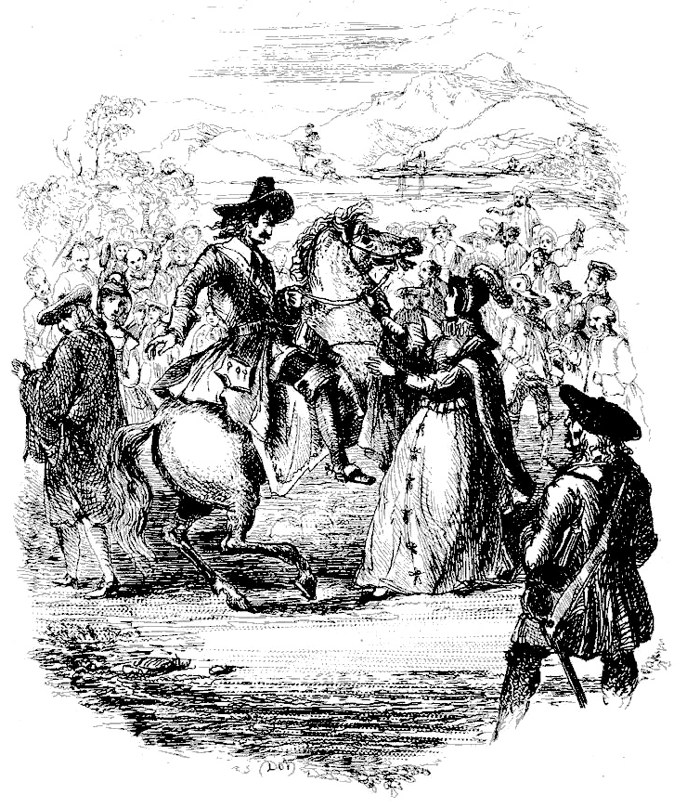
The Sheriff accosted by his Sister at the conventicle. Anno. 1677.
Vide page 283
Edinr. Hugh Paton, Carver & Gilder to the Queen, 1842.
To complete the picture, I shall give a description of a common
conventicle, one of “the rendezvouses of rebellion,” also by
Mr Blackadder:—
“Some time before the communion at East Nisbet, Mr Blackadder
kept a very great conventicle at Lilsly (Lilliesleaf) moor,
in Forrestshire. They had knowledge that the sheriff, and some
of the life-guards, were ranging Lilsly moors on the fore-part of
the day; upon which the meeting shifted their ground within
283Selkirkshire, thinking themselves safe, being out of his bounds.
Watches were set; and the forenoon’s lecture was got over without
disturbance. About the middle of the afternoon-preaching,
alarm was given that the sheriff and his party were hard at hand,
riding fast; whereupon he closed, giving the people a word of
composure against fear. The people all stood firm in their places
without moving. Two horses were brought for the minister, to
fly for his life; but he refused to go, and would not withdraw,
seeing the people kept their ground, and so dismissed the horses.
The militia came riding furiously at full gallop, and drew up on
the burn-brae, over against the people; but seeing them stand
firm, they seemed to be a little damped, and would speak nothing
for a while. At this moment, ane honest countryman cast a gray
cloak about Mr Blackadder, and put a broad bonnet on his head;
so he remained in that disguise among the people, unnoticed all
the time of the fray. The sheriff cried, ‘I charge you to dismiss
in the king’s name:’ the people answered resolutely from several
quarters, ‘We are all met here in the name of the King of heaven,
to hear the gospel, and not for harm to any man.’ The
sheriff was more damped, seeing their confidence; he was the
Laird of Heriot. His own sister was present at the meeting; and
stepping forth, in a fit of passion, took his horse by the bridle,
clapping her hands, and crying out, ‘Fye on ye, man; fye on
ye; the vengeance of God will overtake you, for marring so good
a work:’ whereat the sheriff stood like a man astonied.
“One of the soldiers comes riding in among the people, and,
laughing, said, ‘Gentlemen and friends, we hope you will do us
no harm.’ This was all a pretence: they had come to look for
the minister, and were edging nearer the tent; but they were ordered
instantly to be gone, and join their own associates, as
more appropriate companions.
“The people still refusing to dismiss, the sheriff called out
Bennet, Laird of Chesters, and Turnbull of Standhill, who were
present in the congregation, and with them he negotiated that
they would dismiss the meeting, otherwise he must use force.
Accordingly, at the entreaty of Chesters, they withdrew. This
had more influence with them than all the sheriff’s threatenings.
284The minister, all this while keeping his disguise, sat still till the
dragoons were gone, and then took horse, with a company of seven
or eight gentlemen. About twelve at night, he reached Lasswade,
(being the hind harvest,) and got to Edinburgh early in the dawning,
about the time of the opening of the ports. This was a remarkable
escape, as they had sought the minister among the crowd
during the scuffle, and passed often by him without ever discovering
him. The reason of his riding all night, was to avoid danger;
for all the nobles and gentlemen from Edinburgh were to ride
next day to the race at Caverton-edge, when the roads to Tiviotdale
would be full of them.”
Plied incessantly by the council, whom Sharpe ruled, with exaggerated
rumours of the sedition and discontent that reigned in
the west, Charles at last sent as ample powers as the primate had
desired; and followed them up by commencing active operations
for putting down such dreaded and hated meetings as the above
described.
First always in every act of oppression, the council had already
written to some Highland chieftains to raise their clans, and send
to the refractory west a sufficient number of kilted missionaries,
to propagate by forcible, if not convincing, arguments, the prelatical
gospel. The chieftains, in return, most willingly offered
their services; and the council immediately communicated to the
king their loyal tenders, requesting his royal sanction to the
measure. His majesty told them, in reply, that he had heard
with much satisfaction of their requiring the noblemen and others,
who had numerous vassals and followers in the Highlands, to
come to their aid, and of the readiness of these noblemen and
gentlemen to comply with their request. He therefore authorized
them to command all these forces to march to the disturbed shires,
or wherever conventicles had been kept, and to take effectual measures
for reducing them to due obedience “to Us and Our laws,”
by taking free quarter from those that were disaffected, disarming
such as they should suspect, and seizing and securing all horses
above such a value as they should think fit; at the same time,
causing heritors and liferenters to give bond for their tenants and
all who resided on their lands; and the tenants and fathers of
285families to do the like for those who resided with them, that they
should keep no conventicles, but live orderly, attend the parish
churches regularly, and not harbour or converse with any intercommuned
person.
For the more completely carrying these orders into execution,
they were not only to punish the disobedient, but whomsoever
“they might judge disaffected,” by fining, confining, imprisonment,
or banishment. They were also to plant garrisons wherever
they thought it necessary; and if the forces now ordered were
not sufficient, they were empowered to call to their assistance the
troops stationed in the north of England and Ireland. A report
was at this time very generally spread and believed, that the Duke
of York had said there would be no peace in the country till the
west were turned into a hunting-forest; and the conduct of those
in power appeared as if they had heard and approved of the sentiment.
BOOK XII.
286
Privy council forbids emigration—Mitchell’s trial and execution—Highland host—Committee
of the council arrive at Glasgow—Deputation from Ayr sent to the
Commissioner—Bond refused—Committee proceed to Ayr—Earl of Cassilis—Law-burrows—Case
of Lord Cochrane—Ravages of “the Highland Host”—Their
return home—Earl of Cassilis goes to court—Duke of Hamilton follows—Complaints
dismissed—State of the country—Murder of Sharpe.
Capricious as cruel in their tyranny, the council would neither
allow the Presbyterians to live peaceably at home, nor permit
them to seek liberty abroad, especially if they were persons of
rank, whom they wished to make participators of their tyranny as
they could not induce them to be willing associates in their crimes.
Having learned that several noblemen and others of high station,
disgusted with their proceedings, were preparing to leave the
country, they issued a proclamation, January 3, forbidding any
person, lord or commoner, to remove forth thereof upon any pretext
whatsoever, without a special license from them, under the
highest penalties; and to make assurance doubly sure, they ordered
the principal among them, whom they considered as their
political rivals, or who were more moderate in their principles, to
attend “a committee of the privy council,” appointed to accompany
the forces in the west country, to receive their orders and
obey their commands.[91]
287Before proceeding to detail the transactions of this savage
horde and their directors, I shall advert to a transaction still
more disgraceful to the council, as setting at defiance all moral
decency, and bursting asunder every tie that gives security to
society, which can only exist well where the obligations both of
the rulers and the ruled are held sacred. I mean the trial and
execution of James Mitchell.
Cowards are proverbially cruel, and the renegade primate was
not remarkable for courage. He seems to have been constantly
haunted with the terrors of assassination. Fearing his own
treacherous “law-skreened murders” might provoke some other
resolute arm to retaliate, he could not be at rest while Mitchell
lived, and appears to have imagined that the destruction of that
poor man was necessary to secure his own safety. He therefore
resolved, by making an example of him, to show that the sacred
person of a priest was not to be threatened with impunity. Accordingly,
Mitchell was brought from the Bass to Edinburgh in
the end of last year, and received an indictment to stand trial for
his attempt. On January 7, 1678, he was brought to the bar of
the Justiciary, where Primrose, justice-general, sat as one of his
judges, and Sir George Mackenzie acted as accuser, both of whom
were perfectly acquainted with the promise of pardon which had
been made. Primrose had been summoned as a witness, but was
dispensed with; and, had he possessed the smallest particle of
common feeling, or of common honesty, he would never have consented
to sit as a judge—much less would Mackenzie, who had
acted as his advocate on the former trial, have now come forward
as his prosecutor; yet so it was. Primrose, however, transmitted
privately to Mitchell’s advocates, a copy of the act of council in
which the assurance was contained. Lauderdale had been previously
288warned of its existence by Kincardine. The pleadings,
before entering upon the evidence, were long and ingenious. His
advocates, Sir George Lockhart and Mr John Ellis, contended
that the libel was not relevant,—as a mere attempt, when unsuccessful,
could never constitute the crime of murder; that by the
laws of this kingdom, by the civil law, and the common opinion
of civilians, it was not a capital offence, except in cases of parricide
or treason; and, besides, the act charged was assassination or
murder committed for hire—a term and a crime unknown in Scottish
law; nor is it charged against the prisoner that he was hired
by any person to commit the deed. As to the confession, if such
a thing existed, which the panel refused to acknowledge, it was
extrajudicial, not being made in presence of the assize, who are
judges of the whole proof, and therefore could not be admitted,
unless taken together with the promise of pardon by which it was
elicited. But they especially insisted upon the promise of pardon,
as rendering any charge founded upon such confession totally irrevelant.
The Lord Advocate replied, that, by act 16, parl. James VI.
nudus conatus, attempting and invading, though nothing followed,
is found relevant to infer the pain of death; and by the common
law, an attempt is capital, where the panel has been guilty of
the proximate act, and done all that it was in his power to do:—adding,
most unfairly and untruly, that Mitchell belonged to a
sect that hated and execrated the hierarchy, who deemed it lawful
to kill persons of a prelatical character; and he could prove
that Mr James himself held such opinions, which he endeavoured
to defend by wrested places of Scripture, and acknowledged that
the reason why he shot at the archbishop was, because he thought
him a persecutor of the nefarious and execrable rebels who appeared
on the Pentland Hills. As to assassination not being
known in Scots law, the term might not be there, but the nation
would be worse than the Tartars, if lying in wait with a design to
kill clandestinely, where a person, after mature deliberation, ripens
his villany and watches his opportunity, if this should not be held
in greater detestation, and punished more severely than ordinary
murder. As to being hired, if taking money constitute the criminality
289of assassination, how much greater is it when committed
to earn a higher reward. He that takes money to kill, will stab
only in the dark, and where he may escape; but the sun, and the
cross, and the confluence of all the world, cannot secure against the
stroke of the murderer who expects heaven as his reward, and
thinks that the deed deserves it. Respecting the promise of pardon,
the promise of life from a judge, who has not the power to
grant it, is of no avail unless the panel can prove that he expressly
pactioned that his confession should not operate against
him; and a confession emitted without any such regular bargain,
is of no avail, even though the judge should promise life;
for this would be to make a judge a king.[92] As to the confession
being extrajudicial, so far from this being the case, it was taken
by the authority of the privy council, the highest judicatory of
the nation, uniting in itself the powers both of the Court of Session
and the Court of Justiciary; and if confessions emitted before
the lords of session are a sole, final, and plenary probation
before the Court of Justiciary, it were absurd to suppose that a
confession emitted before the Privy Council should not be deemed
valid.
The court decided that the crime, as libelled, was relevant, i. e.
sufficient, to infer the pains of law; but, at the same time, found
that the defence if proven was relevant to secure the panel of his
life and limb. There were no witnesses to establish the fact;
his confession was the only evidence adduced; to substantiate
which, Rothes was first examined, who deponed that he saw the
panel sign the confession. Being asked, whether or not his lordship
did offer to the panel, upon his confession, to secure his life,
in these words, upon his lordship’s life, honour, and reputation?
he swore that he did not at all give any assurance to the panel
for his life, and that the panel never sought any such assurance
290from him, nor did he remember receiving any warrant from the
council for that purpose. Upon this, Mitchell entreated the Chancellor
to remember the honour of the family of Rothes, and mind
that he took him by the hand, and said—“Jacobe, man, confess;
and, as I am Chancellor of Scotland, ye shall be safe in liffe and
limb;” to which all the answer returned by the Chancellor was,
“that he hoped his reputation was not yet so low as that what
the panel said, either there or elsewhere, would be credited, since
he had sworn.” The panel, however, still averred the contrary.
Lord Hatton, Lauderdale, and Sharpe swore to the same effect.
When Sharpe had done, Nicol Somerville, agent, brother-in-law
to the panel, boldly contradicted him, and bid him remember
certain times and expressions. The archbishop, who did not much
relish getting his memory so refreshed, “fell in a mighty chaff
and passion, exceedingly unbecoming his station and the circumstances
he was then stated in, and fell a scolding before thousands
of onlookers. Nicol yielded in nothing; and after the bishop
had sworne, he cryed out that upon his salvation what he had
affirmed was true.” “And the misfortune was, that few there
but they believed Nicol better than the archbishop.”[93] Sir John
Nisbet, who was Lord Advocate at the time, and one of the committee
who examined Mitchell, summoned as a witness for the
crown—probably to prevent him from being adduced for Mitchell—was
not called, Sir George Mackenzie, it is likely, being
afraid to trust him.
After the public prosecutor had declared his proof closed, the
panel’s advocates produced the copy of the act of council, and
craved that the books of council, which were lying in the next
room, might be produced, or the clerks ordered to give extracts,
which they had formerly refused. At this Lauderdale, who had
no right to speak, “stormed mightily,” and told the court “the
books of council contained the king’s secrets, and he would not permit
them to be examined; he came there to depone as a witness,
not to be staged for perjury”—an unguarded remark, which must
have been understood by the judges as a plain confession that he
291knew he had sworn falsely; yet, with a mean servility, they would
not assert their own dignity, nor do justice to the panel. They
refused to grant warrant for producing the registers, because not
applied for before, which Fountainhall observes “choaked both
criminal law and equity, for it is never too late to urge any thing
in favour of a panel until the assize be closed.” Sir George
Lockhart defended him with admirable strength of reasoning;
and the trial, which is characterized as the most solemn which had
taken place in Scotland for a hundred years, lasted four days.
The jury returned a verdict, finding him guilty upon his own
confession; but the promise of pardon they found not proven.
He was condemned to be hanged on Friday the 18th of January.
On leaving court, the four “noble” witnesses proceeded to the
Council-chamber and inspected the books, where they saw the
indelible record of their own guilt and infamy, which still remains,
and, like convicted rogues, began each to vindicate himself. After
a vain attempt to fix it upon the late Lord Advocate, Nisbet,
had failed, Lauderdale, who seems to have had some compunctious
visitations, proposed to grant a reprieve, and refer the matter
to the king. But the primate insisted that if favour were
shown to this assassin, it would be exposing his person to the next
murderer who should attempt it. “Then,” said Lauderdale,
“let Mitchell glorify God in the Grassmarket.”[94] He was accordingly
executed, pursuant to his sentence. Sharpe, whose
vanity and ambition were unbounded, aping an equality with
royalty, had obtained an order from court, that Mitchell’s head
should be affixed on some public place of the city, as if his crime
had been high treason! But it was told him what was pronounced
for doom could not be altered; so he missed this gratification.
Nor did the fate of Mitchell tend to avert his own.
Mitchell’s misguided act was forgotten in the deeper and more
deliberate revenge of the archbishop, and in the atrocious breach
of public faith by the council. His dying declaration, widely
circulated through the country, exhibited such a view of the treachery
and almost unexampled perjury of the first ministers in the
292church and in the state, as excited universal horror and execration.[95]
Upon the 24th of January, the threatened army, better known
by the name of “the Highland Host,”[96] assembled at Stirling.
The Earls were their colonels, who received a handsome pay; but
the active officers were a set of thievish lairds; and their retainers,
wild savages, unacquainted with any other law than the will of
their chiefs, whose mandates they obeyed without inquiry upon
every occasion—only in the division of the spoil, they sometimes
helped themselves without waiting the directions of their superiors.
They amounted in all, including about two thousand regulars
and two thousand militia, to about ten thousand men, with
four field-pieces, and with a great quantity of spades, shovels, and
mattocks, as if they were marching to besiege fortified cities;
their daggers were formed to fasten on the muzzles of the muskets,
293as a kind of rude bayonets, to attack cavalry; yet were they
accompanied with other instruments that betokened any thing but
going to meet a regular force—iron shackles and thumb-screws!
The approach of such an array amazed the peaceable inhabitants
of the west, nor were the military gentlemen themselves less
astonished when they passed through a country represented as in
a state of rebellion, but where they saw every thing perfectly loyal
and tranquil. Nevertheless, the mountaineers in their march,
and during the time they remained in the west, gratified the expectations
of their employers to the full. Behaving with the
unbridled insolence of victorious mercenaries in a conquered
country, they made free with whatever they wanted without ceremony,
seizing every serviceable horse for the transport of their
baggage, even those at the ploughs in the midst of the tillage,
extorting money and beating and wounding whoever resisted,
without distinction. Nor were the few heritors who took the
bond exempted. They found, when too late, that they had violated
their consciences, or at least their consistency, in vain; and
some of them afterwards deeply lamented their compliance, regretting
that they had not rather, like the majority of their neighbours,
taken quietly the spoiling of their goods.
Their head-quarters were first at Glasgow, but the tumultuous
bands soon spread through Clydesdale, Renfrew, Cunninghame,
Kyle, and Carrick. Previously to their arrival, the ministers had
held a day of fasting, humiliation, and prayer. This the prelates
represented as preparatory to a communion, after which there was
to be a general insurrection. The report was soon discovered to
be false, but it had quickened the advance of the host, and was
either believed, or pretended to be believed, by Lauderdale; for,
when a deputation from the nobility and gentry of Ayrshire came
to Edinburgh to represent to the council the tranquillity and unimpeachable
loyalty of the whole district, he would not so much
as give them audience; and when some of them offered to engage
for the peace of the shire, the proposal was peremptorily refused,
and they were informed that no compromise could be entered
into, nothing less would be accepted than that the whole of them
present should instantly put their signatures to the bond, and
294pledge themselves for all the other heritors doing the same. The
deputation could not promise for others, and they returned to
witness the authorized enormous disorders they had employed
every legal method in their power to prevent.
On the 28th of the month, the committee of council, armed
with Justiciary power, met at Glasgow to consider their instructions
and proceed to action.[97] They were directed to order the
sheriffs of the different counties to convene all the heritors, and
require them to subscribe a bond, obliging themselves, wives,
bairns, and servants, as also their haill tenants, and cottars, with
their wives, bairns, and servants, to abstain from conventicles,
and not to receive, assist, or speak to any forfeited persons, intercommuned
ministers, or vagrant preachers, but to use their utmost
endeavours to apprehend all such, promising, if any of their
families or dependents should contravene, to present them to the
judge-ordinary that they might be fined or imprisoned for their
delinquencies. All who took the bond were to receive a protection
that their lands would not be quartered upon. They
were also to cause the leaders of the horsemen of the militia
troops to deliver to them the haill militia arms, and to disarm
heritors and all other persons, except privy councillors and military
men; but noblemen and gentlemen of quality were to be
allowed to wear their swords. The arms were to be lodged in
the Castle of Dumbarton.
Framed as this bond was, it required no ghost to tell that it
would not generally be taken; and its refusal was looked forward
to by the government with joyful anticipation, as what would justify
their pressing it with a rigour that would produce the grand,
much longed-for consummation—a desperate resistance. But
this was for the present postponed—the disarming of the people,
although not complete, prevented any immediate outbreaking,
while the example of the Duke of Hamilton, Lords Loudon,
Cochrane, and especially the constancy of Lord Cassilis, encouraged
295the great body of the gentry to continue steadfast in opposition
to a bond which the council had exceeded their powers in
enacting, and could not legally oblige the lieges to subscribe without
the authority of parliament. Besides its illegality, these
patriots considered it cruel and degrading—cruel, in forbidding
them to give relief to Christian ministers, and others in distress,
even though their own relatives, and to shut up their bowels of
compassion from them, merely on account of difference of opinion
about church government—degrading, in desiring them to act as
beadles or common messengers at arms, without their own consent.
From Glasgow the committee proceeded to Ayr; and among
their first proceedings, they ordered the Earl of Cassilis to demolish
all the meeting-houses in Carrick. The Earl represented
the probability of opposition, and having been disarmed, requested
that a party of soldiers, or at least some of the neighbouring
gentlemen, might be ordered to protect him; even this reasonable
request could not be granted; and while he hesitated, a
friendly councillor hinted that there was but an hair’s-breadth between
him and imprisonment. Such, however, was the esteem in
which this young nobleman was held, that the people themselves
demolished the offensive places of worship, rather than that he
should be troubled about them.[98] But the council, not willing
that he should get so quietly rid of the job, ordered him to bring
back the doors and all the timber of these meeting-houses, and
296burn it on the spot where they had stood. his lordship complied
with this useless but tyrannically-teasing order.
Notwithstanding the stubborn opposition it met with, the
council appeared determined to urge the bond, and issued a fresh
proclamation, February 11, forbidding any person to be received
as a tenant or servant without a certificate from the landlord or
master they last left, or from the minister of the parish, that they
had lived orderly and attended the parish church, and had not
heard any of the vagrant preachers, who without license impiously
assumed the holy orders of the church. To this was annexed a
new bond of similar import with the former, and as an encouragement,
all the members of council signed it, and appointed the
lords of session to do the same when they met. Every inducement
proved ineffectual; and the reports of the commissioners
appointed to see their orders carried into execution, were by no
means satisfactory to the council. The arms were only partially
delivered up, and the bond would not at all go down; and what
was the most vexatious part of the business, it was decidedly rejected
by some eminent lawyers in the capital, and several of the
chief nobility in Fife, Stirlingshire, and Teviotdale. The report
from Lanark, too, was provoking beyond measure; of two thousand
nine hundred heritors, only nineteen of the smallest complied.
Perceiving at length that the opposition was too extensive, and
based upon principles which could not be sneered at as fanatical,
Lauderdale is said at one of their meetings to have bared his arm
in fury, and sworn by Jehovah that he would force them to take
the bond. But it was to be tendered in another shape, under the
guise of a legal quibble—probably the new Lord Advocate might
have had the merit of suggesting it; for certainly the scheme was
more like the device of a pettifogging attorney than the counsel
of a sound statesman. When a deadly feud had arisen between
two neighbours, as the ancient Scots were an ardent irascible
race, it generally terminated fatally, and not infrequently involved
the whole relations in a species of domestic warfare, which lasted
for generations till one party was worn out or gave in. To prevent
these consequences, it had been enacted in the reign of
297James II. and confirmed in the 7th parliament of James VI.,
that an individual who feared bodily harm from another, by an
application upon oath to a magistrate, might obtain a “writ of
law-burrows” to oblige the person of whose violence he was apprehensive,
to give security that he should keep the peace, nor
“skaith or damage” the applicant. This legal pledge, a wise and
necessary precaution to insure personal safety in turbulent times,
such as the frequent minorities of the Jameses had produced, the
council contrived to convert into a more oppressive obligation
than even the bond itself. Assuming an absurd legal fiction, that
his majesty and his government were put in bodily fear by the
persons who refused to take the bond, they issued writs of law-burrows,
not only against individuals, but against a county.
By additional instructions, the committee were directed to pursue
all heritors who had not taken the bond for all conventicles
kept on their lands since the 24th of March 1674—the fine to
be exacted for each conventicle being fifty pounds. They were
also to summon them and their tenants, &c. to answer for building,
or being present at the building, of any preaching-house—the
fine imposed to be arbitrary. No nobleman or gentleman
who refused the bond was to be allowed to wear his sword, and
whoever delayed beyond six days to appear at the council-bar,
after they were summoned, were to be amerced in two years’
valued rent, and were likewise liable for the delinquencies of their
tenants and servants.
Immediately after this, a number of gentlemen in Ayrshire were
summoned before the committee, upon a charge of law-burrows;
but while they made the strongest professions of loyalty, they
steadily resisted putting their hands to a deed which they deemed
illegal, irreconcilable with their profession as Presbyterians, and
impracticable with respect to all their retainers and dependents.
One of them, unfortunately his name is not preserved, who had
indignantly refused, on being told by the president that, if he
continued obstinate, the Highlanders, who had been quartered
upon a neighbouring gentleman’s property till he had complied,
would be transferred to his till he became convinced of the propriety
of obedience, replied, “he had no answer to that argument;
298but before he would comply with the law-burrows, he would rather
go to prison.”
Lord Cochrane was next before them. He had been served
with an indictment, charging him with encouraging field and house
conventicles, and conversing with intercommuned ministers; in
a word, he or his wife, or some of his family or tenants, had rebelled
against the king by attending upon the preaching of the
gospel, impiously proclaimed by men who owned no bishop, and
who wore no surplice; and was called to answer to the charge
within twenty-four hours. His lordship objected to the shortness
of the time allowed to answer, and contended that, as his
indictment contained a capital charge, it was necessary the “diet”
or meeting should be prolonged, that he might have time to consult
with his advocates; and, when called to answer upon oath,
declined to do so, “no man being bound by any law to give his
oath, where the punishment may be in any way—corporis afflictiva,
quia nemo est dominus membrorum suorum”—destructive
to the body, because nobody is lord of his own body. The committee
told him their diets were peremptory, i. e. their meetings
were fixed for certain times, and therefore the accused were bound
to answer upon the instant; but, at the same time, passed an interlocutor,
restricting the libel to an arbitrary punishment, i. e.
declaring that whatever his lordship might depone should never
infer a capital infliction.
His lordship next pleaded that, by an act of council so late as
the 5th of October last year, all libels against conventicles were
restricted to a month backwards, consequently he was free. He
was asked if he had brought an extract of the act? He replied
he had not, but it was well enough known, and referred to their
lordships themselves and the public prosecutor. They all declared
they knew nothing about it. He then begged that the
clerk might be questioned; but they would not allow their clerk
to give evidence in that matter; and he was again called upon to
swear, otherwise he would be held as confessed. Seeing at last
that nothing else, no not even their own acts, would avail, he made
oath “that he was free of all conventicles, as were all his servants,
to the best of his knowledge.” Some new queries were
299now put to him by the Lord Advocate. He refused to answer
to any matters not alleged against him in his indictment, and appealed
to their lordships. They gave it in his favour! finding
“that he was not obliged to depone to any thing not contained
in his indictment;” and the court adjourned.
When they met in the afternoon of the same day—21st
February 1678—Lord Cathcart, Sir John Cochrane, with some
others, among whom was the Laird of Kilbirnie, refused the bond
upon the same grounds—the act of council, October the 5th.
The lords again denied their knowledge of such an act; but when
Kilbirnie, prepared for this, offered to produce a copy, they
would not receive it, saying, if there was such an act it was superseded
by posterior acts. He then offered to protest against
their proceeding without allowing him to produce it. This the
Earl of Caithness opposed, by representing the danger he incurred
in so doing; but when he persisted, his lordship suddenly
adjourned the sederunt, and thus prevented him from getting it
formally entered on the record.
While the committee were denying the provisions of their
own acts which had the least semblance of moderation, “the
Highland Host” were ravaging the devoted west without mercy.[99]
Free quarters were every where exacted by the militia and king’s
forces, although they received regular pay. But the Highlanders,
300not content with free quarters, would march in large bands to gentlemens’
and heritors’ houses, as well as their tenants, and take
up their lodgings, and force the proprietors to furnish them with
whatever they chose to demand, or they would take whatever
struck their fancy; and, when some of their own officers interposed,
would present their daggers to their breasts, and dare them
to touch their plunder. They infested the high-roads in a most
ferocious manner, not only robbing the passengers of their money
or baggage, but even stripping them of their clothes, and sending
them to travel naked for miles ere they could reach home. From
the country-folks’ and cottars’ houses, they carried off pots, pans,
wearing-apparel, bedclothes, or whatever was portable; and, notwithstanding
the government had taken care to order provisions,
both officers and men carried off or wantonly killed the cattle,
under pretence that they wanted food, unless they were bribed by
money; yet that did not always avail, the plunderers often both
pocketing the coin and driving the cattle. In some places they
proceeded the horrible length of scorching the people before large
fires, in order to extort a confession, if they suspected they had
any hidden valuables; and to these rapacious, needy hordes, the
lowest necessary utensils of civilized life were precious.
In other villages, the meanest soldiers exacted sixpence sterling
a-day, and the guards a shilling or merk Scots; their captains
and superior officers, half-crowns and crowns at their discretion,
or as they thought the poor people could procure it, threatening
to burn their houses about their ears if they did not produce sufficient
to answer their demands; besides money, the industrious,
sober, religious peasantry were constrained to furnish brandy and
tobacco; and, what was scarcely less painful, were obliged to witness
their filthy brutal excesses. Then, again, some of the ruffians
would levy contributions in order, as they pretended, to secure
the payers from plunder; yet, after they had filched them of their
money, at their departure rifled them of all they could find the
means of transporting. Their insolences to the females, our historians
have drawn a veil over, as too abominable to admit of
description.
An instance or two of their wanton waste are narrated, from
301which the extent of the damage occasioned by their visitations,
may, in some measure, be guessed at, especially as the perpetrators
were not the most savage of the crew, but men from whom better
things might have been expected. The Angus-shire troop of gentlemen
heritors, or yeomanry cavalry, as they would now be called,
commanded by the Laird of Dun, was quartered upon the lands
of Cunningham of Cunninghamhead, then a boy at school, who,
even by the strictest interpretation of the strictest acts of this detestable
period, could not be held liable to such an infliction.
Pretending that the country houses, upon which they were billetted,
were not sufficiently comfortable for persons of their situation,
these genteel troopers obliged the tenants to pay to each five pounds
sterling for “dry quarters;” but, after they had received the money,
they either remained themselves, or sent three or more footmen
of the wildest Highlanders to supply their place. A cornet
in this troop, Dunbar of Grange, nephew to the commander, perceiving
that the entrance to the old tower of Cunninghamhead
was strongly secured by an iron grating before a massy wainscoat
door—most likely expecting to find some treasure secreted within—called
for the keys that he might open and examine the interior.
The keeper being absent, he was told that there was nothing
of any consequence in the place, for the second story was
used as a granary, and the rest of the building was unoccupied.
At this, in great wrath, after abusing the people, he set fire to
the door, and blew up the grating with gunpowder. Having
forced his way in to the foot of a staircase, after ascending, he
found himself opposed by a second stout door upon the girnel,
also grated; but full of the hope of plunder, he was not thus to be
disappointed, and removed this obstruction in the same summary
manner. Sure of the prize, he rushed in with his attendants, all
equally eager with himself for a share of the spoil, but they saw
nothing except oatmeal, as they had been told, which, in their
rage at finding themselves “begunkit,” they either “fyled” with
their boots and shoes, all clay from the open field, or scattered
about and destroyed, under pretence of searching for arms. The
loss to the minor, as the greater part of the rents then were paid
in produce, has not been mentioned in money; but as the deed
302happened in the month of February, the pecuniary value, although
then high, might not be equal to the detriment its destruction
must have occasioned.
William Dickie, a merchant in Kilmarnock, had nine Highlanders
quartered upon him six weeks, during which he was obliged
to furnish them with meat and drink, and, not having sufficient
accommodation for them in his own house, was forced to pay for
“dry quarters,” i. e. good beds, in some other, as were numbers
besides. When they went off, they carried away with them
several sacks full of household stuff, and goods, and a hose full
of silver money; and, before leaving, broke two of the honest
man’s ribs—stabbed his wife in the side, who was big with child
at the time, and otherwise so terrified her, that she died in consequence.
These were the apostles of Episcopacy! and their employers
have even found apologists in our own day; but if they who, by
preaching, and prayer, and suffering, attempted to diffuse the
knowledge of the gospel in their country, were or are called fanatics,
by what epithet shall honest indignation designate the miscreants
who could endeavour by such means to obtrude an illiterate,
ignorant, dissolute, and shameless priesthood, upon an unoffending,
and comparatively uncorrupted, part of the population?
It is, however, pleasant to notice that, among the Highland
leaders, there were several exceptions. The Marquis of Atholl,
and the Earl of Perth, are particularly mentioned as having pled
the cause of justice and humanity at the council-board of the
committee, though, unhappily, their pleadings were overborne by
numbers—and their men comported themselves no better than
their comrades.
The whole may be summed up in the words of a contemporary
writer, an eyewitness, quoted by Wodrow:—“It is evidently
apparent that the proceedings of these few months by-past, are a
formed contrivance (if God in mercy prevent not) to subvert all
religion, and to ruine and depopulate the country—they are open
and evident oppression, public violence, and robbery, and invasion
of the person and goods of a free and loyal people—a violation of
the ancient rights and privileges of the lieges—and a treacherous
303raising of hatred and discord ’twixt the king and his subjects—and
consequently, manifest treason against the commonwealth and
the king’s majesty. In a word, when considered in its full extent,
and in all its heinous circumstances, it is a complication of the
most atrocious crimes that almost ever could have been conceived
or perpetrated.” The losses sustained by the county of Ayr
alone, were estimated, in an account intended to be laid before the
king if he would have received it, at one hundred and thirty-seven
thousand, four hundred and ninety-nine pounds, six shillings, Scots—or
eleven thousand, four hundred and fifty pounds sterling; and
this being only what could be ascertained and proved, was not
supposed to be one-half of the real amount of damage inflicted.
While the Highlanders were plundering openly, the committee
were equally busy in their vocation—fining or imprisoning all
who came before them, whether upon charges of attending conventicles,
or not signing the bond. On the 22d February, the
Earl of Cassilis appeared, and resolutely refusing to subscribe what
he considered as illegal in itself, and impossible for him to perform,
was ordered to answer next day to an indictment accusing
him of high crimes and misdemeanours, in frequenting conventicles,
or allowing them upon his grounds. His lordship did accordingly
appear, and denied upon oath, the truth of the averments
in the libel, only, if there had been any conventicles upon
his ground, or if his tenants had been at them, he knew nothing
but by hearsay, he himself having never seen any such meetings,
nor any of his tenants present at them. Immediately upon his
refusal to subscribe, although he had cleared himself by oath of
all the crimes laid to his charge, the lords appointed a messenger
to charge him with letters of law-burrows, to pledge himself in
the books of the privy council, that his wife, children, men, tenants,
cottars, and servants, should not be present at conventicles,
or any other disorderly meetings, under a penalty of double his
valued yearly rent; and, in case of failure, he was to be denounced
a rebel within six days. Hereupon he wrote to their
lordships entreating a week’s delay, but they refused to grant him
even this small favour, on which he immediately repaired to Edinburgh
to offer the council every satisfaction that could be legally
304required. But upon his coming thither, a proclamation was
issued, commanding all noblemen, heritors, and others of the
west country, to depart from the capital, and repair to their own
houses within three days, before which time, however, his lordship
was actually denounced at the market-cross of Ayr, and a caption
issued for apprehending him. In these circumstances to have
remained in Scotland without some security, would have been the
height of folly, he therefore repaired to London, and having obtained
the interset of Monmouth, laid a statement of his case
before the king.
Universal as the suffering was in the west, yet so impressed were
the people with a belief that the council wished some excuse for
their conduct, or some pretext for further severities, that, with
a patience unparalleled in history, they quietly endured their accumulated
grievances, without giving their oppressors the handle
so eagerly desired, and left them only the wretched plea of a rhetorical
flourish, by which they designated their quiet assemblies,[100]
to palliate or justify their atrocious aggressions on the constitution
of the country, and the common rights of mankind. Whether
the privy council felt this, or whether actuated by the dread
of some more serious movement among the nobility, as the Earl
of Loudon, the Lords Montgomery, Cathcart, and Bargeny, had
also become refractory, it is unnecessary to inquire; but, in the
latter end of February, the Highland host were ordered home,
and the whole, except a few, returned to their native hills laden
with the spoils of their more excellent neighbours.
Their march is pictured as the route of successful ravagers returning
from the sack of some devoted city. They were loaded
with spoil. A great many horses which they had stolen, were
burdened with the merchandize swept from the dealers’ shops—webs
of linen and woollen cloth; silver-plate, bearing the names
and arms of gentlemen; bundles of bedclothes, carpets, men and
womens’ wearing-apparel, pots, pans, gridirons, and a great variety
of promiscuous articles. Their wary leaders had transmitted
home large sums of money previously by safe hands, but some of
305the retreating parties were not so fortunate with their bulky packages;
the river Clyde being swollen when they came to Glasgow,
the students at College, assisted by a number of other youths,
took possession of the bridge, and allowing only forty to pass at a
time, obliged the marauders to deliver up their plunder, and then
conveyed them out at the West Port, without suffering them to
enter the town. In this manner, about two thousand were eased
of their burdens, and the custom-house nearly filled with furniture
and clothing, which were restored to their proper owners, as
far as could be effected.
Great was the chagrin of the regular clergy at the breaking up
of the Highland host. The gospel itself, they said, would depart
from the district along with it; for they themselves might leave
their parishes whenever they were removed, unless garrisons were
settled among them. Garrisons were accordingly appointed; one
hundred and twenty foot and forty horse in Blairquhan; fifty foot
and ten horse in Barskimming; and as many in Cessnock. But
these were deemed insufficient by the presbytery of Ayr, who,
seemingly taking fresh alarm at the Earl of Cassilis’ visit to the
capital, wrote to the Archbishop of Glasgow, February 28, transmitting
to his Grace “their humble opinions of several occurrences.
1st, The great and leading men of this country,” say
they, “are all gone into Edinburgh, and expect to be sheltered
there; therefore it is fit they be severely dealt with, sought after,
and forced to obedience, otherwise the commonalty, who absolutely
depend upon them, will never be brought to conformity.
2dly, The indulged ministers must be stinted of their liberty,
and some new tie laid upon them, or they absolutely removed;
for let people say what they will, most of these disorders flow from
them. 3dly, That the leading men of this country now at Edinburgh
be not protected by the council, but taken and sent hither;
for the committee think their credit highly concerned in it, if
after they have been at the pains of prosecuting them this length
the council do protect them, it will be a great discouragement
to them in their procedure for the future. 4thly, The garrisons
appointed here are but three, and too weakly manned, and they
are too far from the heart of the shire, and it will be fit two hundred
306men be left in garrison at Ayr. This is the opinion of your
Grace’s most humble and obedient sons in the Lord.”
Roused by this appeal, the archbishop immediately set out to
court, carrying with him an address from his subalterns to the same
effect—breathing out the same spirit of intolerant and unfounded
accusation of the brethren; and, by a species of unblushing falsification,
reproaching as persecutors the very men they themselves
were persecuting. It is a perfect specimen of jesuitism:—“May
it please your most Sacred Majesty: The danger this church is
exposed unto in the present circumstances, which are such as
threaten the dissolution thereof, hath necessitated us in the discharge
of our duty, to desire the Lord Archbishop of Glasgow
humbly to address your royal presence, and to offer unto your
princely consideration, how inconsistent the violent and irregular
courses of those who rent the church, (and prosecute us for no
other reason but that of our absolute and entire dependence on
your majesty’s authority,) are, with the rights and interests of your
majesty’s crown and government, as well as with the safety of
your people, and the reverence due to religion, for no other end
but that your majesty’s authority may be vindicated and rescued
from the persecution of the open disturbers of the church and their
abettors, who, for their own ends, endeavour to constrain the people,
and to debauch them equally from their loyalty as their religion.”
The council had the full countenance of the king; yet
still they do not seem to have felt entirely at ease. They therefore
sent him a summary account of all their proceedings, with a request
that he would grant them his explicit approbation, which
they enforced, as they generally did their applications for his support
in their extravagant measures, by recalling to his remembrance
the steps which had led to the late execrable rebellion, and working
upon his fears by marking a resemblance between the present
and those unhappy times; hinting, in conclusion, their suspicions
that their political rivals were chiefly to be dreaded. “We are
fully convinced that the meaner sort would not dare to appear in
such open insolences, if they were not encouraged by persons of
greater eminency, and who, by how much they are the more considerable,
are so much the more to be jaloused: tumultuary rabbles
307being then only dangerous when they get a head, and when
delusions in opinion mix themselves with faction and humorous
opposition to authority.” His majesty immediately thanked them
very heartily for their careful prosecution of what he had recommended,
in calling in his forces and accepting the offers of the
Highland noblemen, and expressed himself well pleased that the
bond should be offered to all persons and magistrates within the
ancient kingdom without exception, approved of the law-burrows
and the settled garrisons, and declared that his approbation should
have the force of an absolute indemnity and letter of thanks to all
in any way concerned in the late expedition to the west, in council,
committee, or execution, having very good reason to consider
the same as special and necessary service.
Notwithstanding his knowledge of this ample approval given
by the king to his council, and fully aware of the dangerous ground
upon which he stood, the Earl of Cassilis, with a noble boldness,
delivered in writing, under his hand, a true state of his case,
March 28, an attested copy of which was sent down by express
to the council. A few days after its receipt, they dispatched a
long reply, in which they denied the facts, and endeavoured to
confute the arguments of his lordship; but craved from his majesty’s
justice that the Earl, who had contemned his royal proclamation,
and charged his privy council with crimes of so high a
nature, might be sent down prisoner to be tried and judged according
to law.
Affairs in England at this time did not admit of such prompt
measures. The Scottish patriot had engaged some of the English
in his cause, who sympathized with his sufferings and those of his
country, and the king also, influenced by his favourite Monmouth,
either felt or pretended to feel some commiseration. Cassilis was
not sent down. The council were still further mortified by the
defection of two of the leading nobles, the Marquis of Atholl and
the Earl of Perth, when they returned from the west. They not
only did not concur in the severe methods going forward, but
from what they had observed of the peaceable conduct of the
Presbyterians, and the information they had received from some
of the noblemen, they could not continue to lend their countenance
308to the severities so unreasonably exercised against them; nor
could they avoid showing their displeasure at the violence of the
prelates, so that they were openly accused of favouring conventicles,
which now began to multiply in the north and among the
Highlands of Perthshire, where they had not formerly been wont
to be heard of; and the Bishop of Galloway, who had been sorely
annoyed with them, in a visit he had lately paid to that quarter,
thus complained to the Lord Register:—“I am surprised to
hear of the great and insolent field-conventicles in Perthshire, it
being as much influenced by the Marquis of Atholl’s example,
as directed by his authority. There is, besides many others, a
constant field-conventicle now settled in the confines of some parishes,
Methven, Gask, Tippermuir, and another, where it is marvelled
that many observe several shoals of Highlanders in their
trews, and many bare-legged, flocking thither to propagate the
mischief of ‘the good old cause.’ It is to good men no small
discouragement that a shire, under the influence and conduct of
the Marquis of Atholl and the Earl of Perth, who say they are
true sons of the church, should (being formerly orderly and obedient
to the laws) become so turbulent and schismatical, especially
since the Marquis is sheriff-principal, and one altogether devoted
to his lordship is sheriff-depute, of that shire, in whose
hands is placed the power to punish and suppress these disorders.”
So far had the expedient of letting loose a band of mountaineers
upon the west failed in answering the end proposed by the
prelates, that the devastations they had committed, had raised the
indignation of many of the nobility and country gentlemen, who
were indifferent to religious modes of worship, and averse to all
disputes about them; but having heard of the success of the Earl
of Cassilis, determined, as they were denied any redress in Scotland,
to lay their grievances before the king in person. Accordingly,
about the end of March, the Duke of Hamilton, accompanied
by the Earls of Roxburgh, Haddington, Loudon, and
others—in all about sixteen lords, together with Lieutenant-General
Drummond, and upwards of forty of the principal proprietors,
breaking through the prohibition, repaired to London;
and what was most distressing to the prelates, the Marquis of
309Atholl and the Earl of Perth, who had been members of the
committee of the privy council in the west, likewise went thither.[101]
At first the king would only permit Atholl and Perth to approach
his person—the others he refused to see, because they had left
Scotland in contempt of a proclamation; but their representation
of the mad projects going forward there, made him conclude that
certainly Lauderdale’s head was turned; yet neither would he allow
him to be blamed, or admit that he had done any thing detrimental
to his service. But as he professed his intention of
setting the Duke of Monmouth at the head of the Scottish government,
he allowed him to act as mediator upon this occasion,
and they were at last admitted into the royal presence; the more
readily perhaps, as their visit had begun to make a great noise and
awakened the jealousy of the English parliament now sitting;—who
imagined they saw, in the management of the sister kingdom,
a specimen of what they themselves might expect whenever
circumtances would permit, and anticipated their own subjection,
should Charles establish a despotism there, especially as the Duke
of York, whose papistical principles were now openly professed,
strongly abetted the cause of the Scottish Episcopal church—a
church that gloried in being the daughter of the church of Rome
by true lineal descent in the uninterrupted apostolical succession
of her bishops,[102] and who equalled her in the antichristian persecuting
spirit of her priests.
310Alarmed at the departure of so many influential personages
for London, and at receiving no reply to their former letter, the
privy council dispatched the Earl of Murray and Lord Collington
to counteract the efforts of their opponents, and carry another
epistle to his majesty, complaining of the conduct of those persons,
“who, instead of concurring with them, which as sheriffs,
and enjoying other responsible offices, they should have done,
had, with much noise and observation, gone to England without
seeking their license; but they, with humble confidence, expected
that his majesty, by his princely care and prudence, would discourage
all such endeavours as tended to enervate his royal authority
and affront his privy council; and they referred his majesty
to their messengers, two of their own number, men of known integrity
and ability, who could give him an exact account of what
had passed, and resolve such doubts as might occur to the royal
mind, which could not be settled so well by letters, and confute
such unworthy mis-reports as were raised by others who have
choosed a time when his majesty was likely to be engaged in a
foreign war, and had assembled his parliament of England.”
After these deputies had reached London, and the various statements
of the different parties had been laid before the king, a message
was received by the council from him, announcing “that he
had considered some representations made by some of his subjects
anent the late methods with the west country, with the answers
made thereunto and replies, which so fortified the representations,
that he resolved to hear and consider things fully, and, in the meantime,
commanded that the bond and law-burrows be suspended till
his further pleasure be sent, and that all the forces, except his
own guards, be immediately disbanded.” Astonished at receiving
such a command, when they expected to have got Cassilis
sent down prisoner as they had requested, they could not conceal
their disappointment and chagrin. In a reply which they transmitted
by Sir George Mackenzie, who was instantly sent off to
aid in advocating their cause, they say—“You know how much
all were inclined to give the council ready obedience till these
noblemen interested themselves in the phanatical quarrel; how
ready all were to concur in assisting his majesty both with their
311own tenants and militia; and, which is very remarkable, how
ready the gentry and heritors in every shire were to rise, between
sixty and sixteen, which, in shewing how all ways were taken
and owned for assisting the royal authority, did strike a just terror
in all those who were refractory; whereas now, the numbers
and humorousness of those who are gone up has done all they
could to loose all the foundations of authority here to such a
height, as will soon grow above correction, if it be not speedily,
vigorously, and openly adverted to by his majesty.”
Charles himself seems to have been not a little perplexed at the
unexpected step of the Scottish nobles. What had been done
in Scotland was unauthorized by any law, and unjustifiable upon
any principle of good government, but it was agreeable to the
despotic propensities of the heartless sovereign; and he was constantly
wavering between the harsh measures most congenial to his
disposition, and the milder plans he was occasionally obliged to
adopt—sending orders one day to disband the troops and dismantle
the garrisons—the next, ordering new troops to be raised and
other garrisons to be planted, till Sir George Mackenzie arrived.
Shortly after his arrival, the king was prevailed upon to give a
hearing to the Duke of Hamilton and his friends, whose ranks
were now much thinned, both their patience and purses being nearly
worn out by their long detention. An account of the interview
has been preserved, written by one who was present, which, as it
is the only authentic document we have, and not being long, I
the rather insert:—
“Upon the 25th of May, the king commanded the Duke of
Hamilton, Lord Cochrane, Sir John Cochrane, and Lieutenant-General
Drummond, to attend upon him at four of the clock,
when they appeared. The king being accompanied by the Duke
of York, Duke of Monmouth, and the treasurer, desired to know
what they had to say—why they had come to him contrary to his
proclamation? The Duke of Hamilton spoke first and said, he
humbly begged to know the reason why he had got some marks
of his majesty’s displeasure, and that since he came here (to London)
he had not the common privilege of subjects, not being admitted
to kiss his majesty’s hand. The king replied, he would
312first know what were the things they had to complain of? and he
would take his own time to answer his first request. The Duke
said, the chief encouragement he had to come and make known
his oppression was that which his majesty said to him when last
here, which was, that when he was in any way wronged he should
come to himself and make it known; and that now he could not
but come since he and others were so much wronged.
“And then there was an account given of the whole affair of
the bringing down of the Highlanders, of quartering, plundering
our lands, of having a bond offered which was both illegal and impracticable,
of being charged with law-burrows, of being denounced
thereupon, and of the proclamation forbidding us to acquaint the
king with our condition. All these were particularly insisted upon
at great length. To which the king returned, that these were
horrid things, and desired we might set them down in paper. The
treasurer said, that whatever was in these free-quarterings and in
the rest, they might have been prevented by taking of the bond,
which he conceived there was law for the imposing of, and might
be very well kept, for there were two alternatives in the bond, viz.
either to deliver them prisoners, or to put them from their land.
To which it was replied, there was no law obliging masters to apprehend
their tenants; and the furthest the act of parliament
went was, in the year 1670, to oblige masters for their families
and servants. 2dly, That masters could not be obliged to turn
their tenants out of their lands in regard that the punishment for
going to a conventicle was statute already to be a fine, much less
in proportion than the turning them out of their possessions; besides,
most part of the tenants have tacks by which, during their
time, they had good right to their possessions, and could not by
their masters be turned out for a crime that, by the law, was only
finable, and had no such certification as losing their possessions.
“The conference having been held two hours, there was a good
deal said to and fro, and the king fully and freely informed. The
conclusion of the debate was, the king told us he could not judge
of what we had said, unless we would give it under our hands,
that he might consult thereanent with his council, and know what
they had to say for themselves, and could advise him to. It was
313answered, that we came to his majesty to give an information of
what wrongs and oppressions were done to the country, hoping
his majesty would examine and redress them, but not to give in
any accusation against the council, which we knew, by law, was
very dangerous, unless his majesty would indemnify for it, which
the king refusing to do, they told him they could insist no farther,
but leave it to him to do as he thought fit. The king offered to
go out of the room, and the Duke of Hamilton kneeling, begged
the favour of his hand; but his majesty declined it, and said he
would consider upon and give an answer to what had been said,
and went away.[103]
“There were many particulars spoken to, wherewith the king
seemed to be moved, acknowledging there were overdoings and
several things done upon prejudice at particular persons; but
still, when he came this length, the Lord-Treasurer interrupted,
and gave some other turn to matters, otherwise ’tis thought there
would a more favourable answer have been given. The king signified
that he was certainly informed that there was a rebellion
designed in Scotland, but he would take care the actors in it
should be the losers by it. He endeavoured much to assure us
that, albeit we had not come to London, there would not have
been any caption executed against us upon the law-burrows.”
Dismissed with flattering promises, the nobles were not deceived;
and although they brought away with them the “word
of a prince,” they knew its value too well to place much confidence
in it. Nor did the conduct of the king belie their forebodings.
Three days after this conference, he addressed to the
managers in Scotland, a letter, the third of the kind, containing
his full approval of their proceedings; and “that the rather, because,
after trial taken by Us, we find that such as complained
refused to sign any complaint against these proceedings as illegal,”
and added, in order to prevent any future application, that
314he was highly dissatisfied with such as had caused these clamours,
and “would on all occasions proceed according to our laws against
such as endeavour to lese our prerogative and oppose our laws
and our privy council.”
No sooner was there the least appearance of any relaxation in
the execution of the severe acts, than the ministers and people
returned with renewed alacrity to their meetings; and at this
juncture, as there was a very general impression that the men in
power were sympathizing with them, the consequence was, that
conventicles again multiplied, especially in Fife and East Lothian.
At the same time, the regular clergy were more upon the alert.
The military, too, were always in readiness, and sometimes skirmishes
ensued, in which the soldiers occasionally were beat off.
Early in May, a large conventicle having convened on the flat
at Whitekirk, opposite the Bass, the deputy-governor who had
received notice of it, came upon the meeting with about forty
soldiers and some twenty country people, whom they forced
along with them. When they came near, the people resolved to
sit close and stay upon the place, and offer no violence to the soldiers,
unless they disturbed them; but in that case they resolved
to defend themselves. The soldiers came up and commanded
the people to dismiss in the king’s name. Some who were next
to them answered, they honoured the king, but were resolved to
hear the word of God when preached to them; at which one of
the soldiers struck a man that was nearest him, whereupon a strong
countryman with a staff knocked the soldier to the ground. When
they were thus engaged, a kind of general scuffle ensued. One of
the soldiers was shot, and others disarmed and dismissed unhurt,
though they had seized and sent off to Haddington two of the
persons assembled at the conventicle. A few days after, several
other persons were apprehended for having been present, from
among whom five were selected to stand trial before the Justiciary
Court at Edinburgh for the murder. Of these, three were
dismissed, but two, James Learmont and Robert Temple, were
brought to the bar; when it was urged against the relevancy of
the indictment, that “simple presence” in a crowd, where upwards
of a thousand persons were assembled, could constitute no
315crime; and it was offered to be proved that the prisoners came
to the place unarmed, or did not use arms; and not only this,
but it was also offered to be proved that others who had escaped,
and were declared fugitives, were seen to strike the deceased with
swords and halberts. Yet the lords decided that presence at unlawful
meetings or field-conventicles with arms, at which slaughter
was committed, or giving counsel or command, were sufficient,
and the case was remitted to the jury to pronounce upon the
proof. It was distinctly sworn by two witnesses that they saw
James Learmont at the meeting unarmed, but heard him say—“Let
no cowards be here to-day; but let such as have arms go
out to the foreside;” and, after having viewed the advancing
party, cry out—“They be but few, let there be no cowards.”
Another swore that he saw William Temple, with a sword under
his arm, but not drawn. The jury found the panels guilty as
libelled; but the lords of Justiciary not being quite clear about
the business, requested the opinion of the privy council, who,
after considering the process, deputed four of their number—Murray,
Linlithgow, Ross, and Collington, to express their satisfaction
with the whole procedure, and recommended that justice
should be speedily executed upon the said panels. Such, however,
was the even-handed justice of these days, that a remission
of the punishment came to the one who had been proven to be
at the conventicle with a sword, while the unarmed hearer of the
gospel was sent to the gallows. But the good man died in great
peace, declaring his adherence to the truth as stated in the Confession
of Faith, and to the despised way of preaching the gospel
and receiving the sacraments of Baptism and the Lord’s Supper
from lawfully ordained and called ministers of the gospel, who
were forced to the fields because of persecution from those who
were never friends to the church of Christ—these lords prelates
who lord it over the Lord’s inheritance. He solemnly declared
himself free of the blood of all men, especially the blood of the
man for which he was unjustly condemned, and looked forward
to that day wherein the righteous Judge will judge again, when
he makes inquisition for blood, and will call to account all the
blood shed of the saints that is dear in his sight; “before whom,”
316added he, “I am to appear immediately, and hope to receive the
sentence, well done faithful servant, enter into your master’s joy,
though not by my merit, but through the merit and purchase of
Christ.”
Learmont was a chapman, or pedlar, at that time a respectable
employment in Scotland, and appears, like many of his calling,
to have been pretty extensively known, which had provoked the
peculiar enmity of Sharpe so much, that, when the jury at first
brought in a verdict of not guilty, he was not satisfied, and the
jury were sent back. A second time they returned the same verdict,
when he instigated the Lord Advocate to threaten them
with an assize of error, though Mackenzie seldom needed any
prompter on such occasions, which prevailed upon them at last to
bring in a verdict more agreeable to the blood-thirsty pair.[104]
Increasing severities on the part of their rulers produced increasing
precautions on the part of the persecuted, who were
firmly persuaded that it was the will of God and their duty to
hear his word and endeavour to induce others to hear also—that
no human power could release them from the sacred obligations
of their oath to God, ratified by acts of the legislature, unanimously
passed, and sworn to by king, parliament, and people.
They therefore, in obedience to these obligations, and these acts,
came now in greater numbers armed to their meetings, to defend
themselves and their preachers; and even those who had at first
opposed resistance to their oppressors began to relax.
Among a people trained to judge and reason for themselves, it
317was not easy to settle the disputed questions, Who were the violators
of the law?—those who had overthrown and trampled
under foot the constitution of the country? or those who obeyed
and were determinately upholding it? Could the circumstance
of minority or majority change the nature or loosen the bonds of
religious, moral, and legal obligation? Did these depend upon
numbers, riches, or power? Politicians may answer yes; people
may temporise where to resist would involve a community, or part
of a community, in an unequal or apparently hopeless contest—they
may pay for the support of an established hierarchy, which
they do not approve, because it may be dangerous to attack it—they
may accept office under a government, coupled with restrictions
discordant to man’s natural right to worship God according
to conscience, because obedience is gainful or expedient;—but
these worthies judged differently, they considered what they
thought duty, national and personal, irrevocable and imperative;
and they left the consequences to the providence of God.
Mr Blackadder, invited again to Fife, lodged at Inchdarnie’s—then
the head-quarters of the higher ranks among the covenanters
in that district—together with his son Robert, Bailie Haddoway,
and Mr, afterwards Colonel, Cleland. On Sabbath morning he
was escorted to Divan, eight miles off. When he came, he observed
a number of arms piled in order on the ground, guns and
fowling-pieces, about the number of fifty, which, when he saw, he
asked, “what meant all this preparation? Trust rather in Jehovah,
and the shield of omnipotence.” They told him the reason,
that Prelate Sharpe had ordered to draw a hundred and five men
out of the militia, to be a standing company, on purpose to search
for and apprehend ministers who should venture within his
bounds. This and the like violence was the thing that soon
brought him to his end, and constrained peaceable folk to come
in arms, after long suffering and provocation. About the middle
of the communion, an alarm arose that the militia were advancing
their whole company. Burleigh stepped out presently and drew
up a party of the left horse, such as he could find, and went forth
to view the militia, who were within two miles of the place. Suspecting
that the meeting might be in a posture of defence, they
318had halted on a brae-side until both sermons should be ended,
that they might make a prey of the people dismissing. When
all the congregation were removed, except the minister’s body-guard,
a new alarm came that the soldiers were at hand. Upon
this Kinkel and Burleigh, with a few horse, rode up the face of
the hill, where the militia had advanced with the hope of getting
plunder, and making prisoners of the hindermost. Also the foot,
young men, who had their guns, and were on their way homeward,
did resolutely return and join the horse, which altogether
made a party between thirty and forty. The lads on foot were
drawn up beside the cavalry, such as they were. The military
with their officers were marching fast up, expecting their prey, but
halted when they perceived the party. Haddoway and Cleland
rode down to have spoken and asked their intentions; but ere
they came near, the militia wheeled about for marching off, if
they might. The footmen came up sweating with their muskets,
and were drawn up on the flanks, making a tolerable troop.
But the militia, terrified at all this apparatus, scarcely looking
over their shoulder, fled to Cupar in a dismal fear. The Presbyterian
horsemen would gladly have had orders to break after them,
which if they had done, it is said the prelatists had resolved to
throw down their arms and surrender at mercy. But the minister
did calmly dissuade them from it. “My friends, your part is to
defend yourselves from hazard, and not to pursue: your enemies
have fled—let their flight sheath your weapons and disarm your
passions. I may add without offence, that men in your case are
more formidable to see at a distance than to engage hand to hand.
But since you are in a warlike and defensive posture, remain so,
at least till your brethren be all dismissed. Conduct them
through their enemies, and be their safeguard until they get beyond
their reach; but except in case of violence, offer injury to
none.” When the militia had entered Cupar, the party rode off
quietly. About nine guarded Mr Blackadder to his quarters,
which was at an inn in the parish of Portmoak. On Monday
he returned with his friends to Edinburgh.
Next week, another remarkable communion was held at Irongray,
Dumfries-shire, when Mr Welsh presided at the earnest
319desire of his old parishioners, who had resolved to make this
public avowal of their attachment to the cause of Christ, at the
peril of all they held dear on earth; thither also Mr Blackadder
resorted. On Thursday, he took horse from Edinburgh, accompanied
by his wife and son Robert, who wished to see their relations
and join on the occasion, such a thing being so rare to
them. As they rode on their way by Leadhills towards Enterkin
and Nithsdale, they found the roads covered with people,
some on horse, others on foot. A company of eighty horse,
whereof many were respectable gentlemen from Clydesdale, and
well appointed with regular officers, had marched down Enterkin-path
in good order a little before him. They were all reasonably
well accoutred. He entered into conversation with many groups
of people, and advised them all to behave with sobriety and decorum.
The party of Clydesdale horse, when they were down
the brae of Enterkin, which was a large mile, drew up and fell
into rank at the foot of the path, and marched in good order all
along Nithsdale, till they came to Cluden-water, which was much
swollen by the rain. They rode through directly to Irongray
parish, where they took up their quarters, and kept outwatches
and sentinels all night. The men on foot came after, and took
up their lodgings where they could most conveniently, and as
near the horse as possible. They told that the Earl of Queensberry
was on his road to Edinburgh, and had met several companies
of them.
Mr Blackadder and his company took the route to Caitloch,
where he stayed that night. Here their numbers were increased
to a great concourse. On Saturday morning, they marched from
Caitloch to the cross of Meiklewood, a high place in Nithsdale,
about seven miles above Dumfries. This he understood was to be
the rendezvous of the congregation. Here they had a commanding
view of the whole country, and could not be taken by surprise.
On the one hand, the hills of Dalswinton and all the higher ground
of Kirkmahoe, lay within reach of the eye, as far as the braes of
Tinwald and Torthorwald. The range of the Galloway hills lay
on the west, all the passes of which could be distinctly seen. No
sudden change could surprise them from the south, as the flat
320holms of the Nith were visible for many miles. When Mr
Blackadder reached the place, he found a large assembly had collected.
He opened the service from these words, 1 Cor. xi. 24.
“Do this in remembrance of me.” His two chief points were—That
the ceremony was not left arbitrary to the church, but was
under a peremptory command from Christ himself. This remembrance
was to be renewed from time to time as seasons would
permit; and their divine Master’s command was still in force,
though men had inhibited and discharged them. Secondly, The
end of the institution, why it ought to be frequently celebrated
or administered; and what was especially to be commemorated.
Mr Welsh preached in the afternoon, and intimated the communion
to take place next day on a hill-side in Irongray, about four
miles distant, as it was judged convenient and more safe to shift
their ground. He durst not mention the name of the place particularly,
lest enemies might get notice and be before them; but
none failed to discover it. Early on Sabbath morning, the congregation
sat down on the Whitehill in Irongray, about three
miles above Dumfries. The meeting was very numerous, greater
than at East Nisbet, being more gentlemen and strangers from
far and near. Mr Arnot, late minister of Tongland, lectured
in the morning, and Mr Welsh preached the action-sermon, which
was his ordinary. The rest of the ministers exhorted and took
their turn at the table-service. The whole was closed in the evening
without disturbance. It was a cloudy and gloomy day, the
sky lowering and often threatening showers, but the heavy clouds
did not break, but retained their moisture, as it were to accommodate
the work; for ere the people got to their houses and quarters,
there fell a great rain which that night waxed the waters,
and most of them had to pass through both the Cairn and the
Cluden.
The Earl of Nithsdale, a papist, and Sir Robert Dalzell of
Glenae, a great enemy to these meetings, had some of their ill-set
domestics there, who waited on and heard till the time of the
afternoon sermon, and then slipt away. At the time of dismissing
there arose a cry and alarm that the dragoons were approaching,
whereupon the Clydesdale men instantly took to horse and
321formed. The gentlemen of Galloway and Nithsdale took no
posture of defence at first, as they did not intend it until they saw
imminent hazard. But seeing the motions of the Clydesdale men,
they thought it necessary to do the like. Gordon, the Laird of
Earlstone, who had been a captain in the former wars, now drew
up a large troop of Galloway horse. Another gentleman of
Nithsdale, who had also been a captain of horse, mustered up a
troop of cavalry from the holms of Kirkmahoe and about the
Nith. Four or five companies of foot, with their officers, were
ready equipped for action; and all this was done in the twinkling
of an eye, for the people were willing and resolute. Videttes
and single horsemen were despatched to various quarters, to keep
a good look out. The report brought in was, that they had only
heard a rumour of them being in the country, but could not inform
themselves if any were near at hand, or any stir in that immediate
neighbourhood. After remaining in that defensive posture
for three hours, the body of the people dispersed to their
quarters, each division accompanied with a guard of foot and
horse. In houses, barns, and empty places, most of them got
accommodated in a sort of way, within a mile or two’s distance.
They had mostly provided themselves both for board and lodging,
and the ministers were hospitably received at the houses.
The night was rainy, but watches were kept notwithstanding.
As a point of prudence, no intimation was given where the Monday’s
meeting was to be kept; this was not generally known, except
to the ministers. The tent was next day erected on another
hill-side near the head of the parish, three or four miles from the
place of the Sabbath meeting. The people seemed nothing diminished
in numbers on account of the alarm, or the unpropitious
state of the weather. The horse and foot, as usual, drew round
about the congregation, the horse being outermost. Mr Blackadder
closed this day from Heb. xiii. 1. “Let brotherly love
continue;” and, notwithstanding the alarm, he continued three
weeks preaching up and down in that country.
About the end of harvest, the last and largest out-door communion
that ever had been in Scotland, was celebrated at Colmond,
in Ayrshire. Many came in their best furniture and posture
322of defence, expecting violence, as the council had got notice
of it—there was a great number of ministers officiating—but all
the people dismissed in peace. Other conventicles did not escape
so easily. One kept at the house of the Williamwood, in the
parish of Cathcart, Renfrewshire, where Mr John Campbell and
Mr Matthew Crawford had preached, was dispersed by a party of
dragoons, who took sixty men prisoners, and plundered a great
number of women of their plaids, bibles, and whatever else they
had worth carrying away.[105]
Affairs were now drawing to a crisis. Outward troubles were
accumulating, while, unfortunately, the intestine divisions were
also on the increase. “Such,” reports one of the “outted” ministers
themselves, “as were in the fields found it difficult, amid
the jarring tempest of opinions, to give an advice. The majority
were of opinion that the times called more for meekness and patience,
than any warlike enterprise; and that it was better to continue
under suffering until they had clearer revelation than use
carnal weapons of their own; for at this time there were several
sticklers in the west stirring up the people underhand, amusing
them with designs to rise in arms, though there was no such joint
resolution, for any thing I know, either among gentry or ministers,
nor the most pious, solid, and grave among the yeomen.”
Nevertheless, the country was generally ripening for some explosion;
and it says little for the gentlemen that they did not watch
the movements of the community, as they might have directed
them into more peaceable channels; but their posterity have reason
to thank their coolness or timidity, as any arrangement with
the then government could only have been based upon allowing
323a preponderance to the crown, which even a revolution might not
have been able to impair. Mr Robert Hamilton, brother to Sir
William Hamilton of Preston, esteemed a pious man and of good
intentions, but of narrow views and severe in his temper—obstinate
and opinionative withal—stepped forward while they stood
back—held meetings in the country, and also at Edinburgh, during
this summer, for establishing a general correspondence; but
all this without acquainting the ministers or gentlemen, who were
in better capacity to manage the business.[106]
In the midst of these commotions, a convention was summoned,
and Lauderdale appointed to preside as Commissioner; for he
did not choose to face a parliament.[107] Exaggerated reports of
the “armed conventicles” had been carefully transmitted to the
king; and his early prejudices and fears, arising naturally enough
from the fate of his father, and his own papistical education, rendered
him an easy tool in the hands of the apostates and prostitutes
by whom he was surrounded, who, flattering his baser propensities
and humouring his tyrannical inclinations, held him in
the veriest bondage, while he imagined himself despotic and free!
Lauderdale and his associates, the Scottish prelatists, rendered
this criminal carelessness of Charles subservient to their own purposes.
Their usual mode was to get letters drawn out in his
name by some of their accomplices at court, and presented to the
king for his signature, which being speciously written, they obtained
in common without difficulty. These they could produce
as his own authority, warranting the most outrageous of their
own measures, and as arguments for every fresh encroachment
upon the constitutional freedom of the people, which their suspicions
supposed necessary to protect them from the consequences
of their crimes. They had long wished for a standing
324army. Charles had seen its efficacy in France. The present was
reckoned a proper time for procuring this royal defence of order
in Scotland. His majesty therefore wrote to his right trusty and
well beloved councillors, informing them that, after the full and
satisfactory information he had received from the lords they had
sent to court, he “again” approved of their proceedings and care,
and assured them of his favour, assistance, and protection upon
all occasions. “And for the more effectual demonstration thereof,”
the royal epistle went on to say, “We find it necessary to
signify to you, and by you to our people, that we are firmly resolved
to own and assert our authority, so as it may equally encourage
you and discourage all such as by seditious practices endeavour
to asperse you and lessen our authority and prerogative.
And finding by good information that the phanatics there expecting
encouragement from such as oppose you, and taking advantage
of the present juncture of affairs here,[108] have of late, with
great insolence, flocked together in open and field-conventicles,
these rendezvouses of rebellion, and have dared to oppose our
forces. Though we neither need nor do fear such insolent attempts,
yet from a just care of our authority and kindness to our
subjects there, We have thought fit to order some more forces to
be levied; and for that effect we have commanded the lords of
our treasury for raising and maintaining these troops at our
charges.”
Agreeably to this communication, a proclamation was issued,
convoking a convention, the bare-faced irony of which would be
ludicrous, did not its wickedness of purpose excite other and rather
more unpleasant sensations. In it he repeated his fulsome, because
false, protestations of the great kindness he bore to his
ancient kingdom; “and considering that all kings and states did
carefully secure themselves and their people by providing against
all such foreign invasions and intestine commotions as might make
them a prey to their enemies; and that it was not a fit time that
Scotland alone should remain without defence, especially when
these execrable field-conventicles, so justly termed rendezvouses
325of rebellion, did still grow in numbers and insolence, against
which all our present forces would not in reason be thought a
suitable security. Therefore he called a convention of the estates
of that kingdom, to meet at Edinburgh upon the 26th of June,
to provide for the safety of the kingdom, by enabling him to
raise more forces.”
During the absence of almost all the nobles and influential men
who had gone with them to London, and from whom any formidable
opposition could have arisen, Lauderdale’s friends hurried on
the elections, so that when the convention met, he was possessed
of an obedient and overwhelming majority. Eager to evince their
loyalty, the chosen band declaring themselves the echoes of the
public voice, “and considering the many frequent and renewed
professions to serve his majesty with their lives and fortunes, in
the maintenance of his honour and greatness; and that now there
was an opportunity offered to them, to make good their professions
of their zeal, duty, and affection;” “and to let the world see
the unanimous affection of his ancient kingdom for the maintenance
of his majesty’s royal greatness, authority, and government in
church and state, as established by the laws of the kingdom, they
did humbly beseech that his majesty would be graciously pleased
to accept the unanimous, ready, and cheerful offer, and humble
tender, of a new supply of eighteen hundred thousand pounds,
Scots, to be raised and paid in five years, according to the present
valuations.”[109] The act was very unpalatable to the country generally,
as they viewed not only the army as the ready instrument
of tyranny, but as a reward to the servile party who supported
Lauderdale, and to the prelatists who alone would obtain for their
poor relations and friends commissions in the army, and share
among themselves the donations of the convention.
326With the Presbyterians, its tendency was disastrous. Payment
of cess became a new and bitter source of contention among
the already too much divided sufferers. As the object for which
the money was to be raised, was expressly stated to be for the
suppression of conventicles; or, as the most strenuous opponents
of the measure justly interpreted it, for preventing the preaching
of the gospel, they at once, and without circumlocution, declared
it unlawful to submit in any manner to the exaction. The impositions
of tyrants, enacted for promoting their wicked designs
against religion and liberty, said they, are iniquitous; therefore
it is improper to pay them, especially when these designs are particularly
specified and openly avouched in the acts which require
them. No act can be binding if imposed upon a people by persons
calling themselves their representatives, when they are not
truly so, but placed in their situations by those who have broken
all their engagements, betrayed their country, its religion, liberty,
property, and all private interests, have enslaved the nation, and,
by means of these taxations, will be enabled to perpetuate that
slavery. Should it be replied, ‘that Christ paid custom, lest he
should offend, and taught us to render to Cesar the things that
are Cesar’s, and to God the things that are God’s;’ it is sufficient
to observe, that he never taught to give any thing to Cesar
in prejudice to that which is God’s; nor would it be much less
than blasphemy to say, that Christ would have paid, or permitted
his followers to pay, a tax professedly imposed for levying a war
against himself, banishing his gospel out of the land, and supporting
the scribes and pharisees and their underlings in their
wicked attempts against his disciples.
Others were of opinion that, as the money would be forcibly
taken from them, it was more adviseable to submit at once, rather
than by resistance to give their oppressors a legal pretence for not
only seizing to the amount of the tax, but perhaps double, in the
name of expenses; and as the deed was neither spontaneous, nor
willingly performed, the constrained action would come under the
head of suffering rather than of crime.
A third party chose a middle course, and paid it with a declaratory
explanation or protest. Among these was Quintin Dick,
327portioner in Dalmellington, described by Wodrow as an eminent
Christian, and prudent, wise, and knowing, far above most of his
education and station, who thus expresses himself:—“In this
hour of darkness, being much perplexed how to carry without
scandal and offence, I betook myself to God for protection and
direction, that I might be kept from any measure of denying
Christ or staving off my trouble upon any grounds but such as
might be clearly warranted by the word of God. After much
liberty in pouring out my heart to God, I was brought to weigh,
that, as my paying of it might be by some interpreted a scandal
and a sinful acquiescence in the magistrate’s sinful command; so,
on the other hand, my refusing to pay it would be the greater
scandal, being found to clash against a known command of God,
of giving to all their due, tribute to whom tribute is due; custom
to whom custom is due; and knowing that Jesus Christ for
that very same end, to evite offence, did both pay tribute himself
and commanded his followers to do it, I could see no way to refuse
payment of that cess, unless I had clashed with that command
of paying tribute unto Cesar. So, to evite the scandal of
compliance on the one hand, and disobedience to the magistrate
in matters of custom on the other, I came to the determination to
give in my cess to the collector of the shire of Ayr where I lived,
with a protestation against the magistrate’s sinful qualification of
his commands, and a full adherence unto these meetings of God’s
people, called conventicles, which in the act he declared his design
to bear down. I had no sooner done this, but I was trysted with
many sharp censures from many hands, among which this was one,
that my protestation was only to evite sufferings, and could be of
no weight, being ‘protestatio contraria facto.’ But being truly
persuaded that it is the magistrate’s right to impose and exact
cess and custom, I could have no clearness to state my sufferings
in opposition unto so express a command of God. And as to
the magistrate’s sinful qualification—having so openly declared
and protested against it—I conceive the censure of this to evite
suffering is altogether groundless; seeing the enemy has (subscribed
with my hand before witnesses) a resolute adherence to
that which they say this tends to overthrow; and if he mind to
328persecute upon the ground of owning conventicles, he has a fair
and full occasion against me under my hand.”
A few defended the refusal of payment upon the ground that
the convention having been a packed assemblage, consisting of
persons entirely under the influence of the crown—the chief and
most powerful Peers being necessarily absent, and the commissioners
of the shires and burghs returned through the sinful
means of corruption and bribery, by promises held out and favours
bestowed, by the managers and persons in power, for the purpose
of compassing their own base ends—they could not be considered
as the real representatives of the people, nor legally entitled to
impose burdens upon the lieges; and therefore the people were
not righteously obligated to pay.
Combined with the disputes relative to paying cess, were revived
with redoubled vigour the discussions anent hearing the indulged;
and “it was truly grievous to us,” laments one who was
himself a silent observer of what passed, “to see a young generation,
endued with great zeal towards God and his interests, so
far led aside in the improvement of it, as very little to know, or
seldom to be taught, meekness and patience under affliction for
Christ’s sake, or charity and mutual forbearance in love! And
to such a length did these heats come, that some did not stick to
term the famous Mr John Welsh, because he would not run so
high upon public, yea personal, acknowledgments of those steps
of defection, an Achan in the camp.”
Publications and preaching against each other succeeded, and
the minds of the wanderers began to be imbittered against the
indulged, who they thought were sitting at ease in Zion, while
they were combating upon the high places of the field. Another
meeting of ministers was therefore held at Glasgow in the end of
harvest, when fresh efforts were made by the aged veterans of the
kirk to heal the wounds under which their common mother lay
bleeding; the more distressing as inflicted by some of the most
devoted of her sons. A new and practical cause of dissension
arose from the circumstances of the times and the situation in
which the preachers and people were placed, which struck at the
root of Presbytery itself, and that was the conduct of the younger
329brethren. As the duties of presbyteries and synods had been interrupted,
the most popular preachers and their followers acted
entirely upon their own responsibility, invaded the parishes of
the indulged, preached as they listed, without being subject to any
inspection or control, and had thus widened the unhappy rent,
and given great advantage to the common enemy. The meeting
disapproved of the practice of promiscuous preaching, any where
or every where, as opportunities presented, because, when they
intruded on the parishes of the indulged, they destroyed both the
usefulness of their brethren, whose charges they disturbed, and
their own, by depriving both of the restricted liberty they enjoyed,
and which it was their duty to improve.
Instead, they recommended that the whole of the “outted”
ministers, and those who had been regularly licensed by them,
should associate themselves together in classes, and that every
fixed preacher should belong to some class to which he should be
subject and responsible; and those who were unsettled, and so could
not ordinarily attend their own class or pseudo-presbytery, should
attend such other as providence did direct. They at the same time
disapproved of the last meeting at Edinburgh, being considered
as an authoritative meeting, and pronounced it to have been only
“a committee for consideration, and to report overtures to the
general meeting of correspondents, who they were to call upon
occasion.” Nevertheless, they were still of opinion, that the first
foundation of unity must be order, and that there is no other way
of producing a humble contrite temper, warming the already too
much estranged affections, and preventing the like or worse for
the future, than that the brethren who were moderate and like-minded,
and who, they blessed God, were yet the very far greater
and better number, should meet together and consult upon fit
means for so desirable an end. The west country ministers mentioned,
likewise, that they were in consultation with their brethren
in the east, who had been treating with them, and who were also
breathing after unity and peace.
What broke up these friendly communings, does not distinctly
appear; but a very untoward circumstance took place in the parish
of Monkland, near Glasgow, which certainly did not tend to promote
330their object. On Sabbath, September 1st, the Rev. Mr
Selkirk, afterwards minister of the gospel at Crichton, had been
requested by the ministers of Glasgow to supply that parish, then
vacant; but when he attempted it, he was violently opposed and
kept out of the church by force, merely because he was favourable
to the indulged, on purpose that one of the young preachers
under the patronage of Mr Robert Hamilton, might have access
to the pulpit to inveigh against them.
Were it not upon record, and recorded too by authority of the
oppressors themselves, it would hardly be credited that many of the
best and most inoffensive men in the country were banished and
sold as slaves to the plantations, for no crime but simply because
they would not regularly attend their parish churches to hear men
preach, whom they believed incapable of instructing them in those
duties which they saw themselves daily outraging; and choosing
rather to assemble in the fields to wait upon the ministry of others
whom they preferred, by whose discourses they were enlightened
and edified, taught to live soberly, righteously, and godly in this
present world, and directed in those paths which lead to glory
and immortality in the next. Yet nearly one hundred persons,
upon such accusations, writers! farmers, merchants, men and
women, were delivered over, in the month of June this year, to
Edward Johnstoun, master of the Saint Michael of Scarborough,
now lying at Leith, for behoof of Ralph Williamson of London,
who had given security to the council to transport them to the
Indies, where they were to continue in servitude for life, and there
to dispose of them to the best advantage. Among these was the
noted Alexander Peden, who had laboured with great success in
the north of Ireland. Having lain a long time in Edinburgh jail,
he petitioned the council to be permitted to return to his old
station, especially as he had been served with no indictment,
nor was he charged with holding either house or field-conventicles
in Scotland for twelve years. The council evinced their character
by their tender mercies. They answered his petition by
banishing him to the plantations for life, and ordained him “to
lie in prison till he be transported.” He was said to have been
an instrument of much good to his fellow-passengers, and cheered
331their spirits with the hopes of deliverance when they reached
London.[110]
They were detained at sea five days longer than had been
calculated upon; and when they arrived, Mr Williamson who
should have received them was absent. Johnstoun, who had
the charge of their maintenance when there, not knowing how
he was to be reimbursed, and not being able to find any body to
take them off his hands, nor seeing any prospect of the agent, set
them ashore, and left them to shift for themselves. The English,
who sympathized much with them when they learned the cause of
their sufferings, afforded them every assistance; and the greater
part of them returned safely home after an absence of nine
months—several of them to suffer new hardships from their relentless
persecutors.
Neither rank nor age were any protection against the cruelty
of these men, who, careless about the mischief they inflicted, imposed
upon the young oaths which they could not be supposed
to understand, and ordered them to subscribe bonds they could
never fulfil. The son of Lord Semple, at this time a student in
Glasgow College, had a young man for his private tutor, of uncommon
abilities and excellent character, to whom he was much
attached. Him the council summoned to appear before them;
but he, aware of the consequences, did not comply, and his pupil
withdrew with him. They were both served with a charge of
law-burrows. The young lord’s mother, however, who was a
papist, interfered on his behalf, and represented that her son,
through the neglect of those to whom he was recommended, or
the corruption of the place, had been seduced and poisoned with
332bad principles; she therefore craved that they would recommend
such persons as would watch over his loyalty and estate during
his minority, and they appointed the Bishop of Argyle to provide
a governor to that lord. Mr Wylie went abroad and remained
at some of the foreign universities with several other
pupils.
Alexander Anderson, a youth not sixteen years of age, was
treated more harshly, because he would make no compliances.
He was sent to the plantations. Yet he left a testimony behind
him, which deserves to be remembered, dated Canongate tolbooth,
December 10th, this year. In it he remarked—“That he is
the youngest prisoner in Scotland; and that the Lord had opened
his eyes and revealed his Son in his heart since he came under the
cross; that though he had much difficulty to part with his friends
and relatives, yet he had now found, that fellowship with Christ did
much more than balance the want of the company of dearest relations;
that though he was so very young as that he could not be
admitted a witness among men, yet he hopes Christ hath taken
him to be a witness to his cause. He adheres to the work of
reformation from popery and prelacy to the National and Solemn
League and Covenants; and witnesses against the pulling down
of the government of Christ’s house, and setting up lordly prelacy,
and joining with them; and adduces a good many places of
Scripture which he conceives strike against this practice. He
makes an apology that he who is but a child should leave any
thing of this nature behind him; but says he was constrained to
it, to testify that God perfects strength out of the mouth of babes.
He regrets the indulgence as what upon both sides had been matter
of stumbling and offence among good people; and declares
his fears that a black, dreadful day is coming upon Scotland:
that it is good to seek the Lord and draw near to him. He leaves
his commendation to the cross of Christ, and blesses the Lord
for carrying him through temptations, and enabling him, one of
the lambs of his flock, to stand before great men and judges; and
closes with good wishes to all the friends of Christ.”
The Justiciary Court was this year engaged in equally cruel,
though, could we divest them of their horrors, we should say more
333ludicrous transactions. “Eight or ten witches,” Lord Fountainhall
tells us, “were panelled, all of them, except one or two,
poor miserable-like women. Some of them were brought out of
Sir Robert Hepburn of Keith’s lands; others out of Ormiston,
Crichton, and Pencaitland parishes. The first of them were delated
by those two who were burnt in Salt-Preston in May 1678,
and they divulged and named the rest, as also put forth seven in
the Lonehead of Leswade; and, if they had been permitted, were
ready to fyle by their delation sundry gentlewomen and others of
fashion; but the justices discharged them, thinking it either the
product of malice or melancholy, or the devil’s deception, in representing
such persons as present at their field-meetings who
were not there. Yet this was cried out on as a prelimiting them
from discovering those enemies of mankind. However, they were
permitted to name Mr Gideon Penman, who had been minister
at Crichton, but deprived for sundry acts of immoralitie. Two
or three of the witches constantly affirmed that he was present at
their meetings with the devil; and that when the devil called for
him, he asked, where is Mr Gideon, my chaplain? and that, ordinarily,
Mr Gideon was in the rear of all their dances, and beat
up those that were slow. He denied all, and was liberate upon
caution”—certainly the only way of disposing of this case in consistency
with common sense.
Yet were these poor unfortunates allowed to proceed with
their confessions, which were regularly registered against them.
“They declared the first thing the devil caused them do, was to
renounce their baptism; and by laying their hand on the top of
their head, and the other on the sole of their foot, to renounce all
betwixt the two to his service. But one being with child at the
time, in her resignation, excepted the child, at which the devil
was very angry. That he frequently kissed them, but his body
was cold, and his breath was like a damp air. That he cruelly
beat them when they had done the evil he had enjoined them—for
he was a most wicked and barbarous master. That sometimes
he adventured to give them the communion, or holy sacrament;
the bread like wafers—the drink, sometimes blood, and at other
times black moss-water; and preached most blasphemously. That
334sometimes he transformed them into bees, ravens, and crows; and
they flew to such and such remote places. Their confessions,”
his lordship gravely adds, “made many intelligent, sober persons
stumble much, what faith was to be adhibite to them.” How
any intelligent person could hesitate a moment upon the subject,
is strange; and it is humiliating and lamentable to add, that by
grave, intelligent judges “nine of these women, upon their own
confession (and so seemed very rational and penitent) were sentenced
to be strangled and then burnt,” instead of being sent to
some safe place of confinement to be dealt gently with; and five
of them were accordingly immolated between Leith and Edinburgh,
and other four burnt at Painston-moor, within their own
parish where they had lived.
A case came before the privy council, not long after, which it is
difficult to reconcile with the above, the proceedings were so diametrically
opposite. Cathrine Liddel brought a complaint against
Rutherford, baron-bailie, to Morrison of Prestongrange and David
Cowan in Tranent, for having seized her, an innocent woman, defamed
her as a witch, and detained her under restraint as a prisoner,
also that Cowan had pricked her with long pins, in sundry
places of her body, and bled and tortured her most cruelly. The
bailie pled that she had been denounced by other witches, laboured
under a mala fama, and therefore had been apprehended; and that
she and her son-in-law had consented to her being “searched” for
the vindication of her innocency. With regard to the pricker, he
had learned his trade from Kincaid, a famed pricker; he never
exercised his calling without the authority of a magistrate; his
trade was not condemned by any law, and all divines and lawyers,
who have written on witchcraft, acknowledge that there are such
marks, and therefore there may be an art for discerning them.
But the Chancellor remembered that he had formerly imprisoned
the famous Kincaid in Kinross, as a notorious cheat. The lords
of the privy council therefore first declared the woman innocent,
and restored her to her good name and fame, and ordered it to be
publicly intimated the next Sunday in her parish church; then
reproved Rutherford for his rashness, and forbade him in future
to proceed in such a manner, declaring that the use of torture by
335pricking or otherwise was illegal; and, as a mark of their displeasure,
ordered the pricker to prison.
Considerable changes had taken place among the higher authorities
in Scotland this year. Since the appointment of Sir
George Mackenzie of Rosehaugh to be king’s advocate, Sir
George Mackenzie of Tarbet was appointed justice-general; Sir
Thomas Wallace of Craigie, lord justice-clerk; the Bishop of
Galloway was added to the committee for public affairs; Richard
Maitland of Gogar, Sir George Gordon of Haddo, and Drummond
of Lundin, admitted councillors; and the Marquis of Montrose
made captain of the horse guards.
BOOK XIII.
336
JANUARY TO JUNE, A.D. 1679.
Public teachers and students required to take the oath of supremacy—A boy imprisoned
for refusing—Husbands punished for their wives’ contumacy—Landlords
for their tenants—Overtures of the council—Country put under military law—Reprisals—Outrages
of the commissioners of shires—Death of Sharpe—Escape
of Veitch—Murder of Inchdarnie.
Early in the beginning of the next year, (January 2, 1679,)
the council instructed the Archbishop of St Andrews and the
Bishops of Edinburgh and Aberdeen, to call before them the
principals, professors, and other office-bearers of their respective
Universities, and also all the masters of the public schools within
their boundaries, and require them to subscribe the oaths of allegiance
and supremacy, and the declaration owning the government
of the church by archbishops and bishops, and its establishment;
which Mr Alexander Dickson, professor of the Hebrew language
in the College of Edinburgh, Mr Heriot, teacher in the High
School, Mr George Sinclair, Leith, Mr Allan, his assistant, Mr
Alexander Strang, schoolmaster, Canongate, and Mr John Govan,
his assistant, with Mr James Scot, junior,—refusing to do, were
all removed from their respective charges, as examples to others;
and it appears to have had a salutary effect, as we do not read of
any “pedagogues” after this being prosecuted for contumacy. But
it was again repeated and urged by proclamation, that the due execution
of their acts, forbidding pedagogues, chaplains, and schoolmasters,
to officiate without license from their respective ordinaries,
should be observed, and that no youth should be suffered to
337enter into the second classes in colleges, or received as apprentices,
until they obliged themselves to keep the church. The reiterated
repetition of these injunctions strongly implies the repugnance
which must have existed among the people to the form of religion
then endeavoured to be forced upon them, while it exhibits in
the most glaring light that combination of clerical and magisterial
despotism, which is a necessary consequence of a state establishment
of any peculiar denomination, against the light and wishes
of a numerous and instructed part of the community. So anxious,
too, were these Scottish political puritans to preserve the youth
from any infection, that they even carried their zeal the length of
imprisoning a boy about fourteen years of age for being at a conventicle,
and subjected him to several weeks’ confinement, till
some of their own number, ashamed of such proceedings, set the
child at liberty.
Children may be restrained, but women being more difficult to
manage, it was thought proper to punish their husbands, instances
of which occurred in the cases of Sir William Fleming of Ferm,
commissary of Glasgow, and of William Anderson, the late lord
provost, who were both before the council the same day, and fined
for the delinquencies of their wives, although they themselves
seem to have been regular church-goers. Dame Margaret Stewart,
the spouse of Sir William, and Mrs Macdougal, the spouse
of the provost, were charged with having been present at a conventicle
kept by Mr John Welsh, at Langside, in the parish of
Cathcart, seated upon high chairs on either side of the said Mr
John, and with having kept company with him at other times; in
addition to which the Lady Fleming had allowed other ministers
to preach, pray, or expound Scripture in the house of Ferm, aggravated
by her entertaining the preachers before or after these
exercises. The lady did not deny that she had heard Mr Welsh
preach, and also confessed that she had been guilty of showing
hospitality to the same faithful minister of Christ; for which the
council fined Sir William, her husband, in the sum of four thousand
merks, ordaining him to pay the money or find security before
he left Edinburgh. In order, however, that a husband should
not suffer for his wife’s fault, whose conduct they yet allowed it
338was not in his power sometimes to control, they declared that if
she survived him, then his heirs should retain as much as he payed
of fine, together with interest from the time of payment, out of
the first end of her jointure; and if she should die first, her executors
were to be liable, which they alleged would be a check on
the zeal of the ladies, if they paid no regard to the interest of
their husbands. Lord Fountainhall, who records this decision,
asks, with all due legal gravity, “But what if they have no executors?
or if it be the husband or her own children?”
Not only were husbands thus prosecuted for their ladies’ misdemeanours,
but landlords were made accountable for the conduct
of their tenants. A most oppressive instance occurred in the case
of one George Turnbull, a baxter or baker in Edinburgh, himself
a regular conformist. The council being informed that conventicles
were held in the chamber of Isobel Crawford, which she
rented in the flat of a house belonging to him, he was summoned
before them and interrogated upon oath, as to the rent of the
whole flat? He stated it at one hundred pounds per annum; and
three conventicles being either proved or not denied to have met
there, he was fined three hundred pounds, Scots, or twenty-five
pounds sterling, for what he was neither accessary to, nor had any
knowledge of.
Tyranny is never stationary when introduced into a country,
until it either level all resistance, and degrade a nation into one
quiescent mass of torpid subjection, or rouse the people to a
pitch of determined enthusiastic irresistless exertion, which drives
their oppressors from the land. At this period, the evident design
of the Scottish rulers was to accomplish the former limb
of the alternative, though it eventually led to the last. “The
overtures” sent by the “committee for public affairs,” to be
proposed to his sacred majesty by the Duke of Lauderdale, to
heal the schism and disorders of the church, plainly evidence
this. Their grand object was to root out all conventicles; and
now that the forces were raised, whereby these seditious disorders
might, as they imagined, be easily and effectually suppressed,
they represented to the king the necessity of his empowering
the council to nominate sheriff-deputes, bailie-deputes of
339regalities, and stewart-deputes, to enforce their acts against withdrawers
from public ordinances, keepers of conventicles, and those
guilty of conversing with intercommuned persons or vagrant
preachers, whenever the resident deputes had been remiss in their
duty; and that his majesty’s forces might be ordered upon all
occasions, when required, to concur with these officers, or whoever
might be appointed by them for the more speedy and effectual
execution of their sentences and decrees. His majesty gave his
hearty approval to the proposal, and the whole south and west of
Scotland was placed under military law, as far at least as assembling
to attend upon the ordinances of religion was concerned.
All officers and soldiers of the standing army or militia were commanded
forcibly to dissipate the persons found by them at conventicles,
and previously indemnified for any slaughter or mutilation
they might commit in so doing. They were to seize the
preachers and as many of the hearers as they could; the former
to be carried to prison, the latter to be detained till they found
sufficient caution to answer for their crimes according to law; and
they were empowered to carry off the upper garments of such as
they could not secure, in order to be used in evidence against them
when afterwards apprehended. All arms, and the horses of all
who were armed, were ordered to be seized, and the meanest sentinel
was warranted to break open doors and other lockfast places
in searching after suspected or intercommuned persons.[111]
To stimulate their satellites in the work of proscription and
blood, who were already allowed to share in the plunder of those
they seized, murdered, or robbed, and to urge their activity against
340the more eminent, and therefore more hated of those men, of
whom the earth was not worthy—they were now offered additional
rewards for their destruction. The price set upon the head of that
“notour traitor, Mr John Welsh,” dead or alive, was nine thousand
merks; for his accomplices, Mr Semple and Mr Arnot, three
thousand; for any field-preacher declared fugitive, two thousand;
and for any other “vagrant” or itinerant preacher, five hundred
merks. The reasons assigned for such high rewards, were worthy
the hypocrites by whom they were expressed—although we cannot
help being astonished at the unblushing impudence which could
publish falsehoods, so widely known to be such, without even the
shadow of verisimilitude, to shield them from contempt—these
were, to prevent the people from being seduced from public ordinances,
or debauched to atheism and popery, by being exposed to
hear Jesuits or any other irregular persons who dared take upon
them the sacred office of the ministry.
About the beginning of March, the military apostles entered
upon their labours; and among their first exploits was the seizure
of twenty-three countrymen in Evandale, chiefly shepherds, whom
they straitly examined upon oath, whether they had seen any men
in arms going through the country during the last month. In
the latter end of the same month, having been informed of a large
meeting assembled to hear sermon at Cambeshead, in the parish
of Lesmahago, near Lanark, a party went on purpose to disperse
them; but on learning their numbers, and that many of them
were well armed, they did not think it adviseable to attack them;
but retiring to a little distance, they rifled some women who were
going to the meeting of their plaids and Bibles, and took several
men prisoners. When intelligence of this was brought to the
meeting, a number of the men in arms were sent to demand the
release of the prisoners and the restoration of the plunder. The
officer in command refused to do either, and a scuffle ensued, in
which the captain was wounded and a few of the soldiers taken
prisoners, who were shortly after set at liberty without harm. As
soon as an account of this trifling affair reached Glasgow, Lord
Ross marched with a considerable party towards Lanark, and
harassed the surrounding country for some weeks; and the council
341upon being apprised of it, ordered the commissioners for
assessment in the shire to meet and provide hay, straw, and corn
for the forces, who were immediately to be despatched thither to
crush the rebels.
In Galloway, Gordon of Earlston and thirteen other gentlemen,
who had been summoned for worshipping God or hearing his word
preached in private houses or in the fields, or of speaking or lodging
some others who had been guilty of the like enormities, were
denounced and outlawed as if they had been malefactors of the
deepest die. In Fife, three were fined; one in a thousand pounds
Scots; another in one hundred; and the third in five hundred
merks.
Pursuing their favourite measures, the prelatic myrmidons had
successfully fanned, by their domineering insolence, the discontent
they had widely kindled in the west, from which there appeared no
means of escape, but by some desperate effort to which every day’s
report of fresh aggression was rapidly driving the people. A few of
the many irritating incidents which occurred have been preserved,
but the amount of the suffering can only be guessed. The slightest
attempts at what has been improperly denominated retaliation
have been carefully registered. Of these I shall give two specimens,
which were then paraded as instances of their “hellish principles,”
and which, though they were not the actions of religious men,
have been treated as the effects of fanaticism. The first was a
trick played upon Major Johnston, one of the captains of the train-band
of Edinburgh, a violent persecutor, but by whom was never
discovered. “One night,” says Kirkton, “a boy came and told
Johnston there was a conventicle in a certain close; for he was
famously known for an active agent of satan to suppress preachings
in the city and apprehend ministers, though sometimes he took
money to overlook them. He (ever ready for such mischief) presently
took a party of the town-guard, came and entered the house,
where he found some men met about business, who seeing them
enter so rudely with their weapons, did challenge him why he
came so briskly. Finding no conventicle there, he and they began
to jostle, (who were the aggressors I cannot tell,) but he with
his men were the first provokers. Some of the gentlemen shot,
342as is said, a tobacco-stapple, or piece of broken money, at one of
his followers, a soldier from the Castle, who fell, and died within
ten days after. Another gripped the major himself, and cast him
down on the floor; and they were so incensed that they offered
to kill him. But he crying out wofully to spare his life, said—‘For
Christ’s sake, send me not to hell,’ and swore he would
never trouble any of these meetings again. Whether he was
required to say this, or said it in his fear, I cannot tell; whereupon
they spared his life, and let him and his party go not without
some blae strokes they had got. The gentlemen then withdrew
to their own quarters.
“The landlady of the house expecting trouble, left it also, which
was shortly broken up, rifled, and made a prey of by order. The
wretched man, the major, being enraged, forgetting the terror he
was in, and all the vows he had sworn to grow better, did first
stir up the council to seize the house, break open the door, and
plunder all. On the morrow or third day, a narrow and formidable
search was made throughout the town for strangers, and to
find out the persons who had offered such an affront to their major,
so useful a servant, not only to the town of Edinburgh, but
to the prelates and their interest. Linlithgow’s men, with the
town constables, were appointed to search. However, none of
the persons present were found.”
I add as one instance of the manner in which these affairs were
represented by the leaders of the persecution, the edition they gave
of the affair to Lauderdale, in the despatches they sent to court.
“Eighteen or twenty men, prompted by the bloody principles
of their traitorous books, did send for the major to the house of
one Mrs Crawford, a known and irregular fanatic, and, at his entry
discharged several shots at him; after which, with drawn
swords, they beat, bruised, and threatened to kill him, if he would
not swear never to dissipate conventicles, which he having refused,
according to his duty, they mortally wounded him and some that
were with him.”
Immediately the hue and cry was raised, offering a reward of
one thousand merks to any person who should discover and apprehend
any of the assassinates. Several persons were mentioned,
343chiefly men already intercommuned themselves, or the sons or relatives
of such as were, but none were ever taken or tried for the
affray. The same day, the council ordered the magistrates to
cause their constables take up a list of the names of all the inhabitants
between sixteen and sixty, and deliver it to the council;
and likewise a list of all the strangers who lodged in town, to be
delivered each night at ten o’clock to the major-general or commanding
officer in his absence, under a penalty of one hundred
merks for each name omitted. And, besides, the magistrates
were required to turn out of the burgh and suburbs the wives
and families of all “outted” ministers and vagrant preachers,
under a penalty of one hundred pounds, sterling, for each family
who should be found residing there after the 20th day of the
month. This capriciously cruel order, at once useless and tormenting,
does not appear to have been very rigorously enforced
by the magistrates, for “few ministers,” one of themselves informs
us, “went off the town, but retired to more private houses,
and hid themselves for a season, only it caused them disperse
among different friends’ houses, and keep themselves under hiding
for a season.”
The other incident was the murder of two soldiers at Loudonhill,
under very suspicious circumstances, also by persons who
were never discovered. Three privates of Captain Maitland’s
company had been quartered upon a petty farmer who had not
paid the cess, and continued there nearly ten days, behaving rather
more civilly than many of their fellows. The man himself being
sick, his wife or the maid-servant desired them to leave, otherwise
they might repent it. They replied, they could not do so without
orders. On a Saturday, one of them went to Newmills, where he
remained over night. But about two o’clock on the Sabbath
morning, five horsemen and as many foot came and knocked
loudly at the door of the barn, where the remaining two soldiers
were lying. Supposing it to be their comrade, one of them rose
in his shirt and opened the door, when he was saluted with—“Come
out you damned rogues,” and instantly shot through the
body, he fell dead upon the spot; the other alarmed got up,
and was attempting to shut the door, when he also received a
344shot which wounded him on the thigh. The assassin who was on
horseback dismounting, seized the soldier by the throat, and they
struggled together till another of the rogues came up and knocked
him down. While he lay stupified by the blow, the murderers
went off, taking with them all the arms and clothes they could
find. The wounded man lingered a few days, and expired. The
people of the house declared their ignorance of the whole matter,
only the deceased had told them that the ruffian who shot
him appeared to him to be one John Scarlet, a tinker; the rest
he could not distinctly see, owing to the darkness and his own
confusion. Scarlet was a notorious rogue who roved through
the country with several women he called his wives, and who some
years before this had been apprehended as a vagabond, and gifted
to a French recruiting officer, but had contrived to raise a mutiny
in the vessel which was carrying him across the channel, and made
his escape; since when he had returned to his old avocation, and
was one of the gang attending Captain Carstairs when Garret was
wounded.[112]
Perhaps nothing places the conduct of the Scottish government
in a more disgraceful light than the current belief which pervaded
the country, that they were implicated in this foul murder,
at least that they were capable of abetting it, although it be extremely
difficult to perceive what advantage they could reap from
it. All their proclamations and abuse of the fanatics availed
nothing, but only to confirm the general report that they had authorized
the assassination merely to throw additional odium on
the already grievously calumniated wanderers. The heritors of
Ayrshire, who had seen their country devastated when there was
much less cause, took the alarm, and despatched the Earl of
Loudon, Lord Cochran, and Sir John, to explain the state of the
345country, and to express their detestation of the deed. The armed
field-meetings, attended by numbers of the commonalty, had increased
on the confines of their own and the neighbouring shires,
occasioned they alleged by a few unsound, turbulent, hotheaded
preachers, most part whereof were never ministers of the church
of Scotland, making it their work to draw people to separation
and schism from pure ordinances, and instil into them the seeds
of rebellion by their exhortations and doctrine.
Unhappily, the contentions among the persecuted continued, and
a root of bitterness sprung up among them, which produced the
most lamentable fruit. Instead of dropping minor differences, they
seemed to set a higher value on them as the dangers attendant on
holding them increased. Paying cess and hearing the indulged
became bars to fellowship; and Robert Hamilton, who now took
the lead, publicly forbade any of the compilers to join with them
or bring arms; nor was it without difficulty that Richard Cameron
got them to forbear proceeding with such an high hand at such a
time; but although he smothered these heats for a season, there
was a secret heart-burning left which he could not extinguish.
Yet it is impossible not to sympathize with the side who felt most
keenly, even when a knowledge of the consequences may have
led us to disapprove of their too rigid particularity, for which they
themselves suffered so severely. At all events, when men have
evinced the purity of their motives by their disinterestedness and
the sincerity of their principles, by suffering for them unto the
death, it becomes those who are sitting at ease, and not exposed
to their trials, to speak and write very tenderly about them.
Oppressions under form of law kept pace with those without
it;—if the mere acts of men in place can be called in any sense
legal while they are trampling under foot the constitutional rights
of their countrymen, simply because these men happen to hold
offices, the names of which are in the statute-book, or pervert possession
of power, a proper exercise of which would be legal. The
council, the willing slaves of the clergy, eagerly laid hold of the story
of the popish plot in England to increase their severities against
field-preaching, the antipathy at which raged with every symptom
of monomania among the prelatic hypocrites. They issued a
346fierce proclamation against the papists, and did nothing to disturb
their increasing numbers; but they nominated an especial committee
of thirteen of their own number, to meet during the spring
vacation, to whom they delegated the judicial authority of the
bench and the active duties of the executive. It comprised the
two Archbishops of St Andrews and Glasgow, and the Bishop of
Galloway, with the law officers of the crown, any three to be a
quorum; and as the Bishop of Galloway had obtained a dispensation
allowing him to reside constantly in Edinburgh, they were
always certain of an ecclesiastical president or director. They
were instructed to issue orders for executing the laws as to the
public peace, particularly those against conventicles; to call before
them noted delinquents, secure their persons and examine
them upon oath, pronounce sentences and decreets against the
guilty, and issue such orders as they should find necessary to
magistrates and officers of the forces; and with power to nominate
a committee of themselves by turns, to perform what was
committed to them, or call the council upon any emergency; and
the whole concluded with the ominous charge to use diligence in
discovering any powder or lead lately brought into the kingdom.
On the report of this committee (May 1st), the council ordered
the Earl of Linlithgow, commander-in-chief, to despatch a body
of horse, foot, and dragoons, to scour the country, especially
where Welsh, Cameron, Kid, or Douglas kept their conventicles;
to apprehend them where they might be found; and, in case of
resistance, to pursue them to the death, and declared that neither
officers nor soldiers should be called in question, civilly or criminally,
for the same.
Armed with such powers and secured by such indemnity, it
may be readily supposed what ravages would be committed by a
banditti, composed, as the standing army of that day in Scotland
was, of all the idle, dissolute reprobates that could be collected.
These roamed through the country, objects of hatred and dread
to the humbler ranks.
The commissioners of shires and sheriff-deputes were more obnoxious
to the middling and higher classes, whom they summoned
to their courts, and plundered and imprisoned if they appeared, or
347intercommuned if they did not. The cruelties they exercised
upon the domestics of the petty heritors who were forced under
hiding, to make them discover the haunts of their relatives or
masters, are almost incredible, and rivalled the tortures of the inquisition;
beating and wounding with their muskets or bayonets
were common, and burning matches were often applied between
the fingers to extort a confession from these faithful confidents of
the suspected. When the honest, industrious tenantry and small
farmers were ruined by fines, their houses were poinded, and themselves
turned out to bear the pelting of the pitiless storm, nor
dared their neighbours either shelter or sooth them, under pain of
being also sent to wander houseless on the heath—reduced to
desperation for “disobeying the discipline of the church,” or
“wilfully withdrawing from the ordinary meetings for divine
worship,”—it would not have been at all wonderful if the wanderers
had perpetrated the horrible deeds of which they were falsely
accused; nor can it appear strange, when every avenue to relief
was shut up, that they should take whatever methods of redressing
their wrongs they could command; neither was it conduct unprecedented
in history, their seeking to rid themselves of their
most violent, lawless persecutors, of whom they could not by any
legal or moderate measures get free, by methods which were not
strictly legal. It would require powerful logic to convince persons
suffering under the lash of distorted laws, that they were in
duty bound to allow their persecutors the safety and privilege of
men who had never violated law.
But the death of Sharpe, however it might be justified or extenuated,
was altogether accidental at the time, and cannot be
traced to any other source than his own atrocious tyranny. His
agents were extremely active in Fife; for the numerous conventicles
held in his own diocese particularly annoyed him. One of
his especial “familiars” was William Carmichael, a bankrupt merchant,
formerly a bailie in Edinburgh, now one of the commissioners
for suppressing conventicles, of licentious and profligate
habits, consequently greedy of money, and fit for any vile
job to procure it. His enormities had rendered him an object of
general detestation, but his excessive exactions had ruined many
348respectable heritors and tenants, to whom he was become particularly
obnoxious. Several of these individuals, some of whom
were gentlemen of good families, interdicted the common intercourse
of society, and hunted like wild beasts on the mountains,
determined to take personal vengeance on this vile instrument of
their unjust suffering;[113] and for this purpose, nine of them, pretty
early on Saturday morning, the 3d of May, had traversed the
fields about Cupar for a considerable time, in search of the commissioner,
who they understood was hunting on the moor; but a
shepherd had informed him that some gentlemen on horseback
were inquiring after him; and he not being very anxious to encounter
them, left his sport abruptly, and returned home.
They also, tired of their fruitless search, were talking about
their further proceedings, when a boy came from Baldinny—Robert
Black’s farm—and said the goodwife had sent him to see
how they had sped. They told him they had missed him, and
asked in return if he knew any thing of three of their number
who had not joined them. He told them they were gone. They
desired him to go back and see where they were gone to, which
he did, but quickly returning, said—“Gentlemen, there is the
bishop’s coach; our gudewife desired me to tell you,” which they
seeing betwixt Ceres and Blebo-hole, said—“Truly this is of
God, and it seemeth that God hath delivered him into our hands;
let us not draw back but pursue.”
Whereupon all agreed to follow; but the question was started,
what should be done with him? “I will not move one foot farther,”
349said George Fleming, “for if we spare his life our hazard
shall be no less, and likewise his cruelty shall be greater; surely
we have a clear call to execute God’s justice upon him, now when
in such a capacity.” So said several others. Hackston of Rathillet
opposed the shedding of blood; and besides, he thought it
was an act of the last consequence to the nation and the church,
and what required much greater deliberation. James Russell,
who writes the account, said “it had been born in upon his spirit
some days before in prayer, that the Lord would employ him in
some piece of service or it was long, and that there would be
some great man who was an enemy to the kirk of God cut off.”
“He was forced to devote himself to God, and enter in a covenant
with the Lord, and renewed all his former vows and engagements
against papists, prelates, indulgences, and all that was enemies
to the work of God and opposed the flourishing of Christ’s
kingdom; and that he should not refuse nor draw back whenever
the Lord should call him to act for him, as far as the Lord should
enable him and give him strength, though there should be never
so much seeming hazard.”
After alluding to the case of Mitchell, he was asked what they
should do with the bishop. He replied, he durst not but execute
the justice of God upon him “for the innocent blood he
had shed.” William Danziel spoke to the same purpose. Then
they all with one consent urged Rathillet to command them that
they might not delay.[114] Rathillet declined. “The Lord,” he
said, “was his witness, he was willing to venture all he had for
the interest of Christ, yet he durst not lead them on to that action,
there being a known prejudice betwixt the bishop and him,
which would mar the glory of the action; for it would be imputed
to his particular revenge, and that God was his witness he did
nothing on that account; but he would not hinder them from
350what God had called them to, and that he would not leave them.”
On hearing this, John Balfour cried out—“Gentlemen! follow
me!” Immediately they all set off at the gallop across the hills
for Magus moor. James Russell outrode the others; and seeing
the bishop, who had taken the alarm, and was looking out at the
door, cast away his cloak, and cried “Judas be taken.” The
bishop screamed violently to the coachman—“Drive! drive!
drive!” The coachman drove furiously, endeavouring to keep
off the pursuer by striking his horse with his whip, on which
Russell fired, and called to his companions to come up. They
throwing away their cloaks, put their horses to the speed, and
kept firing at the coach, several shots passing through it. One
of the servants having cocked his carabine, was about to fire when
Alexander Henderson gripped him by the neck, threw him down,
and pulled it out of his hand. Andrew Henderson outran the
coach and struck the horse in the face with his sword. Russell
at the same time ordered the postilion to stand, which he refusing,
he struck him on the face, dismounted him, and cut the traces of
the coach, which stopped it till the rest came up.
They found the bishop in the coach with his daughter, both
unhurt, though several shots had passed through the carriage.
Opening the door, Russell, who took the lead, again desired him
to come out, that no prejudice might befall his daughter, whom
they would not willingly hurt. He still hesitated, protesting that
he never wronged any of them. Russell declared before the Lord
that it was no particular interest, nor yet for any wrong that he
had done to him, but because he had betrayed the church, like
Judas, and for eighteen years had wrung his hands in the blood
of the saints. John Balfour, on horseback, said—“God is our
witness, it is not for any wrong thou hast done to me, nor yet for
any fear of what thou couldest do to me, but because thou hast
been a murderer of many a poor soul in the kirk of Scotland, and
a betrayer of the church, and an open enemy and persecutor of
Jesus Christ and his members, whose blood thou hast shed like
water on the earth, and therefore thou shalt die;” and fired a
pistol. James Russell desired him the third time to come forth,
and prepare for death, judgment, and eternity. The bishop said,
351“Save my life, and I will save yours.” The other replied, “I
know it is neither in your power to save us or to kill us; and I
again declare, it is not for any particular feud of quarrel I have
at you which moves me to this attempt, but for the blood shed,
not only after Pentland, but several times since, and for your perjury
and shedding the blood of Mr James Mitchell, and having
a hand in the death of James Learmont, which crimes cry with a
loud voice to Heaven for vengeance; and we are this day to execute
it,” and thrust his shabel at him. He then offered money.
“Thy money perish with thee,” was the reply; and one of the
company remarked, “seeing there have been so many lives taken
for him, for which their is no sign of repentance, we will not be
innocent if any more be taken that way.” Another wounded him
with a sword, and he cried, “Fy, fy, I am gone.”
Being called to come out of the coach, “I am gone already,”
he said, “what need more.” He was desired to pray; but, turning
towards the captain, he said, “Save my life; for God’s sake,
save my life! save my life!” offering him money, and promising
to lay down his Episcopal function. He told him he had shown
no mercy, and needed expect none. Seeing Rathillet at a distance,
he crept on his hands and his knees towards him, saying,
“I know you are a gentleman, you will protect me.” Mr Hackston
said, “I shall never lay a hand on you,” and retired a little.
He then turned to the others, and piteously entreated that they
would save the life of an old man, and he would obtain them a
remission. Balfour told him they could not spare him; and if
he would not call on God, they knew what to do.
His daughter attempted to interpose, as she had done before,
between her father and his antagonists, when Andrew Guillan
kept her back, to secure her from hurt or danger. She fell on
her knees, and, weeping bitterly, joined her entreaties with those
of her father. Guillan also pleaded for his life; but it was now
impossible for them to listen to any supplication. The bishop
was a man whose most sacred oaths could not be trusted; and,
to save their own lives, they were under the cruel necessity of
taking his. Another volley of shot was their answer to his supplications,
and he fell back and lay as dead. They then went off
352a little; and his daughter attempting to raise him, exclaimed—“Oh!
there is life in him yet;” which they hearing returned,
and James Russell “haked his head in pieces.” His daughter,
the miserable spectatress of this sad event, cursed him, and called
him a bloody murderer. He answered, they were not murderers,
for they were sent to execute God’s vengeance on him.
As soon as they had finished the unfortunate primate, they
went to the coach, and took a pair of pistols and a trunk, which
upon opening, they found contained only his daughter’s clothes,
and left untouched, but took from another a little box and all the
papers they could find.[115] They likewise disarmed his attendants,
five in number, and carried away their arms. It was not a little
remarkable, that though this tragedy was acted at noon, in broad
day, and parties of soldiers were constantly patrolling the country,
along with numbers of sheriff-officers’ underlings and the archbishop’s
own numerous myrmidons; yet the actors were not interrupted
in their performance, nor did any of them ever suffer
for the part they played. Two only, who were present as spectators,
were executed, and one of them, the poor weaver Guillan,
had been called, most unexpectedly on his part, to hold the horses.
Among the papers were found—a gift of non-entries of several
gentlemen’s estates in Fife and elsewhere, with instructions and
informations how to prosecute in order to turn the present possessors
out of the lands; the patent of the bishopric of Dunkeld
in favour of Mr Andrew Bruce, archdeacon of St Andrews;
several presentations to churches of which the king was patron;
instructions to conjunct-deputies; and new gifts of the heritors
fines.
Sharpe, when he met his fate, was returning home from Edinburgh,
where he had been arranging matters for heating the fiery
furnace yet seven times hotter, previously to his going to court,
353and had there drawn out a proclamation afterwards issued, which,
had it been known, would have justified the extremest measures
on the part of the proscribed, persecuted wanderers, even had he
not previously placed himself out of the protection of the law.
By it, whoever should go with any arms to field-meetings, were
to be proceeded against as traitors; and lest any should suppose,
from the rigour used against such as went to conventicles in arms,
that there was any intention to slacken the prosecutions against
other field-conventicles, all judges and officers were required to
put all former laws and commands in rigorous execution, even
against those who frequented field-meetings without arms, repeating
as the reason of such severity, the foul and absurd calumny
“that those meetings do certainly tend to the ruin and reproach
of the Christian religion, and to the introduction of popery and
heresy, the subversion of monarchy, and the contempt of all
laws and government.”
Thus fell James Sharpe, Archbishop of St Andrews, Primate
of Scotland, a man universally detested by those whom he had
deserted and betrayed, and not much regarded by those to whose
ranks he had gone over. He has left a memory and a fate as
woful beacons to religious turncoats, who assume and relinquish
the garb of a profession for secular purposes, without feeling the
influence or experiencing the consolations of real religion, who
find the road disappointment and the end death.
Not less remarkable was the escape of Mr William Veitch,
who had been marked out to die by the primate. Having been
denounced for being present at Pentland, although he had not
been there, he retired to Northumberland, where he had resided
with his family for several years, exercising his ministry with great
success among a numerous congregation at Harnam-hall, whence
he removed to Stauntin-hall in 1677, where he remained till January
this year, when he was taken from his bed about eight o’clock
in the morning, and carried prisoner to Edinburgh. On the 22d
of February, he was brought before a committee of the council,
whereof Sharpe was preses. As he was coming along the pavement,
the Earl of Mar’s gentleman came to him from his master,
desiring him to give the archbishop his titles, as that would likely
354prevail much with the bishop for his liberty. Veitch sending his
service to the Earl, answered that he was resolved to act according
to his light. The orders from the king to the council were, that
they should proceed against him with all diligence, according to
the utmost severity of law, his majesty being fully resolved to put
it strictly in execution, in order “to dash the groundless hopes
of knaves and fools, who expected a toleration!” The archbishop
put many questions to him to see if he could ensnare him,
which were urged by Paterson, the Bishop of Edinburgh, one of
which was—“Have you taken the covenant?” He answered,
“All that see me at this honourable board may easily perceive
that I was not capable to take the covenant when you and the
other ministers of Scotland tendered it.” At this the whole company
fell a laughing, which nettled the bishop. “But,” says he,
“did you never take the covenant since?” To which he replied,
“I judge myself obliged to covenant away myself to God, and
frequently to renew it.” At which Paterson stood up and said—“My
lord, you will get no good of this man; he is all for evasions.
But,” said he, “was you not at Pentland fight?” To
which he replied, “If you will give me power and liberty to seek
witnesses to prove it, I was alibi, having been all that night and
morning at Edinburgh.”
Being put out a considerable time, he was called in again; and
the bishop said—“Hear your confession read.” They had interlined
many sentences to make him a criminal, which, when he
heard read, he denied that he had spoken, and refused to subscribe.
“What!” said the bishop, “will you not subscribe
your own confession?” “Not I,” said the prisoner, “unless
you write it in mundo, without your additions.” At which they
appeared rather irritated, till the Earl of Linlithgow, after some
conversation with the others across the table, said, “My lord St
Andrews, cause write it in mundo to the young man.” It was
then fairly written out, and he subscribed it; but it was found
not to contain any thing on which they could found a criminal
charge, and he was remanded to prison.
This was not, however, the only villanous attempt against his
life. A letter was brought from the king to turn him over to the
355Justiciary, which was equivalent to a warrant for his execution.
He himself had written to Lauderdale, who was his own relation
and a professed friend, to give force to which some ladies obtained
a letter from Archbishop Paterson to the Duke in his favour;
and his brother Sir William brought it open and read it to Mr
Veitch. It was directed to Dr Hicks, the Duke’s chaplain, to
present, which was done accordingly; but when an answer was
called for, Hicks showed a letter he had received per post, forbidding
him to present it! Fortunately for the prisoner a representation
of his case was laid before the Earl of Shaftesbury by Mr
(afterwards Sir) Gilbert Elliot, which he had brought from Scotland,
containing the sentiments both of English and Scottish
lawyers, all of them declaring the illegality of the procedure
against him in both kingdoms. The Earl having shown it to
Prince Rupert, the Duke of Monmouth, and several other persons
of rank, they concurred with him in petitioning the king to
send him back to England that he might be tried there, because
he was a naturalized English subject from his long residence, and
the law had been violated by his seizure; it would destroy men’s
confidence in their protection. But all the answer made by the
tyrant was a profane scoff, uttered in the language of his proper
prototype—“I have written with my own hand to execute him;
and what I have written, I have written.” Upon this the Earl of
Shaftesbury told his majesty, that, seeing the petition of so many
of the greatest peers in England now standing before him, for a
thing so just and equitable, could not be granted, the new parliament
for inquiring into the popish plot was now sitting down, and
no person that they found guilty, presbyterian or other, should
escape death, if the parliament would take his advice and the
lords now before the king; and then his majesty should have
pears for plums.
On leaving his majesty, the Earl sent his servant to Mr Elliot,
who was in waiting for the result, and who immediately on learning
it went to the door of the parliament-house and distributed
copies of the petition to each of the lords as they went in. Shaftesbury
himself followed; and finding their lordships busy reading
it, asked what they read; and being told, replied—“O, my lords,
356is that the text? Come, I’ll give you the sermon upon it;” and
explained the minister’s case, which induced many of them to
say, if that be truly so, we’ll pass an order immediately when we
sit down for his remanding. A Tory lord seeing the impression
thus made, taking the petition in his hand, went instantly to the
king, and begged his majesty to consider that this was not his
sixteen years’ old parliament, and he knew not what they would
do; and it was dangerous for him on so mean an account to set
two kingdoms by the ears: therefore he begged that he would
presently send for Lauderdale to despatch an express to Scotland,
and he would report it to the lords to take them off their proposed
measure; which was done. And this order to stop proceedings
was received by the Justice-General Tarbet, as he was
entering the Parliament Close to open the court, where Veitch
would have inevitably been condemned; instead of which, the
court was dissolved and the prisoner remanded to prison.
His deliverance from jail shows the low arts to which court-intrigue
sometimes subjects great men. The Duke of Monmouth
took an interest in Veitch. The Duke of York was instigated by
his priests against him, on account of his weight as an eminent opponent
of popery in the borders, where the emissaries of Rome were
numerous and active. Lauderdale disliked Monmouth as a rival,
and attached himself to York;[116] and so wonderfully are events in
providence arranged, that causes sometimes produce effects the very
opposite to those we would most naturally expect. Lauderdale’s
dislike to Monmouth effected the release of Veitch—a measure
which Monmouth had desired and solicited in vain, and which
York had so willingly and so successfully resisted. Lord Stair, as
he afterwards told Mr Veitch, having the draught of his sentence
of banishment[117] in his pocket, happened to visit Lauderdale that
week Monmouth took post from Scotland, and that his spy had
357sent him an account of what Monmouth had said when he rose
from the council-table respecting the relief of Mr Veitch as soon
as he saw the king. Lauderdale giving this letter to Stair to
read, he says, “Now, my lord, Monmouth is upon his way, and is
like to relieve this prisoner, I think it were best for your lordship
to send for the king’s advocate and the rest of the lords who are
here, and we will get the sentence of banishment out of the kingdom
passed upon him before Monmouth come up; and if the
king have any scruple about it, his advocate and the other lords
will clear him thereanent. This will be for our credit, and stop
the mouths of all in Scotland who reflect on our severity; and if
he come and do it, the dirt will lie upon us.” To which Lauderdale
replied—“On my conscience, we will do it, and Monmouth
shall not have the honour and credit of it. We’ll send for the
lords instantly, and tell the king a new story that will make him
do it;” which they did; the king superscribing and Lauderdale
subscribing the new sentence, and also an order from the king to
his council to put the same in execution upon sight. Stair then
sent for Mr Elliot the prisoner’s agent, and delivered it to him.[118]
On the same day on which Sharpe paid the penalty of his accumulated
guilt, Andrew Aytoun, younger of Inchdairney—characterized
by the venerable Wodrow as an excellent young gentleman,
who had the blessing of early piety, and who when at the
University of St Andrews had spent much of his time in prayer—was
wantonly murdered by a soldier belonging to one of those
parties ordered to scour Fife in consequence of the primate’s
death. He had been very active in procuring Presbyterian ministers
to preach the gospel, instead of the worthless incumbents
who prostituted the sacred office in Fife; and for this, when little
more than seventeen years of age, he was intercommuned, forced
to quit his father’s house, and seek refuge with some of his relations
in Morayshire. While there, Mr Walter Denvon was sent
south a prisoner. Inchdairney followed; and gathering some of
his young acquaintances in Fife, resolutely rescued the good man.
After this exploit, he continued lurking in his father’s house
358till the 3d of May, where he dined with the minister who gave
Wodrow the information. They parted about two o’clock, neither
of them having heard any thing of the bishop’s catastrophe.
Thence young Inchdairney went to Lady Murdocairnie, his aunt’s
house. When not far from Auchtermuchty, he saw a party of
horse riding furiously on the Cupar road, and quickened his pace
to escape them. The officer of the troop ordered one of his men
to pursue, which he did; and firing struck Inchdarnie’s horse;
then firing again, mortally wounded himself, two musket balls—for
it was double shotted—passing through his body. The bleeding
youth could with difficulty keep his seat till he reached a
house not far off, where he was put to bed, and notice sent to Sir
John Aytoun of Aytoun, a relation of his own, whose seat was
quite near, who immediately came, having first despatched a servant
to Cupar to fetch a surgeon. The commander of the party,
however, probably anticipating such a message, had, with a refinement
of cruelty, given orders that no surgeon should leave the
place without his permission; and when applied to, he sent some
of his soldiers to bring the wounded gentleman prisoner to Cupar.
When they came, Sir John Aytoun represented the inhumanity
of carrying any person in his situation three miles, and offered bail
or to entertain them till surgical aid was procured; but nothing
could prevail. He was placed upon one of their horses, and hurried
immediately away. Through loss of blood, he fainted four
times upon the road. When he arrived, the magistrates of Cupar
allowed him to be carried to an inn, where he languished till next
day about twelve o’clock, when he died in much serenity and peace.
His parents were with him, and saw him die. The person who
murdered him is said to have been a relation of his own, who
came to him when he was dying and entreated his forgiveness,
which he frankly gave, accompanying it with serious exhortations;
but the unhappy man, some years after, died in great agony of
mind, reproaching himself with the deed.
BOOK XIV.
359
MAY TO DECEMBER, A.D. 1679.
Outrages of the soldiery—Dissensions among the persecuted—Commotions in the
West—Rutherglen declaration—Rising of the Presbyterians—Skirmish at Drumclog—Royal
troops retire to Edinburgh—Divisions among the Presbyterians—Arrival
of Monmouth—Battle of Bothwell Bridge.
Matters were now fast hastening to a crisis, especially in the
west country. The licentiousness of the soldiery increased by
indulgence; and after they had, through the accurate intelligence
of the incumbents, pillaged every intercommuned or recusant inhabitant
worth plundering, especially in the rural districts, their
insatiable greed did not spare the conformist part of the community.
Money was their great object; and when they could not
obtain that, they vented their rage upon the property they could
not carry off. In some places, they thrashed out the corn and
threw it into the stream, and took the meal and trode it in the
dunghill; in others, they set fire to the stacks, and if there were
any grain in the garner, cast it into the flames, while they rioted
on all the stock or whatever edibles they could lay their hands
on. In this indiscriminate pillage, many suffered who made no
great pretensions to religion, and who, without that grand counteracting
principle, were by no means disposed to take patiently
the spoiling of their goods by military ruffians. These, from
motives of self-interest, were led to make common cause with the
Presbyterians, in defence of their national rights and to avenge
their civil oppressions.
360The small armed conventicles finding it hazardous to meet in
the neighbourhood of the garrisons, withdrew to more retired
situations, and assembled in greater numbers, while their discussions
involved the general principles of civil liberty, as well as the
more isolated question of their right to hear the preaching of the
gospel. The constant harassings they met with from the soldiers
in going to or coming from the meetings, who being pre-pardoned
for whatever outrage they might commit, were restrained by no
motive but fear, obliged them to keep as much and as long together
as they could. Their little parties gradually approximated
each other; and all converging towards one focus, they at length
mustered a formidable body; but not all of one mind.
Ministers who wished to pursue moderate measures, laboured
under peculiar disadvantages. Some idea may be formed of the
mental struggles and outward difficulties of these worthies from
the account which Mr Blackadder gives of himself at this time.
He ventured to preach at Fala-moor, in Livingston, on the last
Sabbath of May this year, which happened to be the day before
Drumclog, though neither he nor the people knew of it. His
subject led him to speak of defensive arms; but in handling it,
it appeared he had by no means given satisfaction. Contrasting
their spiritual with their military preparations for their meetings,
he proceeded:—“When you come forth with swords in your
hands to defend the worship of God, it is well; but whatever you
endeavour with your hostile weapons, I would have you trust little
to them.” And he exhorted them to put their confidence in God
rather than in their own instruments of war.
After sermon, some honest men came to him as they used to
do. They were on their way westward, having heard the rumour
of their friends combining in arms. He perceived them looking
angry and discontented-like. “We fear, sir, you have discouraged
the people by not putting them more forward to appear in
arms. They needed a word of exhortation and upstirring, and
not to cool their zeal as you have done.” “I do not,” said he,
“condemn honest endeavours to redress your wrongs; I should
be the first in cases where there is clearness to stand up and defend
the gospel; but I fear forwardness without deliberation.” His
361conscientious hearers and he, upon some further conference, came
to a better understanding; but he adds—“About this time there
were several people more froward than godly, prudent, or charitable,
who upbraided ministers that they did not press the people
more, or preach so and so, according to their mind; but little did
they consider, how much ministers were difficulted to give advice
therein, perceiving the case so intricate for want of clearness; yet
the few who stickled underhand still continued to meddle, so that
poor people were put to great uncertainty, and knew not how to
behave; their consciences were tortured; their hearts grieved;
and their spirits fretted. But the council still furious to suppress
their meetings by sending forces from time to time to dissipate
them and take prisoners, was the main cause why they went
forth in arms; otherwise they would not, if their rulers had not
by their violent persecution provoked them to that necessity.
“Though unable from indisposition himself, he hindered none
from appearing in arms who were clear and in capacity to assist,
although he was much jumbled in his own mind anent that particular;
and used to say, both before and after, he did not see a
call for rising so clear as he could like. Though he always reverenced
the providence of the rising, and approved honest designs,
yet his opinion was, that the Lord called for a testimony by suffering
rather than outward deliverance.”[119]
Other equally excellent men considered the question to be,
Whether shall we consent to the preaching of the gospel being
suppressed altogether, or shall we assert it at the point of the
Sword? With regard to civil liberty, there could be no dispute.
Where it is concerned, the question comes shortly to this, when
tyranny reigns triumphant, “Is there, or is there not, a rational
prospect of success in resistance?” But here the question was,
Is it our duty with or without a prospect of success, to lift up our
testimony against the iniquity of the times? nay, should there be
only a prospect of sealing it with our blood? And they hesitated
not to reply in the affirmative; and the first rencounter seemed
to set the stamp of wisdom to this resolve, but whether more propitious
362to the cause of religious liberty has been thought problematical;
and of this opinion were the most influential of the persons
who directed the operations of the great western meeting.
This meeting, obliged for mutual protection to assume the appearance
of an army, were guilty of no acts of hostility, but their
formidable front alarmed the soldiers, who reported to the council,
with many exaggerations, the frequency and the force of those
rendezvouses of rebellion. These produced more severe instructions
for the soldiers to act with greater promptness; and thus
both sides stood as it were ready prepared for conflict in the mutual
apprehensions entertained of each other. At this juncture,
the ultra-covenanters were headed by Robert Hamilton, brother
to the Laird of Preston, who, whatever might be his abilities for
theological controversy, possessed none of the commanding powers
necessary for directing the movements of men maddened by oppression,
and driven by the denial of every legitimate mode of
redress, to the ultimate resort of a brave people—the assertion
of their natural rights on the field. Besides being wholly destitute
of military talents, his mind was contracted by his associating
solely with those who were of his own sentiments, and seemed
more anxious to secure the triumph of a party than the great
cause for which all were contending.
Uncertain as to the issue of the present commotion, a number
of those who composed the general meeting were anxious to publish
to the world their “Testimony to the truth and cause which
they owned, and against the sins and defections of the times.”
This Hamilton urged as what would bind them together, and by
explaining their principles, be an inducement for others to join.
A majority agreeing, he, along with Mr Thomas Douglas, one of
their ministers, was appointed to go to some public place, escorted
by a strong party of about eighty armed men, and publish their
declaration. The 29th of May, the anniversary of the king’s
birth and restoration, was chosen as the most appropriate one for
this their solemn act; and the royal burgh of Rutherglen was
pitched upon as the place.
Accordingly, when the burghers of this little county-capital
were displaying their loyalty, the small party entered in the afternoon,
363burned the various acts enumerated in their Testimony,
then extinguished the bonfires, and affixed upon the cross a copy
of “the Declaration and Testimony of some of the true Presbyterian
party in Scotland.” It ran thus—“As the Lord hath
been pleased to keep and preserve his interest in this land by the
testimony of faithful witnesses from the beginning, so some in
our days have not been wanting, who, upon the greatest of hazards,
have added their testimony to the testimonies of those who have
gone before them, and who have suffered imprisonments, finings,
forfeitures, banishment, torture, and death, from an evil and perfidious
adversary to the church and kingdom of our Lord Jesus
Christ in the land. Now, we being pursued by the same adversary
for our lives, while owning the interest of Christ, according
to his word and the National and Solemn League and Covenants,
judge it our duty (though unworthy, yet hoping we are true members
of the church of Scotland) to add our testimony to those of
the worthies who have gone before us in witnessing against all
things that have been done publicly on prejudice of his interest
from the beginning of the work of reformation, especially from
the year 1648 downward to the year 1660; but more particularly
those since, as—the act rescissory; the act establishing abjured
prelacy; the declaration renouncing the covenants; the Glasgow
act, whereby upwards of three hundred faithful ministers were
ejected from their churches, because they could not comply with
prelacy; the act for imposing an holy anniversary day, to be kept
yearly upon the 29th of May, as a day of rejoicing and thanksgiving
for the setting up of an usurping power to the destroying the
interest of Christ in the land; the act establishing the sacrilegious
supremacy; and all the acts of council, warrants, and instructions
for indulgence; and all their other sinful and unlawful acts.”
In confirmation of this testimony, and to evidence their dislike
of the acts testified against, they burned them publicly at the
cross of Rutherglen, as their rulers unjustly, perfidiously, and
presumptuously burned the sacred covenants. The paper was
unsubscribed, but a notandum attached to it announced the readiness
of its authors to do so if necessary, and to enlarge and avow
it with all their suffering brethren in the land.
364Immediately after affixing their declaration, Hamilton and his
party retired towards Evandale and Newmills, in the neighbourhood
of which Mr Douglas proposed to preach next Lord’s day.
The news of this daring defiance spread like wildfire; and being
proclaimed so near Glasgow, where the king’s troops lay, was considered
by their commanders as a personal insult. James Grahame,
Laird of Claverhouse, already notorious as one of the vile tools of
the prelates, and active oppressors of his country, having been
intrusted with extensive powers by the privy council for suppressing
these abhorred conventicles, received new instructions to search
out and seize, kill and destroy, all who had any share in the appearance
at Rutherglen. Nor did he allow them to remain long
an idle letter. Mr John King was to preach at Hamilton on Sabbath.
Claverhouse set out with his band on the Saturday, and
surprised and took him prisoner, with about fourteen countrymen,
chiefly strangers, who had come to hear. Some few escaped and
carried tidings to their friends, who formed the design of rescuing
their minister. Next day, the meeting was to be held, and they
expected to receive a reinforcement from them. Claverhouse,
who had also been apprised of the conventicle, resolved to disperse
it before returning to Glasgow with his captives.
Accordingly, upon the Sabbath morning (June 1st), he marched
thither, driving the prisoners before him like sheep, bound two
and two together. Public worship was begun when the accounts
came of his approach. Mr Douglas stopped, prayed a little, then
laid the case before the people. All that had arms, willingly
offered themselves to defend the assembled company, and prevent
their dispersion or capture. They mustered about forty horse
and one hundred and fifty or two hundred foot, not one-third of
whom had muskets; the rest carried forks and halberts. They
were led by Mr (afterwards Colonel) Cleland, who fell nobly at
the head of the Cameronian regiment in the battle of Dunkeld,
Balfour, Rathillet, John Nisbet of Hardhill, and Mr Hamilton;
and although untrained, were resolute and eager for action.
They came up with the enemy on a moor “half a mile bewest
Drumclog.” They received their first fire resolutely, returned
it with effect, and instantly closed hand to hand. The encounter
365was short. The soldiers, who probably did not expect such a
reception, gave way and fled, leaving about forty killed and
wounded, besides a number of prisoners who were disarmed and
dismissed. The accounts of this battle which we have, are not
very distinct, but from what Russell says, who was present, the
chief merit appears to have belonged to Cleland. He drew up a
party of foot armed with pikes, who received and broke the attack
upon the right of their small party, led on by Clavers himself,
who had his horse shot and very narrowly escaped. Of the countrymen,
only five or six were killed; and it was the general belief,
if they had pursued their advantage without giving the soldiers
time to rally, they would have completely annihilated the whole
party. But they only pursued them a short way, and returned
to the meeting in triumph with their minister.
They could not now separate with safety; they therefore resolved
to continue together, and having refreshed themselves, they
marched to Hamilton, where they remained all night. Flushed
by their success, they determined to proceed to Glasgow to attack
the enemy’s head-quarters. Accordingly, on Monday they marched
thither—their numbers swelling as they went. Grahame, however,
had carried the intelligence of his own disgrace there before
them, to lessen which he naturally exaggerated their force; and
the troops under Lord Ross were prepared to receive them. The
main body was stationed at the cross, all approaches to which were
barricaded by carts, wood, and such articles as came readiest.
A few men were distributed in the houses adjoining, from the
windows of which they could annoy the countrymen as they advanced.
The latter entered the town in two divisions—the one
under the direction of John Balfour, by the High Street; the
other under Hamilton, along the Gallowgate. The men attacked
the entrenchments bravely; but after a contest, in which they
lost about six or eight killed, and a few wounded, they were
obliged to desist; but they retired in good order, and halting at
a little distance to the eastward, drew up their small force and
offered the soldiers battle upon even ground and equal terms—a
challenge the latter did not choose to accept; and they marched
back to Hamilton, less disheartened by their failure, than encouraged
366by the numerous accessions their ranks had received by the
way.[120]
The royal troops, after they were withdrawn, sallied forth and
vented their dastardly spleen on the dead bodies left in the streets.
They would not allow them decent burial; and when some of the
townsfolk, under covert of night, took the corpses into their houses
and prepared them for interment, the ruffians broke in and sacrilegiously
stripped off the dead-clothes, and carried away the linen
for sale. Even when at length women were tacitly permitted to
perform the last sad rites, they attacked them as they were proceeding
to the burial-ground, robbed them of their plaids, cut the
mortcloths, and obliged them to leave the coffins in the almshouse,
near the High Church, where they remained for several
days, till the military were called to other service.
Immediately on receiving intelligence of these transactions, the
council met and issued a vehement proclamation, denouncing the
insurgents as traitors, whose rebellion was aggravated by “their
having formerly tasted of the royal bounty!! and clemency,”
whereunto they owed their lives and fortunes, which had been forfeited
by their former rebellious practices, under the cloak of religion—the
ordinary colour and pretext of rebellion. Their transactions
at Rutherglen, &c. were declared to be open, manifest,
and horrid rebellion and high treason, for which the actors and
their adherents ought to be pursued as professed traitors; and
they were called upon to lay down their weapons and surrender
their persons within twenty-four hours, to the Earl of Linlithgow,
commander-in-chief, or other officer or magistrates, on pain
of being holden and proceeded against as incorrigible and desperate
traitors, incapable of mercy or pardon; while they were
not assured of pardon if they should surrender themselves upon
these terms.
Two days after, another proclamation was sent forth, ordering
367the militia to hold themselves to act with the regulars, as they
should be required by the council, which was quickly followed by
a third ordering all the heritors and freeholders to attend the
king’s host—those of the western shires excepted. Meanwhile
Lord Ross withdrew from Glasgow, and marching eastward was
joined by the Earl of Linlithgow at Larbert-moor, whence they
sent despatches to the council, entreating them to apply to his
majesty for assistance from England. The council wrote to Lauderdale
for the required help, and at the same time ordered the
forces to cover Edinburgh. On the 7th of June they were cantoned
in the vicinity.
During their encampment about Hamilton, the insurgents received
considerable accessions. Captain John Paton of Meadowhead,
arrived with a body of horse from Fenwick, Newmills, and
Galston; Mr John Welsh brought a considerable number from
Carrick;[121] and a considerable number of others assembled from
various quarters without any leaders, or at least without any whose
names are recorded. The whole party when at their highest,
never exceeded four thousand permanent, though they varied considerably
at different times owing to the numbers who came and
went away again, when they perceived the confusion that reigned,
from a total want of training, and of officers to train the men,
scarcely one among them having ever been in the army, which
was wofully increased by the melancholy dissensions and bitter
disputations by which they were agitated; for no person of influence,
either gentlemen or men of property, came among them.
The first palpable difference was about a declaration emitted
at Rutherglen, which several considered as not sufficiently explicit,
yet were willing to adhere to it; as considering the shortness
of the time and the hurry in which those who drew it up
necessarily were, required that some allowance should be made;
and it contained, in sufficiently plain terms, the grand objects for
which they contended—redress of their grievances, and correction
of the abuses in the affairs of church and state. The others insisted
368that an enumeration of the sins and defections of the times
should be inserted at length, and the indulgence especially witnessed
against.
These ranged in two parties; the former, i. e. the moderate,
were guided by the Laird of Kaitloch, Mr John Welsh, Mr
David Hume, and some other ministers; the latter, i. e. the
ultras, by Mr Robert Hamilton, with Mr Thomas Douglas, Donald
Cargill, and the great majority of the younger brethren in the
ministry. At the first meeting, after some warm discussion, the
following sketch was agreed to:—
“We who are here providentially convened in our own defence,
for preventing and removing the mistakes and misapprehensions
of all, especially of those whom we wish to be and hope are
friends, do declare our present purposes and endeavours to be only
in vindication and defence of the true reformed religion in its
professions and doctrine, as we stand obliged thereunto by our
‘National and Solemn League and Covenants,’ and that solemn
‘Acknowledgment of sins,’ and ‘Engagement to duties,’ made
and taken in the year 1648, declaring against popery, prelacy,
erastianism, and all things depending thereupon.” This did not
give general satisfaction; and the few days they were allowed to
be together, while the enemy were gathering around them, which
they ought to have employed in assiduously improving their discipline,
and in military exercises, they wasted in theological tilting
and polemical skirmishes among themselves, about matters
which, even after a victory, it would have been as well to have
made the subject of forbearance, but which in their then situation
could answer no other purpose than that of paralysing an effort,
whose only chance of success depended on the united, vigorous,
and unremitted direction of all their energies and resources, mental
and physical, to one grand end.
That those who had been nurtured in the wilds, and borne for
eighteen years the brunt of the persecution, and whose intercourse
had been chiefly confined to their fellow-sufferers, should have
been keen, contracted, and irritable, was what was naturally to
have been expected; and yet, from the accounts we have of these
disputes, those who assumed the name of moderates appear to
369have been mainly to blame by their unyielding contendings for
milder principles and softer proceedings. As they then stood, to
talk of moderation was to invite disaster. They had been declared
rebels, and when they drew the sword, no hope remained
but what its point could purchase. To attempt soothing their
opponents by honeyed words was like hushing the hungry tiger
with a song. The moderate party objected to the clause “All
things depending thereupon,” and desired it to be erased as too
closely pointing out the indulgence at a time when every bone of
contention should be taken away from the Presbyterians that
might tempt them to bite and devour one another. The ultras
urged that the expressions were general; and, in their opinion,
erastianism was as directly abjured by their church as prelacy,
and that the indulgence was a fruit of erastianism.[122] Contentions
grew hot and love waxed cold.
At another meeting—for their meetings and debates were endless—it
was proposed that a day should be set aside for fasting and
humiliation. Alas! it turned out to be a day of strife and confusion.
In their confession of sins, the moderates were now for generals,
the ultras for particulars, and enumerated—1st, The universal
rioting throughout the land on the king’s return in 1660, the
many public abuses then committed, and the frequent profaning
of the Lord’s name. 2d, The establishing and complying with
prelacy. 3d, Neglecting a public testimony against the tyrannical
hierarchy, and against defacing the Lord’s glorious work and
overturning the right government of his house. 4th, The sin of
taking unlawful bonds. 5th, The paying cess; and, 6th, Complying
with abjured erastianism:—ministers appearing at the
court of usurping rulers, and there accepting from them warrants
370and instructions, founded upon that sacrilegious supremacy to admit
them to, and regulate them in, the exercise of their ministry;
their leading blindfold along with them many of the godly in that
abjured course; their indulgence becoming a public sin and snare
both to themselves and others.
The moderates would not consent to the enumeration, though
it is not easy to imagine upon what grounds men who contended
for the supreme headship of Christ in his church could consistently
oppose it. No fast was kept; and, if we may be allowed to judge
from a communication between the heads of the parties, perhaps
it was as well that it was not. Mr Hamilton sent a message to
the ministers of the moderate side to preach against the indulgence,
otherwise he and a number of the officers would not come
to hear them. Mr Rae, one of the ministers, returned for answer—“That
he had been wrestling against erastianism in the
magistrate for many years, and he would never truckle to the
worst kind of erastianism in the common people; that he would
receive no instruction from him nor any of them as to the subject
and matter of his sermons; and wished he might mind what belonged
to him, and not go beyond his sphere and station.”
Differing so widely respecting the testimony they were to bear
to the cause, as little could they agree with regard to their manifesto
to the nation. In a meeting of their officers,[123] the ultras
proposed that the Rutherglen declaration should be adopted as
the basis; the moderates, that the king’s authority should be
expressly acknowledged, in terms of the 3d article of the Solemn
League and Covenant, in which they swore “to defend the king’s
majesty’s person and authority in the preservation and defence of
the true religion and liberties of the kingdom, that the world may
bear witness with our consciences of our loyalty, and that we have
no thoughts or intentions to diminish his majesty’s just power and
greatness.” To this the others answered—that, as they had not
urged any positive declaration against him, although he had in fact
declared war against his people; and all the oppression, cruelty,
and persecution in Scotland of which they complained, and for
371the redress of which they were now in arms, were carried on in
his name—they could not consistently with their previous declarations,
nor with the covenants which bound the whole land, first
to God and then to one another; and then to the king only in
defence of the true religion, which he had actually overturned by
setting up prelacy, ruined the covenanted work of reformation and
the liberties of the nation, persecuted to death the supporters of
both, and broken the conditions of government sworn to at his
coronation, on which his right and their allegiance were founded.
The ultras were right in the abstract; and had they known how
to mould it to practical purposes, they might have anticipated, as
they certainly prepared the way for, the Revolution of 1688;
that sound, practical exposition of the principles which the others
missed, by contending for what is utterly impossible under the
present constitution of human nature:—uniformity in a religious
creed and civil liberty to be held together in a nation, composed
of reasoning beings, susceptible of different views of the same
truths, and allowed to exercise their reasoning powers. I am
strongly inclined to believe, however, that much personal feeling
mixed up in the controversy, and that the moderates allowed
themselves to be led astray by an especial opposition to Robert
Hamilton; and by showing this too openly, united to that politico-religious
demagogue the honest and upright party, who were
induced to suspect some lurking trimming policy in the measures
of the moderates, because they appeared to them to encourage
an accommodation with the enemy upon a compromise of principle.
The others carried their doctrine of submission to the
civil government to a length unwarrantable in free countries; and
Scotland ought to have been a free country. There are reciprocal
duties between the people and their rulers; and it is against one
of the first principles of our nature, to assert that either of the
parties have a right to violate their obligations, merely because
they happen to have the means of so doing.
While these disputes were distracting the Presbyterians in
Scotland, intrigue and emulation were dividing the councils of
their enemies in London. The wretched Charles found that licentiousness
was not the road to happiness, and that concubinage
372did not tend to promote domestic felicity. With the struggles
of panders for domination over the poor heartless thing, that
revelled amid the gaudy trappings of royalty, I do not intend to
pollute my pages; it is sufficient to say, that his favourite bastard,
whom he had decorated with the title of Duke of Buccleuch and
Monmouth, gained the perilous and to him fatal eminence of
commander-in-chief of his forces in Scotland. The temper of
this young man was amiable; and, unlike the Stuarts, he both
wished and endeavoured to promote the welfare of the people and
adhere to moderate and salutary councils; but these dispositions
rendered him obnoxious to those who ruled the councils of his
father. The Duke of York, by his imperious, severe, and obstinate
temper, had long held Charles in bondage, and prevented
the exercise of any humane feeling towards the Scottish insurgents,
which, however transient, he on some occasions appeared
to possess; and Lauderdale, instigated and supported by the
clergy of Scotland, preferred pursuing a line of conduct which
recommended him to them rather than what accorded either with
the circumstances of the times or the real stability of the throne.
Monmouth’s instructions were in accordance with the wishes of
the prelatic rulers—forbidding him to negotiate with the rebels,
whom he was to extirpate, not to reconcile. On the 18th of
June, he arrived at Edinburgh, and was admitted a privy councillor.
Next day, he proceeded to assume the command of the
army, which lay within two miles of the Kirk of Shotts, and,
having been reinforced by some troops from England, amounted
to ten thousand men. A letter from the king immediately followed
his Grace, thanking the council for their diligence in endeavouring
to meet the emergency, and informing them that it was
his royal will and pleasure “that they should prosecute the rebels
with fire and sword, and all other extremities of war, and particularly
requiring them to use their utmost endeavours in getting
the best intelligence of all such as were engaged in this unnatural
rebellion, being fully resolved to bring the ringleaders among
them to condign punishment suitable to their notorious and insolent
conduct; likewise putting them in mind that all care and
diligence be used for discovering the murderers of the late Archbishop
373of St Andrews, by all the severity that law would allow,
and punishing with all rigour the actors or accessaries to that
horrid murder, their resettors or abettors;” thus anticipating, or
rather authorising, the subsequent watchword, which became the
warrant for unrelenting and indiscriminate massacre.
The council, in reply, expressed the universal joy which this
gracious communication had created among them, and extolled
that royal wisdom which had given such just measures and directions
for suppressing the insurrection and securing his own government,
together with their religion, lives, and properties, which
would all undoubtedly have been endangered by the frequency of
similar attempts that would have ensued, if the present insolent
rebels, who now disturbed the kingdom, had been ordered to be
spared or gently dealt with; thus, in like manner, anticipating
the cruelties in which they afterwards rioted. A copy of the
king’s letter was immediately forwarded to Monmouth for his
guidance.
The moderate friends of the Whigs in Edinburgh also sent
instructions to them, respecting the course they thought they
should pursue, especially warning them against being led astray
by the hotheaded party among them; advising them to send propositions
to the Duke, narrating the oppressions they had endured,
and cheerfully professing their fidelity to the king, for whom
they were ready to sacrifice every thing they held most dear, excepting
only their religion and liberty; and, above all, to avoid
fighting, except with seen advantage by surprisal or ambuscade—to
keep close together, sending scouts out in all directions, and
particularly not to be too secure upon the Sabbath day; while
they kept up close intercourse with their friends throughout the
country, and endeavoured to induce them to join the army in
defence of the grand principles held not only by themselves, but
by a great sympathizing body throughout England.
A wholesome advice, unfortunately tendered in vain! Multitudes
who came to the camp, when they perceived the distractions
that prevailed, left it despairing of any happy issue, and
not only weakened the troops by their desertion, but prevented
many who were coming, or preparing to come, from joining so
374discordant an assemblage. This again caused accusations and
recriminations, each side upbraiding the other for being the occasion
of such mischief and visible hindrance to the good cause,
destroyed all cordial co-operation, and prevented the discipline of
the troops; so that, when the king’s forces approached, they presented
the melancholy appearance of a disjointed rabble of countrymen,
whose numbers did not exceed six thousand men. The
necessity of naming officers who had had some experience in warlike
affairs was pressing, and the leaders met for this purpose on
the 21st; but, after a stormy discussion, not on the military
merits of the men, but on the question, whether any should be
intrusted with command who had owned the indulgence? Mr
Hamilton and a number of his supporters withdrew in anger from
the meeting, without having come to any determination. A few
of the temperate who remained, drew up a respectful supplication
to Monmouth, stating their grievances, and requesting liberty,
under safe conduct, for a few of their number to state their grievances,
that they might obtain through his favour some speedy
and effectual redress.
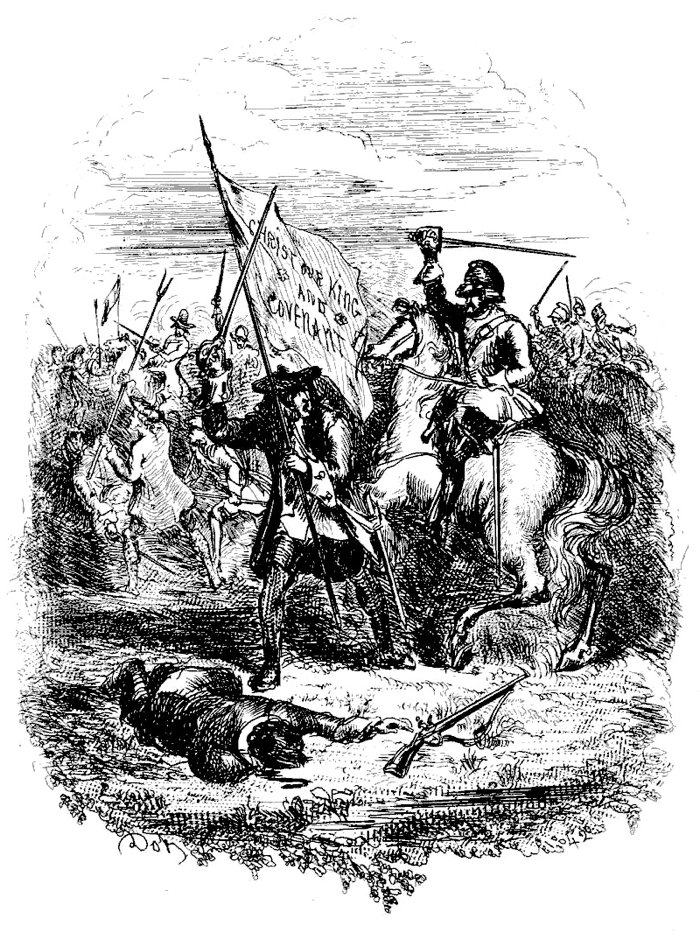
Battle of Bothwell Bridge.
Vide page 374.
Edinr. Hugh Paton, Carver & Gilder, to the Queen, 1842.
Next day, the armies were within sight of each other. The
king’s troops spread upon Bothwell-moor, with their advanced
guard in the town; the Whigs stationed along Hamilton-moor,
on the south side of the river Clyde, with their advanced guard at
the bridge—an old narrow structure, the only pass by which they
were assailable. Early that morning, Mr David Hume, Mr Fergusson
of Caitloch, and Mr John Welsh went in disguise to Monmouth’s
head-quarters. On passing, they were politely saluted
by Claverhouse and had ready access to his Grace. When introduced,
they stated their demands, which were—that they might
be allowed the free exercise of their religion, and suffered to attend
the ordinances dispensed by Presbyterian ministers without molestation;
that a free Parliament and General Assembly might be
called to settle the affairs of church and state; and an indemnity
offered to all who were or had been in arms. The Duke, who
heard them with great attention, replied that the king had given
him no instructions respecting these matters; he therefore could
not say any thing about them, only he assured the delegates he
375would lay their requests before his majesty, and as he thought
them reasonable, had no doubt they would be granted; but in
the meanwhile, he could enter into no terms till they laid down
their arms and threw themselves entirely upon the royal mercy.
He then dismissed them, and gave them half an hour to return
him an answer from their friends whether they would consent to
his proposal. At the same time, he issued orders to put the
troops in motion.
When the commissioners reported the Duke’s demand, that
they should lay down their arms previous to terms being offered,
Mr Hamilton, who had now assumed the command, laughed at
it, and said, “Aye! and hang next.” No answer was therefore
returned. As soon as the half hour’s truce expired, Lord Livingston
advanced at the head of the foot-guards with the cannon to
force the bridge. He was firmly received by a small determined
band under Ure of Shargarton and Major Learmont, who drove
them back twice, and would even have taken the cannon had
they been properly supported, but their ammunition failed; and
when they sent to the commander for a fresh supply, or a reinforcement
of men better provided, they received orders to retire
upon the main body, which, having no other alternative, they did,
and with heavy hearts left their vantage ground, and with it every
chance of success.[124] The royal army then passed the bridge, and
drew up upon the bank with their artillery in front, to which the
patriots had nothing to oppose but one field-piece and two large
uncouth unmounted muskets; yet did they force Lord Livingston
to halt, till the cannon having been opened upon the left, threw
the undisciplined horse of the countrymen into disorder, and the
route immediately became universal.[125]
376Few fell in the fight, but the pursuit was cruel and bloody;
upwards of four hundred were cut down, and twelve hundred who
were on the moor, were forced to surrender at discretion. The
slaughter would have been greater had not Monmouth, in spite
of the advice of some of the other Generals, ordered the vanquished
to be spared, when the yeomanry cavalry especially were
executing cruel vengeance on the unresisting fugitives. Among
the prisoners were Messrs King and Kid, ministers, who were,
however, only preserved by his humanity from military violence,
that they might afterwards satiate the cruelty of their clerical
enemies by a more disgraceful execution, if dying in any manner
for the cause of truth can be called disgraceful. The treatment
of the captives by the inferior officers, to whose charge they were
committed, was unnecessarily vindictive and severe. They were
stripped nearly naked, and made to lie flat on the ground, nor
suffered to change their position; and when some of them ventured
to raise themselves to implore a draught of water, they
were instantly shot. They were afterwards tied two and two and
driven to Edinburgh, to be placed at the council’s disposal.
377Nor was the cruelty confined to those taken in battle, numbers
of unarmed men, who were merely coming to hear sermon at the
camp, were murdered on the road by the soldiery; and one atrocious
case stands painfully conspicuous. Arthur Inglis of Cambusnethan,
while quietly reading his bible in a furrow, was observed
by a party who were patrolling the country in search of
delinquents, and being actually discovered in this treasonable
fact, one of the soldiers fired at the traitor; but missing, the
good man startled a little, looked round for a moment, and then,
without appearing to be alarmed, resumed his reading, when another
of the miscreants, by order of his viler commander, clave
his skull, and left him dead on the spot! The numbers who
were thus wantonly massacred, are variously stated; but if we
take the lowest, two hundred—considering the then state of the
population—it shows, in sufficiently strong colours, a barbarous
waste of life, and the danger of committing such extravagant
powers into the hands of an unbridled soldiery.
Yet terrible as these military executions were, they were mild
and merciful compared with the legal atrocities which followed.
As after Pentland no faith was kept with the prisoners, who were
treated—as men who fail in struggling for their rights always are—more
like wild, noxious animals than fellow-creatures of the human
form; a lesson to patriots and to the oppressed when they rise
against their tyrants:—better perish on the high places of the field
than submit to languish out a few mournful years beneath the
tender mercies of the victors. While being driven to the capital,
the captive patriots were exposed to every indignity the ingenious
malignity of their persecutors could invent, especially being made,
as they passed along, a gazing-stock to the crowd, who taunted
them with such questions, as—where is your prophet Welsh who
told you ye should win the day? where are your covenants that
were never to fail? or such sarcasms, as—aye! this is your testimony—this
is standing up for the gude auld cause! see if it will
stand up for you! When they arrived in the capital, the council
ordered the magistrates to place them in the Greyfriar’s churchyard,
with a sufficient number of sentinels over them, to guard
them night and day; especially during the night, they were to
378be rigorously watched to prevent escape; and such was their determination
to enforce vigilance, that the officers were ordered to
keep exact rolls of the sentinels, and if any of the prisoners were
amissing, they were to throw dice and answer body for body.
For nearly five months were the greater part of the sufferers kept
in this open space, without any covering from the rain or shelter
from the tempest. During the day, they generally stood, but
had not even the miserable privilege of a short walk. During
night, the cold damp ground was their bed, without a covering;
and if any attempted to rise, for whatever purpose, the sentinels
had orders to fire upon them. With great difficulty did any
of their friends obtain permission to visit them, or bring them
provisions, and these were chiefly females, who were exposed to
the grossest insults from the guards; and not infrequently were
the provisions they carried destroyed, and the water spilt, before
either could reach the starving prisoners; for the government
allowance which the Duke of Monmouth procured for them, was,
besides being of the worst quality, very scanty. Nor did the
inhumanity of the ruffian soldiery allow them to retain money or
any article they could pilfer from them, even their shoes, stockings,
and upper garments were carried off; and when blankets or
any bedclothes were brought, they were immediately seized as
lawful plunder.
Before Monmouth left Scotland, he procured the liberation of
some hundreds, upon their subscribing a bond, enacting themselves
in the books of the privy council not to take up arms
without or against his majesty’s authority; and had also obtained
for a few of them the stinted favour of wretched huts, to be
erected as the winter approached. The bond became another
cause of unhappy difference and alienation among the sufferers
themselves. Those who refused amounted to about four hundred,
and much interest was made to procure their deliverance, especially
by some who thought they might sign the bond without sin,
endeavouring to persuade them to submit, as it did not involve
the sacrifice of any of those principles for which they had taken
arms. The others, however, more consistently, viewed their subscribing
the bond as an admission that their previous rising had
379been criminal, and therefore persisted in their refusal. The hardships
they had so long endured, and their mutual exhortations,
heightened and strengthened their scruples, till they became absolutely
impenetrable to whatever could be urged upon the subject,
nor would listen either to entreaty or argument. Yet upwards
of an hundred contrived to effect an escape; some by the
purchased connivance of the guards, some by climbing the walls
at the hazard of their lives, others by changing their clothes, and
some in women’s apparel.
The remnant who remained firm, were doomed to slavery in
the plantations; and their fate, had earth terminated their hopes,
was melancholy; but viewed as that of those who through much
tribulation must enter the kingdom, was enviable—inexpressibly
enviable! when compared with that of their oppressors, who unwittingly
sent them by the shortest road to heaven.[126] Their numbers,
estimated at about two hundred and fifty-seven, were to be
transported to Barbadoes and sold for slaves. Mr Blackadder
thus narrates the tragical story:—“The prisoners were all shipped
in Leith roads (15th November) in an English captain’s vessel,
to be carried to America. He was a profane, cruel wretch, and
used them barbarously, stewing them up between decks, where
they could not get up their heads, except to sit or lean, and robbing
them of many things their friends had sent them for their
relief. They never were in such strait and pinch, particularly
through scorching drowth, as they were allowed little or no drink
and pent up together, till many of them fainted and were almost
suffocated. This was in Leith roads, besides what straits they
would readily endure in the custody of such a cruel wretch. In
this grievous plight, these captives were carried away in much
anguish of spirit, pinched bodies, and disquieted consciences, (at
least those who had taken the bond.[127]) They were tossed at sea
380with great tempest of weather for three weeks, till at last their
ship cast anchor, to ride awhile among the Orkney Isles, till the
storm might calm. But after casting anchor, the ship did drive
with great violence upon a rugged shore about the isles, and struck
about ten at night on a rock. The cruel captain saw the hazard
all were in, and that they might have escaped as some did; yet,
as I heard, he would not open the hatches to let the poor prisoners
fend for themselves. He with his seamen made their escape by a
mast laid over between the ship and the rock ashore. Some
leapt on the rock.
“The ship being strong, endured several strokes ere she bilged.
The captain and all the rest of the seamen, with about fifty prisoners,
some of whom had been above deck before, others had
broke out some other way down to the den, and so up again; so
that they were to land with their life in: one or two died ashore.
While these were thus escaping, the rest who had all been closed
up between decks, crying most pitifully, and working as they
could to break forth of their prison, but to little purpose; and
all these, near two hundred, with lamentable shrieks of dying
men—as was related to the writer by one who escaped—did
perish. The most part were cast out on the shore dead, and after
buried by the country people.”[128]
381Nothing in the whole annals of these persecuting times presents
a stronger argument against committing civil power to the
clergy, than the uniform strenuous opposition made by the bishops
and their satellites to every moderate or clement proposal of the
Duke of Monmouth. The council, where they possessed a strong
majority before his Grace arrived from the army, had written to
the king for instructions how to dispose of the prisoners, promising
“at the same time, on their part, to execute the laws against
rebellion, faction, and schism, as the king should direct them,
without gratifying the humours of such as are apt to grow more
insolent by his majesty’s grace and goodness, who have been encouraged
and hardened in an obstinate opposition to the church
by his majesty’s condescensions and indulgences, and proposing
that, after the ringleaders were punished capitally, the rabble
should be transported to the plantations never to return.”
This model of princes, for whose restoration the cannon of the
Castle of Edinburgh still continue annually to be fired, and the
public offices still keep holyday, returned a gracious answer, approving
of their proposal to send three or four hundred to the
plantations, and bring the ringleaders before the justiciary, after
which the rest might be dismissed upon signing the bond.
The treatment of the majority has been narrated. We shall
now notice the proceedings against those considered ringleaders.
The most conspicuous were their ministers Messrs King and Kid.
Wodrow mentions an incident which occurred while the former
was being carried to Edinburgh, too remarkable to be passed over,
especially as that historian is neither a credulous nor an enthusiastic
writer:—
“Upon the Lord’s day, orders were given to a party of soldiers
immediately to march east and carry Mr John King with
382them to Edinburgh; and we will find it was their ordinary [practice]
to march, and especially to transport prisoners from place to
place, on the Sabbath. My accounts of them are, that they were
English dragoons. One of them, a profane and profligate wretch,
after they were in the street and on horseback, ready to ride off
with their prisoner, called for some ale, and drunk a health to the
‘Confusion of the Covenants,’ and another to the ‘Destruction
of the People of God,’ and some more very horrid, and rode off.
He met with one of his comrades at the Stable-green Port, who,
knowing nothing of the matter, asked him where he was going?
He answered, ‘to convoy King to hell,’ and galloped up to the
rest, whistling and singing. The judgment of God did not linger
as to this wretch; he was not many paces forward, in the hollow
path a little from the Port, till his horse stumbled; and somewhat
or other touching his piece—which was primed and cocked
it seems—the carabine went off and shot him dead on the spot.
The party went on and carried Mr King to Edinburgh.” Mr
Kid was brought thither and imprisoned along with his friend in
the tolbooth.
The tyranny of Charles, which was exercised in England as
well as in Scotland, had excited much discontent there; and
Charles’s advisers were extremely anxious to trace out some grand
conspiracy which might enable them to resort to extreme measures
there as well as in Scotland, that a similar despotism might
be established in both kingdoms. The king therefore directed
that these two should be especially examined by torture, in order
if possible to discover the conspirators, with which the Scottish
managers were very ready to comply, many of them anticipating
a rich harvest of new forfeitures. Being disappointed in this, the
prisoners were ordered to stand trial before the justiciary. Previously
to being brought to the bar, they presented a petition,
praying that they might be allowed to prove in exculpation—that
they were only present with the army casually, and not intentionally,
and were in a manner detained prisoners by them; and such
naked presence, without assistance, was not criminal; and that
they were so far from being incendiaries to incite the people, they,
on the contrary, entreated them to lay down their arms. 2d,
383That the Duke of Monmouth, by his commission, had power to
pardon; and they offered to prove by witnesses that he had proffered
them a pardon if they would lay down their arms, and that
they had accepted it. 3d, They were willing to engage to live
peaceably, and never to keep field-meetings hereafter.
The lords refused this equitable request, or, as Fountainhall
expressed it, “repelled their exculpation in respect of the libel,”
and, on the 28th of July, their trial proceeded. They were accused
of having been in the rebellion and in company with rebels,
who, in May last, burned the king’s laws; that they had preached
at several field-conventicles where persons were in arms; that
they did preach, pray, and exercise to rebels, and continued with
them till their defeat, and had been taken prisoners.
Their own confessions, that of Kid emitted under torture, were
the only evidence produced against them, and coincided with
what they had offered to prove. It was deemed sufficient that
they had been with the rebels, and, notwithstanding any extenuating
circumstances, must therefore be deemed rebels themselves.
The jury brought them in guilty, in terms of their own confession;
and the lords sentenced them to be taken to the market
cross of Edinburgh upon Thursday, August 14, betwixt two and
four of the clock in the afternoon, and to be hanged on a gibbet;
and when dead, that their heads and right arms be cut off and
disposed of as the council think fit; and that all their land be
forfeited, as being guilty of the treasonable crimes foresaid. The
judges themselves were so convinced of the peculiar hardship of
the case, that they allowed this unusual space between sentence
and execution, on purpose that they might have time to apply for
a remission, and Mr Stevenson, a friend of theirs, rode post to
London to apply for it; but all the avenues to mercy were shut.
An evil influence pervaded the whole court; and it is worthy of
remark, and ought never to be forgotten, that the most gay, most
boisterously mirthful, most joyous, and most irreligious court,
headed by the most facetious and witty monarch that ever sat
upon the British throne, was the most unfeeling, cold-hearted,
cruel, revengeful, and vile that has ever disgraced the annals of
our country.
384An act of indemnity had been passed; and it might naturally
have been supposed that these good men would have received the
advantage of it, but the very day on which it was to be proclaimed,
was the day chosen on which they were ordered to be executed;
so dead to every sense of common decency, as well as of common
feeling, were the then rulers of Scotland. In the forenoon of the
14th of August, the magistrates of Edinburgh proceeded to the
cross in their robes, and proclaimed the indemnity from a scaffold
erected for the purpose. In the afternoon, these two worthies, on
another scaffold, were put to death, as if to declare the entire
worthlessness of all government clemency, whenever persons of
unflinching principle were concerned. They both died with much
calmness and serenity; and their dying speeches, which were
afterwards published, may well rank with any of the compositions
of the times, for elegant simplicity, honest integrity, and a plain
energetic avowal of their principles, untainted either by party prejudice
or political enthusiasm. Mr Kid, who was labouring under
sore bodily indisposition, said—“It may be that there are a
great many here that judge my lot very sad and deplorable, I
must confess, death in itself is very terrible to flesh and blood;
but as it is an outlet to sin, and an inlet to righteousness, it is
the Christian’s great and inexpressible privilege.
“And give me leave to say this, 1st, That there is something
in a Christian’s condition that can never put him without the
reach of unsufferableness, even shame, death, and the cross being
included in the promise. And if there be reconciliation between
God and the soul, nothing can damp peace through our Lord
Jesus Christ; it is a supporting ingredient in the bitterest cup
and under the sharpest and fiercest trial he can be exposed unto.
This is my mercy, I have somewhat of this to lay claim unto,
viz. the intimations of pardon betwixt God and my soul; and as
concerning that for which I am condemned, I magnify his grace
that I never had the least challenge for it, but, on the contrary,
I judge it my honour that ever I was counted worthy to be staged
upon such a consideration. I declare before you all, in the sight
of God, angels, and men, and in the sight of the sun and all that
he has created, that I am a most miserable sinner, in regard of my
385original and actual transgressions. I must confess they are more
than the hairs upon my head, and altogether past reckoning; I
cannot but say, as Jacob said, I am less than the least of all God’s
mercies; yet, I must declare, to the commendation of the freedom
of his grace, that I dare not but say, He has loved me and washed
me in his own blood; and well’s me this day that ever I read or
heard that faithful saying, ‘Jesus Christ came into the world to
save sinners, of whom I am the chief.’”
He then warned the servants of God against fomenting divisions
to the detriment of the gospel, especially as there appeared
at that time a great likelihood of its spreading, and dissension
would prove a poison in the pot! “As for rebellion against his
majesty’s person or lawful authority, the Lord knows my soul abhorreth
it, name and thing. Loyal I have been and wills every
Christian to be so; and I was ever of this judgment to give to
Cesar the things that are Cesar’s, and to God the things that are
God’s.” This excellent man and his most worthy coadjutor,
not only had to suffer from the oppression of the oppressors, but
from what to them was probably more trying, the cruel scourge of
tongues from those they wished to esteem brethren. He therefore
felt himself called upon to vindicate his character from these
aspersions, and to leave a record of the doctrine he had preached.
“According to the measure God has given me,” he continues,
“it was my endeavour to commend Christ to the hearts and souls
of the people, even repentance towards God, and faith towards
our Lord Jesus Christ; and if this be devisive preaching, I cannot
deny it.”
Mr King expressed himself to the same effect. “I bless the
Lord,” said the dying martyr, “since infinite wisdom and holy
providence hath so carved out my lot to die after this manner,
that I die not unwillingly, neither by force; and though possibly
I might have shunned such an hard sentence, if I had done things
that, though I could, I durst not do; no, not for my soul, I durst
not, God knoweth, redeem my life by the loss of my integrity.
I bless the Lord that, since I have been a prisoner, he hath wonderfully
upholden me, and made out that comfortable word, ‘fear
not, be not afraid; I am with thee, I will uphold thee by the
386right hand of my righteousness.’ I bless his name that I die not
as a fool dieth, though I acknowledge I have nothing to boast of
myself. I acknowledge I am a sinner, and one of the chiefest
that have gone under the name of a professor of religion; yea,
amongst the unworthiest of those that have preached the gospel.
My sins and corruptions have been many. I have no righteousness
of my own; all is vile, like filthy rags. But blessed be God
there is a Saviour of sinners, Jesus Christ the righteous, and that
through faith in his righteousness I have obtained mercy; through
him only I desire to hope for, and to have a happy and glorious
victory over sin and satan, hell and death; that I shall attain to
the righteousness of the just, and be made partaker of eternal
life. I know in whom I have believed, and that he is able to
keep that which I have committed to him against that day. I
have in my poor capacity preached salvation in his name; and as
I have preached, so do I believe. With all my soul I have commended,
and yet I do commend, to all of you the riches of his
grace and faith in his name, as the alone and only way whereby
ye can be saved. As for those things for which sentence of death
is passed against me, I bless the Lord, rebellious I have not been.
He who is the searcher of hearts, knoweth that neither my design
nor practice was against his majesty’s person and just government.
I have been loyal, and do recommend it to all to be obedient to
higher powers in the Lord.
“That I preached at field-meetings. I am so far from acknowledging
that the gospel preached that way was a rendezvousing in
rebellion, as it is termed, that I bless the Lord ever he counted
me worthy to be a witness to such meetings, which have been so
wonderfully countenanced and owned, not only to the conviction,
but even to the conversion of many thousands: if I could have
preached Christ and salvation in his name, that was my work, and
herein have I walked according to the light and rule of the word
of God, and as it did become—though one of the meanest—a
minister of the gospel.”
Both bore witness to the doctrine and worship, discipline and
government, of the church of Scotland by kirk-sessions and presbyteries,
synods and general assemblies, to the solemn covenants,
387also to the public confessions of sins and engagements to duties,
and that either as to what concerned personal reformation, or the
reformation of the whole land. They also bore witness and testimony
against popery, which had so greatly increased, was so
much countenanced, and so openly professed. The causes of
God’s wrath with the land were particularly noticed and specified
by Mr King:—1st, The dreadful slights our Lord Jesus has received
in the offers of his gospel. 2d, The horrid profanity that
had overspread the whole land. 3d, The horrid perjury in the
matter of vows and engagements. 4th, The dreadful formality
and supineness in the duties of religion. 5th, Awful ingratitude,
what do we render to Him for his goodness? 6th, Want of
humility under afflictions. 7th, Dreadful covetousness and minding
of our own things more than the things of God; and this
among all ranks.
But they both departed, praying for Scotland, and rejoicing in
the faith that there would be a resurrection of the name, word,
and cause of Christ in their beloved country; and their last aspirations
were, “O! that he would return to this land again! repair
our breaches, and heal our backslidings! O! that he were pacified
towards us! O! that he would pass by Scotland again, and
make our time a time of love!” Their heads and right hands
were, agreeably to their sentence, cut off, and had the honour of
being placed beside those of the venerated Guthrie on the Netherbow
Port, to bear witness to heaven, along with them, against the
iniquity of the times.
Five others were next selected for immolation as a propitiatory
offering to the shade of the grand apostate. Thomas Brown,
shoemaker, Edinburgh; Andrew Sword, weaver, Kirkcudbright;
John Clide, Kilbride; John Waddel, New Monkland; and James
Wood, Newmills—charged with being accomplices in the murder
of Archbishop Sharpe, although none of them were in that part
of the country at the time when it happened—were accordingly
brought before the justiciary on November 10th. Their indictment,
as now became the custom, enumerated as charges against
them all the occurrences which had taken place during the rising,
aggravated by fictitious circumstances of the most revolting nature,
388i. e. throwing out of their graves the dead bodies of such
children as belonged to the orthodox clergy in Glasgow; commanding,
by a most insolent act of their supremacy and mock judicatory,
all the said orthodox clergy to remove themselves, their
wives and families, from the western shires, under pain of death;
and threatening with fire and sword all such of his majesty’s good
subjects as would not join them; plundering and ravaging their
houses, and carrying off their horses and arms; declining the
bond; and finally, and above all, refusing to call the late rebellion
a rebellion.
Previously to proceeding with the trial, the bond was offered
to them judicially, both the crown lawyers and judges upon this
as upon several other occasions appearing to have entertained some
sympathy for the sufferers; but they peremptorily refused to take
it, as they considered that they would thereby have been condemning
the rising at Bothwell, and their own conduct in what
they considered a justifiable assertion of the principles to which
they had solemnly sworn obedience in the covenants. Four of
them resolutely avowed their having appeared in arms at Bothwell,
and were of course found guilty by the jury upon their own
confession of that fact alone; yet, by a strange vindictive perversity,
the court sentenced them “to be carried to the moor of
Magus in the sheriffdom of Fife, the place where his Grace the
Archbishop of St Andrews was murdered, upon the 18th of November
instant, and there to be hanged till they be dead, and
their bodies to be hung in chains until they rot, and all their
lands, goods, and gear to fall to his majesty’s use.”
James Wood was only proven by the evidence of some soldiers
to have been taken at or after Bothwell without arms; and
as numbers in that part of the country were known to have gone
to the spot as mere spectators, a humane tribunal would have given
them the advantage of the supposition that they had been present
from a similar motive. But he was included in the same verdict,
and doomed to the same punishment, which was accordingly inflicted
at the place appointed, though some difference appears in
the date of the execution and the date of their dying testimonies,
the latter being dated 25th November, a week beyond the term
389allowed by the former, which might have been given to allow of
an application to the king for mercy. If it was, they found none
from their earthly sovereign; but they all died in the humble
confidence of being reconciled to God by Jesus Christ.
Brown, who went up the ladder first, declared, before being
turned off, “if every hair of his head were a man, and every drop
of his blood were a life, he would cordially and heartily lay them
down for Christ and this cause for which he was now sentenced.”
Sword sang the 34th Psalm, and said to the spectators, “I cannot
but commend Christ and his cross to you. I would not exchange
my lot for a thousand worlds!” He had lived four or five
score of miles distant from that place, and never in his life saw a
bishop that he knew to be a bishop.
James Wood also affirmed that he had never been in that part
of the country before, nor seen a bishop in his life! and as to
appearing at Bothwell Bridge, he added, “for my own part, I am
so far from thinking it rebellion, that I bless God I was a man to
be there, though a man most unable for war, and unskilful, because
of my infirm arm: and I bless God that gave me a life to lay
down for his cause; and though in remarkable providence he took
not my life in that day, yet for holy and good ends he spared it
to lay it down this day; and I am so far from rueing any thing
that I had done that day in my appearing for Christ and his cause,
that I would heartily wish if I were to live to see as many men
every year gathered together for the defence of the gospel. I
would count it my honour to be with them.” “And now, my
friends, I am not a whit afraid to go up this ladder, and to lay
down my life this day, for it is the best day ever yet mine eyes
saw.” And being up almost to the top of the ladder, plucking
up the napkin, he said, “Now I am going to lay down this life
and to step out of time into eternity, and if I had as many lives
as there are hairs on my head, or drops of blood in my body, I
would willingly lay them down for Christ, and for you all that are
here on Christ’s account.”
John Waddel, respecting the bishop’s death, said, “I declare
I was never over the water of Forth in this country before this
time.” “I am sentenced to die here because I would not call it
390rebellion being with my friends at Bothwell Bridge, and because
I would not take that bond, binding me hereafter never to lift
arms against the king nor his authority, which thing in conscience
I could not do; for, whatever others think of it, to me it says,
that it is a denying of all appearances for Christ and his cause
that hath formerly been; and likewise it says to me, that we shall
never any more lift arms for the defence of Christ’s gospel against
any party whatsoever that seems to oppose it, which is far from the
word of God:—‘If any man draw back, my soul shall have no
pleasure in him,’ and the covenants, National and Solemn League,
which were publicly burnt in our nation—for which God in his
own time will yet arise—which we are bound to maintain.” “And
now, sirs, I am not a whit discouraged to see my three brethren
hanging before mine eyes, nor before all this multitude to pray.”
He then prayed; and being thrown over,
John Clide was brought to the ladder. When he had reached
it, he turned round and said, “I think our being fetched here is
like that which we have in Scripture about what Herodias said to
Herod anent John the Baptist his head, to gratify the unsatiableness
of that lewd woman; nothing would satisfy the lust of our
persecutors, but our blood, and in this manner and place, to gratify
the bishop’s friends. But the ground of my being sentenced
is because I was found in arms with that poor handful at Bothwell
Bridge and would not call it rebellion; and because I would
not take that bond, which thing I had in my offer, and my life
upon the taking of it; and was threatened by some to take it, and
allured and persuaded by others, which I could not in conscience
do, because it binds me hereafter that I should not appear for
Christ and his cause. I durst not do it, for I was not sure of my
life, no not one moment; and I durst not procure the wrath of
God at such a rate; for I judge the loss of my soul to be more
dreadful than the loss of the life of my body, and likewise that
it is more hazardful the offending of God than gaining the greatest
advantage in the world.
“I could not stay at home, but judged it my duty to come
forth; for I could not see how I could evite that curse—‘Curse
ye, Meroz; curse ye bitterly those that would not come out to
391the help of the Lord against the mighty.’ And I bless the Lord
for keeping me straight. I desire to speak it to the commendation
of free grace; and this I am speaking from my own experience,
that there are none who will lippen to God and depend upon
him for direction, but they shall be keeped straight and right;
but to be kept from tribulation, that is not the bargain; for he
hath said that through much tribulation we must enter the kingdom,
for he deals not with us as satan does—for satan lets us see
the bonniest side of the tentation, but our Lord Jesus lets us see
the roughest side and the blackest. After that, the sweetest thing
comes! And he tells us the worst that will happen to us; for
he hath not promised to keep us from trouble, but he hath promised
to be with us in it, and what needs more?
“I bless the Lord for keeping me to this very hour: little
would I have thought a twelvemonth since that the Lord would
have taken me a poor ploughman-lad, and have honoured me so
highly, as to have made me first appear for him and then keep me
straight; and now hath keeped me to this very hour to lay down
my life for him.” At the ladder foot, he addressed his brother
and other relatives who were standing and weeping around him—“Weep
not for me, brother; but weep for the poor land, and
seek God, and make him sure for yourself, and he shall be better
to you than ten brethren. Now, farewell, all friends and relations;
farewell, brother, sister, mother. Welcome, Lord Jesus;
into thy hands I commit my spirit!” And then lifting the napkin
off his face, he said, “Dear friends, be not discouraged because
of the cross, nor at this ye have seen this day, for I hope
you have seen no discouragement in me, and you shall see no more!”
While these sanguinary proceedings were going forward, the
Scottish rulers were not less assiduous in the more lucrative departments
of persecution, rendering even their acts of indemnity
or indulgence the means of pecuniary oppression; for the conditions
upon which these were granted were so hard, and the penalties
for their infraction so severe, that few would accept of them,
and those who did, found them both burthensome to their conscience
and heavy on their purse, as a common requisition was,
392that the parties should bind themselves, their families, and dependants,
under a specified sum, to regular attendance on the ordinances
and implicit compliance with all the injunctions of the established
clergy, nor harbour or hold any communication with those
who acted otherwise. Absence from the parish church, if accompanied
with any suspicious symptoms, constituted rebellion; and
associating with rebels, was construed into the same offence, punishable
by death, but commutable by fining or confiscation of
rents, money, and moveables; so that pretexts were never wanting
for plundering the Presbyterians, wherever “the honest party”
were possessed of property.
More effectually to scour the country, the justiciary was required
to divide into two sections or circuit courts; the one to traverse
the west and south, the other the north and east. By a proclamation
sent before them, the proprietors or occupiers of the lands
on which any of the rebels lived, were required to apprehend and
imprison them till the courts arrived, when they were to present
them for prosecution; and if they should be either under hiding
or fugitive themselves, their wives, children, and servants were to
be ordered off the ground. Clerks were sent before to take up
lists of all who were named in the proclamation, or should be informed
against as having been at field-conventicles, or having
threatened, robbed, or abused the orthodox clergy, who were all to
be summoned and examined upon oath respecting their possessions
in lands, money, and bonds, in order that the proceeds might be
forthcoming in case they should be found guilty. Witnesses
were to be prepared and held in readiness—sixteen in every rural
parish, and twenty-four in every royal burgh or burgh of barony,
who were to give information, under a penalty of forty pounds
Scots, of all who had been at Bothwell, or who had harboured
any that were there. They were also to name all whom they
heard or suspected of being there. The sheriffs and justices of
peace were exceedingly active in searching out the proper victims
for spoliation, and so rigid in their duty, that they included several
in their rolls who had been dead or left the place some time
before. The curates were very zealous; and their diligence in
this business, contrasted with their carelessness in their spiritual
393functions, did not tend much to exalt their characters or endear
their office. Extensive as the range of sedition had been made,
yet were the insatiable managers unsatisfied. They therefore had
recourse to an old statute, long in dissuetude, by which all who
did not attend the king’s host were liable to be punished with
death; and changing the award into a pecuniary mulct, they with
rigorous impartiality fleeced the lieges in all the devoted counties
where there had been the smallest symptoms of discontent.
In October, the circuit-courts commenced their operations;
but, as they either kept no record of their proceedings, or these
records have been destroyed, the particulars of their extortions
are but imperfectly known, only the general devastation they
spread was long remembered; the absent heritors were denounced,
and numbers of them forfeited, whose estates were bestowed upon
noblemen, gentlemen, and soldiers, as rewards for their ready and
unflinching obedience to the most cruel and barbarous decreets of
the council, which the greater part of them kept hold of till the
Revolution restored them to their rightful owners.
Besides this, the council gifted the moveables of such as were
reported to have been at Bothwell, which laid the whole of those
who were known to favour Presbyterian principles open to the
most vexatious visitations; for the donators, to whom was committed
“the uplifting of the spulzie,” literally “rode upon the
top of their commissions,” exacting to the utmost, and, by returning
oftener than once, frequently subjected the same persons
to repeated pillage for the same accusation. Another source of
wealth to the banditti who now ravaged Scotland, was the compositions
of the fines paid to the clerks, or largesses to the officers,
to escape the rifling searches of the soldiers, who, whenever
they chose, could enter the houses of the most peaceable and destroy
their furniture by casting it about, and rip up and render
useless their beds and bedclothes, by thrusting them through with
their swords, to find if any “cursed Whiggs” were concealed
among them. The shires of Lanark and Ayr were peculiarly
harassed—shires which, by every principle of sound policy, ought
to have been peculiarly favoured, as they were the most industrious
and wealthy, but unfortunately they were also reputed the
394most pious. Wretched as the country was, yet years more grievous
followed. Monmouth while there had acted with as much
moderation as circumstances would permit, and discouraged as far
as possible the virulent spirit of clerical domination which the
bishops and curates were so eager to display. When he went to
London, he had carried with him very favourable impressions of
the Scottish character, and was desirous to infuse somewhat of his
own kindness into the councils of his father. Before he left
Edinburgh, upon receiving a petition to present to the king, he
said, “I think if any place get favour, it should be Scotland;
for a gallanter gentry and more loving people, I never saw;” and
previous to setting out, he procured what was termed the third
indulgence, which was published at Edinburgh by proclamation,
June 29. By it, ministers were prohibited under pain of death
from holding field-conventicles, and all who attended were to be
deemed traitors; but all laws against house conventicles south of
the Tay, were suspended, “excepting the town of Edinburgh and
two miles round about the same, with the lordships of Musselburgh
and Dalkeith; the cities of St Andrews, Glasgow, and
Stirling, and a mile about each of them; being fully resolved
not to suffer the seat of OUR government nor OUR universities to
be pestered with any irregularities whatsoever.” One preacher
was to be allowed to each parish upon giving in their names to
the privy council and finding security for their peaceable behaviour,
provided they had not engaged in the late rebellion, nor been
admitted, i. e. licensed, by the unconform ministers; assuring, at
the same time, all who should offend, that we will maintain our
authority and laws by such effectual courses, as, in ruining the
authors, could not be thought rigid, especially after such unmerited
favour. “This our forbearance being to continue only during
our royal favour.”
These tokens of kindliness, stinted as they were, proved very
unpalatable to the harpies who were fattening upon the spoils of
their patriotic countrymen; and they immediately unbosomed
their difficulties to their friend Lauderdale, in the form of an inquiring
epistle from the council, dated July 12:—“There being
doubts,” say they, “as to the sense of that clause in the proclamation,
395June 29, suspending all letters of intercommuning, and
all other executions, if these words ‘all other executions’ do import
that all persons, whether preachers at field-conventicles, or
other persons, who being ringleaders of these rebellious rendezvouses,
and have been seized according to former proclamations,
promising sums of money to the apprehenders, the imprisoned
should be set at liberty or not; and if such as have been imprisoned
till they pay the fines imposed upon them by sentence of
council or other judges, shall also be enlarged and set at liberty;
and if these field-preachers and other persons, qualified as aforesaid,
are to be liberate—they crave his majesty may declare his
pleasure upon what terms and conditions they are to be liberate.”
The answer appears to have been favourable to the persecuted.
Several ministers who were in prison for holding conventicles,
but had not been at Bothwell, were now set at liberty upon enacting
themselves in the books of privy council for their peaceable
behaviour, and that they would not preach at field-conventicles.
Others, who could not conscientiously enter into such
engagements, were dismissed for the time, upon giving security
to appear when called for. Among these were fourteen prisoners
on the Bass, among whom was Fraser of Brea, who tells us in
his memoirs that in twenty-four hour’s space, they found security
for eight hundred pounds; “for we would not,” he adds, “give
obligement not to rise in arms, nor to forbear field-meetings, because
we saw no law for it, and because it was considered by us
dishonourable, and to reflect upon our ministry.”
Anxious to improve this breathing time, a numerous meeting
of ministers assembled at Edinburgh, August 8, to consider what
steps should be taken, and proceeded to re-organize, as far as in
them lay, the presbyterial form of their broken down and afflicted
church; but before they could realize their intentions, indeed
almost ere they enunciated them, the wind passed over them and
they were gone! Towards the latter end of the same month,
Charles was attacked with fever, and his life supposed in danger.
The Duke of York, who had been obliged by the ascendency of
the patriotic party to retire from court and reside abroad, was immediately
sent for and quickly arrived at Windsor. His sudden
396appearance took his opponents by surprise, and, by the influence
which he had over his brother, he effected the fall of Monmouth,
who was sent into that exile from which he himself had so unexpectedly
returned. With his elevation, all hopes of favour towards
the Presbyterians vanished, and the persecution recommenced
with renewed fury. A letter from the king, September
18, announced that he had recalled his commission to the Duke
of Buccleuch and Monmouth as General. On the very next day, a
warrant was granted by the council to Lieutenant-General Dalziel
to apprehend whoever had not taken the bond or who harboured
recusants, and secure them in prison till they be brought to justice—to
dissipate field-conventicles and seize whoever were present
at them; and they indemnify all slaughter or mutilation in
case of resistance. They also granted him power, along with
several others, to sequestrate the rents of lands, sums of money,
and moveables belonging to heritors or others, who came under
their denomination of rebels, in order to prevent their being embezzled!!
The Duke of York paid a short visit about this time to Scotland.
With the characteristic cunning of a papist, who first cajoles
before he ensnares a community, he carried himself towards
all with as great suavity as his severe unyielding temper and ungracious
manner would permit; but he especially cultivated the
goodwill of the Highland chieftains, who had a leaning towards
popery, and whose assistance he counted on to aid him in the contemplated
destruction of a heretical religion, and forcible establishment
of his own. Though admitted to act as a privy councillor,
without taking any of the oaths at the king’s particular desire,
he did not publicly interfere with political matters, but he
paved the way for his subsequent rule, and received from the authorities,
particularly the magistrates of Edinburgh, the homage
and honour so readily paid to an heir-apparent, being feasted
sumptuously, and lauded excessively for excellences which, if he
did not, he ought to have possessed, and which they were willing
to suppose his innate modesty alone prevented him from exhibiting.
BOOK XV.
397
Perplexity of the moderate ministers—Murder of Mr Hall—Queensferry paper—Cargill
joins Cameron—Sanquhar declaration—Council’s proclamation in reply—Reflections—Bond—Fresh
plunderings by Dalziel—Skirmish at Airs-moss—Death
of Cameron—of Rathillet—Cargill—Torwood excommunication—York
arrives in Edinburgh—Spreul tortured—Skene, Stewart, and Potter executed—Effigy
of the Pope burnt.
Never, perhaps, were men placed in more perplexing and trying
circumstances than the conscientious ministers who durst not abstain
from preaching the gospel as they had opportunity, but who
could neither accept of the fettered indulgences offered them by
their rulers, nor yet “had clearness” to disown a government
which they thought it their duty to disobey. They got no credit
from their persecutors for their professions of loyalty, and were
shunned by their brethren who more consistently followed out the
constitutional principles they had covenanted to preserve. The
breach now became wider by a transaction which also added fresh
fuel to the fire of persecution.
Mr Henry Hall of Haughead, in the parish of Eckford, in
Teviotdale—one of the proscribed who had fled to Holland—having
returned in order to strengthen the hands of Donald Cargill,
at that time assiduously preaching the gospel on the banks
the Forth, in Fife, and Mid-Lothian, attracted the notice of the
curates of Borrowstounness and Carriden, who informed Middleton,
a papist, governor of Blackness Castle, of the movements of
these two distinguished “rebels.” He immediately went in pursuit,
398followed by his men in twos and threes to avoid suspicion.
Tracking them to a house in Queensferry, he introduced himself
as a friend, and requested they might take a glass of wine together,
to which they agreed, when he, throwing off his mask, told
them they were his prisoners, and commanded the people of the
house, in the king’s name, to assist. None, however, paid any attention,
except one Thomas George, a waiter, who came in while
Mr Hall was struggling with the governor—Cargill having made
his escape, although wounded—and striking him on the head with
the butt end of his carabine, mortally wounded him; yet, though
in this state, did Dalziel, whose house of Binns lies in the neighbourhood,
on coming to the spot, order him to be carried to
Edinburgh. As might have been expected, he died upon the
road. For three days his body lay exposed in the Canongate
jail, till at last its putrescence forced the wretches to allow his
friends to carry it away and bury it under cloud of night.
In this gentleman’s pocket was found an unsubscribed paper,
which, from the place where he was murdered, has usually been
called “The Queensferry Paper.” It was merely notes, or rather
a rude draught of a declaration, in which, after stating their adherence
to the doctrine of the reformed churches, as contained in
the covenants, and their determination to persevere in it to the
end, they bound themselves to endeavour to their utmost the overthrow
of the kingdom of darkness, and whatsoever is contrary to
the kingdom of Christ, especially idolatry and popery, will-worship,
prelacy, and erastianism; and, in order to attain this end,
they renounced their allegiance; rejecting those who had rejected
God, altered and destroyed the established religion, overturned
the fundamental laws of the kingdom, and changed the civil government
into a tyranny. Then they proposed to set up governors
and a government according to the word of God, ‘able men,
such as fear God; men of truth, hating covetousness;’ and no
more to commit the government to one single person, or a lineal
succession, that kind being liable to most inconveniences and
aptest to degenerate into tyranny; at the same time, obliging
themselves to defend each other in their worshipping of God, and
in their natural, civil, and divine rights and liberties.
399Cargill, upon his escape, fled south, and joined Mr Richard
Cameron and the wanderers who followed him, and were outlawed,
and declared rebels. After much deliberation, they finally
agreed upon a declaration and testimony, suitable to the melancholy
appearance of the times and the distressed state of the
church, which Michael Cameron, accompanied by about twenty
persons armed, carried to the small burgh of Sanquhar, read, and
afterwards affixed to the cross, on the 22d of June 1680. This
declaration, which was in substance the same as “The Queensferry
Paper,” after stating that they considered “it as not among the
smallest of the Lord’s mercies to this poor land, that there had always
been some who had given their testimony against every course
of defection, which they reckoned a token for good that he did
not intend to cast them off altogether, but to leave a remnant in
whom he would be glorious, if they through his grace kept themselves
clean and walked in his ways, carrying on the noble work
of reformation in the several steps thereof, both from popery and
prelacy, and also from erastian supremacy, so much usurped by
him, who,” they add, “it is true, so far as we know, is descended
from the race of our kings; yet he hath so far deborded from
what he ought to have been by his perjury and usurping in church
matters, and tyranny in matters civil, that although we be for government
and governors such as the word of God and our covenants
allow, yet we for ourselves, and all that will adhere to us, the
representatives of the true Presbyterian church and covenanted
nation of Scotland, considering the great hazard of lying under
sin any longer, do by these presents disown Charles Stuart, who
hath been reigning, or rather we may say tyrannizing, on the
throne of Britain, forfeited several years since by his perjury and
his breach of covenant with God and his church. As also, under
the banner of our Lord Jesus Christ, the Captain of our salvation,
we do declare war with such a tyrant and usurper.” “As also,
we disown and resent the reception of the Duke of York, a professed
papist, as repugnant to our principles and vows to the most
High God, and as that which is the great, though, alas! the just
reproach of our church. We also protest against his succeeding
to the crown, as against whatever hath been done, or any are assaying
400to do, in this land given to the Lord, in prejudice to our work
of reformation.”
A proclamation was issued on the last day of June, in reply,
stating in exaggerated terms what the council chose to call the
sentiments of Mr Richard Cameron and his brother, and Mr
Cargill and others, their accomplices,—sacrilegiously engaging
themselves by a solemn oath “to murder such as are in any trust
or employment under us, declaring us an usurper, and that none
should obey them who are in authority under us, but such as
would obey the devil and his vicegerents.”
Although Cameron and Cargill did think, and I believe justly,
that Charles and the vile turn-coat crew who composed his government
were—if perjury, cruelty, tyranny, profligacy, and every
species of open undisguised licentiousness embodied, constitute
such beings—the representatives of the devil in human shape, yet
it does not appear that they used the expressions which they in
justice did apply to their persecutors, till they themselves were
unconstitutionally and unjustly placed without the pale of the law,
denied the rights which had been parliamentarily insured to them,
and denounced as the vilest of malefactors for—preaching the
gospel. Several of the excellent followers of these noble men
have been at no little labour to extenuate or excuse their conduct.
It ought never to have been mentioned, but in accents of praise—it
needed no justification. The government had broken all faith:—and
society is based in its public as well as its private associations
on the bonds of mutual reciprocal obligation and the righteous
performance of these relative duties. When either party
violate them, they deserve punishment for their crime. That
popular insurrection should be put down, is allowed; that aristocratical
domination was to be equally checked, these denounced
Cameronians asserted; and this was in fact the grand crime for
which they were hunted like wild beasts upon the mountains.
But they were not the people to be scared from their principles
by any prospect of danger. While the fields were traversed by the
blood-hounds of their persecutors, the same indomitable bands
united more closely together, and entered into a new bond, obliging
themselves to be faithful to God and true to one another in the
401prosecution of their grand design, as assertors of their civil and
religious rights, which they believed could only be secured by
driving from the throne that “perfidious covenant-breaking race,
untrue both to the most High God and the people over whom
for their sins they were set.”
These mutual defiances were followed by petty exasperating
individual encounters between the soldiers and the exasperated
people, for the former did not confine their pillaging to the covenanters,
though they were the chief objects of their vengeance;
but now, when it was a finable offence to resett or harbour any
of the fugitives, the soldiers roamed up and down the country in
quest of the wanderers, or in quest of whatever might afford them
a pretext for plunder.
Dalziel, the favourite of the council, whose education in the
Muscovite service peculiarly fitted him for such employment, was
anew invested with enlarged powers to disperse all conventicles,
and punish, without the ceremony of sending them to Edinburgh
for trial, all who were caught in the “horrible act” of preaching
the word of God or hearing it preached; and the council, in a
letter to Lauderdale, expressed “the hope we justly have that
such just severity against some of these rebels will preserve peace
to his majesty’s good subjects,” and disappoint “the vanity of
bearing a testimony at Edinburgh, which cherished the foolish
humours of numbers, and made the processes and punishments
inflicted there less effectual than elsewhere.” All such persons
who were understood to be the king’s enemies were to be attacked
by the king’s forces wherever they could be found, and imprisoned
till brought to justice, or killed in case of resistance.
The General followed out his commission to the letter. He
quartered his soldiers upon suspected families, where they lodged
during pleasure, and, when leaving, carried off what sheep and
cattle they pleased without paying any thing; the pasture and
growing corn they eat up or trode down, without allowing the
smallest compensation; and, as the whole district was liable to
these ravages, the mischief they did was incalculable. While
thus ravaging the country, a party, consisting of upwards of one
hundred and twenty dragoons, well mounted, under the command
402of Bruce of Earlshall, were sent to disperse the company of wanderers
who usually attended the ministrations of Richard Cameron.
They surprised an assemblage at a place called Airs-moss,
in the district of Kyle, amounting to about twenty-six horse
and forty foot, headed by Hackston of Rathillet, indifferently
armed; who, knowing that they had no mercy to expect, determined
to face the enemy, and drew up at the entry to the moss.
The horse charged with intrepidity, but could not stand against
the superior number of their enemies, and were quickly broken;
and the foot unable to support them, they were surrounded, and
the whole killed or taken. The foot retiring into the morass, could
not be pursued. Cameron, who previously to the skirmish had
engaged in prayer with the wanderers, used these remarkable expressions—“Lord,
take the ripe, but spare the green!” He fell
with his brother, back to back, gallantly defending themselves
against their assailants. Hackston was severely wounded and
taken prisoner.[129]
Cameron’s head and hands were cut off and carried to Edinburgh
to be exposed, but with wanton barbarity they were first
taken to his father, who was in prison; and he was unfeelingly
asked by some heartless wretch if he knew them? The old man
took them, and kissing them, replied—“I know them! I know
them! they are my son’s—my own dear son’s! It is the Lord;
good is the will of the Lord, who cannot wrong me nor mine, but
has made goodness and mercy to follow us all our days.”
Rathillet next morning was brought to Lanark, where the head-quarters
were, and examined before Dalziel, Lord Ross, and some
others; but his answers not being deemed satisfactory, Dalziel,
with his accustomed brutality, threatened to roast him, then sent
him to the tolbooth and caused bind him most barbarously and
cast him down on the floor, where he lay till the morning after,
403without any person being admitted to see him, or administer in
any manner to his comfort. On the following morning (Sabbath)
he was marched, with three others, two miles on foot, without
shoes, and wounded as he was, to be delivered up to the escort
under Earlshall, who was to take them to Edinburgh. He used
them civilly by the way, and carried them round about the north
side of the town to the foot of the Canongate, where they were
received by the magistrates of the city,[130] who set Mr Hackston
on a horse with his head bare and his face to the tail, the hangman,
covered, carrying Mr Cameron’s head on an halbert before
him; also another head in a sack, was carried on a lad’s back.
His companions came after on foot, with their hands tied to an
iron goad; and thus they were marched to the Parliament Close.
All this studied ignominy, which was to recoil with tenfold
bitterness upon their own base characters, was minutely prescribed
by the council before the prisoner arrived in the capital. As the
manner of his execution was determined before he was tried, it
still stands in the record thus:—“That his body be drawn backward
on a hurdle to the cross of Edinburgh; that there be an
high scaffold erected a little above the cross, where, in the first
place, his right hand is to be struck off, and after some time his
left hand: then he is to be hanged up, and cut down alive; his
bowels to be taken out and his heart shown to the people by the
hangman: then his heart and his bowels to be burnt in a fire prepared
for that purpose on the scaffold; that afterwards his head
be cut off, and his body divided into four quarters—his head to
be fixed on the Netherbow, one of his quarters with both his
hands to be affixed at St Andrews, another quarter at Glasgow, a
third at Leith, a fourth at Burntisland; that none presume to be
in mourning for him, or any coffin brought; that no persons be
suffered to be on the scaffold with him, save the two bailies, the
executioner, and his servants; that he be allowed to pray to God
404Almighty, but not to speak to the people; that Hackston and
Cameron’s heads be fixed on higher poles than the rest.”
On July 30, he was brought before the justiciary, but declined
their authority, because they had usurped supremacy over the
church belonging alone to Jesus Christ, and had established idolatry,
perjury, and other iniquity in the land; and in prosecuting
their design, and in confirming themselves in their usurped right,
had shed much innocent blood. The proof of his being at Airs-moss
was clear; and one of the late archbishop’s servants swore
“that he saw the panel on a light-coloured horse at some distance
from the coach, and that he took the same horse in Mortounhouse—where
Rathillet had been—and hoped to have taken himself,
but he escaped.” The jury brought him in guilty, and the
court sentenced him to be executed that same day with all the
revolting particularity of barbaric savagism they had previously
appointed. It was even increased by the unskilfulness of the
hangman, who was a long while mangling the wrist of the right
arm before he succeeded in separating the hand; which being
done, the patient sufferer calmly requested him to strike in the
joint of the left; then he was drawn up a considerable way with
a pulley and suffered to fall a considerable way with a jerk. This
was repeated thrice, yet was not life extinguished; for, when the
heart was torn from his bosom, it fell from the hands of the executioner,
and moved after it fell!
Hackston was a gentleman allied to the first families in the
land, of good talents, well educated, and who in early life had
associated with the commissioner in the wild gaieties of the day;
and perhaps the severest test his integrity was subjected to was,
the commissioner personally came to him in prison, and, with
many protestations of kindness, alluding to their former intimacy,
urged him to compliance.[131] The mean tool of power, the advocate,
405who with his usual insolence endeavoured to insult him at
his first examination, received a spirited retort. He asked where
he was on the third day of May was a year? To whom he answered,
“I am not bound to keep a memorial where I am or
what I do every day.” The advocate said, “Sir, you must be a
great liar to say you remember not where you was that day, it
being so remarkable a day;” to which he answered, “Sir, you
must be a far greater liar to say I answered such a thing;” and
the Chancellor supported him.
A few days after, August 4th, several others were tried and
condemned for having been with Cameron; and a general search
was ordered to discover the outlawed attenders on field-preaching.
It was conducted under the direction of Robert Cannon of Mardrogat,
one of those miscreants who, having made a flaming profession,
had become acquainted with their places of meeting, but
afterwards apostatizing, now discovered the secret recesses of his
former friends, and was usually consulted respecting the character
of such persons as the soldiers seized, who were dismissed or detained
as he directed.
Intensity of persecution had now almost extinguished field-preaching.
Donald Cargill alone fearlessly preserved his station,
and, in defiance of the sanguinary storm which swept over the
moors and glens of his country, continued to proclaim with
unfettered freedom the principles of the church of his fathers,
and to assert the spiritual independence of her ministers, while
almost all others had yielded to the tempest or deserted the land
of their nativity. While hunted himself as a hart or a roe upon
the mountains, he resolved upon the extraordinary measure of
excommunicating those rulers of a covenanted land who had themselves
sworn that sacred obligation, and professed themselves members
of the church of Christ in Scotland.
Accordingly, in the month of September, at the Torwood,
Stirlingshire, he lectured upon Ezekiel xxi. 25-27. “And thou,
profane wicked prince of Israel, whose day is come,” &c., and
preached from 1 Cor. v. 13. “Therefore, put away from among
yourselves that wicked person.” He first explained the nature
and ends of excommunication, affirming that he was not influenced
406by any private motive in this action, but constrained by
conscience of duty and zeal to God, to stigmatize these his enemies
that had so apostatized, rebelled against, mocked, despised,
and defied the Lord, and to declare them, as they are none of his,
to be none of ours. He then with great solemnity proceeded—“I
being a minister of Jesus Christ, and having authority and
power from him, do, in his name, and by his spirit, excommunicate,
cast out of the true church, and deliver up to satan, Charles
the Second, king, &c. upon these grounds:—1st, For his high
mocking of God, in that after he had acknowledged his own sins,
his father’s sins, his mother’s idolatry, yet had gone on more
avowedly in the same than all before him. 2d, For his great
perjury in breaking and burning the covenant. 3d, For his rescinding
of laws for establishing the Reformation, and enacting
laws contrary thereunto. 4th, For commanding of armies to destroy
the Lord’s people. 5th, For his being an enemy to true
protestants and helper of the papists, and hindering the execution
of just laws against them. 6th, For his granting remission
and pardon for murderers, which is in the power of no king to
do, being expressly contrary to the law of God. 7th, For his
adulteries, and dissembling with God and man.”
Next, by the same authority, and in the same name, he excommunicated
James Duke of York, for his idolatry, and setting it
up in Scotland, to defile the land, and encouraging others to do
so; not mentioning any other sins but what he scandalously persisted
in in Scotland. He pronounced a similar sentence against
Lauderdale for his dreadful blasphemy, in saying to the late prelate
of St Andrews, “Sit thou at my right hand, until I make
thine enemies thy footstool;” his apostacy from the covenant
and reformation, and his persecuting thereof after he had been a
professor, pleader for, and presser thereof; for his adulteries, his
gaming on the Lord’s day, his ordinary cursing; and for his
counselling and assisting the king in all his tyrannies, overturning
and plotting against the true religion: and also included in
the same censure, Rothes, Dalziel, and the Lord Advocate.
These proceedings have been condemned as plainly disagreeable
to the rules of the church of Scotland. In ordinary times
407they might be so, but extraordinary times require extraordinary
measures; and Mr Cargill was placed in a situation altogether
unparalleled in the history of the church of Scotland. That he
was persuaded in his own mind that he had acted with propriety,
we know; for next Lord’s day, when preaching at Fallow-hill, in
the parish of Livingstone, in the preface to his sermon, he thus
defended his conduct:—“I know I am and will be condemned
by many for excommunicating these wicked men; but condemn
me who will, I know I am approved by God, and am persuaded
that what I have done on earth is ratified in heaven; for if ever
I knew the mind of God, and was clear in my call to any piece
of my work, it was that. And I shall give you two signs that
you may know I am in no delusion:—1st, If some of these men
do not find that sentence binding upon them ere they go off the
stage, and be obliged to confess it; and, 2dly, If they die the
ordinary death of men;—then the Lord hath not spoken by
me.”[132]
However much the persecutors affected to despise this procedure,
they showed by their conduct that they did not deem it so
ridiculous an affair. That it had touched their souls, scared as
they were by unrestrained indulgence in the lowest hardening and
profligate licentiousness, was evident from the rage they exhibited
and the increased fierceness of their persecution.
Ancient episcopacy, as established by Constantine, has always
been considered the genuine parent of the papacy. Modern episcopacy,
as established by law, was always considered by the reformers
of Scotland, and their descendants in the Presbyterian
408church, as the legitimate daughter of the man of sin. Nor did
the deeds of this period disgrace the relationship. The Duke of
York, who had professed himself a papist, and for this reason was
obliged to leave England, was hailed by the Episcopalians of
Scotland, where he arrived to resume the government this year.
On the 29th, he came to the Abbey of Holyrood-house, and
was welcomed by the Bishop of Edinburgh, with the orthodox
clergy, as their great protector.
On the 2d of November, a council was held, at which the Earl
of Moray produced his commission as sole secretary of state,
Lauderdale, on account of his increased corpulence and mental
decay, being forced unwillingly to resign a trust he had so awfully
abused. The same day they returned a letter of thanks to his
majesty—an admirable specimen of courtly congratulation, which
might teach despots what reliance is to be placed on the profession
of interested sycophants, especially when we recollect that
many of those who signed it, in less than eight years conspired
to hurl the object of their adulation from the throne. “The
only thing,” say they, “which is forced upon the worst of your
subjects—viz. the covenanters—is, that they must unavoidably
confess that nothing can lessen their happiness, except their being
insensible of it and unthankful for it.” Next comes their gratitude
for a standing army and their own salaries:—“Your majesty
by dispensing for our protection all the revenue which is raised
in this your majesty’s ancient kingdom, lets us see that all you
crave of us is, that we would be true to our own interest; and
all that you get by us is, the care of governing us to our own
satisfaction.” Then the loyal professions so easily lavished
and so easily forgotten—“That profound respect and sincere
kindness, sir, which we observe in your majesty’s subjects here to
your royal brother, the Duke of Albany and York, assure us that
we want nothing but occasion to hazard for the royal family those
lives and fortunes which you have made so sweet and secure to
us!”
One of the first tastes they had of the sweetness of the new administration,
was in the care the Duke showed to prevent the public
mind from being contaminated by seditious publications. The
409committee for public affairs were desired to consider what books
imported from Holland should be condemned by authority; and
the clerks of council were ordered to search the shop of John
Calderwood, stationer, and secure such prohibited books as should
be found therein. Accordingly, he having confessed that he had
“Naphtali; Jus Regni apud Scotos,” in English; “Jus Populi
Vindicatum;” “The Reformed Bishop;” and “Calderwood’s
Church History,” he was committed to prison and his shop shut;
and all stationers were ordered in future to show their invoices to
one of the officers of state or the Bishop of Edinburgh, for their
approbation, under pain of forfeiting the books, and being fined
if they should fail. A ship belonging to Borrowstounness, which
had been seized on suspicion of having some of the dangerous
works on board, though none were got, was not released till the
owners found surety to the council for their good behaviour in
time to come.
Whenever any unprincipled set of men, who have obtained
and abused power, become conscious that they are hated, and deserve
to be hurled from their eminence, they commonly pretend
to discover some plot for overturning their government. Accordingly,
a plot against the Duke’s life was fabricated; and John
Spreul, apothecary in Glasgow, and Robert Hamilton, were accused
of being accessary to it. The council ordered them to be
examined by torture, and appointed a committee to conduct the
examination, among whom it is painful to observe the name of
the Earl of Argyle. Of Hamilton’s examination I have seen no
account, but Spreul was put to the question; and the Duke of
York chose to be a spectator, viewing it “with the calmness of
a person looking upon a curious experiment,” or perhaps more
truly, as has been observed, “with all the infernal gratification
of a popish inquisitor.”
This excellent man, early initiated in suffering, was the son of a
merchant in Paisley, who had been ruined and forced to abscond
(1667) merely for hearing the gospel preached in the open air.
When he was seized, he was examined by Dalziel, who according
to custom, threatened to roast him alive if he would not discover
his father’s retreat; but finding he could make nothing of the
410boy, he was let go upon a short confinement. Ten years after,
just when he had settled in life, he was intercommuned merely
for non-conformity, and forced to travel as a merchant through
Holland, France, and Ireland, occasionally and by stealth visiting
his wife who had retained the shop; but after Bothwell, although
he was not there, he was again denounced, his shop seized, and
wife and children turned to the door. He then came back to
Scotland to carry them with him to Holland, but was apprehended
in bed by the notorious Major Johnstoun at Edinburgh, his goods
seized, and himself sent to prison.
His examination shows the spirit of the times; and a short
quotation will exhibit better than any remarks, the nature of
popish unconstitutional interference in the management of a protestant
country. “Were you at the killing of the archbishop?
I was in Ireland at that time. Was it a murder? I know not
but by hearsay that he is dead, and cannot judge other men’s actions
upon hearsay. I am no judge; but in my discretive judgment
I would not have done it, and cannot approve it.” He was
again urged:—“But do you not think it was a murder?” His
answer exhibits the principles of the majority of the sufferers.
“Excuse me from going any farther, I scruple to condemn what I
cannot approve; there may be a righteous judgment of God when
there is a sinful hand of man; and I may admire and adore the
one, when I tremble at the other.” As he was personally engaged
in none of the risings, he was asked whether resisting Claverhouse
at Drumclog was rebellion? He answered, “I think
not; for I own the freedom of preaching the gospel, and I hear
what they did was only in self-defence.” “Was the rising at
Bothwell rebellion?” “I will not call it rebellion; I think it
was a providential necessity put on them for their own safety after
Drumclog.” Twice was he put to the torture; and at the second
time, the old ruffian Dalziel said the hangman did not strike
strongly enough. The fellow replied, that he had struck with all
his strength, and offered the General the maul to try it himself.
Our common nature recoils from such scenes. The votaries of
a false religion delight in the torment of those they deem heretics;
and had we no other proof of relationship, this would be
411sufficient to establish the identity of the then Scottish Episcopalian
church and the church of Rome, the same cruelty being used
by both towards those who differed from the state religion. The
intrepid victim was carried back to prison, but denied either the
assistance of a surgeon, or the attendance of his wife!
The Duke of York showed the reality of his religion by being
voluntarily present during the double infliction. No information
was obtained by the tyrant. The sufferer knew nothing about
any plot to blow up his Grace, nor did he know where Mr Cargill
was to be found.
Mr James Skene, brother to the Laird of Skene was the next.
This gentleman’s case deserves peculiar notice. He was guilty of
no treason. His only accusation was his having heard Mr Cargill
preach. He had been a youth of irregular habits, and had associated,
as from his birth and rank he had a right to do, with the
first people of the country; but while wandering among the mountains,
he unwittingly came where this minister of the gospel was
tending his small flock in the wilderness, and was himself caught
in the gospel net. Henceforth, instead of indulging in every
youthful folly, he became sober and exemplary in his conduct—sins
of no common magnitude in the estimation of the rulers of
the day; and immediately he came under the cognizance of the
government; and being apprehended, was brought to trial for
treason.
Being a young convert, and animated with all the warmth of a
new zeal, he unfortunately, by his unguarded answers, gave currency
to the reports so assiduously circulated against the wanderers,
of their pleading for or extenuating the practice of private
assassination, and a contempt for all constituted authority, or indeed
any authority but their own. He thus detailed it in a letter
to his brother:—“Rothes asked, did I own the king’s authority?
I said, in so far as it was against the covenant and interest of
Christ, I disowned it. He asked me if I thought it was not a
sinful murder the killing of the arch-prelate? I said I thought
it was their duty to kill him when God gave them opportunity,
for he had been the author of much bloodshed. They asked me
why I carried arms? I told them it was for self-defence, and the
412defence of the gospel. They asked me why I poisoned my ball?
I told them I wished none of them to recover whom I shot.
They asked, would I kill the soldiers, being the king’s? I said
it was my duty if I could, when they persecuted God’s people.
They asked if I would kill any of them? I said they were all
stated enemies of our Lord Jesus Christ, and by the declaration
at Sanquhar, I counted them my enemies. They asked if I
would think it my duty to kill the king? I said he had stated
himself an enemy to God’s interest, and there was war declared
against him. I said the covenant made with God was the glory
of Scotland, though they had unthankfully counted it their
shame; and in direct terms, I said to the Chancellor, I have a
parchment at home wherein your father’s name is, and you are
bound by that as well as I. A little after, the Chancellor said,
why did I not call him lord? I told him, were he for Christ’s
interest I would honour him. Then he said he cared not for my
honour; but he would have me to know he was Chancellor. I
said I knew that. He said I was not a Scots man, but a Scots
beast.” The above is a specimen of the treatment that even prisoners
of rank experienced at the hands of the privy council.
The process before the justiciary was more brief. His declaration
was the only evidence brought against him; and he having acknowledged
it, he was sent to the scaffold to atone for his sentiments.
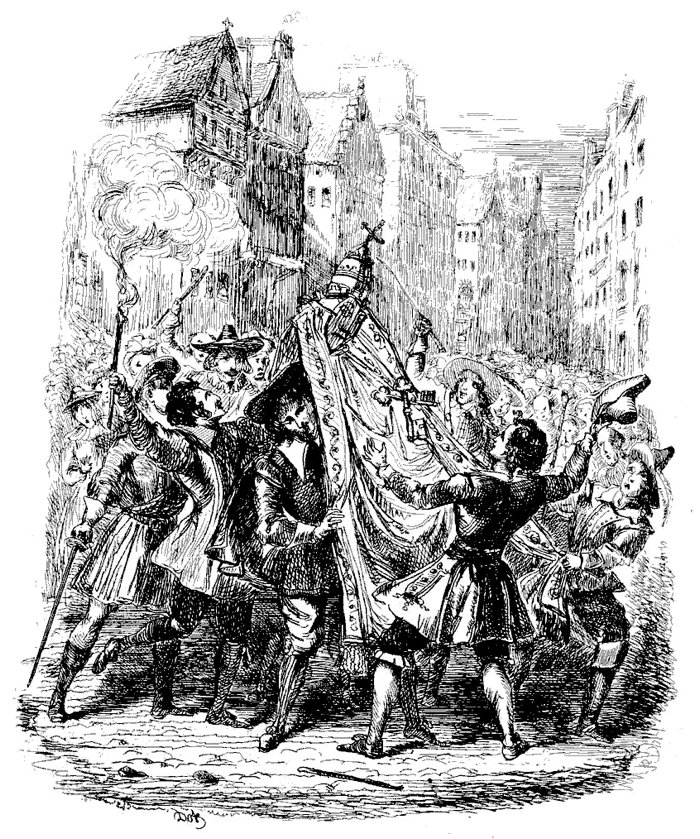
The Students of Edin.r burning the Pope in effigy, Anno. 1680
Vide page 473
Edinr. Hugh Paton. Carver & Gilder to the Queen 1842.
Along with Skene were executed Archibald Stewart, who belonged
to Borrowstounness, and John Potter, a farmer in the
parish of Uphall. The former had been a follower of Cameron,
and present at the skirmish at Airs-moss, though not apprehended
till some time after, when, being examined by torture, he acknowledged
the fact, as a necessary piece of self-defence when following
the gospel preached in the fields—the only crime of which he
could be accused; but he denied that either he or any of those
with whom he associated had ever declared that they would
have killed the king or any of the council, which he affirmed was
“an untruth and forged calumny, to reproach the way of God,
more like themselves and their own principles, who have killed so
many of the people of God both on the fields and upon scaffolds.”
413The latter also had been equally guilty of attending the reproached
preachings of Cameron and Cargill; and he exhorted his fellow-christians
not to be troubled because of their death, but to
“keep the word of his patience, and he would keep them in the
hour of temptation which shall come upon all the world, to try
them that dwell upon the face of the earth.” “O dear friends
and followers of Christ, hold on your way; weary not; faint not;
and you shall receive the crown of life. It is they that overcome
by the blood of the Lamb, and the word of their testimony, that
shall stand, being clothed in white robes before the throne; for
these are they that have come out of great tribulation. Remember
there is a book of remembrance written; and the names are
written in it that speak often one to another. O! my friends,
let it be your study to keep up private fellowship meetings, wherein
so much of the power and life of religion is to be found.”
They do not appear to have been attended by any minister. They
sung the second Psalm and read the third chapter of Malachi; but
when Stewart began to pray, and alluded to the bloody Charles
Stuart, immediately the drums were beat.
These acts of severity, however, by no means produced the
effects intended; and, as the youth of a country often announce
prematurely the feelings of the maturer part of a community, the
students at Edinburgh College, on Christmas-day, celebrated the
highest festival of the Romish church by burning the Pope in
effigy, arrayed in his pontifical paraphernalia—his triple crown,
keys, and scarlet robes—after having paraded him through the
streets in procession, and formally excommunicated him. Those
at the College of Glasgow in a less tumultuous, but more lasting
and impressive manner, testified their sentiments by reviving the
blue riband—the badge of the covenant. When called before
the archbishop for their offence, the young Marquis of Annandale
showed his contempt for his authority by only styling him Sir,
and, when reproved by his tutor for not respecting his superior,
replied, “I know the king has been pleased to make him a spiritual
lord; but I know likewise the piper’s son of Arbroath and
my father’s son are not to be compared.”
BOOK XVI.
414
Edinburgh College shut—Isobel Alison and Marion Harvey executed—Other executions—Search
for covenanters—Thomas Kennoway’s exploits—Mock-courts held
by Cornet Graham and Grierson of Lag—Mr Spreul tried—acquitted—sent to
the Bass—John Blackadder, Gabriel Semple, and Donald Cargill seized—Walter
Smith, William Cuthil, and others apprehended, tried, and executed.
This year was ushered in by the council ordering the College of
Edinburgh to be shut up, January 4, and the students, several of
whom were sent to prison, dispersed in consequence of the insult
they had offered to the religion of his Grace the Duke of York,
who had now openly avowed his being a papist. The youths expressed
loudly their indignation at such treatment, and had threatened,
it was said, to burn the provost’s house about his ears for
his servility, when the house by some means or other actually
took fire, and was burnt to the ground. How it happened was
never discovered, and a report that it was done by some of
the Duke of York’s emissaries, gained general credit, although
various efforts had been made to affix the blame to the students;
but they voluntarily came forward and offered to stand trial that
their characters might be vindicated. The offer was refused.
A more grateful tribute, however, was paid to his Royal Highness’
faith, by the immolation of two virgin martyrs in the end of
the same month—Isobel Alison, who was apprehended at Perth,
where she quietly resided, and Marion Harvey, a maid-servant, a
native of Borrowstounness, who was seized upon the road as she
415was walking from Edinburgh to hear sermon in the country.
Atrocious as these times were, their annals do not afford many
instances of more heartless, cold-blooded, entrapping levity, than
the examination of these simple girls, both before the privy council
and the court of justiciary, do, in the conduct of their examinators,
on the one hand, nor more interesting exhibitions than
their artless yet pointed replies, on the other.
When Isobel Alison was before the privy council, “they asked
me,” says she, in an account of it which she left, “if I could read
the Bible? I answered, Yes. They asked me if I knew the duty
we owe to the civil magistrate? I answered, when the magistrate
carrieth the sword for God, according to what the Scripture calls
for, we owe him all due reverence; but when they overturn the
work of God, and set themselves in opposition to him, it is the
duty of his servants to execute his laws and ordinances on them.
They asked, if I ever conversed with rebels? I answered, I
never conversed with rebels. They asked if I conversed with
David Hackston? I answered, I did converse with him, and I
bless the Lord that ever I saw him; for I never saw ought in him
but a godly pious youth. They asked, when saw ye John Balfour,
that godly pious youth? I answered, I have seen him.
They asked, when? I answered, these are frivolous questions;
I am not bound to answer them. They said I thought not that
a testimony.”
“They asked, what think ye of that in the Confession of Faith,
that magistrates should be owned though they were heathens? I
answered, it was another matter than when those who seemed to
own the truth have now overturned it, and made themselves avowed
enemies to it. They asked, who should be judge of these
things? I answered, the Scriptures of truth and the Spirit of
God, and not men who have overturned the work themselves.”
She refused to call Sharpe’s death murder; and being asked if
she would own all that she had said, as she would be put to own
it in the Grassmarket, they expressed their regret that she should
hazard her life in such a quarrel. “I think my life little enough
in the quarrel of owning my Lord and Master’s sweet truths;—for
he has freed me from everlasting wrath; and as for my body,
416it is at his disposal. They said I did not follow the Lord’s practice
in that anent Pilate. I answered, Christ owned his kingly
office when he was questioned on it, and told them he was a king,
and for that end he was born; and it is for that we are called in
question this day—the owning of his kingly government. The
bishop said, we own it. I answered, we have found the sad consequences
of the contrary. The bishop said he pitied me for the
loss of my life. I told him that he had done me much more hurt
than the loss of my life, or all the lives they had taken, for it had
much more affected me that many souls were killed by their
doctrine. The bishop said, wherein is our doctrine erroneous?
I said, that was better debated already than a poor lass could
debate it.”
Marion Harvey was not twenty years of age. When brought
before the council, there was no criminal act which they could lay
against her; nor does it appear that there was any witness they
could have brought to substantiate any charge. But she was
easily ensnared; she acknowledged having been at field-conventicles,
and respecting the king’s authority, she said, “so long as
the king held the truths of God which he swore, we are obliged
to own him; but when he brake his oath and robbed Christ of
his kingly rights, which do not belong to him, we are bound to
disown him. They asked, were ye ever mad? She answered,
I have all the wit that ever God gave me. Do ye see any mad
act about me? When told that she had been guilty of the sin
of rebellion, she smiled and said, if she were as free of all sin
as of the sin of rebellion, she should be an innocent creature.”
Both were sent to the justiciary and indicted for treason, because
it was alleged the one had spoken freely against the severities
then practised against the Presbyterians, and the other had
attended field-conventicles. Their own declarations were the only
evidence adduced against them. When the jury were sworn in,
Marion, looking towards them, solemnly said, “Now, beware what
ye are doing, for they have nothing against me, but only for owning
Jesus Christ and his persecuted truths; for ye will get my
blood upon your heads!” One of them who had been seized
with a fit of trembling, desired the confessions to be read, which
417being done, the advocate addressed them, and concluded with
“ye know these women are guilty of treason!” One of the jury
remarked, “they are not guilty of matters of fact.” “Treason
is fact,” replied the accuser, and added, “’tis true it is but treason
in their judgment; but go on according to our law, and if
you will not do it, I know how to proceed.” He then addressed
the prisoners, “’Tis not for religion we are pursuing you,
but for treason.” “It is for religion,” replied Harvey; “for I
am of the same religion that ye all are sworn to be of! I am a
true Presbyterian; and,” turning to the jury, “I charge you before
the tribunal of God, as ye shall answer there! ye have nothing
to say to me but for my owning the persecuted gospel.”
They were both brought in guilty upon their own confession, and
condemned to be hanged at the Grassmarket on the 26th. They
were executed according to their sentence, and died, not with composure
only, but with rapture.
When being brought from the tolbooth to the council-chamber
to be carried to the place of execution, the youngest, who
had several friends attending her, exclaimed, with an air of unearthly
ecstacy, “Behold, I hear my beloved saying unto me,
‘Arise, my dove, my fair one, and come away!’” When in the
room waiting the last preparations, Bishop Paterson, with a kind
of fiendish exultation, said, “Marion, you said you would never
hear a curate pray, now you shall be forced to hear one,” and
ordered a suffragan of his who was in attendance to proceed; on
which she turned to her companion, and saying, “Come, Isobel,
let us sing the 23d Psalm;” they commenced immediately, and
drowned the voice of the poor curate, who, with his employers,
stood amazed at the clear unbroken tones of the youthful confessors.
On the scaffold, the most of her discourse was of God’s love to
her and the commendation of free grace. Ascending the ladder
a few steps, she sat down and said, “I am not come here for murder;
for they have no matter of fact to charge me with, but only
my judgment. I am about twenty years of age. At fourteen or
fifteen, I was a hearer of the curates and indulged; and while I
was a hearer of these, I was a blasphemer and Sabbath breaker,
418and a chapter of the Bible was a burden to me; but since I
heard this persecuted gospel, I durst not blaspheme nor break the
Sabbath, and the Bible became my delight;” on which the town
major called to the hangman—“Cast her over,” which he immediately
did.
Isobel, looking to the crowd from the scaffold, cried out—“Rejoice
in the Lord, ye righteous; and again I say rejoice.”
When she went up the ladder, “O! be zealous, sirs; be zealous!
Love the Lord all ye his servants; for in his favour there
is life. O! ye his enemies, what will ye do—whither will ye
fly? for now there is a dreadful day coming on all the enemies
of Jesus Christ. Come out from among them all ye that are the
Lord’s own people;” then added, “Farewell, all created comforts!
farewell, sweet Bible! in which I delighted most, and
which has been sweet to me since I came into prison. Now, into
thy hands I commit my spirit, Father, Son, and Holy Ghost!”
And while these words yet trembled on her lips, she was launched
into eternity. In order to imbitter their punishment, they were
hanged along with five other women for child murder. The latter
were attended by a curate, who gave them every consolation, but
upbraided their virtuous companions in suffering in the most opprobrious
terms as traitors.
Within a few days, John Murray, in Borrowstounness, Christopher
Miller, weaver, Gargunnock, and, on March 8th, William
Gowgar, Borrowstounness, with Robert Sangster, a Stirlingshire
man, were found guilty by a like speedy process, and hanged together
in the Grassmarket on the 11th, except Murray, who was
reprieved.[133] Their testimonies embraced the same topics, and
419were in every respect similar to those of their worthy predecessors
who had vindicated the religious and civil liberties of their afflicted
country at the expense of their lives. Gowgar was rather more
harshly used than the rest. Some heads of an intended speech,
written on a small slip of paper, having fallen out of his Bible in
the council chamber, whither he had been taken just before being
led to the gallows. After some of the councillors had read it,
they ordered the executioner to tie his arms harder than usual, so
that he could scarcely climb the ladder; and when he began to
speak, the drums were immediately commanded to roll; nor
would they even allow him to pray.
Adam Urquhart, laird of Meldrum, having been accused, and
offered to be proved guilty of the most exorbitant oppression, the
council, to mark their sense of such conduct, renewed his former
commission with additional powers, for searching out and apprehending
all who had not taken the bond, or who had been at Bothwell
or harboured any who had been there. As a specimen of the
manner in which such searches were carried on, I give the following:—Thomas
Kennoway, one of the king’s guards, came to the parish
of Livingstone with a party late on Saturday, 19th March, pretending
that he had orders—for he produced none—to apprehend
such as had been concerned in the Bothwell rising. Having tampered
with the neighbours to procure a list of such as had been
engaged, he at last obtained the name of one young man who
lived with his father and brother in a small house near a moss,
which the party entered; and after smashing and destroying the
furniture, under pretence of searching for arms, Kennoway cursed
the father for an old devil, and swore “he would hang him at the
tae end of a tow an’ his son at the t’ither;” and carried them all
off along with him. When they had marched some little way,
Kennoway suffered the old man and one of his sons to return, and
proceeded with the other to a hamlet at a considerable distance to
search another suspected house. When he alighted here, he
obliged his prisoner to take off his coat and cover his horse with
420it, in a cold stormy night, till the poor fellow could scarcely stand
with shivering. The person they were in search of escaped out
at a window in his shirt, and in this state ran nearly a mile before
he obtained shelter. Meanwhile the party took away his father
in his stead. They made a third attempt the same night upon
a fresh steading, still dragging their captives along with them, but
missed their prey.
Having spent the night in rioting, early on the Sabbath
morning they came to Swine-abbey, a public-house properly so
called, and having procured lights, “Kennoway,” says honest
Wodrow, “swore bloodily he feared they had brought the wrong
man;” and the prisoner peremptorily denying that he had been
at Bothwell, two of the soldiers were despatched to bring “the
old dog” and the other son. But by this time the young dog
had got out of the way, and the old one, through terror and
maltreatment, was so ill that he could neither ride nor walk. The
troopers brought some women to bear witness to the fact, and also
that the prisoner was not the person mentioned in their list.
Chagrined at their disappointment, the valiant Kennoway and his
party endeavoured to drown their mortification in “eight pints of
wine and brandy, for which he swore the prisoners should pay.”
Thus passed the Sabbath. On Monday he held a court, fined
the old man in eight dollars, forced an heritor in West Calder to
give him a bond for five hundred merks, and committed many
other extravagances, of which the sufferers durst not complain,
and for which there was no redress. The young man was allowed
to depart; but in consequence of his harsh treatment, fevered,
and died within a few days.
Such burlesque courts now became common with the military,
who carried them to the most extravagant length. Cornet Graham,
who appears to have infested several parishes, held one at Dalry
in the beginning of the year, to which all men and women above
the age of sixteen, were summoned. Those who appeared were
ordered to declare upon oath whether they had ever been at any
field-meetings or countenanced any who frequented them, and
whether they were married or got any infants baptized by field-preachers.
The infamous Grierson of Lag was also particularly
421active in holding others in Dumfries and Galloway, where great
numbers of the inhabitants were put to much expense, besides
loss of time and damage to their various occupations.
Some estimate may be formed of the extent of the wanton extortion
experienced by the most industrious part of the community
at this period, when it is recollected that not only all whom
the curates and clergy chose to denounce as guilty of “horrid
contempt of the law,” but all against whom they had the smallest
grudge and chose to name as witnesses of the contempt of others,
were brought from their homes, week after week, and kept dangling
after their court diets. The case of Mr James Aird of
Milltoun will furnish an apt illustration. While residing at Kilmarnock
upon a very stormy Sabbath, the church being very thin,
one Carnegie, the curate, at the close of his afternoon’s sermon
caused the kirk doors to be locked, and the names of the heads
of families, parishioners, called over, and all the absentees marked
on purpose to be fined—an excellent method of procuring attendance
on rainy Sundays in country parishes. Mr Aird was not
only fined on this occasion, but was brought before the justiciary
shortly after, when fifty-five witnesses were examined in order to
prove his accession to Bothwell, not one of whom could say a
word about the matter; and much as they were inclined to strain
every point to get him forfeited, all failed, and he was liberated.
Yet was he forced to compound with the Laird of Broich, who,
on pretext of alleged converse, had got a gift of his moveables,
besides paying upwards of three hundred merks in expenses before
the justiciary. Nor did this terminate his sufferings; ere
three short months elapsed, parties were anew sent in pursuit of
him; and he was, after sleeping in the open fields upwards of
forty nights forced to abscond for several years, leaving his house
and effects to the mercy of the plunderer.
There is something truly diabolical in first torturing a suspected
person to force a confession of crime, and then producing this
confession in a criminal court, and upon it, without any other evidence,
condemning a man to die; yet such a practice was now
attempted to be introduced by Sir George Mackenzie, in order to
reach the lives of the persecuted. Before Mr Spreul was recovered
422from the effects of his torture, the Lord Advocate served
him with an indictment; and an extrajudicial examination of
several witnesses took place before some of the councillors, against
which the prisoner protested; yet although both threatened and
cajoled, their evidence appeared so defective, that proceedings were
delayed, though the Duke of York pressed his immediate trial,
“alleging they were at much pains about poor country people, but
Mr Spreul was more dangerous than five hundred of them.” At
length, June 10, he was brought before the court upon a new indictment,
“charged with treason and rebellion, corresponding and
being present with the rebels at Bothwell, also keeping company
and corresponding with Mr John Welsh and Mr Samuel Arnot,
the bloody and sacrilegious murderers of the late Archbishop of
St Andrews”—it being now the custom to accumulate in the indictment
a number of charges which the public prosecutor himself
knew to be false, and did not even intend attempting to prove.
The panel was assisted by some of the first advocates at the
bar—Sir George Lockhart, Mr Walter Pringle, Mr James Deas,
Mr Alexander Swinton, and Mr David Theirs. It was contended
by his counsel, that he could not now be put upon his trial, or,
in legal language, “pass to the knowledge of an inquest,” because,
being examined before the council for the same crime, and having
denied the same, and thereafter being tortured two several times,
persisted in his denial, he cannot by the law of this and all other
nations be impanelled nor condemned for that crime upon any
new probation.
The reply of the Lord Advocate was indeed worthy of himself:—“A
denial upon torture cannot infer absolute liberation, since
no man’s obstinacy should be of advantage to him—that were to
make disingenuity a remission, and tempt criminals to conceal
truth; nor does torture, in law, import any more than a presumption
of innocence—and, in law, presumptions may be taken off
by clear probation. Were torture to preclude future probation,
it will follow, that either crimes must be left undiscovered by not
putting suspected persons to torture, or criminals be absolved and
suffered to go unpunished, by wanting after opportunities of leading
just probation against them. The most that can be pleaded
423in law, is, that no man can be tried upon the principal and chief
points for which he was tortured; but the panel was never tortured
upon the grounds he is now to be tried upon; besides, he
neither cleared himself nor satisfied the judges, but continued in
one insuperable obstinacy. Nor was it necessary to examine him
respecting his accession to the rebellion since it can be proven
that previously to his torture he confessed the crime.”
Sir George Lockhart offered to prove that the panel was tortured
twice most violently upon the very crime; that it is the
opinion of all lawyers, when once torture is used, it excludes all
other probation, even although there should afterwards appear the
fullest evidence against the accused; for, were it not so, double
punishment would be undergone—and the practice of this nation
has been exactly agreeable thereto. In the year 1632-33, John
Toshach being pursued as guilty of statutory treason for wilful fire
and burning the house of Frendraught, the panel being interrogated,
not upon the whole fact, but whether he entered into the
vault with a candle that night the house was burnt, and upon this
subjected to torture and denied it. The process was prolonged
from August to November, and then to February. His majesty’s
advocate urging a new probation, and the panel’s lawyers advancing
his torture as a defence, the lords of justiciary sustained it.
Sir George Mackenzie then consented that it would be sufficient
for the panel to prove that he was tortured upon this very
point by command of the council, and produced the commission.
Sir George Lockhart said he did not mean to accuse the committee
appointed by the council of illegal procedure by acting in
opposition to their commission; but it is certain the panel was
interrogated upon the crimes libelled, and his answers drawn up
as his confession. The lords repelled the defence, founded upon
the torture, inasmuch as the commission of council did not warrant
the prisoner’s being questioned upon any of the crimes mentioned
in the indictment, and adjourned the trial till the 13th.
At this sederunt several witnesses were examined, but none of
them brought the facts home to the prisoner, and the Lord Advocate
adduced his alleged confession in presence of the council
as a corroborative evidence. Sir George Lockhart argued that
424the pretended confession before council could not be received,
for it was not acknowledged nor signed by the panel, besides
being extrajudicial and not taken before a competent judicature.
The king’s advocate offered to prove by witnesses that the confession
was read to the panel, and he could not disown it; his
contumacy, therefore, ought not to be of any use to him, unless
one crime was brought forward to defend another. Yet, following
the merciful example of the king, his master! and being unwilling
to stretch any debateable point, he only adduced this confession
against the panel as an adminicle and a presumption, joined
with other pregnant grounds,—and what can be stronger?
Writs may be forged, witnesses may be false, but a man will
never confess untruly to his own hurt, and therefore a confession,
even before an incompetent tribunal, unless the confessor can
show what made him err. Then assuming, what does not appear
plain upon the record, his presence and converse with rebels, he
proceeds—“all that is wanting is, whether it was with a criminal
intention, of which his own confession must be owned the most
solid evidence.”
Sir George Lockhart insisted that there could not be one instance
produced of a confession importing forfeiture of life and
estate not signed by the person, or judge, if he cannot write;
that in pecuniary matters the bare verbal confession would not
be admitted to be proven by deposition of witnesses for one hundred
pounds Scots—and would it be admitted in a matter of life
and fortune? The lords “refused to sustain the confession to
be proven by witnesses as a mean of probation, either plenary
or adminiculate.”
The advocate, as a last forlorn hope, moved “that the panel
be interrogated if he thinks the being at Bothwell Bridge rebellion?”
The panel answered, that he conceives that he is not
obliged to answer, because it is not the crime libelled, and he may
as well be interrogated upon any other point of treason. The lords
having, however, put the question, the panel answered, “that was
no part of the libel, and his future life should witness him to be
both a good subject and a good Christian.” The prosecutor now
declared his proof closed, and protested for an assize of error in
425case the inquest assoilzie the panel. The jury were then enclosed
and ordered to return their verdict next day, which they did in
the following terms:—“The assize having considered the depositions
of the haill witnesses led against John Spreul, una voce,
find nothing proven of the crimes contained in the libel which
may make him guilty.”
What follows marks as much almost as any deed of the times
the tyranny of the government and the servile prostitution of
justice at the fountainhead. When Spreul and his procurators,
upon his acquittal, took instruments and craved that he might be
liberated, his majesty’s advocate produced an act of council previously
prepared:—“Edinburgh, June 14, 1681. The council
give order and warrant to the justices, notwithstanding of any
verdict or sentence upon the criminal dittay lately pursued against
John Spreul, to detain him in prison until he be examined upon
several other points they have to lay to his charge.” Mr Spreul
was accordingly remanded to jail; and such was the persevering
greed of his rapacious persecutors, that, on the 14th of July, he,
together with a William Lin, writer in Edinburgh, was brought
before the privy council for being at field-conventicles. They
were both accused of having at least heard Presbyterian ministers
preach when some of the congregation were without doors,
and likewise of resett and converse with intercommuned persons;
and the truth of the accusation being referred to their
oaths, because they would not swear, they were both found guilty,
and each of them fined five hundred pounds sterling and sent to
the Bass. Mr Spreul lay there six years, whence, “from his
long continuance in that place,” Wodrow adds, “he has yet the
compellation of Bass John Spreul, whereof he needs not be
ashamed.”[134]
Mr Blackadder was seized in Edinburgh on Tuesday, April 5,
and has left the following account of his apprehension, so characteristic
of the manners of these satellites of prelatic domination,
426that I give it at length:—“The party came to his house before
he arose. His daughter and servant were up expecting the Borrowstounness
carrier, who had promised to come that day. About
five or six o’clock, one knocked softly at the hanging gate. She
looked through a hole in the door and spied a man with a grey
hat, and thought it had been the carrier, who was there the night
before with a grey hat of somebody’s on his head. She opened
the door, but it proved to be Johnstoun the town-major, with a
party at his back, who came into the hall, and asked, ‘If there
were any strangers in the house.’ She said, ‘No.’ Yet he came
to the chamber where her father was lying, putting the end of his
staff to the side of the curtain, and then went up stairs to the
gallery where the minister used to stay, and found only his son
lying in the bed, and came down again to his chamber, saying to
the minister’s wife, ‘Mistress, desire your husband to rise.’ He
looking forth out of the bed, said, ‘How, now, major, is that you?
I am not surprised, but where is your order?’ The other said,
‘You are only to rise and come down to a friend in the Canongate.’
‘Well,’ said the minister, ‘if I were dressed, I am ready.’
“Meanwhile he spoke gently to his men to wait on the prisoner,
but he himself went quickly to Dalziel in the Canongate; upon
which and other presumptions, the minister conjectured he had
no order at the time, except privately from Prelate Paterson, till
after he was taken; for he did not take him out of his house till
he returned. After he returned, the minister calling for a drink,
sought a blessing, and caused give them all a drink, and went
forth; his wife being very sickly, yet behaved more quietly than
he could have believed. It was observable that such a wicked
person as the major was, who used to swear and domineer in all
such cases, did at that time carry most calmly, as all the party
did, not one menacing word being heard. The major took him
down the Cowgate, himself on the one hand, and the minister’s
son Thomas on the other, the party following, and brought him
to Dalziel’s lodgings, near the foot of the Canongate. The major
went first, the minister following. Dalziel himself opening the
door, the major told him he had brought the prisoner. Dalziel
bade him take him to the guard. The minister stepping up stairs,
427said—‘May I speak a little?’ at which he rudely raged, ‘You,
sir, have spoken too much; I would hang you with my own hands
over that outshot.’ He knew not yet who he was, nor what was
laid to his charge till afterward, as the minister perceived by a
strange alteration in his calmness to him when he came to the
court at twelve o’clock, at which time he was called.
“His examinators were, the Duke of Rothes, chancellor; the
king’s advocate, Sir George Mackenzie; General Dalziel; and
Bishop Paterson of Edinburgh. In answer to questions from the
Chancellor, he acknowleged he was a minister at Troqueer, in
Galloway, since 1653. ‘Did you excommunicate the king? or
was you at Torwood at the time?’ ‘I have not been at Torwood
these four years.’ ‘But what do you think of it? do you
approve of it?’
“Perceiving that many such extraneous questions concerning
his thoughts and judgments of things might be asked, and being
resolved to make a stand at first, he shunned declaring his inward
sentiments, and answered—‘Though I be as free to answer to
that as to all the former, yet I must tell you I came here to give
account of my judgment to no man; therefore, seeing this is an
interrogating of me about my thoughts, I humbly beg to be
excused. Produce a libel, and I’ll endeavour to answer it as I
can.’ On this point he was repeatedly interrogated by the Chancellor
and the Advocate, but to no purpose.
“‘But do you approve of taking the king’s life?’ ‘No, I do
not, and no good man will.’ The Chancellor said, ‘Sir, you
have done yourself a favour in saying so. But we hear you keep
conventicles since the last indemnity?’ ‘I need not ask what is
meant by conventicles, seeing that term has been frequently applied
to our preaching who are ministers of the gospel, and under
the strictest obligation to exercise our ministry, as we shall be
answerable at the great day. My lord, I have the honour to be
lawfully and duly called to the sacred function, and am bound to
exercise that office, which I ever did and still do account my duty,
abstracting from all indemnities whatever.’ ‘But you have
preached in the fields, that is, on moors and hill sides? I shall
not ask you if you have preached in houses or not, though there
428is not liberty even for that.’ ‘I place no case of conscience, nor
make any difference betwixt preaching in houses or in the fields,
but as may best serve the convenience of the hearers; nor know
I of any restriction lying on me from the word of God, where I
have my commission, which reaches to houses and fields, within
and without doors.’ ‘You know, and no doubt have seen, the
laws discharging such preaching?’ ‘My lord, no doubt I have;
and I am sorry that there ever should have been laws and acts
made against preaching the gospel.’ ‘Not against preaching the
gospel, but against sedition and rebellion.’ ‘I preach no sedition
or rebellion.’
“Then the Lord Advocate rose out of his place and came to
the prisoner, and courteously asked him, why he answered not
more clearly to the Chancellor about the excommunication, and alleged
he was straitened. To this insidious query, Mr Blackadder
replied, ‘I am noways straitened or confused about that; but I
do of purpose shun to answer such interrogatories as require me
to give account of my thoughts and judgment about persons or
practices, not knowing how many such questions may be put, or
what use may be made of them; and I am here only to answer
for matters of fact that concern myself.’ Then intending to speak
somewhat more, he craved liberty to be heard; to which the
Chancellor replied, ‘You have leave to speak, if you speak not
treason;’ but immediately rose and went out with the other two,
it being near one o’clock, their dinner hour.
“Before the next examination, he sent his son to tell Colonel
Blackadder, a cousin of his, who went and informed General Dalziel,
whose comrade he had been in the wars, of the prisoner’s relation
to the house of Tulliallan, with which Dalziel also was connected.
The examination consisted only of a few trifling questions,
and passed smoothly. At two o’clock on Wednesday, Captain
Maitland, who was on the guard, told the prisoner he was to
carry him up to the council at three, and desired him to be ready.
When the Duke went to the council, he, Mr Blackadder, was
ranked among three rank of musketeers in Captain Maitland’s
company, who marched him up the rear of the life-guards who
attended the Duke up streets. When he came to the Parliament
429Close, the captain sent four soldiers to wait on the prisoner in an
outer room till he should be called. There he sat from three till
five o’clock, when the council rose. He was not called, which he
marvelled at; but sent his son Thomas to inquire what word was
concerning him, who answered he believed he was sentenced to
the Bass. On the morrow he was sent off. When they reached
the Fisherrow, they observed a gathering of people upon some
occasion or other at the end of the town, upon the green, which,
when the captain perceived, he took the alarm, apprehending it
might be a design to rescue the prisoner. Upon this he came to
the minister, and said, ‘If these people attempt to rescue you,
you are a dead man; for upon the first attack, I will shoot you
through the head.’ The minister said he knew nothing about it,
and did not believe there was any such design. They came to
Castleton over against the Bass about three afternoon. The prisoner
dined the whole party there! and after dinner two of them
went over with him in a boat to the rock; and he was delivered
to the governor of the Scottish Bastile about five afternoon, on
Thursday, April 7, 1681, after he had laboured in the work from
1662, when he was cast out in many and divers places in the land
under continual persecution, manifold hardships and hazards, till
he accomplished the service appointed by his master.”
Mr Gabriel Semple, son of Sir Bryce Semple of Cathcart,
minister of Kirkpatrick-Durham in Galloway, an able associate of
Blackadder and Welsh, particularly obnoxious as being one of
the first who took to the fields, was in July this year seized in the
house of Sir Patrick Hepburn of Blackcastle, at Oldhamstocks,
and liberated upon giving bond to appear when called for, under
a penalty of ten thousand merks. When seized, he was labouring
under an ague and unable to ride, yet would not the council
dispense with his presence; but procuring the accommodation of
Lady Stevenstoun’s calash, he was able to perform the journey,
accompanied by his nephew. On his arrival, he was lodged in
the Canongate jail, where he lay for a short time. When called
before a committee of council, his petition was read to him, and
he was called to acknowledge it; but the clerk, in reading, had
added some strong expressions, disavowing the principles for which
430Mr Semple was suffering, in hopes that he would disclaim it.
This he afterwards found had been done on purpose to extort
money from him, (but Lord Maitland, who was one of the number,
was very friendly.) When asked if he owned the supplication
after it was read, he requested a sight of the paper; and observing
that the paper itself had not been altered, he returned it,
saying that that paper was the very same he had written and given
in; upon which he was dismissed without being required to renew
the bond, and shortly after he withdrew to England.
His host, however, did not escape so easily. He was brought
before the council and fined in the sum of two hundred pounds
sterling, and imprisoned till he found caution to pay it.
Cargill had nobly kept the field, after all his brethren had retired
to safer stations, and his ministry had been greatly blessed.
In consequence, he had become an object of more eager pursuit;
but the Torwood excommunication had raised the malignant passions
of the persecutors to a degree of virulent animosity beyond
what can be imagined or accounted for by those who consider the
transaction an object of contempt; and a reward of five thousand
merks was offered for his apprehension. He delivered his last sermon
upon Dunsyre Common, from Isaiah xxvi. 20. “Come, my
people, enter thou into thy chambers, and shut thy doors about
thee: hide thyself as it were for a little moment, until the indignation
be overpast.” That night, through the persuasion of Messrs
Smith and Boig, he went to Covington-mill, where he was seized,
together with his two companions, by James Irvine of Bonshaw,
who exclaimed with satanic glee—“O blessed Bonshaw! and
blessed day that ever I was born! that has found such a prize
this morning.” At Lanark, they procured horses, and placing
the prisoners on their bare backs, Bonshaw with his own hands
tied Mr Cargill’s feet below the animal’s belly, painfully hard.
“Why do you tie me so hard?” said the venerable saint; “your
wickedness is great; you will not long escape the just judgment
of God.”[135] Fearing a rescue, they pushed on for Glasgow as
431fast as they could. When near the city, they turned him on his
horse, and led him in backward. They halted at the tolbooth
till the magistrates came to receive them. Multitudes flocked to
gaze; and while many stood weeping to see their late revered
minister in such a situation, John Nisbet, a dissolute character,
the bishop’s factor, addressed him tauntingly—‘Mr Donald, will
you give us one word more?’ alluding to an expression Mr Cargill
sometimes used in preaching. The prisoner, looking sorrowfully
on him, replied—‘Mock not, lest your bands be made
strong; the day is coming, when you shall not have one word to
say though you would.’ This natural and serious reproof was
received as a prophecy; and Wodrow adds—“This came very
shortly to pass. Not many days after, the Lord was pleased to
lay his hand on that ill man. At Glasgow, where he lived, he
fell suddenly ill, and for three days his tongue swelled; and
though he seemed very earnest to speak, yet he could not command
one word, and died in great torment and seeming terror.
Some yet alive know the truth of this passage.”[136]
Mr Cargill and his fellow-prisoners were brought to the capital,
and on the 15th July examined before the council. Being asked
if he owned the king’s authority and the king as his lawful prince,
he answered, as the magistrates’ authority is now established by
the act of parliament anent supremacy and the explanatory act, he
denied the same. When pressed to say explicitly if he owned
the king as his lawful prince, yes or no; he refused to give any
other answer than he had already given, and declined their interference
respecting the excommunication, that being entirely an
ecclesiastical matter. He acknowledged having seen Balfour,
Henderson, and Russell, within the last two years, but knew nothing
432of their intentions before the deed—i. e. the archbishop’s
death—was done. A copy of the sermon alleged to have been
preached by him at the Torwood, was produced—so vigilant were
their spies in procuring information—and he was asked if it was
a true copy. He desired time to consider before he answered.
He owned the lawfulness of defensive arms in case of necessity,
and did not consider those who were at Bothwell rebels, but oppressed
men; and refused to say whether he was there or at Airs-moss.
He did not see the Sanquhar declaration till after it was
proclaimed, but refused to say whether he had any hand in advising
it or not; and with regard to the principles it contained,
would give no opinion rashly. He further declared he could not
give his sense respecting the archbishop’s death, but that the
Scripture says that the Lord giving a call to a private man to kill,
he might do it lawfully, and instanced Jael and Phineas—thinks
he is not obliged to obey the king’s government as it is now established
by the act of supremacy. He was repeatedly before the
council, but varied nothing in his declarations.
Mr Walter Smith, though young in years, was an eminent
Christian and an excellent scholar. He had studied abroad under
Leusden, who highly esteemed him; and when he heard of his
martyrdom, burst into weeping, and said in broken English—“O!
Smit, great, brave, Smit; b’yond all as ever I taut.”[137]
He declared he did not think it lawful to rise in arms against
lawful authority, but could not acknowledge the present authority
the king is invested with, as being clothed with a supremacy over
the church. The Sanquhar declaration being read, he owned it,
with this explication, that he did not look on those who composed
it as the regular representatives of the Presbyterian church; he
thought what the king had done, justified the people in revolting
against him, but as to declaring war, he did not know if they were
called or in a capacity to declare war; and thinks that they thereby
intended only to justify the killing of any of the king’s forces
in their own defence, when assaulted, otherwise it might have
433been esteemed murder. As to these words where the king is
called an usurper and a tyrant, he knows certainly the king is an
usurper, and wishes he were not a tyrant.
James Boig, also a student of divinity, a young man of talent
and piety, was examined upon the same points, and bore testimony
to the same truths.
William Thomson, a farm-servant in Fife, apprehended when
coming from hearing sermon at Alloa, in a testimony, most admirably
written, considering his situation in life, coincided with
his minister—“I was before the year 1679,” said he, in that
paper, “running away with the rest of this generation to God-provoking
courses.” “Now I do with all my heart bless the
Lord for his wonderful workings with me, since he began with
me. I think when I look on his dealings since that time till now,
I must say that I am a brand pluckt out of the fire. O! that
my heart and soul could praise him for all that he has done for
me; and now I am content to die a debtor to free grace!” He
then declared his adherence to the Scriptures, to the Covenants,
National and Solemn League, and to the Directory for Worship;
and, “in the last place, bore his testimony to the cross of Christ,
as the only desirable upmaking and rich lot of the people of God
this day in Scotland.” “There is no better way,” he added, “to
carry the cross right, than to cast all our care upon Christ, and
trust him for all things, and use our single endeavours in this
matter; speak what he bids us, and obey his voice in all things.”
William Cuthil—a seaman belonging to Borrowstounness,
who suffered at the same time—struck fairly at the root of the
mischief—the recalling of the Stuarts, which indeed was the first
grand step of backsliding by the honest people in Scotland,
and not more inconsistent in a religious than totally unaccountable
in a rational or political point of view—“The admitting
Charles Stuart to the exercise of kingly power, and crowning him
while they knew he carried heart enmity against the work and
people of God, and while in the mean time there was so much
of his treachery made known to the parliament by his commissionating
James Graham, Earl of Montrose, to burn and slay the
subjects of this kingdom, that would not side with, or would
434withstand, him in the prosecution of his wickedness.” Another
point in his testimony was equally just; it was “against that unparalleled
practice of ministers in quitting their charges; and that
which doth more aggravate their guilt, at his command who had
no power to act, nor right to be obeyed, either in that or civil
things, seeing he hath unkinged himself.”
Had the whole ministers in Scotland and England individually
refused to move till the people themselves had desired them, it is
more than probable that they never would have been ejected. It
was the great anxiety evinced, during their primary negotiations
with Charles, by each party and separate section to engross the
whole of the royal favour for themselves, that laid the foundation
of his tyranny, and cast into his hands a power which enabled him
to overthrow the constitution of this country;[138] and their at once
yielding to their own illegal ejectment confirmed it. If there be
primary principles of government, founded upon the constitution
of our nature, and, like the doctrines of revelation, suited to the
necessities and the existence of society, no power on earth has a
right to uproot or destroy them, more especially if planted with
the genera] consent of a nation; and such were the principles
acknowledged, avowed, legalized, and acted upon by the estates
of Scotland at Glasgow, which were said to be set aside by the
act rescissory, but which were afterwards at the Revolution acknowledged
as inalienable; for these the humblest of the martyrs
shed their blood, and their sufferings have only been decried by
those who allege that Christian privileges and civil privileges can
be separated, or who suppose that a man can enjoy rational freedom,
while he is not allowed to worship God, except in the manner
prescribed by the state.
In one instance, the Duke of York showed something like a
435respect for these principles. A wild sect had originated with John
Gib, a sailor in Borrowstounness, named “the sweet singers,” or
“the Gibbites,” from their leader. These retired to solitary places,
burned the covenants, denied the king’s authority, refused to pay
taxes, disowned the division into chapters and verses of the Old
and New Testaments, the Psalms in metre, also the names of
the months and days of the week, fasted long in the immediate
expectation of the end of the world, and with curious inconsistency
were constantly singing the penitential Psalms. Such at least
were some of the charges against them; but when a number were
apprehended and lodged in the Canongate tolbooth, they were
after a short confinement dismissed, merely upon enacting themselves
to keep the peace.
Far different was the treatment of the five worthies above mentioned.
On the 26th of July, after a form of trial, they were all
found guilty of treason, and ordered to be hanged next day, the
day before parliament met. Mr Cargill came first. “As to the
cause of my suffering,” he said, “the main is my not acknowledging
the present authority, as it is established in the supremacy
and explanatory act. This is the magistracy that I have rejected
that was invested with Christ’s power.” “It is long,” said he, in
the declaration which he left, “since I could have ventured on
eternity through God’s mercy and Christ’s merits, yet death remained
somewhat terrible; now that is taken away; now death
is no more to me than to cast myself down in my husband’s arms.
I have been most in the main things, not that I thought the
things concerning our times little, but that I thought none could
do any thing to purpose in God’s great and public matters till
they were right in their conditions.” When he attempted from
the scaffold to address the numerous assemblage, he was thrice
interrupted by the drums, yet was he not discomposed. “Ye
see,” said he, with a smiling countenance, “we have not liberty
to speak, or to speak what we would; but God knoweth our
hearts; be not discouraged at the way of Christ and the cause
for which I am to lay down my life, and step into eternity, where
my soul shall be as full of him as it can desire to be. And, now,
this is the sweetest and most glorious day that ever my eyes did
436see.” “The Lord knows I go up this ladder with less fear and
perturbation of mind than ever I entered the pulpit to preach.
I forgive all men the wrongs they have done against me. I pray
that the sufferers may be kept from sin and helped to know their
duty.” He afterwards prayed a little, and the executioner turned
him over praying. The others met death with equal solemn confidence
and joy.
On that same day the Duke of Rothes died; and Wodrow
tells us, “that, as through life, except when pushed on by others,
he was never for severities against Presbyterian ministers; so at
his death he had the advantage of some of them with him. He
appeared concerned upon views of eternity, and the Reverend Mr
John Carstairs waited upon him, and prayed with him—the Duke
of Hamilton and many others of his noble relations being present;
and few were present without being affected very sensibly.”
By his death the office of Chancellor becoming vacant, many of
the chief nobility, in expectation of succeeding him, became
more subservient to the royal Duke, which enabled him to carry
his despotic measures with greater facility than perhaps he could
otherwise have done.
BOOK XVII.
437
Parliament—Act for securing the Protestant religion—asserting the divine right and
lineal succession of their kings—for securing the peace of the country—Lord Bargeny’s
case—-The Test—debate upon it—Belhaven—Argyle—objections to its
imposition—Argyle takes it with an explanation—his trial—escapes from the
Castle—forfeited—Fraser of Brea—fined—banished.
At nine o’clock of the forenoon of July 28, the peers in their
robes, and the commissioners of shires in their foot-mantles, assembled
at Holyrood-house on horseback, whence they accompanied
his Royal Highness James Duke of Albany and York to
the Parliament House. There being neither Chancellor nor
Treasurer, the Marquis of Atholl was appointed president of the
parliament. Paterson, bishop of Edinburgh, opened it by a
prayer.[139] The Duchess of York and several other ladies were
present, which was uncommon in those days, and considered indecorous.
The Duke of York, who, as a papist would, but for
a party in the English House of Lords, have been excluded from
the succession, was sent to Scotland as commissioner to secure
438that country, and lay the foundation of another civil war, if things
went adverse to his interest in England. Nor was any opposition
made by this mean-spirited assemblage to receiving a papist
as their king’s representative: previously to their meeting, it
had been privately agitated, but the Duke of Hamilton refused
to have any thing to do with the business, unless a majority
could be previously secured.
Both the king’s letter and his speech are pregnant examples of
that villanous hypocrisy which distinguished the royal brothers.
The king told them—“We have ever considered our own and
the interests of our subjects to be inseparable;” and then he explained
how “experience having sufficiently evinced, that all invasions
upon, or diminutions of, the rights and prerogatives of our
crown, prove fatal and destructive to the security and property of
our people—which can only thereby be protected!” and “it is
one of our greatest satisfactions that we have been always careful
of that our ancient kingdom, with a tenderness suitable to our
great interest in it,” “for promoting which and securing the protestant
religion, we have called this parliament, and impressed
upon them the necessity of adopting effectual and adequate remedies
for curing these violent distempers, schisms, and separation
in the church, and rebellion in the state.” The Duke of York
confirmed the declarations of the gracious letter. He had it in
command from his majesty to assure them that he would inviolably
maintain and protect the protestant religion as now established
by law, and seriously recommended them to fall upon effectual
courses for suppressing these seditious and rebellious conventicles,
from whence proceeded all disorder and confusion, and those horrid
and extravagant doctrines which are a scandal to Christianity, and
tend to the subversion of all public and private interests; and he
concluded by telling them, “as the inclination I had to serve and
promote the interest of this kingdom hath been the chief inducement
to his majesty to give me this opportunity to convince you
of it; so you may be sure I shall do what becomes me to satisfy
you of the truth of it: and I hope you will have that consideration
and kindness as to enable me to perform his service.”
The parliament made a reply, the baseness of which I do not
439wonder at, but I do admire the impudence, when I recollect that
it was first to be presented to a papist commissioner, and by him
transmitted to a half-popish king—if he was any thing. “It
is a great satisfaction to us to find your majesty so concerned
for the protestant religion, not only in your gracious letter to us,
but in the whole conduct of your royal government; and we shall
with all Christian care and duty endeavour to confirm it, so as it
may become a solid and pious support to your royal family and
monarchy, and a sure fence in this disturbed and divided church
against all usurpations and disorders of popery and fanaticism;”
and they added, what would not be less gratifying, “we shall not
fail, by positive laws, to declare our humble and hearty acknowledgments
of the just rights and prerogatives of your imperial
crown, in its just, native, and lineal course of descent; and to secure
the just rights and liberties of your subjects, so as may justly
demonstrate our unalterable resolutions never to depart from our
duty to your royal family and your lawful heirs and successors, to
whom we are tied by so many sacred obligations.”
Their first act was one ratifying and approving all former laws,
acts, and statutes, made by our sovereign lord’s royal grandfather
and father, of blessed memory, for settling and securing the liberty
and freedom of the kirk of God, and the protestant religion presently
professed, and all acts against popery! The very next was
one asserting that the kings of the realm deriving their royal
power from God Almighty alone, their lineal succession, according
to the known proximity in blood, could neither be suspended
nor diverted by any act or statute whatsoever; and that no difference
in religious profession, nor law, nor act of parliament, made
or to be made, can alter or divert the right of succession and
lineal descent of the crown to the nearest and lawful heirs![140]
Then followed an act for securing the peace of the country, by
440doubling the fines and increasing the penalties against all who
frequented field-conventicles, or had any intercourse with those
who did. This presents us with a feature recognizable in the
whole conduct of the ruling party, from the Restoration to the
Revolution, which has not been sufficiently held up to contempt,
and that is the low avarice, the base money-getting tricks which
formed the soul, and directed the agency, of the gallant and chivalrous
supporters of the merry monarch, and of his successor, the
gloomy monk of La Trappe. There stands not out among them
one redeeming character—all were the vilest of money-scrapers,
who would have raked the lowest kennels to gather a supply for
their prostitutes, and who, when that failed, only did not take to
the highway, because they found legal villany an easier and less
hazardous way of plundering. An incident which occurred at this
time, shows the tenure by which the wicked hold their power.
Lord Bargeny, a relation of the Duke of Hamilton’s, who had
been imprisoned on a charge of being at Bothwell, was liberated
by especial order of the king, as no proof was produced against
him. He offered, in open parliament, to produce evidence that
Hatton, (Lauderdale’s brother,) the Earl of Moray, and Sir
John Dalrymple, had suborned witnesses to swear away his life,
in order to obtain his estates among them; but the Duke of
York, who wished to have the parties in his own hands, interposed
and prevented all inquiry into the foul transaction:—such
was his love of justice—and such was the baseness of the parliament,
that they quietly acquiesced in the Commissioner’s arbitrary
and unjustifiable interference.
But the act which above all others holds up the memory of this
servile set to everlasting shame, is the test—the plain history of
which is worth a thousand arguments to prove the folly as well as
the iniquity of all attempts to secure religion by civil penalties,
or to enact religious tests for political purposes. In order to induce
members to pass the act of succession, they had been promised
that every requisite measure should be adopted for securing
the protestant religion. Accordingly, an act anent religion and
the test was brought in, August 31, by which the following oath
was ordered to be taken by all persons in offices and places of
441public trust, members of parliament, and all electors of members
of parliament, and all ministers or preachers of the gospel, teachers
in the universities, chaplains in families, pedagogues to children,
and all officers and soldiers, betwixt and the 1st of January next:—“I,
——, solemnly swear, in presence of the eternal God,
whom I invocate as judge of my sincere intention in this my oath,
That I own and sincerely profess the true protestant religion contained
in the Confession of Faith, recorded in the first parliament
of King James VI., and that I believe the same to be founded
on and agreeable to the written word of God; and I promise and
swear that I shall adhere thereunto during all the days of my life-time,
and shall endeavour to educate my children therein, and
shall never consent to any change or alteration contrary thereunto,
and that I disown and renounce all such principles, doctrines, or
practices, whether popish or fanatical, which is contrary unto, and
inconsistent with, the said protestant religion and Confession of
Faith: and for testification of my obedience to my most gracious
sovereign Charles II., I do affirm and swear by this my solemn
oath, that the king’s majesty is the only supreme governor of this
realm, over all persons, and in all causes, as well ecclesiastical as
civil; and that no foreign prince, person, pope, prelate, state, or
potentate, hath, or ought to have, any jurisdiction, power, superiority,
pre-eminency, or authority, ecclesiastical or civil, within
this realm; and therefore I do utterly renounce and forsake all
foreign jurisdictions, powers, superiorities, and authorities; and
do promise that from henceforth I shall bear faith, and true faith,
and true allegiance to the king’s majesty, his heirs and lawful successors;
and to my power shall assist and defend all rights, jurisdictions,
prerogatives, privileges, pre-eminences, and authorities
belonging to the king’s majesty, his heirs and lawful successors:
and I further affirm and swear by this my solemn oath, that I judge
it unlawful for subjects upon pretence of reformation, or any pretence
whatsomever to enter into covenants or leagues, or to convocate,
convene, or assemble, in any councils, conventicles, or assemblies,
to treat, consult, or determine in any matter of state, civil
or ecclesiastic, without his majesty’s special command, or express
license, had thereunto, or to take up arms against the king or those
442commissionate by him; and that I shall never so rise in arms or
enter into such covenants or assemblies; and that there lies no
obligation upon me from the National Covenant or the Solemn
League and Covenants (so commonly called), or any other manner
of way whatsomever, to endeavour any change or alteration in
the government, either in church or state, as it is now established
by the laws of this kingdom: and I promise and swear that I
shall with my utmost power, defend, assist, and maintain his majesty’s
jurisdiction foresaid against all deadly; and I shall never
decline his majesty’s power and jurisdiction, as I shall answer
to God. And, finally, I affirm and swear that this my solemn
oath is given in the plain, genuine sense and meaning of the
words, without any equivocation, mental reservation, or any manner
of evasion whatsomever, and that I shall not accept or use any
dispensation from any creature whatsomever. So help me God.”
This sacred TEST, which I have given at length, because of its
characteristic singularity, even in that age of oaths—carries on its
front such palpable self-contradiction, that it appears to have been
intentionally framed, as the justiciary categories of that day confessedly
were, to create crime. The Confession of Faith here
sworn to, was that drawn up by John Knox, and asserts Christ to
be the sole “head of the church, in which [whose] honours and
offices, if men or angels presume to intrude themselves, we utterly
detest and abhor them.” In the test, the king is acknowledged
as “the only supreme in all causes, ecclesiastical as well as civil.”
In the Confession, there is enumerated in the list of good works,
“the duty of repressing tyranny and defending the oppressed.”
In the test, it is declared “unlawful, upon any pretence, to take
up arms against the king or any commissionate by him.”
In opening the debate, Lord Belhaven remarked, that “he saw
a very good act for securing our religion from one another among
ourselves, but he did not see an act brought to secure our religion
against a popish or fanatical successor to the crown.” He was
instantly sent to the Castle, and the Lord Advocate declared
there was matter for an accusation of treason against him; nor
was he released until some days after, upon making an ample apology.
Argyle thought it unnecessary, as there were too many
443oaths already; and he strenuously opposed the concluding clause,
excepting the king’s lawful sons and brothers. “It is our happiness,”
he said, “that the king and people are of one religion
by law; and he hoped the parliament would do nothing to loosen
what was fast, or open a door for the royal family being of a different
religion from the nation, and therefore he wished, if any
exception were made, it might be made particularly for his Royal
Highness.” The Commissioner hastily rising, said, he would
allow of no exemption for himself. “Then,” replied Argyle,
“if this exception pass, it will do more prejudice to the protestant
religion than all the rest of the acts will do good.” It did
pass, after a day’s debate, by a majority of seven.[141] Having sat
seven weeks, the parliament adjourned without doing much credit
to the Commissioner’s character, “on which some wise men observed,
‘the Duke of York might have courage and obstinacy
enough, like his father; but had neither great conduct nor a deep
reach in affairs, and was but a silly man.’”[142]
When the test came to be imposed, Scotland presented the appalling
scene of an almost universal compliance among her men in
office; yet even among them there were a few names who defiled
not their garments. John Hope of Hopeton, who had the honour
of being deprived of the Sheriffdom of Linlithgowshire—the excellent
Duchess of Rothes, who though strongly urged, decidedly
refused—besides several others. Queensberry took it with an
explanation, “that he did not understand himself to be against
any alterations in case it should seem good to his majesty to make
them in church or state.” The Duke of Hamilton also had his
444scruples, but was willing the council should name deputies in any
jurisdictions belonging to him, which they did. The Marquis of
Huntly positively refused to take it; but being a papist, he was
passed over. The opposition, however, made by the synod and
Bishop of Aberdeen, the synod of Perth and Bishop of Dunkeld,
and a number of the Episcopalian clergymen, who for the first
time appeared in opposition to the court, induced Paterson, bishop
of Edinburgh, to prepare an explanation, which was approved of
by the council, purporting “that by the test we do not swear to
any proposition or clause in the said Confession of Faith, but
only to the true protestant religion, founded on the word of God,
contained in that Confession, as it is opposed to popery and fanaticism;
that no encroachment is intended upon the intrinsic spiritual
power of the church, as it was exercised by the apostles in
the three first centuries; nor any prejudice to the episcopal government
of this national church.” The precise and unalterable
obligation at the close, however, was so decisive, that many who
would have scrupled little at common obligations, were startled
at this; and, to the honour of the conformist clergy, not less than
eighty rather surrendered their livings than their conscience; and
“these were noted to be the best preachers, and the most zealous
enemies to popery, that belonged to that church.”
The Presbyterians decidedly refused it. Nor could they act
otherwise, without deserting and betraying their religion. Argyle,
who saw all this, unfortunately did not act with that decision
which is often, if not always, the safest, though frequently not the
most pleasant or easy mode of procedure, and at once resign his
employments. He endeavoured to evade taking it, by offering an
explanation, as had been done by the synods and conforming
clergy; and his proposal was accepted graciously by the Duke of
York, who at the same time told him the oath was such as no
honest man could swear. His explanation was:—“I have considered
the test, and am desirous to give obedience as far as I can.
I am confident the parliament never intended to impose contradictory
oaths, therefore I think no man can explain it but for himself.
Accordingly, I take it in as far as it is consistent with itself
and the protestant religion; and I do declare I mean not to bind
445up myself in my station, and in a lawful way to wish and endeavour
any alteration I think to the advantage of the church or
state.” No remark was made at the time, and the Earl took his
place as a privy councillor; but next day, when he waited upon
the Duke, he was told his explanation was not satisfactory. “I
thought,” said his Royal Highness, “it was to have been a short
one like Queensberry’s. Well! it passed with you, but it shall
pass so with no other.”
The unsuspecting Earl understood this as an harmonious finale
to the matter; but he knew not with whom he had to deal. On
the same day he was called before the council as a commissioner
of the treasury, and again required to take the test. He offered
to do so in the same manner as he had done before, but was sternly
refused. “You and some others,” said the Duke of York, “have
designed to bring trouble upon a handful of poor catholics, who
would live peaceably, however they are used! but it shall light
upon others,” and walked off, after desiring the Earl not to leave
town till he saw him again. Next day he was ordered by the
council to enter himself prisoner in Edinburgh Castle before twelve
o’clock, and the Lord Advocate was instructed to pursue him for
treason. They also sent an account of their proceedings to the
king for his approbation, which they received in course, only desiring
that no sentence should be pronounced until submitted to
him. His trial, which lasted two days (12th and 13th December),
immediately commenced; and a more nefarious one does
not disgrace the justiciary records.
In common, there is some appearance of crime in the charges
brought by a public prosecutor, however distorted by legal subtlety;
but not the shadow of a fault could be made to appear
against this nobleman, in so far as his loyalty was concerned.
Here, if in any thing, his failings leaned to the royal side; and
when it is considered what his family had suffered for the royal
cause, and by the royal personages, both “the blessed martyr”
and his profligate son, it is wonderful that any of the house of
Campbell could ever have been found in the ranks that supported
the Stuart race.
His indictment was founded, among other acts, upon that of
446James VI. 205 act, parliament 14, by which all leasing-makers
and tellers of them[143] are punishable with tinsel of life and goods;
and 107, James I. parliament 7, which ordains that no man interpret
the king’s statutes otherwise than the statute bears, and to the
intent and effect that they were made for, and as the makers of
them understood; and whoso does in the contrary, to be punished
at the king’s will; and the 10th act, parliament 10, James VI., by
which it is statuted, that none of his majesty’s subjects presume
to take upon him publicly to declare, or privately to speak or
write, any purpose of slander against his majesty’s person, laws,
or acts of parliament, under pain of death. And his explanation
of what all allowed to be a contradictory act of parliament, was,
from the most unnatural distortion and forced construction of the
words by that base unprincipled slave of the court, Sir George
Mackenzie, tortured into treason:—
“You the said Archibald Earl of Argyle declared that you
had considered the said TEST, and was desirous to give obedience
as far as you could, whereby you clearly insinuated that you was
not able to give full obedience. In the second article, you declare
that you were confident the parliament never intended to
impose contradictory oaths, thereby to abuse the people with a
belief that the parliament had been so impious as really and actually
to have imposed contradictory oaths; and so ridiculous as
to have made an act of parliament (which should be the most deliberate
of all human actions) quite contrary to their own intentions;
and that every man must explain it for himself, and take
it in his own sense, which is a settling of the legislative power in
private subjects: that you take the test in so far only as it is consistent
with itself and the protestant religion, by which you maliciously
intimate to the people that the said oath is inconsistent
with itself and the protestant religion, which is not only a downright
depraving of the said act of parliament, but likewise a misconstruing
of his majesty’s and the parliament’s proceedings, misrepresenting
them to the people in the highest degree, and in the
447tenderest points implying that the king and parliament have done
things inconsistent with the protestant religion, for securing of
which that test was particularly intended. In the fourth article,
you expressly declare that you mean not by taking the said test
to bind up yourself from wishing and endeavouring any alteration
in a lawful way, that you shall think fit ‘for the advancing of
church and state,’ by which you declare yourself, and by your example
invite others to think themselves, loosed from that obligation,
and think it is free for them to make any alteration in either
as they shall think fit; concluding your whole paper with these
words, ‘and this I understand as a part of my oath,’ which is a
treasonable invasion upon the royal legislative power, as if it were
lawful for you to make to yourself an act of parliament, since he
who can make any part of an act may make the whole.”
The Earl’s speech, after the indictment was read, was manly
and noble. It contained simply a general sketch of what he had
done for the royal ingrates, and the consequent improbability
that he who had evinced such unshaken loyalty in the worst of
times, should now be guilty of gratuitous treason.
Sir George Lockhart and Sir John Dalrymple followed in plain
luminous speeches, such as it is impossible to conceive how minds
of common construction could withstand the force of the reasoning,
and the effect of the downright statement of facts, which give to
them, in perusal, a power beyond what any artificial eloquence
could bestow; yet such was the deadening effect of a wretchedly
supposed self-interest, that the bench divided equally—two, Newton
and Forret, voting for, and two, Collington and Harcarse,
against, the “relevancy of the libel;” and they remained until
midnight discussing the subject, nor were able to come to a decision.
Queensberry, who presided as Justice-General, having himself
received the test with an explanation, declined to vote, as, in
condemning Argyle, he must have condemned himself; yet to acquit
him would have been to forfeit the favour of the court, and
he preferred having his name registered with infamy, to acting the
part of an honest man. In this dilemma, Nairn, an old superannuated
judge, who had fallen asleep during the trial, and had
been under the necessity of retiring from the bench, because,
448through infirmity, he could not follow the proceedings, was dragged
from his bed and called upon to give his casting vote. Next
day, the interlocutor was pronounced—“sustaining the charges
as relevant, repelling the legal defences against treason and leasing-making,
and remitting the indictment, with the defence against
perjury, to the knowledge of an assize.”
This assize consisted of the Marquis of Montrose, a personal
enemy of Argyle, who presided; the Earls of Linlithgow, Roxburgh,
Dumfries, Early, Perth, Dalhousie, Middleton; Lords
Sinclair, Lindores, Burntisland; the Lairds of Gosford, Ballymain,
Park, Gordon, and Claverhouse. A majority of them were
political adversaries, predisposed to condemn. Argyle refused to
reply. He saw that his case was prejudged; and he did not give
his enemies the triumph of overwhelming a fruitless defence.
With a vile affectation, the Lord Advocate charged the jury to
bring in a verdict of guilty, or stand the consequences of a process
of error. “And it being proven,” Fountainhall’s expressions,
“that he (the Earl) gave in that explanation which the
lords found treasonable, the assize (being so determined by the
interlocutor) could not but find him guilty of treason and leasing-making,
but assoilzied him from the article of perjury.”
“There was a great outcry,” his lordship adds, “against the
criminal judges for their timorous dishonesty,” and well there
might; nor can I help joining issue with Sir George Lockhart,
who “admired how a man could be condemned as a traitor for
saying he would make all amendments he could to the advantage
of church and state!” Were not every circumstance in this atrocious
business as much opposed to common sense as to law, we
might wonder how any set of men above the scale of idiocy could
consent to a process of treason being raised upon such palpable
expressions of loyalty and patriotism; but that men, and these
in the highest rank of society in Scotland, could have been found
to bring in a verdict of guilty, shows what a dreadful want of
moral principle then existed in the country, especially among the
elevated classes.
As soon as the verdict was made known, the council met and
sent a letter to the king, requesting leave to order the justiciary
449to pronounce sentence of death, but to delay execution during
the royal pleasure. Argyle, who justly dreaded the event, had
despatched a messenger to court to ascertain what he might expect
from that quarter. By him he learned that the king would be
prevailed upon to comply with the council’s desire; and being at
the same time informed that he was to be transferred from the
Castle to the common jail, to which peers were wont to be removed
a few days before execution, he considered that no time
was to be lost in providing for his safety; and on Tuesday the
20th of December, about eight in the evening, he succeeded in
effecting his escape, disguised as the page of Lady Sophia Lindsay,
his step-daughter. Irritated at his flight, which was doubly
galling as they knew he could proclaim, not to his oppressed
country only, but to Europe, the vileness of the religious tyranny
that desolated his country, the council immediately issued a proclamation,
denouncing the fugitive as having added “the breach
of prison to his other crimes, and without waiting for that clemency
which he might have relied upon (!!) if he had not been conscious
to himself of guiltiness that required such an escape; and
commanding all loyal subjects to apprehend the said Earl, indemnifying
those who should kill, mutilate, or slay the said Earl or
his accomplices, if resisting;” besides placing him under the ban
of intercommuning. But the Earl, who could fully estimate the
value of that clemency which he was accused of mistrusting, had
fortunately got beyond their reach. Mr John Scott, minister of
Hawick, directed him to an obscure alehouse, where he met
Pringle of Torwoodlee, by whom he was sent to William Veitch,
an exiled minister, lurking on the borders, under whose direction
he was safely conducted to London, whence he got to Holland—then
the place of refuge for the persecuted Presbyterians.[144]
The privy council, to strike terror into any who complained of
450the injustice of the interlocutor pronounced by the court, named
a committee to call his (Argyle’s) advocates before them for subscribing
an opinion that his explanation contained nothing treasonable,
although they themselves had given these gentlemen authority
to plead freely in defence of their client. When they appeared,
some proposed to imprison and deprive them; nor was it
without difficulty that they were allowed to continue their practice,
York observing, if any bad use were made of their written
opinion by spreading it abroad in England to incense the people,
or reproach him or the judges, he should consider them as much
to blame. It was, however, afterwards printed in England along
with Argyle’s trial, where it produced a powerful effect.
It had not been usual, nor was it deemed legal, to pronounce
sentence of forfeiture in absence; but when all the essentials of
justice had been violated, the council did not deem it worth while
to stickle at forms. The Countess gave in a petition to the court
of justiciary. It was as might have been anticipated of no avail.
“Archibald Earl of Argyle was found guilty and culpable of the
crimes of treason, leasing-making, and leasing-telling, and adjudged
to be executed to the death; demeaned as a traitor; his
name, memory, and honours to be extinct; and his arms to be
riven forth and deleted out of the book of arms: so that his posterity
may never have place, nor be able hereafter to bruik or
enjoy any honours, offices, titles, or dignities within this realm in
time coming;” and his tacks, stedings, goods, and gear whatsoever
remaining to him “be escheated” to our sovereign lord, to remain
perpetually with his Highness in property; which was pronounced
for doom. Within seven years, the representative of Argyle was
the first man in Britain—the representative of Stuart was a wanderer
and a vagabond on the face of the earth!
Next day, after Argyle’s escape, Fraser of Brea appeared before
the council. Returning home from the south, he had preached
in a barn on a Lord’s day, for which the council ordered him to
be summoned as holding field-conventicles; but on learning the
true state of the case, the summons was stopped, only some of
them spoke to Sir Hugh Campbell of Calder, his surety. Sir
Hugh shortly after visiting his friend, found him lying sick of an
451ague and proposed writing to the Bishop of Edinburgh and the
Lord Advocate to inform them of his situation, and get him excused.
Mr Fraser, who knew the men, earnestly entreated him
not to interfere, “for if the prelates hear that I am sick, they
will instantly cite me, in hopes that either I cannot appear being
sick, and so fall in the forfeiture of my bond of five hundred and
sixty pounds, which they would gladly be in hands with; or, if I
should appear, might thereby endanger my life.” His surety
thought his fears groundless, and acquainted Bishop Paterson
that Mr Fraser was seriously ill, and never preached in the fields.
Immediately the citation was revived, and the day of his appearance
fixed for the 22d of December, when they thought he certainly
could not at that season come from the north, and the bond
must be forfeited; but he most unexpectedly and suddenly recovered,
and arrived in Edinburgh in good health, and his surety
with him.
The council, astonished at his appearance, finally referred the
case to the bishops, by whom he was sentenced to pay a fine of
five thousand merks, be imprisoned in Blackness Castle till he
paid it, and gave security not to preach any more, or go off the
kingdom. He was accordingly sent to Blackness Castle, where
he remained six weeks, till, upon the Duke of York’s going to
England, accompanied by Bishop Paterson and his brother—his
two great enemies—Mr Fraser’s friends applied to the council,
and procured a liberation and a remission of the fine, upon the
condition of his leaving the kingdom, which he did, and went to
reside at London.
BOOK XVIII.
452
Society-men—their first general meeting—State of the country—Ure of Shargarton—Wavering
of the Episcopalians—Lanark declaration—burned at Edinburgh—Harvey
hanged—Mr P. Warner—York recalled to court—New government—Robert
Gray executed—Dalziel sent to the west—Meeting at Priest-hill—at
Tala-linn—Major White and the Laird of Meldrum—their proceedings—Hume
of Hume executed—Lauderdale’s death.
Deprived of their regular teachers by banishment or legal murder,
the consistent covenanters, now proscribed wanderers, formed
themselves into societies for mutual edification, by reading the
scriptures, prayer, and exhortation. As might have been expected
in such circumstances, some were apt to carry their principles to
an extreme which, in more peaceable times, they would never have
thought of; but in general their conduct evinced a soundness
of judgment and sobriety of understanding which could only result
from the powerful influence of religious truth upon their
minds. When “the blasphemous and self-contradictory test”
had been enacted, several of the most pious among them in the
west, considered it their indispensable duty to give some public
testimony, as far as they were capable of doing it, corresponding
to the notoriety of the sin, lest they might interpretatively be
looked upon as consenters or at least connivers at such a wickedness,
but wished it should be done by the whole collectively as
far as was possible, and therefore that delegates from each of the
societies should hold “general meetings” at such times and places
as might be agreed upon.
453The first was kept upon the 15th of December 1681, at Logan-house,
in the parish of Lesmahago, Lanarkshire, “at which time,”
as Michael Shields deplores, “the condition of the country was
lamentable; the cruelty and malice of the enemy was come to a
great height; they were pressing conformity to their iniquitous
courses; and alas! they were much complied with. Defection
was growing, sin was abounding, and the love of many was waxing
cold; snares and temptations were increasing, and, which
was sad, people wanted faithful warning of the sin and danger of
the time; for ministers were lying bye from the public preaching
of the gospel, and did not, as becomes watchmen, set the trumpet
to their mouth to give a certain sound! But especially the
case of the scattered, reproached, persecuted, and yet contending
party, was sad; reduced to very great straits of hiding, chasing,
wandering, imprisonment, and killing, and to have foul reproaches
and odious calumnies cast upon them, especially by some ministers
and professors, they resolved that a declaration should be published
at Lanark on the 12th January following.” Then, after
settling the plan of a general correspondence, and arranging the
regular quarterly meetings, they dispersed.
A.D. 1682 commenced with vexatious proceedings. On the
7th of January, the council wrote to the king, telling him that
the day for taking the test had passed over, and that they had
sent him a list of the jurisdictions become vacant by the refusal
of their holders to subscribe that oath, together with the names
of those they recommended to fill them, adding, with great glee—“After
serious reflection upon the whole matter of the test, we
may sincerely say, that it has been a most happy expedient for
filling all offices with persons who are well-affected to the protestant
religion and your majesty’s government.”
In November last year, the privy council granted warrant to
Sir George Mackenzie, king’s advocate, to prosecute criminally
forty-six persons in the shires of Linlithgow, Stirling, and Ayr
for being concerned in the rebellion at Bothwell. On the 9th
of January this year, twenty-two were proceeded against, but only
nine forfeited, the rest having either contrived to make their
escape or bargained for their freedom by making a renunciation
454of their estates to the lords of the treasury; but James Ure of
Shargarton was singled out for particular severity, because, having
left the Episcopal communion, he had joined the persecuted
ministers, and had his children baptized by them. His goods
were seized, his rents arrested, and himself intercommuned; so
that he never slept in bed three nights for nine years, during
which parties of soldiers were sent to his house above thirty times,
and dragoons quartered upon him for whole weeks together—his
mother, an aged gentlewoman of seventy years, was carried to
Glasgow and thrust into the common jail. Her petition “for
leave at least to win to the prison doors for air” could not be
granted; so she died there in the crowd.
Meanwhile, £100 sterling was offered to any who would bring
in the said James Ure, dead or alive; but he escaped to Ireland,
whence he occasionally ventured home, though he durst not remain
in his own house, but was forced, both himself and his lady,
to lie several weeks in the wood of Boquhan all night, when
the cold was so great that the clothes would have been frozen together
about them when they awoke. At daybreak he retired to
a tenant’s house, and she returned home, where, about this time,
she was apprehended and carried to Stirling, with a child on her
breast, and detained there and in the Canongate tolbooth, Edinburgh,
till she found bail for two thousand merks to appear when
called; and, through the interposition of the Earl of Perth’s
chamberlain, was finally dismissed.
Encouraged perhaps by the scruples of the first nobles in the
land, twenty-one of the prelatical clergy refused the test, and the
council, on the 12th of this month, wrote to the patrons of the
parishes to present fit and qualified persons in their room; but,
upon re-considering the matter, the great part of them appear to
have got over their scruples, and upon application were reponed
to their benefices and stipends.
While the Episcopalians were wavering, the societies were acting.
About forty armed men on the set day marched to Lanark,
and, after burning the test, read and affixed to the cross their declaration,
which it is impossible to peruse without deep interest,
when we consider that, unlike a common declaration written by
455those who are themselves in safety or at ease, it was penned by
men in jeopardy every hour, and proclaimed by them at the peril
of their lives:[145]—
“They acknowledged government as an ordinance of God, and
governors as ordained by him, in so far as they rule and govern
according to his word and the constitutive laws of the nation;
but when these laws are annulled by other pretended laws—when
an inexplicable prerogative in matters ecclesiastic is usurped and
arbitrary power in matters civil is arrogated—when a banner of
impiety is displayed—when parliaments are so prelimited as that
no true son of the state or church hath liberty to sit or vote there—what
shall the people do in such extremity? Shall they give
up their reason as men, their consciences as Christians, and resign
their liberties, fortunes, religion, and their all to the inexorable
obstinacy, and incurable wilfulness and malice of those who, in
spite of God or man, are resolved to make their own will the absolute
and sovereign rule of their actions? Shall the end of
government be lost through the weakness, wickedness, and tyranny
of governors? Have not the people, in such an extremity, good
ground to make use of that natural and radical power which they
possess, to shake off that yoke? which, accordingly, the Lord
honoured us (in a general and unprelimited meeting of the estates
and shires in Scotland) to do; at which convention he was most
legally and by general consent cut off by the declaration at Sanquhar.
But that we may not seem to have done that, or yet to
do the like, upon no grounds, we shall hint at some of the many
thousands of the misdemeanours of the now cast off tyrant.”
They then recapitulate the destruction of the noble constitution
of the church and state by the first acts of his first parliament—the
adjourning and dissolving parliaments at his pleasure—his
456usurpation of supreme head over all persons civil and ecclesiastic—his
exorbitant taxations, and then expending the revenues of
the crown for keeping up a brothel rather than a court—and his
securing the succession to one as bad if not worse than himself.
In conclusion, they offered to prove that they had done nothing
contrary to the ancient laws of the kingdom, and only endeavoured
to restore the church and state to the constitutional base
on which they were established in 1648-9.
Exasperated at such an intrepid display of principle, the council
paid homage to the deed by a miserable retaliatory act, for burning,
by the hands of the common hangman, the Solemn League
and Covenant, the libel called Cargill’s covenant, and the Rutherglen
and Sanquhar declarations, together with the last most obnoxious
one at Lanark, which was done accordingly upon an high
scaffold erected at the cross of Edinburgh, the magistrates attending
in their robes.[146] The town of Lanark was fined six thousand
merks for not preventing what they could not possibly have anticipated;
and William Harvey, a weaver, was hanged for publishing
what he was not even present at, but he had been present at
the declaration before Bothwell; and as the one was as bad as
the other, he suffered accordingly.
Mr Patrick Warner, although not persecuted to the death,
suffered a vexatious harassment, sufficiently severe. In 1669 he
had been ordained at London as a missionary to India—and perhaps
it may not be unworthy of remark in passing, that the persecuted
churches in Britain, like the persecuted churches in Judea,
were eminently honoured in being the most successful labourers
in the missionary field. After a number of hindrances were removed,
he was proceeding on his voyage, when he was captured
by the Dutch fleet, being in an English vessel, but at length succeeded
in arriving at his destination. He laboured about three
years at Madras, till forced by ill health to return to his native
land about 1677, where he preached as opportunities offered, in
457houses and fields, till Bothwell, when he fled to Holland, whence
he returned, 1681, to be married to a daughter of the Rev. William
Guthrie. The very day after his marriage he was apprehended—such
was the malignant cruelty of the ruling renegadoes;
and although no tangible charge could be brought against him,
he was kept in confinement till June this year, and only released
upon banishing himself the country, under a penalty of five
thousand merks in case of his return—losing his books and paying
jail fees to the extent of one hundred pounds sterling. He
went to Newcastle, and was allowed to remain there quietly for
some time, being only required to take the oath of allegiance,
which he did with his own explanations, and afterwards went to
Holland, where he remained till the Revolution, when he returned
to Scotland.[147]
About this time the patriotic struggle in England had terminated
unfavourably, and Charles found himself at liberty to recall
his brother to court, on which occasion the Scottish bishops wrote
a letter to his Grace of Canterbury, to be by him communicated
to the king and their English brethren, expressing their sense of
how much “their poor church and order did owe to the princely
care and goodness of his royal highness, which, next to the watchful
providence of God, had been their chief protection against the
most unreasonable schism which, by rending, threatened the subversion
of their church and religion”—“so that all men,” say
they, “take notice that he looks on the enemies of the church as
adversaries to the monarchy itself.” “The peace and tranquillity
of the kingdom is the effect of his prudent and steady conduct
of affairs, and the humours of our fanatics are much restrained
458from dangerous eruptions, upon the apprehensions of his vigilance
and justice.”
Early in May, he returned to these his warm admirers, finally
to arrange the government in the hands of their and his friends.[148]
Queensberry, created a Marquis, he appointed treasurer; Gordon
of Haddow, afterwards raised to the peerage as Earl of Aberdeen,
chancellor; and Perth, who shortly after went over to popery,
justice-general—an office of fearful importance during that bloody
period. In about a week after, he took leave of the council, recommending
to them at parting to pay particular attention to the
support of the orthodox clergy and the suppression of the rebellious
by sending more military missionaries to be quartered among
them. In reply, they gave him as cordial assurances of thankfulness
and obedience as he could have desired, and proceeded to
carry his instructions into effect.
As a preliminary, one Robert Gray, an Englishman from Northumberland,
who had been apprehended about ten months before,
and kept close prisoner, was brought to trial, accused of having
written a letter to John Anderson, prisoner in Dumfries, “wherein
he did declare our present sovereign, the best and most merciful
of kings, to be a tyrant;” “and calling the test the black test,
and destructive of all the work of reformation.” He acknowledged
the letter, which seems to have been intercepted, but had been
guilty of no overt act whatever, nor indeed was he accused; and
for these expressions he was found guilty of treason, and hanged
on the next day following his trial. “As for me,” said he, addressing
the crowd from the ladder, “I am brought out of another
nation to own that covenant which ye have broken. Glory, glory,
glory, be to his name, that ever he gave me a life to lay down for
him!” “As for you who are the remnant of the Lord’s people,
keep your ground, and beware of turning aside to one hand or another,
and I will assure you the Lord will prepare a Zoar for you.
459Cleave to truth and to one another, and as sure as God lives, ye
shall yet see glorious days in Scotland! for I die in the faith of
it, that he is on his way returning to the land! But wo! wo!
will be to those who are enemies and strangers to him!”
Following up the recommendation of the Duke of York, the
council directed Dalziel to march to the shire of Lanark to confer
with the Duke of Hamilton and other commissioners of the
shire about securing the peace in time coming—to inquire for a
list of such rebels, either heritors or tenants, as had not submitted,
that the obstinate might be brought to justice; and to consult
upon some plan for seizing any of the wanderers or their
vagrant preachers who might be skulking upon the confines of
the shires next to Galloway and Ayr; also to take care that ways
be fallen upon for making persons, both innocent and guilty,
keep their parish churches; likewise to consider of a great abuse
lately committed by some who illegally obtained restitution of
the goods of such as have been fined for rebellion, or threaten
those who buy them, and to make strict inquiry by every means
to know if any of the rebels’ estates, or rents, or moveables be
possessed by their wives, children, or friends, on their behoof.
Afterwards he was to proceed to the town of Ayr to meet the
Earl of Dumfries and the commissioners of that shire, and proceed
in a similar manner assisted by the Laird of Claverhouse.
Urquhart of Meldrum was to visit Roxburgh, Berwick, Selkirk,
and East Lothian. Upon receiving the report of their delegates
that some of the rebels were willing to submit, the council out of
“pity and compassion” authorized them to grant “these miscreants”
a safe conduct for one month to come in with their petitions
for pardon, but without any promise that their prayer would
be granted. It does not appear that more than six accepted the
proffered boon.
Meanwhile the society-men—who carefully marked the signs
of the times in a general meeting at Priest-hill, in the parish of
Muirkirk, held on the 15th March—after being properly constituted,
chose a committee of sixteen, with a preses, to watch over
the conduct of the members, in order to regulate their intercourse
together to prevent improper persons obtaining admission among
460them, and also to see that none made any sinful compliances with
the rulers in church or state. They then nominated Alexander
Gordon of Earlston and John Nisbet of Hardhill to proceed to the
Continent, to represent their sufferings and explain their principles
to the reformed churches there,[149] “in order to their sympathizing
with them and holding up their case unto the Lord, as members
of the same body, under Jesus their head, and to seek the
rolling away of reproaches industriously heaped upon them;” but
some dissension arising about this appointment, Earlston proceeded
to the Netherlands alone. It was also ordered that the delegates
there present should desire every man of his respective society
to provide himself fit weapons, in case they should be required
for self-defence. At their next quarterly meeting, 15th June,
held at Tala-linn, Tweedsmuir, their dissensions increased. James
Russell, designated “a man of a hot and fiery spirit,” introducing
a number of captious questions, such as, whether any of the society
were free of paying customs at ports or bridges? which the
greater part never had any scruples about, as being necessary for
keeping the roads and bridges in repair, but which he endeavoured
to confound with the cess levied for the express purpose of putting
down the gospel; nor would he or the party who joined
with him listen to any terms of forbearance, but insisted that
both taxes were equally sinful, and that the payers should be
separated from their meetings; nor although the enemy was at
the gates, would they cease bitterly to strive with their friends
within the camp.
Ever on the alert, the curates were more united in their exertions
to hinder or to punish all meetings of the wanderers; nor
did they hesitate about the means they employed. The curate
of Tweedsmuir immediately transmitted to the council an exaggerated
account of this convention, and they, July 8th, issued a
461proclamation, stating that “some traitors, runagates, and fugitives,
having convocate towards the number of eighty, (although
the real number was not above twenty,) and with forbidden weapons,
and in an unlawful manner, near Tala-linn; and that the
people in that county had been so defective in the duties of loyal
subjects or good countrymen, as to neglect giving timeous notice
either to the council or the sheriff of the shire;—they therefore
commanded whoever heard of such meetings to give information
to the chancellor, the secret council, or the nearest commander
of the forces, repairing thither at the rate of at least three Scottish,
about six English, miles an hour, under pain of being themselves
held equally guilty with the offenders and liable to the
same punishment. All magistrates, upon receiving such information,
were required to raise the country and pursue the miscreants
from shire to shire until they be apprehended or expelled forth
of this realm; and in case any hurt or skaith fall out in the pursuit
or apprehending those so unlawfully convocate, the actors
thereof are to be free and unpunished in any manner of way;
but whosoever should fail, magistrates or others, in the forementioned
duties, were to be held as disaffected to the government,
and to undergo the punishment of the law due to the crimes of
the foresaid traitors and fugitives!”
As the meetings of the persecuted were necessarily secret assemblies,
whose times and places were known only to themselves
and their friends, the magistrates, who had other duties to attend
to, could not possibly detect and disperse every little band when
met for devotional purposes, and could not therefore vie with or
satisfy the prelatical sleugh-hounds, who were more keen in the
scent and less frequently at fault. They were accused of being
remiss, and the council, August 9th, gave roving commissions to
their stanch military beagles, Major White and the Laird of
Meldrum, along with instructions to confer with the magistrates,
and to call before them and fine all suspected persons, only, while
in cases of blood they had a previous remission, in cases of money
they were to render a strict account to their masters. Both were
men of the most brutal manners, of which White gave a disgusting
specimen with regard to James Robertson, a respectable merchant,
462who, according to the times, travelled the country with a
pack. Having rather imprudently gone to visit a friend confined
in Kilmarnock jail, he was himself stripped of his goods and detained
a prisoner in the guard-house about ten days; during that
time, being brought before the major, and refusing to give his
oath super inquirendis, his judge pulled him by the nose, and
wrung it till the blood gushed out, and sent him to prison.
While there, he and a fellow-prisoner sang praises to God, and
their keeper, the captain of the guard, heard them; but, unlike
the jailer at Philippi, he rushed in, tore the Bible out of his
hand, and swore he would burn it if they again offered thus to
be engaged. A few weeks after, he was being carried to Edinburgh;
and at Linlithgow, because he refused to drink the king’s
health, the soldiers tied him literally neck and heel, and left him
all night in that posture. On the morrow he was taken to the
capital, with his feet bound under the horse’s belly, where, after
the usual mock trial, he was sent to suffer on the 15th December,
and, as if to complete the baseness of their cruelty, when he complained
of not being suffered to speak to the people on the scaffold,
the town-major, Johnstoun, who superintended the execution,
beat him with his cane at the foot of the ladder.[150]
John Findlay, the prisoner visited by his dear comrade James
Robertson when he was taken, came from the same neighbourhood.
On his examination before the committee, he also refused
to say—God save the king, although he said he loved the king
as well as any person, confessed he was at Drumclog, but without
arms; and being asked if he conversed with Mr Cargill within
these two years, refused to answer otherwise than that a man is
neither by the law of God nor man bound to have a hand in shedding
his own blood.
William Cochrane, belonging also to the parish of Evandale,
463who was apprehended about the same time, when examined before
the council as to whether he thought it lawful for subjects to rise
in arms against the king? and whether he considered the king to
be a lawful king? answered—“These are kittle questions, and I
will say nothing about them, being a prisoner;” and when desired
to say—God save the king—remained silent. He was sent to
the justiciary, and thence with the other two to the Grassmarket.
The soldiers, however, were produced against him and Findlay,
who swore that they took their arms from them, and left them
bound in the fields. In a testimony that he left, he assigns the
following reasons for his refusal:—“Now the main article of my
indictment upon which I have received my sentence of death
from man, was, that I would not say—God save the king, which,
as they now stated him an idol in the mediator’s room, I could
not do without being guilty of saying—Amen, to all that he hath
done against the church and people of God; and [against the]
true subjects of this kingdom, and the ancient and fundamental
laws thereof, and doing contrary to that in the second Epistle of
John, ver. 10. ‘If there come any unto you, and bring not this
doctrine, receive him not into your house, nor bid him God
speed; for he that biddeth him God speed, is partaker of his
evil deeds.’ And also ye know that taking the name of God in
our mouth is a part of worship, and so a worshipping of their
idol; for before our faces they said that he was supreme over all
persons and over all causes, which is putting him in God’s room.”
The year closed with scenes of plunder and blood. Fourteen
gentlemen and ministers were (December 11th) declared rebels,
outlawed, and their estates forfeited; and Lady Douglas of
Cavers was fined £500 sterling, because she would not swear
that she had not been at a conventicle for three years preceding.
Alexander Hume of Hume, a small heritor in the Merse, was
sacrificed under circumstances of peculiar atrocity. He was indicted
and tried for rebellion in November, when the proof entirely
failed; but instead of being set free, he was kept in prison
till December, when he was on the 20th brought a second time
to the bar, charged with holding converse with those who besieged
the house of Sir Henry M’Dowall at Mackerston. The only
464evidence in support of the charge was, that he, attended by his
servant, had called at Sir Henry’s on his return from hearing a
sermon, and offered to buy a bay horse! Yet did the jury bring
him in guilty of “commanding a party of the rebels’ horse in
besieging the castle of Hawick,” and “he was hanged at Edinburgh,”
adds Fountainhall, “in the Christmas week, because the
Viscount Stafford was execute in London in the same week
1680.”—“He died more composedly than others of his kidney
did.”[151] Among his last words were—“It doth minister no small
peace and joy to me this day that the Lord hath set his love upon
me, one of Adam’s unworthy posterity, and has given me the
best experience of his grace working in my heart, whereby he
hath inclined me to look towards himself, and make choice of him
for my soul’s everlasting portion. It is the Lord Jesus, and he
alone, who is my rock and the strength and stay of my soul.”
When the rope was about his neck, and immediately before his
being turned over, he concluded his life by singing the last verse
of the seventeenth Psalm.
In the midst of these troubles, the apostate Duke of Lauderdale
went to his place[152]—a man who sacrificed his conscience and
character to serve a sovereign who left him in his old age.
BOOK XIX.
465
Persecution instigated by the curates in the South and West—Noble conduct of a boy—Rapacity
of the military—Instructions of the council—Exploits of Claverhouse,
Meldrum, &c.—Retributive justice—Justiciary court—Lawrie of Blackwood—Circuit
courts—Rye-house plot—Scottishmen implicated—Various instances
of oppression.
While the justiciary and the commissioners were carrying on their
dreadful work, the lower menials of tyranny were not idle. Cornet
Graham followed closely the footsteps of his friend Claverhouse.
In the parish of Twynholm, Kirkcudbrightshire, several cottars’
wives, with children at the breast, were sent to jail, because they
would not oblige themselves to keep their kirk and hear the curate.
In a neighbouring parish, the incumbent being informed of some
persons who dared meet together for prayer, procured soldiers to
quarter upon them for this dreadful irregularity; and one poor
old woman, nearly blind, and lame in both her arms, eminently
pious, and therefore peculiarly obnoxious, being cast out of her
cottage, which was razed to the ground, sought hiding in a neighbour’s
house; but the implacable curate brought a party of soldiers,
whom he ordered to seize her and carry her out of the parish,
saying, “Jean, you shall crook no more in Moss-side,” and added,
“she was a scabbed hog, and would infect all the flock.” Her
brother, however, prevailed upon them by a little money to allow
her to go with him to his house, where she lingered a few days,
till she reached a better home. At Perth, Mrs Minniman, a
466minister’s widow, was torn from her only son, a child, lying dangerously
ill:—-the child died crying for his mother, and the mother
soon after died of grief for her child. Parents were punished
for their children, and children for their parents, even when the
parties themselves were regular. But this was the case over the
whole country, of which I shall give a few instances.
In the parish of St Mungo, Annandale, a father had a party
quartered on him, because his son, a youth about sixteen, was in
fault; for the curate said it was but fit the father should be punished
for the child, whom he ought to have made regular by a
bridle. In Rutherglen, the provost sent his officers to a widow’s
house to apprehend her son for non-attendance at church. The
lad fled, but his sister was taken, fined, and sent to prison, for
aiding his escape. The poor girl could not pay the fine, and her
mother fell sick; yet, though bail was offered, she could not be
permitted to attend her. Shortly after, supposing perhaps that
the son might have supplied his sister’s place, the provost came
in the night-time, searched the house for him, and, failing to find
him, obliged the afflicted woman to pay twenty merks, probably
her all. Mr Blair, the incumbent, for not waiting on whose ministrations
all this suffering was inflicted, was at the very time living
in whoredom with his own servant wench.
At East Monkland, in Lanarkshire, an incident occurred, respecting
which it is difficult to say whether it exhibits the barbarity
of the mercenary soldiers, or the noble hardihood of a thoroughly
trained youth, in the most conspicuous point of view.
Archibald Inglis, an officer under John Skene of Hallyards, while
hunting out a pious farmer in Arnbuckles who had been denounced
by the profligate curate of the parish, missing him, laid hold on a
boy, hardly fifteen years of age, and ordered him to swear when
he saw his master, and to tell them if he knew where he was. The
youth refusing, the soldiers beat him with their swords till he was
wholly covered with blood; then dragging him by the hair of the
head to the fire, they wrung his nose till it gushed—they held
his face to the flame “till his eyes were like to leap out of his
head.” The woman in the house, unable to help him, entreated
him with tears to tell all he knew before he was burned to death;
467but the intrepid little fellow refused to say a word. The soldiers,
holding their drawn swords to his breast, swore they would send
him to eternity, if he did not tell. Still he kept mute. Then
they struck him furiously upon the head, but not a word would
he utter. At last he fell senseless among their hands, and they left
him for dead! He afterwards recovered. I regret I cannot record
his name. This same Inglis, in the parish of Kilbride, because
three conscientious peasants refused to take the inquisitorial
oath, to answer every question that should be put to them,
ordered fiery matches to be placed between their fingers to extort
compliance; but in this case, as in the other, he appears only to
have had the diabolical satisfaction of inflicting exquisite torture
without attaining his object.
The thirst after money was insatiable among these wretches.
Covetousness, in its meanest, crudest, and most revolting shape,
appears to have been their master passion. Their gross, expensive
sensuality cried—“Give! give!” and what they squandered
upon their harlots, they unmercifully wrung from their more excellent
neighbours. Such was the high-spirited gallantry of these
extolled cavaliers! Claverhouse distinguished himself in this
way. Nor was that still more despicable character, Mackenzie, the
king’s advocate, less assiduous in the same low vocation; indeed,
he appears upon every occasion to have stimulated the spoilers.
The council’s instructions to the military brigands early this
year, which were undoubtedly his production, were framed upon the
principle by which the greatest sums of money could be extorted
from the people. When petty heritors, who were also tenants,
were guilty of any disorder, they were to be fined in that capacity,
which would bear the greatest fines. Upon information that
noblemen or gentlemen entertained in their families unlicensed
chaplains or pedagogues, their names were to be sent to the chancellor,
the archbishop of St Andrews, or the bishop of Edinburgh,
that the pecuniary penalties, which were exorbitant, might be exacted.
They were to call for the public records of their districts,
and if any fines had been abated, they were to be exacted in full;
and the magistrates were to be reported, that they might be
brought to account for their negligence or collusion.
468In the parish of New Glenluce, Graham seized four countrymen
for not hearing the incumbent, put them in jail, and sent soldiers
to quarter on their families, and, in the language of the day,
“eat them up.” After they had been kept in durance for twelve
weeks, he ordered them to be tied two and two and set on bare-backed
horses, and to be carried to Edinburgh; but after they
had undergone the torture of a day’s ride, he sent after them, and
allowed them to purchase their liberty, by giving him each a bond
for a thousand merks.
Among his other extortions in Galloway, he had imprisoned
and fined exorbitantly some of Sir John Dalrymple’s and his
father’s tenants, of which Sir John complained to the privy council,
alleging that he as heritable bailie of the regality had anticipated
Captain Graham, and of course had a preferable right both
to the casualties and emoluments of the fines. Claverhouse replied,
by alleging that Sir John’s decreets were collusive, and the
fines did not amount to one sixtieth part of what ought to have
been legally exacted, and that he had weakened the government
by interfering with and opposing the commission which the king’s
council had given him, containing a power both civil, criminal,
and military, of sheriffship and justiciary, for executing the church
laws; and under pretence of his preferable jurisdiction, studied
to stir up the people to a dislike of the king’s forces. Also, that
he had defamed Claverhouse as one who had cheated the king’s
treasury, in exacting the fines of heritors and not accounting for
them, at least falsely giving in an account to the exchequer far
below his intromissions, which he ought either to prove or else be
punished as the author of an infamous libel. Sir John then
asked that he might be allowed to produce what witnesses he had
in town for proving his allegations. But this most reasonable,
and one would have thought irrefusable, request was denied him
upon a quibble, that it would compel him to raise a counter-action,
instead of establishing his defence. Claverhouse’s witnesses were
then allowed to be examined. The first called was Sir George
Lockhart, the defendant’s own advocate, and the chancellor thought
he might be ordained to depone. Sir George, however, himself
insisted that it would be a most pernicious precedent to force advocates
469to disclose their client’s secrets; and after “much transport,
flame, and humour,” he was passed over, not on account of
any allowed impropriety, but because it was considered unnecessary.
Sir John alleged the people in Galloway were turned
orderly and regular. Claverhouse answered, there were as many
elephants and crocodiles as there were either regular or loyal persons
in the shire.
After the final hearing, February 12th, the council determined
that Claverhouse had done nothing but what was legal and consonant
to his commission and instructions, and the chancellor
complimented him so far in their name:—that they wondered
that he, not being a lawyer, had walked so warily in so irregular
a country, and therefore they gave him their thanks for his encouragement;
but they found that Sir John Dalrymple, though a
lawyer and a bailie of regality, had exceeded his bounds, and had
weakened the hands of his majesty’s authority by his interference,
they therefore condemned him to lose his heritable bailery, to pay
£500 sterling of fine, and to enter Edinburgh Castle and lie
there during the council’s pleasure, “as an example to all others
who should oppose their military commissions.” He was released
on the 20th, upon paying his fine, acknowledging his rashness, and
craving the council’s pardon.
Douglas of Bonjedburgh was fined by the Laird of Meldrum,
as the council’s sheriff of Teviotdale, 27,500 merks for his own
and his lady’s irregularities, in being absent from the church and
private baptisms; and Sir William Scott of Harden, 46,000
pounds Scots for similar enormities. “The sum fined in,” Fountainhall
remarks, “jumped with a gift the king’s advocate had
new gotten, of £1500 sterling, from the king, out of the first
and readiest of the fines, for his pains, expense, and journeys to
London.” Nor though Scott had the matter fully argued before
the king in council, and was strongly supported by the Marquis
of Halifax, could he obtain any relief.
When men high in office and in rank were thus setting decency
at defiance for gain, it could not be expected that men in lower
life would remain inactive spectators. Nor did they. Fountainhall
gives many examples. I select one. Menzies was brought
470before the criminal court, for collecting money for the rebels in the
west and receiving letters from Balfour of Burleigh, one of Sharpe’s
murderers. He was condemned to be hanged. But it appearing
afterwards that the witnesses were infamous, and that they had
sworn largely, i. e. falsely, and that he was delated by one who
was owing him money, the privy council reprieved him. Early
in the year, Mr John Philip, minister of Queensferry, having,
“when in his cups,” called the Duke of York a bloody tyrant,
was informed against by his compotators, and being brought before
the privy council, March 15th, was fined £2000 sterling, and
sent to the Bass, besides being declared infamous and incapable
of ever preaching hereafter. At the same time, he was informed
if the money was not paid within fourteen days, the council would
order him to be criminally prosecuted; but to make assurance
doubly sure, their cash-keeper was commanded to take possession
of all his books and papers.
In pursuing the march of these despicable mercenaries, high
and low, it is deserving of remark, that while they all joined in
pursuit of the proscribed Presbyterians, they were equally ready
to turn upon each other, whenever they thought they could gain
any accession to their own estates from the spoil of those they
had crouched before in the hour of their prosperity. Thus, even
in this world, does God sometimes display his retributive justice,
by permitting the wicked, in their nefarious dealings with one
another, to avenge the cause of his own people. Lauderdale furnishes
a striking exemplar. After having done every thing in his
power to advance the interest of the Duke of York, by procuring
his recall from the Continent and his appointment to the government
of Scotland, the ungrateful York rewarded him by joining
his enemies and aiding the fall of the power of the Maitlands.
In their proceedings this year, the justiciary court commenced
by setting every principle of common justice at defiance, refusing
to prisoners a list of the witnesses intended to be brought against
them, thus depriving them of one grand means of defence, while
they had them examined privately upon oath before themselves;
and the reason assigned in the king’s letter, procured for this purpose,
was worthy of the practice, “so that our advocate may be
471secure how to manage such processes.” The first person brought
before them, a William Martin, younger of Dallarg, was dismissed
simpliciter, upon surrendering all his lands and heritages
to the Lord Treasurer in favour of the king’s most excellent majesty.
The next was William Lawrie, tutor of Blackwood.[153] He
was charged with conversing with rebels who had been at Bothwell;
but although the persons he conversed with had never been
pursued at law, much less convicted, and resided at the same time
openly in the country; yet did the Lord Advocate contend that
if they were in fact rebels, or were reputed or suspected such, that
was enough to render it treason to have any intercourse with them;
to which the lords agreeing, and several acts of converse being
proved, he was condemned to lose his head, and his estate to be
forfeited to the king; but being an old man, and professing great
sorrow and submission, he was, after several respites, through the
interest of the Marquis of Douglas, whose chamberlain he was,
pardoned as to life, but his forfeiture was confirmed as a precedent
for establishing a most indefinite but lucrative species of treason.
This was announced by proclamation, April 13th, requiring
judges and magistrates to execute the laws with rigour against all
who should receive, harbour, or converse with notour forfeited
traitors, or such as they suspected to have done so; to require
them to clear themselves by oath, which, if they refused, to hold
them as confessed, and punish them by banishment, fining, or
other arbitrary punishment. To carry this object the better into
execution, circuit-courts were appointed to be holden in the western
and southern shires, at Glasgow, Ayr, and Dumfries. Adopting
another practice of the inquisition, the emissaries of these
courts were to procure all the information they could respecting
noblemen, gentlemen, sheriff-principals, or provosts of burghs,
of which they were to keep a private roll, and transmit it secretly
to the council. The ministers were also ordered to give in lists
of all heritors, withdrawers from the church, and all women who
were delinquents—of all persons who had left their parishes and
472the reasons for it—of fugitives, their wives, and widows, and their
resetters—and of chapmen and travellers.
About this time John Nisbet, younger, was tried at Kilmarnock
by Major White, who had a justiciary power sent him for
that purpose. As the persecutors were exceedingly anxious to
catch John Nisbet of Hardhill, who was peculiarly obnoxious for
his holy intrepidity, White pressed his prisoner to inform him
respecting the retreat of his namesake; and when he positively
refused to say any thing about him, the major told him, after
threatening him violently, he would make him sit three hours in
hell if he did not. The sufferer mildly replied—“that was not
in his power.” He was then asked if he owned the king to be
head of the church? He answered, I acknowledge none to be
head of the church but Christ. No witnesses were examined,
his own confession being deemed sufficient for his conviction. He
was executed at Kilmarnock cross, April 14th. Contrary to custom,
he was allowed to speak, and addressed the spectators at
considerable length, exhorting them to personal godliness, and recommending
religion to them from his own feeling and experience.
“This,” said he, “is the first execution of this kind at
this place, but I am of opinion it will not be the last; but, sirs,
death is before you all, and if it were staring you in the face as
nearly as it is me at present, I doubt not there would be many
awakened consciences among you. As for myself, though death
be naturally terrible, and a violent death still more terrible, yet
the sting of it being taken away, I reckon every step of this ladder
a step nearer heaven.” Here some confusion arising among
the soldiers, he stopped, and drawing the napkin over his face,
while in the act of commending his soul into his Father’s hands,
was launched into eternity.
In May following, John Wilson, writer in Lanark, a pious,
learned, and talented man, who had been condemned to die on
the 7th, petitioned for a reprieve, as his wife was near her time,
and was respited till she was delivered of the babe their cruelty
was so soon to make fatherless. On the 17th he was executed
along with David Macmillan. He departed rejoicing in God his
Saviour, and in the firm belief that he would yet return to his
473church and people in Scotland, though he feared there would be
sad judgments upon those who had forsaken his ways, and declared
it as his firm conviction that God would remove that race
of kings, root and branch, and make them like Zeba and Zalmunna
for taking God’s house in possession. In the testimony
which he left, he vindicated resistance to the government then
existing, upon the grounds of the violation by them of the duty
they owed to the people, although he thought that a rising could
only be justified by its probability of success. “As to the denial
of the king’s authority, he scunnered to own it, and such
things had been done as in a well ordered commonwealth would
annul his right; yet he thought authority should not be cast off
without a probable power to support in this.” And he proved his
positions by the Confession of Faith embodied in the test itself,
as well as by the authority of their own leading bishop, Honyman,
who in his answer to Naphtali granted “that a king might
be lawfully resisted in case he should alienate the kingdom to
strangers.” With regard to the bishop’s death, he would pronounce
no opinion; he durst not call it murder, if the motives
of the actors were pure; but if the actors were touched with anything
of particular prejudice or by-ends, that Scripture of avenging
the blood of Jezebel upon the house of Jehu would not suffer
him to justify it. Along with him suffered David Macmillan, a
plain countryman, who had gone with a party of horse to Bothwell.
On their being dispersed, he dismounted and joined a body
of foot which still maintained their ground, till they also were
overpowered. When he asked for quarter, a soldier replied—“I’ll
give you quarters,” and knocked him down. While lying bleeding,
a Highlander fired at him and struck him, but the ball being
perhaps spent, did him no hurt. He got home and remained
undisturbed, although suspected, till now, when having retired to
the kirk for the purpose of reading the Scriptures, he was discovered
by Claverhouse in the very act; and being carried before
the justiciary, he was very summarily sent to the gibbet. In his
last testimony he “earnestly wished that love might continue
among the godly, notwithstanding of differences in judgment, and
desired every one to look on their own sins as the cause of the
474present undoing of religion, and still remember the church was
purchased by Christ’s blood.” He blessed God who had honoured
him with his cross, and that ever he had heard the gospel preached
in the fields; and adds—“I could not argument for the truth as
others, but I never had a look to go back, nor one hard thought
of God.”
Early in June, the justiciary courts set out on their bloody
circuit. At Stirling, one Boog, when brought before them, produced
a testificate under Sir William Paterson, the clerk of the
council’s hand, that he had taken the bond within the specified
time; yet refusing to promise not to rise in arms hereafter, “was
coney-catched,” as Fountainhall terms it, by that blood-thirsty
crew; and the day they sat down at Glasgow was marked by the
execution of two persons, John Macwharry and James Smith—a
deed singular for its injustice and cruelty, even in these times.
A party of soldiers, in conveying one Alexander Smith to Edinburgh,
were attacked by some of his friends near Inchbelly Bridge,
who released the prisoner and killed one of the party. After
they had retired, the soldiers rallied, and in revenge—as cowards
are always cruel—seized these two unarmed countrymen, who
were sitting quietly together in a wood not far distant, and carried
them to Glasgow, where, without any other evidence of guilt, than
their being taken near the place, they were condemned to have
their right hands cut off, then to be hanged, and their bodies
afterwards hung in chains. They are represented as having been
most pious and exemplary persons; and the letters they addressed
to their fathers, mothers, brothers, and sisters, upon this occasion,
breathe a tender spirit of filial affection and ardent piety. “It is
worthy recording to the praise of his grace, for whose royal dignity
they witnessed, that they endured all these hardships with a great
deal of Christian magnanimity, even to the conviction of enemies.”
They rejoiced in their bonds and joyed in their tribulations.
When Macwharry’s hand was cut off, he held up the
stump, and said—“This and other blood shed through Scotland
will yet raise the burnt covenants.”
Pre-eminent in infamy were the clerical informers; and among
them, one Fenwick, the curate of Cathcart; Abercrombie, in
475Carrick; and Joseph Clelland, in Dalserf—to enumerate even a
tithe of the non-conformist heritors and commonalty who were
persecuted by these incapables—for they were grossly illiterate as
well as immoral—would require a folio; but some idea may be
formed of the nature of the inflictions from one or two cases, resulting
from their informations. William Boswell of Auchinleck,
a very young gentleman, having accidently, when taking a ride,
met a company going to join the west country folks, merely stopt
his horse to see them draw up, was for this crime obliged to take
the test and pay one thousand merks fine, to preserve his estate
from forfeiture. William Muir, laird of Glanderston, when in a
fever, having been blooded by Mr Spreul the apothecary, was imprisoned
for holding converse with rebels, and was only released
by an act of the justiciary.
The only person who suffered for being directly concerned in
Sharpe’s death, was one Andrew Guillan, a weaver, near Magusmuir,
who was executed at the cross of Edinburgh in July this
year. His conviction occurred in rather a curious manner. After
the transaction, he had fled south and settled in the neighbourhood
of Cockpen, where he worked as a day-labourer. While
at work, the curate of the parish coming past, went to him, and
asked where he was on the Lord’s day? and if he kept the
church? Andrew replied, that he did not own him, and would
give no account of himself; on which the curate called for some
people thereabout and seized him, and took him to the village,
where he was pressed to drink the king’s health, which he refusing,
as he said he drank no healths, he was carried to Dalkeith, and
there put in prison, and from thence to Edinburgh, where, after
examination, he was put into the iron-house. While there, some
rumour arose of his having been present at the act, but there was
no proof till the advocate charging him, at one of his examinations,
with the crime, and aggravating its cruelty by every exaggeration,
turned to Andrew, and exclaimed—“What a horrid
deed to murder the holy bishop when he was on his knees
praying.” This so touched the simple countryman, that, lifting
up his hands, he cried out—“O dreadful! he would not pray
one word for all that could be said to him!” This was sufficient;
476he was immediately found guilty on his own confession, and sentenced
to be taken to the cross of Edinburgh, to have both his
hands cut off at the foot of the gallows, and then hanged; his
head to be fixed at Cupar, and his body to be carried to Magusmuir,
and to be hung in chains. He endured the infliction with
great courage, and denied that he was a murderer, although he
joined with those who executed justice upon Judas, who sold the
kirk of Scotland for fifty thousand merks a-year. He received
nine strokes before his hands were amputated; and after the right
hand was cut off, he held out the bleeding stump, and exclaimed—“My
blessed Lord sealed my salvation with his blood, and I
am honoured this day to seal his truths with my blood.” Along
with Guillan was executed Edward Aitken, who was condemned
on the narrowed points of converse with, and harbouring, Gordon
of Earlston.
About this time, what has been called the Rye-house plot was
discovered, which enabled Charles to crush the friends of liberty
in England, who had projected an insurrection in case of his death,
in order to exclude the Duke of York from succeeding to the
throne, and had entered into a correspondence with the Scottish
exiles abroad, and a number of the leaders among the sufferers
at home. These were, the Earl of Loudon, Lord Melville, Sir
John Cochrane of Ochiltree and his son, Sir Hugh Campbell of
Cessnock and his son, Baillie of Jerviswood, Stuart of Coltness,
and Crauford of Craufordland. Several meetings had taken place
in London, but nothing had been definitely arranged, when one
of the inferior agents, or government spies, revealed the whole;
or rather invented a plot of his own, which he communicated to
the government—ever on the alert after conspiracies—for the
sake of a reward. On this vile denunciator’s testimony chiefly,
Russell and Sidney suffered; and a number of the Scottish partizans
were secured, and sent to Edinburgh to be tortured and
executed.
Besides these, Gordon of Earlston, who had been seized at
Newcastle, was also sent to Scotland. Having been attainted in
his absence, he was brought to the bar of the justiciary; and his
former sentence being read, he was ordered for execution; but
477there was produced a letter from the king, ordering him first to
be put in the boots. The council wrote back to his majesty, that
it was not either regular or usual to torture malefactors after they
were condemned; but the royal commands were peremptory, and
he was accordingly brought into the Council-chamber to be tortured,
when “he, through fear or distraction, roared out like a
bull, and cried and struck about him, so that the hangman and
his man durst scarce lay hands on him.” At last he fell into a
swoon, from which when he recovered he spoke in the most incoherent
manner. The council differing in opinion, some calling it
real, and some affected madness, physicians were ordained upon
soul and conscience to report upon his condition, which they did,
affirming that he was affected by that distemper, called alienatio
menti, and advised he should be sent to the Castle, which was
accordingly done; and afterwards he was conveyed to the Bass,
where he remained till the Revolution set him free.
Shortly after, undeterred by the gathering storm, Mr James
Renwick again raised the gospel standard on the mountains and
muirs of his country. Having been ordained at Groningen, he
immediately embarked at the Brill in a vessel bound for Ireland.
During his voyage the ship was forced by a storm to put into
Rye, just at the time when the noise about the plot was at its
height, but he escaped without trouble, and arrived in his native
land safely, in time to attend the general meeting appointed to
be held at Darmede on the 3d of October, by whom he was called
and received as their minister. James Nisbet, son of Nisbet of
Hardhill, in his memoirs, gives the following account of his manner
of preaching:—“After this I went sixteen miles to hear a
sermon preached by the great Mr James Renwick, a faithful servant
of Christ Jesus, who was a young man, endued with great
piety, prudence, and moderation. The meeting was held in a
very large desolate muir. The minister appeared to be accompanied
with much of his master’s presence. He prefaced on the
7th Psalm, and lectured on 2 Chron. chap. xix., from which he
raised a sad applicatory regret that the rulers of our day were as
great enemies to religion as those of that day were friends to it.
He preached from Mark xii. 34, in the forenoon. After explaining
478the words, he gave thirteen marks of a hypocrite, backed with
pertinent and suitable applications. In the afternoon, he gave
the marks of a sound believer, backed with a large, full, and free
offer of Christ to all sorts of perishing sinners that would come
and accept of him for their Lord and Saviour, and for their Lord
and Lawgiver. His method was both plain and well-digested,
suiting the substance and simplicity of the gospel. This was a
great day of the Son of Man to many serious souls, who got a
Pisgah view of the Prince of Life, and that pleasant land that
lies beyond the banks of death—Jordan.”
That such preaching, attended by such numbers as came to
hear, and accompanied by such power on those who heard, should
attract the attention and hatred of men like those, the then rulers
in church and state, was exactly what was to be expected. The
council no sooner got intelligence of the revival of field-preaching,
which they thought they had crushed for ever, than they sent
Mr Cargill to his reward, and recommended their efforts to suppress
them; and because Renwick had preached and baptized
some children on the lands of Dundas, in the parish of New
Monkland—the superiority of which belonged to the Laird of
Dundas and the Trades of Glasgow—they fined both parties
in £50 sterling each. Nor did the opposition rest here. Mr
Hog and Mr Wilkie, two ministers, were fined, the one in five
thousand, and the other in ten thousand merks, for having been
at this or similar conventicles. In the same month, and for the
same crime, several women as well as men were sent to New
Jersey and to Jamaica, to be sold as slaves. Searchers were also
appointed in the west, particularly in Glasgow, by whom every
house, from the cellar to the garret, was examined for suspicious
strangers, who were also empowered to interrogate whoever they
chose, and apprehend such as did not give what they deemed
satisfactory answers.
While the work of blood went forward at Edinburgh, three
plain countrymen were, in the latter end of November, brought
before the justiciary:—John Whitelaw in New Monkland,
Arthur Bruce in Dalserf, and John Cochrane, a shoemaker in
Lesmahago. They were persons from whom government had
479nothing to fear; “and their blood was shed,” says Wodrow,
“for what I can see, merely out of love to blood.” Their confessions
were the only proof of their guilt; and the depth of
their criminality may be judged of from that of the first, with
which all the rest essentially agreed. “John Whitelaw declares
he thinks Bothwell Bridge lawful, that rising being in defence
of the gospel. He thinks himself and these three nations
bound by the Covenants. That it is above his reach to tell
whether the king be lawful king or not. Confesseth that he was
some time with the rebels at Bothwell, but not at the battle, and
that he had a sword. Refuses to say—“God save the king,” this
not being a proper place for prayer; and if it mean his owning
his authority, he has spoken to that already. Being interrogate
if his judges were lawful judges, and the bishop’s death murder?
he declared these were questions above his reach.” Bruce,
when required to say—“God save the king,” replied by saying—“God
save all the election of grace.” They were all three
executed within three days, and died rejoicing in hope. Cochrane,
in his last speech, remarks, that suffering was no discouragement
to him, for “when the storm blew hardest, the smiles of my
Lord were at the sweetest. It is matter of rejoicing unto me to
think how my Lord hath passed by many a tall cedar, and hath
laid his love upon a poor bramble-bush like me; and now I am
made to say, the Lord hath done all things well, and holy is his
name.” “Moreover, I leave my wife and six small children to
the care and protection of Almighty God, who hath promised to
be a father to the fatherless and an husband to the widow; and
my soul to God who gave it, and for whose cause I now willingly
lay down my life.”
Another general search was made at Glasgow at the close of
the year, but, with jesuitical policy, it was allowed to transpire
some days before that such a thing was to take place, in order
that “suspected persons” might take the alarm. In the mean
time, however, soldiers were stationed at some little distance
around the town in all directions, to seize such as should attempt
to escape; but it does not appear that any person was apprehended,
except John Buchanan, a student, who, after being
480imprisoned a while, was transported to Carolina. At the same
time, a singularly affecting case occurred in the parish of Dalmellington.
James Dun, a very peaceable and pious man, had four
sons, one of whom, with a brother-in-law, was murdered by the
soldiers; another was banished; a third was hunted on the mountains;
the fourth, a lad not fourteen years of age, was seized and
imprisoned at Ayr. Nothing could be laid to his charge, except
non-conformity; yet was not his father able to procure his liberation
till he paid two hundred and forty pounds, and even after
this, he was taken, sent to the plantations, and sold for a slave!
BOOK XX.
481
Persecutions increase—“Killing Time”—Proscription and plundering—Husbands
fined for their wives’ non-attendance at church—Torture—Executions—Campbell
of Cessnock—Paton of Meadowhead, &c.—Females sold for slaves—Spence—Carstairs—Baillie
of Jarvieswood—Circuit courts—Porterfield of Douchal—Finings—Proceedings
of the society-men—Review of the state of the country
during this period—Death of Charles.
[1684] The preceding year went down in darkness—the present
rose even more gloomily. Religious persecution, like the plague
spot, if once it touches the system, grows deeper and deeper, till
the whole be infected. It had continued increasing in virulence
during the entire reign of “the merry monarch,” which had commenced
in hypocritical perjury, and was now about to set in unvarnished
blood and massacre. There is one peculiarly disgusting
feature in the persecution waged by priests against those who
hold opposite opinions, and that is, it descends to the very lowest
grade of society—it enters the humblest cottage and tortures the
poorest of the poor; and while inflicting mental wretchedness,
remorselessly strips its unfortunate victims of every ingredient of
earthly happiness.
We now enter upon that period of our history, emphatically
designated “Killing Time,” by the persecuted people in the west,
from the inhuman practice introduced this year of murdering the
wanderers in the fields without trial, if found guilty of having a
Bible in their possession, or caught in the act of praying to their
482God, or refusing to answer ensnaring questions; and we may
form some idea of the general severity of the government, when
the council, in one of their acts, granting commissions for trying
and judging the “rebels,” consider permitting their officers to
sentence such as appeared penitent to be banished to the plantations
in America, as allowing them to give the poor sufferers
“a taste and share of his majesty’s great clemency and mercy.”
John Gate, a wright in Glasgow, who also kept a small alehouse,
being employed in repairing the roof, some soldiers came in, and
calling for ale and brandy, the officers desired the landlord to come
and take a glass with them. He came unwillingly, but durst not
refuse. When he entered, he was ordered to drink the king’s
health. This he modestly declining, was instantly seized and sent
to prison—his wife at the same time being apprehended and confined
to another room in the same jail. Their family, consisting
of eight young children, was scattered; and although several of
them were sick of a fever, yet were they barbarously turned out
of doors, and every article of furniture sold. The woman being
with child, pined in prison, and only got out upon a surgeon’s
certificate; but when liberated, the magistrates would not even
permit her to return to her own desolate home; and the inhabitants
being terrified—as prosecutions for “reset or intercourse
with fanatics” were now common, and subjected any who were disposed
to show humanity to the sufferers, to be treated themselves
as disaffected—this sickly destitute female and her helpless family
had no lodging-place but the street, till “the excellent” Lady
Ardrey allowed her the use of a brew-house, where three of her
children died. Her husband was banished to Carolina, and never
returned.
Insatiable in their craving for money, while the avaricious
wretches were plundering the fanatics, they were not less assiduous
in pilfering the produce of their spoils from each other, and
from government, whenever they could find opportunity. Queensberry,
therefore, and others of the members of council, who found
that the wages of their iniquity were but ill paid, being chiefly
stopped on the road by their own minions, equally unprincipled
with themselves, procured a letter from his majesty, read in council,
483January 3d, authorizing them to call all judges and magistrates
to account for the fines they had received, and for which they had
not reckoned, as well as for the remainder, “left as an awband
over the heads of the heritors.” The only result of this call which
appears upon the record, is a sum of between eight and nine thousand
pounds, Scots, (£685. 16s. sterling,) levied by the magistrates
of Edinburgh upon the good town; off which they were
allowed £200 sterling for their trouble in collecting—no bad remuneration.
Grasping at every farthing they could snatch, the
council had perceived that women, who were the great transgressors
and chief fomenters of conventicles, called by parliament “rendezvouses
of rebellion,” could be restrained by nothing except
making their husbands liable for their fines, referred the subject
to his majesty. He—as has been often remarked, like all profligates
who profess great affection for the persons of women, set no
value on their worth and pay as little regard to their feelings—determined
against the ladies. But it having been found that this
fell heavily upon some of the fiercest loyalists, who were unequally
yoked, the privy council sent a letter to the king, requesting to
be allowed in particular cases to dispense with the fines imposed
upon the husbands for the irregularities of their wives, when
there was no proof of their connivance with the refractory dames.
His majesty was graciously pleased to authorize the council to
dispense with the fines on loyal husbands “who do not connive
at their obstinate wives’ ways, and are willing to deliver them
prisoners!”
On this subject the Earls of Aberdeen and Queensberry differed—the
former being for the milder, the latter for the harsher,
measures, and those which would bring cash into the treasury,
with which Perth coincided; and the consequence was, that Aberdeen
was dismissed from the chancellorship, and Perth installed
into the office, to which he had long been aspiring. The elevation
of Perth—a man ready to sacrifice every principle of honour or
religion to his ambition—augured ill for the cause of the sufferers.
Perth was a cold-blooded, heartless politician, who would allow
neither the feelings of the man nor the precepts of the religionist
to stand in the way of his promotion. Could the Roman Catholic
484religion be divested of its intimate connection with civil power,
the absurdities and the idolatries of its profession would disgust
any rational mind; but when interwoven with politics, and presented
as a state religion for securing the obedience of the lower
ranks to their superiors, then it is viewed in a very different light
by these superiors, who willingly unite with the clergy to keep the
commonalty in darkness and degradation; and disguise it how we
may, the prelacy of Scotland at this period was Roman Catholicism
both in spirit and action. Perth knew this; and when he
consented to compliment the Duke of York with his religion, it
was merely offering the sacrifice of a form for the substantialities
of a place. He showed the sincerity of his conversion by flattering
York in the most abhorrent part of his religion—remaining
to witness the agonies of the tortured. The royal Duke looked
calmly on the excruciating torments of the sufferers, as if he had
been witnessing some curious or agreeable experiment, when all
those who could escape shrunk from the spectacle. Perth superintended
and viewed similar inflictions with all the complacency
of a thorough-bred inquisitor.
The number of the individuals in lower life subjected to such
treatment, under his inspection—the sameness of their tortures—and
the similarity of their testimonies—it would be tedious to
repeat; because, although these worthies all died in the faith, their
holy brotherhood of suffering presents few distinguishing characteristics.
But as an example, we may take that of a youth of
nineteen, Archibald Stewart:—“I am more willing to die,” said
he, “for my lovely Lord Jesus Christ and his truths, than ever
I was to live. He hath paved his cross all over with love. Now
all is sure and well with me. I am brought near unto God through
the blood of his Son Jesus Christ; and I have no more to do
but to lay down this life of mine that he hath given me, and take
up house and habitation with my lovely Lord.” He was executed
at Glasgow, with four others, whose last words were to the same
purport. At their execution, one Gavin Black of Monkland, who
had discovered some tokens of sympathy, was seized by the soldiers,
imprisoned, and, because his answers to the usual inquiries
were not deemed satisfactory, was banished to Carolina: and
485James Nisbet belonging to the parish of Loudon, in Ayrshire,
having come to attend their funeral, was recognized as a covenanter
by a cousin of his own, a Lieutenant Nisbet, and apprehended.
When examined, he refused to own the king’s supremacy,
and for this was condemned to suffer. During his confinement,
he was treated very harshly, and was executed at the Howgate-head
of Glasgow, on the 5th of June this year. He died
in much peace and assurance, and expressed his joy that he had
been counted worthy to suffer for the cause of his Lord.
Military atrocities, however detestable, do not produce that
feeling of contempt which mingles with an abhorrence of legal
murder. Neither Dalziel nor Claverhouse, justly as their memories
are execrated, awaken the same loathing that the recollection
of the bloody Mackenzie’s judicial murders call up, because in the
conduct of the latter we see unmingled cowardice in its most revolting
personification, safe from danger, and rioting in the spoils
of its unfortunate victims. Yet I know not that men suffering
for the cause of truth can be called unfortunate.
Sir Hugh Campbell of Cessnock’s memory stands upon an elevation,
that his most distant relations might well be proud of being
connected with. His persecutors are despised by the humblest
of our virtuous peasantry, who still on a solitary Sabbath, between
sermons, moralize amid the tombs of the Greyfriar’s churchyard.
He was arraigned, March 24th. His indictment stated, “that,
having met some runaways from the westland army, (i. e. the
covenanters), he said that he had seen more going than coming,”
“and that he liked not runaways”—“that they should stick to
the cause, and they would get help if they wud bide bye it.” It
does not appear that even the words are authenticated. He offered
to prove that he was not at the place where the expressions were
said to be used; also, that the witnesses bore him ill will. One
had said—“if he was out of hell, he would be revenged upon
him.” Another had received money to be an evidence against
him. All his preliminary defences were, however, rejected, and
the process was ordered to proceed. The cause, of course, was
deemed hopeless, and the crown counsel, Mackenzie, brought forward
his evidence. First, Thomas Ingram: he being sworn, the
486old and venerable panel rose up, and addressing him, said—“Take
heed, now, what you are about to do, and damn not your
own soul by perjury; for, as I shall answer to God, and upon the
peril of my own soul, I am here ready to declare I never saw you
in the face before this process, nor spoke to you.” Struck with
the solemnity of the address, the tutored suborned witness declared
when examined, that he could not swear distinctly to what
the prisoner had said. A loud shout and clapping of hands immediately
arose in court, which so irritated the advocate, that he
started up in a fury, and said—“He believed Cessnock had hired
his friends to make this uproar to confound the king’s witnesses:
that he had never heard of such a protestant roar, except upon
the trial of Shaftsbury: that he had always had a kindness for
their persuasion, till now that he was convinced in his conscience
it hugged the most damnable trinkets in nature.” Perth, the
justice-general, whose brother, Lord Melford, had received a previous
gift of the anticipated forfeiture, repeatedly questioned
Ingram as to the truth of his assertion, when Nisbet of Craigintenny,
one of the jury, interposing, declared they would only pay
attention to the witness’s first deposition, though he should be
examined twenty times. Perth, with some warmth, replied—“Sir,
you are not judges in this case.”—“Yes, my lord,” said
Somervell of Drum, “we are the only competent judges as to
the probation, though not of its relevancy!” And the whole
jury rising, adhered to what he said. Another witness was brought
forward—Crawford. He also could speak nothing with regard to
the criminality of Cessnock, not having seen him for a considerable
time either before or after Bothwell Bridge. A fresh shout
from the spectators announced their sympathy with the prisoner.
In vain the justice-general and the advocate stormed. The jury
brought in a verdict of—not guilty. Yet was he sent to the Bass,
and detained a prisoner for life, and his estate forfeited and given
to Melford. The witnesses were laid in irons and the jury charged
before the privy council with having created a riot in court. Nor
were they dismissed till they made an apology.
The heartless levity with which these scoffers at Presbyterian
sanctity, perpetrated the most revolting cruelties, would scarcely
487be credited, did not their own records furnish the proof. One
George Jackson, who had lain in irons during all the winter, was
brought before a committee of council on the 13th of May.
Being hastily summoned, he happened to enter with his Bible in
his hand. “Come away,” said the advocate, “let’s see where the
text lies.” George replied, “I was never a seeker out of texts;
that is the work of a minister.” Then said the advocate, “put
up your Bible, we are for no preaching now.”—“I am not come
to preach,” answered the prisoner; “but I charge you, and all of
you, as ye shall answer one day before our Lord Jesus Christ,
when he shall judge——.”—“You came here to be judged
and not to judge,” retorted Mackenzie; “send him to prison.”
He was accordingly re-conducted to jail, and executed in December.
Some idea may be formed of the wide range to which the proscription
of the best of Scotland’s population now extended, from
the rolls printed at this date, May 5th, in order to reach all who
could be accused of harbouring any who were proclaimed fugitives—not
less than two thousand were declared outlaws; and
when it is recollected, that the parent durst not speak to the child,
nor the child to the parent; the husband to the wife, nor the
wife to the husband—we may form some faint idea of the misery
inflicted upon the suffering country. On the 9th of the same
month, Captain John Paton of Meadowhead suffered. He had
distinguished himself during the civil war; but after the battle
of Worcester, settled upon the farm where he had been born,
and became a member of Mr William Guthrie’s session, in the
parish of Fenwick, till the Restoration. He was at Pentland
and Bothwell, and was so marked a character that a large sum
was offered for his head; and he experienced several remarkable
escapes, till at last, early this year, he was taken in the house of
Robert Howie of Floack, in the parish of Mearns. Dalziel, who
had known him as a brave soldier, is said to have taken some interest
in him, and to have obtained a reprieve from the king; but
that falling into the hands of Bishop Paterson, he kept it up till
the Captain was executed, which seems the more probable from
the short notice in the council record, April 30:—“John Paton,
488in Meadowhead, sentenced to die for rebellion, and thereafter remaining
in mosses and muirs to the high contempt of authority,
for which he hath given all satisfaction that law requires, reprieved
till Friday come se’enight, and to have a room by himself that
he may the more conveniently prepare for death”—a treatment
so uncommonly favourable, that it looks very likely that something
more had been intended. But he was honoured to suffer
on the gibbet for the principles he had so strenuously contended
for on the field. He died most cheerfully forgiving all his persecutors
all the wrongs they had done to himself, and desiring
they might seek forgiveness of God for the wrongs they had done
to his cause.
But probably no case sets the iniquity of the then justiciary
lords in a stronger point of view, than that of James Howison,
maltman in Lanark, accused of being at Bothwell. The case
as proved was, he resided in Lanark; and when a party of the
west country army came there, he was, as all the inhabitants of
the place were, obliged either to converse with them or retire.
He could not retire, and was seen in conversation with some of
the rebels, but without arms; for this the court sentenced him
to be hanged at the Grassmarket, and his lands and goods forfeited
to the king!
The partiality of the council was not less conspicuous. Having
ordered the Lord Advocate to prosecute all heritors upon
whose lands rebels were seen, among others, the Laird of Dundas
was charged with this new crime; and his defence was, that he did
not know of any persons either going to or coming from a conventicle,
nor had he even heard of it till some time after. The
lords repelled the defence; yet the very same day, the Earl of
Tweeddale, accused of an exactly similar crime, was allowed to
state his ignorance as his excuse, and the excuse was sustained.
It may be imagined, but I hardly think even imagination could
conjure up a worse species of punishment than what was practised
on well educated females—and such were the daughters and wives
of the covenanters[154]—for no fault but their opinions:—to be sent
489off the country as common felons, and sold in the colonies as
common slaves; and not only was this villany effected, but worse;
their companions who came to visit and take farewell of their
young friends—some of whom had been prematurely, illegally,
and cruelly created widows—were frequently subjected to a similar
fate, being seized and sent themselves to the plantations. One
girl, Elizabeth Linning, when a prelatical slave-ship was lying in
the Clyde, in the month of June this year, ready to sail for Carolina,
went on board to condole with an acquaintance, she was
immediately detained by the captain’s order, carried to Carolina,
and offered to be sold for a slave, when she fortunately made her
escape; and having got her case laid before the governor, he ordered
her liberation. She returned, I believe, to her native land,
but it does not appear that the captain was punished.
The manner in which these victims of clerical oppression were
used on their passage, does not admit of transcription. The indelicacy
they were exposed to, bad as it was, was not equal to the
filth that was perpetrated upon them. That so many of them
died was less wonder than that any survived. The African middle
passage might be a purgatory—the passage of the covenanters
across the Atlantic would have been a stage below, had not
the divine comforts that supported them in such a situation assuaged
all the miseries their persecutors could inflict; and even
amid the suffocation of the crowded mid-ships, enabled many
triumphantly to wing their way to heaven.
Nothing steels the heart against every feeling of humanity
equally with a false religion; and it is no less remarkable that its
two principal ingredients ever have been a love of money and a
love of power. Argyle’s proceedings touched both these main-springs
in the bosom of the Scottish rulers, and they were determined
by every means they possessed to elicit information respecting
them. His correspondence had been obtained, but the characters
490required three keys to decipher them. They had the Earl’s
secretary in their possession, Mr William Spence; and he was
ordered to undergo the boot. He did so without communicating
any thing of importance. They therefore had recourse to a diabolical
expedient. On the 26th July, they passed an act “ordaining
General Dalziel to receive Mr William Spence from the
magistrates of Edinburgh, and to appoint a sufficient number of
officers and soldiers to watch him by turns, night and day, and
not to suffer him to sleep; and to take down in writing every
thing he should say.”[155] Yet nature sustaining even this, a new
instrument of torture, imported from Russia by General Dalziel,
was employed—the thumbkins—iron screws for compressing the
thumbs, productive of the most exquisite pain. These had been
first tried upon Arthur Tacket, a tailor in Hamilton, whose legs
being too slender for the boots, the attendant surgeons recommended
the squeezing of his thumbs, which was accordingly done
previously to his execution, to extort from him a declaration of
who preached at a field-meeting he had been apprehended on
leaving. They were now applied to Spence. He had only one
key, and they of course obtained but very partial information,
and even that he had the resolution to stipulate should not be
used judicially against himself or any of the persons mentioned.
He had said, however, that Mr Carstairs possessed another key;
and they, in violation of all good faith, not long after subjected
him to similar torture. Previously, they had tried to obtain by
insidious kindnesses the information they wanted; but Carstairs
resisting all their advances, the chancellor, Perth, was so enraged,
that he told him as he had refused so many singular favours that
had been offered him beyond any prisoner, before God he should
be tortured, and never a joint of him left whole. Against this
he protested, as torture was prohibited by the civil law, and was
unknown in the country where the crimes were said to be committed;
but the Lord Advocate replied, he was now in Scotland,
491and though the crimes had been committed at Constantinople, he
might be tried for them. Carstairs answered, that the crimes of
which he was accused being said to be committed in England,
his majesty’s laws were there equally in force for the security of
his government as they were in Scotland, which they were not at
Constantinople. The king’s smith was called in to settle the
point. “I do acknowledge,” says Carstairs, who has himself left
an account of the process, “I was much afraid I should not have
been able to go through with that scene of torture: and if I had
not, I was miserable; for I should have been brought to speak
against every man they mentioned, but God kindly ordered it
otherwise.” It is unnecessary to repeat an examination which
was totally unsatisfactory to the persecutors, but it is impossible
to dismiss it without awarding a meed of praise to the sufferer for
a constancy, which we of these days are not perhaps fully able to
appreciate.
In the course of these various examinations, nothing decisive
respecting the English plot could be obtained against Baillie of
Jarvieswood; he was therefore ordered to be prosecuted before
the privy council for corresponding with the rebels; and refusing
to criminate himself by answering their ensnaring questions, he
was fined six thousand pounds sterling, and turned over to the
justiciary. Within a few days, he was brought to trial, though
in the last stage of a decay, produced by the cruel treatment he
had met with. Upon the most defective proof, he was condemned
to die for a crime which he declared he abhorred, and of which
the public accuser had declared to himself in prison that he did
not believe him guilty. After receiving sentence, a friend asked
him how he felt. “Never better,” was the reply; “and in a few
hours I’ll be well beyond all conception.” Shortly after, he added,
“they are going to send my quarters through the country.
They may hag and hew me as they will, I know assuredly nothing
shall be lost, but all these my members shall be wonderfully gathered
and fashioned like Christ’s glorious body.” He was that
same day sent to the scaffold, lest a natural death should have
disappointed the malice of his enemies, who unintentionally were
eager to encircle his brow with a brighter crown than that which
492monarchs wear. He died with Christian magnanimity and resignation;
and his last moments were soothed by the heroic tenderness
of his sister-in-law, a daughter of Warriston, who had watched
over him in prison and waited upon him on the scaffold. His
speech, declaring his attachment to the constitution of his country,
and his hatred of popish idolatry, which he feared would be
the plague of Scotland, he was prevented from delivering on the
scaffold, but it was printed after his death, and, widely circulated
through both kingdoms, tended greatly to promote the cause for
which he died.
About the end of July, a few of the wanderers having rescued,
at Enterkin-path, among the hills near Moffat, seven of their
friends, whom a party of soldiers were carrying prisoners from
Dumfries to Edinburgh, the privy council, on the 1st of August,
passed a most barbarous act, ordering the execution of rebels to
follow their conviction, within six hours in Edinburgh, and three
hours in the west country. Meanwhile the murders went on in
the fields. William Shirinlaw, a youth of eighteen, was met by
a party at Woodhead, in the parish of Tarbolton, who, after asking
him a few of the ordinary questions, and finding or alleging
that his answers were unsatisfactory, immediately shot him. The
subaltern, one Lewis Lauder, who commanded this party, seized
other three, and would have proceeded in an equally summary
manner with them, but his men positively refused to obey, remarking,
one in one day was sufficient.
About the same time, five of the wanderers were found by a
party under Claverhouse, sleeping in the fields. When awoke,
on attempting to escape, they were fired at, and some of them
wounded and carried off. When they were halted at a house for
the purpose of plundering, a poor woman, for offering to dress
their wounds, was also made prisoner. They were marched bleeding
to the capital; and, on their arrival, tried and executed the
same day. In a joint testimony which they hurriedly wrote, they
expressed their willingness to die:—“We bless the Lord we are
not a whit discouraged, but content to lay down our lives with
cheerfulness, and boldness, and courage; and if we had an hundred
lives, we would willingly quit with them for the truth of
493Christ. Good news! Christ is no worse than he promised.
Him that overcometh will he make a pillar in his temple. Our
time is short, and we have little to spare, having got our sentence
at one o’clock, and to die at five in the afternoon this day. So
we will say no more; but farewell all friends and relations, and
welcome heaven, and Christ, and the cross for Christ’s sake.”
James Nichol, a merchant in Peebles, being accidentally present
at the execution, exclaimed, in the bitterness of his heart—“These
kine of Bashan have pushed these good men to death at
one push, contrary to their own base laws, in a most inhuman
manner.” For this speech he was instantly seized, and within a
few days sent after them to the gallows.[156] Along with him was
executed William Young from Evandale, a good man, but “distempered
and crazed in his judgment,” which certainly any rational
person would have imagined ought to have exempted him from
suffering on account of his opinions; yet was he solemnly tried
and condemned by the horrible justiciary, after being most barbarously
used. Having attempted to escape from the Canongate
tolbooth, he was re-taken and bound so firmly with cords that his
whole body was racked. “A pain this,” said he, “which would
be intolerable, if eternal; but now I am near the crown, and rejoice
in the full assurance of it.” It was observed of him by his
fellow prisoners, that when engaged in serious conversation, reading,
or prayer, he was always very composed, although exceedingly
restless at other times.
It has been remarked, that during the period of the first ten
Christian persecutions, the Roman world formed then one wide
prison-house, from which there was no escape. The prelatical
persecutors in Scotland appeared anxious to imitate their heathen
predecessors; and in order to secure their victims, a proclamation
494was issued, 15th September, requiring all masters of vessels
to present to the magistrates lists upon oath of all their passengers,
whether leaving or returning to the kingdom; and on the 16th,
another was published, forbidding all persons to travel from one
shire to another without a government-pass, under the penalty of
being punished as disaffected!—restrictions, of which it is difficult
to say whether any could have been contrived more detrimental
to the trade of the country and the liberty of the subject,
as it would be difficult to conceive any act more tyrannical than
one passed by them the same day, ordering such as would not
declare the rising at Bothwell rebellion, the primate’s death murder,
or owned the covenants, or who only hesitated respecting
them—to be prosecuted criminally, i.e., in other words, to be put
to death!
These were preparations for the circuit courts, which set out for
the south and west in the beginning of October. On the 2d,
the division of which Queensberry, his son Drumlanrick, and
Claverhouse, were the judges, sat down at Dumfries. As money
was the everlasting cry of all these political cormorants, Queensberry
procured an offer of five months’ cess for eight years from
the county; but when he proposed a similar vote at Ayr, Lord
Dumfries opposed it, desiring to know when there would be an
end of taxes, and then he would offer as cheerfully as any. To
make up for this disappointment, the heritors were all required
to take the test, and the recusants were fined. They were besides
required to swear whether they had held any communication
with the rebels, for this most cogent reason, “that no man can
complain when judged by his own oath, by which he is in less
danger than by any probation of any witness whatsomever;” and
they were finally to swear that, upon hearing or seeing any who
were or should be denounced, they should raise the hue and cry, or
give notice to the nearest garrison, in order to their apprehension.
There does not appear to have been any murders committed at this
time by the court of Dumfries; but one case of extortion deserves
to be mentioned. A young man, William Martin, a son
of Martin of Dullarg, having been lately married, when at Edinburgh
Queensberry sent for him and offered to purchase the property
495he held in right of his wife, the heiress of Carse. Martin
refused to part with it for the sum Queensferry offered, when the
latter told him he would make him repent it, and threatened to
pursue him for his life, to escape which Martin let him have the
estate upon his own terms. Yet, notwithstanding, he was at
this time fined in seven hundred pounds, Scots, and his wife forced
to give bond for another hundred pounds, having had a child baptised
by a Presbyterian minister.
The court of which Mar, Livingstone, and General Drummond,
afterwards Lord Strathallan, were the commissioners, sat down at
Ayr in the beginning of October; and the heritors, being assembled
in various sections, were told that they would display their
loyalty to great advantage were they to petition to have the test
administered to them, when those who agreed were dismissed, and
those who refused were sent to prison, and had indictments for
crimes which many of them were incapable of committing. Some
young men who lived with their parents were charged with irregular
marriages, and others who had no children with irregular
baptisms; but none were set at liberty even after the absurdities
of the charges were evident, till they found exorbitant bail to
appear at Edinburgh when called. Almost all the indulged ministers
were silenced by this vile junto, and those who would not
oblige themselves to exercise no part of their ministry were sent
to the Bass or other prisons; while, to terrify some young gentlemen
recusants into compliance, a gibbet was erected at the
cross, and pointed out as a most convincing argument. Quintin
Dick, when urged to take the oath of allegiance, declared “he
was ready to take it in things civil, but as to supremacy in matters
ecclesiastical, he was too much the king’s friend to wish him
such an usurpation upon Christ’s kingdom, being persuaded that
the church of Christ hath a government in ecclesiastical matters
independent upon any monarchy in the world, and that there are
several cases which in no way come under the king’s cognizance.”
For this saying, he was fined in one thousand pounds sterling,
and ordered to be banished to the plantations.
The western circuit court, of which the Duke of Hamilton,
with Lords Lundin (afterwards Earl of Melford) and Collington,
496were the judges, met at Glasgow on the 14th, when they commenced
their proceedings by issuing a proclamation for disarming
the counties of Clydesdale, Renfrew, and Dumbarton. They
then imprisoned Schaw of Greenock, Sir James Montgomery of
Skelmorly, Sir John Maxwell of Pollock, Cunningham of Craigends,
and Porterfield of Douchal, all of whom they served with
indictments for resetting rebels, which having no proof they referred
to their oath, declaring their confession of guilt should not
infer life or limb, but with a design to fine them in sums nearly
equivalent to their estates. Next, they declared the parishes of
the indulged ministers vacant to the number of thirty-six, whom
they also imprisoned for some alleged breach of the council’s instructions.
They likewise prevailed with the gentry and freeholders
to become bound for the conformity of themselves, their
families, and tenantry, to the whole of the present ecclesiastical
constitution; and further, to offer voluntarily to the king three
months’ cess more than was voted by parliament for the maintenance
of an additional troop of horse for two years. They finished
their proceedings in this quarter by fining Mr Archibald Hamilton,
advocate, in five hundred merks, for not attending them,
though he was burying his servant, who was accidentally drowned
in Irvine water.
The heritors of Stirlingshire voluntarily came forward with a
bond similar to the above, accompanied by a loyal address, expressing
their abhorrence of all rebellious principles and practices,
declaring their dutiful and absolute submission to his majesty’s
authority and government, and offering their lives and fortunes to
support the same.
The Merse circuit, of which Lord Balcarras, Lord Yester, and
Hay of Drumellzier, were the commissioners, appear to have interested
themselves to afford some relief or redress to the sufferers.
They fined Pringle of Rigg, sheriff-depute, in five hundred
merks, for oppressing the people, besides “modifying and discerning
the restitution of the parties’ damage,” and fined one
Alexander Martine, in Dunse, £1000 sterling, and deprived him
of his place as clerk. The shire of Berwick being urged either
to vote four months’ cess or maintain a troop, agreed to give two,
497which was opposed by Home of Wedderburn and some others,
when the Earl of Home struck in “and out-bad a month
more.”
Unless some special providence prevent, continued persecution
must at last drive religion from a land. This was accomplished
by the inquisition in Spain, and partially by the horrible St Bartholomew
festival in France; and in Scotland, now it must have
been driven to skulk in holes and corners, where even some worthy
men were glad to meet a few disciples, but for the fearless
Christian intrepidity of one pious youth! James Renwick, who,
during all these dark and stormy times, when almost every other
minister had left the service, continued to carry on the warfare,
and when many of the standard-bearers fainted, planted his in
the high places of the field; and his ministrations were wonderfully
owned of God. He attracted crowds and revived with more
than primitive vigour those field-meetings which the tyrants had
prematurely imagined were crushed for ever. This added fuel to
their fury. Letters of intercommuning were issued against him
and his followers, and all loyal subjects were not only forbidden
to hold the least intercourse with the wanderers, but ordered to
hunt them out of their most retired deserts, and to raise the hue
and cry wherever they appeared; in consequence of which, many
of the poor persecuted pilgrims were reduced to incredible distress
through hunger and cold, while secret informers, and hypocritical
professors, were bribed to associate with them, to discover
their hiding-places, and give information to the satellites of the
prelates and the underlings of government. At the same time,
the country was traversed incessantly, night and day, by a bloody
and merciless soldiery, composed of the lowest offscourings of
society, aided by the sleugh-hound, in ever active pursuit of those
under hiding—several of whom they shot, after asking them merely
a few questions—while the sea-ports were shut, and flight, the last
refuge of the denounced, denied them.
Every rational ground upon which a government can ask, or
has a right to ask, obedience from a subject, being thus wantonly
trampled under foot by the apostate prelatists of Scotland,
nothing was left to a brave and a hardy race, placed beyond
498the pale of society, but to resign themselves and their children
to hopeless slavery, or to resist. Fortunately for succeeding
generations, they chose the latter; and, having done so, they resolved
at a general meeting, held October 15, in order “to evite
their ineluctable ruin, to warn intelligencers and bloody Doegs of
the wickedness of their ways, and to threaten them in case of persisting
in malicious shedding of their blood, or instigating or assisting
therein, that they would not be so slack-handed in time
coming to revenge it.” They therefore caused Mr James Renwick,
on the 28th October, to draw up a declaration for this purpose,
which he did in “The apologetical declaration and admonitory
vindication of the true Presbyterians of the church of Scotland,
especially anent intelligencers and informers.” In it they
testify their constant adherence to their covenants, and also to
their declarations, wherein they had disowned the authority of
Charles Stuart, and declared war against him and his accomplices.
But they utterly detested and abhorred the hellish principle of
killing all who differed in judgment from them, and proposed not
to injure or offend any, but to stand to the defence of the glorious
reformation and of their own lives; yet they declared unto
all, that whosoever stretched forth their hands against them by
shedding their blood, either by authoritative commanding, as the
justiciary; or actual doing, as the military; or searching out and
delivering them up to their enemies, as the gentry; or informing
against them wickedly and willingly, as the viperous and malicious
bishops and curates; or raising the hue and cry, as the common
intelligencers—that they should repute them enemies to God
and the covenanted work of reformation, and punish them according
to their power and the degree of the offence.
This declaration was affixed to several market-crosses, and posted
upon a great many church-doors in Nithsdale, Galloway, Ayr,
and Lanark shires, and produced considerable effect upon the
baser sort of informers, who were deterred for some time from
pursuing their infamous vocation, and a few of the most virulent
curates in Nithsdale and Galloway, who withdrew for a time to
other quarters.
The state of the country, which had been rapidly declining,
499was now wretched beyond conception. What prosperity it had
begun to enjoy under the equitable and liberal dominion of Cromwell,
was now blasted in the bud. The little commerce which he
encouraged, and the agricultural improvements which the English
army are said to have introduced, were interrupted and destroyed
by the cultivators being in vast numbers called to attend the
autumnal circuits, or forced to wander as fugitives, while the soldiers
rioted in the spoliation of their crops, the breakage of their
utensils, and the seizure of their horses. A famine threatened,
and the bishops had appointed a fast to mourn for the sins of the
land; but neither they nor the rulers appear to have had any
sympathy for the suffering people.
The persecution continued with unabated or rather increasing
violence; and the following are a few instances illustrative of the
style in which it was conducted:—William Hanna, in the parish
of Turnergarth, in Annandale, had been imprisoned in the year
1667, and fined one hundred pounds for hearing a Presbyterian
minister preach. After his liberation, the curate of the parish
was exceedingly troublesome, citing him before his session, and
threatening him with excommunication. When one of his children
died, the curate would not allow it to be buried in consecrated
ground, because it had not been “regularly” baptized!
and when some friends came to dig a grave in William’s own
burying-ground, he came out of the manse in great fury, and carried
off the spades and shovels, telling them “if they buried the
child there by night or day he would cause trail it out again.”
In 1681, he had a horse worth four pounds sterling carried away
for not paying thirteen shillings Scots of cess; and after a train
of constant harassings he was at last denounced and declared fugitive.
He then hoping to find a little repose, went into England;
but no sooner had he crossed the border, than he was seized
and sent back prisoner to Scotland, which Queensberry no sooner
heard of than he ordered him to be laid in irons in Dumfries jail,
till he was sent to Edinburgh (October this year) to be immured
in a dark hole under the Canongate jail, where he had neither
air nor light. Here, being taken ill, he begged only for a
little free air; but the soldier who guarded him, told him to
500“seek mercy from Heaven, for they had none to give.” In this
dungeon he lay till sent to Dunotter.
His son William, a youth not sixteen years of age, was denounced
for not keeping the church—How many youths in Scotland
would be denounced if that were now a crime?—and forced
to flee to England a year after his father, where he abode some
time. Venturing to return home in September 1682, he fell sick
of an ague, and, while labouring under this disorder, was captured
by some of the straggling soldiery, and forced to accompany them
on foot for several days, in their ranging through the neighbourhood.
At one time, coming to a martyr’s grave, who had been
shot in the fields, they placed him upon it, and covering his face,
threatened him if he would not promise regularity and ecclesiastical
obedience, they would shoot him. The intrepid youth told
them, “God had sent him to the world and appointed his time
to go out of it; but he was determined to swear nothing he
thought sinful.” Instead of respecting this courage in one so
young, they sent the boy to Edinburgh, where he was first tortured
with the thumbkins, then laid him in irons so strait that his
flesh swelled out above them, after having been robbed of all the
money sent him by his friends. This year he was banished to
Barbadoes, and sold for a slave.
Age or sex was no protection. A respectable woman, seventy-three
years old, who dwelt in Carsphairn, had a son cited to appear
before one of these courts, 1680, for hearing Mr Cameron
preach. Not, however, making his appearance, he was intercommuned—his
mother’s house was searched for him, when not finding
him, the soldiers spulzied the furniture. This year the military
ruffians came again, and again missing the son, and finding
nothing worth plundering, carried the mother to Dumfries. Here
she was offered the test, and was about to comply, when the
monsters in human shape, seeing her likely to yield, added a
clause to the oath, that she would never speak to or harbour her
son. This her maternal feelings refused; and for this was publicly
scourged through Dumfries on the next market day. Nor
was she even after her punishment liberated till she paid two
hundred merks.
501Enraged at the Apologetical Declaration, the council were still
more infuriated by what seemed a practical following up of its
principles, in the putting to death of two soldiers, Thomas Kennoway
[vide p. 420] and Duncan Stuart. Kennoway was returning
from Edinburgh, whither he had been for instructions with
a list of one hundred and fifty persons he was required, it was
said, upon his own information, to apprehend. Meeting Stuart
at Livingstone, they both went into a public-house, when Kennoway
produced his commission, and boasted over his cups that he
hoped in a short time he would be as good a laird as many in that
country, only he regretted he was turning old, and would not have
long to enjoy his good fortune. They thence adjourned to Swine-Abbey,
where they were both murdered, but by whom was never
discovered. The authors of the declaration were, however, immediately
suspected; and the council resolving upon an indiscriminate
revenge, consulted the session as to whether avowing or refusing
to disavow the declaration constituted treason? That
prostituted court replied in the affirmative. But the forms of
law were too dilatory for the sanguinary council. On the same
day they voted “that any person who owns or who will not disown
the late treasonable declaration upon oath, whether they have
arms or not, shall immediately be put to death;” and on the day
following, gave a commission with justiciary powers to Lords Livingstone,
Ross, Torphichen, and a number of other officers of the
army, five to be a quorum, with instructions to assemble the inhabitants
of Livingstone and the five adjacent parishes, and to
murder upon the spot, after a mock trial, all who would not disown
the late traitorous declaration or assassination of the soldiers;
and if any be absent, their houses to be burned and their goods
seized; and as to the families of those who were condemned or
executed, every person above the age of twelve years, were to be
made prisoners in order to transportation. They also approved
of an oath (known by the name of the abjuration-oath) to be
offered to all persons whom they or their commissioners should
think fit, renouncing the pretended declaration of war and disowning
the villanous authors thereof.
The extortions were tremendous. In the month of December,
502six gentlemen of Renfrew were fined in nearly twenty thousand
pounds sterling, and although some abatement was made, yet had
Sir John Maxwell of Pollock to pay five thousand; the Cunninghams
of Craigends, elder and younger, four thousand; Porterfield
of Fulwood, upwards of sixteen hundred; and Mr James
Pollock of Balgray, five hundred pounds sterling; besides various
other gentlemen in the same districts, who were robbed of
upwards of twenty thousand pounds sterling, by the council and
the sheriffs. The pretexts under which such impositions were
levied were, the dreadful negative treason of not attending ordinances
in their own parish churches, and the more positive delinquencies
of hearing Presbyterian ministers preach the gospel, or
holding converse with the proscribed—men of whom the world
was not worthy.
The real cause will be found in the grants which the debased
and thievish councillors received of the spoils.[157] To accomplish
their laudable designs, they despatched Lieut.-General Drummond
to the south and west, to pursue and bring the rebels and their
abettors to trial, and pass sentence upon them as he should see
cause; and likewise ordered him to plant garrisons where he
should think it expedient, especially in Lanarkshire; and besides
gave commission to William Hamilton, laird of Orbiston, to levy
two hundred Highlandmen of the shire of Dumbarton, not only
“to apprehend the denounced rebels and fugitives in that quarter,
and in case of their refusing, to be taken, to kill, wound, and destroy
them,” but “to employ spies and intelligencers to go in
company with the said rebels and fugitives, as if they were of
their party, the better to discover where they haunt and are reset.”
But the chief instigators were the curates, and among them
Peter Pierson, at Carsphairn, particularly distinguished himself.
503When Grierson of Lag held a court at Carsphairn church the
preceding autumn, he sat with him, described the characters of
the parishioners who were summoned, and appeared and gave information
respecting the absentees. Soldiers were in consequence
sent after them, who spoiled their houses and haled many old and
infirm people, and women with child, and the sick, before the
commissioner, who handled them but roughly. The whole parish
was thus thrown into confusion, and Pierson being a surly ill-natured
man, and very “blustering” withal, boasting in public
companies that he feared no whigs—he only feared rats and
mice—he came to be very generally disliked throughout the district,
and was particularly obnoxious to the wanderers who were
under hiding in that quarter. A few of them, therefore, determined
to force him to sign a written declaration, that he would
give up his trade of informer, and proceeded to the manse early
in December, when they understood he was alone; for he did not
even keep a servant. Two of their number being sent before,
got entrance and delivered their commission, which put Pierson
into the utmost rage, and drawing a broadsword and cocking a
pistol, he got between them and the door. Upon this they called
out, when other two, James Macmichael, gamekeeper to the
Laird of Maxwellton, and Rodger Padzen came and knocked at
the door. Pierson opened it, and was proceeding to attack them,
when Macmichael shot him dead on the spot. The rest at a
distance, on hearing the noise, ran up and cried—“Take no lives;”
but it was too late. This deed was instantly and strongly disavowed
by the wanderers, who would never allow any of the party
to join with their societies; but one of the assassins was afterwards
discovered to be a government spy, and Padzen ere long
enlisted in Strachan’s troop of dragoons, which gave credibility
to the report, that the whole had been a government plot, to bring
discredit on the persecuted wanderers, and justify the savage, unconstitutional
measures the managers were pursuing.
Several instances of severity, which occurred during this month,
evince the natural tendency of persecution to harden the hearts
and destroy every good feeling in the breasts of the persecutors.
A poor man, who had been imprisoned in Dumfries jail, for not
504hearing the curate, having broken the prison and fled to England,
his wife with seven small children begged their way after him;
but finding no shelter there, she was forced to return. When
journeying back, she had stopped to rest at a small alehouse.
While sitting peaceably there, Johnston of Wester-raw, with some
other persecutors happening to come in, required her to take the
test, which she refusing, they haled her to Dumfries prison; and
though she earnestly begged they would allow her to take her
sucking-child—an infant of three months old—along with her,
they would not consent, but threatened unless she complied next
day they would drown her. Still she held fast her integrity, and
lay for five weeks in jail, till she was sent to Edinburgh, whither
her poor children, who, forbid to enter Dumfries, had been supported
by charity, followed her, and where she somehow or other
got released.[158]
John Linning, a dyer in Glasgow, a blind man, chargeable with
nothing but non-conformity, was confined fourteen weeks. When
a young daughter of his was taken sick, she cried out passionately
for her father; yet would not the magistrates either suffer him to
visit her on her deathbed or attend her funeral.
Claverhouse acted up to his instructions, and merited well of
his employers. When ranging through Galloway (December 18)
he came unexpectedly upon some of the wanderers, who were under
hiding at Auchincloy, near the Water of Dee, and surprised
six of them together; four he murdered upon the spot, and two
he carried with him to Kirkcudbright, where, calling an assize, he
went through the farce of a trial, and immediately ordered them
to be executed! Nor would he permit them to write a few lines
to their relatives to inform them of their fate. Other two escaped,
and were pursued by some of the soldiers, who being informed of
a house at which they had called in passing, but never sat down,
505entered the cottage, and missing their prey, took all its inmates
prisoners and burnt it to the ground.
James Graham, a tailor in Corsmichael, was not so fortunate.
Returning home from his work to his mother’s house, he too was
overtaken, when walking peaceably along the highway, by Claverhouse
and his squad. They knew him not, and had nothing to
lay to his charge; but searching him, and finding a Bible in his
pocket, that was crime enough. They took it and his tools from
him, and carried him as a disloyal rebel to Kirkcudbright; thence
he was sent to Dumfries, where he lay some time in irons, and
was afterwards sent to Edinburgh, where, being questioned upon
the declaration of the societies, and refusing to answer, he was
found guilty of the treason he had not confessed—and of which
there was no proof—condemned and hung!
About the latter end of this month, Lady Cavers, who had
been in prison, first in Edinburgh tolbooth and then in Stirling
Castle, upwards of two years, for keeping conventicles and being
present at them, was released through the intervention of her son,
Sir William Douglas, upon his return from his travels, who became
bound for her living regularly in future or leaving the kingdom
within three months. Yet was she not let go till she paid
an enormous fine of five hundred pounds sterling—a sum, says
Wodrow, exceeding three years’ rent of her estate—though the
said rents had been sequestered, and her tenants plundered, during
the time of her imprisonment.
About the same time, Dame Margaret Weems, Lady Colville,
was imprisoned in Edinburgh tolbooth, for her ecclesiastical irregularities,
especially for breeding up her son, Lord Colville, in
fanaticism, and putting him out of the way when the council was
going to commit his education to others.
In the parish of Nithsdale, James Crosbie, for refusing the
test, had his ears cropt and was banished as a slave to Jamaica.
In the parish of Auchinleck, William Johnstone being summoned
to the court, and not appearing, a party of soldiers were sent to his
house, which they plundered; and, as he and his wife had fled,
they carried away with them a maid-servant who had charge of
the children, leaving two or three destitute infants to shift for
506themselves; and because she refused to take the abjuration,
which she told them she did not understand, they put burning
matches between her fingers, and roasted the flesh to the bone.
Her patience and composure under such torment so astonished
the savages, that, after the infliction, they allowed her to return
home. John Hallome, a youth of eighteen, seized while travelling
on the road by Lieutenant Livingstone, and refusing the
oath, was carried to Kirkcudbright, where a jury of soldiers being
called, and he of course found guilty, he was instantly shot.
The year closed with the appointment of ten special commissioners,
to whom two were added in January next year, to hold
justiciary courts in twelve shires. Their instructions were, to
hang immediately in the place all males who owned or did not disown
the “horrid principles” of the declaration, and to drown such
women as had been active in disseminating them; and the same
day a proclamation was issued, requiring all heritors, and in their
absence, their factors and chamberlains, to convocate all the inhabitants
on their lands, and to bring them before any of the privy
councillors or commissioners appointed by the council, and cause
them swear the abjuration-oath, and receive a testificate to serve
as a free pass, without which any person who should adventure to
travel should be holden and used as a communer with the said
execrable rebels; and all housekeepers, as well as hostler-houses,
inn-keepers, or other houses of common resort, were forbid to entertain
any person who could not produce such a testificate, under
the same penalty; which testificate the holders, if required, were
obliged to swear was no forged or false document—so suspicious
ever are rogues of deceit!—and finally, whoever should discover
any of the said traitors and assassins, who had been in any way
accessary to the said traitorous and damnable paper, or the publishing
or spreading of the same, were to receive a reward of five
hundred merks, Scots, for each of them who should be found
guilty.
[1685.] This year was ushered in by increasing severities, and
whoever would not disclaim the society’s declaration, and take the
abjuration-oath, were subjected to be shot by any trooper who
chose to interrogate them, or to be sent by the justiciary miscreants
507to slavery, exile, imprisonment, or death, after being robbed
of all they possessed. Nor did the decrepitude of age, the
stenderness of sex, or even boyhood, afford any plea for mitigation.
Captain Douglas, the Marquis of Queensberry’s brother,
stationed in the parish of Twineholme, oppressed it terribly in
the beginning of January, having prevailed with a poor tenant,
after many severities, to swear the oath, they insisted upon his
discovering the retreats of the wanderers. While dragging him
along with them for this purpose, they met another poor man upon
the road, who would neither answer their questions nor swear.
Him they immediately murdered; and when their prisoner entreated
the captain to give him a little more time, and not be so
hasty, they beat and bruised the intercessor so cruelly, that in a
few days he died the victim of his humanity.[159]
On the 18th, four of the persecuted were surprised at prayer,
in a sequestered spot in the parish of Monigaff, in Galloway, by
Colonel Douglas, with a party of horse; and as their serious occupation
was sufficient evidence of their “atrocious rebellion,”
they were, without any process, murdered on the spot. On the
26th, three remarkable characters were forfeited—Sir Patrick
Home of Polwart, George Pringle of Torwoodlee, and Andrew
Fletcher of Saltoun. They all escaped to the Continent, and were
reserved by Providence for better days. On the 30th, Dalziel of
Kirkmichael and Lieutenant Straiton, with fifty soldiers, surprised
a few of those under hiding asleep in the fields at Mortoun, in
Nithsdale; but they all fled and escaped, except David Macmichael,
who from bodily indisposition, and being wounded, could
508not follow. Him they took to Durisdeer, and told him if he
would not own the supremacy in church and state, and take the
oath that would be tendered, the law declared him guilty of death.
“That,” said David, “is what of all things I cannot do; but
very cheerfully I submit to the Lord’s disposal as to my life.”
The commander said, “Do not you know your life is in my
hands.”—“No!” replied he, “I know my life is in the Lord’s
hand; and if he see good, he can make you the instrument to
take it away.” Being ordered to prepare for death next day, he
answered, “If my life must go for his cause, I am willing; my
God will prepare me!” He next day suffered at Dalveen with a
composure and courage that melted even the rude soldiers who
shot him.
An instance of the ferocious thirst after blood which urged on
the persecutors, occurred February 1st. John Park and James
Aldie, two young men, in Eastwood, were brought before the
commissioners for Renfrewshire, Lord Ross and Hamilton of
Orbiston; and when they were persuaded to consent taking the
abjuration, “that shall not save you,” said Orbiston; “unless
you take the test, you shall hang.”—“Then,” replied the intrepid
conscientious youths, “if the abjuration will not save us, we will
take no oath at all.” They were condemned, and immediately
led to execution. While they were yet hanging, Robert King,
miller at Pollockshaws, in the same parish, was brought into court,
and had the test offered to him, which he refused. He was then
led to the window, bid look upon the two suspended before it,
and told if he did not comply, he should immediately be tied up
along with them. Still resisting, he was shut up in a dark corner
and assured that he had only an hour to live. They would, however,
out of charity, give him three warnings by sound of trumpet,
but if he sat the third, there was no mercy. He heard the two
blasts, when his courage failing, he took the test. His wife was
a “composed woman, of uncommon sound sense.” One day,
as some of the plunderers were driving away her cattle, having
rifled the house besides, she came to the door, and was looking
after them, when a soldier, rather more merciful than his comrades,
turned and said, “Poor woman, I pity thee.” Janet answered
509with great gravity, yet cheerfulness, “Poor! I am not poor;
you cannot make me poor! God is my portion; you cannot
make me poor!”
On the 3d of February, the privy council passed an act for
classifying prisoners; but the king dying, these measures underwent
considerable alteration. Charles, it is said, having become
dissatisfied with the rash violence of the Duke of York’s proceedings,
meditated the recall of his favourite bastard Monmouth,
the exile of his brother, and the adoption of more moderate measures.
If he entertained any such designs, they were never to be
accomplished. An attack of apoplexy, or poison, as was suspected
at the time, finished all his earthly projects; and, after a
few days’ illness, he died in the fifty-fifth year of his age. But
oh! how different his deathbed from the scaffold scenes we have
been recording. He could only mutter he hoped he would climb
to heaven after all! and eagerly grasped at the delusive phantoms
of Romish superstition. When Huddleston, a papist priest, who
had saved his life at Worcester, was introduced to save his soul,
he sighed out expressively, “He is welcome!” received the last
sacraments of that church, and expired in her communion.
BOOK XXI.
510
Accession of James VII.—Proceedings of the privy council—Field murders—Northern
commission—Indemnity—Outrages in the south—Two women drowned—John
Brown, the Christian carrier—Parliament—Argyle’s expedition—Suspected
persons sent to Dunotter—Argyle defeated—taken—executed—Colonel
Rumbold—Nisbet of Hardhill and other sufferers.
An express which left London on the 2d of February, arrived in
Edinburgh on the 6th, bringing intelligence of the king having
been struck with an apoplectic fit. On the 10th, early in the
morning, the privy council received the news of his death, and at
ten o’clock, the authorities proceeded in their robes to the cross,
where the Chancellor, “who,” says Fountainhall, “carried his
own purse, and weeping,” proclaimed James Duke of Albany, the
only undoubted and lawful king of this realm, under the name of
James VII. But he had not taken, and never did take, the
Scottish coronation oath:—so scrupulous was he with regard to
his own conscience in matters of religion. The proclamation,
however, which was sent down from London, paid less respect to
the consciences of his subjects, who were bound by every sacred
and constitutional tie to resist popery and popish rulers. After
declaring that his majesty, their only righteous sovereign over all
persons and in all causes, held his imperial crown from God alone,
thus concluded—“And we—(the lords of his majesty’s privy
council, with the concurrence of several others, lords spiritual and
511temporal, barons and burgesses of this realm)—hereby give our
oaths, with uplifted hands, that we shall bear true and faithful allegiance
unto our said sacred Sovereign, James VII., King of
Great Britain, France, and Ireland, Defender of the Faith!! &c.
and to his lawful heirs and successors; and shall perform all duties,
service, and obedience to him, as becomes his faithful, loyal,
and dutiful subjects. So help us GOD.” Then followed another,
announcing that his majesty continued all the servants of the
crown in their offices till he had leisure to send down new commissioners.
Next day the Court of Session met, when the lords not only
took the oath of allegiance, and swore the test again themselves,
but administered them likewise to all the advocates, clerks, and
writers. The king’s speech to his cabinet—-in which he promised
to follow the example of his brother in his great clemency and
tenderness to his people, to preserve the government in church
and state, as by law established; and as he would never depart
from the just rights and prerogatives of the crown, so he would
never invade any man’s property—was extensively circulated; and
the people were desired to believe that the royal papist would promote
the Protestant religion, or at least preserve it.
As a practical illustration of his majesty’s professions, the council
appointed a committee to inquire into the state of the prisoners
in the Canongate jail; and, upon their report, sent two to the
justiciary, and fourteen to the plantations, because they would not
violate their consciences; and for the same obstinacy, the Dumbarton
commission court fined John Napier of Kilmahew in
£2000 sterling; John Zuil of Darleith, £1000; John Campbell
of Carrick, £1500, for himself and lady; and Isabel Buchanan,
£100; and ordered them to be imprisoned till they paid
their fines, or gave satisfaction to Queensberry, the lord-treasurer.
At the same time, the work of blood went on in the fields.
Captain Bruce surprised (February 19th) six of the wanderers on
Lochenket-muir, in Galloway, and ordered four of them to be
shot without further inquiry. The other two he carried to Sir
Robert Grierson of Lag, at Irongray, who, upon their refusing
the abjuration, instantly hanged them upon an oak-tree. One of
512them, a married man, before his execution, was asked if he had
any word to send to his wife, answered, “I leave her and my two
babes on the Lord and on his promise;—a father to the fatherless,
and an husband to the widow is the Lord, in his holy habitation.”
Two days after, five were murdered at Kirkconnel; and
early next month, other three, in the parish of Kirkpatrick, were
despatched in the same summary manner, by the same miserable
slave of the prelates.
But the day did not suffice. Like the wild beasts, these monsters
prowled about at night, seeking for their prey. On the 28th,
about eleven o’clock, p.m., Lieutenant Douglas surrounded the
house of Dalwin, and apprehended David Martin. When going
away, they perceived a youth, Edward Kyan, concealing himself
between the end of one house and the sidewall of another. He
was immediately dragged forth; and, without being asked any
other question than where he lived, the lieutenant shot him through
the head, first with one pistol and then with another; and the
soldiers pretending to observe some motion, shot him a third time.
Martin underwent a more aggravated death. When the soldiers
stripped him of his coat, they made him kneel beside the mangled
body of his friend. Six were ordered to present their pieces,
when another of the party stept between them and their intended
victim, and begged the lieutenant to spare him till next day,
alleging they might get some discoveries, to which Douglas consenting,
his life was spared; but terror had deprived the poor
youth of his reason, who at the same time being struck with palsy,
was carried to bed, where he lingered four years, and died. Several
women compassionating the sufferer, were cruelly beat and
wounded, for displaying the natural sympathy of their sex. After
this exploit, Douglas caught one Edward Mackeen, and because
he had a flint-stone, perhaps for striking fire in his hiding-place,
shot him without other evidence of guilt.
Sir Robert Grierson of Lag, while ranging the country, having
surprised Mr Bell of Whiteside, step-son to Viscount Kenmuir,
with whom he himself was well acquainted, and other four in
company, in the parish of Tongland, Galloway, they surrendered
without resistance, upon assurance of having their lives
513spared; but the wretch murdered them instantly, without even
allowing them time to pray; and when Mr Bell earnestly begged
only for a quarter of an hour to prepare for death, he refused it
with an oath, asking contemptuously, “What the devil! have
you not had time enough to prepare since Bothwell?”
While the south suffered severely, the north was not exempted.
On the 2d of March, the Earls of Errol and Kintore, and Sir
George Monro of Culrain, who had been sent thither commissioners,
gave in their report to the council, and have thus themselves
recorded the oppressions for which they received the thanks
of their worthy employers. On their arrival in Morayshire, their
first act was to cause a gallows be erected at Elgin, where the
court sat, in order to stimulate the loyalty of the inhabitants.
Then they issued orders to the sheriff for summoning all disorderly
persons within the shires of Banff, Ross, and Sutherland,
to appear before them on a certain day, and forbade any person
to leave the district without their license, and all who entered it
from the south to produce their papers for examination. At the
same time, they graciously “allowed” the heritors and the burghs
to meet and make address of what they would offer for the security
and the peace of the government; and they “unanimously and
voluntarily!” made offer of three months’ supply, signed a bond
for securing the peace, and did also swear the test and oath of
allegiance, except a few heritors, to whom the lords thought fit
not to tender the same at that time, but who appeared willing to
take it, and some loyal persons absent on excuses—evidently
papists, as these alone among the recusants found any favour.[160]
514They did very strictly examine all the ministers and elders,
with several persons of honour and loyalty, anent the disorderly
persons therein, libelled all persons delated, banished some, fined
others, and remitted a few to the council. The aged Laird of
Fowlis—“a disorderly person not able to travel”!—they imprisoned
at Tain, and the younger, at Inverness, in case he refused
the bond of peace. They cleansed the country of all “outted”
ministers and vagrant preachers; banished four of them for keeping
conventicles and refusing to keep the kirk!!—one being an
heritor, they fined in ten thousand merks besides!—and sent the
five prisoners to Edinburgh. A good many common and very
mean people, who were accused and indicted for church disorders,
upon inquiry being found to have been formerly punished and
since regular, were set free upon finding security for their future
good behaviour.
The case of the Laird of Grant, however, deserves especial notice,
for the peculiarly unprincipled rapacity displayed by the ravening
crew. The decreet against him was founded on his wife’s
having confessed two years and a half’s withdrawing from ordinances,
his keeping an unlicensed chaplain, hearing “outted” ministers
preach and pray several times, which he himself had confessed.
To this he answered in a petition to the council, for relief,
April 2:—that the parish church was vacant for a year and a
half of the time mentioned; and that during the remainder his
wife was so unwell, that she was given over by her physicians;
and that both before and after the time libelled, she had been a
constant hearer. Nor did he or his wife ever hear an “outted”
minister either preach or pray, except in the House of Lethin,
when his mother-in-law, the Lady Lethin, was on her deathbed,
and there were not more than five or six present, who were members
of the family, performing the last sacred duties to their dying
relative; that Alexander Murray, called his unlicensed chaplain,
was never in his service, but was a minister, instituted by Bishop
515Murdo Mackenzie into the kirk of Daviot, who had given up his
charge in consequence of bodily infirmity; and he (Grant) was
most desirous, and cheerfully offered, to give all the evidences
and demonstrations of his loyalty and affection to the government
that could be demanded. Yet did his majesty’s high commissioner
and the lords of the privy council, find “that the lords
commissioners of the district of Moray had proceeded conform
to their instructions, in fining the Laird of Grant, and ordained
the same to be put to execution, ay and while the said fine be
fully satisfied and paid.”
About this time, rumours of Argyle’s intended invasion having
reached the council, they published what they called the
king’s act of indemnity to all below the rank of heritors and
burgesses; but all who were capable of paying a fine being excepted,
it was considered as a just “demonstration of Our innate
clemency, which also has shined in the whole line of our royal
race;” and as it declared “Our resolution to imitate our said
dearest royal brother,” the Presbyterians anticipated that they
would reap little advantage from such a boon. Nor were they
mistaken; or if they had been so, the council would soon have
undeceived them; for on the 10th, they gifted to the Laird of
Pitlochie, one hundred of the prisoners “who were willing to go
to the plantations,” only excluding such as were able to be fined—“all
heritors who had above £100, Scots, rents.”
Nor did the wanton massacre in the fields intermit. Subalterns
intrusted with the power of life and death abused it, as might
have been expected; and the most valuable of the Scottish peasantry
were destroyed by a licentious soldiery, who delighted to
indulge in riot with the worst; but now their outrages deplorably
increased, especially those in the south and west, where a Cornet
Douglas and a Lieutenant Murray eminently distinguished themselves
in this cowardly warfare. Claverhouse went still farther,
and endeavoured to ruin the peace of mind, as well as plunder
the estates and torture the bodies, of the sufferers. On the 10th
of March, he parcelled out Annandale and Nithsdale into a number
of divisions, of about six or eight miles square. He then
assembled the whole inhabitants, men and women, old and young,
516belonging to each of them in one place, and made them swear the
oaths of allegiance and abjuration, and afterwards promise that
they would renounce their hopes of heaven, if ever they repented
of what they had done! If any one refused, he was carried to a
little distance from the rest, a napkin tied over his face, and blank
cartridge fired over his head. Having thus suffered the terror of
death, he was once more offered his life upon taking the test and
becoming bound to inform against all disloyal persons. Few were
able to withstand so trying a compulsitor. But perhaps the most
heartless trait in his conduct, was his treatment of the children.
Those above six and under ten years of age were collected together,
and a party of soldiers being drawn out before them, they
were bid pray, for they were going to be shot; and when the terrified
creatures answered—“Sir, we cannot pray,” they were told
they would be let free if they would tell where they saw men
with guns in their houses, and if they got any meat or drink
there.
Among the villanous apostates who associated with the wanderers,
on purpose to betray them, was Andrew Watson, who got
acquainted with many of their hiding-places throughout Galloway
and Nithsdale, and among others of a cave near Ingliston, which
had been a secret and secure retreat to many for several years.
He gave information of it. In consequence, Colonel James
Douglas and Lieutenant Livingstone surprised five lurking within
it; among whom was a brother of the proprietor of the estate,
John Gibson. He was first taken out; and being permitted to
pray, he went through his devotional exercises with a cheerfulness
that astonished his murderers, and greatly encouraged his sister,
who through the compassion of some of the soldiers, had got admission
to him, telling her that was the joyfulest day he had ever
had in the world; and his mother also being allowed to speak
with him, he begged her not to give way to grief, but to bless the
Lord upon his account, who had made him both willing and ready
to suffer for his cause. The rest were then despatched, without
being allowed formally to pray. They lie buried in Glencairn
churchyard. Another wretch of the same description, an Alexander
Ferguson of Kilkerran, informed against John Semple, one
517of the excellent of the earth, who led a quiet and peaceable life,
nor had ever carried arms or had been connected with any disturbance,
only he came not to church to hear the Episcopal minister,
and did sometimes relieve the poor. A party at midnight,
guided by the informer, came to his house, and after seeing them
shoot the good man, while attempting to escape at a window,
the miscreant went with the murderers to the barns of Bargeny,
and caroused with them till next night.
Towards the end of this month, three women—Margaret Maclauchlin,
a widow about sixty-three years of age; Margaret Wilson,
aged eighteen; and Agnes Wilson, aged thirteen—were
brought to trial before the commission court, composed of the
Laird of Lag, Colonel David Graham, sheriff, Major Windham,
Captain Strachan, and Provost Cultrain, indicted for rebellion,
Bothwell Bridge, Airs-moss, and being present at twenty conventicles.
The absurdity of the charges carried their own refutation.
But this was not sufficient, there was no proof produced; but
they refused to swear the abjuration-oath, and were therefore condemned
to be drowned. On the last day of April, the council,
when the subject was laid before them, suspended the execution
of the sentence for an indefinite time, and recommended to the
secretaries to procure a complete remission; but the voice of
mercy, though uttered by the council on behalf of helpless females,
could not be listened to. The only argument that had any effect
was money; and the afflicted father was allowed to purchase,
with nearly the whole of his worldly substance, the life of his
youngest daughter. Windram guarded the others to the place
of execution, where an immense number of spectators assembled
to witness the unusual sight. The old woman’s stake was fixed
much further in the sands than her companion’s, and thus was
first despatched. When the water was overflowing her, one of
the persecutors asked her what she thought of that sight? She
answered, “What do I see? Christ and his members wrestling
there. Think you we are the sufferers? No! it is Christ in
us; for he sends none a warfare on their own charges.” She
then sung the 25th Psalm from the 7th verse, and read the 8th
chapter of the Romans, and then prayed. While engaged in
518prayer, the water covered her. She was then dragged out by
Windram’s orders, and when sufficiently recovered to speak, was
asked if she would pray for the king. She answered, she wished
the salvation of all men, and the damnation of none. “Dear
Margaret,” urged a bystander, deeply affected, “Dear Margaret,
say—God save the king; say—God save the king!” She replied
with great composure—“God save him if he will; it is his salvation
I desire!” on which, it is said, Lag bellowed out—“Damned
bitch! we do not want such prayers:—tender the
oaths to her;” which she refused, and was immediately thrust
under the water.
Sir James Johnstone of Wester-raw, another hypocritical turncoat
who had sworn the covenants and was now a zealous apostle
of Episcopacy, evinced his ardour in the cause, by ordering the
corpse of one of the wanderers who had died in the house of
Widow Hislop, to be dug out of his grave and exposed. The
house they pillaged and pulled down, and turned the widow and
her children to the fields. Her son had been previously murdered
by Wester-raw, to whom Claverhouse had brought him;
yet while procuring his death, the latter seemed to have some
compunctious visitations, for he said to his associates, ere the deed
was perpetrated, “The blood of this poor man be upon you,
Wester-raw—I am free of it.”
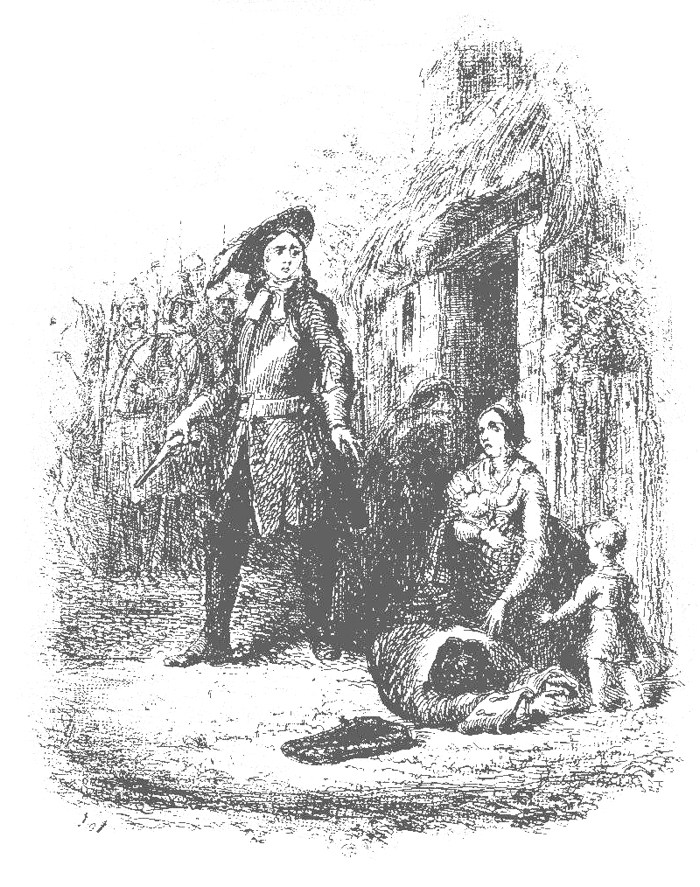
The christian Carrier shot by Claverhouse anno 1685.
Vide page 529
Edinr. Hugh Paton, Carver & Gilder to the Queen 1842.
May-day morning was dewed this year with the blood of John
Brown, in Priestfield, a carrier to his employment, distinguished
by the honourable title, or, as they called it, nicknamed, “The
Christian Carrier.” Having performed Airs-moss between
five and six o’clock—fearless of danger, for he was blameless in
life—he had gone out to cast peats in the field. While thus engaged,
he was suddenly surrounded by Claverhouse with three
troops of horse, and brought back to his humble dwelling. After
the usual questions, Claverhouse said to him—“Go to your
prayers, for you shall immediately die.” He did so; but when
praying, the impatient assassin thrice interrupted him, saying—“I
gave you time to pray, and ye’re begun to preach.” John
turning calmly round upon his knees, replied—“Sir, you know
neither the nature of preaching nor praying, that calls this preaching,”
519and then continued without confusion. When he had ended,
Claverhouse said, “Take good-night of your wife and children.”
She was standing weeping, with an infant in her arms,
and another child of his first wife beside her. He came near and
said, “Now, Marian, the day is come that I told you would
come when I first spoke to you of marrying me.”—“Indeed,
John,” she replied, “I can willingly part with you.”—“Then,”
answered he, “that’s all that I desire. I have no more to do but
die. I have been in case to meet with death for many years.”
He kissed his wife and bairns, and wished purchased and promised
blessings to be multiplied upon them. When he had finished,
Claverhouse ordered six of his men to fire, which they did; and
the most part of the bullets striking, splintered his skull, and
scattered his brains upon the ground.[161] “What thinkest thou
now of thy husband, woman?” asked Claverhouse. “I ever
thought much good of him,” she replied; “and as much now as
ever.”—“It were but justice to lay thee beside him,” said the
murderer.—“If ye were permitted,” answered the new made
widow, “I doubt not but your cruelty would go that length:—but
how will ye make answer for this morning’s work?”—“To
man,” said he, “I can be answerable; and as for God I will take
him in my own hand,” and mounting his horse, marched off with
his troop. The poor woman, left with the corpse of her husband
lying before her, set the bairns upon the ground, and gathered
his brains, and tied up his head, and straighted his body, and
covered him with her plaid, and sat down and wept; it being a
very desert place, where never victual grew, and far from neighbours.
Claverhouse afterwards repeatedly confessed, that he
never could altogether forget Brown’s prayer.
Amid these bloody scenes, a parliament was convoked, April
28, to confirm the despotism by which they were enacted, for so
subservient had those assemblies now become, that, like the parliaments
of Paris, they met only to register the royal edicts. The
Duke of Queensberry was the commissioner. In his first message
520to his first high court, James frankly told them that his main
design was to give them an opportunity not only “of showing
their duty to Us in the same loyal manner as they had done to
Our late dearest brother, but likewise of being patterns to others
in their exemplary compliance with Our desires as they had most
eminently been in times past, to a degree never to be forgotten
by Us; but also of protecting religion against fanatical contrivances,
murderers, and assassins, and to take care that such conspirators
might meet their just deservings.”
The speeches of the Commissioner and Chancellor echoed the
letter, and inveighed against the persecuted Presbyterians, as
wretches of such monstrous principles and practices, as past ages
never heard, nor those to come will hardly believe, whose extirpation
his majesty asked, as no more rebels against their king, than
enemies of mankind. The address followed in a strain of adulation
and abject baseness, clearly evincing the absence of every
right-hearted man from the meeting. “We can assure your majesty,”
said they, “that the subjects of this your majesty’s ancient
kingdom, are so desirous to exceed all their predecessors in
extraordinary marks of affection and obedience, that, God be
praised! the only way to be popular with us is to be eminently
loyal;” “and therefore your majesty may expect that we will
think your commands sacred as your person, and that your inclination
will prevent our debates.”
Their first act was “an act ratifying and confirming all the acts
and statutes formerly passed for the security, liberty, and freedom
of the true church of God and the Protestant religion.” Their
next, an offer of their lives and fortunes to the king, accompanied
by a declaration of their abhorrence and detestation, not only of
the authors and actors of all preceding rebellions against the
sovereign, but likewise all principles and positions which are contrary
or derogatory to the king’s sacred, supreme, sovereign, absolute
power and authority, which none, whether persons or collective
bodies, can participate of any manner of way, or upon any
pretext, but in dependance on him, and by commission from him.
All persons summoned as witnesses against frequenters of conventicles,
who refused to answer, were to be reputed guilty of the
521same crimes as the persons accused—to administer or receive the
covenants, or even to write in their defence, was declared treason.
Field preachers were already subjected to confiscation or death.
Hearing was now made liable to the same punishment, which
was also extended to preachers in house conventicles, expounding
the Scriptures, or even worshipping God in a private house. If
there were more than five persons, in addition to the family, present,
it was to be considered as an house-conventicle; but if any
were listening outside, it was to be reputed a field-conventicle,
for which the whole congregation, with the preacher, were to suffer
death. At the same time, the test was extended, with exemptions
only favourable to the papists. Then, as a final winding
up of this scene of iniquity, followed the forfeiture of Sir
John Cochrane, Sir Patrick Home, Lord Melville, Pringle of
Torwoodlee, Stuart of Cultness, Fletcher of Saltoun, and several
other gentlemen, implicated in the late conspiracy with Cessnock
and his son, whose estates, together with those of Argyle, Douchal,
and Jarvieswood, were annexed for ever to the crown; while
to preserve their own estates from a similar fate, the act of entail
was passed, professing to secure the estates of the nobles, but in
fact enabling them to evade the just claims of their creditors.
Meanwhile the Scottish exiles, reduced to despair, resolved
to attempt the liberation of their native land, with which they
had never ceased to hold a secret correspondence; and after
many meetings in Holland, an expedition set sail on the 2d
of May, of which Argyle was elected General, and the expense
supplied by Mrs Smith, a rich sugar baker’s widow, at Amsterdam;
but accounts of his preparations had been sent to the
government, and measures were taken to frustrate his object before
his arrival, which were increased on the council’s receiving
notice from the Bishop of Orkney, that the Earl had touched
there on his passage. The strengths in Argyleshire were ordered
to be dismantled, and the sons of the chiefs to be sent as hostages
to Edinburgh; and all the non-conformist prisoners, about
two hundred and fifty, were, on May 18th, hurried off under
night from the jails of Edinburgh and Canongate, and sent across
the Firth in open boats to Burntisland, and confined for two days
522and nights in two small rooms, where they had no space almost
to lie down, and no place to retire to. Nor had they any provisions,
and only a few were allowed to purchase a little bread and
water.
When it was imagined hunger and fatigue would have worn
out their powers of endurance, liberty was offered them on condition
of swearing the oaths of allegiance and supremacy; but
many who could have taken the first refused the last as blasphemous.
To acknowledge a papist as the head of Christ’s
church, was what they durst not do. About forty complied and
were released, the rest were driven like cattle to Dunotter Castle—an
old, ruinous building, in the county of Kincardine, situated
on an almost insulated perpendicular rock, 150 feet above the
level of the sea, where they were received by George Keith of
Whiteridge, sheriff-depute of Mearns, and thrust into a dark
vault, with only one small window towards the sea, and full of
mire ancle deep. They had no provision but what they were
forced to purchase, at a dear rate and of the worst quality, from
the governor’s brother. Even their water was brought in small
quantities, though their keepers would sometimes pour whole
barrels into the cavern to increase their discomfort. Means of
cleanliness they had none, and the smell of the place became so
noxious, for it was a warm summer, that several of them died;
and it was considered little less than miraculous that any survived.
Within a few days, the governor removed about forty of the
men to another low small cell, scarcely less disagreeable, as the
only light or air they had was through a small crevice in the wall,
near which they used to lie down by turns, that they might breathe
a little fresh air. Shortly after, the governor’s lady having visited
these miserable abodes, prevailed upon her husband to separate
the prisoners; and the females were removed from the large
vault into two more comfortable smaller apartments. The men,
however, continued to suffer the utmost misery in the large vault,
and a contagious disorder having broken out among them, many
died. The survivors, reduced to desperation, endeavoured to
escape, and having got out one night by the window, were creeping
523along the hazardous precipice, when an alarm was given by
some women—most probably the soldiers’ wives—who were washing
near the rock. Immediately the guards were called, the gates
shut, and the hue and cry raised, and fifteen were intercepted;
yet twenty-five had got off before the alarm was given. Those
who were retaken, were most inhumanly tortured. They were
laid upon their backs upon a form, their hands bound down to
the foot of the form, and a burning match put between every
finger—“six soldiers attending by turns to blow the matches,”
and keep them in flame—and this was continued for three hours
without intermission by the governor’s orders! Several died
under this torture, and those who survived were disabled for life.
About July, in consequence of representations to the council, the
prisoners were brought south, and the Earls Marishal, Errol,
Kintore, Panmure, and the Lord President of the Court of Session,
empowered to call them before them, and banish such as
would not take the oaths of allegiance and abjuration, to his majesty’s
plantations—the men having their ears cut off, the women
their cheeks branded—with certification that such as should return
to the kingdom should incur the pain of death.
Unfortunately for the success of Argyle’s expedition, while the
Scottish government were fully apprised of its approach, adverse
winds and untoward circumstances retarded its progress; so that
when the Earl arrived, he found he had been anticipated by the
measures of the council; and where he expected willing vassals,
he met only heartless or deceitful adherents; but the worst symptom
was the insubordination of his officers, especially Sir Patrick
Home and Sir John Cochrane, who disputed when they ought to
have obeyed, and argued when they should have acted. In such
circumstances, after landing, he lost instead of gathering strength
as he advanced, while the ships and military stores he left behind
in the Castle of Ellengreg, fell, together with it, into the hands
of some English frigates, which arrived on the coast. He published
two proclamations, but they produced no effect, and unhappily
were even counteracted from quarters whence, if he had
not received decided support, it was not too much to have expected
a friendly neutrality.
524The wanderers, although they were favourable to Argyle, unfortunately
could not embark with him, upon account of the too
promiscuous admittance of persons to trust in that party, and because
they could not espouse his declaration as the state of their
quarrel. But they published another declaration at Sanquhar,
May 28, 1685, against the usurpation of a bloody papist advancing
himself to the throne, as the height of confederacy with an idolater,
forbidden by the law of God and contrary to the law of the land.
Thwarted at every step, and prevented from following his own
brave resolution, and giving the enemy battle, Argyle was at last,
either by treachery or mistake, landed in a morass, where his
baggage and horse were swamped, and universal confusion ensuing,
his little band, which had with difficulty been collected and kept
together, despersed during the night. Argyle himself, forced
to withdraw, was retiring in the disguise of a peasant, when he
was attacked in crossing the Cart at Inchannon (June 17th) by
two of the militia, with whom he grappled, and would have overcome,
had not five more arrived and wounded and secured him.
When falling, he had exclaimed—“Alas! unfortunate Argyle,”
which first discovered him to his captors, who appeared deeply
concerned at his seizure, but durst not let him go. He was immediately
carried to Edinburgh, where the marked ignominy with
which he was treated, bore strong testimony to the high estimation
in which the illustrious prisoner was held. By an especial
order of the council, dated June 20th, he was conducted through
the Water-gate, and carried up the main streets to the Castle,
with his hands bound and his head bare, preceded by the hangman,
and surrounded by Captain Graham’s guards; and there he
was safely lodged in irons. In the privy council, it was debated
whether he should be tried for his present rebellion or executed
upon his former sentence. The most iniquitous proposition of
the two prevailed, in which the king of course concurred, only he
suggested the propriety of the Earl’s being tortured before he was
executed, in order to try if any information could be elicited respecting
those who had assisted or who were acquainted with the
expedition. His openness upon his examination prevented his
persecutors incurring the infamy which the royal mandate implied,
525and he was ordered to prepare for execution next day after the
receipt of the royal letter.
The interval he spent with a cheerful tranquillity, which soothed
his afflicted relatives and amazed his political antagonists.
Being accustomed to sleep a little after dinner, on his last solemn
day he retired to his closet, and laid himself down on bed, and
for about a quarter of an hour slept as sweetly as ever he did.
At this moment an officer of state came to inquire for him. Being
informed that he was asleep and desired not to be disturbed, the
officer, who doubted the story, insisted upon being admitted to
his lordship. He was admitted accordingly, but instantly rushed
from the apartment to a friend’s house on the Castle Hill, and
threw himself on a bed in great agony of mind. When asked
by the lady of the house if he was unwell or would take a glass
of sack—“No! no!” replied he; “I have been at Argyle,
and saw him sleeping as pleasantly as ever a man did, within an
hour of eternity; but as for me——.”
The Earl left the Castle, accompanied by a few friends; and while
waiting in the laigh council-house, wrote a farewell letter to his
Countess. “Dear Heart,—As God is of himself unchangeable,
so he hath been always good and gracious to me, and no place
alters it; only I acknowledge I am sometimes less capable of a
due sense of it. But now, above all my life, I thank God I am
sensible of his presence with me, with great assurance of his favour
through Jesus Christ, and I doubt not will continue till I be in
glory. Forgive me all my faults; and now comfort thyself in
Him in whom only true comfort is to be found. The Lord be
with thee, bless thee, and comfort thee. My dearest—adieu.”
He also wrote the following to his daughter-in-law, Lady Sophia
Lindsay:—“My dear Lady Sophia,—What shall I say in this
great day of the Lord, wherein, in the midst of a cloud, I find a
fair sunshine? I can wish no more for you, but that the Lord
may comfort you and shine upon you, as he doth upon me, and
give you the same sense of his love in staying in the world, as I
have in going out of it. Adieu. Argyle.—P.S. My blessing
to dear Earl Balcarras. The Lord touch his heart and incline
him to his fear.”
526He was accompanied to the scaffold by Mr Annand, dean of
Edinburgh, appointed by the council, and Mr Laurence Charteris,
named by himself. Before they left the council-house, the
Earl pleasantly asked Mr Annand, “If he thought the Pope was
that antichrist the Scripture speaks of?” He answered, “Yes,
my lord, the Protestant churches hold so.”—“But what think
you?” asked the Earl.—“I think so too,” replied Mr Annand.—“Then,”
said the Earl, “be sure you instruct the people so.”
When they had mounted the scaffold, Mr Charteris exhorted him
if there were any sin unrepented of to lay it open before God,
who is ready to forgive all penitent sinners. The Earl regretted,
as the chief, that he had set too little time apart to wrestle with
God in private, in behalf of his work and interest, and for his
own poor soul; also that he did not worship God in his family
so much as he ought to have done; likewise his public failings.
Here Mr Annand interrupted him; but without taking notice of
the interruption, he lamented that he did not improve the three
years’ respite the Lord had given him, so much for his glory and
the advancement of his work, as he might have done in his station;
and he looked on his death as a just punishment from God,
though undeserved at the hands of men, and added, “I would
have thought as little to have appeared in this place some time of
day after this manner, as many of you who are now satiating your
eyes in beholding me; but the Lord in his divine wisdom hath ordered
it otherwise, and I am so far from repining and carping at
his dispensations towards me, that I bless his name and desire to
give him endless praise and thanks for the same.” The clergymen
then prayed, after which the Earl fell down on his knees,
and having his face covered and his hands clasped together, prayed
in silence for a considerable time. Upon rising, he delivered a
speech he had previously composed, expressive of his cheerful submission
to the divine will, and his willingness to forgive all men,
even his enemies. “Afflictions,” he said, “are not only foretold,
but promised to Christians. We are neither to despise nor
faint under them; nor are we by fraudulent pusillanimous compliance
in wicked courses to bring sin upon ourselves. Faint hearts
are ordinarily false hearts, choosing sin rather than suffering—a
527short life with eternal death, before temporal death and a crown
of glory.” “I know many like Hazael go to excesses they never
thought they were capable of.” He then prayed God to send
peace and truth to these three kingdoms; to continue and increase
the glorious light of the gospel, and restrain a spirit of profaneness,
atheism, oppression, popery, and persecution; and was about
to conclude, when it was suggested to him that he had said nothing
about the royal family; he added, “this remembers me that
before the justices, at my trial about the test, I said that at my
death I would pray that there might never want one of the royal
family to be a defender of the true, ancient, apostolic, Catholic,
and Protestant faith, which I now do; and may God enlighten
and forgive all of them that are either hid in error or have shrunk
from the profession of the truth; and in all events, I pray God
may provide for the security of his church, and that antichrist
nor the gates of hell may never prevail against it.”
When he had ended, he turned to the south side of the scaffold,
and said, “Gentlemen, I pray you do not misconstruct my behaviour
this day. I freely forgive all men their wrongs and injuries
done against me, as I desire to be forgiven of God.” Mr
Annand repeated these words louder to the people. The Earl
then went to the north side of the scaffold, and had the same or
like expressions. Mr Annand again repeated them, adding,
“This nobleman dies a Protestant;” on which Argyle stepped
forward again, and said, “I die not only a Protestant, but with
a heart hatred of popery, prelacy, and all superstition whatsomever.”
Returning to the middle of the scaffold, he embraced
and took leave of his friends, delivering to Lord Maitland some
tokens to be given to his lady and children; then he stript himself
of his upper garments, which he also gave to his friends, and
kneeling, embraced the instrument of death, saying, “It was the
sweetest maiden he ever kissed, it being a mean to finish his sin
and misery, and his inlet to glory, for which he longed.” Having
prayed a little in silence, he said aloud three times—“Lord Jesus
receive me into thy glory;” and lifting up his hand, the sign
agreed upon, the executioner let the knife of the maiden fall, and
his head was severed from his body.
528The misfortunes and death of this excellent nobleman did not
destroy the cause for which he suffered. The universal sympathy
they excited, from the diffusion of his speech, which was
widely circulated, aided by concurring circumstances, accelerated
rather than retarded the event of his country’s liberation. His
vassals, however, were cruelly treated by Atholl and Breadalbane.
Upwards of twenty of the name of Campbell were put to death,
and more than fifty sent to the plantations. Their houses were
pulled down, their mill-stones broken, the woods burned, and the
whole shire of Argyle cruelly ravaged for thirty miles round Inverary;
his estate was given to strangers, his children scattered,
his creditors defrauded, and his brother, Lord Neil Campbell,
forced to go as an exile to America.
Besides Argyle, very few of any note suffered upon this occasion.
These were—Colonel Rumbold, known by the name of
the maltster, who underwent a form of a trial; but being severely
wounded, lest he should have disappointed their revenge, the
council had prescribed the mode of his death the day before,[162]
according to which he was taken from the bar to the scaffold, supported
by two officers, and preceded by the hangman with his
hat on. When he attempted to explain his principles, the drums
beat, at which he shook his head and said, “Will they not suffer
a dying man to speak his last words to the people?” And even
when praying for the extirpation of popery, prelacy, and other
superstitions, the drums again drowned his voice. He then
silently breathed out his soul to God, and giving the signal, the
executioner turned him off. Ere yet dead, his heart was torn
from his bosom, and exhibited, while still palpitating on the point
of a bayonet, to the people by the hangman, who bawled out—“Here
is the heart of a bloody murderer and traitor,” and threw
it disdainfully into the fire. His quarters were distributed through
the country and his head fixed on an high pole at the West Port
of Edinburgh.
529Some time after, Mr Thomas Archer, a popular preacher,
now in the last stage of a decay. Having been wounded severely,
much interest was made to obtain his liberation, as he was evidently
dying; even the Duke of Queensberry’s own son entreated
his father for his life, without effect. Nothing would satisfy the
rulers but his blood. A plan had been laid for his escape out of
prison, but he would not consent, saying, that since he could not
serve his Master in any other manner, he thought it his duty not
to decline a testimony for him and for his truth by a public death
on the scaffold. He was several times interrupted when addressing
the spectators, but enough was heard to evince that he died
steady to his principles, rejoicing in hope, and anticipating deliverance
for the church, notwithstanding the then threatened visitation
of popery. “I will bring them to Babylon, and there will
I deliver them,” would, he believed, be accomplished in their case.
He sung the latter part of the 73d Psalm, and prayed. Before
being turned off, he said—“Fear of death does not fright or
trouble me; I bless the Lord for my lot,” and submitted with
cheerfulness to the hands of the executioner. He was about
thirty-two years of age, of uncommon abilities, and very learned.
Ayloffe was sent to London and examined by James in person.
He was related to the royal family, and the king pressed him to
make discoveries. “You know,” said the tyrant, “it is in my
power to save you.”—“Yes,” replied Ayloffe, “but it is not in
your nature.” He was hanged accordingly.
Sir W. Denholm of Westshiels, Mr James Stuart, and Mr
Gilbert Elliot, were condemned in absence, and ordered to be
executed when apprehended; the Earl of Loudon, Dalrymple of
Stair, Fletcher of Saltoun, with a number of other gentlemen of
rank and fortune, were forfeited, whose only crimes were their
estates, and the charges their having honestly fulfilled their duties
as public men.
Of the prisoners at Leith, many of whom had been brought
back from Dunotter, about seventy-two were ordered for banishment;
but in the greatness of their humane condescension, the
council came to Leith and sat in the tolbooth to re-examine them,
when such as made some moderate compliances, a few who were
530sickly, and others who had friends, got free; for government were
now beginning to relax in their severities, in contemplation of extending
the same or greater freedom to the Roman Catholics;
but a number who still unyieldingly adhered to their tenets, were
given as a present to the Laird of Pitlochie, and shipped by him
for his plantations in New Jersey.[163] They, however, had scarcely
left land, when a malignant fever broke out, especially among
those who had been confined in Dunotter. Most of the crew
also died, as did Pitlochie and his lady; yet, notwithstanding,
the captain and some other hardened wretches would not suffer
the persecuted exiles to worship God in peace, but when they
heard them engaged in their devotions, threw down great planks
of wood in order to annoy them. After their arrival, Pitlochie’s
son-in-law claimed the prisoners as his property, but the governor
remitted the case to a jury, who immediately freed them. The
greater part retired to New England, where they were kindly received;
and many of them settled in the colony. Others returned
to their native country at the Revolution.
About the latter end of this year, John Nisbet of Hardhill,
with three of his fellow-sufferers, was surprised by a relation of
his own, Lieutenant Nisbet, in a house in the parish of Fenwick.
They defended themselves bravely, till the three were killed and
he was wounded and taken. When tauntingly questioned what
he thought of himself now? “I think,” he replied, “as much
of Christ and his cause as ever; but I judge myself at a loss,
being in time, and my dear brethren, whom you have murdered,
being in eternity.” He was sent to Edinburgh, and, on his examination
before the council, behaved with much Christian fortitude.
Being asked if he would own the king’s authority? He
said he would not. “Why?” said they; “do you not own the
Scriptures and Confession of Faith?”—“I own both,” he replied,
“with all my heart, but the king is a Roman Catholic;
531and I have not only been educated a Presbyterian, but solemnly
sworn against owning popery.”
The council ordered him to be prosecuted before the justiciary.
His confession was adduced against him, and he was sent to follow
those who had not counted their lives dear unto them, that
they might finish their course with joy, and set to their seals to
the truth. “Now,” said he, in his last testimony, “we see open
doors, that are made wide, to bring in popery and set up idolatry
in the Lord’s covenanted land. Wherefore, it is the indispensable
duty of all who have any love to God, or to his Son, the
Lord Jesus Christ, to witness faithfully, constantly, and conscientiously,
against all that the enemies have done, or are doing,
to the overthrow of the glorious work of reformation. But it
will not be long to the fourth watch, and then will He come in
garments died in blood, to raise up saviours upon Mount Zion to
judge the mount of Esau; and then the house of Jacob and Joseph
shall be for fire, and the malignants, papists, and prelates
shall be for stubble, the flame whereof shall be great. But my
generation work being done with my time, I go to him who loved
me, and washed me from all my sins in his own blood.” And thus,
after much, long, and painful suffering (upwards of twenty years),
did this faithful servant enter into the joy of his Lord. Edward
Marshall of Kaemuir, formerly forfeited, was executed along with
him.
From this period we shall meet only with one other public judicial
murder, expressly on account of religion; yet many died
in prison and exile who may be numbered among the martyrs, as
having suffered unto death. Many others were scourged, had
their ears cropt, and were sent to the plantations. The indecent
cruelty of their conduct towards pious women was unworthy of
manhood. Thus a number of old women were whipped at Glasgow;
at Dumfries two women were scourged, and the youngest
afterwards sent to New Jersey with Pitlochie, merely because
they would swear no oaths; another poor woman was tied to a
man, and both scourged together through the town, because they
would not tell what wanderers they had harboured, though to
have acknowledged the fact would have been exposing themselves
532to the gallows. But the banishments, plunderings, and varied
modes of harassing still continued, or were intermitted only by
arbitrary and insidious indulgences, intended to prepare the way
for the introduction of popery.
Without natural affection is one of the peculiar marks of a
reprobate, but the prelatical rulers of Scotland deemed its possession
a peculiar object of punishment. By order of the sheriff
of Wigton, a party of his underlings after destroying the furniture
of a Sarah Stuart, the wife of William Kennedy, in the
parish of Cunningham, marched the poor woman, with a child in
her arms, not quite nine months old, to Wigton, a distance of
several miles, forcing her to leave other three behind without any
one to look after them, though the oldest was not nine years of
age. There she was kept eleven weeks prisoner, though a conformist
herself, because she would not engage never to converse
with her husband, nor consent to discover him! And another,
Jean Dalziel, a tenant of Queensberry’s, was banished for the
same reason.
Thus closed the year sixteen hundred and eighty-five—a year
long remembered by the sufferers, and which was remarkable also
for that terrible revocation of the edict of Nantz by Louis XIV.,
which made Europe resound with tales of horror, equalled only
by the retributive sufferings the descendants of the persecutors
endured in the days of Robespierre, from a revolution whose origin
may perhaps be traced back to the ambition, mis-government,
and cruelty of Voltaire’s Louis le Grand.
BOOK XXII.
533
Conduct of the soldiers—A riot—Recantation of Sibbald—Alexander Peden—Proceedings
of the society-men—Synod of Edinburgh—Parliament—Disputes among
the persecuted—Indulgence—Thanksgiving for the Queen’s pregnancy—Seizure
and death of Mr Renwick—Dr Hardy’s trial and acquittal—Rescue of David
Houston—Murder of George Wood—Arrival of the Prince of Orange.
[A.D. 1686.] The entrance of the new year was signalized by an
exploit worthy of the heroes of the day. A party of their marauders
came to the parish of Stonehouse, in Lanarkshire, and
carried off eight men and two women who had infants at the
breast, for alleged hearing an ejected minister; while another no
less heroic band, under Skene of Hallyards, plundered the house
of a widow, in the neighbouring parish of Glassford, and destroyed
what they could not carry off, because they chose to allege her
son had been at Bothwell.
Intent upon forcing his favourite object, the king had ordered
his chapel of Holyrood-house to be repaired[164] for the use of the
royal servants who had embraced the royal religion; and the paraphernalia
necessary for conducting its Romish rites with becoming
splendour, being openly brought to Leith, this, with the
534ostentatious celebration of mass in the popish meetings, roused
such indignation in the Edinburgh populace, that “a great rabble
of prentices” rose, who threatened to pull down the mass-house.
They insulted the Chancellor’s lady and her company coming from
chapel, assailing them with opprobrious language, and throwing
dirt at them, but doing no further damage. For this riot several
were apprehended, and one “baxter lad” sentenced to be whipped;
but when the hangman was about to perform his duty, the
mob rose, rescued their associate out of his hands, and gave himself
a sound drubbing. The confusion, however, continuing, the
troops in the Castle and Canongate were called out to assist the
town-guard, when a woman and an apprentice of one Robert
Mein, were killed. Next day, a women and two youths were
scourged, guarded by soldiers; and one Moubray, an embroiderer,
was indicted for his life. At the place of execution, he told Mr
Malcolm, a minister who attended him, that he was offered a pardon
if he would accuse the Duke of Queensberry of having excited
the tumult; but he would not save his life by so foul a
calumny.
This was not the only ominous circumstance which preceded
the meeting of parliament. Another took place at the same
time, which bore more immediately upon the grand question that
was to come under their consideration, and for which they had
especially been called together—the recantation of Sir Robert
Sibbald, M.D. This celebrated antiquarian, who lived in a
course of philosophical virtue, but in great doubts of revealed religion,
had been prevailed upon by the Earl of Perth to turn papist,
in order to find that certainty which he could not find upon
his own principles. But he was ashamed of his conduct almost
as soon as he had made his compliance, went to London, and for
some months retired from all company. There, after close application
to study, he came to be so convinced of the errors of popery,
that he returned to Scotland some weeks before the parliament
met, and could not be easy in his own mind till he made a public
recantation. The Bishop of Edinburgh was so much a courtier,
that, apprehending many might go to hear it, and that it might
be offensive to the court, he sent him to do it in a church in the
535country; but the recantation of so learned a man, after so much
studious inquiry, had a powerful effect.
Fining, that lucrative branch of persecution, though still a
favourite, began now to descend to the humbler classes of consistent
Presbyterians; for the chief gentlemen and heritors among
them were either dead, forfeited, or in exile; yet the gleanings
were by no means despicable, and far from being so regarded
by some of the under-hirelings of government. In the parish
of Calder, John Donaldson, portioner, was fined £200 for a
prayer-meeting held at his house on a Lord’s day; John Baxter,
£40; Walter Donaldson, for his wife being present, £36;
with several others in smaller sums, making in all £816. 16s.
Scots. William Stirling, bailie-depute of the regality of Glasgow,
who imposed these fines, received a gift of them for his zeal
and exertions.[165]
On the 4th of January, at the criminal court, Sir Duncan
Campbell of Auchinbreck and thirty-two more Argyleshire heritors,
were forfeited for joining with the Earl, and their estates were
gifted chiefly to those of the same family who had joined the
royal party during the invasion, although, as usual, the prelates and
their relatives came in for a share of the spoil, Campbell of Otter’s
estate being gifted to Commissary M’Lean, son to the Bishop of
Argyle. Fountainhall adds, “there were sundry apparent heirs
amongst the forfeited, whose second brothers were on the king’s
536side with Atholl. It were but charity to encourage them, to make
them donators to their brothers’ forfeitures.” On the same day,
the Earl of Lothian, brother-in-law to Argyle, was admitted a
privy councillor, with a pension of £300 per annum, given, it
was said, in reward of the great courage he displayed in the
Dutch war, when fighting under the king, then Duke of York;
but rather, as the same author hints, to engage his interest in the
ensuing parliament. Protestant heritors who had not taken the
test were also ordered by his majesty to be pursued and fined;
but within a few days a letter came, postponing the time for
taking the test, and shortly after another dispensing with it altogether
in their favour during the king’s pleasure.
About this time, Mr Alexander Peden died (January 26th),
full of assurance of faith, and was privately interred in the churchyard
of Auchinleck. He was certainly an extraordinary man,
whose memory was long cherished in the south and west of Scotland
with fond affection, and where he had laboured long and
faithfully and with much success. A little before the Restoration,
he was settled as minister at New Luce, in Galloway, where
he remained about three years, till he was thrust out by the tyranny
of the times. When about to depart, he lectured upon
Acts xx. from the 7th verse to the end, and preached in the forenoon
from these words—“Therefore, watch and remember, that
for the space of three years I ceased not to warn every man,” &c.,
asserting that he had declared unto them the whole counsel of
God, and professing he was free from the blood of all men. In
the afternoon, he preached from the 32d verse; “And, now, brethren,
I commend you to the word of his grace,” &c.—a sermon
which occasioned a great weeping in the church. Many times he
requested them to be silent; but they sorrowed most of all when
he told them they should never see his face in that pulpit again.
He continued till night; and when he closed the pulpit door, he
knocked three times on it with his Bible, saying each time—“I
arrest thee in my master’s name, that none ever enter thee but
such as come in by the door, as I have done.” And it is somewhat
remarkable that neither curate nor indulged entered that
pulpit, which remained shut till it was opened by a Presbyterian
537preacher at the Revolution. Yet it may be doubted whether he
would have thought that any one entering by that settlement, did
so exactly in the manner that he did. Some time before his
death, through the misrepresentations which were brought him,
he had been much alienated from James Renwick, and had spoken
bitterly against him; but when on his deathbed he sent for Mr
Renwick, and asked if he was that Mr Renwick there was so
much noise about. “Father,” he replied, “my name is James
Renwick; but I have given the world no ground to make any
noise about me, for I have espoused no new doctrine.” He then
gave him such an account of his conversion and call to the ministry—of
his principles and the grounds of his contending against
tyranny and defection—that Mr Peden was satisfied, and expressed
his sorrow for having given credit to the reports that were spread
against him.[166]
The unflinching confessors of the truth in this day, like those
in primitive times, were often in perils among false brethren, and
often persecuted with the scourge of the tongue, even by some
who were suffering in the same cause. They were accused “of
overturning the Presbyterian government in the church, and substituting
a loose kind of independency, by committing the trial
and censure of offences to persons who were not office-bearers—of
usurping the magistrates’ place in the state, by constituting
themselves a convention of estates, and managing the civil affairs
538of their community by their edicts—and of disowning, as silent
and unfaithful, all ministers who cannot preach upon their terms,
there being not now, according to them, one minister in Scotland,
England, or Ireland, save one Mr James Renwick, who, by his
own confession in a letter to a friend in Ireland, is not one
either.”
To this Mr Renwick, at the desire of the societies, replied—“That
they never committed the trial of ‘scandals’ to the people
in a judicial way, but only allowed them, when there were no
church judicatories, to withdraw privately from associating with
those who erred, that they might not partake of other men’s sins,
but by this be a means of reclaiming offending brethren; which
certainly was not overturning Presbyterian government, any more
than their declining the authority of tyrants was thrusting themselves
into the magistrates’ room.” He added, personally—“As
to that, that by my own confession I am not a minister of the
church, I altogether deny. I said I am a minister wherever I
have a call from the people and do embrace it.—O! that all those
who shall agree together in heaven, were agreeing upon earth, I
think if my blood could be a mean to procure that, I could willingly
offer it.”
A change having taken place in the cabinet about the end of
the year, the administration was now intrusted only to papists,
chiefly to Perth the chancellor, and his brother Melford, who had
gained the king’s entire confidence by embracing his religion, and
the Earl of Murray, another proselyte, who was appointed Commissioner
to open the parliament, from which was expected a repeal
of those penal statutes his ancestor, “the good regent,” had
procured to be enacted against papists.
Preparatory to the sitting of parliament, the synod of Edinburgh
met, when its usual tranquil submissiveness was interrupted
by a contrariety of sentiment respecting the test; some contending
for it, and others urging toleration to all who differed in judgment,
insinuating a charitable accommodation with the papists.
Paterson, bishop of Edinburgh, who had lately returned from
London, gratified by a pension of £200 sterling, told them that
the king would defend their religion, and only craved the exercise
539of his own for those of his persuasion in private, which he
said could not be denied him, because he might take it by his
prerogative of church supremacy, asserted by parliament 1669.
He further told them that the Archbishop of St Andrews (Ross)
and himself had got ample power to suspend and deprive any
that preached sedition, i. e. impugned the king’s religion, even
though they should be bishops. Mr George Shiels, minister at
Prestonhaugh, was sharply reproved “for that he declaimed rudely
against popery in the Abbey church on the preceding Sunday,
having said the Pope was as little infallible as the Bishop of the
Isles”—who was one of the silliest in the world—“and that he
would believe the moon to be made of green cheese, and swallow
it, as soon as he would believe in transubstantiation.”
Parliament met, April 29th. In his letter, the king was perfectly
explicit. After hanging out the lure of a free trade with
England, and an indemnity for his greatest enemies themselves,
i. e. the consistent Presbyterians, he came to the point:—“Whilst
we show these acts of mercy to the enemies of our person,
crown, and royal dignity, We cannot be unmindful of others,
our innocent subjects, those of the Roman Catholic religion, who
have, with the hazard of their lives and fortunes, been always assistant
to the crown in the worst of rebellions and usurpations,
though they lay under discouragements hardly to be named:
Them we do heartily recommend to your care, that they may
have the protection of our laws, and that security under our government,
which others of our subjects have, not suffering them
to lie under obligations which their religion cannot admit of.”
The Commissioner enforced this communication by what he
must have thought an irresistible argument. He informed the
house that he was instructed to give the royal assent to any acts
prohibiting the importation of Irish cattle, horses, and victual,
or any measures which might prevent smuggling these articles
into Scotland to the prejudice of the landholders of the country!
and likewise promised to authorise such regulations as should
secure exact payment to the tenantry from all his officers and
soldiers in their quarters, both local and transient, for the future.
In return, he expected that they would show themselves the best
540and most affectionate subjects, to the best, the most incomparable,
and most heroic prince in the world!
The dutiful parliament humbly thanked the king for his care
of the trade of his ancient kingdom, and expressed their astonishment
at his clemency, testified in the offer of an indemnity
to these desperate rebels, who could have expected pardon from
no monarch on earth but his sacred majesty! and sincerely and
heartily offered their lives and fortunes for suppressing all such
as should, upon any account or pretext whatsoever, attempt
either by private contrivance or open rebellion, to disquiet his
glorious reign. As to that part of the royal letter relating to
his subjects of the Roman Catholic religion, they promised, in
obedience to his majesty’s commands, to go as great lengths as
their consciences would allow, not doubting that his majesty
would be careful to secure the Protestant religion established by
law. “This,” says honest Wodrow, “is the first time since the
Restoration I remember that the parliament speak of their conscience.”
Their answer, however, was so little satisfactory at court, that
although the custom always had been to print these official documents,
it was not allowed to be printed; and within a few days
the royal displeasure was expressed against such as had opposed
the Commissioner in this affair. Sir George Mackenzie, lord advocate—who
with rat-like sagacity, when he perceived the vessel
was sinking, had already shown a disposition to leave her—was
laid aside from an office he might curse the day he ever was
appointed to fill. Lord Pitmedden was removed from the bench,
and the Earl of Glencairn and Sir William Bruce from the privy
council. Glencairn was besides deprived of his pension, as was
also the Bishop of Dunkeld.—“Thir warning shots,” observes
Sir John Lauder, “were to terrify and divert other members of
parliament from their opposition.”
Could any inconsistency or tergiversation in unprincipled politicians
astonish us, we might well be amazed at the shamelessness
of the parties on this occasion. When a bill for repealing the
penal statutes was brought in, the papists—or Roman Catholics,
as they were styled by their foster-brethren the Scottish bishops,
541in compliment to the king—were now strong advocates for liberty
of conscience, contending that nothing can bind the conscience as
a divine law, which neither directly nor by clear consequence is
founded on the doctrine or practice of Christ or his apostles, or of
the primitive church; that no oath whatsoever can bind or oblige
to that which is sinful or unlawful to be done; and that for a
Christian magistrate to take away the life or estate of a subject
who is not guilty of sedition or rebellion, nor of injuring his neighbour,
but is quiet, and peaceable, and contents himself in the private
exercise of his own religion, merely for difference of opinion,
is neither founded on the doctrine or practice of our Saviour or his
apostles, nor of the church in the following ages, who never urged
their kings or emperors, when the empire became Christian, to
take away the lives and fortunes of open infidels and heathens who
did worship stocks and stones, although these idolatrous heathen,
when they had power, did execute all manner of cruelty against
the Christians.
The Episcopalians, taking up the arguments of some of the first
reformers, asserted “that by the doctrine of the New as well as of
the Old Testament, the magistrate beareth not the sword in vain,
for he is the minister of God, a revenger to execute wrath upon
him that doth evil. Idolaters are ranked among the very chief
of evil-doers; and John foretells it as that which God requires
of, and approves in, the king’s of the earth, in times of reformation,
that they shall hate the Babylonish whore, and make her
desolate and naked, and shall burn her with fire—a just punishment
upon her who made and cruelly executed laws for burning
to death the innocent saints of God! But the penal laws were
enacted merely for the safety of the religion of the country against
papists, who are not the meek lambs they pretend to be—as witness
the Irish massacre and the murderous conduct at present in
France, towards persons who were guilty of no rebellion, and who
only sought to worship God according to their conscience!”—It
is impossible not to pause here and ask, whether those who urged
these reasons for keeping papists out of power, had no sense of
shame, or no memory—whether they did not recollect, that, for
more than twenty-five years, they had been pursuing exactly the
542same course towards their own Protestant brethren in Scotland?
During the first month of the session, the Commissioner was
incessant in his attention to the nobles and leading men, and
liberal both of his promises and threatenings, but all he could
prevail upon them to consent to, was a bill for allowing Roman
Catholics “the exercise of their religion in private houses—all
public worship being excluded—without the danger of incurring
sanguinary or other punishments contained in any laws or acts of
parliament against the same.” But as such a restricted liberty
would not satisfy the king, it was dropped; and an act in favour
of the heir of Argyle, who had been prevailed upon to profess
the royal religion, closed the session.
Several of the bishops had strenuously opposed the repeal,
clearly perceiving that their craft was in danger, because, had
the papists obtained power, they would not long have retained
their livings without apostatizing from their religion; others were
prepared to go every length to please the king and keep their
places. Nor is it perhaps judging too harshly, to say, that if
the alternative of allowing liberty to Presbyterians, or themselves
turning papists, had been offered them, they would have chosen
the latter, such appeared to be their hatred at what they called
the fanatical rigidity of the former.[167]
Defeated in parliament, contrary to all expectation, James determined
543to carry through his favourite project by the power of
his prerogative. First, he re-modelled his privy council, turning
out the most stubborn opponents, as the Earls of Mar, Lothian,
and Dumfries, with other decided Protestants, and introducing
the Duke of Gordon, the Earls of Traquair and Seaforth, and
other papists in their room, dispensing, by his own absolute authority,
with their taking the test. To them he most undisguisedly
communicated his royal intentions in the plainest language
of tyrannical assumption:—“It was not any doubt We
had of our power in putting a stop to the unreasonable severities
of the acts of parliament against those of the Roman Catholic
religion, that made us bring in Our designs to our parliament, but
to give our loyal subjects a new opportunity of showing their
duty to Us, in which we promised ourselves their hearty and dutiful
concurrence, as what was founded on that solid justice we are
resolved to distribute to all, and consequently to our Catholic
subjects. And to the end the Catholic worship may, with the
more decency and security, be exercised in Edinburgh, we have
thought fit to establish our chapel within our palace of Holyrood-house,
and to appoint a number of chaplains and others whom we
require you to have in your special protection and care. You
are likewise to take care that there be no preachers nor others
suffered to insinuate to the people any fears or jealousies, as if
we intended to make any violent alteration; and if any shall be
so bold, you are to punish them accordingly; for it is far from
our thoughts to use any violence in matters of conscience, consistent
with our authority and the peace of our ancient kingdom.”
Still Mr Renwick was the Mordecai in the gate. He kept the
fields, and continued to pursue his course steadfastly, notwithstanding
the calumnies to which he was exposed, and the opposition
he met with from several of the other persecuted ministers,
and the dissensions among some who attended his ministry.
About the end of the year, as he was preaching through Galloway,
a protestation was presented to him by William M’Hutchison,
in the name of all the professors between the rivers Dee and Cree,
lamenting the woful effects of their divisions, and the adherence
of so many to him without the consent and approbation of the
544remnant of godly and faithful ministers, and referring and submitting
themselves in all these to an assembly of faithful ministers
and elders. He retorted, “The divisions had arisen from
those Presbyterian ministers who changed their commission and
exercised their ministry under this abjured antichristian prelacy:
from others, who took a new holding of their ministry from an
arrogated headship over the church, by accepting indulgences,
warrants, and restrictions from the usurper of their Master’s
crown: from others, who have been unfaithful in not applying
their doctrine against the prevailing sins of our day: from others,
who have satisfied themselves to lie by from the exercise of their
ministry, and desisted from the work of the Lord, and that when
his vineyard stood most in need: and, he adds, from others, who
have carried on or countenanced hotch-potch confederacies with
malignants, and sectaries, and temporizing compilers.”[168] But he
was strengthened and comforted by the accession of two efficient
coadjutors in his work—Mr David Houston from Ireland, and
Alexander Shiels, who had escaped from the Bass, where he had
been a considerable time confined. On the 9th of December, a
proclamation was issued, offering a reward of £100 sterling to any
who should bring him in dead or alive. In the end of the month,
David Steil, in the parish of Lesmahago, was surprised in the
fields by Lieutenant Crichton; and after he had surrendered
upon promise of safety, was barbarously shot.
[1687.] James’s precipitation in forcing popery upon his people
appeared so impolitic, that even a jesuit missionary thought he
made too great haste; but he told him he would either convert
England or die a martyr; and, when one of his popish lords
gently remonstrated with him, replied—“I am growing old, and
545must take large steps, else, if I should happen to die, I might
perhaps leave you in a worse condition than I found you.” Yet
with a strange inconsistency, he allowed both his daughters to be
educated in the Protestant faith; and when he was asked why he
was so little concerned about their conversion, replied—“God
will take care of that!” But he had introduced shoals of seminary
priests and jesuits for the instruction of his other subjects;
and, while he interdicted the Presbyterian ministers from preaching
or publishing any thing against his religion, under pain of
treason, he employed these emissaries of Rome in every quarter;
and having appointed Watson, a papist, his printer, assiduously
caused publications in favour of popery to be widely disseminated.
His most powerful argument, however, was, bestowing the chief
places upon papists, especially converts, which induced many of
the nobility and gentry to apostatize; and, like all apostates,
they became the bitterest persecutors of the faith they had forsaken.
Mr Renwick and his hearers continued to be the objects of
unmitigated hatred, in proportion as they continued to hold
fast their integrity and preach the gospel. Two persons returning
from hearing him, James Cunningham, merchant, and John
Buchanan, cooper in Glasgow, were seized, sent prisoners to
Edinburgh, and banished to Barbadoes;[169] and, on the 17th of
February, the council received a letter from the king, in which he
546expressed his highest indignation against these enemies of Christianity,
as well as government and human society, the field-conventiclers,
whom he recommended to the council to root out with
all the severity of the laws, and the most vigorous prosecution of
the forces, it being equally his and his people’s concern to be rid
of them. At the same time, he sent a royal proclamation, allowing,
“by Our sovereign authority, prerogative, royal and absolute
power,” moderate Presbyterians and quakers to meet in their private
houses, but to hear such ministers only as have accepted or are
willing to accept the toleration without explanation; and in like
manner, by the same absolute power, he suspended all laws and
acts of parliament, and other proceedings, against Roman Catholics,
so that they should in all time coming, not only be as free as
Protestants to exercise their religion, but to enjoy all offices,
benefices, &c., which he should think proper to bestow, upon their
taking an oath acknowledging him as rightful king and supreme
governor of Scotland, England, France, and Ireland, and over
all persons therein, and that they would never resist his power or
authority; at the same time, he declared he would never suffer
violence to be offered to any man’s conscience, nor use force or
invincible necessity against any man on account of his persuasion.
This, which was termed the first indulgence, did not pass the
council unanimously. The Duke of Hamilton, and the Earls of
Panmure and Dundonald, refused to sanction it; for which the
Duke was reprimanded and the two Earls dismissed the board;
and as a practical exposition of its real meaning, sixteen men and
five women were shortly after, in the month of April, banished
to America, because they would not own the present authority to
be according to the word of God, nor engage never to hear Mr
Renwick preach.
None of these indulgences satisfied fully the Presbyterian
ministers, while they were decidedly testified against by the denounced
wanderers. Another was therefore issued, July 5th, to
palliate the former, giving them leave to meet and serve God after
their own way, be it in private houses, chapels, or places purposely
built or set apart for that use; while it again denounced
the full vigour of the law and of the army against such as should
547be guilty of field-conventicles; “for which, after this our royal
grace and favour—which surpasses the hopes and equals the very
wishes of the most zealously concerned—there is not the least
shadow of excuse left!”
On the 20th, the Presbyterian ministers from various parts of
the country met at Edinburgh, and agreed to accept the benefit
of the new toleration; but an address of thanks to the king,
“for granting them the liberty of the public and peaceable exercise
of their ministerial functions without any hazard,” was not
carried without considerable opposition. Upon this, many of
the exiles returned from Holland, and among them Mr Patrick
Warner, to whom the Prince of Orange, at parting, gave the following
significant advice:—“I understand you are called home
upon the liberty granted there; but I can assure you that liberty
is not granted from any favour or kindness to you or your party,
but from favour to papists and to divide you among yourselves;
yet I think you may be so wise as to take the good of it and prevent
the evil designed, and, instead of dividing, come to a better
harmony among yourselves, when you have liberty to see one
another and meet freely together.”
The wanderers, as they were excepted, so they disregarded the
toleration. Persecution had made them cling closer to their principles.
They refused to accept as a favour what they believed
themselves entitled to claim as a right—the liberty of worshipping
God according to their conscience—and they published their
reasons:—They could not have any transactions with a person
whose principles bound him to keep no faith with heretics, and
whose dissimulation they had already detected. They considered
accepting toleration from him as bargaining with an apostate, excommunicated,
bigoted papist, and as such under the Mediator’s
malediction, “yea, heir to his own grandfather’s [James VI.]
imprecations, who wished the curse of God to fall upon such of
his posterity as should at any time turn papists. They renounced
him as a magistrate, because he had not taken the oath constitutionally
required; and to accept this toleration flowing from his
absolute power, would be acknowledging a power inconsistent with
the law of God and the liberties of mankind; for, though nothing
548can be more desirable than when true liberty is established by
the government, nothing can be more vile than when true religion
is tolerated under the notion of a crime, and its exercise only
allowed under certain restrictions.” As to the address of thanks
by the ministers, they considered it “a train of fulsome flatteries,
dishonourable to God, the reproach of his cause, the betraying of
the church, the detriment of the nation, and the exposing of
themselves to contempt.”
The conduct of the government, amid all their professions of
toleration, fully warranted the worst suspicions of the persecuted.
On the 25th July, John Anderson, younger of Wastertown, was
indicted before the court of justiciary, for having in a tavern, over
a glass of wine, argued in favour of using defensive arms against
tyrants, and, by an execrable majority of that degraded tribunal,
condemned to die. He was not executed, but the stain of the
sentence remains upon the memories of the servile senators who
pronounced it. And this was followed on the 5th October by a
proclamation, not only forbidding all field-conventicles, under the
usual penalty, but even indulged ministers, from preaching in
houses, unless they observed the prescribed directions; that is,
unless they abstained from exposing or in any way reflecting upon
the king’s religion, i. e. the errors of popery; and on the 18th,
by another, all officers, civil and military, were ordered to apprehend
James Renwick, and assured of the sum of £100 sterling
for taking him dead or alive—a high price! but so cautious had
he been, that he had eluded fifteen desperate searches made after
him within five months since the first toleration, which exasperated
the rulers beyond measure.
The year One Thousand Six Hundred and Eighty-Eight—a
year greatly to be remembered as the last in the annals of the
persecution in Scotland—was ushered in by a circumstance which
threatened to rivet their chains upon the Presbyterians, but which
in the good providence of God was the means of accelerating their
deliverance. On the 2d of January, the Queen’s pregnancy was
announced; and the 29th was ordered to be observed as a day of
thanksgiving in the diocese of Edinburgh, where the clergy were
commanded to pray, after this form, for “Our gracious Queen
549Mary:—Good Lord, strengthen her, we beseech thee, and perfect
what thou hast begun. Command thy holy angels to watch
over her continually, and defend her from all dangers and evil accidents,
that what she has conceived may be happily brought forth
to the joy of our sovereign lord the king, the further establishment
of his crown, the happiness and welfare of the whole kingdom,
and the glory of thy great name!” The papists, who pronounced
the conception miraculous in answer to a vow the Queen
had made to the lady of Loretto, prophecied that the promised
birth would be a son. The Protestants sighed in secret, and began
to whisper their suspicions of a fraud.
On the 17th, Mr Renwick published a testimony against
the toleration and in vindication of field-meetings, the convening
of which he contended was a testimony for the headship, honour,
and princely prerogative of Jesus—“Since in these meetings
there is a particular declaration of our holding our ministry and
the exercise thereof from Christ alone, without any dependence
on, subordination to, or license from, his usurping enemies;” and
this testimony he was shortly after called upon to seal with his
blood. From Edinburgh he went to Fife and preached several
Sabbaths, then re-crossed the Firth, and upon the 29th of January,
preached his last sermon at Borrowstounness; thence he
returned to the capital, where he arrived on the 31st, under cloud
of night. Having gone to a friend’s house on the Castle-hill,
who dealt in English wares, a custom-house officer, Thomas Justice,
was informed by one of his spies that a stranger had arrived;
and early next morning he came with some others on pretence of
searching for prohibited goods. Mr Renwick hearing the noise,
came out of his room, when the officer standing at the door exclaimed—“My
life for it, this is Mr Renwick!” on which Mr
Renwick went to another door, and finding it also beset, fired a
pistol to terrify his pursuers, and was attempting his escape, when
he received a severe blow on the breast, that stunned him; and
he fell several times as he was running, and was taken. He was
carried directly to the guard-house, and from thence to a committee
of the privy council, who ordered him immediately to be
laid in irons.
550Previously to his being indicted, he was examined in Viscount
Tarbet’s chamber, when he undauntedly maintained his principles,
disclaiming the idea that lineal descent alone gave a right to the
crown, and disowning especially the authority of James as a papist,
who had never taken the Scottish coronation oath, and therefore
could not legally reign; justifying the non-payment of cess,
as it was an impost levied for suppressing the gospel; and asserting
the right of carrying arms at field-meetings as necessary self-defence.
On every point about which he was questioned, he answered
with an openness which greatly softened his inquisitors,
and saved him the torture. He received his indictment on the
3d of February, charging him with having cast off the fear of
God and all regard to his majesty’s laws; of having entered into
the society of rebels of most damnable and pernicious principles,
and become so desperate a villain, as openly to preach in the
fields these his treasonable doctrines. On the 8th he was brought
to the bar of the justiciary.[170] When asked whether he pled
guilty or not guilty to his libel, he answered that he acknowledged
all “except where it is said, I have cast off all fear of God; that
I deny: for it is because I fear to offend God, and violate his
law, that I am here standing ready to be condemned.” Being
asked if he had any objections to the jury, he made none, but
protested “that none might sit on his assize that professed Protestant
or Presbyterian principles, or an adherence to the covenanted
work of reformation.” He was found guilty on his own
confession, and sentenced to be executed on the 10th. Lord
Linlithgow, justice-general, asked if he desired longer time. He
answered, it was all one to him; if it was protracted, it was welcome;
if it was shortened, it was welcome: his master’s time
was the best.
551Many efforts were made to induce the youthful suffer to comply.
He was reprieved to the 17th. Paterson, bishop of Edinburgh,
appears to have interested himself much on his behalf.
He often visited him, and applied for another reprieve, which
would have been readily granted, provided Mr Renwick would
only have petitioned. “Will you kill yourself with your own
hands?” asked the bishop, “when you may have your life upon
so easy terms.” He replied, he acted not rashly but deliberately,
and was fully convinced that the truths for which he suffered were
sufficient points to suffer for. The bishop took his leave, expressing
his sorrow for his being so tenacious, and afterwards offered
to serve him to the utmost of his power. Mr Renwick thanked
him for his civility, but knew nothing he could do, or that he
could desire. Mr Macnaught, a curate, visited him, robed in his
canonicals—an insult which Mr Renwick appeared to feel, but
took it calmly. When asked his opinion respecting the toleration
and those that accepted it, he declared he was against it;
but as for those that embraced it, he judged them godly men.
He was also visited by some popish priests who essayed his conversion,
but he peremptorily ordered them to be gone.
On the morning of his execution, the goodman of the tolbooth,
i. e. head jailer, begged that on the scaffold he would not mention
the cause of his death, and forbear all reflections. Mr Renwick
told him that what God gave him to speak, that he would
speak, and nothing else, and nothing less. The jailer said he
might still have his life, if he would but sign that petition which
he offered him. Mr Renwick replied, that he had never read in
Scripture or history of martyrs petitioning for their lives when
called to suffer for the truth; and in present circumstances, he
judged it would be found a receding from the truth and declining
a testimony for Christ. His mother and sisters, who had been
kept away, at length obtained liberty to see him. He exhorted
them much to prepare for death, expressing his own joyful assurance
of endless glory. Observing his mother weep, he exhorted
her to remember that they who loved any thing better than Christ
were not worthy of him. If ye love me, rejoice that I am going
to my Father, to obtain the enjoyment of what eye hath not seen,
552ear hath not heard, nor hath it entered into the mind of man to
conceive. When the signal drum beat, he joyfully exclaimed—“Yonder
the welcome warning to my marriage; the Bridegroom
is coming—I am ready—I am ready.”
Then, after taking an affectionate leave of his mother and sisters,
he was carried to the low council-house. Here he was offered
any minister he chose to be with him, but he preferred being attended
by a friend then in company, and proceeded cheerfully to
the Grassmarket, surrounded by an immense multitude, which
was the greater, that executions had not been so frequent of late.
On the scaffold, he sang the 103d Psalm and read Revelations,
chap. xix. Then he prayed, commending his soul to the Lord
through the Redeemer, and his cause to be vindicated in his own
good time. He blessed the Lord for the honour of the crown of
martyrdom—an honour the angels are not capable of! Being
disturbed in his devotions, he regretted the circumstance, but
continued with ennobling anticipation. “By and by I shall be
above these clouds, and enjoy, and worship, and glorify thee
without interruption or intermission for ever.” After he had
finished, he addressed the people, and stated the heads of his testimony,
in terms similar to what he had used before the council,
adding—“Ye that are the people of God, do not weary in maintaining
the testimony of the day in your stations and places; and
whatever you do, make sure an interest in Christ, for there is a
storm coming which will try your foundations. And you that are
strangers to God, break off your sins by repentance, else I will
be a sad witness against you in the day of the Lord.” Here he
was ordered to stop and go up the ladder. There he prayed again,
and was heard to say—“Lord, I die in the faith that thou wilt not
leave Scotland, but that thou wilt make the blood of thy witnesses
to be the seed of thy church, and return again and be glorious in
this land.” When the napkin was tying over his head, he said
to his friend—“Farewell, be diligent in duty, make your peace
with God through Christ. There is a great trial coming to the
remnant I leave. I have committed them to God. Tell them
from me not to weary nor be discouraged in maintaining the testimony.
Let them not quit nor forego one of these despised
553truths. Keep your ground, and the Lord will provide you
teachers and ministers; and when he comes he will make all these
despised truths glorious upon the earth.” He was turned over
the ladder with these words upon his lips—“Lord, into thy
hands I commit my spirit; for thou hast redeemed me, O God
of truth!”
Thus fell a standard-bearer in the Scottish Zion, at the early
age of twenty-six—the last legal murder during this black period.
Cut off in the prime of life and in the midst of usefulness, the
death of this faithful witness appeared a dark dispensation; but
as he himself had anticipated, it did more service to the good
cause than his preaching might have done, even had his life been
prolonged many years; because, being perpetrated by a government
which made strong professions of liberality, the question
naturally arose, How far can we trust specious profession in political
men, without not only legal but bona fide security for our
rights? The principles for which he died were the principles
which the Revolution sanctioned and settled; and wo to the
country should they ever be despised or forgotten; and those
principles which by the “conform ministers” were deemed
“heights,” have since been declared the only bases upon which
the best and the most thoroughly tried practical system of national
and personal freedom can stand:—the obligation of the
original compact [i. e. the coronation vow] between a king and a
people, and the accountability of both the contracting parties.
The less, however, such subjects are theoretically agitated the
better—nor will they ever be violently urged, except when they
are practically forgotten—but it was to the unshaken assertion of
these principles, invigorated and chastened by principles of religion,
that we owe the liberty we now enjoy—a liberty far beyond
what any of the famed republics of old ever possessed, and which
will only perish when these foundations are destroyed.
After the death of Mr Renwick, Mr Alexander Shiels, author
of “The Hind let Loose,” continued to preach in the fields to
the indomitable wanderers, who, immoveably attached to the covenanted
work of reformation, refused to be ensnared by any precarious
liberty which they rightly judged was only intended to
554pave the way for the introduction of popery; or receive any favour
from a papistical usurper, who, by the fundamental laws of the
country, was constitutionally excluded from the throne; and their
conduct was more than justified by the treatment their compliant
brethren received. There now, however, began to appear some
streaks in the sky—some dawnings of the coming day.
The Rev. John Hardy, M.D., minister at Gordon,[171] had in a
sermon, last year, used some such expression as the following:—“They
thanked his majesty for the toleration; but if they behoved
to take away the laws against popery, sectarianism, &c., it
were better to want it, and that any that consented to it, Zechariah’s
flying roll of curses would enter the house and eat the stones
and timber.” He was dealt with, says Fountainhall, to retract,
which not finding liberty to do, he was continued [i. e. his case
was delayed] with a reprimand. But, on the 22d November, a
letter came from the king “ordaining him to be panelled criminally
before the justices for his preaching,” on which he was imprisoned,
as “he would not fly, though he had leisure and advertisement.”
On February 13, this year, an indictment was raised
against him, for using seditious expressions and leasing-making,
endeavouring to alienate the affections of the people from the
king. He replied, “that upon Presbyterian principles, idolatry,
even under the gospel, is punishable by death, and that popery is
such. That the expressions had no sedition in them, seeing that
he might regret that Socinians and others had liberty to vent
their doctrine against Christ’s deity, &c.;” and the criminal lords,
who appear to have had some prognostications of the coming
change, “took the courage to find the expressions libelled not
relevant to infer sedition,” therefore assoilzied him from the
555crimes libelled, and liberated him from prison. One Bold was
indicted for having acted as precentor to Mr Renwick, and condemned
to be hanged, but was reprieved; and Gilbert Elliot,
who had been forfeited for engaging with Argyle, was not only
pardoned, but admitted as an advocate.
On the 17th, Sir George Mackenzie was restored to his lord-advocateship;
but no criminal informations were lodged during
the short time that intervened between his appointment “and the
glorious Revolution,” though several petty vexatious harassments
showed that the tiger was only asleep, not dead. The Rev.
Thomas Cobham, a native of Dundee, was, on the 23d May,
imprisoned for having performed family-worship at his cousin
Mr Smith’s, in that town, and both were committed to jail for
the offence. About the same time, the council issued a proclamation,
forbidding booksellers to disseminate any treatises tending
to alienate the people from his majesty, or vend any translations
of “Buchanan de Jure Regni,” “Lex Rex,” “Jus Populi,”
“Naphtali,” “The Apologetical Relation,” “The Hind let
Loose,” and the treasonable proclamations published at Sanquhar,
or those issued by the late Monmouth or Argyle. At Edinburgh,
one of the councillors went into the shop of Mr Glen, a
firm Presbyterian, to search for the proscribed books, but having
found none, when retiring, asked the bookseller if he had any
books against the king’s religion. Mr Glen said he had a great
many. The councillor asked to see them, and was immediately
carried to where a goodly stock of Bibles were lying. “O!
these are Bibles!” quoth the councillor. “True,” replied the
other, “and they are all against popery from the beginning to
the end.” For this the bookseller was summoned before the
council, where he appeared the same afternoon, and was, we are
told, brought to some trouble.
In nothing, however, did the ruling powers relax with regard
to the wanderers. Having learned that a Mr David Houston
had been proposed by the societies to succeed Mr Renwick in
his perilous labours in the fields, he was apprehended in Ireland
and brought prisoner to Scotland. Being ordered to Edinburgh,
a general meeting which had convened at Lother’s, heard of his
556seizure, and fearing he would be murdered as Renwick had been,
determined “to relieve him from these bloody murderers;” and
immediately a few friends, armed, attacked the party escorting
him at Carbelpath, and, after a sharp skirmish, in which some
soldiers were killed, succeeded in rescuing him; but he having
his feet bound under the horse’s belly, was knocked over in the
scuffle, and his head trailed some time on the ground before he
could be unloosed, by which he lost his teeth, and was otherwise
so much wounded about the head, that his elocution was rendered
very indistinct. So he returned to Ireland, and there died. The
last whose blood was shed, was George Wood, a youth about sixteen
years of age, who was wantonly shot, without any questions
being asked, by one John Reid, a trooper, whose only excuse
when challenged for it, was—“He knew him to be a Whig, and
these ought to be shot wherever they were found!”
Shortly after, the news of William Prince of Orange’s landing
in England reached Scotland; and to the honour of the persecuted,
be it recorded, the Revolution was accomplished without
bloodshed, or any one act of retaliation being inflicted by them,
notwithstanding all they had suffered.
EDINBURGH: PRINTED BY HUGH PATON, ADAM SQUARE.
- Transcriber’s Notes:
- New original cover art included with this eBook is granted to the public domain.
- Missing or obscured punctuation was silently corrected.
- Typographical errors were silently corrected.
- Unbalanced quote marks were fixed when the location of missing close quote was clear.
- Inconsistent spelling and hyphenation were made consistent only when a predominant
form was found in this book.