The Anno Domini one thousand seven
hundred and sixty, was remarkable for three things in the parish
of Dalmailing.—First and foremost, there was my placing;
then the coming of Mrs. Malcolm with her five children to settle
among us; and next, my marriage upon my own cousin, Miss Betty
Lanshaw, by which the account of this year naturally divides
itself into three heads or portions.
First, of the placing.—It was a great affair; for I was
put in by the patron, and the people knew nothing whatsoever of
me, and their hearts were stirred into strife on the occasion,
and they did all that lay within the compass of their power to
keep me out, insomuch, that there was obliged to be a guard of
soldiers to protect the presbytery; and it was a thing that made
my heart grieve when I heard the drum beating and the fife
playing as we were going to the kirk. The people were
really mad and vicious, and flung dirt upon us as we passed, and
reviled us all, and held out the finger of scorn at me; but I
endured it with a resigned spirit, compassionating their
wilfulness and blindness. Poor old Mr. Kilfuddy of the
Braehill got such a clash of glar on the side of his face, that
his eye was almost extinguished.
When we got to the kirk door, it was found to be nailed up, so
as by no possibility to be opened. The sergeant of the
soldiers wanted to break it, but I was afraid that the heritors
would grudge and complain of the expense of a new door, and I
supplicated him to let it be as it was: we were, therefore,
obligated to go in by a window, and the crowd followed us in the
most unreverent manner, making the Lord’s house like an inn
on a fair day, with their grievous yellyhooing. During the
time of the psalm and the sermon, they behaved themselves better,
but when the induction came on, their clamour was dreadful; and
Thomas Thorl, the weaver, a pious zealot in that time, he got up
and protested, and said, “Verily, verily, I say unto you,
he that entereth not by the door into the sheepfold, but climbeth
up some other way, the same is a thief and a robber.”
And I thought I would have a hard and sore time of it with such
an outstrapolous people. Mr. Given, that was then the
minister of Lugton, was a jocose man, and would have his joke
even at a solemnity. When the laying of the hands upon me
was adoing, he could not get near enough to put on his, but he
stretched out his staff and touched my head, and said, to the
great diversion of the rest, “This will do well enough,
timber to timber;” but it was an unfriendly saying of Mr.
Given, considering the time and the place, and the temper of my
people.
After the ceremony, we then got out at the window, and it was
a heavy day to me; but we went to the manse, and there we had an
excellent dinner, which Mrs. Watts of the new inns of Irville [9] prepared at my request, and sent her
chaise-driver to serve, for he was likewise her waiter, she
having then but one chaise, and that no often called for.
But, although my people received me in this unruly manner, I
was resolved to cultivate civility among them, and therefore, the
very next morning I began a round of visitations; but, oh! it was
a steep brae that I had to climb, and it needed a stout
heart. For I found the doors in some places barred against
me; in others, the bairns, when they saw me coming, ran crying to
their mothers, “Here’s the feckless Mess-John!”
and then, when I went into the houses, their parents wouldna ask
me to sit down, but with a scornful way, said, “Honest man,
what’s your pleasure here?” Nevertheless, I
walked about from door to door like a dejected beggar, till I got
the almous deed of a civil reception—and who would have
thought it?—from no less a person than the same Thomas
Thorl that was so bitter against me in the kirk on the foregoing
day.
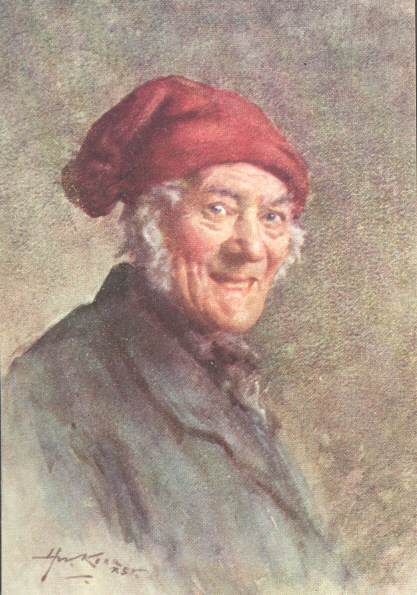
Thomas was standing at the door with his green duffle apron,
and his red Kilmarnock nightcap—I mind him as well as if it
was but yesterday—and he had seen me going from house to
house, and in what manner I was rejected, and his bowels were
moved, and he said to me in a kind manner, “Come in, sir,
and ease yoursel’: this will never do, the clergy are
God’s gorbies, and for their Master’s sake it behoves
us to respect them. There was no ane in the whole parish
mair against you than mysel’; but this early visitation is
a symptom of grace that I couldna have expectit from a bird out
the nest of patronage.” I thanked Thomas, and went in
with him, and we had some solid conversation together, and I told
him that it was not so much the pastor’s duty to feed the
flock, as to herd them well; and that, although there might be
some abler with the head than me, there wasna a he within the
bounds of Scotland more willing to watch the fold by night and by
day. And Thomas said he had not heard a mair sound observe
for some time, and that, if I held to that doctrine in the
poopit, it wouldna be lang till I would work a
change.—“I was mindit,” quoth he, “never
to set my foot within the kirk door while you were there; but to
testify, and no to condemn without a trial, I’ll be there
next Lord’s day, and egg my neighbours to be likewise, so
ye’ll no have to preach just to the bare walls and the
laird’s family.”
I have now to speak of the coming of Mrs. Malcolm.—She
was the widow of a Clyde shipmaster, that was lost at sea with
his vessel. She was a genty body, calm and
methodical. From morning to night she sat at her wheel,
spinning the finest lint, which suited well with her pale
hands. She never changed her widow’s weeds, and she
was aye as if she had just been ta’en out of a
bandbox. The tear was aften in her e’e when the
bairns were at the school; but when they came home, her spirit
was lighted up with gladness, although, poor woman, she had many
a time very little to give them. They were, however,
wonderful well-bred things, and took with thankfulness whatever
she set before them; for they knew that their father, the
breadwinner, was away, and that she had to work sore for their
bit and drap. I dare say, the only vexation that ever she
had from any of them, on their own account, was when Charlie, the
eldest laddie, had won fourpence at pitch-and-toss at the school,
which he brought home with a proud heart to his mother. I
happened to be daunrin’ by at the time, and just looked in
at the door to say gude-night: it was a sad sight. There
was she sitting with the silent tear on her cheek, and Charlie
greeting as if he had done a great fault, and the other four
looking on with sorrowful faces. Never, I am sure, did
Charlie Malcolm gamble after that night.
I often wondered what brought Mrs. Malcolm to our clachan,
instead of going to a populous town, where she might have taken
up a huxtry-shop, as she was but of a silly constitution, the
which would have been better for her than spinning from morning
to far in the night, as if she was in verity drawing the thread
of life. But it was, no doubt, from an honest pride to hide
her poverty; for when her daughter Effie was ill with the
measles—the poor lassie was very ill—nobody thought
she could come through, and when she did get the turn, she was
for many a day a heavy handful;—our session being rich, and
nobody on it but cripple Tammy Daidles, that was at that time
known through all the country side for begging on a horse, I
thought it my duty to call upon Mrs. Malcolm in a sympathising
way, and offer her some assistance, but she refused it.
“No, sir,” said she, “I canna take help from
the poor’s-box, although it’s very true that I am in
great need; for it might hereafter be cast up to my bairns, whom
it may please God to restore to better circumstances when I am no
to see’t; but I would fain borrow five pounds, and if, sir,
you will write to Mr. Maitland, that is now the Lord Provost of
Glasgow, and tell him that Marion Shaw would be obliged to him
for the lend of that soom, I think he will not fail to send
it.”
I wrote the letter that night to Provost Maitland, and, by the
retour of the post, I got an answer, with twenty pounds for Mrs.
Malcolm, saying, “That it was with sorrow he heard so small
a trifle could be serviceable.” When I took the
letter and the money, which was in a bank-bill, she said,
“This is just like himsel’.” She then
told me that Mr. Maitland had been a gentleman’s son of the
east country, but driven out of his father’s house, when a
laddie, by his stepmother; and that he had served as a servant
lad with her father, who was the Laird of Yillcogie, but ran
through his estate, and left her, his only daughter, in little
better than beggary with her auntie, the mother of Captain
Malcolm, her husband that was. Provost Maitland in his
servitude had ta’en a notion of her; and when he recovered
his patrimony, and had become a great Glasgow merchant, on
hearing how she was left by her father, he offered to marry her,
but she had promised herself to her cousin the captain, whose
widow she was. He then married a rich lady, and in time
grew, as he was, Lord Provost of the city; but his letter with
the twenty pounds to me, showed that he had not forgotten his
first love. It was a short, but a well-written letter, in a
fair hand of write, containing much of the true gentleman; and
Mrs. Malcolm said, “Who knows but out of the regard he once
had for their mother, he may do something for my five helpless
orphans.”
Thirdly, Upon the subject of taking my cousin, Miss Betty
Lanshaw, for my first wife, I have little to say.—It was
more out of a compassionate habitual affection, than the passion
of love. We were brought up by our grandmother in the same
house, and it was a thing spoken of from the beginning, that
Betty and me were to be married. So, when she heard that
the Laird of Breadland had given me the presentation of
Dalmailing, she began to prepare for the wedding; and as soon as
the placing was well over, and the manse in order, I gaed to Ayr,
where she was, and we were quietly married, and came home in a
chaise, bringing with us her little brother Andrew, that died in
the East Indies, and he lived and was brought up by us.
Now, this is all, I think, that
happened in that year worthy of being mentioned, except that at
the sacrament, when old Mr. Kilfuddy was preaching in the tent,
it came on such a thunder-plump, that there was not a single soul
stayed in the kirkyard to hear him; for the which he was greatly
mortified, and never after came to our preachings.


