ANNALS OF THE GREAT STRIKES IN THE UNITED STATES. A Reliable History and Graphic Description of the Causes and Thrilling Events of the Labor Strikes and Riots of 1877.
Transcriber’s Note:
New original cover art included with this eBook is granted to the public domain.
ILLUSTRATED.
BY
Hon. J. A. DACUS, Ph.D.
Late of the Editorial Staff St. Louis Republican.
Chicago:
L. T. PALMER & CO.
Philadelphia, W. R. Thomas:
St. Louis, Scammell & Co.: Cincinnati, W. S. Forshee & Co.
1877.
COPYRIGHTED.
L. T. PALMER & CO.
A. D. 1877.
Geo. J. Titus & Co., Kingsbury & Wilson,
Printers. Binders.
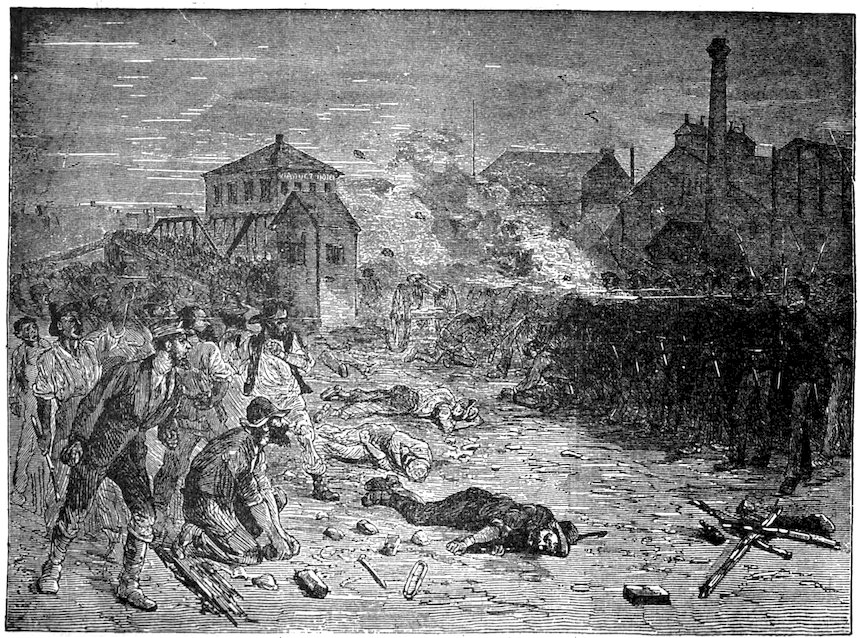
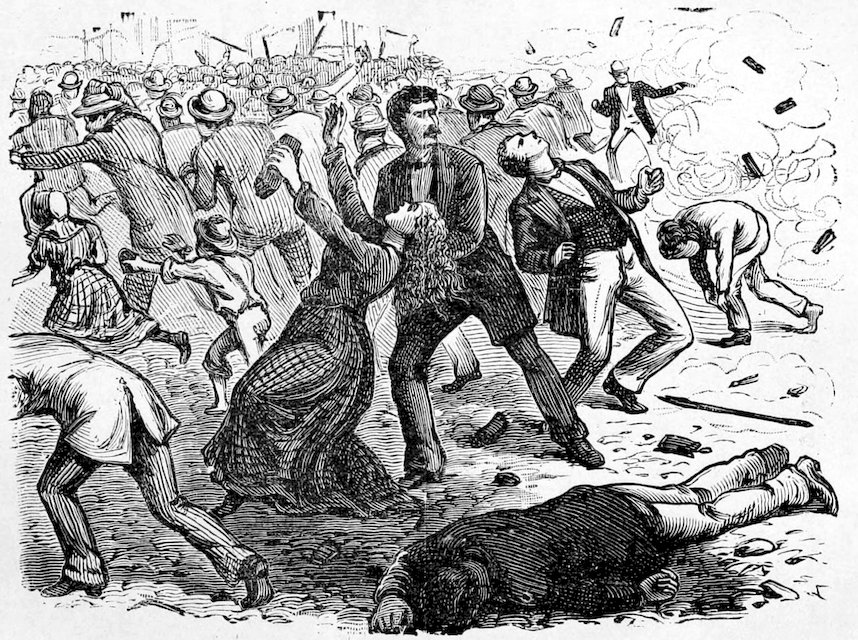
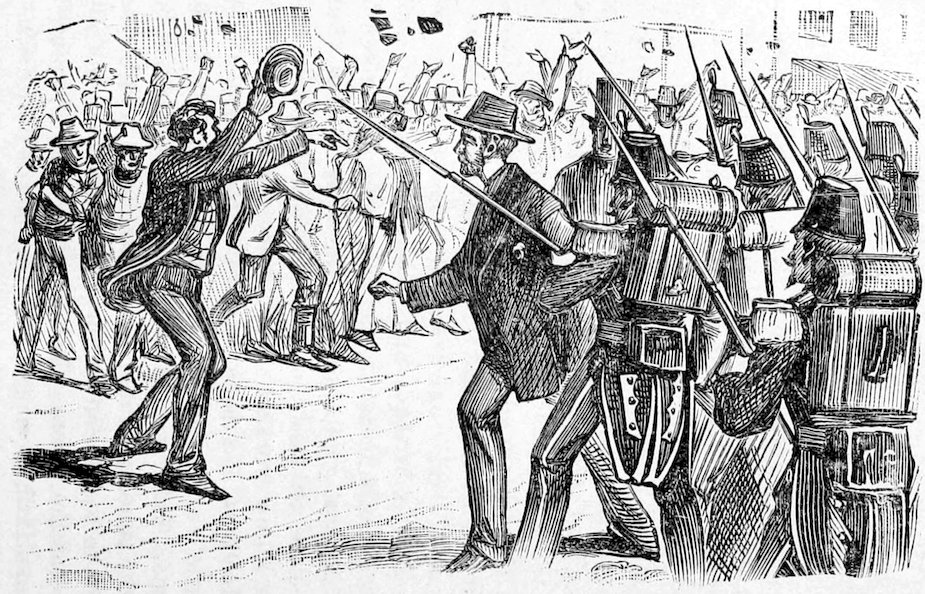
FIGHT BETWEEN THE MILITARY AND THE RIOTERS AT THE HALSTEAD STREET VIADUCT.
PREFACE.
iii
To collect and arrange the facts and incidents connected
with the history of the great labor strikes in this
country, is an undertaking of so much importance that
it must commend itself to the favorable consideration of
the American people. The interest in events of the
nature and character of those treated of in the following
pages cannot prove to be ephemeral. An epoch in the
history of the nation is here marked, and from it will be
dated the beginning of political discussions, and social
movements which are destined to enlist the profound
attention of thinking minds throughout the civilized
world. These events are phenomenal. The world is
witness to a spectacle, the like of which has never before
been presented. A Republic still regarded in the light
of an experiment, having lately terminated a long and
fierce sectional conflict by engaging in one of the greatest
wars of modern times; having achieved order, reconciliation
and peace between all sections, having demonstrated
the greatness and magnanimity of the people;
having extorted from the enemies of liberal institutions
acknowledgements that self-government was a possibility,
having accomplished all these things—this Republic suddenly
startles the world; drowns the noise of strife on
the Bulgarian plains, and among the Balkans, and draws
exclusive attention to a social emeute on this side the
Atlantic, unparalleled in the annals of time. Astonishing
ivas was the suddenness of the movement, yet no less
surprising was the facility and rapidity with which law,
order, and profound peace were restored.
In this uprising of the laborers against their employers,
aggravated as it was by the early appearance on the
scene, of a vast number of theorists, and dangerous
characters, who sought their opportunity, during the
reign of general tumult to subvert the very fundamental
principles of social order, we have gained a deeper
knowledge of the character of the American people.
Sudden as a thunder-burst from a clear sky, the crisis
came upon the country. Hundreds and thousands of
men belonging to the laboring classes, alleging that they
were wronged and oppressed, ceased to work, seized
railroads, closed factories, founderies, shops and mills,
laid a complete embargo on all internal commerce,
interrupted travel, and bid defiance to the ordinary
instruments of legal authority. Commencing at Camden
Station, Baltimore, and at Martinsburg, West Virginia,
in three days the movement had extended to Pittsburgh,
Newark, Ohio, Hornellsville, Fort Wayne and a hundred
other points. State militia forces were encountered
and repelled. The whole country seemed stricken by a
profound dread of impending ruin. In the large cities
the cause of the strikers was espoused by a nondescript
class of the idle, the vicious, the visionary and the whole
rabble of the Pariahs of society. No standing army was
available, and these classes absolutely controlled the
country.
During these few days of the reign of the strikes, it
vseemed as if the whole social and political structure was
on the very brink of ruin. From the Atlantic to the
Pacific the laws were momentarily subverted; officers,
civil and military were for the time being powerless to
compel or restrain, yet the outrages committed, such as
might have been expected in a time of high excitement
and the reign of passion, were confined to a few great
cities, in which a large element of vicious and idle persons
were to be found.
These are features of the Great Strikes which awaken
our profound attention, and demand that the record be
made up while the events are still fresh in the minds of
the people. No better testimonial to the sterling worth
of the American character, no better evidence of their
fitness for self-government, can be produced than is furnished
by their conduct in rising in majesty in favor of
law and order, during the Nation’s trials. The American
people are emphatically upholders of the principles
of social order and the reign of law. For these reasons
the author has undertaken the onerous task of gathering
up the scattered facts which go to make up the complete
history of the Great Strikes.
In the preparation of this work, the author has
experienced no little difficulty, not from the paucity, but
from the plethora of materials at hand. Care has been
exercised to separate fiction from fact, and every possible
endeavor has been made to secure accuracy in statements
and details. In all cases, where it has been possible to do
so, a careful investigation as to the correctness of alleged
facts has been gone into by the author. It is believed,
vithat in all essential respects, the volume herewith presented
for the approval of the American public, is accurate
and reliable. The brief time which has elapsed since
the events treated of occurred, has of course rendered it
impossible to make a thorough investigation of minor
incidents. The author does not claim for his work a
high standard of literary excellence, but the claim is
preferred, that it possesses real historical value, inasmuch
as all the principal events of the critical period through
which the country has passed are here concisely and
truthfully recorded. For these reasons the work is commended
to the consideration of an appreciative public.
J. A. DACUS.
St. Louis, Mo., Sept., 1877.
CONTENTS. — CHAPTER I. Relations Between Capital and Labor.
7
CHAPTER I.
Relations Between Capital and Labor.
Condition of the Country—The Duty of Patriotic Citizens—The Mistakes of Capitalists—The Faults of the Workingmen—The Poor Man’s Hopes the Rich Man’s Protection—The Conditions of Social Order.
A Circular to Employes—Ten per cent. Reduction in Wages Announced—How the News was Received—A Delegation of Employes—The Officers of the Road will not Reconsider—Commencement of the Strike—Trains Stopped at Martinsburg—Trouble at Baltimore.
The Strike Continues—The Governor of West Virginia Confesses his Inability to Suppress Disorders—An Appeal to President Hayes—Proclamation of the Chief Magistrate—Military Companies Disarmed by Strikers—The Third Day of the Strike, and the Alarms it brought—Wide Extent of the Disorders—Portentous Mutterings.
Soldiers and Strikers—Fears Realized—From Baltimore to Chicago—Pittsburgh Affected—The Pennsylvania Railway Embargoed—Intense Excitement Throughout the Country—Successful Emissaries—Immense Extent of the Labor Movement.
Progress of the Great Strikes—Social Disorders—“The Dangerous Classes”—The Commune Comes Upon the Scene—Intense Excitement Throughout the Country—Dealings with Death in Baltimore—Alarm Throughout the Country—Proclamations and Orders.
The Gathering Mob—Thronged Streets and Angry Men—Terrible Exhibition of Passion and Temerity—Soldiers Stoned by Rioters—Sharp Volleys and Sudden Deaths—A Night of Terror—Alarm Bells—The Torches’ Red Glare.
The Baltimore Mob Not Railroad Strikers—The Communistic Tendency in American Cities—Destructive Theories—Danger to the Country Threatened—An Element to be Feared—Some Account of the Origin of the Association.
The Commune in Baltimore—A Paralyzed State Government—An Appeal to the President—A Perilous Situation—Apprehensions felt by the Administration—Another Riot—Clubs and Skulls—A Mob of Twelve Thousand People—From the Atlantic to the Mississippi—The Country in an Uproar—Precautions—Unparalleled Demonstrations.
9Beginning of the Strikes—The Cause Assigned—The System of “Double Headers”—Formidable Character of the Movement—Freight Transportation Suspended—No Concessions—Measures of Repression Taken—Dangerous Indications in Pittsburgh.
The Culmination—A Sea of Fire—Death-Dealing Volleys—The Spirit of Desolation Lighting the Torch of Destruction—A Horrible Spectacle—A Reign of Terror—The Commune Gains a Brief but Fearful Ascendancy—The City Sacked by a Howling Mob—An End of all Lawful Authority—The Ghouls of Pillage Abroad in the Glare of the Devouring Fires—Millions of Property Resolved into Smoke and Ashes.
The Great Conflagration—Demoniac Satisfaction—The Reign of the Commune—Besieged Soldiers—Abandoned Artillery—The Miserable Retreat—Pittsburgh Given Over to the Mob—Scenes of Pillage—Citizens at last Aroused—A Vigilance Committee—Restoring Order.
Difficulty at Erie—Rioters near Bethlehem—Sunbury Strikers—A Rabble at Altoona—Meadville Militia—Mauch Chaunk Characters—Lebanon Valley Villianies—Marietta Marauders—Wilkesbarre Disturbances—Shenandoah Colliers—Hazards at Harrisburg—Scranton Miners—Hazelton Isolated—The Johnstown Murders.
The Beginning of the Trouble—A Militia Company Arrives—Exasperated Strikers—Business Suspended—The Railways all Cease to Transport Freight—Threatening Outlook—Governor Robinson’s Proclamation—Military Movements—The Strike Collapses.
Precautionary Measures—The Rioters Declared to be in a State of Insurrection—Indications of Trouble in other Regions—General Schofield ordered to Washington—Determination to send General Hancock to Pittsburgh—The Rule of the Mob to be Overthrown by the Friends of Law and Order.
The Call for Troops—Gathering the Militia—Anxious Days—Governor Hartranft and Mayor Stokely—A Street Riot—Dispersing a Meeting—Colonel Thomas A. Scott and the Locomotive Engineers—Philadelphia a Nicer Place than Pittsburgh.
The Strike at Hornellsville—The Road Completely Blockaded at that Point—The Demand of the Strikers—Action of the Officers of the Road—The Situation at the Home Office, New York—Apprehensions of Further Complications.
The Fourth Pennsylvania Militia at Reading—General Frank Reeder Undertakes to Restore Order—Bold Rioters Tantalize the Citizen Soldiery—Without Orders They Fire into a Crowd of Peaceable Citizens—Thirteen Killed and Thirty-seven Wounded—Not a Rioter Hurt—A Boy Horribly Mangled—Five Police Officers Victims of the Bullets—A Lady Shot, while Engaged at her Sewing Machine—Terrible Anger of the Citizens and Rioters—Threats of the Mob—General Reeder’s Sworn Statement.
Threatened Riot at Phillipsburgh—The Trainmen’s Strike—Intense Excitement at Trenton—Governor Bedle Takes Decisive Action—Disagreeable Demonstrations at Jersey City—Militia at Hoboken—Governor Bedle goes to Newark and Jersey City—Guarding a Bridge at Brunswick—Soldiers Sympathizing with Strikers—The Jersey Central Railway—Relieved Soldiers Rejoicing.
The Excitement in the Great City—“The Dangerous Classes” Carefully Watched—Getting Ready for Contingencies—Numerous Regiments of Militia Ordered Out—No Strikes but Serious Apprehensions Felt—The Internationals Active—A Great Communistic Meeting in Tompkins Square—What They Demanded of Society—Gay Times at the Armories—Ready Warriors without Foes to Face—Escaped the Danger.
Rochester’s Wave of Trouble—A Slight Shock at Albany—Syracuse Seriously Threatened—Other Places Experience Some Uneasiness—The Conclusion of the Blockade at Hornellsville—The Empire State Comes out of the Great Strikes Almost Unscathed.
Events in the Buckeye State—An Ugly Mob at Columbus—Marching Around and “Shutting Manufactories Down”—Festive Firemen at Collingswood—Marching Through Zanesville—The Breeze at Newark—Cincinnati’s Fortunate Escape—A Mayor Harmless but Wise—He Talks Kindly to the Strikers—And They Hear Him Gladly—Trouble at Toledo.
The Strike Inaugurated at Fort Wayne—Trackmen and Trainmen—Indianapolis Taken in—Terre Haute Yields to the Popular Uprising—Miners at Brazil—Mayor Cavin of Indianapolis Indisposed to Interfere—Governor Williams not Certain that it is any of his Concern Except to Keep the Peace—United States Judges and Bankrupt Railroad Receivers—Freaks of the Strikers—They Capture a Railroad.
The Tidal Wave Reaches the Illinois Metropolis—The Bad Elements Restive—The Tramps Marching in by Hundreds—Chances for Plunder—The Commune Commences—Boastful Manifestos—Absurd Demands—The Social Atmosphere Grows Misty—Precautionary Measures by Civil and Military Authorities—Noisy Demonstrations of the Internationalists—Citizens Philip Van Patten and George Schilling.
It Comes at Last—Riotous Roughs—Socialists Serving Satan—A Well Organized Police Force—The Military all Ready—Hot Heads at Halstead Street—Resisting Arrest—The Police Persist, are Resisted and resort to Pistols and Clubs—Intense Excitement—A Scene of Bloodshed and Death—At the Viaduct—Triumphant Law—Roughs Retire—Dead in the Streets—Then Peace.
At the State Capital—Peoria Strikers—Miners in the Southern Section—The Braidwood Troubles—Troops Sent Down—Matters at Mattoon—Effingham Idlers—The Trainmen at Many Points—Shutting up Shop in Various Provincial Towns—Peace Restored.
Excitement in East St. Louis—Scenes on “Bloody Island”—Council of the Trainmen—A Night at Heims Hall—Hite’s Thrilling Oratorical Flight—“Oppressed Labor”—“The Executive Committee”—Bold Jack Benson—Organized for Business—Across the Great Bridge—Trains Stopped—Slight Dissension Among the Strikers—Blue Coats in the Early Morning—General Jeff. C. Davis Moves Over—Resigning Potentates—Governor Cullom—General Bates—Exemplary Conduct of the Strikers—The Last Scene.
The Strike in the West—East St. Louis sends Emissaries Across the Great Bridge—The Workingmen Aroused—The Valley Metropolis Shaken by a Mighty Wave of Excitement—Marching Mobs—The Internationalists—Vox et Præterea Nihil—Black Bummers—Disgraceful Scenes—The Mob—Demand of the Pacific Railroad Employes—Oliver Garrison, General Manager—How he Broke the Back-bone of the Strike—Measures for Protection.
“To Arms!”—Down with Lawlessness—The Giant of Communism rather Ghostly—Governor Phelps—Mayor Overstolz—General A. J. Smith—The Mighty Executive Committee—More Phantom than Fact—An Important Undertaking—Seven Hundred Armed Men—They March to Storm the Hall of “The Workingmen’s Party of the United States”—Schuler’s Hall Captured—The Vanquished Commune—A Grand Parade—Prevention better than Cure.
Interest in the Strikes—Kansas City—The Sedalia Trainmen—The Missouri, Kansas and Texas Railway—Hannibal and St. Joe—“Strike Smashers”—The General Tumult—Growing Quiet—The Decline—The End—Peace.
The Workingmen’s Sympathies for Strikers—A Mass Meeting—The Hoodlums on the Alert—Concocting Mischief—Race Riots—Incendiarism—Chinese Wash Houses—The Hoodlum’s Aversion—Destructive Conflagration—A Vigilance Committee—Chasing the Roughs—A Bloody Scene—The Aroused Citizens Crush the Mob Spirit—Peace Restored.
All Serene in Dixie—A Slight Ripple in Texas—Speedy Restoration of Peaceful Relations—“Old Virginia Never Tires”—Southern Men Offer Services to Restore Order in Northern States—The Era of Sectional Harmony—Law and Order.
How a Strike was Averted on the Union Pacific Railroad—Concessions to the Men—A Settlement at Memphis Tennessee—Declaration of the Supreme Council of the Labor Union—Order of Melakhto—Rights and Privileges—Sympathizers with the Strikers—The Engineers’ Brotherhood at Pittsburgh—Views and Opinions.
Condition of the Country—The Duty of Patriotic Citizens—The Mistakes
of Capitalists—The Faults of the Workingmen—The Poor
Man’s Hopes the Rich Man’s Protection—The Conditions of Social
Order.
Republican government in this country, has just been
subjected to a strain greater than any which our system
has been before required to sustain. It is true, that
great armies were not organized to meet in the shock of
battle as in the civil war between the North and South.
Nor were powerful sections arrayed against each other.
But the phases assumed by the recent conflicts are far
more threatening to social organization and political
stability, than was the terrible contest waged between
sections from 1861 to 1865. In that collision, the North
represented the idea of the organic unity of the several
States of the Federal Government, the South the idea of
State Sovereignty, but both represented the principles of
social order, and contended for the reign of law. But
we have witnessed an uprising of no mean magnitude,
which represented nothing in common with the fundamental
principles of Republican institutions. The
history of the Great Strikes of 1877, affords materials
for thought, a basis for the most profound reflections.
16The causes which produced the results, so startling to
the friends of liberal institutions, have not ceased to
operate, and as a consequence the records of the events
connected with the inception, progress and culmination
of the disorders, must prove to be an interesting study to
all thinking minds. The very foundations of American
society have been disturbed; the whole political structure
has been made to sway to and fro, as if about to be
overthrown.
The strength, the fearful power, which stopped the
wheels of commerce, closed the marts of trade, and
threatened to engulf all wealth, institutions, social
organization,—everything in the vortex of ruin, was not
the offspring of a conspiracy, was not generated by
elaborate planning, and did not result from mature
deliberation. And in this very fact, the man of calm
reflection discovers, not far ahead, the rocks on which
the ship of State is likely to be driven—on which every
hope of mankind may be wrecked. If it had been a
deliberately planned and concerted movement; if those
engaged in it had exhibited evidence of organization,
then its failure would have given a better promise of
enduring peace and order. But the spontaneity of the
movement shows the existence of a wide spread discontent,
a disposition to subvert the existing social order, to
modify or overturn the political institutions, under which
such unfavorable conditions were developed. Somewhere,
there must be something radically defective
either in the system, or in the manner of its control.
Such spontaneous demonstrations by large masses of the
people, as have been witnessed in the United States in
the year 1877, do not take place without a sufficient
17cause. To discover that cause and take measures for its
removal, is one of the first and most important duties
required of the patriotic citizen.
Theories in abundance have been advanced; oracular
assertions that this or that measure of the general government
is responsible for the existing unrest, have been
made; the convenient talk about shrinkage in values;
the failure of the government to furnish the people with
a sufficient supply of legal tender treasury notes; the
payment of the interest on the National debt; the protective
tariff; the demonetizing of silver, all these have
been assigned as the cause of “hard times,” and to the
“hard times,” as the immediate cause, the scenes described
in this work are attributed. But are these sufficient to
furnish an explanation satisfactory to the student of
social science? Never before in this country—perhaps in
no other country in the world—have so vast a number
of men taken part in riots and strikes for increased
wages. It was an impulsive, perhaps an imprudent outburst,
and certainly it was characterized by violence and
lawlessness, that cannot be palliated or excused. The
supremacy of the law is an essential condition of social
order, and without social order, the right to private property,
the right to personal security cannot be assured.
Social disorganization means political death. With the
reign of anarchy commence the miseries of the people
without distinction of class. In the throes of expiring
society, all alike become victims.
But social disorders cannot take place in the midst of
a prosperous community. The alarming movements of
the present year are the logical results of the condition
of society. They are but evidences of deep sufferings
18among a large class of the people of this country. Somewhere
great wrongs have been committed, and society
must pay the penalty for crimes. The study of the natural
causes that govern the rate of wages, is a study of
the causes that distribute wealth to the mass of mankind.
Capitalists cannot afford to oppress laborers, because such
oppression endangers their own security. It is a fact
that in those countries where the highest wages are paid
we find the highest type of civilization, and a more equal
distribution of wealth. Where a large majority of the
people are poor, the few who are rich cannot be assured
of protection. It is in the power of those above to lift
up those below; but it requires time for the operation
of moral and natural causes, while it is but the work of
a day for the lowest to drag down the highest. The first
ripple of disturbance to the industry of the country is
felt soonest by those nearest to destitution, and the problem
is how to remove that small number from want, and
thus ensure social security. This cannot be done except
as wealth is more bountifully distributed to them through
higher wages. The part of wisdom, it seems, should
dictate such a policy by the owners of capital. The
American people are not yet ripe for anarchy, because
perhaps a majority of the adult population either have
homes, or cherish the hope that they will have homes,
and because of this interest in the government, they are
the staunch friends of order, and the upholders of law.
But neither government nor social order can be maintained
when the majority of the people are homeless and hopeless.
The poor man’s hopes are the rich man’s protection.
The condition of Mexico may be cited as an illustration
of the position here taken. A country containing a population
19of upwards of nine millions of souls is owned by
less than a hundred thousand proprietors. What has
been the result of this ill-distribution of wealth? The
answer is, fifty years of anarchy. The poverty of the
masses is fatal to the security of the wealthy proprietors.
In Mexico wages are at least fifty per cent. less than the
average in the United States. That country has sunk
beneath, even the contempt of the most enlightened
nations.
But the evil results of low-paid labor should be anticipated
in good season, before it inundates and overwhelms
the nation, and destroys every hope of a successful
republic.
It is cheap labor, more than any other fact, that most
endangers our institutions—cheap labor serving corporate
wealth, intent upon nothing but more wealth. Here is
where capitalists make the gravest mistake, and the great
strikes of the present year should be taken as a wholesome
warning. Capitalists consider their direct interest
in the cheap labor they hire, and not their indirect interest
in the dearer labor that buys what wealth wishes to
sell.
The number of laborers who can buy, must be large,
or many of those who produce to sell will have little or
nothing to do. Buyers are as important, in order to have
prosperity, as sellers; and those who buy are those who
have something with which to pay. Poverty demoralizes,
destroys self respect, and in time will make the
honest laborer a dangerous member of society, by lowering
his opinions. And this lowering of the opinions of
the laboring class with respect to the mode in which they
should live, is perhaps the most serious of all evils that
20can befall them. Let them once accept the alternative
presented by Henry Ward Beecher, and undertake to
exist upon “bread and water,” and become contented
with such a condition, and they may bid a long adieu to
anything better. It does not require a very profound
observer to arrive at the conclusion that the best interests
of society, the interest of the capitalists themselves,
require that the rate of wages should be elevated as high
as possible,—that a taste for comforts and enjoyments,
should be widely diffused, and if possible, interwoven
with national habits and prejudices.
But justice compels to the declaration that such has
not been the policy of the managers of the great corporations
in this country. They have persistently sought to
reduce wages of the laborers, while at the same time
there has been a gradual increase in salaries paid to the
managers and their assistants. Thomas A. Scott while
receiving one hundred and seventy-five thousand dollars
in salaries per annum, for managing property interests
which in part belongs to himself, cannot very consistently
insist upon a sum less than four hundred dollars
per annum, as the proper compensation for the services
of a man whose peculiar employment requires that he
must be vigilant, prompt, and constantly exposed to danger.
Then again, the system of watering stocks of railroads
and other corporations, debars the managers from
the privilege of pleading a failure to earn interest as an
excuse for cutting down the wages of labor. Perhaps
Wm. H. Vanderbilt is not able to secure ten per cent.
interest on the stocks of the New York Central Railroad.
But it must be remembered that the par value of the
stocks of the New York Central Railroad, exceeds
21eighty-two thousand dollars per mile, or upwards of
fifty-five thousand dollars per mile more than the cost of
the road—more than the actual cash investment. It is
quite possible that Mr. Vanderbilt would have no difficulty
in earning a dividend of fifteen per cent. on the
actual amount of money invested, and have enough earnings
left to make a handsome dividend to every employe
of the road.
And here we find the immediate, potent cause of the
Great Strikes. Depression in business, but more important
still, depression in transportation rates brought about
by the jealousies and hostility to each other of Thomas
A. Scott, John W. Garrett, and William H. Vanderbilt,
rendering it necessary to reduce operating expenses in
order to “make something,”—that is ten per cent. on
their largely increased amount of stock. The lower
order of laborers were first to feel the weight of this
curtailment of income. Meanwhile the higher grades of
employes were still receiving salaries not much less than
were obtained ten years ago, when the whole country
was enjoying unparalleled prosperity. The higher officers
of companies received higher salaries in 1876 than
they obtained in 1866, notwithstanding the immense
change in values which had taken place.
The reduction of ten per cent. in the wages of laborers,
which was made by a majority of the railway companies
throughout the country during the first half of
the year 1877, was sufficient to evoke the earnest protests
of the men affected by the curtailment of their income.
Had the reduction on all the roads which have cut the
wages of their employes, taken effect at the same time,
it is probable that a general strike would have taken
22place earlier in the season. But the date of reduction
was not the same on any considerable number of the
roads. Petitions and remonstrances from employes of
railroad companies were received by their employers,
but were wholly disregarded. A feeling of discontent
was engendered, while the burden of “hard times”
weighed more heavily upon workingmen.
The mine was already prepared, a spark only was
necessary to cause an explosion. That was supplied by
the action of the managers of the Baltimore and Ohio
Railroad. The pressure put upon their employes elicited
the spark, and the explosion followed. Commencing at
Martinsburg, West Virginia, in less than three hours the
strike was fully inaugurated, and had already reached
Baltimore. The line of the Baltimore and Ohio Railway
was completely invested by the strikers in less than
twenty hours. From the Baltimore and Ohio Railway
the strikes extended first to the Connellsville branch,
then to the Pennsylvania system, Pittsburgh and Fort
Wayne, and other railways. In an incredibly short
space of time, strikes had taken place in Maryland,
Pennsylvania, West Virginia, Ohio, New York, New
Jersey, Indiana, Michigan, Illinois, Kentucky, and
Missouri. Fifteen thousand men were engaged in the
strikes.
The whole country was profoundly agitated. The uprising
had assumed a dangerous aspect. A feeling of
alarm and dread quickly succeeded the first impulsive
feeling of sympathy entertained by the masses for the
strikers. The vast numbers engaged in the strikes
against the railroads, their apparent determination, the
general belief that they were well organized and prepared,
23produced a dangerous effect upon the idle and
vicious classes in all the large cities. Labor unions
were suddenly aroused into unwonted activity, and displayed
alarming vigor. “The Workingmen’s Party of
the United States,” which is but another name for the
“International Association of Workingmen,” which has
caused so much anxiety to the governments of Europe,
came forth from its shadowy coverts, and what had been
regarded as a phantom party, assumed a realistic attitude
that caused a thrill of astonishment and terror to
fall upon the urban populations of the country. Nothing
to compare with the demonstrations of the Internationalists
in all the larger cities, by day and by night,
had, at any time, been witnessed in this country.
In less than four days after the commencement of the
strike on the Baltimore and Ohio Railroad, no inconsiderable
portion of the territory of the United States
was in the hands of the strikers; transportation was
embargoed; shops closed, factories deserted, and the
great marts which but a few days before had been so
noisy, had became silent as “banquet halls deserted.”
Men remembered France, and the scenes of 1789–93,
and trembled as they heard the tumult increase, and saw
the mighty masses of strange, grimy men, excited by
passions, dark and fearful, surging along the streets.
Then was flashed abroad over the land news of the
fusilade at Martinsburg, and the conflict in the streets
of Baltimore. Blood had been shed! Men wondered
what would be the final outcome. The prevalent alarm
was intensified. In many cases State and municipal
authorities seemed to have been stricken by a paralysis
of dread. Meanwhile, the strikes were increasing.
24Pittsburgh, Cincinnati, Cleveland, Buffalo, Indianapolis,
St. Louis, Chicago, and numerous other places began to
feel the effects of the mighty wave of human passion
which threatened to engulf all in a common ruin.
Pittsburgh was doomed to feel the most terrible blow
from the mob or the Internationals. The news of the
conflict between the militia and the rabble; the temporary
success of the latter, and the immense destruction of
property which followed, was received by the whole
country with amazement and grief. The sympathies of
the masses of the people, which had unquestionably been
with the railroad strikers, was now withdrawn in a measure.
Even the strikers themselves felt constrained to
disown the elements who had made an opportunity of
their necessity, to create a reign of terror throughout
the land. The reaction against the strikers, and those
who claimed to be their allies, was positive and practical.
Men sprung to arms with a feeling that it was necessary
to protect the sanctity of their own homes. The spirit
of turbulence evoked by the strikers must be crushed.
Such were the sentiments which actuated the men,
who hastily banded themselves together in companies,
battalions and regiments, in New York, New Jersey,
Pennsylvania, Ohio, Maryland, Indiana, Kentucky, Illinois,
Michigan and Missouri. Within less than six days,
an army of citizen-soldiers had been created in the states
named, which in the aggregate numbered more than
sixty thousand men, armed and equipped, ready for
service.
Meanwhile the Internationalists were not idle. The
railroad men’s strikes was made their opportunity. The
atmosphere of social disorder favored their designs. M.
25K. Goldsmith, Secretary of the National Board of Supervisors
of the American branch of the order, from his
headquarters in Hartford, placed himself in immediate
communication with the local Sections, all over the
country for the purpose of advising and encouraging
them. Citizens P. Van Patten and Geo. Schilling, of
Chicago, who are prominent members of the organization,
were also warmly enlisted in the cause of the
“Party;” while in St. Louis, Curlin, Curtis, Cardell,
Ratz, Porter, Cope and Sykora, held daily and nightly
meetings, to induce the proper degree of enthusiasm
among the masses of workingmen. In New York, Justus
Schwab, John Swinton, Michael Doyle, Paul Kaiser,
Frank Coufal and Frank Bartosek, organized a great
mass meeting in Tompkins Square, where the principles
of the Internationalists were elaborately discussed.
Indeed, the three hundred and sixty-five sections of
American, German, French, Bohemian and Scandinavian
Internationalists, located in twelve states of the Union,
were all active.
The appearance of this organization as allies of the
strikers, had much to do in alienating public sympathy
from that class of the workingmen, who it was believed,
had a just cause to strike. It is also certain that the
bold utterances, and audacious demands of the Internationalists,
stimulated the organization of military forces
adequate to the work of suppressing all disorders.
The history of the movements alluded to in these introductory
pages must prove deeply interesting to the
student of American social institutions. It is well to
preserve it. Perhaps there may be other and even
greater strikes, but it is improbable that this country
26will ever be visited again by a movement so spontaneous,
yet so vigorous and threatening. A great danger has
apparently passed. As a nation, we should profit by
the warning it affords.
CHAPTER II. Strike on the Baltimore and Ohio Railroad.
27
Circular to Employes—Ten per cent. Reduction in Wages Announced—How
the News was Received—A Delegation of Employes—The
Officers of the Road will not Reconsider—Commencement
of the Strike—Trains Stopped at Martinsburg—Trouble at
Baltimore.
In the beginning of July, 1877, a circular emanating
from the offices of the superintendents of the Baltimore
and Ohio Railway, was sent to all the employes of the
Company, announcing a reduction of 10 per cent. from
the wages which the Company was then paying. This
curtailment of the income of the employes on the road,
was to take effect on Monday, July 16th, 1877. This
schedule of wages, according to the circular, reduced the
pay of firemen from $1.75 and $1.50 per day, to $1.58
and $1.35 per day, according to the efficiency of the
men. The pay of brakemen was fixed at a little less.
One hundred miles was made to constitute a days’ run.
No allowance of time was permitted for delays at way
stations.
The reception of this circular created no little ill-feeling
among the railroad men. Groups of them met, and
discussed their situation. The men asserted that they
could not sustain themselves on the amount of wages the
company proposed to pay them for their services. Meetings
of employes were held at various points along the line
of the road, and finally a plan of action was agreed upon.
28A committee was appointed and instructed to confer with
the officers of the company. Mr. Vice President King
was appealed to, but declined to hear the complaints of
the employes. Various efforts were made to procure the
rescission of the order of reduction. These proved
abortive. Meanwhile as the time fixed for the order of
the Company to go into effect approached, the discontent
of the men increased. At many localities along the
road, small bodies of men expressed themselves in favor
of striking. But it does not appear that up to the
morning of the 16th, any concerted movement had been
agreed upon by the firemen and brakemen of the Baltimore
and Ohio Railway.
The morning of the 16th of July, 1877, at length
dawned. Along the line of the Baltimore and Ohio Railroad,
everything presented the usual appearance. Trains
were moving; foundery men, machinists, engine drivers,
firemen, brakemen, trackmen, switchmen and agents
were at their posts of duty. The commerce of a large
section of country was moving over the iron trackways.
The officers of the road, too, were at their respective
offices, little anticipating that within the space
of twelve hours, a strike, such as was never before known
in the history of America, would be inaugurated along
the line of that great highway. Intimations of coming
trouble the managers of the road had had, but they
trusted that the “hard times,” would deter the men from
carrying into execution any purpose they might have
formed of deserting their posts of duty on the road.
The day wore on. The click of the telegraphic instruments
in the office of the superintendents of the
respective divisions, announced the arrival and departure
29of trains to and from a thousand stations situated along
a line of more than fourteen hundred miles of railway.
There was no trouble as yet; and the lengthening
shadows announced the day’s decline. The afternoon
was far advanced, and the officers of the great railway
line had already begun to congratulate themselves,
because the danger of a general strike appeared to have
passed way.
But their self-gratulations were doomed to a sudden
arrest. It was after five o’clock in the afternoon, when the
announcement was made in the general offices of the
Company at Baltimore, that a strike of the employes on
the road was in progress at Camden Junction, near that
city. About forty firemen at that point quit their
engines, and persuaded twenty or thirty brakemen to
join them in deserting their trains. As yet no intelligence
had reached the managers of the road of disturbances
elsewhere. Another force of firemen and brakemen
were engaged to take out the waiting trains. But
the trains were not taken out. The freight business of
the road had been already completely embargoed. The
trouble at Camden Junction appeared to have been
easily disposed of, and for a time the officers anticipated
nothing worse.
But it soon became manifest that the officers had misapprehended
the nature and character of the movement
among their employes. Reports came in rapid succession
from the West, announcing that the railroad men
at Cumberland, Martinsburg and other stations along
the line were restless, discontented and insubordinate,
and that the canal-boatmen had quit work and abandoned
their boats. Under these circumstances, all
30movements of freight over the road practically ceased.
Meanwhile, the situation at Baltimore was every hour
becoming more critical. Before six o’clock the box-makers,
sawyers, and can-makers, engaged in the shops
and factories of that city, had struck for an advance of
ten per cent. on their wages, had abandoned their places
and swarmed into the streets. The demonstrations of
these workingmen only stimulated the railroad men to
commit bolder acts. It became evident before the evening
had far advanced that a general strike of railroad
men all along the line of the Baltimore and Ohio line
was inevitable.
At Martinsburg the excitement became very great,
and the situation was alarming. Late in the evening a
general strike was set on foot. All freight trains were
stopped, and brakemen and firemen who manifested an
intention to continue at their posts, were forcibly taken
from their engines and trains by the strikers, and compelled
to join in demonstrations against the Company
they had ceased to serve. At Cumberland the situation
was anything but reassuring. A considerable number
of striking trainmen had assembled at that place and
prohibited any movement whatever of trains, other than
mail and passenger coaches. At Keyser and Grafton,
the trainmen had obtained complete possession, and no
freight trains were permitted to move.
Before midnight of the 16th, the control of the immense
property of the Baltimore and Ohio Railway
Company, had passed out of the hands of the officers,
and was held by the strikers. The disposition manifested
by the recalcitrants at Martinsburg, had become
so threatening, that Vice President King, of the Baltimore
31and Ohio road, sent a dispatch to Governor Matthews
of West Virginia, calling upon him to furnish
troops to protect the interests of the Company.
Late the same evening, Governor Matthews sent a
dispatch from Wheeling to Captain Charles James
Faulkner, Jr., in command of certain companies of
State militia at Martinsburg, to afford the officers of the
road all the aid and protection in his power. No collisions
as yet had occurred.
The first act of the strikers involving injury to persons,
was committed at South Baltimore, at about two o’clock,
the morning of the 17th. A freight train from the
West, bound for Locust Point, was thrown from the
track while passing the gas house switch in that suburb,
and almost demolished. The cab of the engine took
fire and some destruction of property ensued before the
flames were subdued. The engineer and fireman were
both severely wounded. No other incident worth recording
occurred during this the first night of the reign
of the strikers.
But it was already evident that a formidable movement
of the workingmen throughout the country was
imminent. Indeed, the greatest labor strikes ever known
was now fairly inaugurated. Less than ten hours had
passed since the canal-boatmen, the box-makers, the sawyers,
the can-makers, and the trainmen had definitely
resolved on quitting their employments, and already more
than four thousand persons had joined in the strike, refusing
to labor themselves, and determined to prevent
others from taking their places. But even with the evidences
of the fitness of public sentiment to foster and
encourage a strike, no one at the close of the first day
32after the strike began could have anticipated the tremendous
uprising to which the events about Baltimore
and Martinsburg were but the prelude.
But, if the developments during the first ten hours of
the strike, while the movement was yet in its incipient
stage, were sufficient to engender feelings of uneasiness
in the public mind, the events of the following day justified
the sensation of intense alarm.
Martinsburg, a city of no great extent, occupying a
romantic site in a valley among the mountains of West
Virginia, was destined to be the scene of the first real
conflict between the representative forces of the State
and the strikers. At an early hour on the morning of
the 17th, Captain Charles James Faulkner, Jr., Aid-de-Camp
to Governor Matthews, arrived at the post of duty
at Martinsburg, in command of seventy-five men of the
Berkeley Light Guard Infantry. He had been ordered
to protect that point by the Governor, who had been applied
to for aid by Vice President King of the Baltimore
and Ohio Railroad Company.
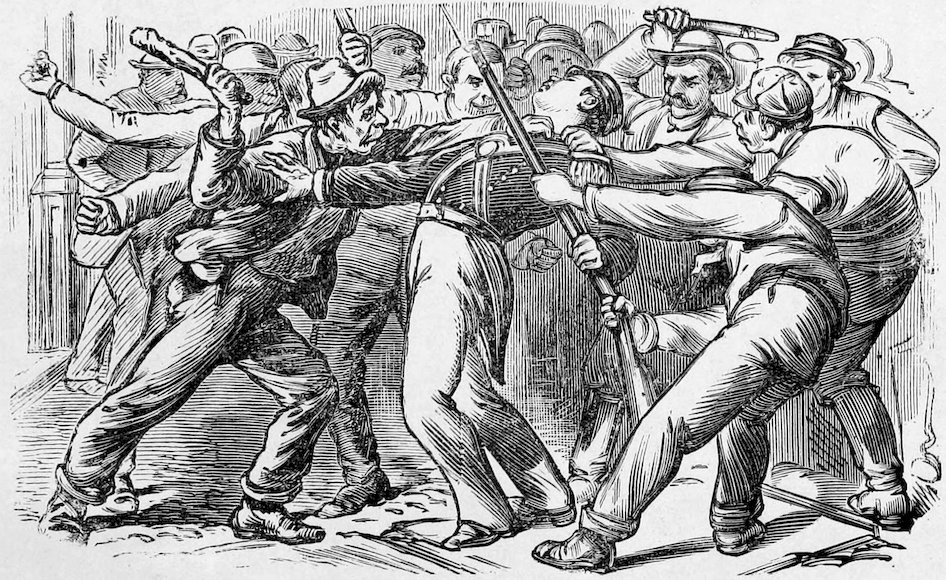
THE MOB ASSAULTING A MEMBER OF THE MILITIA.
Captain Faulkner at once proceeded to the railway track
and deployed his men as a guard for a West bound freight
train, which the Railway Company determined to dispatch
in spite of the orders of the strikers. The train
started, and had proceeded nearly to the switch at the
Company’s yards, when suddenly one of the strikers,
named Wm. Vandergriff, ran forward and seized the
switch-ball for the purpose of opening it to “side track”
the train. At this time the train was moving slowly.
A guard of militia was on the engine. The movement
of Vandergriff was observed by John Poisal, a member
of Captain Faulkner’s command, who immediately sprang
33from the pilot of the engine where he had been stationed,
and attempted to replace the switch in order to allow
the train to proceed. Vandergriff resented this action,
drew a pistol and fired two shots at the militia-man,
one of which took effect in the side of his head.
Poisal returned the fire, shooting Vandergriff through
the hip. This firing led to a regular fusilade. A number
of shots were fired at Vandergriff and he was
shot in the head and arm. The report of firearms,
speedily attracted to the spot a great multitude of railroad
men and citizens. The excitement was intense.
The engineer and fireman who had engaged with the
Company to run the train, fled when the firing commenced.
Captain Faulkner ordered the mass of strikers
to keep back, and commanded them to disperse.
This order was received by them with jeers and threats.
Finding that the engineer and fireman had deserted the
train, Captain Faulkner declared that he had fully discharged
his duty, marched his command to their armory,
where they were disbanded, leaving the strikers in full
possession of the field. The road was now completely
blocked up with standing trains. The cars were all
uncoupled, and the links and pins were either hidden or
broken.
During the day the force of strikers at Martinsburg,
was greatly augmented. The citizens of the town,
the disbanded militia, and the rural population of the
surrounding country fraternized with them, and encouraged
them in the determination to persist in their
demands.
Railroad men from the Chesapeake and Ohio Railway
also arrived in considerable numbers at Martinsburg
34during the day. At three o’clock in the afternoon it
was estimated that the strikers and their allies at Martinsburg
numbered not less than one thousand men.
The State authorities were powerless. Telegraphic
messages passed between the Governor and the officers
of the road. The Governor himself, with the Matthews
Guards, left Wheeling for Martinsburg, and proceeded
as far as Cumberland. But he hastily returned from
that point to the Capital on receiving intelligence that
the strike had reached that city, and that all freight
trains were being stopped. The police and constabulary
force of the municipality could afford no protection
to trainmen who were willing to continue in
the service of the Company. The two military companies
at Martinsburg, openly affiliated with the
strikers. Another company of volunteer militia was
thirty-eight miles from any railroad. The Matthews
Guards at Wheeling, numbered but forty-eight men, and
even the loyalty of these was not to be depended on in
this emergency.
At night the situation at Martinsburg, Cumberland,
Grafton, Keyser, Wheeling, and indeed all along the line
of the Baltimore and Ohio Railroad, was critical in the
extreme. The canal-boatmen were with the railroad
men at Martinsburg, and the citizens all along the line
were apparently sympathizers. Meanwhile, rumors of
an alarming character concerning movements among
railroad, and other classes of workingmen all over the
country, were circulated in all directions. In the portion
of country most affected, a sort of dread of impending
disasters had taken possession of the friends of law and
order. Lawlessness reigned supreme from the Patapsco
35to the Kanawha. The second day of the great
strikes closed. The movement had become formidable.
Men experienced a feeling of intense alarm at the prospects
before them.
CHAPTER III. A Day of Dread.
36
The Strike Continues—The Governor of West Virginia Confesses his
Inability to Suppress Disorders—An Appeal to President Hayes—Proclamation
of the Chief Magistrate—Military Companies Disarmed
by Strikers—The Third Day of the Strike, and the Alarms
it brought—Wide Extent of the Disorders—Portentous Mutterings.
The events of the 17th were of an unusual character
in this country. The strikers had gone further than
persons engaged in such movements had been accustomed
to go. In countries where the struggle for life
is keener than in America, such incidents to a strike as
an attempt to murder, and the theft of tools and implements
necessary to conducting a business, are common.
But the attempt of Vandergriff to kill the militia-man
Poisal, because he undertook to adjust a switch to permit
a train to pass, taken in connection with the destruction
or concealment of the links and pins, necessary
in the movement of trains, showed the authorities
the desperate nature of the enterprise in which the
strikers were engaged. It revealed the existence of a
determination on their part to enforce their demands at
every hazard. The situation the morning of the 18th
was alarming. The strikers had been reinforced during
the night at all points by accessions of workingmen
engaged in other avocations than railroading. They had
grown bold because they knew they had the sympathies
37of the people with them, especially in that portion of
West Virginia where the strike had assumed the most
threatening aspect.
The Governor of the State of West Virginia, apprised
of the extent of the lawless combination, found
himself in the humiliating position of complete inability
to deal with the issue. Powerless to suppress the disorders,
appealed to by the managers of the railroad for
that protection which he was unable to afford; harassed
by the knowledge that a large portion of the people
whom he governed were in sympathy with the turbulent
strikers, and tormented by the evidence that the few
militia at his command were unfaithful to their duty,
the position of Governor Matthews was sufficiently disagreeable.
The movement had now become so formidable that
State authority could no longer assert supremacy.
Under these circumstances, the Chief Executive of the
commonwealth of West Virginia, was constrained to
appeal to the Federal Government for protection and
assistance in quelling the riots which had taken place.
During the afternoon of the 18th, Governor Matthews
perceiving his inability to deal with the emergency,
with no little reluctance, forwarded to the President of
the United States the following formal appeal for the
intervention of the federal power in suppressing the disorders
in his State:
Wheeling, W. Va., July 18.
To His Excellency R. B. Hayes, President of the United States:
Owing to unlawful combinations and domestic violence
now existing at Martinsburg and other points
38along the line of the Baltimore and Ohio Railroad, it is
impossible with any force at my command to execute the
laws of the State. I therefore call upon Your Excellency
for the assistance of the United States military to
protect the law-abiding people of the State against
domestic violence, and to maintain the supremacy of the
law. The Legislature is not now in session, and could
not be assembled in time to take any action in the
emergency. A force of from two to three hundred
should be sent without delay to Martinsburg, where my
aid, Colonel Delaplaine, will meet and confer with the
officers in command.
Henry M. Matthews,
Governor of West Virginia.
Upon receipt of this call at Washington, President
Hayes at once dispatched a messenger for the Secretary
of War, who immediately answered the summons by
repairing to the Executive Mansion. A brief consultation
between them followed. The result was the conclusion
that the information contained in the call was
not sufficiently definite to warrant the President in
employing the military forces of the United States for
such purposes.
It was agreed, however, that the Governor of West
Virginia be called upon to furnish more definite information,
and accordingly the Secretary of War was instructed
to send a dispatch to Governor Matthews, requesting
complete information. The Governor’s reply showed
that there were but four militia companies in West
Virginia, two of which had already fraternized with the
Strikers at Martinsburg, a third was in an interior
39county, thirty miles from any railway line, and the
fourth consisted of only forty-eight men, while the
Governor estimated the force of strikers massed at
Martinsburg, at not less than eight hundred men.
Notwithstanding his reluctance to interfere in the
matter, the President esteemed the emergency one of
sufficient gravity to justify him in taking decisive action.
Accordingly he issued the following proclamation, the
same evening:
A PROCLAMATION.
Whereas, The Governor of the State of West Virginia
has represented that domestic violence exists in said
State, at Martinsburg, and at various other points along
the line of the Baltimore and Ohio Railroad in said
State, which the authorities of said State are unable to
suppress; and
Whereas, It is provided in the Constitution of the
United States, that the United States shall protect every
State in this Union on application of the Legislature, or
of the Executive when the Legislature cannot be convened,
against violence; and
Whereas, By laws in pursuance of the above it is
provided (in the laws of the United States) that in all
cases of insurrection in any State, or of obstruction to
the laws thereof, it shall be lawful for the President of
the United States, on application of the Legislature of
such State, or of the Executive when the Legislature
cannot be convened, to call forth the militia of any
other State or States, or to employ such part of the land
and naval forces as shall be judged necessary for the
40purpose of suppressing such insurrection or causing the
laws to be duly executed; and
Whereas, The Legislature of said State is not now in
session and cannot be convened in time to meet the
present emergency, and the Executive of said State, under
section IV. of article 4 of the Constitution of the United
States and the laws passed in pursuance thereof, has made
due application to me in the premises for such part of the
military force of the United States as may be necessary
and adequate to protect said State and the citizens thereof
against domestic violence, and to enforce the due
execution of the laws; and
Whereas, It is required that whenever it may be
necessary in the judgment of the President to use the
military force for the purpose aforesaid, he shall forthwith,
by proclamation, command such insurgents to
disperse and retire peaceably to their respective homes
within a limited time; now, therefore,
I, Rutherford B. Hayes, President of the United States,
do hereby make proclamation and command all persons
engaged in said unlawful and insurrectionary proceedings
to disperse and retire peaceably to their respective
abodes on or before twelve o’clock, noon, the nineteenth
day of July instant, and hereafter abandon said combinations
and submit themselves to the laws and constituted
authorities of said State, and I invoke the aid and co-operation
of all good citizens thereof to uphold the laws
and preserve the public peace.
In witness whereof I have hereunto set my hand and
caused the seal of the United States to be affixed.
Done at the city of Washington this eighteenth day
41of July, in the year of our Lord, 1877, and of the
independence of the United States the one hundred and
second.
(Signed,) R. B. Hayes.
By the President.
F. A. Seward, Acting Secretary of State.
Orders were issued from the War Department, to
General French, commanding at the Washington arsenal,
requiring him to take all the available troops from that
station and proceed at once to Martinsburg. At the
same time like orders were forwarded to General Barry,
in command at Fort McHenry, to detach all available
forces from that post to join the forces under command
of General French at the threatened points. A force
of seventy-five men was got ready, chiefly members of
batteries acting as infantry, officered by Captain J. I.
Rogers of Battery L., commanding, Captain James E. Wilson
of Battery H., and Lieutenants Crawford and Hoyle,
Taylor and Curtis; the detachment of Light Battery A.,
was commanded by Lieutenant Niles. The force from the
Washington Arsenal was organized under the following
named officers; Battery D., Captain Litchfield; Battery
C., Captain Graves; Battery F., Lieutenant Simpson;
Battery E., Lieutenant Gifford; Battery I., Lieutenant
Howard, and Battery G., Lieutenant Smith. These
troops were armed as infantry, the full strength of the
battalion was about two hundred and fifty men. General
French commanded, Lieutenant Wolfe Acting Adjutant
and Lieutenant Maurice Acting Quarter-master. The
whole force was in readiness to proceed on their way to
Martinsburg at an early hour in the evening.
42The marching of troops through the streets of the
National Capital created a profound sensation among the
citizens. It was the first time in the history of the
country that a labor strike had become so formidable as
to require the intervention of the general Government
to preserve order. It was nine o’clock at night when the
armed battalion of regulars filed through the streets of
Washington on the way to the station of the Baltimore
and Ohio Railway to embark on the train to proceed to
Martinsburg. A vast concourse of people had assembled
to witness their departure. The scene was not unlike
some of those which characterized the early days of the
year 1861. The train moved away from the station at
ten o’clock in the evening, bound for the scene of the
disturbance.
Meanwhile bands of strikers had taken possession of
the railway stations at Cumberland, Grafton, Keyser, and
other points, and refused to allow any freight trains to
pass. Emissaries were dispatched from the headquarters
of the strikers at Martinsburg and Wheeling, to induce
the firemen and brakemen; along the Connellsville
Branch, the Pennsylvania road, the Pittsburgh and
Chicago, and other railroads in that section of the country
to join in the strike. During the day the strikers at
Wheeling made a demonstration of a rather threatening
character. The single company of militia at that place
paraded for action. But it was evident that it was not
strong enough to effect anything, and so the citizen-soldiers
allowed themselves to be quietly disarmed by
the striking workingmen.
The strikers at Martinsburg received the President’s
proclamation with indifference or positive disrespect.
43No attention whatever was paid to the injunction to
disperse. On the contrary, with constant accessions to
their numbers, they became more demonstrative and
threatening in their bearing.
During the day, a committee of strikers at Baltimore
prepared and caused to be printed and circulated a statement
of the causes which impelled them to pursue the
course which they had adopted. They declared that
they had submitted to three reductions of wages in three
years; that they would have acquiesced in a moderate
reduction; that they were frequently sent out on a trip
to Martinsburg, and there detained four days at the discretion
of the company, for which detention they were
allowed pay for but two day’s time; that they were
compelled to pay their board during the time they were
detained, which was more than the wages they received;
that they had nothing left with which to support their
families; that it was a question of bread with them; that
when times were dull on the road they could not get
more than fifteen day’s work in a month; that many
sober, steady, economical men became involved in debt
last winter; that honest men had their wages attached
because they could not meet their expenses; that by a
rule of the company any man who had his wages attached
should be discharged; that this was a tyranny to which
no rational being should submit, and that it was utterly
impossible for a man with a family to support himself
and family at the reduced rate of wages.
These statements of the striking employes were not
without effect in awakening sympathy for them among
the great mass of the people.
Anticipating the approach of the regular troops under
44General French, the Martinsburg strikers proceeded to
the Sand House, an advantageous position a short distance
west of the town, and proceeded to erect barricades,
and to take other measures for defense. At this point
their forces numbered about four hundred and fifty men.
It was now evident that the strike was destined to
spread to other roads than the Baltimore and Ohio. Mysterious
journeys were undertaken by non-communicative
laboring men; workingmen’s unions all over the land
held meetings nightly; small bands of operatives were
constantly meeting and discussing the situation, and
everywhere was manifested a feeling of unrest among
the working classes. Nor was evidence wanting of a
deep undercurrent of popular sympathy with the object
aimed at by the West Virginia strikers.
The close of the third day after the commencement
of the strike witnessed the following condition of
affairs: The Baltimore and Ohio Railway was still
held by the strikers. The State militia of West
Virginia had either disbanded and had been absorbed
by the strikers, or had been disarmed by them; the
Governor of West Virginia, confessing his powerlessness,
had appealed to the President of the United States
for assistance in suppressing the disorders in his State;
the discontent of railway operatives was manifested in
an alarming degree; workingmen engaged in other avocations
had given unmistakable evidence of sympathy
with the cause of the railroad men, and gave ominous
hints of a purpose to join them, and to still further
complicate matters, railroad managers were demanding
the intervention of the Federal Government in their behalf
to protect them while operating their roads.
45Meanwhile General French with a force of regular
soldiers of the United States was preparing to move
from Washington on Martinsburg for the purpose of
suppressing the strikers.
The movement had already become too great for control
by the State government. The national administration
had been appealed to, and the great strike was fully
inaugurated. Mutterings, deep, and significant, from
a thousand different points, portended the storm which
was ready to sweep the country with unexampled fury.
The day had been one of dread, not because of what
had occurred, as on account of forebodings of what the
future would bring to pass.
CHAPTER IV. Culmination of the Crisis.
46
Soldiers and Strikers—Fears Realized—From Baltimore to Chicago—Pittsburgh
Affected—The Pennsylvania Railway Embargoed—Intense
Excitement Throughout the Country—Successful Emissaries—Immense
Extent of the Labor Movement.
The apprehensions entertained by those who had carefully
fully watched the progress of the uprising among the
working classes, were verified by the developments of
the 19th of July. Martinsburg, West Virginia, was
still the center of interest on the morning of that day,
but before the close of the day so many events had
occurred; so many movements had been commenced; so
widespread had become the disaffection among the
workingmen in every department of industrial enterprise,
that it was impossible to foretell with any degree
of certainty in what direction to look for the next
startling denouement.
General French had arrived at Martinsburg in command
of a considerable body of regular troops at six
o’clock in the morning, and had established his headquarters
in a Pullman palace car on the track in front of
the Berkeley House. About fifty men of the Matthews
Guard had come up the road from Cumberland, and
were quartered in one of the machine shops of the Railroad
Company, awaiting the arrival of the regulars from
Washington. The night trip of the special train, bearing
47General French and his command, was accomplished
without any attempt to interfere with its progress.
Great caution, however, was observed, and the time
required to complete the journey was greatly extended.
The mass of strikers and their friends at that place
received the regulars without demonstrations of any
kind. The soldiers were drawn up in line. The order
was given to open cartridge boxes. This movement
created something of a sensation among the sullen,
ragged assemblage of negroes and strikers, and the mass
shrank back at the revelation of leaden balls contained
in those boxes. The battalion was then marched to one
of the railway machine shops, which they occupied as
barracks. Seventy-three locomotives with their trains
were at this time held at Martinsburg. The strikers
manifested no disposition to resist the military forces of
the United States. The Railroad Company undertook to
send out a number of the embargoed trains after the
arrival of the military, but experienced great difficulty
in finding men to run them, notwithstanding the protecting
presence of the soldiery. As many as five men
were engaged to fire on one train, and each in succession
deserted before the train had proceeded to the outer
limits of the town. The Railway Company found itself
in a position which justified offering any terms which
might be demanded, to men willing to run their trains.
But no men were to be obtained.
About ten o’clock an attempt was made to start a
freight train from Martinsburg toward Baltimore. A
locomotive was fired up, while guarded by the military;
a large company of strikers had assembled; the Sheriff
was present with a posse; an engineer named Bedford
48was found willing to go, and he mounted to the cab.
But he did not run the train out. The strikers did not
menace or threaten, and yet he failed to remain at the
post of duty he had assumed. Just as the train was
about to move away Bedford’s wife rushed from the
crowd, mounted the engine, and with agonizing cries
besought him to leave the position. The engineer
heeded the entreaties, and departed from the engine,
followed by the fireman, which conduct elicited prolonged
cheers from the strikers and their sympathizers. Another
engineer was found, but he too was entreated to give up
the undertaking and yielded. William M. Clements,
General Agent of the Company at Locust Point, then
boarded the engine and proceeded on the road to Baltimore
without interruption, probably due to the fact that
twenty regulars were on board. During the day two
other trains, one bound East, and the other West, were
despatched, after much difficulty experienced in finding
men willing to serve as engineers and firemen. But the
blockade was not raised. The Railway Company had all
the military protection that could be desired, but men
could not be procured to operate the trains, for any consideration.
Money was powerless to accomplish the
wishes of the managers, at least for the present. It was
easy to guard property; easy to prevent violence by a
show of force; easy to assure protection to willing
hands, but there was no law to compel men to work if
they did not choose to do so. Here military force was a
failure.
Early in the day General French caused to be printed
a large number of copies of the President’s proclamation
for distribution among the people. The police and
49constabulary were entrusted with the duty of distributing
them. But this work seems to have been unproductive
of results.
At two o’clock in the afternoon orders were given to
clear the tracks of the railway at Martinsburg, and a
squad of about twenty regulars under Lieutenant Lewis,
proceeded to execute the order. No resistance was
offered. The strikers quietly retired to the high grounds
overlooking the yards and tracks, and good naturedly
watched the movements of the soldiers. During the
day a meeting of the strikers was held, at which it was
decided to demand two dollars per day for firemen and
brakemen, and no reduction of the salaries of engineers
and conductors. A committee was appointed consisting
of a fireman, brakeman, engineer and conductor, to
confer with similar committees of all other sections.
An attempt was made during the day to arrest ten of
the ringleaders of the strikers, on a charge of inciting to
riot. Warrants for their apprehension were issued and
placed in the hands of Sheriff Naderbusch for service.
That officer summoned a posse and procured the services
of a person named Engelrecht to act as a guide, and
point out the persons accused. Going into the throng
of strikers, they were quickly surrounded and Engelrecht,
being menaced, refused to designate the men, and
the attempt failed. No personal violence was offered the
Sheriff or his men.
Later in the day, the arrest of Richard Zepp, supposed
to be the master spirit among the strikers, was effected
by the Sheriff. Zepp was committed to jail and a strong
guard placed about it. He is a native of Martinsburg,
is about twenty-five years old, is regarded as a man of
50undoubted courage and determination, and has served as
a brakeman on the Baltimore and Ohio Railroad for the
last five years. In person, he is rather below the
medium height; is decidedly prepossessing in appearance,
and is a man of more than average intelligence.
He is not addicted to strong drink; is fond of amusement;
generally quiet in demeanor, and is exceedingly
popular among his acquaintances. He has a wife and
one child, who reside at Martinsburg. Before night
Zepp was released from confinement by giving bail. He
is said to be a man of no small executive ability, and is
reputed to have furnished the intelligence for the
Martinsburg strikers.
An important meeting of unemployed workingmen,
was held at Cumberland, at which more than five hundred
persons were present. The proceedings were quiet
and orderly, notwithstanding efforts made by some of
the speakers to arouse the men by inflammatory appeals.
The most noteworthy of these addresses was made by
John D. Jones, who declared that the masses of the
people had been plundered and robbed by the knaves
and scoundrels who had grown rich by stealing from
the poor men the produce of their labor. He thought
it was time the down-trodden masses should rise in their
majesty and execute vengeance. The ill-timed speech was
not received with favor. Another speech not much less
inflammatory was delivered by Bernard O’Donnell. It
was announced that about twenty families of persons out
of employment through no fault of their own, were
actually in a condition verging on starvation. Information
to the effect that citizens of Cumberland had contributed
in money and provisions about one hundred and
51ten dollars for the relief of the destitute was laid before
the meeting.
The animus of the speeches at this meeting is the
feature which renders a notice of it important in this
place. It was a wide spread belief among a large class
of people in the lower ranks of society, who were reduced
almost to starvation, that they had been wronged and
oppressed beyond all endurance, that made the scenes
witnessed in so many of the great cities of the country
possible. It was an out-cropping of the dreadful doctrines
of the Commune which subsequently played so
important a part in the great popular commotion accompanying
the labor strikes.
At Parkersburg the feeling among the employes had
become very bitter against the Railway Company. They
claimed that the Company was in arrears with the men,
and it was unpardonable to cut their wages under such
circumstances. The shops of the Company were closed
at that point, and more than two hundred men connected
with the road were thrown out of employment.
During the day about two hundred canal-boatmen, the
most turbulent strikers who had yet appeared, proceeded
from Cumberland to Martinsburg, and afterward proceeded
to Sir John’s Run, twelve miles east of the last
named point, and there established themselves, and proclaimed
their purpose to either stop or wreck all trains
that attempted to pass.
At Grafton the number of the strikers was constantly
increasing. No freight trains were allowed to pass East
or West. The strikers established headquarters in Brinkman’s
Hall, where an important council was held between
committees representing all the sections of the road.
52The firemen and brakemen employed on the Baltimore
and Ohio Railroad, at Newark, Ohio, numbering one
hundred and fifty, struck on account of the 10 per cent.
reduction, and proceeded to lay an embargo on all freight
transportation. Officers of the road immediately applied
to Governor Young for protection and assistance. The
strikers at this point assumed an equally determined
attitude with their brethren of West Virginia and Maryland.
M. L. Dougherty, master of traffic on the Ohio
division, had a conference with the Newark strikers, and
offered to pay the old rates to such of the men as would
volunteer to go out with trains. The offer was declined.
Governor Matthews having called for volunteers to suppress
the rioters, twelve men who had responded to the
call, were sent to Martinsburg with a militia company.
Arrived there they refused to serve against the strikers,
and in disgust returned to their homes.
President John W. Garrett, of the Baltimore and Ohio
Railway Company, forwarded to President Hayes a
rather singular document. In this he has “the honor to
urge” the President to comply with the formal request
of the Governor of West Virginia. The document is
sufficiently remarkable to justify the transfer of a copious
extract from it to these pages. The Railway King wrote
to the President of the United States:
“I am informed that Governor Matthews, of West
Virginia, has telegraphed your excellency that, owing to
unlawful combinations and domestic violence now existing
at Martinsburg and at other points along the line of
the Baltimore and Ohio Railroad, it is impossible for any
force at his command to execute the laws of the State,
and has therefore called upon the government for the
53assistance of the United States military in this great and
serious emergency. I have the honor to urge that the
application of Governor Matthews be immediately
granted. It is impossible for the Company to move any
freight train because of the open intimidation of the
strikers, and the attacks that they have made upon the
men in the service of the Company who are willing to
work. Unless this difficulty is immediately stopped I
apprehend the gravest consequences, not only upon our
line, but upon all lines in the country, which, like ourselves,
have been obliged to introduce measures of economy
in these trying times, for the preservation of the
effectiveness of railway property. May I ask your excellency,
if the application of Governor Matthews be
granted, to have me immediately advised, through the
Secretary of War, of the points from which troops will
be sent, in order that no delay may occur in their transportation.
If I may be permitted to suggest, Fort McHenry
and Washington are the points nearest to the
scenes of disturbance, and from which a movement can
be made with the greatest promptness and rapidity. It
is proper to add that from full information on the subject,
I am aware that the Governor of West Virginia has exerted
all means at his command to suppress this insurrection,
and that this great national highway can only be
restored for public use by the interposition of United
States forces. From an imperative sense of duty I am
impelled to join in asking immediate action in order to
prevent the rapid increase of difficulties in the use of the
lines between Washington city and Baltimore and the
Ohio river.”
A meeting of miners in the Piedmont district was
54held on the 19th, at which strong resolutions of sympathy
with the railroad strikers were adopted. The miners
promised support and substantial assistance to the railroad
men.
At Baltimore, no important demonstration took place.
The strikers were comparatively quiet, apparently awaiting
the turn of events in other parts of the country.
July 19th, 1877, will long be remembered by the
students of American history as being the day in which
the opening events in a tragic episode of destruction and
death took place at Pittsburgh. During the day not a
train of freight cars was moved on the line of the Pennsylvania
Central Railway. The strike had extended to
the employes of that great thoroughfare. But the story
of events connected with it must be reserved for a future
chapter of these annals.
The Great Strike at the close of the fourth day of its
existence extended from Baltimore to Chicago, and the
general alarm was becoming more intense with the flight
of every hour.
The situation was becoming extremely critical. It
was now evident that other elements than railroad
employes were destined to take part in the conflict.
Mechanics, artisans and laborers in every department of
human industry began to show symptoms of restlessness
and discontent that boded no good to the country. All
day, the 19th, committees and representatives of workingmen’s
associations and unions, and societies, were
holding meetings for conference at Baltimore, at Pittsburgh,
Philadelphia, Reading, Scranton, Grafton, Wheeling,
Columbus, Cincinnati, Chicago, St. Louis, in fact in
every center of population and seat of commerce from
55the Atlantic shores to the base of the Rocky Mountains.
What did these semi-mysterious conferences mean?
There is not in existence a particle of evidence that
there was concert of action between the different
branches of the wage-receiving classes, previous to the
strike on the Baltimore and Ohio Railway. It appears
then, that the careful preparations going on to engage in
general strikes was a spontaneous movement, generated
of wide spread and deep seated discontent among the
entire laboring classes of the United States.
To complicate matters still further, the speeches and
addresses made at meetings and conferences held during
this day, fore-shadowed the appearance on the scene of
an element of all others, the most to be dreaded—the
Internationalists, and Communistic Societies. It was
evident before the close of the fourth day of the strike,
that the mobs in every large city in the land were preparing
for action; that they were desperate, and that
they would not hesitate to inaugurate a reign of terror
more dreadful than that which appalled the civilized
world in France. There had been no conflict of arms
during the day, but the smouldering volcano gave token
of an eruption. It was the quiet that precedes the
devastation of the tornado. Before another day closed
the storm had burst in all its fury, and the American
people entered upon their eight days experience of a
reign of terror.
CHAPTER V. Riot and Ruin.
56
Progress of the Great Strikes—Social Disorders—“The Dangerous
Classes”—The Commune Comes Upon the Scene—Intense Excitement
Throughout the Country—Dealings with Death in Baltimore—Alarm
Throughout the Country—Proclamations and Orders.
Those who had cherished the hope that the consequences
of the railroad strike along the line of the Baltimore
and Ohio Railway would be local and limited,
were doomed to be disappointed. The strikes were
extending in all directions. It was no longer the railroad
men, as a class, who were involved. Other classes
of laborers had become enlisted. The situation had
become extremely critical. The very foundations of
society were shaken in their lowest depths. Like the
wild tumult and commotion of a midnight storm, sweeping
across both land and sea, with vivid flashes of lightning
illuminating its pathway and giving new awe to its
ravages, was the mighty current of passion and hate
which threatened the destruction of both the social and
political institutions of this country on the 20th day of
July, 1877. From the very first the cause of the
strikers had been gathering strength. In West Virginia
the masses of the people were open in their sympathy
toward them. Everywhere there was an undercurrent
of sympathy with their object. Thus far the railroad
men had committed few, or no acts which the general
57public regarded as lawless. From the Baltimore and
Ohio road, on which the first trouble occurred, the strike
had extended to the Connellsville Branch, the Pittsburgh
and Fort Wayne, the Erie, and the Great Pennsylvania
Railway System. To the bands of railroad strikers had
come a nondescript assemblage of canal-boatmen, truckmen,
unemployed mechanics and artisans belonging to
various trades, and more dreadful than all, vast swarms
of vicious idlers, vagrants and tramps. The whole mass
had been transformed into a lawless mob. In the cities
the rabble composed of vagabonds, tramps and thieves,
were on the alert, ready to plunder, burn, and cut
throats on the slightest provocation.
To complicate matters, in all the principal centers of
population and seats of trade, the Internationalists, an
association with which the American people had heretofore
had small acquaintance, became suddenly extremely
active, and dangerously bold. The Commune, even worse
than the Internationalists, joined in the tumult, and
boldly demanded concessions which would have proved
subversive of all government, all social order. Coal
miners came from their black pits and joined their voices
to swell the universal tumult.
Such was the condition of affairs in the most populous
and wealthiest regions of the country on the morning of
the 20th of July. The conferences, and mysterious
assemblages of the previous day had not been unproductive
of effects disastrous to the supremacy of law
and the good order of society. It was a time of dread
even to the coolest and most daring.
The strikers had invoked a power which they themselves
could not control. While the contest was between
58them and their employers, while they committed no other
unlawful acts than such as impeded operations of railways,
while they confined themselves to petty acts of
annoyance to the public and injury to railway companies,
there can be no question as to the fact that a vast multitude
of people sincerely wished them to be successful.
Right or wrong, there was a feeling abroad that to stop a
train, not only by quitting work themselves, but by actively
interfering to prevent others from working, was at
most but a venial fault, an error perhaps, but scarcely a
violation of law. There is too much of the opinion
entertained by the masses that the property of corporations
is not to be regarded in the same light as the property
of individuals. And this widespread error rendered
it possible for such scenes as we are about to describe, to
be enacted.
While centers of interest had multiplied indefinitely
during the 18th and 19th, yet the chief interest was still
concentrated at Baltimore and along the line of the
Baltimore and Ohio Railroad, as late as the 20th and
even after that date.
The meeting at Cumberland, Maryland, held on the
19th, and an account of which is given in a former chapter,
created no little uneasiness in the minds of those in
authority; not so much because of what was done, as on
account of what was threatened. The speeches of Jones,
O’Donnell and others on that occasion, unquestionably
had a bad influence on the more recklessly disposed
members of the mass of strikers there assembled. So
threatening was the condition of affairs at that point,
that the officers of the Railway Company, made application
to Governor Carroll, of Maryland, for a military force to
59protect their interests. The strikers included canal-boatmen,
and some mill men and other laborers, together
with a few of the railroad strikers, who had retired
from Martinsburg after the arrival of General French
with the regulars at that point, had taken up a
position at Sir John’s Run, a dangerous place on
the road some twelve miles from Martinsburg. This
band now numbered some four hundred persons, and had
degenerated into a turbulent, lawless mob. The presence
of the military at Martinsburg had enabled the Railway
Company to despatch a large number of their delayed
trains from that station. But the strikers at Cumberland,
Sir John’s Run, and other places, not having the
fear of General French and his regulars before them,
resolved to stop all trains that attempted to pass.
Accordingly, the rioters at the first named place, proceeded
to switch off every train that arrived from the
East or the West, and drag the engineers and firemen
off the locomotives, in many cases handling them very
roughly, and threatening them with severer treatment if
they attempted to operate trains on the road during the
continuance of the strike.
At Sir John’s Run, the turbulent mob there assembled,
stopped a train which was guarded by soldiers, climbed
upon the engine, and threw the engineer and fireman to
the ground. This mob had procured arms, and was prepared
to resist a considerable force. Many of them were
supplied with Henry and Winchester repeating rifles,
and from this circumstance were able to overawe any
train-guard likely to be sent out.
Meanwhile, train after train was dispatched from
Martinsburg. They commenced to move them at seven
60o’clock the morning of the 20th, and moved a train
both East and West every thirty minutes. Few of
these, however, reached their destination on time.
Early in the day General French issued stringent orders,
forbidding any person to approach the yards and tracks
of the Railway Company, under any pretence, no matter
whether friendly or hostile. Strong guards were posted,
and a picket line thrown out to enforce this order.
Only the persons connected with the operation of the
trains were permitted to enter the guarded precincts.
The strikers sullenly retired to a neighboring height,
whence they viewed the operations below, and occasionally
taunted the trainmen while engaged at their work.
The assurance of protection, with offers of extra wages,
had its effect on engineers and firemen who were idle,
and by the morning of the 20th the Company had no
difficulty in securing all the men they wanted. The
small force at his command rendered it impossible for
the commander of the federal forces at Martinsburg to
afford sufficient guards for all the trains.
In the afternoon General French issued the following
order of warning to the rioters:
Headquarters United States Troops, }
Martinsburg, W. Va., July 20, 1877. }
Due notification having been given by the proclamation
of the President of the United States to those
concerned, the undersigned warns all persons engaged
in the interception of travel on the Baltimore and Ohio
Rail road that the trains must not be impeded, and whoever
undertakes it, do so at their own peril.
(Signed) William H. French,
Brevet Major-General United States Army,
Colonel Fourth Artillery Commanding.
61It was also determined to break up the encampment
of the mob at Sir John’s Run. Accordingly, a train
was sent out and with it went Captain Litchfield, with
two companies of soldiers to the point of disturbance.
On the approach of the troops, the canal-boatmen
betook themselves to the Maryland side of the river, or
to their boats. Two trains with fires out, which had
been stopped by them, were fired up and sent on to the
West. A detachment of troops were left at this post to
overawe the mob, and afford protection to passing
trains. The strikers everywhere expressed a determination
to hold out until their demands were complied
with. A mob numbering about eight hundred men took
possession of a portion of the track of the railway near
Baltimore, and compelled all trains which started out to
be backed into the yard again. This gang was not composed
of railroad men, but consisted of unemployed and
vicious persons of the city, in sympathy with the strikers.
Lieutenant Curtis, commanding a detachment of
regulars, was sent by General French to afford protection
to the trains. The result of the expedition is thus
related by that officer, in a despatch to General French.
“The train was stoned at Sir John’s Run, but no one
was injured. The rain doubtless prevented a large
gathering. Reached Cumberland without molestation
at 12:45 A. M. Torpedoes on the track notified the
strikers at Keyser of our coming. The regular engineer
and fireman were taken off by the strikers and the train
run on a siding. About one hundred strikers are at the depot
now. My detachment is too small for effective operations,
and there are poor accommodations. Shall I remain
here, retire to Cumberland or return to Martinsburg?”
62The force at his command not being sufficiently large
to warrant any further reduction, Lieutenant Curtis was
ordered back to Martinsburg. Practically the attempt
to open the road through the aid of the military forces
of the United States, had come to an end, as the strikers
had possession at Cumberland, Keyser, and several other
important stations.
The situation at Cumberland had become alarming.
There the strikers, their sympathizers, and whole troops
of tramps who had come in and joined them, numbered
about five hundred men. The men in the large iron works
in the place were discontented, and at the point of joining
the lawless bands. Towards the close of the afternoon,
the crowds of idlers had increased to such an extent, and
become so threatening in their demonstrations, that an
urgent appeal was telegraphed to Governor Carroll for
assistance. The Governor had already been advised of
the critical condition of affairs at that point, and had
immediately on his arrival in Baltimore consulted with
the railroad officials as to the best means for suppressing
the disorders, and had arrived at a determination to send
General Herbert, with the Fifth Regiment, Maryland
National Guard. In pursuance of this purpose, the following
order was issued:
Executive Mansion, }
Baltimore, July 20, 1877. }
Brigadier-General James R. Herbert, Commander First Brigade, Md. N. G.
Sir:—You will proceed at once with the Fifth Regiment
of your command to the city of Cumberland to aid
in the suppression of riot and lawlessness along the line
63of the Baltimore and Ohio Railroad, in this State, and
there await further orders.
(Signed) John Lee Carroll,
Governor and Commander-in-Chief.
The Governor being fully informed of all the facts
bearing on the wild disorders in a portion of his State,
resolved upon issuing the following proclamation, which
was at once made public.
Governor Carroll’s Proclamation.
Whereas, It has come to the knowledge of the Executive
that combinations of men have been formed at
various points along the line of the Baltimore and Ohio
Railroad in this State, and that a conspiracy exists, the
object of which is to impede the traffic and interfere with
the legitimate business of the said Railroad Company;
and,
Whereas, Various acts of lawlessness and intimidation
to effect this purpose have been perpetrated in this State
by bodies of men with whom the local authorities are,
in some instances, incompetent to deal; and,
Whereas, It is of the first importance that good
order should everywhere prevail, and that citizens of
every class should be protected;
Therefore, I, John Lee Carroll, Governor of Maryland,
by virtue of the authority vested in me, do hereby
issue this, my proclamation, calling upon all citizens of
this State to abstain from acts of lawlessness, and aid
lawful authorities in the maintenance of peace and
order.
64Given under my hand and the great seal of the State
of Maryland, at the city of Baltimore, this twentieth day
of July, 1877.
(Signed) John Lee Carroll, Governor.
By the Governor,
R. C. Holiday, Secretary of State.
In obedience to the orders of the Governor, General
Herbert summoned the officers and men of his command
to repair to their armory on North Howard street at
once, and there await further orders. This order was
promulgated about three o’clock in the afternoon. The
men began to assemble, but without alacrity. At five
o’clock not more than one hundred men were found to
be present. A train to carry them West was being prepared,
and the militia-men then assembled in the armory
on North Howard street fully expected to be transferred
to the seat of war out in the mountain regions of the
West. Such, however, was not to be the case. Baltimore
was even then on the eve of one of the most momentous
events in her history. The Spirit of violence
was brooding over the city—was destined to have her
streets reddened with blood before the sun rose on the
morrow.
All the afternoon the crowds at various points in the
city had been augmenting with every passing hour.
About the railway depots, especially, there were dense
masses of people congregated. There was an unwonted
air of excitement visible among the pedestrians, who
poured through the streets. The Mayor, through information
obtained of the police, was convinced that the
city was in danger of riotous demonstrations.
65In the neighborhood of the armories vast masses of
people had collected, and these hooted and jeered the
assembling militia-men. In the neighborhood of the
armory of the Fifth Regiment, in North Howard street,
the thoroughfares were literally packed by a throng of
people of all ages, and both sexes. Women taunted the
soldiers, and cheered for the strikers. Nor were the feelings
of the mob vented alone in tantalizing language.
A crowd of roughs stationed themselves on the sidewalk,
opposite the armory, with bricks and stones, and
in some instances pistols, and began to throw at the
soldiers within, through the windows. The appearance
of a militia-man at a window was greeted by a perfect
storm of missiles. Several shots were fired. The
gathering soldiers had great difficulty in forcing their
way through the crowd, and ran the risk of being torn
in pieces when they attempted to effect an entrance into
the building.
Moment by moment the storm of passion gathered in
volume and force. It was evident that the situation of
the city was perilous in the extreme. The police force
was powerless to effect a dispersion of the rioters. Disaster
and death threatened to walk hand-in-hand through
the streets of the ill-fated city.
During the day, the German section of the Internationalists,
otherwise known as “The Workingmen’s Party of
the United States,” held a largely attended meeting at
their hall at Nos. 43 and 45 East Pratt street, and discussed
the situation. Christopher Hesse, made a speech,
in which he declared the present movement was a revolution,
and offered the opportunity to the Internationalists
to carry out their principles. “The government,”
66he said, “should own all the railroads, and the workingmen
should constitute the government.” He called upon
them to rise and assert their rights, even though it should
be necessary to deluge the streets of Baltimore in blood.
Another meeting of the same character was held in
the afternoon at No. 20 Bond street. The persons who
attended this place were principally Bohemians and Poles.
An individual named Frank Wovrinna, a late importation
from Prague, seemed to take the lead in this demonstration.
His sentiments and purposes were on a level
with those expressed by Hesse.
At No. 261 Battery avenue, still another convocation
of the Internationalists assembled, and one John George
Ricker, seemed to breathe the spirit of his own fiery
nature into the small band of tramps who had assembled
there. He, too, was for war, swift, terrible, relentless,
in order that the wrongs of workingmen might be redressed.
These people were dealing with death in their desperate
venture. It was such counsel as they could give,
which led to the deadly volley that caused the streets of
Baltimore to be stained with blood that same evening.
To the scenes and incidents of the night of the 20th in
the city of Baltimore, we must devote more space than
can be afforded in this chapter.
CHAPTER VI. The Tocsin Sounds in Baltimore.
67
The Gathering Mob—Thronged Streets and Angry Men—Terrible
Exhibition of Passion and Temerity—Soldiers Stoned by Rioters—Sharp
Volleys and Sudden Deaths—A Night of Terror—Alarm
Bells—The Torches’ Red Glare.
The sun was still high above the horizon when the
crowds in the streets of Baltimore had increased to such
an extent, and manifested so turbulent a disposition, that
the authorities were forced to realize the imminent danger
which impended over the city. Peaceable citizens
trembled when they beheld the surging masses of passion-blinded
workingmen in possession of the thoroughfares.
It was a threatening throng. In the neighborhood of
the armories, gangs of men and boys, and even women,
had collected and hooted and jeered the assembling
militia-men. Those crowds were composed of a few
railroad men, workers in machine shops, factories, mills,
founderies, and vast numbers of those who live by preying
upon others—thieves, professional ruffians, the scum
of the city, jail-birds, or those who were hurrying with
rapid steps to enter prison doors, drunken loafers, tramps
just returned from making a circuit in quest of food and
the pickings of rogues, with a considerable intermixture
of peaceable citizens who had come out to gratify an idle
curiosity, and been drawn into the seething mass of
grimy workingmen and odorous thieves. The excitement
68was intense, and the tide of passion rose with every
passing moment.
The Mayor and the Commissioners of Police foresaw
the coming storm, and realized how powerless they were
to arrest its fury if the militia should be withdrawn from
the city.
Meanwhile the militia regiment which had been
ordered to Cumberland, were slow to obey the summons
of the sergeants, and had not yet prepared to march to the
Camden depot to take the train. The attitude of the
street crowd was fearfully threatening. All along the
route which it was expected the troops would take on
their march to the station, the streets were thronged by
dense masses of people, engaged in discussing the situation.
The passer-by needed not to inquire on which
side the sympathies of these throngs were bestowed.
They were, as a mass, the friends of the strikers.
Mayor Latrobe, at once issued a proclamation, reciting
the riot act, and ordering the mobs which had collected
at four different points in the city to disperse. But
proclamations had no effect on the aroused passions of
the dangerous classes. What did they care for law, when
they already felt themselves sufficiently strong to subvert
all lawful authority? Later in the afternoon Governor
Carroll received a communication from Mayor
Latrobe, which he embodied in the following order to
General Herbert:
Baltimore, July 20.
Brigadier-General Jas. R. Herbert, Commanding First Brigade M. N. G.
Sir: I have just received the following communication
from Ferdinand C. Latrobe, Mayor of Baltimore:
69Baltimore, July 20.
His Excellency John Lee Carroll, Governor of Maryland.
Dear Sir: In view of the condition of affairs now
existing in this city, and the violent demonstration that
has taken place within the last hour. I would suggest
that neither of the regiments of State militia be ordered
to leave Baltimore this evening. I make this suggestion
after a consultation with the Commissioners of Police.
Very respectfully,
(Signed) Ferdinand C. Latrobe,
Mayor of Baltimore.
In consequence of the above request, the order to proceed
to Cumberland with the Fifth Regiment is hereby
revoked, and you will hold the men under your command
ready to aid the city authorities in case they should be
required in preserving order throughout the city.
(Signed) John Lee Carroll, Governor.
It was past six o’clock in the evening when collisions
between the mob and the police and militia became
alarmingly frequent. At this time the streets were
literally overflowing with excited crowds of people.
It was now evident to the most temporizing that a
collision could not be avoided. The authorities must
put down the mob, or be over-ridden by it. Hesitation
was out of place, and delay dangerous.
The want of alacrity on the part of the militia in
assembling, induced General Herbert to cause the general
militia alarm to be sounded. This step was not approved
of by Governor Carroll. The number 151, the militia
70call, was tolled from all the alarm bells. The excitement
was terrible. It was the first time in the history of the
city that the dreadful tocsin had fell upon the ears of the
citizens. The wildest commotion ensued. The people
poured into the streets in every quarter of town, and
rushed excitedly towards the City Hall Square. Women
and children, old and young men, constituting vast
streams of humanity, flowing at the same time on all
the streets, through which access to the square could be
had, with awe-inspiring tumult, moved onward to the
common center of interest. Again the dreadful bells
pealed forth 151; and the shouts and cries, cursings and
prayers of that maddened throng, composed as it was of
every class, but most largely of reckless, idiotic, drunken,
imbecile, poverty stricken, unwashed, grimy men, seamed
with every line which wretchedness could draw or
vicious habits and associations could fix on human faces,
presented a spectacle that made one feel as though it was
a tearful witnessing in perspective of the last day, when
the secrets of life, more loathsome than those of death,
shall be laid bare in their hideous deformity and ghastly
shame.
Meanwhile the Fifth Regiment, Maryland National
Guards, had completed preparations and marched by a
different route from that anticipated by the rioters, to the
Camden Station, and thereby avoided any serious conflict
on the streets.
The alarm sounded from the City Hall called the
members of the Sixth Regiment, Colonel Clarence
Peters in command, to hurry to their armory, corner of
Fayette and Front streets. In front of this armory a
mob numbering three or four thousand persons had
71assembled. The demeanor of this mass was very
threatening, and it was with great difficulty that the
soldiers could assemble. Shortly after eight o’clock orders
were given to this regiment to move out towards the
Camden Station which was threatened by a great mob of
malcontents. The roughs began to make more active demonstrations.
A perfect storm of bricks, stones and other
missiles were hurled at the building. The windows were
watched, and when a soldier appeared a shower of missiles
and pistol balls were at once aimed at him. It was
with exceeding difficulty that the soldiers could make
progress through the densely crowded streets. They
were followed on the march by a vast mob, who with
demoniac yells and blasphemies ceased not to pelt the
marching column with bricks, stones—anything they
could seize, capable of inflicting wounds. The militia
behaved as if wanting in coolness and courage. But
as yet no reply was made to the incessant peltings of
the mob, which every moment became more daring.
The marching detachment was in actual danger of being
overwhelmed by sheer force and weight of numbers.
When the troops had reached the intersection of Frederick
and Baltimore streets, the mob pressed so closely
upon them that they were constrained to protect themselves.
No command to halt was given; no orders to
fire, but the men acted without orders. A sharp rattle
of musketry rang out above the tumult of the mob. A
whistling of bullets was heard, men were seen to drop,
cries of agony were mingled with curses and howls of
rage. Women screamed and fainted on the streets; children
mingled their piercing cries with the general uproar.
There was a shrinking back of the crowd for a moment,
72and the militia marched on. But the rioters quickly rallied
and by the time the troops had proceeded two squares
the throng was as great as before, and the mob threatened
to rush upon and disarm and murder the soldiers in
the streets. When opposite the office of the American,
newspaper, another halt was called, and another volley
of bullets were poured into the midst of the howling
mass of men who pressed upon the marching column.
Men sank in their tracks and expired. This second discharge
was received by the rioters with mingled cries of
agony, threats and jeers. Paving-stones were gathered
from the streets and hurled by strong arms into the ranks
of the soldiers. The determination of the mob was a
fearful exhibition of aroused passions. The momentary
check given the rioters was taken advantage of by the
militia to continue their march. But again the mob rallied
and assailed the troops as the head of the column
turned into Charles street. Another halt, another fusilade,
a few more dead on the streets, was the result.
Then the soldiers proceeded, amid the hoots and jeers of
a maddened populace, to the depot.
THE MOB FIRING THE CAMDEN STREET STATION.
The Fifth Regiment had already arrived at that point.
The mob collected there was vast in numbers, and threatening
in demeanor. The malcontents were ordered to
disperse; but they paid no attention to the command.
The lower part of the depot was in the undisputed possession
of the rioters. The engineer and fireman of the
train which had been got ready to convey the Fifth Regiment
to Cumberland, had been forcibly taken from
their engine, and threatened with death if they dared
approach it again. As the Fifth Regiment approached
the depot it too was assailed by the mob, with showers
73of missiles. Several soldiers were hurt by being struck.
The soldiers dared not attack the mob until reinforced
by the Sixth Regiment. When that regiment arrived the
rioting began. The soldiers formed in line, and charged
bayonets. The gleam of the bright steel in the gaslight
had a magical effect on the courage of the rioters. They
shrunk back aghast at this exhibition of death dealing
implements. The depot was cleared of the mob in a
short time. A strong guard was placed about the grounds
to protect the property. The mob, however, was not
conquered. Threats that the depot would be burned
were made. At 10.30 o’clock a fire was started at Camden
Station. At first the rioters refused to allow the
firemen to play upon the flames; but at last the fire was
extinguished without doing much damage.
Subsequently two fires were started in the southern
part of the city, which, however, were extinguished without
involving very heavy losses.
The mob still held all that district of the city, and
boldly declared their purpose to destroy all property situated
in that quarter, if their every demand was not
complied with. All the shops and warehouses of the
Baltimore and Ohio Railroad Company are located in the
portion of the city which was held by them.
The order of the Governor countermanding the order
to send away the troops, was of the very first importance.
Without the presence of these troops, Baltimore
would have been completely in the power of the “dangerous
classes,” for it was the vicious and depraved that
now came forward as leaders of the workingmen. There
was much more need for soldiers in the metropolis than
at the wayside station of Cumberland.
74During all the time while the military were dealing
with the mob at the depot, the excitement throughout
the city had gone on increasing. Nine o’clock, ten,
eleven, twelve, one o’clock came, and still there was
scarcely any perceptible diminution in the numbers of
people thronging the streets. The spectacle was something
fearful. The loud mouthings had given place to
deeper cursings. The froth of the first ebullition of
passion had been swept away by the breath of an intenser
hate. Men cursed society, defied all law, and swore to
wreck the peace of mankind by inaugurating a reign of
social chaos. The streets had been stained with blood;
“ten lusty lives had been snuffed out” by “the whiff of
volleys of bullets.” Twenty-three more strong men, who
had rejoiced in the strength and vigor of manhood when
the sun went down, were now mangled and helpless.
The scent of blood whetted the appetite of the mob for
more blood. In the hour of madness, society encounters
its gravest perils. Then the bonds of union are broken.
The names of the killed by the volleys fired into the
mob by the Sixth Regiment on its way to the depot, were
Thomas V. Byrne, Patrick Gill, Louis Sinovitch, Nicholas
Rheinhardt, Cornelius Murphy, William Hourand,
John Henry Frank, George McDowell, Otto Manck, and
Mark C. Doud. Several of these were respectable and
peaceable citizens, who had been drawn to the scene of
disturbance by mere curiosity. Two more persons, James
Roke and George Kemp, wounded at the time, died of
their injuries afterward.
All night the excitement continued. The citizens of
Baltimore were in a state of nervous anticipation, which
banished sleep from their eyes. What would the morrow
75bring? What dire disaster come upon the city?
These were questions each asked but which none could
answer. The blind Polyphemus was directing blows
from the mighty arm of the giant Briærius. Who could
tell what blind fury might or might not do!
The two regiments of militia remained at the Camden
Station during the night. The feeling against members
of the Sixth Regiment was quite bitter. The members
of that command could not leave the station the next
day after the firing without risk. They had to secretly
leave their quarters in citizens dress, without arms. To
admit that one was a member of the Sixth, was to expose
one’s self to the danger of being torn in pieces.
It was evident that there were agencies at work outside
of the workingmen’s strike. The people engaged in these
riots were not railroad strikers. The Internationalists had
evidently had something to do with creating the scenes
of bloodshed. The threats of their leaders made at
meetings held the same evening were evidently not
merely idle vaporings. Women frenzied with rage,
joined the mob and incited the men to stand firm in the
fight. The scenes of the night of the 20th of July,
1877, in the city of Baltimore, were not unlike those
which characterized the events in the city of Paris during
the reign of the Commune in 1870.
So alarming had become the situation, so great and
so determined had become the lawless elements, that
Governor Carroll was constrained to appeal to the Federal
Government for assistance, which he did by making a
formal call on the President of the United States for
troops, the same evening after the bloody fusillades.
CHAPTER VII. The Internationalists.
76
The Baltimore Mob Not Railroad Strikers—The Communistic Tendency
in American Cities—Destructive Theories—Danger to the
Country Threatened—An Element to be Feared—Some Account
of the Origin of the Association.
The mob at Baltimore revealed the existence of an
association in this country, which had hitherto been supposed
to be confined to the old world. Taking advantage
of the strikes of the railroad men, the “Workingmen’s
Party of the United States,” suddenly revealed itself in
almost every city in the Union, not only as an element
in the general disturbance, but as the prompting power
in all the movements made subsequent to the transfer of
the seat of trouble from Martinsburg to the larger centers
of population. The riot at Baltimore showed them
behind the scenes, manipulating the populace, and organizing
the rioters. Henceforth they appear inseparably
connected with every movement made by the strikers, or
mobs. The name “Workingmen’s Party of the United
States,” had a certain charm for a large class of American
laborers, who without examination, or much reflection,
suffered themselves to be drawn into apparent affiliation
with an association which holds views directly antagonistic
to all sound principles of government, and wholly
subversive of the doctrines which underlie the foundations
of social order.
77This so-called “Party” is neither more nor less than the
organization known in Europe as “The International
Association of Workingmen,” which has cost almost
every government on that continent no little uneasiness.
The evidence of the conspicuous part played by the Internationalists
in bringing about the bloody catastrophe
at Baltimore, and in every subsequent collision between
the authorities and the populace, is a justification for
breaking off the narrative concerning events at this point,
and devoting a chapter to that element in our political
life, which, for the first time in our history, comes to the
front and presents itself as formidable and dangerous.
The germ of the organization is apparently to be found
in a visit made, in 1862, by a delegation of French workmen
to the Universal Exhibition in London. This delegation
travelled under the sanction, if not at the charge
of the imperial government of Napoleon III. The keen
foresight of the Prefect of Police could discover no good
to come of this journey of artisans, and he would have
interfered to prevent it, had not the express sanction of
the Emperor induced him to countenance the proceeding.
The acquaintance formed on that occasion, led to a correspondence,
and that to a second meeting in 1863. On
this occasion the imperial sanction was neither sought
nor desired. The plan of International combination had
taken form; and in the language of one of the earliest
actors, in the matter, “there was no time to organize;
but the idea was thrown out, and it would already have
been difficult to prevent its development.”
After another year of preliminary action, a meeting
was finally held in St. Martin’s Hall, London, September
28th, 1864, at which the Association was fairly launched
78on the social sea. It is important to observe that no political
influence appears to have prompted this combination.
Both the English and French leaders in the organization
were strongly democratic in their views. George Odger,
the English leader, was a liberal, and Lucien Tolain, was
a member of the Left in the French National Assembly
after the days of the Commune in 1871. But it is clear
that in the St. Martin’s Hall meeting, politics was not
the subject which engrossed their chief attention.
Between the Association at St. Martin’s Hall and the
Leicester Square Colony of political exiles, there was in
fact a marked coolness from the very first. The exiles
were, after all, bourgeois in the eyes of the French members
of the International, and neither had nor desired a
share in a movement which had for its object, “the emancipation
of the workingmen,” and not the interests of
Jacobinism; while on the other hand the French founders
of the International, were long distrusted by republicans,
and charged with Bonapartist tendencies. What
else could men expect who professed to represent the
toiling masses, and to be republicans, who nevertheless
stood aloof from political conspiracy?
The form of organization adopted at St. Martin’s Hall
is simple but efficient. The business of the Association
as managed by a General Council, which has its seat in
London. This body, with the aid of Secretaries for the
different languages spoken by the Internationalists, conducts
the correspondence with the various Boards of
Supervision in every country where the Association has
an existence; watches all events which affect the general
interests; shapes the business to be laid before the annual
Congress; collects and gives information, and in every
79way performs the functions of a living bond of Union
between the organized workingmen of different countries.
The International has no President, that office having
been abolished by a solemn vote of the Congress, held
at Brussels, in 1868, as a relict of monarchism, even
though but an honorary position divested of all power.
The Council at London is appointed by the Congress
composed of delegates from all the branches of the International,
and is therefore a sort of legislative body,
which is supposed to represent the will of the mass.
The Congress itself is a peculiar body, drawn as it is
from nearly all the countries in Europe and America.
Its business is transacted in the English, French, German,
Italian, Spanish, Swedish, Polish and Bohemian languages.
But what is the purpose of this Association? The
statutes, framed in 1864, declare that the Association is
founded in order “to procure a central medium of communication
and co-operation between workingmen’s
societies existing in different countries, and aiming toward
the same end, viz: the protection and advancement, the
complete emancipation of the working classes.” The
preamble recites that the subjection of workingmen to
capital is the source of all political, moral, and material
servitude; that their enfranchisement is not a local or
national problem, but concerns all civilized nations; and
that their efforts in this direction ought not to tend to the
establishment of class privileges, but to secure the same
rights and duties for all. The design is to unite all
societies of workingmen in every country into one great
national society, subject always to the laws of the nation.
“We wish,” said the Secretaries of the organization
80in Paris, “to found an association which by study,
may bring on by degrees the emancipation of labor.”
“It is a Society for study, and not a new Carbonari,”
exclaimed Fribourg, one of their ablest orators at the
Congress of Basle, in 1865. It is evident that the founders
of the International were profoundly imbued with
the conviction that capital now holds labor in subjection,
and it is probable they all inclined to socialistic arrangements
of some sort. Still, there is no evidence upon
which a charge can be brought against them of entertaining
designs of forcibly overturning existing society.
But like thousands of schemers before, they have found
it easier to arouse popular forces to activity, than to control
them afterwards. There were men of learning and
depth of thought in the earlier stages of the Internationals.
Fribourg, Dr. Paepe, of Brussels, Garibaldi, Dr.
Karl Marx, a man of remarkable erudition, and others.
There was a rupture in the Congress of Lausanne, in
1867. The Socialists had gained an ascendency. The
roll of the Association at that time contained the names
of men and women, little known for the most part except
in the obscure history of that seething radicalism of
which Brussels and Geneva are the foci. In the eyes of
these men, Louis Blanc was a reactionary, Mazzini a
friend of oppressors, and Garibaldi himself little better
than an aristocrat in his ideas and opinions.
“The League of Peace and Liberty,” met at Berne, in
1868. To this body the Congress of the Internationals,
then in session at Brussels, sent a resolution of unexampled
frankness, informing “the League,” that its presence
in the world was unnecessary, and recommending it to
dissolve and inviting its members to join sections of the
81Internationals. To a portion of the League this proposition
was not unwelcome; and when, upon the introduction
of resolutions favoring the equalization of classes and
individuals, the extreme communist party finding itself
in the minority, it withdrew in wrath, formed the “International
Alliance of the Socialist Democracy,” and declared
itself a branch of the International.
This Alliance proclaimed itself atheistic, and demanded
the political and economical equalization of all classes
and both sexes, together with the ownership in common,
not only of land, but of all instruments of labor and all
other capital; and it even called for the uniform education
of children from their birth, in order to remove all
individual inequalities.
The adhesion of these rabid radicals was accepted by the
International, and the alliance continued in existence for
some years, when it was dissolved, August 1871, and “the
incident of the socialist democracy,” was declared by the
London Congress of the International, to be “finished.”
In this country, the Internationals were organized as
early as 1865, but it does not appear that the Association
grew very rapidly. Indeed, there is reason to believe
that the first missionaries in the cause of this new phase
of socialism, only sought to accomplish one of the objects
of the International—viz, the fraternization and practical
unity of all the workingmen’s societies in the United
States.
Accordingly we find Mr. W. H. Sylvis, President of
“The National Workingmen’s Union,” in correspondence
with the Congress of Basle. The letter breathes the true
spirit of International sentiment.
“Our cause,” says Mr. Sylvis, “is a common one; it is
82a war between poverty and wealth. * * * * Our
late war resulted in the building up of the most infamous
moneyed aristocracy on the face of the earth. This
moneyed power is fast eating up the substance of the
people. We have made war upon it, and we mean to
win. If we can, we will win through the ballot box; if
not—then we will resort to sterner means. A little blood
letting is sometimes necessary in desperate cases.” This
was written long before the panic and the date of “hard
times.” The purpose was then felt to do what we have
seen attempted.
Mr. Sylvis died in 1868, but his mantle has fallen on
other shoulders. The ill-odor of “the incident of the
Social Democracy,” the close alliance between the International
and the people who overthrew the Column
Vendome, and applied the torch to the Louvre in 1871,
made the name distasteful to the masses of the people in
this country. This fact induced a change of name to
that of the “Workingmen’s Party of the United States,”
without, however, modifying a single principle held by
the Internationals in Europe, except in so far as modification
was necessary in order to adapt it to the conditions
of government and social organization here.
The policy of bringing all the workingmen’s societies
into harmonious relations, has been sedulously pursued,
and with a degree of success attending the effort well
calculated to startle the conservative publicist. Perhaps
in no country in Europe is the International in a more
prosperous condition, as an organization, than in this
country; perhaps in no region is their relative numerical
strength greater than in America. Fifteen weekly publications
serve as a medium of communication, and as a
83propaganda of their principles. Since 1873, particularly,
they have increased with amazing rapidity, and now have
Sections in nearly all the States. The whole numbers of
these Sections at present are three hundred and sixty,
and the number of persons in organic affiliation is claimed
to be more than six hundred thousand.
Nor are they destitute of leaders of culture and capacity.
Mr. John Swinton, a capable journalist on the
editorial staff of the New York Sun, newspaper, is an
able champion of their principles.
The Board of Supervision is located at New Haven,
Connecticut, with M. K. Goldsmith, as Secretary. The
Executive Committee has its headquarters at Chicago,
Illinois, Philip Van Patten, Corresponding Secretary,
and George Schilling, Financial Secretary.
That “The Workingmen’s Party of the United States,”
is the same in principle and purpose as “The International
Association of Workingmen” in Europe, is sufficiently
proved by comparing the platform of principles
with the statutes of St. Martin’s Hall, framed in 1864,
and subsequently, in the main, re-affirmed by the Congress
at Basle.
The following are their acknowledged formulæ of doctrines:—
The emancipation of the working classes must be
achieved by the working classes themselves, independent
of all political parties of the propertied class.
The struggle for the emancipation of the working
classes means not a struggle for class privileges and monopolies,
but for equal rights and duties, and the abolition
of all class rule.
The economical subjection of the man of labor to the
84monopolizer of the means of labor, the sources of life
lies at the bottom of servitude in all its forms, of all
social misery, mental degradation, and political dependence.
The economical emancipation of the working classes
is therefore the great end to which every political movement
ought to be subordinate as a means.
All efforts aiming at that great end have hitherto failed
from want of solidarity between the manifold divisions
of labor in each country, and from the absence of concerted
action between the workingmen of all countries.
The emancipation of labor is neither a local nor a national,
but a social problem, embracing all countries in
which modern society exists, and depending for its solution
upon the practical and theoretical concurrence and
co-operation of the most advanced countries.
For these reasons, the Workingmen’s Party of the
United States has been founded.
It enters into proper relation and connection with the
workingmen of other countries.
Whereas, Political liberty without economical freedom
is but an empty phrase; therefore, we will in the first
place direct our efforts to the economical question. We
repudiate entire connection with all political parties of
the propertied classes without regard to their name.
We demand that all the means of labor, (land, machinery,
railroads, telegraphs, canals, etc.) become the common
property of the whole people, for the purpose of
abolishing the wages system, and substituting in its place
co-operative production with a just distribution of its
rewards.
The political action of the party is confined generally
85to obtaining legislative acts in the interests of the working
class proper. It will not enter into a political campaign
before being strong enough to exercise a perceptible
influence, and then in the first place locally in the towns
or cities, when demands of a purely local character may
be presented, providing they are not in conflict with the
platform and principles of the Party.
We work for the organization of the Trades Unions
upon a national and international basis, to ameliorate the
condition of the working people and seek to spread therein
the above principles.
The Workingmen’s Party of the United States proposes
to introduce the following measures, as a means to
improve the condition of the working classes:
1. Eight hours for the present as a normal working
day, and legal punishment of all violators.
2. Sanitary inspection of all conditions of labor,
means of subsistence and dwellings included.
3. Establishment of bureaus of labor statistics in all
States as well as by the National Government; the officers
of these bureaus to be taken from the ranks of the
labor organizations and elected by them.
4. Prohibition of the use of prison labor by private
employers.
5. Prohibitory laws against the employment of children
under fourteen years of age in industrial establishments.
6. Gratuitous instruction in all educational institutions.
7. Strict laws making employers liable for all accidents
to the injury of their employes.
868. Gratuitous administration of justice in all courts
of law.
9. Abolition of all conspiracy laws.
10. Railroads, telegraphs, and all means of transportation
to be taken hold of and operated by the Government.
11. All industrial enterprises to be placed under the
control of the Government as fast as practicable and operated
by free co-operative trades unions for the good of
the whole people.
Such are the Utopian schemes of the organization,
which stood behind the strikes; which prompted the
mobs, and brought victims to death at Baltimore, at Pittsburgh,
at Chicago, and Reading, and for a time threatened
the institutions of the country with disaster and
ruin.
Still, there is no just cause for alarm. The Internationalists
are wanting in the coolness necessary to plan,
and the faculty essential in effecting organization. Until
men rise much higher, or fall much lower than they now
are, community of property will not long command the
support of any large body, except under the influence of
religious fervor; and of that quality the Internationalists
could not well have less. To collect a loose body of followers
by exciting mere hatred of what exists is easy;
but to direct the whole towards some specific substitute
is not only difficult, but we may predict, impossible. The
International draws its strength from agitation, created
by an impression now universally pervading the laboring
classes of the civilized world, that of the results of the
progress of modern society labor does not enjoy its due
share. That there is, right or wrong, a general uneasiness
87and sense of injustice; that there is, in truth, something
to be righted, is undeniable. That a body like the
Internationalists will ever discover what this is that needs
to be righted, still more that it will ever right the wrong,
we do not believe. The work both of investigation and
of remedy must be done by cooler heads, by more instructed
minds, and by men who will arrogate neither
for capital, nor for labor, any unjust advantage. This
work has been too long neglected, but it is a service
which must be performed. And if properly performed,
with sincere purpose, and conscientious resolution, we hope
to find the means of ending the present conflict of naturally
harmonious interests, and of avoiding the chief
danger which now threatens modern civilization. This
done we shall hear no more of the International, except
as it may continue to alarm and torment those who are
not yet, just enough or sufficiently bold and strong to
rise to the dignity of demanding equal justice to all.
The causes which make it possible for the Internationalists
to exist in this country must be removed. They can
only exist in an element of social unrest. They came
forth recently only to pull down, they cannot build.
CHAPTER VIII. The Reign of Anarchy.
88
The Commune in Baltimore—A paralyzed State Government—An
Appeal to the President—A Perilous Situation—Apprehensions
felt by the Administration—Another Riot—Clubs and Skulls—A
mob of twelve thousand people—From the Atlantic to the Mississippi—The
Country in an Uproar—Precautions—Unparalleled
Demonstrations.
Startling as was the collision on Friday night, in the
streets of Baltimore, that event had become but an
episode—an incident no longer to be remembered before
the close of another day. The smaller and less important
was lost in the greater and more momentous events
transpiring all over the country. What mattered a few
volleys, what importance could longer attach to the
death of ten or twelve obscure individuals in Baltimore,
when the whole country was in an uproar, when no
human foresight could determine that a reign of devastation
and death, such as had never before afflicted the
world, might not commence at any time? The appearance
of the Commune, bold, audacious, apparently organized,
was a matter for more serious concern than the
death of a few roughs, and some innocent citizens by the
fatal discharge of musketry in the streets of Baltimore.
Strikes were occurring almost every hour. The great
State of Pennsylvania was in an uproar; New Jersey
was afflicted by a paralyzing dread; New York was mustering
an army of militia; Ohio was shaken from Lake
89Erie to the Ohio river; Indiana rested in a dreadful suspense.
Illinois, and especially its great metropolis,
Chicago, apparently hung on the verge of a vortex of
confusion and tumult. St. Louis had already felt the
effect of the premonitory shocks of the uprising wave of
popular passion.
And yet in the public mind, there was no well defined
fear of dreadful deeds to be committed by railroad
strikers. The public mind was settled in the conviction
that the strikers would interrupt traffic on the highways
of commerce by quitting their posts, and even by threats
and violence preventing others from taking their places,
but such acts, if lawless, were regarded at most as but
venial faults. There was an abiding confidence in the
good character and honorable disposition of the working
men as a class. The public refused to believe that a
class of persons who had contributed so much toward
building up the country by their toil, and devotion to
duty, could in the short space of a few days become untamed
savages—merciless plunderers and murderers.
It was not, therefore the fusilades, and the bloody
results of the collision at Baltimore that engaged public
attention. It was that which appeared “beneath the surface.”
The event itself was nothing, but that which was
revealed by it, was everything. Behind the strikers men
beheld a more dreadful force. It was the awful presence
of that socialism, which has more than once made Europe
tremble on account of its energy, its despotism, its fearful
atrocities. The smoke had scarcely cleared away from the
streets, when the character of the Baltimore mob was
revealed in all its hideousness. The Commune had
found a place in America. Taking advantage of the disorders
90caused by the strike, these socialistic disorganizes
appeared on the scene, and displayed a boldness and
energy really awe-inspiring. Who could say that the
Red Lady might not soon appear to garner a ghastly
harvest of bodiless heads?
Events happening in other sections of the country,
had called public attention away from the situation in
Baltimore, and the region along the Baltimore and Ohio
Railroad. But, the condition of affairs there was still
critical in the extreme. The mob had not been subdued,
scarcely even checked. True, the militia was able to
hold the depot of the railroad, but the city itself was in
imminent danger. About twelve hundred striking can-makers,
box-makers, and other factory operatives, were
thronging the streets. In the wake of these came the
rabble, numbering thousands, and then came the railroad
men, badgered and exasperated by the repressive measures
adopted against them by the civil and military authorities,
and behind them all were the communistic committees,
acting upon each, manipulating and plotting, organizing
and inflaming the minds of the lower classes,
against the order of society, by appealing to their baser
passions, and denouncing all whose condition in life was
better than theirs as thieves and plunderers, who deserved
almost any fate that the most infernal malice could suggest.
The day after the conflict, the Executive Committee
of the Internationalists called a conference at No. 20
Bond street, to devise a plan of action in prosecuting a
campaign “against the propertied classes.” There is
reason to believe that they deliberately encouraged the
opinion among the rabble that to them belonged a portion
91of the accumulated wealth of the city, and that it
was not only the right, but the duty of the vagrants,
thieves and tramps congregated in Baltimore, to proceed
by force to possess themselves of their share. At all
events the conduct of the mobs in the streets was overbearing
and threatening. The experiences of the night
before had not taught them any considerable amount of
respect for the militia, and it was evident, to even a
casual observer, that some formidable organized movement
was on foot among the malcontents. Penetrated
with this conviction; knowing the inefficiency of the
forces at his command, and dreading the consequence of
a failure to meet promptly any designs of the mob, Governor
Carroll, at the time the mob fired the depot,
decided to make a formal call upon the President of the
United States for assistance. Accordingly, the Governor
announced to the President that there were unlawful
combinations in the commonwealth of Maryland which
the authorities of the State were unable to successfully
combat, and asking the assistance of United States troops.
In response to this call, Secretary of War McCrary,
telegraphed that he was directed by the President to say
that assistance would be given to the extent of the
power of the government, but intimating that it might
be necessary to call on neighboring States for assistance.
Adjutant General Vincent informed the Secretary of
War that General Barry, at Fort McHenry, was convenient
to the scene, and had three field pieces ready.
General Barry was immediately ordered to report to the
Governor of Maryland for orders. Meanwhile the President
issued another proclamation, the second since the
strikes commenced, couched in terms similar to those
92employed on the former occasion, when called upon
by Governor Matthews of West Virginia.
The Collector of the port of Baltimore, Hon. John L.
Thomas, Jr., becoming alarmed for the safety of the
Government property entrusted to his care, sent a despatch
to the Secretary of War, requesting troops to protect
it. The military posts about Washington and Baltimore
were already drained of troops, and the Secretary of
War replied asking a more definite statement in regard
to the character of the troubles, and asking if he could not
enlist citizens to protect Government property if authorized
to do so. The revenue cutter Ewing, then lying in
the harbor, was ordered by the Collector to immediately
proceed to Locust Point, and take up a position to protect
the Government bonded warehouses located there.
Captain Fengar proceeded at once to carry out these instructions.
General Barry, placing himself under the
orders of Governor Carroll, brought up three field pieces
and took up a position to command the piers and railway
buildings at Locust Point.
The conduct of the Fifth Regiment Maryland National
Guards, had won for that organization unqualified praise,
and upon them the hopes of the citizens of Baltimore
for protection largely depended. The Sixth had not
been so successful in gaining the good will of the citizens,
though it was conceded that its Commander, Colonel
Clarence Peters, had particularly distinguished himself.
It was the Sixth which was so persistently assailed
by the mob the night of the 20th of July, and which
had fired upon and committed such havoc among the
rioters.
During the day, five hundred special policemen were
93sworn in, armed and assigned to duty. Every exertion
was made to be fully prepared for any emergency that
might arise. The forces at command at best were weak
to combat a reckless, wrathful mob, numbering many
thousands. But the very best possible disposition was
made of them, and as events proved the disposition of
the forces was not uncalled for.
During the morning of the 21st the remains of the
ten men killed by the Sixth Regiment of militia, the
preceding evening, were removed from the Middle Police
Station to their late homes. A vast multitude had collected.
Each body had been placed in a coffin, and was
borne from the Station house to the wagon which waited
to receive it, on the shoulders of four police officers. A
profound silence pervaded the vast assemblage, as the
procession of policemen proceeded with their mournful
work.
It was definitely ascertained that twenty-two persons in
the crowd had been seriously wounded by the fusilades
of the soldiers.
The soldiers who were wounded by the missiles of the
mob were Lieutenant W. H. Rogers, Captain W. P.
Herbert, Lieutenant Forney Spear, Sergeant Armstrong,
Corporal Heywood, Sergeant Dull, Privates McKenzie,
Lewis, Price, Wanderly, Shurry, Flack, and Lieutenant
Sadler.
There were no outbreaks during the day, but it was
evident the mob meant mischief after nightfall. It was
surmised that the day had been employed in organizing
and preparing for a night attack. Groups of men were
observed in vacant lots, and other retired localities apparently
engaged in deep and earnest conference. In halls,
94in various parts of the city, mysterious meetings were
held, and no little apprehension was felt that the night
would bring scenes of riot and bloodshed.
But as the night advanced and no outbreak had taken
place, the citizens began to congratulate themselves on
their escape from the imminent danger which had impended.
Up to ten o’clock nothing unusual had occurred.
The streets were more crowded and the pedestrians who
surged back and forth appeared more restless than in
ordinary times, but that was all. At thirty-five minutes
past ten o’clock, intelligence was rapidly diffused through
the central portion of the city, that a mob, variously estimated
at from ten to fifteen thousand men, had collected,
and were moving on the streets converging on the Camden
Station. Immediately the excitement became general.
The force on duty at the Station was not sufficiently
large to repel a mob of such overwhelming numbers.
The report proved in the main correct. After eight
o’clock, the guards on duty at the depot, became aware
of a movement among the rioters. Crowds began to
assemble on the streets leading toward the depot. Preparations
were made to meet them. The picket lines
were drawn in; the positions held by the soldiers were
strengthened; orders were given to load with ball cartridges,
and every possible precaution taken to prevent
surprise by a sudden rush of the mob. The men stood
to their arms in battle array.
Meanwhile, a large body of police was got ready, and
marched rapidly toward the station on the Lee street
side. By this time the mob was becoming noisy and
demonstrative. Among the rioters were a considerable
number of women and girls, who played the part of petroleuses,
95boldly urging the men on to acts of outrage and
bloodshed. The number of rioters in the vicinity is
believed to have been not less than ten thousand. The
police force marched briskly around, and struck the mass
of rioters on Eutaw street, on a charge, at the same time
firing their pistols, and routed them, making a breach
through the throng. The rioters retreated in haste up
Eutaw street, and began to tear up the pavement, arming
themselves with formidable missiles. The police only
paused long enough to secure the prisoners they had
taken, when they again charged the mob, making a great
noise by firing their pistols, which were charged with
blank cartridges. The rioters had had no time to complete
their preparations, to devise a plan of action, or
even get well armed with paving stones. However, they
made some show of resistance, but the police force wielding
their clubs with great determination and vigor,
speedily triumphed and once more put the mob to flight.
About fifty of them were captured, taken to the station,
tied with ropes, and laid out in the gentlemen’s waiting
room.
This vigorous assault of the police produced a very
salutary effect upon the mob, which after some noisy
demonstrations, such as shouting and jeering at the police
and the soldiers, finally dispersed. The majority of
the rioters captured proved to be young roughs. The
appearance of women among the rioters was something
unusual in this country, and the further fact stated that
the women were the boldest and most heartless creatures
in the mob, is a circumstance of no little significance.
The night passed away without any further disturbance.
Still the public mind was in a state of unrest, doubt and
apprehension.
96At Cumberland about three o’clock on the 21st, a train
arrived from Keyser with two companies of United
States regulars, under command of Captain Litchfield.
There was a large number of strikers and roughs assembled
at the depot. When the troops left the train the
crowd derided them, and as they marched away to their
quarters the rioters became so threatening that the
soldiers were ordered to a halt, and brought their arms
to “a charge bayonets,” when the crowd fell back. This
was the first instance since the commencement of the
strike, that regular soldiers of the United States had
failed to receive respectful treatment. Two other companies
under Captain Rogers arrived at Cumberland later
in the day.
The strikers at Cumberland were perhaps the most defiant
of any along the line of the Baltimore and Ohio Railroad.
A large number of them were Chesapeake and Ohio
canal-boatmen, who had struck several weeks before, and
another portion were Baltimore and Ohio rolling mill
men who had been thrown out of employment on account
of the Company “closing down” some two months before.
There was now at Cumberland a force of one hundred and
thirty-five regular troops, well equipped and provided with
extra ammunition. The presence of the soldiers had a
quieting effect upon the strikers. Nevertheless, they assumed
a tone of semi-defiance. The Mayor of Cumberland
was in open sympathy with the strikers, and was at no
pains to conceal his opinions. When it was announced that
a large party of canal-boatmen were on the way to that
town, and a delegation waited on him, asking him to
issue his proclamation closing the drinking saloons, he
flatly refused to comply with the request. Colonel
97Douglas, Aid-de-camp to Governor Carroll, had taken up
his quarters at Cumberland. The Railroad Company was
represented by Mr. Sharp, master of transportation, and
Counsellor Cowan at that point.
The strike had now assumed such proportions; the
public mind had become so excited; the popular feeling
so divided, and the military resources of the country
were so limited that the administration had become
thoroughly alarmed at the threatening posture of affairs.
The bold and persistent attack made by the mob on the
militia at Baltimore, had awakened no little apprehension
in the highest official circles at the National Capital.
Washington itself was considered to be in danger. A
consultation between the President and members of his
Cabinet took place on the morning of the 20th, when it
was decided that no further depletion of the military and
naval forces at the capital ought to be made. The order
which had been issued to send the Marine Corps to
Baltimore was revoked, and they were ordered to remain
with their arms ready to move at any moment. Later
in the day the intelligence received induced the President
and Cabinet to take other precautionary steps for
the protection of the property of the Government, and
especially to provide for the defence of the Treasury.
In pursuance of this purpose troops were ordered from
Fortress Monroe. The war-vessels Swatara and Powhattan,
of the North Atlantic Squadron, were directed to
take on board the sailors and marines stationed at
Norfolk, and on the national vessels in that vicinity,
and proceed at once to the Potomac, to remain at the
Navy Yard, Washington. The effective strength of this
force was not greater than seven hundred and fifty men.
98They arrived the following morning ready equipped for
immediate duty. All the metropolitan police of the
district were summoned to duty. The gathering of the
mob at Baltimore, which the police subsequently dispersed,
and the grave apprehension created in consequence
of that assemblage, of which facts the Government
was apprised, was deemed an emergency of sufficient
magnitude to call for immediate action. Accordingly
two companies of marines were ordered from Washington
at a late hour of the evening. As this force marched
through the streets, a great crowd gathered along the
route, saluted them with groans and hisses. It was a
singular demonstration in the Capital of a nation, when
its defenders were thus jeered by the populace. In the
vicinity of the newspaper offices crowds had collected
to read the dispatches as they were bulletined. Anything
indicating the success of the strikers was loudly
cheered.
A strong police force was placed on guard at the Treasury
building. These civic guards were supplied with
additional firearms.
A notice was served on the Agent of the Adams
Express Company at Washington, requiring him to decline
all valuable packages. In consequence the daily
shipment of bonds and currency from the Treasury could
not be made.
It was formally announced that the Baltimore and
Ohio Railroad Company would make no further efforts
to run trains on their line for the time being.
Thus, the efforts of a gigantic corporation, supplemented
by the whole power of the Government to protect
and aid it, were ineffective to raise a blockade on one of
99the great thoroughfares of the nation, when that blockade
was enforced only by a number of stokers and brakemen
without financial credit or political patronage. Thus the
movement had gone on until the National Government
found itself powerless for the time being to suppress it.
The strikers had now become a mighty power. With
a purpose of revolution, with organization and leadership,
it was within the grasp of the railroad employes and
other classes of laborers to have taken absolute possession
of every commercial center in the nation; aye! even to
have overturned the Government itself!
CHAPTER IX. The Trouble in Pennsylvania.
100
Beginning of the Strikes—The Cause Assigned—The System of
“Double Headers”—Formidable Character of the Movement—Freight
Transportation Suspended—No Concessions—Measures of
Repression Taken—Dangerous Indications in Pittsburgh.
Thursday morning, July 19th, 1877, the trainmen of
the Pennsylvania Central Railroad, apparently without
previous agreement, refused to take out any freight trains
from Pittsburgh. The strike was fairly inaugurated at
that place. Not a freight train left the station that day.
At night great strings of cars occupied the track between
the city and the Stock Yards at East Liberty. The cause
assigned by the men for their action was the determination
of the Company to introduce what is known among
railroad men as “double headers.” The effect of this
system is to enable the Company to dispense with a number
of employes, and impose the duties performed by
them on those allowed to remain. The employes claim,
that by a “double header,” which is two trains attached,
with an engine to draw and one to push, that two trains
were taken to Altoona, a distance of one hundred and
sixteen miles from Pittsburgh, instead of one to Derry,
which is forty-eight miles, which was formerly the run
of a freight train crew, and regarded as a day’s work.
Under the new system of “double heading,” two trains
were required to be taken the whole distance to Altoona
101by one crew, of brakemen and that for a day’s work.
This was regarded as a very great hardship by the trainmen,
especially as they had been compelled to submit to
a reduction of wages, amounting to ten per cent. which
went into effect June first.
The action of the Company in reducing the wages and
then immediately afterward attempting to impose double
service on the men, aroused popular indignation outside
of the ranks of the railroad men. Indeed the masses of
the citizens of Western Pennsylvania believed that the
Railroad Company was guilty of a flagrant act of oppression,
and deserved the severest reprobation of every one
possessing any conception of justice or sense of humanity.
This wide spread sentiment among the people, gave to
the strikers at once an immense moral strength, and
went far to extenuate and excuse any acts of violence
which they might commit in their efforts to obtain redress
of wrongs which the public believed they endured.
There is no evidence that the strike which commenced
at the Pittsburgh freight yards had been pre-arranged
by the trainmen.
The commencement of the troubles appear to have
been the action of Conductor Ryan’s crew which was
to have taken out an early freight train that morning.
These men sent a message to the train despatcher, informing
him that they would not take out their train.
The despatcher then ordered two yard crews to take out
the cars. The yard men declared “that the service
required was not according to their engagement,” and
declined to obey the order, when they were immediately
dismissed from the service of the Company. Subsequently,
Conductor Gordon sent two men to take out
102an engine, but by this time the two yard crews which
had been dismissed, and Conductor Ryan’s crew which
had struck were at the yard and positively refused to
allow the men to run the engine out. Again an attempt
was made by Gordon to send out an engine, but this
time the strikers having been re-enforced drove the men
away from the locomotive by stoning them.
After the trouble had once commenced at the outer
depot, a party of the strikers at once proceeded to the
East Liberty Stock Yards to have a conference with the
train and yard men there, which resulted in the whole
number of them joining in the strike. The trains were
all run on sidings and left standing. The strikers then
took complete possession of the main track, and stopped
all freight trains whether bound east or west. In all
cases the crews, of arrested trains, joined with the strikers.
Before noon the striking trainmen had gained so
rapidly in numbers that they could enforce any demand
they might choose to make. A party of them proceeded
to Brinton, the same evening, and stopped a west bound
freight train at that point. Not a freight engine on the
Pennsylvania Railway was suffered to be moved during
the day in the vicinity of Pittsburgh.
That evening, at Phœnix Hall, on Eleventh street, a
meeting of trainmen was held at which the following
ultimatum, to be presented to the Company, was agreed
upon, and a committee appointed to present it:
“1. The undersigned, a committee appointed by the
employes of the of the Western Division of the Pennsylvania
Railway, hereby demand from said Company,
through its proper officers, the wages, as per departments,
of engineers, firemen, conductors, and brakemen, received
prior to June 1, 1877.
1032. That each and every employe that has been dismissed
for taking part or parts in the present strike, or
meetings held prior to or during said strike, be restored
to their positions held prior to the strike.
3. That the classification of each of said department
be abolished now and forever hereafter; that engineers
and conductors receive the same wages received by engineers
and conductors of the highest class prior to June
1, 1877.
4. That the running of double trains be abolished,
excepting coal trains.
5. That each and every engine, whether road or shifting,
shall have its own fireman.”
The excitement had become intense along the line of
the road. A brakeman named McCall had made an assault
on one of the officials of the road, for which he was
arrested. The strikers took sides with him and threatened
to release him by force.
A meeting of all the workingmen of Pittsburgh was
called to assemble on Friday evening. To this mass convention
it was expected that representatives of every
trade would come. The different trades-union of the
city had already signified their hearty sympathy, and had
made offers of moral and material support to the railroad
strikers. Although the strike only commenced a
few hours before, yet it had become formidable for mischief.
The Sheriff of Alleghany County, at the request of
the railroad officials, about twelve o’clock at night visited
the headquarters of the strikers at Twenty-eighth street,
and ordered them to disperse. This they refused to do.
Sheriff Fife remained there until after three o’clock in
104the morning, but his authority was defied. He was
frankly informed that trains should not go out if they
could prevent it, and they did not care for any posse he
could muster, or any troops that could be brought
against them. Finding the strikers were determined not
to yield to the civil authorities, the Sheriff resolved upon
appealing to the State Government for aid. Accordingly
he sent a despatch to the Governor at Harrisburg, in
which he recited that: A tumult, riot and mob existed
on the Pennsylvania Railroad at East Liberty, and in the
Twelfth Ward of Pittsburgh. Large assemblages of
people were upon the Railroad, and the movement of
freight trains either east or west was prevented by intimidation
and violence, molesting and obstructing the engineers
and other employes of the Railroad Company in the
discharge of their duties. As the Sheriff of the county,
he had endeavored to suppress the riot and had not
adequate means at his command to do so, and he therefore
requested the Governor to exercise his authority in
calling out the military to suppress the same.
At 3:17 o’clock in the morning, Friday, Sheriff Fife
received a despatch from Adjutant General James W.
Latta, announcing that he had ordered Major-General
Pearson to place a regiment of militia at his disposition
to enforce compliance with the law.
About half-past three o’clock A. M., General Pearson
was found, and having received the proper authorization
from the Governor, he ordered “the Eighteenth Regiment
to assemble at the Central Armory fully uniformed,
armed and equipped for duty, at 6:30 A. M. Colonel P.
N. Guthrie was ordered to report for duty with his command
at the Union Depot, at seven o’clock sharp.”
105At this time Governor Hartranft was absent from the
State, he having gone to the West. The Lieutenant Governor,
Hon. John Latta, acting Governor, declined to
issue any proclamation on the ground that he had no
constitutional right to do so. Notwithstanding this fact,
some persons, presuming very largely on the ignorance
of the strikers, hoping for good effects, prepared and had
posted up everywhere along the road and about the
yards, a bogus proclamation purporting to have been issued
by Governor Hartranft. The strikers knowing that the
Governor was not in the State, and that Secretary of
State Quay, whose name appeared signed to the proclamation,
was at Beaver, forty miles west of Pittsburgh,
and knowing that the militia had no right to fire upon
them, hailed the appearance of the bogus poster at seven
o’clock Friday morning, with jeers and derision. Of
course no respect to the injunction of the pseudo document
was paid.
At noon, Friday, July 20th, the strikers, and other
workingmen held a meeting in the yards of the Pennsylvania
Railroad Company, which was attended by a
vast throng of people. One of the railroad men mounted
a box and read a despatch from Hornellsville, N. Y.,
signed by B. J. Donahue, announcing that the firemen
and brakemen on the New York and Erie Road had quit
work that morning. This piece of intelligence was received
with the wildest demonstrations of satisfaction by
the strikers and their friends.
Soon after, the Fourteenth, Eighteenth and Nineteenth
Regiments of State Guards arrived and were stationed
along the tracks. The strikers were nothing daunted by
these military preparations. The crowd had grown into
106an immense multitude. On the engine which had drawn
a train load of soldiers were General Pearson, Sheriff
Fife and Superintendent Pitcairn of the Pennsylvania
Company. The Sheriff immediately mounted the tender
and read the Governor’s Proclamation, amid the
hoots and cries of the spectators. He counselled peace,
and assured them the law would be enforced, cost what
it might. The crowd jeered at him, and when he descended
General Pearson got on the tender, and addressing
the crowd said there appeared to be a disposition
to treat the matter lightly. He warned them that the
affair was a very serious one. No man had more sympathy
for them than he had; but he was under orders
from the Governor, and those who knew him, knew that
he would obey. He assured them that it was useless to
attempt to further stop the working of the road; that
the trains must go through. While he was speaking he
was interrupted with cries of “Who are you?” “Give us
bread,” and similar cries. When speaking of the trains,
one man yelled out, “What trains? Passenger trains?
Certainly we allow them to go through.”
“Yes,” said General Pearson, “and all other trains;
even if they have nothing but pig metal in them, must
be permitted to go.”
Another striker asked to be heard, and said he did not
see why the military were there. The men had done no
act of violence, he said, nor did they intend to do any.
“Will you allow trains to go through?” asked the General.
“No,” shouted half a dozen voices. One man said:
“They might get through to Torrens; but God help the
men on the trains after passing that point.”
The determined tone of the strikers in presence of the
107military forces, was well calculated to produce feelings
of uneasiness in the minds of the railroad officials, and
the civil and military authorities manifested much hesitation
as to the course which should be pursued.
About one hundred and fifty men of the Eighteenth
Regiment, under Colonel Guthrie, were sent to the East
Liberty Stock Yards. Soldiers were also quartered at
Torrens Station. At 2:30 o’clock that afternoon a multitude
of strikers from the outer depot had collected at
that point. They mingled freely with the soldiers, and
gave them to understand that they would make short
work with them if they attempted to interfere with their
purposes respecting the running of trains. They energetically
denounced General Pearson, and the military, and
declared that if Pearson attempted to execute his threat
to carry a train through, he would be shot. The disposition
of the strikers at the Stock Yards was dangerous to
the peace and safety of the community. They boldly
declared their purpose to resist the military, in order to
accomplish their object by keeping the road blockaded.
At three o’clock in the afternoon, a freight train arrived
at Torrens, from the East, bearing some five hundred
rough men, who immediately joined the multitude of
strikers which had assembled at that place. A large number
of tramps and vagrants had also collected at that point,
and by six o’clock in the evening the strikers and their
friends numbered not less than three thousand men,
divided off into squads, acting with no little show of
military discipline, under the direction of leaders, who
evidently possessed good organizing capacity.
The scenes presented along the road from Pittsburgh
to Torrens Station the night of the 20th, was sufficiently
108suggestive. There were some twenty miles of freight
cars occupying the sidings, and at all the wayside stations
were guards of soldiers, and great crowds of strikers and
their friends. Camp fires gleamed in vacant lots, and the
glare of torches, and twinkling lamps revealed the forms
of men, moving about in the dusky darkness, some with
murderous guns and glittering bayonets, and others—hard
faced, and tawny men, without other weapons than
their own strong arms. There was a murmur of voices,
low and ominous, where groups of men had gathered to
discuss the situation. Then occasionally the sentinels
challenge rang out sharp and clear, above the multitudinous
noises that tortured the night breeze. It was a
strange spectacle in a land of liberty and in a time of
peace!
By nine o’clock in the evening a crowd of at least
ten thousand persons, the greater number of whom were
sympathizers with the strikers, had assembled at the head
of Twenty-eight street. The officers of the Railroad Company
had expressed an intention to send out a freight
train that night. The crowds threatened, and as it was
evident that a collision could not be avoided, and as there
was more than room for doubt that the military force
would not be able to repel an assault, the design was
given up.
All the chief officers of the Pennsylvania Company,
except Colonel Thomas A. Scott, were now in Pittsburgh.
Messrs. Cassatt, Gardiner and Pitcairn, had a conference
with the leaders of the strike during the evening. It
was protracted for some hours. The strikers refused to
treat on any other basis than that presented in the ultimatum
agreed upon by the meeting of strikers held on
109the 19th. The representatives of the road positively
refused to make any concessions. They demanded from
the employes an unconditional surrender. The result of
the consultation was what might have been expected
under these circumstances. Nothing was accomplished.
The strikers returned to those whom they represented,
and reported that all hope of an adjustment must be abandoned.
It was then determined to fight it out on the
line they had chosen. The railroad managers were
equally determined. Thus the way was prepared for the
startling events which soon occurred. Colonel Thomas A.
Scott did not make an appearance at Pittsburgh during
the continuance of the disorders. But he was in constant
communication with his representatives in that place, and
dictated the policy which was pursued by the Railroad
Company. There are those who believe that Colonel Scott
is responsible for the scenes which followed. He could
have arrested the progress of the strike; he could have
ended the conflict; he could have calmed the rising storm
of heated passion; he could have swept away the volumes
of human misery that were rolling on; he could have
extinguished the little flame that threatened to become a
conflagration; aye, with a word he could have stayed the
stroke of the Angel of Death, which waited to descend
upon scores of wretched beings, driven by hunger to desperation.
But he would not. The words that would
have produced peace then, were not spoken. The torch
was prepared to fire the magazine; and Pittsburgh was
doomed to undergo an ordeal of fire—to endure a reign
of terror, and witness scenes of devastation and death.
Every moment the situation was becoming more critical.
The strikers and their friends now outnumbered
the soldiers three to one.
110As yet there had been no collisions. The strikers
mingled with the soldiers, and it already appeared that
the soldiers were not altogether without sympathy for
the strikers. The Adjutant General having been notified
of the serious nature of the complications at Pittsburgh,
and having received a pressing call for further
assistance, ordered out the Sixth Division of the National
Guards of Pennsylvania, and at once departed from Harrisburgh
for the scene of action. At Tyrone he was met
by a telegram calling for Gatling guns. An order was
at once telegraphed to Harrisburg for the shipment of
two of these death dealing implements of war, together
with thirty-four hundred rounds of ammunition. One
of these guns was despatched from the Capital at eleven
o’clock, and the other was forwarded the next morning.
The First Division of the National Guards of Pennsylvania,
under command of Major-General R. M.
Brinton, was ordered from Philadelphia. This Division
was composed of the First, Second, Third and Sixth
Regiments, the Keystone Battery, City Troop, Black
Hussars, Washington Greys, Weccacoe Legion, State
Fencibles, and Grey Invincibles. These commands numbered
about two thousand men; only about fourteen hundred
however, could be assembled in time to take the train
for Pittsburgh. General Brinton had established his headquarters
at the League House, where he received reports
and directed operations. This officer was ordered to report
to General Pearson on his arrival at Pittsburgh.
Meanwhile the excitement in the city was increasing
with every passing hour. Nothing like the intensity of
feeling pervading the public mind had ever before been
observed in that place—perhaps at no place and no
111time before in this country. The citizens of Pittsburgh,
as a mass, were decided in expressions of sympathy with
the strikers. The militia were everywhere execrated,
and treated with derision by the people. Great masses
of people thronged the streets; men and women, old
and young, persons belonging to all classes, and occupying
every station in life came out, and rushed back and
forth with a nervous, objectless haste. The whole population
seemed to be afflicted with a sort of inebriation of
excitement.
It was evident that the spirit of the Internationalists
was reveling with fiendish delight amid the scenes of
tumult everywhere observable on the streets. Women
taunted soldiers and encouraged the Canaille to deeds
of violence. It was a repetition of the scenes witnessed
in Paris in those terrible days when the Commune rose
in 1871, only on a less scale. It was a new experience
to meet with women in mobs. But they were abroad
now, and exerted an influence for evil that can scarcely
be estimated. All night the uproar was continued.
Pittsburgh was fast becoming drunk with passion—dark,
unrelenting devilish passion, that would hesitate
to commit no crime, shrink not from any deed of horror.
It was a night such as few had ever before lived
through on this continent, not on account of what
actually come to pass, but because of that which it foreboded
as a culmination for such scenes.
CHAPTER X. A Night of Terror at Pittsburgh.
112
The Culmination—A Sea of Fire—Death-Dealing Volleys—The Spirit
of Desolation Lighting the Torch of Destruction—A Horrible Spectacle—A
Reign of Terror—The Commune Gains a Brief but Fearful
Ascendancy—The City Sacked by a Howling Mob—An end of
all Lawful Authority—The Ghouls of Pillage Abroad in the Glare
of the Devouring Fires—Millions of Property Resolved into Smoke
and Ashes.
The condition of affairs at Pittsburgh had become
alarming in the extreme. The concentration of military
forces instead of having a tendency to cool down the
ardor of the strikers, and overawe the vicious elements of
society, seemed to have a contrary effect. The malcontents
had increased in numbers with astonishing rapidity.
The bands of strikers which numbered no more than a
few hundreds at most, the morning of the preceding day,
had been re-enforced by a mob of idlers and tramps numbering
many thousands. The law-abiding citizens were
in a state of alarm and trepidation. To employ the language
of Statius: “They stood in silent astonishment
and waited for the fall of the yet doubtful thunderbolt.”[1]
But the surging masses of the strikers and the
mob were neither silent nor astonished. They were
intoxicated by an excitement which prevented reflection.
They neither knew when nor cared how the impending
bolt would fall. They were ready to rejoice at the
havoc it would make. Vast multitudes of men of the
lowest character, actuated by the most brutal passions,
were assembled for the sole purpose of inaugurating a
reign of terror among the people, and to light the torch
of destruction in the city.
1. Modified in translation. In the original, Mirantur taciti et dubio
pro fulmine pendent.
THE GREAT STRIKE DESTRUCTION OF THE UNION DEPOT AND HOTEL AT PITTSBURGH—Drawn by Fred R. Schell
113Clamoring for a redress of grievances which they were
unable to formulate, or distinctly specify, the mighty
throngs of uneasy spirits who had been called into
action in consequence of the railroad strikes, were preparing
to commit the most heinous crimes against the
peace and order of society. These men had no grievances
to be redressed. They were the vagrants of our modern
social organization. They prated of the downfall of liberty,
when in truth they did not have a comprehension of
the meaning of the word. Liberty is a proud spirit; it
regards government as the true instrument of human
happiness, and resists it when it becomes manifestly
prejudicial to happiness. But liberty only flashes out
against the government which murders innocent men,
and dishonors women. Liberty is force of character,
roused by the sense of wrong. But it is consistent with
a sense of duty and a willingness to bear just restraint,
and uncombined with these it achieves nothing lasting.
Then it becomes the ally of turbulence, the enemy of
discipline. The elements which had combined against
law and order in Pittsburgh were not in rebellion against
a government, but against the whole social organization.
They had known no oppression; on the contrary they
enjoyed a liberty which amounted to license—a license
that enabled them to secure a living without labor.
It must be borne in mind that the characters here
114alluded to, were not the strikers but the vicious idlers,
who had taken advantage of the strikes to commit lawless
deeds. The lawlessness among the strikers was
manifested in another way. They seized the property
of their employers, they violated the fundamental law of
the right to private property; they said in effect, “we
are not receiving sufficient pay to sustain life, we will
therefore quit our employment, and will not permit our
employers to secure the services of other men to take
our places.” This was violation of law, and should be
unqualifiedly condemned. But it was not a warfare of
destruction. The railroad strikers, as a mass, never had
any purpose of destroying anything. They could have
destroyed untold millions of dollars worth of property,
all along the lines of the railroads which they had seized,
and possession of which they retained for many days.
Why could they not have burned every car on the line of
the Baltimore and Ohio Railroad? Why could not the
strikers of East St. Louis, during the five days they held
possession, and even guarded property worth millions of
dollars, have destroyed it? There was nothing to prevent
them only their own determination not to destroy.
On the contrary, the whole history of the movement
shows conclusively that the railroad men on a strike had
no disposition to destroy. They were not incendiaries,
not thieves, not murderers. They were guardians of
the property of their employers. If they had been
actuated by a purpose to lay waste and burn, there was
no adequate force to prevent their executing that purpose.
As a mass, the railroad employes are far more honest
than the majority of railroad managers. They indeed
violated law, and in a manner that subjected them to
115punishment. But they were less guilty than the speculators
and autocrats, who have plundered the general
public to the extent of millions of dollars. There were
bad men among the strikers—men who would not hesitate
at almost any crime. There are had men in all
classes of society. Dangerously bad men are found
among those who are leaders in the commercial and
financial world. But because some railroad laborers are
bad men, shall we therefore stigmatize all railroad
laborers as bad? That would be injustice. There were
some railroad men, no doubt, among the mob who
resisted the military and applied the torch to millions of
dollars worth of property. Indeed, we have positive
evidence that a few railroad men were active in promoting
the riot. But they were no more representative of
the whole body of railroad men than was William M.
Tweed of the whole body of office-holders in the
country.
This statement appears necessary because of the efforts
which have been made to fix upon the railroad men the
direct responsibility for the deeds of violence committed
by the Pittsburgh mob of roughs. There were deeds of
cruelty perpetrated by soldiers of the Federal and Confederate
armies during the late war. But it would
be manifestly unjust to charge that all soldiers of the
Federal and Confederate armies were inhuman and cruel,
and still more repugnant to our sense of fairness, to hold
the whole people of the North and the South responsible
for the deeds of some of the soldiers who were
engaged in the war between the two sections. The
violence of the mob, the destruction of property, and
the general subversion of the social order in Pittsburgh,
116were not necessarily even consequences of the strike, but
were incidents in a general disturbance. Those railroad
men who promoted the violence, doubtless acted upon
their own responsibility, and that ought to exonerate
those who not only did not actively participate in the
extraordinary scenes of that night of terror in Pittsburgh,
but who, on the contrary, expressed their disapproval.
It is but justice to say this in relation to the crime committed
at Pittsburgh, there is no evidence that the railroad
strikers, as a mass, were the instigators, or even the
abettors of the deeds of that dreadful occasion.
The storm which had been gathering for two days was
ready to burst upon the city in all its fury by the morning
of the 21st of July. At an early hour of that day, it
was apparent that a collision could not be avoided, and
might happen at any time. During the morning the
infantry forces of Alleghany county, which had been
called out for duty before, was re-enforced by two batteries
and two troops of cavalry which had been called
out. To these forces were added the First Division of
the National Guards of Pennsylvania, which had been
called out at Philadelphia the preceding night. This
force under command of Major-General Brinton, consisting
of infantry, artillery and cavalry, began to arrive
on the scene in the morning, and before evening the
whole number had come up and had been assigned to
posts of duty. These preparations on the part of the
Government of the State did not seem to deter the
strikers and the mob, on the contrary, these expressed
the greatest contempt for the military array, and freely
mingled with the soldiers, and boasted of their ability to
speedily dispose of the whole body of militia which had
been concentrated to put them down.
117Early in the morning a line of pickets was drawn
from Twenty-eighth street to the Union Depot, and
civilians of all classes were prohibited from approaching
the tracks of the railroad. Meanwhile the civil authorities
were taking measures to proceed legally against the
ringleaders of the riotous crowds. Judge Ewing of the
Court of Common Pleas issued warrants for the arrest
of a number of the most prominent of the men among
the disturbers. The Sheriff undertook to organize a
posse comitatus of one hundred men to serve the warrants.
In this he was unsuccessful. About fifteen persons,
mostly the regular deputies in the Sheriff’s
office, responded to the call. Two hundred and fifty
militia-men were ordered to support the civil officers in
the discharge of their duty.
About three o’clock in the afternoon the Sheriff heading
his posse, and followed by the military command,
started out to execute the writs which he held. They
were never served on the persons, for whom they were
issued, by Sheriff Fife. The web of fate was already
being wound around him. He returned no more from
that mission on which he had gone in the performance
of his official duty.
There are a great many statements in regard to the
commencement of the rioting. It is not easy to arrive
at the truth in this particular case. Where all was confusion,
it was impossible to preserve a correct record of
events in the order of occurrence. The account here
given is believed to be in strict accordance with the facts,
so far as they can be ascertained at this time. The conflict
had been expected to take place all the morning.
At half-past three o’clock in the afternoon Sheriff Fife,
118accompanied by a posse of fifteen men, and supported by
General Brinton in command of a considerable body of
the Philadelphia militia, started for the general rendezvous
of the strikers and the mob at the Twenty-eighth
street crossing. The plan of procedure agreed upon
between the civil and military authorities, was for
Sheriff Fife to proceed to the rendezvous, attempt the
arrest of the persons named in his warrants, and if, as
was anticipated, resistance was offered, to call upon the
militia for assistance. The brigade of General Brinton
marched out along the tracks, the Sheriff with his men
preceding them. The Sheriff arriving at the depot, proceeded
to order the crowd to disperse. The mob met
this command with a storm of yells, shouts, threats and
jeers. He then announced his purpose to arrest the persons
whom he named. Meanwhile the military under
General Brinton proceeded to clear the tracks. At that
point a large number of strikers and an immense crowd
of spectators had assembled. Much confusion ensued.
The crowd of strikers and the malcontents taunted the
militia, and denounced them as “a pack of sneaks and
cowards.” However, they kept at a respectful distance
from the points of the bayonets which the soldiers presented.
By this time it was apparent that the immense
throng of rioters could not be dispersed by reading the
riot act, or at the behest of the Sheriff. General Brinton,
Mr. Pitcairn and Sheriff Fife at this stage held a
short consultation. The riot act had been read and disregarded,
and it was now determined to proceed to more
decisive measures. The Sheriff had warrants for the
arrest of fifteen persons among the strikers. General
Brinton and Mr. Pitcairn, assistant Superintendent of the
119Pennsylvania Railroad, advised the Sheriff to proceed to
make the arrest. At this time the excitement was fearful.
The strikers were furious. The vast mob of the
evil disposed elements of society were dangerously determined,
nor were the immense assemblage of substantial
citizen-spectators wholly indifferent as to the result.
Their sympathies were with the strikers. The Sheriff
went forward to execute his mission. One man, whose
name was particularly singled out, was arrested. At
that moment another man who was wanted rushed forward,
waved his hat aloft, and shouted “At them boys!
at them! give them hell!” As to what followed immediately
upon this movement accounts differ. But it
appears before any actual resistance by act was made,
General Brinton ordered his men to fire. This has been
denied; but the weight of evidence favors the correctness
of the statement first made. Another writer who
claims to have been present asserts that the mob made
a determined assault upon the soldiers, by hurling a
shower of missiles at them under the leadership of
George Martin, the man for whose arrest the Sheriff had
a warrant. At any rate a terrible fire was opened by
the militia on the vast crowd of strikers, the mob acting
in concert with them, and the citizens who had collected
on the hill overlooking the track. The fire of the
soldiers was very destructive, sixteen persons were instantly
killed. The intelligence of this collision spread
with amazing rapidity throughout the city. The whole
population was instantly emptied into the streets.
It appears that there was no sufficient cause for the
fusilades of the soldiers in this instance. If we take this
account given of it by one who evidently wrote with a
120strong bias in favor of the military, still there does not
appear to have been sufficient provocation to justify the
destructive fire into a crowd of people in which were
many women and children. The writer alluded to, says:
“When the line reached the depot they immediately
cleared the crossing amid the jeers and hootings of the
strikers, who widely scattered through the great crowd,
there being not less than five thousand people present.
Consultation was then held by the officers in command
with Superintendent Pitcairn and the Sheriff, after
which the latter proceeded to read the riot act. Having
warrants for the arrest of fifteen of the ringleaders, he proceeded
to make an arrest. The particular man for whom
the warrant was issued approached, waved his hat, and
calling to the crowd and strikers said, ‘Give them hell.’
Immediately a shower of boulders was hurled into the
troops, and one revolver-shot fired into the ranks. General
Brinton then ordered his men to fire, and the word
went along the line from platoon to platoon until the left
of the line was reached, and then the firing was repeated
several times. The crowd fled in dismay, and hid wherever
it was possible. Immediately after the firing,
crowds of excited people sprang up, as if by magic, from
all directions, and the imprecations against the Philadelphia
troops, who were blamed by the strikers and the
mob as being responsible for the trouble, were very
threatening. It was a noteworthy fact that hundreds of
people in no way connected with the railroad, expressed
their determination to join with the strikers in driving
them from the city. These remarks were interspersed
with loud and bitter threats that the Company’s shops,
depots and buildings should at night be laid in ashes.”
121Who “the excited people” were who “sprang up as if
by magic, from all directions,” this writer does not inform
us. It could not have been the terror stricken crowd
which had “fled in dismay and hid wherever it was possible,”
but a moment before. Nor is it plain why “hundreds
of people in no way connected with the railroad,
expressed their determination to join with the strikers”
in driving the Philadelphia troops from the city.
The firing was repeated. Platoon after platoon
poured showers of bullets into the terror stricken company
assembled on the bank overlooking the railroad
tracks. By this time the excitement had become dreadful,
and extended all over the city. There was a general
condemnation of the action of the militia among the
citizens. The general impression was that they had
acted precipitately, and had needlessly sacrificed the lives
of a number of innocent persons. The billows of passion
were rolling with fearful sweep over the city. The
night was closing in. The scenes presented on the
streets were intensely exciting. The experience of the
fusilades had produced only a still more dangerous condition
of feeling. The whole population seemed to have
joined the rioters. Within less than half an hour after
the firing, the crowd about the Twenty-eighth street
crossing had swelled to fearful proportions. The position
of the Philadelphia troops was critical. The expressions
of bitterness against them was not confined to the
strikers alone. The soldiers were too few to protect the
city. At eight o’clock the multitude at Twenty-eighth
street numbered not less than twenty thousand. The
threats were ominous. No pen can describe the scenes
witnessed that evening on the streets of Pittsburgh.
122The demoniac yells, the loud profanity, the terrible
threats, were united to swell the awful volume of angry
noises. It seemed as if the infernal regions had been
emptied of its myriads of fiends, who were released for
the purpose of enacting on earth the orgies of hell.
There was little or no drunkenness from the use of liquors,
but there was an inebriation of terrible passion in its
manifestations. Men, women, old and young, high and
low, both sexes, all conditions, all orders, all classes in
life, came forth and joined the angry, surging tide of
humanity that incessantly ebbed and flowed through the
streets of the fated city. Pittsburgh had entered upon
its night of woe. The Commune had risen in its dangerous
might, and threatened a deluge of blood. In the
very center from which a large part of the world’s supply
of oil is drawn, the petroleuses were apparently ready
to fill their cans and go forth as messengers of destruction.
Concerning the conflict at Twenty-eighth street which
had taken place between five and six o’clock, and which
was one of the factors in, if not the immediate cause of the
terrible excitement which seized upon all classes of the
people, it is but proper to present the statements of both
sides in regard to the commencement. Lieutenant James
P. Elliot, Acting Adjutant General on the staff of General
Matthews, commanding the First Brigade of the First
Division, who was a participant and eye witness of what
occurred, gives the following account of the first encounter
between the soldiery and the mob:
“The division under command of General Brinton,
landed in Pittsburgh at 1:45 P. M. on Saturday, six hundred
strong, the men each furnished with thirty rounds
123of ammunition, accompanied by two Gatling guns obtained
in Harrisburg, in charge of the Keystone Battery.
When the troops issued from the cars in the Union
Depot, they were met by a large number of people, who
appeared to be in perfect good humor, and even greeted
them with cheers. That the bloodshed that afterwards
followed would take place was, therefore, the last thing
that entered the minds of the soldiers. After luncheon
of sandwiches and coffee had been served, the troops
remained in the depot until about half-past three o’clock,
when the First Brigade composed of the First Regiment,
Companies B and C of the Third, the Washington Greys
and Weccacoe Legion, marched down the track as far as
Twenty-eighth street, accompanied by Vice President
Cassatt, Mr. Pitcairn, Superintendent of the Western
Division of the Pennsylvania Railroad, Sheriff Fife and
forty-five deputies, armed with writs for the arrest of
prominent strikers. At Twenty-eighth street the head
of the column composed of the Weccacoe Legion and
the Washington Greys, found themselves confronted by
a mob about two thousand strong, while on the hill some
four hundred feet high that faced the right of the column,
there were ranged an immense multitude at least ten
thousand strong. On the brow of the hill were stationed
detachments of the Fourteenth and Eighteenth Pennsylvania
Regiments (Pittsburgh troops), and immediately
above the railroad two pieces of Hutchinson’s Pittsburgh
Battery. Sheriff Fife after in vain endeavoring to serve
his writs, read the riot act, at which the mob jeered and
laughed, whereupon the Sheriff and his deputies and Mr.
Cassatt and Mr. Pitcairn retired in profound disgust.
The troops were then deployed for the purpose of
124sweeping the mob from the tracks, the Greys and Weccacoe
Legion facing the two thousand or more strikers
that occupied the tracks. At the back of the command
was a train of coal cars, behind which there were about
two hundred of the strikers. In order to force the principal
mob back, the soldiers of the Greys and the Legion
crossed their muskets, their intention being to avoid
doing the strikers injury. The crowd laughed and jeered
and finally attempted to wrest the muskets from the soldiers,
who then came to a charge bayonet, and in the
melee that necessarily followed, one of the strikers was
wounded by a bayonet thrust. The cry arose from the
mob: ‘Stick to it; give it to them; don’t fall back!’
and the men behind the coal cars began discharging pistols
at the soldiers from under and between the cars,
while the crowd in front began heaving rocks, with which
a number of the soldiers were hit, and Sergeant Bernard
of the Weccacoe Legion seriously wounded. The firing
by the troops then began. There was no order given
for it. It began with the discharge of a single musket,
and was immediately followed by an almost simultaneous
discharge from front and rear, right and left of the brigade.
The firing lasted about ten minutes, men continually
dropping in the fast-retreating mob. It was at this
time that the Pittsburgh troops threw down their arms
and fraternized with the strikers, Hutchinson’s Battery
and a cavalry company alone excepted. Within five
minutes after the firing ceased the mob was back again,
but refrained for a while from further assaults upon the
Philadelphians, and therefore there was no firing upon
them. ‘It was the most persistent mob,’ said Lieutenant
Elliot, ‘I ever saw.’ The brigade remained on the
125field of battle until six o’clock, when they were ordered
by General Pearson back to the roundhouse, adjoining
which is a building in which was stationed the second
brigade.
The occurrence of an event such as that described
above, could not fail to arouse the people. The killing
of several members of the Pittsburgh militia by the
Philadelphia troops, had the effect of intensifying the
feelings of animosity against them. The crowds gathering
in that part of the city were every moment becoming
more demonstrative. The threats against the troops
were calculated to cause even veterans to feel uneasy as
to the result. The mob now outnumbered the soldiers
at least seven to one. The militia remained on the field
of conflict for a time. Then General Pearson fearing
they would be surrounded and massacred by a merciless
mob, ordered a retreat to the roundhouse of the Pennsylvania
Company, and there prepared to resist the terrible
mob of infuriated workingmen and vagrants.
The dangerous propensities of the mob continued to
develop. Before nine o’clock had arrived, the law-abiding
citizens of Pittsburgh were fully sensible of the
impending peril. The strikers were resolute and determined.
But the chief danger was in the presence of an
immense number of vagrants and tramps, idle miners,
and roughs of every character. Strange to say, there
was a large element in the population of Pittsburgh, who
had the reputation of being respectable people—tradesmen,
householders, well-to-do mechanics and such, who
were witnesses of the progress of the turbulent mob,
who not only did not protest against their proceedings,
but openly mingled with them, and encouraged them to
commit further deeds of violence.
126About 9:15 o’clock, a large band of the rioters, started
on a mission of plunder. There were in the city a number
of gun stores, and a number of hardware dealers
who kept guns and ammunition as a part of their stock in
trade. The location of these places of business, were
well known to the leaders of the predatory mob. They
proceeded first to a large gun and ammunition store,
forced open the doors, and took from the premises some
four hundred guns of all classes, many of them being
Winchester and Henry rifles, such as obtained ready sale
in the region adjacent to the Upper Missouri river. A
large amount of fixed ammunition was also taken. Some
five hundred repeating pistols with cartridges, were also
taken away by the rioters. The crowd then went successively
to every gun and hardware store in the city.
More than two thousand guns of improved pattern were
taken, while the number of pistols, swords and knives,
thus taken could not be estimated. More than a hundred
thousand dollars worth of arms and ammunition, had
thus come into the hands of the mob.
Meanwhile the troops had sought shelter and protection
in the roundhouse, where they were advised of
the preparations of the mob to take the offensive, and
awaited the expected assault with many misgivings as to
their ability to resist the overwhelming force of the
rioters.
By eleven o’clock, the work of plundering the gun stores
had been completed, and a mob numbering not less than
four thousand men, and organized into something like
military order, formed in line and marched in two
columns, one proceeding up Pennsylvania avenue, and
the other taking Liberty street to Twenty-eighth street.
Here at least thirty thousand people had assembled.
127The scene presented at this time was truly awe-inspiring.
The vast, surging masses of people, including men,
women and children, the fearful tumult of a great
multitude excited by angry passions, the shouts, taunts,
jeers, execrations, and passionate appeals to an already
enraged populace, the shrill screams of women, the cries of
children, and the curses of men, altogether, were calculated
to produce a sensation of alarm and terror, even in
the breasts of the bravest.
On arriving at the scene of the late fusilades, at
Twenty-eighth street, the armed mob at once proceeded
to attack the troops quartered in the roundhouse.
Volley after volley was poured into the windows, but
elicited no response from the soldiers within. The mob
threatened to massacre the whole division of the troops
which had taken refuge there. The numbers and determination
of the armed mob indicated that this expressed
purpose was not merely an idle threat.
It was an hour fraught with momentous events. A
city containing a population of more one hundred and
twenty thousand souls was without law, in the complete
possession of a vast mob, armed, vindictive, cruel,
destructive. Immense amounts of valuable property,
arrested in transit, filled long lines of freight cars
on the railway tracks. Splendid stores and luxuriously
appointed mansions, were all placed at the mercy of a
mob which had set all law at defiance, a furious throng
that acknowledged responsibility to no authority. Municipal
government was at an end, police authority despised,
even the Government of a great State was set at naught.
Three thousand armed militia, infantry, artillery, and
cavalry, the police force of some hundreds, the constabulary,
128all were powerless in presence of the armed and
enraged multitude of many thousands. General Pearson
and General Brinton, would most certainly have been
murdered if they could have been found. Murders of
straggling soldiers were being committed by the mob,
whenever an opportunity occurred. Sheriff Fife went
out to the outer depot to endeavor to stay the tide of
lawlessness in that direction. But he was fated to return
no more alive. His dead body was brought in at a late
hour from the place where he had been shot.
The situation of the besieged militia was dangerous in
the extreme. The now thoroughly infuriated mob was
making loud threats of an intention to massacre the
whole body of men. A committee of citizens proceeded
to the roundhouse where they were shut up, and
begged them to depart from a city they could not protect,
while their presence only served to further exasperate an
angry populace.
Threats of burning and destroying had been freely
indulged in by the bad elements which composed the
greater part of the howling mob that now frantically
assailed the military. These threats were the earnest of
a purpose. Midnight came. But there was no peace
in the troubled city. Then one o’clock, and then the
fire-bells rang. The alarm came from Twenty-eighth
street. Everybody knew the dreadful significance of
that. Pittsburgh soon presented a scene terribly grand.
RIOTERS DISTRIBUTING STOLEN WHISKEY.
CHAPTER XI. Given Over to Pillage.
129
The Great Conflagration—Demoniac Satisfaction—The Reign of the
Commune—Besieged Soldiers—Abandoned Artillery—The Miserable
Retreat—Pittsburgh Given Over to the Mob—Scenes of
Pillage—Citizens at last Aroused—A Vigilance Committee—Restoring
Order.
It was half-past one o’clock Sunday morning, July 22d,
when the fire-bells of the city of Pittsburgh rang out the
awful announcement that the devouring flames had commenced
to rage in the vicinity of the railroad depot and
yards. The signal was fully comprehended. The mob
was proceeding to execute the threats which had been
made. All through that anxious night the inhabitants had
awaited tidings of the progress of events. It was a time
when sleep was banished by alarms and cares. The
significance of the number tolled by the bells was well
understood. Soon the streets were thronged by a mighty
tide of people, rushing in excited haste toward Twenty-eighth
street.
The mob had fired the arrested trains and some of the
buildings that belonged to the Railroad Company. The
fire engines were speedily in the vicinity of the scene
of disaster; but they were not permitted to make any effort
to save the millions of dollars worth of property, by
arresting the progress of the flames. The fiendish spirit
of the Commune had taken possession of an incredibly
130large proportion of the people of Pittsburgh. This was
exhibited by the fearful yell of satisfaction which rose from
every part of the city as the alarm bells pealed forth
their dreadful warning. Never before in the history of
the United States had scenes such as those now witnessed
arrested the attention of the people. A species
of madness seemed to have seized the citizens.
Men seized torches, and rushed wildly about, applying
them to the property of the Railroad Company. In this
way train after train was given up to the devouring
flames. The infuriated rioters, having been baffled thus
far in their efforts against the militia besieged in the
roundhouse, now expressed a determination to burn
them out. The long lines of freight cars which occupied
the sidings for miles, freighted with valuable products,
and manufactured goods, it seemed were destined to be
given over to destruction. All night the great army of
rioters had been engaged in a fruitless effort to storm the
roundhouse, in which the soldiers of the State were
besieged. The two pieces of artillery of Hutchinson’s
Battery, which the rioters captured early in the evening,
had been loaded with iron bolts and pins, and directed
against the quarters of the militia. A breach had been
made in the walls, the mob rushed forward, but were
met by a murderous fire of musketry which caused the
ill-organized mass to recoil in wild dismay. But now
they had resolved upon a more terrible mode of attack.
There were on the tracks whole trains of cars freighted
with petroleum, and others loaded with coke and coal.
These the rioters determined to use for the purpose of
firing the roundhouse.
Having taken possession of a car freighted with coke,
131on the track of the Alleghany Valley Railroad, they run
it onto the track of the Pennsylvania Railway Company.
Taking some barrels of oil from a car on that road, they
broke in the head and poured the contents over the coke
in the car which they had captured on the other road.
This they set on fire; it was speedily a blazing furnace.
A company of the rioters now pushed it along the track
until it was against the roundhouse. That structure
was quickly ignited, and the flames spread slowly through
the building. The situation of the militia garrison,
which had sustained a siege through the weary hours of
the night, was rendered extremely critical. They had
now to abandon their position of shelter, and prepare to
cut their way through the mass of madmen clamoring
for their blood. They had yet some pieces of artillery
in the roundhouse, and the two Gatling guns which
they had brought from Harrisburg. The heavy brass
pieces were spiked, and the little army of perhaps eight
hundred militia-men hurriedly withdrawing their outposts,
and concentrating all their force, was ready to march
out on their perilous attempt to save themselves from annihilation
by a furious mob of many thousands.
Circumstances favored them. For some unexplained
reason that part of the mob which had been besieging
the soldiers in the roundhouse, retired from that vicinity.
Taking advantage of this opportunity, the garrison
marched out and had proceeded some distance in their
retreat before their departure was discovered. It was
now about 6:30 o’clock in the morning. The dismal
night was past. The Philadelphians had already begun
to congratulate themselves at their fortunate escape. But
their troubles were not ended. The mob soon discovered
132their retreat. Then commenced a most remarkable
pursuit. The rioters swarmed after the retreating
militia in huge masses. They went to the
front, they hung on the flanks, and followed in the rear
of the fleeing militia-men, attacking them from every
convenient covert, and openly at every street crossing.
It was on this retreat, or rather rout, that the Philadelphians
suffered most severely. The force which left
the roundhouse consisted of two brigades with two Gatling
guns. They marched out and along Penn avenue.
As they marched they were fired upon from corners and
alleyways and windows and house-tops. At Fourteenth
street an unusually vigorous attack was made from a
house. The Gatling guns were charged and fired with
destructive effect. The retreating column continued its
flight. They sought shelter in the United States arsenal,
but Major Buffington, who commanded the small
force of ten regular United States soldiers, declined to permit
them to enter, as he feared the whole mob
would attack when he had no means of defense. He
however permitted them to leave their wounded to be
attended to, and the militia continued their retreat across
the Alleghany river to the village of Sharpsburg,
where they halted and received food from the villagers.
The Philadelphians marched on to Claremont, about
twelve miles from the scene of disaster, arriving there
about five o’clock in the afternoon, wearied and foot-sore.
Thus ended their memorable campaign against the
rioters of Pittsburgh.
Take any account given of the conduct of these
citizen-soldiers, examine it closely, and it becomes apparent
that they were badly treated by the Pittsburghers.
133Even granting that they did fire before they were
actually assaulted, it is evident they did not fire until
after they were in some danger of being overpowered by
the mere force of numbers. Called out by the State
authority, in the performance of duty, they went to
Pittsburgh to protect public and private property. Justice
requires the statement that they were received by
those they came to serve and protect, in a manner which
showed that they were regarded more in the light of a
horde of invading vandals than as friends and protectors.
Meanwhile the work of destruction, which had been
going on since one o’clock in the morning, was still proceeding.
The soldiers had been vanquished. They had
been driven through Lawrenceville, out to Sharpsburg,
six miles up the Alleghany and outside the city limits, as
the rioters had sworn to drive them out, so they accomplished
their oaths. Eight soldiers were killed and several
others wounded during their retreat, the infuriated
mob would allow no one to touch the falling bodies
save some Catholic priests from a parish church in the
neighborhood. Even the vengeance of a merciless mob
might well be satiated by the events of that doleful Sunday
morning in Pittsburgh. But there is no means of placating
madmen. The rioters were such now. There
was no protection for the lives or the property of the
citizens, save such as the lawbreakers might accord.
And strange to say, while engaged in driving out the
ministers of the law, and laying waste the property of a
great corporation, these men were foremost in efforts to
preserve the property of individuals. A singular fact,
but a truth nevertheless, that amid all the madness of
that exciting time there was no disposition manifested to
134do violence to the person or the property of individuals—except
in appropriating weapons of offense and defense
held by private citizens. They said they were
determined to destroy the railroad property, but would
do no injury to that belonging to private citizens. They
kept their word, too, and when a lumber pile belonging
to a private citizen caught fire, the rioters themselves
turned in and helped to extinguish the flames and
remove the lumber to a safe place. But there was no
compunction exhibited so far as railroad property was
concerned. The scene was the most terrible ever witnessed,
except in the carnage of war.
The fire raged with unabated fury, and the flames
kept creeping steadily toward the depot. At six o’clock
the large machine shops by the tracks between Twenty-sixth
and Twenty-seventh streets caught fire, and burning
cars were switched on to the Alleghany Valley Railroad
and sent down that track in Liberty street, setting
fire to many of the houses. Superintendent Pitcairn’s
and other offices of the Company, went next. All along,
the tracks were long lines of fire, consuming uncounted
values in property. And still the conflagration extended;
cars, houses, shops, all were destined to destruction.
The Union Line office at Twenty-second street, was
wrapped in flames early in the morning. The walls fell
with a tremendous crash about eight o’clock. Meanwhile
the flames from the two roundhouses, machine
shops and cars, became magnificent and appalling. One
hundred and twenty-five locomotives were burned,
valued at three millions of dollars, and the loss on the
buildings increases that loss to four millions.
At this time the scene was appalling in magnificence.
135A vast field of fire, crackled and roared with terrible
distinctness. To travesty the language of Parton, men
who witnessed it felt as if they stood upon the brink of
hell, with the lid off.
There were fifty miles of hot rails, ten tracks side by
side, with as many miles of ties turned into glowing coals,
and tons on tons of iron car skeletons and wheels almost
at a white heat. Hundreds of coal and coke cars at full
blast; two hotels, an elevator, and many dwellings were
burning furiously, and hundreds of smaller buildings
along the line were all in a blaze, with the intermittent
flashes of lurid light from the debris of the roundhouse
and machine shops.
The tracks of the Pennsylvania Railroad descend on
a heavy grade for a distance of about three hundred
yards into the Union Depot at Pittsburgh. The fire
which had been raging east of the crest of this grade for
many hours, moved slowly westward, and had approached
within a few hundred yards of the Union Depot at noon
on Sunday. At one o’clock a number of cars were in
flames at the summit of the grade spoken of. The
rioters now determined to most completely execute the
purposes they had sworn to consummate. It had been
hoped by citizens that the Union Depot and Keystone
Hotel, and other valuable buildings around them would
escape the general destruction. The Union Depot was a
large four story building. It had a frontage on Liberty
street of about seventy feet, and extended back about
two hundred feet. The lower floor was used as waiting
rooms, ticket offices, and the Company’s offices. The
upper floor was occupied by the Keystone Hotel Company,
and was one of the finest houses in the city. The whole
136building was of modern style of architecture, and was considered
one of the best arranged depots in the country,
and was finished about seven years since. In the rear of
the depot, and extending back five hundred feet, were
lines of neat pine sheds, covering different tracks to protect
passengers from the weather.
This splendid structure was doomed to become food
for the flames along with the other valuable properties
involved in the vortex of devastating fires. About half-past
one o’clock the rioters began to send flaming cars,
thundering down the grade toward the depot. Most of
them were turned into sidings so that they did not enter
the depot, but soon the passenger cars standing near the
despatcher’s office at the outer end of the depot caught fire,
and by the rioters brakes were loosed and the cars by their
own momentum, thundered into the depot, communicating
the flames to the pine sheds alluded to above. The
whole place was quickly enveloped in a roaring, seething
mass of fire.
The freight depot of the Pittsburgh and St. Louis
Railroad was a large shed, built fronting on Grant street,
and extending from Washington street to Seventh
avenue. The Company’s general offices were in a four
story brick building fronting on Seventh avenue.
These were totally destroyed, as was also the depot of
the Adams Express Company, located on Grant street.
The books and valuable papers had been removed from
the Union Depot offices, as well as from the outer buildings,
before the fire reached them. The Fire Department
of the city continued on duty from the time of
the first alarm, but were not allowed to throw any water
on or make any effort to save the property of the Railroad
137Company. They consequently directed their efforts
to saving the private property on the north side of
Liberty street. In this they were mainly successful,
though six dwellings and a sash factory located near
the roundhouses were destroyed early in the day.
When the Union Depot was fired, followed by the
Pan Handle offices, a panic seized the citizens, who had
up to this time calmly folded their arms and looked on.
It was feared that the conflagration would sweep the
entire portion of the city south of the Pan Handle Railroad
tracks, as many of the buildings were small frames
as dry as tinder. At this juncture the Fire Department
of Alleghany, which had been held in readiness in case
of an outbreak on that side of the river, was summoned
to assist in staying the progress of the flames.
At this time the excitement in every part of the city
knew no bounds. In Liberty street, about twelve buildings
were on fire, and in the neighborhood of Twenty-eighth
street the flames were spreading toward the
Alleghany rapidly. Hundreds of families in the section
of the city between the railroad tracks and the Alleghany,
three squares, and the Eleventh street Union
Depot and Thirty-second street, spent the afternoon in
moving their most valuable effects out of the city.
During the burning of the depot more than a dozen
terrific explosions occurred, but whether from powder
secreted there by the mob, or from the contents of the
cars, or the ammunition of soldiers, is not known.
About four o’clock the Rush House, opposite the
depot, on Liberty street, caught fire. The Fire Department
worked all the afternoon to keep the fire from
communicating to the Rush House block, as it was directly
138contiguous to the whole lower part of the city, while
the depot was more isolated in position. Three thousand
five hundred cars, all told, were destroyed, the value of
which, with their contents, is yet unknown.
About noon, Sunday, a mass meeting of citizens was
called, and a committee of five persons consisting of
Bishop Tuigg, James D. Bennett, the Rev. Dr. Scoville,
James P. Barr, and Dr. Donnelly, were appointed in accordance
with the following resolutions:
Resolved, That a committee be appointed to confer
with the State, County and City authorities, and also the
employes, workingmen, and the Pennsylvania Railroad
officials, to secure the protection of property from wanton
destruction, and an arrangement of the difficulties between
the Railroad Company and the striking employes.
Resolved, That in making this effort we pledge our
faith to the workingmen that we have no purpose to
facilitate the introduction of an armed force, but look
solely to the protection of the rights and interests of all
by amicable means.
This committee entered upon the duty imposed upon
them, but without any marked success. Bishop Tuigg
attempted to address the mob of rioters, but they paid
little regard to his words, and demanded that he produce
“Tom. Scott,” which of course the Bishop could not
comply with. Some of the other members of the committee
fared even worse, having received from the
rioters they attempted to conciliate peremptory orders to
depart from them.
It was now the middle of the afternoon. The fire was
still raging. A large elevator had taken fire about half-past
four o’clock in the afternoon, and was a terribly grand
139spectacle, as a tower of flame, reaching toward the sky.
And still the great multitude of spectators swayed to and
fro, powerless to resist the forces which kindled the
flames, and helpless to stay the progress of the destroying
element. At this time, from the crest of the hill
behind the depot, a continuous line of fire, flame, mouldering
ruins and smoke extended along the tracks a distance
of three miles. The mob was still triumphant,
and would not allow a drop of water to be thrown upon
the Company’s property. The scenes were terrific. Many
of the stores burned near the depot contained whiskey,
from which barrels were taken, and from which gallons
were distributed. The Atlantic and Pacific telegraph
wires along the track were all cut. The Adams Express
Company moved everything from their depot store-house
to offices on Fifth street. They lost heavily during the
morning. There was no wind in the early part of the
day, but during the afternoon a southwest breeze started
up, which freshened to a steady wind, and a pall of
smoke overhung the lower part of the city east of Smithfield
street, and reaching to the Monongahela. At five
o’clock buildings on the side of the hill east, and on the
opposite side of the tracks from the elevator caught fire,
and by 5:50 o’clock the fire had extended a block and a
half up Washington street, from which street the fire
spread both ways on Webester street. This is a district on
the hill covered with low tenement houses, which were
closely packed with workingmen and their families.
The most striking feature, perhaps, of the day’s
developments, was the complete apathy with which the
tens of thousands that thronged the city, looked upon
the riots, the bloodshed, and the burning of millions of
140property. They seemed to take the same kind of interest
in these tremendous events as they would take in a sensational
drama. As evening approached they wended
their way peacefully home, remarking carelessly that it
was all very terrible, and that the Pennsylvania Railroad
had almost bankrupted the city and had only got what it
deserved.
The scenes of pillage witnessed during that memorable
Sunday, July 22nd, 1877, in the city of Pittsburgh,
were such as were never before witnessed in this
country; not even during the war between the sections.
An eye witness thus describes the reign of the
Commune:
“While hundreds were engaged in firing the cars and
making certain of the destruction of the valuable buildings
at the outer depot, thousands of men, women and
children engaged in pillaging the cars. Men armed
with heavy sledges would break open the cars, and then
the contents would be thrown out and carried off by
those bent on profiting by the reign of terror existing.
The street was almost completely blockaded by persons
laboring to carry off the plunder they had gathered
together. In hundreds of instances wagons were
pressed into service to enable thieves to get away with
their goods. Mayor McCarthy, early in the day,
endeavored to stop the pillage, but the handful of men
at his command were unable to control the crowd, who
were desperate in their anxiety to secure the goods.
The pillage was checked, but the mob fired the cars, and
then proceeded with the work of destruction. It is impossible
to form any idea of the amount of goods stolen,
but hundreds of thousands will not cover the loss. Some
141of the scenes, notwithstanding the terror which seemed
to paralyze peaceable and orderly citizens, were ludicrous
in the highest degree, and no one seemed to enjoy them
with greater zest than those outraged in the wholesale
plunder. Here a brawny woman could be seen hurrying
away with pairs of white kid slippers under her arms;
another, carrying an infant, would be rolling a barrel of
flour along the sidewalk, using her feet as the propelling
power; here a man pushing a wheelbarrow loaded with
white lead. Boys hurried through the crowd with large-sized
family Bibles as their share of the plunder, while
scores of females utilized aprons and dresses to carry
flour, eggs, dry goods, etc. Bundles of umbrellas, fancy
parasols, hams, bacon, leaf lard, calico, blankets, laces,
and flour were mixed together in the arms of robust
men, or carried on hastily constructed hand barrows.”
The militia having fled the city, and there being no
United States regulars at hand, the citizens of Pittsburgh
were at the mercy of a mob, without the least possibility
of resisting its demands. Such was the situation late
Sunday evening, when an adjourned meeting of the citizens
was held and a vigilance committee was raised for
the purpose of preventing a further waste of property.
The committee was rapidly recruited and its members
were first supplied with base ball bats, but these were
afterwards exchanged for guns. They were designated
by white ribbons on their arms. As soon as the force
was organized they marched to Seventh avenue, where
hundreds of spectators who had been waiting for some
one to lead, joined with them in preventing further
incendiarism. The reign of the mob was over, although
threats were made that the buildings belonging to the
142Pittsburgh, Ft. Wayne and Chicago Railroad, and Cleveland
and Pittsburgh road, on Penn street, and the Duquesne
Freight Depot on Liberty street would be fired.
A large number of the vigilance committee guarded
these depots through the night and they were not destroyed.
The reign of the mob came to an end that night.
Afterward, General Hancock and Governor Hartranft
came to Pittsburgh, with all “the pomp and circumstance
of glorious war.” But they found no hostile foe to conquer.
General Hancock’s soldiers did indeed arrest
some sixty or seventy of the communistic incendiaries of
Pittsburgh, and they were handed over to Governor Hartranft,
who in turn directed the Attorney General of
Pennsylvania to proceed against them in the courts.
But the riots were virtually at an end. The citizens who
were in sympathy with the strikers, had been alienated
from them by the deeds of the communistic mob, and
the revulsion was so marked, and so dangerous in its
symptoms, that the law breakers naturally felt alarmed.
The last real fight during the further continuance of the
strike was between a party of seventy-five members of
the citizens vigilance committee, armed with base ball
bats, and a gang of rowdies on Liberty street, late Sunday
evening. At first repulsed, the citizens returned to
the charge and were victorious. The next day the rioters
formally surrendered their arms to a committee of
citizens, and the brief, but terrible war in Pittsburgh
was at an end.
CHAPTER XII. General Movements in Pennsylvania.
143
Difficulty at Erie—Rioters near Bethlehem—Sunbury Strikers—A Rabble
at Altoona—Meadville Militia—Mauch Chunk Characters—Lebanon
Valley Villianies—Marietta Marauders—Wilkesbarre Disturbances—Shenandoah
Colliers—Hazards at Harrisburg—Scranton
Miners—Hazleton Isolated—The Johnstown Murders.
While the attention of the whole country was concentrated
on the momentous events happening in Baltimore,
Pittsburgh, Chicago, Reading, Fort Wayne, and St.
Louis, there were events of scarcely less significance
taking place in all the considerable towns and cities
throughout the entire State of Pennsylvania. Laborers
in mills and factories, founderies, and mines, all over the
State, were in a state of feverish excitement. The great
masses of men engaged in the anthracite coal regions of
the Eastern Slope, the miners of the bituminous coal
fields of the West were all profoundly agitated by the
events taking place throughout the Union. The employes
of railroads in various parts of the State were in
the closest sympathy with the objects aimed at by the
strikers on the Grand Trunk lines, and in a time of such
overpowering anxieties and excitement, they could
scarcely be expected to remain quiet. Accordingly we
find that in many places the inhabitants were called
upon to endure sleepless nights, on account of the
general social disturbance, and their anxieties as to what
would be the end of it all.
144The Atlantic Express on the Lake Shore and Michigan
Southern Railroad arrived at the depot in Erie, Pennsylvania,
from Chicago the morning of July 24th, and
was abandoned by the men. All trains both east and
west on the Buffalo division were run upon a siding and
left there, much to the disgust of about three hundred
through passengers. The train consisted of four heavily-laden
fast mail cars, and four passenger coaches. The
strikers were anxious to forward the train to Buffalo, and,
for this purpose, fired up an engine and put on an engineer
and fireman. Orders were received from the Superintendent
of the road to hold the train at Erie till further
notice. A meeting of the strikers was then held. A
telegram was by them sent to President Hayes, informing
him that the Railroad Company, and not the strikers,
were responsible for the detention of the mails. Another
effort was made to take out the train, but the
attempt was frustrated by the Sheriff, who had been
ordered by the Superintendent to prevent the strikers
from taking out the train against the Company’s orders.
The Mayor and other city officials, with special police,
went to the scene. Addresses were made, and finally
the strikers gave up the contest, took off their engineer
and abandoned the train entirely. Among the passengers
were about sixty women and children, who had suffered
intensely from the inconvenience they had been
put to. On the Erie Division of the Lake Shore Road
passenger trains were run as usual. That evening the
mail matter upon the cars, about fifteen tons in all, was
unloaded from the cars and taken to the post office.
Superintendent Polhemus, with his party of repair
men, and their escort of coal and iron police, arrived at
145Odenwelders, Pennsylvania, July 24th. They had
gone to repair a turn-table at that point. They were
met by a large and excited crowd, who drove off the
repair men, Mr. Polhemus addressed the mob with a
conciliatory speech, but they replied by informing him
that he was at liberty to walk back to Mauch Chunk
with his force. The men then ran his engine on the
side track and drew the fire.
The Philadelphia and Erie trainmen struck at Sunbury,
Pennsylvania, Tuesday night, July 24th. They
compelled the shop hands and machinists to strike. The
excitement was great, but no overt act was committed.
The strikers at Altoona during the 24th were very
quiet, although they were successful in keeping a couple
of local trains from starting out. In the evening at five
o’clock a train of soldiers arrived en-route for Pittsburgh,
when the strikers congregated on the railroad and attempted
to keep it from starting, but the train got off,
and while it was moving out the strikers threw stones
and fired a number of shots at it. Several soldiers
returned the fire, but no one was hurt.
At Meadville, Pennsylvania, July 26th, orders were
issued by General Hodekoper for all companies of the
Seventh militia to report at Franklin to avoid a conflict
or the detention of trains, as was the case before. The
Meadville companies marched out to the city limits,
where wagons were in waiting to convey them overland
to Franklin. They arrived safely. The Greenville,
Sharon, Conneautville and Erie companies also went by
wagons. The Cony company attempted to go by rail,
but were delayed by the Oil Creek Railroad strikers,
and therefore left the train and took wagons. The Oil
146Creek Greys marched also to camp. The division had
one thousand men at Franklin, fully armed and equipped,
and ready to move in case of an emergency.
The men on the Lehigh Valley and Lehigh and Susquehanna
roads were all out, and all trains stopped running
at Mauch Chunk on the 27th. The Lehigh Valley
officials discharged all their men connected with the strike,
and paid them off at once.
The miners at Summit Hill, struck July 27th. They
demanded an advance of twenty per cent. They marched
from one mine to another, with loaves of bread
stuck on poles, and afterwards congregated in front of
the Company’s office when they demanded their pay.
The Sheriff and Chief of the Police Burgess issued
proclamations enjoining order, and warning all persons
of the consequences of acts of violence.
At Lebanon, Pennsylvania, July 23d, a large crowd
of people congregated at the depot in the evening to
await the arrival of the passenger train from the East.
The militia had all then left for Harrisburg. Several
fights took place between militia and citizens. Freight
trains arrived from Reading via Auburn and Prince
Grove. The excitement was abating. No passenger or
freight trains arrived then from the east or west on the
Lebanon Valley Railroad. The trains on the Lebanon
and Fremont Railroad were undisturbed.
At Marietta, Pennsylvania, July 23d, the firemen,
brakemen, and other hands employed upon several branch
lines of the Pennsylvania Railroad struck. The strikers
intimidated all railroaders from running the freight
trains. Three loaded cars were thrown from the track
near Chiques, on the Columbia branch, and rolled into
147the Susquehanna river. A large body of tramps who
had collected in the woods near Marietta took advantage
of the unsettled times and proceeded to carry on organized
outlawry. The malcontent railroad men formed in
procession and marched from point to point, stationing
patrols wherever there was a possibility of the non-union
employes attempting to take a train out. The number
of strikers increased by the accession of train hands from
other divisions of the road. The strikers were well
armed, and many of them amply provided to fight with
the military. An attempt was made to destroy a signal
tower just below Columbia during the morning, but the
fire started by the rioters died out after the incendiaries
had gone. Some of the leaders in the Baltimore and
Pittsburgh riot arrived, and endeavored to prevail upon
the other dissatisfied men, not connected with the railroad,
to join in the strike. Much excitement prevailed,
and the arrival of the troops was awaited with great
anxiety.
A band of twenty strikers from Easton, reached Bethlehem,
Pennsylvania, July 25th, and congregated at
Bethlehem Junction. At ten o’clock when the passenger
train on the Bath branch of the Central Railroad of New
Jersey was ready to start for Bath, they took possession
of the train, uncoupled it from the engine, and warned
the crew that if they undertook to run the train through,
they would do so at their peril. A large number of citizens
came to the rescue, and while Despatcher Steinman
was holding consultation with the strikers, the train was
recoupled and pulled out very rapidly. The strikers
made an effort to uncouple the last car but failed. W.
S. Polhemus, Assistant General Superintendent of the
148Lehigh and Susquehanna Divisions of the New Jersey
Central road, arrived there in a special car with a squad
of the Coal and Iron Police under Captain Williams. A
crew was made up, and the through car from Philadelphia
to Mauch Chunk was taken by them to its destination.
Events culminated at Wilkesbarre, Pennsylvania, in a
general strike of the railroad men and miners on the
25th of July. All day long meetings were held by them
in different portions of the city. At some of the most
important, newspaper reporters were refused entrance.
Every application for admission was thoroughly examined
before the privilege was granted. From those who
attended the meetings it was ascertained that the main
business was the appointing of committees to wait on
the officials who resided there, and through them to
make their demands known. Several small companies of
soldiers arrived at Wilkesbarre and were immediately
marched to the encampment at Lee Park. There were
then nearly a thousand soldiers in that city. At a late
hour at night notices were posted up at the Lehigh Valley
Depot, designating what trains would be stopped the
next day. Up to noon everything went along the road,
as usual, but this was to allow the morning trains to
reach their destinations. During the afternoon one
eastern bound freight train on the Valley road was stopped,
and the engineer ordered to run his train on a side
track and get off his engine. The order was obeyed.
Nearly five hundred people were assembled at that place
at the time.
The situation in the anthracite coal region near Shenandoah,
Pennsylvania, had become very disquieting, and
149business of all kinds was at a standstill on July 27. Since
the long strike of ’75, the miners of that region had
been dissatisfied with their lot, and unfortunately their
grounds of complaint had become more palpable with the
lapse of time. Prior to 1875 the average wages of
miners were very large, ranging between one hundred
and one hundred and fifty dollars a month a piece,
but since that time wages have been steadily decreasing
until a good miner could scarcely earn in
a month what he considered pay for a fair ten
days work three years ago. Their dissatisfaction would
be easily understood. At the market price of coal, labor
was worth nothing, although the laborer is said to be
worthy of his hire. No strike had occurred in Schuylkill
County, though in several parts the miners were
pretty evenly balancing upon the question of “strike or
no strike.” The most intelligent among them were not
in favor of going out, saying that half a loaf was better
than no bread, while others more obtuse said: “We
might as well die at once as starve by inches.” The
majority of the workingmen of that region were hot-headed
in the extreme, and as a rule, looked after they
had leaped. On account of the numerous railway strikes
there had been a great deal of excitement among the
men, and in various parts of the county parades were
inaugurated for the purpose of creating sentiment in
favor of the strikers and those who contemplated joining.
There were several demonstrations there, and to protect
themselves against what might possibly occur through
the efforts of demagogues, the citizens organized a home
guard. In this they followed the example of the citizens
of Shamokin, the coal centre of Northumberland
150County. This was the place where the mob endeavored
to inaugurate a scene of riot and bloodshed, but were
happily defeated in their object. In Luzerne County
the miners were out in several districts, and this may be
placed to the credit of the strikers on the Lehigh Valley
and Jersey Central Railroads, though the miners of Luzerne
earned much lower wages than their Schulykill
County brethren. Fears were entertained at Shenandoah
that the Luzerne men might visit Schulykill, and
if that fear was verified, trouble would probably result, as
the miners of Luzerne were perfectly aware that whatever
misfortune happened Schulykill was money in their
pockets.
The strikers at Harrisburg, Pennsylvania, stopped all
trains on the evening of July 25th. A mob numbering
four thousand filled the depot and streets adjacent, but
there were few railroaders in the crowd. There was a disposition
manifested to allow all passenger trains to pass,
and a number passed both east and west. The freight
trains had all been stopped, and none were running. The
Reading employes struck that morning and ran the
freight engine into the roundhouse. The city was filled
with rough looking men drawn there by the strike, most
of them being tramps, and trouble was feared by their
depredations. Eight hundred troops, comprising General
Schofield’s division were encamped in the vicinity of
the arsenal guarding Government stores. They came
that morning and consisted of nine companies from
Schulykill County, two from Lebanon, and one from
Harrisburg. A number of Philadelphia soldiers started
from Altoona for home on the evening of the 23rd.
Some of them left the train at Bell’s Mills, and some
151among them the First City Troop, came as far as Rockville,
where they disembarked because they learned they
were to do guard duty at the arsenal. It was a fact that
the First City Troop left Rockville and walked home by a
roundabout way to avoid the city. A number of soldiers
who came from Altoona, were disarmed by a mob
without offering any resistance. The Pennsylvania railroad
officials at Harrisburg were powerless to prevent the
strikers from stopping trains. Their hands were tied,
and there was no military or civil authority to help them.
A crowd which crossed the river in search of Philadelphia
militia-men reported coming towards Harrisburg,
returned to that city about seven o’clock in the evening
with twenty-three men of the First and Second Regiments
as their prisoners. The captives were well fed and
treated courteously by the strikers. Captain Snowden
and thirty-two men of the City Troop of Philadelphia,
were found a mile outside of the city and conducted to
the State Arsenal, where they were quartered. At ten
o’clock on the evening of the 23rd, the mob forced an
entrance into Altemeir’s gun store on Second street,
Harrisburg, and seized a quantity of firearms. Mayor
Patterson addressed the crowd and induced them to
return a part of their plunder. Intense excitement
prevailed.
The entire Lackawanna region was idle by the 30th
of July. A short time before, this region sent nearly
150,000 tons of coal to market. It now ceased to send
any.
The miners of the Delaware and Hudson Canal Company
quit work, and those of the Pennsylvania Coal
Company were in enforced idleness on account of the
152destruction of a head-house and bridge on their gravity
railroad. The head-house, which was situated in the
woods east of Scranton, was burned down by a mob
which surprised the watchman and tied him with ropes
to a neighboring tree. They saturated the wood-work
and set it off with a match. It made a fierce blaze which
was plainly visible at Scranton. The destruction of the
head-house caused a complete stoppage from Hawley to
Pittston. It was not the work of the Company’s employes,
but of outside persons who took that mode of
forcing the strike upon them. The Pennsylvania Coal
Company had recently been working on full time at their
mines, and the best of feeling existed between themselves
and their workmen. The latter were indignant at the
dastardly act. The prospects are that the burned property
will not be replaced until the dispute between labor
and capital is settled.
A bridge on the Company’s road was burned at Spring
Brook. It was promptly replaced, and within three days
it was again destroyed.
At Mill Creek, on the Delaware and Hudson Road, a
band of six hundred miners surprised a loaded coal train
on Saturday, and forced the men to abandon it. There
was not a mine worked in the valley on the 30th of July,
and all railroad communications with outside towns were
thoroughly blockaded.
Mr. John Brisbin, of New York, went to Scranton to
consult with the local officers of the corporation, but no
effort had been made to recover control of the railroads
or mines. Governor Hartranft had transferred to Mayor
McKinne the services of the State militia, but the Mayor
declined, as he did not want to shoulder the responsibility
153of calling out the military. The city became very much
excited over a rumor that the regular troops were going
there to protect the men at the mine pumps in order to
prevent the mines from flooding. A strong company of
old soldiers was organized for the protection of life and
property, and every man slept with a musket at his bedside
ready to rush out at the sound of the gong.
The strike on the main line of the Lehigh Valley
road, July 26th, resulted in a stoppage of nearly
all trains on the Hazelton branch. An engine and
mail car went to Tomhickon and conveyed the mail
and a few passengers from Sunbury. A committee
of strikers went down from Wilkesbarre and induced
the employes of the Hazelton division to strike.
The committee proceeded to Weatherly. The coal
trains on the Beaver Meadow and Mahanoy divisions
were running, but on account of the strike on the main
lines, coal trains could not get beyond Packerton.
When the detachments of the First, Third and Fifth
United States Regular Artillery, commanded by Colonel
Hamilton, which left Philadelphia the 26th, reached
Johnstown, on the Pennsylvania road, the train was
stormed and fired into by a mob at that place, and
several of the soldiers wounded. The regulars disembarked,
and a fight ensued in which a number of persons
were killed. Troops were massed at that point. The
new Twentieth Regiment, composed of veterans, left
Philadelphia fully armed and equipped for the scene of
the fight.
CHAPTER XIII. The Tumult at Buffalo.
154
The Beginning of the Trouble—A Militia Company Arrives—Exasperated
Strikers—Business Suspended—The Railways all Cease to
Transport Freight—Threatening Outlook—Governor Robinson’s
Proclamation—Military Movements—The Strike Collapses.
The trouble at Hornellsville did not immediately
effect the regular course of business at Buffalo. But it
became manifest from the movements among the workingmen,
that the city was not to be so fortunate as to
escape an infliction of tumult and business stagnation
such as other cities were suffering. It came to Buffalo
rather suddenly, although not wholly unexpected.
About nine o’clock, Monday evening, July 23d, a
Lake Shore train having on board a company of militia
from Westfield, was stopped at Tifft’s Station, just out
of the city, by a party of strikers. They swarmed into
the cars and began to take the soldiers’ muskets away
from them. This brought on a fight, in the course of
which there was some pretty brisk firing at close quarters.
The result was that the militia fled, leaving ten
muskets in the hands of the strikers. Only one of the
latter, Michael Lyon, is known to have been killed.
Following is the list of wounded: William Berrigan,
right side; Patrick Breen, mouth and neck; John Clay,
switchman, through the lungs, afterward died; W. J. L.
Hickey, in the leg; Paul Lang, right thigh, badly; M.
155Murphy, knee, badly. None of the soldiers were killed.
The morning passed without serious disturbances.
Gangs of men and boys made the rounds of the factories,
urging the hands to quit work, but they accomplished
nothing. Nearly all the engines were in the shops and
yards, which, with the depots, were heavily guarded.
No freight trains had been started during the day, and
only one passenger train—that for Niagara Falls, over the
Central road. Two Falls’ trains arrived, and the Erie
mail. On all the crossing switches white flags were displayed
with the words, in black letters, “We will let the
mail go.” The strikers were quiet but resolute.
Travel was stopped on every one of the ten lines
touching Buffalo, and the only way out then was by boat.
All day the depots were surrounded by the mob, numbering
about two thousand men and boys—a very large
proportion of them roughs, with whom the real strikers
did not sympathize. No hostile demonstration had been
made against railway property since the preceding night,
when the mob numbered nearly three thousand, being
much larger at night than in the day. The mob later
in the evening began to collect in large force in various
parts of the city. It became a vast multitude before
ten o’clock at night.
The railroad yards at Buffalo stretched nearly ten
miles eastward, and the rioters were scattered along this
distance, thus making no great show at any one point.
The arrangements for the defense of the city were
wholly inadequate. There were only seven hundred
soldiers there. Of these, one company was thoroughly
thrashed by the mob Monday night, seventeen of its
men being wounded or missing; another, an artillery
156company, was armed with muskets, and a third was an
unmounted cavalry company. There were only three
hundred police, aided by a few specials sworn in Monday.
Several of the wounded Westfield soldiers came
out of hiding at noon the next day to have their wounds
dressed.
There was great annoyance and some suffering from
the embargo on travel. Women travelling with funds
sufficient only for the journey were left in bad straits,
and some required the assistance of the charitable. Ten
“drummers” hired a tug Tuesday afternoon and started
for Rochester by the canal, hoping to reach that city by
the following morning. Many passengers from the East
had come from Niagara Falls, twenty-three miles, in carriages.
There were miles of freight and passenger cars
on the tracks, and, it was estimated, more than a million
dollars worth of freight.
The few soldiers who were at Buffalo spoke with
great repugnance to firing into the mob. Many of them
sympathized with the strikers, and many women and
children followed their husbands and fathers into the
crowds. A mail train for Elmira was allowed to go
out on the Erie, Tuesday morning, and several Canada
Southern passenger trains were permitted to pass, but at
a late hour in the evening everything was shut tight.
Hot work was anticipated. The air was full of rumors
of an attempt to burn the roundhouse of the Lake
Shore Railroad. General Rogers was making all possible
preparations. Some three hundred special police were
sworn in, and the Board of Police issued the following
notice:
“The Board of Police desire each and every citizen of
157Buffalo who believes in the supremacy of the law, to call
at the headquarters of the Police Department and take
the oath and responsibility of special patrolman, without
pay, for the maintenance of order and the protection of
the property of our citizens.”
The Sheriff also issued a call to over five hundred citizens
for a meeting at his office. The citizens were fully
aroused to the urgency of the case.
A mob from the Lake Shore and Erie Railroad, Tuesday
morning, took the firemen and brakemen from the
New York Central trains, and unloaded the stock and
warned employes from further work. No disposition
was shown on the part of the New York Central employes
to join the strikers.
The Lake Shore and Erie shops were closed. The
mob was in quiet possession and undemonstrative. Lake
Shore live stock trains were stopped at Collingwood and
unloaded indiscriminately. Stock was being received
regularly by the Canada roads.
At seven o’clock Tuesday evening, the mob reinforced
by large numbers, called at the car shops of the Lake Shore
and Erie Companies and ordered all workmen to quit,
which they did with the greatest alacrity.
About four in the afternoon of that day, a Buffalo and
Jamestown train, which departs from the Erie depot, on
arriving at Compromise crossing, two miles from the
depot, had the passenger coaches blocked and stoned on
the central track, and the fireman forcibly taken from
the engine. Superintendent Doyle, who was on the
train, remonstrated with the strikers, stating that there
had been no reduction of wages on the road since its inauguration.
The effect of the statement resulted in
158bringing back the coach by the strikers, who coupled it
on and assured the Superintendent that nothing would
be done in any way to interfere with the working of his
road.
Early in the afternoon an assault was made by nearly
two thousand rioters on about two hundred soldiers,
who were guarding the Lake Shore roundhouse. The
military were obliged to leave the building, which was
barricaded by the mob, who proceeded to place cars
in position as a defence against attack. Colonel Flack,
of the Sixty-fifth Regiment, with about thirty men
and three officers, exhibiting a total want of judgment,
proceeded to the roundhouse to retake it
from the mob. They were met with yells of derision
from the crowd, and, under a shower of stones, were
obliged to retreat with precipitate haste and force their
way through an angry multitude at the point of the bayonet.
Some soldiers were seriously cut on the hands
with knives, and many others were clubbed. Four soldiers
lost muskets, which, however, were afterward recovered.
Colonel Flack, who was severely beaten and twice
knocked down, fled across the canal, and was obliged to
take refuge in the Lake Shore paint-shop.
The engineers of the Erie and Lake Shore roads signed
an agreement with the firemen not to run with green
hands; New York Central engineers followed by agreeing
to the same pledge that evening.
During the night the excitement in Buffalo was very
great. The situation was critical. No number of troops
sufficiently strong to contend against the vast multitude
of rioters, was within easy distance of the city. The
experience of Pittsburgh, had the effect of intensifying
159the general feeling of apprehension. All business was
suspended. Banks refused to discount drafts on New
York, and the consequence was a stringency in the
money market, which had a most depressing effect upon
the people. Meanwhile the number of the rioters was
increasing, and the workingmen in other industries than
railroad operations had quit their employments. The
tramps from a wide section of the adjacent country, were
concentrating in the city.
The managers of the New York Central and Lake
Shore Railroads declined to forward the mails unless
permitted to send out passenger trains also, to which the
strikers objected, and a deputation of strikers visited the
postmaster the afternoon of the 24th, and asked him to
forward the mails, stating that they would see them
safely through. A mail car was sent East that morning,
and another went the next morning on the Erie Road.
The citizens organized as special police, and arrangements
were made for the protection of the city. The
military were on guard at the Exchange street depots all
day, and notwithstanding large crowds filled the streets
in the vicinity, no serious collisions occurred. At ten
o’clock Tuesday evening the police charged upon the
mass on Michigan street, and succeeded in clearing an
open space. A gang during the day visited many of the
large manufactories, and attempted to drive out the workmen,
but in only a few places were they successful.
Whenever the police found them in force they were
promptly dispersed. The Westfield company, who were
set upon and scattered the previous night by the strikers,
came into the city Tuesday morning with only thirty-six
men and seventeen guns. They left Westfield with
160fifty seven men. The following were the names of the
wounded belonging to that company. Corporal James
C. Hale, Privates, Orville Ogden, William Rickenbro,
Dell Barber, George Hursted, W. J. Harvey and Walter
H. Dixon.
The members of the Grand Army of the Republic
residing in Buffalo, numbering about one hundred
and seventy-five, organized as a company, and tendered
their services to the Mayor for the protection
of the lives and property of the citizens. Mayor
Becker, Tuesday evening, issued his proclamation
ordering all saloons to be closed during the evenings,
until order could be restored. He also called upon the
citizens to enroll as special police for the protection of
the city.
The arrest of B. J. Donohue, who was apparently the
organizer of the strikers at Buffalo, as well as Hornellsville,
and indeed throughout Western New York, was
an episode in the history of movements in that section
of no little interest, and considerable importance. To
this man, more than any other, was due the completeness
and effectiveness of the strike on the Erie and Lake
Shore roads. He organized it, not only at Hornellsville,
but throughout the Western Division of the Erie Railroad.
He managed it in his own way, establishing his
headquarters with all the confidence of a military chieftain
taking command of his forces. His orders were
the law of the strikers and possibly the cause of the
strike. He showed himself as much a favorite among
trackmen, brakemen and firemen on the road as was
Jack Kehoe, the King of the Mollies, among the miners
of the anthracite region. And as Kehoe was not a
miner, so Donohue, properly speaking, was not a railroader.
Sometimes he served as a brakeman, but then
only as a substitute; and once he kept a saloon. His
real business was that of the “timer,” or “buyer of
time,” and he made large profits out of the people whose
champion he assumed to be, by advancing them money
at a high interest—as much as fifteen per cent. it is
asserted—in anticipation of the paymaster. When the
strike, which impended because of the reduction of
wages at the beginning of July last, was ordered, Donohue
was made chairman of the committee having the
matter in charge. In this way he naturally became the
leader when the strike actually came; and more than
this, it may be said that the strike was his own creation.
THE CONSTRUCTION GANG REPAIRING THE TRACKS UNDER PROTECTION OF THE MILITIA.
161At Buffalo, the strike had almost spent its force. The
failure of the strikers to engage the employes of the
New York Central and other roads, having termini at
that city, prevented a thorough organization of the labor
forces. A few regiments of men had been sent to
Buffalo from other points, but their services were not
needed. By the 25th of July, the main trouble
was over. But for several days society was more or less
disturbed. The police authorities made numerous
arrests—indeed the prisons were for a time crowded, but,
as in other cities, they were nearly all subsequently released,
and even those against whom charges of overt
acts were preferred, were enabled to secure acquittals and
dismissals in the courts.
During the first days of the troubles at Hornellsville
and Buffalo, Governor Robinson of New York, who
had gone to Elmira, issued the following proclamation:
162Elmira, N. Y., July 22.
In the name of the State of New York,
A PROCLAMATION.
Whereas, The Receiver appointed by the Supreme
Court of this State to take care of the management of
the Erie Railway and its properties has made known to
me that a conspiracy has been formed to prevent his discharging
his duty as such receiver under the orders of
said court; that the business of said road and the running
of trains has been interrupted by violence, which
the civil authorities are unable to suppress, and
Whereas, The honor and good faith of the State
require that it should protect the said court and its
officers in the executions of its order.
Now, therefore, I, Lucius Robinson, Governor of the
State of New York, by virtue of the authority imposed
upon me by the Constitution and the laws, command all
persons engaged in such unlawful acts to desist therefrom,
and I call upon all good citizens and upon all
authorities, civil and military, to aid in suppressing the
same, and in preventing breaches of the peace.
The law recognizes and protects the right of all men
to refuse to work except upon terms satisfactory to themselves.
But it does not permit them to prevent other
men from working who desire to do so. Unless the
State is to be given up to anarchy, and its courts and
laws are to be defied with impunity, its whole power
must be exerted to suppress violence, maintain order,
and protect its citizens in their right to work, and the
business of the country from lawless interruption within
163our borders. It is no longer a question of wages, but of
the supremacy of the law, which protects alike the lives,
the liberty, the property, and the rights of all classes of
citizens. To the maintenance of that supremacy the
whole power of the State will be invoked if necessary.
Given under my hand, at the City of Elmira, in the
State of New York, this twenty-second day of July, in
the year of our Lord one thousand eight hundred and
seventy-seven.
L. Robinson.
By the Governor,
D. C. Robinson, Private Secretary.
The last expiring throes of the mob-spirit was exhibited
at Buffalo on the 26th, when a mob of idlers
marched through the streets, visiting manufactories and
other establishments where large numbers of men were
employed, for the purpose of inducing the laborers to
strike. In these movements they were unsuccessful, and
were easily dispersed at a later hour in the day by a
troop of mounted policemen.
By the close of the day on the 26th trains had resumed
on all the roads, and the City of Buffalo had assumed
its ordinary appearance, the people having returned
to their customary avocations. The days of
excitement were past, the strike had ended.
CHAPTER XIV. The Federal Administration.
164
Precautionary Measures—The Rioter Declared to be in a State of
Insurrection—Indications of Trouble in Other Regions—General
Schofield Ordered to Washington—Determination to Send General
Hancock to Pittsburgh—The Rule of the Mob to be Overthrown
by the Friends of Law and Order.
The tendency to complete anarchy bad become so manifest
that the Government at Washington began to look
at it in the light of an insurrection of a most formidable
character—more dangerous, indeed, than would be a revolt
of State governments.
The Cabinet held almost daily meetings about this
time. On the 24th, a protracted session was held. The
subject discussed was the situation of the country, and
the difficulty experienced by the Government in consequence
of the strike.
The Treasury Department had become seriously embarrassed
on account of the inability experienced in
despatching and receiving shipments of bonds and currency.
At another meeting of the Cabinet on the 25th, it was
formally decided to treat the riotous demonstrations all
over the country as an insurrection, and to suppress it in
accordance with the law of the United States and the statutes
in such cases made and provided. That was the
temper of the Cabinet meeting. It was ordered that
additional troops should be stationed along the line of
165the Baltimore and Ohio Railroad, for the purpose of
opening at once the entire line to freight and passenger
traffic. The troops which arrived at Washington from
the South, Thursday night, were forwarded to Martinsburg
and Cumberland to re-enforce those already there.
Every person who resisted them were to be held amenable
under the President’s proclamation, and, if possible,
were to be promptly arrested. All unlawful gatherings
were to be dispersed. It was also determined to sustain
Governor Hartranft in his proclamation, open the
Pennsylvania road, and suppress the resistance elsewhere
to the laws in Pennsylvania.
There had been such a concentration of the regular
army and marine and naval forces, that no doubt was entertained
of the ability of the Government to put down
the rioters and place the railroads in running order.
Public attention had been directed mainly to St. Louis
and Chicago. The despatches from the Eastern States
continued to be reassuring, and the opinion at the War
Department was that there would be little or no trouble
in the East thereafter. The opening of the Erie road,
the persistent refusal of the New York Central employes
to strike, and the failure of the Commune meeting in New
York, had contributed to that belief.
Major-General Schofield, of the regular army, arrived
at Washington, Wednesday, July 25th, and had a long
conference with the President and members of the Cabinet.
He subsequently furnished some very interesting
statements of the situation in the States under the command
of General Hancock, with whom he was co-operating,
and of the intentions of the Government. He
regarded Pittsburgh as the important place, and said the
166Government was resolved to suppress every vestige of
mob violence there in the next twenty-four hours. He
feared there would be a water famine in that city, and
did not believe that provisions would hold out there beyond
three days. It was therefore necessary that the
men should return to work on the railroads and on the
water-works.
“We are determined,” he said, “to operate the roads,
re-open the shops, and to restore business and confidence.
The troops which go to Pittsburgh under General Hancock’s
orders will see that all these are accomplished. It
will show the rioters in the West and New York that the
Government is of the people and with the people in restoring
law and order.”
General Schofield in speaking of the offers from the
South was well pleased with it, and said that from what
he had heard, one hundred thousand men were ready to
come at the call of the President to protect the Government
and State from insurrectionary movements. He
said the Government had removed all the regular troops
from the South, except a few in the forts, and was amply
prepared with them and other detachments from the
East and West to protect St. Louis, Chicago and other
cities. Referring to the strength of the regular army,
General Schofield said that when General Sherman publicly
spoke in New York, recently, of the dependence of
the Government upon it he knew what he was about, for
he had travelled about the country extensively and knew
its condition and the trouble likely to grow out of it and
the probability that the Government would be called
upon to protect the people from them. It was the duty
of the army, General Schofield maintained, to aid in
167suppressing the present revolt, and the duty of congress
and the legislatures to provide legislation to prevent
another one in future. General Schofield added that he
found the President fully alive to the situation, and determined
in his purpose to restore peace at once and that
he had forces sufficient to accomplished it.
Senator Saunders, of Nebraska, and Kirkwood, of
Iowa, called on the President, Wednesday the 25th, and
informed him that the situation in the West and Northwest
was serious, and that if he should decide to call an
extra session of congress, they would be among the first
to approve his course. They declared that the public
sentiment of their section was against mob-rule. The
President replied that he was opposed to calling congress
together. He did not think it would afford any immediate
remedy for the existing troubles, which he believed
would be out of the way long before congress could be
convened. It does not appear that the question of calling
an extra session had been seriously considered
by the President and Cabinet since the demonstrations
began.
Five companies of the Eighteenth Infantry arrived at
Washington, on the 25th of July, from South Carolina,
under command of Colonel Black, and three of the companies
left early the next morning, under command of
the same officer, to join General Getty’s command at
Cumberland, Maryland. The other two companies remained
at Washington, ready to be forwarded to any
neighboring point should their services be needed. The
Eighteenth Infantry is General Roger’s regiment, but
that officer did not come with it, he being in command
of the department of the South. General Schofield, accompanied
168by his aid, Lieutenant Michler, arrived from
Philadelphia, Tuesday night. He had returned to Washington,
at the request of the President, who desired a
full report from him, he having been sent to Philadelphia
to confer with General Hancock, who is the senior
Major-General in command.
The troops from the Department of the Gulf ordered
to Louisville, Kentucky, reached that city Thursday, as
was reported to the War Department.
The Cabinet determined that General Hancock should
proceed to Pittsburgh with a large force of troops, and
he started for that place immediately. The principal
object in his going over the line of the Pennsylvania
Railroad to Pittsburgh was to aid the workingmen in
rebuilding the roads that supplies might be sent to the
various cities along the line, and to establish communication
between Philadelphia and the interior of the
State.
The following is the substance of the order which
assigned Major-General Schofield to the command of the
troops in Washington.
“By direction of the President, Major-General Schofield
is assigned to temporary duty at the Headquarters
of the Army, dating from the 23d instant, in addition
to his command of the Department of West Point.
The forces of the United States, including the Navy
and Marine Corps in the District of Columbia, will be
reported to Major-General Schofield and act under his
command.”
Tuesday afternoon a large crowd gathered on Virginia
avenue, South Washington, and along the line of the
Baltimore and Potomac Railroad, upon which was standing
169a locomotive and five cars filled with soldiers of the
Third, Fifth and Second Artillery, who, with two companies
of infantry, were about to depart for Philadelphia.
A report was started and rapidly circulated that
the engineer of the locomotive, which was to head the
train, had declared that he would carry no “troop train”
out of Washington, and this report, coupled with other
rumors to the effect that the cars would not be allowed
to leave, quickly stirred up considerable excitement.
The crowd was composed largely of laboring men, two-thirds
of whom were colored. It did not appear that
any railroads hands were mingling in the commotion.
Several of them were at work at the scene assisting
loading cars, repairing tracks, and performing the
respective duties with fidelity and were in no way
molested, but held themselves aloof from any exciting
conversation. Major Richards, Chief of Police, with an
efficient detachment of the police force, was in the
midst of the crowd, having promptly responded to the
reports of anticipated trouble, and their presence undoubtedly
had a salutary effect in preserving order. The
soldiers quietly watched from the car windows the proceedings
on the streets. In addition to the rifles of the
troops, two Gatling guns and two caisons were shipped
on the train. About 4:30, everything being in readiness,
the bell sounded, and the train moved off with its regular
employes attending to their duties. Some of the crowd
cheered and called out to the soldiers not to shoot at the
strikers, and several of the men in the cars waved hats
and handkerchiefs from the windows. The crowd soon
scattered, and absolute quiet reigned. It was the intention
of the Government to throw a strong force along
170the line of the Baltimore and Ohio Railroad as far west
as the Ohio river, for the purpose of opening and keeping
that road open to freight and passenger trains.
The Post office and War Departments were thoroughly
advised of the situation at various points. A telegram
from a thoroughly reliable source, received from Lynchburgh,
Va., mentioned that the Atlantic, Mississippi and Ohio, the East Tennessee, Virginia and Georgia, the
Memphis and Charleston, and the Memphis and Little
Rock Railroad Companies had no trouble on their lines,
nor was it believed that any would occur. A telegram
received at the War Department from General Pope, announced
that the danger of mob violence at St. Louis
was lessening hourly. Another subject in connection
with the strike which was discussed at length in the Cabinet
meeting, was in regard to the United States courts
sustaining receivers appointed by them for certain roads.
The courts were to issue writs to the Marshals, instructing
them to see that the roads in the hands of receivers
were not interfered with by rioters, and the Marshals
had the power, if necessary, to summon a posse to enforce
the orders of the courts. This order brought the
rioters in direct opposition to the power of the Federal
Government in any attempt to interfere with any roads
in the hands of receivers, and it was agreed by the Cabinet
that the whole power of the Government should be
brought to bear to sustain the United States Marshals,
in case of necessity.
General Vincent was on duty at the War Department,
and in almost constant receipt of despatches from the
military commanders at the various points of disturbance.
171The telegrams were promptly sent to the President at
the Soldiers’ Home, giving him information as to the
condition of affairs in the various cities. The regular
troops in Chicago were, as in other States, under the
orders of the Governor, and under those orders they
were placed subject to the Mayor of Chicago, for the
protection of property, and to maintain the peace. The
forces in that city were six companies of the Twenty-second
Infantry and six companies of the Ninth Infantry.
Colonel Black, in command of three companies of the
Eighteenth Infantry, went from Washington and reached
Cumberland, and then proceeded to Grafton, West Virginia.
General Pope telegraphed that the last of the
fourteen companies ordered from the West to St. Louis
would reach there Tuesday morning. He considered the
public property at St. Louis and Chicago secure. General
Ruger had been ordered by General Hancock to
Louisville, and to assume immediate control of the troops
at that point and at Newport. Batteries D and I, of the
Fifth Artillery, from the Department of the South,
reached Baltimore Tuesday afternoon.
The forces of the United States steamer Tallapoosa,
receiving ship Wyoming, at the navy yard at Washington,
were kept in readiness to be sent to any point upon
brief notice. The Secretary of the Navy also gave
orders to have the force and vessels at the Philadelphia
Navy Yard in readiness for service, to protect public
property in that city, and aid the civil authorities in the
maintenance of law and order.
The Adams Express Company advised the Treasury
Department on the 24th, that for the present it would not
transport money packages between New York and
Washington, considering such service to be unsafe.
172The situation of Pennsylvania having become alarming,
the Governor of that State, hastening home from
the West, whither he had gone, called out the military
forces of the State, and made a formal call upon the
President of the United States for assistance, whereupon
the following document was promulgated:
By the President of the United States of America.
A PROCLAMATION.
Whereas, It is provided in the Constitution of the
United States, that the United States shall protect every
State in the Union on application of the Legislature, or
of the Executive, when the Legislature cannot be convened,
against domestic violence; and
Whereas, The Governor of the State of Pennsylvania
has represented that domestic violence exists in said
State, which the authorities of said State are unable to
suppress: and
Whereas, The laws of the United States require that
in all cases of insurrection in any State, or of obstruction
to the laws thereof, whenever, in the judgment of the
President, it becomes necessary to use the military forces
to suppress such insurrections or obstructions to the laws,
he shall forthwith, by proclamation, command such insurgents
to disperse, and retire peaceably to their respective
abodes within a limited time;
Now, therefore, I, Rutherford B. Hayes, President of
the United States, do hereby admonish all good citizens
of the United States, against aiding, countenancing, abetting,
or taking part in such unlawful proceedings, and I
do hereby warn all persons engaged in or connected with
the said domestic violence and obstruction of the laws,
173to disperse, and retire peaceably to their respective abodes
on or before twelve o’clock noon, of the 24th day of July
instant.
In testimony whereof I have hereunto set my hand
and caused the seal of the United States to be affixed.
Done at the city of Washington, this 23d day of July,
in the year of Lord one thousand eight hundred and
seventy-seven, and of the independence of the United
States of America the one hundred and second.
R. B. Hayes.
By the President:
William M. Evarts, Secretary of State.
Many prominent citizens of Washington had a satisfactory
interview with Secretary McCrary and Secretary
Thompson in regard to the extent and character of the
forces at hand for the protection of the capital city, in
case of emergency. Both the Secretary of War and
of the Navy were prompt in giving the assurance
that the force of the Government was ample, and
in a position to be readily available for the protection of
both public and private property in Washington. They
expressed satisfaction with the assurance that the citizens
of Washington would be ready to co-operate with the
Government authorities in the maintenance of public
order.
The War Department about this time presented a scene
of unusual activity, numerous telegrams were being transmitted
between the Department and various military
commanders, especially General Pope, commanding the
Department of the Missouri, and General Hancock, commanding
the Military Division of the Atlantic, in regard
174to the movements of troops for the protection of public
property. Adjutant General Townsend, with a corps of
assistants remained at the Department throughout the
night.
The measures taken by the general Government for
the protection of Pennsylvania were bearing good fruits.
About this time a despatch was received at Army Headquarters
from General Hancock, at Philadelphia, in which
he reported that matters were comparatively quiet, that
citizens were organizing for the purpose of preserving
peace. Information in the hands of the Government
warranted the belief that affairs were less threatening in
all the disturbed districts, with the exception of Reading.
The Government had no available troops to send to
Reading, but efforts were made to cover that point at an
early time. The Government had made most efficient
arrangements through the Signal Office for communication
throughout the entire country, and were receiving
despatches regularly every hour, giving information as to
the condition of affairs. Great activity prevailed in the
Adjutant General’s Office and Ordinance Departments.
The President and Secretary of War were momentarily
advised by telegraph of any change in the situation. The
Adjutant General prepared a statement of the United
States forces in the South, and if necessary, it was determined
to order North the remainder of the troops, save
a small force as a guard to Government property.
Orders were issued from the Navy Department to
have the various iron-clads at Washington, Philadelphia,
and elsewhere, prepared for service immediately, and engineer
officers were ordered to report on board, to move
them without delay should it become necessary to do so.
175The President visited both the War and Navy Departments,
and held consultations with Secretaries McCrary
and Thompson.
In high administration circles it was believed that the
crisis in the pending strikes was past, and by mutual
concessions, the pending differences between the railroad
companies and their employes would be satisfactorily
adjusted. It was not believed that the financial question,
as had been alleged in some quarters, had any thing to
do with the outbreaks along the lines of the railroads,
but that they were entirely of a local nature. It was
shown in fact, that at Pittsburgh, for instance, where
there is an arsenal in which was stored a large supply of
arms and ammunition, no hostile demonstrations were
made which might be construed into antagonism to the
Government.
Little by little the truth leaked out, until men were
well informed of the inner councils and earlier purposes
of the Administration, and were constrained to marvel at
the facility with which the President bent to the orders
of Colonel Thomas A. Scott and men like Colonel Scott.
It is not easy to understand clearly what passed in the
Cabinet, but it is possible to comprehend that the emphatic
declaration of Evarts—and one or two other Secretaries
used the same phrase—in detailing the Cabinet decisions
and discussions that the Government should not and
must not go into the railroad business, presented the
weakness of the National Administration in a manner to
be deplored by every patriotic American.
Three Cabinet meetings in twenty-four hours gave a
very fair gauge of the anxiety of the administration and
the perplexity of the President. The late war saw little
176like this quick succession of councils, and fortunately
nothing like the lack of counsel. The Cabinet sat two
hours one day and separated. No second meeting was
expected during that day. The President and Secretary
McCrary drove out to the Soldier’s Home. They went
five miles out of town to Edgemount. All the afternoon
messages were passing over the long unused wire to the
old Presidential cottage.
The President grew more and more alarmed, and Colonel
Thomas A. Scott pelted him with despatches, peremptory
and dictatorial. The whole series of despatches
from railroad chiefs like Garret and Scott during those
days of trouble would give the public a curious notion of
the temper in which these men regard the President of the
United States. Colonel Thomas A. Scott demanded extreme
measures—all but commanded them. Pennsylvania
must be declared in rebellion; the President must
call for volunteers; the roads must be protected at once
by the general Government. And the despatches were
enforced by the arrival of his private Secretary in a
special car. The text of these despatches are known to
few, but they were read at the Cabinet meetings and left
on the minds of one or two of the Cabinet Ministers the
impression that the “railroads wanted to run the Government.”
What and how much this means will hardly
be believed on any thing short of the authority of a Cabinet
Minister, but despatches were received demanding
not only the preservation of the peace, but the movement
of the trains by the Government. These men, speaking
of their private property and personal interests as a
national enterprise, declared that the riot could not be
quieted until the Government had enabled them to run
177the trains which lay blockaded by supplying men, or supplying
force to get men for the purpose. And the demand
was backed by the declaration that the Government was
bound to see not that peace, but that the commerce of
the country was re-established in its usual channels. The
President gave way before the pressure and drove to
town again the same day, with confused ideas as to what
should be done at the conference at Evarts’ house, but
with clear ideas that something should be done to satisfy
the demands of the roads. The story that only Evarts
prevented rash orders, or the still wilder step of a declaration
of insurrection and a call for volunteers is probably
not far from the truth. True or false, certain it is that
the conference met in that nervous uncertainty which
drives together men too much alarmed to remain apart.
Although called to take some signal step, the Cabinet
conference adjourned without result.
Two hours longer the Cabinet talked and worried over
the fear of a great disaster. A great heap of despatches
had accumulated. Scott’s messages and the messages
of men like him had grown sharp. The fond hope that
the strike was failing was overthrown by the news from
Philadelphia that an oil train was on fire.
For the third time the Cabinet carefully rehearsed the
forces at their disposal, and this discussion the Cabinet
went over time and again, vaguely estimating the
number of militia regiments on whom the Government
could depend, with such vague data as existed at Washington.
The fidelity of the regiments in New York was
discussed, and the number of trustworthy men which
Hartranft’s last call would bring to the field, was calculated.
Some purpose of pushing the general Government
178to the front as the chief actor in suppressing these
riots, instead of keeping it upon the safe ground of an
aid to the legitimate State authority, appears to have
divided the Cabinet, it having been very pertinently
agreed that no Presidential proclamation would insure
the fidelity of a doubtful regiment, while a hasty
attempt to enlist and arm volunteers was not to be
thought of. The proclamation concerning Pennsylvania
in terms like the two which preceded it, was at
last agreed upon, but not before the Cabinet reached the
conclusion that the only militia on which full reliance
could be placed, were in New England and the South,
and it was timidly suggested by this singular council
that an attempt to suppress widespread disorder in the
Middle States by marching into them troops of the
Southern and Eastern States, would mean more than a
suppression of a riot, it might mean sectional war.
The position assumed by the railroad companies in
regard to the running of mail trains was a most serious
obstacle to the proper despatch of the postal service.
The gravest trouble was at Chicago, from which place
the following dispatch was received by the Post office
Department from James E. White, Assistant Superintendent
Railway Transportation:
“Companies state that they expect strikers to take possession
of mail trains, and run them. I have been asked
by such companies to instruct clerks and agents to allow
none but authorized agents of the Companies to proceed
with mail cars in case attempts are made by strikers to
run said cars. I am asked to instruct clerks and agents
to place the mail in charge of the nearest post office.
I cannot issue such instructions, and believe clerks and
179agents should accompany these cars and distribute the
mails no matter who run the cars. Am I right? Please
answer, that I may know how to act. A fight is now in
progress on the Burlington road exit from city.”
In the particular matter at issue the Department
appeared to have no definite policy, it was very anxious
to move the mails, and it did not wish to break with the
roads. To the above despatch the following answer was
sent:
“The question you submit as to what the Department
will do if strikers take possession of, and propose to run
mail trains, will be promptly decided when an actual
case shall arise. It is probable the Department will not,
under any circumstances, encourage the strikers to the
extent of recognizing their right to carry the mails on
trains forcibly taken from the railroad companies.”
At most points in the country the mails were moving
with reasonable freedom. At Pittsburgh the Postmaster
telegraphed: “All mails are forwarded via here, with
delay of only twelve hours, caused by transfer. Have
received despatch saying that all mail trains departed
from Cincinnati on time; on the Ohio and Mississippi
with only an engine and postal cars. In Indianapolis
matters were by no means so favorable, and Postmaster
Holloway telegraphed: “Strikers now say that they will
only allow one passenger train each way, but will let
mail run on any train. I do not think roads will run
unless they can take passengers. There is great indignation
at the failure to lift the blockade. Our Mayor is too
weak, and our Governor will do nothing. He is believed
to sympathize with the strikers.” Some political feeling
doubtless suggested the remark in regard to Governor
180Williams. The situation at St. Louis appeared to have
somewhat improved. Superintendent Hunt telegraphed
from there: “Mails are running regularly upon all the
roads in this division, and upon all roads out of St. Louis
except Chicago and St. Louis, Evansville and St. Louis,
Quincy and St. Louis, and Rock Island and St. Louis.”
By the 29th and 30th of July, the situation had greatly
improved. At the National Capital popular interest
in the railway strike seemed to have subsided entirely,
and the officers of the Government, whose duty it had
been to respond to the numerous calls for assistance or
advice, received from the disturbed districts, were allowed
to spend two very quiet days. Reports received by the
Administration were of the most reassuring character.
No trouble had been announced on the Baltimore and
Ohio Road calling for any action on the part of the Federal
military. As a precaution, a force of one hundred
and fifty marines was marched to the Baltimore and Ohio
depot, in Washington, and held there until late in the
evening of the 29th, in order that it might be ready for
immediate departure to any point of difficulty, in case
any resistance should be made to the starting of freight
trains, which was to be attempted, but the force was not
required. The loss of perishable freight on the Baltimore
and Ohio Railroad was reported by gentlemen who
arrived from Cumberland, as much greater than had been
supposed. The Cabinet was in session about an hour.
Saturday the 28th, various telegrams were read in regard
to the troubles received by the Secretary of War, all of
which showed a decided improvement in the condition
of affairs.
Two companies of marines from the headquarters of
181the corps commanded by Captain Bishop, joined those
at the Washington Arsenal on Friday, and Saturday a
battalion under Captain James Forney reported at the
Baltimore and Ohio Railroad station, by order of General
Schofield, to assist in moving freight trains on the road.
Considerable guard duty was being done by the marines.
A battalion under Colonel Charles Heywood was guarding
the Pennsylvania Railroad in West Philadelphia, and
a third battalion was at the Watervliet Arsenal, West
Troy, New York. One company was held in reserve at
the headquarters at Washington and others were at
Brooklyn, Boston, and League Island Barracks. Norfolk
Navy Yard and the ships of the North Atlantic Squadron
had been stripped of marines on account of the labor
strikes. Several officers who were at home enjoying
their usual summer-leave surrendered it voluntarily and
joined their battalions.
The company which marched to the Baltimore and
Ohio station on the 28th stacked arms after getting there,
and remained in readiness to leave for Baltimore at a
moment’s notice, if necessary, until late in the afternoon
despatches were then received, saying that trains were
moving without trouble, and the marines returned to
their quarters. General Barry reported that during the
departure of trains from Baltimore large crowds were
present, and some little demonstrations were made, but
no disturbance took place. He had five hundred men
present, with two field pieces in position.
CHAPTER XV. Affairs in Philadelphia.
182
The Call for Troops—Gathering the Militia—Anxious Days—Governor
Hartranft and Mayor Stokely—A Street Riot—Dispersing a Meeting—Colonel
Thomas A. Scott and the Locomotive Engineers—Philadelphia
a Nicer Place than Pittsburgh.
The call for the militia to go to Pittsburgh created the
first ripple of excitement in the metropolis of Pennsylvania.
There were a number of largely attended meetings
held, but these did not serve to create any very serious
apprehensions in the public mind. Meanwhile the strikes
taking place all over the country became the topic of
conversation, and within a few days the country was in
a feverish state of mind. Philadelphia shared in all this.
The large number of railroad men in the city, their
evident sympathy with the strikers, the doubt as to what
direction the movement might take, conspired to arouse
the citizens of Philadelphia to a realizing sense of the
magnitude of the dangers which threatened their city
no less than the entire Union. In Philadelphia, as elsewhere,
the Commune began to raise its Gorgon head to
the terror of all law-abiding citizens. There were tumultuous
gatherings and one or two lives lost and many
persons wounded before the difficulty was ended in
Philadelphia.
During the evening of July 23d, over three thousand
people assembled around the Pennsylvania Railroad
183depot, where Colonel Thomas A. Scott, Mayor Stokely,
and a number of railroad officials were in consultation. On
the arrival of a train, or the occurrence of the slightest
incident which could furnish a pretence for excitement,
the crowd would rush across the open space in front of
the depot, and throng the waiting room almost to suffocation.
The saloons in the vicinity did a thriving business,
and a number of drunken men were in the street.
At five o’clock the crowd in the depot had increased to
such an extent that the Mayor and Chief of Police were
obliged to call out the reserve police, and clear the place
of all idlers. The Mayor also drove around the neighborhood
of the depot, dispersing the crowds that were
gathering on the street corners and in vacant lots.
The Mayor declared he would not put a musket into
the hands of his police until an actual necessity should
arise for his so doing. At the depot, Colonel Thomas A.
Scott received a despatch concerning the Governor of
Pennsylvania, as follows:
“Governor Hartranft is en-route for Pennsylvania,
and has telegraphed ahead, ordering out every militia
regiment in the State. He has also telegraphed to the
President of the United States, calling for troops, and
suggesting the propriety of a call for volunteers.”
The Mayor issued the following proclamation:
Mayor’s Office, Philadelphia, July 22.
To all whom it may concern:
Whereas, Violence, tumult, and riot exist in various
portions of this commonwealth, to the great injury of
domestic industry and trade, and to the discredit of
American institutions and form of government, the perfection
184of which was last year celebrated in this city of
the Republic’s birth; and
Whereas, It is of the highest importance that the great
name which Philadelphia has made for herself among
the nations of the earth during the centennial year shall
be spared the horrible scenes enacted in our sister cities,
Now, therefore, I, William S. Stokely, in the name of
the commonwealth of Pennsylvania, and by virtue of the
authority vested in me by law, do appeal to all citizens
of every occupation and calling to render it unnecessary
that in the performance of my duty I should be called
upon to suppress any outbreak and violence, which I assuredly
will do if the occasion requires it, and hand over
the offenders to condign punishment; and I make this
appeal in the firm belief that the citizens of Philadelphia
appreciate, as I do, the importance of maintaining peace
and good will among all classes of society, and I hereby
pledge myself to give a patient hearing and impartial
justice, as I best know how, to all persons who desire it.
Let all the people resume and continue their lawful occupations,
and avoid assembling and organizing together
for discussion or otherwise at the present time. This is
the surest and best means of preserving the honor and
fair name of the City of Brotherly Love.
(Signed) Wm. S. Stokely, Mayor.
At the Pennsylvania depot on Saturday, a colored regiment
presented itself for transportation to Baltimore.
After occupying a number of cars with the troops, the
hour arrived for the departure of the train. The engineer
refused to move the train. Mr. Lockhart, who was
in charge of the train, tried to persuade him, but in
185vain. He said he would take any number of white men,
but the company was foolish to attempt to forward negroes,
who would certainly be killed on sight in Baltimore,
and he did not propose to be killed with them.
Mr. Lockhart unloaded the colored troops.
In the Pennsylvania Railroad yard at West Philadelphia,
Monday evening, while one of the shifting engines
was preparing to move an oil car, the engineer was compelled
by a crowd of unknown men to detach his engine,
and allow the cars to remain. This was the first indication
of any interference with the Railroad Company at
Philadelphia.
At a little after midnight, July 24th, 1877, about four
hundred troops of the regular army from Washington,
arrived at the West Philadelphia depot, half of whom
were immediately posted on the railroad company’s
grounds, in the vicinity of the roundhouse, while the remainder
were taken to the City Armory at Broad and
Race streets. The men were all provided with blankets,
haversacks, and canteens, and were prepared for any service,
however long or arduous. The detachment was
what was known as the Tenth Regiment of Artillery,
Colonel Franks commanding.
When the troops arrived and marched out of the depot
there was a general gathering of officials and citizens, all
of whom manifested a feeling of relief and security.
From an early hour in the morning until midnight their
arrival was eagerly looked for, and when they made their
appearance the universal sentiment was that no demonstration
could possibly be made by the strikers that
would not be immediately put down.
Peace reigned supreme, and no disturbance occurred
186that night. Such a strong force of policemen, marines,
and soldiers were on duty that it seemed hardly possible
for the strikers to attempt the commission of any outrage.
The utmost vigilance was exercised by all the
officials, both day and night, and every night after the
commencement of the troubles, Colonel Thomas A. Scott
slept at the depot. Mayor Stokely was present at the
depot, closely watching every movement, and issuing
orders for any emergency that might arise. A number
of the regulars were conducted to the old stock yards at
Belmont and Lancaster avenues, where they encamped.
At a meeting of the Philadelphia Commercial Exchange,
on the 25th of July, the following preamble and
resolutions were adopted:
Whereas, The true interests of the country and the
welfare of its citizens depend wholly upon their respect
for and obedience to the laws; and
Whereas, There are large mobs assembled in various
places who have been, and are now engaged, in disregard
of the same, in destroying both life and property, on the
security of both of which all labor necessarily depends;
and
Whereas, These mobs have obtained such control of
the avenues of transportation as to suspend the operating
of the same, therefore restricting our commerce, and
leaving our steamers laying idle at our wharves, to the
very serious prejudice, not only to ourselves as merchants,
and to our correspondents, but also to our respective
employes, by depriving them of the necessary labor
by which they earn their livelihood; therefore, be it
Resolved, That the President of the United States be
requested to use such force by the increase of the military
187forces of the nation, if necessary, not only to suppress
all unlawful violence, but also to secure protection
against any recurrence of the same.
Resolved, That the earnest thanks of this association
be tendered to the President of the United States for
what he has done.
Similar resolutions were also adopted by the Maritime
Exchange and Board of Trade.
One of the saddest incidents of the strike was witnessed
at Philadelphia on the 25th, upon the arrival at
the depot of four dead bodies of soldiers, of the First
Militia Regiment, killed in Pittsburgh. Among the four
was the body of Lieutenant J. Dorsey Ash, of the Keystone
Battery. When the train stopped, there stepped
from one of the rear cars a lady, with bowed head and
grief-stricken face, supported by a gentleman, who conducted
her tenderly through the depot to a carriage
standing at the entrance. That lady was the widow of
Lieutenant Ash.
The Philadelphia police, in breaking up a meeting at
the corner of Berks and South streets, on the night of
the 26th, were stoned by a crowd of about twenty-five
hundred men, and had several shots fired at them. A desperate
fight ensued, and the police say that they fired in
the air; but when the affair was over, the body of a boy,
about seventeen years old, was found dead, with a bullet
in his head. Several of the police were injured by flying
missiles.
Governor Hartranft, and his entire staff, started from
the West Philadelphia Station at two o’clock in the afternoon
of the 26th, bound West. Orders had been previously
issued for the assembling of all the militia remaining
188in Philadelphia, at the armory, at the corner of
Broad and Race streets, at one P. M., to proceed to West
Philadelphia, and on the same train with the Governor,
detachments of the Keystone Battery, State Fencibles,
and the Second, First and Sixth Regiments, took passage
for the vicinity of Pittsburgh. The authorities were
reticent about the movements of the military, but every
one knew they were destined for Blairsville, where the
main body of the State troops were stationed.
The Eleventh Regiment, made up of men from Chester,
Westchester, Media and other points in that vicinity,
joined the detachments from Philadelphia at Paoli. Batteries
K and M of the Second Artillery, and Battery I
of the Fourth, with Companies of Engineers from Baltimore,
arrived at the Philadelphia station, and also proceeded
up the road. There was no excitement or stir
about the station, and trains to New York were running
regularly.
A telegram was received on the 27th, by General Selfridge
from Governor Hartranft stating that the latter
would accept a regiment of the Grand Army of the Republic
men at once. The different posts were organizing
companies, and the regimental organization was afterwards
effected. The command was fully one thousand
men, all veterans.
Feeling that the city was sufficiently protected by regular
troops, General Brannan, by direction of General
Hancock, forwarded orders to the commander of a body
of soldiers, expected at Philadelphia from Niagara, to
stop at New York, to be on hand in case of any uprising
in that city.
Before leaving Philadelphia, the evening of the 26th,
189Governor Hartranft issued the following order to the
National Guards of that State:
1. During the existing emergency, in all cases, troops
are to be moved in compact bodies, and under no circumstances
is firing to be permitted except by order of the
officer in immediate command.
2. All other means of quelling riot and restoring
order having first been exhausted, the officer commanding
troops shall notify rioters that they will be fired
upon unless they disperse. The order to fire will then
be deliberately given, and every soldier will be expected
to fire with effect. Firing will continue until the mob
disappears.
3. Officers in command of troops will report to their
headquarters the names of all citizens who have
attempted or may attempt to dissuade members of
the National Guard from the discharge of their duty.
All such persons should be arrested if possible.
4. Headquarters after two o’clock, P. M., to-day, will
be in a special car on the Pennsylvania Railroad. All
communications will be addressed accordingly.
5. General officers will publish these orders, not only
to their troops, but to the public generally.
[Signed], J. F. Hartranft,
Governor.
Commander-in-Chief National Guards of Penn.
Colonel Thomas A. Scott having been taunted for his
failure to go to Pittsburgh to stay the strike, thereby
preventing bloodshed and destruction, Mr. P. M.
Arthur, of the Brotherhood of Locomotive Engineers,
being his tormentor, he paused in his duty of watching
190movements on the great highway which he controls, to
answer the innuendoes of the Locomotive Engineer, Arthur.
He wrote from Philadelphia as follows to the New
York Herald newspaper, on the 25th of July:
“I see an account of an interview had with P. M. Arthur,
of the Brotherhood of Locomotive Engineers, in which
he states that ‘if Thomas A. Scott had gone himself to
Pittsburgh, bloodshed and riot would have been averted.
Whenever the officers of a road have met the Brotherhood
and have evinced a disposition to treat with us, we have had
no strike; it is only whenever they have refused to arbitrate
with us that we have had a strike as the only means
of redress.’
“In response to this permit me to say that this whole
statement is most unfair to me and to the Company.
The first intimation of this strike was given me after I
had retired for the night at a point on the Delaware
river, twenty miles from Philadelphia, and the strike
was inaugurated without any attempt to have a conference
with the officers of the Company. So much was
this the case that the Superintendent of the Pittsburgh
division had started East with his family, and was on his
way east of Altoona, when the strike took place, and the
trains of the Company were stopped. He immediately
came to the office in West Philadelphia about midnight,
and there found that the Mayor of Pittsburgh and the
Sheriff of the county were endeavoring to restore law
and order. They had found themselves unable to do so,
and were forced to make an appeal to the Governor for
military aid. At all times, and under all circumstances,
when the men in the service of our Company have come
191to meet the officers of the road for conference they have
been promptly and courteously met.
“It is not more than a month since a large delegation
of the Brotherhood of Locomotive Engineers had a conference
with me at the office in this city, where everything
pertaining to the question of reduction was fully
discussed, the result of which was that the men, representing,
as they stated to me, the engineers and firemen, addressed
me a letter stating that the reason given for the reduction,
caused by the great depression of the business of
the country, was entirely satisfactory to them, and that
they would stand thoroughly and firmly by the Company.
Neither this Company nor its officers are in any way responsible
for the combinations that have been made
against the leading business interests of the country,
which have resulted in strikes, riots and destruction to
life and property, and the entire suspension of all the
material interests of the country by taking possession of
the trunk lines of railway and preventing the movement
of persons and property. It is certainly well developed
now that not five per cent. of the men engaged in these
strikes and combinations have ever had anything to do
with the railway service of this Company, including the
members of the Brotherhood of Locomotive Engineers,
who will continue to stand firmly by the Company and by
the best interests of the country, without regard to the
influences brought to bear upon them from any source.
“Thomas A. Scott.”
CHAPTER XVI. The Strike on the Erie Railroad.
192
The Strike at Hornellsville—The Road Completely Blockaded
at that Point—The Demand of the Strikers—Action of the Officers
of the Road—The Situation at the Home Office, New York—Apprehensions
of Further Complications.
The strikes were extending rapidly all over the
country. The railroads in Maryland, West Virginia,
Pennsylvania, Ohio, Indiana, Illinois, Michigan, New
York and New Jersey were all liable to be blockaded at
almost any moment by the action of the employes.
The situation on the Erie road was far from reassuring
as early as the 17th. The next day, the difficulty
commenced, the firemen and brakemen of the Western
Division of the Erie Railway decided to strike at one
o’clock the morning of the 20th. At Hornellsville, the
night express leaving there at midnight, was the last
train permitted to pass. All trains, both ways, were
stopped at Hornellsville. The train due in New York
at eight P. M., left Buffalo, via the Rochester division, that
morning, but went no further than Corning. A train
was made up at Elmira to run on the regular time to
New York. No intimation that there would be a strike
was had until the action of the men was made known.
Railroad communication was cut off, only telegraphic communication
being had with the place up to a late hour
Saturday. About four hundred men were in the strike.
They demanded that the pay of the firemen be increased
to the amount received before the late reduction; that
brakemen and switchmen receive $2.00 and head switchmen
$2.25 a day; that $1.50 be the wages of yard trackmen,
and $1.40 for section trackmen; that monthly
passes be given firemen and brakemen, and passes be
issued to switchmen and trackmen, and that the Company
give a free lease of all property occupied by trackmen,
a large majority of employes of that class being squatters
on Erie land. These demands the Company emphatically
rejected.
RIOTERS TEARING UP RAILS AT THE BRIDGE.
193By prompt action the Erie officials struck a severe
blow against the strikers. As soon as the news of the
strike was received they ordered all trains bound for
Hornellsville to stop. Passenger trains were sent over
other divisions, and freight trains were held all along the
line. This kept hundreds of men, ready to act with the
strikers, away from Hornellsville. These men resorted
to various means to get there, some seizing hand-cars
and thus reaching that point. A fireman, named Pratt,
risked his own, with the lives of hundreds of passengers
by seizing a locomotive at Andover, twenty miles west,
and running it in the face of advancing trains between
that place and Scio, picking up men to run them into
Hornellsville. The peril of the undertaking led to its
abandonment, although Pratt was anxious to carry out
the plan. A train arrived at ten P. M., having been stopped
at Olean by the Company, thus preventing an army
of sympathizers from joining the strikers. The train
went no further. The train that left New York at 9:15
Saturday, arrived at Hornellsville the same evening.
General Superintendent Bowen, and O. Chanute, his assistant,
194went up with it. Its westward passengers were
transferred at Corning to the Rochester division. The
train went to the yard and no attempt was made to
move it farther. The strikers were on guard in large
force.
J. S. Beggs, Superintendent of the Western Division,
started for Dunkirk to proceed to Hornellsville Saturday
morning. At Salamanca he found the men had
struck. They cut the locomotive loose from the train,
but finally allowed the Superintendent to proceed. He
was stopped again at Andover, when the train was
boarded by a crowd of boisterous sympathizers with the
strikers, but was permitted to go on its way after some
delay. The Sheriff of the county, with a number of
deputies, proceeded to Hornellsville with the intention
of arresting the principal leaders.
Passengers who left Buffalo Saturday evening for
New York on the Erie, narrowly escaped detention by
the strikers at Hornellsville. The train was within a
few miles of that station when the conductor was notified
by telegraph of the situation, and ordered to return to
Attica with the train. The train was sent over the
Attica branch to Avon and thence over the Rochester division
to Corning where it was held until the afternoon of
the 20th, when it started for New York to make the
stops of local trains held at Hornellsville. General Superintendent
of Transportation Wright, and Division
Superintendent Cable, were at this time in Hornellsville.
General Superintendent Bowen was on his way to that
point. There were fears in Elmira that the strike would
extend to the divisions east of that place. The demonstration
at Hornellsville was not crushed. Traffic was
195entirely suspended west of Hornellsville, and the yards
of every station were filled with freight, stock and other
trains.
All passenger and freight trains on the Erie Railroad,
except on the Falls branch, had been abandoned. Tickets
issued by that road were honored by the New York Central,
and tickets issued by the Erie road over the Atlantic
and Great Western were honored by the Lake Shore and
Michigan Southern and the Buffalo and Jamestown road.
Orders were sent to Buffalo to the Erie Railway shipping
office to take no stock for shipment East on account
of a railway strike in the vicinity of Hornellsville.
It was late Thursday night when the officials of the
road at the New York headquarters, received information
that a riot was in contemplation by the firemen and
brakemen of one of the Western divisions of the road,
but nothing definite as to the extent of the demonstration,
or the demands of the strikers was reported, and
business was resumed Friday morning as usual. The
regular evening express from Buffalo, left that city at
9:45 Thursday, and ran to Hornellsville, ninety-one
miles distant, on regular time. Hornellsville is the point
at which the Buffalo division ends, and the Susquehanna
division begins, and there the engineers, firemen, and
other train hands “lay off,” and are replaced by another
team, who take the train to the end of the division in
Susquehanna, and are in turn relieved. The engineer
was on hand Friday morning to take the regular train to
Susquehanna, but the fireman and brakemen refused to
work, and the train was kept standing on the track. The
switchmen and trackmen joined the strike, and the business
of the road was at a complete standstill throughout
196the entire length of the division—one hundred and thirty
miles.
After four hours’ delay the train was allowed to pass.
The express and mail train was also stopped, but was
held only forty minutes. The first reached New York
three hours, and the second seventeen minutes late.
The express which left New York on Thursday night,
proceeded as far as Corning, and was there tied up by
the strikers, but the passengers were brought back to
Elmira, and were sent over the Northern Central Road
to Canandaigua, and thence by the New York Central to
Buffalo.
By the policy adopted by the strikers, trains were permitted
to run both ways as far as Hornellsville, but none
were suffered to return either way, and in the course of
the day some seven hundred freight cars were blockaded
there, the strikers taking out the coupling-pins and
throwing them away, as soon as a train arrived. Two
or three passenger trains were run into the town by order
of the railroad officials, for the purpose of demonstrating
the fact that they could not get through, but most of the
passengers were sent by the Central Road, by which Erie
through tickets were received. After the extent of the
strike was known in the Chambers street office, in New
York, orders were telegraphed the agents of the road to
suspend the sale of through tickets until further notice.
The officers of the Erie Railway, with Mr. Jewett, the
receiver, included, appear to have made a mistake in regard
to the nature of the strike at Hornellsville. They
believed that the strike there was a part of the demonstration
inaugurated at Martinsburg, and continued at
Pittsburgh. It was supposed that all three were ordered
197by the supreme authority in the organization of brakemen
and firemen, to which nearly all the employes on all
the great lines in the United States belong, and it was
feared that the strike would spread all along the line
from Omaha to New York, and that the Western and
Southern roads would share the same fate. The facts
that the Hornellsville strike was begun without due notice,
that the grounds of the strike were not presented to
the Company until late in the afternoon, and when presented,
proved to be the old issues that were settled
three weeks before, strengthened this belief.
In the Company’s yards in Communipaw, the men professed
entire ignorance of the affair. They declared
that they did not know the causes which led to the
strike, and pretended that the organization to which the
strikers belong had no existence east of Port Jervis.
These men were in all probability right. The officers
were evidently wrong. If the strike at Hornellsville
had been the part of a great movement among railroad
men all over the country, it is not probable that the disturbance
on the Erie Railroad would have been
confined to the Western division. Simultaneously with
the movement at Hornellsville, the firemen, brakemen,
and switchmen at Salamanca, on the Western division,
quit work, and when Mr. Beggs, the Superintendent of
that division, who had started out from Dunkirk for
Hornellsville, arrived at Salamanca, his engine was cut
loose from the train and put into the engine-house, and
the strikers notified him that no engine or train would
be permitted to pass Salamanca.
It was claimed by the officers of the Company that
when a committee of the train men visited New York,
198late in June, in relation to the reduction of July 1st,
they were kindly received by Receiver Jewett, and the
necessity and propriety of the reduction explained to
them, which, after a few days’ deliberation, they apparently
accepted, and the men continued at their posts,
with the exception of the known promoters of the discontent,
who were discharged.
It was also claimed that all classes of men on the Erie
Railway had been treated by the Company with consideration.
Their pay was not only reasonable but liberal
for the times, and if there were any employes expressing
dissatisfaction, the receiver was ready to pay them off
promptly and hire other men to take their places, and
expressed his determination to carry out the order of July
1st to the letter.
But the strike had assumed formidable proportions.
There can be no doubt that a riot existed at Hornellsville,
and that the rioters had things for a time pretty much in
their own hands. They had assembled in force sufficient
to control the railroad communications at Hornellsville,
and trains were not allowed to pass either east or
west. There are two lines between Hornellsville and
Buffalo, one, the main line, and the other a branch line
between Hornellsville and Corning. At Corning the
branch line connects with the Rochester and Buffalo
division. So far the strikers had not interfered with the
movement of trains on the branch line, but they could
have cut off communication at any moment. Practically
as far as the traffic on the road was considered, intercourse
was cut off between New York City and Buffalo. Only
a small portion of the business of the road could be conducted
over the branch line in any event, and in the
199present case it might as well be left out of consideration
entirely. If the strikers considered it important to do
so, they could undoubtedly have blockaded the trains on
that line also.
A Brakeman named Donahue was understood to be
the chief instigator of the movement. Donahue was
discharged a few weeks before from the service of the
Company, and he had been going about secretly since to
stir up the brakemen to make a strike. He is the
brother of the President of the Brakemans’ Association,
and is a man of considerable influence. By his agency
and the assistance of his brother the strike was no doubt
organized. It was the opinion of Receiver Jewett that
Mr. Arthur, the President of the Engineers’ Protective
Union, had taken an influential part in organizing this
as well as the strikes on other lines. He had not been
in the neighborhood, but the movement had been
probably guided to some extent by his directions. The
engineers were not inclined to unite in the movement,
at least directly. The only support they would
give it would be by objecting to the new brakemen and
firemen taken on in the place of the strikers, on the
ground of inexperience, but they would not strike themselves.
Already an informal application had been made by
the officers of this road to Governor Robinson of New
York for protection.
During the morning of the 21st an effort was made
by the Erie officials at Hornellsville to start a train East,
carrying a mail car. The strikers on guard would not
permit anything to leave the yard but the mail car.
They also prevented any one getting aboard but the mail
200agents and an insane woman, who was being taken to
Elmira. Everything was quiet after that till a later hour
in the day. Then the Pacific express, which left New
York the previous evening, arrived with a mail car and
a passenger car. The sleeping coaches and westward-bound
passengers were sent over the Rochester division
at Corning.
The strikers took possession of the trains, the passengers
had to get out, and when the baggage was unloaded
the cars were pushed to a siding by the strikers. The
mail car was permitted to start, the men first placing a
fireman and brakeman of their own on the engine
and car. An effort was made by the Company to attach
the postal car to the passenger coaches at the lower end
of the yard. The strikers suspected a move of this kind,
and two hundred rushed to that part of the yard and
took possession of the switch. The effort was thus
defeated, and the engine and postal car were left on the
side track.
The Erie officials refused to recognize any of the
committees of the men, and issued orders forbidding B.
J. Donahue, chairman of the Brakemen, Switchmen and
Trackmen’s Committees of the Buffalo, Western and Susquehanna
division, and leader of the strike, from coming
on the grounds. He established headquarters in the
Titusville House near by, and directed the operations of
the men. The great grievance the men complained of,
was that the Company broke faith with them in discharging
from its employ members of the Grievance Committees
sent to New York in the matter of the reduction of
July 1st, after agreeing not to do so if the men accepted
the reduction. General Superintendent Bowen positively
201denied that there ever was such an agreement made in the
first place, and insisted that no man had been discharged
in consequence of his having been on a committee, the
Company having approved of the men waiting upon the
manager by representatives to state any grievance they
might have. The men discharged were dismissed for
absenting themselves from their posts without leave, and
for violating the discipline of the Company. Donahue
declared that the firemen struck because they were pledged
to the brakemen, and that the engineers were pledged
to them, too, but did not strike. Representative engineers
denied that their body ever made any pledges to the
brakemen.
The proclamation and orders of Governor Robinson,
had called out a very large force of the New York National
Guards. The Erie Company knew of their movements,
the fact became known at Hornellsville, the afternoon
of the 21st, that the receiver had appealed to the
state authorities for military assistance, and the men
held a secret meeting. They believed that no militia
could be brought to that place, a majority of whom
would not be in sympathy with their movement. It was
not generally known at what time the militia ordered
then would arrive, but the Company was kept informed
of their progress. The Fifty-fourth Regiment New
York State Militia, Colonel G. E. Baker commanding,
left Rochester in the morning, and marched four hundred
strong, arriving at Hornellsville during the evening.
The approach of the train was so quiet that few of the
strikers were at the depot, but in a brief time the yard
was blocked with men shouting and deriding the soldiers.
Immediately after the arrival of the train another
202came in from Elmira with two hundred men from the
One Hundred and Tenth Regiment, Colonel Smith commanding,
and Battery A of the Twentieth Brigade, Captain
Walker. Great excitement prevailed. The men
affected to treat the matter as a joke and loudly ridiculed
the idea of the movement being suppressed by a few
soldiers with empty guns. The Elmira troops were
formed in line and marched through the yard, driving
out all with whom they came in contact. The Rochester
troops were subsequently formed, and lines were
placed all about the Company’s yards. Every approach
was guarded. No one could enter without a countersign.
The battery of two guns was planted in Loder street, and
commanded the yard and surroundings. The excitement
was intense. No attempt was made by the Company to
move trains.
The strikers held meetings and unanimously resolved
to resist the Company even in the face of the bayonet.
They were in receipt of telegrams from Elmira, Susquehanna,
Port Jervis, Corning and other places calling on
them to be firm, and saying that meetings were being
held that would result in the men in these places joining
in the strike. The leaders in the movement threatened
a bloody time next day.
B. J. Donahue, the leader of the strike, warned all
engineers against going out with trains, as they would
go at their own peril, the track having been “fixed” by
the strikers. In spite of the guards, the strikers had
disabled all the switch engines in the yard. Two demonstrative
strikers were arrested and quickly rescued by
their friends. There was great familiarity between the
militia and the strikers. General Brinkerhoff and W. W.
203MacFarland, counsel of the Erie, arrived from New
York in a special train. They held a consultation with
D. C. Robinson, the Governor’s Private Secretary, to
which they were escorted by a guard of soldiers.
All was quiet at Port Jervis. There was considerable
excitement among the employes of the Erie road, but
nothing to indicate that a strike would occur on the
Eastern or Delaware division. All trains on these divisions
were moving regularly, no stoppages occurring on
that side of Hornellsville.
A second special train, in charge of General Wylie,
with ammunition and camp equipage arrived before
morning.
Three reasons existed why Hornellsville should have
been selected as the scene of the origin of the strike:
First, it is the most important junction on the road;
second, it is far from the large cities where unemployed
labor is plenty and the municipal authorities are strong,
and third, it is filled with bad and dangerous men. It
is purely a railroad town, although it contains some
seven thousand inhabitants, and a considerable amount
of business is done there. It is the termini of three
divisions of the road—the Susquehanna, Buffalo and
Western—and consequently there have congregated and
settled there a large number of the worst class of men,
those who have been employed on railroads—chiefly the
Erie—in various capacities, and discharged for many
causes. They comprised the best possible material for
strikes, riots and violence of all kinds, partly because of
their natural predilection to disorder, partly from
motives of revenge for their dismissal, and partly to get
the men employed discharged, so as to make room for
204themselves, the Company had evidence that some men,
not connected with the road, were secretly inciting train hands
to strike in the expectation that the Company
would be forced to reinstate them in the positions from
which they were formerly dismissed.
But two cases of violence on the road had yet occurred.
Some Buffalo firemen stole a locomotive and ran out to
the junction of the Falls branch at East Buffalo, with the
intention of blockading the trains arriving from Utica,
but a squad of police was sent out from Buffalo and the
firemen were quickly dispersed. The other case occurred
at Hornellsville, where General Superintendent Bowen
made a personal attempt to take out a mail train, but
was stopped by the strikers.
CHAPTER XVII. Reckless Slaughter at Reading.
205
The Fourth Pennsylvania Militia at Reading—General Frank Reeder
Undertakes to Restore Order—Bold Rioters Tantalize the Citizen
Soldiery—Without Orders They Fire into a Crowd of Peaceable
Citizens—Thirteen Killed and Twenty-seven Wounded—Not a
Rioter Hurt—A Boy Horribly Mangled—Five Police Officers
Victims of the Bullets—A Lady Shot While Engaged at Her
Sewing Machine—Terrible Anger of the Citizens and Rioters—Threats
of the Mob—General Reeder’s Sworn Statement.
Baltimore and Pittsburgh had not been forgotten.
The great strikes continued. There was still in the
minds of men disquieting thoughts. When would the
troubles end? How would the difficulty conclude?
What was to be the result of all the turmoil, the bitterness,
the hate aroused? These were questions present in the
minds of men, and for them there were no answers.
Nearly a hundred lives had already been extinguished,
five times a hundred human beings had been maimed
and mangled since the strikes began. Property worth
millions of dollars had vanished amid smoke and
flames. The country was in a feverish state of excitement
from Boston to San Francisco; from the Lakes
to the Gulf. Men lived, thought, and acted more in a
day, than they ordinarily do in a week. Since the first
European landed on the shores of America, no such
scenes as those transpiring had ever before arrested the
attention of the whole people of the country. It was a
206time of fear and anxiety. Who would be the next
victim, what city next be given over to devouring flames,
and the rapacity of a lawless mob? Who could tell?
It was on the 23d day of July, 1877—just seven days
after the commencement of the first strike on the Baltimore
and Ohio Railroad, at South Baltimore and Martinsburg.
Already momentous events had happened.
Baltimore, Pittsburgh, and Cumberland had successively
attracted the attention of those who cared to observe the
course of the remarkable movement among the working
classes. Hornellsville, Harrisburgh, Phillipsburg, and
Buffalo had been the scene of actions, startling in their
nature. Where would the next center of interest be
located? It was not necessary to wait long for an answer
to this question. For some days there had been
trouble on the Philadelphia and Reading Railroad, and
among the miners in that vicinity. Reading was favorably
situated to become the central point of the movement
in that region.
At this time Pennsylvania was in arms, from the Delaware
to the Monongehela. There were many militia
officers who were anxious to immortalize themselves by
the performance of some heroic action. The Knight
of La Mancha has imitators in this age, and in this land.
Up to the 22nd, no trouble had occurred at Reading.
There were some men on a strike, and trains had been
stopped, but the crowds that gathered about the stations,
were citizens drawn to those places to satisfy an idle
curiosity.
But the scene was destined to change. There was in
that division of Pennsylvania a notable military commander,
Major-General William J. Bolton, who commanded
207the Second Division of the National Guards of
Pennsylvania. To this puissant warrior the railroad
authorities appealed, and he sent one of his trusted Lieutenants,
Brigadier-General Frank Reeder, to Reading,
with the Fourth and Sixteenth Regiments. These warriors,
even, according to the sworn statement of their
commander, succeeded in making for themselves an
odious record ere they left Reading—at least, may this
be said of the Fourth Regiment, and particularly of the
“Easton Greys.” Reading mourns the folly of the
militia yet.
On account of the unmilitary conduct of some companies
of General Reeder’s regiment, we are compelled
to add another story of slaughter to the bloody records
of Baltimore and Pittsburgh. Without one word of
warning, these militia fired upon an assembled crowd of
citizens, in the very heart of the city of Reading, and
killed thirteen people, shot five policemen, and altogether
severely wounded twenty-seven persons.
Night had just settled upon the city, and North
Seventh street, for two squares, was lined with people,
sitting in the enjoyment of the cool air of evening, in
front of their homes. The main line of the Philadelphia
and Reading Railroad Company’s road passes through
the city on Seventh street. Penn street is the main thoroughfare,
running in an opposite direction from the
course of the railroad, and crosses Seventh street at right
angles. From Penn street northward for two squares,
two lines of track are laid, leading to the new depot.
These are laid through a deep cut, with a heavy stone
wall, twenty feet high on either side. On this section
of track the bloody work was done. At ten minutes
208after eight o’clock the military marched in toward Penn
street, through the cut, from the depot. They were
about three hundred and fifty strong, and they marched,
to the tap of a few drums that could not be heard a
square away. Few people were aware of their arrival
in the city, and fewer still knew they were advancing
upon the crowd.
Steadily they approached, when suddenly three hundred
rifles were discharged in volleys, and five men
dropped to the pavements. The report that the troops
had shot blank cartridges, of course, was incorrect.
When the troops fired their first volleys, they were given
broadsides of rocks and stones from the tops of the walls.
Quite a number of revolver shots were returned by parties
in the crowd. The troops continued their firing, and
men, women and children fled in fear. They had assembled
on Seventh street to look at the train that had been
stopped, and they were recklessly and indiscriminately
shot by the militia. The citizens were almost universal in
their condemnation of these proceedings. In five minutes
the streets were cleared, stores were closed, and hotels and
restaurants were locked up. Business had been proceeding
as usual, and just before the firing, not a single merchant,
or business man was aware of the coming of the military.
The streets resembled a small battle field, and the
pavements were stained with many pools of blood. It
was absolutely dangerous for men to come from the
alleyways and from behind the brick walls, to go to the
assistance of the dying. The heroic militia stood to
their guns, and were valiantly disposed to shoot down
any citizen who might cross the line of their vision.
Finally the sufferers, groaning and shrieking for water,
were carried to the drug stores to have their wounds
dressed.
THE SCENE AFTER THE FIRST VOLLEY.
209Among the policemen who were on duty at Seventh
and Penn streets, keeping the pavements and sidewalks
clear, five were shot down, as follows: Officer Abner
Jones, shot through the back, the ball penetrating
through his body; officer Ludwig Rupp, shot twice
through the right leg; officer Orden Weller, shot in the
leg; officer Hart, shot through the thigh; officer Haggerty,
shot through the ankle.
These policemen were shot with rifle balls. They received
no word, of whatever kind, warning them of what
was to happen. Officer Rupp, one of the best men in
the force, was dangerously hurt and died of his wounds
two days afterwards. The officers had their wounds
dressed at the drug stores and were taken home.
Chief of Police, Peter Cullen, who was on duty near
Seventh and Penn streets, had a rifle ball penetrate his
coat, and officer Werdner also had his coat ripped with
a ball.
Officer Culp narrowly escaped death, a minnie ball
whistling past his head, just grazing his ear.
But two of the military were badly hurt, so far as
was reported.
Private Stienberger, of the Allen Rifles, of Allentown,
was shot in the left side of the neck.
Private Slatington, of Company F, was struck in the
abdomen by a brick or rock. Both of these men were
conveyed to one of the rear apartments of the Mansion
House, where their wounds were attended to.
Several more of the military were struck with stones,
but not seriously hurt. After the firing was over the
210soldiers formed along Penn street, with their left resting
on Seventh, and subsequently they marched to Penn
Square, and from there proceeded to the depot of
the Philadelphia and Reading Railroad Company,
which was strongly garrisoned. That evening a large
number of special police was sworn in and ordered on
duty, armed with seven-shooters, and the depot was
transformed into a military post. Pickets were out and
sentinels were guarding all the train galleries and entrances.
On their march through the streets the militia
were followed but by few persons, who jeered and
shouted in an unpleasant manner.
That night the railroadmen, who were at war with the
Philadelphia and Reading Railroad Company, were engaged
in taking counsel as to future movements. Meanwhile
all the tramps from a wide range of country had
come into the city on the first intimation of trouble.
On the night of the 24th, it is supposed they burned
down the Lebanon Valley Bridge, which spanned the
Schuylkill at Reading, and which was built at a cost of
one hundred and fifty thousand dollars. Reading’s direct
railway communication with Harrisburg and the West
was thus cut off, freight cars were burned and tracks interfered
with. The 24th of July was one of the most
trying periods known in the annals of railroading in
Pennsylvania. All day long Reading was in a state of
wild riot and disorder.
There were three alarms the night after the fight,
and each time the Fourth Regiment formed under arms.
The rioters contented themselves with tearing up part of
the track below Penn street, cutting down a long line of
railroad telegraph poles, and robbing freight cars. Six
211men, identified as rioters, got into the depot. They
were put under arrest; three of them were storekeepers
in Reading. All were heavily armed and very audacious.
Before daylight on the morning of the 23d, a locomotive
glided into the depot at Reading. She brought
from Auburn six thousand rounds of ball cartridges.
At six o’clock in the morning, five companies of the
Sixteenth Regiment arrived at the break in the track
below the city and were marched up to the depot.
They were under Colonel Scholl. These militia-men declared
they would not fire on the rioters, and the crowd
cheered them. Some of these men said, “We will not
shoot workingmen, whatever the Easton Greys may do.
They are our brothers, and the only one we’d like to pour
our bullets into is that damned Frank B. Gowen.” Mr.
Gowen is Superintendent of the Philadelphia and Reading
Railroad. The officers denied that their men used this
language, but hundreds of persons in the crowds heard
the expressions. At eight o’clock a number of police who
had been wounded were started on a slow local train to
get to Allentown and Easton. Some were very seriously
hurt, one mortally.
At half-past eight, the two regiments, marching by the
flank, with General Reeder at their head, started out of
the depot and towards the cut where the conflict of the
preceding night took place. The Sixteenth Regiment
had the right, and as it was recognized, the crowd
cheered it, when the Easton Greys and other companies
of the Fourth Regiment came along the air was rent
with yells of “Give ’em hell,” “Go for ’em,” etc. Instead
of repeating the last night’s error in going down the cut
they marched in the streets, above and along side it, a
212movement which disconcerted the riotous crowd, nevertheless
a brisk flight of stones was kept up by the mob
upon the Fourth Regiment. The Easton Greys suffered
most, having Sergeant Hanmann, Corporal Perdoe,
Privates Mack and Vail severely wounded. Young
Surtz, of Easton, was sun-struck and came near dying.
No member of the Sixteenth Regiment was hurt. It
was expected the soldiers would cover the restoration of
the track by a working party, but after they had reached
the ground the workers did not appear. After waiting
half an hour, they marched through Penn and Fifth
streets back to the depot. Men could not be found to do
the dangerous work proposed. From the mob following
the soldiers came a deafening storm of curses, threats,
and insults hurled at the Easton Greys. Many men
carried great stones and bricks wishing to throw them,
yet fearing to get close enough. They regretted loudly
that the soldiers had not come down the track again in the
cut, so they might have been stoned from the ramparts
twenty feet above. In the cut one could see the ground
covered with stones, fragments of iron, and bricks,
hurled down the previous evening. As the troops
marched along a volley of stones from the windows on
the route fell upon them. From time to time, sudden
fear of retaliation seized the mob, and wheeling they
dashed into open doors. Finding the soldiers did not fire,
their assailants grew bolder, and there was good reason
to believe that if the return march had not been made
when it was, another combat must have taken place.
The rioters openly threatened to burn the railroad
property, notwithstanding the presence in the city of
nearly one thousand soldiers. They also threatened to
213massacre the Easton Greys. The animosity against that
company was greatest because the volley of the Greys
did more deadly execution the previous evening, than
all the regular firing of the other companies.
The terrible effects of the fusilades was now made
apparent, thirteen killed and thirty-seven wounded was
the result. The corpse of a boy was found during the
morning, with the abdomen shot wide open. A woman
was shot at her sewing machine, but not seriously hurt.
A German came about the depot crying for vengeance,
because, he said, his wife had been killed by the soldiers.
The town was full of excitement. The rioters congregated
in masses on the street corners, but the excessive
heat of the day seemed to prevent overt acts.
The five companies of the Sixteenth Regiment at Reading
were almost all Irishmen. They slipped away from
the depot into the town singly and by twos and threes,
and gave their ammunition to the rioters, by whom they
were everywhere hailed as brethren, and with whom
they engaged in drinking. They were repeatedly heard
to swear that not only would they not fire upon the mob
in any event, but that if the Easton Greys did so they
would fire upon them, and help the rioters to clean them
out and burn the railroad property. The rioters were
greatly encouraged. The Fourth Regiment, feeling itself
in momentary danger of betrayal, and of being put between
two fires, wanted to go home.
General Frank Reeder telegraphed all the time, and
shrouded himself in mystery. He did not care to show
himself to the people of Reading.
Meanwhile the most unsoldierly lack of discipline prevailed
among the military. There were sentries at each
214entrance to the depot, yet the platforms were crowded
with persons who openly avowed their fixed purpose to
rout the militia and burn the property of the Railroad
Company. They expressed a determination to kill some
of the companies of the Fourth Regiment.
The presence of the military did not curb the spirit of
the rioters. On the contrary they grew bolder and more
threatening. For some days after the fight open attacks
on the trains were made.
The strikers mounted a passing loaded coal train, put
on the brakes, stopped the train and pushed back the
caboose and several loaded cars, thus virtually blockading
the down track. One of the eight-ton cars was
dumped on the rails. At ten minutes after four o’clock,
July 25th, the down express train came along slowly on
the other track. The strikers were led by a large man
wearing a dark shirt and dark pants. His hair looked
as if it had been recently shaved from his head.
Fully two hundred strikers would rush right up
squarely to the front of the approaching locomotive,
wave their hands, shake their clenched fists, and by many
devices intimidate and threaten the engine driver and
train employes. An up freight train was compelled to
go back, and the crew made to desert the cars. At one
time it was feared they would run the engine into the
river below the city. The up passenger and express
train came through the city at a fearful speed, with the
engine whistling lustily. As she sped through the
crowd, Engineer Saracool bent low in his cab and gave
the engine full stroke, in order to successfully pass the
enraged men.
The freight up from Philadelphia and the market train
215were compelled to halt and go no further. At this
point the passenger train down, was stopped in the cut,
where the fighting took place. The crew were compelled
to desert and the passengers were obliged to leave.
These high handed proceedings continued until about
seven o’clock, when nearly all the strikers left the
ground for parts unknown. Not one of the rioters was
either killed or wounded.
The majority, in fact all the unfortunates, were law-abiding,
peaceable citizens, who had assembled at Seventh
and Penn streets simply to gratify their curiosity.
A large body of Coal and Iron Police, from the coal
regions, were quartered at the Company’s mammoth car
shops, which works the strikers threatened to burn. A
large crowd of the friends of the railroad men procured
about fifty muskets for the strikers, and there was imminent
danger of a desperate conflict.
The military companies engaged in the fight were the
Hamburg Rifles, Slatington Rifles, Allentown Continentals,
Company I, infantry, of Catasqua, Easton Greys,
and a company from Portland, Northampton county.
They arrived at eight o’clock in the evening. A number
of the military, after their bloody work was done, threw
down their arms, and asked for citizens’ clothes.
At a quarter after eleven o’clock, the night of the 25th,
the strikers had torn down the watch boxes at the street
corners, and proceeded down the road to tear up the
tracks. They signalized their departure by a perfect
hurricane of yells and cheering, as they proceeded in
their onward march of ruin and destruction. The city
had become turbulent again, and the outlook indicated
desperate work. The cry among the men was, “Wages
and revenge.”
216The Sheriff issued his proclamation, and Mayor Evans
returned home from Ocean Grove, on a special train, in
answer to an urgent telegram. Town meetings were held
to take steps to prevent any repetition of the dark deeds
which had cast a gloom over the whole community at
Reading.
Before the militia were withdrawn from Reading,
there was a narrow escape from a bloody scene. It was
the night after the horrible fusilades. Large crowds had
gathered at the scene of that conflict, and about the
same time several companies of the Fourth Regiment
marched down Seventh to Penn street. Here they met
a company of the Sixteenth Regiment, and a fight between
the military seemed imminent. The crowd treated
the Easton Greys to a shower of stones. This company
immediately levelled their pieces, when they were notified
by Colonel Scholl of the Sixteenth Regiment that no
indiscriminate slaughter would be permitted. All the
troops then passed down Penn and out Fifth street, followed
by the mob, who fairly threw insults in the teeth
of the soldiery.
The Morristown company of the Sixteenth Regiment
subsequently stacked their arms, and refused absolutely
to operate against the rioters. Some of them threw
their guns away, and distributed the cartridges among
the crowd. The company left for home shortly afterwards,
as did all the militia engaged in the firing on the
citizens. Mayor Evans issued a proclamation, calling for
one thousand volunteers to do patrol duty in the city,
until quiet and order was restored. A special force of
policemen were sworn in, and other measures taken to
preserve order in the city.
217On the day after the fight, Coroner Goodhart, of Reading,
summoned a jury of inquest, and proceeded to investigate
the circumstances attending the shooting of
peaceable, unarmed citizens. A summons was issued for
General Frank Reeder, who had disappeared from Reading,
in obedience to orders, and had established his headquarters
at Allentown, to which place the Coroner sent
a notification to him. On the 30th, seven days after the
fusilades, General Reeder submitted the following sworn
statement, in relation to the affair:
Headquarters Fifth Brigade, }
Second Division, N. G. P., }
Allentown, Pa., July 30. }
Geo. S. Goodhart, Reading, Pa.
Dear Sir: Your notification, dated July 27, covering
certain inquiries to which you desire replies, was duly
received by me. While I do not for one moment concede
your right to demand such replies from me at this
time, while I know perfectly well that my official report
of the occurrences at Reading, on the 23d inst., to my
superior officers, is the only account which I can at this
time be required to make. I am, nevertheless, quite
willing to furnish you with whatever information is in
my possession; calculated to throw light upon the subject
matter now under official investigation by you. To
that end I reply categorically to your questions, as follows:
Q. Who ordered your command to this place? A. I
was ordered to Reading with the Fourth Regiment of
my brigade, by Major-General William J. Bolton, commanding
218Second Division, National Guards of Pennsylvania.
Q. Who gave you orders to march through the cut to
Seventh and Penn streets? A. I received no orders to
march through the cut, but I was requested to march
into the cut to liberate a train in the possession of
the rioters, by an official of the Reading Railroad Company.
Q. Who ordered you to fire upon the crowd? A. No
person ordered me to fire, neither did I fire, nor direct
any other person to fire upon the crowd.
Q. Which of the companies discharged their guns, and
how often? A. All the companies did firing, but no
living creature can give the further information desired.
Q. Did you acquaint the High Sheriff of this county
with your coming and presence in the city? If not,
why not? A. I did not; it was not my duty to acquaint
him with my coming, and it was while I was proceeding
in the direction of the High Sheriff’s house that my
command was attacked by the mob; upon receiving orders
to repair to Reading, I took cars with my command
at Allentown, and proceeded without incident to Temple,
where the train was boarded by Messrs. Eltz and Paxon,
Railroad officials; these gentlemen informed me that
the Reading depot was in possession of a mob, numbering
from two to three thousand; I desired them to stop
the train just outside of sight of the depot, which being
done, I disembarked the troops, and, having formed, we
marched to the depot, finding it in the hands and under
the protection of the Coal and Iron Police; I was then
requested to release a train from the hands of the strikers,
and was informed that this cut was the direct road to the
219Penn street crossing, which it was necessary to clear to
permit the running of trains. I moved my command in
the direction of the cut, but before reaching it we were
met by a large body of men, whose violent gestures,
coarse insults, unspoken threats, and general bearing,
suggested the idea of halting the regiment, loading the
pieces, and moving the musicians to the rear. Before
entering the cut we were saluted by the crowd with a
volley of stones and some pistol shots. We moved down
the cut, stoned, at every step, by a yelling mob, without
firing a shot, or speaking a word in reply to the shouts
which almost deafened us, until we reached the second
bridge. During this march I, seconded by all the other
officers of the command, constantly cautioned the men
not to fire, notwithstanding the fact that every step was
being marked by the blood of the men, and that many
of the troops had been knocked down by the flying
stones. Near the second bridge a single shot, fired
without orders, was the signal for a dropping fire, which,
while doing little or no damage to the mob of rioters,
served to check the fast-falling shower of stones. Pressing
on, the command reached Penn street, and was confronted
by a large crowd of persons, who met us by
hurling stones and firing pistols at the regiment, which
was only stopped by what I have since learned was a
very effective volley, which entirely dispersed them.
Not a single shot was fired by us on Penn street, either
up or down, nor was there a single shot fired after the
last halt was made by us on Seventh street. Of all the
five cart-loads of stones, which I heard next day were
collected in the cut, very few were thrown after the
first shot was fired. Most of the stones were of
220such size and weight that it is almost certain strong arms
were employed in the work; upon reaching Penn Square,
I inquired for the Mayor, and was told he was at the seashore;
I also inquired for the High Sheriff, but could
learn no tidings of his whereabouts; I thereupon returned
to the depot, which I had been asked to protect
from the mob. Later in the night, the Mayor having
returned to the city, I was requested by him to send a
company of troops into the cut to drive off the mob,
then alleged to be engaged in tearing up the railroad
track. This I declined to do, principally because I was
short of ammunition, having had but fifteen hundred
rounds.
I am led to supplement this narrative with a word or
two in defense of the military propriety of moving into
the cut by the strictures which your District Attorney
and one of your daily papers have been pleased to make
upon me for having selected that route for my advance
into the town. Raw recruits run greater risks from
having their formation destroyed and the confusion incident
upon broken alignments than from any other cause.
Had the mob succeeded in breaking its formation, the
Fourth Regiment might itself have degenerated into a
mob, and would have been completely at the mercy of
the rioters. This might have been accomplished had we
been on a wide street where the mob could press upon
our flanks, but in the cut it was impossible, as our flanks
were clear, our formation was preserved and the men
had room to use their rifles with reasonable effect, and
we emerged from the cut without the loss of a single
soldier. I think I can safely rely upon the result of
221the battle with the mob as the most unanswerable argument
against the theory of a military blunder.
In accordance with your request I send this letter as a
sworn statement.
(Signed) Frank Reeder,
Brigadier-General.
The admission of General Frank Reeder in the remarkable
statement given above, is sufficient evidence
that the destruction of life at Reading was a reckless
and wanton sacrifice. Even admitting that his men had
been badly treated by a mob of roughs, that they had
suffered from the vigorous attack of a mass of men
armed with stones and pieces of iron, and other missiles,
the fact that not a single rioter was either killed or
wounded, goes far to reflect upon the indiscretion of the
soldiers, in firing into a company of innocent people, for
it shows, what was true, that the mob of rioters, who had
stoned the marching militia in the railway cut, had
already vanished. The feeling against the Fourth Regiment
both among law-abiding citizens and the rioters,
was intensely bitter. The result of the Coroner’s inquiry
into the circumstances served to increase the animosity,
and there is no doubt that at one time the members of
the Easton Greys were in actual danger of being massacred
in a mass by the enraged populace. Some of them
obtained citizens clothes, disposed of their guns and
accoutrements in some manner, and quietly stole away.
The Fourth Regiment received orders to depart from
Reading with lively satisfaction. The Sixteenth Regiment
was composed of workingmen, and sympathized
with the strikers, and for that reason were withdrawn.
222A detachment of United States regulars subsequently
came to Reading, but their services were not called into
requisition. They did not fire on crowds of citizens
because of “unspoken threats,” hence there was no further
trouble. Then the Mayor and Sheriff undertook to
restore and preserve order, and they accomplished it. In
a few days Reading had become the same quiet, plodding
town it had been before.
CHAPTER XVIII. Jersey Trainmen.
223
Threatened Riot at Phillipsburg—The Trainmen’s Strike—Intense
Excitement at Trenton—Governor Bedle Takes Decisive Action—Disagreeable
Demonstrations at Jersey City—Militia at Hoboken—Governor
Bedle Goes to Newark and Jersey City—Guarding a
Bridge at Brunswick—Soldiers Sympathizing with Strikers—The
Jersey Central Railway—Relieved Soldiers Rejoicing.
On Wednesday, July 23d, 1877, the Mayor of Phillipsburg,
New Jersey, issued his proclamation calling
upon persons “to desist from making threats against or
intimidating such persons as desired to follow their usual
avocations,” and warning all good citizens from gathering
on streets, and asking them to aid him in preserving
the peace of the town, and notifying all strangers bearing
unmistakable evidence of idle wanderers, that they
would be arrested by officers on duty.
The firemen and brakemen of the Central Railroad of
New Jersey joined in a strike on the 23d of July, and
would allow no train, except a locomotive with a mail car
attached, to pass over the road. Deputy-Sheriff Shaffer
and Dispatcher Harris endeavored to start a passenger
train for New York from Phillipsburg, New Jersey, but
were unsuccessful, as no engineer could be found who
would risk his life to run it, and in consequence no train
started until evening. The railroad men were considerably
surprised when they saw the train, consisting of
224two baggage and one passenger car, and censured the
men at the other end of the road for allowing it to
start.
The Deputy-Sheriff had a conference with the leaders
of the strike. He told them that the laws of the State
would be enforced at any hazard, and advised them to
go to their homes and remain quiet, assuring them that
their rights, as well as those of the Company, would be
protected. He proposed to start all trains on time, and,
if the strikers did not interfere all would be well; but
if they molested the men who run the trains they must
expect the consequence. One of the leaders replied
that they were willing that a locomotive and mail car
should run, but they would not allow any other cars to be
attached, and then the mail agent must do the braking.
The strikers seemed determined that no trouble should
arise from any fault of theirs, and requested the Chief
of Police to arrest all tramps found around the road.
The engineers drove away about twenty tramps from
the Morris and Essex roundhouse.
The firemen and brakemen of the Lehigh and Susquehanna
road struck in the morning of the same day, and
no train was allowed to leave Easton. The men on
that road were very orderly.
R. H. Sayre, of the Lehigh Valley Railroad, issued
orders that in case there should be a strike on that road,
all of the shops should be shut down, and not started again
until the difficulty was settled.
MILITIA GUARDING THE SWITCH-HOUSE.
A mail car attached to a locomotive left Phillipsburg
in the morning. All trains arriving at New York over
the Central Railroad of New Jersey, consisted of a baggage
car and locomotive; the passenger cars were
225brought to Bloomsburg and left there. The mail train
over the Morris and Essex Railroad for New York run
on time. When the train was about to leave Phillipsburg,
on its return, the fireman left the engine and refused
to fire up, when the chairman of the strikers
ordered him to resume his post and take the cars left at
Bloomsburg to the Washington side where they would
be in no danger, as it was not the wish of the strikers to
have any damage done to the Company’s property.
The proprietors of the Warren Foundery, at Phillipsburg,
were compelled to shut down the 26th, as they
could not ship their pipe, and had no place to store it.
This threw over three hundred men out. The Company
had a very large contract on hand, and the strike proved
a great damage to them.
A large number of boatmen and tramps were in Phillipsburg
and it was feared they would endeavor to incite
a riot.
On the morning of July 24th, Jersey City presented
an exciting scene, as laboring men were on their way to
work, little knots of men were gathered on every corner
of the principal streets exchanging speculations as to
the cause of the sudden advent of the military. They
had been summoned on Saturday to be at their armories
in the evening, but they did not appear in their uniform
then, as on Sunday. Monday morning they were in
squads here and there, in search of absentees. One
squad stood at each ferry to detain such members as,
through not being notified of the latest order from
headquarters, or from whatever reason, sought to cross
to New York. Inquiry at the regimental armory
revealed the fact that Governor Bedle, who had spent
226Sunday at Long Branch, had issued an order, by telegraph,
at midnight, to the commandants of all the regiments
to collect their men at the armories, and uniform,
arm and equip them. The regiments which had already
been ordered to hold themselves in readiness, were under
arms all over the State by daylight Monday morning.
Brigadier-General Plume, of Newark, arrived to assume
command, and Surgeon-General Varick, of Jersey
City, and Inspector-General Fay, of Elizabeth, were
soon in attendance. Lieutenant-Colonel Marvin, Major
Howard, Brigade-Surgeon Hitchcock, and Captains
Meeker and Wardwell, all of Newark, and of General
Plume’s staff, accompanied him. Of Governor Bedle’s
staff, Messrs. Charles S. Gregory, W. H. Vredenburg,
A. Q. Garretson, William Douglas and John Ramsey,
were in attendance during the entire day. Upon Governor
Bedle’s arrival it was learned that his order was
based on a despatch that he had received from Philadelphia,
to the effect that the Pennsylvania Company’s buildings
there were in the hands of the mob, and another from
Major-General Mott, in Trenton, saying that trouble
was anticipated there.
Governor Bedle established his headquarters in the
apartments of the Chief of Police, Jersey City, Tuesday
morning, and assumed the duties of Commander-in-Chief
in fact. At Elizabeth and elsewhere, regiments
had not a round of ammunition, but it was ordered on
from Trenton at once. Lieutenant Ellis’ Battery, in
Jersey City, was ordered to be in readiness, but they
had only one gun; the Hoboken Battery was in the
same condition. The Battery at Guttenburg had two,
and one was ordered from there to each of those cities.
227The first detachment of several batteries of United
States Regular Artillery, ordered to Philadelphia to
protect Government property, crossed from Fort Hamilton
to Jersey City, and marched up several squares
through Montgomery street, before they turned towards
the depot, where the cars lay, near Washington street. At
this point an ugly crowd had gathered. It was noticed
throughout the day that there were a good many strangers
in Jersey City, mysterious men, who assembled in little
knots and talked together, or drew near to any collection
of people seen in conversation, as though feeling the pulse
of the public. The soldiers were jeered and threatened as
they passed. About this time a conductor, named
Wright, sauntered along the track, when the following
colloquy occurred between him and one of the crowd:
“Are you going to take the train out with these sogers?”
“I guess so.” “Well, then, by God! you won’t go
above Grove street.” And the speaker turned away
and Wright went on towards his train. Another man
called after him: “Say, young fellow, don’t make no
mistake. If you have any regard for yourself you
won’t give nobody any chance to lay you out.” Jack
Wildey, the engineer of the same train, was standing at
the Glayne street crossing a few minutes later, when he
was accosted by another man, and asked: “Are you the
engineer of this train, taking out the sogers?” He said
“Yes.” “If you attempt to take that train out we’ll
kill you before you go six blocks.” Superintendent
Barker walked along just then, and found that both conductor
and engineer were so badly alarmed that they
refused to take the train out. Warren Hawk, conductor
of another train, consented to go if his engineer,
228McMichael, would go, although he felt sick. The engineer
said that he would not take out the train. Mr.
Barker asked him whether he would take it out, provided
the militia dispersed the crowd. He replied that
he would.
Mr. Barker laid the facts before Governor Bedle, who
thought that it would needlessly excite the people to call
out the militia, and that it would be best to send a police
force. A strong reserve had been called out early in the
morning, and fifty of them, under Captain Mullany,
were sent to the scene of disturbance. They took possession
of the crossings and kept back the crowd. The
engineer then consented to start, and the artillerymen,
including another detachment of about equal numbers,
armed with muskets, about one hundred and fifty in all,
got away about six o’clock. Other detachments arrived
from Fort Adams, Boston, and departed later.
Altogether, about eight hundred went by the Pennsylvania
Railroad for Philadelphia.
About two hundred and fifty men of the Ninth
Regiment were encamped on Elysian Fields, Hoboken,
to hold themselves in readiness to protect the Morris
and Essex, or the Erie Railroads. Nearly one hundred
extra watchmen were guarding the property of the
Eastern Division of the Erie Railroad.
No indications of trouble on the New Jersey Southern
Railroad were reported during the strike. There had been
no cutting down of wages since last winter. The pay of
some of the men had been increased.
George Doremus, conductor of the Midland Railroad,
while going home with his cash box was attacked by
four men, one of whom struck him on the head with a
229piece of lead pipe. His wounds were considered serious.
His assailants escaped without any plunder.
Hundreds of men lounged about the Newark depots all
day the 23d. General Plume received an order from
Governor Bedle to hold the First and Fifth Regiments
in readiness to move. At noon six hundred men were
assembled at the armory, under command of Colonels
Barnard and Allen, and rations were dealt out. Several
of the men declared that they would throw down their
guns rather than shoot at the strikers. The entire police
force, with the exception of the men on patrol, was held in
reserve. The police were ordered to take all of the guns
in the gun shops to the police stations. They were in
full sympathy with the railroadmen, and openly said
they would not fire upon any strikers. The passenger
trains ran on time all day; but few freight trains passed.
The brakemen and firemen sneered at and guyed the
soldiers when passing the armory. The employes at
the depot feared to say anything, but they were in sympathy
with the strikers on the other railroads. The
miners at Dover were ready to help the railroadmen.
The publication of a call for a mass meeting of citizens
at Turn Hall, Newark, Tuesday evening, excited a tumultuous
feeling, and hundreds of men gathered on street
corners and talked over the situation. It was signed by
the United Workingmen’s Party and the Communist
Committees. Many of them were in the Paris Commune.
The societies there number nearly eighteen hundred men.
The call had aroused the laborers and mechanics, and
alarmed the city officials. Sheriff Harrison summoned all
the constables in the county to meet at the court house, and
swore in a large number of deputy marshals. Mayor
230Yates issued a proclamation to the people to abstain from
public gatherings.
An attempt was made to destroy the new bridge at
Bergen Tunnel, and President Sloan, of the Delaware
Lackawanna and Western Railroad, caused two constables
and forty armed men to be posted there. The train from
Scranton brought ten or twelve men of a delegation from
the United Brotherhood of Locomotive Engineers to
Newark.
The excitement at Trenton was greater than any time
since the strikes began. It was expected that the train
hands on the New York and Belvidere divisions would
strike, and there was not a soldier in the city that could
be depended on. The members of Companies A, B and
D, Seventh Regiment, were kept in their armories all
day. Companies B and D were workingmen, and many
of them refused to turn out. Guards were sent out, and
the men had to be brought under guard to the armories.
One hundred and twenty men of the Trenton companies
were ordered to go to the Clinton street depot, where
they took the train to New Brunswick to guard the railroad
bridge there. A guard of old soldiers was at the
State Arsenal under General Truex, and the battery loaded
with grape and canister was in a position commanding
the approaches thereto.
Seven companies of the State National Guards left
Trenton to concentrate at New Brunswick. They numbered
nearly three hundred men. Of these a part went
to Jersey City and a part remained in New Brunswick
to guard the railroad bridge at that place. Ammunition
had been forwarded to Jersey City.
Four guns and a battery from Fort Hamilton, and a
231battery from New London, acting as infantry, passed
through Trenton, en-route for Philadelphia.
At night the excitement at Trenton was gradually
rising. The State authorities ordered the Seventh Regiment
to be ready at a moments’ notice, and Company A
took charge of the State Arsenal.
Governor Bedle issued the following proclamation:
To the People of the State of New Jersey:
In the present State of the public mind I warn all
citizens to keep at their homes and places of business,
avoiding all gathering in the streets, so as to give encouragement
by their presence to evil disposed persons.
Let every good citizen now by word, act, and sentiment
aid the authorities in securing perfect peace. Sheriffs
and officers of cities are particularly requested to exert
all their power in a calm, judicious, but effectual way
to protect life and property from all lawlessness, and
thereby save counties and cities from any liabilities under
the statute for destruction of property by mobs.
The whole power of the State will be used for the maintenance
of the law. I caution every person disposed to
disturb the peace to desist at once, and thereby prevent
any necessity for the use of the State force.
Given under my hand at the city of Trenton, this 23d
day of July, A. D., 1877.
By the Governor. J. D. Bedle.
(Signed.) John A. Hall, Private Secretary.
At Elizabeth, General De Hart sent Colonel Morrell a
second order to have the Third Regiment ready for
marching orders. Companies A, B and C assembled at
232the Market Hall Armory, Elizabeth. Companies from
Rahway, New Brunswick, and Keyport were en-route to
that city. A large crowd collected in the streets around
the armory, but there was no disturbance. The companies
rested on their arms that night.
Mayor Townly and Sheriff Thompson received official
notices from the receiver of the Central Railroad and
from the Delaware, Lackawanna and Western Company,
that they feared riots in that city and county from
strikers. The Third Regiment received orders to go to
Hackensack Bridge to protect it. Hundreds of people
surrounded the Pennsylvania main depot and Market
Hall, and some threatened the militia.
Sheriff Billis, of Hunterdon County, arrested a number
of strikers on the 25th, who, it was thought, would
cause some trouble if they had been allowed to remain
at large. He sent them to Hunterdon County jail. At
Phillipsburg there were thirty strikers arrested.
At Easton the trains running had guards on each
engine. Eight hundred Pennsylvania militia were ordered
to Easton, though all was quiet there. The New
Jersey troops were in camp at Phillipsburg.
Several trains arrived at Hoboken from Scranton,
Washington, and Phillipsburg, with passengers. Among
them were some United States Marshals, who had in
their custody the somewhat noted Jack Gallagher, who,
during the strike, had detained the United States mails.
He had also, it was charged, threatened to take the life
of any man who would run the mail train. Gallagher’s
arrest was delayed for the reason that it might have
caused trouble had it been made while the excitement
was at its height. The prisoner was taken before
233United States Commissioner Muirhead, at Jersey City,
and committed for trial.
Detective Killcauly, of Jersey City, arrested Frank
McCleary, Financial Secretary of the Brotherhood of
Brakemen, on a charge of conspiracy to create a riot at
Communipaw, (New Jersey Central Railway.) He was
locked up.
The Jersey City Police Board, in a private consultation
on the 25th of July, decided that as the three hundred
and eighty special policemen on duty were costing the
city $3.75 per day each, and as there was no further use
for their services, it was necessary to discharge them,
which was accordingly done.
The Vice Chancellor of New Jersey had issued orders
to all Sheriffs along the line of the New Jersey Central,
directing them to summarily arrest for contempt of
court all persons obstructing the running of the road by
the receiver.
Governor Bedle issued orders on the 26th, for the disbandment
of the Ninth Regiment, stationed at Elysian
Fields, Hoboken. The soldiers immediately deserted
their camp, where they had been for ten days, and
marched to Odd Fellows’ Hall. Colonel Hart thanked
them for their obedience at the hour of need and general
good behavior. He also read a despatch from the
Governor, complimenting the troops. Vociferous applause
followed, and amid the tumult a soldier shouted,
“Three cheers for Pills,” and there was loud laughter and
hurrahs. The men, during their encampment, had to
doctor themselves pretty energetically.
CHAPTER XIX. New York Agitated. — LABOR IGNORED IN LEGISLATION.
234
The Excitement in the Great City—“The Dangerous Classes” Carefully
Watched—Getting Ready for Contingencies—Numerous Regiments
of Militia Ordered Out—No Strikes but Serious Apprehensions
Felt—The Internationals Active—A Great Communistic
Meeting in Tompkins Square—What They Demanded of Society—Gay
Times at the Armories—Ready Warriors without Foes to Face—Escaped
the Danger.
In New York, as elsewhere in the country, there was
a deep rooted and widespread hostility toward the leading
managers of the great railway lines. Nor was this
feeling confined only to railroad managers. In the great
metropolis are hundreds of wealthy manufacturing companies,
which have been gradually forcing down the
wages of their employes, until it was no longer possible
for them to live. As to the railroad managers, people
very generally believed that they had conducted the
business intrusted to them too much for their own private
advantage. But this afforded no excuse for destroying
property and stopping trains by mobs.
The conviction was universal that the four trunk railways
from the seaboard to the West had seriously crippled
themselves by carrying on a cut-throat war against
each other in regard to the rates of freights and fares,
especially the former, and that this was the chief immediate
reason why they found themselves obliged to
diminish the wages of employes down to the mere living
235point, if not below it. But even if the railway managers
were highly censurable for these facts, their conduct
afforded no justification for riots that ended in incendiarism,
bloodshed, and robbery in a number of cities.
The sudden reduction of the wages of the railway
employes, combined with the fact that even at the new
rates they could only get work part of the time, fell
heavily upon a vast number of honest, hardworking men;
but even this was no ground for riots or violence of any
kind, which always aggravate the evils they are designed
to cure.
The city was full of men who were out of employment
or working at low wages. Tens of thousands of them
were very poor, and the families of many were suffering
for lack of daily food.
It was a time for cool, calm reflection on all sides.
The poor, who were suffering, showed excellent sense in
refraining from threats to retaliate on those who were
better off, or who, perchance, refused to hire them at the
price they demanded. Less prudence and justice were
shown by the wealthy and well-to-do classes who talked
too much about shooting down every one who did not
think as they did, or act to suit them.
It was not a good time for people to lose their heads.
It was not surprising therefore that the startling
events occurring elsewhere, should cause the people of
New York no little uneasiness, by a reflex influence on
the vast hive of human beings who were scarcely able to
obtain a bit of bread to appease their gnawing hunger.
A careful canvass of the feelings and views of the employes
of the New York Central and Hudson River Railroad
Companies, made on Sunday, the 22nd of July,
2361877, revealed the fact, that there was a decided disposition
to join in a strike. Great dissatisfaction was caused
by the ten per cent. reduction of wages on the roads,
which went into effect on the first of July. The reduction
applied to the wages of all employes except those
whose pay would be lowered by it to less then ten per
cent. an hour, a dollar a day, or thirty dollars a month.
A hope was entertained that a compromise would ultimately
be made with Mr. Vanderbilt, by which the reduction
would be modified in regard to the engineers.
In such an event, of course, there would be no trouble.
At any rate the strike would not commence at the New
York end of the line. The New York Central was
looked to for a beginning. The Hudson River and Harlem
men were dissatisfied enough to strike, but the New
York Central men must do the striking. An employe
of the Harlem, about this time, ridiculed the idea of any
attempt at a strike anywhere on either of the three roads.
The Company was evidently prepared to spend millions
rather than yield, while the employes were too much disorganized
to carry on a concerted or effective action.
“With the National and State Governments against us,”
he said, “and the troops and militia called out to defend
rich corporations, there are no chances for us poor men.
Under any circumstances,” he continued, “a strike on
the Harlem road would be futile, as it ‘ran nowhere,’
and it didn’t make any difference whether the trains connected
or not.”
A reduction of the wages of the engineers and firemen
made a short time before, was accepted with great
dissatisfaction by some of the men on the Morris and
Essex Division of the Delaware and Lackawanna Railroad.
237A further reduction would cause trouble, but the
Company had not intimated a desire or intention to cut
down the wages any lower.
On the New Jersey Southern, everything was running
smoothly, and the men seemed disposed to accept what
the officials were able to pay them.
One of the most intelligent engineers on the Erie
declared that the engineers had received no instructions
whatever from the officers of the Brotherhood, regarding
the attitude they were expected to maintain during the
present difficulties.
Mayor Ely, of New York, held two conferences with
the Police Commissioners the evening of the 23rd, proceedings
of which were kept secret. It is now known
however, that the conference had reference to the proper
preparations for any possible breach of peace in that
city, consequent upon railroad riots.
The National Guardsmen of New York looked for orders
all day Monday, the 23rd, however, nothing was
heard from Albany, and at the several armories all was
dark and silent, and General Shaler was at his home in
Jersey City. It was deemed best, in case of a call, to
summons the larger regiments, and regiments, too, the
members of which would not have any close feeling for
the rioters. The first call was for the Seventh, Eighth,
Twenty-second, Seventy-first and Twelfth.
At the arsenal, Colonel Wylie’s aids were in readiness
to prepare supplies and ammunition in such quantities
as might be called for. The opinion of the officers
seems to be that the troops ordered out at Buffalo and
Rochester would be ample for all emergencies likely to
arise along the western part of the Erie line.
238The departure of the Twenty-third Regiment, National
Guards of the State of New York, from Brooklyn, for
Hornellsville, created considerable commotion, both in
that city and New York.
An effort to force a strike among the cabinet-makers
of New York and vicinity was not very successful.
One prominent manufacturer reduced the rates of his
employes who work at “piece work,” seven and a half
per cent., last Autumn. During the Spring the rates
were increased, but recently a reduction was again made.
The workmen employed in the manufactories, excited
by the strikers on the railroads, became greatly dissatisfied,
and nearly three hundred of them resolved that
they would work no longer, unless they were given an
increase of twenty-five per cent. on the rates being paid
them. Accordingly these men struck. Mr. Herman,
the proprietor, was in Europe, and his manager, Mr.
Lippert, told the strikers he could do nothing until
he heard from his principal. This was not satisfactory
to all parties, and a meeting of about one hundred and
fifty of the workmen was held at Harmony Hall, in Essex
street, to consider the situation. Meanwhile a large
number of workmen, principally carvers and machine
men, returned to work, determined to wait for an answer
from Mr. Hermann. The meeting at Harmony Hall
appointed committees to wait on workmen at the various
establishments in New York, Brooklyn, and Williamsburg,
to induce them to join in the movement. Later a
meeting of the strikers was held at Harmony Hall to
receive the reports of committees, which showed that
but little success had attended their efforts, the men at
work in nearly every instance refusing to strike.
239On Tuesday evening, July 24th, “The Bread Winners
League,” an organization of laboring men, met in New
York, and adopted a series of resolutions, in which they
set forth that while labor is the foundation of national
prosperity, and represents two-thirds of the population
of the United States, it was powerless in the protection
of its rights and interests. Flattered by the two political
parties, it had been betrayed by both, and legislative
and executive power had been employed in either for the
perpetuation of official patronage and enormous salaries,
or the creation and maintenance of railroad and other
corporate monopolies. They condemned, as well as
lamented, the destruction of life and property, but believed
that officers of gigantic railroad corporations were
responsible for the acts deplored, by their oppressive and
unjust conduct toward their employes.
They believed that the last reduction of ten per cent.,
simultaneously made through every section of the Union,
indicated a combination among railroad companies to
pauperize labor, since they made no reduction whatever
in the fares of passengers, nor did they lessen the enormous
compensation enjoyed by their chief officers. That
the lives and comfort of travellers depended upon the
intelligence and fidelity of engineers and brakemen, and
the exposure and danger connected with their duties entitled
them especially to public sympathy.
They further declared, that if the industrial and laboring
classes desire to protect their just interests and political
independence, they must be emancipated from party
vassalage, and secure direct and honest representations
in the councils of the nation. State and municipal authorities
were in conspiracy and union with monopolies;
240even the judiciary were under their influence. The instruments
of corporations notoriously become the Judges of
the country or the leaders of political organizations. Augustus
Schell, Grand Sachem of Tammany Hall, was the
treasurer of the New York Central Railroad, and its accredited
counsel was a member of the Republican General
Committee. The Directors, who, by negligence or
crime, steal the earnings of the poor from savings banks,
and render life insurance companies bankrupt, invariably
escape punishment, and under existing laws and their
administration afforded no adequate protection for
either depositors or the insured.
They regretted that some of the newspapers of New
York insisted that the industrial classes should refrain
from any expression of opinion on the subjects then
virtually affecting the rights and interests of labor.
Such a sentiment subjugated labor to capital, and provoked
hostility and distrust, and by reflecting on the intelligence,
integrity and patriotism of workingmen, deserved
and should receive their united condemnation.
A company of about two hundred and fifty men and
boys assembled in front of the Seventh Regiment armory,
at Tompkins Market, at about ten o’clock on the night of
the 24th. They commenced to jeer and shout at the
members of the regiment, and a sergeant, in uniform,
attempting to pass through the crowd, was rather
roughly handled. He retreated to the barracks and procured
a suit of citizens’ clothes. At the time he was
attacked he was going for powder to load the guns that
had been placed in position in the armory during the
day. Captain McCullogh, of the Seventeenth Precinct,
with a platoon of men, succeeded in dispersing the mob.
There were no arrests made.
241Some time later the mob gathered, about fifty strong,
at the corner of Third street and the Bowery. It was
thought that they intended to break into the Dry Dock
Savings Bank. On the approach of the police they were
again dispersed without any great trouble.
A committee of engineers of the Long Island Railroad,
had a conference with E. B. Hindsdale, the General
Manager, in reference to the proposed ten per cent. reduction
of their wages. The meeting was of quite an
amicable character. On the part of themselves, and the
employes generally of the Company, the engineers remonstrated
against any further cutting down of the
present rates of compensation. The engineers also expressed
their dissatisfaction at the irregular way in which
their salaries had been paid. They had not been paid for
the previous month, and they complained that two months
frequently elapsed before they got the money due them.
The conference resulted in nothing of a very positive
nature, but it was understood that the ten per cent. reduction
would not take effect for the present and that
the Company would endeavor to make arrangements
providing in future for a fixed day in every month upon
which to pay the engineers and other employes.
Alfred K. Fisk, the General Superintendent of the
road, said that whatever difficulties existed between the
Company and its employes, were sure to be settled in a
manner satisfactory to all parties.
On the 24th, President Martin, of the Park Department,
called upon Mayor Ely, to consult him relative to
a request made by a committee of laborers to hold a
mass meeting in Tompkins Square, on Wednesday evening,
the 25th. It was understood that this gathering had
242been arranged for the purpose of expressing sympathy
with the strikers. Police Commissioner Smith was also
present at the consultation. The Mayor said he had no
objection to the assemblage, as he anticipated that it would
pass off in a peaceable and orderly manner. Mr. Smith
stated that he would make all necessary preparations so
as to prevent any disturbance upon that occasion.
Mayor Ely was under the impression that the trouble
would be over in a very short time, and no danger whatever
need be apprehended in the city.
A very large assemblage of workingmen, sympathizers
with the railroad strikers, met at the German Assembly
Rooms, in the Bowery, the evening of the 24th. The
place was noted as the resort of the disturbing element in
the city; the Communists having held frequent meetings
there. At the meeting that evening there were some
three hundred people present, mostly Germans, who
gathered for the purpose of giving expression to their
sentiments on the pending troubles on the lines of our
railroads. These assembly rooms were kept by a brother
of Alderman Sauer. They were also the headquarters
of the Liquor Dealers’ Association of the city, who hold
meetings about once a week if emergencies require them
to come together.
Justus Schwab was one of the leaders in the movement.
There were no leaders from other societies present.
It was comparatively a spontaneous demonstration
on behalf of the suffering men on the lines of the
railroads. Schwab declared that if anybody talked
about a man with a family living on seventy cents a day
he was a damned fool. “Whoever says so,” to use Mr.
Schwab’s expressive language, “I knock his brains out
right away.”
243He thought the strikers perfectly right.
As to his own financial condition, Mr. Schwab was in
doubt whether he was worth much money or not.
As to those who sympathized in the movement of the
strikers, there were many respectable men. They did
not want any fights. They wanted the railroad men to
have their rights. That was all. With seventy cents a
day to live on they must starve or steal.
The audience was at times inclined to be disorderly,
but the officers suppressed indications of a tumult.
David Conroy was elected Chairman, and J. E. Hall,
Secretary.
Mr. Conroy, who belongs to the Horseshoers’ Union,
on taking the chair, said they were called upon to perform
a duty to their suffering brethren of the West. It
was a struggle between exacting capital and impoverished
labor. Thomas A. Scott, of Pennsylvania, had reduced
the wages of his poor employes ten per cent.
That man said, that ninety cents a day was enough to
support a man and his family. Mr. Hayes did not represent
the working classes of America. Let no man obey
the mandates issued by him. He was not President by
the voice of the people, but by chicanery and fraud.
Therefore the people should not obey his proclamations.
If he attempted to call out seventy-five thousand men,
they would all enlist, and then let the President take
care that he did not have to leave Washington as
Louis Philippe left France in 1844.
Speakers were nominated for the mass meeting on
Wednesday night, and the following were choosen: Mr.
Cashman, of the Tailors’ Union, McLander Thompson,
and Mr. Winters to speak in English; Mr. Alexander
244Jonas, Otto Wallstein, editor of the Arbeiter Stimme,
and Justus Schwab to speak in German, and Demorest,
the Paris Communist, to make a French address.
Wednesday, July 26th, was a day fraught with anxiety
to the people of New York. The great demonstration
of the Internationalists was to take place in the evening,
and what the result might be, no one could foretell.
The Tompkins Square meeting, was a theme in everyone’s
mouth.
All knew that the request of the restless and semi-communistic
classes to improve the occasion and hold a
public meeting in the densest quarter of New York, had
been acceded to by the Park and Police Commissioners.
The relative importance of New York to the rest of the
Union could have received no better testimonial than the
telegraphic dispatches which flashed into the city from
every point of the compass, saying, in effect, “If
New York gives way before the mob, when will this
thing end?” “We are all looking to Wednesday night
in New York, to know whether this strike is a spasmodic
affair, or a rebellion from underneath.” “The immense
population of New York is looked to by all the disorderly
elements for a final outbreak. Can it be prevented?
Why do your Police Commissioners allow such
a meeting at this crisis?”
Such were the contents of despatches received by
merchants and other business and professional people in
New York, and they attested the power of such a city
for good or evil upon the whole country. Smaller cities
trembled in apprehension of New York’s vast population
rising up against law and property: but in that
city, as a general rule, the heads of men were not turned.
245Nobody left town. Although the trains were embarrassed
on all sides of New York, the Paris-like life of
the city was illustrated, as every day in the week, by the
presence of children out of doors, and carts and omnibuses
were running to and fro. The beautiful Wednesday
morning broke upon a bay as lively with shipping,
as full of ferry boats, and as streaming with national
flags as at any time in the history of the metropolis of
the Western Hemisphere. Some thousands of daily visitors
to New York, who came in late at the ferries, bantered
each other when they landed, and ascended to
Broadway. They looked about them and said, “There
is no look of riot here.” But others, more timid,
responded, “The mornings are never riotous. We must
wait until night to find our destiny out.”
Even in Wall street, that seat of gamblers, lofty or
low, the general inquiry was, “What will happen at
Tompkins Square to-night?” Men answered this question
according to their temperaments, and it was noticable
that the ordinary business American did not bother
himself about prevention, trusting to luck that every
offense against the law would redress itself. Yet the
stock market tumbled underneath. Bluff was the game
in that quarter of the town, and he would be a cheap
man who effected to shrink before the possibilities of a
communistic mass meeting.
At night, the lights began to gleam and glimmer in
the quadrangle of tall brick tenements surrounding
Tompkins Square. The windows were all up. Out of
them hung women and children, and, in some instances,
men, viewing with eager interest the gathering of the
crowds below. The enthusiasm was not very great, but
246now and then, in guttural German accents, or the more
melifluous tones of “Old Ireland,” came expressions
laudatory of the workingmen’s cause. From none of
the houses were any banners exhibited, and the tops of
the adjacent buildings presented no signs of life whatever.
But the sidewalks everywhere were crowded with
infantile treasures, adolescent youth of both sexes, and
mature and indifferent people of all ages and of all nationalities.
It was generally remarked that a more
peaceable assemblage of people had never come together.
The hurrying hundreds gathered in the naked, sandy
square before dark. A few societies marched in with red
ribbons at their buttonholes, but the trade societies generally
kept away. So did the tramps and bummers. A
genial public opinion, the outcrop of the out-of-door
hearty society, protected New York from all forms of
dead-beats and bummerism. The working people were
particular about their company.
On the gates and bars about Tompkins Square were
posters printed in large letters, which admonished the
assembling crowds to stand still where they were, and
think before going further in the troubles around
them. An hour’s work may cost millions of money and
hundreds of lives. All the lives lost will not be on one
side only, and the money will come back on the people
to be paid out of the taxes to be imposed on all.
Powder burns more than one hand when it is used.
Keep on the side of law, and keep the law on the side
of laborers. If they wanted to right their wrongs, they
must keep in the path of right.
There was a great deal of talk about capital being the
enemy of labor. That was not true. Capital and labor
247must work together. The capitalist and the laborer
were partners in business, and it required good faith on
both sides to make business profitable. Neither can
prosper alone.
They should beware of men who talk violence, riots
and bloodshed. Such were their worst enemies. All
the expenses, and losses, and damages will be paid by
the city or State, and only add so much more to taxes.
Every workingman who talks about riots is preparing to
lay more taxes on his own shoulders. Times were hard.
Would they make them harder? The best way was to
go to work, keep the wheels moving in all branches of
business, and avoid everything that makes an unfriendly
feeling with those who have all the risks of the business,
both for themselves and for workingmen.
Turn away from bad advisers, and, above all, “Don’t
unchain the tiger.”
The meeting proved to be a very orderly and a very
decent one. Mr. John Swinton, who is in point of education
and culture entitled to the rank of leader of the
New York Communists, made a speech characteristic
of the man and the occasion. He said that gazing
over a sea of honest and intelligent faces, gave him assurance
that he was addressing no mob. “You are,”
said he, “as good as Henry Ward Beecher’s congregation,
and I think the comparison is rather in your favor.
I think the Police Commissioners did well and wisely in
permitting this meeting to take place, and Mayor Ely
has won imperishable laurels by saying there was no
power in the constitution to prevent a meeting like this
from taking place. I speak to you in presence of eight
thousand rifles and eight hundred clubs that cover you.
248And now (here the speaker raised his voice to its loudest
tones) what is this social volcano that has brought us here
together,—this power that has one hundred thousand
Americans and one billion dollars within its grasp?”
“On one side,” continued the speaker, “we see the
movement of workingmen anxious only to restore the
rate of wages to which they are justly entitled; put
back to where it was before the 1st of July; and on the
other hand we see the steady and relentless disposition on
the part of capital to cut men’s wages down so low as to
make life a choice between starvation and suicide.
Glory to the militia who refused to fire on the strikers.
(Great applause.) Glory to the Sixteenth Pennsylvania,
that refused to be the accomplices of the murderers of
the innocent men, women and children at Pittsburgh.
There were perhaps ten or twelve thousand persons
present. The declarations coming from this meeting,
were drawn by the ablest representatives of the Commune
in the country, and are therefore to be regarded as
the authoritative utterances of that element in America.
For this reason they are reproduced here. They read as
follows:
1. That the Workingmen’s Party of the city and
county of New York tender their heartfelt sympathies to
the railroad men now on a strike in different localities in
the country.
2. That we consider all legalized charter corporations,
such as railroad, banking, mining, manufacturing, gas, etc.,
under the present system of operation, as the most despotic
and heartless enemies of the working classes. That
their acts of tyranny and oppression have been the cause of
demoralizing thousands of honest workingmen, thereby
249driving them to acts of madness, desperation and crime
that they would not otherwise have been guilty of had
they been justly dealt by.
3. That as these chartered companies have been the
primal cause of their employes’ miseries and of their consequences,
we hold them morally responsible for all acts
of violence that proceed from and are the legitimate results
of their tyranny and oppression.
4. That we view with alarm the growing influence
and power of these corporations over the legislation of
the State and nation, and believe if that influence continues,
the executive, judicial and legislative branches of
the government will become totally demoralized, the
rights of the masses destroyed, and, instead of the voice
of the people, the power of the almighty dollar will become
absolute and supreme.
5. That we do earnestly request and advise all the
working classes throughout the country to unite as
speedily as possible for the purpose of forming a political
party, based on the natural rights of labor. Let us make
common cause against a common enemy. That nothing
short of a political revolution, through the ballot box,
on the part of the working classes will remedy the evils
under which they suffer. That it is the purpose of the
Workingmen’s Party to confiscate, through legislation,
the unjustly gotten wealth of these legalized and chartered
corporation theives that are backed by the Shylocks
and moneyed syndicates of Europe and this country.
That we love law and order, peace and tranquility, justice
and righteousness above all else, and deprecate, anything
and everything that will pervert them, and that
we are ever ready to give our lives in defence of the inherited
rights of man.
250The meeting also moved an address to the President of
the United States, which, because of the part this element
is attempting to act in American politics, we place here
in order all may know the spirit and purpose of the Internationalists.
To Rutherford B. Hayes, President of the United States:
Sir:—We, the workingmen of the City of New York,
in mass meeting assembled, acting from a sense of duty,
and prompted by true feelings of humanity and a sincere
desire for peace and harmony in society, do earnestly and
respectfully call your attention to the serious condition
of affairs now existing and which have existed for some
time past, between the operatives and the officials of
the mining and railroad corporations in several States of
the Union. The crimson tide of the life blood of
citizens, soldiers and hardy workmen, have already
mingled in sanguinary strife. The heavens have been
lit up with the lurid glare of incendiary fires that have
reduced to ashes millions of property. Men have fallen
beneath deadly blows dealt by unseen and unknown
hands, until it seems that if evil days had fallen upon
us as a nation. Three millions of the bone and sinew
of the country converted into wandering vagabonds, and
a large portion of those employed on the verge of
starvation. Do these evils, that have assumed such
magnitude and proportions as to necessitate the issuance
of a proclamation on your part to preserve the peace,
come within the scope or jurisdiction of national legislation?
Whatever may be the cause of these evils, the
only remedy applied so far has been the hangman’s rope
251and soldier’s bullet. Think you, Mr. President, these
are effectual and permanent remedies that will insure
henceforth peace and good order in society? We think
not. Whatever cause produces these antagonistic relations
between employer and employe must be sought
out and removed.
We address you, Mr. President, because you are one
having great power and authority conferred upon you by
the Constitution. You are Commander-in-Chief of the
armed forces of the United States, and during the recess
of Congress they are at your absolute disposition. Need
we suggest to you the wisdom of extreme caution in the
exercise of your national military power, lest the breach
of the peace be widened, class feeling intensified and public
safety more endangered? We think, Mr. President,
that the situation of affairs is of such an important and
alarming character that they justify on your part the
immediate calling of an extra session of Congress.
These terrible occurrences and disturbances between the
employers and employes of mining and railroad companies
that have startled and shocked the community of
late, involve, as you well know, what is termed the relations
between labor and capital. Many are of the
opinion that any interference or action on the part of
the government to adjust these relations are contrary
and inimicable to the genius and spirit of modern civilization
and republican institutions; that the function of
the government is simply to prevent any violent collisions
in society resulting from the antagonistic relations of
these two elements performing such important functions
in the affairs of human society, and that throughout the
history of the world so far have been eternally at sword’s
points with each other.
252
Those who take this view of the matter seem to overlook
the great fact that legislation has always dealt with
at least one of these factors—namely, capital; and has
almost entirely ignored the other—namely labor; which
is, in our opinion, the primal cause of the present difficulties.
Had legislation afforded the same opportunities
and guaranteed the same rights and privileges
to labor that it has to capital, these evil days would not
have befallen us. When railroad kings can build palaces
to live in costing millions, and others die bequeathing
hundreds of millions to their children, and boast while
living that they never troubled themselves about the
election of representatives, but bought them up after
they were elected, and used them as a means to enrich
themselves at the expense of their employes and the
general public, it seems about time to consider whether
or not legislation cannot confer some justice and rights
upon labor as well as privileges to capital.
We have always considered that law should be the
synonym of justice. Has not Congress the power under
the constitution to govern and control, for the benefit of
the whole people, the highways, and water-courses of
the nation, and regulate its internal commerce and trade?
Is there any constitutional law that prohibits the State
or general government from controlling or supervising
the mineral resources of the nation? Should not also
the telegraph system be connected with our postal department?
and last, but not least, a government monetary
system established that would supersede the present
individual corporate banking institutions, that are nothing
253more nor less than parasites on the body politic.
All of these chartered institutions exist by a system of
dividends of profits that proceed directly from the laboring
classes. In their efforts to make those dividends, the
blood and marrow are extracted from labor, until finally,
maddened and desperate by the exacting tyranny of capital,
rendered ignorant and brutish by poverty, it resorts
to brute force and violence to redress its wrongs. It cannot
be expected that men acting under the impetus of
starvation should act wisely or well, or adhere to moral
principle. The very individuals who are most loud in
their denunciation of the acts of the strikers, placed in
their situation, might do, possibly, if they had the courage,
far worse.
We, as a class, view with alarm the growth and power
of these gigantic corporations. Wielding thousands of
millions of dollars capital as a power they are fast demoralizing
and corrupting the executive, judicial and
legislative branches of the governments of both State and
nation; and the rights of labor and the liberties of the
common people, if we continue on in this course, will soon
be swept away, (and here let us state that W. M. Evarts,
a member of your Cabinet, has recommended as a measure
of political reform in this State the restriction of
suffrage on a basis of a moneyed qualification, thereby offering
a direct insult to every workingman in this State);
and when they are gone, the revolution commences, and
the emancipation of the white wages slaves of the North
will cost the Republic more blood and treasure than ever
the emancipation of the black chattel slaves of the
South did, and God knows that cost enough.
We look to you, Mr. President, to be vigilant in respect
254to our interests and welfare, for the prosperity and
perpetuity of this nation rests upon the principal of justice
to labor. Class legislation is the ruin and eventual
downfall of any nation. Hoping you will reply to us
through the columns of the public press, expressing
somewhat your views upon the situation,
We remain with great respect,
B. Kaufman,
G. Wonter,
A. Walster,
J. Schwab,
E. Hall,
Leander Thompson,
On behalf of the workingmen of the city of New
York.
While the socialists were thus giving expression to
opinions, at Tompkins Square, another class of workingmen
had assembly at Battery Park, in vast numbers,
and took part in an open air meeting which was held
there, under the direction of Reverend William H.
Acres. After a short discussion on a text from the Bible,
Mr. Acres addressed the workingmen present as to their
duty in this present crisis.
He began his remarks by deprecating, in the strongest
language, the present contest between capital and labor,
saying it would ultimately recoil upon the shoulders of
the workingmen, who almost invariably had to suffer the
brunt of such battles. He believed that the strike was
a foolhardy proceeding, that it was exceedingly ill-timed,
and had already caused the shedding of a great deal of
innocent blood, and might yet, for all that then could
255be said, cause the whole country to swim in rivers of
gore. Men, he said, had entered the strike, some with
the best of reasons, and some without any reason at all,
but merely to give loose rein to the unruly passions
within them. As far as these latter were concerned he
felt convinced that the entire blame for the loss of life
already occasioned, as well as the immense destruction
of property that had been made, was solely attributed to
their lawlessness, and he regretted that these offenders
could not readily be called to account for their misdeeds.
Mr. Acres then, in very feeling language, implored his
auditors not to suffer themselves to be inveigled into
any falsely styled sympathy with the present strike, and
besought them to keep away from meetings gotten up
during the present agitation. These, meetings, he said,
were only forces which certain unprincipled men were
using as a means to foist themselves upon notice in order
that they might make political capital out of it. The
projectors of the meeting which at that moment was
convening in Tompkins Square, were not, according to
his idea, honest and sincere men. He believed their object
was to foment discord and dissatisfaction among the workingmen
of New York, and to gain a wide recognition of
their abominably communistic doctrine, and he begged
that all there, honest workingmen, would not give the
slightest countenance to the movement.
Mr. Acres then made a very fervent prayer, during
which he implored Heaven to protect the city of New
York from the power of the ruthless men that were
seeking to destroy its peace, that it would kindly extend
Its all-powerful aid to the police and help them to maintain
order and quiet, and that it would soon cause the
256present difficulties to melt away like snow before the
beams of the sun.
The wisdom of the course pursued by the Mayor and
Police Commissioners of New York, granting permission
to hold a meeting was signally vindicated by the
results of the Tompkins Square gathering.
From the beginning to the end of the meeting there
was not the slightest exhibition of a dangerous purpose
on the part of the people, and incendiary remarks,
whether in English or German, fell upon the ear stillborn.
The orators had apparently lost heart. The
stands were thronged by many boys, and there was an
utter want of the vim and snap that characterizes an
ordinary political meeting. It is not likely that all this
result was due to the fact known to every person on the
ground, that while not a policemen showed his uniform
in the crowd, or invited the slightest antagonism, five
hundred sturdy men, armed to the teeth, were
within ear-shot, ready to sweep down on the instant, at
any point where a disturbance might occur, and nearly
a thousand more were in reserve waiting with ready
hands to preserve peace and maintain the fair name of
the metropolis. The utmost good nature prevailed,
the sidewalks of the square rang with the cries of hucksters,
women and children lined the steps of the adjacent
houses, or innocently elbowed their way among the multitude,
and faces generally wore anything but the expression
of excitement or anxiety which might be expected
to attach to the occasion.
Of the ten or twelve thousand thus assembled, probably
not more than three thousand were actively identified
with the trades unions and International societies,
257and many of the former openly expressed their condemnation
of the attempt of a few men to create further
trouble and distress at this time. The bulk of the crowd
was composed of people who curiously desired to see
what was going on, and took good care to be sufficiently
near the highways to make an early exit in case of a
demonstration by the police or military. The beer-sellers
of the neighborhood were evidently the only part of the
community benefited by this “great” meeting, while
the surgeons at the several stations, who doubtless expected
an abundance of work, quickly folded away their
probes and sticking plaster and laid down to pleasant
dreams.
This meeting over, New York became quiet. About
the armories the militia-men were enjoying life in a
very agreeable manner. In two days afterwards the
soldiers were dismissed, and the great Metropolis was
restored to its wanted condition, happy in having escaped
domestic convulsion during the great strikes.
CHAPTER XX. Away From the Metropolis.
258
Rochester’s Wave of Trouble—A Slight Shock at Albany—Syracuse
Seriously Threatened—Other Places Experience Some Uneasiness—The
Conclusion of the Blockade at Hornellsville—The Empire
State Comes Out of the Great Strikes Almost Unscathed.
The momentous occurrence of the days of the strikes
overshadowed every other topic, and agitated the public
mind to its profoundest depths. So sudden and terrible
was the struggle between capital and labor—so widespread
and so disastrous to some of the most gigantic
railroads in the world—that the public mind was wholly
unprepared for the events which took place, and the
stoutest hearts were appalled at the scenes of arson, pillage
and murder, which were enacted in two of the most
prominent manufacturing cities in the country. The
daily press was never more actively employed in gathering
up the stirring news, and reporting fully the exciting
events that occurred during those dark days, so that the
public has been made familiar with all the details of the
great and desperate struggle.
What this struggle was, every man, woman and child
in the land understood, who was capable of reasoning.
It is proper to show how this conflict was viewed, and
however widely diversified opinions were expressed,
in the main, the strikers enlisted a large share of public
259sympathy. All overt acts, however, were severely condemned.
It has been noticed how quick the American people
can emerge from a period of excitement. They not only
allow the events of such a crisis to pass out of mind
with remarkable celerity, but seem to abandon just as
readily the theories and plans which absorbed their attention
completely, during the entire time these were
uppermost. Their passions subside so rapidly and completely
that they become oblivious of the very nature of
an exciting cause almost as soon as it has ceased to master
them. This may be due to a trait of national character,
or it may arise from the fact that no class among
us have for any great length of time labored under the
sense of an intolerable grievance. The American people
are quick to forget and forgive. Those in the wrong
generally own up when beaten, and the victors are willing
to let the dead past bury its dead. But it is also
quite as true that no considerable fraction of our citizens,
as such, inherit the memory wrong and oppression systematically
continued from one generation to another.
It is only recently that any appreciable number of our
people have been brought face to face with suffering
not caused by themselves.
For these reasons we are inclined to believe that the
causes which produced the turmoil of this year will
leave a rankling source of future disorder behind it.
The striking and disaffected railway employes will not
forget that they avowed opinions, and entered upon a
course subversive of the existing vicious system in the
distribution of wealth—the production of labor. The
general public will forgive the attack upon its peace,
260when the principle on which that attack was based is
discovered to be after all, in the main, correct. And
then, perhaps, the whole community may become
gradually pervaded by the idea that the question of
wages is not alone one of supply and demand, but that
in the long run the better paid, and consequently the
more prosperous and intelligent laborers, are the better
and more profitable workmen.
Some day the discussion must take place in regard to
the proper adjustment of the relations between those
who have hands to produce, and those who have brains
to accumulate all the hands can make. There is an ethical
side to the question, and it would be well for the
country—well for the interests of humanity, if men can
come with earnest minds and right purposes to the discussion
of the subject. It seemed that the working
men, actuated by more wisdom than characterized some
of their class, resolved to await the solution of the question
by discussion, so far as the great State of New
York was concerned. They did well.
The freight conductors, firemen, and brakemen at East
Syracuse struck on the 24th, and sent a despatch to William
H. Vanderbilt, announcing the fact, and declaring
they would not resume work until their pay was restored
to the amount received prior to July 1st, 1877.
The mechanics at East Syracuse, numbering one hundred
also struck. Six hundred freight cars, seventy engines,
and forty trains of freight were embargoed at East Syracuse.
The strikers detailed a force of their own men to
guard and protect the property of the Company.
The strikers were very quiet. They warned all outsiders,
tramps, and Communists to keep away from
261them, declaring they were competent to manage their
own business.
At East Syracuse passenger trains were stopped by the
striker on the 25th, but afterwards were allowed to
start. Mail cars had been placed at the rear of trains,
and as the other cars could not be detained without interfering
with the mails, the trains were allowed to pass
on. An effort to cause a general strike at Syracuse
during the day was not successful. Eight companies of
the Forty-eighth Regiment, N. G., arrived from Oswego,
and were quartered at the State Armory.
Passenger trains were running on the Oswego, Syracuse
and Binghampton branch of the Delaware and
Lackawanna Road. No freight was received at Syracuse.
President Sloan, of the Delaware and Lackawanna
Road, and Superintendent Priest, of the
Central Road, caused to be served notices on the Sheriff
of Onondaga County, and Mayor of Syracuse, of molestations
and apprehended troubles. The local authorities
perfected a strong organization to suppress any outbreak.
It was a fortunate circumstance for the whole country,
that among the working masses of the great State of
New York, their grievances were not of a character to
induce, or compel them to go into the strikes which pervaded
the greater part of the Union. There was a time,
however, during the troublous days, when it appeared
as if the great laboring masses of the Empire State were
on the point of rising, and with the might of their numbers
still further complicate matters and endanger the
political and social institutions of the country. In the
interior cities of the State, outside the great Metropolis,
there were a number of marked manifestations of disquiet.
262The first trouble occurred at Rochester, where at
one time the railroad men held a meeting and sent a
committee to confer with Mr. Vanderbilt, and decided
to await a definite answer from him as to the rescinding
of the ten per cent. reduction order, before taking action.
But there was so few of them as compared with other
places, that, without reenforcements from outside, the
chances were against serious disturbance. A hard looking
gang went down from Buffalo, on the 22d, but the
police overawed them. One young man was arrested
and locked up for inciting to a breach of the peace,
and the night passed without any act of violence. All
the companies of the Fifty-fourth Regiment of Rochester,
were held in readiness for service at the shortest warning.
Early the morning of the 23d, Gedde’s cooper
shop was burned; the fire was charged to the coopers on
strike.
From Monday, the 23d, no trains went west of Rochester,
except over the Falls branch. Tuesday the Blue
Line freight train went over the Falls road under police
guard. An engine and tender went from Buffalo to
Rochester the 23d.
The Albany Burgess Corps, an independent company,
was ordered out the 23d. The Ninth Brigade, General
Dicherman, was reported ready to proceed to Rochester
at a moment’s notice. The strikers at West Albany sent
a message that they would not allow troops to pass over
the road. The strikers were in immense numbers on the
tracks between Albany and West Albany, and stopped all
freight trains on the 23d of July. The strikers presented
a picturesque appearance, scattered along the
road on either side of the track, the women and children
263carrying their noon meal, and all sitting down enjoying
it, while others were racing with hand-cars and singing
songs. One thousand men from the Albany Railroad
shops joined the strike, and proceeded towards Albany.
Governor Robinson, Mayor Banks and Chief of Police
Malory, held a consultation at the Executive Chamber,
on the 24th, to devise plans of operation to preserve the
peace. The Tenth Regiment was ordered to Rochester
the same day.
The Central Railroad officials notified the Sheriff of
Albany county that they looked to the county authorities
to protect the Company’s property at West Albany.
Most of the rolling stock there had been sent away in
advance of the strike, and twenty-three engines went on
to Buffalo on Sunday, to help in moving the cattle cars.
But the shops, barns, cattle sheds, and material remained.
The authorities were hopeful that there would be no
violence. The strike of one thousand men employed at
West Albany was brought about by a visit of a delegation.
An additional supply of ammunition was received
at the State Arsenal, which was well guarded. Some
excitement was caused by a report that roughs were
gathering in force near the Watervliet Arsenal, between
Albany and West Troy.
The strikers forced the men in the Central depot
freight house, on Water street, the roundhouse, and
elevator, to quit work; when the men objected they
were taken by the shoulder and thrust out. On State
street the Citizen’s Corps, of Troy, were met marching
to the armory of the Tenth Regiment. The crowd
hissed the soldiers but did not attack them.
On the 25th of July, Governor Robinson, from the
264Executive office at Albany, issued a proclamation, in
which he invited the special attention of all the citizens
of the State, and especially of such persons as were attempting
to interfere with the running of railroad trains,
to the provision of an act of the Legislature, passed last
year, which provides, “That any person who shall willfully
place any obstruction upon any railroad, or loosen,
tear up, or remove any part of a railroad, or displace,
tamper, or in any way interfere with any switches, frogs,
rail, track, or other part of any railroad, so as to endanger
the safety of any train, or who shall willfully
throw any stone, or any other missile, at any train or any
railroad, shall, upon conviction thereof, be punished by
imprisonment in a State prison, not exceeding ten years,
or be liable to a fine not exceeding one thousand dollars,
or by both such fine and imprisonment.”
The Governor warned all persons engaged in the
violation of the law to desist therefrom, and he called
upon all Sheriffs, Magistrates, District Attorneys, and
other civil officers, and upon all good citizens to aid in
the enforcement of the law, and secure the punishment
of all who were guilty of its violation, and he offered a
reward of five hundred dollars, to be paid upon the arrest
and conviction of each and every person who should
be found guilty of a violation of the act. The failure
or omission of any Sheriff, District Attorney, or other
civil officer to take the most active steps in his power
to enforce the provisions of the act was declared to be
a sufficient cause for his removal.
At Albany the crisis was passed on the 25th. That
morning the workmen resumed operations in the railroad
shops and yards, and freight trains were despatched.
265The military, under the command of General Carr, embracing
the Ninth and Tenth Regiments of National
Guards, with the Albany Jackson Corps, and the Citizens’
Corps. of Troy, protected the road and held the
streets of the Capital in quiet.
A striker in Albany was not to be found. An attempt
was made to hold a meeting within the lines of General
Carr’s Division, at West Albany, but by the sudden
onslaught of six companies of the Ninth Regiment,
the workingmen were dispersed. It was remarked
that there was no interference with a meeting of
capitalists held the same day. The strikers had gone to
a portion of the line between Albany and Schenectady,
where they could overhaul trains without fear of the
military. Nobody believed that the rioters had permanently
dispersed.
At the Adjutant General’s office, at Albany, business
was excessively brisk about this time. The Adjutant General
was superintending the movement of troops
which was going on with the expedition that might be
expected from regulars. The promptitude of commandants
and commissaries was something worthy of commendation.
The troops were posted where they could
best suppress disorders. The promptness of the Governor
and the Adjutant General had so far prevented violence
and bloodshed.
Early in the morning of the 25th, the Ninth Regiment,
accompanied by General Carr and staff, proceeded by
special train to West Albany, where there had been a
sort of blockade. It had been feared from the operations
of the previous night that an attempt would be
made to prevent the despatch of freight and other business
266at that point. It was well known that the men who
crossed the river at East Albany, to prevent the passage
of the Ninth Regiment, on Tuesday evening, were only
too ready to act in concert with any malcontents in that
vicinity, and, moreover, a mass meeting of strikers had
adjourned to meet there at nine o’clock in the morning.
West Albany was considered a vantage ground, and
there it was expected the most hostile demonstration
would be made; therefore, the concentration of troops
at that point was decided to be of vital importance.
General Carr and Colonel Hitchcock had a council of
war during the night, and decided to occupy and hold
West Albany depot. Accordingly, the Ninth, after
sleeping on the soft side of pine planks in Martin’s
Hall, turned out, unrefreshed, at daybreak, and formed
on Broadway. The men had a good breakfast, marched
to the depot and embarked. The Regiment, with General
Carr and staff, arrived at West Albany before seven
o’clock. The train was stopped and the men alighted,
and by column it was countermarched along to the
bridge and crossed to the depot, half a mile distant.
Beneath the bridge the Ninth rested. General Carr
made his headquarters at the railroad station.
The Tenth Regiment, of Albany, four hundred men,
arrived soon after, commanded by Colonel Amasa J.
Parker, Jr.
The first train moved west at a quarter to twelve A. M.,
and about the time the Citizen’s Guard, of Troy, appeared,
as did also crowds of sulky people. These, however,
did not interfere with transit, and during the day
trains went east and west without let or hinderance.
Early in the afternoon the pickets south came in, and
267reported riotous demonstrations in that direction. Instantly
the Ninth was in line, moving down the track.
General Carr and Colonel Hitchcock were in advance,
and Carr’s son was the sentry on the left front, where
some excited men were assembled. A slight movement
of some of these fellows led young Carr to think that
his father’s life was menaced.
“Stop,” said he to the men, “the first man that attempts
to hurt him,” pointing to his father, “I will shoot
him on the spot.”
He brought his piece to his hip as he spoke, and the
men quickly got out of his way, whereat the young
hero chuckled.
Meanwhile Colonel Hitchcock’s and Parker’s men had
cleared the bridge and roadways without difficulty, and
the rioters south retired without doing any mischief.
An attempt to fire the railway bridge over the Neversink
river, situated one-half mile east of the Erie Depot,
in Port Jervis, was made on the night of the 24th.
Precautionary measures were taken by the Company at the
commencement of the disturbances, and an increased number
of watchmen were stationed at the bridge. This fact
undoubtedly saved it from destruction, as a five-gallon
can of kerosene was discovered under the bridge, placed
in such a position that its ignition would have carried
the flames to the wood-work of the bridge.
It was supposed that the incendiaries became alarmed
before the completion of their arrangements, and thinking
they were discovered, fled, leaving the oil behind
them. The guards at that point were increased, and
there was no further trouble.
A spirit of maliciousness developed itself that was
268not manifested at the outbreak of the troubles. Rails
were torn up, and obstructions of every conceivable
kind placed on the track. Along the Delaware Division
of the Erie, several attempts to wreck trains were made,
but additional watchmen were employed, and but little
damage was done. An extra engine was despatched
ahead of trains to see if the track was all right, and they
ran at a less rate of speed than usual.
On the engines of the trains passing through the turbulent
section of the country, sharpshooters were placed,
and they were ready for any emergency. At all stations
a force of Sheriff’s deputies were on hand on the arrival
of trains, ready to check any riotous movement.
On the 25th, a hundred firemen on the Easton and
Delaware divisions of the Erie were ready and anxious
for a strike; an equal, or perhaps a larger number, were
opposed to one; more than this, they refused to give it
the least encouragement, asserting that regardless of the
action of the Brotherhood, or of any other class of employes,
they would continue to attend to their duty. Of
those belonging to the Order a majority were undoubtedly
in favor of a strike. The Brotherhood met every
night, and though the men were pledged to secrecy, and
every possible effort was made to prevent the railway
officials from obtaining accurate reports from the organization,
disclosing the result of their deliberations,
the meetings became disorderly in the extreme, violent
language was used, and recriminations and charges of
unfaithfulness to the Order were of common occurrence.
Representatives from abroad made inflammatory speeches
urging the Brotherhood to action, but the more prudent
ones saw the folly of striking, unless there was unity
among the men.
269Donahue, the leader of the strikers at Hornellsville,
and five others were arrested on the 25th, and placed in
irons, and the strikers were much depressed.
A settlement of the difficulties seemed near at hand.
The strikers made propositions to Receiver Jewett,
agreeing to surrender, conditioned only that they be
granted immunity from punishment for the mischief
they had done. This the railroad officials declined, as
they were determined to make no concessions, and had
resolved to prosecute to the end every violator of the
law. But this determination was subsequently changed.
Through the earnestness and zeal of the attorneys for
the strikers, the Company was induced to accept the
proposition of the strikers, as the very best thing that
could be done, and on that basis the Hornellsville
troubles were disposed of. Business was resumed on the
Erie at Hornellsville, at six o’clock on the morning of
the 26th. The yard was rapidly cleared of the blockade
of trains; the late strikers were working with a will,
and the leaders declared that their settlement would be
the death-blow to the strikers on the other trunk roads.
Regular passenger trains left Hornellsville for New
York, Buffalo, and Dunkirk almost on time. The managers
of the strike there were in communication with
those of the strikes elsewhere, and were using their best
efforts to bring about a discontinuance of their rebellion
against their respective companies. General Howard
and General Superintendent Bower left for New York.
Assistant Receiver Sherman, Chief Engineer Chanute,
and Mr. MacFarland, the Company’s Attorney, were still
at Hornellsville, completing details of the settlement,
and directing the opening of business. The utmost
270good feeling prevailed; only a few chronic malcontents,
who had nothing to lose, and everything to win by the
strike, were expressing any dissatisfaction with the result.
The Seventy-fourth Regiment, of Buffalo, and the
Fifty-fourth, of Rochester, were ordered home. The military
guard was removed from the Company’s property,
and the employes had full charge. The Twenty-third
Regiment was awaiting orders. Bands of music paraded
the streets amid popular demonstrations of rejoicing over
the result. The amicable settlement was due to the
sound counsel of Horace Bemis and Miles W. Hawley,
attorneys of the late strikers, which more than anything
led to the conciliatory and magnanimous spirit in which
their propositions were met by the Company. Trains
were soon running regularly between New York and Salamanca,
and Dunkirk.
A train with the Seventy-fourth Regiment on board,
went to Buffalo. General Superintendent Bowen and
Attorney MacFarland left on the same train. Assistant
General Superintendent Chanute remained in charge at
Hornellsville.
The troops still remained in camp at West Albany, to
the number of twelve hundred, on the 27th, but the
strike was at an end. The strikers held another meeting
in Capital Park during the evening. It was chiefly
remarkable for the earnestness with which the speakers
denounced the outside element that had brought them
into disrepute. After appointing an Executive Committee
to transact all the future business of the strikers, it
was resolved not to hold any more public meetings.
The petition, which the Mayor was to have circulated for
271signatures, asking rates paid before the reduction made
on July 1, was not circulated. At the meeting held the
evening of the 27th, the chairman of the Committee appointed
to look after the petition, when asked what had
been done, could not explain why no action had been
taken. The shops were still closed at West Albany,
with the exception of the Wagner Drawing Room Car
Shops, but the Railroad officials said the road could be
operated for six months without employing a mechanic.
Governor Robinson, accompanied by Adjutant General
Townsend and General Tracey, reviewed the troops in
camp at West Albany, on the 27th. The next day he
reviewed them on Pearl street, Albany. They did not
again return to camp. Assistant Adjutant General Taylor
figured up the cost of moving and maintaining the
troops in the State since the commencement of the
strike. He placed the expense at about two hundred
and fifty thousand dollars. The allowance under the law
is at the rate of sixteen dollars a month. The Ninth
Regiment left on the 28th for New York. It was not
deemed wise to move all the troops away at once. It
was apprehended that serious trouble might result if
such a course was pursued. Some stones were thrown
at a train on the 27th, in a cut, near Albany, but no one
was hurt.
During the evening of the 27th, orders were issued
from the Adjutant General’s office, to the Division Commanders,
to disband their forces. The strike was regarded
as at an end. No further trouble was anticipated
in New York State, and none occurred.
CHAPTER XXI. Onward Through Ohio.
272
Events in the Buckeye State—An Ugly Mob at Columbus—Marching
Around and “Shutting Manufactories Down”—Festive Firemen
at Collingswood—Marching Though Zanesville—The Breeze at
Newark—Cincinnati’s Fortunate Escape—A Mayor Harmless but
Wise—He Talks Kindly to the Strikers—And They Hear Him
Gladly—Trouble at Toledo.
At Cincinnati, an uneasy, restless feeling was prevalent
among the officers of the railroads centering there,
although no strike had been yet inaugurated, on the
20th. The Ohio and Mississippi men were waiting for
the pay-car, which passed East on the road the following
Monday, when they struck. The car started from St.
Louis, and that was where trouble was first anticipated.
The Ohio and Mississippi Railway is the Western outlet
of the Baltimore and Ohio. On the Marrietta and Cincinnati
road, the intermediate connection of the Baltimore
and Ohio, no trouble occurred, and the personal
popularity of General Superintendent Peabody was very
great. The Erie connection there—from Cincinnati,
Hamilton and Dayton road—notified their men of a reduction,
but on the demand of the employes, the order
of reduction was subsequently rescinded. There had
been no trouble on the Pan Handle road west of Pittsburgh.
The Cincinnati, Louisville and Lexington
Railroad Company notified their men of a reduction of ten
273per cent., to take effect immediately, but the order was not
carried out.
On the 22d, the Cincinnati, Hamilton and Dayton
Railroad Company acceded to the demand of their employes,
and thus withdrew a large number of men from
the forces of the strikers.
The Little Miami Railway Company did the same
thing. The action taken by the managers of these railroad
companies was of immense service to the authorities
in preserving the piece and upholding the laws in
Cincinnati. The withdrawal of so many men from the
strike, cured the enthusiasm of a vast number of
sympathizers. The moral effect was of incalculable
value to the friends of law and order at that critical
juncture. It turned the scales against riots in Cincinnati.
The situation on the Ohio and Mississippi Railroad assumed
a more serious aspect on the 23d. All trains,
both passenger and freight, were blocked. Only postal
cars were allowed to leave the yards. Strikers were
posted at Storr’s Station, a short distance from Cincinnati,
and determined no train should leave that city.
A deputation waited upon Superintendent Graves
that day, but received no satisfactory assurance. Nine
engines and trains of freight cars were abandoned along
the road.
Mayor Moore issued a proclamation, wherein, after
reciting the accounts of disturbances at Pittsburgh and
other points, he commended the example of the citizens
of Cincinnati as creditable to her people, and felt assured
it would result to the General and individual good of all
citizens of Cincinnati.
274The serious nature of the difficulties between the railroad
companies and their employes induced Governor
Young, of Ohio, to issue a proclamation, which he did,
the document reading as follows:
Executive Department. }
Columbus, Ohio, July 25, 1877. }
To the People of Ohio:—
Owing to the troubles existing between Railroad Companies
and their employes, great excitement exists
throughout the State. Of this unfortunate state of affairs
lawless and disreputable persons are taking advantage,
and endangering life and property. The civil authorities,
State, county and municipal, as well as the military,
must and will everywhere exert their power to enforce
the law in every respect. The good name of our people
demands that this shall be done, and in no other way
can the order which is absolutely necessary to public
and private safety be maintained.
To avert all danger, and in order to successfully meet
all resistance to thorough execution of the law, I hereby
call on law-abiding men in all our cities, towns and villages
to tender their services to their respective civil
authorities, and under their direction and control organize
themselves into a volunteer police force sufficiently
strong to overawe the lawless elements.
I confidently expect all good men will respond
promptly and cheerfully to this call.
Thomas L. Young, Governor.
At Cincinnati, on the 25th, no grain was moved from
the elevators, and several manufactories had stopped
275work in consequence of inability to ship their goods.
The employes of the Wabash Railway at that point did
not join the strike.
At a large meeting of railroad men held the night of
the 25th, a desire was expressed by the speakers that
railroad and all other property should be protected. No
attempts were made to interfere with the workmen in factories,
mills, &c., but apprehensions were felt that such
an action might be resorted to during the trouble.
Order was restored permanently in Cincinnati in a
comparatively brief time after the first manifestations of
the strike. The action of the railroad employes in tendering
their services to protect railroad property and
secure the moving of passenger trains, left malicious
abettors bent upon extreme measures without a footing.
Passenger trains were sent out on the Hamilton and
Dayton Railroad, guarded by railroad men, each train
having four or six well armed men on the engine, and
two or four on the platforms. The Miami passenger
trains arrived and departed on time as usual. Another
evidence of the wisdom of making concessions. Trains
on the Cincinnati and Marietta road also run regularly.
No through freight trains were moved on any of the
roads. Passenger trains were uninterrupted on all the
roads running into Cincinnati, except the Ohio and Mississippi.
The railroad men were generally among the best friends
of law and order at Cincinnati. Many trains, both
freight and passenger, were running, and only on the
Ohio and Mississippi was there complete blockade.
There was a fortunate and complete absence of interference
by the Federal authorities. A feature of the close
276of the strike—or rather the failure to get up one there—was
the outpouring of tramps, noticed by all incoming
railroaders. The walkers had evidently found that it
was healthier for their class elsewhere.
At Collinswood, on the Lake Shore road, in Ohio, on
the 25th, a large body of strikers had gathered, and the
men were in constant communication with their fellows
in Buffalo and Cleveland. Everything was quiet and
orderly, but the men seemed to be determined to carry
their point. For miles up on the side tracks, freight
cars stood as closely together as possible, and much of
the freight of a perishable nature spoiled. In certain
instances permission was given parties in Cleveland and
elsewhere to cart it away, but subsequently a resolution
was passed that no more freight be interfered with. The
feeling was very bitter against nearly all the officers of
the road. A conference was had between the committee
of the strikers and General Manager, John Newell. Mr.
Newell told the men that he could do nothing directly
for them, but that he would use his influence with
President Vanderbilt in their favor. Among the men,
there was a certain element becoming very impatient at
the delay, and the question was often asked, with considerable
earnestness, how much longer they were expected
to restrain themselves peaceably. The three
hundred car loads of cattle and hogs were all unloaded
and cared for in pens. Meanwhile the men were devoting
themselves to social festivities. Dances were held
in the station house, the men designating those who
were to act as ladies by tying handkerchiefs around their
arms. The ladies of the village gave the men a picnic
dinner under the trees of the beautiful grove near
277the station, after which a large number of speeches were
made by the men, all of whom counseled moderation,
and an entire abandonment of the saloons. It was held
that public sympathy and support would continue with
them just so long as they behaved like men.
During the morning of the 23d, at Zanesville, Ohio,
two thousand men assembled in front of the new hotel
being built under contract for J. B. Townsend, and
commanded the men working on the building to quit
work, which they did; and they also assembled in front
of the court house, where the crowd was addressed by
Henry Blandy, who counseled moderation, and told
them to look to the Democratic Convention for consolation.
After the speech large crowds marched to the different
manufacturing places in the city, compelling the
men to quit work. They also waited on Townsend &
Burgess, proprietors of the street railway, compelling
them to haul off the street cars. Mayor McGowan requested
that saloons be closed. No further violence
was attempted. In all, about fifty manufacturing establishments
were forced to close.
Two consultation meetings were held by the Lake
Shore Railway strikers in Cleveland, on the 25th, and
their organization further perfected. It was decided
not to molest the workmen of the Cleveland, Columbus
Cincinnati and Indianapolis Railroad, who had resumed,
nor to interfere with workmen in the manufactories of the
city. Special precautions were taken to prevent the tramps
and other persons having no right there, from joining the
strikers in any way. Great care was taken to protect
railway property. A few passenger trains on the Cleveland
and Pittsburgh were run some distance down the
278line. Delegations of Lake Shore men twice talked with
General Manager Newell, without result.
The Lake Shore shop men held meetings, and adopted
measures to secure the co-operation of all the shops on
the line between Buffalo and Cleveland, and were sustained
in it by the shop hands of the Cleveland, Cincinnati,
Columbus and Indianapolis Railroadmen, who
were at work on a compromise. The trackmen were
firm, and fully sustained the shops. Strikers from Toledo
and Cleveland closed the Newark shops on the 25th
of July.
A large open air meeting was held at Crestline, Ohio,
on the evening of the 25th, which was addressed by the
Mayor, Manuel Wray, of Mansfield, and others. The
addresses were full of sympathy for the strikers in their
just demands, and extolling their orderly conduct, while
deploring the stagnation brought on the country. One
train a day only, was run over the Fort Wayne Road
after that date.
The railroad strike caused some excitement on the
Cincinnati, Mount Vernon and Columbus Railroad. The
through freight trains were abandoned. The railroad
bridge at Killbuck, five miles south of Millersburg,
Ohio, was fired by tramps, causing some delay, but not
much damage. The employes were very anxious for the
restoration of their wages prior to June 1st.
About noon on the 25th, the railroad strikers at Columbus,
Ohio, to the number of three hundred, went to
the rolling mill, and compelled the employes to suspend
work. They also went to many other factories, the employes
of which joined the strikers as they went along.
The entire crowd also had dinners with them, and to the
279number of two thousand, they proceeded to the Union
Depot, where they dined. There was no other violence.
General Manager Caldwell, of the Pittsburgh, Cincinnati
and St. Louis road, had ordered all shops closed,
and the suspension of all business, except such as was
necessary to keep the passenger trains moving. No interference
was offered such trains.
No passenger trains left on the Baltimore and Ohio
Railroad that day. The Hocking Valley trackmen quit
the morning of the 25th. The same evening the shopmen
joined in the strike. Quiet reigned at the Newark
yards, which was under the control of the troops. No
attempt was made to move trains on account of the
blockaded condition of the tracks. Passenger trains were
also delayed. Strikers were distributed at different
points along the road.
The Pittsburgh, Cincinnati and St. Louis striking firemen
and brakemen were emphatic in denouncing the action
of the mob in closing up business establishments.
While they were firm in the purpose of maintaining a
strike, and preventing the running of freight trains,
they utterly repudiated all riotous, incendiary, and lawless
proceedings, and promised to do all in their power
to bring the rioters to justice, and prevent a repetition of
their excesses. The strikers were thoroughly organized,
and determined not to yield. They declared that they
could not live upon their present compensation, and the
men were discharged if they created a debt. The
strikers resolved not to countenance any drunkenness or
violence by any of their number.
At a meeting of the Lake Shore men, at Cleveland,
on the 26th, a Committee from the Cleveland, Columbus,
280Cincinnati and Indianapolis shops was present, and
asked whether it was the wish of the strikers that they
continue work on the terms offered by President Devereux.
This Committee further offered to pool their
earnings for the assistance of other strikers, if thought
necessary. A vote of thanks was passed by the strikers
for this offer, after which it was voted that the Cleveland,
Columbus, Cincinnati and Indianapolis men keep
on with their work. A Committee was then appointed
to visit Norwalk, Buffalo and Erie, and confer with the
men there. The Cleveland, Columbus, Cincinnati and
Indianapolis, and the Atlantic and the Great Western
roads were accordingly doing their full business all
through the strikes.
The following proposition was circulated, and generally
signed, by the striking railroad men, at Columbus,
Ohio, on the 27th of July:
If we should succeed in getting our demands, we
should like to know if our fellow railroad men throughout
the land will go in with us to agree to deprive themselves
of a small sum, say thirty-five or fifty cents per
month, to pay the citizens of Pittsburgh for their losses
in the late fire, caused by the hot-headedness of parties
not directly interested in the strike, the whole to be
placed in the hands of the United States Treasurer, with
the privilege of using the same at a small rate of interest,
and all over and above the sum sufficient to pay the
losses of said citizens to be divided among the railway
reading-rooms throughout the country.
Hoping you will cause this to be circulated throughout
the country, we have the honor to be your most obedient
servants,
(Signed.) Committee.
281Governor Young notified the military at Columbus,
and four companies at Newark, on the 27th, to go home,
but hold themselves in readiness to be again called into
service at a moment’s notice. One company was left at
Newark. The Sheriff of Pike County telegraphed from
Waverly for militia, and the Adjutant General ordered a
company from Zanesville to Waverly. The call for
troops was occasioned by a strike on the Narrow-gauge
railway.
A meeting of the Pittsburgh, Cincinnati and St. Louis
Railroad employes, Columbus, Chicago and Indiana Central
division, was held at Goodale Park, Columbus, at
which resolutions were adopted reaffirming the resolutions
adopted at a meeting held on the 24th, wherein the
restoration of wages of 1874 was demanded, and a determination
was expressed not to resume work until the
demand was complied with.
The strikers themselves, except in a few isolated cases,
refrained from indulgence in strong drink, and were
the upholders of good order and the law, in every
particular, except to the running of trains. Taken as a
measure of the character of men who run the American
railways, the strikers revealed them as a class far above
the average of workingmen in this country or in Europe.
Some of them betrayed the possession of remarkable
executive ability.
During the morning of the 27th, at Cincinnati, when
a train was about to start on the Hamilton and Dayton
road, a crowd gathered and prepared to prevent the train
from going out. There were quite a number of the
would-be rioters, but word was sent to the special police;
a party of them came upon the scene, and the crowd
vanished from the vicinity.
282Later the same day, a striking example was offered of
the effect of resolution in an individual in times of excitement
and peril. A freight train was moving out on
the Dayton Short Line, when a crowd gathered and
stopped it, forcing the engineer, by threats, to bring the
train to a standstill. At this juncture a looker-on, an
ex-railroad man, became irritated beyond control, and
resolved to send that train out himself. He asked the
engineer if he wanted to go out, and was answered in
the affirmative. Then he stepped forward, a revolver in
his hand, and announced to the crowd that he would
kill the first man offering to stop the train again. The
train left the depot safely with only that one audacious
man with a revolver as a guard to protect it.
The strikers at Cincinnati became the worst foes of
all against the roughs, who had joined in their meetings.
A curious circumstance added to the animosity. At one
of the meetings held, the thieves picked the pockets of
the strikers, as well as of other people; a prominent
engineer lost a fine gold watch. This circumstance
opened his eyes to the difference between a striker and a
plunderer.
At a meeting of the Hamilton and Dayton employes,
held on the 27th, considerable confusion arose among
them, as to whether they were all to be considered
strikers. It was certain that freight trains went out on
the Dayton Short Line, the Hamilton and Dayton, and
the Marietta lines. Upon the other roads, with the exception
of the Ohio and Mississippi, the passenger trains
went out, and arrangements were made to allow of at
least a limited handling of freight. The strikers on
different roads showed a want of inclination to exercise
arbitrary control in the matter.
283The pressure of public opinion at Cincinnati was in
favor of a resumption of the old higher wages paid railroad
employes; but the sentiment was also quite general that
trains should be again moving regularly before terms
were made. Cincinnati held herself more independent
in expressing opinions in this respect, than some other
cities, since there was no danger of famine, the river
route and three railroad lines remaining open for the
transportation of breadstuffs, and the coal supply being
abundant.
At one of the depots in Cincinnati, while the police
were pushing back the crowd which pressed forward
too closely upon the track, one big burly fellow, half-resisting,
exclaimed: “Well, if we can’t look on here, we can
go and burn something anyhow.” He was promptly taken
to the station, and others, who ventured to express opinions
similar to his, were treated as summarily. The incident
is given merely to illustrate the sentiment that prevailed,
with the confidence coming from a well organized protective
force, and the disposition that existed to mingle
no maudlin sympathy with a sense of justice towards all.
At ten o’clock on the morning of the 26th of July, a
large crowd, composed of laborers, stevedores, and all
classes of workingmen, assembled at the United States
Hotel, on Ottawa street, Toledo, Ohio. A committee
was appointed to draft resolutions expressing the sentiment
of those present. The committee reported resolutions,
“That every laboring man and mechanic should ask
reasonable recompense for his labor, on this basis: Mechanics
from $2.50 to $3.00 per day, and laborers $1.50
per day; that every laboring man and mechanic join the
railroad men who had struck; that their object was
284alone to obtain certain rights wrenched from them by
the combination of capital, and that as soon as their
object was attained, then the organized movement was to
be abandoned, but not till then; that, in order to secure all
persons and their property from violence, as well as the
protection of themselves, they recommended the appointment
of a Committee of Safety, to consist of one member
from each branch of each labor union, which had or
might hereafter join them in the movement.”
Mayor William W. Jones, being called upon for a
speech, responded by saying that he had been requested
to make some remarks to the assemblage, who were there
to ascertain what they were going to do in the present
situation of things. For them to march around and ask
that wages be increased to a fair living price, was all
very proper. He was there as the representative of all
classes. He was elected Mayor of the city by all
classes. As such an officer it was his duty to see that
the rights of both classes were respected, and it was
the duty of all to preserve their own self respect. The
troubles which were upon them were phases of the
great labor question which always troubled and would
be a puzzle to the best minds in the land. As to
the cities, the trouble was that there were too many laborers.
Excessive competition in labor had forced the
prices down below the living standard. But the poor
man cannot be driven to the country, for he has no farm,
and perhaps cannot find work there if he try ever so
hard. It is this condition of things that the railroads
have taken advantage of, to put down the laborers,
until they had taken the matter of redress into their
own hands. No doubt that the railroads would have to
285yield to the cause of the strikers. They would have to
come down. It should be borne in mind that an unyielding
position on their part, such as was reported of
a railroad president, (Mr. Vanderbilt), would result in
defeating all demands for an increase of wages, and they
might as well go about some other business at once.
Now he was opposed to them going about in a body that
day to make men quit work. He said that nobody was
going to starve as long as he was Mayor of the city.
There was no conflict between labor and capital, and
there was a wide sympathy with the strikers and labor
inadequately paid. It was a God-given right to every
man to have employment that he may have food for his
wife and children. But all classes had rights in the
community, to be respected, and there was a liability in
excitement to commit acts which they would be sorry
for. As the Chief Magistrate of the city it was his duty
to frown down all lawlessness. He therefore hoped that
in whatever demonstrations they might make, there
would be no excesses, and that they would go gently
about it.
At the conclusion of the Mayor’s remarks, the crowd
formed a line, it being announced that they would first
go the whole length of Water street to the Pennsylvania
depot, and then through the manufacturing districts,
notifying all the establishments to stop work at once.
This plan was followed out, and the crowd proceeded
from place to place, gaining strength as it proceeded, in
ordering the employes of lumber yards, mills and
founderies to stop work.
A call for a mass meeting of citizens, at eight o’clock
in the evening, was issued by the Mayor, early in the
286day, and in pursuance thereof, an immense crowd assembled
in the market place at that hour. Mayor Jones
presided, and after addresses by several citizens, a resolution
was adopted, calling on the Mayor to appoint a
committee to consist of twenty persons from each ward,
to take measures for the preservation of peace and the
protection of property. The meeting was composed
largely of the discontented element, representatives of
which took possession of the stand and proceeded to address
the crowd, and the meeting finally broke up in
confusion and disorder.
At ten o’clock in the evening the city was comparatively
quiet, though the excitement among all classes
was intense. The elevators were all closed. The banks
declined any advance on bills of lading, and the commercial
as well as the manufacturing business of the
city was at a standstill.
A committee of twenty-five employes of the Wabash
road arrived there from Fort Wayne and Lafayette, and
held a consultation with Manager Hopkins. Mr. Hopkins
informed them that he was willing to pay what was
reasonable. The next day the city had become very quiet.
Saloons remained closed, in accordance with the order
issued by the Mayor. The police, the day before, arrested
James Turner, the acknowledged leader of the Wednesday
movement, and lodged him in the county jail.
Other arrests followed rapidly, and at Toledo, most of
the ringleaders of the mob were secured. About five
hundred prominent citizens met at the Court House,
Toledo, Thursday morning, and were supplied with
arms and ammunition. Business was generally suspended
during the forenoon, and members of leading
287firms throughout the city reported for duty at the Court
House. Mayor Jones issued a proclamation in which he
recited the fact that certain riotous demonstrations had
been made in the streets, interfering with citizens who
were engaged in lawful occupation, for the purpose of
interrupting the work, and damaging business; therefore
the Mayor of the city, warned all persons engaged
in exciting riotous proceedings, or interfering with labor
or business, to desist from such practices, or from congregating
in crowds upon the streets to discuss the situation
or promote disorder; and that in order more fully to
promote a peaceful situation, the police were directed to
close the places where ardent spirits were sold, and to arrest
all persons found violating the law, or in any manner
interfering with the rights of the citizens or the laborers.
He gave the assurance that all law-abiding and all laboring
men, and those employing laborers, should be protected
in their lawful occupation to the extent of exhausting
the civil powers of the constituted authorities
of the city.
The expiring spasm of the great strikes in Ohio,
occurred at Columbus on the 28th of July, when the
Mayor, at the head of a squad of twenty police, marched
to the freight yard for the purpose of sending out a train.
At the depot they were met by three companies of military,
who were passing through the city on their way
home from Newark. They were invited to remain in
the city until the train went out, which they did.
The train was made up in the midst of an immense
crowd of people. The strikers stood around and put
forward every inducement to the crew to abandon the
train, offering the engineer one hundred dollars in cash,
to quit the engine, but to no effect.
288No violence whatever was used, and no attempt made
to uncouple cars. The train left about eleven o’clock.
Three strikers were arrested earlier in the day for running
an engine from the yard into the roundhouse.
An attempt was made about three o’clock in the evening,
to send out a train on the Indianapolis division of
the Pan Handle. Strikers coaxed the engineer and fireman
off, and ran the engine into the roundhouse, and put
out the fire. Military were guarding the train. In the
meanwhile, the engine was again fired up, and another
attempt made to get the train out. Strikers switched
gondolas on the track between the engine and train
while the engine was backing down. The obstructions
were removed under a guard of soldiers, and the train
finally got out. Several shots were fired at random
between the soldiers and the crowd, but no harm resulted.
An alarm bell was sounded and the citizen guards called
out, but soon returned to headquarters. There was much
excitement, but no violence that night. Citizens’ companies,
well armed, guarded depots, railroad bridges,
roundhouses, and other buildings.
RIOTERS SOAPING THE TRACK.
CHAPTER XXII. Insolence in Indiana.
289
The Strike Inaugurated at Fort Wayne—Trackmen and Trainmen—Indianapolis
Taken In—Terre Haute Yields to the Popular Uprising—Miners
at Brazil—Mayor Cavin of Indianapolis Indisposed
to Interfere—Governor Williams not Certain that it is any of his
Concern Except to Keep the Peace—United States Judges and
Bankrupt Railroad Receivers—Freaks of the Strikers—They Capture
a Railroad.
The strikes commencing in the East, moved west with
great rapidity. On Saturday, July 21st, at eight o’clock
in the evening, the Great Strikes were inaugurated in
Indiana, at Fort Wayne, by the employes of the Pittsburgh,
Ft. Wayne and Chicago Railway. Freight trains
bound west, scheduled to leave at that hour, were made
up, when brakemen and firemen refused to go on duty.
Engineers and conductors declined to take trains out
without any crews, and officials were unable to obtain
substitutes, and all freight business on that road was suddenly
stopped.
At Indianapolis, on the 22nd, a private meeting was
held by train men, in which the Pan Handle men participated,
and the time agreed to strike was fixed for twelve
o’clock. At the same time information came that the
only other available route to Pittsburgh, via the Bee
Line, was likely to be closed, the Bee Line men having
resolved to strike at once.
At a meeting of railroad officials, held at Indianapolis,
290Sunday night, at the office of the Chief of Police, it was
resolved to do nothing. In case of a general strike
deemed inevitable, the proposition was to attempt to run
no trains out of the city, thus throwing the onus of stopping
all travel and traffic on the strikers, and at the same
time avoiding the collision which would ensue, were the
strikers’ places to be filled by new men. It was proposed,
also, to run all railroad property into the roundhouses
at Indianapolis, guard the roundhouses, and then
notify the general Government that as soon as sufficient
aid was furnished, an attempt would be made to resume
trains. This course was thought to be rendered
absolutely necessary by the situation. It was openly admitted
by the authorities that they could not hope to
contend with the possible mob. The police force was
insignificant, and the militia companies not to be relied
upon. Adjutant General Russ stated that no more than
five thousand could be raised in the entire State.
The morning of the 24th of July, affairs at Fort
Wayne assumed a more threatening aspect than at any
time since the strike began. About eight o’clock, a large
force of strikers visited the extensive shops of the Pittsburgh,
Fort Wayne and Chicago Railway, where one
thousand men were employed, and insisted that they
should be closed up. The men said they would not stop
work until they received orders from the officials, but
they were threatened with force, and succumbed. The
shops were at once closed up and the fires put out.
Committees then went east and west on hand-cars, and
induced the section and trackmen for a considerable distance
to stop work. These men came to the city that
afternoon, and added a very ugly element to the crowd
291already assembled. All the railroad shops and manufactories
in the city were compelled to shut down.
During the afternoon the strikers held a large meeting,
and made exorbitant demands of the railroad
officials, stating that they would not resume work until
the force was replaced as it existed prior to June 1, both
as to number and rate of wages, and insisted upon the
abandonment of all classifications in the rank and pay of
engineers. They also adopted an address to the strikers,
which was printed and circulated, and had a good effect.
The tone of the address was admirable, coming, as it did,
from strikers. They said that news from Pittsburgh,
and other railroad points, of terrible sacrifices
of life and property, was something that
should be justly considered by all of them. They
were gratified to know that a very small percentage of
strikers were taking an active part in the great and terrible
destruction of the Company’s property, but that it
was mostly done by outsiders, who, by such acts, believed
themselves practically expressing the wishes of the
strikers. Their friends and co-laborers hereby desired to
express the earnest hope, and would give their assistance,
in an endeavor by every means to protect the property
of the Company in Fort Wayne. They claimed the
strikers were perfectly able to bring about a compromise
without violence, and to prevent others from destroying
the property of the Company. To destroy property
would positively not remedy the matter, but, on the contrary,
a slow restoration of better times would accomplish
much. They were conjured to work justly, honorably,
quietly, and thoughtfully, and allow no disinterested person
to meddle with the property they had helped to create,
292and which stood as everlasting monuments to their skill,
perserverance, and energy. “Do as you would be done
by, and do not act in too great haste.” If the Company
had been unjust in its demands upon them, let them settle
it as peaceably as they could, without allowing the
destruction of railroad institutions, that to a very great
extent constituted the future prosperity, life, comfort,
and pride of the city.
The City Council of Fort Wayne met in special session
in the evening, and called on the strikers to disperse.
An extra police force of two hundred men was appointed
and sworn in, and all saloons were ordered to
close. The city was quiet, but trouble was feared before
morning, by reason of the news just received from
Pittsburgh, that all efforts to adjust the difficulties had
proved futile.
Wabash freight trains left as usual, although their
crews had announced that they would not take them out.
The employes of that road had decided not to strike, or,
at least, wait further developments before taking action.
The employes of the Vandalia Railroad waited upon
President McKeen, at Terre Haute, in the forenoon, to
get his answer to the proposition made Sunday, for a
restoration of their wages, the increase demanded being
fifteen per cent. Mr. McKeen responded that he should
have to consult his directors and the officials of other
lines with which the Vandalia is in alliance, and said he
would give a final answer Tuesday morning at nine
o’clock. Meanwhile all the freight trains were stopped,
and only the passenger traffic continued. The strike
began at twelve o’clock, Monday the 23d. Passenger
trains were run as usual, but no attempt was made to
293run freight trains. The strikers included all the shop
men. The machine shops at Terre Haute were closed
and the fires put out. Between five hundred and six
hundred men turned out. They resolved not to drink
any intoxicating liquors while on a strike.
The Indianapolis and St. Louis men followed the
Vandalia men, and no freight trains were moved after
twelve o’clock between Indianapolis and St. Louis. No
violence or destruction of property attended these
movements.
At Indianapolis, on the 24th, the strikers took possession
of the Union Depot and tracks at midnight, and
would allow only the postal cars to leave the city. Passenger
travel on all the roads running out of that city,
without exception, was stopped. The Indianapolis,
Cincinnati and Lafayette, the Indianapolis, Bloomington
and Western, and the Indianapolis, Peru and
Chicago Roads had not yet joined in the strike, but were
prevented from working. Governor Williams and Mayor
Cavin both declined to interfere, except to suppress or
prevent violence. Trains brought in only a mail car
containing passengers, baggage, and express goods. The
coaches were left outside.
The Vandalia officials attempted to place a train in the
depot, but were compelled to send it back to the yards.
Judge Gresham, of the United States Circuit Court,
declared his purpose to assert his authority over the
Indianapolis, Cincinnati and Lafayette, and Indianapolis,
Bloomington and Western Railroads, whose receivers
were appointed by him, and to direct the United States
Marshal to aid the receivers in moving trains. So far,
the strikers had not been opposed, and nothing attempted
294to test the extent of their determination. The Wabash
men, on the Eastern division, struck at noon, Tuesday,
July 24th. The freight trains at Lafayette were
stopped, but passenger trains were allowed to run.
Judge Gresham notified the strikers at Vincennes, on
the 26th, that he had nothing to do with the reduction
of their wages, could therefore take no steps in the matter,
but that the settlement of the question must be between
them and Mr. King, the Receiver of the road.
A passenger train arrived on the Indianapolis and Vincennes
Railroad from Indianapolis, Wednesday. The
demand of the strikers had been acceded to on that road.
A passenger coach was attempted to be moved from
Vincennes, on the 26th, on the Ohio and Mississippi
Railroad, but the strikers would not allow it. No
special action was taken at the strikers’ meeting, but they
expressed a determination to stand firmly by their demands.
Judge Gresham would not allow the application
of the men to be received while the strike lasted, and intimated
that the United States Marshal would be ordered to
assist the Receiver in running the road, and protecting
employes who were willing to go to work.
At Fort Wayne, on the 24th, the employes of Olds
& Co.’s factory, numbering nearly four hundred, stopped
work and compelled the shops to shut down. They
held a meeting in the afternoon, and demanded ten per
cent. increase of wages, and expressed a determination
not to allow the shops to resume until their terms were
complied with.
By the 24th, the strikers were in undisputed control
of all railroads at Terre Haute. All trains were stopped
on all roads, except the Terre Haute and Evansville,
295which road had never reduced wages. The United
States mail was interfered with. The East and West
roads were allowed to run one mail train each way, daily,
but they were not permitted to carry passengers. The
railroads upon which traffic was stopped, were the Vandalia,
the Indianapolis and St. Louis, Illinois Midland,
Terre Haute and Danville, and the Terre Haute and
Logansport. There was no rioting or violence, and
scarcely any drinking. A message was received by the
strikers, offering the services of three hundred miners
at Brazil, but the offer was declined. The railroad
managers seemed disposed to avoid in every possible
way, a collision with the strikers, and to await developments
elsewhere. President Collett, of the Terre
Haute and Danville, who was absent from the city,
telegraphed that if the force on his road was dissatisfied,
and wished to strike, to take off the trains, close the
yards, lock the doors, and nail up the gates. The largest
manufacturing establishments were compelled to close
for lack of coal. At a meeting of railroad strikers,
held at Terre Haute on the 24th, the following resolutions
were unanimously adopted:
Whereas, The present condition of the country is one
demanding the most serious considerations, followed by
a prompt and vigorous action of the laboring classes of
the population; and
Whereas, An effort is made by a portion, or, perhaps,
all of the subsidized agents of capital, to make the impression
that the unsettled state of the country is due to
the employes of the railroad alone, when in truth and
in fact, it is oppressed labor, exercising the inherited
right of revolution against the tyrannical exactions of
capital; therefore
296Resolved, That we now appeal to our fellow citizens of
all classes for their sympathy and aid in this, our resistance
to the encroachments of capital upon unprotected
labor.
Resolved, That we deprecate the spirit of vandalism,
in any shape that it may present itself, and that in order
to secure all persons and their property from violence,
as well as safe protection to ourselves, we recommend
the appointment of a committee to take steps to prevent
the perpetration of any acts of vandalism, during the
prevalence of this strike.
Women and children caught in the blockade at
Indianapolis, were permitted to leave in the postal cars.
Trains arriving, came in with only the mail car.
The special police appointed by the Mayor, were on
duty guarding railroad property. Sheriff Bessly, of
Indianapolis, who is a member of the Locomotive
Engineer Brotherhood, had the assurance of that order
that they would stand by him in protecting property.
In the evening a large meeting of the citizens of
Indianapolis assembled in pursuance of the call of the
Mayor. The meeting was a very quiet and orderly one.
The main subject discussed was how to protect life and
property in the crisis upon the city. It was agreed to
raise a Committee of Safety, to organize companies of
citizens to protect life and property. The next day a
large number of companies were organized.
On the night of the 25th of July, a large force of
armed men were kept on duty to protect railroad shops
and rolling stock, and private manufactories in the city
of Fort Wayne. The strikers furnished forces of guards
wherever desired, and rendered all protection to property
297which was necessary. At a late hour, two gangs of
drunken tramps, numbering from fifty to one hundred
each, gathered at the stock yards and bridge across St.
Mary’s river, and made vicious demonstrations and ugly
threats. The strikers, upon being apprised of this, sent
squads of men on hand-cars to disperse the mob, which
they did most effectually, driving all the tramps some
distance beyond the city limits. Men were kept going
on hand-cars all night to prevent a gathering of any
more such assemblages.
During the evening, a large crowd of section and trackmen
of the Western divisions of the road, many of them
under the influence of liquor, seized a number of hand-cars
and entered Columbia City, where the Pittsburgh
and Fort Wayne Railroad Company was building a
new depot, and compelled the men employed therein to
stop work. These section hands drank freely, and soon
became very riotous. They started for the city on
hand-cars, making threats of violence and incendiarism.
A force of strikers learning of the threatened invasion,
took an engine and coach and went out and met the mob.
The strikers were well armed, and they compelled the
drunken rabble to turn back and abandon their intended
invasion of Fort Wayne. Strikers in this, as in other
instances, acted on the side of good order, and saved the
city of Fort Wayne from serious dangers which menaced
it.
Passenger trains were still running on the Pittsburgh,
Fort Wayne and Chicago Railroad, and had not been
molested. Wednesday night, the strikers notified all
their number who desired to come from Crestline to
Fort Wayne to get on the passenger train, and if the
298conductor insisted upon collecting fare, they were instructed
to take possession of the train and run it to suit
themselves. Their fare was kindly remitted however,
by the conductor, and all difficulty was thus obviated.
All freight trains on the Wabash Railroad stopped
running, but passenger trains were still moving. A
secret meeting of the Pittsburgh Railway strikers,
Wabash Railroadmen and old employes, met at Fort
Wayne on the 25th.
All freight trains of the Grand Rapids and Indianapolis,
Cincinnati, Richmond and Fort Wayne roads
stopped running, but passenger trains were still moving.
Passenger trains out on the Wabash, in both directions
were discontinued by the officials.
At midnight on the 25th, strikers at Fort Wayne announced
their intention of taking possession of all
passenger trains on the Pittsburgh, Fort Wayne and
Chicago Railway. They subsequently carried out their
purpose to assume complete control of the Company’s
business, and provided their own conductors, ticket
agents, superintendent, etc. Mr. Robert M. Ammon,
formerly a fireman, became superintendent, and, indeed,
autocrat of the road.
This secret meeting of Pittsburgh, Fort Wayne and
Chicago strikers adjourned only a little before midnight.
Among other things agreed upon, they had selected
three of their number to fill the positions, held by
Superintendent Gorham, Master Mechanic Boone, and
Master of Transportation Clark. These officials learned
that it was the intention of the strikers to take possession
of their office and control the telegraph wires and
the entire machinery of the road, and concluded to stand
299a long siege before surrendering. An extra police
force was put on duty to guard offices, but strikers learning
of the precaution which had been taken, wisely
abandoned their purpose, and concluded to allow the
Company’s general officers to go through the motions of
managing the railroad. That very morning a committee
of Pittsburgh and Fort Wayne strikers left for Pittsburgh
to confer with railroad officials, having received
an invitation to do so. They were joined at Crestline,
Alliance and other stations, by committees from those
points, bound on a similar errand.
The committee returned from Toledo, where they had
been in conference with General Manager Hopkins. A
meeting of Wabash employes was at once called, and the
committee stated the results of their conference. They reported
a very satisfactory interview with Mr. Hopkins,
who had agreed to redress real grievance and to advance
their pay whenever the business of the Company would
admit. The meeting was very stormy, one element desiring
to go to extremes. Better counsels finally prevailed,
and at noon the meeting adjourned, having decided to
abandon the strike if the employes at other points of the
line would do the same. A committee was appointed to
go to Lafayette and Logansport to urge a cessation of the
strike, but this was not necessary, as the men at those
places telegraphed that they had decided to resume work as
soon as the Company desired them to do so. Manager
Hopkins was accordingly notified of this determination,
and replied congratulating the men, and stating that freight
trains would begin moving as soon as connecting lines
resumed operations. Local freight trains were immediately
resumed. The shops of the Wabash Company
300were closed, thus adding five hundred to the number of
idle men in the city. These shops, however, were
reopened two days afterwards. The collapse of the
strike on the Wabash Railway caused a perceptible
lengthening of faces among Pittsburgh and Fort Wayne
strikers, and they were less defiant than before, although
they professed to be competent to bring the railroad
to terms.
On the 27th, at Fort Wayne, Sheriff Munson circulated
the Governor’s proclamation among the Pittsburgh
and Fort Wayne strikers, with a note appended to it, in
which he declared that, being desirous and determined
peace and order should prevail in the county, he warned
all persons who had wrongfully and unlawfully taken
forcible possession of private property of legally chartered
corporations, preventing the moving of trains, and
obstructing owners and managers of manufactories in
that county to desist from labor, that they must desist
from all interference.
Railroadmen exhibited no intention of complying
with the Sheriff’s order. The same night, a number of
roughs assembled on the Pittsburgh and Fort Wayne
track, near Coesee, ten miles west of Fort Wayne, with
the supposed intention of tearing up the track and
throwing a passenger train off. A gang of striking section
men resisted them, and after the passenger train
had passed, two of the strikers were found by the side
of the track, badly cut about the head, and in an unconscious
condition. These men, named Frank Reno and
Jerry Dooney, were so seriously injured, that death ensued.
A monument should be erected to their memory.
The strikers held another secret meeting on the 27th.
301Two attempts were made at Fort Wayne on the 28th,
to lift the blockade on the Pittsburgh, Fort Wayne and
Chicago Railroad, both proved failures, strikers coming
out successful in each instance. Since the strike opened,
the men had used two elegant coaches as their headquarters
with a caboose for an office. These cars stood
on a side track, in front of the passenger depot, and in
them the strikers luxuriated like so many millionaires.
From them, the Executive Committee had issued its
orders, and sent forth men to carry them into execution.
On the 28th, at noon, just after the citizens’ committee
appointed to reason with the strikers, had left their
headquarters, a locomotive moved out of the roundhouse,
carrying an engineer and fireman, Mayor Zollinger,
Sheriff Munson, Superintendent Gorham, of the
Pittsburgh and Fort Wayne Railway, and Superintendent
O’Rourke, of the Grand Rapids and Indiana Railway.
This engine was attached to coaches, Mayor Zollinger
putting in the coupling-pin. Sheriff Munson and
Superintendent Gorham then ordered the strikers to get
out of the coaches and surrender them. Most of them
got out, and the engine moved off with the cars attached.
The strikers, meanwhile, rallied their comrades, and soon
about one hundred men, carrying clubs, stones, coupling-pins,
etc., boarded the locomotive and compelled the
engineer and fireman to dismount. The Mayor, Sheriff
and railway officers were completely overpowered, and
they surrendered in the unequal contest, while the mob
shouted, cheered and hooted. The strikers took possession
of the engine, and summoned their fellows by
sounding the whistle repeatedly. Soon several hundred
strikers gathered at the point, all of them well armed
302with weapons of all descriptions. The crowd was exceedingly
ugly, and filled the air with shouts, hisses,
and infernal noises. About an hour after the officers
had retreated, they re-appeared, and entered into the
midst of the crowd, when Sheriff Munson put the ringleader,
a man named B. F. Cooper, under arrest. He
declined to be taken, and the crowd threatened death to
any one who should try to take him by force. The
Sheriff and railway officers then retreated into the roundhouse,
amid the shouts and cheers of the mob. The
crowd was gathered in force that night, and if any
further attempt had been made to raise the blockade,
blood would have flowed freely.
Immediately after the occurrences above related, the
strikers sent a squad to Adams, five miles east, where
they took possession of the telegraph office and forced
the operator to send a message to the strikers at Crestline,
to send to Fort Wayne at once as many men as
could be spared. About the same time a committee
was sent to Columbia City, twenty-five miles west, to induce
a large band of section men from the Western
division, who were assembled there several days, to come
to Fort Wayne and aid in overpowering the legal authorities,
and prevent the success of their attempt to
restore peace and order. The mob became quiet, and
officials were attempting to gather a force sufficient to
conquer the rioters. Late in the evening, Governor
Williams offered to send all assistance that might be
necessary.
The Pittsburgh and Fort Wayne strikers had telegraphed
in all directions for re-inforcements after their
two victories over the authorities, but the only response,
303was made by one hundred section men who came from
Columbia City, during the night, on hand-cars. They
were a desperate crowd, well armed, and ready for mischief,
but remained in the back ground. On the afternoon
of the 29th, an unsuccessful attempt was made to
run an engine out of the roundhouse into the yard, but
the strikers gathered en masse, and took the engine back,
having forced the engineer and fireman from their posts.
Governor Williams was again called upon for troops,
but none were sent. A large meeting of strikers was
held in the afternoon, and a report received from the
committee, who had returned from Pittsburgh.
At Indianapolis, the situation was critical on the 26th
of July. A long conference was held between a strikers’
committee from Columbus, and the strikers’ committee
at Indianapolis, with regard to allowing passenger
coaches to accompany the mail trains upon the Pan
Handle route. After a long discussion, it was decided
that coaches might go, and the following morning, the
different trains carried out a number of passengers.
When the Cincinnati train came in at twelve o’clock,
the Union depot was crowded, and the excitement prevailing
was intense. It was stated that a train would
be started for St. Louis, and at one o’clock the train was
made up, and the two coaches attached, almost instantly
filled by excited passengers, who had been detained at
Indianapolis, in some instances, for many days. The
accounts given by some of them of their troubles were
interesting. Some were nearly frantic with anxiety
regarding the situation of sick relatives, and others were
enduring heavy business losses from the same cause.
Few wanted to make the trip under the circumstances
304forced upon them, but all were willing to risk the unpleasant
journey, rather than fail in reaching their destination
as quickly as possible. The Superintendent of
the road, Mr. Joshua Staples, stated that he had absolutely
nothing to do with the going out of the train in
the depot. The strikers had seized the road, and the
property, and were managing things to suit themselves.
The whim had taken them to run this train out with
that number of cars now, and it might start at once,
though he could promise nothing about it. To say that
Mr. Staples was almost speechless with vexation, would
be stating the case mildly. He could scarcely articulate.
The train finally started out behind time, the crowd
shouting hoarsely. After the departure of the train, the
excitement somewhat subsided.
On the evening of the 26th, Governor James D.
Williams issued a proclamation in which he said that
disaffected employes of the railroad companies doing
business in the State of Indiana had renounced their
employment because of alleged grievance, and had conspired
to enforce their demands by detaining trains of
their late employers, seizing and controlling their property,
intimidating their managers, prohibiting by violence
their attempt to conduct their business, and driving away
passengers and freight offered for transportation. The
peace of the community was seriously disturbed. By
these lawless acts, every class of society was made to
suffer. The comfort and happiness of many families,
not parties to the grievances, were sacrificed. A controversy
which belongs to the courts or to the province of
peaceful arbitration or negotiation, was made the excuse
for an obstruction of trade and travel over the chartered
305highways within the State; the commerce of the entire
country was interfered with, and the reputation of the
community threatened with dishonor among their neighbors.
This disregard of law and the rights and privileges of
citizens, and those of sister States, could not be tolerated.
The machinery provided by law for the adjustment of
private grievances should be first applied to. He appealed
for the prompt and right administration of justice
in proceedings of this nature, to the Sheriffs of the
several counties. He recommended a careful study of
the duties imposed upon them by the statutes which
they had sworn to discharge. He admonished each to
use the full power of his county in the preservation of
order, and the suppression of breaches of the peace, assuring
them of his hearty co-operation, when satisfied
that occasion required its exercise.
At Indianapolis, the strikers consented that passenger
traffic might be resumed in full on all roads, and also
freight business on the Cincinnati, Hamilton and
Indianapolis road, that Company having arranged with
its employes. A compromise was effected on the Bee
Line, and they were soon in full operation
at Indianapolis.
General Daniel MacAuley circulated a notice forbidding
public meetings, and requesting all non-combatants
to remain within their dwellings, and forbid them to appear
upon the streets in squads or crowds. The Sheriff
and Chief of Police were requested to aid in the enforcement
of this requirement.
William A. Sayers, Secretary and Treasurer of the
Firemen’s League of the United States and Canada,
306and John Brickley, one of the leading strikers, were arrested
on the evening of the 28th, by the United States
Marshal, and were taken to the United States Arsenal.
General Benjamin Spooner, United States Marshal,
with a guard of fifty soldiers, left Indianapolis, for Vincennes,
by way of the Vandalia road, in a special train,
arriving at its destination at nine o’clock, without any
interference from the strikers.
The engineers of the Vandalia road struck at twelve
o’clock, the night of the 27th, and attempted to prevent
trains passing through Terre Haute, by tampering with
the engines, and intimidation. Two trains went through,
one run by Master Mechanic Peddle, and the other by a
foreign engineer. Subsequently, at a meeting, held in
Terre Haute, the strikers resolved to go to work the
next day, and so notified the engineers at Indianapolis,
Effingham, and St. Louis.
The strikes in Indiana were at an end on the 30th of
July, 1877.
CHAPTER XXIII. Chances for Chicago.
307
The Tidal Wave Reaches the Illinois Metropolis—The Bad Elements
Restive—The Tramps Marching in by Hundreds—Chances for
Plunder—The Commune Commences—Boastful Manifestos—Absurd
Demand—The Social Atmosphere Grows Misty—Precautionary
Measures by Civil and Military authorities—Noisy Demonstrations
of the Internationalists—Citizens Philip Van Patten and
George Schilling.
While the whole country was in an uproar, from the
Wabash to the Delaware, and from the Chemung to
the Kanawha, and the indications pointed to a greater
uprising, and the development of passions of deeper intensity,
as the movement among the working classes
expanded, the eyes of the people of the entire West
were turned with anxiety toward Chicago, the metropolis
of the lakes. There was a feeling abroad, that
Chicago occupied a peculiarly critical position in relation
to the great uprising which was shaking the social and
political structures of our country to their deepest
foundations. Chicago is great in point of population,
great in its commercial enterprise, great in the stores of
wealth collected by her energetic merchants and bankers,
great in the number and the magnificence of her public
and private buildings; and above all, Chicago is great
in the number and character of the daily newspapers
issued from her printing offices. Furthermore, Chicago
is great in the history of the country, on account of having
308been the scene of the greatest conflagration known
in the annals of time; and Chicago is great as being the
seat of more startling and sensational developments
than any or all other American cities. Probably the
reason for the general belief in the truth of the last
statement is to be sought, in the fact that Chicago
newspapers are confessedly in advance of all other
newspapers in the world, as chroniclers of occurrences.
They are emphatically daily records of all events in
which any human being can possibly have any interest.
But with all its greatness, Chicago has its vileness
also. Its great population is, perhaps, as much of a conglomerated
mass, of as many races, kindreds and tongues,
as the inhabitants in any other city in the world can be.
There are English, Welsh, Irish, French, Polish, Bohemian,
Italian, Russian, Danish and Swedish people
among its hundreds of thousands of inhabitants. Chicago
was long ago noted as having an unusually large
number of Socialists, Internationalists, Spiritualists, and
other peculiar people, among its inhabitants. It was
the first city in this country, in which communism had
the boldness to come out and avow itself openly. It
was known generally, that the so-called “dangerous
classes” were disproportionately numerous in Chicago,
and hence the shudder of dread, with which men contemplated
the bare possibility that these chronic lawbreakers
might become the masters of the city, and compel
obedience to any decree they might conclude to
issue. If such crimes as theft, arson, and murder,
could be committed by the wholesale in Pittsburgh, a
much smaller city, what might not the proportionately
larger class of roughs in Chicago do, when once they
309triumphed over all lawful authority, as they did in Pittsburgh?
Men asked themselves this question as the advancing
wave of discontent and passion rolled from the
East, in resistless might toward the West, and wondered
what answer time would give. Chicago was regarded as
a place where the most serious consequences of the
Great Strikes should be expected. And the sympathies
of millions of people were evoked in its behalf. The
city of the Great Conflagration might also become the
scene of the greatest riots recorded in the history of the
world. All hoped that it might escape, but all feared
that it would not escape a visitation of the excitement,
and many doubted the ability of the civil authorities to
meet with a general uprising of “the dangerous classes”
in that city.
The first intimation of the outbreak of the discontented
in that city were received with a feeling of
profound concern. The whole population of the great
Northwest was interested. The great city, it was feared,
was destined to undergo an ordeal, such as it had not
before endured, overwhelming as had been the disasters
which had swept over it. The torch alone, might light
the fires of a greater conflagration than that which consumed
temples, palaces, marts, and dwellings, during
that memorable October night in 1871, and yet more
awful things than that might happen, for with the devastation
of the flames, death might revel in a horrible
carnival. And men trembled at the suggestion of such
a possibility.
The concessions made by numbers of the railway
companies running into Chicago, prevented any strike
among their employes, and thus withdrew from the
310movement a very large number of men, who became
at once the friends of order, and the stern upholders
of the law, instead of being doubtful friends, if not
positive foes, of the law and order party. Again,
the acts of pillage, arson, and murder, committed by
roughs who had attached themselves to the cause of
the laborers, at Baltimore and Pittsburgh, had put the
striking workingmen on their guard against affiliations
with such characters. The honest workingmen of the
land turned away in disgust from the Socialists, and
other agitators, who had in the very beginning of the
movement come forward and assumed the control to promote
their own visionary, not to say vicious, schemes.
The American workingmen are not thieves, incendiaries,
and murderers, but honest, true men, as a class,
who were engaged in an effort to redress certain wrongs,
of which they believed themselves to be victims. At
first they were glad to welcome to their ranks, and thank for their assistance, all who came, professing
sympathy. But when they saw the deeds of the Communists
and roughs in Baltimore and Pittsburgh, which
they did long before the waves of the labor-movement
had reached Chicago and St. Louis, they were disgusted,
felt themselves outraged, and dishonored by the association,
and were ready to assist anybody representing the
ideas of social order and political stability, to put down
the howling mobs wherever they might appear.
These two causes—the action of the railway companies
conceding the demands of the employes, and the conduct
of the mobs of roughs, who had at first joined the
workingmen in their movement, had prepared the way
for the maintenance of law and order in Chicago.
311There could be no very serious infractions of the peace
of the community, except by the class—already under
the ban of the law—known as roughs. The workingmen
neither had occasion, nor desire to become thieves,
incendiaries, and murderers, nor to have association with
persons of that character. They were not only, as a
class, withdrawn from a position of active enmity against
the good order of society, but had been transferred to
the side which favored the preservation of order.
Therefore the chances for Chicago to escape pillage and
destruction were good, notwithstanding the immense
number of visionary men, professional thieves, and idle
and vicious characters to be found there, who were interested,
or thought they were, in destroying all order and
inaugurating a reign of terror.
Nevertheless Chicago was destined to be shaken as if
by a mighty tempest. The Communists and the vicious
of all classes and trades were sufficiently numerous to
create no little trouble. It was well to be prepared to
act with promptness and celerity, and make quick, sharp
work with public offenders. And the Chicago officials
had made ample preparations, so that when the announcement
was made that the strikes had been inaugurated in
Chicago, the municipal authorities were ready. The announcement
did not cause any smiting together of
knees, as in some other cities.
The strike of railroadmen in Chicago was commenced
Monday night, July 23rd. The first announcement of
trouble came from the men employed by the Michigan
Central Railroad as switchmen. These were joined the
following morning, by the entire force of firemen and
brakemen employed by that Company. They claimed
312that they were forced to take the step by the arrogance,
penuriousness, and unkindness of the managers of the road.
Having abandoned their places, the strikers gathered
in force on Tuesday morning, the 24th, and, in a
body, visited the other railroad employes in the city, and
induced them all, with the exception of employes of
the Chicago and Northwestern, to quit work. Before
noon on the 24th, only one railroad which was running
trains out of Chicago had any freight trains moving on
their tracks.
As soon as the announcement of the strike among
railroadmen had spread through the city, a mob, among
whom were few or no strikers, but composed largely
of disreputable characters, was speedily assembled, to
the number of about five hundred men, and started out
on a career of lawlessness on the West Side. These
ruffians visited manufactories, and all other places where
men were employed, and compelled the workmen to
desist from their labors.
Before sundown of the 24th, the railroad offices in the
city, and the depots and yards of all the railroads wore a
quiet and desolate appearance. The great traffic of a
mighty city had suddenly ceased. The wheels of commerce
stood still, and silence fell upon the lately
bustling marts. The railroad companies had anticipated
the strikes, and had sent away as many cars from the
city yards as possible.
The mob, which commenced its march in the morning,
and paid attention first to the railroad shops, continued
all day performing its evil mission. The closing of the
workshops of the railroad companies, which had been
accomplished without difficulty, emboldened the self-constituted
313guardians of the rights of workingmen, and they
proceeded next to the shops, founderies, mills and lumber
yards, to command the laborers employed in them
to cease from their toil.
Meanwhile the band, which started out in the morning
with five hundred men, had grown to a multitude of
two thousand men, and had been divided into sections.
This mob was largely composed of boys, ranging in age
from sixteen to twenty years. The mob did not respect
the wishes of the laborers in the shops of the
Chicago and Northwestern Railway, who had not struck,
but compelled them to quit.
Mayor Heath was not idle during this eventful day.
Determined to preserve the public peace, and maintain
good order in the city, he was taking such steps as would
give him control of an available force of picked men, sufficient
in numbers and appointments to enforce his orders
when the time should arrive for decisive action. All
the afternoon, the Chief Magistrate of the city was engaged
in selecting and swearing in a select body of citizens
to act as special police during the continuance of
the crisis. Nor was he content with these precautionary
measures alone. In view of the threatened danger, he
had conferred with the military commanders stationed
in Chicago, and through them had induced the Federal
Administration to order to that city the Twenty-second
United States Infantry, then doing duty in Dakota.
This regiment was to have gone further East, but the
threatening aspect of affairs at Chicago, was sufficient
reason for a halt there.
In the meantime, as the day wore away, the city exhibited
evidence of the general uneasiness which pervaded
314the public mind. Late in the evening the Blue
Island avenue cars were stopped for about an hour, by
one of the gangs, into which the mob had been divided.
The rumor spread with great rapidity, that the mob proposed
to stop all travel on the horse-car lines, and this
served to increase the excitement on the streets. But
there was really no occasion for the intensity of interest
manifested. The leaders of the gang which had stopped
the cars, were promptly arrested and locked up by the
police, and the cars continued to run as usual.
The wildest reports of the action of the mob were in
circulation by nightfall. It was a field day for the Press
reporters, who seemed ubiquitous, narrowly watching
every movement, seizing upon the most trifling incident,
and elaborating from it whole columns of matter. In
former days, chroniclers of great events would not have
occupied so much space in detailing the circumstances
attending the shock of mighty armies in battle, as was
used by the press reporters in Chicago in reporting the
movements of a parcel of discontented men, and a multitude
of street boys. The parade of the mob was the
most formidable part of the trouble of the day. In
truth, there had been no attempt at incendiarism, few
altercations, and scarcely a single breach of the peace.
The lawlessness of the gangs were manifested in no
other way than interfering with peaceable citizens, to
prevent them from pursuing their usual avocations.
Upon the whole, it was a very good natured sort of mob,
indulging in pleasantries while engaged in violating
the law, by trenching on the rights of others. But the
conduct of the mob on the 24th, was only a prelude to
more dangerous demonstrations, and more decisive
315actions. Collisions had been expected, but, as the evening
advanced, far into the night, no intelligence of conflicts
had been received, and gradually the streets were
deserted by the crowds which had thronged them, and
the great city sank into a profound repose soon after
midnight. The eventful day had passed, and no stirring
or startling occurrence had taken place.
Wednesday, July 25th, dawned mistily upon the city.
Clouds of vapor hung suspended over Lake Michigan,
and shadowed the streets, and palaces of Chicago. There
was gloom on the faces of men as well as on the face of
nature. The apprehension of conflicts, of incendiary
torches, of disaster and death, had a strong hold on the
public mind.
Early in the day, it was announced that the Union
Stock and Rolling Mills, and Malleable Iron Works on
the North Side, had closed, thus transferring three hundred
industrious men to the ranks of the idlers. It
was this rapid increase in the number of idle men, that
served to increase the general uneasiness. There is mischief
in idleness, and this was a time when men dreaded
any enlargement of the possible elements of mischief-making.
The first conflict between the mob and the representatives
of lawful authority took place on the morning
of the 25th. A section of the mob was moving on
Twenty-second street, when it was met by a squad of
police officers. The mob was largely composed of a
class of persons, to be found in all cities, who regard
police officers as their natural foes. Being now in a
large body together, it occurred to them that an excellent
opportunity was afforded to have revenge on
316their enemies, hence they proceeded to treat the officers
to a shower of stones, and then advanced upon them
with sticks. The police officers were prepared for them,
and drawing their pistols, they advanced upon the
crowd, fired their pistols, charged with blank cartridges,
then advanced briskly, club in hand, to the assault.
The officers of the law were quickly among the rioters,
applying their clubs in a way exceedingly unpleasant to
the lawbreakers, who speedily scattered, some of them
with bleeding heads. Two of the officers were struck,
but received slight injuries.
Another section of the rowdies, seized the Phœnix
Distillery, compelled the employes to quit work, drove
the proprietors from the place, and closed the establishment.
The proprietors applied to the United States
army officers for protection, and re-instatement.
On the North Side, the rabble who were assuming to
regulate other people’s affairs, showed themselves particularly
incompetent to govern their own actions in a
proper manner. They were very noisy, and made
themselves particularly obnoxious by lawless deeds.
This crowd showed a decidedly bellicose disposition, and
amused themselves by smashing windows and defacing
buildings in all cases where objection was made to their
proceedings. At the North Side Rolling Mills, a large
company of strikers defied the police, and compelled them
to retire discomfited from the field. The police returned
to their station-houses, and the strikers marched on.
The excitement in the city was growing hour by hour.
Men were uncertain, apprehensive, fearful. What would
come of all this? What did the mighty movement that
now extended from the Atlantic to the Pacific mean?
317What would become of government, society, institutions,
the hopes of mankind, if the element which had suddenly
exhibited so much zeal, vigor, and organization,
should succeed in their purposes? These were questions
presented to the minds of all, but answered satisfactorily
by no one.
Early in the morning of Wednesday, a gang of some
twenty or thirty rowdies boarded a passenger train on
the Illinois Central Railroad, just before it left the depot.
When it had gone a short distance, they compelled the
engineer to back up, and return to the depot-yard.
Another gang attempted to stop the dummy, which runs
from the Union Stock Yards. In this purpose they
were thwarted by the coolness and daring of the conductor,
who, with drawn revolver in hand, defied the roughs,
and proceeded on his way.
One of the sections which visited a large white lead
and oil manufactory, not meeting with the cordial reception
they believed themselves entitled to receive, expressed
their disgust by attacking the building with a
perfect shower of stones. They succeeded in destroying
a considerable amount of glass, which was in the windows.
A few sailors joined in the general sentiment of
workingmen on a strike, and struck for an advance of
wages. But the masses of the jolly tars did not take
kindly to the fashion of the land-lubbers, and as a consequence
the sailors’ strike was a failure.
There was a collision between a band of rioters and
policemen at the corner of Twelfth and Canal streets.
The police were successful in vanquishing the roughs,
struck a goodly number with clubs, severely bruising a
few, and arresting quite a number of them.
318All saloons were closed on the West Side at an early
hour in the day. Later orders were issued by the Mayor
to close all saloons in the city. The penalty for refusing
to comply with the order was the revocation of their
licenses. No one had been killed in all the encounters
between police officers and the mob, though a number of
the former had received ugly cuts and bruises, and many
of the latter had suffered from severe beatings inflicted
by the strong arms of the officers wielding their clubs.
The arrival of a portion of the Twenty-Second Regiment
of United States infantry, from Dakota, was an
event which cheered the hearts of the law-abiding
citizens, if it did not have the effect of striking terror
into the souls of the riotous mob.
All the afternoon the strikers—or rather the mob, for
there were very few railroadmen or strikers from shops
and factories, among the crowds which marched around
to order the stopping of work—continued their parade
begun the day before. Many shops were visited, many
honest men were intimidated from earning bread for
their families.
The City Council had a session in the afternoon, and
adopted a series of resolutions, supporting the measures
taken by the Mayor, for the preservation of peace, and
authorizing him to make whatever expenditures might
be deemed necessary, in order to protect the lives and
property of the citizens. In addition, a measure was introduced
and referred to the Committee on Finance,
authorizing the Mayor to borrow the sum of half a
million of dollars, to be expended on public improvements,
in order that those idle might be furnished employment.
This action of the City Council fairly
319illustrates the condition of the public mind, as it was
manifested in Chicago on the 25th of July, 1877. The
Mayor issued another proclamation reiterating his
requests, that patrols be formed, and that idlers and
curious people, and especially women and children, keep
off the streets, and ordering police and citizens to arrest
disorderly persons. The authorities would not be responsible
for consequences of the collection of people in a
crowd.
The merchants held a meeting, and made arrangements
for an organized body of special police, composed
of merchants and employes, who should not disband
until peace was restored.
As yet, no real difficulty had been encountered. The
citizens were excited; the discontented and dangerous elements
were fully aroused, and the aspect of affairs were
certainly threatening. There was not wanting evidence
that a large number of people in that city would hail
with keen satisfaction the inauguration of a reign of
terror, such as had been experienced at Pittsburgh,
only more terrible because of the greater number of
people involved.
Meanwhile, the various sections of the “Workingmen’s
Party of the United States”—the Internationalists
were suddenly galvanized into energetic life by the events
which had been taking place everywhere—were holding
meetings daily and nightly, in many different parts of the
city, enrolling new members and doing a remarkable
amount of talking about their purposes, and their readiness
to assert their “rights,” and make war on society
to the extent of subverting the established political and
social institutions of the country. The Communists
320were in their element. The citizens, Philip Van Patten,
and George Schilling, leaders of the Internationalists
were unusually alert. They were taking counsel with
their followers continually.
On the night of the 25th, a mass meeting, under the
auspices of the Workingmen’s Party of the United
States, was held at Madison and Market streets. This
meeting was attended by perhaps one thousand eight
hundred, or two thousand persons. The same evening
a meeting of the Labor League was held at Maskell’s
Hall, on Desplaines street. All day the sections of the
mob had been going about the streets, interfering with
the men in various manufactories, compelling men to
close up, and doing many unlawful and malicious acts.
But they were not wearied at night. The various halls
where the members of the trades’ unions met, were well
filled. And yet the throngs in the street were not less
numerous. Even the workingmen, and the Internationalists
seemed to have been surprised by the suddenness
and evident momentum of the popular movement
in Chicago.
Messrs. Van Patten, Schilling, Parsons, and other
members of “The Workingmen’s Party of the United
States,” do not seem to have fully comprehended the
nature of the movement in progress around them.
During the early part of the day these men, who composed
“The Executive Committee,” issued an address to
workingmen, in which they advised them, under any
circumstances, to keep quiet until they should have given
the crisis due consideration. An Executive Committee,
they announced, had been appointed to receive delegates
from every shop, mill, and trades’ union wherever
there were one hundred united, to lay out a plan how
to work and better their situation. They were invited
to appoint delegates and send them at any time after
eight o’clock that night.
CARRYING OF THE DEAD.
321It was announced that The Executive Committee
would sit all night at No. 113 Milwaukee avenue.
The place selected for the meeting that night was not
deemed suitable, and it had been the purpose of the
leaders to change the place of meeting to Milwaukee
avenue. It was too late. By seven o’clock a large
crowd had gathered, and there was all the material for a
first-class communistic meeting, and very soon a regular
mass meeting was organized on the west side of Market
street. Some one arose and commenced making a speech,
but the tenor of his remarks was not satisfactory to his
audience, and a clamor was raised which compelled him
to desist. Then another man, whose name was not announced,
arose, and in fervid tones, and florid rhetoric,
commenced to animadvert upon the conduct and purposes
of the capitalists, and to paint in horrid colors the
terrible slavery of the workingmen. He dwelt with telling
emphasis upon the wickedness of Thomas A. Scott,
John W. Garrett, and men like them, and declared that
the press was owned and controlled by men who were in
alliance with these arch-enemies of the laboring masses.
This orator of “The Workingman’s Party of the United
States,” soon concluded his remarks, as the crowd seemed
to be altogether too merry in mood to attend to the long-drawn
sentences of any man for any considerable length
of time.
A Mr. Malton followed, and opened up a plan to heal
all the wounds. His proposition was to send a delegation
322to Washington, demand that the President should
convene Congress at once, that Congress should be instructed
by the people to authorize the issue of Treasury
notes, to the workingmen, worth dollar for dollar in
Government bonds, to be redeemable within sixty days,
in order that the laboring masses might be saved from
starvation. The ideas of Mr. Malton, were hailed with
delight by the mass of men before him.
An ex-soldier of the Union army, next mounted the
stage. He showed a crippled and distorted hand, which,
he said, was the result of wounds received “while fighting
for this glorious country.” Five other scars of
bullet wounds, he declared, adorned his body. He said
when he entered the army, he was promised a life of
honor and emolument in case he should be wounded in
his country’s service. “How had these promises been
carried out?” Here he was a cripple, and receiving the
beggarly pittance of six dollars a month. The promises
made him were infamous lies. What cared the men who
had reaped benefits from his services, for him now
in his distress? He was in favor of making the
bondholders, and social thieves, and political knaves
feel the weight of an indignant people’s wrath. “The
veteran,” continued at some length. Some one else took
the stand and harangued the crowd for awhile in much
the same strain.
The crowd was a very orderly one. It was composed
of all classes of citizens. Many had gone from mere
curiosity. There was no breach of the peace or other
disorderly manifestations. Notwithstanding this fact,
about this time a squad of police officers made their appearance,
marching briskly down Market street, and immediately
323charged the crowd congregated there, and very
quickly dispersed them. It has not yet been made apparent
by what right a peaceable assemblage of men were thus
assailed by the representatives of lawful authority. But
it was not a favorable time for a strict observance of the
inhibitions of the supreme law of the land—the Constitution
of the United States—by the police authorities of
Chicago. It was assumed, that such meetings were
about to, or might possibly lead to, a breach of the peace,
then or at some other time. So the people were driven
away.
At Maskell’s Hall, on Desplaines street, another meeting
was held. This one was under the auspices of the
Labor League of Chicago. But the views advanced by
the speakers were not much less impracticable than those
entertained by the speakers at the meeting of the Internationalists.
The speech of the evening was delivered
by Mr. John McGiloray. A brief synopsis of his remarks
will serve to show the spirit of the laboring men,
in the great movement in progress.
Mr. McGiloray asserted, that “the workingman was
the power of the world; labor had arisen in all its
power, and demanded better times. What was the
cause of the bad times was a question. If a man deposited
his vote in the ballot box wisely, there would be
no trouble in the country.” He would not attempt to
make them believe that it was necessary for the Government
to own the railroads nor the telegraph. Years ago
there were two parties in the country; they fought, and
the weaker was brought under, and slavery was abolished.
They were merely machines, not valued as even
slaves would be, but used eight or ten hours and thrown
324aside. They had the right to choose their employers,
and these employers had the liberty to discharge their
men. The dollar of the fathers was good during the
war; debts were paid with greenbacks, and justly.
The European capitalists did not like greenbacks. Like
Shylock, they wanted flesh, but not only flesh, but blood,
and so the British corporations secured, with the use of
a good deal of money, the act demonetizing the silver,
which from time immemorial had been a good currency.
The speaker said he had seen a newspaper which begged
and cried for the demonetizing of silver, now crying for
the remonetizing of silver, and the repeal of the Resumption
Act. It showed on the whole that the logic of circumstances
was stronger than the arguments of any petty
paper. Specimen bricks were used to show their wares by
the owners of silver mines out West, that they who saw
might buy. Such a specimen, although an unworthy one,
was President Garrett, of the Baltimore and Ohio Railroad,
who said he had a surplus of thirty-three million dollars.
This gentleman said that hard times existed, and
on this account the wages of his men must be reduced.
Again, Henry Ward Beecher, the reverend gentleman,
said that men could live on bread and water (hisses); he
had physical ability which had been tested in various
ways. Mr. McGiloray then read an extract from the Times
giving Henry Ward Beecher’s opinion on the strike.
He advised his hearers if they struck, to strike quietly
and decently, and not to go into incendiarism, and then
the authorities would have no right to interfere. They
could not hurt the railroad companies nor the insurance
companies by setting fire to their property. All the
property damaged must be paid by the workingmen,
325for the city, county, and State would have to pay, and
with the present County Commissioners who were inclined
in a fair way to extras, they would get the full
value of the property. He was glad that the railroads
were partly acceding to the demands of the men. The
cause of the trouble was the laws, not made by workingmen,
but by lawyers, who knew little or nothing of the
wants of the people. There were not enough workingmen
in the halls of Congress. The railroads had speculative
men to push them; they were too many, consequently
they went into the hands of the Receiver.
Congress, instead of giving to railroads subsidies, should
colonize the farmer on the Government lands, and should
loan to him in place of the capitalists. The city was
overloaded with men. There had been hard times, and
men had felt pinched. There had been no over production
but an under-consuming.
Alderman Frank Lawler and others addressed the
meeting, and advocated the workingman’s cause.
So the day passed, the night came, and the crowds of
men, women, and children thronged the streets by
thousands. There had been no very serious conflicts
during the day, and no lives had been lost. The police
had been active and vigilant, the mob had been noisy,
but not very combative. A hundred different places
had been closed by striking workingmen and mobs of
vicious idlers, throwing out of employment ten or fifteen
thousand persons. The railroads had ceased to
move freight trains. All commercial business had been
suspended, and the situation of the city had become
exceedingly critical.
The appearance of Chicago during the night of the
32625th, reminded one of the situation in New York
during the great draft riots of 1864. There was an
uncounted number of tramps, thieves, pimps and vicious
idlers of every grade, intermixed with the workingmen,
encouraging them in their strike against their employers,
and counseling them to proceed to extreme and lawless
measures. In the neighborhood of Lake street, half
intoxicated, slatternly, frail women of the lowest type,
joined the throngs of roughs who frequent that locality,
and made night hideous with their obscene exclamations,
and horrible profanity. Of such as these were the
petroleuses of the Parisian Commune of 1871. In
certain parts of the city, unusual quiet prevailed during
the afternoon and evening. All the saloons had been
closed, the Mayor had sworn into service two thousand
special policemen, General Torrence had called out two
militia regiments, who were in their armories awaiting
orders; several companies of the Twenty-Second United
States Infantry were quartered in the Tabernacle, so as
to be accessible to any possible scene of conflict in the
city, and the Committee of Safety felt assured, that the
law-abiding citizens would triumph over any possible
mob of rioters. Including police, militia, United States
regulars, and independent military companies, acting as
a posse, it was estimated that there were no less than
fifteen thousand men under arms, and ready for action
on call, in Chicago, on the night of the 25th of July,
1877. The sentiment in favor of the maintenance of
the law was strong and decisive.
CHAPTER XXIV. Pistols and Clubs.
327
It Comes at Last—Riotous Roughs—Socialists Serving Satan—A
Well Organized Police Force—The Military all Ready—Hot Heads
at Halstead Street—Resisting Arrest—The Police Persist, are Resisted
and resort to Pistols and Clubs—Intense Excitement—A
Scene of Bloodshed and Death—At the Viaduct—Triumphant Law—Roughs
Retire—Dead in the Streets—Then Peace.
The violent demonstrations of the mob on Wednesday,
leading to a fusilade on Halstead street in the
evening, it had been hoped, would terminate the disturbances
in Chicago. And this hope was based on the
reasonable ground that several railroad companies, employing
a large number of men, had at once acceded to
the demands of their employes, thereby removing all
cause of complaint on the part of their employes, and
consequently withdrawing therefrom any active sympathy
with the riotous conduct of workingmen throughout
the country. But well founded as were such hopes,
they were doomed to be disappointed. It was not the
railroadmen, not even the sober, industrious workingmen
of other trades in Chicago, who had seized upon
and were directing the riotous movements in that city.
The same dreadful elements that had come to the front
in Baltimore, in Pittsburgh, New York, Newark, Buffalo
and, indeed, in all the cities where riotous demonstrations
had been made, were present in Chicago. Behind
the discontent of the poor-paid workingmen, appeared
328the horrid front of the Commune. It was
“The Workingmen’s Party of the United States,”
known in Europe as the “Workingmen’s International
Association,” that had assumed the reins, and were endeavoring
to drive the car of civilization over the
precipice of destruction. It mattered not to such men
as Van Patten, Schilling, Parsons, Clynch, and other
leaders of the malcontents, whether the railroadmen had
succeeded in carrying their point. It was sufficient for
their purposes that the public mind was excited, that
the whole country was in an uproar, that a vast number
of men were idle, poverty stricken, hopeless, and these
were fit materials out of which to manufacture mobs.
And they proceeded to organize the idle, and the vicious
into formidable, and dangerous bands of rioters.
The measures adopted by the Mayor, and municipal
authorities, were not amiss, as events proved. Ample as
were the preparations, thorough as were the organization
of the law-abiding citizens, the preparations were
not too extensive, nor the organizations uncalled for, in
the emergency which had arrived.
The morning of the 26th was damp, murky and hot.
A rain had fallen the night before, which had not served
to cool the temperature, or cause a breeze to break the
sultriness of the steamy atmosphere. And the passions of
men had not cooled during the still hours of the last half of
the preceding night. The people of Chicago, not unused
to exciting events, rose that morning, hopeful, but ready
for whatever emergency they might be called upon to
meet. Bands of armed men were stationed at many
convenient points in the city, the police were thoroughly
organized and carefully instructed in regard to the
329nature of the service they were expected to perform.
Several companies of United States regulars, which had
been placed at the disposal of the Governor, by the
President, and by him ordered to act under the orders
of Mayor Heath, were quartered in the Tabernacle, a
building convenient to any point likely to be threatened.
By order of the Mayor, all saloons had been closed, and
peaceable citizens, women and children, had been warned
to avoid going into the streets. The committee of
safety organized as a civil posse, acting under the orders
of the Mayor, and Sheriff of Cook County, were divided
into companies, and patrolled the streets in nearly every
section of the city. All business of every character had
been completely suspended. There were no busy hands
nor toiling brains in the great commercial marts of the
metropolis of the lakes. There was a mingled feeling
of apprehension and hopefulness agitating every breast
throughout the mighty hive of humanity.
There are reasons for the belief that the lawless elements
had not been idle during the night. Quiet consultations
had been held, and a sort of understanding
between various hands and cliques of the turbulent elements,
as to what their course should be, had been arrived
at. Such was the situation in Chicago, on the
morning of the 26th of July, 1877. The city was resting
above a volcano, that gave token of a coming eruption.
That it was not involved in sudden and certain
destruction, is believed to be due to the careful and extensive
preparations which had been made. The action
of Mayor Heath, throughout, showed him to be a man
of calm disposition, cool judgment, and possessed of
great practical wisdom. In every movement made
330during those anxious days, he displayed a calmness that
fitted him to judge correctly, a judgment that enabled
him to decide justly, on every issue presented. Knowing
that numbers of honest, but illiterate and unreflecting
men, would naturally be drawn into the maelstrom
of passion engendered by the mob, he directed that life
should not be lightly regarded, and ordered his forces
to be as sparing as possible in the destruction of life.
Sternly resolved upon enforcing the law, he yet retained
the feelings of a man, and to his humanity and justice,
in ordering the municipal forces to fire high, and
spare life whenever it was possible, many a poor, misguided
man in Chicago was spared to his family, to his
friends, perhaps to a career of honor and usefulness. In
this respect, the conduct of Mayor Heath, contrasted
with that of some other official characters, is like a ray of
light in a cave of darkness. He might have decreed
the death of hundreds—many innocent ones among
them—but he did not. Nevertheless, it is contended
by some, that like many others during those days, Mayor
Heath placed himself in a position amenable to censure,
by violating the supreme law of the land in a manner
that requires the severest reprobation. He assumed to
interdict the meeting of societies in their own halls, in
palpable violation of the first article of the amendments
to the Constitution of the United States, which guarantees
“the right of the people peaceably to assemble and to petition
the Government for a redress of grievances.”
What right had Mayor Heath, Chief of Police Hickey,
Governor Cullom, aye, or the President of the United
States to interdict the meeting of the coopers or the
moulders, or any other assemblage of citizens? What
331right had they to interfere with any one on account of
words spoken? The “freedom of speech shall not be
abridged.” But, his mistake may be excused.
These things are mentioned here, because it is important
to remember that lawlessness should meet with
prompt and stern reprobation from every patriotic
citizen, whether it is developed among illiterate laborers
or among the cultivated leaders of social and political
opinions. There is some excuse for the ignorant, who,
misguided by evil counselors, may be betrayed into
the commissions of unlawful acts. There can be no
extenuating plea in favor of the cultivated, and certainly
no possible plea, can be entered in behalf of those who
are the administrators of the law.
The citizens of Chicago were not long kept in doubt
as to the purposes of the mob on Thursday morning.
At a very early hour men began to assemble in various
localities, little knots at first, they were the nuclei of
great multitudes. At seven o’clock in the morning, the
city was already in a feverish condition, and the streets
were thronged by an excited populace. The hopes which
had been entertained by some, that there would be no
demonstration of the mob on Thursday, was dissipated.
As early as seven o’clock, intelligence reached police
headquarters, that lawless mobs were beginning to concentrate
at the Halstead street viaduct, where a fight had
occurred the preceding night. Rioters came from all
parts of the city, and before nine o’clock not less than
ten thousand persons were present. It was evident that
the mob was bent on violence, and hesitated in their
maddened frenzy at nothing. The north approach to
the viaduct, and the structure itself, was thronged by an
332immense mass of rioters. When the crowd seemed in
the highest state of excitement, sixty men under officer
Frainer arrived, and the moment the rioters beheld the
approach of the police officers, they broke into small gangs
and fled howling like fiends. The police followed on
a run in pursuit of them, firing as they ran. A counter
charge was made by the rioters in an attempt to pass the
police on the viaduct, in order that there might be a
force of desperadoes on each side of the beleaguered officers
of the law. The scheme was frustrated by the free
use of billies, and display of pistols, from which blank
cartridges were fired.
The mob then proceeded to Sixteenth street where a
halt was made. A large body turned into Sixteenth
street and a similar crowd went east in the direction of
the Chicago, Burlington and Quincy Railroad freight
houses. There was a brief moment of inaction, during
which the police formed in line and prepared for a
charge.
This was a signal for a perfect shower of stones, pistol
shots, and other missiles. For a little time the wildest disorder
prevailed. It was evident that the police could not
resist the overwhelming forces arrayed against them half
an hour. A discharge of weapons was kept up at short
intervals in reply to the stones that were being continually
hurled at them from all sides. With every moment
of delay, during which the rioters were unharmed, the
belief grew in their minds that the police were not firing
bullets, and they began surging nearer a central rallying
point. Several times did a few of the more daring
attempt to break in upon the sturdy band of police, and
each time they were successfully repulsed. At last the
333police received intimation that reenforcements were
coming up Halstead street. They justly concluded that
their situation became more precarious each moment.
The police, seeing the impossibility of resisting the
mighty tide of humanity which was surging down upon
them, hastily formed in line, and, raising a great shout,
started to retreat across the viaduct. The roughs rushed
forward in pursuit, with shouts and yells that startled
every listener. It seemed as if all the infernal imps had
come from their gloomy retreat to curse the earth by
their presence. Flight after flight of stones, hurled by
strong arms, assailed the police officers as they moved
away on Halstead street. The police attempted to guard
their retreat at first, but soon found it absolutely impossible,
and turned and fled. The race for life was then
one of the wildest and most exciting that could be
imagined. The vast throng hung close upon the heels
of the police, and did not cease until the latter arrived at
Fifteenth street, where a relief force had just arrived.
This consisted of a squad of fifty mounted police—armed
with repeating rifles. When the rioters saw these they
turned to retreat. Then began the battle, the police
keeping up constant firing, and using clubs to good
advantage. In this affair only two persons were killed,
one of whom was a bright-eyed boy, who received a
death-blow from a stone.
The numbers comprising the mob began to increase,
and the police felt incompetent to master the situation.
About eleven o’clock, the second regiment appeared with
two pieces of artillery, which produced something like a
panic in the ranks of the infuriated mob, the rioters scattered
in various directions, but continued to hurl stones
334and fire their pistols. As they began to disperse a
mounted troop of members of the Grand Army of the
Republic were fired into by occupants living in a private
house. The parties who did the shooting were arrested
by the police and locked up.
The second battle of the day occurred in the forenoon,
on Twelfth street, where a large crowd of rioters
greeted the officers with yells and threats. The usual
weapons, stones and other missiles, filled the air. A
number of officers were seriously hurt. The crowd
surged into Turner Hall on Twelfth street, and picked up
chairs and used them for weapons. Revolvers were fired
from all directions. Five of the rioters were killed and
over thirteen badly wounded. After twelve o’clock
three companies of regular troops arrived in the locality
of the riot, and their presence had the desired effect, and
by three o’clock P. M. the mob was pretty well dispersed.
In that part of the city, during the afternoon, every precaution
was made to prevent a further spread of the riot.
At five o’clock four more companies of regulars arrived
in the city, and citizens organized in every form and
manner for the protection of life and property. Saloons
were closed and business was suspended. The Board
of Trade had adjourned. Business men entered into
various organizations which were stationed at the
threatened points throughout the city.
During the hours between, say nine o’clock in the
morning and two o’clock in the evening, Chicago was
suffering in the throes of an excitement which is indescribable.
The newspaper offices were besieged by vast
crowds, eager to get the least bit of intelligence from
the so-called battle that was in progress in the neighborhood
335of the Halstead street viaduct, and on Sixteenth
street. Mounted couriers rode in wild haste from point
to point, and reports of the most terrible massacres and
slaughters were repeated from lip to lip, and believed by
thousands. Men turned pale at the blood-curdling
recital of horrors at the viaduct, and women swooned
when the horrifying reports fell upon their ears. The
most exaggerated stories prevailed concerning the character
of the collision at the Halstead street viaduct. Ten
blocks away from the spot where the mob and police were
engaged in something of a fight, such stories as were circulated
were perfectly astounding. At one time a report
flew, and grew in magnitude and horror as it flew through
the city, to the effect that the mob had vanquished the police
force of nearly a hundred men, had captured more than
thirty of them, and had deliberately massacred the whole
number, before the eyes of the citizens, who were powerless
to assist them. At another time it was reported that
the regular United States troops had gone out Halstead
street, with a four-gun battery charged with grape shot
and canister, and two Gatling guns, and had opened
fire on the mob with the most horribly destructive
effects—that hundreds—nay thousands of the rioters had
been killed, and that Halstead and Sixteenth streets were
literally flowing with blood.
The effect of such reports, when there were no means of
ascertaining the truth, was to excite the people beyond
all precedent. To ladies pent up in their houses during
these exciting scenes, hearing nothing but the exaggerated
reports that flew through the streets, with brothers,
husbands, fathers, and lovers, engaged in the strife, the
day was one of unmitigated misery. The anguish of
336doubt, the deceitfulness of appearances, the alternations
of fear and of hope, of courage and despair, were some
of the mental distresses that tormented them during that
memorable day.
During the afternoon, and the early part of the evening,
there were few exciting incidents, and the city was
comparatively quiet. The hopes of the people were
once more raised, the belief had become general, that the
mob had dispersed, and would not gather again.
At half-past eleven at night a large mob gathered at
the corner of Sixteenth and Halstead streets, augmented
by the presence of a great number of Bridgeport roughs.
Indications at first pointed to as serious an affair as the
fights occuring in the morning, at the same locality.
The mob were evidently just as wild with excitement as
at any time during the day, but upon the approach of
the Second Regiment of militia, all indications toward
actual violence passed away, after stones had been
hurled in the air with the desired effect, and after three
soldiers and two policemen had been badly wounded.
Some of the rioters were dangerously wounded.
At a late hour in the evening of the 26th, the quiet
suburban village of Lawndale, was the scene of one of
the most brutal murders which disgraced the city during
the continuance of the riots. The circumstances under
which it was committed, were these: Mr. James White,
a respected member of the Chicago Board of Trade, acting
in the capacity of a special police officer, was patrolling
his beat in that village, when he saw a person whose
actions appeared to be suspicious. Mr. White proceeded
to arrest him, and was conducting him to the station, or
headquarters in the village. The person under arrest
337went quietly enough for some distance, but finally concluded
not to submit to the arrest, and began to resist.
While engaged in the struggle with his captor, the
prisoner, suddenly drew a revolver, presented it at the
head of Mr. White, and fired. The ball penetrated the
brain and the unfortunate gentleman fell and expired in
a few minutes. The fellow who had committed the
horrible deed then fled, and was not arrested. The next
day the merchants of the Board of Trade raised the sum
of three thousand five hundred dollars, which was appropriated
for the benefit of the family of the deceased
merchant.
The field of operation during the day was confined
to the district of the city between Canal and Green streets,
and between Twelfth and Twenty-second streets. It was
within these limits that the rioting was confined. In
other parts of the city there were occasionally threatening
demonstrations, but nothing came of them, save alarm to
a few timid souls.
All the afternoon and during the early part of the
evening the police were busied in making arrests. Numerous
persons were taken to the lockups. Among them
some who had been particularly conspicuous in inciting
the rioters. One of the notable facts connected with the
events of this somewhat eventful day, was the presence
and active participation of women in the riots. In the
neighborhood of the viaduct on Halstead street, they were
very demonstrative. Taking up positions in their houses,
they encouraged the male members of the mob to attack
the police, and were excessively abusive to every one who
wore a white shirt, or a uniform. Nor did they stop
with abusive words, and insulting epithets. Many of
338them provided themselves with heaps of stones, pans of
mud, and other dangerous and unpleasant munitions of
war, and vigorously hurled them from the windows of
houses upon the officers contending in the streets below.
Not a few of these viragoes had pistols which they fired,
sometimes with evil effect, at the policemen.
During the day the mob captured one of the Metropolitan
Telegraph Stations, and prevented any despatches
from being sent during the time they were in possession.
The Second Regiment of state troops were held as a
reserve to the police force, during the conflict between the
mob and the officers of the law. There was also a large
force of special officers and independent companies, acting
under the orders of the Mayor, in readiness to co-operate
with the regular police force.
The newspapers of Chicago gave a somewhat exaggerated,
but a very minute and complete history of all the
incidents in connection with the conflicts between the
police and the rioters. After the smoke had cleared
away, after the fight was over and the mob dispersed,
the before countless number of the slain of those fierce
engagements was counted, and the number of those
who sought and found gory graves were just seven. If
Mr. White be regarded as one of the victims of the riot,
then eight human beings had met death by violence since
the riots began. This is the net result of various
conflicts, which were heralded to the world as sanguinary
battles, and the eight persons who lost their lives
were all the dead of that “fearful carnage.”
If the day had been one of the most intense excitement,
the evening was one of deepest anxiety to the
people of Chicago. But except the gathering about
339Sixteenth and Halstead streets, which dispersed on the
approach of the police and the military about eleven
o’clock in the evening, the night wore away without
further alarms.
There is one thing which particularly requires to be
noticed at this point. Among the killed and the
wounded, among all the prisoners captured, there was
not a single railroadman. This is a significant fact.
Who were the strikers? The Pariahs of the streets, the
Communists, the idle and the vicious, who were not
workingmen, who would not work for any wages, at any
time. The railroadmen struck for higher wages, or to
resist the reduction of the pitiful pittance they received
for the dangerous services they performed, but they were,
as a class, neither rioters, incendiaries, thieves nor murderers.
The attempt to class the railroadmen with the
mobs that showed so ugly a front in some of the large
cities of the country, deserves the stern reprobation
of every man, actuated by a sense of justice and
humanity. They do not deserve it, and those who claim
that workingmen constituted the mob, do so without
evidence, and are guilty of slandering a useful class of
citizens.
The day of excitement had passed away in Chicago,
the events of the day had become a part of the history
of the times. Another day had dawned, and the rumor-mongers
were early busy with all sorts of startling reports.
There were numerous assertions made that the
mob was preparing for a more desperate re-encounter
with the police; that they had secured arms and were
organized, and would attempt to capture the city. The
extravagance of the rumors circulated the day before,
340had a tendency to discredit the sensational stories that
were circulated during the morning of the 27th. The
adage, in time of peace prepare for war, had been acted
upon by the military authorities, acting under the
direction of the Mayor and Chief of Police. During
that morning the forces were distributed as follows:
Stock Yards, sixty regulars; Chicago, Burlington and
Quincy Freight House, Sixteenth street, two hundred;
Twelfth street bridge, three hundred and fifty regulars
of the Second Regiment; corner Twelfth and Halstead
streets, two hundred of the First Regiment; Canal Park
and South Morgan street, fifty of the First Regiment;
south side of the Gas-works, General Lieb’s Battery, numbering
sixty-five men; north side Water-works, sixty-five
veterans; Union Street Police Station, fifty of the Second
Regiment; corner Chicago and Milwaukee avenues, a
possible rendezvous of Communists, sixty veterans; Halstead
street, north of Twelfth, forty of the Post Office
Guard, while Dalye and Walrus Mounted Guard were
constantly patrolling that dangerous section.
Four hundred regulars were at the lake front awaiting
orders. The regular and special police were at the center
of the trouble. Citizens with police powers were in
every section of the city.
There were some small crowds collected on Halstead
street, and on Archer avenue, but these evinced no disposition
to resort to violence. The sensation-mongers
had no basis from which to send forth their exciting
rumors. There was no mob, and of course there could
be no riot. The mob had dissolved. The history of
the whole day’s events would simply be a record of the
evolutions of the mounted militia, and the police. The
341Mayor issued another proclamation, in which he declared
that the city authorities had dispersed all lawless bands
in the city, and law and order were restored. He urged
and requested all business men and employers generally,
to resume work and give employment, as much as possible,
to their workmen. He considered this the first duty
of the business community. He said he was amply able
to protect them and their workmen.
Some unimportant strikes in stables, and among cigar
makers took place, but there was no unpleasant demonstrations
in connection with them.
The railroads were resuming business, and the city,
though not in its normal condition of commercial activity,
was rapidly recovering from the depression caused by
the excitement of the four or five days preceding.
Chicago had indeed passed through an ordeal and had
come out of the difficulties, which at one time were so
threatening, with less loss of life and destruction of property
than was expected.
There are no reasons for doubting the statements made
at the time that a large number of people stopped in Chicago,
who would not hesitate to apply the torch to buildings,
or the knife to throats, if only the opportunity
should present itself. Nor are there wanting proofs of
the fact that a formidable attempt was made to create
such an opportunity. It was fortunately frustrated.
The only thing to be lamented was the necessity to take
life in the suppression of disorders. This, however,
could not be avoided. The misguided, hapless beings,
who were hurried from the busy scenes of life on that
day of turmoil and excitement, were men after all, men
with dispositions not so greatly unlike those which
342prompt other men, actuated by emotions of kindness and
love, and wrath and hate, just as other men whose position
in life and surrounding circumstances alone gives
them a precedence and a preference in the world’s regard.
Were the seven men who met the messengers of death
in Chicago more wicked than the thousands who escaped?
We say certainly not.
Meanwhile so far as the great strike affected Chicago
it was practically at an end. There were a few days of
uncertainty, perhaps anxiety in the public mind, but no
further actual trouble was experienced, and within the
week business resumed its wanted channels, and Chicago
was at peace.
CHAPTER XXV. Anxious Days Elsewhere in Illinois.
343
At the State Capital—Peoria Strikes—Miners in the Southern Section—The
Braidwood Troubles—Troops Sent Down—Matters at Mattoon—Effingham
Idlers—The Trainmen at Many Points—Shutting
Up Shops in Various Provincial Towns—Peace Restored.
On the 23rd day of July the coal companies shut
down their mines at Mount Carbon and Murphysboro.
The same evening a mass meeting was called at
Murphysboro of all miners, mechanics, and laborers on
the Cairo and St. Louis Narrow-gauge. The object of
the meeting was to consider whether they should all
strike. Some of the miners had been out of work for
some weeks, and their cry was for bread. The payment
of the miners at Mount Carbon, and of the railroadmen
of the Carbondale and Grand Tower road, due the 23rd,
was postponed.
The employes of the Chicago, Burlington and Quincy
Railroad made a demand Monday, the 23rd, for ten per
cent. increase of wages. The number of men engaged
by the road at Quincy was about three hundred; none
of them favored a strike.
Other workingmen in the city offered to assist them,
in case they struck, but the offer was declined. The
Company stopped trains between Quincy and Galesburg,
Tuesday, the 24th. Freight cars were sent out to stations
along the road and side-tracked. Passenger trains were
344running regularly. The Wabash road had no trouble at
Quincy. The evening passenger train for Toledo was
abandoned on the 23rd, and did not run for several days.
The morning trains went out as usual. There was no
rail communication between Quincy and St. Louis. A
number of tramps arrived in the city of Quincy, attracted
by prospects of a row. The National Guard and Quincy
Guard were on duty at their armories.
A small squad of railroad strikers arrived at Mount
Vernon, Illinois, on the evening of the 25th, and caused
some commotion in the machine shops of the St. Louis
and Southeastern Railway. Three shops give employment
to some eighty men, nearly all of whom had families,
and sat under their own vines and fig trees, and had
never been heard to express dissatisfaction with the
wages they received, though this was denied by men on
the strike. About nine o’clock in the morning several
men, claiming to be acting under the authority of the
executive committee of the strikers at East St. Louis,
visited the shops for the purpose of explaining the situation
to the men, and inducing them to quit work.
This committee was headed by Marion Rupert, an old
fireman on the Southeastern Railroad. The committee
were met by Mr. L. B. Salisbury, master mechanic,
when a pleasant interview relating to the business in
hand took place. Mr. Salisbury stated that while the
men in the shops were at perfect liberty to quit work, if
they so desired, they would be protected in their purposes
to continue at work. At noon the men in the
shops held a meeting to consider the situation and
resolved to quit work at six o’clock in the evening of
the 25th.
345Six companies of Militia, under Brigadier-General
Pavey, were drilled in the Court House yard at Mount
Vernon, and held in readiness for any call that might be
made upon them. Meanwhile, no freight was received
or sent forward. Farmers could find no outlet for their
grain. Business of all kinds was stagnant, and a most
deplorable state of things existed.
On the 23d of July, all the freight cars on the Springfield
division of the Ohio and Mississippi Railroad, and
all on the Chicago and Alton Railroad were ordered to
be sent to Springfield, Illinois. Several freight trains
on the latter road arrived at Springfield from the South.
A double force of police was ordered on duty. The
striking miners, four hundred in number, held a meeting
at midnight at Springfield.
The excitement was intense at that place all day.
The Governor was in receipt of numerous telegrams
from all parts of the State, offering the services of men
if needed, to suppress any riot which might occur. The
preparations were so complete, that in one hour not less
than five thousand men could be embodied under the
militia plan, exclusive of the two regiments in Chicago.
These men were nearly all veterans, and all under the
command of their old commanders. They were chiefly
from the country districts, and were armed with breechloaders.
A great supply of ammunition for which arms
was in the arsenal at Springfield, was well guarded.
There were also one thousand Enfields with ammunition
and equipments. The Secretary of War offered a
supply of muskets and ammunition, and these arrived at
designated points that night. The Governor and Adjutant
General had hopes that the strikers would not proceed
346to acts of violence, and had confidence in the ability
of the authorities to maintain peace, or in the last resort
to suppress violence. Despatches from Chicago gave
assurance of the ability to maintain peace there.
Colonel Roe, United States Marshal at Springfield,
received a despatch from Judge Drummond, at Chicago,
ordering him to proceed at once to East St. Louis, and
if there should be an unlawful interference by anyone in
the running of the railroads in the possession of James H.
Wilson, as receiver of the same by orders of the Circuit
Court of the United Slates, for the Southern district of
Illinois, he was directed to use his authority, as Marshal
of the United States, to put a stop to such interference,
and to protect the receiver in the operation of the railroad,
and for so doing, the despatch should be his
warrant.
The railroad was the St. Louis and Southeastern.
United States Marshal Roe, had a conference with the
Governor as to the amount of force which could be
supplied to support the Marshal, if requested, and it was
considered, upon looking over the whole situation, the
force could be supplied to protect the line of the road.
Marshal Roe, left Springfield for St. Louis, to examine
the situation personally before he proceeded to make any
movement. He was an officer of experience in the
army, of undoubted spirit, and as it happened had
already been called upon to suppress riotous proceedings
as Marshal. It was not doubted that his conduct would
be prudent and effective.
At Waterloo, Ill., July 28th, Charles Frick, Sheriff of
Monroe county, received a telegram from F. E. Canada,
Superintendent of the Cairo and St. Louis Railroad, to hold
347the special train from Murphysboro, and to hold all railroad
property in Monroe county subject to the order of
the Company, and arrest Conductor Adams, one of the
ringleaders of the strikers, which was done that evening
by Mr. Frick and his armed posse. There were fifteen
strikers aboard. No resistance was offered, Adams permitting
himself to be quietly taken. Many of the
citizens of Waterloo were fearful that the action of the
Sheriff would incite a riotous visit from some of the
mob in East St. Louis.
The negro miners who were driven from the Braidwood
mines were encamped at Washington, at the Coal
Companies expense, waiting until the trouble was settled,
so they could resume work. On the 28th, the
Governor ordered the troops to go to Braidwood, and
about eight hundred and fifty men went to that point.
Orders were received for the Aurora Light Guard,
Company E. Third Regiment, to hold themselves in
readiness for marching orders. Captain Vosburg at
once laid in a supply of ammunition, and prepared for
duty. On the morning of the 28th, marching orders
were received, and the company, numbering about forty,
left for Braidwood, via Chicago, reporting to Major-General
Ducat. A constant patrol was kept up about
Aurora, and especially about the Chicago, Burlington
and Quincy Railroad yards. A number of strange men
were seen in the shop-yard by the guard, and ordered to
halt, and give an account of themselves. They ran,
firing several shots as they retreated. No one was
injured, and only one man was arrested, he being a hard
looking customer, who refused to say anything about
himself, or his and his pals’ object was in the Company’s
348yard. It was thought their object was to fire the large
shops of the Chicago, Burlington and Quincy Company,
located there. The man was kept in confinement for
some days. All was quiet at Aurora. Trainmen and
engineers all along the line were at work. The shopmen
had given up all idea of striking, and worked ten hours
a day.
At Decatur, on the 25th, a committee of strikers
visited the different manufacturing establishments, and
ordered them to close, saying if they did not, force
would be brought to compel them. The order was
acceded to. The strikers said they would hold all trains
until their demands were complied with. They numbered
several hundred.
At Peoria, July 19, the police arrested the ringleaders
in the riot of the previous day, and housed them safely
in jail, after a desperate hand-to-hand encounter, in
which the military took part. Fortunately none of the
rioters were hurt. There were additional arrests of the
ringleaders the following day. This action seemingly
broke the mob, which made no show at all the next day.
Passenger trains left on the usual time, guarded by
troops, and undisturbed by the mob. The jail was
guarded by military, and the Board of Trade guarded
the gas-works and water-works.
At Champaign, July 29th, much excitement was occasioned
on account of the action of strikers on the Indianapolis,
Bloomington and Western road. Intelligence was
received that a company of strikers were en-route from
Urbana to Champaign, to stop a train on that road. Mayor
Trevell promptly put his forces, including militia, in order
to prevent riotous demonstrations. The invaders marched
349through the streets to the depot and found the train gone.
They hastened out of town failing of any pretext for a riot.
They asserted their purpose to hold out, but their
power was broken. Mr. Cooper, foreman of the shops at
Urbana, notified all shop hands, except the leaders of the
strike, to begin work. Freight engines went out with
freight trains.
The governor was notified that the Illinois Central
Railroad Company was in possession of its property at
Chicago, and proposed to put on freight trains but that
the road was blockaded at Mattoon, Effingham, Decatur
and Carbondale, and the officers of the road wanted the
Governor to give them protection. The Governor at once
ordered the Sheriffs of the counties in which these
blockades were maintained to call out their posses and
break the blockades. The Harris Guards of Petersburg
were brought to Springfield, and went on duty at the
State Arsenal, relieving the Governor’s Guards, which
were sent to Decatur. The Governor’s Guards occupied
the Junction at Decatur, thus protecting the Illinois
Central, the Wabash and the St. Louis branch at that
point.
Major Bluford Wilson telegraphed from St. Louis, that
upon taking the proper steps, there was no doubt a
sufficient United States force could be thrown into East
St. Louis to take control of the town. The Governor was
anxious before calling for any further aid from the United
States, to try other measures, which he hoped would be
effectual.
A number of the leading citizens of Southern Illinois
having consented to act as deputy United States Marshals
for the purpose of restoring order and protecting property
350along the line of the St. Louis and Southeastern
Railway, the following appointments were made by telegraph:
M. K. Lawler and J. J. Cassels of Equality,
and J. M. Crebs of Carmi. Mike Lawler is the old
Colonel of the Eighteenth Illinois, who won his stars and
lost his leg at the battle of the Big Black. Crebs is a
lawyer and a democratic politician, and Cassels is equally
well known as a leading republican of that part of the
State.
The representatives of all the roads at East St. Louis
asked the Governor to allow General Jeff. C. Davis, U. S.
A., to occupy East St. Louis and the Governor replied in
the affirmative.
Governor Shelby M. Cullem, of Illinois issued a proclamation
on the 27th, in which he recited the story told
by other Governors before, that certain persons, active in
violation of law had assumed to interfere and prevent the
movement of railroad trains in that State, and had sought
to intimidate honest workingmen engaged in the avocations
by which they earned their bread, and to compel
them to cease from their labor; and that such condition
of affairs continued, and was intolerable, entailing disastrous
consequences, the nature and extent of which was
impossible to foresee, he therefore commanded all such
riotous and disorderly persons to desist and return to
their homes, and called upon all Sheriffs, Mayors and
other officers charged with the execution of the laws to
break up all conspiracies against the rights of property
and persons, and to that end to employ every lawful
means in their power, and to enjoin upon all citizens to
assist in bringing about restoration of order, resumption
of business, moving of trains and revival of manufactures.
He further gave notice that the entire military force
351at his disposal as commander-in-chief of military,
would be employed for the support of the civil authorities
in the endeavor, and that orders would be given to troops
to use whatever amount of force might be necessary to
compel obedience to law.
The most serious trouble which occurred in the State
of Illinois, outside of Chicago, was experienced at
Braidwood, a small mining town in the northern central
part of the State. Sometime before the general labor
uprising, the coal miners employed in mines at that
place, had struck for better wages. The company operating
the mines refused to acceed to the demands of the
miners, and imported a large number of colored miners,
to take the places vacated by the striking miners. This
greatly exasperated the white miners, and the company
experienced no little trouble in protecting their new employes
from the vengeance of the old miners. However,
they managed to keep the colored men at work
until the general uprising, when the striking miners rose
en-mass and expelled the colored miners from the village.
Indeed, they were fortunate to escape with their
lives. General Ducat, with a strong force of State
troops, was sent to Braidwood to restore order. For a
time it appeared that very serious trouble would follow
the advent of the militia. The striking miners were
bold, defiant, and reckless in bearing. On several occasions
collisions seemed inevitable. But by careful management
on the part of General Ducat, bloodshed was
avoided. The colored miners returned on the 29th, and
quietly resumed work in the pits. The state of feeling
entertained against them by the strikers, however, was
such that it was necessary for a guard to remain at
Braidwood for several days, in order to protect them.
CHAPTER XXVI. Blockade of the Great Bridge.
352
Excitement in East St. Louis—Scenes on “Bloody Island”—Council of
the Trainmen—A Night at Heim’s Hall—Hite’s Thrilling Oratorical
Flight—“Oppressed Labor”—“The Executive Committee”—Bold
Jack Benson—Organized for Business—Across the Great Bridge—Trains
Stopped—Slight Dissension Among the Strikers—Blue
Coats in the Early Morning—General Jeff. C. Davis Moves Over—Resigning
Potentates—Governor Cullom—General Bates—Exemplary
Conduct of the Strikers—The Last Scene.
At East St. Louis the situation on the morning of the
22d of July, bid fair to be one of great moment to East
St. Louis; while those who knew the situation across
the river were already beginning to appreciate what an
awful calamity might befall St. Louis if the railroad
strikers should take it into their heads to play as desperate
a game as was played at Pittsburgh. East St. Louis is
situated on the Illinois bank, and as its name implies is
East of St. Louis, being directly opposite. It was once
an island, a wild tract of land, and is famous in history
as “Bloody Island,” on account of the many duels fought
on its shores, in the early history of St. Louis, when
the code was recognized among “gentlemen of honor”
as the only way to settle disputes of a serious character,
and the only proper way of avenging wounded honor.
Since the reign of railroads it has been the converging
point of a network of all the railways approaching from
the East, and has naturally become a populous and important
point. It will therefore at once be seen that as
the railroads which fed St. Louis with freight and passengers
converged here, and thence across the great
bridge and through the tunnel to the Union Depot, the
strikers would be almost invincible if they could but
once gain a firm foothold at East St. Louis. They were
not slow in finding out, nor were the railway companies
long in ascertaining that the enemy had met them, and
that they were in the hands of the foe.
ATTEMPT TO ARREST A RIOTER.
353At twelve o’clock, on the night of July 21st, the
brakemen, firemen, and some switchmen, employed on
the numerous lines of railroads centering at East St.
Louis, had struck for the same pay as had been received
before the January reduction. Reports had come in
over the Ohio and Mississippi road, that “the boys at
Seymour, Indiana, had set the ball to rolling the night
previous.” The news spread from mouth to mouth.
The Toledo, Wabash and Western employes were receiving
the same pay as had been previously given before
the general reduction on the other roads, but the
employes on this line, ceased work in order to assist
their fellow workers, on the other roads.
Meetings had been appointed for Saturday night, at
eight o’clock, P. M., and by that hour East St. Louis presented
a livelier scene than it had ever presented before.
At the time appointed every one, from humble section
hands to the skilled engineers, were alive to the importance
of the event. The meeting was appointed for
Heim’s Hall, a spacious place, but its dimensions were
not sufficient to contain the crowd, and other meetings
were held in the open air, addressed by speakers who
354were fired with enthusiasm in behalf of the laboring
men.
There was nothing to do on the tracks, because the General
Freight Agents had telegraphed from St. Louis to
Sub-agents at East St. Louis not to let any freight go until
further orders. Thus, for the first time, people began to
see that the pulsation in the great rail artery, which crossed
the bridge, had stopped, and for the first time they
realized the condition this predicament had placed on the
commerce of the largest city west of the Mississippi, and
hundreds flocked over from St. Louis to the Eastern
suburb, to read the men who had dared to place the
embargo upon traffic, and to listen to the stories of
their wrongs as portrayed by their leaders.
The meeting at Heim’s Hall was presided over by a
man by the name of George Kessenger, brakeman on
the Wabash Line. A damper was cast over the meeting
by a call from a few lookers-on present, for a speech
from Hon. Luke H. Hite, ex-member of the Illinois
Legislature, a lawyer, and of some prominence in the
city, but hardly to be called a workingman in the sense
the strikers viewed the matter. Mr. Hite is a leading
politician of St. Clair County, in which East St. Louis is
located, and did not wait for a second asking to mount
the platform, where he dwelt upon the relation of capital
to labor. He said that the war just inaugurated was
a war of the laboring men to gain what was their own.
He severely denounced the system of paying high salaries
to railroad officers, and “sapping,” as he said, “the very
vitals of the laboring men to support the luxuries of the
officers.” Mr. Hite’s speech was of such tone and
character as caused it to be received with great applause,
355and in some instances, violent vociferation. After portraying
the wrongs of the strikers in their most exaggerated
colorings, he told them that they held the key,
and they could lock or unlock the commerce of a great city,
even shut it out from the world. Great excitement here
prevailed. Voices of “we will hold it!” “All h—l
can’t stop us!” were heard from various parts of the
crowd. Perhaps no speech could have added more fuel
to the flame than Mr. Hite’s. A thrilling orator;
possessed of no mean intellectual capacity; he fired
minds that might have otherwise thought differently of
the movement with the morrow’s dawn. Other
speeches followed until midnight found the strikers at
fever heat, inspired by the spirit of leaders, some of
whom were demagogues, but others, as thoroughly in
earnest as Patrick Henry or Oliver Cromwell in their respective
revolutionary times. Cheer after cheer was given
by the rank and file for the men who had espoused their
cause, and the few merchants and citizens who had come
across the river from St. Louis, to see what they supposed
were a handful of ragged men, went back to
the city shaking their heads ominously. To add to the
fears of the law-abiding, all sorts of rumors flew through
the air. It was whispered that there was a car-load of
gunpowder on the track, and that it was to be used in
blowing down the sides of the tunnel. Another was
that there were several car loads of coal oil at the freight
depots, which the strikers could at once run on to the
bridge, and in a few moments destroy the Eastern approach,
which is composed of wood-work. Other wild
flights of imagination were indulged in, and there was
no wonder that the visitors from the Western end of
356the bridge were frightened at its prospect, or that the
humble burghers of East St. Louis, passed a restless
night.
Before the close of the Saturday night meetings, a
fair organization was furnished for carrying out a programme
of operations. Committees were appointed, as
general conference bodies, to act together in electing an
Executive Committee, which was to be considered the
head of authority by all the strikers, and their orders
were to be obeyed strictly. The following were the
committee appointed.
Ohio and Mississippi—P. Rodgers, J. Lynch and Dan
Burke.
Vandalia—J. McCarthy, Chas. Hunt and Wm. Walpole.
Indianapolis and St. Louis—Wm. Blanchard, Con.
Connors and John Rouch.
Union Railway and Transit Company—Jack McCabe,
Joe James and Wm. Shea.
Foreman Switchmen—Jas. Lynch, Tim Sullivan and
Dennis Rush.
These Committees, met in secret session the next day
and elected an Executive Committee, but the names of
the members, were not publicly announced.
Monday, the 23rd, opened on a strange scene at East
St. Louis. The Executive Committee at once determined
not to stop passenger trains, but to stop all freight trains.
There were at least five hundred strikers at East St.
Louis. They took possession of the Relay Depot, where
all passenger trains meet, captured the telegraph wires
leading to the Union Depot, and in the early part of the
morning kept up a constant clicking with their co-workers
357at the Union Depot, each party keeping the other
posted in relation to the operations in progress. The
Executive Committee in East St. Louis kept constantly
closeted in a small shed, in which the East St. Louis end
of the telegraph terminated, and from a small window
issued their orders, which were carried out by subalterns.
One of the first orders issued that showed a spirit of
determination was to order the cattle yards, large enclosures,
about two miles east of the bridge, to close, and
allow no stock to leave the yards or to enter them. Feed,
however, was allowed to be transferred to the stock, and
the strikers at East St. Louis avowed their intention of
carrying on the war on humanitarian principles. Mayor
Bowman, who was powerless in the hands of so large a
force as was marshalled at the Relay Depot, could do
nothing with his dozen policemen, and the Sheriff of the
county, after having viewed the crowd, concluded they
were too many for him, and returned to Belleville, the
county-seat of St. Clair county, some fourteen miles
distant, where a company of militia, under Captain Andel,
had been duly sworn into service on the 4th day of
July. The militia were not ordered out at that time by
Governor Cullom, of Illinois, as he did not wish to precipitate
a repetition of the Pittsburgh troubles. No
sooner had the strikers found out their strength in East
St. Louis than various orders were given by the committee
to request laborers at the different car shops to
desist from work. In every case the laborers threw
aside their aprons and their tools, and swelled the number
of strikers who stood around the Relay Depot, but
were not put on duty as railroad guards. The first day
closed in East St. Louis with the strikers triumphant and
358greatly encouraged. The campaign had been carefully
and coolly conducted.
Mayor Bowman had been requested by the East St.
Louis Executive Committee, to go across to St. Louis and
ascertain what the railroad companies would agree to
do. That evening, Monday the 23rd, he made a speech
to the strikers, giving the result of his trip across the
river.
Mr. Bowman’s speech met with applause in spots
where the companies were favorable to a compromise,
and at the conclusion, the crowd dispersed, somewhat conciliated,
and more than ever determined to win in the
strike.
Thus far no passenger trains had been stopped. One
freight train had attempted to go out on the Chicago and
Alton road, but it was quickly mounted, the engineer
pulled from his place, and the fire in the engine furnace,
extinguished.
Tuesday morning “opened dark o’er head,” but the
ardor of the strikers had not cooled, but on the contrary
increased in intensity. Strikers in large numbers had
passed the night as they did every night while they held
the situation, in guarding railroad property, twenty million
dollars worth of property was thus placed in the hands
of these men to guard against tramps, and the ever present
mob which associate themselves with a movement of
this kind, for the purpose of plunder. To the honor of
the strikers, be it said, that though the strike lasted ten
days, not a pound of freight was stolen, nor a dollar’s
worth of property destroyed.
Early on Tuesday, the 25th, two of the members of
the Executive Committee committed the first blunder,
359the occasion of a small dissension in their ranks. Without
having a conference with the other members of the
committee, they decided to stop passenger trains. The
other three members of the committee were in St.
Louis, and had been there all night for the purpose of
further planning the campaign. The first train stopped
was the Vandalia mail and express. As all trains have to
stop at the Relay Depot in East St. Louis before switching
on to their respective roads, there was no chance for
trains to run the blockade, even though no obstructions
had been placed on the tracks. No sooner had the Vandalia
train, arrived at the Relay Depot, at 9:30 in
the morning, than Jack Benson, the boldest of all the
strikers, stepped between the mail coach and the next
passenger coach and told the conductor to go on as they
did not wish to obstruct the mails. Immediately at
least five hundred strikers, together with two or three
hundred miners who had joined in the movement, surrounded
the train, and with their whooping and cheering
succeeded in frightening the conductor, as well as a
number of ladies on the train, whose minds were fresh
from reading the terrible record of the Pittsburgh riots,
and who feared a mob would ensue. Benson was backed
by another member of the committee, and conductor
Mac Mahon surrendered the situation. At this time,
another member of the committee arrived on the spot,
and denounced the movement as premature, and that
the two strikers had acted without authority. He said
that if trains were to be stopped, they should be stopped
at the Union Depot, and not subject the passengers to be
dumped out that far away from home. After a half
hour’s delay, the whole train was allowed to proceed.
360This little break was the first made in the strike, and
resulted in a telegram from the East St. Louis Executive
Committee, asking the latter to stop all passenger
trains from going out at Union Depot. But the St.
Louis committee were not to be governed by this order,
and were discreet enough to pay no attention to it, and
all trains desiring to depart were allowed to do so. The
managers of the Ohio and Mississippi, and the St. Louis
and Southeastern—both being in the hands of receivers
by the decree of the United States Court, determined
only to send mail cars, without passenger coaches.
In the afternoon of Tuesday, a large delegation seized
three coal flats and an engine, and in command of the
Executive Committee, went across the bridge and forming
in line at the Union Depot, marched to the Missouri
Pacific Car Works, and stopped the men at that establishment.
That night the East Louis strikers seized several coal
flats and went across to St. Louis, where they joined in
the procession which marched through that city.
During these two eventful days, the miners of St.
Clair county had been holding meetings at Belleville,
at which some loud talk and braggadocio had been indulged
in by fiery leaders. Resolutions were adopted,
by the miners, setting forth their sympathies in the
work the railroad employes were engaged in, and assuring
them that one thousand men were at their command
at any time, should they be needed. As before stated, a
large number of miners from the coal regions in the
vicinity of Belleville repaired to East St. Louis as spectators,
but subsequently, as will be seen, left the field as
soon as danger approached.
361Wednesday and Thursday were uneventful days in
that week of the strike at East St. Louis, with the exception
of the total stoppage of all trains on Thursday, by
the railway companies themselves. At the meeting of
the East St. Louis Strikers Executive Committee on Friday
morning, four of the five resigned, and their places
were filled. Jack Benson alone remained firm. The
cause of the resignation was probably the fear of Governor
Cullom’s appearance on the field, and the results which
might follow his order for all the militia of Central and
Southern Illinois to repair at once to East St. Louis.
Four other bold strikers were at once put in the place of
men who resigned, and the new committee at once
resolved that, as one of them expressed it, they would
“hold the strike, even against the legions of hell.”
Saturday morning opened bright and lovely, and
while the rays of the sun as it rose, reddened the windows
of the tall houses, lining the levee in St. Louis,
General Jefferson C. Davis, with four hundred and some
odd men of the United States army, eight companies
in all, were taken on board the St. Louis Harbor Boat
(Elon G. Smith) about 3:30 A. M., at the arsenal, whence
they proceeded to the bridge, landing about a quarter of
a mile south of the structure. They passed up to the
roundhouse, but found no one there; they went to the
Relay Depot where was found a large body of “strikers.”
They were ordered to disperse, which request they
complied with.
Company E made three arrests; no one hurt; not a
single shot was fired. One of the members of Company
D captured a musket. Three freight trains have had
their engines fired, and were sent over. The members
362of the crew of the Elon G. Smith congratulated Captain
J. F. Morehead for the manner in which the short campaign
was conducted.
The eight companies of General Davis’ regulars were
stationed all along the lines of the different railroads,
with the exception of one company, to guard the Relay
Depot. All the passenger trains leaving the Union
Depot were allowed to proceed on their way without
obstruction from the strikers.
By Sunday morning, ten companies of militia from the
interior of the State had arrived in East St. Louis. Over
these General Bates was placed, as commanding officer.
The militia were distributed at different points, and had
little to do except to guard railroad property. The
Sabbath passed off quietly, and the back-bone of the strike
at that point was broken. There was a quieter appearance
on Monday morning, July 30th, than at any time
during the strike. What had become of the strikers?
was a conundrum not easy to be answered. Where, for
a week, the strikers had held high carnival, soldiers of
the United States and militia-men were seen in military
squads, some in guard of the Relay Depot, some guarding
property, and others camped about in the vicinity
with their stacked arms close at hand. There was a
military aspect in the view which carried the spectator
back to the days of the Confederate war. Colonel James
Roe, United States Marshal for the Southern District of
Illinois, had quietly arrived on Saturday night, and was
left in charge by Governor Cullom, of all the militia,
and requested by the Governor to decide all matters of
dispute, and, in fact, direct the campaign. Colonel Roe,
while an aged man in appearance, was young in intellect,
363and to him much of the credit of an early termination
of the strike in East St. Louis is due. He had
hardly arrived on the ground when he put detectives,
which he had brought with him from Springfield and
Chicago, on the track of the leaders conducting the
strikes. The detectives were not long in ascertaining
the prime movers, and as fast as they were discovered,
warrants were sworn out against them. These warrants
embraced in their comprehensiveness all the members
of the original Executive Committee, together with the
added members of the new, nine in all. These warrants
were not served immediately after being sworn out
except in two cases. These two were served on two of
the existing committee, Benson and Gainey, who were
immediately arrested by the militia, and placed in the
guard-house, which consisted of an empty freight car,
and were taken that night to Springfield, where they
were subsequently tried, found guilty of contempt of
court in disobeying the decree of the court in interfering
with trains on the Ohio and Mississippi, and St.
Louis and Southeastern Railroads.
By Tuesday, the historic “Bloody Island” of East
St. Louis, presented pretty much the same appearance
as it did before the strike, the cheerful whistle of the
engine was heard on all the tracks, and the busy bustle
in making up freight trains, was noticed on every hand.
Passenger trains were leaving on time, without the least
molestation, either at East St. Louis or any other points
on the different roads. Occasionally a lone striker could
be seen pensively contemplating the scenes of which he
and his companions were but yesterday masters, but
most of the strikers were scattered to the winds. Their
364leaders had been captured or had deserted, there was
nothing to keep the organization together, and it disbanded.
The number of arrests made in East St. Louis
during the strike, were but twenty-seven, most of whom
were “taken in” as suspicious characters. All but the
two taken to Springfield, were released on Tuesday. By
Thursday of the second week of the strike, the militia-men
had left for their homes, and the United States
troops alone remained, under charge of Colonel Smith,
to guard Government property. These troops remained
at East St. Louis for two weeks, when, it having been
ascertained that the strikers had all gone to work, and
were showing no hostilities, the troops were ordered to
the arsenal, in St. Louis. In the conclusion of this chapter,
it must be admitted, and cheerfully acknowledged,
that the conduct of the strikers was most exemplary. Led
on by hot-headed politicians, in the out-start, their leaders
as well as the rank and file remained cool and determined
till overpowered by the soldiery, and throughout
the strike, not only did no destruction to life or property,
but even took upon themselves the duty of conserving
the peace, and guarding the property which they had
assumed temporary charge of. One touch of the fire
brand in certain localities, where miles and miles of cars
stood, piled as it were together, and there would have
been a conflagration, such as would have made the
horrors of Pittsburgh pale into insignificance. As it
was, there was not a drop of blood shed, nor a particle
of property injured, and when they saw that capital as
it always has, had crushed them, and scattered their
hosts, they went back to their labors, determined to accept
the situation.
CHAPTER XXVII. Demonstrations in St. Louis.
365
The Strike in the West—East St. Louis sends Emissaries Across the
Great Bridge—The Workingmen Aroused—The Valley Metropolis
Shaken by a Mighty Wave of Excitement—Marching Mobs—The
Internationalists—Vox et Præterea Nihil—Black Bummers—Disgraceful
Scenes—The Mob—Demand of the Pacific Railroad Employes—Oliver
Garrison, General Manager—How he Broke the
Back-bone of the Strike—Measures for Protection.
The strikes at Martinsburg and Cumberland, furnished
some interesting news to the daily papers, which was read
without exciting any particular public interest in Western
cities. But the startling character of the events,
which quickly succeeded the Martinsburg strikes, in
Baltimore, created a profound sensation in the city of
St. Louis. The strike, it was seen, had already become
formidable. The boldness which characterized the movements
of the strikers along the Baltimore and Ohio
Railroad; the persistence and dangerous disposition of
the mob in the streets of Baltimore, which, regardless of
consequences, attacked armed regiments of men, were
sufficient to not only enlist the attention, but to impress
upon the people of St. Louis, a sense of insecurity and
unrest. The public mind was not at rest, on Saturday
evening, August 21st, St. Louis was already affected.
But if the incidents in Martinsburg and Baltimore were
startling in sensational interest, what must have been the
feelings with which the people received intelligence of
366the appalling catastrophe at Pittsburgh. The news
created not only a sensation, but a profound feeling of
alarm. It was evident now that it was not alone the
railroadmen who were engaged in the movement, it
was equally apparent that the trouble was not confined
to a few localities in the East, but that it was no longer
a probability that it would move West, perhaps involve
every section of the country, and assume proportions
threatening to the existence of the Government itself.
It would not be an easy task to describe the intensity
of the excitement which pervaded all classes of the citizens
of St. Louis, on Sunday, July 22d. In that city,
the only organized militia force was a company of
colored men. Two companies of volunteer militia had
disbanded only a short time before. The police force of
the city, so far as numbers go, was always weak to
maintain order in so large a city. In the whole State of
Missouri, there were not so many as three hundred men
in military organizations. A city with almost half a
million of inhabitants was dependent on a well organized
and efficient, but numerically weak body of police of
less than five hundred men. In a population so large, it
was but reasonable to suppose that there were a large
mass of persons unemployed, poor, disspirited, hopeless,
ready to seize upon any occasion to improve their really
deplorable condition. Then there were the Pariahs, the
men who never perform useful labor, and never intend to,
the idle, vicious, thieves and tramps, present in all large
populations, and whose existence could not be ignored in
a time of trouble. Perhaps there were not less than
fifteen thousand men idle, not because of an indisposition
to labor, but because they could not procure it; then
367there were “the always idle,” who perhaps number in
St. Louis not less than three thousand; then the first
note of coming trouble brought to the city a vast horde
of peripatetic vagrants, who had been operating in the
country. Such were the social elements to be considered
in the event of trouble in the city. Here then were,
perhaps twenty to twenty-five thousand people, who had
no individual interest in the maintenance of law and
order. But these were not all the elements. There was
another class of persons, perhaps as numerous as any
other class of St. Louis, who were removed from immediate
want, tradesmen and artisans, with here and there
a man of thought and culture, who believed that back
of the movement there was a justifying cause; men who
believed, with the earnestness of martyr-confessors, that
labor under existing conditions did not receive its due
reward, but who, nevertheless, were upholders of law and
friends of order, yet who were not inclined to be precipitate
in assisting to crush workingmen, when they believed
in the depths of their hearts that the laborers were
contending for that which was their due. Until mobs
sought to apply the torch and wield the bloody knife, no
help could be expected from them. Then came the
capitalists, and their retainers. These beheld the westward
course of the mighty wave of popular passion with
consternation and profound dread. But, be it said, that
there were among the men who control large capital and
employ many men, some who could realize the situation,
and offer a genuine sympathy, and were prepared to
extend a helping hand to those who toiled for them. To
these men St. Louis owes a debt of gratitude, for to them
is due, in a large measure, the peaceable solution of the difficulty
368between labor and capital in St. Louis. Neither the
police force nor the citizen-soldiery, so quickly organized,
separate nor combined would have been able, with great
loss of life, and perhaps immense destruction of property,
to have suppressed disorders, had there been a general
and determined strike among the workingmen of St.
Louis. But there was no such thing as a united and
enthusiastic labor strike in the city.
In East St. Louis there was a large force of striking
railroad employes, and their propinquity to St. Louis,
exercised some influence on a certain class of workingmen.
There were discontented laborers in various employments,
but the mass of the workingmen of St.
Louis were not enthusiastic strikers. And the fact that
there were some persons in the city, who employed
large numbers of men, who possessed a clear judgment
as to the nature of the trouble, and humane feelings as
regards the persons who labored, in part explains the
freedom from actual collisions which St. Louis enjoyed.
No life was lost. If Colonel Thomas A. Scott had been
guided by the reason, and actuated by the humanity
which marked the course pursued by Mr. Oliver Garrison,
manager of the Missouri Pacific Railroad, there is
room to believe that the loss of life and destruction of
property which attended the strikes there, would not
have occurred. Indeed, the conduct of all the railway
managers of lines running west from St. Louis, during
those days of doubts and fears, was commendable. Hon.
Thomas Allen, President of the St. Louis Iron Mountain
and Southern Railroad, had not reduced the wages
of his employes, and on that account the men had no
ground for complaint. Mr. Allen on account of litigation,
369had been unable to meet promptly the payment of
wages due his men, and as a consequence, that Company
was behind with their wages account. This was the
only cause for apprehension of a strike among the employes.
And the reasons for the delay in payment was
generally understood, and the President and his officers
had in no small measure the sympathy of every employee
on the road.
On the St. Louis, Kansas City and Northern Railway,
there was no pretence of a general strike. On the Missouri
Pacific Railroad there was dissatisfaction. The wages had
been reduced to a figure that the men declared insufficient
for the support of themselves and families. When, therefore,
the tide had reached St. Louis, and the whole community
was filled with apprehension, the employes of
the Pacific Railway held a meeting, and appointed a
committee to wait upon Mr. Talmage, and demand a
restoration of the wages paid before the January reduction.
A meeting of the local directors was called, the
President of the road, Commodore C. K. Garrison, not
being in the city to consider the demand, Mr. Oliver
Garrison, the Vice President and General Manager of
the Company, considering the situation of the city, and
the safety of millions of dollars worth of property of
more importance than to play the dictator and tyrant,
readily assented to the restoration of wages paid employes
to a sum satisfactory to them. This action of Mr.
Garrison, who was in a position to dictate the policy of
the Company, was of the very highest moment to the
whole people of St. Louis. He might have refused; the
men might have gone on a strike, to the number of a
thousand or so; they might have become exasperated
370during a period of unwonted excitement; they might
have enlisted thousands of their friends; they might
have given at any rate a moral support to the lawless
elements, and remained at least passive while the torch
was lighted to spread wide around the fires of ruin—all
these things might have occurred, had Oliver Garrison
proved as false in judgment, and as soulless in disposition
as some other railroad managers proved themselves to be
during those days of alarm. Mr. Garrison’s judgment dictated
the policy of concession, and his impulses sanctioned
not only the expediency, but the justness of the conclusion,
and as for the employes of the road, he manages, when
the general turmoil was so great as to force them to quit,
they became the guardians of the property of the Company
in whose service they were engaged. And the
concession made to the employes of the Pacific Railway
was of incalculable value to St. Louis.
By the course pursued by Mr. Garrison, some six or
eight hundred men—honest, hardworking persons, having
a status and influence with people of their own class,
were withdrawn from active participation in the movement,
and became at once the upholders of law and
friends of order. In truth, there were no strikes among
the railroadmen west of the river in the vicinity of St.
Louis. Nor were there strikes among the operatives in
a large number of the largest manufacturing establishments
in the city. It is true, indeed, that business was
suspended, that at one time nearly all the shops, mills,
and factories in the city were closed. But this was not
because of dissatisfaction among the employes. There
was, indeed, a strike among the longshoremen and roustabouts,
but that only continued a few hours, for as soon
371as the packet companies and levee contractors had acceded
to their demands, they resumed work, and there
was no more trouble on their account. The employes of
a few founderies and shops also struck, but these of themselves
were unimportant, and only derived importance
from the general situation of the country. In most
instances, shops, factories, mills, and founderies were
closed by a disreputable rabble, in the ranks of which
very few members of the operative and industrial classes
were to be found—a rabble composed principally of
chronic idlers and vicious characters, that ought to have
been suppressed on their first appearance on the streets.
Had not the situation of the country been just such as it
was, doubtless the idle mob would have been speedily
dispersed by the police.
Such was the situation of affairs in St. Louis during
the first few days of the so-called reign of the strikers.
It would be difficult to find a sufficient reason for the
unaccountable panic, we might almost say paralysis of
public opinion, which supervened on the first appearance
of a formidable strike among the railroad employes at
East St. Louis, on any other ground than the contagion
of sympathy, and the fear of a repetition of the scenes
at Pittsburgh. If the difference in the social, industrial,
and moral characteristics of the people of St. Louis and
Pittsburgh had been considered, there need not have
been any fear of a re-enactment of similar scenes in St.
Louis, even with precisely the same provocations to lawlessness.
But fortunately no such provocation existed. In most
cases the working people of St. Louis, though none of
them were overpaid, were contented with the wages
372they received, and in other cases employers, actuated by
correct reason, and humane impulses, acceded to the demands
of their employes on their first presentation.
There was left, then, no class in so bad a condition as to
evoke the sympathy of every humane person. In this
respect the social conditions at St. Louis were very unlike
those which obtained at Pittsburgh. There a multitude
of hard working men had had their wages
repeatedly reduced, and in addition to the low pay, were
compelled to perform services double the amount
formerly required to be rendered, thus being oppressed
in a degree that extorted the universal sympathy of the
whole population in their behalf. It was difficult for
men actuated by the ordinary impulses of humanity to
assist in crushing men so deeply wronged. And they
would not do it. The result was the rabble of Pittsburgh
taking advantage of the known sympathy of the
people for the railroadmen in their contest, proceeded step
by step in lawlessness, growing hour by hour in numbers,
became in no very long time a mighty force, wholly
uncontrolled by the popular sentiment or civil forces of
society. But in St. Louis the case was different. There
was at no time danger of such a catastrophe as befell
Pittsburgh, being repeated in St. Louis, because in St.
Louis were only the ordinary “swell mobs” in lawless
rebellion, while in Pittsburgh the majority of the
people, until after the revelations made by the tremendous
disasters, which blighted that city, were unquestionably
in earnest sympathy with the strikers, among
whom all the rioters were first classed. When the discovery
was made that the sympathy of the people had
been wasted on the rabble, and that the strikers were
373not benefitted, there was a revulsion, and the people
rose, and the mob was speedily suppressed. What Pearson
and Brinton, and Hartranft and Hancock could not do
by the use of all the paraphernalia of war-like demonstrations,
and aroused public sentiment speedily accomplished.
That public sentiment did not need an awakening
in St. Louis. It was law-abiding all the while, and
none were more staunch in their devotion to law and
order than the mass of the workingmen. If there had
been a general strike of laborers, and they had been
actuated by the lawless spirit imputed to them by some
journals, they might easily have taken possession of St.
Louis, and sacked it at their leisure. But it is a falsehood,
it matters not who gives it utterance, to say that
the workingmen of St. Louis, as a class, are more lawless
than the merchants or the manufacturers, the
brokers and bankers as classes in society. But hunger
teaches many things,[2] and the toiler may learn the
ways of dishonesty under the guidance of such a teacher,
the Credit Mobilier class of gentlemen, the corruptionists
in official position, the men who appoint other men
to official stations with fat salaries annexed, whose chief
recommendation is their having handled the funds of
corrupters of legislation, needs no such instructor in the
ways of the dishonest and the shameless. They have
the innate disposition; with such, dishonesty is intuitive.
But in this age, there is a materialism in politics, based
on a social organization, wholly selfish in the formulæ
of which we find as one of the propositions that
“Money makes the man complete. God makes, and
374apparel shapes, but money makes the man.”[3] Hence,
the chief object must be the acquisition of money; it
makes no difference how, only if the law be not so
flagrantly violated as to call for an infliction of its penalties.
Moral obligations must be disregarded. But when
this is accomplished, what then? Some will have, and
some will have not, and then will come a time when
famishing cannot, and will not listen to reason.[4] Then
will come the day of retribution. And the men whose
hands have been defiled by the goodly Babylonish garments,
and the golden wedges of the corrupters will cry
unto the mountains to fall upon them, and the rocks to
hide them. Some one is wronged when the idle reap
the fruits of toil without returning any equivalent.
Dishonest men will then not be furnished with the best
offices, as has been done in the National and in the State
government, not in the long ago, but in the recent past.
2. Multa docet fames. Tacitus uses this proverb in describing the mode of life
practised by the Britons.
3. El dinero haze al hombre entero. Garciliso de Vega, employs the expression in
describing the effects of the sudden influx of gold and silver on the conquest of Mexico
and Peru, when returning Peasant Conquistadors were hailed as persons of superior
quality. It was the prelude to the decay of Spain.
4. El vientre ayuno no oye a ninguno. “The empty belly hears no one,” said by
Contreras, of the famishing and mutinous garrison of Pampeluna.
Such were some of the minor facts which had a direct
bearing on the situation at St. Louis. Men who, though
not perhaps to be classed among the workingmen, were
yet so deeply imbued with principles of honor, and a
sense of justice, that they could not refuse to consider
the demands of honest labor for a just compensation.
But these men were neither Communists, nor incendiaries,
and any assertion that such men were enemies to
the individual rights of property, can emanate only
from the brain of a knave or a fool. There is, there
can be no conflict between labor and capital; there is,
375and must ever be a conflict between honesty and dishonesty.
It is an irrepressible conflict.
Little knots of men gathered on sidewalks, on Sunday,
and discussed the situation. There was everywhere
manifested a sentiment hostile to lawless outbreaks,
such as had characterized the mob at Pittsburgh, but
the weight of public sympathy, was with the strikers,
so far as their alleged grievances were concerned. On
Sunday night, an immense mass meeting of railroad
men, and their sympathizers, was held in East St. Louis.
In that meeting were a large delegation from “The
Workingmen’s Party of the United States,” in other
words, of the St. Louis Communists, who went over to
strengthen the courage of the railroadmen. The strike,
as we have already related, was inaugurated in East St.
Louis, on Sunday evening. In St. Louis, there was a
certain fear, and looking for the wrath to come, but
Sunday and Monday came, and passed away without
any startling incidents. Business was dull, on account
of the interruption of trains, en-route East, there was
considerable excited discussion on street corners, but
otherwise, until in the evening of Monday, there was no
demonstrations of sufficient magnitude, as to attract
public attention. The Sunday meeting of “The Workingmen’s
Party,” at Turner Hall, was a regular weekly
meeting, and excited no considerable amount of interest.
Their march through the streets to East St. Louis, in the
evening, possessed more significance. The number of
men in the procession, was a surprise. That was all.
At Carondelet, the seat of immense blast furnaces
and rolling mills, employing large numbers of men, the
excitement was very great, although, no act of violence,
376nor even a strike had as yet been inaugurated. There
was considerable discussion in relation to the general
disturbance in the country, there was none of the incendiary
talk which characterized the rabble in all
cities.
On the 23rd of July, a committee, which had been
appointed by a meeting of employes of the Missouri
Pacific Railroad, waited upon the officers of that road,
and demanded the restoration of wages, to the amount
received prior to the reduction of January 1st, 1877.
The Company proposed to return to the wages paid
prior to May 15th of the present year. This was
declined by the men, and after further conference, the
Company agreed to the terms demanded by the employes
and peace was assured between the officials, and the
men they employed, and St. Louis, was saved from the
annoyance and possible danger which the presence of
many hundred exasperated men might have caused.
The employes of the St. Louis, Kansas City and
Northern Railroad, were generally indisposed to take
any part in the strike. They were paid better wages
than the employes of most of the roads running out of
St. Louis, and did not care to jeopardise their position
by inconsiderate haste in action.
The Iron Mountain Railroad employes were not
disposed to complain at the wages received. The only
ground of complaint was the delay experienced in getting
their wages after having earned them. Between
the officers and the men, relations were pleasant. Past
misfortunes and recent litigation were assigned as the
cause for the delay in payment of the wages of employes.
The employes of that road demanded, that the Company
377should establish and observe a regular pay day between
the first and fifteenth days of each month. The committee
appointed by employes of that road had a pleasant
conference with Col. W. R. Arthur, Superintendent of
the road, and an amicable understanding was arrived at.
The men returned to their work, and but for the interruption
caused by outside interference, trains would have
run regularly on that road during the whole time while
the strike continued.
It was a noticeable fact that the strikers remained remarkably
sober throughout the troubles. There was no
indulgence in debaucheries, and drunkenness among the
railroad strikers was almost unknown.
On Monday evening, July 23rd, was held the first of
a series of open air meetings, under the auspices of the
“Workingmen’s Party,” otherwise known as the Internationalists,
or Communists, which were remarkable on
many accounts. No such demonstrations had ever before
taken place in the city. The appearance of new organizers,
and hitherto unheard orators, as leaders of the
masses, created no little sensation among all classes. It
may be too, that the vastness of the audience which
greeted these preachers of a new political gospel, had
anything but a soothing effect on the timid minds of
some of the wealthiest, and therefore regarded as leading
citizens of St. Louis. The radicalism of the doctrines
enunciated, the boldness which characterized the leaders,
the number of people who went to hear them, were all
circumstances that conspired to create a general feeling
of uneasiness among the “propertied classes,” as the anti-Communists
were termed by the orators of the Workingmen’s
Party. It was a new revelation to some, that in
378the midst of St. Louis, communism had not only found
a congenial element, but had grown really strong, while
people quietly allowed events to take their course.
The Lucas Market meeting of Monday night was preliminary
to others which were to follow. But it gave
the public some idea of the grounds of complaint upon
which the workingmen stood and contended, and it revealed
the existence in the community of a body of men
who held the most radical principles of communism, and
holding such opinions, were nevertheless able to command
the presence of immense audiences of the sturdy workingmen
of the city to listen to the rabid radicalism
taught by their orators. But the leaders of the Commune
in St. Louis made a mistake when they supposed that
they had engaged all the thousands who attended their
open air meetings as converts to their doctrines, or adherents
of their cause. It was probably this mistake
which caused that undeniably remarkable, and somewhat
mysterious body, celebrated in the history of the strikes
in every city as “The Executive Committee,” to fulminate
those wonderful proclamations, which, in the light
of subsequent events, appear so much like grim humor,
uttered at the expense of a panic stricken population.
The same sort of mistake was made by the citizens and
the municipal authorities, and fear fell upon the people
and upon their rulers. The speeches of Lofgreen, McCarty,
Goodhue, and Currlin, were listened to because
men felt they had a right to hear what was said, and intelligence
enough to believe so much as it might please them
to accept as correct. But the daily and nightly meetings,
the processions and speeches, and above all, the unparalleled
boldness and audacity of tone displayed in those
379unique productions, the orders, diplomatic correspondence,
and ultimatums of “The Executive Committee,”
unquestionably had no small influence in creating a feeling
of dread in the public mind, and enforcing a belief on
the part of the municipal authorities that they were helpless,
with the means at command to suppress the disorders.
Tuesday, July 24th, showed a marked increase in the
number of the crowds gathered on the streets, and also
manifestations of turbulence, which were unpleasant to
contemplate. The most important incident of the day
in connection with the movements of the strikers, was
the visit made by a large delegation of the East St.
Louis strikers to the city. They went to the car shops
of the Missouri Pacific Railway, and had a conference
with the men employed there. The leader of the strikers,
Mr. Easton, made a speech, in which he repelled the
charge that he and his fellows were thieves, tramps or
lawless marauders, but declared that they were honest
men who were seeking a means by which their honest
labor could be made to yield them a reasonable amount
of food to sustain themselves and families. Although
the Pacific Railroad Company had acceded to the demands
of its employes, and they therefore had no further
cause for complaint, nevertheless, in deference to the
wishes of the East St. Louis strikers, they concluded to
quit work during the existence of the strike, and so the
shops were closed. On the same day, the same company
of strikers visited the Harrison Wire Works, where a
large number of men were employed, and advised the
men to quit, with which advice the employes in that
establishment readily complied. About eleven o’clock the
same morning, twenty-five railroad men from East St. Louis
380marched to the Union Depot, and took possession of an
engine and freight train belonging to the Missouri Pacific
Railroad, ordering the trainmen to stop work.
“Why should we do that”, inquired the men, “the Company
has given us our price, and we are perfectly satisfied.”
The men replied that “that made no difference, as the
boys over here must help their brethren elsewhere.”
They then forced the men to stop work and side-tracked
the train.
The officers of the St. Louis, Kansas City and Northern
Railway Company did not even wait for their trainmen
to petition them for an increase of wages. No petition
was ever presented. But when the managers
learned that the Missouri Pacific Railway Company had
agreed to an increase of present wages, they also rescinded
the reduction of July 1, and restored to each
man the pay he had received prior to that date. This
very handsome action on the part of the road management
undoubtedly had its effect upon Kansas City and
Northern Railway employes. Late in the afternoon the
same delegation of strikers that visited the Missouri
Pacific yards, called at the Kansas City and Northern
depots on Biddle street, and with about a similar result.
It is believed that brakemen and firemen of the road did
not participate in the strike, and only quit work because
compelled to do so by superior numbers. There were
only two days in which the road had any trouble in
running freight trains.
A strike among the coal haulers and pilers, at the St.
Louis Gas-works, was inaugurated on Tuesday. There
were about sixty-five men engaged in the movement.
Their wages had been reduced from one dollar and
381seventy-five cents to one dollar and fifty cents per day
by the Receiver, Socrates Newman. The men demanded
a return to the old standard of $1.75 per day, which
demand was acceded to and the men resumed work.
The pilers, who had never been paid more than $1.50,
also demanded $1.75 per day. But the demand was
refused, and they quit work. There was no strike at
the water-works.
The Coopers Union struck for higher wages on Tuesday,
and marched through the streets.
During the day a committee appointed by the Lucas
Market meeting of Internationals, called at the City
Hall to present their wishes to Mayor Overstolz. That
functionary delivered a brief address, stating that he fully
sympathized with the workingmen in the conditions
which led them to the uprising, and that he would do all
in his power to afford employment to all laboring men
who might call at the City Hall and ask for it. He could
not, however, in his official capacity, send such a message
when he had no means of knowing what the result might
be. As to the United States troops, he had ordered none
here, and it was probable that, should any be sent, they
would only be for the purpose of protecting Government
property. The President would use his own discretion
in determining whether or not to send troops for that
purpose, and a message of the kind proposed would be
of no effect. His honor, however, went on to say that
if the petitioners desired, he would, as a private citizen,
furnish them the necessaries for mailing the resolutions
and request, but could not in his official capacity do anything
in that direction.
The committee, consisting of four white men and one
colored man, went away apparently satisfied.
382At night, on the 24th, the Internationals again held a
meeting at Lucas Market, attended by perhaps eight or
ten thousand persons. A procession moved through the
streets, which numbered from fifteen hundred to two
thousand men. It was headed by a fife and drum, and
a single torch. The men who marched in the procession
were moulders and mechanics. Some of the men carried
laths or clubs on their shoulders, but no flag or banner
was visible. As the single torch, with its fifteen grim hundred
followers, came down street, it presented an awfully
suggestive spectacle, the suggestiveness being occasionally
strengthened by a tremendous yell, which began at
the head, and gained volume as it rolled back to the rear
of the line.
The day closed without any startling incident. But
preparations had been made for a grander display of the
power of the proletariat the next day.
Wednesday, July 25th, 1877, will forever be memorable
in the annals of St. Louis, as a day of excitement
and alarm only paralleled by those dreadful days of
April, 1861, when Camp Jackson was taken, and St.
Louis saw her citizens shot down in the streets by the
volunteer soldiers. It was a day of intense excitement.
The condition of the public mind cannot be easily described.
In the early morning, knots of strikers and
crowds of the rabble began to collect at various points,
and declared their purpose to go on a mission to close
up all manufacturing business in the city.
Early in the day the strikers from the various zinc
furnaces, and from the Vulcan Iron Works in Carondelet,
formed in column, and headed by a fife and drum
started on a march to every manufacturing establishment
383in Carondelet, which was still in operation. This
company was very boisterous on the march, and the people
were in actual dread for their personal safety. But
they marched on, with a firm determination to execute
their purpose, and when they had completed their round
there was not a single manufactory in operation, nor a
single workingman pursuing his ordinary avocation in
Carondelet. Beyond this no violence was committed.
In the city, hands of men, many of whom were not
unfamiliar with the geological instruction imparted at
the city-work house, and not wholly unacquainted with
the interior of the jails of the city, were early moving
around visiting shops, factories and mills, and compelling
the laborers employed in these places to quit work.
In nearly all instances the demand was complied with.
A mob largely composed of negroes, marched through
the central part of the city, and created no little alarm
by the boisterous conduct in which its members indulged.
One of the singular freaks of this unsavory
company was the fancy they took to close up bakeries.
Accordingly a most unpromising crowd of tramps and
hard-cases generally, visited an extensive bakery located
on the corner of Sixth and Pine streets, forced open the
doors, gave their orders to the proprietors, and being
hungry proceeded to help themselves to pies and cakes.
The leaders appeared ashamed of the conduct of their
followers, and when the proprietors of the bakery asked
permission to bake up the dough already kneaded, the
request was granted without hesitation. This mob
ought to have been promptly dispersed by the police
authorities. There are those who believe, and will continue
to believe, that there was a superabundance of
384caution displayed on the part of the police authorities,
in their dealings with such mobs as that which operated
through the central part of the city Wednesday afternoon.
At sundown, Wednesday evening, nearly all the
manufacturing establishments in the city had been
closed, in many instances, at the request of a committee
of the Internationalists—closed without protest or resistance.
There seemed to be a wonderful want of nerve
and determination among the people, and it will not be
denied, that the municipal police authorities were evidently
unduly impressed that the combinations against
lawful authority were exceedingly powerful and dangerous.
The operations of the committees of the International,
and the irresponsible mob of roughs who seem to
have started out on their own account, and roamed at
will, without the least interference, aroused the people
to a sense of the situation of the city, and the danger
that threatened it on account of the untrammelled
action of the mob. Grown bold by indulgence, there
was no telling what might not be undertaken by the
roughs.
These movements, therefore, served to quicken the
energies, and inspire the courage of the friends of law
and order.
General A. J. Smith, whose military achievements
during the War between the sections were highly honorable
to his reputation, and to the cause he served, offered
his services to the Mayor, and at once took up his quarters
in the Four Courts building. General John S.
Marmaduke, a gallant and able commander on the
385Confederate side, during the war, also tendered his
services, and remained at the Four Courts, during the
day, assisting in organizing the companies that had
volunteered their services, to protect the city from the
lawlessness of the irresponsible mob of roughs, who had
shown their capacity for destructiveness in other cities.
There was but one organized company of militia in the
city, and that was a colored company. The officers of
that company early offered the services of themselves and
comrades to the city authorities.
In the evening, Mayor Overstolz issued a call upon
merchants and business men to close temporarily, in order
that their employes might have an opportunity to enroll
for the protection of the property of the city.
The Board of Police Commissioners, now fully aroused,
but still doubtful of their ability to arrest the progress of
the rioters—although they had not ventured upon an
attempt—issued an order to Sheriff John Finn, commanding
him to “prepare to summon the posse comitatus
to the number of five thousand men.” In obedience
to this mandate Sheriff Finn issued a proclamation,
in which he declared his sympathies with the workingmen,
and expressed his convictions that the incendiary
deeds which had been committed in other cities, had
been done by vagrants and tramps. Nevertheless he
called upon them to rise in their honesty and integrity
to put down lawlessness.
The city authorities, and “ruling citizens” now
thought it necessary to raise fifteen thousand armed men—to
put down that terrible “Executive Committee”
and its adherents! All over the city were recruiting
stations, and men were hastening to enroll in the great
386army of protection. The city was in an uproar. Company
A National Guards, Captain Pearce in command,
had reorganized and were on duty in the city. Other
companies had been organized, and before ten o’clock,
General A. J. Smith was in command of the nuclei of
three or four regiments and battalions. True, they were
not such soldiers as could endure a well sustained attack
of regulars, but then they were able to assail the terrible
armies of “The Executive Committee,” with a reasonable
prospect of success. Mayor Overstolz had established
his headquarters in the Four Courts building, in order,
it was said, to be in close communication with the
Military Commanders. Governor Phelps had been advised
of the precarious condition of affairs, and was announced
as on the way from Jefferson City to St. Louis,
to take personal supervision of movements. The Mayor
and the United States officials in the city, had announced
to President Hayes that the situation in St. Louis was
critical, and General John Pope had sent General Jeff.
C. Davis from Leavenworth, and that officer was en-route
with six companies of Regulars.
CHAPTER XXVIII. The Storming of Schuler’s Hall.
387
“To Arms!”—Down with Lawlessness—The Giant of Communism
rather Ghostly—Governor Phelps—Mayor Overstolz —General A.
J. Smith—The Mighty Executive Committee—More Phantom than
Fact—An Important Undertaking—Seven Hundred Armed Men—They
March to Storm the Hall of “The Workingmen’s Party of
the United States”—Schuler’s Hall Captured—The Vanquished
Commune—A Grand Parade—Prevention Better than Cure.
The conduct of the riotous mobs, which had excited
the citizens so greatly on Wednesday, and caused the
active military preparations spoken of in a former
chapter, was resumed again on the succeeding morning.
The condition of affairs at this time in St. Louis appears
to have been about this: All the shops and manufactories
in the city had been closed at the command of committees
sent out by “The Executive Committee,” in some
instances backed by a howling rabble of vicious idlers;
the whole industrial population of the city was idle; the
people were in a state of constant dread of impending
disaster; capitalists naturally felt, since they were special
objects of hatred, that a dreadful sword, such as tormented
Damocles, was suspended above their heads; the municipal
authorities were endeavoring to strengthen their
position; General Smith, surrounded by a multitudinous
staff of Colonels, was busy at the Four Courts organizing
the citizen-soldiery. The Police Commissioners
were at military headquarters, issuing their instructions
388to the regular police force. Sheriff Finn had a small
army of deputies, summoning citizens to serve as a posse
comitatus; General Jeff. C. Davis, of the United States
Army, was en-route on a Pacific Railway train, with a
body of regular troops, while his Excellency John S.
Phelps, Governor of the State of Missouri, having ordered
the shipment of a large number of muskets and a
quantity of ammunition, together with two pieces of artillery
from the State Arsenal, was in person approaching
the mob-disturbed metropolis of the State.
On the other side, that formidable “Executive Committee”
had grown in boldness, and now even ventured
to make demands of the Governor and the Mayor, in a
tone that betokened their conviction that they were “men
having authority.” The street urchins, too, amid the
tremendous events of the times, paraded the streets with
a newspaper attached to a wand, on which was the terrible
legend, “We don’t want bread, we want cake and pie,
or blood,” thus swelling the tumult in this agitated city.
Thursday, July 28th, dawned upon a city, not free,
indeed, from “wars wild alarms,” but there was a
noticeable lull in the movements of the rioters. This
fact was noted at the time, and caused no little speculation
as to the cause. No very large or threatening
demonstration of the strikers, or the rabble, took place.
But there was an apparition of darkness, which appeared
to all the people. It was not exactly “Death on
the Pale Horse,” but it was a gigantic colored man,
mounted on a yellow horse, who lead a mob, composed
largely of negroes, toward the northern part of the
city, for the purpose of visiting and closing the shops,
mills, and other manufacturing establishments, in that
389section of the city. This mob was disposed to indulge
in frequent “ugly yells,” which was well calculated to
strike terror into timid souls. The chief purpose of the
Ethiopian on the yellow horse, was, apparently, the
general enforcement of a holiday for all laborers,
whether they desired it or not. In this mission he and
his followers were eminently successful, meeting with
no opposition from the laborers themselves, the police or
the military.
One of the mobs, which was headed by two sorry
specimens of the Caucasian race, visited the various
carriage shops on St. Charles street, and requested the
workmen to quit. At an agricultural implement shop
and warehouse, the proprietor declined to accede to the
demand of the mob, and with a loaded revolver kept
them back. They finally went away. Such were the
character of the men who composed this terrible mob,
that required the services of an army to crush.
Meanwhile “The Executive Committee” were busy
writing proclamations and diplomatic correspondence
with Mayor Overstolz and Governor Phelps. One of
the communications addressed to the Governor, is unexampled
for pretension and cool impertinence. This
mighty “Executive Committee” of “The Workingmen’s
Party of the United States,” otherwise known as the
“Internationalists,” employs the following language in
addressing the Governor:
“We request your speedy co-operation in convening
the legislature, and calling for the immediate passage of
the eight-hour law, its stringent enforcement and
penalty for all violations of same.
“The non-employment of all children under fourteen
390years of age in factories, shops or other uses calculated to
injure them.
“Your attention is respectfully called to the fact that a
prompt compliance with this, our reasonable demand, and
living-wages be paid to the railroadmen, will at once
bring peace and prosperity such as we have not seen for
the last fifteen years. Nothing short of a compliance to
the above just demand, made purely in the interest of
our national welfare, will arrest this tidal wave of revolution.
Threats or organized armies will not turn the
toilers of this nation from their earnest purpose, but
rather serve to inflame the passions of the multitude, and
tend to acts of vandalism.”
The same committee addressed a communication to
Mayor Overstolz, in which they say:
“We, the authorized representatives of the industrial
population of St. Louis, have called upon you to request
your co-operation in devising means to procure food for
those actually in a destitute condition.
“In order to save a useless waste of your time, it is
necessary that we at once say, that all offers of work during
this national strike cannot be considered by us as a
remedy under the present circumstances, for we are fully
determined to hold out until the principles we are contending
for are carried.
“It is the earnest desire of every honest toiler in St.
Louis to accomplish their purpose in as orderly a way as
this dire contingency will allow.
“The contingency of food is already being felt—therefore,
to avoid plunder, arson, or violence by persons made
desperate by destitution, we are ready to concur with
your honor in taking timely measures to supply the immediate
391wants of the foodless, and respectfully offer the
following suggestions, namely, if it is not in your power
to relieve this distress, we request that a convention of
the merchants be called by you, to meet and confer with
us as to the best way to procure food to our distressed
brothers and their families.
“Each member of all labor organizations will hold
themselves individually and collectively responsible to
pay for all food procured by their order.
“That we, the unfortunates, toiling citizens, desire to
faithfully maintain the majesty of the law, whilst we
are contending for our inalienable rights.
“Therefore, we in good faith give you our earnest assurance
to assist you in maintaining order and protecting
property. Further, in order to avoid riot, we have determined
to have no large processions until our organization
is so complete as to positively assure the citizens of
St. Louis of a perfect maintenance of order, and full
protection to life and property.”
This is certainly unexampled frankness, so open, indeed,
as to have the appearance of a grim joke, which
the Executive Committee was perpetrating at the expense
of the chief magistrates of the city of St. Louis,
and the State of Missouri. It reminds one of the letter
addressed by the Congress of the Internationals at Brussels,
to the “League of Peace and Liberty,” in session
at Berne. “There is no longer a reason for the continued
existence of your body in the world. Therefore,
we desire that you dissolve, and resolve yourselves into
a section of the International.” So wrote the Congress
of Brussels to another society of impracticables.
To make it appear that the Workingmen’s Party
392meant serious business, this celebrated committee, on
the 25th of July, published a notice to the effect that,
“Physicians and Surgeons would be recognized during
the strike by a white badge four inches wide encircling
the left upper aim, bearing a red cross, the bars of which
should be one inch wide, and three inches long.”
“The Executive Committee,” having by its proclamations
and diplomatic correspondence, secured a wide
spread notoriety, at this time announced that the time
for talking had passed, that the time for action had arrived,
and that in order to be in complete readiness for
any emergency, and to do which required the sort of
vigilance which is the price of liberty, it was announced
that the “Executive Committee” would remain in session
all night at Schuler’s Hall. In accordance with this
announcement, Schuler’s Hall presented a strange scene
that night. Grim men, sun-browned and tawny, acted as
sentinels. There was none of the tinsel—“the pomp and
circumstances of glorious war,” to inspire them. Inside
the hall “The Executive Committee” held their conclave.
They too, were a body of sinewy men, toil worn
and grim, clad in the rough garments such as laborers
are accustomed to wear. Notwithstanding the high
sounding proclamations and loud declarations of hostile
intentions, the truth is, that as late as Thursday night
they had adopted no plan of action, had collected no
arms, had no military organization, and were perfectly
incapable of offering resistance, even to a squad of
police. Their whole clamor, as was made apparent, was
a voice, and nothing more.
But they must have found much quiet enjoyment over
the furor which their pronunciamentos had created.
393For a time, at least, they must have felt their importance
in the city—for a time, indeed, “The Executive Committee,”
perhaps with less than a thousand really earnest
yet wholly unorganized and unarmed adherents, were
little less than a council of kings, who issued orders and
they were obeyed, who commanded, and saw their commands
executed; this wonderful “Executive Committee,”
composed as it was of men who had hitherto been buried
in the depths of obscurity, possessing neither social,
financial, or political importance in the community, suddenly
rose to the surface, and reigned as princes in St.
Louis. To their demands the richest yielded, at their
request even proprietors of extensive manufactories
closed their establishments, and the municipal authority
of the city was paralyzed in their presence. It was a
strange event in the history of the city, it was an incident in
the development of social life, which is worthy of the most
careful investigation from the students of social science.
New men arise in revolutions whether of a social, commercial,
or political character. Grant grew great as he
was wafted on the billows of a terrible internecine struggle.
Politicians and casuists can never be revolutionists.
They belong to the established order of things—they
bow only at the shrine of expediency, even though that
involves a surrender of honesty. Lawyers are conservatives
by force of education and habits of thought; doctors
are not in the line of social and political intrigue; and
priests and preachers dwell altogether, or, at least, are
supposed to dwell in thought altogether in the shadowy
realm beyond the tide of time. These cannot be revolutionists.
Roussel was out of place in the Commune of
1871. That was a place only for such men as Raoul Rigault,
394Ferre, Garreau, Fouet, and their kind. Roussel was
a scholar, a gentleman, a genius, the others fit for such
work as they performed, and such retribution as overtook
them. Well known men never remain long at the
head of affairs in times of great popular disturbances,
because men who have already rendered themselves conspicuous,
are restrained by the fear of committing a
blunder, and if not by that, then they are kept within a
certain definable position by certain precedents and experiences,
which wholly unfits them for the position of
directors in events which have no precedents. So when
the strikes created an uproar all over the land, new men
came to the surface, men before unknown. Men like
Justus Schwab, and Conroy, and Winter, in New York,
and Donahue, at Hornellsville, and Zepp, at Martinsburg,
and Robert Ammon, at Pittsburgh, and Clynch, Van
Patten and Schilling, at Chicago, and Curtis, Lofgren,
Cadell, and Allen, in St. Louis, and Easton and Benton,
in East St. Louis, all of whom were unknown to the
general public until their names became familiar as
household words during the reign of the strikes.
Rochefort, the best known, appears not to have been a
leader of the Commune. So in New York, Swinton,
the cultivated journalist, and intellectually the ablest
man among the Internationalists, does not appear to have
been so much of a leader as Conroy or Justus Schwab.
But to return to the narrative of events in St. Louis.
The operation of the mob on Thursday consisted in
marching about in small bodies, from mill to mill, from
one factory, foundry, or shop, to the next in their way,
and issuing orders, or presenting requests to the proprietors
to close up their business places. By Thursday
395night, from Bissell’s Point to the River des Peres,
from Wharf to Chettinham, there was not a single
manufacturing establishment, of any importance, that
had not been closed.
Meanwhile, Governor John S. Phelps, accompanied
by his private secretary, had arrived from Jefferson
City, and proposed as Commander-in-Chief of the army
of the State, consisting at that time of some two
thousand men, hastily recruited from among the citizens
of St. Louis, to take general command over the movements
of the forces. The Governor, in order to strike
terror into the souls of the rioters, proceeded to issue a
proclamation, couched in such terms, as in the mind of
his excellency, appeared best calculated to impress the
disorderly elements with the firmness of his purpose
and the solemnity of his resolution, to overcome their
unlawful combination.
In that proclamation, his Excellency proceeded to
enumerate the evil results accomplished by the rioters,
among which were these: They had unlawfully and
riotously assembled in the city of St. Louis; they had
unlawfully compelled other men to quit and abandon
the pursuits by which they supported themselves and
families; worse than all else, they had impeded the
prosecution of the internal commerce of the country by
assembling in force, thereby preventing the transportation
of the products of the country, which had a bad
effect, inasmuch as it enhanced the cost of support for
all persons in a time of financial distress. Further, his
Excellency declared that other disturbances and disorders
were threatened in St. Louis, and elsewhere in the State.
Wherefore he, the Governor of the State, required the
396aforesaid bands of men, unlawfully assembled, to disband
and return to their usual pursuits and avocations.
By way of parenthesis, it may not be inappropriate to
remark just here, that perhaps his Excellency was not
aware of the fact that some, at least, of the bands unlawfully
assembled, were composed largely of men whose
“usual pursuits and avocations” were sneak-thieving.
It is not to be presumed that the Governor understood
this fact. But the Governor of the State of Missouri
went further, he required that they should not further
molest the good citizens of the State. And he earnestly
assured the people of Missouri, and especially of St.
Louis, that he was in that city for the purpose of seeing
that the laws were faithfully executed and enforced, and
that the rights of all should be respected; that order
should be maintained; that all assemblages of evil men
should be dispersed, and that quiet and tranquility in
future should be preserved, and with the aid of the
good people of the State, he solemnly declared these
pledges should be redeemed so far as in his power as
their chief executive, not only for the peace and welfare
of the city, but for every part of the commonwealth.
Having accomplished this important work, his Excellency
rested from his labors, and awaited the ripening of
the harvest of his sowing. It was a brilliant assemblage
of notables at the Four Courts that evening.
Mayor Overstolz, on the same day, issued a proclamation
couched in reasonable terms, and concilliatory
language, requesting a resumption of business, and
desiring all laboring men, and all others to abstain, as
much as possible, from congregating on the streets.
397He prohibited any interference by intimidation or otherwise
with the employes or employers of any mill, factory,
business, or other establishment. He asserted the right of
labor to quit their employment if dissatisfied. He declared
that the responsibility for collisions would rest with
those who persistently violated the law.
At the Four Courts all was bustle and hurry.
General A. J. Smith, with his numerous staff of Colonels,
were all kept busy. It was astonishing how much had
been accomplished. Order had been brought out of
chaos. The recruits had been drilled and disciplined,
the veterans had resumed the war-like habit, and were
“fighting their battles o’er again.” Guards slowly
paced to and fro before the stately building. That
vicinity, at least, wore the aspect of “grim-visaged war.”
The veterans who had “dared death in the deadly
breach,” and met the leaden storm on a hundred battlefields,
had forgotten their ancient proficiency, and had
fallen, in knowledge of tactics and skill as warriors, far
below the intellectual knights who had rushed to the
front to meet the terrible soldiers of “The Executive
Committee” whoever and whatever they might be, only
a day before.
Friday, July 27th, 1877, dawned much like other days.
There were some clouds, and some indication that a
summer shower might fall almost any hour. The
weather was hot and murky. The streets were comparatively
quiet. There were no such crowds as were
visible on the preceding Wednesday. Indeed, the city
was unusually free from tumult and noises. It seemed
as if a sort of Sabbath spirit hovered over the place.
Mayor Overstolz had declared that no more public meetings
398should be held, the Governor had proclaimed his
purpose to compel men to return to “their pursuits and
avocations,” and “The Executive Committee” was meeting
at Schuler’s Hall. General Smith and his staff were
at the Four Courts in readiness to meet any emergency
with the forces at his command. His Excellency, Governor
John S. Phelps, had supplied arms and ammunition,
and St. Louis had contributed the men and the
military genius to create an army. The authorities
now felt strong, more especially since it was evident that
the followers of “The Executive Committee” were
growing fewer in numbers. There was a lull on Thursday,
and on Friday morning it was apparent that the
rioters were still less boisterous. But St. Louis had been
shaken by a mighty wind, “created by a disturbance of
the electrical equilibrium in consequence of the development
of the gaseous body” known as The Executive
Committee, and the ponderous men who decide all important
matters in St. Louis, had not recovered from the
trepidation endured when the storm was at its height.
For these and sundry other reasons, the minds of the
numerous Pillycamps of which St. Louis can boast, were
not easy. That dreadful Executive Committee was still
in existence, and in session at Schuler’s Hall, surrounded
by they knew not how great an army, supplied with they
knew not what terrible implements of war, such as mitrailleuses,
Gatling guns, Columbiads, torpedoes, Greek fire,
shells, and what else they could not form the least conception,
but something dreadful they shrewdly suspected it
must be.
It was Friday morning when the Board of Police
Commissioners, headed by the Vice President, Colonel
399David H. Armstrong, concluded that the police authorities
had waited full long to undertake to maintain good
order in the streets. There had been meetings appointed
by the “Executive Committee” at Carondelet avenue
and Barton street, Hyde Park, and at Lucas Market. At
Hyde Park, a company gathered, numbering perhaps
three hundred or four hundred persons. To this meeting,
Captain Burgess, of the Police, was ordered to accept
an invitation. Leaving his squad of officers out of
sight, the Captain went alone into the meeting, and told
them that they could not hold a meeting, and that he
had a sufficient force at hand to compel obedience. The
crowd thereupon stood not upon the order of their going,
but went at once. At Barton street, no collection of
the people could be found. At Lucas Market a few
people, looking way-worn and wearied, presented themselves,
but Sergeant Daly with a small squad of police
officers went and dispersed them.
The Committee of Safety determined to attack Schuler’s
Hall. Generals Smith and Marmaduke protested
against such an enterprise. General Marmaduke was
very positive in his opposition to the movement.
The result of the conference was a determination to
attack. The command of the expeditionary forces was
entrusted to General John D. Stevenson, the friend of
Mayor Overstolz. As to the forces necessary to accomplish
the undertaking, there was some diversity of opinion,
but finally it was concluded that the police officers,
who were to lead the attack, should be supported by an
infantry and cavalry force of about six hundred men,
with two pieces of artillery.
The command of the police battalion, by a special
400order of Chief McDonough, was conferred on Captain
William Lee. The capture of “the violators of law” at
Schuler’s Hall, was mentioned as a particular service,
the battalion under command of Captain Lee was expected
to perform. If they encountered any resistance
in effecting the arrest of the Schuller’s Hall meeting the
police were commanded to open fire on the people.
The soldiers were there, it appears, to assist in marshaling
the prisoners and escorting them to the Four Courts.
Schuler’s Hall, the scene of the most important military
achievement of the combined forces of the citizen-soldiery
and police, is a dingy structure, situated at the
intersection of Fifth and Biddle streets, and extending
from Fifth street to Broadway, it being near the junction
of these two thoroughfares. It is a small hall, and
has been frequently used as a meeting place for political
clubs of the old tenth ward, now the fourth.
During the forenoon of that eventful day, “The Executive
Committee” were in session, what they were
doing, what plans they were concocting, has not as yet
been revealed. A crowd, not very demonstrative,
composed largely of employes of neighboring manufactories
which had been closed in consequence of the
strikers, lounged about the street corners, and on the
door steps in the vicinity. These people seemed to be
in total ignorance of the aims and purposes of “The
Executive Committee.” In the hall, there were not
more than a hundred and fifty or two hundred persons
at one time during the day, and these seemed to be little
better informed in regard to what was being developed
in the room occupied by the Executive Committee,
than the crowd which loitered on the outside. They all
401appeared to be workingmen, and did not appear very
war-like. They had no arms, and “The Executive Committee”
was provokingly slow in furnishing them with
death dealing instruments.
Meanwhile, all was in commotion at the Four Courts.
The notes of busy preparation plainly heard. There
was hurry, bustle and buzzing, such as might be expected
from a gallant army setting forth on a perilous
expedition, with thoughts only of victory to animate
them to the performance of heroic deeds. The companies
were marshaled, the officers were at their respective
posts; the artillery was hauled out, the police battalion
was mustered; General John D. Stevenson
mounted his war-steed, Mayor Overstolz, Colonel Armstrong,
and Chief of Police McDonough, assumed their
appropriate places, and on the afternoon of Friday, July
27th, 1877, the combined forces of the police and
citizens, soldiery, marched out from the Four Courts
to storm and capture the headquarters of “The Executive
Committee,” a mile away, at Fifth and Biddle
streets. The combined forces numbered about seven
hundred men of all arms. A little before three o’clock
the head of the column marched up Fifth street to
the vicinity of Schuler’s Hall.
How the attack was made, we shall proceed to relate.
The scene presented at this time, was a striking and a
novel one. About Wash street, two blocks below the
hall, the police cavalry, led by Captain Fox and Sergeant
Floreich, came northward at a moderate gait, occupying
nearly the full width of the street. Just behind them
the two files of foot police, led by Captain Lee, mounted,
and by Captain Huebler and Sergeants Boyd and Powell,
402afoot, occupied the middle of the street, moving
with quick step, their bayoneted muskets at a “carry
arms.” The cannon showed grimly near the middle of
the force. The rear of this company was brought up
by Mayor Overstolz and three citizens, who marched
well, regardless of mud.
A half block behind these, the soldiery, with their
forest of bayonets, advanced with regular, measured
tread, presenting a very pretty column.
The formidable procession was flanked on either side
by an immense crowd of citizens, who overflowed the
sidewalks, and pushed and jostled in most tumultuous
fashion in their eagerness to get forward and witness
the trouble which they thought was about to occur.
In front of the building was a small crowd, but a little
to the north, occupying Biddle street, and well up along
the market-house on Fifth street an awe-struck multitude
stood gazing southward. It was composed largely
of the lower classes, but there were also many Broadway
and Fifth street merchants in it. The crowd was wonderfully
still, evidently expecting that some terrible
event was about to happen.
The troops marched with little noise, and there was
in fact, nothing to indicate to the people on the third
floor that anything was about to happen.
When within about fifty yards of the hall, the cavalrymen
put spurs to their horses and moved forward at a
brisk trot, charging directly for the crowd which blocked
the street. They did not stop at the hall, but the
crowd opened and retreated before them, and they kept
on their course till they passed the north line of Biddle
street, when they stopped. They were cheered by some,
403and cursed and mocked by others, but paid no attention
to it. Presently the crowd began to show an unruly
spirit, and to press forward beyond the limits. Then
the cavalry made things lively beyond description.
They dashed hither and thither regardless of sidewalks
and gutters, and drove the crowd before them without
distinction.
Every charge occasioned a loud yell, and a collision
sometimes seemed imminent. This sudden uproar, after
such a remarkable quiet, carried consternation to those
who remained on the upper floors in fancied security,
and there was a panic which words cannot picture.
Some jumped from the third-story porch on the south
side of the building upon the roof of the adjoining
building, and running over a couple of roofs, made a
descent. Many shinned down the pillars of the porches.
A score of others got upon the second floor balcony at
the east side of the building, and letting themselves
down their full length, dropped upon the sidewalk, all
in a heap. Several of these jumpers suffered serious
sprains. A numbers of others, afraid to drop or jump,
stood trembling on the balcony until the cavalry charged
around on that side to corral the building. The
officers pointed their revolvers at those who stood up
there, and called on them to surrender and come down,
which they did, amid the wildest confusion.
The main part of the work of arrest devolved upon
the police who were afoot. When they reached the
entrance to the hall stairway, Captain Lee, in a low tone,
ordered a halt, and, leaping from his horse, he drew his
sword and led the way up stairs. Captain Huebler and
a number of men took possession of the second floor
404and Captain Lee and Detective Hugh O’Neil, who was
rigged out as one of the workingmen, went on up stairs
and did the work in the main hall without other assistance.
It was an easily accomplished task. Captain Lee,
sword in hand, burst into the room and roared out, “Let
every man in this room consider himself my prisoner.”
There were a few groans, and some appeals for leniency,
as the wretches whose escape had been cut off, heard this
order and hauled in their heads.
The Captain looked savage, and the reporter fell right
into line at the head of the crowd, not knowing but
what he, too, would get a blistering slap with the
steel, or worse. In a moment, the crowd numbering
between twenty and thirty, formed as orderly a double
file as any body could desire, and the next moment came
the order, “forward, march.”
Hughey O’Neil and Sergeant Fox marshaled the
miserable crew, and they marched down stairs as though
going down to death.
The exploit was accomplished, the headquarters of
“The Executive Committee” had been invaded—captured,
without the loss of a single man. The forces of
the Communists were placed in line as prisoners, together
with a number of unfortunate idlers, who had been captured
on the streets in the neighborhood. It was not a
large force. Seventy-three prisoners in all. Marshaling
their prisoners, the seven hundred armed men who
had marched up Fifth street to Schuler’s Hall, marched
up to Eleventh street, then South to the Four Courts
again. Twenty-four of the seventy-three prisoners were
found to be employes of various manufacturing establishments
405in the neighborhood, which were temporarily
closed—men who had not struck, and who had taken no
part in the proceedings of the Internationalists. These
were released. There were forty-nine left, but it was
soon discovered that a number of these were mechanics
and artisans, who were at the hall to gratify their curiosity,
and these were in no long time released. In fact,
it soon became a painfully apparent fact that the fruits of
victory were no better than apples of Sodom in the
grasp of the victors.
This was the last formidable appearance of that remarkable
“Executive Committee” which had kept St.
Louis in a fever of excitement for several days.
The next day was quiet, the citizen-soldierly were still
on duty, but there were no foes to face. The great
strike drew to a close. The page of history was made
up. The merchants brigade, General John B. Gray’s
command, the citizens forces, General Smith and his
staff of Colonels having well performed their part, were
about to lay aside the implements of war. The streets
were quiet. The war had closed. Monday the long lines
of volunteers presented themselves as the defenders of
the city, received the applause of fair women and brave
men—then all was over.
CHAPTER XXIX. Minor Incidents of the Strikes in Missouri.
406
Interest in the Strikes—Kansas City—The Sedalia Trainmen—The
Missouri, Kansas and Texas Railway—Hannibal and St. Joe—“Strike
Smashers”—The General Tumult—Growing Quiet—The
Decline—The End—Peace.
Within the limits of the great State of Missouri
there are more than three thousand miles of railways.
The companies operating these lines employ in the
aggregate, more than fifteen thousand men. It was
scarcely to be expected that all these would remain quiet
while the whole country suffered from the throes of a
social disturbance, unparalleled in the annals of our
country’s history. But there were conditions which did
exist elsewhere, which had no small influence in determining
the position which the railroadmen, as well as
other workingmen in the State. The companies operating
the Missouri, Pacific, St. Louis, Kansas City and
Northern, the St. Louis and San Francisco, and the St.
Louis, Iron Mountain and Southern lines, representing
together more than two thousand miles of railway
lines, by a consummately wise policy, very effectually
cured the “striking disease” in its incipient stages.
In St. Louis, Mayor Overstolz was pursuing a conciliatory
course with the workingmen, and evinced no
disposition to precipitate a collision. There were not
wanting among his advisers, men who were thirsting for
407a cheap notoriety, as heroes in a conflict, between the
workingmen and the representatives of the constituted
authorities. Happily for the city and for the State,
the Mayor thought differently, and acted in a manner
calculated to save the lives and protect the property of
all classes. It must be stated, however, that the Mayor
was not certain that he possessed the requisite force to
suppress disorders, in case even a slight collision should
take place in St. Louis, hence, it was that he actually
sought the aid of the regular forces of the United States,
not to suppress, but to prevent outbreaks. He believed
that a strong force present in the city would prevent the
necessity for an exercise of its repressive power.
In many places in the State, the authorities feared
outbreaks. This was particularly true of the municipal
officers of cities like Kansas City, Sedalia, Moberly,
Hannibal, and St. Joseph. The Governor of Missouri
was peculiarly devoted to precautionary measures. The
State capital, Jefferson City, is a small place, unimportant
as a railway center, and inhabited by comparatively
few persons who depend upon employment on railways
for a livelihood. Nevertheless, his Excellency, John S.
Phelps, as early as Monday the 23d of July, directed
Assistant General E. Y. Mitchell to provide a guard for
the State Armory. The purpose was to protect State
arms in case the few railroads in that place, or the
Labor Union, or any other persons should engage in a
riot, and endeavor to seize them. But the small population
of Jefferson City did not afford a sufficient number
of such evil-minded persons to organize a disturbance,
and the Governor had the satisfaction of knowing that
he had, at any rate, provided for an emergency that
408might have arisen, provided there had been any one disposed
to engage in precipitating a collision. However,
there were no such persons there, at least none who
cared to let their views be known. The Governor
rested in peace. The Penitentiary guards received instructions
to be on the alert, and prepared to receive the
rioters, should they appear. There had been no evidence
of any disposition to engage in strikes, or otherwise disturb
the social order of the city, and during the continuance
of the troubles in other sections of the country,
Jefferson City remained perfectly quiet.
The workingmen of Springfield, Missouri, a city in
which extensive shops of the St. Louis and San Francisco
Railway are located, called a meeting on the evening of
July 23d, at North Springfield. The call created no
little apprehension among the good people of the city.
But the meeting was held, a number of speeches were
made, all couched in language at once admonitory and
pacific. No harm came of it, and the class of alarmists
and simpletons who showed their fears, felt heartily
ashamed of their folly.
At St. Joseph, a terminal point for several lines of
railway, there were a few days of great uneasiness among
the people on account of the strikes engaged in by the employes
of some of the railroads. The employes of the
Hannibal and St. Joseph, the Kansas City, St. Joseph
and Council Bluffs, and the Missouri Valley Railroads,
were on a strike. There was a freight blockade, and even
passenger trains were detained on some of the lines.
The strikes began on the 24th, and continued until the
30th of July, when freight trains were moved as usual.
During its continuance there were times of no little excitement,
409but it is but just to say, that there was not a
single act of violence committed by the strikers while
railway business was suspended.
At Kansas City, meetings of the employes of various
lines of railways having their terminus at that city, were
held on the 24th, and at noon all ceased to work. A
crowd of some three hundred strikers took possession of
the Union Depot, and held it. No freight trains were
allowed to depart. During the afternoon of the same
day, a band of some two hundred and fifty men were
organized, and proceeded to go in procession to all the
railroad shops, packing houses, founderies, elevators, and
other places where large numbers of men were employed,
and invited them to quit work and join in the general
strike. In nearly every instance their invitation was
accepted, and labor was generally discontinued in Kansas
City.
Meantime the excitement in the city had become very
great. A call was issued for the assembling of a mass
meeting of citizens to take action concerning the threatened
disturbances. At that meeting a Committee of
Safety was appointed, and other measures looking to the
preservation of the public peace and the protection of
property. On the same evening the strikers met in
council, and resolved that no more freight trains should
be moved—at least for the time being.
The City Council met in secret session and passed a
resolution providing for the appointment of a large number
of special policemen, to preserve the peace and
protect property. The next morning July 25th, the
special force was assigned to duty.
All freight trains on all roads were stopped on the
41025th. The strikers made their headquarters at the Union
Depot. During four days the strikers held undisputed
sway, and would not permit the movement of freight.
On the 29th of July a consultation was held between the
Executive Committee of the strikers, and an Arbitration
Committee under the sanction of the railroad corporations,
which resulted in the satisfactory adjustment of
the pending disagreement between the railroad companies
and their employes. During the afternoon of the
same day the strikers held a mass meeting, before which
the members of the Executive Committee laid a report
of the action they had taken looking toward a compromise.
The result was the passage of conciliatory resolutions
declaring the desire of the strikers to see business
resumed on all the railroads throughout the land, expressing
confidence in the justice and fair mindedness of the
railroad managers of that section, and appointing a
committee to notify the Superintendents of all the
railroad lines that they were ready to resume work the
next day. Thus the strike closed at Kansas City.
During those four days there were some exciting scenes,
but not a single act of violence was committed, neither
was the public peace disturbed, nor the rights of property
invaded.
At Hannibal, the point where the Hannibal and St.
Joseph railway terminates on the western bank of the
Mississippi, as well as the northern terminus of the Missouri,
Kansas and Texas Railway, and other lines, much
apprehension existed among the people generally. There
were a large number of railroad employes in the city,
and several extensive manufacturing establishments,
particularly founderies and car shops, served to awaken
411uneasy feelings among all classes of citizens. The employes
of the Missouri, Kansas and Texas Railway struck
on the 24th, and all business was suspended in the transportation
of freight over that road until the 29th. The
employes of the Hannibal and St. Joseph Railway had
joined in the strike as early as the 23rd, and the employes
of the car shops were also among the strikers.
On the 25th the strikers required employes in large
establishments who had not struck, to join them. All
the large shops, founderies, mills and other manufactories
of Hannibal were closed on the 25th, and the
business of the city was completely embargoed. On the
29th most of the railway employes who had been engaged
in the strike resumed their places, the trains were
moving as usual, the shops had reopened, the mills were
at work, the founderies were in full blast, and what at
one time threatened a dangerous disturbance of the social
order, had passed without a single act of violence. It is
true that at times there were exciting scenes, and timid
persons may have been alarmed, but there was little
cause for it. Hannibal had become quiet on the 30th.
At Moberly there was little trouble during the continuance.
The wise policy adopted by the managers of the
St. Louis, Kansas City and Northern Railway prevented
any strike at that time, and the employes of the Missouri,
Kansas and Texas road were not numerous enough to
create a great deal of trouble. The people were compelled
to pass several anxious days, but their fears, happily,
were never realized.
Sedalia, a city of some ten thousand inhabitants, is
located at the junction of the Missouri Pacific and Lexington
branch, and these roads are here intersected by
412the Missouri, Kansas and Texas Railway. It is a “railroad
town,” the population being largely composed of
employes of the various divisions of roads which have
headquarters at this place. No doubt the sympathies of
the people were with the strikers. It was apprehended
that Sedalia would become the Hornellsville of Missouri.
But the railroadmen of Sedalia behaved admirably.
Those on a strike were not ruffians, and aside from causing
some days of anxiety to timid people, Sedalia escaped
from any serious consequences on account of the strikes.
Not an act of violence was committed. There was no
trouble at Booneville. So ended the strike in Missouri.
CHAPTER XXX. San Francisco’s Problem.
413
The Workingmen’s Sympathies for Strikers—A Mass Meeting—The
Hoodlums on the Alert—Concocting Mischief—Race Riots—Incendiarism—Chinese
Wash Houses—The Hoodlum’s Aversion—Destructive
Conflagrations—A Vigilance Committee—Chasing the
Roughs—A Bloody Scene—The Aroused Citizens Crush the Mob
Spirit—Peace Restored.
The wave of unrest that had its origin in the eastern
States swept westward, involving two third of the great
cities and large towns in its disastrous course, and
finally reaching the Pacific shore, manifested itself
with terrible effect in the metropolis of California.
Properly speaking, the difficulty in San Francisco was
not a strike. But the uprising among the workingmen
was made an occasion by the roughs, the hoodlum element
in San Francisco, to vent their hatred, and indulge
in violent attacks on the Mongolian residents of the
Pacific states. It was but natural that the workingmen
of the Far West, advised as they were, of the events
occurring in the East, should entertain a profound
sympathy for their eastern brethren on a strike against
low wages; it was but reasonable that they should come
together to give expression to that sentiment, and they
did come together. Better perhaps, that they had not
done so, but the errors of the past are irrevocable.
Taking advantage of the somewhat perturbed condition
414of the society, on account of the exciting news from the
East, the hoodlums of San Francisco, inaugurated a
series of outrages for which the workingmen were in no
way responsible.
During the afternoon of July 24th, 1877, hand-bills
were industriously circulated throughout San Francisco,
setting forth that the workingmen and women of
the city would meet in mass meeting at half-past seven
o’clock, near the new City Hall, to take action in relation
to the strikes in the east.
On account of the excitement which had been occasioned
by the news from Pittsburgh, an immense crowd
was attracted to the spot, a majority of whom were
actuated by mere curiosity, while the hoodlum element
went there for what might turn up. By seven o’clock
Market street was alive with men going west, and half
an hour later both sides of the thoroughfare were black
with people. The large, irregular-shaped lot in front of
the new City Hall was the place chosen for the meeting,
and at eight o’clock it was almost impossible to find
a spare foot of ground. A platform had been erected in
the center of the lot, and a brass band attempted to
play “The Star Spangled Banner” as an overture to the
commencement of the meeting.
A gasoline lamp, such as are used by street corner
vendors of corn plaster, and superior blacking, was lit
by a tall man with a prominent nose, who afterwards
called the meeting to order, and nominated James F.
D’Arcy for chairman of the meeting. Mr. D’Arcy
threw a damper on the meeting by stating that it was
no anti-Coolie meeting, and that they were not there
for the purpose of discussing the Chinese question.
415He said that they had met not for the purpose of encouraging
riot and incendiarism, but to give their
brother workmen in the East their moral support. He
then took up the eight-hour question, but did not speak
long, as the crowd were impatient for novelty, and had
enough of eight-hour oratory.
“Talk about the Chinamen;” “Give us the Coolie
business,” and other shouts from all over the ground
put an end to his discourse. The crowd was a good natured
one, but its component parts wanted fun, and
so another meeting was organized on the eastern portion
of the lot, and the crowd which seceded from the
original meeting, amused themselves by extinguishing
the speakers whenever they attempted anything approaching
spread-eagle oratory.
Dr. Swain was introduced amidst a constant fire of
small talk from the gamins. He quoted from the ancient
Greek, spouted phrases from Cicero and Horace, and attacked
the Federal Government for not providing for an
army of three millions of unemployed workingmen.
The crowd could not stand him very long, and he gave
way.
A lady was introduced as Mrs. Kendrick. Mrs. Kendrick
said that if the workingmen had their wages reduced,
the hardships fell on their wives and children as
much as on themselves, and they should not, therefore,
be selfish in their indignation, but divide a little of it
with the women. Her auditors listened good naturedly
for fifteen minutes, but as there appeared to be no chance
for recess, she was advised to “hire a hall,” and the
chairman was asked to “fire her out.”
Hon. John Days, from Nevada, was introduced as
416an “ex-organizer of ‘The Workingmen’s League.’” Mr.
Days alluded briefly to the soulless corporations, the fat
and bloated railroad magnates, and the necessity for
checking their rapacity.
A gang of some two hundred young hoodlums, who
had been collecting on the McAlister side of the lot, at
this juncture rushed pell-mell up Leavenworth street,
hooting and yelling in a fearful manner. At least eight
thousand people were present at the meeting, and it was
an orderly one for so large a crowd.
About eleven o’clock in the evening a fire broke out
at the Pacific Mail Dock, San Francisco, and raged furiously
until after midnight, burning immense quantities
of lumber, and a great deal of similar property, owned
by various parties. The fire was of incendiary origin,
the evident intention being to involve the Company’s
property in its spread. The citizen vigilantes marched
to the scene of the conflagration, and closed all the streets
commanding the approaches.
On the arrival of the first detachment of citizens, a
crowd numbering about ten thousand gathered. The
various lumber and coal-yards in which the fire was
raging, were surrounded on the land side by a fence running
near the bottom of a steep hill, leading up to St.
Mary’s hospital. On the top of this hill a crowd had
assembled. While a portion of them attempted to set
fire to the fence, the police and citizens attempted to
drive them off, and were met by a shower of stones from
the hill. The hill was then stormed in the face of a hot
fusilade of stones, and the mob began firing pistols.
The force answered with a volley, and getting to close
quarters, used their clubs with telling effect. In the
417charge a young man, the note teller in the London and
San Francisco bank, fell, fatally wounded. Another citizen
was shot dead, and a great many were wounded
more or less seriously, by stones and pistol shots. It was
impossible to ascertain the loss of the rioters. Several
were reported killed and wounded, but nothing could be
definitely known. At least one hundred shots were fired
into the mob. About a dozen were found lying in the
drug stores near the scene of action, more or less seriously
injured. This charge broke the courage of the mob,
many of whom were captured, and a long chain being
stretched across the front of the mail dock, they were
marched to it for safe keeping. The mob at no time obtained
access to the mail dock, which was closed, strongly
guarded, and several cannon planted, commanding the
entrance. The ships at the wharves were hurriedly
towed to places of safety. The firemen, after the first
outbreak, were well protected, and worked with but
slight hinderance. The driver of hose-cart No. 1 was
shot dead by the mob, but there were no other casualties
among the members of the force.
The anti-Coolie meeting, which had been called, met
early in the evening, near Corry Hill. Threats were
openly made to clean out Chinatown, and attack the residents
and railroad authorities, and from what could be
learned, it would appear that Friday night had been fixed
upon for the demonstration in that direction. During
the evening the following slips, marked “Warning,”
were distributed:
“PRO BONO PUBLICO.”
The attention of the “Thousand and One” will be
drawn to any and all premises where Chinese are employed
418or allowed. Property owners, insurance companies
and employers, make a note of this while there is
time, and before the avengers and oppressed laborer
thunder at your doors.
(Signed) “Thousand and One.”
Quiet was restored in the city shortly after midnight.
Four hundred stand of arms and six thousand revolvers
were received from the United States Arsenal.
According to the announcements previously made, the
city was treated to a display of lawlessness and hoodlumism
such as had never before been witnessed. A
band of two or three hundred young men, crazed with
excitement and liquor, ruled that portion of the city in
which they paraded, for three hours, and it was not until
the entire force of regular and special police and a hundred
citizens sworn as officers, together with the Sheriff
and his Deputies were called upon, that the crowd was
broken and the riot stopped. The hoodlum element, it
has been claimed, was drawn together by the workingmen’s
mass meeting, and it was at the new City Hall
where the leaders got their followers together, and laid
their plans for the criminal acts which were committed
by them sometime later.
On the southwest corner of Leavenworth and Geary
streets, was a two-story frame building with a basement.
The basement was occupied as a Chinese wash-house, and
the upper part as a fruit store and dwelling. The vicious
gang rushed into the wash-house, beat the Chinese inmates
who had not effected a retreat, scattered the clothing
upon the floor, smashed the windows, battered down the
doors, and broke the oil lamps against the walls. A portion
419of the crowd made a raid on the fruit stand, and threw the
contents into the street. The burning oil set the building
on fire, and in a few minutes the house was in a blaze.
An alarm of fire was turned on, and the Department
came speedily upon the ground. The inmates of the
upper part of the building were rescued with great trouble,
and it was only by the greatest exertions that a lady who
had retired for the night, was saved from becoming a victim
to the flames. Another piece of deviltry practiced, was in
cutting the hose leading from the engines. This was
done in several places, scarcely one half of the water, in
some instances passing through the severed hose.
While the firemen were exerting themselves to subdue
the flames, the gang started down Geary street, frightening
women and children with their wild cries, shoving
men off the sidewalks, and indulging in the wildest
species of Indian yells. On the south side of Geary
street, above Powell, was a Chinese wash-house, with
large glass windows and doors. In five minutes after
these wretches rushed into the place the establishment
was completely gutted; every pane of glass was broken,
the doors wrenched from their hinges; the clothing
which had just been washed, trampled under foot, and
every article of every description broken to pieces. The
inmates, apprised of their danger, had already fled and
thus saved themselves. There can be no reasonable
doubt that they would have been murdered had they
remained. Another wash-house on Post street, near
Taylor, was similarly treated, and one of the proprietors
was beaten badly on the street.
An attack was made on Gibson Chinese Mission, 916
Washington street, and stones were hurled at the
windows.
420A Chinese wash-house on Pacific street, near Mason,
was attacked; another on Geary street, near Jones; and
numerous others in various parts of the city were completely
demolished by the mob of hoodlums. The wash-house
at 506 Post street was assailed, and the adjoining
plumber’s store at 508, owned by Kearny Bros., was
broken into, the mob arming themselves with brass
implements in the windows and on the shelves.
Some Chinamen, fleeing from an attack on their
premises, and closely pursued by a mob, took refuge in
the grocery store at the northeast corner of Turk and
Leavenworth streets, and the crowd following, took
possession of the store, and turned their attention from
the Chinese to the liquors, and plundered the place
before they left it. The grocery belonged to Mr. Dolan.
Local Officer Page had a novel adventure on Mark
street. He arrested a turbulent fellow in the outskirts
of the crowd at the new City Hall, and started to take
him in, when a gang surrounded him and stole his pistol
from his overcoat pocket, and forced his prisoner away.
The crowd followed down Sixth street, and Page was
assisted out of his scrape by the arrival of detectives
Jones and Coffey, who, by a little strategy, got the
crowd off on a wrong scent at Market and Eddy streets.
It is estimated that the damage to Chinese wash-houses,
and other property, will amount to twenty
thousand dollars.
A policeman was struck on the head with a stone
thrown from a crowd on Kearny street.
The sidewalk in front of several wash-houses in the
North Beach district looked like a bed of cobble stones.
421In every instance the police acted with the utmost
promptness and resolution, and were posted in every
part of the town, with a strong reserve at the City Hall,
and their presence in good force had a wholesome effect
in checking the perverse elements in the crowds. The
entire department was on duty under Chief Ellis,
assisted by Captains Lee, Stone, Short, Douglass, Baker,
and a number of Sergeants. It was observable that the
hoodlums, from fifteen to twenty, were conspicuous in
violent demonstrations. About half-past eleven a procession
of about two hundred passed down Post street
from Stockton, and thence by Geary to Market, and
dispersed in the direction of Tar Flat. Their cry was,
“We aint no slaves, are we Bill?”
No serious casualties to Chinamen were reported.
They prudently kept out of the way.
After the rioters had become tired of gutting wash-houses
they started for Chinatown, continually yelling.
Long before the police authorities had been notified of
what was going on, and a number of special officers
were sworn in to assist the regulars. Captains Douglass
and Short, with twenty-eight men, marched to the
corner of California and Dupont streets, while Sergeant
Harmon, with twenty-four men, took post at the corner
of California and Stockton streets. The rioters, their
numbers now swelled into thousands by all classes of
people, the majority of whom went along with them
out of mere curiosity, entered Dupont street from Sutter,
and rushed along toward Chinatown. A wash-house
was encountered on the east side of the street, north of
Bush, and it quickly presented the appearance of an
exploded powder mill.
422The advance, composed entirely of the worst element,
was stopped at California street by Captain Douglass
and his posse. An order to charge up the hill was given,
and in a brief time the police force was among the
rioters making a vigorous application of their clubs.
The assault was successful, and the hoodlums fled in all
directions. The dispersion was complete for the night.
Quiet was restored on the 26th, but the situation was
threatening. The only man killed in the riot of the
25th, was Herman Gudewell, teller in the London and
San Francisco Bank. Several others were dangerously
wounded on both sides.
During the following day, there was a stream of
citizens pouring into the rooms of the Committee of
Safety, and the available force at the disposal of the
Committee, was doubled or tripled.
An appeal was addressed by William T. Coleman,
President of the Committee, to the workingmen, calling
upon them to aid in the suppression of the riot. Invitations
were distributed by the Committee among all
good citizens, inviting them to attend the meeting of
the Committee at Horticultural Hall, in the evening of
the 26th.
Resolutions were drawn up by the Committee of Ten,
of the People’s Reform and Anti-Chinese Party, and
introduced at the convention which met at Crusader’s
Hall, repudiating any connection with the rioters, and
pledging the convention to assist the authorities in the
preservation of order.
The Committee of Safety and municipal authorities,
conferred with Admiral Murray on the 26th, and the
result was the Pensacola was anchored in the stream,
423opposite the Pacific Mail dock, and the Lackawanna
took up a position at the foot of Market street. Admiral
Murray stated that he was prepared to land a force of
marines and blue jackets with Gatling guns, in case of a
riot. The position of the Pensacola enabled her to
sweep away any mob which would gather at the mail
dock.
Ex-soldiers of the Union and Confederate armies met
in the afternoon, in the Horticultural Hall, to effect an
organization of companies and regiments, and arms and
ammunition were received.
Mayor Bryant, of San Francisco, issued a proclamation
in which he said:
That lawless and atrocious acts of the vicious and criminal
classes in the community had been committed which
compelled him for the last time, to warn all good citizens
against appearing on the street in large numbers or
groups. The object of this caution was, that the innocent
might not suffer, and that the street and public places
might be left free and unobstructed for the operations
of the police, military, and the Committee of Safety, who,
he was assured, would see that order was maintained at
all hazards.
No further leniency was shown the mob, members of
the Committee of Safety were provided with the most
approved weapons, and general orders were given to
shoot down any person caught in the act of demolishing
property, or interfering to prevent the extinguishment
of fires. The resistance offered by the hoodlums the
preceding night, was the reason for the adoption of
harsher measures of punishment.
A special meeting of the Board of Police Commissioners
424was held in the afternoon, at which it was determined
to instruct members of the police force that it
was their duty to shoot into any crowd which attacked
them with stones or weapons of any kind. They were
instructed to take no risks whatever, but on the first
attack upon them, they were privileged to use their
pistols. A more careful estimate of the loss by the fire
on the night of the 25th, showed losses amounting to
about eighty thousand dollars.
The casualties by Wednesday night’s riot, were as
follows: Herman Gudewell, Assistant note teller of the
London and San Francisco Bank, shot while in charge
of the vigilantes, of which he was a member, died soon
after; Officers Wilson, Smith and Morehouse, wounded
by stones, not dangerously; Officers Parsons and
Pomroy, pistol shots in head and leg, respectively, not
serious; J. K. Conolly, driver of No. 1 hose-cart, shot
in the leg by a rioter; Samuel Scronse, on a cart with
Conolly, was shot by the mob, fireman of No. 3 hose,
struck by a stone in the face, and severely hurt; Joseph
Wentworth, fatally injured and leg broken; Henry
Washer, killed by a hose-cart on Pacific street, near
Stockton; Thomas Baxter, a boiler maker, shot in
the chest, near the mail dock, and subsequently died;
James Miller, shot in the head while leading in the
riot; two hoodlums, Railey and Thompson, shot on
Rincon Hill, both of whom afterwards died; a rioter
named Carr, dangerously wounded; Hayes, another of
the mob, shot in the knee. A great number of the
Committee and police were more or less hurt by stones
thrown, and many of the rioters were severely clubbed,
and it is believed quite a number were wounded by
425pistol shots, whose names and extent of injuries were
not ascertained.
The complete preparations made by the authorities had
a very wholesome effect on the hoodlum element.
It had been anticipated that some disturbance might
arise previous to the sailing of the steamer Belgic, for
Hong Kong, on the 27th of July. But this was averted,
for while the Chinese passengers were collecting at the
Mail Dock, a heavy guard was in attendance at the dock,
and heavy squads patrolled streets leading to the locality
as far as Market street. No demonstration was made.
About sixty thousand dollars were subscribed to the fund
of the Committee of Safety. Enlistments were continued
for some days. The Committee was thoroughly organized,
and each ward was guarded by its own detachment,
while a force was held in reserve at the headquarters,
and all members could be assembled at the tap of the
bell, in case of necessity. A number of rioters were
convicted at the Police Court, and sentenced to the full
extent of the law. Notices were posted all over the
town, offering a reward of one thousand dollars for the
arrest and conviction of any person setting fire to property,
and two hundred dollars for that of any one cutting
the posts of the fire department. A number of threatening
notices were received by manufacturers in San
Francisco and in Oakland city.
No disturbance, however, took place. The evident
determination of all classes of the citizens of San Francisco
to put down the vicious elements, was sufficient to
deter even the hoodlums from commission of overt acts
against the law and the good order of society. San
Francisco was thus saved from disgrace, and loss of property
426and lives. To this fortunate conclusion, of what at
one time appeared a formidable danger, was largely due
to the fidelity of the masses of workingmen. There was
a very quiet season after the energetic exhibition of force
by the authorities and citizens.
N. P. Brock, who made an incendiary speech at the
anti-Coolie meeting of Wednesday evening, July 25th,
was arrested on the evening of the 29th.
The steamer City of Tokio, from Hong Kong via
Yokohama, with a large Chinese passenger list, arrived
at San Francisco the morning of the 28th. The
landing took place in the afternoon. A strong force of
police and the Safety Committee received them.
The immigrants were placed in wagons, and, escorted
by guards, moved along Second, Montgomery and Sacramento
streets to the Chinese quarter. There was not the
slightest disturbance at any time. The crowd at Main
Dock was no larger than ordinary, and the hoodlum element
failed to announce its presence. Crowds attracted
by curiosity filled the sidewalks along the line of march.
On the night of the 27th, a company of Safety-men
were fired on by hoodlums, near Laurel Hill Cemetery.
The company returned fire, and the assailants took to the
bush.
Fire was applied to a Chinese house at San Pablo, near
Oakland, on the 28th, and nine houses were destroyed
before the flames were subdued. Prominent citizens of
Oakland and the suburban towns were daily in receipt of
threatening letters.
A Eureka, Nevada, despatch of the 28th, announced
that a crowd assembled in the afternoon, and held an indignation
meeting, expressing themselves bitterly opposed
427to the Chinese population, and it was with the
greatest difficulty that the Deputy Sheriff and several
special police succeeded in preventing the destruction of
the Chinese portion of the city of Eureka.
CHAPTER XXXI. The South and the Strikes.
428
All Serene in Dixie—A Slight Ripple in Texas—Speedy Restoration of
Peaceful Relations—“Old Virginia Never Tires”—Southern Men
Offer Services to Restore Order in Northern States—The Era of
Sectional Harmony—Law and Order.
The South, during the trying days of the strikes, must
have experienced peculiar feelings. After having incurred
the stigma of the champion rebel of American history,
after having been watched and distrusted for years as the
great seat of discontent in this country, the unfaithful
member, whose probable rally to “the lost cause” was
sure to come or to be imputed at least once in four years—after
having endured all these things—this black sheep
in the flock must have experienced peculiar pleasure in
seeing its federal garrisons stripped to furnish troops to
take care of the North, to see the President and his Cabinet
in daily session, receiving war bulletins from New
York, Philadelphia, Pittsburgh, Chicago, and other centers
of unlimited loyalty. If humor were a southern quality,
the impulse of Governor Wade Hampton and Governor
Nicholls to offer the services of the troops of South Carolina
and Louisiana to the President, to put down these
incendiary Pennsylvanians, would have been irresistible.
What a strange scene would it have been for Governor
Hampton to have “marched through Baltimore” in the
spirit of 1861?
429This aspect of the affair illustrates how the times
invited oblivion of the past, and hurried us on to new
issues—industrial questions, the restoration of the national
currency to its true value, the expansion of our
foreign commerce, the amelioration of the condition of
the working classes, and the establishment of all the conditions
of national prosperity.
Touching this point of the working classes, by the
way, Pennsylvania has a moral responsibility resting on
her, no whit less than her magnificent material resources.
Now that the Centennial is over and sufficiently glorified,
now that the coal ring has collapsed, and the Mollie
Maguires have been hanged, and Pittsburgh has been
humiliated in ashes and blood, it is time to appeal to the
State founded by William Penn, and ask if she is not
following pretty close after the almighty dollar, and
sometimes regarding too little how common humanity is
getting along. Philadelphia, honored as a city of homes,
may be well enough, but how is it with the miners, how
is it with other portions of the State? It is well known
that the servile and materialistic spirit of the age in
politics, has so far been imitated by a selfish despotism in
the coal regions, as to have greatly debased the condition
of the laborer. There was plenty of very orthodox conservatism
in Pennsylvania, and it fulminated a harsh and
materialistic gospel compared with the sweetness and
light of Penn’s faith and life-long practice. Let liberal
Pennsylvania, if there be any such, send out a new
evangel of political and religious freedom and practical
Christianity to Pennsylvania in bonds, lest the Keystone
State should turn all to ignoble clay at the base, and to
sordid gold at the top of her social structure.
430But the South, at peace within her borders, undisturbed
by the spirit of Communism, or the purse-proud
tyranny of millionaires, could afford to look on in undisturbed
serenity at the scenes of strife and turmoil which
agitated the North, and furnished a spectacle to the world.
Her broad cotton fields, and sugar and rice estates, were
not to be affected by the conflict, and her growing crops
were meanwhile going on to maturity by the certain unfailing
laws of nature. But the events in the North
afforded an opportunity to the Southern people to demonstrate
beyond all future controversy, that with them
the past was indeed “the eternal past,” that henceforth
while our political institutions shall remain, her fortunes
and her fate, are inseparably bound with those of the great
American sisterhood of States.
This complete restoration of good feeling between the
North and South, was well illustrated in Louisville,
Kentucky, during the strikes. It was an interesting
fact attending the outbreak in Louisville, which was at
once followed by the enrollment of nearly one thousand
citizens for the protection of the city; was the service
side by side of ex-Federal and ex-Confederate soldiers. Ex-Secretary
Bristow, for instance, Colonel of one of the
Federal regiments recruited in Kentucky, stood guard
with General Basil Duke, John Morgan’s most dashing
Lieutenant, and ex-United States Marshal, Eli H. Murray,
the youngest Brigadier in the Union Army, commanded
one of the hastily mustered companies, while Major E.
A. Richards, who served under General Lee, was one of
his fellow officers. Hundreds of ex-soldiers of the blue
and grey stood shoulder to shoulder in the ranks.
At Louisville, July 23rd, a committee of the Louisville
431and Cincinnati Short Line Railroadmen, appointed a
committee on Sunday, called on Chancellor Bruce, while
in open court this morning, and through the attorney of
the road, according to their instructions, requested that
the order for a reduction of wages, to take effect from
the 1st of August, be rescinded, Judge Bruce immediately
ordered that the circular of Mr. McLeod, making the
reduction, be withdrawn. The matter did not come before
Receiver McLeod for the reason that he was out of
the city, and beyond the reach of the telegraph. An
official message was telegraphed over the wires of the
Louisville, Cincinnati and Lexington Railroad during the
afternoon of the 23rd.
To all agents and employes of the Railroad Company
announcing that in the absence of Receiver McLeod,
who could not be reached by telegraph, Chancellor
Bruce in open court, on application of parties, had
issued an order withdrawing the circular that announced
a reduction in pay. This telegram was signed by Mr.
J. E. Reeves, Master of Transportation on that road.
General satisfaction was shown everywhere over
Chancellor Bruce’s action in rescinding Receiver McLeod’s
reduction in the Louisville, Cincinnati and Lexington
Short Line, and the announcement that the Louisville
and Nashville and Great Southern management
would not cut down, met with universal satisfaction.
Governor McCreary had been advised of the feeling
among railroadmen, on Sunday, and after receiving and
considering information from all quarters in the State
where trouble might occur, came to the conclusion that
there would be no strike. He had prepared the militia
of the State in case they were needed, but thought there
432would be no trouble. The reduction orders were all
rescinded.
On the 24th of July, a committee of workingmen of
the Louisville, Nashville and Great Southern Railroad,
appointed to wait on Dr. D. C. Standiford, President,
and demand the restoration of wages reduced on the
first of the month, did so. The result was that the road
agreed to restore the former wages, and the men went
away apparently satisfied.
There was no fear of trouble on the Louisville, Cincinnati
and Lexington, as the reduction ordered had been
rescinded. The Jeffersonville, Madison and Indianapolis,
and Ohio and Mississippi lines, terminating at Louisville,
were refusing freight and passengers.
In the city, a gang of negro sewermen stopped work,
and with picks, shovels, hoes, etc., on their shoulders,
marched through the streets, stopping all other laborers.
Before night there were several hundreds, including
some whites. Mayor Jacob issued a proclamation, calling
on them to disperse. All the police were on duty,
doubly armed, and arms had been ordered from Frankfort
Arsenal. There was a determined spirit manifested
among good citizens to quell the disorder.
Seven hundred militia, many of them being influential
and wealthy citizens, were on duty, armed with guns
and pistols. The police numbered one hundred and
seventy-five. Business houses were closed, and the storekeepers
were enrolled in the militia. The very worst
elements were mixed in with the idlers who began the
troubles. Mayor Jacob had issued orders to trifle with
none; to use prompt and effective measures to suppress
the least indication of violence or talk thereof.
433The laboring men of the Louisville and Nashville Railroad
were not included in the number whose wages were
raised. They quit work, and so did the moulders and
workmen generally.
On the 27th, Louisville remained quiet. The citizen-militia
were still on active duty. Passenger trains were
running on schedule time on the Jeffersonville, Madison
and Indianapolis, and Ohio and Mississippi Railroads.
Amicable relations had been established between the
President and employes of the Louisville and Nashville
Railroad, where the men had gone to work. There had
been active movements of the United States infantry.
Seven companies went to Indianapolis, under the command
of General Morrow; five companies and two batteries
to Newport, under General Floyd Jones. Five
companies remained at Louisville, under General De
Trobriand. General Ruger, commanding the Department
of the South, reached Louisville on the 27th of
July.
Judge Connelly F. Trigg sent an order to United
States Marshal Wheat, at Nashville town, on the 30th,
instructing him to summon a posse from that district, to
protect freight trains running on the St. Louis and Southeastern,
on the Nashville division, upon which strikers
still held out. Marshal Wheat took charge of the Southeastern
shops that day, and informed the strikers that
all who wanted to resume work might report for that
purpose the next morning, and others would have to seek
employment elsewhere. Any interference with trains
would subject them to arrest. A posse sufficient to protect
the running of freight trains, was sworn in, and the
order of the court was enforced. Disaffected employes
434held a meeting, and drafted a petition to Judge Trigg,
setting forth their grievances, and asking a restoration
of their former wages. This was forwarded to Judge
Trigg.
The employes of the Texas Central Railroad, at Corsicana,
struck at noon on the 27th, and no freight trains
were allowed to pass that point. The strikers were orderly,
but determined. Many of them enrolled in the
special police force, and expressed a determination to
protect life and property.
At a conference of train hands at Hearn, on the 27th,
an agreement was made to prevent the passage of freight
trains, and that no one should be permitted to interfere
with railroad property until the strikers became satisfied
that the stoppage of freight trains would not bring the
Company to terms.
Employes of the Central road at Houston, held a
meeting, and a resolution was adopted instructing the
committee to demand the January standard of wages,
ten per cent. additional to the rates they were receiving,
also, nine hours’ labor per day.
The employes of the Texas Central road held another
meeting at Houston, the following morning, and appointed
a committee to wait on the officers of the road,
and lay before them their grievances. The committee
was met by Vice President Jordan, Superintendent
Swanson, and Secretary Love. After a lengthy conference,
both sides made concessions, and it was agreed
that the wages should be restored to the April standard,
half the increase to take effect August 1, and half October
1. The committee of employes immediately telegraphed
to all points on the road that a satisfactory
435adjustment had been arrived at, and work should be resumed
at once.
The railway troubles in Texas were then confined entirely
to the Texas Pacific road. Freight traffic on that
road was suspended, but there was no violence. The
good behavior of the men, and their claim that they had
not been paid their wages since March, excited sympathy
for them.
The negro longshoremen employed at Central Wharf,
in Galveston, who had been working for thirty cents per
hour, struck for forty cents, the amount paid white laborers
on other wharves. After some little delay their
demand was good naturedly acceded to, and they resumed
work. A detachment of police was at the wharf
to suppress any outbreak, but their services were not
required.
The strike on the Texas Pacific road came to an end
the morning of the 30th. The Company agreed to pay
amounts due employes prior to June 1, by August 25,
and amounts due prior to August 1, by October 1, and
to make wages uniform with other Texas roads. Trainmen
on the San Antonio road secured an advance of ten
per cent., to take effect August 1. Shop hands on that
road accepted the proposition. The men had not struck,
but would have done so if an advance had not been
granted. Early in the morning of the 30th, the negro
laborers employed in reconstructing buildings destroyed
by the late fire on Market street, organized a strike, and
marched to the corner of Strand and Twenty-fourth
streets, where a block of buildings were in course of
erection, and induced laborers to quit work. From that
point the strikers went to the corner of avenue A and
436Twenty-fourth street, and induced laborers working upon
a block nearly completed, to join them. They next visited
the Narrow-gauge Railroad, and gangs engaged in
ballasting and track-laying on A and Bath avenues
joining the strikers. Lomis’ pickery, Stump’s planing
mill, the San Antonio and Houston freight depot, flour
mills, and other places were visited, and in most
instances laborers quit work. The strike was confined
entirely to unskilled colored laborers. White mechanics
were working as usual. The movement was without
leaders, or a common purpose, and whenever it was met
with firmness, it accomplished nothing. The negroes appeared
to be unable to explain why they struck, or what
they demanded. The movement was incited by white
demagogues. A strong detachment of police were keeping
the strikers constantly in view, and any violence to
persons or property would have been promptly suppressed.
There were no strikes in Virginia. The citizens of
Richmond were justly moved by a keen sense of the admirable
temper displayed by the railroadmen there, and
the laboring classes generally. As General Wickham
said, the workingmen of that city were the first in the
country to denounce the lawlessness which reigned in
several sister cities. All honor to them. With laborers
the times were hard. But while wages were low, their
condition in that respect would compare favorably with
the financial status of any city in the country, except,
perhaps, some municipalities on the Western slope.
Richmond, compared to New York, showed to the advantage
of the former, securities were above par, business
was increasing in volume, and at a turning of the
437tide that promised to flood with speedy improvement.
Richmond was bound to be strengthened by her law-abiding
and dignified attitude before the country.
While Northern communities were aflame with an excitement
that boded no permanent or transient good, the
Southern heart beat more normal. While in Northern
cities was beheld communism rearing its dragon-head,
the great centres of the South were “solid” in their devotion
to industry, and in their respect for law.
At New Orleans, July 30th, a committee of the Shoemakers’
Benevolent Association called upon the Acting
Mayor, and stated that when the association attempted
to hold a meeting they were surprised to find in the hall
a number of policemen, who requested the society to
cease all deliberations. The committee stated that they
had called to ascertain the cause of interference by the
police. Acting Mayor Dennis replied that for several
days many rumors had prevailed of meetings of a number
of societies on Sunday, and in addition he observed
that the shoemakers were to meet at a building where
the bakers, by an advertisement, had requested five hundred
men to assemble. Believing, in view of what had
occurred North, that certain emissaries of the Communists
might be in the city, and that until the crisis had
passed, it were better not to agitate the labor question,
he had directed the Chief of Police to suppress all meetings,
for the time being, in the interests of the whole
people. Had the shoemakers notified him of the proposed
meeting he would have gladly furnished a sufficient
police force to preserve order, and prevent any interference
from the ruffianly element. If at any future
day they proposed to meet, and notified him of time and
438place, he would take this precaution. The committee
expressed itself satisfied with this arrangement, and gave
assurance that the society is on the side of law, and opposed
to any thing which would disturb existing harmonious
relations between labor and capital.
It was a Southern brain that dictated, and a Southern
hand that traced the sentiments quoted below. “Call
you that treason? What we need is, first, to correct
abuses, to remove the cause of reduced wages, and of
violence, to restore that prosperity which, with good
management, this country ought always to have, except
for the brief period of occasional panic and depression.
Then we need, instead of meeting violence with violence,
except in emergency, or providing the imperial
machinery for repressing disorder, that unerring, inevitable,
and continual application of law which begets
respect for law. There is no fear of power or respect
for force which can ever compensate a country for a
want of that regard for the law which is all powerful at
all times. It is that intangible but almighty power
which constrains a people with all the bonds of use and
custom which they live under, and breathe like an
atmosphere. Men fear, and love, and revere it. They
respect it, and never hate it like they do power and the
military force—the machinery of despotism. They
would as soon violate the natural law of gravitation
under which they live, as to violate it. It is that we
need, not power. It is slow of growth, but it may be
grown by public opinion, constraining the courts and
juries, for it is not courts or laws, but the people are responsible.
Then they demand that punishment shall
follow violation of law, as surely as sunrise follows sunset,
439as surely as death follows the violation of the
natural law of gravitation; then we will need no strong
arm and have no violence. These are remedies strengthening
the blind, savage arm of government, which is
only to be used in a great emergency, and regularly
relied on, is no remedy.”
CHAPTER XXXII. “ Minor Developments of the Strikes. ” [5]
466
5. Twenty six pages are here added to correct the omission in paging the illustrations.
How a Strike was Averted on the Union Pacific Railroad—Concessions
to the Men—A Settlement at Memphis—Declaration of the
Supreme Council of the Labor Union, Order of Melakhto—Rights
and Privileges—Sympathizers with the Strikers—The Engineers
Brotherhood at Pittsburgh—Views and Opinions.
Some of the minor incidents of the Great Strike
about this time, excited an important influence on the
general course of events. The concessions made by
railroad companies and other employers, had a salutary
effect by withdrawing from active interest in the movement,
many thousands of men. In all cases where the
demands of the men were promptly acceded to, all enthusiasm
in behalf of the cause of the strikers at once
ceased. It is difficult to conceive to what extent the
spirit of lawlessness might have gone, had the vast number
of men who made demands, been repelled, as were
the employes of the Baltimore and Ohio, and Pennsylvania
Railroads. The course pursued by those managers
of railroads who made concession, justly entitles them to
the lasting gratitude of the people of the entire country.
It was this action of theirs which withdrew a mighty
force from the cause of the strikers, and perhaps even
saved the country from a revolution, at least a protracted
period of mob-rule, anarchy, and bloodshed. They
strained a point to do what they did, and are entitled to
the honor which is cheerfully accorded them.
467The situation on the Union Pacific Railroad from
Omaha to Ogden, was becoming every day more threatening.
The evening of the 19th, about three hundred
employes of that road, held a meeting for the purpose of
discussing the reduction from five to ten per cent. in
their wages. A committee was appointed to confer
with Superintendent Clark, and the meeting adjourned
to Monday night. The night for the meeting arrived.
By this time, about seven hundred employes of the
road had come to Omaha, and were present to receive
the report of the committee. The chairman of the committee
then rose and stated that they had discharged the
duty assigned them. They had met Superintendent
Clark, who had received them in a cordial manner, and
informed them that the Company had determined to
rescind the order reducing the wages. The report was
received with immense satisfaction. Thus was averted
a strike on the great trans-continental highway, and no
further trouble was experienced on that road during the
existence of the strike.
The Central Council of the Labor League of the
United States, at a meeting held at Washington the
afternoon of the 19th, passed a series of resolutions on
the depressed state of labor throughout the country, and
the anticipated results to flow therefrom, enjoining coolness
and moderation upon the members of the order,
and especially warning them, as well as workingmen in
general, to beware of emissaries, some of whom had endeavored
to operate at Washington, by inciting to
strikes and violence, measures which injure labor in
general, disturb order, and end in the conviction and
punishment of the participants therein. The council
468further resolved that moral agitation is the strength and
power by which labor can acquire tangible reformation,
and that mob violence and riot lead only to anarchy and
the final destruction of human liberty, and it was better
to submit to any sort of despotism for the time being, than
to have no government at all.
A strike on the Memphis and Charleston Railroad
was averted by the action of the Railroad Company.
Dissatisfaction with the wages received had been manifested
for some days. The evening of the 19th was
selected as a suitable time to hold a meeting of employes,
to give expression to their views and wishes. Accordingly,
the machinists and carpenters of the road met
quietly and discussed the present condition. The result
was the drawing up of resolutions, which were placed in
the hands of a committee, who waited on the master
mechanic, H. N. Buford, who referred them to Colonel
C. M. McGhee, manager of the road, upon whom they
called, at the Peabody Hotel, late in the evening. The
resolutions were respectfully couched. The machinists
and carpenters requested that their wages be made the
same as those paid for the same work by the Mississippi
and Tennessee, and the Memphis and Louisville roads.
The cost of living was enumerated, and the careful consideration
of their petition requested. The increase
asked was in some cases ten cents, in some fifteen cents,
and others twenty-five cents per diem. This road was
not making expenses, and the employes appreciated the
difficulties under which the management labored. The
plan had been to keep up the regular force on trains, and
to reduce fares, so as to throw none out of employment.
The trainmen presented their needs to Colonel McGhee,
469who agreed to meet his petitioners in conference at
eleven o’clock the following day. The matter was amicably
adjusted. At noon Colonel McGhee met the committee
appointed by the employes, and after a free discussion
and consultation as to the causes of the strike,
an arrangement was agreed upon as to rates of wages,
which was alike satisfactory to the Railroad Company and
the employes. There was no further trouble on the
Charleston road, and every thing moved along as before
the appearance of the unpleasantness.
A convocation of the Supreme Council of the Labor
Union of the order of Melakhto, for the State of Missouri
was called at St. Louis. This organization is said
to number more than two hundred thousand in the
United States. It is a secret society, and has for its
object the educational, social, and physical well being of
the working people. The situation of the country was
discussed, and the following declaration of rights and
privileges was issued to the members of the order.
Every man has a right to determine for himself,
whether he will or will not, work for any wages that
may be offered him. No man has a right to determine
for another man, whether that other man shall, or shall
not, work for any wages that may be offered.
No man has a right to prevent another man from
doing any work, not noxious to society, and not dangerous
to other individuals, which he may think best to do.
Every man has a right to his own freedom.
Every man has a right to act, or not to act, in accordance
with the dictates of his own judgment, and his own
conscience.
No man has a right to interfere with the freedom of
470another, by dictating either how he shall feel, what he
shall think and say, or what he shall do.
The foundation of society in this country is freedom,
and anything except the laws of God, or the laws of the
land, which interfere with freedom must be suppressed
and removed.
The Supreme Council of the Labor Union, O. M., of
Missouri, solemnly affirms that it is the privilege of all
men—
To refrain from labor at any time, even though that
should result in a complete stagnation in all business.
That since employers exercise the privilege of closing
their manufactories, thereby depriving their employes
of the means of labor, the employes are entitled to the
privilege of depriving employers of their services at
any time.
That it is the privilege of all men to give full expression
to whatever views they may entertain, and that any
interference therewith is gross tyranny and should be
resisted.
That it is an unquestioned privilege, appertaining to
manhood, of laboring men in all departments of human
industry, to combine together in associations to promote
the general welfare of their class, as much as it is the
privilege of capitalists to combine in corporations.
That statutes formed by several State Legislatures
and known as conspiracy laws, encroach upon the privileges
of the people to organize and combine forces.
That it is the privilege of capital to combine, and no
less the privilege of labor to combine to resist the power
of combined capital, by all legitimate means.
That it is the privilege of the people to assemble, and
471discuss any subject in their own way, and all municipal
regulations which trench upon this privilege, should be
set aside as unconstitutional, and subversive of popular
liberty.
That it is the privilege of this Supreme Counsel of
the Labor Union, Order Melakhto, to express sympathy
with the railroad and all other laborers now on strike,
and, to lend aid and comfort to them so long as they refrain
from acts of violence.
The discussion of the question of cause was taken up
by all the leading journals of the country. Every one
had a particular theory, and nearly every one had a
ready patent remedy for the occurrence of such strikes.
The following is one of the remedies suggested by one
of the leading men in the nation, and published at the
time. Secretary Evarts said but a few days ago, that “if
we want to sell, we must buy.” The laws and treaties
affecting foreign commerce be changed so as to allow us
to exchange our products for others. In this, the railroad
companies and their people have a common interest;
and the managers of these companies are to blame
that they have not forseen trouble and arrested it by
showing their workmen where lies the true remedy for
the general depression, and leading them to demand
needed changes. The country is not really poor; it is
suffering because it has too great abundance. One of
the communistic speakers said, that the great increase
of labor-saving machinery had not improved, as it ought,
the condition of the workmen. He was perfectly right;
but the workmen themselves are largely to blame for
this; they have tolerated a total neglect of foreign commerce,
and in the course of time the country has come
472to a point where it can manufacture more—not much
more, but yet more than it can consume. The surplus
weighs like lead on every branch of industry; it depresses
prices and disables manufacturers, who find the home
market overstocked by nine months work in the year,
and are prevented by plundering laws from selling the
surplus abroad. Suppose our wheat farmers could not
sell their surplus in Europe. They would be utterly
ruined, no matter how great their crops were. But
that is precisely the condition of our manufacturers, and
all interests suffer with them—the railroads of course
chief of all. The workingmen can easily and quickly
change all that, but not by striking. Let them demand
that Congress shall free foreign trade from some of the
shackles, and they will see a new prosperity rapidly
springing up, and labor in demand everywhere, we must
sell our surplus.
There was one feature that cropped out in the widespread
riots, that was full of meaning, and that was the
great body of suffering men opposed to any infraction of
the law. Hungry and naked as they were, they placed
their brawny bodies between the vicious rabble and those
who were injuring them. This changed it from the form
of a strike for wages, to an earnest protest against a cruel
and wicked national policy, and it was a protest that
must be heeded.
The workingmen were only resisting a strike inaugurated
by the officers of the railroads. These had combined
to cut down wages, and the men said, “we will
not stand the reduction.” An idle, vicious rabble took
advantage of the disorder to steal, burn and rob. The
injured men interposed and said to the mob, you shall
473not destroy the property of our employers, however
much they have wronged us! Their protest was honorable,
calm, magnanimous! In the meantime, tramps
were multiplying; the hungry, the starving, the naked,
were daily increasing. This condition of things could
not be trifled with. It ought to be considered and
remedied. Men cannot, and will not “grind at the mill
forever.” Even in America, the proletariat is becoming
great in numbers, and dangerous in disposition. A
policy that increases the number of poor, that depresses
the condition of the working people is unwise, and must
inevitably end in the destruction of social order and the
ruin of the country.
A largely attended meeting of the merchants of
Evansville, Indiana, met at the Court House in that city,
on the evening of the 22nd of July, to discuss the situation
of the country. Mr. Peter Semonin presided.
Mr. Read explained that in view of the troubles by
which the country had been invaded, it had been deemed
expedient to call the business men of the city together.
He thought the President ought to be petitioned to convene
Congress immediately, to repeal the resumption act.
The strike was not an excuse, there was widespread dissatisfaction.
It was growing worse every day, but they
had hope of settling the difficulty without bloodshed.
Men must not die from starvation. They would not submit
to that. He was opposed to the resumption act
heart and soul. All the people were in the same boat.
As merchants he declared they would not turn back
against the working classes for John Sherman. The
sooner the bondholders were made acquainted with that
fact the better for the country.
474Mr. Williamson moved the appointment of a committee
of five, to draw up resolutions expressive of the
sense of the meeting. The committee having performed
the services assigned them, returned with the following
declaration and resolutions, which were adopted:
In view of the disorders existing throughout the country,
consequent upon the revolt of workingmen against
the reduction of wages below the cost of comfortable
living, and that the people of this city may clearly understand
the relations of the business men of Evansville
towards their fellow citizens, comprising what is
known as “The Laboring Class,” this meeting declares
1. That the prosperity of business men being directly
dependent upon well-paid labor, and the happiness and
prosperity of the masses, it is the interest as it is the
duty of business men to demand the removal of all
causes that compel employers to curtail expenses beyond
a point that makes economy an oppression too grevious
to be borne.
2. That business, despite the practice of the greatest
prudence on the part of employers, has hardly been self-sustaining
for years past, and believing, as we do, that
the cause of this general stagnation in the commercial
and manufacturing world, is directly traceable to the
policy of forced resumption, to be reached through the
severe contraction of the currency, we respectfully request
of the administration the cessation of the contraction
policy, and demand of our Representatives and Senators
in Congress the unconditional repeal of the resumption
act.
3. That the bankrupt law be abolished.
4. That we favor the making of the silver dollar a
legal tender for all debts.
4755. That we have every confidence in the good citizenship
of the industrial classes of this community, and we
pledge ourselves to use every influence at our command
to secure relief from the evil legislation that has resulted
so disastrously to the entire people.
6. That we cordially approve the action of the workingmen
in tendering their services to the Mayor and city
authorities for the protection of life and property, and
the preservation of law and order, and that the chairman
of this meeting be authorized to make a similar tender
on behalf of the business men of Evansville.
At Cincinnati, on Monday evening, 22nd of July,
shortly after the steamer W. P. Thompson had come in
and began to unload her freight, a swarm of negro roughs
from the “Yellowhammer” saloon, “Pickett’s,” the
“Steamboatman’s” saloon, and other extraordinary
places along the landing, descended upon the Thompson’s
crew with drawn pistols and boulders, and ordered
them to quit work, or strike for higher wages. The
crew, which consisted of twenty-three men, attempted
to keep on working; but their boss, a hard working little
roustabout called “Nigger Jack,” had to quit in consequence
of being hurt by a boulder, and the mob commenced
throwing rocks on board the boat. There must
have been at least one hundred and fifty or two hundred
of these fellows, who were not working themselves, and
wanted, apparently, to keep others from working. There
were no white tramps, it seems, in the black flock; and
the rumor that the idea of the undertaking was organized
in the “Blazing Stump” does not seem probable.
The captain had actually anticipated the possibility
of a row of this kind, because at Pittsburgh the ’longshoremen
476had been striking for thirty cents an hour,
in consequence, he ordered the mate to pay the crew
twenty-five cents per hour for night work, the old rate
being twenty cents. The strikers however, made the
crew demand thirty cents, and compelled them to stop
work. As the W. P. Thompson had to leave at a very
early hour, and would lose much more by a few hours
delay than would suffice to make up the difference in
wages. The captain stepped on shore and told the
strikers he was going to pay thirty cents per hour. The
crowd then became quiet and the work went on.
Mr. H. C. Lord, one of the oldest and most experienced
railway men in the West, gave his views of the
railway strikes in a very able and interesting letter to the
Cincinnati Enquirer, from which we make some extracts.
They touch the vitals of the whole difficulty. It is well
known that very many of our roads are in the hands of
Federal and State courts, whose records show that the
pay-rolls of the employes are terribly in arrears, while
they should have been promptly paid, in preference to
bondholders or any other class of creditors. So they
are left to the mercy of the small grocers and shop
keepers, who have furnished them food and raiment
upon their credit in the corporations, and now the employe
is refused further credit, and is at the same time
called on to pay up his back dues, which he cannot do.
He is alarmed and desperate, and now a further reduction
in his wages is threatened. Mr. Lord says, further,
“It is perfectly well known, at least to the railway and
mercantile community, that while there has been no essential
falling off during the past two years in the number
of passengers carried on our railroads, nor in the
477amount of tonnage hauled between the seaboard and our
Western cities, farms, and prairies, yet the business has
been done at rates of fare and freight earning no profit
to the companies, but, on the contrary, involving them in
daily loss. I venture the assertion that if fair and judicious
rates of transportation had been fixed, and not
departed from, nearly every railroad in the country would
to-day be in a prosperous condition, its men paid up and
contented, the whole country more prosperous, and not
a road strike throughout the land.
“Now, who is to blame for this gross mismanagement?
Certainly not the engineers and firemen, nor the brakemen,
nor the mechanics, nor the section men, and yet
they are the parties virtually called upon to make up the
loss. The merchants and manufacturers of the country
have not enforced these ruinous rates of transportation.
All they ever need or ask for is uniform rates over all
competing lines to common points; and what difference
has it made to the western farmer whether his wheat,
corn, and cattle paid twenty cents freight to New York
or fifty cents, so long as the rates were uniform, and the
price to the consumer was the original cost of the product,
with the actual freight added? No, the great
fault lies with the railway managers, who have defied all
established maxims and rule of correct business procedure,
who have quarreled among themselves, and inaugurated
a policy of personal, and local, and corporative
rivalry and competition, which has been destructive
of the property they were pledged to protect, and of all
confidence in railway securities, and they are now striving
to stem the tide by the practice of a false economy, in
striking a blow at the wages of over-worked men, while
478the rates of transportation are not changed. They give
another turn to the screw upon wages, but make no effort
to reform themselves. The result is natural, inevitable,
and will continue to be as it is as long as the world
shall stand. Capital and men in power become timid,
apprehensive, and call upon the State for protection, and
labor becomes first suspicious, and then mutinous.”
About this time a Buffalo railroad fireman published
an account of the life and pay of a fireman on the engine
of the Lake Shore road. An extract will be found interesting
as containing one view of the strikers cause.
He wrote, “After the last cut down, we firemen received
one dollar and forty-six cents for running one hundred
miles, and our division is eighty-eight miles long. Now
supposing we start out of here early in the morning. We
get our breakfast here which costs twenty-five cents. At
Dunkirk we dine, which costs twenty-five cents more,
and on arriving at Erie we have supper, costing twenty-five
cents more. Our lodging also costing twenty-five
cents, making one dollar in all. So that here alone we
have about forty-six cents left. Now, if we were able to
run all the time, and make all the trips possible, we would
clear above board, about twelve dollars per month.
From this comes washing and other incidentals. This is
only a bare statement, when in reality there are hundreds
of cases where the men fall below many a month. A
month ago a test was made by an unmarried fireman,
who was well known for his economical habits. Well,
he ran as often as he could, and made many extra trips,
and had an unusually good month. It was found at the
end of the month that he owed fifty cents.”
This man is ready to take the stand and swear to the
479truth of this fact. Very bright prospects for the future,
was it not? The remainder of the employes are as bad
off in regard to pay, and many of them worse than we are.
“I suppose you think, like all other people, that we are
a fierce set of fellows, anxious to burn and smash things,
etc., a set of lions going about seeing what they can
devour. But all of our men, excepting a few who are
under the influence of liquor, have decided to be quiet,
and make no violent demonstrations whatever. From
all I can find out none of the acts done here to-day have
been committed by the strikers, although there may have
been one or two of the fellows mixed up in some way,
but as a general rule they are quiet and not a bit war-like.
We are confident of success, as we believe we have the
sympathy of the people.”
Such are some of the phases of the opinion which prevailed
at the time of the great strikes. They are interesting
now, and will prove more so as the scenes and incidents
of the great strikes become a mere episode in the
history of our country. They prove, too, that the popular
sympathies were without doubt with the strikers, but
not with the vicious rabble that gathered in every city—with
no other motive than to pillage and burn down
houses, and commit other deeds of violence. But the
thieves were not railroad strikers.
A large amount of jewelry and silverware was found
in one car, which was distributed with a prodigality that
would have astonished the legitimate owners. A few
very fine pictures were found and carried off by persons
whose appearance indicated a woeful want of aesthetic
culture. There was no attempt at concealment. Property
thus stolen was exhibited as freely as if it had been
480honestly acquired. Men exchanged old boots for new
ones without hesitation or shame. One person secured
several silk dress patterns Sunday morning and sold them
for one dollar and fifty cents each. It was a harvest for
those who did not know the difference between meum et
tuum. But it is a fact well attested that these depredations
were not committed by railroad, or any other
laborers or artisans as a class, but by the evil disposed of
all classes. All railroadmen are not honest or perfect
men, neither are all capitalists, bankers, merchants,
priests or preachers. Human nature is about the same
in all classes, and with all conditions of the people.