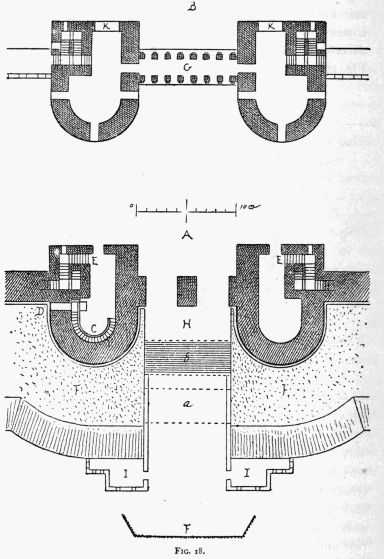
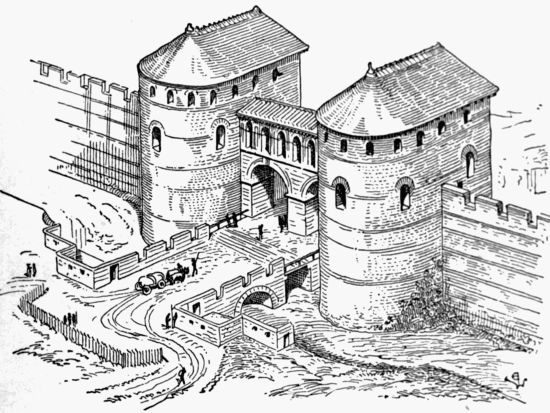
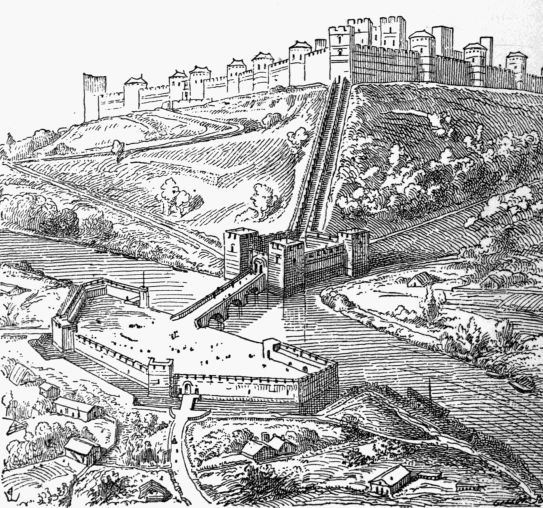
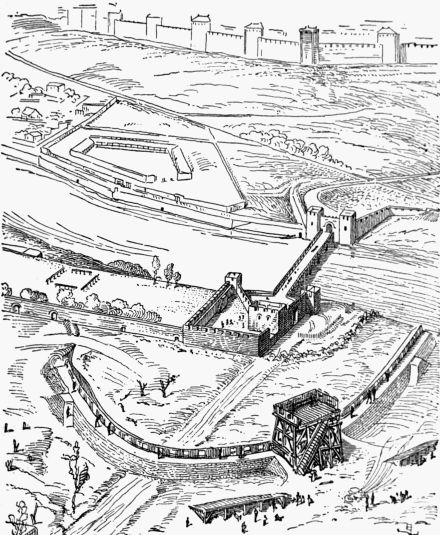
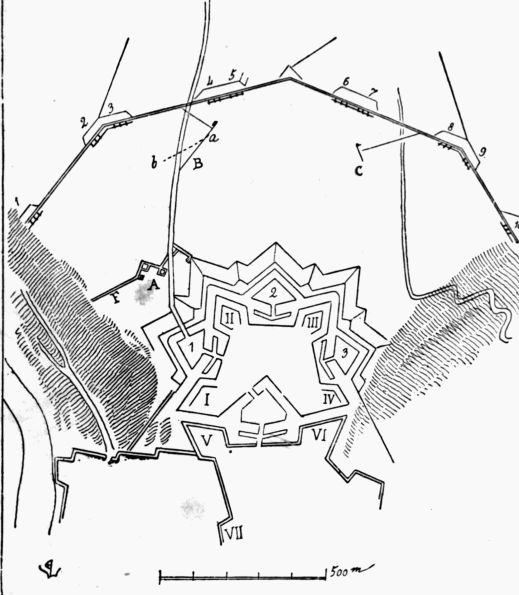
THE FOURTH SIEGE.
The Duke of Burgundy was making all speed to reduce his vassal. In the
space of a fortnight he had gathered six or seven thousand men, and was
beginning his march. Anseric and Baron Guy had not failed to make the
most of this respite. They provisioned the castle for three months at
least. They fabricated four large trebuchets and half-a-dozen catapults.
Timber in sufficient quantity had been cut in the forest for making
hoardings, palisades, and wooden defences. Thirty stone-cutters were
constantly at work making projectiles of sixty and a hundred pounds
weight for the mangonels. Each workman could produce ten in a day, and
at the end of a fortnight they had amassed a store of four thousand five
hundred. In the town, cross-bows and quarrels were being made; for the
townsmen who had to render service were bound to come armed, equipped,
and provided with missiles in sufficient quantity. There were archers
also, for whom arrows of ashwood, bows of yew, and cords of long-fibred
hemp were being made.
Although the lord of Roche-Pont could not, as stated above, assemble
more than eighteen hundred men, and therefore could not contemplate
defending the whole plateau—that is to say, the castle and the
abbey—Baron Guy, who had reasons for it, urged him not to allow the
enemy to occupy the monastery without defending it, even were it
feebly. "You ought to defend the monastery," he would say to his nephew,
"whenever the interests of the suzerain are involved; and since
henceforth you are going to do homage for your fief to the king of
France, he is your suzerain; his interests, therefore, are involved, and
it is your duty to defend the abbey."
To this specious reasoning Anseric could find nothing to answer. The
northern wall of the abbey was therefore put in a state of defence; they
connected its north-east angle with the débris of the Roman wall still
existing on the edge of the plateau by a strong palisade and ditch, and
barricaded the western brow above the town, between the abbey and the
bailey of the castle.
The abbot had made a show of opposing these works, asserting with reason
that the abbey was not at war with the Duke of Burgundy, and did not
refuse its customary homage. But Baron Guy, as an old crusader, was a
casuist of the first order, and, relying on the letter of the charter,
maintained that the lord of Roche-Pont was fighting for the cause of his
suzerain, and that consequently he must be faithful to the stipulations
respecting the abbey. These debates did not stop the workmen; and
although the abbot had sent for his vassals with a view to guard the
monastery, they were in no hurry to obey his summons, believing that
they were not in a condition to resist Anseric's vassals, and preferring
to await the result of what was being done before taking any side.
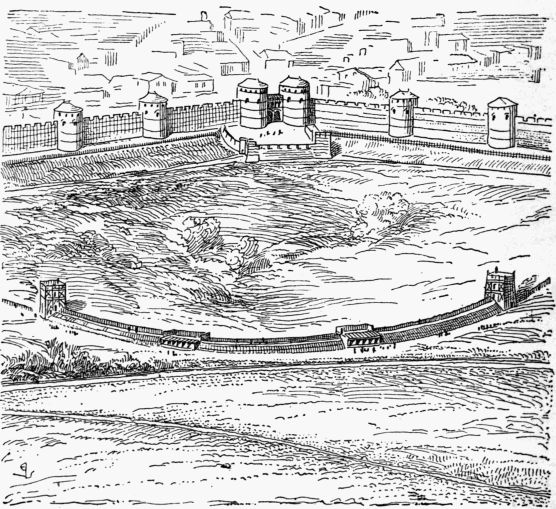
The baron also had a trench dug from the south-east angle of the abbey
wall to the eastern ridge of the plateau; then he had the trench covered
with timbers and faggots, and the turf replaced above it, so as to leave
no external sign of its existence. Outside the barbican of the castle
and the ditch was raised a strong palisade which protected its
circumference, leaving between it and the wall a space of twenty paces,
and which gave lists thirty paces wide in front of the counterscarp of
the ditch.
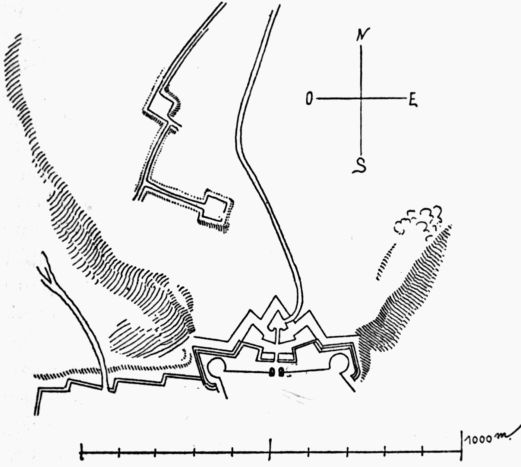
The twenty-second day after Anseric's answer (the 5th of May), the
duke's troops appeared on the plateau before the abbey. The first comers
spread themselves in the town, and were beginning to plunder it, when
the duke interposed, and, contrary to his wont, gave orders that the
inhabitants and their property should be respected. Listening to wise
counsels for once, he was intending to separate the interests of
Anseric's vassals from those of their lord, to isolate the latter, and
thus subdue him more easily. So that very evening he issued a
proclamation by sound of trumpet through the whole town, to the effect
that he was attacking the lord of Roche-Pont only, who had been declared
a felon for having broken his fealty to the Duke of Burgundy; that the
inhabitants of the town and of the valley would be respected as long as
they did not take part with the lord of Roche-Pont; that from this day
forwards they were free of all dues and services towards the said lord;
but that those who should be convicted of taking part with him should be
hanged as traitors to their lawful lord, the Duke of Burgundy. A herald
presented himself before the walls of the abbey, and in a loud voice
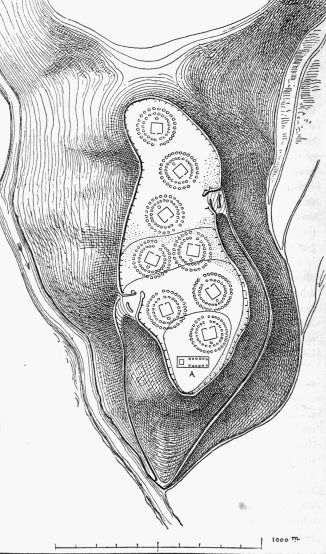
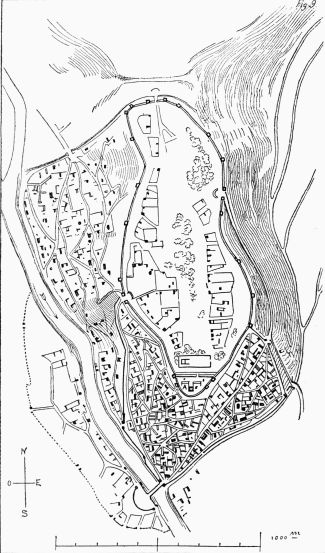
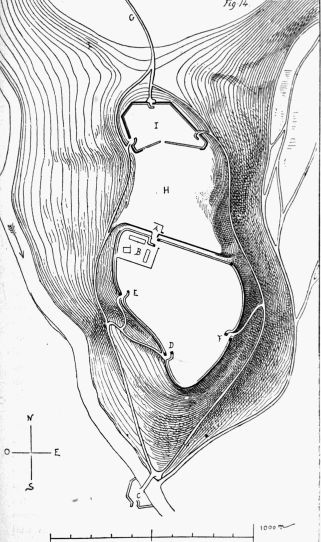
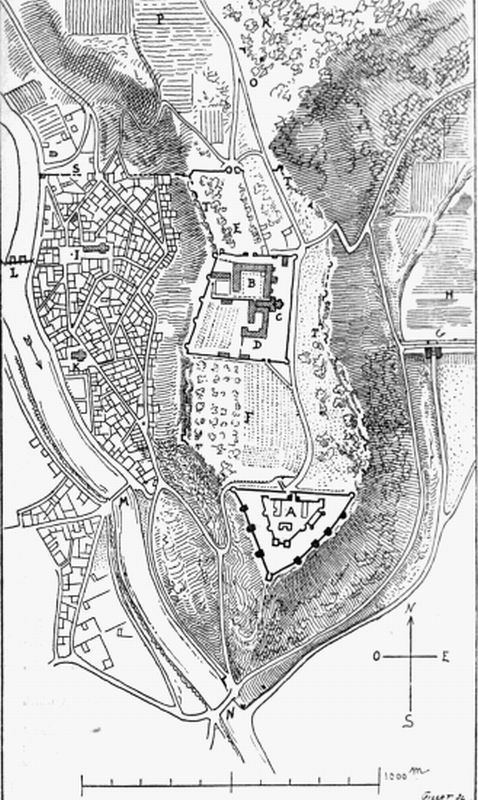
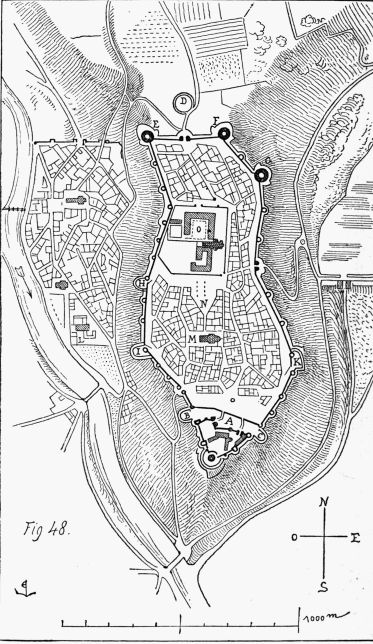
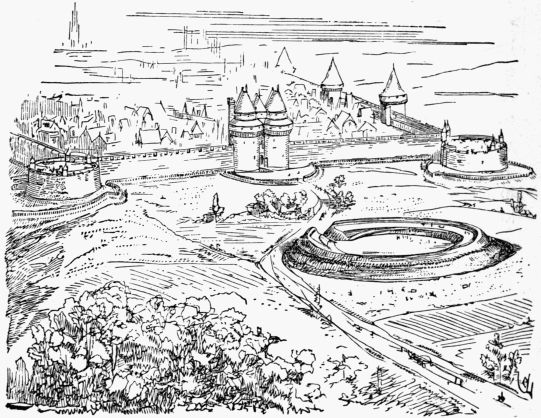
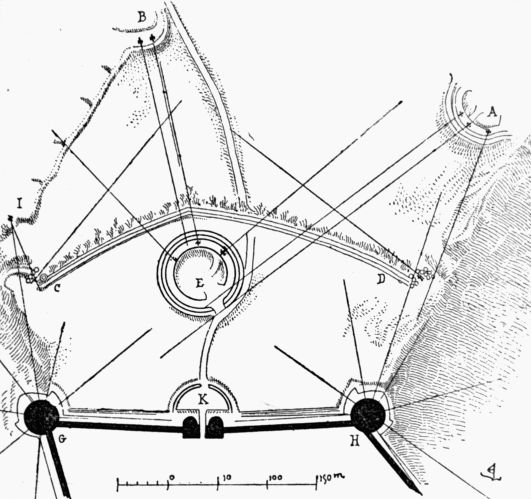
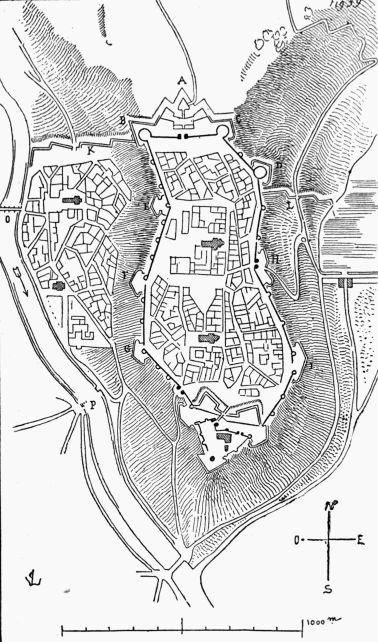
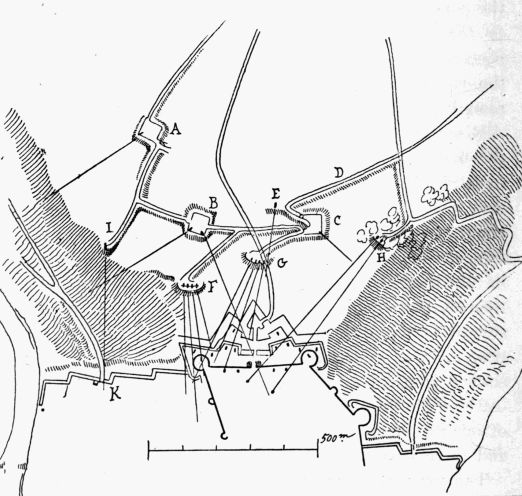
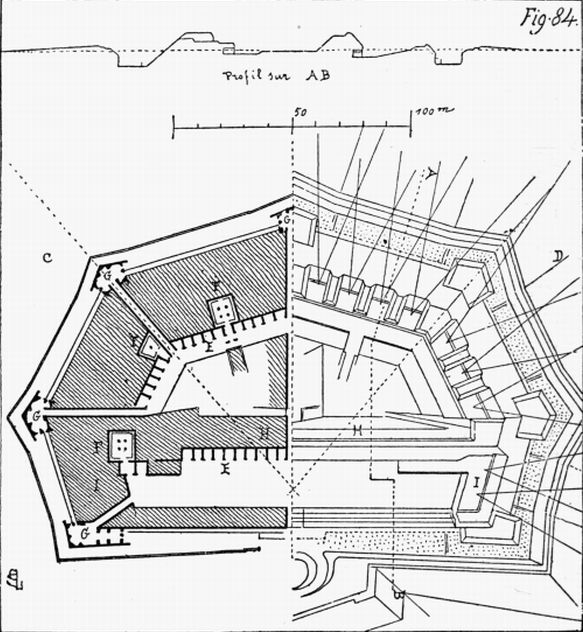
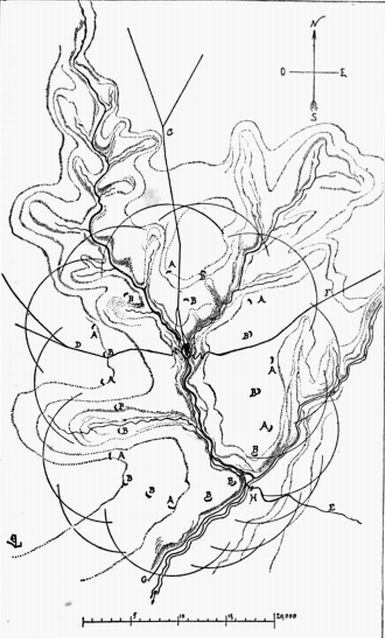
uttered the same proclamation.[See Fig. 35.] But the baron had foreseen this
contingency, and all the townsmen who had come in arms at Anseric's
summons were shut up in the castle. He had appointed for the defence of
the abbey, only men on whom he could rely—men who were directly
dependent on Anseric, and attached to his fortunes—with some of those
adventurers whose services were enlisted in any wars that might arise,
and who, having no ties of family or country, used to fight for those
who paid them best.
These defenders of the abbey were scarcely more than one hundred
resolute men. They received the herald's proclamation with derisive
shouts, answering that they knew no other lord but the king of France;
and that if it came to hanging, they could play at that game quite as
well as the duke's people. During the night two mangonels were mounted
opposite the north wall of the monastery, and had soon dismantled the
defences; but Anseric's men had retrenched themselves in the building
behind that wall; and when the Burgundians advanced with ladders to
scale the wall, they received them with a shower of darts, which killed
some of the assailants.
Nevertheless, the besiegers mounted the wall and descended into the long
narrow court enclosed by the building. There they were exposed to the
stones and débris of timber which the defenders threw at them out of
the windows. The east court was barricaded, and Anseric, with about
twenty men, was guarding the barricades. He defended it bravely for a
good hour, and the Burgundians, fighting in a narrow space, sustained
some losses. They succeeded, however, in breaking open a door of the
building, and rushed into the cloister. There they were still exposed to
the darts and stones hurled at them by some of the defenders posted on
the north side of the church.
A body of Burgundians began to attack the south-east barricade, outside
the enclosure, to take the abbey in the rear. It was there that the
baron was posted, with about fifty men. The combat was severe and
sanguinary, and before withdrawing, seeing that the defenders were
gradually abandoning the abbey, he had the faggots in the trench behind
set on fire.
Already Anseric and his men were on the road to the château, and were
sheltered by the defences of the barbican. Guy rejoined them, pursued by
a large body of Burgundians. But a thick smoke soon began to issue from
the trench, and the assailants who were coming up, seeing the ground
undermined beneath them, dared not advance. On this Guy and Anseric fell
upon those who had ventured within bowshot of the barbican, and killed a
good number of them. Excited by the struggle, and exasperated by the
resistance they met with, the duke's men entered the various buildings
of the abbey, killing the wounded, and plundering. Fire, kindled by the
defenders or the Burgundians, soon reached the cloister and the roof of
the church.
The poor monks, assembled in the choir during the struggle, were soon
forced to quit this retreat; for burning brands were falling on the
pavement through the holes in the vaulted ceiling. It was already night,
and many were massacred by the drunken soldiery. Most of them had
cowered down trembling in a vaulted chamber on the ground floor. It was
there that the duke found them when he entered the burning abbey. The
abbot threw himself on his knees; but the irritated duke repulsed him
harshly, saying: "Sir abbot, it ill becomes ecclesiastics to fight
against their lord; and if I do not have you and your monks hanged, you
may thank your habit. Begone, and tell your brethren of your
forfeitures!" Vainly did the abbot protest his innocence, and
asseverate that if the abbey had been defended, it was against his will;
and the duke, whose anger seemed to gather warmth at every word the
father spoke, ended by ordering his men to drive out all the monks.
The unhappy fraternity, perishing of hunger, betook themselves to the
town, where some kindly-disposed persons took them in; but the duke
would not allow this, and proclaimed next day that every inhabitant who
should give shelter to a monk should be hanged. Collecting some
provisions, therefore, they started for Cluny on foot.
The duke had given orders to extinguish the flames, for he was intending
to reside in the abbey during the siege of the castle; but there
remained no part of it fit for habitation except the abbot's dwelling,
situated north of the church.[See Fig. 35.]
Retired within the castle, after having lost a fourth of their men who
had been engaged in the struggle, Anseric and the baron were making
their final arrangements. The troops who had re-entered with them were
in high spirits, for they had inflicted sensible losses on the enemy;
and thought of nothing but defending themselves to the uttermost. Guy
was delighted, and his sombre visage was lighted up with an air of
gaiety.
"We are getting on bravely," said he to his nephew, when they were
alone, "bravely, I say: now that the abbey is burned we are sure to be
aided by the king of France; we have made a capital commencement." "But
these poor monks; what has become of them? Ah! my worthy uncle, it would
have been better to leave them alone; we should now have some thirty
brave fellows more here, and should not have to reproach ourselves with
having caused the convent to be burned and the monks massacred,
perhaps." "Stay, stay, my good nephew; monks always get out of their
difficulties, and they are sure to be able to restore their abbey.
Besides, it is the duke's men who have burned it! Besides, was it not
our duty to defend it? Say no more about it. Jean Otté will get out
to-night by the donjon postern. He is a rough sort of fellow, but a
cunning blade; in five days he will be with our gentle Eleanor, and
tell how that the noble duke has sacked the abbey, and burned all the
monkery! It's capital! capital!"
On either side about a dozen prisoners had been taken. The next morning,
May 7th, the people of the castle saw three of these unhappy men hanging
up, by the duke's orders, on the trees of the pleasance. Immediately
three Burgundian prisoners were hanged on the battlements of the
barbican.
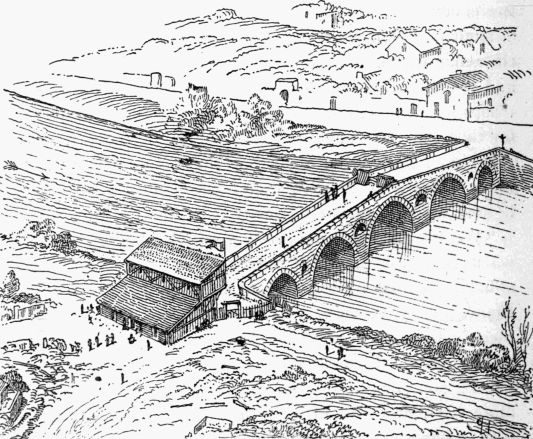
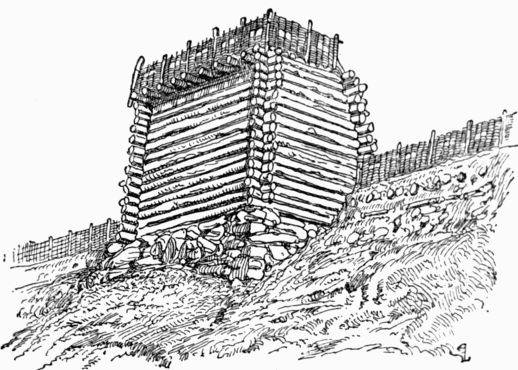
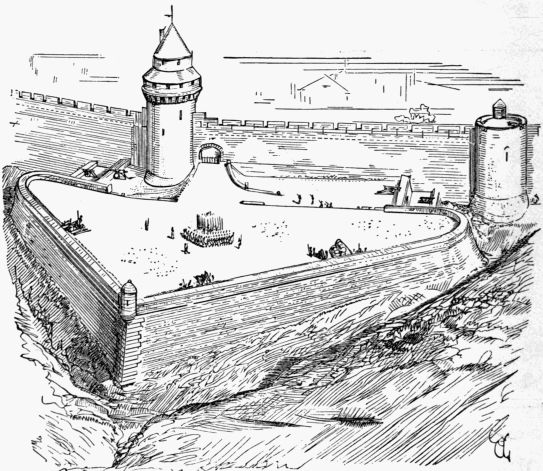
Fig. 38.
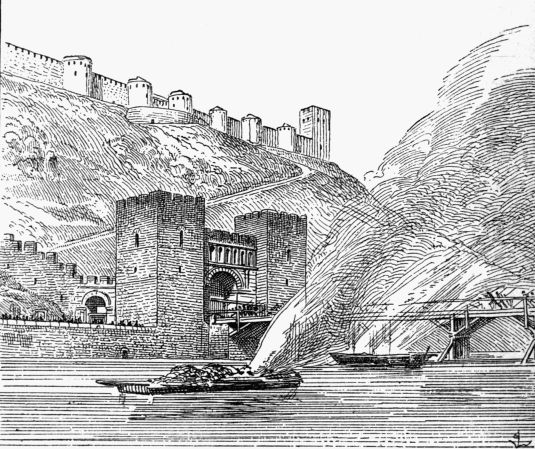
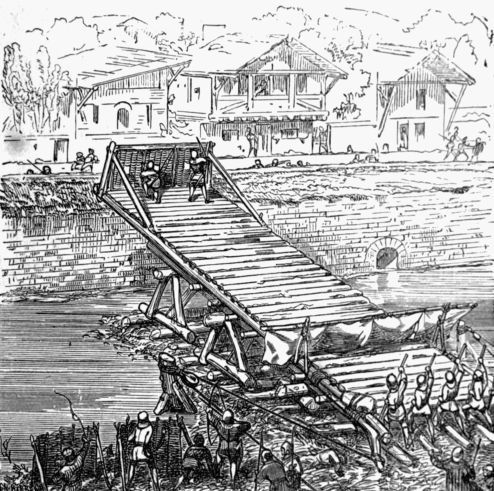
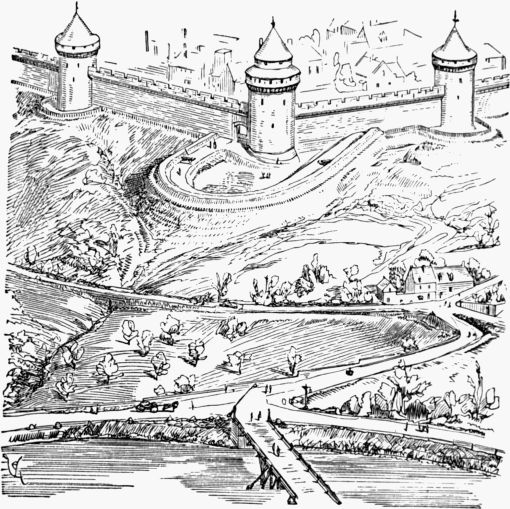
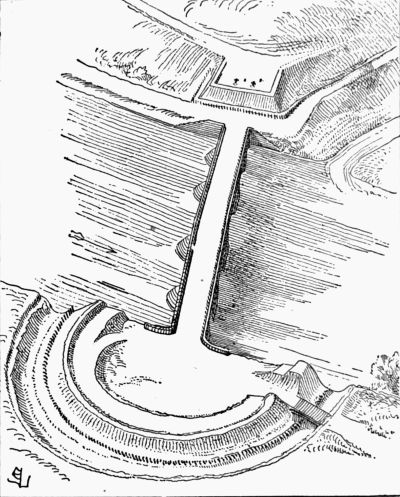
None of the bridges had been destroyed by the besieged. They were
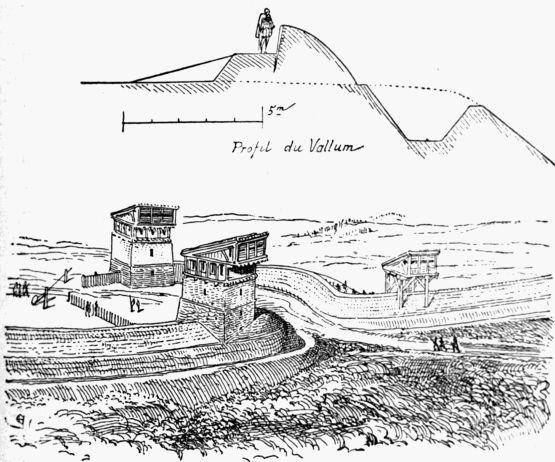
occupied by the duke's men, and defended each by a good bretèche (Fig.38),
to hinder any communication from one bank to the other. The south
wall of the abbey was strengthened by palisades joining the two ridges
west and east of the plateau. A guard was posted in the two mills
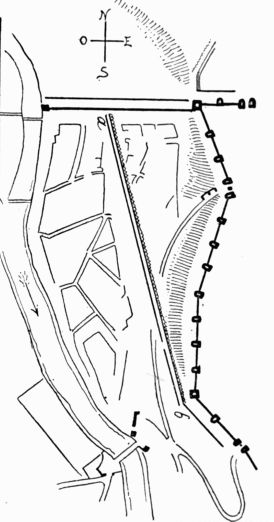
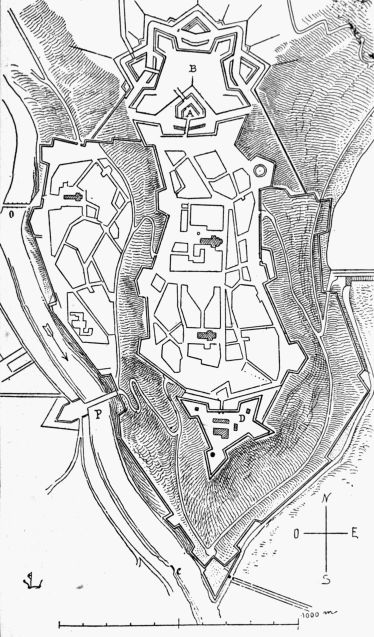
belonging to the monastery,[See G, Fig. 35.] and a wooden tower built by the side of
the rivulet, below the south-east part of the castle.
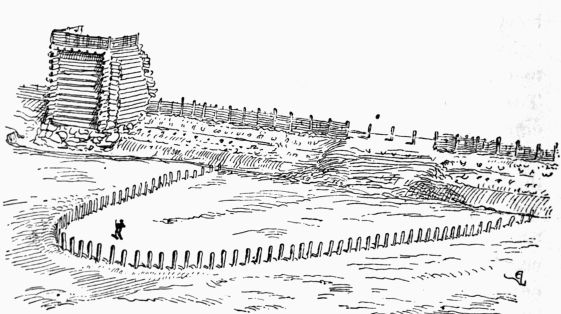
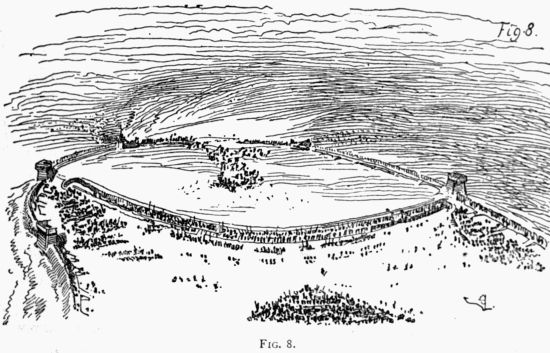
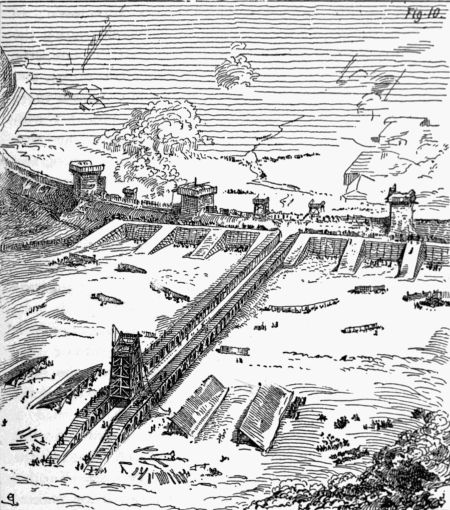
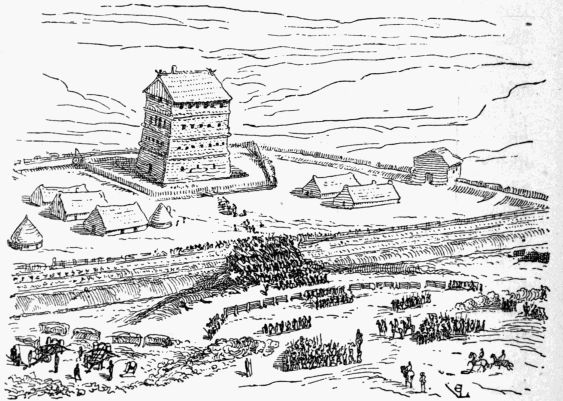
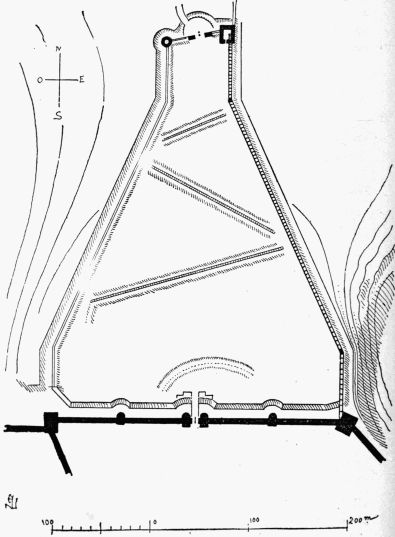
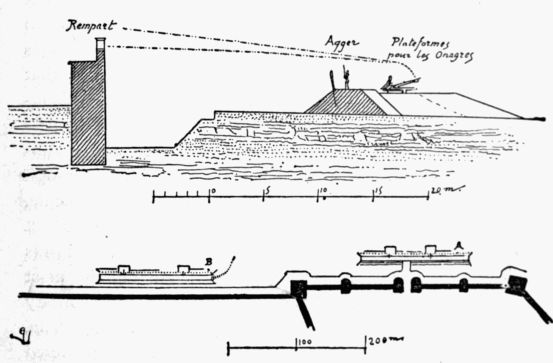
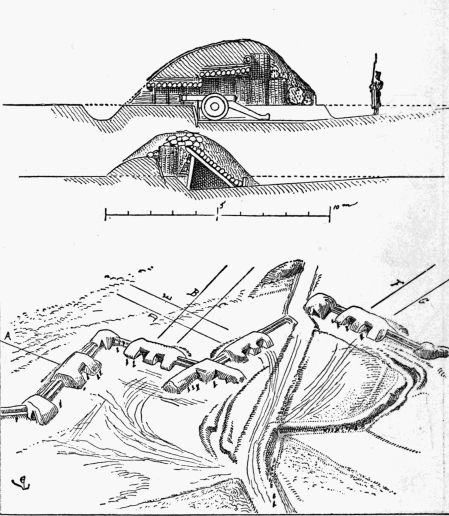
These first measures adopted, the duke had a ditch dug, with a mound
crossing the pleasance of the castle within bowshot, and connecting the
two ridges. This intrenchment of contravallation was strengthened by two
wooden towers, one at each end, with an outlet near each of them, and
one in the middle (Fig. 39). The castle was thus completely invested
(May 15th).
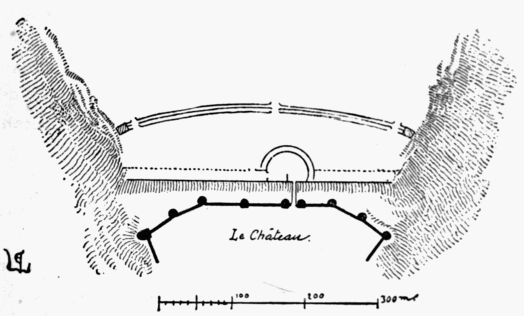
Fig. 39.
While these works were being executed, there were trifling skirmishes
every day between the defenders and the besiegers. They were trying each
other's strength, but nothing serious was attempted. The duke bent his
whole strength towards preventing the lord of Roche-Pont and his men
from escaping: he was taking his time. Baron Guy was often closeted with
a certain individual whom he called his chaplain, and who had
accompanied him from Palestine. In the castle, this so-called chaplain
never went by any other name than the Saracen. He was a tall, thin
personage, with dark brown skin, black eyes and hair, always dressed in
a coarse grey surtout. He spoke little, and drank nothing but water; but
never failed to be present at mass in the chapel of the castle, and
would remain long hours in prayer. The baron asserted that he was a monk
of the order of Bethlehem. Whatever he was, he had charge of the sick,
and possessed remedies for wounds of all kinds. He was gentle in manner,
never looked a woman in the face, was a scholar, and would read aloud so
as to charm the most delicate ears. His official name was Brother
Jerome. Now, during the leisure which the enemy left the besieged (who
were not sufficiently numerous to offer any hindrance to the siege works
of the Burgundians, and could do nothing but keep a careful look-out),
it was remarked at the castle that the baron and Brother Jerome passed
whole hours together, in the lower apartment of one of the towers, of
which they alone had the key. Their clothes were often observed to be
blackened when they came out.
It was the eighth day of the investment, which appeared now to be
complete (May 22nd). The baron had a secret conference with his nephew
and Brother Jerome in the evening, and about six o'clock, orders were
given to prepare one of the largest trebuchets, whose framing had been
transported thither during the preceding night, at the western end of
the lists, outside the ditch.
About two o'clock in the morning, the engine was mounted, the night
being still completely dark, as it would be at that season. They then
tried its range against the right-hand tower of the besiegers'
contravallation, with stones; and when the proper range had been
secured—a point ascertained by the noise of the projectiles that fell
on the woodwork—Brother Jerome placed in the lowered pouch of the
stone-propeller a barrel provided with a match, and giving orders to let
go the beam of the engine, set fire to the match with a brand taken from
a brasier kindled for the purpose.
With a whizzing sound, the end of the beam traced a bow of fire, and the
barrel was shot forth, leaving a long and luminous trail behind it; it
struck the wooden tower, and in bursting spread a sheaf of white flames
which seemed to cling to the woodwork. The engine, lowered anew, sent a
second barrel and a third. The wooden tower then resembled a furnace
(Fig. 40).
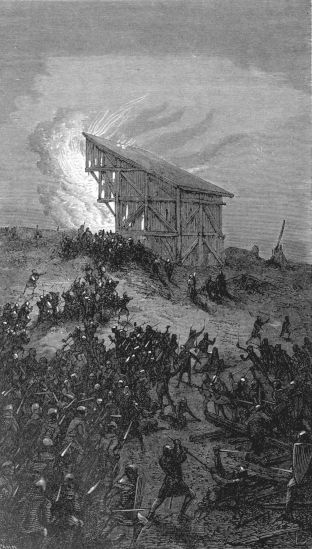
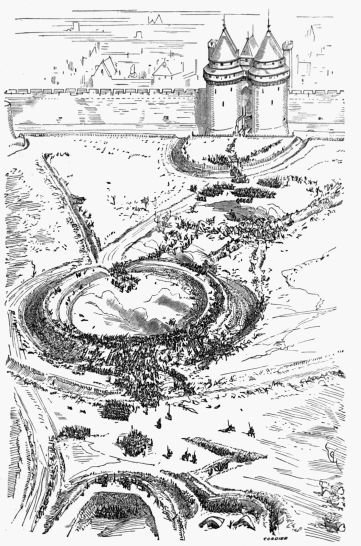
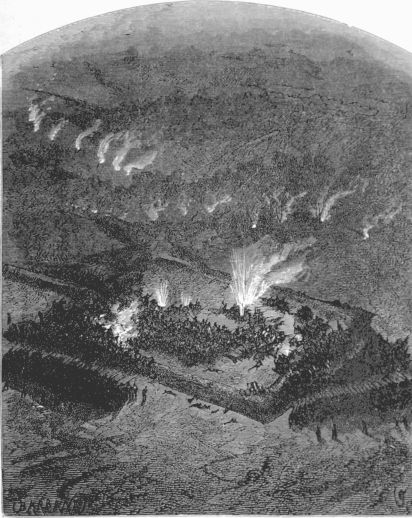
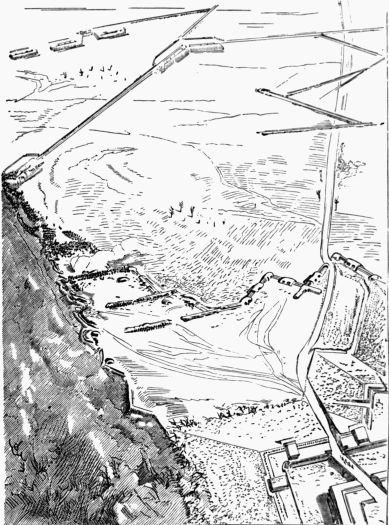
Fig. 40.—Night Sortie of the Garrison of the
Castle.
Great was the agitation among the guard of the besiegers, and the
defenders could hear their shouts from the ramparts. Taking advantage of
their confusion, Anseric had the barrier of the lists opened, and
followed by two hundred men, went at full speed to the contravallation,
passed through the central gate, which was but slightly guarded, and
turned to the left, passing along the interior of the enemy's earthwork.
The Burgundians had betaken themselves to the tower to try to extinguish
the flames. The besieged rushed upon the disorderly mass, most of them
being unarmed. The baron had also gone out with a second body to protect
his nephew's retreat. The duke heard the shouting from the abbey, saw
the fire, and immediately gave orders to march forward. But during the
last hours of night, men are not very active. Before help arrived,
Anseric had had time to kill or put to flight all who were guarding the
contravallation. He could therefore re-enter the lists at his leisure,
and without having lost a single man; some few being wounded. Daylight
revealed to the duke the smoking remains of one of his towers.
This sally raised the courage of the besieged; none of them, except
those who had been in the wars of the Crusaders, knew the effects of
the Greek fire. They deemed themselves, thenceforth, invincible. This
was the baron's object in planning this attack, whose result was
otherwise of little value to the besieged.
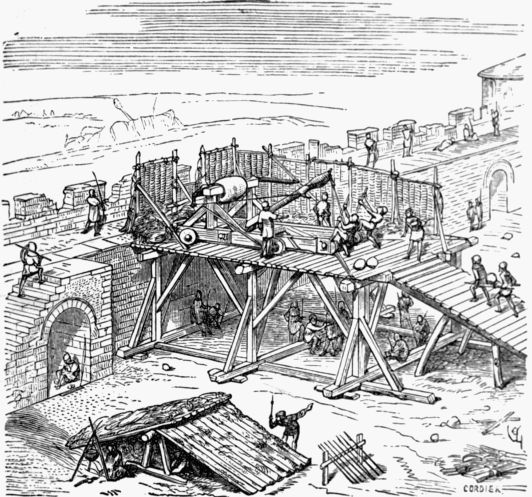
In place of the wooden tower that had been burned, the duke had a
platform raised, consisting of wicker-work and turf, on which was placed
a substantial floor of beams to receive a trebuchet which swept the
lists, and almost reached the barbican. Then he raised a second
platform, in the very centre of the front of the contravallation, with a
mangonel, whose projectiles fell right into the barbican. To these
engines the besieged opposed the first trebuchet, and another mounted in
the barbican. But on neither side was any great damage effected by them
during a whole day's working, for as soon as the soldiers saw the beam
of the enemy's engine lowered, they got out of the way. The besiegers
enlarged the central platform, and were then able to mount the mangonels
upon it, which succeeded in utterly destroying the trebuchet set up in
the barbican, and the palisades in front, and in dismantling the
battlements. The garrison of the castle were obliged to cower down
against the walls, if they would avoid abandoning the works. When the
besiegers deemed the palisades indefensible, and the battlements
sufficiently broken down, the signal was given for the assault (May
25th).
In the first place, protected by mantelets or by their bucklers, the
archers and crossbowmen advanced to about sixty paces from the barbican,
forming an arc of a circle around it—the archers in the front rank, the
crossbowmen behind. Immediately one of the defenders showed himself on
the rampart, he was hit. The garrison, sheltered as far as possible by
the remains of the merlons, and by their bucklers, replied as best they
could, but ineffectually, for their situation was a very trying one.
Not wishing to risk his men's lives uselessly, Anseric made them lie
flat on their faces on the rampart, so as to be ready at the moment of
assault.
Two bodies of Burgundians then advanced, provided with ladders having
hooks, and with planks, which they threw over the little ditch of the
palisade. Some resolute men defended the palisade, but it was so broken
by the projectiles that these defenders had to abandon it. Then about
thirty ladders were set up against the barbican, and strings of men
climbed their rounds; but the garrison succeeded in unhooking the
ladders and throwing down the assailants; others, making use of the
débris of the merlons, crushed them. Those of the assailants who
reached the summit were received with blows of bills, boarspears, and
crowbars.
The foot of the barbican was already covered with dead and wounded, with
the débris of ladders, and stones. From the towers of the bailey gate
skilful crossbowmen, well protected, hit most of those assailants who
succeeded in mounting on the remains of the parapet. The assault, three
times renewed, was as often repelled, with considerable loss to the
Burgundians. The assailants had burst in the gate of the barbican; but
the baron, seeing that the lists could not be defended, had caused the
gate to be barricaded, leaving only a narrow egress to allow the last
defenders of the palisades to re-enter. As soon as these had got in,
beams and barrels were heaped up against this gate. On this side the
assailants were exposed to the projectiles hurled from the towers and
curtains of the bailey. They succeeded, however, in setting up mantelets
to protect them, and throwing sulphur and resin on these remains of the
gate, set it on fire. The flames were communicated to the barricade, but
the defenders incessantly brought up fresh pieces of wood, and night
came without the enemy having been able to occupy the work. He
nevertheless maintained his position around the barbican, sheltered
behind fascines and mantelets, and piling against its walls trunks of
trees, clods of turf, and mattresses taken from the scattered houses;
while a trebuchet was incessantly discharging stones on the area of the
defence. The besieged had abandoned it since midnight, and had thrown
down the bridge giving entrance to the bailey.
At sunrise, therefore (May 26th), the Burgundians were able to get
within the walls of the barbican without opposition, but they found
themselves directly exposed to the projectiles thrown from the defences
of the bailey, which were provided with hoarding. It was not without
loss that the besiegers got a lodgment within the barbican, a
considerable length of whose wall they threw down. Then, having cleared
the breach, they set to work to bring forward a cat which had been
framed together beforehand out of range, at some distance from the
contravallation, while two terraces were being raised outside the walls
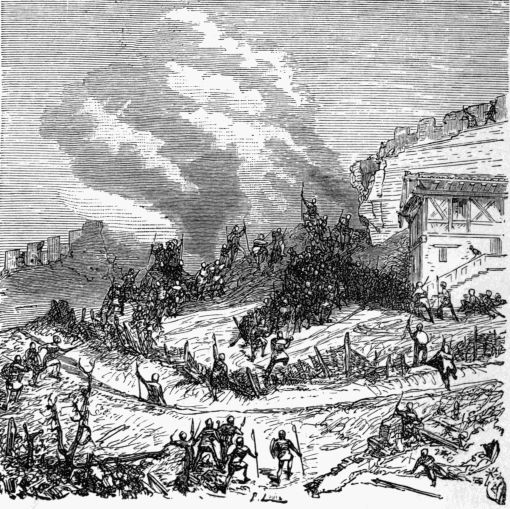
of the barbican, and abutting against them (Fig. 41).
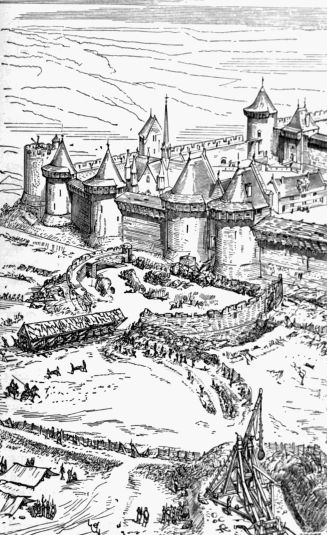
Fig. 41.—The Besiegers get Possession of the
Barbican.
The Burgundians could not undertake a new attack before these works were
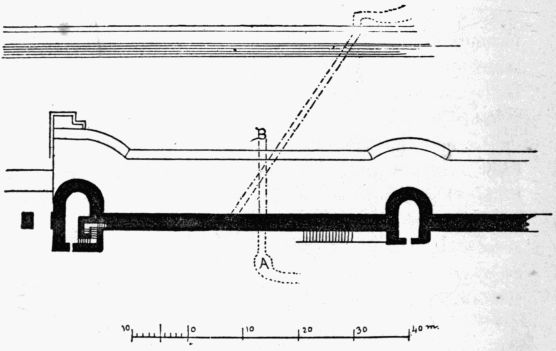
completed. Baron Guy determined to avail himself of this respite. Behind
the left-hand curtain of the bailey gate, he set up the two remaining
trebuchets on a wooden platform, and then connected the corner of the
chapel and the corner of the building D, belonging to the
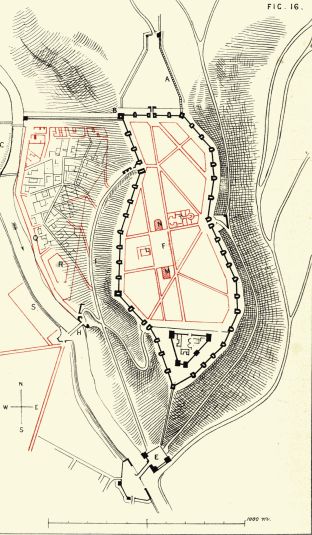
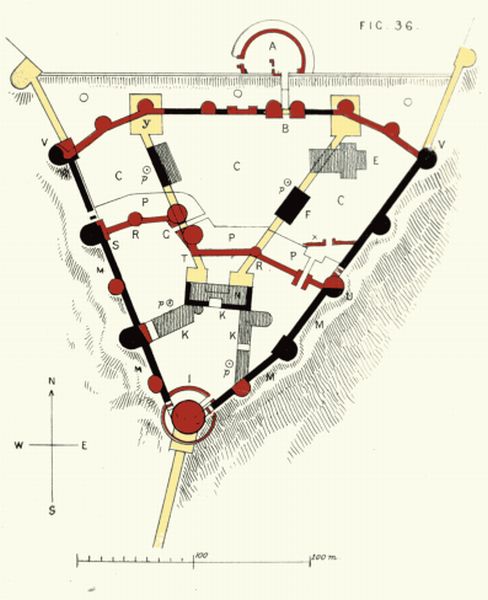
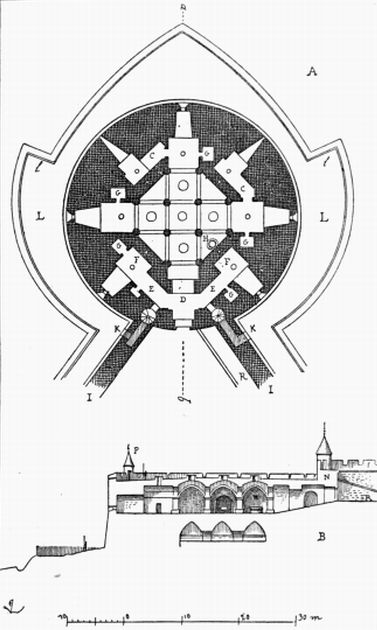
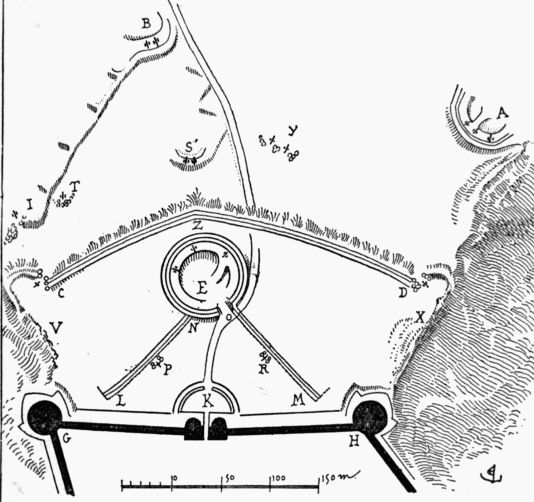
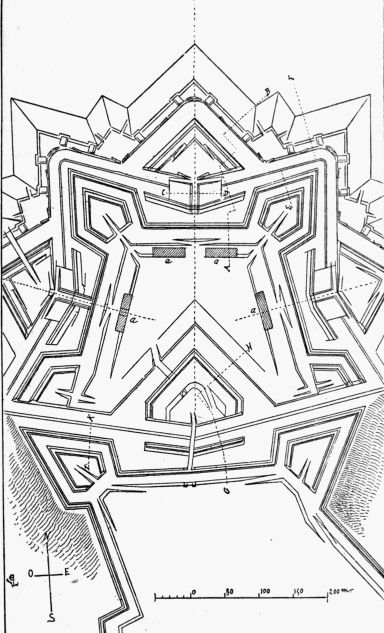
stables, by a good palisading with a ditch.[See Fig. 36.] The trebuchets were
mounted within this palisading, forming an interior retrenchment. The
timbers of the hoarding were thoroughly wetted and smeared with mud—as
far as the enemy's attacks permitted. This precaution was not useless,
for the Burgundians soon discharged on these hoardings, with their
catapults, darts furnished with tow dipped in pitch and lighted. The
besieged, armed with poles to which were fastened pieces of wet blanket,
extinguished these missiles without much trouble; for the flame had not
the intensity of the Greek fire, and did not cling to the wood. In fact
the tow would sometimes be extinguished in its passage.
In twelve hours the trebuchets of the besieged were mounted, and began
to hurl stones of sixty and a hundred pounds weight on the barbican
occupied by the enemy, and even beyond, which annoyed them excessively;
for not seeing the engines, they were unable to aim in return—except by
guess—with the mangonels they had set up on the terraces; and all the
projectiles passed over the heads of the defenders. During three days no
change occurred in the situation on either side. The Burgundians,
however, had succeeded in filling up the fosse on the right of the
bailey gate; and they had thrown so many stones with their mangonels
against the hoarding of the neighbouring towers, that these timber
defences fell to pieces; but the stone battlement behind remained
intact, and the defenders were still perfectly sheltered behind their
merlons, whence they sent showers of quarrels and arrows.
The fosse having been filled up (May 30th), the cat advanced, rolling
on planks between the two terraces, through the breach of the barbican.
Then as the filling in of the fosse had an inclination towards the
curtain, the cat of itself went striking its iron muzzle against the
wall (Fig. 42). Thereupon the besieged threw down on its double-sloped
roof huge stones, beams, and small barrels of Greek fire. But the roof
was solidly plated with iron; its slopes greatly inclined, and covered
with earth and wetted mattresses, allowed the stones, beams, and
barrels to slip off right and left. Men placed within the cat thrust
away the inflammable projectiles with long forks, so that they might not
set fire to the sides of the gallery. This latter was preserved,
therefore, despite the efforts of the besieged, and the miners,
protected by its roof, set to work at the base of the wall.
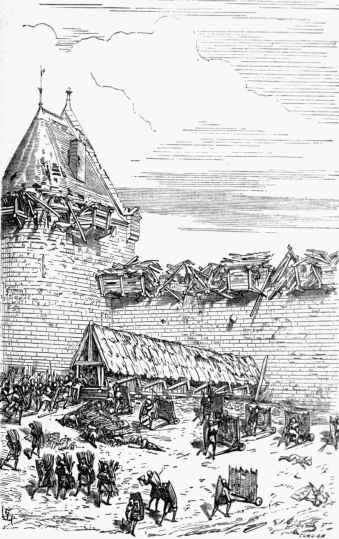
Fig. 42.—The Cat.
The following night Baron Guy determined to make a last effort to set
the cat on fire. The working of the miners could be heard. Beneath the
gate B[See Fig. 36.] of the bailey, there was a drain which discharged
the rain-water of the court into the ditch. This mouth had been in great
part walled up when the enemy presented themselves before the place. The
floor of the bridge, in falling, had moreover hidden it from the
besiegers. The baron had the walling removed noiselessly with crowbars,
and when the opening was large enough to allow a man to pass, he chose
three determined fellows who, with Brother Jerome, slid down into the
ditch. Crawling up the mound which supported the cat, they slipped
beneath its gallery two small barrels of Greek fire. Lighting the match
with the aid of a preparation which the brother brought in a box, they
went back as they had come, and the mouth of the drain was again walled
up.
From the summit of the neighbouring towers the besieged had then the
pleasure of seeing the barrels spread streams of white flames, which,
clinging to the timbers of the gallery, set it on fire.
The more water the besiegers threw on the flames the more intense they
became, so they began to try turf and mould. The defenders then
recommenced throwing beams and stones on the roof of the cat; then
more barrels of Greek fire, bundles of straw, and faggots.
In spite of the efforts of the Burgundians, the gallery being quite
filled with suffocating smoke, was no longer tenable. They were forced
to abandon it; and it was with great difficulty that they were able to
preserve from the fire about eighteen feet by cutting it away with axes.
The besieged on their side had not been able to prevent part of the
remains of the hoardings above the cat from catching fire; but these
hoardings were already past service, and their efforts were confined to
preventing the fire from extending right and left. The entire head of
the cat against the wall and twenty feet of its length was burned. The
operations of the miners were not much advanced, still they had already
removed enough material to give shelter to two men from the projectiles
falling from the ramparts. Under favour of night, therefore, some
pioneers returned to the mine-hole by creeping under the débris of the
cat. The darkness was great and the defenders did not observe them.
But Brother Jerome was on the watch for suspicious sounds, and soon came
to inform the baron that they were mining again. "Well," said the
latter, "let us repeat yesterday's manœuvre; send men out through the
mouth of the drain which these Burgundians are so stupid as not to have
looked for; and let some good thrusts of the knife relieve us of these
burrowers; but let there be no noise!" The mouth of the drain was once
more unwalled, and Brother Jerome with his three companions in the
previous exploit, armed with long knives and gliding along the wall,
reached the hole of the mine. Three pioneers, intent on their work, were
noiselessly killed; a fourth, who was outside hidden in the débris of
the cat to watch, slept, heard nothing, and remained there unperceived
by Brother Jerome and his companions. Waking up soon afterwards he
called in a low voice to his comrades ... there was no answer; he felt
with his hand, touched a dead body—then a second, then a third.
Terrified and not daring to return to the Burgundians from fear (a very
reasonable one) of being hanged, he followed the wall, came to the
débris of the bridge, and found himself in front of the mouth of the
drain, which was being silently walled up for the third time. Only a
dark lantern threw its faint light on the workmen who were visible
through the small opening which remained to be closed. The Burgundian
comprehended, and immediately determined what to do. "A deserter!" said
he in a low voice at the orifice. "Thy hand!" replied Brother Jerome.
The hand appeared at the entrance of the hole, and the whole body was
forcibly dragged through, not without excoriations, by the friar and one
of his companions. The new comer was disarmed and conducted before
Anseric and the baron as soon as the mouth of the drain had been
securely closed. The poor wretch remained trembling before the two
Seigneurs and naïvely recounted what had happened to him. He was a young
man from Sémur, in Auxois, who, like most of his countrymen, was not
wanting in intelligence. He gave all the information demanded of him
concerning the duke's army: "Listen attentively to what I say," said the
baron: "if the castle is taken, thou wilt be hanged by us before the
first Burgundian enters. If the duke's men take the castle, thou wilt be
hanged by them, to a certainty. If thou servest us faithfully and the
duke's troops are obliged to raise the siege, the Lord of Roche-Pont
will take thee into his service: what is thy calling?" "A harness-maker"
"Well then! thou shalt be attached to his stables—shall he not, my
worthy nephew?" "Certainly; and if he aids us efficiently, and if events
show us that he speaks the truth, he shall have two pounds of silver on
the raising of the siege."
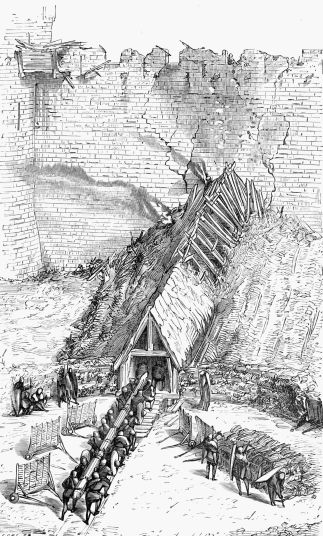
Fig. 43.—The Bosson.
These last words completely loosened the harness-maker's tongue; and he
told all that he knew as to the number of the engines, the arrangements
of the besiegers, the posts they guarded, and the towers of the
contravallation; after which he was sent to the servants' hall, where he
soon made friends with Anseric's dependants. Friar Jerome, however, was
ordered not to lose sight of him.
It was not before the time when the miners were to be relieved (by
another set) that the Burgundians discovered what had happened. The
vanished harness-maker was strongly suspected of having assassinated his
comrades while at work; they sought for him—to no purpose, of course.
Before sunrise the baron commenced a countermine at the point indicated
by the deserter, inside the bailey wall. "If thou mistakest by so much
as a yard," said the baron to the harness-maker, "thou shalt be hanged."
The work was carried on by both parties, and towards the close of the
day the miners and counterminers met and attacked each other in their
close quarters with crowbars and pickaxes. The Burgundians and the Lord
of Roche-Pont each sent men to seize the mines. A barrel of Greek fire
dislodged the duke's men; but the masonry of the wall, whose mortar had
not thoroughly set, cracked above the mine. Seeing this, the Burgundians
next night, making use of the rescued portion of the cat, set up a
kind of front-work, formed of pieces of timber; and in the morning
brought a bosson, or battering-ram on wheels (Fig. 43), with which
they set to work to batter the base of the wall. At each blow the
masonry was shaken, and stones fell down within and without.
The besieged tried to break the bosson, by letting fall great pieces
of timber on its head, and to set fire to the timber; but these had
been wetted, covered with mud, and filled round with manure at the
bottom: the parapet was so well swept by the duke's mangonels and by the
crossbow men that it was scarcely possible to retain a footing on it.
Besides the men upon this wall, shaken as it was and vibrating at every
blow of the ram, lost their self-possession and did not do their best;
while the bosson held out, especially as the assailants had put large
pieces of timber in an inclined position against the wall, which caused
the beams thrown by the besieged to slide off.
At the end of three hours of continued effort, the wall gave way, and a
piece about twelve feet long fell on the bosson. The Burgundians
immediately bringing up planks and ladders rushed to the assault through
the narrow breach. The struggle was severe, and the garrison themselves,
mounted on the ruins of the wall, fought bravely and maintained their
front unbroken.
From the parts of curtains that remained intact and from the towers the
defenders showered darts and stones on the assaulting column. The
trebuchets within the rampart continued to send stones which, passing
over the heads of the defenders and assailants on the breach, struck
those who were gathered around the remains of the cat, and made wide
lanes among them. By the evening, the Burgundians were masters of the
breach; but seeing the interior rampart before them they did not venture
to descend, but took up a position on the breach, protected by mantelets
and fascines.
The same evening they set miners to work between the tower of the
north-west angle and its neighbour; reckoning on thus getting round the
retrenchment by passing through a second breach.[See Fig. 36.] They likewise took
possession of the two rampart walks of the curtain in which the breach
had been made; but the tower of the gate and that on the left were still
holding out at eight o'clock in the evening.
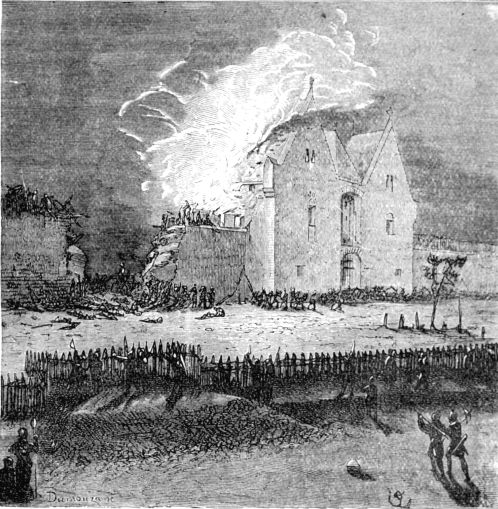
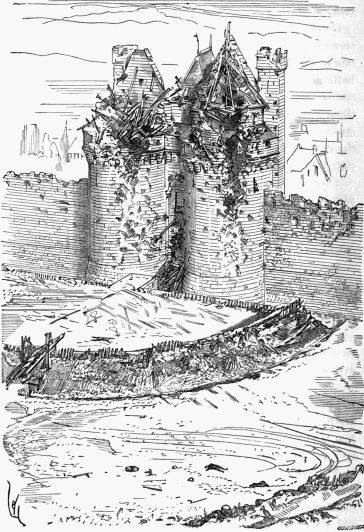
Fig. 44.
An hour later, the assailants being masters of the rampart walk in that
quarter, set fire to the roofs of these towers (Fig. 44), which the
defenders were forced to abandon.
In the morning, therefore, the gate was in the power of the enemy. The
defenders still held the rampart walk to the east and west of the
towers that had been burned, had raised barricades, and were determined
to contest the position inch by inch.
The assailants as well as the defenders needed rest. Notwithstanding
their progress, the Burgundians were suffering considerable losses,
while of the force in the castle there were only a hundred killed and
wounded. By a kind of tacit agreement the day following the assault
passed without fighting. The duke, alarmed at the losses he had already
sustained, determined not to continue the attack without taking every
precaution; for his men were complaining that they were always made to
fight unprotected against soldiers carefully shielded, and asserting
that even if they got as far as the donjon, there would not be a man
left in the duke's army to enter it.
That day was spent by the Burgundians in thoroughly protecting their
quarters on the breach, in placing a catapult, then in crenelating the
back walls of the towers, of which they had got possession, and in
constructing a kind of wooden tower provided with a second catapult at
the interior opening of the gateway. The defenders, on the other hand,
made a second retrenchment from the angle of the building D of
the stabling to the western curtain, and a strong barricade from the
angle of the chapel choir E, to the neighbouring tower. Next,
in front of the main gateway of the castle, a bretèche, or outwork
with palisading to protect the men in case of retreat. It was evident
that next day, the 6th of June, a decisive action would render the
Burgundians masters of the bailey, even if they did not exert themselves
to the utmost; but the defenders were resolved that they should pay
dearly for their success. Anseric, firmly resolved to resist to the last
extremity, and to perish under the ruins of his donjon, congratulated
himself on Eleanor's absence, and regretted that his children were not
with her. The noble lady was, however, not far off. The evening of the
day that had been entirely employed in preparations for attacking and
defending the bailey, she and her escort had arrived at the dwelling of
the vavassor, Pierre Landry, who had immediately despatched a trusty
messenger to the castle.
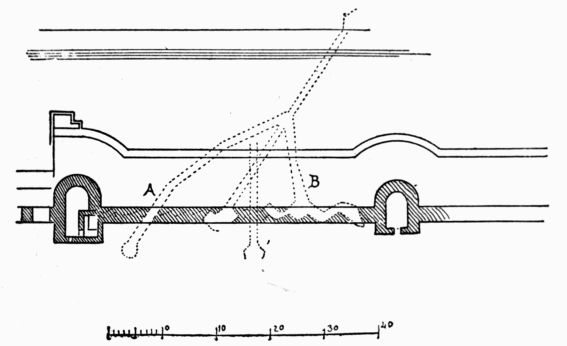
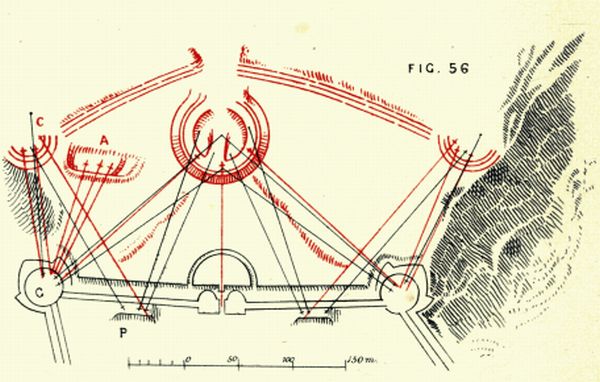
At the base of the donjon was pierced a slanting aperture one foot six
inches square, which, opening into the lower hall, ended in the rampart
walk left between the great tower and its outer inclosure. From this
rampart walk a subterranean passage made along the foundations of the
Roman wall, descended the slope of the plateau for a length of sixty
feet, and opened out in an old quarry overgrown with brambles. Two
strong iron gratings closed this tunnel. Watchmen were posted night and
day in this passage; they were let down and hoisted up through the
inclined shaft of the donjon by means of a carriage worked by a
windlass.
By this passage Anseric had often sent out and brought in spies, who at
night made their way furtively among the Burgundian posts. Now in the
dead of night, Pierre Landry's messenger presented himself at the
entrance of the subterranean passage, gave the signal agreed upon, and
handed to the watchman a little box, saying that he was awaiting the
answer hidden in the quarry. The box was immediately transmitted to
Anseric. Eleanor informed him of her return, and said that she would
contrive to re-enter the castle with her train the following night by
the donjon postern. Anseric hardly knew whether to rejoice or grieve at
this return. But the baron called his attention to a flower which
Eleanor had attached to the end of the vellum on which the letter was
written, and which was a token of good news.
On the morning of the 6th of June the Burgundians were in no hurry to
attack; they contented themselves with sending darts inside the
retrenchment, with their catapults and quarrels and arrows in great
numbers from the top of the abandoned towers; they were replied to from
the top of the church, the stabling, and the great towers of the castle
gateway. About three o'clock in the afternoon, the miners engaged (as
above mentioned) at the north-west curtain, threw down a part of it. The
duke had thus three openings into the bailey; this last breach, the one
effected two days before, and the gateway. Baron Guy advised that time
and men should not be lost in defending this second breach, since they
were intrenched behind; but, thanks to the corner tower, he was able to
resist the immediate capture of the rampart of the curtains on that
side. The defenders occupying the tower Y[See Fig. 36.] were thus cut
off. Anseric sent them a note by means of an arrow, urging them to hold
out as long as possible. Fortunately this tower had no doors opening on
the bailey, and no perceptible communication except with the ramparts.
Now those adjacent to this tower still remained in the power of the
occupants of the castle; as the Burgundians only possessed the defences
of the middle part of the front. About five o'clock the signal for the
assault was given. Three columns entered in good order by the two
breaches and the gateway, and rushed, protected by their shields and
bucklers, against the palisading, resolutely throwing themselves into
the little ditch, in spite of the missiles which the defenders, who
still possessed the tower Y and its curtains, hurled upon them
from behind.
An egress had been left in the strong barricade which connected the
angle of the chapel choir with the adjacent tower.
Anseric and a party of his best men issued by this outlet and fell upon
the flank of the attack, which fell back in disorder.
Then other egresses well masked were opened on the front of the
retrenchment, and the defenders resumed the offensive. They very nearly
regained possession of these breaches and of the gateway; but the duke,
on seeing his force in disorder, brought up his reserves, and the three
bodies of assailants, four times more numerous than the defenders,
obliged the latter to retire again behind their retrenchments. Then
about seven o'clock in the evening—for the combat was prolonged without
decisive success on either side, and the days are long at this period of
the year—the two catapults discharged a quantity of darts furnished
with burning tow on the roof of the stabling and of the chapel. The men
of the castle exclusively occupied with the defence of the retrenchment,
had no time to think of extinguishing the fire, more especially as the
crossbowmen stationed on the defences of the bailey, now in the hands of
the Burgundians, struck every defender showing himself on these
buildings. The fire, therefore, soon gained the roofs. During the attack
on the retrenchment, the duke resolved to get rid of the defenders
remaining in his rear in the tower Y, and who annoyed the
assailants. He called to them by a herald, that they could no longer
hope for relief, that if they did not instantly surrender they should
all be put to the sword. These brave men sent, as their only reply to
the herald, a crossbow bolt, which wounded him. Then the duke, much
irritated, ordered straw and faggots to be collected within the bailey
and in the outside ditch, and all the wood they might have at hand, and
set fire to, in order to smoke out the rebels. Very soon, in fact, the
tower was licked by curls of flame, and communicated the fire to the
hoarding and roof. Not one man cried "quarter!" for all seeing the fire
gaining them, and blinded by the smoke, had retreated by a subterranean
passage which from this tower communicated with the gateway of the
castle—it was a Roman work preserved beneath the ancient curtain.[See Fig. 36.]
In withdrawing, they had stopped up the outlet of this passage, which,
moreover, was soon filled up by the smoking débris of the tower
floors. The duke was persuaded that they had perished in the flames
rather than surrender, and that set him gravely thinking.
To the last glimmering of daylight succeeded, for the combatants, the
illumination of these three fires.
It seemed as if the heavens were bent on adding to the horror of the
scene. The day had been fiercely hot; a storm soon arose accompanied by
gusts of wind from the south-west, which blew down the smoke and strewed
burning brands over the combatants.
At one time Anseric began to resume the offensive with his best soldiers
by the barricade of the chapel; then transporting himself to the
opposite palisade, he debouched along the western rampart upon the
assailants, who on this side tried to get round the stable building. The
direction of the wind was most unfavourable to the Burgundians; they
received full in their faces both the smoke and the sparks from the
western building. The attack languished, despite the efforts of the duke
to obtain a decided advantage, and to bring his united force to bear on
one point. A pouring rain and fatigue stopped the combatants about nine
o'clock in the evening.
They almost touched one another, being only separated by the
retrenchment. The rain fell so heavily that, in every direction,
assailants and defenders sought shelter, until there remained none but
the watchmen within and without the palisading.
At nightfall, Eleanor and her escort, habited as Burgundian soldiers,
departed on horseback from the house of the vavassor, Pierre Landry, and
under his guidance. They ascended the valley in silence, and saw before
them the outline of the castle in dark relief before the sky, lit up by
the fires. With hearts full of anxiety, none dared to express their
fears.... What was burning? Was the enemy already within the bailey? Had
he succeeded in setting fire to the northern defences of the castle?
Having got to within two bowshots of the wooden tower, erected by the
duke, at the junction of the river with the stream, they kept along the
latter, forded it below the mill, left their horses there under the care
of the vavassor's men, and ascended a-foot the slope of the plateau in
the direction of the quarry. But at some distance from the opening,
Pierre Landry, who was walking in front, perceived through the rain some
men occupying the point of the plateau beneath the outer wall of the
donjon. The duke had in fact sent some parties to watch the environs of
the castle during the combat, and especially the base of the donjon,
supposing, with reason, that this defence possessed a postern, as was
usual, and fearing, that if the assault turned in his favour, the
garrison, in despair of maintaining the defence any longer, after the
taking of the bailey, might attempt to escape by some secret outlets.
Pierre Landry turned back towards Eleanor's escort and communicated to
it this disagreeable discovery. To enter the quarry was not to be
thought of. What was to be done?...
The vavassor concealed Eleanor, her two women, the three monks, and the
twelve men-at-arms, as well as their captain, in the best way he could,
and made his way along the escarpment by creeping through the
underwood. Flashes of distant lightning enabled him from time to time to
make out the eastern walls of the castle. No troop appeared on that
side; he advanced therefore gradually as far as the foot of the rampart.
After the combat, Anseric, full of anxiety, and without stopping to
change his martial accoutrements, covered with mud and blood, had
hastened towards the postern of the donjon. There he had learned from
his watchmen that the environs of the outer wall were occupied by the
Burgundians about bowshot distant, that they were numerous, well
shielded, and communicated with another post established beneath the
western rampart, and with a third on the eastern side.
Anseric felt a cold sweat cover his face; but he said to himself that
the vavassor was cautious, and certainly would not come and throw
himself blindly into the snare. He thought for the moment of sallying
with his bravest men by the postern to fall on the troop; but to what
purpose? The latter would quickly be supported, the post of the wooden
tower would take to their arms, and all chance of getting Eleanor and
her party in would be compromised. It would be better to send away his
wife and to await events.... But how communicate with her? It was
impossible to send her a message. He then remounted the steps of the
postern in anxious thought. The baron came that way, and Anseric related
everything to him.
"Nothing is lost, dear nephew; we will get Eleanor in, for it is
necessary that we should know from herself the result of her mission;
that must influence, one way or the other, the sequel of our
defence..... Leave me to act.... Brother Jerome is an intelligent
fellow; we will consult together....
"In the meanwhile, go and watch without from the top of the eastern
ramparts; for, whether Pierre Landry comes alone or with our party, it
can only be by that side, since he cannot cross the river whose bridges
are guarded. He must have crossed the rivulet in order to get to the
outlet of the postern. Go, look and listen attentively!".... Anseric,
ascending the eastern defences, enjoined on his men the greatest
silence, and put his ear to the listening places—first in one tower
then in the next; but he only heard the dripping of the rain on the
roofs, and the sighing of the wind. In a little while the baron and
brother Jerome, provided with a long rope, came to seek him. "Make
yourself easy, dear nephew; Brother Jerome is first going to
reconnoitre.... But call four men to help us."
A board was fastened transversely to one end of the cord; this end was
thrown over the outside through one of the embrasures, while the cord
was held by the four men. Brother Jerome, with his grey dress tucked up,
a large knife at his belt, put his feet on the board, grasped the cord
with both hands, and he was gently let down. When the rope was slack,
the brother was at the foot of the rampart, and they waited.
At the end of half-an-hour, which seemed an age to Anseric, a slight
movement given to the cord intimated that brother Jerome was returning.
The cord tightened, and the four men had soon hoisted the brother up to
the merlons. "Well?" said Anseric. "The vavassor is there; I was very
nearly killing him, taking him for a Burgundian, for he has the dress of
one; it was he who recognised me and called me by my name." "Well! well!
Eleanor?"—"All are there concealed, for the Burgundians are not far
off; in this diabolical weather they are earthed like rabbits; no time
must be lost. Let down a barquette at the end of the cord; we will
hoist up the Lady Eleanor, and the others afterwards, if the Burgundians
let us."
The barquette was quickly brought, and firmly attached to the cord,
then let down; a shake of the rope intimated that Pierre Landry was
below: soon after, a second shake intimated that the barquette was
loaded. They hoisted, and dame Eleanor very soon showed her face at the
battlement; all hands lifted her to the arms of her husband. The two
women, the captain, the eleven men-at-arms, and the three monks were
thus hoisted, without mishap, but were wetted to the skin.
In spite of the loss of the bailey, and the death of a good number on
their side, Anseric's men were full of joy when at dawn the defenders
were told that an army of the King of France was coming to their relief,
and that it was only a question of continuing the defence a few days
longer.
Eleanor's mission had perfectly succeeded. The king, Philip Augustus,
who appeared to hesitate at first, had quickly determined when the
messenger Jean Otté came to tell Eleanor of the burning of the abbey.
The king had desired to see this messenger, and the latter, who knew
whom he had to deal with, had recounted how the duke's men, without
warning, without any provocation, had taken possession of the monastery,
had set it on fire, had massacred some of the monks, and driven out
those who remained. Soon after, a letter from the abbot of Cluny came to
confirm the fact, imploring the justice of the king.
Eleanor, as a woman who knew what she was about, had not failed to make
known to the suzerain that the dearest wish of her husband and herself
for a long while had been to put the fief of La Roche-Pont into the
hands of the king: that they should not, however, have declined the
homage rendered to the duke for the fief, if that noble had not, by his
violence and the plundering of his men, provoked this decision on their
part; that far from being the protector of his vassals, the said duke
was bent upon ruining them: and that if he (the king of France)
presented himself on the domain of Roche-Pont, he would be received
there as the sole and puissant justiciary, alone worthy to govern.
The opportunity was too tempting for Philip Augustus not to be eager to
avail himself of it. To lessen the power of a great vassal under so
plausible a pretext, and with the rights of the case in his favour,
accorded too completely with his general policy to allow him to display
less than the full measure of that vigour and firmness for which he was
so distinguished. Eleanor quitted the court with the assurance that, a
few days after her return to Roche-Pont, the royal army would confront
the forces of the Duke of Burgundy.
The grand point, therefore, was to sustain the enemy's attacks with
firmness. The defenders numbered no more than a thousand men capable of
offering an effective resistance; but the perimeter of the defence was
sensibly diminished, for it was impossible to recover the inclosure of
the bailey. They must limit themselves to the castle walls, arresting
the progress of the Burgundians as far as possible. The baron made no
great account of the retrenchment raised between the stables and the
chapel; but he considered it of the greatest importance to preserve the
west part of the bailey as long as possible, for the north flank of the
castle gate evidently presented a weak point, although it was defended
by three towers. The baron, convinced that the duke was not sparing of
the lives of his men, had no doubt that by sacrificing a thousand
soldiers, this front might be broken into in forty-eight hours; the
works designed to bear upon this point must therefore be interrupted at
all risks. The building, D,[See Fig. 36.] of the stabling had been
burned; but fortunately the lateral wall of the building looking
eastward was part of the Roman curtain, of thick and solid construction.
Between this building and the castle ditch the enemy could not pass. He
could only attack by the breach made on the side of the tower,
Y, or by the interval left between this tower and the building,
D, that had been burned. The tower, V, of the western
angle had remained in the hands of the defenders. It was wide and
solidly built, resting on the Roman substruction, and covered by a
platform on vaulting. Towards daybreak the baron had caused two
trebuchets remaining within the palisade to be dismounted with all
speed. Their timbers were carried into the court of the castle, for, as
he foresaw that the palisaded retrenchment would not hold out long, he
did not wish these engines to be taken possession of by the Burgundians.
A strong catapult had been reserved in the western corner tower
V. The baron had it mounted on the platform by daylight, not
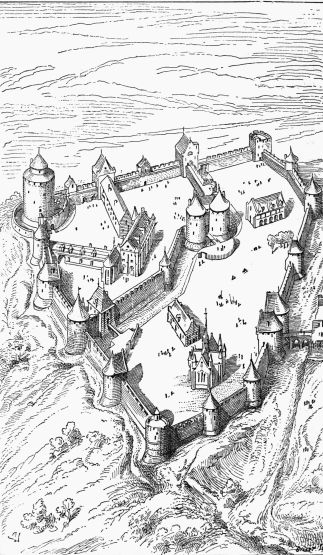
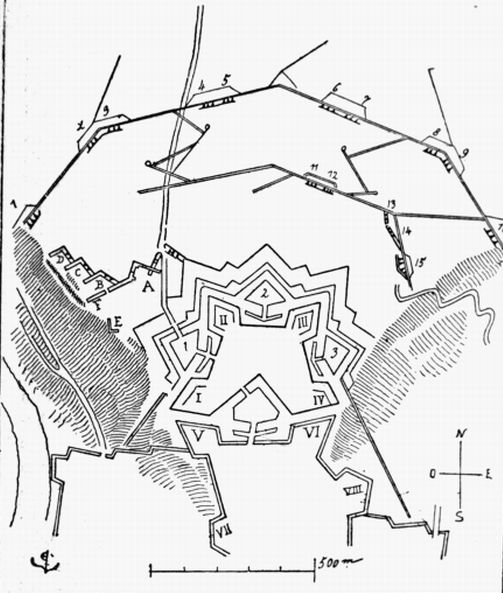
without difficulty.[13] But that a clear idea may be formed of what
follows, we must give a plan indicating the position of the enemy, and
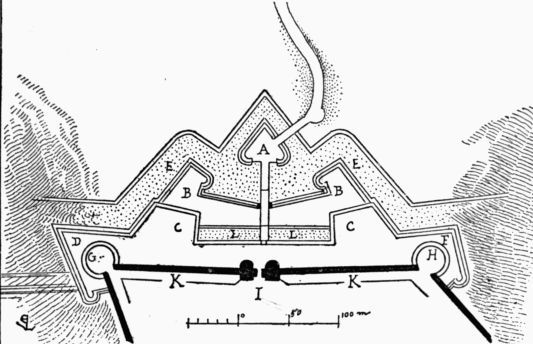
the state of the defences (Fig. 45).[14]
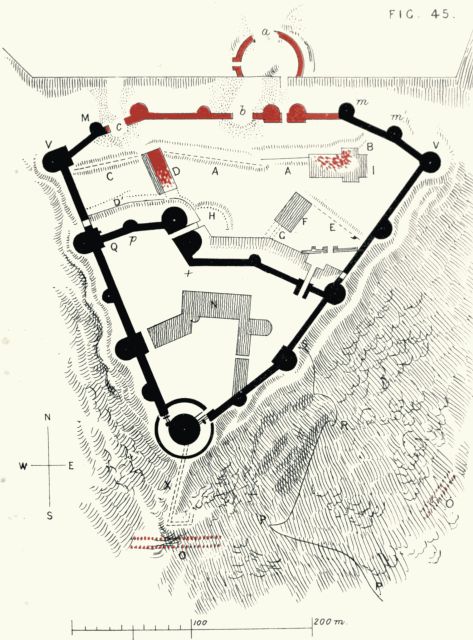
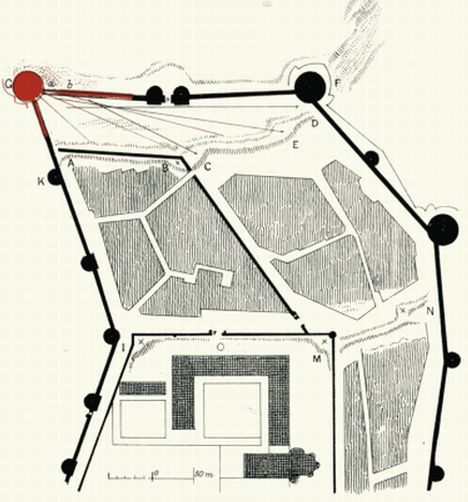
FIG 45—THE TAKING OF THE BAILEY
On the morning of the 7th of June the defenders were still in possession
of the retrenchment C, of that marked A A, and of the
barricade B; at H a strong palisade, with a
bretèche, had been erected before the entrance at the very
commencement of the siege. At D' another palisade arose in
front of the ditch; at E was a second retrenchment, before the
postern entrance; and at G a strong barricade. The building,
F, part of the old Roman construction, crenelated at the top,
might hold out for some time. The towers, V, M, m,
m', and V' were still in the hands of the defenders, and
could take the assailants in the rear, should they attempt to enter the
chapel, I, and the stables, D, that had been burned.
Anseric and his uncle came to the determination to abandon the
retrenchment, A A. To defend it was only to lose men, since the
enemy could not venture into the return formed by the two towers of the
gate and the building F. It was preferable to direct all their
efforts to C, for this was evidently the point of attack.
About five o'clock in the morning, therefore, the retrenchment, A
A, was abandoned; and in fact the Burgundians contented themselves
with making gaps in it without advancing further. In the early morning
the duke had directed a quantity of burning darts on the roof of the
tower, M; but the catapult planted by the defenders on that of
the angle, V, greatly annoyed the assailants grouped outside,
who were preparing to make a vigorous attack through the breach
C.
It was about noon that the duke gave orders for a simultaneous attack on
two points; the roof of the tower, M, was already on fire. The
first attack was vigorously directed to the retrenchment C. The
second made a gap in the crenelated walls of the chapel, the intention
being to get possession of the palisade E. At the same time,
two catapults planted outside were showering burning darts upon the
roofs of the towers m, n' and V, while a trebuchet was
destroying the hoarding and battlements with volleys of stones.
The defenders posted on the summit of the tower, V, by
discharging stones and quarrels on the flanks of the assailants, who
were impetuously assaulting the retrenchment, C, did them much
damage, their bucklers not availing to protect them in front and flank;
and from the narrow front of the castle, skilful archers discharged
arrows in abundance over the heads of their own party on the assailants
who presented themselves at the breach, C; for they were within
bowshot.
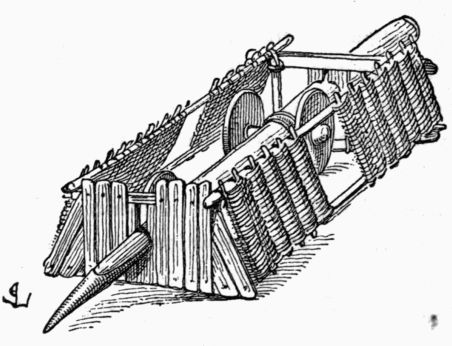
Fig. 46.
Seeing they could make no impression, the duke withdrew his men, and had
mantelets brought forward and placed perpendicularly to the wall, and
fronting the tower in the angle, and then a small bosson on wheels—its
head strongly armed with a solid iron point. The wheels of this bosson
were screened (Fig. 46), to shelter those engaged in working it. Twenty
men under shelter, with heavy crowbars, were awaiting the effect of the
bosson. The fourth time it encountered the palisade a dozen stakes were
greatly shaken, and the cross-rails broken. Then the pioneers, armed
with crowbars, set about bringing down the shaken stakes, or at least
turning them aside. The assaulting column threw itself upon the
openings. There was a hand-to-hand fight, and so densely were they
pressed together, that the men posted in the tower at the corner dared
not shoot for fear of wounding their comrades.
On the opposite side the Burgundians had succeeded in making a wide gap
in the wall south of the chapel; and screened by its ruins, they
attacked the angle of the retrenchment E.[See Fig. 45.] From the east
curtain, however, the garrison discharged stones and arrows on their
rear; and this assault was but feeble, as the duke was entirely occupied
with directing the others.
Anseric defended this point by the desire of the baron, who had urged
him to resume the offensive, supported by the building F,
however difficult the undertaking might be.
One of the men posted at the defences of the gate hurried down, and,
passing the postern, came and told him that the retrenchment,
C, was forced and his people in great danger at this point.
Anseric, therefore, taking two hundred and fifty men whom he had with
him, issued from the retrenchment by its eastern extremity, rushed
furiously on the assailants, threw them into disorder, and leaving forty
brave soldiers to defend the gap in the chapel, and the barricade,
B, that had remained almost intact, traversed the area of the
bailey in an oblique direction, crossed the retrenchment, A,
which was partly destroyed, and fell on the left flank of the
assailants, uttering the war-cry: "Roche-Pont! Roche-Pont!" ... The
Burgundians, surprised by this unforeseen attack and not knowing whence
these soldiers came, abandoned the retrenchment, the bosson, and even
the breach, C.
The baron's troops, seeing this, plucked up courage, and killing all
that had remained within the bailey, occupied the breach, c, once
more, while Anseric was occupying the barricade, C. The bosson
was destroyed with hatchets, and the mantelets left by the enemy were
put in readiness for repairing the broken-down palisades.
The duke was furious, and had broken his sword on the backs of the
runaways. But no further attempt could be made that day, and the
advantages he had gained with so much trouble were jeopardized. The
defenders were seen barricading the breaches, and he could hear the
cries of the unfortunate men who had remained in the bailey, and were
being pitilessly massacred.
The Burgundians had lost more than two thousand men since the
commencement of the siege; and on the 7th of June the duke's army
amounted to no more than four thousand five hundred or five thousand men
at most. The besieged were reduced to about a thousand; but they were
full of hope, and assured of success, while the besiegers were losing
confidence. Their advantages had been gained only by enormous
sacrifices, and this last affair threatened altogether to "demoralize"
them.
The duke had reckoned on taking the place in a month at most; and now at
the end of thirty-two days he found that he had lost the third of his
army without being much more advanced than the second day after his
arrival. Order and method had been wanting in the various phases of the
siege; this he could see when it was rather too late. If, instead of
pursuing their advantages in the centre of the front of the bailey, the
besiegers had contented themselves with taking the barbican, so as to
hinder any sortie from that side, and if with good earthworks they had
advanced under cover against the western end of this front towards the
tower, M,[See Fig. 45.] directing all their efforts to this point and
raising a movable tower, they would be in possession of the western
court, would destroy in succession the works on their right, would be
able to protect themselves against offensive re-action on their left,
and would attack the castle on its weak side; that is, between the gate
towers and that marked Q. Thus they might take in the rear all
the eastern defences, moving along the western curtain by successive
breaches.
The duke, it is true, was not acquainted with the place, and believed
that in making a wide breach in its centre he was striking at its heart.
These reflections occurred to him too late; he could not draw back, and
it was necessary to act with decision. Assembling his chief captains,
therefore, in the evening, he announced that a decisive effort must be
made; representing it as evident—in spite of the check just
experienced—that if they could gain a permanent footing in the western
court of the bailey, they could soon break into the castle on the flank
of the gateway defence, and this flank once seized the castle would be
theirs. The soldiers, rather ashamed of the panic that had lost them the
advantages they had acquired, cast the blame of the failure upon each
other; and those who had been the first to run away were bent upon
vindicating their bravery. So that when, on the morning of the 8th of
June, the order was given for attacking the lost breach, c, and every
preparation had been made for protecting their position within the
bailey, the Burgundians were eager to advance.
A vigorous return to the charge was expected by the garrison, and the
baron concluded that the breach, c, would be attacked. Part of the
night, therefore, had been occupied in strongly barricading this
breach. Two Burgundian catapults and a trebuchet covered the breach with
darts and stones, so that the defenders had to shelter themselves to the
right and left behind the remains of the curtains; and about ten o'clock
the barricade was destroyed and only a heap of rubbish remained. The
palisade of the retrenchment in the rear was also damaged, and the
projectiles that were showered upon this point precluded the defenders
from repairing it. Then the first attacking column advanced, passed
through the breach, and reached the palisades. Anseric, posted behind
the building, D (belonging to the stables), was on the point of
taking this column in flank, as on the previous day, but a second troop
rushed through the breach, and the Lord of Roche-Pont was all but taken.
With great difficulty he and his men retreated to the outwork of the
gate, and brought aid to the defenders of the western court. The surging
host of the Burgundians was continually increasing, the palisade was
taken, and the second palisade, D, was the scene of a desperate
struggle between assailants and defenders. The garrison could not bring
their forces to bear on this point, and Anseric feared they might be cut
off, and not be able to retire into the outwork of the gate, H;
he therefore ordered a retreat in the evening, while from the three
towers and the curtain of the castle, quarrels and arrows were showered
on the assailants confined in the court.
The tower, V, which still remained in the hands of the
besieged, took the Burgundians in the rear; and the latter employed all
the rest of the day in securing themselves in front and in flank, while
the duke had the tower, M, undermined.
The door of the tower, V, opening into the bailey, had been
broken in; but the stairs were so well barricaded with stones and
débris that it was impossible to clear it; and even should this be
done the assailants would be easily overpowered by the defenders.
A wooden bridge connected the curtain of the bailey on this side with
the corner tower of the castle. By means of a catapult the Burgundians
succeeded in throwing combustibles on it, which obliged the defenders to
abandon the tower, V, in haste. They were seen re-entering the
castle just when the flames were beginning to consume the bridge. The
roof of the tower, Q, was all but set on fire; and the
defenders had great difficulty in arresting the progress of the flames.
If Anseric had had five hundred more men he might from the central court
have resumed the offensive at the moment when the Burgundians were
trying to gain a lodgment in the western court. But he had lost a
hundred men in the last engagement, and had no more soldiers than were
absolutely necessary for the defence of the castle. In the evening the
central part of the bailey was occupied by the Burgundians, who took up
their quarters there, and intrenched themselves securely this time.
Next morning, the 9th of June, the tower, M, being undermined,
fell, and the breach, c, was proportionately widened. The ditch was
filled up, and the tower, V, occupied by the Burgundians. The
defenders, before they abandoned it, had set fire to the catapult
mounted on the platform.
The crown of the tower, Q, in the corner of the castle, rose
more than twenty feet above the curtain, and thus hindered the
Burgundians from moving at will on the rampart-walk of this curtain,
which was not furnished with covered hoarding.
The whole of the 10th of June was employed by the Burgundians in
completing their works in the western court of the bailey, clearing the
breach, c, and working at a wooden movable tower, designed to attack
and command the rampart between the gate and the corner tower,
Q, of the castle; for this rampart, raised on the rock, could
not be undermined. The duke, aware by this time of the strength of the
place, and supposing the defenders to be more numerous than they really
were, was unwilling henceforth to run any hazards. As far as was
possible he manned the tops of the ramparts of that part of the bailey
which was in his possession, succeeded in setting fire to the roofs and
floors of the towers m and m', and commenced a mining attack on the
tower v'. It was no longer the interest of the defenders to guard
these works, which weakened them to no purpose. They therefore evacuated
them, threw down the bridge uniting the eastern rampart of the bailey
with the corner tower, and retired permanently within the castle.
Meantime the Burgundians were working at their movable tower outside the
old palisade, C, that had been destroyed, and covered the
outside with fresh hides to preserve it from the Greek fire. They filled
up the ditch in front of the tower p,[See Fig. 45.] not without difficulty
protecting themselves with fascines and mantelets.
On the 20th of June the tower was completed, and the road for it
constructed of strong planks firmly fastened as far as the filling up of
the ditch. For the few last days the enemy had been incessantly working
the catapults and two trebuchets against the crest of the defences of
the castle between the gate and the tower, Q, and had tried to
set fire to the hoarding and roofs; but these ramparts were higher than
those of the bailey, and the baron had covered all the timbers with
hides and blankets always kept wet, so that the flaming darts of the
Burgundians were ineffectual against them. The roofs, too, were
carefully watched. The hoarding, however, was almost entirely destroyed
by the projectiles, and its débris had been removed by the garrison,
as only embarrassing the defence. The whole of the crown of the tower,
P, was greatly damaged, especially as it did not rise above the
crest of the curtain. Seeing the enemy's preparations, the baron mounted
a strong mantelet of thick wood and a catapult on the platform of this
tower, P, which had no roof. Then, to meet every contingency,
he had a strong retrenchment made from the angle, t, to the opposite
tower, behind the tower, Q.
In the evening of this day, the 20th of June, the wooden tower began to
be moved, borne along on huge rollers. As soon as it was about thirty
yards from the rampart, the baron had the catapult directed upon it, and
sent against it cases of Greek fire fixed near the iron points of the
darts. The fresh hides protected it well, and the points did not stick
in the wood; so the fire fell on the ground, and the Burgundians, under
cover of the base-work of the tower, flung off the flaming cases by
means of forks. This gave them plenty to do, and the tower advanced but
slowly, while the further it proceeded the greater was the chance of its
taking fire. The baron, who had but a small quantity of Greek fire
remaining, was afraid to waste it. Already five cases had been thrown
without effect; so he resolved to wait till the tower was close to the
ramparts.
At this time of the year (June 21) the nights are not completely dark,
and day breaks early. At two o'clock in the morning the wooden tower was
on the counterscarp of the ditch. The mound that filled it presented a
slope towards the ramparts, and was covered with planks. At a signal,
the tower, urged on from behind by means of twenty powerful levers,
rolled quickly along its inclined plane and came into collision with the
summit of the tower P, above which it rose ten feet. The shock
made the walls tremble, and a shower of stones and darts was poured upon
the defenders from the top of the wooden tower. Then a bridge fell
noisily on the head of the tower above-mentioned, shattered the
mantelets and the catapult; and the assailants, uttering formidable
shouts, leaped on the platform.
Anseric was at the top of the tower, Q, and Baron Guy was
posted on the battlements of the gate. Both of them, rushing towards the
curtains, attacked in their turn the assaulting column on this narrow
rampart; many on both sides fell within the court, and were killed or
had their limbs broken.
Numbers conferred no advantage, since it was impossible to deploy; so
that the crowd of assailants that continued to pour forth from the
wooden tower had to fight on the right and the left in a space six feet
wide. The staircase of the tower, P, having been blocked up,
the enemy could not get down through it; so that, driven into a corner
on the platform of the tower, they had to make their way along one
curtain or the other. Anseric, at the head of his troop, was cutting an
ensanguined road before him with a long-handled axe. At his side, his
men, armed with pikes and hooks, stabbed or grappled with and threw down
the wall those who attempted to approach their lord. These unfortunate
men fell from a height of twenty-five feet on the débris of hoarding
which the garrison had thrown down within, to clear the rampart walk.
The crossbowmen, posted at the top of the wooden tower, discharged
quarrels on the two bands; but the men were well protected with armour,
and the quarrels rebounded from their helmets or were arrested by their
hauberks. Friar Jerome, armed with an enormous mace, mounted on a
merlon, felled all who came within his reach.
The duke, remaining at the bottom of the wooden tower, and supposing the
rampart taken, was urging on his men-at-arms that they might follow up
with overwhelming numbers those who had first reached the rampart.
Thanks to Anseric's efforts and those of the baron, there was some
amount of delay at the top of the tower, and the exit from the bridge
could not be readily effected. The assailants who were coming up behind
the front of the assault were pressing upon those before them, and this
pressure only increased the confusion.
By dint of numbers, however, the Burgundians succeeded in gaining a
footing on the tower; and the two bands of defenders were not
sufficiently numerous to thrust them back. Seeing that they were going
to be absolutely overwhelmed, the baron called Father Jerome, who,
leaping from merlon to merlon, succeeded in reaching him.
A word spoken in the friar's ear made him run towards the neighbouring
tower belonging to the gate. A moment afterwards and a strong crossbow
mounted on the upper story of the work, behind the hoarding, shot
quarrels, to which cases of Greek fire were fastened, against the sides
of the wooden tower, which was not so well protected by skins as its
front. The friar took a cool aim at the exposed part of the timbers,
chiefly about seven or eight feet above the base of the tower. He had
ten of these cases left, and all were aimed with a sure hand, being
attached to strong quarrels, whose points were well sharpened. Four of
the quarrels failed to stick, but the six others were fixed firmly in
the timber, and the cases they bore spread a tenacious and burning lava
over the wood.
At the first moment the Burgundians, absorbed in the attack, did not
perceive the danger. Those who had reached the top of the tower could
not be aware of it.
The duke was one of the first to see the thick smoke issuing from the
kindled wood. Immediately he gave orders for the extinction in all haste
of the fire with the aid of small hand-ladders; but as soon as anyone
mounted one of these ladders, a dozen archers and crossbowmen posted in
the gate tower made him their mark. Four or five men had been killed or
wounded before the level of the flame was reached. Inside, the soldiers
who, like a rising flood, were ascending to the top of the tower, soon
found themselves surrounded by the suffocating smoke produced by the
Greek fire. Some were the more eager to mount, others hesitated and were
for going down. "Now! to the rescue! Arde le beffroi!" cried Friar
Jerome, coming to rejoin the baron's troop, which was almost driven into
a corner close to the tower; and with his long mace he took the lead,
breaking heads and arms. "Arde le beffroi!" he shouted at every blow.
"Roche-Pont! Roche-Pont! Arde le beffroi!" shouted, in its turn, the
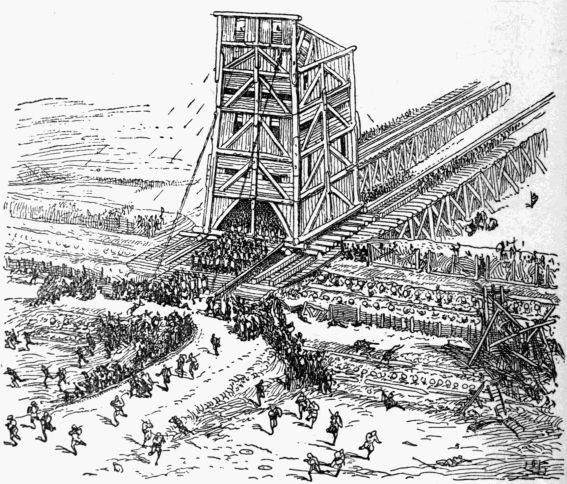
baron's small troop (Fig. 47). Anseric's men, who were crowded up in the
corner tower, re-echoed this cry.
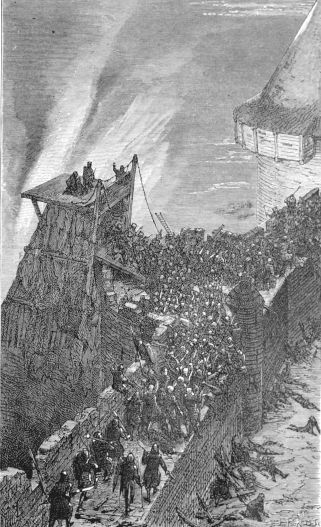
Fig. 47.—The Movable Tower.
The Burgundians, however, did not retreat; in fact, if they had wished
to do so, they could not. They tried to place ladders to get down into
the court, but they were too short. "Burgundy! Burgundy!" shouted the
assailants, in their turn. "Place prise! Place prise!"
The grey light of dawn faintly illumined this scene of carnage, and its
pale, cold gleams mingled with the ruddy glow of the fire. The smoke,
driven by a breeze from the north-east, beat down upon the combatants,
and sometimes hindered them from seeing each other; but the struggle
raged on. Heaps of the dead and wounded—the latter being speedily
dispatched by menials posted in the court to resist any who should
try to get down into it—lay at the interior base of the curtains.
Although Anseric and the baron had ordered those who remained in the two
neighbouring towers (that of the angle and that of the gate) not to quit
their post under any pretext, and not to unbar the gates till the two
troops were absolutely driven back upon those defences, these brave men,
seeing so fine an opportunity of routing the Burgundians, and observing
the weakness of the two bands of the defenders compared with the host of
assailants, opened the gates and sallied forth to help their comrades.
Eleanor and her waiting-women, with some of the wounded, perceiving the
critical state of affairs (for the combat took place in front of the
western inhabited part of the castle), had proceeded along the western
curtain and had reached the corner tower, Q,[See Fig. 45.] behind the
troop commanded by Anseric. The lady of the castle was the first to
encourage the men on guard there to go out, saying that she knew well
enough how to bar the doors. As to the wounded who were with her, they
posted themselves as best they could at the hoarding, to shoot at the
enemy outside and the compact mass of Burgundians engaged on the
platform of the tower. These two reinforcements arrived very
opportunely. The new comers, fresh and vigorous, made their way, some on
the tops of the merlons, others on the débris of the hoarding, and
relieved their comrades exhausted by the struggle.
The fire was catching the framework of the tower, and the Burgundians
soon found their retreat cut off. Those who had gained the rampart,
however, sold their lives dearly, and the struggle did not cease till
the flames of the burning tower curled round the platform and the
rampart walk.
Nearly five hundred Burgundians were killed, wounded, taken prisoners,
or burned. The sparks of fire, driven by the wind, were borne down upon
the roof and the hoarding of the tower at the angle, and it caught fire
about six o'clock in the morning.
The day was a fortunate one for the defenders, but they had lost nearly
two hundred in killed and wounded. Anseric had been struck by several
quarrels that pierced his hauberk, and was covered with blood. The
baron, that he might be more at his ease in fighting, feeling himself
oppressed by his helmet, had taken it off during the struggle, and had a
large wound in his head. They hastened to throw over the battlements the
bodies of the slain Burgundians upon the last blazing timbers of the
tower, and to bury in the court the dead that had fallen there. All in
the castle were exhausted with fatigue. Eleanor and her attendants were
engaged in dressing wounds and in bringing food and drink to the various
posts. The lady of the castle preserved her tranquil countenance and
gentle look amid these sanguinary scenes, and during the whole day and
through the following night she did not cease to render aid to all who
needed it. "Fair niece," said the baron to her, while she was dressing
his wound, "if the king's army does not make haste it will find no more
defenders to deliver; but we have given the duke some trouble, and if he
goes on he, too, may have to return to his court alone."
The 22nd of June passed without fighting. The duke had a cat
constructed with a view to sapping the rampart at its base—which seemed
the more feasible, since the destruction of its hoarding and the burning
of the tower in the angle deprived the defenders of the means of
opposing the sapping effectually. The garrison could see the enemy
engaged in this work in the bailey behind the mantelets, and they
accumulated within the rampart all the materials they could procure,
with a view to blocking up the mouth of the mine at the moment it
reached the court.
On the morning of the 25th of June, the watch posted on the gateway
tower were much surprised at seeing not a single Burgundian in the
bailey. They went immediately to inform Anseric and the baron. "It is
either a ruse, or the king's army is coming," said the latter; "let
there be a sharp look-out in every quarter." They ascended the donjon.
The posts on the south were abandoned. The cat and the mantelets
remained in the bailey as well as the trebuchets. About noon the baron
sent out ten men with the deserter, who was to conduct them to the
various points occupied by the Burgundian captains. In three hours' time
they returned, saying that they had met only some laggards, who had fled
at their approach, and some wounded; that the encampment was utterly
deserted, but there were some waggons and military engines left.
The duke having been informed of the advance of the king's army, which
was only a day's march from the castle, had decamped in the night,
abandoning his material of war.
Great was the joy at La Roche-Pont. The inhabitants of the town soon
came and confirmed the news. The last of the Burgundians had departed
about noon, not without leaving many of their men on the field; for, in
spite of the injunctions of the duke, the inhabitants of the lower town
of Saint-Julien had been considerably plundered and had driven out the
last of the soldiers with stones and pike thrusts.
Soon afterwards the Sieur de la Roche-Pont did homage for his fief to
King Philip Augustus; and the monks re-entered their abbey, for the
repair of which the king gave five hundred livres.