BOOK IX ANNALS OF AMBER, [1] OR DHŪNDHĀR — CHAPTER 1 — Boundaries of Jaipur State. — Etymology of Dhūndhār. — The Kachhwāha Tribe. — Origin of Jaipur State. Dhola Rāē. — Hūndeo, Kuntal. — Pajūn. — The Mīna Tribe. — Death of Pajūn. — Mālasi. — Prithirāj. — Bahār or Bihāri Mall, c. A.D. 1548-75. — Bhagwāndās, c. A.D. 1575-92. — Mān Singh, c. A.D. 1592-1614. — Bhāo Singh, c. A.D. 1615-21. — Mahā Singh, c. A.D. 1621-25. — Jai Singh, Mīrza Rājā, c. A.D. 1625-67. — Rām Singh, Bishan Singh. — CHAPTER 2 — Sawāi Jai Singh, c. A.D. 1693-1743. — Assassination of Farrukhsiyar, May 16, 1719. — Rebellion of Bijai Singh. — Bijai Singh entrapped. — Services of Jai Singh to Jaipur State. — Limits of Jaipur State. — Rajor. — Attempted Assassination of Jai Singh. — Erection of Buildings. — Sumptuary Laws: Tolerance. — The Asvamedha. — CHAPTER 3 — The Rājput League. — Īsari Singh, A.D. 1743-60. — Mādho Singh, A.D. 1760-78. — The Jāts of Bharatpur. — Separation of Mācheri or Alwar State, A.D. 1771-76. — Prithi Singh II., A.D. 1778. — Partāp Singh, A.D. 1778-1803. — Jagat Singh, A.D. 1803-18. — Death of Jagat Singh. — CHAPTER 4 — The British Alliance, A.D. 1818. — Hesitation to accept the Treaty. — Disputed Succession. — Law of Succession in Rājputāna. — The Installation of Mohan Singh. — Objections raised by the Government of India. — Birth of a Posthumous Heir. — SHAIKHĀWAT FEDERATION CHAPTER 5 — The Origin of the Shaikhāwats. — Shaikhji. — Khandela, the Shaikhawat Capital. — Girdharji Shaikhāwat. — Assassination of Girdharji. — Dwārkadās. — Bīrsinghdeo. — Bahādur Singh. — Gallantry of Shujāwan Singh. — The Siege of Khandela. — Kesari Singh. — Udai Singh. — Supremacy of Jaipur in Shaikhawati. — CHAPTER 6 — Bindrabandās. — Brāhmans commit Suicide. — Tribal Feuds. — Attack by Najaf Kuli Khān. — Abdication of Bindraban: Govind Singh succeeds. — Murder of Govind Singh: Narsinghdās succeeds. — Marātha Inroads. — Partāp Singh. — Devi Singh. — Quarrel between Samod and Chaumūn. — Partāp Singh secures Possession of Khandela. — Treaty between the Shaikhāwats and Jaipur. — Treacherous Arrest of Narsingh and other Chiefs. — CHAPTER 7 — Dīnarām Bohra organizes an Attack on the Sadhānis. — Hanwant Singh captures Khandela. — The War on account of Krishna Kunwāri. — New Treaty with Jaipur. — Abhai Singh. — The Shaikhāwats attack Amīr Khān. — Siege of Khandela. — Death of Hanwant Singh. — Lachhman Singh gains Influence at Jaipur. — The Sādhāni Shaikhāwats. — Bāgh Singh seizes Sultāna. — The Lārkhānis. — Revenues. — CHAPTER 8 — Boundaries and Extent. — Population. — Classification of Inhabitants. — The Mīna Tribe. — Jāts. — Brāhmans. — Rājputs. — Soil, Husbandry, Products. — Farming System. — Revenues. — Foreign Army. — Ancient Towns.
1327
By some conventional process, Europeans in India have
adopted the habit of designating the principalities of Rajputana
by the names of their respective capitals, instead of those of
the countries. Thus Marwar and Mewar are recognized under
the titles of their chief cities, Jodhpur and Udaipur; Kotah and
Bundi are denominations indiscriminately applied to Haravati,
the general term of the region, which is rarely mentioned; and
Dhundhar is hardly known by that denomination to Europeans,
who refer to the State only by the names of its capitals, Amber
or Jaipur, the last of which is now universally used to designate
the region inhabited by the Kachhwahas [346].
—The map defines the existing
boundaries of this principality, to which I shall indiscriminately
apply the terms (as is the practice of the natives) of Dhundhar,
Amber, and Jaipur.
—Like all the other Rajput States,
the country of the Kachhwahas is an assemblage of communities,
1328the territories of which have been wrested from the aboriginal
tribes, or from independent chieftains, at various periods; and
therefore the term Dhundhar, which was only one of their earliest
acquisitions, had scarcely a title to impose its name upon the
aggregate. The etymology of Dhundhar is from a once celebrated
sacrificial mount (
thal) on the western frontier, near
Kalakh Jobner.
[2]—The Kachhwaha or Kachhwa race
claims descent from Kusa, the second son of Rama, King of
Kosala, whose capital was Ayodhya, the modern Oudh. Kusa,
or some of his immediate offspring, is said to have migrated from
the parental abode, and erected the celebrated castle of Rohtas,
or Rohitas,
[3] on the Son, whence, in the lapse of several generations,
another distinguished scion, Raja Nal, migrated westward,
and in S. 351, or
A.D. 295, founded the kingdom and city of Narwar,
or classically, Naishadha.
[4] Some of the traditional chronicles
1329record intermediate places of domicile prior to the erection of
this famed city: first, the town of Lahar, in the heart of a tract
yet named Kachhwahagar, or region (
thal) of the Kachhwahas;
[5]
and secondly, that of Gwalior. Be this as it may, the descendants
of Raja Nal adopted the affix of Pal (which appears to be the distinguishing
epithet of all the early Rajput tribes), until Sora Singh
(thirty-third in descent from Nal), whose son, Dhola Rae, was
expelled the paternal abode, and in S. 1023,
A.D. 967, laid the
foundation of the State of Dhundhar [347].
A family, which traces its lineage from Rama of Kosala, Nala
of Naishadha, and Dhola the lover of Maroni, may be allowed
‘the boast of heraldry’; and in remembrance of this descent,
the Kachhwahas of India celebrate with great solemnity ‘the
annual feast of the sun,’ on which occasion a stately car, called
the chariot of the sun (thal), drawn by eight horses, is
brought from the temple, and the descendant of Rama, ascending
therein, perambulates his capital.
—A case of simple usurpation
originated the Kachhwaha State of Amber; but it would
be contrary to precedent if this event were untinged with romance.
As the episode, while it does not violate probability, illustrates
the condition of the aboriginal tribes, we do not exclude the
tradition. On the death of Sora Singh, prince of Narwar, his
brother usurped the government, depriving the infant, Dhola
Rae, of his inheritance. His mother, clothing herself in mean
apparel, put the infant in a basket, which she placed on her head,
and travelled westward until she reached the town of Khoganw
1330(within five miles of the modern Jaipur), then inhabited by the
Minas. Distressed with hunger and fatigue, she had placed her
precious burden on the ground, and was plucking some wild
berries, when she observed a hooded serpent rearing its form
over the basket.
[6] She uttered a shriek, which attracted an
itinerant Brahman, who told her to be under no alarm, but rather
to rejoice at this certain indication of future greatness in the
boy. But the emaciated parent of the founder of Amber replied,
“What may be in futurity I heed not, while I am sinking with
hunger”; on which the Brahman put her in the way of Khoganw,
where he said her necessities would be relieved. Taking up the
basket, she reached the town, which is encircled by hills, and
accosting a female, who happened to be a slave of the Mina
chieftain, begged any menial employment for food. By direction
of the Mina Rani, she was entertained with the slaves. One
day she was ordered to prepare dinner, of which Ralansi, the
Mina Raja, partook, and found it so superior to his usual fare,
that he sent for the cook, who related her story.
[7] As soon as
the Mina chief discovered the rank of the illustrious fugitive, he
adopted her as his sister, and Dhola Rae as his nephew. When
the boy had attained the age of Rajput manhood (fourteen), he
was sent to Delhi,
[8] with the tribute of Khoganw, to attend instead
of the Mina. The young Kachhwaha remained there five
years, when he conceived the idea of usurping his benefactor’s
authority. Having consulted the Mina Dharhi,
[9] or bard, as to
the best means of executing his plan, he recommended [348] him
to take advantage of the festival of the Diwali, when it is
customary to perform the ablutions
en masse, in a tank. Having
brought a few of his Rajput brethren from Delhi, he accomplished
his object, filling the reservoirs in which the Minas bathed
with their dead bodies. The treacherous bard did not escape;
Dhola Rae put him to death with his own hands, observing,
“He who had proved unfaithful to one master could not be
1331trusted by another.” He then took possession of Khoganw.
Soon after he repaired to Dausa,
[10] a castle and district ruled
by an independent chief of the Bargujar tribe of Rajputs, whose
daughter he demanded in marriage. “How can this be,” said
the Bargujar, “when we are both Suryavansi, and one hundred
generations have not yet separated us?”
[11] But being convinced
that the necessary number of descents had intervened,
the nuptials took place, and as the Bargujar had no male issue,
he resigned his power to his son-in-law. With the additional
means thus at his disposal, Dhola determined to subjugate the
Sira
[12] tribe of Minas, whose chief, Rao Nata, dwelt at Machh.
Again he was victorious, and deeming his new conquest better
adapted for a residence than Khoganw, he transferred his infant
government thither, changing the name of Machh, in honour of
his great ancestor, to Ramgarh.
Dhola subsequently married the daughter of the prince of
Ajmer, whose name was Maroni.[13] Returning on one occasion
with her from visiting the shrine of Jamwahi Mata,[14] the whole
force of the Minas of that region assembled, to the number of
eleven thousand, to oppose his passage through their country.
Dhola gave them battle: but after slaying vast numbers of
his foes, he was himself killed, and his followers fled. Maroni
escaped, and bore a posthumous child, who was named Kankhal,
and who conquered the country of Dhundhar. His son, Maidal
1332Rao, made a conquest of Amber from the Susawat Minas, the
residence of their chief, named Bhato, who had the title of Rao,
and was head of the Mina confederation. He also subdued the
Nandla Minas, and added the district of Gatur-Ghati to his
territory.
—Hundeo succeeded, and, like his predecessors,
continued the warfare against the Minas. He was succeeded
by Kuntal, whose sway extended over all the hill-tribes round
his capital. Having determined to proceed to Bhatwar, where
a Chauhan prince resided, in order to marry his daughter, his
Mina subjects, remembering the [349] former fatality, collected
from all quarters, demanding that, if he went beyond the borders,
he should leave the standards and nakkaras of sovereignty in
their custody. Kuntal refusing to submit, a battle ensued, in
which the Minas were defeated with great slaughter, which
secured his rule throughout Dhundhar.
—Kuntal was succeeded by Pajun, a name well known
to the chivalrous Rajput, and immortalized by Chand, in the
poetic history (Raesa) of the emperor Prithiraj. Before, however,
we proceed further, it may be convenient to give a sketch
of the power and numbers of the indigenous tribes at this period.
—We have already had frequent occasion to observe
the tendency of the aboriginal tribes to emerge from bondage
and depression, which has been seen in Mewar, Kotah, and Bundi,
and is now exemplified in the rise of the Kachhwahas in Dhundhar.
The original, pure, unmixed race of Minas, or Mainas, of Dhundhar,
were styled Pachwara, and subdivided into five grand tribes.
Their original home was in the range of mountains called Kalikoh,
extending from Ajmer nearly to the Jumna, where they erected
Amber, consecrated to Amba, the universal mother,
[15] or, as the
Minas style her, Ghata Rani, ‘Queen of the pass.’ In this range
were Khoganw, Machh, and many other large towns, the chief
cities of communities. But even so late as Raja Baharmall
Kachhwaha, the contemporary of Babur and Humayun, the
Minas had retained or regained great power, to the mortification
of their Rajput superiors. One of these independent communities
1333was at the ancient city of Nain, destroyed by Baharmall, no
doubt with the aid of his Mogul connexions. An old historical
distich thus records the power of the Mina princes of Nain:
Bāwan kot, chhappan darvāja,
Mīna mard, Nāin kā rājā,
Vado rāj Nāin ko bhago,
Jab bhus-hī men vāmto māgo.
That is, 'There were fifty-two strongholds,[15] and fifty-six gates
belonging to the manly Mina, the Raja of Nain, whose sovereignty
of Nain was extinct, when even of chaff (bhus) he took a share.'
If this is not an exaggeration, it would appear that, during the
distractions of the first Islamite dynasties of Delhi, the Minas
had attained their primitive importance. Certainly from Pajun,
the vassal chieftain of Prithiraj [350], to Baharmall, the contemporary
of Babur, the Kachhwahas had but little increased
their territory. When this latter prince destroyed the Mina
sovereignty of Nain, he levelled its half hundred gates, and
erected the town of Lohwan (now the residence of the Rajawat
chief) on its ruins.
A distinction is made in the orthography and pronunciation
of the designation of this race: Maina, meaning the asl, or ‘unmixed
class,’ of which there is now but one, the Usara; while
Mina is that applied to the mixed, of which they reckon barah
pal,[16] or twelve communities, descended from Rajput blood, as
Chauhan, Tuar, Jadon, Parihar, Kachhwaha, Solanki, Sankhla,
Guhilot, etc., and these are subdivided into no less than five
thousand two hundred distinct clans, of which it is the duty of
1334the Jaga, Dholi, or Dom, their genealogists, to keep account.
The unmixed Usara stock is now exceedingly rare, while the
mixed races, spread over all the hilly and intricate regions of
central and western India, boast of their descent at the expense
of ‘legitimacy.’ These facts all tend strongly to prove that
the Rajputs were conquerors, and that the mountaineers, whether
Kolis, Bhils, Minas, Gonds, Savaras or Sarjas, are the indigenous
inhabitants of India. This subject will be fully treated hereafter,
in a separate chapter devoted to the Mina tribes, their
religion, manners, and customs.
—Let us return to Pajun, the sixth in descent
from the exile of Narwar, who was deemed of sufficient consequence
to obtain in marriage the sister of Prithiraj, the Chauhan
emperor of Delhi, an honour perhaps attributable to the splendour
of Pajun’s descent, added to his great personal merit. The
chivalrous Chauhan, who had assembled around him one hundred
and eight chiefs of the highest rank in India, assigned a conspicuous
place to Pajun, who commanded a division of that
monarch’s armies in many of his most important battles. Pajun
twice signalized himself in invasions from the north, in one of
which, when he commanded on the frontier, he defeated Shihabu-d-din
in the Khaibar Pass, and pursued him towards Ghazni.
[17]
His valour mainly contributed to the conquest of Mahoba, the
country of the Chandels, of which he was left governor; and he
was one of the sixty-four chiefs who, with a chosen body of their
retainers, enabled Prithiraj to carry off the princess of Kanauj.
In this service, covering [351] the retreat of his liege lord, Pajun
lost his life, on the first of the five days’ continuous battle. Pajun
was conjoined with Govind Guhilot, a chief of the Mewar house;—both
fell together. Chand, the bard, thus describes the last
hours of the Kachhwaha prince: “When Govind fell, the foe
danced with joy: then did Pajun thunder on the curtain of
fight: with both hands he plied the
khadga (sword) on the heads
of the barbarian. Four hundred rushed upon him; but the
five brothers in arms, Kehari, Pipa, and Boho, with Narsingh
and Kachra, supported him. Spears and daggers are plied—heads
roll on the plain—blood flows in streams. Pajun assailed
1335Itimad; but as his head rolled at his feet, he received the Khan’s
lance in his breast; the Kurma
[18] fell in the field, and the Apsaras
disputed for the hero. Whole lines of the northmen strew the
plain: many a head did Mahadeo add to his chaplet.
[19] When
Pajun and Govind fell, one watch of the day remained. To
rescue his kin came Palhan, like a tiger loosed from his chain.
The array of Kanauj fell back; the cloudlike host of Jaichand
turned its head. The brother of Pajun, with his son, performed
deeds like Karna:
[20] but both fell in the field, and gained the
secret of the sun, whose chariot advanced to conduct them to
his mansion.
“Ganga shrunk with affright, the moon quivered, the Dikpals[21]
howled at their posts: checked was the advance of Kanauj, and
in the pause the Kurma performed the last rites to his sire (Pajun),
who broke in pieces the shields of Jaichand. Pajun was a buckler
to his lord, and numerous his gifts of the steel to the heroes of
Kanauj: not even by the bard can his deeds be described. He
placed his feet on the head of Sheshnag,[22] he made a waste of the
forest of men, nor dared the sons of the mighty approach him.
As Pajun fell, he exclaimed, ‘One hundred years are the limit of
man’s life, of which fifty are lost in night, and half this in childhood;
but the Almighty taught me to wield the brand.’ As
he spoke, even in the arms of Yama, he beheld the arm of his boy
playing on the head of the foeman. His parting soul was satisfied:
seven wounds from the sword had Malasi received, whose steed
was covered with wounds: mighty were the deeds performed
by the son of Pajun.”
—This Malasi, in whose praise the bard of Prithiraj
is so lavish, succeeded (according to the chronicle) his father
Pajun in the Raj of Amber. There is little said of him in the
transcript in my possession. There are, however, abundance of
traditional couplets to prove that the successors of Pajun were
not wanting in the chief duties of the Rajput [352], the exercise
1336of his sword. One of these mentions his having gained a victory
at Rutrahi over the prince of Mandu.
[23]We shall pass over the intermediate princes from Malasi to
Prithiraj, the eleventh in descent, with a bare enumeration of
their names: namely, Malasi, Bijal, Rajdeo, Kilan, Kuntal,
Junsi, Udaikaran, Narsingh, Banbir, Udharan, Chandrasen,
Prithiraj.
—Prithiraj had seventeen sons, twelve of whom
reached man’s estate. To them and their successors in perpetuity
he assigned appanages, styled the Barah Kothri, or ‘twelve
chambers’ of the Kachhwaha house. The portion of each was
necessarily very limited; some of the descendants of this hereditary
aristocracy now hold estates equal in magnitude to the
principality itself at that period. Previous, however, to this
perpetual settlement of Kachhwaha fiefs, and indeed intermediately
between Malasi and Prithiraj, a disjunction of the
junior branches of the royal family took place, which led to the
foundation of a power for a long time exceeding in magnitude
the parent State. This was in the time of Udaikaran, whose
son Baloji left his father’s house, and obtained the town and
small district of Amritsar, which in time devolved on his grandson
Shaikhji, and became the nucleus of an extensive and singular
confederation, known by the name of the founder, Shaikhavati,
1337at this day covering an area of nearly ten thousand square miles.
As this subject will be discussed in its proper place, we shall no
longer dwell on it, but proceed with the posterity of Prithiraj,
amongst the few incidents of whose life is mentioned his meritorious
pilgrimage to Dewal,
[24] near the mouth of the Indus. But
[353] even this could not save him from foul assassination, and
the assassin was his own son, Bhim, “whose countenance (says
the chronicle) was that of a demon.” The record is obscure,
but it would appear that one parricide was punished by another,
and that Askaran, the son of Bhim, was instigated by his brethren
to put their father to death, and “to expiate the crime by pilgrimage.”
[25]
In one list, both these monsters are enumerated
amongst the ‘anointed’ of Amber, but they are generally
omitted in the genealogical chain, doubtless from a feeling of
disgust.
—Baharmall was the
first prince of Amber who paid homage to the Muhammadan
power. He attended the fortunes of Babur, and received from
Humayun (previous to the Pathan usurpation), the mansab of
five thousand as Raja of Amber.
[26]—Bhagwandas, son of Baharmall,
became still more intimately allied with the Mogul dynasty.
He was the friend of Akbar, who saw the full value of attaching
such men to his throne. By what arts or influence he overcame
the scruples of the Kachhwaha Rajput we know not, unless by
appealing to his avarice or ambition; but the name of Bhagwandas
is execrated as the first who sullied Rajput purity by
matrimonial alliance with the Islamite.
[27] His daughter espoused
1338Prince Salim, afterwards Jahangir, and the fruit of the marriage
was the unfortunate Khusru.
[28]—Man Singh, nephew
[29] and
successor of Bhagwandas, was the most brilliant character of
Akbar’s court. As the emperor’s lieutenant, he was entrusted
with the most arduous duties, and added conquests to the empire
from Khotan to the ocean. Orissa was subjugated by him,
[30]
Assam humbled and made tributary, and Kabul maintained in
her allegiance. He held in succession the governments of Bengal
and Behar,
[31] the [354] Deccan and Kabul. Raja Man soon proved
to Akbar that his policy of strengthening his throne by Rajput
alliances was not without hazard; these alliances introducing
a direct influence in the State, which frequently thwarted the
views of the sovereign. So powerful was it, that even Akbar,
in the zenith of his power, saw no other method of diminishing
its force, than the execrable but common expedient of Asiatic
despots—poison: it has been already related how the emperor’s
attempt recoiled upon him to his destruction.
[32]1339Akbar was on his death-bed when Raja Man commenced an
intrigue to alter the succession in favour of his nephew, Prince
Khusru, and it was probably in this predicament that the monarch
had recourse to the only safe policy, that of seeing the crown fixed
on the head of Salim, afterwards Jahangir. The conspiracy for
the time was quashed, and Raja Man was sent to the government
of Bengal; but it broke out again, and ended in the perpetual
imprisonment of Khusru,[33] and a dreadful death to his adherents.
Raja Man was too wise to identify himself with the rebellion,
though he stimulated his nephew, and he was too powerful to be
openly punished, being at the head of twenty thousand Rajputs;
but the native chronicle mentions that he was amerced by Jahangir
in the incredible sum of ten crores, or millions sterling.
According to the Muhammadan historian, Raja Man died in
Bengal,[34] A.H. 1024 (A.D. 1615); while the chronicle says he was
slain in an expedition against the Khilji tribe in the north two
years later.[35]
—Rao Bhao Singh succeeded his
father, and was invested by the emperor with the Panjhazari, or
dignity of a legionary chief of five thousand. He was of weak
intellect, and ruled a few years without distinction. He died in
A.H. 1030 of excessive drinking.
—Maha succeeded, and in like
manner died from dissipated habits. These unworthy successors
of Raja Man allowed the princes of Jodhpur to take the lead at
the imperial court. At the instigation of the celebrated Jodha Bai
(daughter of Rae Singh of Bikaner), the Rajputni wife of Jahangir,
Jai Singh, grandson of Jagat Singh (brother of Man), was raised to
the throne of Amber, to the no small jealousy, says [355] the
chronicle, of the favourite queen, Nur Jahan. It relates that the
1340succession was settled by the emperor and the Rajputni in a conference
at the balcony of the seraglio, where the emperor saluted
the youth below as Raja of Amber, and commanded him to make
his salaam to Jodha Bai, as the source of this honour. But the
customs of Rajwara could not be broken: it was contrary to
etiquette for a Rajput chief to salaam, and he replied: “I will do
this to any lady of your majesty’s family, but not to Jodha
Bai”; upon which she good-naturedly laughed, and called out,
“It matters not; I give you the raj of Amber.”
—Jai Singh, the Mirza
Raja, the title by which he is best known, restored by his conduct
the renown of the Kachhwaha name, which had been tarnished by
the two unworthy successors of Raja Man. He performed great
services to the empire during the reign of Aurangzeb, who bestowed
upon him the mansab of six thousand. He made prisoner
the celebrated Sivaji, whom he conveyed to court, and afterwards,
on finding that his pledge of safety was likely to be broken, was
accessary to his liberation. But this instance of magnanimity was
more than counterbalanced by his treachery to Dara, in the war
of succession, which crushed the hopes of that brave prince.
These acts, and their consequences, produced an unconquerable
haughtiness of demeanour, which determined the tyrannical
Aurangzeb to destroy him. The chronicle says he had twenty-two
thousand Rajput cavalry at his disposal, and twenty-two
great vassal chiefs, who commanded under him; that he would
sit with them in darbar, holding two glasses, one of which he
called Delhi, the other Satara, and dashing one to the ground,
would exclaim, “There goes Satara; the fate of Delhi is in my
right hand, and this with like facility I can cast away.” These
vaunts reaching the emperor’s ear, he had recourse to the same
diabolical expedient which ruined Marwar, of making a son the
assassin of his father. He promised the succession to the
gaddi of
Amber to Kirat Singh, younger son of the Raja, to the prejudice
of his elder brother Ram Singh, if he effected the horrid deed.
[36]
The wretch having perpetrated the crime by mixing poison in his
father’s opium, returned to claim the investiture: but the king
only gave him the district of Kama. From this period, says the
chronicle, Amber declined.
1341—Ram Singh, who succeeded, had
the mansab of four thousand conferred upon him, and was sent
against the Assamese.
[37] Upon his death, Bishan Singh, whose
mansab was further reduced to the grade of three thousand, succeeded;
but he enjoyed the dignity only a short period [356].
—Jai II., better known by
the title of Sawai Jai Singh, in contradistinction to the first
prince of this name, entitled the ‘Mirza Raja,’ succeeded in
S. 1755 (
A.D. 1699),
[1] in the forty-fourth year of Aurangzeb’s
reign, and within six years of that monarch’s death. He served
with distinction in the Deccan, and in the war of succession
attached himself to the prince Bedar Bakht, son of Azam Shah,
declared successor of Aurangzeb; and with these he fought the
battle of Dholpur, which ended in their death and the elevation
of Shah Alam Bahadur Shah. For this opposition Amber was
sequestrated, and an imperial governor sent to take possession;
but Jai Singh entered his estates, sword in hand, drove out the
king’s garrisons, and formed a league with Ajit Singh of Marwar
for their mutual preservation.
It would be tedious to pursue this celebrated Rajput through
his desultory military career during the forty-four years he
occupied the gaddi of Amber; enough is already known of it
from its combination with the Annals of Mewar and Bundi, of
which house he was the implacable foe. Although Jai Singh
mixed in all the troubles and warfare of this long period of anarchy,
when the throne of Timur was rapidly crumbling into dust, his
reputation as a soldier would never have handed down his name
1342with honour to posterity; on the contrary, his courage had
none of the fire which is requisite to make a Rajput hero; though
his talents for civil government and court intrigue, in which he was
the Machiavelli of his day, were at that period far more notable
auxiliaries.
The Building of Jaipur: Work in Astronomy.—As a statesman,
legislator, and man of science, the character of Sawai Jai Singh is
worthy of an ample delineation,[2] which would correct our opinion
of the genius and [357] capacity of the princes of Rajputana, of
whom we are apt to form too low an estimate. He was the
founder of the new capital, named after him Jaipur or Jainagar,
which became the seat of science and art, and eclipsed the more
ancient Amber, with which the fortifications of the modern city
unite, although the extremity of the one is six miles from the
other. Jaipur is the only city in India built upon a regular
plan, with streets bisecting each other at right angles.[3] The
merit of the design and execution is assigned to Vidyadhar, a
native of Bengal, one of the most eminent coadjutors of the
prince in all his scientific pursuits, both astronomical and historical.
Almost all the Rajput princes have a smattering of astronomy,
or rather of its spurious relation, astrology; but Jai Singh went
deep, not only into the theory, but the practice of the science, and
was so esteemed for his knowledge, that he was entrusted by the
emperor Muhammad Shah with the reformation of the calendar.
He had erected observatories with instruments of his own invention
at Delhi, Jaipur, Ujjain, Benares, and Mathura, upon a
scale of Asiatic grandeur; and their results were so correct as
to astonish the most learned.[4] He had previously used such
1343instruments as those of Ulugh Beg (the royal astronomer of Samarkand),
which failed to answer his expectations.[5] From the
observations of seven years at the various observatories, he constructed
a set of tables. While thus engaged, he learned through
a Portuguese missionary, Padre Manuel, the progress which his
favourite pursuit was making in Portugal, and he sent “several
skilful persons along with him”[6] to the court of Emanuel. The
king of Portugal dispatched Xavier de Silva, who communicated
to the Rajput prince the tables of De la Hire.[7] “On examining
and comparing the calculations of these tables (says the Rajput
prince) with actual observation, it appeared there was an error in
the former, in assigning the moon’s place, of half a degree;
although the error in the other planets was not so great, yet the
times of solar and lunar eclipses he[8] found to come out later or
earlier than the truth by the fourth part of a ghari, or fifteen pals
(six minutes of time).” In like manner, as he found fault with
the instruments of brass used by the Turki astronomer, and which
he conjectures must have been such as were used by Hipparchus
and Ptolemy, so he attributes the inaccuracies of De la Hire’s
tables [358] to instruments of “inferior diameters.” The Rajput
prince might justly boast of his instruments. With that at Delhi,
he, in A.D. 1729, determined the obliquity of the ecliptic to be
23° 28´; within 28´´ of what it was determined to be, the year
following, by Godin. His general accuracy was further put to
the test in A.D. 1793 by our scientific countryman, Dr. W. Hunter,
who compared a series of observations on the latitude of Ujjain
with that established by the Rajput prince. The difference was
134424″; and Dr. Hunter does not depend on his own observations
within 15″. Jai Singh made the latitude 23° 10´ N.; Dr. Hunter,
23° 10´ 24″ N.
From the results of his varied observations, Jai Singh drew up
a set of tables, which he entitled Zij Muhammadshahi, dedicated
to that monarch; by these, all astronomical computations are
yet made, and almanacks constructed. It would be wrong—while
considering these labours of a prince who caused Euclid’s
Elements, the treatises on plain and spherical trigonometry,
‘Don Juan,’ Napier on the construction and use of logarithms,
to be translated into Sanskrit—to omit noticing the high strain
of devotion with which he views the wonders of the “Supreme
Artificer”; recalling the line of one of our own best poets:[9]
An undevout astronomer is mad.
The Rajput prince thus opens his preface: “Praise be to God,
such that the minutely discerning genius of the most profound
geometers, in uttering the smallest particle of it, may open the
mouth in confession of inability; and such adoration, that the
study and accuracy of astronomers, who measure the heavens,
may acknowledge their astonishment, and utter insufficiency!
Let us devote ourselves at the altar of the King of Kings, hallowed
be his name! in the book of the register of whose power the lofty
orbs of heaven are only a few leaves; and the stars, and that
heavenly courser the sun, small pieces of money, in the treasury
of the empire of the Most High.
“From inability to comprehend the all-encompassing beneficence
of his power, Hipparchus is an ignorant clown, who wrings
the hands of vexation; and in the contemplation of his exalted
majesty, Ptolemy is a bat, who can never arrive at the sun of
truth: the demonstrations of Euclid are an imperfect sketch of
the forms of his contrivance.
“But since the well-wisher of the works of creation, and the
admiring spectator of the works of infinite wisdom, Sawai Jai
Singh, from the first dawning of reason in his mind, and during
its progress towards maturity, was entirely devoted to the study
[359] of mathematical science, and the bent of his mind was constantly
directed to the solution of its most difficult problems; by
1345the aid of the Supreme Artificer, he obtained a thorough knowledge
of its principles and rules,” etc.[10]
Besides the construction of these objects of science, he erected,
at his own expense, caravanserais for the free use of travellers in
many of the provinces. How far vanity may have mingled with
benevolence in this act (by no means uncommon in India), it
were uncharitable to inquire: for the Hindu not only prays for
all those “who travel by land or by water,” but aids the traveller
by serais or inns, and wells dug at his own expense, and in most
capitals and cities, under the ancient princes, there were public
charities for necessitous travellers, at which they had their meals,
and then passed on.
—When we consider
that Jai Singh carried on his favourite pursuits in the midst
of perpetual wars and court intrigues, from whose debasing
influence he escaped not untainted; when amidst revolution,
the destruction of the empire, and the meteoric rise of the Mahrattas,
he not only steered through the dangers, but elevated
Amber above all the principalities around, we must admit that
he was an extraordinary man. Aware of the approaching downfall
of the Mogul empire, and determined to aggrandize Amber
from the wreck, he was, nevertheless, not unfaithful to his lord-paramount;
for, on the conspiracy which deprived Farrukhsiyar
of empire and of life, Jai Singh was one of the few princes who
retained their fidelity, and would have stood by him to the last,
1346if he had possessed a particle of the valour which belonged to the
descendants of Timur.
[11]Enough has been said of his public life, in that portion of the
Annals of Mewar with which he was so closely connected, both by
political and family ties. The Sayyids, who succeeded to power
on the murder of their sovereign Farrukhsiyar, were too wise to
raise enemies unnecessarily; and Jai Singh, when he left the
unhappy monarch to his fate, retired to his hereditary dominions,
devoting himself to his favourite pursuits, astronomy and history.
He appears to have enjoyed three years of uninterrupted quiet,
taking no part in the struggles, which terminated, in A.D. 1721,
with Muhammad Shah’s defeat of his rivals, and the destruction
of the Sayyids [360]. At this period Jai Singh was called from
his philosophical pursuits, and appointed the king’s lieutenant for
the provinces of Agra and Malwa in succession: and it was during
this interval of comparative repose, that he erected those monuments
which irradiate this dark epoch of the history of India.[12]
Nor was he blind to the interests of his nation or the honour of
Amber, and his important office was made subservient to obtaining
the repeal of that disgraceful edict, the jizya, and authority
to repress the infant power of the Jats, long a thorn in the side
of Amber. But when, in A.D. 1732, the Raja, once more lieutenant
for Malwa, saw that it was in vain to attempt to check the Mahratta
invasion, or to prevent the partition of the empire, he
deemed himself justified in consulting the welfare of his own house.
We know not what terms Jai Singh entered into with the Mahratta
leader, Bajirao, who by his influence was appointed Subahdar
of Malwa; we may, however, imagine it was from some more
powerful stimulant than the native historian of this period
assigns, namely, “a similarity of religion.” By this conduct,
Jai Singh is said emphatically, by his own countrymen, to have
given the key of Hindustan to the Southron. The influence his
character obtained, however, with the Mahrattas was even useful
1347to his sovereign, for by it he retarded their excesses, which at
length reached the capital. In a few years more (A.D. 1739),
Nadir Shah’s invasion took place, and the Rajputs, wisely alive
to their own interests, remained aloof from a cause which neither
valour nor wisdom could longer serve. They respected the
emperor, but the system of government had long alienated these
gallant supporters of the throne. We may exemplify the trials
to which Rajput fidelity was exposed, by one of “the hundred
and nine deeds of Jai Singh” which will at the same time serve
further to illustrate the position, that half the political and moral
evils which have vexed the royal houses of Rajputana, take their
rise from polygamy.
—Maharaja Bishan Singh had two
sons, Jai Singh and Bijai Singh. The mother of Bijai Singh,
doubtful of his safety, sent him to her own family in Khichiwara.
[13]
When [361] he had attained man’s estate, he was sent to court,
and by bribes, chiefly of jewels presented by his mother, he
obtained the patronage of Kamaru-d-din Khan, the wazir.
[14] At
first his ambition was limited to the demand of Baswa,
[15] one of
the most fertile districts of Amber, as an appanage; which being
acceded to by his brother and sovereign, Jai Singh, he was
stimulated by his mother to make still higher demands, and to
offer the sum of five crores of rupees and a contingent of five
thousand horse, if he might supplant his brother on the throne of
Amber. The wazir mentioned it to the emperor, who asked what
security he had for the fulfilment of the contract; the wazir
offered his own guarantee, and the sanads of Amber were actually
preparing, which were thus to unseat Jai Singh, when his
pagri
badal bhai, Khandauran Khan,
[16] informed Kirparam, the Jaipur
envoy at court, of what was going on. The intelligence produced
consternation at Amber, since Kamaru-d-din was all-powerful.
Jai Singh’s dejection became manifest on reading the
letter, and he handed it to the confidential Nazir, who remarked
“it was an affair in which
force could not be used, in which wealth
1348was useless, and which must be decided by stratagem
[17] alone;
and that the conspiracy could be defeated only through the conspirator.”
At the Nazir’s recommendation he convened his
principal chiefs, Mohan Singh, chief of the Nathawats;
[18] Dip
Singh, Khumbani, of Bansko; Zorawar Singh, Sheobaranpota;
Himmat Singh, Naruka; Kusal Singh of Jhalai; Bhojraj of
Mozabad, and Fateh Singh of Maoli; and thus addressed them on
the difficulties of his position: “You placed me on the
gaddi
of Amber; and my brother, who would be satisfied with Baswa,
has Amber forced upon him by the Nawab Kamaru-d-din.” They
advised him to be of good cheer, and they would manage the
affair, provided he was sincere in assigning Baswa to his brother.
He made out the grant at the moment, ratified it with an oath,
and presented it with full powers to the chiefs to act for him.
The Panch (council) of Amber sent their ministers to Bijai Singh
provided with all the necessary arguments; but the prince
replied, he had no confidence in the promises or protestations of
his brother. For themselves, and in the name of the Barah
kothri Amber ki (the twelve great families), they gave their sitaram,
[19]
or security; adding that if Jai Singh swerved [362] from
his engagements, they were his, and would themselves place him
on the
gaddi of Amber.
He accepted their interposition and the grant, which being
explained to his patron, he was by no means satisfied; nevertheless
he ordered Khandauran and Kirparam to accompany
him, to see him inducted in his new appanage of Baswa. The
chiefs, anxious to reconcile the brothers, obtained Bijai Singh’s
assent to a meeting, and as he declined going to Amber, Chaumun
was proposed and agreed to, but was afterwards changed to the
town of Sanganer, six miles south-west of Jaipur, where Bijai
Singh pitched his tents. As Jai Singh was quitting the darbar
to give his brother the meeting, the Nazir entered with a message
1349from the queen-mother, to know “why her eyes should not be
blessed with witnessing the meeting and reconciliation of the
two Laljis.”[20] The Raja referred the request to the chiefs, who
said there could be no objection.
The Nazir prepared the mahadol,[21] with three hundred chariots
for the females; but instead of the royal litter containing the
queen-mother, it was occupied by Ugar Sen, the Bhatti chief,
and each covered chariot contained two chosen Silahposhians,
or men at arms. Not a soul but the Nazir and his master were
aware of the treachery. The procession left the capital; money
was scattered with profusion by the attendants of the supposed
queen-mother, to the people who thronged the highways, rejoicing
at the approaching conclusion of these fraternal feuds.
—A messenger having brought the
intelligence that the queen-mother had arrived at the palace of
Sanganer, the Raja and his chiefs mounted to join her. The
brothers first met and embraced, when Jai Singh presented the
grant of Baswa, saying, with some warmth, that if his brother
preferred ruling at Amber, he would abandon his birthright and
take Baswa. Bijai Singh, overcome with this kindness, replied,
that “all his wants were satisfied.” When the time to separate
had arrived, the Nazir came into the court with a message from
the queen-mother, to say, that if the chiefs would withdraw she
would come and see her children, or that they might come to her
apartment. Jai Singh referred his mother’s wish to the chiefs,
saying he had no will but theirs. Having advised the brothers
to wait on the queen-mother, they proceeded hand in hand to
the interior of the mahall. When arrived at the door, Jai Singh,
taking his dagger from his girdle, delivered it to an eunuch, saying,
“What occasion for this here?” [363] and Bijai Singh, not to
be outdone in confidence, followed his example. As the Nazir
closed the door, Bijai Singh found himself, not in the embrace
of the queen-mother, but in the iron grip of the gigantic Bhatti,
who instantly bound him hand and foot, and placing him in the
mahadol, the mock female procession with their prisoner returned
to Amber. In an hour, tidings were conveyed to Jai Singh of
the prisoner being safely lodged in the castle, when he rejoined
1350the conclave of his chiefs; who on seeing him enter alone, attended
by some of the ‘men at arms,’ stared at each other, and asked
“What had become of Bijai Singh?”—“
Hamare pet men,”
'in my belly'! was the reply. “We are both the sons of Bishan
Singh, and I the eldest. If it is your wish that he should rule,
then slay me and bring him forth. For you I have forfeited my
faith, for should Bijai Singh have introduced, as he assuredly
would, your enemies and mine, you must have perished.” Hearing
this, the chiefs were amazed; but there was no remedy, and
they left the palace in silence. Outside were encamped six
thousand imperial horse, furnished by the wazir as the escort of
Bijai Singh, whose commander demanded what had become of
their trust. Jai Singh replied, “It was no affair of theirs,” and
desired them to be gone, “or he would request their horses of
them.” They had no alternative but to retrace their steps, and
thus was Bijai Singh made prisoner.
[22]Whatever opinion the moralist may attach to this specimen
of 'the hundred and nine gun' of the royal astronomer of
Amber, which might rather be styled guna[23] (vice) than gun
(virtue), no one will deny that it was done in a most masterly
manner, and where chal or stratagem is a necessary expedient,
did honour to the talents of Jai Singh and the Nazir, who alone,
says the narrative, were accessory to the plot. In this instance,
moreover, it was perfectly justifiable; for with the means and
influence of the wazir to support him, Bijai Singh must, sooner or
later, have supplanted his brother. The fate of Bijai Singh is
not stated.
—The Kachhwaha State,
as well as its capital, owes everything to Jai Singh: before his
time, it had little political weight beyond that which it acquired
from the personal character of its princes, and their estimation
at the Mogul court. Yet, notwithstanding the intimate connexion
which existed between the Amber Rajas and the imperial family,
from Babur to Aurangzeb, their patrimonial estates had been very
little enlarged since Pajun, the contemporary of the last Rajput
emperor of Delhi. Nor was it till [364] the troubles which ensued
1351on the demise of Aurangzeb, when the empire was eventually
partitioned, that Amber was entitled to the name of a
raj. During
those troubles, Jai Singh’s power as the king’s lieutenant in
Agra, which embraced his hereditary domains, gave him ample
opportunity to enlarge and consolidate his territory. The manner
in which he possessed himself of the independent districts of
Deoti and Rajor,
[24] affords an additional insight into the national
character, and that of this prince.
—At the accession of Jai Singh, the
raj
of Amber consisted only of three parganas or districts of Amber,
Daosa, and Baswa; the western tracts had been sequestrated,
and added to the royal domains attached to Ajmer. The Shaikhavati
confederation was superior to, and independent of, the
parent State, whose boundaries were as follows. The royal
thana (garrison) of Chatsu,
[25] to the south; those of Sambhar to
the west, and Hastina to the north-west; while to the east,
Daosa and Baswa formed its frontier. The Kothribands, as
they denominate the twelve great feudalities, possessed but
very slender domains, and were held cheap by the great vassals
of Mewar, of whom the Salumbar chief was esteemed, even by
the first Peshwa, as the equal of the prince of the Kachhwahas.
—Rajor was a city of great antiquity, the capital of a
petty State called Deoti,
[26] ruled by a chief of the Bargujar tribe,
descended, like the Kachhwahas, from Rama, but through Lava,
the elder son. The Bargujars of Rajor had obtained celebrity
amongst the more modern Rajputs, by their invincible repugnance
to matrimonial alliance with the Muhammadans; and
while the Kachhwahas set the degrading example, and by so
doing eventually raised themselves to affluence, the Bargujar
‘conquered renown in the song of the bard,’ by performing the
sakha in defence of his honour. While, therefore, Sawai Jai
Singh ruled as a viceroy over kingdoms, the Bargujar was serving
with his contingent with the Baisi,
[27] and at the period in question,
1352in Anupshahr, on the Ganges. When absent on duty, the safety
of Rajor depended on his younger brother. One day, while preparing
for the chase of the wild boar, he became so impatient for
his dinner, that his sister-in-law remarked, “One would suppose
you were going to throw a lance at Jai Singh, you are in such a
hurry.” This was touching a tender subject, for it will be recollected
that the first territory in the plains obtained by the
Kachhwahas, on their migration from Narwar, was Daosa, a
Bargujar possession. “By Thakurji (the Lord), I shall do so,
ere I eat from your hands again,” was the fierce reply. With ten
horsemen he left Rajor, and took post [365] under the Dhulkot,
or ‘mud walls,’ of Amber.
—But weeks and months
fled ere he found an opportunity to execute his threat; he gradually
sold all his horses, and was obliged to dismiss his attendants.
Still he lingered, and sold his clothes, and all his arms, except his
spear; he had been three days without food, when he sold half
his turban for a meal. That day Jai Singh left the castle by the
road called
mora, a circuitous path to avoid a hill. He was in his
sukhasan;
[28] as he passed, a spear was delivered, which lodged in
the corner of the litter. A hundred swords flew out to slay the
assassin; but the Raja called aloud to take him alive, and carry
him to Amber. When brought before him and asked who he was,
and the cause of such an act, he boldly replied, “I am the Deoti
Bargujar, and threw the spear at you merely from some words
with my Bhabhi;
[29] either kill or release me.” He related how
long he had lain in wait for him, and added that “had he not been
four days without food, the spear would have done its duty.”
Jai Singh, with politic magnanimity, freed him from restraint,
gave him a horse and dress of honour (
khilat), and sent him,
escorted by fifty horse, in safety to Rajor. Having told his
adventure to his sister-in law, she replied, “You have wounded
the envenomed snake, and have given water to the State of
Rajor.” She knew that a pretext alone was wanting to Jai Singh
and this was now unhappily given. With the advice of the elders,
the females and children were sent to the Raja at Anupshahr,
[30]
and the castles of Deoti and Rajor were prepared for the storm.
1353On the third day after the occurrence, Jai Singh, in a full
meeting of his chiefs, related the circumstance, and held out the
bira[31] against Deoti; but Mohan Singh of Chaumun[32] warned his
prince of the risk of such an attempt, as the Bargujar chief was
not only estimated at court, but then served with his contingent.
This opinion of the chief noble of Amber alarmed the assembly,
and none were eager to seek the dangerous distinction. A month
passed, and war against Deoti was again proposed; but none of
the Kothribands seeming inclined to oppose the opinion of their
ostensible head, Fateh Singh Banbirpota, the chieftain of one
hundred and fifty vassals, accepted the bira, when five thousand
horse were ordered to assemble under his command. Hearing
that the Bargujar had left Rajor to celebrate the festival of
Ganggor,[33] he moved towards him, sending on some messengers
with “the compliments of Fateh Singh Banbirpota, and that
he was at hand.” The young Bargujar who, little expecting
[366] any hostile visitation, was indulging during this festive
season, put the heralds to death, and with his companions, completely
taken by surprise, was in turn cut to pieces by the Jaipur
troops. The Rani of Rajor was the sister of the Kachhwaha chief
of Chaumun: she was about giving a pledge of affection to her
absent lord, when Rajor was surprised and taken. Addressing the
victor, Fateh Singh, she said, “Brother, give me the gift (dan)
of my womb”; but suddenly recollecting that her own unwise
speech had occasioned this loss of her child’s inheritance, exclaiming,
“Why should I preserve life to engender feuds?” she
sheathed a dagger in her bosom and expired. The heads of the
vanquished Bargujars were tied up in handkerchiefs, and suspending
them from their saddle-horses, the victors returned to
their prince, who sent for that of his intended assassin, the
young Bargujar chieftain. As soon as Mohan Singh recognized
the features of his kinsman, the tears poured down his face.
Jai Singh, recollecting the advice of this, the first noble of his
court, which delayed his revenge a whole month, called his
grief treason, and upbraided him, saying, “When the spear
was levelled for my destruction, no tear fell.” He sequestrated
Chaumun, and banished him from Dhundhar: the chief found
refuge with the Rana at Udaipur. “Thus (says the manuscript),
1354did Jai Singh dispossess the Bargujar of Deoti and Rajor, which
were added to his dominions: they embraced all the tract now
called Macheri.”[34]
Amongst the foibles of Jai Singh’s character was his partiality
to ‘strong drink.’ What this beverage was, whether the juice
of the madhu (mead), or the essence (arak) of rice, the traditional
chronicles of Amber do not declare, though they mention frequent
appeals from Jai Singh drunk, to Jai Singh sober; one anecdote
has already been related.[35]
In spite of his many defects, Jai Singh’s name is destined to
descend to posterity as one of the most remarkable men of his
age and nation.
—Until Jai Singh’s time, the palace of
Amber, built by the great Raja Man, inferior to many private
houses in the new city, was the chief royal residence. The Mirza
Raja made several additions to it, but these were trifles compared
with the edifice added
[36] by Sawai Jai Singh, which has made the
residence of the Kachhwaha princes [367] as celebrated as those
of Bundi or Udaipur, or, to borrow a more appropriate comparison,
the Kremlin at Moscow. It was in S. 1784 (
A.D. 1728) that he
laid the foundation of Jaipur. Raja Mall was the Musahib,
[37]
Kirparam the stationary wakil at Delhi, and Budh Singh Khumbani,
with the urdu, or royal camp, in the Deccan: all eminent
men. The position he chose for the new capital enabled him to
connect it with the ancient castle of Amber, situated upon a
peak at the apex of the re-entering angle of the range called
Kalikoh; a strong circumvallation enclosed the gorge of the
mountain, and was carried over the crest of the hills, on either
side, to unite with the castle, whilst all the adjoining passes were
strongly fortified.
—The sumptuary laws which he
1355endeavoured to establish throughout Rajputana for the regulation
of marriages, in order to check those lavish expenses that
led to infanticide and satis, will be again called forth when the
time is ripe for the abolition of all such unhallowed acts. For
this end, search should be made for the historical legends called
the ‘hundred and nine acts,’ in the archives of Jaipur, to which
ready access could be obtained, and which should be ransacked
for all the traces of this great man’s mind.
[38] Like all Hindus, he
was tolerant; and a Brahman, a Muhammadan, or a Jain, were
alike certain of patronage. The Jains enjoyed his peculiar estimation,
from the superiority of their knowledge, and he is said to
have been thoroughly conversant both in their doctrines and
their histories. Vidyadhar, one of his chief coadjutors in his
astronomical pursuits, and whose genius planned the city of Jaipur,
was a Jain, and claimed spiritual descent from the celebrated
Hemacharya, of Nahrvala, minister and spiritual guide of his
namesake, the great Siddhraj Jai Singh.
[39]—Amongst the vanities of the founder of
Amber, it is said that he intended to get up the ceremony of the
Asvamedha yajna, or ‘sacrifice of the horse,’ a rite which his research
into the traditions of his nation must have informed him had
entailed destruction on all who had attempted it, from the days
of Janamejaya the Pandu, to Jaichand, the last Rajput monarch
of Kanauj. It was a virtual assumption of universal supremacy;
and although, perhaps, in virtue of his office, as the satrap of
Delhi, the horse dedicated to the sun might have wandered unmolested
on the banks of the Ganges, he would most assuredly
have found his way into a Rathor stable had he roamed in the
direction of the desert: or at the risk both of
jiva and
gaddi
(life and throne), the Hara [368] would have seized him, had he
fancied the pastures of the Chambal.
[40] He erected a sacrificial
1356hall of much beauty and splendour, whose columns and ceilings
were covered with plates of silver; nor is it improbable that the
steed, emblematic of Surya, may have been led round the hall,
and afterwards sacrificed to the solar divinity. The Yajnasala
of Jai Singh, one of the great ornaments of the city, was, however,
stripped of its rich decoration by his profligate descendant,
the late Jagat Singh, who had not the grace even of Rehoboam,
to replace them with inferior ornaments; and the noble treasures
of learning which Jai Singh had collected from every quarter, the
accumulated results of his own research and that of his predecessors,
were divided into two portions, and one-half was given
to a common prostitute, the favourite of the day. The most
remarkable MSS. were, till lately, hawking about Jaipur.
Sawai Jai Singh died in S. 1799 (A.D. 1743), having ruled forty-four
years. Three of his wives and several concubines ascended
his funeral pyre, on which science expired with him.
—The league formed at this time by the
three chief powers of Rajputana has already been noticed in the
Annals of Mewar. It was one of self-preservation; and while
the Rathors added to Marwar from Gujarat, the Kachhwahas
consolidated all the districts in their neighbourhood under Amber.
The Shaikhavati federation was compelled to become tributary,
and but for the rise of the Jats, the State of Jaipur would have
extended from the lake of Sambhar to the Jumna [369].
—Isari Singh succeeded to a well-defined
territory, heaps of treasure, an efficient ministry, and a
good army; but the seeds of destruction lurked in the social
edifice so lately raised, and polygamy was again the immediate
agent. Isari Singh was the successor of Jai Singh, according to
the fixed laws of primogeniture; but Madho Singh, a younger
son, born of a princess of Mewar, possessed conventional rights
which vitiated those of birth. These have already been discussed,
as well as their disastrous issue to the unfortunate Isari Singh,
who was not calculated for the times, being totally deficient in
that nervous energy of character, without which a Rajput prince
can enforce no respect. His conduct on the Abdali invasion
1357admitted the construction of cowardice, though his retreat from
the field of battle, when the commander-in-chief, Kamaru-d-din
Khan, was killed, might have been ascribed to political motives,
were it not recorded that his own wife received him with gibes
and reproaches. There is every appearance of Jai Singh having
repented of his engagement on obtaining the hand of the Sesodia
princess, namely, that her issue should succeed, as he had in his
lifetime given an appanage unusually large to Madho Singh,
namely, the four parganas of Tonk, Rampura, Phaggi, and
Malpura.
[1] The Rana also, who supported his nephew’s claims,
assigned to him the rich fief of Rampura Bhanpura in Mewar,
[2]
which as well as Tonk Rampura, constituting a petty sovereignty,
were, with eighty-four lakhs (£840,000 sterling), eventually made
over to Holkar for supporting his claims to the ‘cushion’ of
Jaipur. The consequence of this barbarous intervention in the
international quarrels of the Rajputs annihilated the certain
prospect they had of national independence, on the breaking up
of the empire, and subjected them to a thraldom still more
degrading, from which a
chancechance of redemption is now offered to
them.
—Madho Singh, on his accession,
displayed great vigour of mind, and though faithful to his engagements,
he soon showed the Mahrattas he would admit of no protracted
interference in his affairs; and had not the rising power
of the Jats distracted his attention and divided his resources, he
would, had his life been prolonged, in conjunction with the
Rathors, have completely humbled their power. But this near
enemy embarrassed all his plans. Although the history of the
Jats is now well known, it may not be impertinent shortly to
commemorate the rise of a power, which, from a rustic condition,
in little more than half a century was able to baffle the armies
of Britain, led by the most popular commander it ever had in
the East; for till the siege of Bharatpur the name of Lake was
always coupled with victory [370].
—The Jats
[3] are a branch of the great
1358Getic race, of which enough has been said in various parts of this
work. Though reduced from the rank they once had amongst the
‘Thirty-six Royal Races,’ they appear never to have renounced
the love of independence, which they contested with Cyrus in
their original haunts in Sogdiana. The name of the Cincinnatus
of the Jats, who abandoned his plough to lead his countrymen
against their tyrants, was Churaman. Taking advantage of the
sanguinary civil wars amongst the successors of Aurangzeb, they
erected petty castles in the villages (whose lands they cultivated)
of Thun and Sansani,
[4] and soon obtained the distinction of
Kazaks, or ‘robbers,’ a title which they were not slow to merit,
by their inroads as far as the royal abode of Farrukhsiyar. The
Sayyids, then in power, commanded Jai Singh of Amber to attack
them in their strongholds, and Thun and Sansani were simultaneously
invested. But the Jats, even in the very infancy of
their power, evinced the same obstinate skill in defending mud
walls, which in later times gained them so much celebrity. The
royal astronomer of Amber was foiled, and after twelve months
of toil, was ingloriously compelled to raise both sieges.
Not long after this event, Badan Singh, the younger brother
of Churaman, and a joint proprietor of the land, was for some
misconduct placed in restraint, and had remained so for some
years, when, through the intercession of Jai Singh and the
guarantee of the other Bhumia Jats, he was liberated. His first
act was to fly to Amber, and to bring its prince, at the head of
an army, to invest Thun, which, after a gallant defence of six
months, surrendered and was razed to the ground. Churaman
and his son, Mohkam Singh, effected their escape, and Badan
Singh was proclaimed chief of the Jats, and installed, as Raja,
by Jai Singh in the town of Dig, destined also in after times to
have its share of fame.
Badan Singh had a numerous progeny, and four of his sons
obtained notoriety, namely, Surajmall, Sobharam, Partap Singh,
and Birnarayan. Badan Singh subjected several of the royal
1359districts to his authority. He abdicated his power in favour of
his elder son, Surajmall, having in the first instance assigned the
district of Wer,[5] on which he had constructed a fort, to his son
Partap.
Surajmall inherited all the turbulence and energy requisite
to carry on the plans of his predecessors. His first act was to
dispossess a relative, named Kaima, of the castle [371] of Bharatpur,
afterwards the celebrated capital of the Jats.[6] In the year
S. 1820 (A.D. 1764), Surajmall carried his audacity so far as to
make an attempt upon the imperial city; but here his career was
cut short by a party of Baloch horse, who slew him while enjoying
the chase. He had five sons, namely, Jawahir Singh, Ratan
Singh, Newal Singh, Nahar Singh, Ranjit Singh, and also an
adopted son, named Hardeo Bakhsh, picked up while hunting.
Of these five sons, the first two were by a wife of the Kurmi[7]
tribe; the third was by a wife of the Malin, or horticultural class;
while the others were by Jatnis or women of his own race.
Jawahir Singh, who succeeded, was the contemporary of Raja
Madho Singh, whose reign in Jaipur we have just reached; and
to the Jat’s determination to measure swords with him were owing,
not only the frustration of his schemes for humbling the Mahratta,
but the dismemberment of the country by the defection of the
chief of Macheri. Jawahir Singh, in A.H. 1182, having in vain
solicited the district of Kamona, manifested his resentment by
instantly marching through the Jaipur territories to the sacred
lake of Pushkar, without any previous intimation. He there
met Raja Bijai Singh of Marwar, who, in spite of his Jat origin,
condescended to ‘exchange turbans,’ the sign of friendship and
fraternal adoption. At this period, Madho Singh’s health was
on the decline, and his counsels were guided by two brothers,
named Harsahai and Gursahai, who represented the insulting
conduct of the Jat and required instructions. They were commanded
to address him a letter warning him not to return through
the territories of Amber, and the chiefs were desired to assemble
1360their retainers in order to punish a repetition of the insult. But
the Jat, who had determined to abide the consequences, paid no
regard to the letter, and returned homewards by the same route.
This was a justifiable ground of quarrel, and the united Kothribands
marched to the encounter, to maintain the pretensions of
their equestrian order against the plebeian Jat. A desperate
conflict ensued, which, though it terminated in favour of the
Kachhwahas and in the flight of the leader of the Jats, proved
destructive to Amber, in the loss of almost every chieftain of
note[8] [372].
—This
battle was the indirect cause of the formation of Macheri into
an independent State, which a few words will explain. Partap
Singh, of the Naruka clan, held the fief of Macheri; for some
fault he was banished the country by Madho Singh, and fled to
Jawahir Singh, from whom he obtained
saran (sanctuary), and
lands for his maintenance. The ex-chieftain of Macheri had, as
conductors of his household affairs and his agents at court, two
celebrated men, Khushhaliram
[9] and Nandram, who now shared
his exile amongst the Jats. Though enjoying protection and
hospitality at Bharatpur, they did not the less feel the national
insult, in that the Jat should dare thus unceremoniously to
1361traverse their country. Whether the chief saw in this juncture
an opening for reconciliation with his liege lord, or that a pure
spirit of patriotism alone influenced him, he abandoned the place
of refuge, and ranged himself at his old post, under the standard
of Amber, on the eve of the battle, to the gaining of which he
contributed not a
little.little. For this opportune act of loyalty his
past errors were forgiven, and Madho Singh, who only survived
that battle four days, restored him to his favour and his fief of
Macheri.
Madho Singh died of a dysentery, after a rule of seventeen years.
Had he been spared, in all human probability he would have
repaired the injurious effects of the contest which gave him the
gaddi of Amber; but a minority, and its accustomed anarchy,
made his death the point from which the Kachhwaha power
declined. He built several cities, of which that called after him
Madhopur, near the celebrated fortress of Ranthambhor, the
most secure of the commercial cities of Rajwara, is the most remarkable.
He inherited no small portion of his father’s love of
science, which continued to make Jaipur the resort of learned
men, so as to eclipse even the sacred Benares.
—Prithi Singh II., a minor, succeeded,
under the guardianship of the mother of his younger brother,
Partap. The queen-regent, a Chondawatni, was of an ambitious
and resolute character, but degraded by her paramour, Firoz,
a Filban, or ‘elephant-driver,’ whom she made member of her
council, which disgusted the chiefs, who alienated themselves
from court and remained at their estates. Determined, however,
to dispense with their aid, she entertained a mercenary army
under the celebrated Ambaji, with which she enforced the collection
of the revenue. Arath Ram was at [373] this period the
Diwan, or prime minister, and Khushhaliram Bohra, a name afterwards
conspicuous in the politics of this court, was associated in
the ministry. But though these men were of the highest order
of talent, their influence was neutralized by that of the Filban,
who controlled both the regent Rani and the State. Matters
remained in this humiliating posture during nine years, when
Prithi Singh died through a fall from his horse, though not without
suspicions that a dose of poison accelerated the vacancy of the
gaddi, which the Rani desired to see occupied by her own son.
The scandalous chronicle of that day is by no means tender of the
1362reputation of Madho Singh’s widow. Having a direct interest
in the death of Prithi Singh, the laws of common sense were
violated in appointing her guardian, notwithstanding her claims
as Patrani, or chief queen of the deceased. Prithi Singh, though
he never emerged from the trammels of minority and the tutelage
of the Chondawatni, yet contracted two marriages, one with
Bikaner, the other with Kishangarh. By the latter he had a son,
Man Singh. Every court in Rajputana has its pretender, and
young Man was long the bugbear to the court of Amber. He was
removed secretly, on his father’s death, to the maternal roof at
Kishangarh; but as this did not offer sufficient security, he was
sent to Sindhia’s camp, and has ever since lived on the bounty of
the Mahratta chief at Gwalior.
[10]—Partap Singh
[11] was immediately
placed upon the
gaddi by the queen-regent, his mother, and her
council, consisting of the Filban, and Khushhaliram, who had
now received the title of Raja, and the rank of prime minister.
He employed the power thus obtained to supplant his rival Firoz,
and the means he adopted established the independence of his
old master, the chief of Macheri. This chief was the only one of
note who absented himself from the ceremony of the installation
of his sovereign. He was countenanced by the minister, whose
plan to get rid of his rival was to create as much confusion as
possible. In order that distress might reach the court, he gave
private instructions that the zemindars should withhold their
payments; but these minor stratagems would have been unavailing,
had he not associated in his schemes the last remnants of
power about the Mogul throne. Najaf Khan
[12] was at this time
the imperial commander, who, aided by the Mahrattas, proceeded
to expel the [374] Jats from the city of Agra. He then attacked
1363them in their stronghold of Bharatpur. Nawal Singh was then
the chief of the Jats. The Macheri chief saw in the last act of
expiring vigour of the imperialists an opening for the furtherance
of his views, and he united his troops to those of Najaf Khan.
This timely succour, and his subsequent aid in defeating the Jats,
obtained for him the title of Rao Raja, and a sanad for Macheri,
to hold direct of the crown. Khushhaliram, who, it is said,
chalked out this course, made his old master’s success the basis of
his own operations to supplant the Filban. Affecting the same
zeal that he recommended to the chief of Macheri, he volunteered
to join the imperial standard with all the forces of Amber. The
queen-regent did not oppose the Bohra’s plan, but determined
out of it still higher to exalt her favourite: she put him at the
head of the force, which post the minister had intended for himself.
This exaltation proved his ruin. Firoz, in command of
the Amber army, met the Rao Raja of Macheri on equal terms
in the tent of the imperial commander. Foiled in these schemes
of attaining the sole control of affairs, through the measure
adopted, the Macheri chief, at the instigation of his associate,
resolved to accomplish his objects by less justifiable means. He
sought the friendship of the Filban, and so successfully ingratiated
himself in his confidence as to administer a dose of poison to him,
and in conjunction with the Bohra succeeded to the charge of
the government of Amber. The regent queen soon followed
the Filban, and Raja Partap was yet too young to guide the
state vessel without aid. The Rao Raja and the Bohra, alike
ambitious, soon quarrelled, and a division of the imperialists,
under the celebrated Hamidan Khan, was called in by the Bohra.
Then followed those interminable broils which brought in the
Mahrattas. Leagues were formed with them against the imperialists
one day, and dissolved the next; and this went on
until the majority of Partap, who determined to extricate himself
from bondage, and formed that league, elsewhere mentioned,
which ended in the glorious victory of Tonga, and for a time
the expulsion of all their enemies, whether imperial or Mahrattas.
To give a full narrative of the events of this reign, would be
to recount the history of the empire in its expiring moments.
Throughout the twenty-five years’ rule of Partap, he and his
country underwent many vicissitudes. He was a gallant prince,
and not deficient in judgment; but neither gallantry nor
1364prudence could successfully apply the resources of his petty State
against its numerous predatory foes and its internal dissensions.
The defection of Macheri was a serious blow to Jaipur, and the
necessary subsidies soon lightened the hoards accumulated by
his predecessors. Two payments [375] to the Mahrattas took
away eighty lakhs of rupees (£800,000); yet such was the mass of
treasure, notwithstanding the enormous sums lavished by Madho
Singh for the support of his claims, besides those of the regency,
that Partap expended in charity alone, on the victory of Tonga,
A.D. 1789, the sum of twenty-four lakhs, or a quarter of a million
sterling.
In A.D. 1791, after the subsequent defeats at Patan, and the
disruption of the alliance with the Rathors, Tukaji Holkar invaded
Jaipur, and extorted an annual tribute, which was afterwards
transferred to Amir Khan, and continues a permanent incumbrance
on the resources of Jaipur. From this period to
A.D. 1803, the year of Partap’s death, his country was alternately
desolated by Sindhia’s armies, under De Boigne or Perron, and
the other hordes of robbers, who frequently contested with each
other the possession of the spoils.[13]
—Jagat Singh succeeded in
A.D.
1803, and ruled for seventeen [fifteen] years, with the disgraceful
distinction of being the most dissolute prince of his race or
of his age. The events with which his reign is crowded would
fill volumes were they worthy of being recorded. Foreign invasions,
cities besieged, capitulations and war-contributions,
occasional acts of heroism, when the invader forgot the point of
honour, court intrigues, diversified, not unfrequently, by an
appeal to the sword or dagger, even in the precincts of the court.
Sometimes the daily journals (
akhbars) disseminated the scandal
of the Rawala (female apartments), the follies of the libertine
prince with his concubine Raskafur, or even less worthy objects,
who excluded from the nuptial couch his lawful mates of the
noble blood of Jodha, or Jaisal, the Rathors and Bhattis of the
desert. We shall not disgrace these annals with the history of
a life which discloses not one redeeming virtue amidst a cluster of
effeminate vices, including the rankest, in the opinion of a Rajput—cowardice.
The black transaction respecting the princess of
1365Udaipur, has already been related (Vol. I. p.
536), which covered
him with disgrace, and inflicted a greater loss, in his
estimation,estimation,
even than that of character—a million sterling. The treasures
of the Jai Mandir were rapidly dissipated, to the grief of those
faithful hereditary guardians, the Minas of Kalikoh, some of
whom committed suicide rather than see these sacred deposits
squandered on their prince’s unworthy pursuits. The lofty walls
which surrounded the beautiful city of Jai Singh were insulted
by every marauder; commerce was interrupted, and agriculture
rapidly declined, partly from insecurity, but still more from the
perpetual exactions of his minions [376]. One day a tailor
[14]
ruled the councils, the next a Bania, who might be succeeded
by a Brahman, and each had in turn the honour of elevation to
the donjon keep of Nahargarh, the castle where criminals are
confined, overlooking the city. The feodal chiefs held both his
authority and his person in utter contempt, and the pranks he
played with the ‘Essence of Camphor’ (
ras-kafur),
[15] at one time
led to serious thoughts of deposing him; which project, when
near maturity, was defeated by transferring “this queen of half
of Amber,” to the prison of Nahargarh. In the height of his
passion for this Islamite concubine, he formally installed her as
queen of half his dominions, and actually conveyed to her in
gift a moiety of the personality of the crown, even to the invaluable
library of the illustrious Jai Singh which was despoiled, and
its treasures distributed amongst her base relations. The Raja
even struck coin in her name, and not only rode with her on the
same elephant, but demanded from his chieftains those forms
of reverence towards her which were paid only to his legitimate
queens. This their pride could not brook, and though the Diwan
or prime minister, Misr Sheonarayan, albeit a Brahman, called her
‘daughter,’ the brave Chand Singh of Duni
[16] indignantly refused
to take part in any ceremony at which she was present. This
contumacy was punished by a mulet of £20,000, nearly four
years’ revenue of the fief of Duni!
1366—Manu allows that sovereigns may be
deposed,
[17] and the aristocracy of Amber had ample justification
for such an act. But unfortunately the design became known,
and some judicious friend, as a salvo for the Raja’s dignity, propagated
a report injurious to the fair fame of his Aspasia, which
he affected to believe; a mandate issued for the sequestration
of her property, and her incarceration in the castle allotted to
criminals. There she was lost sight of, and Jagat continued to
dishonour the
gaddi of Jai Singh until his death, on a day held
especially sacred by the Rajput, the 21st of December 1818, the
winter solstice, when, to use their own metaphorical language,
“the door of heaven is reopened.”
Raja Jagat Singh left no issue, legitimate or illegitimate, and
no provision had been made for a successor during his life. But
as the laws of Rajputana, political or religious, admit of no
interregnum, and the funereal pyre must be lit by an adopted
child if there be no natural issue, it was necessary at once to
inaugurate a successor [377]; and the choice fell on Mohan
Singh, son of the ex-prince of Narwar. As this selection, in
opposition to the established rules of succession, would, but for
a posthumous birth, have led to a civil war, it may be proper
to touch briefly upon the subject of heirs-presumptive in
Rajputana, more especially those of Jaipur: the want of exact
knowledge respecting this point, in those to whom its political
relations with us were at that time entrusted, might have had
the most injurious effects on the British character. To set this
in its proper light, we shall explain the principles of the alliance
which rendered Jaipur a tributary of Britain.
—Jaipur was the last of the
principalities of Rajputana to accept the protection tendered
by the government of British India. To the latest moment, she
delayed her sanction to a system which was to banish for ever
the enemies of order. Our overtures and expostulations were
1367rejected, until the predatory powers of India had been, one after
another, laid prostrate at our feet. The Pindaris were annihilated;
the Peshwa was exiled from Poona to the Ganges; the
Bhonsla was humbled; Sindhia palsied by his fears; and Holkar,
who had extensive lands assigned him, besides a regular tribute
from Jaipur, had received a death-blow to his power in the field
of Mahidpur.
[1]Procrastination is the favourite expedient of all Asiatics; and
the Rajput, though a fatalist, often, by protracting the irresistible
honhar (destiny), works out his deliverance. Amir Khan, the
lieutenant of Holkar, who held the lands and tribute of Jaipur
in jaedad, or assignment for his troops, was the sole enemy of
social order left to operate on the fears of Jaipur, and to urge
her to take refuge in our alliance; and even he was upon the
point of becoming one of the illustrious allies, who were to enjoy
the “perpetual friendship” of Great Britain. The Khan was
at that very moment [378] battering Madhorajpura, a town almost
within the sound of cannon-shot of Jaipur, and we were compelled
to make an indirect use of this incident to hasten the decision of
the Kachhwaha prince. The motives of his backwardness will
appear from the following details.
—Various considerations combined
to check the ardour with which we naturally expected our
offer of protection would be embraced. The Jaipur court retained
a lively, but no grateful remembrance, of the solemn obligations
we contracted with her in 1803, and the facility with which we
extricated ourselves from them when expediency demanded,
whilst we vainly attempted to throw the blame of violating the
treaty upon our ally. To use the words of one who has been
mixed up with all the political transactions of that eventful
period, with reference to the letter delivered by the envoy at the
Jaipur court from our viceroy in the East, notifying the dissolution
of the alliance: “The justice of these grounds was warmly
disputed by the court, which, under a lively sense of that imminent
danger to which it had become exposed from this measure,
almost forgot for a moment the temper and respect which it owed
to the English nation.” But the native envoy from Jaipur,
attending the camp of the gallant Lake, took a still higher tone,
1368and with a manly indignation observed, that “this was the first
time, since the English government was established in India,
that it had been known to make its faith subservient to its convenience”:
a reproach the more bitter and unpalatable from
its truth.
[2]The enlarged and prophetic views of Marquess Wellesley,
which suggested the policy of uniting all these regular governments
in a league against the predatory powers, were counteracted
by the timid, temporizing policy of Lord Cornwallis, who
could discover nothing but weakness in this extension of our
influence.[3] What misery would not these States have been
spared, had those engagements, executed through the noble
Lake (a name never mentioned in India, by European or native,
without reverence), been maintained; for the fifteen years which
intervened between the two periods produced more mischief to
Rajwara than the preceding half century, and half a century
more will not repair it!
A circumstance that tended to increase this distrust was our
tearing Wazir Ali from his sanctuary at Jaipur, which has cast
an indelible stain upon the Kachhwaha name.[4] We have elsewhere[5]
explained the privileges of saran, or ‘sanctuary,’ which,
when claimed by the unfortunate or criminal, is sacred in the
eye of the Rajput [379]. This trust we forced the Jaipur State
to violate, though she was then independent of us. It was no
excuse for the act that the fugitive was a foul assassin: we had
no right to demand his surrender.[6]
1369There were other objections to the proffered treaty of no small
weight. The Jaipur court justly deemed one-fifth (eight lakhs)
of the gross revenues of the crown, a high rate of insurance for
protection; but when we further stipulated for a prospective
increase[7] of nearly one-third of all surplus revenue beyond forty
lakhs, they saw, instead of the generous Briton, a sordid trafficker
of mercenary protection, whose rapacity transcended that of the
Mahratta.
Independent of these state objections, there were abundance
of private and individual motives arrayed in hostility to the
British offer. For example: the ministers dreaded the surveillance
of a resident agent, as obnoxious to their authority and
influence; and the chieftains, whom rank and ancient usage
kept at court as the counsellors of their prince, saw in prospect
the surrender of crown-lands, which fraud, favour, or force had
obtained for them. Such were the principal causes which impeded
the alliance between Amber and the Government-general
of British India; but it would have marred the uniformity of
Lord Hastings’ plan to have left a gap in the general protective
system by the omission of Jaipur. The events rapidly happening
around them—the presence of Amir Khan—the expulsion of
the orange flag of the Mahratta, and the substitution of the
British banner on the battlements of Ajmer—at length produced
a tardy and ungracious assent, and, on the 2nd of April 1818, a
treaty of ten articles was concluded, which made the Kachhwaha
princes the friends and tributaries in perpetuity of Great Britain.
—On the 21st of December of the same
year, Jagat Singh died, and the choice of a successor speedily
evinced to the ministers the impracticability of their exercising, as
in days of yore, that “absolute power over their country and
1370dependants,” guaranteed to them by the treaty.
[8] Our office of
arbitrating the differences between the Raja and [380] his vassals
on the subject of the usurpations from the crown-lands, was easy,
and left no unpleasant feeling; but when we intermeddled with
the intrigues respecting the succession, our ignorance of established
rights and usage rendered the interference offensive, and
made the Jaipur chiefs repent the alliance which temporary policy
had induced their prince to accept.
—It may be of use in future
negotiations, to explain the usages which govern the different
States of Rajputana in respect to succession. The law of primogeniture
prevails in all Rajput sovereignties; the rare instances
in which it has been set aside, are only exceptions to the rule.
The inconclusive dicta of Manu, on this as on many other points,
are never appealed to by the Rajputs of modern days.
[9] Custom
and precedent fix the right of succession, whether to the
gaddi
of the State, or to a fief, in the eldest son, who is styled Rajkumar,
Patkumar, or simply Kumarji, ‘the prince’; while his brothers
have their proper names affixed, as Kumar Jawan Singh, ‘Prince
Jawan.’ Seniority is, in fact, a distinction pervading all ranks
of life, whether in royal families or those of chieftains; all have
their Patkumar, and Patrani, or ‘head child,’ and ‘head queen.’
The privileges of the Patrani are very considerable. In minorities,
she is the guardian, by custom as well as nature, of her child;
and in Mewar (the oldest sovereignty in India), she is publicly
enthroned with the Rana. Seniority in marriage bestows the
title of Patrani, but as soon as an heir is given to the State, the
queen-mother assumes this title, or that of Maji, simply ‘the
mother.’
[10] In the duties of guardian, she is assisted by the chiefs
of certain families, who with certain officers of the household
enjoy this as an established hereditary distinction.
On the demise of a prince without lawful issue of his body, or
that of near kindred, brothers or cousins, there are certain families
in every principality (raj) of Rajwara, in whom is vested the
1371right of presumptive heirship to the gaddi. In order to restrict
the circle of claimants, laws have been established in every State
limiting this right to the issue of a certain family in each principality.
Thus, in Mewar, the elder of the Ranawat clans, styled
Babas, or ‘the infants,’ possesses the latent right of heir-presumptive.
In Marwar, the independent house of Idar, of the
family of Jodha; in Bundi, the house of Dagari,[11] in Kotah, the
Apjis of Pulaitha[12]; in Bikaner, the family of [381] Mahajan[13];
and in Jaipur, the branch Rajawat (according to seniority) of
the stock of Raja Man. Even in this stock there is a distinction
between those prior, and those posterior, to Raja Madho
Singh; the former are styled simply Rajawat, or occasionally
conjoined, Mansinghgot; the other Madhani. The Rajawats
constitute a numerous frerage, of which the Jhalai house takes
the lead; and in which, provided there are no mental or
physical disabilities, the right of furnishing heirs to the gaddi
of Jaipur is a long-established, incontrovertible, and inalienable
privilege.
We have been thus minute, because, notwithstanding the
expressed wish of the government not to prejudge the question,
the first exercise of its authority as lord-paramount was to justify
a proceeding by which these established usages were infringed,
in spite of the eighth article of the treaty: “The Maharaja and
his heirs and successors shall remain absolute rulers of their
country and dependants according to long-established usage,”
etc. “C’est premier pas qui coute”; and this first step, being
a wrong one, has involved an interference never contemplated,
and fully justifying that wariness on the part of Jaipur, which
made her hesitate to link her destiny with ours.
Both the sixth and seventh articles contain the seeds of disunion,
whenever it might suit the chicanery or bad faith of the
protected, or the avarice of the protector. The former has already
been called into operation, and the ‘absolute rulers’ of Jaipur
have been compelled to unfold to the resident Agent the whole
of their financial and territorial arrangements, to prove that the
revenues did not exceed the sum of forty lakhs, as, of the sum
1372in excess (besides the stipulated tributary fifth), our share was
to be three-sixteenths.[14]
While, therefore, we deem ourselves justified in interfering
in the two chief branches of government, the succession and
finances, how is it possible to avoid being implicated in the acts
of the government-functionaries, and involved in the party views
and intrigues of a court, stigmatised even by the rest of Rajwara
with the epithet of jhutha darbar, the ‘lying court’? While there
is a resident Agent at Jaipur, whatever [382] his resolves, he will
find it next to impossible to keep aloof from the vortex of intrigue.
The purest intentions, the highest talents, will scarcely avail to
counteract this systematic vice, and with one party at least, but
eventually with all, the reputation of his government will be
compromised.
This brings us back to the topic which suggested these remarks,
the installation of a youth upon the gaddi of Jaipur. We shall
expose the operation of this transaction by a literal translation
of an authentic document, every word of which was thoroughly
substantiated. As it presents a curious picture of manners, and is
valuable as a precedent, we shall give it entire in the Appendix, and
shall here enter no further into details than is necessary to unravel
the intrigue which violated the established laws of succession.
—The youth, named Mohan
Singh, who was installed on the
gaddi of Jaipur, on the morning
succeeding Jagat Singh’s decease, was the son of Manohar Singh,
1373the ex-Raja of Narwar, who was chased from his throne and
country by Sindhia. We have stated that the Jaipur family
sprung from that of Narwar eight centuries ago; but the parent
State being left without direct lineage, they applied to Amber
and adopted a son of Prithiraj I., from whom the boy now brought
forward was fourteen generations in descent. This course of
proceeding was in direct contravention of usage, which had fixed,
as already stated, the heirs-presumptive, on failure of lineal issue
to the
gaddi of Amber, in the descendants of Raja Man, and the
branch Madhani, generally styled Rajawat, of whom the first
claimant was the chief of Jhalai,
[15] and supposing his incompetency,
Kama, and a dozen other houses of the ‘infantas’ of Jaipur.
The causes of departure from the recognized rule, in this
respect, were the following. At the death of Jagat Singh, the
reins of power were, and had been for some time, in the hands
of the chief eunuch of the rawala (seraglio), whose name was
Mohan Nazir,[16] a man of considerable vigour of understanding,
and not without the reputation of good intention in his administration
of affairs, although the system of chicanery and force,[17]
by which he attempted to carry his object, savoured more of
self-interest than of loyalty. The youth was but nine years of
age; and a long minority, with the exclusive possession of power,
suggests the true motives of the Nazir. His principal coadjutor,
amongst the great vassals of the State, was Megh Singh of Diggi,[18]
a chief who [383] had contrived by fraud and force to double
his hereditary fief by usurpations from the crown-lands, to retain
which he supported the views of the Nazir with all the influence
of his clan (the Khangarot), the most powerful of the twelve
great families of Amber.[19] The personal servants of the crown,
1374such as the Purohits, Dhabhais (domestic chaplains and foster-brothers),
and all the subordinate officers of the household, considered
the Nazir’s cause as their own: a minority and his favour
guaranteed their places, which might be risked by the election of a
prince who could judge for himself, and had friends to provide for.
—A reference to
the “Summary of Transactions” (in the Appendix) will show
there was no previous consultation or concert amongst the
military vassals, or the queens; on the contrary, acting entirely
on his own responsibility, the Nazir, on the morning succeeding
the death of his master, placed young Mohan in ‘the car of the
sun,’ to lead the funeral procession, and light the pyre of his
adopted sire. Scarcely were the ablutions and necessary purifications
from this rite concluded, when he received the congratulations
of all present as lord of the Kachhwahas, under the revived name
of Man Singh the Second. The transactions which followed, as
related in the diary, until the final dénouement, distinctly show,
that having committed himself, the Nazir was anxious to obtain
through the resident agents of the chieftains at court, their
acquiescence in the measure under their signs-manual. It will
be seen that the communications were received and replied to in
that cautious, yet courteous manner, which pledged the writer
to nothing, and gained him time for the formation of a deliberate
opinion: the decision was thus suspended; all eyes were directed
to the paramount power; and the Nazir, whose first desire was
to propitiate this, entreated the British functionary at Delhi to
send his confidential Munshi to Jaipur without delay. This
agent reached Jaipur from Delhi six days after the death of Jagat.
He was the bearer of instructions, “requiring a full account of
the reasons for placing the son of the Narwar Raja on the masnad;
of his family, lineage, right of succession, and by whose counsels
the measure was adopted.” On the 11th of January this requisition
was reiterated; and it was further asked, whether the measure
had the assent of the queens and chiefs, and a declaration to this
effect, under their signatures, was required to be forwarded.
Nothing could be more explicit, or more judicious, than the tenor
of these instructions [384].
The replies of the Nazir and confidential Munshi were such, that
on the 7th of February the receipt of letters of congratulation from
the British Agent, accompanied by one from the supreme authority,
1375was formally announced, which letters being read in full court,
“the naubat (kettledrum) again sounded, and young Man Singh
was conducted to the Partap Mahall, and seated on the masnad.”
On this formal recognition by the British government, the agents
of the chieftains at their sovereign’s court, in reply to the Nazir’s
demand, “to know the opinions of the chiefs,” answered that
“if he called them, they were ready to obey”; but at the same
time they rested their adhesion on that of the chief queen, sister
of the Raja of Jodhpur, who breathed nothing but open defiance
of the Nazir and his junta. Early in March, public discontent
became more manifest: and the Rajawat chief of Jhalai determined
to appeal to arms in support of his rights as heir-presumptive,
and was soon joined by the chiefs of Sarwar and Isarda,[20]
junior but powerful branches of the same stock.
Another party seemed inclined, on this emergency, to revive
the rights of that posthumous son of Prithi Singh, whom we
have already described as living in exile at Gwalior, on the bounty
of Sindhia; and nothing but the unfavourable report of his
intellect and debased habits prevented the elder branch of the
sons of Madho Singh recovering their lost honours.
While the paramount authority was thus deluded, and the
chieftains were wavering amidst so many conflicting opinions,
the queens continued resolute, and the Rajawats were arming—and
the Nazir, in this dilemma, determined as a last resource,
to make Raja Man of Jodhpur the umpire, hoping by this appeal
to his vanity, to obtain his influence over his sister to an acquiescence
in the irremediable step, which had been taken “in
obedience (as he pretended) to the will of the deceased prince.”
Raja Man’s reply is important: “That there could be no occasion
for his or his sister’s signature to the required declaration on the
right of succession to the masnad of Jaipur, which depended upon,
and was vested in, the elders of the twelve tribes of Kachhwahas;
that if they approved and signed the declaration, the queen his
sister, and afterwards himself, would sign it, if requisite.”
The Nazir and his faction, though aided by the interposition
of the Munshi, were now in despair, and in these desperate circumstances,
he attempted to get up a marriage between the
puppet he had enthroned and the granddaughter of the Rana of
1376Mewar. It was well contrived, and not ill received by the Rana;
but there was an influence at his court which at once extinguished
the plot, though supported at [385] Delhi by the Rana’s most
influential agent. It was proposed that, at the same time, the
Rana should consummate his nuptials with the Jaipur Raja’s
sister, the preliminaries of which had been settled a dozen years
back. Money in abundance was offered, and the Rana’s passion
for pageantry and profusion would have prevented any objection
to his proceeding to the Jaipur capital. To receive the chief of
the universal Hindu race with due honour, the whole nobility
of Amber would have left their estates, which would have been
construed into, and accepted as, a voluntary acquiescence in the
rights of the Nazir’s choice, which the marriage would have completely
cemented. Foiled in this promising design, the knot,
which the precipitate and persevering conduct of the Nazir had
rendered too indissoluble even for his skill to undo, was cut by the
annunciation of the advanced pregnancy of the Bhattiani queen.
—This timely interposition of Mata
Janami (the Juno Lucina of Rajwara) might well be regarded as
miraculous; and though the sequel of this event was conducted
with such publicity as almost to choke the voice of slander, it
still found utterance.
[21] It was deemed a sort of prodigy, that an
event, which would have caused a jubilee throughout Dhundhar,
should have been kept secret until three months after the Raja’s
death.
[22] The mysteries of the Rawalas of Rajput princes find
their way to the public out of doors; and in Udaipur, more
especially, are the common topics of conversation. The variety
of character within its walls, the like variety of communicants
without, the conflicting interests, the diversified objects of contention
of these little worlds, render it utterly impossible that
any secret can long be maintained, far less one of such magnitude
as the pregnancy of the queen of a prince without issue. That
this event should be revealed to the Nazir, the superintendent of
1377the queen’s palace, with all the formality of a new discovery,
three months after Jagat Singh’s death, must excite surprise; since
to have been the bearer of such joyful intelligence to his
master, to whom he was much attached, must have riveted his
influence [386].
At three o’clock on the 1st of April, a council of sixteen queens,
the widows of the late prince, and the wives of all the great vassals
of the State, “assembled to ascertain the fact of pregnancy,”
whilst all the great barons awaited in the antechambers of the
Zanana Deori the important response of this council of matrons.
When it announced that the Bhattiani queen was pregnant beyond
a doubt, they consulted until seven, when they sent in a written
declaration, avowing their unanimous belief of the fact; and
that “should a son be born, they would acknowledge him as
their lord, and to none else pledge allegiance.” A transcript of
this was given to the Nazir, who was recommended to forward
an attested copy to the British Agent at Delhi. From these
deliberations, from which there was no appeal, the Nazir was
excluded by express desire of the Rathor queen. He made an
ineffectual effort to obtain from the chiefs a declaration, that
the adoption of the Narwar youth was in conformity to the desire
of the deceased prince, their master; but this attempt to obtain
indemnity for his illegal acts was defeated immediately on the
ground of its untruth.[23]
By this lawful and energetic exertion of the powers directly
vested in the queen-mother and the great council of the chiefs,
the tongue of faction was rendered mute; but had it been otherwise,
another queen was pronounced to be in the same joyful condition.[24]
On the morning of the 25th of April, four months and four
days after Jagat Singh’s death, a son was ushered into the world
with the usual demonstrations of joy, and received as the Autocrat
of the Kachhwahas; while the infant interloper was removed
1378from the gaddi, and thrust back to his original obscurity. Thus
terminated an affair which involved all Rajwara in discussion,
and at one time threatened a very serious result. That it was
disposed of in this manner was fortunate for all parties, and not
least for the protecting power.
Having thus given a connected, though imperfect, sketch of
the history of the Jaipur State, from its foundation to the present
time, before proceeding with any account of its resources, or the
details of its internal administration, we shall delineate the rise,
progress, and existing condition of the Shaikhavati federation,
which has risen out of, and almost to an equality with, the parent
State [387].
We proceed to sketch the history of the Shaikhawat confederation,
which, springing from the redundant feodality of Amber,
through the influence of age and circumstances, has attained a
power and consideration almost equalling that of the parent
State; and although it possesses neither written laws, a permanent
congress, nor any visible or recognized head, subsists by a sense
of common interest. It must not be supposed, however, that
no system of policy is to be found in this confederation, because
the springs are not always visible or in action; the moment any
common or individual interest is menaced, the grand council of
the Barons of Shaikhavati assembles at Udaipur[1] to decide the
course of action to be pursued.
—The Shaikhawat chieftains are
descended from Balaji, the third son of Raja Udaikaran, who
succeeded to the throne of Amber in S. 1445,
A.D. 1389. At this
period, if we look back to the political state of society, we find
that nearly the whole of the tracts, which now obey the Shaikhavati
1379federation, were parcelled out amongst numerous chieftains
of the Chauhan or Tuar tribes,
[2] the descendants of the ancient
1380Hindu emperors of Delhi, who evinced no more submission than
the sword and their Islamite successors exacted from them.
Balaji, who was the actual founder of the numerous families
now designated by the more distinguished name of Shaikhji, his
grandson, obtained as an appanage the district of Amritsar,[3] but
whether by his own prowess or by other means, is not mentioned.
He had three sons: Mokalji, Khemraj, and Kharad. The first
succeeded to the patrimony of Amritsar; the second had a numerous
issue styled Balapota, one of whom was adopted into the
twelve chambers (barahkothri) of Kachhwahas. The third had
a son called Kaman, whose descendants were styled Kamawat,
but are now early extinct.
—Mokal had a son who was named Shaikhji, in compliment
to a miracle-working Islamite saint, to whose prayers
the childless chief was indebted for a son destined to be the patriarch
of a numerous race, occupying, under the term Shaikhawat,
an important [389] portion of the surface of Rajputana. Shaikh
Burhan was the name of this saint, whose shrine (still existing)
was about six miles from Achrol, and fourteen from the residence
of Mokal. As the period of time was shortly after Timur’s invasion,
it is not unlikely he was a pious missionary, who remained
behind for the conversion of the warlike but tolerant Rajput,
1381with whom, even if he should fail in his purpose, he was certain
of protection and hospitality. The Shaikh in one of his peregrinations
had reached the confines of Amritsar, and was passing over
an extensive meadow, in which was Mokalji. The Mangta
(mendicant) approached with the usual salutation, “Have you
anything for me?” “Whatever you please to have, Babaji
(sire),” was the courteous reply. The request was limited to a
draught of milk, and if our faith were equal to the Shaikhawat’s,
we should believe that Shaikh Burhan drew a copious stream
from the exhausted udder of a female buffalo. This was sufficient
to convince the old chief that the Shaikh could work other miracles;
and he prayed that, through his means, he might no longer be
childless. In due time he had an heir, who, according to the injunctions
of Burhan, was styled, after his own tribe, Shaikh.
He directed that he should wear the baddhiya,
[4] which, when laid
aside, was to be suspended at the saint’s dargah; and further,
that he should assume the blue tunic and cap, abstain from hog’s
flesh, and eat no meat “in which the blood remained.” He also
ordained that at the birth of every Shaikhawat male infant a goat
should be sacrificed, the Kalima (Islamite creed) read, and the
child sprinkled with the blood. Although four centuries have
passed away since these obligations were contracted by Mokal,
they are still religiously maintained by the little nation of his
descendants, occupying a space of ten thousand square miles.
The wild hog, which, according to immemorial usage, should be
eaten once a year by every Rajput, is rarely even hunted by a
Shaikhawat; and though they have relaxed in that ordinance,
which commanded the suspension of the baddhiyas at the shrine
of Burhan, still each infant wears them, as well as the blue tunic
and cap, for two years after his birth; and a still greater mark
of respect to the memory of the saint is evinced in the blue pennon
which surmounts the yellow banner, or national flag, of the
Shaikhawats. It is even gravely asserted that those who, from
indolence, distance, or less justifiable motives, have neglected
the least important injunction, that of depositing the initiatory
strings or baddhiyas, have never prospered. But a still stronger
proof is furnished of the credulity, the toleration, and yet [390]
1382immutability of the Rajput character, in the fact, that, although
Amritsar,
[5] and the lands around the dargah, are annexed to
the fisc of Amber, yet the shrine of Shaikh Burhan continues a
saran (sanctuary), while lands are assigned to almost a hundred
families, the descendants of the saint, who reside in the adjacent
town of Tala.
Shaikhji, when he attained man’s estate, greatly augmented
the territory left by his father, and had consolidated three hundred
and sixty villages under his sway, by conquest from his neighbours,
when his reputation and power attracted the jealous
notice of the lord paramount of Amber. He was attacked; but
by the aid of the Panni Pathans[6] he successfully withstood the
reiterated assaults of his suzerain. Up to this period, they had
acknowledged the Amber princes as liege lords, and in token of
alliance paid as tribute all the colts reared on the original estate.[7]
A dispute on this point was the ostensible cause (though subordinate
to their rapid prosperity), which occasioned a total separation
of the Shaikhawat colonies from the parent State, until the reign
of Sawai Jai Singh who, with his means as lieutenant of the empire,
compelled homage, submission, and pecuniary relief from them.
Shaikhji left a well-established authority to his son, Raemall, of
whom nothing is recorded. Raemall was followed by Suja, who
had three sons, namely, Nunkaran, Raesal, and Gopal. The
elder succeeded to the patrimony of Amritsar and its three
hundred and sixty townships, while to his brothers, the fiefs of
1383Lambi and Jharli[8] were respectively assigned. With the second
brother, Raesal, the fortunes of the Shaikhawats made a rapid
stride, from an occurrence in which the Rajput appears in the
position we desire to see him occupy.
Nunkaran, the chief of the Shaikhawats, had a minister named
Devidas, of the Bania or mercantile caste, and, like thousands of
that caste, energetic, shrewd, and intelligent. He one day held
an argument with his lord (which the result proves he maintained
with independence), that “genius with good fortune was the
first gift of heaven, and to be far more prized than a man’s mere
inheritance.” Nunkaran warmly disputed the point, which
ended by his telling the minister he might go to Lambi [391] and
make experiment of the truth of his argument on his brother
Raesal. Devidas lost no time, on this polite dismissal from his
office, in proceeding with his family and property to Lambi. He
was received with the usual hospitality; but soon discovered that
Raesal’s means were too confined to bear an additional burden,
and that the field was too restricted to enable him to demonstrate
the truth of the argument which lost him his place. He made
known his determination to proceed to the imperial city, and
advised Raesal to accompany him, and try his luck at court.
Raesal, who was valiant and not without ambition, could only
equip twenty horse, with which he arrived at Delhi just as an
army was forming to oppose one of those Afghan invasions, so
common at that period. In the action which ensued, Raesal had
the good fortune to distinguish himself by cutting down a leader
of the enemy, in the presence of the imperial general, which had
a decided influence on the event of the day. Inquiries were
made for the brave unknown, who had performed this heroic
deed; but as, for reasons which will be perceived, he kept aloof
from the quarters of his countrymen, the argument of Devidas
would never have been illustrated, had not the imperial commander
determined to seek out and reward merit. He ordered a grand
ziyafat, or ‘entertainment’ to be prepared for the chiefs of every
grade in the army, who were commanded afterwards to pay their
respects to the general. As soon as Raesal appeared, he was
recognized as the individual of whom they were in search. His
name and family being disclosed, his brother, Nunkaran, who
1384was serving with his quota, was called, whose anger was peremptorily
expressed at his presuming to appear at court without
his permission; but this ebullition of jealousy was of little avail.
Raesal was at once introduced to the great Akbar, who bestowed
upon him the title of Raesal Darbari,[9] and a more substantial
mark of royal favour, in a grant of the districts of Rewasa and
Khasali, then belonging to the Chandela Rajputs. This was but
the opening of Raesal’s career, for scarcely had he settled his
new possessions, when he was recalled to court to take part in
an expedition against Bhatner. Fresh services obtained new
favours, and he received a grant of Khandela and Udaipur, then
belonging to the Nirwan Rajputs, who disdained to pay allegiance
to the empire, and gave themselves up to unlicensed rapine.
—Raesal, finding it would
be a work of difficulty to expel the brave Nirwans from [392] their
ancient
bapota (patrimony), had recourse to stratagem to effect
his object. Previous to the expedition to Bhatner, Raesal had
espoused the daughter of the chief of Khandela, and it is related
that a casual expression, dropped on that occasion, suggested his
desire to obtain it for himself. Being dissatisfied with the dower
(
daeja) given with his bride, he, with no commendable taste,
pertinaciously insisted upon an increase; upon which the Nirwan
chief, losing patience, hastily replied, “We have nothing else to
give, unless you take the stones of the hill.” The attendant
Saguni (augur), immediately turning to Raesal, said, in an
undertone, “Tie a knot on the skirt of your garment in remembrance
of this.” An expression like this from a prophetic tongue
gave birth to the wish to be lord of Khandela; while his services
to the king, and the imbecility of its Nirwan possessor, conspired
to fulfil it. Watching his opportunity, he marched against the
place, and being in all probability supported by his liege lord,
it was abandoned without defence, and the inhabitants tendered
their submission to him. Henceforth, Khandela was esteemed
1385the principal city of the Shaikhawat confederation; and the
descendants of Raesal, using his name as a patronymic, are styled
Raesalot, occupying all southern Shaikhavati; while another
branch of later origin, called Sadhani, holds the northern tracts.
Immediately after the occupation of Khandela, Raesal obtained
possession of Udaipur, formerly called Kausambi, also belonging
to the Nirwans.
[10]Raesal accompanied his proper liege lord, the great Raja Man
of Amber, against the heroic Rana Partap of Mewar. He was
also in the expedition to Kabul, against the Afghans of Kohistan,
in all of which enterprises he obtained fresh distinctions. Regarding
his death, there is no record;[11] but his history is another
illustration of the Rajput character, whilst it confirms the position
of the Bania, that “genius and good fortune are far superior to
inheritance.”
Raesal, at his death, had a compact and well-managed territory,
out of which he assigned appanages to his seven sons, from whom
are descended the various families, who, with relative distinctive
patronymics, Bhojansi Sadhanis, Larkhanis, Tajkhanis, Parasurampotas,
Harrampotas, are recognized throughout Rajwara by
the generic name of Shaikhawat [393].
| 1. Girdhar |
Had Khandela and Rewasa. |
| 2. Larkhan |
” Kachriawas. |
| 3. Bhojraj |
” Udaipur. |
| 4. Tirmall Rao |
” Kasli and eighty-four villages. |
| 5. Parasuram |
” Bai. |
| 6. Harramji |
” Mundari. |
| 7. Tajkhan |
” No appanage. |
We shall not break the thread of the narrative of the elder
branch of Khandela, “chief of the sons of Shaikhji,” to
treat of the junior line, though the issue of Bhojraj have
1386eclipsed, both in population and property, the senior descendants
of Raesal.
—Girdharji succeeded to the prowess,
the energy, and the estates of his father, and for a gallant action
obtained from the emperor the title of Raja of Khandela. At
this period, the empire was in a most disordered state, and the
mountainous region, called Mewat, was inhabited by a daring
and ferocious banditti, called Meos, who pillaged in gangs even
to the gates of the capital. The task of taking, dead or alive,
the leader of this banditti, was assigned to the chief of Khandela,
who performed it with signal gallantry and success. Aware that,
by the display of superior force, his enemy would remain in his
lurking places, Girdhar put himself on terms of equality with his
foe, and with a small but select band hunted the Mewati leader
down, and in the end slew him in single combat. The career of
Girdhar, short as it was brilliant, was terminated by assassination,
while bathing in the Jumna. The anecdote is descriptive
of the difference of manners between the rustic Rajput and the
debauched retainer of the court.
—One of the Khandela chief’s men
was waiting, in a blacksmith’s shop, while his sword was repaired
and sharpened. A Muslim, passing by, thought he might have
his jest with the unpolished Rajput, and after asking some
impertinent questions, and laughing at the unintelligible replies
in the Bhakha of Rajwara, slipped a heated cinder in the turban
of the soldier: the insult was borne with great coolness, which
increased the mirth of the Musalman, and at length the turban
took fire. The sword was then ready, and the Thakur, after
feeling the edge, with one blow laid the jester’s head at his feet.
He belonged to one of the chief nobles of the court, who immediately
led his retainers to the Khandela chief’s quarters,
and thence to where he was performing his religious ablutions in
the Jumna, and whilst engaged in which act, unarmed and almost
unattended, basely murdered him. Girdhar left several children
[394].
—Dwarkadas, his eldest son, succeeded, and soon
after his accession nearly fell a victim to the jealousy of the Manoharpur
chief, the representative of the elder branch of the family,
being the lineal descendant of Nunkaran. The emperor had
caught a lion in the toils, and gave out a grand hunt, when the
1387Manoharpur chief observed that his relative, the Raesalot, who
was a votary of Naharsingh,
[12] was the proper person to engage
the king of the forest. Dwarkadas saw through his relative’s
treachery, but cheerfully accepted the proposal. Having bathed
and prayed, to the astonishment of the king and court, he entered
the arena unarmed, with a brazen platter containing the various
articles used in
puja (worship), as grains of rice, curds, and sandal
ointment, and going directly up to the monster, made the
tilak
on his forehead, put a chaplet round his neck, and prostrated
himself in the usual attitude of adoration before the lion; when,
to the amazement of the spectators, the noble beast came gently
up, and with his tongue repeatedly licked his face, permitting him
to retire without the least indication of anger. The emperor,
who concluded that his subject must “wear a charmed life,”
desired the Khandela chief to make any request, with the
assurance of compliance; when he received a delicate reproof,
in the desire “that his majesty would never place another
person in the same predicament from which he had happily
escaped.”
Dwarkadas was slain by the greatest hero of the age in which
he lived, the celebrated Khan Jahan Lodi,[13] who, according to
the legends of the Shaikhawats, also fell by the hand of their
lord; and they throw an air of romance upon the transaction,
which would grace the annals of chivalry in any age or country.
Khan Jahan and the chieftain of Khandela were sworn friends,
and when nothing but the life of the gallant Lodi would satisfy
the king, Dwarka gave timely notice to his friend of the hateful
task imposed upon him, advising either submission or flight.
His fate, which forms one of the most interesting episodes in
Ferishta’s history,[14] involved that of the Shaikhawat chief.
—He was succeeded by his son, Birsinghdeo, who
served with his contingent in the conquest of the Deccan, and
was made governor of Parnala, which he had materially assisted
1388in reducing.
[15] The Khandela annalist is desirous to make it
appear that his service was independent of his liege lord of Amber;
but the probability is that he was under the immediate command
of the Mirza Raja Jai Singh, at that period the most distinguished
general of his nation or of the court.
Birsinghdeo had seven sons, of whom the heir-apparent,
Bahadur Singh, remained at [395] Khandela; while estates were
assigned to his brothers, namely, Amar Singh, Shyam Singh,
Jagdeo, Bhopal Singh, Mukri Singh, and Pem Singh, who all
increased the stock of Raesalots. While the Raja was performing
his duties in the Deccan, intelligence reached him that his son at
home had usurped his title and authority; upon which, with
only four horsemen, he left the army for his capital. When
within two coss of Khandela, he alighted at the house of a Jatni,
of whom he requested refreshment, and begged especial care of
his wearied steed, lest he should be stolen; to which she sharply
replied, “Is not Bahadur Singh ruler here? You may leave gold
in the highway, and no one dare touch it.” The old chieftain
was so delighted with this testimony to his son’s discharge of a
prince’s duties, that, without disclosing himself or his suspicions,
he immediately returned to the Deccan, where he died.
—Bahadur Singh succeeded, and on his father’s
death repaired to the armies in the south, commanded by
Aurangzeb in person. Being insulted by a Muslim chief bearing
the same name with himself, and obtaining no redress from the
bigoted prince, he left the army in disgust, upon which his name
was erased from the list of mansabdars. It was at this time the
tyrant issued his mandate for the capitation-tax on all his Hindu
subjects, and for the destruction of their temples.
[16]1389—To the personal enemy of the
Shaikhawat was intrusted the twofold duty of exacting tribute,
and the demolition of the temple, the ornament of Khandela,
whose chief, degrading the name of Bahadur (warrior), abandoned
his capital; and the royal army had arrived within two coss
without the appearance of opposition. The news spread over
the lands of the confederacy, that Bahadur had fled from Khandela,
and that the Turk was bent on the destruction of its shrines. It
reached the ear of Shujawan Singh, the chieftain of Chapauli, a
descendant of Bhojraj, the second son of Raesal. Imbued with
all the spirit of this hero, the brave Bhojani resolved to devote
himself to the protection of the temple, or perish in its defence.
At the moment the tidings reached him, he was solemnizing
his nuptials on the Marwar frontier. Hastening home with his
bride, he left her with his mother, and bade both a solemn [396]
farewell. In vain his kindred, collecting round him, dissuaded
him from his design, urging that it was Bahadur Singh’s affair,
not his. “Am not I,” he said, “also of Raesal’s stock, and can
I allow the Turk to destroy the dwelling of the Thakur (lord),
and not attempt to save it? Would this be acting the part of
a Rajput?” As their entreaties were vain, they, to the number
of sixty, resolved to accompany him, and share his fate. They
were joined by a party of Bahadur’s adherents, and succeeded
in entering Khandela. The imperial commander, to whom this
unlooked-for opposition was reported, well aware of what a Rajput
is capable when excited to action, and perhaps moved by a
generous feeling at seeing a handful of men oppose an army,
requested that two of their number might be deputed to his camp
to confer with him. He told them, that notwithstanding it was
the king’s command that he should raze the temple to the ground,
he would be satisfied (if accompanied by proper submission) with
taking off the kalas, or golden ball which surmounted its pinnacle.
They endeavoured to dissuade him; offered money to the utmost
1390possible amount of their means; but the answer was, “The
kalas must come down.” One of these noble delegates, no longer
able to contain himself, exclaimed, “Break down the kalas!”
as with some moist clay at his feet he moulded a ball, which he
placed on a little mound before him: and drawing his sword,
repeated, “Break down the kalas! I dare you even to break this
ball of clay!” The intrepidity of this action gained the applause
even of the foe, and they had safe-conduct to rejoin their
brethren, and prepare them for the worst.
—At this time, Khandela had no fortifications;
there was, however, a gateway half-way up the hill in
the route of ascent, which led to the place of residence of its
chieftains, adjoining which was the temple. One party was
stationed in the gateway, while Shujawan reserved for himself
the defence of the temple, in which he took post with his kinsmen.
When the mercenaries of the tyrant advanced, the defenders of
the gateway, alter dealing many a distant death, marched upon
them sword in hand, and perished. When they pushed on to
the chief object of attack, the band issued forth in small detached
parties, having first made their obeisances to the image, and
carried destruction along with them. Shujawan was the last
who fell. The temple was levelled to the earth, the idol broken
in pieces, and the fragments thrown into the foundation of a
mosque erected on its ruins. There is hardly a town of note in
Rajwara that has not to relate a similar tale of desperate valour
in the defence of their household gods against the iniquitous and
impolitic Aurangzeb. Khandela received a royal garrison; but
the old officers, both territorial and financial, were retained by
the conqueror [397].
Bahadur Singh continued to reside in an adjacent township,
and through his Diwan obtained a certain share of the crops and
transit duties, namely, a ser out of every maund of the former,
and one pice in every rupee of the latter. In process of time the
family residence and gardens were given up to him, and when the
Sayyids obtained power he regained his country, though a garrison
of the royal troops was retained, whose expenses he paid. He left
three sons, namely, Kesari Singh, Fateh Singh, and Udai Singh.
—Kesari, solicitous to hold his lands on the same
terms as his ancestors, namely, service to the lord-paramount,
assembled his adherents, and with his second brother, Fateh
1391Singh, departed for the imperial camp, to proffer his service.
The Manoharpur chief, the elder branch of the family, was in
the royal camp, and having regained his lost consequence by the
depression of Khandela, was by no means willing again to part
with it. He intrigued with the second brother, Fateh Singh,
to whom he proposed a division of the lands; the latter lent himself
to the intrigue, and the Diwan, seeing that a family quarrel
would involve the destruction of them all, repaired to Khandela,
and through the mother, a Gaur Rajputni, he advocated the partition.
A census was accordingly made of the population, and a
measurement of the lands, of which two portions were assigned
to Fateh Singh, and the three remaining to the Raja. The town
itself was partitioned in the same manner. Henceforth, the
brothers held no intercourse with each other, and Kesari preferred
Khatu
[17] as his residence, though whenever he came to Khandela,
Fateh Singh withdrew. Things remained in this state until the
Diwan prompted his master to get rid of the agreement which
had secured the ascendancy of Manoharpur in the Shaikhawat
federation, by destroying his brother. The Diwan arranged a
friendly meeting at Khatu for the avowed purpose of reconciliation,
when Fateh Singh fell a victim to assassination; but the
instigator to the crime met his proper reward, for a splinter of
the sword which slew Fateh Singh entered his neck, and was the
occasion of his death.
Kesari Singh, having thus recovered all his lost authority,
from the contentions at court conceived he might refuse the
tribute of Rewasa, hitherto paid to the Ajmer treasury, while
that of Khandela went to Narnol.[18] Sayyid Abdulla,[19] then
wazir, found leisure to resent this insult, and sent a force against
Khandela. Every Raesalot in the country assembled to resist
the Turk, and even his foe of Manoharpur sent his quota, led by
the Dhabhai (foster-brother), to aid the national cause. Thus
strengthened, Kesari determined to oppose the royal forces hand
to hand in the plain, and [398] the rival armies encountered at
the border town of Deoli.[20] While victory manifested a wish to
1392side with the confederated Shaikhawats, the old jealousies of
Manoharpur revived, and he withdrew his quota from the field,
at the same moment that the Kasli chief, on whom much depended,
was slain. To crown these misfortunes, the Larkhani chief of
Danta, basely deeming this an opportunity to consult his own
interest, abandoned the field, to take possession of Rewasa.
The ‘lion’ of Khandela (Kesari), observing these defections,
when the shout of “Jai! jai!” (victory, victory), already rang
in his ears, could not help exclaiming, in the bitterness of despair,
“Had Fateh Singh been here, he would not have deserted me.”
He disdained, however, to give way, and prepared to meet his
fate like a true Raesalot. Sending to where the battle yet raged
for his youngest brother, Udai Singh, he urged him to save himself;
but the young Rajput scorned obedience to such a behest,
until Kesari made known his determination not to quit the field,
adding that if he also were slain, there would be an end of his
line. Others joined their persuasions, and even attempted to
turn Kesari from his purpose. “No,” replied the chief, “I have
no desire for life; two black deeds press upon me; the murder
of my brother, and the curse of the Charans of Bikaner, whom
I neglected at the distribution of the nuptial gifts. I will not
add a third by dastardly flight.” As Udai Singh reluctantly
obeyed, while the swords rang around him, Kesari made a hasty
sacrifice to Avanimata (mother earth), of which flesh, blood, and
earth are the ingredients. He cut pieces from his own body,
but as scarcely any blood flowed, his own uncle, Mohkam Singh
of Aloda, parted with some of his, for so grand an obligation as
the retention of Khandela. Mixing his own flesh, and his uncle’s
blood, with a portion of his own sandy soil, he formed small balls
in dan (gift), for the maintenance of the land to his posterity.
The Dom (bard), who repeated the incantations, pronounced
the sacrifice accepted, and that seven generations of his line should
rule in Khandela.[21] The brave Kesari was slain, the town taken,
and Udai Singh carried to Ajmer, where he remained three years
in captivity. At this time, the chiefs of Udaipur and Kasli
determined to cut off the royal garrison in Khandela; but
1393apprehensive of the danger it might occasion to their chief, they
sent a special messenger to Ajmer, to acquaint the viceroy of
their scheme, previous to its execution, to prevent his being
implicated. Khandela was surprised, and Deonath and three
hundred Turks put to the sword. The viceroy [399], desirous to
recover the place, consulted his prisoner, who offered to reinstate
him if he granted him liberty. The Nawab demanded a hostage,
but the young Rajput said he knew of none but his own mother,
who willingly became the pledge for her son. He fulfilled his
agreement, and the viceroy was so pleased with his frank and
loyal conduct, that on paying a large nazarana, he restored him
to his capital.
—Udai Singh’s first act was to assemble his brethren,
in order to punish Manoharpur, whose treachery had caused them
so much misery. The foster-brother, who commanded on that
occasion, was again entrusted with the command; but he fled
after a sharp encounter, and Manoharpur was invested. Seeing
he had no chance of salvation, he had again recourse to chal
(stratagem). There were two feudatories of Nunkaran’s line,
joint-holders of Khajroli, who had long been at variance with
Dip Singh of Kasli, the principal adviser of the young Raja of
Khandela. They were gained over to the purpose of the Manoharpur
chief, who sent them with a private message to Dip Singh,
that no sooner should Manoharpur fall than he would be deprived
of Kasli. These treacherous proceedings were but too common
amongst ‘the sons of Shaikhji.’ Dip Singh fell into the snare,
and at break of day, when the trumpets sounded for the assault,
the drums of the Kasli chief were heard in full march to his
estate. Udai Singh, thus deprived of his revenge, followed Dip
Singh who, aware of his inability to cope with his immediate
chief, fled for succour to Jaipur, and Kasli fell a sacrifice to the
artifices which preserved Manoharpur. The great Jai Singh
then ruled Amber; he received the suppliant chief, and promised
him ample redress, on his swearing to become his vassal and
tributary. Dip Singh swore allegiance to the gaddi of Jai Singh,
and signed a tributary engagement of four thousand rupees
annually!
—Thus recommenced the
supremacy of Amber over the confederated Shaikhawats, which
had been thrown off ever since the dispute regarding the colts
1394of Amritsar, the ancient mark of homage, when ‘the sons of
Shaikhji’ consisted only of a few hundred armed men. Shortly
after this transaction, Jai Singh proceeded to the Ganges to fulfil
certain rites upon an eclipse, and while performing his ablutions
in the sacred stream, and the gifts for distribution to the priests
being collected on the bank, he inquired “who was present to
receive dan that day?” The Kasli chief, spreading out the
skirt of his garment, replied, he was an applicant. Such dan
(gifts) being only given to mangtas, or mendicants, in which class
they put priests, poets, and [400] the poor, the Raja asked, laughing,
“What is your desire, Thakur?” To which Dip Singh
replied, that through his intercession the son of Fateh Singh
might obtain his father’s share of Khandela; which request was
complied with.
This occurrence was in A.D. 1716, when the Jats were rising
into power, and when all the minor Rajas served with their contingents
under the great Jai Singh, as lieutenant of the emperor.
Along with the princes of Karauli, Bhadauria, Sheopur, and
many others of the third rank, was Udai Singh of Khandela.
During the siege of Thun, the Shaikhawat chief was reprimanded
for neglect of duty, and although he owed a double allegiance to
Jai Singh, as his natural liege lord and lieutenant of the king, he
would not brook the censure from one of his own race, and indignantly
withdrew from the siege. Churaman the Jat, having
contrived to make his peace with the Sayyid wazir, when Thun
was upon the eve of surrender, and Udai Singh being implicated
in this intrigue, Jai Singh, who was mortified at an occurrence
which prevented the gratification of a long-cherished resentment
against the upstart Jats, determined that the Khandela chief
should suffer for his audacity. Attended by the imperialists
under Bazid Khan, and all his home clans, he laid siege to the
citadel called Udaigarh. Udai Singh held out a month in this
castle he had constructed and called by his own name, when his
resources failing, he fled to Naru[22] in Marwar, and his son, Sawai
Singh, presented the keys, throwing himself on the clemency of
the conqueror. He was well received, and pardoned, on condition
of becoming tributary to Amber. He followed the example of
the Kasli chief, and signed an engagement to pay annually one
lakh of rupees. From this a deduction of fifteen thousand was
1395subsequently made, and in time being reduced twenty thousand
more, sixty-five thousand continued to be the tribute of Khandela,
until the decay of both the parent State and its scion, when the
weakness of the former, and the merciless outrages of the predatory
powers, Pathan and Mahratta, rendered its amount uncertain
and difficult to realize. Moreover, recalling his promise
to Dip Singh, he restored the division of the lands as existing
prior to the murder of Fateh Singh, namely, three shares to Sawai
Singh, with the title of chief of the Shaikhawats, and two to Dhir
Singh, son of Fateh Singh. The young cousin chieftains, now
joint-holders of Khandela, attended their liege lord with their
contingent; and Udai Singh, taking advantage of their absence,
with the aid of a band of outlawed Larkhanis, surprised and took
Khandela. Attended by the Jaipur troops, the son performed
the dutiful task of expelling his father from his inheritance, who
again fled to Naru, where he resided [401] upon a pension of five
rupees a day, given by his son, until his death. He, however,
outlived Sawai Singh, who left three sons: Bindraban, who
succeeded to Khandela; Shambhu, who had the appanage of
Ranauli; and Kusal, having that of Piprauli.
—Bindrabandas steadfastly adhered to Madho
Singh in the civil wars which ensued for the gaddi of Amber,
and the latter, when success attended his cause, wished to reward
the important services of his feudatory. At his request, he
consented that the partition of the lands which had caused so
much bloodshed should be annulled, and that Bindraban should
rule as sole lord of Khandela. Five thousand men were placed
under his command for the expulsion of the minor, Indar Singh,
grandson of Deo Singh, who made a stout resistance for many
months; but at length his little castle was no longer tenable,
and he fled to Parsoli, where he again defended himself, and was
again on the point of surrender, when an unexpected accident
not only saved him from exile, but restored him to his rights.
—The mercenaries were supported
at the sole charge of Bindraban, and as his ancestors left no
treasury, he was compelled to resort to the contribution called
1396dand from his subjects, not even exempting the hierarchy. Piqued
at this unusual demand, some of the wealthiest Brahmans expostulated
with the Raja on this indignity to the order. But
their appeals were disregarded by their chief, whose existence
depended on supplies. The loss of influence as well as wealth
being the fruit of this [402] disregard of their remonstrance, they
had recourse to that singular species of revenge termed chandni,
or self-immolation, and poignarded themselves in his presence,
pouring maledictions on his head with their last breath. The
blood of Brahmans now rested on the head of Bindraban; even
amongst his personal friends he laboured under a species of excommunication,
and his liege lord, Madho Singh of Amber, in
order to expiate his indirect share in the guilt, recalled his troops,
and distributed twenty thousand rupees to the Brahmans of
his own capital. Indar Singh had thus time to breathe, and
having collected all his retainers, wisely joined the Jaipur army
assembling under the command of the celebrated Khushhaliram
Bohra to chastise the Rao of Macheri, who was expelled and
obliged to seek refuge with the Jats. In this service Indar Singh
so much distinguished himself, that, on the payment of a nazarana
of fifty thousand rupees, he recovered his lost share of Khandela,
by a regular patta, or grant, of the Raja.
—Perpetual feuds, however, raged between these
two kings of Khandela, each of whom had his castle, or fortified
palace. Each day “there was war even in the gates” of Khandela,
and at the hazard of prolixity we shall state how it was conducted,
challenging the records of any civil war to produce an
instance in which all the ties of blood and kindred were more
disregarded than in this bellum plusquam civile.
Indar Singh had popularity on his side to balance the other’s
superior power, and he was briskly pushing an attack on Udaigarh,
the castle of his opponent, when he was joined by Raghunath
Singh, the younger son of his foeman. This youth, who had the
township of Kuchor in appanage, helped himself to three more,
to retain which he sided with his father’s foe. Bindraban, in
order to create a diversion, sallied out to attack Kuchor; to
oppose which, his son, together with his nephew, Prithi Singh of
Ranoli and his retainers, withdrew from the batteries to defend
it. But the attack on Kuchor had already failed, and Bindraban
was on his retreat to regain Khandela when he was intercepted.
1397The battle took place outside the city, whose gates were shut
against friend and foe, to prevent a pell-mell entry. At the same
time, the siege of Udaigarh was not slackened; it was defended
by Govind Singh, the eldest son of Bindraban, while the batteries
against it were commanded by another near kinsman, Nahar
Singh of Cherana. For several days daily combats ensued, in
which were to be seen father and son, uncles and nephews, and
cousins within every degree of affinity, destroying each other.
At length, both parties were exhausted and a compromise ensued,
in which Indar Singh obtained the rights he had so manfully
vindicated [403].
—At this time, a dying and
desultory effort to regain his lost power was made by Najaf Kuli
Khan, at the head of the imperialists, who, conducted by the
traitorous Macheri Rao, led the royal army into the lands of the
confederacy to raise contributions, for which he was cordially
and laudably detested. Nawal Singh of Nawalgarh, Bagh Singh
of Khetri, Surajmall of Baswa,
[1] all chieftains of the Sadhanis,
unable to comply with the requisitions, were carried off, and
retained captive till ransomed for many lakhs of rupees; all
eventually raised upon the impoverished husbandman and
industrious merchant.
The din of civil war having ended, the ministers of religion
never ceased pouring into the ears of Bindraban the necessity
of expiation and oblations for the murder of their brethren, and
he was daily sacrificing the birthright of his children, in grants
of the best lands of Khandela, to these drones of society, when
Govind, the heir-apparent, remonstrated, which was followed
by the abdication of Bindraban, who, appropriating five townships
and the impost duties of Khandela for his support, left
the cares of government to his son.[2]
—Govind
Singh did not long enjoy the honours of chief of the Raesalots.
The year of his elevation having produced an unfavourable
harvest, at the request of his vassal of Ranoli he proceeded to
inspect the crops preparatory to a reduction in the assessment.
Less superstitious than his father, he persevered in spite of the
1398predictions of the astrologer, who told him, “to beware the
ides (
amavas) of Pus,“
[3] and not to go abroad that day. In the
course of the excursion, one of his personal attendants, a Rajput
of Kajroli, had lost some valuable article entrusted to his charge,
and the impetuous chief broadly taxed him with theft. His protestations
of innocence were unavailing, and considering himself
dishonoured by the imputation, which might possibly be followed
by some disgraceful punishment, he determined to anticipate his
chief, and murdered him that night. Govind left five sons,
Narsingh, Surajmall (who had Dodia), Bagh Singh, Jawan Singh,
and Ranjit, all of whom had families.
—Narsinghdas,
his eldest son, succeeded. In spite of internal dissensions,
occasional chastisement, and pecuniary exactions from the
imperial armies, or those of their immediate liege lord of Amber,
the confederated frerage of Shaikhavati had increased their
territory and population. Only the shadow of a name now
remained to the empire of the Great Mogul; and their own lord-paramount,
satisfied with a certain degree of homage, tribute,
and service on emergencies, was little inclined to trench [404]
further upon their national independence. But a new enemy
had now arisen, and though of their own faith, far more destructive
than even the tolerant Islamite. Happy were the inhabitants
of the desert who had an ocean of sand between them and this
scourge of India, the insatiable Mahratta. After the fatal day
of Merta, where the evil genius of Rajputana enabled De Boigne
to give the last blow to her independence, the desultory hordes
roved in bands through the lands of the confederation, plundering,
murdering, and carrying off captive the principal chiefs or their
children, as hostages for contributions they could not realise.
These were dragged about after their armies, until the hardships
and indignities they underwent made them sell every article of
value, or until the charge of keeping, or the trouble of guarding
them, rendered their prolonged captivity burdensome to the
wandering Southrons.
1399—Let us follow the path of the barbarians,
and trace only one day’s acts of outrage. When the Mahrattas
entered the lands of the federation, soon after the battle of Merta,
they first attacked Bai.
[4] The inhabitants, knowing that they
had no hope of mercy from these marauders, fled, carrying away
all the effects they could to the larger towns, while a garrison
of eighty Rajputs took post in the little castle, to defend the
point of honour against this new assailant. Bai was stormed;
not one Rajput would accept of quarter, and all were put to the
sword. The enemy proceeded to Khandela, the route marked
by similar tracks of blood. When within two coss of the town,
the horde halted at Hodiganw, and a Pandit
[5] was sent to Rao
Indar Singh to settle the contribution, which was fixed at twenty
thousand rupees, besides three thousand in
ghus[6] (bribe), for the
Brahman negotiator. The two chiefs, who negotiated on the
part of the joint Rajas of Khandela, proceeded with the Pandit
to the enemy’s camp; their names were Nawal and Dalil. As
it was out of their power to realise so large a sum, they were
accompanied by the joint revenue officers of Khandela as
ol,
or hostage, when to their dismay, the Southron commander
demurred, and said they themselves must remain. One of the
chieftains, with the sang-froid which a Rajput never loses, coolly
replied, that should not be, and taking his
hukka from his attendant,
began unceremoniously to smoke, when a rude Deccani
knocked the pipe from his hand [405]. The Thakur’s sword was
unsheathed in an instant, but ere he had time to use it a pistol-ball
passed through his brain. Dalil Singh’s party, attempting
to avenge their companion, were cut off to a man; and Indar
Singh, who had left Khandela to learn how the negotiations sped,
arrived just in time to see his clansmen butchered. He was advised
to regain Khandela: “No,” replied the intrepid Raesalot;
1400“better that I should fall before the gates of Khandela than enter
them after such disgrace, without avenging my kinsmen.” Dismounting
from his horse, he turned him loose, his adherents
following his example; and sword in hand they rushed on the
host of assassins and met their fate. Indar Singh was stretched
beside his vassals, and, strange to say, Dalil was the only survivor:
though covered with wounds, he was taken up alive, and carried
to the hostile camp.
Such was the opening scene of the lengthened tragedy enacted
in Shaikhavati, when Mahratta actors succeeded to Pathans and
Moguls: heirs to their worst feelings, without one particle of
their magnanimity or courtesy. But the territory of the confederacy
was far too narrow a stage; even the entire plain of
India appeared at one time too restricted for the hydra-headed
banditti, nor is there a principality, district, or even township,
from the Sutlej to the sea, where similar massacres have not been
known, and but for our interposition, such scenes would have
continued to the present hour.
—Partap Singh, who succeeded his brave father
in his share of the patrimony, was at this crisis with his mother
at Sikrai, a strong fort in the hills, ten miles from Khandela.
To save the town, the principal men dug up the grain-pits, selling
their property to release their minor chief from further trouble.
Having obtained all they could, the enemy proceeded to the lands
of the Sadhanis. Udaipur was the first assaulted, taken, and
sacked; the walls were knocked down, and the floors dug up in
search of treasure. After four days’ havoc, they left it a ruin,
and marched against the northern chieftains of Singhana, Jhunjhunu,
and Khetri. On the departure of the foe, young Partap
and his kinsman, Narsingh, took up their abode in Khandela;
but scarcely had they recovered from the effects of the Deccani
incursion, before demands were made by their liege lord of Amber
for the tribute. Partap made his peace by assigning a fourth
of the harvest; but Narsingh, in the procrastinating and haughty
spirit of his ancestors, despised an arrangement which, he said
(and with justice), would reduce him to the level of a common
Bhumia landholder.
—At this period, a remote branch of the Khandela
Shaikhawats began to disclose a spirit that afterwards gained
him distinction. Devi Singh, chieftain of Sikar, a [406] descendant
1401of Rao Tirmall of Kasli, had added to his patrimony by the
usurpation of no less than twenty-five large townships, as Lohagarha,
Koh, etc.; and he deemed this a good opportunity, his
chief being embroiled with the court, to make an attack on
Rewasa; but death put a stop to the ambitious views of the
Sikar chieftain. Having no issue, he had adopted Lachhman
Singh, son of the Shahpura Thakur; but the Jaipur court, which
had taken great umbrage at these most unjustifiable assaults
of the Sikar chief on his weaker brethren, commanded Nandram
Haldia (brother of the prime minister Daulat Ram), collector of
the Shaikhawat tribute, to attack and humble him. No sooner
were the orders of the court promulgated, than all the Barwatias
[7]
gathered round the standard of the collector, to aid in the redemption
of their patrimonies wrested from them by Sikar. Besides
the Khandela chief in person, there were the Pattawats of Kasli,
Bilara, and others of Tirmall’s stock; and even the Sadhanis,
who little interfered in the affairs of the Raesalots, repaired with
joy with their tribute and their retainers to the camp of the Jaipur
commander, to depress the Sikar chief, who was rapidly rising
over them all. Nearly the whole troops of the confederacy were
thus assembled. Devi Singh, it may be imagined, was no common
character, to have excited such universal hatred; and his first
care had been to make strong friends at court, in order to retain
what he had acquired. He had especially cultivated the minister’s
friendship, which was now turned to account. A deputation,
consisting of a Chondawat chief, the Diwan of Sikar, and that
important character the Dhabhai, repaired to the Haldia, and
implored him in the name of the deceased, not to give up his
infant son to hungry and revengeful Barwatias. The Haldia said
there was but one way by which he could avoid the fulfilment of
his court’s command, which was for them, as he approached the
place, to congregate a force so formidable from its numbers, as
to exonerate him from all suspicion of collusion. With the
treasury of Devi Singh, overflowing from the spoliation of the
Kaimkhani of Fatehpur, it was easy to afford such indemnity
to the Haldia, at whose approach to Sikar ten thousand men
1402appeared to oppose him. Having made a show of investing
Sikar, and expended a good deal of ammunition, he addressed
his court, where his brother was minister, stating he could make
nothing of Sikar without great loss, both of time, men, and
money, and advising an acceptance of the proffered submission.
Without waiting a reply, he took two lakhs as a fine for his [407]
sovereign, and a present of one for himself. The siege was broken
up, and Sikar was permitted to prosecute his schemes; in which
he was not a little aided by the continued feuds of the co-partner
chiefs of Khandela. Partap took advantage of Narsingh’s non-compliance
with the court’s requisition, and his consequent disgrace,
to settle the feud of their fathers, and unite both shares
in his own person; and stipulated in return to be responsible for
the whole tribute, be ready with his contingent to serve the court,
and pay besides a handsome
nazarana or investiture. The
Haldia was about to comply, when Rawal Indar Singh of Samod,
[8]
chief of the Nathawat clan, interceded for Narsingh, and inviting
him on his own responsibility to the camp, acquainted him with
the procedure of his rival, in whose name the patent for Khandela
was actually made out; “but even now,” said this noble chief,
“I will stay it if you comply with the terms of the court.” But
Narsingh either would not, or could not, and the Samod chief
urged his immediate departure; adding that as he came under
his guarantee, he was desirous to see him safe back, for “such
were the crooked ways of the Amber house,” that if he prolonged
his stay, he might be involved in ruin in his desire to protect him.
Accordingly, at dusk, with sixty of his own retainers, he escorted
him to Nawalgarh, and the next morning he was in his castle of
Govindgarh. The precautions of the Samod chief were not vain,
and he was reproached and threatened with the court’s displeasure,
for permitting Narsingh’s departure; but he nobly
replied, “he had performed the duty of a Rajput, and would
abide the consequences.” As the sequel will further exemplify
the corruptions of courts, and the base passions of kindred, under
a system of feudal government, we shall trespass on the reader’s
patience by recording the result.
—Samod and Chaumun
are the chief houses of the Nathawat clan; the elder branch
1403enjoying the title of Rawal, with supremacy over the numerous
vassalage. But these two families had often contested the lead,
and their feuds had caused much bloodshed. On the disgrace of
Indar Singh, as already related, his rival of Chaumun repaired
to court, and offered so large a nazarana as to be invested with
rights of seniority. Avarice and revenge were good advocates:
a warrant was made out and transmitted to Indar Singh (still
serving with the collector of the tribute) for the sequestration
of Samod. Placing, like a dutiful subject, the warrant to his
forehead, he instantly departed for Samod, and commanded
the removal of his family, his goods and chattels, from the seat
of his ancestors, and went into exile in Marwar. In after times,
his Rani had a grant of the village of Piplai, to which the magnanimous,
patriotic [408], and loyal Indar Singh, when he found
the hand of death upon him, repaired, that he might die in the
hands of the Kachhwahas, and have his ashes buried amongst his
fathers. This man, who was naturally brave, acted upon the
abstract principle of swamidharma, or ‘fealty,’ which is not even
now exploded, in the midst of corruption and demoralization.
Indar Singh would have been fully justified, according to all the
principles which govern these States, in resisting the iniquitous
mandate. Such an act might have been deemed rebellion by
those who look only at the surface of things; but let the present
lords-paramount go deeper, when they have to decide between
a Raja and his feudatories, and look to the origin and condition
of both, and the ties which alone can hold such associations
together.
—To return:
Partap Singh, having thus obtained the whole of Khandela,
commenced the demolition of a fortified gate, whence during the
feuds his antagonist used to play some swivels against his castle.
While the work of destruction was advancing, an omen occurred,
foreboding evil to Partap. An image of Ganesa, the god of
wisdom and protector of the arts (more especially of architecture),
was fixed in the wall of this gate, which an ill-fated and unintentional
blow knocked from its elevated position to the earth,
and being of terra-cotta, his fragments lay dishonoured and
scattered on the pavement. Notwithstanding this, the demolition
was completed, and the long obnoxious gateway levelled
with the earth. Partap, having adjusted affairs in the capital,
1404proceeded against Rewasa, which he reduced, and then laid siege
to Govindgarh,
[9] aided by a detachment of the Haldia. Having
encamped at Gura, two coss from it, and twice that distance from
Ranoli, its chief, who still espoused the cause of his immediate
head, the unfortunate Narsingh, sent his minister to the Haldia,
offering not only to be responsible for all arrears due by Narsingh,
but also a handsome douceur, to restore him to his rights. He
repaired to Khandela, stationed a party in the fortified palace
of Narsingh, and consented that they should be expelled, as if
by force of his adherents, from Govindgarh. Accordingly,
Surajmall and Bagh Singh, the brothers of Narsingh, in the
dead of night, with one hundred and fifty followers, made a
mock attack on the Haldia’s followers, expelled them, and made
good a lodgment in their ancient dwelling. Partap was highly
exasperated; and to render the acquisition useless, he ordered
the possession of a point which commanded the mahall; but
here he was anticipated by his opponent, whose party now
poured into Khandela. He then cut off their supplies of water,
by fortifying the reservoirs and wells, and this brought matters
to a crisis. An action ensued, in which many were killed on each
side, when [409] the traitorous Haldia interposed the five-coloured
banner, and caused the combat to cease. Narsingh, at this
juncture, joined the combatants in person, from his castle of
Govindgarh, and a treaty was forthwith set on foot, which left
the district of Rewasa to Partap, and restored to Narsingh his
share of Khandela.
These domestic broils continued, however, and occasions were
perpetually recurring to bring the rivals in collision. The first
was on the festival of the Ganggor;[10] the next on the Ranoli chief
placing in durance a vassal of Partap, which produced a general
gathering of the clans: both ended in an appeal to the lord-paramount,
who soon merged the office of arbitrator in that of dictator.
The Sadhanis, or chieftains of northern Shaikhavati, began
to feel the bad effects of these feuds of the Raesalots, and to
express dissatisfaction at the progressive advances of the Jaipur
court for the establishment of its supremacy. Until this period
they had escaped any tributary engagements, and only recognized
their connexion with Amber by marks of homage and fealty on
1405lapses, which belonged more to kindred than political superiority.
But as the armies of the court were now perpetually on the
frontiers, and might soon pass over, they deemed it necessary to
take measures for their safety. The township of Tui, appertaining
to Nawalgarh, had already been seized, and Ranoli was
battered for the restoration of the subject of Partap. These
were grievances which affected all the Sadhanis, who, perceiving
they could no longer preserve their neutrality, determined to
abandon their internal dissensions, and form a system of general
defence. Accordingly, a general assembly of the Sadhani lords,
and as many of the Raesalots as chose to attend, was announced
at the ancient place of rendezvous, Udaipur. To increase the
solemnity of the occasion, and to banish all suspicion of treachery,
as well as to extinguish ancient feuds, and reconcile chiefs who
had never met but in hostility, it was unanimously agreed that
the most sacred pledge of good faith, the Nundab,[11] or dipping
the hand in the salt, should take place.
The entire body of the Sadhani lords, with all their retainers,
met at the appointed time, as did nearly all the Raesalots, excepting
the joint chieftains of Khandela, too deeply tainted with
mutual distrust to take part in this august and national congress
of all ‘the children of Shaikhji.’ It was decided in this grand
council, that all internal strife should cease; and that for the
future, whenever it might occur, there should [410] be no appeals
to the arbitration of Jaipur; but that on all such occasions, or
where the general interests were endangered, a meeting should
take place at ‘the Pass of Udaipur,’ to deliberate and decide,
but above all to repel by force of arms, if necessary, the further
encroachments of the court. This unusual measure alarmed the
court of Amber, and when oppression had generated determined
resistance, it disapproved and disowned the proceedings of its
lieutenant, who was superseded by Rora Ram, with orders to
secure the person of his predecessor. His flight preserved him
from captivity in the dungeons of Amber, but his estates, as well
as those of the minister his brother, were resumed, and all their
property was confiscated.
—The new commander,
1406who was a tailor by caste, was ordered to follow the
Haldia to the last extremity; for, in these regions, displaced
ministers and rebels are identical. It was expected, if they did
not lose their heads, to see them in opposition to the orders of
their sovereign lord, whose slaves they had so lately proclaimed
themselves: in fact, a rebel minister in Rajwara is like an ex-Tory
or ex-Whig elsewhere, nor does restoration to the councils
of his sovereign, perhaps in a few short months after he carried
arms against him, plundered his subjects, and carried conflagration
in his towns, excite more than transient emotion. The new
commander was eager to obtain the services of the assembled
Shaikhawats against the Haldias, but experience had given them
wisdom; and they not only exacted stipulations befitting their
position, as the price of this aid, but, what was of more consequence,
negotiated the conditions of their future connexion
with the lord-paramount.
The first article was the immediate restoration of the townships
which the Haldia had seized upon, as Tui, Gwala, etc.
The second, that the court should disavow all pretensions to
exact tribute beyond what they had voluntarily stipulated, and
which they would remit to the capital.
Third, that on no account should the armies of the court
enter the lands of the confederation, the consequences of which
had been so strongly marked in the atrocities at Khandela.
Fourth, that the confederacy would furnish a contingent for
the service of the court, which should be paid by the court while
so employed.
The treaty being ratified through the intervention of the new
commander, and having received in advance 10,000 rupees for
their expenses, the chiefs with their retainers repaired to the
capital, and after paying homage to their liege lord, zealously
set to work to execute its orders on the Haldia faction, who were
dispossessed of their [411] estates. But, as observed in the
annals of the parent State, Jaipur had obtained the distinction
of the jhutha darbar, or ‘lying court,’ of the justness of which
epithet it afforded an illustration in its conduct to the confederated
chieftains, who soon discovered the difference between promises
and performance. They had done their duty, but they obtained
not one of the advantages for which they agreed to serve the
court; and they had the mortification to see they had merely
1407displaced the garrisons of the Haldia for those of Rora Ram.
After a short consultation, they determined to seek themselves
the justice that was denied them; accordingly, they assaulted
in succession the towns occupied by Rora Ram’s myrmidons,
drove them out, and made them over to their original proprietors.
—At the same
time, the court having demanded the usual tribute from Narsinghdas,
which was always in arrear, he had the imprudence to stone
the agent, who was a relation of the minister. He hastened to
the Presence, “threw his turban at the Raja’s feet,” saying,
he was dishonoured for ever. A mandate was instantaneously
issued for the sequestration of Khandela and the capture of
Narsingh, who bade his liege lord defiance from his castle of
Govindgarh: but his co-partner, Partap Singh, having no just
cause of apprehension, remained in Khandela, which was environed
by the Jaipur troops under Asaram. His security was
his ruin; but the wily Bania (Asaram), who wished to seize at
once the joint holders of the estate, offered no molestation to
Partap, while he laid a plot for the other. He invited his return,
on the bachan, or ‘pledge of safety,’ of the Manoharpur chief.
Narsingh did not hesitate, for rank as was the character of his
countrymen in these degenerate days, no Rajput had ever
incurred the epithet of Bachanchuk, tenfold more odious than
that of murderer, and which no future action, however brilliant,
could obliterate, even from his descendants to the latest posterity.
On the faith of this bachan, Narsingh came, and a mock negotiation
was carried on for the arrears of tribute, and a time fixed for
payment. Narsingh returned to Khandela, and Asaram broke
up his camp and moved away. The crafty Bania, having thus
successfully thrown him off his guard, on the third day rapidly
retraced his steps, and at midnight surrounded Narsingh in
his abode, who was ordered to proceed forthwith to the camp.
Burning with indignation, he attempted self-destruction, but
was withheld; and accompanied by a few Rajputs who swore
to protect or die with him, he joined Asaram to see the issue.
A simple plan was adopted to secure Partap, and he fearlessly
obeyed the summons. Both parties remained in camp; the one
was amused with a negotiation for [412] his liberation on the
payment of a fine; the other had higher hopes; and in the
indulgence of both, their vassals relaxed in vigilance. While
1408they were at dinner, a party planted in ambuscade rushed out,
and before they could seize their arms, made captive both the
chiefs. They were pinioned like felons, put into a covered
carriage, despatched under the guard of five hundred men to the
capital, and found apartments ready for them in the state-prison
of Amber. It is an axiom with these people, that the end sanctifies
the means; and the prince and his minister congratulated each
other on the complete success of the scheme. Khandela was
declared khalisa (fiscal), and garrisoned by five hundred men from
the camp, while the inferior feudatories, holding estates detached
from the capital, were received on terms, and even allowed to
hold their fiefs on the promise that they did not disturb the
sequestrated lands.
—Dinaram
Bohra was now (
A.D. 1798-9) prime minister of Jaipur, and he
no sooner heard of the success of Asaram, than he proceeded to
join him in person, for the purpose of collecting the tribute due
by the Sadhani chiefs. Having formed a junction with Asaram
at Udaipur, they marched to Parasurampur, a town in the heart
of the Sadhanis, whence they issued commands for the tribute
to be brought; [413] to expedite which, the ministers sent
dhus[1]
to all the townships of the confederacy. This insulting process
irritated the Sadhanis to such a degree that they wrote to Dinaram
to withdraw his parties instantly, and retrace his steps to Jhunjhunu,
or abide the consequences; declaring, if he did so, that
the collective tribute, of which ten thousand was then ready,
would be forthcoming. All had assented to this arrangement
but Bagh Singh, brother of the captive prince of Khandela, who
was so incensed at the faithless conduct of the court, after the
great services they had so recently performed, that he determined
to oppose by force of arms this infraction of their charter, which
declared the inviolability of the territory of the confederation
1409so long as the tribute was paid. He was joined by five hundred
men of Khetri, with which having levied contributions at
SinghanaSinghana
and Fatehpur from the traitorous lord of Sikar, he invited
to their aid the celebrated George Thomas, then carving out his
fortunes amongst these discordant political elements.
Battle of Fatehpur, Defeat of Jaipur Army by George Thomas,
A.D. 1799.—Nearly the whole of the Jaipur mercenary and feudal
army was embodied on this occasion, and although far superior
in numbers to the confederation, yet the presence of Thomas and
his regulars more than counterpoised their numerical inferiority.
The attack of Thomas was irresistible; the Jaipur lines led by
Rora Ram gave way, and lost several pieces of artillery. To
redeem what the cowardice and ill-conduct of the general-in-chief
had lost, the chieftain of Chaumun formed a gol or dense band
of the feudal chivalry, which he led in person against Thomas’s
brigade, charging to the mouths of his guns. His object, the
recovery of the guns, was attained with great slaughter on each
side. The Chaumun chief (Ranjit Singh) was desperately wounded,
and Bahadur Singh, Pahar Singh, chiefs of the Khangarot clans,
with many others, were slain by discharges of grape; the guns
were retrieved, and Thomas and his auxiliaries were deprived of
a victory, and ultimately compelled to retreat.[2]
The captive chiefs of Khandela deemed this revolt and union
of their countrymen favourable to their emancipation, and
addressed them to this effect. A communication was made to
the discomfited Rora Ram, who promised his influence, provided
an efficient body of Raesalots joined his camp, and by their services
seconded their [414] requests. Bagh Singh was selected; a
man held in high esteem by both parties, and even the court
manager of Khandela found it necessary to retain his services,
as it was by his influence only over his unruly brethren that he
was enabled to make anything of the new fiscal lands. For this
purpose, and to preserve the point of honour, the manager permitted
Bagh Singh to remain in the fortified palace of Khandela,
1410with a small party of his brethren; but on being selected to lead
the quotas of his countrymen with the court commander, he left
his younger brother, Lachhman Singh, as his deputy.
—No sooner did it reach
the ears of Hanwant Singh of Saledi, son of the captive Partap,
that Bagh Singh had joined the army, than, in the true spirit of
these relentless feuds, he determined to attempt the castle. As
soon as the darkness of night favoured his design, he hastened its
accomplishment, escaladed it, and put the unprepared garrison
to the sword. Intelligence of this event reached Bagh Singh
at Ranoli, who instantly countermarched, and commenced the
assault, into which even the townspeople entered heartily, inspired
as they were with indignation at the atrocious murder of
the young chief. The day was extremely hot; the defendants
fought for their existence, for their leader could not hope for
mercy. The assailants were served with the best food; such
was the enthusiasm, that even the women forgot their fears,
and cheered them on as the ladders were planted against the
last point of defence. Then the white flag was displayed, and
the gate opened, but the murderer had fled.
Manjidas succeeded Dinaram as minister of Jaipur; and Rora
Ram, notwithstanding his disgraceful defeat and the lampoons
of the bards, continued to be collector of the Shaikhawat tribute,
and farmed the fiscal lands of Khandela to a Brahman for twenty
thousand rupees annually. This Brahman, in conjunction with
another speculative brother, had taken a lease of the Mapa
Rahdari, or town and transit duties at Jaipur, which having been
profitable, they now agreed to take on lease the sequestrated lands
of Khandela. Having not only fulfilled their contract the first
year, but put money in their pocket, they renewed it for two
more. Aided by a party of the Silahposhians[3] of the court,
the minister of religion showed he was no messenger of peace,
and determined to make the most of his ephemeral power, he not
only levied contributions on the yet independent feudatories,
but attacked those who resisted, and carried several of their
castles sword in hand. The brave ‘sons of Raesal’ could not
bear this new mark of contumely and bad faith of the court,—“to
be made the sport of a tailor and a Brahman,”—and having
received intimation from the captive [415] chiefs that there was
1411no hope of their liberty, they at once threw away the scabbard
and commenced a scene of indiscriminate vengeance, which the
Rajput often has recourse to when urged to despair. They at
once assailed Khandela, and in spite of the resistance of seven
thousand Dadupanthis,[4] dispossessed the Purohit, and sacked it.
Then advancing within the Jaipur domains, they spread terror
and destruction, pillaging even the estates of the queen. Fresh
troops were sent against them, and after many actions the confederacy
was broken up. The Ranoli chief and others of the
elder branches made their peace, but the younger branches fled
the country, and obtained saran (sanctuary) and subsistence in
Marwar and Bikaner: Sangram Singh of Sujawas (cousin to
Partap) sought the former, Bagh Singh and Suraj Singh the
latter, whose prince gave them lands. There they abode in
tranquillity for a time, looking to that justice from the prince
which tributary collectors knew not; but when apathy and
neglect mistook the motive of this patient suffering, he was
aroused from his indifference to the fate of the brave Barwatias,
by the tramp of their horses’ feet even at the gates of his capital.
Sangram Singh headed the band of exiles, which spread fear
and desolation over a great portion of Dhundhar. In many
districts they established rakhwali;[5] and wherever they succeeded
in surprising a thana (garrison) of their liege lord, they cut it up
without mercy. They sacked the town of Koh, within a few miles
of the city of Jaipur, from under whose walls they carried off
horses to mount their gang. Animated by successful revenge,
and the excitement of a life so suited to the Rajput, Sangram
became the leader of a band of several hundred horse, bold
enough to attempt anything. Complaints for redress poured in
upon the court from all quarters, to which a deaf ear might have
been turned, had they not been accompanied with applications
for reduction of rent. The court at length, alarmed at this daring
desperado, made overtures to him through Shyam Singh Sadhani,
the chief of Baswa, on whose bachan (pledge) Sangram consented
to appear before his liege lord. As soon as he arrived under the
walls of the city, his cavalcade was surrounded by all classes,
but particularly the Sikh mercenaries, all of whom recognized
1412their property, some a horse, some a camel, others arms, etc.;
but none durst advance a claim to their own, so daring was their
attitude and so guarded their conduct. The object of the minister
was to secure the person of Sangram, regardless of the infamy
which would attach to the chief who, at his desire, had pledged
himself for his safety. But Shyam Singh [416], who had heard
of the plot, gave Sangram warning. In forty-eight hours, intelligence
reached the court that Sangram was in Tuarvati,[6]
and that, joined by the Tuars and Larkhanis, he was at the head
of one thousand horse. He now assailed the large fiscal towns
of his prince; contributions were demanded, and if they could
not be complied with, he carried off in ol (hostage) the chief
citizens, who were afterwards ransomed. If a delay occurred
in furnishing either, the place was instantly given over to pillage,
which was placed upon a body of camels. The career of this
determined Barwatia was at length closed. He had surrounded
the town of Madhopur, the estate of one of the queens, when a
ball struck him in the head. His body was carried to Ranoli
and burnt, and he had his cenotaph amongst the Jujhars[7] (those
slain in battle) of his fathers. The son of Sangram succeeded to
the command and the revenge of his father, and he continued the
same daring course, until the court restored his patrimony of
Sujawas. Such were the tumultuous proceedings in Shaikhavati,
when an event of such magnitude occurred as to prove an epoch
in the history of Rajputana, and which not only was like oil
effused upon their afflictions, but made them prominent to their
own benefit in the transaction.
—That grand international
war, ostensibly for the hand of the Helen of Rajwara,
was on the point of bursting forth. The opening scene was in
Shaikhavati, and the actors chiefly Sadhanis. It will be recollected,
that though this was but the underplot of a tragedy,
chiefly got up for the deposal of Raja Man of Jodhpur, in favour
of Dhonkal Singh, Racchand was then Diwan, or prime minister,
of Jaipur; and to forward his master’s views for the hand of
Krishna, supported the cause of the pretender.
—The minister sent his nephew,
1413Kirparam, to obtain the aid of the Shaikhawats, who appointed
Kishan Singh as interpreter of their wishes, while the Kher
[8]
assembled at ‘the Pass of Udaipur.’ There a new treaty
was formed, the main article of which was the liberation of their
chieftains, the joint Rajas of Khandela, and the renewal of the
ancient stipulations regarding the non-interference of the court
in their internal arrangements, so long as they paid the regulated
tribute. Kishan Singh, the organ of the confederation, together
with Kirparam, left the assembly for the capital, where they soon
returned with the ratification of their wishes. On these conditions
ten thousand of the sons of Shaikhji were embodied, and
ready to accompany their lord-paramount wherever he might
lead them, receiving
peti, or subsistence, while out of their own
lands.
These preliminaries settled, Shyam Singh Champawat (nephew
of the Pokaran [417] chief), with Kirparam repaired to Khetri,
whence they conveyed the young pretender, Dhonkal Singh, to
the camp of the confederates. They were met by a deputation
headed by the princess Anandi Kunwar (daughter of the late
Raja Partap, and one of the widows of Raja Bhim of Marwar,
father of the pretender), who received the boy in her arms as the
child of her adoption, and forthwith returned to the capital,
where the army was forming for the invasion of Marwar.
It moved to Khatu, ten coss from Khandela, where they
waited the junction of the Bikaner Raja and other auxiliaries.
The Shaikhawat lords here sent in their imperative demand for
the liberation of the sons of Raesal, “that they might march
under a leader of their own, equal in celebrity to the proudest of
that assembled host.” Evasion was dangerous; and in a few
days their chiefs were formally delivered to them. Even the
self-abdicated Bindraban could not resist this general appeal to
arms. The princes encamped in the midst of their vassals, nor
was there ever such a convocation of ‘the sons of Shaikhji’:
Raesalots, Sadhanis, Bhojanis, Larkhanis, and even the Barwatias,
flocked around the ‘yellow banner of Raesal.’ The
accounts of the expedition are elsewhere narrated,[9] and we shall
only add that the Shaikhawats participated in all its glory and
all its disgrace, and lost both Rao Narsingh and his father ere
they returned to their own lands.
1414—Abhai Singh, the son of Narsingh, succeeded,
and conducted the contingent of his countrymen until the ill-starred
expedition broke up, when they returned to Khandela.
But the faithless court had no intention of restoring the lands of
Khandela. Compelled to look about for a subsistence, with one
hundred and fifty horse, they went to Raja Bakhtawar Singh of
Macheri; but he performed the duties of kindred and hospitality
so meanly, that they only remained a fortnight. In this exigence,
Partap and his son repaired to the Mahratta leader, Bapu Sindhia,
at Dausa,
[10] while Hanwant, in the ancient spirit of his race, determined
to attempt Govindgarh. In disguise, he obtained the
necessary information, assembled sixty of his resolute clansmen,
whom he concealed at dusk in a ravine, whence, as soon as silence
proclaimed the hour was come, he issued, ascended the well-known
path, planted his ladders, and cut down the sentinels ere
the garrison was alarmed. It was soon mastered, several being
killed and the rest turned out. The well-known beat of the
Raesalot nakkaras awoke the Larkhanis, Minas, and all the
Rajputs in the vicinity, who immediately repaired to the castle.
In a few weeks the gallant Hanwant was at the head of two
thousand men, prepared to act offensively against [418] his
faithless liege lord. Khandela and all the adjacent towns surrendered,
their garrisons flying before the victors, and Khushhal
Daroga, a name of note in all the intrigues of the darbar of that
day, carried to court the tidings of his own disgrace, which, his
enemies took care to proclaim, arose from his cupidity: for
though he drew pay and rations for a garrison of one hundred
men, he only had thirty. Accompanied by Ratan Chand, with
two battalions and guns, and the reproaches of his sovereign, he
was commanded at his peril to recover Khandela. The gallant
Hanwant disdained to await the attack, but advanced outside
the city to meet it, drove Khushhal back, and had he not in the
very moment of victory been wounded, while the Larkhanis hung
behind, would have totally routed them. Hanwant was compelled
to retreat within the walls, where he stood two assaults,
in one of which he slew thirty Silahposh, or men in armour, the
body-guard of the prince; but the only water of the garrison
being from
tankhas (reservoirs), he was on the point of surrendering
1415at discretion, when an offer of five townships being made, he
accepted the towns.
Another change took place in the ministry of Amber at this
period; and Khushhaliram, at the age of fourscore and four years,
was liberated from the state-prison of Amber, and once more
entrusted with the administration of the government. This
hoary-headed politician, who, during more than half a century,
had alternately met the frowns and the smiles of his prince, at
this the extreme verge of existence, entered with all the alacrity
of youth into the tortuous intrigues of office, after witnessing the
removal of two prime ministers, his rivals, who resigned power and
life together. Khushhaliram had remained incarcerated since the
reign of Raja Partap, who, when dying, left three injunctions;
the first of which was, that ‘the Bohra’ (his caste) should never
be enfranchised; but if in evil hour his successor should be induced
to liberate him “he should be placed uncontrolled at the head of
affairs.”[11]
When this veteran politician, whose biography would fill a
volume,[12] succeeded to the helm at Jaipur, a solemn deputation of
the principal Shaikhawat chieftains repaired to the capital, and
begged that through his intercession they might be restored to
the lands of their forefathers. The Bohra, who had always kept
up, as well from [419] sound principle as from personal feeling, a
good understanding with the feudality, willingly became their
advocate with his sovereign, to whom he represented that the
defence of the State lay in a willing and contented vassalage:
for, notwithstanding their disobedience and turbulence, they
were always ready, when the general weal was threatened, to
support it with all their power. He appealed to the late expedition,
when ten thousand of the children of Shaikhji were embodied
1416in his cause, and what was a better argument, he observed, the
Mahrattas had only been able to prevail since their dissensions
amongst themselves. The Bohra was commanded to follow his
own goodwill and pleasure; and having exacted an engagement,
by which the future tribute of the Raesalots was fixed at sixty
thousand rupees annually, and the immediate payment of a
nazarana of forty thousand, fresh pattas of investiture were made
out for Khandela and its dependencies. There are so many
conflicting interests in all these courts, that it by no means follows
that obedience runs on the heels of command; even though the
orders of the prince were countersigned by the minister, the
Nagas,[13] who formed the garrison of Khandela, and the inferior
fiefs, showed no disposition to comply. The gallant Hanwant,
justly suspecting the Bohra’s good faith, proposed to the joint
rajas a coup de main, which he volunteered to lead. They had
five hundred retainers amongst them; of these Hanwant selected
twenty of the most intrepid, and repaired to Udaigarh, to which
he gained admission as a messenger from himself; twenty more
were at his heels, who also got in, and the rest rapidly following,
took post at the gateway. Hanwant then disclosed himself, and
presented the fresh patta of Khandela to the Nagas, who still
hesitating to obey, he drew his sword, when seeing that he was
determined to succeed or perish, they reluctantly withdrew, and
Abhai and Partap were once more inducted into the dilapidated
abodes of their ancestors. The adversity they had undergone,
added to their youth and inexperience, made them both yield a
ready acquiescence to the advice of their kinsman, to whose
valour and conduct they owed the restoration of their inheritance,
and the ancient feuds, which were marked on every stone of their
castellated mahalls, were apparently appeased.
—Shortly after this
restoration, the Shāikhawat contingents were called out to serve
against the common enemy of Rajputana, the notorious Amir
Khan, whose general, Muhammad Shah Khan, was closely
blockaded in the fortress of Bhumgarh, near Tonk, by the whole
strength of Jaipur, commanded by Rao Chand Singh of Dhani
1417An incident occurred, while the siege was approaching a successful
conclusion, which [420] well exemplifies the incorrigible imperfections
of the feudal system, either for offensive or defensive operations.
This incident, trivial as it is in its origin, proved a death-blow
to these unfortunate princes, so long the sport of injustice,
and appears destined to falsify the Dom, who prophesied, on the
acceptance of his self-sacrifice, that seven successive generations
of his issue should occupy the
gaddi of Khandela. In the disorderly
proceedings of this feudal array, composed of all the
quotas of Amber, a body of Shaikhawats had sacked one of the
townships of Tonk, in which a Gugawat inhabitant was slain, and
his property plundered, in the indiscriminate pell-mell. The
son of the Gugawat instantly carried his complaints to the besieging
general, Chand Singh, the head of his clan, who gave him
a party of the Silahposh (men in armour) to recover his property.
The Shaikhawats resisted, and reinforced their party; Chand
Singh did the same; the Khandela chiefs repaired in person,
accompanied by the whole confederacy with the exception of
Sikar: and the Gugawat chief, who had not only the ties of
clanship, but the dignity of commander-in-chief, to sustain, sent
every man he could spare from the blockade. Thus nearly the
whole feudal array of Amber was collected round a few hackeries
[14]
(carts), ready to cut each other to pieces for the point of honour:
neither would relinquish the claim, and swords were already
drawn, when the Khangarot chief stepped between them as
peacemaker, and proposed an expedient which saved the honour
of both, namely, that the plundered property should be permitted
to proceed to its destination, the Khandela prince’s quarters,
who should transmit it, “of his own accord,” to the commander-in-chief
of the army. The Shaikhawats assented; the havoc
was prevented; but the pride of Chand Singh was hurt, who
saw in this a concession to the commander of the army, but none
to the leader of the Gugawats.
Lachhman Singh, the chief of Sikar, who, as before stated,
was the only Shaikhawat who kept aloof from the affray, saw the
moment was arrived for the accomplishment of his long-concealed
desire to be lord of Khandela. The siege of Bhumgarh
being broken up, in consequence of these dissensions and the
defection of the confederated Shaikhawats, the Sikar chief no
1418sooner saw them move by the circuitous route of the capital,
than he marched directly for his estates, and throwing aside all
disguise, attacked Sisa, which by an infamous stratagem he
secured, by inveigling the commandant, the son of the late Bohra
minister. Then making overtures to the enemy, against whom
he had just been fighting, for the sum of two lakhs of rupees, he
obtained a brigade of the mercenary Pathans, under their leaders
Manu and Mahtab Khan [421], the last of whom, but a few days
before, had entered into a solemn engagement with Hanwant, as
manager for the minor princes, to support whose cause, and to
abstain from molesting their estates, he had received fifty thousand
rupees! Such nefarious acts were too common at that period
even to occasion remark, far less reprehension.
—The gallant Hanwant now prepared for
the defence of the lands which his valour had redeemed. His
foeman made a lavish application of the wealth which his selfish
policy had acquired, and Rewasa and other fiefs were soon in his
possession. The town of Khandela, being open, soon followed,
but the castle held out sufficiently long to enable him to strengthen
and provision Kot, which he determined to defend to the last.
Having withstood the attacks of the enemy, during three weeks,
in the almost ruined castle, he sallied out sword in hand, and
gained Kot, where he assembled all those yet faithful to the
family, and determined to stand or fall with the last stronghold
of Khandela. The other chiefs of the confederation beheld with
indignation this unprovoked and avaricious aggression on the
minor princes of Khandela, not only because of its abstract
injustice, but of the undue aggrandizement of this inferior branch
of the Raesalots, and the means employed, namely, the common
enemy of their country. Many leagued for its prevention, but
some were bribed by the offer of a part of the domain, and those
who were too virtuous to be corrupted, found their intentions
defeated by the necessity of defending their own homes against
the detachments of Amir Khan, sent by desire of Sikar to neutralize
their efforts. The court was steeled against all remonstrance,
from the unhappy rupture at Bhumgarh, the blockade of which,
it was represented, was broken by the conduct of the followers of
Khandela.
—Hanwant and some hundreds of
his brave clansmen were thus left to their own resources. During
1419three months they defended themselves in a position outside the
castle, when a general assault was made on his intrenchments.
He was advised to retreat into the castle, but he nobly replied,
“Khandela is gone for ever, if we are reduced to shelter ourselves
behind walls”; and he called upon his brethren to repel the
attack or perish. Hanwant cheered on his kinsmen, who charged
the battalions sword in hand, drove them from their guns, and
completely cleared the intrenchments. But the enemy returned
to the conflict, which lasted from morn until nightfall. Another
sortie was made; again the enemy was ignominiously dislodged,
but the gallant Hanwant, leading his men to the very muzzle of
the guns, received a shot which ended his career. The victory
remained with the besieged, but the death of their leader [422]
disconcerted his clansmen, who retired within the fort. Five
hundred of the mercenary Pathans and men of Sikar (a number
equal to the whole of the defenders) accompanied to the shades
the last intrepid Raesalot of Khandela.
The next morning an armistice for the removal of the wounded
and obsequies of the dead was agreed to, during which terms
were offered, and refused by the garrison. As soon as the death
of Hanwant was known, the Udaipur chief, who from the first
had upheld the cause of justice, sent additional aid both in men
and supplies; and had the Khetri chief been at his estates, the
cause would have been further supported; but he was at court,
and had left orders with his son to act according to the advice of
the chief of Baswa, who had been gained over to the interests of
Sikar by the bribe of participation in the conquered lands. Nevertheless,
the garrison held out, under every privation, for five
weeks longer, their only sustenance at length being a little Indian
corn introduced by the exertions of individual Minas. At this
extremity, an offer being made of ten townships, they surrendered.
Partap Singh took his share of this remnant of his patrimony, but
his co-heir Abhai Singh inherited too much of Raesal’s spirit to
degrade himself by owing aught to his criminal vassal and kinsman.
It would have been well for Partap had he shown the same
spirit; for Lachhman Singh, now lord of Khandela, felt too
acutely the injustice of his success, to allow the rightful heir to
remain upon his patrimony; and he only allowed sufficient time
to elapse for the consolidation of his acquisition, before he expelled
the young prince. Both the co-heirs, Abhai Singh and Partap,
1420now reside at Jhunjhunu, where each receives five rupees a day,
from a joint purse made for them by the Sadhanis, nor at present[15]
is there a ray of hope of their restoration to Khandela.
In 1814, when Misr Sheonarayan, then minister of Jaipur, was
involved in great pecuniary difficulties, to get rid of the importunities
of Amir Khan, he cast his eyes towards the Sikar
chief, who had long been desirous to have his usurpation sanctioned
by the court; and it was stipulated that on the payment of nine
lakhs of rupees (namely, five from himself, with the authority and
force of Jaipur to raise the rest from the Sadhanis), he should
receive the patta of investiture of Khandela. Amir Khan, the
mutual agent on this occasion, was then at Ranoli, where Lachhman
Singh met him and paid the amount, receiving his receipt,
which was exchanged for the grant under the great seal.
—Immediately
after, Lachhman Singh proceeded to court, and upon the further
payment [423] of one year’s tribute in advance, henceforth fixed
at fifty-seven thousand rupees, he received from the hands of his
liege lord, the Raja Jagat Singh, the khilat of investiture. Thus,
by the ambition of Sikar, the cupidity of the court, and the
jealousies and avarice of the Sadhanis, the birthright of the lineal
heirs of Raesal was alienated.
Lachhman Singh, by his talents and wealth, soon established
his influence at the court of his sovereign; but the jealousy which
this excited in the Purohit minister of the day very nearly lost
him his dearly bought acquisition. It will be recollected that a
Brahman obtained the lease of the lands of Khandela, and that
for his extortions he was expelled with disgrace. He proceeded,
however, in his career of ambition; subverted the influence of
his patron Sheonarayan Misr, forcing him to commit suicide,
ruined the prospects of his son, and by successful and daring
intrigue established himself in the ministerial chair of Amber.
The influence of Lachhman Singh, who was consulted on all
occasions, gave him umbrage, and he determined to get rid of
him. To drive him into opposition to his sovereign was his aim,
and to effect this there was no better method than to sanction
an attack upon Khandela. The Sadhanis, whose avarice and
jealousies made them overlook their true interests, readily united
to the troops of the court, and Khandela was besieged. Lachhman
1421Singh, on this occasion, showed he was no common character.
He tranquilly abided the issue at Jaipur, thus neutralizing the
malignity of the Purohit, while, to ensure the safety of Khandela,
a timely supply of money to the partisan, Jamshid Khan, brought
his battalions to threaten the Purohit in his camp. Completely
foiled by the superior tact of Lachhman Singh, the Brahman was
compelled to abandon the undertaking and to return to the
capital, where his anger made him throw aside the mask, and
attempt to secure the person of his enemy. The Sikar chief had
a narrow escape: he fled with fifty horse, hotly pursued by his
adversary, while his effects, and those of his partisans (amongst
whom was the Samod chief) were confiscated. The Sadhanis,
led by the chiefs of Khetri and Baswa, even after the Purohit
had left them, made a bold attempt to capture Khandela, which
was defeated, and young Abhai Singh, who was made a puppet
on the occasion, witnessed the last defeat of his hopes.
If necessity or expediency could palliate or justify such
nefarious acts, it would be shown in the good consequences that
have resulted from evil. The discord and bloodshed produced
by the partition of authority between the sons of Bahadur [424]
Singh are now at an end. Lachhman Singh is the sole tyrant in
Khandela, and so long as the system which he has established is
maintained, he may laugh at the efforts, not only of the Sadhanis,
but of the court itself, to supplant him.
Let us, in a few words, trace the family of Lachhman Singh.
It will be recollected that Raesal, the first Raja amongst the sons
of Shaikhji, had seven sons, the fourth of whom, Tirmall (who
obtained the title of Rao), held Kasli and its eighty-four townships
in appanage. His son, Hari Singh, wrested the district of
Bilara, with its one hundred and twenty-five townships, from the
Kaimkhanis of Fatehpur, and shortly after, twenty-five more
from Rewasa. Sheo Singh, the son of Hari, captured Fatehpur
itself, the chief abode of the Kaimkhanis, where he established
himself. His son, Chand Singh, founded Sikar, whose lineal
descendant, Devi Singh, adopted Lachhman Singh, son of his
near kinsman, the Shahpura Thakur. The estates of Sikar were
in admirable order when Lachhman succeeded to his uncle, whose
policy was of the exterminating sort. Lachhman improved upon
it; and long before he acquired Khandela, had demolished all the
castles of his inferior feudatories, not even sparing that of Shahpura,
1422the place of his nativity, as well as Bilara, Bathoti, and
Kasli; and so completely did he allow the ties of adoption to
supersede those of blood, that his own father preferred exile, to
living under a son who, covered with ‘the turban of Sikar,’
forgot the author of his life, and retired to Jodhpur.
Lachhman Singh has now a compact and improving country,
containing five hundred towns and villages, yielding a revenue
of eight lakhs of rupees. Desirous of transmitting his name
to posterity, he erected the castle of Lachhmangarh,[16] and has
fortified many other strongholds, for the defence of which he has
formed a little army, which, in these regions, merits the title of
regulars, consisting of eight battalions of Aligol,[17] armed with
matchlocks, with a brigade of guns to each battalion. He has
besides an efficient cavalry, consisting of one thousand horse, half
of which are Bargirs,[18] or stipendiary; the other half Jagirdars,
having lands assigned for their support. With such means, and
with his ambition, there is very little doubt that, had not the
alliance of his liege lord of Amber with the English Government
put a stop to the predatory system, he would, by means of the
same worthy allies by whose [425] aid he obtained Khandela,[19]
before this time have made himself supreme in Shaikhavati.
Having thus brought to a conclusion the history of the princes
of Khandela, we shall give a brief account of the other branches
of the Shaikhawats, especially the most powerful, the Sadhani.
—The Sadhanis are descended from
Bhojraj, the third son of Raesal, and in the division of fiefs
1423amongst his seven sons, obtained Udaipur and its dependencies.
Bhojraj had a numerous issue, styled Bhojani, who arrogated
their full share of importance in the infancy of the confederacy,
and in process of time, from some circumstance not related,
perhaps the mere advantage of locality, their chief city became
the rendezvous for the great council of the federation, which is
still in the defile of Udaipur.
[20]Several generations subsequent to Bhojraj, Jagram succeeded
to the lands of Udaipur. He had six sons, the eldest
of whom, Sadhu, quarrelled with his father, on some ceremonial
connected with the celebration of the military festival, the
Dasahra,[21] and quitting the paternal roof, sought his fortunes
abroad. At this time, almost all the tract now inhabited by the
Sadhanis was dependent on Fatehpur (Jhunjhunu), the residence
of a Nawab of the Kaimkhani tribe of Afghans,[22] who held it as
a fief of the empire. To him Sadhu repaired, and was received
with favour, and by his talents and courage rose in consideration,
until he was eventually intrusted with the entire management of
affairs. There are two accounts of the mode of his ulterior
advancement: both may be correct. One is, that the Nawab,
having no children, adopted young Sadhu, and assigned to him
Jhunjhunu and its eighty-four dependencies, which he retained
on the Kaimkhani’s death. The other, and less favourable though
equally probable account, is that, feeling his influence firmly
established, he hinted to his patron, that the township of ——
was prepared for his future residence, where he should enjoy a
sufficient pension, as he intended to retain possession of his
delegated authority. So completely had he supplanted the
Kaimkhani, that he found himself utterly unable to make a party
against the ungrateful Shaikhawat. He therefore fled from
Jhunjhunu to Fatehpur, the other division of his authority, or
at [426] least one of his own kin, who espoused his cause, and
prepared to expel the traitor from Jhunjhunu. Sadhu, in this
1424emergency, applied to his father, requesting him to call upon his
brethren, as it was a common cause. The old chief, who, in his
son’s success, forgave and forgot the conduct which made him
leave his roof, instantly addressed another son, then serving with
his liege lord, the Mirza Raja Jai Singh, in the imperial army, to
obtain succour for him; and some regular troops with guns were
immediately dispatched to reinforce young Sadhu and maintain
his usurpation, which was accomplished, and moreover Fatehpur
was added to Jhunjhunu. Sadhu bestowed the former with its
dependencies, equal in value to his own share, on his brother, for
his timely aid, and both, according to previous stipulation, agreed
to acknowledge their obligations to the Raja by an annual tribute
and nazarana on all lapses, as lord-paramount. Sadhu soon
after wrested Singhana, containing one hundred and twenty-five
villages, from another branch of the Kaimkhanis; Sultana, with
its Chaurasi, or division of eighty-four townships, from the Gaur
Rajputs; and Khetri and its dependencies from the Tuars, the
descendants of the ancient emperors of Delhi: so that, in process
of time, he possessed himself of a territory comprising more than
one thousand towns and villages. Shortly before his death he
divided the conquered lands amongst his five sons, whose descendants,
adopting his name as the patronymic, are called Sadhani;
namely, Zorawar Singh, Kishan Singh, Nawal Singh, Kesari Singh,
and Pahar Singh.
Zorawar Singh, besides the paternal and original estates, had,
in virtue of primogeniture, the town of Chokri and its twelve
subordinate villages, with all the other emblems of state, as the
elephants, palkis, etc.; and although the cupidity of the Khetri
chief, the descendant of the second son, Kishan, has wrested the
patrimony from the elder branch, who has now only Chokri, yet
the distinctions of birth are never lost in those of fortune, and the
petty chief of Chokri, with its twelve small townships, is looked
upon as the superior of Abhai Singh, though the lord of five
hundred villages.
The descendants of the other four sons, now the most distinguished
of the Sadhanis, are,[23]
Abhai Singh of Khetri;
Shyam Singh of Baswa;
1425Gyan Singh of Nawalgarh;
[24]
Sher Singh of Sultana [427].
Besides the patrimonies assigned to the five sons of Sadhu,
he left the districts of Singhana, Jhunjhunu, and Surajgarh (the
ancient Oricha), to be held in joint heirship by the junior members
of his stock. The first, with its one hundred and twenty-five
villages, has been usurped by Abhai Singh of Khetri, but the others
still continue to be frittered away in sub-infeudations among this
numerous and ever-spreading frerage.
Abhai Singh has assumed the same importance amongst the
Sadhanis that Lachhman Singh has amongst the Raesalots, and
both by the same means, crime and usurpation. The Sikar chief
has despoiled his senior branch of Khandela; and the Khetri chief
has not only despoiled the senior, but also the junior, of the five
branches of Sadhu. The transaction which produced the last
result, whereby the descendant of Sher Singh lost Sultana, is so
peculiarly atrocious, that it is worth relating, as a proof to what
lengths the Rajput will go ‘to get land.’
—Pahar Singh had an only son,
named Bhopal, who being killed in an attempt on Loharu, he
adopted the younger son of his nephew, Bagh Singh of Khetri.
On the death of his adopted father, the Sultana chief, being too
young to undertake the management of his fief in person, remained
under the paternal roof. It would appear as if this alienation
of political rights could also alienate affection and rupture
all the ties of kindred, for this unnatural father imbrued his
hands in the blood of his own child, and annexed Sultana to
Khetri. But the monster grievously suffered for the deed; he
became the scorn of his kinsmen, “who spit at him and threw
dust on his head,” until he secluded himself from the gaze of
mankind. The wife of his bosom ever after refused to look upon
him; she managed the estates for her surviving son, the present
Abhai Singh. During twelve years that Bagh Singh survived,
he never quitted his apartment in the castle of Khetri, until
carried out to be burned, amidst the execrations and contempt of
his kinsmen.
1426—Having made the reader sufficiently acquainted
with the genealogy of the Sadhanis, as well as of the
Raesalots, we shall conclude with a brief notice of the Larkhanis,
which term, translated ‘the beloved lords,’ ill accords with
their occupation, as the most notorious marauders in Rajputana.
Larla is a common infantine appellation, meaning ‘beloved’;
but whether the adjunct of Khan to this son of Raesal, as well
as to that of his youngest, Tajkhan (the crown of princes), was
out of compliment to some other Muslim saint, we know not.
Larkhan conquered his own [428] appanage, Danta Ramgarh, on
the frontiers of Marwar, then a dependency of Sambhar. It is
not unlikely that his father’s influence at court secured the
possession to him. Besides this district, they have the tappa of
Nosal, and altogether about eighty townships, including some
held of the Rajas of Marwar, and Bikaner, to secure their abstinence
from plunder within their bounds. The Larkhanis are
a community of robbers; their name, like Pindari and Kazzak,
is held in these regions to be synonymous with ‘freebooter,’ and
as they can muster five hundred horse, their raids are rather
formidable. Sometimes their nominal liege lord calls upon them
for tribute, but being in a difficult country, and Ramgarh being
a place of strength, they pay little regard to the call, unless backed
by some of the mercenary partisans, such as Amir Khan, who
contrived to get payment of arrears of tribute to the amount of
twenty thousand rupees.
—We conclude this sketch with a rough statement
of the revenues of Shaikhavati, which might yield in peace and
prosperity, now for the first time beginning to beam upon them,
from twenty-five to thirty lakhs of rupees; but at present they
fall much short of this sum, and full one-half of the lands of the
confederation are held by the chiefs of Sikar and Khetri—
| |
Rupees. |
| Lachhman Singh, of Sikar, including Khandela |
800,000 |
| Abhai Singh, of Khetri, including Kotputli, given by Lord Lake |
600,000 |
| Shyam Singh, of Baswa, including his brother Ranjit’s share of 40,000 (whom he killed) |
190,000 |
| Gyan Singh, of Nawalgarh, including Mandao, each fifty villages |
70,000 |
| 1427Lachhman Singh, Mendsar, the chief sub-infeudation of Nawalgarh |
30,000 |
| Tain and its lands, divided amongst the twenty-seven great-grandsons of Zorawar Singh, eldest son of Sadhu |
100,000 |
| Udaipurvati |
100,000 |
| Manoharpur[25] |
30,000 |
| Larkhanis |
100,000 |
| Harramjis |
40,000 |
| Girdharpotas |
40,000 |
| Smaller estates |
200,000 |
| |
2,300,000 |
| |
[429.] |
The tribute established by Jaipur is as follows:—
| |
Rupees. |
| Sadhanis |
200,000 |
| Fatehpur |
64,000 |
| Udaipur and Babhai |
22,000 |
| Kasli |
4,000 |
| |
350,000 |
Thus, supposing the revenues, as stated, at twenty-three lakhs,
to be near the truth, and the tribute at three and a half, it would
be an assessment of one-seventh of the whole, which is a fair
proportion, and a measure of justice which the British Government
would do well to imitate.
1428
We have thus developed the origin and progress of the Kachhwaha
tribe, as well as its scions of Shaikhavati and Macheri. To
some, at least, it may be deemed no uninteresting object to trace
in continuity the issue of a fugitive individual, spreading, in the
course of eight hundred years, over a region of fifteen thousand
square miles; and to know that forty thousand of his flesh and
blood have been marshalled in the same field, defending, sword
in hand, their country and their prince. The name of ‘country’
carries with it a magical power in the mind of the Rajput. The
name of his wife or his mistress must never be mentioned at all,
nor that of his country but with respect, or his sword is instantly
unsheathed. Of these facts, numerous instances abound in these
Annals; yet does the ignorant Pardesi (foreigner) venture to say
there are no indigenous terms either for patriotism or gratitude
in this country.
—The boundaries of Amber and its
dependencies are best seen by an inspection of the map. Its
greatest breadth lies between Sambhar, touching the Marwar
frontier on the west, and the town of Suraut, on the Jat frontier,
east. This line is one hundred and twenty British miles, whilst
its greatest breadth from north to south, including Shaikhavati,
is one hundred and eighty. Its form is [430] very irregular. We
may, however, estimate the surface of the parent State, Dhundhar
or Jaipur, at nine thousand five hundred square miles, and
Shaikhavati at five thousand four hundred; in all, fourteen
thousand nine hundred square miles.
[1]—It is difficult to determine with exactitude the
amount of the population of this region; but from the best information,
one hundred and fifty souls to the square mile would
not be too great a proportion in Amber, and eighty in Shaikhavati;
giving an average of one hundred and twenty-four to the
united area, which consequently contains 185,670; and when
we consider the very great number of large towns in this region,
it may not be above, but rather below, the truth. Dhundhar,
the parent country, is calculated to contain four thousand townships,
1429exclusive of
purwas, or hamlets, and Shaikhavati about
half that number, of which Lachhman Singh of Sikar and Khandela,
and Abhai Singh of Khetri, have each about five hundred,
or the half of the lands of the federation.
[2]—Of this population, it is still
more difficult to classify its varied parts, although it may be
asserted with confidence that the Rajputs bear but a small ratio
to the rest,
[3] whilst they may equal in number any individual
class, except the aboriginal Minas, who, strange to say, are still
the most numerous. The following are the principal tribes, and
the order in which they follow may be considered as indicative
of their relative numbers. 1. Minas; 2. Rajputs; 3. Brahmans;
4. Banias; 5. Jats; 6. Dhakar, or Kirar (qu. Kirata?); 7. Gujars.
[4]—The Minas are subdivided into no less than
thirty-two distinct clans or classes, but it would extend too much
the Annals of this State to distinguish them. Moreover, as they
belong to every State in Rajwara, we shall find a fitter occasion
to give a general account of them. The immunities and privileges
preserved to the Minas best attest the truth of the original induction
of the exiled prince of Narwar to the sovereignty of Amber;
and it is a curious fact, showing that such establishment must
have been owing to adoption, not conquest, that this event was
commemorated on every installation by a Mina of Kalikoh
marking with his blood the
tika of sovereignty on the forehead of
the prince. The blood was obtained by incision of the great toe,
and though, like many other antiquated usages, this has fallen
into desuetude here (as has the same mode of inauguration of the
Ranas by the Oghna Bhils), yet both in the one case and in the
other, there cannot be more convincing evidence that these now
outcasts were originally the masters. The Minas still enjoy the
1430most confidential posts about the persons of the princes of Amber,
having charge of the archives [431] and treasure in Jaigarh; they
guard his person at night, and have that most delicate of all
trusts, the charge of the
rawala, or seraglio. In the earlier stages
of Kachhwaha power, these their primitive subjects had the whole
insignia of state, as well as the person of the prince, committed
to their trust; but presuming upon this privilege too far, when
they insisted that, in leaving their bounds, he should leave these
emblems, the nakkaras and standards, with them, their pretensions
were cancelled in their blood. The Minas, Jats, and Kirars
are the principal cultivators, many of them holding large estates.
[5]—The Jats nearly equal the Minas in numbers, as well as
in extent of possessions, and are, as usual, the most industrious
of all husbandmen.
—Of Brahmans, following secular as well as sacred
employments, there are more in Amber than in any other State
in Rajwara; from which we are not to conclude that her princes
were more religious than their neighbours, but, on the contrary,
that they were greater sinners.
—It is calculated that, even now, on an emergency, if
a national war roused the patriotism of the Kachhwaha feudality,
they could bring into the field thirty thousand of their kin and
clan, or, to repeat their own emphatic phrase, “the sons of one
father,” which includes the Narukas and the chiefs of the Shaikhawat
federation.
[6] Although the Kachhwahas, under their popular
princes, as Pajun, Raja Man, and the Mirza Raja, have performed
exploits as brilliant as any other tribes, yet they do not now enjoy
the same reputation for courage as either the Rathors or Haras.
This may be in part accounted for by the demoralization consequent
upon their proximity to the Mogul court, and their
participation in all enervating vices; but still more from the
degradations they have suffered from the Mahrattas, and to
which their western brethren have been less exposed. Every
feeling, patriotic or domestic, became corrupted wherever their
pernicious influence prevailed.
—Dhundhar contains every variety
1431of soil, and the
kharif and
rabi, or autumnal and spring crops, are
of nearly equal importance. Of the former
bajra predominates
over
juar, and in the latter barley over wheat. The other grains,
pulses, and vegetables, reared all over Hindustan, are here produced
in abundance, and require not to be specified [432]. The
sugar-cane used to be cultivated to a very great extent, but partly
from extrinsic causes, and still more from its holding out such an
allurement to the renters, the husbandman has been compelled to
curtail this lucrative branch of agriculture; for although land
fit for
ikh (cane) is let at four to six rupees per bigha, sixty have
been exacted before it was allowed to be reaped. Cotton of
excellent quality is produced in considerable quantities in various
districts, as are indigo and other dyes common to India. Neither
do the implements of husbandry or their application differ from
those which have been described in this and various other works
sufficiently well known.
[7]—It is the practice in this State to farm its
lands to the highest bidder; and the mode of farming is most
pernicious to the interests of the State and the cultivating classes,
both of whom it must eventually impoverish. The farmers-general
are the wealthy bankers and merchants, who make their
offers for entire districts; these they underlet in
tappas, or subdivisions,
the holders of which again subdivide them into single
villages, or even shares of a village. With the profits of all these
persons, the expenses attending collections, quartering of
barkandazes,
or armed police, are the poor Bhumias and Ryots saddled.
Could they only know the point where exaction must stop, they
would still have a stimulus to activity; but when the crops are
nearly got in, and all just demands satisfied, they suddenly hear
that a new renter has been installed in the district, having ousted
the holder by some ten or twenty thousand rupees, and at the
precise moment when the last toils of the husbandman were near
completion. The renter has no remedy; he may go and “throw
his turban at the door of the palace, and exclaim
dohai, Raja
Sahib!” till he is weary, or marched off to the Kotwal’s
chabutra,
and perhaps fined for making a disturbance.
[8] Knowing, however,
1432that there is little benefit to be derived from such a course,
they generally submit, go through the whole accounts, make over
the amount of collections, and with the host of vultures in their
train, who, never unprepared for such changes, have been making
the most of their ephemeral power by battening on the hard
earnings of the peasantry, retire for this fresh band of harpies to
pursue a like course. Nay, it is far from uncommon for three
different renters to come upon the same district in one season,
or even the crop of one season, for five or ten thousand rupees,
annulling the existing engagement, no matter how far advanced.
Such was the condition of this State; and when to these evils
were superadded the exactions called
dand, or
barar, forced contributions
to pay those armies of robbers who swept the lands,
language cannot exaggerate the extent of misery. The love of
country must be powerful indeed which can enchain man to a
land so misgoverned, so unprotected [433].
—It is always a task of difficulty to obtain any
correct account of the revenues of these States, which are ever
fluctuating. We have now before us several schedules, both of
past and present reigns, all said to be copied from the archives,
in which the name of every district, together with its rent, town
and transit duties, and other sources of income, are stated; but
the details would afford little satisfaction, and doubtless the
resident authorities have access to the fountain-head. The
revenues of Dhundhar, of every description, fiscal, feudal, and
tributary, or impost, are stated, in round numbers, at one crore
of rupees, or about a million of pounds sterling, which, estimating
the difference of the price of labour, may be deemed equivalent
to four times that sum in England.
[9] Since this estimate was
made, there have been great alienations of territory, and no less
than sixteen rich districts have been wrested from Amber by the
Mahrattas, or her own rebel son, the Naruka chief of Macheri.
The following is the schedule of alienations:—
| 1. Kama[10] |
 |
Taken by General Perron, for his master Sindhia; since rented to the Jats, and retained by them. |
| 2. Khori |
| 3. Pahari1433 |
| 4. Kanti |
 |
Seized by the Macheri Rao [now in Alwar State] |
| 5. Ukrod |
| 6. Pandapan |
| 7. Ghazi-ka-thana |
| 8. Rampara (karda) |
| 9. Ganwnri |
| 10. Reni |
| 11. Parbeni |
| 12. Mozpur Harsana |
13. Kanod or Kanaund[11]
14. Narnol |
 |
Taken by De Boigne and given to Murtaza Khan, Baraich, confirmed in them by Lord Lake. |
| 15. Kotputli |
 |
Taken in the war of 1803-4, from the Mahrattas, and given by Lord Lake to Abhai Singh of Taken in the war of 1803-4, from the Mahrattas, Khetri. |
16. Tonk
17. Rampura |
 |
Granted to Holkar by Raja Madho Singh; confirmed in sovereignty to Amir Khan by Lord Hastings. |
It must, however, be borne in mind, that almost all these
alienated districts had but for a comparatively short period
formed an integral portion of Dhundhar; and that the major
part were portions of the imperial domains, held in jaedad, or
‘assignment,’ by the princes of this country, in their capacity of
lieutenants of the emperor. In Raja Prithi Singh’s reign, about
half a century ago, the rent-roll of Amber and her tributaries was
[434] seventy-seven lakhs: and in a very minute schedule formed
in S. 1858 (A.D. 1802), the last year of the reign of Raja Partap
Singh, they were estimated at seventy-nine lakhs: an ample
revenue, if well administered, for every object. We shall present
the chief items which form the budget of ways and means of Amber.
Schedule of the Revenues of Amber for S. 1858, (A.D. 1802-3),
the year of Raja Jagat Singh’s accession.
Khalisa, or Fiscal Land.
1434
| | | | Rupees. | |
| Managed by the Raja, or rented |
2,055,000 |
| Deori taluka, expenses of the queen’s household | 500,000 | |
| Shagirdpesha, servants of the household | 300,000 | |
| Ministers, and civil officers | 200,000 | |
| Jagirs for the Silahposh, or men-at-arms | 150,000 | |
| Jagirs to army, namely, ten battalions of infantry with cavalry |
714,000 | |
| Total Fiscal Land |
3,919,000 |
| |
Feudal lands (of Jaipur Proper) |
1,700,000 |
| |
Udak,[12] or charity lands, chiefly to Brahmans |
1,600,000 |
| |
Dan and Mapa, or transit and impost duties of the country |
190,000 |
| |
Kachahri, of the capital, includes town-duties,fines, contributions, etc., etc. |
215,000 |
| |
Mint |
60,000 |
| |
Hundi-bara, insurance, and dues on bills of exchange |
60,000 |
| |
Faujdari, or commandant of Amber (annual fine) |
12,000 |
| |
Do. do. of city Jaipur |
8,000 |
| |
Bid’at, petty fines from the Kachahri, or hall of justice |
16,000 |
| |
Sabzimandi, vegetable market |
3,000 |
| |
Total Lakhs |
7,783,000 |
| Tribute |
|
Shaikhavati | 350,000 | |
| Rajawat and other feudatories of Jaipur[13] |
30,000 | |
| Kothris of Haraoti[14] |
20,000 | |
| Total Tribute |
400,000 | |
| |
Add Tribute |
400,000 |
| Grand Total |
Rs. |
8,183,000 |
[435].
1435If this statement is correct, and we add thereto the Shaikhawat,
Rajawat, and Hara tributes, the revenues fiscal, feudal,
commercial, and tributary, of Amber, when Jagat Singh came to
the throne, would exceed eighty lakhs of rupees, half of which is
khalisa, or appertaining to the Raja—nearly twice the personal
revenue of any other prince in Rajwara. This sum (forty lakhs)
was the estimated amount liable to tribute when the treaty was
formed with the British Government, and of which the Raja has
to pay eight lakhs annually, and five-sixteenths of all revenue
surplus to this amount. The observant reader will not fail to be
struck with the vast inequality between the estates of the defenders
of the country, and these drones the Brahmans,—a point
on which we have elsewhere treated:[15] nor can anything more
powerfully mark the utter prostration of intellect of the Kachhwaha
princes, than their thus maintaining an indolent and baneful
hierarchy, to fatten on the revenues which would support four
thousand Kachhwaha cavaliers. With a proper application of
her revenues, and princes like Raja Man to lead a brave vassalage,
they would have foiled all the efforts of the Mahrattas; but their
own follies and vices have been their ruin.
—At the period (
A.D. 1803) this schedule was
formed of the revenues of Amber, she maintained a foreign army
of thirteen thousand men, consisting of ten battalions of infantry
with guns, a legion of four thousand Nagas, a corps of Aligols
[16]
for police duties, and one of cavalry, seven hundred strong. With
these, the regular contingent of feudal levies, amounting to about
four thousand efficient horse, formed a force adequate to repel
any insult; but when the
kher, or
levée en masse, was called out,
twenty thousand men, horse and foot, were ready to back the
always embodied force.
[17]A detailed schedule of the feudal levies of Amber may diversify
the dry details of these annals, obviate repetition, and present a
perfect picture of a society of clanships. In this list we shall
give precedence to the kothriband, the holders of the twelve great
fiefs (barah-kothri) of Amber—
1436Schedule of the names and appanages of the twelve sons of Raja Prithiraj, whose descendants form the Barah-kothri,
or twelve great fiefs of Amber[18] [436].
| Sons of Prithiraj. |
|
Names of Families. |
Names of Fiefs. |
Present Chiefs. |
Revenues. |
Personal Quotas. |
| 1. Chhattarbhuj |
|
Chhattarbhujot |
Pinar and |
|
|
|
| |
|
|
Bhagru |
Bagh Singh |
18,000 |
28 |
| 2. Kalyan |
|
Kalyanot |
Lotwara |
Ganga Singh |
25,000 |
47 |
| 3. Nathu |
|
Nathawat |
Chaumun |
Kishan Singh |
115,000 |
205 |
| 4. Balbhadar |
|
Balbhadarot |
Achrol |
Kaim Singh |
28,850 |
57 |
| 5. Jagmall his son Khangar |
} |
Khangarot |
Thodri |
Prithi Singh |
25,000 |
40 |
| 6. Sultan |
|
Sultanot |
Chandsar |
— |
— |
— |
| 7. Pachain |
|
Pachainot |
Sambra |
Sali Singh |
17,700 |
32 |
| 8. — |
|
Gugawat |
Dhuni |
Rao Chand Singh |
70,000 |
88 |
| 9. Kaim |
|
Kumbhani |
Banskoh |
Padam Singh |
21,535 |
31 |
| 10. Kumbha |
|
Kumbhawat |
Mahar |
Rawat Sarup Singh |
27,538 |
45 |
| 11. Surat |
|
Sheobaranpota |
Nindar |
Rawat Hari Singh |
10,000 |
19 |
| 12. Banbir |
|
Banbirpota |
Balkoh |
Sarup Singh |
19,000 |
35 |
1437It will be remarked that the estates of these, the chief vassals
of Amber, are, with the exception of two, far inferior in value to
those of the sixteen great chiefs of Mewar, or the eight of Marwar;
and a detailed list of all the inferior feudatories of each Kothri,
or clan, would show that many of them have estates greater than
those of their leaders: for instance, Kishan Singh of Chaumun
has upwards of a lakh, while Beri Sal of Samod, the head of the
clan (Nathawat), has only forty thousand; again, the chief of
Balaheri holds an estate of thirty-five thousand, while that of
the head of his clan is but twenty-five thousand. The representative
of the Sheobaranpotas has an estate of only ten thousand,
while the junior branch of Gura has thirty-six thousand. Again,
the chief of the Khangarots has but twenty-five thousand, while
no less than three junior branches hold lands to double that
amount; and the inferior of the Balbhadarots holds upwards
of a lakh, while the superior of Achrol has not a third of this
rental. The favour of the prince, the turbulence or talents of
individuals, have caused these inequalities; but, however disproportioned
the gifts of fortune, the attribute of honour always
remains with the lineal descendant and representative of the
original fief.
We shall further illustrate this subject of the feudalities of
Amber by inserting a general list of all the clans, with the number
of subdivisions, the resources of each, and the quotas they ought
to furnish. At no remote period this was held to be correct, and
will serve to give a good idea of the Kachhwaha aristocracy. It
was my [437] intention to have given a detailed account of the
subdivisions of each fief, their names, and those of their holders,
but on reflection, though they cost some diligence to obtain, they
would have little interest for the general reader.
1438Schedule of the Kachhwaha clans; the number of fiefs or estates in each; their aggregate value, and quotas of horse for each estate.[19]
| |
Names of Clans. |
Number of Fiefs in each Clanship or Clan. |
Aggregate Revenue. |
Aggregate Quotas. |
| 12[20] |
 |
Chhattarbhujot | 6 | 53,800 | 92 |
| Kalyanot | 19 | 245,196 | 422 |
| Nathawat | 10 | 220,800 | 371 |
| Balbhadarot | 2 | 130,850 | 157 |
| Khangarot | 22 | 402,806 | 643 |
| Sultanot | — | — | — |
| Pachainot | 3 | 24,700 | 45 |
| Gugawat | 13 | 167,900 | 278 |
| Kumbhani [or Kumani] | 2 | 23,787 | 35 |
| Kumbhawat | 6 | 40,738 | 68 |
| Sheobaranpota | 3 | 49,500 | 73 |
| Banbirpota | 3 | 26,5756 | 48 |
| 4[21] |
 |
Rajawat | 16 | 198,137 | 392 |
| Naruka[21] | 6 | 91,069 | 92 |
| Bankawat | 4 | 34,600 | 53 |
| Puranmallot | 1 | 34,600 | 19 |
| 10[22] |
 |
Bhatti | 4 | 104,039 | 205 |
| Chauhan | 4 | 30,500 | 61 |
| Bargujar | 6 | 32,000 | 58 |
| Chandarawat | 1 | 14,000 | 21 |
| Sakarwar | 2 | 4,500 | 8 |
| Gujars | 3 | 15,300 | 30 |
| Rangras | 6 | 291,105 | 549 |
| Khatris | 4 | 120,000 | 281 |
| Brahmans | 12 | 312,000 | 606 |
| Musalman | 9 | 141,400 | 274 |
—We shall conclude the annals of Amber with
the names of a few of the ancient towns, in which research may
recover something of past days.
1439Mora.—Nine coss east of Dausa or Daosa; built by Mordhwaj,
a Chauhan Raja.
Abhaner.—Three coss east of Lalsont; very ancient; capital
of a Chauhan sovereignty.
Bangarh.—Five coss from Tholai; the ruins of an ancient
town and castle in the hills, built by the old princes of Dhundhar,
prior to the Kachhwahas.
Amargarh.—Three coss from Kushalgarh; built by the
Nagvansa.
Bairat.[23]—Three coss from Basai in Macheri, attributed to the
Pandus.
Patan and Ganipur.—Both erected by the ancient Tuar kings
of Delhi.
Kharar, or Khandar.—Near Ranthambhor.
Utgir.—On the Chambal.
Amber, or Ambikeswara, a title of Siva, whose symbol is in
the centre of a kund or tank in the middle of the old town. The
water covers half the lingam; and a prophecy prevails, that
when it is entirely submerged the State of Amber will perish!
There are inscriptions [439].
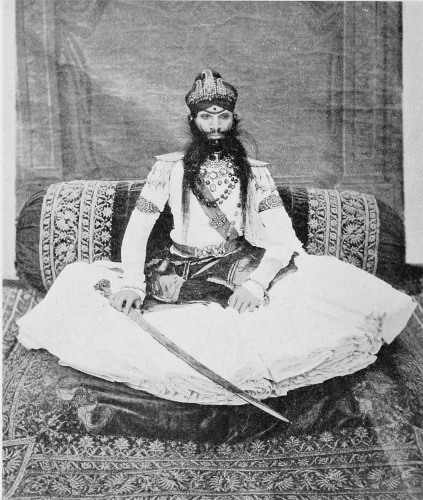
RAGHUBĪR SINGH, MĀHĀRAO RĀJA OF BŪNDI.
To face page 1441.
BOOK X ANNALS OF HĀRAVATI BUNDI — CHAPTER 1 — Hāravati. — The Origin of the Chauhāns. — Mānika Mānika Rāē. — Bīsaldeo. — Gūga, Gugga Chauhān. — The Delhi Pillar. — Date of Visaladeva. — Rāo Chand. — Angatsi, the Hun. — Rāo Dewa. — The Foundation of Būndi. — CHAPTER 2 — Recapitulation of Hāra History. — Abdication of Rāo Dewa. — Rāo Napuji. — Napuji. — Hamuji. Alu. — Mewār attempts to regain Influence in Būndi. — Rāo Bīr Singh. — Rāo Banda, c. A.D. 1485. — Rāo Nārāyandās. — The Siege of Chitor. — Rāo Sūrajmall, c. A.D. 1533. — Murder of Rāo Sūrajmall. — The Satis. — Rāo Surthān, c. A.D. 1534. — Rāo Arjun. — CHAPTER 3 — Rāo Surjan, A.D. 1554. — Siege of Ranthambhor by Akbar. — Rāo Surjan in the Imperial Service. — The Campaign in Gujarāt. — Death of Akbar. — Rāo Ratan. — Partition of Hāraoti. — Gopināth. — The Fiefs of Būndi. — Rāo Chhattarsāl, A.D. 1652-58. — Death of Shāh Jahān. War of Succession. — Rāo Bhāo Singh, A.D. 1658-78. Mughal Attack on Būndi. — Rāo Aniruddh Singh, A.D. 1678. — Rāo Budh Singh. The Death of Aurangzeb. — Battle of Jājau, June 10, 1707. — Rivalry between Kotah and Būndi. — Jai Singh of Jaipur attacks Būndi. — Death of Rāo Būdh Singh. — CHAPTER 4 — Mahārāo Ummed Singh, A.D. 1743-1804. — Jaipur attacks Kotah. — Battle of Dablāna. — Būndi recovered by Ummed Singh. — Būndi occupied by Jaipur. — Ummed Singh in Exile. — Malhār Rāo Holkar assists Ummed Singh. — Jaipur forced to restore Ummed Singh. — Zālim Singh of Kotah. — Ummed Singh’s Revenge on Indargarh. — Abdication of Mahārāo Ummed Singh. — The Wanderings of Ummed Singh. — Murder of Rāna Ari Singh. — The Obsequies of Rāna Ari Singh. — Death of Mahārāo Ajīt Singh. — Mahārāo Bishan Singh, A.D. 1770-1821. — Colonel Monson’s Campaign. — Compensation to Būndi after the Pindāri War. — Death and Character of Mahārāo Bishan Singh. — The Ministers of Būndi. — KOTAH CHAPTER 5 — Formation of Kotah State. — Rāo Mādho Singh, c. A.D. 1625-30. — Rāo Mukund Singh, A.D. 1630-57. — Rāo Jagat Singh, A.D. 1657-70. — Rāo Pem Singh, A.D. 1670. — Rāo Kishor Singh I. A.D. 1670-86. — Rāo Rām Singh, A.D. 1686-1707. — Rāo Bhīm Singh, A.D. 1707-20. — Loss of the Hāra Tribal God. — Rāo Bhīm Singh attacks Būndi. — Mahārāo Arjun Singh, A.D. 1720-24. — Mahārāo Durjansāl, A.D. 1724-56. The Marātha Invasion. — Jaipur claims to control Kotah. — Birth of Zālim Singh. — Death and Character of Durjansāl. — Mahārāo Ajīt Singh, A.D. 1756-59. Mahārāo Chhattarsāl, A.D. 1759-66. — Jaipur attacks Kotah. — CHAPTER 6 — Mahārāo Gumān Singh, A.D . 1766-71. — Zālim Singh Jhāla. — Zālim Singh retires to Mewār. — Zālim Singh returns to Kotah. — Gallant Death of Mādho Singh. — Zālim Singh appointed Guardian of the Heir. — Mahārāo Ummed Singh, A.D. 1771-1819. — Zālim Singh Regent of Kotah. — Murder of Sarūp Singh. — Zālim Singh’s Triumph over his Opponents. — Conspiracy against Zālim Singh. — CHAPTER 7 — Legislation of Zālim Singh. — Superstition of Zālim Singh. — His Permanent Camp. — Land Revenue Collections. — Possibility of Representative Government. — A Revenue Board. — The Bohra. — Suppression of the Patel System. — Modes of realizing Land-Rent. — CHAPTER 8 — The Farming Monopoly. — Agriculture in Kotah. — Storage of Grain. — Extortionate Taxes. — Zālim Singh and the Bards. — CHAPTER 9 — Foreign Policy of Zālim Singh. — Monson’s Campaign. Gallantry of the Koila Chief. — Relations with Marāthas and Pindāris. — Zālim Singh’s Domestic Policy. Character of Mahārāo Ummed Singh. — Zālim Singh and his Servants. — CHAPTER 10 — Alliance with the British. — Death of Mahārāo Ummed Singh. Disputed Succession. — Effects of the British Treaty. — Outbreak at Kotah. — Reconciliation of Mahārāo Kishor Singh with Zālim Singh. — Re-installation of Kishor Singh. — Reforms in Taxation. — CHAPTER 11 — Banishment of Gordhandās. — British Intervention. — The Mahārāo marches on Kotah. — Battle of Māngrol. — Death of Prithi Singh. — Devotion of Two Hāras. — Reflections on the Outbreak. — Restoration of the Mahārāo. — Arrangements with the Mahārāo. — Character of Zālim Singh. — Zālim Singh and Witches. — Amusements of Zālim Singh. — His Gardens. — Wrestling. — The Last Years of Zālim Singh.
1441
—Haravati, or Haraoti, ‘the country of the Haras,’
comprehends two principalities, namely, Kotah and Bundi.
The Chambal intersects the territory of the Hara race, and now
serves as their boundary, although only three centuries have
elapsed since the younger branch separated from and became
independent of Bundi.
The Hara is the most important of the twenty-four Chauhan
sakha, being descended from Anuraj, the son of Manik Rae, king
of Ajmer, who in S. 741 (A.D. 685) sustained the first shock of the
Islamite arms.[1]
—We have already sketched the
pedigree of the Chauhans,
[2] one of the most illustrious of the
‘Thirty-six Royal Races’ of India.
[3] We must, however, in this
1442place, enter into it somewhat more fully; and in doing so, we
must not discard even the fables of their origin, which will at
least demonstrate that the human understanding has been
similarly constructed in all ages and countries, before the thick
veil of ignorance and superstition was withdrawn from it. So
scanty are the remote records of the Chauhans, that it would
savour of affectation to attempt a division of the periods of their
history, or the improbable, the probable, and the certain. Of
the first two, a separation would be impracticable, and we cannot
trace the latter beyond the seventh century.
“When the impieties of the kings of the warrior race drew
upon them the vengeance of Parasurama, who twenty-one times
extirpated that race, some, in order to save their lives, called
themselves bards; others assumed the guise of women; and thus
the singh (horn) of the Rajputs was preserved, when dominion
was assigned to the Brahmans. The impious avarice of Sahasra
Arjuna, of the Haihaya race, king of Maheswar[4] on the Nerbudda,
provoked the last war, having slain the father of Parasurama [440].
“But as the chief weapon of the Brahman is his curse or
blessing, great disorders soon ensued from the want of the strong
arm. Ignorance and infidelity spread over the land; the sacred
books were trampled under foot, and mankind had no refuge from
the monstrous brood.[5] In this exigence, Viswamitra, the instructor
in arms[6] of Bhagwan, revolved within his own mind,
and determined upon, the re-creation of the Chhattris. He
chose for this rite the summit of Mount Abu,[7] where dwell the
hermits and sages (Munis and Rishis) constantly occupied in the
duties of religion, and who had carried their complaints even to
the khir samudra (sea of curds), where they saw the Father of
1443Creation floating upon the hydra (emblem of eternity). He
desired them to regenerate the warrior race, and they returned
to Mount Abu with Indra, Brahma, Rudra, Vishnu, and all the
inferior divinities, in their train. The fire-fountain (analkund)
was lustrated with the waters of the Ganges; expiatory rites
were performed, and, after a protracted debate, it was resolved
that Indra should initiate the work of re-creation. Having
formed an image (putli) of the durva grass, he sprinkled it with
the water of life, and threw it into the fire-fountain. Thence, on
pronouncing the sanjivan mantra (incantation to give life), a
figure slowly emerged from the flame, bearing in the right hand
a mace, and exclaiming, 'Mar! mar!' (slay, slay). He was
called Pramar; and Abu, Dhar, and Ujjain were assigned to him
as a territory.
“Brahma was then entreated to frame one from his own
essence (ansa). He made an image, threw it into the pit, whence
issued a figure armed with a sword (khadga) in one hand, with the
Veda in the other, and a janeo round his neck. He was named
Chalukya or Solanki, and Anhilpur Patan was appropriated to
him.
“Rudra formed the third. The image was sprinkled with the
water of the Ganges, and on the incantation being read, a black
ill-favoured figure arose, armed with the dhanush or bow. As
his foot slipped when sent against the demons, he was called
Parihar, and placed as the pauliya, or guardian of the gates. He
had the Naunangal Marusthali, or ‘nine habitations of the desert,’
assigned him.him.
“The fourth was formed by Vishnu; when an image like
himself four-armed, each having a separate weapon, issued from
the flames, and was thence styled Chaturbhuja Chauhan, or the
‘four-armed.’ The gods bestowed their blessing upon him, and
Mahishmati-nagari as a territory. Such was the name of Garha-Mandla
in the Dwapur, or silver age [441].[8]
“The Daityas were watching the rites, and two of their leaders
were close to the fire-fountain; but the work of regeneration
being over, the new-born warriors were sent against the infidels,
when a desperate encounter ensued. But as fast as the blood of
1444the demons was shed, young demons arose; when the four
tutelary divinities, attendant on each newly-created race, drank
up the blood, and thus stopped the multiplication of evil. These
were—
Asapurna of the Chauhan.
Gajan Mata of the Parihar.
Keonj Mata of the Solanki.
Sancher Mata of the Pramara.
[9]
“When the Daityas were slain, shouts of joy rent the sky;
ambrosial showers were shed from heaven; and the gods drove
their cars (vahan) about the firmament, exulting at the victory
thus achieved.
“Of all the Thirty-six Royal Races (says Chand, the great bard
of the Chauhans), the Agnikula is the greatest: the rest were
born of woman; these were created by the Brahmans![10]—Gotracharya
of the Chauhans, Sama Veda, Somvansa, Madhuvani
sakha, Vacha gotra, Panch parwar janeo, Laktankari nikas,
Chandrabhaga Nadi, Brighu nishan, Ambika-Bhavani, Balan
Putra, Kalbhairon, Abu Achaleswar Mahadeo, Chaturbhuja
Chauhan.”
The period of this grand convocation of the gods on Mount
Abu, to regenerate the warrior race of Hind, and to incite them
against ‘the infidel races who had spread over the land,’ is
dated so far back as the opening of the second age of the Hindus:
a point which we shall not dispute. Neither shall we throw a
doubt upon the chronicles which claim Prince Salya, one of the
great heroes of the Mahabharata, as an intermediate link between
Anhal Chauhan and Satpati, who founded Mahishmati, and
1445conquered the Konkan; while another son, called Tantar Pal,
conquered Asir and Gualkund (Golkonda), planted his garrisons
in every region, and possessed nine hundred elephants to carry
pakhals, or water-skins [442].
Let us here pause for a moment before we proceed with the
chronicle, and inquire who were these warriors, thus regenerated
to fight the battles of Brahmanism, and brought within the pale
of their faith. They must have been either the aboriginal debased
classes, raised to moral importance, by the ministers of
the pervading religion, or foreign races who had obtained a footing
amongst them. The contrasted physical appearance of the
respective races will decide this question. The aborigines are
dark, diminutive, and ill-favoured; the Agnikulas are of good
stature, and fair, with prominent features, like those of the
Parthian kings. The ideas which pervade their martial poetry
are such as were held by the Scythian in distant ages, and which
even Brahmanism has failed to eradicate; while the tumuli,
containing ashes and arms, discovered throughout India, especially
in the south about Gualkund, where the Chauhans held
sway,[11] indicate the nomadic warrior of the north as the proselyte
of Mount Abu.
Of the four Agnikula races, the Chauhans were the first who
obtained extensive dominions. The almost universal power of
the Pramaras is proverbial; but the wide sway possessed by the
Chauhans can only be discovered with difficulty. Their glory
was on the wane when that of the Pramaras was in the zenith;
and if we may credit the last great bard of the Rajputs, the
Chauhans held in capite of the Pramaras of Telingana, in the
eighth century of Vikrama, though the name of Prithiraj threw
a parting ray of splendour upon the whole line of his ancestry,
even to the fire-fountain on the summit of classic Abu.
The facts to be gleaned in the early page of the chronicle are
contained in a few stanzas, which proclaim the possession of
paramount power, though probably of no lengthened duration.
The line of the Nerbudda, from Mahishmati, Maheswar, was
their primitive seat of sovereignty, comprehending all the tracts
in its vicinity both north and south. Thence, as they multiplied,
they spread over the peninsula, possessing Mandu, Asir, Golkonda,
1446and the Konkan;[12] while to the north, [443] they stretched even
to the fountains of the Ganges. The following is the bard’s
picture of the Chauhan dominion:—
“From ‘the seat of government’ (rajasthan) Mahishmati,
the oath of allegiance (an) resounded in fifty-two castles. The
land of Tatta, Lahore, Multan, Peshawar,[13] the Chauhan in his
might arose and conquered even to the hills of Badarinath.
The infidels (Asuras) fled, and allegiance was proclaimed in Delhi
and Kabul, while the country of Nepal he bestowed on the
Mallani.[14] Crowned with the blessing of the gods, he returned to
Mahishmati.”
It has already been observed, that Mahishmati-Nagari was
the ancient name of Garha-Mandla, whose princes for ages continued
the surname of Pal, indicative, it is recorded by tradition,
of their nomadic occupation. The Ahirs, who occupied all
Central India, and have left in one nook (Ahirwara) a memorial
of their existence, was a branch of the same race, Ahir being a
synonym for Pal.[15] Bhilsa, Bhojpur, Dip, Bhopal, Eran, Garaspur,
are a few of the ancient towns established by the Pals or Palis;
and could we master the still unknown characters appertaining
to the early colonists of India, more light would be thrown on the
history of the Chauhans.[16]
A scion from Mahishmati, named Ajaipal, established himself
1447at Ajmer,[17] and erected its castle of Taragarh. The name of
Ajaipal is one of the most conspicuous that tradition has preserved,
and is always followed by the epithet of Chakravartin, or universal
potentate. His era must ever remain doubtful, unless,
as already observed, we should master the characters said to
belong to this race, and which are still extant, both on stone and
on copper.[18] From what cause is not stated (most probably a
failure of [444] lineal issue), Prithi Pahar was brought from
Mahishmati to Ajmer. By a single wife (for polygamy was
then unknown to these races) he had twenty-four sons, whose
progeny peopled these regions, one of whose descendants,
Manika Rae, was lord of Ajmer and Sambhar, in the year
S. 741, or A.D. 685.
—With the name of Manika Rae, the history of
the Chauhan emerges from obscurity, if not fable; and although
the bard does not subsequently entertain us with much substantial
information, we can trace his subject, and see his heroes fret
their hour upon the uncertain stage, throughout a period of twelve
hundred years. It was at this era (A.D. 685) that Rajputana
was first visited by the arms of Islam, being the sixty-third year
of the Hejira. Manika Rae, then prince of Ajmer, was slain by
the Asuras, and his only child, named Lot, then an infant of
seven years of age, was killed by an arrow while playing on the
battlements (kunguras). The invasion is said to have been from
Sind, in revenge for the ill-treatment of an Islamite missionary
1448named Roshan Ali, though the complexion of the event is more
like an enterprise prompted by religious enthusiasm. The
missionary being condemned to lose his thumb “the disjointed
member flew to Mecca,” and gave evidence against the Rajput
idolater; when a force was prepared, disguised as a caravan of
horse-merchants, which surprised and slew Dhola Rae and his
son, and obtained possession of Garhbitli, the citadel.
Puerile as is the transaction, its truth is substantiated by the
fact that the Caliph Omar at this very time sent an army to
Sind, whose commander, Abu-l-lais, was slain in an attempt on
the ancient capital, Alor.[19] Still nothing but the enthusiasm of
religious frenzy could have induced a band to cross the desert
in order to punish this insult to the new faith.
Whatever were the means, however, by which Ajmer was
captured, and Dhola Rae slain, the importance of the event has
been deeply imprinted on the Chauhans; who, in remembrance
of it, deified the youthful heir of Ajmer: “Lot putra” is still
the most conspicuous of the Chauhan penates. The day on which
he was killed is sanctified, and his effigy then receives divine
honours from all who have the name of Chauhan. Even the
anklet of bells which he wore has become an object of veneration,
and is forbidden to be used by the children of this race.
“Of the house of Dhola Rae of Chauhan race, Lotdeo, the
heir-apparent by the decree of Siva, on Monday the 12th of the
month of Jeth, went to heaven.”
Manika Rae, the uncle of the youth (putra) (who is still the
object of general homage, especially of the Chauhan fair), upon
the occupation of Ajmer, retired upon [445] Sambhar, which
event another couplet fixes, as we have said, in S. 741.[20] Here
1449the bard has recourse to celestial interposition in order to support
Manika Rae in his adversity. The goddess Sakambhari appears
to him, while seeking shelter from the pursuit of this merciless
foe, and bids him establish himself in the spot where she manifested
herself, guaranteeing to him the possession of all the ground
he could encompass with his horse on that day; but commanded
him not to look back until he had returned to the spot where he
left her. He commenced the circuit, with what he deemed his
steed could accomplish, but forgetting the injunction, he was
surprised to see the whole space covered as with a sheet. This
was the desiccated sar, or salt-lake, which he named after his
patroness Sakambhari, whose statue still exists on a small island
in the lake, now corrupted to Sambhar.[21]
However jejune these legends of the first days of Chauhan
power, they suffice to mark with exactness their locality; and
the importance attached to this settlement is manifested in the
title of ‘Sambhari Rao,’ maintained by Prithiraj, the descendant
of Manika Rae, even when emperor of all Northern India.
Manika Rae, whom we may consider as the founder of the
Chauhans of the north, recovered Ajmer. He had a numerous
progeny, who established many petty dynasties throughout
Western Rajwara, giving birth to various tribes, which are spread
even to the Indus. The Khichi,[22] the Hara, the Mohil, Nirwana,
Bhadauria, Bhaurecha, Dhanetia, and Baghrecha, are all descended
from him.[23] The Khichis were established in the remote
Duab, called Sind-Sagar, comprising all the tract between the
Behat and the Sind, a space of sixty-eight coss, whose capital
was Khichpur-Patan. The Haras obtained or founded Asi
(Hansi) in Hariana; while another tribe held Gualkund, the
celebrated Golkonda, now Haidarabad, and when thence expelled,
regained Asir. The Mohils had the tracts round Nagor.[24] The
1450Bhadaurias had an appanage on the Chambal, in a tract which
bears their name, and [446] is still subject to them. The
Dhanetias settled at Shahabad, which by a singular fatality has
at length come into the possession of the Haras of Kotah.
Another branch fixed at Nadol, but never changed the name of
Chauhan.[25]
Many chieftainships were scattered over the desert, either
trusting to their lances to maintain their independence, or holding
of superiors; but a notice of them, however interesting, would
here, perhaps, be out of place. Eleven princes are enumerated
in the Jaga’s catalogue, from Manika Rae to Bisaldeo,[26] a name
of the highest celebrity in the Rajput annals, and a landmark to
various authorities, who otherwise have little in common even
in their genealogies, which I pass over in silence, with the exception
1451of the intermediate name of Harsraj,[27] common to the Hamir
Raesa as well as the Jaga’s list. The authority of Harsraj
stretched along the Aravalli mountains to Abu, and east of the
Chambal. He ruled from S. 812 to 827 (A.H. 138 to 153), and fell
in battle against the Asuras, having attained the title of Arimurdan.[28]
Ferishta says, that “in A.H. 143, the Muslims greatly
increased, when issuing from their hills they obtained possession
of Karman, Peshawar, and all the lands adjacent; and that the
Raja of Lahore, who was of the family of the Raja of Ajmer,
sent his brother[29] against these Afghans, who were reinforced by
the tribes of Khilj, of Ghor and Kabul, just become proselytes
to Islam”;[29] and he adds, that during five months, seventy
battles were fought with success; or, to use the historian’s own
words, “in which Sipahi sarma (General Frost) was victorious
over the infidel, but who returned when the cold season was
passed with fresh force. The armies met [447] between Karman
and Peshawar; sometimes the infidel (Rajput) carried the war
to the Kohistan, ‘mountainous regions,’ and drove the Musalmans
before him; sometimes the Musalmans, obtaining reinforcements,
drove the infidel by flights of arrows to their own borders,
to which they always retired when the torrents swelled the
Nilab (Indus).”
Whether the Raja of Ajmer personally engaged in these
distant combats the chronicle says not. According to the Hamir
Raesa, Harsraj was succeeded by Dujgandeo, whose advanced
post was Bhatner, and who overcame Nasiru-d-din, from whom
he captured twelve hundred horse, and hence bore the epithet of
Sultan Graha, or ‘King-seizer.’ Nasiru-d-din was the title of
the celebrated Sabuktigin, father to the still more celebrated
Mahmud. Sabuktigin repeatedly invaded India during the
fifteen years’ reign of his predecessor Alptigin.
1452—Passing over the intermediate reigns, each of which
is marked by some meagre and unsatisfactory details of battles
with the Islamite, we arrive at Bisaldeo. The father of this prince,
according to the Hara genealogists, was Dharmagaj, apparently a
title—'in faith like an elephant'—as in the Jaga’s list is Bir
Bilandeo, confirmed by the inscription on the triumphal column
at Delhi. The last of Mahmud’s invasions occurred during the
reign of Bilandeo, who, at the expense of his life, had the glory
of humbling the mighty conqueror, and forcing him to relinquish
the siege of Ajmer.
[30] Before we condense the scanty records of
the bards concerning Visaladeva,
[31] we may spare a few words to
commemorate a Chauhan who consecrated his name, and that
of all his kin, by his deeds in the first passage of Mahmud into
India.
—Guga Chauhan was the son of Vacha
Raja, a name of some celebrity. He held the whole of Jangaldes,
or the forest lands from the Sutlej to Hariana; his capital, called
Mahara, or, as pronounced, Guga ka Mahra, was on the Sutlej.
In defending this he fell, with forty-five sons and sixty nephews;
and as it occurred on Sunday (
Rabiwar), the ninth (
naumi) of
the month, that day is held sacred to the manes of Guga by the
‘Thirty-six Classes’
[32] throughout Rajputana, but especially in
the desert, a portion of which is yet called Gugadeo ka thal.
Even his steed, Javadia,
[33] has been immortalized [448] and has
become a favourite name for a war-horse throughout Rajputana,
1453whose mighty men swear 'by the
sakha of Guga,' for maintaining
the Rajput fame when Mahmud crossed the Sutlej.
This was probably the last of Mahmud’s invasions, when he
marched direct from Multan through the desert. He attacked
Ajmer, which was abandoned, and the country around given up to
devastation and plunder. The citadel, Garhbitli, however, held
out, and Mahmud was foiled, wounded, and obliged to retreat by
Nadol,[34] another Chauhan possession, which he sacked, and then
proceeded to Nahrwala, which he captured. His barbarities
promoted a coalition, which, by compelling him to march through
the western deserts to gain the valley of Sind, had nearly proved
fatal to his army.
The exploits of Bisaldeo form one of the books of Chand the
bard. The date assigned to Bisaldeo in the Raesa (S. 921) is
interpolated—a vice not uncommon with the Rajput bard, whose
periods acquire verification from less mutable materials than those
out of which he weaves his song.[35]
Chand gives an animated picture of the levy of the Rajput
chivalry, which assembled under Bisaldeo, who, as the champion
of the Hindu faith, was chosen to lead its warriors against the
Islamite invader. The Chalukya king of Anhilwara alone refused
to join the confederation, and in terms which drew upon him the
vengeance of the Chauhan. A literal translation of the passage
may be interesting:
“To the Goelwal Jeth, the prince entrusted Ajmer, saying,
‘On your fealty I depend’; where can this Chalukya find refuge?
He moved from the city (Ajmer) and encamped on the lake
Visala,[36] and summoned his tributaries and vassals to meet him.
1454Mansi Parihar with the array of Mandor, touched his feet.[37] Then
came the Guhilot, the ornament of the throng;[38] and the Pawasar
[449], with Tuar,[39] and Rama the Gaur;[40] with Mohes the lord of
Mewat.[41] The Mohil of Dunapur with tribute sent excuse.[42] With
folded hands arrived the Baloch,[43] but the lord of Bamani abandoned
Sind.[44] Then came the Nazar from Bhatner,[45] and the
Nalbandi from Tatta[46] and Multan.[46] When the summons reached
the Bhumia Bhatti of Derawar,[47] all obeyed; as did the Jadon of
1455Malanwas.[48] The Mori[49] and Bargujar[49] also joined with the
Kachhwahas of Antarved.[49] The subjugated Meras worshipped
his feet.[50] Then came the array of Takatpur, headed by the
Goelwal Jeth.[51] Mounted in haste came Udaya Pramar,[52] with
the Nirwan[53] and the Dor,[54] the Chandel,[54] and the Dahima.”[55]
In this short passage, a text is afforded for a dissertation on
the whole genealogical history of Rajputana at that period. Such
extracts from the more ancient bards, incorporated in the works
of their successors, however laconic, afford decisive evidence [450]
that their poetic chronicles bore always the same character;
for this passage is introduced by Chand merely as a preface to
the history of his own prince, Prithiraj, the descendant of
Bisaldeo.
A similar passage was given from the ancient chronicles of
Mewar, recording an invasion of the Muslims, of which the
histories of the invaders have left no trace (Vol. I. p. 287). The
evidence of both is incontestable; every name affords a synchronism
not to be disputed; and though the isolated passage
would afford a very faint ray of light to the explorer of those days
of darkness, yet when the same industrious research has pervaded
the annals of all these races, a flood of illumination pours upon us,
and we can at least tell who the races were who held sway in these
regions a thousand years ago.
Amidst meagre, jejune, and unsatisfactory details, the annalist
of Rajputana must be content to wade on, in order to obtain some
solid foundation for the history of the tribes; but such facts as
these stimulate his exertions and reward his toil: without them,
1456his task would be hopeless. To each of the twenty tribes enumerated,
formed under the standard of the Chauhan, we append a
separate notice, for the satisfaction of the few who can appreciate
their importance, while some general remarks may suffice as a
connexion with the immediate object of research, the Haras,
descended from Bisaldeo.
In the first place, it is of no small moment to be enabled to
adjust the date of Bisaldeo, the most important name in the annals
of the Chauhans from Manik Rae to Prithiraj, and a slip from the
genealogical tree will elucidate our remarks [451].[56]
—The name of Bisaldeo (Visaladeva) heads
the inscription on the celebrated column erected in the centre of
Firoz Shah’s palace at Delhi. This column, alluded to by Chand,
as “telling the fame of the Chohan,” was “placed at Nigambhod,”
a place of pilgrimage on the Jumna, a few miles below Delhi,
whence it must have been removed to its present singular position.
[57][From Anhal to Bilandeo, these are but a few of the leading names. From
Bilandeo the chain is continuous to the last Chauhan king, Prithiraj.]
| |
|
|
|
|
|
┌ |
Or Agnipala, ‘offspring of fire,’ |
| |
|
|
|
|
|
│ |
the first Chauhan; probable period 650 |
| |
|
|
|
|
|
│ |
before Vikrama, when an invasion |
| |
|
|
Anhal |
|
┤ |
of the Turushkas took place; |
| |
|
|
|
|
|
│ |
established Mahishmati-nagari |
| |
|
|
|
|
|
│ |
(Garha-mandala); conquered the |
| |
|
|
|
|
|
└ |
Konkan, Asir, Golkonda. |
| |
|
|
Savacha |
|
|
|
| |
|
|
|
|
|
|
|
| |
|
|
Malan |
|
┌ |
In all probability this is the patriarch |
| |
|
|
|
|
|
└ |
of the Mallani tribe, see p. 1272. |
| |
|
|
Ganal Sur |
|
|
|
| |
|
|
|
|
|
┌ |
Or universal potentate; founder of |
| |
|
|
|
|
|
│ |
Ajmer. Same authorities say, in |
| S. 202 |
Ajaipala Chakravartin |
|
┤ |
202 of the Vikrama; others of the |
| |
|
|
|
|
|
│ |
Virat-Samvat: the latter is the |
| |
|
|
|
|
|
└ |
most probable. |
| |
|
|
|
|
|
┌ |
Slain, and lost Ajmer, on the first |
| |
|
|
Dhola Rae |
|
┤ |
irruption of the Muhammadans, S. |
| |
|
|
|
|
|
└ |
741, A.D. 685. |
| |
|
|
|
|
|
┌ |
Founded Sambhar: hence the title |
| S. 741 |
|
Manika Rae |
|
┤ |
of Sambhari-Rao borne by the |
| |
|
|
|
|
|
└ |
Chauhan princes, his issue. |
| S. 827 |
|
Harsraj |
|
┌ |
Defeated Nasiru-d-din (qu. Sabuktigin?), ' |
| |
|
|
|
|
|
└ |
thence styled 'Sultan-graha. |
| |
|
|
Bir Bilandeo |
|
┌ |
Or Dharmagaj; slain defending |
| |
|
|
|
|
|
└ |
Ajmer against Mahmud of Ghazni. |
| S. 1065 to |
|
|
|
|
┌ |
(Classically, Visaladeva); his period, |
| 1130 |
|
Bisaldeo |
|
┤ |
from various inscriptions, S. 1066 |
| |
|
|
|
|
|
└ |
to S. 1130. |
| |
|
|
Sarangdeo |
|
|
Died in nonage. |
| |
|
|
|
|
|
|
|
| |
|
|
Ana |
|
┌ |
Constructed the Ana-Sagar at |
| |
|
|
|
|
|
└ |
Ajmer; still bears his name. |
| |
|
|
|
|
|
|
|
| |
Jaipal. |
|
Harspal. |
|
|
| |
|
|
|
|
|
|
|
| |
|
|
|
|
|
|
|
| |
Ajaideo, |
Bijaideo. |
Udaideo. |
|
| |
or |
|
|
|
|
|
| |
Ananddeo. |
|
|
|
|
|
| |
|
|
|
|
|
|
|
| |
|
|
|
|
|
|
|
| Someswar: |
Kan Rae. |
Jeth, Goelwal. |
| married Ruka Bai, |
|
|
|
|
|
| daughter of Anangpal |
|
|
|
|
|
| Tuar king of Delhi. |
|
|
|
|
|
| |
|
|
Isardas; |
|
|
| |
|
|
turned Muhammadan. |
|
|
| |
|
|
|
|
|
|
|
| |
|
|
|
|
|
|
|
| Prithiraj; |
Chahirdeo. |
|
|
| obtained Delhi; slain by |
|
|
|
|
|
| Shihabu-d-din, S. 1249, |
|
|
|
|
|
| A.D. 1193. |
|
|
|
|
|
| |
|
|
Vijaya Raj. |
┌ |
Adopted successor to Prithiraj; his |
| |
|
|
|
|
└ |
name is on the pillar at Delhi. |
| |
|
|
|
|
|
|
|
| |
|
|
|
┌ |
Had twenty-one sons; seven of whom were legitimate, |
| Rainsi; |
|
│ |
the others illegitimate, and founders of mixed tribes. |
| slain in the sack |
Lakhansi |
┤ |
From Lakhansi there are twenty-six generations to |
| of Delhi. |
|
│ |
Noniddh Singh, the present chieftain of Nimrana, the |
| |
|
|
|
└ |
nearest lineal descendant of Ajaipal and Prithiraj. |
[452]
The inscription commences and ends with the same date,
namely, 15th of the month Baisakh, S. 1220. If correctly copied,
it can have no reference to Bisaldeo, excepting as the ancestor of
Prativa Chahumana tilaka Sakambhari bhupati; or ‘Prithiraja
Chauhan, the anointed of Sambhar, Lord of the earth,’ who ruled
at Delhi in S. 1220, and was slain in S. 1249, retaining the ancient
epithet of ‘Lord of Sambhar,’ one of the early seats of their
power.[58] The second stanza, however, tells us we must distrust
1458the first of the two dates, and read 1120 (instead of 1220), when
Visaladeva “exterminated the barbarians” from Aryavarta.
The numerals 1 and 2 in Sanskrit are easily mistaken. If, however,
it is decidedly 1220, then the whole inscription belongs to
Prativa Chahumana, between whom and Visala no less than six
princes intervene,[59] and the opening is merely to introduce
Prithiraja’s lineage, in which the sculptor has foisted in the date.
I feel inclined to assign the first stanza to Visaladeva (Bisaldeo),
and what follows to his descendant Prithiraj, who by a conceit
may have availed himself of the anniversary of the victory of his
ancestor, to record his own exploits. These exploits were precisely
of the same nature—successful war against the Islamite,
in which each drove him from Aryavarta; for even the Muslim
writers acknowledge that Shihabu-d-din was often ignominiously
defeated before he finally succeeded in making a conquest of
northern India [453].
—If, as I surmise, the first stanza belongs
to Bisaldeo, the date is S. 1120, or A.D. 1064, and this grand
1459confederation described by the Chauhan bard was assembled
under his banner, preparatory to the very success, to commemorate
which the inscription was recorded.
In the passage quoted from Chand, recording the princes who
led their household troops under Bisaldeo, there are four names
which establish synchronisms: one by which we arrive directly
at the date, and three indirectly. The first is Udayaditya Pramar,
king of Dhar (son of Raja Bhoj), whose period I established from
numerous inscriptions,[60] as between S. 1100 and S. 1150; so that
the date of his joining the expedition would be about the middle
of his reign. The indirect but equally strong testimony consists of,
First, The mention of “the Bhumia Bhatti from Derawar”;[61]
for had there been anything apocryphal in Chand, Jaisalmer, the
present capital, would have been given as the Bhatti abode.[62]
Second, The Kachhwahas, who are also described as coming
from Antarved (the region between the Jumna and Ganges); for
the infant colony transmitted from Narwar to Amber was yet
undistinguished.
The third proof is in the Mewar inscription, when Tejsi, the
grandfather of Samarsi, is described as in alliance with Bisaldeo.
Bisaldeo is said to have lived sixty-four years. Supposing this
date, S. 1120, to be the medium point of his existence, this would
make his date S. 1088 to S. 1152, or A.D. 1032 to A.D. 1096; but
as his father, Dharmagaj, ‘the elephant in faith,’ or Bir Bilandeo
(called Malandeo, in the Hamir Raesa), was killed defending
Ajmer on the last invasion of Mahmud, we must necessarily place
Bisal’s birth (supposing him an infant on that event), ten years
earlier, or A.D. 1022 (S. 1078), to A.D. 1086 (S. 1142), comprehending
the date on the pillar of Delhi, and by computation all the periods
1460mentioned in the catalogue. We may therefore safely adopt the
date of the Raesa, namely S. 1066 to S. 1130.
Bisaldeo was, therefore, contemporary with Jaipal, the Tuar
king of Delhi; with [454] Durlabha and Bhima of Gujarat; with
Bhoj and Udayaditya of Dhar; with Padamsi and Tejsi of Mewar;
and the confederacy which he headed must have been that against
the Islamite king Maudud, the fourth from Mahmud of Ghazni,
whose expulsion from the northern parts of Rajputana (as recorded
on the pillar of Delhi) caused Aryavarta again to become
‘the land of virtue.’ Mahmud’s final retreat from India by Sind,
to avoid the armies collected “by Bairamdeo and the prince of
Ajmer” to oppose him, was in A.H. 417, A.D. 1026, or S. 1082,
nearly the same date as that assigned by Chand, S. 1086.[63]
We could dilate on the war which Bisaldeo waged against the
prince of Gujarat, his victory, and the erection of Bisalnagar,[64]
on the spot where victory perched upon his lance; but this we reserve
for the introduction of the history of the illustrious Prithiraj.
There is much fable mixed up with the history of Bisaldeo,
apparently invented to hide a blot in the annals, warranting the
inference that he became a convert, in all likelihood a compulsory
one, to the doctrines of Islam. There is also the appearance of
his subsequent expiation of this crime in the garb of a penitent;
and the mound (dhundh), where he took up his abode, still exists,
and is called after him, Bisal-ka-dhundh, at Kalakh Jobner.[65]
According to the Book of Kings of Govind Ram (the Hara
bard), the Haras were descended from Anuraj, son of Bisaldeo;
1461but Mogji, the Khichi bard,[66] makes Anuraj progenitor of the
Khichis, and son of Manika Rae. We follow the Hara bard.
Anuraj had assigned to him in appanage the important
frontier fortress of Asi (vulg. Hansi). His son Ishtpal, together
with Aganraj, son of Ajairao, the founder of Khichpur Patan in
Sind-Sagar, was preparing to seek his fortunes with Randhir
Chauhan, prince of Gualkund: but both Asi and Golkonda were
almost simultaneously assailed by an army “from the wilds of
Kujliban.” Randhir performed the sakha; and only a single
female, his daughter, named Surabhi, survived, and she fled for
protection towards Asi, then attacked by the same furious invader.
Anuraj prepared to fly; but his son, Ishtpal, determined not to
wait the attack, but seek the foe. A battle ensued, when the
invader was slain, and Ishtpal, grievously wounded, pursued him
till he fell, near the spot where Surabhi was awaiting death under
the shade of a pipal: for “hopes of life were extinct, and fear and
hunger had [455] reduced her to a skeleton.” In the moment of
despair, however, the asvattha (pipal) tree under which she took
shelter was severed, and Asapurna, the guardian goddess of her
race, appeared before her. To her, Surabhi related how her father
and twelve brothers had fallen in defending Golkonda against
‘the demon of Kujliban.’ The goddess told her to be of good
cheer, for that a Chauhan of her own race had slain him, and was
then at hand; and led her to where Ishtpal lay senseless from his
wounds. By her aid he recovered,[67] and possessed himself of that
ancient heirloom of the Chauhans, the famed fortress of Asir.
Ishtpal, the founder of the Haras, obtained Asir in S. 1081[68]
(or A.D. 1025); and as Mahmud’s last destructive visit to India,
by Multan through the desert to Ajmer, was in A.H. 714, or A.D.
14621022, we have every right to conclude that his father Anuraj
lost his life and Asi to the king of Ghazni; at the same time that
Ajmer was sacked, and the country laid waste by this conqueror,
whom the Hindu bard might well style “the demon from Kujliban.”[69]
The Muhammadan historians give us no hint even of
any portion of Mahmud’s army penetrating into the peninsula,
though that grasping ambition, which considered the shores of
Saurashtra but an intermediate step from Ghazni to the conquest
of Ceylon and Pegu, may have pushed an army during his long
halt at Anhilwara, and have driven Randhir from Golkonda.[70]
But it is idle to speculate upon such slender materials; let them
suffice to illustrate one new fact, namely, that these kingdoms
of the south as well as the north were held by Rajput sovereigns,
whose offspring, blending with the original population, produced
that mixed race of Mahrattas, inheriting with the names the
warlike propensities of their ancestors, but who assume the
name of their abodes as titles, as the Nimbalkars, the Phalkias, the
Patankars, instead of their tribes of Jadon, Tuar, Puar, etc. etc.
Ishtpal had a son called Chandkaran; his son, Lokpal, had
Hamir and Gambhir, names well known in the wars of Prithiraj.
The brothers were enrolled amongst his [456] one hundred and
eight great vassals, from which we may infer that, though Asir
was not considered absolutely as a fief, its chief paid homage to
Ajmer, as the principal seat of the Chauhans.
In the Kanauj Samaya, that book of the poems of Chand
devoted to the famous war in which the Chauhan prince carries
off the princess of Kanauj, honourable mention is made of the
Hara princes in the third day’s fight, when they covered the
retreat of Prithiraj:
“Then did the Hara Rao Hamir, with his brother Gambhir,
mounted on Lakhi steeds,[71] approach their lord, as thus they
1463spoke: ‘Think of thy safety, Jangales,[72] while we make offerings
to the array of Jaichand. Our horses’ hoofs shall plough the
field of fight, like the ship of the ocean.’”
The brothers encountered the contingent of the prince of Kasi
(Benares), one of the great feudatories of Kanauj. As they joined,
“the shout raised by Hamir reached Durga on her rock-bound
throne.” Both brothers fell in these wars, though one of the
few survivors of the last battle fought with Shihabu-d-din for
Rajput independence, was a Hara—
Hamir had Kalkaran, who had Mahamagd: his son was Rao
Bacha; his, Rao Chand.
—Amongst the many independent princes of the
Chauhan race to whom Alau-d-din was the messenger of fate,
was Rao Chand of Asir. Its walls, though deemed impregnable,
were not proof against the skill and valour of this energetic
warrior; and Chand and all his family, with the exception of one
son, were put to the sword. This son was prince Rainsi, a name
fatal to Chauhan heirs, for it was borne by the son of Prithiraj
who fell in the defence of Delhi: but Rainsi of Asir was more
fortunate. He was but an infant of two years and a half old,
and being nephew of the Rana of Chitor, was sent to him for protection.
When he attained man’s estate, he made a successful
attempt upon the ruined castle of Bhainsror, from which he drove
Dunga, a Bhil chief, who, with a band of his mountain brethren,
had made it his retreat. This ancient fief of Mewar had been
dismantled by Alau-d-din in his attack on Chitor, from which the
Ranas had not yet recovered when the young Chauhan came
amongst them for protection.
Rainsi had two sons, Kolan and Kankhal. Kolan being
afflicted with an incurable disease, commenced a pilgrimage to
the sacred Kedarnath, one of the towns of the [457] Ganges. To
obtain the full benefit of this meritorious act, he determined to
measure his length on the ground the whole of this painful journey.
In six months he had only reached the Binda Pass, where, having
bathed in a fountain whence flows the rivulet Banganga, he found
his health greatly restored. Kedarnath[73] was pleased to manifest
1464himself, to accept his devotions, and to declare him ‘King of the
Patar,’ or plateau of Central India.[74] The whole of this tract
was under the princes of Chitor, but the sack of this famed fortress
by Ala, and the enormous slaughter of the Guhilots, had so
weakened their authority, that the aboriginal Minas had once
more possessed themselves of all their native hills, or leagued
with the subordinate vassals of Chitor.
—In ancient times, Raja Hun, said to be of
the Pramara race, was lord of the Patar, and held his court at
Menal. There are many memorials of this Hūn or Hun prince,
and even so far back as the first assault of Chitor, in the eighth
century, its prince was aided in his defence by ‛Angatsi, lord of
the Huns.' The celebrated temples of Barolli are attributed to
this Hun Raja, who appears in so questionable a shape, that we
can scarcely refuse to believe that a branch of this celebrated race
must in the first centuries of Vikrama have been admitted, as
their bards say, amongst the Thirty-six Royal Races of the Rajputs.
Be this as it may, Rao Banga, the grandson of Kolan, took possession
of the ancient Menal, and on an elevation commanding
the western face of the Pathar erected the fortress of Bumbaoda.
With Bhainsror on the east, and Bumbaoda and Menal on the
west, the Haras now occupied the whole extent of the Patar.
Other conquests were made, and Mandalgarh, Bijolli, Begun,
Ratnagarh, and Churetagarh, formed an extensive, if not a rich,
chieftainship.
Rao Banga had twelve sons, who dispersed their progeny over
the Patar. He was succeeded by Dewa, who had three sons,
namely, Harraj,[75] Hatiji, and Samarsi.
—The Haras had now obtained such power as to
attract the attention of the emperor, and Rae Dewa was summoned
to attend the court when Sikandar Lodi ruled.
[76] He
1465[458] therefore installed his son Harraj in Bumbaoda, and with
his youngest, Samarsi, repaired to Delhi. Here he remained,
till the emperor coveting a horse of the ‘king of the Patar,’ the
latter determined to regain his native hills. This steed is famed
both in the annals of the Haras and Khichis, and, like that of the
Mede, had no small share in the future fortunes of his master.
Its birth is thus related. The king had a horse of such mettle,
that “he could cross a stream without wetting his hoof.” Dewa
bribed the royal equerry, and from a mare of the Patar had a
colt, to obtain which the king broke that law which is alike
binding on the Muslim and the Christian. Dewa sent off his
family by degrees, and as soon as they were out of danger, he
saddled his charger, and lance in hand appeared under the balcony
where the emperor was seated. “Farewell, king,” said the
Rangra; “there are three things your majesty must never ask
of a Rajput: his horse, his mistress, and his sword.” He gave
his steed the rein, and in safety regained the Patar. Having
resigned Bumbaoda to Harraj, he came to Bandunal, the spot
where his ancestor Kolan was cured of disease. Here the Minas
of the Usara tribe dwelt, under the patriarchal government of
Jetha, their chief. There was then no regular city; the extremities
of the valley (
thal[77]) were closed with barriers of masonry and
gates, and the huts of the Minas were scattered wherever their
fancy led them to build. At this time the community, which
had professed obedience to the Rana on the sack of Chitor, was
suffering from the raids of Rao Ganga, the Khichi, who from his
castle of Ramgarh (Relawan) imposed '
barchhidohai'
[78] on all
around. To save themselves from Ganga, who used “to drive
his lance at the barrier of Bandu,” the Minas entered into terms,
agreeing, on the full moon of every second month, to suspend the
tribute of the chauth over the barrier. At the appointed time,
the Rao came, but no bag of treasure appeared. “Who has
been before me?” demanded Ganga; when forth issued the
‘lord of the Patar,’ on the steed coveted by the Lodi king.
Ganga of Relawan bestrode a charger not less famed than his
antagonist’s, “which owed his birth to the river-horse of the
Par, and a mare of the Khichi chieftain’s, as she grazed on its
1466margin.
[79] Mounted on this steed, no obstacle could stop him,
and even the Chambal was no impediment to his seizing the
tribute at all seasons from the Minas” [459].
The encounter was fierce, but the Hara was victorious, and
Ganga turned his back on the lord of the Patar, who tried the
mettle of this son of the Par, pursuing him to the banks of the
Chambal. What was his surprise, when Ganga sprang from the
cliff, and horse and rider disappeared in the flood, but soon to
reappear on the opposite bank! Dewa, who stood amazed, no
sooner beheld the Rao emerge, than he exclaimed, “Bravo,
Rajput! Let me know your name.” “Ganga Khichi,” was
the answer. “And mine is Dewa Hara; we are brothers, and
must no longer be enemies. Let the river be our boundary.”
—It was in S. 1398 (
A.D. 1342)
[80] that
Jetha and the Usaras acknowledged Rae Dewa as their lord, who
erected Bundi in the centre of the Bandu-ka-Nal, which henceforth
became the capital of the Haras. The Chambal, which, for
a short time after the adventure here related, continued to be
the barrier to the eastward, was soon overpassed, and the bravery
of the race bringing them into contact with the emperor’s lieutenants,
the Haras rose to favour and power, extending their
acquisitions, either by conquest or grant, to the confines of Malwa.
The territory thus acquired obtained the geographical designation
of Haravati or Haraoti.
[81]
—Having sketched the history
of this race, from the regeneration of Anhal,
[1] the first Chauhan
(at a period which it is impossible to fix), to the establishment of
the first Hara prince in Bundi, we shall here recapitulate the most
conspicuous princes, with [460] their dates, as established by
synchronical events in the annals of other States, or by inscriptions;
and then proceed with the history of the Haras as members
of the great commonwealth of India.
1467Anuraj, obtained Asi or Hansi.
Ishtpal, son of Anuraj; he was expelled from Asi, S. 1081
(A.D. 1025), and obtained Asir. He was founder of the Haras;
the chronicle says not how long after obtaining Asi, but evidently
very soon.
Hamir, killed in the battle of the Ghaggar, on the invasion of
Shihabu-d-din, S. 1249, or A.D. 1193.
Rao Chand, slain in Asir, by Alau-d-din, in S. 1351.
Rainsi, fled from Asir, and came to Mewar, and in S. 1353
obtained Bhainsror.
Rao Banga, obtained Bumbaoda, Menal, etc.
Rao Dewa, S. 1398 (A.D. 1342), took the Bandu valley from
the Minas, founded the city of Bundi, and styled the country
Haravati.
Rao Dewa, whose Mina subjects far outnumbered his Haras,
had recourse, in order to consolidate his authority, to one of those
barbarous acts too common in Rajput conquests. The Rajput
chronicler so far palliates the deed, that he assigns a reason for
it, namely, the insolence of the Mina leader, who dared to ask a
daughter of the ‘lord of the Patar.’ Be this as it may, he
called in the aid of the Haras of Bumbaoda and the Solankis of
Toda, and almost annihilated the Usaras.
—How long it was after this act of
barbarity that Dewa abdicated in favour of his son, is not mentioned,
though it is far from improbable that this crime influenced
his determination. This was the second time of his abdication
of power: first, when he gave Bumbaoda to Harraj, and went
to Sikandar Lodi; and now to Samarsi, the branches of Bundi
and the Patar remaining independent of each other. The act
of abdication confers the title of Jugraj;
[2] or when they conjoin
the authority of the son with the father, the heir is styled Jivaraj.
Four instances of this are on record in the annals of Bundi;
namely, by Dewa, by Narayandas, by Raj Chhattar Sal, and by
Sriji Ummed Singh. It is a rule for a prince never to enter the
capital after abandoning the government; the king is virtually
defunct; he cannot be a subject, and he is no longer a king. To
render the act more impressive, they make an effigy of the abdicated
king, and on the twelfth day following the act (being the
1468usual period of [461] mourning) they commit it to the flames.
[3]
In accordance with this custom, Dewa never afterwards entered
the walls either of Bundi or Bumbaoda,
[4] but resided at the village
of Umarthuna, five coss from the former, till his death.
—Samarsi had three sons: 1. Napuji, who succeeded;
2. Harpal, who obtained Jajawar, and left numerous
issue, called Harpalpotas; and 3. Jethsi, who had the honour of
first extending the Hara name beyond the Chambal. On his
return from a visit to the Tuar chief of Kaithan, he passed the
residence of a community of Bhils, in an extensive ravine near
the river. Taking them by surprise, he attacked them, and they
fell victims to the fury of the Haras. At the entrance of this
ravine, which was defended by an outwork, Jethsi slew the leader
of the Bhils, and erected there a
hathi (elephant) to the god of
battle, Bhairon. He stands on the spot called Char-jhopra,
near the chief portal of the castle of Kotah, a name derived
from a community of Bhils called Kotia.
[5]1469—Napuji, a name of no small note in the chronicles of
Haravati, succeeded Samarsi. Napuji had married a daughter
of the Solanki, chief of Toda,
[6] the lineal descendant of the ancient
kings of Anhilwara. While on a visit to Toda, a slab of beautiful
marble attracted the regard of the Hara Rao, who desired his
bride to ask it of her father. His delicacy was offended, and he
replied, “he supposed the Hara would next ask him for his wife”;
and desired him to depart. Napuji was incensed, and visited his
anger upon his wife, whom he treated with neglect and even
banished from his bed. She complained to her father. On the
Kajri Tij, the joyous third of the [462] month Sawan, when a
Rajput must visit his wife, the vassals of Bundi were dismissed
to their homes to keep the festival sacred to ‘the mother of
births.’ The Toda Rao, taking advantage of the unguarded
state of Bundi, obtained admittance by stealth, and drove his
lance through the head of the Hara Rao. He retired without
observation, and was relating to his attendants the success of his
revenge, when, at this moment, they passed one of the Bundi
vassals, who, seated in a hollow taking his
amal-pani (opium-water),
was meditating on the folly of going home, where no
endearing caresses awaited him from his wife, who was deranged,
and had determined to return to Bundi. While thus absorbed in
gloomy reflections, the trampling of horses met his ear, and soon
was heard the indecent mirth of the Toda Rao’s party, at the
Hara Rao dismissing his vassals and remaining unattended. The
Chauhan guessed the rest, and as the Toda Rao passed close to
1470him, he levelled a blow, which severed his right arm from his body
and brought him from his horse. The Solanki’s attendants took
to flight, and the Chauhan put the severed limb, on which was
the golden bracelet, in his scarf, and proceeded back to Bundi.
Here all was confusion and sorrow. The Solanki queen, true to
her faith, determined to mount the pyre with the murdered body
of her lord; yet equally true to the line whence she sprung, was
praising the vigour of her brother’s arm, “which had made so
many mouths,
[7] that she wanted hands to present a pan to each.”
At the moment she was apostrophizing the dead body of her lord,
his faithful vassal entered, and undoing the scarf presented to
her the dissevered arm, saying, “Perhaps this may aid you.”
She recognized the bracelet, and though, as a Sati, she had done
with this world, and should die in peace with all mankind, she
could not forget, even at that dread moment, that “to revenge a
feud” was the first of all duties. She called for pen and ink, and
before mounting the pyre wrote to her brother, that if he did not
wipe off that disgrace, his seed would be stigmatized as the issue
of “the one-handed Solanki.” When he perused the dying words
of his Sati sister, he was stung to the soul, and being incapable
of revenge, immediately dashed out his brains against a pillar
of the hall.
—Napuji had four sons, Hamuji, Naurang
(whose descendants are Naurangpotas), Tharad (whose descendants
are Tharad Haras), and Hamu, who succeeded in S. 1440.
We have already mentioned the separation of the branches, when
Harraj retained Bumbaoda, at the period when his father established
himself at Bundi. Alu Hara [463] succeeded; but the
lord of the Patar had a feud with the Rana, and he was dispossessed
of his birthright. Bumbaoda was levelled, and he
left no heirs to his revenge.
—The princes of
Chitor, who had recovered from the shock of Ala’s invasion, now
re-exerted their strength, the first act of which was the reduction
of the power of the great vassals, who had taken advantage of
their distresses to render themselves independent: among these
they included the Haras. But the Haras deny their vassalage,
and allege, that though they always acknowledged the supremacy
of the
gaddi of Mewar, they were indebted to their swords, not
1471his
pattas, for the lands they conquered on the Alpine Patar.
Both to a certain degree are right. There is no room to doubt
that the fugitive Hara from Asir owed his preservation, as well
as his establishment, to the Rana, who assuredly possessed the
whole of the Plateau till Ala’s invasion. But then the Sesodia
power was weakened; the Bhumias and aboriginal tribes recovered
their old retreats, and from these the Haras obtained
them by conquest. The Rana, however, who would not admit
that a temporary abeyance of his power sanctioned any encroachment
upon it, called upon Hamu “to do service for Bundi.”
The Hara conceded personal homage in the grand festivals of the
Dasahra and Holi, to acknowledge his supremacy and receive
the
tika of installation; but he rejected at once the claim of
unlimited attendance. Nothing less, however, would satisfy
the king of Chitor, who resolved to compel submission, or drive
the stock of Dewa from the Patar. Hamu defied, and determined
to brave, his resentment. The Rana of Mewar marched
with all his vassals to Bundi, and encamped at Nimera, only a
few miles from the city. Five hundred Haras, ‘the sons of one
father,’ put on the saffron robe, and rallied round their chief,
determined to die with him. Having no hope but from an effort
of despair, they marched out at midnight, and fell upon the Rana’s
camp, which was completely surprised; and each Sesodia sought
safety in flight. Hamu made his way direct to the tent of Hindupati;
[8]
but the sovereign of the Sesodias was glad to avail himself
of the gloom and confusion to seek shelter in Chitor, while his
vassals fell under the swords of the Haras.
Humiliated, disgraced, and enraged at being thus foiled by a
handful of men, the Rana re-formed his troops under the walls of
Chitor, and swore he would not eat until he was master of Bundi.
The rash vow went round; but Bundi was sixty miles distant,
and defended by brave hearts. His chiefs expostulated with the
Rana on the absolute impossibility of redeeming his vow; but
the words of kings are sacred: Bundi must fall, ere the king of
the Guhilots could dine. In this exigence, a childish [464]
expedient was proposed to release him from hunger and his oath;
“to erect a mock Bundi and take it by storm.”[9] Instantly the
1472mimic town arose under the walls of Chitor; and, that the
deception might be complete, the local nomenclature was attended
to, and each quarter had its appropriate appellation. A band of
Haras of the Patar were in the service of Chitor, whose leader,
Kumbha-Bersi, was returning with his kin from hunting the
deer, when their attention was attracted by this strange bustle.
The story was soon told, that Bundi must fall ere the Rana could
dine. Kumbha assembled his brethren of the Patar, declaring
that even the mock Bundi must be defended. All felt the indignity
to the clan, and each bosom burning with indignation,
they prepared to protect the mud walls of the pseudo Bundi from
insult. It was reported to the Rana that Bundi was finished.
He advanced to the storm: but what was his surprise when,
instead of the blank-cartridge, he heard a volley of balls whiz
amongst them! A messenger was dispatched, and was received
by Bersi at the gate, who explained the cause of the unexpected
salutation, desiring him to tell the Rana that “not even the
mock capital of a Hara should be dishonoured.” Spreading a
sheet at the little gateway, Bersi and the Kumbhawats invited
the assault, and at the threshold of “Gar-ki-Bundi” (the Bundi
of clay) they gave up their lives for the honour of the race.[10] The
Rana wisely remained satisfied with this salvo to his dignity, nor
sought any further to wipe off the disgrace incurred at the real
capital of the Haras, perceiving the impolicy of driving such a
daring clan to desperation, whose services he could command on
an emergency.
—Hamu, who ruled sixteen years, left two sons:
1. Birsingh; and 2. Lala, who obtained Khatkar, and had two
sons, Nauvarma and Jetha, each of whom left clans called after
them Nauvarma-pota and Jethawat. Birsingh ruled fifteen
years, and left three sons: Biru, Jabdu, who founded three tribes,
[11]
1473and Nima, descendants Nimawats. Biru, who died S. 1526,
ruled fifty years, and had seven sons: 1. Rao Bandu; 2. Sanda;
3. Aka; 4. Uda; 5. Chanda; 6. Samarsingh; 7. Amarsingh;—the
first five founded clans named after them Akawat, Udawat,
Chondawat, but the last two abandoned their faith for that of
Islam [465].
—Banda has left a deathless name in
Rajwara for his boundless charities, more especially during the
famine which desolated that country in S. 1542 (
A.D. 1486).
[12] He
was forewarned, says the bard, in a vision, of the visitation. Kal
(Time or the famine personified) appeared riding on a lean black
buffalo. Grasping his sword and shield, the intrepid Hara
assaulted the apparition. “Bravo, Banda Hara,” it exclaimed;
“I am Kal (Time); on me your sword will fall in vain. Yet you
are the only mortal who ever dared to oppose me. Now listen:
I am Byalis (forty-two); the land will become a desert; fill your
granaries, distribute liberally, they will never empty.” Thus
saying, the spectre vanished. Rao Banda obeyed the injunction;
he collected grain from every surrounding State. One year
passed and another had almost followed, when the periodical
rains ceased, and a famine ensued which ravaged all India.
Princes far and near sent for aid to Bundi, while his own poor
had daily portions served out gratis: which practice is still kept
up in memory of Rao Banda, by the name of Langar-ki-gagari,
or ‘anchor of Banda.’
[13]But the piety and charity of Rao Banda could not shield him
from adversity. His two youngest brothers, urged by the
temptation of power, abandoned their faith, and with the aid of
the royal power expelled him from Bundi, where, under their
new titles of Samarkandi and Amarkandi, they jointly ruled
eleven years. Banda retired to Matunda, in the hills, where he
died after a reign of twenty-one years, and where his cenotaph
still remains. He left two sons: 1. Narayandas; and 2. Nirbudh,
who had Matunda.
1474—Narayan had grown up to manhood in this
retreat; but no sooner was he at liberty to act for himself, than
he assembled the Haras of the Patar, and revealed his determination
to obtain Bundi, or perish in the attempt. They swore
to abide his fortunes. After the days of matam (mourning) were
over, he sent to his Islamite uncles a complimentary message,
intimating his wish to pay his respects to them; and not suspecting
danger from a youth brought up in obscurity, it was signified
that he might come.
With a small but devoted band, he reached the chauk (square),
where he left his adherents, and alone repaired to the palace.
He ascended to where both the uncles were seated almost unattended.
They liked not the resolute demeanour of the youth,
and tried to gain a passage which led to a subterranean apartment;
but no sooner was this intention perceived, than the khanda, or
‘double-edged sword,’ of Banda’s son cut the elder to the ground,
while his lance reached the other before he got to a [466] place
of security. In an instant, he severed both their heads, with
which he graced the shrine of Bhavani, and giving a shout to his
followers in the chauk, their swords were soon at work upon the
Muslims. Every true Hara supported the just cause, and the
dead bodies of the apostates and their crew were hurled with
ignominy over the walls. To commemorate this exploit and the
recovery of Bundi from these traitors, the pillar on which the
sword of the young Hara descended, when he struck down Samarkandi,
and which bears testimony to the vigour of his arm, is
annually worshipped by every Hara on the festival of the Dasahra.[14]
Narayandas became celebrated for his strength and prowess.
He was one of those undaunted Rajputs who are absolutely
strangers to the impression of fear, and it might be said of danger
and himself, “that they were brothers whelped the same day,
and he the elder.” Unfortunately, these qualities were rendered
inert from the enormous quantity of opium he took, which would
have killed most men; for it is recorded “he could at one time
eat the weight of seven pice.”[15] The consequence of this vice,
1475as might be expected, was a constant stupefaction, of which many
anecdotes are related. Being called to aid the Rana Raemall,
then attacked by the Pathans of Mandu, he set out at the head
of five hundred select Haras. On the first day’s march he was
taking his siesta, after his usual dose, under a tree, his mouth
wide open, into which the flies had unmolested ingress, when a
young Telin[16] came to draw water at the well, and on learning
that this was Bundi’s prince on his way to aid the Rana in his
distress, she observed, “If he gets no other aid than his, alas
for my prince!” “The amaldar (opium-eater) has quick ears,
though no eyes,” is a common adage in Rajwara. “What is that
you say, rand (widow)?” roared the Rao, advancing to her.
Upon her endeavouring to excuse herself, he observed, “Do not
fear, but repeat it.” In her hand she had an iron crowbar, which
the Rao, taking it from her, twisted until the ends met round her
neck. “Wear this garland for me,” said he, “until I return
from aiding the Rana, unless in the interim you can find some one
strong enough to unbind it.”
—Chitor was closely invested; the Rao
moved by the intricacies of the Patar, took the royal camp by
surprise, and made direct for the tent of the generalissimo, cutting
down all in his way. Confusion and panic seized the Muslims,
who fled in [467] all directions.
[17] The Bundi nakkaras (drums)
struck up; and as the morning broke, the besieged had the
satisfaction to behold the invaders dispersed and their auxiliaries
at hand. Rana Raemall came forth, and conducted his deliverer
in triumph to Chitor. All the chiefs assembled to do honour to
Bundi’s prince, and the ladies ‘behind the curtain’ felt so little
alarm at their opium-eating knight, that the Rana’s niece determined
to espouse him, and next day communicated her intentions
to the Rana. ‘The slave of Narayan'’ was too courteous a
cavalier to let any fair lady die for his love; the Rana was too
1476sensible of his obligation not to hail with joy any mode of testifying
his gratitude, and the nuptials of the Hara and Ketu were celebrated
with pomp. With victory and his bride, he returned to
the Banda valley; where, however, ‘the flower of gloomy Dis’
soon gained the ascendant even over Kamdeo,
[18] and his doses
augmented to such a degree, that “he scratched his lady instead
of himself, and with such severity that he marred the beauty of
the Mewari.” In the morning, perceiving what had happened,
yet being assailed with no reproach, he gained a reluctant victory
over himself, and “consigned the opium-box to her keeping.”
Narayandas ruled thirty-two years, and left his country in
tranquillity, and much extended, to his only son.
—Surajmall ascended the gaddi in
S. 1590 (A.D. 1534). Like his father, he was athletic in form and
dauntless in soul; and it is said possessed in an eminent degree
that unerring sign of a hero, long arms, his (like those of Rama
and Prithiraj) “reaching far below his knees.”
The alliance with Chitor was again cemented by intermarriage.
Suja Bai, sister to Surajmall, was espoused by Rana Ratna, who
bestowed his own sister on the Rao. Rao Suja, like his father,
was too partial to his amal. One day, at Chitor, he had fallen
asleep in the Presence, when a Purbia chief felt an irresistible
inclination to disturb him, and “tickled the Hara’s ear with a
straw.” He might as well have jested with a tiger: a back stroke
with his khanda stretched the insulter on the carpet. The son
of the Purbia treasured up the feud, and waited for revenge, which
he effected by making the Rana believe the Rao had other objects
in view, besides visiting his sister Suja Bai, at the Rawala. The
train thus laid, the slightest incident inflamed it. The fair Suja
had prepared a repast, to which she invited both her brother and
her husband: she had not only attended the culinary process
herself, but waited on these objects of her love to drive the flies
from the food. Though the wedded fair of Rajputana clings to
the husband, yet she is ever more solicitous for [468] the honour
of the house from whence she sprung, than that into which she
has been admitted; which feeling has engendered numerous
quarrels. Unhappily, Suja remarked, on removing the dishes,
that “her brother had devoured his share like a tiger, while her
husband had played with his like a child (balak).” The expression,
1477added to other insults which he fancied were put upon him, cost
the Rao his life, and sent the fair Suja an untimely victim to
Indraloka.[19] The dictates of hospitality prevented the Rana from
noticing the remark at the moment, and in fact it was more
accordant with the general tenor of his character to revenge the
affront with greater security than even the isolated situation of
the brave Hara afforded him. On the latter taking leave, the
Rana invited himself to hunt on the next spring festival in the
ramnas or preserves of Bundi. The merry month of Phalgun
arrived; the Rana and his court prepared their suits of amaua
(green), and ascended the Patar on the road to Bundi, in spite
of the anathema of the prophetic Sati, who, as she ascended the
pyre at Bumbaoda, pronounced that whenever Rao and Rana
met to hunt together at the Aheria, such meeting, which had
blasted all her hopes, would always be fatal. But centuries had
rolled between the denunciation of the daughter of Alu Hara and
Suja Bai of Bundi; and the prophecy, though in every mouth,
served merely to amuse the leisure hour; the moral being forgotten
it was only looked upon as ‘a tale that was past.’
—The scene chosen for the sport was
on the heights of Nanta, not far from the western bank of the
Chambal, in whose glades every species of game, from the lordly
lion to the timid hare, abounded. The troops were formed into
lines, advancing through the jungles with the customary noise
and clamour, and driving before them a promiscuous herd of
tenants of the forest—lions, tigers, hyenas, bears, every species of
deer, from the enormous barahsinghae and nilgae
[20] to the delicate
antelope, with jackals, foxes, hares, and the little wild dog. In
such an animated scene as this, the Rajput forgets even his opium;
he requires no exhilaration beyond the stimulus before him; a
species of petty war, not altogether free from danger.
It was amidst the confusion of such a scene that the dastard
Rana determined to gratify his malice. The princes had convenient
stations assigned them, where they could securely assail
the game as it passed, each having but one or two confidential
attendants. With the Rana was the Iago of his revenge, the son
of the Purbia, whom the Hara prince had slain. “Now is the
1478moment,” said the Rana to his companion, “to slay the boar,”
and instantly an arrow from the bow of the Purbia was [469] sped
at the Rao. “With an eagle’s eye he saw it coming, and turned
it off with his bow.” This might have been chance, but another
from the foster-brother of the Rana convinced him there was
treachery. Scarcely had he warded off the second, when the
Rana darted at him on horseback, and cut him down with his
khanda. The Rao fell, but recovering, took his shawl and tightly
bound up the wound, and as his foe was making off he called
aloud, “Escape you may, but you have sunk Mewar.” The
Purbia, who followed his prince, when he saw the Rao bind up
his wound, said, “The work is but half done”; and like a coward,
Ratna once more charged the wounded Rao. As his arm was
raised to finish the deed of shame, like a wounded tiger the Hara
made a dying effort, caught the assassin by the robe, and dragged
him from his steed. Together they came to the ground, the
Rana underneath. The Rao knelt upon his breast, while, with
preternatural strength, with one hand he grasped his victim by
the throat, with the other he searched for his dagger. What a
moment for revenge! He plunged the weapon into his assassin’s
heart, and saw him expire at his feet. The Rao was satisfied;
there was no more life left him than sufficed for revenge, and he
dropped a corpse upon the dead body of his foeman.
The tidings flew to Bundi, to the mother of the Rao, that her
son was slain in the Aheria. “Slain!” exclaimed this noble
dame, “but did he fall alone? Never could a son, who has
drunk at this breast, depart unaccompanied”; and as she spoke,
“maternal feeling caused the milk to issue from the fount with
such force, that it rent the slab on which it fell.”
—The dread of dishonour, which quenched the
common sympathies of nature for the death of her son, had
scarcely been thus expressed, when a second messenger announced
the magnitude of his revenge. The Rajput dame was satisfied,
though fresh horrors were about to follow. The wives of the
murdered princes could not survive, and the pyres were prepared
on the fatal field of sport. The fair Suja expiated her jest, which
cost her a husband and a brother, in the flames, while the sister
of Rana Ratna, married to the Rao, in accordance with custom
or affection, burned with the dead body of her lord. The cenotaphs
of the princes were reared where they fell; while that of
1479Suja Bai was erected on a pinnacle of the Pass, and adds to the
picturesque beauty of this romantic valley, which possesses a
double charm for the traveller, who may have taste to admire
the scene, and patience to listen to the story [470].
[21]—Surthan succeeded in S. 1591
(A.D. 1535), and married the daughter of the celebrated Sakta,
founder of the Saktawats of Mewar. He became an ardent
votary of the bloodstained divinity of war, Kal-Bhairava, and
like almost all those ferocious Rajputs who resign themselves to
his horrid rites, grew cruel and at length deranged. Human
victims are the chief offerings to this brutalized personification of
war, though Surthan was satisfied with the eyes of his subjects,
which he placed upon the altar of ‘the mother of war.’ It was
then time to question the divine right by which he ruled. The
assembled nobles deposed and banished him from Bundi, assigning
a small village on the Chambal for his residence, to which he gave
the name Surthanpur, which survives to bear testimony to one
of many instances of the deposition of their princes by the Rajputs,
when they offend custom or morality. Having no offspring, the
nobles elected the son of Nirbudh, son of Rao Banda, who had
been brought up in his patrimonial village of Matunda.
—Rao Arjun, the eldest of the eight sons
[22] of
Nirbudh, succeeded his banished cousin. Nothing can more
effectually evince the total extinction of animosity between these
valiant races, when once ‘a feud is balanced,’ than the fact of
Rao Arjun, soon after his accession, devoting himself and his
valiant kinsmen to the service of the son of that Rana who had
slain his predecessor. The memorable attack upon Chitor by
Bahadur of Gujarat has already been related,
[23] and the death of
the Hara prince and his vassals at the post of honour, the breach.
Rao Arjun was this prince, who was blown up at the Chitori burj
(bastion). The Bundi bard makes a striking picture of this
catastrophe, in which the indomitable courage of their prince is
finely imagined. The fact is also confirmed by the annals of
Mewar:
1480“Seated on a fragment of the rock, disparted by the explosion
of the mine, Arjun drew his sword, and the world beheld his
departure with amazement.”[24]
Surjan, the eldest of the four sons[25] of Arjun, succeeded in
S. 1589 (A.D. 1533) [471].
—With Rao Surjan commenced a new
era for Bundi.
[1] Hitherto her princes had enjoyed independence,
excepting the homage and occasional service on emergencies
which are maintained as much from kinship as vassalage. But
they were now about to move in a more extended orbit, and to
occupy a conspicuous page in the future history of the empire of
India.
Sawant Singh, a junior branch of Bundi, upon the expulsion
of the Shershahi dynasty, entered into a correspondence with
the Afghan governor of Ranthambhor, which terminated in the
surrender of this celebrated fortress, which he delivered up to
his superior, the Rao Surjan. For this important service, which
obtained a castle and possession far superior to any under Bundi,
lands were assigned near the city to Sawantji, whose name
became renowned, and was transmitted as the head of the clan,
Sawant-Hara.
The Chauhan chief of Bedla,[2] who was mainly instrumental to
the surrender of this famed fortress, stipulated that it should be
held by Rao Surjan, as a fief of Mewar. Thus Ranthambhor,
which for ages was an appanage of Ajmer, and continued until the
1481fourteenth century in a branch of the family descended from
Bisaldeo, when it was [472] captured from the valiant Hamir[3]
after a desperate resistance, once more reverted to the Chauhan
race.
—Ranthambhor was an early
object of Akbar’s attention, who besieged it in person. He had
been some time before its impregnable walls without the hope of
its surrender, when Bhagwandas of Amber and his son, the more
celebrated Raja Man, who had not only tendered their allegiance
to Akbar, but allied themselves to him by marriage, determined
to use their influence to make Surjan Hara faithless to his pledge,
“to hold the castle as a fief of Chitor.”
[4] That courtesy, which
is never laid aside amongst belligerent Rajputs, obtained Raja
Man access to the castle, and the emperor accompanied him in
the guise of a mace-bearer. While conversing, an uncle of the
Rao recognized the emperor, and with that sudden impulse which
arises from respect, took the mace from his hand and placed
Akbar on the ‘cushion’ of the governor of the castle. Akbar’s
presence of mind did not forsake him, and he said, “Well, Rao
Surjan, what is to be done?” which was replied to by Raja Man,
“Leave the Rana, give up Ranthambhor, and become the servant
of the king, with high honours and office.” The proffered bribe
was indeed magnificent; the government of fifty-two districts,
whose revenues were to be appropriated without inquiry, on
furnishing the customary contingent, and liberty to name any
other terms, which should be solemnly guaranteed by the king.
[5]1482A treaty was drawn up upon the spot, and mediated by the
prince of Amber, which presents a good picture of Hindu feeling:
1. That the chiefs of Bundi should be exempted from that
custom, degrading to a Rajput, of sending a dola[6] to the royal
harem.
2. Exemption from the jizya, or poll-tax.
3. That the chiefs of Bundi should not be compelled to cross
the Attock.
4. That the vassals of Bundi should be exempted from the
obligation of sending [473] their wives or female relatives ‘to
hold a stall in the Mina Bazar’ at the palace, on the festival of
Nauroza.[7]
5. That they should have the privilege of entering the Diwan-i-amm,
or ‘hall of audience,’ completely armed.
6. That their sacred edifices should be respected.
7. That they should never be placed under the command of a
Hindu leader.
8. That their horses should not be branded with the imperial
dagh.[8]
9. That they should be allowed to beat their nakkaras, or
‘kettledrums,’ in the streets of the capital as far as the Lal
Darwaza or ‘red-gate’; and that they should not be commanded
to make the ‘prostration’[9] on entering the Presence.
10. That Bundi should be to the Haras what Delhi was to the
king, who should guarantee them from any change of capital.
In addition to these articles, which the king swore to maintain,
he assigned the Rao a residence at the sacred city of Kasi, possessing
that privilege so dear to the Rajput, the right of sanctuary,
1483which is maintained to this day.[10] With such a bribe, and the full
acceptance of his terms, we cannot wonder that Rao Surjan flung
from him the remnant of allegiance he owed to Mewar, now
humbled by the loss of her capital, or that he should agree to
follow the victorious car of the Mogul. But this dereliction of
duty was effaced by the rigid virtue of the brave Sawant Hara,
who, as already stated, had conjointly with the Kotharia Chauhan[11]
obtained Ranthambhor. He put on the saffron robes, and with
his small but virtuous clan determined, in spite of his sovereign’s
example, that Akbar should only gain possession over their
lifeless bodies.
Previous to this explosion of useless fidelity, he set up a pillar
with a solemn anathema engraved thereon, on “whatever Hara
of gentle blood should ascend the castle of Ranthambhor, or who
should quit it alive.” Sawant and his kin made the sacrifice to
honour; “they gave up their life’s blood to maintain their
fidelity to the Rana,” albeit himself without a capital; and from
that day, no Hara ever [474] passes Ranthambhor without
averting his head from an object which caused disgrace to the
tribe. With this transaction all intercourse ceased with Mewar,
and from this period the Hara bore the title of ‘Rao Raja’
of Bundi.
—Rao Surjan was soon
called into action, and sent as commander to reduce Gondwana,
so named from being the ‘region of the Gonds.’
[12] He took
their capital, Bari, by assault, and to commemorate the achievement
erected the gateway still called the Surjanpol. The Gond
leaders he carried captives to the emperor, and generously interceded
for their restoration to liberty, and to a portion of their
1484possessions. On effecting this service, the king added seven
districts to his grant, including Benares and Chunar. This was
in S. 1632, or
A.D. 1576, the year in which Rana Partap of Mewar
fought the battle of Haldighat against Sultan Salim.
[13]Rao Surjan resided at his government of Benares, and by his
piety, wisdom, and generosity, benefited the empire and the
Hindus at large, whose religion through him was respected.
Owing to the prudence of his administration and the vigilance of
his police, the most perfect security to person and property was
established throughout the province. He beautified and ornamented
the city, especially that quarter where he resided, and
eighty-four edifices, for various public purposes, and twenty
baths, were constructed under his auspices. He died there, and
left three legitimate sons: 1. Rao Bhoj; 2. Duda, nicknamed
by Akbar, Lakar Khan; 3. Raemall, who obtained the town and
dependencies of Puleta, now one of the fiefs of Kotah and the
residence of the Raemallot Haras.
—About this period, Akbar transferred
the seat of government from Delhi to Agra, which he
enlarged and called Akbarabad. Having determined on the
reduction of Gujarat, he dispatched thither an immense army,
which he followed with a select force mounted on camels. Of
these, adopting the custom of the desert princes of India, he had
formed a corps of five hundred, each having two fighting men in
a pair of panniers. To this select force, composed chiefly of
Rajputs, were attached Rao Bhoj and Duda his brother. Proceeding
with the utmost celerity, Akbar joined his army besieging
Surat, before which many desperate encounters took place.
[14] In
the final assault the Hara Rao slew the leader of the enemy; on
which occasion the king commanded him to “name his reward.”
The Rao limited his request to leave to visit his estates annually
during the periodical rains, which was granted.
The perpetual wars of Akbar, for the conquest and consolidation
of the universal [475] empire of India, gave abundant opportunity
to the Rajput leaders to exert their valour; and the
Haras were ever at the post of danger and of honour. The siege
1485and escalade of the famed castle of Ahmadnagar afforded the best
occasion for the display of Hara intrepidity; again it shone
forth, and again claimed distinction and reward.[15] To mark his
sense of the merits of the Bundi leader, the king commanded that
a new bastion should be erected, where he led the assault, which
he named the Bhoj burj; and further presented him his own
favourite elephant. In this desperate assault, Chand Begam,
the queen of Ahmadnagar, and an armed train of seven hundred
females, were slain, gallantly fighting for their freedom.
Notwithstanding all these services, Rao Bhoj fell under the
emperor’s displeasure. On the death of the queen, Jodha Bai,
Akbar commanded a court-mourning; and that all might testify
a participation in their master’s affliction, an ordinance issued
that all the Rajput chiefs, as well as the Muslim leaders, should
shave the moustache and the beard.[16] To secure compliance, the
royal barbers had the execution of the mandate. But when they
came to the quarters of the Haras, in order to remove these tokens
of manhood, they were repulsed with buffets and contumely. The
enemies of Rao Bhoj aggravated the crime of this resistance, and
insinuated to the royal ear that the outrage upon the barbers
was accompanied with expressions insulting to the memory of
the departed princess, who, it will be remembered, was a Rajputni
of Marwar. Akbar, forgetting his vassal’s gallant services,
commanded that Rao Bhoj should be pinioned and forcibly
deprived of his ‘mouche.’ He might as well have commanded
the operation on a tiger. The Haras flew to their arms; the
camp was thrown into tumult, and would soon have presented
a wide scene of bloodshed, had not the emperor, seasonably
repenting of his folly, repaired to the Bundi quarters in person.
He expressed his admiration (he might have said his fear) of Hara
valour, alighted from his elephant to expostulate with the Rao,
who with considerable tact pleaded his father’s privileges, and
added “that an eater of pork like him was unworthy the distinction
of putting his lip into mourning for the queen.” Akbar,
1486happy to obtain even so much acknowledgment, embraced the
Rao, and carried him with him to his own quarters.
—In this portion of the Bundi memoirs is
related the mode of Akbar’s death.
[17] He had designed to take
off the great Raja Man by means of a poisoned confection formed
into pills. To throw the Raja off his guard, he had prepared
other pills which were [476] innocuous; but in his agitation he
unwittingly gave these to the Raja, and swallowed those which
were poisoned. On the emperor’s death, Rao Bhoj retired to
his hereditary dominions, and died in his palace of Bundi, leaving
three sons, Rao Ratan, Harda Narayan,
[18] and Keshodas.
[19]—Jahangir was now sovereign of India. He had
nominated his son Parvez to the government of the Deccan, and
having invested him in the city of Burhanpur, returned to the
north. But Prince Khurram, jealous of his brother, conspired
against and slew him.
[20] This murder was followed by an attempt
to dethrone his father Jahangir, and as he was popular with the
Rajput princes, being son of a princess of Amber, a formidable
rebellion was raised; or, as the chronicle says, “the twenty-two
Rajas turned against the king, all but Rao Ratan”:
“Sarwar phūtā, jal bahā;
Ab kya karo jatanna?
Jātā ghar Jahāngīr kā,
Rākhā Rāo Ratanna.
“The lake had burst, the waters were rushing out; where now
the remedy? The house of Jahangir was departing; it was
sustained by Rao Ratan.”
—With his two sons, Madho Singh and
Hari, Ratan repaired to Burhanpur, where he gained a complete
1487victory over the rebels. In this engagement, which took place
on Tuesday the full moon of Kartika, S. 1635 (A.D. 1579), both
his sons were severely wounded. For these services Rao Ratan
was rewarded with the government of Burhanpur; and Madho
his second son received a grant of the city of Kotah and its
dependencies, which he and his heirs were to hold direct of
the crown. From this period, therefore, dates the partition of
Haraoti, when the emperor, in his desire to reward Madho Singh,
overlooked the greater services of his father. But in this Jahangir
did not act without design; on the contrary, he dreaded the union
of so much power in the hands of this brave race as pregnant
with danger, and well knew that by dividing he could always rule
both, the one through the other. Shah Jahan confirmed the grant
to Madho Singh, whose history will be resumed in its proper place,
the Annals of Kotah.
Rao Ratan, while he held the government of Burhanpur,
founded a township which still bears his name, Ratanpur. He
performed another important service [477], which, while it
gratified the emperor, contributed greatly to the tranquillity of
his ancient lord-paramount, the Rana of Mewar. A refractory
noble of the court, Dariyau Khan, was leading a life of riot and
rapine in that country, when the Hara attacked, defeated, and
carried him captive to the king. For this distinguished exploit,
the king gave him honorary naubats, or kettledrums; the grand
yellow banner to be borne in state processions before his own
person, and a red flag for his camp; which ensigns are still
retained by his successors. Rao Ratan obtained the suffrages
not only of his Rajput brethren, but of the whole Hindu race,
whose religion he preserved from innovation. The Haras exultingly
boast that no Muslim dared pollute the quarters where they
might be stationed with the blood of the sacred kine. After all
his services, Ratan was killed in an action near Burhanpur, leaving
a name endeared by his valour and his virtues to the whole
Hara race.
—Rao Ratan left four sons, Gopinath, who had
Bundi; Madho Singh, who had Kotah; Hariji, who had Gugor;
[21]
Jagannath, who had no issue; and Gopinath, the heir of Bundi,
who died before his father. The manner of his death affords
1488another trait of Rajput character, and merits a place amongst
those anecdotes which form the romance of history. Gopinath
carried on a secret intrigue with the wife of a Brahman of the
Baldia class, and in the dead of night used to escalade the house
to obtain admittance. At length the Brahman caught him,
bound the hands and feet of his treacherous prince, and proceeding
direct to the palace, told the Rao he had caught a thief in the
act of stealing his honour, and asked what punishment was due
to such offence. “Death,” was the reply. He waited for no
other, returned home, and with a hammer beat out the victim’s
brains, throwing the dead body into the public highway. The
tidings flew to Rao Ratan, that the heir of Bundi had been
murdered, and his corpse ignominiously exposed; but when he
learned the cause, and was reminded of the decree he had unwittingly
passed, he submitted in silence.
[22]—Gopinath left twelve sons, to whom Rao
Ratan assigned domains still forming the principal kothris, or
fiefs, of Bundi:
1. Rao Chhattarsal, who succeeded to Bundi.
2. Indar Singh, who founded Indargarh [478].[23]
3. Berisal, who founded Balwan and Phalodi, and had Karwar
and Pipalda.
14894. Mohkam Singh, who had Antardah.
5. Maha Singh, who had Thana.[24]
It is useless to specify the names of the remainder, who left
no issue.
—Chhattarsal, who succeeded
his grandfather, Rao Ratan, was not only installed by Shah Jahan
in his hereditary dominions, but declared governor of the imperial
capital, a post which he held nearly throughout this reign. When
Shah Jahan partitioned the empire into four vice-royalties, under
his sons, Dara, Aurangzeb, Shuja, and Murad, Rao Chhattarsal
had a high command under Aurangzeb, in the Deccan. The Hara
distinguished himself by his bravery and conduct in all the various
sieges and actions, especially at the assaults of Daulatabad and
Bidar; the last was led by Chhattarsal in person, who carried
the place, and put the garrison to the sword. In S. 1709 (
A.D.
1653), Kulbarga fell after an obstinate defence, in which Chhattarsal
again led the escalade. The last resort was the strong fort
of Damauni, which terminated all resistance, and the Deccan
was tranquillized.
[25]—“At this period
of the transactions in the south, a rumour was propagated of the
emperor’s (Shah Jahan) death; and as during twenty days the
prince (Aurangzeb) held no court, and did not even give private
audience, the report obtained general belief.
[26] Dara Shikoh was
the only one of the emperor’s sons then at court, and the absent
brothers determined to assert their several pretensions to the
throne. While Shuja marched from Bengal, Aurangzeb prepared
to quit the Deccan, and cajoled Murad to join him with all his
1490forces; assuring him that he, a darvesh from principle, had no
worldly desires, for his only wish was to dwell in retirement [479],
practising the austerities of a rigid follower of the Prophet; that
Dara was an infidel, Shuja a free-thinker, himself an anchorite;
and that he, Murad, alone of the sons of Shah Jahan, was worthy
to exercise dominion, to aid in which purpose he proffered his best
energies.
[27]“The emperor, learning the hostile intentions of Aurangzeb,
wrote privately to the Hara prince to repair to the Presence. On
receiving the mandate, Chhattarsal revolved its import, but considering
“that, as a servant of the gaddi (throne), his only duty
was obedience,” he instantly commenced his preparations to quit
the Deccan. This reaching the ear of Aurangzeb, he inquired
the cause of his hasty departure, observing, that in a very short
time he might accompany him to court. The Bundi prince
replied, “his first duty was to the reigning sovereign,” and handed
him the farman or summons to the Presence. Aurangzeb commanded
that he should not be permitted to depart, and directed
his encampment to be surrounded. But Chhattarsal, foreseeing
this, had already sent on his baggage, and forming his vassals
and those of other Rajput princes attached to the royal cause into
one compact mass, they effected their retreat to the Nerbudda
in the face of their pursuers, without their daring to attack them.
By the aid of some Solanki chieftains inhabiting the banks of this
river, the Bundi Rao was enabled to pass this dangerous stream,
then swollen by the periodical rains. Already baffled by the skill
and intrepidity of Chhattarsal, Aurangzeb was compelled to give
up the pursuit, and the former reached Bundi in safety. Having
made his domestic arrangements, he proceeded forthwith to the
capital, to help the aged emperor, whose power, and even existence,
were alike threatened by the ungrateful pretensions of his
sons to snatch the sceptre from the hand which still held it.”
If a reflection might be here interposed on the bloody wars
which desolated India in consequence of the events of which the
foregoing were the initial scenes, it would be to expose the moral
retribution resulting from evil example. Were we to take but a
partial view of the picture, we should depict the venerable Shah
1491Jahan, arrived at the verge of the grave, into which the unnatural
contest of his sons for empire wished to precipitate him, extending
his arms for succour in vain to the nobles of his own faith and kin;
while the Rajput, faithful to his principle, ‘allegiance to the
throne,’ staked both life and land to help him in his need. Such a
picture would enlist all our sympathies on the side of the helpless
king. But when we recall the past, and consider that [480] Shah
Jahan, as Prince Khurram, played the same part (setting aside
the mask of hypocrisy), which Aurangzeb now attempted; that,
to forward his guilty design, he murdered his brother Parvez,[28]
who stood between him and the throne of his parent, against
whom he levied war, our sympathies are checked, and we conclude
that unlimited monarchy is a curse to itself and all who are
subjected to it.
The battle of Fatehabad followed not long after this event,[29]
which, gained by Aurangzeb, left the road to the throne free from
obstruction. We are not informed of the reason why the prince
of Bundi did not add his contingent to the force assembled to
oppose Aurangzeb under Jaswant Singh of Marwar, unless it be
found in that article of the treaty of Rao Surjan, prohibiting his
successors from serving under a leader of their own faith and
nation. The younger branch of Kotah appears, on its separation
from Bundi, to have felt itself exonerated from obedience to this
decree; for four royal brothers of Kotah, with many of their
clansmen, were stretched on this field in the cause of swamidharma
and Shah Jahan. Before, however, Aurangzeb could tear the
sceptre from the enfeebled hands of his parent, he had to combat
his elder brother Dara, who drew together at Dholpur all those
who yet regarded ‘the first duty of a Rajput.’ The Bundi
prince, with his Haras clad in their saffron robes, the ensigns of
death or victory, formed the vanguard of Dara on this day, the
opening scene of his sorrows, which closed but with his life;
for Dholpur was as fatal to Dara the Mogul, as Arbela was to
the Persian Darius. Custom rendered it indispensable that the
princely leaders should be conspicuous to the host, and in conformity
thereto Dara, mounted on his elephant, was in the brunt
of the battle, in the heat of which, when valour and fidelity might
have preserved the sceptre of Shah Jahan, Dara suddenly disappeared.
1492A panic ensued, which was followed by confusion and
flight. The noble Hara, on this disastrous event, turned to his
vassals, and exclaimed, “Accursed be he who flies! Here, true
to my salt, my feet are rooted to this field, nor will I quit it alive,
but with victory.” Cheering on his men, he mounted his elephant,
but whilst encouraging them by his voice and example, a cannon-shot
hitting his elephant, the animal turned and fled. Chhattarsal
leaped from his back and called for his steed, exclaiming, “My
elephant may turn his back on the enemy, but never shall his
master.” Mounting his horse, and forming his men into a dense
mass (gol), he led them to the charge against Prince Murad, whom
he singled out, and had his lance balanced for the issue, when a
ball pierced his forehead.[30] The contest was nobly maintained
by his youngest son, Bharat Singh, who accompanied his father
in death [481], and with him the choicest of his clan. Mohkam
Singh, brother of the Rao, with two of his sons, and Udai Singh,
another nephew, sealed their fidelity with their lives. Thus in
the two battles of Ujjain and Dholpur no less than twelve princes
of the blood, together with the heads of every Hara clan, maintained
their fealty (swamidharma) even to death. Where are
we to look for such examples?
“Rao Chhattarsal had been personally engaged in fifty-two
combats, and left a name renowned for courage and incorruptible
fidelity.” He enlarged the palace of Bundi by adding that portion
which bears his name,—the Chhattar Mahall,—and the temple
of Keshorai, at Patan, was constructed under his direction.[31]
It was in S. 1715 he was killed; he left four sons, Rao Bhao Singh,
Bhim Singh, who got Gugorha, Bhagwant Singh, who obtained
Mau, and Bharat Singh, who was killed at Dholpur.
—Aurangzeb,
on the attainment of sovereign power, transferred all
the resentment he harboured against Chhattarsal to his son and
successor, Rao Bhao. He gave a commission to Raja Atmaram,
Gaur, the prince of Sheopur, to reduce “that turbulent and disaffected
race, the Hara,” and annex Bundi to the government of
1493Ranthambhor, declaring that he should visit Bundi shortly in
person, on his way to the Deccan, and hoped to congratulate him
on his success. Raja Atmaram, with an army of twelve thousand
men, entered Haravati and ravaged it with fire and sword. Having
laid siege to Khatoli, a town of Indargarh, the chief fief of Bundi,
[32]
the clans secretly assembled, engaged Atmaram at Gotarda, defeated
and put him to flight, capturing the imperial ensigns and
all his baggage. Not satisfied with this, they retaliated by
blockading Sheopur, when the discomfited Raja continued his
flight to court to relate this fresh instance of Hara audacity. The
poor prince of the Gaurs was received with gibes and jests, and
heartily repented of his inhuman inroads upon his neighbours in
the day of their disgrace. The tyrant, affecting to be pleased with
this instance of Hara courage, sent a farman to Rao Bhao of grace
and free pardon, and commanding his presence at court. At
first the Rao declined; but having repeated pledges of good
intention, he complied and was honoured with the government
of Aurangabad under Prince Muazzam. Here he evinced his
independence by shielding Raja Karan of Bikaner from a plot
against his life. He performed many gallant deeds with his
Rajput brethren in arms, the brave Bundelas of Orchha and
Datia. He erected many public edifices at Aurangabad, where he
acquired so much fame by his valour, his charities, and the
sanctity
[33] of his manners, that miraculous cures were (said to be)
effected by him. He [482] died at Aurangabad in S. 1738 (
A.D.
1682),
[34] and, being without issue, was succeeded by Aniruddh
Singh, the grandson of his brother Bhim.
[35]—Aniruddh’s accession was
confirmed by the emperor, who, in order to testify the esteem in
which he held his predecessor, sent his own elephant, Gajgaur,
with the khilat of investiture. Aniruddh accompanied Aurangzeb
in his wars in the Deccan, and on one occasion performed the
1494important service of rescuing the ladies of the harem out of the
enemy’s hands. The emperor, in testimony of his gallantry, told
him to name his reward; on which he requested he might be
allowed to command the vanguard instead of the rearguard of
the army. Subsequently, he was distinguished in the siege and
storm of Bijapur.
An unfortunate quarrel with Durjan Singh, the chief vassal of
Bundi, involved the Rao in trouble. Making use of some improper
expression, the Rao resentfully replied, “I know what to
expect from you”; which determined Durjan to throw his
allegiance to the dogs. He quitted the army, and arriving at his
estates, armed his kinsmen, and, by a coup de main, possessed
himself of Bundi. On learning this, the emperor detached
Aniruddh with a force which expelled the refractory Durjan,
whose estates were sequestrated. Previous to his expulsion,
Durjan drew the tika of succession on the forehead of his brother
of Balwan. Having settled the affairs of Bundi, the Rao was
employed, in conjunction with Raja Bishan Singh of Amber, to
settle the northern countries of the empire, governed by Shah
Alam, as lieutenant of the king, and whose headquarters were at
Lahore, in the execution of which service he died.
—Aniruddh left
two sons, Budh Singh and Jodh Singh. Budh Singh succeeded
to the honours and employments of his father. Soon after,
Aurangzeb, who had fixed his residence at Aurangabad, fell ill,
and finding his end approach, the nobles and officers of state, in
apprehension of the event, requested him to name a successor.
The dying emperor replied, that the succession was in the hands
of God, with whose will and under whose decree he was desirous
that his son Bahadur Shah Alam should succeed; but that he
was apprehensive that Prince Azam would endeavour by force
of arms to seat himself on the throne.
[36] As the king said, so it
happened; Azam Shah, being supported in his pretensions by
the army of the Deccan, prepared to dispute [483] the empire with
his elder brother, to whom he sent a formal defiance to decide
their claims to empire on the plains of Dholpur. Bahadur Shah
convened all the chieftains who favoured his cause, and explained
his position. Amongst them was Rao Budh, now entering on
1495manhood, and he was at that moment in deep affliction for the
untimely loss of his brother, Jodh Singh.
[37] When the king desired
him to repair to Bundi to perform the offices of mourning, and
console his relations and kindred, Budh Singh replied, “It is not
to Bundi my duty calls me, but to attend my sovereign in the
field—to that of Dholpur, renowned for many battles and consecrated
by the memory of the heroes who have fallen in the performance
of their duty”: adding “that there his heroic ancestor
Chhattarsal fell, whose fame he desired to emulate, and by the
blessing of heaven, his arms should be crowned with victory to
the empire.”
—Shah Alam advanced from
Lahore, and Azam, with his son Bedar Bakht, from the Deccan;
and both armies met on the plains of Jajau, near Dholpur. A
more desperate conflict was never recorded in the many bloody
pages of the history of India. Had it been a common contest
for supremacy, to be decided by the Muslim supporters of the
rivals, it would have ended like similar ones,—a furious onset,
terminated by a treacherous desertion. But here were assembled
the brave bands of Rajputana, house opposed to house, and clan
against clan. The princes of Datia and Kotah, who had long
served with Prince Azam, and were attached to him by favours,
forgot the injunctions of Aurangzeb, and supported that prince’s
pretensions against the lawful heir. A powerful friendship united
the chiefs of Bundi and Datia, whose lives exhibited one scene
of glorious triumph in all the wars of the Deccan. In opposing
the cause of Shah Alam, Ram Singh of Kotah was actuated by
his ambition to become the head of the Haras, and in anticipation
of success had actually been invested with the honours of Bundi.
With such stimulants on each side did the rival Haras meet face
to face on the plains of Jajau, to decide at the same time the pretensions
to empire, and what affected them more, those of their
respective heads to superiority. Previous to the battle, Ram
Singh sent a perfidious message to Rao Budh, inviting him to
desert the cause he espoused, and come over to Azam; to which
he indignantly replied: “That the field which his ancestor had
illustrated by his death, was not that whereon he would disgrace
his memory by the desertion of his prince.”
Budh Singh was assigned a distinguished post, and by his
1496conduct and courage [484] mainly contributed to the victory
which placed Bahadur Shah without a rival on the throne. The
Rajputs on either side sustained the chief shock of the battle, and
the Hara prince of Kotah, and the noble Bundela, Dalpat of
Datia, were both killed by cannon-shot, sacrificed to the cause
they espoused; while the pretensions of Azam and his son Bedar
Bakht were extinguished with their lives.
For the signal services rendered on this important day, Budh
Singh was honoured with the title of Rao Raja, and was admitted
to the intimate friendship of the emperor, which he continued to
enjoy until his death, when fresh contentions arose, in which the
grandsons of Aurangzeb all perished. Farrukhsiyar succeeded
to the empire, under whom the Sayyids of Barha held supreme
power, and ruined the empire by their exactions and tyranny.
When they determined to depose the king, the Hara prince,
faithful to his pledge, determined to release him, and in the
attempt a bloody conflict ensued in the (chauk) square, in which
his uncle Jeth Singh, and many of his clansmen, were slain.
—The rivalry which commenced
between the houses of Kotah and Bundi, on the plains
of Jajau, in which Ram Singh was slain, was maintained by his
son and successor, Raja Bhim, who supported the party of the
Sayyids. In the prosecution of his views and revenge, Raja Bhim
so far lost sight of the national character of the Rajput, as to
compass his end by treachery, and beset his foe unawares while
exercising his horse in the Maidan, outside the walls of the capital.
His few retainers formed a circle round their chief, and gallantly
defended him, though with great loss, until they reached a place
of safety. Unable to aid the king, and beset by treachery, Rao
Budh was compelled to seek his own safety in flight.
[38] Farrukhsiyar
was shortly after murdered, and the empire fell into complete
disorder; when the nobles and Rajas, feeling their insecurity
under the bloody and rapacious domination of the Sayyids,
repaired to their several possessions.
[39]1497—At this period, Raja Jai
Singh of Amber thought of dispossessing Budh Singh of Bundi.
Rao Budh Singh was at this time his guest, having accompanied
him from court to Amber. The cause of the quarrel is thus
related: The Hara prince was married to a sister of Jai Singh;
she had been betrothed to the emperor Bahadur [485] Shah, who,
as one of the marks of his favour for the victory of Dholpur,
resigned his pretensions to the fair in favour of Rao Budh. Unfortunately,
she bore him no issue, and viewed with jealousy his
two infant sons by another Rani, the daughter of Kalamegh of
Begun, one of the sixteen chiefs of Mewar. During her lord’s
absence, she feigned pregnancy, and having procured an infant,
presented it as his lawful child. Rao Budh was made acquainted
with the equivocal conduct of his queen, to the danger of his
proper offspring, and took an opportunity to reveal her conduct
to her brother. The lady, who was present, was instantly interrogated
by her brother; but, exasperated either at the suspicion of
her honour or the discovery of her fraud, she snatched her brother’s
dagger from his girdle, and rating him as “the son of a tailor,”
[40]
would have slain him on the spot, had he not fled from her fury.
To revenge the insult thus put upon him, the Raja of Amber
determined to expel Rao Budh from Bundi, and offered the gaddi
to the chief of its feudatories, the lord of Indargarh; but Deo
Singh had the virtue to refuse the offer. He then had recourse
to the chieftain of Karwar,[41] who could not resist the temptation.
This chief, Salim Singh, was guilty of a double breach of trust;
for he held the confidential office of governor of Taragarh, the
citadel commanding both the city and palace.
The family dispute was, however, merely the underplot of a
deeply-cherished political scheme of the prince of Amber, for the
maintenance of his supremacy over the minor Rajas, to which
his office of viceroy of Malwa, Ajmer, and Agra gave full scope,
and he skilfully availed himself of the results of the civil wars of
1498the Moguls. In the issue of Farrukhsiyar’s dethronement he saw
the fruition of his schemes, and after a show of defending him,
retired to his dominions to prosecute his views.
Amber was yet circumscribed in territory, and the consequence
of its princes arose out of their position as satraps of the empire.
He therefore determined to seize upon all the districts on his
frontiers within his grasp, and moreover to compel the services
of the chieftains who served under his banner as lieutenants of
the king.
At this period there were many allodial chieftains within the
bounds of Amber; as the Pachwana Chauhans about Lalsont,
Gura, Nimrana, who owed neither service nor tribute to Jaipur,
but led their quotas as distinct dignitaries of the empire under the
flag of Amber. Even their own stock, the confederated Shaikhawats,
deemed [486] themselves under no such obligation. The
Bargujars of Rajor, the Jadons of Bayana, and many others, the
vassalage of older days, were in the same predicament. These,
being in the decline of the empire unable to protect themselves,
the more readily agreed to hold their ancient allodial estates as
fiefs of Amber, and to serve with the stipulated quota. But when
Jai Singh’s views led him to hope he could in like manner bring
the Haras to acknowledge his supremacy, he evinced both ignorance
and presumption. He therefore determined to dethrone
Budh Singh, and to make a Raja of his own choice hold of him in
chief.
The Hara, who was then reposing on the rites of hospitality
and family ties at Amber, gave Jai Singh a good opportunity to
develop his views, which were first manifested to the Bundi prince
by an obscure offer that he would make Amber his abode, and
accept five hundred rupees daily for his train. His uncle, the
brother of Jeth, who devoted himself to save his master at Agra,
penetrated the infamous intentions of Jai Singh. He wrote to
Bundi, and commanded that the Begun Rani should depart with
her children to her father’s; and having given time for this,
he by stealth formed his clansmen outside the walls of Amber,
and having warned his prince of his danger, they quitted the
treacherous abode. Raja Budh, at the head of three hundred
Haras, feared nothing. He made direct for his capital, but they
were overtaken at Pancholas, on the mutual frontier, by the select
army under the five principal chieftains of Amber. The little
1499band was enclosed, when a desperate encounter ensued, Rajput
to Rajput. Every one of the five leaders of Amber was slain,
with a multitude of their vassals; and the cenotaphs of the lords
of Isarda, Sarwar, and Bhawar still afford evidence of Hara
revenge. The uncle of Bundi was slain, and the valiant band was
so thinned, that it was deemed unwise to go to Bundi, and by the
intricacies of the Plateau they reached Begun in safety. This
dear-bought success enabled Jai Singh to execute his plan, and
Dalil Singh, of Karwar, espoused the daughter of Amber, and was
invested with the title of Rao Raja of Bundi.
Taking advantage of the distress of the elder branch of his
house, Raja Bhim of Kotah, now strictly allied with Ajit of Marwar
and the Sayyids, prosecuted the old feud for superiority, making
the Chambal the boundary, and seizing upon all the fiscal lands
of Bundi east of this stream (excepting the Kothris), which he
attached to Kotah.
—Thus beset by enemies on all sides,
Budh Singh, after many fruitless attempts to [487] recover his
patrimony, in which much Hara blood was uselessly shed, died
in exile at Begun, leaving two sons, Ummed Singh and Dip Singh.
The sons of Rao Budh were soon driven even from the shelter
of the maternal abode; for, at the instigation of their enemy of
Amber, the Rana sequestrated Begun. Pursued by this unmanly
vengeance, the brave youths collected a small band, and took
refuge in the wilds of Pachel, whence they addressed Durjansal,
who had succeeded Raja Bhim at Kotah. This prince had a
heart to commiserate their misfortunes, and the magnanimity not
only to relieve them, but to aid them in the recovery of their
patrimony.
—Ummeda was but
thirteen years of age on the death of his house’s foe, the Raja of
Amber, in S. 1800 (
A.D. 1744). As soon as the event was known
to him, putting himself at the head of his clansmen, he attacked
and carried Patan and Gainoli.
[1] “When it was heard that the
1500son of Budh Singh was awake, the ancient Haras flocked to his
standard,” and Durjansal of Kotah, rejoicing to see the real Hara
blood thus displayed, nobly sent his aid.
—Isari Singh, who was now lord of
Amber, pursuing his father’s policy, determined that Kotah should
bend to his supremacy as well as the elder branch of Bundi. The
defiance of his power avowed in the support of young Ummeda
brought his views into [488] action, and Kotah was invested.
But the result does not belong to this part of our history. On
the retreat from Kotah, Isari sent a body of Nanakpanthis
[2] to
attack Ummeda in his retreat at Burh (old) Lohari, amongst the
Minas, the aboriginal lords of these mountain-wilds, who had often
served the cause of the Haras, notwithstanding they had deprived
them of their birthright. The youthful valour and distress of
young Ummeda so gained their hearts, that five thousand bowmen
assembled and desired to be led against his enemies. With these
auxiliaries, he anticipated his foes at Bichori, and while the nimble
mountaineers plundered the camp, Ummeda charged the Jaipur
army sword in hand, and slaughtered them without mercy, taking
their kettledrums and standards. On the news of this defeat,
another army of eighteen thousand men, under Narayandas
Khatri, was sent against Ummeda. But the affair of Bichori
confirmed the dispositions of the Haras: from all quarters they
flocked to the standard of the young prince, who determined to
risk everything in a general engagement. The foe had reached
Dablana.
[3] On the eve of attack, young Ummeda went to propitiate
‘the lady of Situn,’
[4] the tutelary divinity of his race;
and as he knelt before the altar of Asapurna (the fulfiller of hope),
his eyes falling upon the turrets of Bundi, then held by a traitor,
he swore to conquer or die.
—Inspired with like sentiments, his brave
clansmen formed around the orange flag, the gift of Jahangir to
Rao Ratan; and as they cleared the pass leading to Dablana,
the foe was discovered marshalled to receive them. In one of
those compact masses, termed gol, with serried lances advanced,
1501Ummeda led his Haras to the charge. Its physical and moral
impression was irresistible; and a vista was cut through the
dense host opposed to them. Again they formed; and again, in
spite of the showers of cannon-shot, the sword renewed its blows;
but every charge was fatal to the bravest of Ummeda’s men. In
the first onset fell his maternal uncle, Prithi Singh, Solanki, with
the Maharaja Marjad Singh of Motra, a valiant Hara, who fell just
as he launched his chakra (discus) at the head of the Khatri
commander of Amber. Prayag Singh, chief of Soran, a branch
of the Thana fief, was also slain, with many of inferior note. The
steed of Ummeda was struck by a cannon-ball, and the intestines
protruded from the wound. The intrepidity of the youthful
hero, nobly seconded by his kin and clan, was unavailing; and
the chieftains, fearing he would throw away a life the preservation
of which they all desired, entreated he would abandon the
contest; observing, “that if he survived, Bundi must be theirs;
but if he was slain, there was an end of all their hopes [489].”
With grief he submitted; and as they gained the Sawali Pass,
which leads to Indargarh, he dismounted to breathe his faithful
steed; and as he loosened the girths, it expired. Ummeda sat
down and wept. Hanja was worthy of such a mark of his esteem:
he was a steed of Irak, the gift of the king to his father, whom he
had borne in many an encounter. Nor was this natural ebullition
of the young Hara a transient feeling: Hanja’s memory was held
in veneration, and the first act of Ummeda, when he recovered his
throne, was to erect a statue to the steed who bore him so nobly
on the day of Dablana. It stands in the square (chauk) of the
city, and receives the reverence of each Hara, who links his history
with one of the brightest of their achievements, though obscured
by momentary defeat.[5]
Ummeda gained Indargarh, which was close at hand, on foot;
but this traitor to the name of Hara, who had acknowledged the
supremacy of Amber, not only refused his prince a horse in his
adversity, but warned him off the domain, asking “if he meant
to be the ruin of Indargarh as well as Bundi?” Disdaining to
drink water within its bounds, the young prince, stung by this
perfidious mark of inhospitality, took the direction of Karwain.
1502Its chief made amends for the other’s churlishness: he advanced
to meet him, offered such aid as he had to give, and presented
him with a horse. Dismissing his faithful kinsmen to their homes,
and begging their swords when fortune might be kinder, he regained
his old retreat, the ruined palace of Rampura, amongst
the ravines of the Chambal.
—Durjansal of Kotah, who
had so bravely defended his capital against the pretensions to
supremacy of Isari Singh and his auxiliary, Apa Sindhia, felt
more interest than ever in the cause of Ummeda. The Kotah
prince’s councils were governed and his armies led by a Bhat (bard),
who, it may be inferred, was professionally inspired by the heroism
of the young Hara to lend his sword as well as his muse towards
reinstating him in the halls of his fathers. Accordingly, all the
strength of Kotah, led by the Bhat, was added to the kinsmen and
friends of Ummeda; and an attempt on Bundi was resolved.
The city, whose walls were in a state of dilapidation from this
continual warfare, was taken without difficulty; and the assault
of the citadel of Taragarh had commenced, when the heroic Bhat
received a fatal shot from a treacherous hand in his own party.
His death was concealed, and a cloth thrown [490] over his body.
The assailants pressed on; the usurper, alarmed, took to flight;
the ‘lion’s hope’
[6] was fulfilled, and Ummeda was seated on the
throne of his fathers.
—Dalil fled to his suzerain at Amber,
whose disposable forces, under the famous Khatri Keshodas, were
immediately put in motion to re-expel the Hara. Bundi was
invested, and having had no time given to prepare for defence,
Ummeda was compelled to abandon the walls so nobly won, and
“the flag of Dhundhar waved over the kunguras (battlements) of
Dewa-Banga.” And let the redeeming virtue of the usurper be
recorded; who, when his suzerain of Amber desired to reinstate
him on the gaddi, refused “to bring a second time the stain of
treason on his head, by which he had been disgraced in the opinion
of mankind.”
—Ummeda, once more a wanderer,
alternately courting the aid of Mewar and Marwar, never suspended
his hostility to the usurper of his rights, but carried his
incursions, without intermission, into his paternal domains. One
1503of these led him to the village of Banodia: hither the Kachhwaha
Rani, the widowed queen of his father, and the cause of all their
miseries, had retired, disgusted with herself and the world, and
lamenting, when too late, the ruin she had brought upon her
husband, herself, and the family she had entered. Ummeda paid
her a visit, and the interview added fresh pangs to her self-reproach.
His sufferings, his heroism, brightened by adversity,
originating with her nefarious desire to stifle his claims of primogeniture
by a spurious adoption, awakened sentiments of remorse,
of sympathy, and sorrow. Determined to make some amends,
she adopted the resolution of going to the Deccan, to solicit aid
for the son of Budh Singh. When she arrived on the banks of the
Nerbudda a pillar was pointed out to her on which was inscribed
a prohibition to any of her race to cross this stream, which like
the Indus was also styled
atak, or ‘forbidden.’
[7] Like a true
Rajputni, she broke the tablet in pieces, and threw it into the
stream, observing with a jesuitical casuistry, that there was no
longer any impediment when no ordinance existed. Having
passed the Rubicon, she proceeded forthwith to the camp of
Malhar Rao Holkar. The sister of Jai Singh, the most potent
Hindu prince of India, became a suppliant to this goatherd leader
[8]
of a horde of plunderers, nay, adopted him as her brother to effect
the redemption of Bundi for the exiled Ummeda.
—Malhar, without
the accident of noble birth, possessed the sentiments which belong
to it, and he promised all she asked. How far his compliance
might be promoted by [491] another call for his lance from the
Rana of Mewar, in virtue of the marriage-settlement which promised
the succession of Amber to a princess of his house, the
Bundi records do not tell: they refer only to the prospects of its
own prince. But we may, without any reflection on the gallantry
of Holkar, express a doubt how far he would have lent the aid
of his horde to this sole object, had he not had in view the splendid
bribe of sixty-four lakhs from the Rana, to be paid when Isari
Singh should be removed, for his nephew Madho Singh.
[9]1504Be this as it may, the Bundi chronicle states that the lady,
instead of the temporary expedient of delivering Bundi, conducted
the march of the Mahrattas direct on Jaipur. Circumstances
favoured her designs. The character of Isari Singh had
raised up enemies about his person, who seized the occasion to
forward at once the views of Bundi and Mewar, whose princes
had secretly gained them over to their views.
The Amber prince no sooner heard of the approach of the
Mahrattas to his capital than he quitted it to offer them battle.
But their strength had been misrepresented, nor was it till he
reached the castle of Bagru[10] that he was undeceived and surrounded.
When too late, he saw that ‘treason had done its
worst,’ and that the confidence he had placed in the successor of
a minister whom he had murdered, met its natural reward. The
bard has transmitted in a sloka the cause of his overthrow:
Jabhī chhodī Īsra
Rāj karan kī ās,
Mantrī moto māriyo
Khatri Kesodās,
‘Isari forfeited all hopes of regality, when he slew that great
minister Keshodas.’
—The sons of this
minister, named Harsahai and Gursahai, betrayed their prince
to the ‘Southron,’ by a false return of their numbers, and led
him to the attack with means totally inadequate. Resistance
to a vast numerical superiority would have been madness: he
retreated to the castle of this fief of Amber, where, after a siege
of ten days, he was forced not only to sign a deed for the surrender
of Bundi, and the renunciation of all claims to it for himself and
his descendants, but to put, in full acknowledgment of his rights,
the tika on the forehead of Ummeda. With this deed, and
accompanied by the contingent of Kotah, they proceeded to
Bundi; the traitor was expelled; and while rejoicings were
making to celebrate the installation of Ummeda, the funereal
pyre was lighted at Amber, to consume the mortal remains of his
foe. Raja Isari could [492] not survive his disgrace, and terminated
his existence and hostility by poison, thereby facilitating
the designs both of Bundi and Mewar.
1505Thus in S. 1805 (A.D. 1749) Ummeda regained his patrimony,
after fourteen years of exile, during which a traitor had pressed
the royal ‘cushion’ of Bundi. But this contest deprived it of
many of its ornaments, and, combined with other causes, at
length reduced it almost to its intrinsic worth, ‘a heap of cotton.’
Malhar Rao, the founder of the Holkar State, in virtue of his
adoption as the brother of the widow-queen of Budh Singh, had
the title of Mamu, or uncle, to young Ummeda. But true to the
maxims of his race, he did not take his buckler to protect the
oppressed, at the impulse of those chivalrous notions so familiar
to the Rajput, but deemed a portion of the Bundi territory a
better incentive, and a more unequivocal proof of gratitude, than
the titles of brother and uncle. Accordingly, he demanded, and
obtained by regular deed of surrender, the town and district of
Patan on the left bank of the Chambal.[11]
The sole equivalent (if such it could be termed) for these
fourteen years of usurpation, were the fortifications covering the
palace and town, now called Taragarh (the ‘Star-fort’), built by
Dalil Singh. Madho Singh, who succeeded to the gaddi of Jaipur,
followed up the designs commenced by Jai Singh, and which had
cost his successor his life, to render the smaller States of Central
India dependent on Amber. For this Kotah had been besieged,
and Ummeda expelled, and as such policy could not be effected
by their unassisted means, it only tended to the benefit of the
auxiliaries, who soon became principals, to the prejudice and
detriment of all. Madho Singh, having obtained the castle of
Ranthambhor, a pretext was afforded for these pretensions to
supremacy. From the time of its surrender by Rao Surjan to
Akbar, the importance of this castle was established by its
becoming the first Sarkar, or ‘department,’ in the province of
Ajmer, consisting of no less than ‘seventy-three mahals,’[12] or
1506extensive fiefs, in which were comprehended not only Bundi and
Kotah, and all their dependencies, but the entire State of Sheopur,
and all the petty fiefs south of the Banganga, the aggregate of
which now constitutes the State of Amber. In fact, with the
exception of Mahmudabad in Bengal,[13] Ranthambhor was the
most extensive Sarkar of the empire. In the decrepitude of
the empire, this castle was maintained by a veteran commander
[493] as long as funds and provisions lasted; but these failing,
in order to secure it from falling into the hands of the Mahrattas,
and thus being lost for ever to the throne, he sought out a Rajput
prince, to whom he might entrust it. He applied to Bundi; but
the Hara, dreading to compromise his fealty if unable to maintain
it, refused the boon; and having no alternative, he resigned it
to the prince of Amber as a trust which he could no longer defend.
Out of this circumstance alone originated the claims of Jaipur
to tribute from the Kothris, or fiefs in Haraoti; claims without a
shadow of justice; but the maintenance of which, for the sake
of the display of supremacy and paltry annual relief, has nourished
half a century of irritation, which it is high time should cease.[14]
—It was the assertion of this supremacy
over Kotah as well as Bundi which first brought into notice the
most celebrated Rajput of modern times, Zalim Singh of Kotah.
Rao Durjansal, who then ruled that State, had too much of the
Hara blood to endure such pretensions as the casual possession of
Ranthambhor conferred upon his brother prince of Amber, who
1507considered that, as the late lieutenant of the king, he had a right
to transfer his powers to himself. The battle of Bhatwara, in
S. 1817 (A.D. 1761), for ever extinguished these pretensions, on
which occasion Zalim Singh, then scarcely of age, mainly contributed
to secure the independence of the State he was ultimately
destined to govern. But this exploit belongs to the annals of
Kotah, and would not have been here alluded to, except to
remark, that had the Bundi army joined Kotah in this common
cause, they would have redeemed its fiefs from the tribute they
are still compelled to pay to Jaipur.
Ummeda’s active mind was engrossed with the restoration of
the prosperity which the unexampled vicissitudes of the last
fifteen years had undermined; but he felt his spirit cramped and
his energies contracted by the dominant influence and avarice
of the insatiable Mahrattas, through whose means he recovered
his capital; still there was as yet no fixed principle of government
recognized, and the Rajputs, who [494] witnessed their periodical
visitations like flights of locusts over their plains, hoped that
this scourge would be equally transitory. Under this great and
pernicious error, all the Rajput States continued to mix these
interlopers in their national disputes, which none had more cause
to repent than the Haras of Bundi. But the hold which the
Mahrattas retained upon the lands of ‘Dewa Banga’ would
never have acquired such tenacity, had the bold arm and sage
mind of Ummeda continued to guide the vessel of the State
throughout the lengthened period of his natural existence: his
premature political decease adds another example to the truth,
that patriarchal, and indeed all governments are imperfect where
the laws are not supreme.
—An act of revenge
stained the reputation of Ummeda, naturally virtuous, and but
for which deed we should have to paint him as one of the bravest,
wisest, and most faultless characters which Rajput history has
recorded. Eight years had elapsed since the recovery of his
dominions, and we have a right to infer that his wrongs and their
authors had been forgotten, or rather forgiven, for human nature
can scarcely forget so treacherous an act as that of his vassal of
Indargarh, on the defeat of Dablana. As so long a time had
passed since the restoration without the penalty of his treason
being exacted, it might have been concluded that the natural
1508generosity of this high-minded prince had co-operated with a wise
policy, in passing over the wrong without forgoing his right to
avenge it. The degenerate Rajput, who could at such a moment
witness the necessities of his prince and refuse to relieve them,
could never reflect on that hour without self-abhorrence; but
his spirit was too base to offer reparation by a future life of duty;
he cursed the magnanimity of the man he had injured; hated him
for his very forbearance, and aggravated the part he had acted by
fresh injuries, and on a point too delicate to admit of being
overlooked. Ummeda had ‘sent the coco-nut,’ the symbol of
matrimonial alliance, to Madho Singh, in the name of his sister.
It was received in a full assembly of all the nobles of the court,
and with the respect due to one of the most illustrious races of
Rajputana. Deo Singh of Indargarh was at that time on a visit
at Jaipur, and the compliment was paid him by the Raja of
asking “what fame said of the daughter of Budh Singh?” It
is not impossible that he might have sought this opportunity of
further betraying his prince; for his reply was an insulting
innuendo, leading to doubts as to the purity of her blood. That
it was grossly false, was soon proved by the solicitation of her
hand by Raja Bijai Singh of Marwar. “The coco-nut was
returned to Bundi,”—an insult never to be forgiven by a
Rajput [495].
In S. 1813 (A.D. 1757), Ummeda went to pay his devotions at
the shrine of Bijaiseni Mata (‘the mother of victory’), near
Karwar.[15] Being in the vicinity of Indargarh, he invited its
chief to join the assembled vassals with their families; and though
dissuaded, Deo Singh obeyed, accompanied by his son and
grandson. All were cut off at one fell swoop, and the line of the
traitor was extinct: as if the air of heaven should not be contaminated
by the smoke of their ashes, Ummeda commanded
that the bodies of the calumnious traitor and his issue should be
thrown into the lake. His fief of Indargarh was given to his
brother, between whom and the present incumbent four generations
have passed away.
Fifteen years elapsed, during which the continual scenes of
disorder around him furnished ample occupation for his thoughts.
Yet, in the midst of all, would intrude the remembrance of this
1509single act, in which he had usurped the powers of Him to whom
alone it belongs to execute vengeance. Though no voice was
lifted up against the deed, though he had a moral conviction that
a traitor’s death was the due of Deo Singh, his soul, generous as
it was brave, revolted at the crime, however sanctified by custom,[16]
which confounds the innocent with the guilty. To appease his
conscience, he determined to abdicate the throne, and pass the
rest of his days in penitential rites, and traversing, in the pilgrim’s
garb, the vast regions of India, to visit the sacred shrines of his
faith.
—In S. 1827 (
A.D. 1771),
the imposing ceremony of ‘Jugraj,’ which terminated the political
existence of Ummeda, was performed. An image of the prince
was made, and a pyre was erected, on which it was consumed.
The hair and whiskers of Ajit, his successor, were taken off, and
offered to the Manes; lamentation and wailing were heard in the
ranwas,
[17] and the twelve days of
matam, or ‘mourning,’ were
passed as if Ummeda had really deceased;
[18] on the expiration of
which, the installation of his successor took place, when Ajit
Singh was proclaimed prince of the Haras of Bundi.
The abdicated Ummeda, with the title of Sriji (by which alone
he was henceforth known), retired to that holy spot in the valley
sanctified by the miraculous cure of the first ‘lord of the Patar,’[19]
and which was named after one of the fountains of the Ganges,
Kedarnath. To this spot, hallowed by a multitude of associations,
the warlike pilgrim brought
The fruit and flower of many a province,
and had the gratification to find these exotics, whether the hardy
offspring of the [496] snow-clad Himalaya, or the verge of ocean
in the tropic, fructify and flourish amidst the rocks of his native
abode. It is curious even to him who is ignorant of the moral
1510vicissitudes which produced it, to see the pine of Tibet, the cane
of Malacca, and other exotics, planted by the hand of the princely
ascetic, flourishing around his hermitage, in spite of the intense
heats of this rock-bound abode.
When Ummeda resigned the sceptre of the Haras, it was from
the conviction that a life of meditation alone could yield the
consolation, and obtain the forgiveness which he found necessary
to his repose. But in assuming the pilgrim’s staff, he did not
lay aside any feeling becoming his rank or his birth. There was
no pusillanimous prostration of intellect; no puling weakness
of bigoted sentiment, but the same lofty mind which redeemed
his birthright, accompanied him wherever he bent his steps to
seek knowledge in the society of devout and holy men. He had
read in the annals of his own and of other States, that “the
trappings of royalty were snares to perdition, and that happy
was the man who in time threw them aside and made his peace
with heaven.” But in obeying, at once, the dictates of conscience
and of custom, he felt his mind too much alive to the wonders of
creation, to bury himself in the fane of Kanhaiya, or the sacred
baths on the Ganges; and he determined to see all those holy
places commemorated in the ancient epics of his nation, and the
never-ending theme of the wandering devotee. In this determination
he was, perhaps, somewhat influenced by that love of
adventure in which he had been nurtured, and it was a balm to
his mind when he found that arms and religion were not only
compatible, but that his pious resolution to force a way through
the difficulties which beset the pilgrim’s path, enhanced the merit
of his devotion. Accordingly, the royal ascetic went forth on
his pilgrimage, not habited in the hermit’s garb, but armed at all
points. Even in this there was penance, not ostentation, and he
carried or buckled on his person one of every species of offensive
or defensive weapon then in use: a load which would oppress
any two Rajputs in these degenerate times. He wore a quilted
tunic, which would resist a sabre-cut; besides a matchlock, a
lance, a sword, a dagger, and their appurtenances of knives,
pouches, and priming-horn, he had a battle-axe, a javelin, a
tomahawk, a discus, bow and quiver of arrows; and it is affirmed
that such was his muscular power, even when threescore and ten
years had blanched his beard in wandering to and fro thus accoutred,
that he could place the whole of this panoply within his
1511shield, and with one arm not only raise it, but hold it for some
seconds extended [497].
—With a small escort of his
gallant clansmen, during a long series of years he traversed every
region, from the glacial fountains of the Ganges to the southern
promontory of Rameswaram;
[20] and from the hot-wells of Sita
in Arakan,
[21] and the Moloch of Orissa,
[22] to the shrine of the Hindu
Apollo at ‘the world’s end.’
[23] Within these limits of Hinduism,
Ummeda saw every place of holy resort, of curiosity, or of learning;
and whenever he revisited his paternal domains, his return was
greeted not only by his own tribe, but by every prince and Rajput
of Rajwara, who deemed his abode hallowed if the princely
pilgrim halted there on his route. He was regarded as an oracle,
while the treasures of knowledge which his observation had
accumulated, caused his conversation to be courted and every
word to be recorded. The admiration paid to him while living
cannot be better ascertained than by the reverence manifested
by every Hara to his memory. To them his word was a law,
and every relic of him continues to be held in veneration. Almost
his last journey was to the extremity of his nation, the temples
at the Delta of the Indus, and the shrine of the Hindu Cybele,
the terrific Agnidevi of Hinglaj, on the shores of Makran, even
beyond the Rubicon of the Hindus.
[24] As he returned by Dwarka
he was beset by a band of Kabas,
[25] a plundering race infesting
these regions. But the veteran, uniting the arm of flesh to that
of faith, valiantly defended himself, and gained a complete
victory, making prisoner their leader, who, as the price of his
ransom, took an oath never again to molest the pilgrims to
Dwarka.
The warlike pilgrimage of Ummeda had been interrupted by a
tragical occurrence, which occasioned the death of his son, and
compelled him to abide for a time at the seat of government
to superintend the education of his grandchild. This eventful
1512catastrophe, interwoven in the border history of Mewar and
Haraoti, is well worthy of narration, as illustrative of manners
and belief, and fulfilled a prophecy pronounced centuries before
by the dying Sati of Bumbaoda, that “the Rao and the Rana
should never meet at the Aheria (or spring hunt) without death
ensuing.” What we are about to relate was the fourth repetition
of this sport with the like fatal result.
The hamlet of Bilaita, which produced but a few good mangoes,
and for its population a few Minas, was the ostensible cause of
dispute. The chief of Bundi, either deeming it within his territory,
or desiring to consider it so, threw up a fortification, in which he
placed a garrison to overawe the freebooters, who were instigated
by the discontented chiefs of Mewar to represent this as an
infringement of their prince’s rights. Accordingly, the Rana
marched with all his chieftains, and a mercenary [498] band of
Sindis, to the disputed point, whence he invited the Bundi prince,
Ajit, to his camp. He came, and the Rana was so pleased with
his manners and conduct, that Bilaita and its mango grove were
totally forgotten. Spring was at hand; the joyous month of
Phalgun, when it was necessary to open the year with a sacrifice
of the boar to Gauri (see Vol. II. p. 660). The young Hara, in
return for the courtesies of the Rana, invited him to open the
Aheria, within the ramnas or preserves of Bundi. The invitation
was accepted; the prince of the Sesodias, according to usage,
distributed the green turbans and scarfs, and on the appointed
day, with a brilliant cavalcade, repaired to the heights of
Nanta.
—The abdicated Rao, who had
lately returned from Badarinath, no sooner heard of the projected
hunt, than he dispatched a special messenger to remind his son
of the anathema of the Sati. The impetuous Ajit replied that it
was impossible to recall his invitation on such pusillanimous
grounds. The morning came, and the Rana, filled with sentiments
of friendship for the young Rao, rode with him to the
field. But the preceding evening, the minister of Mewar had
waited on the Rao, and in language the most insulting told him
to surrender Bilaita, or he would send a body of Sindis to place
him in restraint, and he was vile enough to insinuate that he was
merely the organ of his prince’s commands. This rankled in the
mind of the Rao throughout the day; and when the sport was
1513over, and he had the Rana’s leave to depart, a sudden idea passed
across his mind of the intended degradation, and an incipient
resolution to anticipate this disgrace induced him to return. The
Rana, unconscious of any offence, received his young friend with
a smile, repeated his permission to retire, and observed that
they should soon meet again. Irresolute, and overcome by this
affable behaviour, his half-formed intent was abandoned, and
again he bowed and withdrew. But scarcely had he gone a few
paces when, as if ashamed of himself, he summoned up the
powers of revenge, and rushed, spear in hand, upon his victim.
With such unerring force did he ply it, that the head of the lance,
after passing through the Rana, was transfixed in the neck of his
steed. The wounded prince had merely time to exclaim, as he
regarded the assassin on whom he had lavished his friendship,
“Oh, Hara! what have you done?” when the Indargarh chief
finished the treachery with his sword. The Hara Rao, as if
glorying in the act, carried off the chhattar-changi, ‘the golden
sun in the sable disk,’ the regal insignia of Mewar, which he lodged
in the palace of Bundi. The abdicated Ummeda, whose gratified
revenge had led to a life of repentance, was horror-struck at this
fresh atrocity in his house [499]: he cried, “Shame on the
deed!” nor would he henceforth look on the face of his son.
A highly dramatic effect is thrown around the last worldly
honours paid to the murdered king of Mewar; and although his
fate has been elsewhere described, it may be proper to record it
from the chronicle of his foeman.
—The Rana and the Bundi
prince had married two sisters, daughters of the prince of Kishangarh,
so that there were ties of connexion to induce the Rana to
reject all suspicion of danger, though he had been warned by
his wife to beware of his brother-in-law. The ancient feud had
been balanced in the mutual death of the last two princes, and
no motive for enmity existed. On the day previous to this
disastrous event, the Mewar minister had given a feast, of which
the princes and their nobles had partaken, when all was harmony
and friendship; but the sequel to the deed strongly corroborates
the opinion that it was instigated by the nobles of Mewar, in
hatred of their tyrannical prince; and other hints were not
wanting in addition to the indignant threats of the minister to
kindle the feeling of revenge. At the moment the blow was
1514struck, a simple mace-bearer alone had the fidelity to defend his
master; not a chief was at hand either to intercept the stroke,
or pursue the assassin; on the contrary, no sooner was the deed
consummated, than the whole chivalry of Mewar, as if panic-struck
and attacked by a host, took to flight, abandoning their
camp and the dead body of their master.
A single concubine remained to perform the last rites to her
lord. She commanded a costly pyre to be raised, and prepared
to become his companion to a world unknown. With the murdered
corpse in her arms, she reared her form from the pile, and,
as the torch was applied, she pronounced a curse on his murderer,
invoking the tree under whose shade it was raised to attest the
prophecy, “that, if a selfish treachery alone prompted the deed,
within two months the assassin might be an example to mankind;
but if it sprung from a noble revenge of any ancient feud, she
absolved him from the curse: a branch of the tree fell in token
of assent, and the ashes of the Rana and the Sati whitened the
plain of Bilaita.”
—Within the two months, the
prophetic anathema was fulfilled; the Rao of the Haras was a
corpse, exhibiting an awful example of divine vengeance: “the
flesh dropped from his bones, and he expired, an object of loathing
and of misery.” Hitherto these feuds had been balanced by
the lex talionis, or its substitutes, but this last remains unappeased,
strengthening the belief that it was prompted from Mewar [500].
—Bishan Singh, the
sole offspring of Ajit, and who succeeded to the gaddi, was then
an infant, and it became a matter of necessity that Sriji should
watch his interests. Having arranged the affairs of the infant
Rao, and placed an intelligent Dhabhai (foster-brother) at the
head of the government, he recommenced his peregrinations,
being often absent four years at a time, until within a few years
of his death, when the feebleness of age confined him to his
hermitage of Kedarnath.
It affords an additional instance of Rajput instability of
character, or rather of the imperfection of their government, that,
in his old age, when a life of austerity had confirmed a renunciation
which reflection had prompted, the venerable warrior became
an object of distrust to his grandchild. Miscreants, who dreaded
to see wisdom near the throne, had the audacity to add insult to a
1515prohibition of Sriji’s return to Bundi, commanding him “to eat
sweetmeats and tell his beads at Benares.” The messenger, who
found him advanced as far as Nayashahr,[27] delivered the mandate,
adding that his ashes should not mingle with his fathers'. But
such was the estimation in which he was held, and the sanctity
he had acquired from these pilgrimages, that the sentence was
no sooner known than the neighbouring princes became suitors
for his society. The heroism of his youth, the dignified piety of
his age, inspired the kindred mind of Partap Singh of Amber with
very different feelings from those of his own tribe. He addressed
Sriji as a son and a servant, requesting permission to 'darshankar'
(worship him), and convey him to his capital. Such was the
courtesy of the flower of the Kachhwahas! Sriji declined this
mark of homage, but accepted the invitation. He was received
with honour, and so strongly did the gallant and virtuous Partap
feel the indignity put upon the abdicated prince, that he told
him, if “any remnant of worldly association yet lurked within
him,” he would in person, at the head of all the troops of Amber,
place him on the throne both of Bundi and Kotah. Sriji’s reply
was consistent with his magnanimity: “They are both mine
already—on the one is my nephew, on the other my grandchild.”
On this occasion, Zalim Singh of Kotah appeared on the scene
as mediator; he repaired to Bundi, and exposed the futility of
Bishan Singh’s apprehensions; and armed with full powers of
reconciliation, sent Lalaji Pandit to escort the old Rao to his
capital. The meeting was such as might have been expected,
between a precipitate youth tutored by artful knaves, and the
venerable chief who had renounced every mundane feeling but
affection for his offspring. It drew tears from all eyes: “My
child,” said the pilgrim-warrior, presenting his sword, “take
this; apply it yourself if you think I can have any bad intentions
towards you; but let not the base defame me” [501]. The
young Rao wept aloud as he entreated forgiveness; and the
Pandit and Zalim Singh had the satisfaction of seeing the intentions
of the sycophants, who surrounded the minor prince,
defeated. Sriji refused, however, to enter the halls of Bundi
during the remainder of his life, which ended about eight years
after this event, when his grandchild entreated “he would close
1516his eyes within the walls of his fathers.” A remnant of that
feeling inseparable from humanity made the dying Ummeda
offer no objection, and he was removed in a sukhpal[28] (litter) to the
palace, where he that night breathed his last. Thus, in S. 1860
(A.D. 1804), Ummeda Singh closed a varied and chequered life;
the sun of his morning rose amidst clouds of adversity, soon to
burst forth in a radiant prosperity; but scarcely had it attained
its meridian glory ere crime dimmed its splendour and it descended
in solitude and sorrow.
Sixty years had passed over his head since Ummeda, when
only thirteen years of age, put himself at the head of his Haras,
and carried Patan and Gandoli. His memory is venerated in
Haraoti, and but for the stain which the gratification of his
revenge has left upon his fame, he would have been the model of
a Rajput prince. But let us not apply the European standard of
abstract virtue to these princes, who have so few checks and so
many incentives to crime, and whose good acts deserve the more
applause from an appalling honhar (predestination) counteracting
moral responsibility.
—The period of Sriji’s death was
an important era in the history of the Haras. It was at this time
that a British army, under the unfortunate Monson, for the first
time appeared in these regions, avowedly for the purpose of putting
down Holkar, the great foe of the Rajputs, but especially of
Bundi.
[29] Whether the aged chief was yet alive and counselled
this policy, which has since been gratefully repaid by Britain,
we are not aware; but whatever has been done for Bundi has
fallen short of the chivalrous deserts of its prince. It was not
on the advance of our army, when its ensigns were waving in
1517anticipation of success, but on its humiliating flight, that a safe
passage was not only cheerfully granted, but aided to the utmost
of the Raja’s means, and with an almost culpable disregard of
his own welfare and interests. It was, indeed, visited with
retribution, which we little knew, or, in the pusillanimous policy
of that day, little heeded. Suffice it to say, that, in 1817, when
we called upon the Rajputs to arm and coalesce with us in the
putting down of rapine, Bundi was one of the foremost to join
the alliance. Well she might be; for the Mahratta flag waved
in unison with her own within the walls of the capital, while the
revenues collected scarcely [502] afforded the means of personal
protection to its prince. Much of this was owing to our abandonment
of the Rao in 1804.
—Throughout the
contest of 1817, Bundi had no will but ours; its prince and
dependents were in arms ready to execute our behest; and when
victory crowned our efforts in every quarter, on the subsequent
pacification, the Rao Raja Bishan Singh was not forgotten. The
districts held by Holkar, some of which had been alienated for
half a century, and which had become ours by right of conquest,
were restored to Bundi without a qualification; while, at the
same time, we negotiated the surrender to him of the districts
held by Sindhia, on his paying, through us, an annual sum calculated
on the average of the last ten years’ depreciated revenue.
The intense gratitude felt by the Raja was expressed in a few
forcible words: “I am not a man of protestation; but my head
is yours whenever you require it.” This was not an unmeaning
phrase of compliment; he would have sacrificed his life, and that
of every Hara who “ate his salt,” had we made experiment of his
fidelity. Still, immense as were the benefits showered upon
Bundi, and with which her prince was deeply penetrated, there
was a drawback. The old Machiavelli of Kotah had been before
him in signing himself ‘fidwi Sarkar Angrez’ (the slave of the
English government), and had contrived to get Indargarh,
Balwan, Antardah, and Khatoli, the chief feudatories of Bundi,
under his protection.
The frank and brave Rao Raja could not help deeply regretting
an arrangement, which, as he emphatically said, was “clipping
his wings.” The disposition is a bad one, and both justice and
political expediency enjoin a revision of it, and the bringing about
1518a compromise which would restore the integrity of the most
interesting and deserving little State in India.[30] Well has it
repaid the anxious care we manifested for its interests; for while
every other principality has, by some means or other, caused
uneasiness or trouble to the protecting power, Bundi has silently
advanced to comparative prosperity, happy in her independence,
and interfering with no one. The Rao Raja survived the restoration
of his independence only four short years, when he was
carried off by that scourge, the cholera morbus. In his extremity,
writhing under a disease which unmans the strongest frame and
mind, he was cool and composed. He interdicted his wives
from following him to the pyre, and bequeathing his son and
successor [503] to the guardianship of the representative of the
British government, breathed his last in the prime of life.
—The character
of Bishan Singh may be summed up in a few words. He
was an honest man, and every inch a Rajput. Under an unpolished
exterior, he concealed an excellent heart and an energetic
soul; he was by no means deficient in understanding, and possessed
a thorough knowledge of his own interests. When the
Mahrattas gradually curtailed his revenues, and circumscribed
his power and comforts, he seemed to delight in showing how
easily he could dispense with unessential enjoyments; and found
in the pleasures of the chase the only stimulus befitting a Rajput.
He would bivouac for days in the lion’s lair, nor quit the scene
until he had circumvented the forest king, the only prey he
1519deemed worthy of his skill. He had slain upwards of one hundred
lions with his own hand, besides many tigers, and boars innumerable
had been victims to his lance. In this noble pastime, not
exempt from danger, and pleasurable in proportion to the toil,
he had a limb broken, which crippled him for life, and shortened
his stature, previously below the common standard. But when
he mounted his steed and waved his lance over his head, there
was a masculine vigour and dignity which at once evinced that
Bishan Singh, had we called upon him, would have wielded his
weapon as worthily in our cause as did his glorious ancestors for
Jahangir or Shah Alam. He was somewhat despotic in his own
little empire, knowing that fear is a necessary incentive to respect
in the governed, more especially amongst the civil servants of
his government; and, if the Court Journal of Bundi may be
credited, his audiences with his chancellor of the exchequer, who
was his premier, must have been amusing to those in the antechamber.
The Raja had a reserved fund, to which the minister
was required to add a hundred rupees daily; and whatever plea
he might advance for the neglect of other duties, on this point
none would be listened to, or the appeal to Indrajit was threatened.
“The conqueror of Indra” was no superior divinity, but a shoe
of superhuman size suspended from a peg, where a more classic
prince would have exhibited his rod of empire. But he reserved
this for his barons, and the shoe, thus misnamed, was the humiliating
corrective for an offending minister.
—At Bundi, as at all these patriarchal
principalities, the chief agents of power are few. They are four
in number, namely: 1. The Diwan, or Musahib; 2. The Faujdar,
or Kiladar; 3. The Bakhshi; 4. The Risala, or Comptroller of
Accounts [504].
[31]This little State became so connected with the imperial court,
that, like Jaipur, the princes adopted several of its customs.
The Pardhan, or premier, was entitled Diwan and Musahib; and
he had the entire management of the territory and finances.
The Faujdar or Kiladar is the governor of the castle, the Maire de
Palais, who at Bundi is never a Rajput, but some Dhabhai or
foster-brother, identified with the family, who likewise heads the
1520feudal quotas or the mercenaries, and has lands assigned for their
support. The Bakhshi controls generally all accounts; the
Risala those of the household expenditure. The late prince’s
management of his revenue was extraordinary. Instead of the
surplus being lodged in the treasury, it centred in a mercantile
concern conducted by the prime minister, in the profits of which
the Raja shared. But while he exhibited but fifteen per cent
gain in the balance-sheet, it was stated at thirty. From this
profit the troops and dependents of the court were paid, chiefly
in goods and grain, and at such a rate as he chose to fix.[32] Their
necessities, and their prince being joint partner in the firm, made
complaint useless; but the system entailed upon the premier
universal execration.
Bishan Singh left two legitimate sons: the Rao Raja Ram
Singh, then eleven years of age, who was installed in August 1821;
and the Maharaja Gopal Singh, a few months younger. Both
were most promising youths, especially the Raja. He inherited
his father’s passion for the chase, and even at this tender age
received from the nobles[33] their nazars and congratulations on
the first wild game he slew. Hitherto his pigmy sword had been
proved only on kids or lambs. His mother, the queen-regent, is
a princess of Kishangarh, amiable, able, and devoted to her son.
It is ardently hoped that this most interesting State and family
will rise to their ancient prosperity, under the generous auspices
of the government which rescued it from ruin. In return, we
may reckon on a devotion to which our power is yet a stranger—strong
hands and grateful hearts, which will court death in our
behalf with the same indomitable spirit that has been exemplified
in days gone by. Our wishes are for the prosperity of the Haras!
[505].
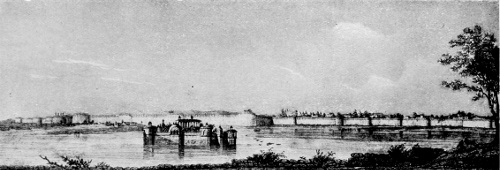
CITY OF KOTAH FROM THE EAST.
To face page 1521.
1521
—The early history of the Haras of
Kotah belongs to Bundi, of which they were a junior branch. The
separation took place when Shah Jahan was emperor of India,
who bestowed Kotah and its dependencies on Madho Singh, the
second son of Rao Ratan, for his distinguished gallantry in the
battle of Burhanpur.
[1]—Madho Singh was born
in S. 1621 (A.D. 1565). At the early age of fourteen, he displayed
that daring intrepidity which gave him the title of Raja, and
Kotah with its three hundred and sixty townships (then the chief
fief of Bundi, and yielding two lakhs of rent), independent of his
father.
It has already been related, that the conquest of this tract was
made from the Khota Bhils of the Ujla, the ‘unmixed,’ or
aboriginal race. From these the Rajput will eat, and all classes
will ‘drink water’ at their hands.[2] Kotah was at that time but a
series of hamlets, the abode of the Bhil chief, styled Raja, being
the ancient fortress of Ekelgarh, five coss south of Kotah. But
when Madho Singh was enfeoffed by the king, Kotah had already
attained extensive limits. To the south it was bounded by
Gagraun and Ghatoli, then held by the Khichis; on the east, by
Mangrol and [506] Nahargarh, the first belonging to the Gaur, the
last to a Rathor Rajput, who had apostatized to save his land
and was now a Nawab; to the north, it extended as far as Sultanpur,
on the Chambal, across which was the small domain of Nanta.
In this space were contained three hundred and sixty townships,
and a rich soil fertilized by numerous large streams.
The favour and power Madho Singh enjoyed, enabled him
to increase the domain he held direct of the crown, and his
authority at his death extended to the barrier between Malwa
and Haraoti. Madho Singh died in S. 1687, leaving five sons,
1522whose appanages became the chief fiefs of Kotah. To the holders
and their descendants, in order to mark the separation between
them and the elder Haras of Bundi, the patronymic of the founder
was applied, and the epithet Madhani is sufficiently distinctive
whenever two Haras, bearing the same name, appear together.
These were—
1. Mukund Singh, who had Kotah.
2. Mohan Singh, who had Paleta.
3. Jujarh Singh, who had Kotra, and subsequently Ramgarh,
Rilawan.
4. Kaniram, who had Koila.[3]
5. Kishor Singh who obtained Sangod.
—Raja Mukund Singh
succeeded. To this prince the chief pass in the barrier dividing
Malwa from Haraoti owes its name of Mukunddarra
[4] which gained
an unfortunate celebrity on the defeat and flight of the British
troops under Brigadier Monson,
A.D. 1804. Mukund erected
many places of strength and utility; and the palace and petta
[5]
of Anta are both attributable to him.
Raja Mukund gave one of those brilliant instances of Rajput
devotion to the principle of legitimate rule, so many of which
illustrate his national history. When Aurangzeb formed his
parricidal design to dethrone his father Shah Jahan, nearly every
Rajput rallied round the throne of the aged monarch; and the
Rathors and the Haras were most conspicuous. The sons of
Madho Singh, besides the usual ties of fidelity, forgot not that
to Shah Jahan they owed their independence, and they determined
to defend him to the death. In S. 1714, in the field near
Ujjain, afterwards named by the victor Fatehabad, the five
brothers led their vassals, clad in the saffron-stained garment,
with the bridal maur (coronet) on their head, denoting death or
victory.[6] The imprudent intrepidity of the Rathor commander
denied them the latter, but a [507] glorious death no power could
prevent, and all the five brothers fell in one field. The youngest,
1523Kishor Singh, was afterwards dragged from amidst the slain, and,
though pierced with wounds, recovered. He was afterwards one
of the most conspicuous of the intrepid Rajputs serving in the
Deccan, and often attracted notice, especially in the capture of
Bijapur. But the imperial princes knew not how to appreciate
or to manage such men, who, when united under one who could
control them, were irresistible.
—Jagat Singh, the son of
Mukund, succeeded to the family estates, and to the mansab or
dignity of a commander of two thousand, in the imperial army.
He continued serving in the Deccan until his death in S. 1726,
leaving no issue.
—Pem Singh, son of Kaniram of
Koila, succeeded; but was so invincibly stupid that the Panch
(council of chiefs) set him aside after six months’ rule, and sent him
back to Koila, which is still held by his descendants.
[7]—Kishor Singh, who so
miraculously recovered from his wounds, was placed upon the
gaddi. When the throne was at length obtained by Aurangzeb,
Kishor was again serving in the south, and shedding his own
blood, with that of his kinsmen, in its subjugation. He greatly
distinguished himself at the siege of Bijapur, and was finally slain
at the escalade of Arkatgarh (Arcot), in S. 1742. He was a noble
specimen of a Hara; and, it is said, counted fifty wounds on his
person. He left three sons, Bishan Singh, Ram Singh, and
Harnath Singh. The eldest, Bishan Singh, was deprived of his
birthright for refusing to accompany his father to the south; but
had the appanage and royal palace of Anta conferred upon him.
His issue was as follows: Prithi Singh, chief of Anta, whose son,
Ajit Singh, had three sons, Chhattarsal, Guman Singh, and Raj
Singh.
—Ram Singh, who was with
his father when he was killed, succeeded to all his dignities, and
1524was inferior to none in the contests which fill the page of imperial
history, and in opposing the rise of the Mahrattas. In the war
of succession, he embraced the cause of Prince Azam, the viceroy
in the Deccan, against the elder, Muazzam, and was slain in the
battle of Jajau, in S. 1764. In this memorable conflict, which
decided the succession to the throne, the Kotah prince espoused
the opposite cause to [508] the head of his house of Bundi, and
Hara met Hara in that desperate encounter, when a cannon-shot
terminated the life of Ram Singh in the very zenith of his career.
—Bhim Singh succeeded; and
with him Kotah no longer remained a raj of the third order. On
the death of Bahadur Shah, and the accession of Farrukhsiyar,
Raja Bhim espoused the cause of the Sayyids, when his mansab
was increased to “five thousand,” a rank heretofore confined to
princes of the blood and rajas of the first class. The elder branch
of the Haras maintained its fealty to the throne against these
usurping ministers, and thus the breach made at the battle of
Jajau was widened by their taking opposite sides. The disgraceful
attempt of Raja Bhim on the life of Rao Raja Budh of
Bundi has already been recorded. Having completely identified
himself with the designs of the Sayyids and Jai Singh of Amber,
he aided all the schemes of the latter to annihilate Bundi, an object
the more easy of accomplishment since the unmerited and sudden
misfortunes of Rao Budh had deprived him of his reason. Raja
Bhim obtained the royal sanad or grant for all the lands on the
Patar, from Kotah west, to the descent into Ahirwara east;
which comprehended much land of the Khichis as well as of Bundi.
He thus obtained the celebrated castle of Gagraun, now the
strongest in Haraoti, and rendered memorable by its defence
against Alau-d-din; likewise Mau Maidana, Shirgarh, Bara,
Mangrol, and Barod, all to the eastward of the Chambal, which
was formally constituted the western boundary of the State. The
aboriginal Bhils of Ujla, or ‘pure’ descent, had recovered much
of their ancient inheritance in the intricate tracts on the southern
frontier of Haraoti. Of these, Manohar Thana, now the most
southern garrison of Kotah, became their chief place, and here
dwelt ‘the king of the Bhils,’ Raja Chakarsen, whose person was
attended by five hundred horse and eight hundred bowmen, and
to whom all the various tribes of Bhils, from Mewar to the
extremity of the plateau, owed obedience. This indigenous race,
1525whose simple life secured their preservation amidst all the vicissitudes
of fortune, from Raja Bhoj of Dhar to Raja Bhim of Kotah,
were dispossessed and hunted down without mercy, and their
possessions added to Kotah. On the occasion of the subjugation
of Bhilwara, the latter assigned tracts of land to the Umat chiefs
of Narsingarh and Rajgarh Patan, with townships in
thali, in
Kotah proper, and hence arose the claim of Kotah on these
independent States for the tribute termed tankhwah.
[8] At the
same time all the [509] chieftains acknowledged the supremacy
of Kotah, under articles of precisely the same nature as those
which guaranteed the safety and independence of Rajwara by
Britain; with this difference, that the Umats could not be installed
without the khilat of recognition of the princes of Kotah. Had
Raja Bhim lived, he would further have extended the borders of
Haraoti, which were already carried beyond the mountains.
Onarsi, Dig, Perawa, and the lands of the Chandarawats, were
brought under subjection, but were lost with his death, which,
like that of his predecessors, was an untimely sacrifice to duty
towards the throne.
When the celebrated Kilich Khan,[9] afterwards better known
to history as Nizamu-l-mulk, fled from the court to maintain
himself by force of arms in his government of the Deccan, Raja
Jai Singh of Amber, as the lieutenant of the king, commanded
Bhim Singh of Kotah and Gaj Singh of Narwar to intercept him
in his passage. The Nizam was the Pagri badal Bhai, or ‘turban-exchanged
brother,’ of the Hara prince, and he sent him a friendly
epistle, entreating him “not to credit the reports to his disadvantage,
telling him that he had abstracted no treasures of
the empire, and that Jai Singh was a meddling knave, who desired
1526the destruction of both; and urging him to heed him not, nor offer
any molestation to his passage to the south.” The brave Hara
replied, that “He knew the line between friendship and duty;
he was commanded to intercept him, and had advanced for that
purpose; it was the king’s order; fight him he must, and next
morning would attack him.” The courtesy of the Rajput, who
mingled no resentment with his hostility, but, like a true cavalier,
gave due warning of his intention, was not thrown away upon the
wily Muslim. The Nizam took post amidst the broken ground
of the Sindh, near the town of Kurwai Borasa.[10] There was but
one approach to his position without a circuitous march, which
suited not the impatient Rajput; and there his antagonist planted
a battery, masked by some brushwood. At the pila badal (morning-dawn)
Raja Bhim, having taken his amal-pani, or opium-water,
mounted his elephant, and uniting his vassals to those of
the Kachhwaha, the combined clans moved on to the attack, in
one of those dense masses, with couched lances, whose shock is
irresistible. They were within musket-shot of the Nizam; had
they reached him, Haidarabad would never have arisen on the
ruins of Gualkund,[11] the ancient Hara abode; but the battery
opened, and in an instant the elephants with their riders, Raja
Bhim and Raja Gaj, were destroyed. Horse and foot became
commingled, happy to emerge from the toils into which the blind
confidence of their leaders had carried them; and Kilich Khan
pursued the career that destiny had marked out for him [510].
—On this occasion the Haras
sustained a double loss: their leader, and their titular divinity,
Brajnath, the god of Braj. This palladium of the Haras is a small
golden image, which is borne on the saddle-bow of their princely
leader in every conflict. When the gol is formed and the lances
are couched, the signal of onset is the shout of ‘Jai Brajnathji!’
‘Victory to Brajnath!’ and many a glorious victory and many
a glorious death has he witnessed. After being long missing, the
representative of the god was recovered and sent to Kotah, to
the great joy of every Hara. It was in S. 1776 (A.D. 1720) that
Bhim Singh perished, having ruled fifteen years, during which
short period he established the affairs of his little dominion on a
basis which has never been shaken.
1527—The rivalry that commenced
between the houses, when Hara encountered Hara on the plains
of Dholpur, and each princely leader sealed his fidelity to the cause
he espoused with his blood, was brought to issue by Raja Bhim,
whose attack upon Rao Budh of Bundi, while defending the
forlorn Farrukhsiyar, has already been related, though without
its consequences. These were fatal to the supremacy of the elder
branch; for, taking advantage of his position and the expulsion
of Rao Budh, in which he aided, Raja Bhim made an attempt
upon Bundi, and despoiled that capital of all the insignia of
sovereign rule, its nakkaras, or kettle-drums, with the celebrated
ran-sankh, or war-shell, an heirloom descended from the heroes
of antiquity. Even the military band, whose various discordant
instruments are still in use, may be heard in pseudo concert from
the guardroom over the chief gate of the citadel, at Kotah;
while the “orange flag,” the gift of Jahangir to Rao Ratan,
around which many a brave Hara has breathed his last, is now
used by the junior house in all processions or battles.
To recover these ensigns of fallen dignity, many a stratagem
has been tried. False keys of the city gates of Kotah and its
citadel had been procured, and its guards won over by bribery to
favour admission; but an unceasing vigilance defeated the plan
when on the brink of execution: since which the gates of Kotah
are always closed at sunset, and never opened even to the prince.
This custom has been attended with great inconvenience; of
which the following anecdote affords an instance. When Raja
Durjan after his defeat reached Kotah at midnight, with a few
attendants, he called aloud to the sentinel for admittance; but the
orders of the latter were peremptory and allowed of no discretion.
The soldier desired the Raja to be gone; upon which, expostulation
being vain, he revealed himself as the prince. At this the
soldier laughed [511]; but, tired of importunity, bade his
sovereign “go to hell,” levelled his match-lock, and refused to
call the officer on guard. The prince retired, and passed the night
in a temple close at hand. At daybreak the gates were opened,
and the soldiers were laughing at their comrade’s story of the
night, when the Raja appeared. All were surprised, but most of
all the sentinel, who, taking his sword and shield, placed them
at his sovereign’s feet, and in a manly but respectful attitude
awaited his decision. The prince raised him, and praising his
1528fidelity, bestowed the dress he then wore upon him, besides a gift
of money.
The Hara chronicler states, that Raja Bhim’s person was
seamed with scars, and so fastidious was he, through the fear of
incurring the imputation of vanity, that he never undressed in
presence of his attendants. Nor was it till his death-wound at
Kurwai that this singularity was explained, on one of his confidential
servants expressing his surprise at the numerous scars;
which brought this characteristic reply: “He who is born to
govern Haras, and desires to preserve his land, must expect to
get these: the proper post for a Rajput prince is ever at the head
of his vassals.”
Raja Bhim was the first prince of Kotah who had the dignity
of Panj-hazari, or ‘leader of five thousand,’ conferred upon him.
He was likewise the first of his dynasty who bore the title of
Maharao, or ‘Great Prince’; a title confirmed though not conferred
by the paramount sovereign, but by the head of their own princely
tribes, the Rana of Mewar. Previous to Gopinath of Bundi,
whose issue are the great feudal chiefs of Haraoti, their titular
appellation was Apji, which has the same import as herself (or
rather himself), applied to highland chiefs of Scotland; but
when Indarsal went to Udaipur, he procured the title of Maharaja
for himself and his brothers; since which Apji has been applied
to the holders of the secondary fiefs, the Madhani of Kotah. Raja
Bhim left three sons, Arjun Singh, Shyam Singh, and Durjansal.
—Maharao Arjun married
the sister of Madho Singh, ancestor of Zalim Singh Jhala; but
died without issue, after four years’ rule. On his death, there
arose a civil war respecting the succession, in which the vassals
were divided. Clan encountered clan in the field of Udaipura,
when the fate of Shyam Singh was sealed in his blood. It is said,
the survivor would willingly have given up dominion to have
restored his brother to life; that he cursed his ambitious rashness,
and wept bitterly over the dead body. By these contentions
the rich districts of Rampura, Bhanpura, and Kalapet, which [512]
the king had taken from the ancient family and bestowed on Raja
Bhim, were lost to the Haras, and regained by their ancient
possessors.
—Durjansal
assumed ‘the rod’ in S. 1780 (
A.D. 1724). His accession
1529was acknowledged by Muhammad Shah, the last of the
Timurian kings who deserved the appellation, and at whose court
the prince of Kotah received the khilat and obtained the boon
of preventing the slaughter of kine in every part of the Jumna
frequented by his nation. Durjansal succeeded on the eve of an
eventful period in the annals of his country. It was in his reign
that the Mahrattas under Bajirao first invaded Hindustan. On
this memorable occasion, they passed by the Taraj Pass, and
skirting Haraoti on its eastern frontier, performed a service to
Durjansal, by attacking and presenting to him the castle of
Nahargarh, then held by a Musalman chief. It was in S. 1795
[12]
(
A.D. 1739) that the first connexion between the Haras and the
‘Southrons’ took place; and this service of the Peshwa leader
was a return for stores and ammunition necessary for his enterprise.
But a few years only elapsed before this friendly act and
the good understanding it induced were forgotten.
—We have recorded, in the
Annals of Bundi, the attempts of the princes of Amber, who were
armed with the power of the monarchy, to reduce the chiefs of
Haraoti to the condition of vassals. This policy, originating
with Jai Singh, was pursued by his successor, who drove the
gallant Budh Singh into exile, to madness and death, though
the means by which he effected it ultimately recoiled upon him,
to his humiliation and destruction. Having, however, driven
Budh Singh from Bundi, and imposed the condition of homage
and tribute upon the creature of his installation, he desired to
inflict his supremacy on Kotah. In this cause, in S. 1800, he
invited the three great Mahratta leaders, with the Jats under
Surajmall, when, after a severe conflict at Kotri, the city was
invested. During three months, every effort was made, but in
vain; and after cutting down the trees and destroying the gardens
in the environs, they were compelled to decamp, the leader, Jai
Apa Sindhia,
[13] leaving one of his hands, which was carried off by
a cannon-shot.
1530—Durjansal was nobly seconded by the
courage and counsel of the Faujdar, or ‘commandant of the
garrison,’ Himmat Singh, a Rajput of the Jhala tribe. It was
through Himmat Singh that the negotiations were carried on,
which added Nahargarh to Kotah; and to him were confided
those in which Kotah was compelled to follow the [513] general
denationalization, and become subservient to the Mahrattas.
Between these two events, S. 1795 and S. 1800, Zalim Singh was
born, a name of such celebrity that his biography would embrace
all that remains to be told of the history of the Haras.
When Isari Singh was foiled, the brave Durjansal lent his
assistance to replace the exiled Ummeda on the throne which
his father had lost. But without Holkar’s aid, this would have
been vain; and, in S. 1805 (A.D. 1749), the year of Ummeda’s
restoration, Kotah was compelled to become tributary to the
Mahrattas.
—Durjansal added several
places to his dominions. He took Phul-Barod from the Khichis,
and attempted the fortress of Gugor, which was bravely defended
by Balbhaddar in person, who created a league against the Hara
composed of the chiefs of Rampura, Sheopur, and Bundi. The
standard of Kotah was preserved from falling into the hands of
the Khichis by the gallantry of Ummeda Singh of Bundi. The
battle between the rival clans, both of Chauhan blood, was in
S. 1810; and in three years more, Durjansal departed this life.
He was a valiant prince, and possessed all the qualities of which
the Rajput is enamoured; affability, generosity, and bravery.
He was devoted to field-sports, especially the royal one of tiger-hunting;
and had ramnas or preserves in every corner of his
dominions (some of immense extent, with ditches and palisadoes,
and sometimes circumvallations), in all of which he erected
hunting-seats.
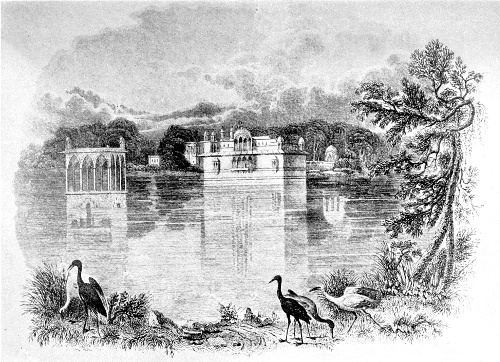
COUNTRY SEAT OF THE KOTAH PRINCE.
To face page 1530.
In these expeditions, which resembled preparations for war, he
invariably carried the queens. These Amazonian ladies were
taught the use of the matchlock, and being placed upon the
terraced roofs of the hunting-seats, sent their shots at the forest-lord,
when driven past their stand by the hunters. On one of
these occasions the Jhala Faujdar was at the foot of the scaffolding;
the tiger, infuriated with the uproar, approached him open-mouthed;
but the prince had not yet given the word, and none
1531dared to fire without his signal. The animal eyed his victim,
and was on the point of springing, when the Jhala advanced his
shield, sprung upon him, and with one blow of his sword laid him
dead at his feet. The act was applauded by the prince and his
court, and contributed not a little to the character he had already
attained.
Durjansal left no issue. He was married to a daughter of the
Rana of Mewar. Being often disappointed, and at length despairing
of an heir, about three years before his death, he told the
Rani it was time to think of adopting an heir to fill the gaddi,
“for it was evident that the Almighty disapproved of the usurpation
which changed the order of succession.” It will be remembered
that Bishan Singh, son of Ram Singh [514], was set
aside for refusing, in compliance with maternal fears, to accompany
his father in the wars of the Deccan. When dispossessed
of his birthright, he was established in the fief of Antha on the
Chambal.[14] At the death of Durjansal, Ajit Singh, grandson of
the disinherited prince, was lord of Antha, but he was in extreme
old age. He had three sons, and the eldest, whose name of
Chhattarsal revived ancient associations, was formally “placed
in the lap of the Rani Mewari; the asis (blessing) was given; he
was taught the names of his ancestors (being no longer regarded
as the son of Ajit of Antha), Chhattar Singh, son of Durjansal,
Bhimsinghgot, Ram Singh, Kishor Singh, etc., etc.,” and so on,
to the fountain-head, Dewa Banga, and thence to Manikrae of
Ajmer. Though the adoption was proclaimed, and all looked
to Chhattarsal as the future lord of the Haras of Kotah, yet on
the death of Durjan, the Jhala Faujdar took upon him to make
an alteration in this important act, and he had power enough to
effect it.
—The old chief of Antha was yet alive, and the
Faujdar said, “It was contrary to nature that the son should
rule and the father obey”; but doubtless other motives mingled
with his piety, in which, besides self-interest, may have been a
consciousness of the dangers inseparable from a minority. The
only difficulty was to obtain the consent of the chief himself,
then “fourscore years and upwards,” to abandon his peaceful
castle on the Kali Sind for the cares of government. But the
1532Faujdar prevailed; old Ajit was crowned, and survived his
exaltation two years and a half. Ajit left three sons, Chhattarsal,
Guman Singh, and Raj Singh. Chhattarsal was proclaimed the
Maharao of the Haras. The celebrated Himmat Singh Jhala
died before his accession, and his office of Faujdar was conferred
upon his nephew, Zalim Singh.
At this epoch, Madho Singh, who had acceded to the throne
of Amber on the suicide of his predecessor, Isari, instead of taking
warning by example, prepared to put forth all his strength for
the revival of those tributary claims upon the Haras, which had
cost his brother his life. The contest was between Rajput and
Rajput; the question at issue was supremacy on the one hand,
and subserviency on the other, the sole plea for which was that
the Kotah contingent had acted under the princes of Amber,
when lieutenants of the empire. But the Haras held in utter
scorn the attempt to compel this service in their individual
capacity, in which they only recognized them as equals.
—It was in S. 1817 (
A.D. 1761) that the
prince of Amber assembled all his clans to force the Haras to
acknowledge themselves tributaries. The invasion of the Abdali
[15]
[515], which humbled the Mahrattas and put a stop to their
pretensions to universal sovereignty, left the Rajputs to themselves.
Madho Singh, in his march to Haraoti, assaulted Uniara,
and added it to his territory. Thence he proceeded to Lakheri,
which he took, driving out the crestfallen Southrons. Emboldened
by this success, he crossed at the Pali Ghat, the point
of confluence of the Par and the Chambal. The Hara chieftain
of Sultanpur, whose duty was the defence of the ford, was taken
by surprise; but, like a true Hara, he gathered his kinsmen
outside his castle, and gave battle to the host. He made amends
for his supineness, and bartered his life for his honour. It was
remarked by the invaders, that, as he fell, his clenched hand
grasped the earth, which afforded merriment to some, but serious
reflection to those who knew the tribe, and who converted it into
an omen “that even in death the Hara would cling to his land.”
The victors, flushed with this fresh success, proceeded through
the heart of Kotah until they reached Bhatwara,
[16] where they
1533found five thousand Haras,
ek bap ka beta, all ‘children of one
father,’ drawn up to oppose them. The numerical odds were
fearful against Kotah; but the latter were defending their altars
and their honour. The battle commenced with a desperate
charge of the whole Kachhwaha horse, far more numerous than
the brave legion of Kotah; but, too confident of success, they
had tired their horses ere they joined. It was met by a dense
mass, with perfect coolness, and the Haras remained unbroken
by the shock. Fresh numbers came up; the infantry joined the
cavalry, and the battle became desperate and bloody. It was
at this moment that Zalim Singh made his debut. He was then
twenty-one years of age, and had already, as the adopted son of
Himmat Singh, “tied his turban on his head,” and succeeded to
his post of Faujdar. While the battle was raging, Zalim dismounted,
and at the head of his quota, fought on foot, and at
the most critical moment obtained the merit of the victory, by
the first display of that sagacity for which he has been so remarkable
throughout his life [516].
Malhar Rao Holkar was encamped in their vicinity, with the
remnant of his horde, but so crestfallen since the fatal day of
Panipat,[17] that he feared to side with either. At this moment
young Zalim, mounting his steed, galloped to the Mahratta, and
implored him, if he would not fight, to move round and plunder
the Jaipur camp: a hint which needed no repetition.
The little impression yet made on the Kotah band only required
the report that “the camp was assaulted,” to convert the lukewarm
courage of their antagonists into panic and flight: “the
host of Jaipur fled, while the sword of the Hara performed tirath
(pilgrimage) in rivers of blood.xxxx
The chiefs of Macheri, of Isarda, Watka, Barol, Achrol, with
all the ots and awats of Amber, turned their backs on five thousand
Haras of Kotah; for the Bundi troops, though assembled, did
not join, and lost the golden opportunity to free its Kothris, or
fiefs, from the tribute. Many prisoners were taken, and the five-coloured
banner of Amber fell into the hands of the Haras, whose
bard was not slow to turn the incident to account in the stanza,
still repeated whenever he celebrates the victory of Bhatwara,
and in which the star (tara) of Zalim prevailed:
1534Jang Bhatwārā jīt
Tārā Jālim Jhālā.
Ring ek rang chīt,
Chādyo rang pach-rang kē.[18]
“In the battle of Bhatwara, the star of Zalim was triumphant.
In that field of strife (ringa) but one colour (rang) covered that
of the five-coloured (panch-ranga) banner”: meaning that the
Amber standard was dyed in blood.
The battle of Bhatwara decided the question of tribute, nor
has the Kachhwaha since this day dared to advance the question
of supremacy, which, as lieutenant of the empire, he desired to
transfer to himself. In derision of this claim, ever since the day
of Bhatwara, when the Haras assemble at their Champ de Mars
to celebrate the annual military festival, they make a mock
castle of Amber, which is demolished amidst shouts of applause.[19]
Chhattarsal survived his elevation and this success but a few
years; and as he died without offspring, he was succeeded by
his brother [517].
—Guman Singh, in
S. 1822 (A.D. 1766), ascended the gaddi of his ancestors. He was
in the prime of manhood, full of vigour and intellect, and well
calculated to contend with the tempests collecting from the
south, ready to pour on the devoted lands of Rajputana. But
one short lustrum of rule was all that fate had ordained for him,
when he was compelled to resign his rod of power into the hands
of an infant. But ere we reach this period, we must retrace our
steps, and introduce more prominently the individual whose
biography is the future history of this State; for Zalim Singh is
Kotah, his name being not only indissolubly linked with hers
in every page of her existence, but incorporated with that of
every State of Rajputana for more than half a century. He was
the primum mobile of the region he inhabited, a sphere far too
1535confined for his genius, which required a wider field for its display,
and might have controlled the destinies of nations.
—Zalim Singh is a Rajput of the Jhala
tribe. He was born in S. 1796 (
A.D. 1740), an ever memorable
epoch (as already observed) in the history of India, when the
victorious Nadir Shah led his hordes into her fertile soil, and gave
the finishing blow to the dynasty of Timur. But for this event,
its existence might have been protracted, though its recovery was
hopeless: the principle of decay had been generated by the
policy of Aurangzeb. Muhammad Shah was at this time emperor
of India,
[1] and the valiant Durjansal sat on the throne of Kotah.
From this period (
A.D. 1740) five princes have passed away and
a sixth has been enthroned; and, albeit one of these reigns
endured for half a century, Zalim Singh has outlived them all,
[2]
and though blind, his [518] moral perceptions are as acute as on
the day of Bhatwara. What a chain of events does not this
protracted life embrace! An empire then dazzling in glory, and
now mouldering in the dust. At its opening, the highest noble
of Britain would have stood at a reverential distance from the
throne of Timur, in the attitude of a suppliant, and now—
None so poor
To do him reverence.
To do anything like justice to the biography of one who for
so long a period was a prominent actor in the scene, is utterly
impossible; this consideration, however, need not prevent our
attempting a sketch of this consummate politician, who can
scarcely find a parallel in the varied page of history.
The ancestors of Zalim Singh were petty chieftains of Halwad,[3]
in the district of Jhalawar, a subdivision of the Saurashtra
peninsula. Bhao Singh was a younger son of this family, who,
with a few adherents, left the paternal roof to seek fortune
amongst the numerous conflicting armies that ranged India
during the contests for supremacy amongst the sons of Aurangzeb.
His son, Madho Singh, came to Kotah when Raja Bhim was in the
zenith of his power. Although he had only twenty-five horse
1536in his train, it is a proof of the respectability of the Jhala, that
the prince disdained not his alliance, and even married his son,
Arjun, to the young adventurer’s sister. Not long after, the
estate of Nanta was entailed upon him, with the confidential
post of Faujdar, which includes not only the command of the
troops, but that of the castle, the residence of the sovereign.
This family connexion gave an interest to his authority, and
procured him the respectful title of Mama,[4] from the younger
branches of the prince’s family, an epithet which habit has
continued to his successors, who are always addressed Mama
Sahib, ‘Sir, Uncle!’ Madan Singh succeeded his father in the
office of Faujdar. He had two sons, Himmat Singh and Prithi
Singh.
| | Bhao Singh, left Halwad with twenty-five horse. |
| | |
| | Madho Singh. |
| | |
| | Madan Singh. |
| | | | |
| | | |
| Himmat Singh. | Prithi Singh. |
| | | | |
| | | |
| | Sheo Singh, | Zalim Singh, |
| | born in S. 1795. | born S. 1796. |
| | |
| | Madho Singh, |
| | present regent. | |
| | |
| | Bapa Lall, |
| | twenty-one years of age [519]. | |
The office of Faujdar, which, like all those of the east, had
become hereditary, was advantageously filled by Himmat Singh,
whose bravery and skill were conspicuous on many trying emergencies.
He directed, or at least seconded, the defence of Kotah,
when first assailed by the combined Mahratta and Jaipur troops,
and conducted the treaty which made her tributary to the former,
till at length so identified was his influence with that of the Haras,
that with their concurrence he restored the ancient line of succession.
Though neither the prince, Durjansal, nor his Major
Domo, had much merit in this act, it was made available by
Zalim Singh in support of his pretensions to power, and in proof
1537of the ingratitude of his sovereign, “whose ancestors recovered
their rights at the instigation of his own.” But Zalim Singh had
no occasion to go back to the virtues of his ancestors for an
argument on which to base his own claims to authority. He
could point to the field of Bhatwara, where his bravery and skill
mainly aided to vanquish the enemies of Kotah, and to crush for
ever those arrogant pretensions to supremacy which the Jaipur
State strained every nerve to establish.
—It was not long after the
accession of Guman Singh to the sceptre of the Haras, that the
brave and handsome Major Domo, having dared to cross his
master’s path in love, lost his favour, and the office of Faujdar,
which he had attained in his twenty-first year. It is probable
he evinced little contrition for his offence, for the confiscation of
Nanta soon followed. This estate, on the west bank of the
Chambal, still enjoyed as a fief in perpetuity by the Jhala family,
was the original appanage of the Kotah State when a younger
branch of Bundi. From hence may be inferred the consideration
in which the Jhala ancestor of our subject was held, which conferred
upon him the heirloom of the house. Both the office and
the estate thereto attached, thus resumed, were bestowed upon
the maternal uncle of the prince, Bhopat Singh, of the Bhangrot
tribe. By this step, the door of reconciliation being closed
against the young Jhala, he determined to abandon the scene of
his disgrace, and court fortune elsewhere. He was not long in
determining the path he should pursue: Amber was shut against
him, and Marwar held out no field for his ambition. Mewar was
at hand, and a chief of his own tribe and nation then ruled the
councils of Rana Arsi, who had lately succeeded to power, but a
power paralysed by faction and by a pretender to the throne.
The Jhala chieftain of Delwara, one of the sixteen great barons
of Mewar, had headed the party which placed his sovereign on
the throne; and he felt no desire to part with the influence
which this service gave him. He entertained [520] foreign
guards about the person of his prince, and distributed estates at
pleasure among those who supported his measures; while from
the crown domain, or from the estates of those who were hostile
to his influence, he seized upon lands, which doubled his possessions.
Such was the court of Rana Arsi, when the ex-Major
Domo of Kotah came to seek a new master. His reputation at
1538once secured him a reception, and his talents for finesse, already
developed, made the Rana confide to him the subjection in which
he was held by his own vassal-subject. It was then that Zalim,
a youth and a stranger, showed that rare union of intrepidity
and caution which has made him the wonder of the age. By a
most daring plan, which cost the Delwara chief his life, in open
day and surrounded by attendants, the Rana was released from
this odious tutelage. For this service, the title of Raj Rana
[5] and
the estate of Chitarkhera on the southern frontier were conferred
upon Zalim, who was now a noble of the second rank in Mewar.
The rebellion still continued, however, and the pretender and
his faction sought the aid of the Mahrattas; but under the
vigorous councils of Zalim, seconded by the spirit of the Rana,
an army was collected which gave battle to the combined rebels
and Mahrattas. The result of this day has already been related.
[6]
The Rana was discomfited and lost the flower of his nobles when
victory was almost assured to them, and Zalim was left wounded
and a prisoner in the field. He fell into the hands of Trimbakrao,
the father of the celebrated Ambaji Inglia, and the friendship
then formed materially governed the future actions of his life.
—The loss of this battle left
the Rana and Mewar at the mercy of the conqueror. Udaipur
was invested, and capitulated, after a noble defence, upon terms
which perpetuated her thraldom. Zalim, too wise to cling to the
fortunes of a falling house, instead of returning to Udaipur, bent
his steps to Kotah, in company with the Pandit, Lalaji Balal,
the faithful partaker of his future fortunes. Zalim foresaw the
storm about to spread over Rajwara, and deemed himself equal
to guide and avert it from Kotah, while the political levity of
Mewar gave him little hopes of success at that court.
Raja Guman, however, had neither forgotten nor forgiven
his competitor, and refused to receive him: but in no wise daunted,
he trusted to his address, and thrust himself unbidden on the
prince. The moment he chose proved favourable; and he was
not only pardoned, but employed [521].
—The Mahrattas had now
reached the southern frontier, and invested the castle of Bakhani,
[7]
1539which was defended by four hundred Haras of the Sawant clan,
[8]
under its chief, Madho Singh. The enemy had been foiled in
repeated attempts to escalade, and it furnishes a good idea of the
inadequate means of the ‘Southrons’ for the operations of a siege,
when their besieging apparatus was confined to an elephant,
whose head was the substitute for a petard, to burst open the gate.
Repeated instances, however, prove that this noble animal is
fully equal to the task, and would have succeeded on this occasion,
had not the intrepidity of the Hara chieftain prompted one of
those desperate exploits which fill the pages of their annals.
Armed with his dagger, Madho Singh leaped from the walls upon
the back of the elephant, stabbed the rider, and with repeated
blows felled the animal to the earth. That he should escape
could not be expected; but his death and the noble deed kindled
such enthusiasm, that his clan threw wide the gate, and rushing
sword in hand amidst the multitude, perished to a man. But
they died not unavenged: thirteen hundred of the bravest of the
Mahrattas accompanied them to Suryaloka, the warrior’s heaven.
The invaders continued their inroad, and invested Sohet: but
the prince sent his commands to the garrison to preserve their
lives for Kotah, and not again sacrifice them, as the point of
honour had been nobly maintained. Accordingly, at midnight,
they evacuated the place; but whether from accident or treachery,
the grass jungle which covered their retreat was set fire to, and
cast so resplendent a light, that the brave garrison had to fight
their way against desperate odds, and many were slain. Malharrao
Holkar, who had been greatly disheartened at the loss sustained
at Bakhani, was revived at this success, and prepared to follow
it up. Raja Guman deemed it advisable to try negotiation, and
the Bhangrot Faujdar was sent with full powers to treat with
the Mahratta commander; but he failed and returned.
—Such was the
moment chosen by young Zalim to force himself into the presence
of his offended prince. In all probability he mentioned the day
at Bhatwara, where by his courage, and still more by his tact, he
released Kotah from the degradation of being subordinate to
Amber; and that it was by his influence with the same Malharrao
Holkar, who now threatened Kotah, he was enabled to succeed.
1540He was invested with full powers; the negotiation was renewed,
and terminated successfully: for the sum of six lakhs of rupees
the Mahratta leader withdrew his horde from the territory of
Kotah. His [522] prince’s favour was regained, his estate restored,
and the unsuccessful negotiator lost the office of Faujdar,
into which young Zalim was reinducted. But scarcely had he
recovered his rights, before Guman Singh was taken grievously
ill, and all hopes of his life were relinquished. To whom could
the dying prince look at such a moment, as guardian of his infant
son, but the person whose skill had twice saved the State from
peril? He accordingly proclaimed his will to his chiefs, and
with all due solemnity placed Ummed Singh, then ten years of
age, ‘in the lap’ of Zalim Singh.
—Ummed Singh was
proclaimed in S. 1827 (
A.D. 1771). On the day of inauguration,
the ancient Rajput custom of the
tika-daur was revived, and the
conquest of Kelwara
[9] from the house of Narwar marked with
éclat the accession of the Maharao of the Haras of Kotah, and
gave early indication that the genius of the regent would not
sleep in his office of protector. More than half a century of rule,
amidst the most appalling vicissitudes, has amply confirmed the
prognostication.
The retention of a power thus acquired, it may be concluded,
could never be effected without severity, nor the vigorous
authority, wielded throughout a period beyond the ordinary
limits of mortality, be sustained without something more potent
than persuasion. Still, when we consider Zalim’s perilous predicament,
and the motives to perpetual reaction, his acts of severity are
fewer than might have been expected, or than occur in the course
of usurpation under similar circumstances. Mature reflection
initiated all his measures, and the sagacity of their conception
was only equalled by the rapidity of their execution. Whether
the end in view was good or evil, nothing was ever half-done;
no spark was left to excite future conflagration. Even this excess
of severity was an advantage; it restrained the repetition of
what, whether morally right or wrong, he was determined not to
tolerate. To pass a correct judgment on these acts is most
difficult. What in one case was a measure of barbarous severity,
appears in another to have been one indispensable to the welfare
1541of the State. But this is not the place to discuss the character
or principles of the regent; let us endeavour to unfold both in
the exhibition of those acts which have carried him through the
most tempestuous sea of political convulsion in the whole history
of India. When nought but revolution and rapine stalked through
the land, when State after State was crumbling into dust, or sinking
into the abyss of ruin, he guided the vessel entrusted to his care
safely through all dangers, adding yearly to her riches, until he
placed her in security under the protection of Britain [523].
—Scarcely had Zalim assumed
the protectorate, when he was compelled to make trial of those
Machiavellian powers which have never deserted him, in order
to baffle the schemes devised to oppose him. The duties of
Faujdar, to which he had hitherto been restricted, were entirely
of a military nature; though, as it involved the charge of the
castle, in which the sovereign resided, it brought him in contact
with his councils. This, however, afforded no plea for interference
in the Diwani, or civil duties of the government, in which,
ever since his own accession to power, he had a coadjutor in Rae
Akhairam, a man of splendid talents, and who had been Diwan
or prime minister throughout the reign of Chhattarsal and the
greater part of that of his successor. To his counsel is mainly
ascribed the advantages gained by Kotah throughout these reigns;
yet did he fall a sacrifice to jealousies a short time before the death
of his prince, Guman Singh. It is not affirmed that they were
the suggestions of young Zalim; but Akhairam’s death left him
fewer competitors to dispute the junction in his own person of
the civil as well as military authority of the State. Still he had
no slight opposition to overcome, in the very opening of his career.
The party which opposed the pretensions of Zalim Singh to act
as regent of the State, asserting that no such power had been
bequeathed by the dying prince, consisted of his cousin, the
Maharaja Sarup Singh, and the Bhangrot chief, whose disgrace
brought Zalim into power. There was, besides, the Dhabhai
Jaskaran, foster-brother to the prince, a man of talent and credit,
whose post, being immediately about his person, afforded opportunities
for carrying their schemes into effect.
—Such was the powerful opposition
arrayed against the protector in the very commencement of his
career. The conspiracy was hardly formed, however, before it
1542was extinguished by the murder of the Maharaja by the hands of
the Dhabhai, the banishment of the assassin, and the flight of
the Bhangrot. The rapidity with which this drama was enacted
struck terror into all. The gaining over the foster-brother, the
making him the instrument of punishment, and banishing him
for the crime, acted like a spell, and appeared such a masterpiece
of daring and subtilty combined, that no one thought himself
secure. There had been no cause of discontent between the
Maharaja and the Dhabhai, to prompt revenge; yet did the
latter, in the glare of open day, rush upon him in the garden of
Brajvilas,
[10] and with a blow of his scimitar end his days. The
regent was the loudest in execrating the author of the crime, whom
he instantly seized and confined, and soon after expelled from
Haraoti. But however well acted, this dissimulation passed not
with the world; and, whether innocent or guilty, they lay to
Zalim’s charge the plot for the murder of the Maharaja. The
Dhabhai died in exile and contempt at [524] Jaipur; and in
abandoning him to his fate without provision, Zalim, if guilty of
the deed, showed at once his knowledge and contempt of mankind.
Had he added another murder to the first, and in the fury of an
affected indignation become the sole depository of his secret, he
would only have increased the suspicion of the world; but in
turning the culprit loose on society to proclaim his participation
in the crime, he neutralized the reproach by destroying the
credibility of one who was a self-convicted assassin when he had
it in his power to check its circulation. In order to unravel this
tortuous policy, it is necessary to state that the Dhabhai was
seduced from the league by the persuasion of the regent, who
insinuated that the Maharaja formed plans inimical to the safety
of the young prince, and that his own elevation was the true
object of his hostility to the person entrusted with the charge of
the minor sovereign. Whatever truth there might be in this,
which might be pleaded in justification of the foul crime, it was
attended with the consequences he expected. Immediately after,
the remaining member of the adverse junta withdrew, and at the
same time many of the nobles abandoned their estates and their
country. Zalim evinced his contempt of their means of resistance
by granting them free egress from the kingdom, and determined
1543to turn their retreat to account. They went to Jaipur and to
Jodhpur; but troubles prevailed everywhere; the princes could
with difficulty keep the prowling Mahratta from their own doors,
and possessed neither funds nor inclination to enter into foreign
quarrels for objects which would only increase their already
superabundant difficulties. The event turned out as Zalim
anticipated; and the princes, to whom the refugees were suitors,
had a legitimate excuse in the representations of the regent, who
described them as rebels to their sovereign and parties to designs
hostile to his rule. Some died abroad, and some, sick of wandering
in a foreign land dependent on its bounty, solicited as a boon
that “their ashes might be burned with their fathers'.” In
granting this request, Zalim evinced that reliance on himself,
which is the leading feature of his character. He permitted their
return, but received them as traitors who had abandoned their
prince and their country, and it was announced to them, as an
act of clemency, that they were permitted to live upon a part
of their estates; which, as they had been voluntarily abandoned,
were sequestrated and belonged to the crown.
—Such was Zalim
Singh’s triumph over the first faction formed against his assumption
of the full powers of regent of Kotah. Not only did the
aristocracy feel humiliated, but were subjugated by the rod of
iron held over them; and no opportunity [525] was ever thrown
away of crushing this formidable body, which in these States too
often exerts its pernicious influence to the ruin of society. The
thoughtlessness of character so peculiar to Rajputs, furnished
abundant opportunities for the march of an exterminating policy,
and, at the same time, afforded reasons which justified it.
The next combination was more formidable; it was headed by
Deo Singh of Aton,[11] who enjoyed an estate of sixty thousand
rupees rent. He strongly fortified his castle, and was joined by
all the discontented nobles, determined to get rid of the authority
which crushed them. The regent well knew the spirits he had
to cope with, and that the power of the State was insufficient.
By means of ‘the help of Moses’ (such is the interpretation of
Musa Madad, his auxiliary on this occasion), this struggle against
his authority also only served to confirm it; and their measures
recoiled on the heads of the feudality. The condition of society
1544since the dissolution of the imperial power was most adverse to
the institutions of Rajwara, the unsupported valour of whose
nobles was no match for the mercenary force which their rulers
could now always command from those bands, belonging to no
government, but roaming whither they listed over this vast
region, in search of pay or plunder. The ‘help of Moses’ was
the leader of one of these associations—a name well known in
the history of that agitated period; and he not only led a well-appointed
infantry brigade, but had an efficient park attached
to it, which was brought to play against Aton. It held out several
months, the garrison meanwhile making many sallies, which it
required the constant vigilance of Moses to repress. At length,
reduced to extremity, they demanded and obtained an honourable
capitulation, being allowed to retire unmolested whither they
pleased. Such was the termination of this ill-organized insurrection,
which involved almost all the feudal chiefs of Kotah in exile
and ruin, and strengthened the regent, or as he would say, the
state, by the escheat of the sequestrated property. Deo Singh of
Aton, the head of this league, died in exile. After several years
of lamentation in a foreign soil for the janam bhum, the ‘land of
their birth,’ the son pleaded for pardon, though his heart denied
all crime, and was fortunate enough to obtain his recall, and the
estate of Bamolia, of fifteen thousand rupees rent. The inferior
members of the opposition were treated with the same contemptuous
clemency; they were admitted into Kotah, but
deprived of the power of doing mischief. What stronger proof
of the political courage of the regent can be adduced, than his
shutting up such combustible materials within the social edifice,
and even living amongst and with them, as if he deserved their
friendship rather than their hatred [526].
In combating such associations, and thus cementing his power,
time passed away. His marriage with one of the distant branches
of the royal house of Mewar, by whom he had his son and successor
Madho Singh, gave Zalim an additional interest in the affairs of
that disturbed State, of which he never lost sight amidst the
troubles which more immediately concerned him. The motives
which, in S. 1847 (A.D. 1791), made him consider for a time the
interests of Kotah as secondary to those of Mewar, are related
at length in the annals of that State;[12] and the effect of this
1545policy on the prosperity of Kotah, drained of its wealth in the
prosecution of his views, will appear on considering the details
of his system. Referring the reader, therefore, to the Annals of
Mewar, we shall pass from S. 1847 to S. 1856 (A.D. 1800), when
another attempt was made by the chieftains to throw off the iron
yoke of the protector.
—Many attempts at assassination
had been tried, but his vigilance baffled them all; though
no bold enterprise was hazarded since the failure of that (in S.
1833) which ended in the death and exile of its contriver, the
chieftain of Aton, until the conspiracy of Mohsen, in S. 1856, just
twenty years ago.
[13] Bahadur Singh, of Mohsen, a chieftain of
ten thousand rupees’ annual rent, was the head of this plot, which
included every chief and family whose fortunes had been annihilated
by the exterminating policy of the regent. It was conducted
with admirable secrecy; if known at all, it was to Zalim
alone, and not till on the eve of accomplishment. The proscription-list
was long; the regent, his family, his friend and counsellor
the Pandit Lalaji, were amongst the victims marked for sacrifice.
The moment for execution was that of his proceeding to hold
his court, in open day; and the mode was by a
coup de main
whose very audacity would guarantee success. It is said that
he was actually in progress to darbar, when the danger was
revealed. The paegah or ‘select troop of horse’ belonging to his
friend, and always at hand, was immediately called in and added
to the guards about his person; thus the conspirators were
assailed when they deemed the prey rushing into the snare they
had laid. The surprise was complete; many were slain; some
were taken, others fled. Amongst the latter was the head of the
conspiracy, Bahadur Singh, who gained the Chambal, and took
refuge in the temple of the tutelary deity of the Haras at Patan.
But he mistook the character of the regent when he supposed
that either the sanctuary (
sarana) of Keshorai,
[14] or the respect
due to the prince in whose dominions (Bundi) it lay, could shield
him from his fate. He was dragged forth, and expiated his crime
or folly with his life [527].
According to the apologists of the regent, this act was one of
just retribution, since it was less to defend himself and his immediate
1546interests than those of the prince whose power and existence
were threatened by the insurrection, which had for its object
his deposal and the elevation of one of his brothers. The members
of the Maharao’s family at this period were his uncle Raj Singh,
and his two brothers, Gordhan and Gopal Singh. Since the
rebellion of Aton, these princes had been under strict surveillance;
but after this instance of reaction, in which their names were
implicated as having aspired to supplant their brother, a more
rigorous seclusion was adopted; and the rest of their days was
passed in solitary confinement. Gordhan, the elder, died about
ten years after his incarceration; the younger, Gopal, lived many
years longer; but neither from that day quitted the walls of their
prison, until death released them from this dreadful bondage.
Kaka Raj Singh lived to extreme old age; but, as he took no
part in these turmoils, he remained unmolested, having the range
of the temples in the city, beyond which limits he had no wish to
stray.
We may in this place introduce a slip from the genealogical
tree of the forfeited branch of Bishan Singh, but which, in the
person of his grandson Ajit, regained its rights and the gaddi.
The fate of this family will serve as a specimen of the policy
pursued by the regent towards the feudal interests of Kotah.
It is appalling, when thus marshalled, to view the sacrifices which
the maintenance of power will demand in these feudal States,
where individual will is law.
The plots against the existence and authority of the Protector
were of every description, and no less than eighteen are enumerated,
which his never-slumbering vigilance detected and baffled.
The means were force, open and concealed, poison, the dagger—until
at length he became sick of precaution. “I could not always
be on my guard,” he would say. But the most dangerous of all
was a female conspiracy, got up in the palace, and which discovers
an amusing mixture of tragedy and farce, although his habitual
wariness would not have saved him from being its victim, had
he not been aided by the boldness of a female champion, from a
regard for the personal attractions of the handsome regent. He
was suddenly sent for by the queen-mother of one of the young
princes, and while waiting in an antechamber, expecting every
instant ‘the voice behind the curtain,’ he found himself encircled
by a band of Amazonian Rajputnis, armed with sword
1547and dagger, from whom, acquainted as he was with the nerve,
physical and moral, of his countrywomen, he saw no hope of
salvation [528]. Fortunately, they were determined not to be
satisfied merely with his death, they put him upon his trial; and
the train of interrogation into all the acts of his life was going on,
when his preserving angel, in the shape of the chief attendant of
the dowager queen, a woman of masculine strength and courage,
rushed in, and, with strong dissembled anger, drove him forth
amidst a torrent of abuse for presuming to be found in such a predicament.
While bathing, and during the heat of the chase, his favourite
pursuit, similar attempts have been made, but they always
recoiled on the heads of his enemies. Yet, notwithstanding the
multitude of these plots, which would have unsettled the reason
of many, he never allowed a blind suspicion to add to the victims
of his policy; and although, for his personal security, he was
compelled to sleep in an iron cage, he never harboured unnecessary
alarm, that parent of crime and blood in all usurpations. His
lynx-like eye saw at once who was likely to invade his authority,
and these knew their peril from the vigilance of a system which
never relaxed. Entire self-reliance, a police such as perhaps no
country in the world could equal, establishments well paid,
services liberally rewarded, character and talent in each department
of the State, himself keeping a strict watch over all, and
trusting implicitly to none, with a daily personal supervision of
all this complicated state-machinery—such was the system which
surmounted every peril, and not only maintained but increased
the power and political reputation of Zalim Singh, amidst the
storms of war, rapine, treason, and political convulsions of more
than half a century’s duration.
—We are now to examine the
Protector in another point of view, as the legislator and manager
of the State whose concerns he was thus determined to rule.
For a series of years Kotah was but the wet-nurse to the child
of his ambition, a design upon Mewar [529], which engulfed as in
a vortex all that oppression could extort from the industry of the
1548people confided to his charge. From this first acquaintance
with the court of the Rana, in S. 1827 to the year 1856, he never
relinquished the hope of extending the same measure of authority
over that State which he exerted in his own. To the prosecution
of this policy Haraoti was sacrificed, and the cultivator lowered
to the condition of a serf. In the year 1840, oppression was at
its height; the impoverished ryot, no longer able to pay the
extra calls upon his industry, his cattle and the implements of
his labour distrained, was reduced to despair. Many died from
distress; some fled, but where could they find refuge in the
chaos around them? The greater part were compelled to plough
for hire, with the cattle and implements once their own, the very
fields, their freehold, which had been torn from them. From this
system of universal impoverishment, displayed at length in
unthatched villages and untilled lands, the regent was compelled
to become farmer-general of Kotah.
Fortunately for his subjects, and for his own reputation, his
sense of gratitude and friendship for the family of Inglia—whose
head, Bala Rao, was then a prisoner in Mewar—involved him, in
the attempt to obtain his release, in personal conflict with the
Rana, and he was compelled to abandon for ever that long-cherished
object of his ambition. It was then he perceived he
had sacrificed the welfare of all classes to a phantom, and his
vigorous understanding suggested a remedy, which was instantly
adopted.
—Until the conspiracy of Mohsen
in 1856, the regent had resided in the castle, acting the part of
the Maire du palais of the old French monarchy; but on his
return from the release of Bala Rao, in S. 1860 (A.D. 1803-4),
when the successes of the British arms disturbed the combination
of the Mahrattas, and obliged them to send forth their disunited
bands to seek by rapine what they had lost by our conquests,
the regent perceived the impolicy of such permanent residence,
and determined to come nearer to the point of danger. He had
a double motive, each of itself sufficiently powerful to justify
the change: the first was a revision of the revenue system; the
other, to seek a more central position for a disposable camp,
which he might move to any point threatened by these predatory
bodies. Though these were doubtless the real incentives to the
project, according to those who ought to have known the secret
1549impulse of his mind, the change from the castle on the Chambal
to the tented field proceeded from no more potent cause than an
ominous owl [530], telling his tale to the moon from the pinnacle
of his mansion. A meeting of the astrologers, and those versed
in prodigies, was convened, and it was decided that it would be
tempting honhar (fate) to abide longer in that dwelling. If this
were the true motive, Zalim Singh’s mind only shared the grovelling
superstition of the most illustrious and most courageous of
his nation, to whom there was no presage more appalling than a
ghugghu on the house-top. But, in all likelihood, this was a
political owl conjured up for the occasion; one seen only in the
mind’s eye of the regent, and serving to cloak his plans.
—The soothsayers having in due form
desecrated the dwelling of the Protector, he commenced a perambulation
and survey of the long-neglected territory, within
which he determined henceforth to limit his ambition. He then
saw, and perhaps felt for, the miseries his mistaken policy had
occasioned; but the moral evil was consummated; he had
ruined the fortunes of one-third of the agriculturists, and the
rest were depressed and heart-broken. The deficiency in his
revenues spoke a truth no longer to be misinterpreted; for his
credit was so low in the mercantile world at this period, that his
word and his bond were in equal disesteem. Hitherto he had
shut his ears against complaint; but funds were necessary to
forward his views, and all pleas of inability were met by confiscation.
It was evident that this evil, if not checked, must ultimately
denude the State of the means of defence, and the fertility
of his genius presented various modes of remedy. He began by
fixing upon a spot, near the strong fortress of Gagraun, for a
permanent camp, where he continued to reside, with merely a
shed over his tent; and although the officers and men of rank
had also thrown up sheds, he would admit of nothing more. All
the despatches and newspapers were dated “from the Chhaoni,”
or camp.
The situation selected was most judicious, being nearly equidistant
from the two principal entrances to Haraoti from the
south, and touching the most insubordinate part of the Bhil
population; while he was close to the strong castles of Shirgarh
and Gagraun, which he strengthened with the utmost care,
making the latter the depot of his treasures and his arsenal.
1550He formed an army; adopted the European arms and discipline;
appointed officers with the title of captain to his battalions,
which had a regular nomenclature, and his ‘royals’ (Raj Paltan)
have done as gallant service as any that ever bore the name.
These were ready at a moment’s warning to move to any point,
against any foe. Moreover, by this change, he was extricated
from many perplexities and delays which a residence in a capital
necessarily engenders [531].
—Up to this period of his life, having
been immersed in the troubled sea of political intrigue, the
Protector had no better knowledge of the systems of revenue
and landed economy than other Rangra
[1] chieftains; and he
followed the immemorial usage termed
lattha and
batai,
[2] or rent
in kind by weight or measure, in proportion to the value of the
soil or of the product. The regent soon found the disadvantages
of this system, which afforded opportunity for oppression on the
part of the collectors, and fraud on that of the tenant, both
detrimental to the government, and serving only to enrich that
vulture, the Patel. When this rapacious yet indispensable
medium between the peasant and ruler leagued with the collectors—and
there was no control to exaction beyond the conscience
of this constituted attorney of each township, either for
the assessment or collection—and when, as we have so often
stated, the regent cared not for the means so that the supplies
were abundant, nothing but ruin could ensue to the ryot.
Having made himself master of the complicated details of the
batai, and sifted every act of chicanery by the most inquisitorial
process, he convoked all the Patels of the country, and took their
depositions as to the extent of each pateli, their modes of collection,
their credit, character, and individual means; and being
thus enabled to form a rough computation of the size and revenues
of each, he recommenced his tour, made a chakbandi, or measurement
of the lands of each township, and classified them, according
to soil and fertility, as piwal, or irrigated; gorma, or good soil,
but dependent on the heavens; and mormi, including pasturage
and mountain-tracts. He then, having formed an average from
the accounts of many years, instituted a fixed money-rent, and
1551declared that the batai system, or that of payment in kind, was
at an end. But even in this he showed severity; for he reduced
the jarib,[3] or standard measure, by a third, and added a fourth
to his averages. Doubtless he argued that the profit which the
Patels looked forward to would admit of this increase, and determined
that his vigilance should be more than a match for their
ingenuity.
Having thus adjusted the rents of the fisc, the dues of the
Patel were fixed at one and a half annas per bigha, on all the lands
constituting a pateli; and as his personal lands were on a favoured
footing and paid a much smaller rate than the ryot’s, he was led
to understand that any exaction beyond what was authorized
would subject him to confiscation. Thus the dues on collection
would realize to the Patel from five to fifteen thousand rupees
annually. The anxiety of these men to be reinstated in their
trusts [532] was evinced by the immense offers they made, of ten,
twenty, and even fifty thousand rupees. At one stroke he put
ten lakhs, or £100,000 sterling, into his exhausted treasury, by
the amount of nazaranas, or fines of relief on their reinduction
into office. The ryot hoped for better days; for notwithstanding
the assessment was heavy, he saw the limit of exaction, and that
the door was closed to all subordinate oppression. Besides the
spur of hope, he had that of fear, to quicken his exertions; for
with the promulgation of the edict substituting money-rent for
batai, the ryot was given to understand that 'no account of the
seasons’ would alter or lessen the established dues of the State,
and that uncultivated lands would be made over by the Patel to
those who would cultivate them; or if none would take them,
they would be incorporated with the khas or personal farms of
the regent. In all cases the Patels were declared responsible
for deficiencies of revenue.
Hitherto this body of men had an incentive, if not a licence,
to plunder, being subject to an annual or triennial tax termed
patel-barar. This was annulled; and it was added, that if they
fulfilled their contract with the State without oppressing the
subject, they should be protected and honoured. Thus these
Patels, the elected representatives of the village and the shields
1552of the ryot, became the direct officers of the crown. It was the
regent’s interest to conciliate a body of men on whose exertions
the prosperity of the State mainly depended; and they gladly
and unanimously entered into his views. Golden bracelets and
turbans, the signs of inauguration, were given, with a “grant
of office,” to each Patel, and they departed to their several
trusts.
—A few reflections
obtrude themselves on the contemplation of such a picture. It
will hardly fail to strike the reader, how perfect are the elements
for the formation of a representative government in these regions;
[4]
for every State of Rajwara is similarly constituted;
ex uno disce
omnes. The Patels would only require to be joined by the representatives
of the commercial body, and these are already formed,
of Rajput blood, deficient neither in nerve nor political sagacity,
compared with any class on earth; often composing the ministry,
or heading the armies in battle. It is needless to push the parallel
farther; but if it is the desire of Britain to promote this system
in the east to enthrone liberty on the ruins of bondage, and call
forth the energies of a grand national Panchayat, the materials
are ample without the risk of innovation beyond the mere extent
of members. We should have the aristocratic Thakurs (the
Rajput barons), the men of wealth, and the representatives of
agriculture, to [533] settle the limits and maintain the principles
of their ancient patriarchal system. A code of criminal and civil
law, perfectly adequate, could be compiled from their sacred
books, their records on stone, or traditional customs, and sufficient
might be deducted from the revenues of the State to maintain
municipal forces, which could unite if public safety were endangered,
while the equestrian order would furnish all State
parade, and act as a movable army.
—But to return to our subject. Out of this
numerous body of Patels, Zalim selected four of the most intelligent
and experienced, of whom he formed a council attached to
the Presence. At first their duties were confined to matters of
revenue; soon those of police were superadded, and at length
no matter of internal regulation was transacted without their
advice. In all cases of doubtful decision they were the court of
1553appeal from provincial panchayats, and even from those of the
cities and the capital itself. Thus they performed the threefold
duties of a board of revenue, of justice, and of police, and perhaps
throughout the world there never was a police like that of Zalim
Singh: there was not one Fouché, but four; and a net of espionage
was spread over the country, out of whose meshes nothing
could escape.
Such was the Patel system of Kotah. A system so rigid had
its alloy of evil; the veil of secrecy, so essential to commercial
pursuits, was rudely drawn aside; every transaction was exposed
to the regent, and no man felt safe from the inquisitorial visits of
the spies of this council. A lucky speculation was immediately
reported, and the regent hastened to share in the success of the
speculator. Alarm and disgust were the consequence; the spirit
of trade was damped; none were assured of the just returns of
their industry; but there was no security elsewhere, and at
Kotah only the Protector dared to injure them.
The council of Venice was not more arbitrary than the Patel
board of Kotah; even the ministers saw the sword suspended
over their heads, while they were hated as much as feared by all
but the individual who recognized their utility.
It would be imagined that with a council so vigilant the regent
would feel perfectly secure. Not so: he had spies over them.
In short, to use the phrase of one of his ministers—a man of acute
perception and powerful understanding, when talking of the
vigour of his mental vision—when his physical organs had failed,
pani pina, aur mut tolna, which we will not translate.
—The Patel, now the virtual master of the peasantry,
was aware that fine and confiscation would follow the discovery
of direct oppression of the ryots; but there were [534] many
indirect modes by which he could attain his object, and he took
the most secure, the medium of their necessities. Hitherto, the
impoverished husbandman had his wants supplied by the Bohra,
the sanctioned usurer of each village; now, the privileged Patel
usurped his functions, and bound him by a double chain to his
purposes. But we must explain the functions of the Bohra, in
order to show the extent of subordination in which the ryot was
placed.
The Bohra of Rajputana is the Métayer of the ancient system
of France. He furnishes the cultivator with whatever he requires
1554for his pursuits, whether cattle, implements, or seed; and supports
him and his family throughout the season until the crop is
ready for the sickle, when a settlement of accounts takes place.
This is done in two ways: either by a cash payment, with stipulated
interest according to the risk previously agreed upon; or,
more commonly, by a specified share of the crop, in which the
Bohra takes the risk of bad seasons with the husbandman. The
utility of such a person under an oppressive government, where
the ryot can store up nothing for the future, may readily be
conceived; he is, in fact, indispensable. Mutual honesty is
required; for extortion on the part of the Bohra would lose him
his clients, and dishonesty on that of the peasant would deprive
him of his only resource against the sequestration of his patrimony.
Accordingly, this monied middleman enjoyed great consideration,
being regarded as the patron of the husbandman. Every peasant
had his particular Bohra, and not unfrequently from the adjacent
village in preference to his own.
Such was the state of things when the old system of lattha
batai was commuted for bighoti, a specific money-rent apportioned
to the area of the land. The Patel, now tied down to the simple
duties of collection, could touch nothing but his dues, unless he
leagued with or overturned the Bohra; and in either case there
was risk from the lynx-eyed scrutiny of the regent. They,
accordingly, adopted the middle course of alarming his cupidity,
which the following expedient effected. When the crop was
ripe, the peasant would demand permission to cut it. “Pay
your rent first,” was the reply. The Bohra was applied to; but
his fears had been awakened by a caution not to lend money to
one on whom the government had claims. There was no alternative
but to mortgage to the harpy Patel a portion of the produce
of his fields. This was the precise point at which he aimed; he
took the crop at his own valuation, and gave his receipt that the
dues of government were satisfied; demanding a certificate to
the effect “that having no funds forthcoming [535] when the rent
was required, and being unable to raise it, the mortgager voluntarily
assigned, at a fair valuation, a share of the produce.” In
this manner did the Patels hoard immense quantities of grain,
and as Kotah became the granary of Rajputana, they accumulated
great wealth, while the peasant, never able to reckon on the
fruits of his industry, was depressed and impoverished. The
1555regent could not long be kept in ignorance of these extortions;
but the treasury overflowed, and he did not sufficiently heed the
miseries occasioned by a system which added fresh lands by
sequestration to the home farms, now the object of his especial
solicitude.
—Matters proceeded thus
until the year 1867 (A.D. 1811), when, like a clap of thunder,
mandates of arrest were issued, and every Patel in Kotah was
placed in fetters, and his property under the seal of the State; the
ill-gotten wealth, as usual, flowing into the exchequer of the
Protector. Few escaped heavy fines; one only was enabled
altogether to evade the vigilance of the police, and he had wisely
remitted his wealth, to the amount of seven lakhs, or £70,000, to
a foreign country; and from this individual case, a judgment
may be formed of the prey these cormorants were compelled to
disgorge.
It is to be inferred that the regent must have well weighed the
present good against the evil he incurred, in destroying in one
moment the credit and efficacy of such an engine of power as the
Pateli system he had established. The Council of Four maintained
their post, notwithstanding the humiliated condition of
their compeers; though their influence could not fail to be
weakened by the discredit attached to the body. The system
Zalim had so artfully introduced being thus entirely disorganized,
he was induced to push still further the resources of his energetic
mind, by the extension of his personal farms. In describing the
formation and management of these, we shall better portray the
character of the regent than by the most laboured summary; the
acts will paint the man.
Before, however, we enter upon this singular part of his
history, it is necessary to develop the ancient agricultural system
of Haraoti, to which he returned when the pateli was broken
up. In the execution of this design, we must speak both
of the soil and the occupants, whose moral estimation in the
minds of their rulers must materially influence their legislative
conduct.
The ryot of India, like the progenitor of all tillers of the earth,
bears the brand of vengeance on his forehead; for as Cain was
cursed by the Almighty, so were the cultivators of India by
Ramachandra, as a class whom no lenity could render honest or
1556[536] contented. When the hero of Ayodhya left his kingdom
for Lanka, he enjoined his minister to foster the ryots, that he
might hear no complaints on his return. Aware of the fruitlessness
of the attempt, yet determined to guard against all just
cause of complaint, the minister reversed the mauna, or grain
measure, taking the share of the crown from the smaller end,
exactly one-half of what was sanctioned by immemorial usage.
When Rama returned, the cultivators assembled in bodies at
each stage of his journey, and complained of the innovations of
the minister. “What had he done?” “Reversed the mauna.”
The monarch dismissed them with his curse, as “a race whom
no favour could conciliate, and who belonged to no one”; a
phrase which to this hour is proverbial, 'ryot kisi ka nahin hai';
and the sentence is confirmed by the historians of Alexander,
who tell us that they lived unmolested amidst all intestine wars;
that “they only till the ground and pay tribute to the king,”
enjoying an amnesty from danger when the commonwealth
suffered, which must tend to engender a love of soil more than
patriotism.[5] It would appear as if the regent of Kotah had
availed himself of the anathema of Rama in his estimation of the
moral virtues of his subjects, who were Helots in condition if
not in name.
—We proceed to the modes of
realizing the dues of the State, in which the character and condition
of the peasant will be further developed. There are four
modes of levying the land-tax, three of which are common throughout
Rajwara; the fourth is more peculiar to Haraoti and Mewar.
The first and most ancient is that of
batai, or ‘payment in kind,’
practised before metallic currency was invented. The system of
batai extends, however, only to corn; for sugar-cane, cotton,
hemp, poppy, al, kusumbha,
[6] ginger, turmeric, and other dyes and
drugs, and all garden stuffs, pay a rent in money. This rent was
arbitrary and variable, according to the necessities or justice of
the ruler. In both countries five to ten rupees per bigha are
demanded for sugar-cane; three to five for cotton, poppy, hemp,
and oil-plant; and two to four for the rest. But when heaven
was bounteous, avarice and oppression rose in their demands, and
1557seventy rupees per bigha were exacted for the sugar-cane, thus
paralysing the industry of the cultivator, and rendering abortive
the beneficence of the Almighty.
Batai, or ‘division in kind,’ varies with the seasons and their
products:
1st. The unalu, or ‘summer harvest,’ when wheat, barley, and
a variety of pulses, as gram, moth, mung, til,[7] are raised. The
share of the State in these varies with the fertility of the soil,
from one-fourth, one-third, and two-fifths, to one-half—the
extreme fractions being the maximum and minimum; those of
one-third and two-fifths [537] are the most universally admitted
as the share of the crown. But besides this, there are dues to
the artificers and mechanics, whose labour to the village is compensated
by a share of the harvest from each cultivator; which
allowances reduce the portion of the latter to one-half of the gross
produce of his industry, which if he realize, he is contented and
thrives.
The second harvest is the siyalu, or ‘autumnal,’ and consists
of makkai or bhutta (Indian corn), of juar, bajra, the two chief
kinds of maize,[8] and til or sesamum, with other small seeds, such
as kangni,[9] with many of the pulses. Of all these, one-half is
exacted by the State.
Such is the system of batai; let us describe that of kut.[10]
Kut[11] is the conjectural estimate of the quantity of the standing
crop on a measured surface, by the officers of the government in
conjunction with the proprietors, when the share of the State is
converted into cash at the average rate of the day, and the
peasant is debited the amount. So exactly can those habitually
exercised in this method estimate the quantity of grain produced
on a given surface, that they seldom err beyond one-twentieth
1558part of the crop. Should, however, the cultivator deem his
crop over-estimated, he has the power to cut and weigh it; and
this is termed lattha.
The third is a tax in money, according to admeasurement of
the field, assessed previously to cultivation.
The fourth is a mixed tax, of both money and produce.
None of these modes is free from objection. That of kut,
or conjectural estimate of the standing crop, is, however, liable
to much greater abuse than lattha, or measurement of the grain.
In the first case, it is well known that by a bribe to the officer,
he will kut a field at ten maunds, which may realize twice the
quantity; for the chief guarantees to honesty are fear of detection,
and instinctive morality; feeble safeguards, even in more civilized
States than Rajwara. If he be so closely watched that he must
make a fair kut, or estimate, he will still find means to extort
money from the ryot, one of which is, by procrastinating the
estimate when the ear is ripe, and when every day’s delay is a
certain loss. In short, a celebrated superintendent of a district,
of great credit both for zeal and honesty [538], confessed, “We
are like tailors; we can cheat you to your face, and you cannot
perceive it.” The ryot prefers the kut; the process is soon over,
and he has done with the government; but in lattha, the means
are varied to perplex and cheat it; beginning with the reaping,
when, with a liberal hand, they leave something for the gleaner;
then, a “tithe for the khurpi, or 'sickle'”; then, the thrashing;
and though they muzzle the ox who treads out the corn, they do
not their own mouths, or those of their family. Again, if not
convertible into coin, they are debited and allowed to store it up,
and “the rats are sure to get into the pits.” In both cases the
shahnahs, or field-watchmen, are appointed to watch the crops,
as soon as the ear begins to fill; yet all is insufficient to check
the system of pillage; for the ryot and his family begin to feed
upon the heads of Indian corn and millet the moment they afford
the least nourishment. The shahnah, receiving his emoluments
from the husbandman as well as from the crown, inclines more to
his fellow-citizen; and it is asserted that one-fourth of the crop,
and even a third, is frequently made away with before the share
of the government can be fixed.
Yet the system of lattha was pursued by the regent before he
commenced that of pateli, which has no slight analogy to the
1559permanent system of Bengal,[12] and was attended with similar
results,—distress, confiscation, and sale, to the utter exclusion
of the hereditary principle, the very corner-stone of Hindu
society.
—Let us proceed with the most
prominent feature of the regent’s internal administration—his
farming monopoly—to which he is mainly indebted for the reputation
he [539] enjoys throughout Rajputana. The superficial
observer, who can with difficulty find a path through the corn-fields
which cover the face of Haraoti, will dwell with rapture upon the
effects of a system in which he discovers nothing but energy and
efficiency: he cannot trace the remote causes of this deceptive
prosperity, which originated in moral and political injustice. It
was because his own tyranny had produced unploughed fields and
deserted villages, starving husbandmen and a diminishing population;
it was with the distrained implements and cattle of his
subjects, and in order to prevent the injurious effects of so much
waste land upon the revenue, that Zalim commenced a system
which has made him farmer-general of Haraoti; and he has
carried it to an astonishing extent. There is not a nook or a
patch in Haraoti where grain can be produced which his ploughs
do not visit. Forests have disappeared; even the barren rocks
have been covered with exotic soil, and the mountain’s side,
inaccessible to the plough, is turned up with a spud, and compelled
to yield a crop.
In S. 1840 (A.D. 1784), Zalim possessed only two or three
hundred ploughs, which in a few years increased to eight hundred.
At the commencement of what they term the new era (naya
samvat) in the history of landed property of Kotah, the introduction
of the pateli system, the number was doubled; and at the
1560present time[1] no less than four thousand ploughs, of double
yoke, employing sixteen thousand oxen, are used in the farming
system of this extraordinary man; to which may be added
one thousand more ploughs and four thousand oxen employed
on the estates of the prince and the different members of his
family.
This is the secret of the Raj Rana’s power and reputation; and
to the wealth extracted from her soil, Kotah owes her preservation
from the ruin which befell the States around her during the
convulsions of the last half-century, when one after another sank
into decay. But although sagacity marks the plan, and unexampled
energy superintends its details, we must, on examining
the foundations of the system either morally or politically, pronounce
its effects a mere paroxysm of prosperity, arising from
stimulating causes which present no guarantee of permanence.
Despotism has wrought this magic effect: there is not one, from
the noble to the peasant, who has not felt, and who does not still
feel, its presence. When the arm of the octogenarian Protector
shall be withdrawn, and the authority transferred to his son, who
possesses none of the father’s energies, then will the impolicy of
the system become apparent. It [540] was from the sequestrated
estates of the valiant Hara chieftain, and that grinding oppression
which thinned Haraoti of its agricultural population, and left
the lands waste, that the regent found scope for his genius. The
fields, which had descended from father to son through the lapse
of ages, the unalienable right of the peasant, were seized, in spite
of law, custom, or tradition, on every defalcation; and it is even
affirmed that he sought pretexts to obtain such lands as from
their contiguity or fertility he coveted, and that hundreds were
thus deprived of their inheritance. In vain we look for the
peaceful hamlets which once studded Haraoti: we discern instead
the ori, or farmhouse of the regent, which would be beautiful
were it not erected on the property of the subject; but when we
inquire the ratio which the cultivators bear to the cultivation,
and the means of enjoyment this artificial system has left them,
and find that the once independent proprietor, who claimed a
sacred right of inheritance,[2] now ploughs like a serf the fields
1561formerly his own, all our perceptions of moral justice are
shocked.
The love of country and the passion for possessing land are
strong throughout Rajputana: while there is a hope of existence
the cultivator clings to the bapota, and in Haraoti this amor patriae
is so invincible, that, to use their homely phrase, “he would
rather fill his pet in slavery there, than live in luxury abroad.”
But where could they fly to escape oppression? All around was
desolation; armies perambulated the country, with rapid strides,
in each other’s train, “one to another still succeeding.” To this
evil Kotah was comparatively a stranger; the Protector was the
only plunderer within his domains. Indeed, the inhabitants of
the surrounding States, from the year 1865, when rapine was
at its height, flocked into Kotah, and filled up the chasm which
oppression had produced in the population. But with the
banishment of predatory war, and the return of industry to its
own field of exertion, this panacea for the wounds which the ruler
has inflicted will disappear; and although the vast resources of
the regent’s mind may check the appearance of decay, while his
faculties survive to superintend this vast and complicated system,
it must ultimately, from the want of a principle of permanence,
fall into rapid disorganization. We proceed to the details [541]
of the system, which will afford fresh proofs of the talent, industry,
and vigilance of this singular character.
—The soil of Kotah is a rich tenacious
mould, resembling the best parts of lower Malwa. The single
plough is unequal to breaking it up, and the regent has introduced
the plough of double yoke from the Konkan. His cattle
are of the first quality, and equally fit for the park or the plough.
1562He purchases at all the adjacent fairs, chiefly in his own dominions,
and at the annual
mela (fair) of his favourite city Jhalrapatan.
[3]
He has tried those of Marwar and of the desert, famed for a
superior race of cattle; but he found that the transition from
their sandy regions to the deep loam of Haraoti soon disabled
them.
Each plough or team is equal to the culture of one hundred
bighas; consequently 4000 ploughs will cultivate 400,000 during
each harvest, and for both 800,000, nearly 300,000 English acres.
The soil is deemed poor which does not yield seven to ten maunds[4]
of wheat per bigha, and five to seven of millet and Indian corn.
But to take a very low estimate, and allowing for bad seasons, we
may assume four maunds per bigha as the average produce
(though double would not be deemed an exaggerated average):
this will give 3,200,000 maunds of both products, wheat and
millet, and the proportion of the former to the latter is as three
to two. Let us estimate the value of this. In seasons of abundance,
twelve rupees per mauni,[5] in equal quantities of both grains,
is the average; at this time (July 1820), notwithstanding the
preceding season has been a failure throughout Rajwara (though
there was a prospect of an excellent one), and grain a dead weight,
eighteen rupees per mauni is the current price, and may be quoted
as the average standard of Haraoti: above is approximating to
dearness, and below to the reverse. But if we take the average
of the year of actual plenty, or twelve rupees[6] per mauni of equal
quantities of wheat and juar, or one rupee per maund, the result
is thirty-two lakhs of rupees annual income.
Let us endeavour to calculate how much of this becomes
net produce towards the expenses of the government, and
it will be seen that the charges are about one-third gross
amount [542].
| Establishments—namely, feeding cattle and servants, tear and wear of gear, and clearing the fields—one-eighth of the gross amount,[7] or |
400,000 |
| Seed |
600,000 |
| Replacing 4000 oxen annually, at 20s.[8] |
80,000 |
| Extras |
20,000 |
| |
1,100,000 |
We do not presume to give this, or even the gross amount, as
more than an approximation to the truth; but the regent himself
has mentioned that in one year the casualties in oxen amounted
to five thousand! We have allowed one-fourth, for an ox will
work well seven years, if taken care of. Thus, on the lowest scale,
supposing the necessities of the government required the grain to
be sold in the year it was raised, twenty lakhs will be the net profit
of the regent’s farms. But he has abundant resources without
being forced into the market before the favourable moment;
until when, the produce is hoarded up in subterranean granaries.
Everything in these regions is simple, yet efficient: we will
describe the grain-pits.
—These pits or trenches are fixed on elevated
dry spots; their size being according to the nature of the soil.
All the preparation they undergo is the incineration of certain
vegetable substances, and lining the sides and bottom with wheat
or barley stubble. The grain is then deposited in the pit, covered
over with straw, and a terrace of earth, about eighteen inches in
height, and projecting in front beyond the orifice of the pit, is
raised over it. This is secured with a coating of clay and cow-dung,
which resists even the monsoon, and is renewed as the
torrents injure it. Thus the grain may remain for years without
injury, while the heat which is extricated checks germination,
and deters rats and white ants. Thus the regent has seldom less
1564than fifty lakhs of maunds in various parts of the country, and it
is on emergencies, or in bad seasons, that these stores see the light;
when, instead of twelve rupees, the mauni runs as high as forty,
or the famine price of sixty. Then these pits are mines of gold;
the regent having frequently sold in one year sixty lakhs of
maunds. In S. 1860 (or A.D. 1804), during the Mahratta war,
when Holkar was in the Bharatpur State, and predatory armies
were moving in every direction, and when famine and war [543]
conjoined to desolate the country, Kotah fed the whole population
of Rajwara, and supplied all these roving hordes. In that season,
grain being fifty-five rupees per mauni, he sold to the enormous
amount of one crore of rupees, or a million sterling!
Reputable merchants of the Mahajan tribe refrain from speculating
in grain, from the most liberal feelings, esteeming it dharm
nahin hai, ‘a want of charity.’ The humane Jain merchant says,
“to hoard up grain, for the purpose of taking advantage of human
misery, may bring riches, but never profit.”
According to the only accessible documents, the whole crown-revenue
of Kotah from the tax in kind, amounted, under bad
management, to twenty-five lakhs of rupees. This is all the
regent admits he collects from (to use his own phrase) his handful
(pachiwara) of soil: of course he does not include his own farming
system, but only the amount raised from the cultivator. He
confesses that two-thirds of the superficial area of Kotah were
waste; but that this is now reversed, there being two-thirds
cultivated, and only one-third waste, and this comprises mountain,
forest, common, etc.
—In S. 1865 (
A.D. 1809), as if industry were
not already sufficiently shackled, the regent established a new
tax on all corn exported from his dominions. It was termed
lattha, and amounted to a rupee and a half per
mauni. This tax—not
less unjust in origin than vexatious in operation—worse
than even the infamous
gabelle, or the
droit d’aubaine of France—was
another fruit of monopoly. It was at first confined to the
grower, though of course it fell indirectly on the consumer; but
the Jagatya,
[9] or chief collector of the customs, a man after the
regent’s own heart, was so pleased with its efficiency on the very
first trial, that he advised his master to push it farther, and it
1565was accordingly levied as well on the farmer as the purchaser.
An item of ten lakhs was at once added to the budget; and as
if this were insufficient to stop all competition between the
regent-farmer-general and his subjects, three, four, nay even five
latthas, have been levied from the same grain before it was retailed
for consumption. Kotah exhibited the picture of a people, if
not absolutely starving, yet living in penury in the midst of plenty.
Neither the lands of his chiefs nor those of his ministers were
exempt from the operation of this tax, and all were at the mercy
of the Jagatya, from whose arbitrary will there was no appeal.
It had reached the very height of oppression about the period of
the alliance with the British Government. This collector had
become a part of his system; and if the regent required a few
lakhs of ready money,
Jo hukm, ‘your commands,’ was the
reply. A list was made out of 'arrears of
lattha,' and friend and
foe, minister, banker, trader, and farmer, had a circular. Remonstrance
was not only vain but [544] dangerous: even his ancient
friend, the Pandit Balal, had twenty-five thousand rupees to
pay in one of these schedules; the
homme d’affaires of one of his
confidential chiefs, five thousand; his own foreign minister a
share, and many bankers of the town, four thousand, five thousand,
and ten thousand each. The term
lattha was an abuse of language
for a forced contribution; in fact the obnoxious and well-known
dand of Rajwara. It alienated the minds of all men, and
nearly occasioned the regent’s ruin; for scarcely was their
individual sympathy expressed, when the Hara princes conspired
to emancipate themselves from his interminable and galling
protection.
When the English Government came in contact with Rajwara,
it was a primary principle of the universal protective alliance to
proclaim that it was for the benefit of the governed as well as the
governors, since it availed little to destroy the wolves without
if they were consigned to the lion within. But there are and
must be absurd inconsistencies, even in the policy of western
legislators, where one set of principles is applied to all. Zalim
soon discovered that the fashion of the day was to parwarish,
‘foster the ryot.’ The odious character of the tax was diminished,
and an edict limited its operation to the farmer, the seller, and
the purchaser; and so anxious was he to conceal this weapon of
oppression, that the very name of lattha was abolished, and
1566sawai hasil, or ‘extraordinaries,’ substituted. This item is said
still to amount to five lakhs of rupees.
Thus did the skill and rigid system of the regent exact from
his pachiwara of soil, full fifty lakhs of rupees. We must also
recollect that nearly five more are to be added on account of the
household lands of the members of his own and the prince’s
family, which is almost sufficient to cover their expenses.
What will the European practical farmer, of enlarged means
and experience, think of the man who arranged this complicated
system, and who, during forty years, has superintended its
details? What opinion will he form of his vigour of mind, who,
at the age of fourscore years, although blind and palsied, still
superintends and maintains this system? What will he think
of the tenacity of memory, which bears graven thereon, as on a
tablet, an account of all these vast depositories of grain, with
their varied contents, many of them the store of years past;
and the power to check the slightest errors of the intendant of
this vast accumulation; while, at the same time, he regulates
the succession of crops throughout this extensive range? Such
is the minute topographical knowledge which the regent possesses
of his country, that every field in every farm is familiar [545] to
him; and woe to the superintendent Havaldar[10] if he discovers
a fallow nook that ought to bear a crop.
Yet vast as this system is, overwhelming as it would seem to
most minds, it formed but a part of the political engine conducted
and kept in action by his single powers. The details of his
administration, internal as well as external, demanded unremitted
vigilance. The formation, the maintenance, and discipline of an
army of twenty thousand men, his fortresses, arsenals, and their
complicated minutiae, were amply sufficient for one mind. The
daily account from his police, consisting of several hundred
emissaries, besides the equally numerous reports from the head of
each district, would have distracted an ordinary head, “for the
winds could not enter and leave Haraoti without being reported.”
But when, in addition to all this, it is known that the regent
was a practical merchant, a speculator in exchanges, that he
encouraged the mechanical arts, fostered foreign industry, pursued
even horticulture, and, to use his own words, “considered no
trouble thrown away which made the rupee return sixteen and
1567a half annas, with whom can he be compared?”[11] Literature,
philosophy, and excerptae from the grand historical epics, were the
amusements of his hours of relaxation; but here we anticipate,
for we have not yet finished the review of his economical character.
His monopolies, especially that of grain, not only influenced
his own market, but affected all the adjacent countries;
and when speculation in opium ran to such a demoralizing excess
in consequence of the British Government monopolizing the
entire produce of the poppy cultivated throughout Malwa, he
took advantage of the mania, and by his sales or purchases raised
or depressed the market at pleasure. His gardens, scattered
throughout the country, still supply the markets of the towns
and capital with vegetables, and his forests furnish them with fuel.
So rigid was his system of taxation that nothing escaped it.
There was a heavy tax on widows who remarried. Even the
gourd of the mendicant paid a tithe, and the ascetic in his cell
had a domiciliary visit to ascertain the gains of mendicity, in
order that a portion should go to the exigencies of the State.
The tumba barar, or ‘gourd-tax,’ was abolished after forming for
a twelvemonth part of the fiscal code of Haraoti, and then not
through any scruples of the regent, but to satisfy his friends.
Akin to this, and even of a lower grade, was the jharu barar, or
‘broom-tax,’ which continued for ten years; but the many
lampoons it provoked from the satirical Bhat operated on the
more sensitive feelings of his son, Madho Singh, who obtained
its repeal [546].
—Zalim was no favourite with the
bards; and that he had little claim to their consideration may
be inferred from the following anecdote. A celebrated rhymer
was reciting some laudatory stanzas, which the regent received
rather coldly, observing with a sneer that “they told nothing
but lies, though he should be happy to listen to their effusions
when truth was the foundation.” The poet replied that “he
found truth a most unmarketable commodity; nevertheless, he
had some of that at his service”; and stipulating for forgiveness
if they offended, he gave the protector his picture in a string of
improvised stanzas, so full of vish (poison), that the lands of the
whole fraternity were resumed, and none of the order have ever
since been admitted to his presence.
1568Though rigid in his observance of the ceremonies of religion,
and sharing in the prevailing superstitions of his country, he
never allows the accidental circumstance of birth or caste
to affect his policy. Offences against the State admit of no
indemnity, be the offender a Brahman or a bard; and if these
classes engage in trade, they experience no exemption from
imposts.
Such is an outline of the territorial arrangements of the regent
Zalim Singh. When power was assigned to him, he found the
State limited to Kelwara on the east; he has extended it to the
verge of the Plateau, and the fortress which guards its ascent, at
first rented from the Mahrattas, is now by treaty his own. He
took possession of the reins of power with an empty treasury and
thirty-two lakhs of accumulating debt. He found the means of
defence a few dilapidated fortresses, and a brave but unmanageable
feudal army. He has, at an immense cost, put the fortresses
into the most complete state of defence, and covered their
ramparts with many hundred pieces of cannon; and he has
raised and maintains, in lieu of about four thousand Hara cavaliers,
an army—regular we may term it—of twenty thousand
men, distributed into battalions, a park of one hundred pieces
of cannon, with about one thousand good horse, besides the
feudal contingents.
But is this prosperity? Is this the greatness which the Raja
Guman intended should be entailed upon his successors, his
chiefs, and his subjects? Was it to entertain twenty thousand
mercenary soldiers from the sequestrated fields of the illustrious
Hara, the indigenous proprietor? Is this government, is it
good government according to the ideas of more civilized nations,
to extend taxation to its limit, in order to maintain this cumbrous
machinery. We may admit that, for a time, such a system may
have been requisite, not only for the maintenance of his delegated
[547] power, but to preserve the State from predatory spoliation;
and now, could we see the noble restored to his forfeited estates,
and the ryot to his hereditary rood of land, we should say that
Zalim Singh had been an instrument in the hand of Providence
for the preservation of the rights of the Haras. But, as it is,
whilst the corn which waves upon the fertile surface of Kotah
presents not the symbol of prosperity, neither is his well-paid
and well-disciplined army a sure means of defence; moral propriety
1569has been violated; rights are in abeyance, and until they
be restored, even the apparent consistency of the social fabric
is obtained by means which endanger its security.
—The foregoing reflections
bring us back to political considerations, and these we must
separate into two branches, the foreign and domestic. We
purposely invert the discussion of these topics for the sake of
convenience.
Zalim’s policy was to create, as regarded himself, a kind of
balance of power; to overawe one leader by his influence with
another, yet, by the maintenance of a good understanding with
all, to prevent individual umbrage, while his own strength was
at all times sufficient to make the scale preponderate in his
favour.
Placed in the very heart of India, Kotah was for years the
centre around which revolved the desultory armies, or ambulant
governments, ever strangers to repose; and though its wealth
could not fail to attract the cupidity of these vagabond powers,
yet, by the imposing attitude which he assumed, Zalim Singh
maintained, during more than half a century, the respect, the
fear, and even the esteem of all; and Kotah alone, throughout
this lengthened period, so full of catastrophes, never saw an
enemy [548] at her gates. Although an epoch of perpetual
change and political convulsion—armies destroyed, States
overturned, famine and pestilence often aiding moral causes in
desolating the land—yet did the regent, from the age of twenty-five
to eighty-two,[1] by his sagacity, his energy, his moderation,
his prudence, conduct the bark intrusted to his care through
all the shoals and dangers which beset her course. It may not
excite surprise that he was unwilling to relinquish the helm when
the vessel was moored in calm waters; or, when the unskilful
owner, forgetting these tempests, and deeming his own science
1570equal to the task, demanded the surrender, that he should hoist
the flag of defiance.
There was not a court in Rajwara, not even the predatory
governments, which was not in some way influenced by his
opinions, and often guided by his councils. At each he had
envoys, and when there was a point to gain, there were irresistible
arguments in reserve to secure it. The necessities, the vanities,
and weaknesses of man he could enlist on his side, and he was
alternately, by adoption, the father, uncle, or brother of every
person in power during this eventful period, from the prince upon
the throne to the brat of a Pindari. He frequently observed
that “none knew the shifts he had been put to”; and when
entreated not to use expressions of humility, which were alike
unsuited to his age and station, and the reverence he compelled,
he would reply, “God grant you long life, but it is become a
habit.” For the last ten years he not only made his connexion
with Amir Khan subservient to avoiding a collision with Holkar,
but converted the Khan into the make-weight of his balance of
power; “he thanked God the time was past when he had to
congratulate even the slave of a Turk on a safe accouchement, and
to pay for this happiness.”
Though by nature irascible, impetuous, and proud, he could
bend to the extreme of submission. But while he would, by
letter or conversation, say to a marauding Pindari or Pathan,
“let me petition to your notice,” or “if my clodpole understanding
(bhumia buddh) is worth consulting”; or reply to a demand
for a contribution, coupled with a threat of inroad, “that the
friendly epistle had been received; that he lamented the writer’s
distresses, etc. etc.,” with a few thousand more than was demanded,
and a present to the messenger, he would excite a feeling
which at least obtained a respite; on the other hand, he was
always prepared to repel aggression, and if a single action
would have decided his quarrel, he would not have hesitated to
engage any power in the circle. But he knew even success, in
such a case, to be ruin, and the general [549] feature of his external
policy was accordingly of a temporizing and very mixed nature.
Situated as he was, amidst conflicting elements, he had frequently
a double game to play. Thus, in the coalition of 1806-7, against
Jodhpur, he had three parties to please, each requesting his aid,
which made neutrality almost impossible. He sent envoys to
1571all; and while appearing as the universal mediator, he gave
assistance to none.
It would be vain as well as useless to attempt the details of
his foreign policy; we shall merely allude to the circumstances
which first brought him in contact with the British Government,
in A.D. 1803-4, and then proceed to his domestic administration.
—When the
ill-fated expedition under Monson traversed Central India to the
attack of Holkar, the regent of Kotah, trusting to the invincibility
of the British arms, did not hesitate, upon their appearance
within his territory, to co-operate both with supplies and men.
But when the British army retreated, and its commander demanded
admission within the walls of Kotah, he met a decided
and very proper refusal. “You shall not bring anarchy and a
disorganized army to mix with my peaceable citizens; but draw
up your battalions under my walls; I will furnish provisions, and
I will march the whole of my force between you and the enemy,
and bear the brunt of his attack.” Such were Zalim’s own
expressions; whether it would have been wise to accede to his
proposal is not the point of discussion. Monson continued his
disastrous flight through the Bundi and Jaipur dominions, and
carried almost alone the news of his disgrace to the illustrious
Lake. It was natural he should seek to palliate his error by an
attempt to involve others; and amongst those thus calumniated,
first and foremost was the regent of Kotah, “the head and front
of whose offending”—non-admission to a panic-struck, beef-eating
army within his walls—was translated into treachery,
and a connivance with the enemy; a calumny which long subsisted
to the prejudice of the veteran politician. But never was
there a greater wrong inflicted, or a more unjust return for services
and sacrifices, both in men and money, in a cause which little
concerned him; and it nearly operated hurtfully, at a period
(1817) when the British Government could not have dispensed
with his aid. It was never told, it is hardly yet known at this
distant period, what devotion he evinced in that memorable
retreat, as it is misnamed, when the troops of Kotah and the corps
of the devoted Lucan were sacrificed to ensure the safety of the
army until it left the Mukunddarra Pass in its rear. If there be
any incredulous supporter of the commander in that era of our
shame, let him repair to the altar of the Koila chief, who, like a
1572true Hara, ‘spread his carpet’ at the ford of the Amjar, and
there awaited the myrmidons [550] of the Mahrattas, and fell
protecting the flight of an army which might have passed from
one end of India to the other. Well might the veteran allude to
our ingratitude in 1804, when in A.D. 1817 he was called upon to
co-operate in the destruction of that predatory system, in withstanding
which he had passed a life of feverish anxiety. If there
was a doubt of the part he acted, if the monuments of the slain
will not be admitted as evidence, let us appeal to the opinion of
the enemy, whose testimony adds another feature to the portrait
of this extraordinary man.
Besides the Koila chief, and many brave Haras, slain on the
retreat of Monson, the Bakhshi, or commander of the force, was
made prisoner. As the price of his liberation, and as a punishment
for the aid thus given to the British, the Mahratta leader
exacted a bond of ten lakhs of rupees from the Bakhshi, threatening
on refusal to lay waste with fire and sword the whole line of
pursuit. But when the discomfited Bakhshi appeared before
the regent, he spurned him from his presence, disavowed his act,
and sent him back to Holkar to pay the forfeiture as he might.[2]
Holkar satisfied himself then with threatening vengeance, and
when opportunity permitted, he marched into Haraoti and
encamped near the capital. The walls were manned to receive
him; the signal had been prepared which would not have left
a single house inhabited in the plains, while the Bhils would
simultaneously pour down from the hills on Holkar’s supplies or
followers. The bond was again presented, and without hesitation
disavowed; hostilities appeared inevitable, when the friends of
both parties concerted an interview. But Zalim, aware of the
perfidy of his foe, declined this, except on his own conditions.
These were singular, and will recall to mind another and yet more
celebrated meeting. He demanded that they should discuss
the terms of peace or war upon the Chambal, to which Holkar
acceded. For this purpose Zalim prepared two boats, each
capable of containing about twenty armed men. Having moored
his own little bark in the middle of the stream, under the cannon
of the city, Holkar, accompanied by his cavalcade, embarked in
his boat and rowed to meet him. Carpets were spread, and there
1573these extraordinary men, with only one eye[3] between them,
settled the conditions of peace, and the endearing epithets of
‘uncle’ and ‘nephew’ were bandied, with abundant mirth on
the peculiarity of their situation; while—for the fact is beyond
a doubt—each boat was plugged, and men were at hand on the
first appearance of treachery to have sent them all to the bottom
of the river.[4] But Holkar’s [551] necessities were urgent, and a
gift of three lakhs of rupees averted such a catastrophe, though
he never relinquished the threat of exacting the ten lakhs; and
when at length madness overtook him, “the bond of Kaka
Zalim Singh” was one of the most frequently repeated ravings
of this soldier of fortune, whose whole life was one scene of
insanity.
—It will readily be conceived
that the labours of his administration were quite sufficient
to occupy his attention without intermeddling with his neighbours;
yet, in order to give a direct interest in the welfare of Kotah, he
became a competitor for the farming of the extensive districts
which joined his southern frontier, belonging to Sindhia and
Holkar. From the former he rented the Panj-mahals, and from
the latter the four important districts of Dig, Pirawa, etc.,
[5] which,
when by right of conquest they became British, were given in
sovereignty to the regent. Not satisfied with this hold of self-interest
on the two great predatory powers, he had emissaries
in the persons of their confidential ministers, who reported every
movement; and to ‘make assurance doubly sure,’ he had
Mahratta pandits of the first talent in his own administration,
through whose connexions no political measure of their nation
escaped his knowledge. As for Amir Khan, he and the regent
were essential to each other. From Kotah the Khan was provided
with military stores and supplies of every kind; and when
his legions mutinied (a matter of daily occurrence) and threatened
him with the bastinado, or fastening to a piece of ordnance under
a scorching sun, Kotah afforded a place of refuge during a temporary
1574retreat, or ways and means to allay the tumult by paying
the arrears. Zalim allotted the castle of Shirgarh for the Khan’s
family, so that this leader had no anxiety on their account while
he was pursuing his career of rapine in more distant scenes.
Even the Pindaris were conciliated with all the respect and
courtesy paid to better men. Many of their leaders held grants
of land in Kotah: so essential, indeed, was a good understanding
with this body, that when Sindhia, in A.D. 1807, entrapped and
imprisoned in the dungeons of Gwalior the celebrated Karim,[6]
Zalim not only advanced the large sum required for his ransom,
but had the temerity to pledge himself for his future good conduct:
an act which somewhat tarnished his reputation for sagacity,
but eventually operated as a just punishment on Sindhia for his
avarice.
The scale of munificence on which the regent exercised the
rites of sanctuary (saran) towards the chiefs of other countries
claiming his protection, was disproportioned to the means of the
State. The exiled nobles of Marwar and Mewar [552] have held
estates in Kotah greater than their sequestrated patrimonies.
These dazzling acts of beneficence were not lost on a community
amongst whom hospitality ranks at the head of the virtues. In
these regions, where the strangest anomalies and the most striking
contradictions present themselves in politics, such conduct begets
no astonishment, and rarely provokes a remonstrance from the
State whence the suppliant fled. The regent not only received
the refugees, but often reconciled them to their sovereigns. He
gloried in the title of ‘peace-maker,’ and whether his conduct
proceeded from motives of benevolence or policy, he was rewarded
with the epithet, sufficiently exalted in itself. “They all come
to old Zalim with their troubles,” he remarked, “as if he could
find food for them all from 'his handful of soil.'”
To conclude: his defensive was, in its results, the reverse of
his offensive policy. Invariable and brilliant success accompanied
the one; defeat, disappointment, and great pecuniary sacrifices
were the constant fruits of the other. Mewar eluded all his arts,
and involved Kotah in embarrassments from which she will never
recover, while his attempt to take Sheopur, the capital of the
Gaurs, by a coup de main, was signally defeated. Had he succeeded
1575in either attempt, and added the resources of these acquisitions
to Kotah, doubtless his views would have been still more
enlarged. At an early period of his career, an offer was made to
him, by the celebrated Partap Singh of Jaipur, to undertake the
duties of chief minister of that State: it is vain to speculate on
what might have been the result to the State or himself, had he
been able to wield her resources, at that time so little impaired.
—Let us now view the domestic policy of the regent; for
which purpose we must again bring forward the pageant prince of
Kotah, the Raja Ummed Singh, who was destined never to be
extricated from the trammels of a guardianship which, like most
offices in the East, was designed to be hereditary; and at the age
of threescore and ten, Ummed Singh found himself as much a
minor as when his dying father ‘placed him in the lap’ of the
Protector Zalim Singh. The line of conduct he pursued towards
his sovereign, through half a century’s duration, was singularly
consistent. The age, the character, the very title of Nana, or
‘grandsire,’ added weight to his authority, and the disposition of
the prince seemed little inclined to throw it off. In short, his
temperament appeared exactly suited to the views of the regent,
who, while he consulted his wishes in every step, acted entirely from
himself. The Maharao was a prince of excellent understanding,
and possessed many of those qualities inherent in a Rajput.
He was fond of the chase, and was the best horseman and marksman
in the country; and the [553] regent gained such entire
ascendancy over him, that it is doubtful whether he was solicitous
of change. Besides, there was no appearance of constraint;
and his religious occupations, which increased with his age, went
far to wean him from a wish to take a more active share in the
duties of government. His penetration, in fact, discovered the
inutility of such a desire, and he soon ceased to entertain it;
while in proportion as he yielded, the attentions of the minister
increased. If an envoy came from a foreign State, he was introduced
to the prince, delivered his credentials to him; and from
him received a reply, but that reply was his minister’s. If a
foreign noble claimed protection, he received it from the prince;
he was the dispenser of the favours, though he could neither
change their nature or amount. Nay, if the regent’s own sons
required an addition to their estates, it could only be at the express
1576desire of the Maharao; and to such a length did the minister carry
this deference, that an increase to his personal income required
being pressed upon him by the prince. If horses arrived from
foreign countries for sale, the best were set aside for the Maharao
and his sons. The archives, the seal, and all the emblems of
sovereignty remained as in times past in the custody of the
personal servants of the prince, at the castle, though none durst
use them without consent of the regent. He banished his only
son, Madho Singh, during three years, to the family estate at
Nanta, for disrespect to the heir-apparent, Kishor Singh, when
training their horses together; and it was with difficulty that
even the entreaty of the Maharao could procure his recall. There
are many anecdotes related to evince that habitual deference to
everything attached to his sovereign, which, originating in good
feeling, greatly aided his policy. The regent was one day at
prayer, in the family temple in the castle, when the younger sons
of the Maharao, not knowing he was there, entered to perform
their devotions. It was the cold season, and the pavement was
damp; he took the quilt which he wore from his shoulders, and
spread it for them to stand upon. On their retiring, a servant,
deeming the quilt no longer fit to be applied to the regent’s
person, was putting it aside; but, guessing his intention, Zalim
eagerly snatched it from him, and re-covering himself, observed
it was now of some value, since it was marked with the dust of
the feet of his sovereign’s children. These are curious anomalies
in the mind of a man who had determined on unlimited authority.
No usurpation was ever more meek, or yet more absolute; and
it might be affirmed that the prince and the regent were made for
each other and the times in which they lived.
—It was to be expected that a
man whose name was long synonymous with wisdom [554] should
show discernment in the choice of his servants. He had the art
of attaching them to his interests, of uniting their regard with
a submissive respect, and no kindness, no familiarity, ever made
them forget the bounds prescribed. But while he generously
provided for all their wants, and granted them every indulgence,
he knew too well the caprice of human nature to make them
independent of himself. He would provide for them, for their
relations and their dependents; his hand was ever bestowing
gratuities on festivals, births, marriages, or deaths; but he never
1577allowed them to accumulate wealth. It is to be remarked that
his most confidential servants were either Pathans or Mahratta
pandits: the first he employed in military posts, the other in
the more complicated machinery of politics. He rarely employed
his own countrymen; and the post of Faujdar, now held by
Bishan Singh, a Rajput of the Saktawat clan, is the exception
to the rule. Dalil Khan and Mihrab Khan were his most faithful
and devoted servants and friends. The stupendous fortifications
of the capital, with which there is nothing in India to compete,
save the walls of Agra, were all executed by the former. By him
also was raised that pride of the regent, the city called after him,
Jhalrapatan;
[7] while all the other forts were put into a state
which makes Kotah the most defensible territory in India. Such
was the affectionate esteem in which Dalil was held by the regent,
that he used often to say, “he hoped he should not outlive Dalil
Khan.” Mihrab Khan was the commander of the infantry,
which he maintained in a state of admirable discipline and
efficiency;
[8] they received their
bis roza, or twenty days’ pay, each
month, with their arrears at the end of every second year [555].
—We now enter upon that period of
the regent’s history, when the march of events linked him with
the policy of Britain. When in
A.D. 1817, the Marquess of Hastings
proclaimed war against the Pindaris, who were the very lees
of the predatory hordes, which the discomfiture of the greater
powers had thrown off, neutrality was not to be endured; and
it was announced that all those who were not for us in this grand
enterprise, which involved the welfare of all, would be considered
1578against us. The Rajput States, alike interested with ourselves
in the establishment of settled government, were invited to an
alliance offensive and defensive with us, which was to free them
for ever from the thraldom of the predatory armies; in return for
which, we demanded homage to our power, and a portion of their
revenues as the price of protection. The eagle-eye of Zalim saw
at once the virtue of compliance, and the grace attendant on its
being quickly yielded. Accordingly, his envoy was the first to
connect Kotah in the bonds of alliance, which soon united all
Rajwara to Britain. Meanwhile, all India was in arms; two
hundred thousand men were embodied, and moving on various
points to destroy the germ of rapine for ever. As the first scene
of action was expected to be in the countries bordering upon
Haraoti, the presence of an agent with Zalim Singh appeared
indispensable. His instructions were to make available the resources
of Kotah to the armies moving round him, and to lessen
the field [556] of the enemy’s manœuvres, by shutting him out of
that country. So efficient were these resources, that in five days
after the agent reached the regent’s camp,
[1] every pass was a post;
and a corps of fifteen hundred men, infantry and cavalry, with
four guns, was marched to co-operate with General Sir John
Malcolm, who had just crossed the Nerbudda with a weak division
of the army of the Deccan, and was marching northward, surrounded
by numerous foes and doubtful friends. Throughout
that brilliant and eventful period in the history of British India,
when every province from the Ganges to the ocean was agitated
by warlike demonstrations, the camp of the regent was the pivot
of operations and the focus of intelligence. The part he acted
was decided, manly, and consistent; and if there were moments
of vacillation, it was inspired by our own conduct, which created
doubts in his mind as to the wisdom of his course. He had seen
and felt that the grand principle of politics, expediency, guided all
courts and councils, whether Mogul, Mahratta, or British: the
disavowal of the alliances formed by Lord Lake, under Marquess
Wellesley’s administration, proved this to demonstration, and he
was too familiar with the history of our power to give more credit
1579than mere politeness required to our boasted renunciation of the
rights of anticipated conquest. A smile would play over the
features of the orbless politician when the envoy disclaimed all
idea of its being a war of aggrandisement. To all such protestations
he would say, “Maharaja, I cannot doubt you believe what
you say; but remember what old Zalim tells you; the day is not
distant when only one emblem of power (
ekhi sikka) will be
recognized throughout India.” This was in
A.D. 1817-18; and
the ten years of life since granted to him must have well illustrated
the truth of this remark; for although no absolute conquest or
incorporation of Rajput territory has taken place, our system
of control, and the establishment of our monopoly within these
limits (not then dreamed of by ourselves), has already verified in
part his prediction. It were indeed idle to suppose that any
protestations could have vanquished the arguments present to
a mind which had pondered on every page of the history of our
power; which had witnessed its development from the battle of
Plassey under Clive to Lake’s exploits at the altars of Alexander.
He had seen throughout, that the fundamental rule which guides
the Rajput prince, ‘obtain land,’ was one both practically and
theoretically understood by viceroys from [557] the west, who
appeared to act upon the four grand political principles of the
Rajput,
sham,
dan,
bed,
dand; or, persuasion, gifts, stratagem,
force; by which, according to their great lawgiver, kingdoms are
obtained and maintained, and all mundane affairs conducted.
When, therefore, in order to attain our ends, we expatiated upon
the disinterestedness of our views, his co-operation was granted
less from a belief in our professions, than upon a dispassionate
consideration of the benefits which such alliance would confer
upon Kotah, and of its utility in maintaining his family in the
position it had so long held in that State. He must have balanced
the difficulties he had mastered to maintain that power, against
the enemies, internal and external, which had threatened it,
and he justly feared both would speedily be sacrificed to the
incapacity of his successors. To provide a stay to their feebleness
was the motive which induced him to throw himself heart and
hand into the alliance we sought; and of signal benefit did he
prove to the cause he espoused. But if we read aright the workings
of a mind, which never betrayed its purpose either to friend
or foe, we should find that there was a moment wherein, though
1580he did not swerve from the path he had chalked out, or show any
equivocation in respect to the pledge he had given, the same spirit
which had guided him to the eminence he had acquired, suggested
what he might have done at a conjuncture when all India, save
Rajputana, was in arms to overthrow the legions of Britain. All
had reason to dread her colossal power, and hatred and revenge
actuated our numerous allies to emancipate themselves from a
yoke which, whether they were bound by friendship or by fear,
was alike galling. If there was one master-mind that could have
combined and wielded their resources for our overthrow, it was
that of Zalim Singh alone. Whether the aspirations of his ambition,
far too vast for its little field of action, soared to this height,
or were checked by the trammels of nearly eighty winters, we can
only conjecture. Once, and once only, the dubious oracle came
forth. It was in the very crisis of operations, when three English
divisions were gradually closing upon the grand Pindari horde,
under Karim Khan, in the very heart of his dominions, and his
troops, his stores, were all placed at our disposal, he heard that
one of these divisions had insulted his town of Bara; then, the
ideas which appeared to occupy him burst forth in the ejaculation,
“that if twenty years could be taken from his life, Delhi and
Deccan should be one”; and appeared to point to the hidden
thoughts of a man whose tongue never spoke but in parables.
There is also no doubt that his most confidential friends and
ministers, who were [558] Mahrattas, were adverse to his leaguing
with the English, and for a moment he felt a repugnance to breaking
the bond which had so long united him with their policy. He
could not but enumerate amongst the arguments for its maintenance,
his ability to preserve that independence which fifty
years had strengthened, and he saw that, with the power to which
he was about to be allied, he had no course but unlimited obedience;
in short, that his part must now be subordinate. He preferred
it, however, for the security it afforded; and as in the course of
nature he must soon resign his trust, there was more hope of his
power descending to his posterity than if left to discord and
faction. But when hostilities advanced against the freebooters,
and the more settled governments of the Peshwa, Bhonsla, Holkar,
and Sindhia, determined to shake off our yoke, we could urge to
him irresistible arguments for a perfect identity of interests. The
envoy had only to hint that the right of conquest would leave the
1581districts he rented from Holkar at our disposal; and that as we
wanted no territory in Central India for ourselves, we should not
forget our friends at the conclusion of hostilities. If ever there
were doubts, they were dissipated by this suggestion; and on the
grand horde being broken up, it was discovered that the families
of its leaders were concealed in his territory. Through his indirect
aid we were enabled to secure them, and at once annihilated the
strength of the marauders. For all these important services, the
sovereignty of the four districts he rented from Holkar was
guaranteed to the regent. The circumstances attending the
conveyance of this gift afforded an estimate of Zalim’s determination
never to relinquish his authority; for, when the sanad was
tendered in his own name, he declined it, desiring the insertion of
that of “his master, the Maharao.” At the time, it appeared an
act of disinterested magnanimity, but subsequent acts allowed
us to form a more correct appreciation of his motives. The
campaign concluded, and the noble commander and his enlightened
coadjutor[2] left the seat of war impressed with the
conviction of the great services, and the highest respect for the
talents, of the veteran politician, while the envoy, who had acted
with him during the campaign, was declared the medium of his
future political relations.
In March A.D. 1818, profound repose reigned from the Sutlej
to the ocean, of which Rajput history presented no example. The
magic Runes, by which the north-man could “hush the stormy
wave,” could not be more efficacious than the rod of our power in
tranquillizing this wide space, which for ages had been the seat
of conflict. The satya[559] yuga, the golden age of the Hindu,
alone afforded a parallel to the calm which had succeeded the eras
of tumultuous effervescence.
—Thus
matters proceeded till November 1819, when the death of the
Maharao Ummed Singh engendered new feelings in the claimants
to the succession, and placed the regent in a position from which
not even his genius might have extricated him, unaided by the
power whose alliance he had so timely obtained. And here it
1582becomes requisite to advert to the terms of this alliance. The
treaty
[3] was concluded at Delhi, on the 26th of December 1817,
by the envoys of the regent, in the name of his lawful sovereign,
the Maharao Ummed Singh, ratified by the contracting parties,
and the deeds were interchanged at the regent’s court early in
January. To this treaty his sovereign’s seal and his own were
appended; but no guarantee of the regent’s power was demanded
pending the negotiation, nor is he mentioned except in the preamble,
and then only as the ministerial agent of the Maharao
Ummed Singh, in whose behalf alone the treaty was virtually
executed. This excited the surprise of the British representative,
[4]
who, in his official dispatch detailing the progress and conclusion
of the negotiations, intimated that he not only expected such
stipulation, but was prepared for admitting it. There was no
inadvertence in this omission; the regent saw no occasion for
any guarantee, for the plenary exercise of the powers of sovereign
during more than half a century had constituted him,
de facto,
prince of Kotah. Moreover, we may suppose had he felt a desire
for such stipulation, that a feeling of pride might have stifled its
expression, which by making the choice of ministers dependent
on a foreign power would have virtually annulled the independent
sovereignty of Kotah. Whatever was the reason of the omission,
at a season when his recognition might have had the same formal
sanction of all the parties as the other articles of the treaty, it
furnished the future opponents of the regent’s power with a
strong argument against its maintenance in perpetuity on the
death of the Maharao Ummed Singh.
It has been already said that the treaty was concluded at
Delhi in December 1817, and interchanged in January 1818. In
March of the same year, two supplemental articles were agreed to
at Delhi, and transmitted direct to the regent, guaranteeing the
administration of affairs to his sons and successors for ever.
Having premised so much, let us give a brief notice of the
parties, whose future fate was involved in this policy [560].
1583The Maharao Ummed Singh had three sons, Kishor Singh,
Bishan Singh, and Prithi Singh. The heir-apparent, who bore
a name dear to the recollection of the Haras, was then forty
years of age. He was mild in his temper and demeanour; but
being brought up in habits of seclusion, he was more conversant
with the formulas of his religion, and the sacred epics, than with
the affairs of mankind. He was no stranger to the annals of his
family, and had sufficient pride and feeling to kindle at the
recollection of their glory; but the natural bent of his mind,
reinforced by education, had well fitted him to follow the path
of his father, and to leave himself and his country to be governed
as best pleased the Nana Sahib,[5] the regent.
Bishan Singh was about three years younger; equally placid
in disposition, sensible and sedate, and much attached to the
regent.
Prithi Singh was under thirty; a noble specimen of a Hara,
eager for action in the only career of a Rajput—arms. To him
the existing state of things was one of opprobrium and dishonour,
and his mind was made up to enfranchize himself and family
from the thraldom in which his father had left them, or perish
in the attempt. The brothers were attached to each other, and
lived in perfect harmony, though suspicions did exist that Bishan
Singh’s greater docility and forbearance towards the regent’s
son and successor, arose from interested, perhaps traitorous,
views. Each of them had estates of twenty-five thousand rupees’
annual rent, which they managed through their agents.
The regent had two sons, the elder, Madho Singh, legitimate;
the younger, Gordhandas, illegitimate; but he was regarded
with more affection, and endowed with almost equal authority
with the declared successor to the regency. Madho Singh was
about forty-six at the period we speak of. A physiognomist
would discover in his aspect no feature indicative of genius,
though he might detect amidst traits which denoted indolence,
a supercilious tone of character, the effect of indulgence. This
was fostered in a great degree by the late Maharao, who supported
the regent’s son against his own in all their dissensions, even
from their infancy, which had increased the natural arrogance
1584developed by power being too early entrusted to him: for when
the regent, as before related, quitted the capital for the camp,
Madho Singh was nominated to the office of Faujdar, the hereditary
post of his father, and left as his locum tenens at Kotah.
This office, which included the command and pay of all the
[561] troops, left unlimited funds at his disposal; and as the
checks which restrained every other officer in the State were
inoperative upon his sons, who dared to inform against the
future regent? Accordingly, he indulged his taste in a manner
which engendered dislike to him: his gardens, his horses, his
boats, were in a style of extravagance calculated to provoke the
envy of the sons of his sovereign; while his suite eclipsed that
of the prince himself. In short, he little regarded the prudent
counsel of his father, who, in their metaphorical language, used to
express his fears “that when he was a hundred years old” (i.e.
dead), the fabric which cost a life in rearing would fall to pieces.
Gordhandas,[6] the natural son of the regent, was then about
twenty-seven,[7] quick, lively, intelligent, and daring. His conduct
to his sovereign’s family has been precisely the reverse of his
brother’s, and in consequence he lived on terms of confidential
friendship with them, especially with the heir-apparent and
prince, Prithi Singh, whose disposition corresponded with his
own. His father, who viewed this child of his old age with
perhaps more affection than his elder brother, bestowed upon
him the important office of Pardhan, which comprehends the
grain-department of the State. It gave him the command of
funds, the amount of which endangered the declared succession.
The brothers cordially detested each other, and many indignities
were cast upon Gordhandas by Madho Singh, such as putting
him in the guard, which kindled an irreconcilable rancour between
them. Almost the only frailty in the character of the regent
was the defective education of his sons: both were left to the
indulgence of arrogant pretensions, which ill accorded with the
tenor of his own behaviour through life, or the conduct that was
demanded of them. Dearly, bitterly has the regent repented
1585this error, which in its consequence has thrown the merits of an
active and difficult career into the shade, and made him regret
that his power was not to die with himhim.
Such was the state of parties and politics at Kotah in November
1819, when the death of the Maharao developed views that had
long been concealed, and that produced the most deplorable
results. The regent was at the Chhaoni, his standing camp at
Gagraun, when this event occurred, and he immediately repaired
to the capital, to see that the last offices were properly performed,
and to proclaim the an, or oath of allegiance, and the accession
of the Maharao Kishor Singh [562].
The Political Agent received the intelligence[8] on his march
from Marwar to Mewar, and immediately addressed his government
on the subject, requesting instructions. Meanwhile, after
a few days’ halt at Udaipur, he repaired to Kotah to observe the
state of parties, whose animosities and expectations were forebodings
of a change which menaced the guaranteed order of
things. On his arrival, he found the aged regent, still a stranger
to the luxury of a house, encamped a mile beyond the city, with
his devoted bands around him; while his son, the heir to his
power, continued in his palace in the town. The prince and
brothers, as heretofore, resided at the palace in the castle, where
they held their coteries, of which Gordhandas and Prithi Singh
were the principals, moulding the new Maharao to their will,
and from which the second brother, Bishan Singh, was excluded.
Although the late prince had hardly ceased to breathe, before the
animosities so long existing between the sons of the regent burst
1586forth, and threatened ‘war within the gates’; and although
nothing short of the recovery of rights so long in abeyance was
determined upon by the prince; yet—and it will hardly be
believed—these schemes escaped the vigilance of the regent.
The death of his friend and sovereign, added to care and
infirmity, brought on a fit of illness, the result of which was
expected to crown the hopes of the parties who were interested
in the event; and when, to their surprise and regret, he recovered,
the plans of his prince and natural son were matured, and as
notorious as the sun at noon to every person of note but the
regent himself. He was not, indeed, the first aged ruler, however
renowned for wisdom, who had been kept in ignorance of the
cabals of his family. It required a prophet to announce to
David the usurpation of Adonijah;[9] and the same cause, which
kept David ignorant that his son had supplanted him, concealed
from the penetrating eye of Zalim Singh the plot which had for
its object that his power should perish with him, and that his son
Gordhan should supersede [563] the heir to his hereditary staff
of office. Strange as it must appear, the British Agent acted the
part of Nathan on this occasion, and had to break the intelligence
to the man who had swayed for sixty years, with despotic
authority, the destinies of Kotah, that his sons were arming
against each other, and that his prince was determined that his
wand (chhari) of power should (to speak in their metaphorical
style) be consumed in the same pyre with himself whenever the
‘decree of Bhagwan’ went forth.
It was then that the supplemental articles, guaranteeing
Madho Singh in the succession to the regency, proved a stumbling-block
in the path of our mediation between parties, the one called
on to renounce that dear-bought power, the other determined to
regain what time and accident had wrested from him. Had the
emergency occurred while the predatory system was predominant,
not a whisper would have been raised; the point in all probability
would never have been mooted: it would have been considered
as a matter of course, where
Amurath to Amurath succeeds,
1587that the Maharao Kishor should continue the same puppet in the
hands of Madho Singh that his father had been in Zalim’s. This
would have excited no surprise, nor would such a proceeding have
afforded speculation for one hour. Nay, the usurper might have
advanced to the ulterior step; and, like the Frank Maire du
Palais, have demanded of the pontiff of Nathdwara, as did Pepin
of Pope Zacharias, “whether he who had the power, should not
also have the title, of king”;[10] and the same plenary indulgence
would have awaited the first Jhala Raja of Kotah as was granted
to the first of the Carlovingian kings! It, therefore, became a
matter of astonishment, especially to the unreflecting, whence
arose the general sympathy, amounting to enthusiasm, towards
this hitherto disregarded family, not only from chief and peasant,
within the bounds of Haraoti, and the foreign mercenary army
raised and maintained by the regent, but from the neighbouring
princes and nobles, who had hitherto looked upon the usurpation
in silence.
A short explanation will solve what was then enigmatical, even
to those most interested in forming a just opinion. The practice
of the moral virtues amongst any portion of civilized society may
be uncertain, but there is one invariable estimate or standard of
them in theory. The policy of 1817 changed the moral with the
political [564] aspect of Rajasthan. If, previous thereto, no
voice was raised against usurpation and crime, it was because
all hope that their condition could be ameliorated was extinct.
But this was to them a naya samvat, a ‘new era,’ a day of universal
regeneration. Was the sovereign not to look for the restoration
of that power which had been guaranteed by treaty—nor the
chiefs to claim the restitution of their estates—nor the peasant
to hope for the lands now added to the crown domain;—and were
not all foreign potentates interested in calling for an example
of retributive justice for ministerial usurpation, however mildly
exercised towards the prince? With more rational than political
argument, they appealed to our high notions of public justice to
accomplish these objects. Unhappy position, in which circumstances—nay,
paradoxical as it may appear, political gratitude
1588and justice—dictated a contrary course, and marshalled British
battalions in line with the retainers of usurpation to combat the
lawful sovereign of the country! The case was one of the most
difficult that ever beset our policy in the East, which must always
to a certain extent be adapted to the condition of those with
whom we come in contact; and perhaps, on this occasion,
no caution or foresight could have averted the effects of this
affiance.
—There is not a shadow of doubt
that the supplemental articles of the treaty of Kotah, which
pledged our faith to two parties in a manner which rendered its
maintenance towards both an impossibility, produced consequences
that shook the confidence of the people of Rajwara in
our political rectitude. They established two pageants instead
of one, whose co-existence would have been miraculous; still,
as a measure ought not to be judged entirely by its results,
we shall endeavour to assign the true motive and character of
the act.
If these articles were not dictated by good policy; if they
cannot be defended on the plea of expediency; if the omission
in the original treaty of December could not be supplied in March,
without questioning the want of foresight of the framer; he
might justify them on the ground that they were a concession to
feelings of gratitude for important services, rendered at a moment
when the fate of our power in India was involved to an extent
unprecedented since its origin. To effect a treaty with the
Nestor of Rajwara, was to ensure alliances with the rest of the
States, which object was the very essence of Lord Hastings’
policy. Thus, on general views, as well as for particular reasons
(for the resources of Kotah were absolutely indispensable), the
co-operation of the regent was a measure vitally important.
Still it may be urged that as the regent himself, from whatever
motive, had allowed [565] the time to go by when necessity
might have compelled us to incorporate such an article in the
original treaty, was there no other mode of reimbursing these
services besides a guarantee which was an apple of discord?
The war was at an end; and we might with justice have urged
that ‘the State of Kotah,’ with which we had treated, had, in
the destruction of all the powers of anarchy and sharing in its
spoils, fully reaped the reward of her services. Such an argument
1589would doubtless have been diplomatically just; but we were
still revelling in the excitement of unparalleled success, to which
Zalim had been no mean contributor, and the future evil was
overlooked in the feverish joy of the hour. But if cold expediency
may not deem this a sufficient justification, we may find other
reasons. When the author of the policy of 1817 had maturely
adjusted his plans for the union of all the settled governments
in a league against the predatory system, it became necessary
to adopt a broad principle with respect to those with whom we
had to treat. At such a moment he could not institute a patient
investigation into the moral discipline of each State, or demand
of those who wielded the power by what tenure they held their
authority. It became, therefore, a matter of necessity to recognize
those who were the rulers de facto, a principle which was
publicly promulgated and universally acted upon. Whether we
should have been justified in March, when all our wishes had been
consummated, in declining a proposal which we would most
gladly have submitted to in December, is a question which we
shall leave diplomatists to settle,[11] and proceed to relate the
result of the measure.
The counsellors of the new Maharao soon expounded to him
the terms of the treaty, and urged him to demand its fulfilment
according to its literal interpretation. The politic deference,
which the regent had invariably shown to the late prince, was
turned skilfully into an offensive weapon against him. They
triumphantly appealed to the tenth article of the treaty, “the
Maharao, his heirs and successors, shall remain absolute rulers
of their country”; and demanded how we could reconcile our
subsequent determination to guarantee Madho Singh and his
heirs in the enjoyment of power, which made him de facto the
prince, and “reduced the gaddi of Kotah to a simple heap of
cotton?”—with the fact before our eyes, that the seals of all
1590the contracting parties were to the original treaty, but that of the
supplemental articles the late Maharao died in absolute ignorance
[566].
All friendly intercourse between the prince and the regent,
and consequently with Madho Singh, was soon at an end, and
every effort was used whereby the political enfranchisement of
the former could be accomplished. The eloquence of angels
must have failed to check such hopes, still more to give a contrary
interpretation to the simple language of the treaty, to which,
with a judicious pertinacity, they confined themselves. It would
be useless to detail the various occurrences pending the reference
to our Government. The prince would not credit, or affected
not to credit, its determination, and founded abundant and not
easily-refutable arguments upon its honour and justice. When
told that its instructions were, “that no pretensions of the
titular Raja can be entertained by us in opposition to our positive
engagement with the regent; that he alone was considered as
the head of the Kotah State, and the titular Raja no more deemed
the ruler of Kotah, than the Raja of Satara the leader of the
Mahrattas, or the Great Mogul the emperor of Hindustan,” the
Maharao shut his ears against the representation of the Agent,
and professed to regard the person who could compare his case
to others so little parallel to it, as his enemy. While his brother,
Prithi Singh, and Gordhandas formed part of the council of
Kishor Singh, it was impossible to expect that he would be
brought to resign himself to his destiny; and he was speedily
given to understand that the removal of both from his councils
was indispensable.
—But as it was impossible to effect this
without escalading the castle, in which operation the prince, in
all human probability, might have perished, it was deemed advisable
to blockade it and starve them into surrender. When
reduced to extremity, the Maharao took the determination of
trusting his cause to the country, and placing himself at the head
of a band of five hundred horse, chiefly Haras, with the tutelary
deity at his saddle-bow, with drums beating and colours flying,
he broke through the blockade. Fortunately, no instructions had
been given for resistance, and his cavalcade passed on to the
southward unmolested. As soon as the movement was reported,
the Agent hastened to the regent’s camp, which he found in
1591confusion; and demanded of the veteran what steps he had taken,
or meant to take, to prevent the infection spreading. His conduct,
at such a crisis, was most embarrassing. Beset by scruples, real
or affected, the Agent could only obtain ill-timed if not spurious
declarations of loyalty; “that he would cling to his sovereign’s
skirts, and
chakari kar (serve him); that he would rather retire
to Nathdwara, than blacken his face by any treason towards his
master.” Rejoiced at the mere hint of a sentiment which afforded
the least presage of the only [567] mode of cutting the Gordian
knot of our policy, the Agent eagerly replied, “there was no
earthly bar to his determination, which he had only to signify”;
but abhorring duplicity and cant at such a moment, when action
of the most decisive kind was required, and apprehensive of the
consequences of five hundred unquiet spirits being thrown loose
on a society so lately disorganized, he hastily bid the veteran
adieu, and galloped to overtake the prince’s cavalcade. He found
it bivouacked at the Rangbari,
[12] a country-seat six miles south
of the capital. His followers and their horses, intermingled, were
scattered in groups outside the garden-wall; and the prince, his
chiefs, and advisers, were in the palace, deliberating on their
future operations. There was no time for ceremony; and he
reached the assembly before he could be announced. The rules
of etiquette and courtesy were not lost even amidst impending
strife; though the greeting was short, a warm expostulation with
the prince and the chiefs was delivered with rapidity; and the
latter were warned that their position placed them in direct
enmity to the British Government, and that, without being
enabled to benefit their sovereign, they involved themselves in
destruction. The courtesy which these brave men had a right
to was changed into bitter reproof, as the Agent turned to Gordhandas,
whom he styled a traitor to his father, and from whom
his prince could expect no good, guided as he was solely by
interested motives, and warned him that punishment of no
common kind awaited him. His hand was on his sword in an
instant; but the action being met by a smile of contempt, and
his insolent replies passing unheeded, the Agent, turning to the
prince, implored him to reflect before the door would be closed
to accommodation; pledging himself, at the same time, to everything
that reason and his position could demand, except the
1592surrender of the power of the regent, which our public faith
compelled us to maintain; and that the prince’s dignity, comforts,
and happiness, should be sedulously consulted. While he was
wavering, the Agent called aloud, “The prince’s horse!” and
taking his arm, Kishor Singh suffered himself to be led to it,
observing as he mounted, “I rely implicitly on your friendship.”
His brother, Prithi Singh, spoke; the chiefs maintained silence;
and the impetuosity of Gordhan and one or two of the coterie was
unheeded. The Agent rode side by side with the prince, surrounded
by his bands, in perfect silence, and in this way they re-entered
the castle, nor did the Agent quit him till he replaced
him on his
gaddi, when he reiterated his expressions of desire for
his welfare, but urged the necessity of his adapting his conduct
to the imperious circumstances of his position; and intimated
that both his brother and Gordhandas must be removed from
his person, the latter altogether from [568] Haraoti. This was
in the middle of May; and in June, after the public deportation
of Gordhandas as a state-criminal to Delhi, and ample
provision being made for the prince and every member of his
family, a public reconciliation took place between him and the
regent.
—The
meeting partook of the nature of a festival, and produced a
spontaneous rejoicing, the populace, with the loudest acclamations,
crowding every avenue to the palace by which the regent
and his son were to pass. The venerable Zalim appeared like
their patriarch; the princes as disobedient children suing for
forgiveness. They advanced bending to embrace his knees, whilst
he, vainly attempting to restrain this reverential salutation to
his age and to habit, endeavoured by the same lowly action to
show his respect to his sovereign. Expressions, in keeping with
such forms of affection and respect, from the Maharao, of honour
and fidelity from the ‘guardian of his father’ and himself, were
exchanged with all the fervour of apparent sincerity. Anomalous
condition of human affairs! strange perversity, which prevented
this momentary illusion from becoming a permanent reality!
—This much-desired reconciliation
was followed on the 8th of Sawan, or 17th August
A.D. 1820, by
the solemnities of a public installation of the Maharao on the
gaddi
of his ancestors: a pageantry which smoothed all asperities for
1593the time, and, in giving scope to the munificence of the regent,
afforded to the mass, who judge only by the surface of things,
a theme for approbation. We leave for another place
[13] the details
of this spectacle; merely observing that the representative of the
British Government was the first (following the priest) to make
the
tika, or unction of sovereignty
[14] on the forehead of the prince;
and having tied on the jewels, consisting of aigrette, necklace, and
bracelets, he girded on, amidst salutes of ordnance, the sword of
investiture. The Maharao, with an appropriate speech, presented
one hundred and one gold mohurs, as the
nazar or fine of relief,
professing his homage to the British Government. At the same
time, a khilat, or dress of honour, was presented, in the name of
the Governor-General of India, to the regent, for which he made
a suitable acknowledgment, and a
nazar of twenty-five gold
mohurs.
Madho Singh then fulfilled the functions of hereditary Faujdar,
making the tika, girding on the sword, and presenting the gift of
accession, which was returned by [569] the Maharao presenting
to Madho Singh the khilat of ultimate succession to the regency:
the grand difficulty to overcome, and which originated all these
differences. The Agent remained an entire month after the
ceremony, to strengthen the good feeling thus begun; to adapt
the Maharao’s mind to the position in which an imperious destiny
had placed him; and also to impress on the successor to the
regency the dangerous responsibility of the trust which a solemn
treaty had guaranteed, if by his supineness, want of feeling, or
misconduct, it were violated. On the 4th of September, previous
to leaving Kotah, the Agent was present at another meeting of all
the parties, when there was as much appearance of cordiality
manifested as could be expected in so difficult a predicament.
The old regent, the Maharao, and Madho Singh, joined hands in
reciprocal forgiveness of the past, each uttering a solemn asseveration
that he would cultivate harmony for the future.
It was on this occasion that the regent performed two
deliberate acts, which appear suitable accompaniments to the
1594close of his political life, both as respects his prince and his subjects.
He had prepared a covenant of surety for his old and
faithful servants after his death, demanding the Maharao’s, his
son Madho Singh’s, and the Agent’s signatures thereto, stipulating
that “if his successor did not choose to employ their services,
they should be free agents, be called to no account for the past,
but be permitted to reside wherever they pleased.” The Maharao
and Madho Singh having signed the deed, the British Agent, at
the desire of the regent, placed his signature as a guarantee for
its execution. In this act, we not only have proof that to the
last the regent maintained the supremacy of his master, but
evidence of the fears he entertained respecting the conduct of
his successor.
—The other act was a brilliant victory
over the most inveterate habits of his age and country,—the
revocation of dand, or forced contributions, throughout the
dominion of Kotah. This spontaneous abolition of a practice so
deeply rooted in Rajasthan, is another proof of the keen penetration
of the regent, and of his desire to conciliate the opinions of
the protecting power, as to the duties of princes towards their
subjects; duties regarding which, as he said, “theoretically we
are not ignorant”; and on which he has often forcibly descanted
before his son, whilst laying down rules of conduct when he should
be no more. At such moments, he entered fully and with energy
into his own conduct; condemning it; pointing out its inevitable
results, and the benefits he had observed to attend an opposite
course of action. “My word, son, was not worth a copper,” he
would say; “but now nobody would refuse anything to old
Zalim.” It [570] was, therefore, as much from a conviction of
the benefit to himself and the State which would attend the
renunciation of this tax, as with a view of courting golden opinion,
that he commanded a stone to be raised in the chief town of every
district of his country, on which was inscribed the edict of perpetual
abolition of dand, with the denunciation of eternal vengeance
on whoever should revoke it. The effigies of the sun, the
moon, the cow and the hog, animals reverenced or execrated by
all classes, were carved in relief, to attest the imprecation.
Such was the pacific termination of a contest for authority,
which threatened to deluge Kotah with blood. Whether we had
a right to hope that such high and natural pretensions could rest
1595satisfied with the measures of conciliation and concession that
were pursued, the sequel will disclose to those who judge only by
results.
—The sole measure of severity
which arose out of these commotions was exercised on the natural
son of the regent, who was banished in the face of open day from
the scene of his turbulent intrigue. Gordhandas, or, as his father
styled him, ‘Gordhanji,’ was the ‘child of love’ and of his old
age, and to his mother the regent, it is said, felt the most ardent
attachment. The perpetual banishment of this firebrand was
essential to tranquillity; yet, notwithstanding his misdeeds,
political and filial, it was feared that the sentiments of the Jewish
monarch, rather than the sternness of the Roman father, would
have influenced the Rajput regent, whose bearing, when [571]
the sentence of condemnation was enforced, was to be regarded as
the test of a suspicion that the Maharao had been goaded to his
course through this channel by ulterior views which he dared not
openly promulgate. But Zalim’s fiat was worthy of a Roman,
and sufficed to annihilate suspicion—“Let the air of Haraoti
never more be tainted by his presence.” Delhi and Allahabad
were the cities fixed upon, from which he was to select his future
residence, and unfortunately the first was chosen. Here he
resided with his family upon a pension sufficiently liberal, and had
a range abundantly excursive for exercise, attended by some
horsemen furnished by the British local authority.
About the close of 1821, permission was imprudently granted
to the exile to visit Malwa, to fulfil a marriage-contract with an
illegitimate daughter of the chieftain of Jhabua.[1] Scarcely had
he set his foot in that town, when symptoms of impatience, in
lieu of perfect tranquillity, began to be visible at Kotah, and a
correspondence both there and at Bundi was hardly detected,
before a spirit of revolt was reported to have infected the tried
veterans of the regent. Saif Ali, the commander of the ‘Royals’
(Raj Paltan), an officer of thirty years’ standing, distinguished
1596for his zeal, fidelity, and gallantry, was named as having been
gained over to the cause of his nominal sovereign. This was
looked upon as a slander; but too wise entirely to disregard it,
the regent interposed a force between the disaffected battalion
and the castle, which brought the matter to issue. The Maharao
immediately proceeded by water, and conveyed Saif Ali and a
part of his battalion to the palace; which was no sooner reported,
than the blind regent put himself into his litter, and headed a
force with which he attacked the remainder, while two twenty-four
pounders, mounted on a cavalier, which commanded not only
every portion of the city, but the country on both sides the
Chambal, played upon the castle. In the midst of this firing
(probably unexpected), the Maharao, his brother Prithi Singh,
and their adherents, took to boat, crossed the river, and retired to
Bundi, while the remainder of the mutinous ‘Royals’ laid down
their arms. By this energetic conduct, the new attempt upon his
power was dissolved as soon as formed, and the gaddi of the Haras
was abandoned. Bishan Singh escaped from his brothers in
the midst of the fray, and joined the regent, whose views regarding
him, in this crisis, however indirectly manifested, could not
be mistaken; but our system of making and unmaking kings in
these distant regions, though it may have enlarged our power,
had not added to our reputation; and the Agent had the most
rooted repugnance to sanction the system in the new range of our
alliances, however it might have tended to allay the discord [572]
which prevailed, or to free the paramount power from the embarrassment
in which its diplomatic relations had placed it, and
from whence there was no escape without incurring the too just
reproach of violating the conditions we had imposed. Common
decency forbade our urging the only plea we could in forming the
treaty, namely, our considering the prince as a mere phantom;
and if we had been bold enough to do so, the reply would have
been the same: “Why did you treat with a phantom?” while
he would have persisted in the literal interpretation of the
bond.
—There was but one way to deal with the
perplexity—to fulfil the spirit of the treaty, by which public
peace would be ensured. Instructions were sent to the prince
of Bundi, that there was no restraint upon his performing the rites
of hospitality and kindred to the fugitive princes, but that he
1597would be personally responsible if he permitted them to congregate
troops for the purpose of hostility against the regent: while, at
the same time, the commander of the British troops at Nimach
[2]
was desired to interpose a light corps on the line of Jhabua and
Bundi, and to capture Gordhandas, dead or alive, if he attempted
to join the Maharao. He, however, contrived, through the intricacies
of the plateau, to elude the well-arranged plan; but
finding that the prince of Bundi had the same determination, he
made direct for Marwar, where being also denied an asylum, he
had no alternative but to return to Delhi, and to a more strict
surveillance. This, however, may have been concerted; for soon
after, the Maharao broke ground from Bundi, giving out a pilgrimage
to Brindaban;
[3] and it was hoped that the tranquillity and
repose he would find amidst the fanes of his tutelary deity,
Brajnathji, might tempt a mind prone to religious seclusion, to
pass his days there. While he remained at Bundi, public opinion
was not at all manifested; the distance was trifling to Kotah,
and being with the head of his race, the act was deemed only one
of those hasty ebullitions so common in those countries, and which
would be followed by reconciliation. But as soon as the prince
moved northward, expectation being excited that his cause would
meet attention elsewhere, he had letters of sympathy and condolence
from every chief of the country, and the customary
attentions to sovereignty were paid by those through whose
States he passed, with the sole exception of that most contiguous
to our provinces, Bharatpur. The prince of this celebrated place
sent a deputation to the frontier, excusing himself on account of
his age and blindness; but the Hara prince, knowing what was
due from a Jat zemindar, however favoured by the accessions
of fortune, repelled with disdain both his gifts and his mission.
For this haughty, though not unbecoming maintenance
of precedent, the [573] Maharao was warned off the bounds of
Bharatpur. Having remained some time among the ‘groves of
Vraja,’ there was reason to believe that the canticles of Jayadeva
had rendered an earthly crown a mere bauble in the eyes of the
abdicated Hara, and that the mystical effusions of Kanhaiya and
Radha had eradicated all remembrance of the rhapsodies of Chand,
and the glories of the Chauhan: he was accordingly left at discretion
1598to wander where he listed. As it was predicted, he soon
felt the difference between his past and present mode of life,
surrounded by a needy crew in a strange land; and towards the
middle of April he had reached Muttra, on his return from Brindaban
to Kotah. But his evil genius, in the shape of Gordhandas,
had destined this should not be; and notwithstanding the
rigorous surveillance, or, in fact, imprisonment, which had been
enjoined, this person found an opportunity to carry on cabals
with natives of high rank and office.
—Intrigues multiplied, and
false hopes were inspired through these impure channels, which
were converted by his corrupt emissaries into fountain-heads of
political control, superseding the only authorized medium of
communication between the misguided prince and the paramount
power. Accordingly, having collected additional troops about
him, he commenced his march to Haraoti, giving out to the chiefs
through whose dominions he passed, that he was returning by
the consent of the paramount power for the resumption of all his
sovereign rights, so long in abeyance. Men with badges in his
train, belonging to the persons alluded to, and an agent from the
native treasurer of Delhi, who supplied the prince with funds, gave
a colour of truth which deceived the country, and produced ardent
expressions of desire for his success. As he proceeded, this force
increased, and he reached the Chambal, towards the close of the
monsoon 1821, with about three thousand men. Having crossed
the river, he issued his summons in a language neither to be misunderstood
nor disobeyed by a Rajput; he conjured them by their
allegiance to join his cause, “that of seeking justice according to
the treaty”: and the call was obeyed by every Hara of the
country. His conduct afforded the most powerful illustration of
the Rajput’s theory of fidelity, for even those closely connected
by ties of blood and by every species of benefit, withdrew from
the regent, to whom they owed everything, in order to join their
hereditary and lawful prince, whom some had never seen, and of
whom they knew nothing. Negotiation, and expostulation the
most solemn and earnest on the personal dangers he was incurring,
were carried on, and even public tranquillity was hazarded, rather
than have recourse to the last argument, which was the less
necessary, as universal peace [574] reigned around us, and the
means of quelling revolt were at hand. An entire month was
1599thus consumed: but the ultimatum
[4] left no means of putting
a stop to increasing disorders but that appeal which from various
considerations had been so long delayed.
The tried troops of the regent could not be depended on; he
1600confessed it; and in this confession, what an evidence is afforded
of the nature of his rule, and of the homage to immutable justice
in all parts of the world! Every corps, foreign or indigenous,
was ready to range on the side of legitimate authority against the
hand which had fed and cherished them. So completely did this
feeling pervade every part of the political fabric, that the regent
himself said, in his forcible manner, on his escape from the danger,
“even the clothes on his back smelt of treason to him.” It was
hoped that “the wisdom which called aloud (even) in the streets”
would not be disregarded by the veteran; that disgust at such
marks of perfidy would make him spurn from him the odium of
usurpation, and thus free the paramount power from a situation
the most painful and embarrassing. Abundant opportunities
were afforded, and hints were given that he alone could cut the
knot, which otherwise must be severed [575] by the sword. But
all was fruitless: “he stood upon his bond,” and the execution
of the treaty. The Maharao, his nominal sovereign, took the
same ground, and even sent a copy of the treaty to the Agent,
tauntingly asking whether it was to be recognized or not. All
this embarrassment would have been avoided, had the supplemental
articles been embodied in the original treaty; then the
literal interpretation and its spirit would not have been at variance,
nor have afforded a pretext to reproach the paramount power
with a breach of faith and justice: charges which cannot in fact
be supported, inasmuch as the same contracting parties, who
executed the original document, amended it by this supplemental
deed. The dispute then resolves itself into a question of expediency,
already touched on, namely, whether we might not
have provided better for the future, and sought out other modes
of reward for services we had acknowledged, than the maintenance
of two pageants of sovereignty, both acknowledged, the one de
facto, the other de jure. It was fortunate, however, that the
magnitude of the titular prince’s pretensions placed him completely
in opposition to the other contracting parties, inasmuch
as he would not abide by either the spirit or the letter of the
treaty or its supplement, in the most modified sense. His demand
for “a personal guard of three thousand of his kinsmen, that he
might allot estates at pleasure to his chiefs, appoint the governors
of fortresses, and be head of the army,” was a virtual repudiation
of every principle of the alliance; while the succession to the
1601administrative powers of the State, secured to the issue of the
regent, was made to depend on his pleasure: rather a frail
tenure whether in Europe or Rajputana.
Everything that could be done to withdraw the infatuated
prince from the knot of evil advisers and fiery spirits who daily
flocked to his standard, carrying with them their own and their
ancestors’ wrongs, being ineffectual and hopeless, the troops which
had been called upon to maintain the treaty moved forward in
combination with the army of the regent. As the force reached
the Kali Sind, which alone divided the rivals for power, torrents
of rain, which during several days swelled it to an impassable
flood, afforded more time to try all that friendship or prudence
could urge to save the Maharao from the impending ruin. But
all was vain; he saw the storm, and invited its approach with
mingled resolution and despair, proclaiming the most submissive
obedience to the paramount power, and avowing a conviction of
the good intentions and friendship of its representative; but to
every remonstrance he replied, “what was life without honour;
what was a sovereign without authority? Death, or the full
sovereignty of his ancestors!” [576].
The conduct of the regent was not less perplexing than that
of the prince; for while he affected still to talk of fealty, “to
preserve his white beard from stain,” he placed before him the
ample shield of the treaty, although he expected that his power
should be maintained without any active measures on his own
part for its defence: a degree of irresponsibility not for a moment
to be tolerated. It was in vain he hinted at the spirit, more than
doubtful, of his army; that in the moment of conflict they might
turn their guns against us; even this he was told we would
hazard: and, it was added, if he desired, at whatever cost, to
preserve the power guaranteed to his family, he must act offensively
as well as defensively; for it would shortly be too late to
talk of reconciling fealty with the preservation of his power. The
wily regent desired to have his work done for him; to have all
the benefit which the alliance compelled us to afford, with none
of the obloquy it entailed. The Agent had some hope, even at
the twelfth hour, that rather than incur the opprobrium of the
world, and the penalty denounced against the violation of swamidharma,
in committing to the chance of battle the lives of all those
to whom he was protector, he would draw back and compromise
1602his power; but the betrayal of his half-formed designs in
hypocritical cant adapted only for the multitude, soon dispelled
the illusion; and though there was a strong internal struggle, the
love of dominion overcame every scruple.
The combination of the troops was discussed in his presence
and that of his officers; and in order that unity of action might be
ensured, a British officer was at his request attached to his force.[5]
—At daybreak on the 1st of October, the
troops moved down to the attack.
[6] The regent’s army consisted of
eight battalions of infantry, with thirty-two pieces of cannon and
fourteen strong
paegahs, or squadrons of horse. Of these, five
battalions, with fourteen pieces and ten squadrons, composed the
advance; while the rest formed a reserve with the regent in
person, five hundred yards in the rear. The British troops, consisting
of two weak battalions and six squadrons of cavalry, with
a light battery of horse-artillery, formed on the right of the
regent’s force as it approximated to the Maharao’s position. The
ground over which the troops moved was an extensive plain,
gradually shelving to a small shallow stream, whence it again rose
rather abruptly. The Maharao’s camp was placed upon a rising
ground, a short distance [577] beyond the stream: he left his
tents standing, and had disposed his force on the margin of the
rivulet. The ‘Royals,’ who had deserted their old master, with
their leader, Saif Ali, were posted on the left; the Maharao with
the élite, a band of full five hundred Hara cavaliers, upon the
right, and the interval was filled by a tumultuous rabble. The
combined force was permitted to choose its position, within two
hundred yards of the foe, without the slightest demonstration of
resistance or retreat. The Agent took advantage of the pause
to request the British commander to halt the whole line, in order
that he might make a last attempt to withdraw the infatuated
prince and his devoted followers from the perils that confronted
them. He advanced midway between the lines, and offered the
same conditions and an amnesty to all; to conduct and replace
the prince on the
gaddi of his ancestors with honour. Yet, notwithstanding
1603ruin stared him in the face, he receded from none
of his demands; he insisted on the
sine qua non, and would only
re-enter Kotah surrounded by three thousand of his Hara kinsmen.
During the quarter of an hour allowed him to deliberate
ere the sword should be drawn, movements in position on both
sides took place; the Maharao’s chosen band, condensing all
their force on the right, opposed the regent’s advance, while the
British troops formed so in echelon as to enfilade their dense
masses.
The time having expired, and not an iota of the pretensions
being abated, the signal, as agreed upon, was given, and the action
commenced by a discharge of cannon and firearms from the
regent’s whole line, immediately followed by the horse-artillery
on the right. With all the gallantry that has ever distinguished
the Haras, they acted as at Fatehabad and Dholpur, and charged
the regent’s line, when several were killed at the very muzzle of
the guns, and but for the advance of three squadrons of British
cavalry, would have turned his left flank, and probably penetrated
to the reserve, where the regent was in person.[7] Defeated in this
design, they had no resource but a precipitate retreat from the
unequal conflict, and the Maharao, surrounded by a gol of about
four hundred horse, all Haras, his kinsmen, retired across the
stream, and halted on the rising ground about half a mile distant,
while his auxiliary foot broke and dispersed in all directions. The
British troops rapidly crossed the stream, and while the infantry
made a movement to cut off [578] retreat from the south, two
squadrons were commanded to charge the Maharao. Determined
not to act offensively, even in this emergency he adhered to his
resolution, and his band awaited in a dense mass and immovable
attitude the troops advancing with rapidity against them, disdaining
to fly and yet too proud to yield. A British officer headed
each troop; they and those they led had been accustomed to see
the foe fly from the shock; but they were Pindaris, not Rajputs.
The band stood like a wall of adamant; our squadrons rebounded
from the shock, leaving two brave youths[8] dead on the spot, and
1604their gallant commander[9] was saved by a miracle, being stunned
by a blow which drove in his casque, his reins cut, and the arm
raised to give the coup de grâce, when a pistol-shot from his
orderly levelled his assailant. The whole was the work of an
instant. True to the determination he expressed, the Maharao,
satisfied with repelling the charge, slowly moved off; nor was it
till the horse-artillery again closed, and poured round and grape
into the dense body, that they quickened their retreat; while,
as three fresh squadrons had formed for the charge, they reached
the makkai fields, amongst the dense crops of which they were lost.
—Prithi Singh, younger brother of the
prince, impelled by that heroic spirit which is the birthright of a
Hara, and aware that Haraoti could no longer be a home for him
while living, determined at least to find a grave in her soil. He
returned, with about five-and-twenty followers, to certain destruction,
and was found in a field of Indian corn as the line advanced,
alive, but grievously wounded. He was placed in a litter, and,
escorted by some of Skinner’s horse, was conveyed to the camp.
Here he was sedulously attended; but medical skill was of no
avail, and he died the next day. His demeanour was dignified
and manly; he laid the blame upon destiny, expressed no wish
for life, and said, looking to the tree near the tent, that “his
ghost would be satisfied in contemplating therefrom the fields of
his forefathers.” His sword and ring had been taken from him
by a trooper, but his dagger, pearl necklace, and other valuables,
he gave in charge to the Agent, to whom he bequeathed the care
of his son, the sole heir to the empty honours of the sovereignty
of Kotah.
It was not from any auxiliary soldier that the prince received
his death-wound; it was inflicted by a lance, propelled with
unerring force from behind, penetrating the lungs, the point
appearing through the chest. He said it was a revengeful blow
from some determined hand, as he felt the steeled point twisted
in the wound to ensure its [579] being mortal. Although the
squadrons of the regent joined in the pursuit, yet not a man of
them dared to come to close quarters with their enemy; it was
therefore supposed that some treacherous arm had mingled with
his men, and inflicted the blow which relieved the regent from
the chief enemy to his son and successor.
1605The Maharao and his band were indebted for safety to the
forest of corn, so thick, lofty, and luxuriant, that even his elephant
was lost sight of. This shelter extended to the rivulet, only five
miles in advance, which forms the boundary of Haraoti; but it
was deemed sufficient to drive him out of the Kotah territory,
where alone his presence could be dangerous. The infantry and
foreign levies, who had no moral courage to sustain them, fled
for their lives, and many were cut to pieces by detached troops of
our cavalry.
The calm, undaunted valour of the Maharao and his kin could
not fail to extort applause from those gallant minds which can
admire the bravery of a foe, though few of those who had that day
to confront them were aware of the moral courage which sustained
their opponents, and which converted their vis inertiae into an
almost impassable barrier.
—But although the gallant conduct of
the prince and his kin was in keeping with the valour so often
recorded in these annals, and now, alas! almost the sole inheritance
of the Haras, there was one specimen of devotion which
we dare not pass over, comparable with whatever is recorded of
the fabled traits of heroism of Greece or Rome. The physiography
of the country has been already described; the plains, along which
the combined force advanced, gradually shelved to the brink of a
rivulet whose opposite bank rose perpendicularly, forming as it
were the buttress to a tableland of gentle acclivity. The regent’s
battalions were advancing in columns along this precipitous bank,
when their attention was arrested by several shots fired from an
isolated hillock rising out of the plain across the stream. Without
any order, but as by a simultaneous impulse, the whole line halted,
to gaze at two audacious individuals, who appeared determined to
make their mound a fortress. A minute or two passed in mute
surprise, when the word was given to move on; but scarcely was
it uttered, ere several wounded from the head of the column were
passing to the rear, and shots began to be exchanged very briskly,
at least twenty in return for one. But the long matchlocks of the
two heroes told every time in our lengthened line, while they
seemed to have ‘a charmed life,’ and the shot fell like hail around
them innocuous, one continuing to load behind the mound, while
the [580] other fired with deadly aim. At length, two twelve-pounders
were unlimbered; and as the shot whistled round their
1606ears, both rose on the very pinnacle of the mound, and made a
profound salaam for this compliment to their valour; which done,
they continued to load and fire, whilst entire platoons blazed upon
them. Although more men had suffered, an irresistible impulse
was felt to save these gallant men; orders were given to cease
firing, and the force was directed to move on, unless any two
individuals chose to attack them manfully hand to hand. The
words were scarcely uttered when two young Rohillas drew their
swords, sprung down the bank, and soon cleared the space between
them and the foemen. All was deep anxiety as they mounted
to the assault; but whether their physical frame was less vigorous,
or their energies were exhausted by wounds or by their peculiar
situation, these brave defenders fell on the mount, whence they
disputed the march of ten battalions of infantry and twenty
pieces of cannon.
[10] They were Haras! But Zalim was the cloud
which interposed between them and their fortunes; and to remove
it, they courted the destruction which at length overtook them.
The entire devotion which the vassalage of Haraoti manifested
for the cause of the Maharao, exemplified, as before observed, the
nature and extent of swamidharma or fealty, which has been
described as the essential quality of the Rajput character; while,
at the same time, it illustrates the severity of the regent’s yoke.
Even the chief who negotiated the treaty could not resist the
defection (one of his sons was badly wounded), although he
enjoyed estates under the regent which his hereditary rank did
not sanction, besides being connected with him by marriage.
The Maharao gained the Parbati, which, it is said, he swam
over. He had scarcely reached the shore when his horse dropped
dead from a grape-shot wound. With about three hundred horse
he retired upon Baroda. We had no vengeance to execute; we
could not, therefore, consider the brave men, who abandoned their
homes and their families from a principle of honour, in the light
of the old enemies of our power, to be pursued and exterminated.
They had, it is true, confronted us in the field; yet only defensively,
in a cause at least morally just and seemingly sanctioned
by authorities which they could not distrust.
—The pretensions so long opposed
to the treaty were thus signally and efficiently subdued. The
1607chief instigators of the revolt were for ever removed, one by death,
the other by exile; and the punishment which overtook the
deserters from the regular [581] forces of the regent would check
its repetition. Little prepared for the reverse of that day, the
chiefs had made no provision against it, and at our word every
door in Rajwara would have been closed against them. But it
was not deemed a case for confiscation, or one which should
involve in proscription a whole community, impelled to the commission
of crime by a variety of circumstances which they could
neither resist nor control, and to which the most crafty views had
contributed.
[11] The Maharao’s camp being left standing, all his
correspondence and records fell into our hands, and developed
such complicated intrigues, such consummate knavery, that he,
and the brave men who suffered from espousing his pretensions,
were regarded as entitled to every commiseration.
[12] As soon, therefore,
as the futility of their pretensions was disclosed, by the veil
being thus rudely torn from their eyes, they manifested a determination
to submit. The regent was instructed to grant a
complete amnesty, and to announce to the chiefs that they might
repair to their homes without a question being put to them. In
a few weeks, all was tranquillity and peace; the chiefs and vassals
returned to their families, who blessed the power which tempered
punishment with clemency.
[13]1608The Maharao continued his course to Nathdwara in Mewar,
proving that the sentiment of religious abstraction alone can
1609take the place of ambition. The individuals who, for their own
base purposes, had by misrepresentation and guile guided him
to ruin, now deserted him; the film fell from his eyes, and he
saw, though too late, the only position in which he could exist.
In a very short time every pretension inimical to the spirit and
letter of the treaty, original and supplemental, was relinquished;
when, with the regent’s concurrence, a note was transmitted
to him, containing the basis on which his return to Kotah was
practicable. A transcript with his acceptance being received, a
formal deed was drawn up, executed by the Agent and attested
by the regent, not only defining the precise position of both
parties, but establishing a barrier between the titular and executive
authorities, which must for ever prevent all collision of
interests; nothing was left to chance or cavil. The grand object
was to provide for the safety, comfort, and dignity of the prince,
and this was done on a scale of profuse liberality; far beyond
what his father, or indeed any prince of Kotah had enjoyed, and
incommensurate with the revenue of the State, of which it is
about the twentieth portion. The amount equals the household
expenditure of the Rana of Udaipur, the avowed head of the
whole Rajput race, but which can be better afforded from the
flourishing revenues of Kotah than the slowly improving finances
of Mewar.
—These preliminaries being satisfactorily
adjusted, it became important to inspire this misguided
prince with a confidence that his welfare would be as anxiously
watched as the stipulations of the treaty whose infringement
had cost him so much misery. He had too much reason to
plead personal alarm as one of the causes of his past conduct,
and which tended greatly to neutralize all the endeavours to
serve him. Even on the very day that he was to leave Nathdwara,
on his return, when after great efforts his mind had been
emancipated from distrust, a final and diabolical attempt was
made to thwart the measures for his restoration. A mutilated
wretch was made to personate his brother Bishan Singh, and to
give out that he had been maimed by command [583] of the
regent’s son, and the impostor had the audacity to come within
a couple of miles of the Maharao; a slight resemblance to Bishan
Singh aided the deceit, which, though promptly exposed, had
made the impression for which it was contrived, and it required
1610some skill to remove it. The Rana of Udaipur no sooner heard
of this last effort to defeat all the good intentions in which he
co-operated towards the Maharao, to whose sister he was married,
than he had the impostor seized and brought to the city, where
his story had caused a powerful sensation. His indiscreet indignation
for ever destroyed the clue by which the plot might have
been unravelled; for he was led immediately to execution, and
all that transpired was, that he was a native of the Jaipur State,
and had been mutilated for some crime. Could the question
have been solved, it might have afforded the means of a different
termination of those unhappy quarrels, to which they formed a
characteristic sequel: intrigue and mistrust combined to inveigle
Kishor Singh into attempts which placed him far beyond the
reach of reason, and the most zealous exertions to extricate him.
This last scene being over, the Maharao left his retreat at the
fane of Kanhaiya, and marched across the plateau to his paternal
domains. On the last day of the year the regent, accompanied
by the Agent, advanced to reconduct the prince to the capital.
The universal demonstration of satisfaction at his return was the
most convincing testimony that any other course would have
been erroneous. On that day he once more took possession of
the gaddi which he had twice abandoned, with a resignation free
from all asperity, or even embarrassment. Feelings arising out
of a mind accustomed to religious meditation, aided while they
softened the bitter monitor, adversity, and together they afforded
the best security that any deviation from the new order of things
would never proceed from him.
—Besides the schedule of the
personal expenditure, over which he was supreme, much of the
State expense was to be managed under the eye of the sovereign;
such as the charities, and gifts on festivals and military ceremonies.
The royal insignia used on all great occasions were to
remain as heretofore at his residence in the castle, as was the
band at the old guardroom over the chief portal of entrance. He
was to preside at all the military or other annual festivals, attended
by the whole retinue of the State; and the gifts on such occasions
were to be distributed in his name. All the palaces, in and about
the city, were at his sole disposal, and funds were set apart for
their repairs; the gardens, ramnas, or game-preserves, and his
personal guards, were also to be entertained and paid by himself.
1611To maintain this arrangement inviolate, an [584] officer of the
paramount power was henceforth to reside at Kotah. A handsome
stipend was settled on the minor son of the deceased Prithi
Singh; while, in order to prevent any umbrage to the Maharao,
his brother Bishan Singh, whose trimming policy had been
offensive to the Maharao, was removed to the family estate at
Antha, twenty miles east of the capital, on which occasion an
increase was spontaneously made to his jagir.
The Agent remained an entire month after this, to strengthen
the good understanding now introduced. He even effected a
reconciliation between the prince and Madho Singh, when the
former, with great tact and candour, took upon himself the blame
of all these disturbances; each gave his hand in token of future
amity, and the prince spontaneously embraced the man (the
regent’s son) to whom he attributed all his misery. But the
Maharao’s comforts and dignity are now independent of control,
and watched over by a guardian who will demand a rigid exaction
of every stipulation in his favour. The patriarchal Zalim was,
or affected to be, overjoyed at this result, which had threatened
to involve them all in the abyss of misery. Bitter was his self-condemnation
at the moral blindness of his conduct, which had
not foreseen and guarded against the storm; and severe, as well
as merited, was the castigation he inflicted on his successor.
“It is for your sins, son, that I am punished,” was the conclusion
of every such exhortation.
It will be deemed a singular fatality, that this last conspicuous
act in the political life of the regent should have been on the
spot which exactly sixty years before witnessed the opening
scene of his career; for the field of Bhatwara[14] adjoined that of
Mangrol. What visions must have chased each other on this
last memorable day, when he recalled the remembrance of the
former! when the same sword, which redeemed the independence
of Kotah from tributary degradation to Amber, was now drawn
against the grandson of that sovereign who rewarded his services
with the first office of the State! Had some prophetic Bardai
withdrawn the mantle of Bhavani, and disclosed through the
vista of threescore years the regent in the foreground, in all
the panoply of ingenuous youth “spreading his carpet” at
1612Bhatwara, to review the charge of the Kachhwaha chivalry, and
in the distant perspective that same being palsied, blind, and
decrepit, leading a mingled host, in character and costume
altogether strange, against the grandchildren of his prince, and
the [585] descendants of those Haras who nobly seconded him to
gain this reputation, what effect would such a prospect have
produced on one whom the mere hooting of an owl on the house-top
had “scared from his propriety”?
Soon after the satisfactory conclusion of these painful scenes,
the regent returned to the Chhaoni, his fixed camp, and projected
a tour of the State, to allay the disorders which had crept in, and
to regulate afresh the action of the State-machine, the construction
of which had occupied a long life, but which could not fail to be
deranged by the complicated views which had arisen amongst
those whose business was to work it. Often, amidst these conflicts,
did he exclaim, with his great prototype both in prosperity
and sorrow, “My kinsfolk have failed, and my familiar friends
have forgotten me.” But Zalim had not the same resources in
his griefs that Job had; nor could he with him exclaim, “If my
land cry against me, if I have eaten the fruits thereof without
money, or caused the owners thereof to lose their lives, let thistles
grow instead of wheat, and cockle instead of barley.”[15] His yet
vigorous mind, however, soon restored everything to its wonted
prosperity; and in a few weeks not a trace was left of the commotions
which for a while had totally unhinged society, and
threatened to deluge the land with proscription and blood. The
prince was reseated on the throne with far greater comforts about
him and more certainty of stability than previous to the treaty;
the nobles took possession of their estates with not a blade of
grass removed, and the ghar-kheti, the home-farms of the Regent,
lost none of their productiveness; commerce was unscathed, and
public opinion, which had dared loudly to question the moral
justice of these proceedings, was conciliated by their conclusion.
The regent survived these events five years; his attenuated
frame was worn out by a spirit, vigorous to the last pulsation
of life, and too strong for the feeble cage which imprisoned it.[16]
1613—If history attempt to sum up, or
institute a scrutiny into, the character of this extraordinary man,
by what standard must we judge him? The actions of his life,
which have furnished matter for the sketch we have attempted,
may satisfy curiosity; but the materials for a finished portrait
he never supplied: the latent springs of those actions remained
invisible save to the eye of Omniscience. No human being ever
shared the confidence of the Machiavelli of Rajasthan, who, from
the first dawn of his political existence to its close, when “fourscore
years and upwards,” could always say, “My secret is my
own.” This single trait, throughout a troubled career of more
[586] than ordinary length, would alone stamp his character with
originality. No effervescence of felicity, of success, of sympathy,
which occasionally bursts from the most rugged nature, no
sudden transition of passion—joy, grief, hope, even revenge—could
tempt him to betray his purpose. That it was often
fathomed, that his “vaulting ambition has o’erleapt itself,” and
made him lose his object, is no more than may be said of all who
have indulged in “that sin by which angels fell”; yet he never
failed through a blind confidence in the instruments of his designs.
Though originally sanguine in expectation and fiery in temperament,
he subdued these natural defects, and could await with
composure the due ripening of his plans; even in the hey-day
of youth he had attained this mastery over himself. To this
early discipline of his mind he owed the many escapes from plots
against his life, and the difficulties which were perpetually
besetting it increased his natural resources. There was no
artifice, not absolutely degrading, which he would not condescend
to employ: his natural simplicity made humility, when necessary,
a plausible disguise; while his scrupulous attention to all religious
observances caused his mere affirmation to be respected. The
sobriety of his demeanour gave weight to his opinions and influenced
the judgment; while his invariable urbanity gained
the goodwill of his inferiors, and his superiors were won by the
1614delicacy of his flattery, in the application of which he was an
adept. To crown the whole, there was a mysterious brevity, an
oracular sententiousness, in his conversation, which always left
something to the imagination of his auditor, who gave him credit
for what he did not, as well as what he did utter. None could
better appreciate, or studied more to obtain, the meed of good
opinion; and throughout his lengthened life, until the occurrences
just described, he threw over his acts of despotism and vengeance
a veil of such consummate art, as to make them lose more than
half their deformity. With him it must have been an axiom,
that mankind judge superficially; and in accordance therewith,
his first study was to preserve appearances, and never to offend
prejudice if avoidable. When he sequestrated the States of the
Hara feudality, he covered the fields, by them neglected, with
crops of corn, and thereby drew a contrast favourable to himself
between the effects of sloth and activity. When he usurped the
functions of royalty, he threw a bright halo around the orb of its
glory, overloading the gaddi with the trappings of grandeur,
aware that—
the world is e’er deceived by ornament;
nor did the princes of Kotah ever appear with such magnificence
as when he possessed all the attributes of royalty but the name.
Every act evinced his deep skill in the [587] knowledge of the
human mind and of the elements by which he was surrounded;
he could circumvent the crafty Mahratta, calm or quell the
arrogant Rajput, and extort the applause even of the Briton, who
is little prone to allow merit in an Asiatic. He was a depository
of the prejudices and the pride of his countrymen, both in religious
and social life; yet, enigmatical as it must appear, he frequently
violated them, though the infraction was so gradual as to be
imperceptible except to the few who watched the slow progress
of his plans. To such he appeared a compound of the most
contradictory elements: lavish and parsimonious, oppressing
and protecting; with one hand bestowing diamond aigrettes,
with the other taking the tithe of the anchorite’s wallet; one
day sequestrating estates and driving into exile the ancient chiefs
of the land; the next receiving with open arms some expatriated
noble, and supporting him in dignity and affluence, till the
receding tide of human affairs rendered such support no longer
requisite.
1615—We have already mentioned his
antipathy to the professors of “the tuneful art”; and he was as
inveterate as Diocletian to the alchemist, regarding the trade of
both as alike useless to society: neither were, therefore, tolerated
in Kotah. But the enemies of the regent assert that it was from
no dislike of their merit, but from his having been the dupe of the
one, and the object of the other’s satire (
vish). His persecution of
witches (
dakini) was in strict conformity with the injunction in
the Pentateuch: “Thou shall not suffer a witch to live” (Exod.
chap. xxii. ver. 18). But his ordeal was worse than even death
itself: handling balls of hot iron was deemed too slight for such
sinners; for it was well known they had substances which enabled
them to do this with impunity. Throwing them into a pond of
water was another trial; if they sunk, they were innocent, if
they unhappily rose to the surface, the league with the powers of
darkness was apparent. A gram-bag of cayenne pepper tied
over the head, if it failed to suffocate, afforded another proof of
guilt; though the most humane method, of rubbing the eyes
with a well-dried capsicum, was perhaps the most common, and
certainly if they could furnish this demonstration of their innocence,
by withholding tears, they might justly be deemed witches.
These Dakinis, like the vampires of the German Bardais, are
supposed to operate upon the viscera of their victims, which
they destroy by slow degrees with charms and incantations, and
hence they are called in Sind (where, as Abu-l Fazl says, they
abound) Jigarkhor, or ‘liver-devourers.’
[17] One look of a Dakini
suffices to destroy; but there are few who [588] court the title,
at least in Kotah, though old age and eccentricity are sufficient,
in conjunction with superstition or bad luck, to fix the stigma
upon individuals.
—Aware of the danger of relaxing,
“to have done,” even when eighty-five winters had passed over
his head, was never in his thoughts. He knew that a Rajput’s
throne should be the back of his steed; and when blindness
overtook him, and he could no longer lead the chase on horseback,
he was carried in his litter to his grand hunts, which consisted
sometimes of several thousand armed men. Besides dissipating
the ennui of his vassals, he obtained many other objects by an
amusement so analogous to their character; in the unmasked
1616joyousness of the sport, he heard the unreserved opinions of his
companions, and gained their affection by thus administering to
the favourite pastime of the Rajput, whose life is otherwise
monotonous. When in the forest, he would sit down, surrounded
by thousands, to regale on the game of the day. Camels followed
his train, laden with flour, sugar, spices, and huge cauldrons for
the use of his sylvan cuisine; and amidst the hilarity of the
moment, he would go through the varied routine of government,
attend to foreign and commercial policy, the details of his farms
or his army, the reports of his police; nay, in the very heat of
the operations, shot flying in all directions, the ancient regent
might be discovered, like our immortal Alfred or St. Louis of the
Franks, administering justice under the shade of some spreading
pipal tree; while the day so passed would be closed with religious
rites, and the recital of a mythological epic; he found time for
all, never appeared hurried, nor could he be taken by surprise.
When he could no longer see to sign his own name, he had an
autograph facsimile engraved, which was placed in the special
care of a confidential officer, to apply when commanded. Even
this loss of one sense was with him compensated by another, for
long after he was stone-blind, it would have been vain to attempt
to impose upon him in the choice of shawls or clothes of any kind,
whose fabrics and prices he could determine by the touch; and
it is even asserted that he could in like manner distinguish
colours.
—If, as has been truly remarked, “that man
deserves well of his country who makes a blade of grass grow
where none grew before,”
[18] what merit is due to him who made
the choicest of nature’s products flourish where grass could not
grow; who covered the bare rock around his capital with soil,
and cultivated the exotics of Arabia, Ceylon, and the western
Archipelago; who translated from the Indian Apennines (the
mountains of Malabar) the coco-nut and palmyra; and thus
refuted the assertion that [589] these trees could not flourish
remote from the influence of a marine atmosphere? In his
gardens were to be found the apples and quinces of Kabul, pomegranates
from the famed stock of Kagla ka bagh
[19] in the desert,
oranges of every kind, scions of Agra and Sylhet, the
amba of
1617Mazagon, and the
champa-kela,
[20] or golden plantain, of the Deccan,
besides the indigenous productions of Rajputana. Some of the
wells for irrigating these gardens cost in blasting the rock thirty
thousand rupees each; he hinted to his friends that they could
not do better than follow his example, and a hint always sufficed.
He would have obtained a prize from any horticultural society
for his improvement of the wild
ber (
jujube), which by grafting he
increased to the size of a small apple. In chemical science he
had gained notoriety; his
itrs, or essential oils of roses, jessamine,
ketaki, and
keura,
[21] were far superior to any that could be purchased.
There was no occasion to repair to the valley of Kashmir
to witness the fabrication of its shawls; for the looms and the
wool of that fairy region were transferred to Kotah, and the
Kashmirian weaver plied the shuttle under Zalim’s own eye.
But, as in the case of his lead-mines, he found that this branch
of industry did not return even sixteen annas and a half for the
rupee,
[22] the minimum profit at which he fixed his remuneration;
so that after satisfying his curiosity, he abandoned the manufacture.
His forges for swords and firearms had a high reputation,
and his matchlocks rival those of Bundi, both in excellence and
elaborate workmanship.
—His corps of gladiators, if we may thus designate
the Jethis, obtained for him equal credit and disgrace. The
funds set apart for this recreation amounted at one time to fifty
thousand rupees per annum; but his wrestlers surpassed in
skill and strength those of every other court in Rajwara, and the
most renowned champions of other States were made “to view
the heavens,”
[23] if they came to Kotah. But in his younger days
Zalim was not satisfied with the use of mere natural weapons, for
occasionally he made his Jethis fight with the baghnakh,
[24] or
1618tiger-claw, when they tore off the flesh from each other [590]. The
chivalrous Ummed Singh of Bundi put a stop to this barbarity.
Returning from one of his pilgrimages from Dwarka, he passed
through Kotah while Zalim and his court were assembled in the
akhara (arena) where two of these stall-fed prize-fighters were
about to contend. The presence of this brave Hara checked the
bloody exhibition, and he boldly censured the Regent for squandering
on such a worthless crew resources which ought to cherish
his Rajputs. This might have been lost upon the Protector,
had not the royal pilgrim, in the fervour of his indignation,
thrown down the gauntlet to the entire assembly of Jethis.
Putting his shield on the ground, he placed therein, one by one,
the entire panoply of armour which he habitually wore in his
peregrinations, namely, his matchlock and its ponderous accompaniments,
sword, daggers, staff, and battleaxe, and challenged
any individual to raise it from the ground with a single arm.
All tried and failed; when Sriji, though full sixty years of age,
held it out at arm’s length during several seconds. The Haras
were delighted at the feat of their patriarchal chief; while the
crest-fallen Jethis hung their heads, and from that day lost
ground in the favour of the regent. But these were the follies
of his earlier days, not of the later period of his life: he was
then like an aged oak, which, though shattered and decayed,
had survived the tempest and the desolation which had raged
around it.
—To conclude: had he imitated
Diocletian, and surrendered the purple, he would have afforded
another instance of the anomalies of the human understanding;
that he did not do so, for the sake of his own fame and that of
the controlling power, as well as for the welfare of his prince,
must be deeply lamented; the more especially as his chhari (rod)
has descended to feeble hands. He had enjoyed the essentials of
sovereignty during threescore years, a period equal in duration
to that of Darius the Mede; and had overcome difficulties which
would have appalled no ordinary minds. He had vanquished all
his enemies, external and internal, and all his views as regarded
Haraoti were accomplished.
Amongst the motives which might have urged the surrender
of his power, stronger perhaps than his desire of reparation with
heaven and his prince, was the fear of his successor’s inefficiency;
1619but this consideration unhappily was counterbalanced by the
precocious talents of his grandson, whom he affectionately loved,
and in whom he thought he saw himself renewed. Pride also,
that chief ingredient in his character, checked such surrender;
he feared the world would suppose he had relinquished what he
could no longer retain; and ruin would have been preferred to
the idea that he had been “driven from his stool.” Able and
artful ministers flattered the feeling so deeply rooted, and to
crown the whole, he was supported by obligations of public faith
contracted by a power without a rival. Still, old age, declining
health, the desire of repose and of religious retirement, prompted
wishes which often escaped his lips [591]; but counteracting
feelings intruded, and the struggle between the good and evil
principle lasted until the moment had passed when abdication
would have been honourable. Had he, however, obeyed the
impulse, his retreat would have more resembled that of the fifth
Charles than of the Roman King. In the shades of Nathdwara
he would have enjoyed that repose, which Diocletian could not
find at Salona; and embued with a better philosophy and more
knowledge of the human heart, he would have practised what
was taught, that “there ought to be no intermediate change
between the command of men and the service of God” [592].
BOOK XI PERSONAL NARRATIVE: UDAIPUR TO KHERODA — CHAPTER 1 — Kheroda. — Tribal Feuds. — Agriculture at Kheroda. — Sugar-Cane Cultivation. — Māndhāta Rāja. — CHAPTER 2 — The Chief of Hīnta. — The Dudia Clan. — Case of Mān Singh. — A Foray of the Bhīls. — An Ordeal by Oath. — CHAPTER 3 — Antiquities at Morwan. — Tale of a Tiger. — Temple of Māmā Devi. — CHAPTER 4 — Shrine of Sukhdeo. Human Scapegoats. — The History of Opium. — Distribution of Crops. — CHAPTER 5 — The Chief of Ummedpura. — Legends of the Hāras. — Ālu Hāra. — CHAPTER 6 — Bhainsrorgarh Fort. — The Rapids of the Chambal. — Nāthji Mahārāja. — Bhainsror attacked by Alāu-d-dīn. — Monuments to Warriors. — Sontra. — Maypoles. — Kotah City. — CHAPTER 7 — Meeting with Zālim Singh. — A Restive Elephant. — Nānta. Rājput Music. — The Būndi Palace. — CHAPTER 8 — Annals of Māndalgarh. — The Philosopher’s Stone. — Karera. — CHAPTER 9 — Death of the Rāo Rāja of Būndi. — Cholera. — CHAPTER 10 — Settlement of the Administration. — Interview of the Author with the Rāni. — Revenues of Būndi. — A Hunt in the Preserves. — CHAPTER 11 — The Mukunddarra Pass. — An Atīt Monastery. — Origin of the Name Sesodia. — The Barolli Temples. — CHAPTER 12 — The Saiva Temple. — Mausoleum of Jaswant Rāo Holkar. — CHAPTER 13 — Heroism of Amar Singh Hāra. — Pachpahār. — Ruins of Chandrāvati. — Gāgraun. — Heroism of Gumān Hāra. — Return to Kotah. — CHAPTER 14 — Menāl. — Bijolia. — Inscriptions from Menāl. — Begūn — Tale of a Bard. — CHAPTER 15 — Begūn — Krishna Temples. — Scene of the Johar. — The Jain Pillar. — An Old Fakīr. — Bajrāj, the Horse.
1621
Udaipur, January 29, 1820.—The Personal Narrative attached
to the second volume of this work terminated with the Author’s
return to Udaipur, after a complete circuit of Marwar and Ajmer.
He remained at his headquarters at Udaipur until the 29th
January 1820, when circumstances rendering it expedient that he
should visit the principalities of Bundi and Kotah (which were
placed under his political superintendence), he determined not to
neglect the opportunity it afforded of adding to his portfolio
remarks on men and manners, in a country hitherto untrodden
by Europeans.
Although we had not been a month in the valley of Udaipur,
we were all desirous to avail ourselves of the lovely weather which
the cold season of India invariably brings, and which exhilarates
the European who has languished through the hot winds, and the
still more oppressive monsoon. The thermometer at this time,
within the valley, was at the freezing point at break of day,
ranging afterwards as high as 90°, whilst the sky was without a
cloud, and its splendour at night was dazzling.
—On the 29th we broke ground from the heights of
Tus, marched fifteen English miles (though estimated at only six
and a half coss), and encamped under the embankment of the
spacious lake of Kheroda.
[1] Our route was over a rich and well-watered
plain, but which had long been a stranger to the plough.
Three miles from Dabokh we crossed our own stream, the Berach,
1622and at the village of [593] Darauli is a small outlet from this river,
which runs into a hollow and forms a
jhil, or lake. There is a
highly interesting temple, dedicated to Mandeswar (Siva), on the
banks of this stream, the architecture of which attests its antiquity.
It is the counterpart in miniature of a celebrated temple,
at Chandravati, near Abu, and verifies the traditional axiom, that
the architectural rules of past ages were fixed on immutable
principles.
We passed the sarai of Surajpura, a mile to the right, and got
entangled in the swampy ground of Bhartewar. This town, which
belongs to the chief of Kanor, one of the sixteen great barons of
Mewar, boasts a high antiquity, and Bhartrihari, the elder brother
of Vikrama, is its reputed founder. If we place any faith in local
tradition, the bells of seven hundred and fifty temples, chiefly of
the Jain faith, once sounded within its walls, which were six miles
in length; but few vestiges of them now remain, although there
are ruins of some of these shrines which show they were of considerable
importance. Within a mile and a half of Kheroda we
passed through Khairsana, a large charity-village belonging to the
Brahmans.
Kheroda is a respectable place, having a fortress with double
ditches, which can be filled at pleasure from the river. Being
situated on the highroad between the ancient and modern capitals,
it was always a bone of contention in the civil wars. It was in
the hands of Rawat Jai Singh of Lawa, the adopted heir of
Sangram Saktawat, one of the great leaders in the struggles of
the year 1748 [A.D. 1691], an epoch as well known in Mewar as the
1745 of Scotland. Being originally a fiscal possession, and from
its position not to be trusted to the hands of any of the feudal
chiefs, it was restored to the sovereign; though it was not without
difficulty that the riever of Lawa agreed to sign the constitution
of the 4th of May,[2] and relinquish to his sovereign a stronghold
which had been purchased with the blood of his kindred.
—The history of Kheroda would afford an excellent
illustration of the feuds of Mewar. In that between
Sangram Singh the Saktawat, and Bhairon Singh Chondawat,
both of these chief clans of Mewar lost the best of their defenders.
In 1733 Sangram, then but a youth (his father, Lalji, Rawat of
1623Sheogarh, being yet alive), took Kheroda from his sovereign, and
retained it six years. In 1740 the rival clans of Deogarh, Amet,
Kurabar, etc., under their common head, the chief of Salumbar,
and having their acts legalized by the presence of the Dahipra
minister, united to expel the Saktawat. Sangram held out four
months; when he hoisted a flag of truce and agreed to capitulate,
on [594] condition that he should be permitted to retreat unmolested,
with all his followers and effects, to Bhindar, the capital
of the Saktawats. This condition was granted, and the heir of
Sheogarh was received into Bhindar. Here he commenced his
depredations, the adventures attending which are still the topics
of numerous tales. In one of his expeditions to the estate of
Kurabar he carried off both the cattle and the inhabitants of
Gurli. Zalim Singh, the heir of Kurabar, came to the rescue, but
was laid low by the lance of Sangram. To revenge his death,
every Chondawat of the country assembled round the banner of
Salumbar; the sovereign himself espoused their cause, and with
his mercenary bands of Sindis succeeded in investing Bhindar.
During the siege Arjun of Kurabar, bent on revenge for the loss
of his heir, determined to surprise Sheogarh, which he effected,
and spared neither age nor sex.
[3] Kheroda remained attached to
the fisc during several years, when the Rana, with a thoughtlessness
which has nourished these feuds, granted it to Sardar Singh,
the Chondawat chief of Badesar. In S. 1746 the Chondawats were
in rebellion and disgrace, and their rivals, under the chief of
Bhindar, assembled their kindred to drive out the Sindi garrison,
who held Kheroda for their foe. Arjun of Kurabar, with the
Sindi Koli, came to aid the garrison, and an action ensued under
the walls, in which Sangram slew with his own hand two of the
principal subordinates of Kurabar, namely, Guman the Sakarwal,
and Bhimji Ranawat. Nevertheless, the Chondawats gained the
day, and the Saktawats again retired on Bhindar. There they
received a reinforcement sent by Zalim Singh of Kotah (who
fostered all these disputes, trusting that eventually he should be
able to snatch the bone of contention from both), and a band of
Arabs, and with this aid they returned to the attack. The
Chondawats, who, with the auxiliaries of Sind, were encamped in
the plains of Akola, willingly accepted the challenge, but were
defeated; Sindi Koli, leader of the auxiliaries, was slain, and the
1624force was entirely dispersed. Sangram, who headed this and
every assault against the rival clan, was wounded in three places;
but this he accounted nothing, having thereby obtained the
regard of his sovereign, and the expulsion of his rival from
Kheroda, which remained attached to the fisc until the year 1758,
when, on the payment of a fine of ten thousand rupees, the estate
was assigned to him under the royal signature. This was in the
year
A.D. 1802, from which period until 1818, when we had to
mediate between the Rana and his chiefs, Kheroda remained a
trophy of the superior courage and tact of the Saktawats. No
wonder that the Rawat Jai Singh of Lawa, the adopted heir of
Sangram, was averse to renounce Kheroda. He went so far as
[595] to man its walls, and forbid any communication with the
servants of his sovereign: the slightest provocation would have
compelled a siege and assault, in which all the Chondawats of the
country would gladly have joined, and the old feuds might have
been revived on the very dawn of disfranchisement from the
yoke of the Mahrattas. But what will be thought of this transaction
when it is stated that the lord of Kheroda was at this time
at court the daily companion of his sovereign! Although the
dependants of Jai Singh would have fired on any one of his master’s
servants who ventured to its walls, and, according to our notions,
he was that moment a rebel both to his prince and the paramount
protector, not an uncourtly phrase was ever heard, nor could it
be discovered that the Rana and the Rawat stood in any other
relation than as the gracious sovereign and the loyal subject.
These matters are conveniently managed: all the odium of discussion
is left to the Kamdars, or delegates of the prince and the
chief, between whom not the least diminution of courteous
etiquette would be observable, whilst there remained a hope of
adjustment. Asiatics do not count the moments which intervene
between the conception and consummation of an undertaking as
do those of colder climes. In all their transactions they preserve
more composure, which, whatever be its cause, lends an air of
dignity to their proceedings. I have risen from discussion with
the respective ministers of the sovereign and chieftains regarding
acts involving treason, in order to join the principals in an excursion
on the lake, or in the tilt-yard at the palace, where they
would be passing their opinions on the points of a horse, with
mutual courtesy and affability. This is no unamiable feature
1625in the manners of the East, and tends to strengthen the tie of
fraternity which binds together the fabric of Rajput policy.
—The agricultural economy of Kheroda,
which discovers distinct traces of the patriarchal system, is not
without interest. Kheroda is a
tappa, or subdivision of one of
the greater
khalisa or fiscal districts of Mewar, and consists of
fourteen townships, besides their hamlets. It is rated at 14,500
rupees of yearly rent, of which itself furnishes 3500. The land,
though generally of a good quality, is of three classes, namely,
piwal, or watered from wells;
gorma, also irrigated land, extending
three or four
khets, or fields, around the village; and
mar or
mal, depending on the heavens alone for moisture. As has been
already stated, there are two harvests, namely, the
unalu (from
ushna, ‘heat’), or summer-harvest; and the
siyalu (from
sita,
‘cold’), the winter or autumnal [596]. The share of the crown, as
in all the ancient Hindu governments, is taken in kind, and divided
as follows:—Of the first, or
unalu crop, consisting of wheat, barley,
and gram, the produce is formed into
khallas (piles or heaps) of
one hundred maunds each; these are subdivided into four parts,
of twenty-five maunds each. The first operation is to provide
from one of these the
serana, or one ser on each maund, to each
individual of the village-establishment: namely, the Patel, or
head-man; the Patwari, register or accountant; the Shahnah,
or watchman; the Balahi, or messenger and also general herdsman;
[4]
the Kathi (alias Sutar) or carpenter; the Lohar, or blacksmith;
the Kumhar, or potter; the Dhobi, or washerman; the
Chamar, who is shoemaker, carrier, and scavenger; the Nai, or
barber-surgeon. These ten
seranas, or one ser on each khalla,
or two maunds and a half to each individual, swallow up one of
the subdivisions. Of the three remaining parts, one share, or
twenty-five maunds, goes to the Raj, or sovereign, and two to
the ryot, or cultivator, after deducting a
serana of two maunds
for the heir-apparent, which is termed Kunwar-matka, or ‘pot
for the prince.’ An innovation of late years has been practised
on the portion belonging to the village, from which no less than
1626three
seranas of one maund each are deducted, previous to subdivision
amongst the ten village officers; namely, one ‘pot for
the prince,’ another for the Rana’s chief groom, and a third for his
Modi, or steward of the grain department. These all go to the
government, which thus realizes thirty maunds out of each
hundred, or three-tenths, instead of one-fourth, according to
ancient usage. But the village-establishment has an additional
advantage before the grain is thrashed out; this is the
kirpa
or sheaf from every bigha (a third of an acre) of land cultivated
to each individual; and each sheaf is reckoned to yield from five
to seven sers of grain. The reapers are also allowed small
kirpas
or sheaves, yielding two or three sers each; and there were various
little larcenies permitted, under the terms of
dantani and
chabani,
indicating they were allowed the use of their teeth (
dant) while
reaping: so that in fact they fed (
chabna, ‘to bite or masticate’)
upon roasted heads of Indian corn and maize.
Of the siyalu crop, which consists of makkai, or Indian corn,
and juar and bajra, or millet, with the different pulses, the process
of distribution is as follows. From every khalla, or heap of one
hundred maunds, forty are set apart for the Raj or government,
and the rest, after deducting the seranas of the village-establishment,
goes to the cultivator.
On the culture of sugar-cane, cotton, indigo, opium, tobacco,
til or sesamum, and [597] the various dyes, there has always been
a fixed money-rent, varying from two to ten rupees per bigha.
—There is nothing so uncertain in its
results as the cultivation of sugar-cane, which holds out a powerful
lure for dishonesty to the collector for the
crown.crown. But it is
asserted here that the ryot had no option, being compelled to
cultivate, in due proportion, cane, opium, and grain, from the
same
charsa[5] or well. A rough estimate of the expense attending
the culture of a
charsa, or what may be irrigated by one well, may
not be uninteresting. Let us take, first, one bigha of cane, and
no more can be watered with one pair of oxen, premising that
the cane is planted in the month of Aghan, and reaped in the
same month next year; that is, after a whole twelvemonth of
labour:
| 1627 |
| |
Rupees. |
| Hasil, or rent |
10 |
| Seed of one bigha |
20 |
| Gor, or stirring up the earth with spuds, eight times before reaping, sixteen men each time, at two annas to each |
16 |
| Two men at the well, at four rupees each per month, for twelve months |
96[6] |
| Two oxen, feeding, etc. |
18 |
| Paring and cutting forty thousand canes, at four annas per thousand |
10 |
| Placing canes in the mill, clothes to the men, besides one ser of sugar out of every maund |
20 |
| Shares of all the village establishment; say, if the bigha yields fifty maunds, of which they are entitled to one-fifth |
40 |
| Wood |
2 |
| |
238 |
| A bigha will yield as much as eighty maunds of sugar,[7] though fifty is esteemed a good crop; it sells at about four rupees per maund, or |
200 |
| Leaving the cultivator minus |
38 |
It will be observed that the grower’s whole expenses are
charged; besides, to make up, we must calculate from the
labour of the same two men and cattle, the produce profit of one
bigha of opium and four bighas of wheat and barley, as follows:
| |
Rupees. |
| Surplus profit on the opium, seven sers of opium, at four rupees per ser |
28 |
| One hundred and fifty maunds of grain, of both harvests, of which one-third to the Raj, leaves one hundred maunds, at one rupee each maund |
100 |
| |
128 |
| Deduct deficiency on cane |
38 |
| Profit left, after feeding, men and cattle, etc., etc. |
90 |
[598]
Sometimes, though rarely, the cane is sold standing, at four
to five rupees the thousand; but, occasionally, the whole crop is
lost, if the cane should unfortunately flower, when it is rooted up
and burnt, or given to the cattle, being unfit for the use of man.
1628This may be superstition; though the cultivators of the cane in the
West Indies may perhaps say that the deterioration of the plant
would render it not worth the trouble of extracting the juice.[8]
I shall here conclude this rough sketch of the agricultural economy
of Kheroda, which may be taken as a fair specimen of the old
system throughout Mewar, with remarking that, notwithstanding
the laws of Manu,[9] inscriptions on stone, and tradition, which
constitute in fact the customary law of Rajputana, make the rent
in kind far lighter than what we have just recorded, yet the
cultivator could not fail to thrive if even this system were maintained.
But constant warfare, the necessities of the prince, with
the cupidity and poverty of the revenue officers, have superadded
vexatious petty demands, as khar-lakar (wood and forage), and
ghar-ginti (house-tax); the first of which was a tax of one rupee
annually on every bigha of land in cultivation, and the other the
same on each house or hut inhabited. Even the kaid sali, or
triennial fine on the headman and the register, was levied by these
again on the cultivators. But besides these regular taxes, there
was no end to irregular exactions of barar and dand, or forced
contributions, until, at length, the country became the scene of
desolation from which it is only now emerging.
Hīnta, January 30.—This was a short march of three and a
half coss, or nine miles, over the same extensive plain of rich black
loam, or mal, whence the province of Malwa has its name.[10] We
were on horseback long before sunrise; the air was pure and
invigorating; the peasantry were smiling at the sight of the
luxuriant young crops of wheat, barley, and gram, aware that no
ruthless hand could now step between them and the bounties of
Heaven. Fresh thatch, or rising walls, gave signs of the exiles’
return, who greeted us, at each step of our journey, with blessings
and looks of joy mingled with sadness. Passed the hamlet, or
1629purwa, of Amarpura, attached to Kheroda, and to our left the
township of Mainar, held in sasan[11] (religious grant) by a community
of Brahmans. This place affords a fine specimen of “the
wisdom of ancestors” in Mewar, where fifty thousand bighas, or
about sixteen thousand acres of the richest crown land, have been
given in perpetuity to these drones of society; and although
there are only twenty families left of this holy colony, said to have
been planted by Raja Mandhata in the Treta-yug, or silver age
of India, yet superstition and indolence conspire to prevent the
resumption even of those portions which have none to cultivate
them. A “sixty thousand [599] years’ residence in hell” is
undoubtedly no comfortable prospect, and to those who subscribe
to the doctrine of transmigration, it must be rather mortifying to
pass from the purple of royalty into “a worm in ordure,” one of
the delicate purgatories which the Rajput soul has to undergo,
before it can expiate the offence of resuming the lands of the
church! I was rejoiced, however, to find that some of “the sons
of Sakta,” as they increased in numbers, in the inverse ratio of
their possessions, deemed it better to incur all risks than emigrate
to foreign lands in search of bhum; and both Hinta and Dundia
have been established on the lands of the church. Desirous of
preserving every right of every class, I imprecated on my head all
the anathemas of the order, if the Rana should resume all beyond
what the remnant of this family could require. I proposed that
a thousand bighas of the best land should be retained by them;
that they should not only be furnished with cattle, seed, and
implements of agriculture, but that there should be wells cleared
out, or fresh ones dug for them. At this time, however, the
astrologer was a member of the cabinet, and being also physician
in ordinary, he, as one of the order, protected his brethren of
Menar, who, as may be supposed, were in vain called upon to
produce the tamra-pattra, or copper-plate warrant, for these lands.
—Mandhata Raja,
[12] a name immortalized in the
1630topography of these regions, was of the Pramar tribe, and
sovereign of Central India, whose capitals were Dhar and Ujjain;
and although his period is uncertain, tradition uniformly assigns
him priority to Vikramaditya, whose era (fifty-six years anterior
to the Christian) prevails throughout India. There are various
spots on the Nerbudda which perpetuate his name, especially
where that grand stream forms one of its most considerable
rapids. Chitor, with all its dependencies, was but an appanage
of the sovereignty of Dhar in these early times, nor can we move
a step without discovering traces of their paramount sway in all
these regions: and in the spot over which I am now moving, the
antiquary might without any difficulty fill his portfolio. Both
Hinta and Dundia, the dependencies of Mainar, are brought in
connexion with the name of Mandhata, who performed the grand
rite of Aswamedha, or sacrifice of the horse, at Dundia, where
they still point out the
kund, or ‘pit of sacrifice.’ Two Rishis, or
‘holy men,’ of Hinta attended Mandhata, who, on the conclusion
of the ceremony, presented them the customary
pān, or ‘offering,’
which they rejected; but on taking leave, the Raja delicately
contrived to introduce into the bira of pan, a grant for the lands
of Mainar. The gift, though unsolicited, was fatal to their
sanctity, and the miracles which they had hitherto [600] been
permitted to form, ceased with the possession of Mammon.
Would the reader wish to have an instance of these miracles?
After their usual manifold ablutions, and wringing the moisture
of their
dhoti, or garment, they would fling it into the air, where it
remained suspended over their head, as a protection against the
sun’s rays. On the loss of their power, these saints became tillers
of the ground. Their descendants hold the lands of Mainar, and
are spread over this tract, named Bara Chaubisa, ‘the great
twenty-four!’
We also passed in this morning’s march the village of Bahmania,
having a noble piece of water maintained by a strong embankment
of masonry. No less than four thousand bighas are attached.
It was fiscal land, but had been usurped during the troubles, and
being nearly depopulated, had escaped observation. At this
moment it is in the hands of Moti Pasban,[13] the favourite handmaid
1631of “the Sun of the Hindus.” This ‘Pearl’ (moti) pretends
to have obtained it as a mortgage, but it would be difficult to
show a lawful mortgager. Near the village of Bansera, on the
estate of Fateh Singh, brother of Bhindar, we passed a seura or
sula, a pillar or land-mark, having a grant of land inscribed
thereon with the usual denunciations, attested by an image of the
sacred cow, engraved in slight relief, as witness to the intention
of the donor.
Hinta was a place of some consequence in the civil wars, and
in S. 1808 (A.D. 1752) formed the appanage of one of the Babas,
or infants of the court, of the Maharaja Sawant Singh. It now
belongs to a subordinate Saktawat, and was the subject of considerable
discussion in the treaty of resumption of the 4th of May
1818, between the Rana and his chiefs.
It was the scene of a gallant exploit in S. 1812, when ten
thousand Mahrattas, led by Satwa, invaded Mewar. Raj Singh,
of the Jhala tribe, the chief of Sadri,[14] and descendant of the hero
who rescued that first of Rajput princes, Rana Partap, had reached
the town of Hinta in his passage from court to Sadri, when he
received intelligence that the enemy was at Salera, only three
miles distant. He was recommended to make a slight detour
and go by Bhindar; but having no reason for apprehension, he
rejected the advice, and proceeded on his way. He had not
travelled half-a-mile, when they fell in with the marauders, who
looked upon his small but well-mounted band as legitimate prey.
But, in spite of the odds, they preferred death to the surrender
of their equipments, and an action ensued, in which the Raj, after
performing miracles of valour, regained the fort, with eight only
of his three hundred and fifty retainers. The news reaching
Kushal Singh, the chief of Bhindar, who, besides the [601] sufficient
motive of Rajputi, or ‘chivalry,’ was impelled by friendship and
matrimonial connexion, he assembled a trusty band, and marched
to rescue his friend from captivity and his estate from mortgage
for his ransom. This little phalanx amounted only to five hundred
men, all Saktawats, and of whom three-fourths were on foot.
1632They advanced in a compact mass, with lighted matches, the
cavaliers on either flank, with Kushal at their head, denouncing
death to the man who quitted his ranks, or fired a shot without
orders. They were soon surrounded by the cloud of Mahratta
horse; but resolve was too manifest in the intrepid band even
for numbers to provoke the strife. They thus passed over the
immense plain between Bhindar and Hinta, the gates of which
they had almost reached, when, as if ashamed at seeing their
prey thus snatched from their grasp, the word was given, “Barchhi
de!” and a forest of Mahratta lances, each twelve feet long,
bristled against the Saktawats. Kushal called a halt, wheeled his
cavaliers to the rear, and allowed the foe to come within pistol-shot,
when a well-directed volley checked their impetuosity, and
threw them into disorder. The little band of cavalry seized the
moment and charged in their turn, gave time to load again, and
returned to their post to allow a second volley. The gate was
gained, and the Sadri chief received into the ranks of deliverers.
Elated with success, the Maharaja promptly determined rather
to fight his way back than coop himself up in Hinta, and be
starved into surrender; all seconded the resolution of their chief,
and with little comparative loss they regained Bhindar. This
exploit is universally known, and related with exultation, as one
of the many brilliant deeds of “the sons of Sakta,” of whom the
Maharaja Kushal Singh was conspicuous for worth, as well as
gallantry.
Morwan,[15] January 31.—The last day of January (with the
thermometer 50° at daybreak) brought us to the limits of Mewar.
I could not look on its rich alienated lands without the deepest
regret, or see the birthright of its chieftains devolve on the mean
Mahratta or ruthless Pathan, without a kindling of the spirit
towards the heroes of past days, in spite of the vexations their
less worthy descendants occasion me; less worthy, yet not worthless,
for having left my cares behind me with the court, where the
stubbornness of some, the voices and intrigues of others, and the
apathy of all, have deeply injured my health. There is something
magical in absence; it throws a deceitful medium between
us and the objects we have quitted, which exaggerates their
amiable qualities, and curtails the proportions of their vices. I
1633look upon Mewar as the land of my adoption, and, linked with all
the associations of my early hopes and [602] their actual realization,
I feel inclined to exclaim with reference to her and her
unmanageable children,
Mewar, with all thy faults, I love thee still.
The virtues owe an immense debt to the present feudal nobility,
not only of Mewar but of Rajputana, and it is to be hoped that
the rising generation will pay to it what has been withheld by the
past; that energy and temperance will supersede opium and the
juice of the mahua,[16] and riding in the ring, replace the siesta, and
the tabor (tabla) and lute. I endeavoured to banish some of these
incentives to degeneracy; nor is there a young chieftain, from
the heir-apparent to the throne to the aspirant to a skin of land
(when opportunity was granted), from whom I have not exacted a
promise, never to touch that debasing drug, opium. Some may
break this pledge, but many will keep it; especially those whose
minority I protected against court-faction and avarice: such a
one as Arjun Singh, the young chief of Basai, of the Sangawat
branch of the Chondawat clan. His grandfather (for his father
was dead) had maintained the old castle and estate, placed on
the elevated Uparmal, against all attempts of the Mahrattas, but
had incurred the hatred of Bhim Singh of Salumbar, the head of
his clan, who in S. 1846 dispossessed him, and installed a junior
branch in the barony of Basai. But the energetic Takht Singh
regained his lost rights, and maintained them, until civil broils
and foreign foes alike disappeared, on their connexion with the
British in 1818. Then the veteran chief, with his grandson,
repaired to court, to unite in the general homage to their prince
with the assembled chiefs of Mewar. But poverty and the
remembrance of old feuds combined to dispossess the youth, and
the amount of fine (ten thousand rupees) had actually been fixed
for the installation of the interloper, who was supported by all the
influence of the chief of Salumbar. This first noble of Mewar tried
to avail himself of my friendship to uphold the cause of his
protégé, Barad Singh, whom he often brought me to visit, as did
old Takhta his grandson. Both were of the same age, thirteen;
the aspirant to Basai, fair and stout, but heavy in his looks;
1634while the possessor, Arjun, was spare, dark, and beaming with
intelligence. Merit and justice on one side; stupidity and power
on the other. But there were duties to be performed; and the old
Thakur’s appeal was not heard in vain. “Swamidharma and
this” (putting his hand to his sword), said the aged chief, “have
hitherto preserved our rights; now, the cause of [603] the child
is in his sovereign’s hands and yours; but here money buys
justice, and right yields to favour.” The Rana, though he had
assented to the views of Salumbar, left the case to my adjudication.
I called both parties before me, and in their presence,
from their respective statements, sketched the genealogical tree,
exhibiting in the remote branches the stripling’s competitors,
which I showed to the Rana. Ever prone to do right when not
swayed by faction, he confirmed Arjun’s patent, which he had
given him three years previously, and girt him with the sword
of investiture. This contest for his birthright was of great
advantage to the youth; for his grandfather was selected to
command the quotas for the defence of the frontier fortress of
Jahazpur, a duty which he well performed; and his grandson
accompanied him and was often left in command while he looked
after the estate. Both came to visit me at Chitor. Arjun was
greatly improved during his two years’ absence from the paternal
abode, and promises to do honour to the clan he belongs to.
Amongst many questions, I asked “If he had yet taken to his
amal?” to which he energetically replied, “My fortunes will be
cracked indeed, if ever I forget any injunction of yours.”
But a truce to digression: the whole village Panchayat has
been waiting this half hour under the spreading bar[17] tree, to
tell me, in the language of homely truth, khush hain Compani
sahib ke partap se, that “by the auspices of Sir Company they are
happy; and that they hope I may live a thousand years.”
I must, therefore, suspend my narrative, whilst I patiently
listen till midnight to dismal tales of sterile fields, exhausted
funds, exiles unreturned, and the depredations of the wild mountain
Bhil [604].
1635
—I was not deceived; it is now midnight,
but, late as it is, I will introduce to the readers a few of my
visitors. The chief of Hinta, who was absent at his patrimonial
estate of Kun, on the hills of Chappan,
[1] sent his brother and his
homme d’affaires to make his compliments to me, and express his
regret that he could not offer them personally at Hinta, which he
said was “my own township.” This was not mere customary
civility. Hinta had been taken by the Saktawats soon after
the commencement of the civil wars of S. 1824, which was within
the period (
A.D. 1766) fixed by the general arrangements of the
4th of May 1818, for restitution; and it was impossible, without
departing from the principle on which they were based, that the
chief should retain it, though he could plead the prescriptive right
of half-a-century.
The discussions regarding Hinta were consequently very warm:
the renunciation of ten valuable townships by the Maharaja
Zorawar Singh of Bhindar, the head of the Saktawat clans, did
not annoy the Bhindar chief so much as his failure to retain
Hinta as one of his minor feuds: nay, the surrender of Arja, the
price of blood, a far more important castle and domain, by his
own brother Fateh Singh (the original acquisition of which sealed
the conclusion of a long-standing feud), excited less irritation than
the demand that Hinta should revert to the fisc. “It is the key
of Bhindar,” said the head of the clan. “It was a Saktawat
allotment from the first,” exclaimed his brother. “The Ranawat
was an interloper,” cried another. “It is my bapota, the abode
of my fathers,” was the more feeling expression of the occupant.
It was no light task to deal with such arguments; especially when
an appeal to the dictates of reason and justice was thwarted by
the stronger impulse of self-interest. But in a matter involving
so important a stipulation of the treaty, which required “that
all fiscal possessions which, since S. 1822 (A.D. 1766), the commencement
of the civil wars, had, by whatever means, passed
from the Rana to the chieftains, should be reclaimed,” firmness
was essential to the success of a measure on which [605] depended
1636the restoration of order. The Saktawats behaved nobly, and
with a purely patriotic spirit throughout the scene, when almost
all had to relinquish important possessions. The issue was, that
Hinta, with its domain, after remaining twelve months incorporated
with the fisc, was restored to Zorawar, but curtailed of
Dundia and its twelve hundred acres, which, though united to
Hinta, was a distinct township in the old records. Having paid
ten thousand rupees as the fine of relief, the chief was girt with the
sword, and re-established in his bapota, to the great joy of the
whole clan.
Hinta is burdened with the service of fourteen horse and
fourteen foot; its rekh, or nominal value, in the patta-bahi, or
‘record of fiefs,’ being seven thousand rupees; but, in consideration
of the impoverished condition of his estate, the chief was
only called on to furnish five horse and eight foot. The present
possessor of Hinta is an adoption from the chieftainship of Kun;
but, contrary to established usage, he holds both Hinta and Kun,
his parent fief, whereby he has a complex character, and conflicting
duties to fulfil. As chief of Kun, he belongs to the third class
of nobles, styled gol, and is subject to constant personal attendance
on the Rana; as lord of Hinta, too, he has to furnish a quota
to serve “at home or abroad!” Being compelled to appear at
court in person, his quota for Hinta was placed under the charge
of Man Singh (another of the Saktawat sub-vassalage), and was
sent to the thana of little Sadri, on the Malwa frontier, to guard
it from the depredations of the forester Bhil. But I was commissioned
by the Rana to reprimand the representative of Hinta,
and to threaten him with the re-sequestration of the estate, if
he did not better perform the service for which he held it. In
consequence of this remonstrance, I became acquainted with a
long tale of woe; and Man Singh’s vindication from a failure of
duty will introduce a topic worthy of notice connected with the
feudal system of Mewar, namely, the subdivision of fiefs.
Man Singh Saktawat is a younger branch of the Lawa family,
and one of the infants who escaped the massacre of Sheogarh, when
Lalji Rawat and two generations were cut off to avenge the feud
with Kurabar. In order, however, to understand the claims of Man
Singh, we must go back to the period when Lalji Rawat was lord
of Nethara, which, for some offence, or through some court-intrigue,
was resumed, and bestowed on one of the rival clan of
1637Chondawat. Being a younger branch of the Bansi family (one
of the senior subdivisions of Bhindar), Lalji was but slenderly
provided for in the family allotment (bat). On losing Nethara,
he repaired to Dungarpur, whose Rawal gave him a grant of
Sheogarh, an almost inaccessible fort on the [606] borders of the
two countries. Thus compelled, through faction, to seek subsistence
out of his native soil, Lalji renounced his loyalty, and
with his sons, now Barwatias or ‘outlaws,’ resolved to prey upon
Mewar. They now looked to Bhindar, the head of their clan, as
their lord, and joined him in opposing their late sovereign in the
field, levying blackmail from the estates of their rivals; or, when
the influence of the latter sunk at court, and was supplanted by
the clan of Saktawat, Lalji poised his lance in the train of his
chief in defence of the throne. Thus passed his life, a chequered
course of alternate loyalty and treason, until its tragical close at
Sheogarh.[2]
Sangram Singh, the eldest son of Lalji,[3] with his infant nephews,
Jai Singh and Nahar (who was absent), escaped the avenger’s
sword, under which perished his father, mother, both brothers,
and all his own children, at one fell swoop! Sangram succeeded
to the possession of Sheogarh, and to the feuds of his family. His
nephew, young Nahar, joined in all his enterprises, from the
defence of Kheroda to the escalade and capture of the castle of
Lawa, in which he maintained himself until the Rana not only
pardoned him, but gave him precedence above his enemies in his
own councils.
Lawa was wrested by Sangram Singh Saktawat from Sangram
Singh the Dudia, an ancient tribe, but like many others little
known, until the incident we are about to relate gave it a
momentary gleam of splendour, and afforded the bard an opportunity
to emblazon its fame upon his page. Even in these regions,
so full of strange vicissitudes, the sudden rise of the Dudia is a
favourite topic of the traditional muse of Mewar.
1638—Chandrabhan was the father of this meteor
of the day; his sole wealth consisted of a team of oxen, with
which he tilled a few bighas of land at the base of Naharamagra,
the ‘tiger mount,’ where the Rana had a ramna or preserve, for
the royal sport of tiger-hunting. It was during the autumnal
harvest, when the Dudia had finished his day’s work, having
put up the last rick of makkai (Indian corn), as he was driving
home the companions of his toil, a voice hailed him from the
wood. He answered, and advanced to the spot whence it issued,
where he found a stranger, evidently of rank, with his horse panting
for breath. After inquiring his tribe, and [607] being told
“Rajput,” the stranger begged a little water, which was supplied,
along with two coarse cakes of makkai, and a little chana-ka-dal,
pulse cooked with ghi, or clarified butter, which the honest
Dudia took out of a cloth not over clean. Having performed all
the other duties which hospitality requires, the Dudia made his
salaam, and was about to depart, when a train of horsemen coming
in sight, he paused to look at them. All went up to the stranger;
and, from the profound respect paid to him, he found that he had
entertained no common guest.
It was in fact his sovereign, the Rana Jagat Singh, who
delighted in the chase, and having that day been bewildered in
the intricacies of Naharamagra, had stumbled on the Dudia carle.
The latter expressed neither surprise nor delight when introduced
to the Rana, and replied to all his questions with the frankness
that grows out of the sentiment of honest pride and independence,
which never abandons a Rajput, whatever be his condition.[4]
The Rana was so much pleased with his rustic host, that he commanded
a led horse to be brought forth, and desired the Dudia
would accompany him to Udaipur, only ten miles distant. ‘The
rocket of the moon’[5] (Chandrabhan), in his peasant’s garb,
bestrode the noble charger with as much ease as if it were habitual
to him. The next day the Dudia was conducted to the
Presence, and invested with a dress which had been worn by his
1639sovereign (a distinguished mark of royal favour), accompanied
with the more solid reward of the grant of Kuwaria and its lands
in perpetuity.
Chandrabhan and his benefactor died about the same time.
Rana Raj had succeeded to the throne of Mewar, and Sardar
Singh, son of Chandrabhan, did personal service for the lands of
Kuwaria. It was a source of daily amusement for the prince
and his youthful associates to plunge into the fountain at the
Saheli-ki-bari,[6] a villa about two miles from the capital, on which
occasions reserve was banished, and they gave themselves up
to unrestrained mirth. The young Dudia had some peculiarities,
which made him a butt for their wit. The following incident
will show the character of these princely pastimes. It was one
day remarked, that when refreshing in the kund, or reservoir,
Sardar Singh did not lay aside his turban, which provoked a
suspicion that he had no hair. The Rana, impatient to get a
peep at the bare head of [608] the son of Chandrabhan, proposed
that they should push each other into the water. The sport
began, and the Dudia’s turban falling off, disclosed the sad truth.
The jest, however, was not relished by Sardar; and he tartly
replied, in answer to his sovereign’s question, “what had become
of his hair?” that “he had lost it in his service, in a former
birth, as Chela,[7] by carrying wood upon his head to feed the
flame, when his sovereign, as a jogi, or ascetic, performed penance
(tapasya) in the hills of Badarinath.” The prince felt that he had
violated decorum; but the reply was pregnant with sarcasm,
and his dignity must be maintained. “Sardar must bring proof
of his assertion, or punishment awaits him,” was the rejoinder.
The young chief, in the same lofty tone, offered the evidence of
the Deota (divinity) of the temple of Kuwaria. This was a
witness whose testimony could not be impugned, and he had
leave to bring it forward.
At the village of Gopalpur, attached to his estate of Kuwaria,
was a temple of the Bagrawats, a tribe little known, having
a shrine of their divinity, who was personified by an image
1640with a tiger’s (bagh) head.[8] “He invoked his support on this
occasion, when the Deota threw him the flower[9] in his hand,
and desired him to carry it to his sovereign.” He did so, and
the Rana’s faith was too great to dispute the miracle. What
honours could suffice for the man who had performed the most
meritorious service to his prince in former transmigrations!
Mang, ‘ask,’ was the sign of grace and favour. Sangram’s request
was governed by moderation; it was for Lawa and its lands,
which adjoined his estate at Kuwaria.
The Rana being yet a minor, and the queen-mother at the
head of affairs, he hastened to her to be released from the debt
of gratitude. But Lawa, unluckily, was held by herself; and
although she was not heretic enough to doubt the miraculous
tale, she thought the Dudia might have selected any other land
but hers, and testily replied to her son’s request, that “he might
give him Mewar if he chose.” Displeased at this unaccommodating
tone, the prince quickly rejoined, “Mewar shall be his, then.”
The word of a prince is sacred; he sent for Sangram, and thus
addressed him: “I give you Mewar for the space of three days;
make the best use of your time; my arsenals, my armouries, my
treasury, my stables, my throne and its ministers, are at your
command.”[10] The temporary Rana availed himself of this large
[609] power, and conveyed to his estate whatever he had a mind
to. During the abdication Sardar held his court, though he
had too much tact actually to press the cushion of his master;
but seated himself on one side of the vacant throne, attended by
all the nobles, fully impressed with the sanctity of the individual
who had attained such distinction. On the third day the queen-mother
sent her son the patent for Lawa; and on the fourth the
Dudia surrendered the sceptre.
With the wealth thus acquired, he erected a castle in his
domain of Lawa, on which he expended nine lakhs of rupees,
about £100,000. He formed a lake; and a single baori or reservoir,
in the fort, cost another lakh. He built a splendid palace, whose
1641china and mirror-halls are still the theme of encomium. These
were greatly defaced by an explosion of a powder-magazine,
which threw down half the fortress that had taken twenty years
to complete; and though it underwent considerable repairs, it
lost much of its splendour, which the guns of Holkar aided to
diminish: but the castle of Lawa is still one of the finest in
Mewar. Sardar Singh had also a grant of one of the royal mahalls
or palaces of Udaipur, erected on the margin of the lake, after
the model of the Jagmandir.[11] Although it now belongs to the
chief of Amet, it is only recognized as the Dudia-ka-mahall; but
its halls are the dwelling of the bat and the owl; the bar[12] has
taken root in its light, airy porticoes, and its walls have every
direction but the perpendicular. Sardar lived twenty years
after the erection of Lawa; he died in S. 1838 (A.D. 1782), leaving
one son, the heir of his honours and estates. Throughout his
long life he lost no portion of the respect paid to his early years;
but with him the name of Dudia again sunk into obscurity, or
lived but as a memento of the instability of fortune. It was
this son who, when driven from Lawa by Sangram Singh Saktawat,
had no place of shelter, and died in indigence and obscurity. His
son (grandson of Sardar, and great-grandson of the ‘rocket of the
moon’) is now patronized by the heir-apparent, Prince Jawan
Singh, and receives a daily allowance, but has not a foot of land.
Sangram, the Saktawat, had a regular sanad for the fief of
Lawa, which was rated at twenty-three thousand rupees of
annual rent, while Kuwaria has reverted to the fisc. The lake of
Lawa, which irrigates some thousand acres of rice-land, alone
renders it one of the most desirable of the secondary estates of
Mewar. Sangram’s children being all murdered in the feud of
Sheogarh, he was succeeded by Jai Singh (son [610] of Sheo Singh,
his second brother), who was received as kaula, or son of adoption,
by all the retainers of Lawa. While Sangram Singh lived, no
subdivision of allotments took place; all, to use the words of
Man Singh, “ate out of one dish”; and his own father Nahar,
who had aided in the enterprise, having by a similar coup de main
secured the estate of Banwal for himself, no necessity for such
partition existed. But Banwal belonging to the fisc, to which it
reverted on the restoration of order in A.D. 1818, young Man
1642had no alternative but to turn round on Jai Singh, the adopted
heir of Sangram, and demand his bat, or share of the lands of
Lawa, in virtue of the right of joint acquisition, and as a younger
brother. Jai Singh refused; but custom prevailed, and the
village of Jethpura, of fifteen hundred rupees’ annual revenue,
was bestowed upon the son of Nahar Singh. So long as Man
Singh performed his duties to his chief, his share of Lawa was
irresumable and inalienable: hence the stubborn tenacity of the
chiefs of their share in the patrimonial acres, even when holding
largely, but separately, of the crown, since of the latter, caprice
or intrigue may deprive them; but their own misconduct alone
can forfeit their bapota. The simple deed of conveyance will
better establish this point!
“Maharao Sri Jai Singh, plighting his faith (bachanaita).
“At this time, Brother Man Singh, I bestow upon thee, of my
own free will, the village and lands of Jethpura. This donative
shall not look to ranrkas: suput, kuput:[13] your issue shall enjoy
them. Of this intention I call the four-armed divinity (Chaturbhuj)[14]
as witness. You are my own child (chhora): wherever
and whenever I order, you will do my service: if you fail, the
fault be on your own head.”
—Whether Man Singh failed in his duty to
his superior, or otherwise, Jethpura was resumed; and having
in vain endeavoured to obtain justice through the ministers, he
came to me to solicit attention to his case. With the resumption
of Kheroda, his brother, the chief of Lawa, lost half his nominal
income; and it may therefore be conjectured he would not be
slow to listen to any charge against Man, by which he might
get back his allotment. On my departure for Marwar, in August
1820, he had written to me to say that Jai Singh had summoned
him to evacuate Jethpura. In my reply, I said it was a matter
for the Rana alone to decide. He accordingly went to court, and
failing there, followed me; but, as at my desire he had been
appointed to head the quotas on the Sadri frontier, and had
performed this duty very negligently, I [611] received him coolly;
1643this, however, only gave additional eagerness to his defence, as
he assigned strong personal reasons for the neglect. But the
son of ‘the tiger’ (Nahar Singh) shall speak for himself. Let
the reader imagine a young man of twenty-five, above six feet
high, of an athletic figure and chivalrous demeanour, his expression
at once modest and independent, with those indispensable appendages
to a Rajput warrior’s visage, well-trimmed
favoris and
moustache, and armed at all points: such was the lord-marcher
(Simiswar), Man Singh. Having presented his patent for my
perusal, he continued: “Had I failed in my obligations to my
brother, he would have been justified in this step; but since you
took Banwal from me, my retainers, at his beck, equalled his own
in numbers; what right therefore had he to resume Jethpura?
When Sangram Singh died, Lawa was in my hands: who could
have prevented my keeping it, had it been my pleasure? The son of
Nahar Singh would have been preferred by the vassals of Sangram
to one they had never even seen; but I respected his rights,
though even now he could not forcibly dispossess me. When
the Thakur of Amet, on his way to court, beat his drums on the
bounds of Lawa, did I not assemble my retainers and avenge the
insult to my chief? My head was Jai Singh’s—that is, with the
kunguras (battlements) of Lawa; but he never could have dared
to take Jethpura, had not respect for the chief of Lawa, respect
for the Rana, and for you, made me passive. Only bid me retake
it, and I am not the son of Nahar Singh if he keeps it a day. Its
little castle, erected by these hands, sheltered my wife and children,
who, now expelled from my patrimony, are compelled to seek
refuge elsewhere. The lands assigned me in lieu of Banwal are
waste. For every rupee I can hope to derive from them, I must
expend one; and on Jethpura alone could I raise any funds.
Reckoning on this, I paid my fine of two thousand five hundred
rupees for my
paita (grant), and from its produce I looked to
maintain my family and followers until the first should be made
productive. When I lost this support, my creditors assailed
me: to satisfy them, I sold all I had of value, even to my wife’s
jewels, and the horse you saw me ride when I came to meet you
at Gangapur. I laid my case before Prithinath,
[15] and here is his
reply, deciding in my favour. I represented it through Jawandas
(a natural brother of the Rana), and five hundred rupees were
1644demanded and agreed to by me, provided
bachan (security) was
given me of success. The Bikaneriji’s
[16] was given; but the
purse of the Thakur of Jethpura is not so long as the chieftain of
Lawa’s, and one thousand rupees, offered by him, made his the
juster cause! It is [612] this that makes me negligent of my
duty; this which incited the Pathans to carry off my little harvest
from Salera; and Bhairawi
[17] is still in the hands of the foresters.
Here is my case: if I demand aught that is not just, or that is
contrary to usage, deal with me as you please. There is Fateh
Singh, who holds in separate grant from the Rana an estate of
thirty thousand rupees; but as a younger brother of Bhindar, he
enjoys five thousand from his brother: and Ajit Singh of Asind,
[18]
though richer than his immediate head of Kurabar, yet, as the
son of Arjun Singh, holds his allotment (
bat) from him: but you
know all this, why should I repeat it?” Here the Thakur concluded,
without any interruption being given to his animated
harangue, the interest of which was enhanced by his natural
eloquence, and his manly but modest deportment. He is a noble
specimen, not of his tribe alone, but of the human character. His
appeal was irresistible; and would almost have carried conviction
of its justice, even to those who could not have understood his
tongue. Still it was requisite to steel myself against impulses;
and I recommended, as the best mode of enabling me to advocate
his cause, that he should repair to his post, and establish fresh
claims to his sovereign’s regard, by punishing an atrocious act
which in all probability his absence had occasioned. With the
gift of a brace of pistols, and the usual leave-taking hint of
itr-pan,
Man Singh quitted my tent.
—And now for the melancholy occurrence
which preceded that of the young Saktawat. On the borders of
Little Sadri, where the quotas are posted, is a mountainous tract
covered with deep forest, the abode of the half-savage Minas and
Bhils. Mixed with them are the estates of some vassal chiefs,
whose duty it is to repress their excesses; but, in such times
as we have described, they more frequently instigated them to
plunder, receiving a share of the spoils. Amongst the foremost
in this association was the steward of Kalakot. At the foot
1645of a pass leading into the wilds of Chappan was the hamlet of
Bilia, occupied by a Rathor Rajput, who had snatched from
the mountain-side a few bighas of land, and dug some wells to
irrigate the arable patches about his cot. With severe toil he
raised a subsistence for himself, his wife, and an only son, who
was to inherit his patrimony. Returning homewards one day,
after his usual labour, he was met by his wailing helpmate; she
said the savage Bhil had rifled his cot, and with the cattle carried
off their prop, their only child, and at the same time a young
Jogi, his playmate. The afflicted father spake not a word, but
loading his matchlock, took the road to Kalakot. What was his
horror when [613], at the entrance of the village, he stumbled
over the headless bodies of his boy and his young companion!
He learned that the savages belonged to the lordship of Kalakot;
that having conveyed the children from their home upon the
cattle they had stolen, they were entering the place, when the
young Rathor, recognizing the steward, called out, “Save me,
uncle, and my father will ransom me at your own price!” This
was the object for which he had been abducted; but these words
proved that the steward was known to be the author of the
outrage, and they were the last the child spoke. With this
intelligence, the wretched father entered the ‘black-castle’
(Kalakot), in quest of the steward. He denied all participation
in the abduction or the murder; and commiserating the Rathor’s
misfortune, offered him four times the number of cattle he had
lost, twice the amount of all his other losses, and to pay double
the sum of margia, or money expended in the search. “Can
you give me back my son?” was the only reply; “I want justice
and vengeance, not money. I could have taken it in part,”
continued he; “for what is life now? but let it fall on all.”
—No attempt at consolation could diminish
the father’s grief; but in promising him my aid to realize his
vengeance, I gave him hope to cling to; and on handing him
over to Man Singh, saying his own suit would be best promoted
by the imprisonment of all concerned in this outrage, he quitted
me with some mitigation of his grief. But before he left my
camp, tidings arrived that the chief culprit was beyond the reach
of man; that the Great Avenger had summoned to his own
tribunal the iniquitous steward of Kalakot! Even in these
regions of rapine, where the blood of man and of goats is held
1646in almost equal estimation, there was something in the wild
grief of the Rathor that sunk into the hearts of the vassals of
Kalakot: they upbraided the steward, and urged him to confess
the share he had in the deed. But he swore “by his God” he
had none, and offered to ratify the oath of purgation in his temple.
Nothing less would satisfy them, and they proceeded to the
ordeal. The temple was but a few hundred yards distant. The
steward mounted his horse, and had just reached the shrine, when
he dropped dead at the threshold! It caused a deep sensation;
and to the vengeance of an offended divinity was ascribed this
signal expiation of the triple crime of theft, murder, and sacrilege.
There now only remain the base accomplices of the wretch who
thus trafficked with the liberty of his fellow-men; and I should
rejoice to see them suspended on the summit of the Bilia pass,
as a satisfaction to the now childless Rathor, and a warning to
others who yet follow such a course [614].
Morwan, February 1.—Yesterday, Man Singh took up the
whole of my time with the feuds of Lawa and their consequences.
It obliged me to halt, in order to make inquiries into the alienated
lands in its vicinity. Morwan is, or rather was, a township of
some consequence, and head of a tappa or subdivision of a district.
It is rated, with its contiguous hamlets, at seven thousand rupees
annual rent. The situation is beautiful, upon heights pleasingly
diversified, with a fine lake to the westward, whose margin is
studded with majestic tamarind trees. The soil is rich, and
there is water in great abundance within twenty-five feet of the
surface; but man is wanting! The desolation of solitude reigns
throughout, for (as Rousseau observes) there is none to whom
one can turn and say, que la solitude est belle!
I experienced another pang at seeing this fertile district revert
to the destroyer, the savage Pathan, who had caused the desolation,
and in the brief but expressive words of a Roman author,
solitudinem facit, pacem appellat.[1] Morwan is included in the
lands mortgaged for a war-contribution, but which with others
1647has remained in the hands of the Mahratta mortgagees or their
mercenary subordinates. But it is melancholy to reflect that,
but for a false magnanimity towards our insidious, natural
enemies, the Mahrattas, all these lands would have reverted to
their legitimate masters, who are equally interested with ourselves
in putting down predatory warfare. Justice, good policy, and
humanity would have been better consulted had the Mahrattas
been wholly banished from Central India. When I contrasted
this scene with the traces of incipient prosperity I had left behind
me, I felt a satisfaction that the alienated acres produced nothing
to the possessor, save luxuriant grass, and the leafless kesula or
palas [615].[2]
—Morwan has some claims to antiquity;
it derives its appellation from the Mori tribe, who ruled here
before they obtained Chitor. The ruins of a fort, still known
by the name of Chitrang Mori’s castle, are pointed out as his
residence ere he founded Chitor, or more properly Chitror.
[3] The
tradition runs thus: Chitrang, a subordinate of the imperial
house of Dhar, held Morwan and the adjacent tract, in appanage.
One of his subjects, while ploughing, struck the share against
some hard substance, and on examination found it was transmuted
to gold. This was the
paras-patthar,
[4] or ‘philosopher’s stone,’
and he carried it forthwith to his lord, with whose aid he erected
the castle, and enlarged the town of Morwan, and ultimately
founded Chitor. The Dhulkot, or site of Mori-ka-patan, is yet
pointed out, to the westward of the present Morwan. It was
miraculously destroyed through the impieties of its inhabitants
by fire, which fate recalls a more celebrated catastrophe; but
the act of impiety in the present case was merely seizing a Rishi,
or ‘hermit,’ while performing penance in the forest, and compelling
him to carry radishes to market! The tradition, however,
is of some value: it proves, first, that there were radishes in
those days; and secondly, that volcanic eruptions occurred in
this region. Ujjain-Ahar, in the valley of Udaipur, and the
lake of which is said in some places to be
atak, ‘deeper than
1648plummet sounded,’ is another proof of some grand commotion
of nature. Morwan boasts of three mandirs, or temples, one of
which is dedicated to Seshnag, the thousand-headed hydra which
supports the globe. Formerly, saffron was the meet offering to
this king of reptiles; but he is now obliged to be content with
ointment of sandal, produced from the evergreen, which is
indigenous to Mewar.
Having heard of an inscription at the township of Aner, five
miles distant, to the south-west, I requested my old Guru to take
a ride and copy it. It was of modern date, merely confirming
the lands of Aner to the Brahmans. The tablet is in the temple
of Chaturbhuja (the four-armed divinity), built and endowed by
Rana Sangram Singh in S. 1570 (A.D. 1514); to whose pious
testament a codicil is added by Rana Jagat Singh, S. 1791,
imprecating an anathema on the violator of it. There was also
engraved upon one of the columns a voluntary gift, from the
village-council of Aner to the divinity, of the first-fruits of each
harvest; namely, two and a half sers from each khalla, or heap,
of the spring-crops, and the same of the autumnal. The date,
S. 1845 (A.D. 1789), shows that it was intended to propitiate the
deity during the wars of Mewar [616].
Directly opposite, and very near the shrine of the “four-armed,”
is a small Jain temple, erected, in S. 1774, to cover an image of
the great pontiff, Parsvanath, found in digging near this spot.
Here at every step are relics of past ages.
February 2.—An accident has compelled another halt at
Morwan. The morning was clear and frosty, not a cloud in the
sky, and we rose with the sun; my kinsman, Captain Waugh,
to try his Arab at a nilgae, and myself to bag a few of the large
rock-pigeons which are numerous about Morwan. My friend,
after a hard run, had drawn blood from the elk, and was on the
point of spearing him effectually just as he attained a thick part
of the jungle, which not heeding, horse and rider came in contact
with a tree, and were dashed with violence to the ground. There
he lay insensible, and was brought home upon a charpai, or cot,
by the villagers, much bruised, but fortunately with no broken
bones. A leech was not to be had in any of the adjacent villages;
and the patient complaining chiefly of the hip-bone, we could
only apply emollients and recommend repose. I returned with no
game except one or two black-partridges and batten-quail. The
1649rock-pigeon, or barr-titar, though unaccustomed to the fowler,
were too wild for me to get a shot at them. The bird bears no
analogy to the pigeon, but has all the rich game plumage of the
titar, or partridge, in which name the ornithologist of the west
will see the origin of tetrao. There are two species of this bird in
India, one much smaller than the common partridge; that of
which I speak is much larger, and with the peculiarity of being
feathered to the toe. I have since discovered it to be the counterpart
of a bird in the museum at Chambéry, called 'barteveldt des
Alpes'; the ptarmigan of the highlands of Scotland. The male
has exactly these redundant white feathers; while that I saw in
Savoy was a richly plumaged female barr-titar.
—Our annual supply of good things having
reached us this morning, we were enjoying a bottle of some
delicious Burgundy and “La Rose” after dinner, when we were
roused by violent screams in the direction of the village. We
were all up in an instant, and several men directed to the spot.
Our speculations on the cause were soon set at rest by the appearance
of two harkaras (messengers), and a lad with a vessel of
milk on his head. For this daily supply they had gone several
miles, and had nearly reached the camp, when having outwalked
the boy, they were alarmed by his vociferations, “Oh, uncle, let
go—let go—I am your child, uncle, let me go!” They thought
the boy mad, and it being very dark, cursed his uncle, and desired
him to make haste; but the same wild exclamations continuing,
they ran back, and found a huge [617] tiger hanging to his tattered
cold-weather doublet. The harkaras attacked the beast most
manfully with their javelin-headed sticks, and adding their
screams to his, soon brought the whole village, men, women, and
children, armed with all sorts of missiles, to the rescue; and it
was their discordant yells that made us exchange our good fare
for the jungles of Morwan.
The ‘lord of the black rock,’ for such is the designation of the
tiger, was one of the most ancient bourgeois of Morwan; his
freehold is Kala-pahar, between this and Magarwar, and his
reign for a long series of years has been unmolested, notwithstanding
his numerous acts of aggression on his bovine subjects;
indeed, only two nights before, he was disturbed gorging on a
buffalo belonging to a poor oilman of Morwan. Whether this
tiger was an incarnation of one of the Mori lords of Morwan,
1650tradition does not say; but neither gun, bow, nor spear had ever
been raised against him. In return for this forbearance, it is
said he never preyed upon man, or if he seized one, would, upon
being entreated with the endearing epithet of mamu or uncle, let
go his hold; and this accounted for the little ragged urchin using
a phrase which almost prevented the harkaras returning to his
rescue.
Disastrous Effects of Frost, February 3.—Another halt for our
patient, who is doing well, and greatly relieved by the application
of leeches obtained from Nimbahera.[5] What a night! the clouds
which had been alternately collecting and dispersing ever since
we left Marwar, in December last, but had almost disappeared,
as we commenced our present march, again suddenly gathered.
The thermometer, which had averaged 41° at daybreak throughout
the last month, this morning rose to 60°. On the 1st the wind
changed to the south, with showers, where it continued throughout
yesterday; but during the night it suddenly veered to the north,
and the thermometer at daybreak was 28°, or four degrees below
the freezing point. Reader, do you envy me my bon vin de
Bourgogne et murailles de coton, with not even a wood fire, labouring
under a severe pulmonary affection, with work enough for
five men? Only three days ago the thermometer was 86° at
noon, and to-day it is less at noon than yesterday at daybreak:
even old England, with all her vicissitudes of weather, can
scarcely show so rapid a change as this.
Ill-fated Mewar! all our hopes are blasted; this second
visitation has frustrated all our labours. The frost of December,
which sunk the mercury to 27° as we passed over the plains of
Marwar, was felt throughout Rajwara, and blighted every pod
of cotton. All was “burnt up”; but our poor exiles comforted
[618] themselves, amidst the general sorrow, with the recollection
that the young gram was safe. But even this last hope has now
vanished: all is nipped in the bud. Had it occurred a month
ago, the young plant would have been headed down with the
sickle, and additional blossoms would have appeared. I was too
unwell to ride out and see the ravages caused by this frost.
February 4.—Our patient is doing so well, that we look to
moving to-morrow. Thermometer 28° at daybreak, and 31° at
sunrise, with a keen cutting wind from the north. Ice closed
1651the orifice of the mashak, or leathern water-bag. Even the
shallow stream near the tents had a pellicle of ice on its surface:
our people huddling and shivering round their fires of bajra sticks,
and the cattle of all classes looking very melancholy.
—My Yati friend returned from Palod,
where I had sent him to copy an inscription in a temple dedicated
to Mama-devi, the mother of the gods; but he was disappointed,
and brought back only the following traditional legend. The
shrine, erected by a wealthy Jain disciple, was destined to receive
the image of one of their pontiffs; but on its completion, Mama-devi
appeared
in propriâ personâ to the founder, and expressed
so strongly her desire to inhabit it, that, heretic as he was, he
could not deny the goddess’ suit. He stoutly refused, however,
to violate the rules of his order: “By my hands the blood neither
of goats or buffaloes can be shed,” said the Jain. But, grateful
for the permission that a niche should be set apart for her
sarup
(form), she told him to go to the Sonigira chief of Chitor, who
would attend to the rites of sacrifice. The good Jain, with easy
faith, did as he was commanded, and erecting another temple,
succeeded at length in enshrining Parsvanath. My old friend,
however, discovered in a temple to Mataji, ‘the universal mother,’
[6]
an inscription of great importance, as it fixes the period of one
of the most conspicuous kings of the Solanki dynasty of Nahrvala,
or correctly, Anhilwara Patan; and, in conjunction with another
of the same prince (which I afterwards discovered in Chitor), also
bearing the very same date,
[6] demonstrates that the Solanki had
actually made a conquest of the capital of the Guhilots. The
purport is simply that “Kumarpal Solanki and his son Sohanpal,
in the month of Pus (the precise day illegible), S. 1207 (winter of
A.D. 1151), came to worship the Universal Mother in her shrine
at Palod.”
[7] The Sesodias try to get rid of this difficulty by
saying, that during the banishment [619] of Kumarpal by Siddharaja,
he not only enjoyed
saran (refuge) at Chitor,
[8] but held the
1652post of prime minister to Rawal Samarsi, the friend and brother-in-law
of the Chauhan emperor of Delhi; but the inscription
(given in the first volume), which I found in the temple built by
Lakha Rana, is written in the style of a conqueror, “who planted
his standard even in Salpur,” the city of the Getae in the Panjab.
At all events, it is one more datum in the history of Rajputana.
February 5, thermometer 30°.—Mounted Bajraj, ‘the royal
steed,’ and took a ride over the heights of Morwan, a wild yet
fairy scene, with the Patar or table-land bounding the perspective
to the east. The downs are covered with the most luxuriant
grasses, and the dhak or palas dried by the wintry blast, as if
scorched by the lightning, faintly brought to mind the poet’s
simile, applied to this tree, even in the midst of spring: “The
black leafless kesula.” We entered a village in ruins, whose
nim trees bid defiance to winter; the ‘thorny babul’ (mimosa
Arabica) grows luxuriantly out of the inner sides of the walls,
and no hand invades the airy nest of the imitative papiha, fantastically
pendent from the slenderest branches.[9] No trace of the
presence of man; but evidence that he has been here. The
ground was covered with hoar-frost, and the little stream coated
with ice. Many a heavy heart has it caused, and plunged joyous
industry into utter despondence. Take one example: yonder
Jat, sitting by the side of his field, which he eyes in despair;
three months since, he returned, after many years of exile, to
the bapota, the land of his sires, without funds, without food, or
even the implements for obtaining it. He had been labouring
as a serf in other lands, but he heard of peace in his own, and
came back to the paternal acres, which had been a stranger to
the ploughshare since he was driven from his cot in S. 1844,
immediately following the battle of Harkiakhal, when the
“Southron” completed the bondage of Mewar. What could he
do? his well was dried up, and if not, he had no cattle to irrigate
a field of wheat or barley. But Mewar is a kind mother, and she
yields her chana crop without water. To the Bohra (the metayer)
he promised one-fifth of the produce for the necessary seed and
the use of a pair of oxen and a plough; one-fifth more was the
share of the state from land so long sterile; there were three-fifths
1653left for himself of his long-neglected but at once luxuriant fields.
He watched the crop with paternal solicitude, from the first
appearance of verdure to the approach of Basant, the joyous
spring. Each night, as he returned to his yet roofless abode, he
related the wonders of his field and its rapid vegetation; and as
he calculated the produce, he anticipated its application; “so
much shall go [620] for a plough, so much for the Bohra, so much
in part payment of a pair of bullocks, and the rest will keep me
in bread till the makkai crop is ready.” Thus the days passed,
until this killing frost nipped his hopes in the bud, and now see
him wringing his hands in the bitterest anguish! This is no
ideal picture: it is one to be found in every village of Mewar.
In this favoured soil there is as much of chana in the rabi harvest
as of wheat and barley conjoined, and in the first crop sown in
banjar, or soil long sterile, wheat and chana are sown together.
It is a sad blow to the exiles; though happily in the crown-lands
their distress will be mitigated, as these are rented on leases of
five years, and the renters for their own sakes must be lenient,
and moreover they are well watched.
February 6.—Still halting; our patient very well, though he
feels his bruises; but we shall put him on an elephant to-morrow.
The jealousy of the Mahratta had hitherto prevented the inhabitants
from fulfilling their desire to come and visit me; but
to-day, the elders forming the Panchayat, heading the procession,
they came en masse. The authorities need not have feared
exposing the nakedness of the land, which is too visible; but
they apprehended the contrast of their condition with our poor
subjects, who were at least unmolested in their poverty. It was
a happiness to learn that this contrast was felt, and as the Patel
presented to me an engaging little child, his daughter, he said,
“Let not our misfortunes be our faults; we all belong to Mewar,
though we are not so happy as to enjoy your protection and care.”
I assured him, that although under the Turk, I should look upon
them as my children, and the subjects of the Rana; and I have
had it in my power to redeem this pledge—for, strange to say,
even Amir Khan, seeing that the prosperity of the subject is that
of the prince, has commanded his governor of Nimbahera to
consult me in everything, and has even gone so far as to beg I
would consider the place as under my authority. Already, following
our example, he has reduced the transit duties nearly one-half,
1654and begins to think the Farangi notions of economy better than
his own, his loss having proved a gain.
Nikumbh, February 7: eleven miles.—Midway, passed through
Chakurla, a village belonging to Amir Khan. Nikumbh is a taluk
of Jawad, which with Mandipia was held by the Pindari freebooter,
Fazil, while Jaswant Rao Bhao held them in jaedad. They are
now leased to a Pandit by the Hakim of Jawad, which latter is
assigned by Sindhia to his father-in-law, the Senapati. Nikumbh
is a good village, but more than two-thirds depopulated, and the
renter is prevented from being lenient, as he experiences [621]
no mercy himself. Notwithstanding they have all been suffering
as we have from this frost, an assessment is now levying. One
poor fellow said to me, “I returned only three months ago from
exile, and I had raised the mud-walls of my hut two feet, when
my wife died, leaving me to take care of a boy eight years of age,
and to get bread for both. If the walls were two feet higher I
would cover it in; but though I have not a foot of land, my
roofless half-finished cot is assessed a rupee and a half”: a gift
of two rupees made him happier than his Hakim!
The country is beautiful, the soil rich, and water, as already
mentioned, about twenty-five feet from the surface. We are
now in the region of the flower sacred to “gloomy Dis,” the
accursed poppy. The crop looks miserable from the frost, but
those patches within the influence of the wells are partly saved
by the fields being inundated, which expedient is always successful
upon such visitations, if applied with judgment. The mountains
touching great Sadri lay twelve miles south coming from Partabgarh,
and ranging to Salumbar and Udaipur, where they commingle
with the giant Aravalli.
The Chāran Tribe. Marla, February 8: seven miles.—Crossed
two ridges running northward to Badesar. The intervening
valleys, as usual, fertile, with numerous villages, but alienated to
the southern Goths or the partisan Pathan. Passed many large
townships, formerly in the fisc of Mewar, as Bari, Banota, Bambori,
etc. In the distance, saw “the umbrella of the earth,” the far-famed
Chitor. Marla is an excellent township, inhabited by a
community of Charans, of the tribe Kachhela, who are Banjaras
(carriers) by profession, though poets by birth. The alliance is a
curious one, and would appear incongruous, were not gain the
object generally in both cases. It was the sanctity of their office
1655which converted our Bardais into Banjaras, for their persons
being sacred, the immunity extended likewise to their goods,
and saved them from all imposts; so that in process of time they
became the free-traders of Rajputana. I was highly gratified
with the reception I received from the community, which collectively
advanced to me at some distance from the town. The
procession was headed by the village-band, and all the fair
Charanis, who, as they approached, gracefully waved their scarfs
over me, until I was fairly made captive by the muses of Marla!
It was a novel and interesting scene: the manly persons of the
Charans, clad in the flowing white robe, with the high loose
folded turban inclined on one side, from which the mala, or
chaplet, was gracefully suspended; the Naiks, or leaders, with
their massive necklaces of gold, with the image of the pitrideva
(manes) depending therefrom, gave the whole an air of opulence
and dignity. The females were uniformly [622] attired in a skirt
of dark brown camlet, having a bodice of light-coloured stuff,
with gold ornaments worked into their fine black hair; and all
had the favourite churis, or rings of hathi-dant (elephant’s tooth),
covering the arm, from the wrist to the elbow, and even above it.
Never was there a nobler subject for the painter in any age or
country; it was one which Salvator Rosa would have seized,
full of picturesque contrasts: the rich dark tints of the female
attire harmonizing with the white garments of their husbands;
but it was the mien, the expression, the gestures, denoting that
though they paid homage they expected a full measure in return.
And they had it; for if ever there was a group which bespoke
respect for the natural dignity of man and his consort, it was the
Charan community of Marla.
It was not until the afternoon, when the Naiks again came to
see me at my camp, that I learned the full value of my escape
from the silken bonds of the fair Charanis. This community had
enjoyed for five hundred years the privilege of making prisoner
any Rana of Mewar who may pass through Marla, and keeping
him in bondage until he gives them a got, or entertainment; and
their chains are neither galling, nor the period of captivity, being
thus in the hands of the captivated, very long. The patriarch
told me that I was in jeopardy, as the Rana’s representative;
but not knowing how I might have relished the joke, had it been
carried to its conclusion, they let me escape, though they lost a
1656feast by it. But I told them I was too much delighted with old
customs not to keep up this; and immediately sent money to
the ladies with my respects, and a request that they would hold
their got (feast). The patriarch and his subordinate Naiks and
their sons remained with me to discourse on the olden time.
The founders of this little colony accompanied Rana Hamir
from Gujarat in the early part of his reign, and although five
centuries have elapsed, they have not parted with one iota of
their nationality or their privileges since that period: neither in
person, manners, or dress, have they anything analogous to
those amidst whom they dwell. Indeed, their air is altogether
foreign to India, and although they have attained a place, and
that a high one, amongst the tribes of Hind, their affinity to the
ancient Persian is striking; the loose robe, high turban, and
flowing beard being more akin to the figures on the temples of
the Guebres than to anything appertaining to the Charbaran, or
four classes of the Hindus. But I must give the tale accounting
for their settlement in Mewar. Rana Hamir, so celebrated in
the history of Mewar, had a leprous spot on his hand, to remove
which he made a pilgrimage to the shrine of Hinglaj, upon the
[623] coast of Mekran, the division Oreitai of Arrian’s geography.[10]
He had reached the frontiers of Cutch Bhuj, when alighting near
a tanda, or encampment of Charans, a young damsel abandoned
the meal she was preparing, and stepped forward to hold the
stranger’s steed. Thanking her for her courtesy, he jocosely
observed that he wished his people had as good a breakfast as
she was preparing, when she immediately made an offering of
the contents of the vessel; on which Hamir observed, it would
go but a short way to satisfy so many hungry mouths. “Not
if it pleased Hinglajji,” she promptly replied; and placing the
food before the Rana and his train, it sufficed for all their wants.
A little well, which she excavated in the sand, was soon filled
with a copious supply of water, which served to quench their
thirst. It was an evident interposition of the goddess of Hinglaj
in favour of this her royal votary. He returned from her shrine
cured, and the young Charani’s family were induced to accompany
him to Mewar, where he bestowed upon them the lands of Marla,
1657with especial immunities in their mercantile capacity: and as a
perpetual remembrance of the miraculous feast, permission was
granted to the Charani damsels to make captive of their sovereign
as related above.
The colony, which now consists of some thousands of both
sexes, presented an enigma to our young Englishmen, who think
“all black fellows alike,” and equally beneath notice: it was
remarked how comfortable they looked in house and person, though
there was not a vestige of cultivation around their habitations.
The military policy of the troubled period accounts for the first;
and a visit to the altars of Marla will furnish the cause of the
neglect of the agrarian laws of Mewar. As the community
increased in numbers, the subdivision of the lands continued,
according to the customs of Cutch, until a dispute regarding limits
produced a civil war. A ferocious combat ensued, when the wives
of the combatants who were slain ascended the funeral pile; and
to prevent a similar catastrophe, imprecated a curse on whomever
from that day should cultivate a field in Marla; since which the
land has lain in absolute sterility! Such is the implicit reverence
for the injunction of a Sati, at this moment of awful inspiration,
when about to take leave of the world. In Mewar, the most
solemn of all oaths is that of the Sati. Maha sati an-ki-an, ‘by
the great Satis,’ is an adjuration frequently used in the royal
patents.
The tanda or caravan, consisting of four thousand bullocks, has
been kept up amidst all the evils which have beset this land,
through Mogul and Mahratta tyranny. The utility of these
caravans, as general carriers to conflicting armies, and as regular
tax-paying subjects, has proved their safeguard, and they were
too strong [624] to be pillaged by any petty marauder, as any one
who has seen a Banjara encampment will be convinced. They
encamp in a square; their grain-bags piled over each other breast-high,
with interstices left for their matchlocks, make no contemptible
fortification. Even the ruthless Turk, Jamshid Khan,
set up a protecting tablet in favour of the Charans of Marla,
recording their exemption from dand contributions, and that there
should be no increase in duties, with threats to all who should
injure the community. As usual, the sun and moon are appealed
to as witnesses of good faith, and sculptured on the stone. Even
the forester Bhil and mountain Mer have set up their signs of
1658immunity and protection to the chosen of Hinglaj; and the
figures of a cow and its kheri (calf), carved in rude relief, speak
the agreement that they should not be slain or stolen within
the limits of Marla.
Nīmbahera: seven miles.—The soil, as usual, excellent; but
from Ranikhera to Nimbahera the blue schist at intervals penetrates
the surface, and there is but little superincumbent soil even
to the bed of the stream, which makes an entire disclosure of the
rock, over which flows a clear rivulet abounding with small fish,
amongst which the speckled trout were visible. Ranikhera,
through which we passed, is the largest township of this district,
and was built by the Rani of Arsi Rana, mother of the present
ruler of Mewar, at whose expense the temple, the baori or ‘reservoir,’
and the paved street, were constructed. Although in the
alienated territory, I had a visit from its elders to complain of
an indignity to the community by the Bhangi, or scavenger, of
Lesrawan, who had killed a hog and thrown it into the reservoir,
whose polluted waters being thus rendered unfit for use, the
inhabitants were compelled to get a purer element from the
adjacent villages. This baori is about half-a-mile from the town,
and being upon the highway, the council and train very wisely
stopped at the spot where the aggression had happened: and
although the cavalcade of the Hakim of Nimbahera was in sight,
advancing to welcome me, it was impossible to proceed until I
heard the whole grievance, when adjured by “subjects of Mewar,
and children of the Rana, though unhappily under the Turk,”
to see their wrongs redressed. I might not have recorded this
incident, but for its consequence; as the hog thrown into the
reservoir of Baijiraj, ‘the royal mother,’ of Mewar, affords an
instance of the extent to which mortgage is carried.
The Bhangis, or scavengers, of Ranikhera, the very refuse of
mankind, had mortgaged their rights in the dead carcases of their
town to a professional brother of Lesrawan; but, on the return
of these halcyon days, they swerved from their bond [625]. The
chieftain of Lesrawan espoused his vassal’s cause, and probably
pointed out the mode of revenge. One morning, therefore, not
having the fear of Jamshid of Nimbahera before his eyes, the said
mortgagee slew his pig; and, albeit but the wreck of a human
being, contrived to cast his victim into the pure fountain of
‘Queenstown,’ and immediately fled for saran to Bhindar. But
1659what could be done to a wretch, who for former misdeeds had
already suffered the dismemberment of an arm, a leg, and his
nose? Here is the sentence! “To be paraded, mounted on an
ass, his face blackened, with a chaplet of shoes round his neck,
and drummed out of the limits of Ranikhera!” The fountain is
now undergoing purification; and when the polluted waters are
baled out, it is to be lustrated with the holy stream of the Ganges,
and the ceremony will conclude with a got, or feast, to one hundred
Brahmans. Previous to this, I took a peep at the humble altars
of Ranikhera. All is modern; but there is one tablet which
pleasingly demonstrates that both public feeling and public
gratitude exist in these regions. This tablet, set up by the council
of the town, recorded that Kistna, the Silpi or stone-cutter, did
at his own expense and labour repair all the altars then going
to decay; for which pious act they guaranteed to him and his
successors for ever six thalis or platters of various viands, saffron,
oil, butter, and several pieces of money, at every village fête.
Doubtless such traits are not confined to Ranikhera. I accepted
with kindness the offerings of the elders and assembled groups—a
pot of curds and sundry blessings—and continued my journey
to meet the impatient cavaliers of Nimbahera, who, to fill up the
interlude, were karowling,[11] with matchlock and spear, their well-caparisoned
chargers. The Khan was in the centre of the group,
and we had a friendly, unceremonious dastabazi, or shaking of
hands, without dismounting. He is a gentlemanly Pathan, of
middle age, courteous and affable, and a very different personage
from the two-handed Jamshid his predecessor, who lately died from
a cancer in his back: a judgment, if we are to credit our Mewar
friends, for his horrible cruelties and oppressions over all these
regions, as lieutenant of Amir Khan during many years. The
Khan welcomed me to Nimbahera with true Oriental politesse,
saying, “that the place was mine”; and that he had received
the “positive instructions of the Nawab Sahib (Amir Khan, whose
son-in-law he is) to look upon me as himself.” I replied, that,
in accepting such a trust, I could not say more than that I would,
whenever occasion presented itself, act for him as if Nimbahera
were really my own. The Khan had reason to find that his
confidence was not misplaced; and while enabled to benefit him,
I had also the opportunity of protecting the interests [626] of the
1660feudatories, who by this alienation (as is fully related in the
Annals of Mewar) were placed beyond the pale of the Rana’s
power. The Khan, after accompanying me to my tents, took
leave; but paid me a long visit in the evening, when we discussed
all that concerned the welfare of his charge and the peace of the
borders. As matters stand, it is a duty to conciliate and to
promote prosperity; but it is melancholy to see this fertile
appanage of Mewar in the hand of so consummate a villain as
Amir Khan; a traitor to his master Holkar, for which he obtained
the “sovereignty in perpetuity” of many rich tracts both in Mewar
and Amber, without rendering the smallest service in return.
Let this be borne in mind when another day of reckoning comes.
Nimbahera is a considerable town, with an excellent stone circumvallation;
and, being on the high road between Malwa and
Hindustan, it enjoys a good share of traffic. Upwards of one
hundred villages are attached to it, and it was estimated at three
lakhs of rupees, of annual rent.
The Patār Plateau. Kanera, February 13: nine miles.—A new
feature in the face of Mewar was this day disclosed to us. At the
termination of our short march, we ascended the Patar, or plateau
of Central India, the grand natural rampart defending Mewar
on the east. As we approached it, the level line of its crest, so
distinct from the pinnacled Aravalli, at once proclaimed it to
be a tableland, or rock of the secondary formation. Although
its elevation is not above four hundred feet from its western base,
the transition is remarkable, and it presents from the summit one
of the most diversified scenes, whether in a moral, political, or
picturesque point of view, that I [627] ever beheld. From this
spot the mind’s eye embraces at once all the grand theatres of the
history of Mewar. Upon our right lies Chitor, the palladium of
Hinduism; on the west, the gigantic Aravalli, enclosing the new
capital, and the shelter of her heroes; here, at our feet, or within
view, all the alienated lands now under the ‘barbarian Turk’ or
Mahratta, as Jawad, Jiran, Nimach, Nimbahera, Kheri, Ratangarh.
What associations, what aspirations, does this scene conjure
up to one who feels as a Rajput for this fair land! The rich
1661flat we have passed over—a space of nearly seventy English miles
from one table-range to the other—appears as a deep basin,
fertilized by numerous streams, fed by huge reservoirs in the
mountains, and studded with towns, which once were populous,
but are for the most part now in ruins, though the germ of incipient
prosperity is just appearing. From this height I condensed
all my speculative ideas on a very favourite subject—the formation
of a canal to unite the ancient and modern capitals of Mewar,
by which her soil might be made to return a tenfold harvest, and
famine be shut out for ever from her gates. My eye embraced
the whole line of the Berach, from its outlet at the Udaisagar,
to its passage within a mile of Chitor, and the benefit likely to
accrue from such a work appeared incalculable.[1] What new
ideas would be opened to the Rajput, on seeing the trains of oxen,
which now creep slowly along with merchandise for the capital,
exchanged for boats gliding along the canal; and his fields, for
many miles on each side, irrigated by lateral cuts, instead of the
cranking Egyptian wheel, as it is called, but which is indigenous
to India![2] If the reader will turn to the map, he will perceive
the great facilities for such an undertaking. He will there see two
grand reservoirs within six miles of each other, the Pichola, or
internal lake, having an elevation of eighty feet above the external
one, the Udaisagar, whose outlet forms the Berach River; but
for which the valley of the capital would be one wide lake and
which, for want of proper regulation, once actually submerged a
third of it. The Pichola may be called the parent of the other,
although it is partly fed by the minor lake at the villa of Suheli-ki-bari.
Both are from twelve to fourteen miles in circumference,
in some places thirty-five feet deep, and being fed by the
perennial streams from the Aravalli, they contain a constant
supply of water. From the external lake to Chitor, the fall is so
slight that few locks would be required; and the soil being a
yielding one throughout, the expense of the undertaking would be
moderate. There is plenty of material in the neighbouring hills
1662and forests, and by furnishing occupation for the wild population,
the work would tend not a little to reclaim them. But [628]
where are the means? With this difficulty, and the severe blow
to our incipient prosperity in this untimely frost, our schemes
dissipate like the mist of the morning. But I cannot relinquish
the conviction that the undertaking, if executed, would not only
enable the Rana to pay his tribute, but to be more merciful to his
subjects, for whose welfare it is our chief duty to labour.[3]
The summit of the Patar has a fertile soil, well-watered and
well-wooded, and producing the mango, mahua, and nim; and
were the appearance of the crops a criterion, we should say it was
equal in fertility to the best part of Mewar. In ancient inscriptions,
the term Uparmal is applied, as well as Patar, to this
marked feature in the geological structure of Central India: the
first being rendered exactly by the German oberland; the other
signifying ‘flat,’ or table-land.
In the indented recesses of this elevated land, which covers
an immense portion of Central India, there are numerous spots of
romantic beauty, which enthusiasm has not failed to identify
with religious associations. Wherever there is a deep glen, a
natural fountain, or a cascade, the traveller will infallibly discover
some traces of the ‘Great God’ (Mahadeva) of the Hindus, the
creator and destroyer of life.
—By the stupidity
of my guide, and the absence of the indefatigable Balgovind, my
Brahman antiquarian pioneer, I lost the opportunity of seeing
the shrine of Sukhdeo, situated in a dark cleft of the rock, not two
miles from the pass where I ascended. In excuse, he said he
thought, as my camp was near, that it would be easy to descend
to the shrine of the “ease-giving” god, Sukhdeo (from
sukh,
‘ease’);
[4] but
revocare gradum was an evil which, added to the
necessity of extracting all the information I could from some of
the opium-growers in attendance, deterred me. The abode of
Sukhdeo is in a deep recess, well-wooded, with a cascade bursting
from the rock near its summit, under a ledge of which the symbolic
1663representative is enshrined. Around it are several
guphas or
caves of the anchorite devotees; but the most conspicuous object
is a projecting ledge, named Daitya-ka-har, or ‘Giant’s-bone,’ on
which those who are in search of “ease” jump from above. This
is called the Vira-jhamp, or ‘warrior’s-leap,’ and is made in
fulfilment of vows either for temporal or future good.
[5] Although
most of the leapers perish, some instances of escape are recorded.
The love of offspring is said to be the principal motive to this
pious act of [629] saltation; and I was very gravely told of one
poor woman, whose philoprogenitive bump was so great, that she
vowed to take the leap herself with her issue; and such, says the
legend, was her faith, that both escaped. A Teli, or oilman, was
the last jumper of Sukhdeo, and he was no less fortunate; to him
the ‘giant’s-bone’ was a bed of roses. So much for the faith of
the oilman of Jawad! There are many such Leucotheas in this
region of romance:
[6] that at Omkar, on the Nerbudda, and the
sacred mount Girnar, are the most celebrated.
Until the last sixty years, the whole of the plateau, as far as the
Chambal, belonged to Mewar; but all, with the exception of
Kanera, are now in the hands of Sindhia. Kanera is the chief
township of a small district of twenty-two villages, which, by the
change of events, has fortunately reverted to the Rana, although
it was not extricated from the grasp of the Mahrattas without
some difficulty; it was taken first, and the right of repossession
argued afterwards. Would we had tried the same process with all
the rest of the plateau; but unhappily they were rented to old
Lalaji Balal, a lover of order, and an ally of old Zalim Singh!
But let me repeat, for the tenth time, that all these lands are
only held by Sindhia on mortgage for war-contributions, paid
over and over again; and when an opportunity occurs, let this
1664be a record, and the Patar west of the Chambal be restored to
Mewar.
I was delighted to see that the crops of Kanera had only
partially suffered from the ravages of the frost of the 3rd, 4th, to
25th, which extended over Malwa, and that although the gram
was destroyed, the wheat, barley, sugar-cane, and poppy, were
abundant and little injured; though we could have wished that
the last-named pernicious plant, which is annually increasing all
over these regions, had been sacrificed in lieu of the noble crops
of vetches (gram).
That the culture of the poppy, to the detriment of more useful
husbandry, is increasing to an extent which demands the strong
hand of legislative restraint, must strike the most superficial
observer in these regions. When the sumptuary laws of this
patriarchal government were in force, a restraint was at the same
time imposed on an improvident system of farming which, of
course, affected the prince, whose chief revenues were derived
from the soil; and one of the agrarian laws of Mewar was, that
there should be to each charas, or skin of land, only one bigha of
opium, and the same quantity of cane, with the usual complement
of corn. But the feverish excitement produced by our
monopoly of the drug has extended its culture in every direction,
and even in tracts where hitherto it has never entered into their
agricultural economy. Whatever [630], therefore, be the wisdom
or policy of our interference in this matter, of the result there can
be no doubt, namely, that it converted the agricultural routinières
into speculators and gamblers.
—A slight sketch of the introduction and
mode of culture of this drug, which has tended more to the physical
and moral degradation of the inhabitants than the combined
influence of pestilence and war, may not be without interest.
[7]We are indebted to the commentaries of the imperial autobiographers,
Babur, Akbar, and Jahangir, for the most valuable
information on the introduction of exotics into the horticultural
economy of India; and we are proud to pay our tribute of applause
to the illustrious house of Timur, whose princes, though
despots by birth and education, and albeit the bane of Rajputana,
we must allow, present a more remarkable succession of great
1665characters, historians, statesmen, and warriors, than any contemporaneous
dynasty, in any region of the world.[8]
Akbar followed up the plans of Babur, and introduced the
gardeners of Persia and Tartary, who succeeded with many of
their fruits, as peaches, almonds (both indigenous to Rajputana),
pistachios, etc. To Jahangir’s Commentaries we owe the knowledge
that tobacco was introduced into India in his reign; but
1666of the period when the poppy became an object of culture, for the
manufacture of opium, we have not the least information. Whatever
may be the antiquity of this drug, for medicinal uses, it may
be asserted that its abuse is comparatively recent, or not more than
three [631] centuries back.[9] In none of the ancient heroic poems
of Hindustan is it ever alluded to. The guest is often mentioned
in them as welcomed by the munawwar piyala, or ‘cup of greeting,’[10]
but nowhere by the amal-pani, or ‘infused opiate,’ which
has usurped the place of the phul-ra-arak, or ‘essence of flowers.’
Before, however, the art of extracting the properties of the poppy,
as at present, was practised, they used the opiate in its crudest
form, by simply bruising the capsules, which they steeped a
certain time in water, afterwards drinking the infusion, to which
they give the name of tijara, and not unfrequently post, ‘the
poppy.’ This practice still prevails in the remote parts of
Rajputana, where either ignorance of the more refined process,
prejudice, or indolence, operates to maintain old habits.
The culture of opium was at first confined to the duab, or tract
between the Chambal and Sipra, from their sources to their
junction; but although tradition has preserved the fact of this
being the original poppy-nursery of Central India, it has long
ceased to be the only place of the poppy’s growth, it having
spread not only throughout Malwa, but into various parts of
Rajputana, especially Mewar and Haraoti.[11] But though all
classes, Kunbis and Jats, Banias and Brahmans, try the culture,
all yield the palm of superior skill to the Kunbi, the original
cultivator, who will extract one-fifth more from the plant than
any of his competitors.
It is a singular fact, that the cultivation of opium increased
in the inverse ratio of general prosperity; and that as war,
pestilence, and famine, augmented their virulence, and depopulated
Rajputana, so did the culture of this baneful weed
appear to thrive. The predatory system, which succeeded Mogul
1667despotism, soon devastated this fair region, and gradually restricted
agricultural pursuits to the richer harvests of barley,
wheat, and gram; till at length even these were confined to a
bare sustenance for the families of the cultivator, who then found
a substitute in the poppy. From the small extent of its culture,
he was able to watch it, or to pay for its protection from pillage;
this he could not do for his corn, which a troop of horse might
save him the trouble of cutting. A kind of moral barometer might,
indeed, be constructed, to show that the maximum of oppression
in Mewar was the maximum of the culture of the poppy in Malwa.
Emigration commenced in S. 1840 (A.D. 1784); it was at its
height in S. 1856 (A.D. 1800), and went on gradually depopulating
that country until S. 1874 (A.D. 1818). Its consumption, of
course, kept pace with its production, it having found a vent in
foreign markets.
The districts to which the emigrants fled were those of Mandasor,
Khachrod, Unel [632], and others, situated on the feeders of
the Chambal, in its course through Lower Malwa.[12] There they
enjoyed comparative protection and kind treatment, under
Apa Sahib and his father, who were long the farmers-general of
these fertile lands. It could not be expected, however, that the
new settlers should be allowed to participate in the lands irrigated
by wells already excavated; but Apa advanced funds, and
appointed them lands, all fertile though neglected, in which they
excavated wells for themselves. They abandoned altogether
wheat and barley, growing only makkai or ‘Indian corn,’ for
food, which requires no irrigation, and to which the poppy
succeeds in rotation; to these, and the sugar-cane, all their
industry was directed.
But to proceed with the process of cultivation. When the
crops of Indian corn (makkai) or of hemp (san) are gathered in,
the stalks are rooted up and burned; the field is then flooded,
and, when sufficiently saturated, ploughed up. It is then copiously
manured with cow-dung, which is deemed the best for the
purpose; but even this has undergone a preparatory operation,
or chemical decomposition, being kept in a hollow ground during
the rainy season, and often agitated with long poles, to allow
1668the heat to evaporate. In this state it is spread over the fields
and ploughed in. Those who do not keep kine, and cannot
afford to purchase manure, procure flocks of goats and sheep,
and pay so much a night for having them penned in the fields.
The land being ploughed and harrowed at least six or seven
times, until the soil is almost pulverized, it is divided into beds,
and slight embankments are formed to facilitate irrigation. The
seed is then thrown in, the fields are again inundated; and the
seventh day following this is repeated to saturation. On the
seventh or ninth, but occasionally not until the eleventh day, the
plant springs up; and on the twenty-fifth, when it has put forth
a few leaves, and begins to look withered, they water it once
more. As soon as this moisture dries, women and children are
turned into the fields to thin the plants, leaving them about
eight inches asunder, and loosening the earth around them with
iron spuds. The plant is at this stage about three inches high.
A month later it is watered moderately, and when dry, the earth
is again turned up and loosened. The fifth water is given in
about ten days more; two days after which a flower appears
here and there. This is the signal for another watering, called
‘the flower-watering’; after which, in twenty-four or thirty-six
hours, all the flowers burst their cells. When about half the
petals have fallen, they irrigate the plants sufficiently to moisten
the earth, and soon the rest of the flowers drop off, leaving the
bare capsule, which rapidly increases in bulk. In a short period,
when scarcely a flower remains, a whitish [633] powder collects
outside the capsule, which is the signal for immediate application
of the lancet.
The field is now divided into three parts, in one of which
operations commence. The cutting-instrument consists of three
prongs, with delicate points, around which cotton thread is bound
to prevent its making too deep an incision, and thus causing the
liquid to flow into the interior of the capsule. The wound is
made from the base upwards, and the milky juice which exudes
coagulates outside. Each plant is thrice pierced, on three
successive days, the operation commencing as soon as the sun
begins to warm. In cold mornings, when it congeals rapidly,
the coagulation is taken off with a scraper. The fourth morning
each plant is once more pierced, to ascertain that no juice remains.
On each morning this extract is immersed in a vessel of linseed
1669oil, to prevent it from drying up. The juice being all collected,
there remains only the seed. The capsules are therefore broken
off and carried to the barn, where they are spread out upon the
ground; a little water is sprinkled over them, and being covered
with a cloth, they remain till the morning, when the cattle tread
out the seed, which is sent to the oilmen, and the refuse is burnt,
lest the cattle should eat them, as even in this stage they are
poisonous. Poppy oil is more used for the chiragh (lamp) than
any other in Mewar. They calculate a maund (of forty sers,
or about seventy-five pounds weight) of seed for every two sers
of milk. The price of seed is now twenty rupees per mauni of
one hundred and twelve (kachha) maunds.
One bigha of Malwa land, of the measure Shahjahani (when
the jarib, or rod, is one hundred cubits long), will yield from five
to fifteen sers of opium-juice, each ser being forty-five Salimshahi[13]
rupees in weight: the medium is reckoned a good produce.
The cultivator or farmer sells it, in the state described, to the
speculator, at the price current of the day. The purchaser puts
it into cotton bags of three folds, and carries it home. Having
obtained the leaves of the poppy, he spreads them in a heap of
two or three inches in depth, and thereon deposits the opium, in
balls of fifteen rupees’ weight each, which are allowed to remain
five months for the purpose of evaporation. If the milk has been
thin, or treated with oil, seven parts in ten will remain; but if
good and pure, eight. The beoparis (speculators) then sell it,
either for home-consumption in Rajputana, or for exportation.
From the year S. 1840 (A.D. 1784) to S. 1857 (A.D. 1801), the
market-price of the crude opium from the cultivator ran from
sixteen to twenty-one Salimshahi rupees per dari, a measure of
five pakka sers, each ser being the weight of ninety Salimshahi
[634] rupees. I give the price of the drug by the grower in the
first stage as a better criterion than that of the manufacturer in
its prepared state. In the year S. 1857 it rose to twenty-five
rupees; in S. 1860 to twenty-seven, gradually increasing till S.
1865 (A.D. 1809), when it attained its maximum of forty-two, or
an advance of one hundred and seventy per cent above the price
1670of the year A.D. 1784. But some natural causes are assigned for
this extraordinary advance; after which it gradually fell, until
S. 1870 (A.D. 1814), when it was so low as twenty-nine. In
S. 1873 it had again risen to thirty-three, and in S. 1874-75, when
its transit to the ports of Sind and Gujarat was unmolested
(whence it was exported to China and the Archipelago), it had
reached thirty-eight and thirty-nine, where it now (S. 1876, or
A.D. 1820) stands.
In Kanthal[14] (which includes Partabgarh Deola), or the tracts
upon the Mahi River, opium is cultivated to a great extent, and
adulterated in an extraordinary manner. This being sold in
China as Malwa opium, has greatly lessened the value of the
drug in that market. The adulteration is managed as follows:
a preparation of refined gur (molasses) and gum, in equal proportion,
is added to half its quantity of opiate coagulum; the mass
is then put into cauldrons, and after being well amalgamated by
boiling, it is taken out, and when sufficiently dry is well beaten,
and put into cotton bags, which are sewn up in green hides, and
exported to Maskat-Mandavi. The Gosains of these parts are
the chief contractors for this impure opium, which is reckoned
peculiarly unwholesome, and is never consumed in Rajputana.
Rumour says that it is transported to the Spice Islands, where
it is used as a manure in the cultivation of the nutmeg. The
transit-duties on opium, in the Native States, are levied on each
bullock-load, so that the adulterated pays as much as the pure.
The Gosains smuggle great quantities.
Such is the history, and I believe a pretty correct one, of the
growth and extension of this execrable and demoralizing plant,
for the last forty years. If the now paramount power, instead
of making a monopoly of it, and consequently extending its
cultivation, would endeavour to restrict it by judicious legislative
enactments, or at least reduce its culture to what it was forty
years ago, generations yet unborn would have just reason to
praise us for this work of mercy. It is no less our interest than
our duty to do so, and to call forth genuine industry, for the
improvement of cotton, indigo, sugar-cane, and other products,
which would enrich instead of demoralizing, and therefore impoverishing,
1671the country. We have saved Rajputana from
political ruin; but the boon of mere existence will be valueless if
we fail to restore the [635] moral energies of her population; for
of this fine region and noble race we might say, as Byron does
of Greece—
'Tis Greece—but living Greece no more!
or the mind is decayed, and the body often palsied and worn out,
in the very meridian of life. As far as my personal influence
went, I practised what I preach; and, as I have already stated,
exacted a promise, from the Rana on the throne to the lowest
Thakur, that they would never initiate their children in this
debasing practice. But as mere declamation can do very little
good, I will here insert a portion of the Agrarian customary code
of Mewar and Malwa, which may be brought into operation
directly or indirectly. The distribution of crops was as follows.
—To each charas, charsa, or skin of land,
there is attached twenty-five bighas of irrigated land for wheat
and barley, with from thirty to fifty bighas more, called mar, or
mal, dependent on the heavens for water, and generally sown
with gram. Of the twenty-five bighas of land irrigated from the
well, the legislature sanctioned one bigha of opium, and ten to
fifteen biswas (twenty biswas are a bigha) of sugar-cane. But in
these days of anarchy and confusion, when every one follows his
own view of things, they cultivate two of opium and three of
cane, and perhaps two of barley, instead of twenty-five, to feed
the family! What an unnatural state of agricultural economy is
this, when the cultivator sometimes actually purchases food for
his family, in order that he may bestow his time and labour on
this enervating exotic! But should the foreign markets be
closed, and famine, as is not unusual, ensue, what must be the
consequence, where the finest corn-country in India is converted
to a poppy-garden! In Haraoti they manage these things
better; and although its old politic ruler makes use of the districts
in Malwa, which he rents from the Mahrattas, for the culture of
opium, being himself a trader in it, yet I do not believe he permits
its demoralizing influence to enter within his proper domain.
It is pleasing to see some traces of the legislative wisdom of past
days, and old Zalim knows that it is by the more generous productions
of the plough that his country must prosper. But our
1672monopoly acted as an encouragement of this vice; for no sooner
was it promulgated that the Compani Sahib was contractor-general
for opium, than prince and peasant, nay, the very
scavengers, dabbled in the speculation. All Malwa was thrown
into a ferment; like the Dutch tulip-bubble, the most fraudulent
purchases and transfers were effected by men who had not a ser
of opium in their possession. The extent to which this must
have gone may be imagined when [636], according to the return,
the sales, in the first year of our monopoly, exceeded one million
sterling, in which I rather think we gained a loss of some £40,000!
It is to be hoped the subject is now better understood, and that
the legislature at home will perceive that a perseverance in this
pernicious traffic is consistent neither with our honour, our
interest, nor with humanity.
If the facts I have collected are confirmed on inquiry, the late
measures of Government,[15] in whatever motives originating, will
only augment the mischief. Even admitting their expediency
in protecting our Patna monopoly, and their justice as affecting
the native governments (the contractors and cultivators of the
drug), still other measures might have been devised, equally
efficacious in themselves, and less pregnant with evil consequences.
Dhāreswar, February 14: six miles; therm. 46° at 5 A.M.—From
Kanera to Dhareswar there is a gradual descent, perhaps
equal to one-third of the angle of ascent of the table-land. For
half the distance the surface is a fine rich soil, but the last half
is strewed with fragments of the rock. Dhareswar is beautifully
situated at the lowest point of descent, with a clear stream,
planted with fine timber to the south. The Bhumia rights are
enjoyed by some Kachhwaha Rajputs, who pay a share of the
crops to Kanera. Passed a few small hamlets in the grey of the
morning, and several herd of elk-deer, who walked away from
us with great deliberation; but the surface was too stony to
try our horses’ mettle.
15th, Ratangarh Kheri, distance nine miles.—The road over
1673a bare rock, skirting a stream flowing on its surface. Two miles
from Dhareswar is the boundary of Kanera, and the Chaurasi
(eighty-four townships) of Kheri; the descent still graduating to
Kheri, which is probably not above one hundred feet higher than
the external plains [637] of Mewar. The road was over loose
stones with much jungle, but here and there some fine patches
of rich black soil. We kept company with the Dhareswar nala
all the way, which is well wooded in its course, and presented a
pretty fall at one point of our journey. Passed several hamlets,
and a colony of Charans, whom I found to be some of my friends
of Marla. They had not forgotten their privilege; but as the
ladies were only the matrons of the colony, there would have
been no amusement in captivity; so I dropped five rupees into
the brazen kalas, and passed on. The cavalcade of the Kamavisdar
of Kheri was also at hand, consisting of about two hundred
horse and foot, having left his castle on the peak to greet and
conduct me to my tents. He is a relation of old Lalaji Balal,
and intelligent and polite. Our tents were pitched near the
town, to which the Pandit conducted us; after which act
of civility, in the character of the locum tenens of my friend
Lalaji, and his sovereign Sindhia (in whose camp I sojourned
twelve long years), he took his leave, inviting me to the castle;
but as it contained nothing antique, I would not give cause for
jealousy to his prince by accepting his invitation, and civilly
declined.
The Chaurasi, or eighty-four [townships] of Ratangarh Kheri,
was in S. 1828 (A.D. 1772) assigned to Mahadaji Sindhia, to pay
off a war-contribution; and until S. 1832, its revenues were
regularly accounted for. It was then made over to Berji Tap,
the son-in-law of Sindhia, and has ever since remained alienated
from Mewar. The treason of the chief of Begun, one of the
sixteen nobles of the Rana, lost this jewel in his crown, for he
seized upon the Chaurasi, which adjoined his own estate, situated
on the skirt of this alpine region. To expel him the Rana called
on Sindhia, who not only took the Chaurasi, but Begun itself,
which was heavily fined, and forty of its best villages, or half his
fief, were mortgaged to pay the mulct. The landscape from these
heights is very fine; the Pandit, from his aerial abode, can look
down on Kheri, and exclaim with Selkirk—
I am monarch of all I survey,
1674but I would dispute his right with all my heart, if I could do so
with success.
Little Atoa.[1]—Distance eight miles, thermometer at daybreak
40°, with a cutting wind, straight from the north, which we
keenly felt as our party ascended the heights of Ratangarh.
The altitude of this second steppe in the plateau is under four
hundred feet, although the winding ascent made it by the perambulator
five furlongs. The fort is erected on a projection of
the mountain, and the works are in pretty good order. They
had been adding fresh ones on the accessible side, which the
general state of [638] security has put a stop to. In fact, it could
not hold out twenty-four hours against a couple of mortars, the
whole interior being commanded from a height within easy
range. I asked my old guide if the castle had ever stood a
storm: his reply was in the negative: “She is still a kumari
(a virgin), and all forts are termed kumaris, until they stand an
assault.”[2] We had a superb view from the summit, which is
greatly above the level of Kanera, whose boundary line was
distinct. The stream from Dhareswar was traced gliding through
its embankments of black rock, covered with luxuriant young
crops, and studded with mango and mahua trees. It is a singular
fact, that the higher we ascended, the less mischief had been
inflicted on the crops, although the sugar-cane looked prematurely
ripe. The wheat fields were luxuriant, but the barley showed in
their grizzly beards here and there an evidence of having suffered.
I also noted that invariably all the low branches of the mahua
trees were injured, the leaves shrivelled and dried up, while the
superior ones were not affected. The field-peas (batloi)[3] sown
with the barley were more or less injured, but not nearly so much
as at Kanera.
The road was execrable, if road it could be termed, which for
1675many miles was formed for me by the kindness of the Pandit,
who cut a path through the otherwise impenetrable jungle, the
abode of elks and tigers, sufficient to pass my baggage. This
route is never passed by troops; but I had curiosity to indulge,
not comfort. About four miles from the castle, we ascended
another moderate elevation to the village of Umar, whence we
saw Paragarh on the left, and learning that it contained an
inscription, I dispatched one of my pandits to copy it. A mile
farther brought us to the extremity of the ridge serving as a
landmark to the Chaurasi of Kheri. From it we viewed another
steppe, that we shall ascend the day after to-morrow, from which
I am told the Patar gradually shelves to the banks of the Chambal,
the termination of our journey. As we passed the village of
Ummedpura (Hopetown), a sub-infeudation of Begun, held by
the uncle of its chief, we were greeted by the Thakur, accompanied
by two of his kinsmen. They were all well mounted, lance in
hand, and attired in their quilted tunics and deer-skin doublet,
of itself no contemptible armour. They conveyed their chief’s
compliments, and having accompanied me to my tents, took
leave.
Chhota, or little Atoa, is also held by a sub-vassal of the same
clan, the Meghawats of Begun; his name Dungar Singh, ‘the
mountain lion,’ now with me, and who long enjoyed the pre-eminent
distinction of being chief reiver of the Patar [639]. With
our party he has the familiar appellation of Roderic Dhu, and
without boasting of his past exploits, he never dreams of their
being coupled with dishonour. Although he scoured the country
far and near to bring blackmail to his mountain-retreat, it was
from the Mahrattas chiefly that his wants were supplied; and
he required but the power, to have attained the same measure
of celebrity as his ancestor the ‘Blackcloud’ (Kala-megh) of
Begun. Still, his name was long the bugbear of this region, and
the words Dungar Singh aya! ‘the mountain lion is at hand!’
were sufficient to scare the peaceful occupants of the surrounding
country from their property, or to arm them for its defence.
With the ‘Southron’ he had just cause of quarrel, since, but for
him, he would have been lord of Nadwai and its twenty-four
villages, of which his grandfather was despoiled at the same time
that this alpine region was wrested by Sindhia from his sovereign.
This tappa, however, fell to Holkar; but the father of Dungar,
1676lance in hand, gave the conqueror no rest, until he granted him a
lease in perpetuity of four of the villages of his patrimony, two
of which were under Holkar’s own seal, and two under that of the
renter. About twenty years ago, the latter having been resumed,
Sheo Singh took up his lance again, and initiated the mountain-lion,
his son, in the lex talionis. He flung away the scabbard,
sent his family for security to the Raja of Shahpura, and gave his
mind up to vengeance. The father and son, and many other brave
spirits with the same cause of revenge, carried their incursions
into the very heart of Malwa, bringing back the spoils to his den
at little Atoa. But though his hand was now raised against every
man, he forgot not his peculiar feud (wair), and his patrimony of
Nadwai yielded little to the Mahratta. But Sheo Singh was
surrounded by foes, who leagued to circumvent him, and one day,
while driving many a goodly buffalo to his shelter, he was suddenly
beset by a body of horse placed in ambush by the Bhao. But
both were superbly mounted, and they led them a chase through
Mandalgarh, and were within the very verge of security, when,
as Sheo Singh put his mare to the nala, she played him false and
fell, and ere she recovered herself the long lance of Mahratta was
through the rider. Young Dungar was more fortunate, and defying
his pursuers to clear the rivulet, bound up the body of his
father in his scarf, ascended the familiar path, and burnt it at
midnight, amongst the family altars of Nadwai. But far from
destroying, this only increased the appetite for vengeance, which
has lasted till these days of peace; and, had every chieftain of
Mewar acted like Dungar, the Mahratta would have had fewer of
their fields to batten on to-day. His frank, but energetic answer,
when the envoy mentioned the deep complaints urged [640] against
him by the present manager of Nadwai, was “I must have bread!”
and this they had snatched from him. But Holkar’s government,
which looks not to the misery inflicted, carries loud complaints to
the resident authorities, who can only decide on the principle of
possession, and the abstract view of Dungar’s course of life. For
myself, I do not hesitate to avow, that my regard for the chiefs of
Mewar is in the ratio of their retaliation on their ‘Southron’
foe; and entering deeply into all their great and powerful grounds
for resentment, I warmly espoused the cause of the ‘mountain-lion’;
and as the case (through Mr. Gerald Wellesley) was left
by Holkar’s government to my arbitration, I secured to the chief
1677a part of his patrimony under their joint seal, and left him to turn
his lance into a plough-share, until fresh causes for just aggression
may arise. This settlement gave me another proof of the inalienable
right in land granted by the ryot cultivator, and its
superiority over that granted by the sovereign. There were
certain rights in the soil (bhum) which Dungar’s ancestors had
thus obtained, in the township of Nadwai, to which he attached
a higher value than to the place itself. Dungar’s story affords a
curious instance of the laws of adoption superseding, if not the
rank, the fortune resulting from birthright. Sheo Singh and
Daulat Singh, both sub-vassals of Begun, were brothers; the
former had Nadwai, the latter Rawarda. But Daulat Singh,
having no issue, adopted Salim Singh, the younger brother of
Dungar, who has thus become lord of Rawarda, of nearly four
thousand rupees annual rent, while Dungar’s chief place is little
Atoa, and the bhum of Nadwai. Salim Singh is now in high
favour with his chief of Begun, to whom he is Faujdar, or leader
of the vassals. In personal appearance he has greatly the advantage
of Dungar; Salim is tall and very handsome, bold in
speech and of gentlemanly deportment; Dungar is compact in
form, of dark complexion, rugged in feature, and bluntness itself
in phrase, but perfectly good-humoured, frank, and unreserved;
and as he rode by my side, he amused me with many anecdotes
connected with the scenery around.
Singoli,[4] February 17, eight and a half miles, thermometer
40°.—This town is chief of a tappa or subdivision, containing
fifty-two villages, of the district of Antri, a term applied to a
defile, or tract surrounded by mountains. The Antri of Mewar is
fertilized by the Bamani, which finds its way through a singular
diversity of country, after two considerable falls, to the Chambal,
and is about thirty miles in length, reckoning from Bichor to the
summit of the steppe of the plateau, by about ten miles in breadth,
producing the most luxuriant crops of wheat, barley, gram, sugar-cane,
and poppy; and [641] having, spread over its surface, one
hundred villages and hamlets, but a section of the country will
make it better understood.
1678
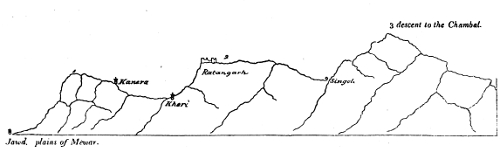
Diagram of part of Eastern Mewār.
From Bichor, the pass opening from the plains of Mewar, to the
highest peak of this alpine Patar, the Kala Megh, or ‘black cloud,’
1679of Begun, bore sway. From him sprung another of the numerous
clans of Mewar, who assumed the patronymic Meghawat. These
clans and tribes multiply, for Kala Megh and his ancestors were
recognized as a branch of the Sangawat, one of the early subdivisions
of the Chondawat, the chief clan of Mewar. The
descendant of the ‘black cloud,’ whose castle of Begun is near the
entrance to Antri, could not now muster above a hundred and
fifty men at arms throughout the Patar; to which he might add
as many more of foreign Rajputs, as the Hara and Gaur, holding
lands for service. The head of the Meghawats has not above
twenty villages in his fief of Begun, though these might yield
twenty-five thousand rupees annually, if cultivated; the rest is
still in the hands of the Mahrattas, as a mortgage contracted
nearly forty years ago, and which has been liquidated ten times
over: they include, in this, even a third of the produce of his own
place of residence, and the town itself is never free from these
intruders, who are continually causing disturbances. Unhappily
for Mewar, the grand principle of the campaign and its political
results, “that of excluding the Mahrattas from the west bank of
the Chambal,” was forgotten in our successes, or all the alienated
lands of Mewar as far as the Malwa frontier would have reverted
to the Rana.
—The hamlets on the Patar consist
of huts with low mud walls, and tiled roofs; even Ummedpura,
though inhabited by the uncle of the chief, is no better than the
rest, and his house is one which the poorest peasant in England
would not occupy. Yet steeped in poverty, its chieftain, accompanied
by his son, nephew, and fifteen more of his kin and clan,
came “for the purpose of doing himself, his lord paramount of
Begun, and the British Agent, honour.” The mountain-chief of
Ummedpura affords a fine example [642], that noble bearing may
be independent of the trappings of rank; high descent and proper
self-respect appeared in every feature and action. Dressed in a
homely suit of amaua, or russet green, with a turban of the same
(the favourite hunting costume of the Rajput); over all the
corselet of the skin of the elk, slain by himself; with his bright
lance in hand, and mounted on a good strong horse, whose accoutrements
like his master’s were plain but neat, behold the
vassal of Ummedpura equipped for the chase or foray. The rest
of his party followed him on foot, gay and unconcerned as the
1680wild-deer of the Patar; ignorant of luxury, except a little amalpani
when they go to Begun; and whose entire wants, including
food, raiment, gunpowder, and tobacco, can be amply supplied
by about £8 a year each! The party accompanied me to my
tents, and having presented brilliant scarlet turbans and scarfs,
with some English gunpowder, to the chief, his son, and nephew,
we parted mutually pleased at the rencontre.
The descent to Singoli is very gentle, nor are we above eighty
feet below the level of Umar, the highest point of the Patar, which
I rejoice to have visited, but lament the want of my barometers.
Singoli, in such a tract as this, may be entitled a town, having
fifteen hundred inhabited dwellings encompassed by a strong wall.
The Pandit is indebted to his own good management, and the
insecurity around him, for this numerous population. In the
centre of the town, the dingy walls of a castle built by Alu Hara
strike the eye, from the contrast with the new works added by
the Pandit; it has a deep ditch, with a fausse-braye, and parapet.
The circumvallation measures a mile and three-quarters. About
a mile to the north-west are the remains of a temple to Vijayaseni
Bhavani, the Pallas of the Rajputs. I found a tablet recording
the piety of the lord paramount of the Patar, in a perpetual gift
of lights for the altar. It runs thus: “Samvat 1477 (A.D. 1421),
the 2d of Asoj, being Friday (Bhriguwar[5]), Maharaja Sri Mokal-ji,
1681in order to furnish lights (jyotis waste) for Vijayaseni Bhavaniji
[643], has granted one bigha and a half of land. Whosoever shall
set aside this offering, the goddess will overtake him.” This is a
memorial of the celebrated Rana Mokal of Mewar, whose tragical
death by assassination has been recorded in the annals of that
State.[6] Mokal was one of the most celebrated of this race; and
he defeated, in a pitched battle at Raepur, a grandson of the
emperor of Delhi. He was the father of Lalbai, called ‘the Ruby
of Mewar,’ regarding whom we have related a little scandal from
the chronicle of the Bhattis (see p. 1218); but the bard of the
Khichis, who says that prince Dhiraj espoused her in spite of the
insult of the desert chief, had no cause to doubt the lustre of this
gem.
—The Patar resounds with the traditionary
tales of the Haras, who, at a very early period, established
themselves in this alpine region, on which they erected twelve
castles for its protection, all of them still to be traced existing or
in ruins; and although they assumed the title of ‘lords of the
Patar,’ they acknowledged the supremacy of the Ranas of Mewar,
whom they obeyed as liege lords at this very time. Of these
twelve castles, Ratangarh is the only one not entirely dismantled;
though even the ruins of another, Dilwargarh, had been the cause
of a bloody feud between the Meghawat of Begun and the Saktawat
of Gwalior, also in the Patar. That of Paranagar, or Paroli,
lies a short distance from thence, but the most famous of all is
Bumbaoda, placed upon the western crest of the plateau, and
1682overlooking the whole plain of Mewar. Although some centuries
have elapsed since the Haras were expelled from this table-land,
the name of Alu of Bumbaoda still lives, and is familiar even to
the savage Bhil, who, like the beasts, subsists upon the wild fruits
of the jungles. It is my intention to return by another route
across the Patar, and to visit the site of Alu’s dwelling; meanwhile
I will give one of the many tales related of him by my guide,
as I traversed the scenes of his glory.
—Alu Hara, one day, returning homeward from the
chase, was accosted by a Charan, who, having bestowed his blessing
upon him, would accept of nothing in exchange but [644] the
turban from his head. Strange as was the desire, he preferred
compliance to incurring the
visarwa,
[7] or ‘vituperation of the
bard’; who, placing Alu’s turban on his own head, bade him
‘live a thousand years,’ and departed. The Charan immediately
bent his steps to Mandor, the capital of Maru; and as he was
ushered into the presence of its prince and pronounced the
birad
of the Rathors, he took off his turban with the left hand, and performed
his salutation with the right. The unusual act made the
prince demand the cause, when in reply he was told “that the
turban of Alu Hara should bend to none on earth.” Such reverence
to an obscure chief of the mountains of Mewar enraged the
King of the Desert, who unceremoniously kicked the turban out
of doors. Alu, who had forgotten the strange request, was
tranquilly occupied in his pastime, when his quondam friend again
accosted him, his head bare, the insulted turban under his arm,
and loudly demanding vengeance on the Rathor, whose conduct
he related. Alu was vexed, and upbraided the Charan for having
wantonly provoked this indignity towards him. “Did I not tell
you to ask land, or cattle, or money, yet nothing would please
you but this rag; and my head must answer for the insult to a
vile piece of cloth; for nothing appertaining to Alu Hara shall be
insulted with impunity even by the Thakur of Marwar.” Alu
forthwith convened his clan, and soon five hundred “sons of one
father” were assembled within the walls of Bumbaoda, ready to
follow wheresoever he led. He explained to them the desperate
nature of the enterprise from which none could expect to return;
and he prepared the fatal Johar for all those who determined to
1683die with him. This first step to vengeance being over, the day of
departure was fixed; but previous to this he was anxious to
ensure the safety of his nephew, who, on failure of direct issue,
was the adopted heir of Bumbaoda. He accordingly locked him
up in the inner keep of the castle, within seven gates, each
of which had a lock, and furnishing him with provisions,
departed.
The prince of Mandor was aware he had entailed a feud; but
so little did he regard what this mountain-chief might do, that he
proclaimed “all the lands over which the Hara should march to
be in dan (gift) to the Brahmans.” But Alu, who despised not
the aid of stratagem, disguised his little troop as horse-merchants,
and placing their arms and caparisons in covered carriages, and
their steeds in long strings, the hostile caravan reached the capital
unsuspected. The party took rest for the night; but with the
dawn they saddled, and the nakkaras of the Hara awoke the
Rathor prince from his slumber; starting up, he demanded who
was the audacious [645] mortal that dared to strike his drum
at the gates of Mandor? The answer was,—“Alu Hara of
Bumbaoda!”
The mother (probably a Chauhani) of the King of Maru now
asked her son “how he meant to fulfil his vaunt of giving to the
Brahmans all the lands that the Hara passed over?” but he had
the resolution to abide by his pledge, and the magnanimity not
to take advantage of his antagonist’s position; and to his formal
challenge, conveyed by beat of nakkara, he proposed that single
combats should take place, man for man. Alu accepted it,
and thanked him for his courtesy, remarking to his kinsmen,
“At least we shall have five hundred lives to appease our
revenge!”
The lists were prepared; five hundred of the “chosen sons of
Siahji” were marshalled before their prince to try the manhood
of the Haras; and now, on either side, a champion had stepped
forth to commence this mortal strife, when a stripling rushed in,
his horse panting for breath, and demanded to engage a gigantic
Rathor. The champions depressed their lances, and the pause
of astonishment was first broken by the exclamation of the Hara
chieftain, as he thus addressed the youth: “Oh! headstrong and
disobedient, art thou come hither to extinguish the race of Alu
Hara?”—“Let it perish, uncle (kaka), if, when you are in peril,
1684I am not with you!” replied the adopted heir of Bumbaoda.
The veteran Rathor smiled at the impetuous valour of the youthful
Hara, who advanced with his sword ready for the encounter.
His example was followed by his gallant antagonist, and courtesy
was exhausted on either side to yield the first blow; till, at length,
Alu’s nephew accepted it; and it required no second, for he clove
the Rathor in twain. Another took his place—he shared the
same fate; a third, a fourth, and in like manner twenty-five, fell
under the young hero’s sword. But he bore ‘a charmed life’;
the queen of armies (Vijayaseni), whose statue guards the entrance
of Bumbaoda, had herself enfranchized the youth from the sevenfold
gates, in which his uncle had incarcerated him, and having
made him invulnerable except in one spot (the neck),[8] sent him
forth to aid his uncle, and gain fresh glory for the race of which
she was the guardian. But the vulnerable point was at length
touched, and Alu saw the child of his love and his adoption
stretched upon the earth. The queen-mother of the Rathors, who
witnessed the conflict, dreaded a repetition of such valour, from
men in whom desire of life was extinct; and she commanded that
the contest should cease, and reparation be made to the lord of
the Patar, by giving him in marriage a daughter of Mandor.
Alu’s honour was redeemed; he accepted the offer, and with his
bride repaired to the desolate Bumbaoda. The [646] fruit of this
marriage was a daughter; but destiny had decreed that the race
of Alu Hara should perish. When she had attained the age of
marriage, she was betrothed. Bumbaoda was once more the
scene of joy, and Alu went to the temple and invited the goddess
to the wedding. All was merriment; and amongst the crowd
of mendicants who besieged the door of hospitality was a decrepit
old woman, who came to the threshold of the palace, and desired
the guard to “tell Alu Hara she had come to the feast, and demanded
to see him”; but the guard, mocking her, desired her
to be gone, and “not to stand between the wind and him”: she
repeated her request, saying that “she had come by special invitation.”
But all was in vain; she was driven forth with scorn.
Uttering a deep curse, she departed, and the race of Alu Hara
was extinct. It was Vijayaseni herself, who was thus repulsed
from the house of which she was protectress!
1685A good moral is here inculcated upon the Rajput, who, in the
fatal example of Alu Hara, sees the danger of violating the laws
of wide-extended hospitality: besides, there was no hour too
sacred, no person too mean, for such claims upon the ruler. For
the present, we shall take leave of Alu Hara, and the ‘Mother
of Victory’ of the Patar, whose shrine I hope to visit on my return
from Haravati; when we shall learn what part of her panoply
she parted with to protect the gallant heir of Bumbaoda.
Dāngarmāu,[9] February 18, eight miles; thermometer 48°.—A
choice of three routes presented itself to us this morning. To
the left lay the celebrated Menal, once the capital of Uparmal;
on the right, but out of the direct line, was the castle of Bhainsror,
scarcely less celebrated; and straight before us the pole-star and
Kotah, the point to which I was journeying. I cut the knot of
perplexity by deviating from the direct line, to descend the table-land
to Bhainsror, and without crossing the Chambal, nearly
retraced my steps, along the left bank, to Kotah, leaving Menal
for my return to Udaipur. Our route lay through the Antri, or
valley, whose northern boundary we had reached, and between
it and the Bamani. The tract was barren but covered with
jungle, with a few patches of soil lodged amidst the hollows or
otherwise bare rock, over whose black surface several rills had
cut a low bed, all falling into the Bamani. One of these had a
name which we need not translate, Rani bur-ka-khal, and which
serves as a boundary between the lands of the Meghawats of
Antri and the Saktawats of Bhainsror.
Dangarmau-Barao is a small patta of twelve villages, yielding
fifteen thousand [647] rupees of annual rent; but it is now partitioned,—six
villages to each of the towns above mentioned. They
are Saktawat allotments, and the elder, Sakat Singh, has just
returned from court, where he had been to have the sword of
investiture (talwar bandhai) girt on him as the lord of Barao.
Bishan Singh of Dangarmau is at Kotah, where he enjoys the
confidence of Zalim Singh and is commandant of cavalry. He has
erected a castle on the very summit of the third steppe of the
Patar, whose dazzling white walls contrast powerfully with the
black and bleak rock on which it stands, and render it a conspicuous
object. The Saktawats of the Patar are of the Bansi
1686family,[10] itself of the second grade of nobles of Mewar; and the
rank of both the chiefs of Dangarmau and Barao was the third,
or that termed gol; but now, having each a patta (at least nominally)
of above five thousand rupees yearly rent, they are lifted
into the Battisa, or amongst the ‘thirty-two’ of the second class.
The Bamani, whose course will carry us to its close at Bhainsror,
flows under the walls of both Dangarmau and Barao, and is the
cause not only of great fertility but of diversity, in this singular
alpine region. The weather has again undergone a very sensible
change, and is extremely trying to those, who, like myself, are
affected by a pulmonary complaint, and who are obliged to brave
the mists of the mountain-top long before the sun is risen. On the
second, at daybreak, the thermometer stood at 60°, and only three
days after, at 27°; again it rose to 40° and for several days stood
at this point, and 75° at midday. The day before we ascended
the Patar it rose to 54°, and 94° at noon; and on reaching the
summit, 60° and 90°; again it falls to 40°, and we now shiver with
cold. The density of the atmosphere has been particularly annoying
both yesterday and to-day. Clouds of mist rolled along the
surface of the mountain, which, when the sun cleared the horizon,
and shot about ‘spear-high’ in the heavens, produced the most
fantastic effects. The orb was clear and the sky brilliant; but
the masses of mist, though merely a thin vapour and close to the
spectator, exhibited singular and almost kaleidoscopic changes.
There was scarcely a figure that the sun did not assume; the
upper half appearing orbicular, the lower elliptical: in a second,
this was reversed. Sometimes it was wholly elliptical, with a
perfect change of the axis, the transverse and conjugate changing
places—a loaf, a bowl, and at one instant a scollop-shell, then
‘round as my shield,’ and again a segment of a circle, and thus
alternating until its ascension dissipated the medium of this
beautiful illusion, the more perfect from the sky being cloudless.
The mists disappeared from the mountain long before this
phantasmagoria finished [648].
1687
Bhainsrorgarh, February 19.—Bhainsrorgarh,[1] ten miles, four
furlongs; thermometer 51°; atmosphere dense and oppressive,
and roads execrable, through a deep forest; but for the hatchets
of my friends, my baggage never could have been got on. We
passed several hamlets, consisting of a dozen or more huts, the
first of which I find belongs to my young friend Morji of Gura,
himself a vassal of the Pramar of Bijoli (one of the sixteen Omras
of Mewar), and holding a few bighas of bhum, as his bat or share
of the bapota (patrimony) of Barao. We have elsewhere given a
copy of the tenure on which Morji holds a village in the fief of
Bijoli.[2] At seven miles from Dangarmau, we came to a small
shrine of an Islamite saint, who buried himself alive. It is an
elevated point, from whence is a wild but lovely prospect. There
is a kund, or ‘fountain,’ planted with trees, close to the shrine,
which attracts a weekly mela or ‘fair,’ attended by all classes,
who cannot help attributing some virtue to a spot where a saint,
though a Muslim, thus expiated his sins. In descending, we heard
the roaring of mighty waters, and soon came upon the Bamani,
forming a fine cascade of about fifty feet in height; its furious
course during the monsoon is apparent from the weeds it has left
on the trees, at least twenty feet above its present level. The
fall of the country is rapid, even from this lower spot, to the bed
of the Chambal. Uparmal must have a considerable elevation
above the table-land of Janapao, where the Chambal and other
streams have their fountains; but of all this we shall by and by
form a more correct opinion. We passed the cairn of a Rajput
who fell defending his post against the Minas of the Kairar, a
tract on the banks of the Banas, filled with this banditti, in one
of their last irruptions which disturbed the peace of this region.
Each traveller adds a stone, and I gave my mite to swell the
heap [649].
The patta of Bhainsror is held by Raghunath Singh, one of
the sixteen great lords of Mewar, having the very ancient title
of Rawat, peculiar to Rajputana, and the diminutive of Rao.[3]
Bhainsror is one of the best fiefs of Mewar, and the lands attached
1688to it are said to be capable of yielding one lakh of annual revenue,
equal to £50,000 in the dearest countries of Europe; and when I
add that a cavalier can support himself, his steed, etc., on £50,
its relative value will at once be understood. He has also a toll
upon the ferries of the Chambal, though not content therewith,
he levied until lately a percentage on all merchandise, besides
impositions on travellers of whatever description, under the name
of kot ki marummat, or ‘repairs of the castle’: were we, however,
to judge by its dilapidated condition, we should say his exactions
were very light, or the funds were misapplied. This is the sole
passage of the Chambal for a great extent, and all the commerce
of higher Malwa, Haraoti, and Mewar passes through this domain.
The class of Banjaras (traders) termed Vaishnava, long established
at the city of Pur in Mewar, frequent no other route in their
journey from the salt-lakes of the desert to Malwa or Bundelkhand.
Their tanda or caravan consists of six thousand bullocks, and they
never make less than two, and often three, trips in the year. The
duty of the Raj is five rupees for each hundred head thus laden;
but the feudatory, not content with his imposition of ‘castle
repairs’ and ‘bhum’ as lord of the manor, has added a hundred
and fifty per cent to the regular transit duty of the State, which is
divided into two items; namely, three rupees and a half for the
ferry, and as much for bolai, or safe escort through his territory.
But as Haraoti always afforded protection (which could be said
of no other region of independent India), the ghat of the
Chambal was much frequented, in spite of these heavy drawbacks
to industry. My friend the Rawat has, however, found
it expedient to remove all these war-taxes, retaining only that
portion which has been attached to the frontier post, for
protection; and a portion of the ferry-rate granted to this
fief nearly two centuries ago. Instead of about fifteen per
cent, as heretofore levied, including that of the crown, it
amounts to less than one-half, and the revenue has been
quadrupled!
—The castle of Bhainsror is most romantically
situated upon the extreme point of a ridge, on an almost
isolated rib of the Patar, from which we have descended. To the
east, its abrupt cliff overhangs the placid expanse of the Chambal,
its height above which is about two hundred feet: the level of the
river in the monsoon is marked at full thirty feet above its present
1689elevation. The Bamani bounds Bhainsror on the west, and by
the rapidity of its fall has completely scarped the rock, even to
[650] the angle of confluence within which is placed the castle,
to whose security a smaller intermediate stream not a little
contributes. As by mistake it is placed in the map on the wrong
side of the Bamani, we shall correct this error by giving a slight
plan of the ground.
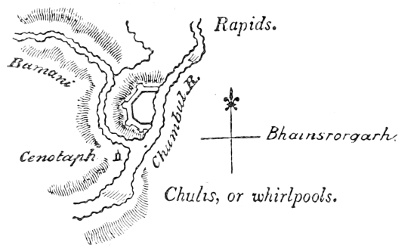
The Rapids of the Chambal.
On the north alone is it accessible, and there the hill is scarped;
but this scarp, which is about three hundred yards distant, forms
a good cover, and a few shells thence played upon the castle would
soon compel it to surrender. The rock is a soft, loose, blue
schistose slate, which would not retard the miner. The approach
from the river, here about five hundred yards wide, would be
destruction. It is never fordable, and its translucent sea-green
waters are now full forty feet in depth. When in the periodical
rains it accumulates at its source, and is fed during its passage
by many minor streams from the Vindhya and this oberland, its
velocity is overwhelming; it rises above the opposing bank, and
laying the whole tract to the base of the tableland of Haraoti
under water, sweeps away in its irresistible course even the rocks.
Speculation might here be exhausted in vain attempts to explain
how nature could overcome this formidable obstacle to her
operations, and how the stream could effect its passage through
this adamantine barrier. The channel cut in the rock is as clean
as if performed by the chisel, and standing on the summit of the
cliff, which is from three hundred to seven hundred feet in height,
1690one discerns in imagination the marks of union: to use the words
of our last great bard, on the Rhone,
Heights which appear as lovers who have parted
In hate, whose mining depths so intervene,
That they can meet no more, though broken-hearted.
—I shall by and by, I trust, obtain
a more correct knowledge of the comparative elevation of this
plateau, and the crest of the Vindhya whence issues the Chambal;
but although this stream is, of course, much below the level of its
source, yet there is little doubt that the summit of this chasm
(
uparmal) is, as its name indicates, the ‘highest land’ of Malwa.
I say this after making myself acquainted with the general depression
of [651] Malwa to this point, in which we are aided by the
course of the stream. Under Bhainsror, the current is never very
gentle; but both above and below there are rapids, if not falls,
of thirty to fifty feet in descent. That above the stream is termed
the Chuli, because full of whirlpools and eddies, which have given
a sacred character to it, like the Nerbudda, at ‘the whirlpools of
the great god,’ Chuli Maheswar. A multitude of the round stones
taken out of these vortices, when they have been rounded by
attrition into a perfectly orbicular form, only require consecration
and a little red paint to be converted into the representatives of
Bhairon, the god of war, very properly styled the elder born of
Siva, the destroyer. This is about two miles up the stream; there
is another at Kotra, about three miles down, with several successive
rapids. There is a fall in the vicinity of Rampura, and another
about five coss north of it, at Churetagarh, where the river first
penetrates the plateau. There, I understand, it is not above
seventy yards in breadth, confined between cliffs perfectly
perpendicular. There is also said to be another fall or rapid
intermediate between Rampura and its source in the peak of
Janapao,
[4] in the neighbourhood of Un. If these are all the falls,
though only amounting to rapids, we may form a tolerable idea
of the difference of level between the base of the Uparmal and the
highland of the Vindhya, whence the Chambal issues; and still
we shall see that there are points where the perpendicular cliffs
must be some hundred feet above the peak of Janapao; if so, this
chasm was never formed by water.
1691Mewar still extends east of the river, and the greater part of the
estate of Bhainsror is on the opposite side. A small stream, called
the Karab-ka-khal, divides the lands of the Haras from those of
the Sesodias, and there is a bijak-marga, or landmark inscription,
at the Shesa talao, put up centuries ago. To this line, and between
it and the Chambal, is the paita of Kundal; and farther south,
towards Rampura, is that of Pachail, both containing twenty-four
villages attached to Bhainsror. All that tract farther inland in
Upper Malwa, termed Malkides, in which are the towns of Chaichat
and Saket, was in old times included geographically in Mewar:
it is yet possessed by the Saktawats, though subject to Kotah.
Tradition has preserved the etymology of Bhainsror, and dates
its erection from the second century of the era of Vikrama, though
others make it antecedent even to him. Be that as it may, it
adds a fact of some importance, namely, that the Charans, or
bards, were then, as now, the privileged carriers of Rajwara,
and that this was one of their great lines of communication.
Bhainsror, therefore, instead of being the work [652] of some
mighty conqueror, owes its existence to the joint efforts of Bhainsa
Sah, the merchant, and Rora, a Charan and Banjara, to protect
their tandas (caravans) from the lawless mountaineers, when
compelled to make a long halt during the periodical rains.[5] How
many lines of heroes possessed it before the Haras established
themselves among its ruins is unknown, though the “universal
Pramar” is mentioned. Its subsequent change of masters, and
their names and history, are matters of less doubt; since the
altars of the Dudia, the Pramar, the Rathor, the Saktawat, the
Chondawat,
—who sought and found, by dangerous roads,
A path to perpetuity of fame,
are still visible. Of the Dudia name we have already preserved
one wreck, though the “rocket of the moon,” was of the family
who dwelt upon the whirlpools of the Chambal, we must leave to
conjecture. Not so of his successor, the Rathor, who was a scion
of the house of Mewa,[6] on the Salt River of the desert, from which,
though he was but a vassal of Mandor, the Rana scorned not to
take a wife boasting the pure blood of the kings of Kanauj. A
1692younger brother accompanied her to the court of Chitor. Soon
after, the Rawal of Jaisalmer dared to put an affront upon the
Rana, the acknowledged head of the Rajput race! The chivalry
of Mewar was assembled, and the bira of vengeance held up,
which the stripling heir of Mewa, darting forward, obtained.
Although but fifteen years of age, entreaties were lost upon him
to induce him to renounce the enterprise, which in all probability
some border-feud of his paternal house and the Bhattis, as well
as swamidharma, or fealty, to his sovereign and kinsman, may
have prompted. His only request was that he might be aided
by two of his intimate friends, and five hundred horse of his own
selection. How he passed the desert, or how he gained admittance
to the chief of the Bhatti tribe, is not stated; suffice it to say,
that he brought the Rawal’s head and placed it at the feet of the
sovereign of Chitor, for which service he had a grant of Salumbar;
and subsequently (fiefs in those days not being amovable) he was
removed to Bhainsror. The young Rathor continued to rise in
favour; he was already by courtesy and marriage the bhanej,
or nephew, of his sovereign, who for this action bestowed upon him
a young princess of his own blood; an honour which in the end
proved fatal. One day, the Thakur (chief) was enjoying himself
in his baronial hall of Bhainsror, in the midst of his little court,
with a nautch, when a fatal curiosity, perhaps instigated by
jealousy, induced his Rani to peep out from the lattice above.
Offended at this violation of decorum, he said aloud to an
attendant, “Tell the Thakurani, if she is [653] eager to come
abroad, she may do so, and I will retire.” The lady disputed
the justice of the reprimand, asserting that her lord had been
mistaken, and tried to shift the reproach to one of her damsels;
but failing to convince him, she precipitated herself from the
battlements into the whirlpools beneath: the spot where she fell
into the Chambal still retains the name of Ranighatta.[7] When it
was reported to the Rana that a false accusation had caused the
suicide of his niece, the sentence of banishment from Mewar was
pronounced against the Rathor, which was afterwards commuted,
out of a regard for his former service, to the sequestration of
Bhainsror; and he had the small fief of Nimri and its twenty
dependent hamlets, situated upon the Patar, and not far from
Bhainsror, bestowed upon him.
1693Bijai Singh, the descendant of the hero of this tale, has just
been to see me; a shrewd and stalwart knight, not a whit degenerated
by being transplanted from the Luni to the Chambal;
for, though surrounded by Mahratta depredators, by means of
the fastnesses in which he dwells, and with the aid of his good
lance, with which he repays them in kind, he has preserved his
little estate in times so fatal to independence. Had I not entered
deeply into the history of the past, I might have been led away
by the disadvantageous reports given of these brave men, who
were classed with the common freebooters of the hills, and pointed
out as meriting similar chastisement; since these associations,
both for their own security and retaliation on the vagabond
Mahrattas, who usurped or destroyed their birthright, gave a
colour to the complaints against them.
The Pramar (vulg. Puar) succeeded the Rathor in the fief of
Bhainsror. How long the former held it is uncertain; but the
mode in which the last vassal chieftain lost it and his life together,
affords another trait of national manners. Here again the fair,
whose influence over the lords of Rajputana we have elsewhere
mentioned, was the cause of the catastrophe. The Pramar had
espoused the daughter of his neighbour chieftain of Begun, and
they lived happily until a game at pachisi, somewhat resembling
chess, caused a dispute, in which he spoke slightingly of her family,
an affront never to be pardoned by a Rajputni; and the next
day she wrote to her father. The messenger had not left his
presence with the reply, before the nakkara beat the assembly
for the kher.[8] The descendants of the ‘black cloud’ (Kalamegh)
obeyed the summons, and the hamlets on the Bamani, or the
Patar, poured forth their warriors at the sound of the tocsin of
Begun. When the cause of quarrel was explained, it came home
to every bosom, and they forthwith marched to avenge it. Their
road lay [654] through the forest of Antri; but when arrived
within a few coss of Bhainsror, they divided their band, and while
the chief took the more circuitous route of the pass, the heir of
Begun followed the course of the Bamani, took the Pramar by
surprise, and had slain him in single combat ere his father joined
him. The insult to the Meghawats being avenged, the Pramars
were about to retaliate; but seeing the honour of her house thus
dearly maintained, affection succeeded to resentment, and the
1694Rajputni determined to expiate her folly with her life. The
funeral pile was erected close to the junction of the Bamani and
Chambal, and she ascended with the body of her lord, her own
father setting fire to it. I encamped close to the altars recording
the event.
This feud changed the law of succession in the Begun estate.
The gallantry of the young Meghawat consoled the old chief for the
tragical event which lost him a daughter; and in a full council
of “the sons of Kalamegh,” the rights of primogeniture were
set aside in favour of the valorous youth, and the lord paramount
(the Rana) confirmed the decision. The subordinate fief of Jathana,
which formerly comprehended the present district of Jawad, was
settled on the elder son, whose descendant, Tej Singh, still holds
a share of it, besides the title of Rawat. Both estates have alike
suffered from the Mahrattas, equally with others in Mewar.
The successor of the Pramar was a Chondawat, of the branch
Kishanawat, and a younger son of Salumbar; and it would be
well for Lal Singh had he sought no higher distinction than that
to which his birth entitled him. But Lalji Rawat was a beacon
in the annals of crime, and is still held out as an example to those
who would barter a good name here, and the hope of the life to
come, for the evanescent gifts of fortune. He purchased the
honours of Bhainsror by shedding the blood of his bosom-friend,
the uncle of his sovereign.
—Maharaja Nathji was one of the sons of
Rana Sangram Singh, and brother to the reigning prince Jagat
Singh, on whose death, doubts of the legitimacy of his successor
Raj Singh being raised, Nathji aspired to the dignity; but his
projects faded by the death of Raj Singh. He left a posthumous
child, whose history, and the civil wars engendered by his uncle
Arsi, who took possession of the
gaddi, have been fully detailed.
Arsi, who was assuredly a usurper, if the pretender was a lawful
son of Rana Raj, had suspicions regarding his own uncle Nathji,
who had once shown a predilection for the supreme power; but
the moment he heard that his nephew fancied he was plotting
against him, he renounced ambition, and sought to make his
peace with [655] heaven; amusing himself with poetry, in which
he had some skill, and by cultivating his melons in the bed of
the Banas, which ran under the walls of his castle, Bagor.
[9] The
1695fervour of his devotions, and the love and respect which his
qualifications as a man and a Rajput obtained him, now caused
his ruin. In the coldest nights, accompanied by a single attendant,
he was accustomed to repair to the lake, and thence convey water
to sprinkle the statue of his tutelary divinity, ‘the god of all
mankind’ (Jagannath). It was reported to the Rana that, by
means of these ascetic devotions, he was endeavouring to enlist
the gods in his traitorous designs, and, determined to ascertain
the truth, Arsi, with a confidential friend, disguised himself, and
repaired to the steps of the temple. Nathji soon appeared with
his brazen vessel of water, and as he passed, the prince, revealing
himself, thus addressed him: “Why all this devotion, this
excess of sanctity? if it be the throne you covet, uncle, it is
yours”; to which Nathji, in no wise thrown off his guard, replied
with much urbanity, “You are my sovereign, my child, and I
consider my devotions as acceptable to the deity, from their
giving me such a chief, for my prayers are for your prosperity.”
This unaffected sincerity reassured the Rana; but the chiefs of
Deogarh, Bhindar, and other clans, being dissatisfied with the
harsh and uncompromising temper of their sovereign, endeavoured
to check his ebullitions by pointing to the Maharaja as a refuge
against his tyranny.
To be released from such a restraint, Arsi at last resolved on
assassinating his uncle; but his valour and giant strength made
the attempt a service of danger, and he therefore employed one
who, under the cloak of friendship, could use the poniard without
risk. Lal Singh was the man, the bosom friend of the Maharaja,
who, besides exchanging turbans with him, had pledged his
friendship at the altar; a man who knew every secret of his
heart, and that there was no treason in it. It was midnight,
when a voice broke in upon his devotions, calling on him from
the portico by name. No other could have taken this liberty,
and the reply, “Come in, brother Lalji; what brings you here
at such an hour?” had scarcely passed the lips of Nathji, when,
as he made the last prostration to the image, he received the
dagger of his friend in his neck, and the emblem of Siva was
covered with his blood! For this service, the assassin was
rewarded with the fief of Bhainsror, and a seat amongst the
sixteen barons of Mewar; but as the number cannot be increased,
the rights of the Saktawat chief of Bansi were cancelled; thus
1696adding one crime to another, which however worked out its
own reward, and at once avenged the murder of Nathji, and laid
Mewar in ruins, causing [656] fresh streams of the blood which
had already so copiously flowed from the civil wars arising out
of the hostility of these rival clans, the Saktawats and Chondawats.
Lalji did not long enjoy his honours; his crime of “triple
dye” was ever present to his mind, and generated a loathsome,
incurable disease; for even in these lands, where such occurrences
are too frequent, “the still small voice” is heard: worms consumed
the traitor while living, and his memory is blasted now that he
is dead; while that of Nathji is sanctified, as a spirit gentle,
valorous, and devout.
Man Singh, the son of this man of blood, succeeded to the
honours of Bhainsror, and was a soldier of no common stamp.
At the battle of Ujjain, where the Rana of Mewar made the last
grand stand for independence, Man was badly wounded, made
captive, and brought in the train of the conquering Mahratta,
when he laid siege to Udaipur. As he was recovering from his
wounds, his friends attempted to effect his liberation through
that notorious class called the Baoris,[10] and contrived to acquaint
him with the plot. The wounded chief was consoling himself
for his captivity by that great panacea for ennui, a nautch, and
applauding the fine voice of a songstress of Ujjain as she warbled
a tappa of the Panjab, when a significant sign was made by a
stranger. He instantly exclaimed that his wounds had broken
out afresh, staggered towards his pallet, and throwing down the
light, left all in confusion and darkness, which favoured the
Baori’s design; who, while one of his friends took possession of
the pallet, wrapped the sick chief in a chadar (sheet), threw him
on his back, and carried him through the camp of the besiegers
to the city. The Rana, rejoiced at his liberation, commanded a
salute to be fired, and the first intelligence the Mahratta leader
had of his prisoner’s escape was in answer to the question as to
the cause of such rejoicing; they then found one of the vassal
substitutes of Man still occupying the bed, but the sequel does
not mention how such fidelity was repaid. The cenotaph (chhatri)
of this brave son of an unworthy sire is at the Tribeni, or point of
confluence of the three streams, the Chambal, the Bamani, and
1697the Khal; and from its light and elegant construction, adds
greatly to the picturesque effect of the scenery. The present
chief, Raghunath Singh, who succeeded Man, has well maintained
his independence throughout these perilous times. Bapu Sindhia,
whose name will long be remembered as one of the scourges of
these realms, tried his skill upon Bhainsror, where the remains of
his trenches, to the north-west of the town, are still conspicuous;
but he was met with sortie after sortie, while the hill-tribes were
nightly let loose upon him, until he was forced to make a precipitate
retreat [657].
I cannot conclude the annals of this family without a passing
remark on the great moral change effected since the power of
Britain has penetrated into these singular abodes. It was my
habit to attend on any of the chieftains who honoured me by an
invitation to their family fêtes, such as their salgirahs, or ‘birthdays’;[11]
and on these occasions I merged the Agent of the
British Government entirely in the friend, and went without
ceremony or parade. Amongst my numerous pagri badal bhai,
or ‘adopted brothers’ (as well as sisters), was the Maharaja
Sheodan Singh, the grandson and possessor of the honours and
estates of Nathji, who still enjoys the domain of Bagor, and
from whom I used to receive a share of its melons, which he
cultivates with the same ardour as his grandsire. The ‘annual
knot’ (salgirah) of my friend was celebrated on the terraced
roof of his palace, overhanging the lake of Udaipur, and I was
by his side listening, in the intervals of the song, to some of his
extemporaneous poetical effusions (on which my friend placed
rather too high a value), when amongst the congratulatory names
called aloud by the herald, I was surprised to hear, “Maharaja
Salamat, Rawat Raghunath Singhji-ka mujra lijo!” or, “Health
to the Maharaja, and let him receive the compliments of Rawat
Raghunath Singh”: the grandson of the murderer come to pay
his respects to the grandson of the murdered, and to press with
his knee the gaddi on which he sat! With justice may we repeat
1698their powerful metaphor, on such anomalies in the annals of their
feuds—bher aur bakri ekhi thali se pītē hain, ‘the wolf and the goat
drink from the same platter.’[12] We might thus, by a little attention
to the past history and habits of these singularly interesting
races, confer signal moral benefits upon them; for it must be
evident that the germs of many excellent qualities require only
the sunshine of kindness to ripen into goodly fruit; and for the
sake of our own welfare, as well as that of humanity, let not the
protecting power, in the exercise of patronage, send amongst
them men who are not imbued with feelings which will lead them
to understand, to appreciate, and to administer fitting counsel,
or correction where necessary. The remembrance of these injuries
is still fresh, and it requires but the return of anarchy
again to unsheath the poniard and drug the cup; but if we
consult their real good, the recollection will gradually grow
fainter.
—Before, however, we
altogether quit the wilds of the Chambal, we must record that
Bhainsror had been visited by another man of blood, the renowned
Alau-d-din, in whose epithets of Khuni, or ‘the sanguinary,’
and Sikandaru-s-sani, or ‘the second Alexander,’ by which
history has given him perpetuity of infamy, we recognize the
devastating [658] and ferocious Khilji king, who assailed every
Hindu prince in India. Obedient to the letter of the law, he
had determined to leave not one stone upon another of the
temples or palaces of Bhainsror. Everywhere we searched for
memorials of the Hun, whose name is also connected with the
foundation of Bhainsror; of the Pramar, or the Dudia; but in
vain. The vestiges of these ages had disappeared, or been built
up in the more modern fortifications. Two such inscriptions we
indeed discovered, reversed and applied as common building
materials in the walls around the town; one was dated S. 1179
(A.D. 1123), but being in the old ornamented Jain character,
would have required time and labour to decipher. The other is
also anterior to Ala, and the ornaments in this are decidedly
Jain; its purport is as follows: “On the parab (full moon) of
Sheoratri (the birthday of Siva), Maharae Dariyai Rae Singh
Deo bestowed, in the name of Rameswar, the village of Tatagarh
1699in pun (religious gift). Those who maintain the grant will enjoy
the fruits resulting therefrom”; or, in the words of the original:
Yasya yasya jāda bhūmis,
Tasya tasya tadā phalam.[13]
“Samvat 1302 (A.D. 1246).” This form of sasan, or religious
charity, is peculiar, and styled sasan Udayaditya, which proves
that the Pramar, of whom this is a memorial, was a feudatory
of the prince of Dhar, whose era has been fixed. These discoveries
stimulated our research, and my revered friend and Guru, who
is now deeply embued with antiquarian enthusiasm, vainly
offered a large reward for permission to dig for the image of
Parsvanath, his great pontiff, of whose shrine he has no doubt
the first inscription is a memorial. When about to leave this
place (indeed our baggage had gone on), we were informed of
some celebrated temples across the river at a place called Baroli,
anciently Dholpur. The shrine is dedicated to Ghateswara
Mahadeva, with a lingam revolving in the yoni, the wonder of
those who venture amongst its almost impervious and unfrequented
woods to worship. As I could not go myself, I dispatched
the Guru to hunt for inscriptions and bring me an account of it.
Dābhi, February 20, eleven miles; thermometer 48°.—Reascended
the third steppe of our miniature Alp, at the Nasera
pass (ghat), the foot of which was exactly five miles from Bhainsror,
and three and a half furlongs more carried us to its summit,
which is of easy ascent, though the pathway was rugged, lying
between high peaks on either side. This alone will give a tolerable
idea of the height of the Patar above the level of the river. Majestic
trees cover the hill from the base to its summit, through [659]
which we could never have found a passage for the baggage
without the axe. Besides some noble tamarind (imli) trees,
there was the lofty semal, or cotton-tree; the gnarled sakhu,
which looks like a leper amongst its healthy brethren; the
tendu, or ebony-tree, now in full fruit, and the useful dhao, besides
many others of less magnitude.[14]—The landscape from the summit
was grand: we looked down upon the Charmanvati (vulg. Chambal)
1700and the castle of Raghunath; while the eye commanded a
long sweep of the black Bamani gliding through the vale of Antri
to its termination at the tombs of the Saktawats. The road to
Dabhi was very fair for such a tract, and when within four miles
of our tents, we crossed a stream said to have its fountain at
Menal, which must consequently be one of the highest points of
Uparmal. This rill afforded another means of estimating the
height of our position, for besides the general fall to the brink
of the chasm, it precipitates itself in a fine cascade of three
hundred feet. Neither time nor place admitted of our following
this rill to its termination, about six miles distant, through a
rugged woody tract. From the summit of the pass of Nasera,
we had a peep at the tomb of a Muslim saint, whence the ground
gradually shelved to the end of our journey at Kotah.
—Dabhi is the line of demarcation
between Mewar and Bundi, being itself in the latter State, in the
district of Loecha,—dreary enough! It produces, however, rice
and
makkai, or Indian corn, and some good patches of wheat.
We passed the cairns, composed of loose stones, of several Rajputs
slain in defending their cattle against the Minas of the Kairar.
I was particularly struck with that of a Charan bard, to whose
memory they have set up a
paliya, or tombstone,
[15] on which is
his effigy, his lance at rest, and shield extended, who most likely
fell defending his
tanda. This tract was grievously oppressed
by the banditti who dwell amidst the ravines of the Banas, on
the western declivity of the plateau. “Who durst,” said my
guide, as we stopped at these tumuli, “have passed the Patar
eighteen months ago? they (the Minas) would have killed you
for the cakes you had about you; now you may carry gold.
These green fields would have been shared, perhaps reaped
altogether, by them; but now, though there is no superfluity,
there is ‘play for the teeth,’ and we can put our turban under
our heads at night without the fear of missing it in the morning.
Atal Raj! may your sovereignty last for ever!” This is the
universal language of men who have never known peaceful days,
1701who have been nurtured amidst the elements of discord and
rapine, and who, consequently, can appreciate the change, albeit
they were not mere spectators. “We must retaliate,” said a
sturdy [660] Chauhan, one of Morji’s vassals, who, with five
besides himself, insisted on conducting me to Bhainsror, and
would only leave me when I would not let them go beyond the
frontier. I was much amused with the reply of one of them
whom I stopped with the
argumentum ad verecundiam, as he
began a long harangue about five buffaloes carried off by the
Thakur of Nimri, and begged my aid for their recovery. I said
it was too far back; and added, laughing, “Come, Thakur,
confess; did you never balance the account elsewhere?”—“Oh,
Maharaja, I have lost many, and taken many, but Ramdohai!
if I have touched a blade of grass since your raj, I am no
Rajput.” I found he was a Hara, and complimented him on his
affinity with Alu, the lord of Bumbaoda, which tickled his vanity
not a little. In vain I begged them to return, after escorting
me so many miles. To all my solicitations the Chauhan replied,
“You have brought us comfort, and this is
man ki chakari,
'service of the heart.'” I accepted it as such, and we “whiled
the gait” with sketches of the times gone by. Each foot of the
country was familiar to them. At one of the cairns, in the
midst of the wood, they all paused for a second; it was raised
over the brother of the Bhatti Thakur, and each, as he passed,
added a stone to this monumental heap. I watched, to discern
whether the same feeling was produced in them which the act
created in me; but if it existed, it was not betrayed. They were
too familiar with the reality to feel the romance of the scene;
yet it was one altogether not ill-suited to the painter.
Karipur, February 21, 9½ miles.—Encamped in the glen of
Karipura, confined and wild. Thermometer 51°, but a fine,
clear, bracing atmosphere. Our route lay through a tremendous
jungle. Half-way, crossed the ridge, the altitude of which made
up for the descent to Dabhi, but from whence we again descended
to Karipura. There were many hamlets in this almost impervious
forest; but all were desolate, and the only trace of population
was in the altars of those who had defended to the death their
dreary abodes against the ruthless Mina of the Kairar, which we
shall visit on our return.
—About a mile after we had commenced our march
1702this morning, we observed the township of Sontra on our right,
which is always conjoined to Dabhi, to designate the tappa of
Dabhi-Sontra, a subdivision of Loecha. Being informed by a
scout that it contained inscriptions, I requested my Guru and one
of my Brahmans to go there. The search afforded a new proof
of the universality of the Pramar sway, and of the conquests of
another “Lord of the world and the faith,” Alau-d-din, the
second [661] Alexander. The Yati found several altars having
inscriptions, and many paliyas, from three of which, placed in
juxtaposition, he copied the following inscriptions:
“Samvat 1422 (A.D. 1366). Pardi, Teja, and his son, Deola
Pardi, from the fear of shame, for the gods, Brahmans, their
cattle, and their wives, sold their lives.”
“S. 1446 (A.D. 1390). In the month of Asarh (badi yakam):
Monday, in the castle of Sontra (Sutrawan durg), the Pramar
Uda, Kala, Bhuna, for their kine, wives, Brahmans, along with
the putra Chonda, sold their existence.”
“S. 1466 (A.D. 1410), the 1st Asarh, and Monday, at Sontragram,
Rugha, the Chaora, in defence of the gods, his wife, and
the Brahmans, sold his life.”
The following was copied from a kund, or fountain, excavated
in the rock:
“S. 1370 (A.D. 1314), the 16th of Asarh (sudi yakam), he, whose
renown is unequalled, the king, the lord of men, Maharaja Adiraj,
Sri Alau-d-din, with his army of three thousand elephants, ten
lakhs of horse, war-chariots and foot without number, conquering
from Sambhar in the north, Malwa, Karnat, Kanor, Jalor,
Jaisalmer, Deogir, Tailang, even to the shores of the ocean, and
Chandrapuri in the east; victorious over all the kings of the earth,
and by whom Sutrawan Durg, with its twelve townships, have
been wrested from the Pramar Mansi; by whose son, Bilaji,
whose birthplace (utpatti) is Sri Dhar, this fountain was excavated.
Written and also engraved by Sahideva the stone-cutter
(sutradhar).”
Beneath the surface of the fountain was another inscription,
but there was no time to bale out the water, which some future
traveller over the Patar may accomplish. Sontra, or as classically
written, Satrudurg, ‘the inaccessible to the foe,’ was one of
the castles of the Pramar, no doubt dependent on Chitor when
under the Mori dynasty; and this was only one of the subdivisions
1703of Central India, which was all under Pramar dominion,
from the Nerbudda to the Jumna—an assertion proved by inscriptions
and traditions. We shall hear more of this at Menal and
Bijoli on our return over Uparmal, which I resolve to be thoroughly
acquainted with.
Kotah, February 22, eleven miles to the banks of the Chambal.—Although
not a cloud was to be seen, the sun was invisible till
more than spear-high, owing to a thick vapoury mist, accompanied
by a cold piercing wind from the north-west. The descent
was gradual all the way to the river, but the angle may be estimated
from the fact that the pinnacle (kalas) of the palace,
though one hundred and twenty feet above the level of the
Chambal, was not visible until within five miles of the bank.
The barren [662] tract we passed over is all in Bundi, until we
approach Kotah, where the lands of Nanta intervene, the personal
domain of the regent Zalim Singh, and the only territory belonging
to Kotah west of the Chambal. Karipura, as well as all this
region, is inhabited by Bhils, of which race a very intelligent
individual acted this morning as our guide. He says it is called
by them Baba ka nund, and that they were the sovereigns of it
until dispossessed by the Rajputs. We may credit them, for
it is only fit for Bhils or their brethren of the forest, the wildbeasts.
But I rejoiced at having seen it, though I have no wish
to retrace my steps over this part of my journey. Half-way, we
passed a roofless shed of loose stones, containing the divinity of
the Bhils; it is in the midst of a grove of thorny tangled brushwood,
whose boughs were here and there decorated with shreds
of various coloured cloth, offerings of the traveller to the forest
divinity for protection against evil spirits, by which I suppose
the Bhils themselves are meant.[16]
—We must not omit (though we have quitted the
Patar) to notice the ‘Maypoles’ erected at the entrance of every
village in the happy basant or spring, whose concluding festival,
the Holi or Saturnalia, is just over. This year the season has
been most ungenial, and has produced sorrow rather than gladness.
Every pole has a bundle of hay or straw tied at the top,
1704and some have a cross stick like arms and a flag flying; but
in many parts of the Patar, the more symbolic plough was
substituted, dedicated to the goddess of fruition, and served the
double purpose of a Spring-pole, and frightening the deer from
nibbling the young corn.
—The appearance of Kotah is very imposing, and
impresses the mind with a more lively notion of wealth and
activity than most cities in India. A strong wall with bastions
runs parallel to, and at no great distance from, the river, at the
southern extremity of which is the palace (placed within a castle
separated from the town), whose cupolas and slender minarets
give to it an air of light elegance. The scene is crowded with
objects animate and inanimate. Between the river and the city
are masses of people plying various trades; but the eye dwells
upon the terminating bastion to the north, which is a little fort
of itself, and commands the country on both banks. But we
shall have more to say regarding this during our halt, which is
likely to be of some continuance [663].
Unhealthiness of Kotah. Nanta, September 10, 1820.—A day
of deliverance, which had been looked forward to by all of us as
a new era in our existence. The last four months of our residence
at Kotah was a continued struggle against cholera and deadly
fever: never in the memory of man was such a season known.
This is not a state of mind or body fit for recording passing events;
and although the period of the last six months—from my arrival
at Kotah in February last, to my leaving it this morning—has
been one of the most eventful of my life, it has left fewer traces
of these events upon my mind for notice in my journal than if I
had been less occupied. The reader may be referred, for an
abstract of these occurrences, to Chapter 6, which will make
him sufficiently acquainted with the people amongst whom we
have been living. To try back for the less important events
which furnish the thread of the Personal Narrative, would be
vain, suffering, whilst this journal is written, under fever and
ague, and all my friends and servants in a similar plight. Though
we more than once changed our ground of encampment, sickness
1705still followed us. We got through the hot winds tolerably until
the dog-days of June; but, although I had experienced every
vicissitude of temperature in every part of India, I never felt
anything to be compared with the few days of June at Kotah.
It was shortly after we had shifted the camp from the low
paddy-fields to the embankment of the Kishor sagar, or ‘lake,’
immediately east of the city, the sky became of that transparent
blue which dazzles the eye to look at. Throughout the day and
night, there was not a zephyr even to stir a leaf, but the repose
and stillness of death. The thermometer was 104° in the tent,
and the agitation of the punkah produced [664] only a more
suffocating air, from which I have fled, with a sensation bordering
on madness, to the gardens at the base of the embankment of
the lake. But the shade even of the tamarind or cool plantain
was still less supportable. The feathered tribe, with their beaks
opened, their wings flapping or hanging listlessly down, and
panting for breath, like ourselves, sought in vain a cool retreat.
The horses stood with heads drooping before their untasted
provender. Amidst this universal stagnation of life, the only
sound which broke upon the horrid stillness, was the note of the
cuckoo; it was the first time I had ever heard it in India, and
its cheerful sound, together with the associations it awakened,
produced a delightful relief from torments which could not long
be endured. We invariably remarked that the bird opened his
note at the period of greatest heat, about two o’clock in the day,
and continued during intervals for about an hour, when he
changed his quarters and quitted us. I afterwards became more
familiar with this bird, and every day in the hot weather at
Udaipur, when I resided in one of the villas in the valley, I not
only heard but frequently saw it.[1]
The reader can easily conceive the scene of our encampment;
it was at the north-eastern angle of the lake, having in front that
little fairy islet with its light Saracenic summer abode (p. 1521).
Gardens fringed the base of the embankment, which was bordered
with lofty trees; the extended and gigantic circumvallation, over
1706the parapets of which peeped the spires and domes of temples or
mosques, breaking the uniformity, and occasionally even showing
the distant and elevated land beyond the Chambal. We had also
close to us a spot sacred to the manes of the many heroes of this
noble family. I frequented the cenotaphs of the Haras, which,
if less magnificent than those of Marwar or Mewar, or even of the
head of their line of Bundi, may vie with them all in the recollections
they conjure up of patriotism and fealty, and of the deadly
rancour attendant on civil strife. This cluster of monuments
approaches near to the city wall, but is immediately under the
dam of the lake, and being enveloped in foliage, almost escapes
observation. I was rejoiced to see the good order in which they
were maintained, which was another of the anomalies in the
regent’s character: for what can so much keep alive the proud
spirit of the Haras as these trophies of their sires? But whatever
the motive of the act, it is a tribute to virtue; nor could I resist
an exclamation of respect to the veteran regent, who is raising
a monument to the last prince, which, if it survive to distant
times, will afford room to some future [665] traveller to say, that,
with Maharao Ummed Singh, Kotah appears to have attained
the summit of its power. Nor should I deny myself the praise
of having something to do with this harmless piece of vanity;
for I procured for the regent free permission from the Rana of
Mewar to take from the marble quarry at Kankroli[2] whatever
suited his purpose, without price or duty: a request he was too
proud to make himself since their ancient quarrel. We had also
the range of Madho Singh’s magnificent gardens, of many acres
in extent, abounding in exotic flowers and fruits, with parterres
of rose-trees, each of many roods of land. But what were all
these luxuries conjoined with cholera morbus, and tap tijari,
‘tertian fever,’ and every other fever, around us? But even
these physical ills were nothing compared to the moral evils
which it was my duty to find remedies for or to mitigate; and
they were never adverted to in the many despatches addressed,
during our residence in this petit enfer, to supreme authority.
The enthusiast may imagine how delightful travelling must be
amongst such interesting races; to visit the ruins of ancient
greatness, and to read their history in their monuments; to
march along the margin of such streams as the Chambal or the
1707Bamani; to be escorted by these gallant men, to be the object
of their courtesy and friendship, and to benefit the condition of
the dependant class; but the price of this enjoyment was so
high that few would voluntarily pay it, namely, a perpetuity of
ill-health. Fortunately, however, for ourselves and our country,
if these offices are neither sinecures nor beds of roses, we do not
make them beds of thorns; there is a heart-stirring excitation
amidst such scenes, which keeps the powers of mind and body
alert: a feeling which is fortunately more contagious than
cholera, and communicable to all around. How admirably was
this feeling exemplified this morning! Could my reader but
have beheld the soldiers of my escort and other establishments,
as they were ferried over the Chambal, he would have taken
them for ghosts making the trajet of the Styx; there was not
one of them who had not been in the gripe of pestilential fever or
ague. Some of them had had cholera, and half of them had
enlarged spleens. Yet, although their muskets were too heavy
for them, there were neither splenetic looks nor peevish expressions.
It was as delightful as it was wonderful to see the alacrity,
even of the bedridden, to leave their ills behind them east of the
Chambal.
Scarcely any place can be more unhealthy than Kotah during
the monsoon. With the rise of the Chambal, whose waters
filtrate through the fissures of the rock, the [666] wells are filled
with mineral poison and the essence of decomposed vegetation.[3]
All those in the low ground at our first encampment were overflowed
from this cause; and the surface of each was covered
with an oily pellicle of metallic lustre, whose colours were prismatic,
varying, with position or reflection, from shades of a
pigeon’s breast (which it most resembled), to every tint of blue
blending with gold. It is the same at Udaipur during the periodical
rains, and with similar results, intermittent and tertian fevers,
from which, as I said, not a man, European or native, escaped.
They are very obstinate, and though not often fatal, are difficult
to extirpate, yielding only to calomel, which perhaps generates
a train of ills.
—The last few days of our stay
1708were passed in the ceremonials of leave-taking. On the 5th, in
company with the regent, I paid my last visit to the Maharao,
who with his brothers returned my farewell visit the day following;
and on the 8th and 9th the same formalities were observed with
the regent. The man who had passed through such scenes as
the reader has perused, now at the very verge of existence, could
not repress his sorrow. His orbless eyes were filled with tears,
and as I pressed his palsied hands which were extended over me,
the power of utterance entirely deserted him. I would expunge
this, if I did not know that vanity has no share in relating what
I consider to be a virtue in the regent. I have endeavoured
to paint his character, and could not omit this trait. I felt he
had a regard for me, from a multitude of kind expressions, but
of their full value was always doubtful till this day.
—I did not get down to the point of
embarkation for some hours after my suite, having been detained
by the irresistible hold of ague and fever, though I started before
the hot-fit had left me. The regent had prepared the grand
barge, which soon landed me on the opposite bank; but Fateh
Bahadur, my elephant, seemed to prefer his present quarters to
Udaipur; after his howdah, pad, and other gear had been taken
off and put into the boat, he plunged into the Chambal with
delight, diving in the deepest water, and making a water-spout
of his proboscis. He had got a third of the way across, when
a new female elephant, less accustomed to these crossings, turned
back, and Fateh Bahadur, regardless of his master, was so gallant
as to go after her. In vain the mahout (driver) used his
pharsi,
[4]
digging it into his head behind the ear; this only exasperated
the animal, and he made one or two desperate efforts to shake
off his pigmy driver. Fortunately (being too weak to mount
a horse), I found a baggage-elephant just beginning to be loaded:
I put my howdah upon her, and the “victorious warrior” suffered
the indignity of carrying a load.
We passed the town of Kanari, belonging to Raj Gulab Singh,
Jhala, a relation of [667] the regent, and one of the Omras of
Kotah. It is a thriving comfortable place, and the pinnacled
mahall of the Raj gave to it an air of dignity as well as of the
picturesque. Our route to Nanta[5] was over a rich and highly
1709cultivated plain, studded with mango-groves; which do not
surprise us, since we know it is the family estate of the regent.
The patrimonial abode is, therefore, much cherished, and is the
frequent residence of his son Madho Singh, by whom I was met
half-way between Kanari, and conducted to the family dwelling.
—Nanta is a fine specimen of a Rajput
baronial residence. We entered through a gateway, at the top
of which was the Naubat-khana, or saloon for the band, into an
extensive court having colonnaded piazzas all round, in which
the vassals were ranged. In the centre of this area was a pavilion,
apart from the palace, surrounded by orangeries and odoriferous
flowers, with a
jet-d’eau in the middle, whence little canals conducted
the water and kept up a perpetual verdure. Under the
arcade of this pavilion, amidst a thousand welcomes, thundering
of cannon, trumpets, and all sorts of sounds, we took our seats;
and scarcely had congratulations passed and the area was cleared
of our escorts, when, to the sound of the tabor and
sarangi, the
sweet notes of a Panjabi
tappa saluted our ears. There is a
plaintive simplicity in this music, which denotes originality, and
even without a knowledge of the language, conveys a sentiment
to the most fastidious, when warbled in the impassioned manner
which some of these syrens possess. While the Mahratta delights
in the dissonant
dhurpad,
[6] which requires a rapidity of utterance
quite surprising, the Rajput reposes in his
tappa, which, conjoined
with his opium, creates a paradise. Here we sat, amidst the
orange-groves of Nanta, the
jet-d’eau throwing a mist between
us and the group, whose dark tresses, antelope-eyes, and syren-notes,
were all thrown away upon the Frank, for my teeth were
beating time from the ague-fit.
It was in this very area, now filled with the youth and beauty
of Kotah, that the regent exhibited his wrestlers; and it was
from the very seat I occupied, that Sriji of Bundi challenged these
ruffians to the encounter related in the annals.[7] Having sat a
quarter of an hour, in obedience to the laws of etiquette, and in
1710courtesy to the son of the Regent, who had come thus far to escort
me, we took leave and hastened to get a cup of tea.
Talera,[8] September 11.—Two miles north-west of Nanta we
passed the boundary of the regent’s estate and the Bundi territory.
The roads were good, over a well-cultivated and well-wooded
plain, the cotton particularly thriving. Talera is a large [668]
village on the margin of a fine clear stream, its banks delightfully
wooded, abounding in fish, which even tempted my invalid
friends to try their luck. Talera is in the jagir of the wakil
who attends me on the part of the Bundi Raja, but is still a
heap of ruins, and being on the high road, is open to parties of
troops.
Nawagāon, September 12.—The road very fair, though a little
winding, to avoid some deep ravines. The land rich, well-watered,
and too much wooded; but man is wanting to cultivate
the fertile waste. The encamping ground afforded not a single
tree to screen us from a scorching sun. We passed two cenotaphs,
where Rajputs had fallen; but there was no inscription, and no
one could reveal their history.
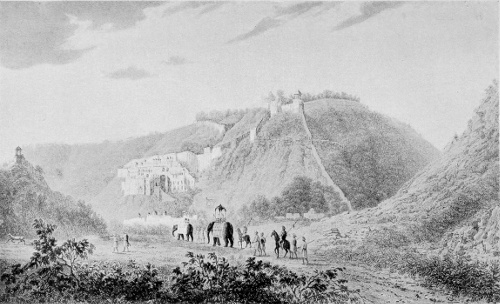
PALACE AND FORTRESS OF BŪNDI.
To face page 1710.
Būndi, September 13.—The country and roads, as usual, flat,
with an apparent descent from Talera to the base of the Bundi
range, whose craggy and unequal summits showed it could be no
buttress to the tableland with which it unites. The general
direction of the range is east-north-east, though there are diverging
ridges, the course of which it is impossible to delineate.
As we neared the capital of the Haras, clouds of dust, gradually
obscuring the atmosphere, were the first signal of the Raja’s
approach: soon the sound of drums, the clangour of trumpets,
and tramping of steeds, became audible, and at length the Sandnisawars,
or camel-messengers, announced the Raja’s presence.
He was on horseback. Instantly I dismounted from my elephant,
and although too weak to contend with the fire of my steed
Javadia, it would have been an unpardonable sin against etiquette
to have remained elevated above the prince. All Javadia’s[9]
warlike propensities were awakened at the stir of this splendid
retinue, from which ever and anon some dashing young Hara
issued, “witching the world with noble horsemanship”; and as,
in all the various evolutions of the manège, there was not a steed
1711in Rajwara could surpass mine, to my vast inconvenience and no
small danger, he determined on this occasion to show them off.
In one of his furious bounds, he had his fore-feet on the broken
parapet of a reservoir, and as I turned him short, he threw up his
head, which came in contact with mine, and made my Chabuk-sawar[10]
exclaim, “Ali madad!” “The help of Ali!” and a few
more bounds brought me in contact with my friend, the Rao
Raja, when we dismounted and embraced. After going through
the same ceremony with the principal chiefs, he again gave me
three fraternal hugs to prove the strength of his friendship, as
he said, with blunt sincerity, “This is your home, which you
have come to at last.” With other affectionate welcomes, he
took leave and preceded me. His retinue was striking, but not
so much from tinsel [669] ornament, as from the joyous feeling
which pervaded every part of it. As my friend twirled his lance
in the midst of about eight hundred cavaliers and fifteen hundred
foot, I thought of the deeds his ancestors had performed, when
leading such a gol, to maintain their reputation for fealty. It
recalled his words on the formation of the treaty, when the
generosity of Britain again restored his country to independence.
“What can I say, in return for the restoration of my home?
My ancestors were renowned in the time of the kings, in whose
service many lost their lives; and the time may come when I
may evince what I feel, if my services should be required: for
myself, my chiefs, are all yours!” I would pledge my existence
that performance would not have lagged behind his promise.
We allowed a quarter of an hour to elapse, in order to avoid the
clouds of dust which a Rajput alone can breathe without inconvenience;
and accompanied by my worthy and dignified old
friend, the Maharaja Bikramajit, we proceeded to our tents,
placed upon the bank of a tank beyond the town.
—The
coup d'œil of the castellated palace
of Bundi, from whichever side you approach it, is perhaps the
most striking in India;
[11] but it would require a drawing on a
much larger scale to comprehend either its picturesque beauties
or its grandeur. Throughout Rajwara, which boasts many fine
1712palaces, the Bundi-ka-mahall is allowed to possess the first rank;
for which it is indebted to situation, not less than to the splendid
additions which it has continually received: for it is an aggregate
of palaces, each having the name of its founder; and yet the whole
so well harmonizes, and the character of the architecture is so
uniform, that its breaks or fantasies appear only to rise from the
peculiarity of the position, and serve to diversify its beauties.
The Chhattar-mahall, or that built by Raja Chhattarsal, is the
most extensive and most modern addition. It has two noble
halls, supported by double ranges of columns of serpentine from
his own native quarries, in which the vassals are ranged, and
through whose ranks you must pass before you reach the state
apartments; the view from which is grand. Gardens are intermingled
with palaces raised on gigantic terraces. In one of these
I was received by the Raja, on my visit the next day. Whoever
has seen the palace of Bundi, can easily picture to himself the
hanging-gardens of Semiramis. After winding up the zig-zag
road, I passed by these halls, through a vista of the vassals whose
contented manly looks delighted me, to the inner palace; when,
having conversed on the affairs of his country for some time, the
Raja led the way to one of the terraces, where I was surprised to
find a grand court assembled, under the [670] shade of immense
trees, trellised vines, and a fine marble reservoir of water. The
chiefs and retainers, to the number of at least a hundred, were
drawn up in lines, at the head of which was the throne. The
prospect was fine, both for near and distant views, as it includes
the lakes called the Jeth-Sagar and Prem-Sagar, with the gardens
on their margins, and in the distance the city of Kotah, and both
banks of the Chambal; and beyond these successive terraces and
mahalls, to the summit of the hill, is seen the cupola of the
Dhabhai’s tomb, through the deep foliage, rising above the
battlements of Taragarh. This terrace is on a grand bastion,
which commands the south-east gorge of the valley leading to the
city; and yet, such is the immense mass of building, that from
the town one has no idea of its size.
It were vain to attempt a description of Bundi, even were I
inclined. It was the traitor of Karwar who raised the walls of
Taragarh, and it was Raja Budh Singh who surrounded the city
with walls, of which Ummed Singh used to say “they were not
required against an equal foe, and no defence against a superior—and
1713only retarded reconquest if driven out of Bundi, whose best
defence was its hills.”
Illness of Dr. Duncan, September 21.—Partly by business,
partly by sickness, we were compelled to halt here a week. Our
friend the doctor, who had been ailing for some time, grew gradually
worse, and at length gave himself up. Carey found him
destroying his papers and making his will, and came over deeply
affected. I left my bed to reason with my friend, who refused
all nourishment, and was sinking fast; but as much from depression
of spirits as disease. In vain I used the common arguments
to rouse him from his lethargy; I then tried, as the last resort,
to excite his anger, and reviled him for giving way, telling him to
teach by example as well as precept. By this course, I raised
a tinge of blood in my poor friend’s cheek, and what was better,
got a tumbler of warm jelly down his throat; and appointing
the butler, Kali Khan, who was a favourite and had great influence,
to keep rousing and feeding him, I left him. No sooner was he
a little mended, than Carey took to his bed, and nothing could
rouse him. But, as time passed, it was necessary to get on; and
with litters furnished by the Raja we recommenced our journey.
Banks of the Mej River,[12] September 26, distance ten miles.—I
this day quitted my hospitable friend, the Rao Raja. As I left
my tent, I found the Maharaja of Thana, with the Dablana[13]
contingent (zabita), amounting to a hundred horse, appointed to
escort me to the frontier. Our route lay through the Banda-ka-nal,
‘the valley of Banda,’ whose gorge near the capital is not
above four hundred yards in breadth, but [671] gradually expands
until we reach Satur, about two miles distant. On both sides of
this defile are numerous gardens, and the small temples and
cenotaphs which crown the heights, in many places well wooded,
produce a most picturesque effect. All these cenotaphs are
perfectly classical in form, being simple domes supported by slender
columns; that of Suja Bai is peculiarly graceful. As we reached
Satur, the valley closed our last view of the fairy palace of the
Haras, rearing its domes and gilded spires half-way up the mountain,
the kunguras of Taragarh encircling it as a diadem, whilst the
1714isolated hill of Miraji, at the foot of which was the old city,
terminates the prospect, and makes Bundi appear as if entirely
shut in by rocks. Satur is a sacred spot in the history of the
Haras, and here is enshrined their tutelary divinity, fair Hope
(Asapurna), who has never entirely deserted them, from the
sakha of Asi, Gualkund, and Asir, to the present hour; and though
the enchantress has often exchanged her attributes for those of
Kalima,[14] the faith of her votaries has survived every metamorphosis.
A high antiquity is ascribed to Satur, which they
assert is mentioned in the sacred books; if so, it is not in connexion
with the Haras. The chief temple is dedicated to Bhavani,[15]
of whom Asapurna is an emanation. There is nothing striking
in the structure, but it is hallowed by the multitude of sacrificial
altars to the manes of the Haras who have “fallen in the faith of
the Chhatri.” There were no inscriptions, but abundance of lazy
drones of Brahmans enjoying their ease under the wide-spreading
bar and pipal trees, ready, when well paid, to prepare their
incantations to Bhavani, either for good or for evil: it is chiefly
for the latter purpose that Satur-ki-Bhavani is celebrated. We
continued our journey to Nawagaon, a tolerable village, but there
being no good encamping ground, our tents were pitched a mile
farther on, upon the bank of the Mej, whose turbid waters were
flowing with great velocity from the accumulated mountain-rills
which fall into it during the equinoctial rains.
Thāna, September 27.—This is the seat of Maharaja Sawant
Singh, the eldest son of my friend Maharaja Bikramajit of Khini.
He affords another instance in which the laws of adoption have
given the son precedence of the father, who, while he receives
homage in one capacity, must pay it in another; for young
Sawant was raised from the junior to the elder branch of Thana.
The castle of Sawant Singh, which guards the western frontier, is
small, but of solid masonry, erected on the crest of a low hill.
There are only six villages besides Thana forming his fief, which is
burdened with the service of twenty-five horse. In Bundi, ‘a
knight’s fee,’ or what should equip one cavalier, is two hundred
and fifty rupees of rent. In the afternoon the Maharaja brought
[672] his son and heir to visit me, a fine little fellow six years of
1715age, who with his sword buckled by his side and miniature shield
on his back, galloped his little steed over hill and dale, like a true
Rajput. I procured several inscriptions, but none above three
hundred years old.
Jahāzpur,[16] September 28.—At daybreak I again found the
Maharaja at the head of his troop, ready to escort me to the
frontier. In vain I urged that he had superabundantly performed
all the duties of hospitality; “Such were his orders, and he must
obey them.” I well know the laws of the Medes were not more
peremptory than those of Bishan Singh; so we jogged on, beguiling
the time in conversation regarding the semi-barbarous race
of the tract I was about to enter, the Minas of Jahazpur and the
Karar or fastnesses of the Banas, for ages the terror of the country,
and who had studded the plains with cenotaphs of the Haras,
fallen in defending their goods and chattels against their inroads.
The fortress of Jahazpur was not visible until we entered the pass,
and indeed had nearly cleared it, for it is erected on a hill detached
from the range but on its eastern face, and completely guards this
important point of ingress to Mewar. This district is termed
Chaurasi, or consisting of eighty-four townships, a favourite
territorial subdivision: nor is there any number intermediate
between this and three hundred and sixty. Jahazpur, however,
actually contains above a hundred townships, besides numerous
purwas, or ‘hamlets.’ The population consists entirely of the
indigenous Minas, who could turn out four thousand kamthas,
or ‘bowmen,’ whose aid or enmity were not to be despised, as
has been well demonstrated to Zalim Singh, who held the district
during fifteen years. Throughout the whole of this extensive
territory, which consists as much of land on the plains as in the
hills, the Mina is the sole proprietor, nor has the Rana any
property but the two tanks of Budh Lohari, and these were
wrested from the Minas by Zalim Singh during his tenure.[17]
1716I was met at the frontier by the taiyunnati[18] of Jahazpur,
headed by the old chief of Basai and his grandson Arjun, of whom
we have spoken in the journey to Kotah. It was a very respectable
troop of cavalry, and though their appointments were not
[673] equal to my Hara escort, it was satisfactory to see assembled,
merely at one post, a body which the Rana two years ago could
not have collected round his own person, either for parade or
defence: as a beginning, therefore, it is good. Received also
the civil manager, Sobharam, the nephew of the minister, a very
good man, but without the skill to manage such a tract. He was
accompanied by several of the Mina Naiks, or chiefs. There is
much that is interesting here, both as matter of duty and of
history; we shall therefore halt for a few days, and rest our
wearied invalids.
Attempted Poisoning of the Author. Jahāzpur, October 1.—My
journalizing had nearly terminated yesterday. Duncan and
Carey being still confined to their beds, my relative, Captain Waugh,
sat down with me to dinner; but fever and ague having destroyed
all appetite on my part, I was a mere spectator. I had, however,
fancied a cake of makkai flour, but had not eaten two mouthfuls
before I experienced extraordinary sensations; my head seemed
expanding to an enormous size, as if it alone would have filled
the tent; my tongue and lips felt tight and swollen, and though
I underwent no alarm, nor suffered the slightest loss of sense, I
deemed it the prelude to one of those violent attacks, which have
assailed me for several years past, and brought me to the verge
of death. I begged Captain Waugh to leave me; but he had
scarcely gone before a constriction of the throat came on, and I
thought all was over. I rose up, however, and grasped [674] the
1717tent-pole, when my relative re-entered with the surgeon. I
beckoned them not to disturb my thoughts, instead of which
they thrust some ether and compounds down my throat, which
operated with magical celerity. I vomited violently; the
constriction ceased; I sunk on my pallet, and about two in the
morning I awoke, bathed in perspiration, and without a remnant
of disease. It was difficult to account for this result: the medical
oracle fancied I had been poisoned, but I was loth to admit it.
If the fact were so, the poison must have been contained in the
cake, and as it would have been too great a risk to retain the
person who prepared it, the baker was discharged. It was
fortunate that the symptoms were such as to induce Captain
Waugh to describe them so fully, and it was still more fortunate
for me that the doctor was not able to go out with his fishing-rod,
for the whole transaction did not last five minutes. This is about
the fourth time I have been ‘upon the brink’ (kinari pahuncha)
since I entered Mewar.[1]
Khajuri, October 2.—Left my sick friends this morning to nurse
each other, and having an important duty to perform at Mandalgarh,
which is out of the direct route, appointed a rendezvous
where I shall meet them when this work is over. I was for the
first time compelled to shut myself up in my palki; incessant
fever and ague for the last two months have disorganized a frame
which has had to struggle with many of these attacks. We are
now in what is termed the Karar, for so the tract is named on
both banks of the Banas to the verge of the plateau; and my
journey was through a little nation of robbers by birth and
profession; but their kamthas (bows) were unstrung, and their
arrows rusting in the quiver. Well may our empire in the east
be called one of opinion, when a solitary individual of Britain,
escorted by a few of Skinner’s Horse, may journey through the
valley of Khajuri, where, three short years ago, every crag would
have concealed an ambush prepared to plunder him! At present,
I could by signal have collected four thousand bowmen around me,
1718to protect or to plunder; though the Minas, finding that their
rights are respected, are subsiding into regular tax-paying subjects,
and call out with their betters “Atal Raj!” (“May your sway
be everlasting!”) We had a grand convocation of the Mina
Naiks, and, in the Rana’s name, I distributed crimson turbans
and scarfs; for as through our mediation the Rana had just
recovered the district of Jahazpur, he charged me with its
settlement. I found these Minas true children of nature, who
for the first time seemed to feel they were received within the
pale of society, instead of being considered as outcasts. “The
heart must leap kindly back to kindness,” is a sentiment as powerfully
[675] felt by the semi-barbarians of the Karar as by the more
civilized habitants of other climes.
Our route was through a very narrow valley, little susceptible
of cultivation, though a few patches were visible near the hamlets,
scattered here and there. The scene was wild, and the cool
morning air imparted vigour to my exhausted frame. The slopes
of the valley in many places are covered with trees to the very
summit of the mountains, on which the kukra or wild cock was
crowing his matins, and we were in momentary expectation of
seeing some bears, fit associates of the Minas, in their early
promenades. As we approached Khajuri, the valley widened,
so as to admit of its being termed a township of fifty-two thousand
bighas, which afforded another proof of ancestral wisdom, for it
was in sasan, or grant to the Brahmans: but the outlaws of the
Karar, though they sacrifice a tithe of their plunder to ‘our Lady
of the Pass’ (Ghata Rani), have little consideration for the idlers
of the plains. This feeling is not confined to the Minas; for the
Bhumia Rajputs, despising all the anathemas of the church, have
seized on the best lands of Khajuri. But only a small portion
of the Bawana (fifty-two thousand), about seventeen thousand
English acres, is arable.
Kachola or Kachaura, October 3.—Execrable roads! Our
route continued through the same valley, occasionally expanding
to the westward. Half-way, we passed the baronial castle of
Amargarh, whose chief, Rawat Dalil Singh, is now on duty with
his quota at Jahazpur, but his uncle Pahar Singh, who is a great
favourite with our party (by whom he is known as ‘the mountain-lion’),
came to meet and conduct me to the castle. But I was
too unwell, or should on many accounts have desired to visit this
1719somewhat celebrated abode of one of the Babas (infants) of Mewar,
whose feud I maintained for him against his potent neighbour
of Shahpura, which has elsewhere been related.[2] It is quite
unassailable, being built on an isolated rock, and, except by a
circuitous path on one side, there is no passage through the dense
jungle that surrounds it: a mode of fortifying recommended by
Manu,[3] but which, if universally followed in this land so studded
with fortresses, would waste no small portion of the sovereignty.
I was quite satisfied with this view of the castle of Dalil, and
enjoyed from the point of descent a noble prospect. In the foreground
is the cenotaph of Rana Arsi, in the centre of the valley,
which extended and gradually opened towards Mandalgarh, whose
blue ridge was distinctly visible in the distance. The hills to the
right were broken abruptly into masses, and as far as the eye could
stretch [676] on every side, were disordered heaps of gigantic
rocks. To reclaim this district, the largest in Mewar, I am now
intent, having convoked all the Bhumias and Patels of its three
hundred and sixty townships at the chief city, Mandalgarh. My
friend, Pahar Singh, as locum tenens of his uncle, expended
powder on the occasion; and must have charged his patereroes[4]
to the muzzle. Paharji joined me on his Panchkalyan (so they
term a horse with four white legs and a white nose), and determined
to escort me to Mandalgarh; a service, as he said, not only
due from his family, but in accordance with the commands of his
sovereign the Rana, of whom Pahar was a faithful, zealous, and
valiant supporter during his adversity. The Bhumias of Mandalgarh,
in fact, generally deserve the praise of having maintained
this stronghold without either command or assistance throughout
the whole period of his misfortunes.
Kachaura is a township rated at six thousand rupees of annual
revenue in the rent-roll of Mewar, but is now an inconsiderable
village. In former times, it must have been a place of importance,
for all around, to a considerable distance, the ground is strewed
with fragments of sculpture of a superior character, and one spot
is evidently the site of the cenotaphs of the family. The town
1720had stood on the western bank of an immense lake, which through
neglect is now a swamp; and, half-way up the hill, are disclosed,
amidst the brushwood of the dho,[5] the ruins of a temple: but
tradition has perished with the population, who were subjected
at once to the curse of constant foreign invasion and the inroads
of the Minas of the Karar. Thus a soil, whose richness is apparent
from the luxuriance of its meadows, is in a state of entire desolation.
Kachaura forms the patta of Shahpura in this district,
whose chief has to serve two masters, for he is a tributary of Ajmer
for Shahpura, itself a fief of Mewar, and holds an estate of about
forty thousand rupees of annual rent in Mandalgarh, which has
been two years under sequestration for his refusal to attend the
summons to Udaipur, and for his barbarous murder of the chief of
Amargarh.[6] This is a state of things which ought not to exist.
When we freed these countries from the Mahrattas, we should
have renounced the petty tributes imposed upon the surrounding
chiefs not within the limits of the district of Ajmer, and the
retention of which is the source of irritating discussions with these
princes through the feudatories. Presuming on this external
influence, the Shahpura Raja set his sovereign’s warrant at defiance,
and styled himself a subject of Ajmer; nor was it until he found
he was bound by a double tie of duty, that he deigned to appear
at the capital. The resumption of the estate in Mandalgarh alone
overcame the inertness of the chief of Shahpura; he has already
too much in the Chaurasi, or eighty-four [677] townships of
Shahpura, for such a subject as he is, who prefers a foreign master
to his legitimate lord. I would recommend that the Rathor chiefs
of Marwar, beyond the Aravalli hills, now tributary to Ajmer, and
who consequently only look to that State, should be replaced under
their proper head: the sacrifice is of no moment to us, and to them
it will be a boon.
Damnia, October 9.—I was detained at Kachaura by a violent
accession of fever and ague, as well as spleen, increased no doubt
by the unhealthiness of the position amidst swamps and jungle.
This is a fine healthy spot, where I should like to convene the
Bhumias and ryots, to endeavour to remove the reproach of so
beautiful a land remaining waste. Damnia, which is in the
sequestrated patta of Shahpura, is a town of two thousand houses;
a universal ruin!
1721Mānpura, 15.—After a week’s halt, reached this spot, about a
mile south-west of the town, and on the bank of the Banas.[7]
The entire population of Manpura turned out to receive me; the
damsels with their brazen vessels of water on their heads; but
the song of the Suhaila had ceased to charm, and my ague made
me too ill even to return their kindness. To-day it has abated,
and to-morrow, with another respite, I will try to get through the
work which brought me here. Mandalgarh is three coss from
hence. I was rejoiced to see the signs of reviving prosperity about
Manpura; some fine patches of sugar-cane were refreshing sights.
Māndalgarh,[8] 16 and 17.—Proceeded up the valley and encamped
within half a mile of the city, from which the governor
and his cortege came to meet and welcome me; but I was too
enfeebled to ascend the fort, which was a subject of regret. It
is by no means formidable, and may be about four furlongs in
length, with a low rampart wall, and bastions encircling the crest
of the hill. The governor’s residence appears on the west side,
at which spot the regent of Kotah was compelled to abandon
his ladders, which they retain as a trophy. This is the festival of
the Dasahra, the day sacred to Rama; but feasting is lost upon
me, for this is the ninth day of abstinence from dinner. Captain
Waugh rejoined me yesterday, looking very ill, and giving a poor
account of my friends, especially Carey, who is sinking rapidly.
He left them encamped at Baghit, the point of rendezvous in the
Banas where I shall join them to-morrow. He found me on my
charpai (pallet), with some threescore leeches (which I had got
from Mandalgarh) on my left side,[9] while I was attending [678] to
and noting down the oral reports of the Bhumias and Patels of
the district, who filled my tent, many remaining in groups outside.
1722I notwithstanding got through the work to my satisfaction, and
have obtained a thorough insight into the agricultural details of
this fine tract, which I may touch upon, if I am able, the first
halt.
—Mandalgarh was rebuilt by a chief
of the Balnot
[10] tribe, one of the ramifications of the Solanki or
Chaulukya race, which furnished a splendid dynasty of kings to
Anhilwara (Nahrwala) Patan, who ruled over the western maritime
provinces of India from the tenth to the fourteenth century.
They were of the great Takshak or Ophite race, which, with three
other tribes, became converts to Brahmanism.
[11] The Balnot of
Mandalgarh was a branch of the family which occupied Tonk-Toda
on the Banas, recognized in their traditional poems as
Takshak, or, in the dialect, Takatpura, ‘city of the Takshak, or
snake.’
[12] Although tradition asserts that the Solanki of Toda
migrated from Patan during the religious wars in the twelfth
century, it is more probable that the branch fixed itself here
during their progress from the north in search of settlements; for
their genealogical creed assigns Lohkot, in the Panjab, as the
cradle of their power.
[13] It is indeed a curious fact, amounting to
demonstration of the Indo-Scythic origin of the Agnikula races,
that they all lay claim to this northern origin, in spite of their
entrance into the world through the medium of fire (
agni): in
fact, the glorious egotism of the Brahman is never more conspicuous
than when he asserts the superiority of the Chauhans
over the more ancient races of Surya and Soma; that “these
were born of woman, but they were made by the Brahmans”:
a proof of conversion which requires no comment. In spite of
this fabled birth at the fountain-head, the Analkund of Abu,
tradition negatives the assumed pedigree of the Brahmans, and
brings them all from the north. Be this as it may, the branch
1723which fixed itself at Mandalgarh gave its name to the tract, which
is still recognized by some as Balnot.
—The first possession the founder had
was Larpura, a town of great antiquity. He had in his service a
Bhil, named Mandu, who, while guarding the sugar-cane from
the wild hog, came upon one sound asleep. To ensure his arrow
piercing the animal, he began to sharpen it upon a stone; and,
to his astonishment, found it transmuted to [679] gold. He
repaired to his master, who returned with Mandu, and found the
stone, with the hog still asleep beside it; but no sooner had he
seized upon his prize, than Baraha disappeared.
[14] With the
possession of the
paras-patthar, the ‘philosopher’s stone,’ he
raised the walls of Mandalgarh, which was so named after the
fortunate Bhil. By an act of injustice to one of his subjects, he
forfeited Mandalgarh to a descendant. This subject was a Jogi,
who had a mare of such extraordinary speed as to be able to run
down an antelope. Whether the Balnot prince thought the sport
unsuitable to an ascetic we are not told; but he forcibly took
away the mare. The Jogi complained to the king, who sent a
force and expelled the Balnot from Mandalgarh, and his
descendants are petty Bhumias at Jawal and Kachrod, retaining,
though mere peasants, the distinctive title of Rao. The numerous
stories of this kind, common throughout Rajwara, accounting
for the foundation of many ancient places, may merely record, in
this manner, the discovery of mineral wealth; from the acquisition
and the loss of which the legendary moralist has constructed his
tale.
I discovered in the remains of a marble bawari, or reservoir,
at Kachaura, two large tablets, containing the pedigree of the
Solanki family, which will require time to decipher. Tradition,
however, is busy with the name of Raja Bhim, and his son Baran
of Anhilwara, from whom many tribes branched off; and although,
from the first, only royal houses were founded, the other claims a
greater celebrity from originating a heterogeneous breed, which
descended into the third and fourth great classes, the Vaisya and
Sudra. From him the Bagherwal Mahajans,[15] who became converts
to the Jain faith, claim descent, as well as the Gujars of Sont-Katoria;
the Sunars, or goldsmiths, of Bonkan; the Bhil communities
1724of Oghna-Panarwa (or Mewar); and likewise those of
Mau-Maidana, in Kotah. Whether from Baran and his degenerate
offspring originated the name of baran-shankar, applied to the
mixed classes, I am not informed.[16] The Bagherwal is one of the
“twelve and a half (sarha barah niyat) castes of Mahajans,” or
mercantile tribes, subdivided into innumerable families, the
greater portion of whom profess the Jain creed, and nearly all are
of Rajput ancestry: an important fact in the pedigree of this
considerable part of the population. The lineal descendant of
the Toda Rao resides at Basai in a small village; and two other
branches, who held large possessions at Todri and Jahazpur,
retain the villages of Mirchiakhera and Bhatwara, both in
Chitor; they have preserved the title of Rao amidst all the
revolutions that have deprived them of their estates; nor would
any prince of Rajwara deem himself degraded by their alliance
[680]. Such is the virtue of pedigree in these regions. I should
imagine that the Balnots held of the Ranas of Mewar, as Mandalgarh
has been an integral portion of that State during the most
flourishing period of the Anhilwara dynasty, although the inscription
of Chitor savours of conquest; in which case we have at once
a solution of the question, and proof that the Balnot was inducted
into Mandalgarh by his superior, Kumarpal.[17]
In S. 1755 (A.D. 1699) the tyrant Aurangzeb granted Mandalgarh
to the Rathor chief of Pisangan, named Dudaji, who subdivided
it into allotments for his brethren, leaving no revenue for
the duties of the civil administration and repairs of the castle. To
remedy this, he imposed a tax, called daotra or dasotra, or ‘tenth’
of the net value of each harvest, upon his Bhumia brethren.
When the Rana succeeded in expelling the royal garrison, he
found it a work of some difficulty to get rid of the Rathor feudatories;
and he gave them regular pattas for their estates, subject
to the payment of dasotra; but as he found it led to interference,
in the inspection of crops, and to fluctuation and appeals in bad
seasons, he commuted the tax for service of one horseman and
one foot-soldier for each five hundred rupees of rent, and a certain
small sum annually to mark their tributary condition.
1725In these times of turbulence, other impositions were laid on
the Bhumias of his own kindred, the Ranawats, Kanawats, and
Saktawats, who established their rights with their swords when
the district was subjected to the emperor. In the same manner
as with the Rathors, the Rana confirmed their acquisitions on
the payment of certain fines called bhumbarar, which were either
baraskar and trisala, or ‘annual’ and ‘triennial’; the first being
levied from the holders of single villages, the latter from those
who had more than one. Thus, Amargarh was fixed at two
thousand five hundred rupees; Amaldah, fifteen hundred;
Tintora, thirteen hundred; Jhunjrala, fourteen hundred, etc.,
triennially, having obtained their lands by main force. They also,
when Mandalgarh was threatened, would repair with their vassals
and defend it during ten days at their own expense, after which
they received rations from the State. There were various other
fines collected from the Bhumia vassalage, such as lauasma, or
for the support of the Nakkarchis (kettle-drummers), the mace,
standard, and even the torch-bearers attached to each garrison.
There was also khar-lakar, for wood and forage, which has been
elsewhere explained; hal-barar, or ‘plough-tax,’ and ghasmali, or
‘pasturage,’ the rates of which are graduated, and vary [681] in
amount with the power of enforcing their collections. But owing
to these circumstances, the best land in Mandalgarh belongs to
the Bhumia chieftains.
It was about this time, in the reign of Jagat Singh II., that
Ummeda Singh of Shahpura had the grant of seventy-three
villages in Mandalgarh, one-fifth of the whole district, subject
only to the fine of three thousand two hundred and fifty rupees
annually for ghasmali, with five hundred more to the deputy
governor, and two hundred to the Chaudhari, or territorial head
of the district. In this lavish manner were estates disposed of.
This family continued to hold it until S. 1843, when the minister
Somji, in order to obtain his support during the Chondawat
rebellion, gave him a formal acquittance for this service, and in
addition to these lands, the two subordinate fiefs of Dangarmau
and Borwa on the Plateau, and the rich estate of Agoncha on the
Khari; in return for which, he exacted a stipulation to serve
with four hundred horse: a contract fulfilled only by one chief
of the family, who fell leading his contingent at the battle of
Ujjain. His descendants seem to have claimed immunity on the
1726score of his service; and the present incumbent is a madman.
Great changes, however, have recently been made in the condition
of the Bhumias, and these desultory fines have all merged into a
duty more accordant with the character of the Rajput; service
in the garrisons of Mandalgarh and Jahazpur, and a fixed annual
sum from those who are too poor to command even a single
horse.
Baghīt,[18] 18th; eight miles.—A large village on the west of our
own stream, the Berach, coming from the Udaisagar. Our road
lay over a rich soil, as usual overgrown with grass. Here I
rejoined my sick friends, all very ill; the doctor better, but Carey
in a very precarious condition.
Birslabās, 19th.—The route over the most fertile plains of
Mewar; but one continuous mass of jungle and rank grass. The
Maharaja came out to meet me, a courteous, polished Rajput.
He is of the Ranawat clan, descended from Rana Amra Singh, and
the elder branch of the Shahpura family. Both his father and
grandfather fell defending the cause of Shah Jahan against the
usurper Aurangzeb, which lost him his birthright; but he has
five villages left attached to Birslabas. Encamped near the
altars of his heroic ancestors.
Amba, 21st; six and a half miles.—The route over a scene of
desolation; fine fields, fruitful of grass and ruins. Sent one of my
Brahmans to the town of Akola, two coss distant, and had
several inscriptions copied; they were all immunities or grants
of privileges to the printers of that town, thence called Chhipi-ka-Akola,
to distinguish [682] it from another of the same name. I
halted at Birslabas, received several visits, and held interesting
conversations with the Maharaja; but fever and ague leave the
mind in a sorry state. I can pay no attention to barometer or
perambulator; of the latter Babu Mahesh keeps a diary, and on
his intelligence I can depend.
Hamīrgarh,[19] 22nd.—This town belongs to Biramdeo, Ranawat,
the son of Dhiraj Singh, who was the chief adviser of the Salumbar
princes in the rebellion of S. 1843, during which he obtained it.
The present chief is an oaf, always intoxicated; and as he did
not discharge the Baoris, or professional thieves in his service, on
the return of these days of peace, he was deprived of two towns
1727amounting to seven thousand rupees annual rent. He ought,
indeed, by the treaty of A.D. 1818, to have lost Hamirgarh, but
he contrived by various indirect means to elude it, and to retain
this, one of the most thriving places in Mewar. It contains about
eight hundred inhabited houses, tenanted chiefly by manufacturers
of chintz and dopattas, or ‘scarfs,’ such as are worn by all the
Rajputnis. It has a fine lake, filled with a variety of wild duck,
which live unmolested amidst the singhara[20] and lotus. The more
ancient name of this place is Bakrol, as I found by two inscriptions,
which again furnish specimens of sumptuary legislation.
Siyāna,[21] 23rd; eight miles and three furlongs.—We are now in
the very heart of Mewar, plains extending as far as the eye can
reach. Traces of incipient prosperity are visible, but it will
require years to repair the mischief of the last quarter of a century.
Passed through Ujhana, Amli, Neuria—all surrendered in consequence
of the treaty of 1818: the last-mentioned, together with
Siyana, from the ‘Red Riever,’ as we have nicknamed the
chieftain of Badesar. The prospect from this ground is superb:
the Udaipur hills in the distance; those of Pur and Gurla,[22] with
their cupolas, on our right; the fantastic peak of Barak rising
insulated from the plain. We are now approaching a place of
rest, which we all much require; though I fear Carey’s will be one
of perpetuity. Saw a beautiful mirage (si-kot) this morning, the
certain harbinger of the cold season. The ridge of Pur underwent
a thousand transformations, and the pinnacle of Barak was
crowned with a multitude of spires. There is not a more delightful
relaxation than to watch the changes of these evanescent objects,
emblems of our own ephemeral condition. This was the first
really cold morning. The Panchayat, or elders of Pur, with
several of the most respectable inhabitants to the number of fifty,
came all this way to see me, and testify their happiness and
gratitude! Is there another nook in the earth where such a
principle is professed, much [683] less acted on? Hear their
spokesman’s reply to my question, “Why did they take the
trouble to come so far from home?” I give it verbatim: “Our
town had not two hundred inhabited dwellings when you came
1728amongst us: now there are twelve hundred: the Rana is our
sovereign, but you are to us next to Parameswar (the Almighty);
our fields are thriving, trade is reviving, and we have not been
molested even for the wedding-portion.[23] We are happy, and we
have come to tell you so; and what is five coss, or five hundred, to
what you have done for us?” All very true, my friends, if you
think so. After a little wholesome advice to keep party feuds
from the good town of Pur, they took leave, to return their ten
miles on foot.
Since the town council left me, I have been kept until half-past
seven by the Baba of Mangrop, and the Thakur of Rawarda,
whose son I redeemed from captivity in the fortress of Ajmer.
Worn out; but what is to be done? It is impossible to deny
one’s self to chiefs who have also come miles from the best motives.
Now for coffee and the charpai.
Rāsmi,[24] October 23.—The direct or usual route is thirteen and
a half miles, but as I made a circuit by Marauli, it was fifteen. Had
I taken the common route, I should have followed the Banas the
whole way; as it was, for the last half I skirted its low banks, its
limpid stream flowing gently to the north-east. Found the cultivation
considerably increased compared with last year; but it is
still a desert, overgrown with grass and brushwood, in which these
little cultivated oases are “few and far between.” Marauli was
thriving in the midst of ruin, with fifty-seven ploughs at work;
there were but twelve when I entered Mewar. Rasmi has also
seventy families instead of the twenty I found; and in a few
years I hope to see them greatly increased. We had some
delicious trout from the Banas, some of them equal to what we
caught last year at Pahona, the largest of which weighed seventy-three
rupees, or about two pounds, and near seventeen inches long
by nine in girth. My friend Tom David Steuart was more
successful than we were in getting them to rise at the fly; in
revenge we took them, unsportsmanlike, in a net. This appears
to be the season for eating them.
Rasmi is a place of considerable interest, and tradition is at
work to establish its antiquity, connecting it with the name of
1729Raja Chand; but whether the Pramar of [684] Chandravati, or
the Chauhan of Abhaner, I cannot learn. There were vestiges
of past days; but even in these regions, where to a certain extent
they respect antiquity, I find the ruined temples are despoiled,
and appropriated to modern fabrics. Amongst the groves of
Rasmi I found some fragments of patriarchal legislation, prohibiting
“the ladies from carrying away under their ghaghra (petticoats)
any portion of the sadh, or village-feast!” I also discovered a
tablet raised by the collective inhabitants of Rasmi, which well
illustrates the truth, that they had always some resort against
oppression. It runs as follows: “Written by the merchants,
bankers, printers, and assembled panchayat of Rasmi: Whereas
the collector of town-duties oppressed the merchant by name
Pakar, and exacted exorbitant duties on grain and reza (unbleached
cloth), for which he abandoned the place; but the
government-officer having forsworn all such conduct for the
future, and prevailed on him to return, and having taken the god
to witness—we, the assembled panch, have set up this stone to
record it. Asarh the 3rd, S. 1819.”
Fourteen years have elapsed since I first put my foot in Mewar,
as a subaltern of the Resident’s[25] escort, when it passed through
Rasmi. Since that period, my whole thoughts have been occupied
with her history and that of her neighbours.
Jāsma,[26] 24th; distance fourteen miles, but not above twelve
direct.—This in past times was a township of celebrity, and in the
heart of the finest soil in India, with water at hand; but it had
not a single habitation when we entered the country; now, it has
eighty families. Our way for fourteen miles was through one
wide waste of untrodden plain; the Banas continued our companion
half-way, when she departed for Galund to our right.
Saw many inscriptions, of which we shall give an account hereafter.
Passed the copper-mines of Dariba;[27] but they are filled
with water, and the miners are all dead.
Sanwār,[28] 25th; distance twelve and a half miles by the direct
1730route through Lonera; but I made a circuit to visit the celebrated
field of battle between Rawal Samarsi, of Chitor, and Bhola
Bhim, of Anhilwara Patan, recorded by the bard Chand in his
Raesa. This magnificent plain, like all the rest of this once
garden of Mewar, is overgrown with the kesula or palas, and
lofty rank grass; and the sole circumstance by which it is known
is the site. The bard describes the battle as having occurred
in Khet-Karera, or field of Karera, and that the Solanki, on his
defeat, retreated across the river, meaning the Berach, which is
a few miles to the south. A little way [685] from hence is the
Sangam, or point of junction of the Berach and Banas, which,
with a third small stream, forms a triveni; at their point of
confluence there is an altar to Mahadeo.
—At Karera there is a temple of some celebrity,
dedicated to the twenty-third of the Jain apostles, Parsvanath.
I found several inscriptions recording its foundation in S. 11 ...,
and several from 1300 to 1350. We must supply the figures
wanting in the first. The priests are poor and ignorant; but
they are transcribing its history, and such as it is it shall be
given. The temple is imposing, and though evidently erected
in the decline of the arts, may be considered a good specimen for
the twelfth century. It consists of two domes, supported by
numerous massive columns of a species of porphyry, of close
texture, excessively hard, and taking a fine polish. The capitals
of the columns are filled with Jain figures of their pontiffs. The
domes are of nearly equal diameters, about thirty feet each,
and about forty in height; under the further one is the sanctum
of Parsva, and the other within the votaries. There is a splendid
colonnaded vestibule at the entrance, richly sculptured, which
gives a very grand appearance to the whole edifice; but it stands
in the midst of desolation. Even thirty years ago, these plains
were covered with crops of juar, in which an elephant would have
been lost; now there is scarcely the trace of a footpath, and
with some difficulty did I make way in my palki (for I am unable
to mount my horse) through the high grass which completely
overtopped it, and the babul trees, the thorns of which annoyed
us. Karera, which formerly contained six hundred houses, has
now only sixty; and more than half of these have been built
since we came amongst them. The damsels of Karera came out
to welcome me with the ‘song of joy,’ and bringing water. The
1731distance is seven miles from Rasmi to Karera, and nine thence
to Sanwar. The latter belongs to one of the infants (Babas) of
Mewar, the Maharaja Daulat Singh, now kilahdar or commandant
of Kumbhalmer. This chief town of the estate of my friend the
Maharaja is but small, and in no flourishing condition. There is
a small fort, in which he contrived to maintain himself against
the savage bands who long prowled over the country. Transcribed
an inscription, and found it to be the abolition of a
monopoly of tobacco, dated S. 1826.
Mauli, 26th; seven and a half miles.—As usual, all was barren
between Sanwar and Mauli; though at each are the traces of
reviving industry. This was formerly a considerable town, and
rated in the books at seven thousand rupees annual rent; but
now it yields not seven hundred. Its population consists of
about eighty families of all classes [686], half of which have been
recalled from their long exile in Malwa and Khandesh, and have
already given a new aspect to Mauli in its sugar-canes. Her
highness’s steward, however, is not one of the faithful. There is a
very fine bawari, or reservoir, of coarse marble, constructed by
Baiji Raj, ‘the royal mother,’ of the present Rana and his sister,
in whose appanage it is. An inscription, dated S. 1737, recorded
an ordinance in favour of the Jains, that “the oil-mill of Mauli
should not work on the four rainy months”; in order to lessen
the destruction of animal life.[29]
Heights of Tus and Merta, 27th; fourteen miles and a half.—At
length there is an end to our disastrous journey; and from
this ground I stir not again, till I start for Samudra (the sea), to
embark for the land of my sires. Our route, as usual, over
desolate fields, doubly striking as we passed the hunting-seats
of Nahramagra, or ‘tiger mount.’ Bajraj, the royal steed, who
seemed instinctively to know he was at the end of his journey,
was unwilling to quit the path and his companions, when I urged
him to pick his way amidst the ruined palace of the Ranas, where,
without metaphor, “the owl stands sentinel”; and which was
1732crumbling into and choking up the Bamani, whose monotonous
murmur over these impediments increased the melancholy sensations
which arose on beholding such a scene. Every year is
aiding its rapid decay, and vegetation, fixing itself everywhere,
rends its walls asunder. The range of stabling for thirty horses,
all of stone, even to the mangers, is one extensive ruin. It was
on this spot, according to the chronicles, that the sage Harit
bestowed the enchanted blade upon the great sire of the Sesodias,
eleven centuries ago; but they have run their career, and the
problem remains to be solved, whether they have to commence
a new course, or proceed in the same ratio of decay as the palace
of the tiger-mount. The walls around this royal preserve no
longer serve to keep the game from prowling where they please.
A noble boar crossed our path, but had no pursuers; “our blood
was cold”; we wanted rest. As we approached our old ground,
my neighbours of Merta and villages adjacent poured out to
welcome our return, preceded by the Dholi of Tus and his huge
kettle-drum, and the fair, bearing their lotas, or brazen vessels
with water, chanted the usual strain of welcome. I dropped a
piece of silver into each as I passed, and hastened to rest my
wearied limbs.
Poor Carey will never march again! Life is almost extinct, and
all of us are but the ghosts of what we were [687].
Udaipur, July 1821.—When I concluded the narrative of my
journey in October last year, I had no expectation that I should
ever put my foot in the stirrup again, except en route to Bombay,
in order to embark for Old England; but “honhar!”[1] as my
Rajput friends exclaim, with a sigh, when an invincible destiny
opposes their intentions. I had only awaited the termination of
the monsoon to remove the wreck of a once robust frame to a
more genial clime; and now, it will remain to be proved whether
my worthy friend Duncan’s prophecy—“You must die, if you
stay here six months more”—will be fulfilled. Poor Carey lies
entombed on the heights of Merta; the doctor himself is just
1733going off to the Cape, half-dead from the Kotah fever; and, as
if that were not enough, the naharua, or guinea-worm, has blanched
his cheek and made him a cripple. My cousin, Captain Waugh,
is at Kotah, depressed by a continuance of the same malaria, and
in a few days I again start solus, in the midst of the monsoon, for
Haraoti.
—A few days ago I received
an express from Bundi, announcing the sudden death of my
estimable friend, the Rao Raja, who in his last moments nominated
me guardian of his infant son, and charged me to watch over his
welfare and that of Bundi. The more formal letter of the minister
was accompanied by one from the Rani, mother of the young
prince, from whom also, or in his name, I had a few lines, both
seconding the bequest of the dying prince, and reminding me of
the dangers of a minority, and the elements by which they were
surrounded. The appeal was irresistible, and the equipage was
ordered out for immediate departure to Merta, and thence to
Mauli, twenty-five miles distant, where I should join them.
—The Raja fell a victim to Mari, the emphatic appellation
of cholera, which has now been wasting these regions since
1817. They might well say that, if at this important [688]
period in their history we destroyed the demon of rapine which
had so long preyed upon their repose, we had in lieu of it introduced
death amongst them, for such is the interpretation of Mari.
[2]
It was in our armies that this disease first appeared in northern
India; and although for some time we flattered ourselves that
it was only the intemperate, the ill-fed, or ill-clothed, that fell
victims to it, we soon discovered that Mari was no respecter of
persons, and that the prince and the peasant, the European and
the native, the robust and the weak, the well-fed and the abstinent,
were alike subject to her influence. I can number four intimate
friends, my brother officers, who were snatched away in the very
prime of life by this disease; and in the States under my political
control, it assailed in two instances, the palace: the Udaipur
prince recovered, but the Bundi Rao’s time was come. He
conducted himself most heroically, and in the midst of the most
dreadful torture with which the human frame can be afflicted,
he never lost his self-possession, but in every interval of suffering,
conversed upon the affairs of his little dominion, giving the fullest
1734instructions for the future with composure. He particularly
desired that none of his wives should mount the pyre with his
corpse; and that as soon as he ceased to breathe, I should be
invited to Bundi; for that “he left Lalji (an endearing epithet
to children) in my lap.” It was only during our last journey
through Bundi that I was amused with my friend’s expedient
to keep “death” out of his capital, and which I omitted to
mention, as likewise the old regent’s mode of getting rid of this
unwelcome visitor in Kotah; nor should they be separated.
Having assembled the Brahmans, astrologers, and those versed
in incantations, a grand rite was got up, sacrifice made, and a
solemn decree of
desvata, or banishment, was pronounced against
Mari. Accordingly an equipage was prepared for her, decorated
with funeral emblems, painted black and drawn by a double
team of black oxen; bags of grain, also black, were put into the
vehicle, that the lady might not go forth without food, and
driven by a man in sable vestments, followed by the yells of the
populace. Mari was deported across the Chambal, with the
commands of the priests that she should never set foot again in
Kotah.
[3] No sooner did my deceased friend hear of her expulsion
from that capital, and being placed
en chemin for Bundi, than
the wise men of this city were called on to provide means to keep
her from entering therein. Accordingly, all the water of the
Ganges at hand was in requisition, an earthen vessel was placed
over the southern portal, from which the sacred water was
continually dripping, and [689] against which no evil could
prevail. Whether my friend’s supply of the holy water failed,
or Mari disregarded such opposition, she reached his palace.
[4]1735Pauna, or Pahona, July 25.—Yesterday was a day of disaster:
I left the capital amidst torrents of rain, and between Merta and
Mauli found my best elephant lying dead; the long and sudden
march, and too heavy a load, had destroyed the fine animal. It
was rather ominous to lose the emblem of wisdom in the outset
of this journey. We passed a most uncomfortable day, and still
more uncomfortable night, for a strong gale forced up the tent-pins
from the clay soil, and brought down the tent over my ears.
I had an escape from the pole, part of which I propped under the
fly to keep me from suffocation. Around me were nothing but
yells of distress, half laughable, half serious; horses loose, and
camels roaring in discordant gutturals. We were glad long
before dawn to pack up our chattels, thoroughly soaked, and
consequently double weight, and begin moving for Pahona,
where we are promised a little repose. I have taken this route
as it is the last occasion I shall have to visit the work of my own
hands, the mart of Bhilwara. Pahona is or was a place of some
value; but the Brahmans, through the influence of the Rana’s
sister, had got it by means of a forged grant, and abided by the
1736privileges of their order. But fortunately they abused the right
of sanctuary, in giving protection to a thief and assassin from
interested motives; consequently, the penalty of resumption
was incurred, and we hope to suffer no other ill-effects than Chand
Bai’s displeasure.
Bhīlwāra, July 26.—Varuna, the Jupiter pluvialis of the
Hindu, has been most complaisant, and for two days has stopped
up all the “bottles of heaven,” and I [690] made my triumphal
entry into our good town of Bhilwara, on one of those days which
are peculiarly splendid in the monsoon, when the sun deigns to
emerge from behind the clouds.
My reception was quite Asiatic; the entire population,
headed by the chief merchants, and preceded by the damsels
with the kalas, advanced full a mile to meet and conduct me to a
town which, a few years ago, had not one inhabited dwelling.
I passed through the main street, surrounded by its wealthy
occupants, who had suspended over the projecting awnings the
most costly silks, brocades, and other finery, to do honour to one
whom they esteemed their benefactor, and having conducted
me to my tent, left me to breakfast, and returned in the afternoon.
As the tent would not contain a tenth of the visitors, I had its
walls removed, and all were welcome to enter who could. Every
moment I expected to see it fall upon us, as there were hundreds
of hands at each rope, swaying it in every direction, in their
eagerness to see what was going on within between the Sahib and
the Panchayat of both sects, Oswal and Mahesri, or Jain and
Vaishnava. We talked over many plans for the future benefit of
the town; of further reducing the duties, and giving additional
freedom to the transit-trade. I offered, in the Rana’s name, to
expend the next two years’ income on a circumvallation for the
protection of the town; which, for many good reasons, they
refused; and principally, that it would be a check on that very
freedom it was my desire they should enjoy, as it would prevent
uninterrupted ingress and egress. I, however, sent for the chiefs,
to whom, with their quotas, was confided the duty of guarding
this town, and before the assembled groups explained the necessity
of preventing any complaints from want of due vigilance, and
told them they were to be in lieu of walls to Bhilwara. My good
friends having no inclination to retire, I sent for the presents I
intended for the heads of the sectarian merchants, with the
1737itr-pan (that most convenient mode of hinting to a friend that
you are tired of him), and they departed with a thousand blessings,
and prayers for the perpetuity of our raj.
Bhilwara is perhaps the most conspicuous instance in all India
of the change which our predominant influence has effected in
four short years; and to many it must appear almost miraculous
that, within that period, a great commercial mart should be
established, and three thousand houses, twelve hundred of which
are those of merchants or artisans, be made habitable, the principal
street being entirely rebuilt; that goods of all countries
should be found there; bills of exchange to any amount, and on
any city in India, obtained, and that all should be systematically
organized, as if it had been [691] the silent growth of ages. To
me it afforded another convincing proof, in addition to the many
I have had, of the tenacity and indestructibility of the institutions
in these regions, and that very little skill is requisite to evoke
order and prosperity out of confusion and distress. I have no
hesitation in saying that, were it not now time to withdraw from
interference in the internal concerns of Mewar, the machine of
government having been once more put into action, with proper
management this place might become the chief mart of Rajputana,
and ten thousand houses would soon find inhabitants: such are
its local capabilities as an entrepôt. But while I indulge this
belief, I should at the same time fear that the rigid impartiality,
which has prevented the quarrels of the sectarian traders from
affecting the general weal, would be lost sight of in the apathy
and intrigue which are by no means banished from the councils
of the capital.[5]
I bade a last farewell to Bhilwara and its inhabitants, with
prayers for the welfare of both.
Bhīlwāra, 28.—Though pressed for time, and the weather had
again become bad, I could not resist the kind entreaties of the
people of Bhilwara that I would halt one more day amongst them;
and albeit neither my health nor occupations admitted of my
being the lion to the good traders of the city without inconvenience,
the slight personal sacrifice was amply repaid by the more intimate
1738acquaintance I gained with men belonging to every region of
Rajwara.
Jahāzpur, 29.—This was a long march in a torrent of rain, the
country flooded, and roads cut up; and although I have not
incommoded myself with much baggage, the little I have is in a
wretched plight. The crockery-bearer fell with his load, and
smashed the contents. Passed over the encamping ground of
last year, and bestowed a transient thought upon the scene
enacted there. I was equally near ‘the brink’ this spring. The
Rana had stopped the nakkara, and many a rupee’s-worth of
kesar (saffron) was promised to the divinities both of the Jains
and Vaishnavas for my recovery. My kinsman, Captain Waugh,
was admitted, after many days’ exclusion, to take a last adieu;
but I told the doctor I was sure he was wrong; and here I am,
bound for the same scenes of misery from which I so lately escaped,
and under which several of my establishment, besides poor Carey,
have succumbed.
Būndi, 30.—Another fatiguing march brought us to the conclusion
of our journey; and notwithstanding a deluge of rain,
we were met three miles from the city by the minister and the
principal chiefs, with whom an interchange of baghal-giri [692]
(embracing) took place in spite of the raging elements. All
preceded to announce our approach, but my faithful old friend,
the Maharaja Bikramajit, whose plain and downright honesty
in all that appertains to his master’s house has won my warmest
regard. He rode by my side, and told me of the changes that
had taken place, of the dangers of the young Ram Singh from
the interested views of those who affected the semblance of
devotion; “but,” observed the veteran, “you know us all,
and will trust no individual with too much authority.” He
could speak thus without fear of being misunderstood, for no
persuasion would have induced him to enter into their cabals,
or compromise his trust of watching over the personal safety of
his infant prince; though without any ostensible post or character
save that proud title—which was ascribed to him by all
parties—‘the loyal Bikramajit.’
The beauties of the scenery passed unheeded, and have already
been sufficiently described, though there is novelty in every point
of view from which the fairy palace is seen; and as it burst upon
us this morning, a momentary gleam, passing over its gilded
1739pinnacles, displayed its varied outline, which as rapidly immerged
into the gloom that hung over it, according well with the character
of its inmates. As it was my policy to demonstrate, by the
rapidity of my movements (which had brought me in six days
at such a season from Udaipur to Bundi), how much the British
Government had at heart the welfare of its young prince, I
hastened to the palace in my travelling costume to pay my
respects, wishing to get over the formal visit of condolence on
the loss the prince had sustained.
I found the young chief and his brother, Gopal Singh, surrounded
by a most respectable court, though, as I passed along
the line of retainers occupying each side of the long colonnaded
Barah-dari,[6] I could perceive looks of deep anxiety and expectation
blended with those of welcome. Notwithstanding the forms
of mourning must destroy much of the sympathy with grief,
there is something in the settled composure of feature of an
assembly like this, convened to receive the condolence of a
stranger who felt for the loss in which he was called to sympathize,
that fixes the mind. Although I was familiar with the rite of
matam, which, since the days of “David, who sent to comfort
Hanun, son of the king of the children of Ammon, when his
father died,” is generally one of ‘the mockeries of woe,’ its
ordinary character was changed on this occasion, when we met
to deplore the loss of the chief of all the Haras.
I expressed the feelings which the late event had excited in me,
in which, I observed, the most noble the governor-General would
participate; adding that it was a consolation [693] to find so
much promise in his successor, during whose minority his lordship
would be in the place of a father to him in all that concerned his
welfare; and that in thus speedily fulfilling the obligations of
public duty and friendship to the will of his deceased parent, I
but evinced the deep interest my government had in the rising
prosperity of Bundi; that, thank God, the time was past when a
minority could endanger his welfare, as it would only redouble
the anxiety and vigilance of my government; with much more
to the same purport, which it is unnecessary to repeat. The
young prince replied with great propriety of manner and speech,
concluding thus: “My father left me in your lap; he confided
my well-being to your hands.” After a few remarks to the chiefs,
1740I repaired to the residence prepared for me at no great distance
from the palace. Here I found all my wants supplied and my
comforts most carefully studied; and scarcely had I changed
my garments, when a sumptuous dinner was announced, sent by
the queen-mother, who in order to do more honour had ordered
a Brahman to precede it, sprinkling the road with holy-water to
prevent the approach of evil!
Inauguration of the Rāo Rāja, August the 5th.—The ceremony
of Rajtilak, or inauguration of the young Rao Raja, had been
postponed as soon as the Rani-mother heard of my intention to
come to Bundi, and as the joyous ‘third of Sawan,’ Sawan-ki-tij,
was at hand, it was fixed for the day following that festival.
As the interval between the display of grief and the expression of
joy is short in these States, it would have been inauspicious to
mingle aught of gloom with the most celebrated of all the festivals
of the Haras, in which the whole city partakes. The queen-mother
sent a message to request that I would accompany her
son in the procession of the Tij, with which invitation I most
[694] willingly complied; and she also informed me that it was
the custom of Rajwara, for the nearest of kin, or some neighbouring
prince, on such occasions, to entreat the mourner, at the
termination of the twelve days of matam, to dispense with its
emblems. Accordingly, I prepared a coloured dress, with a
turban and a jewelled sarpesh,[1] which I sent, with a request that
the prince would “put aside the white turban.” In compliance
with this, he appeared in these vestments in public, and I accompanied
him to the ancient palace in old Bundi, where all public
festivities are still held.
The young prince of the Haras is named Ram Singh, after one
of the invincibles of this race, who sealed his loyalty with his life
on the field of Dholpur. He is now in his eleventh year, fair,
and with a lively, intelligent cast of face, and a sedateness of
demeanour which, at his age, is only to be seen in the East.
Gopal Singh, his brother, by a different mother, is a few months
1741younger, very intelligent, and in person slight, fair, and somewhat
marked with the smallpox. There is a third boy, about four,
who, although illegitimate, was brought up with equal regard,
but now he will have no consideration.
The cavalcade was numerous and imposing; the chiefs and
their retainers well mounted, their equipments all new for the
occasion, and the inhabitants in their best apparel, created a
spectacle which was quite exhilarating, and which Bundi had not
witnessed for a century: indeed, I should hardly have supposed
it possible that four years could have produced such a change
in the general appearance or numbers of the population. After
remaining a few minutes, I took leave, that I might impose no
restraint on the mirth which the day produces.[2]
The next day was appointed for the installation. Captain
Waugh, who had been sent from Udaipur to Kotah in December
last, when the troubles of that State broke out afresh, joined me
this day in order to be present at the ceremony, though he was in
wretched health from the peculiar insalubrity of Kotah at this
time of the year. We proceeded to the Rajmahall, where all
the sons of Dewa-Banga[3] have been anointed. Every avenue
through which we passed was crowded with well-dressed people,
who gave us hearty cheers of congratulation as we went along,
and seemed to participate in the feeling evinced towards their
young prince by the representative of the protecting power. The
courts below and around the palace were in like manner filled
with the Hara retainers, who rent the air with Jai! Jai! as we
dismounted. There was a very full assemblage within, where
the young Raja was undergoing purification [695] by the priests;
but we found his brother the Maharaja Gopal Singh, Balwant
Singh of Gotra, the first noble of Bundi, the chiefs of Kapraun
and Thana, old Bikramajit, and likewise the venerable chief of
Dugari (son of Sriji), grand-uncle of the young prince, who had
witnessed all the revolutions which the country had undergone,
and could appreciate the existing repose. It was gratifying to
hear this ancient, who could remember both periods of prosperity,
thank Parameswar that he had lived to see the restoration of
his country’s independence. In this manner we had some
1742interesting conversation, while sacrifice and purification were
going on in the adjoining apartment. When this was over, I
was instructed to bring the young Raja forth and lead him to a
temporary ‘cushion of state,’ when a new round of religious
ceremonies took place, terminating with his re-election of the
family Purohit and Byas,[4] by marking their foreheads with the
tilak: which ordination entitled them to put the unction upon
the prince’s, denoting the ‘divine right’ by which he was in
future to rule the Haras. The young prince went through a
multitude of propitiatory rites with singular accuracy and self-possession;
and when they were over, the assembly rose. I was
then requested to conduct him to the gaddi, placed in an elevated
balcony overlooking the external court and a great part of the
town; and it being too high for the young prince to reach, I
raised him to it. The officiating priest now brought the vessel
containing the unction, composed of sandalwood powder and
aromatic oils, into which I dipped the middle finger of my right
hand, and made the tilak on his forehead. I then girt him with
the sword, and congratulated him in the name of my Government,
declaring aloud, that all might hear, that the British Government
would never cease to feel a deep interest in all that concerned the
welfare of Bundi and the young prince’s family. Shouts of
approbation burst from the immense crowds who thronged the
palace, all in their gayest attire, while every valley re-echoed the
sound of the cannon from the citadel of Taragarh. I then put
on the jewels, consisting of sarpesh, or aigrette, which I bound
round his turban, a necklace of pearls, and bracelets, with twenty-one
shields (the tray of a Rajput) of shawls, brocades, and fine
clothes. An elephant and two handsome horses, richly caparisoned,
the one having silver, the other silver-gilt ornaments,
with embroidered velvet saddle-cloths, were then led into the
centre of the court under the balcony, a khilat befitting the
dignity both of the giver and the receiver. Having gone through
this form, in which I was prompted by my old friend the Maharaja
Bikramajit, and paid my individual congratulations as the friend
of his father and his personal guardian, I withdrew to make room
for the [696] chiefs, heads of clans, to perform the like round of
1743ceremonies: for in making the tilak, they at the same time
acknowledge his accession and their own homage and fealty. I
was joined by Gopal Singh, the prince’s brother, who artlessly
told me that he had no protector but myself; and the chiefs, as
they returned from the ceremony, came and congratulated me on
the part I had taken in a rite which so nearly touched them all;
individually presenting their nazars to me as the representative
of the paramount power. I then made my salutation to the
prince and the assembly of the Haras, and returned. The Rao
Raja afterwards proceeded with his cavalcade to all the shrines
in this city, and Satur, to make his offerings.
The next day I received a message from the queen-mother
with her blessing (asis), intimating her surprise that I had yet
sent no special deputation to her, to comfort her under her
affliction, and to give a pledge for her own and her child’s protection;
and that although on this point she could feel no distrust,
a direct communication would be satisfactory. In reply, I urged
that it was from delicacy alone I had erred, and that I only
awaited the intimation that it would be agreeable, though she
would see the embarrassment attending such a step, more especially
as I never employed my own servants when I could command
the services of the ministers; and that as I feared to give umbrage
by selecting any one of them, if she would receive the four, I
would send with them a confidential servant, the Akhbarnavis or
newswriter, as the bearer of my message. Her anxiety was not
without good grounds: the elements of disorder, though subdued,
were not crushed, and she dreaded the ambition and turbulence
of the senior noble, Balwant Rao of Gotra, who had proved a
thorn in the side of the late Raja throughout his life. This
audacious but gallant Rajput, about twelve years before, had
stormed and taken Nainwa, one of the chief castles of Bundi, in
the face of day, and defeated with great slaughter many attempts
to retake it, still holding it in spite of his prince, and trusting to
his own party and the Mahrattas for support. In fact, but for
the change in his relations, he neither would have obeyed a summons
to the Presence, nor dared to appear uninvited; and even
now his appearance excited no less alarm than surprise. “Balwant
Singh at Bundi!” was repeated by many of the surrounding
chiefs, as one of the anomalous signs of the times; for to have
heard that a lion from their jungles had gone to congratulate the
1744Raja, would have caused less wonder and infinitely less apprehension.
The Rani was not satisfied, nor had her late lord been,
with the chief minister, the Bohra, Shambhu Ram, who only a
few days before the [697] Raja’s death had expressed great
unwillingness, when called on, to produce his account of the
finances. It was chiefly with a view to guard against these
individuals, that the deceased Rao Raja had nominated the
British Agent as the guardian of his son and the State during his
minority, and the queen-mother besought me to see his wishes
faithfully executed. Fortunately, there were some men who
could be depended on, especially Govind Ram, who had attended
the Agent as wakil: a simple-minded man, full of integrity and
good intentions, though no match for the Bohra in ability or
intrigue. There was also the Dhabhai, or foster-brother of the
late prince, who held the important office of kilahdar of Taragarh,
and who, like all his class, is devotion personified. There was
likewise Chandarbhan Naik, who, from a low condition, had
risen to favour and power, and being quick, obedient, and faithful,
was always held as a check over the Bohra. There were also
two eunuchs of the palace, servants entirely confidential, and
with a very good notion of the general affairs of the State.
—Such were the materials at
my disposal, and they were ample for all the concerns of this
little State. Conformably to the will of the late prince, and the
injunctions of the queen-mother, the Agent entirely reformed
the functions of these officers, prohibited the revenues of the
State from being confounded with the mercantile concerns of the
minister, requiring them henceforth to be deposited at the Kishanbhandar,
or treasury in the palace, providing a system of checks,
as well on the receipts as the expenditure, and making all the
four jointly and severally answerable; yet he made no material
innovations, and displaced or displeased no one; though in
raising those who were noted throughout the country for their
integrity, he confirmed their good intentions and afforded them
scope, while his measures were viewed with general satisfaction.
After these arrangements, the greatest anxiety of the queen was
for the absence of Balwant Rao; and, as it was in vain to argue
against her fears, she requested that, when the ceremonies of
installation were over, the chiefs might be dismissed to their
estates, and that I would take the opportunity, at the next
1745darbar, to point out to them the exact line of their duties, and
the necessity of observance of the customs of past days: all of
which was courteously done.
—Although the festival
of the Rakhi was not until the end of the month, the mother of
the young prince sent me by the hands of the Bhatt, or family
priest, the bracelet of adoption as her brother, which made my
young ward henceforth my bhanja, or nephew. With this mark
of regard, she also expressed, through the ministers, a wish that
I would pay her a visit at the palace, as she had many points
to discuss regarding [698] Lalji’s welfare, which could only
be satisfactorily argued viva voce. Of course I assented; and,
accompanied by the Bohra and the confidential eunuchs of the
Rawala, I had a conversation of about three hours with my
adopted sister; a curtain being between us. Her language was
sensible and forcible, and she evinced a thorough knowledge of
all the routine of government and the views of parties, which
she described with great clearness and precision. She especially
approved of the distribution of duties, and said, with these checks,
and the deep interest I felt for all that concerned the honour of
Bundi, her mind was quite at ease; nor had she anything left
to desire. She added that she relied implicitly on my friendship
for the deceased, whose regard for me was great. I took the
liberty of adverting to many topics for her own guidance; counselling
her to shun the error of communicating with or receiving
reports from interested or ignorant advisers; and above all, to
shun forming parties, and ruling, according to their usual policy,
by divisions: I suggested that the object would be best attained
by never intimating her wishes but when the four ministers were
together; and urged her to exercise her own sound judgment,
and banish all anxiety for her son’s welfare, by always recalling
to mind what my government had done for the interests of
Bundi. During a great part of this conversation, the Bohra had
retired, so that her tongue was unrestrained. With itr-pan and
her blessing (asis) sent by one of her damsels, she dismissed me
with the oft-repeated remark, “Forget not that Lalji is now in
your lap.”
I retired with my conductors, highly gratified with this interesting
conversation, and impressed with respect for her capacity
and views. This Rani, as I have elsewhere mentioned, is of the
1746Rathor tribe, and of the house of Kishangarh in Marwar; she
is the youngest of the late Rao Raja’s four widowed queens, but
takes the chief rank, as mother and guardian of the minor prince.
I remained at Bundi till the middle of August; when, having
given a right tone and direction to its government, I left it with
the admonition that I should consider myself authorized, not as
the Agent of government so much as the executor of their late
lord’s wishes, and with the concurrent assent of the regent-queen,
to watch over the prince’s welfare until the age of sixteen, when
Rajput minority ceases; and advertised them, that they must
not be surprised if I called upon them every year to inform me
of the annual surplus revenue they had set aside for accumulation
until his majority. I reminded the Bohra, in the words of his
own beautiful metaphor, when, at the period of the treaty, my
government restored its long-alienated lands [699], “again will
our lakes overflow; once more will the lotus show its face on
the waters.” Nor had he forgotten this emblematic phraseology,
and with his coadjutors promised his most strenuous efforts.
During the few remaining days of my stay, I had continual
messages from the young prince, by the ‘Gold stick,’ or Dhabhai,
which were invariably addressed to me as ‘the Mamu Sahib,’ or
uncle. He sent me specimens of his handwriting, both in Devanagari
and Persian, in which last, however, he had not got farther
than the alphabet; and he used to ride and karauli[5] his horse
within sight of my tents, and always expressed anxiety to know
what the ‘Mamu’ thought of his horsemanship. I was soon
after called upon by the queen-mother for my congratulations on
Lalji having slain his first boar, an event that had summoned
all the Haras to make their offerings; a ceremony which will
recall a distinction received by the Macedonian youths, on a
similar occasion, who were not admitted to public discussions
until they had slain a wild boar.[6]
Whilst partaking in these national amusements, and affording
all the political aid I could, my leisure time was employed in
extracting from old chronicles or living records what might serve
to develop the past history of the family; in frequent visits to
1747the cenotaphs of the family, or other remarkable spots, and in
dispersing my emissaries for inscriptions in every direction. This
was the most singular part of my conduct to the Bundi court;
they could not conceive why I should take an interest in such a
pursuit.
—The fiscal revenues of Bundi do not yet
exceed three lakhs of rupees; and it will be some time before
the entire revenues, both fiscal and feudal, will produce more
than five;
[7] and out of the crown domain, eighty thousand
rupees annually are paid to the British Government, on account
of the lands Sindhia held in that State, and which he relinquished
by the treaty of
A.D. 1818. Notwithstanding his circumscribed
means, the late Rao Raja put every branch of his government on
a most respectable footing. He could muster seven hundred
household and Pattayat horse; and, including his garrisons, his
corps of Golandaz, and little park (
jinsi)
[8] of twelve guns, about
two thousand seven hundred paid infantry; in all between three
and four thousand men. For the queens, the officers of government,
and the pay of the garrisons, estates were assigned, which
yielded sufficient for the purpose. A continuation of tranquillity
is all that is required, and Bundi will again take its proper station
in Rajwara.
Camp, Rauta, November 19.—On the 14th of August, I departed
for Kotah, and found the junior branches of the Haras
far from enjoying the repose of Bundi. But on these subjects
we will not touch here, further than to remark, that the last
three [700] months have been the most harassing of my existence:[9]
civil war, deaths of friends and relatives, cholera raging, and all
of us worn out with perpetual attacks of fever, ague, anxiety,
and fatigue.
Rauta, the spot on which I encamped, is hallowed by recollections
the most inspiriting. It was on this very ground I took
up my position throughout the campaign of 1817-18, in the very
centre of movements of all the armies, friendly and hostile.[10]
1748—As we were now in the vicinity of
the chief Ramna in Haraoti, the Raj Rana proposed to exhibit
the mode in which they carry on their grand hunts. The site
chosen was a large range running into and parallel to the chain
which separates Haraoti from Malwa. At noon, the hour appointed,
accompanied by several officers of the Nimach force
1749(amongst whom was my old friend Major Price), we proceeded to
the Shikargahs, a hunting seat, erected half-way up the gentle
ascent, having terraced roofs and parapets, on which the sportsman
lays his gun to massacre the game; and here we waited
some time in anxious expectation, occasionally some deer scudding
by. Gradually the din of the hunters reached us, increasing into
tumultuous shouts, with the beating of drums, and all the varieties
of discord. Soon various kind of deer galloped wildly past,
succeeded by Nilgaes, Barahsinghas, red and spotted. Some
wild-hogs went off snorting and trotting, and at length, as the
hunters approached, a bevy of animals [701], amongst which
some black-snouted hyaenas were seen, who made a dead halt
when they saw themselves between two fires. There was no
tiger, however, in the assemblage, which rather disappointed
us, but the still more curious wild-dog was seen by some. A
slaughter commenced, the effects of which I judged less at the
time, but soon after I got to my tents I found six camel-loads of
deer, of various kinds, deposited. My friend, Major Price, did
not much admire this unsportsmanlike mode of dealing with the
lords of the forest, and although very well, once in one’s life,
most would think a boar hunt, spear in hand, preferable. Still
it was an exhilarating scene; the confusion of the animals, their
wild dismay at this compulsory association; the yells, shouts,
and din from four battalions of regulars, who, in addition to the
ordinary band of huntsmen, formed a chain from the summit of
the mountain, across the valley to the opposite heights; and,
last not least, the placid regent himself listening to the tumult
he could no longer witness, produced an effect not easily forgotten.
This sport is a species of petty war, not altogether free from
danger, especially to the rangers; but I heard of no accidents.
We had a round of a nilgae, and also tried some steaks, which
ate very like coarse beef.
It is asserted that, in one shape or another, these hunting
excursions cost the State two lakhs, or £20,000 annually. The
regent’s regular hunting-establishment consisted of twenty-five
carpenters, two hundred Aherias, or huntsmen, and five hundred
occasional rangers. But the gots, or ‘feasts,’ at the conclusion
of these sports, occasioned the chief expense, when some thousands
were fed, and rewards and gratuities were bestowed upon those
whom the regent happened to be pleased with. This was one
1750of the methods he pursued to ingratiate himself with the Haras,
and he was eminently successful; the only wonder is, that so
good an opportunity should have been neglected of getting rid
of one who had so long tyrannized over them.
We here took a temporary leave of the regent; and we intend
to fill up the interval till the return of the Maharao from Mewar,
by making a tour through upper Malwa, in which we shall visit
the falls of the Chambal amidst the dense woods of Pachel [702].
—We marched before daybreak through
the famed pass of Mukunddarra,
[1] and caught a glimpse at the
outlet of the fine plains of Malwa. We then turned abruptly to
the right, and skirted the range which divides Haravati from
Malwa, over a rich champaign tract, in a re-entering angle of the
range, which gradually contracted to the point of exit, up the
mountains of Pachel.
The sun rose just as we cleared the summit of the pass, and we
halted for a few minutes at the tower that guards the ascent, to
look upon the valley behind: the landscape was bounded on
either side by the ramparts of nature, enclosing numerous villages,
until the eye was stopped by the eastern horizon. We proceeded
on the terrace of this table-land, of gradual ascent, through a
thick forest, when, as we reached the point of descent, the sun
cleared the barrier which we had just left, and darting his beams
through the foliage, illuminated the castle of Bhainsror, while
the new fort of Dangarmau appeared as a white speck in the
gloom that still enveloped the Patar.
—We descended along a natural causeway,
the rock being perfectly bare, without a particle of mould or
vegetation. Small pillars, or uninscribed tablets, placed erect
in the centre of little heaps of stone, seemed to indicate the scene
1751of murders, when the Bhil lord of the pass exacted his toll from
all who traversed his dominion. They proved, however, to be
marks placed by the Banjaras to guide their tandas, or caravans,
through the devious tracks of the forest. As we continued to
descend, enveloped on all sides by woods and rocks, we lost sight
of the towers of Bhainsror, and on reaching the foot of the Pass,
the first object we saw was a little monastery of Atits,
[2] founded by
the chiefs of Bhainsror: it is called Jhalaka. We passed close
to their isolated dwelling, on the terraced roof of which a party
of the fraternity were squatted round a fire, enjoying the warmth
of the morning sun. Their wild [703] appearance corresponded
with the scene around; their matted hair and beard had never
known a comb; their bodies were smeared with ashes (
bhabut), and
a shred of cloth round the loins seemed the sole indication that
they belonged to a class possessing human feelings. Their lives
are passed in a perpetual routine of adoration of Chaturbhuja,
the ‘four-armed’ divinity, and they subsist on the produce of a
few patches of land, with which the chiefs of Bhainsror have
endowed this abode of wild ascetics, or with what their patrons
or the townspeople and passengers make up to them. The head
of the establishment, a little, vivacious but wild-looking being,
about sixty years of age, came forth to bestow his blessing, and to
beg something for his order. He, however, in the first place,
elected me one of his
chelas, or disciples, by marking my forehead
with a tika of
bhabut, which he took from a platter made of dhak-leaves;
[3]
to which rite of inauguration I submitted with due
gravity. The old man proved to be a walking volume of legendary
lore; but his conversation became insufferably tedious. Interruption
was in vain; he could tell his story only in his own way,
and in order to get at a point of local history connected with the
sway of the Ranas, I was obliged to begin from the creation of the
world, and go through all the theogonies, the combats of the
Surs and Asurs, the gods and Titans of Indian mythology; to
bewail with Sita the loss of her child, her rape by Rawan, and the
whole of the wars of Rama waged for her recovery; when, at
length, the genealogy of the family commenced, which this strange
1752being traced through all their varying patronymics of Daityas,
Riks, Guhilot, Aharya, Sesodia; at which last he again diverged,
and gave me an episode to explain the etymology of the distinguishing
epithet. I subjoin it, as a specimen of the anchorite’s
historical lore:
—In these wilds, an ancient Rana
of Chitor had sat down to a
got (feast) consisting of the game slain
in the chase; and being very hungry, he hastily swallowed a
piece of meat to which a gad-fly adhered. The fly grievously
tormented the Rana’s stomach, and he sent for a physician. The
wiseman (
bedi) secretly ordered an attendant to cut off the tip
of a cow’s ear, as the only means of saving the monarch’s life.
On obtaining this forbidden morsel, the Bedi folded it in a piece
of thin cloth, and attaching a string to it, made the royal patient
swallow it. The gad-fly fastened on the bait, and was dragged
to light. The physician was rewarded; but the curious Rana
insisted on knowing by what means the cure was effected, and
when he heard that a piece of sacred kine had passed his lips, he
determined to expiate the enormity in a manner which its heinousness
required, and to swallow boiling lead (
sisa)! A vessel was
put [704] on the fire, and half a ser soon melted, when, praying
that his involuntary offence might be forgiven, he boldly drank it
off; but lo! it passed through him like water. From that day,
the name of the tribe was changed from Aharya to Sesodia.
[4]
The old Jogi as firmly believed the truth of this absurd tale as
he did his own existence, and I allowed him to run on till the temple
of Barolli suddenly burst upon my view from amidst the foliage
that shrouded it. The transition was grand; we had for some
time been picking our way along the margin of a small stream
that had worked itself a bed in the rock over which lay our path,
and whose course had been our guide to this object of our pilgrimage.
As we neared the sacred fane, still following the stream,
we reached a level spot overshadowed by the majestic kur and
amba,
[5] which had never known the axe. We instantly dismounted,
and by a flight of steps attained the court of the temple.
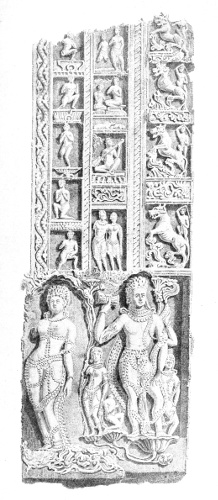
FRAGMENT FROM THE RUINS OF BAROLLI.
To face page 1752.
—To describe its stupendous and diversified
1753architecture is impossible; it is the office of the pencil alone, but
the labour would be almost endless. Art seems here to have
exhausted itself, and we were, perhaps now for the first time,
fully impressed with the beauty of Hindu sculpture. The
columns, the ceilings, the external roofing, where each stone
presents a miniature temple, one rising over another, until
crowned by the urnlike kalas, distracted our attention. The
carving on the capital of each column would require pages of
explanation, and the whole, in spite of its high antiquity, is in
wonderful preservation. This is attributable mainly to two
causes: every stone is chiselled out of the close-grained quartz
rock, perhaps the most durable (as it is the most difficult to work)
of any; and in order that the Islamite should have some excuse
for evading their iconoclastic law, they covered the entire temple
with the finest marble cement, so adhesive, that it is only where
the prevalent winds have beaten upon it that it is altogether worn
off, leaving the sculptured edges of the stone as smooth and sharp
as if carved only yesterday.
The grand temple of Barolli is dedicated to Siva, whose emblems
are everywhere visible.[6] It stands in an area of about two hundred
and fifty yards square, enclosed by a wall built of unshaped stones
without cement. Beyond this wall are groves of majestic trees,
with many smaller shrines and sacred fountains. The first object
that struck my notice, just before entering the area, was a pillar,
erect in the earth, with a hooded-snake sculptured around it.
The doorway, which is destroyed, must have been very curious,
and the remains that choke up the interior are highly interesting.
One of these specimens was entire, and unrivalled in taste and
beauty. The principal figures are of Siva and his consort, Parbati,
with their attendants. He stands [705] upon the lotus, having
the serpent twined as a garland. In his right hand he holds the
damru, or little drum, with which, as the god of war, he inspires
the warrior; in his left is the khopra, formed of a human skull,
out of which he drinks the blood of the slain. The other two
arms have been broken off: a circumstance which proves that
1754even the Islamite, to whom the act may be ascribed, respected
this work of art. The ‘mountain-born’ is on the left of her
spouse, standing on the kurma, or tortoise, with braided locks,
and ear-rings made of the conch-shell. Every limb is in that easy
flowing style peculiar to ancient Hindu art, and wanting in modern
specimens. Both are covered with beaded ornaments, and have
no drapery. The firm, masculine attitude of ‘Baba Adam,’ as I
have heard a Rajput call Mahadeo, contrasts well with the delicate
feminine outline of his consort. The serpent and lotus intertwine
gracefully over their heads. Above, there is a series of compartments
filled with various figures, the most conspicuous of which
is the chimerical animal called the Grasda, a kind of horned lion;
each compartment being separated by a wreath of flowers, tastefully
arranged and distributed. The animal is delineated with
an ease not unworthy the art in Europe. Of the various other
figures many are mutilated; one is a hermit playing on a guitar,
and above him are a couple of deer in a listening posture. Captain
Waugh is engaged on one of the figures, which he agrees with me
in pronouncing unrivalled as a specimen of art. There are parts
of them, especially the heads, which would not disgrace Canova.
They are in high relief, being almost detached from the slab. In
this fragment (about eight feet by three) the chief figures are about
three feet.
The centre piece, forming a kind of frieze, is nearly entire, and
about twelve feet by three; it is covered with sculpture of the
same character, mostly the celestial choristers, with various
instruments, celebrating the praises of Siva and Parbati. Immediately
within the doorway is a small shrine to the ‘four-armed’;
but the Islamite having likewise deprived him of the supernumerary
pair, the Bhil takes him for Devi, of whom they are
desperately afraid, and in consequence the forehead of the statue
is liberally smeared with vermilion.
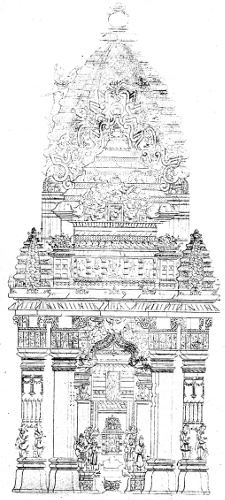
OUTLINE OF A TEMPLE TO MAHADEVA AT BAROLLI.
To face page 1754.
On the left, in advance of the main temple, is one about thirty
feet high, containing an image of Ashtabhuji Mata, or the ‘eight-armed
mother’; but here the pious Muslim has robbed the goddess
of all her arms, save that with which she grasps her shield, and
has also removed her head. She treads firmly on the centaur,
Maheswar,[7] whose dissevered head lies at some distance in the
area, while the lion of the Hindu Cybele [706] still retains his grasp
1755of his quarters. The Joginis and Apsarases, or ‘maids of war’
of Rajput martial poetry, have been spared.
On the right is the shrine of Trimurti, the triune divinity.
Brahma’s face, in the centre, has been totally obliterated, as has
that of Vishnu, the Preserver; but the Destroyer is uninjured.
The tiara, which covers the head[8] of this triple divinity, is also
entire, and of perfect workmanship. The skill of the sculptor
“can no further go.” Groups of snakes adorn the clustering
locks on the ample forehead of Siva, which are confined by a
bandeau, in the centre of which there is a death’s head ornament,
hideously exact. Various and singularly elegant devices are
wrought in the tiara: in one, two horses couped from the shoulder,
passing from a rich centring and surmounted by a death’s head;
a dissevered arm points to a vulture advancing to seize it, while
serpents are wreathed round the neck and hands of the Destroyer,
whose half-opened mouth discloses a solitary tooth, and the tongue
curled up with a demoniacal expression. The whole is colossal,
the figures being six feet and a half high. The relief is very
bold, and altogether the group is worthy of having casts made
from it.
We now come to the grand temple itself, which is fifty-eight
feet in height, and in the ancient form peculiar to the temples of
Siva. The body of the edifice, in which is the sanctum of the
god, and over which rises its pyramidal sikhara, is a square of
only twenty-one feet; but the addition of the domed vestibule
(mandap) and portico makes it forty-four by twenty-one. An
outline of this by Ghasi, a native artist (who labours at Udaipur
for the same daily pay as a tailor, carpenter, or other artisan),
gives a tolerably good notion of its appearance, though none of
its beauty. The whole is covered with mythological sculpture,
without as well as within, emblematic of the ‘great god’
(Mahadeo), who is the giver, as well as the destroyer, of life. In
a niche outside, to the south, he is armed against the Daityas
(Titans), the munda-mala, or skull-chaplet, reaching to his knees,
and in seven of his arms are offensive weapons. His cap is the
frustumfrustum of a cone, composed of snakes interlaced, with a fillet of
skulls: the khopra is in his hand, and the victims are scattered
around. On his right is one of the maids of slaughter (Jogini)
drunk with blood, the cup still at her lip, and her countenance
1756expressive of vacuity; while below, on the left, is a female personification
of Death, mere skin and bone: a sickle (khurpi) in her
right hand,[9] its knob a death’s head, completes this group of the
attributes of destruction [707].
To the west is Mahadeo under another form, a beautiful and
animated statue, the expression mild, as when he went forth to
entice the mountain-nymph, Mena, to his embrace. His tiara is
a blaze of finely-executed ornaments, and his snake-wreath,
which hangs round him as a garland, has a clasp of two heads of
Seshnag (the serpent-king), while Nandi below is listening with
placidity to the sound of the damru. His khopra, and kharg, or
skull-cap, and sword, which he is in the attitude of using, are the
only accompaniments denoting the god of blood.
The northern compartment is a picture, disgustingly faithful,
of death and its attributes, vulgarly known as Bhukhi Mata, or
the personification of famine, lank and bare; her necklace, like
her lord’s, of skulls. Close by are two mortals in the last stage
of existence, so correctly represented as to excite an unpleasant
surprise. The outline, I may say, is anatomically correct. The
mouth is half open and distorted, and although the eye is closed
in death, an expression of mental anguish seems still to linger
upon the features. A beast of prey is approaching the dead
body; while, by way of contrast, a male figure, in all the vigour
of youth and health, lies prostrate at her feet.
Such is a faint description of the sculptured niches on each
of the external faces of the mandir, whence the spire rises, simple
and solid. In order, however, to be distinctly understood, I shall
give some slight ichnographic details. First, is the mandir or
cella, in which is the statue of the god; then the mandap, or, in
architectural nomenclature, the pronaos; and third, the portico,
with which we shall begin, though it transcends all description.

SCULPTURED NICHE ON THE EXTERIOR OF THE TEMPLE AT BAROLLI.
To face page 1756.
Like all temples dedicated to Bal-Siva,[10] the vivifier, or ‘sun-god,’
it faces the east. The portico projects several feet beyond
the mandap, and has four superb columns in front, of which the
outline by Ghasi conveys but a very imperfect idea. Flat fluted
pilasters are placed on either side of the entrance of the mandap,
serving as a support to the internal toran, or triumphal arch, and a
1757single column intervenes on each side between the pilasters and
the columns in front. The columns are about eighteen feet in
height. The proportions are perfect; and though the difference
of diameter between the superior and inferior portions of the shaft
is less than the Grecian standard, there is no want of elegance of
effect, whilst it gives an idea of more grandeur. The frieze is one
mass of sculptured figures, generally of human beings, male and
female, in pairs; the horned monster termed Grasda separating
the different pairs. The internal toran or triumphal arch, which
is invariably attached to all ancient temples of the sun-god, is
[708] of that peculiar curvature formed by the junction of two
arcs of a circle from different centres, a form of arch well known
in Gothic and Saracenic architecture, but which is an essential
characteristic of the more ancient Hindu temples. The head of a
Grasda crowns its apex, and on the outline is a concatenation of
figures armed with daggers, apparently ascending the arch to
strike the monster. The roof of the Mandap (pronaos) cannot be
described: its various parts must be examined with microscopic
nicety in order to enter into detail. In the whole of the ornaments
there is an exact harmony which I have seen nowhere else; even
the miniature elephants are in the finest proportions, and exquisitely
carved.
The ceilings both of the portico and Mandap are elaborately
beautiful: that of the portico, of one single block, could hardly
be surpassed. (Vide Plate.) Of the exterior I shall not attempt
further description: it is a grand, a wonderful effort of the Silpi
(architect), one series rising above and surpassing the other, from
the base to the urn which surmounts the pinnacle.
The sanctum contains the symbol of the god, whose local
appellation is Rori Barolli, a corruption of Bal-rori, from the
circumstance of Balnath, the sun-god, being here typified by an
orbicular stone termed rori, formed by attrition in the Chulis
or whirlpools of the Chambal, near which the temple stands, and
to which phenomena it probably owed its foundation. This
symbolic rori is not fixed, but lies in a groove in the internal ring
of the Yoni; and so nicely is it poised, that with a very moderate
impulse it will continue revolving while the votary recites a
tolerably long hymn to the object of his adoration. The old
ascetic, who had long been one of the zealots of Barolli, amongst
his other wonders gravely told me, that with the momentum given
1758by his little finger, in former days, he could make it keep on its
course much longer than now with the application of all his
strength.
Some honest son of commerce thought it but right that the
mandira (cella) of Bal-rori should be graced by a Parbati, and he
had one made and placed there. But it appeared to have
offended the god, and matters soon after went wrong with the
Banya: first his wife died, then his son, and at length he became
diwala, or ‘bankrupt.’ In truth he deserved punishment for his
caricature of the ‘mountain-born’ Mena, who more resembles a
Dutch burgomestre than the fair daughter of Sailapati.[11]
Fronting the temple of Bal-rori, and apart from it about twenty
yards, is another [709] superb edifice, called the Singar-chaori,
or nuptial hall.[12] It is a square (chaori) of forty feet, supported
by a double range of columns on each face, the intercolumniations
being quite open; and although these columns want the elegant
proportions of the larger temple, they are covered with exquisite
sculpture, as well as the ceilings. In the centre of the hall is an
open space about twelve feet square; and here, according to
tradition, the nuptials of Raja Hun with the fair daughter of a
Rajput prince, of whom he had long been enamoured, were
celebrated;[13] to commemorate which event, these magnificent
structures were raised: but more of this Hun anon. The external
roof (or sikhara, as the Hindu Silpi terms the various roofs which
cover their temples) is the frustum of a pyramid, and a singular
specimen of architectural skill, each stone being a miniature
temple, elegantly carved, gradually decreasing in size to the
kalas or ball, and so admirably fitted to each other, that there has
been no room for vegetation to insinuate itself, and consequently
they have sustained no injury from time.

CEILING OF THE PORTICO OF TEMPLE AT BAROLLI.
To face page 1758.
Midway between the nuptial hall and the main temple there
is a low altar, on which the bull, Nandiswar, still kneels before
1759the symbolic representation of its sovereign lord, Iswar. But
sadly dishonoured is this courser of the sun-god, whose flowing
tail is broken, and of whose head but a fragment remains, though
his necklace of alternate skulls and bells proclaims him the
charger of Siva.
Around the temple of the ‘great god’ (Mahadeva) are the
shrines of the dii minores, of whom Ganesa, the god of wisdom,
takes precedence. The shrine of this janitor of Siva is properly
placed to the north, equidistant from the nuptial hall and the
chief temple. But the form of wisdom was not spared by the
Tatar iconoclast. His single tooth, on which the poet Chand is
so lavish of encomium, is broken off; his limbs are dissevered,
and he lies prostrate on his back at the base of his pedestal,
grasping, even in death, with his right hand the laddus, or sweet-meat-balls,
he received at the nuptial feast.
Near the dishonoured fragments of Ganesa, and on the point
of losing his equilibrium, is the divine Narada,[14] the preceptor
of Parbati, and the Orpheus of Hindu mythology. In his hands
he yet holds the lyre (vina), with whose heavenly sounds he has
been charming the son of his patroness; but more than one string
of the instrument is wanting, and one of the gourds which,
united by a sounding board, form the vina, is broken off [710].
To the south are two columns, one erect and the other prostrate,
which appear to have been either the commencement of another
temple, or, what is more probable from their excelling everything
yet described, intended to form a toran, having a simple architrave
laid across them, which served as a swing for the recreation of
the god. (Vide Plate.) Their surface, though they have been
exposed for at least one thousand years to the atmosphere, is
smooth and little injured: such is the durability of this stone,
though it is astonishing how it was worked, or how they got
instruments to shape it. There is a bawari, or reservoir of water,
for the use either of gods or mortals, placed in the centre of the
quadrangle, which is strewed with sculptured fragments.
We quit the enclosure of Raja Hun to visit the fountain (kund)
of Mahadeo, and the various other curious objects. Having
passed through the ruined gate by which we entered, we crossed
the black stream, and passing over a fine turf plot, reached the
1760kund, which is a square of sixty feet, the water (leading to which
are steps) being full to the brim, and the surface covered with the
golden and silver lotus. In the centre of the fountain is a miniature
temple to the god who delights in waters; and the dam by
which it was once approached being broken, it is now completely
isolated. The entrance to the east has two slender and well-proportioned
columns, and the whole is conspicuous for simplicity
and taste.
Smaller shrines surround the kund, into one of which I entered,
little expecting in a comparatively humble edifice the surprise
which awaited me. The temple was a simple, unadorned hall,
containing a detached piece of sculpture, representing Narayan
floating on the chaotic waters. The god is reclining in a fit of
abstraction upon his shesh-seja, a couch formed of the hydra,
or sea-snake, whose many heads expanded form a canopy over
that of the sleeping divinity,[15] at whose feet is the benignant
Lakshmi, the Hindu Ceres, awaiting the expiration of his periodical
repose. A group of marine monsters, half man, half fish,
support the couch in their arms, their scaly extremities gracefully
wreathed, and in the centre of them is a horse, rather too terrestrial
to be classical, with a conch-shell and other marine emblems
near him. The background to this couch rises about two feet
above the reclining figure, and is divided horizontally into two
compartments, the lower containing a group of six chimerical
monsters, each nearly a foot in height, in mutual combat, and in
perfect relief. Above is a smaller series, depicting the Avatars,
or incarnations of the divinity. On the left, Kurma, the tortoise,
having quitted his shell, of which he makes [711] a pedestal,
denotes the termination of the catastrophe. Another marine
monster, half boar (Varaha), half fish, appears recovering the
Yoni, the symbol of production, from the alluvion, by his tusk.
Next to him is Narasinha, tearing in pieces a tyrannical king,
with other allegorical mysteries having no relation to the ten
incarnations, but being a mythology quite distinct, and which
none of the well-informed men around me could interpret: a certain
proof of its antiquity.
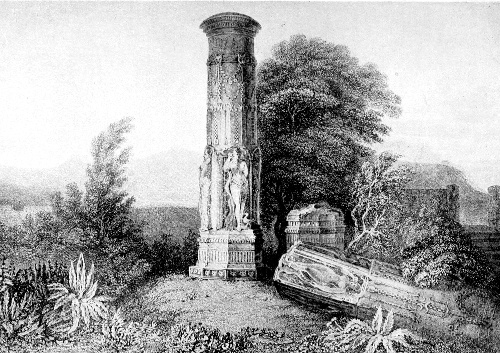
REMAINS OF AN ANCIENT TEMPLE AT BAROLLI.
Near the Chambal.
To face page 1760.
1761The position of Narayan was that of repose, one hand supporting
his head, under which lay the gada, or mace, while in another
he held the conch-shell, which, when the god assumed the terrestrial
form and led the Yadu hosts to battle, was celebrated as
Dakshinavarta, from having its spiral involutions reversed, or to
the right (dakshin). The fourth arm was broken off, as were his
nether limbs to near the knee. From the nabh or naf (navel)
the umbilical cord ascended, terminating in a lotus, whose expanded
flower served as a seat for Brahma, the personification of
the mind or spirit “moving on the waters” (Narayana) of chaos.
The beneficent and beautiful Lakshmi, whom all adore, whether
as Annapurna (the giver of food), or in her less amiable character
as the consort of the Hindu Plutus, seems to have excited a
double portion of the zealots’ ire, who have not only visited her
face too roughly, but entirely destroyed the emblems of nourishment
for her universal progeny. It would be impossible to dwell
upon the minuter ornaments, which, both for design and execution,
may be pronounced unrivalled in India. The highly imaginative
mind of the artist is apparent throughout; he has given a repose
to the sleeping deity, which contrasts admirably with the writhing
of the serpent upon which he lies, whose folds, more especially
under the neck, appear almost real; a deception aided by the
porphyritic tints of the stone. From the accompaniments of
mermaids, conch-shells, sea-horses, etc., we may conclude that
a more elegant mythology than that now subsisting has been lost
with the art of sculpture. The whole is carved out of a single
block of the quartz rock, which has a lustre and polish equal to
marble, and is of far greater durability.
The length of this marine couch (seja) is nearly eight feet, its
breadth two, and its height somewhat more than three; the
figure, from the top of his richly wrought tiara, being four feet.
I felt a strong inclination to disturb the slumbers of Narayana,
and transport him to another clime: in this there would be no
sacrilege, for in his present mutilated state he is looked upon
(except as a specimen of art) as no better than a stone.
All round the kund the ground is covered with fragments of
shrines erected to [712] the inferior divinities. On one piece,
which must have belonged to a roof, were sculptured two busts
of a male and a female, unexceptionably beautiful. The headdress
of the male was a helmet, quite Grecian in design, bound
1762with a simple and elegant fillet: in short, it would require the
labour of several artists for six months to do anything like justice
to the wonders of Barolli.
There is no chronicle to tell us for whom or by whom this
temple was constructed. The legends are unintelligible; for
although Raja Hun is the hero of this region, it is no easy task to
account for his connexion with the mythology. If we, however,
connect this apparently wild tradition with what is already said
regarding his ruling at Bhainsror, and moreover with what has
been recorded in the first part of this work, when ‛Angatsi, lord
of the Huns,' was enrolled amongst the eighty-four subordinate
princes who defended Chitor against the first attempt of the
Islamite, in the eighth century, the mystery ceases. The name
of Hun is one of frequent occurrence in ancient traditions, and
the early inscription at Monghyr has already been mentioned,
as likewise the still more important admission of this being one
of the Thirty-six Royal tribes of Rajputs; and as, in the Chitor
chronicle, they have actually assigned as the proper name of the
Hun prince that (Angatsi) which designates, according to their
historian Deguignes, the grand horde, we can scarcely refuse our
belief that “there were Huns” in India in those days. But
although Raja Hun may have patronized the arts, we can hardly
imagine he could have furnished any ideas to the artists, who
at all events have not produced a single Tatar feature to attest
their rule in this region. It is far more probable, if ever Grecian
artists visited these regions, that they worked upon Indian
designs—an hypothesis which may be still further supported.
History informs us of the Grecian auxiliaries sent by Seleucus to
the (Puar) monarch of Ujjain (Ozene),[16] whose descendants
corresponded with Augustus; and I have before suggested the
possibility of the temple of Kumbhalmer, which is altogether
1763dissimilar to any remains of Hindu art, being attributable to the
same people.
We discovered two inscriptions, as well as the names of many
visitors, inscribed on the pavement and walls of the portico,
bearing date seven and eight hundred years ago; one was “the
son of Jalansi, from Dhawalnagari”; another, which is in the
ornamental Nagari of the Jains, is dated the 13th of Kartik (the
month sacred to Mars), S. 981, or A.D. 925. Unfortunately it is
but a fragment, containing five slokas in praise of Siddheswar, or
Mahadeo, as the patron of the ascetic Jogis. Part of a name
remains; and although my old Guru will not venture to give a
translation without [713] his sibylline volume, the Vyakarana,
which was left at Udaipur, there is yet sufficient to prove it to
be merely the rhapsody of a Pandit, visiting Rori Barolli, in
praise of the ‘great god’ and of the site.[17] More time and investigation
than I could afford, might make further discoveries; and
it would be labour well rewarded if we could obtain a date for
this Augustan age of India. At the same time, it is evident that
the whole was not accomplished within one man’s existence, nor
could the cost be defrayed by one year’s revenue of all Rajputana.
We may add, before we quit this spot, that there are two piles
of stones, in the quadrangle of the main temple, raised over the
defunct priests of Mahadeo, who, whether Gosains, Sannyasis, or
Dadupantis, always bury their dead.
Barolli is in the tract named Pachel, or the flat between the
river Chambal and the pass, containing twenty-four villages in
the lordship of Bhainsror, lying about three miles west, and
highly improving the scene, which would otherwise be one of
perfect solitude. According to the local tradition of some of the
wild tribes, its more ancient name was Bhadravati, the seat of
the Huns; and the traces of the old city in extensive mounds
and ruins are still beheld around the more modern Bhainsror.
Tradition adds that the Charmanvati (the classic name of the
Chambal) had not then ploughed itself a channel in this adamantine
bed; but nine centuries could not have effected this operation,
although it is not far from the period when Angatsi, the
Hun, served the Rana of Chitor [714].
1764
The Whirlpools of the Chambal, December 3.—Having halted
several days at Barolli to admire the works of man, we marched
to contemplate the still more stupendous operations of nature—the
Chulis, or ‘whirlpools,’ of the Chambal. For three miles
we had to hew a path through the forest for our camels and
horses; at the end of which, the sound of many waters gradually
increased, until we stood on the bleak edge of the river’s rocky
bed. Our little camp was pitched upon an elevated spot, commanding
a view over one of the most striking objects of nature—a
scene bold beyond the power of description. Behind us was
a deep wood; in front, the abrupt precipices of the Patar; to
the left, the river expanded into a lake of ample dimensions,
fringed with trees, and a little onward to the right, the majestic
and mighty Charmanvati, one of the sixteen sacred rivers of
India, shrunk into such a narrow compass that even man might
bestride it. From the tent, nothing seemed to disturb the
unruffled surface of the lake, until we approached the point of
outlet, and beheld the deep bed the river has excavated in the
rock. This is the commencement of the falls. Proceeding along
the margin, one rapid succeeds another, the gulf increasing in
width, and the noise becoming more terrific, until you arrive at
a spot where the stream is split into four distinct channels; and
a little farther, an isolated rock appears, high over which the
whitened spray ascends, the sunbeams playing on it. Here the
separated channels, each terminating in a cascade, fall into an
ample basin, and again unite their waters, boiling around the
masses of black rock, which ever and anon peeps out and contrasts
with the foaming surge rising from the whirlpools (chulis) beneath.
From this huge cauldron the waters again divide into two branches,
encircling and isolating the rock, on whose northern face they
reunite, and form another fine fall [715].
A tree is laid across the chasm, by the aid of which the adventurous
may attain the summit of the rock, which is quite flat,
and is called ‘the table of the Thakur of Bhainsror,’ who often,
in the summer, holds his got or feast there, and a fitter spot for
1765such an entertainment can scarcely be imagined. Here, soothed
by the murmur of foaming waters, the eye dwelling on a variety
of picturesque objects, seen through the prismatic hues of the
spray-clouds, the baron of Bhainsror and his little court may
sip their amrit, fancying it, all the while, taken from the churning
of the little ocean beneath them.
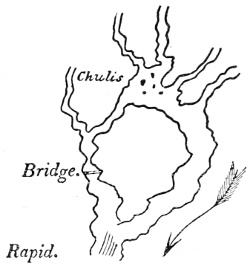
On issuing from the Chulis, the river continues its course
through its rocky bed, which gradually diminishes to about
fifteen feet, and with greatly increased velocity, until, meeting
a softer soil, under Bhainsror, it would float a man-of-war. The
distance from the lake first described to this rock is about a mile,
and the difference of elevation, under two hundred feet; the
main cascade being about sixty feet fall. It is a curious fact that,
after a course of three hundred miles, the bed of a mighty river
like this should be no more than about three yards broad. The
whirlpools are huge perpendicular caverns, thirty and forty feet
in depth, between some of which there is a communication underground;
the orbicular stones, termed roris, are often forced up
in the agitation of these natural cauldrons; one of them represents
the object of worship at Bal-rori. For many miles down
the stream, towards Kotah, the rock is everywhere pierced by
incipient Chulis, or whirlpools, which, according to their size and
force, are always filled with these rounded stones.
From hence the Chambal pursues its course through the
1766plateau (sometimes six hundred feet high) to Kotah. Here
nature is in her grandest attire. The scene, though wild and
rugged, is sublime; and were I offered an estate in Mewar, I
would choose Bhainsror, and should be delighted to hold my
got enveloped in the mists which rise from the whirlpools of the
Chambal [716].
Gangabheva, December 4.—The carpenters have been at work
for some days hewing a road for us to pass to Gangabheva,
another famed retreat in this wild and now utterly deserted
abode. We commenced our march through a forest, the dog-star
nearly south; the river dimly seen on our right. On our left
were the remains of a ruined circumvallation, which is termed
Rana-Kot; probably a ramna, or preserve. At daybreak we
arrived at the hamlet of Kherli; and here, our course changing
abruptly to the south-east, we left the river, and continued our
journey through rocks and thickets, until a deep grove of lofty
trees, enclosed by a dilapidated wall, showed that we had reached
the object of our search, Gangabheva.
What a scene burst upon us, as we cleared the ruined wall and
forced our way over the mouldering fragments of ancient
grandeur! Gangabheva, or ‘the circle of Ganga,’[1] appears to
have been selected as a retreat for the votaries of Mahadeva,
from its being a little oasis in this rock-bound valley; for its
site was a fine turf, kept in perpetual verdure by springs.
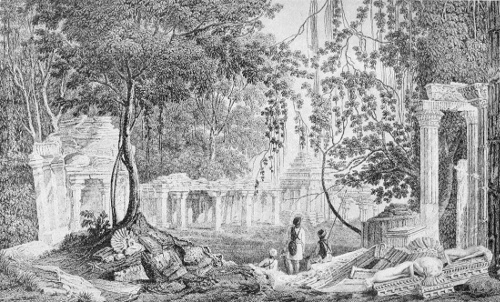
TEMPLES OF GANGA BHEVA.
In the Forest of Pachail in Mewar.
To face page 1766.
—The chief object is the temple, dedicated
to the creative power; it stands in the centre of a quadrangle
of smaller shrines, which have more the appearance of being the
cenotaphs of some ancient dynasty than domiciles for the inferior
divinities. The contrast between the architecture of the principal
temple, and that of the shrines which surround it, is remarkable.
The body of the chief temple has been destroyed, and with its
wrecks a simple, inelegant mandir has been raised; nor is there
aught of the primitive structure, except the portico, remaining.
Its columns are fluted, and the entablature (part of which lies
prostrate and reversed)
[2] exhibits a profusion of rich sculpture.
In front of the temple is a circular basin, always overflowing, and
1767whence the term
bhevo or
bheo, ‘a circle,’ added to the name of
the spring, which is feigned to be an emanation of
Ganga. The
surface of its waters is covered with the flower sacred to the
goddess, that particular lotus termed
kamadhan, which may be
rendered ‘the riches of love.’
The chief temple evinces the same skill and taste as the structures
of Barolli, and the embellishments are similar. We here
recognize the groups of Mahadeva and Parbati, with the griffins
(grasda), the Naginis, half serpent, half female, etc., though not
in so finished a style as at Barolli. Whatever be the age of this
temple (and we found on the pavement the name of a votary with
the date S. 1011, or A.D. 955), it is many centuries more recent
than those which surround it, in whose massive simplicity we
[717] have a fine specimen of the primitive architecture of the
Hindus. Even of these, we can trace varieties. That of which
we present a drawing (vide Plate) shows, in its fluted columns,
a more ambitious, though not a better taste, than the plainer
supporters of the pyramidal roofs, which cover all the ancient
temples of Bal-Siva. Five of these small shrines filled up each
face of the quadrangle, but with the exception of those on the
east side, all are in ruins. The doors of those which possess an
enclosed sanctum face inwards towards the larger shrine: and
each has a simple low altar, on which are ranged the attendant
divinities of Mahadeva. The sculpture of all these is of a much
later date than the specimens at Barolli, and of inferior execution,
though far superior to anything that the Hindu sculptor
of modern days can fabricate. They may possibly be of the
date found inscribed (the tenth century), posterior to which
no good Hindu sculpture is to be found. As this spot is now
utterly deserted, and the tiger and wild boar are the only inhabitants
that visit the groves of Gangabheva, I shall be guilty
of no sacrilege in removing a few of these specimens of early
art.[3]
Nature has co-operated with the ruthless Turk in destroying
the oldest specimens of the art. Wherever there is a chink or
crevice, vegetation fixes itself. Of this we had a fine specimen
1768in a gigantic but now mouldering kur, which had implanted
itself in the mandap of the principal temple, and rent it to its
foundation. On examining its immense roots, large slabs were
actually encased with the wood, the bark of which nearly covers
a whole regiment of petty gods. This fact alone attests the
longevity of this species of tree, which is said to live a thousand
years. The fountain temple has, in a similar way, been levelled
by another of these kur-trees, the branches of which had gradually
pressed in and overwhelmed it. The Singar-chaori, or nuptial
hall, is also nearly unroofed; and although the portico may yet
survive for ages, time is rapidly consuming the rest.
I should have said that there are two distinct enclosures, an
interior and exterior, and it is the first which is crowded with the
noblest trees, everywhere clustered by the Amarvela, ‘the garland
of eternity,’ sacred to Mahadeva, which shades the shrine, overhanging
it in festoons. This is the giant of the parasitic tribe, its
main stem being as thick near the root as my body. I counted
sixty joints, each apparently denoting a year’s growth, yet not
half-way up the tree on which it climbed. That [718] highly-scented
shrub, the ketaki,[4] grew in great profusion near the kund,
and a bevy of monkeys were gambolling about them, the sole
inhabitants of the grove. The more remote enclosure contained
many altars, sacred to the manes of the faithful wives who became
Satis for the salvation of their lords. On some of these altars
were three and four putlis, or images, denoting the number of
devotees. It would require a month’s halt and a company of
pioneers to turn over these ruins, and then we might not be
rewarded for our pains. We have therefore set to work to clear a
path, that we may emerge from these wilds.
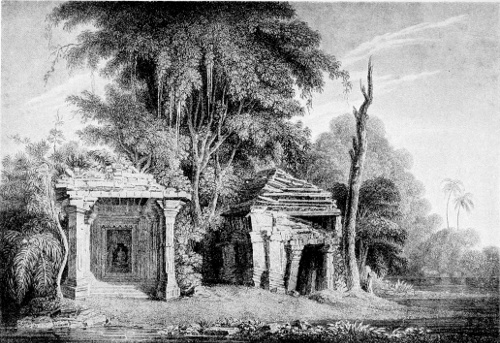
SMALLER GROUP OF TEMPLES AT GANGA BHEVA.
To face page 1768.
Nauli, December 5; twelve miles.—The road runs through one
continued forest, which would have been utterly impassable but
for the hatchet. Half-way is the boundary between Bhainsror
and Bhanpura, also an ancient appanage of Mewar, but now
belonging to Holkar. Nauli is a comfortable village, having the
remains of a fort to the westward.
In the evening I went to visit Takaji-ka-kund, or ‘fountain
of the snake-king.’ It is about two miles east of Nauli; the road,
through a jungle, over the flat highland or Patar, presents no
indication of the object of research, until you suddenly find yourself
1769on the brink of a precipice nearly two hundred feet in depth,
crowded with noble trees, on which the knotted kur was again
conspicuous. The descent to this glen was over masses of rock;
and about half-way down, on a small platform, are two shrines;
one containing the statue of Takshak, the snake-king; the other
of Dhanvantari, the physician, who was produced at the “churning
of the ocean.” The kund, or fountain, at the southern extremity
of the abyss, is about two hundred yards in circumference, and
termed athah, or ‘unfathomable,’ according to my guide, and if we
may judge from its dark sea-green lustre, it must be of considerable
depth. It is filled by a cascade of full one hundred feet perpendicular
height, under which is a stone seat, sacred to the genius
of the spot. At the west side issues a rivulet, called the Takhaili,
or serpentine, which, after pursuing a winding course for many
miles, some hundred feet below the surface of the Patar, washes
the eastern face of Hinglajgarh, and ultimately joins the Amjar.
Ghasi, my native artist, is busy with the effigy of the snake-king,
and Dhanvantari, the Vaidya. From the summit of the plateau
we had a view of the castle of Hinglaj, celebrated in Lord Lake’s
war with the Mahrattas, and which was taken by Captain Hutchinson
with a few men of the Bengal artillery.[5]
Bhānpura, December 6, eight miles.—This was a delightful
march, presenting [719] pictures at every step. Two miles,
through jungle, brought us to the abrupt crest of the Patar. For
some distance the route was over a neck or chine, with deep
perpendicular dells on each side, which, at its extremity, the point
of descent, termed the ghat or pass, became a valley, gradually
expanding until we reached Bhanpura. At the ghat are the
remains of a very ancient fortress, named Indorgarh, which must
have been one of the strongholds of this region long anterior to the
Chandrawat feudatories of Mewar. Some fragments of sculpture
indicate the presence of the artist of Barolli; but all search for
inscriptions was fruitless. From hence we saw the well-defined
skirts of the plateau stretching westward by Rampura to the
Lasaughat, Tarapur, and Jawad, the point of our ascent last
year.
It was pleasing, after a week’s incarceration amidst these ruins
and scenes of natural grandeur, where European foot had never
1770trod, to see verdant fields and inhabitants of the plains; such
alternations make each delightful in its turn. We had been
satiated with the interminable flats and unvarying cornfields of
Haraoti, and it was a relief to quit that tame tranquillity for the
whirlpools of the Chambal, the kunds of Ganga, and the snake-king
in the regions of the inaccessible Durga.
—As we approached
Bhanpura, we crossed a small rivulet, called the Rewa, coming from
the glen of the pass; near which is the mausoleum of Jaswant Rao
Holkar, adjoining the scene of his greatest glory, when he drove an
English army from his territory.
[6] The architecture is worthy of
the barbarian Mahratta; it is a vaulted building, erected upon a
terrace, all of hewn stone; its only merit is its solidity. There
is a statue of this intrepid chieftain, of the natural size, in the
usual ungraceful sitting posture, with his little turban; but it
gives but a mean idea of the man who made terms with Lake
at the altars of Alexander. It is enclosed by a miniature and
regularly built fortress, with bastions, the interior of which are
hollow and colonnaded, serving as a Dharmsala, or place of halt
for pilgrims or travellers; and on the terrace are a few
rahaklas,
or swivels. On the right of the temple destined to receive the
effigy of Jaswant, is a smaller cenotaph to the memory of his sister,
who died shortly after him. The gateway leading into this
castellated tomb has apartments at the top, and at the entrance
is a handsome piece of brass ordnance, called Kali, or ‘death.’
There is a temporary building on the right of the gateway, where
prayers are recited all day long for the soul of Jaswant, before an
altar on which were placed twenty-four
dewas, or lamps, always
burning. A figure dressed in white was on the altar; immediately
behind which, painted on the wall, was Jaswant himself, and as in
the days [720] of his glory, mounted on his favourite war-horse,
Mahua. The
chamar was waving over his head, and silver-mace
bearers were attending, while the officiating priests, seated on
carpets, pronounced their incantations.
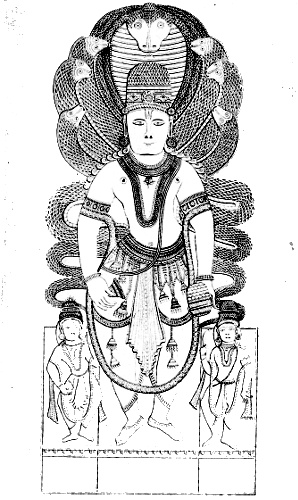
IMAGE OF THE SNAKE KING AT THE FOUNTAIN OF THE AMJAR.
To face page 1770.
I left the master to visit Mahua, whose stall is close to the
mausoleum of Holkar, whom he bore in many a desperate strife.
The noble animal seemed to possess all his master’s aversion to a
Farangi, and when, having requested his body-clothes to be
1771removed, I went up to examine him, he at first backed his ears
and showed fight; but at last permitted me to rub his fine forehead.
Mahua is a chestnut of the famed Bhimthadi[7] breed;
like his master, a genuine native of Maharashtra, he exhibits the
framework of a perfect horse, though under 14-3; his forelegs
show what he has gone through. His head is a model, exhibiting
the highest quality of blood; ears small and pointed, eye full and
protruding, and a mouth that could drink out of a tea-cup. He
is in very good condition; but I put in my arzi that they would
provide more ample and sweeter bedding, which was readily
promised. The favourite elephant is a pensioner as well as
Mahua. Even in these simple incidents we see that the mind is
influenced by similar associations all over the world.
Bhanpura is a town of five thousand houses, surrounded by a
wall in good order; the inhabitants apparently well contented
with the mild administration of Tantia Jog,[8] the present Diwan
of Holkar’s court; but they are all alive to the conviction that
this tranquillity is due to the supervising power alone. I was
greatly gratified by a visit from the respectable community of
Bhanpura, merchants, bankers, and artisans, headed by the
Hakim in person, nor could the inhabitants of my own country,
Mewar, evince more kind and courteous feeling. In fact, they
have not forgotten the old tie; that the Rao of Bhanpura, though
now holding but a small portion of his inheritance, was one of the
chief nobles of Mewar, and even still receives the tilak of accession
for Amad from the hands of his ancient lord, though nearly a
century has elapsed since Holkar became his sovereign de facto:
but associations here are all-powerful.
Garot, December 7; distance, thirteen miles; direction, S.S.E.—It
was delightful to range over the expansive plains of Malwa,
and not to be reminded at every step by the exclamation “thokar!”
of the attendant, that there was some stony impediment ready to
trip one up, the moment one’s vision was raised above the earth.
A singular contrast was presented between the moral aspect of
1772these plains and of Haraoti. Here, though the seat of perpetual
war, still visible in sterile fields, we [721] observe comfort displayed
in the huts and in the persons of the peasantry; there, amidst
all the gifts of Annapurna, the miserable condition of the ryot
provokes one to ask, “Whence this difference?” The reason is
elsewhere explained.
Garot is a thriving town of twelve hundred houses, the chief of
a tappa or subdivision of Rampura, whence a deputy Hakim is
sent as resident manager. It is walled in; but the inhabitants
seemed to feel they had now a better security than walls. Here
there is nothing antique; but Moli, with its old castle, about midway
in this morning’s journey, might furnish something for the
porte-feuille, especially a fine sculptured toran yet standing, and
fragments strewed in every direction. Tradition is almost mute,
and all I could learn was, that it was the abode of a king, called
Satal-Patal, whom they carried back to the era of the Pandus.
I was much surprised to find the plain strewed with agates and
cornelians, of every variety of tint and shape, both veined and
plain, semi-transparent and opaque, many stalactitic, in various
degrees of hardness, still containing the fibre of grass or root,
serving as a nucleus for the concretion. There are no hills to
account for these products in the black loam of the plains, unless
the Chambal should have burst his bed and inundated them.
Nor are there any nalas which could have carried them down,
or any appearance of calcareous deposit in the soil, which when
penetrated to any depth, was found to rest upon blue slate.
Caves of Dhamnār,[9] December 8; direction, south 10° west;
distance, twelve miles.—The country reminded us of Mewar,
having the same agreeable undulations of surface and a rich soil,
which was strewed throughout, as yesterday, with agates. As we
approached the object of our search, the caves of Dhamnar, we
crossed a rocky ridge covered with the dhak jungle, through which
we travelled until we arrived at the mount. We found our camp
pitched at the northern base, near a fine tank of water; but our
curiosity was too great to think of breakfast until the mental
appetite was satiated.
The hill is between two and three miles in circumference; to
1773the north it is bluff, of gradual ascent, and about one hundred
and forty feet in height, the summit presenting a bold perpendicular
scarp, about thirty feet high. The top is flat, and
covered with bar trees. On the south side it has the form of a
horse-shoe, or irregular crescent, the horns of which are turned
to the south, having the same bold natural rampart running
round its crest, pierced throughout with caves, of which I counted
one hundred and seventy;[10] I should rather say that these were
merely the entrances to the [722] temples and extensive habitations
of these ancient Troglodytes. The rock is a cellular iron-clay,
so indurated and compact as to take a polish. There are
traces of a city, external as well as internal, but whether they were
cotemporaneous we cannot conjecture. If we judge from the
remains of a wall about nine feet thick, of Cyclopean formation,
being composed of large oblong masses without cement, we might
incline to that opinion, and suppose that the caves were for the
monastic inhabitants, did they not afford to the contrary
in their extent and appropriation.
On reaching the scarp, we wound round its base until we
arrived at an opening cut through it from top to bottom, which
proved to be the entrance to a gallery of about one hundred yards
in length and nearly four in breadth, terminating in a quadrangular
court, measuring about one hundred feet by seventy, and about
thirty-five feet in height; in short, an immense square cavity,
hollowed out of the rock, in the centre of which, cut in like manner
out of one single mass of stone, is the temple of the four-armed
divinity, Chaturbhuja. Exclusive of this gallery, there is a
staircase cut in the north-west angle of the excavation, by which
there is an ascent to the summit of the rock, on a level with which
is the pinnacle of the temple. Apparently without any soil, some
of the finest trees I ever saw, chiefly the sacred pipal, bar, and
tamarind, are to be found here.
The ground-plan of the temple is of the usual form, having a
mandir, mandap, and portico, to which the well-known term
pagoda is given, and there is simplicity as well as solidity both
in the design and execution. The columns, entablatures, with
a good show of ornament, are distinct in their details; and there
are many statutes, besides flowers, not in bad taste, especially the
1774carved ceilings. It would be regarded as a curiosity if found
on a plain, and put together in the ordinary manner; but when
it is considered that all is from one block, and that the material
is so little calculated to display the artist’s skill, the work is
stupendous.
Vishnu, who is here adored as the ‘four-armed,’ was placed
upon an altar, clad in robes of his favourite colour (pandu, or
yellow ochre), whence one of his titles, Pandurang. The principal
shrine is surrounded by the inferior divinities in the following
order: First, on entering are the Poliyas or ‘Porters’; Ganesa
is upon the right, close to whom is Sarasvati, “whose throne is
on the tongue”; and on the left are the twin sons of Kali, the
Bhairavas, distinguished as Kala (black), and Gora (fair); a
little in advance of these is a shrine containing five of the ten
Mahavidyas,[11] or ministering agents of Kali, each known by her
symbol, or vahan, as the bull, man, elephant [723], buffalo, and
peacock. The Mahavidyas are all evil genii, invoked in jap, or
incantations against an enemy, and phylacteries, containing
formulas addressed to them, are bound round the arms of warriors
in battle.[12]
At the back of the chief temple are three shrines; the central
one contains a statue of Narayana, upon his hydra-couch, with
Lakshmi at his feet. Two Daityas, or evil spirits, appear in
conflict close to her; and a second figure represents her in a
running posture, looking back, in great alarm, at the combatants.
Smaller figures about Narayana represent the heavenly choristers
administering to his repose, playing on various instruments,
the murali, or flute, the vina, or lyre, the mayura, or tabor, and
the mridang and thal, or cymbals, at the sound of which a serpent
appears, rearing his crest with delight. The minor temples, like
the larger one, are also hewn out of the rock; but the statues they
contain are from the quartz rock of the Patar and they, therefore,
appear incongruous with the other parts. In fact, from an
emblem of Mahadeva, which rises out of the threshold, and upon
which the ‘four-armed’ Vishnu looks down, I infer that these
temples were originally dedicated to the creative power.
1775We proceeded by the steps, cut laterally in the rock, to the
south side, where we enjoyed, through the opening, an unlimited
range of vision over the plains beyond the Chambal, even to
Mandasor and Sondwara. Descending some rude steps, and turning
to the left, we entered a cavern, the roof of which was supported
by one of those singularly shaped columns, named after the sacred
mounts of the Jains; and here it is necessary to mention a curious
fact, that while everything on one side is Buddhist or Jain, on the
other all is Saiva or Vaishnava. At the entrance to the cave
adjoining this are various colossal figures, standing or sitting, too
characteristic of the Buddhists or Jains to be mistaken; but on
this, the south side, everything is ascribed to the Pandus, and a
recumbent figure, ten feet in length, with his hand under his
head, as if asleep, is termed “the son of Bhim,” and as the local
tradition goes, “only one hour old”: a circumstance which called
forth my conductor, who gravely swallowed the tale, the exclamation—“What
would he have been if nau mahine ka balak, 'a
nine months’ child'!”[13] The chief group is called the Five
Pandus, who, according to tradition, took up their abode here
during their exile from the Jumna; and the other figures are
performing menial offices to the heroes.[14]
Fortunately, I had my Jain Guru with me, who gave me more
correct notions of these groups than the local cicerone. All these
figures are representations of the [724] deified pontiffs of the Jains,[15]
and the group of five are the most celebrated of the twenty-four,
and distinctively called the Panch-Tirathi, namely, Rishabhadeva,
the first; Santinath, the sixteenth; Neminath, the twenty-second;
Parsvanath, the twenty-third; and Mahavira, the
twenty-fourth. Each has his sacred mount, or place of pilgrimage
(tirath), and each is recognized by his symbol, namely, the bull,
black antelope, conch-shell, hooded serpent, and tiger; and it is
quite sufficient to find one of these symbols upon the plinth to
ascertain the particular pontiff to which it belongs. There was
also, in a sitting posture, Chandraprabha, known by his sign, the
crescent.[16] All the figures are from ten to eleven feet high. That
1776in a recumbent position, my friend said was one of the pontiffs,
about to “shuffle off this mortal coil,” preparatory to apotheosis.
“When such an event took place, the throne of Indra shook, and
he sent a deputation to convey the deceased through the Kshira
Samudra (sea of curds), to the great temple of deification, whither
the whole heavenly host advanced to conduct him.”
Next to, and communicating by a passage with, this hall of
the Jain pontiffs, is the most extensive excavation of Dhamnar,
locally designated as “Bhim’s Bazar.”[17] The extreme length of
this excavation is about a hundred feet, and the breadth eighty.
Although the name of this leader of the Pandus designates every
subdivision of this cave, yet everything is Buddhist. The main
apartment is that called Bhim’s armoury or treasury, the entrance
to which is through a vestibule, about twenty feet square, supported
by two columns, and having four lateral semicircular
niches, now empty, but probably intended for statues: this opens
to the armoury, which is a vaulted apartment, about thirty feet
by fifteen, having at the further end a dagoba, supporting the
roof. These singularly formed columns, if we may so term them,
are named after their sacred mounts; and this is called Sumeru,
which being sacred to Adinath, the first pontiff, we may conclude
he was here adored. An extensive piazza, full twenty feet wide,
evidently a Dharamsala for the pilgrims, runs round this apartment,
supported by rows of massive square columns, all cut out
of the rock; and again, on the exterior, are numerous square
cells, called the apartments of the Srawaks, or Jain laity; in
one of which there is a supporting dagoba, and in another two
statues of the twenty-third pontiff, Parsva. A part of the
vaulted roof of Bhim’s treasury, as it is called, has fallen in so
that the vault of heaven is seen through the aperture of the mountain.
This is also attributed to Kaurava Chor (thief), whose
statue appears on the pinnacle of the temple of Barolli, indicating
the old enemy of [725] the Pandus, who robbed them of their
kingdom. Close to the armoury is an apartment called the
Rajloka, or for the ladies; but here tradition is at fault, since
with the exception of Kunti, the mother, Draupadi alone shared
the exile of the Pandavas.
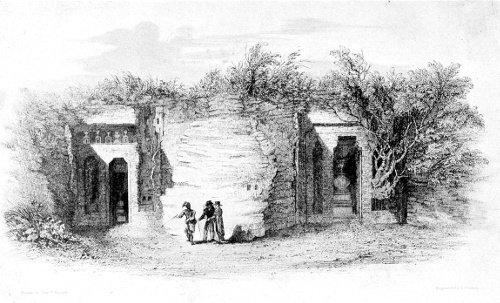
CAVE TEMPLES OF DHAMNAR.
To face page 1776.
1777Still further to the right, or south-west, is another vaulted and
roof-ribbed apartment, thirty feet by fourteen, and about sixteen
in central height, supported by another image of Sumeru. The
sacred bar, or fig-tree (Ficus religiosa), had taken root in the very
heart of this cavern, and having expanded until checked by the
roof, it found the line of least resistance to be the cave’s mouth,
whence it issued horizontally, and is now a goodly tree overshadowing
the cave (vide Plate). Around this there are many
Pausiddhsalas, or halls for the Yatis, or initiated disciples, who
stand in the same upright meditative posture as the pontiffs.
But it is impossible, and the attempt would be tedious, to give,
by any written description, an adequate idea of the subterranean
town of Dhamnar. It is an object, however, which will assist in
illustrating the subject of cave-worship in India; and though in
grandeur these caves cannot compare with those of Ellora, Karli,
or Salsette, yet in point of antiquity they evidently surpass them.
The temple dedicated to the Tirthakaras, or deified Jineswars
(lords of the Jains), is a rude specimen of a rude age, when the
art of sculpture was in its very infancy; yet is there a boldness
of delineation, as well as great originality of design, which distinguishes
them from everything else in India. In vain we hunted
for inscriptions; but a few isolated letters of that ancient and
yet undeciphered kind, which occurs on every monument attributed
to the Pandavas, were here and there observed. There
were fragments of sculpture about the base of the hill, differing
both in design and material from those of the mountain. Altogether,
Dhamnar is highly worthy of a visit, being one of the most
curious spots in this part, which abounds with curiosities [726].
Pachpahār. Monson’s Retreat. Fate of Lieutenant Lucan.
December 10.—We returned to Garot yesterday, whence we
marched ten miles north-north-east this morning over memorable
ground. It was from Garot that the retreat of Monson commenced,
an event as remarkable in the history of British India
as the retreat of Xenophon in that of Greece. The former has
not been commemorated by the commander, though even the
1778pen of Xenophon himself could not have mitigated the reproach
which that disastrous event has left upon our military reputation.
Holkar was at Partabgarh,[1] when, hearing of the advance of the
English army, he made direct on Mandasor,[2] where he halted
merely to refresh his horses, and crossing the Chambal at the
Aunra ford, he pushed direct on Garot, a distance of nearly fifty
miles. Local report states that Monson, in utter ignorance of
the rapid advance of Holkar, had that morning recommenced
his march for Chandwasa, with what object is unknown; but
as soon as he learned the vicinity of the foe, without awaiting
him, he ordered a retrograde movement to gain the Mukunddarra
pass, leaving Lucan with the irregular horse and the Kotah
auxiliaries, chiefly Hara Rajputs, to secure his retreat. Holkar’s
army amounted to ten thousand horse, in four gols, or masses,
each acting separately. That under —— Khan Bangash[3] came
on Lucan from the south, while that under Harnath Dada, from
the direction of Bhanpur, attacked the Kotah contingent. Lucan
defended himself like a hero, and having repelled all their charges,
had become the assailant, when he received his death-blow from
a hand in his own Paegah.[4] My informant, who was that day
opposed to this gallant soldier, described the scene, pointing out
the mahua tree close to which he fell.
—The auxiliary band of Kotah
was led by the Hara chief of Kolai, his name Amar Singh. On
receiving the orders of the English commander, he prepared, in
the old Hara style, to obey them. The position he selected was
about a quarter of a mile west of Lucan, on the north bank of the
Amjar, his left protected by the village of [727] Pipli, which
stands on a gentle eminence gradually shelving to the stream,
the low abrupt bank of which would secure him from any charge
in front. Here, dismounting from his horse, Amar Singh, surrounded
by one thousand men, “spread his carpet,” resolved to
defend the passage of the Amjar. His force was chiefly infantry,
who met the enemy with volleys of matchlocks, and filled the
stream with their bodies; but just as he was about to close with
1779them, a ball hit him in the forehead and another in the right
breast. He fell, but immediately rose again, and reclining
against a sugar mill-stone, encouraged his men to the charge.
The calmness of his manner indicated no danger, but it was the
dying effort of a Hara: pointing with his sword to the foe, he
fell back and expired. Four hundred and fifty of his men were
either killed or wounded around their chief, and among the
latter, the Palaitha
[5] chief, the next in rank to Koila, and the
Bakhshi, or paymaster-general of Kotah, was made prisoner, and
forced to sign a bond for ten lakhs of rupees as a ransom, a penalty
for siding with the English.
A humble altar of clay marks the spot where the brave Hara
fell, having a tablet, or Jujhar, representing as usual a cavalier
and his steed, armed at all points. I felt indignation at the
indifference of the regent who had not marked the spot with a
more durable monument, but he is no Hara; though could he
entomb the whole tribe, he would erect a structure rivalling even
that of Mausolus. But this receives a homage which might
be denied to a more splendid one; for the villagers of Pipli fail
not in their duty to the manes of Amar Singh, whose lowly altar
is maintained in repair. The devoted Lucan has not even so
frail a monument as this; nor could I learn if the case which
enclosed his gallant spirit had any rites of sepulture. But his
memory will be cherished by the inhabitants of Pipli, who will
point to the mahua tree as that of “Lucan Sahib ka Jujhar.”
By the sacrifice of these brave men, the British commander
gained the Mukunddarra pass, without seeing even an enemy;
had he there left only five companies, with sufficient supplies and
ammunition, under such men as Sinclair or Nichol, Mukunddarra
might have rivalled Thermopylae in renown; for such is the
peculiarity of the position, that it would have taken a week to
turn it, and that could be done by infantry alone. But the
commander “had no confidence in his men”: why then did he
accept the command? Throughout the retreat the sipahis were
eager for the fight, and expressed their opinion openly of their
leader; and when this ‘doubting’ commander left five companies
to defend the passage of the Banas, how did they perform it? by
repelling every assault, while a particle of ammunition lasted.
I have often passed this [728] ford, once with Sindhia’s army, and
1780only three years after the retreat. The gallant stand was admirably
described to me by Zaman Khan Rohilla, a brave soldier
and no boaster (and that day among our foes), who coolly pointed
to the precise spot where he shot one of our officers, in the last
charge, with his pistol. He said that the Mahratta infantry
would no longer return to the charge, and that Jaswant Rao was
like a madman, threw his turban on the ground and called for
volunteers amongst the cavalry, by whom at length Sinclair and
his men were cut off. It is a lesson by which we ought to profit,
never to place in command of sipahis those who do not understand,
confide in, and respect them.
—Pachpahar is a thriving town, the head of one
of the four districts of which, by the right of war, we became
possessed, and have transferred from Holkar to the regent; so
far we have discharged the debt of gratitude. Eighty villages
are attached to Pachpahar, which, though never yielding less
than half a lakh of rupees, is capable of raising more than twice
that sum. There are two thousand houses in the town, which
has an extensive bazar filled with rich traders and bankers, all
of whom came to visit me. The cornelian continues to strew the
ground even to this place.
Kanwāra, December 11; thirteen miles; direction, N.E. by E.—Passed
over a fine rich soil, with promising young crops of
wheat and gram, and plenty of the last crop (juar) in stacks; a
sight not often seen in these war-trodden plains, and which makes
the name, Kanwara, or ‘the land of corn,’ very appropriate.
At the village of Aonla, four miles south, we crossed the high
road leading from Ujjain through the darra to Hindustan, the
large town of Sonel lying three miles to our right.
Jhālrapātan,[6] December 12; ten miles; direction, N.N.E.—The
road over the same fertile soil. Passed the Chandarbhaga
rivulet, the source of which is only two coss distant, and was
shown, within range, the isolated hill of Raleta, formerly the
retreat of a Bhil community, which sent forth four thousand
bowmen to ravage the plains of Malwa: these were extirpated
by Zalim Singh.
1781Jhalrapatan is the creation of the regent; and, as we approached
it, his kindness procured me the distinction of being
met, a full mile beyond the town, by the chief magistrate, the
council, and the most wealthy inhabitants: an honour duly
appreciated, this being the only town in India possessing the
germs of civil liberty, in the power of framing their own municipal
regulations. This is the more remarkable, as the immunities of
their commercial charter were granted by the most despotic
ruler of India; though the boon was not a concession to liberty,
but an act of policy; it was [729] given for value received, or
at least expected, and which has been amply realized. Having
exchanged salutations, and promised a more extended courtesy
at my tents in the evening, we took advantage of the town being
thinned, and passed in under a general discharge of ordnance from
the ramparts. The city is nearly a square, surrounded by a
substantial wall and bastions, well furnished with cannon. The
ground plan is simple, being that of the Indian Chaupan or cross,
with two main streets intersecting each other at right angles,
and many smaller ones running parallel to them. The main street
is from south to north. We proceeded through this Bara Bazar
until we reached the point of intersection, where, upon a broad
terrace, stands a temple to Chaturbhuja, the ‘four-armed’ god,
at least ninety feet in height. The marble dome and colonnaded
mandap, and the general proportions of the structure, attracted
my attention; but having been recently repaired and coated
with white, I passed it by, conceiving it to be modern, and not
likely to furnish historical data. From thence to the northern
gate is a range, on either side, of houses of a uniform structure,
having a great appearance of comfort; and the street, which is
nearly a mile long, terminates with a temple erected by the
regent to his favourite divinity, Dwarkanath. The image here
enshrined was ploughed up from the ruins of the ancient city,
and carried to the regent at Kotah, who, leaving to the choice
of the god the title under which, and the site where, he would be
worshipped, his various names were inscribed and placed under
the pedestal; the priest drew forth that of Gopalji, and a magnificent
shrine was erected to him upon the bank of one of the
finest lakes in India, the waters of which, raised by an artificial
dam, could be made to environ it at pleasure.
In a street to the north, and parallel to the first, but as yet
1782incomplete, is a handsome temple, dedicated to the sixteenth
Jain prophet. This also, I afterwards discovered, was an antique
structure, recently repaired, and one of the hundred and eight
temples, the bells of which sounded in the ancient city; whence
its name Jhalrapatan, or ‘the city of bells,’ and not, as erroneously
stated hitherto, from the tribe of the regent, Jhalara-patan,
or ‘city of the Jhala’;[7] ignorance of which fact made me pass
over the temples, under the supposition that they were coeval
with its modern foundation. I stopped for a few moments at
the mansion of the chief magistrate, Sah Maniram, and having
expressed my admiration of all I had seen, and my hope that the
prosperity of the city would redouble under his paternal care
in these days of peace, I made my salaam and took leave. Opposite
his house, engraved on a [730] pillar of stone, is the charter
of rights of the city.[8] Its simplicity will excite a smile; but the
philosopher may trace in it the first rudiments of that commercial
greatness, which made the free cities of Europe the instruments
of general liberty. Few of these had their privileges so thoroughly
defined, or so scrupulously observed; and the motive which
brought the community together was the surest guarantee against
their infringement. A state of general war made them congregate,
and was the origin of these immunities, which the existing peace
and tranquillity will perpetuate. Any want of good faith would
be the destruction of Patan.
When the regent took advantage of the times to invite the
wealthy of all the surrounding regions to become settlers in this
new mart, he wisely appealed to the evidence of their senses as
the best pledge for the fulfilment of his promises. Simultaneously
with the charter, the fortifications were commenced, and
an adequate garrison was placed here under a commandant well
known and respected. He excavated wells, repaired the dam of
the old lake, and either built anew or repaired the religious
edifices of all sects at the expense of the State; and, to secure
uniformity and solidity in the new habitations, he advanced to
every man who required it half the money necessary for their
1783construction. But the greatest boon of all was his leaving the
administration of justice, as well as of internal police, entirely
in the hands of the municipal authorities, who, to their credit,
resolved that the fines and forfeitures arising therefrom, instead
of becoming a bait for avarice and vexatious interference, should
be offerings to the shrine of Dwarkanath.
It is proper to say that the chief magistrate, Sah Maniram,
who is of the Vaishnava sect, has a coadjutor in Gumaniram, of
the Oswal tribe and Jain faith, and each has his separate tribunal
for the classes he represents, while the whole form a joint council
for the general weal. They pull well together, and each has
founded a pura, or suburb, named after their children. The
Chauthias, or members of this council, are selected according
to the general sense entertained of their fitness; and were the
chief magistrates also the free choice of the inhabitants at large,
‘the city of bells’ would require no addition to her freedom.
Thus, in the short space of twenty years, has been raised a city
of six thousand comfortable dwellings, with a population of at
least twenty-five thousand souls. But the hereditary principle,
so powerful throughout these countries, and which, though it
perpetuates many evils, has likewise been productive of much
good, and has preserved these States from annihilation, will
inevitably [731] make the ‘turban’ of magistracy descend from
the head of Maniram or Gumani to their children, under whom,
if they be not imbued with the same discretion as their parents,
the stone tablet, as well as the subsequent privileges of Jhalrapatan,
may become a dead letter. The only officers of government
residing in the town are the commandant and the collector
of the imposts; and so jealous are they of the least interference
on his part, that a fine would be inflicted on any individual who,
by delaying the payment of the authorized duties, furnished an
excuse for his interference.
Such is an outline of an internal administration, on which I
have just had a commentary of the most agreeable description:
a public visit from all the wealth and worth of Patan. First
came the merchants, the brokers, the insurers of the Vaishnava
persuasion, each being introduced with the name of the firm;
then followed the Oswal merchants, in similar form, and both
of them I seated in the order of their introduction and respectability.
After them followed the trades, the Chauthia or deacons,
1784each making his nazar in the name of the whole body. Then
came the artisans, goldsmiths, braziers, dyers, confectioners,
down to the barbers, and town-crier. The agricultural interest
was evidently at a discount in Patan, and subordinate to the
commercial; the old Mandloi Patels were, “though last, not
least” in this interesting assemblage. Even the frail sisterhood
paid their devoirs, and, in their modesty of demeanour, recalled
the passage of Burke applied in contrast to a neighbouring State,
“vice lost half its deformity, by losing all its grossness.”[9] Sah
Maniram himself preserved order outside, while to his colleague
he left the formalities of introduction. The goldsmiths’ company
presented, as their nazar, a small silver powder-flask, shaped as
an alligator, and covered with delicate chain-work, which I shall
retain not only as a specimen of the craft, but in remembrance of
a day full of unusual interest. They retired in the same order as
they came, preceded by the town band, flags, trumpets, and drums.
Such is Jhalrapatan. May the demon of anarchy keep from
its walls, and the orthodox and heterodox Duumvirs live in amity
for the sake of the general good, nor by their animosities increase
the resemblance which this mart bears to the free cities of Europe!
From all I could learn, justice is distributed with as even a
hand as in most societies, but wherever existed the community
that submitted to restraint, or did not murmur at the fiat of the
law? Jhalrapatan is now the grand commercial mart of Upper
Malwa, and has swallowed up all the commerce of the central
towns between [732] its own latitude and Indore. Though not
even on the high road, when established, this difficulty was
overcome by the road coming to it. The transit-duties on salt
alone must be considerable, as that of the lakes of western Rajwara
passes through it in its way to the south-east. It is not famed,
however, for any staple article of trade, but merely as an entrepôt.
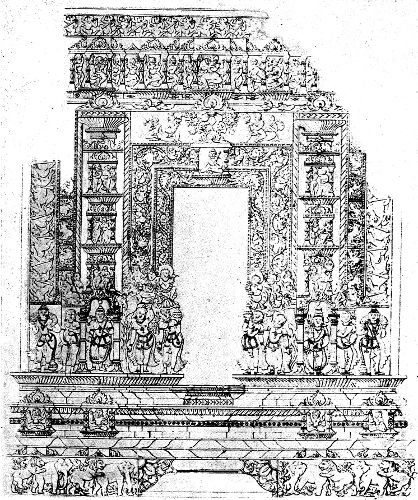
ENTRANCE TO THE SANCTUARY OF A TEMPLE AT CHANDRAVATI.
To face page 1784.
—We have said enough of the modern
city, and must now revert to the ancient, which, besides its
metaphorical appellation of ‘the city of bells,’ had the name of
Chandravati, and the rivulet which flowed through it, the Chandrabhaga.
[10]
There is an abundance of legends, to which we may
1785be enabled to apply the test of inscriptions. In some, Raja
Hun is again brought forward as the founder of the city; though
others, with more probability, assign its foundation to the
daughter of Chandrasen, the Pramar king of Malwa, who was
delivered of a son on this spot while on a pilgrimage.
[11] Another
ascribes it to a more humble origin than either,
i.e. to Jasu, a
poor woodcutter of the ancient tribe of Or,
[12] who, returning
homewards from his daily occupation, dropped his axe upon the
paras-patthar, with the aid of which he transmuted iron to gold,
and raised ‘the city of the moon’ (Chandravati); and the lake
is still called after him Jasu Or ka talab. The Pandu Bhim
likewise comes in for his share of the founder’s fame; who, with
his brethren during their covenant with the Kauravas, found
concealment in the forest; but his foe, fearing the effect of his
devotions, sent his familiar to disturb them. The spirit took the
form of a boar, but as he sped past him through the thicket,
Bhim discharged an arrow, and on the spot where this fell, the
Chandrabhaga sprung up. Whoever was the founder, I have
little doubt that tradition has converted Yasodharman,
[13] the
grandson of Udayaditya, the monarch of all Malwa, into the
woodcutter; for not only does this prince’s name occur in one
of the inscriptions found here, but I have discovered it in almost
every ancient city of Central India, over which his ancestors had
held supreme power from the first to the thirteenth century of
Vikrama.
[14]The sites of temples mark the course of the stream for a considerable
1786distance, the banks being strewed with ruins. Flights
of steps, forming ghats, reach to the water’s edge, where multitudes
of gods, goddesses, and demons, are piled, and some [733]
of the more perfect placed upon altars of clay, around which some
lazy, well-fed Gosains loiter, basking in the sun. Understanding
that no umbrage could be taken if I exported some of them to
Udaipur, I carried off Narayan on his hydra-couch, a Parbati, a
Trimurti, and a cartload of the dii minores, which I found huddled
together under a bar-tree. There was a fine statue of Ganesa,
but our efforts to move Wisdom were ineffectual, and occasioned
not a few jokes among my Brahmans; nor must I pass over a
colossal Baraha (boar), of which no artist in Europe need be
ashamed.
The powers of Destruction and Reproduction were those
propitiated among the one hundred and eight shrines of Chandravati;
of which only two or three imperfect specimens remain to
attest the grandeur of past days. Everywhere, the symbolic
lingam was scattered about, and the mandap of one of those still
standing I found filled with representations of the Hindu Hecate
and a host of lesser infernals, the sculpture of which, though far
inferior to that at Barolli, is of a high order compared with aught
of modern times. The attitudes are especially well managed,
though there is a want of just proportion. Even the anatomical
display of the muscles is attended to; but the dust, oil, and
sendur (vermilion) of twelve centuries were upon them, and the
place was dark and damp, which deterred us from disturbing
them.
Ghasi is now at work upon the outline of two of the remaining
shrines, and has promised to give up ten days to the details of
the ceilings, the columns, and the rich varied ornaments, which
the pencil alone can represent. One of these shrines, having a
part of the Singar Chaori still standing, is amongst the finest things
in Asia, not for magnitude, being to all appearance merely
receptacles for the inferior divinities surrounding some grand
temple, but for the sculptured ornaments, which no artist in
Europe could surpass (vide Plate). Each consists of a simple
mandir, or cella, about twenty feet square, having a portico and a
long open colonnaded vestibule in front for the priests and votaries.
Every one of these numerous columns differs in its details from
1787the others. But the entrance chiefly excites admiration, being a
mass of elaborate workmanship of a peculiar kind, and the foliage
and flowers may be considered perfect. It is deeply to be lamented
that no artists from [734] Europe have made casts from these
masterpieces of sculpture and architecture, which would furnish
many new ideas, and rescue the land sacred to Bhavani (Minerva)
from the charge of having taught nothing but deformity: a
charge from which it is my pride to have vindicated her.

SCULPTURED FOLIAGE IN CHANDRAVATI TEMPLE.
To face page 1786.
While I remained with Ghasi, amidst the ruins, I dispatched
my Guru and Brahmans to take diligent search for inscriptions;
but many of these, as well as thousands of divinities, the wrecks
of ancient Patan, have been built up in the new town or its
immense circumvallation; but our efforts were not altogether
unrewarded.
The oldest inscription, dated S. 748 (A.D. 692), bore the name
of Raja Durgangal, or ‘the bar of the castle.’[15] It is very long,
and in that ornamented character peculiar to the Buddhists and
Jains throughout these regions. It contains allusions to the local
traditions of the Pandu Arjun, and his encounter with the demon
Virodhi[16] under the form of Baraha, or the boar; and states that
from the spot where the Varaha was wounded, and on which his
blood fell, a figure sprung, originating from the wound (khat),
whose offspring in consequence was called Khatri: “of his line
was Krishna Bhat Khatri, whose son was Takshak. What did
he resemble, who obtained the fruits of the whole earth, conquering
numerous foes? He had a son named Kaiyak, who was equal
to the divinity which supports the globe: in wisdom he was
renowned as Mahadeo: his name sent to sleep the children of his
foe: he appeared as an avatar of Buddha, and like the ocean, which
expands when the rays of the full moon fall upon it, even so does
the sea of our knowledge increase when he looks upon it: and his
verses are filled with ambrosia (amrita). From Chait to Chait,
1788sacrifice never ceased burning: Indra went without offspring.[17]
The contributions from the land were raised with justice, whilst
his virtues overshadowed the three worlds. The light which
shines from the tusks of his foe’s elephant had departed; and the
hand which struck him on the head, to urge him on, emitted no
sound. Where was the land that felt not his influence? Such
was Sri Kaiyak! when he visited foreign lands, joy departed
from the wives of his foe: may all his resolves be accomplished!
“S. 748 (A.D. 692), on the full moon of Jeth, this inscription
was placed in the mandir, by Gupta, the grandson of Bhat
Ganeswar, lord of the lords of verse of Mundal, and son of Hargupta:
this writing was composed, in the presence of Sri [735]
Durgangal Raja, to whom, salutation! that forehead alone is fair
which bows to the gods, to a tutor, and to woman! Engraved by
Ulak the stonecutter.”[18]
On this curious inscription we may bestow a few remarks. It
appears to me that the wild legion of the creation of this Khatri,
from the blood of Baraha, represented as a Danava, or demon in
disguise, is another fiction to veil the admission of some northern
race into the great Hindu family. The name of Baraha, as an
ancient Indo-Scythic tribe, is fortunately abundantly preserved
in the annals of Jaisalmer, which State, at the early periods of the
Yadu-Bhatti history, opposed their entrance into India; while
both Takshak (or Tak) and Kaiyak are names of Tatar origin, the
former signifying ‘the snake,’ the latter ‘the heavens.’ The whole
of this region bears evidence of a race whose religion was ophite,
who bore the epithet of Takshak as the name of the tribe, and
whose inscriptions in this same nail-headed character are found
all over Central and Western India. If we combine this with
all that we have already said regarding Raja Hun of Bhadravati,
and Angatsi the Hun, who served the Rana of Chitor at this
precise period,[19] when an irruption is recorded from Central Asia,
we are forced to the conclusion, that this inscription (besides
many others) is a memorial of a Scythic or Tatar prince, who, as
1789well as the Gete prince of Salpura,[20] was grafted upon Hindu
stock.
SCULPTURED CEILINGS OF TEMPLE AT CHANDRAVATI.
To face page 1788.
The inscription next in point of antiquity was from the Jain
temple in the modern town. It was dated the 3rd of Jeth, S.
1103 (A.D. 1047), but recorded only the name of a visitor to the
shrine.
Near the dam of the Or-sagar, there was a vast number of
funeral memorials, termed Nisia,[21] of the Jain priesthood. One
is dated “the 3rd of Magh, S. 1066 (A.D. 1010), on which day
Srimant Deo, Chela, or disciple, of Acharya Srimana Dewa, left
this world.” The bust of the Acharya, or doctor, is in a studious
posture, the book lying open upon the Thuni or cross, which
forms a reading-desk, often the only sign of the nisia to mark a
Jain place of sepulture.
The adjoining one contained the name of Devindra Acharya;
the date S. 1180.
Another was of “Kumar-deo, the Panda or priest of the race
of Kumad Chandra Acharya, who finished his career on Thursday
(guruwar) the Mul nakshatra[22] of S. 1289.”
There are many others, but as, like these, they contained no
historical data, they were not transcribed [736].
Nārāyanpur, December 13, eleven miles.—Marched at daybreak,
and about a coss north of the city ascended the natural
boundary of Haraoti and Malwa; at the point of ascent was
Gundor, formerly in the appanage of the Ghatirao (‘lord of the
pass’), one of the legendary heroes of past days; and half a coss
further was the point of descent into the Antri, or ‘valley,’
through which our course lay due north. In front, to the north-west,
Gagraun, on the opposite range, was just visible through
the gloom; while the yet more ancient Mhau,[23] the first capital
of the Khichis, was pointed out five coss to the eastward. I felt
1790most anxious to visit this city, celebrated in the traditions of
Central India, and containing in itself and all around much that
was worthy of notice. But time pressed; so we continued our
route over the path trodden by the army of Alau-d-din when he
besieged Achaldas in Gagraun.[24] The valley was full three miles
wide, the soil fertile, and the scenery highly picturesque. The
forest on each side echoed with the screams of the peacock, the
calls of the partridge, and the note of the jungle-cock, who was
crowing his matins as the sun gladdened his retreat. It was this
Antri, or valley, that the regent selected for his Chhaoni, or
‘fixed camp,’ where he has resided for the last thirty years. It
had at length attained the importance of a town, having spacious
streets and well-built houses, and the materials for a circumvallation
were rapidly accumulating: but there is little chance
of his living to see it finished. The site is admirably chosen, upon
the banks of the Amjar, and midway between the castle of Gagraun
and Jhalrapatan. A short distance to the west of the
regent’s camp is the Pindari-ki-chhaoni, where the sons of Karim
Khan, the chief leader of those hordes, resided; for in these days
of strife the old regent would have allied himself with Satan, if he
had led a horde of plunderers. I was greatly amused to see in this
camp, also assuming a permanent shape, the commencement of an
Idgah, or ‘place of prayer’; for the villains, while they robbed
and murdered even defenceless women, prayed five times a day!
We crossed the confluent streams of the Au and Amjar, which,
flowing through the plains of Malwa, have forced their way
through the exterior chain into the Antri of Gagraun, pass under
its western face, dividing it from the town, and then join the
Kali Sind [737].
COLUMNS OF TEMPLES AT CHANDRAVATI.
To face page 1790.
—Until you approach close to Gagraun, its town and
castle appear united, and present a bold and striking object;
and it is only on mounting the ridge that one perceives the strength
of this position, the rock being scarped by the action of the waters
to an immense height. The ascent to the summit of the ridge
was so gradual that our surprise was complete, when, casting
our eye north, we saw the Kali Sind sweeping along the northern
1791face of both fort and town, whence it turns due north, ploughing
its serpentine passage, at a depth of full two hundred feet below
the level of the valley, through three distinct ranges, each chasm
or opening appearing in this bold perspective like a huge portal,
whence the river gains the yielding plains of Haraoti. As we
passed under the town, we were saluted by a discharge from all
the ordnance on its ramparts, and the governor, who had advanced
to meet us at the express desire of his master, invited us in; but
though strongly pressed, and equally desirous to see a place of
such celebrity, I would not make myself acquainted with the
secrets of this chief stronghold of the regent. On whichever
side an enemy might approach it, he would have to take the bull
by the horns. It was only by polluting the waters with the
blood of the sacred kine, that Ala, ‘the sanguinary’ (Khuni),
took it about five centuries ago from the valiant Khichi, Achaldas,
an account of whose family would be here out of place. Independent
of ancient associations, there is a wild grandeur about
Gagraun, which makes it well worthy of a visit, and the views
from the north must be still finer than from the point whence we
beheld it.
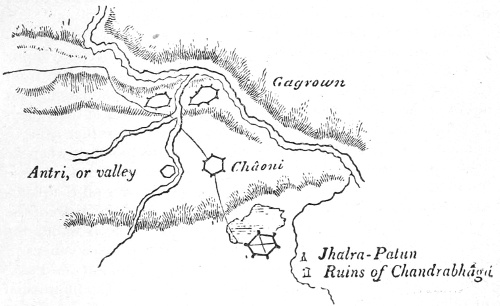
We passed over the ridge at the extremity of the town, and
1792descended into another Antri, up which we journeyed nearly due
west until we reached our camp at Narayanpur. The valley was
from four to six hundred yards in breadth, and in the highest
state of cultivation; to preserve which, and at the same time to
secure the game, the regent, at an immense expense, has cut deep
trenches at the skirt of the hills on each [738] side, over which
neither deer nor hog can pass, while the forests that crown the
hills to their summit are almost impervious even to wild beasts.
We passed various small cantonments, where the regent could
collect the best part of his army, some even on the summit of the
ridge. At all of these are wells, and reservoirs termed po.
Mukunddarra Pass, December 14, ten miles.—At daybreak, commenced
our march up the valley, and midway between Narayanpur
and the Darra, reached the ruined castle of Ghati, so called from
its being erected on the summit of the ridge commanding an
outlet of the valley. Partly from the gradual ascent of the valley,
and from the depression of the ridge, we formed rather a mean
opinion of the pass (ghati); but this feeling was soon lost when we
attained the crest, and found ourselves on a scarped rock of some
hundred feet in elevation, commanding a view over all the plains
of Malwa, while at our feet was a continuation of the Antri of the
Amjar, which we observed gliding through the deep woods the
regent has allowed to remain at the entrances of these valleys.
Tradition is eloquent on the deeds of the ‘Lords of the Pass,’
both of the Khichi and Hara, and they point out the impression
of Mehraj Khichi’s charger, as he sprang upon the Islamite
invaders. There are many cenotaphs to the memory of the slain,
and several small shrines to Siva and his consort, in one of which
I found an inscription not only recording the name of Mehraj,
but the curious fact that four generations were present at the
consecration of one to Siva. It ran thus: “In S. 1657 and Saka
1522, in that particular year called Somya, the sun in the south,
the season of cold, in the happy month Asoj, the dark half thereof,
on Sunday, and the thirty-sixth ghari; in such a happy moment,
the Khichi of Chauhan race, Maharaj Sri Rawat Narsinghdeo,
and his son Sri Rawat Mehraj, and his son Sri Chandarsen, and
his son Kalyandas, erected this sivala (house of Siva); may they
be fortunate! Written by Jaya Sarman, and engraved by
Kamma, in the presence of the priest Kistna, the son of Mahesh.”
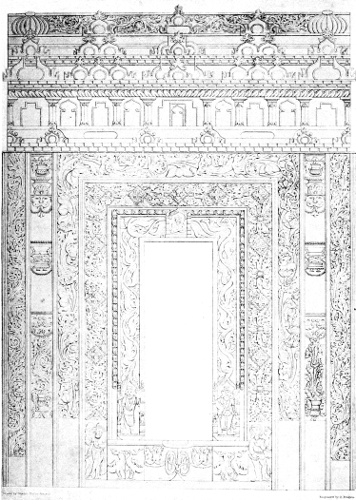
ENTRANCE TO THE SANCTUARY OF A TEMPLE AT CHANDRAVATI.
To face page 1792.
—We shall pass over the endless tales
1793of the many heroes who fell in its defence, to the last of any note—Guman
Singh, a descendant of Sawant Hara. The anecdote I
am about to insert relates to the time when Rao Durjansal was
prince of Kotah, and the post of Faujdar was held by a Rathor
Rajput, Jai Singh of Gagorni. Through the influence of this
faujdar, Guman was deprived of the honour of defending the pass,
and his estate sequestrated. He was proceeding homeward with
a heavy heart from the presence of his sovereign, when he met the
faujdar with his train [739]. It was dark, and a torch-bearer
preceded him, whom Guman dashed to the earth, and with his
iron lance transfixed the Rathor to his palki. Making for the gate,
he said it was the Rao’s order that none should pass until his
return. As soon as he gained his estate, he proceeded with his
family and effects to Udaipur, and found sarna with the Rana,
who gave him an estate for the support of himself and his followers.
There he remained until Kotah was besieged by Raja Isari Singh
of Jaipur, when he obtained the Rana’s leave to fly to its defence.
Passing over the Patar, he made for Kotah, but it was invested
on every side. Determined to reach it or perish, he ordered his
nakkara to beat, and advanced through the heart of the enemy’s
camp. The Jaipur prince asked who had the audacity to beat
close to his quarters, and being told “The Rawat of the Pass,
from Udaipur,” he expressed a wish to see the man, of whom he
had heard his father say he had, unarmed, slain a tiger. The
Hara obeyed the summons, but would only enter the Presence
in the midst of his band. He was courteously received and offered
large estates in Jaipur; the Raja remarking that Guman Singh
was only going to his doom, since “in the space of eating a pan
he (Isari Singh) would be master of Kotah.” Losing all patience,
Guman said, “Take my salaam and my defiance, Maharaj; the
heads of twenty thousand Haras are with Kotah.” He was
permitted to pass the batteries unmolested, and on reaching the
river, he called aloud, “The Ghata Rawat wants a boat,” to
conduct him to his sovereign, whom he found seated behind the
walls encouraging the defence. At that very moment a report
was brought that a breach was nearly effected at a particular
point; and scarcely had the prince applauded his swamidharma,
than, making his bow, Guman marched his followers to the
breach, and “there planted his lance.” Such were the Haras of
past days; but the descendants of the ‘Rawat of the Pass’ are
1794now in penury, deprived of their lands, and hard pressed to find
a livelihood.
We continued our march from this Pass, often moistened with
Rajput blood, and reached the Darra, outside of which we found
the old regent encamped, and whence we issued on our tour just
three weeks ago. It was by mere accident that, some distance
up the valley (a continuation of that we had just quitted), we
heard of some ruins, termed the Chaori of Bhim, one of the most
striking remains of art I had yet met with. It is the fragment only
of a quadrangular pile, of which little now remains, the materials
having been used by one of the Kotah princes, in erecting a small
palace to a Bhilni concubine. The columns possess great originality,
and appear to [740] be the connecting link of Hindu and
Egyptian architecture. Not far from the Chaori, where, according
to local traditions, the Pandu Bhim celebrated his nuptials, are
two columns, standing without relation to any other edifice;
but in the lapse of ages the fragments appertaining to them have
been covered with earth or jungle. At every step we found
Jujhars, or funeral stones; and as this ‘Pass of Mukund’ must,
as the chief outlet between the Deccan and northern India, have
been a celebrated spot, it is not unlikely that in remote ages some
city was built within its natural ramparts. Throughout this
town, we found many traces of the beneficent but simple legislation
of the Hara princes; and when the regent set up his pillar,
prohibiting chiefly his own violence, he had abundant formulas
to appeal to. We have already alluded to this circumstance in
the sketch of his biography, and we may here insert a free translation
of the ordinance we found engraved in the Pass, and which
is recorded throughout Haraoti.
“Maharaj Maharaoji Kishor Singh, ordaining! To all the
merchants (Mahajans), traders, cultivators, and every tribe
inhabiting Mukunddarra. At this time, be full of confidence;
trade, traffic, exchange, borrow, lend, cultivate, and be prosperous;
for all dand (contribution) is abolished by the Darbar. Crimes
will be punished according to their magnitude. All officers of
trust, Patels, Patwaris, Sasaris (night-guards), and Mutasaddis
(scribes), will be rewarded for good services, and for evil. None
of them shall be guilty of exactions from merchants or others:
this is a law sworn to by all that is sacred to Hindu or Muslim.
Ordained from the royal mouth, and by command of Nana
1795(grandsire) Zalim Singh, and uncle Madho Singh. Asoj the 10th,
Monday S. 1877 (A.D. 1821).”
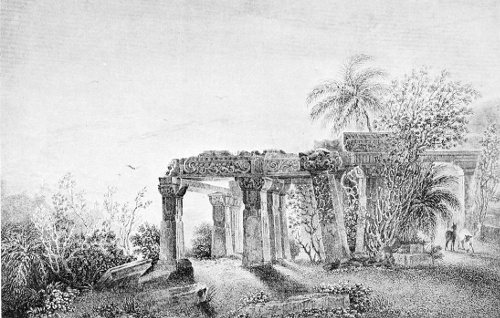
RUINS OF BHĪM’S CHAORI IN THE MUKUNDDARA PASS.
To face page 1794.
—Having halted a few days, we returned to
Kotah by the towns of Pachpahar and Anandpur; both large and
thriving, situated upon the banks of fine pieces of water. Madho
Singh, at the head of a splendid cavalcade, with six field-pieces,
advanced a couple of miles to conduct me to my old residence, the
garden-house, east of the town. During the six weeks that we
remained here to watch the result of the measures elsewhere
described, we endeavoured to find amusement in various ways,
to divert us from brooding upon the cholera which was raging
around us. This season attracts flocks of wild geese to prey upon
the young corn, and we had the double pleasure of shooting and
eating them. Occasionally, we had a shot at a deer, or hunted
them down with the regent’s chitas (hunting-leopards); or with
the dogs ran down jackals [741], foxes, or hares. There was a
ramna for wild-hogs about five miles from our abode, and a
delightful summer retreat in the midst of a fine sheet of water.
The animals were so tame, from the custom of feeding them, that
it was almost unsportsmanlike to shoot at them. On one occasion,
the Maharao prepared an excursion upon the water, in which I
was not well enough to join. Numerous Shikaris, or ‘hunters,’
proceeded up either bank to rouse the bears or tigers that find
cover there, when the party from the boats shot at them as they
passed. Partly for the purpose of enjoying this sport, and partly
to see the fortress of Ekelgarh, six miles south of the city, we
afterwards made another excursion, which, though not unattended
by danger, afforded a good deal of merriment. The river here
is confined by perpendicular rocks, full three hundred feet in
height; and amidst the debris, these wild animals find shelter.
As the side on which we were did not promise much sport, we
determined to cross the stream, and finding a quantity of timber
suited to the purpose, we set to work to construct a raft; but had
only pushed a few paces from the shore when we began to sink,
and were compelled to make a Jonas of the doctor, though we
afterwards sent the vessel back for him, and in due time landed
all our party and appendages. Being furnished with huntsmen
by the regent, who knew the lairs of the animals, we dispatched
them up the stream, taking post ourselves behind some masses
of rock in the only path by which they could advance. We had
1796been seated about half an hour, when the shouts of the hunters
were heard, and soon a huge bear, his muzzle grey from age, came
slowly trotting up the pathway. Being unable to repress the
mirth of Captain Waugh and the doctor, who were conning over
the events of the morning, just before he came in sight, I had
quitted them, and was trying to gain a point of security a little
remote from them; but before I could attain it, they had both
fired and missed, and Bruin came at a full gallop towards me.
When within ten paces, I fired and hit him in the flank; he fell,
but almost instantly recovered, and charged me open-mouthed,
when one of my domestics boldly attacked him with a hog-spear
and saved me from a hug. Between the spear and the shot, he
went floundering off, and was lost in the crevices of the rock. On
our return, we passed the day amidst the ruins of Ekelgarh, an
enormous pile of stones without cement; in all probability, a
fortress of some of the aboriginal Bhils. Both crests of the
mountain are covered with jungle, affording abundant sport to
the princes of Kotah. There is a spot of some celebrity a few
coss to the south of this, called Gayapur-Mahadeo, where there is a
cascade from a stream that falls into the Chambal, whose banks are
said to be here upwards of six [742] hundred feet in height. There
are few more remarkable spots in India than the course of the
river from Kotah to Bhainsror, where both the naturalist and the
painter might find ample employment.
I sent scouts in all directions to seek for inscriptions; some of
which are in an unknown character. One of the most interesting,
brought from Kanswa, of a Jat prince, has been given in the first
volume of this work.[25]
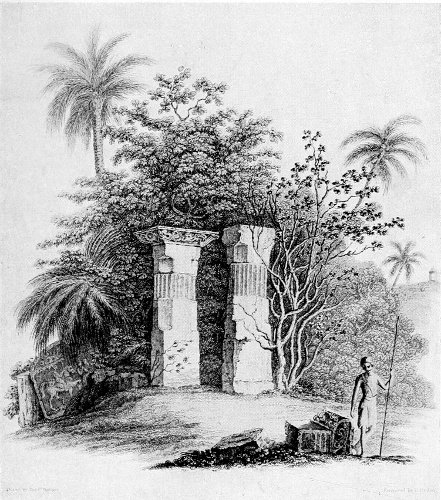
ANCIENT COLUMNS IN THE MUKUNDDARA PASS.
To face page 1796.
—In February, I recommenced my march for Udaipur,
and having halted a few days at Bundi, and found all there as
my heart could wish, I resumed the march across the Patar,
determined to put into execution my wish of visiting Menal.
About ten miles north, on this side of it, I halted at Bijolia, one
1797of the principal fiefs of Mewar, held by a chief of the Pramar
tribe, with the title of Rao.
[1] This family, originally Raos of
Jagner, near Bayana, came into Mewar in the time of the great
Amar Singh, with all his
basai, upwards of two centuries ago;
the Rana having married the daughter of Rao Asoka, to whom
he assigned an estate worth five lakhs annually. I have elsewhere
(Vol. I. p.
206) explained the meaning of a term which embraces
bondage amongst its synonyms, though it is the lightest species
of slavery. Basai, or properly
vasi, means a ‘settler,’ an ‘inhabitant,’
from
vas, ‘a habitation,’ and
vasna, ‘to inhabit,’ but
it does not distinguish between free settlers and compulsory
labourers; but wheresoever the phrase is used in Rajwara, it
may be assumed to imply the latter. Still, strange to say, the
condition includes none of the accessories of slavery: there is no
task-duty of any kind, nor is the individual accountable for his
labour to any one: he pays the usual taxes, and the only tie
upon him appears to be that of a [743] compulsory residence in
his
vas, and the epithet, which is in itself a fetter upon the mind
of the
vasi of Bijolia.
—Bijolia (Vindhyavalli) stands amidst the ruins with
which this uparmal, or highland, is crowded. From the numerous
inscriptions we here found, we have to choose, for its ancient
name, between Ahichpur and Morakara; the latter is still applied,
though the former appears only on the recording stone. This
western frontier teems with traditions of the Chauhans, and seems
to have been a dependency of Ajmer, as these inscriptions contain
many celebrated names of that dynasty, as Bisaldeo, Someswar,
Prithiraj; and chiefly record the martial virtues and piety of
Irnaraj of Morakara, and his offspring, Bahirraj and Kuntpal,
who appear contemporary with their paramount prince and
relative, Prithiraj, king of Delhi and Ajmer.
One inscription records the actions of the dynasty of Chitor,
and they are so intermingled as to render it almost impossible to
separate the Guhilots from the Chauhans. It begins with an
invocation to “Sakambhari Janami Mata, the mother of births,
guardian of the races (sakham),[2] and of mighty castles (durga),
1798hills, and ruins, the Protectress.” Having mentioned the names
of nine Chauhans (of Vats-gotra), it flies off to Srimad Bapparaj,
Vindhya Nirpati, or, ‘Bappa, sovereign of the Vindhya Hills,’ the
founder of the Ranas of Mewar; but the names that follow do
not belong to his dynasty, which leads me to imagine that the
Chauhans of Uparmal were vassals of Chitor at that early period.
Since antiquarian disquisitions, however, would be out of place
here, we shall only give the concluding portion. It is of Kuntpal,
the grandson of Irnaraj, “who destroyed Jawalapur, and the
fame of whose exploit at the capture of Delhi is engraved on the
gate of Valabhi. His elder brother’s son was Prithiraj, who
amassed a parb of gold, which he gave in charity, and built in
Morakara a temple to Parsvanath. Having obtained the regal
dignity, through Someswar, he was thence called Someswar, for
the sake of whose soul this mandir was erected, and the village
of Rewana on the Rewa, bestowed for its support.—S. 1226
(A.D. 1170).” This appears completely to set at rest the question
whether the Chauhans wrested by force the throne of Delhi from
the Tuars;[3] and it is singular, that from the most remote part
of the dominions of this illustrious line, we should have a confirmation
of the fact asserted by their great bard Chand. The
inscriptions at Asi (Hansi), and on the column of Delhi, were all
written about the same period as this (see p. 1456). But the
appeal made to “the gate of Valabhi,” the ancient capital of the
Guhilots in Saurashtra, is the most singular part of it, and will
only admit of one construction [744], namely, that when Prithiraj
revenged the death of his father, Someswar, who was slain in
battle by the prince of Saurashtra and Gujarat, Kuntpal must
have availed himself of that opportunity to appropriate the share
he had in the capture of Delhi. Chand informs us he made a
conquest of the whole of Gujarat from Bhola Bhim.[4]
We have also two other not unimportant pieces of information:
first that Morakara was an ancient name of Bijolia; and next,
that the Chauhan prince was a disciple of the Jains, which,
according to Chand, was not uncommon, as he tells us that he
1799banished his son Sarangdeo from Ajmer, for attaching himself to
the doctrines of the Buddhists.
Morakara, about half a mile east of Bijolia, is now in ruins;
but there are remains of a Kot, or castle, a palace called the
Nauchauki, and no less than five temples to Parsvanath, the
twenty-third of the Jain pontiffs, all of considerable magnitude
and elaborate architectural details, though not to be compared
with Barolia. Indeed, it is everywhere apparent that there is
nothing classical in design or execution in the architecture of
India posterior to the eleventh century. One of my scribes, who
has a talent for design, is delineating with his reed (kalam) these
stupendous piles, while my old Jain Guru is hard at work copying
what is not the least curious part of the antiquities of Bijolia,
two inscriptions cut in the rock; one of the Chauhan race, the
other of the Sankhya Purana, appertaining to his own creed, the
Jain. It is fifteen feet long by five in breadth, and has fifty-two
lines.[5] The other is eleven feet six inches by three feet six, and
contains thirty-one lines; so that the old gentleman has ample
occupation. A stream runs amidst the ruins, called the Mundagni
(fire-extinguishing); and there is a kund, or fountain, close to the
temples of Parsva, with the remains of two noble reservoirs. All
these relics indicate that the Jains were of the Digambara sect.[6]
The genealogy is within the Kot, or precincts of the old castle.
There are likewise three temples dedicated to Siva, of still
greater magnitude, nearer to the town, but without inscriptions;
though one in an adjoining kund, called the Rewati, records the
piety of the Gohil chief Rahal, who had bestowed “a patch of
land in the Antri,” defining minutely its limits, and inviting
others (not ineffectually, as is proved by other bequests), in the
preamble to his gift, to follow his example by the declaration
that “whoever bathes in the Rewati fountain will be beloved by
her lord, and have a numerous progeny” [745].
1800The modern castle of Bijolia is constructed entirely out of the
ruins of the old shrines of Morakara, and gods and demons are
huddled promiscuously together. This is very common, as we
have repeatedly noticed; nor can anything better evince that
the Hindu attaches no abstract virtue to the material object or
idol, but regards it merely as a type of some power or quality
which he wishes to propitiate. On the desecration of the receptacle,
the idol becomes again, in his estimation, a mere stone,
and is used as such without scruple. All around, for several
miles, are seen the wrecks of past days. At Darauli, about four
miles south, is an inscription dated S. 900 (A.D. 844), but it is
unimportant; and again, at Telsua, two miles farther south, are
four mandirs, a kund, and a toran, or triumphal arch, but no
inscription. At Jaraula, about six miles distant, there are no
less than seven mandirs and a kund—a mere heap of ruins. At
Ambaghati, one of the passes of descent from the table-land
into the plain, there are the remains of an ancient castle and a
shrine, and I have the names of four or five other places, all
within five miles of Bijolia, each having two and three temples
in ruins. Tradition does not name the destroyer, but as it
evidently was not Time, we may, without hesitation, divide the
opprobrium between those great iconoclasts, the Ghori king Ala
and the Mogul Aurangzeb, the first of whom is never named
without the addition of Khuni, ‘the sanguinary,’ whilst the other
is known as Kalayavana, the demon-foe of Krishna.
The Bijolia chief is greatly reduced, though his estates, if
cultivated, would yield fifty thousand rupees annually; but he
cannot create more vasi, unless he could animate the prostrate
forms which lie scattered around him. It was his daughter who
was married to prince Amra, and who, though only seventeen,
withstood all solicitation to save her from the pyre on his demise.[7]
I made use of the strongest arguments, through her uncle, then
at Udaipur, promising to use my influence to increase his estate,
and doubtless his poverty reinforced his inclination; but all
was in vain—she determined “to expiate the sins of her lord.”
Having remained two or three days, we continued our journey
in quest of the antique and the picturesque, and found both at
Menal.
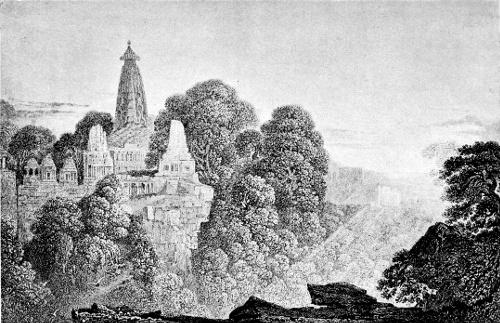
TEMPLES OF MENĀL.
In Mewār.
To face page 1800.
Menāl or Mahānāl, February 21.—It is fortunate that the
1801pencil can here portray what transcends the power of the pen;
to it we shall, therefore, leave the architectural wonders of Mahanal,
and succinctly describe the site. It is difficult to conceive
what [746] could have induced the princely races of Chitor or
Ajmer to select such a spot as an appanage for the cadets of their
families, which in summer must be a furnace, owing to the reflection
of the sun’s rays from the rock: tradition, indeed, asserts
that it is to the love of the sublime alone we are indebted for these
singular structures. The name is derived from the position
Mahanal, ‘the great chasm,’ or cleft in the western face of the
Patar, presenting an abyss of about four hundred feet in depth,
over which, at a sharp re-entering angle, falls a cascade, and
though now but a rill, it must be a magnificent object in the
rainy season. Within this dell it would be death to enter:
gloomy as Erebus, crowded with majestic foliage entangled by
the twisted boughs of the Amarvela, and affording cover to all
description of the inhabitants, quadruped and feathered, of the
forest. On the very brink of the precipice, overhanging the
abyss, is the group of mixed temples and dwellings, which bear
the name of Prithiraj (vide Plate); while those on the opposite
side are distinguished by that of Samarsi of Chitor, the brother-in-law
of the Chauhan emperor of Delhi and Ajmer, whose wife,
Pirthabai, has been immortalized by Chand, with her husband
and brother.[8] Here, the grand cleft between them, these two last
bulwarks of the Rajput races were accustomed to meet with
their families, and pass days of affectionate intercourse, in which
no doubt the political condition of India was a prominent topic
of discussion. If we may believe, and we have no reason to
distrust, the testimony of Chand, had Prithiraj listened to the
counsel of the Ulysses of the Hindus (in which light Samarsi was
regarded by friend and foe), the Islamite never would have been
lord of Hindustan. But the indomitable courage and enthusiastic
enterprise of Prithiraj sunk them all; and when neither wisdom
nor valour could save him from destruction, the heroic prince of
Chitor was foremost to court it. Both fell on the banks of the
1802Ghaggar, amidst heroes of every tribe in Rajputana. It was
indeed to them, as the bard justly terms it, pralaya, the day of
universal doom; and the last field maintained for their national
dependence. To me, who have pored over their poetic legends,
and imbibed all those sympathies which none can avoid who
study the Rajput character, there was a melancholy charm in the
solemn ruins of Menal. It was a season, too, when everything conspired
to nourish this feeling; the very trees which were crowded
about these relics of departed glory, appearing by their leafless
boughs and lugubrious aspect to join in the universal mourning.

SECOND GROUP OF TEMPLES OF MENĀL.
In Mewār.
To face page 1802.
—We found many inscriptions at
Mahanal, and of one I shall here insert a free [747] translation,
as it may be applied hereafter to the correction of the chronology
of the Haras, of which race it contains a memorial.
“By Asapurna[9] [the fulfiller of our desires] the kula-devi[10]
[tutelary goddess] of the race, by whose favour hidden treasures
are revealed, and through whose power many Chauhan kings
have ruled the earth, of which race was Bhanwardhan,[11] who in
the field of strife attained the desires of victory. Of his race was
the tribe of Hara, of which was Kulan,[12] of illustrious and pure
descent in both races; whose fame was fair as the rays of the
moon. From him was Jaipal,[13] who obtained the fruits of the
good works of his former existence in the present garb of royalty;
and whose subjects prayed they might never know another
sovereign. From him was Devaraj,[14] the lord of the land, who
gave whatever was desired, and whose wish was to render mankind
happy. He delighted in the dance and the song. His son was
Harraj,[15] whose frame was a piece of fire; who, in the field of
1803battle, conquered renown from the princes of the land [Bhumeswar],
and dragged the spoils of victory from their pinnacled
abodes.
“From him were the lords of Bumbaoda,[16] whose land yielded
to them its fruits. From Devaraj was Ritpal,[17] who made the
rebellious bow the head, or trod them under foot, as did Kapila
the sons of Sagara. From him was Kelhan, the chief of his tribe,
whose son Kuntal resembled Dharmaraj; he had a younger
brother, called Deda. Of his wife, Rajaldevi, a son was born
to Kuntal, fair as the offspring of the ocean.[18] He was named
Mahadeva. He was [in wisdom] fathomless as the sea, and in
battle immovable as Sumeru; in gifts he was the Kalpa-vriksha[19]
of Indra. He laid the dust raised by the hoofs of hostile steeds,
by the blood of his foes. The sword [748] grasped in his extended
arm dazzled the eye of his enemy, as when uplifted o’er the head
of Ami Shah he rescued the Lord of Medpat, and dragged Kaita
from his grasp, as is Chandra from Rahu.[20] He trod the Sultan’s
army under foot, as does the ox the corn; even as did the Danavas
(demons) churn the ocean, so did Mahadeva the field of strife,
seizing the gem (ratna) of victory from the son of the King, and
bestowing it on Kaita, the lord of men. From the centre even
1804to the skirts of space, did the fame of his actions extend, pure as
curdled milk. He had a son, Durjan, on whom he bestowed the
title of Jivaraj[21] (Jeojraj), who had two brothers, Subutsal and
Kumbhakarna.[22]
“Here, at Mahanal, the lord of the land, Mahadeva, made a
mandir, in whose variously-sculptured wall this treasure [the
inscribed tablet] is concealed. This (the temple) is an epitome
of the universe, whose pinnacle (sikhara) sparkles like a gem.
The mind of Mahadeva is bent on devotion in Mahanal, the
emblem of Kailas, where the Brahmans perform varied rites.
While the science of arms endures, may the renown of Mahadeva
never perish;[23] and until Ganges ceases to flow, and Sumeru to
be immovable, may this memorial of Mahadeva abide fixed at
Mahanal. This invocation to Mahadeva was made by Mahadeva,
and by the Brahman Dhaneswar, the dweller in Chitrakot
(Chitor), was this prashishta composed:
Arka, Gun, Chandra, Indu.
“The month of Baisakh (sudi), the seventh. By Viradhawal,
the architect (silpi), learned in the works of architecture (silpasastra)
was this temple erected.”
The cryptographic date, contained in the above four words,
is not the least curious part of this inscription, to which I did not
even look when composing the Bundi annals, and which is another
of the many powerful proofs of the general fidelity of their poetic
chronicles [749].
Arka is the sun, and denotes the number 12; Gun is the three
principal passions of the mind; and Chandra and Indu each
stand for one: thus,
Arka, Gun, Chandra, Indu.
12. 3. 1. 1.
and this “concealed (gupta) treasure,” alluded to in the inscription,
must be read backwards. But either my expounder, or the
1805Silpi, was out, and had I not found S. 1446 in a corner, we should
never have known the value of this treasure. Many inscriptions
are useless from their dates being thus enigmatically expressed;
and I subjoin, in a note, a few of the magic runes, which may aid
others to decipher them.[24]
I was more successful in another inscription of Irna or Arnadeva
(fam. Arandeo), who appears to have held the entire Uparmal as
a fief of Ajmer, and who is conspicuous in the Bijolia inscription.
Of this, suffice it to say, that it records his having “made the
gateway to Menal, otherwise termed the city of Someswar”; and
the date is
Anal, Nand, Ind, Ind.
3. 9. 1. 1.
Anal (fire) stands for three, denoting the third eye of Mahadeva,
which is eventually to cause pralaya, or ‘destruction.’ Nand
stands for nine, or the Nau-nand of their ancient histories. Indu,
the moon (twice repeated), is one, and the whole, read backwards,
is S. 1193, or A.D. 1137.
In the mandir of Samarsi, we found the fragment of another
inscription, dated S. 12-2, and containing the eulogy of Samarsi
and Arnaraj, lord of the region; also the name of “Prithiraj,
who destroyed the barbarians”; and concluding with Sawant
Singh.
,
[25] February.—We commenced our march at break of day,
along the very crest [750] of the Patar; but the thick woods
through which lay our path did not allow us a peep at the plains
of Medpat until we reached the peak, where once stood the castle
of Alu Hara. But silent were the walls of Bumbaoda; desolation
was in the courts of Alu Hara. We could trace, however, the
1806plan of this famed residence of a hero, which consisted of an
exterior and an interior castle, the latter being a hundred and
seventy cubits by a hundred and twelve. There are the ruins of
three Jain temples, to Siva, Hanuman, and Dharmaraja, the Hindu
Minos; also three tanks, one of which was in excellent preservation.
There are likewise the remains of one hall, called the
Andhyari Kothri, or ‘dark chamber,’ perhaps that in which Alu
(according to tradition) locked up his nephew, when he carried
his feud into the desert. The site commands an extensive view
of the plains of Mewar, and of the Arneo-ghati (pass), down the
side of the mountain, to the valley of Begun. Beneath, on a
ledge of rock, guarding the ascent, was the gigantic statue of
Jogini Mata, placed on the very verge of the precipice, and overlooking
one of the noblest prospects in nature. The hill here
forms a re-entering angle of considerable depth, the sides scarped,
lofty, and wooded to the base; all the plain below is covered with
lofty trees, over whose tops the parasitic Amarvela forms an
umbrageous canopy, extending from rock to rock, and if its superfluous
supports were removed, it would form a sylvan hall, where
twenty thousand men might assemble.
Over this magnificent scenery ‘our Queen of the Pass’ looks
grimly down; but now there is neither foe to oppose, nor scion
of Bumbaoda to guard. I could not learn exactly who had
levelled the castle of Alu Hara, although it would appear to have
been the act of the lord paramount of Chitor, on whose land it is
situated; it is now within the fief of Begun. We have already
given one legend of Alu; another from the spot may not be
unacceptable.
—In one of the twenty-four castles dependent
on Bumbaoda, resided Lalaji, a kinsman of Alu. He had one
daughter, in whose name he sent the coco-nut to his liege lord,
the Rana of Chitor; but the honour was declined. The family
priest was returning across the
antri, when he encountered the
heir of Chitor returning from the chase, who, on learning the cause
of the holy man’s grief, determined to remove it by taking the
nuptial symbol himself. He dismissed the priest, telling him he
should soon appear to claim his bride. Accordingly, with an
escort befitting the heir of Chitor, and accompanied by a bard
then on a visit to the Rana, he set out for Bumbaoda. Bhimsen
Bardai was a native of Benares, and happened to pass through
1807Mewar on his way [751] to Cutch-Bhuj, at the very period when
all ‘the sons of rhyme’ were under sentence of exile from Mewar:
a fate which we frequently find attending the fraternity in this
country. The cause of this expatriation was as follows; an
image of the deity had been discovered in clearing out the waters
of the lake, of a form so exquisitely beautiful as to enchant every
eye. But the position of the arms was singular; one pointed
upwards, another downwards, a third horizontally towards the
observer. The handwriting on the wall could not have more
appalled the despot of Babylon than this
putli of Chaturbhuja,
or ‘image of the four-armed god.’ The prophetic seers were
convened from all parts; but neither the Bhats nor the Charans,
nor even the cunning Brahman, could interpret the prodigy;
until, at length, the bard of the Jarejas arrived and expounded
the riddle. He showed that the finger pointing upwards imported
that there was one Indra, lord of heaven; and that downwards
was directed to the sovereign of Patal (hell); whilst that which
pointed to the Rana indicated that
he was lord of the central
region (Medpat);
[26] which being geographically correct, his interpretation
was approved, and met with such reward, that he became
the
pat-bardai, or chief bard to Hamir, who, at his intercession,
recalled his banished brethren, exacting in return for such favours
that ‘he would extend the palm to no mortal but himself.’
This was the bard who accompanied the heir of Chitor to espouse
the daughter of Bumbaoda. The castle of the Hara was thronged;
the sound of mirth and revelry rang through the castle-halls, and
the bards, who from all parts assembled to sing the glories of the
Haras, were loaded with gifts. Bhimsen could not withstand the
offering made by the lord of the Patar, a horse richly caparisoned,
splendid clothes, and a huge bag of money: as the bard of the
Haras (who told me the tale) remarked, “although he had more
than enough, who can forget habit? We are beggars (Mangtas)
as well as poets by profession.” So, after many excuses, he allowed
the gift to be left; but his soul detested the sin of his eye, and
resolving to expiate the crime, he buried his dagger in his heart.
Cries rent the air; “the sacred bard of Chitor is slain!” met the
ear of its prince at the very moment of
hatheli (junction of hands).
He dropped the hand of his bride, and demanded vengeance. It
was now the Hara’s turn to be offended; to break off the nuptials
1808at such a moment was redoubling the insult already offered by
his father, and a course which not even the bard’s death could
justify. The heir of Chitor was conducted forthwith outside
Bumbaoda; but he soon returned with the troops of Chitor, and
hostilities commenced where festivity so lately reigned. Phalgun
approached, and the spring-hunt of the Aheria could not be
deferred, though foes were [752] around. Lalaji, father of the
bride, went with a chosen band to slay a boar to Gauri, in the
plains of Tukarai; but Kaitsi heard of it, and attacked them.
Alike prepared for the fight or the feast, the Hara accepted the
unequal combat; and the father and lover of the bride rushed
on each other, spear in hand, and fell by mutual wounds.
The pyres were prepared within the walls of Bumbaoda,
whither the vassals bore the bodies of their lords; on one was
placed the prince of Chitor, on the other the Hara kinsman;
and while the virgin bride ascended with the dead body of the
prince, her mother was consumed on that where her father lay. It
was on this event that the imprecation was pronounced that
“Rana and Rao should never meet at the spring-hunt (Aheria)
but death should ensue.” We have recorded, in the annals of
the Haras, two subsequent occasions; and to complete their
quatrain, they have made the defeat of Rana Mokal (called
Kumbha in the Annals, see page 1471) fill up the gap. Thus:
Hāmu Mokal mariyo,
Lālē Kheta jān,
Sujē Ratan samghāriyo
Ajmal Arasi rān.
In repeating these stanzas, the descendant of Alu Hara may
find some consolation for the mental sufferings he endures when
he casts a glance upon the ruins of Bumbaoda and its twenty-four
subordinate castles, not one of which now contains a Hara:
And there they stand, as stands a lofty mind,
Worn, but unstooping to the baser crowd;
All tenantless, save to the crannying wind,
Or holding dark communion with the cloud.
[27]
That these ruins make a powerful appeal to the Hara, I can
prove by letters I received in October last year, when, in obedience
1809to a mandate of the ‘Queen of the Pass,’ a band collected
at her shrine to obey her behest, whatever that might be.
Extract from Akhbar (newspaper), dated Bundi, October 18, 1820.
“Warrants were sent to all the chiefs for their attendance at the
capital to celebrate the festival of the Dasahra. The whole of
the chiefs and landholders came, with the exception of the
Thakurs of Bar, who returned the following reply:—'We have
received a communication (paigham) from Sri Bhavani of Bumbaoda,
who commands us no longer to put the plough in the soil,
but to sell our horses and our cattle [753], and with the amount
to purchase sixty-four[28] buffaloes and thirty-two goats, for a
general sacrifice to Mataji, by obeying which we shall repossess
Bumbaoda.' Accordingly, no sooner was this known, than
several others joined them, both from Bundi and Kotah. The
Thakur of Bar had prepared dinner near the statue of Mata for
two hundred, instead of which five hundred assembled; yet not
only were they all abundantly satisfied, but some food remained,
which convinced the people there that the story (the communication)
was true.”
This was from Bundi; but the following was from my old,
steady, and faithful Brahman, Balgovind, who was actually on
the spot, dated “Menal, 1st Kartik:—A few days ago, there was
a grand sacrifice to Jogini Mata, when thirty-one buffaloes and
fifty-three goats were slain. Upon two bakras (he-goats), three
Haras tried their swords in vain; they could not touch a single
hair, at which all were much surprised. These goats were afterwards
turned loose to feed where they pleased, and were called
amar (immortal).”
Not a comment was made upon this, either by the sensible
Balgovind or the Yati Gyanji, who was with him. There was,
therefore, no time to be lost in preventing an explosion from five
hundred brave Haras, deeming themselves convened at the express
command of Bhavani, to whom the sacrifice proved thus acceptable;
and I sent to the Raja to break up the party, which was
effected. It, however, shows what an easy matter it is to work
upon the credulity through the feelings of these brave men.
1810I left the spot, hallowed by many feelings towards the silent
walls of Bumbaoda. We wound our way down the rocky steep,
giving a look to the ‘mother of the maids of slaughter’ as we
passed, and after a short passage across the entrance of the valley,
encamped in a fine grove of trees close to the town of Begun.
The Rawat, descendant of ‘the black cloud,’ came out to meet
me; but he is yet a stranger to the happiness that awaits him—the
restoration of more than half of his estate, which has been in
the hands of the Mahratta Sindhia since A.D. 1791 [754].
,
February 26.—The chances were nine hundred and
ninety-nine to one that I ever touched a pen again. Two days
ago I started, with all the ‘pomp and circumstance’ befitting
the occasion, to restore to the chief the land of his sires, of which
force and fraud had conspired to deprive them during more than
thirty years. The purport of my visit being made known, the
‘sons of Kalamegh’ assembled from all quarters; but
honhar
has again interfered. The old castle of Begun has a remarkably
wide moat, across which there is a wooden bridge communicating
with the town. The avant-courtiers of my cavalcade, with an
elephant bearing the union, having crossed and passed under the
arched gateway, I followed, contrary to the Mahaut’s advice,
who said there certainly would not be space to admit the elephant
and howda. But I heedlessly told him to drive on, and if he
could not pass through, to dismount. The hollow sound of the
bridge, and the deep moat on either side, alarmed the animal,
and she darted forward with the celerity occasioned by fear, in
spite of any effort to stop her. As I approached the gateway, I
measured it with my eye, and expecting inevitable and instantaneous
destruction, I planted my feet firmly against the howda, and
my forearms against the archway, and, by an almost preternatural
effort of strength, burst out the back of the howda; the elephant
pursued her flight inside, and I dropped senseless on the bridge
below.
[1] The affectionate sympathies and attention of those
1811around revived me, though they almost extinguished the latent
spark of life in raising me into my palki, and carrying me to my
tent. I, however, soon recovered my senses, though sadly bruised;
but the escape was, in a twofold degree, miraculous; for, in
avoiding decollation, had I fallen half an inch more to the side,
I should have been caught on the projecting spikes of the gateway.
My tent was soon filled by the Rawatji and his brethren, who
deplored the accident, and it was with difficulty I could get them
to leave the side of my pallet; but what was my astonishment
when, two days after, going to fulfil my mission, I saw the noble
[755] gateway, the work of Kalamegh, reduced to a heap of ruins,
through which I was conducted to the palace on an ample terrace,
in front of which I found the little court of Begun! The Rawat
advanced and presented me the keys, which having returned in his
sovereign’s name, I deplored his rash destruction of the gateway,
blaming
honhar and my own want of
budh (wisdom) for the
accident. But it was in vain; he declared he never could have
looked upon it with complacency, since it had nearly deprived
of life one who had given life to them. The restored estates had
been mortgaged to old Sindhia for the payment of a war-exaction,
and the Rawat held regularly-executed deeds, empowering him
to recover them when the contribution should be liquidated.
When the ‘reign of justice’ commenced in these regions, he produced
his bond; he showed that the exactions had been paid
twice over, and demanded, through the intervention of the British
agent, that Sindhia should be brought to a settlement. The
replies and rejoinders were endless; and at length the Rawatji,
wearied out, one morning took the law into his own hands;
assaulted, carried, and, with the loss of some lives, drove out the
Mahrattas, who had built a castellated residence even under his
eye. It was necessary for form-sake to punish this act, which
we would not prevent; and accordingly Begun was put under
sequestration, and the Rana’s flag was planted upon its walls.
The chief submitted to all with a good grace, and with a cause so
just I made an excellent case against Sindhia, who talked of
papers which he never produced. Allowing, therefore, some
months more to elapse, we executed the bond, and restored
Begun to its rightful owner.
[2] I was the more rejoiced at effecting
1812this, as the Rawat had set the example of signing the deed of
renunciation of May 1818, which was the commencement of the
prosperity of Mewar.
Basi, February 27.—Compelled to travel in my palki, full of
aches and ails. I think this will complete the disorganization
of my frame; but I must reserve the little strength I have for
Chitor, and, coûte que coûte, climb up and take a farewell look.
Chitor.[3]—My heart beat high as I approached the ancient
capital of the Sesodias, teeming with reminiscences of glory,
which every stone in her giant-like kunguras (battlements)
attested. It was from this side that the imperial hosts under Ala
and Akbar advanced to force the descendant of Rama to do homage
to their power. How the summons was answered, the deeds of
Ranas Arsi and Partap have already told. But there was one
relic of “the last day” of Chitor, which I visited in this morning’s
march, that will immortalize the field where the greatest monarch
that India (perhaps Asia) ever had, erected the green banner of
the faith, and pitched his [756] tent, around which his legions
were marshalled for the reduction of the city. This still perfect
monument is a fine pyramidal column, called by some the
Chiraghdan, and by others Akbar-ka-dewa, both having the same
meaning, ‘Akbar’s lamp.’[4] It is formed of large blocks of compact
lime-stone, admirably put together, about thirty-five feet
high, each face being twelve feet at the base, and gradually tapering
to the summit, where it is between three and four, and on
which was placed a huge lamp (chiragh), that served as a beacon
to the foragers, or denoted the imperial headquarters. An
interior staircase leads to the top; but although I had the
strongest desire to climb the steps, trodden no doubt by Akbar’s
feet, the power was not obedient to the will, and I was obliged to
continue my journey, passing through the Talaiti, as they term
the lower town of Chitor. Here I got out of my palki, and ventured
the ascent, not through one, but five gates, upon the same
1813faithless elephant; but with this difference, that I had no howda
to encase me and prevent my sliding off, if I found any impediment;
nevertheless, in passing under each successive portal, I
felt an involuntary tendency to stoop, though there was a superfluity
of room over head. I hastened to my bechoba,[5] pitched upon
the margin of the Surya-kund, or ‘fountain of the sun,’ and with
the wrecks of ages around me I abandoned myself to contemplation.
I gazed until the sun’s last beam fell upon ‘the ringlet
of Chitor,’ illuminating its grey and grief-worn aspect, like a
lambent gleam lighting up the face of sorrow. Who could look
on this lonely, this majestic column, which tells, in language more
easy of interpretation than the tablets within, of
deeds which should not pass away,
And names that must not wither,
and withhold a sigh for its departed glories? But in vain I
dipped my pen to embody my thoughts in language; for, wherever
the eye fell, it filled the mind with images of the past, and ideas
rushed too tumultuously to be recorded. In this mood I continued
for some time, gazing listlessly, until the shades of evening
gradually enshrouded the temples, columns, and palaces; and
as I folded up my paper till the morrow, the words of the prophetic
bard of Israel came forcibly to my recollection: “How doth the
city sit solitary that was full of people! how is she become as a
widow! she, that was great among nations, and princess among
provinces, how is she become tributary!”
But not to fatigue the reader with reflections, I will endeavour
to give him some [757] idea of these ruins.[6] I begin with the
description of Chitor from the Khuman Raesa, now beside me:
“Chitrakot is the chief amongst eighty-four castles, renowned
for strength; the hill on which it stands, rising out of the level
plain beneath, the tilak on the forehead of Avani (the earth). It
is within the grasp of no foe, nor can the vassals of its chief know
the sentiment of fear. Ganga flows from its summit; and so
intricate are its paths of ascent, that though you might find
entrance, there would be no hope of return. Its towers of defence
are planted on the rock, nor can their inmates even in sleep know
alarm. Its Kothars (granaries) are well filled, and its reservoirs,
fountains, and wells are overflowing. Ramachandra himself
1814here dwelt twelve years. There are eighty-four bazars, many
schools for children, and colleges for every kind of learning;
many scribes (kayasth) of the Bidar[7] tribe, and the eighteen varieties
of artisans. (Here follows an enumeration of all the trees,
shrubs, and flowers within and surrounding the fortress.) Of
all, the Guhilot is sovereign (dhani), served by numerous troops,
both horse and foot, and by all the ‘thirty-six tribes of Rajputs,’
of which he is the ornament (chhattis kula singar).”
The Khuman Raesa, or story of Rawat Khuman, was composed
in the ninth century;[8] and the poet has not exaggerated;
for of all the royal abodes of India, none could compete with
Chitor before she became a “widow.” But we must abandon
the Raesa for a simple prose description. Chitor is situated on
an isolated rock of the same formation as the Patar, whence it
is distant about three miles, leaving a fertile valley between, in
which are the estates of Bijaipur, Gwalior, and part of Begun,
studded with groves, but all waste through long-continued
oppression. The general direction of the rock is from S.S.W. to
N.N.E.; the internal length on the summit being three miles
and two furlongs, and the greatest central breadth twelve hundred
yards. The circumference of the hill at its base, which is fringed
with deep woods, extending to the summit, and in which lurk
tigers, deer, hogs, and even lions, is somewhere above eight miles,
and the angle of ascent to its scarped summit about 45°. The
Talaiti, or lower town, is on the west side, which in some places
presents a double scarp, and this side is crowded with splendid
objects; the triumphal column, the palaces of Chitrang Mori,
of Rana Raemall, the huge temple of Rana Mokal, the hundred
pinnacles of the acropolis of the Guhilots, and last, not least, the
mansions of Jaimall and Patta, built on a projecting point, are
amongst the most remarkable monuments overlooking the plain.
1815The great length of Chitor, and the uniformity of the level crest,
detract from its height, which in no part exceeds [758] four
hundred feet, and that only towards the north. In the centre
of the eastern face, at ‘the gate of the sun’ (Surajpol), it is less
than three hundred, and at the southern extremity, the rock is
so narrow as to be embraced by an immense demi-lune commanding
the hill called Chitori, not more than one hundred and fifty
yards distant; it is connected with Chitor, but lower, and judiciously
left out of its circumvallation. Still it is a weak point, of
which the invader has availed himself. On this, Mahadaji
Sindhia raised his batteries when called on by the Rana to expel
his rebellious vassal of Salumbar (Vol. I. p. 517). The Mahratta’s
batteries, as well as the zigzag lines of his ascent, indicate that,
even in S. 1848 (A.D. 1792), he had the aid of no unskilful engineer.
From this point the Tatar Ala stormed; and to him they attribute
Chitor altogether, alleging that he raised it by artificial means,
“commencing with a copper for every basket of earth, and at
length ending with a piece of gold.” It would, indeed, have
taken the twelve years, assigned by tradition to Ala’s siege, to
have effected this, though there cannot be a doubt that he greatly
augmented it, and planted there his Manjanikas,[9] or balistas, in
the same manner as he did to reduce the fortress of Rain, near
Ranthambhor.
Having wandered for two or three days amongst the ruins,
I commenced a regular plan of the whole, going to work trigonometrically,
and laying down every temple or object that still
retained a name or had any tradition attached to it. I then
descended with the perambulator and made the circuit.
The first lateral cut of ascent is in a line due north, and before
another angle you pass through three separate gates; between
the last of which, distinctively called the Phuta Dwara, or ‘broken
door,’ and the fourth, the Hanuman pol (porte), is a spot for ever
sacred in the history of Chitor, where its immortal defenders,
Jaimall and Patta, met their death. There is a small cenotaph
to the memory of the former, while a sacrificial Jujhar, on which
is sculptured the effigy of a warrior on horseback, lance in hand,
reminds the Sesodia where fell the stripling chief of Amet. Near
these is another cenotaph, a simple dome supported by light
elegant columns, and covering an altar to the manes of the
1816martyr Raghudeva, the deified putra of Mewar (see Vol. I. p. 325).
After passing three more barriers, we reach the Rampol, which
crowns the whole, and leads into a noble Dari-khana, or ‘hall of
assembly,’ where the princes of Chitor met on grand occasions;
and it was in this hall that the genius of Chitor is said to have
revealed to Rana Arsi that his glory was departing. On a compartment
of the Rampol we found an interdict inscribed by the
rebel Bhim of [759] Salumbar, who appears to have been determined
to place upon his own head the mor[10] of Chitor, so nobly
renounced by his ancestor Chonda many centuries before. This
was, however, set up when he was yet loyal, and in his sovereign’s
name as well as his own, “abolishing forced labour from the
townspeople, and likewise dand, or contribution”; concluding
with a grant of land to a patriotic carpenter of Gosunda, who had,
at his own expense, furnished the Rampol with a new gate; the
cow and hog are attesting witnesses to the deed. The next
building I came to, as I skirted the western face in a southerly
direction, was a small antique temple to Tulja Bhavani,[11] the
divinity of the scribes, adjoining the Top-khana Chaori, a square
for the park, where a few old cannon, the relics of the plunder of
Chitor, still remain. The habitation of the Purohits, or chief
priests of the Ranas, a plain, commodious, and substantial
edifice, was the next; and close by was that of the Masani,[12] or
master of the horse, with several others of the chief household
officers. But the first imposing edifice is that termed Naulakha
Bhandar. This is a small citadel in itself, with massive, lofty
walls, and towers built entirely of ancient ruins. Its name
would import that it was a receptacle (bhandar) for treasure,
though it is said to have been the residence of the usurper Banbir.
At the north-eastern corner, it has a little temple, richly sculptured,
called the Singar Chaori.[13] From this we pass on to the palace
1817of the Ranas, which, though attributed to Rana Raemall, is of
the same character as those of a much higher antiquity. It is
plain, capacious, and in excellent taste, the only ornament being
its crenated battlements, and gives a good idea of the domestic
architecture of the Rajputs, long anterior to the intrusion of
the Islamite amongst them. The vaulted chamber, the projecting
gaukh or balcony, and the gentle exterior slope or talus
of the walls, lend a character of originality to all the ancient
structures of Chitor. The industrious Ghasi made sketches for
me of all their domestic dwellings, from the ancient abode of
Chitrang Mori, down to the mahalls of Jaimall and Patta. A
courtyard surrounds the palace, in which there is a small temple
to Deoji, through whose interposition Rana Sanga effected all his
conquests. This unknown divinity I find is styled one of the
eleven kalas, or Mahavidyas, incarnate in the person of a celebrated
warrior, named Bhoj, whose father was a Chauhan, and
his mother of the Gujar tribe, which originated a new class, called
the Bagrawat.[14] The story of this Deo will add another to the
many tales of superstition which are listened to with reverence,
and I imagine generally with belief. The incarnate Bagrawat,
while on his way to revenge an ancient feud with the Parihars
of Ranbinai [760], approached Chitor, and Rana Sanga, aware of
his sanctity, paid him all the dues of hospitality; in return for
this, the Deoji bestowed a charm upon Sanga, by means of which,
so long as he followed the prescribed injunctions, victory was
always to attend his steps. It was placed in a small bag, and to
be worn round the neck; but he was warned against allowing
it to turn towards the back. The Deo had the power of raising
the dead, and in order to show the Rana the value of the gift, he
put into his hand a peacock’s feather, with which having touched
all who were then lying dead in Chitor, they were restored to
life! With this new proof of Deoji’s power, Rana Sanga went
forth to pursue his conquests, which had extended to the fortress
of Bayana, when one day, while bathing in the Pila Khal,[15] the
charm slipped round, and straight a voice was heard, saying, his
“mortal foe was at hand!” So impressed are the Sesodias with
the truth of this tale, that Deoji has obtained a distinguished
niche in their Pantheon; nor in all their poverty has oil been
wanting for the lamp which is constantly burning before the
1818Bagrawat chieftain, whose effigy, on a horse painted blue and
lance in hand, still attracts their homage. To buy golden opinions,
I placed three pieces of silver on the altar of the saint, in the
name of the brave Sanga, the worthy antagonist of Babur, the
“immortal foe,” who at the Pila Khal at Bayana destroyed the
charm of the Deoji.
—On leaving the court of Rana Raemall, we
reach two immense temples dedicated to the black god of Vraj:
one being erected by Rana Kumbha, the other by his celebrated
wife, the chief poetess of that age, Mira Bai, to the god of her
idolatry, Shamnath.
[16] We have elsewhere mentioned the ecstasies
of this fair votary of the Apollo of the Yamuna, who even danced
before his shrine, in which her last moments were passed; and,
to complete the picture, so entirely were the effusions both of her
heart and pen approved, that “the god descended from his
pedestal and gave her an embrace, which extricated the spark
of life. ‘Welcome, Mira,’ said the lover of Radha; and her soul
was absorbed into his!” This rhapsody is worthy of the fair
authoress of the
Tika, or sequel to the Gita Govinda,
[17] which is
said not to be unworthy even of Jayadeva.
Both these temples are entirely constructed from the wrecks
of more ancient shrines, said to have been brought from the
ruins of a city of remote antiquity, called Nagari, three coss
northward of Chitor.[18] Near these temples of Kumbh-Syam are
two reservoirs, built of large blocks, each one hundred and
twenty-five feet long by fifty [761] wide, and fifty deep, said to
have been excavated on the marriage of the ‘Ruby of Mewar’
1819to Achal Khichi of Gagraun, and filled with oil and ghi, which
were served out to the numerous attendants on that occasion.
The Pillar of Victory, or Kīrtti-Khambh. —We are now in the
vicinity of the Kirtti-Khambh, the pillar erected by Rana Kumbha
on his defeat of the combined armies of Malwa and Gujarat.[19] The
only thing in India to compare with this is the Kutb Minar at
Delhi; but, though much higher, it is of a very inferior character.
This column is one hundred and twenty-two feet in height, the
breadth of each face at the base is thirty-five feet, and at the
summit, immediately under the cupola, seventeen feet and a
half. It stands on an ample terrace, forty-two feet square. It
has nine distinct stories, with openings at every face of each
story, and all these doors have colonnaded porticos; but it is
impossible to describe it, and therefore a rough outline, which
will show Ghasi’s notions of perspective, must suffice. It is
built chiefly of compact limestone and the quartz rock on which
it stands, which takes the highest polish; indeed there are
portions possessing the hardness and exhibiting the fracture of
jasper. It is one mass of sculpture; of which a better idea
cannot be conveyed than in the remark of those who dwell about
it, that it contains every object known to their mythology. The
ninth khand, or ‘story,’ which, as I have stated, is seventeen
feet and a half square, has numerous columns supporting a vault,
in which is sculptured Kanhaiya in the Rasmandala (celestial
sphere), surrounded by the Gopis or muses, each holding a
musical instrument, and in a dancing attitude.[20] Beneath this
is a richly carved scroll fringed with the saras, the phenicopteros[21]
of ornithology. Around this chamber had been arranged, on
black marble tablets, the whole genealogy of the Ranas of Chitor;
but the Goths have broken or defaced all, save one slab, containing
the two following slokas.
1820Sloka 172: “Shaking the earth, the lords of Gujarkhand and
Malwa, both the sultans, with armies overwhelming as the ocean,
invaded Medpat. Kumbhakaran reflected lustre on the land; to
what point can we exalt his renown? In the midst of the armies
of his foe, Kumbha was as a tiger, or as a flame in a dry forest.”
Sloka 183: “While the sun continues to warm the earth, so
long may the fame of Kumbha Rana endure. While the icy
mountains (Himagiri) of the north rest upon their base, or so
long as Himachal is stationary, while ocean continues to form a
garland round the neck of Avani (the earth), so long may Kumbha’s
glory be perpetuated! May the varied history of his sway and
the splendour of his dominion last [762] for ever! Seven years
had elapsed beyond fifteen hundred when Rana Kumbha placed
this ringlet on the forehead of Chitor. Sparkling like the rays of
the rising sun, is the toran, rising like the bridegroom of the land.
“In S. 1515, the temple of Brahma was founded, and this
year, Vrihaspatiwar (Thursday), the 10th tithi and Pushya
Nakshatra, in the month of Magh, on the immovable Chitrakot,
this Kirtti stambha was finished. What does it resemble, which
makes Chitor look down on Meru with derision? Again, what
does Chitrakot resemble, from whose summit the fountains are
ever flowing, the circular diadem on whose crest is beauteous to
the eye; abounding in temples to the Almighty, planted with
odoriferous trees, to which myriads of bees resort, and where
soft zephyrs love to play? This immovable fortress (Achal-durga)
was formed by Maha-Indra’s own hands.”
How many more Slokas there may have been, of which this
is the 183rd, we can only conjecture; though this would seem to
be the winding-up.
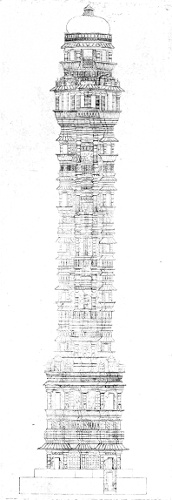
JAISTAMBHA, PILLAR OF VICTORY, AT CHITOR.
To face page 1820.
The view from this elevated spot was superb, extending far
into the plains of Malwa. The lightning struck and injured the
dome some years ago, but generally there is no semblance of
decay, though some shoots of the pipal have rooted themselves
where the bolt of Indra fell. It is said to have cost ninety lakhs
of rupees, or near a million sterling; and this is only one of the
many magnificent works of Rana Kumbha within Chitor; the
temples to Krishna, the lake called Kurma Sagar, the temple and
fountain to Kukkureswar Mahadeo, having been erected by him.
He also raised the stupendous fortifications of Kumbhalmer, to
which place the seat of government was transferred. It is
1821asserted that the immense wealth in jewels appertaining to the
princes of Gujarat, was captured by Mahmud Begada, when he
took Kumbhalmer, whence he carried forty thousand captives.[22]
Near this is the grand temple of Brahma, erected also by
Kumbha, in honour of his father Mokal, whose name it bears,
and whose bust is the only object of veneration within.[23] It
would seem as if Kumbha had been a deist, worshipping the
Creator alone; though his inspired wife, Mira Bai, seems to have
drawn a portion of his regard to Muralidhar, ‘he who holds the
flute.’ Adjoining the shrine of the great spirit, is the Charbagh,
where the ashes of the heroes, from Bappa down to the founder of
Udaipur, are entombed. Many possessed great external interest;
but I was forced to be content with what I saw, for the chronicler
is dead.
—Through these abodes of silence, a rugged
path leads to a sequestered spot in a deep cleft of the rock, where
there is a living fountain, called the Gao-mukh, or 'cow’s [763]
mouth,' under the shade of an umbrageous bar tree. On one side
of the dell is the subterranean channel called Rani-bhandar,
which, it is said, leads to suites of chambers in the rock. This
was the scene of the awful Johar, on the occasion of Ala sacking
Chitor, when the queens perished in the flames; on which the
cavern’s mouth was closed.
Still ascending, I visited the edifices named after Jaimall and
Patta, and the shrine of Kalika Devi, esteemed one of the most
ancient of Chitor, existing since the time of the Mori, the dynasty
prior to the Guhilot.[24] But the only inscription I discovered
was the following:—
“S. 1574 Magh (sudi) 5th, and Revati Nakshatra, the stone-cutters
1822Kalu, Kaimer, and thirty-six others (whose names are
added), enlarged the fountain of the sun (Suryakunda), adjacent
to the temple of Kalika Devi.” Thence I passed to the vaulted
cenotaph of Chonda, the founder of the Chondawats, who surrendered
his birthright to please his aged sire. A little further,
are the mahalls of Rana Bhim and Padmini. Beyond this,
within a stone enclosure, is the place where the victorious Kumbha
confined the king of Malwa; and touching it is the mahall of the
Raos of Rampura.
Further south is a spot of deep interest: the tank and palace
of Chitrang Mori,[25] the ancient Puar lord of Chitor, whose inscription
I have already given. The interior sides of the tank are
divided into sculptured compartments, in very good taste, but
not to be compared with the works at Barolli, though doubtless
executed under the same family. Being now within two hundred
yards of the southern bastion, I returned by the mahalls of the
once vassals of Chitor, namely, Sirohi, Bundi, Sunth,[26] Lunawada,
to the Chaugan, or ‘field of Mars,’ where the military festival
of the Dasahra is yet held by the slender garrison of Chitor. Close
to it is a noble reservoir of a hundred and thirty feet in length,
sixty-five in width, and forty-seven in depth. It is lined with
immense sculptured masses of masonry, and filled with water.
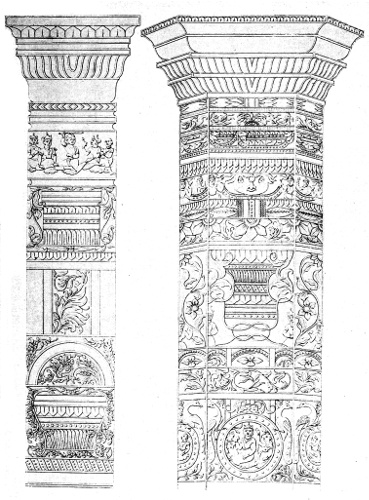
COLUMNS IN THE FORTRESS OF CHITOR.
To face page 1822.
—Higher up, and nearly about the centre, is a
remarkable square pillar, called the Khawasan-sthamba (column).
[27]
It is seventy-five feet and a half in height, thirty feet in diameter
at the base, and fifteen at the top, and covered with Jain figures.
It is very ancient, and I found a fragment of an inscription at its
base, which shows that it was dedicated to Adinath, the first of
the twenty-four Jain pontiffs: “By Sri Adinath, and the twenty-four
1823Jineswara, Pundarikaksha, Ganesa, Surya, and the nine
planets, may you be preserved! S. 952 (
A.D. 896) Baisakh (
sudi)
the 30th, Guruvar (Thursday)” [764].
I found also another old inscription near the very antique
temple of Kukkureswar Mahadeo; “S. 811, Mah sudi 5th,
Vrihaspativar (Thursday), A.D. 755, Raja Kukkureswar erected
this temple and excavated the fountain.”
There are many Jain inscriptions, but amidst the heaps of
ruins I was not fortunate enough to make any important discovery.
One in the temple of Santnath was as follows; “S. 1505 (A.D.
1449), Sri Maharana Mokal, whose son Kumbhakaran’s treasurer,
by name Sah Kola, his son Bhandari Ratna, and wife Bilandevi,
erected this shrine to Santnath. The chief of the Khadatara
Gachchha, Janraj Sur and apparent successor, Sri Jan Chandra
Surji, made this writing.”
Close to the Suraj-pol, or gate in the centre of the eastern face,
is an altar sacred to the manes of Sahidas, the chief of the Chondawats,
who fell at his post, the gate of the sun, when the city was
sacked by Bahadur Shah.
At the north-western face is a castle complete within itself, the
walls and towers of which are of a peculiar form, and denote a
high antiquity. This is said to be the ancient palace of the Moris
and the first Ranas of Chitor. But it is time to close this description,
which I do by observing, that one cannot move a step without
treading on some fragment of the olden times:
Columns strewn, and statues fallen and cleft,
Heaped like a host, in battle overthrown.
—Before, however, I quit this spot, hallowed by
these remains, I may mention having seen a being who, if there
is any truth in Chitrakot, must be a hundred and sixty years old.
This wonder is a Fakir, who has constantly inhabited the temples,
within the memory of the oldest inhabitants; and there is one
carpenter, now upwards of ninety, who recollects “Babaji as an
old man and the terror of the children.” To me he did not appear
above seventy. I found him deeply engaged at Pachisi with one
of the townsfolk. When I was introduced to this extraordinary
personage, he looked up at me for an instant, and exclaiming,
“What does he want here?” quietly resumed his game. When
it was finished, I presented my nazar to the inspired (for madness
1824and inspiration are here synonymous), which he threw amongst
the bystanders, and bolted over the ruins, dragging through the
brambles a fine shawl some one had presented to him, and which,
becoming an impediment, he left there. In these moods none
durst molest him, and when inclined for food or pastime his
wants were quickly supplied. For one moment I got him to
cast his mental eye back [765] upon the past, and he mentioned
something of Adina Beg and the Panjab (of which they say he
was an inhabitant); but the oracle deigned nothing further.
Udaipur, March 8, 1822.—Here I am once more in the capital
of Hindupati (chief of the Hindu race), from which no occurrence
shall move me until I go to “eat the air” of my native land. I
require repose, for the last fifteen years of my life have been one
continuous tissue of toil and accident, such as are narrated in
these records of a few of my many wanderings. The bow must
be unbent, or it will snap, and the time for journalizing must cease
with everything else under the sun. I halted a few days at
Merta, and found my house nearly finished, the garden looking
beautiful, the aru or peach-tree, the seo or apple, the santara,[28]
narangi, and nimbu, or various orange and lime-trees, all in full
blossom, and showing the potent influence of Surya, in these
regions; the sharifa or sitaphal (fruit of Sita), or custard-apple,
the anar, the kela, pomegranate, plantain, and various indigenous
fruits, were all equally forward. These plants are mostly from
Agra, Lucknow, or Cawnpore; but some of the finest peaches
are the produce of those I planted at Gwalior,—I may say their
grandchildren. When I left Gwalior in 1817, I brought with me
the stones of several peach-trees, and planted them in the garden
of Rang-piyari, my residence at Udaipur; and more delicious or
more abundant fruit I never saw. The stones of these I again
put in the new garden at Merta, and these again exhibit fruit,
but it will require another year to prove whether they maintain
the character they held in the plains of Raru, or in this city. The
vegetables were equally thriving: I never saw finer crops of
Prussian-blues,[29] of kobis, phul-kobis, or cabbages and cauliflowers,
celery, and all that belongs to the kitchen-garden, and which my
Rajput friends declare far superior to their indigenous race of
sag, or greens; the Diwanji (Rana) has monopolized the celery,
1825which he pronounces the prince of vegetables. I had also got my
cutter for the Udaisagar, and we promised ourselves many delightful
days, sailing amidst its islets and fishing in its stream. “But
in all this was there vanity”: poor Carey lies under the sod;
Duncan has been struggling on, and is just about to depart for
the Cape of Good Hope; Patrick, who was left at Kotah, writes
me dismal accounts of his health and his solitude, and I am left
almost alone, the ghost of what I was. “I looked on all the works
that my hands had wrought, and on the labour I had laboured to
do; and behold all was vanity and vexation of spirit!” And
such I fear will it prove with more important works than these
amusements of the hour; but it were certain death to stay, and
the doctor insists on my sending in ‘a sick certificate,’ and
putting my house in order for [766] departure. The month of
May is fixed, a resolution which has filled the Rana with grief;
but he “gives me leave only for three years, and his sister, Chandji
Bai, desires me to bring back a wife that she may love.”
I would willingly have dispensed with the honours of a public
entrée; but here, even health must bend to forms and the laws
of the Rajputs; and the Rana, Prince Jawan Singh, and all the
Sesodia chivalry, advanced to welcome our return. “Ap ghar
aye! You have come home!” was the simple and heartfelt
expression of the Rana, as he received my reverential salaam;
but he kindly looked round, and missed my companions, for
Waugh Sahib and Doctor Sahib were both great favourites; and,
last but not least, when he saw me bestride Javadia, he asked,
“where was Bajraj?” but the ‘royal-steed’ (his gift) was no
more, and lies entombed at Kotah. “Hae! hae! alas! alas!
(exclaimed Prithinath); bara sochpan balamanukh cha, great
grief, for he was a good man.”[30] The virtues of Bajraj were the
subject of conversation until we reached the ‘gate of the sun’
(Surajpol); when the Rana “gave me leave to go home,” and
he continued his promenade.
—Bajraj was worthy of such notice and of
his name; he was perfection, and so general a favourite that his
death was deemed a public misfortune, for he was as well known
throughout all these regions as his master. The general yell of
sorrow that burst from all my sepoys and establishment on that
1826event, was astounding, and the whole camp attended his obsequies;
many were weeping, and when they began to throw the earth
upon the fine beast, wrapped up in his body-clothes, his sais
(groom) threw himself into his grave, and was quite frantic with
grief. I cut some locks off his mane in remembrance of the noblest
beast I ever crossed, and in a few days I observed many huge
stones near the spot, which before I left Kotah grew into a noble
chabutra, or ‘altar’ of hewn stone about twenty feet square and
four feet high, on which was placed the effigy of Bajraj large as
life, sculptured out of one block of freestone. I was grateful for
the attention, but the old regent had caught the infection, and
evinced his sense of the worth of Bajraj by a tomb such as his
master cannot expect; but in this case perhaps I divided the
interest, though there was no prince of Rajwara more proud of his
stud than the blind chief of Kotah. From the days of the Pandus
to Dewa-Banga of Bundi, many a war has been waged for a horse;
nor can we better declare the relative estimation of the noble
animal than in the words of that stalwart Hara to the Lodi king:
“There are three things you must not ask of a Rajput, his horse,
his mistress, or his sword” [767].
In a few days I shall leave the capital for the villa of the Hara
Rani, sister of the Kotah prince, and whose bracelet also I have
had, the symbol of adoption as her brother. To all their customs,
to all their sympathies, and numerous acts of courtesy and kindness,
which have made this not a strange land to me, I am about
to bid farewell; whether a final one, is written in that book which
for wise purposes is sealed to mortal vision; but wherever I go,
whatever days I may number, nor place nor time can ever
weaken, far less obliterate, the remembrance of the valley of
Udaipur.[31]