“REDEEMED IN BLOOD,” “GLORIANA; OR, THE REVOLUTION OF 1900,” “THE YOUNG CASTAWAYS,” ETC., ETC.
LONDON:
HENRY AND COMPANY,
BOUVERIE STREET, E.C.
1890.
Printed by Hazell, Watson, & Viney, Ld., London and Aylesbury.
Dedication.
v
TO
THE MEMORY OF
HIS ROYAL HIGHNESS
PRINCE LEOPOLD, DUKE OF ALBANY,
THIS VOLUME
Is respectfully Dedicated,
BY THE GRACIOUS PERMISSION OF
HER ROYAL HIGHNESS
THE DUCHESS OF ALBANY.
God gave thee life,—a life of noble aims,
Brief, yet inspired by loftiness of thought,—
Thought, the great offspring of a mighty pow’r,
Which thou didst wield to lead thy fellow-men
Along great duty’s hard and ruggèd path.
Thine was a bright example. High aloft
Thy virtues flash’d their pure inspiring rays,
Piercing the murky clouds of human sin,
And lighting up the realm where goodness dwells.
viTo know thee was to love thee. Thine the pow’r
To weave thy spell around the hearts of men.
A noble life is wondrous, beautiful.
And such was thine, brief—yea, alas! too brief,—
Yet not one mis-spent hour could claim of thee
Its stern account, as o’er the bound’ry line,
Across the frontier, ’twixt life and death,
With fearless step thou sought’st the better land.
They call thee dead! Nay, surely ’tis not Death
To pass from one world to another realm?
’Tis but a pilgrimage, a heavenly tour
Throughout the vast creation of our God.
Nay, dead thou art not, for thy spirit lives,
And its pure influence will never die.
Hist’ry will bid the rising youth behold
A bright example and a stainless life.
If, then, to others ’tis a beacon light,
A model for the Imitator’s art,
Ah! surely, brief as was thy sojourn here,
Thou hast not dwelt amongst us all in vain.
F. D.
vii
INTRODUCTION.
I was once a child myself, and dearly loved
those books of adventure which told of strange
lands and strange people I had never seen.
Yet, when I read about the North American
Indians and their wild ways, I would often
wonder why there were so few books which told us
about the Indians of South America and the beautiful
countries contained therein; and I determined some
day to visit those lands if I lived, and tell the generation
of girls and boys following me all about them. Well,
my young friends, I have told you a good deal in
“The Young Castaways,” and now I am going to tell
you still more in the following pages. I am going to
tell you about a splendid unexplored country, and
several adventures that happened therein, and I hope
some day that some of you will go and see those
viiicountries, and penetrate even further into their
mysteries, than did the girls and boys who figure in
this book. Those amongst you who have read “The
Young Castaways” will renew acquaintance with old
friends, which, no doubt, will give you pleasure.
I remain, my dear girls and boys,
Your sincere friend,
THE AUTHORESS.
ix
CONTENTS.
CHAPTER I.
PAGES
The youthful Warrior Queen—Joyful News—Expectation—Inacayal—Tolderias—La Guardia Chica—Every Inch a Queen—The Whites’ Approach
Missing—Anxiety—The Haunted Forest—Traces of Topsie—The wounded Labrador—Shag’s Impatience—Shag under the Surgeon’s Knife—Preparing for Action—To the Rescue—“It is God’s Will”
Retrospect—The Wild young Lady of the Forest—An alarming Situation—Strange Tactics—A skilful Shot—Again the Mystic Bell—A mysterious Incident—Piñone—A Discovery
“The Demons of the Andes!”—A fierce Fight—The great Trauco Village—The Queen’s Welcome—A mysterious Fire—Equal Occupations—A Gold Forge—A Black-ringed Jaguar—Liberty
Communication—The Ascent begun—Shag goes Aloft—“Aniwee will leave the Last”—Piñone troubled—Graviel’s Devotion—The Avalanche—A brave young Queen—Gratitude—A great Landslip—Buried
“Something’s up”—Serious News—An entrenched Position—A forced March—Preparations for the Fight—Before the Battle—The Charge—Aniwee transformed—A Wolf in Sheep’s Clothing—Struck down
A TALE OF THE ARAUCANIAN INDIANS AND THE MYTHICAL TRAUCO PEOPLE.
Day was drawing to a close. The setting sun
was glinting and gleaming on the sparkling
mica rocks, which border the deep gorges and
high cliffs of the gradually rising ground that
leads upwards from the plains of Geylum in
Patagonia, to Las Manzanas in the territory of the
Araucanian or Warrior Indians. High above the mica
rocks rise the hills that skirt the Andes chain, and
from the summit of these hills, the scene is one of
magnificence and glory.
So thought Aniwee, the youthful Warrior Queen, as
she sat astride her horse, and watched the sunlight
streaking the Rio Limay far below, and bathing in
2rose-coloured brilliance the snow-clad Cordilleras, which
look down on the wooded ranges of hills beneath them,
and which contain the splendid apple groves belonging
to the great Manzaneros tribe.
When we last saw Aniwee she had just bidden Harry
and Topsie Vane a tender and pathetic farewell. Those
who have perused the pages of “The Young Castaways,”
will remember that she was the only child and
daughter of Gilwinikush, head Cacique of the Tehuelches
or Patagonian Indians, and that at the age of
fourteen and a half she had married Piñone, the only
son of the great Cuastral, Lord of the Araucanian,
Manzaneros, Chenna, or Warrior Indians. They will
also remember how Aniwee had distinguished herself,
how she had won the proud titles of Huntress and
Warrior, and how at length she had become one of
the Warrior tribe herself.
But Aniwee’s spell of wedded life was brief. Scarce
a year and a half had passed away, when news was
brought to her that Cuastral and Piñone had been
treacherously slain by a party of Argentines who had
lured them to attend an ostensible peace parliament,
the Araucanians and Argentines—or, as these latter
were better known to the Indians, the Cristianos—having
previously been at war with one another.
Thus at the age of sixteen Aniwee had found herself
deprived of her dearly loved husband, and the
mother of a little baby girl, his child and hers. And
so impressed were the Araucanians with their young
Queen’s sagacity, courage, and devotion to their interests,
that they had, without a dissentient voice, elected
3the child to be Cacique over them, and appointed
Aniwee, its mother, as Queen-Regent.
Surely this was a triumph for Aniwee. Barely over
the age of sixteen, and yet indeed a Warrior Queen—Queen
of a mighty tribe, famed far and wide for its
valour and its deeds of daring and renown.
Yet was Aniwee equal to the occasion. Had she not
Cuastral’s death and her own Piñone’s death to avenge?
Was not her beautiful adopted country hemmed in on
all sides by foes—Chilenos on the one hand, Argentines
on the other—and should she not fight to the very
death in its defence? It was a country well worth
fighting for, extending from Las Manzanas on the
south to Mendoza far away in the north, and peopled
by hundreds of the great Warrior tribe, dwelling in
fixed tolderias, many amidst the rich groves of piñones,
apples, and araucarias with which the country abounded.
Considerable wealth had fallen to her share when the
Caciques’ deaths were announced, all of which she
purposed holding for her child. Large flocks and
herds, stores of silver ornaments, immense troupiglias
of horses, and numberless ponchos, mantles, etc., were
stored away amongst her subjects and in their safe
keeping. Her power was absolute, her word law, her
army efficient and devoted. Little had Aniwee dreamt,
only three years previously, when she chafed and
fretted at her seemingly useless life in the Patagonian
toldos of her father Gilwinikush, that in so short a
time would she wield power over so magnificent a
people as the Araucanians.
She had ridden almost to the boundary line of
4Araucanian territory for the fifth time that day, and
had anxiously scanned the distant pampas of Patagonia
with the true, unerring eye of an Indian. The reason
for this was that ten days previously Aniwee had
received joyous news, news which had brought the
blood rushing to her cheeks with glad surprise, news
in the shape of a letter from Harry and Topsie Vane,
her dearly loved white friends, in which they apprised
her of their intention to proceed at once to visit her,
in the company of their uncle and aunt, Sir Francis
and Lady Vane, and their three cousins, Freddy, Willie,
and Mary.
On receiving this news, Aniwee was hunting away in
the distant hills which fringe the Cordillera range
beyond Las Manzanas, but immediately calling together
her followers, she bade them summon from different
parts three hundred picked warriors, and likewise gave
orders to others to proceed at once to Las Manzanas,
and prepare there the fixed tolderias for the reception
of her white guests. Then Aniwee selected fifty of
her best horses, a fine herd of cattle, and a flock of
sheep, and sent them forward to the rendezvous, following
herself with the little baby Cacique, and attended
by the three hundred picked warriors, who had assembled
quickly at her summons.
The letter from Harry and Topsie had been written
from El Carmen or Patagones on the Rio Negro, and
Aniwee had calculated, that if they started at once,
they would reach Las Manzanas in ten days. She had
sent forward a small escort preceded by a Chasqui, and
then settled down to await their coming.
5But when the day came for which she had timed
their arrival, Aniwee grew feverish with excitement.
All the morning and afternoon she had watched for
her friends, but there were no signs of their coming.
Then, as the sun sunk low over the distant prairies and
lit to radiance the snowy Andes far away in the background,
the youthful Queen aroused herself from the
reverie into which she had fallen, and gave one last
glance ahead. At once her dark eyes lit up with
eagerness and expectation, a happy smile parted her
lips, a low, glad cry escaped them as she stood straight
up in her stirrups and waved a silken handkerchief
around her head. The next moment she unslung from
off her shoulders a neat Winchester repeater, and
through the still evening air in quick succession rung
the sharp reports of the rifle. A pre-arranged signal,
evidently; for no sooner did these reports ring forth,
than far down in a valley beneath, a succession of
bright fires began to shoot up, a Union Jack flag
floated from a high pole, and dusky forms came and
went amid the lurid glare.
Just a faint cloud on the pampa. That was all that
Aniwee’s gaze had rested upon, and yet her practised
sight could not deceive her. She knew full well that
it heralded the approach of a party of mounted
persons, and Aniwee had not the slightest doubt as
to who these persons were.
They were coming on at a smart pace, and the
young Queen, after taking stock of the distance which
yet lay between her and her white friends, turned her
horse’s head in the direction of the Indian camp. A
6pretty steep descent she had to make, too, in order to
reach it; but her steed was wary and sure-footed, and
with the blood of the bagual or wild horse in him,
not likely to make a mistake.
On reaching the tolderias Aniwee found her warriors
busy adorning themselves with bright-coloured ponchos,
and fastening on their silver spurs. A troupiglia of
horses had been driven up, and the owners were picking
out their steeds therefrom, and saddling and bridling
them.
Each warrior carried a long lance, from the point of
which a small pennon fluttered, and many of the
Caciques and Caciquillos were conspicuous for the
richness of their attire and the brightness of their
silver ornaments.
A small boy, gaudily dressed, was awaiting outside
Aniwee’s tolderia, and as she rode up respectfully held
her bridle rein. As she sprung from her horse, a young
man stepped forward to meet her.
If abundance of fine clothes, gleaming ornaments,
and jingling spurs can make a man handsome in a
woman’s eyes, then Inacayal might be styled good-looking.
Now Inacayal was a Cacique of high degree,
being none other than the son of Quintuhual, brother
of the great Cuastral, and therefore first cousin to
Piñone, Aniwee’s dead husband. In the natural course
of events, and in accordance with the laws hitherto
prevailing amongst the Araucanians, Inacayal ought to
have been proclaimed paramount Cacique on the death
of Cuastral and Piñone, inasmuch as this latter’s child
was only a girl. But the example of Aniwee had so
7impressed the warriors, and both Piñone and Cuastral
had been so highly respected and loved by the great
tribe, that by a vast majority this people had declared
that Guardia, Piñone’s baby girl, should reign over
them; and, as we have already seen, Aniwee had been
appointed Queen-Regent, with the full powers of an
absolute Cacique.
Now this arrangement did not at all suit the ambition
of Inacayal, who had every desire to wield the
power entrusted to Aniwee. Had not he, Inacayal,
accompanied Cuastral and Piñone on their great raid?
Had he not, with his own eyes, seen them treacherously
killed, and their bodies carried off by the Cristianos,
and had he not brought back the news, expecting to
see himself at once proclaimed Cacique? His anger
and disappointment may well be imagined when
affairs took the turn described, and he found himself
supplanted by a mere baby, and a girl.
But Inacayal, though he had thought it politic to
assume an air of submission and acquiescence, was far
from feeling well disposed towards Aniwee. Very
bitterly did he resent her intrusion where he had
hoped to stand alone, and he had secretly made up his
mind to work not only her destruction, but that of the
little Guardia as well. A very King John was this
crafty Inacayal.
“Do the friends of the Great Queen draw nigh?”
he inquired, with a smile, after saluting Aniwee Indian
fashion, by raising his right hand, shading his right
eye, and touching his forehead with his thumb, middle,
and right fingers.
8“Yes, Inacayal,” she answered, with a glad laugh,
“and they will be here ere the sun seeks its rest. Do
you form up the companies of our warriors while I deck
myself as befits a Warrior Queen.”
The young man’s eyes sparkled with anger and rage
at these words, but deftly concealing his feelings, he
again saluted respectfully and retired, Aniwee passing
into her own tolderia.
This erection stood some seventeen feet high, being
spacious enough inside to accommodate fifty persons.
It was closed in all round by skin coverings, the doorway
being fronted by a curtain of gay-coloured silk.
All round the tolderia ran a kind of verandah, the
canopy of which was formed of interwoven branches
covered with bright green leaves. A small Union Jack
flag ornamented the top of this structure, which inside
possessed an air of comfort and civilisation, quite
strange to behold. Several beds, made of the soft warm
skins of the vicuña and guanaco, and raised from the
ground on neatly arranged blocks of wood, stood side
by side in line; and shields, bows and arrows, spears,
guns and rifles, puma, guanaco, and vicuña heads were
tastefully and skilfully hung from the woodwork and
pine-posts, to which the hide walls of this spacious
dwelling were attached. Lying on one of these beds,
and cosily wrapped in a magnificent skunk and wild
cat fur capa, was a little copper-coloured baby, with
large dark eyes and a solemn grave face. Its tiny
hands grasped two small silver bell ornaments, which
they jingled together unceasingly. Every now and
then the baby would break into a joyous laugh and
9crow with delight, sounds which instantly chased away
the solemn look on its face, and brought in its place
a merry, happy expression.
When Aniwee entered, baby at once dropped its
playthings, and stretching out its little arms to the
girl, gave vent to sounds of delight, judging by the
smiles that wreathed its well-formed dark red lips.
The young Queen at once responded to its evident
invitation to approach, and crossing to the bed, lifted
the tiny mite in her arms.
“Guardia, child of my heart,” she exclaimed
tenderly, as the little creature clasped her round the
neck, “was Guardia looking for Mamita?” Again the
little Guardia crowed and laughed. She could not
speak, being barely eight months old, but she could
show how much she loved her young mother by the
numberless caresses which she bestowed upon her.
Aniwee had however the important duty to perform
of arraying herself in warrior attire.
“Graviel,” she called; and as she spoke a tall slim
Indian youth arose from the side of the baby Cacique’s
bed, by which he had been keeping watch. Whenever
Aniwee left the child she always placed it in the care
of this boy, for she knew that she could trust him.
He had been Piñone’s favourite attendant, and Graviel
worshipped the very ground that Aniwee trod on. He
would have died before harm befel his charge.
“Graviel, take the Cacique,” observed Aniwee
gravely, “and amuse her.”
The Indian youth obeyed, handling his baby chieftainess
with the greatest care, and in a few moments
10he had completely engrossed her attention by singing
to her in a low chanting voice.
Meanwhile Aniwee turned her attention to her
attire. Drawing aside a silken curtain, she entered an
alcove in the tolderia, which was reserved as her robing
room, and was soon busy, aided by her Indian women.
When she issued therefrom she looked splendid indeed.
A magnificent crimson poncho hung over her shoulders
adorned with sparkling golden threads, and she had on
snowy-white drawers and neat potro boots, upon which
silver spurs jingled. A short sword in a bright silver
scabbard hung by her side, and on her head, poised
slightly on one side, was a cap of crimson velvet encircled
by a band of massive silver, from which drooped
two grey ostrich feathers. Decidedly Aniwee looked
very handsome, and every inch a Queen.
Under the soothing influence of Graviel’s chant the
baby Queen had fallen asleep, and lay peacefully in
the arms of her faithful young retainer. Bending
over her, the girl mother imprinted a gentle kiss on
her forehead. Even as she did so, the far-off sound
of a bugle-call penetrated to the tolderia, and brought
Aniwee at once to attention.
“Quick, Graviel!” she exclaimed. “Take the Cacique
to Blancha, and bid her put the child to rest, and do you
keep watch on the tolderia. Yonder bugle heralds the
approach of the great British Caciques, whom Aniwee
must hasten to welcome.”
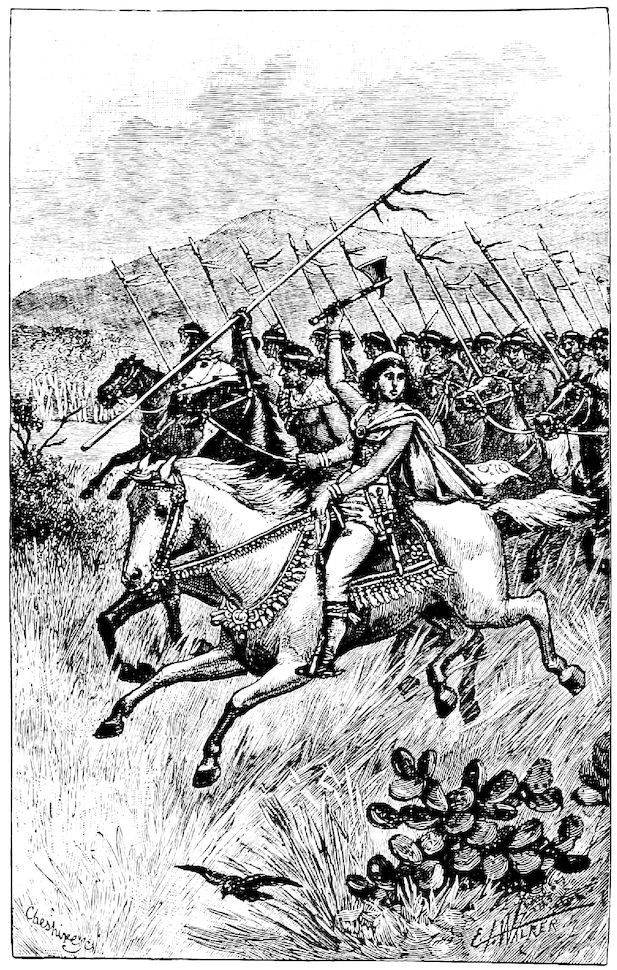
A loud shout from three hundred warrior throats
greeted her appearance. A milk-white horse waited
her in front of the tolderia. In a moment Aniwee was
11in the saddle, and looking eagerly ahead. Ah! yes,
indeed, her white friends were near. There was no
mistaking Harry Vane’s loud and familiar “whoo
whoop.” The next instant the white horse swept up
the valley at full speed in the van of three hundred
shouting warriors, brandishing their spears, firing off
their guns, and charging upon the advancing party.
12
CHAPTER II.
It may be naturally surmised that Sir Francis
and Lady Vane and their children, who had
never before witnessed a South American
Indian “Ceremony of Welcome,” were not a
little startled on beholding Aniwee and her
warriors charging to meet them in apparently
so warlike a fashion. But to Harry and Topsie, it was
neither an unusual nor a terrifying sight, accustomed
as they had been during their sojourn amongst the
Patagonians to scenes and occurrences of a like nature.
Knowing, however, the punctilious etiquette of both
Patagonians and Araucanians, in the matter of going
religiously through the whole ceremony, our two young
friends drew rein, and with a few reassuring words to
their uncle, aunt, and cousins, awaited the Araucanian
charge.
“It’s all right, Uncle Francis,” volunteered the
young midshipman (for Harry had long overstepped
the important boundary which separates the naval
cadet from the midshipman); “they are not going to
hurt us. But I say, watch them closely and all they
do; for directly they form up quiet into line, we must
13go through exactly the same form of antics as they.
Oh, Topsie! do look,” he continued somewhat eagerly;
“there’s Aniwee, dear little Aniwee, as I live.”
“Little indeed,” laughed his sister slyly as she
criticised the tall, graceful figure of the young Amazon
on the rapidly approaching white horse. “If I’m not
very much mistaken, Harry, old boy, she’s bigger than
you. My word, she has grown since we saw her last!”
Ere Harry could reply, Aniwee and her warriors
were upon them. Halting suddenly when within
fifty paces of the new-comers, the warriors formed
rapidly into columns of three abreast, and began
galloping madly around the small party, firing off their
guns and revolvers, shouting and yelling, and waving
their bolas around their heads. This having been
continued for several minutes, ranks were suddenly
opened, and each man charged forward shouting, “Koue,”
and thrusting at an imaginary foe. The supposed
enemy having been dislodged, a halt was sounded,
the Indians formed quickly into several long lines,
and remained motionless as statues, conspicuous at
their head being Aniwee, Inacayal, and other Caciques
and Caciquillos.
“Now, aunt, now, uncle, come on, Freddy, Willie, and
Mary, it’s our turn,” cried Topsie, as she brought her
horse alongside her brother’s, and beckoned to Willie
to fall in on the other side of her. The Araucanian
escort, which had been sent forward by Aniwee to meet
them, quickly formed into threes, and in another
moment the little party were galloping as madly as
the others had done, around the long lines of solemn
14Araucanians. Joining in the scrimmage, with loud
barks of glee, was Topsie’s dog Shag, our dear old
friend Shag of Castaway renown.
The shouting, firing, and galloping having come to
an end, Harry and Topsie at once rode up to Aniwee
with loud cries of welcome. It is not easy to describe
the joy of the Indian girl at seeing her old friends
again; for the Indian character is phlegmatic, and by
no means demonstrative in its affections; and although
Aniwee was an exception to this rule, she had a part to
play before her warriors, and was bound to look dignified,
as befitted a great Cacique.
But Harry and Topsie could see tears in her great
dark eyes as she clasped their hands, and bade them
welcome to Araucanian soil. They had heard all about
the deaths of Cuastral and Piñone, and therefore
avoided touching on delicate and painful ground by
alluding to them.
“How big you have grown, Aniwee!” exclaimed
Topsie, after the first greetings were over, and the
Queen, with her guests, was riding along the valley
towards the tolderias, followed by her warriors. “We
left you a child, but you look like a woman now.”
“Aniwee is a woman,” answered the Indian girl
with all the dignity of sixteen and a half summers.
“Aniwee is no longer a child.”
They were conversing in Spanish, a language which,
by the way, Harry had “got up” sufficiently to make
himself understood in view of the visit to Aniwee.
“He wasn’t going to be made a fool of again, and look
like one, as had been the case in Patagonia,” he had
15declared, “when all the speaking and interpreting had
been done by Topsie, and he had had to sit by and act
the part of audience.” Of course, now that he had
become a Spanish scholar, this was no longer necessary,
and he rejoiced thereat exceedingly.
“Of course you are not a child now, Aniwee,” he
answered in a somewhat important tone. “We are all
three grown up. Let me see, you are sixteen and a
half, and I and my sister celebrated our seventeenth
birthday a few days ago. We are all of a great age.”
Harry possessed the knack of saying funny things with
a face grave as an owl. His remark tickled Topsie
immensely, but was received by Aniwee with dignified
complaisance.
“How old are your cousins?” she inquired, looking
at Freddy, Willie, and Mary Vane, who were riding
close alongside them.
“Well, that one there is a man,” observed Harry,
indicating Freddy with his finger. “He is sixteen, and
a great warrior. The other two are children still. The
boy is fourteen, the girl thirteen,—just about the age
you were, Aniwee, when we first met you. The boy,
like myself, is a sailor, and the girl would like to be
one too, if only the laws of our country would permit it.”
“Then women, too, are slaves in the great white land,
the same as my father’s people are?” inquired the
Indian girl, with a bitter smile.
“Oh no, Aniwee!” answered Topsie quickly; “not
slaves. For you see, Aniwee, unlike the Patagonian
women, they don’t do the whole work of the nation.
The men have to work, too, and not simply feast, hunt,
16and make war as your father’s men do. All the same,
women in our country can’t be warriors, or be sailors
on ships, or attend Parliament. That is what my
brother means.”
“And don’t they want to be warriors, and sea
Caciques, and attend Parliamentos?” again inquired
the young Queen.
“Some do, Aniwee,” replied Topsie. “I, for instance,
and my cousin Mary, would like to be sea Caciques.
But we must alter the laws before we can become so.
Great changes often come quickly, however. If, four
years ago, the Araucanians had been told that a woman
would reign over them, they would have laughed to
scorn the very idea. Yet, behold your little girl is
head Cacique of the great Warrior tribe, and you are
the Queen-Regent. Would this great people have
acted thus if they had not recognised in you a fearless
ruler and an undaunted warrior?”
The Indian girl’s cheeks flushed, as she listened to
Topsie’s words.
“It is true!” she murmured; “and yet it was
Piñone, my beloved Piñone, who made his people love
me. He always called Aniwee their Warrior Queen,
and it was he who gave her her first lessons in war.
Piñone, love of Aniwee’s heart, where art thou?”
A plaintive, far-away look shone in the dark eyes of
the young Warrior Queen as the memory of her
beloved shot across her. Topsie was just meditating
some cheerful remark, to drive away, if possible, sad
thoughts from the girl’s mind, when shouts and yells
were suddenly borne up the valley on the soft evening
17breeze. They came from the direction of the Indian
camp. A look of horror overspread the features of
Aniwee. Full well she knew the meaning of those
cries. Reining up her horse, she turned suddenly
round, and faced her warriors.
“Inacayal!” she called out in a commanding voice;
“where art thou, cousin?”
In a moment the Cacique was by her side.
“Heard you not the war cry, Inacayal, or did
Aniwee dream?” she inquired anxiously.
“The Queen did not dream,” he answered, with
flashing eyes. “Hark! there it is again. Bid
Inacayal speed quickly to the tolderias with two
hundred of these warriors, and do thou, O Queen,
remain here with the great white Caciques, in the care
of the remaining hundred.”
A gleam of anger flashed in the girl’s eyes as she
fixed them on the scheming chief.
“What!” she exclaimed proudly, “I, the Warrior
Queen, skulk, hiding like a poltroon, behind my men?
Inacayal, you are a strange counsellor. Know, however,
that I will it otherwise. I will lead the two
hundred to the rescue, and do you, with the remaining
hundred, guard my guests. Do you hear, Inacayal!
It is my command.”
A vicious, disappointed look came over the Cacique’s
face, but he had no alternative than to obey. In
quick, rapid tones Aniwee issued her orders, and then
hurriedly explained the situation to Harry and Topsie,
imploring them to remain where they were with their
uncle, aunt, and cousins, “for,” she added significantly,
18“when the Indian’s blood is up, he might not distinguish
you from the Cristianos, and then your fates
would be death. Farewell for the moment. Aniwee
goes to restore peace and defend her child.”
As she spoke she struck her silver spurs into her
horse’s side, and with a loud cry sped along the valley,
followed by the two hundred Araucanians whom she
had bidden attend her.
“Well, Harry and Topsie, you have led us into a
warrior land indeed,” exclaimed Lady Vane, laughing.
“Hardly has your Queen welcomed us than she dashes
away into strife and turmoil. What can it all
mean?”
“I can’t make out, aunt,” answered Harry, just a
shade anxiously. “Those cries we hear are war cries.
You, who understand Spanish, heard what she said to
us. Really, I think we had better obey her. I know
Aniwee well, and can trust her. But what a scowling-looking
chap the Cacique is, in whose care she has left us.
I don’t half like his looks, do you, Uncle Francis?”
“I can’t say I am impressed by them, my boy,”
answered Sir Francis quietly. “I’m a bit of a character
reader, and it strikes me he entertains no good feeling
to the young Queen. His expression was savage and
sullen when she addressed him just now.”
Again shouts and cries came floating up the valley.
The face of Inacayal wore a triumphant expression.
Suddenly he turned to the warriors who surrounded
him. “There is a fight down yonder,” he exclaimed.
“Shall we stand idle while a woman bears the brunt of
war? Say, brothers, shall we not charge?”
19An approving shout greeted his suggestion, and
before Sir Francis and Lady Vane, Harry, Topsie, and
their cousins had fathomed what was going to happen,
they felt themselves borne forward in the midst of a
hundred or more stalwart warriors, all shouting and
yelling like so many demons. Madly excited, Shag
brought up the rear.
“We’re in for it, Topsie, and no mistake,” gasped
Harry, as he got his horse tight by the head, and tried
to check his headlong career. He had quite forgotten
that this was a signal to go faster, so that the animal
merely redoubled its efforts. In a few minutes they
had dashed into the Indian camp.
What a sight they beheld! A scene of fierce turmoil
indeed. Some hundred white men, surrounded
by Aniwee and her braves, fighting desperately for
their lives. They had sought to catch the Warrior
Queen in a trap, and had been caught themselves, and
now they saw no chance of escape from the furious
Araucanians who pressed upon them.
A weird scene indeed! The sun had sunk, the
gloom of night was already upon everything, throughout
the camp huge fires gleamed and sparkled,
lighting up the faces of the combatants, and giving
them a strange, fantastic appearance. As Inacayal
swept upon the scene with his bevy of warriors, he took
it all in at a glance. His plan had failed.
Yet must he save the Cristianos whom his vile
intrigues had lured to the spot. His had been the
intention to rob the Queen-Regent of her baby child,
during her brief absence and when all the warriors
20were withdrawn from the camp. For this purpose he
had put himself in communication with the Cristianos,
who, at war with the Araucanians, had willingly agreed
to secure the little Guardia, in hopes of forcing her
great tribe to accept disadvantageous and degrading
terms of peace. As we have seen, Inacayal’s plan had
failed.
21
CHAPTER III.
No sooner did these reserves of warriors make
their appearance than a sudden wavering was
seen in the ranks of the white men, who had
hitherto kept well together and fought desperately.
It seemed now as though they must
be all cut to pieces and destroyed, surrounded
as they were by three hundred of picked braves from
the Warrior tribe. Aniwee was fighting like a young
demon, and Harry and Topsie, as they sought shelter
with the others of their party in the rear of the Queen’s
toldo, could hear her war cry distinctly above the
fierce shouts of the combatants. The colonists were
all armed with guns and rifles, but they were at too
close quarters with their assailants to make it possible
to use them. They had therefore only their swords to
depend on, and when these, in some instances, fell
shivered from their grasp by the powerful stroke of
some Araucanian’s axe, they had only a short stabbing
knife, a revolver, and a small hatchet slung at their
sides, to fall back upon.
The Araucanians, as we have seen, were all armed
with long lances. They were stout, powerful, and ugly
22customers to encounter when, in serried array and with
their lances well set, they swept down upon an enemy.
But on this occasion lances were at a disadvantage,
hemmed in as the combatants were by rocks, trees, and
steep hillsides, where only hand to hand fighting was
possible, and the warriors were obliged to have recourse
to their short axes and stabbing knives. Already some
twenty white men had fallen. Quarter was not asked
for, because the Cristianos knew that it would not be
given. Had they not been themselves the aggressors,
and had they not themselves alone to thank for their
present plight? They had come slinking as a fox does
at night when he thinks the coast is clear, intent on
a brutal and cruel act, and behold their reward!
Suddenly loud cries and shouts resounded through
the valley down which Aniwee had charged so furiously,
and amidst the din of the combat a few talismanic
words brought the Queen and her warriors to attention.
“Help, help! To the rescue of the child Cacique;
to the rescue of Guardia!”
An icy chill ran through Aniwee’s heart. Then the
baby Queen for whom she was risking her life, the
beloved child of her lost Piñone, was a prisoner after all?
The thought was maddening; it thrilled her to the
quick; it almost unnerved her; it certainly made her
lose her presence of mind; it was the means of saving
many a white man’s life.
“Hark!” she cried, reining up her horse. “Warriors,
the Cacique is in danger. Forward to the
rescue!”
Like lightning she had taken her animal by the
23head, turned it in the direction whence the cries had
proceeded, and the next moment she and her warriors
were streaming up the valley once more, leaving the
Cristianos struck dumb with astonishment. But they
soon aroused themselves to the situation as the voice
of Inacayal rung out—
“Fools, would ye wait to be slain when the Gualichu
gives you this chance of escape?”
In a moment they had understood, and leaving their
dead to the mercy of Indians and condors, had paid
attention to discretion, which is the better part of
valour, by taking to flight.
When Aniwee, furious and crestfallen, returned at
the head of her warriors, she found them gone.
Her first impulse was to start in pursuit, but her
next evinced greater caution. It was quite possible
that an ambush might have been laid to entrap her.
She had been deceived by the false cry of danger to
her child. She would not be befooled twice.
For there was the little Guardia safe and well in the
arms of her nurse Blancha, with Graviel, her faithful
attendant, covered with blood, standing near. The
warriors presented a grim sight. Many of them were
suffering from sword thrusts and hatchet cuts, and the
gay ponchos, in which they had decked themselves to
do honour to Aniwee’s guests, were in many instances
torn and dishevelled and covered with blood. In a
few brief, dignified words the Queen thanked them
for their support, and bade them seek their toldos to
dress their wounds; “but,” she added, “rest your spears
against the sides of your tents, and be on the alert, for
24treachery may still lurk around. The Cristianos creep
like snakes and slink like the pampa foxes. Be therefore
on the watch.”
“But, Aniwee, you are wounded!” exclaimed Topsie,
as she noticed blood coming from the young Queen’s
arm.
“A ball from one of the Cristiano’s medicine engines
did it,” she replied, with a laugh; “but it is nothing.
Aniwee will wash it, and drive the traces away. Let us
enter and prepare for the feast.”
On either side of the chief tolderia two others,
nearly as large, were erected. These had been prepared
for the use of Sir Francis and Lady Vane and
their children, as well as for Harry and Topsie. Large
fires, fed by huge billets of wood, blazed in front of
these snug abodes, which were lighted up within by
stone lamps filled with oil, and in which moss served
the place of wick.
“Will the Queen allow me to dress her arm for
her?” inquired Sir Francis Vane gallantly. “I am
something of a medicine man.”
“The great white Cacique is kind,” answered the
girl gratefully, “but I dare not let him. If I fell ill,
or suffered from the wound, the tribe would blame you
for it, therefore it must not be; but the Cacique knows
that Aniwee is grateful.”
As she spoke the evil-featured Inacayal stood by her
side.
“The Queen is hurt?” he inquired with affected
solicitude. “Shall Inacayal call hither the medicine
man?”
25“No, Inacayal,” she answered quietly, “but bid him
use his arts against the evil Gualichu. By whose
black arts think you the Cristianos obtained an entrance
here?”
The chief shrugged his shoulders, but glanced meaningly
at the youth Graviel, who, still bloody and
covered with wounds, stood near.
“You know well, cousin, that I like not the presence
of Graviel, and that I have ever warned you that the
boy is haunted by an evil spirit. It is Inacayal’s firm
belief, that the approach of the Cristianos was not
unknown to him.”
The Queen turned sharply round. “Graviel,” she
commanded imperiously, “come here.”
The youth at once obeyed. Not till he had done so
did Aniwee realise how grievously he was wounded. A
nasty sword cut had slashed his cheek, his left arm
hung powerless by his side, and one of his potro boots
was saturated with blood, and cut clean through in one
part.
“The Cristianos have made you weak as a child,
Graviel,” exclaimed Aniwee. “How was it you became
wounded thus? Did you take part in the fight?”
“Great Queen,” answered the youth proudly, “my
duty was to be beside the young Cacique. I fought
on her behalf till I could no more. Then you came
to the rescue. It was well, for Graviel was well-nigh
overpowered.”
“And how came the Cristianos to fall upon a peaceful
camp like condors on the dead?” again inquired the
Queen.
26“How know I that?” answered the youth. “Graviel
is not in the confidence of the evil one. But shall I tell
the great Queen all that which I witnessed after her
departure to meet the great white chiefs?”
Aniwee bowed her head. “Speak,” was all she said.
“It was thus, great Queen,” proceeded the youth
excitedly. “I had surrendered the young Cacique to
Blancha’s care according to the Queen’s command, and
had gone outside the tolderia to keep my customary
watch over the safety of the Pride of Piñone’s heart.
I had watched the Queen and warriors up the valley
out of sight, and having nothing else to do, strolled
round the tolderias. Then it was that I thought I
heard a rustling sound not far away. I halted, and
stood still. Suddenly I saw gliding through the forest,
like snakes crawl, the forms of several white-faced
men. I ground my teeth as I recognised the hated
Cristianos. There might have been six of them, though
of their number I took no note; for, like the wailing of
a sad blast at night, a despairing cry arose within the
tolderia of the Queen. Next moment I saw a man
spring forth through a rent in the hide, carrying something
in his arms. Then arose once more the despairing
cry, and I recognised the voice of Blancha. If I
had doubted, my doubt was at once dispelled, for behold
she came springing through the rent in the tolderia,
her face distorted with fear and passion. At once the
good Gualichu opened my eyes. I divined the cause.
The Cristiano, whom I had seen spring forth from the
toldo, had robbed the Araucanians of their brightest
jewel. Guardia, under my especial care, had been stolen!
27As the lightning shoots from heaven, thus did Graviel
spring to the rescue. With a cry of fury I rushed
upon the loathsome creature, and before he was aware
of my intention had torn the young Cacique from his
grasp. Blancha rushed forward. I gave her the babe,
then turned to face as best I could the men that pressed
upon me. I fought desperately. Was not the treasure
of Aniwee’s heart in peril? I would die, I resolved,
ere harm again befel the young Cacique. My shouts
brought around me the few men left in camp and the
women as well. But the Cristianos seemed to swell in
numbers. They came over the hill and pressed us
sorely, and though we fought desperately we were
driven back. I felt the cold steel of a Cristiano’s blade
strike into my cheek, then my arm fell powerless by
my side under a furious blow, and next the same cold
steel struck into my leg. My eyes grew dizzy, pain
made my brain reel, and I thought that death hovered
above me. Then, my Queen, I heard thy war cry, I
heard the thunder of thy warriors’ steeds, and Graviel
knew that Guardia was saved.”
“Brave Graviel! Aniwee thanks thee deeply,” answered
the young Queen with much emotion. “Inacayal, thou
hast judged him wrongly.”
“Aniwee, thou art too trustful. I bid thee beware,”
exclaimed the Cacique addressed. “Thou art nursing
a snake in thy bosom.”
But the Queen waved him angrily on one side.
“Go, Graviel,” she commanded, turning to the young
warrior; “go, wash thy wounds; Blancha will aid thee.
Then lay thee on the couch which is next to that of
28the young Cacique, and Aniwee will, with her own
hands, bring thee a draught of soothing medicine water.
Aniwee will never forget how thou hast saved to her
the child of her heart. Brave Graviel, thou hast thy
Queen’s gratitude.”
Graviel’s eyes sparkled with pleasure as he raised
his hand to his forehead in humble obeisance, and then
turned to obey the will of his Queen; but the eyes
of Inacayal shone with a malignant hatred which he
could ill conceal. As Aniwee entered the toldo of her
child he cast after her a meaning look, muttering as
he strode away:
“The vicuña may strive to protect its young, but the
power of the condor is greater. Yet shall Inacayal
triumph.”
An hour later a great feast was held in the Queen’s
tolderia, where Aniwee right royally entertained her
guests. A cow had been killed, and some sheep as
well, and these were roasted whole around a monster
fire, where the braves of Aniwee were congregated.
Loud was the rejoicing over the defeat of the hated
Cristianos, and dire were the threats of vengeance
which the Warriors promised to wreak in their next
frontier raid. High and mighty were the speeches
delivered and stories recounted of the deeds of valour
performed by the speaker’s ancestors; yet when Aniwee
stepped forth from the chief toldo and stood quietly
in the gleam of the great fire, one long loud shout
went up, and then silence fell.
“Warriors,” exclaimed the girl Queen, advancing a
few steps forward and raising her hand above her
29head, “to-day has the evil Gualichu been defeated.
Treachery sought to steal from you all the little
Cacique, the child of Piñone, to carry her away as the
puma does its prey. But she was saved—saved by the
devotion of the youthful warrior Graviel, and protected
by the few brave women and men of the Warrior tribe
left within the camp. From her heart, Aniwee your
Queen thanks them. Their deeds will be sung by the
great tribe, and their children will tell their children,
how a youth and a few brave women and men saved
the baby Cacique, the child of Piñone.”
“And of Aniwee,” broke from hundreds of throats,
“child of our Warrior Queen.”
“What a splendid sight!” exclaimed Lady Vane
enthusiastically. “Children, I have never seen a scene
more impressive.”
As in effect it was. Freddy, Willie, and Mary
dreamt of it that night, as they lay comfortably curled
up on their beds of warm skins. Full well they understood
now how much Harry and Topsie had enjoyed
themselves, when as young Castaways they had lived
their free, exciting lives amongst the Patagonian
Indians, and congratulated themselves in being where
they were.
But all night long Aniwee watched by the fevered
couch of the youth Graviel, who had preserved to her
the child of her heart.
30
CHAPTER IV.
Harry and Topsie were awakened the morning
following upon that of the fight, by the
sounds of the Araucanians returning from
the river’s side, where they had been to perform
their morning ablutions. It must have
been about dawn.
“I say, Harry,” observed his sister, raising herself up
from off her couch of warm skins, “I should uncommonly
like a plunge. I caught sight of a beautiful
stream in the forest yesterday which I think I could
find again. I daresay Aunt Ruby and Mary will be
glad to be shown it, so I’ll just stir them up and ask
them.”
“Right you are, old girl!” ejaculated Harry, yawning,
“and I will pilot Uncle Francis, Freddy, and Willie.
I know the stream you mean. It is not ten minutes’
stroll from here. Yes, a plunge will be uncommonly
refreshing. I wonder how all the Warriors are, and
Queen Aniwee! Does it not seem like a dream to you,
to be back amongst these wild scenes again?”
“Well, you see, Harry,” remarked Topsie gravely,
“these are not exactly old scenes, because you know
31although we saw something of the Araucanians when
they joined the Tehuelches in the Patagonian pampas,
we never entered their country. What a lovely one it
is, to be sure!”
“Yes, indeed; and you were a brick to get uncle
and aunt to come, Topsie. I am looking forward to a
real good time of it after all the hardships I have gone
through on the Pacific station,” continued Harry, with
a sly twinkle in his eye.
“Oh, Harry, you conceited monkey!” laughed
Topsie. “To hear you talk one would think you were
martyred day and night, instead of living in clover, as
you have been doing on father’s ship.”
“I say, what are you two jabbering about?” queried
a sleepy voice from under a heap of skins, and Freddy’s
head at length appeared in view. His hair was very
much ruffled, and he looked extremely comical.
At the sight of him both his cousins burst into fits
of laughter.
“Oh, Freddy, what a guy you look!” exclaimed
Topsie.
Now Freddy in reality was a broad-shouldered, fine,
handsome youth, with yellow hair and beautiful blue
eyes. I think he just knew that he was not altogether
plain, and therefore resented the description of his
personal appearance given by his good-looking cousin.
“Guy, am I?” he pretended to remark indignantly.
“People who live in glass houses should not throw
stones. Look at yourself, Topsie. I never saw such a
scarecrow in my life.”
“I tell you what, Freddy,” put in Harry, struggling to
32repress his laughter, “if you insult my charming sister
I’ll sit on you, and squash you as flat as a pancake.
Remember who I am, and who you are. Why, you are
a mere fledgeling, aspiring to enter the army, while I
am a full-blown officer in Her Majesty’s service.”
How this passage of arms might have ended I do
not pretend to be able to say, but it was rudely interrupted
by the entrance of Willie and Mary.
“Lazies!” cried this latter. “Why, I and Willie
have been for ever such a long ramble, and we had a
splendid swim in the Rio Limay far away below. We
have seen the sun rise on those glorious Andes, and
come across all sorts of funny and strange things. Oh,
Topsie! I just do call this Paradise.”
“Well, did I not tell you how nice it was, miss?”
put in Harry, “and you would not believe me. Now
you see I am always right. But I say, Freddy, come
on, old chap, and we’ll go and have a plunge. I’ll just
ask Uncle Francis if he will come.”
“And I will ask Aunt Ruby,” put in Topsie, as she
made for the tent’s entrance. “Come on, Shag, old
boy.”
For Shag had risen and shaken himself demurely
the moment he saw that it was his beloved mistress’s
intention to leave the tent. He was just a little stiff
after his long gallop of the day before, but that was
no reason in Shag’s honest mind for taking him away
from his mistress’s side.
On returning to the toldos about an hour and a half
later, our white friends found a great bustle going on
in the camp. Horses were being caught and saddled,
33the flock of sheep and herd of cattle were being driven
in, and preparations for departure evidently being
indulged in on an extensive scale.
“Ah! I see it is to be a case of forward to-day,”
remarked Topsie in a pleased voice. “Now for a dash
into the unknown.”
“But, Topsie, we must not forget to arrange with
Aniwee for an expedition to the great gold mine of Or,
which you know is the principal object of our presence
here,” interposed Sir Francis. “Will you speak to her,
or shall I?”
“Well, I think you had better let me do so, uncle,”
answered his niece. “Aniwee is not superstitious to
the same extent as are the Patagonians and Araucanians,
still, you know, she will have to overcome these
latter’s prejudices if she is to accompany us.”
As Topsie spoke the Queen entered. She looked a
shade weary, and her wounded arm was stiff and
painful. Her watch all night by the couch of the
youth Graviel, had deprived her of the sleep which is
so necessary to the young, after fatigue and excitement.
“Aniwee salutes the great Caciques,” she said, with
an inclination of her head, and raising her right hand
slightly. “Are they willing to accompany her to-day?
A large herd of wild horses has been observed not an
hour’s march from here, and the Caciques may like to
join the Araucanos in attempting the capture of some
of them. To-morrow we hunt the wild bull, and next
day a puma fastness is to be stormed. The Caciques
shall not want excitement or feel dull, if Aniwee can
prevent it.”
34“We will gladly accompany you, Aniwee, and
we thank you much for your kind thoughts for our
pleasure,” answered Topsie. “But, Aniwee, there is
one thing I must tell you. My friends and myself
desire to see the great gold mine of Or again, also the
hut far up near the snows of the Andes peaks, where
I, and you and my brother found that old white-haired
man, living all alone. You remember it all, of course—how
we went on with him to the mine of Or, while
you went back to fetch Piñone; how, during our expedition
to the mine, the old man died and was buried by
the side of his long dead wife, on the banks of that
dark mysterious river up which we had paddled to
reach the mine; but I don’t think I ever told you the
most wonderful thing of that wonderful adventure,
how, in that old hermit of one hundred and thirteen
years, I and my brother discovered an ancient relative,
a great-great-uncle, in fact, whom every one thought
had been drowned eighty years before; nor did I tell
you, at the time, of the existence of the great gold
mine of Or, which was discovered by Sir Harry Vane—for
such was the name of the hermit—and shown to us.
I did not make known its existence for the reason,
that I wished to return later on and explore it in your
company. And it is for this very purpose that we
have sought you. Tell us, Aniwee. Will you
come?”
The young Queen looked puzzled for a moment, and
then replied:
“You know well that Aniwee has no fear. But she
must consult the warriors of Piñone, and obtain their
35consent. Is she not pledged to rule over them for her
child, and must she not consult their interests and
those of the young Cacique?”
“You speak rightly and well, Aniwee,” put in Sir
Francis; “you wish, in fact, to consult your people ere
giving a definite reply? I am sure we respect your
wishes.”
“The great Cacique understands Aniwee,” she
answered in a grateful voice. “And now will they
come to her toldo, and take some refreshment ere
setting out on the trail?”
On entering Aniwee’s tolderia our white friends
found a large fire burning therein. A pot, hanging
on a tripod, simmered over the fire. Some fish on a
gridiron stood near, and seven cups of steaming maté,
with silver bombiglias stuck into each, stood round
the fire.
To Harry and Topsie, this evidence of thoughtful
attention on Aniwee’s part was all the more pleasing,
inasmuch as they knew that it was not the custom of
the Indians to eat before setting out on a journey. It
was plain that she had not forgotten the habits of her
white friends.
The baby Queen was rolling about on some skins,
playing with her silver toys, and close by sat Graviel
on a low stool. His face, arm, and leg were all neatly
bandaged, the work of Blancha and Aniwee; for the
former loved the handsome youth with tender devotion,
and the latter made it her special care and pleasure to
attend on Piñone’s favourite retainer, and the saviour
of her child.
36The scene at starting was a busy one. Every man
and woman mounted their own especial horse, the
women riding astride like the men—a sensible custom
which white women would do well to imitate—as
indeed did Lady Vane, Topsie, and Mary, who were all
dressed in neat, comfortable knickerbockers, and well-fitting
Norfolk jackets and stalking caps, with strong
plain brown leather top riding boots, roomy and waterproof.
A broad leathern belt encircled their waists, to
which hung a sharp hunting knife and a bull-dog
revolver in neat cases. Across one shoulder they
carried a belt ribbed all round with rifle cartridges,
and over the other shoulder each had a rifle slung. A
similar attire and equipment composed Sir Francis’s,
Harry’s, Freddy’s, and Willie’s rig-out, which possessed
the merit of being comfortable and not too cumbersome.
They had brought two baggage horses with them,
carrying a change of clothing for each, their surplus
ammunition, and various presents for Aniwee and her
Caciques, not omitting many a gaudy trinket for the
common people. Aniwee was made intensely happy
by the present of a beautiful rifle, which Sir Francis
Vane had brought specially for presentation to the
young Queen. Thus they set out. The cattle and
sheep had preceded them, being driven forward by
boys; and now the cavalcade consisted of about three
hundred and fifty warriors, some thirty women and a
few children, a fine troupiglia of mares and horses, and
Aniwee, the baby Queen (or La Guardia Chica, as she
was called by her subjects), attended by the faithful
37Blancha and Graviel, the latter sitting his horse
stoically, in spite of the pain which he was evidently
suffering. Our white friends completed the imposing-looking
party.
The way led through grassy valleys and rock-strewn
gorges, which presently debouched into hillocky plains,
whereon guanacos could be discerned, feeding in small
knots of twenty or thirty together. Now and then an
ostrich would start up and scud away in front of the
advancing party, or a small silver fox spring forth from
its seat, and gallop hastily forward in search of safety;
for the Indian dogs, although trained to hunt the
ostrich and guanaco only at the word of command,
were always allowed free play with the foxes.
Aniwee explained to her young friends that here
ended the limit of the guanaco, which entirely disappeared
as they went more inland, giving place to the
vicuña, an animal greatly resembling him, only with
softer fur, and a habitant of the mountains in contradistinction
to the guanaco, which favoured the plains,
and she promised them many an exciting stalk after
the former.
Before long they fell in with vast stretches of shady
woods, which looked cool and inviting from the hot
plains; and when at length they came into close
proximity to them, Harry and Topsie, Freddy, Willie,
and Mary, all uttered loud cries of delight as they
beheld in this forest a veritable fairy scene. From the
trees in every direction high up the mountain sides,
and stretching along the valleys far and wide, hung
thousands of red-cheeked, yellow-faced apples, tempting
38to the sight and pleasant to the palate,—a scene
enticing in the highest degree to the young people,
who gazed thereon with rapture.
“Mother, what a lovely sight!” cried Mary, as she
dropped her reins on her horse’s neck, and clasped her
hands together. “Oh, mother! I never dreamt of
anything so beautiful. Are we in fairyland, I wonder?”
“It would seem so,” answered Lady Vane, smiling,
as they suddenly rode into a green sunny valley
watered by a bright running stream, and hemmed in
on each side by apple groves, for in the valley erected
on either side of the stream stood some hundred or
more tolderias, with crowds of busy Indian men, women,
and children moving to and fro. All along the valley
pastured fine herds of cattle, flocks of sheep, and
immense troops of horses. Truly a beautiful scene!
“See!” exclaimed Aniwee, proudly pointing towards
it; “of all my great possessions I love that spot the
best, for Piñone loved it.”
39
CHAPTER V.
No sooner did the Indians catch sight of the
approaching cavalcade, than they hastened
to meet it with loud cries of welcome. But
these rejoicings were turned to anger when
they learnt of the danger that had threatened
their baby Cacique. As may be imagined,
both Graviel, and those who had been instrumental
in saving her from, and defending her against the
Cristianos, came in for an extra share of applause and
congratulation from the large body of Indians that
thronged around their Queen. Graviel was at once
carried off by his mother and relations to be carefully
attended to. He was loth to leave his little charge’s
side, and only consented to do so, on receiving strict
orders from Aniwee to that effect.
Meanwhile La Guardia Chica, under the superintendence
of Blancha, was carried to the chief toldo,
and most of the warriors dispersed to their various
tolderias to doff their gay war attires for the every-day
habiliments of Araucanians, while Aniwee issued orders
for the saddling and bridling of eight of her most
40wary-footed and renowned hunting steeds for the use
of herself and her white friends.
“Will the white Caciques be ready to set off at short
notice?” she inquired of Topsie, who was nearest to her.
“Most certainly, Aniwee,” replied this latter with
alacrity. “We shall be ready whenever you are, and
are all excitement and eagerness to see how the Araucanians
hunt the baguales.”
“Aniwee remembers the two baguales which the
Caciques captured in Patagonia,” continued the Queen.
“Are they still alive?”
“Yes, Aniwee, alive and flourishing. I and my
brother sent them across the sea to our own country;
but the Araucanians capture them differently to what
we did, I suppose?”
“You shall see,” remarked Aniwee briefly, “and you
shall take part in the hunt. I will arrange for twenty-five
of our best hunters to accompany me. You will
all be provided with horses of my own, skilled in the
chase and wary-footed, which know their business well.
Meanwhile, yonder tall tolderias on either side of the
chief one, are the two reserved for the white Caciques.
You may wish to visit them ere setting out on the
hunt. Has Aniwee spoken well?”
The question having been answered in the affirmative,
every one repaired to their different quarters to
make ready for the hunt.
“I think, young people, that I will remain behind,”
remarked Lady Vane a little later on. “I have got
a bit of a headache, and am somewhat tired. I think
I shall rest for an hour, and then unpack the baggage
41panniers, get out the trinkets, and put everything
straight in the toldos against your return. Topsie,
dear, you can explain it to the Queen.”
“All right, Aunt Ruby. I see her coming now,”
answered Topsie, and as she spoke Aniwee and her
hunters rode up.
There were twenty men and five women amongst
these hunters, all mounted on wiry-looking horses, and
provided with stout lassoes and bolases. They each
carried, in addition, a revolver and a short sharp knife,
but no other arms, about half-a-dozen powerful-looking
hounds accompanying them.
Our young friends, as well as Sir Francis, decided
on taking their rifles; there was no knowing that they
might not come in useful, they declared. And when
they had mounted their well-bred, strong little steeds,
they found that to each of their saddles was attached,
not only a light lasso, but a pair of bolas as well.
“Oh, what fun!” exclaimed Willie in a delighted
voice, as he found himself fully equipped for the fray.
“I feel every inch an Araucanian hunter, don’t you,
Mary?”
“I mean to have a good try to catch a horse to-day,”
answered the girl, with a laugh; “though I can’t say
I feel the adept that you profess to do, brother mine.
However, have a care. Pride cometh before a fall.
You know that, I suppose?”
They started, a gay party. The sun was shining
brightly, the apple groves looked green, cool, and
inviting. Far away wooded heights arose. These were
the forests of araucarias, wherein abounded the luscious
42piñones so esteemed by the Indians; and high above
these shady retreats dazzled the snowy Andes, resplendent
in their robes of untrodden virgin snow. The
spirits of our young friends were at their highest.
They laughed and jabbered away at their fastest, Harry
bubbling over with fun and mischief unquenchable. In
vain his cousins and sister strove to suppress him. The
happy young midshipman refused to be repressed.
They must have been riding for quite an hour, and
had entered a large circular plain some five or six
miles in circumference, when Aniwee and Sir Francis,
who were riding about a hundred yards ahead, suddenly
halted, and the former held up her hand warningly, as
though to enjoin silence. Then indeed Harry became
serious, and his mirth was at once checked.
No sooner had Aniwee made the sign described,
than she lay flat along her horse’s neck, an attitude
which was immediately imitated by all the hunters
following in the rear of the children, and these latter
and Sir Francis, perceiving their movements, were quick
to imitate their dusky friends. As for Shag, who had
been bounding along beside his mistress’s horse, he at
once lowered his tail, and came quietly to heel in the
rear of her steed, no doubt noticing the like action on
the part of the Indian hounds.
“Baguales,” murmured the Indians half audibly as
they rode slowly forward to join the Queen; yet look
as hard as ever they could, our young friends could
make out no sign of the wild horses, about which the
Indians appeared so confident.
“Calificura, creep forward like a snake; be wary as
43the doe,” whispered the young Queen, as she signed to
a big stalwart Araucanian to approach; and the man,
with a low grunt, and still lying flat along his horse,
trotted forward, and in a few minutes was out of sight.
“Lenketrou, let thy step be swift but silent, thy
eye keen as the hovering hawk,” was the next remark
with which Aniwee detached another of her followers
from the group; and he too trotted forward and quickly
disappeared. In this way the Queen sent forward
some fifteen hunters, keeping around her five men,
five women, and our young friends.
“I see them!” suddenly exclaimed Freddy in an
excited whisper. “Look, Harry and Topsie, a splendid
herd on the port hillside. There! can’t you see
them? They seem to be moving towards the plain, and
I can see some white specks amongst them.”
“I see them!” gasped Mary. It was her first sight
of a herd of wild horses, and the thrill of excitement
which rushed through her made her feel inclined to
shout for joy. She wisely, however, restrained herself,
for the slightest sound would have spoiled the anticipated
sport.
The herd referred to could be plainly distinguished
making its way down the rocky face of a somewhat
steep incline, difficult enough to descend, but almost
impossible of ascent on account of the roughness of the
ground. Away to the right, a deep river shut out all
outlet from the plain on that side, while straight
ahead, high cliffs closed in, leaving only a narrow
gorge some fifty yards wide through which anything
could pass.
44Suddenly two mounted figures could be discerned
coming through the gorge from the far side. At the
sight of them Aniwee nodded her head, and ejaculated
the words “Calificura, Lenketrou.” In effect the two
figures were no other than these Indians, whom the
Queen had started forward from the hunting party,
when the troop of wild horses was first distinguished.
No sooner did they show themselves, than a number
of mounted horsemen appeared one after the other,
along the left-hand ridge which looked down on the
plain below. Almost simultaneously they began to
whirl around their heads the coiled lassoes which they
held in their right hands. The next moment, a distant
shout rang forth, and in less time than it takes to tell,
the herd had caught sight of the Indians, and were
careering madly across the plain in the direction of the
river.
With a loud yell the horsemen on the ridge charged
down the steep slope at an amazing pace, and then
Aniwee for the first time raised herself erect in her
stirrups.
Whirling her lasso round her head, the young
Queen shouted the order to charge. Full well the
horses understood the signal; and almost before they
knew where they were, our young friends found themselves
racing across the plain at the top of their horses’
speed.
In their first fright, we have seen that the wild
horses made straight for the river; but apparently
recollecting that there was no outlet thence, they
wheeled to the left, and bore away for the narrow gorge
45where, motionless as statues, Calificura and Lenketrou
awaited them.
The Indians who had descended from the ridge
made every effort to cut them off, but weight will tell.
A mounted horse is no match for an unmounted one;
and although the herd had a circle to perform, where
the Indians had nothing but straight riding before
them, the wild horses won. Heading them was a
magnificent black stallion, whose long mane and tail
swept grandly in the breeze.
But, lo! as he was about to enter the gorge, followed
pell-mell by the troop behind him, he suddenly halted,
gave a loud warning neigh, and stamped the ground
furiously with his right forefoot. Immediately every
one of the baguales came to a standstill, and huddled
together behind their leader.
On came the Indians upon their racing steeds. The
stallion raised his head and looked all round him, but
wherever he looked he saw danger, and beheld the
figures of his foes. The gorge was guarded, and behind
him a long line of mounted horsemen were bearing
rapidly upon the herd.
In a moment the monarch of the plains had made
up his mind. There was but one chance of escape,
one road to freedom. It was a dangerous attempt, yet
was there no other; for it was now a question of making
a supreme effort to be free, or surrendering at discretion.
The game beast chose the former.
With a defiant neigh he wheeled round and trotted
towards the steep ridge down which he and his troop
had so lately descended, then breaking into a gallop,
46he charged straight at the left wing of the advancing
Indians.
No sooner did Aniwee perceive his tactics, than she
shouted her orders to close into the left wing’s assistance,
and putting spurs to her horse made him literally
fly along. Then our young friends perceived that the
Indians, dropping their lassoes on their saddles, were
each whirling a bolas round their heads. It was evident
that they meant first to entangle their prey, and
to use the lasso afterwards.
Both Harry and Topsie were experts with the bolas,
and by no means bad lasso throwers. They therefore
singled out their separate victims, and bore down upon
them.
If the whole herd had been as plucky as their leader,
and had charged as furiously against their attackers as
the brave old veteran did, they would probably have
broken through the Indians and got away scot free;
but many of them became dazed and frightened by
the terrific yells in which the Araucanians indulged, and
breaking away from the others, began galloping madly
about.
In a moment a score of bolases whizzed forth, and
several horses and mares became hopelessly entangled
in their meshes. As they reared and struggled to get
free, the lassoes were cast about them, and the nooses
being drawn tight, the poor animals were entirely
overcome.
One of these, in falling, uttered a loud scream. It
was a beautiful grey mare, and must evidently have
been a favourite of the black stallion, for the moment
47he heard her scream he halted, and wheeling round
charged back to her rescue.
The quick eye of Topsie caught sight of him
approaching. She had just bolased a horse which was
struggling on the ground, but her lasso was still free.
As the furious animal galloped forward, she whirled it
round her head, and with a grand cast landed the noose
right over his ears. A skilful jerk made it safe round
his neck, and Topsie, double notching the other end
round the bent stern of her saddle-bow, sat firmly
awaiting the shock.
And it was a shock with a vengeance. As the noose
tightened around his massive neck, the lord of the
harem reared straight on end, and pawed the air
furiously. Coming to the ground he stood on his forefeet,
and lashed out with his hind ones. Then he threw
himself down, and rolled over and over in his anger,
and finally springing up, dashed off at a mad gallop
across the plain, with Topsie holding tight to the lasso
following in his wake, while beside the girl galloped
the faithful Shag.
It must have been an hour later. Several horses had
been secured, and Aniwee had despatched some of the
Indians to fetch a troupiglia of tame horses to assist in
driving the wild ones in, when Harry startled every one
by exclaiming:
“I say, where’s Topsie?”
But though eyes were strained all round there was
no sign of the missing girl.
48
CHAPTER VI.
When the stallion started forward on his
mad gallop, he pointed once more for the
narrow gorge, from which he had already
been turned by the presence of Calificura
and Lenketrou. But those Indians, no
sooner had they seen their fellows come to
close quarters with the baguales, had galloped forward
to take part in the fray, and themselves secure, if
possible, a prize each, leaving the gorge for the nonce
unguarded.
With his head thrown back and his tail furiously
lashing his sides, the stallion held on his way.
Although Topsie clung to the lasso like grim death,
and kept it as tight as possible, it seemed to have
very little effect in checking the animal’s speed. His
blood was up, and he evidently meant fighting it out
to the bitter end.
His quick eye had swept the gorge, and ascertained
that the pass was clear, and for this outlet, therefore,
he made as straight as a die. In a few minutes it was
reached, entered, and traversed at the same headlong
pace, and the hunter and hunted passed out of sight
49of the circular plain where the Indians and the others
were engaged with the baguales.
And now Topsie was able to gauge for the first time
the enormity of the task which she had set herself to
accomplish. It was perfectly clear that the wild horse
had no intention of giving in, and that his powers of
endurance were unlimited. Then, too, the country
they had entered was rough and hillocky, and some
five or six miles ahead a dense, impenetrable forest
appeared to intervene and to bar all further progress.
It would be extremely awkward if the stallion took to
the woods at this headlong pace, and nothing she could
do, could apparently induce him to alter his course in
any way.
As they galloped along, Topsie had an opportunity
of testing the speed and stamina of the horse which
she bestrode. Putting spurs to it, she endeavoured to
get it to race up close alongside the wild one, when
she thought by luck she might be able to put a bullet
from her revolver through the sensitive part of his
crest, and so bring him to the ground and stun him, in
the same way as she had done to the two baguales,
which she and Harry had captured at the outset of
their wanderings in Patagonia two years before. Her
horse was a game one and a good one, and he made a
brave effort to obey his rider’s wishes. Gradually he
crept up alongside the angry bagual, and Topsie,
drawing her revolver, took as careful an aim as possible,
and fired.
But the pace at which they were going made it
impossible to fire true. The bullet just grazed the
50stallion’s crest, terrifying him more than ever, and
infusing into him a new strength and an accelerated
speed.
Thus they flew along. The thick forest ahead was
growing nearer and nearer, and the position was
becoming perilous in the extreme; so perilous indeed,
that much as she hated doing so, Topsie was perforce
obliged to acknowledge herself beaten, and to make up
her mind to cast the stallion loose, and give up the
struggle as hopeless.
But when she came to slacken and cast off the
lasso, she found that the knot had become so tight in
consequence of the enormous strain put upon it, that
she was utterly unable to free the saddle from the line
that now held her horse coupled to the wild one.
What was she to do? The pace at which they were
going was breakneck, and yet she had but two choices
before her. One was to stick to her horse, and take
her chance of being dashed to pieces as they entered
the forest; the other was to throw herself off the
animal. This latter alternative probably meant death,
or a multiplicity of broken bones. She chose the
former.
Grasping the lasso with both hands, she endeavoured,
by a supreme effort, to draw the noose so
tightly round the stallion’s neck as to choke him; but
the running loop refused to do its work, and the wild
horse went faster than ever.
I wonder what poor Shag thought of it all? He
was straining his utmost to keep up with the racing
animals, by no means an easy task, for Shag was a big,
51heavy dog, and not bred for racing. However, he did
his best, and with his great red tongue lolling out of
his mouth, struggled along.
They were within about two hundred yards of the
forest, and Topsie had slipped her feet out of the
stirrups, so as to be free for a spill, when a loud neigh
sounded ahead. To this the stallion replied briskly,
though chokingly; for the heavy strain on his neck
was beginning to tell, and he was decidedly short of
wind. The next moment a troop of wild horses swept
into the open from a nook in the forest, where they
had been seeking shelter from the hot sun, and stood
staring wildly ahead. What they saw probably produced
terrifying effects, for with loud neighs, screams,
and whinnyings, they wheeled about and fled precipitately
towards the forest, into which they quickly
penetrated, and became lost to view.
Buoyed up with hope at the sight of his fellows, the
stallion put on a tremendous spurt. After this everything
was confused in Topsie’s memory. She had a
faint recollection of entering the forest, then of hearing
a loud crack, after that a crash and a bang, a whizzing
in the brain, and then no more.
When her senses returned her first feeling was that
of movement. She seemed to be carried along in
some one’s arms; but she felt too weak and knocked
about to open her eyes, and indeed, feeling was all too
confused and transitory to enable her to realise where
she was or what had happened.
She must have swooned again, and some time
elapsed between her first awakening and her second;
52for when she came to once more, she found herself
lying on a soft bed of leaves, beneath a green canopy
of interwoven branches, which sheltered her from the
hot rays of the sun. Her first impulse was to call
Shag, and to put out her hand to feel for him. As she
did so, it came in contact with a soft, hairy skin; but
Topsie had enough consciousness to know, that what
she touched was not the rough Labrador coat of her
faithful dog, nor had Shag, in response to her call,
come near her.
What then could this soft hair be? It was warm,
and apparently belonged to some living creature.
With an effort Topsie turned her head to look. Then
she gave a terrified cry, and attempted to spring to
her feet, but a strong arm restrained her, an arm in
which both gentleness and herculean strength appeared
to be blended; for though it resisted and repelled her
attempt to rise, its grasp was neither rough nor brutal.
What was it that drew from the naturally plucky girl,
this cry of terror? What was it whose grasp was
strong yet tender? A tall hairy man was bending
over her, a man or huge ape, or monster baboon.
Topsie could not make out what the apparition was as
she scanned it with creeping horror, but it looked to
her more like a human being than a monkey. Yet
such a curious human being. As Topsie, bravely submitting
to circumstances, took stock of her strange
captor, she noticed that his face was hairy all over, and,
unlike the ape, showed no sign of bare skin anywhere.
The hair was of a lightish brown, which became darker
on the head, where it was slightly longer, and somewhat
53curly. The hair upon the neck and arms, like the
face, was much lighter, as was also that on the chest
and back. But what inclined Topsie more than ever
to the belief that this strange being was human, was
the short kilt or narrow skirt of skins which he wore
round his loins, and which reached almost to his knees.
Just below the knees, and sinking deep into the hair of
his legs, glittered two golden rings, the same adorning
his ankles and arms. Then his aspect was not savage,
nor was his head formed after the hideous appearance
of the ape, gorilla, or baboon. It was a perfectly
human face, one, that if it had been white-skinned,
would have been called handsome, while the eyes were
dark with just a snatch of blue, which showed itself
from time to time. But the lips of this extraordinary
man were quite black, and there was not a tinge of red
of any kind in them.
“Who are you?” Topsie found courage to say when
she found that her captor apparently meditated no
harm to her. “Speak, and tell me who you are.”
But the hairy man made no reply; not even a guttural
sound escaped him.
What was she to do? Where on earth was she?
Was it all a dream? Could it possibly be real? Over
and over again the girl put these questions anxiously
to herself, without being able to give to them any
intelligible reply. Then gradually the recollection of
the wild horse hunt came back to her, her tussle with
the stallion, and the mad gallop across the plain.
Where then was Shag? Surely under no circumstances
would the faithful dog have left her, unless he
54had been killed, or unless—and here Topsie’s heart
throbbed with hope—he had returned to fetch her
uncles, brother, cousins, Aniwee, and the other hunters
to the rescue. She lay back and closed her eyes, and
tried to realise the situation. She could not recall
being knocked from her horse, and yet she clearly
must have been, and struck senseless. She could feel
that her rifle was gone, though the cartridge belt was
still slung around her shoulders; and when her hand
sought her side, she found that her revolver pouch was
empty, though her knife remained in its sheath.
Remaining very quiet for a time, she heard the
silent creature by her side move gently away, and then
surreptitiously unclosing her eyes, she sought to make
out his movements.
He was standing with his back to her, leaning
against a tall tree around which his right arm was
thrown, and in his left hand Topsie made out that he
held a light bow and a pair of beautifully fashioned
arrows tipped with gold. And in looking she perceived
that she was no longer on a plain, but high up a
mountain side, and beneath her was a deep, precipitous
gorge, and across it ranges of wooded heights, which
rose one above the other, until they came in contact
with the snow line of the glittering Andes.
“I must have been a long time insensible, and he
must have carried me a great distance,” moaned poor
Topsie to herself, as the horror of her position gradually
forced itself upon her. And if her surmise was correct,
she reflected with all the more despair, that if Shag
was alive, he would not be able to trace her. In spite
55of herself, Topsie groaned aloud. In a moment the
hairy man had turned and fixed his dark eyes upon
her. Topsie could not help observing that they were
beautiful eyes, with all the lustre and softness of the
gazelle. He had evidently no intention of harming
her; he was clearly no cannibal. On the contrary, he
seemed tenderly solicitous for her safety and comfort.
At least it so seemed, for he came over to her side and
offered her a large rosy-cheeked apple, which he had
apparently but lately plucked from a tree which grew
near, and which was loaded with them.
Being terribly thirsty, and not a little hungry, the
girl gratefully accepted the proffered fruit, and pressed
it to her hot lips. It was deliciously cool and juicy,
and proved exceedingly refreshing. Nevertheless, it
did not altogether appease her thirst, and she looked
about her to see if she could detect any evidence of
water in any direction.
Failing in her eye quest, she felt that she must
appeal to her strange companion. Half closing her
hand, she laid it on the ground, and made signs as if
she was ladling water to her mouth from an imaginary
stream.
In a moment the silent, hairy man seemed to understand
her, for he bent over her, lifted her in his arms
as though she had been a feather, and strode through
the forest at a quick, swinging pace. In a short time
the sound of running water struck on Topsie’s ears,
and a few minutes later they passed into a sort of
natural glade, across whose path foamed and tossed a
sparkling mountain torrent. At the sight of the water
56Topsie struggled to get free; but again she felt herself
held tight by the same herculean strength which had
restrained her on a former occasion. Her captor evidently
feared that she would attempt to escape.
“Let me go, let me go!” cried poor Topsie, struggling
vainly in his powerful grasp, and then, as the hopelessness
of her position rushed through her mind, she burst
into a passionate flood of tears.
In an instant the strange creature let go his hold,
and stared at her with a piteous, deprecating expression.
Then he put up both his hands to his eyes, as
though to shut out from them the picture of her grief.
Next he stroked her head, and gave vent to the first
sound she had heard him utter, a sort of purring noise,
like the purring of a big cat, and lastly, he took her
by the hand and led her to the water’s edge, and then
let it go.
In spite of her misery, Topsie could not resist the
tempting sight of the cool stream. She threw herself
face downwards, and took a long deep draught. When
she rose up the tears still stood in her eyes, but her
sobs were hushed.
This appeared to give the hairy man great pleasure,
for he opened his lips and smiled, showing two rows of
well-formed, even, and very white teeth, distinctly
human in appearance. At the same time a low, soft
cry broke forth close at hand, and looking round in the
direction whence it came, Topsie found herself face to
face with two more hairy beings.
57
CHAPTER VII.
We must return to the hunters in the plain,
where we left them looking round in every
direction in search of the vanished Topsie.
Most of them had been so intent on
their own business, that the episode in
which Topsie figured had not been noticed
by them. Calificura, however, had observed it, and
had, moreover, seen the wild horse and his pursuer
pass through the gorge which he and his companion
had but lately quitted.
“Poor Topsie! I am afraid she has set herself to a
task almost beyond her even,” exclaimed Sir Francis,
when the situation was explained to him. “I think,
Harry, my lad, I and you and Freddy will proceed to
her assistance, and Mary and Willie can remain with
our friends here. But first ask the Queen.”
No sooner did Aniwee learn how it was situated with
her dear friend Topsie, than she at once singled out
three of her most expert horse-catchers, and bade them
follow her, instructing the remainder to watch the
captured horses, seven in all, and return with them to
camp as soon as the troupiglia of tame horses arrived;
58and then, without further delay, she started off to the
assistance of her friend.
“Mary, Willie,” commanded Sir Francis, “you will
return with the Indians to the camp, and in case we
are late, explain to your mother the cause of the
delay. I expect the stallion will give a good deal of
trouble.”
And before the two children could reply he had
followed in the wake of Aniwee, accompanied by his
son Freddy and his nephew Harry. When these three
reached the gorge through which Aniwee and her
hunters had already ridden, they found all but one
seated motionless on their horses, scanning the horizon
on all sides. Not a sign of either Topsie, Shag, or the
stallion could be seen in any direction, and the situation
was mysterious in the extreme.
“What can have happened to her?” broke from
Harry in a trembling, anxious voice. “Oh, Uncle
Francis! what can have happened?”
But of course Sir Francis could say nothing, for he
knew as little as any of the rest. Suddenly, however,
Lenketrou, whom Aniwee had despatched to the top
of a hill on the right to make observations, came
galloping back with the information that far away on
the verge of the distant forest he had distinguished a
troop of wild horses, which had suddenly disappeared,
and a few seconds afterwards, following in their tracks,
he had made out the figures of two other horses and a
small black object moving by their side. These latter
he had little doubt were Topsie mounted on her own
horse, the wild horse, and Shag.
59Harry felt inclined to shout for joy, but checked
himself on observing Aniwee’s grave face.
“It is the haunted forest,” he heard her exclaim,
“the home of the Trauco people. Evil is the Gualichu
which has lured her there.”
“But, Aniwee,” burst out the boy excitedly, “what
do you mean? Surely there is nothing to be afraid
of in a big wood?”
“The forest stretches beyond the ken of man,”
answered the Queen. “Both my people and the
Araucanians believe that in its untrodden depths lies
the hidden city of a powerful people, the Ciudad
Encantada,[1] and that amidst those woods dwells a
strong hairy race, whom to meet is death.”
“But surely, Aniwee, you don’t believe this rubbish?
Don’t you remember all you learnt in the Andes once
before as to La Ciudad Encantada?” answered Harry
impatiently. “And as to the hairy men—why, they
are nothing but big monkeys, that’s all.”
“Aniwee is not a coward,” answered the Queen
gravely, “but all her arts will not make the Araucanians
enter yon belt of trees. However, let us ride
forward, and see if we can render assistance to the
white Cacique. She may have given up the struggle
on reaching the forest.”
They galloped forward in silence, Lenketrou leading
in the direction whence he had caught sight of the
wild horses and the three galloping figures. No one
seemed to care to speak, and a foreboding of evil
oppressed both Sir Francis and Harry. It was midday,
60the sun was streaming down upon them in hot fury, and
all were more or less oppressed and tortured by thirst.
Even the wiry horses suffered acutely. Thus they
rode for nearly an hour, and at length approached the
confines of the forest. As they did so, the Indians drew
rein and brought their horses together.
“It is as I said,” remarked Aniwee sadly. “The
Araucanians will not enter there, and it is plain that
the white Cacique has passed that way. See yonder,”
she continued, pointing to something which was lying
on the ground; “what is that?”
With a low cry Harry spurred his horse forward,
followed by Sir Francis and Freddy, and more slowly
by Aniwee, the other Indians remaining where they
had first drawn rein.
Lying on the ground was a saddle, from which the
girths had been torn away, doubtless by a tremendous
shock, and around the bent hilt of the saddle-bow was
coiled a lasso, which had been snapped in two between
the loop or noose and the casting end. Not far away
lay Topsie’s rifle and her revolver, with one chamber
discharged. That was all. In vain the boys searched
all round. In vain they and Sir Francis rent the air
with loud cries, in the hope of receiving an answer
from the missing girl. Only the echoes of their own
voices returned to them, mocking, as it were, their
futile efforts.
What was to be done? To attempt to search the
vast forest would be madness. Its impenetrable mazes
forbade so hopeless a venture. Ah, God! what was to
be done?
61Large tears stood in the Queen’s eyes. She would
have braved any superstitious terrors to render assistance
to her white friend, but, like Sir Francis, Harry,
and Freddy, she felt how forlorn was the hope of
being able to track Topsie in that dense, dark jungle
before her.
Suddenly a rustling and panting sound struck upon
their ears. It came nearer and nearer. It brought
hope to the sinking hearts of Sir Francis and the two
boys, who strained their eyes to catch a sight of the
animal from which the sounds proceeded. They were
successful at last, as out of the forest came bounding the
huge, rough form of the noble Shag, who, with great
red tongue hanging out and covered with foam, was
galloping nose to the ground, on the heel of his own
tracks.
“Shag, Shag!” shouted Harry; and at the sound of
the boy’s voice the Labrador raised his head and cocked
his ears. On perceiving Harry and the others, he
bounded forward to meet them with a low yelp of delight.
As he did so, and as he came full at them, they
perceived that two arrows were sticking in his side.
“Good God!” burst from Sir Francis’s lips. “Oh!
where is my poor Topsie?”
At once Shag began to behave in a very strange
manner. First of all he whined piteously, then he put
his nose to the ground, and galloping forward towards
the forest came to a sudden halt, looked back at the
others, and gave two or three sharp, distressed barks,
and then a long, melancholy howl.
“Oh, Uncle Francis! he knows where Topsie is;
62depend upon it he does,” cried Harry excitedly. “I
know the dear old dog well. I know he would never
leave her unless she sent him, or unless something has
happened which he can’t remedy, and so has come to
look for us. You can trust him, indeed you can. Let
us follow him and find my darling sister.”
“Harry, you must be calm, my boy, and remember
in all difficulties never to lose your head,” answered
his uncle gravely. “To begin with, those arrows must
be cut out of Shag’s side and the wounds dressed, or
he may die, and our last hope of tracking Topsie will
be gone. I plainly see that she is a captive in some
unknown tribe’s hands, and if we are to rescue her we
must proceed with great caution and care. It is a
most terrible position, but let us keep our heads clear,
and put our trust in God.”
All this time Shag was howling, and barking, and
wagging his tail, and doing all he could to attract the
others forward.
“Come here, Shag,” called out Sir Francis, and the
noble beast at once obeyed. “Lie down, Shag,” again
commanded the baronet; and as the dog stretched
himself out on his left side Sir Francis bent over him
to examine where the arrows had penetrated.
One proved to be a mere flesh wound, the arrow
having entered the flank, and it was easily extracted,
for Sir Francis had practised in surgery, and understood
the art well.
But the other arrow had gone deeply in towards the
last rib, and it took quite a quarter of an hour of
careful manipulation before it could be removed.
63Fortunately the points were smooth and not barbed,
which made the operation less dangerous and difficult
than it would have been had they been turned up.
Poor Shag lay very patient and still under the
surgeon’s knife, but his eyes turned restlessly in the
direction of the forest, and his honest heart was
evidently far away with his lost mistress, and beating
for her alone. If he could only have spoken he might
have told them a strange and startling tale. As it was,
he could only plead with his honest brown eyes, and
hold a conversation with them, as far as he was able.
From a small case which he always kept slung across
his shoulders, Sir Francis took out some lint, a linen
bandage, and two or three safety pins. Then he
opened a little bottle, and poured some of its contents
on the lint, which he applied to the most serious of the
two wounds, and bound it up with the bandage firmly
and securely. Having thus done all he could for the
dog he turned to consult the Queen.
He found her attentively examining the two arrows
which had been drawn from Shag’s side. They were
deftly fashioned and deeply tipped with solid gold.
“They are undoubtedly the arrows of the Trauco,”
she observed in a troubled voice. “It is the Trauco
who fired those, and who has made captive my white
friend.”
“But who and what are the Traucos, Aniwee?”
inquired Sir Francis eagerly. “Are they a tribe that
you have seen and which you know?”
Aniwee smiled. “Seen them? Oh no!” she
answered quickly; “but they live in the traditions of
64both the Patagonians and Araucanians. A Trauco is a
man covered all over with hair, a man of giant strength,
and haunted with the medicine which makes him
invisible.”
“Well, Aniwee, Trauco or no Trauco, I am determined
to try and track the white Cacique now that
her dog has returned. Will you help me?”
The young Queen regarded him sadly.
“What can I do?” she asked, somewhat bitterly.
“Absolute as my power is, not an Araucanian would
obey me if I ordered one or any of them to enter yon
forest, but Aniwee is not afraid. If the Caciques
decide on going, she will go with them. However,
they must eat and rest first, and prepare for action, for
the forest is full of unknown and terrible dangers.”
“Will you then, Aniwee, send back for food, and my
son shall accompany the Indians to bear the news to the
other white Caciques?” exclaimed Sir Francis eagerly.
“I will go myself,” she replied quietly, “and bring
back all that I think you will require. When the
head works, the body acts quicker.”
With these words Aniwee put spurs to her horse, and
followed by her Indians, set forward across the plain on
her return journey.
“Freddy, my lad,” said Sir Francis, laying his hand
upon his son’s shoulder, “do you return with the Queen,
and ask the mother to mount and join me, but tell her
to strictly enjoin on Willie and Mary to remain where
they are. Tell the two youngsters that I trust to
them to superintend everything in our absence, and
that I shall move heaven and earth to bring back their
65cousin to them. Of course you will return with the
mother, and meanwhile I and Harry will keep watch
here.”
“All right, dear father,” answered Freddy, as he
promptly mounted his horse. The next moment he
was galloping hard after the retreating figures of
Aniwee and her Indians.
Left to themselves, uncle and nephew looked at each
other. Poor Harry was in a terrible way. The waiting
and suspense were hard upon him, and he would
have liked to have set off there and then in the tracks
of his sister. However, he could not help seeing that
his uncle’s plan was the most prudent and the most
likely to succeed in the end.
As for Shag, he was extremely upset at first; but it
gradually dawned on the wise beast that important preparations
were in progress for the rescue of his mistress,
and no doubt he had every confidence in his powers
of tracking her. Searching about the outskirts of the
forest, a little stream was found, which proved a great
boon to all three, thirst having attacked them in a
most acute form.
Time passed on slowly. It seemed as though the
others would never arrive; but all things come at last
if we only wait for them. It was well on in the afternoon,
when a cavalcade of horses could be seen threading
the distant gorge, which gave outlet from one plain
into the other. About an hour later Freddy, Lady
Vane, and Aniwee came galloping up.
“Oh, Francis!” was Lady Vane’s first words, “this
is terrible. Poor, poor Topsie!”
66“It is God’s will, Ruby,” answered her husband;
“trust in Him. I have prayed for our poor darling,
and I feel sure my prayer will be answered.”
In a short time the Indians rode up, bringing provisions
of meat, apples, and araucarias. It was arranged
to snatch a brief rest, and start on the search with the
break of dawn, which would come early. In spite of
the protestations of her tribe, Aniwee had decided on
accompanying the relief party, and had left La Guardia
Chica in Graviel’s care, with Inacayal to rule in her
absence. She would have been less easy could she
have seen the villainous smile with which the Cacique
bade her farewell, but Graviel witnessed it.
67
CHAPTER VIII.
Grey dawn was just beginning to shed its
uncertain light over the long chain of the
white-robed Andes, when Harry, whose sleep
had been nothing but a disturbed and fitful
doze, sprang up. He at once turned
his attention to lighting a fire and getting
some water to boil for the purpose of making maté,
and then he looked to see if any of the others were
awake.
The Indians still slept with the exception of Aniwee,
who rose up and joined the lad, and then, one by one,
Sir Francis, Lady Vane, and Freddy came over to the
fire.
While Aniwee made and mixed the maté, plans were
laid for the guidance of the relief party. The Queen
was quite resolved on accompanying them, in spite of
her superstitions, which showed that the true spark of
courage, which had always been a characteristic of
Aniwee, still gleamed in her heart. It was decided
that each person should carry his or her cartridge belt,
well stocked with ammunition, and a supply of maté,
matches, and meat were also to be taken. The latter
68consisted of long hard strips, which had been dried in
the sun, and which were therefore not heavy to carry.
As a matter of duty, though no one was hungry,
every one of the party about to set forth made a hearty
and full meal, and Shag’s comforts were seen to and
provided for. Poor Shag! His side was very stiff, and
no doubt as painful in proportion, but the honest fellow
would give no thought to his own sufferings, his thoughts
being still with his mistress. When, therefore, the
time arrived for setting out he was all there.
“Now, Shag, lead on; dear old Shag, find Topsie,”
exclaimed Harry eagerly; and the sagacious animal,
with a hark of delight, sprung forward nose to the
ground.
Let any of my young readers who are inclined to
bully a dog, or whose hearts are not warm towards the
noblest friend of man, recall Shag to their minds
when they feel thus. Let them imagine the position
of utter helplessness which Sir Francis and the rest of
this little search party would have been in, on the
verge of a dense, unknown, untrodden forest, if it had
not been for the sagacious assistance and keen, unerring
knowledge of the Labrador. All depended on him.
Topsie’s fate was practically in his—I can’t say hands—paws.
And thus it was that the Indians, who by
this time were up and stirring, beheld their beloved
young Queen enter the dreaded and Trauco-haunted
forest, from which they hardly dared to hope to see her
return alive.
But Aniwee had no fear, and her heart was at rest
in regard to her child. Was not La Guardia Chica in
69the care of Graviel, and had not her faithful Araucanians
sworn to protect and guard the baby Queen in
her absence?
Without the slightest hesitation Shag piloted the
party through a narrow clearing in the forest, and then
entered a wild horse path which led through it, and
which must have been often used, judging by the
manner in which the soil had been trampled into a
hard, opaque cake. This made travelling easy work at
first, and our friends, proceeding in Indian file, covered
a good distance in the first hour of their march.
At starting, the forest had been on a level with the
plain, but the direction in which Shag led the party
gradually bore away into hilly slopes, still thickly
covered in with trees. Natural clearings in the forest
would, however, from time to time, occur; and these
clearings were generally covered with a long, luxuriant
grass and stumpy bushes, and in nearly every case had
a mountain torrent dashing down their sides.
All of a sudden the Labrador came to a halt, and
planting his forefeet firmly on the ground, raised his
head and sniffed the air. Then he looked back at
Harry, who was just behind him, and wagged his tail.
“Steady, Shag,” whispered the young midshipman,
hastening forward, and laying his hand on the noble
dog’s massive head. “What is it, old boy?”
Again Shag wagged his tail and sniffed the air, but
did not move.
Turning round to those behind, Harry laid his finger
on his lips and made a sign of caution, at the same
time whispering to Shag to down charge, which the
70dog at once obeyed. Then the lad stole forward
noiselessly and carefully, to see if he could make out
anything ahead.
They were close to another of the natural clearings
just described, and it was towards this that Harry
directed his footsteps. Keeping well out of sight
behind the trees, he gradually made his way to within
sight of the opening. Then he drew back and crouched
down.
For there in the clearing grazed a large troop of
horses, and in their midst was not only the stallion
which Topsie had striven to capture, with the noose
and snapped lasso still around its neck, but Topsie’s
horse itself, saddleless, yet still bridled!
But though he searched with his eyes in every
direction, Harry could make out no sign of his darling
twin sister, and the feeling of hope which had set his
heart beating, quickly died, stifled in his breast.
He stole back noiselessly to the others and reported
what he had seen, when it was decided to proceed
forward at once.
No sooner did the party emerge from the thick
trees, than the stallion sprang to attention. Then he
wheeled round, got between the troop and the new-comers,
and with bent head and nose outstretched, and
uttering shrill screams, drove them in front of him pell-mell
down the steep slope; the thunder of their hoofs
echoing far and wide as they fled from the danger
from which he had protected them.
And now for the first time Shag appeared at fault.
He ran hither and thither, sniffing the ground, and
71vainly endeavouring to pick up the scent which he had
apparently been following with such ease before.
Twenty times or more he returned to the wild horse
track, took up the scent right enough, and brought the
trail to within thirty feet or so of the clearing; but
there he always stopped, completely at fault, and
unable to proceed further. At length, with a piteous
expression in his honest brown eyes, he raised his head
and gave a long, melancholy howl.
“Harry, you know Shag better than any one else,
except poor Topsie. Do you think he has led us right
so far?” inquired Lady Vane in an anxious voice.
“Sure of it, Aunt Ruby; I would stake my life that
the dear old fellow is right so far,” answered the boy.
“What do you think, uncle? Perhaps the captors of
our poor Topsie have followed this stream downwards,
purposely to throw any one following off the scent. I
think I will just give Shag a cast along its edges, and
see if there is anything in my idea.”
Suiting his action to his words, Harry made Shag
follow the left bank of the mountain torrent bed,
which, coming from the forest, ran straight down the
clearing in the direction of the valley below. The sun
had already risen, but its rays had not yet penetrated
the dew-besprinkled ground, and scent was therefore
necessarily hard to pick up. But Shag, with almost
human intelligence, worked carefully along, painstaking
and minute in his canine observations.
He was rewarded. Harry suddenly noticed that he
pressed his nose tighter against the ground, and began
snorting and sniffing loudly; next the dog’s tail moved
72gently, then fast, next faster. Finally he sprang
forward, giving tongue across the clearing, and into
the forest on the opposite side.
At once Harry turned and waved his cap. Thank
God, the trail had been hit once more! With a cheer
Freddy came rushing down the slope to meet him,
followed more soberly by Sir Francis, Lady Vane, and
Aniwee. But it was no longer such plain sailing as
it had been up till then. Shag was making his way
slowly along a rough and rocky line indeed. Every
now and then the undergrowth of the forest became
almost impassable, and recourse had to be had to the
party’s short axes to clear a way. Yet every now and
then the trackers would notice that the brushwood
was beaten down and trampled upon, as though some
one had already passed that way.
As may be imagined, progress through such a line of
march was but slow, and rendered exceedingly wearisome
and difficult, yet all plodded bravely on, and
worked their hardest to secure an appreciable advance.
They had certainly been four or more hours at their
laborious work when they came on a muddy and boggy
patch of ground, where Sir Francis decided to call a
short halt, and spend half an hour in regaining breath
and snatching a brief repose. Shag was called in to
heel and bidden to down charge, an order which he
obeyed with the greatest reluctance, and indeed evinced
a considerable amount of eagerness and impatience.
“What is this?” exclaimed Freddy excitedly. He
had knelt down to drink at a pool in the bog, when
his eyes were attracted by the sight of a number of
73human footprints all round the edge of the water,
apparently much of the same size.
In a moment every one was by his side, and on seeing
the cause of his exclamation, every eye was turned on
Aniwee.
The young Queen examined the footprints for several
minutes without speaking. Then she looked up, and
said gravely:
“Aniwee was right. The feet that made those
marks are the feet of a Trauco. The white Cacique
has undoubtedly been carried off by one of them.”
“By a baboon!” exclaimed Harry aghast. “Oh,
Aniwee, what a terrible idea! Uncle Francis, it must
be one of those awful ‘demons of the Andes,’ which
I told you had slain Miriam Vane and James Outram
long ago, and which our old uncle told us about at the
great gold mine of Or.”
“The Traucos are not monkeys,” continued Aniwee
in the same grave voice; “they are real people covered
all over with hair. They dwell in these forests preying
on the wild cattle, horses, and other animals, and have
even been known to steal the tame cattle of the Araucanians;
but they are not the people that dwell in the
Ciudad Encantada. These last are the Los Cesares, who
are a white people; but whether they war with the
Traucos or are at peace with them Aniwee knows not.
Aniwee has spoken.”
“Then you think this is the footstep of a Trauco,
Aniwee? Are you sure you are not mistaken?”
inquired Sir Francis Vane anxiously. It was terrible
to think of Topsie in the power of these wild men of
74the woods, which could only present themselves to his
mind as apes of a large size, possibly the terrible
demons of which Harry spoke, and with which those
of my readers who have read “The Young Castaways”
will be already acquainted.
Before Aniwee could reply, a loud roar sounded
across the valley. Crashing rocks and the booming
as of a hundred cannon filled the still air with mysterious
noises, and high above the turmoil rung out,
as it apparently seemed, the clear notes of a bell.
An expression of awe filled the dark eyes of the
Warrior Queen, and she averted them from the direction
whence the sounds came. Even Sir Francis,
Lady Vane, Harry, and Freddy stood dumb and struck
with wonder.
“What, in God’s name, is that?” exclaimed the
baronet, as he passed his hand across his forehead, upon
which the sweat stood in large beads.
“Have I not told the Caciques?” answered Aniwee
in a low voice. “The Señors laugh; they call those
sounds the thunder of falling snow. But if they will
know the truth, it is the Cesares people and their
enchantments.”
Our friends may be excused for feeling a little uncomfortable.
These strange sounds, and above all, the
melancholy notes of the distant bell,[2] had decidedly
impressed them. Aniwee’s superstitious explanations
75did not tend to make matters any better; and then
the vague, uncertain feeling pervading every one as to
Topsie’s fate, accentuated the uncomfortable experiences
of this handful of white beings, struggling
through a densely wooded, unexplored region.
2. Bell-like chimes are often to be heard in the Cordilleras,
and the Indians attribute them to a white people, whom they
call “Los Cesares,” and who they believe dwell in La Ciudad
Encantada, or Enchanted City.
“Let us start on again,” exclaimed Sir Francis.
Judging rightly, that action was the best cure for
the low spirits which seemed to pervade every one; and
in obedience to Harry’s order Shag sprang forward once
more.
Now he led them down the slope of the forest
towards the valley beneath, and kept straight on his
way until he had reached it. Then he struck across
the valley, and crossed the shallow river which ran
through it, and began to breast the hillside opposite
to the one he had just descended. On this side the
trees were wider apart, and there was little undergrowth,
while the grass was soft and mossy. High above them
towered the snowy Andes, piercing the skies with their
glittering peaks.
It was hard going, and Shag moved too quickly, so
much so that Harry was forced to put a leash upon
him. They had been toiling upwards for over half an
hour, when the dog halted as abruptly as before, sniffed
the air again, and then, with a low whine, endeavoured
to spring forward.
Every one hurried on, but in another moment all
halted, as though turned to stone. In a large circular
clearing stood three roughly built huts, covered over
with green boughs, and lying under one of these,
apparently asleep, was Topsie. She was not fifty yards
76away from where the relief party stood. Her face was
very pale, and her eyes looked red and swollen, as
though she had been weeping.
Harry was the first to recover from the surprise
which the sudden apparition of his sister had taken
possession of all.
“Topsie, dear old Topsie!” he cried.
She could not have been asleep, for in a moment her
eyes unclosed, and she sprang to her feet. The next
instant she was rushing to meet them. As she did so,
however, three or four tall, dark, hairy figures rushed
forth from the huts, and all made for the forest except
one. This one, bigger than the rest, strode after the
running girl. In a moment he had snatched her in
his arms, and before any one could unsling their rifles
had dashed away into the forest, and as he disappeared
a despairing voice, the voice of Topsie, was heard
piteously calling for help.
77
CHAPTER IX.
Our last glimpse of poor Topsie previous
to the episode related in the chapter just
terminated, was when she and her hairy
companion had been suddenly joined by two
other hairy beings.
Though her first feeling had been one of
horror at seeing them, her second had been one of relief.
After all, it was better to be in the company of
three beings, however strange, than in that of one;
and in spite of the miserable position in which she was
situated, the girl eyed the new arrivals with curiosity.
One of them was nearly as tall as her companion, but
of slighter and more delicate build, while the other
was quite a wee creature, not anything like so big as
Topsie herself. This latter at once concluded that
the three apes, baboons, or wild human beings, whatever
they were, must be husband, wife, and child, as
in reality they were.
Though the wife took good stock of Topsie, she did
not appear to be overwhelmed by any great surprise at
seeing her, but the joy of the child was excessive. A
little female one, she danced round Topsie uttering
strange cries of delight, sounds in which reigned a
78mixture of laughter and a peculiar cooing noise, something
between the purring of a cat and the cooing of
a dove. Both she and her mother possessed beautiful
eyes, large and languishing, like those of a guanaco or
gazelle, and with the same gentle look in them as had
the father’s.
For a short time, the wild young lady of the forest
did not venture too near to the strange being whom
her father had brought captive to his stronghold; but
gradually taking heart, she approached nearer and
nearer to Topsie, at length venturing to touch her
sleeve. Then she sprang back, frightened, no doubt,
at her own temerity, and still overcome with awe and
wonder at the figure before her. But taking courage
again, she soon approached once more, intent on a
farther examination. As there was nothing repulsive
in the little creature, and as Topsie judged it to be
good policy to appear friendly, she tried to smile
through her tears, and held out her hand to the curious
child. This latter appeared to appreciate and understand
Topsie’s attitude, for with a low cry she sprang
forward, seized the proffered hand, and began to kiss it
gently, purring and cooing loudly all the time. Next
she stroked it, as also the arm belonging to it, and
finally ventured to touch Topsie’s face. After this she
was altogether friendly, and every fear became quickly
dispelled.
Pleased, no doubt, by the conciliatory attitude of the
girl, the mother advanced and stroked her face and
hands, examined the texture of her clothes, and appeared
full of wonder at the cartridge belt; but the
79man remained silent and motionless in his apparently
favourite attitude, with his arm round a tree and his
large dark eyes fixed upon his captive, whom he had
evidently no intention of losing sight of.
One thing appeared certain to Topsie, and that was,
that the beings amongst whom she found herself, intended
her no harm. She felt perfectly sure that if
poor Shag was alive, he would come to her rescue, and
she tried to believe that he had gone back in search of
Harry and the others. But then, again, she had not
the slightest notion where she was. She had no doubt
been insensible a long time, for the sun was high in
the heavens when she dashed into the forest in her
forced pursuit of the wild horse, and now it was well
along on its daily course.
If she had hoped that their journey was at an end
for the day, her hope was quickly dispelled, for the
hairy captor suddenly advanced towards her, lifted her
in his arms again, and began striding through the
dense forest. As he held her in a sort of upright position
she was able to look back over his shoulder, and
she then perceived that the other big creature was
following close behind, with the child in her arms,
carrying it in the same way as the hairy man carried
his burden. The going was rough, the undergrowth
of the forest thick and resisting. It was astonishing,
however, to see the way in which these powerful wild
beings of the forest trampled every obstacle down with
their broad, flat feet. At length Topsie felt that
they were beginning to descend to the plain below, a
glimpse of which she had lately caught sight of while
80crossing one of the natural clearings, which have been
already referred to as occasionally occurring.
On reaching the plain, Topsie’s captor halted and
set her on her feet. Then he took her very gently by
the hand, and led her by his side, endeavouring to
accommodate his giant strides to her shorter and more
civilised ones. Released from her mother’s arms, the
little wild child ran joyfully on ahead, laughing and
clapping her hands, purring and cooing, but never
uttering a word; and it was plain to Topsie, that if
these hairy beings were human, they could not speak.
That was quite certain.
Suddenly the wee creature came to a full stop,
stared across the valley plain, and then dropping on all
fours, came wriggling back to her father. Both the
latter and the mother, on seeing their child in this
position, dropped into the same attitude; and Topsie,
judging it best to copy them, went down too. Then
she cast her eyes forward, to see what it was that had thus
attracted their attention. Filing out of the forest on
the opposite hillside, and feeding head to wind as they
came, Topsie made out a herd of some twenty deer;
and as the setting sun cast its light upon them, their
rich red coats gleamed like burnished gold.
What followed filled her with astonishment and
amazement, and more than ever confirmed her in her
suspicions as to the humane genus of her captors.
The hairy man, who had never relaxed his grasp of
her, now held out her hand to the female, who,
wriggling forward, received it from him; and thus
Topsie found herself made over to the care of the hairy
81woman. But the husband seemed suddenly to change
his mind in this respect, and once more taking her
hand in his, he handed over to his wife the bow and
arrows which Topsie had noticed him carrying that
morning, and which he had never relaxed his hold of
throughout the march.
No sooner had this strange species of woman
received the weapons of destruction, than she began
to creep forward on her hands and knees in the direction
of the feeding deer, every now and then bending
her face to the ground, as if she, too, was browsing, and
looking for all the world like some four-footed animal
busy with its evening meal.
In this manner she managed to come quite close to
the herd, without frightening the members thereof;
when, suddenly pausing in her four-legged perambulations,
she fitted an arrow to her bow, and rising to her
full height, sent the shaft winging with true and
deadly precision at a fine monarch of the glen that was
standing a little distance apart from the other deer.
Bounding forward about twenty paces, the noble
animal reared straight on end, and fell back with a
crash. There was a slight struggle, and then all was
still. At the same time the members of the herd,
wheeling round in a semicircle, gazed first affrightedly
upon their dead leader, and the next moment fled
precipitately towards the forest which they had but
lately quitted.
No sooner had the hairy woman drawn her bow than
her husband jumped up from his crouching attitude,
and still holding Topsie with one hand, caught hold of
82that of his child, and began hurrying across the plain
to where the dead deer lay. Already the hairy woman
was by its side, abstracting from its heart the golden-pointed
arrow which had wrought its death.
Topsie was amazed at the dexterity with which
the bow had been handled and the arrow aimed.
Truly the skill of these wild denizens of the Andes was
marvellous! But she was still full of curiosity to
learn how they would skin and cut up the deer, having
perceived no knife of any description about them.
But she quickly learnt that such implements were
not lacking amongst the possessions of her captors.
Diving their hands into a slit in front of the fur kilt
or short skirt which each wore, both man and woman
produced knives, the blades of which were made of
pure gold, and set strongly in thick wooden handles,
black as ivory. With these they proceeded to skilfully
skin and cut up the deer, reserving only the
choicest portions for consumption, and leaving the
remainder for the condors to feast upon, numbers of
which were already beginning to hover like specks far
up in the sky. But the deer’s skin was carefully
preserved, rolled up, and tied round with a thin strip
of hide, cut from around the neck, doubtless to serve
as clothing on some future occasion.
At this juncture the sound of a distant bell, apparently
tolling far up the mountain side, came floating into
the valley beneath, striking Topsie dumb with astonishment.
But her surprise increased when the three
hairy beings threw themselves flat on the ground, and
bowed their faces in the long grass with both hands
83flat, outstretched, and held just above the back of their
heads. What could they be doing, and what on earth
were the mysterious sounds which had, as it were, so
suddenly bound them by its spell, and prostrated them
in this attitude of humble obeisance and apparent
adoration?
As abruptly as they had begun the bell sounds
ceased, and then the hairy beings arose from the ground,
and went on as unconcernedly as before with their
work. The meat was divided into three bundles, the
two heaviest being set aside as the portions for the
grown-up beings, while a lighter consignment was
awarded to the child as its fair share in the labour.
Topsie, wishing to gain the confidence of her hairy
companions, at once stooped down and selected some
of the meat from each of the bundles, making signs
to the man that she would undertake the porterage
thereof herself. A diplomatic act assuredly, for it
evidently ingratiated her in the good opinion of Madame
Hairy Being, who smiled and showed her white teeth,
and cooed approvingly. Then a start was made, and
for the first time since her capture, Topsie was allowed
liberty to walk alone, without being held by the hand.
They entered the forest not far from the spot where
the herd of deer had first filed out into the valley
plain, and then the ascent of the hillside was begun.
After about half-an-hour’s climb they emerged into
a natural clearing, and thereon Topsie perceived several
huts made of poles and green boughs standing. Uttering
a shrill whistle, the hairy man threw down his meat
burden, an act in which he was imitated by his wife
84and child, and Topsie was not slow to follow their
example, for she was not a little blown after the climb.
At the same time several beings emerged from the
huts, three of which, hairy like her captors, came
running to meet them grinning and laughing, and
clapping their hands.
But it was not upon these creatures that Topsie’s
eyes were fixed, nor were they the cause of their
dilated surprise. She was staring at two other figures,
tall copper-coloured ones, not hairy like the others, but
perfectly human in appearance, who had come out of
the huts, and were standing side by side watching the
arrival of Topsie and her companions.
For a few seconds the girl stood as one turned to
stone. Then she recovered from her surprise. With
a low cry she sprung forward, and in another moment
her hands were grasping those of Piñone and Cuastral,
the former the husband of Aniwee, whom the Warrior
Queen accounted dead, and the latter his father, the
great Cuastral, Lord of the Araucanians, both of whom
Inacayal had sworn to seeing lifeless in the hands of
the Cristianos. Topsie could not be mistaken. Her
intimate acquaintance with both, a circumstance with
which readers of “The Young Castaways” will be acquainted,
ensured a certain recognition.
“Piñone,” she cried, “how came you here? Aniwee
thinks you and Cuastral dead. Did not Inacayal,
Quintuhual’s son, swear it?”
“Aniwee, is she well?” burst from the Cacique’s
lips; but even as he spoke Topsie’s captor was by her
side, and seizing her hand drew her hastily away from
85the two Araucanian chiefs. The girl knew it was useless
to resist, and with great presence of mind appeared to
obey willingly, stroking the hairy being’s hand with her
free one, and testifying by every means in her power
her friendliness and good will.
And so well did she act her part that she managed
to allay his suspicions, so that after a few minutes he
released her, and allowed her to wander about, keeping,
however, a good watch upon her movements.
Gradually, and by degrees, Topsie worked her way
back to the two Araucanians. These, divining the
object of her manœuvres, had thrown themselves on the
ground, and were apparently paying no attention to
her whatever. But the girl knew better; and when at
length she sat herself down beside them she inquired
quickly: “Who are these people, Piñone? Are they
men or beasts?”
“They are men,” answered the Cacique. “They are
the Trauco people.”
86
CHAPTER X.
“The Trauco people!” exclaimed Topsie,
into whose mind those words infused a
flood of meaning. During her wanderings
in Patagonia she had often heard the
Indians speak with awe of these wild beings,
in whose existence they implicitly believed,
but both she and Harry had always laughed at the
idea, and declared that the Trauco must be a species of
large ape; and this belief had more than ever been
confirmed in their minds, by the descriptions given to
them by their old hermit uncle, of those “demons of
the Andes” who had guarded the great gold mine
of Or.
But between the demons and these hairy people a
wide gulf of difference yawned, and for the first time
Topsie found the word Trauco impressed upon her as
the name of a reality of the human species, instead of
a mythical ape.
“But, Piñone, how did you get here?” she again
inquired in a low voice. “Aniwee and the Araucanians
think you dead. After the raid made by you
and Cuastral on the Cristianos, Inacayal returned,
saying he had seen your dead bodies.”
87“Son of a serpent!” hissed the young Indian
between his teeth; “and they have elected him Cacique
in Cuastral’s place!”
“Not so, Piñone,” answered Topsie quickly. “The
Araucanians have made your little daughter, ‘La
Guardia Chica,’ Queen, and Aniwee reigns as Queen-Regent.
They call her the Warrior Queen, and there
is hardly an Araucanian who would not die for her and
for the child of Piñone, whose name as well as his father’s
is still sung and remembered by them. But how did
you and Cuastral get here?”
“It is a story which will occupy some time in telling,”
replied the young Cacique; “but first tell me
how you have had the ill-luck to become a Trauco’s
prisoner.”
“Well, Piñone, it is just this. I and my brother,
whom you remember, as well as the tallest of the
three Caciques who found us in Patagonia, together
with his wife and three children, formed a party to
visit Aniwee. In due course we arrived at Las
Manzanas, where she welcomed us at the head of three
hundred warriors. But even while she was in the act
of receiving us the camp was attacked by a body of
Cristianos, who endeavoured to carry off the baby
Cacique. The child was, however, saved by Graviel,
and defended by the few men and women left in camp,
till the Queen came to the rescue. A fierce fight
ensued. Many of the Cristianos were killed, and the
remainder put to flight. Aniwee fought as befitted
a Warrior Queen.
“This morning at an early hour we struck tolderias,
88and marched inland to a beautiful camping ground, which
Aniwee said she loved best, because it had been your
favourite resting spot. A troupiglia of baguales having
been reported, we set forth to try and capture some.
During the confusion of a general mêlée, I managed to
lasso the leader of the troop, who gave me a terrible
long gallop, and at length entered a big forest which
bounded the plain across which we had raced. I must
have been knocked from my horse and stunned, for I
remember no more until I came to and found myself
in the power of a Trauco. Since then we have travelled
far, and here I am, as you perceive, Piñone. But I do
not despair, for my dog Shag is missing, and I firmly
believe that he has gone for help, and will pilot my
brother and the others to the rescue.”
Piñone smiled bitterly. “You do not know the
Trauco people,” he replied; “they have caves and inaccessible
retreats far and near. An attempt made to
rescue you would simply result in your being carried
off and confined in one of these caves, where no mortal
power could reach you. No; escape is the only hope.
If we can steal away in the dark, and secrete ourselves,
we might manage to obtain our freedom; and it is
strange that both Cuastral and myself had made up
our minds to attempt flight this very night—and lo!
you come upon us.”
“What, Piñone! You are going to try and escape
from these people in a strange country without arms,
and without a knowledge of your whereabouts?” inquired
the girl anxiously. “Surely you will fail, be
tracked, and again taken prisoners. Have you tried it
89before? If so, being still here, you must have learnt
the hopelessness of the attempt.”
“We tried to escape once, and once only, and we
were recaptured and taken far from the spot,” answered
the young chief. “I will tell all to you if you like to
hear the story. The sun is not yet set, and the feeding
hour is still some time distant. Would the Señorita like
to hear?”
“Yes, Piñone, indeed I would,” exclaimed Topsie
eagerly. “Speak quickly, and tell me all.”
“Many suns have come and gone,” began the Araucanian,
“since my father Cuastral, accompanied by
myself and five hundred warriors, set out for the
frontier, across which the Cristianos dwell. As you
know well, we were at war with them because they
wished to steal not only the Indian’s land, but the
Indian himself. We swept the frontier in a succession
of raids, and, loaded with booty, had encamped on Patagonian
territory, secure, as we thought, from reprisal or
surprise. Yet treachery lurked around us. News was
brought to me that not far away a small party of
Cristianos were dogging and watching our movements.
Both Cuastral and myself thought well to fall upon
them and drive them from our path. Inacayal, who
had brought the information, offered to act as spy, and
he was entrusted with the task of watching and reporting.
One day he came riding into camp, with the
information that the Cristianos had retired across the
frontier, and were engaged in drinking and gaming in
the Bahia settlement, which consists of a few huts
erected amidst a dark wood. We at once arranged to
90surprise them, and for that purpose selected sixty of
our most skilled warriors, amongst whom was Inacayal.
To be brief, we fell upon them, as we believed, unawares,
but at once perceived that we had been caught in a
trap, for we were surrounded by some four or five
hundred Cristianos, who lay concealed in the wood,
and the greater number of our brave warriors were
slain. Cuastral and myself were overwhelmed and
taken prisoners. We were carried away to the settlements,
where we were kept closely confined. At the
expiration of four or five days we were blindfolded, had
our hands tied behind us, and were placed on horses,
being securely guarded all the time. We journeyed
for several days in this manner, arriving at last on the
outskirts of a great forest, where, still blindfolded, we
were removed from our horses and securely lashed to
some trees. For several hours we remained thus,
helpless and confined, when suddenly we felt ourselves
being released, and the handkerchiefs removed from our
eyes. Terrible was our anguish when we found ourselves
surrounded by five or six tall hairy men, who, having
released us, took us by the hands, and compelled us to
accompany them. These men were Traucos, and with
them and others of their tribe we have dwelt and
wandered through many a long and weary day amidst
the haunted mountains and gloomy woods, sighing for
the bright plains and lovely valleys where the Araucanian
dwells in plenty and happiness. Once only we
attempted escape, but were recaptured, conveyed up
a dark flowing river, and confined for many days in a
dreary cavern. But hist! close your eyes, and feign
91sleep, for the Trauco is approaching, with suspicion in
his eyes.”
Quick as lightning Topsie did as she was bid, and
the Trauco on coming to her side found her, to all
appearance, asleep. Piñone made pretence to be lazily
peeling some bark off a small branch which he held in
his hand, and Cuastral, to all intents, like Topsie, was
indulging in a peaceful doze.
Satisfied with his inspection the Trauco withdrew,
and Topsie and the old chief were free to reopen their
eyes. They judged it, however, prudent to preserve
the same attitudes, for fear of another inspection.
“And now,” continued Piñone, “will not the white
Cacique join in our flight this night? It is arranged
that we steal forth silently when all are asleep, make
our way across the valley and into the forest opposite,
travelling as far as we can till light dawns, and then
secreting ourselves as best we may till the return of
night. There is a chance of escape. From what you
tell me, we are no more than two days’ march from the
land of Cuastral, and such an opportunity may never
present itself again. Piñone has spoken.”
“But how can I join you?” inquired Topsie
anxiously. “I shall probably be confined in a different
hut to you.”
“No,” answered Cuastral, who here interposed; “the
Trauco never mixes with his captives; and as there are
only four huts, you will assuredly be placed in the one
which I and my son occupy. Say, O white Cacique,
will you join with us in our attempt to regain the
freedom that we crave?”
92“I will,” answered Topsie, screwing up her courage
to make the desperate attempt.
“It is well,” replied the Cacique laconically; “midnight
will be the hour.”
A whistle at this juncture sounded, and the two
Araucanians at once arose and walked over to where
the Traucos were seated, receiving from one of them
several apples, araucarias, piñones, and strips of dried
meat, with which they retired to their hut. At the
same time Topsie’s captor came over to where she lay
with her portion in his hands, and after handing it to
her laid his hand gently on her arm, and drew her
towards the hut occupied by Cuastral. With a feeling
of relief the girl obeyed his unmistakable sign to enter
it, and her relief was shared by her companions in
misfortune.
They made a hearty meal, not knowing when they
might taste food again, and then all three lay down
apparently to rest. Really tired and worn out, Topsie
soon fell asleep. No sham about it on this occasion;
and when about an hour later the Trauco made his
last rounds of inspection, he found her buried in a
profound slumber, with Cuastral and Piñone apparently
fast asleep beside her. Uttering a low purr of content,
the Trauco withdrew, and entered his own
dwelling.
It must have been midnight, when Topsie was
awakened by a hand being laid across her mouth. So
startled was she, that she would have cried out, only
the hand prevented her from doing so. Suddenly
recollection came to her aid, and she then remembered
93the desperate enterprise upon which she and her companions
were bent.
“Follow me,” whispered Piñone, as soon as he
perceived that she was quite awake; and one by one the
three captives stole forth into the cold midnight air.
As noiselessly as possible they traversed the open space
in which the huts were situated, and entered the forest
at the same place from where Topsie had first espied
them. Thence they rapidly descended towards the
plain. How the girl’s heart beat! She could hear it
sounding like a hammer in her ears, and a cold sweat
broke out all over her, as a night jar shrieked forth its
warning, gruesome note. The Indians looked startled,
for the night jar was regarded by their tribe as an ill-omened
bird, whose note predicted evil, and whose
presence was the herald of misfortune. Still they kept
on their path, and after a time reached the valley for
which they had been making.
They crossed it at as rapid a rate as the darkness
permitted, and in about half an hour reached the
opposite forest. But here their worst difficulties
began. It was pitch dark, and the undergrowth was
so thick, that to make headway was almost impossible.
Topsie at once perceived that there was not the
slightest hope of her finding the tracks, which the two
Traucos had made that morning, and that all they
could do was to work their way forward as rapidly as
the dense undergrowth permitted. But even as they
struggled along the blood froze in her veins, as a loud
trumpeting sound came floating across the valley in
the still night air.
94“It is the Trauco!” gasped Cuastral, in a despairing
voice. “They have discovered our flight, and are in
pursuit. We must separate, and seek shelter in the
densest brushwood possible, and lie as quiet as the
dead, without movement and without sound. Child of
my heart, may the Great Spirit hide thee and guide
thee back to Aniwee.”
These last words were addressed exclusively by
the chief to his son. For a moment the two held each
other’s hands, and then they parted, each fugitive
taking a different direction.
The trumpeting noise, evidently one of anger, was
getting nearer, and Topsie, having struggled forward
a short distance, crept beneath the thick underwood,
in the faint hope that the darkness would screen her
from observation. Vain indeed! She had been hardly
a quarter of an hour in her nook of refuge, when she
heard strong breathing not far off. It came nearer and
nearer, the crashing of a heavy tread sounded beside
her, and a minute later she was in the grasp of her
pursuer, the same Trauco who had made her captive
the day before.
Dawn was breaking in the heavens when he bore
her back to her prison on the forest slope beneath the
Andes heights. Almost heart-broken, Topsie threw
herself down outside her hut, and gave way to a
passionate burst of weeping. She must have sobbed
herself to sleep, for when she awoke the sun was
scorching down upon her, and the Traucos were dozing
under the shade of their huts. Several were absent,
however, and looking all round she could make out no
95sign of Cuastral or Piñone. Could it be that they had
escaped? She must have dozed again, when she was
suddenly awakened by the sound of a familiar voice.
There could be no mistaking it. A flood of joy rushed
over her. For a moment a vision of glory gladdened
her eyes. On the edge of the forest she could see
her brother, her uncle and aunt, her cousin Freddy,
Aniwee, and Shag. In an instant she had sprung to her
feet and raced to meet them. But even as she sped
along she heard the swift tread of the Trauco beside
her. She felt herself once more seized and lifted from
the ground, and helpless in his powerful grasp she
felt herself borne away from the freedom which she
had all but grasped once more.
96
CHAPTER XI.
We must return to the Indian camp, where
Lady Vane and Freddy had left Mary
and Willie when starting to join Sir
Francis and Harry on the borders of the
forest. As may be imagined, the two
younger children were not over-pleased
at being left behind. They were, to begin with, very
unhappy about their cousin, and longed to take part
in the search for her, and the suspense which they
suffered, and which they felt they would continue to
suffer, was very great. However, as Lady Vane pointed
out to them, some one must remain in camp to look
after the things; and this giving our young friends
somewhat of an air of importance, they resigned themselves
to the position, wisely resolving to make the
best of it, and do their duty under the circumstances.
They had made friends with Blancha and Graviel, both
of whom could speak Spanish, and this latter had
returned to the head toldo on receiving from Aniwee
the guardianship of the baby Cacique, Inacayal, as we
have already seen, being placed in command during
the Queen-Regent’s absence.
But Aniwee had hardly departed, when a war
97messenger rode into camp, to announce that hostilities
had broken out some twenty miles north, and
that he had been sent to implore immediate help.
In the natural course of events, if Aniwee had been
in camp, she would have proceeded at once to the
relief of her people, and therefore it was not thought
strange when Inacayal gave orders that every warrior,
save those who had been wounded in the fray of the
previous night, should get ready in haste, and be
prepared to accompany him at short notice on his
northward march against the foe.
As may be imagined, therefore, the Indian camp
was denuded of its warriors, and left practically defenceless.
No one thought anything of this, as the only foes
they had to dread were the Cristianos, and these never
attempted to penetrate deeply into Araucanian territory,
always attacking its frontier or border line, with the
object of driving back the tribes into the forest recesses.
But before taking his departure, Inacayal in the
privacy of his toldo held the following strange conversation
with one Guaitu, an Araucanian Caciquillo,
whom he had appointed to command the camp during
his absence, and in that of the Queen’s.
“The baby is safe in your keeping, Guaitu?” he
inquired anxiously.
“Safe as though a Trauco held it,” answered the
Caciquillo.
“The exchange must be effected to-night,” continued
Inacayal in a low voice. “Never will the Gualichu
give us such a chance again. Be wary, Guaitu; all
depends on thy cunning and address.”
98“Guaitu will not fail,” answered the Indian, with a
leer. “Ere the sun comes back again, La Guardia
Chica will be far away.”
“It is well, Guaitu. Inacayal can put his faith in
thee,” exclaimed the Cacique joyfully, as he turned to
leave the toldo.
Outside, his war-horse stood ready, and the chief,
mounting hastily, departed, followed by over five
hundred warriors, many of whose homes lay in the
threatened north, and who were therefore anxious to
set forth to its rescue or defence, as the case might be.
It wanted several hours to sunset, and Mary and
Willie employed the time in wandering about the
camp, making friends with the women, children, and
animals, which appeared to abound in every direction,
picking out here and there one of the former who
could speak Spanish, and with whom, in consequence,
conversation was possible. Meanwhile Guaitu, in his
position of commander, was going the rounds of the
camp, looking into the toldos, and assuring himself
that all was snug and in order for the night. He was
followed by an Indian lad carrying a large skin of
spirits, out of which Guaitu was pleased to give to
every man and woman whom he visited a small
draught, telling them that Inacayal had left it, that
they might drink to the health and success of the
warriors, whom he was leading against the foe.
Unsuspectingly, every one accepted the proffered
draught. The Indians are fond of, and will rarely
refuse an offer of spirits. How could they know that
the traitor Guaitu had previously drugged this liquor,
99so that soon after taking it they would sleep heavily
and without danger of awakening? They could not
know it, of course; yet such had been done by Inacayal’s
scheming tool. When the conspirator arrived at the
chief tolderia he paused and listened. Blancha was
singing in a low voice to the baby Queen, and he could
hear the measured breathing of poor Graviel, whom
the woman had bidden sleep while she watched beside
his little charge. Lifting the skin flap which covered
the opening to the tolderia, Guaitu entered with a soft
smile, and an air of interested solicitude on his face.
“Is all well with the young Cacique?” he inquired
softly; yet quietly as he spoke the sound aroused
Graviel, who started up from the skin couch on which
he lay and stared at the intruder, at the same time
grasping his spear.
“Ah! no fear, Graviel,” said Guaitu soothingly.
“There is no harm intended;” and he proceeded to
explain to the youth how Inacayal had departed with
all the warriors, leaving the camp in his charge.
“And he bade me bring to you and Blancha a
draught of war cordial, and bid you drink to the health
and success of the Queen’s warriors and the defeat of
her foes,” continued Guaitu cunningly. Now, neither
Blancha nor Graviel desired the draught, but to have
refused it would have been to lay themselves open to
the charge of desiring evil to the warriors of their
tribe, therefore they accepted it as had done the others,
and drank, as they had been requested to do, to the
health and success of the warriors and to the defeat of
the Queen’s foes. This was exactly what Guaitu desired;
100and as he watched the cordial go down, he chuckled
to himself ominously, and muttered the words, “All
goes well.” Then he bent over the baby Cacique, who
had sunk into a peaceful sleep. “How quietly she
lies,” he said a little anxiously. “You are sure,
Blancha, that all is well with her?”
“Ay, all is well,” answered the girl curtly. She did
not love Guaitu, and he knew it.
“Then watch her carefully, girl,” he continued as he
turned to go. “If evil befel the little Cacique in the
absence of the Warrior Queen and Inacayal, heavy would
be the blame that Guaitu would have to bear.”
“Have no fear,” answered the Indian girl coldly.
“In our care the Guardia Chica is safe.”
Alas! Blancha could not look into the future and
see what was coming. She was haughty and confident
in her own powers and those of Graviel to protect and
guard their precious charge.
The sun went down, and everything became hushed
in the Indian camp. Sleep held its reign over all.
After Guaitu had quitted the tolderia, Blancha had
made up the fire that burnt therein, and again importuned
Graviel to snatch a few hours’ sleep. She was
not tired, she affirmed, and would hold the first watch,
awaking him later on to take up the second. In her
heart, however, the Indian girl had resolved to take the
whole watch upon herself, and thus afford the wounded
youth the rest he so sorely needed; and Graviel, yielding
to her entreaties, had consented to her proposal,
and the drugged draught quickly taking effect, he was
soon plunged in a profound and heavy slumber. And
101as she sat and watched beside the baby Queen, a strange
drowsiness crept over the Indian girl Blancha. It
came upon her so suddenly, that she yielded to its
influence without being aware of doing so. Her eyes
closed, her head fell forward on her chest, and, like
Graviel, her slumber was heavy and profound.
Then a creeping figure stole noiselessly into the
tolderia, carrying something in its arms. The figure
was Guaitu’s. In a moment he made his way to the
little Queen’s couch, laid amongst the warm skins a
tiny baby of the same age as the Guardia Chica, and
dressed in every respect in the same manner. Then he
seized hold of the baby Cacique, stifled the piteous cry
to which she tried to give vent, and like lightning
vanished from the tolderia. It was all the work of a
few seconds. The exchange had been deftly and quickly
made, and no one had witnessed the deed.
Daylight had begun to glimmer in the heavens when
Blancha awoke with a start. The child by her side was
crying, and she sprung towards it with a terrible foreboding
of evil. Her head ached, and she felt dull and
heavy; but she shook herself, and tried to free herself
from the stupor, which still seemed to cling to her
brain. On his couch Graviel lay sleeping. The child’s
cries appeared to make no impression upon him, which
seemed to her to be a most unusual thing. She
bent over the baby and took it in her arms. The
poor little thing felt cold, and she bitterly reproached
herself for her neglect. The fire, though it had burnt
low, was not out, and she stirred the embers and put
on some dry logs, and fanned the former until they
102ignited with the fresh fuel and burst out into flame.
Then she sat down by the fire and laid the baby on
her lap, and strove tardily to repair for her neglect of
the child.
Suddenly, however, a loud cry echoed throughout
the tolderia, arousing even the dulled senses of poor
Graviel. Springing towards Blancha, who had fallen
on her knees, and was moaning bitterly with her head
bowed in her clasped hands, he excitedly inquired of
her what was the matter. A child’s whining lament
sounded from one of the corners of the toldo, and looking
that way, he perceived what appeared to him to be
the baby person of the child Cacique.
With an exclamation of anger he rushed towards it,
but as he did so, he heard Blancha call out to him in
a voice of anguish not to touch it.
“It is not La Guardia Chica, Graviel,” she wailed in
heart-broken accents. “The Cacique is not here; she
has been stolen, and that child of a viper has been put
in her place.”
“Treason!” shouted Graviel, rushing from the tent,
and he commenced to call aloud for assistance. His
cries attracted Mary and Willie, who hurried to his
side, and a few minutes later Guaitu came running up.
“What ails Graviel?” he inquired angrily; “and
why these wild cries outside the tolderia of the head
Cacique? Art thou mad, boy?”
Graviel turned fiercely towards him. “Where is the
head Cacique?” he demanded furiously. “She has
been stolen, and a child of a creeping viper put in her
place. Where is everybody? Why is all silent and
103dead in the camp? Why do children only show themselves?
Where are the women, the warriors, and the
rest?”
“Thy brain is troubled, Graviel. Dost thou not
recall last night’s events, when Inacayal and his
warriors departed to fight the hated Cristianos on the
northern borders? All are gone save the women,
children, and the wounded men. So this is how thou
hast safeguarded thy charge; and how will Aniwee
greet thee on her return?”
A low wail of intense anguish burst from the young
Indian, and he covered his face with his hand. But
here Mary interposed, and questioned Graviel in
Spanish as to what had happened.
No sooner had the miserable youth explained the
situation, than the quick-witted girl made up her
mind as to the course to be adopted.
“Graviel,” she exclaimed, “we must mount and
scour the country all around. Maybe we shall obtain
traces of the lost child. At least, let us try. Both I
and my brother will accompany you, and do all we can
to help you in this moment of fearful trial. Will you
see to the horses being saddled? And meanwhile we
will get ready our guns and ammunition. But haste,
Graviel; let us not waste a moment.”
Still dazed and suffering from the drug which had
been administered to him overnight, Graviel hurried
off, and summoning several boys to his assistance, sent
them to drive up the troupiglia of horses that grazed
not far off. Quickly three of them were caught
and saddled, and led round to the chief tolderia,
104where Mary and Willie stood ready equipped for the
expedition.
Inside the moans of Blancha could still be heard,
mingled with the feeble cries of the poor little substituted
baby, who had been made the innocent tool of
the wicked Inacayal’s ambition. Guaitu was hurrying
to and fro, arousing the still sleeping camp, and making
a great show of grief and consternation, which he was
far from feeling, and endeavouring to collect volunteers
to accompany him in a search expedition, which he
knew perfectly well beforehand would prove futile.
In the midst of the confusion caused by his announcement,
Graviel, Willie, and Mary rode out of the camp,
bent on a search which had all the appearance of a
forlorn hope.
105
CHAPTER XII.
To describe the anguish which poor Harry
suffered when he saw his beloved sister on
the verge of freedom, snatched therefrom
by the big powerful Trauco, is not easy; nor
can the consternation of Sir Frances, Lady
Vane, and their son be adequately gauged.
For a few seconds they stood staring in front of them,
despair written on their features and horror in their
eyes. Not so Shag. Barking furiously, he sprung
forward, tearing the leash that held him from Harry’s
grasp, and then crest on end, and with every fibre in
his body strained to its utmost, he set off in pursuit
of the Trauco that bore from him his beloved mistress.
His decided action awoke the others from their stupor.
Unslinging their rifles, they followed as quickly as
they could in the wake of the baying Labrador, whose
deep notes could be heard mounting higher and
higher in the direction of the realms of snow.
The ascent proved of no ordinary difficulty. As they
mounted the steep forest slope, they came upon big,
frowning and jagged rocks, whose perpendicular faces
and peaked crests proved almost inaccessible. How
106Shag had managed to negotiate them was a perfect
marvel to every one.
For some time the dog’s baying, though faint,
sounding as if some distance off, appeared to be
stationary, a proof, as Sir Frances surmised, that the
Trauco had taken refuge with his captive in some
inaccessible spot beyond the reach of the Labrador.
This idea filled them with a new hope, and spurred on
their drooping energies to renewed exertion.
Guided by Shag’s savage barks and loud prolonged
howls, the rescue party, after a long, desperate, and
arduous struggle, reached the spot where the dog was
standing. It was a deep crevassed rock, above which
a sheet of straight precipice ascended to a ledge above,
and leading inward from this ledge they perceived a
cave. Was it possible that the Trauco had taken
refuge therein? By what human means had he
managed to scale the perpendicular face which led up
to it? Surely Shag was at fault?
But Shag was not at fault, and he plainly said so.
If a pair of faithful brown eyes could speak, then his
distinctly did so, and they declared that the Trauco
and Topsie were above.
If they had doubted, all doubt was quickly dispelled
when a low whistle sounded from the cave. It was a
signal well known to Harry, a mode of communication
which he and Topsie had practised from their earliest
days, when as little children they had played hide-and-seek
together. It was a whistle which Shag knew full
well likewise, for on hearing it he pricked his ears,
wagged his tail, and barked louder than ever.
107“Topsie, darling, we will save you; keep up heart,”
called out Harry encouragingly; and as he spoke his
eyes devoured the steep face above him. Then he
perceived the means by which the Trauco had ascended,
as a coil of green lichens arrested his gaze.
They were clinging to a long thick stem similar to what
is seen on ivy trees, but more extended in dimensions.
“See, Uncle Francis! Look, Aunt Ruby!” he
cried excitedly; “that is how the brute reached yon
ledge, but he has drawn it up after him. Oh! what
shall we do?”
Here the quiet voice of Aniwee interposed. “Will
the white Caciques be guided by Aniwee?” she
inquired. “There is but one way to destroy the
Trauco. Still the barking of the dog, and bid him
crouch down, and then let each of us, with rifle ready,
secrete ourselves behind these rocks, and keep a steady
eye upon the cave. When all is silent the Trauco
will come and look out, and the moment he shows
himself we must fire at the same time. If we kill
him, or wound him mortally, the white Cacique will be
saved. But first call out and tell her how we purpose
acting.”
At once the idea was joyfully adopted, and Harry
duly shouted directions to his sister, who replied with
the same low whistle, to show that she understood.
Then every one took up as convenient a position as
possible in sight of the cave, and waited with rifle
cocked, ready to shoot, the moment the Trauco showed
himself, Shag being made to down charge flat at
Harry’s feet.
108They had a long time to wait. More than two
hours sped by, and no sign was visible of the Trauco.
A sharp, warning whistle, however, suddenly brought
them to attention, and as they strained their eyes,
glazed by long and minute watching, the form of the
hairy man showed itself on the ledge above. He was
sniffing the air like a dog, and peering curiously below.
In a moment the ping of five rifles rang forth. Far
and wide the reports echoed and re-echoed. They
started an avalanche high above, which was trembling
in the balance, and brought it roaring and dashing
down the mountain’s sides. At the same time the
Trauco uttered a hoarse cry, the first human sound
which Topsie had heard him utter. Throwing up his
arms, he fell forward over the steep side, and came
crashing into the crevassed rock below.
In a moment Topsie sprung to her feet, and rushing
to the cave’s mouth, cast down the supple stem which
her captor had drawn up on to the ledge. Hand over
hand she descended, and the next moment stood beside
her brother, uncle, aunt, cousin, and Aniwee, with Shag—brave
dog!—fawning upon her, and uttering loud,
joyous barks of delight.
Harry burst into tears, and threw his arms around
his sister. The pent-up heart of the poor lad gave
vent to the full measure of the suffering it had
endured, and sought relief in tears. It is rare that we
shed them in joy, but when we do so they bring
comfort, and rest, and relief to the over-taxed brain.
In the excitement of the moment the Trauco was
forgotten, when a groan of anguish made Topsie start
109violently, and look in the direction whence it came.
She at once perceived her late captor doubled up and
writhing in agony not ten paces away.
“Poor thing!” she exclaimed pitifully. The sufferings
of this strange wild creature stirred her curiously.
Unlike Sir Francis, Lady Vane, Harry, and Freddy,
she had come to regard him in the light of a human
being, and far removed from the ape; and after all,
though he had captured her, and had thereby caused
her intense suffering, his manner and behaviour to her
had always been thoughtful and gentle.
“Stop, Aniwee! Do not shoot him,” she cried
hastily, as she saw the Indian girl raise her rifle as if to
fire at the wounded creature. “Uncle Francis, Harry,
that is no ape. It is assuredly a human being. I
fear, however, he is mortally wounded.”
As she spoke she went over to the Trauco, and laid
her hand on his shoulder. No sooner did the poor
creature feel her touch, than he rolled over on to his
back, and gazed at her with a piteous expression in his
large gazelle-like eyes. There were two bullet wounds
in his chest, and from these blood was oosing. His
breathing came thick and fast, and there could be little
doubt that life was rapidly ebbing to a close.
“Poor Trauco, poor, poor Trauco!” exclaimed the
girl, as she drew out her handkerchief and laid it
against the wounds. It was strange how cruelly the
sight affected her.
At the sound of her voice, tears filled the large
languishing eyes of the dying Trauco, but he smiled
gently, and caught hold of her hands, which he pressed
110in his. Then he began to purr and coo softly, never
taking his gaze from off her face. He took no notice
of Lady Vane or the others. His whole attention
appeared to be absorbed in the pretty fair-haired girl
who seemed to sympathise in his sufferings, and to
share his woe.
“Oh, Uncle Francis! cannot we save him? Are his
wounds mortal?” inquired the girl, looking round
piteously at the baronet, who advanced as she spoke
and bent over the wounded creature. But as he did
so a fierce look came into the Trauco’s eyes, he relaxed
his hold of Topsie’s hands, and tried to raise himself up
on his elbows. He evidently meant mischief, and she,
who knew his great strength, at once called out to her
uncle to stand back. Warned by Topsie’s earnest voice
Sir Francis retired, whereupon the Trauco relaxed his
efforts and lay back again. Once more his hands
seized those of Topsie, and held them gently, while the
great, dark eyes were riveted again to her face. Suddenly
a shiver ran through his huge frame, and she felt
his grasp tighten, while a piteous, pleading look came
into his eyes. At the same time he drew her hands
slowly towards his lips and gently kissed them, the
purring and cooing being renewed. Only for a minute
though; it was his last exertion. A heavy film clouded
the beautiful eyes, one long, low sigh escaped him,
and then the head of this strange being fell backwards
as Death claimed him for his own.
“It is all over,” whispered Topsie, as she rose from
his side; “let us get away quickly. If the other
Traucos surround us, we shall fare badly. Aniwee, I
111have strange news for you. I will tell you when we
reach the valley; but if you will all take my advice,
let us keep silence till then.”
They made their way down the steep hillside,
Topsie leading. She was wondering whether Cuastral
and Piñone had escaped, and was revolving in her mind
how she should break to Aniwee the startling tidings
that they lived. An unforeseen incident assisted her.
They had reached the valley, and were proceeding to
cross it, when something lying on the ground attracted
their attention. On going up to it they perceived
that it was an old poncho, the threads of which had
been wrought in gold, but were now considerably faded.
Something on it, however, caught Aniwee’s eye. She
stooped to pick it up, and at the same time uttered a
low cry. Then she stared fixedly at the poncho in her
hands, on the breast of which was embroidered a single
name, the name of Piñone.
“It is Piñone’s poncho,” she gasped. “It is the one
which he wore when he started on the raid against the
Cristianos, and from which he never returned; but how
comes it here in the land of the Trauco?”
“That is just what I have to tell you, Aniwee,” now
put in Topsie; “the great strange news I promised you
is this. Both Cuastral and Piñone live. For many
a weary day they have been the Traucos’ prisoners.
Last night we all three escaped and reached yon forest,
but the Traucos pursued, and I was retaken. Since
then I have seen nothing of either Cuastral or Piñone,
and I believe and hope that they have eluded their
pursuers. If so, we may come upon them in the forest
112yet. You stare, but it is true. Inacayal told you they
were dead, but Inacayal is a traitor. It was he who
betrayed Cuastral and Piñone. To him they owe their
long captivity.”
“And I have left my child in his care,” moaned the
young Queen, wringing her hands. “He will do evil
to the Guardia Chica. Ah! why did I not listen to
Graviel, who never loved him?”
“Come, Aniwee, be brave; remember you are a
Warrior Queen. Inacayal will not dare to harm the
child amidst so many warriors,” said Topsie encouragingly,
for the young Queen was visibly overcome.
“And we must give all our energies now to the
assistance of Cuastral and Piñone, Aniwee,” put in Sir
Francis Vane. “What the white Cacique has related
is truly wonderful, and sounds like a dream.”
They had begun to cross the valley once more, and
were making for the base of the forest fronting them,
when Freddy suddenly pointed upwards, exclaiming:
“Look, mother, look, father! What are those figures
high up the mountain side? Are they more Traucos,
do you think?”
“No,” cried Topsie in a glad voice. “Look up, Aniwee!
What I told you is true indeed. See, it is no dream.”
The young Queen looked in the direction pointed.
She, in common with the rest, could see two figures
on the skyline waving and making signals to them.
Then a bright look came into her eyes, and she laughed
aloud for very joy.
“It is Piñone,” she cried in an ecstasy of happiness.
“The white Cacique said truly, and it is no dream.
113Piñone, love of Aniwee’s heart, thou art not dead; Aniwee
will clasp thee again.”
She sprung forward, fleet of foot, and reached the
forest belt, into which she plunged. Then she commenced
to work her way upwards through the thick
undergrowth, the others following in her wake. Thus
she struggled forward amidst numerous difficulties, but
reward came at last. As she neared the summit of the
forest-clothed mountain a tall handsome Indian rushed
forward to meet her. In another moment Aniwee was
locked in Piñone’s arms.
114
CHAPTER XIII.
When Willie and Mary rode out of the
Araucanian camp with Graviel, they had
little or no notion in which direction to
proceed, and small idea how to act.
Graviel himself was half distraught with
misery, and seemed quite beside himself.
Wounded, suffering, still under the influence of the
drug which Guaitu had administered, it may readily
be supposed that he was not a fit subject from whom
to seek counsel or advice. The youth was faithful and
brave. He could sacrifice anything for the child of
Piñone; he would fight to the death in her defence;
but when that child had been spirited away by the evil
machinations of the Gualichu, where could he turn,
what could he do to find her again? To feel that she
was gone—he knew not where—was maddening to
the poor lad.
Silently, and utterly broken down with misery,
Graviel sat on his horse, not seeming to care in which
direction it proceeded, and hardly noticing Mary and
Willie when they spoke to him. It was at once evident
to the children that they must rely on their own ideas
115and plans in this emergency, and leave the Indian’s
counsel out of the question.
“I tell you what we will do, Willie,” said Mary at
length. “We will make for the plain where we caught
the wild horses yesterday, and passing through the
gorge where Topsie was last seen, ride on in that direction.
It is quite possible that whoever stole the poor
wee baby may have made for the forest, in which case
we shall come upon his tracks, and at any rate meet
Aniwee and the others returning with Topsie, for,
Willie dear, I don’t for a moment think that any great
harm will have befallen her; she is far too clever.”
It must be explained that Mary possessed the
greatest admiration for Topsie, up to whom she looked
with a veneration and awe inexpressible. Nothing
that her beautiful cousin did was short of perfection in
Mary’s eyes; and though she was anxious about her,
she could not bring herself to believe that any difficulty
existed out of which Topsie could not disentangle
herself.
“All right,” assented Willie. The boy was game for
anything which promised adventure of some sort or
other, and was quite willing to be guided by his sister
as to the direction they should take.
So they rode briskly forward, over the same ground
across which they had galloped the previous day before
sighting the wild horses, little dreaming that their
father, mother, brother, cousin, and Aniwee were at that
very moment struggling through the dense untrodden
forest in the wake of Shag, and on the track of Topsie
and her captor. Little did they dream either of the
116strange adventures through which their cousin had
gone the previous day, of her meeting with the captive
Araucanians, of her desperate attempt at escape, of
her recapture and despairing abandonment thereafter.
Ignorance is bliss, they say. Certainly on this occasion
it was so to Mary, who, could she have seen Topsie at
that moment, stretched outside the Trauco’s hut, where
she had sobbed herself to sleep after her recapture,
would certainly have endured throes of intense misery,
the very idea of which is painful even to contemplate.
Suddenly Graviel looked up, and inquired in a quick,
sharp voice, “Where are we going, Señors?”
“Where to, but in search of the young Cacique?”
answered Mary, looking at him reprovingly. “It has
struck me, Graviel, that her captor may have made for
the forest; and as Guaitu will be searching eastward, I
thought it best to ride westward.”
“Guaitu is a traitor!” burst out the youth furiously.
“Graviel always hated him with his cunning, snake-like
face. Is he not a Caciquillo in the pay of
Inacayal? Did he not last night give Graviel to
drink, and was there not poison in that hated water of
hell? Then the Gualichu, with evil intent, took possession
of Graviel and Blancha; he laid the hand of sleep
heavy on their eyes, so that when the thief stole in
they saw him not, and thus was La Guardia Chica
spirited away. Ah! ma mia Guardia, where art thou?
Child of Aniwee and Piñone, where art thou, my
beautiful?”
He dropped the reins on his horse’s neck as he
spoke, and stretched out his hand and arm with an
117imploring gesture. The other arm lay helpless in a
sling, and his poor slashed face bore a most piteous
expression. His whole appearance touched Mary deeply.
“Graviel,” she said earnestly; “do not fret, my
poor Graviel. We will assuredly find the young Cacique,
and you shall be happy once more; only, Graviel, try
and keep up your spirits and your wits, for we shall
need them all. Won’t you try, for La Guardia Chica’s
sake?”
His face brightened, and he smiled softly as he
answered:
“For La Guardia Chica, Graviel would die.”
“Then come on, Graviel, and let us see if we can find
any trace of her in the forest direction,” said Mary
encouragingly, at the same time putting her horse
into a canter. The drug must have worn off, for
Graviel after this became more himself again.
They galloped along the same plain in which they
had tackled the wild horses the previous day, and as
they did so they perceived a mounted figure coming
through the gorge at the far end. Apparently the
noise of their horses’ hoofs attracted his attention, for
he reined up, kept his horse still for a few seconds,
and then turning him round retreated along the route
he had just come.
“Did you see that, Graviel?” exclaimed Willie
hastily; and then he added, addressing Topsie in
English: “The beggar fights shy of us; depend upon
it he is up to no good.”
Yes, Graviel had seen him; and though the distant
figure was quite three-quarters of a mile away, thought
118that he had recognised him. The Indian youth’s
eyes gleamed fire, and he urged his horse into a
swinging gallop, muttering at the same time, “May
the bones of my fathers smother me if that is not
Kai Chileno who brought the message to Inacayal
yesterday. What does he there? Why is he not
with Inacayal? Oh yes, there is treachery, treachery
indeed.”
His horse was going at racing pace now, and he
called out to Mary and Willie to urge theirs on to
their topmost speed, at the same time pointing to the
vanishing figure in front of them, who, having passed
through the gorge, bore away to the right at a headlong
pace.
But Graviel held on. He knew that Kai Chileno
was a big and heavy man, and that a horse could not
hope with such a weight to keep up the same pace long.
He knew that he himself, Mary, and Willie were
light weights, and, moreover, being mounted on three
of Aniwee’s picked hunters, could gain ground on the
flying Araucanian. He had put two and two together
in the twinkling of an eye the moment that he had
recognised this Indian, and saw him fly. He felt sure
that a diabolical plot had been hatched, in which
Inacayal, Guaitu, and the villainous Kai Chileno had
each a part; for was not this Kai Chileno reputed a
very desperado among the Araucanians, a wild, free-booting
robber, who for pay would be willing to
embark in any villainy? Graviel saw it all plainly.
He clearly perceived that the summons northwards
against the Cristianos was a mere trick to draw off the
119warriors from the Indian camp, in order to enable
Guaitu to carry out his fell purpose during their
absence. Yet Graviel, as he read the plot clearly
enough now, knew that Guaitu and Kai Chileno were
mere tools in the hands of an arch-conspirator, and he
had not the slightest doubt but that this arch-conspirator
was Inacayal himself. Still, if Kai Chileno could
be captured, threats or bribes might induce him to
disclose the plot, and reveal where the baby Queen was
hidden, therefore Graviel felt that he must be captured
at any cost.
“Ride, Señors, ride!” he called out to the children;
“yonder Indian must be captured. He is the thief,
the thief who has stolen La Guardia Chica. Ride,
Señors, ride!”
Thus abjured, as may be supposed, Mary and Willie
did their best, and beneath their light weights, their
game little horses raced across the rough pampa at
an amazing pace. They very soon reached the gorge
through which Kai Chileno had disappeared, and having
crossed it emerged into the other and greater plain
which former chapters have described. They could see
the fugitive still far ahead of them, urging his horse
towards the broad river that flowed eastwards, and
which came from a westerly direction.
“We will ride down the wily fox,” gasped Graviel
exultingly. “Let the Señors keep pace with me, and
assuredly we will gain upon him ere long. Ah! he
may gallop, but the rich-blooded baguales of the Warrior
Queen can gallop faster.”
Graviel spoke truly. There was both speed and
120stamina in the horses which he, Mary, and Willie
bestrode. The more they galloped the keener they
became, and showed no signs of slackening speed or
failing “staying powers.”
Imperceptibly almost, yet gradually and by degrees,
they lessened the distance between themselves and
Kai Chileno. This latter had made for the river at
first, but for some reason or other had changed his
mind, and wheeling more to the left, had pointed
towards the forest, that same forest where Topsie had
disappeared, and into which the rescue party had
penetrated in search of her. He did not know that
ahead of him a small party of Araucanians were bivouacked,
awaiting the return of their Queen, and he rode
on entirely unsuspecting the trap into which he was
fast galloping. Every now and then he would glance
back and curse aloud, for the hoofs of his pursuers’
horses were getting nearer and nearer, and he could
hear their thunder closer and closer every minute.
He dug the spurs savagely into the heaving sides of
his fast tiring horse, and strove to urge him to renewed
exertion.
Graviel, Mary, and Willie noticed the fast failing
movements of the fugitive’s horse, and became highly
exultant in consequence. Graviel could ill contain
his triumph, and more than once shouted aloud the
war cry of his tribe.
Kai Chileno breasted a low hill with difficulty which
lay barely half a mile distant from the forest; but what
was his horror when his eyes alighted suddenly on the
bivouac of Araucanians already referred to.
121Turn back he could not. He was unarmed, and his
horse was done to a turn. His only chance was to
reach the forest and take refuge therein; but Graviel
was close behind him shouting his war-whoop, and he
could see the Araucanians rushing to their horses, and
mounting in hot haste.
The bivouac had been seen by the pursuers as well,
and they sought to attract its members’ attention to
Kai Chileno by loud shouts and cries. These had
decidedly the desired effect, for the Indians thus
appealed to began galloping quickly across the path
of the hunted man, apparently with the intention of
intercepting and arresting him. Then Kai Chileno
bethought himself of a last attempt at escape. As
the Indians bore down upon him he began shouting
his war cry, and pointing towards the forest, as though
he would implore them to gallop in that direction to
avert some dreaded danger. For a moment the Indians
hesitated, as if not knowing what to make of the rival
cries and gesticulations, and this gave the fugitive a
good chance of escape.
“Stop him!” yelled Graviel in a frenzy of desperation,
urging on his horse to its utmost speed, while the sweat
sprung out in large beads on his anxious-stricken face.
At the same time two shots rang out beside him from
Mary’s rifle. The girl had unslung it, and fired twice
after the flying Indian.
Then the Araucanians grasped the situation, and
with terrific yells set out in pursuit of Kai Chileno.
In vain the desperate man spurred his horse, and
sought by every means to urge him forward. The poor
122brute was done to a turn, and could do no more.
Staggering forward a few paces, it came with a crash
to the ground. But Kai, prepared for the collapse,
deftly landed on his feet—only fifty paces from the
forest! He strove to reach it. Vainly. In another
second a bolas whizzed out and encircled his legs, and
he fell to the ground a helpless captive.
123
CHAPTER XIV.
“Aniwee, love of Piñone’s heart, do I see thee
once more? Child of the breezy plain,
doth Piñone dream?”
Such was the greeting of the Araucanian
chief as he clasped to his breast the girl
whom in his dreary captivity amongst the
Trauco people, he had dreamt of, thought of day and
night, yet never dared hope to see again.
And Aniwee, who had deemed him dead, who had
thought of her young warrior husband as beyond the
pale of human communication, in this moment of glad
reunion, of joy indescribable, could find no words in
which to answer him.
Large tears stood in her dark eyes; tears of joy they
were. Like Piñone, she feared that this meeting must
be a dream. But the sound of voices behind her
aroused her from any further thoughts of such a kind,
and brought speech back to her paralysed lips.
“Piñone,” she cried, “and hast thou been a prisoner
all this time, and Aniwee so near, yet knowing nothing
of it?”
“Ah! no, Carita; at one time Piñone and Cuastral
124were far from this. They have descended a great river,
and come from forest scenes, strange, weird, and
wonderful. For the fortresses of the Traucos are
hidden deep in the forests and amidst the awful crags
that hold aloft the monster snow Gualichus, which
tower so mightily to the skies.”
Thus answered Piñone, who shuddered as he recalled
the scenes through which he had wandered as the
captive of the Traucos.
As he spoke, Sir Francis, Lady Vane, Topsie, Freddy,
and Harry arrived upon the scene; the first and the
last being at once recognised by Piñone, who grasped
their hands cordially, at the same time congratulating
Topsie on her escape. Of course she had to relate all
the circumstances of her recapture and deliverance,
and hear in turn from Piñone and Cuastral how they
had managed to elude their pursuers. The latter
explained how both he and his son had adopted similar
tactics in climbing a high tree, and remaining concealed
in its thick bushy top, while the Traucos hunted
the forest below. Their experience amongst these
hairy people had taught them the fact, that although
they possessed strong nasal powers for following ground
scent, these powers did not extend further, and that
they rarely sought to use them save in the former
capacity. Thus the fugitives had remained safe in
their perch, from which they had not descended for
several hours. They had then betaken themselves to
the heights in the hope of sighting some hilltops,
which they might recognise, and which would serve
as a guide to direct them in their flight. Then the
125rifle shots had attracted their attention, and made them
certain that the rescue party, which Topsie had told
them she felt sure would come to her aid, was in the
vicinity. After watching for some time they had
caught sight of it, and had sought to attract its attention
by wavings and gesticulations, with what success
we already know.
Seated in the shade of the forest, the whole party
feasted on the luscious apples, piñones, and araucarias
that abounded, and rested after the real hard work they
had undergone. The appearance which Piñone and
his father presented was wild in the extreme, their hair
having grown long and matted, while the roughly
made skin clothing which they wore, added to their
generally savage aspect. Harry and Topsie could not
help comparing them with the smart, well-appointed
men whom they had known two years previously, and
mutually agreed that it was quite impossible for two
people to be more unlike than the Cuastral and Piñone
whom they had formerly known, and the Cuastral and
Piñone whom they now saw before them.
Suffering, hardship, and superstitious dread had left
their marks on Cuastral. The tall, stately Araucanian
looked considerably aged, and grey hairs mingled thickly
with the dark ones. His features were furrowed deeply,
and testified to the sufferings which he had endured.
After the first excitement and joy of this strange,
unlooked-for, and unforeseen meeting had worn off, the
thoughts of Aniwee flew away to her child, and she
found herself growing anxious and nervous about it.
And Piñone, too, when she had related the stirring
126events of the past few days, was not a little distressed
at the thought that La Guardia Chica was in the
power of Inacayal, though he tried to reassure Aniwee
and dispel her fears. She continued restless and miserable,
however, and Sir Francis, noticing the nervous,
yearning look in her face, gave the order to set out
once more for the borders of the forest, where her
followers were bivouacked, awaiting her.
It was a rough and stiff march, but aided by Shag,
who guided them to the wild horse track, they reached
their destination at last.
Feverish and eager to hear if there was good or bad
news awaiting her, Aniwee had pushed on ahead, and
as the sun, shooting its last farewell to-day, cast over
the plain its warm, soft glow, she halted on the forest’s
edge, and looked eagerly towards the bivouac. Then
she started and uttered a low cry, as her eyes fell on
Mary and Willie standing by the camp fire, and Graviel
not far away, walking moodily up and down beside a
figure stretched out upon the ground, and which appeared
to lay motionless.
She could understand Willie and Mary being there,
but the sight of Graviel increased her forebodings of
evil. Had she not, in giving him the charge of her
child, enjoined him not to leave her side for a moment?
Yet there was Graviel, but where La Guardia Chica?
He heard the cry, and raised his head, which had
sunk upon his breast as he kept guard over Kai
Chileno. Then, as he caught sight of the Queen, he
uttered a deep groan, but at once moved forward to
meet her. In a moment she felt and knew the worst
127instinctively, the dread of a great evil overcame her,
and she stood still covering her face with her hands
and trembling in every limb.
“Queen, have mercy; forgive Graviel!” she heard
him imploring, and in a moment she had burst out
wildly:
“Graviel, where is La Guardia Chica?”
“Stolen!” he answered in a broken voice. And then
he proceeded rapidly to recount to her what had
happened, ending up with the capture of Kai Chileno.
“And yonder he lies,” he concluded savagely. “Graviel
knows that he knows where La Guardia is, yet he will
not open his lips, and but glares defiance upon me, as
I ask him.” She rushed from his side towards the
captive Indian, and as she did so the rescue party, with
Topsie, Cuastral, and Piñone, hove in sight. Graviel
stared. Then he rubbed his eyes, and stared again.
What was it that he saw? Were they spectres of the
lost and well-loved dead? Did others see them besides
himself? What could they be?
In spite of their wild, unkempt appearance Graviel
recognised at once the features of Cuastral and his own
beloved master Piñone. Yet he never dreamed that
they were themselves in living life. His tortured brain
imagined them spectres, risen from the dead, and
approaching to menace and destroy him, for the loss of
the baby Cacique.
With a terrible cry he turned and fled, fear and
horror gleaming in his eyes, and Willie and Mary, as
they rushed forward to welcome the rescue party and
their much-loved cousin, stopped petrified by the mad
128appearance which he presented. The Indians, who had
been lying or squatting around the fire, all sprang up
at the sight of Aniwee. Several of them set off in pursuit
of Graviel, whom they thought had been stricken
with madness, while the remainder stood and stared, as
though turned to stone, at the sight of their long-lost
chiefs, whom they had mourned as dead; for had not
Inacayal testified most positively to their deaths?
Piñone was the first to break the silence. In a few
brief words he sought to reassure the terrified Araucanians,
and to impress them with the reality of his
presence and that of Cuastral’s; for, like Graviel, they
deemed they saw spectres before them—the spectres
of those dead men whom Inacayal had so graphically
described as stretched in life’s last sleep.
As they crowded round the great Cuastral and his
son Graviel was led up, and then Piñone’s eye fell
upon Aniwee, who was kneeling by Kai Chileno.
He at once hurried to her side. “Aniwee,” he cried,
“why is Graviel here, and why does he look so wild?
Where is La Guardia Chica?”
“Stolen!” she wailed forth, “and Kai Chileno knows
where she is, as such Graviel affirms; but see, he will
not speak or answer, as I entreat him.”
“Does a Queen entreat a common Indian?” inquired
Piñone proudly. “The Warrior Queen in her grief
forgets who she is. Come hither, Aniwee. We will
have Kai Chileno brought before us, and he shall
answer or die under torture.”
He drew the girl Queen away as he spoke, and in
the old authoritative voice of yore bade the Warriors
129bring up the prisoner before Cuastral. All this while
Mary and Willie had been hastily explaining to their
parents and the others, the stirring events which had
taken place during their absence in regard to the kidnapping
of the baby Cacique, and at the recital of which
the indignation of Sir Francis, Lady Vane, Topsie,
Harry, and Freddy knew no bounds.
“You did well, my girl, to choose this route,” said
Lady Vane approvingly. “What a wonderful providence
of God that you did so, otherwise that scoundrel
Kai Chileno would have escaped.”
“Yes, mother, I thank God that He put it into my
head to do so, for, as you truly say, that thief would
otherwise have got clean away.”
“Look there; they are bringing him up before
Cuastral,” put in Harry quickly. “Perhaps he will confess
what he has done with the poor little Cacique.
Poor Aniwee, how miserable she looks; and Graviel,
I believe, has gone out of his mind. What a terrible
spectacle he presents!”
A large circle had formed around the captive, who
stood sullenly facing Cuastral and Piñone. It was
strange, this latter thought, that Kai Chileno evinced
no surprise at beholding his father and himself, a fact
which at once impressed the young warrior with the
belief, that this conspirator knew something of the
plot, whereby he and Cuastral had been carried away
captives from their people, and handed over to the
mercies of the Traucos.
“Speak, Kai Chileno,” exclaimed Cuastral vehemently,
“or by slow torture you die. What know you of the
130fate of the child of Piñone and Aniwee? Whither has
it been spirited? Thou knowest Cuastral of old;
beware that thou dost not lie.”
“And if I tell thee, Cuastral, that I know not, what
then?” inquired the sullen thief, looking up boldly
at the Araucanian Cacique.
“Then, as I have told thee, thou shalt die. Once
only has Cuastral been fooled, and that was when a
traitor betrayed him into the hands of the Cristianos.
It shall never more happen, I tell thee, Kai Chileno,”
answered the chief in a stern voice.
“But how can my lips tell thee that which I do not
know?” continued the accused stubbornly.
The Cacique waved his hand.
“Warriors,” he commanded peremptorily, “place the
prisoner on the fire, and let him burn to death.”
The wretch eyed first the Cacique and then the
gleaming wood of the bivouac fire. Then he looked
back at Cuastral. He saw nothing but a stern,
determined face, and he knew that he must either
confess or die.
“Be it so,” he answered sullenly. “If I must know
I must; but first promise me my life, Cuastral.”
The Araucanian chief bent his eyes fiercely upon the
speaker.
“Thy life, Kai Chileno, depends entirely on the life
of La Guardia Chica. Speak quickly, or you die.”
“Even so,” answered the prisoner. “Inacayal
framed the plot. It was arranged that I should ride
into the Queen’s camp and report a raid from the
Cristianos on the north, and that I should bring with
131me a child of the same age as the young Cacique.
Inacayal’s object was to withdraw Aniwee and her
warriors from the Araucanian camp, and when they
were gone Guaitu was to drug those who remained,
including Blancha and Graviel. Then, while all slept,
the young Cacique was to be stolen by Guaitu, and the
other child put in its place, the little Queen being
handed to me. All this was done, with the exception,
that Inacayal took Aniwee’s place during her absence
with the Señors.”
“And where is La Guardia Chica?” cried Aniwee,
springing forward and glaring fiercely at the man who
had robbed her of her child.
Kai Chileno smiled. There was a gleam of triumph
in his eyes as he replied carelessly:
“Of a certain, O Queen, I know not now. But I
left her upon the hill we call ‘Traucos’ Rest,’ and as
I rode away, I saw the Traucos issue from the forest
and cluster round the babe. Of a sooth she is a
Trauco’s baby now.”
He ceased suddenly, as with a savage yell Graviel
sprang upon him like a wild beast, and bore him to
the ground.
132
CHAPTER XV.
Gloom reigned over the camp of the Araucanians.
The gay and happy scenes of a few
days back had disappeared, and all looked
lonely and deserted. Here and there a few
old crones sat and howled their lamentations,
but there was no one to heed them, save
children and beasts. Every man and woman whom
Inacayal had left in camp, were away searching for
the young Cacique.
In this state Aniwee found it, when she rode into
it as night was falling, in the company of our white
friends, Cuastral, Piñone, Graviel, and her followers,
who guarded in their midst the still bound form of
Kai Chileno. It was a dismal homecoming, a sad
reception indeed for the two chiefs, after their captivity
amongst the Traucos.
When Kai Chileno confessed the fate of the baby
Queen, we have seen how Graviel sprang upon him,
and youth though he was, had borne the big powerful
Indian to the ground. Over and over they had rolled,
fought, struggled, and hit, until the former had been
forcibly torn away, and a safe distance been placed
between himself and the captive. Then a council of
133war had been held, and the position anxiously discussed,
and Sir Francis Vane had spoken as follows:—
“If Aniwee the Queen, the Caciques Cuastral and
Piñone will believe me, I tell them that we are the
true friends of the Araucanians, and wish them well.
We have heard with deep concern of the wicked plot
whereby the young Cacique has been stolen, and made
over to the hairy tribe, and we unhesitatingly declare
that every effort must be made to trace and release
her. But it would be rash to embark on such an expedition
unprepared, and my counsel is, that we return
to the camp, lay in a stock of ammunition, and secure
volunteers to take part in the search which must be
instituted. I and the white Caciques with me, place
our services at the disposal of Aniwee and Piñone.
Have I spoken well?”
“Yes, well,” they had answered with one voice, and
then as the sun sunk low, the whole party had mounted
and turned their horses’ heads towards the Araucanian
camp. Both Cuastral and Piñone had sought to cheer
the young Queen with the assurance that the child
would receive no ill-treatment at Trauco hands, their
experience having established the fact very clearly,
that amongst these strange, wild people, gentleness
and kindness to the weak were pronounced characteristics,
and that both male and females evinced great
tenderness for the young.
But while they howled their lamentations, the old
crones had not forgotten to keep alight the sacred fires
which burned within and without the chief tolderia of
the Queen, so that when the party arrived, the members
134thereof, at least, had the comfort of a warm blaze. The
horses were unsaddled and turned loose, a huge tripod
and iron bowl, with meat in the latter, were set over the
fire, and the grateful maté cup soon went round to
cheer the weary travellers.
Poor Aniwee strove hard to suppress her feelings, as
she looked at the couch whereon she had last seen her
chubby baby, kicking its little fat legs and clapping its
tiny hands. Some one had tidied up the tolderia, and
removed the other baby which had been introduced as
a substitute—a fortunate act, as the sight of it would
have overcome the young mother altogether.
After sharing the contents of the iron bowl, and indulging
in various sucks at the maté bowl, our white
friends retired to their tolderias, thoroughly worn out,
and greatly in need of a night’s rest and refreshing sleep.
But for more than an hour Aniwee busied herself in
clipping, combing, and dressing the long, unkempt, and
matted hair of Piñone and Cuastral, and in looking out
and arranging for the morrow suitable warrior attires,
befitting the rank and position of those for whom they
were intended. She did not forget that the rightful
lord of the great Warrior tribe, over whom she had been
lately reigning, on behalf of her child, was once more
represented in the person of Cuastral, who, previous to
his captivity amongst the Trauco people, had ruled over
it for fifteen years, doing more than any other chief before
him, to make the tribe great, united, and powerful.
But Nature will assert itself in the end, and Cuastral,
Piñone, and the girl Queen began to feel the power of
its will. Fatigue and sleep closed their eyes at last, as,
135like their white friends, they sought assistance from
repose, praying it to rehabilitate their wearied frames,
and make them fit and strong for renewed exertion.
Still tightly bound, and coupled to a stake, lay Kai
Chileno, around whom guards kept watch and slept
by turns. They were determined that he should not
escape, and indeed the wretched captive knew that,
desperate and determined as he was, his case was hopeless.
Like the rest he was weary, and in spite of his
fetters sleep wooed him too, and brought him rest.
With daylight the searchers began to drop in one
by one. None of them had been able to find any trace
of the stolen child, and were proportionately down in
their luck, and low-spirited in consequence. Blancha
returned looking the ghost of her former self, her eyes
swollen with weeping, her face drawn and pinched
with mental pain. Her interview with Aniwee was of
the most agonising nature, although her young mistress,
knowing the truth, through the confession of Kai Chileno,
exonerated her from all blame. Then the wonder and
astonishment which the sight of Piñone and Cuastral
caused to the mourning woman, served for a short time
to wean her mind from her great grief. It was all too
wonderful and extraordinary.
As the sun rose a number of mounted Indians rode
into the camp. They proved to be the advance guard
of the company, which Inacayal had led northwards to
attack an imaginary foe. No sooner had they learned
how they had been hoaxed, than they turned their
horses’ heads for the camp again, vowing vengeance on
the messenger who had brought the false news; but
136Inacayal had declared that he would abide where he was
for the nonce, in order to watch and see if all was quiet.
Cunning fellow! He had no intention for the time
being of running into danger, by returning to Aniwee’s
camp.
Of course the first news which greeted the returning
Warriors was the wonderful and startling intelligence,
all in one breath, of the treachery of Kai Chileno,
Guaitu, and Inacayal, the disappearance of the baby
Cacique, and the marvellous discovery of Cuastral and
Piñone amidst the haunts of the Trauco people.
Messengers or Chasquis were dispatched to hurry up
the warriors in the rear, and to make known the painful
and joyous announcements at the same time. They
brought them along on the wings of speed, and soon
the Araucanian camp was the scene of a noisy, gesticulating
band of warriors, all clamouring to look upon
their old chief and his son once more.
In the midst of the hubbub Guaitu rode in from
his pretended search, and was promptly arrested, bound
hand and foot, and tied to the same stake as was Kai
Chileno. As he was led into the tolderia where the
other captive lay, the two men exchanged significant
glances, and tried anxiously to read each other’s faces.
Guaitu could not make out whether Kai had confessed
or not, and feared to compromise himself by speaking
openly before the guards or putting any questions
to him.
A loud and long-prolonged shout arrested his attention.
It came from hundreds of throats, and terrified
him, for he attributed it to a cry for vengeance against
137himself. He ventured, however, to inquire of his guards
whence its cause.
“Is it not the welcome of Warriors to their long-lost
Caciques, Cuastral and Piñone, whom the white
chiefs discovered and rescued from the Trauco people?”
they answered.
Guaitu started and trembled violently.
“Cuastral and Piñone have returned?” he gasped
inquiringly. “Great Gualichu of evil, what hast thou
done?”
“Ah! then thou knewest that they were not dead?”
asked one of the guards sharply; and at once Guaitu
perceived the mistake he had made.
“I never said it,” he retorted angrily. “I was
struck with wonder, that is all.”
“It is so much,” answered the Warrior guard who
had previously spoken, “that I shall report it to the
Caciques.”
Guaitu ground his teeth and remained silent, as he
caught a warning glance directed at him by his fellow-captive.
The shout which had so startled the guilty
wretch increased in volume, and was repeated again
and again. At length the flaps of the tolderia were
drawn aside, and a messenger entered, bearing an order
to the guards from Cuastral that the prisoners were to
be conducted before him.
On being led forth from the tolderia, Kai Chileno
found time to whisper to Guaitu:
“They forced confession from me on the threat of
slow torture. All is therefore known.”
His confederate looked at him angrily, but could not
138reply, for the guards hustled him roughly forward. A
huge ring, many files deep, surrounded Cuastral, Piñone,
Aniwee, and our white friends as the captives were led
forward. A savage shout greeted their appearance, and
many an angry look was bent upon the offenders, who
nevertheless assumed a defiant air.
Cuastral and Piñone, arrayed in snow-white drawers,
neat potro boots adorned with silver spurs, and magnificent
ponchos, looked very different to the wild beings
whose appearance had so startled Graviel the day
before. This latter, who had recovered from his wild
frenzy, occupied his old position at Piñone’s side,
Aniwee being next to Cuastral.
“Guaitu and Kai Chileno,” began the chief as the
two prisoners were brought to a halt opposite him,
“you are prisoners on a charge of having joined in a
vile and wicked conspiracy, whereby was sought to
destroy the reigning chiefs of the Araucanians, and
substitute in their places Inacayal and his wicked
assistants. Your plots have failed. Everywhere I have
despatched messengers to warn the Warrior tribe
against Inacayal, to slay him if they can. A hunted
wanderer in any case he will become. Thou, Kai
Chileno, hast confessed to stealing the little Cacique.
Dost thou still assert as true that thou didst place her
on Traucos’ Rest, and didst thence see her borne away
by Traucos?”
“Cuastral,” replied the Indian addressed, “it is even
so. What I confessed yesterday is the truth. I can say
no more. Yet was not my life promised me on condition
that I disclosed the secret of her whereabouts?”
139“Thou speakest like the son of a coward, as thou
art, Kai Chileno,” burst out the Cacique angrily.
“Thy life was not promised on the conditions named;
only I said that thou shouldst die by slow torture
unless thou didst confess. And now I tell thee, and
Guaitu likewise, that on the discovery and rescue of
La Guardia Chica depends both your lives. If she be
not recovered, you die. Guards, remove the prisoners,
and see well they do not escape.”
Loud shouts of approval greeted the great Cacique’s
decision, which was regarded by the assembled Warriors
as both wise and just. Then Aniwee stepped forward
and raised her hand to command attention, silence
being at once restored.
“Warriors,” she exclaimed, “though I am no longer
your Queen, am I not the wife of Piñone, and therefore
the daughter of Cuastral? The child of our heart has
been taken from us, and we fly to its search and rescue.
The great white Caciques have promised to accompany
and aid us, but we should have quite twenty more to
make the party strong. Who amongst you will cast
aside the dread of the Trauco-haunted forest, and aid
Piñone and Aniwee to recover their child?”
For a moment there was silence after she ceased
speaking. The superstitious dread of the Indian is
hard to overcome. Suddenly two beautiful girls pushed
their way through the crowd and stood before the
ex-Queen.
“If the men fear, the women do not,” they exclaimed
eagerly. “We two will follow you to the
death.”
140At this there arose a shout, and forty Warriors or
more sprang forward, indignant at being thus gibed
by two mere girls.
But as Aniwee and Piñone made their selections
from the volunteers who had presented themselves,
they took care to include therein the two Indian girls,
whose upright example had overcome the fears of
superstition.
141
CHAPTER XVI.
After the choice of volunteers had been made
another Council of War was called, and it was
agreed that the rescue party should start at
midday, having in command Sir Francis
Vane and Piñone, and that it should consist
besides these two of Aniwee, the remainder of
our white friends, Graviel, Blancha, the two girl volunteers,
and sixteen young Warriors, who had been
selected for their skill in the chase, and for their
dexterity in handling the bolas, lasso, and rifle.
Cuastral, as head Cacique, was to remain behind to
watch and safeguard the authority against which
Inacayal had plotted, and which he had so nearly succeeded
in overthrowing.
At midday, therefore, every one had assembled, and
several pack-horses, well loaded with ammunition and
necessaries, had been added to the group. Farewells
were hastily exchanged, and the rescue party started
off, amidst the fervent good wishes of all, Shag of
course accompanying the expedition.
It took them four good hours of hard riding before
they reached the spot known to the Araucanians as
142Traucos’ Rest. The place was so called because these
hairy people often appeared thereon in small groups
at a certain time every year, and seemed to make it
a kind of halting or resting-place; but they never
remained long, and always took their departure soon
after their arrival. Piñone, whose experience amongst
them now stood the searchers in good stead, declared
that the Traucos were a wandering people, never
remaining long in one place, and betaking themselves
every year to the dense and lonely forests which
bordered the most inaccessible heights of the Cordilleras,
to reach which passage was made up a deep river, to
whose source he and Cuastral had been able to penetrate;
and he was confident that the party of Traucos,
into whose hands the little Guardia had fallen, were
making their way in that direction. He had little
hope, he declared, of overtaking them; for the Trauco
travels at great speed, a speed which no civilised or
semi-civilised human being could hope to emulate.
Nevertheless, he did believe, that with Shag’s sagacious
assistance they might be able to push rapidly forward
on the track of the captors of his child.
“Well, we are in for a lark, and no mistake,”
chuckled Freddy to Harry, as the two cousins rode
along side by side, talking over the events of the past
few days.
“Yes, indeed,” answered the latter gravely; “but
Freddy, old chap, it is just a little awe-inspiring when
one realises how we are about to plunge into the
unknown, from which who knows if we shall ever
return.”
143“Oh! I say, Harry, you are gloomy indeed,”
laughed his cousin lightly. “For myself I have no misgivings,
and I look forward to a very jolly time, and
all sorts of exciting adventures; at least, I hope so.”
“What’s that?” inquired Topsie, riding up; “what
are you two boys talking about?”
“Men, you mean, Topsie, I suppose?” remarked
Harry demurely. “You should never call a spade a
shovel.”
“Oh, oh!” laughed Mary, mischievously, who, being
in close attendance on Topsie, had overheard the last
two remarks. “You a man, indeed, Harry. Funny
class of man then, conceited person that you are.”
“Now look here, Miss Mary, I must exact respect,”
exclaimed Harry, with a comical attempt to look
reproving; but the corners of his mouth twitched, and
he was obliged to give way to laughter. It was while
joking thus that the whole party arrived at Traucos’
Rest.
It now became a question as to whether they should
continue the journey on foot or on horseback. Traucos’
Rest itself consisted of a high plateau, dotted here and
there with shady trees, which gradually became less
wide apart as they neared the outskirts of the forest.
Several well-worn tracks led into this latter at this
point, severally formed, no doubt, by wild horses and
the migrating Traucos. It was surmised that these
tracks led through the forest belts to the open valleys
far away below, and it appeared not unlikely that they
would be worn enough to permit of easy riding, if they
had been traversed by the baguales. In any case, it
144was resolved to stick to the horses as long as possible,
a horse’s back being second nature to an Araucanian,
who finds himself less at home on his legs.
A halt was here called, and the order of march
arranged. Harry and Topsie, as experienced in forest
travelling, were deputed to head the van, next to them
being Aniwee and Piñone. Then followed Sir Francis
and Lady Vane, behind whom came Freddy, Willie,
and Mary, and next in order Graviel and Blancha.
After these followed Coquet and Chorlo, the two girl
volunteers, and bringing up the rear, riding two abreast,
were the sixteen Araucanian braves, who had been
chosen, as aforementioned, to take part in the expedition.
As they entered the forest in the order described,
every Indian, including Piñone, bowed his head, and
raised his hand to his forehead, saluting thus the
Gualichu and hidden spirits, whom they believed
haunted the forest, and whom they deemed it necessary
to propitiate by acts of obeisance. As they rode along
Harry and Topsie kept a sharp look-out, while Shag
trotted ahead of them, with his nose to the ground,
wise as Solomon, and evidently extremely keen on scent
of some kind.
“I wonder if it is Trauco spoor he is on,” remarked
Topsie to her brother as they watched the dog’s evident
eagerness to get forward. “Look how his bristles are
up. It seems uncommonly like as if there was danger
ahead. I vote we get our rifles ready, Harry.”
“Right you are, dear,” answered her brother, as he
unslung his weapon from off his shoulder, and put
145himself into what he called an attention attitude,
Topsie doing the same.
Suddenly Shag halted, cocked his ears, sniffed the
air two or three times, and growled. Then he looked
round rather anxiously at Topsie.
There was clearly something ahead which Shag
regarded as disquieting, for he kept on growling and
showing his fine white teeth in a most menacing
fashion.
“Halt!” called out the girl to those behind her, at
the same time raising her hand in a warning attitude.
“Look out for squalls!” shouted Harry, at the same
time bringing his rifle to his shoulder. As he did
so an angry roar reverberated through the forest,
and the next moment a messenger of death pinged
forth from the young midshipman’s rifle, which was
followed by a roar fiercer and more menacing than the
one which had preceded it.
“A black jaguar!” shouted Topsie excitedly. “Have
a care, all of you! Harry must have hit him, for he
has bolted into the undergrowth. We shall have to be
wary, for if he is lying in wait, he will spring out on
some one as we ride by, and woe to the person on whom
he springs.”
The jaguar had disappeared from view, but Shag’s
angry attitude bespoke his near proximity. Topsie
had to speak sternly to the dog, to prevent him springing
forward in the track of the savage beast, a blow
from whose paw, she knew well, would finish Shag’s
career for ever, and apart from the great love which
she bore the faithful animal, his life was too valuable
146to the success of the expedition, to permit of his courting
the great danger of a personal encounter with the
jaguar. Now what was to be done? To advance would
be rash, to remain all huddled together in the narrow
track impossible. In this dilemma Piñone came to
the rescue. During his sojourn amongst the Traucos,
he had seen these people attack both the jaguar and
the puma, and he determined to copy their tactics on
this occasion.
Dismounting from his horse, he handed the reins to
Aniwee, and taking his spear out of its rest in the
saddle, as well as two short javelin-looking darts, he
walked boldly forward in front of the growling Shag.
Then he began to limp as if in pain, and to moan
pitifully, keeping, however, a sharp look-out in all
directions for the sign, which he knew would shortly
appear.
It came at last in the shape of two gleaming balls of
fire, which showed all the more vividly that they were
encased in the gloom of the thick forest. Then at
once Piñone sprang to attention, knowing well that
the gleaming balls were the jaguar’s eyes, and that if
he did not strike quickly, the savage beast would do
so instead. Like lightning the young Cacique drew
himself up, and poised his darts, one after the other, in
quick succession, hurling them with full force at the
two gleaming lights. Then he grasped his spear and
sprang forward, for the darts, aimed by a master hand,
had struck straight home into the jaguar’s eyes.
With a savage cry of agony and fury the poor brute
reared himself up, every claw distended, and gnashing
147his teeth in mad fury, while his tail swept his sides
with dull thuds terrible to hear. Yet even as he
alighted with a crash amongst the undergrowth, from
which he had just sprung, Piñone’s spear struck straight
home into his heart, and passing right through his
body, pinned him tightly to the earth. A shudder ran
through his form as he gave one feeble wriggle and
then lay still.
“That is how the Trauco kill the lione,” the Indian
observed coolly, as the rest pressed forward to congratulate
him on his prowess.
“What! the Traucos have darts, have they?”
inquired Lady Vane in some surprise.
“Not so,” replied Piñone, “but they have arrows,
which they shoot into the brute’s eyes, even as I flung
the darts, and then they advance and stab their victim
with their golden knives. It is of them that Piñone
learned to kill the lione in this wise.”
“Are there many of these black jaguars about,
Piñone?” inquired Topsie, as she knelt beside the
splendid beast, and smoothed its soft, glossy skin.
“It is the second black jaguar that I have ever seen.
Alas! the first one was under circumstances sad
enough.”
“Do not talk of it, Topsie,” exclaimed Harry hastily.
He could never bear reference being made to the day
when, as we have read in “The Young Castaways,” his
imprudence brought about the death of his ancient
relative Sir Harry Vane, the hermit of the Andes.
Of course a halt had to be called while two of the
braves skinned and cut up the lione, a name which the
148Indians give alike to pumas and jaguars. In point
of fierceness, however, the two animals cannot be compared,
the latter being far and away the most dangerous
to encounter, being more powerful, more determined
and brave than their yellow confrères.
They had been riding almost continuously for five
hours, and the sun was beginning to get low, so that
when the jaguar had been skinned and cut up, and his
meat divided amongst the Indians, it was decided to
halt in the very next clearing reached, which was sure
to be provided with one of the numerous torrents that
hurled their waters forward to the valley far below.
They were not long before they came upon one of
them, and then the horses were unsaddled, and picketed
amongst the rich grass, which they thoroughly appreciated.
To have turned them loose would have been
dangerous, for the Indian horse has a proclivity for
finding his way home, besides which, if a herd of wild
horses crossed his path, there would be no hope of ever
seeing him again.
Freddy, Willie, and Mary, to whom this wild forest
life was quite new, worked hard to make a comfortable
bivouac. They collected wood, and helped to light the
fires, fetched water from the torrent, got out the maté
from the pack-saddles, and made themselves extremely
useful. Meat was put on to boil, and soon the whole
party were enjoying their evening meal. Then the
Indians coiled themselves up in their fur robes, and lit
their pipes preparatory to seeking repose. Sentries or
watchers had to be set, and Piñone offered to take
the first watch along with Aniwee and Sir Francis.
149Topsie thought this a good opportunity to prefer a
request.
“Piñone,” she said, “if we sit around this fire, will
you tell me the story of your captivity amongst the
Traucos?”
“Hurrah!” shouted Harry, as Piñone gravely assented.
150
CHAPTER XVII.
“After our bonds were loosened, and we were
relieved from our helpless position by
being untied from the trees, as may be
imagined,” began Piñone, “we thought
that we had been delivered by friends. On
tearing the bandages from our eyes, however,
our horror was deep and intense when we saw
ourselves surrounded by quite twenty tall, hairy beings,
who, taking us by the hands, made us enter the
dreaded forest. At first we tried resistance. We might
as well have wrestled with a granite rock, for the
Traucos, as at once we knew them to be, were strong as
the mountains before us. There was no resisting them,
and no hope of escape.
“We spoke to them in our language, but they did not
reply, and we noticed that they never addressed each
other save in a kind of rumbling sound, like the low
rippling of a running stream. It was not speech at all,
merely what I have described it to be, and nothing
more.
“For hours we travelled through the forest, now
coming upon tracks made by wild horses, or wild cattle
anon struggling through the dense underwood, which
151in parts grew so thick that it was almost impassable.
I and Cuastral could not go the pace which our captors
adopted, and both giving way to fatigue and despair
fell prone upon the earth. We expected rough
treatment, probably death, but were surprised when
two of the Traucos lifted us into their arms as I would
lift a feather, and bore us gently over the rough ground,
giving us apples to suck and araucarias to gnaw, with
which we allayed our hunger and our thirst, both of
which had for some time made themselves uncomfortably
felt. And thus we travelled for the greater part
of the day. Towards sunset, however, we emerged into
a plateau very similar in appearance to Traucos’ Rest,
and here we came in sight of a number of huts formed
out of stakes stuck in the ground, and fastened in all
round with the green boughs and leaves of the araucaria.
A great many Traucos were seated in and about
these huts, and numberless young Traucos gambolled
and played around. Some were climbing trees and
pelting their playmates with piñones, others were
shooting with tiny bows and arrows at marks made out
of broad leaves fastened to the stems of the trees, that
everywhere dotted the plateau profusely. Many of
the hairy creatures appeared to be busily engaged
sewing together skins, and I noticed that they used
thick gold-looking needles, which I afterwards made
out to be of pure gold, while their thread consisted
of the twisted fibre they obtain from a tree, which
until I entered these Trauco realms I had never seen
before.
“On perceiving us they all jumped up and came
152running to meet us, crowding round us and cooing
softly, many showing their white teeth in laughter and
apparently pleased surprise. They smoothed us gently
with their furry hands, and offered us piñones and
araucarias to eat, but I and Cuastral longed for meat,
and cast our eyes around to see if we could perceive
any. Then we saw that there were large strips of it
hanging from the trees, and we pointed to it, and made
signs that we would like some. They understood us at
once, and one of them, a big powerful female, climbed
up one of these trees, and brought us down two goodsized
lumps. As there was no sign of a fire in any
direction, we concluded that they knew not the art of
obtaining light, and we therefore eat the meat raw,
washing its somewhat hard substance down with a
draught of water from a torrent, which flowed by the
huts in close proximity.
“No sooner had the sun sunk behind the green groves
of araucarias, than all the Traucos hurried to their huts,
and curling themselves up within were soon fast asleep.
But before betaking herself off, the big woman who
had fetched and given us the meat, led us, like two
children, towards a large hut, and motioned to us to
enter. We did so, and found the ground strewn with
skins of the wild cat, puma, and sundry other kinds,
which at any rate made it soft and warm. We were
terribly tired, and had no thought of attempting escape
that night; indeed, we felt too despairing and hopeless
to wish to do so. Yet, as I thought of thee, Aniwee,”
and here the young Cacique looked lovingly at the
pretty face of the youthful Warrior Queen, “my heart
153felt weighted with a heavy load, and I threw myself
face downwards and wept. Ay, love of my heart, they
were the first tears almost that have fallen from Piñone’s
eyes since he played a thoughtless child.
“Then Cuastral upbraided me for showing such weakness,
and I strove to be brave; but the parting in spirit
with my Aniwee was terrible, and I felt like one that
has entered another world, far away from all that his
heart loves best. Worn out, however, with fatigue,
sleep brought its balm to heal the weary soul, and soon
both I and my father had sunk beneath its soothing
influence. We must have been strangely wearied, for
the sun shone high above our heads when I opened my
eyes next day. My father still lay sleeping, and looked
so still and worn that I grew alarmed, and sought to
arouse him. At my touch he sprang to his feet with a
loud cry, his eyes staring wildly before him, but as my
voice sounded in his ear, he became calm and composed.
“We looked out of our hut. The Traucos were up,
about and busy. Indeed they seemed unusually so,
for even the children were hurrying to and fro with
lumps of meat in their hands, which they deposited
in a common heap on the ground. Just outside
our hut lay a small mound of rosy-cheeked apples,
and close beside these apples were two lumps of
meat. The Traucos had evidently put them there for
our use.
“Before eating, we went outside to the stream and
washed all over in its cool waters, and then, refreshed,
we made a meal on a few of the apples and part of the
meat. We saw several of the Traucos watching us,
154but they did not interfere with our movements until
I and my father walked towards the forest, and then
several of them followed us hastily, and taking us by
the hands led us back to the huts. There could be no
longer any doubt that we were closely watched, and
that the Traucos did not intend to give us a chance of
escape.
“A few minutes after this occurrence I saw several of
these hairy beings select each a piece of meat from the
aforementioned heap, and start off in the direction of
the forest. In small groups the whole encampment did
likewise, and we were led along by the same Traucos
who had superintended our movements the day before.
And thus another sun went on its course, while the
long cavalcade travelled swiftly through the forest, the
men and the women carrying the children when they
tired, as our guards did likewise by us. That night
we encamped in a pleasant valley, through which ran
a gurgling stream, which made its way towards the
distant mountains. There were no huts, and we lay
in the open under the shelter of a great tree. All the
children cuddled together, and around them lay their
parents in a similar manner. As for ourselves, we were
put next the children, doubtless with a view to prevent
any attempt at escape.
“With dawn every one arose and trooped down to the
stream, and every member of the party washed therein.
Then we ate piñones, apples, and meat, after which
we started on our journey once again. We made a
very long march that day, and it was getting dark
when we entered a wooded plain, heavy with the scent
155of flowers, and crossing it arrived on the banks of a
broad river which flowed northwards. Several large
rafts were moored to the land, and on them lay a pile
of apples, araucarias, and piñones. There were several
Trauco huts standing along the banks, and when we
arrived two or three strange figures came out of them
leaning on sticks. They were exactly like the Traucos
in build and make, save that their fur was pure white
all over instead of brown as the others were, and
their eyes, instead of being dark, and languishing,
were pink.”
“At first we took them for very old people of the
Trauco species,” continued Piñone gravely, “but we
soon saw that they were young enough. Yet the
brown-haired Traucos appeared to regard them with
respect, for they all prostrated themselves, and raised
their hands above their heads.
“Suddenly, and apparently from amidst the snow
crags that towered far above, a clear bell-like note
rang forth. At once the strange white figures raised
the staves which they carried and pointed to the sky,
and then the Traucos fell flat again, and made obeisance
to the unseen Gualichu.
“Both I and my father were seized with a great awe,
and we raised our hands to our foreheads, and saluted
the spirit that apparently reigned over these scenes
and these people, in order to propitiate him and shield
ourselves against evil.
“Then the white Traucos retired to their huts. We
156formed a circle, and after we had eaten retired to rest
in exactly the same manner as we had done the night
before. When morning came, every Trauco arose as
usual, and going down to the river’s edge plunged in.
They swam with long powerful strokes, and kept their
chests high out of the water as they did so. Both I
and Cuastral followed their example, and the swim
greatly refreshed us.
“I noticed that the white Traucos did not enter the
water. Yet, as their fur was extremely white, I have no
doubt but that they bathed at other times. When we
had bathed we ate, and then every one began to crowd
upon the rafts. The children all seated themselves in
the centre, their elders round them, leaving a free
space on either side for the Traucos, whose duty it was
to propel the rafts forward.
“This they did by means of long poles, tipped at the
end with gold. On each side of the raft a male and
female Trauco took their stand, and dipping their poles
into the water, pressed them to the bottom, and then
walking along the raft pushed her up against the stream.
The strength of these Traucos must have been very
evenly balanced, for they kept the head of the raft as
straight as an arrow flies.
“As we left the banks the white Traucos stood thereon
with their staves raised and cooing like doves. It was
thus I saw them standing as we glided from their
midst, with the forest trees sweeping the dark, cool
river on either side.
“We saw several strange sights that day. A large
black-headed swan was sighted up the stream, and two
157Traucos were landed to stalk it along the banks, while
the rafts were kept close to the shore. A Trauco on
either side, stealing like snakes through the long grass,
was a curious vision; and in spite of our downcast
thoughts, both I and Cuastral could not but watch it
with interest.
“Suddenly, and at the same moment, the creeping,
hairy beings uprose themselves, startling the great
white bird, who spread his wings and began to soar aloft.
The next moment two golden-headed arrows winged
their flight, and the lordly king of the watery-feathered
tribe fell dead to rise no more. His great white body
floated down the stream towards the rafts, and was
drawn on board one of them. Then the hunters
retook their places thereon, and the journey was
continued.
“We travelled on for many miles after this. The
heat was terrific, and the Traucos, perceiving that I and
Cuastral were overcome by it, gave us some branches
of green leaves with which to shield ourselves from the
sun’s rays. Beneath their grateful shelter we both lay
down and fell asleep.
“I was awakened by loud and blood-curdling yells,
and springing to my feet beheld a scene of weird and
fantastic horror. Dancing along the banks, and springing
from tree to tree, were a crowd of dark hairy
creatures bearing the shape of men. Like the Traucos,
they were furry all over, but that was all. They lacked
the fine, powerful build, the shapely body, the well-formed
head, the large dark eyes and splendid teeth
of this people. Unlike them, they wore no chiripas of
158fur around the loins, their faces were black and skinny,
their teeth sharp and pointed, their eyes small and
gleaming. Their noses were merely two holes in a
slight bridge, and in their hands they carried thick
clubs, which they brandished above their heads.”
159
CHAPTER XVIII.
“The demons of the Andes!” exclaimed Harry
and Topsie in one breath; and then the girl
added, “the same as killed poor Miriam
Vane and James Outram in the great gold
mine of Or. When our Uncle Harry told
us of them we used to call them Traucos,
which now, to all appearance, they are not, but far more
appropriately termed ‘demons of the Andes.’”
She made this remark to Sir Francis and Lady Vane
and the others, addressing them in English. Then
turning to Piñone she inquired:
“These were surely not Traucos?”
“No,” answered Piñone decidedly, “for the Traucos
are human. These were fiends, raging monsters, with
all the thirst of wild beasts for blood. But the river
was broad, and they had no other weapons than their
clubs, so as long as we kept in mid-stream they could
not reach us. At length, however, the Traucos appeared
to get impatient, for their men and women all arose,
unslung their bows, and fitted a golden-tipped arrow in
each string. The big woman, to whom I have already
alluded, now appeared to assume command, for she
marshalled them into line, and signed to the men with
160the poles to keep the rafts stationary. Then she raised
her bow, and aiming at one of the yelling monsters on
the bank sent the shaft winging at him. Next moment
a wild shriek rent the air, as the black fiend relaxed his
grasp of the branch to which he had been clinging,
and crashing through the leafy boughs, came with a
dull thud to the ground, the gold-headed arrow having
penetrated the centre of his forehead.
“As he fell, twenty arrows winged their deadly flight,
and five fiends bit the dust. Two, after struggling for
a moment or two, stretched their limbs out with a
shudder, and lay still, but the other three sprang up
and darted away into the forest, shrieking hideously,
and grasping with both hands the arrows which stuck
into their bodies. This attack seemed to discourage
and overawe the others, for they all took to the trees,
and amidst a chorus of weird cries and general hubbub,
sprang from branch to branch and disappeared. Then
several Traucos landed to recover their arrows from the
bodies of the slain, which they lifted up and hurled
into the water. The dead fiends sank almost immediately
after immersion in a flood of bubbles and
eddying whirlpools.
“All that day, and for several days after it, we worked
up the great river on these rafts with little or nothing
occurring to break the dull monotony of the journey.
And ever as we went my heart and that of my father
beat heavy with a great load as we thought of the
beloved country daily getting further away, and of all
that it contained for which our spirits yearned.
“One evening, as the red sun pierced the trees and
161bathed the sluggish river in its rosy light, we rounded
a wide bend thereof, and came suddenly in view of a
great Trauco village. We could see hundreds of hairy
forms moving to and fro, and children running races
along the banks.
“At once the little ones on the rafts sprang up and
began to clap their furry hands, while their large soft
eyes were suffused with happiness, and they showed
their white teeth in broad grins. The racing children
on the river’s bank at once came to a standstill, and
then rushed crowding down to the water’s edge. At
the same time a large number of Traucos hurried
forward apparently to welcome the new-comers, judging
by the smiles and loud cooings that took place. As
their eyes fell upon myself and my father, they dilated
with wonder and curiosity, and when the rafts touched
the shore and we landed, the crowd which collected
around us became quite dense.
“They smoothed us, and patted us, and offered us
fruit, the like of which we had never seen before.
These fruits were like a lot of round balls of a rich,
dark purple colour, luscious, sweet, and refreshing.
They had no stones or pips in them, and clustered
together in great bunches on the same stalk. I afterwards
saw a similar kind of fruit growing in profusion
in a big open plain, only this latter was of a pale,
transparent green.”
“Monster grapes!” ejaculated Harry. “Wouldn’t
you like to be amongst them, Mary?”
“Of course I should, and so would you, you greedy
boy,” laughed the girl archly.
162“Come now, don’t interrupt Piñone,” said Lady Vane
reprovingly. “This account is really most strange and
wonderful.”
“At length,” continued the Cacique, “the crowd
separated, and made way apparently for some one. It
was the big woman whom I have spoken of. She was
a very fine specimen, tall as the tallest of the men, with
graceful, well-formed limbs, splendidly proportioned, and
evidently possessed of immense strength. Her eyes
were magnificent, and she had the most perfect row of
teeth which I ever beheld. Her word appeared to be
implicitly obeyed, or, I should rather say, her gestures;
for, as I have already remarked, these people do not talk.
“She advanced towards us, and coming between us,
gave each of us a hand, and in this manner led
us up towards the village which stood not far away.
Then more Traucos trooped up to stare, but she waved
them off, and motioned to us to enter a large roomy hut,
capable of holding some twenty people with ease. It
was like a tolderia, only entirely covered in with
boughs and leaves instead of skins. On the ground was
stretched some splendid jaguar and puma furs fastened
by gold pegs into the earth, and in the corner lay heaps
of the soft, furry vicuña skins, to be used as we surmised,
for couches. As we entered, the Trauco queen gave
a sharp, shrill whistle, and immediately a number of
Traucos came running up to the hut. Moving her
hands in quick gestures she cooed loudly, whereupon
they hastened away, returning shortly afterwards with
a bundle of dry moss, some sticks, several logs of wood,
and some meat. We watched them curiously, and were
163surprised to see them set the moss, sticks, and wood as
if for lighting, and cluster round the whole erection in
a circle. Suddenly we heard two or three sharp clicks,
then smoke began to arise. In a few minutes the moss
flared up, ignited the sticks, and soon a cheery blaze
burst forth. The Trauco retired, and the furry queen
looked at us triumphantly from out her large dark eyes.
“We took advantage of this fire to cook the meat
which the fire lighters had left lying beside it, and when
it was sufficiently roasted, drew forth our knives and
began to cut it up. At the sight of these knives the
queen cooed loudly, and came close up to examine
them, her eyes dilating with wonder and astonishment.
Feeling in a slit or pocket in the fur chiripa which
surrounded her loins, she drew forth a gold-bladed
knife, set strongly in a piece of very black wood, and
held it up for us to look at. I reached forward and
laid my own against hers, an act which pleased her
greatly, for she laughed pleasantly, and showed her
beautiful teeth. After this she watched us eat our
meat, and then sent for fruit, which was piled up outside
our hut.
“As the sun went down every Trauco made for the
huts, dived into them, and for the night were seen
no more. Our furry queen motioned to us to enter
the one assigned for our use, while she disappeared
into an adjoining one of her own. It was clear that
after sunset we were not to be permitted liberty outside
these huts, for on I and Cuastral going out to look
around, several Traucos thrust their heads out of some
small huts which surrounded the queen’s residence, and
164made vigorous signs to us to re-enter our own at once,
an order which we reluctantly obeyed.
“Every morning these Traucos assembled together,
and stood in long straight rows awaiting the queen’s
approach. Then she would issue from her hut, make
signs to some of them, who at once formed into a party
and disappeared into the forest, others would go forth
to the open plain with strange tools made out of pure
gold, others would start away with their bows and
arrows, while some would take to the rafts and propel
them up stream. A few would remain in camp, and
busy themselves with skin sewing, skin curing, arrow
and bow fashioning, and other occupations. But I
noticed that in all things the men and women shared
alike, fought side by side, enjoyed their simple pleasures
in each other’s company, as well as their daily toil.
Then I thought of thee, Aniwee, and all that thou
hadst striven to teach thy Piñone, as to the rights of
the Indian women to share alike in all things with the
men, and I saw how wisely thou hadst spoken; for the
Traucos are a happy people, and I rarely saw disagreement
amongst them.
“When the sun had made many strides through the
heavens the Traucos would return, some carrying large
bundles and blocks of wood, others green branches,
those with the strange implements brought them back
covered with earth, and washed them in the river, and
I afterwards learnt that they used them for turning
over the soil of the plain, in which they planted the
shrub that produced the great bunches of ball-like
fruit. Then the Traucos who had gone forth with the
165bows and arrows would return, bringing dead birds,
sometimes foxes and a puma, at other times vicuña or
deer, and also, but this rarely, a jaguar. As for the
rafts, they always remained away a day or two, but
when they returned they brought large stores of gold-quartz,
sometimes lumps of pure gold. These the
children unloaded from the rafts, washed in the river,
and carried to a big heap piled up upon the bank, beside
which a large fire was often lit, and around which men
and women busied themselves in heating the gold, and
beating it, when red hot, into various shapes, such as
knives, arrow and spear heads, implements to till the
ground with, and other strange devices.
“On several occasions the queen accompanied the
rafts up stream, and took us with her. On the first
occasion, after a journey of two days, we emerged from
the thick forest, and came suddenly in view of several
caves running earthwards from some high cliffs. Up
these the rafts were guided, until we could go no further,
and then the Traucos landed, and soon began hammering
away at the rocks inside, detaching large masses,
and breaking them up into smaller lumps, which they
piled upon the rafts. Thus we learnt how these people
came by their gold, and no longer wondered why they
used it for everything. There seemed to be no end to
the rich store which they possessed.
“It was when returning from our first expedition to
these caves, that I and Cuastral first learned and
witnessed the manner in which the Traucos attacked
and slew the jaguar. We were floating lazily downstream
with our cargo of gold, and lying at ease in the
166sun, when the queen Trauco suddenly clapped her
hands, and pointed towards the forest. Looking in
that direction, neither I nor Cuastral could make out
anything, but we noticed that the Traucos were visibly
excited. In a moment the queen had possessed herself
of her bow and arrows, and had signed to the raftsmen
to push the raft inland. They obeyed, and she at once
sprang on shore, the Traucos again pushing out into
mid-stream. Then the queen bent herself double, and
began moaning in a strange way, as if she were wounded
and suffered pain, all the time keeping her head turned
towards the forest. Suddenly she reared herself from
her stooping attitude, and fixing an arrow in her bow
shot into the thickest portion thereof. A roar followed
her act, and a great crashing sounded loudly amongst
the undergrowth. But quick as lightning another
arrow winged its fatal shaft, and the next moment a
splendid jaguar sprung into the open, with both arrows
sticking in his eyes. He staggered about, gnashing
his teeth and lashing his tail, but while doing so, his
assailant, protected by his lost vision, stole up to his
side, and aiming an arrow at the region of the heart,
drew the bow. Bearing straight up on end, in the
same manner as did the one I lately killed, the great
beast fell back with a crash, and stretched out his limbs
with a quiver, to stir no more. It was a black-ringed
jaguar.
“Thus our life sped on amidst these strange people.
The queen took us on hunting expeditions, and was
our constant companion. But Cuastral and I yearned
for our beautiful land, and we had made up our minds
167to try and escape. With the account of how we
sought to regain our liberty, of our flight, the chase,
recapture, and subsequent sufferings, I will close this
tale of mine, for the night is drawing on. See how the
ghostly Andes gleam in the moonlight, inviting man
to rest.”
168
CHAPTER XIX.
“Talking over the question of escape, I and
Cuastral had decided that we should make
the attempt the very next time that the
Trauco queen took us with her to the gold
caves.
“We had noticed in our previous visits,
that the river flowed onwards due south, but that it
narrowed considerably at this point, and seemed to
pass through a thick, almost impenetrable jungle. It
appeared to us, that if we could gain this jungle unperceived,
we might lie concealed therein with a
faint hope of escaping detection. The chance seemed
of course forlorn, and yet we judged that it was worth
while to risk it. It was terrible to see the months
flying by, and to know that we had, in all probability,
been given up as dead by all those whom we loved.
And therefore we resolved to make the attempt, come
what might.
“Our opportunity came sooner than we anticipated.
I must explain that the Trauco village was frequently
attacked by the black fiends who had offered us
battle on the way up the river. A few days before
the time I am alluding to, they had invaded the
169Traucos’ territory in large numbers, but had been
repulsed with great slaughter, and had retired, taking
away with them many wounded comrades. These
frequent combats had used up not a few of the Traucos’
arrows, and more gold was required in consequence to
weight and point the new ones, which had been hastily
fashioned to replace the lost ones.
“Our hearts beat high with hope and excitement,
therefore, when the queen beckoned to us one morning
to accompany her on the raft, which had been deputed
to go up stream in search of more gold. We hastened
to her side with more than usual alacrity, which
seemed to please her vastly, for she gave several happy
laughs, and cooed gently for a considerable time afterwards.
She had been very kind to us, in truth, had
this Trauco queen, most solicitous for our comfort, and
especially tender and gentle towards myself, whom she
seemed to view with more than ordinary favour, and
to make an especial pet of. Indeed, though my heart
was far away, I could not help a pang of regret shooting
through it, when I looked at this strange beautiful-eyed
being, and thought to myself, that before long I
should have passed out of her presence for ever.
Aniwee, I know, will not grudge that thought, which
was more an expression of gratitude than anything else;
for though she held us captives, she had always shown
us kindness and extreme gentleness. And it seemed
to me on this journey that she was more than usually
kind. Often, when we passed a fine fruit tree, she
would have the raft taken in shore, herself land, and
choose from the tree the best of the fruit, which she
170always brought and handed to me with a kind light
shining in her dark eyes. The idea of watching us
closely seemed to have left her, and she had entirely
got over her suspicions as to our desire to escape. When
we arrived at the gold cave, she would let us wander
along the banks of the river without setting a Trauco
to watch us, as she had formerly done.
“Everything appeared ripe, therefore, for our escape,
and after we had been at the gold cave for two days
we determined to make the attempt that night. We
proposed to drop silently into the river, swim to the
opposite bank, follow it as far as possible, and plunge
into the jungle at the first sign of pursuit. It wanted
a few hours to midnight when we rose silently from
our bed of skins within the gold cave. The Traucos
were all curled up fast asleep, and the queen lay close
by, breathing gently, with her ebony lips slightly apart
showing her white teeth. Her graceful head was
pillowed on her arm, and her dark eyes were fast closed.
Very quietly we entered the water and struck out
quickly, emerging into the river some forty yards away
from the cave. The stream flowed sluggishly, and we
had no difficulty in gaining the opposite bank. How
my heart beat as I thought of thee and liberty, Aniwee;
how I prayed the good Gualichu to help us and shield
us from recapture! We set off along the river’s bank
as hard as we could, and travelled on in this wise till
daylight, often looking back to see if we could perceive
any signs of the Traucos; for we knew them to be
speechless, and therefore thought that their pursuit
would be conducted in pure silence. We slaked our
171thirst by the river, and appeased our hunger on piñones
and apples gathered by the way, which were very refreshing.
About midday we entered the forest, and lay
down to snatch a short rest. In doing so we both fell
fast asleep, overcome by the heat and the fatigue of our
hasty journey. When we awoke the sun was still
shining brightly, but it had evidently moved several
hours on its course since we had lain down. We
jumped up quickly, and, as if impelled by a sudden
sense of fear, hastily continued our flight, almost without
addressing a word to each other. My father was
stiff and footsore. An Araucanian is not accustomed
to much travelling on foot, and I could see that he
suffered severely; but he was too brave to acknowledge
it, and worked his utmost to keep up a uniform pace,
for we knew that should the Traucos track us, they
would move quicker than we.
“Sundown found us still moving on; but my father
limped wearily, and my heart was torn on his behalf.
I, too, young and vigorous as I was, began to feel the
weight of fatigue, and to long for rest.
“We had begun to discuss the advisability of halting,
when suddenly, faint and far away in the background,
the sharp sound of a trumpet note came floating to our
ears. Cuastral looked at me with a great fear in his
eyes, for both he and I knew whence the sound came.
It told us that we were being pursued. Now it was
not the first time that we had heard that sound. It
was the only sound which the Traucos made use of,
and then only on the battle-field, or in the midst of
danger, or as an expression of anger. Undoubtedly,
172therefore, they were on our track, and were in full
pursuit. The knowledge that this was so, gave fresh
zest to our tired frames. My father would not hear of
halting, assuring me that he could go still many miles,
and increasing his pace into a run. Pressing through
the thick brushwood, which now almost swept the
water’s edge, we came suddenly on a branch in the river,
and beheld the main part of it leading straight for the
mountains, hemmed in on either side by a dark deep
gorge, the sides of which towered high above us. The
other offshoot flowed towards the plains, but had no
banks, and was completely canopied by the forest trees.
“We halted to discuss the situation. To follow the
last branch would be impossible, and only two ways
remained open to us. One was to scale the steep gorge
to our left, which in our present weary condition seemed
impracticable. The other was to follow the dark river
that flowed towards the mountains. We felt that the
latter alternative was the only one, and decided accordingly.
Thus, as we pressed on, we came suddenly upon
a tiny bay in the river, and in the bay was moored a
raft, with a bunch of paddles lying upon it. You may
judge of our surprise, half joy, half fear, for the raft
might betoken the presence of man, or that of the tribe
from which we were flying.
“We at once determined to take possession of the raft
and paddle up the river, and accordingly boarded her without
delay. She appeared, on examination, to have laid
a long time unused, for moss and climbing lichens clung
to her, and the thong that bound her to the land was
rotting fast. It had all the appearance of an old lasso.
173“Cutting it close to the knot we launched the raft
into the stream, and each taking a paddle began to
paddle vigorously up the sluggish river. As we advanced
we congratulated ourselves on having elected to
travel by water instead of land, for the banks frequently
ran into the sheer cliff, which would have made progress
on foot impossible.
“We paddled on until human nature could support
the strain no longer, and we were forced to desist. But
we had reached a comparatively safe position, for the
rocks on either side had risen to a great height, and
above us sheer precipices looked down, while there were
no banks or shore along which our pursuers could pass.
Climbing plants of great thickness grew down the
sides, and to one of these we made fast the raft, and
throwing ourselves face downwards thereon, fell at once
into a profound slumber.
“How long we lay unconscious I know not. It might
have been a night and part of a day, it might have
been for nights and days, but when I opened my eyes
my limbs were numbed and powerless, blistered and
shrivelled by the sun, which makes me incline to
the belief that our sleep had been heavy and prolonged.
Cuastral lay stretched beside me still face downwards,
though as I was lying on my back, I must have turned
into that position during sleep. But what immediately
fixed my attention was the sight that I viewed above.
On the edge of the precipice, which frowned down upon
us, I beheld several Trauco forms, one of which lay
motionless at full length and peering over. This one
was the Trauco queen.
174“I groaned aloud, and tried to move my arms, but
they were useless. Then I lifted up my voice and
shouted to Cuastral. He never moved, but I felt that
the action of shouting restored feeling to my limbs, so
I kept on at it.
“Gradually, and by degrees, my powers came back to
me, and I was able to rise. I then turned my attention
to my father. I found him numbed in the same way
as I had been, but by dint of rubbing his limbs circulation
was brought back, and he was able to stand
on his feet. Then I told him how we were being
watched from above, and we deliberated again on the
course to be followed. There was only one to adopt,
and that was to continue to follow the river. It
might happen that the cliffs would become more
accessible, in which case we could scale the left
side, and thus put the deep gorge between ourselves
and our pursuers. As we prepared to start a strange
thing happened. The Trauco queen had risen and
stretched out her arms towards me, as though imploring
me to come to her. As if to entice me, she threw me
several splendid apples. A happy thought struck me,
and I clapped my hands in the same way as I had seen
the Traucos do when they were pleased, and held out
my hands as if pleading for more. She understood, and
threw more down, adding to them some fine araucarias.
I continued my gestures and apparent prayers in the
mute language of her tribe, until we had stacked a
fine supply. Then we both resumed our paddles and
our toil up stream.
“At the sight of this she uttered a loud trumpet note
175of anger, and followed along the precipitous edge, holding
out her arms, and again signing to us to come to
her.
“And thus for several days we travelled, she and her
followers never losing sight of us for a moment. When
we anchored and slept, they took up their position on
the cliff above, for they had clearly no intention of
abandoning the pursuit.
“One evening, after a more than unusually hard day’s
toil, we sighted a tiny miniature raft tied to the land,
for narrow banks on either side had reappeared, though
the cliffs still prevented escape. Above the raft was a
small plateau bank covered with flowers and creeping
plants. A perfect fairy nook, as if the hand of man
had given to it especial care. The tiny raft mystified
us, but we determined to exchange it for the heavier
one, and after spending the night amidst the flowers,
we resumed our journey on the mysterious raftling.
But we did not go far. We had barely paddled an
hour when a bend in the river opened a fresh scene to
our view. Ahead of us yawned a wide open cave; the
stream, which had narrowed considerably, came to an
end. The road was barred against all further outlet of
escape. We stared at each other, despair in our eyes.”
Harry and Topsie had for some minutes been looking
at each other. As Piñone paused, the latter
exclaimed—
“Good heavens, Harry! it must have been the great
gold mine of Or.”
176
CHAPTER XX.
“How know you that it was a gold mine?”
inquired Piñone, visibly surprised at
Topsie’s exclamation.
“Because, Piñone,” answered the girl,
“by your descriptions we recognise the
place. It was this mine that we visited
with the old man of the Andes, and it was there he
died. He lies buried in the bank of flowers which you
mentioned, and where you found the little raft. You
remember when we rejoined you in the Andes, two
years ago, and all we told you? Well, that is the very
river up which I and my brother voyaged.”
“Wonderful!” mused the Indian; “the medicine of
the great Gualichu is inscrutable. Ay, truly it was
a gold mine, stacked with piles of the precious stuff.
When I and Cuastral perceived how this cave terminated,
we determined to enter and explore it, and
to see if by any chance there was an outlet of escape
from within it. On bringing the raft up to the opening,
we found that the river ran in part of the way,
and the cave was dark save for a small blue light at
the end. We made our raft safe to some creepers and
177entered, whereupon the queen Trauco sent forth an
angry trumpet note from above. In entering we
stepped up to our chiripas in water, but as we advanced
it grew shallower and shallower, and soon barely covered
our feet. We made towards the blue light at the far
end, which, on reaching, turned out to come from a
huge, wide fissure in the roof of the cave, which opened
into two separate compartments, one on the right, the
other on the left. To reach this latter, we had to follow
the stream of water issuing from the cave, and suddenly
came upon the river’s source. A huge deep pool lay in
the centre of this compartment, fed from a mountain
torrent that came dashing from the rocks above with
sullen roar; and all around the pool lay lumps of gold,
some big, some small, in thousands and thousands.
But why describe it? Have not your eyes feasted
already on those wonders? With feelings of mixed
astonishment and awe we gave ourselves up to a
thorough search of the cave, examining every nook
and corner, to see if escape was possible without detection
from the Traucos. We were busily employed in
this work, when above the roar of the cataract a strange
rumbling made itself heard. We paused and listened.
The rumbling increased, and quickly developed into a
crashing sound, as if the trees of the forest were being
uprooted and hurled below with terrific violence. Outside
we could hear the shrieking wind and hissing rain,
and we knew that a frightful tornado had burst upon
us. We were congratulating ourselves upon being
safely protected from its fury, and were peering into
a small cave-like aperture in the rock, when a grinding
178sound above our heads made us look upwards. As I
did so, the blood froze in my veins, but I retained
sufficient presence of mind to seize my father and push
him into the little cave which we had been examining,
and to follow him myself with as much speed as
possible. Only just in time, though, as a huge rock
came crashing down upon the spot whereon a second
before we had been standing. For a few minutes we
were too dazed by the danger from which we had
escaped, to notice that we stood in a situation of
extreme peril, in comparison with which death would
indeed have been preferable. But it quickly dawned
upon us, as we saw all exit from our place of refuge
barred by the huge rock which had fallen in front of
the cavelet’s mouth. Then, indeed, the whole horror
of our position faced us as does the grinning skull of
the dead, and we felt that we were doomed. Here
we should die of slow hunger and thirst, with food not
a stone’s throw away, with the sound of rushing water
in our ears, and with tons of gold before us.
“Ah, it was terrible! In those hours of suffering my
father’s raven hair turned grey.
“As if to mock us, the huge rock had fallen in such a
way, that its sides were jammed against protruding
masses of stone either way, and a wide gap opened
from below on the outer side, large enough to admit of
a big man’s head and shoulders. But on our side the
rock rounded to the ground, leaving an aperture only
large enough to admit one’s hand and arm. Above, too,
the uneven formation of the fallen block enabled us to
look out and see the outer cave, but that was all.
179“Our position was enough to turn the coolest brain
mad. Nothing could save us but herculean strength
from outside, which could raise the rock sufficiently
high to enable us to crawl under. Strong men with
thick bars might have accomplished this. Alas! we
were far away from human help.
“In this moment of agony I bethought me of the
Trauco queen and her followers who watched outside,
and for the first time felt myself longing for her presence.
If she could but behold our plight, I argued to myself,
she would assuredly come to our aid.
“And thus we remained for many hours, my father
half stupefied with the magnitude of our misfortune,
while I paced our narrow prison in an agony of suffering
and mental pain. I had given up hope; I was contemplating
the wisdom of a self-imposed death, for had
we not our knives still by us?
“A vigorous cooing awoke me suddenly from my painful
thoughts. The blood rushed to my face with a
great joy. It was the Trauco queen, surrounded by
her followers, who had traced us to our prison, and who
would assuredly devise some method of rescue.
“I cried out for joy, clapped my hands together, and
did all I could to attract her attention to our whereabouts.
In this I was successful, and a minute later
she stood without the barrier that confined us.
“The Traucos, in spite of the soft fur on their faces,
have expressive features. Looking through one of the
upper outlets, I could see the Trauco queen’s face
pucker with anxiety and perplexity. She laid her
hands upon the fallen rock and tried to move it, but as
180it budged not so much as a hair’s breadth, she at once
perceived the magnitude of the weight before her,
and turned to her followers. I saw her point to it, then
to the hollow below, then move her arms up and down,
as though lifting a great weight. The other Traucos
cooed, but shook their heads gravely; she stamped her
foot, and gave vent to a low trumpet note, at the same
time waving her arm. Thereupon the other Traucos
bowed submissively and retired.
“When they were gone the queen stretched out her
arms towards me and cooed piteously, and I could see
tears large as crystals glittering in her splendid eyes.
I never saw them look so soft and gentle before, and
for the first time the truth flashed across me that this
strange creature loved me. Ah, poor thing! she was
soon to prove it, and thus more than ever convince me
of the humanity of the Trauco nature.
“At length the other Traucos returned, bearing
enormously thick poles, roughly hewn from the pinewood
tree, whose wood is like iron, and whose resisting
powers are remarkable. I at once understood that the
queen’s idea was to raise the rock from below in such a
manner as to enable us to crawl out from beneath.
Knowing the wonderful strength of these Traucos, I
rejoiced greatly, feeling sure now that our freedom at
least was certain, and I aroused Cuastral to share in my
joy. But he only shook his head.
“The hopes which had flooded me were soon, however,
doomed to be shattered. One after the other the
massive poles were inserted, and the rock slightly
raised, but each time it sought its level again at the
181expense of the inserted pole, which its weight snapped
asunder.
“In vain fresh poles were procured, and further
attempts made to liberate us with no greater success
than the first. It soon became apparent that even this
powerfully resisting wood was not proof against the
enormous weight it had to bear.
“Then the queen moaned piteously, and wrung her
hands, presenting a moving picture of real grief. A
thought seemed suddenly to strike her, for she pointed
to the hollow in the rock, and made signs to the other
Traucos, moving her shoulders up and down. Apparently
the proposal horrified them, for they cooed
piteously, and appeared to reason vigorously against
it. The queen, however, was not to be convinced, and
shook her head imperiously. I can see her still as I
saw her then, tall and majestic, indeed a queen of
power and strength amongst her fellows, a born ruler
and leader. She turned once more towards me, her
white teeth showing as she smiled gently. There was
a look of intense yearning in her dark eyes, which
seemed to speak the feelings of her heart. I do not
think I read their meaning wrongly in the light of
what followed.
“She knelt down and crawled into the outer aperture,
and then across my brain flashed the magnitude of
this wild creature’s self-sacrifice. With the herculean
strength with which Nature had endowed her, I perceived
that she was going to raise the rock on her back
and shoulders, thus enabling Cuastral and I to creep forth
to freedom, yet assuredly at the expense of her own life.
182“‘Quick Cuastral,’ I cried, as I heard the breath of
this splendid creature come quick and fast under the
influence of enormous exertion. I remember well how
I saw the great rock heave up, and the head and
shoulders of the queen show themselves on our side.
She was gasping for breath, and the sinews in her arms
stood out like ropes. There was not a second to be
lost. Any moment her strength might succumb and
in the act of passing to freedom we should have been
crushed to death. Like drowning men clutching at
rescue, we threw ourselves down and crawled through
the opening to the outer cave, Cuastral first, I
following.
“I sprung to my feet, but as I did so my heart sank,
and a pain passed through it, as though a poisoned
arrow had transfixed it. For I heard a shriek, so sad,
so despairing, and so pathetic, that it almost deprived
me of my senses. It was the first human note I had
heard for many a day.
“Tremblingly I turned, dreading to look on what
I felt had taken place. It was even so. The Trauco
queen had used the last physical power which she
possessed to save my life, but in doing so had succumbed
to her brave, unselfish act. Crushed beneath
the huge lump of rock, she lay motionless, the piercing,
heart-rending cry having been her last.
“The sight unnerved me, and I burst into tears. In
that moment, much as I loved thee, Aniwee, I would
have given my life to have restored hers to the Trauco
queen. Unavailing. She was dead, and her last act
had been one of magnificent heroism.
183“The other Traucos seemed overcome with terror,
staring vacantly at the crushed and motionless body of
their great queen. No sooner had they recovered,
than they seized us, and led us hastily from the cave.
They put us on the raft, and we paddled down stream
to where the other one was moored, exchanging on to
it, but taking the smaller one in tow. And thence we
drifted on, until several days later we reached the caves,
whence we had effected our escape. From there we
proceeded on our journey to the Trauco village, and
were at once hurried up to our hut and kept in strict
confinement. After this we were never allowed to go
out at large, save under the strict guard of several
Traucos, and the inhabitants seemed to regard us with
horror. We could only divine that in their thoughts,
they attributed to us the death of the queen.
“A new chief had evidently been chosen in her place,
for he dwelt in her hut, and carried out all the duties
which she had formerly undertaken. And many days
later, several of the Traucos took us on a raft, and we
floated down the river, passing the White Traucos, and
travelling on day after day. At length we quitted the
raft, and journeyed on foot through the forest, until we
arrived at the spot whence we made our last escape.”
184
CHAPTER XXI.
It must have been midnight when Piñone’s
solemn, chanting voice ceased, and the strange
story of his own and his father’s wonderful
adventures amongst the Trauco people came
to an end. Then he arose from his seat by
the fire, and aroused half a dozen of the Indians,
bidding them take their turn at watching, and keeping
up the fires, after which both he and Aniwee, rolling
themselves up in their fur capas, gave themselves up
to sleep.
“Now, boys and girls, down you lie, and try and get
some rest, if indeed the startling story you have heard
does not drive sleep from your eyes,” exclaimed Lady
Vane, as she prepared to follow the Indians’ example.
And the boys and girls obeyed her at once, for fatigue
was already beginning to make itself felt on their young
frames.
But Topsie, tired as she was, could not sleep. As
she lay on her back, cosily enveloped in her warm fur
capa, she could see the stars twinkling above her, and
the pale moon shining its green light on the distant
snow-capped peaks of the Andes looming against the
185sky. The dark trees of the forest looked like huge
giants in the same fantastic light, and the night wind
rustled in their leaves, and enabled imagination to
people them with many a laughing elf and fairy
sprite. Then the girl’s eyes wandered to the horses,
as they quietly cropped the long grass beneath them,
thence to the sleeping forms of her companions, and
on to the six watching Indians as they sat around the
fire chatting and smoking their pipes, two of the
number being Coquet and Chorlo.
Topsie’s brain was busy, and her thoughts were far
away. She was thinking of that great gold mine of Or,
which had claimed a victim to the arms of death each
time that it had been visited. She was thinking of the
gallant, large-eyed Trauco queen, to whose heart had
come that feeling of love, which, old since the world
began, has aroused many to do and dare for its sake, and
her thoughts dwelt lingeringly around the spot, where
the brave strange being had died to save the life of the
handsome Cacique, whom she had loved, not selfishly
but with the all true instincts of human nature. And
then she found herself wondering how the expedition
on which they had embarked would end, and picturing
the great, unknown, and untrodden scenes through
which they were destined to make their way; then
the firelight danced in her eyes, the figures of the
Indians around it grew dim, the weird forest faded from
her sight, the stars and moon went out, as the weary
girl succumbed at length in the arms of refreshing sleep.
When she awoke, the dim grey of first dawn held
sway, but soon it became tinged with yellow, and red,
186and gold, and purple light, as the revolving earth
wound on its course to meet the God of day, and bathe
in his glowing and effulgent warmth. As he appeared
rosy and beautiful above the dark forest, the sleeping
Indians began to open their eyes; for with these
children of nature, did not this gorgeous lamp herald
the birth of a new-born day? In a short time business
and activity, bustle and movement reigned, where
all had been peaceful and still.
First came the maté bowl, and then a general
saddling of steeds, after which every one mounted,
and headed by Shag, the journey was recommenced
in the same order as the previous day. But not before
Sir Francis and Piñone, as leaders of the expedition,
had held careful and anxious council, and thoroughly
discussed the proposed search for La Guardia Chica.
From what Piñone had recounted of his experience
amongst the Traucos, Sir Francis had little doubt in
his mind but that the child had been carried off to
the village on the banks of the river where her father
and grandfather had so long lived in captivity. In
this opinion the Araucanian Cacique concurred, and he
expressed himself as confident of being able to lead
the expeditionary party thereto, after once gaining the
banks of the river which he had so lately quitted as
the Traucos’ captive.
Three days were spent in traversing the forest, and
in reaching the borders thereof, which opened on to
the plain, through whose basin flowed the sluggish
river, which had played so important a part in the
fortunes of Harry and Topsie two years previously
187during their wanderings in Patagonia, when, as young
Castaways, they had roamed that lonely, mysterious
land with the Tehuelche Indians, and in the girl
Aniwee’s company. And a very important part, too,
it had played in the fortunes of Piñone, as we have
seen. It was, therefore, with mixed feelings that
every one halted and viewed it from afar, as it wound
its snake-like course through the wooded ranges which
girt the bases of the glorious Cordilleras.
“Who votes a race for the river?” cried Freddy,
appealing to the younger members of the party as
they sat at ease on their respective steeds. Tired
with the slow pace at which they had been proceeding
for the last few days, they accepted the challenge.
Amidst the laughter of the Indians, in which Sir
Francis and Lady Vane cordially joined, our five young
friends set off as hard as their horses could gallop, each
desirous of first reaching the river.
“It is not wise,” remarked Piñone gravely, “for the
Caciques to leave the main party. If they fell into
Trauco hands they could not escape. Let us gallop
after them, and rejoin them quickly.”
It was wise advice, and Sir Francis and Lady Vane
hastened to adopt it. Next moment the whole party
were thundering across the plain in the wake of the
girls and boys, whom Shag, as a matter of course, had
accompanied. On reaching the river’s banks Piñone
at once declared that he recognised the spot, and
pronounced it to be about twenty or thirty miles due
north of the settlement where dwelt the half-dozen
white-haired Traucos. He strongly advised a halt at
188this juncture, and urged the wisdom of constructing
a strong raft, upon which, in case of necessity, they
could take refuge. As they had axes and an abundance
of strong hide-thongs with them, he declared that
the raft could easily be put together in a few days.
Sir Francis yielded to this prudent advice, and when
not busy lending a hand in its construction, the young
people of the party would amuse themselves by fishing
in the river or bathing therein. But Aniwee sat apart,
moody and restless. The loss of her child had grievously
affected her spirits, and the anxiety and suspense
to which she fell a victim were hard to bear. She strove
to be brave, this girl Queen, but her heart was grievously
torn, and she who could charge in the fiercest
battle, ride the wildest of horses, take a foremost part
in the most dangerous of sports, found it hard to face
the trial which had come to darken her life, just at the
very moment when, by the restoration of Piñone, she
had thought her life brimful of promise, and good
fortune, and happiness bright beyond compare. Blancha
was her faithful attendant, seldom quitting her side,
and Graviel, when not otherwise engaged in serving
Piñone, would render her many a little service and
respectful attention. The young Cacique, too, did all
in his power to cheer her, and give her hope in the
successful issue of the expedition, at the same time
assuring her of the kind treatment which the child
would receive. This had helped, more than anything
else, to raise Aniwee’s spirits from their deep despondency,
though suspense still made her moody and sad.
One afternoon the two girls and the three boys were
189fishing by the river, when Mary, who was about fifty
yards down stream, suddenly began to call loudly for
help. Harry, Topsie, and Freddy at once ran towards
her, but as they did so they saw her jerked violently
forward, and still clinging to the line, fall headlong
into the river. Being a first-rate swimmer, this did
not concern them so much; but they were a good deal
startled when they saw her dragged right across to the
other side, then up stream, and then down stream
again, at an alarming rate, the water rising in foam,
and swirling all round her with a hissing sound.
“What is it, Mary?” shouted Harry to his cousin.
“I have hooked something big,” gasped the girl.
“But let it go, Mary, let it go!” cried Topsie and
Freddy in one breath. At the same time Sir Francis,
Lady Vane, and Aniwee came running up.
“I can’t,” again gasped the girl; “the line is tied to
my wrist, and I can’t break it.”
As she spoke she was almost dragged under by the
force of the animal, whatever it might be, which she
had hooked to her line, and for a second her head was
entirely submerged. In a moment Harry had jumped
in to help her, followed by Freddy. It was lucky they
did so, for the furious captive had begun lashing the
water, and doing its utmost to drag its captor below,
and if Mary had not been a strong, muscular girl she
must have succumbed. As it was, when Harry and
Freddy swam to her side and grasped the line, it was
all the united three could accomplish to prevent themselves
being towed down stream.
At this juncture Piñone came running up with a
190lasso, followed by the rest of the Indians, and Shag,
who had been off on a private hunt of his own, put in
an appearance. Topsie at once called him, and putting
the noose end of the lasso in his mouth, bade him
swim with it to Harry. The good dog at once obeyed,
and the lad, on receiving it, slipped it over Mary’s
shoulders, and bade Freddy catch hold of it as well as
the line. He then proceeded to do the same himself,
after which he called to those on land to haul in. They
responded with a will, but the burden was heavy, and
the strain very great. Yet the good lasso held out
stoutly, and presently all were landed.
Poor Mary’s wrist was considerably lacerated by
the line, from which she was at once freed, and then
began the business of landing the big catch, still a
mystery to every one.
It resisted to its utmost, lashing the water furiously,
and swirling to and fro like a very torpedo, but it was
no match for twenty strong pair of arms, and was
finally brought to the surface amidst the shouts of the
Indians, the cries of astonishment of the children, and
the loud barkings of Shag. Amidst this pandemonium
of noises the wretched monster was landed from the
cool waters of that river, to which it was never destined
to return.
With the instincts of true humanity, Sir Francis at
once put an end to its life by a blow from his hatchet
on its head, and then every one crowded round to
inspect the extraordinary creature, the like of which
had never been seen by any of those present before.
It was truly a monster and a monstrosity as well.
191Its head was broad and flat, and the skull stood forward
over the beast’s eyes like a cap. These eyes were
small and fiery-looking, and the mouth, which it had
unclosed in its death gasp, was ornamented with two
rows of thin sharp pointed teeth, very like French
nails in appearance. Its body was about six feet long,
between an eel and serpent in shape, and about two
feet in diameter. The skin, however, was not smooth,
like either the former or the latter, but scaly, and very
similar to the mailed coat of a crocodile, and apparently
of extreme toughness, for the axe blow dealt by Sir
Francis had inflicted no mark thereon, though the
force thereof had killed the life in the monster’s body.
“Well, Mary, if I ever—no, Mary, no I never!” sang
out Harry as he looked at his pretty cousin, who had
been instrumental in bringing to light this extraordinary
animal; “talk of sea-monsters and sea-serpents, I call
this the most diabolical serpent I ever saw in my life.
What is your opinion, Shag?”
Shag looked wise at this remark, and wagged his tail.
He evidently agreed with Harry.
“Well, you all look like drowned rats,” laughed Lady
Vane; “fortunately you have each got a change of
clothing. Run, Mary, and do you dear boys go and get
changed, while the Indians bring this dreadful-looking
monster to the raft. It must be skinned, and kept as a
trophy by Mary the discoverer.”
192
CHAPTER XXII.
It was a glorious morning when the search party
embarked on the raft two days after the capture
of the mammoth river-serpent, to which Mary
the discoverer had given the name of the
demon-snake. Of course the creature had
been skinned, and his shining, scaly coat was
pegged out in the hot sun, which soon dried it up without
any further curing being necessary. Then it was
neatly rolled and tied up by the Indians, and placed on
one of the pack-horses.
It had been decided to drive these horses, and all
the other ones as well, another ten miles or so, where
Piñone reported rich pasturage to abound, and turn
them loose thereon under the care of their bell mare,
a steady old lady, so called because she always wore a
bell around her neck, the tinkling of which while she
fed kept the rest of the herd together. She was pretty
well to be trusted not to stray away from these plentiful
feeding grounds, and the Indians knew that the
others would not leave her.
No sooner, therefore, had the animals been committed
to her care, and the saddles and the rest of the equipments
stacked in the centre of the raft, than every one
193embarked, and the punters set to work to propel the
craft up stream. Harry and Topsie, and indeed all the
others, were looking out eagerly for the white Trauco
settlement, through which Piñone had told them they
would pass that day. He had no idea what their
reception would be, however; and after consultation
with Sir Francis, it was decided to lay to some two
miles before the spot was reached, and to send a spy
party to reconnoitre, and to see if danger lay ahead. If
it was ascertained that the station was quiet, a forward
movement could be made at once, but if a large number
of Traucos were discerned to be in temporary possession
of the locality, it was deemed prudent to delay an
advance until they had proceeded on their way. The
fact was, that Sir Francis wished, if possible, to avoid
collision with these strange people, of whose humanity
he had little doubt. He had not forgotten the pathetic
death of the Trauco who had stolen Topsie, while the
splendid courage and self-sacrifice of the Trauco queen,
had raised her people in his estimation high above the
realm wherein the brute creation dwells.
Thus, when they had proceeded up the river for
several hours, Piñone called a halt, and the raft was
paddled to land and made fast in the shade of the
forest, and under the overhanging branches of a great
tree. He then selected to accompany him, Harry and
Topsie, Aniwee, Graviel, and two of his Indian followers,
and with a caution to Sir Francis to be on the qui vive,
the Indian chief stole noiselessly forward, with Aniwee
and his two white friends beside him, and the others
following closely in the rear.
194At first the going was pretty easy, but soon, Piñone
having dived deeper into the forest, progress became
more difficult. They had to keep a sharp look-out too,
for there was no knowing what these strange, unexplored
forests contained, and they might at any moment
be confronted by an angry jaguar, or, more terrible still,
an Andes demon, to say nothing of creatures yet unseen,
and yet in all probability no less existent, for the vast
solitudes which stretch beneath the mighty chain of
South America’s giants have yet to be explored; and
who knows what wonders they may not have in store
for the adventurous explorer who is hardy enough to
penetrate their mysterious depths?
As luck would have it, however, nothing arose to dispute
the passage of the small reconnoitring party, and
after about an hour’s fight with the dense undergrowth
the Indian cacique was able to call a halt. Then, laying
his fingers on his lips, he stole forward in the
direction of the river, signing to the others to follow
as quietly as possible.
Now the river for some time had been hidden from
view, and with it the opposite banks thereof. Aniwee
and her companions were therefore not a little astonished
when, with its sudden appearance, a strange
scene presented itself to their gaze on the frontage
across the water.
Peering through some thick bushes behind which
they lay effectively concealed, they made out the
figures of some thirty or forty Traucos, all stretched
out, or sitting in the sun and basking themselves in
its rays. Two large rafts lay moored to the shore, of
195which both the centres were piled up with fruit. Behind,
and higher up the bank, stood several bright
green huts newly thatched, and sitting outside them
were six white hairy forms, the Albino Traucos.
But as she looked upon this novel scene Aniwee
could hardly repress a cry, as her eyes alighted on a
tiny figure which she knew full well. Under a big
awning of green branches, and lying on a thick jaguar
skin, playing with two little Traucos a shade bigger
than herself, lay La Guardia Chica, the little Indian
child, upon whom the malice of Inacayal had fallen,
Aniwee’s baby girl, the love of her tender heart. Her
impulse was to spring forward, but with a tremendous
effort she restrained herself, and Piñone, half divining
the temptation, laid his hand on her arm.
“Courage, Aniwee,” he whispered; “see, La Guardia
Chica does not suffer. Did I not tell thee, Carita, that
they would treat her with kindness and care? Did I
not say well?”
The Indian girl nodded, and a look of relief overspread
her hitherto anxious, eager face, as she inquired,
“But cannot we rescue her now, Piñone?”
“And lose her perchance for ever,” answered the
young chief quickly. “No, no, Aniwee; the child can
only be safely secured by cunning and ruse. The
Traucos are merely resting ere proceeding up the
river, and in a short space they will embark on their
journey up country. We must watch for their departure,
and make no attempt to pass this spot on our
raft until the white Traucos are asleep. I see well
that if they perceived us they would probably carry
196forward the alarm, and put the village on its guard,
and thus we should lose the child, and place ourselves
and our friends in a most dangerous position. Piñone
has spoken.”
“And wisely, I feel sure, Aniwee,” put in Topsie
kindly. “It would be madness to discover ourselves
just now. Let us squat down here as Piñone advises,
watch the Traucos depart, and then return to the raft.”
Softly and quietly the little reconnoitring party went
down on their knees, and thence into a more comfortable
position, keeping their eyes fixed upon the scene
before them. Aniwee never took hers off her child,
who appeared very happy, and who had evidently
struck up a firm friendship with its little comrades.
The watchers had not very long to wait, for suddenly
the leader of the Trauco party arose, and clapping his
hands gave the signal for departure. With prompt
discipline all the others sprang up, and began trooping
towards the raft, and then the Indian girl saw her
child lifted up by a big Trauco, who kissed it gently,
and carried it down to the water’s edge. Here it was
made pleased and comfortable once more on its jaguar
skin, and its tiny comrades restored to it, whereat
Aniwee could hear it laughing and crowing with delight.
And a smile parted the girl’s lips as she watched her
darling play, and a great load was lifted off her mind,
for she knew that at least it was happy, well, and well
cared for.
Having divided themselves into two companies, the
Traucos took their places on the rafts, their Albino
brethren, with staves uplifted, superintending their
197departure. In a short time both crafts were under
weigh, and La Guardia Chica passed out of the sight
of its yearning mother’s gaze, as it floated up stream
with its hairy companions, still laughing, and crowing,
and clapping its tiny hands, altogether oblivious that
close by, its father and mother watched it with hungry
eyes.
As soon as the rafts had disappeared, the reconnoitring
party stole quietly forth from their place of
observation, and made their way back towards those
awaiting them down stream. There was nothing to
keep them any longer, as the white Traucos had retired
to their huts as soon as their brown brethren had taken
their departure. Piñone, too, was all eagerness to
report the result of the expedition to Sir Francis, and
to take counsel with the great white Cacique, as he
called him, and in whom he placed the highest confidence.
“Aunt Ruby, Aunt Ruby, we have had such luck,”
cried Harry excitedly, as he and his companions
rejoined the others on the river’s banks.
“How, dear boy?” inquired Lady Vane, as she laid
her hand on the eager young midshipman’s shoulder,
while his cousins crowded round to hear the news.
“We’ve sighted the lost lamb, Aunt Ruby; we saw
the Guardia Chica amongst the Traucos. She looked
awfully well and happy, and not a bit like a prisoner,
I can tell you.”
“Then they treat her properly, Harry, you think?”
again inquired his aunt.
“Rather, Aunt Ruby, and the picaninny was clapping
198her hands, and playing all sorts of high jinks with two
dear little Traucolings, about her own age, and who
looked just like wee balls of fur. I never saw such
ducks as they were.”
Here Piñone claimed Sir Francis’s ear, and a council
was at once held. It was decided to try and snatch a
few hours’ sleep until sundown, and to start as the
shades of evening fell. In this way they would escape
observation by the Albinos, as they punted past that
small, queer station on the river’s banks. Thence he
proposed to make way for some fifteen miles or so, and
as that would bring them into territory frequented by
Traucos, to lay concealed during the daytime, proceeding
on again next night. His object was to pass
the head-quarters of the hairy people unnoticed, take
the raft some miles up stream, where it could be concealed
in a small side affluent of the river, and which
he had frequently taken notice of during his up country
expeditions with the Trauco queen. From this point
of vantage reconnoitring would have to be resorted to,
observations carefully taken of the whereabouts of the
baby Cacique, and a well-organised rescue raid undertaken,
if no other suitable plan could be decided upon.
Thus, after an interval for rest, the rescue party set
forth once more in the track of the tiny prisoner. A
lovely moon lit them on their way, and the stars
gleamed through the dark forest with curious gaze,
scrutinising the unwonted sight, which presented itself
in the picture of this small band of pioneers, passing
through the old primeval strongholds, which had until
then resisted the presence of civilised man, tolerating
199only the human species in the shape of the strange,
hairy, large-eyed beings, to whom the Araucanians
gave the name of Trauco.
There is something inexpressibly delightful in penetrating
unexplored regions, regions virgin hitherto to
the foot of civilised man. The thrilling sensation which
pervades the explorer can only be properly realised by
one who has experienced it, and there is no language
which adequately conveys the mixed feelings with
which one surveys a beautiful and hitherto unveiled
scene, and realises that one is the first that yet has
burst upon its lonely loveliness. So thought the young
Vanes, as they lay outstretched on the raft, and revelled
in the beauty which that moonlight night unveiled
before them. Though these children had travelled far
and wide, and had had various opportunities for feasting
their eyes upon the glorious creations of God, they all
agreed that nothing lovelier than this moonlight scene
had ever gladdened them before.
An hour’s punting brought them parallel with the
Albinos’ huts, and the greatest caution was observed
in passing them. All held their breath while the
punters dipped their long poles gently into the water,
and sent the raft swiftly against the stream. It was a
critical moment, and all felt that the success of the
expedition hung on the slender chance of avoiding
detection. All prayed silently for success—our white
friends to God, the Indians to their good Gualichu.
And the prayer was answered, as the raft glided by
the dangerous spot, and passed up stream in the darkness
of night.
200
CHAPTER XXIII.
All that night the rescue party paddled and
punted, and worked its way up the lonely
river, so that when morning began to dawn
Piñone advised a halt. The raft was made
safe under a dark, overhanging tree, whose
branches swept the water, and concealed their
charge from any outside observation. Then the occupants
of the craft spread their skins under the
shade of this tree, and gave themselves up to the
soothing influence of sleep, those who had slept during
the night being deputed to watch while the others
rested.
As evening came on the journey was resumed, and
Piñone assured every one that about midnight they
would reach the vicinity of the Trauco village. Though
silence and caution were necessary, he averred that he
had little fear of detection, no watch being kept at
night by these hairy people.
In effect, about the hour named, the moon disclosed
the village to view. Silence reigned over it as quiet
as death, and Aniwee’s heart beat loud and excitedly,
as she pictured her darling sleeping therein.
Thus they passed it undetected and unobserved,
201reaching the tiny branch river or affluent of the parent
stream as morning dawned.
This affluent, some seventy yards broad, plunged at
right angles into the forest on the same side of the big
river as was the Trauco village. It was, therefore,
decided to take the raft up about a quarter of a mile,
and after making it fast to the right bank, start off on
another reconnoitring expedition to discover and make
all search for the whereabouts of La Guardia Chica.
The reconnoitring party this time consisted of Piñone,
Aniwee, Sir Francis, Freddy, Harry, Topsie, Coquet,
Chorlo, Graviel, and five other Indians, all armed with
rifles. Lady Vane, Willie, Mary, and Blancha stayed
behind to superintend the remainder of the party, and
to take action if they heard firing break out. Piñone
calculated that a rescue would be very possible that
day if they could approach near enough to the child,
inasmuch as the greater part of the inhabitants of the
Trauco village would be absent on their different
duties.
So off they set, full of hope and excitement, the
expedition being one of no small difficulty and risk.
Good travelling, they calculated, would bring them to
their destination in about three hours. As long as
they dared, they hugged the banks of the river, travelling
being more easy along this line than through the
forest itself.
But when they got within a mile or so of the village,
Piñone and Sir Francis deemed it wise to enter the
forest, so that the last part of their journey was toilsome
and wearisome enough. But the worst of difficulties
202has its end at last, and in due course they
arrived on the outskirts of their destination.
It was situated in a long wide glen, and had rows
of huts facing each other. These all appeared to have
been newly thatched, and as the spy party peered
through the dense underwood behind which they lay
concealed, they could see here and there a Trauco
walking about, some entering, some coming out of the
huts before mentioned.
Not far from where they stood, a group of children
were playing. It was a novel enough game. Seated
pickaback on the shoulders of the biggest, several tiny
little Traucos charged each other with reed lances, and
whoever broke the other’s lance first, was considered
the victor, and the unfortunate one, and his or her
steed, led off into captivity, and deposited in a palisaded
square, which no doubt occupied the rôle of a prison
fortress. Close by, another group of younger children
were sleeping peaceably under the shade of a drooping
tree, and not fifty feet away from where the watchers
stood. Suddenly Aniwee’s heart gave a great jump
and throb, as she perceived her child amongst them.
Grasping Piñone’s hand, she pointed towards the
spot, whispering excitedly, “See, see; she is there!”
“Keep calm, Carita; she shall be ours ere long,”
answered the young chief in a low voice. “The Mamita
shall have her child again.”
But even as he spoke a Trauco woman was observed
making towards the sleeping group. In a moment it
flashed through Aniwee’s brain that she was approaching
for the purpose of picking up and carrying off La
203Guardia Chica. If this were so, never again might such
a chance arise, never again might it be possible to come
into such close proximity to the baby Cacique. In an
instant the Indian girl’s resolve was taken. Come what
might, she would clasp her baby to her heart once
more.
Ere any one divined her intention, or could prevent
her, she had glided from Piñone’s side, bounded through
the brushwood which concealed her party, and rushed
straightway towards the sleeping group. Like lightning
she traversed the short distance which separated
her therefrom, seized the child in her arms, and turned
to fly. But as she did so, she perceived that the Trauco
woman had sprung forward to intercept her return to
the jungle. There was only one way of escape left,
and that was the river; and thither she at once turned
her fleeing footsteps. Of course the child set up a
loud cry, and this was followed by an ominous trumpet
note of anger from the Trauco, who followed swiftly in
pursuit. At the same time several hairy forms came
running out of the huts, and at once joined therein.
“Forward!” exclaimed Piñone in an agonised voice.
“They will gain upon her, and her capture is assured
unless we can cut off her pursuers. Ah, Aniwee! rash
hast thou been, my beautiful!”
Keeping still under cover, the whole party hurried
forward towards the river, prepared at any moment to
use their rifles if necessary. They could see the Trauco
woman was gaining on Aniwee, who, fleet as a deer as
she was, was of course hampered by the weight of the
child. As she reached the river’s bank she looked
204back, and perceived her pursuer close behind her, but
could make nothing of the reconnoitring party. What
should she do? The river was her only refuge.
There was not a moment for hesitation. Grasping
her child’s hair in her mouth, she sprung in and struck
out for the opposite bank; at the same time she heard
a rifle shot ping forth, and knew by that, that her
comrades were endeavouring to protect her retreat.
Aniwee was a magnificent swimmer, and she was also
strong and active. She sent herself along through the
water with quick powerful strokes, and would have
proceeded at a faster rate than she did, only the baby
would struggle and cry, which impeded her movements
greatly. She could hear sharp firing now, and a movement
of rushing water behind her. A big, powerful
Trauco was following in her wake. As she reached
the opposite bank, she heard a bullet strike the water,
and looking back perceived that her pursuer was close
behind. Fear gave lightning speed to her limbs, and
she flew along the side of the river at an amazing
pace. She could see her companions on the opposite
side retiring in good order, and she determined to
make an effort to rejoin them. Springing once more
into the river, she again struck out for the opposite
shore, holding her child in a similar manner to that
before adopted. But even as she plunged in she
could hear the splash of the Trauco behind her, and
she groaned with anguish as she felt that he must overtake
her.
“Try hard, try hard, Aniwee!” she heard Topsie
call out; and she clenched her teeth, and summoned
205all her energies for a final effort. As she did so her
white friend fired, the rushing sound behind her
ceased, and she knew that the progress of her pursuer
had been stayed. Six more strokes, and she was on the
side of the bank once more, and clambering up its sides.
The Traucos were gathering fast, and their gold-headed
arrows were beginning to do execution. One
had struck Topsie’s leg, and another pierced Piñone’s
shoulder. It was clear that they must take refuge in
the forest, and beat as hasty a retreat as possible, or
more serious injury might be done. Indeed, matters
looked black and ugly enough, and Sir Francis found
himself earnestly wishing for the reinforcements, which
Lady Vane would at once bring up, as soon as she
heard the firing.
As they dived into the jungle they could hear loud
trumpetings in the distance, which warned them of
the approach of another body of assailants. Up till
then the order had been to endeavour to wound without
killing these hairy beings, but now self-preservation
held uppermost sway, and several Traucos bit the
dust, to rise no more.
As they fell, their comrades surrounded them, wonder
dilating their eyes. The ping and noise of the rifle
had not alarmed them, for they apparently ascribed it
to human agencies; but when they saw their species
stretched out dead, and no sign of the missile which
had inflicted death visible, the effect was extremely
subduing. Indeed, they loitered so long round their
fallen brothers, that the refugees were able to put a
good distance between the pursuers and themselves.
206But the Traucos had no idea of giving up the chase,
and being joined by those in their rear, they again
advanced, headed this time by their chief or king.
Piñone at once recognised him as the Trauco who had
assumed authority after the Trauco queen’s death, and
he rightly judged, that the loss of this leader would
signally discomfit the hairy tribe.
Nevertheless shooting these brave and mysterious
people was extremely antagonistic to Sir Francis’
feelings, as well as to Topsie’s, and it was with a heavy
heart that the former issued orders for a fresh fusillade
so soon as the Traucos came within reach once more.
An unexpected diversion made this unnecessary, and
interfered to protect their retreat. Loud yells of a
most ghastly and ferocious nature suddenly broke
forth on their left, and looking in that direction, they
beheld advancing some thirty hairy forms, armed with
large and formidable-looking clubs.
“Good God!” burst from Sir Francis, “we are
surrounded. Fire all, and quickly.”
“Stay!” shouted Piñone, raising his hands imploringly;
“do not fire, but retreat hastily. These are not
Traucos; they are those big apes whom the young
Caciques call demons; they are the fiends I told you of.
They will attack the Traucos, and while they do so we
must retreat at the run, along the river’s banks. They
are our saviours; it is the white Gualichu of good, that
has sent them to aid our escape. All hail to the
Gualichu!”
As he spoke he handed his rifle to Aniwee, and
seizing the child started off as hard as he could go,
207followed by the remainder of the party. At the same
time loud yells arose from the Andes demons as they
beheld the Traucos advancing, and the next moment
the hairy men and their hideous counterparts, were
engaged in mortal combat.
Hot and breathless with exertion, the runaways
halted after they had proceeded about two miles, and
listened anxiously for any sound of pursuit, but only
the distant yells of the demons came back to their ears,
telling them that the fight still raged.
At this juncture they were joined by Lady Vane, who
had come to meet them, and who uttered an exclamation
of thankfulness as she beheld the child. But there
was no time for explanations, and the retreat was
resumed at the same pace as before. On reaching the
raft every one hastily embarked, and its head was put
up stream as soon as it had been punted down and
out of the affluent, and heartily, as may be imagined,
did Sir Francis, his wife, children, nephew, and niece,
thank God for their most wonderful luck and escape
from death, at the hands of the Traucos and their
arrows. Both Topsie and Piñone had their wounds
dressed at once, and very sore and painful they proved
for a time, but fortunately the arrows were not poisoned,
so that no evil results followed.
All that day, and the remainder of that night, and
the next day, the raft was kept going, the Indians
taking it by turns to sleep and manœuvre the craft.
It had been finally decided not to attempt a return
past the Trauco village, but to proceed to Araucanian
territory through Patagonia. Previously, however, it
208was agreed to by all that the great gold mine of Or
must be visited, and Harry and Topsie’s hearts bounded
at the thought of seeing that wonderful cave once more,
and revisiting the grave of their old hermit uncle, Sir
Harry Vane.
209
CHAPTER XXIV.
The raft lay moored in the little alcove where
Harry and Topsie two and a half years previously
had encountered the jaguars, and
where old Sir Harry had received his death
wound. To readers of “The Young Castaways,”
therefore, these scenes will come back
as old spots revisited, friends of the past looked upon
once more.
As such they were viewed again by Harry and
Topsie, who never seemed tired of showing them to
their cousins; and they had an especial interest, too, for
Sir Francis and Lady Vane, sacred to the memory as
they were of their old relative, who, having died to this
world as every one thought, had been discovered nearly
eighty years later on by his young descendants—alas!
only to be discovered, to die.
Then there was his grave to be visited, and those of
the loved dead ones who lay beside him, and finally the
wonderful cave all teeming with gold, in which so many
strange events had come to pass.
Aniwee, too, had quite recovered her spirits, and
bubbled over with laughter and happiness. Had not
210Piñone been lost to her, and had he not been restored?
Had not her child been stolen and recovered?
She went about a great deal with the young folks—for
was she not a mere child herself?—and La Guardia
Chica was again made over to the arms of Blancha, and
guarded jealously by Graviel.
It was arranged that our white friends, together with
Piñone, Aniwee, the child, its nurse, and attendant,
should embark on the raft, and that Chorlo, Coquet,
and the other Indians should follow the left heights,
which overlooked the river. This was considered a
wise precaution in case of attack and renewed pursuit
from the Traucos, in the event of which the raft
party could be drawn up by the foot party above, by
means of their strong lassos, and thus place the wide
gulf between themselves and their pursuers. Piñone,
however, was of opinion that no further pursuit would
be engaged in, though of course it was wise to take
every possible precaution.
Previous to starting, a hunt expedition had been
organised, to provide the party with meat, fruit having
for some time been their sole sustenance. This class
of food, though it agreed well enough with the white
travellers, told sadly on the constitutions of the Indians,
who had always been accustomed to plenty of meat.
Now Harry and Topsie knew that any number of deer
and vicuña abounded on the higher plateaux, and
that a good supply of meat could be obtained if a
hunt expedition were organised. When, therefore,
they proposed to spend a few days in hunting, their
proposal was at once agreed to, and as they were the
211only members of the party who were not strangers to
the locality, the arrangements for the hunt were put
into their hands.
The two young people, therefore, began by selecting
those who should take part in the expedition. Of
course they chose first of all their uncle, aunt, and
cousins, and as Piñone professed his willingness to
remain and guard the raft in the company of eleven
of the Indians, they were able to induce Aniwee to
join them. Chorlo and Coquet were allowed to go
with them, five of the Indians likewise, while Blancha
and Graviel were left in charge of the baby Cacique.
The youthful leaders of this hunt party remembered
how, in their former wanderings, they had passed through
a portion of the forest teeming with game, and they
were in hopes that these parts were still as thickly
populated as they had formerly been. They therefore
led the way up the steep jungle hillside, and directed
their footsteps for these old haunts. The climb was
both stiff and tiring, but the hunters were all in good
condition, and so full of keenness and expectation, that
they really paid little attention to the difficulties which
at first confronted them. The old path cut by the
hermit had become greatly overgrown, but the axes of
the party soon opened a way again.
At length, after several hours of hard work, a beautiful
grassy plateau was reached, covered all over with long
rich grass, branching off in different directions in
shady avenues, and bounded on the far side by a mass
of thick jungle and almost impenetrable forest. Here
Harry and Topsie called a halt, and gave it as their
212opinion that the party must break up at this point, and
take different routes. They suggested that it should consist
of three sections, namely, of Harry, Topsie, Aniwee,
Chorlo, and an Indian in one, Sir Francis, Willie, Mary,
Coquet, and an Indian brave in the second, while Lady
Vane, Freddy, and the three remaining Indians it was
thought would make up a suitable third. After refreshing
the inner man on a few piñones and araucarias,
which they had brought with them, the party having
divided into its respective sections, separated with many
a laughing challenge as to which of them should get
the best bag.
Each section selected one of the spacious glades that
seemed to open a path in each instance through the
otherwise dark and gloomy jungle, and they soon disappeared
from each other’s view.
Harry, Topsie, and Aniwee had at once bent their
steps in a south-westerly direction, followed close
behind by Chorlo and the other Indian who accompanied
them. Of course Shag formed one of the party.
It would have been strange if he had not been found
close to his mistress’s heels in devoted attendance, for
the brave dog was never absent unless executing some
commission for her.
They were walking along and keeping their eyes and
ears wide open, when a low cry from Chorlo brought
them to a standstill. Turning round, they saw both
her and her companion crouching on the ground, and
they at once followed her example, Shag of course
imitating his mistress.
“What is it, Chorlo?” whispered Topsie in a low
213voice; but the Indian girl never moved, and her eyes
remained fixed on the dark forest to her left. Looking
in the same direction, the young Araucanian Queen’s
eyes fell upon a large white object, which faced them,
motionless as death.
“A bull!” she exclaimed in a whisper, and Harry
and Topsie’s heart beat with excitement as they heard
her words.
Yes, there he was, a glorious, milk-white fellow,
staring at them savagely from out his dark retreat, and
wondering no doubt who and what these strange two-legged
creatures were, who had come to disturb him
in his lair.
“Do not fire,” entreated the Indian hastily, as he
saw Harry raise his rifle. “Not even the medicine
ball will penetrate his skull, unless it hits one place.
We must decoy him into the open, for if you merely hit
and wound him in there, we shall never see him again.”
Strangely enough the name of this Indian was El
Toro, a name which had been given to him in consequence
of his skill in hunting the wild cattle. His
advice was therefore to be respected, and Harry lowered
his rifle without firing.
But how get him into the open? That was the
question, and El Toro was again consulted. He at
once ordered every one to take refuge in a small dark
clump close to the spot, and bade them be on the look
out, then he threw himself on the ground, and began
wriggling in the direction of the jungle in which the
white bull stood, looking for all the world like some
strange serpent of immense proportions.
214But the moment he reached the jungle he sprung
to his feet and plunged in. A few seconds later the
ambushed hunters saw the bull turn his head and look
behind him. Then they heard a yell, whereat Shag
sprung up, his eyes starting, and his coat bristling
with defiance, and Topsie had hard work to control
him. The next minute, with a furious bellow, the bull
came crashing through the jungle into the open, with
El Toro seated astride his back!
It was a most extraordinary sight, and fascinated the
onlookers. The bull, terrified out of his wits, bounded
high in the air with his head between his forelegs, and
his knotted tail lashing his sides in wild anger, but
El Toro was not to be dislodged by any buck-jumping;
he was far too fine a rider for that. He was somewhat
discomfited, however, for in his wriggles he had
dropped his knife, and was consequently unarmed.
Failing to dislodge his rider by buck-jumping, the
bull threw itself down and proceeded to roll over,
bellowing all the time loudly and angrily. Like lightning,
however, El Toro sprung to the ground, shouting
to his companions to fire. This they did at once; but
in the excitement and hurry of the moment, Aniwee
missed the bull altogether, and Harry and Topsie’s
shots only wounded him. This thoroughly roused his
ire to its highest pitch, and he charged straight at the
clump whence the shots had proceeded.
“El Lazo, el Lazo!” shouted El Toro, frantically
waving his right hand above his head; “Chorlo, lazo el
Toro!”
As he spoke, the Indian girl appeared to sprung
215forward from out her hiding-place waving the lasso
which she carried around her head. She was a picture
of grace and beauty and glorious muscular strength, a
true Amazon of the breezy plain. The bull perceived
her, and altering his course so as to front her fully, bore
straight at her as a die. But when within fifty paces
of the unflinching girl, the whirr of the lasso sounded,
and flying straight to meet him like a winged serpent,
it alighted gracefully above his sharp-pointed horns.
With a sudden jerk the noose closed tight upon them,
and the stout hide thong was secure thereon.
Then Chorlo sprung nimbly towards the place of
ambush once more, just as the bull, unable to arrest his
course, thundered over the ground on which a moment
before she had stood luring him on.
As he dashed by, Shag could no longer be restrained,
and rushing out sprung savagely at his haunches.
By this time El Toro had come up to Chorlo’s assistance,
and had clutched hold of the lasso, which the
maddened beast no sooner felt than he reared straight
up, and struck out furiously as if fighting the air, and
then threw himself on the ground, rolling over and
over, and sending Shag flying as if he were a piece of
brown paper. But no efforts on the angry captive’s
part could dislodge the fatal noose which clung tight
around his horns.
As Shag picked himself up and prepared to renew
his attack, the bull caught sight of his assailants.
With a bellow of defiance, he charged once more pell-mell
on the little party. Loudly did El Toro shout to
his companions to make a run for the jungle, as still
216clinging to the lasso he gave the example, an example
in which he was imitated by Aniwee, Chorlo, and
Topsie. But Harry, with the headstrong inexperience
of youth, thought that the opportunity for distinguishing
himself was too good to be lost. Instead of obeying
El Toro’s advice he knelt down, took careful aim at the
charging bull, and fired.
Ping went the bullet as it crashed against the hard
skull of the maddened animal, but did not arrest his
course. Before Harry could fire again the rifle was
dashed from his grasp, and he felt himself raised on
the horns of the bull and tossed high in the air. Assuredly
if he fell on them in his descent, he must be
impaled alive.
But Shag, brave and watchful, was at hand to rescue.
With a savage bark he sprang at the bull’s throat, and
the brute, tackled by this new assailant, bent its head
to the ground, and strove to stamp Harry’s deliverer
with its fore feet. As it did so, the boy alighted face
downwards on the bull’s back, and rolled therefrom to
the ground, fortunately, beyond a good shaking and
severe bruising, unhurt. At the same moment El Toro
and Chorlo tightened the lasso, and Topsie, rushing
from her retreat, took careful aim and fired. With a
loud bellow the mighty beast fell forward, almost
crushing poor Shag to death beneath its weight.
217
CHAPTER XXV.
Harry picked himself up with a rather woebegone
countenance, and, as may be imagined,
he received a sound rating for his temerity
from Topsie, in deliberately disobeying the
advice of El Toro, not to fire at the bull’s
forehead.
“I never saw a nearer shave, Harry,” she concluded.
“If it had not been for our dear old Shag nothing
could have saved you from being impaled on the brute’s
horns. It’s too horrible to think of.”
“I was a fool, Topsie!” answered her brother; “I
acknowledge it. There, don’t scold any more; one
lives and learns, you know. Most boys are fools till
they have had experience, and this is one I shall not
forget.”
“Well, dear, I do hope you will not, for the sake of
others, as well as your own. Ah, Harry! what should
I have done if you had been killed?” Topsie replied
gently, as she laid her hand affectionately on her twin
brother’s shoulder.
“God bless my dear old Topsie, and thank God, too,
that I am preserved,” he remarked quietly. “But I say,
218old girl, that must have been a rare good shot of yours,
for the brute is stone dead.”
“Thanks to Shag,” she repeated; “but for his
splendid help I could not have shot the bull as I
did.”
They clustered round the dead animal, and examined
him curiously. Topsie’s bullet had gone right to his
heart, causing instantaneous death, and thus he had
fallen on the top of Shag with some violence. Chorlo,
Aniwee, and El Toro had, however, at once rushed to
the dog’s assistance directly they saw his perilous
position, and had extracted him therefrom before Topsie
and Harry came up.
“Good Shag, brave, dear, good Shag!” exclaimed
the former, as she threw her arms round the splendid
Labrador’s coal-black neck. “Ah, Shag! you are a
hero; you have saved our dear old Harry’s life.”
But as of yore, the massive beast only wagged his
tail gently, while modestly refusing to be proud or
vain, and wearing his honours like the canine hero
that he was.
“Well, now we’ve got him, we’ve got to cut him up,
and skin him too,” remarked Harry complacently, as
he seated himself on the bull’s huge side, and gently
stroked the soft, white hide of his would-be destroyer.
“Chorlo and El Toro will skin the bull,” observed
Aniwee. “They will do it quicker than the Caciques,
and it is not the first by many which the latter has
skinned. El Toro knows his work there well enough.
Will not the Caciques rest on yonder bank and refresh
themselves on the scarlet fruit that grows thereon?
219Aniwee knows the fruit; it is safe to eat, and refreshing
to the thirsty.”
Looking in the direction pointed out by the young
Queen, Harry and Topsie perceived beneath a crag-festooned
rock, a bank, scarlet all over with the fruit
alluded to, and on going up to examine it, they found
that this fruit consisted of masses of splendid wild
strawberries; large, luscious, and tempting in the
extreme.
Being terribly hot, the spot looked inviting beyond
measure, and brother and sister at once threw themselves
down, prepared to enjoy a dolce far niente and strawberry
feast.
The scene around them was certainly magnificent,—dark
forests in the foreground, behind them the towering,
unbroken wall of the Cordilleras, and around them
emerald glades and fairy nooks, where splendid flowers,
with unknown names, lit up the dark forest background
into radiance and light. As they lay there peacefully
resting and eating their strawberries, these children,
who had learnt to love the glories of God’s great earth,
surveyed the scene in silence and rapture. It was as
Topsie afterwards described it, “like being in fairyland.”
The silence which reigned over this scene, was
suddenly broken by two rifle shots, which sounded not
far away from where they were sitting. At once the
two young people opened their ears and listened attentively.
They had not to listen long, however, before
fresh shots broke the still air, followed by loud shouts
and vigorous yells. What could they mean? Brother
220and sister looked inquiringly at each other, and Aniwee
came running up. Already Chorlo and El Toro had
forsaken the half-skinned bull, and had followed the
young Queen.
“Let us haste to the rescue,” exclaimed Aniwee
excitedly. “I know what those yells mean. It is the
Araucanians’ signal of danger, and would never be
uttered unless peril threatened some of the other
parties. Haste, Señors, haste.”
She had grasped her rifle, which after the death of
the bull she had stood against a tree, and only awaited
her white friends’ companionship before setting off to
the assistance of her other friends. And it may be
imagined that neither Harry nor Topsie required much
bidding. Leaving the dead bull to its fate, all five
set off up one of the glades in the direction whence the
sounds proceeded at a headlong pace, led by the fleetfooted
Warrior Queen.
No doubt remained in Harry and Topsie’s minds
but that some of their party had been attacked, and
their anxiety in consequence was extremely acute and
painful. They did not spare themselves in the efforts
which they made to reach the scene of action. Very
suddenly they came upon it, and then at once realised
the terrible danger in which their friends were placed.
Standing in a small square, facing all ways, they perceived
Sir Francis and Lady Vane, Freddy, Mary,
Willie, Coquet, and the four Araucanians firing and
loading quickly, while around them danced some fifty
or sixty hideous hairy beings, brandishing their clubs
and yelling fiercely. Quite a dozen were lying dead or
221wounded on the ground, while, nothing daunted, the
remainder were advancing slowly on the guns.
Now the position was an extremely awkward one, for
none of the newly arrived party could fire without
endangering their own friends, while they themselves
were in imminent peril from the bullets of the others.
But Aniwee was equal to the occasion. Some tall fir
trees grew near to the place where they were standing,
having strong flowery branches sticking out from the
stems. Signing to her companions to imitate her,
she climbed into one of these trees, an act quickly
followed by the others. Topsie, however, had some
difficulty in getting Shag up, but with El Toro’s assistance
he was at length hoisted aloft and placed on one
of the broadest branches, where Chorlo, who was unarmed,
promised to hold him safe.
The young Queen and her two white friends were
the only three of this little party armed with rifles.
But they determined to render what help they could.
In effect, when the shots pinged forth from their
weapons, three more Andes demons—for such they
were—bit the dust, while this sudden and counter
attack seemed to take the horrible creatures by surprise.
Knowing little of the arts of warfare, they wheeled
round in a semicircle, and turned their attention to
this new source of danger. As they did so, Sir Francis
shouted to his square to form into line, and pour a
broadside into the huddled group of demons. At
the same time our friends in the trees fired another
volley. The effect was terrible, and raked the demon
222force from top to bottom, adding many more victims
to the ghastly heap already lying low. But the effect
was electrical. With wild shrieks and yells the
remainder gave way before such fearful punishment,
and turning tail, fled from the magic force of the
white man and his terrible weapons.
Then our five friends made haste to descend from
their perches aloft, and hurried to join the others, who
were all more or less shaken by the severe attack to
which they had been subjected. Both Mary and Willie
were deathly white; and though they had behaved with
the greatest pluck and obedience to discipline, it could
not be wondered at, that they felt somewhat frightened
by such an experience.
“Thank God you arrived in time!” exclaimed Sir
Francis in a voice full of earnest feeling. “My dear
children, had it not been for your valuable help, I am
confident we should have all been killed. But what a
fearful demon-haunted place this is. For goodness’
sake, let us quit it without delay!”
“Ah, uncle! let us put those poor creatures out of
their misery,” put in Topsie, as her eye fell on the
writhing forms of several of the fallen demons. “We
cannot leave them like that.”
This most unpleasant task was entrusted to the
Indians, who soon made short work of the dying apes,
and the whole party without delay made haste to depart
from a scene of such horror. Hunting was no longer
thought of, every one being desirous of getting back to
the raft. It was agreed, however, to make a halt by
the dead bull, and to complete the skinning and cutting
223up of the animal, the meat being too valuable and
precious to leave behind.
On reaching the spot where he lay, several vultures
rose from the carcase. Huge creatures they were
indeed, being condors in very fact; but no one attempted
to shoot them, as it was deemed inadvisable to make
any unnecessary noise, which might draw upon them a
renewed attack from the demons.
While the Indians busied themselves over the bull,
Harry and Topsie led Sir Francis and Lady Vane and
their cousins to the strawberry bed to refresh and rest
themselves, and then Topsie exclaimed:
“And now, Uncle Francis, do tell us how you came
upon those awful brutes, and how you all managed to
be together, for when we left you, both parties were
separate.”
“Well, I will tell you, my dears, how it happened,”
answered the baronet, as he seated himself and accepted
from Harry several large strawberries which the lad
had plucked and handed to him. “It was in this way.
Very soon after we left you, we sighted a splendid herd
of deer, who took to the forest the moment they saw
us. I sent Coquet and our Indian round to try and get
on the other side of them, and drive them our way.
While making the wide détour which they found
necessary, they came upon your aunt, Freddy, and the
other Indians, who, having seen nothing, joined them,
and they all seven entered the wood together. The
deer were soon sighted, and every effort was being
made to drive them to where we lay concealed, when
loud yells suddenly startled us out of our senses. Out
224of the forest, at the very point where we expected to
see the herd break, broke a very different sight, in the
shape of some fifty or more hideous hairy monsters,
which we at once recognised as Andes demons. We
held our breath and lay still, but they seemed to divine
our whereabouts, for they came straight at us. Seeing
this, we sprung up, and fled, making for that part of
the forest where the others were beating. We had not
gone far when the demons caught sight of us, and set
off in hot pursuit. We managed to reach your aunt
and Freddy, however, who were hurrying forward to
meet us. We at once signed to them to turn and fly
with us, having no time in which to explain. Briefly,
our pursuers came up with us. We fired several volleys,
but these did not stop them from coming on, and we
were finally driven into the open space in which you,
Aniwee, Chorlo, and El Toro found us. Forming into a
large wide circle the demons began to close in upon us,
and I was forced to place my little party in a square.
Some were armed, some were not. We loaded, and
fired as quickly as we could, but the brutes, though
they fell in numbers, came slowly on, and indeed would
soon have come to close quarters with us, and battered in
our brains had you not all arrived in the nick of time.”
“And now, Topsie, it is your turn to tell us how you
got the bull,” put in Lady Vane. “Anything to turn
one’s thoughts from the horrible trial we have gone
through and the fearful danger which we have escaped.
Very earnestly should we thank God for His great
mercy in delivering us.”
But the Indians had completed their task and loaded
225up, so that Topsie’s story had to be told as the party
tramped along. She spun it out as long as she could,
until the jungle slopes were reached, and then they all
had their work cut out to make their way through its
dense growth. When at length they gained the raft
the moon was shedding its soft light on all around.
226
CHAPTER XXVI.
It was a burning hot day, not a cloud decked
the dark blue sky which clothed the heavens,
the very water of the river, generally so cool
and pleasant, was hot, and muggy, and unrefreshing.
An unnatural stillness pervaded the
air, and nature seemed to have been metamorphosed
into stone. In their voyage up the dark
river, the travellers had been amused and interested by
the numerous and strange birds which were continually
flying overhead. Lovely green woodpeckers, with scarlet
heads and waistcoats, parrots of gaudy plumage and
impudent ways, tiny parroquets, which sought to ape
their superiors in size and cousins in species by many
absurd movements, would continually enliven the raft
party as they worked their way up stream. But on
this occasion, all was still, even the birds being affected
by the general oppressiveness.
After the attack by the Andes demons, it had been
decided that the whole party should stick to the raft,
which had been pushed off and started upon its journey,
the morning following upon the events related in the
last chapter. For ten days the party had been making
227its way up the river, landing when possible on the
banks at night to sleep and stretch the limbs of those
composing it, which could not fail to become cramped
in such a situation; and it was on the night of the
tenth day that the spot where Sir Harry and Miriam
Vane and James Outram lay sleeping, was at length
reached, and here the party bivouacked.
It was with mixed feelings that Sir Francis and Lady
Vane stood by the side of these graves for the first
time, and looked down on the flower-decked canopy
which grew above the last resting place of the old, old
man, who through so many lonely years had watched
and tended the spot where all that he loved most on
earth, lay sleeping away her last great rest. So often
had Harry and Topsie recounted their first meeting
with the hermit, the wonderful tale which he had
related to them, and the tragic end of their voyage to
the great gold mine of Or, that both their uncle and
aunt seemed as if they had gone through the whole
experiences themselves, and were looking again on
scenes already witnessed.
Thus they had bivouacked on this lonely spot, taking
care not to trample or destroy the flowers that blazed
upon it in their many and variegated hues, flowers
planted and trained by the old man’s hand, to beautify
the grave of his darling.
The oppressiveness had made itself first felt that
night, and with such force that every one threw off the
fur capas in which they had rolled themselves to sleep.
If they hoped for relief with the morning they were
disappointed, for it continued as bad as ever beneath
228a cloudless sky. The eagerness and excitement to see
the cave of gold had, however, buoyed the party up,
and they had embarked once more upon the raft full
of the keenest expectation.
“Do you see yonder bend ahead, Uncle Francis?”
suddenly exclaimed Harry, who had been looking ahead
for some time.
“Certainly, my boy,” answered his uncle.
“Well, round that corner the river ends, and the
cave will face us.”
This announcement aroused every one to the highest
pitch of excitement. Over and over again Willie, and
Mary, and Freddy had dreamt about this wonderful
cave, and now actually they were nearing it, and in a
few minutes would look upon it in all reality.
The raft flew through the water, urged forward by
the eager Indians, who were quite as keen as the children
to behold the cave wherein their young chief and
Cuastral had both so nearly met a tragic fate. Soon
the bend pointed out by Harry was reached, and the
corner turned, and then they looked and beheld the
scene of that dangerous adventure.
And Sir Francis and Lady Vane and their children,
as they, too, gazed thereon, felt that Harry’s and Topsie’s
description thereof had been in nowise over-coloured
or overdrawn, for there stretched the long lake-like
termination of the river they had been following, cased
in by the huge precipices, which culminated in the
giant cave or mine of Or.
“Oh, how glorious! How splendid!” burst out
Freddy enthusiastically. “Just look, Mary and Willie;
229such a cave! Won’t we have fun exploring it and
carrying away the gold! Do you know, Harry and
Topsie,” he added a little mischievously, “I never quite
believed the cave was so splendid as you described it
to be, but now I ask your pardon for my incredulity.”
“Wait till you get inside, my man,” answered Harry
loftily, as he rose from his recumbent attitude in the
prow of the raft, which was pointing straight for the
cave, “and you will see if I and Topsie are inventors
or not. Dear old Mine, I little thought to see you so
soon again.”
As he spoke the craft glided alongside the mouth of
the great gold mine of Or, and in a moment the boy
had sprung into the archway up to his knees in water.
He was quickly followed by his sister and cousins,
Aniwee, Piñone, Sir Francis, and Lady Vane, behind
whom came Blancha carrying the baby Cacique, who,
by-the-bye, made a capital traveller, being always in
the best of tempers, and willing to be amused. In close
attendance was Graviel, who followed his little charge
about like a shadow, and then came Chorlo, Coquet,
and all the other Indians, the raft having been made
safe to the same giant creeper as had held all the
previous ones.
The blue light shone at the far end, and splashing
through the water went the long procession in orderly
line, and as it came nearer to the light at the end, the
stream grew shallower and shallower, until the water
scarcely covered their feet.
But, when they reached that portion of the passage
which opened to the right and left, Harry and Topsie,
230who were walking in the van of the party, suddenly
uttered exclamations of surprise and halted, for the
opening to the right was completely blocked up by
huge detached rocks, which reached high above them,
and entirely barred the way in that direction.
“Here’s a pretty go!” exclaimed the girl; “all chance
of seeing that part of the cave is gone. This must
have fallen since you were here, Piñone,” she continued,
turning to the Indian Cacique.
“Even so,” he answered, in a voice of awe. “The
Gualichu of evil has placed a giant barrier there, and
within, the body of the Trauco queen is sleeping alone,
and shut out from the presence of the man to save
whose life she died.”
“It must have been an avalanche, or perhaps an
earthquake, which has done this,” remarked Lady Vane,
as she looked upwards, and noted the place whence the
huge block of rock had been detached. “Not fifty
Trauco queens would lift this, Piñone; and had it fallen
when you were in there, your bones would have been
quietly mouldering ere this.”
“Even so,” replied the Indian again, and in the same
awe-struck voice.
“Well, come on down this way,” put in Harry. “The
greater part of the gold is in this cave, and it was
therein that dear old Uncle Harry died, and where
Miriam Vane and her child and James Outram were
killed by the Andes demons. I am glad this way is
not choked up.”
“What if it should so become while we are in it?”
exclaimed Lady Vane in a startled voice. “Is it wise,
231Francis, for us to linger here, do you think, with these
evidences of demolition going on? I don’t want to
appear an alarmist, dear, but such a possibility is
possible, and I think we should be careful.”
“Quite right to be prudent, Ruby,” answered her
husband, “but I don’t think there is any danger. All
these rocks look solid enough. Let us, at least, go and
look at the cave in which the big pool lies surrounded
by gold. I must see that. To have come all this
way and not see it would be absurd.”
So Lady Vane, who was quite as anxious as Sir
Francis to look upon the scene, about which she had
heard so much, put aside her fears and followed him.
The boys and girls had already preceded them, and
when the rest entered the cave, they saw them standing
on the shores of the lake, with their arms thrown round
each other’s necks, gazing silently upon the wonderful
scene before them; for even as Harry and Topsie had
related, all round the lake stretched gold—gold, gold
everywhere.
The sight of this vast store of wealth, lying silent,
useless, and out of the ken of man, was a most wonderful
spectacle, enough to strike the mind as something
almost incredible. Yet there was the reality staring
the explorers in the face—gold in vast abundance,
untouched and unused. The Indians were quick to
appreciate the situation, and soon the whole party of
them were on their knees, filling their capas and
ponchos with the precious metal. Even Sir Francis
and Lady Vane seemed struck with the gold fever,
for they, too, began collecting nuggets, an occupation
232in which the children soon joined them, Shag sitting
on his haunches and looking gravely on, and wondering
if everybody had gone mad, and why his beloved mistress
was so busy picking up stones.
As he sat with wonder plainly depicted in his honest
eyes, he suddenly seemed to lose his balance, falling
violently forward on to his nose, where he lay sprawling
and unable to rise. At the same time a curious sight
might have been witnessed, of Indian forms heaving
up and down, and waving to and fro, as they clutched
at the ground and tried to hold on to it. Our white
friends were all precipitated earthwards, presenting
much the same appearance as the Indians, while the
water in the passage leading from the lofty cave in
which they were all assembled, could be heard lashing
itself against the rocky walls that confined it. Immediately
cries of terror began to resound throughout
the cave, the Indians becoming distraught with fear;
but their cries were soon drowned in a more overwhelming
sound, that of crashing and falling rocks.
“Children, here; come here, quick!” cried Sir Francis,
in a loud terrified voice; and with the promptitude of
implicit obedience they staggered towards him. Even
as they did so, a terrible crash almost deafened them,
as a huge rock, detached from the opening above, came
thundering down into the middle of the lake, casting
aloft and around a perfect deluge of spray and water.
Just along the passage another fearful crash followed
the fall of this rock, making the whole cave tremble
with the shock.
After this the heaving of the ground became still,
233whereupon Lady Vane gave quick, sharp orders to
retreat at once from the cave, and Piñone and Aniwee
joined her in giving a like order to the Indians. They
were on the point of obeying, when another upheaving
of the ground took place, precipitating every one face
downwards once more, and adding to the wild terror
which had seized upon the Indians. Again the waters
lashed the walls in fury, once more the crashing of
rocks resounded, and then a distant sullen roar became
audible, like the booming of cannon far away. It
approached nearer and nearer, there was a rushing,
hissing sound, the shriek of a whirlwind on high, as
through the aperture above the mountain torrent there
came pouring down upon the terrified group, a cloud
of stones, wood, snow, and débris of all sorts and kinds.
Most of it fell into the lake where the detached rock
had already fallen, but some of it struck the cowering
Indians, and severely injured many of them, a stone
striking Graviel with fearful force, and half stunning
him.
“Let us get out of this accursed place,” cried Sir
Francis vehemently. “Any risk is better than remaining
here to be crushed to death. Come, children, come,
Ruby, let us make a rush for the passage and gain the
raft. Piñone, Aniwee, entreat your people to make an
effort to follow us. If we remain here we shall be
killed, or buried alive.”
As he spoke, he made for the passage leading from
the cave, and Aniwee, possessing herself of the little
Guardia, who was crying piteously, followed close behind
him. But Lady Vane and the children, as they
234brought up the rear, heard a deep groan escape Sir
Francis as he came suddenly to a full stop before a
huge jagged rock, which barred all forward progress, and
prevented any exit that way.
“Good God!” burst from the baronet’s lips as he
stared helplessly before him, “the worst has happened.
We are buried alive!”
235
CHAPTER XXVII.
So Lady Vane’s misgivings had not been without
cause. The worst that she had surmised as
possible had happened.
Buried alive! Was this the end of this
terrible mine, to enter which seemed for ever
to bring death and misfortune? First, Miriam
Vane, her child, and James Outram, next, old Sir Harry
Vane, then the Trauco queen, and now a large band of
human beings, had come under its merciless sway.
The earthquake had passed away, leaving entombed
considerably over twenty, all more or less young, none
over the prime of life. Ah! to die thus was bitter
indeed.
Mary and Willie behaved splendidly. There was no
whining or crying on their part; they took example by
their father and mother, who, after the first shock of
horror had run through them, pulled themselves together,
and prepared to meet the fearful situation with
courage and fortitude.
So, too, did Harry, Topsie, and Freddy, like the plucky
young Britishers that they were, and Shag of course
knew as yet nothing about the impending doom. But
236it took a long time to make some of the Indian braves
understand the situation. When they did, however,
they howled and shouted in their despair, and rushed
frantically to and fro like beings distraught, in spite of
Aniwee and Piñone’s efforts to preserve order. But
they were not all cowardly. Blancha, though she wept,
did so silently. She had taken La Guardia Chica from
Aniwee’s arms again, and seating herself on the ground
rocked it gently to and fro, while Chorlo and Coquet
stood silent and dumfounded, yet too brave to wail or
lament.
Was there no outlet for escape? Sir Francis and
Lady Vane scanned their surroundings eagerly. Far
above them they could see the blue sky, and even the
green of forest verdure, growing without. How they
longed for wings, to soar aloft to the opening, and
escape!
“Aunt Ruby,” exclaimed Topsie suddenly, “if one
could only reach yon outlet above, one would be safe.”
“Mere mockery, Topsie, to mention it,” replied Lady
Vane almost reprovingly. “Who amongst us could
scale that terrible face? One false step, and we should
be precipitated into the icy waters of this lake, and
dashed to pieces against yon fallen rock.”
“Yet we shall die of a worse death if we remain
here,” persisted the young girl, in whose face shone
the light of a high resolve taken. “Listen, Aunt
Ruby, listen, Uncle Francis. Why should not one of us
make the attempt? If we reached the top we could
descend the precipice to the raft by one of those giant
creepers. It was up and down them that our old
237uncle told us the demons passed to and fro to the
cave. Then, with the help of some lassos made firm
to yon trees above, and let down here, the whole lot of
us could escape. Let me try and make the attempt.
You know you always said I could scale rocks better
than my brother and cousins. What is the good of
perfecting oneself in anything, if at a moment like
this, one does not try and turn it to good use? Let
me try, at any rate. I believe that if perfect silence
were enjoined, and with God’s great help, I might find
a way to the top. Anyhow, I can but try.”
Brave Topsie. Yet in face of this courageous proposal,
this high resolve, so modestly and quietly put,
there are many who still presume to train the boy up
to believe himself the girl’s superior in daring, skill,
strength, and physical activity. It is a false and
unnatural idea, one to which the beautiful, athletic
girl gave the lie direct, as she stood there prepared to
face a violent death, in a great effort to save the lives
of her companions in misfortune.
Yet why was Topsie plucky and strong, the equal,
nay, the superior, of her brother? Because she had
been given fair play. Equal opportunities had been
meted out to her in all things possible, where not
denied by law. There stood the result, justifying the
plea in favour of giving perfect equality to the boy and
girl in their bringing up, and their mental and physical
education.
Who shall gauge the thoughts of Sir Francis Vane
as he saw before him the noble result of his efforts to
give Topsie the same fair play as that which had been
238meted out to her brother? Yes, who? Large tears
sprung to his eyes, as he laid his hand on the shoulder
of his undaunted niece.
“My dearest child,” he said, and his voice trembled.
“Who shall refuse your brave offer? Not I. Say a
prayer to God, and try your best, and may the great
and good God protect you.”
But Harry sprung forward and threw his arms around
his sister’s neck. He could not bear to see her go
from him to risk her life, even in the fearful situation
in which they were placed.
“Let me go, Topsie,” he cried pleadingly. “You
are worth a dozen of myself. Let me have the first
try.”
“No, dear,” she answered firmly. “Uncle Francis
has given me leave, and I mean to try. I think, Harry,
I can do it. I am a good climber, you know, and I am
strong. Pray to God that I may succeed.”
She kissed her brother as she spoke, and unclasping
the knife which hung from her belt, opened the big
blade, put the handle between her teeth, motioned to
Shag to remain beside Harry, and then not daring to
trust herself to look at those she loved so dearly,
walked quickly along the gold-shingled shore towards
the frowning precipice facing her, and adown whose
sides the sullen cataract seemed to roar defiance on the
desperate attempt which she was about to make. The
gallant girl prayed as she went along, prayed more
earnestly than she had ever done in her life before; for
did she not know that skill, and dexterity, a firm grip,
an iron nerve, all of which she possessed, were nothing
239without the great sustaining power and protection of
the God who made her?
Yes, Topsie prayed. But she prayed not only. She
trusted with all her might and main, trusted so implicitly
in the Power that she prayed to, that when she reached
the base of the precipice and looked upwards, ghastly and
forbidding as the ascent appeared, it did not appal her.
The cataract shot down from the heights above in
such a manner that it formed a kind of arch between
itself and the rocky side of the lofty cave, and under
it Topsie passed, and for a time became lost to her
companions’ view in the water curtain that intervened
between her and their anxious gaze.
She scanned the face of the precipice with the eye of
a connoisseur. She had not scaled the eyrie heights
at home in vain. The experience of her childhood’s
scrambles over and up those steep and difficult crags,
had taught her many a valuable lesson in the art of
climbing. They stood her in good stead now, and
enabled her to decide on the best line to take. She
found, to her delight, that thick creepers hung down
from above, and that between the rocks of the steep
face, a vein of sandstone followed an upward course.
If the creepers were strong enough to support a portion
of her weight, she felt that she could cut notches in
the sandstone for a footing, whenever the harder rock
became steep, or denied her purchase thereon.
She ceased praying. She would pray no more. So
firm was Topsie’s trust, that she would have thought it
a mockery against God to have done so.
She placed her foot on a low ledge of rock, caught
240hold of a pointed crag above her, and drew herself
slowly up to it. She had determined to husband her
strength to its utmost, that exhaustion might not
intervene to frustrate success. Then she seized another
jutting point above this, and got into a standing
position in the first.
Here she paused to take breath and bearings, both
hands clasped around the second point, both feet planted
firmly together on the first one. Over her head hissed
the falling waters of the cataract as they performed
their gigantic leap ere joining hands with the cold,
dark lake below, on their way to feed the silent river
up which the explorers had worked their way so hopefully,
only to be entombed.
As she stood and rested herself, Topsie’s quick eye
perceived across the soft sandstone vein a stretch of
rock slanting hollow-wards, which she saw at once, if only
it could be reached, would enable her to scale at least
thirty feet of the precipice without very great exertion,
and which would thus bring her to some thick interlacing
creepers, strong with the growth of ages, which
would be of enormous assistance to her in her desperate
enterprise. But the sandstone vein was as smooth as
crystal, and there was but one way to cross it, namely, by
cutting notches for the hands and feet, a difficult and
dangerous task indeed. Yet it must be attempted, so
Topsie did not flinch. She felt certain of success, if
it was God’s will. So letting herself down on to her
knees, she cut into the sandstone with her knife,
balancing herself with her other hand.
She managed the first notch right enough, and at
241once regained her former position, this time cutting a
notch on a level with her hands, and another just
beyond it. Then she replaced the knife between her
teeth, put both hands into the two upper notches, and
let her feet into the lower one.
She was now standing in such a position that the
two upper notches were on a level with her waist, and
they being hollowed above and below she was able to
hook her right hand upwards and hold on thereby,
leaving her left one free to handle the knife, which was
to cut the next notch above her slanting to the left.
Into this fresh notch, when finished, she would insert
her left hand, after replacing the knife in her teeth,
and draw her feet up into the one in which her right
hand was at that moment fixed.
Slowly but surely, step by step, notch by notch, the
brave girl made her way across the glassy surface, until
at length her hand grasped the primeval creepers with
triumphant clutch. For the next thirty feet progress
was easy enough to this lithe, athletic child of Nature,
as hand over hand she drew herself up higher and
higher towards the spot where rescue lay.
Then another difficulty intervened in the shape of the
sandstone vein again, but this time there was no slant
about it, as it ran straight up, perpendicular above the
girl’s head for some forty feet.
Well, there was nothing for it but notch-cutting
again, and Topsie buckled to her work. The spray of
the cataract blew into her face and refreshed her
greatly, for the sweat of exertion had burst out upon
her, and stood in large beads across her brow.
242It took her more than an hour to creep slowly upwards
and encompass this forbidding obstacle. Several times
her brain reeled, and exhaustion almost overcame her,
but she battled bravely with her weakness, summoned
all her remaining strength and courage, and won.
Ragged rock and crevassed crags now faced her, but
after her late difficult experiences, these appeared easy
sailing enough; for there was footing room and
creepers to grasp and support her. Very adroitly she
worked her way upwards, never once looking below, her
climbing experiences having taught her how fatal the
practice is, even to the best of mountaineers. No;
with Topsie it was all Excelsior. Her aim was to gain
the summit.
And she gained it. Within two hours of the moment
when she had placed her foot on the first crag, full of
confidence in God, Topsie Vane had grasped the flag of
victory, and passed from her prison to the outer world.
She heard a glad, wild cheer burst forth from her
darling Harry, and then cheer after cheer from those
entombed with him; she heard it all as she dropped on
her knees, and poured forth a silent prayer of thanksgiving
for her deliverance, to the God to whom she
had prayed and in whom she had trusted. Then she
arose and looked about her. All around her grew
primeval forest, but the earthquake which had entombed
her party and the avalanche, parts of which
had swept into the mine, as already related, had up heaved
and borne to the ground many a noble tree,
which had reared its head for centuries. The mountain
stream which fed the cataract from the giant
243Andes was in many parts almost blocked up with the
débris, but Topsie did not waste time looking about
her. She had still a difficult and dangerous as well as
arduous climb to perform, down and up the precipice
which overlooked the entrance to the cave, and the dark,
silent river below. If aught befell her in this climb,
hers would be the fate to die close to and yet without
the range of all she loved so dearly; for were they not
entombed within the cave, and powerless to reach her?
She scrambled across jagged rocks and fallen trees,
making her way over the head of the cave with all
speed possible, and never pausing until she reached
the deep gorge and looked down on the raft below.
Yes, there hung the thick creepers, heavy and interlaced
with the growth of years, a veritable beanstalk
leading up and down from the river to the heights
above. Topsie grasped the head of one, and fearlessly
let herself down over the precipice. More than a
hundred feet yawned beneath her, but her nerve was
of iron, her wrists like steel, and in less than half an
hour she had loosed her hold and sprung on to the raft.
244
CHAPTER XXVIII.
On gaining the raft, Topsie at once quitted it
for the watery entrance to the cave, and groping
her way along the dark passage, made for
the place wherein all those she loved so dearly
were confined. The blue light showed very
dimly ahead, and on reaching it she found that
large masses of rock had fallen, blocking up the way on
both sides. She pushed on as far as possible, and then
stopped and shouted to Harry. He heard her, and his
voice came back in quick reply.
“Safe so far, Harry, by God’s mercy!” she cried.
“I am going to climb up the face again. The creepers
are strong, but I shall have to be very wary, and it
will take me some time. Keep up heart, darling, and
pray for me.”
“That I will!” she heard him answer, and then she
turned and groped her way back to the raft.
With great care she inspected the lassos, and selected
four of the strongest and most supple she could
find. Then she tied them all together, and as they
were very heavy, she knotted several more of them
together, and attaching one end to the ones which
245she had selected, she fastened the other end round
her waist, and without further ado recommenced her
arduous climb.
Arduous indeed, but nothing when compared with
the perilous ascent which she had so lately attempted
and accomplished.
The creepers hung thick and matted, and it required
but a firm grip, a clear head, and physical
strength to negotiate them, all of which, as we know,
Topsie Vane possessed in the highest degree. But the
heat was now her greatest enemy, the sultriness which
had reigned before the earthquake having in no way
abated, a fact which strongly impressed itself upon the
girl, and made her fear for a recurrence of the upheaval,
before she could come to the rescue of her imprisoned
friends. The idea haunted her, and filled her with the
most acute anxiety.
It was therefore with heartfelt thankfulness, that
after about an hour’s hard work the gallant girl gained
the summit, and proceeded to draw up the face she had
just scaled the four lassos which she had left tied
together on the raft. Slinging them over her shoulder,
she hurried across the rough way of fallen trees which
she had lately traversed, and in a short time reached the
yawning, crater-like mouth of the great gold mine of Or.
It was a happy, triumphant moment, that in which
she looked down on the anxious faces far below, and
told the imprisoned party of her success. Then she
undid the coiled lassos, and knotting them firmly together,
made them fast to the stems of two giant trees,
and let the other ends down to her friends.
246Meanwhile Sir Francis, and Piñone, and Aniwee had
been marshalling the Indians into order, and strict
instructions were issued that they were not to attempt
to avail themselves of the lassos, until called upon to
take their turn. The first sent forward were Lady
Vane and Mary, and as both were active and athletic,
and neither were novices in the climbing art, the ascent
was accomplished happily and safely. Then the baby
Cacique, amidst loud protestations on its part, was tied
up securely in a poncho, to which the end of the lasso
was affixed, and this precious burden was drawn up by
those above, guided and guarded from sharp points and
jagged rocks by Graviel, who ascended by means of the
other lasso. After this, four of the strongest Indians
were sent up in succession, and then Willie and Freddy.
Thus those on the top were able to help their friends
below, by drawing them up the difficult and most precipitous
places, and in less than an hour all were safely
hauled up, except Piñone, Aniwee, Sir Francis, Harry,
and Shag.
“Now, my boy, we must send poor Shag aloft,”
exclaimed the baronet, as the lassos came tumbling
down the sides of the precipice once more. “Look
here, Harry, you must go with him, and do your best to
keep him off the sharp rocks, in the same way as
Graviel did by the baby Cacique. Aniwee will follow,
and finally Piñone and myself. Then, thanks be to God
and our brave, dear Topsie, we shall have been all
delivered from our terrible position.”
“All right, uncle,” answered Mr. Midshipman Harry
briskly; “will you tie old Shag, or shall I?”
247“I will, Harry,” replied Sir Francis, and he then
proceeded to make the lasso safe under the shoulders
and loins of the Labrador.
Shag stood very still. He knew perfectly well what
was going to happen, being far too wise not to understand
the turn affairs had taken. No one had watched
Topsie’s ascent more closely and keenly than the big,
shaggy Newfoundland, whose heart beat so lovingly for
his young mistress. With cocked ears and gently
wagging tail, therefore, he awaited his turn.
Poor Shag! He looked very helpless when he was
being hauled up, and in spite of all Harry could do, he
was cruelly bumped against the rocks and jagged points.
But he uttered no sound of murmuring or complaint,
and submitted bravely to the unpleasant ordeal.
As the lassos were being let down again, there was
a slight shock of earthquake, which filled the Indians
with fear, for they began shouting and running about,
and behaving in a disordered manner. At once this
information was shouted to those in the cave below,
and Lady Vane suggested that Aniwee or Piñone should
be hauled up next. But when Sir Francis invited the
young Queen to take her turn she hung back.
“No!” she said, at once, and decidedly. “Aniwee
will leave the cave the last. Did not the white girl
Cacique risk her life for us, and shall Aniwee show fear
because she is an Indian girl? Not so. Will Piñone
and the white Cacique go now? Aniwee will follow.
Aniwee has spoken.”
The girl’s eyes flashed as she spoke, and there was
an imperious ring in her voice, which spoke clearly her
248determination to be the last to leave their dangerous
position. She was a girl—yes. But what of that?
She was as brave as any man, and would brook no
semblance of inequality between herself and the other
sex.
Sir Francis at once saw her determination and respected
it, and Piñone knew Aniwee too well not to be
aware, that when she made up her mind to anything,
nothing would move her from it. The two men, therefore,
grasped the lassos, and began to swing themselves
aloft.
When halfway up, another shock shook the cave,
and sent Aniwee on to her knees, while a lump of rock,
not twenty paces from Sir Francis, detached itself, and
thundered into the lake beneath. For a moment
Piñone hesitated, and glanced at the yawning gulf
below, where the girl Queen was standing alone amidst
the falling rocks.
“Oh, Aniwee!” he groaned, “love of Piñone’s heart!
How can I leave thee?” and he began letting himself
down again.
“Piñone!” shouted Sir Francis sternly, “are you
mad? Do you not know Aniwee well enough to be
certain that what she has said, she has said? Ah! if
you would save her, make haste to reach the top, and
then we can drag her up.”
The Indian still hesitated, when Aniwee’s voice
reached him in clear, ringing notes. “Mount, Piñone,
mount. Aniwee will be the last to leave the cave. Has
not Aniwee spoken?”
Then he knew that Sir Francis was right, and with
249desperate exertion made haste to reach the top. He
was at that time fully forty feet from the summit, and
could see the eager faces looking down upon him from
above. But the forty feet appeared to him like miles,
and it seemed as though he would never reach the
end of his dreary ascent.
Far off there was a distant rumbling, a sound which
none mistook; for since they had entered the mountains
it had been frequently heard, and its causes witnessed
by the party on each occasion.
“Hurry, Francis, hurry!” cried Lady Vane, as she
seized the lasso to which her husband clung, and
assisted by some of the others, pulled him clean up the
remaining face, Chorlo, Coquet, and El Toro acting
likewise by Piñone. As they grasped the summit,
willing hands seized them and drew them into safety.
But as they did so, the booming noise grew louder.
It was a great rushing sound.
“Follow me, for your lives!” shouted Topsie, as she
darted back, and hurried across the fallen trees and
wreck created by the late avalanche. And the others
were quick to obey, save Piñone, Blancha, and Graviel.
“Aniwee,” groaned the former, as he peered into the
crater mouth, at the base of which the young Queen
stood alone, “sweet prairie flower, Piñone will not leave
thee.”
But El Toro and Sir Francis had hurried back, and
this latter, seizing the Indian from behind, swung him
over his shoulders, and in spite of his struggles bore
him from the spot, El Toro doing likewise by Blancha.
Then Graviel, turning, beheld the measure of his
250danger in the great avalanche rushing towards him.
He did not fly, however, but seized the lassos and swung
himself into the yawning mouth once more, letting
himself down hand over hand with wonderful rapidity.
The brave lad expected death. At least, thought he,
“I will die by my Queen.”
The roar and turmoil increased above his head, a
fierce rush dinned his ears, he heard a splash below
him, then another and another, as he hung in mid-air
against the smooth face of the rock which he was
descending. The crashing of trees resounded, and a
mass of hard snow struck him on the head. But it did
not stun him immediately, though sparks flew in his
eyes, and his head reeled round like a spinning wheel.
He had sufficient sense left to double-notch the lasso
around his wrist, and grasp it tightly with the other.
Then consciousness left him, and he remembered no
more.
When he came to, the hot air of a tropical day
was blowing in his face. But he hung no longer suspended
over the dark lake, with the hissing avalanche
above him and destruction at hand.
He was lying on soft, mossy ground, with shady trees
above his head, and by him knelt Blancha pouring cold
water upon his forehead. The scene had assuredly
changed. Back across his mind rushed the lately
occurring events, and he groaned with horror. “The
Queen!” he cried, starting up and staring at Blancha;
“where is the Queen?”
“Safe, Graviel,” answered the Indian girl, smiling.
“She is saved, and moreover, she saved you at the risk
251of her own fair life. Did she not brave the falling
avalanche and mount the rocks to your rescue as you
hung suspended by the wrist? She reached you just
in time, for the coil was rapidly loosing itself, and in a
few moments you would have fallen below. There she
supported you until the avalanche had passed, and we
were able to come to your assistance. Then she made
the lasso fast under your shoulders, and we drew you
up, next her, the brave young Queen. Did she not say
she would be the last to leave the cave, and did she not
speak well and keep her word? Blancha has spoken.”
The girl’s eyes filled with tears as she spoke. If
Graviel had died, the light of life would have left her
heart, and darkness would have crept in to take its
place. She loved Graviel, and knew it. Therefore
her heart beat with a profound gratitude to Aniwee for
saving the handsome youth from the jaws of death.
“But where are they?” inquired the young Indian.
“How is it that you and I are alone, Blancha?”
“The white Caciques, Piñone, and the Queen are
busy drawing up the rifles and fire powder from the
raft. They wish to hasten from this spot, and they
left me to watch beside you, Graviel,” answered the
girl.
“I am well, I am well,” he muttered hastily, with a
troubled and half-ashamed look; “saved by the Queen,
you say, Blancha, and at the risk of her life?”
“Did not Blancha say so?” she replied in a low
voice, with just a shade of envy therein. It would
have made her happy indeed to have acted as Aniwee
had done.
252Graviel hardly heeded her, however, for he had
caught the distant sound of voices lower down, and
started at once to gain the spot whence they came.
But he had miscalculated his strength, for dizziness
gathered across his eyes as he did so, and he tottered
forward. He would assuredly have fallen with force
to the ground, had not Blancha sprung forward and
supported him.
“Lean on Blancha,” she said gently, “and we will
walk slowly to where the Queen is. Graviel, you were
hard hit, and the mists have not yet passed from your
brain. Lean on Blancha.”
She put her arm round his waist, and he laid his
right hand heavily on her shoulder, and in this wise
they descended a steep slope, until they came upon
the whole party standing on the edge of the cliffs
which overlooked the river, just at the mouth of the
great gold mine of Or. Then Graviel started forward
and threw himself at Aniwee’s feet.
“Didst not thou, great Queen, risk thy life for
Graviel?” he cried gratefully; “and shall Graviel ever
forget it?”
“It was nothing,” answered Aniwee quietly, as she
motioned him to rise. “I dared to save you; simply
what you dared, in order to die beside your Queen.
But the Great Gualichu was merciful, and we are
both safe.”
At this moment the head and shoulders of Harry
appeared on the ledge of the cliff. He had been let
down its face to the raft, in order to send aloft the
things packed thereon, and was now on the point of
253being safely drawn up himself. The heat was stifling,
and his face was very red.
“I am hot, and no mistake!” he exclaimed, as he
regained his feet.
As he spoke the earth began to tremble once more
under the feet of every one, who, instinctively rushing
back from the edge of the precipice, threw themselves
upon the ground. Almost immediately afterwards a
heavy fall of rock resounded, followed by a tremendous
crash, a rush, and a dull thud. The ground rippled yet
a while, and then grew still.
Sir Francis and Topsie were the first to rise, and
they beheld a strange sight indeed. A great landslip
had taken place, and that which had but a moment
before been a wide-stretching cave full of gold, was
now a confused heap of rocks, and earth, and uprooted
trees, lying pell-mell on the top of each other, and completely
filling up the crater mouth of the wonderful
mine. The raft had disappeared, and in its place a
heap of earth, some twenty feet high by forty long, rose
from out the river, entirely hiding the entrance.
Wreck and ruin had indeed fallen above the vast store
of gold.
“Merciful Providence!” exclaimed Sir Francis, as he
gazed on the scene with deep awe. “Had it not been
for Thy Almighty mercy, the great gold mine of Or would
have been our grave and sepulchre. My children,” he
continued, in a voice which trembled with feeling,
“let us thank God from the bottom of our hearts for
this almost miraculous deliverance.”
So this was the end of the mine of wealth which had
254lured James Outram to destruction, in which Miriam
Vane and her child had met their death, and in which,
nearly seventy years later, Sir Harry Vane had died?
There, beneath those rocks, piled high above each other,
slept the Trauco queen, and as Harry and Topsie
looked on the old familiar scene, now so distorted, and
thanked God for their strange deliverance, they could
not help shuddering as they thought how near to hers
had been their fate likewise.
255
CHAPTER XXIX.
Undisturbed, the travellers had made their
way through the primeval forests which girt
the Andes, and guided by Harry and Topsie,
had at length reached the lonely hut, far up
the mountain side, in which for so many
years Sir Harry Vane had dwelt, and where
Topsie, and Harry, and Aniwee in former wanderings
had come upon him, living the life of a hermit, dead
to that world to which he had died more than half a
century before his young relatives had found him.
The hut still stood, yet in and around it the thick
semi-tropical vegetation of those parts had grown up,
almost obscuring it from view, and busy with the
work of decay within. But all else Harry and Topsie
had found unchanged. The broad green slope on the
borders of which the hut stood, and which opened from
the jungle around, was the same, and on it herds of
wild cattle and horses were pasturing as of yore, while
vicuña and deer made free with the rich grass which
abounded thereon. And much as the party required
meat, Sir Francis had forbidden these trusting animals
to be attacked. It would have been a desecration in
256his eyes to have brought carnage and slaughter into
a scene so peaceful, where the old hermit had taught
the beasts of Nature to confide in, rather than fear man,
and whose lesson still held sway amongst them, as was
evidenced by their perfect trustfulness in the new-comers.
Only a short stay had been made in these parts,
as Piñone was fidgeting to regain his own country,
averring that unless they fell in with Tehuelche
Indians in the Patagonian pampas, for which they
were heading, the journey to the land of the Araucanians
would be long and wearying.
They had, therefore, journeyed on through those
scenes of glory, familiar now to the eyes of Harry and
Topsie, as also to those of Piñone and Aniwee, but
strange to those of all the other members of the party,
and had come across herds of the milk-white cattle,
golden deer, and vicuña. Meat was therefore plentiful,
and as the piñones and araucarias no longer grew in
abundance, it was much needed. But our travellers
only killed when necessary, not for the sake of sport,
but for food.
“Our last day in these dear old mountains!” exclaimed
Topsie sadly, as she opened her eyes with the
rising sun one glorious morning, and about a month
after the departure of the party from the mine of Or.
They were encamped not far from the shores of a
lovely lake, whose waters gleamed with all the splendid
tints of the reappearing sun, and upon whose surface
thousands, I might truthfully say, myriads of wild
duck and wild fowl of various species plumed and
257washed themselves in happy content, previous to winging
their flight to far-away feeding grounds.
There was the grebe, with its beautiful plumage, but
sad and mournful cry, the Barbary duck, with its rich
coat of colours and handsome figure, large milk-white
swans, with black heads, flamingoes, gorgeous and
splendid, troops of geese raising discordant clamour,
and the holy ibis of biblical renown. Every species
and kind of duck seemed to inhabit that lake, a
veritable birds’ paradise.
“I wish I’d been there!” I hear some of my young
readers exclaim,
“No doubt,” I answer; but hear the reason of one
who has travelled, and hunted, and shot as much as most
men in different parts of the world, why it was that
Harry, and Topsie and their cousins let their guns lie
idle. There comes a time often to the most hardened
sportsman, when to slay is distasteful, to destroy, more
pain than pleasure; when to look upon the glories and
joys of animal life, is worth all the heavy bags of game
which this world could purvey. For be it remembered—and
this the writer has often thought, as she surveyed
her dead spoil—not all the power of man can restore
to his silent, motionless victim the life which he so
lightly took away. This was the reason, my young
friends, why the broad lagoon was left in peace, and
the happy life that reigned upon it allowed to remain
undisturbed by Harry, Topsie, Freddy, Willie, and
Mary.
“Eh! what’s that?” inquired Freddy, raising himself
sleepily on his elbow; “did you speak, Topsie?”
258“Yes, lazy, I did,” she replied, laughing. “I was
bemoaning the fact that this is our last day in these
splendid mountains. To-day we shall make the
pampas.”
“And some friends and horses, I hope,” grumbled
Harry, who was awake too. “I tell you what, Topsie,
my feet are as tender as can be, and I shall not be
sorry to be astride a dear old gee again; what say you
all?”
Every one agreed. The travelling had been pretty
stiff, and had told somewhat severely on the Indians,
who in a manner are born on a horse. Their potro
boots had been quite worn through, and they had been
obliged to wrap their feet up in the hide of the animals
shot for food, which did not answer very well, and gave
considerable trouble. As may be imagined, therefore,
they looked forward with no little anxiety to their
arrival in the pampas, where they hoped to fall in with
some of Aniwee’s tribe, the Patagonian or Tehuelche
Indians.
The morning plunge over, every one reassembled for
breakfast round the fire which Graviel had kindled,
and upon which he was cooking some venison. The
maté bowl went round, a fair supply of meat was
apportioned to each person for present needs, and a
good supply was half cooked and pegged out to dry in
the sun, to be carried on for future use.
“The sun is well up; I think we should be starting,
Piñone,” put in Sir Francis suddenly, as he saw the
maté bowl reach its last recipient. “As there is no
sign of Aniwee, Chorlo, and Coquet, I suppose they have
259not fallen in with Indians as yet, and will therefore
await us at Gatchenhaik.”
“The Señor speaks well,” answered the Indian
Cacique, as he rose and gave the order to form into
marching order—that is to say, Indian file.
It should be explained that Aniwee and the two
Indian girls mentioned, had preceded the party the
previous day, and had proceeded towards the pampas,
in the hopes of coming across some Tehuelche hunting
parties, and securing horses upon which to return to
Araucanian territory. They were directing their steps
for Lake Nahuel Hualpi, which occupied the pampas
at the entrance to the mountain region somewhat
higher up. Thus the party set out in Indian file, each
person carrying his or her portion of meat, as well as
ammunition and rifle, our white friends being, moreover,
overburdened with a change of clothing each, so that
all were pretty well loaded. It was extremely hot,
walking was trying, and the baby Cacique had begun
to vent her displeasure in a series of protesting miniature
yells, when Willie sung out—
“Holloa! look there, mother!”
Lady Vane and the others did look, and what they
saw made them joyful indeed, for there, coming over a
distant hill, was a troop of horses with Aniwee at their
head, and a group of Indians bringing up the rear.
“Hip, hip, hoorah!” shouted Harry and Freddy
together, and then the latter added, in a delighted
tone, “Bless you, Aniwee, you are a trump!”
The moment that the young Queen sighted the
weary travellers she put her horse into a canter, and
260came flying along to meet them. In a few minutes
she had reached them.
“Good news!” she cried exultingly, as she rode up.
“Gilwinikush and a thousand Tehuelches are on the
borders of the Great Lagoon. I heard of it from a
hunting party of my own people, with whom I, Chorlo,
and Coquet fell in on the plain of Telcke. They were on
their way to join him, so I sent on Chorlo and Coquet
to tell him of our coming, and myself returned with
these horses here. See, Warriors,” she continued,
pointing to the welcome troupiglia, “here are horses
in plenty. The Indians need walk no more.”
A short halt was made to enable every one to tidy
and furbish themselves up. Coming off such an
expedition as that on which they had been engaged,
as may be readily supposed, no one looked as if he or
she had come out of a bandbox! The whites were
all tremendously sunburnt, and rocks, thorns, and dense
jungles had played havoc with their clothes.
A desire, however, to cut as smart a figure as possible
before the Patagonians, whom they would so shortly
meet, contributed to the zest with which the Araucanians
made their toilets. The sight of the horses, and
the knowledge that there were toldos and comforts
ahead, had raised the spirits of every one; and the
hardships of the past weeks of toil and severe work
were quickly forgotten in the pleasant rencontre of the
moment. At length every one had mounted, and the
cavalcade which set forth for the Nahuel Hualpi
Lagoon was by no means an unimposing one.
A ride of three or more hours through rock-strewn
261gorges, across narrow valley plains and occasional brushwood
thickets, brought the whole party at length on
to the border line which marked the point where the
hilly region ceased, and the vast stretching pampas
began. The sight of them raised Harry’s spirits to the
highest pitch, and he began whooping and cheering
like an Indian in full war-paint, much to the amusement
of all the other Indians.
His antics, however, came suddenly to an abrupt
conclusion, as over the horizon of a low hillocky ridge,
dust appeared to rise up like smoke, and the noise of
many horses galloping resounded across the plain. In
a moment every eye was fixed and every ear open,
intent on the sight and sounds before, and rapidly
nearing them.
A long line of mounted horsemen were advancing
at topmost speed, horsemen whose size looked gigantic
against the sky line, but whose figures were small when
compared with the tall and magnificent Indian that
rode at their head. In a moment Aniwee had recognised
him, and with a cry of joy had put her horse into
full swing, and sent him galloping over the pampas to
meet the stately giant. This was no other than the
great Cacique, Gilwinikush, her father, and paramount
head of the Tehuelche or Patagonian Indians.
As the chief caught sight of the slim, graceful figure
of his only child, he raised his hand, brought his horse
abruptly on to its haunches, becoming motionless thereon,
the Tehuelches behind him doing likewise. Then, as
Aniwee galloped up, a hoarse shout of welcome greeted
the young Queen, who the next moment was clasped in
262her father’s arms. More than a year had elapsed since
they had met, and the meeting was a joyful and happy
one. The chief had received from Coquet and Chorlo
a hurried sketch of all that had happened during the
past few weeks, and was therefore not wholly in the
dark as to the reason of this unexpected meeting.
When the party rode up, Gilwinikush at once recognised
Harry, Topsie, and Sir Francis Vane, but had to
be introduced to the others. He received them with
stately courtesy and with becoming Indian dignity,
though he could not quite dispel the smile of happiness
which hovered round his lips as his eyes sought
the face of his child.
“Gilwinikush salutes the great chiefs and his old
friends, and bids them welcome,” he said in a voice
the genuine ring whereof could not be mistaken, and
then the whole party proceeded on its way towards the
big lagoon, around which the toldos of his tribe were
pitched. As they neared it, they could see numerous
mounted Indians awaiting their approach, while crowds
of women and children pressed forward to catch a
glimpse of their young chieftainess, the news of her
approach having spread like wild fire.
“Just like coming home, eh, Topsie?” said Harry
in his happy, eager voice, as brother and sister rode
side by side, picking out faces that they knew, and
recognising old friends. “All’s well that ends well.
We’ve had an awfully jolly expedition, and one that I
shall look back to as long as I live, sha’n’t you?”
“Rather,” answered Topsie. “It has been a very
happy time.”
263
CHAPTER XXX.
The fact may perhaps be forgiven that our five
young friends considerably overslept themselves,
and did not awake next morning until
long after the Indians had arisen and were
about. After many weeks on the hard ground
at night, the luxury of the Indian skin
couches was a novel change to every one, the consequence
being little sleep to begin with, followed by
slumber, heavy, fatigued, and prolonged.
When, therefore, the two girls and three lads arose,
they found life in the Indian camp both awake and
in full swing. Not only that, but unusual activity
appeared to reign therein.
“Something’s up,” said Harry knowingly, as the five
stood together watching the busy scene. “I wonder
where Aniwee is. She would tell us?”
“Why, there she is, Harry,” put in Mary eagerly,
and pointing towards several mounted figures at the
far end of the toldos riding their way.
These proved to be Piñone, Aniwee, Graviel, Chorlo,
and Coquet; and our young friends at once walked to
meet them.
264“What’s up, Aniwee?” inquired Topsie, as the
Indians reined up on reaching them and she noted
a disturbed look in Aniwee’s face.
“A Chasqui has just arrived,” answered the Indian
Queen, “with a message from Cuastral. The Cristianos
are raiding our country in force, and some are entering
it by way of Patagonia. Cuastral warns Gilwinikush
of the approach of a large body of Cristianos, and has
begged him to advance at once and attack them by
Las Manzanas, while he himself encounters them from
the other side. Seven days ago the Chasqui left
Cuastral’s camp, and lo! he is only here to-day, though
he has ridden hard.”
“This is serious news, Aniwee. And what is going
to happen?” again inquired Topsie.
“What else, but a forward march at once, and an
attack on the Cristianos,” answered the Indian girl
quickly. “Is it not enough to make our blood burn
angrily, to feel that we are as yet so far away from our
hated foe?”
In effect, what Aniwee had foretold was soon verified,
for toldos were struck, and hasty preparations were
made for an immediate departure. Large troupiglias
of horses were driven up, and in less than two hours
from the statement of the young Queen, the whole of
the immense cavalcade was on the march in Indian
file. Gilwinikush calculated that it would take him
quite three days to reach the borders of Patagonian
and Araucanian land, but he had decided to camp
finally north-westward of Geylum, a spot situated some
forty miles south of the frontier, where there was water
265and game in abundance, and where, leaving the bulk
of the camp in charge of three hundred of his warriors,
he could advance with some seven hundred to co-operate
with Cuastral against the common enemy.
The young people enjoyed the march over the plains
tremendously. The Patagonian Cacique had placed
plenty of horses at their disposal, and permitted them
to accompany the severally detached bands of hunters
whose business it was to provide food for the multitude.
Freddy, Willie, and Mary became quite versed in
the art of throwing the bolas and lasso, and many was
the spin which they had after fleet ostriches, and still
fleeter guanacos, generally ending in the triumph of
the latter, and the intense fatigue of Shag.
The sun was setting low, when one evening the
whole cavalcade rode into the valley which girt the
plain of Geylum. This valley extended for several
miles, abruptly terminating in a long narrow lake,
fringed in with shady trees and fallen rocks. Westward,
rough hills rose up, jagged and precipitous, forming a
capital barrier against attack, the lake serving the same
purpose in front and on the right, while the narrow
rear alone required protection.
It was here that the Tehuelche Cacique had determined
to pitch the toldos, as being an unexceptionally
safe position for them, and one easily defended.
And it was from here that the following morning a
column of seven hundred warriors rode forth, headed
by Gilwinikush, Piñone, and Aniwee, and bound for
Las Manzanas.
Accompanying this force were Sir Francis, and Lady
266Vane and their children, as well as Harry and Topsie,
besides whom were Graviel, Blancha, Chorlo, Coquet,
and the Araucanian following. The baby Cacique was
left in the charge of Keoken, Aniwee’s mother, to be
cared for by her until the war was over.
Scouts sent out had reported the existence of a white
force encamped between the border line and Las
Manzanas, and Gilwinikush, after holding a council of
war, had determined to try and surprise them, for the
Cristianos, intent on taking their Araucanian foes by
stratagem, knew nothing of the approaching force of
Tehuelche allies in their rear.
A forced march of thirty-five miles brought these
latter within ten miles or so of the Cristianos’ camp.
Here they bivouacked in a low valley with a running
stream, wherein the abundance of grass ensured good
feeding for the horses; and it was decided that with
the break of day an advance should be made upon the
white foe, and a determined effort made to drive them
from their position once and for all. After a hurried
meal, therefore, of dried meat, every one lay down to
rest, intent on obtaining as much repose as possible, in
view of the hard work before them.
“Quite understand, young people, that although we
accompany the Indians, we take no part in the fight
to-morrow if there is one,” said Sir Francis, as the
children bade him good-night.
“For,” put in Lady Vane, “though our sympathies
are entirely with the Indians, we cannot engage in
bloodshed on their account, nor would it be of the
slightest assistance to them. I fear a fight is inevitable,
267however, and I only hope it will be a decisive one, and
result in driving the enemy pell-mell from these brave
people’s land.”
It was very dusky and dark when every one arose the
following morning, but the horses were rapidly driven
up, singled out, and saddled by their respective owners,
who all preserved the strictest silence, and went through
their work in a business-like manner, which showed
them to be no novices at such performances.
Our white friends found their horses all ready saddled
for them, prepared by the willing hands of the Araucanians
at the command of Aniwee.
The young Queen’s heart beat high with hope and
expectation as she thought of the coming struggle, and
she prayed to the good Gualichu to bring triumph to
her people, and rout and disaster to the invaders of her
adopted country.
Truly she felt that a blow must be struck once and
for all of a character so decisive, as to put an end to the
incessant guerilla warfare which the Cristianos kept up,
in the hope of stealing the red man’s land; for peace
could never be established between the two people
until one or the other obtained the upper hand.
Amidst a profound silence the Tehuelche warriors
set forth, our white friends bringing up the rear, and
rode smartly across the undulating plains which led
from one valley into another. The Indians were divided
into three companies, respectively commanded by
Gilwinikush, Piñone, and Aniwee, the former leading
two hundred and thirty-four, and the two latter two
hundred and thirty-three followers each. It was agreed
268to try and encircle the Cristianos’ camp, and fall upon
it with the three companies simultaneously.
At length they sighted the enemy’s position, and
every one halted. Here Gilwinikush took his dispositions
and bearings, and deputed to Aniwee the
task of circumventing the camp, and attacking it from
the far end, Piñone being ordered westward, and the
chief himself electing to begin his attack from the
east. It was pointed out by Sir Francis that the
Indians would gain a great advantage if they could
take as many of the Cristianos prisoners as possible,
and he strongly urged the chief to abstain from unnecessary
slaughter, impressing upon him the importance
of hostages, if a peace of any value was to
be obtained; and Gilwinikush, recognising this wise
advice, promised a horse in return for every white
prisoner that was brought to him.
Aniwee shook hands with her white friends before
setting off with her company. Though disinclined to
look forward to anything but triumph and victory, yet
nevertheless, as she observed, death might come, and
then she would not be able to say good-bye.
And as she rode away in the grey dusk of early
morning at the head of her warriors, the children felt
lumps rising in their throats, as they thought to themselves
that perchance in life they might not meet again.
Piñone tacked westward at the same time as Aniwee
set forth, and our friends remained with Gilwinikush.
This latter moved his men slowly towards the east,
and then threaded a narrow defile which he averred led
forth into the plain where the Cristianos were encamped,
269and here taking his stand, he awaited the first sign of
attack, which was to come from Aniwee’s side.
Grey dawn had passed away, and the sun was fast
shooting forward into light. The clouds were glowing
with crimson tints, and here and there a yellow streak
of light sped across the sky, heralding the advent of the
God of day. As the golden orb rose slowly into life,
and glimmered in the eyes of the watching and silent
Indians, the first note of war came echoing across the
quiet plain.
It came from Aniwee’s company, who, having made a
wide détour, had crept round under cover of a thick
wood almost exactly facing the spot where Gilwinikush
stood, and then, without losing a second of time, the
young girl leader, standing up in her stirrups, had given
the order to charge, as she dashed forward herself at
the head of her men. They streamed across the plain
towards the white invaders’ camp, and as they did so,
dusky forms charged from the west and south-east as
well. The Cristianos, rushing from their tents, at the
loud warning cry uttered by their sentinels, beheld the
angry and pitiless Indians, whom they had done their
best to make their foes, bearing in this manner down
upon them.
They rushed to their arms and to their horses.
These latter had been kept picketed, as luck would
have it, otherwise there would have been no time to
collect them. Many of the white men mounted saddleless,
so great was their haste.
With a succession of fierce, wild cries the Tehuelche
warriors came on. Our white friends, watching from
270some heights above, shivered as they beheld the first
crash of meeting. Aniwee seemed transformed. She
was standing up in her stirrups cheering her followers
on, and waving her small, but strong and sharp axe
around her head. This was the principal weapon of
her tribe, for, unlike the Araucanians, they did not carry
spears.
The charging Indians were met by a steady fusilade
from the Cristianos, and many saddles were emptied.
Mary closed her eyes and shuddered, as she pictured
Aniwee one of the victims. But no, Freddy’s voice
reassured her on that point, and she looked again. A
Cristiano had tackled the young Queen, for the Indians
under her command had swept on in spite of the
fusilade, and had come hand to hand in combat with
their foes. The Cristiano had clubbed his rifle, and
was on the point of bringing the butt-end on to her
head, when by a movement of her knee she made the
horse she was riding swerve aside, and the rifle hit
nothing but the air. At the same time she turned her
wrist sharply, giving a back stroke at his shoulder, and
the axe, well directed by a practised hand, cut clean
into the shoulder blade, completely disabling her
assailant. The rifle dropped from his grasp, and the
next moment he was her prisoner.
Shouts, cries, yells, resounded over the plain. All
three companies of Indians were now at work, fiercely
contending for victory with their enemies. They
fought for their country, for peace, for freedom, did
these children of the breezy plain, and therefore they
fought bravely and unflinchingly. The Cristianos
271resisted as doggedly, for it was for life they were
struggling; and amidst the confusion of this ghastly
fight could they not see the pictures of their homes
across the border line, which they had foolishly quitted
in order to rob, annoy, pillage, and maltreat the red
man?
Amidst this scene of carnage loomed the huge figure
of Gilwinikush. Wherever he turned the Cristianos
gave way before him. Piñone, too, was fighting savagely,
and the Araucanians of his following could be easily
distinguished from the Tehuelches in different parts of
the field, by the difference in their apparel. All these
were following their Cacique’s example, and helping to
keep up the renown of their name.
A tall figure, riding a barebacked horse, suddenly
confronted Aniwee, and made a thrust at her with a
short spear. She parried the thrust, and pulling up
her horse with a movement of anger, stood up in her
stirrups, and waved her axe round her head defiantly.
But the weapon almost fell from her grasp as, beneath
his Cristiano’s apparel, she recognised Inacayal, and
became aware with whom she was dealing.
“Creeping serpent!” she cried, as she struck her
spurs into her horse and charged straight at him.
“Dare you attack your Queen? Even so, she will
leave her mark upon you,” and as she spoke she made
a blow at him with her axe. The sharp weapon struck
into his cheek, laying it clean open. But Inacayal
was not to be conquered so easily. Uttering a cry of
rage, he wheeled round, and brought the butt-end of his
revolver down on Aniwee’s skull as she flashed past
272him. The next moment she had thrown up her hands,
and her white friends, watching her from afar, saw her
fall back from her horse and roll to the ground. As
she did so the war-whoop of hundreds of voices broke in
upon the already noisy tumult of battle.
273
CHAPTER XXXI.
At the sound of it, the face of every Indian
lit up with hope and joy, while despair
rushed quickly to the hearts of the Cristianos.
Full well they knew that terrible war-whoop,
the precursor of a charge from the disciplined
and valorous warriors of Cuastral. As these
came streaming across the plain with their lances set
and ready for action, the white men knew that the day
was lost. Some essayed flight, but watchful Tehuelches
pursued them, and brought them back prisoners, and
then it was that Gilwinikush remembered Sir Francis
Vane’s advice.
In a moment he resolved to act upon it, and rode forward
at once to meet the Indian warriors of Cuastral.
As they came forward, they could see his tall form
sitting motionless on his horse with his hand raised.
This made them slacken their pace, until at length
they halted in a long line before him.
“Warriors,” he exclaimed, “the great white Caciques,
the Indians’ friends, are here, and the head Cacique
counsels you to surround the Cristianos and make them
prisoners. He is right; for shall we not have more
274power over living men in our possession, than with cold
clay?”
The advice was sound, but many of the new-comers
were young and ardent, and longed to gain their laurels
in a fight. So they received Gilwinikush’s suggestion
with shouts of disapproval, which were, however, quickly
silenced as Piñone galloped up. A few words from the
Tehuelche chief sufficed to convey to him the situation.
Then he, too, faced his people.
“Warriors!” he cried, “has not Gilwinikush fought
the hated enemy on our ground, on our behalf, and
shall we scout advice from our best friends? Not so.
Piñone bids ye charge and surround the Cristianos,
and he will give a horse in exchange for every
prisoner.”
As he spoke the Araucanian warrior turned, and
with Gilwinikush charged straight upon the scene of
battle. But as they reached it, the sharp order was
passed along the ranks of Araucanians to open and
surround, and like magic it was done. The effect,
too, was magical; the Cristianos saw it was hopeless
to resist, and their leader bade them surrender, an order
they were not loth to obey. But one of the Cristianos
apparently did not heed this command. He was engaged
in fierce combat with an Araucanian youth, who
parried his furious blows with a strange skill. It
seemed as though both had resolved that one or the
other must die, so obstinately and determinedly did
both dispute the struggle for mastery.
“It is Graviel!” exclaimed Piñone, as he eyed the
combatants. “The boy fights well. Yet, have I not
275given the order to desist fighting? Has not the chief
spoken? Why does the warrior disobey?”
He rode towards the fighting men as he spoke, his
eyes keenly roving the battle field. Then for the first
time he missed Aniwee.
Again his eyes scoured the plain. But ten minutes
since, and he had seen her well, and in good fighting
trim, but now he could see her nowhere. Then an
anxious expression stole across his face, and a troubled
look settled in his roving eyes.
“Aniwee,” he murmured, “where art thou?”
Unconsciously he quickened his pace, and came up
with the combatants just as the seeming Cristiano,
rushing at Graviel, had thrown his long arms round
the slim youth’s form, and borne him from his horse
by spurring his own forward. Quick as lightning,
however, a knife flashed out in the hand of the young
Araucanian, and before his assailant could disarm him,
he had plunged it into that assailant’s breast.
With a yell of agony Graviel’s antagonist let go his
hold. Not so the former, however, for seizing the
wounded man round the neck, he dragged him from
his horse, and the two rolled struggling to the ground.
In a moment Piñone was off his steed and bending
over them. As he did so, he started back as if an
adder had stung him. The next instant, however, he
had swung his axe above his head, and brought it
with fierce force upon the skull of Graviel’s foe. This
settled for good and aye the life for which that foe was
struggling. The victim relaxed his grasp of the Araucanian,
his teeth became clenched, and he fell back
276dead. In that moment his features became disclosed,
revealing those of Inacayal.
“So perish the traitor and serpent,” burst from
Piñone’s lips, as he bent over Graviel and raised
him up.
For a moment the youth appeared dazed, but quickly
recovering himself, he looked anxiously around.
“Where is she?” he cried in a piteous voice. “Oh,
Cacique! say she is well.”
“She! who, Graviel?” asked Piñone, trembling.
“The Queen, Cacique. Do I not mean the Queen,
whom yon creeping thief struck down, and would have
murdered as she lay helpless under his horse’s feet,
had the good Gualichu not guided my footsteps to
the rescue?”
As he spoke, the clatter of horse’s hoofs sounded
near them, and looking in the direction whence the
sound came, the two Indians beheld Harry and Topsie
galloping to meet them. A few minutes later, and
both pulled up some fifty yards away, and dismounted
beside a motionless figure, which was lying stretched
out in a narrow canon, and concealed from view. The
motionless figure was Aniwee.
Kneeling down beside the young Queen, Topsie
raised her head, and looked long and anxiously into
her pretty dark face. Aniwee’s eyes were wide open,
her white teeth were clenched, and every muscle
seemed rigid.
In a moment Piñone and Graviel were beside her,
horror and despair in their eyes.
“Graviel, get water, quick!” commanded Topsie
277authoritatively, and as the youth rushed off, she sat
down on the ground and took Aniwee’s head in her lap.
“Piñone,” she said gently, “keep up thy heart; she
is not dead, only stunned. I saw yon villain strike
her, but he never touched her afterwards, for Graviel
rushed in and engaged him. Water will bring her
round in a very short time, you will see.”
And when Graviel came back with a plentiful supply
in his skin potro top-boot, she took some in her mouth
and blew it into Aniwee’s face, repeating the operation
several times. And an unfailing cure—as she knew
it to be—it proved on this occasion, for in a few
minutes the Indian girl moved, her teeth unclosed,
and the light of intelligence came back into her eyes.
She at once recognised Piñone, and smiled.
“Fear not,” she said in a weak, faint voice, “Aniwee
is well.”
“She said no more, for Piñone had her in his arms,
and was pressing her to his heart, while a smothered
sob burst from Graviel.
“Now, Piñone, you must not squeeze the little breath
she has got left in her, entirely out of her body,” put
in Topsie, laughing. “You must give Aniwee to me
to look after, while you go and see to your prisoners.
You will find the head white Caciques with Gilwinikush,
and they will need you. Trust Aniwee to me.”
“I am well, quite well,” exclaimed Aniwee, as
Piñone set her down, but there was a dazed look in her
eyes, which showed she was not altogether recovered.
Her horse was grazing near, and Topsie directed
Piñone to lift her upon it, and then she and Harry
278mounted, and placed themselves on either side of her
to be ready to support her in case of need.
Piñone, seeing he could be of no further use, and
implicitly trusting in Topsie’s power to completely cure
his treasure, after signing to Graviel to follow him,
rode off quickly to rejoin Gilwinikush.
The white prisoners had all surrendered and been
disarmed when he rode up, and had likewise had their
horses taken from them. When joined by Piñone,
Gilwinikush was busy forming them into a column,
thirty deep, around which the Araucanian warriors
were massed to guard them.
As Las Manzanas was within a few miles of their
present position, it was hastily agreed to send on the
prisoners to that place, and Gilwinikush, while electing
to accompany Piñone and the remaining Araucanians,
decided to send back the greater part of his Tehuelche
followers to the valley camp, in order to guard against
an entry into Patagonia from that side.
It was judged prudent not to send for the baby
Cacique while hostilities continued. She was safer in
Keoken’s keeping than she could be amongst a lot of
warriors, and Aniwee’s heart was quite at rest about
her.
Chasquis, in the persons of Chorlo and Coquet, had
been sent on by Piñone to the Araucanian camp,
whence the rescue party had started in search of La
Guardia Chica so many weeks before, and they were
charged to fully report all that had happened during
that time to Cuastral, as well as the results of the
battle, which had just taken place, the death of
279Inacayal, and the valuable capture of prisoners.
Piñone further requested that Cuastral would at once
join him at Las Manzanas, there to discuss terms of peace
with the Cristiano leader, Sir Francis having offered to
act as mediator between the rival people.
That night, therefore, our white friends found themselves
seated around a roaring camp fire, in front of the
same tolderias which they had occupied on the first
night of their arrival in the land of the Araucanians.
Aniwee had been “put to bed,” so to say. That is, she
had been relegated to a couch in her tolderia, and ordered
by doctor Topsie to lie quite still, her head being
bandaged up with cold water. Piñone was in constant
attendance, and Blancha never left her side, while
Graviel hovered about anxious and depressed.
They were discussing a fine steak of ostrich picane,
several of these fleet birds having been bolased that
day, and consequently tasted for the first time by Sir
Francis, Lady Vane, and their children, though to Harry
and Topsie they were of course no strangers. Every one
pronounced the meat delicious, and supper was appreciated
that night more than it ever had been during
their wanderings. A strange rest had settled upon
every one, and the quiet which reigned was doubly felt
after the excitement and turmoil of that eventful day.
The prisoners were all bivouacked in the neighbourhood
of a thick copse, and were liberally provided with meat
at the earnest request of Sir Francis, who had begged
that they might be properly treated. But around
them Araucanian warriors kept stern watch, the
sentinels being replaced every three hours.
280“Heigh ho!” exclaimed Harry, as the time arrived
for turning in. “We have had a jolly time of it, and
no mistake. I’ve enjoyed our trip uncommonly.
Won’t I spin the fellows a yarn when I rejoin my
ship!”
“And draw the long bow, too,” laughed Mary, as she
dived into her tolderia, and evaded the pretended blow
which her cousin levelled at her with his clenched fist.
Thus night fell upon Las Manzanas and the safe
return of our white friends.
281
CHAPTER XXXII. CONCLUSION.
Three weeks had passed away since the events
related in the last chapter, a three weeks full
of fun and adventure for our young friends.
Faithful to his promise, Sir Francis had
acted the true part of mediator between the
Indians and the Argentines, and in company
of Lady Vane and a mixed escort of Cristianos
and Araucanians, had visited the Argentine Republic,
and there concluded a most satisfactory peace for both
sides, the Government agreeing—on condition the
prisoners were released—to grant an annual subsidy
to both the Tehuelches and Araucanians, of horses,
blankets, guns, and ammunition, and these latter undertook,
in consideration of such subsidy, to desist from
raiding the frontier of the white men, and to live at
peace with them, and punish all depredators thereon.
While these satisfactory and happy terms were being
discussed and arranged, our five young friends, with
Aniwee and Piñone, were enjoying many a wild horse
hunt and prairie gallop after ostriches and guanacos,
varied now and again by a jaguar or puma encounter,
282which afforded plenty of excitement. And a strange
thing had happened during one of their forest expeditions,
for the sound of a bell had struck upon their
ears, and proceeding in the direction whence it came,
they had fallen across the old bell mare and troupiglia
which they had turned loose by the banks of the
Trauco river, during their expedition in search of the
baby Cacique. With true sagacity, the madrina had
worked her way homewards, and would doubtless
have eventually made her way back to the pastures
amidst the araucaria groves, where she had been bred
and raised.
Several of the troupiglia were missing, and had
doubtless fallen victims to jaguars during their wanderings.
They greeted the hunters with neighs of recognition,
and seemed truly glad to come across them again.
And now the great day had arrived for the signing
of the peace and the restoration of the Cristianos’
prisoners to liberty. Sir Francis and Lady Vane and
their escort were momentarily expected, and a gallant
array of over two thousand Araucanian and Tehuelchan
warriors followed in the wake of Cuastral, Gilwinikush,
Piñone, Aniwee, and our five young friends, as they
rode forward to meet and welcome them. It was a
glorious day, the sun was shining on the sparkling
mica rocks which bound the rocky gorges through
which they rode, turning them into a living mass of
silver light, and glorifying all around. In the distance
stretched the rugged plains of Patagonia, presenting a
strange contrast to the mountain and valley-bedecked
country through which this great array was riding.
283“Mark forward yonder!” shouted Freddy suddenly,
as a column of dust rose up upon the horizon.
“There they are; I see them!” echoed his brother
with a triumphant cheer, and the next moment our
five young friends, regardless of rough ground and
rocky descents, were galloping as hard as they could to
meet the approaching party.
As may be imagined, the meeting was a glad and
happy one; for much as they had enjoyed themselves,
our young friends had missed Sir Francis and Lady
Vane sadly. As for Harry, his mirth was quite boisterous,
and he never seemed to cease talking. But his
voice quickly became drowned in the rattle of musketry
with which Cuastral’s and Gilwinikush’s two thousand
warriors greeted the approach of their peace-bringing
envoys. Far and wide this salute of a half-tamed
people re-echoed, giving to the meeting a most imposing
aspect; and hardly had these echoes died
away, when the thunder of thousands of horses’ hoofs
resounded, as in splendid array the two thousand red
men came charging forward with Cuastral, Piñone,
Aniwee, and Gilwinikush at their head. A monster
ceremony of welcome was then gone through, and
when the shouting, firing, and galloping had come to
an end, every one was very hot, and Harry declared
that he was utterly exhausted.
Having formed again into order, the big cavalcade,
swollen by the arrival of the new-comers, faced round
and retraced its steps towards Las Manzanas, where,
when reached, a monster Parliament was held, when the
articles, and stipulations, and conditions of peace were
284read over, and made clear to both sides, and assented
to amidst loud acclamation by the Indians. Then Sir
Francis and Lady Vane wrote out the signatures of
Cuastral and Gilwinikush, to which these Caciques
appended their marks, and the happy peace was concluded
amidst general rejoicing. Finally the white
prisoners filed, to the number of five hundred, before
the chiefs, who shook hands with each, pledging a
mutual friendship with the friendly grasp; and as each
Cristiano received back in this manner his freedom, his
horse, fully saddled, was led forward and restored to him.
When all had mounted, they turned and faced
Cuastral and Gilwinikush, who addressed a few friendly
words to them. As soon as he had ceased speaking
the Cristianos’ leader replied, and then, amidst a fusilade
of rifle salutes, the liberated whites rode away from
Las Manzanas, where they had been prisoners for more
than a month.
“So begins the great peace,” exclaimed Sir Francis,
as he turned from watching the last man disappear.
“Thank God! everything has terminated so fortunately.
I know you and I, Ruby, have spared no pains
to make it a success.”
“As it will be, dear, assuredly,” answered his wife,
linking her arm in his. “It would seem as if Providence
had brought us here to help in its establishment.
Well, young people, we have had a very pleasant
expedition, have we not?”
“Rather,” answered all the children eagerly; and
then Topsie added gravely, “We shall never forget it.
It will be a very bright spot through life.”
285
CONCLUSION.
So ends my tale, though there are one or two
points my young readers may yet like to
know. Well, I can tell them this. About a
week after the great peace had been signed
our white friends took leave of the Indians,
and retraced their steps towards the Rio
Negro. The pain of parting was softened by a promise,
which both Aniwee and Piñone made to the children,
and that was, that they would join them at Patagones
some nine months later, and accompany them on a
visit to the great free land of Great Britain, where a
woman Cacique reigns. It was indeed a pleasure to
look forward to. After they were gone the baby
Cacique was sent for, and conducted, amidst much
pomp and rejoicing, back to the peaceful valley whence
she had been so rudely stolen. As for Guaitu and Kai
Chileno, they were liberated and magnanimously forgiven
by Cuastral, who did so at the earnest request
of Sir Francis Vane. And a few months later a gay
Araucanian wedding was celebrated when Blancha
became the wife of Graviel, whom she had loved so
faithfully and well.
286And often after this Traucos would be seen hovering
on the borders of the great forests which girt the
Araucanian plains. But Piñone would permit no war
to be made upon them, and had strictly ordered that
no attack should ever be made against them. No
doubt he had in his mind the memory of the brave,
unselfish act of the large-eyed Trauco queen, who had
given her wild, free life so that his might be spared.
Printed by Hazell, Watson, & Viney, Ld., London and Aylesbury.
BY THE SAME AUTHOR.
GLORIANA; or, the REVOLUTION of 1900.
By LADY FLORENCE DIXIE,
Author of
“Redeemed in Blood,” “The Young Castaways,” “Across Patagonia,”
1 vol., with Portrait, Crown 8vo, 6s.
OPINIONS OF THE PRESS.
“There is abundant play of fancy in the book, as well as some of the
ordinary elements of romance.”—Queen.
“A good many of the characters have a touch of individuality; and in
a literary point of view this book is more carefully written and is more
interesting than any of our author’s previous works.”—Athenæum.
“A prose Revolt of Islam.”—Saturday Review.
“It is a book that cannot fail to interest any one who takes it up; and
to any one who thinks at all it will, as it has done for us, afford a good
deal to think about. It is full of exciting incidents and adventures closely
drawn from life.”—St. Stephen’s Review.
“Giving the clever and accomplished novelist all credit for earnestness
of purpose, it is scarcely possible to accept wholly the form in which she
has urged and illustrated her views; still we must respect and admire
the talent with which she pleads the cause she has so much at heart....
The tale is well written, vigorous, and interesting.”—Life.
“The novel is meritorious by reason of its crisp writing and sparkling
satire.”—People.
“A plot which we timidly elect to call unusual, while hastening to add
that the book itself is thoroughly sensible where it desists from being
clever.... We admire Lady Florence Dixie’s ceaseless vivacity of narration,
and her wise and earnest pleading for the truer education of girls.”—Manchester
Guardian.
“Doubtless ‘Gloriana’ will achieve the end of the author—to place
before the country in a striking way the arguments for the equality of
women with men in everything. This is done with characteristic ability,
earnestness, and courage.”—Dundee Advertiser.
“Lady Florence Dixie’s long-promised book will not disappoint those
who expect to find in it the advocacy of Women’s Rights. It is written
in a dashing, vivacious style, and bears unmistakable evidence of having
been produced under the white heat of enthusiasm. Any book written
under such circumstances must be full of charm, more especially when it
is the expression of the brave, pure, and true heart. The plot of the
story is prettily conceived.”—Women’s Penny Paper.
“We hail with satisfaction every rational attempt to show up the
monstrous travesty of law and justice by which woman, simply as woman,
is loaded with disabilities.... Our authoress has grasped the important
truth that, if once justice be done to woman as a free citizen, many evils
which she suffers, and which to many appear almost impossible of remedy,
will disappear without the application of the legislative nostrums now
so much in vogue.”—Personal Rights Journal.
BY THE SAME AUTHOR.
REDEEMED IN BLOOD.
By LADY FLORENCE DIXIE,
Author of
“Gloriana; or the Revolution of 1900,” “The Young Castaways,” “Across Patagonia,” etc.
In Three Vols., crown 8vo, £1 11s. 6d.
OPINIONS OF THE PRESS.
“A novel of stirring adventure, but also one with a purpose.”—Morning
Post.
“In this novel Lady Florence Dixie inculcates her well-known theories
about the education and position of women. The way is paved for
various thrilling adventures.”—Times.
“Lady Florence Dixie has the courage of her opinions; she writes
freely and frankly, with a natural grace of manner that makes her works
interesting and readable, and she has the art of writing a good story
while enforcing her theories. There is plenty of excitement, adventure,
and interest in the story; and, apart from its too startling title, Lady
Florence Dixie’s novel will commend itself to the reading public.”—Life.
“Carries us through at breathless speed.”—Truth.
“That Lady Florence Dixie can write well is shown not only by her
natural sketch Mæva, but by the character of Lady Ettrick, and her
charming sketches at the opening of the youthful lovers Rory and Lorna,
who certainly do not bend to the customs of conventional society. Whatever
else be said for or against the novel, it is indubitably exciting.”—Academy.
“Lady Florence is a vivacious writer; many of her social sketches are
very happy, and among her faults she certainly does not number that of
dulness.”—Literary World.
“Lady Florence Dixie always writes brightly.... Her dominant
qualities are to be found in ‘Redeemed in Blood.’”—World.
“On the subject of rational dress and the prevailing system of bringing
up young people, Lady Florence is neither silent nor soft-spoken; she
has very pronounced opinions as to the way in which girls should be
brought up, and she gives free expression to them. She writes naturally,
sensibly, and skilfully.”—Scotsman.
“It is written with so much dash and go, and there is so much delightfully
fresh incident in it, that it is eminently readable.”—Glasgow Herald.
“There is no sham romanticism in the book; its literary workmanship
is vigorous. Whatever else Lady Florence may be, she is emphatically
original.”—Scottish Leader.
“The opening chapter contains some capital descriptive writing, and
the interest is most cleverly kept up to the end.”—Newcastle Chronicle.
LONDON: HENRY AND CO., 6, BOUVERIE STREET, E.C.
AND AT ALL LIBRARIES.
TRANSCRIBER’S NOTES
P. 189, changed “the line is tied to my waist” to “the line is tied to my
wrist” to be consistent with rest the tale.
Silently corrected obvious typographical errors and variations in spelling.
Retained archaic, non-standard, and uncertain spellings as printed.