PROFESSOR AT THE UNIVERSITY OF LOUVAIN,
CORRESPONDENT OF THE INSTITUTE
OF FRANCE.
WITH EIGHTY-THREE ILLUSTRATIONS.
NEW YORK:
D. APPLETON AND COMPANY,
549 & 551 BROADWAY.
1876.
| CONTENTS. |
|---|
| page |
| INTRODUCTION. |
| Adaptation of Food to Animals—Animal
Manufacturers—Brigands—Messmates—Mutualists—Theory of
Spontaneous Generation | xiii |
CHAPTER I. |
| ANIMAL MESSMATES. |
| Definition—Free Messmates—Fixed Messmates | 1 |
CHAPTER II. |
| FREE MESSMATES. |
| Found in all Classes—Fierasfers in Holothuridæ—Pilot
Fish—Remora—Crustacean Messmates—Poisoning by
Mussels—Pearl Mussel and small Crab—Dromiæ—Turtle
Crabs—Macrourous Decapods—Hermit Crabs—Friendship of
Pagurus and Anemone—Isopods—Messmates on Whales—Molluscan
Messmates—Lerneans—Distomes—Messmates
of the Echinodermata—Of Sponges—Infusorial Messmates | 4 |
CHAPTER III. |
| FIXED MESSMATES. |
| Cirrhipedes—Importance of Embryology—Recurrent
Development—Messmates, characteristic of the various
Species of Whales—Cirrhipedes on Sharks—Crustaceans,
Messmates on other Crustaceans—Cirrhipedes on
Molluscs—Bryozoa—Fossil Messmates—Messmates on
Sponges—Spicules of Hyalonema—Ophiodendrum | 53 |
CHAPTER IV. |
| MUTUALISTS. |
| Definition—Ricinidæ—Trichodectes of Dog harbouring Larva
of Tænia—Arguli—Caliguli—Ancei—Pranizæ—Cyami—Nematode
Mutualists—Strange form of Histriobdellæ—Egyptian
Distome in Man | 68 |
CHAPTER V. |
| PARASITES. |
| Distinction between Parasites and Carnivora—Parasites
found on all Classes of Animals—Males dependent on
Females—Parasites on Man—Abundant Parasites in Stork—All
the Organs nourish Parasites—Different size of
Male and Female—Lerneans—Diplozoa—Migration of
Parasites—Corresponding Changes of Form—Parasites
restricted to certain Regions—Former Theory of
Spontaneous Generation | 85 |
CHAPTER VI. |
| PARASITES FREE DURING THEIR WHOLE LIFE. |
| Leeches—Vampires—Cylicobdellæ—Branchellions—Gnats—Blackflies—Mosquitoes—Gnats in high Latitudes—Tsetse—Ox-flies—Pteropti—Nycteribiæ—Bugs—Lice—Fleas—Itch
Insect—Acari on Beetles and Bees—Cheyletus eruditus | 107 |
CHAPTER VII. |
| PARASITES FREE WHILE YOUNG. |
| Isopod Parasites—Chigoe—Ticks—Pigeon-mite—Bopyridæ—Ichthoxenus—Peltogasters—Tracheliastes—Penellæ—Lerneans—Guinea-worm—Leptodera
of Snail—Nematodes in
Bones—Lichnophoræ—Gregarinæ | 138 |
CHAPTER VIII. |
| PARASITES THAT ARE FREE WHEN OLD. |
| Utility of Ichneumons—Scoliæ of Tan-beetles—Scolyti of
Seychelles Cocoa-nut Trees—Elms at Brussels destroyed by
Scolyti—Polynema in Eggs of Dragon-fly—Sphex—Platygaster—
Horse-fly—Livingstone—Animals in Paraguay destroyed by
Hippobosci—Dipterous Parasites on Sheep and Stag—Gordius—Shower
of Worms—Eels in Ears of Corn | 162 |
CHAPTER IX. |
| PARASITES THAT MIGRATE AND UNDERGO
METAMORPHOSES. |
| Nostosites—Xenosites—Hosts serving as a Crèche, a
Vehicle, or a Lying-in Hospital—Lamarck on Spontaneous
Generation—Trematodes—Monostomes—Sporocysts and
Cercariæ—Passage from one Host to another—Distomes—Flukes—Hemistomes—Amphistomes—Tæniæ
of the Dog and
Wolf—Hydatids—Tænia solium in Man—Cysticercus of
Pig—Cysticercus of Rabbit and Hare passing into Dog—Cœnurus
of Sheep—Bothriocephalus—Linguatula in Negro—Strongyli—Trichinæ—Panic
in Germany—Vibriones in Corn—Echinorrhynchus—Dicyema | 183 |
CHAPTER X. |
| PARASITES DURING THEIR WHOLE LIFE. |
| Strepsitera—Stylops—Rhipiptera—Tristomidæ—Epibdella—Diplozoon,
two Individuals—Polystomum of Frog—Gyrodactyles—Cochineal Insect—Aphides—Phylloxera
of Vine—An Acaris,
its Mortal Enemy—Ant-Cows—Bonnet’s Theory of Germs—The
Reduvius personatus, a valuable enemy to the Bed-bug | 255 |
| LIST OF ILLUSTRATIONS. |
|---|
| fig. | page |
| 1. | Ophiodendrum abietinum on Sertularia abietina | 66 |
| 2. | Ricinus of the Pygarg | 72 |
| 3. | Caligulus elegans, female: ditto, natural size | 73 |
| 4. | Different forms of the Bite of a Leech | 110 |
| 5. | Sucker and jaws | 110 |
| 6. | Anatomy of Leech | 110 |
| 7. | Antenna of Gnat | 115 |
| 8. | Gnat, male and female | 118 |
| 9, 10. | Lucilia hominivora | 120 |
| 11. | Ox-fly | 121 |
| 12. | Antenna of Ox-fly | 121 |
| 13. | Blue-fly | 121 |
| 14. | Flesh-fly | 122 |
| 15. | House-fly | 122 |
| 16. | Bed-bug | 124 |
| 17. | Louse | 125 |
| 18. | Louse—Suckers | 126 |
| 19. | Ditto—Claw | 126 |
| 20. | Flea (Pulex irritans) | 128 |
| 21. | Itch-mite | 131 |
| 22. | Ditto, female—back view | 131 |
| 23. | Ditto, male—back view | 132 |
| 24. | Geographical water-mite | 136 |
| 25. | Book-mite | 137 |
| 26. | Chigoe, male | 141 |
| 27. | Ditto, head | 141 |
| 28. | Ditto, female | 141 |
| 29. | Phryxus Rathkei | 145 |
| 30. | Tracheliastes of Cyprinidæ | 149 |
| 31. | Lernea branchialis attached to Morrhua luscus | 151 |
| 32. | Young Guinea-worm, showing Mouth, Tail, and section of Body | 153 |
| 33. | Gregarinæ of Nemertes | 160 |
| 34. | Sac with Psorospermiæ from Sepia officinalis | 160 |
| 35. | Stylorhynchus Melophagus oligacanthus from Dragon-fly | 161 |
| 36. | Horse-fly, showing also Anterior and Posterior Extremity | 172 |
| 37. | Macaco Worm | 175 |
| 38. | Melophagus of the Sheep | 177 |
| 39. | Lipoptena of Stag | 177 |
| 40. | Gordius aquaticus | 178 |
| 41. | Monostomum verrucosum—Sporocyst with Cercariæ | 191 |
| 42. | Liver fluke | 198 |
| 43. | Monostomum mutabile | 202 |
| 44. | Ditto, ciliated Embryo and young Cercariæ | 202 |
| 45. | Cercaria of Amphistoma sub-clavatum | 203 |
| 46. | Sporocyst of Amphistoma sub-clavatum | 203 |
| 47. | Ditto, from Frog | 205 |
| 48. | Polystomum integerrimum | 205 |
| 49. | Cysticercus | 206 |
| 50. | Vesicular Worm | 211 |
| 51. | Tape-worm (Tænia solium), showing Scolex and Proglottides | 214 |
| 52. | Ditto, Rostellum and Suckers | 214 |
| 53. | Tænia medio-canellata | 219 |
| 54. | Cœnurus of Sheep, and Hydatid | 223 |
| 55. | Scolex of Tænia echinococcus | 226 |
| 56. | Tænia echinococcus from the Pig | 226 |
| 57. | Ditto, from the Dog | 227 |
| 58. | Bothriocephalus latus | 227 |
| 59. | Scolex of ditto | 227 |
| 60. | Egg of ditto | 227 |
| 61. | Tænia variabilis from Snipe | 230 |
| 62. | Ditto, more highly magnified | 230 |
| 63. | Tetrarhynchus appendiculatus from the Plaice | 230 |
| 64. | Hook of Linguatula | 232 |
| 65. | Linguatula, showing Hooks | 232 |
| 66. | Strongylus gigas, female | 239 |
| 67. | Ascaris lumbricoides; also Head, Tail, and Body | 240 |
| 68. | Trichocephalus from Man | 241 |
| 69. | Oxyuris vermicularis, natural size and magnified | 241 |
| 70. | Trichina, free | 243 |
| 71. | Trichina encysted in Muscle | 243 |
| 72. | Echinorhynchus proteus | 252 |
| 73. | Sac with Psorospermiæ from Sepia officinalis | 252 |
| 74. | Gregarinæ from Nemertes Gesseriensis | 253 |
| 75. | Stylorhynchus oligacanthus | 253 |
| 76. | Dicyema Krohnii from Sepia officinalis | 254 |
| 77. | Stylops | 256 |
| 78. | Ditto, with Embryos | 257 |
| 79. | Larva of Black Stylops | 257 |
| 80. | Cochineal Insects, male | 263 |
| 81. | Ditto, female | 264 |
| 82. | Aphis | 264 |
| 83. | Rose Aphis, male and female | 265 |
“The edifice of the world is only sustained by the impulses
of hunger and love.”—Schiller.
In that great drama which we call Nature, each animal plays its
especial part, and He who has adjusted and regulated everything in its
due order and proportion, watches with as much care over the
preservation of the most repulsive insect, as over the young brood of
the most brilliant bird. Each, as it comes into the world, thoroughly
knows its part, and plays it the better because it is more free to
obey the dictates of its instinct. There presides over this great
drama of life a law as harmonious as that which regulates the
movements of the heavenly bodies; and if death carries off from the
scene every hour myriads of living creatures, each hour life causes
new legions to rise up in order to replace them. It is a whirlwind of
being, a chain without end.
This is now more fully known; whatever the animal may be, whether that
which occupies the highest or the lowest place in the scale of
creation, it consumes water and carbon, and albumen sustains its vital
force.
Therefore, the Hand which has brought the world out of chaos, has
varied the nature of this food; it has proportioned this universal
nourishment to the necessities and the peculiar organization of the
various species which have to derive from it the power of motion and
the continuance of their lives.
The study whose aim is to make us acquainted with the kind of food
adapted to each animal constitutes an interesting branch of Natural
History. The bill of fare of every animal is written beforehand in
indelible characters on each specific type; and these characters are
less difficult for the naturalist to decipher than are palimpsests for
the archæologist.
Under the form of bones or scales, of feathers or shells, they show
themselves in the digestive organs. It is by paying, not domiciliary,
but stomachic visits, that we must be initiated into the details of
this domestic economy. The bill of fare of fossil animals, though
written in characters less distinct and complete, can still be very
frequently read in the substance of their coprolites. We do not
despair even to find some day the fishes and the crustaceans which
were chased by the plesiosaurs and the ichthyosaurs, and to discover
some parasitic worms which had entered with them into the convolutions
of the intestines of the saurians.
Naturalists have not always studied with sufficient care the
correspondence which exists between the animal and its food, although
it supplies the student with information of a very valuable kind. In
fact, every organized body, whether conferva or moss, insect or
mammal, becomes the prey of some animal; every organic substance, sap
or blood, horn or feather, flesh or bone, disappears under the teeth
of some one or other of these; and to each kind of débris correspond
the instruments suitable for its assimilation. These primary relations
between living beings and their alimentary regimen call forth the
activity of every species.
We find, on closer examination, more than one analogy between the
animal world and human society; and without much careful scrutiny, we
may say that there is no social position which has not (if I may dare
to use the expression) its counterpart among the lower animals.
The greater part of these live peaceably on the fruit of their labour,
and carry on a trade by which they gain their livelihood; but by the
side of these honest workers we find also some miserable wretches who
cannot do without the assistance of their neighbours, and who
establish themselves, some as parasites in their organs, others
as uninvited guests, by the side of the booty which they have
gained.
Some years ago, one of our learned and ingenious colleagues at the
University of Utrecht, Professor Harting, wrote a charming book on the
industry of animals, and demonstrated that almost every trade is known
in the animal kingdom. We find among them miners, masons, carpenters,
paper manufacturers, weavers, and we may even say lace-makers, all of
whom work first for themselves, and afterwards for their progeny. Some
dig the earth, construct and support vaults, clear away useless earth,
and consolidate their works, like miners; others build huts or palaces
according to all the rules of architecture; others know intuitively
all the secrets of the manufacturers of paper, cardboard, woollen
stuffs or lace; and their productions need not fear comparison with
the point-lace of Mechlin or of Brussels. Who has not admired the
ingenious construction of the beehive or of the ant-hill, or the
delicate and marvellous structure of the spider’s web? The perfection
of some of these works is so great and so generally appreciated, that
when the astronomer requires for his telescope a slender and delicate
thread, he applies to a living shop, to a simple spider. When the
naturalist wishes to test the comparative excellence of his
microscope, or requires a micrometer for infinitely little objects, he
consults, not a millimetre, divided and subdivided into a hundred or a
thousand parts, but the simple carapace of a diatom, so small and
indistinct that it is necessary to place a hundred of them side by
side to render them visible to the naked eye: and still more, the best
microscopes do not always reveal all the delicacy of the designs which
decorate these Lilliputian frustules. Mons. H. Ph. Adan has lately
shown, with an artist’s talent, the infinite beauties which the
microscope reveals in this invisible world.
To whom do the manufacturers of Verviers or of Lyons, of Ghent or of
Manchester, apply for their raw materials? Either to an animal or a
plant; and even up to the present time we have had sufficient modesty
not to have sought to imitate either wool or cotton. Yet these animal
manufacturers carry on their operations every day under our eyes, the
doors wide open to everybody, and none of them is as yet marked with
the trite expression, “No admittance.”
“The beau-ideal which we place before us in the arts of spinning and
weaving,” said an inhabitant of the South to Michelet, “is the beautiful
hair of a woman: the softest wool, the finest cotton, is very far from
realizing it.” The Southerner seemed to forget that this soft wool, as
well as this fine cotton, was not the product of our manufacturers any
more than the woman’s hair.
Were these animal machines to sustain injury, or even to be idle for a
certain time, we should be reduced to have nothing wherewith to cover
our shoulders: the fine lady would have neither Cashmere shawl, silk,
nor velvet in her wardrobe; we should have neither flannel nor cloth
to make our clothes; the herdsman even would not have his goat’s skin
to protect him from the inclemency of the season. Thanks to the animal
which gives us his flesh and his fleece, we are able to leave the
southern regions, to brave the rigour of other climes, and establish
ourselves side by side with the reindeer and the narwhal, in the midst
of eternal snow.
We have our science and our steam-engines, of which we are justly
proud; the animals have only their simple instinct to enable them to
fabricate their marvellous tissues, and yet they succeed better than
ourselves. The so-called blind forces of nature produce thread, the
use of which the genius of man seeks in vain to supersede; and we do
not even dream of entering into competition with these living machines
which we daily crush under our feet.
All these occupations are openly carried on; and if there are some
which are honest, it may be said that there are others which deserve
another character. In the ancient as well as the new world, more than
one animal resembles somewhat the sharper leading the life of a great
nobleman; and it is not rare to find, by the side of the humble
pickpocket, the audacious brigand of the high road, who lives solely
on blood and carnage. A great proportion of these creatures always
escape, either by cunning, by audacity, or by superior villainy, from
social retribution.
But side by side with these independent existences, there are a
certain number which, without being parasites, cannot live without
assistance, and which demand from their neighbours, sometimes only a
resting-place in order to fish by their side, sometimes a place at
their table, that they may partake with them of their daily food; we
find some every day which used to be considered parasites, yet which
by no means live at the expense of their hosts.
When a copepod crustacean instals himself in the pantry of an
ascidian, and filches from him some dainty morsel, as it passes by;
when a benevolent animal renders some service to his neighbour, either
by keeping his back clean, or removing detritus which clogs certain
organs, this crustacean or this animal is no more a parasite than is
he who cowers by the side of a vigilant and skilful neighbour, quietly
takes his siesta, and is contented with the fragments which fall from
the jaws of his companion. We may say the same thing of the fish
which, through idleness, attaches itself, like the remora, to a
neighbour who swims well, and fishes by his side without fatiguing his
own fins.
The services of many of these are rewarded either in protection or in
kind, and mutuality can well be exercised at the same time as
hospitality.
Those creatures which merit the name of parasites feed at the expense
of a neighbour, either establishing themselves voluntarily in his
organs, or quitting him after each meal, like the leech or the flea.
But when the larva of an ichneumon devours, organ after organ, the
caterpillar which serves him as a nurse, and at last eats her
entirely, can we call him a parasite? According to Lepelletier de
Saint-Fargeau, who has so successfully treated these questions, the
parasite is he who lives at the expense of another, eating that which
belongs to him, but not devouring his nurse herself. Nor is the
ichneumon a carnivorous animal, for the true beast of prey cares
nothing at any period of his existence for the life of his victim.
True parasites are very commonly found in nature, and we should be
wrong were we to consider that they all live a sad and monotonous
life. Some among them are so active and vigilant that they sustain
themselves during the greater part of their life, and only seek for
assistance at certain determinate periods. They are not, as has been
supposed, exceptional and strange beings, without any other organs
than those of self-preservation. There is not, as was formerly
supposed, a class of parasites, but all the classes of the
animal kingdom include some among their inferior ranks.
We may divide them into different categories.
In the first of these we will place together all those which are free
at the commencement of their life, which swim and take their sport
without seeking assistance from others, until the infirmities of age
compel them to retire into a place of refuge. They live at first like
true Bohemians, and are certain of getting invalided at last in some
well-arranged asylum. Sometimes both the male and female require this
assistance at a certain age; with others it is the female only, as the
male continues his wandering life. In some cases, the female carries
her partner with her, and supports him entirely during his captivity;
her host nourishes her, and she in her turn feeds her husband. We find
few female gill-suckers which have not with them their Lilliputian
males, which, like a shadow, never quit them. But we also find males,
living as parasites of their females, among those curious crustaceans
known by the name of cirrhipeds. All the parasitical crustaceans are
placed in this first category.
We find others, the ichneumons for example, which are perfectly at
liberty in their old age, but require protection while young. There
are many of these, which as soon as they escape from the egg, are
literally put out to nurse; but from the day when they cast off their
larval robe, they are no longer under restraint, but, armed cap-à-pie,
they rush eagerly in quest of adventure, and die like others on the
high road. In this category are generally found parasitical
hymenopterous and dipterous insects.
Other kinds are lodgers all their lives, though they change their
hosts, not to say their establishment, accordingly to their age and
constitution. As soon as they quit the egg, they seek for the favours
of others, and all their itinerary is rigorously traced out for them
beforehand. Fortunately we are at present acquainted with the
halting-places and magazines of a great number of those which belong
to the order of cestode and trematode worms. These flat and soft worms
begin life usually as vagabonds, aided by a ciliary robe which serves
as an apparatus for locomotion; but scarcely have they tried to use
their delicate oars, before they demand assistance, lodge themselves
in the body of the first host that they meet, whom they abandon for
another living lair, and then condemn themselves to perpetual
seclusion.
That which adds to the interest inspired by these feeble and timid
beings is, that at each change of abode, they change also their
costume; and that when they have reached the limit of their
peregrinations, they assume the virile toga—we had almost said, the
wedding robe. The sexes appear only under this later envelope; up to
this period they have had no thoughts of the cares of a family. It has
always been somewhat difficult to establish the identity of those
persons who frequent the public saloons one day, and are found on the
next in the most obscure haunts, dressed as mendicants. Most of the
worms which have the form of a leaf or a tape give themselves up to
these peregrinations, and those which do not arrive at their last
stage, die usually without posterity.
It is interesting to remark that these parasitical worms do not
inhabit the various organs of their neighbours indiscriminately, but
all begin their life modestly in an almost inaccessible attic, and end
it in large and spacious apartments. At their first appearance they
think only of themselves, and are contented to lodge, as
scolices or vesicular worms, in the connective tissue of the
muscles, of the heart, of the lobes of the brain, or even in the ball
of the eye; at a later stage, they think of the cares of a family, and
occupy large vessels like the digestive or respiratory passages, always
in free communication with the exterior; they have a horror of being
enclosed, and the propagation of their species requires access to the
outer air.
In the last category are found those which need assistance all their
lives; as soon as they have penetrated into the body of their host,
they never remove again, and the lodging which they have chosen serves
them both as a cradle and a tomb.
Some years since, no one suspected that a parasite could live in any
other animal than that in which it was discovered. All
helminthologists, with few exceptions, looked upon worms in the
interior of the body as formed without parents in the same organs
which they occupy. Worms which are parasites of fish, had been seen a
long time before this in the intestines of various birds: experiments
had even been made to satisfy observers of the possibility of these
creatures passing from one body to another; but all these experiments
had only given a negative result, and the idea of inevitable
transmigration was so completely unknown that Bremser, the first
helminthologist of his age, raised the cry of heresy, when Rudolphi
spoke of the ligulæ of fishes which could continue to live in birds.
At a period nearer to our own times, our learned friend, Von Siebold,
deservedly called the prince of helminthologists, was entirely of this
opinion, and compared the cysticercus of the mouse with the tape-worm
of the cat, considering this young worm as a wandering, sick, and
dropsical being.
In his opinion, the worm had lost its way in the mouse, as the tænia
of the cat could live only in the cat. Flourens considered it a
romance when I myself announced to the “Institut de France,” that
cestode worms must necessarily pass from one animal to another
in order to complete the phases of their evolution.
At the present time, experiments respecting these transmigrations are
repeated every day in the laboratories of zoology with the same
success; and Mons. R. Leuckart, who directs with so much talent the
Institute of Leipzig, has discovered, in concert with his pupil
Mecznikow, transmigrations of worms accompanied by changes of sex;
that is to say, they have seen nematodes, the parasites of the lungs
of the frog, always female or hermaphrodite, produce individuals of
the two sexes which do not resemble their mother, and whose habitual
abode is not in the lungs of the frog but in damp earth. In other
words, let us imagine a mother, born a widow, who cannot exist without
the assistance of others, producing boys and girls able to provide for
themselves. The mother is parasitical and viviparous, her daughters
are, during their whole life, free and oviparous.
This observation leads us to another sexual singularity, lately
observed, of males and females of different kinds in one and the same
species, and which give birth to progeny which do not resemble each
other; the same animals, or rather the same species, proceed from two
different eggs fecundated by different spermatozoids.
Now that these transmigrations are perfectly known and admitted, the
starting-point of the inquiry has been so entirely forgotten that the
honour of the discovery has been frequently attributed to
fellow-workers, who had no knowledge of it till the demonstration had
been completed, and the new interpretation generally accepted. But let
us return to our subject.
The assistance rendered by animals to each other is as varied as that
which is found amongst men. Some receive merely an abode, others
nourishment, others again food and shelter; we find a perfect system
of board and lodging combined with philozoic institutions arranged in
the most perfect manner. But if we see by the side of these paupers,
some which render to one another mutual services, it would be but
little flattering to them to call all indiscriminately either
parasites or messmates (commensaux). We think that we should be
more just to them if we designated the latter kinds mutualists,
and thus mutuality will take its place by the side of
mess-table arrangements (commensalism) and of
parasitism.
It would also be necessary to coin another name for those which, like
certain crustaceans, or even some birds, are rather guests which
smell out a feast from afar (pique-assiettes) than parasites;
and for others which repay by an ill turn the assistance which they
have received. And what name shall we give to those which, like the
plover, render services which may be compared to medical attendance?
This bird in fact performs the office of dentist to the crocodile. A
small species of toad acts as an accoucheur to his female companion,
making use of his fingers as a forceps to bring the eggs into the
world. Again, the pique-bœuf performs a surgical operation, each
time that he opens with his lancet the tumour which encloses a larva
in the midst of the buffalo’s back. Nearer home, we see the starling
render in our own meadows the same service as the pique-bœuf
(Buphaga) in Africa; and we may see that among these living
creatures there is more than one speciality in the healing art.
We must not forget that the occupation of a gravedigger is equally
general in nature, and that it is never without some profit to himself
or his progeny that this gloomy workman inters the bodies of the dead.
Certain animals have an occupation analogous to that of the shoeblack
or the scourer, and they freshen up with care, and even with a kind of
coquettish pleasure, the toilet of their neighbours.
And how must we designate the birds known by the name of stercorariæ,
which take advantage of the cowardice of sea-gulls in order to live in
idleness? It is useless for the gulls to trust to the strength of
their wings, the stercorariæ in the end compel them to disgorge their
food in order that they may partake of the spoils of their fishery.
When followed up too closely, these timid birds throw up the contents
of their crop, to render themselves lighter, like the smuggler who
finds no means of safety except in abandoning his load.
We must not, however, be too hard upon all this class, since very
often, as in the case of the gnat, it is only one of the sexes which
seeks a victim.
All animals usually live for the passing day; and yet there are some
which practise economy, which are not ignorant of the advantages of
the savings bank, and, like the raven and the magpie, think of the
morrow, to lay up in store the superfluity of the day’s provision.
As we have before said, this little world is not always easy to be
known, and in its societies, to which each brings his capital, some in
activity, others in violence or in stratagem, we find more than one
Robert Macaire who contributes nothing, and takes advantage of
all. Every species of animal may have its parasites and its messmates,
and each may perhaps have some of different sorts, and in diverse
categories.
But whence come those disgusting beings, whose name alone inspires us
with horror, and which instal themselves without ceremony, not in our
dwellings, but in our organs, and which we find it more difficult to
expel than rats or mice? They all derive their existence from their
parents.
The time has passed when a vitiated condition of the humours, or the
deterioration of the parenchyma was considered a sufficient cause for
the formation of parasites, and when their presence was regarded as an
extraordinary phenomenon resulting from the morbid dispositions of the
organism. We have reason to hope that this language will, during the
next generation, have entirely disappeared from works on physiology
and pathology. Neither the temperament nor the humours have any
influence on parasites, and they are not more abundant in delicate
individuals than in those who enjoy the most robust health. On the
contrary, all wild animals harbour their parasitical worms, and the
greater part of them have not lived long in captivity, before nematode
and cestode worms completely disappear. It is only the imprisoned
parasites which do not desert them.
All these mutual adaptations are pre-arranged, and as far as we are
concerned, we cannot divest ourselves of the idea that the earth has
been prepared successively for plants, animals, and man. When God
first elaborated matter, He had evidently that being in view who was
intended at some future day to raise his thoughts to Him, and do Him
homage.
This is the answer which I would give to the question recently
propounded by Mons. L. Agassiz. “Were the physical changes to which
our globe has been subjected effected for the sake of the animal
world, considered in its relations from the very beginning, or are the
modifications of animals the result of physical changes?” in other
words, has the earth been made and prepared for living beings, or have
living beings been as highly developed as was possible, according to
the physical vicissitudes of the planet which they inhabit?
This question has always been discussed, and that science which cannot
look beyond its scalpel, will never succeed in resolving it. Each one
must seek by his own reason the solution of the great problem.
When we see the newly-born colt eagerly seeking for its mother’s
teats, the chick as soon as it is hatched beginning to peck, or the
duckling seeking its puddle of water, can we recognize anything but
instinct as the cause of these actions, and is not this instinct the
libretto written by Him who has forgotten nothing?
The statuary who tempers the clay from which to make his model, has
already conceived in his mind the statue which he is about to produce.
Thus it is with the Supreme Artist. His plan for all eternity is
present to His thought. He will execute the work in one day, or in a
thousand ages. Time is nothing to Him; the work is conceived, it is
created, and each of its parts is only the realization of the creative
thought, and its predetermined development in time and space.
“The more we advance in the study of nature,” says Oswald Heer in “Le
Monde primitif” which he has just published, “the more profound also
is our conviction, that belief in an Almighty Creator and a Divine
Wisdom, who has created the heavens and the earth according to an
eternal and preconceived plan, can alone resolve the enigmas of
nature, as well as those of human life. Let us still erect statues to
men who have been useful to their fellow-creatures, and have
distinguished themselves by their genius, but let us not forget what
we owe to Him who has placed marvels in each grain of sand, a world in
every drop of water.”
At first we shall treat of animal messmates, secondly of
mutualists, and thirdly of parasites.
ANIMAL PARASITES
AND MESSMATES.
The messmate is he who is received at the table of his neighbour to
partake with him of the produce of his day’s fishing; it would be
necessary to coin a name to designate him who only requires from his
neighbour a simple place on board his vessel, and does not ask to
partake of his provisions.
The messmate does not live at the expense of his host; all that he
desires is a home or his friend’s superfluities. The parasite instals
himself either temporarily or definitively in the house of his
neighbour; either with his consent or by force, he demands from him
his living, and very often his lodging.
But the precise limit at which commensalism begins is not always
easily to be ascertained. There are animals which live as messmates
with others only at a certain period of their lives, and which provide
for their own support at other times; others are only messmates under
certain given circumstances, and do not usually merit this
appellation.
In the higher animals, this relation between them is generally well
known, and justly appreciated, but it is not the same in the inferior
ranks; and more than one animal may pass for a messmate or a parasite,
for a robber or for a mendicant, according to the circumstances under
which he is observed. The sharper passes for an honest man as long as
he has not been taken in flagrante delicto. Thus, in order to
be just, we must carefully examine the indictment, and not pronounce
sentence without strict examination.
The greater part of those animals which have established themselves on
each other, and live together on a good understanding and without
injury, are wrongly classed as parasites by the generality of
naturalists. Now that the mutual relations of many of these are better
understood, we know many animals which unite together to render each
other mutual assistance; while there are others which live like
paupers on the crumbs which fall from the rich man’s table. There are
many relations between the different species which can be discovered
only after minute examination, but which have recently been
appreciated with greater impartiality.
Animal messmates are rather numerous, and commensalism has been
observed, not only in animals of the present age, but in those of the
primary epoch. Wyville Thomson explained to me, while I was myself his
messmate at Edinburgh, at the meeting of the British Association in
1871, that the polyps of the Silurian age already practised it. We do
not class among animal messmates those living creatures which, like
the birds which we keep in cages, charm the ear with their song, or
which, in spite of our care, live at the expense of our pantry; we
will only refer to veritable messmates, which, sometimes through
weakness of constitution, sometimes for want of activity, can neither
feed themselves nor bring up their family without seeking help from
their neighbours.
There are some free messmates which never renounce their independence,
whatever may be the advantages which their Amphitryon enjoys; they
break their alliance with him for the slightest motive of discontent,
and go and seek their fortune elsewhere. Their susceptibility or their
love of change guides them. They are recognized by their fishing
implements or their travelling gear, which they never lay aside. These
free messmates are the more numerous. The others, the fixed messmates,
instal themselves with a neighbour, and live at their ease, having
completely changed their dress, and renounced for ever an independent
life. Their fate is thenceforward bound to him who carries them.
Under these two categories we shall cite several examples, and glance
at the differences which the various classes of the animal kingdom
present in this respect, beginning with the higher ranks.
We meet with free messmates in various classes of the animal kingdom.
They sometimes mount on the back of a neighbour, sometimes occupy the
opening of the mouth, the digestive passages, or the exit for the
excreta; at times they place themselves under the shelter of the cloak
of their host, from whom they receive both aid and protection.
Among the vertebrates, there are few except fishes which merit a place
here; it is only amongst these that we meet with species at the mercy
of others, and dependent on acolytes, which are in every respect
inferior to themselves.
An interesting messmate belonging to this first category is a fish of
graceful form, named donzelina, which goes to seek its fortune in the
body of a holothuria. Naturalists have long known it under the name of
Fierasfer. It has a long body like that of an eel, entirely covered
with small scales; and as it is quite compressed, it has been compared
to the sword which conjurors thrust into their œsophagus. They are
found in different seas, and all have similar habits. This fish is
lodged in the digestive tube of his companion, and, without any
regard for the hospitality which he receives, he seizes on his portion
of all that enters. The Fierasfer contrives to cause himself to be
served by a neighbour better provided than himself with the means of
fishing.
Dr. Greef, at present Professor at Marbourg, found at Madeira a
holothuria of a foot in length, in which a vigorous Fierasfer lived in
peace. Quoy and Gaimard, in the account of their voyage round the
world, have remarked long since, that the Fierasfer hornei is
found in the Stichopus tuberculosus.
The holothuriæ seem to exist under very advantageous conditions in
this respect, since we see Fierasfers, which are themselves tolerable
gluttons, accompanied by Palæmons and Pinnotheres in the same animal.
Professor C. Semper has seen holothuriæ in the Philippine Islands
which bore a considerable resemblance, in this respect, to an hotel
with its table d’hôte.
These singular fishes have been long noticed, but it was not till
recently that their presence in a host so low in the scale as a
holothurian could be explained.
But if naturalists are agreed as to the bond which unites these fishes
to the holothuriæ, they do not agree as to the organs which they
inhabit in their living hotel. Do they lodge in the digestive cavity
of the holothuriæ, or do they inhabit the arborescent respiratory
processes which open at the posterior extremity of the body? Until
recently it was thought that it was in their stomach, but a doubt has
arisen. Professor Semper, who has studied these animals with
particular care at the Philippine Islands, had the curiosity to open
the stomach of some of them, and found there, not the animals taken by
the holothuriæ, but the remains of its respiratory processess which
they were in the act of digesting. Is it then merely a messmate? We
must have more information on this point; and if it were not
accidentally that the fierasfer swallowed the walls of the compartment
in which he was lodged, he ought rather to take his place among
parasites. Though it lodges in the respiratory processes, as the
learned professor at Wurtzburg asserts, the fierasfer may also be a
messmate after the fashion of so many others which inhabit the
neighbourhood of the rectum, in order the more conveniently to snap up
those animals which are attracted by the odour.
The fierasfers are not the only fishes which seek assistance from the
holothuriæ; a species lives at Zamboanga, to which the specific name
of Scabra has been given, and in the stomach of which, says Mons.
Johannes Müller, usually lives a myxinoid fish, called Enchelyophis
vermicularis. Unfortunately, we are not told in what part of the
stomach it resides; for all is stomach in these animals.
It is less degrading for a fish to ask assistance from one in his own
rank. The Mediterranean offers a curious instance of this. Risso saw
at Nice, at the commencement of this century, the monstrous fish known
under the name of Beaudroie (the angler, or fishing-frog)
lodging in its enormous branchial sac a fish of the family of the
Murenidæ, the Apterychtus ocellatus. He is found there
evidently under the condition of a messmate. Although the eels
generally get their living easily, the Angler possesses fishing
implements which are wanting in them, and when both of them are
immersed in the ooze, it carries on a fishery sufficiently abundant to
enable it to share the spoil with others. This same angler lives in
the northern seas, and there it harbours an amphipod crustacean, which
until lately has escaped the vigilance of carcinologists. We shall
speak of it further on.
Dr. Collingwood saw a sea anemone in the Chinese Sea, which was not
less than two feet in diameter, and in the interior of which lodges a
very frisky little fish, the name of which he could not tell.
Lieut. de Crispigny has observed a sea anemone (Actinia
crassicornis) living on good terms with a malacopterygian fish, the
Premnas biaculeatus. This fish penetrates into the interior of the
anemone; the tentacles close round it, and it lives thus for a
considerable time enclosed as in a living tomb. Mons. de Crispigny has
kept these animals alive for more than a year, in order to make
careful observations on them. A fish known by the name of Oxybeles
lumbricoides has been also found in the Indian Seas, which modestly
takes up his quarters in a star-fish (Asterias discoida). Another
case of commensalism has been made known to us by Professor
Reinhardt of Copenhagen. A siluroid of Brazil, of the genus
Platystoma, a skilful fisherman, thanks to his numerous barbules,
lodges in the cavity of his mouth some very small fishes, which were
for a long time considered as young siluroids; it was supposed that
the mother brought her progeny to maturity in the cavity of the mouth,
as marsupials do in the abdominal pouch, or as some other fishes do.
These messmates are perfectly developed and adult, but instead of
living on the produce of their own labour, they prefer to instal
themselves in the mouth of an obliging neighbour, and to take their
tithes of the succulent morsels which he swallows. This little fish
has received the name of Stegophilus insidiatus. We see that in the
animal world it is not always the great which take advantage of the
little. Still, let us not be deceived; there are fishes in the
latitude of the Island of Ceylon which really hatch their eggs in the
cavity of the mouth, and we have seen some in the museum at Edinburgh,
labelled with the name of Arius bookei. Louis Agassiz has made the
same observation on a fish of the Amazon, which has also been
recognised by Jeffreys Wyman. One fish wraps up its eggs in the
fringes of its branchiæ, and protects them till they are hatched;
another lays its eggs in holes hollowed out by itself in the steep
banks of the river, and protects the young ones after they are hatched.
To hatch the eggs in the mouth is not more extraordinary than to hatch
them in any other part of the body. The Sygnathidæ hatch theirs
in a pouch behind the anus; and it is a curious circumstance that the
females do not undertake this duty. The males alone carry their
progeny with them. This recalls to our recollection that curious
example of the birds known under the name of Phalaropes, among
which the males only hatch the eggs. The female of the cuckoo abandons
her eggs, and entrusts them to the female of another bird.
The cuckoo suggests to us the mound-making Megapode and the Talegalla
of Latham, both of which inhabit Australia; these birds deposit their
eggs in an enormous mass of leaves or grass, which grows warm by
decomposition, and the temperature of which is great enough to hatch
them. The young ones when they come out of the egg are sufficiently
developed to be able to provide for their own wants, and to do without
a mother’s care.
To return to our animal messmates: let us notice the result of the
observations of a learned and skilful naturalist who has rendered
great services to ichthyology. Dr. Bleeker has described a still more
remarkable association in the Indian seas; it is that of a crustacean,
the Cymothoa, taking advantage of a fish known under the name
of Stromatea; too imperfectly organized to fish for itself at
large, but more skilful in snapping up all that comes within its
reach, it makes its home in the buccal cavity of the Stromatea.
But of all crustaceans, the most cruel is the isopod named
Ichthyoxena, which hollows out for itself and its female a
large dwelling-place in the coats of the stomach of a cyprinoid fish.
We will return again to these examples.
The Physaliæ, those charming living nosegays of the tropical
regions, also give lodging in their cavities, and in the midst of
their long cirrhi, to little adult and perfect fishes, belonging to
the family of the Scombridæ, a family to which are attached the
tunny and the mackerel. These sea-butterflies flutter away their
indolent existence at the expense of their host. Voyagers tell us that
they have seen them by dozens concealed in these animated festoons.
Mons. Al. Agassiz has mentioned, in his illustrated catalogue, another
fact, quite as extraordinary, observed in the Bay of Nantucket, in the
United States; it relates to a nocturnal Pelagia (Dactylometra
quinquecirra, Ag.) always accompanied, not to say escorted, by a
species of herring. The two neighbours constitute together an
association which probably redounds to the advantage of both.
Without quitting our own sea-coast, we find an association of the same
kind between young fishes (Caranx trachurus) and a beautiful medusa
(Chrysaora isocela). This sea nettle often encloses several young
specimens of Caranx, which we are surprised to see issuing full of
life from the transparent bodies of these polyps. Indeed, it is not
rare to find other fishes in the medusæ. Dr. Gunther, who has arranged
with so much care the rich collection of fishes in the British Museum,
has shown us some specimens of the Labrax lupus, and of the
Gasterosteus, which had been obtained from the interior of different
medusæ; and these associations have been also remarked by various
distinguished observers, among whom we may mention Messrs. Sars, Rud.
Leuckart, and Peach. The captain of the frigate Jouan, when in the
Indian Sea, on October 26th, 1871, in 13° 20′ N. lat., and 60° 30′ E.
long., that is to say, about 200 leagues to the west of the Laccadive
Islands, saw, in very fine weather, the sea, which was at that time
very calm, covered with medusæ, and the greater part of these were
escorted by many little fishes of the genus Ostracion, the species
of which he was unable to ascertain. It is probable that the school of
medusæ set in motion certain animals which are eagerly sought after by
the Ostracions.
The Pilot is a fish of which much has been recorded; fishing for it is
one of the principal recreations of sailors during their long voyages.
Some assure us that it snaps off the bait, without touching the
murderous hook which threatens the shark; and as it never quits its
companion, others have supposed that it lives on the morsels
abandoned by it. Neither of these suppositions is correct; and as the
shark does not need its services to point out the danger, we must
content ourselves with mentioning this curious association without
endeavouring to explain it.
In fact, we have had the opportunity of examining many well-preserved
specimens, the stomach of which contained potato parings, the
carapaces of crustaceans, the débris of fishes, marine plants
(fuci), and a piece of cut fish, which had evidently served as
a bait. The pilot does not, therefore, live on the leavings of his
companion, but on his own industry, and doubtless finds some advantage
in piloting his neighbour. Through the great kindness of Dr. Gunther
we have been able to make this interesting examination in the rich
galleries of the British Museum. We desire to take this opportunity of
expressing our gratitude to this learned man and to his illustrious
colleagues, who have the direction of that vast establishment, which
is ever open to those who labour for the advancement of science.
The pilot has sometimes been confounded with a very different fish,
which does not merely remain in the neighbourhood of the shark, but
establishes itself upon him, and moors himself to him by the aid of a
particular apparatus, for a longer or shorter time; we may even say
during the whole of the voyage. This is the Remora.
Is this fish the messmate of the shark to which he is attached? As in
the case of the pilot, an examination alone could decide the question.
We have opened at the British Museum the stomachs of several remoras
of different sizes, and we have been able to ascertain that they also
fish on their own account; their food was composed of morsels of
fish which had served as bait, of young fish swallowed whole, and of
some remains of crustacea. The remora is simply anchored to his host,
and asks from him nothing but his passage. He is contented, like the
pilot, to fish in the same waters as the shark which transports him.
Sailors, even now, are convinced that if any one of these remoras
should attach itself to the ship, no human power could cause it to
advance, and that it must of necessity stop. It is certain that the
fishermen of the Mozambique Channel take advantage of this faculty, to
fish for turtles and certain large fish. They pass through the tail of
the remora a ring to which a cord is attached, and then send it in
pursuit of the first passer-by which they consider worthy to be
caught. This kind of fishing resembles in some degree the sport of
hawking with falcons.
So extraordinary a being could not fail to attract the attention of
those among the ancients who were students of nature. Pliny assures us
that the remora was used in the preparation of a philtre capable of
extinguishing the flames of love.
There must be many free animal messmates among insects, and
entomologists should make them known; for example, many of them live
with ants, as the Pselaphidæ and Staphylinidæ. Certain
hairs of these insects, it is said, secrete a sweet liquid of which
ants partake greedily. If we may believe a skilful observer, Mons.
Lespès, there are some among them, as the Clavigers, which in exchange
for the services which they render are fed by the ants themselves. We
may also mention the larvæ of the Meloë, which seem to live as
parasites, and the true nature of which was so long unknown.
The females of the Meloë lay their eggs near the ranunculus and
other plants whose flowers are regularly visited by bees. After these
are hatched, the larvæ ascend into the flowers and wait patiently till
a bee takes them on his back, and carries them into the interior of
the hive. This insect was formerly known under the name of the
bee-louse, but this appellation is improper, for the bee is not the
host of the meloë, but simply its beast of burden. According to recent
observations, flies perform the same office for Chelifers, and
certain aquatic and land coleoptera for several kinds of acaridæ.
In the class of animal messmates we find also a coleopterous insect
that lodges in a manner similar to the paguri, of which we shall
presently speak. The female of the Drilus, a species allied to
glowworms, attacks the snail, and when it has devoured it, instals
itself in the shell, to pass through its metamorphoses; when
necessary, it frequently changes its shell and chooses successively
more spacious lodgings. Like a true Sybarite, the drilus weaves a
curtain of tapestry before the entrance of its habitation, and remains
there peaceably surrounded by the vestment of its youth.
Remarkable examples of free messmates are found more especially among
crustaceans. It is well known that this class includes lobsters,
crabs, prawns, and those legions of small animals which serve as the
police of the sea-shore, purifying the waters of the ocean of all
organic matters, which otherwise would corrupt them. They do not, like
insects, shine with variegated colours; their forms are hardy and
varied, and they are often pleasing on account of the singularity of
their movements. Professor Verrill has recently studied some of
these creatures, and has clearly shown how interesting they are, not
only to naturalists, but to people in general.
Crustaceans and worms furnish the greatest number of paupers and
infirm individuals; and a great many of them need the continual
assistance of their neighbours to enable them to get their living.
While other animals advance towards perfection as they grow older, it
is far different with many crustaceans, and we should be tempted to
refer to the vegetable kingdom many of them at the very period when
they are approaching the adult condition. Cuvier placed all the class
of cirrhipedes among the mollusca, and the lernæans among the worms.
Many of these animals which are but indifferently adapted to live
without help from others, have recourse to benevolent neighbours; from
one they seek only shelter, from another a part of his booty, from a
third both an asylum and protection. They are often reduced to a mere
skin; everything else has disappeared, and there remains no proper
organ except that which is necessary for the reproduction of the
species. Corpulent, blind, impotent, legless cripples, their existence
is more precarious than that of those miserable mutilated beings found
in our cities; they only live on the blood of the neighbour which
gives them an asylum. Yet when they first quit the egg they are all
free; they frisk, they swim with the rapidity of lightning, and at the
close of life we find them deformed, and crouched in some living
refuge, as if a foul leprosy had atrophied within them all the organs
which served as a means of communication with the outer world.
Parasites and messmates, furnished at first with the same kind of
limbs and the same habits, can sometimes only be distinguished from
each other when we have made our observations on them in their first
swaddling clothes. The child has given a clue to the history of the
old man.
We will not examine these animals in all the details of their private
life, and yet we are strongly tempted to confess to our readers some
of the indiscreet acts of which we have been guilty, in watching them
while changing their dress. Notwithstanding their shyness and their
desire to escape observation during the moulting period, we have more
than once made observations on them while quitting their garment which
has become too small. The old tunic generally splits down the back,
and falls off all in one piece as it gives the animal egress. The
crustacean is extended quite soft and supple by the side of its rigid
carapace.
Of all the free crustacean messmates, one of the most interesting,
though among the smallest of them, is a tiny crab, about as large as a
young spider, which lives in mussels, and which has been often
accused, though evidently wrongfully, as the cause of the
indisposition so well known by those who are fond of this mollusc.
Very many of them have been seen within the last few years, and yet
accidents have been very few. The mussels themselves are guilty; they
produce on some persons an injurious effect, through idiosyncracy.
We have at least a word to serve as an explanation, and at present we
must content ourselves with it.
Under what conditions do those crabs, called by naturalists
Pinnotheres, and which we do not find elsewhere, inhabit mussels? Are
they parasites, pseudo-parasites, or messmates? It is not a taste for
voyaging which tempts them, but the desire of having always a secure
retreat in every place. The pinnothere is a brigand who causes himself
to be followed by the cavern which he inhabits, and which opens only
at a well-known watchword. The association redounds to the advantage
of both; the remains of food which the pinnothere abandons are seized
upon by the mollusc. It is the rich man who instals himself in the
dwelling of the poor, and causes him to participate in all the
advantages of his position. The pinnotheres are, in our opinion, true
messmates. They take their food in the same waters as their
fellow-lodger, and the crumbs of the rapacious crabs are doubtless not
lost in the mouth of the peaceful mussel. There is no doubt that these
little plunderers are good lodgers, and if the mussels furnish them
with an excellent hiding-place and a safe lodging, they themselves
profit largely by the leavings of the feast which fall from their
pincers. Little as they are, these crabs are well furnished with
tackle, and advantageously placed to carry on their fishery in every
season. Concealed in the bottom of their living dwelling-place (a den
which the mussel transports at will) they choose admirably the moment
and the place to rush out to the attack, and always fall on their
enemy unawares. Some of these pinnotheres live in all seas, and
inhabit a great number of bivalve molluscs. The northern seas contain
a large species of Modiola (Modiola Papuana) which is especially
found in deep and almost inaccessible parts, and which always encloses
a couple of pinnotheres about the size of a hazel-nut. We have opened
hundreds of these modiolæ, and we have never met with any without
their crabs. We have long since deposited some specimens of these
pinnotheres in the galleries of the Natural History Museum at Paris.
The large mussel, which furnishes fine pearls (Avicula
margaritifera), lodges also pinnotheres of a particular species by
the side of another messmate more allied to a lobster than a crab. It
is not even impossible that these crustaceans, with other messmates or
parasites, contribute to the formation of pearls, since these gems, so
highly prized in the fashionable world, are only the result of
vitiated secretions, and are usually the result of wounds.
We also meet with a little crab (Ostracotheres tridacnæ, Ruppel) in
the acephalous mollusc, whose immense shell sometimes serves as a
vessel for holy water; and it lives doubtless in many other bivalves
which have not yet been examined.
Dr. Léon Vaillant has written a very interesting memoir on the
Tridacnæ, and informs us that the crab takes shelter in their
branchial chamber. Therefore, since the molluscs live only on
vegetable substances, while the Ostracotheres feed entirely on animal
matter, Mons. Vaillant supposes that the latter take their choice of
the food as it enters, and seize on its passage that which suits them
best. Mr. Peters, during his abode on the coast of Mozambique, studied
a great many of these acephala and pearl-mussels, and found their
interior inhabited by three crustacean decapods, a pinnothere, and two
macrouræ allied to the Pontonia, to which he has given the name of
Conchodytes; the Conchodytes tridacnæ inhabits the Tridacna
squamosa; the Conchodytes meleagrinæ, as its specific name
indicates, lives in the shell of the pearl-mussel.
Professor Semper has recently observed pinnotheres in holothurians at
the Philippine Isles, and Mons. Alphonse M. Edwards has described some
from New Caledonia (P. Fischerii); so that these little crabs,
the friends of the molluscs, are known in both hemispheres.
Do not these conditions seem to authorize the conclusion that the same
thought has presided over the appearance of all living creatures; that
they have all come into existence, not according to the chance
arrangement of surrounding media, but according to the laws
established from the very origin of all things?
The shell which lodges both these pinnotheres, in the Mediterranean as
well as the Atlantic, is a large acephalous mollusc, known under the
name of Jambonneau (a small ham or gammon), and which, according to
Aristotle, harbours two different kinds of messmates. This illustrious
natural philosopher also described a Pontonia (Pontonia custos,
Guérin—P. Pyrrhena, M. Edw.) about an inch and a half long, of a
pale rose colour, more or less transparent, and which lives with its
companion, the pinnothere, in the cavity of the Pinna marina. This
is the same animal which a naturalist of the last century named the
Cancer custos.
We have wished to ascertain whether Pliny knew these crustaceans. He
has spoken of them in the following terms:—“The Chama is a clumsy
animal without eyes, which opens its valves and attracts other fishes,
which enter without mistrust, and begin to take their pastime in their
new abode. The pinnothere seeing his dwelling invaded by strangers,
pinches his host, who immediately closes his valves, and kills one
after another these presumptuous visitors, that he may eat them at his
leisure.”
Cuvier did not believe that the pinnothere brought any food to the
mollusc, since the latter, in his opinion, lives entirely on
sea-water.
Other zoologists regard the pinnothere as an intruder whom chance has
brought into this mysterious position. Others again consider mussels
as acquaintances possessed of a very curious disposition, and that
having no eyes, they have interested in their fate this little crab,
which is perfectly provided with eyesight. In fact, in common with
other crustaceans of his species, he carries on each side of his
carapace, at the end of a movable stalk, a charming little globe,
provided with some hundreds of eyes, which he can direct upon his
prey, as the astronomer turns his telescope on any point of the
firmament. These later naturalists consider, in fact, their crab as a
living journal which supplies his host with the news of the day.
Rumphius, a Dutchman, the first who described the animal of the
nautilus, also understood the habits of pinnotheres. In his “Amboinche
Rariteit Kamer,” published in 1741, he says that these crustaceans
inhabit always two kinds of shellfish, the Pinna and the Chama
squamata. According to him, when these molluscs have attained their
growth, one pinnothere (one only at least in the Chama) lives in their
interior and does not abandon its lodging till the death of its host.
Rumphius regards this crustacean as a faithful guardian, fulfilling
the duties of a door-keeper. In 1638 he found actually two sorts of
keepers: by the side of a Brachyuron, carrying an embossed buckler,
slender in front, he discovered a Macrouron of the length of his
finger-nail, of a yellowish orange colour, semi-transparent, with
white and very slender claws. It is
without doubt the same animal
that Mons. Peters, of Berlin, found on the coast of Mozambique, and of
which we have spoken before.
A little crab is known to live near the coast of Peru (Fabia
Chilensis, Dana), which exists under somewhat different conditions.
He chooses, not a bivalve mollusc, but a sea-urchin (Euriechinus
imbecillus, Verrill), and lodges in the intestine, near its
termination, so as to seize as they pass by all those living creatures
which are attracted by the odour. Doubtless, the delicacy of our sense
of smell is disgusted by such a mode of seeking food; but this
predilection may have a reason with which we are not acquainted. There
are a considerable number of other species which live under similar
conditions.
On the coast of Brazil, my son found two couples of crabs in the tube
of a very long annelid, narrow at the ends, and wide in the middle.
The tube was too small at the end to allow them to escape. These
crustaceans had, no doubt, penetrated thither before they had attained
their full size.
A crab of the family of the Maidæ conceals itself in the substance of
a polypidom very common in the Viti Islands, in company with a
gasteropod mollusc, and both of them assume the exact colour of the
polypidom. This is a new kind of mimicry. This crab is known by
the name of Pisa Styx, the gasteropod is a Cypræa, the polyp is the
Melithea ochracea. A decapod crustacean, the Galathea
spinirostris, seeks for a Comatula, the colour of which it exactly
imitates, and with which it lives on the most friendly terms.
The holothuriæ, of which we have already spoken, appear to afford an
abode to many animals: independently of the Fierasfer, the
Holothuria scabra of the Philippine Islands regularly lodges in
its interior a couple, and sometimes, though rarely, a greater number
of pinnotheres belonging to two distinct species. They choose this
domicile at an early period, and must be highly delighted with this
obscure abode, since they are seen no more, and when they have once
entered never quit this living cavern. This observation is due to
Professor Semper, who has made us acquainted with so many curious
facts of the China Sea and the Pacific Ocean. In the midst of the
slender branches of a coral of the Sandwich Islands, the Pæcilopora
cæspitosa of Dana, there lives a little crab (Hopalocarcinus
marsupialis, Stimpson), which is at last completely enclosed by
the vegetation of the coral. It only keeps up sufficient communication
with the exterior to enable it to procure food. The coral, however,
furnishes it nothing but a resting-place in the midst of its tissues.
Among the Philippine Islands, also, a brachyurous crustacean lives in
the branchial cavity of one of the Haliotidæ, and another on
the body of a holothuria. On the coasts of Brazil, F. Müller, during
his abode at Desterro, saw some Porcellanæ inhabiting star-fish, not
as parasites, as had been supposed, but as true messmates. A crustacean
possessed of but little generosity is the Lithoscaptus of Mons.
Milne-Edwards. Provided with beak and claws for the purpose of attack,
it instals itself, sad to say, in the pantry of a medusa, and instead
of making use of its own weapons, takes advantage of the perfidious
nematocysts of its acolyte, in order to live quietly at his expense.
Under the name of Asellus medusæ, Sir J. G. Dalyell has made
us acquainted with another messmate of the medusæ which greatly
resembles an Idothea.
Another kind of commensalism is that of the Dromiæ. These crabs are of
the ordinary size, and lodge, from their earliest youth, under a
growing family of polyps, which increases with them. This colony has
for its principal foundation a living Alcyonium, which covers the
carapace, and as it develops, adapts itself perfectly to all the
inequalities of the cephalothorax; one might consider it an integral
part of the crab. Sertulariæ, Corynes, Algæ, develop themselves on
this Alcyonium, and the Dromia, masked by this living rock which it
carries on its shoulders like the fabled Atlas, marches gravely in
pursuit of her prey. She has no fear of arousing the attention of her
enemies. The greatest vigilance cannot prevent the sudden attack of
these dangerous neighbours. There is in the Mediterranean a species
which sometimes comes to our coast. They are also known in the Indian
Seas and in the Northern Pacific. Rumphius named the dromia Cancer
lanosus; it is, said he, a crab which carries grass or moss on its
back. It is also mentioned by Renard. Dana has observed a sea-anemone
covering a crab in the same manner as the Alcyonium does the dromia,
and which is not less dangerous. The mode of life of this anemone has
procured for it the name of Cancrisocia expansa. In the north
of California, a crab (Cryptolithoides typicus) covers itself
in the same manner with a living cloak which hides it from view, and
under cover of which it surprises those whom it attacks. It has
already cleared the ground of its prey before any alarm has been given
to the neighbourhood.
We should perhaps speak here of an association of another kind, the
nature of which it is difficult to ascertain; I refer to the little
crab, the Turtle Crab of Brown, which is met with in the open sea on
the carapace of turtles, and sometimes on sea-weeds. It may be
supposed that it takes advantage of the carapace of its neighbour, in
order to transport itself at little expense into different latitudes,
and it is asserted that the sight of this crustacean gave confidence
to Christopher Columbus, eighteen days before the discovery of the New
World. Besides this animal, a whole society chooses this movable
habitation: in addition to the cirrhipedes we also find the
Tanaïs, which is not, however, condemned to live there always.
The macrourous decapods are more rarely found as messmates, but still
a Palæmon is sometimes seen on the body of an Actinia, according to
Semper, and another in the branchial cavity of a Pagurus. But that
which is more generally known, is the presence in the Euplectella
aspergillum of the palæmon which lodges in this fairy palace. It is
probable that the Euplectella of the Atlantic, recently observed near
the Cape Verd Islands by the naturalists on board the Challenger,
also conceals this crustacean in its interior. We may also allude here
to the Hypoconcha tabulosa, a crab whose carapace is too soft to
allow it to venture out undefended, and which covers itself with the
shell of a bivalve mollusc.
Among the various associations of this kind, none is more remarkable
than that of the soldier-crabs, so abundant on our coasts, and called
by the names of Bernard the Hermit and Kakerlot by the Ostend
fishermen. It is well known that these crabs are decapod crustaceans,
very like miniature lobsters, which lodge in deserted shells, and
change their dwelling-place as they grow larger. The young ones are
content with very little habitations.
The shells which give them shelter are such as have been shed, which
they find at the bottom of the sea, and in which they conceal their
weakness and their misery. These animals have an abdomen too soft to
bear the dangers which they meet with in their warfare, and that they
may be less exposed to the claws of their numerous enemies, they take
shelter in a shell which serves at the same time both as a dwelling
and a buckler. Armed cap-à-pie, the soldier-crabs march boldly on the
enemy, and know no danger, since they always have a secure retreat.
But this animal does not live alone in this asylum. He is not so much
of an anchorite as he appears to be, for by his side an annelid
usually instals himself as a messmate, which forms with the Pagurus
one of the most terrible associations that are known. This annelid is
a long worm, like all the nereids, whose supple and undulating body is
armed along its sides with arrows, lances, pikes, and poniards, the
wounds of which are always dangerous. It is a living panoply which
glides furtively into the enemy’s camp without giving the alarm.
When a pagurus is on the march it resembles a nest of pirates, who
never cease their exploits till all has been ravaged around them. This
shell is so innocent in its appearance, that it introduces itself
everywhere without provoking the least suspicion. It is usually
covered with a colony of Hydractiniæ, and in the interior,
Peltogasters, Lyriopes, and other crustaceans often establish
themselves. The paguri are not messmates of an ordinary kind, for they
inhabit only a deserted shell. They are spread over all seas. They are
found in the Mediterranean, the Northern Sea, on the coasts of the
Pacific, of New Zealand, and of the East Indian islands: thirty
species and even more have been inserted in the catalogue of
crustaceans.
Naturalists have given the name of Cenobitæ to some pagurians
inhabiting the seas of warmer latitudes; these have an abdomen like
the pagurus, antennæ like the Birgus, and like it they inhabit
shells. The Cenobita Diogenes is a species found in the Antilles.
Other pagurians, the Birgi, grow very large, and conceal their
abdomen no longer in a shell, but in the crevices of the rocks, as
lobsters do at the moulting time, to protect their body while deprived
of their defensive armour. In the East Indies they remain on land, and
even climb into trees. They have so much strength in their pincers,
that Rumphius relates of one of these crustaceans, that, while
stretched on a branch of a tree, it raised a goat by the ears.
Side by side with the pagurians which instal themselves in a shell
with thick and completely opaque walls, we recognize crustaceans of
the order of amphipods, the Phronimæ, which choose for themselves
not an abandoned hovel, but a veritable crystal palace, and take
possession of it without inquiring whether or no it is inhabited. The
daylight penetrates through the walls of their dwellings, and it can
scarcely be discerned in the water whether or no their body is
protected by a covering. They usually take the dwelling of a Salpa, a
Beroë, or a Pyrosoma, and from within this lodging they give
themselves up to the pleasures of fishing.
The Phronima sedentaria which lodges with the salpa seems to be
scattered over the warm seas of both hemispheres. For the honour of
the species, the females alone seek the assistance of their
neighbours, without at the same time abandoning their characteristic
robe. The sexes differ little from each other except in size, in the
abdomen, and in the antennæ. Maury has described certain amphipod
crustaceans which also inhabit the Salpæ.
Another phronima described by Professor Claus, the Phronima
elongata, lives in the same manner; but instead of occupying a
living house, it generally seeks an empty lodging, in which it
establishes itself like a pagurus.
The “Bernard the Hermit” of the Marseillaise fishermen, the Pyades,
becomes the messmate of an anemone which Dugès has called Actinia
parasitica. According to the observations of the learned professor at
Montpelier, the mouth of this anemone is always situated opposite to
that of the crustacean, to take advantage of the morsels which escape
from his pincers. Both of them profit by this association; and the
opening of the shell is prolonged by a horny expansion furnished by
the foot of the actinia.
On the coast of England lives another soldier-crab (Pagurus
Prideauxii), which has as its principal messmate a sea anemone
called Adamsia, which Mons. Greeff found at the island of
Madeira. This pagurus is especially remarkable for the good
understanding which exists between himself and his acolyte—he is a
model Amphitryon. Lieut.-Col. Stuart Wortley has watched it in its
private life, and thus relates the result of his observations: this
animal after he has fished, never fails to offer the best morsels to
his neighbour, and often during the day, ascertains if it is not
hungry. But more especially when he is about to change his dwelling,
does he redouble his care and his attention. He manœuvres with all
the delicacy of which he is capable, to make the anemone change its
shell; he assists it in detaching itself, and if by chance the new
dwelling is not to its taste, it seeks another until the Adamsia is
perfectly satisfied. This association is not confined to the union of
a decapod with a nereid and an actinia; a curious cirrhipede often
establishes itself on the body of the pagurus, and on the outside of
the shell we generally find a colony of polyps, of a rose or yellow
colour, which extend like a living carpet round this habitation.
Thirty-six years ago we have given the name of Hydractinia to these
polyps, which were till then entirely unknown to naturalists, and
which form habitually a double overcoat for the paguri, if I may
employ the expression of my learned colleague, Mons. Ch. Desmoulins.
In the Mediterranean lives the Perella di mare of the Italian
fishermen, the Reclus marin of the Marseillaise; this Alcyonium
ought, by its manner of life, to be placed near the Hydractiniæ, and
has been carefully studied by Mons. Ch. Desmoulins. It is the
Alcyonium (Suberites) domuncula of Lamarck and Lamouroux.
The abdomen of these paguri is not only sheltered in a shell, but
habitually visited by isopod crustaceans, described under the names of
Athelea, Prosthetes, and Phryxus, which have entirely lost the
livery of their order.
In the same association we also find the Liriope, a little isopod
crustacean, of which much has been said, but which for a long time
obstinately resisted all attempt at observation.
This latter personage is an isopod crustacean, of moderate size, which
chooses the Peltogaster as a place of abode, after having undergone a
very curious regressive metamorphosis. In fact, the young lyriope has
at first its little feet like other isopods, but in the adult state,
the female loses her antennæ, and changes her buccal as well as her
branchial appendages, so as to assume a different appearance. Several
naturalists have already endeavoured to give the life-history of this
singular Bopyrian. The illustrious Rathke of Königsberg discovered it;
Professor Lilljeborg, of the University of Upsal, gave the first
account of it; and finally Professor Steenstrup of Copenhagen made
known its true origin. In short, the Lyriopes are Bopyrian Isopods,
living on cirrhipedes (Sacculinideæ) as real messmates, if not as
parasites; the male preserves his dignity and his prestige, but the
female strips herself of all the attributes of her sex, and descends
to the lowest degree of servitude.
Faujas de Saint-Fond has mentioned a fossil hermit-crab as found in
the mountain, St. Pierre de Maestricht; but he called by this name a
crustacean of the genus Callianassa and not a pagurus. These
Callianassæ are always completely isolated in the chalk, and it is
probable that they have no other domicile than the sand or ooze at
the bottom of the sea, in which they hollow out galleries for themselves.
Lobsters act in the same manner after moulting. The Gebiæ live like
the Callianassæ,
hidden in the mud. The Limnaria lignorum and the
Chelura terebrans dig out a retreat for themselves in wood, like the
Teredines.
We have just seen that the higher crustaceans, with their well-mounted
eyes, their enormous antennæ, and their formidable pincers, are not
all of them the great lords they pretend to be; more than one of them
has to hold out its hand and to accept humbly the assistance of its
neighbours.
In the group of isopod crustaceans we find many necessitous beings,
which, too proud to ask for food, are contented to take their place on
some fish which is a good swimmer, which they abandon as soon as their
interest demands it; if their host conducts them to regions that do
not suit them, or if they have otherwise to complain of him, they give
him up, and begin their maritime peregrinations with a fresh
colleague. They always preserve all their fishing tackle and their
sailing gear, and the female does not change her dress any more than
the male. We have to notice that these crustaceans often identify
themselves so entirely with their host that they seem to be a portion
of him, and even to assume his peculiar colour. This is not a sign of
servility, but a means of passing unobserved, and of escaping from the
sight of the enemy that is watching them. Naturalists have given the
name of Anilocræ to some of these free messmates.
Any one who has remained for some time on the coast of Brittany,
especially at Concarneau, and who does not look with indifference on
the many superb fishes which are taken every day, cannot fail to have
been struck with the presence of a rather large crustacean,
which clings to the sides of several kinds of Labra, especially
the smaller species. This crustacean is an Anilocrian so common that
we can scarcely imagine it to have escaped the attention of any
naturalist. Nevertheless, no work makes mention of the regular
attendance on the Labra by the Anilocra, which bears, we know not why,
the specific name of Mediterranean. Rondelet was probably acquainted
with it, when he spoke of the fish-lice, which do not derive their
birth from these fishes, but from the sea mud. We often see males by
the side of females on the same individual.
Some years ago a school of large cetaceans, known under the name of
Grindewhalls or Globicephalæ were pursued in the Mediterranean, and
those which were captured contained in the cavity of their nostrils,
isopods closely allied to the Cirolana spinipes, if not identical
with it. Till then the isopods had only been found on sea fishes;
fresh-water fish are not, however, entirely exempt; in fact, a species
of Œga (Œga interrupta of Martens) has just been found on the skin
of a fresh-water fish of Borneo, the Notopterus hypselonotus. This
same genus includes a species (Œga spongiophila) which lives in the
magnificent sponge, the Euplectella. We know also a certain number
of isopods which prefer the interior of their neighbour’s body, and
instal themselves in the cavity of the mouth, either to fish at the
same time as their host, or to seize the food on its passage; others
are of such a cruel nature, that they make no scruple to establish
themselves in the stomach of a peaceable white fish. Without injuring
any important organ, they penetrate in couples between the intestines,
and, concealed in this retreat, they seize by the narrow
entrance door,
which they keep half open, all the little animals which are
sufficiently bold to pass by. The cruelty of these beings knows no
bounds. To instal themselves conveniently, they pierce the body of
their host, skilfully open his stomach, and live there as Sybarites;
their lodging is in future assured to them, and their fate is bound up
with that of their host. Dr. Herklots, who has unfortunately been
recently lost to science, communicated in 1869, to the Academy of the
Netherlands, a very interesting memoir on two crustaceans of a new
species, the Epichtys giganteus, which lives on a fish of the Indian
Archipelago, and the Ichthyoxenus Jellinghausii, which lodges in a
fresh-water fish of the Island of Java. It is to the latter that we
refer here, and it seems that in this species we are approaching the
limits at which commensalism commences.
The Cymothoes constitute another category of very interesting
Isopods; they lodge with their female in the cavity of a fish’s mouth.
Dr. Bleeker, who has so successfully explored the Indian seas,
obtained more than twenty species of these; but unfortunately he has
not made a note of the fishes which harbour them. He has, however,
made one exception with regard to a fish from the roadstead of
Pondicherry, which is two feet long, and is called a Bat. It is known
to naturalists under the name of Stromatea Nigra; its flesh is much
esteemed, and it carried in its mouth a Cymothoe called by Dr. Bleeker
Cymothoe Stromatei. A cymothoe has also been observed in the mouth
of an Indian Chetodon. De Kay found one in a Rhombus in the United
States, and De Saussure saw another at Cuba; and lately, Mons. Lafont
discovered one in the Bay of Arcachon, on
the Boops, and on the
Trachina vipera. These cymothoes are about fifteen millimetres in
length, and often fill all the cavity of the mouth. The most curious
of all is that which is found in the mouth of the flying-fish, a kind
of herring with elongated fins, which it uses as wings to rise into
the air, when too closely pursued in the water. My son, when examining
these fishes, in his passage from Cape Verd to Rio de Janeiro, found
in the cavity of their mouth an enormous female, firmly wedged in the
branchial arches, with its head inclined outwards, and the male, which
was rather smaller, installed at her side. Their dwelling thus by
pairs, as well as the entire conformation of the animal, plainly shows
that these crustaceans make themselves at home, and live as true
messmates. Cunningham has given them the name of Ceratothoa exoceti.
A short time since, these Cymothoes were only known on marine fishes,
but it appears from recent observations, that fresh-water fish are far
from being exempt from them. Mons. Gertsfeld has recently noticed some
on the Cyprinus lacustris of the river Amour, and another in the Rio
Cadea in Brazil, on a Chromida. Other isopods also resort to fishes,
and to animals of their own class, but they live as true parasites,
and change their form as soon as they have chosen a resting-place. We
shall return to this subject again. Some which are very common on
prawns, are known under the name of Bopyrus.
An interesting division of amphipods have received the name of
Hyperinæ. These crustaceans generally swim with facility, but
walk with difficulty. They therefore usually have recourse to fishes,
or even to medusæ, in order to gain support. We find on our own coasts
the
Hyperina Latreillii, lodged in the superb Rhizostoma, which
regularly appears in the later season of the year on the coast of
Ostend; and a long time since, in 1776, O. F. Müller gave to a species
of this genus the name of Hyperina medusarum. Mr. Alexander Agassiz
once found a Hyperina on the disc of an Aurelia. The medusa, when
extended, forms for them a balloon with its parachute, which supports
and conveys them with greater or less rapidity. Professor Möbius has
but lately remarked the presence of Hyperina galba, Mont., in the
Stomobrachium octocostatum, Sars, a small species of medusa which
appears in the Bay of Kiel in October and November. This naturalist
supposes that these messmates at first inhabited the Medusa aurita,
and then migrated into this species.
Besides these, there are Gammari, which, according to Semper, live
in the Avicula meleagrina (pearl mussel), and are perhaps the
principal manufacturers of fine pearls. The immense buccal cavity
of the fishing-frog (Lophius piscatorius) is the abode in the
Mediterranean of an Apterychta, and in the Northern Ocean of a
curious amphipod of the ordinary size of the Gammarus, which takes a
voyage without expense, and with no fear of wanting provisions. My son
discovered it at Ostend, and proposes the name of Lophiocola to
distinguish it. The Gammari give lodging themselves to a great
quantity of parasites, which they must introduce into the bodies of
those to whom they serve as food. It has been long known that whales
have lice, to which naturalists have given the name of Cyami. They are
found on the whales of both hemispheres, and on some other cetaceans.
It is very remarkable that they are seen on the true whales of
the north and of the temperate regions, on the Megaptera, and on
several Catodonta, and that none are found in the Balenoptera. Mr.
Dall has just noticed some on the singular Grey Whale of California.
In general, we may say that each cetacean which harbours them, has its
own species. Are they parasites or messmates? If we are to believe
Roussel de Vauzème, they feed on the skin itself of the whale, the
remains of which, it is said, are found in their stomach. According to
this naturalist, the parts of the mouth are not adapted for suction,
and the stomach contains ruminating apparatus. We think that a fresh
examination is necessary before this question can be determined. The
Cyami seem to us to live on the whale, as the Arguli and the
Caligi do on fish; and if these living creatures derive their
nourishment only from the mucous products secreted by the skin, we may
ask whether they ought not to be classed in a separate category, for
they ought not to figure on the list of paupers. We have found the
orifice of the Tubicinella covered with cyami of every age, and
their abundance in this place seems to indicate that their food was
not supplied to them by the skin of their host. Mons. Ch. Lutken has
recently published a very interesting monograph on these curious
animals; according to him the Cyamus rhytinæ, which was thought to
proceed from a piece of the skin of a Stellerus, appears to have
been found on the skin of a whale.
The Picnogonons, the nature as well as the kind of life of which has
been so long time problematical, deserve to be ranked among messmates,
at least during their youth; in fact, after being hatched, they live on
the Corynes, the Hydractiniæ, and other polyps, while at a later
period they frequent molluscs or higher classes; Allman mentions the
case of a Phoxichilidium coccineum lodged in a Syncoryne.
There are, perhaps, many other crustaceans which, placed among
messmates, like the Pandarus and others, would have a right to
claim a further inquiry. It is a fact that they are never seen except
on the skin of their host, where they are always visible, preserve
their colours entire, and never change their costume for the undress
of a parasite. The Pandari live especially on the Squalidæ. Some
which are found in our seas are of rare elegance of form. We must,
perhaps, place among messmates the crustacean which Siebold found in
the Adriatic, at Pola, on the belly of the worm Sabella ventilabrum,
and it is not impossible that the Staurosoma observed by Will on an
actinia, should have its place here rather than among the parasites.
A Rotifer without vibratory ciliæ, the Balatro calvus of Claparède,
lives as an epizoon on the same annelids which lodge the Albertia in
their interior. The Darwinists, observes Claparède, will not fail to
remark the presence of these Rotifers of the genus Albertia in the
interior of the animal, and of the genus Balatro on the exterior. The
parasite Balatro, like a shadow, never quits his Mecænas, says the
learned naturalist of Geneva; who has observed it on the limicolous
Oligochæts of the Seime, in the Canton of Geneva.
The Nebalia of Geoffroy is an interesting crustacean, abundant on
the coast of Brittany. This charming animal gives lodging habitually
to a messmate which Mons. Hesse considered as an animal allied to the
Histriobdellæ, but which is only an imperfectly described Rotator.
We believe that it is the same animal to which Professor Grube has
given the name of Seison nebalia. It appears to assume the aspect of
the Histriobdellæ, and may perhaps be adduced as an example of
mimicry.
The molluscs, whatever their name may imply, are those which show the
most independence among all the inferior ranks of animals; not only
are they contented with the slowness of their pace and the
wretchedness of their food, but they only very rarely seek help from
their neighbours. It is not, however, uncommon to find some living
among corals, which have even been designated coralligenous molluscs.
There exists a group of Gasteropods, the Eulimæ, which lodge in
certain Echinoderms, and in every respect deserve to be classed among
messmates; it was a long time before the relation which exists between
them and the animals which shelter them had been thoroughly
appreciated. Dr. Gräffe found one species, the Eulima brevicula, on
the Archaster typicus of the Uvea Islands, in the Pacific Ocean. The
molluscs, known by the name of Stylifer, have the same mode of life;
they have been observed in the Asteriæ, the Ophiuræ, the Comatulæ, and
even in the Holothuriæ; and as they inhabit the digestive cavity of
these animals, it was believed that they frequented them as parasites.
This was the opinion expressed first by d’Orbigny, and adopted by most
naturalists. Professor Semper found some in the skin of a holothurian
(Stichopus variegatus), which he considered incapable of nourishing
themselves otherwise than at the expense of their host. However this
may be, these molluscs,
ranged alternately among the Phasianellæ,
the Turritellæ, the Cerithia, the Pyramidellæ, the Scalariæ,
the Rissoairia, or in a distinct family, seem to belong rather to
messmates than to parasites. We meet with Stylifers at the entrance of
the mouth (Montacuta); more frequently they prefer, like the
Fierasfers, to lodge themselves deeply in the digestive cavity in the
midst of the débris of the prey. The Melania (M. Cambessedesii,
Risso), which Delle Chiaie found in the Bay of Naples, on the foot of
some comatulæ, belongs probably to this group of molluscs.
Among the gasteropod molluscs which are not able to maintain
themselves, we may mention another, a curious parasite, which instals
itself in one of the rays of a star-fish, and whose presence is
revealed by a swelling which is not produced in the other rays. This
mollusc has received the name of Stylina.
The molluscs which are the most remarkable from the point of view from
which we are now considering them, are the Entoconchæ; they live in
Enchinoderms, and it was thought for a while that we could see in them
an example of the transformation of one class into another. Some years
since J. Müller found in a Synapta from the Adriatic, tubes with male
and female organs, without any other apparatus, and in these tubes
appeared eggs, whence this great physiologist saw molluscs proceed,
with a helicoid shell, similar to that of a small natica; he gave them
the name of Entoconcha mirabilis. Professor Semper has since
discovered another species of these, which he has dedicated to the
illustrious physiologist of Berlin, and which he found attached to the
cloacal sac of the Holothuria edulis.
The true relation between these molluscs and the holothurians remains
to be discovered, and how the entoconchæ become at last simple sexual
tubes. At present we must admit that it is the result of a
retrogressive development like that of the peltogasters, which, like
them, lose all the attributes of their class. They ought, perhaps, to
be placed farther on, among parasites.
Some years since, some molluscs were observed which have compromised
more or less the dignity of their class. Gräffe cites a species of the
genus Cypræa, which one would certainly not expect to find in this
category; it lives among the Viti Islands, in the compartments of the
Milithæa ochracea. We have referred to it before. Naturalists have
given the name of Melithæa to a very beautiful polyp which forms
colonies of two or three metres in height. Mons. Steenstrup, with that
perspicacity which discerns the most complex phenomena, has also
described Purpuræ which live as messmates with the Antipathes and
the Madrepores. Quite recently, indeed, Mr. Stimpson has observed in
the port of Charleston, a gasteropod mollusc, similar to a Planorbis
(Cochliœlepsis parasitus) which lives as a messmate in the body of
an annelid (Ocœtes lupina).
It is not the same with a mollusc called Magilus, which naturalists
considered for a long time to be the calcareous tube of an annelid.
All conchologists know the shell of the Magili, so valued by
collectors. This gasteropod when young takes up its lodgings in the
substance of a madrepore which grows more quickly than he, and in
order not to die, stifled in this living wall, he constructs a
calcareous tube similar to the shell, of which it appears to be the
continuation, and which allows it
to procure for itself water, air,
and food. The animal, protected by the madrepore, can do without its
calcareous mantle, and only shows the end of the tube at the outside.
It is this organ which sustains the struggle against the exuberant
growth of the polyp, since it is by means of it that the mollusc
obtains nourishment. The Magilus is like an oyster which is living in
contact with a bank of mussels, with this difference, that the oyster
almost always succumbs, while the magilus is always victorious in the
struggle. We might also cite as well as the Magili, some Vermeti,
certain Crepidulæ and Hipponices, which struggle with the same
success against those which pilot or receive them.
As there exist parasites which only depend on others during their
youth, so there are messmates which are completely independent when
fully grown. Jacobson, of Copenhagen, wrote, in or about 1830, a
memoir to show that the young bivalves which are found in the external
branchial processes of the Anadontæ are parasites, and he proposed for
them the name of Glochidium. Blainville and Duméril were charged to
make a report on this memoir, which the author had sent to the
Académie des Sciences. But his opinion had not many supporters, and it
is now thoroughly known that the young anodonts differ considerably in
their early and their full-grown state. During their stay in the
branchial tubes, each young animal carries a long cable which descends
from the middle of the foot, and serves to attach the anodont to the
body of a fish, and yet permits it to move to a certain distance.[1]
In fact the young anodonts have, not like the other
acephala, vibratory wheels in order to move themselves; they are conveyed in
this manner by their neighbours. There are also messmate acephala, as
the Modiolaria marmorata, which lodge on the mantle of ascidians.
Professor Semper found attached to the skin of a Synapta similis, a
mollusc which possesses a peculiarity rare among these animals, that
of carrying its shell in the interior and not on the outside.
There are few animals so infested with parasites as the Ascidians in
general. Not only does their surface sometimes become a microcosm,
as the name of one Mediterranean species indicates, but even in the
substance of their testa lodge Crenellæ and other molluscs and
polyps, which choose by preference to place their dwelling there.
There are also Annelids which hollow out galleries in their interior,
Lernæans which establish themselves in their respiratory cavity,
Nematodes, Pycnogonidæ, Ophiuræ, and many others besides. Mons. Alfred
Giard has described several Amphipods and Isopods which establish
themselves on Tunicates. One cannot say that there is always such a
complete agreement between animals of such different kinds, for Mons.
Alfred Giard gives examples of grave disagreements which he has seen
break out, and which have caused the death of several among them.
Another association is that of a gasteropod with one of the acephala.
In the environs of Caracas lives an Ampullaria (Crocostoma)
which lodges in the umbilicus of its shell another mollusc, the only
fluviatile species of those countries, called the Sphaerium
modioliforme. We have every reason to suppose that the Sphaerium
lives on good terms with the Ampullaria, since they are usually found
associated.
The Bryozoaria, the animal mosses, establish themselves on all solid
bodies at the bottom of the sea, like true mosses on stones or on
trees. One species, a Membranipora, is usually found on the common
mussel. These animals are of small size, group themselves in colonies
on the surface of shells and of polyparies, or even on crustaceans,
and form by their union a fine kind of lace, the dazzling whiteness of
which often comes out sharply on the varying and glittering colour of
the shell. This is because each animal lodges in a cell which is not
larger than the head of a pin, and all the cells of a colony are
grouped together with the symmetrical regularity of the façade of a
Gothic building.
Many Bryozoaria live in such a manner that it is impossible to say
whether they are messmates, or have installed themselves by chance in
a hiding-place for which they have no predilection. A charming
bryozoon is developed in abundance on the carapace and the claws of
the Arcturus Baffini, on the coast of Greenland, and propagates
itself with extreme rapidity. On a single Arcturus we have found,
scattered over its claws by the side of each other, Balani, Spirorbes,
Sertulariæ, and vast colonies of Membranipora. One can see, merely by
this example, the great zoological riches of the polar seas.
Certain annelids off the coasts of Normandy and Bretagne are the
abodes of a bryozoary known under the name of Pedicellina, or
Loxosoma. This interesting animal, which my fellow-labourer, Mons.
Hesse, took for a Trematode, and whose drawings had led me into error,
lives like others at liberty while young, and soon fixes itself to a
Clymenian, in order to pass as a messmate the later period of its
life. We have called it
Cyclatella annelidicola, because of
its residence in a Clymenian annelid. Claparède and Keferstein have
observed a species, the Loxosoma singulare, on a capitellian
annelid, of the genus Notomastus, at St. Vaast-la-Hogue, on the
coast of Normandy. After this, Claparède found another species, the
Loxosoma Kefersteinii, in the bay of Naples, on an Acamarchis, a
bryozoarian mollusc. Mons. Kowalewsky has observed in the Bay of
Naples the Loxosoma Napolitanum.
We found some years ago the Pedicellinæ in so great abundance in the
oyster beds of Ostend, that the baskets and other things floating on
the water were literally covered with them. We have several times
since endeavoured to procure them again, but it was in vain to search
in the same places where they were formerly so abundant: we have not
been able to discover a single one.
The class of worms includes not only parasites, it contains also, as
we shall see, true messmates; we find some on crustaceans, on
molluscs, on animals of their own class, on Echinoderms, and on Polyps.
One of the most curious of these worms is the Myzostoma, whose true
nature has just been revealed by the excellent researches of Mons.
Mecznikow. These myzostomes resemble trematode worms, but they have
symmetrical appendages, and are covered with vibratory ciliæ. They
live on the comatulæ, and run upon these echinoderms with remarkable
rapidity. They have not hitherto been found elsewhere; they are
evidently no more parasites than the last mentioned, and their place
is among free messmates. Two great annelids are found, the one, the
Nereis bilineata, by the side of Paguri in the same shell, the other,
the Nereis succinea, according
to Grube, in the tubes or galleries
of the Teredines. These dangerous acolytes introduce themselves
furtively into the retreat of their host; and, always on the watch,
they obtain at all times, and in every place, a certain prey, and a
hiding-place from which they can take their share of their neighbour’s
goods. Another nereis, observed by Delle Chiaie, Nereis tethycola,
lives in the cavities of a sponge, the Tethya pyrifera, which is
visited by so many messmates and parasites, that it becomes a kind of
hotel, where every one establishes himself at his ease. Risso also
mentions a Lysidice erythrocephala which lives in sponges.
In the same class is found an Amphinoma, a beautiful red-blooded worm,
which proudly wears a plume of red branchiæ on its head, and which
Fritz Müller observed on the coast of Brazil, begging assistance from
a poor Lepas anatifera. Many Polynoës live upon other annelids; the
Harmothoë Malmgreni on the sheath of the Chœtopterus insignis,
the Antinoe nobilis on the case of the Terebella nebulosa.
Prof. Ray Lankester has lately communicated some observations on this
subject to the Linnæan Society of London, and Dr. M’Intosh mentions
some new species leading the same kind of life on the coast of
Scotland.
Grube found at Trieste, in a star-fish (Astropecten aurantiacus),
between its rows of suckers, a Polynoë malleata, with its stomach
attached to the animal; and Delle Chiaie has lately observed on an
asteria, a Nereis squamosa by the side of a Nereis flexuosa. Mons.
Grube thinks that the nereis of Delle Chiaie is no other than the
Polynoë malleata. Lobsters are often covered with very small
tubicular worms, which invade the whole
carapace, and which, as true
messmates, give themselves up to the caprices of their host. These are
a kind of Spirorbis, which, under the form of small spiral tubes,
instal themselves, by preference, on the limbs, the antennæ, or the
claws.
Mr. A. Agassiz has seen on the coast of the United States, a Beroë
(Mnemiopsis Leidyi) which gives lodging in its interior to worms
which somewhat resemble the Hirudinidæ, and which doubtless live there
as messmates. Mr. A. Agassiz has remarked to me another example of
commensalism. On the coast of the territory of Washington, as far as
California, is found a worm of the genus Lepidonotus, which always
lives near the mouth of a star-fish, the Asteracanthion ochraceus of
Brandt; sometimes as many as five are found together on a single
individual, and are placed on different parts of the ambulacral rays.
Mr. Pourtalis and Mr. Verril have observed annelids lodged in the
polypidoms of the Stylaster.
There are few fish on which are not found Caligi, charming
crustaceans which please the eye by their attenuated shape and their
graceful movements. On these Caligi, which sometimes literally cover
the skin of cod-fish coming from the north, we often find a curious
trematode, the Udonella, which resembles one of the small
hirudinidæ. Should this worm be placed among messmates? What is the
part which it plays? We are persuaded that it is the same as that of
the histriobdellæ under the tail of lobsters, that is to say, that it
clears off the eggs of caligi which do not arrive at perfection, but
perish in the course of their evolution.
Roussel de Vauzème has mentioned another worm, a
nematode, to which
he has given the name of Odontobius, and which lives on the palatal
membranes (the whalebones) of the southern whale. It is evidently a
messmate. It can get nothing from the whalebones, but it snaps up on
their passage in the interstices of the baleen, small animals of all
kinds which swarm in these waters. When we open the Pylidium girans,
we often find in the interior of its digestive cavity a larva, which
was once thought to be descended from it, but instead of being allied
to the Pylidium, this larva comes from a nemertian known by the name
of Alardus caudatus. The young nemertian never abandons his host
until it approaches the period of puberty, and then all the
individuals living under the same conditions emancipate themselves at
once, to pass the rest of their days free and roving like their
mother.
Worms which have less freedom, like the Distomians, are sometimes both
messmates and parasites. We find a remarkable example of this in the
Distomum ocreatum of the Baltic. According to the observations of
Willemoes-Suhm, this trematode passes its cercarial life freely in the
sea, and instead of encysting itself in the body of a neighbour, it
attaches itself to a copepod crustacean, the whole of the inside of
which it devours, in order to clothe itself afterwards with the
carapace of its victim. It is under the cover of its prey that it
passes into the herring, and completes its sexual evolution.
Mons. Ulianin has recently found another Distome (Distomum
ventricosum) which passes its cercarial life in freedom in the bay of
Sebastopol, and completes its evolution in the fishes of the Black
Sea. J. Müller has long since found Cercaria living freely in the
Mediterranean.
We ourselves, some years ago, while making some researches among the
Turbellaria, found among the eggs of some ordinary crabs of our coasts
(Carcinus mænas), an interesting worm which we named Polia
involuta, but which Prof. Kolliker appears to have known before, and
designated by the name of Nemertes carcinophilus. It is not known
whether it plays the same part as the Histriobdellæ and the Udonellæ.
Delle Chiaie, as well as Prof. Frey and Prof. Leuckart, make mention
of another nemertian which inhabits the Ascidia mamillata. Among the
nemertians, we may allude to the Anoplodium parasita, which lives in
the Holothuria tubulosa, and the Anoplodium Schneiderii,
inhabiting the intestines of the Stichopus variegatus.
According to Mr. A. Agassiz, a species of Planarian (Planaria
angulata, Mull.), lives as a free messmate on the lower surface of
the Limulus, and prefers to establish itself near the base of the
tail. Mons. Max Schultze recognized last year this same messmate on a
limulus, which had died at Cologne in the large aquarium, and which
had been sent to him for his anatomical studies. He showed at the
congress of German naturalists at Wiesbaden, in 1873, the drawing
which he had made of this animal, which he thought new to science. We
may remark in passing, that he arrived, by means of his anatomical
observations on Limuli, at the same result as did my son by his
embryogenic observations, namely, that these supposed crustaceans are
to be regarded as aquatic scorpions. Mr. Leidy also makes mention of
Planarian parasites (Bdellura), with a sucker at the extremity of
the body; and Mons. Giard noticed a blue one on the body of a
Botryllus.
But of all the Turbellaria, the genus which appears to us the most
interesting is the Temnophila, which Gay first observed on crabs at
Chili, and which Professor Semper afterwards found on the crabs of the
Philippine Islands. Gay and Phillipi found colonies of these animals
on the body, the claws, and more especially the abdomen, of the
Œglea. This messmate resembles a trematode by its form and by its
posterior sucker, but by its entire character, and especially by its
sexual organs, it belongs to the Turbellariæ. Mons. Blanchard calls
it Temnophila Chilensis. Professor Semper saw at the Philippine
Islands these Temnophilæ on river crabs, at five thousand feet above
the level of the sea.
The Cydippe densa, a charming polyp of the Gulf of Naples, lodges in
its gastro-vascular apparatus larvæ of annelids, which may as well be
considered parasites as messmates. We owe to Panceri the first
observations on these worms, of which two genera, Alciopina and
Rhynconerulla, seem to live in the same manner in their youth. A
naturalist, whose loss is profoundly deplored by the scientific world,
Claparède, occupied himself with observations on these annelids during
the last years of his life. It appears that these worms are so common
in these polyps, that four have been found at once in the same animal.
The Spoon-worm, named by Œrsted, Sipunculus concharum, ought
doubtless to find its place here. An oligochete worm, Hemidasys
agaso, from the Gulf of Naples, lives on the Nereilepas caudata,
and Claparède did not think it unworthy of his attention. The surest
means of finding it, says this philosopher, is to look for it on this
annelid; and our much regretted fellow-labourer
at Geneva did not
abandon this messmate before he had completely studied it. Let us
remark in passing, that Professor Grube published in 1831, at
Königsberg, a special work on the abodes of annelids in general.
Cases of commensalism among the Echinodermata are still more rare.
These animals are sufficiently provided with organs, both with respect
to their food and their skin, not to require the assistance of their
neighbours. We cannot rank as a phenomenon of commensalism, the
conduct of the young Comatulæ, which fasten themselves, as Mr. A.
Agassiz informs me, to the basal cirrhi of the adult echinoderms, and
there form a little colony of young Pentacrinites.
We only know one Ophiurus (Ophiocnemis obscura), which lives as a
messmate on a comatula, and consequently seeks assistance from an
animal of its own rank. Another kind of Ophiuride (Asteromorpha
lævis, Lym.) fixes itself on a Gorgonella Guadelupensis of
Barbadoes. Everything induces us to suppose that we shall find more
than one species of echinoderm, which will take its place among these
when their mode of life has been studied with greater care. Professor
Lütken has just proved this by quite recently making known another
Ophiothela, which lives in the straits of Formosa, and seems to be
the messmate of an Isidian polyp, known under the name of Parisis
loxa. Another species (Oph. mirabilis) from Panama, infests certain
Gorgoniæ and sponges; a third is found in the Fiji Islands on the
Melitodes virgata; a fourth at the Isle of France on Gorgoniæ; and a
fifth at Japan on the Mopsella Japonica. There is also another in the
Pacific Ocean, but its companion is not known.
Professor Mobius, as well as Dr. F. Martens, has noticed a Hemicuryale
pustulata on a polyp of Jamaica, known under the name of Verrucella
Guadelupensis. This is a curious instance of mimicry.
The class of polyps includes several species which seek for assistance
from others, and are classed among messmates. One of the most
remarkable is the Gigantic Medusa, which can extend its arms downwards
to a hundred and twenty feet, and bears the name of Cyanea arctica;
the disc is seven feet and a half in diameter, and when the animal is
on the surface of the water, the fringes, which surround the cavity at
its mouth, occasionally afford lodging in the midst of them to a
species of actinia, which lives there as messmate. Sometimes three,
and even four or five, are found on a single Cyanæa. This also is an
observation due to Mr. A. Agassiz, which he has published in his
interesting work, “Sea-side Studies.” Prof. Haeckel supposed that the
Geryoniæ produce Œginidæ by means of buds; but it appears that
the learned professor was mistaken as to the nature of these buds;
that instead of being produced one from the other, they have,
according to Steenstrup, a completely different genealogy, being only
united by conditions of good-fellowship. They may be truly called
messmates.
Mons. Lacaze-Duthiers, who went to the coast of Africa to study
corals, met with a young polyp which requires the assistance of
another polyp in its early condition. This animal, to which he has
given the name of Gerardia Lamarckii, lives on one of the Gorgoniæ,
which it invades and stifles, as the lianas strangle the tree over
which they spread themselves. But these same Gerardiæ can also
develop themselves on the eggs of the Plagiostoma, and are then
capable of living separately. In the substance of this polyp lives a
crustacean, the nature of which Mons. Lacaze-Duthiers has not yet made
known.
The superb sponge, Euplectella aspergillum, the elegant structure of
which cannot be sufficiently admired, is, unlike the Alcyonium of the
Dromia, rooted to the soil, but nevertheless gives shelter to three
kinds of crustaceans: Pinnotheres, Palemonidæ, and Isopods. These
supposed plants have been known for many years under the Spanish name
of Regadera, or the English “Venus’ Flower-basket;” they were first
brought from Japan, and afterwards from the Moluccas, and more
recently from the Philippine Islands. In almost all the individuals
which Professor Semper was able to study in those parts, were found
the same crustaceans. These Euplectellæ have just been met with to
the south-west of Cape St. Vincent, by Wyville Thomson, who has
brought up some from a depth of 1090 fathoms, while on board the
Challenger. This skilful professor has discovered another sponge to
the north-west of Scotland, at a depth of 460 fathoms; it bears the
name of Holtenia Carpenteri; and I have in my possession a fine
specimen which I owe to his generosity, and keep as a souvenir of
the delightful hospitality which he extended to me at the Edinburgh
meeting.
There are also sponges which construct a dwelling in the abode of
their neighbour. We find, among others, a small sponge known under the
name of Clione, which establishes itself in the substance of the
shell of oysters, and hollows out galleries as the teredo does in
wood.
Mr. Albany Hancock found twelve species of Clione on a single
Tridacna. They are evidently not parasites, and I am not sure if their
place is properly among messmates. The oyster, and more especially the
Ostrea hippopus, lodges three or four different sorts in its
shell. These Cliones possess siliceous spicules, by means of which
they hollow out galleries in the substance of shells. Mr. Hancock has
published a monograph of this genus, in which he recognizes
twenty-four species collected from different shells, and two other
species, which he refers to the genus Thoasa.
The cliones are real lodgers which lead us to the Saxicavæ, the
Pholades, and the Teredines; they seek their lodging in rocks or
in wood; these lead directly to the sea-urchins, which also hollow out
lodgings in rocks, but without penetrating deeply. Professor Allman
has just observed a very remarkable case of commensalism between a
sponge and one of the tubulariæ. The crown of the tubularia is
extended at the entrance of the canals of the sponge; and the
association is so complete, that the Edinburgh professor imagined that
he had before his eyes a true sponge with the arms of a tubularia.
In the lowest ranks of the animal scale, there are certain kinds of
animalcules, which establish themselves on the bodies of obliging
neighbours, and take advantage of their fins in order to swim at their
expense. Thus we often find the bodies of certain crustaceans covered
with a forest of vorticellæ and other infusoria. They cause themselves
to be towed like cirrhipedes, but they do not change their toilet like
them, so that it cannot be said that they put on the livery of
servitude.
The kind of life led by several of these animalculæ is as
yet little known.
Mons. Leydig has found in the stomach of the Hydatina Senta a
messmate which much resembles an Euglena, and still more the Distigma
tenax, Ehr.
The animals of which we have just spoken usually preserve their full
and entire independence; from the time of their leaving the egg, till
their complete development, they are subject to no other outward
changes than such as belong to their class. If they sometimes renounce
their liberty, it is only for a limited time; and they all preserve
not only their peculiar appearance, but their organs intended for
fishing or for locomotion. It is not thus with those which we are now
about to consider; they are free in their youth, but as they draw near
to puberty they make choice of a host, instal themselves within him,
and completely lose their former appearance: not only do they throw
aside their oars and their pincers, but they cease sometimes to keep
up any communication with the outer world, and even give up the most
precious organs of animal life, not even excepting those of the
senses; they are installed for life, and their fate is bound up with
the host which gives them shelter. The number of these messmates is
considerable.
We shall first allude to some crustaceans named Cirrhipedes by
Lamarck. The metamorphoses which they have undergone since they left
the egg have so much changed them, that Cuvier and all the
zoologists of his age placed them in the class of mollusca. The
incrustations of their skin resembled shells, which these creatures
generally carry in the substance of their mantle.
These ambiguous creatures are far from being microscopic; there are
Balani which attain the size of a walnut, and some have been found not
less than ten inches high, as the Balanus psittacus. Some years
since we saw on a piece of floating wood, found by fishermen in the
North Sea, Anatifæ on the end of stalks from six to seven feet in
length. The anatifæ themselves were of the usual size. These
cirrhipedes belonged to every geological period; they have already
been found in the Silurian formation, but, unlike the trilobites their
contemporaries, they pass through all the ages, and, far from
decreasing, they reign as masters at the present time in the two
hemispheres.
It was an English naturalist, Thomson, who first made known the true
nature of these singular organisms. So far were many from
understanding their affinities with the other classes, that even after
the excellent researches of the Belfast naturalist, they doubted their
correctness, and supposed that these animals were allied both to the
mollusca and to the articulata.
We see by this the immense progress which embryological studies have
caused us to make in the appreciation of natural affinities. No one at
the present time, who has seen a cirrhipede hatched, can retain any
doubt as to the place which it ought to occupy. These crustaceans,
taken as a whole, lead a life in which we find more than one
contrast; all live as wanderers when they first leave the egg, and
they are hatched in such abundance on the coast, that the water
becomes literally troubled with them. At the first period of their
life, they have a supple and elegant body, and fins admirably divided,
and the gracefulness of the postures which they assume does not yield
in beauty to those of the most brilliant insect. After having spent
some time in seeking adventures, they are seized with disgust for a
nomad life; they choose a resting-place, and establish themselves by
means of a cable which they afterwards abandon, and shelter themselves
in an enclosed retreat for the rest of their days. Many cirrhipedes
choose the back of a whale or the fin of a shark, and make the passage
across the Atlantic or the Pacific in less time than the swiftest
steamboats.
In many of these, recurrent development (I was about to say
degradation) sometimes proceeds so far, that their animal nature
becomes doubtful, and more than one of them, having no longer any
mouth by which to feed, are reduced to a mere case which shelters
their progeny. The messmate very nearly takes its rank among
parasites. There are also cirrhipedes which live on different genera
of their own family; and some species which are always found in
society with other species. Some also live as messmates with each
other; some of the Sabelliphili have one of the sexes parasitical on
the other sex.
Crustaceans are usually diœcious; but because of their manner of
life, the cirrhipedes sometimes unite the two sexes and thus render
the preservation of the species more certain. The whole family of the
Abdominalia, a name proposed by Darwin, if I am not mistaken,
have
the sexes separate; and the males, comparatively very small,
are attached to the body of each female. It is a case of polyandria
which we see realized in the Scalpellum. Darwin made known the
existence of supplementary males, so small and so little developed,
that they are with difficulty discovered, and so badly are they
provided with organs that they have neither those of motion nor a
stomach to digest. We have not exhausted the strange peculiarities of
this particular group; there are some which live without shells and
claws in the inside of other cirrhipedes, and atrophied males which
only exist at the expense of their own females.
It is almost useless to make the remark that more especially here
there exist almost insensible gradations of difference between
parasites, messmates, and free animals, and we shall find more than
one example of this in the crustaceans to which we now allude.
The most interesting fixed messmates are evidently those cirrhipedes,
which, under the name of Tubicinella, Diadema, or Coronula,
cover the skins of whales. They are, like all the rest, free in their
infancy, but soon they take shelter on the back or on the head of one
of these huge cetaceans, which they never quit when they have once
chosen their abode. That which gives them great importance is, that
each whale lodges a particular species; so that the crustacean
messmate is a true flag which indicates in some respect the
nationality, and it would not be without interest for voyagers who are
naturalists to study these living flags.
The great whale of the north, the Mysticetus, which our
northern neighbours discovered while seeking for an eastern passage to
India, a species which never leaves the ice, carries no cirrhipedes.
This fact was already known to Iceland fishermen of the twelfth
century. The intrepid whalers of these regions used to distinguish a
northern whale, without “calcareous plates,” from a southern whale
with plates, that is to say, with cirrhipedes. This latter whale is
the celebrated species of temperate regions, the Nord-Kaper
which the Basques used to hunt, from the sixth century, in the Channel, and
which they used afterwards to pursue even to Newfoundland. The whales
of the southern hemisphere, like those of the Pacific Ocean, all have
their own species of cirrhipedes. We found in the museum of the
Zoological Garden at Amsterdam, a Coronula, brought from Japan by
Mr. Blomhof, known under the name of Coronulæ reginæ, which, no
doubt, characterizes the whale of those latitudes. Another northern
whale, the Keporkak of the Greenlanders, very remarkable for its
long fins, which give it the name of Megaptera, is covered very
early in its life with these crustaceans, so much so, that the
Greenlanders imagine that they are born with them. Some even have
pretended to have seen Megapteræ covered with these coronulæ before
their birth. Eschricht has in vain offered a reward to him who would
send him coronulæ still attached to the umbilical cord; he has only
received some pieces of skin covered with hairy bulbs. There is no
doubt that young whales have been seen and captured while following
their mother, which were already covered by these crustaceans.
Steenstrup has indicated the presence of Platycyamus Thompsoni on
the body of the Hyperoodons, and the Xenobalanus globicipitis on
the globiceps of the Shetland Isles.
The Cryptolepas is a new genus of Coronulidæ which inhabits the
coast of California, on the singular mysticete recently distinguished
by the name of Rhachianectes glaucus. The Platylepas bisexlobata
has lately been observed on one of the Sirenia, the Manatus
latirostris. The marine turtles are also invaded by these singular
animals, and their peculiar form, joined to their habitat, has given
them the name of Chelonobia. It is not uncommon to find by the side
of these Chelonobiæ, and even upon them, the Tanaïs, Serpulæ, and
Bryozoariæ, forming together an animal forest on the cuirass of the
turtle. The Matamata, a turtle living in the brackish water of
Guiana, is covered with a cirrhipede more allied to the ordinary
balani than to the chelonobiæ. Other living reptiles are not more
exempt from cirrhipedes than turtles; the Dichelaspis pellucida and
the Conchoderma Hunteri invade different sea-snakes. Many sharks
harbour particular kinds, among which we mention the Alepas of the
Spinax niger from the coasts of Norway. The same Alepas has been
found on the Squalus glacialis at the same time as the Anelasma
squalicola. Half a dozen varieties of these are known, one of which
inhabits an echinoderm, another a decapod crustacean. These kinds of
alepas are so reduced when they are adult, and are so completely
despoiled of their distinctive attributes, that it is necessary to
study them with especial care in their first dress, in order to
recognize their parentage.
Other cirrhipedes establish themselves on neighbours of their own
class, and we also find crustaceans upon other crustaceans. A pretty
genus lives near Cape Verd on the carapace of a large lobster, and
spreads itself on the centre of the back like a bouquet of flowers. My
son has procured some very fine specimens, an account of which he
will publish, together with the other materials which he has collected
during his passage across the Atlantic. Mr. John Denis Macdonald found
in abundance on the branchiæ of a crab in Australia, the Neptunus
pelagicus, which he places between the Lepas and the Dichelaspis.
The most singular, if not the most interesting of all these
cirrhipedes, are the Gallæ, which appear under the tail of crabs or
the abdomen of paguri, and which zoologists designate under the names
of Peltogaster or Sacculina. They are found in both hemispheres.
The recurrent development is so complete, that we can no longer
distinguish any organic apparatus unless it be that of reproduction,
and the whole body is a mere case enclosing within its walls eggs and
spermatozoids. We see them very frequently under the abdomen of the
crabs of our coasts, or even on the segments of the bodies of paguri.
Mons. A. Giard has lately studied these animals. It is during the
coupling season, according to him, that the Peltogasters establish
themselves upon the crabs. Professor Semper has brought back quite a
collection of them from his voyage to the Philippine Islands, and has
entrusted them to one of his pupils, Dr. Kussmann, for the purposes of
study. We heard him with great interest, at the late Congress at
Wiesbaden, explain with remarkable clearness the results of his
learned and conscientious observations. We do not think that we shall
be wrong in adding that, for a long time, we shall see nothing better
or more complete on this subject. All those cirrhipedes which adhere
by their head to the skin of their host, by means of filaments, are
now designated by the name of Rhizocephala.
A curious opinion, quite recently expressed by a naturalist, Mons.
Giard, and which is a sign of the times, is that the Peltogaster of
the Pagurus has become a Sacculina on the crab; the host having been
transformed, its acolyte has done the same thing under the same
influence.
Professor Semper has also found among the Philippine Islands, isopod
crustaceans living as messmates after the manner of the peltogasters.
Two cirrhipedes of the family of Peltogaster, the Sylon Hippolytes
and the Sylon Pandali, have been found by Mons. Sars under the
abdomen of the Pandalus brevirostris.
There are cirrhipedes on the gasteropod molluscs. The Concholepas
Peruviana, that beautiful shell which has long been considered a
rarity in our collections, is frequented by the Cryptophiolus
minutus, only a sixth of an inch in length. The Scalpella often
inhabit the Sertulariæ and other polyps; Oxynasps, Creusiæ,
Pyrgomæ, and Lithotryæ inhabit corals. Certain kinds of sponges
are regularly invaded by the Acastæ of Leach, eight species of which
are mentioned by Darwin. As we find elsewhere parasites on parasites,
here also we find messmates on messmates; on the common anatifa we
perceive other genera, and on the Diadema of the North Pacific, we
almost always see Otions and Cineras. The Protolepas bivincta
also, a fifth of an inch in length, lives as a messmate in the mouth
of the Alepas cornuta; and the Elminius of Leach also inhabits
other cirrhipedes. The Hemioniscus balani, which Goodsir had taken
some years ago for the male of the Balanus, is a messmate on these
cirrhipedes. Parasites also are found in messmates; the soldier-crab
gives lodging to the sexual Eustoma truncata in its interior.
A macrourous crustacean which we ought to mention here, the Galathea
spinirostris, Dana, frequents a comatula, the colour of which it
assumes; it is the same without doubt with the Pisa Styx, which
lives on a polyp known by the name of Melitœa ochracea.
If we pass from the crustaceans to the molluscs, we have to notice in
the first place an elegant gasteropod, the Phyllirhoa bucephala,
which carries on its head a singular appendage, the nature of which
has only lately been known; J. Müller took it at first for a medusa,
then he abandoned this opinion, when at length Mons. Krohn referred it
definitively to the lower polyps; it differs from its congeners only
by its form, its tentacular cirrhi, and its mode of life: it is the
Mnestra parasites. There are a great number of acephalous molluscs,
which we might mention as messmates, but we will only refer to the
Crenellæ which are regularly found in the substance of sponges.
The Philomedusa Vogtii of Fr. Müller, which lives on the Halcampa
Fultoni, undoubtedly deserves to be mentioned here as a fixed
messmate. Many bryozoa spread themselves over marine animals, and
often engage in a deadly struggle with their patron. But among all
these bryozoa we must mention an animal very common on the sea-shore
at Ostend, and which one would take for a dried leaf, the Flustra
membranacea. On the surface of these imitative leaves are found
little bouquets of other bryozoa, which are either Crisiæ or
Scrupocellariæ. Another kind, which has also passed for a gelatinous
plant, bears the name of Halodactylus. Without any microscopic
study, one can obtain an idea of these colonies.
One of these
Halodactyles spreads itself upon the stalk of a Sertularia, all the
inhabitants of which it stifles, so that it is the victim himself who
serves as a guardian to the invader.
These Halodactyli are very widely spread over the Northern Seas, and
often establish themselves on the large horse-hoof oyster. Michelin
has noticed under the name of parasite a fossil cellepore from the
saltpits of Touraine and Anjou, which entirely surrounds the shell of
a gasteropod; in order to prevent its patron from dying of hunger, the
bryozoon develops itself around the mouth like a gallery, and prolongs
its last spiral. This Cellepora parasitica has evidently a place
here.
Many of these messmate bryozoa are found in a fossil state in the crag
of the Antwerp basin.
We have still to mention among fixed messmates many polyps, some of
which are very remarkable. Thus, many naturalists speak of vast
colonies of polyps in which lodge various animals which shelter
themselves there like paguri in deserted shells.
Among these are the colonies of which Forster speaks, which are not
less than three feet in diameter, and fifteen feet in height, with a
crown of eighteen feet in diameter. Dana also makes mention of an
Astræa of twelve feet in height, and of Porites twenty feet high,
which contain more than five millions of individuals, among which a
number of animals come to take refuge.
The Museum of Natural History at Paris is in possession of a superb
specimen of Porites conglomerata: in the middle of the colony lodges
a Tridacna (Trid. corallicola, Val.) like a pagurus under a forest
of hydractiniæ. This remarkable polyp was brought from
the Seychelles
Islands by Mons. L. Rousseau. It is not impossible that pinnotheres
live in this same tridacna, and that we have there a fresh example of
messmate within messmate.
In the Bay of Massachusetts, on the coast of New England, another
curious messmate lives at great depths; Dana has lately described it,
under the name of Epizoanthus Americanus, V. It establishes itself
in the Eupagurus pubescens. The Sertularia parasitica of the gulf
of Naples, from which I have formed the genus Corydendrium, is a
messmate after the manner of an infinite number of other polyps. In
closing this list, we shall mention a polyp, named Halicondria
suberea, and the Actinia carcinopodus of Otto, which inhabit an
univalve mollusc; as also the Heterosammiæ and the Heterocyathi of
the family of Turbinolidæ, which lodge in a trochoid shell.
The sponges, placed by naturalists by turns among plants or on the
confines of the animal kingdom, are now generally regarded as polyps;
this is the opinion expressed by Haeckel, who wishes at the same time
to replace the term Cœlenterata by that of Zoophytes. The learned
naturalist of Jena, when making this proposition, should have
remembered that in 1859 we placed the sponges in the group of polyps,
as the lowest in the scale; and that we proposed, from the time when
the acalephæ were recognized to be adult polyps, to designate all
these animals under the name of Polyps. Some time after, R. Leuckart
proposed the appellation Cœlenterate Polyps, which has been generally
received. Professor Haeckel would have lost nothing by acknowledging
that in 1873 he arrived at a result similar to
that to which I had
come twenty years before, and that it is not a very happy innovation
to change the term polyps for zoophytes. It is the more surprising
that this naturalist has forgotten to quote my opinion, since at the
congress of naturalists at Hanover in 1866, I had placed this question
on the agenda for an ordinary meeting.
I maintained, in opposition to the opinion of the naturalists whose
authority had been especially recognized in the matter (Osc. Schmidt,
who was present, among others), that sponges are lower polyps, whether
they are regarded as to their development or their organization.
This group, so remarkable in form, so varied in colour and appearance,
very often affords examples of animals which live with them as true
messmates; and we find the same relations established between them in
both hemispheres. As we observe rhizophales on crabs and soldier-crabs,
and pinnotheres on bivalve molluscs, so we find that the sponges of
the Indian Seas or of Japan harbour the same messmates which we
discover on them in the Northern Seas or the Atlantic.
In the sea of Japan is found a very remarkable sponge, generally known
by the name of Hyalonema. It is a bundle of spicules like threads of
glass, which seem artificially tied together, and on the surface of
which we regularly find a polyp of the genus Polythoa. The nature of
this sponge, and its relations with the polyps which surround it, have
been discussed for many years. Ehrenberg had recognized the polyp
Polythoa around the spicules, but the Hyalonema was considered by him
as an artificial product. The Polythoæ were regarded as only a case
in which had been placed this
bundle of spicules. The learned
microscopist of Berlin had even thought that he had found the proof
of this opinion in the presence of woollen threads which were observed
in a specimen which Mons. Barbosa du Bocage had sent him from Lisbon.
Woollen threads had indeed adhered to the spicules of Hyalonema, but
they came from the fishermen, who, when they drew these sponges from
the water, placed them carefully in their bosoms under their woollen
jerseys.
Dr. Gray, of the British Museum, considers the sponge as a parasite of
the Polythoa, and that the bundle of spicules belongs, not to the
sponge, but to the polyp. The most learned naturalist on the subject
of sponges, Mr. Bowerbank, expresses a different opinion. The sponge
and its spicules, according to him, are but a single body, and the
polyps are only a part of it. The supposed polyps would only form a
cloacal system for the use of the sponge colony.
Valenciennes, guided no doubt by the observations of Philippe Poteau,
was the first to recognise the nature of the sponge and its spicules,
but it is to Max Schultze that we must give the credit of
distinguishing the true character of this extraordinary marine
production. He has shown that the bundle is formed by the
extraordinarily long spicules of the sponge, and that the polyp
establishes itself upon it, by forming a sheath around the bundle.
The fact is no longer doubted by any one, that the long spicules form
part of the sponge, and that the polyp establishes itself on a part of
the colony. But science rarely advances by a single stride, and Max
Schultze, like his predecessors, mistook the top of the sponge for
the bottom; Professor Loven has shown the true pose of the Hyalonema,
and this he has effected by means of a small specimen from the
Northern Sea.
Semper found a new Œga, to which he gave the specific name of
Hirsuta, in an enlarged canal of the new Hyalonema of the Philippine
Islands, which he dedicated to Mons. Schultze.
The Adriatic also produces a species of the same genus (Polythoa)
which inhabits, like that of the Chinese Sea, a sponge to which the
name of Axinella has been given. These Polythoæ are only found on
the Axinellæ, says Osc. Schmidt, who has especially studied the
sponges of this sea and of the Mediterranean. Professor Gill mentioned
at the last meeting of the scientific congress at Portland (1873), a
new Hyalonema found on the coast of North America by the fishery
commission of the United States. A memoir on these sponges,
interesting in a systematic point of view, is due to the pens of
Herklots and of Marshall.
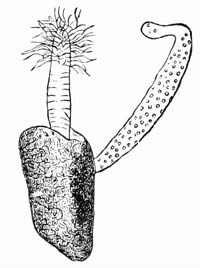
Fig. 1.—Ophiodendrum abietinum on Sertularia abietina.
We think that we ought to place among fixed messmates a very
problematical organism which lives on Sertulariæ, especially on the
Sertularia abietina, and which Strethill Wright has designated
by the name of Corethria sertularia. Claparède has given to
this singular animal the more expressive name of Ophiodendrum
abietinum.
We have regularly found it on the Sertularia abietina at Ostend,
every time that we have had an opportunity of observing these polyps
immediately that they have been raised from the bottom of the sea. It
is an organism whose affinities are not yet established.
In this chapter we bring together animals which live on each other,
without being either parasites or messmates; many of them are towed
along by others; some render each other mutual services, others again
take advantage of some assistance which their companions can give
them; some afford each other an asylum, and some are found which have
sympathetic bonds which always draw them together. They are usually
confounded with parasites or messmates.
Many insects shelter themselves in the fur of the mammalia, or in the
down of birds, and remove from the hair and the feathers the pellicle
and epidermal débris which encumber them. At the same time they
minister to the outward appearance of their host, and are of great
utility to him in a hygienic point of view.
Those which live in the water have other guardians: instead of
insects, we find a number of crustaceans which establish themselves on
fishes, and if there are no scales of the epidermis which annoy them,
there are mucosities which are incessantly renewed in order to protect
the skin from the continual action of the water.
We find many on the surface of the scales, and others which conceal
themselves at the bottom of mucous canals. We have brought together
only a few examples, and there are certain others which are mentioned
elsewhere, but which ought more properly to be placed here.
The insects long known under the name of Ricini, and to which
many other appellations have been given, deserve to figure in the
first rank in this group. They have always perplexed entomologists,
who seem to consider them as parasites allied to acaridæ and lice. It
has, however, been long known that they have no trunk to suck with,
and that they have two small scaly teeth, which rather serve for the
purpose of biting. A long time since, the examination of their stomach
proved that they contain only morsels of skin instead of blood. This
has induced many entomologists to place them in the same order as
grasshoppers, that of Orthoptera.
Lyonet has given figures of several of those which he studied with the
care which he so well knew how to employ in his anatomical
investigations; and in 1818 Nitzsch, a professor at Göttingen, had
brought together so great a number of them, that it required several
days to examine his collection; he began the publication of his
catalogue, but has not had time to finish it. Several other
entomologists and anatomists have since taken up the subject.
We owe the description of several hundred species to Mr. Denny. Mons.
F. Rudow has lately made known a great number of species which he has
collected from the skins of birds coming from Japan, Australia,
Africa, and the two Americas.
Professor Grube, of Breslau, has published the description of the
insects and acaridæ found during the travels of Middendorf in Siberia.
These descriptions relate especially to the Philopteræ of birds, the
Pediculinæ of the mammalia, a flea of the Mustela Siberica, and
an acarus of the Lemmus. Quite recently, an American naturalist, Mr.
Packard, who has undertaken the study of so many different subjects,
has published in the “American Naturalist” the description,
accompanied by an engraving, of the Menopon picicola, found on the
Picoides Arcticus from the lower Geyser basin, Wyoming territory,
also of the Goniodes Merriamanus, the Tetrao Richardsoni, and the
Goniodes mephitidis, found on a Mephitis from Fire-Hole Basin,
Wyoming territory; of the Nirmus buteonivorus, from a Buteo
Swainsonii; and of Docophorus Syrnii, from Syrnium nebulosum.
A great number of these insects live between the feathers of birds,
and can be more easily observed, since they detach themselves after
the death of their host. They are easily found on the skins of birds
prepared for museums. These ticks form a family under the name of
Riciniæ, and this family is divided into two parts, the Liotheidæ
and the Philopteridæ.
Among the many generic divisions, one of the most interesting has
received the name of Trichodectes; it contains twenty species,
one of which lives on the dog, another on the cat, another on the ox; in a
word, we discover a distinct species on each of the domestic
mammals.
It has been said that the phthiriasis of the cat is occasioned by
the abundance of ricini. The trichodectes of the dog has lately
attracted the especial notice of naturalists, and that from the
following circumstances.
There is no tape-worm more common in the dog than the Tænia
cucumerina. But whence comes it? How is it introduced? This had been
an enigma for many years, at the time when I dissected some dogs
infested with Tænia serrata, in the Museum of Natural History at
Paris. Together with the Tænia serrata, the number and age of which
I knew beforehand, since I had myself planted them, there were found
in the intestines of one of the dogs some individuals of the Tænia
cucumerina. My dogs had taken nothing but milk, and cysticerci
pisiformes. Were there cysticerci of different kinds in the
peritoneum of the rabbit? The veil is now withdrawn. We have just said
that the dog harbours a tick known under the name of Trichodectes, and
in this trichodectes lodges the Scolex, we might even say the larva of
the Tænia cucumerina. Dogs, especially young ones, lick their hair
continually, and it is by this operation that the young tænia is
introduced. It is by a similar process that the horse introduces the
eggs of the Œstrus which are hatched in its stomach.
Many of these ticks live abundantly in birds, and multiply rapidly.
The Liothe pallidum lives on the cock, the Liothe stramineum on
the turkey, the Philopterus falciformis on the peacock, the
Philopterus claviformis on the pigeon. It is to be observed that
every bird can nourish many different kinds. Fig. 2 represents the
tick which infests the sea-eagle, called Pygarg.
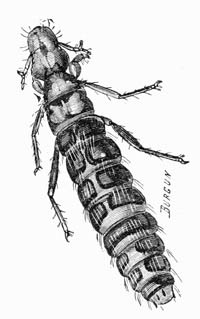
Fig. 2.—Ricinus of the Pygarg.
Fishes harbour crustaceans instead of ticks, and their number is not
less considerable than on mammals and birds. These crustaceans have
perplexed naturalists more than once, because they could only regard
them as parasites. They live on the produce of cutaneous secretions,
and if they improve, as do the ticks, the cleanliness of their host,
they are not less useful in a hygienic point of view, for they prevent
the accumulation of cutaneous productions.
Among these crustaceans, we must mention the Caligi and the
Arguli, which never become bloated, the Ancei, and probably other
genera. Instead of the ungainly and unusual forms of true parasites,
they all preserve, together with their fishing tackle and locomotive
apparatus, their neat and elegant appearance. The sexes even differ
only in size. They remain during the whole of their life what they are
at the beginning; that is to say, charming in form, with a
delicately-shaped corselet, numerous and slender claws, and are as
graceful in their movements as when in a state of rest. The greater
number of osseous fishes lodge Caligi on the surface of their skin.
These fix themselves by means of strong cables, but without
sacrificing their liberty. They are usually called fish lice.
Fishermen, when returning from the northern fishery, generally find
their vivarium full of these graceful vermin. It may be said that
the caligi are common everywhere, and that each species has its own
caligi. The fishes of the family Plagiostoma, notwithstanding the
hardness of their skin, afford food to some of these; they multiply so
rapidly sometimes, that they cover their host as though they took the
place of scales. The cod gives lodging to a charming species of a very
beautiful shape, which in its turn, affords a resting-place to the
Udonella. It is always attached to the ovisacs, and doubtless plays
the same part as the Histriobdellæ, so that we shall find the Caligi
attending to the toilet of the cod, and the Udonellæ in their turn
waiting on the Caligi.
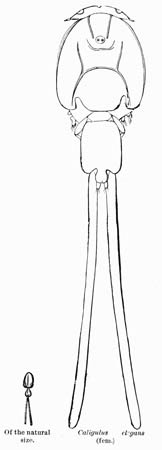
left: natural size.
right: Caligulus elegans (fem.)
The name Arguli has been given to some crustaceans which resemble the
caligi in size and in manner of life, and which principally frequent
fresh-water fishes. The Argulus foliaceus is the name of the
species which has been known for the longest time, and which is most
extensively found. It is to be seen on our pikes, carps, sticklebacks,
and on the greater part of our river fish. Mr. Thorell, in his
monograph, mentions twelve species of Arguli proper, and four species
of which he composed the genus Gyropeltis. Four are found in Europe,
two of which are on salt-water, and two on fresh-water fish.
Quite recently, Professor Leydig has made known another species living
on the Phoxinus levis. Arguli are met with on the fishes of Africa,
the Indies, and North and South America. Like the caligi, these
animals spontaneously abandon one host, to go and attend to the toilet
of another.
Another animal, which has been taken for a Lernæan, deserves to take
its place by the side of the Caligi, at least on account of its manner
of life. We refer to that singular being which Leydig discovered in
1850 in Italy, while studying the mucous canal of a Corvina, at
Cagliari, and to which he gave the name of Sphœrosoma. To judge by
the plate and by some details, this Sphœrosoma, the name of which
ought to be changed to Leydigia, belongs, if we mistake not, to the
same group as the Histriobdellæ. We are persuaded that the first
opportunity will confirm the correctness of this alliance, by the
study of its embryonic form. If we had not been able to examine into
all the development of the Histriobdellæ, more than one naturalist
would have considered them Lernæans, as happened at the congress of
German naturalists at Carlsruhe.
If we see many of these crustaceans live a joyous life while young,
there are others which seem to practise economy, and to emancipate
themselves when they have grown old. Mons. Hesse and Mr. Spence Bate a
few years since revealed the secrets of their existence.
Naturalists had recognized some crustaceans under the name of
Ancei, and others under the name of Pranizæ, living together upon
fishes, but with very different organs for fishing and swimming. M.
Hesse, curious to know the manner of life of the Pranizæ, made
observations on them in a small aquarium, and he perceived that the
parts of the mouth were all at once transformed into formidable
mandibles, which caused them to resemble Ancei. As it had often
occurred with respect to other groups, that the same crustacean at
different periods of its evolution had been taken for different
animals, the naturalist of Brest had some suspicion as to their
identity, and soon ascertained by direct observation that he had not
been mistaken. The Pranizæ become Ancei, and live upon fishes under
their first form, like caligi and arguli. Nothing can be seen which is
more curious than these crustaceans, which ride on the back or the
sides of fishes, and assume there every possible attitude.
The Pranizæ fix themselves in the mouth and in the gills as well as on
the skin. Some are found on sharks as well as on osseous fishes. They
fear neither heat nor light, and do very well under damp sea-weed
while waiting for the return of the tide. They run and swim with the
same facility. When in the condition of Ancei, they lose their
agility, and, under this form, all denotes their sedentary habits.
They appear to live in holes, at the bottom of which they defend
themselves with their powerful mandibles. It has been observed that
fecundation is accomplished, as in the Axolotls, before the
evolution is complete, but that the eggs are not laid until the animal
assumes the form of Anceus.
We may here remark that the change of appearance takes place only
among the females; the males preserve their dress and their liberty.
Some naturalists assert that we must not accept the metamorphosis of
either sex as an established fact, except for the purpose of
arrangement. All, however, tends to show that Mons. Hesse has fairly
interpreted facts; but it appears to us probable that the whole of the
history of these strange crustaceans is not fully known.
Fishermen have long since known whale-lice, the Cyami of
naturalists, of which we have already made mention while speaking of
free messmates. They live at liberty on the skin of their host, and
multiply with extreme rapidity. These Cyami have a regular form, but
completely different from the others, and have given (like the Ricini
and the afore-mentioned crustaceans), great trouble to systematic
zoologists. The place which they ought to occupy is far from being
definitely fixed. At all events they may be considered as a shorter
kind of Caprellæ.
As each whale has cirrhipedes which are peculiar to itself, so each
has its own cyami. Professor Lütken, of Copenhagen, has made known ten
or twelve species, all found on cetacea, in the two hemispheres. The
supposed Cyamus, represented by Dr. Monedero as living on the Biscayan
whale, is a Pycnogonon.
The Anilocræ and the Nerocilæ, like the Cyami and other genera,
establish themselves on the back of a fish which is a good swimmer.
Jealous of their liberty, they preserve their oars and their fins, in
order to change their convoy, when the desire seizes on them, and do
not imitate the Bopyrians, which instal themselves on the narrow
branchial cavity of some decapod crustacean, and as soon as they have
entered, throw off all their travelling baggage; in fact, there is no
other means for them to gain admission; their lot is identified with
that of their host; they can no longer live without him. The female
only, it is true, thus renounces her liberty; she sacrifices herself,
as usual, for her family, while the male, far from giving himself up,
preserves his defensive arms, his claws, and his liberty.
The crustaceans called Caprellæ are perhaps not so independent as they
appear to be; it is not impossible that their place may be among the
crustaceans now under our consideration. They are often found,
together with the Tanaïs, on the bodies of cetaceans and chelonians,
on plagiostomous fishes, or in the midst of colonies of Sertulariæ.
They also establish themselves on buoys when they are well covered
with animal life; and we have discovered them in prodigious numbers on
a piece of cable which had lain at the bottom of the sea, and the
whole surface of which was covered with animals of every kind.
We may here mention the Pycnogonons, the Saphyrinæ, the Peltidiæ, and
the Hersiliæ; these crustaceans often crawl over the skins of their
congeners, but without ever renouncing their independence; and they
are all more or less occupied with the toilet of their neighbours.
We shall place in a second section some animals which have been
usually classed among parasites, rather because of their living upon
their neighbours than on account of their mode of life. If it is
necessary in menageries to have keepers to cleanse the animals
themselves, it is as requisite to have others to keep the cages
clean, and to remove dung and filth. Many animals perform this office.
The rectum of frogs is always literally full of Opalinæ which
swarm in this cavity, like ants in their ant-hill, and doubtless live
on the contents of the intestine.
These Opalinæ are true infusoria, which do not wait till the fecal
matters are decomposed, and till the waters are corrupted by their
presence; they prevent accidents which might arise, and interfere in
time to purify the water from these excretions. There have been found
hitherto in the rectum of frogs, and in the different annelids, the
Pachydrili, the Clitelides, the Lumbriculi, and the Enchytrei. We have
also seen them in the Planaria and the Nemertians. There is no sight
more curious for those who are commencing microscopical studies, than
the examination of the contents of the rectum of these Batrachians.
Van Leeuwenhoeck knew, two hundred years ago, those animalculæ, to
which Bloch at a later period gave the name of Chaos intestinalis.
There are also some Rotatoria, the Albertiæ for example, which ought
to have a place here, and which Dujardin has described and named. They
live in the intestines of the Lumbrici and of snails, and in the larvæ
of Ephemerides.
Dujardin first pointed out the Albertia vermiculus; since then Mons.
Schultze has made known the Albertia of the Näis littoralis, and
Radkewitz has recognized in the small worm of our gardens the
Enchytreus vermicularis. Long since, Siebold correctly stated that
these animals are not parasites, since they do not live at the expense
of their host.
There is a worm in the Philippine Islands, as Professor Semper has
informed me, which lodges in the intestines of a fish, with its head
usually projecting outwards, and which watches the crustaceans
attracted by the excreta of its host; but although it chooses the
intestine of its neighbour as a place of shelter, it is not a
parasite.
Fishermen affirm, and the examination of the animal’s stomach confirms
their assertion, that the Cyclopterus lumpus feeds on nothing
but the excreta of other fishes. Indeed, it is not possible to count
the number of intestinal worms known by the name of Scolex, which
are found in the contents of the stomach and the intestines. Besides
this, we have long known the peculiarities of some insects which
cannot live except on the dung of certain animals; and there is an
example of one of these insects, found in a fossil state, which
anticipated the discovery of the remains of an extinct mammal before
unknown in that district. The larvæ of the fly Scatophaga
stercoraria live only on excrementary matter.
There are also nematode worms which exist under these conditions, and
which develop and propagate their species in the intestines as if in
the midst of damp earth. The small eel-like creatures so abundant in
cow-dung propagate in it; they are not parasites, and are allied to
those of which we speak in this chapter.
Besides those attendants which busy themselves about the cleanliness
of other animals, we find some whose duties are less extensive, and
whose cares are more limited. Many animals produce a greater number of
eggs than they can bring to perfection, and those which are decomposed
for want of fecundation, or which die in the course of evolution,
are under the care of an especial attendant, employed to make away
from time to time with the addled eggs, or the embryos that have
failed to come to maturity.
In this manner lobsters give lodgings in the midst of their eggs to a
worm, which we at first took for a Serpula, and which, after a
complete examination, turns out to be one of the Hirudinidæ: we have
given it the name of Histriobdella. It is as singular in its
movements as in its conformation, and its manner of living approaches
that of the Pontobdellæ of the rays, of which we shall speak
subsequently. We announced this discovery a few years ago in the
following terms:—
It is known that lobsters, as well as crabs and the greater part of
the crustacea, carry their eggs under the abdomen, and that these eggs
remain suspended there till the embryos are hatched. In the midst of
them lives an animal of extreme agility, which is perhaps the most
extraordinary being which has been subjected to the eyes of a
zoologist. It may be said, without exaggeration, that it is a biped,
or even quadruped, worm. Let us imagine a clown from the circus, with
his limbs as far dislocated as possible, we might even say entirely
deprived of bones, displaying tricks of strength and activity on a
heap of monster cannon balls, which he struggles to surmount; placing
one foot formed like an air-bladder on one ball, the other foot on
another, alternately balancing and extending his body, folding his
limbs on each other, or bending his body upwards like a caterpillar of
the geometridæ, and we shall then have but an imperfect idea of all
the attitudes which it assumes, and which it varies incessantly.
Its rank and its affinities would have given rise to long discussions
if we had not made known at the same time its evolution and anatomical
structure.
It is neither a parasite nor a messmate; it does not live at the
expense of the lobster, but on one of the productions of these
crustaceans, much in the same manner as do the Caligi and the Arguli.
The lobster gives him a berth, and the passenger feeds himself at the
expense of the cargo; that is to say, he eats the eggs and the embryos
which die, and the decomposition of which might be fatal to his host
and his progeny. These Histriobdellæ have the same duty to perform as
vultures and jackals, which clear the plains of carcases. That which
causes us to suppose that such is their appropriate office, is that
they have an apparatus for the purpose of sucking eggs, and that we
have not found in their digestive canal any remains which resemble any
true organism. We find the feces, rolled up as balls, placed after
each other in their intestines.
The crustaceans also feed other Hirudinidæ. Mons. Leydig has noticed a
Myzobdella on the Lupa diacantha. The fresh-water crab, common in
all the rivers of Europe, nourishes two, the Astacobdella rœselii,
which lives under the abdomen, or about the eyes, and the
Astacobdella Abildgardi which especially frequents the branchiæ. Two
astacobdellæ on the same crab doubtless play different parts. We
should almost venture to assert, à priori, that the species in the
gills lives as a parasite on the blood of its host, whilst the other,
lodged under the abdomen, plays the same part as the histriobdella of
the lobster.
We often find among the eggs of the ordinary crab of our coasts
(Cancer mœnas) a nemertian which probably performs the same
office. He is lodged while young in a kind of firm sheath attached to
the abdominal processes. We have been able easily to study the first
phases of its evolution. We have given it the name of Polia
involuta.
This nemertian had been observed at Messina, and described before by
Kölliker under the name of Nemertes carcinophilus, and it has
just been described and figured anew by Mr. M’Intosh, in a monograph
of British annelids published by the Ray Society.
The sturgeon seems to give lodging in its eggs to a polyp which plays
the same part. In fact, Mons. Owsjannikoff, at the congress of Russian
naturalists at Kiew, described an animal, Accipenser ruthenus,
which lives in the eggs of the sterlet. Some eggs placed in water for
a few hours at first show tentacles on the outside, then a whole
colony, and each part consists of four individuals, which have a
common digestive cavity, resembling somewhat a hydra divided
longitudinally in four. Each has six tentacles, two of which are
terminated by transparent corpuscles, perhaps nematocysts; the
digestive cavity extends into the arms, as in the hydra; the mouth is
not between the tentacles, but at the opposite pole. They are not all
lodged within the eggs; some are found outside, according to the
observations of Mons. Koch. Does not this animal fulfil in the egg of
the sterlet, the same office as the histriobdella in the egg of the
lobster?
The eggs of some insects are attacked by very little ichneumons, the
Proctotrupidæ; they empty them, and then instal themselves in
the shell. Mons. Fabre has mentioned, in his memoir on the habits of
the Meloë, a worm found in an egg.
M. Barthelemy has studied a nematode worm (Ascaroides limacis)
which inhabits as a parasite the egg of the grey snail; is this not
the ordinary worm of the snail which has introduced itself into the
eggs?
Many animals establish themselves on their neighbours, not to obtain
any advantage from them, except to profit by their fins; they are not
themselves sufficiently adapted to rapid motion, so they seize a good
courser, mount on his back, and ask from him only a resting-place and
no provisions. But it is often very difficult to say where
commensalism ends and mutualism begins; the cirrhipedes, for example,
establish themselves on a piece of floating wood, or on the bottom of
a vessel; on a block of stone, or on one of the piles of a groin; on
an immovable animal as well as on a good swimmer.
Some fourteen years ago, Jacobson of Copenhagen wrote an interesting
essay, to show that the young bivalves that are found in the branchiæ
of anodonts at a certain period of the year are parasitical animals,
for which he proposed a new name. But these supposed parasites are
only young anodonts, which by the help of a very long cable, which
proceeds from their foot like a byssus, attach themselves to their
mother, or to a fish which will carry them to a distance.
We see full-grown acephalous molluscs, as mussels and pinnæ, still
keep these cables, under the name of byssus, during their whole life.
There are also among distomians, worms which though they are
hermaphrodite, couple two and two, and have this additional
peculiarity, that while one increases rapidly the other becomes
atrophied.
An Egyptian distome, which lives in man, gives an instance of this
peculiarity, as well as the D. filicolle, which inhabits a fish
(Brama Raii). The caligi which live on the skin of fishes are,
when young, fastened by a cord which comes from the anterior edge of
their carapace: while quite little, they put themselves under the
protection of a kind neighbour, and allow themselves to be led by him.
The new tubularia, which we have dedicated to our learned colleague
Dumortier, often fixes itself on the carapace of ordinary crabs, and
causes itself to be conveyed like the Echeneis; the tubulary observed
by Gwyn Jeffreys, close by the eye of the Rossia papillifera, a
cephalopod mollusc, perhaps belongs to the same species.
Every colony of campanulariæ or sertulariæ lodges a crowd of messmates
and mutualists; and there are a great number of crustaceans and polyps
of all sizes which serve as an abode for infusoria of every kind. Some
establish themselves on the carapace or on the swimming appendages, as
in a carriage; others on one of the gills, which renders their mode of
life more easy, and the danger less great. An amphipod very
extensively spread over our sea-coasts, the Gammarus marinus,
usually has its appendages covered with Vayinicola crystallina.
“En plongeant si bas dans la vie, je croyais y rencontrer
les fatalités physiques, et j’y trouve la justice,
l’immortalité, l’espérance.”—Michelet, l’Insecte.
The parasite is he whose profession it is to live at the expense of
his neighbour, and whose only employment consists in taking advantage
of him, but prudently, so as not to endanger his life. He is a pauper
who needs help, lest he should die on the public highway, but who
practises the precept—not to kill the fowl in order to get the eggs.
It is at once seen that he is essentially different from the messmate
who is simply a companion at table. The beast of prey kills its victim
in order to feed upon his flesh, the parasite does not kill; on the
contrary he profits by all the advantages enjoyed by the host on whom
he thrusts his presence.
The limits which separate the animals of prey from the parasite are
usually very clearly marked; yet the larva of the ichneumon, which
eats its nurse, piece after piece, resembles a carnivorous animal as
much as a parasite. There are indeed certain animals which take
advantage of the good condition of their Amphitryon, but which
render to him in return precious services. Thus those which live on
the produce of the secretions, or which clear the system of useless
materials in exchange for the hospitality which they receive, are not
true parasites. These services are of a very different character, and
the duties which they sometimes perform for each other are in some
respects analogous to medical care.
Every animal has its own parasites, which always come from without.
With some few exceptions, they are introduced by means of food or
drink. In order to ascertain their origin, the naturalist must
beforehand study the food, that is to say, the prey or the plant which
furnishes the habitual nourishment of the host which gives them
shelter.
A carnivorous animal, however, does not in general content himself
with a single kind of prey—one voracious animal of this class devours
all that comes in its way; another, more of an epicure than a glutton,
chooses with more discernment. But in the midst of this varied kind of
food there is always some species which forms the staple of the usual
bill of fare, and it is necessary to find out what this is if we wish
to ascertain the parentage and the metamorphoses of the parasite,
since it is that which conducts the parasite to its new destination.
The mouse is destined to the cat, and the rabbit to the dog; in the
same manner, each one of the herbivora is intended to be the prey of a
carnivorous animal, if not larger and stronger than itself, at least
more cunning. It is of great importance to discover the animal which
conducts the new-comer into his habitation. When we know it, we have
only to introduce into it the stranger guest, that sooner or later
he may pass into the body of his accustomed Amphitryon. In order
thoroughly to know these sedentary or vagabond populations, we must
not only study them at the different periods of the year, and under
all the conditions of their irregular life, but it is necessary to
follow them from the moment that they quit the egg till their complete
evolution, closely noticing all that relates to their reproduction.
In the dung of the cow, by the side of the elegant Pilobolus,
live masses of small eels, born in the stomach of the animal, which
wind and twist like microscopical serpents, and do not seek the
slightest help from the organ which shelters them. They are hatched in
the interior of the stomach, as if it took place in the meadow. These
little eels have evidently only the appearance of parasites, and it
may be that they render some service in some of the organs through
which they pass. This may also be the case with those which live on
the feces of others, or which, lodged in the rectum, watch for the
prey which is attracted by the odour. These, especially the latter,
are rather messmates than parasites. True parasites are animals
entirely dependent on their neighbours, unable to provide for
themselves, fed entirely at the expense of others. It is generally
supposed that parasites are exceptional beings, requiring a place by
themselves in the animal hierarchy, and knowing nothing of the world
except the organ which shelters them. This is an error. There are few
animals, however sedentary they may be, which are not wanderers at
some period of their lives, and it is not even uncommon to find some
which live alternately as noblemen or as beggars. Many of them only
deserve to be placed among paupers when they are in their infancy or
at the approach of adult age, for they only seek for help at the
beginning or towards the end of their career. These are very numerous,
and more than one species change their dress so completely that they
can no longer be recognized. Finding with their host both food and
lodging, they throw off their fishing and travelling gear, settle
themselves comfortably in the organs which they have chosen, and
having got rid of the baggage which connected them with the outer
world, preserve only their sexual organs.
As to the rank which these parasites occupy in the scale of being, it
may be said that there is no especial class of parasites; and worms
are not distinguished in this respect, except by having a greater
number of species subject to this rule. All classes among invertebrate
animals include parasites.
It is also an error to suppose that the whole species, the young as
well as the old, the males as well as the females, are always
parasites; often the female, not being able to provide for the
necessities of life, seeks for food and shelter, while the male
continues his nomad life. Therefore the female alone puts on the
pauper’s dress, and by a recurrent development, assumes sometimes such
a singular appearance that the male no longer resembles her. One
cannot say that the females constitute the beau sexe in this
group, since they are often so monstrous in form and size that their
appearance has nothing in common with a perfect animal; their body is
deprived of all its exterior organs, and there often remains only a
skin in the form of a leather bag, without any distinguishing
character.
What is still more astonishing, is to meet with males which, under the
conditions to which we have just alluded, come at last to seek for
assistance from their own female, so that she has to provide for all;
and the charitable animal which comes to her help takes the whole
family under his charge. Assistance is thus thoroughly organized in
the lower world; neighbours are found which serve as a crèche
for the indigent when they first quit the egg, others as a hospital
for the infirm adults or the females, and others again play the part
of innkeepers for all, instead of affording a place of refuge for some
privileged individuals.
There are but few animals, if indeed there are any, which have not
their peculiar parasites. Of all the fishes of our coasts we have
never found but one which had none; and perhaps, could we observe this
fish in different latitudes, we might find that it had its poor
dependants as well as the rest.
Thus we may assume that no animal is free in this respect, and man
himself regularly affords hospitality to many of them. We feed some
with our blood and our flesh; there are some which lodge on the
surface of our skin, others in the interior of our organs; some prefer
to establish themselves on children, others on adults. The name alone
of some is sufficient to make us shudder, while others live peaceably
in some crypt, without our suspecting their presence. Who is there
that does not nourish some acari, of the genus Simonea, in the
membrane of the nose? In fact, man gives a home to some dozens of
parasites, and the presence of the most terrible among them
constitutes, in certain countries, a condition of health which is
envied. The Abyssinians do not consider themselves in good health,
except when they nourish one or many tape-worms.
Among the animals to which man gives his involuntary assistance, we
may mention first, four different Cestoidea, or tape-worms, which live
in the intestines; three or four Distoma, which lodge in the liver,
the intestines, or the blood; nine or ten Nematodes, which inhabit the
digestive passages or the flesh. There are also some young Cestodes,
named Cysticerci, Echinococci, Hydatids, or Acephalocysts,
which find in him a crèche to shelter them during their life. These
always choose enclosed organs, like the eye-ball, the lobes of the
brain, the heart, or the connective tissue. We also provide a living
for three or four kinds of lice, for a bug, for a flea, and two
ascarides, without mentioning certain inferior organisms which lurk in
the tartar of the teeth, or in the secretions of the mucous membrane.
There are some animals which harbour few inhabitants, while there are
others that keep up a great retinue; and it is not always, as we have
already said, that those who give lodging to but few enjoy the most
excellent health. We might give as an instance of this, a fish which
is known to all, the turbot, which as well as the woodcock is highly
prized, though both have their intestines literally obstructed by
tape-worms and their eggs. We have never opened one, large or small,
lean or fat, which had not its intestines filled with cestode worms.
They are so numerous as to form a kind of cork, which one might think
intended to close the passage of the pylorus.
Some authors give remarkable instances of the abundance of parasites.
Nathusius speaks of a black stork,
which lodged twenty-four Filariæ
lobatæ in its lungs, sixteen Syngami tracheales in the tracheal
artery, besides more than a hundred Spiropteræ alatæ within the
membranes of the stomach, several hundreds of the Holostomum
excavatum in the smaller intestine, a hundred of the Distoma ferox
in the large intestine, twenty-two of the Distoma hians in the
œsophagus, and a Distoma echinatum in the small intestine. In spite
of this affluence of lodgers the bird did not appear to be in the
least inconvenienced.
Krause, of Belgrade, mentions a horse two years old, which contained
more than five hundred Ascarides megalocephalæ, one hundred and
ninety Oxyures curvulæ, two hundred and fourteen Strongyli armati,
several millions of Strongyli tetracanthi, sixty-nine Tæniæ
perfoliatæ, two hundred and eighty-seven Filariæ papillosæ, and six
Cysticerci. When we consider how many eggs a single worm produces,
we can understand how it is that so few animals escape being invaded
by them.
Sixty millions of eggs have been counted in a single nematode, and in
a single tape-worm, or rather in a colony, even a thousand millions of
eggs. Even the very animals which live as parasites, harbour others in
their turn. We find parasites on parasites, as we find messmates upon
messmates. Almost all writers on this subject give examples of these;
some in the larvæ of ichneumons, others in the lernæans, and we have
more than once met with nematodes in different crustacea still
attached to their host.
In order to understand thoroughly the living furniture of an animal,
especially of a fish, it is necessary to examine it while young; the
feces are the Kitchen-middings
of the stomach; it is from them
that we can appreciate the bill of fare of each. This study of
the food will one day excite much interest, not only in a scientific
point of view, but also with reference to fishing as an occupation.
There are some animals which are infested at every period of their
life, and at every season; others in far greater number only during
their youth, and they gather in at the commencement of their life the
harvest for the rest of their days. The greater part of parasites,
especially of fish, are introduced with the first nourishment. As soon
as they issue from the egg, young rays, like young turbots, are
already stuffed with worms which afterward obstruct the digestive
organs. The stomach of each of these fishes is like a filter which
allows every thing which is food to pass, but detains on its passage
and without any change all that is living. When we examine the stomach
and observe the food in its different degrees of digestion, we see
distinctly the worms coming out of their holes, wallowing in that
which physiologists call chyle, and choosing afterwards at their
convenience the place where they may completely develop themselves. At
the end of a few days, the fish may have swallowed an innumerable
quantity of small animals, and if each of them introduces some worms,
we can easily understand in how short a time the intestine becomes
literally filled.
There is no organ which is sheltered from the invasion of parasites:
neither the brain, the ear, the eye, the heart, the blood, the lungs,
the spinal marrow, the nerves, the muscles, or even the bones.
Cysticerci have been found in the interior of the lobes of the brain,
in the eye-ball, in the heart, and in the substance of the bones, as
well as in the spinal marrow. Each kind of worm has also its favourite
place, and if it has not the chance of getting there, in order to
undergo its changes, it will perish rather than emigrate to a
situation which is not peculiar to it. One kind of worm inhabits the
digestive passages, some at the entrance, others at the place of exit;
another occupies the fossæ of the nose; a third the liver, or the
kidneys.
We may even divide parasites into two great categories, according to
the organs which they choose: those which inhabit a temporary host,
almost always instal themselves in a closed organ—in the muscles, the
heart, or the lobes of the brain; those, on the contrary, which have
arrived at their destination, and which, unlike the preceding, have a
family, occupy the stomach with its dependencies, the digestive
passages, the lungs, the nasal fossæ, the kidneys, in a word, all the
organs which are in direct communication with the exterior, in order
to leave a place of issue for their progeny. The young ones are never
enclosed. Even the blood is not free from these animals, but there are
few which lodge there, except during the act of migration.
In Egypt, Dr. Bilharz observed a distome in the blood of a man
(Distoma hœmatobium); the Strongylus of the horse has been long
known, which causes serious injuries in its vessels (Strongylus
armatus); as also the strongylus of the dolphin and of the porpoise
(Strongylus inflexus), and the filaria of the dog (Filaria
papillosa); and some are also found in the blood of many birds, of
reptiles, batrachians, and fishes; so that there is no class of
vertebrates which escapes.
There are some which, like leeches, seek assistance from their
neighbours, but are content to snatch their food as they pass, and
only attach themselves for a short time to the host which they
despoil; they retain their fishing or hunting tackle, as well as their
organs of locomotion. These parasites, which never take up their
lodging on the host which nourishes them, have no sooner sucked his
blood, or devoured his flesh, than they resume their independent life.
They do not disfigure themselves, nor put on any special costume, like
those which seek a permanent abode. Gluttony is not with them the only
moving principle of existence; they do not forget what they owe to the
world, and keep up an appearance which allows them at all times to
present themselves afresh.
Parasites are scattered over every region of the globe; they choose
their place, and observe, like all living creatures, the laws of
geographical distribution. All do not inhabit the animal kingdom; some
seek for assistance in vegetable life. Many insects lay their eggs in
seeds or fruits, and their progeny, as soon as they are hatched, find
abundant nourishment in the sap or in the farina stored up for the
young plant; others pass into a state of lethargy while the seed is
dry, and recover their activity every time that they receive a little
humidity.
The female of a coleopterous insect deposits its eggs in the nut, and
in proportion as this grows, the young larva devours the kernel. When
it is brought to table, it encloses only the skin and the excretions
of the larva. A weevil establishes itself in a similar manner in
cereal plants, and, small as it is, it may produce great calamity
by multiplying in granaries. There are even worms which lodge in
certain of the graminaceæ, and get completely dry with the envelope
which contains them, without ceasing to live. Their life is suspended
till the day when the seed is sufficiently softened in the earth or
the water.
We have seen that each parasite has its host: we must have a
particular name to designate it. But that does not imply that if it
find not its dwelling-place it must perish. It may only live some time
at the expense of its neighbour, and thus pass for its parasite.
Naturalists are occasionally deceived. Thus, they once believed in the
passage of the Schistocephalus of the stickleback into the intestines
of certain birds which eat them, and in which they are only found
accidentally. The Ligulæ of the Cyprinidæ, found in the intestines of
the cormorant or the goosander, are not, in our opinion at least,
worms peculiar to these birds. They are strangers which must either
emigrate again or die. Acari which originally belonged to mammals and
birds, have been found living on man, causing prurigo, or even serious
maladies, and yet these parasites are not regarded as peculiar to our
species. We might cite other examples. Who has not been annoyed by the
flea, which abandons for an instant the dog, its natural host?
Among these free parasites, many do not attach themselves to a
particular species, and well deserve the title of cosmopolitan
parasites. Thus we see that the Ascaris lumbricoides, so common
among children, lodges also in the ox, or the horse, the ass, and the
pig. The Distoma hepaticum, which is a parasite peculiar to the
sheep, if we may judge by its abundance in this animal, may find its
way into the liver of man, or into that of the hare, the rabbit, the
horse, the squirrel, the ass, the pig, the ox, the stag, the roebuck,
and different species of antelope. It is to be remarked that all these
animals have a vegetable regimen. By drinking the water which contains
the cercaria of this species, they grow infested by this singular
lodger. The large Echinorhyncus (E. Gigas) has been found in
the dog, and the pig, perhaps in the phocinæ; and instances are mentioned
in which it has even migrated into man. The Gordius aquaticus
appears to live and develop itself in different species of insects;
and among the articulated parasites, we meet with the Ixodes
ricinus, commonly called the tick, on the dog, the sheep, the
roebuck, and the hedgehog; and instances are given of its presence on
man. It has been long since proved in menageries and zoological
gardens, that the Acarus of the camel is able to give a cutaneous
disease to man.
As we have before said, there are many parasites which require to be
studied in order to determine the host peculiar to each of them;
although parasites sometimes lose their way, and introduce themselves
into the wrong neighbour, yet they can live there but a short time.
Instances have been known, in which the larvæ of flies have penetrated
into man accidentally by the mouth or the nostrils. Reptiles have been
known to live a certain time in the stomach. A German physiologist,
Berthold, professor at the University of Göttingen, has given an
account of all those which have been found under such circumstances,
and the number of them is considerable; he has written a memoir on the
abode of living reptiles in man.
Among other instances, this naturalist mentions the case of a boy of
twelve years of age, who, in 1699, after suffering acute pain, voided
from the intestines nearly one hundred and sixty four millipedes, four
scolopendræ, two living butterflies, two worm-like ants, thirty-two
brown caterpillars of different sizes, and a coleopterous insect.
These animals lived from three to twelve days. This is not all: the
same child, two months afterwards, voided four frogs, then several
toads, and twenty-one lizards, and sometimes a live serpent was seen
for a moment at the bottom of his mouth. Happily for science, we do
not see such things seriously related in books at the present day.
The size of parasites is very various: Boerhaave mentions a
bothriocephalus three hundred ells in length; at the Academy of
Copenhagen, it was reported that a solitary tape-worm (Tænia solium)
had been found eight hundred ells long. Female strongyli have been
seen from two decimètres to one metre in length; and Gordii of two
hundred and seventy millimètres. We have found in a fish a worm which
lived rolled up like a ball, and which measured, when unrolled, more
than a mètre.
Parasites present an extraordinary variety of forms, and the
differences between the sexes in size as well as in appearance are
greater than in any other group of animals. The male of the
Uropitrus paradoxus, the Urubu of Brazil, has the usual form of
a round long worm, while the female resembles a ball of cotton,
without the slightest analogy with the other worms of the order. The
Lernæans also have females excessively various in size and appearance,
while the males generally resemble each other in their external
characters. What is not less remarkable is, that hermaphrodite worms
often unite in couples, and that only one of the two seems to perform
the function of a female, and increases in size (Distoma Okenii,
Bilhartzia). It even happens that the union is so complete that
the species appears formed of two individuals fastened to each other.
The Diplozoa show us a curious example of this. The gills of breams
are usually infested by these last-mentioned worms. Nothing is more
strange than to see all these individuals united two and two as if
soldered together, each preserving its mouth and digestive canal, and
producing eggs which give birth to isolated individuals. We sometimes
see males so completely absorbed in their females, even in an
anatomical point of view, that they only represent a fragmentary
apparatus. The male of the Syngami is so obliterated, that when
compared with the other males of its order it is only a testicle
living on the female.
Should an organ infested with worms be considered diseased, simply on
account of their presence? We hesitate not to say that, as long as
these guests cause no disorders, there is no pathological condition.
The child which has Ascarides lumbricoides in its stomach is
not necessarily ill. All animals in a wild state always have their
parasites; they lose them rapidly when in captivity.
The Abyssinians do not take medicine when they have tæniæ; on the
contrary they are in a better state of health. Do we not find medical
men prescribing the employment of leeches, and consequently calling in
the assistance of certain parasitical animals? This action, far from
being a cause of sickness, is in this instance a remedy, and no one
can foresee all that science has a right to expect from the salutary
effects of certain parasitical worms on the system. There are, if we
mistake not, many discoveries in store for observers in this order of
investigation.
But here, as in all things, excess is hurtful. Certain organisms,
developing themselves immoderately, may break the harmony necessary
between the parasites and the host which they frequent. It has been
found recently that many morbid affections, as the potato and vine
diseases, have for their origin only the abnormal development of
certain microscopic beings hidden in the organism.
It is found, that in Egypt, a distoma is developed in the blood, and
occasions a very severe malady, scarcely known to physicians. In
Iceland, a cestode causes the death of a third part of the population.
Worms develop themselves in the eye, and may even cause blindness; the
Cœnurus of the sheep causes giddiness, and becomes fatal to
the animal which harbours it. The chlorosis observed in Egypt and Brazil
must, it appears, be attributed to a considerable development of a
nematode worm, which lives in the small intestines, and which
naturalists know under the name of Dochmius duodenalis; and lately
the Trichinæ set all Europe in a state of excitement, and trichinosis
was for a time more dreaded than cholera. In spite of all these
accidental circumstances we think that the animal which possesses its
ordinary parasites, far from being ill, is in a normal physiological
condition.
When we consider these animal parasites in general,
one would think
that their tenacity of life is very feeble, and that the slightest
derangement would be sufficient to kill them. It is not so; on the
contrary, some of them can be entirely dried up, and return to life
every time that they are moistened; and the eggs of some of them
resist the most violent reagents. We have known eggs preserved for
years in alcohol, in chromic acid, and in other agents which destroy
life everywhere else; and then give birth to embryos directly they are
placed in pure water or damp earth.
Some years ago they had no idea of the migration of animals from one
body to another. As we have said elsewhere, Abildgard, half a century
ago, made experiments on the worms of fishes which he caused ducks to
swallow, but these experiments had no result, and formed rather an
obstacle to ulterior progress, than an approach to truth. The worms of
fishes have been known to live in birds; but these worms were only
there as adventitious parasites. Liguli live some days in the
goosander, but they do not maintain their position.
Our great initiator into the world of parasites, Mons. Siebold,
arrived also at a conclusion which could not be maintained. Having
observed, with his habitual sagacity, that the cysticercus of the
mouse is the same worm which lives in the cat, he published his
opinion that the eggs of this tænia had lost their way in the mouse,
that the young worms had become sick there, and that in the cat alone,
they could be healthily and completely developed. It was like a plant
lost on a soil where it could not live, and still less flourish. May I
be permitted to state by what means we have arrived at the knowledge
of the transmigration of worms?
I had commenced the study of encysted Tetrarhynchi in the peritoneum
of the Gadidæ in 1837. Ten years afterwards, shortly after a visit
from my learned friend, Mons. Kölliker, I discovered that this world
of parasites did not live such a monotonous life as was supposed. I
ascertained by my dissections of fishes, that the tetrarhynchi also,
which were supposed to be disinherited by Nature, knew how to vary
their pleasures; that instead of spending their whole life in a prison
cell, they change their home at a certain age, and pass the latter
part of their existence in more spacious habitations.
I had seen the Tetrarhynchus agamus inhabiting a cyst in the
peritoneum of the gadidæ, and I had met with the same tetrarhynchus
completely developed and sexual in the spiral intestine of the
voracious fishes known under the name of squalidæ, or sharks. This
caused me to write to the Academy of Brussels, at the meeting on
January the 13th, 1849, that the order of vesicular worms, admitted by
all helminthologists, ought to be suppressed.
These worms began to be understood when these cysticerci ceased to be
regarded as sick creatures. Siebold had mistaken the crèche for
the hospital, and instead of seeing in the cysticercus a young animal
full of life and of the future, he looked upon it as a gouty
individual, ready to breathe its last sigh.
These fish had directed me in the right road; I had closely followed
up certain very characteristic worms, which lived under a very simple
form in certain fishes, and which, passing with their host into the
stomach of another, finished in the latter their toilet and their
evolution. I had been a witness of all their changes of form from
the cradle to the tomb, by following them from fish to fish, or rather
from stomach to stomach. In fact these parasites are perpetually on
their journey, and constantly changing their host, and at the same
time their dress and mode of locomotion, so that frequently, at the
end of their voyage, they preserve only shapeless rags to cover their
eggs or their offspring.
That which adds still more to the difficulty of recognizing them is,
that while young they are often enveloped in swaddling clothes which
nevertheless permit them to wander freely; then in a simple robe, in
keeping with the home which shelters them; and at last in a wedding
dress, which hides the eggs and the apparatus which produces them. The
nymph in her virgin condition has none of the attributes of future
maternity.
It is in this category that we find the Distomes, so common in all the
classes of the animal kingdom. This is not all: frequently, among
these various forms, these animals when young produce little ones,
which in no respects resemble the others, and are not even formed in
the same manner. As soon as they quit their swaddling-clothes, they
increase by gemmation, and without sexual union, while those which are
produced from buds increase sexually. Thus the daughter does not
resemble her mother, but her grandmother. This phenomenon has been
known by the name of alternate generation; we have called it
digenesis.
But all parasites do not resemble those distomes, which change several
times both their host and their costume. We find some of them, which
the mother deposits with care in the body of a neighbour, and which
pass all their early life in the viscera of an alien mother. Such
are the Ichneumons, beautiful winged insects, which perfidiously
insert their eggs in the body of a living caterpillar, whose internal
part serves at the same time for a cradle and for food. The young
larva devours organ after organ, beginning with the least important,
till the last serves for the formation of the last members of the
winged insect.
More unfortunate are those which are kept under the bolts and bars of
their host from their early youth to mature age; they have no
participation in the great banquet of life, except it be in the
pleasures of the table and of love. We also find some parasites which
occupy different organs in the same animal, and which have different
sexual attributes according to the situation which they inhabit. We
know some which are hermaphrodite in the rectum or in damp earth, and
whose young ones, having the sexes separate, live as parasites in the
lungs.
Parasites are not usually reproductive in the animal which they
inhabit. They respect the hearth which shelters them, and their
progeny are not developed by their side. The eggs are expelled with
the feces, and sown at a distance for other hosts.
Parasites may be divided into several categories. We may bring
together in the first of these, a certain number of animals, which,
without being true parasites, seek for a place of shelter, and, either
on account of their wretchedness or their misery, require this
protection in order that they may live.
In the second category, we may place those which live at complete
liberty, and only require for their sustenance the superfluities of
their neighbours; they take great care of the skin of their host,
and use it sparingly. Some also are found which cannot live without
assistance, but repay it with some service. Often, indeed, they
associate with their host, and live on a footing of perfect equality
with him; and besides these are found associations in which equality
is by no means recognized, and where labourers or even slaves perform
the work disdained by their masters.
In the last category we shall arrange true parasites, which take both
their lodging and their food. And here, again, we shall meet with
three distinct subdivisions.
The first includes those which travel from one hotel to another before
they arrive at their destination; to-day they lodge in a prawn,
to-morrow in a gudgeon, then in some fish which preys upon others, as
the perch or the pike. These are nomadic parasites, which do not stop
or think of family life until they have found the hotel for which they
are destined.
Sometimes the parasite gets into a wrong train, and not being able to
retrace his steps, he remains at a station where no other train will
take him up. He is condemned to die in a waiting-room.
In the last subdivision, we have parasites that have arrived at their
destination, occupying themselves in future only with the joys of a
family.
Thus we find some which are really at home, and others which are on
their journey, sometimes on the right road, and at others, wandering
and lost in an alien “host.” The former are autochthonic
parasites, the others are foreigners. We may say that each animal
species has its proper parasites, which can live only in animals which
have at least more or less affinity with their peculiar host. Thus
the Ascaris mystax, the guest of the domestic cat, lives in
different species of Felis, while the fox, so nearly resembling
in appearance the wolf and the dog, never entertains the Tænia
serrata, so common in the latter animal.
The same host does not always harbour the same worms in the different
regions of the globe which it inhabits. This relates both to the
parasites of man, and to those of the domestic animals. Thus the large
tapeworm of man, which naturalists call Bothriocephalus, is found
only in Russia, Poland, and Switzerland. A small tape-worm, Tænia
nana, is observed nowhere except in Abyssinia; the Anchylostoma is
known at present only in the south of Europe and the north of Africa;
the Filaria of Medina, in the west and the east of Africa; the
Bilharzia, that terrible worm, has only been found in Egypt.
There are also parasitic insects dreaded by man, as the Chigoe
(Pulex penetrans) which, happily, is only known in certain
countries. Some, however, have become cosmopolitan, since man has
introduced them wherever he has established himself.
The mammalia which live on vegetable diet have Tænia without any crown
of hooks, and man, according to his teeth, ought only to nourish the
Tænia mediocanellata. We find in a work on the Algerian Tænia, by
Dr. Cauvet, that it is the Tænia inermis, that is to say, without
hooks, which is the species common in Algeria. Among fourteen tæniæ
which he had occasion to examine, there was not a single Tænia
solium. I have said long since, that this species ought to be less
widely spread than the tænia without hooks. The Tænia solium
comes
from the cysticercus of the pig, the other from that of the ox; and
Dr. Cauvet has ascertained that the latter, in the state of
cysticercus, has already lost its crown.
We find extinct fossil genera and species in all the classes of the
organic world. Is it the same with worms and animals of other classes
which are only known in the condition of parasites? Had the
Ichthyosauri and the Plesiosauri worms in their spiral cœcum like
plagiostomous fishes, which resemble them so much in the digestive
tube? We do not doubt this, and we should have been glad to give some
demonstration of it. For this purpose, we have made a collection of
the coprolites of these animals, but we have not yet succeeded in
getting slices thin enough or sufficiently transparent to discover the
eggs or the hooks of their cestode worms.
Not long ago, the partisans of spontaneous generation found in the
class of worms their principal argument for their old hypothesis, and
it was even after the publication of my treatise on intestinal worms
that this question, which seemed forgotten, was taken up again by
Pouchet. At present, they appear to have given up parasites, which
reproduce their kind like other animals, and to have fallen back upon
the infusoria, the last intrenchment which remained to the partisans
of spontaneous generation, whence Mons. Pasteur has scientifically
dislodged them. It is evident to all those who place facts above
hypotheses and prejudices, that spontaneous generation, as well as the
transformation of species, does not exist, at least, if we only
consider the present epoch. We are leaving the domain of science if we
take our arms from anterior epochs. We cannot accept anything as a
fact, which is not capable of proof.
This first category of parasites includes all those which are not
enclosed, and which live at the expense of others, without losing the
attributes and advantages of a wandering life; they are as free as the
vulture or the falcon which pursues its prey. We shall not, however,
include among them the parasitical kite of Daudin, which tears from
the hands of the traveller a piece of the flesh which he is preparing
in the open air, nor the small Egyptian plover, which keeps the teeth
of the crocodile clean. The former is a pirate, a highway robber; the
plover, on the contrary, is a kind neighbour, an attendant who
performs valuable services.
We are more correct in considering as parasites the Vampires
(Phyllostoma), those audacious bats of South America, which settle
on the sleeping traveller or his beasts, and suck their blood by means
of the sharp papillæ of their tongue. These animals are winged leeches
which bleed their victim and pass on. We place among free parasites
the greater part of leeches, some insects, and a certain number of
arachnida, crustaceans, and infusoria.
As we have mentioned free messmates, so we have free parasites,
which take advantage of their host, but with prudence and economy;
they ask from him nothing but his blood, and sometimes render him
important services. Many of these animals, both messmates and
parasites, have at present been only provisionally classified, and
cannot be definitely arranged till more observations have been made.
It is not always so easy as it may be thought to determine exactly the
relations which certain animals have with each other. We must pry very
narrowly before we can ascertain the motives which act on this
inferior order of beings. It is among free parasites that we find
those organisms which are generally called vermin, and which seem the
more capable of injuring their neighbours since they can the more
easily escape detection. These creatures, though they are called
vermin, excite no more repugnance in the mind of the naturalist than
the other works of creation; and St. Augustine did not exclude them
from his thoughts when he exclaimed, “Magnus in magnis, maximus in
minimis.”
Leeches drink the blood of their victim, and when they are gorged to
the very lips, they fall off, taking a siesta for weeks or months.
Thus enjoying a repast at very long intervals, it is useless for them
to continue longer at table; and this is therefore another reason that
they should usually preserve their organs of locomotion, that they may
use them after their long period of digestion.
Like the annelids, they do not change their form, and as they are only
attached to their host for a short time, naturalists have not thought
fit to place them among parasitical worms, or Helmintha. However, if
we pass
from the higher kind of leeches to those which live at the
expense of fishes, of crustaceans, and especially of molluscs, we see
that the desire of possessing a lodging is developed by insensible
degrees, and that the lower kinds, are by their form, their
organization, and their mode of life, as dependant as the greater part
of the helmintha. Thus we see Hirudinidæ on the Mya, an acephalous
mollusc, incapable of quitting their place, firmly fixed on the walls
of the stomach of their host, and living quietly at his expense. They
are called Malacobdellæ, and they have been so ill-treated by
Nature, that it is necessary to submit them to minute investigation in
order to determine their parentage.
The most well-known leeches are those which attack man and the other
mammalia, but some are also found on other vertebrate animals,
especially on fishes. Their organization is always proportioned to
that of the host which they frequent; thus, the simpler their host,
the lower is their organization. The mollusc harbours hirudinidæ much
lower in the scale than those which are found in fishes, and
especially in mammals.
Vampires make use of the papillæ of the tongue, and also of their
teeth, which act as so many lancets; leeches apply their toothed lip,
saw asunder the epidermis, and with the mouth applied to a network of
capillary vessels, suck till they fall off, intoxicated with blood.
We give here the different appearances which the skin assumes after
the bite of a leech. (Fig. 4.)
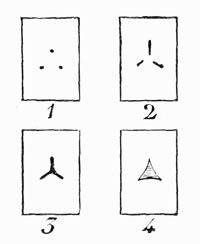
Fig. 4.—Different forms of the bite of a Leech.
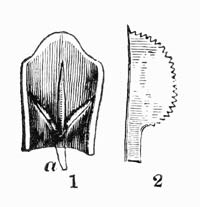
Fig. 5.—1. Sucker, open; a. jaws. 2. One of the
jaws magnified.
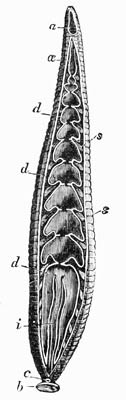
Fig. 6.—Section of a Leech. a. anterior sucker;
b. posterior sucker; c. anus; d. stomach;
æ. æsophagus; i. intestine; s. glands of the
skin.
Fig. 5 (1 and 2) represents the jaws; 1, the jaws in their usual
position; 2, a single jaw, to show its outer edge, which is cut with
teeth like a saw.
Fig. 6 shows a leech with a section of its digestive tube. The
letters d d indicate the different cavities of the stomach, which
are filled in succession. We see in the fore part, the anterior sucker
with the mouth, and behind, the posterior sucker with the anus. At the
side of the stomach are seen traces of the glands of the skin.
We find a great variety in the mode of life of these hirudinidæ; and
if we sometimes meet with some which are sober and delicate, the
greater part show a voracity of which it is difficult to form any
idea. A leech has been met with in Senegal which draws a quantity of
blood equal to the weight of its body. There are leeches which devour
entire earth-worms. Fortunately the greater species are not the most
voracious: we might feel rather uneasy in the midst of leeches similar
to that which Blainville has described under the name of Pontobdella
lævis, which is not less than a foot and a half in length.
It is generally thought that all leeches are aquatic, but this is a
mistake. In the warm regions of the Old and New World, there live in
the midst of the brushwood, leeches which attack the traveller as well
as his horse, and suck the blood of both without their perceiving it.
Hoffmeister gives the following account with reference to small
leeches in the island of Ceylon:—
He had amused himself one evening by collecting some phosphorescent
insects which were hovering around him in considerable numbers; on
entering afterwards a lighted room, he perceived streaks of blood all
down his legs. This was the effect of the bites of leeches. These
creatures, said he, made a painful impression on me, the remembrance
of which was terrible. This same leech, which bears the name of
Hirudo tagalla, or Ceylonica, lives in the thickets and
woods of the Philippine Islands. There also it attacks horses as well as men.
It has
also been noticed on the chain of the Himalayas, 11,000 feet
above the level of the sea. Japan and Chili also have terrestrial
leeches. The Cylicobdella lumbricoides is a blind leech, which
has been found by F. Müller in damp earth, in Brazil.
The aquatic leeches are better known, and with but few exceptions, the
accidents produced by them are little to be feared. In Algeria it is
not uncommon, as army surgeons tell us, to see soldiers, while
drinking spring water, swallow small leeches which may do them injury.
We find from official reports that the French soldiers often suffered,
during the campaigns in Egypt and Algeria, from an aquatic leech
(Hœmopis vorax), which attacked the mouth and the nostrils, and did
not respect man any more than horses, camels, and oxen. The leech
discovered by Dr. Guyon under the eyelids and in the nasal fossæ of
the crab-eating heron of Martinique, is probably a monostomum, and not
one of the hirudinidæ. Leeches have also been found on turtles under
the name of Eubranchella Branchiata. Say saw one on a chelonian, and
others on tritons and frogs.
It is especially upon fish that these worms are found, and we cannot
hesitate to consider the greater part of them as true parasites. We
have described a whole series of them which live upon marine fishes,
especially on the barbel, the bass or sea-wolf, the halibut, the dab,
and different species of gadidæ. A. E. Verril published last year the
description of several kinds of American leeches, among which we see
two which infest a fish (Fundulus pisculentus) of West River, near
Newhaven. A large and beautiful species, which is known by the name of
Pontobdella, is also found upon the Rays.
A very skilful naturalist, Mons. Vaillant, has lately made these
animals the subject of study. Mr. Baird, in 1869, made known four new
Pontobdellæ, one from the coast of Africa, two from the straits of
Magellan, and one from Australia, found in one of the Rhinobatidæ. But
the most interesting in every point of view are the Branchellions,
which inhabit the electrical fishes known under the name of torpedoes,
and which do not fear to choose an electric battery as a place of
abode. These branchellions always attach themselves, as it appears, to
the lower surface of the body, and not to the gills as has been
thought; and they are distinguished from all their congeners by tufts
of filaments along their sides, which have been compared to lymphatic
branchiæ.
Many naturalists have considered these curious worms worthy of
attention, and have made many interesting observations upon them. One
of the finest memoirs on this subject is that of Mons. A. de
Quatrefages. We may here mention, in connection with their mode of
life, that neither Leydig nor Quatrefages found globules of blood in
their digestive cavity. The branchellions live on the mucous products
of the secretions of the skin, and instead of being parasites, we may
consider them as worms paying liberally for the room which they occupy
in their host, by maintaining his skin in good condition. They ought
rather to be classed among animals which render service to others;
that is, among mutualists.
In the fresh waters of Europe, a little leech-like animal, beautiful
both in form and colour, fixes itself on carps, tenches, and other
Cyprinidæ; this is the Piscicola geometra, which also lives on the
Silurus glanis. They are sometimes found in such great numbers that
they form around the gills a kind of living moss, which at last kills
the fish.
There are different leeches which inhabit invertebrate animals. Rang
mentions a little creature of this kind in Senegal, living as a
parasite upon the respiratory apparatus of an anodont. Gay discovered
in Chili one of the Hirudinidæ in the pulmonary sac of an Auricula,
and another on the branchiæ of a crab (Branchiobdella Chilensis).
Mons. Blanchard has noticed a malacobdella in the branchiæ of the
Venus exoleta; and it was known in the last century that the Mya
truncata of our coast also lodges a malacobdella which lies always
under the foot of the animal. This is the hirudinean of which we have
spoken above, which is allied transitionally to the trematoda.
Together with the Hirudinidæ, we find very small worms, transparent,
bristling with daggers and spikes of every form, which are found
everywhere in fresh water. They are known by the name of Naïs.
They are so completely transparent that we can see the action of all
their organs through the substance of the skin. They have been the
subject of several remarkable works.
They live freely among the leaves of Lemna and other aquatic plants;
but there is one species much more restricted in their habitat than
the others; these seek assistance from the Lemneæ, and live at their
expense. It is because of this kind, of which the genus Chœtogaster
has been formed, that we mention them here. Their long bristles are
veritable halberds, which they employ with astonishing skill, both in
attack and defence.
Among free parasites are found many very important articulated
animals, which neither the naturalist nor the physician ought to
ignore. Some of these increase with frightful rapidity on the skin
which harbours them, and their name alone is sufficient to inspire
disgust, if not horror: others live like leeches at the expense of
different animals, but without inhabiting them. There are many of
these which follow their host everywhere, and which are dreaded not
without just reason.
Of this kind are gnats, fleas, lice, bugs, and a great many others,
among which we ought not to forget the acaridæ, nor those singular
parasites of bats, which bear no slight resemblance to spiders
swimming in the midst of the fur. Volumes might be written concerning
the organization and the habits of these parasites. These small
creatures inspire the naturalist with no more disgust than the
earth-worm of our flower-beds, or the salamanders of marshy places.
Each one plays its part according to its conformation, and the most
abject in appearance is not always the least useful.
We will select among these parasites some two-winged insects, among
which there are many which suck blood. Those which are generally
called flies are divided into two groups, under the name of Nemocera
and Brachycera; many of these live only on blood, and are more
terrible than the lion and the tiger; in many countries man can defend
himself against those fierce carnivora, but he is there completely
powerless and without defence against these insects.
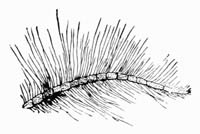
Fig. 7.—Antenna of a Gnat.
Among the Nemocera are found the gnats (Culex pipiens), those
brilliant children of the air, with fine and slender claws, and
delicate membranaceous wings, and wearing on their heads feathery
antennæ of rare elegance. They are known in the Old as well as in the
New World, and in southern regions it is necessary to guard against
their nightly attacks by musquito curtains. In the Antilles they bear
the name of Maringouins, and in hot countries they are generally
known as musquitoes. They are also called gnats, midges, black-flies,
zanzare, &c., in different localities, but as may be supposed, these
names do not always designate the same insect. The musquitoes of the
French colonies are often Simulia. At Madagascar and the Isle of
France is found the gnat known by the name of Bigaye.
In Davis’s Straits, in lat. 72° N., Dr. Bessels, on board the
Polaris, was obliged to interrupt his observations on account of
these insects. A great number of them have been seen up to the 81st
degree of latitude. Besides gnats, there were also found Chironomi,
Corethræ, and Trichoceræ. As Dr. Bessels was able to save from the
Polaris some small collections of insects, we shall soon know the
names of the species which live in these high latitudes. It is said
that the Esquimaux and the Lapps cover their skin with a coating of
grease, not only to lessen the effect of the cold, but to defend
themselves from the stings of gnats.
“The gnat is a plague from June till the first frosts,” says Mons.
Thoulet, speaking of his abode among the Chippeways. “It renders the
country almost uninhabitable; and one is so exhausted by this
suffering, which does not cease by night or by day, and by the loss of
blood through their bites, that we manage to get through
our daily
task only by the force of habit; we can neither speak nor think. When
the musquitoes disappear, the ‘black-flies’ come: the musquito pumps
up a drop of blood and flies away; the black-fly bites and makes a
wound which continues to bleed.”
De Saussure has alluded to curious relations which exist in Mexico
between a bird, a beast, and an insect. “Bulls bury themselves in the
mud,” says this learned traveller, “in order to avoid the attacks of
gnats, leaving in the air only the tip of their nostrils, on which a
beautiful bird, the Commander, posts himself, in this position the
Commander watches for the Maringouin which is bold enough to
enter the nostrils of the animal.”
Gnats are parasites in the same manner as leeches, since, like them,
they suck the blood, and live at the expense of others. There is,
however, this difference, that the females only are greedy of blood;
if this fail them, they live, like the males, on the juices of
flowers. Another difference is that they are completely harmless till
they have wings, and though they live long under their first form, in
damp earth or in water, the duration of their life as perfect insects
is of short duration.
We need not trouble ourselves about the active larvæ which swarm in
stagnant water, nor the chrysalids which float immovable in their
natural sepulchre. We give on the next page a representation of a
larva of the gnat. The females alone pierce the skin by means of an
auger with teeth at the end; they suck the blood, and before they fly
away, distil a liquid venom into the wound. This bite seems to have an
anæsthetic effect, which does not cause it to be felt till some time
after.
The little spot around the wound appears as if affected by
chloroform.
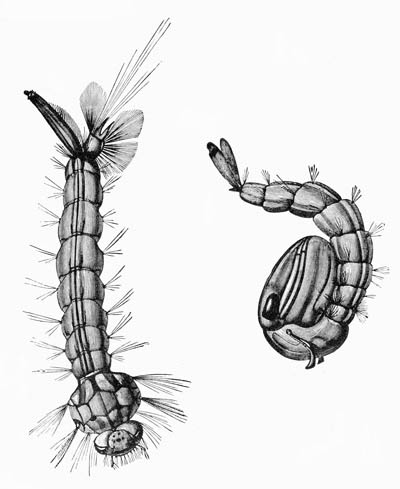
Fig. 8.—Gnat (culex pipiens) larva and nymph.
(Blanchard).
These parasites repay by an unkind action the assistance which they
have demanded from us.
Besides the gnats, which belong to the family of Culicidæ,
there are also the Ceratopogon, and especially the Simulium
molestum, known in North America under the name of Black-flies:
“the tormenting black-flies of this country,” as the Americans say.
Certain Nemocera, known by the name of Rhagio, put to flight both
man and animals.
They are very small; they get into the nostrils, and cause animals to
become blind by introducing themselves into their eyes. In addition to
these hurtful insects, we find others fatal to the life of animals,
and which are a real plague in certain countries.
The numerous travellers who have explored the interior of Africa, have
almost all spoken to us of a fly which attacks beasts of burden, and
kills them in a few hours; this is the Tsetse (Glossina morsitans).
More than one expedition has failed on account of this dipterous fly.
It was this which obliged Green to abandon his plan of reaching
Libebe, by causing him to lose one after another all his beasts of
burden and of draught. The horse, the ox, and the dog are more
especially attacked by this terrible fly between the 22nd and 28th
degree of longitude, and the 18th and 24th of south latitude. Happily
it does not produce any effect upon man.
There is another fly in Mexico which is dangerous to man; it is known
by the name of Musca hominivora, or more correctly, Lucilia
hominivora. Vercammer, a military surgeon of the Belgian army,
relates that a soldier in Mexico had his glottis destroyed, and the
sides and the roof of his mouth rendered ragged and torn, as if a
cutting punch had been driven into those organs. This soldier threw
up with his spittle more than two hundred larvæ of this fly. We give
below the figure of the larva and of the perfect insect. He had found
this man sick in Michoacan, at a height of 1,866 metres, between
Mexico and Morelia.
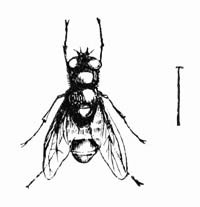
Fig. 9.—Lucilia hominivora.
Fig. 10.—Lucilia hominivora, larva.
My son-in-law, Dr. Vanlair, informs me that citric acid or the juice
of lemons is efficacious in destroying these insects. Injections of
this acid are thrown into the nasal fossæ.
At Brazil, in the province of Minas Geraes, they give the name of
Berne to a fly which attacks man and cattle from the month of
November until February. It deposits its eggs in the loins, the arms,
the legs, or even the scrotum, without the victims perceiving it, and
their presence is first shown by a redness, then by a sensation of
itching, and a swelling with the formation of pus.
Among those insects which suck the blood, is one which is known by
every one, the Breeze-fly, Tabanus bovinus. Happily it seldom
attacks any animals except oxen and cows. We give a representation of
the insect, the parts of the mouth, and one of the antennæ.
In the same order of diptera are found ordinary flies, among which may
be easily distinguished the three species which are here
represented, and which differ as much by their external characters as
by their mode of life.
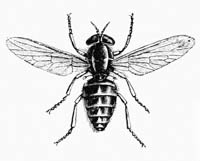
Fig. 11.—Ox-fly.
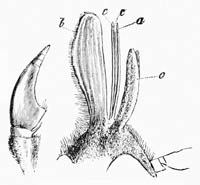
Fig. 12.—Antenna of Ox-fly.
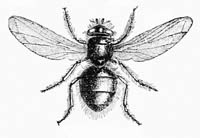
Fig. 13.—Blue Fly.
Another fly also attacks horses and cattle, and occasionally even man,
the Asilus crabroniformis, whose wounds sometimes draw blood.
Martins, the birds of the twilight, which fly in flocks above the
houses, describing circles and uttering shrill cries, are usually
infested by many vermin, among which we find a fly of considerable
size, which looks much like a spider, the Ornithomya hirundinis. It
moves about among the
feathers with astonishing facility, and it
is not always confined to the same bird; it quits its host to
establish itself upon another, and sometimes throws itself upon man to
suck his blood.
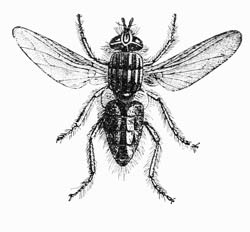
Fig. 14.—Flesh Fly.
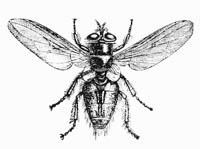
Fig. 15.—House Fly.
Some years ago these insects penetrated in the middle of the night
through the open windows into one of the apartments of the military
hospital at Louvain, and the next morning the skin of many of the
patients, and especially the bed-linen, were covered with stains of
blood. The physicians sent me some of these insects, not knowing
whence they had come, nor whether they had been the cause of this
annoyance. During the night, these Ornithomyæ had quitted their hosts
to attack the soldiers.
One of these insects, the banded Syrphus (Syrphus balteatus),
when in the larva state, seizes the rose aphides, and sucks their
blood with great eagerness.
But it is not precisely a case of parasitism, when the wounds of
soldiers are covered with larvæ, of which there were many sad
instances in the Crimean war. There are flies which deposit their eggs
in pus, as in
all kinds of animal matter in a state of decomposition.
It is even said that these insects, deceived by the smell of the Arum
flower, will lay their eggs on the pistil. The name of Myasis has
been given to the presence of these larvæ in a wound.
Every one knows that bats are often literally covered with vermin.
Among the many parasites which attack these little animals we find,
besides the acaridæ, a Pteroptus of great agility, which seems,
as it were, to swim among the fur, and looks like a little spider or a
microscopic crab. There are but few bats on which we do not find some
of these, and we have sometimes seen them in such abundance, that it
was impossible to touch a single hair without disturbing them. This
species is usually called Pteroptus vespertilionis. It is
constantly in motion, and glides among the fur like a mole in a sandy
soil.
Together with these Pteropti lives a parasite of gigantic size, which
insinuates itself among the fur with equal dexterity, and bears the
name of Nycteribia. This has long claws like a spider, and plunges
deeply into the fur. These Nycteribiæ are found only on bats. They are
often associated on these animals with fleas and mites. Mr. Westwood
has written a monograph upon them. Mons. Plateau, our colleague, has
quite recently described a new species in the “Bulletins de l’Académie
de Belgique.”
Among the insects justly dreaded by man, and which follow him
everywhere, is found one of the Hemiptera, known by every one under
the name of bed-bug (Cimex lectularia). It is said that this
insect was unknown in the capital of Great Britain before the fire of
London
in 1666. According to some entomologists, it was introduced
into Europe in some wood that came from America. It is only necessary
to make this slight reference to the Cimices; their congeners are, for
the most part, parasites of plants, and live on their sap.
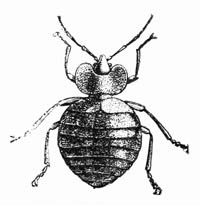
Fig. 16.—Bed-bug.
To the same order belongs the singular hemipterous insect of our
ponds, the boat-fly (Notonecta). It has some feet suited for
swimming, and others for running, and it swims on its back with great
rapidity. It is a dangerous neighbour for everything that has life.
Always greedy of blood, it attacks great as well as little animals,
and sucks the blood of its victim to the last drop, so that it must be
closely watched when placed in an aquarium.
Lice, concerning which we are about to add a few words, are also free
parasites, and belong to a different order of insects. Their mouth is
formed of a sucker contained in a sheath, without articulations; it is
armed at the point with retractile hooks, within which are four
bristles. They have climbing feet, terminated by pincers, with which
they seize the hair of the animals on which they live; their eggs are
known by the name of nits. We have represented in Figs. 17, 18,
and 19, the complete insect, the head, the sucker, and a claw more
highly magnified.
Lice are hatched at the end of five or six days, and reproduce at the
end of eighteen days. Leeuwenhoek calculated that two females might
become the grandmothers of 10,000 lice in eight weeks. They are all
parasites of the mammalia, and three species live at the expense of
man: the louse of the head, of which Swammerdam gave a detailed
description in his work entitled “Biblia Naturæ”; the body-louse,
which lives on the bodies of filthy people, forms a distinct species;
the third species is the louse which occasions the disease called
pedicularis, or Phthiriasis. These insects were formerly much
more common than they are at the present day. In 1825 Dr. Sichel
published a monograph concerning them; and there appeared in the
“Gazette Médicale” of 1871, a long article on the history of
Phthiriasis.
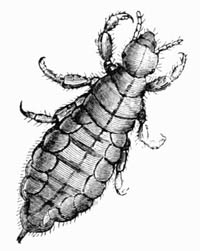
Fig. 17.—Louse of the Head.
It is stated that several great personages have fallen victims to its
attack, but these observations date from a period when it was thought
that they could be spontaneously originated. It is in fact difficult
to believe, as it has seriously been stated, that lice have been seen
to issue from the bodies of men like a spring of water from the earth.
A physician of the 16th century, named Amatus Lusitanus, speaks of a
great Portuguese nobleman who was so covered with lice that two of his
servants were constantly occupied in collecting them and carrying them
to the sea. Andrew Murray has published a memoir on the lice of the
various races of men.
The name of helminthiasis has been proposed for worm disease in
general, and either tæniaceous or lumbricoidian helminthiasis,
according to the species which made its appearance. These parasites
were considered to be formed spontaneously, and their presence
constituted a pathological condition, two errors which have now been
recognized, and by which the science of medicine has profited.
The Phthirius pubis is another species which has been found only on
white races, and attaches itself especially to the hair on the pubis.
Mons. Grimm has published in the bulletins of the Academy of St.
Petersburg, an interesting memoir on the embryogeny of this insect;
and, more recently, Mons. L. Landois, of Griefswald, has completely
studied its habits.
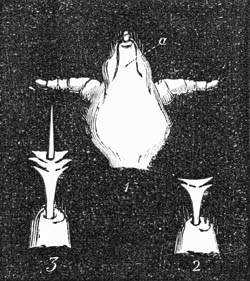
Fig. 18.—Louse of the Head;
2, 3, sucker.
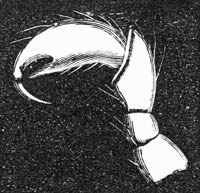
Fig. 19.—Louse of the Head, claw.
We are now about to refer to certain parasitical insects whose name is
usually associated with those which have preceded; they are well known
by all, and attack both men and the mammalia with no less ferocity; we
allude to fleas, which differ from gnats in this respect, that the
male is as eager for blood as the female, and that both of them, like
leeches, live by sucking it; besides, the larvæ of fleas live only on
what
the full-grown insects bring them, whereas the larvæ of gnats
get their own living; the mother flea sucks for herself first, and
then divides the spoil with her larvæ which as yet have no feet. For a
long time it was thought that the fleas of different animals belonged
only to a single species, and consequently that the flea of man was
not different from that of a cat or a dog.
Daniel Scholten, of Amsterdam, in 1815, showed by his microscopical
observations, that fleas differ from each other; and in 1832, Dugès of
Montpellier, investigated the distinctive marks of the various
species. The observations of Scholten may be found in “Les Materiaux
pour une faune de la Néerlande,” by R. T. Maitland.
The ordinary flea is called Pulex irritans, and especially attacks
man in Europe and in North America; it may be called a fly without
wings, and, together with its congeners, it forms a distinct family
under the name of Pulicidæ. Van Helmont treated of these insects,
and gave directions for making them, just as though he were describing
a recipe for pomade. At that time, naturalists supposed that certain
fish could be formed spontaneously, and that nothing but fermentation
was necessary in order to bring forth a crowd of living creatures from
this molecular disaggregation. Fleas may, perhaps, some day find a
place in the chemist’s shop as well as leeches. We see no reason why
homœopathic bleedings should not be resorted to, as well as
homœopathic medicines; we should certainly have more confidence in
the effects of the bites of fleas, than in the efficacy of remedies
subdivided into the millionth part of a grain.
Fleas differ much in size, according to the places which they inhabit.
Dugès, of Montpellier, gives us a curious instance of this. He devoted
himself to researches on the zoological characters of this genus,
studying the four species which are the best known, the Pulex
irritans of man, Pulex canis of the dog, Pulex
musculus of the mouse, and Pulex vespertilionis of the bat.
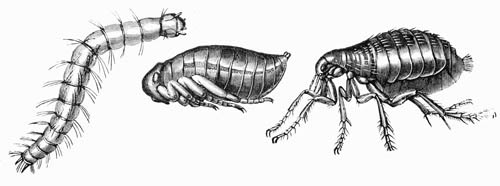
Fig. 20.—Human Flea (Pulex irritans), after
Blanchard.
Fleas of a brown colour, almost black, and of enormous size, are
commonly met with on the sandy shores of the Mediterranean, at least,
in the neighbourhood of Cette and Montpellier; they are more than half
as large as a common fly. These are human fleas, and their presence on
the sea-shore during the heats of summer is due solely to the great
number of bathers of both sexes and of all classes, which lay their
clothes down there. If at some future day these insects were to be
placed in the rank of surgical species, it would be necessary to
resort to those shores in order to procure them; and we might suppose
that, by judicious crossing, we might soon produce races that would be
of real service; as yet, however, the therapeutic art has had
recourse only to leeches. Since we have seen these insects harnessed
and performing their exercises in public, we cannot say that the
future may not reserve for us a still greater surprise.
None who saw them can have forgotten the exhibition of learned fleas
made by a young lady who had sufficient patience to train them.
Walckenaer saw them in Paris, and examined them with the eye of an
entomologist; he relates that thirty fleas performed their feats at
evening exhibitions, for admission to which the sum of sixty centimes
was paid; that these fleas stood on their hind legs, armed with a
pike, which was a very thin splinter of wood; some dragged a golden
chariot, others a cannon with its carriage, and all were attached by a
golden chain on the thighs of their hind legs.
It is curious to see how Leeuwenhoek described, two centuries ago, the
history of the flea, with all its details, the accuracy of which can
scarcely be surpassed. He observed their entire anatomy, as far as was
possible with the instruments of his time (1694), and his descriptions
are accompanied by excellent plates; he saw them copulate and lay
eggs, and followed their whole development.
The finest fleas, both as to their size and form, inhabit the bats.
Fleas are often found on horses. A colonel of cavalry, on his return
from the frontier in 1871, sent me some of these insects, with the
request that I would examine them. He added that the horses of his
regiment were literally eaten up by them. It was the Hematopinus
tenuirostris. There is a species peculiar to monkeys, which Mons.
Paul Gervais has described under the generic name of Pedicinus.
At the commencement of the last century, a certain physician
attributed the cause of almost all diseases to microscopical insects,
and gave figures of ninety species which were supposed to produce, in
some cases smallpox, in others rheumatism and gout, jaundice and
whitlows. Almost all these figures represent imaginary creatures. This
opinion has reappeared in modern times; how many persons have been
seen to smoke camphor in order to preserve themselves from the
invasion of animalcules. I do not speak of the apparatus which has
been contrived in order to breathe nothing but air which has been
filtered and deprived of its living germs.
There are some of the articulata with four pairs of feet, a kind of
microscopic spiders which require to be noticed here; these are the
numerous Acari which infest many animals. Some of these wander on the
surface of the skin, others in galleries under the epidermis, and many
pass from one animal to another without changing their form or mode of
life. There is a considerable number of them; no class of the animal
kingdom is free from them, neither aquatic nor terrestrial animals,
neither vertebrates nor invertebrates. These parasites belong for the
most part to the same family, and cause by their presence a disease
which was for a long time considered to be peculiar to the skin.
An English naturalist, Mr. George Johnson, carefully studied the
parasitical and free acaridæ of Berwickshire. Mons. Ehlers has written
a very interesting work, with fine illustrations, on the acaridæ of
birds, published in the “Archives of Troschel.” There is more than one
species which lives at the expense of man, and one of them produces
a disease known in every country and at all times under the name of
the itch; until 1830 its true nature was still unknown. It is not an
affection of the skin, as was thought, but merely the result of the
presence of these animalcules. The director of the special Hospital
for Skin Diseases at Paris was so fully convinced that the acaridæ are
not the cause of the itch, that he offered a prize to any one who
could render these insects visible. A student of medicine, a Corsican
by birth, had happened to see these itch-insects sought for in his own
country, and was the first to prove, in 1834, the real cause of the
disease. A resident student had given, in a thesis which he sustained
at Paris before the faculty of medicine, a drawing of a cheese-mite
instead of the itch-insect, and this error had caused it to be
supposed that the species peculiar to this disease did not exist. We
give in Figures 21, 22, 23, representations of the male and female
insect, greatly magnified.[2]
Of course, all the treatment necessary
for the cure consists in getting rid of the animalcules and their
eggs, and in cleansing the skin and the clothes of the patient.
Petroleum oil has been judiciously prescribed in order to destroy the
mite, but the remedy which seems the most efficacious is Balsam of
Peru.
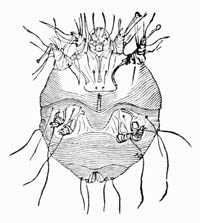
Fig. 21.—Sarcoptes scabiei, or male acarus of the
itch; the lower surface.
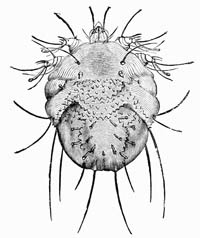
Fig. 22.—Sarcoptes scabiei, female; the upper
surface.
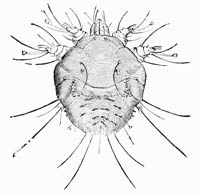
Fig. 23.—Sarcoptes scabiei, male; the dorsal surface.
Most mammals have their peculiar species of acari, and the horse has
two which give rise to different skin affections. Since the presence
of these animals constitutes the disorder, it may be easily caught;
man may communicate it to domestic animals, and they may give it to
him. The itch-insect of man bears the name of Sarcoptes scabiei, and
no other species than those of Sarcoptes can be transferred from
animals to man. These animalcules have at different times been
diligently studied by many naturalists, and Dr. Füestenberg has lately
published a folio volume, under the title of “Die Krätzmilben der
Menschen und Thiere,” with large lithographic plates, and
illustrations in the text. It is possible that the pustular disease
which prevails at Sierra Leone is originated by some peculiar acarus.
Another acarus parasitical on man, the Persian Argas, is fortunately
unknown in Europe. It is said to be common at Miona, and prefers to
attack strangers. Its stings produce acute pain, and travellers assure
us that they may be the cause of death. This acarus remains but a
short time on the person, and generally makes its appearance during
the night. It is called also the Miona bug. Fischer of Waldheim has
published a very interesting memoir on this parasite. Justin Goudot
has also observed another Argas (A. Chinche) which torments man in
the temperate regions of Columbia.
These Arachnida, for they are articulata with four pairs of legs,
often make their appearance where we should not expect to find a
living organism, and naturalists, under these circumstances, have,
with the best faith possible, supposed that they had seen these mites
produced spontaneously without parents. We have seen a
remarkable
instance of this in the Acarus marginatus of Hermann. On the 18th
Thermidor, an 2, they were making a post mortem examination at
Strasburg of a man who had died of fracture of the skull, and when
opening the dura mater, they saw on the corpus callosum, a mite
running about which became the type of the species. The appearance of
this acarus under such conditions made, as may be supposed, much noise
at the time, but we should not be surprised if it had been introduced
during the operation by a fly seeking to lay its eggs.
In this group is found another interesting acarus, which is developed
in man in the sebaceous crypts of the nostrils. The name of Simonea
has been given to it, from Dr. Simon of Berlin, who made it his
especial study. This genus leads us by its form to the Linguatulæ,
the structure of which has been so long doubtful. The Simonea
folliculorum belongs to the family of the Demodicidæ.
The dog harbours a demodex (D. Caninus) which causes it to lose its
hair. Some years ago, the sheep in Belgium were attacked by one of the
acaridæ, the Ixodes reduvius, which had been introduced from a
neighbouring country, and had multiplied with frightful rapidity.
Packard has given an account of an Ixodes bovis on the Erethizon
epixanthus, and on the Lepus Bairdii, and an Argas Americana on
cattle coming from Texas; this was published in the sixth report of
the United States’ Geological survey (1873).
According to the observations of Mons. Megnin, the Tyroglyphi, the
Hypopi, the Homopi, and the Trichodactyli, are transitory forms
which ought not to be preserved as generic divisions among the acaridæ.
We have found
on the small bat (Pipistrella) an acaride (Caris
elliptica) and a new Ixodes which we have described in a special
memoir on the parasites of the Cheiroptera. Mr. Lucas caught an
ixodes on a dog, and kept it alive long enough distinctly to see it
lay eggs which proceeded from an oviduct. These eggs formed masses
attached to the abdomen of the mother.
An acarus (Dermanyssus avium) is found on birds, and multiplies with
such rapidity that it completely exhausts those on which it has
established itself. It has been seen accidentally on man. An instance
is recorded of a woman who could not get rid of these parasites,
because she passed every day through her henhouse in order to get to
her cellar, and the frightened fowls threw down upon her a perfect
shower of acaridæ. Not long ago mention was made at the Academy of
Medicine at Paris, of a sarcoptes (S. mutans), which produces a
disease among fowls, especially on the cock and hen, and which passes
from these to the horse and other domestic animals. This sarcoptes
prefers to live under the epidermis of the feet. Reptiles are not free
from its attacks, for it is often seen on lizards and serpents. We
have found a very curious one on the skin of a gecko from the south of
France.
Many insects are always covered with certain species of acaridæ. Every
entomologist knows that the body of the “watchman” beetle always has
some of these, like little living pearls, which wander especially on
the under side of the abdomen. It is the same with a small
coleopterous insect that is found abundantly wherever there is any
decomposing matter. Léon Dufour gave himself up to the study of some
of the parasites of insects, and
mentions, among others, a species
belonging to the muscidæ, the Limosina lugubris, which does not
measure a line in length, and which harbours as many as fifteen
pteropti under its abdomen.
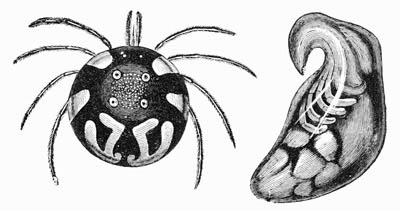
Fig. 24.—Hydrachna geographica.
Bees, which give us their wax and their honey in exchange for the
shelter which we afford them, have a mortal enemy, an acarus, which
attaches itself to them, not in order to gain any advantage from them,
but to cause their death. It is not so much a parasite as an assassin,
and we may be excused from describing it. We have found acaridæ on
certain polyps, the Campanulariæ and Sertulariæ of our coasts, and
some years ago we described one which is very curious, and inhabits
the southern whale, in the midst of its Cyami and Tubicinellæ. The
anodonts of our ponds, as well as the Uniones usually have the skin
of their feet and that of their mantle encrusted with acari of every
age, to which the name of Atax ypsilophora has been given. The
species which live on the anodonts are not the same as those which
inhabit the Uniones; and Mons. E. Bessels, who has so fortunately
returned from his voyage to the
North Pole, on board the Polaris,
has seen the species of the anodonts crossed with those of the Uniones.
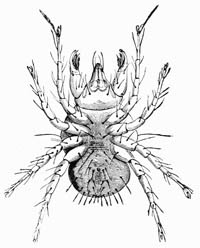
Fig. 25.—Cheyletus eruditus.
There are also Arachnida which are parasitical only while young, as
the Trombidions and certain Hydrachnæ (Fig. 24) which frequent
aquatic animals. The Leptus autumnalis, known in France, at least in
some localities, by the name of Rouget, is an acarian which throws
itself upon man, and especially attaches itself to the roots of the
hair: fortunately, it is only found in the country districts. The
Acarus (Cheyletus) eruditus
(Fig. 25) lives in books and
collections, as well as on fruits and all kinds of bodies more or less
damp, left in dark places; it has been studied by Van Der Hoeven.
Mons. Leroy de Méricourt found in pus, which was running from the ear
of a sailor, acaridæ which Mons. Robin refers to the genus
Cheyletus, rather than to that of the Acaropses.
We have brought together in the former chapter the animals which live
at the expense of their neighbours, without seeking for anything
except shelter. They seize their prey as they pass, are nourished by
the blood of their neighbours, but never think of establishing
themselves in their organs during any period of their life. They are
almost as much carnivora as parasites, and only differ from the former
class because they spare the life of their victims. They are unlike
ordinary parasites, since they are contented with their food alone;
and their appearance from the period of their entrance into the world
is that of free animals. Those whose history we are now about to
sketch, live in freedom like the preceding during all the time that
they are young; like them, they are completely independent during the
first period of their life; but when they have arrived at mature age,
when the endless cares entailed by their young ones come upon them,
they change their costume and accommodate themselves as well as they
can to the new lodging which they have chosen. There is often not the
least resemblance between these creatures in their youth and their
adult state. All these parasites have lived a joyous life before
choosing the host which is to serve them as a cell; but though in many
species we see both sexes shut themselves up as in a cloister, some
species are to be found in which the female alone seeks for extraneous
aid; which is not surprising, since she alone undertakes all the
charge of the family, and this would be beyond her strength, and would
endanger the life of her offspring, if she did not receive help and
protection.
The host resembles in some respects a lying-in hospital, especially
when the female alone seeks for herself a resting-place and her food,
which is not always the case. We find, in fact, in a considerable
number of Lernæans, that the microscopic male passes unperceived upon
his female, and when he renounces his bachelor life, she feeds him
with her own blood. There cannot be a more faithful husband, since he
only plays the part of a spermatophore. We find a still more curious
example in this respect, and in which the dignity of the male is not
less compromised; we refer to the Bonelliæ which live freely in the
sand, and whose males establish themselves parasitically on the sexual
organs of the female. She herself lives by her own industry, nourishes
her husband, and alone provides for all the requirements of maternity.
In a later part of this work, we shall mention worms which live in
freedom in damp earth, and whose direct progeny, entirely composed of
females and hermaphrodites, can only exist as parasites. These worms
do not resemble their mother but their grandmother, and if their
descent had not been traced, they would doubtless have been taken for
species entirely distinct from each other. Thus it is not always the
whole family which is modified; the male often preserves all the
attributes of his sex and of his youth, while the female changes
entirely her appearance and her mode of motion, especially at the
approach of the period when the interest of the species prevails over
that of the individual.
We can nowhere find more graceful and regular forms during the whole
of their early youth than those of many of these parasites; we can
never see more ungraceful, we might almost say more comical, attitudes
than those of the greater part of these creatures when full grown. One
might take them for some misshapen excrescence, or some scrap of
wasted flesh on the body of their host. A certain number of insects
are found which lead this singular kind of life, but this is more
especially the case among the crustaceans, particularly the copepod
crustaceans. Among all these we find the most absurd recurrent forms;
in fact these animals instead of carrying on their evolution, like the
caterpillar which becomes a butterfly, retrograde rather than advance,
and acquire an appearance and character which prevent us from
recognizing their origin. Many of these are at present known, whose
graceful form is so completely changed, that without referring to the
study of their embryo state, one could not tell to what class they
belong. Nothing remains of their organs except the sexual apparatus
and a shapeless skin. These curious parasites live also on the surface
of bodies, and sometimes in the cavity of the mouth; but in fishes
they are most frequently found in the branchial membranes. They look
like natural setons, and it is not impossible that they sometimes
fulfil the same functions.
We will first examine some insects, then certain
isopode crustaceans,
an order to which the Cloportidæ (wood-lice) belong, many of which
require uninterrupted assistance; then we will turn to the Lernæans,
which surpass all the rest in their many and bizarre transformations.
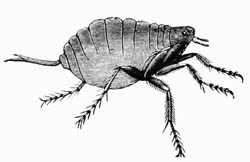
Fig. 26.—Male Chigoe.
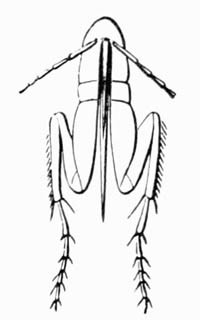
Fig. 27.—Head of Chigoe.
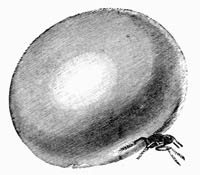
Fig. 28.—Female Chigoe.
We have first to speak of the Chigoe, an insect, the female of which
alone demands lodging and provisions, the male being contented, like
those of the preceding chapter, with pillaging his victim as he passes
by. This parasite of man inhabits South America, and has received the
name of Pulex penetrans, or, according to the latest nomenclature,
of Rhyncoprion penetrans. It is a very small species, which pierces
the shoes and the clothes with its pointed beak (Fig. 27), and
penetrates into the substance of the skin; the male (Fig. 26) is
contented with sucking the blood, and then resumes its wanderings,
like the parasites of which we have spoken in the preceding chapter;
while the female finds for herself a hiding-place,
and becomes of such
a monstrous size that the entire insect is nothing more than an
appendage of the abdomen, as may be seen in the annexed figure. This
insect is well known, since it attacks man, and usually establishes
itself on his toes, but it occasionally fixes itself in the same
manner on the dog, the cat, the pig, the horse, and the goat. It has
also been seen upon the mule. Mons. Guyon has paid much attention to
it, but we owe the last observations to Mons. Bonnet, a French navy
surgeon, who passed three years in Guiana, and has ascertained that
the chigoe fortunately does not extend beyond the 29th degree of south
latitude. Another parasite, well known by sportsmen, is the tick. It
is not an insect like the flea, but an arachnid, a kind of acarus,
which passes through its last stages of development under the skin of
a mammal. It is called Ixodes ricinus, and Professor Pachenstecher
has carefully studied its organization. The ticks especially attack
dogs, but are also found on the roebuck, the sheep, the hedgehog, and
even on bats.
Some years ago it was propagated in an extraordinary manner on
roebucks in the woods of the Duke of Arenburg, in the environs of
Louvain. They are sometimes found also on man. We know of two
instances: the first is that of a lady at Antwerp, who had a small
tumour on her shoulder, which was removed, and enclosed a living tick.
Leeuwenhoek gives an instance of a woman of the lower classes who had
a tick in the middle of her stomach. Moquin-Tandon relates that
Raspail found some on the head of a little girl four or five years
old. He also gives an instance of a young man who, returning from
hunting, found a tick under his arm; and while on the site of a
sheep market, a servant found one morning three attached to the skin
of his breast. Delegorgue speaks of some very small reddish ticks in
Africa, which cover the clothes by thousands, and produce distressing
itching. Others are found in different parts of the globe, and
twenty-four species have been described. Several new American Ixodes
have been noticed lately by Mr. Packard on the stag, the monax marmot,
the Lepus palustris, &c. These arachnida live at first in freedom in
the bushes, but after fecundation the female attacks the first mammal
which she finds in her way, and establishes herself upon it; dogs
become infested with it by running in and out among the brushwood.
The Argas reflexus lives on pigeons, and is allied to the Ixodes.
R. Buchholz has lately studied many new acaridæ found on different
birds.
If the forms are not so varied among the isopods as elsewhere, many
among them present nevertheless the most extraordinary appearance, the
most unexpected contour. Most of the parasitic isopods instal
themselves in the thoracic cavity under the carapace of a neighbour,
and make themselves contented in the small space which remains to
them. After having disposed of their luggage, they arrange themselves
scrupulously according to the extent of the lodging which they occupy,
and, rather than interfere with the branchiæ, they raise up the walls
of the cephalothorax, thus forming a sort of tumour which betrays the
presence of the intruder. Others are found which are not contented
with a natural cavity; they raise the scale of the skin of a fish,
perforate or hollow out the true skin, or even pierce through the
walls of the abdomen, in order to establish themselves in the
intestines, still keeping up a communication with the exterior. A very
common species of this class is called Bopyrus. We often see
beautiful prawns, which are usually remarkable for their fine rose
colour, exposed for sale in shop windows. If we examine them at
certain seasons, especially in France, we perceive that the carapace
at the side is raised; and if we take it off with some precaution, we
discover underneath an irregular flattened body, which fishermen take
for a young sole on account of its shape. This is the female bopyrus.
The many appendages of the thorax, the division into rings, the
symmetry of the body, all have disappeared, and the claws, the traces
of which are scarcely seen, are no longer similar on the right and
left sides. The male remains small and independent, and preserves the
livery of the order to which he belongs. On the coast of Labrador, a
bopyrus behaves in the same manner towards a Mysis. We have found
under the carapace of a pagurus a female bopyrus full of eggs, so much
flattened that it might have been taken for a leaf accidentally
introduced into this cavity.
Fritz Müller has divided the Bopyridæ in the following manner:—
1. Those which fix themselves on the appendages or in the branchial
cavity of decapods; these are the Bopyri, Iones, Phryxi, Gyges,
Athelgi, &c.
2. Those which live in the thoracic cavity of some Brachyuri, as the
Entoniscus.
3. Those which live in the cirrhipeds, like the Cryptoniscus,
as well as the Liriopes.
4. Those which live on copepods as true parasites, as the
Microniscus (M. Fuscus).
The Iones thoracicus, the Cepes distortus, the Gyges
branchialis, and so many others live, like the Bopyri, in the
thoracic cavity of different decapod crustaceans, and the females
throw off at the same time their organs of sense and all their fishing
and travelling apparatus.
Rathke, a learned professor of Königsberg, was the first to notice an
isopod, known under the name of Phryxus paguri, which lives on the
stomach of a pagurus, attached to it by its back, so that the stomach
of the parasite is turned, like that of the pagurus, towards the
partitions of the shell. The tail with the branchial appendages is
always directed towards the orifice of the shell. The male is very
small and never leaves the female. The Athelca cladophora is another
bopyrian living on the abdominal region of a pagurus, which always
chooses shells infested by Alcyonia. Another bopyrian, the Prosthetes
cannelatus, lives on the abdomen of an ordinary pagurus.
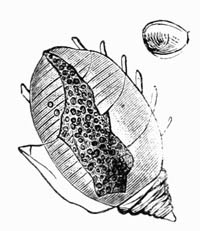
Fig. 29.—Phryxus Rathkei. A figure of the natural size
is given at the side.
Mons. Bucholz has recently described a new kind of isopod, allied to
the lyriopes, which lives on the Hemioniscus. This isopod fixes
itself to a Balanus (B. ovularis), and the female preserves only
four of her segments with their appendages: she had fifteen, when
young. Thus she throws off nearly all her appendages which have become
useless. The male of this isopod, which inhabits the bay of
Christiansand, is not yet known. Another parasite of this group has
been observed by Fr. Müller at Desterro, on the coast of Brazil. It
bears the name of Entoniscus porcellanæ. The parasite which
he discovered by the side of it on the same animal, and to which he
has given the name of Lerneoniscus, had perhaps introduced it. We
have seen examples of this kind among insects. Among the rich
materials which Professor Semper brought back from his voyage, there
was a Porcellana, which harbours on its exterior surface a very
remarkable isopod, whose recurrent development is no less decided than
that of the peltogasters. Dr. Kausmann has lately described these
curious organisms, to which he has given the name of Zeuxo. Another
isopod, with a no less decided recurrent development, has received
from the same naturalist the name of Cahira Lerneodiscoïdes.
We now come to an isopod which aims higher: he doubtless considers
that cray-fish and crabs walk too slowly for him; he therefore
addresses himself to a fish, the Puntius maculatus, which inhabits
the river Tykerang (Bandong) in Java. This isopod is called
Ichthyoxenus Jellinghausii. This isopod crustacean, living at first
in the same manner as the rest, looks out for a small cyprinoid fish,
thrusts itself like a trocar behind the abdominal fins, through the
scaly skin, and penetrates entirely into the abdominal cavity. The
male always accompanies its female. It is remarkable that she, in
contradistinction to many others, preserves all the attributes of her
sex. She does not change her form more than the other free crustaceans
of her order, and only differs from the male in size. It is well known
that in all these animals the male is always smaller than the female.
Mons. Jellinghaus, who first described this crustacean, observed that
all fishes which he caught had,
without exception, the small ones
as well as those which were larger, a couple of these parasites in
their stomach. We allude to it here, but we might as well call this
Ichthyoxenus a messmate as a parasite.
On the coast of Brittany, among the many Labri, which are
distinguished for their vivacity, and for the variety of their
colours, is found a small species (Labrus Cornubiensis), on which is
usually seen an isopod which is no less curious. It is constantly
clinging to the sides of this fish, not far from the head, at the
bottom of a hollow made under the scales. Naturalists have known this
acolyte by Mons. Hesse’s works.
This Leposphilus (for this is the name which has been given to it),
though it does not prefer the scales to any other organ, forms a
lodging for itself in the sides of this little Labrus, and takes up
its abode there with its family. We cannot assert that it has chosen
this refuge without any hope of returning, since both the sexes still
keep their organs of locomotion.
At the last congress of German naturalists at Wiesbaden, Dr. Kossmann,
who has had the opportunity of examining the rich materials brought
from the Philippine Isles by Professor Semper, gave an excellent
account of the result of his careful observations on some other
crustaceans still more remarkable, the Peltogasters of which we
have spoken before. In the course of this, he described an isopod with
a development as completely recurrent as that of the peltogasters,
whose rank among cirrhipeds is perfectly established.
Most of the inferior crustaceans require assistance from others: some
might be correctly arranged as messmates, but the whole category of
the Lerneans is so low in development that Cuvier placed them by
the side of the helminths. These creatures possess as soon as they are
born, all the attributes of their class, and wear the dress of free
crustaceans; as they approach mature age, they choose a neighbour,
instal themselves as conveniently as possible in one of his organs,
and get rid of all their apparatus for fishing and hunting. The sexes
are usually separated, and as the female is specially devoted to the
cares of her progeny, she is the first to give up her liberty.
Sometimes the male, not content with leaving to her all the trouble of
providing for the family, demands from her his daily food, and
establishes himself like a spermatophore on her sexual organs. It is
only right to say that in this case, the male sex is far from being
the stronger, for he is often less than the tenth or even the
hundredth part of the size of the female. At last we see the female
lose her claws and her swimming apparatus, while the male keeps his
carapace with all his appendages of the senses and of locomotion. The
difference between the two sexes is so great in some species, that it
would be impossible to imagine that a brother and sister could assume
such dissimilar forms, unless we had watched them from the time when
they first issued from the egg. The female is a kind of puffed-out
worm, and the male resembles an atrophied acarus. This explains why
the female was known so long before the male, whose office is only
that of reproduction. Nordmann, during his residence at Odessa, was
the first to begin these researches, which have been continued by
Messrs. Metzger and Claus.
It is known that the Lerneans attach themselves to their hosts by
indissoluble bonds, only becoming parasites after they have passed
their youth in complete independence, and have all possessed the
graceful forms so characteristic of the Nauplius and the Zoë. When
they first leave the egg, they swim about in freedom, but at length
some day the female, thinking of a family, looks out for a neighbour
that can give her the assistance she requires, fixes herself on his
skin, and rapidly develops till she is two or three hundred times as
large as the male; her head, her body, and her stomach become of a
monstrous size, a part of her head is often anchylosed in the bones of
her host; the lernean remains suspended as a sort of festoon, to which
are afterwards joined two ovisacs filled with eggs. Fig. 30 is a
lernean of a fresh-water fish, represented at different periods of its
existence.
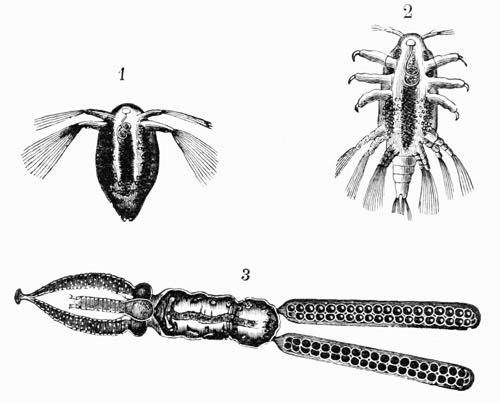
Fig. 30.—Tracheliastes of the Cyprinæ. 1, larva, as it
leaves the egg; 2, larva, more advanced; 3, adult female, attaching
itself before and behind to two ovisacs (Nordmann).
The lerneans are the most remarkable of all parasites with respect to
their physical degradation. They are met with on all aquatic animals,
commencing with the cetacea, and extending to the echinodermata and
polyps; but it is especially on fishes that they are most abundant.
They live on the skin or the gills, and sometimes establish themselves
in the nostrils and on the eye-ball. They often hang on the outside,
but we find some which hide themselves in the substance of the skin,
and have no communication with the exterior except by a narrow
orifice.
Some elegant lerneans, which resemble a living pen, are called
Penellæ; their head is divided into several branches, which
plunge like roots into the tissues and even into the bones, so that
the head and all the body remain suspended, as well as the ovisac
tubes, to a long and but slightly flexible neck. They live on the body
and the eye of certain fishes; some of great size are found in the
Indian sea, but the most remarkable are those which have been observed
on the skin of some of the cetacea.
The Penella crassicornis lives on a hyperoodon; the Penella
balænoptera on a Balænoptera musculus among the Loffoden Isles; the
Lerneoniscus nodicornis on a dolphin; the great shark of the coasts
of Ireland (Scimnus glacialis) generally has a lernean on its eye.
My son brought from Rio de Janeiro some Scomberidæ, whose skin is
covered with penellæ; and the charming fishes so abundant on the
Belgian coasts, which are called Sprot by the fishermen of the
country, often have round their eyes strings which might be taken for
marine plants, and which are in reality only penellæ. We have found
sometimes many individuals on the same fish, stretching
from the head
to the caudal region by means of their oviferous tubes, which in
certain seasons acquire a pale green tint.
The true Lerneans, such as the Lernea branchialis, a species that
was the earliest known upon the different Gadidæ, and which we have
observed on the Callionyme lyra, greatly resemble the Penellæ, but
their body and their head are much twisted, and with the coils of
tubes which contain the eggs, you might take them for a ball of
thread. (Fig. 31.)
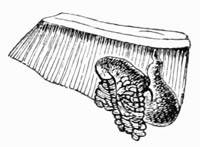
Fig. 31.—Lernea branchialis, attached to the gills of
Morrhua luscus.
The Sphyriones called Leistera have also a most singular form, and a
new species has been recently observed on a fish from the Straits of
Magellan. The Conchoderma gracile lives on the branchiæ of the Maïa
squinado, the sea-spider of the Adriatic, and Mons. W. Salensky of
Charkow, found a copepod crustacean, the Sphæronella Leuckarti, in
the egg-pouch of an Amphitoë. The latter parasite has very peculiar
characters of conformation and embryonic evolution.
Among the molluscs, the Tunicates give lodging to the greater number
of lerneans; in the cavity which is before the mouth, and by which the
food passes, some are found which can scarcely be recognized, and
which remain there to smell out a feast. The Aplidium of the coasts
of Belgium gives lodging to some which are very curious, and which we
have named Enterocola fulgens, on account of their colours. The
Notopterophorus establishes itself on the body of the Phallusia
mamillaris, and a certain number of these parasites are found on the
annelids. Professor Sars of Christiania, and Claparède
have carefully
described them; and the latter saw on the Spirographis Spallanzani
of the bay of Naples, a female which he called Sabelliphilus Sarsii.
The genera Selius, Silenium, Terebellicola, Chonephilus,
Sabellacheres, Nereicola, &c. infest all the annelids; the
Eurysilenium truncatum lives on the Polinoë impar, the
Melinnacheres ergasiloïdes on the Melinna cristata.
The echinodermata and the polyps are not free from lerneans; thus the
Asterochœres Lilljeborgii fixes itself on the Echinaster
sanguinolentus, and we have found a very beautiful species in
Brittany on an Ophiurus; the Loemippa rubra, allied to the
Chondracanthi, lives upon the Pennatula rubra, the Laura
Girardiæ, according to Mons. Lacaze Duthiers, feeds on an Antipathes.
A Lœmippus (Proteus) lodges in the cavity of the body of the
Lobularia digitata of Delle Chiaie; and lastly, the Enalcyonium
rubicundum is sheltered by the Alcyonium digitatum.
There are certain worms which are free when young, and only become
parasites at a later period of their evolution. We will give a few
examples.
The Medina, or Guinea worm (Filaria Medinensis, dracunculus)
(Fig. 32), is the terror of travellers who visit the coast of Guinea;
it is common, not only on the western coast of Africa, but also in
many other parts of this vast continent, and has been recently found
in Turkistan and South Carolina (Mitchell). It was formerly thought
that this Filaria could introduce itself directly through the skin as
a microscopic embryo; but Mons. Fedschenko, after some observations
made on the spot, and corroborated experimentally afterwards by
Leuckart, is of opinion that this worm is transmitted by means of the
Cyclops, a little fresh-water crustacean. Thus the parasite is
received by means of the water which is drunk; and this remark is the
more important since it will henceforth be only necessary to make
use of carefully filtered water in order to guard against it. At the
end of six weeks, the presence of the animal is revealed by tumours,
the true nature of which is not ascertained at first; then some wounds
appear, caused not directly by the worm, but indirectly in consequence
of the dissemination of its eggs. The Filaria at last is so entirely
atrophied that Professor Jacobson, after having seen it alive on one
of his patients at Copenhagen, wrote to Blainville: “This Medina worm
is not really a worm, it is a sheath full of eggs.” In fact, all the
internal organs disappear and nothing exists there except the eggs and
their embryos.
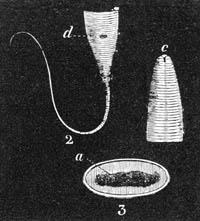
Fig. 32.—Young Filaria of Medina; 1, Anterior
extremity; c. Mouth; 2, Caudal extremity; d. Anus; 3,
Section of the Body.
The Filaria is not allied to the Mermis, as was formerly thought;
its organization is different, and its organs become atrophied in a
very different manner. The Gordius ornatus, brought from the
Philippines by Professor Semper, has given us an opportunity, by
different anatomical observations, to correct many errors, especially
with respect to the digestive apparatus (Grenacher). The Filaria
immitis is a species found by
Mons. Krabbe in a dog which died of
a disease to which these animals are subject; it lived in the heart,
and twelve individuals, ten females and two males, were found to be
lodged there. Mons. Bap. Molin has published a monograph on the
Filariæ, giving the characters of 152 species met with in molluscs,
fishes, amphibians, reptiles, birds, and mammals: it seems evident
that many species have been confounded under the same name.
A small worm, of the size of a slender pin, but much shorter, lives in
a manner somewhat analogous to that which we have before described. It
is known under the name of Leptodera. In order to find it, we have
only to search in the woods for the first snail that we meet with,
which is distinguished by its orange or black colour: if we prick with
a pin the fleshy foot of the mollusc, we shall see torrents of round
worms come out, wriggling like microscopic serpents. These worms also
leave their retreat, if we cause the foot to contract by touching it
with some acid, or if we place the snail in water. The Leptoderæ are
especially remarkable for two fringes which float by the side of their
tail, which characteristic suggested the name given to them by
Professor Schneider. These fringes so easily fall off, that the
greater part of those which have become free have none of these
appendages. When placed in fresh or decaying animal matter, in water
or in damp earth, these worms, agamous when in the foot of the
mollusc, rapidly become sexual and perfect. Thus the snail serves them
as a crèche, and the adult worm has no need of external help
when it has grown old.
Professor Pagenstecher found at Ostend, on the Nicothoë of the
lobster, nematodes which he arranged among the Leptoderæ. This is
another instance of a parasite on a parasite.
While speaking of these worms, I will allude to a nematode which I
observed under very singular circumstances. I had a considerable
number of skeletons or, I should rather say, separate bones, exposed
to the sun upon a roof to whiten; among these skeletons there were
several hyperoodons and other cetacea. All these bones had remained
for a certain time in horse-dung in order to hasten the decomposition
of the soft parts. They had been in the open air for several weeks,
and were slowly bleaching; it had rained nearly every day. Towards the
end of the month of August, I examined some of the vertebræ, and found
them quite black on the upper part. Below, I discovered a mass of
syrupy matter, slightly yellow, like pus that has recently issued from
a wound. The sun was shining full upon the bones at this time; looking
at them more closely, I saw this pus issuing from the holes which
convey nourishment to the substance of the vertebræ; it seemed that
the inside of the bones was in full fermentation. Examining it with
some attention, I perceived that the whole surface was in motion; an
undulatory wriggling covered it as if a ciliated skin had been
stretched above the orifices. I took a little of this matter on the
point of a scalpel, and observed it with the microscope, and what was
my astonishment when I saw the whole mass in motion as if under the
influence of a magic wand. When I slightly compressed it afterwards
between two slips of glass, there remained nothing before my eyes but
nematode worms of very small size wriggling over each other: I found
males by the side of their females;
in the bodies of the latter
were eggs ready to be laid, and millions of embryos of every age
rolling over and struggling among the full-grown worms. Is this a
species of worm new to science? Is it a worm which lives in freedom
here, and parasitically elsewhere? The first female which presents
itself allows us to answer this question. It is not a parasitical
worm, at least under this form, because each female contains only one
or two eggs. Parasites have so few chances of arriving at their
destination, that two young ones would not be sufficient. They must
have hundreds or thousands, and then the chances are against them.
This worm is evidently a Rhabditis, but is it that which lives
in the earth, or an allied species? Future observations will perhaps
enable us soon to reply to these questions. We do not think that these
creatures could have been brought with the bones from the Shetland
Isles; they came rather from the horse-dung, and they multiplied
beyond measure in the spongy tissue of the bones, where they found
good cheer and a convenient lodging. A worm very nearly allied to this
exists in abundance in the dung of the cow, to which our regretted
colleague, the Abbé E. Coemans, had directed my attention, at the time
when he was studying the Pilobolus cristallinus.
That which decided us to make mention of the nematode of the bones, is
the singular history of an ascaris of the frog, whose young ones
resemble their parents neither in size, form, or manner of life. There
is one generation which can provide for themselves, and is composed of
males and females; and another which requires assistance, and only
consists of females; unless, indeed, those of the male sex are hidden
among the
eggs; we refer to the Ascaris nigro-venosa, the principal
characters of which have been made known by Professor Leuckart. This
Ascaris is a true parasite, which, when it arrives at its destination,
where it finds lodging and food, leaves the lungs to go and inhabit
another organ. There is nothing surprising that certain worms pass
from the intestines to the stomach, mount thence to the œsophagus,
and sometimes come out of the mouth; but here we have decided changes
of abode in the same animal; that which shows, besides, that it is not
a simple accident, is that the animal is of a different sex according
to the apartment which it occupies; here, it is hermaphrodite, there
it is male and female. The Linguatulæ, indeed, migrate from the
peritoneum of the rabbit to the nasal fossæ of the dog: but the
Ascaris nigro-venosa first lives in the lungs of the frog, then goes
to inhabit the rectum of the batrachian, or damp earth. In the lungs
it is very small and viviparous, and produces young ones which become
stronger than their parents. The generation which live in the lungs
are hermaphrodite, the others are diœcious; that is to say, the males
and females have hermaphrodites for their parents. We have thus a
mother, a simple female or hermaphrodite, very small, which produces,
not eggs but young ones fully formed; and instead of living, like the
mother, in the lungs, and breathing there with greater or less
facility, they go and lodge in the rectum, and become, not like their
mother, viviparous and hermaphrodite, but oviparous and of separate
sexes. They produce in their turn a race of giants, and instead of
following the example of their father or their mother, they all go and
lodge in the lungs like their grandmother.
If the hermaphrodite Ascaris nigro-venosa alternately produces
individuals of separate sexes, that is to say, if the monœcii
produce diœcii, and the diœcii again monœcii, one cannot help
comparing this phenomenon to digenetic generation. This is one of the
striking discoveries made at the laboratory of Giessen, under the
direction of Rud. Leuckart. Since then, Professor Schneider, the
successor of Leuckart at the University of Giessen, has also studied
these worms. Professor Leuckart wrote thus to me a few days after this
discovery: “The Ascaris nigro-venosa presents this peculiar
phenomenon, that, under the parasitical form, it produces fertile eggs
without the presence of males. The embryos which proceed from the eggs
become sexual worms at the end of twenty-four hours after they have
left the body. This fact was first observed by M. Mecznikow, while he
was working in my laboratory, and taking part in my researches. The
experiment which produced this result was suggested and directed by
myself, in order to continue my work on the development of the
Nematodes.”
We do not know if this is the place to speak of an animal which
excited great attention some years ago, and which was thought to prove
the transformation of animals into each other. It is a parasite which,
under the form of a gasteropod, lives under peculiar conditions. It is
known by the name of Entoconcha. Discovered by J. Müller in an
echinoderm of the genus Synapta, its complete development has been
vainly sought to be discovered since that time. It is evidently a
gasteropod mollusc, allied to the Natices, and lives in the interior
of the body of a Synapta, but we do not yet know all the
phases of its
evolution. It was at first thought that we had before us an echinoderm
in the act of transformation. I wrote to J. Müller immediately after
the discovery which he hastened to announce to me, to state that in my
opinion, this was only a new instance of parasiticism; parasites are,
however, so rare in this class of animals, and their mode of life is
so exceptional, that one ought not to be surprised that this fact did
not receive at first its true interpretation.
Professor Semper found at the Philippine Islands, in the Holothuria
edulis, another species of Entoconcha which appears to attach itself
to the anal vent of this echinoderm. He gave it the name of
Entoconcha Mulleri. We have in it a new example of the relations
which certain parasites bear to their hosts, and which are the same in
both hemispheres.
The Lichnophoræ are infusoria, allied to the Vorticellæ, whose
form they assume; these are “mimic species,” or mocking forms, of the
Trichodinæ. One species, the Lichnophora Auerbachii lives on the
Planaria tuberculata; the other, the L. Cohnii, on the branchial
membranes of the Psyrmobranchus protensus.
The associations in the inferior ranks of animals have functions which
are of the highest importance; some to maintain harmony and health in
all that possess life, others to sow the seeds of death throughout
whole regions. There are, in fact, associations in the ranks of the
infinitely small creatures, which sometimes have the effect of
purifying and rendering more healthful, sometimes of destroying. It is
among these beings, invisible to the naked eye, that we must seek for
the cause of some epidemic diseases. We have here an example of
what certain groups of animals are able to accomplish. The crustaceans
everywhere perform the office of vultures to clear the waters from
dead bodies, whether large or small, and they are in general
sufficiently numerous to perform this police duty effectually. We may
say that without their aid the waters along the coasts and at the
mouth of rivers would grow speedily corrupt and unfit to support life.
Thus it sometimes happens that when the number of these beings is
insufficient, or the putrescible matter is in excess, we see the fish,
the molluscs, and even the crustaceans, perish one after the other.
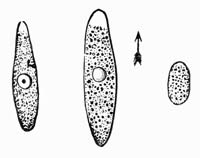
Fig. 33.—Gregarina of Nemertes
Gesseriensis.
The last of the parasites of this category are known by the name of
Gregarinæ. It appears that Gœde was the first to make observations
upon them. Léon Dufour gave them the name which they still bear. They
have a very simple organization, and are formed only of a cell which
contains a nucleus: they live in the intestines of many invertebrate
animals, especially in the articulata. Let us imagine a body, long,
more or less transparent, with a smooth surface very like a spindle,
which glides about in the intestines, in the midst of the liquid
matter which it contains, without our being able to ascertain the
mechanism by which it moves (Fig. 33.) While young they are encysted,
and bear the name of Psorospermiæ. Fig. 34 represents one of
these sacs of Psorospermiæ from a cephalopod.
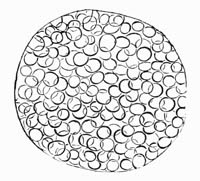
Fig. 34.—Sac with Psorospermiæ from the Sepia
officinalis.
The gregarinæ live in their perfect form chiefly in insects,
crustaceans, and worms. Fig. 35 represents a gregarina very common in
the libellulæ. The largest species inhabits the intestines of the
lobster. My son has studied them very carefully, and published the
results in the bulletins of the Academy of Belgium.
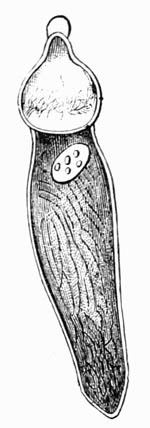
Fig. 35.—Stylorynchus oligacanthus from the
larva of the Agrion.
Schneider has described a parasite which ought, no doubt, to be placed
among the gregarinæ; it lives in the testicle, as well as in the
salivary cells, of a planaria, the Mesostomum Ehrenbergii;
Schneider represents the various phases of its development. In the
autumn of 1871, nearly all the mesostomes perished through the
presence of these parasitical organisms: in the following year they
were rare.
Some years ago, Kölliker discovered on the spongy bodies of molluscs,
certain parasites, the nature of which appears still as enigmatical as
on the first day of their discovery. The Würzburg professor gave them
the name of Dicyema. We have had for a long time in our
portfolio some observations upon them, and at the close of the chapter
“On Parasites that undergo Transformations,” we give a representation
of a Dicyema which we found in abundance on the Sepia
officinalis off the coast of Belgium.
We are about to study in this chapter animals which seek for assistance
from others while young, and are able to provide for themselves
completely when they have grown old. We may compare the hosts which
afford them shelter to crèches which receive none except newborn
infants. It is generally supposed that animals known under the name of
parasites are such as require assistance from their neighbours during
all the stages of their existence.[3]
This is a mistake. There are
very few among them which are not able to provide for themselves
during some period of their development, and they then lead an
independent life. We have mentioned a certain number of them in the
preceding chapter, which only seek for external assistance when they
are old; we bring together, on the contrary, in this chapter, those
which require help at the commencement of their life, and live at
large on their own industry when they have once made their entry into
the world. There are even some among
them which are richly endowed,
and one would never imagine that they would have recourse to strangers
in order to bring up their progeny. All their young family is usually
entrusted to the care of a nurse, who lives just long enough to bring
them up; she gives them convenient shelter under her roof, and often
bestows upon them the last drop of her blood.
When the young one has at last abandoned her first resting-place, she
begins to think seriously of Hymen; she changes her dress and her mode
of life, and seeks no more extraneous assistance till she lays her
eggs. Among the animals brought up in this manner, the most remarkable
are the Ichneumons, which have always attracted the notice of
entomologists. These charming creatures, whose shape is delicately
slender, whose transparent wings flutter with so much grace, have a
less stormy youth than their boldness would induce us to suppose. As
the cuckoo lays her eggs in the nest of a strange bird, the mother
ichneumon deposits hers in a caterpillar full of health, by means of a
long and thread-like ovipositor, so that the larvæ as soon as they are
hatched, find themselves in a bath of blood and viscera, which serves
them for food. The different organs palpitate under the teeth of these
intruders, and the young larva grows and increases in size till it is
hatched under the skin of its nurse: this skin is the cradle of the
ichneumon.
The young ichneumon devours its nurse piecemeal, organ after organ;
and for fear that death should supervene too quickly, the mother takes
care to chloroform the victim beforehand to make her last longer. The
method which many of them adopt to get rid of their young, reminds
us forcibly of the turning-box in which they used formerly to place
children whom they wished to be brought up by public charity; with
this difference, that young ichneumons are not only fed and taken care
of by some good neighbour, but that her body itself serves them as
food.
It has sometimes happened that entomologists, instead of finding
beautiful butterflies produced from the caterpillars which they had
reared, have had nothing hatched but a brood of ichneumons. Was it not
natural then for them to dream of the transformation of species, when
they saw issuing from the skin of a caterpillar, which is usually
transformed into a beautiful chrysalis, a swarm of small winged flies
which disperse with the rapidity of lightning? These ichneumons
discover with astonishing ingenuity the caterpillar which can bring up
their young, and they often reach it with their ovipositor in the
midst of a fruit, or in the substance of a branch of a tree. Every one
knows the Anobium and other little beetles which attack wood, and
live in the dark galleries which they excavate. The mother ichneumon
knows perfectly how to discover the beetle which bores into our
furniture, and winged ichneumons have often been seen to proceed from
worm-eaten wood. It is not only caterpillars that are sought by
ichneumons for the sake of their young; many kinds of larvæ of
coleoptera and hemiptera, of aphides and weevils, are attacked by the
mother ichneumons, which plunge their ovipositors between their
articulations. These winged corsairs well know the weak points of
their cuirass.
Ichneumons are therefore decidedly parasitical at this first period of
their life. As they approach maturity, the time of which varies
more or less according to the species, each ichneumon takes his
departure, seeks for booty on his own account, and passes through the
last stages of his existence at full liberty in the open air. Nothing
is more beautiful than this insect in the plenitude of its life. The
species of the ichneumon are very numerous. Mons. Wesmael has devoted
a part of his life to the study of these insects.
We often ask ourselves what can be the use of these little
creatures—what good purpose can be effected by vermin which annoy
everybody? Michelet replied to this question when he wrote “The
Insect.” “Birds,” says the brilliant historian, “prefer to destroy
those insects which are the most injurious.” We may say the same of
those which we are now considering. The most common caterpillar, and
that which is the most dreaded on account of its great fecundity, is
precisely that which is more eagerly sought by the greater number of
ichneumons. No less than thirty-five kinds of these little assassins
fall on certain species, to make them serve as a quarry to be given to
their young ones. The Bombyx pini is one of the most dangerous and
destructive insects in our woods. The ichneumons would seem to take
into consideration the too great fecundity of this moth, and instead
of one species, as is often the case, thirty-five different species
direct their attacks upon it. It would be indeed difficult for the
mother to withdraw her young ones from the ovipositors of so many
enemies, but there will be always enough of them remaining to keep up
the balance in this little world; the greatness of the danger with
respect to plants will be counterbalanced by the number of ichneumons
which arrest the propagation of
the caterpillars. These insects
contribute more effectually to the destruction of caterpillars than
all the means employed by man. To arrest the Pyralis of the vine, its
cultivators encourage the little Chalcis (Chalcis minuta); and it
has lately been recommended to introduce the acarus which attacks the
Phylloxera, in order to lessen the number of this new pest. Do not
aphides also prevent the too rapid development of certain plants? and
the black species which lives on Windsor beans has doubtless suggested
to the gardener that he ought to cut off the head of the plant when
the flowers appear.
Some other hymenoptera may be mentioned: for example, the Evaniadæ,
the Chalcididæ, as well as the Tachinariæ, which are remarkable
for this kind of life. At the moment when the mining hymenoptera
introduce into their hiding-places the insects which they have seized,
and which they destine for their young ones, the Tachinariæ introduce
themselves by stealth, and lay their eggs on these provisions. Each
kind of tachinariæ attaches itself to a particular insect. There is
one essential difference between them and ichneumons, that the females
of the latter perforate the skin of their victims with a pointed
instrument, and cause their eggs to penetrate to the interior of the
entrails; while the mother tachinæ, less cruel, are contented to lay
their eggs on the surface of the skin, and leave to the larva the care
of penetrating into the interior.
In the department of the Aube, not far from Lezignan, the Tithymalis
(Euphorbia helioscopa) grows abundantly, and the natural guest of
this plant is a Sphynx. While this sphynx is still a caterpillar, a
dipterous tachinaria takes possession of it to feed her young
ones.
For this purpose the fly establishes itself upon the back of the
caterpillar, and mounted thus, without the caterpillar’s suspecting
the least in the world the danger that it runs, the fly inserts her
larvæ to the number of ten or twelve. When she has thus deposited
these, the fly goes to seek another caterpillar, like the cuckoo in
search of a fresh nest every time that she lays an egg.
The young flies, left to themselves, pierce the skin of their host,
and all take their place at the banquet, says Mons. Barthelemy.
After three moults the fly is completely developed, it devours the
interior of the larvæ which has nourished it, pierces the skin, and
the dead body of its host, which might have been its tomb, becomes, on
the contrary, its cradle.
While not far off from the remains of its feast, its own skin hardens
till it becomes a veritable shell, and the parasitical insect awakes,
furnished with wings, ready to recommence, after a minute devoted to
love, the circle in which pass the unvarying phases of its evolution.
The female of the Scolia attacks the larva of the large
scarabæus (Oryctes nasicornis), which is found in tan, and
pierces it with its ovipositor at the same time that it deposits an
egg in the body of the gigantic larva. The larva which will proceed
from the egg will suck up the fluid parts of the Oryctes while on the
grass, and the skin of its victim will serve in the spring as a cradle
for its transformation into a nymph.
Scolietes also attack the large oryctes which destroys the cocoa-nut
trees of the Seychelles Islands. It is the same with a large species
found in Madagascar.
There are around us, even in the midst of our cities, insects known
under the name of Scolyti, which attracted much attention a few years
ago. The trees by the side of the high roads, and even those of our
boulevards, were attacked by them, and it was feared for a time that
it would not be possible to arrest this new plague, which appeared
simultaneously with the oidium of the vine and the parasite of the
potato.
The boulevards of Brussels were planted with fine elms, and these
trees were disappearing one after another. The seeds of this plague
were also sown in France, in the environs of Paris. Mons. Eug. Robert
had paid attention to it, and had announced to the Académie des
Sciences a remedy to arrest the evil.
The regency of Brussels invited Mons. Eug. Robert to come and put in
practice the means which he had recommended to destroy the scolyti;
but, if I remember rightly, the death of the trees quickly followed
that of the scolyti. Nature, instead of employing pitch to arrest this
plague, has simpler and more expeditious means; these are, to bring
forward an insect equally small, which multiplies sufficiently to keep
the terrible Scolytus under. Such is the part which has devolved on
the Bracon iniator. It simply lays its eggs in the bodies of
the larvæ of the scolyti, and destroys them.
Wesmael has related a curious fact of this kind, concerning this enemy
of our plantations. These little people can be well trusted to manage
their own affairs. Each of these hymenoptera ascertains with an
admirable instinct the place where the larvæ of the scolyti are to be
found, and with its long flexible ovipositor darts an egg into the
body of its victim.
It is not only caterpillars which are assailed by mortal enemies; the
eggs themselves are watched by some hymenoptera, which pierce the
shell, and lay within it their own eggs. When the larvæ are hatched,
the yolk and the young tissues of the legitimate proprietor serve as
rations for the usurper.
In this manner, the Ophioneuri live, in their larva state, in
the egg of the Pieris brassica, the cabbage butterfly so abundant in our
gardens; without this police establishment they would multiply
immoderately, and our kitchen gardens would suffer still more from the
ravages of these caterpillars.
It is in vain for insects to lay their eggs in the middle of fruits,
or in the substance of a leaf or a branch; there will be always some
hymenopterous insect which, guided by its marvellous instinct, will
pierce them with its ovipositor, and reach them without their even
perceiving it.
In the substance of those beautiful leaves of the water-lily which
cover our ponds in summer, we often see a charming insect, known by
the name of Agrion virgo, or damsel dragon-fly, a name given to
it on account of its graceful attitudes and its elegant appearance. We
observe this insect deposit its eggs with great prudence, fully
persuaded that they are safe in the midst of the water; but the poor
neuroptera reckons without its host. An hymenopterous insect, named
Polynema, is there, watching every movement of the Agrion; and
as soon as the latter has laid an egg, the Polynema darts down like a
bird of prey on its victim, pierces it, and deposits its own egg in
the interior. The egg of the wounded agrion will hatch a polynema. The
cuckoo acts with less cruelty, since she is contented to lay her eggs
by the side of those which occupy the nest.
Remarkable examples of the refinement of cruelty and of gluttony are
to be found in this little animal world. It is not enough that some
among them feed on the entrails of their young neighbours; there are
wasps which, in order to make the agony last longer, place by the side
of the eggs which they lay, chloroformed flies, which wait patiently
for the time when they can yield themselves up, still palpitating, to
these young tyrants. The days, the hours, perhaps even the minutes,
are scrupulously reckoned for the preparation of this living morsel.
As the process of hatching proceeds, the repast acquires properties
more and more adapted to the age of the young wasps.
The Sphex is not less cruel. Some of the insects which are found in
South America attack, not the young ones, but those which are grown
up, and snatch spiders from their webs as slave-hunters carry off
negroes from the wood; they garotte them, and cram them into narrow
cells, after having chloroformed them to preserve them more
effectually. These spiders, retaining enough life not to lose their
nutritious qualities, become the easy prey of the larvæ of the Sphex.
The mother of these hymenoptera takes care to deposit her eggs, as
well as the living booty, in such a manner that the larvæ, at the
moment of being hatched, live in abundance. These young larvæ, white
and without feet, are dainty enough to reject any other kind of food.
This is an act of cruelty which resembles that of the ichneumon, to
which it may well be compared.
The Platygasters, another kind of hymenopterous
insects, show their
cruelty in a different manner; they live in the bodies of the larvæ
of Cecidomyæ which are lodged in the rolled leaves of the Salix, and
suck the blood of their victims.
Other insects, known by the name of Meloïdeæ, adopt a different
plan. Their larvæ have been long known by the name of bee-lice;
but they had not been recognized in the perfect state, as the larvæ
did not resemble their parents.
These insects undergo four different moults before they become nymphs,
and at each moult their appearance is completely changed. It may be
easily understood that it was long before these little beings were
recognized behind their masks.
This is the manner in which they ravage our flowerbeds. While they
still wear the dress of larvæ, they cling to certain female
hymenoptera which they know very well; and being fully assured that
the door would be shut in their face if they presented themselves
openly, they enter, on their neighbour’s back, the galleries where
their housekeeping is carried on, and at the instant that the female
host lays an egg in a cell of honey, the young Meloë glides in with
it, and allows itself to be shut in. During this time it continues its
metamorphosis, lying in a lake of honey; it devours it all at its
ease, caring nothing for the provision laid up for the hymenoptera
which introduced it. It is a brigand who, having secreted himself in
the carriage of a rich neighbour, introduces himself on his shoulders
into his children’s bed-chamber, assassinates them, and grows fat on
the provisions destined for his victims.
“The Sitaris, the Meloë, and apparently other Meloedeæ,
if not
all of them, are, when young, parasites of certain hymenoptera,” says
Mons. Fabri, who has watched with rare sagacity the obscure and
interesting habits of these microscopic assassins.
The Sitaris humeralis has a progressive development at first, a
recurrent one afterwards, and then again it becomes progressive.
Aphides which are not yet full grown, and which arrest the exuberant
vegetation of certain plants, are in their turn attacked by an insect
which is by no means lukewarm in its proceedings. A small species of
cynips (Allotria victrix) lays its eggs, like an ichneumon, in the
body of a rose aphis, and multiplies rapidly at their expense.
(Westwood).
There are certain flies which are not more delicate in their mode of
life than the preceding insects. We allude to the Œstri. We give
the representation of the species which attacks the horse.
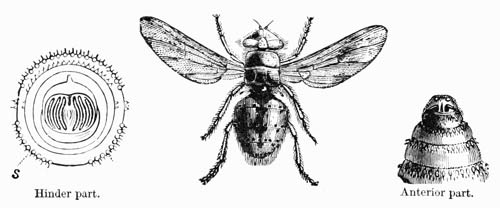
Fig. 36.—Œstrus of the Horse.
Instead of making their attacks on those of their own class, the
gadflies prefer to instal themselves on mammals and sometimes even on
man. Fortunately their wants are not very great; they are contented
with a
little. Their presence can at most only cause some uneasiness,
or some trifling functional trouble.
The œstri are dipterous like ordinary flies; but instead of passing
their youth on some waste organic matter, they live in the nostrils or
the stomach of some hairy animal, and undergo all their metamorphoses
in the interior of its body.
Thus they pass all their youth in a crèche; but when they have
reached the adult state, they get their own living in freedom.
These œstri especially attack herbivorous mammals, and the terms
gastricola, cuticola, and cavicola, sufficiently indicate the
places which they inhabit; the first kind lodging in the stomach, the
second frequenting the skin, and the third establishing themselves in
some of the cavities of the body.
Dr. Livingstone doubtless alludes to some kinds of œstri when he
mentioned the numerous intestinal worms which infest animals in
Southern Africa:
“All the wild animals,” says the celebrated traveller, “are subject to
intestinal worms. I have observed bunches of a tape-like thread-worm
and short worms of enlarged sizes in the rhinoceros. The zebras and
elephants are seldom without them, and a thread-worm may often be seen
under the peritoneum of these animals. Short red larvæ, which convey a
stinging sensation to the hand, are seen clustering round the trachea
of this animal, at the back of the throat; others are seen in the
frontal sinus of antelopes; and curious flat leech-like worms are
found in the stomachs of leches” (a new species of antelope).[4]
A species, peculiar to the horse in Europe, usually lives in its
stomach in summer; and when its development is complete, the winged
insect follows the course of the food, and goes out from the anus to
breathe the open air. The mother fly, excited by the sentiment of
maternity, flies round the breast of the first horse that she meets,
and lays her eggs there on some hairs which are not beyond reach of
the animal’s tongue. The horse wishing to get rid of these foreign
bodies, licks them off, and thus they are introduced into the mouth,
and from the tongue pass to the stomach. These eggs are hatched in the
midst of the gastric juice, the larvæ leave them, and the young
gadflies find in the juices of the stomach the milk which serves to
nourish them. These larvæ pass through their metamorphoses in the
stomach, and when the young fly has assumed its perfect form, with its
delicate wings, its sucker, and its facetted eyes, it leaves the
stomach, follows the path traced by the food, arrives some fine day at
the rectum, presents itself at the place of exit, and takes its
flight. Thus the fly can take its journey through the intestines on a
portion of the digested food.
When she has once taken her flight she is very near the end of her
life, and after a moment of love she gives up her place to others.
There is another gadfly which finds a crèche in the sheep; but
instead of lodging in its stomach, it instals itself in the nostrils,
which are more easily reached. This second species goes through its
evolutions in the vestibule.
This is the species which sometimes introduces itself into the body of
man. Many instances of this have been known, and our late colleague
Spring gave a very interesting account of one of them in the
bulletins of the Belgian Academy.
A gadfly found at Cayenne is distinguished by the name of the Macaco
Worm; it belongs to the genus Cuterebra, and usually attacks
the skin of oxen and dogs in South America. It is accidentally found
sometimes on man. This is the Cuterebra noxialis. We here give the
representation of it.
There is also a gadfly on the ox.
Professor Joly has devoted himself to zoological researches on
Œstridæ in general. Professor Schroeder Vander Kolken, in Holland,
and Mons. Brauer, in Austria, have studied them with great success.
The Hippoboscus is a fly which is very greedy of blood, and attaches
itself to horses and oxen, especially under the tail, in the parts
where there is less hair. It sometimes also attacks man.
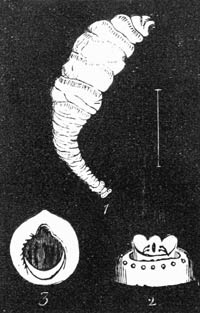
Fig. 37.—Macaco Worm.
The Hippoboscus lives on the horse, and an allied species, of which a
different genus has been formed, lives on bats (Strebla
vespertilionis) in South America. Mons. Von Baër noticed hippobosci
on the elan, during his residence in Königsberg.
Many other insects live and develop themselves at the expense of their
nearest neighbours.
Travellers since Azara’s time assure us that Uruguay contains but few
oxen and horses, because a fly exists in that country which lays its
eggs in the navel of these animals at the moment of their birth. These
animals, on the contrary, are abundant in Paraguay. In order to
increase their number in Uruguay, it would be necessary to favour the
multiplication of birds or insects which make war on these flies,
either in the larval or the sexual state.
Diptera, known by the name of Conops, pass their first three changes
in the soft parts of drone-bees. Dumeril had formerly suspected, from
the curvature of the abdomen, that the Conops lays its eggs in the
body of some other insect. Lachat and Victor Audouin have given an
instance of this in the “Journal de Physique.”
Thus the Conops, in its larval state, inhabits the abdomen of drones
or other hymenoptera; the Echinomyæ are developed within various
epidoptera when in the state of caterpillars or chrysalids; there are
even some which live on flesh, and prefer that which is in a state of
incipient putrefaction.
We may also speak, in this category, of animals which seek assistance,
while young, from neighbours of whom they take advantage during their
life, and utilize them even after their death; these are insects of
various orders. They are in general more cruel than beasts of prey,
which often contend on equal terms with their victims. Here we have an
enemy which furtively introduces itself into its neighbour, who is
nearly sucked dry before he suspects the danger to which he is
exposed. He harbours unawares the assassin who is about to murder him.
This is the refinement of cruelty.
The Melophagus of the sheep is a wingless dipterous insect, like
the Lipoptena of the stag. We give figures of these two curious
insects.
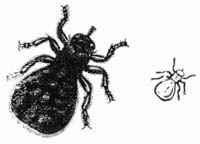
Fig. 38.—Melophagus ovis.
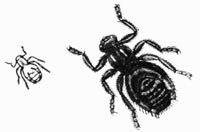
Fig. 39.—Lipoptena of the stag.
The Stratiome chameleon pays visits to flowers to seek for insects,
on whose blood it feeds. Its very elongated larva lives in stagnant
water.
We have now to mention in the following passages parasites much less
cruel in general, and which receive with greater delicacy the
hospitality which is afforded them. We refer to some worms which pass,
not their youth, but their mature age in the body of a neighbour, and
use their host not as a crèche, but as a lying-in hospital.
Their early youth is passed in freedom, but they soon give birth to a
numerous progeny. The fate of the male is unknown; as to the female,
she introduces herself in a microscopic state into the body of a
neighbour, is developed there till she arrives at sexual maturity, and
then quits her retreat to go and scatter her eggs.
It appears, however, that these females are obliged to seek assistance
from insects; but before they enter this living asylum, the male,
which is not yet known, ensures by his fecundation the preservation of
the species.
We often find in summer in puddles of water, thin worms, which are
sometimes a foot long, resembling a violin string, and have for a long
time puzzled naturalists. They are known by the name of Gordius, and
have lately been very carefully studied, both with reference to their
organization, to their mode of life, and their development. We give
here the figure of a Gordius of the natural size. The Mermis, like
the Gordius, passes its youth in the body of certain insects, and
leaves its living cradle to scatter its eggs abroad. In this case, the
embryos themselves go to seek for their host, and unlike the
ichneumons, they use them with moderation. The life of the host is
never compromised, and no functional disturbance is observed,
notwithstanding the enormous size of the worm.
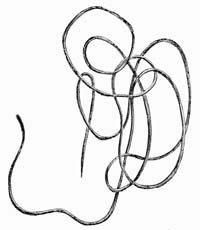
Fig. 40.—Gordius aquaticus, natural size.
The Mermis is especially found after a heavy shower; some kinds of
Filaria are also more common when it rains. Under the title of
“Notes on the Appearance of Worms after a Shower of Rain,” I
communicated to the Academy of Belgium some observations on these
creatures, and these observations were recorded in the bulletins.
Some years ago they brought me one morning, after a shower of rain, a
quantity of worms, four or five inches
in length, very thin, and
twisted round each other, which had been collected in the morning, on
the flower borders of several gardens within the city. It was thought
that there had been a shower of worms in the night.
There was not one male worm among three hundred; all were full of
eggs, and the young ones were already wriggling about within them.
Whence come they? said I, in my article. Have they fallen from the sky
completely formed? It is evident that they have not been developed on
the ground where they have been found; it is not less evident that
they appeared suddenly on the borders. Did they come from within the
bodies of certain insects which they have quitted, on account of the
rain which had fallen? These worms, in fact, had completed their
parasitical stage in the bodies of their hosts, and the great drought
which had continued for many weeks prevented their resuming their
first course of existence. It was the sudden emancipation of so many
worms at once which had attracted the attention of gardeners: earwigs,
cockchafers, and many other insects give them shelter during the time
of this strange gestation.
It is known, by the observations of Siebold, that the eggs of the
Mermis, laid during the winter, produce in the following spring
embryos which live in damp earth. They immediately seek the larvæ of
insects, perforate their skin, and develop themselves there without
becoming encysted. After this, they again pass through the skin of
their host, return to the damp earth, where they change their skin,
are fecundated, and lay eggs. The larvæ of Mermis albicans
especially resort to caterpillars, or the larvæ of the coleoptera,
orthoptera, or diptera, and even to a mollusc, the Succinea amphibia.
Professor Meissner, and more especially Dr. Grenacher, professor at
Göttingen, have made known to us the structure of the Gordius. The
Gordius bifurcus produces embryos at the end of a month; these
embryos perforate their shell by means of their beak, become free in
the damp earth, and introduce themselves through the skin into the
perigastric cavity of certain larvæ. The sexual worm again becomes
free. If we may believe Mons. Villot, who has made recent observations
on the Mermis and the Gordius, the latter alone pass through complete
metamorphoses; they assume three different forms, and change their
habitation three times. Their first abode must be in the water, or in
the larva of a dipterous insect, as a free embryo; the second in the
larval state, in the intestines of a fish; and the third, like the
first, in a sexual state.
To judge by some specimens of gordius brought from India, these
curious parasites exist not in Europe only; they have been found in
different parts of the world, and they lead everywhere the same kind
of life.
They have been found in Calcutta in the Hapale; in the Philippine
Islands in a Mantis, and the museum of Hamburg possesses some from
Venezuela, which came from the body of a Blatta.
These worms, when they approach the adult and sexual age, lose their
various external organs, and are so completely modified with respect
to their organization, that at last they are merely a case for eggs.
They are so entirely egg-cases, in which the digestive tube and the
other organs disappear in proportion as the sexual organs are
developed, that many naturalists have taken these worms for a simple
ovisac. This has also been the case with the Nematobothrium of
the fish known under the name of the eagle-fish; it has been taken by
an eminent naturalist for a nest of psorospermiæ.
There are also worms which take refuge in plants, and live at their
expense, as if they were in an insect. One of the most remarkable is
that which attacks corn, and produces the disease known by the name of
smut, the corn eel (Anguillulina tritici). It is a very small
and thin cylindrical worm, which dries up completely with the grain of
corn which has nourished it, and which can remain for an indefinite
period without dying, in a state resembling dust. Every time that it
is moistened, it resumes its activity. This return to life has been
compared to a kind of resurrection.
Mons. Davaine has studied this worm with great care; he has made known
the different phases of its development, and the manner in which it
introduces itself into the plant and the grain. Needham, in his “New
Discoveries made with the Microscope,” (1747) gives a whole chapter to
these microscopic eels.
The larvæ of the Anguillula scandens are dried in the galls
inhabited by the mother. As soon as these galls fall and grow moist,
the larvæ revive, and abandon their cradle to live in freedom. Soon
after this, they go in search of their plant, take it by storm, and
penetrate into the tissues before the period of fecundation; having
become sexual in the interval, these microscopic nematodes lay their
eggs in a nest formed at the expense of the plant.
Another species lives in the dipsacus, in which also
it
produces disease (Anguillulina dipsaci). It attacks the flowers, and remains
on them without signs of life till the moment that they are moistened.
The vinegar eel is another nematode worm which has some affinity with
the preceding ones. It has been considered a Rachitis.
There exists also a river species; but have not different worms been
confounded under this name? Many species live in brackish water, and
these are remarkable for the presence of bristles on their heads, and
by very distinct eyes.
A certain number of parasites establish themselves at first in an
animal which serves as a crèche, then in a second which serves
as a lying-in hospital. This passage from one animal to another is
described under the name of transmigration. In general, the entire
crèche with its nurslings passes into the lying-in asylum. The
crèche is always represented by an animal which feeds on vegetable
diet, which is destined for one which is carnivorous: the lying-in
asylum is represented by the latter. The mouse is the crèche which
will pass with all its clients into the cat which eats it.
If we were treating of plants, we should say that in the first host
they are developed, and in the second they blossom. The plant, like
the animal, is agamous as long as the flower and the sexual organs
have not made their appearance.
The animal which migrates usually undergoes a complete change in
passing from one abode to another; it is agamous in the first
instance, that is to say, without sex, swathed and covered with a
padded cap like a nursling; in its last stage it is, on the contrary,
endued with all its sexual attributes.
In the crèche the parasite is on its passage from one station to
another, and that which arrives at the lying-in asylum has reached the
end of its journey and is at home. We have proposed to give it the
name of Nostosite, as distinguished from that which only inhabits
its host for a time. We may also remark that the same animal may give
lodging to these two kinds of parasites. It is thus that the rabbit
harbours in its peritoneum passengers which are only at home in the
dog; and, independently of these passengers (these strangers may we
say?), it lodges in its intestines a sexual tænoid worm. The first is
a Xenosite, the second a Nostosite. The mouse, in the same manner,
gives lodging to passengers under the name of Cysticerci, which are
destined to the cat in order to become Tæniæ.
We might call the rabbit or the mouse which harbours worms in
transitu, the stage coach; more especially as from time to time there
are some which miss it, and are consequently lost in their
peregrinations.
This stage-coach is the intermediate host, the Zwischenwirth of
German helminthologists, which is always an animal with a vegetable
diet; the final host is generally a carnivore: it is by means of the
vegetable feeder, the grazing or herbivorous animal, that the stranger
parasite introduces itself.
The result of this is, that the carnivore receives into its house,
every time that it devours its prey, all the parasitical inmates of
the latter, and the walls of its digestive canal form the soil in
which are implanted all the worms which can take root there. The
tissues of the prey are triturated and digested, but the worms which
it encloses escape the action of the gastric juice,
and are set at
liberty in the stomach. The stomach of the carnivorous animal is a
sieve through which thousands of parasites are often introduced at
each repast, and fishes lodge many which often pass from one stomach
to another. Their whole life is spent in these migrations; they are
travellers who have their abode in railway carriages, and never take
their departure at the stations.
Each stomach is, in fact, a station, very frequently quite filled with
merchandise, which disappears with the station itself by the next
train. Happy are those who find themselves in a carriage safely on the
rails towards its destination. Many are called but few chosen. How
many journeys some of these travellers have to take before they find
their host!
It is often very interesting to open a fish which has made a good
meal; its stomach and intestines contain, first of all, the usual
worms; the half-digested prey, in its turn, encloses some; and it is
not rare to find besides them the parasites of those which were
swallowed together with their host.
The animal is usually attacked in its youth by the parasites which it
harbours all its life. In order to know the inhabitants of some
fishes, we must examine them shortly after they are hatched.
In the crèche the parasite occupies an organ which is closed, and
without communication with the outer world; it inhabits the garret of
its first host; in its last host, which represents the maternity
asylum, it dwells, on the contrary, in the largest apartments, and
never ceases to be in direct communication with the exterior. Thus, in
the first animal, it is often completely immovable and under a form
which we have named scolex; in the latter it moves freely, and has,
in addition to sexual organs, those which are proper to this condition
which we have called Proglottis. Thus
these parasites undergo metamorphoses.
For a long time, metamorphoses seemed to be the attributes of frogs
and insects exclusively. In the class of worms, in which they are
complicated with the change of hosts, they much surpass in reality the
most brilliant and extravagant fictions of the poets. The phenomena of
these transmigrations were completely unknown before our researches
were made. If some naturalists, like Abildgaard or Pallas, suspected
their existence, it was rather by accident, and the experiments to
which they devoted themselves were all unfavourable to their
suppositions.
The knowledge of these transmigrations has at the same time dispersed
the latest illusions of the partisans of spontaneous generation; it
was the more difficult to explain the presence of worms in enclosed
organs, since these worms were always without sex. By the same means,
we have ascertained the true prophylactic treatment, and thus
discountenanced the numerous anthelminthic remedies which had often
caused more serious accidents than the parasites themselves.
When it was considered that parasites were the result of an especial
degeneration of some of the intestinal papillæ, the physician would at
once consider that there was some morbid condition, and we can
understand that all his efforts would be employed against the enemy
which had arisen. Now it is known that every healthy animal living in
freedom contains parasites almost as invariably as the organs which
support its
life; and it is not a matter of doubt to us that
parasites often play their allotted part in the economy; their absence
as well as their presence may be the cause of inconvenience. We should
not even be astonished if the administration of certain worms
internally should be prescribed as a remedy. Have we not known the
time when all maladies were supposed to yield to the action of
leeches, and do we not see the good effects of their application?
There are many kinds of parasites, and their therapeutic effect may,
perhaps, in future, form an interesting subject of study.
To speak at the present time of a verminous temperament would be
scientific heresy, an anachronism; this shows the progress that we
have made of late years. Valenciennes was permitted to employ this
language at the Academy of Sciences in Paris not twenty years ago, and
Lamarck wrote thus in his standard work on invertebrate animals, in
the beginning of this century: “It is very certain that there exist in
a great many animals, and even in man, intestinal worms; some of which
are formed there, others are born and all live there, multiplying more
or less, without any of these worms showing themselves externally, or
being able to live elsewhere.
“During so many centuries that observations have been made,
well-ascertained species of intestinal worms have been found nowhere
else than in the bodies of animals. We are now authorized to believe
that there are innate worms, or such as are produced by spontaneous
generation, and that these are modified from time to time; this is at
present the opinion of the most enlightened observers.”
Thus it was considered by Lamarck that parasitical worms are only
found in the bodies of animals, and are actually produced there.
Can it be believed that such ideas were put forward by zoologists of
the highest merit? and ought we to feel surprised that the theory of
spontaneous generation was so long taught in the physiological
schools?
A book published in 1859 was entitled, “Heterogenesis, or a Treatise
on Spontaneous Generation.” The author gives the clue to the origin of
his errors in the second line of his preface, in which he says: “When,
by meditation, it was evident to me that spontaneous generation
was one of the means employed by matter for the reproduction of living
beings.”... According to this philosopher, science is, therefore, not
the generalization of facts, but these facts must serve to prop up the
theories or hypotheses invented in the silence of the study. This
passage of his work shows us that he was no more able to yield to the
evidence of experiments made on worms, than to those of Pasteur on the
infusoria.
It may be related to the honour of the illustrious Baer, that, from
the year 1817, during his stay at Königsberg, he took up arms against
this hypothesis, and never ceased to combat it, till evidence
succeeded in opening the eyes of the most obstinate.
The worms which present the most remarkable phenomena of transformations,
accompanied by metamorphoses, are the Distomians and Cestodes, flat
worms, which we will consider in the first place.
Trematode worms include a certain number of large and beautiful
parasites which scarcely undergo any change, and are found only on the
skin and the gills of
certain fishes; these are the monogenetic
trematodes, comprising the Tristomidæ and all the worms of that
group, which also stand higher in their organization: we shall speak
of them hereafter. The other trematodes, which are called digenetic,
live on the most dissimilar animals, under the most varied forms, and,
like the greater part of the cestodes, introduce themselves into the
individual who is to give them shelter, only by the assistance of a
host, acting as a stage-coach which serves them as a vehicle.
The principal family is that of the Distomidæ, a family par
excellence cosmopolitan; as inconstant in their progress as
capricious in the choice of their companions. Each distome resembles a
small leech which has a sucker in the centre of the belly, and as this
sucker was once considered to be perforated, the name of Distoma was
given to them.
These parasites are the more interesting to us, from the fact that,
though we are not the final resting-place of certain species, we
nevertheless find them pass through us on their way. There are two
species which occasionally lodge in the liver of man without being
peculiar to him, for they properly belong to the sheep. Two other
distomes have lately been described by Dr. Bilharz, which are
fortunately only known at present in Cairo, and which are interesting,
both with respect to their organization and to their manner of life.
The genealogy of the distomidæ is now generally well known; that which
remains to be discovered is the itinerary of each particular species;
and in several zoological laboratories experiments are daily made with
certain species and the hosts which they are supposed to seek.
These investigations have already yielded the best results in the
laboratories of Giessen and of Leipzic, under the direction of
Leuckart.
The genealogy of the distomidæ is as follows: the young distome, when
it leaves the egg, is wrapped in a ciliated tunic, and, under the
guise of a microscopic infusorial, it abandons itself to all the
vagaries of a free and vagabond life; this is the bright period of its
life. “It is a youth starting, with all the steam up, without help and
without guidance, in the midst of the ocean; if it meets an island on
its passage, that is to say, the body of an aquatic larva or a
mollusc, it disembarks, brings forth its young, and disappears; its
purpose is fulfilled. If it find no island or continent it sinks and
perishes, for it carries no provisions with it; it has no organ which
permits it to take nourishment on its passage.” If life is short, even
in the case of a young distome, it is passed in the midst of the
water: if fortune is favourable to it, it will at last meet with a
living abode, where it will find all that is necessary to the comfort
of a parasite.
Abundance always reigns in these living oases; and as these new
colonists are really exiles, who will never again see their native
country, ciliary oars are useless to them, and their descendants
differ entirely from their common mother.
Under the ciliated tunic of the mother appears a daughter under the
form of a bag, who is born almost at the same time as herself, and
concerning whom we may quote here the words of Réaumur: “Singular and
mysterious duality in unity; two beings, living one within the other,
which are still only a single individual. Has nature accustomed us to
such profusion? Do we
ever see her retrograde thus from a more
complicated organization to one more simple?” That which this great
observer did not dare to believe has yet been realized, and in many
cases development is clearly recurrent.
Led by a marvellous instinct, and obeying an irrevocable mission, the
distomidæ, as well as the monostomidæ, and others besides them, when
they claim an asylum from molluscs, introduce into the living body of
their new host, not an isolated embryo, but a young animal already
impregnated with a rich posterity; if she remain mistress of the
situation, this posterity will forcibly invade the various organs,
without any consideration whether their host may not give way under
the weight of this sudden invasion.
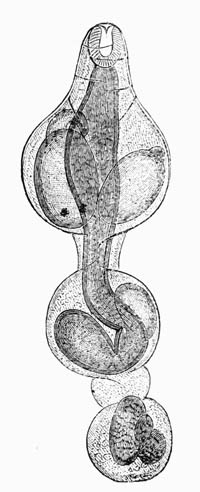
Fig. 41.—Monostomum verrucosum, Sporocyst with
Cercariæ. In front is the mouth, in the middle the digestive canal,
and around the digestive canal are young ones, under the form of
Cercariæ in process of development.
Fig. 41 represents one of these worms which proceeds from a ciliated
embryo, and encloses by the side of its digestive tube cercariæ in
different degrees of development. In front, we see one provided with
eyes and a tail; behind, we see others which are younger; among these
ciliated embryos, wandering without guidance and without a compass in
the midst of their ocean, but few will reach the land, or, in other
words, will find the
port where their progeny may prosper. This
first embryonic state is that in which there are the greatest perils.
When stripped of their swimming tunic, these young distomes have the
form of a bag, which for a long time was called a sporocyst. From
these sporocysts we see hundreds and thousands of young ones proceed,
resembling in no respect the mother which has brought them into the
world. These, in their turn, will resume a free and independent life.
They are colonists whom the distome has left on a foreign land. This
simple multiplication is often not sufficient for the preservation of
the species; the first sporocyst produces other similar sporocysts,
and these bring into the world a rich progeny of tadpoles, which after
a certain metamorphosis will become sexual distomes. These tadpoles
are often well armed, and devour occasionally even the last scrap of
flesh belonging to their host. They have long been known under the
name of Cercariæ, which was given to them at a time when their
genealogy was unknown. They are not very unlike the tadpoles of the
frog (Fig. 45). The mother was only a bag with ciliæ, and sometimes
with eyes. The tadpole has a distinct body, with a movable deciduous
tail; and after this falls off they have sexual organs.
The cercariæ often abandon their first host in which they have been
developed, and live at liberty in the water while waiting for their
final host. They are taken sometimes in the open sea. In 1849, J.
Müller wrote to me from Marseilles that he had just discovered
cercariæ and distomes living at liberty in the Mediterranean. Since
then this illustrious naturalist has observed them again at Trieste,
while pursuing his studies on the Echinodermata, and has had the
kindness to send me his original drawings of these singular parasites.
We have found both at Marseilles and at Trieste, says J. Müller, a new
cercaria with a pinnate tail, and two black ocular points; its body is
from one-tenth to one-sixth of a line in length, not including the
tail, which is twice or two-and-a-half times as long. There is a
protuberance just in front of the middle of the body. At each side of
the tail there are from twelve to twenty pencils of soft bristles
placed on little prominences in a transverse series of six tufts, not
regularly opposed to each other. In one specimen, the tail, from its
point of insertion to the posterior quarter, is provided with these
bundles of bristles; and in another they are wanting entirely in the
anterior half, but exist, on the contrary, on the hinder half. In a
third, the bristles have partially disappeared, and are reduced to six
bundles at the extremity of the tail. This tail presents traces, more
or less distinct, of transverse rings. J. Müller has often seen that
the distome, which proceeds from this cercaria, swims freely in the
sea, and after having got rid of its tail, could be easily recognized
by the two black marks which were then more diffused.
This cercaria described by J. Müller recalls to us that which was
noticed by Nitzsch on fresh-water shells (Cercaria major) with
an annulate and pinnated tail.
Claparède also took at Saint-Vaast, cercariæ the host of which he did
not know. This naturalist supposed that this worm could migrate at
will. He found there the same cercaria (C. Haimeana) on Sarsiæ
and Oceaniæ, but always sexless.
The Cercaria setifera of J. Müller has been found free and attached
to the lower surface of some medusæ. It exists occasionally in
considerable numbers on the internal surface of some Acalephæ of the
ocean and of the Mediterranean. Claparède has also observed another
free cercaria which bears the name of Pachycerca.
Some of the cercariæ are very tenacious of life; we have kept some
alive in fresh water during a whole week in the month of November, and
on the last day they were still active (Cercaria armata). We
sometimes find the cercarian age passed over, and the young distomes
appear abundantly without tails in the sporocyst. We have seen an
example of this in the Buccinum undatum of our coasts. This
latter generation assumes in every case a very different form from
that which preceded it.
Lodged and nourished without expense in the succulent parenchyma of
their victim, the cercariæ grow rapidly, and as soon as their caudal
oar is developed, they tear asunder the membrane which encloses them,
and abandon their host in order to live freely as tadpoles. Some fine
day, tired of their nomadic life, they choose another host, get rid of
their tail, fold themselves up in a winding-sheet, like a chrysalis
about to become a butterfly, and concealed in a sac, which is
designated by the name of cyst, they wait patiently for days, weeks,
or years till their host is swallowed by the creature intended to
lodge them. The cyst is set free in the stomach of the latter host,
its envelopes are dissolved in the juice secreted by its enclosing
membrane, and with its whole establishment the worm recovers its
liberty in this new abode.
The encysted cercariæ pass thus with arms and baggage into the stomach
of a new host. Their envelopes,
not to say their swaddling-clothes,
are torn to pieces by the gastric juice, and at the end of their stage
they go and lodge in larger apartments, more appropriate to their new
wants. The time of their celibacy is passed, and a numerous progeny,
under the form of eggs, is prepared. In this condition they fulfil
their last mission; and if their mother, the sporocyst, knew only the
joys of agamous maternity, the cercaria which has just become a
distome appreciates all the sweetness of sexual maternity.
The distome thus reaches the termination of its voyage and of its
evolutions; it lays its eggs in the midst of the feces of its host,
and millions of animalculæ watch for the new brood, while others wait
for the visit of the ciliated generations. The daughter distome thus
differs completely from her mother sporocyst, but she resembles her
grandmother who has lived in the same manner as herself. Thus we have
animals free and vagabond when they leave the egg, and which swim
vigorously like infusoria without depending on others. But the end of
their life approaches, they strip themselves of their ciliated mantle,
and being again closely swathed up before they die, they seek the
hospitality of a mollusc and give birth to their numerous progeny.
We have therefore animals whose little ones in swaddling clothes live
at first at liberty, and seek for assistance when the moment for
thinking of a family approaches. The descendants lead, like their
parents, a wandering life; and as their mother threw off her ciliated
cloak, so they abandon their oar-like tail, to think in their turn of
family cares.
To sum up all, there are in the life circle of a distomian
two
distinct forms, which begin and end in the same manner, the first
putting forth a progeny by means of buds, the second by eggs. There is
alternation of form, on account of the double multiplication
(digenesis) and migration through several individuals. In other words,
the young distome, before it reaches its destination, must change its
train many times, and it wears in each carriage a different costume.
We can easily understand how difficult it is to recognize this
travelling distomian, as it changes continually its railway-train and
its dress, and what sagacity must have been employed by naturalists in
order not to lose its track.
We may give more than one description of the distomian embryo as it
leaves its sporocyst. Is it a mother and an enclosed daughter, as is
the case with aphides, or is the ciliated envelope merely a cloak? We
think that the latter is the true interpretation. The ciliated mantle
which the embryo loses, is a skin which has been thrown off in
moulting, a simple effect of age.
Thus we find in the complete evolution of a distome an organic and a
sexual age, a true alternation; the agamous age undergoes a true
moulting, the sexual age a metamorphosis.
We have before considered the embryo as mother and daughter coming
into the world together, as we see among the aphides; or the mother,
daughter, and granddaughter are born together like twins; so that if
the mother or the daughter meet with an accident during parturition,
the granddaughter may be born before her mother, and even before her
grandmother.
We are now about to study some of these mysterious travellers which
have given so much trouble to naturalists to discover their abode
and determine their identity. Considering the number of observers who
have mentioned these distomes, it is evident that these parasites must
be very common. We find the names of Ruysch, Leeuwenhoek, Swammerdam,
Camper, Houttuyn, Mulder, Heide, Biddloo, Snellen, etc., among the
naturalists who have made them a subject of study. In our own day, the
writers who have explored this territory are so numerous that we
should require more than a page simply to give their names.
Distomes frequent, with few exceptions, all the classes of the animal
kingdom, and if their number is great among fishes, they are not less
numerous in mammals and birds. The higher classes of animals usually
inoculate themselves through the intermediation of molluscs, worms,
and crustaceans, and it is therefore in the ranks of these that we
must seek for their first abode. Without admitting that their size
bears some proportion to the host which gives them shelter, still, the
largest species, the Distomum Goliath, is found in the liver of
one of the balænoptera. This distome is of the size of a large leech,
and its host does not measure less than twenty metres.
Mons. Willemoes-Suhm mentions a distome which at the time of its
cercarian evolution lives freely in the water, and attaches itself by
its sucker to the larvæ of worms or copepod crustaceans, and then
lodges in their dejecta without encysting itself. This is the
Distomum ocreatum of the herring, according to Professor
Moebius. Mons. Ulialnin found in the bay of Naples another free distome, which
is also attached by its ventral sucker to certain copepods, and which
becomes the Distomum ventricosum inhabiting many kinds of fish.
Any one who wishes to make observations on distomes in the state of
cercariæ has only to examine some fresh-water molluscs, either the
Limneæ or Planorbes found in ponds; as he tears the animal to pieces
on the stage of a simple microscope, he will not fail to perceive a
multitude of struggling and wriggling tadpoles. Their tails twist with
each other, furl up, extend, and describe arcs of circles, as if we
had a nest of serpents under our eyes.
Each species of distome has it own cercariæ, which are scattered among
as many different inferior animals. Birds and fishes become infested
by them in consequence of eating these animals.
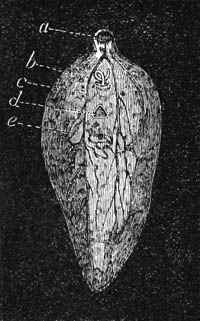
Fig. 42.—Liver fluke of twice the natural size;
a, mouth; b, penis; c, digestive tube; d,
abdominal sucker.
We may here cite as an example of this class of parasites the
Distomum hepaticum, or liver fluke; this species is the most
interesting to us of all the genus; it attains the size of a moderate
leech, and habitually resides in the liver of the sheep. In order to
discover it, we have only to examine a fresh liver. They are usually
found in the biliary canals, where they move about like planariæ. It
is always of a deep colour, and is doubtless introduced in the state
of cercaria, when the animal is drinking. M. Willemoes-Suhm supposes
that the Distomum hepaticum has for a vehicle a small snail, the
Limax agrestis, which the sheep swallows with the grass on which
it
feeds. Its principal abode is in the ruminants and only casually in
man. It is said to be unknown in Iceland. The Distomum lanceolatum
has also been found in man.
Dr. Bilharz, the pupil of Siebold, discovered in the year 1851, on
man, a parasite in every respect remarkable. It belongs to the family
of the Distomidæ, and on account of its peculiarities, it has been
made into a genus under the name of Bilharzia. It is found in Egypt,
and lives in the vena portæ and in all its ramifications in man.
According to Bilharz, this distomian is diœcious, the male being of
considerable size, the female slender and delicate, which fact does
not agree with the usual characteristics of diœcious animals. At
least half of the Fellahs and Copts suffer from these parasites; these
worms, at the period when they lay their eggs, proceed from the vena
cava to the veins of the pelvis, and after having produced very grave
consequences, they are at last evacuated with the urine.
Another distome was also found by Bilharz in the intestines of a young
Egyptian boy.
The largest known distome inhabits the liver of the Balenoptera
rostrata, the little whale of thirty feet in length, which is
regularly met with on the coast of Norway. The intestines of the
ordinary seal often contain a very curious distome, which was first
observed by Rudolphie, the D. acanthoides. The seal is also infested
by the Distomum cornus, which some have incorrectly preferred to
place in the genus Amphistoma.
Besides the distomes which inhabit the liver, there are found but few
in the mammalia, except in the Cheiroptera: these insectivorous
animals have their
intestines literally full of these parasites. We
have noticed the species which regularly frequent our bats, and it
only remains to discover the insects by means of which they are
introduced; for it is probable that these insects are infested by
cercariæ during the time that they inhabit the water. Larvæ and their
parasites ought to be carefully studied in the localities where bats
abound.
There are few birds, especially among the grallæ and the palmipedes,
which do not enclose in their intestines a certain number of distomes.
The same may almost be said of reptiles and batrachians, but it is
especially in fishes that their number is greatly increased. We may
say that there is no fish which does not nourish some of these
trematodes. Among a portion of these, the cycle of evolution and
transmigration is perfectly known; we may instance the Distomum
nodulosum. This worm inhabits the intestines of the perch.
The scolex, as well as the cercaria, has its particular characters,
and we have long since found the latter in a fresh-water mollusc, the
Paludina impura. The cercaria is easily recognized by the presence
of two particular folds at the base of the buccal bulb, and by the
transparency and the form of the extremity of the urinary apparatus.
In the adult distome, this same part of the urinary apparatus encloses
large vesicles with very distinct partitions.
We may also mention among the distomes a species from fish, which has
a great affinity with the singular distome observed by Bilharz, of
which we have spoken above. This distome inhabits the “castagnole,” or
Brama raii. Under the opercula of this fish, the skin is folded, and
forms one or more pouches, in each of which lives a
coupled distome,
that is to say, by the side of each large and fat individual, full of
eggs, there is one which is slender. It is the Distomum filicolle,
to which the name of Monostomum was at first given. We should be
correct in supposing that of these two hermaphrodite worms one acts
rather as a female, the other as a male. It is doubtless in this sense
that Steenstrup maintained his assertion, that there are in nature no
hermaphrodites.
Thus there are two kinds of distomes: the first live in couples in a
cyst, the second in couples joined together, but at liberty; and in
each case only one individual produces eggs. These are distomes which
act really like diœcious worms. We find, however, a more remarkable
instance in the Monostomum bijugum of Miescher. In the tumours which
are formed in the beak of the grosbeak (Fringilla), he has
constantly found two individuals; and in many cases he has surprised
them with the penis of one engaged in the sexual organ of its
companion. These worms, while they live in couples, resemble each
other like snails and leeches; they are mutually fecundated, and both
lay eggs.
Leuckart recognized these sexual distomes in their cyst, in the larvæ
of ephemerides; and Linstow noticed a distome thus sexual and encysted
in the Gammarus pulex.
The name of Monostoma has been given to some of these trematodes which
have no abdominal sucker.
One of the most curious worms of this group is the Monostomum
mutabile. It lives in the sub-orbitary sinus of several aquatic
birds; that is to say, in the nasal fossæ, especially of water-rails
and moorhens. We give a slightly magnified representation of them. It
is a worm resembling an elongated leaf. By compressing it slightly
on the stage of the microscope, we easily discover the ovary, the
matrix, and oviduct full of eggs. By isolating some of the eggs, and
crushing them gently to break the shell, we set free the worm (Fig.
44), quite different from the mother (Fig. 43). The former has two
eyes surrounded by a ciliated mantle, and by means of this ciliated
envelope, the monostome swims freely in the water. If we compress it
slightly, we see that in the interior of the ciliated covering, there
is still another animal, without eyes, without ciliæ, and of an
entirely different form, which in its turn encloses a whole progeny.
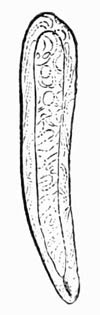
Fig. 43.—Monostomum mutabile (adult).
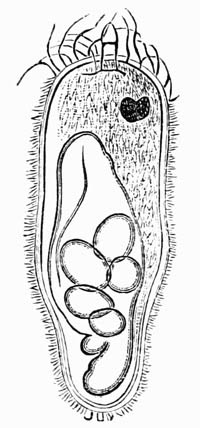
Fig. 44.—Monostomum mutabile. Ciliated embryo with
sporocyst and young cercariæ, greatly magnified.
The embryo, having long ciliæ in front, and in the interior a
sporocyst already full of young cercariæ, is shown in Fig. 44. It is
this latter creature which the ciliated embryo must confide to the
care of others; this she puts out to nurse with some mollusc or other,
until it is fit to provide for itself in its turn. We have still to
discover the train by which the parasite must travel, in order to
arrive again at the nasal fossæ which are the first cradle of the
family.
We find occasionally between the feathers of some birds tubercles of
the size of a pea, and when we open them we see in each two similar
worms, placed so that the stomach of one is applied to that of the
other; this is the monostome of which we have spoken above. These
worms are from three to four millimètres in length (about ·13 in.),
and are found in the titmouse, the siskin, the sparrow, the canary,
and some other birds.
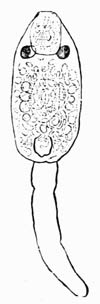
Fig. 45.—Cercaria of Amphistomum sub-clavatum.
Fig. 46.—Sporocyst of Amphistomum sub-clavatum
from the Cyclas cornea.
A worm very common in the intestines of the green frog is known by the
name of Amphistomum sub-clavatum. Its cercariæ are usually found in
an acephalous mollusc, known by the name of Cyclas cornea. That
which distinguishes the scolices of this species is the great
contractibility of the external membranes of the young individuals;
they lengthen, they shorten, they swing to the right and the left,
describing a semicircle on the anterior half of the body (Fig. 46). We
represent side
by side the cercaria of this amphistome, and the adult
and sexual amphistome, as it is found in the intestines of the frog.
Constantine Blumberg has recently published an interesting memoir on
the structure of the Amphistomum conicum.
A beautiful trematode worm, known by the name of Hemistomum alatum,
whose antecedents have not been ascertained, lives usually in the
intestines of the fox. It is about four or five millimètres in length
(about ·17 in.). Many birds harbour Holostomes which belong to the
same group, the first state of which is not yet known. The Holostomum
macrocephalum is common in the intestines of rapacious birds; it is
from five to seven millimètres in length (about ·23 of an inch).
We close the history of trematode worms by giving the figure of a
beautiful one known under the name of Polystomum, which lives
in its adult state in the bladders of frogs (Fig. 48). Interesting
observations have recently been made on the manner in which they are
introduced into the bladder.
The worms which naturalists call Cestoïds, or Cestodes (which means,
like ribbon or tape), have for their type the tape-worm known by every
one. They are very abundant in many animals, are found in almost every
class of the animal kingdom, and are almost as common as the
distomians, of which we have just spoken. They are introduced into
animals which are vegetable-feeders, by means of water and plants, and
into carnivorous animals by their prey. The tape-worms of the
herbivora lay eggs like the others, but their embryos have, as soon as
they are hatched, a ciliary covering which allows them to live and
move about in the water. Those of beasts of prey are entirely
different; it is by means of the prey that they enter their hosts.
Each carnivore has its own worms, as it has its own prey which
introduces them.
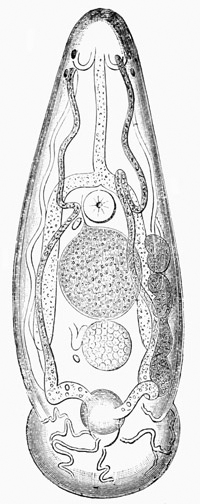
Fig. 47.—Amphistomum subclavatum of the frog.
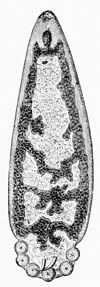
Fig. 48.—Polystomum integerrimum.
Independently of these worms, the vegetable-feeders afford lodging to
some which are not their own.
We have found in bats two tæniæ, both incompletely developed, and
occupying the digestive tube. One has a rostellum without hooks, like
the tæniæ of the vegetable-feeders, the other has hooks like those of
the carnivora. These cestode parasites are observed to be of two
principal forms; the first vesicular, like the finger of a glove
partly drawn inwards. They are always lodged in the midst of the
flesh, or in a closed organ in the middle of a cyst; under this form
the cestode worm is harboured by a host which is to serve as a vehicle
to introduce him into his final host. He is a parasite on a journey;
he is always agamous, and usually bears the name of cysticercus (Fig.
49). As to the second form, it is like a ribbon; it attains a great
length, always occupies the intestine, attains its complete and sexual
development, and lays an innumerable quantity of eggs which are
disseminated with the evacuations.
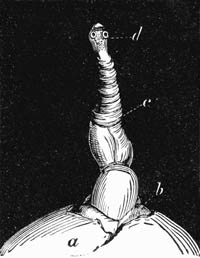
Fig. 49.—Cysticercus; a, upper part of the vesicle;
b, place where the vesicle is about to separate; c, neck of the
worm; d, the head, showing the suckers and the crown of hooks.
The rabbit harbours a cysticercus which has its final destination in
the dog (a xenosite); but independently of this stranger, it gives
hospitality to a special tænia in its intestines. This is its own
worm, the Tænia pectinata, which is a nostosite. All the herbivora
are in a similar case; the ox and the sheep possess a peculiar tænia
of their own,
besides those which they lodge for the sake of the
carnivora. The worms of the herbivora have particular characters by
which they are easily known; they have no crown of hooks.
The tænia of the wolf, which has often been confounded with the Tænia
serrata, lives in the brain of the sheep, and produces a disease
known as the “gid.” It was formerly said that every animal has its
enemy. We should rather say that each species has its parasites, and
each parasite has its vehicle by which it is introduced.
These tape-worms are found in all the vertebrate classes. An
herbivorous animal usually serves as a vehicle, but it more frequently
carries, besides its passengers, species which are peculiar to itself.
As the carnivorous animal is not intended to be eaten like the
herbivora, it cannot serve as a vehicle, and if by chance its muscles
enclose some passenger, he has lost his way and that for ever.
Do the cetacea generally live on fish, and do they become the prey of
some aquatic carnivora? We have reason to think so, from the presence
of certain agamous cestodes, which have been frequently found in too
great number to allow us to suppose that they have lost their way in
these aquatic mammals. There have been seen in the substance of the
muscles of many species, or rather in the layer of blubber which
covers the skin, agamous cestode worms of the genus Phyllobothrium,
which can only accomplish their evolution in some large squalus.
There must then be contests between dolphins and sharks, contests in
which the dolphins are worsted, in spite of their superiority. These
Phyllobothria have
been found in the Delphinus delphis, the
Tursio, and the Ziphius. As the Orca attacks the whale, and
feeds upon its flesh, there would be nothing surprising in our finding
in these large cetacea, some agamous cestode destined to pass through
the last phase of its evolution in this terrible carnivorous
animal.
The cestode can scarcely be called a parasite under the first
vesicular form. It is sufficient for it to pass through its first
transformation in the midst of the tissues, and it will remain weeks,
months, even years, without undergoing any change; it asks for nothing
but an hospitable roof; and this mysterious being, that had often come
they knew not whence, encamping rather than lodging, always without
progeny, was long since cited by the naturalists of a former age in
favour of the old hypothesis of spontaneous generation.
It is not the same with the second form. Here the worm, always lodged
in the intestines, grows with extraordinary rapidity, and fulfils all
the conditions of a true parasite. In a fertile soil it extends itself
and produces young as long as it has any life, and in no group of the
animal kingdom do we find any fecundity to be compared to that of this
worm. Boerhaave described a broad tape-worm, three hundred ells in
length. Eschricht estimates the number of the segments of this worm as
ten thousand; and if we consider that each segment, or, we should
rather say, each complete worm, may perhaps enclose thousands of eggs,
we may form some idea of the profusion of germs which can be scattered
by each individual.
To thoroughly know an animal we must have made observations on it
during all the phases of its evolution.
Let us sketch these phases.
All the cestodes have eggs, usually in great number, very well
protected against external agents. They endure heat and cold, drought
as well as humidity, resist by means of their envelopes the most
violent chemical agents, preserve the faculty of germinating, we will
not say for weeks, months, and years, but for centuries. When they
first leave the egg, we see an embryo of an oval form, transparent,
composed apparently of sarcode, contractile throughout all its extent,
and in the middle of which we perceive six stylets arranged in pairs,
and which at last move with great rapidity.
The following is the manner in which, some years since, we described
these six hooked embryos produced by a tænia of the frog, which were
struggling by the side of each other on the slide of a microscope.
“The six hooks are arranged regularly in each individual, and move
exactly in the same manner. They are very slight, and of nearly half
the diameter of the embryo. Two occupy the median line, and unite like
a single stylet; these are nearly straight, and a little longer than
the others. They only move backwards and forwards. Their action is
like that of the parts of the mouth in certain parasitical
crustaceans, the Arguli, when they endeavour to pierce through the
tissues. They are in continual motion to and fro. The other four hooks
are similar to each other, and differ from the first in the point,
which is curved into real hooks. They are arranged two and two, to the
right and left of the first, so that they all meet at the base. Their
movements are not the same as those of the two first; they remain
almost fixed at the base, while they describe a quarter of a circle at
the
extremity. Let us imagine the six hooks, placed in front in the
same direction. The two in the centre advance, and the two pairs
placed symmetrically by the side of them, are lowered and drawn
backwards, and thus push the body forwards.
“It is like the dial-plate of a clock, with three hands placed by the
side of each other; that in the middle would advance directly forward,
while the two others would be lowered until they formed a right angle
with the first. This is the movement which we observe in all the
stylets. The result of this is that we distinctly see the embryo
penetrate between the débris, or into the crushed tissues which
surround it. These embryos imitate the movements of a man who wishes
to get through a window a little above him, and who, having succeeded
in passing his elbows through, pushes his body forward by leaning them
on the frame.
“We see the same efforts continue for hours; and we can easily
understand that there is no living tissue, however dense it might be,
except the bones, which could not be easily penetrated by these
microscopic embryos. This explains why we so commonly find cysticerci
scattered in cysts along the intestines and between the membranes of
the mesentery, and how they can, by piercing the walls of the vessels,
spread themselves into the most distant organs, by means of the blood
which conveys them. When the embryos have once pierced these walls,
they hollow out the tissues in all directions, until they find
themselves in the muscles, or in the organ which is indicated in their
itinerary. When they have arrived at their destination, they stop and
surround themselves with a sheath; their stylets, which are no
longer of use to them, decay; and at one of the extremities appears a
crown of new hooks quite different from the former ones, which will
serve to anchor their progeny in the new host into which they may be
introduced.”
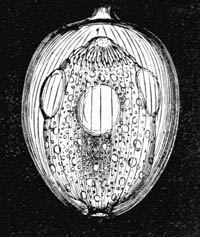
Fig. 50.—Vesicular worm.
Thus the vesicular worm (Fig. 50), fully formed, and without undergoing
any change, waits till its host, or the organ which shelters it, is
eaten, and then wakes up in the stomach. Every living cysticercus
which penetrates into the stomach, instantly quits its torpid state:
it gets rid of its useless parts, abandons its former cavity,
penetrates into the intestine, attaches itself by its new hooks and
its suckers to the enclosing membranes, and grows with such rapidity,
that in less than six weeks, we often find a tape-worm many metres in
length. The vesicle which had hitherto protected it, is abandoned, and
the part which remains with hooks and sucker is the mother which has
produced in this agamous manner the whole colony. This mother is
usually called the head of the tænia, or more properly the scolex. As
long as the mother is there, she engenders and produces cucumerinæ,
that is to say, proglottides, which are the perfect and sexual state
of the cestode.
We have seen among the trematodes a worm of a particular form leave
the egg, and immediately produce a swarm of young ones, which go and
live
separately. In the cestodes all these individuals are united
in a kind of band, and are besides this joined to the mother, which
becomes the root of the family. This root, planted in the walls of the
intestine, is the head. Thus each segment of the tænia is an
individual, and at the period of sexual maturity, this individual is
detached, goes away with the feces, spreads over the grass or
elsewhere, and thus sows far and wide the eggs which it contains.
The tænia, as well as the other tape-worms, is generally looked upon
as an imprisoned parasite during the whole of its existence. This is a
mistake; the last stage of the life of cestodes is a phase of liberty.
The cucumerina, or, as we have proposed to call it, the proglottis,
that is to say, the complete and sexual animal, is evacuated with the
feces; and when we notice a dog leaving his dung upon the grass, it is
not uncommon to see there worms which move like leeches, and whose
white colour is in strong contrast with the mass which contains them.
The duration of this last stage is very short, it is true; but it is,
nevertheless, during this period of her life that the mother scatters
the eggs which are to disseminate the species.
We repeat that each animal has its parasites, and these in their turn
are not always exempt from them. We have already cited some examples
of this.
Man has the dental system of a vegetable feeder; but, thanks to fire,
which he alone knows how to produce and maintain, he eats flesh. It is
by these means that he nourishes the solitary worm, which, by its
crown of hooks, is a cestode belonging to the carnivora, and the
Tænia mediocanellata with the Botriocephalus, which
are cestodes
peculiar to vegetable-feeders. As a feeder on vegetable diet he also
harbours vesicular agamous cestodes, which are only found in him as
passengers.
The Tænia serrata of the dog lives at first as a passenger in
the peritoneum of the hare and the rabbit; and every one knows how
greedily the dogs eat the viscera of these animals.
The cat entertains another kind of tænia, and, as we may easily
suppose, in its young state it lives as a passenger in the mouse or
the rat. Who then has traced out for it this itinerary, and pointed
out the way, the only one by which the parasite can hope to take
possession of its proper abode? Evidently it is neither the tape-worm
nor the cat. The plan for all these various species is marked out
beforehand, and each animal as soon as it is born knows it without
being taught.
A Danish naturalist, Mons. H. Krabbe, has just finished a special work
on cestode worms of the genus Tænia, and he remarks that there is no
class in which these worms are so abundant as in that of birds. It is
among the rapacious and carnivorous birds of this class that they are
less abundant. Among mammals, the carnivora possess the greater
number. This fact, as M. Krabbe remarks very rightly, seems to
indicate that the cestodes of birds especially employ the inferior
aquatic animals as their vehicles when in their incomplete state.
Let us consider the solitary worm of man (Tænia solium), it will
enable us to understand all the others. Known by the name of tænia, or
solitary worm, it is, like all the cestodes, a marvellous association
of mothers
and daughters, which are developed and vegetate in a
peaceable community. Each segment is a complete being, which encloses
within itself an entire and very complicated apparatus for the
fabrication of eggs.
We give (Figs. 51 and 52) the representation of a solitary worm,
peculiar to man, of the natural size; and at the side the scolex,
usually called the head, slightly magnified.
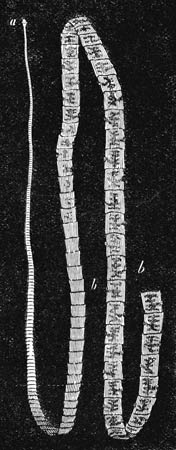
Fig. 51.—Tænia solium, or solitary worm; a, head,
or scolex; b, tape formed of many individuals, the last of which,
completely sexual, separate under the name of proglottides, and
represent the adult and complete animal. Each solitary worm is a
colony.
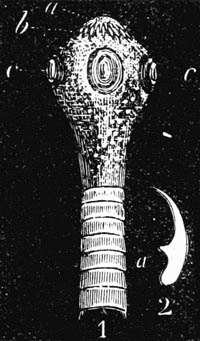
Fig. 52.—a, Rostellum; b, crown of hooks; c c,
suckers; 1, scolex of the tænia solium; 2, hooks expanded; a, heel
of the hook.
Under its first vesicular form the solitary worm is planted in a
provisional soil. After this it is transplanted into a richer soil,
where it flowers and throws out its numerous seeds. It comes to us
from the flesh of the pig, in which there lived vesicular worms, of
the size of a hazel-nut. The muscles are sometimes full of them, and
the pig is then said to be “measly.” The ancients noticed that the
sucking-pig never takes this disease; and as Sus scropha is the
name of the pig, the term scrophula has the same origin as the
specific name proposed by Linnæus.
The measles in pork have been attributed to damp, to feeding on
acorns, to hereditary causes, to contagion, even to injured corn and
mouldy bread. All these theories we find in pathological treatises.
The only true cause, however, is the introduction of the eggs of the
Tænia solium into the intestines. If we wish to prevent this
infection, we must not permit the animal to eat man’s excrements, nor
to drink water in which substances that have become decomposed on a
dung-heap have been allowed to remain.
The cysticercus of the pig, when introduced into man, becomes a tænia
with as great certainty as the seed of a carrot will produce this
plant if sowed in suitable soil. The observation had been for a long
time made without any explanation being given, that this parasite
especially shows itself among pork butchers and cooks. This is because
these persons, more frequently than others, handle raw pork. The same
observation has been made respecting children who have made use of the
gravy of raw meat. Minced raw meat (conserve de Damas) has been
prescribed with success in chronic diarrhœa. The tape-worm has
often been known to make
its appearance after this treatment, as
may well be supposed. Tænia helminthosis is constant and general in
Abyssinia, and they there commonly eat raw beef. Those who do not eat
meat, as the monks of certain orders there, who live only on fish and
flour, never have the tænia. Ruppell and many others have noticed this
fact. Mons. Küchenmeister says that at Nordhausen, in the Hartz, as
well as throughout all Thuringia, measles are very prevalent among
pigs; and as the people are in the habit of eating minced pork, both
raw and cooked, spread on bread for breakfast, this country may be
looked upon as the Abyssinia of the north.
The doctor at Zittau caused a man who was condemned to death, to take,
seventy-two hours before his execution, some cellular cysticerci from
a measled pig; and he found in the duodenum of the man four young
tæniæ, and six others in the water in which they had washed the
intestines. The latter had no hooks, but those of the former had some
in every respect similar to those of the Tænia solium.
We have ourselves caused a pig to swallow eggs of the tænia, and have
given it the measles. Messrs. Küchenmeister and Haubner, who were
ordered by the government of Saxony to make some experiments, also
caused three pigs to swallow eggs of the Tænia solium, and two
of these were affected with measles. A piece of flesh, weighing 4½
drams, contained 133 cysticerci, which amounts, for 22 German lbs., to
88,000 cysticerci.
The use of raw pork will produce tæniæ more readily than raw beef. Dr.
Mesbach has given the following instance in support of this fact. At
Dresden, a father
and his children regularly ate, at their second
breakfast, raw beef, but one day they took pork instead, and eight
weeks afterward one of the children, when in the bath, voided two ells
of Tænia solium.
The etiology and prophylaxis of the solitary worm, that is to say, its
mode of introduction, and the means of protecting ourselves from it,
are clearly indicated. It is sufficient to introduce one of these
vesicles into the stomach in order to have the tape-worm. The
experiment has been made: young men have ventured, in the interests of
science, to swallow some, and have ascertained how many days were
required for the parasite to be sufficiently complete to give off
segments with the feces.
These vesicles in pork come from the eggs which the tænia has
scattered in its passage, and if the pig comes by chance in contact
with the fecal matter of a person infested by one of these worms, it
is soon infested and becomes what is called measled; in this fecal
matter there are either free eggs which have been evacuated by the
worm, or else fragments, known long since under the name of
cucumerinæ, which are full of eggs.
These fragments of tænia, which I have proposed to name proglottides,
and which are nothing else than the worm in all its sexual maturity,
are still living and wriggling at the moment of their evacuation, or
else they are dead and often completely dried; but in either case,
they are full of eggs. Each egg is surrounded by membranes and shells,
which effectually protect it against all dangerous contact.
A fragment of the mature tænia, thus filled with eggs, when introduced
into the stomach of the pig, is rapidly digested, and the eggs are set
at liberty. These lose
their shells by the action of the gastric
juice, and there issues an embryo singularly armed. As we have before
said, it carries in front two stylets in the axis of the body, and on
the right and left sides two other stylets curved at the end, which
act like fins. These embryos bore into the tissues as the mole burrows
into the soil. The middle stylets are pushed forward like the snout of
the insectivore, and the two lateral stylets act like the limbs,
taking hold of the tissues and forcing the head forwards. In this
manner the embryos perforate the walls of the digestive tube.
An egg of the Tænia solium may be swallowed by a man instead of
passing into the stomach of the pig. It is hatched in his stomach
precisely in the same manner, and the embryo takes up its lodging in
some enclosed cavity. Some have been found in the eye-ball, in the
lobes of the brain, in the heart, or in the muscles. We have lately
read an account of the effects produced by one of these wandering
worms, on a man who died after suffering from a peculiar disturbance
of the mind. Two spirits seemed to haunt and speak to him, the one a
German, the other a Pole. Filthy images were called up before his
imagination. At the post-mortem examination, cysticerci were found to
occupy the sella turcica, near the commissure of the optic nerves. One
of these was alive, the others were calcified. Two others in a similar
condition occupied a lobe of the brain.
Man harbours not only the Tænia solium, but another species very
similar, which naturalists have only learned to distinguish from it
during the last few years, the Tænia medio-canellata. We give a
magnified representation of the scolex, that is to say, of the head of
this
worm, which has no crown of hooks in the middle of its four
suckers.
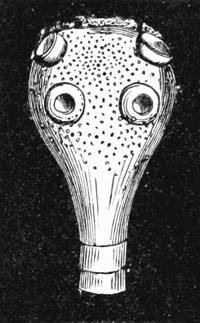
Fig. 53.—Tænia mediocanellata.
This solitary worm is introduced by means of beef, and the cysticercus,
during its abode in the cow, manifests already the peculiar
characteristics which enable us to recognize the species, that is to
say, no crown of hooks, but four suckers, and in the middle of them,
some blotches of pigment. Leuckart fed a calf with eggs of this tænia,
and at the end of seventeen days, the animal died of acute miliary
tuberculosis, produced by the great abundance of cysticerci. This
second species, which had been always confounded with the preceding,
and which is nevertheless the more common, has therefore a different
origin from the Tænia solium. Observations made quite recently in
the north of Africa demonstrate this. Great difficulty had sometimes
been felt in explaining the presence of the tænia in persons who had
not eaten pork. This embarrassment arose from the confusion of the two
species, and this confusion is the more easy as the head of the colony
must necessarily be found in order to distinguish them.
Scharlau, at Stettin, found tæniæ in seven children who had been fed,
on account of anæmia, with raw meat. The tæniæ were those of this
species. We have ourselves found them in children to whom the use of
raw meat had been prescribed.
We do not think it necessary to speak here of a third species of tænia
(T. nana), which also lives at our expense, but which has been
hitherto found only in Egypt.
We know perfectly well the itinerary of the Tænia serrata of the
dog, which is so abundant, that there are few of these animals that do
not enclose some and even many of them. There are few except lapdogs
which do not harbour them. We can easily assign the reason. Every
tænia, like every animal, has its eggs; each plant has its seeds.
These eggs are laid by the mother in the most favourable condition for
the development of her progeny. The dog deposits its dung on the grass
rather than in any other spot, because the eggs of its tænia, which
are destined to the rabbits or hares, will have greater chance of
arriving at their destination than if they were exposed on the bare
earth, or in the water. Their prodigious number is calculated
according to the chances of their arriving safely. The egg, when
introduced into the stomach of the rabbit, is rapidly hatched in this
organ under the action of the gastric juice, and the embryo which is
produced from it seeks its hiding-place in the midst of the tissues
which surround it; it bores into them, and establishes itself in the
folds of the peritoneum. Then, once in its resting-place, it
barricades itself, and waits patiently for an opportunity of
introducing itself into the stomach of the dog.
This microscopic embryo is armed with six hooks, like embryos of all
the cestodes; it employs them with much dexterity to pierce the walls
of the organs, and to hollow out a space for itself in the substance
of the tissues. Shut up in its hiding-place, membranes form around for
its protection; its six hooks, having become useless, wither; other
hooks in the form of a crown appear by the side of four rounded
projections, the future suckers; and, sheathed in a large vesicle full
of a limpid fluid, it waits patiently for the moment when it will find
a place in the stomach of a dog. If good fortune awaits it, it will
wake up, some fine day, in the stomach of the animal which has eaten
the rabbit, its former home, and a new life will commence for it. The
organs in which it was imprisoned are digested, it gets rid of all its
swaddling-clothes, unrolls itself, separates from the vesicle which
has protected it hitherto, and penetrates into the intestine; there,
immersed in the food of its host, it grows with extreme rapidity, and
assumes the form of a ribbon or tape. The ends of this tape are
successively matured, detach themselves, and become the complete
worms, full of eggs, which are evacuated with the feces; scarcely have
they made their appearance in the open air before they burst and
scatter their eggs.
He whose scientific curiosity is sharpened, has only to watch the dung
of the dog at the moment of its evacuation to distinguish on its
surface worms of a milky-white colour, contracting like leeches, which
are the true Tænia serrata in its adult state. Experiments made
on this species have given sanction to what I had said respecting the
cestodes.
The tænia, under the name of Cysticercus cellulosus, lives in
the folds of the peritoneum of the rabbit and the hare, and passes
directly from the rabbit to the dog to become complete.
It is very curious that the fox, so nearly allied to the dog in
appearance, and which also eats rabbits, never has the Tænia
serrata, but this animal nourishes other worms.
It was with these cysticerci that I made experiments on four dogs,
which I took with me to Paris, in order to convince those who could
not believe in the migration of parasites. It was this species that I
gave also to the dogs which served as a demonstration at Paris at the
course of lectures given by Mons. Lacaze Duthiers.
Some years ago, while making a post-mortem examination, at the Museum
of Paris, of some young dogs which I had previously infected with
Tænia serrata at Louvain, there were found by the side of these some
Tæniæ cucumerinæ. These dogs had taken nothing but milk and
cysticerci! Whence came these Tæniæ cucumerinæ? I knew not, and I
frankly owned it to the members of the Commission who proposed the
question to me. This however did not prevent my being greatly puzzled
with the presence of this worm of whose origin I had no idea. Now we
know whence they came. An acaris, the Trichodectes, lives in the hair
of young dogs and harbours the scolex of this cestode. The dog, by
licking its own hair, grows infested, like the horse, which in a
similar manner introduces the gad-fly, and although it has taken no
other nourishment, harbours its own epizoaria.
The name of Cysticercus tenuicollis has been given to a vesicular
worm which inhabits the peritoneum of the ox, the goat, the sheep,
&c., and which turns to a tænia in the digestive tube of the dog.
Mons. Baillet has made the principal experiments on this
transmigration. The itinerary of another cestode worm, the Cœnurus
of the sheep, is to pass through the sheep in order to reach the wolf
or the dog. This worm has only lately been recognized in its tænoïd
form; it has, on the contrary, been long known under the name of
Cœnurus cerebralis; this
develops itself on the brain of the
sheep, and occasions the disease known by the name of “gid.” This
disease may be produced artificially. The sheep which swallows the
eggs of this tænia shows the first symptoms of it towards the
seventeenth day. If we kill it at this time, we find on the surface of
the brain, either at the base or the summit, or sometimes between the
hemispheres and the cerebellum, one or more white vesicles of the size
of a pea, and on which no traces of buds are yet to be seen. This
vesicle, of a milky-white colour, and filled with liquid, is the
scolex. Near these vesicles are to be seen some very irregular yellow
furrows, like tubes abandoned by some tubicolar annelid; this is the
gallery through which the vesicular worm has proceeded to the place
where it has been found.
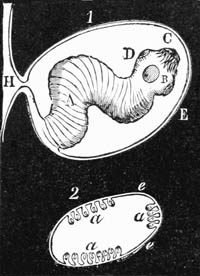
Fig. 54.—Cœnurus of the sheep. 1, the enclosed
scolex; 2, Hydatic vesicle, with the scolices in their place within
it.
A fortnight later, that is to say, about the thirty-second day, the
cœnurus is as large as a small nut, and one can see with the naked
eye some small nebulous corpuscles, separate from each other, of the
same form and size; these are the buds or scolices which have risen
up, but which, as yet, have neither hooks nor suckers.
We give the representation of one of these vesicles, on the internal
walls of which young scolices have been developed; this is nearly of
the natural size. Fig. 2, a, a, shows these scolices of nearly
the natural size. Fig. 1 represents an isolated and magnified scolex;
A, shows the segments of the future proglottides; D, the suckers; C,
the hooks; H, the vesicle which contains them.
Eggs of the same tænia have been given to sheep at Copenhagen and at
Giessen, and Messrs. Eschricht and R. Leuckart have obtained the same
result as we had at Louvain. On the fifteenth or sixteenth day the
first symptoms of “gid” declared themselves. At about the
thirty-eighth day the crown of hooks appeared, the suckers were
formed, and the whole head of the scolex was sketched out. All these
heads can leave or enter the sheath at the will of the animal. It is
truly a polycephalous animal when the scolices are expanded. This worm
continues to grow for a long time in the cranial cavity, and produces
by its presence the gravest results. The sheep necessarily dies at
last, unless we remove the parasite by means of the trepan.
The cœnurus, at this point of development, swallowed by a dog,
undergoes great changes in a few hours. The proscolex, or large
vesicle, withers; the different scolices unsheath their cephalic
extremity, become free, penetrate into the intestine with the food,
and attach themselves to its walls, so as to form as many colonies of
tænia as there are distinct heads. A dog which has swallowed a single
cœnurus may therefore contain a considerable number of tæniæ.
The development of this worm proceeds very rapidly, and it only
requires three or four weeks to attain many feet in length. The
organization of this worm, in the state of strobila and of proglottis,
is in every respect like that of the Tænia serrata; we have
even endeavoured in
vain to distinguish these worms from each other
by their hooks. The wolf or the dog follows the flock of sheep,
scatters the proglottides or the eggs in their way, and the sheep,
browsing on the grass with the eggs attached, become infested with
their most dangerous enemy.
To arrest this disease, only one thing is necessary, to destroy by
fire the head of every sheep attacked by the “gid.” The rest of the
animal may be eaten without danger.
Pouchet did not succeed in giving sheep the “gid” at first, for the
very simple reason that he employed the eggs of the Tænia serrata,
instead of those of the Tænia cœnurus; he had confounded the two
species. The cœnurus of the sheep is a true calamity when it spreads
in a country. The animal attacked by it is lost, and the mischief may
be indefinitely propagated by giving as food to dogs the head of the
sick animal, with thousands of young tæniæ enclosed within each.
There exists a singular cestode which bears the name of
Echinococcus. We give a figure of the echinococcus of the pig,
slightly magnified, and an isolated scolex (Figs. 55 and 56). In its
first form it is composed of closed sacs, which grow to the size of a
nut, and sometimes to that of an orange. It usually lodges in the
liver of the pig, but establishes itself also in man. We have been
assured that part of the population of Iceland have been attacked by
it. The abundance of this parasite in that country is attributed to
the want of cleanliness, and the number of dogs that they keep around
them. The echinococcus becomes a tænia in this animal. It scatters the
eggs with its dung, leaving them directly or indirectly on plants
which the Icelanders eat; for they gather for food certain mosses,
sorrel, cochlearia, dandelion, &c., from the midst of the plains in
which live flocks of sheep guarded by dogs. The eggs are scattered
everywhere on plants or in the water.
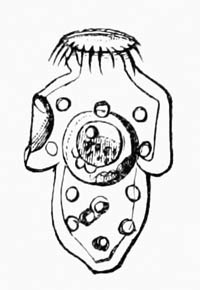
Fig. 55.—Isolated scolex of the Tænia
echinococcus from the pig.
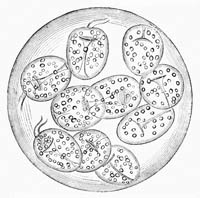
Fig. 56.—Tænia echinococcus, from the pig.
Leuckart has made some very interesting experiments on the
echinococci. In Fig. 57 is shown a tænia which proceeds from an
echinococcus.
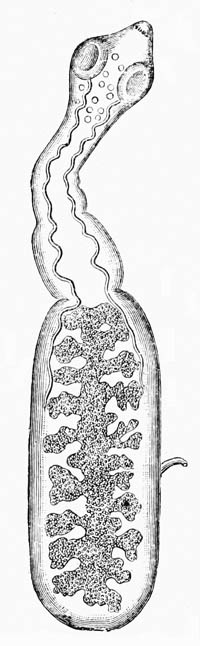
Fig. 57.—Tænia echinococcus, from the dog.
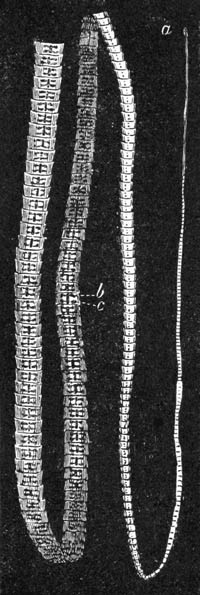
Fig. 58.—Bothriocephalus latus. a, scolex,
b, the proglottides, c, the sexual organs.
There is yet another tape-worm harboured by man, the Tænia lata,
better known under the name of Bothriocephalus.
We give in Figs.
58, 59, and 60 representations of this worm in the state of a colony, also
the scolex or head separately, and an egg. Its history is very
curious, especially with reference to its geographical distribution.
It is only found in Russia, Poland, and Switzerland, and the limits of
the places which it inhabits are perfectly defined. Siebold, during
his stay at Königsberg, could determine from the nature of the worms,
whether the patient who consulted him lived on one side or the other
of the Vistula.
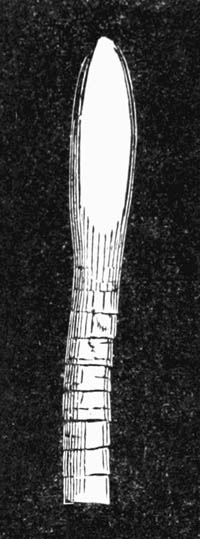
Fig. 59.—Bothriocephalus latus, scolex.
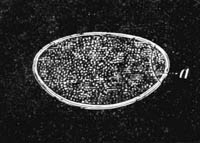
Fig. 60.—Bothriocephalus latus, egg.
A Russian naturalist, Dr. Koch, thoroughly studied this interesting
worm and its evolution. He says that this cestode is rare at Moscow,
while at St. Petersburg, Riga, or Dorpat it is common. If this be
really the case, it must doubtless be attributed to the fact that in
one place the inhabitants drink spring water, and in the other water
from the river.
A very curious circumstance is the actual rarity of the Bothriocephalus
among the inhabitants of the shores of the Lake of Geneva, though
formerly it was very common there. This diminution, if we may not call
it disappearance, is due to the change which has been made in the
construction of water-closets, all of which formerly emptied
themselves into the lake, so that the embryos were hatched in the
water, and persons were infested by them through drinking it. At
present the refuse of the towns is carefully collected for the purpose
of manuring the land. This is the result of the advice of Mons. de
Candolle, half a century ago; for this naturalist clearly understood
how great was the loss to agriculture from the neglect of this
fertilizing agent.
The itinerary of this tape-worm is simple. It passes from man to the
water under the form of an egg, or of a proglottis; and from the water
to man in the shape of a ciliated embryo. In this manner it is
introduced with the water that is drunk. The Bothriocephalus, like
other cestodes, is free at the commencement and the end of its life:
at the beginning, in order to penetrate into its host; at the end, to
scatter its eggs.
Messrs. Sommer and Landois published, in 1872, an anatomical description
of the sexual organs of the Bothriocephalus latus, of such
completeness, that it will be long before any one will again take up
this subject, which had so much occupied helminthologists ever since
the celebrated work of Eschricht. This memoir is illustrated by superb
engravings, which represent these organs under every aspect. Dr.
Böttcher, of Dorpat, found in the small intestine of a woman, who died
of peritonitis, at least a hundred Bothriocephali. They were but
slightly developed, though there were some in a sexual state.
The largest tænia, though not the longest, is the Tænia magna, from
the Rhinoceros, described by Marie; it is, no doubt, the same to
which the name of gigantea was given by Peters. The learned director
of the Museum of Berlin gave me a fine specimen of it eighteen years
ago. The generic name of Plagiotænia has been proposed for this worm.
Almost all birds nourish large and beautiful tæniæ, but they must be
studied immediately after the death of their host. They often change
their form entirely at the end of a few hours.
Woodcocks and snipes always have their intestines stuffed full of
tæniæ and the eggs of these worms. Every bird contains them by
thousands. Fortunately we cannot be infested with the tænia of the
snipe and the woodcock.
Fig. 61 represents the scolex of the Tænia variabilis
of the snipe,
and Fig. 62, by its side, shows the crown of hooks more highly
magnified. We have made these drawings from worms collected from
snipes some instants after their death. We close this chapter on the
cestodes with the plate (Fig. 63) of a Tetrarhynchus which is usually
found in the plaice. The perfect tetrarhynchi, that is to say, those
that are adult and sexual, inhabit the intestines of voracious fishes,
especially of the squalidæ.
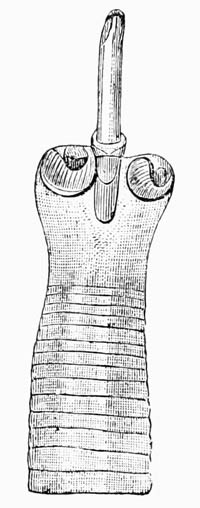
Fig. 61.—Tænia variabilis from the snipe.
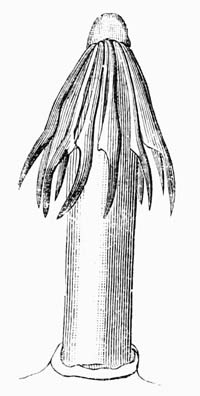
Fig. 62.—Tænia variabilis from the snipe. (Crown of
hooks.)
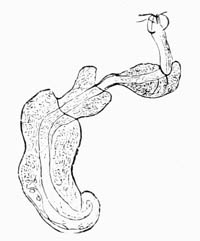
Fig. 63.—Tetrarhynchus appendiculatus from the
plaice.
There are other worms which migrate, and even some articulate animals;
but their modifications of form are much fewer than in the preceding,
and their changes are generally restricted to simple metamorphoses. We
will place at the head of this chapter the Linguatulæ, which have so
perplexed naturalists.
We sometimes find in the nasal fossæ of the dog and the horse a worm
resembling a leech, with a body completely etiolated, which lives
there entirely as a
parasite, and whose history has only been known
for a few years. Chabert discovered the first species of this group in
1787 in the frontal sinus of the horse and the dog. It had been named
Tænia lanceolata. All naturalists, Cuvier included, placed this
animal among intestinal worms, under the name of Linguatula or
Pentastoma. The latter name had been given to it, because they
mistook the hooks for mouths.
We have shown, from the embryos, in 1848, that the Linguatulæ, instead
of being worms, are articulate animals, more allied to the lerneans or
acaridæ than to the helmintha. These observations, though received at
first with much hesitation, were fully confirmed afterwards,
especially by the learned researches of Leuckart. The linguatulæ have
a very long body, sometimes rounded, in other cases compressed, with a
mouth surrounded by four strong hooks, regularly disposed in a
semicircle. They have often been found in the lungs of serpents, in
certain birds, and in many mammals. A linguatula was also seen by
Bilharz at Cairo, in the liver of a negro, and they have been observed
in the hospitals of Dresden and Vienna.
It is to be presumed that this dreadful parasite has been introduced
into man by means of the flesh of the goat, and perhaps of the rabbit.
Linguatulæ are found in their primary agamous form, in open cavities
like the nasal fossæ. Leuckart was the first to show that the
linguatulæ, which lived at first encysted in the peritoneum of the
rabbit, completed their evolution and became perfect in the nasal
fossæ of the dog. The Linguatula serrata (Fig. 65), which lives
primarily in the goat, the guinea-pig, the hare, the rabbit, &c.,
is found accidentally in man, and perfect in certain mammals. Examples
have been given of sick persons being completely cured by the
evacuation of worms from the nostrils; these worms were, doubtless,
linguatulæ. Fulvius Angelianus and Vincentius Alsarius speak of a
young man who had suffered for a long time from head-ache, and who
passed a worm from his nostrils. It was as long as the middle finger.
There is little doubt that this was the Linguatula tænioïdes. These
parasites may perhaps sometimes lose their way in their
peregrinations. Some years ago a lioness died of peritonitis at
Schönbrunn, and, after death, the liver, the spleen, and other organs
were found to be filled with encysted linguatulæ.
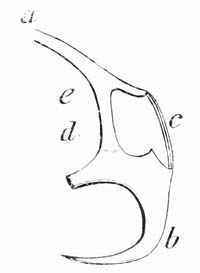
Fig. 64.—Isolated hook of Linguatula.
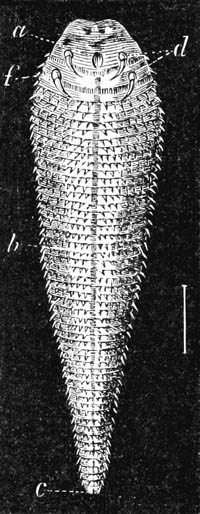
Fig. 65.—Linguatula magnified six times. Four hooks
are seen around the mouth in front. c, the anus.
The nematode worms are long and rounded, like the ordinary ascarides
of infants, which take up their abode in all the organs of animals of
the various classes of the animal kingdom. About a thousand varieties
are known,
varying in length from a few millimètres to forty or
fifty centimètres.
They are not all parasites, as has been thought, since some are found
in the sea, and others in damp earth, in putrid matter, and even on
plants and their seeds. The migrations of nematodes are subjects of
great interest. Their changes of form are usually not very
considerable; but the modifications in their sexual apparatus, whether
in the same individual, or in the succeeding generations, are very
curious.
When we consider the numerous encysted and agamous nematodes, which
are found in the different orders of mammalia, birds, reptiles,
batrachians, and fishes, there is little doubt that all these beings
are only migratory parasites, which pass together with their hosts
into the animal to which they are destined. They are found, like
ascarides, in animals of all classes. Some are to be met with in all
the organs—the brain, the eye, the muscles, the heart, the lungs, the
tracheal artery, the frontal sinus, the digestive tube, the skin, and
even in the blood. Sometimes the two sexes live under the same
conditions; sometimes the male is dependent on its female, or else one
generation is parasitical, and the next is independent. There is a
great diversity with respect to development. Some nematodes, like
trichinæ, are developed so rapidly, that the embryos are already
perfect in the egg before it has quitted its mother. Others, like the
ascarides lumbricoides, lay eggs, in which the embryos do not appear
till several weeks or many months after they have been laid. Between
these two extremes we find all the intermediate degrees.
Diezing, who has done more for systematic helminthology
than any
other naturalist, brought together, under the name of Agamonema, all
the migratory agamous nematodes which wait for the opportunity of
entering their final host. Diezing had kept himself quite independent
of the discussion by fixing his attention exclusively on form, without
taking account of migration and digenesis. One of these agamonemata,
lodged in the midst of a pediculated cyst on the vagina of a bat (the
little horse-shoe), was probably a worm that has lost its way; if not,
we must admit that these mammals become the prey of some carnivorous
animal. But what carnivore can habitually feed on the cheiroptera?
There are but few fishes, either in fresh or salt water, which do not
enclose in the folds of their peritoneum, especially round the liver,
cysts full of these agamonemata.
We see in some of the nematodes examples of migration which are quite
peculiar to them. Some of these worms are always free, others free at
one part of their life only, others migrate from one animal to
another; others again from one organ to another. The Ascaris
nigro-venosa of the frog lives sometimes in the lungs, at others in
the rectum or quite out of the body in damp earth. The Filaria
attenuata lives in the rook (Corvus frugilegus), and it is said
that it becomes sexual in the intestines of the same bird.
These worms are usually very tenacious of life; many of them can, it
is said, be dried for weeks, months, or years together, and return to
life as soon as their organs are moistened. Their eggs resist even the
action of alcohol and the most active chemical agents, and eggs that
had been prepared for the microscope, and had served for many years
the purposes of study, have been known to produce young ones as if
they had been just laid.
Natura non facit saltus is especially true as to the division of
sexes among the nematodes. Between the true hermaphrodites and the
true diœcious worms are found species in which the males gradually
dwindle and become dependent on the female; this is to be seen in the
Sphœrulariæ, among which the male is only an appendage to the
female sex. We find here full evidence of the fact that the female is
more important than the male, with regard to the preservation of the
species. In some species the sexes differ but little, in others, the
sexual differences become greater, and the male is only one third of
the length of the female; but in some of them the disproportion is
greater still. At the same time, we see nematodes whose males are
attached to the females, so as only to form a single individual; in
other cases, the male seems to disappear to such an extent, that we
find nothing but the male organ in the female; indeed, there are
instances of male worms, which, without changing their form, occupy
the cavity of the matrix and, like the lernean crustaceans, are
parasites of their females. The Trichosomum crassicauda is an
instance of this kind.
Arrangements which would not have been suspected beforehand, are every
day revealed, with respect to the conservation of species. We have
recently learned from the works of Messrs. Malmgren and Ehlers, and
later still, from those of Claparède, that in the same species we may
find different males, producing different offspring. Messrs. Malmgren
and Ehlers have opened this
question by their persevering researches,
and Mons. Claparède expected to invalidate the results obtained by
them by establishing himself at Naples, in order to devote himself to
a new series of investigations. Contrary to his expectations, he
arrived at the same conclusions, and announced that a nereid
possesses, in one and the same species, two kinds of males and two
sorts of females, and that these males differ from each other, not
only in their manner of life but in their age, in the mode of
formation of the spermatozoïds as well as in the form; that the
females differ no less from each other than the males, and that each
form is intended to provide, in its own manner, for the dissemination
of the eggs.
We see this realized in annelid worms known by the name of
Heteronereidæ. Certain individuals of small size live on the surface
of the water; others, evidently much larger, live at the bottom of the
sea and behave quite differently. The eggs and the spermatozoïds
proceeding from these two forms differ sensibly from one another, and
the difference of form corresponds with that of origin.
We see thus among some of them different males; among others different
females: then eggs and spermatozoïds equally different in one and the
same animal species.
A curious insect, the Termes lucifuga, appears also to distinguish
itself by two sorts of males and females, which even take to flight at
different periods. Great sagacity was required to reveal these strange
facts. Mons. Lespes has had the courage to devote himself to these
observations.
We see that all means are good that are for the preservation of the
species, but who would have suspected that in a single animal there
would be found two males by the side of two females, neither of which
resembles the other, and besides these, two kind of eggs and
spermatozoïds! How great would be our astonishment were we to see two
sorts of cocks, two kinds of hens, and two sorts of eggs produced by
the same mother, and hatched at the same time!
Professor Ercolani bred in damp earth certain parasitical nematodes,
kept them alive, saw them reproduce, and was even able to obtain
several generations of them. These nematodes were the Strongylus
filaria from the lungs of the goat, the Strongylus armatus from the
intestines of the horse, the Ascaris inflexa, and the Ascaris
vesicularis from the fowl, and the Oxyuris incurvata from the
horse. The first three, whether they are born in damp earth, or in the
midst of organs in which they habitually lodge, have the same external
characters; nothing is remarked in them except a greater activity in
their reproduction.
The Strongylus armatus, when born at liberty, appears no longer to
have hooks at the mouth like those worms which live in the intestines.
Mons. Ercolani has also remarked that these worms, when they become
free, are ovo-viviparous, though they were before oviparous.
There are many of these nematodes which are true parasites of man, and
although certain of these are as much dreaded as the plague or the
cholera, we are far from knowing all their history, and especially the
manner in which they are introduced.
A young naturalist, Dr. O. Bütschli, has lately made
a good résumé
of the state of our present knowledge of parasitical and
wandering nematodes.
The Sclerostomata are distinguished by their mouth being surrounded by
a horny armature. The river perch usually gives lodging to a
viviparous nematode, the Cucullanus elegans, on the development
of which a special work has been published. The young ones are
provided with a perforating stylet, and penetrate into the bodies of
small aquatic crustaceans, called cyclops. When they have obtained
entrance into this living lodging, they bore through the walls of the
intestines and shut themselves up in the perigastric cavity. The
cyclops being pursued by the young perch, are swallowed with their
guest, and the latter is set free in the midst of the stomach, where
it passes through its sexual evolution.
Leuckart saw in his aquarium young Cucullani penetrate into the bodies
of the cyclops. These crustaceans are therefore the vehicle of these
nematodes. Another nematode worm, the Dochmius trigonocephalus,
lives at liberty while young, but seeks for an asylum in the dog in
its old age. The Sclerostomum equinum causes aneurisms in the horse,
which manifest themselves by colic. A hundred of these worms have been
found in the same horse. The Sclerostomum pinguicola is very common
in the pig in the United States. This is the Stephanurus dentatus of
Diezing, noticed by Natterer in Chinese pigs in Brazil. Cobbold
notices the same worm as living in the pig in Australia; they have
been also found in Germany.
The Strongyli are round, cylindrical worms, with bodies sometimes
entirely red, which inhabit different
organs in mammals and birds.
A very remarkable species, the Strongylus gigas (Fig. 66), exists in
the kidneys of the horse and the dog, and sometimes in man. It partly
destroys this organ, and has been seen a mètre in length. The
Strongylus commutatus often lives in great abundance in the lungs of
the hare, and the Strongylus filaria in the lungs of the sheep,
occasionally in such great numbers that their presence produces pneumonia.
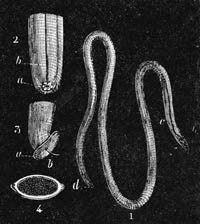
Fig. 66.—Strongylus gigas.—1, female, showing a,
the mouth; b. the intestine; c, genital pore; d, anus. 2,
cephalic extremity of the male; a, mouth; b, œsophagus. 3, caudal
extremity of the male; a, cup; b, penis. 4, egg.
Porpoises generally have strongyli in their lungs and their bronchia,
and they are seen by thousands in the sinus of the Eustachian tube.
We collected a large bottle full from a single porpoise around its
internal ear. When we consider the prodigious number of these
creatures, may we not suppose that they are able to multiply in the
organs which they occupy, as well as migrate to infest other
individuals.
Different generic and specific names have been given to these
Strongyli. A round worm found in the intestines of the dog, the
Strongylus trigonocephalus, lives at first in damp earth or mud
like the rhabdites in general; it then passes into the dog, and there
becomes a sexual Strongylus. It is possible that there are others in
the same category.
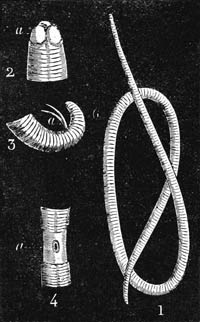
Fig. 67.—Ascaris lumbricoides.—1, complete worm, 2,
head, 3, tail of the male, 4, middle of the body of female.
The Ascaris lumbricoides is a large round worm which attains the
size of a quill pen, and which is commonly found in the stomach or
the lesser intestines of children when in good health. Aristotle was
acquainted with it. It has been observed throughout Europe, in Central
Africa, in Brazil, and Australia. The same species lives in the
intestines of the pig; but the Ascaris megalocephalus, which is
usually found in the horse, is of a different species.
The Ascaris acus of the pike lives at first in a common white
fish, the Leuciscus alburnus, and passes with this fish, which
serves it as a vehicle, into its final host.
Another common nematode, the Oxyurus vermicularis (Fig. 69), a
parasite of man, is a small worm of the size of a fine pin, which
often multiplies in the rectum of children, causing intolerable
itching. It is by means of their microscopic eggs that they penetrate
into the system; these are hatched in the stomach, and are completely
developed at the end of eight or ten days. They pass from the anus in
great numbers.
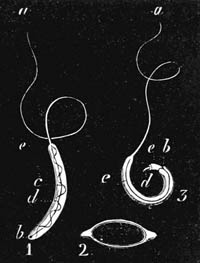
Fig. 68.—Trichocephalus of man.—1, female, a,
cephalic extremity, b, caudal extremity and anus, c, d,
digestive tube and ovary, e, orifice of sexual apparatus. 2,
isolated egg. 3, male, a, cephalic extremity, b, anus, c,
digestive tube, d, spicula or penis, e, sheath into which it is
withdrawn.
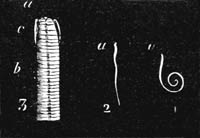
Fig. 69.—Oxyurus vermicularis.—1, male of natural
size, 2, female, id., 3, cephalic extremity, magnified.
The brood of worms from the eggs of the Ascaris megalocephala
of the horse live in freedom, and go through all their phases until
their sexual development separately; there are males and females. The
generation which descends from these is distinguished by being of a
much smaller size.
The name of Trichocephalus has been given to nematodes which have
the cephalic extremity very thin, and ending in such a fine point that
it is difficult to discover the mouth. The Trichocephalus of man
(Fig. 68) is a curious nematode, which was discovered by a student at
Göttingen, in 1761. It is usually found in the cæcum, in which more
than a thousand have been met with together. The female is from 40 to
50 millimètres long, the male about 37 millimètres. A female
Trichocephalus affinis having laid her eggs in an aquarium, the
whole of the contents were introduced into the stomach of a lamb,
seven months afterwards, and the walls of its intestines became
infested with trichocephali.
No animal at any time has attracted so much attention as that little
worm which lives in flesh, rolled up; it is about the size of a millet
seed, and was found by chance in the dissecting-room of a London
hospital, some forty years ago. The plague and the cholera did not
inspire so great fear, and this fright had almost passed from Germany
throughout the rest of Europe. We were not among those who wished to
take measures at all hazards against the invasion of this worm, since
nothing induced us to believe that more trichinæ existed then in
Belgium than in ordinary times. These measures would have produced no
other effect than uselessly to disturb the minds of the public.
Trichiniasis, which was the name given to the disease caused by these
worms, reminds us of tarantism, that is to say, the effects produced
by the bite of the tarantula. Mons. Ozanam wrote an interesting work
on this subject, in which he said that nervous tarantism existed
during two centuries in Europe, as an epidemic malady. According to
him, there prevails at present in the province of Tigre, in Abyssinia,
a sort of chorea, or endemic musicomania, which has a great analogy
with tarantism; it is the “Tigretier.” Nothing but music and dancing
can have any beneficial effect during the crisis; but these means
would evidently be inefficacious in trichiniasis.
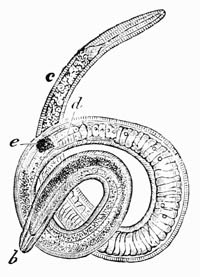
Fig. 70.—Trichina.
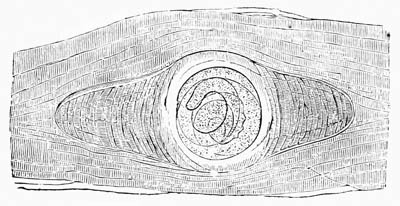
Fig. 71.—Trichina, rolled up in a muscle.
The Trichina is a nematode worm, and not an insect, as it was at first
called. Let us imagine an extremely slender pin, such as entomologists
employ to fasten the smallest insects, rolled upon itself in a spiral
form so as to lodge in a cavity hollowed out in the midst of the
muscles, in a space not larger than a grain of millet.
These trichinæ
of the muscles can be discerned by the naked eye. But before we enter
on a particular description (and they are now known in their minutest
details), let us notice what were the circumstances which led to their
attracting so much attention.
It was in 1832; a demonstrator of a course of anatomy at Guy’s
Hospital in London, Mr. J. Hilton, found in the flesh of a man
sixty-six years of age, who died of a cancer, a great number of little
white bodies which he took for vesicular worms. The scalpel, during
the dissection of the muscles, met with granulations which blunted the
edge of the instrument. Astonished to find in the flesh hard
corpuscules which the instrument divided with difficulty, he removed
some of them, examined them attentively, but, no doubt, he was not
sufficiently acquainted with helminthology to understand their true
nature. He referred to Professor R. Owen, the celebrated naturalist of
the British Museum, who recognized them as new worms, and gave them
the name of Trichina, because they are as thin as a hair; he added
the specific name of spiralis on account of the manner in which they
were rolled up in their cyst. Trichina spiralis is therefore the
name of this animal.
Some naturalists, at that time, believed that the filaments of the
fecundating fluid of the male were parasitical worms, such as are
found in other liquids; and these filaments which were designated by
the name of spermatozoïds (the animalculæ of the older naturalists),
were considered as beings having a certain affinity with trichinæ. The
trichinæ were the intermediate state between these filaments of the
fecundating fluid and worms properly so called. It is now known with
certainty that these filamentary bodies are no more animals than the
globules of blood, and that all that was thought to have been observed
of their organization was nothing but pure fancy.
The trichinæ, which are now completely known in the minutest details
of organization and manner of life, have a distinct mouth, and they
have a complete digestive tube with an orifice at each end of the
body, like all worms in the form of a thread, which, for this reason,
are called by naturalists Nematodes as opposed to Cestodes (in the
form of a ribbon or tape). Besides this nutritive apparatus, trichinæ,
like nematodes in general, have the sexes divided into two distinct
individuals, so that there are males and females, which can be easily
distinguished from each other by the size and form of the body.
Trichinæ are found in the flesh of almost all the mammals. If we eat
this trichinous flesh, the worms become free in the stomach as
digestion goes on, and they are developed with extreme rapidity. Each
female lays a prodigious number of eggs; from each of these comes a
microscopic worm, which bores through the walls of the stomach or the
intestines, and thousands of trichinæ lodge themselves in the flesh,
where they hide till they are again introduced into another stomach.
When the number is great, their presence may cause disorders or even
death. Leuckart’s experiments on animals aroused the attention of
physicians, and then it was found that patients who had shewn
exceptional symptoms, had fallen victims to the invasion of these
parasites. Leuckart counted 700,000 trichinæ in a pound of the flesh
of a man, and Zeuker speaks of
even five millions found in a similar
quantity of human flesh.
The Trichina spiralis produces about a hundred young worms at the
end of a week (viviparous); and a pig which had swallowed a pound of
flesh (5,000,000 trichinæ) might contain after some days 250 millions,
reckoning that only half the worms hatched were females, which is not
the case, for there are more females than males. It appears that
trichinæ can become sexual in all warm-blooded animals, but the number
in which they can become encysted is not so great. It appears that
they are not encysted in birds.
In the month of December, 1863, R. Leuckart wrote to me from Giessen;
“The Trichinæ are playing a great part at present in Germany (with the
exception of Schleswig-Holstein). Two epidemics have made their
appearance within a few months, and have produced a veritable panic,
so that no person will any longer eat pork. The authorities everywhere
are obliged to subject the flesh of these animals to microscopic
examination.”
We owe to Leuckart (1856 and 1857) and to Virchow (1858) the knowledge
of the principal facts of the history of these worms. Virchow
ascertained by experiment that they become sexual in the alimentary
canals at the end of three days; and these two naturalists discovered,
after many researches, that trichinæ are neither strongyli nor
trichocephali, but a different kind of nematode, which are hatched in
the stomach of those whom they infest, and that their embryos, instead
of migrating, establish themselves in the host himself. The embryos of
parasites do not usually remain in the animal which gives them
lodging; they are evacuated, as well as the eggs, and are conveyed
to another animal. The trichinæ are sexually developed in the same
animal in which they have been engendered.
Worms which produce eggs do not usually hatch them in the same animal;
they are evacuated with the feces. The trichinæ are an exception.
These agamous worms, when introduced into the stomach, rapidly pass
through their evolutions there, become sexual, lay eggs, and the germs
which are produced from them pierce the tissues, and become encysted
in the muscles or other closed organs. It appears that the
Ollulanus tricuspis, a nematode of the cat, presents the same phenomena. It is
a species of trichina, which lives at first in the muscles of the
mouse which serves it as a vehicle, then in the stomach of the cat,
where it becomes sexual and complete.
The Spiroptera obtusa is a worm remarkable for its peregrinations.
It passes with the excrements of the mouse into the larva of Tenebrio
molitor, which is very fond of it. At the end of a month it is
encysted in this insect, and after five or six weeks it becomes sexual
in the mouse. The Spiroptera obtusa of the mouse lays eggs which are
evacuated with the feces; and these become, with the eggs which they
enclose, the prey of meal worms, the larvæ of the Tenebrio molitor,
a coleopterous insect. These germs come forth in the intestine of the
larva, they perforate the intestine and become encysted in the folds
of fat which surround it. Some fine day the insect is swallowed by the
mouse, and the Spiroptera, set at liberty in the intestine, will be
gradually matured until its sexual development is complete.
The ordinary crab of our coasts, Carcinus mænas, is the vehicle
of a nematode which becomes a Coronilla robusta in the stomach
of a ray.
The Heteroura androphora is another nematode which lives in the
stomach of tritons. The male is always rolled round the body of its
female. The two sexes are always free, contrary to that which is
observed in the syngami. The Blattæ, coleopterous insects, also
harbour sexual nematodes. Radkewisch saw two species of anguillulæ,
the Anguillula macroura and appendiculata, in the Blatta
orientalis, and an Oxyuris brachyura in the Blatta germanica.
These eggs leave the body with the feces, and resist the action of
deleterious agents.
Heterodera Schachtii is the name given to a nematode which Mons.
Schacht discovered on beet-root. This is also a dimorphous worm; the
male has the usual form, the female resembles a lemon. The Leptodera
appendiculata inhabits the foot of the Arion empiricorum, in the
larva state, and becomes sexual (male and female) in the decomposed
body of the snail. The next generation has the sexes united, and lives
in damp earth. The Leptodera pellio lives in the same way in the
bodies of lumbrici; another Leptodera inhabits the intestine of the
snail, and a third the salivary glands. The nematode so generally
known under the name of Ascaris nigro-venosa also belongs to this
genus. It lives in the lungs of the frog. There is one also in the
lungs of the toad, but it differs from the preceding.
Leuckart looks upon these worms as females, and their reproduction as
parthenogenetic. Schneider considers that the male exists by the side
of the female sex, and that they are consequently hermaphrodites.
These
worms in the lungs are viviparous, and embryos are found in
the midst of the intestine of the same animal which gives lodging to
the female. These same worms, proceeding from an hermaphrodite parent,
or from parthogenetic females, live at liberty, and not parasitically
in damp earth or in a decomposed body, and differ from their parents
in size as well as in sexual organs. They all become either male or
female, and consequently their fecundity is dependent upon copulation.
Their parents could all multiply without it, but they cannot. The
females alone produce a new generation.
A worm known by the name of Vibrio anguillula lives in grains of
corn while still green, and multiplies there to a prodigious extent;
it is this which causes the disease known by the name of smut. The
grains grow hard, and enclose nothing but little dried worms, which
remain thus without apparent life, yet without dying, until they are
moistened, when they become damp, the tissues swell, the organs resume
their natural appearance, and the functions are restored at the end of
a few hours.
In a grain of corn affected by smut, anguillulæ without distinct
organs are found, which may be dried and revived eighteen times in
succession, according to Mons. Duvaine, who thinks that these
anguillulæ, leaving an infected grain, come out of their envelopes in
a field of corn, cling to the young stalks, and rise with them. They
begin to develop themselves in the rudimentary flower of the corn, and
acquire genital organs like nematodes. Males and females are always
found separately in a grain of corn.
The ermine lodges in its lungs and tracheal artery
a long worm, to
which I have given the name of Filaroides mustelarum. It usually
forms a little sac, which resembles a tubercle. Many individuals of
different sexes, wound round each other, are so closely tied together
that they can with difficulty be separated. They resemble a ball of
cotton. This filaroid sometimes gets into the frontal sinus, and
mechanically destroys a part of its osseous walls, so that the skull
is pierced by a hole above the frontal sinus. Dr. Weyenberg made this
observation.
It is probable that other species of Mustela will present the same
phenomena, for the skulls of this animal are often to be found
perforated above the orbital cavity.
The Ollulanus tricuspis is a worm which lives in the walls of the
stomach of cats; it is viviparous, and the young ones sometimes wander
into the muscles of their host. But the natural course of things is
that the young are evacuated with the feces, and that these dejecta,
according to all probability, form part of the food of mice, and pass
with them into the cat. It is to be hoped that Leuckart will soon put
this migration out of doubt by a decisive experiment, and will prove
that the mouse serves as a vehicle for three different worms, the
Cysticercus, the Spiroptera obtusa, and the Ollulanus tricuspis.
Many nematodes lodge in the substance of the walls of the gizzard of
birds. In the large goosander we have found one which has round its
head four blades, crossing each other, toothed on the concave side. We
have given the name of Ascaracantha tenuis to this worm. It has
very small eggs. The Trichosomum crassicauda is a
nematode of the
rat; the female is 2·5 millimètres in length, and the male ·17
millimètres, and it lives in the uterus of its female. Five males are
occasionally found in one female. This observation made by Leuckart
has been confirmed by Bütschli. The male has its digestive tube
incomplete; its female feeds for it.
The bat of the high mountains of Bavaria, known under the name of
Vespertilio mystacinus, harbours a nematode, the Rictularia
plagiostoma, the same which is found in Egypt in the hedgehog
(Erinaceus auritus). The bat on the banks of the Rhine has not this
remarkable worm. We must therefore conclude that the bat of Bavaria
finds and eats the same insect as the hedgehog in Egypt, and that this
insect does not live on the banks of the Rhine. We have never met with
this nematode in the mystacines of Belgium, and yet we have opened
them by hundreds.
A bird found in Florida, the Anhinga, has in its brain a nematode
whose presence in that organ is not accidental.
The Echinorhynchi form a very remarkable group of parasites. They
migrate from one host to another; but the vehicle by which the greater
part of them is conveyed is not known. We represent in Fig. 72 a
species which is very common in the intestine of the sprat.
It is known that these worms migrate when young, and undergo
metamorphoses when they change their host. The Asellus aquaticus of
fresh water, harbours besides other worms, the Echinorhynchus
hœruca; the Gammarus pulex, another fresh-water crustacean, lodges
the larva of the Echinorhynchus proteus (Fig. 72). We commonly find
this beautiful species of the Echinorhynchus
in the alimentary cavity
of the sprat, and it is easily distinguished by its peculiar form and its orange colour.
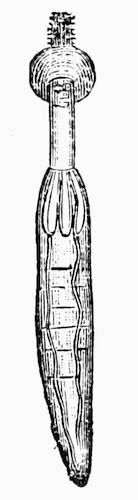
Fig. 72.—Echinorhynchus proteus of the Sprat.
Fig. 73.—Sac with psorospermiæ, in the Sepia
officinalis.
The Asellus aquaticus seems also to serve as the vehicle of the
Echinorhynchus angustatus. The hooks of the embryos differ from
those of the adults, as the six hooks of the cestodes differ from the
crown of the adults. Leuckart has described those of the envelope of
the Echinorhynchus proteus and the Echinorhynchus angustatus. The
embryo of the Echinorhynchus has only two large hooks on each side,
but several smaller ones. The two species mentioned above have on each
side five or six hooks placed at right angles with the median line,
but they are not all of the same size.
The animals are allied to the Gordii in their development. In fact,
their development is like that of the echinodermata; the larva is the
Pluteus, in which the true echinorhynchus develops itself, borrowing
the skin of the pluteus. According to the experiments made by
Schneider, the larvæ of cockchafers must be the vehicles of the
Echinorhynchus gigas. Pigs disseminate the eggs, and the embryos
infest these larvæ, in the bodies of which they pass through their
principal changes.
The Gregarinæ are microscopic beings, with an extremely simple
organization, the nature and the genealogy of which have only lately
been known. They live at first encysted by thousands together, under
the name of Psorospermiæ; they are afterwards hatched in the form of
Amœbæ, and then transformed into Gregarinæ. They migrate from one
animal to another, or from one organ to another, to settle in the
intestine, where they assume their adult form. In this state they are
monocellular, and do not at any time possess organs which resemble the
sexual organs of other classes. The disease of silk worms, known by
the name of “pebrine,” has been attributed to the development of
psorospermiæ.
We give the representation (Fig. 74) of gregarinæ which we have found
abundantly on the Nemertes; and (Fig. 75) a peculiar species which
lives in the larva of an agrion.
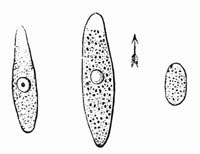
Fig. 74.—Gregarinæ of Nemertes Gesseriensis.
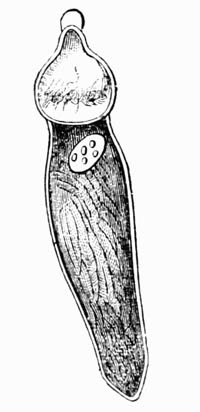
Fig. 75.—Stylorhynchus oligacanthus, from the
larva of the Agrion.
We also give a sketch (Fig. 76) of some very remarkable parasites,
whose affinities are still problematical, and which only inhabit
spongy bodies, such as the kidneys of cephalopods. The name of
Dicyema has been given to them.
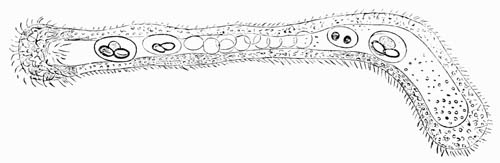
Fig. 76.—Dicyema Krohnii, from Sepia
officinalis.
Prof. Ray Lankester has quite recently made some very interesting
observations, at Naples, on these problematical beings; and my son has
just devoted a part of his vacation, with two of his pupils, to
elucidate the points of their organization and development, which are
still obscure. He went to reside at Villefranche, near Nice, in order
to obtain fresh cephalopods every day. His observations have led him
to a result quite different from that which I expected.
In this chapter we bring together true parasites, which may be called
complete; they pass every part of their life under the care of a
neighbour, and require an asylum the more urgently, since they cannot
exist without it. They absolutely need both food and lodging. Not long
ago, all parasites were supposed to be dependant during their whole
life, and to be incapable of living outside the body of another
animal. We have before proved that this opinion was erroneous. We find
in this category a great number of parasites which may be separated
and placed in the first group, including all such as pass all the
phases of their life on the same animal, without changing their
costume, and many of which never leave the fur, the feathers, or the
scales, among which they are born.
Fishes nourish on the surface of the skin a great number of these,
which helminthologists have thought proper to classify under the name
of Ectoparasites. Among many crustaceans and insects, only one
of the sexes is parasitical. The males remain entirely free, and
preserve all their attributes, while the females seek for assistance,
and require food and lodging. The female
alone sacrifices her
liberty, and changes her form entirely in order to secure the
preservation of her posterity.
The insects called Strepsiptera, which live as parasites on wasps,
furnish a curious example of this (Fig. 77). These insects, the
Polistes, the Andrenæ, and the Halicti, do not kill the larvæ of
the Hymenoptera on which they feed; they suck the blood of their
victim slowly, and leave him just enough strength to go through his
metamorphoses. The females are condemned to remain almost completely
immovable on their prey, while the males are winged.
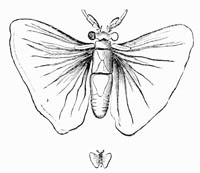
Fig. 77.—Stylops. Male, natural size, and magnified.
Naturalists have paid great attention to these latter insects, as much
on account of their mode of life as of the difficulties which they
have suggested to entomologists in the appreciation of their natural
affinities. Are they coleoptera, as was for a long time, and perhaps
correctly, supposed, or do they form a distinct order by themselves?
However this may be, these are the facts known concerning them,
according to the recent observations of Mons. Chapmann, a
conscientious naturalist. The females do not lay their eggs in the
nests of wasps, but the larvæ, under the form of meloë, penetrate into
the cells, by the assistance of the larvæ of the wasps, which carry
them hidden between the second and third ring. The larvæ of the
Rhipiptera are developed at the expense of the larvæ of the wasp, suck
their blood, swell, and their skin remains adhering to the fourth
segment.
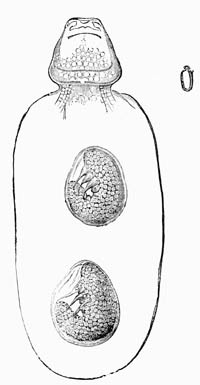
Fig. 78.—Black Stylops, female, showing the embryos in
the abdomen.
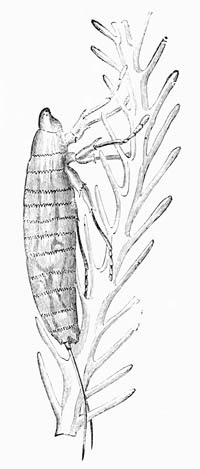
Fig. 79.—Black Stylops, larva at its birth (from
Blanchard).
When the rhipipterous insect is six millimètres in length, it changes
its skin the second time, and this
splits on the back, so that the
skin remains fixed between the larva of the parasite and that of the
wasp. It then sucks the rest of the juices of the young wasp, and
becomes a nymph in the prison which it has formed for itself. This
evolution lasts from twelve to twenty-four hours.
Many male crustaceans, though they differ materially from their
females in form as well as in manner of life, do not remove far from
their partners in order to procure the assistance which they need. The
insects which now occupy our attention are entirely different in this
respect. The male preserves his usual appearance during the whole of
his life, as well as the attributes and independence of free insects;
while the female seeks for assistance with regard both to food and
lodging from the time she leaves the egg; she is still wrapped up in
swaddling clothes when she receives the male, as when she came forth
from the egg.
The worms of this category are usually fully formed without undergoing
metamorphoses; and if the place which they choose at their exit from
the egg is not precisely their cradle and their tomb, at least all the
phases of their monotonous life occur around it. They may be ranked
among the most beautiful and the largest of parasitical worms; and as
they are hermaphrodites, we find no greater diversity in the several
forms than in their differences of age. All have their reproduction
certain, and their eggs are less numerous for this reason. There are
some of them that lay only one egg at a time, and this egg sometimes
appears but once during a season. This explains why the eggs of some
of these worms have not yet been recognized.
We may place at the head of this group the Tristomum, which has
only been discovered a few years. We owe to Baster the knowledge of a
beautiful and large species, which inhabits the body of the halibut.
Naturalists have given it the name of Epibdella. This worm is
of the size of the human nail; it resembles in form a box leaf; by the
aid of its suckers it clings to the skin of its host like a scale; and
is sometimes mistaken for one. It is of an oval form, and of a dull
white colour; it can scarcely be distinguished from the skin of the
fish. We may have it before our eyes for a long time before we
perceive it.
Another Epibdella lives on the skin and on different parts of the body
of the European maigre, or the Virgin Mary’s fish; it is covered with
pigment spots which cause it still more to resemble the large scales
of its host. This fish, which is also called the Sciæna aquila,
has its skin covered with similar scales, and they are of the same
colour, both on the back and belly.
Another large and fine worm of this group lives on the gills of the
sturgeon, and is distinguished by its suckers as well as by its great
mobility. The epibdellæ preserve their scale-like form during their
greatest contractions, but these worms change with every movement. The
Nitschia elegans, for such is the name by which it is distinguished,
is not rare on the sturgeon as we see it in our markets. Among the
many parasites in this category, there is a very remarkable one which
deserves particular mention. It lives abundantly on fresh-water
fishes, preferring to attach itself to their gills; it is found most
commonly on the bream. For our knowledge of these worms we are
indebted to Nordmann.
They bear the name of Diplozoon paradoxum, and are always double,
that is to say, always united like Siamese twins, being organically
fastened together; they leave the egg, like their congeners, isolated
and hermaphrodite, instal themselves separately on their host, and a
little time after their choice of a resting-place, they unite so that
the tissues, I was about to say the organs, are welded to each other.
They cross like two strokes of an x. It is in this position that
they live and die, after having produced large and beautiful eggs
provided with a very long cable. These eggs are laid separately, and
attached to the gills of the fishes which give them shelter. At the
end of a fortnight the ciliated embryo comes forth, being provided
with two eyes, and seeks to establish itself on a fresh host.
Under the form of Diporpa it has a ventral sucker, and a small
papilla on its back, and the two individuals are attached to each
other cross-wise by the sucker and the papilla. Notwithstanding what
Humboldt says in his “Cosmos,” the Diplozoon is not an animal with
two heads and two caudal extremities, but is a double animal, two
hermaphrodite individuals united, which at first have lived
separately, and have become soldered to each other at the period of
maturity.
We find a nematode, and consequently an animal with the sexes
separate, which presents the same phenomena. The male and female are
soldered together, but the female alone undergoes development. It is
the Syngamus trachealis of Siebold. It inhabits the tracheal artery
of some gallinaceous fowls, and according to recent experiments, it
develops itself directly in the tracheal artery of birds.
Another beautiful trematode, the Octocotyle lanceolata, lives
abundantly on the gills of the alosa, and another, the Octobothrium
merlangus, on those of the whiting. The gills of the Mustelus
vulgaris regularly bear another species resembling a leech, but
instead of a single sucker there are six; this is the Onchocotyle
appendiculata.
The bladder of frogs lodges a very beautiful and large trematode which
has lately been studied by many naturalists, the Polystomum
integerrimum. Many observations remain to be made on the different
phases of the existence of this parasite. Its organization is known,
and it has been seen to lay large and beautiful eggs, but its
movements have not been observed before its entrance into the bladder.
This Polystomum of the frog—and it is no doubt the same with the
species Polystomum ocellatum which inhabits the mouth of the
European tortoise (Emys Europæa)—lays eggs only in winter, and
the eggs of the young ones do not seem to produce more precocious
embryos than those of the adult. The embryos are ciliated, unlike
those of many of the ectoparasite worms. They much resemble the
gyrodactyles, especially by their bristles; and like these, they
inhabit the cavity of the mouth before they migrate into another
organ. We may even ask if these singular gyrodactyles, so peculiar in
many respects, are not the larval forms of trematodes allied to the
polystomum.
Several important works have lately appeared on the Polystomum
integerrimum, by Mons. Stiéda in 1870, by Mons. E. Zeller and
Mons. Willemoes-Suhm in 1872.
The gyrodactyles, which we have just mentioned, are among the most
curious worms that have been discovered during late years. They are of
small size, and live in the gills of fishes, often in great numbers,
and move with considerable agility. They are armed with very variable
hooks, which serve to anchor them; and sometimes a digestive canal and
organs of sensation are found in them.
The Gyrodactylus elegans bears within it a young one which already
has hooks, and in this young one, which is not yet born, we see
another generation with the same organs, so that three generations are
thus enclosed. The daughter is ready at the moment of her birth to
give birth to another daughter. According to another mode of
interpretation, the mother and daughter are sisters; the elder is
found at the periphery, the younger at the centre. These worms are
found abundantly in the gills of the cyprinidæ, or white fishes. We
have only to scrape gently the surface of the gills with a scalpel,
and thus remove a small quantity of a mucous substance, place it on a
slide of a microscope, cover it with thin glass, and examine it
immediately with the compound microscope. We cannot repeat this three
times without finding gyrodactyles.
There are also many insects which live as parasites on plants, and
demand from them both a resting-place and their food. Almost all the
Hemiptera are among these; we have already mentioned them. The
hemiptera, which live on the sap of vegetables, are parasites in the
same manner as those which live at the expense of animals. We ought
not to make a difference between the manner of life of the bugs of
plants and those of animals. It may be said that Providence has placed
these beings as riders on both the vegetable and animal kingdoms to
restrain them with a bridle. What the gardener does to plants, the
aphis has often done before in order to arrest a too vigorous and
rapid growth.
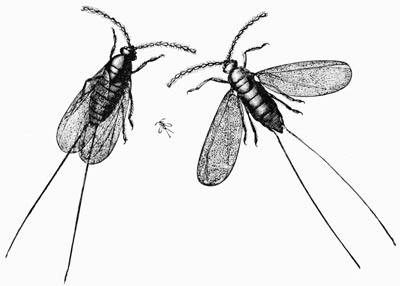
Fig. 80.—Cochineal insect, male (Coccus cacti),
natural size and magnified.
The cochineal insect (Coccus cacti) Figs. 80 and 81,
originally
from Mexico, lives on the cactus nopal as a true parasite, and
furnishes a precious colouring matter, carmine. This insect has been
introduced into the Antilles, Spain, the Canary Isles, Algeria, and
Java.
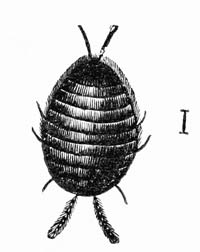
Fig. 81.—Cochineal insect, female.
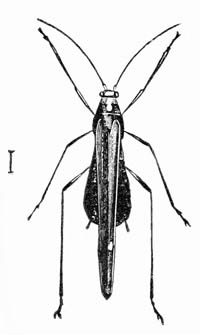
Fig. 82.—Aphis.
Lake is produced by a species of the same genus, originally a native
of India (Coccus lacca).
Aphides (Fig. 82) feed on the sap of plants; they multiply rapidly
without the male insect. Rose-trees, and more especially their buds,
are attacked by a species of a green colour, of which we give a
representation (Fig. 83).
An aphis, the Phylloxera vastatrix, has, a short time since, invaded
the vineyards, and small as it is, it is dreaded as a plague which
scatters ruin in its path. According to recent observations this
insect has a double series of generations which precede each other:
the mother type and the tubercular type. But this polymorphism seems
to be more apparent than real,
although there is a considerable
difference in their manner of life and of procuring nourishment. Is
this difference the result of the different kinds of food taken from
the roots and the leaves? There is one thing which may reassure us as
to the future attacks of
the phylloxera, that Mons. Planchon has
just discovered in America the cat of the phylloxera, one of the
acaridæ, its mortal enemy; and it is only necessary to multiply these
in order to destroy this terrible pest of the vineyards. We thus see
that we have only to imitate this so-called blind Nature, in order
that we may arrest a misfortune against which man is unable to protect
himself by his own powers.
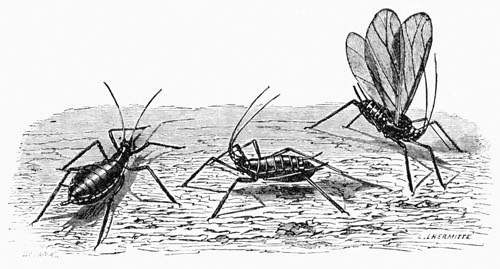
Fig. 83.—Rose-Aphis. Male and Female.
We will here repeat what we wrote respecting aphides some years ago.
Who does not know these small green bodies, of the size of a pin’s
head, coming like a cloud upon the buds and leaves of the rose bushes,
which shrivel and wither immediately? There are green ones on certain
plants, and black ones on others, but whatever be their colour, they
are living pearls which form garlands round the stalk. The world
considers them as vermin, and they scarcely dare to touch them with
the point of their fingers. To the naturalist they are a little world
of wonders. Let us examine with a magnifying lens these walking grains
of sand; each grain will reveal to us a charming insect, whose head is
adorned with two little antennæ, and has globular projecting eyes
glistening with the richest colours; behind these are two reservoirs
of liquid sugar, elegantly mounted on a polished stalk, and always
full; long and slender limbs support the globular body.
Much has been written about these small sugar manufactories, so well
known by ants that they have procured for the aphis the name of
ant-cow. Among the curious phenomena presented by these grains of
animated dust, that which most interests us relates to the secret
of their astonishing, we may say, their prodigious fecundity.
Nature requires millions of aphides in a few hours, to arrest the
exuberance of vegetation, and as if she distrusted the assistance of
the male insect, she dispenses with it, and the female brings into the
world a daughter already prepared to produce a grand-daughter.
Generations succeed each other with such rapidity, that if the
daughter at her birth were to meet with any obstacle in her passage,
the grand-daughter might come into the world before her mother; a
single egg can produce in the course of one season milliards of
individuals. Each plant has its own aphis, and in many localities the
ravages of the Aphis laniger are but too well known, though it was
unknown in Europe a quarter of a century ago.
The Gyrodactylus elegans, of which we have spoken above, contains
embryos similarly enclosed, and if these facts had been known at an
early period, the celebrated theory of the enclosure of germs, so
warmly advocated by Bonnet, would have preserved still longer its
intrepid defenders.
With but few exceptions, all the Hemiptera are parasites of the
vegetable kingdom. There are only very few which attack animals. There
is one species, the name of which may be readily guessed (Acanthia
lectularia), which pursues us relentlessly everywhere, for it will
wait for months and years, always equally greedy of our blood. It
surprises us during the night, and does not wait till its digestion is
complete before it attacks us again. Happily for us, another
hemipterous insect, the masked reduvius (Reduvius personatus)
penetrates like
the preceding one into our apartments, and covers
itself with dust, in order the more readily to fall upon its enemy;
but man is not sufficiently acquainted with its habits, to make war in
common with it on this miserable parasite. We ought for this purpose
to place the masked reduvius under the protection of the law, to
collect the various kinds together, and to offer premiums for the most
vigorous races.
- Acanthia lectularia, 267
- Acaridæ, 130
- Acarus, itch, 131
- Actinia carcinopodus, 63
- Adamsia, 26
- Agamonema, 234
- Alardus caudatus, 45
- Albertia, 35, 78
- Alciopina, 47
- Alcyonium domuncula, 27
- Alepas on Spinax niger, 58
- Allotria victrix, 172
- Amphinoma, 43
- Amphistomum sub-clavatum, 203
- Ampularia and Sphærium, 40
- Ancei, 72
- Anelasma squalicola, 58
- Anemone of Chinese sea, 7
- Angler (fishing frog), 33
- Anguillula macroura, 248
- Anguillulina, 182
- Anilocra, 29
- Anodonts, young, 39
- Anoplodium parasita, 46
- Apterychtus ocellatus, 6
- Arcturus Baffini, 41
- Argas chinche, 133
- Arguli, 34, 72
- Arius bookei, 8
- Ascaracantha tenuis, 250
- Ascaris acus, 241
- inflexa, 237
- lumbricoides, 95
- megalocephala, 241
- nigro-venosa, 157
- vesicularis, 237
- Ascaroides limacis, 83
- Asellus medusæ (Dalyell), 21
- Asilus crabroniformis, 121
- Astacobdella, 81
- Asterachæres Lilljeborgii, 152
- Asteromorpha lævis, 48
- Atax, 136
- Axinella, 66
- Balanidæ on Matamata, 58
- Balatro calvus, 35
- Baudroie (angler), 33
- Bdellura, 46
- Bernard the Hermit, 23
- Berne, 120
- Bilharzia, 105
- Birgus, 25
- Black-flies, 116
- Bonellia (male), 139
- Bopyrus, 32, 144
- Bothriocephalus latus, 105
- Brachycera, 115
- Bracon iniator, 168
- Branchellions, 113
- Bryozoa, 41
- Bugs, 124
- Cahira lerneodiscus, 146
- Caligi, 34, 44
- Caligulus elegans, 73
- Callianassa, 28
- Cancer lanosus, 22
- Cancrisocia expansa, 22
- Caprella, 77
- Caris elliptica, 135
- Cecidomya, 171
- Cellepora, 62
- Cenobita, 25
- Cepes distortus, 145
- Ceratopogon, 119
- Cercariæ, 192
- Cestodes, 204
- Chætogaster, 114
- Chætopterus insignis, 43
- Chalcididæ, 166
- Chama squamata, 19
- Chelonobia, 58
- Cheyletus of Leroy, 137
- Chigoë, 105, 141
- Chironomus, 116
- Chrysaora isocela, 10
- Cimex lectularia, 123
- Cirrhipedes, 56
- on Neptunus, 59
- on the Langouste of Cape Verd, 58
- Clione, 50
- Cochlialepsis parasitus, 39
- Cœnurus of the Sheep, 99
- Comatula, 36
- Conchoderma gracile, 151
- Conchodytes, 17
- Concholepas Peruviana, 60
- Conops, 176
- Corethria on Sertularia abietina, 66
- Corethra, 116
- Coronilla robusta, 248
- Coronula, 56
- Crenella on Sponge, 40, 61
- Creusia, 60
- Crisiæ, 61
- Cryptolepas, 57
- Cryptolithoides typicus, 22
- Cryptophiolus minutus on Concholepas, 60
- Culex pipiens, 116, 118
- Cucullanus elegans, 238
- Cucumerina, 71
- Cuterebra noxialis, 175
- Cyami, 34, 76
- Cyanea arctica, 49
- Cydippe densa, 47
- Cylicobdella lumbricoides, 112
- Cymothoa, 9
- Cymothoe, 31
- of Trachina vipera, 32
- fresh-water, 32
- stromatei, 31
- Cynips of Aphis, 172
- Cypræa on Melithæa, 38
- Cysticercus tenuicollis, 222
- Demodex caninus, 134
- Demodicidæ, 134
- Dactylometra quinquecirra, 9
- Dermanyssus avium, 135
- Diadema, 56, 60
- Dichelaspis on Sea Snakes, 58
- Dicyema, 161
- Diplozoon, 98
- Diporpa, 260
- Distomum filicolle, 201
- Distome with cables, 84
- Distomes of Cheiroptera, 199
- Distomidæ, 190
- Distomum hepaticum, 95
- ocreatum, 45
- ventricosum, 45
- Dochmius trigonocephalus, 238
- Donzellina, 4
- Drilus, 13
- Dromia, 22
- Echinococcus, 225
- Echinomya, 176
- Echinorhynchi, 251
- Echinorhynchus angustatus, 252
- Elminius, 60
- Enalcyonium rubricundum, 152
- Enchelyophis vermicularis, 6
- Enterocola fulgens, 151
- Entoconcha, 37, 158
- Entoniscus porcellanæ, 146
- Epichtys, 31
- Epibdella, 259
- Epizoanthus Americanus on Eupagurus, 63
- Eubranchella, 112
- Eulimæ, 36
- Euplectella, 23, 30, 50
- Euriechinus imbecillus, 20
- Eurysilenium, 152
- Fabia Chilensis, 20
- Fierasfer, 5
- Filaria of Medina, 105, 153
- Filaroides mustelarum, 250
- Fishing Frog and Amphipod, 33
- Fleas, 126
- harnessed, 129
- of the sea shore, 128
- Dugès on, 128
- Van Helmont on, 127
- Flies, 119
- Gadfly, 112
- Galathea spinirostris on Comatula, 20, 61
- Gammarus of Avicula, 33
- Gebia, 28
- Gerardia Lamarckii, 49
- Glossina morsitans, 119
- Gnats, 116
- Gordius, 153
- Gregarinæ, 160
- Guinea worm, 105, 158
- Gyges branchialis, 145
- Gyrodactyli, 261
- Gyrodactylus elegans, 262
- Gyropeltis, 74
- Halichondria suberea, 63
- Halodactylus, 62
- Hematopinus tenuirostris, 129
- Helmidasys, 47
- Hemieuryale, 49
- Hemioniscus, 60
- Hemiptera, 262
- Hemistomum alatum, 204
- Heterodera Schachtii, 248
- Heteroneidæ, 236
- Heterosammia, 63
- Heteroura androphora, 248
- Hippoboscus, 175
- Hirudineæ, 108
- Histriobdella, 80
- Holtenia Carpenteri, 50
- Hopalocarcinus, 21
- Hyalonema, 64
- Hydrachna geographica, 136
- Hydractiniæ, 27
- Hyperinæ, 32
- Hyperia Latreillii, 33
- Ichneumons, 163
- Ichthyoxenus Jellinghausii, 31, 146
- Iones, thoracicus, 145
- Isopods, parasite, 143
- Ixodes bovis, 134
- Kakerlot, 23
- Krätzmilben, 133
- Laura, 152
- Læmippa rubra, 152
- Leeches, aquatic, 110
- Lepidonotus cirratus, 44
- Leposphilus, 147
- Leptus autumnalis, 137
- Leptodera, 154
- appendiculata, 248
- pellio, 248
- Lernea branchialis, 151
- Lerneans, 148
- Lerneoniscus, 146
- Lichnophora, 159
- Lice of Bees, 171
- Limosina, 136
- Linguatula serrata, 231
- Linguatulidæ, 134
- Liothe pallidum, 71
- Lithoscaspus, 21
- Lipoptena of the Stag, 177
- Loxostoma, 41
- Lucilia hominivora, 120
- Liriope, 28
- Lysidice erythrocephala, 43
- Macaco Worm, 175
- Magilus, 39
- Maia and Polypidom, 20
- Malacobdella, 109
- Maringouins, 116
- Measled pork, 190
- Meloë, 173
- Meloïdeæ, 171
- Melophagus of the Sheep, 177
- Membranipora, 41
- Mermis, 158
- Messmates fixed, 53
- Midges, 116
- Mnemiopsis, 44
- Mnestra parasites, 61
- Modiola, 16
- Modiolaria, 40
- Monostomata, 201
- Monostoma mutabile, 201
- Mosquitoes, 117
- Musca hominivora, 119
- Mutualists, 68
- Myasis, 123
- Myzobdella, 81
- Myzostoma, 42
- Nais, 114
- Nebalia, 35
- Nemertes carcinophilus, 46
- Nemocera, 115
- Nereis succinea, 42
- Nirmus buteonivorus, 70
- Nitzchia elegans, 259
- Notonecta, 124
- Notopterophorus, 151
- Nycteribia, 123
- Octobothrium merlangi, 261
- Octocotyle lanceolata, 261
- Odontobius, 45
- Œga on Hyalonema, 30
- Œstri, 172
- Ollulanus tricuspis, 247, 250
- Onchocotyle appendiculata, 261
- Opalina, 79
- Ophiocnemis obscura, 48
- Ophioneurus, 169
- Ophiothela, 48
- Ornithomya, 121
- Ostracion, 10
- Ostracotheres tridaenæ, 17
- Oxybeles lumbricoides, 7
- Oxyuris brachyura, 248
- incurvata, 237
- vermicularis, 241
- Pachycerca, 194
- Paguri, 25
- Pagurus Prideauxii, 26
- Pandarus, 35
- Parasites which undergo transmigration and metamorphosis, 183
- free in their youth, 138
- during their old age, 162
- without transmigration, 255
- Pedicellina, 41, 42
- Pediculinæ, 70
- Peltogaster, 28, 60
- Penella, 150
- Pentastoma, 231
- Philomedusa Vogtii on Halecampa, 61
- Phoxichilidium, 35
- Phthiriasis, 125
- Phthirius pubis, 126
- Phronima, 25
- Phryxus paguri, 27, 145
- Phylliroë bucephala, 61
- Phyllobothrium of the Dolphin, 207
- Phylloxera vastatrix, 166
- Physalia, 9
- Picnogonon, 34
- Pilot, 10
- Pinnotheres, 18
- Pisa Styx, 20, 61
- Piscicola, 113
- Planaria, 46
- Platygaster cyamus, 171
- Platystoma, 7
- Plover, Egyptian, Introd. xvi., 107
- Polia involuta, 46
- Polynema, 169
- Polynoë, 43
- Polyp of the Sterlet, 82
- Polystomum integerrimum, 261
- Polythoa, 64
- Pontobdellæ, 80, 111
- Pontonia, 18
- Porcellanæ, 21
- Porites, 62
- Praniza, 75
- Premnas biaculeatus, 7
- Prosthetes cannelatus, 27
- Protolepas, 60
- Psorospermiæ, 161
- Pteroptus, 123
- Pulex penetrans, 141
- Pylidium, 45
- Pyrgoma, 60
- Reduvius personatus, 267
- Remora, 11
- Rhabdites, 156
- Rhagio, 119
- Rhipiptera, 257
- Rhincoprion penetrans, 141
- Ricini, 69, 72
- Rictularia plagiostoma, 251
- Rouget (Cheyletus eruditus), 137
- Sabelliphilus, 152
- Sacculina, 59
- Saphirina, 77
- Sarcoptes mutans, 135
- Scalpellum, 56, 60
- Sclerostomum equinum, 238
- Scolyti, 168
- Scison nebaliæ, 36
- Simonea folliculi, 89, 134
- Simulium molestum, 119
- Siponculus concharum, 47
- Sertularia parasitica, 63
- Serupocellariæ, 61
- Sitaris, 172
- Smut in Corn, 181
- Snail and Drilus, 13
- Spiroptera obtusa, 246
- Sphex, 170
- Sphærosoma of Leydig, 74
- Sphæronella Leuckarti, 151
- Sphærulariæ, 235
- Sphyriones, 151
- Sphynx of Tithymalis, 166
- Spirorbis, 44
- Staurosoma on Sabella, 35
- Stegophilus insidiatus, 8, 9
- Sterlet, 82
- Stephanurus dentatus, 238
- Stratiome chameleon, 177
- Strebla vespertilionis, 175
- Strepsiptera, 256
- Stronguli, 238
- Strongulus trigonocephalus, 240
- Stylifer, 36
- Stylops, 256
- Stylorhynchus oligacanthus, 161
- Sylon hippolytes, 60
- Syngamus trachealis, 91
- Syrphus, 122
- Tabanus bovinus, 120
- Tachinariæ, 166
- Tænia cœnurus, 222
- cucumerina, 71
- echinococcus, 225
- lata, 226
- magna, or Rhinoceros, 229
- gigantea, 229
- medio-canellata, 105
- nana, 105
- serrata, 71
- solium, 97, 105
- tenuicollis, 222
- Temnophila, 47
- Termes lucifuga, 236
- Tetrarhynchus, 101
- Ticks, 142
- Ticks, African, 143
- Trematoda, digenetic, 191
- Trichinæ, 243
- Trichiniasis, 242
- Trichocera, 116
- Trichocephalus affinis, 242
- Trichodectes of the Dog, 70
- Trichosomum crassicauda, 235, 250
- Tridacna, 17
- Tristoma, 259
- Trombidium, 137
- Tsetse, 119
- Tubicinella, 34, 56
- Tubularia, 84
- Turtle Crab, Brown's, 23
- Vaginicola, 84
- Vampires, 107
- Vibrio anguillula, 249
- Wasps, 170
- Whales of southern hemisphere, 57
- Xenobalanus globicipitis, 57
Opinions of the Press on the “International Scientific Series.”
I.
Tyndall’s Forms of Water.
1 vol., 12mo. Cloth. Illustrated.Price, $1.50.
“In the volume now published, Professor Tyndall has presented a noble
illustration of the acuteness and subtlety of his intellectual powers,
the scope and insight of his scientific vision, his singular command
of the appropriate language of exposition, and the peculiar vivacity
and grace with which he unfolds the results of intricate scientific
research.”—N. Y. Tribune.
“The ‘Forms of Water,’ by Professor Tyndall, is an interesting and
instructive little volume, admirably printed and illustrated. Prepared
expressly for this series, it is in some measure a guarantee of the
excellence of the volumes that will follow, and an indication that the
publishers will spare no pains to include in the series the freshest
investigations of the best scientific minds.”—Boston Journal.
“This series is admirably commenced by this little volume from the pen
of Prof. Tyndall. A perfect master of his subject, he presents in a
style easy and attractive his methods of investigation, and the
results obtained, and gives to the reader a clear conception of all
the wondrous transformations to which water is subjected.”—Churchman.
II.
Bagehot’s Physics and Politics.
1 vol., 12mo. Price, $1.50.
“If the ‘International Scientific Series’ proceeds as it has begun, it
will more than fulfil the promise given to the reading public in its
prospectus. The first volume, by Professor Tyndall, was a model of
lucid and attractive scientific exposition; and now we have a second,
by Mr. Walter Bagehot, which is not only very lucid and charming, but
also original and suggestive in the highest degree. Nowhere since the
publication of Sir Henry Maine’s ‘Ancient Law,’ have we seen so many
fruitful thoughts suggested in the course of a couple of hundred
pages.... To do justice to Mr. Bagehot’s fertile book, would require a
long article. With the best of intentions, we are conscious of having
given but a sorry account of it in these brief paragraphs. But we hope
we have said enough to commend it to the attention of the thoughtful
reader.”—Prof. John Fiske, in the Atlantic Monthly.
“Mr. Bagehot’s style is clear and vigorous. We refrain from giving a
fuller account of these suggestive essays, only because we are sure
that our readers will find it worth their while to peruse the book for
themselves; and we sincerely hope that the forthcoming parts of the
‘International Scientific Series’ will be as interesting.”—Athenæum.
“Mr. Bagehot discusses an immense variety of topics connected with the
progress of societies and nations, and the development of their
distinctive peculiarities; and his book shows an abundance of
ingenious and original thought.”—Alfred Russell Wallace, in
Nature.
III.
Foods.
By Dr. EDWARD SMITH.
1 vol., 12mo. Cloth. Illustrated.Price, $1.75.
In making up The International Scientific Series, Dr. Edward
Smith was selected as the ablest man in England to treat the important
subject of Foods. His services were secured for the undertaking, and
the little treatise he has produced shows that the choice of a writer
on this subject was most fortunate, as the book is unquestionably the
clearest and best-digested compend of the Science of Foods that has
appeared in our language.
“The book contains a series of diagrams, displaying the effects of
sleep and meals on pulsation and respiration, and of various kinds of
food on respiration, which, as the results of Dr. Smith’s own
experiments, possess a very high value. We have not far to go in this
work for occasions of favorable criticism; they occur throughout, but
are perhaps most apparent in those parts of the subject with which Dr.
Smith’s name is especially linked.”—London Examiner.
“The union of scientific and popular treatment in the composition of
this work will afford an attraction to many readers who would have
been indifferent to purely theoretical details.... Still his work
abounds in information, much of which is of great value, and a part of
which could not easily be obtained from other sources. Its interest is
decidedly enhanced for students who demand both clearness and
exactness of statement, by the profusion of well-executed woodcuts,
diagrams, and tables, which accompany the volume.... The suggestions
of the author on the use of tea and coffee, and of the various forms
of alcohol, although perhaps not strictly of a novel character, are
highly instructive, and form an interesting portion of the
volume.”—N. Y. Tribune.
IV.
Body and Mind.
THE THEORIES OF THEIR RELATION.
By ALEXANDER BAIN, LL. D.
1 vol., 12mo. Cloth.Price, $1.50.
Professor Bain is the author of two well-known standard works upon the
Science of Mind—“The Senses and the Intellect,” and “The Emotions and
the Will.” He is one of the highest living authorities in the school
which holds that there can be no sound or valid psychology unless the
mind and the body are studied, as they exist, together.
“It contains a forcible statement of the connection between mind and
body, studying their subtile interworkings by the light of the most
recent physiological investigations. The summary in Chapter V., of the
investigations of Dr. Lionel Beale of the embodiment of the
intellectual functions in the cerebral system, will be found the
freshest and most interesting part of his book. Prof. Bain’s own
theory of the connection between the mental and the bodily part in man
is stated by himself to be as follows: There is ‘one substance, with
two sets of properties, two sides, the physical and the mental—a
double-faced unity.’ While, in the strongest manner, asserting the
union of mind with brain, he yet denies ‘the association of union in
place, but asserts the union of close succession in time,’ holding
that ‘the same being is, by alternate fits, under extended and under
unextended consciousness.’”—Christian Register.
V.
The Study of Sociology.
By HERBERT SPENCER.
1 vol., 12mo. Cloth.Price, $1.50.
“The philosopher whose distinguished name gives weight and influence
to this volume, has given in its pages some of the finest specimens of
reasoning in all its forms and departments. There is a fascination in
his array of facts, incidents, and opinions, which draws on the reader
to ascertain his conclusions. The coolness and calmness of his
treatment of acknowledged difficulties and grave objections to his
theories win for him a close attention and sustained effort, on the
part of the reader, to comprehend, follow, grasp, and appropriate his
principles. This book, independently of its bearing upon sociology, is
valuable as lucidly showing what those essential characteristics are
which entitle any arrangement and connection of facts and deductions
to be called a science.”—Episcopalian.
“This work compels admiration by the evidence which it gives of
immense research, study, and observation, and is, withal, written in a
popular and very pleasing style. It is a fascinating work, as well as
one of deep practical thought.”—Bost. Post.
“Herbert Spencer is unquestionably the foremost living thinker in the
psychological and sociological fields, and this volume is an important
contribution to the science of which it treats.... It will prove more
popular than any of its author’s other creations, for it is more
plainly addressed to the people and has a more practical and less
speculative cast. It will require thought, but it is well worth
thinking about.”—Albany Evening Journal.
VI.
The New Chemistry.
By JOSIAH P. COOKE, Jr.,
Erving Professor of Chemistry and Mineralogy in Harvard University.
1 vol., 12mo. Cloth.Price, $2.00.
“The book of Prof. Cooke is a model of the modern popular science
work. It has just the due proportion of fact, philosophy, and true
romance, to make it a fascinating companion, either for the voyage or
the study.”—Daily Graphic.
“This admirable monograph, by the distinguished Erving Professor of
Chemistry in Harvard University, is the first American contribution to
‘The International Scientific Series,’ and a more attractive piece of
work in the way of popular exposition upon a difficult subject has not
appeared in a long time. It not only well sustains the character of
the volumes with which it is associated, but its reproduction in
European countries will be an honor to American science.”—New York
Tribune.
“All the chemists in the country will enjoy its perusal, and many will
seize upon it as a thing longed for. For, to those advanced students
who have kept well abreast of the chemical tide, it offers a calm
philosophy. To those others, youngest of the class, who have emerged
from the schools since new methods have prevailed, it presents a
generalization, drawing to its use all the data, the relations of
which the newly-fledged fact-seeker may but dimly perceive without its
aid.... To the old chemists, Prof. Cooke’s treatise is like a message
from beyond the mountain. They have heard of changes in the science;
the clash of the battle of old and new theories has stirred them from
afar. The tidings, too, had come that the old had given way; and
little more than this they knew.... Prof. Cooke’s ‘New Chemistry’ must
do wide service in bringing to close sight the little known and the
longed for.... As a philosophy it is elementary, but, as a book of
science, ordinary readers will find it sufficiently
advanced.”—Utica Morning Herald.
VII.
The Conservation of Energy.
By BALFOUR STEWART, LL. D., F. R. S.
With an Appendix treating of the Vital and Mental Applications of
the Doctrine.
1 vol., 12mo. Cloth. Price, $1.50.
“The author has succeeded in presenting the facts in a clear and
satisfactory manner, using simple language and copious illustration in
the presentation of facts and principles, confining himself, however,
to the physical aspect of the subject. In the Appendix the operation
of the principles in the spheres of life and mind is supplied by the
essays of Professors Le Conte and Bain.”—Ohio Farmer.
“Prof. Stewart is one of the best known teachers in Owens College in
Manchester.
“The volume of The International Scientific Series now before
us is an excellent illustration of the true method of teaching, and
will well compare with Prof. Tyndall’s charming little book in the
same series on ‘Forms of Water,’ with illustrations enough to make
clear, but not to conceal his thoughts, in a style simple and
brief.”—Christian Register, Boston.
“The writer has wonderful ability to compress much information into a
few words. It is a rich treat to read such a book as this, when there
is so much beauty and force combined with such simplicity.”—Eastern
Press.
VIII.
Animal Locomotion;
Or, WALKING, SWIMMING, AND FLYING.
With a Dissertation on Aëronautics.
By J. BELL PETTIGREW, M. D., F. R. S., F. R. S. E.,
F. R. C. P. E.
1 vol., 12mo.Price, $1.75.
“This work is more than a contribution to the stock of entertaining
knowledge, though, if it only pleased, that would be sufficient excuse
for its publication. But Dr. Pettigrew has given his time to these
investigations with the ultimate purpose of solving the difficult
problem of Aëronautics. To this he devotes the last fifty pages of his
book. Dr. Pettigrew is confident that man will yet conquer the domain
of the air.”—N. Y. Journal of Commerce.
“Most persons claim to know how to walk, but few could explain the
mechanical principles involved in this most ordinary transaction, and
will be surprised that the movements of bipeds and quadrupeds, the
darting and rushing motion of fish, and the erratic flight of the
denizens of the air, are not only anologous, but can be reduced to
similar formula. The work is profusely illustrated, and, without
reference to the theory it is designed to expound, will be regarded as
a valuable addition to natural history.”—Omaha Republic.
IX.
Responsibility in Mental Disease.
By HENRY MAUDSLEY, M. D.,
Fellow of the Royal College of Physicians; Professor of Medical
Jurisprudence in University College, London.
1 vol., 12mo. Cloth.Price, $1.50.
“Having lectured in a medical college on Mental Disease, this book has
been a feast to us. It handles a great subject in a masterly manner,
and, in our judgment, the positions taken by the author are correct
and well sustained.”—Pastor and People.
“The author is at home in his subject, and presents his views in an
almost singularly clear and satisfactory manner.... The volume is a
valuable contribution to one of the most difficult, and at the same
time one of the most important subjects of investigation at the
present day.”—N. Y. Observer.
“It is a work profound and searching, and abounds in
wisdom.”—Pittsburg Commercial.
“Handles the important topic with masterly power, and its suggestions
are practical and of great value.”—Providence Press.
X.
The Science of Law.
By SHELDON AMOS, M. A.,
Professor of Jurisprudence in University College, London; author of
“A Systematic
View of the Science of Jurisprudence,” “An English Code,
its Difficulties
and the Modes of overcoming them,” etc., etc.
1 vol., 12mo. Cloth.Price, $1.75.
“The valuable series of ‘International Scientific’ works, prepared by
eminent specialists, with the intention of popularizing information in
their several branches of knowledge, has received a good accession in
this compact and thoughtful volume. It is a difficult task to give the
outlines of a complete theory of law in a portable volume, which he
who runs may read, and probably Professor Amos himself would be the
last to claim that he has perfectly succeeded in doing this. But he
has certainly done much to clear the science of law from the technical
obscurities which darken it to minds which have had no legal training,
and to make clear to his ‘lay’ readers in how true and high a sense it
can assert its right to be considered a science, and not a mere
practice.”—The Christian Register.
“The works of Bentham and Austin are abstruse and philosophical, and
Maine’s require hard study and a certain amount of special training.
The writers also pursue different lines of investigation, and can only
be regarded as comprehensive in the departments they confined
themselves to. It was left to Amos to gather up the result and present
the science in its fullness. The unquestionable merits of this, his
last book, are, that it contains a complete treatment of a subject
which has hitherto been handled by specialists, and it opens up that
subject to every inquiring mind.... To do justice to ‘The Science of
Law’ would require a longer review than we have space for. We have
read no more interesting and instructive book for some time. Its
themes concern every one who renders obedience to laws, and who would
have those laws the best possible. The tide of legal reform which set
in fifty years ago has to sweep yet higher if the flaws in our
jurisprudence are to be removed. The process of change cannot be
better guided than by a well-informed public mind, and Prof. Amos has
done great service in materially helping to promote this
end.”—Buffalo Courier.
XI.
Animal Mechanism,
A Treatise on Terrestrial and Aërial Locomotion.
By E. J. MAREY,
Professor at the College of France, and Member of the Academy of
Medicine.
With 117 Illustrations, drawn and engraved under the direction of the
author.
1 vol., 12mo. Cloth.Price, $1.75
“We hope that, in the short glance which we have taken of some of the
most important points discussed in the work before us, we have
succeeded in interesting our readers sufficiently in its contents to
make them curious to learn more of its subject-matter. We cordially
recommend it to their attention.
“The author of the present work, it is well known, stands at the head
of those physiologists who have investigated the mechanism of animal
dynamics—indeed, we may almost say that he has made the subject his
own. By the originality of his conceptions, the ingenuity of his
constructions, the skill of his analysis, and the perseverance of his
investigations, he has surpassed all others in the power of unveiling
the complex and intricate movements of animated beings.”—Popular
Science Monthly.
XII.
History of the Conflict between
Religion and Science.
By JOHN WILLIAM DRAPER, M. D., LL. D.,
Author of “The Intellectual Development of Europe.”
1 vol., 12mo.Price, $1.75.
“This little ‘History’ would have been a valuable contribution to
literature at any time, and is, in fact, an admirable text-book upon a
subject that is at present engrossing the attention of a large number
of the most serious-minded people, and it is no small compliment to
the sagacity of its distinguished author that he has so well gauged
the requirements of the times, and so adequately met them by the
preparation of this volume. It remains to be added that, while the
writer has flinched from no responsibility in his statements, and has
written with entire fidelity to the demands of truth and justice,
there is not a word in his book that can give offense to candid and
fair-minded readers.”—N. Y. Evening Post.
“The key-note to this volume is found in the antagonism between the
progressive tendencies of the human mind and the pretensions of
ecclesiastical authority, as developed in the history of modern
science. No previous writer has treated the subject from this point of
view, and the present monograph will be found to possess no less
originality of conception than vigor of reasoning and wealth of
erudition.... The method of Dr. Draper, in his treatment of the
various questions that come up for discussion, is marked by singular
impartiality as well as consummate ability. Throughout his work he
maintains the position of an historian, not of an advocate. His tone
is tranquil and serene, as becomes the search after truth, with no
trace of the impassioned ardor of controversy. He endeavors so far to
identify himself with the contending parties as to gain a clear
comprehension of their motives, but, at the same time, he submits
their actions to the tests of a cool and impartial
examination.”—N. Y. Tribune.
XIII.
THE DOCTRINE OF
Descent, and Darwinism.
By OSCAR SCHMIDT,
Professor in the University of Strasburg.
With 26 Woodcuts.
1 vol., 12mo. Cloth.Price, $1.50.
“The entire subject is discussed with a freshness, as well as an
elaboration of detail, that renders his work interesting in a more
than usual degree. The facts upon which the Darwinian theory is based
are presented in an effective manner, conclusions are ably defended,
and the question is treated in more compact and available style than
in any other work on the same topic that has yet appeared. It is a
valuable addition to the ‘International Scientific
Series.’”—Boston Post.
“The present volume is the thirteenth of the ‘International Scientific
Series,’ and is one of the most interesting of all of them. The
subject-matter is handled with a great deal of skill and earnestness,
and the courage of the author in avowing his opinions is much to his
credit.... This volume certainly merits a careful
perusal.”—Hartford Evening Post.
“The volume which Prof. Schmidt has devoted to this theme is a
valuable contribution to the Darwinian literature. Philosophical in
method, and eminently candid, it shows not only the ground which
Darwin had in his researches made, and conclusions reached before him
to plant his theory upon, but shows, also, what that theory really is,
a point upon which many good people who talk very earnestly about the
matter are very imperfectly informed.”—Detroit Free Press.
XIV.
The Chemistry of Light and Photography;
In its Application to Art, Science, and Industry.
By Dr. HERMANN VOGEL,
Professor in the Royal Industrial Academy of Berlin.
With 100 Illustrations.
12mo.Price, $2.00.
“Out of Photography has sprung a new science—the Chemistry of
Light—and, in giving a popular view to the one, Dr. Vogel has
presented an analysis of the principles and processes of the other.
His treatise is as entertaining as it is instructive, pleasantly
combining a history of the progress and practice of photography—from
the first rough experiments of Wedgwood and Davy with sensitized
paper, in 1802, down to the latest improvements of the art—with
technical illustrations of the scientific theories on which the art is
based. It is the first attempt in any manual of photography to set
forth adequately the just claims of the invention, both from an
artistic and a scientific point of view, and it must be conceded that
the effort has been ably conducted.”—Chicago Tribune.
XV.
Fungi;
THEIR NATURE, INFLUENCE, AND USES.
By M. C. COOKE, M. A., LL. D.
Edited by Rev. M. J. BERKELEY, M. A., F. L. S.
With 109 Illustrations. Price, $1.50.
“Even if the name of the author of this work were not deservedly
eminent, that of the editor, who has long stood at the head of the
British fungologists, would be a sufficient voucher for the accuracy
of one of the best botanical monographs ever issued from the press....
The structure, germination, and growth of all these widely-diffused
organisms, their habitats and influences for good and evil, are
systematically described.”—New York World.
“Dr. Cooke’s book contains an admirable résumé of what is known
on the structure, growth, and reproduction of fungi, together with
ample bibliographical references to original sources of
information.”—London Athenæum.
“The production of a work like the one now under review represents a
large amount of laborious, difficult, and critical work, and one in
which a serious slip or fatal error would be one of the easiest
matters possible, but, as far as we are able to judge, the new
hand-book seems in every way well suited to the requirements of all
beginners in the difficult and involved study of fungology.”—The
Gardener’s Chronicle (London).
XVI.
The Life and Growth of Language:
AN OUTLINE OF LINGUISTIC SCIENCE.
By WILLIAM DWIGHT WHITNEY,
Professor of Sanskrit and Comparative Philology in Yale College.
1 vol., 12mo. Cloth. Price, $1.50.
“Prof. Whitney is to be commended for giving to the public the results
of his ripe scholarship and unusually profound researches in simple
language. He draws illustrations and examples of the principles which
he wishes to impact, from common life and the words in frequent use.
“The topics discussed in this volume are, for the most part, those
which have been already treated by other writers on philology, and
even by the author himself, in his volume on ‘Language, and the Study
of Language,’ published a few years ago, and, though many of the
truths here set forth are those with which students in the same line
of investigation are generally familiar, all will rejoice to see them
restated in such a fresh and simple way.
“This work, while valuable to scholars, will be interesting to every
one.”—The Churchman.
“This work is an important contribution to a science which has
advanced steadily under conditions that appear constantly to throw an
increasing light on difficult questions, and at each step clear the
way for further discoveries.”—Chicago Inter-Ocean.
“Prof. Whitney is undoubtedly one of the foremost of English-speaking
philologists, and occupies an enviable position in the wider circle of
European students of language.
“His style, clear, simple, picturesque, abounding in striking
illustrations, and apt in comparisons, is admirably fitted to be the
vehicle of a popular treatise like the work under
consideration.”—Portland Daily Press.
XVII.
Money and the Mechanism of Exchange.
By W. STANLEY JEVONS, M. A., F. R. S.,
Professor of Logic and Political Economy in the Owens College,
Manchester.
1 vol., 12mo. Cloth. Price, $1.75.
“He offers us what a clear-sighted, cool-headed, scientific student
has to say on the nature, properties, and natural laws of money,
without regard to local interests or national bias. His work is
popularly written, and every page is replete with solid instruction of
a kind that is just now lamentably needed by multitudes of our people
who are victimized by the grossest fallacies.”—Popular Science
Monthly.
“If Professor Jevons’s book is read as extensively as it deserves to
be, we shall have sounder views on the use and abuse of money, and
more correct ideas on what a circulating medium really
means.”—Boston Saturday Evening Gazette.
“Professor Jevons writes in a sprightly but colorless style, without
trace of either prejudice or mannerism, and shows no commitment to any
theory. The time is not very far distant, we hope, when legislators
will cease attempting to legislate upon money before they know what
money is, and, as a possible help toward such a change, Professor
Jevons deserves the credit of having made a useful contribution to a
department of study long too much neglected, but of late years, we are
gratified to say, becoming less so.”—The Financier, New York.
XVIII.
The Nature of Light,
WITH A GENERAL ACCOUNT OF PHYSICAL OPTICS.
By Dr. EUGENE LOMMEL
(University of Erlangen).
1 vol., 12mo. Cloth.Price, $2.00.
“In the present treatise, Professor Lommel has given an admirable
outline of the nature of light and the laws of optics.
“Unlike most other writers on this subject, the author has, we think,
wisely postponed all reference to theories of the nature of light,
until the laws of reflection, refraction, and absorption, have been
clearly set before the reader. Then, in the fifteenth chapter,
Professor Lommel discusses Fresnel’s famous interference experiment,
and leads the reader to see that the undulatory theory is the only
conclusion that can be satisfactorily arrived at. A clear exposition
is now given of Huyghen’s theory, after which follow several chapters
on the diffraction and polarization of light-bearing waves.
“The reader is thus led onward much in the same way as the science
itself has unfolded, and this, we think, is the surest and best way of
teaching natural knowledge.
“We have said enough to show that Professor Lommel’s treatise is a
useful contribution to the ‘International Series’—a book that can
thoroughly be understood and enjoyed by any intelligent reader who may
not have had any special scientific training.”—Nature.
“In a style singularly lucid, considering the abstruse nature of the
subject treated, Dr. Lommel unfolds the learning of the scientists on
the nature and phenomena of light.”—Philadelphia Inquirer.
“As a popular introduction to physical optics, it would be difficult
to find a more satisfactory work than the one by Dr. Lommel, which has
just appeared in the excellent ‘International Scientific
Series.’”—The English Mechanic.
D. APPLETON & CO., Publishers, 549 & 551 Broadway, N. Y.
THE INTERNATIONAL SCIENTIFIC SERIES.
D. Appleton & Co. have the pleasure of announcing that they have made
arrangements for publishing, and have recently commenced the issue of,
a Series of Popular Monographs, or small works, under the above title,
which will embody the results of recent inquiry in the most interesting
departments of advancing science.
The character and scope of this series will be best indicated by a
reference to the names and subjects included in the subjoined list,
from which it will be seen that the coöperation of the most
distinguished professors in England, Germany, France, and the United
States, has been secured, and negotiations are pending for
contributions from other eminent scientific writers.
The works will be issued in New York, London, Paris, Leipsic, Milan,
and St. Petersburg.
The International Scientific Series is entirely an American
project, and was originated and organized by Dr. E. L. Youmans, who
has spent much time in Europe, arranging with authors and publishers.
FORTHCOMING VOLUMES.
Prof. W. KINGDON CLIFFORD, M. A. The First Principles of the Exact
Sciences explained to the Non-mathematical.
Prof. T. H. HUXLEY, LL. D., F. R. S. Bodily Motion and
Consciousness.
Dr. W. B. CARPENTER, LL. D., F. R. S. The Physical Geography of the
Sea.
Prof. WILLIAM ODLING, F. R. S. The Old Chemistry viewed from the
New Stand-point.
W. LAUDER LINDSAY, M. D., F. R. S. E. Mind in the Lower Animals.
Sir JOHN LUBBOCK, Bart., F. R. S. On Ants and Bees.
Prof. W. T. THISELTON DYER, B. A., B. Sc. Form and Habit in Flowering
Plants.
Mr. J. N. LOCKYER, F. R. S. Spectrum Analysis.
Prof. MICHAEL FOSTER, M. D. Protoplasm and the Cell Theory.
H. CHARLTON BASTIAN, M. D., F. R. S. The Brain as an Organ of
Mind.
Prof. A. C. RAMSAY, LL. D., F. R. S. Earth Sculpture: Hills, Valleys,
Mountains, Plains, Rivers, Lakes; How they were Produced, and how they
have been Destroyed.
Prof. RUDOLPH VIRCHOW (Berlin University). Morbid Physiological
Action.
Prof. CLAUDE BERNARD. History of the Theories of Life.
Prof. SAINTE-CLAIRE DEVILLE. An Introduction to General Chemistry.
Prof. WURTZ. Atoms and the Atomic Theory.
Prof. De QUATREFAGES. The Human Race.
Prof. LACAZE-DUTHIERS. Zoölogy since Cuvier.
Prof. BERTHELOT. Chemical Synthesis.
Prof. C. A. YOUNG, Ph. D. (of Dartmouth College). The Sun.
Prof. OGDEN N. ROOD (Columbia College, N. Y.). Modern Chromatics and
its Relations to Art and Industry.
Dr. EUGENE LOMMEL (University of Erlangen). The Nature of Light.
Prof. J. ROSENTHAL. General Physiology of Muscles and Nerves.
Prof. JAMES D. DANA, M. A., LL. D. On Cephalization; or,
Head-characters in the Gradation and Progress of Life.
Prof. S. W. JOHNSON, M. A. On the Nutrition of Plants.
Prof. AUSTIN FLINT, Jr., M. D. The Nervous System, and its Relation
to the Bodily Functions.
Prof. BERNSTEIN (University of Halle). The Five Senses of Man.
Prof. FERDINAND COHN (Breslau University). Thallophytes (Algæ,
Lichens, Fungi).
Prof. HERMANN (University of Zurich). Respiration.
Prof. LEUCKART (University of Leipsic). Outlines of Animal
Organization.
Prof. LIEBREICH (University of Berlin). Outlines of Toxicology.
Prof. KUNDT (University of Strasburg). On Sound.
Prof. REES (University of Erlangen). On Parasitic Plants.
Prof. STEINTHAL (University of Berlin). Outlines of the Science of
Language.
P. BERT (Professor of Physiology, Paris). Forms of Life and other
Cosmical Conditions.
E. ALGLAVE (Professor of Constitutional and Administrative Law at
Douai, and of Political Economy at Lille). The Primitive Elements of
Political Constitutions.
P. LORAIN (Professor of Medicine, Paris). Modern Epidemics.
Prof. SCHUTZENBERGER (Director of the Chemical Laboratory at the
Sorbonne). On Fermentations.
Mons. FREIDEL. The Functions of Organic Chemistry.
Mons. DEBRAY. Precious Metals.
Prof. CORFIELD, M. A., M. D. (Oxon.). Air in its Relation to
Health.
Prof. A. GIARD. General Embryology.
D. APPLETON & CO., Publishers, 549 & 551 Broadway, N. Y.
A New Magazine for Students and Cultivated Readers.
THE
POPULAR SCIENCE MONTHLY,
CONDUCTED BY
Professor E. L. YOUMANS.
The growing importance of scientific knowledge to all classes of the
community calls for more efficient means of diffusing it. The
Popular Science Monthly has been started to promote this object,
and supplies a want met by no other periodical in the United States.
It contains instructive and attractive articles, and abstracts of
articles, original, selected, and illustrated, from the leading
scientific men of different countries, giving the latest
interpretations of natural phenomena, explaining the applications of
science to the practical arts, and to the operations of domestic life.
It is designed to give especial prominence to those branches of
science which help to a better understanding of the nature of man; to
present the claims of scientific education; and the bearings of
science upon questions of society and government. How the various
subjects of current opinion are affected by the advance of scientific
inquiry will also be considered.
In its literary character, this periodical aims to be popular, without
being superficial, and appeals to the intelligent reading-classes of
the community. It seeks to procure authentic statements from men who
know their subjects, and who will address the non-scientific public
for purposes of exposition and explanation.
It will have contributions from Herbert Spencer, Professor Huxley,
Professor Tyndall, Mr. Darwin, and other writers identified with
speculative thought and scientific investigation.
THE POPULAR SCIENCE MONTHLY is published in a large octavo,
handsomely printed on clear type. Terms, Five Dollars per annum, or
Fifty Cents per copy.
OPINIONS OF THE PRESS.
“Just the publication needed at the present day.”—Montreal
Gazette.
“It is, beyond comparison, the best attempt at journalism of the kind
ever made in this country.”—Home Journal.
“The initial number is admirably constituted.”—Evening Mail.
“In our opinion, the right idea has been happily hit in the plan of
this new monthly.”—Buffalo Courier.
“A journal which promises to be of eminent value to the cause of
popular education in this country.”—N. Y. Tribune.
IMPORTANT TO CLUBS.
The Popular Science Monthly will be supplied at reduced rates with any
periodical published in this country.
Any person remitting Twenty Dollars for four yearly subscriptions will
receive an extra copy gratis, or five yearly subscriptions for $20.
The Popular Science Monthly and Appletons’
Journal (weekly), per annum, $8.00.
☞Payment, in all cases, must be in advance.
Remittances should be made by postal money-order or check to the
Publishers,
D. APPLETON & CO., 549 & 551 Broadway, New York.
Variant and obsolete spellings were not changed. Footnotes were
renumbered sequentially and moved to the end of the chapter in which
the related anchor occurs. Illustrations that fell within paragraphs
were moved to precede or follow the paragraph, and in some cases no
longer occur on the page number listed in the List of Illustrations.
A few index entries are not listed in alphabetical order.
Deleted duplicate words:
a - ‘and and’ ... bottom of the sea, and in which ...
b - ‘the the’ ... march boldly on the enemy,...
c - ‘of of’ ... The stomach of the carnivorous ...
Added:
Missing periods, quote marks, and commas to sentences, illustrations
and index entries.
d - ‘F’ to ‘IXED’ in Table of Contents for Chapter 3.
e - Second ‘as’ to ‘... it attacks great as well as little ...’
f - Page number to index entry for Apterychtus ocellatus
Changed:
g - page number from 226 to 227 for Figure 58
h - ‘villany’ to ‘villainy’ ... or by superior villainy ...
i - ‘copepode’ to ‘copepod’ ... a copepod crustacean ...
j - ‘rack’ to ‘back’ ... by keeping his back clean,...
k - ‘Psclaphidæ’ to ‘Pselaphidæ’
l - ‘ascercertain’ to ‘ascertain’ ...difficult to ascertain;...
m - ‘Blecker’ to ‘Bleeker’ ... Dr. Bleeker, who has so ...
n - ‘pecular’ to ‘peculiar’ ... their peculiar host ...
o - ‘Ichthoxenus’ to ‘Ichthyoxenus’
... Ichthyoxenus Jellinghausii...
p - ‘remakable’ to ‘remarkable’ ... very remarkable group ...
q - comma to period ... to injured corn and mouldy bread.
Fig. 66 - periods to commas after numbers 2 & 3 in caption
r - period to comma ... on this subject, in which he said ...
s - comma to period ... their true nature. He referred ...
t - ‘Shachti’ to ‘Schachtii’ ... Heterodera Schachtii ...
u Index - ‘Ichthoxenus Jellingshausii’ to ‘Ichthyoxenus Jellinghausii’