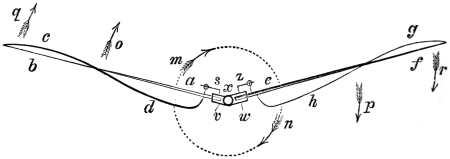
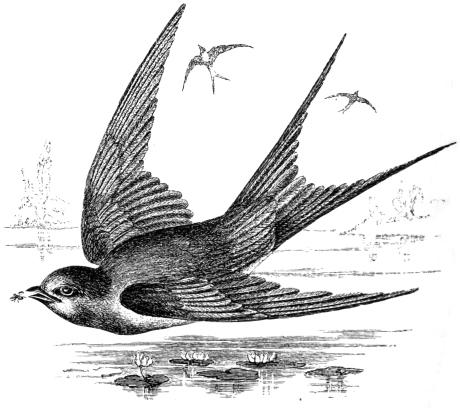
ANIMAL LOCOMOTION OR WALKING, SWIMMING, AND FLYING, WITH A DISSERTATION ON AËRONAUTICS. — PREFACE.
Transcriber’s notes:
The text of this e-book has been preserved in its original form
apart from correction of several typographic errors: (rog → frog,
arrranged → arranged, downword → downward, and → of (in journal title),
developes → develops). Inconsistent use of accents and hyphenation, and
inconsistent spelling, e.g. referable/referrible, has not been altered.
Several redundant parentheses have been deleted. Paragraphs of quoted
text on pp. 17–19 are incomplete and/or paraphrased (compared with the
original source); ellipsis dots have been inserted to indicate text
omissions, and quotation marks inserted where they were lacking.
A black underline indicates a hyperlink to a page, illustration or
footnote (hyperlinks are also highlighted when the mouse pointer hovers
over them). Some illustrations have been moved nearer to the relevant
text and their location therefore does not necessarily correspond to
that shown in the List of Illustrations. Page
numbers are shown in the right margin and footnotes are located at
the end.Footnotes are located at the
end.
The original generic cover has been modified
by adding a title and author’s name, and is placed in the public
domain.
THE INTERNATIONAL SCIENTIFIC SERIES.
LIST OF THE VOLUMES ALREADY PUBLISHED.
The Forms of Water in Rain and Rivers, Ice and Glaciers.
By J. Tyndall, LL.D., F.R.S. With 26 Illustrations. Third Edition. Crown 8vo. 5s.
“One of Professor Tyndall’s best scientific treatises.”—Standard.
“With the clearness and brilliancy of language which have won for him his fame, he
considers the subject of ice, snow, and glaciers.”—Morning Post.
“Before starting for Switzerland next summer every one should study ‘The Forms of
Water.’ ”—Globe.
“Eloquent and instructive in an eminent degree.”—British Quarterly.
Physics And Politics; or, Thoughts on the Application of the Principles
of “Natural Selection” and “Inheritance” to Political Society. By
Walter Bagehot. Crown 8vo. Second Edition. 4s.
“We can recommend the book as well deserving to be read by thoughtful students of
politics.”—Saturday Review.
“Able and ingenious.”—Spectator.
“A work of really original and interesting speculation.”—Guardian.
Foods. By Dr. Edward Smith. Profusely Illustrated. Second Edition. Price 5s.
“A comprehensive résumé of our present chemical and physiological knowledge of the
various foods, solid and liquid, which go so far to ameliorate the troubles and vexations of
this anxious and wearying existence.”—Chemist and Druggist.
“Heads of households will find it considerably to their advantage to study its contents.”—Court
Express.
“A very comprehensive book. Every page teems with information. Readable
throughout.”—Church Herald.
Mind And Body: the Theories of their Relations. By Alexander Bain,
LL.D., Professor of Logic at the University of Aberdeen. Four Illustrations.
Second Edition. 4s.
The Study of Sociology. By Herbert Spencer. Crown 8vo. Second
Edition. Price 5s.
On the Conservation of Energy. By Professor Balfour Stewart.
Fourteen Engravings. Price 5s.
Animal Mechanics: or, Walking, Swimming, and Flying. By
Dr. J. B. Pettigrew, M.D. F.R S. 130 Illustrations. Price 5s.
Responsibility in Mental Disease. By Dr. Henry Maudsley.
The Animal Frame. By Prof. E. J. Marey. 119 Illustrations. Crown 8vo.
Price 5s.
The New Chemistry. By Prof. Josiah P. Cooke, of the Harvard University.
Numerous Engravings. Price 5s.
☞For List of forthcoming Volumes, see end of the book.
Henry S. King & Co. 65 Cornhill, and 12 Paternoster Row.
C. BerjeauW. Ballingall
Walking, Swimming, and Flying.
BY
J. BELL PETTIGREW, M.D. F.R.S. F.R.S.E. F.R.C.P.E.
PATHOLOGIST TO THE ROYAL INFIRMARY OF EDINBURGH; CURATOR OF THE MUSEUM OF THE
ROYAL COLLEGE OF SURGEONS OF EDINBURGH;
Extraordinary Member and late President of the Royal Medical Society of Edinburgh; Croonian Lecturer
to the Royal Society of London for 1860; Lecturer to the Royal Institution of Great Britain and
Russell Institution, 1867; Lecturer to the Royal College of Surgeons of Edinburgh,
1872; Author of numerous Memoirs on Physiological Subjects in the
Philosophical and other Transactions, etc. etc. etc.
ILLUSTRATED BY 130 ENGRAVINGS ON WOOD.
Henry S. King & Co. 65 Cornhill, and 12 Paternoster Row, London.
1873.
(All Rights reserved.)
In the present volume I have endeavoured to explain,
in simple language, some difficult problems in “Animal
Mechanics.” In order to avoid elaborate descriptions, I
have introduced a large number of original Drawings
and Diagrams, copied for the most part from my Papers
and Memoirs “On Flight,” and other forms of “Animal
Progression.” I have drawn from the same sources
many of the facts to be found in the present work. My
best thanks are due to Mr. W. Ballingall, of Edinburgh,
for the highly artistic and effective manner in which he
has engraved the several subjects. The figures, I am
happy to state, have in no way deteriorated in his
hands.
Royal College of Surgeons of Edinburgh, July 1873.
CONTENTS.
ANIMAL LOCOMOTION.
INTRODUCTION.
PAGE
Motion associated with the life and well-being of animals,
Motion not confined to the animal kingdom; all matter in
motion; natural and artificial motion; the locomotive,
steamboat, etc. A flying machine possible,
Flight a more unstable movement than that of walking and
swimming; the travelling surfaces and movements of animals
adapted to the earth, the water, and the air,
The tail of the fish, the wing of the bird, and the extremity of
the biped and quadruped are screws structurally and
functionally. They describe figure-of-8 and waved tracks,
Muscular cycles. Centripetal and centrifugal movements of
muscles; muscular waves. Muscles arranged in longitudinal,
transverse, and oblique spiral lines,
The wing flexed and partly elevated by the action of elastic
ligaments; the nature and position of said ligaments in
the Pheasant, Snipe, Crested Crane, Swan, etc.,
The Author’s views; his method of constructing and applying
artificial wings, as contra-distinguished from that of Borelli,
Chabrier, Durckheim, and Marey,
The Engravings are, with few exceptions, from Photographs, Drawings, and
Designs by Mr. Charles Berjeau and the Author. Such as are not original
are duly acknowledged.
Screws formed by the bones of the wing of the bird, the bones of
the anterior extremity of the Elephant, and the cast of the
interior of the left ventricle of the heart,
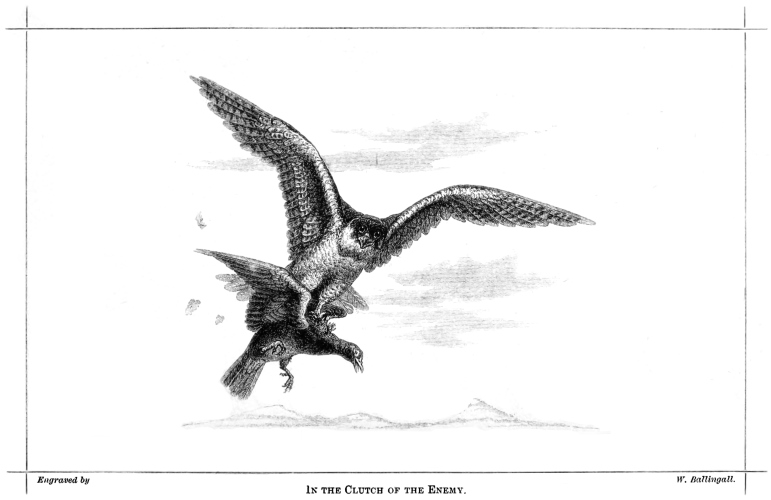
Engraved by W. Ballingall.In the Clutch of the Enemy.
ANIMAL LOCOMOTION.
INTRODUCTION.
The locomotion of animals, as exemplified in walking, swimming,
and flying, is a subject of permanent interest to all
who seek to trace in the creature proofs of beneficence and
design in the Creator. All animals, however insignificant, have
a mission to perform—a destiny to fulfil; and their manner of
doing it cannot be a matter of indifference, even to a careless
observer. The most exquisite form loses much of its grace
if bereft of motion, and the most ungainly animal conceals its
want of symmetry in the co-adaptation and exercise of its
several parts. The rigidity and stillness of death alone are
unnatural. So long as things “live, move, and have a being,”
they are agreeable objects in the landscape. They are part
and parcel of the great problem of life, and as we are all
hastening towards a common goal, it is but natural we should
take an interest in the movements of our fellow-travellers.
As the locomotion of animals is intimately associated with
their habits and modes of life, a wide field is opened up,
teeming with incident, instruction, and amusement. No one
can see a bee steering its course with admirable precision from
flower to flower in search of nectar; or a swallow darting
like a flash of light along the lanes in pursuit of insects; or
a wolf panting in breathless haste after a deer; or a dolphin
rolling like a mill-wheel after a shoal of flying fish, without
feeling his interest keenly awakened.
Nor is this love of motion confined to the animal kingdom.
We admire a cataract more than a canal; the sea is grander
in a hurricane than in a calm; and the fleecy clouds which
constantly flit overhead are more agreeable to the eye than
a horizon of tranquil blue, however deep and beautiful. We
never tire of sunshine and shadow when together: we readily
tire of either by itself. Inorganic changes and movements
are scarcely less interesting than organic ones. The disaffected
growl of the thunder, and the ghastly lightning flash, scorching
and withering whatever it touches, forcibly remind us that
everything above, below, and around is in motion. Of absolute
rest, as Mr. Grove eloquently puts it, nature gives us
no evidence. All matter, whether living or dead, whether
solid, liquid, or gaseous, is constantly changing form: in other
words, is constantly moving. It is well it is so; for those
incessant changes in inorganic matter and living organisms
introduce that fascinating variety which palls not upon the
eye, the ear, the touch, the taste, or the smell. If an absolute
repose everywhere prevailed, and plants and animals ceased to
grow; if day ceased to alternate with night and the fountains
were dried up or frozen; if the shadows refused to creep, the air
and rocks to reverberate, the clouds to drift, and the great race
of created beings to move, the world would be no fitting habitation
for man. In change he finds his present solace and
future hope. The great panorama of life is interesting because
it moves. One change involves another, and everything
which co-exists, co-depends. This co-existence and
inter-dependence causes us not only to study ourselves, but
everything around us. By discovering natural laws we are
permitted in God’s good providence to harness and yoke
natural powers, and already the giant Steam drags along at
incredible speed the rumbling car and swiftly gliding boat;
the quadruped has been literally outraced on the land, and the
fish in the sea; each has been, so to speak, beaten in its own
domain. That the tramway of the air may and will be traversed
by man’s ingenuity at some period or other, is, reasoning
from analogy and the nature of things, equally certain. If
there were no flying things—if there were no insects, bats,
or birds as models, artificial flight (such are the difficulties
attending its realization) might well be regarded an impossibility.
As, however, the flying creatures are legion, both as
regards number, size, and pattern, and as the bodies of all are
not only manifestly heavier than the air, but are composed
of hard and soft parts, similar in all respects to those composing
the bodies of the other members of the animal kingdom,
we are challenged to imitate the movements of the insect, bat,
and bird in the air, as we have already imitated the movements
of the quadruped on the land and the fish in the water.
We have made two successful steps, and have only to make
a third to complete that wonderfully perfect and very comprehensive
system of locomotion which we behold in nature.
Until this third step is taken, our artificial appliances for
transit can only be considered imperfect and partial. Those
authors who regard artificial flight as impracticable sagely
remark that the land supports the quadruped and the water the
fish. This is quite true, but it is equally true that the air supports
the bird, and that the evolutions of the bird on the wing
are quite as safe and infinitely more rapid and beautiful than the
movements of either the quadruped on the land or the fish in
the water. What, in fact, secures the position of the quadruped
on the land, the fish in the water, and the bird in the air, is
the life; and by this I mean that prime moving or self-governing
power which co-ordinates the movements of the travelling
surfaces (whether feet, fins, or wings) of all animals, and adapts
them to the medium on which they are destined to operate,
whether this be the comparatively unyielding earth, the mobile
water, or the still more mobile air. Take away this life suddenly—the
quadruped falls downwards, the fish (if it be not specially
provided with a swimming bladder) sinks, and the bird
gravitates of necessity. There is a sudden subsiding and cessation
of motion in either case, but the quadruped and fish have
no advantage over the bird in this respect. The savans who
oppose this view exclaim not unnaturally that there is no
great difficulty in propelling a machine either along the land
or the water, seeing that both these media support it. There
is, I admit, no great difficulty now, but there were apparently
insuperable difficulties before the locomotive and steam-boat
were invented. Weight, moreover, instead of being a barrier to
artificial flight is absolutely necessary to it. This statement
is quite opposed to the commonly received opinion, but is
nevertheless true. No bird is lighter than the air, and no
machine constructed to navigate it should aim at being specifically
lighter. What is wanted is a reasonable but not cumbrous
amount of weight, and a duplicate (in principle if not in practice)
of those structures and movements which enable insects,
bats, and birds to fly. Until the structure and uses of wings
are understood, the way of “an eagle in the air” must of necessity
remain a mystery. The subject of flight has never,
until quite recently, been investigated systematically or
rationally, and, as a result, very little is known of the laws
which regulate it. If these laws were understood, and we
were in possession of trustworthy data for our guidance in
devising artificial pinions, the formidable Gordian knot of
flight, there is reason to believe, could be readily untied.
That artificial flight is a possible thing is proved beyond
doubt—1st, by the fact that flight is a natural movement;
and 2d, because the natural movements of walking and swimming
have already been successfully imitated.
The very obvious bearing which natural movements have
upon artificial ones, and the relation which exists between
organic and inorganic movements, invest our subject with a
peculiar interest.
It is the blending of natural and artificial progression in
theory and practice which gives to the one and the other its
chief charm. The history of artificial progression is essentially
that of natural progression. The same laws regulate
and determine both. The wheel of the locomotive and the
screw of the steam-ship apparently greatly differ from the
limb of the quadruped, the fin of the fish, and the wing of
the bird; but, as I shall show in the sequel, the curves which
go to form the wheel and the screw are found in the travelling
surfaces of all animals, whether they be limbs (furnished with
feet), or fins, or wings.
It is a remarkable circumstance that the undulation or
wave made by the wing of an insect, bat, or bird, when those
animals are fixed or hovering before an object, and when they
are flying, corresponds in a marked manner with the track
described by the stationary and progressive waves in fluids,
and likewise with the waves of sound. This coincidence
would seem to argue an intimate relation between the instrument
and the medium on which it is destined to operate—the
wing acting in those very curves into which the atmosphere
is naturally thrown in the transmission of sound. Can
it be that the animate and inanimate world reciprocate, and
that animal bodies are made to impress the inanimate in precisely
the same manner as the inanimate impress each other?
This much seems certain:—The wind communicates to the
water similar impulses to those communicated to it by the
fish in swimming; and the wing in its vibrations impinges
upon the air as an ordinary sound does. The extremities of
quadrupeds, moreover, describe waved tracks on the land
when walking and running; so that one great law apparently
determines the course of the insect in the air, the fish in the
water, and the quadruped on the land.
We are, unfortunately, not taught to regard the travelling
surfaces and movements of animals as correlated in any
way to surrounding media, and, as a consequence, are apt
to consider walking as distinct from swimming, and walking
and swimming as distinct from flying, than which there
can be no greater mistake. Walking, swimming, and flying
are in reality only modifications of each other. Walking
merges into swimming, and swimming into flying, by
insensible gradations. The modifications which result in
walking, swimming, and flying are necessitated by the fact
that the earth affords a greater amount of support than the
water, and the water than the air.
That walking, swimming, and flying represent integral
parts of the same problem is proved by the fact that most
quadrupeds swim as well as walk, and some even fly; while
many marine animals walk as well as swim, and birds and
insects walk, swim, and fly indiscriminately. When the land
animals, properly so called, are in the habit of taking to the
water or the air; or the inhabitants of the water are constantly
taking to the land or the air; or the insects and birds which
are more peculiarly organized for flight, spend much of their
time on the land and in the water; their organs of locomotion
must possess those peculiarities of structure which characterize,
as a class, those animals which live on the land, in
the water, or in the air respectively.
In this we have an explanation of the gossamer wing of
the insect,—the curiously modified hand of the bat and bird,—the
webbed hands and feet of the Otter, Ornithorhynchus,
Seal, and Walrus,—the expanded tail of the Whale, Porpoise,
Dugong, and Manatee,—the feet of the Ostrich, Apteryx, and
Dodo, exclusively designed for running,—the feet of the
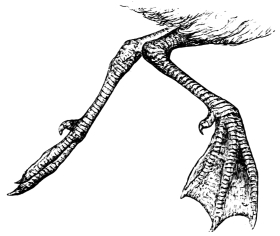
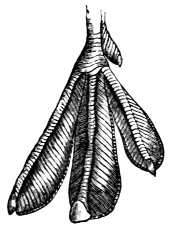
Ducks, Gulls, and Petrels, specially adapted for swimming,—and
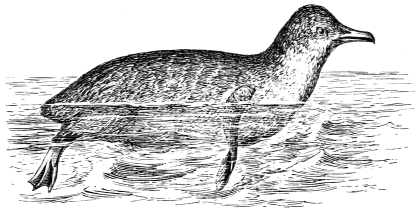
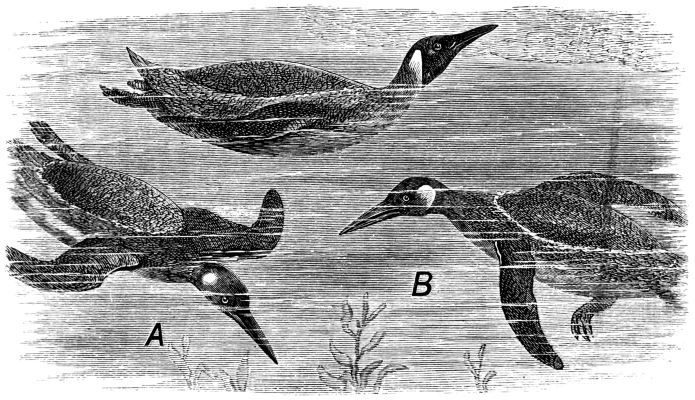
the wings and feet of the Penguins, Auks, and Guillemots,
especially designed for diving. Other and intermediate
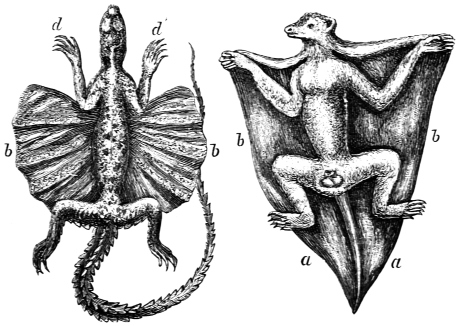
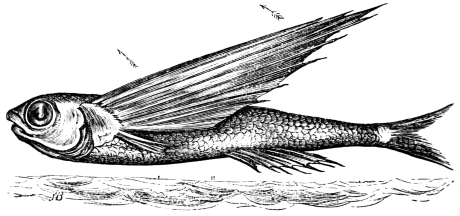
modifications occur in the Flying-fish, Flying Lizard, and
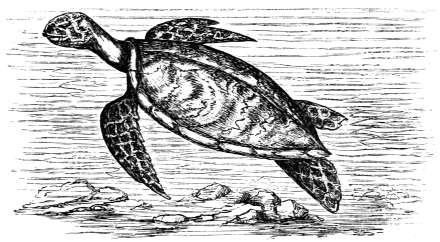
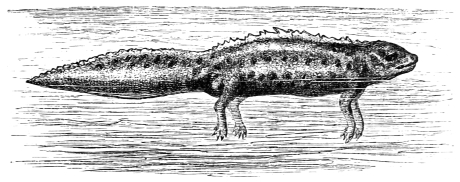
Flying Squirrel; and some animals, as the Frog, Newt, and
several of the aquatic insects (the Ephemera or May-fly for
example1) which begin their career by swimming, come
ultimately to walk, leap, and even fly.2
Every degree and variety of motion, which is peculiar to
the land, and to the water- and air-navigating animals as such,
is imitated by others which take to the elements in question
secondarily or at intervals.
Of all animal movements, flight is indisputably the finest.
It may be regarded as the poetry of motion. The fact that
a creature as heavy, bulk for bulk, as many solid substances,
can by the unaided movements of its wings urge itself through
the air with a speed little short of a cannon-ball, fills the
mind with wonder. Flight (if I may be allowed the expression)
is a more unstable movement than that of walking
and swimming; the instability increasing as the medium to
be traversed becomes less dense. It, however, does not
essentially differ from the other two, and I shall be able to
show in the following pages, that the materials and forces
employed in flight are literally the same as those employed
in walking and swimming. This is an encouraging circumstance
as far as artificial flight is concerned, as the same elements
and forces employed in constructing locomotives and
steamboats may, and probably will at no distant period,
be successfully employed in constructing flying machines.
Flight is a purely mechanical problem. It is warped in and
out with the other animal movements, and forms a link of a
great chain of motion which drags its weary length over the
land, through the water, and, notwithstanding its weight,
through the air. To understand flight, it is necessary to
understand walking and swimming, and it is with a view to
simplifying our conceptions of this most delightful form of
locomotion that the present work is mainly written. The
chapters on walking and swimming naturally lead up to those
on flying.
In the animal kingdom the movements are adapted either
to the land, the water, or the air; these constituting the three
great highways of nature. As a result, the instruments by
which locomotion is effected are specially modified. This is
necessary because of the different densities and the different
degrees of resistance furnished by the land, water, and air
respectively. On the land the extremities of animals encounter
the maximum of resistance, and occasion the minimum
of displacement. In the air, the pinions experience the minimum
of resistance, and effect the maximum of displacement; the
water being intermediate both as regards the degree of
resistance offered and the amount of displacement produced.
The speed of an animal is determined by its shape, mass,
power, and the density of the medium on or in which it
moves. It is more difficult to walk on sand or snow than on
a macadamized road. In like manner (unless the travelling
surfaces are specially modified), it is more troublesome to
swim than to walk, and to fly than to swim. This arises from
the displacement produced, and the consequent want of support.
The land supplies the fulcrum for the levers formed
by the extremities or travelling surfaces of animals with
terrestrial habits; the water furnishes the fulcrum for the
levers formed by the tail and fins of fishes, sea mammals,
etc.; and the air the fulcrum for the levers formed by the
wings of insects, bats, and birds. The fulcrum supplied by
the land is immovable; that supplied by the water and air
movable. The mobility and immobility of the fulcrum constitute
the principal difference between walking, swimming,
and flying; the travelling surfaces of animals increasing in
size as the medium to be traversed becomes less dense and
the fulcrum more movable. Thus terrestrial animals have
smaller travelling surfaces than amphibia, amphibia than fishes,
and fishes than insects, bats, and birds. Another point to be
studied in connexion with unyielding and yielding fulcra, is
the resistance offered to forward motion. A land animal is
supported by the earth, and experiences little resistance from
the air through which it moves, unless the speed attained is
high. Its principal friction is that occasioned by the contact
of its travelling surfaces with the earth. If these are few, the
speed is generally great, as in quadrupeds. A fish, or sea mammal,
is of nearly the same specific gravity as the water it inhabits;
in other words, it is supported with as little or less effort
than a land animal. As, however, the fluid in which it moves
is more dense than air, the resistance it experiences in forward
motion is greater than that experienced by land animals, and
by insects, bats, and birds. As a consequence fishes are for
the most part elliptical in shape; this being the form calculated
to cleave the water with the greatest ease. A flying
animal is immensely heavier than the air. The support
which it receives, and the resistance experienced by it
in forward motion, are reduced to a minimum. Flight,
because of the rarity of the air, is infinitely more rapid than
either walking, running, or swimming. The flying animal
receives support from the air by increasing the size of its
travelling surfaces, which act after the manner of twisted
inclined planes or kites. When an insect, a bat, or a bird
is launched in space, its weight (from the tendency of all
bodies to fall vertically downwards) presses upon the inclined
planes or kites formed by the wings in such a manner as
to become converted directly into a propelling, and indirectly
into a buoying or supporting power. This can be proved by
experiment, as I shall show subsequently. But for the share
which the weight or mass of the flying creature takes in flight,
the protracted journeys of birds of passage would be impossible.
Some authorities are of opinion that birds even sleep
upon the wing. Certain it is that the albatross, that prince
of the feathered tribe, can sail about for a whole hour without
once flapping his pinions. This can only be done in virtue
of the weight of the bird acting upon the inclined planes or
kites formed by the wings as stated.
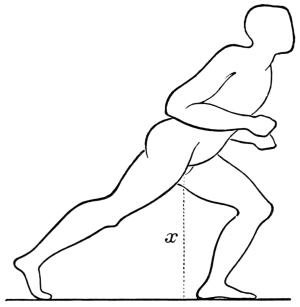
The weight of the body plays an important part in walking
and swimming, as well as in flying. A biped which advances
by steps and not by leaps may be said to roll over its extremities,3
the foot of the extremity which happens to be upon
the ground for the time forming the centre of a circle, the
radius of which is described by the trunk in forward motion.
In like manner the foot which is off the ground and swinging
forward pendulum fashion in space, may be said to roll or
rotate upon the trunk, the head of the femur forming the
centre of a circle the radius of which is described by the advancing
foot. A double rolling movement is thus established,
the body rolling on the extremity the one instant, the extremity
rolling on the trunk the next. During these movements
the body rises and falls. The double rolling movement is
necessary not only to the progression of bipeds, but also to
that of quadrupeds. As the body cannot advance without
the extremities, so the extremities cannot advance without
the body. The double rolling movement is necessary to continuity
of motion. If there was only one movement there
would be dead points or halts in walking and running, similar
to what occur in leaping. The continuity of movement necessary
to progression in some bipeds (man for instance) is further
secured by a pendulum movement in the arms as well as
in the legs, the right arm swinging before the body when the
right leg swings behind it, and the converse. The right leg
and left arm advance simultaneously, and alternate with the
left leg and right arm, which likewise advance together. This
gives rise to a double twisting of the body at the shoulders
and loins. The legs and arms when advancing move in
curves, the convexities of the curves made by the right leg
and left arm, which advance together when a step is being
made, being directed outwards, and forming, when placed
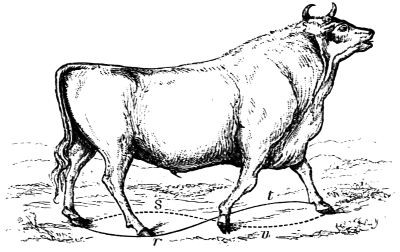
together, a more or less symmetrical ellipse. If the curves
formed by the legs and arms respectively be united, they
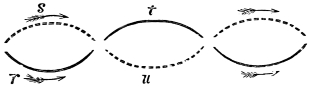
form waved lines which intersect at every step. This arises
from the fact that the curves formed by the right and left
legs are found alternately on either side of a given line, the
same holding true of the right and left arms. Walking is
consequently to be regarded as the result of a twisting diagonal
movement in the trunk and in the extremities. Without this
movement, the momentum acquired by the different portions
of the moving mass could not be utilized. As the momentum
acquired by animals in walking, swimming, and flying forms
an important factor in those movements, it is necessary that
we should have a just conception of the value to be attached
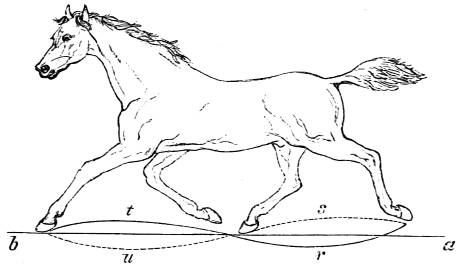
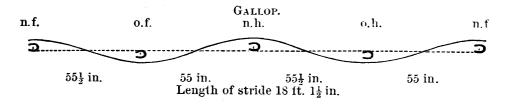
to weight when in motion. In the horse when walking, the
stride is something like five feet, in trotting ten feet, but in
galloping eighteen or more feet. The stride is in fact determined
by the speed acquired by the mass of the body of the
horse; the momentum at which the mass is moving carrying
the limbs forward.4
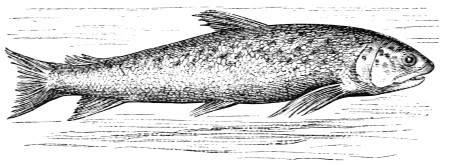
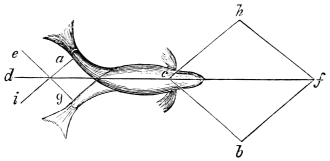
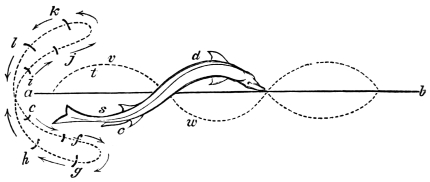
In the swimming of the fish, the body is thrown into double
or figure-of-8 curves, as in the walking of the biped. The twisting
of the body, and the continuity of movement which that
twisting begets, reappear. The curves formed in the swimming
of the fish are never less than two, a caudal and a cephalic one.
They may and do exceed this number in the long-bodied fishes.
The tail of the fish is made to vibrate pendulum fashion on
either side of the spine, when it is lashed to and fro in the
act of swimming. It is made to rotate upon one or more of
the vertebræ of the spine, the vertebra or vertebræ forming
the centre of a lemniscate, which is described by the caudal
fin. There is, therefore, an obvious analogy between the tail
of the fish and the extremity of the biped. This is proved by
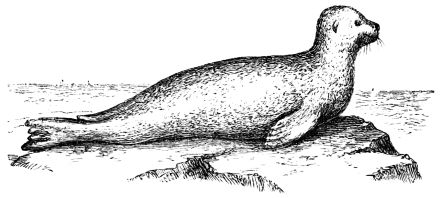
the conformation and swimming of the seal,—an animal in
which the posterior extremities are modified to resemble the
tail of the fish. In the swimming of the seal the hind legs are
applied to the water by a sculling figure-of-8 motion, in the
same manner as the tail of the fish. Similar remarks might
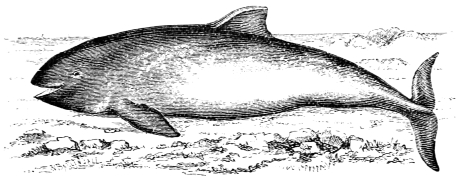
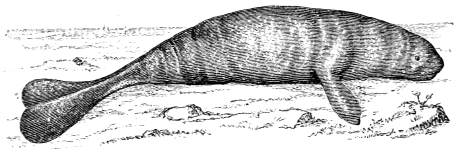
be made with regard to the swimming of the whale, dugong,
manatee, and porpoise, sea mammals, which still more closely
resemble the fish in shape. The double curve into which the
fish throws its body in swimming, and which gives continuity
of motion, also supplies the requisite degree of steadiness.
When the tail is lashed from side to side there is a tendency
to produce a corresponding movement in the head, which
is at once corrected by the complementary curve. Nor is
this all; the cephalic curve, in conjunction with the water
contained within it, forms the point d’appui for the caudal
curve, and vice versa. When a fish swims, the anterior and
posterior portions of its body (supposing it to be a short-bodied
fish) form curves, the convexities of which are
directed on opposite sides of a given line, as is the case
in the extremities of the biped when walking. The mass
of the fish, like the mass of the biped, when once set in
motion, contributes to progression by augmenting the rate
of speed. The velocity acquired by certain fishes is very
great. A shark can gambol around the bows of a ship in
full sail; and a sword-fish (such is the momentum acquired
by it) has been known to thrust its tusk through the copper
sheathing of a vessel, a layer of felt, four inches of deal, and
fourteen inches of oaken plank.5
The wing of the bird does not materially differ from the
extremity of the biped or the tail of the fish. It is constructed
on a similar plan, and acts on the same principle.
The tail of the fish, the wing of the bird, and the extremity
of the biped and quadruped, are screws structurally and
functionally. In proof of this, compare the bones of the wing
of a bird with the bones of the arm of a man, or those of the
fore-leg of an elephant, or any other quadruped. In either
case the bones are twisted upon themselves like the screw of
an augur. The tail of the fish, the extremities of the biped and
quadruped, and the wing of the bird, when moving, describe
waved tracks. Thus the wing of the bird, when it is made
to oscillate, is thrown into double or figure-of-8 curves, like
the body of the fish. When, moreover, the wing ascends and
descends to make the up and down strokes, it rotates within
the facettes or depressions situated on the scapula and coracoid
bones, precisely in the same way that the arm of a man rotates
in the glenoid cavity, or the leg in the acetabular cavity in
the act of walking. The ascent and descent of the wing in
flying correspond to the steps made by the extremities in
walking; the wing rotating upon the body of the bird during
the down stroke, the body of the bird rotating on the wing
during the up stroke. When the wing descends it describes
a downward and forward curve, and elevates the body in an
upward and forward curve. When the body descends, it
describes a downward and forward curve, the wing being
elevated in an upward and forward curve. The curves
made by the wing and body in flight form, when united,
waved lines, which intersect each other at every beat of
the wing. The wing and the body act upon each other
alternately (the one being active when the other is passive),
and the descent of the wing is not more necessary to the
elevation of the body than the descent of the body is to
the elevation of the wing. It is thus that the weight of the
flying animal is utilized, slip avoided, and continuity of movement
secured.
As to the actual waste of tissue involved in walking, swimming,
and flying, there is much discrepancy of opinion. It is
commonly believed that a bird exerts quite an enormous
amount of power as compared with a fish; a fish exerting a
much greater power than a land animal. This, there can be
no doubt, is a popular delusion. A bird can fly for a whole
day, a fish can swim for a whole day, and a man can walk
for a whole day. If so, the bird requires no greater power
than the fish, and the fish than the man. The speed of the
bird as compared with that of the fish, or the speed of the
fish as compared with that of the man, is no criterion of the
power exerted. The speed is only partly traceable to the
power. As has just been stated, it is due in a principal
measure to the shape and size of the travelling surfaces, the
density of the medium traversed, the resistance experienced
to forward motion, and the part performed by the mass
of the animal, when moving and acting upon its travelling
surfaces. It is erroneous to suppose that a bird is
stronger, weight for weight, than a fish, or a fish than a
man. It is equally erroneous to assume that the exertions
of a flying animal are herculean as compared with
those of a walking or swimming animal. Observation and
experiment incline me to believe just the opposite. A flying
creature, when fairly launched in space (because of the part
which weight plays in flight, and the little resistance experienced
in forward motion), sweeps through the air with
almost no exertion.6 This is proved by the sailing flight of
the albatross, and by the fact that some insects can fly when
two-thirds of their wing area have been removed. (This experiment
is detailed further on.) These observations are
calculated to show the grave necessity for studying the media
to be traversed; the fulcra which the media furnish, and the
size, shape, and movements of the travelling surfaces. The
travelling surfaces of animals, as has been already explained,
furnish the levers by whose instrumentality the movements
of walking, swimming, and flying are effected.
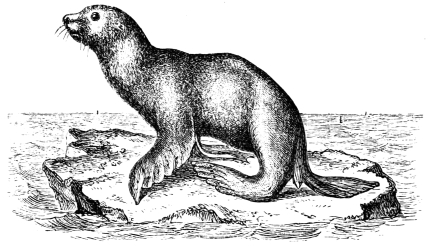
By comparing the flipper of the seal, sea-bear, and walrus
with the fin and tail of the fish, whale, porpoise, etc.; and
the wing of the penguin (a bird which is incapable of flight,
and can only swim and dive) with the wing of the insect,
bat, and bird, I have been able to show that a close analogy
exists between the flippers, fins, and tails of sea mammals
and fishes on the one hand, and the wings of insects, bats,
and birds on the other; in fact, that theoretically and practically
these organs, one and all, form flexible helices or
screws, which, in virtue of their rapid reciprocating movements,
operate upon the water and air by a wedge-action after
the manner of twisted or double inclined planes. The twisted
inclined planes act upon the air and water by means of
curved surfaces, the curved surfaces reversing, reciprocating,
and engendering a wave pressure, which can be continued
indefinitely at the will of the animal. The wave pressure
emanates in the one instance mainly from the tail of the fish,
whale, porpoise, etc., and in the other from the wing of the
insect, bat, or bird—the reciprocating and opposite curves into
which the tail and wing are thrown in swimming and flying
constituting the mobile helices, or screws, which, during their
action, produce the precise kind and degree of pressure
adapted to fluid media, and to which they respond with the
greatest readiness.
In order to prove that sea mammals and fishes swim, and
insects, bats, and birds fly, by the aid of curved figure-of-8
surfaces, which exert an intermittent wave pressure, I constructed
artificial fish-tails, fins, flippers, and wings, which
curve and taper in every direction, and which are flexible
and elastic, particularly towards the tips and posterior margins.
These artificial fish-tails, fins, flippers, and wings are
slightly twisted upon themselves, and when applied to the
water and air by a sculling or figure-of-8 motion, curiously
enough reproduce the curved surfaces and movements peculiar
to real fish-tails, fins, flippers, and wings, in swimming, and
flying.
Propellers formed on the fish-tail and wing model are, I
find, the most effective that can be devised, whether for
navigating the water or the air. To operate efficiently on
fluid, i.e. yielding media, the propeller itself must yield. Of
this I am fully satisfied from observation and experiment.
The propellers at present employed in navigation are, in my
opinion, faulty both in principle and application.
The observations and experiments recorded in the present
volume date from 1864. In 1867 I lectured on the subject of
animal mechanics at the Royal Institution of Great Britain:7
in June of the same year (1867) I read a memoir “On the
Mechanism of Flight” to the Linnean Society of London;8
and in August of 1870 I communicated a memoir “On the
Physiology of Wings” to the Royal Society of Edinburgh.9
These memoirs extend to 200 pages quarto, and are illustrated
by 190 original drawings. The conclusions at which
I arrived, after a careful study of the movements of walking,
swimming, and flying, are briefly set forth in a letter addressed
to the French Academy of Sciences in March 1870. This
the Academy did me the honour of publishing in April of
that year (1870) in the Comptes Rendus, p. 875. In it I
claim to have been the first to describe and illustrate the
following points, viz.:—
That quadrupeds walk, and fishes swim, and insects, bats,
and birds fly by figure-of-8 movements.
That the flipper of the sea bear, the swimming wing of the
penguin, and the wing of the insect, bat, and bird, are screws
structurally, and resemble the blade of an ordinary screw-propeller.
That those organs are screws functionally, from their twisting
and untwisting, and from their rotating in the direction
of their length, when they are made to oscillate.
That they have a reciprocating action, and reverse their
planes more or less completely at every stroke.
That the wing describes a figure-of-8 track in space when
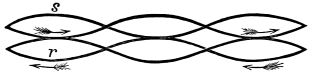
the flying animal is artificially fixed.
That the wing, when the flying animal is progressing at
a high speed in a horizontal direction, describes a looped
and then a waved track, from the fact that the figure of
8 is gradually opened out or unravelled as the animal
advances.
That the wing acts after the manner of a kite, both during
the down and up strokes.
I was induced to address the above to the French Academy
from finding that, nearly two years after I had published my
views on the figure of 8, looped and wave movements made
by the wing, etc., Professor E. J. Marey (College of France,
Paris) published a course of lectures, in which the peculiar
figure-of-8 movements, first described and figured by me,
were put forth as a new discovery. The accuracy of this
statement will be abundantly evident when I mention
that my first lecture, “On the various modes of Flight in
relation to Aëronautics,” was published in the Proceedings
of the Royal Institution of Great Britain on the 22d of
March 1867, and translated into French (Revue des cours
scientifiques de la France et de l’Étranger) on the 21st of
September 1867; whereas Professor Marey’s first lecture,
“On the Movements of the Wing in the Insect” (Revue des
cours scientifiques de la France et de l’Étranger), did not
appear until the 13th of February 1869.
Professor Marey, in a letter addressed to the French
Academy in reply to mine, admits my claim to priority in
the following terms:—
“J’ai constaté qu’effectivement M. Pettigrew a vu avant
moi, et représenté dans son Mémoire, la forme en 8 du parcours
de l’aile de l’insecte: que la méthode optique à laquelle
j’avais recours est à peu près identique à la sienne. . . . Je
m’empresse de satisfaire à cette demande légitime, et de laisser
entièrement la priorité sur moi à M. Pettigrew relativement
à la question ainsi restreinte.”—(Comptes Rendus, May 16,
1870, p. 1093).
The figure-of-8 theory of walking, swimming, and flying,
as originally propounded in the lectures, papers, and memoirs
referred to, has been confirmed not only by the researches
and experiments of Professor Marey, but also by those of M.
Senecal, M. de Fastes, M. Ciotti, and others. Its accuracy is
no longer a matter of doubt. As the limits of the present
volume will not admit of my going into the several arrangements
by which locomotion is attained in the animal kingdom
as a whole, I will only describe those movements which
illustrate in a progressive manner the several kinds of progression
on the land, and on and in the water and air.
I propose first to analyse the natural movements of walking,
swimming, and flying, after which I hope to be able to
show that certain of these movements may be reproduced
artificially. The locomotion of animals depends upon mechanical
adaptations found in all animals which change locality.
These adaptations are very various, but under whatever
guise they appear they are substantially those to which we
resort when we wish to move bodies artificially. Thus in
animal mechanics we have to consider the various orders of
levers, the pulley, the centre of gravity, specific gravity, the
resistance of solids, semi-solids, fluids, etc. As the laws which
regulate the locomotion of animals are essentially those which
regulate the motion of bodies in general, it will be necessary
to consider briefly at this stage the properties of matter when
at rest and when moving. They are well stated by Mr.
Bishop in a series of propositions which I take the liberty of
transcribing:—
“Fundamental Axioms.—First, every body continues in a
state of rest, or of uniform motion in a right line, until a
change is effected by the agency of some mechanical force.
Secondly, any change effected in the quiescence or motion of
a body is in the direction of the force impressed, and is proportional
to it in quantity. Thirdly, reaction is always equal
and contrary to action, or the mutual actions of two bodies
upon each other are always equal and in opposite directions.
“Of uniform motion.—If a body moves constantly in the
same manner, or if it passes over equal spaces in equal periods
of time, its motion is uniform. The velocity of a body moving
uniformly is measured by the space through which it passes
in a given time.
“The velocities generated or impressed on different masses
by the same force are reciprocally as the masses.
“Motion uniformly varied.—When the motion of a body is
uniformly accelerated, the space it passes through during any
time whatever is proportional to the square of the time.
“In the leaping, jumping, or springing of animals in any
direction (except the vertical), the paths they describe in
their transit from one point to another in the plane of motion
are parabolic curves.
“The legs move by the force of gravity as a pendulum.—The
Professor, Weber, have ascertained, that when the legs of
animals swing forward in progressive motion, they obey the
same laws as those which regulate the periodic oscillations of
the pendulum.
“Resistance of fluids.—Animals moving in air and water
experience in those media a sensible resistance, which is
greater or less in proportion to the density and tenacity of
the fluid, and the figure, superficies, and velocity of the animal.
“An inquiry into the amount and nature of the resistance
of air and water to the progression of animals will also furnish
the data for estimating the proportional values of those fluids
acting as fulcra to their locomotive organs, whether they be
fins, wings, or other forms of lever.
“The motions of air and water, and their directions, exercise
very important influences over velocity resulting from
muscular action.
“Mechanical effects of fluids on animals immersed in them.—When
a body is immersed in any fluid whatever, it will lose
as much of its weight relatively as is equal to the weight of
the fluid it displaces. In order to ascertain whether an
animal will sink or swim, or be sustained without the aid of
muscular force, or to estimate the amount of force required
that the animal may either sink or float in water, or fly in
the air, it will be necessary to have recourse to the specific
gravities both of the animal and of the fluid in which it is
placed.
“The specific gravities or comparative weights of different
substances are the respective weights of equal volumes of
those substances.
“Centre of gravity.—The centre of gravity of any body is
a point about which, if acted upon only by the force of
gravity, it will balance itself in all positions; or, it is a point
which, if supported, the body will be supported, however it
may be situated in other respects; and hence the effects produced
by or upon any body are the same as if its whole mass
were collected into its centre of gravity.
“The attitudes and motions of every animal are regulated
by the positions of their centres of gravity, which, in a state
of rest, and not acted upon by extraneous forces, must lie in
vertical lines which pass through their basis of support.
“In most animals moving on solids, the centre is supported
by variously adapted organs; during the flight of birds and
insects it is suspended; but in fishes, which move in a fluid
whose density is nearly equal to their specific gravity, the
centre is acted upon equally in all directions.”10
As the locomotion of the higher animals, to which my
remarks more particularly apply, is in all cases effected by
levers which differ in no respect from those employed in the
arts, it may be useful to allude to them in a passing way.
This done, I will consider the bones and joints of the skeleton
which form the levers, and the muscles which move them.
“The Lever.—Levers are commonly divided into three kinds,
according to the relative positions of the prop or fulcrum, the
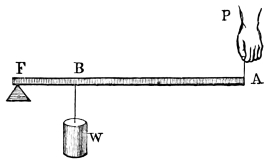
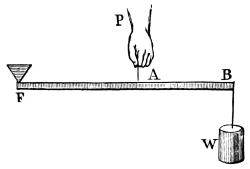
power, and the resistance or weight. The straight lever of
each order is equally balanced when the power multiplied by
its distance from the fulcrum equals the weight, multiplied by
its distance, or P the power, and W the weight, are in equilibrium
when they are to each other in the inverse ratio of
the arms of the lever, to which they are attached. The
pressure on the fulcrum however varies.
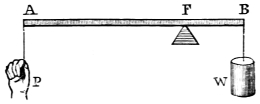
Fig. 1.
“In straight levers of the first kind, the fulcrum is between
the power and the resistance, as in fig. 1, where F is
the fulcrum of the lever AB; P is the power, and W the
weight or resistance. We have P : W :: BF : AF, hence
P.AF = W.BF, and the pressure on the fulcrum is both the
power and resistance, or P + W.
“In the second order of levers (fig. 2), the resistance is between
the fulcrum and the power; and, as before, P : W :: BF : AF,
but the pressure of the fulcrum is equal to W - P,
or the weight less the power.
Fig. 2.
“In the third order of lever the power acts between the prop
and the resistance (fig. 3), where also P : W :: BF : AF, and the
pressure on the fulcrum is P - W, or the power less the weight.
Fig. 3.
“In the preceding computations the weight of the lever
itself is neglected for the sake of simplicity, but it obviously
forms a part of the elements under consideration, especially
with reference to the arms and legs of animals.
“To include the weight of the lever we have the following
equations: P.AF + AF.1/2AF = W.BF + BF.1/2BF; in the
first order, where AF and BF represent the weights of these
portions of the lever respectively. Similarly, in the second
order P.AF = W.BF + AF.1/2AF and in the third order
P.AF = W.BF + BF.1/2BF.
“In this outline of the theory of the lever, the forces have
been considered as acting vertically, or parallel to the direction
of the force of gravity.
“Passive Organs of Locomotion. Bones.—The solid framework
or skeleton of animals which supports and protects their
more delicate tissues, whether chemically composed of entomoline,
carbonate, or phosphate of lime; whether placed internally
or externally; or whatever may be its form or
dimensions, presents levers and fulcra for the action of the
muscular system, in all animals furnished with earthy solids
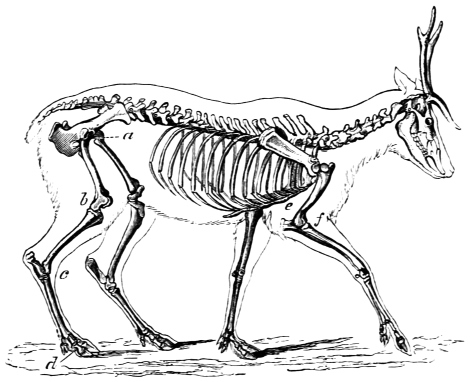
for their support, and possessing locomotive power.”11 The
levers and fulcra are well seen in the extremities of the deer,
the skeleton of which is selected for its extreme elegance.
Fig. 4. Skeleton of the Deer (after Pander and D’Alton). The bones in the extremities
of this the fleetest of quadrupeds are inclined very obliquely towards
each other, and towards the scapular and iliac bones. This arrangement increases
the leverage of the muscular system and confers great rapidity on
the moving parts. It augments elasticity, diminishes shock, and indirectly
begets continuity of movement, a. Angle formed by the femur with the
ilium, b. Angle formed by the tibia and fibula with the femur, c. Angle
formed by the cannon bone with the tibia and fibula, d. Angle formed by
the phalanges with the cannon bone. e. Angle formed by the humerus with
the scapula. f. Angle formed by the radius and ulna with the humerus.
While the bones of animals form levers and fulcra for portions
of the muscular system, it must never be forgotten that the
earth, water, or air form fulcra for the travelling surfaces of
animals as a whole. Two sets of fulcra are therefore always
to be considered, viz. those represented by the bones, and
those represented by the earth, water, or air respectively.
The former when acted upon by the muscles produce motion
in different parts of the animal (not necessarily progressive
motion); the latter when similarly influenced produce locomotion.
Locomotion is greatly favoured by the tendency
which the body once set in motion has to advance in a straight
line. “The form, strength, density, and elasticity of the skeleton
varies in relation to the bulk and locomotive power of
the animal, and to the media in which it is destined to move.
“The number of moveable articulations in a skeleton determines
the degree of its mobility within itself; and the
kind and number of the articulations of the locomotive organs
determine the number and disposition of the muscles acting
upon them.
“The bones of vertebrated animals, especially those which
are entirely terrestrial, are much more elastic, hard, and
calculated by their chemical elements to bear the shocks and
strains incident to terrestrial progression, than those of the
aquatic vertebrata; the bones of the latter being more fibrous
and spongy in their texture, the skeleton is more soft and
yielding.
“The bones of the higher orders of animals are constructed
according to the most approved mechanical principles. Thus
they are convex externally, concave within, and strengthened
by ridges running across their discs, as in the scapular and
iliac bones; an arrangement which affords large surfaces for
the attachment of the powerful muscles of locomotion. The
bones of birds in many cases are not filled with marrow but
with air,—a circumstance which insures that they shall be
very strong and very light.
“In the thigh bones of most animals an angle is formed by
the head and neck of the bone with the axis of the body,
which prevents the weight of the superstructure coming
vertically upon the shaft, converts the bone into an elastic
arch, and renders it capable of supporting the weight of the
body in standing, leaping, and in falling from considerable
altitudes.
“Joints.—Where the limbs are designed to move to and
fro simply in one plane, the ginglymoid or hinge-joint is applied;
and where more extensive motions of the limbs are
requisite, the enarthrodial, or ball-and-socket joint, is introduced.
These two kinds of joints predominate in the locomotive
organs of the animal kingdom.
“The enarthrodial joint has by far the most extensive power
of motion, and is therefore selected for uniting the limbs to the
trunk. It permits of the several motions of the limbs termed
pronation, supination, flexion, extension, abduction, adduction,
and revolution upon the axis of the limb or bone about a
conical area, whose apex is the axis of the head of the bone,
and base circumscribed by the distal extremity of the limb.”12
The ginglymoid or hinge-joints are for the most part spiral in
their nature. They admit in certain cases of a limited degree of
lateral rocking. Much attention has been paid to the subject
of joints (particularly human ones) by the brothers Weber,
Professor Meyer of Zürich, and likewise by Langer, Henke,
Meissner, and Goodsir. Langer, Henke, and Meissner succeeded
in demonstrating the “screw configuration” of the
articular surfaces of the elbow, ankle, and calcaneo-astragaloid
joints, and Goodsir showed that the articular surface
of the knee-joint consist of “a double conical screw combination.”
The last-named observer also expressed his belief
“that articular combinations with opposite windings on
opposite sides of the body, similar to those in the knee-joint,
exist in the ankle and tarsal, and in the elbow and carpal
joints; and that the hip and shoulder joints consist of single
threaded couples, but also with opposite windings on opposite
sides of the body.” I have succeeded in demonstrating
a similar spiral configuration in the several bones and joints
of the wing of the bat and bird, and in the extremities of
most quadrupeds. The bones of animals, particularly the
extremities, are, as a rule, twisted levers, and act after the
manner of screws. This arrangement enables the higher
animals to apply their travelling surfaces to the media on
which they are destined to operate at any degree of obliquity
so as to obtain a maximum of support or propulsion with a
minimum of slip. If the travelling surfaces of animals did
not form screws structurally and functionally, they could
neither seize nor let go the fulcra on which they act with the
requisite rapidity to secure speed, particularly in water and air.
“Ligaments.—The office of the ligaments with respect to
locomotion, is to restrict the degree of flexion, extension, and
other motions of the limbs within definite limits.
“Effect of Atmospheric pressure on Limbs.—The influence of
atmospheric pressure in supporting the limbs was first noticed
by Dr. Arnott, though it has been erroneously ascribed by
Professor Müller to Weber. Subsequent experiments made
by Dr. Todd, Mr. Wormald, and others, have fully established
the mechanical influence of the air in keeping the mechanism
of the joints together. The amount of atmospheric pressure
on any joint depends upon the area or surface presented to
its influence, and the height of the barometer. According to
Weber, the atmospheric pressure on the hip-joint of a man
is about 26 lbs. The pressure on the knee-joint is estimated
by Dr. Arnott at 60 lbs.”13
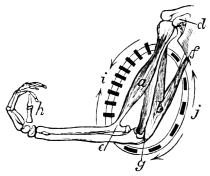
Fig. 5. Shows the muscular cycle formed by the biceps (a) or flexor muscle,
and the triceps (b) or extensor muscle of the human arm. At i the centripetal
or shortening action of the biceps is seen, and at j the centrifugal or
elongating action of the triceps (vide arrows). The present figure represents
the forearm as flexed upon the arm. As a consequence, the long axes of the
sarcous elements or ultimate particles of the biceps (i) are arranged in a
more or less horizontal direction; the long axes of the sarcous elements of
the triceps (j) being arranged in a nearly vertical direction. When the forearm
is extended, the long axes of the sarcous elements of the biceps and
triceps are reversed. The present figure shows how the bones of the extremities
form levers, and how they are moved by muscular action. If,
e.g., the biceps (a) shortens and the triceps (b) elongates, they cause the forearm
and hand (h) to move towards the shoulder (d). If, on the other hand, the
triceps (b) shortens and the biceps (a) elongates, they cause the forearm and
hand (h) to move away from the shoulder. In these actions the biceps (a) and
triceps (b) are the power; the elbow-joint (g) the fulcrum, and the forearm
and hand (h) the weight to be elevated or depressed. If the hand represented
a travelling surface which operated on the earth, the water, or the
air, it is not difficult to understand how, when it was made to move by
the action of the muscles of the arm, it would in turn move the body to
which it belonged, d Coracoid process of the scapula, from which the internal
or short head of the biceps (a) arises, e Insertion of the biceps into the
radius. f Long head of the triceps (b). g Insertion of the triceps into the
olecranon process of the ulna.—Original.
Active organs of Locomotion. Muscles, their Properties, Arrangement,
Mode of Action, etc.—If time and space had permitted,
I would have considered it my duty to describe, more
or less fully, the muscular arrangements of all the animals
whose movements I propose to analyse. This is the more
desirable, as the movements exhibited by animals of the
higher types are directly referable to changes occurring in
their muscular system. As, however, I could not hope to
overtake this task within the limits prescribed for the present
work, I shall content myself by merely stating the properties
of muscles; the manner in which muscles act; and the manner
in which they are grouped, with a view to moving the
osseous levers which constitute the bony framework or skeleton
of the animals to be considered. Hitherto, and by
common consent, it has been believed that whereas a flexor
muscle is situated on one aspect of a limb, and its corresponding
extensor on the other aspect, these two muscles must be
opposed to and antagonize each other. This belief is founded
on what I regard as an erroneous assumption, viz., that muscles
have only the power of shortening, and that when one
muscle, say the flexor, shortens, it must drag out and forcibly
elongate the corresponding extensor, and the converse. This
would be a mere waste of power. Nature never works
against herself. There are good grounds for believing, as I
have stated elsewhere,14 that there is no such thing as antagonism
in muscular movements; the several muscles known as
flexors and extensors; abductors and adductors; pronators
and supinators, being simply correlated. Muscles, when they
act, operate upon bones or something extraneous to themselves,
and not upon each other. The muscles are folded
round the extremities and trunks of animals with a view to
operating in masses. For this purpose they are arranged in
cycles, there being what are equivalent to extensor and flexor
cycles, abductor and adductor cycles, and pronator and supinator
cycles. Within these muscular cycles the bones, or
extraneous substances to be moved, are placed, and when one
side of a cycle shortens, the other side elongates. Muscles
are therefore endowed with a centripetal and centrifugal
action. These cycles are placed at every degree of obliquity
and even at right angles to each other, but they are so disposed
in the bodies and limbs of animals that they always
operate consentaneously and in harmony. Vide fig. 5, p. 25.
There are in animals very few simple movements, i.e.
movements occurring in one plane and produced by the action
of two muscles. Locomotion is for the most part produced
by the consentaneous action of a great number of muscles;
these or their fibres pursuing a variety of directions. This is
particularly true of the movements of the extremities in walking,
swimming, and flying.
Muscles are divided into the voluntary, the involuntary, and
the mixed, according as the will of the animal can wholly,
partly, or in no way control their movements. The voluntary
muscles are principally concerned in the locomotion of animals.
They are the power which moves the several orders of levers
into which the skeleton of an animal resolves itself.
The movements of the voluntary and involuntary muscles
are essentially wave-like in character, i.e. they spread from
certain centres, according to a fixed order, and in given directions.
In the extremities of animals the centripetal or converging
muscular wave on one side of the bone to be moved,
is accompanied by a corresponding centrifugal or diverging
wave on the other side; the bone or bones by this arrangement
being perfectly under control and moved to a hair’s-breadth.
The centripetal or converging, and the centrifugal or diverging
waves of force are, as already indicated, correlated.15 Similar
remarks may be made regarding the different parts of the body
of the serpent when creeping, of the body of the fish when
swimming, of the wing of the bird when flying, and of our own
extremities when walking. In all those cases the moving
parts are thrown into curves or waves definitely correlated.
It may be broadly stated, that in every case locomotion is
the result of the opening and closing of opposite sides of
muscular cycles. By the closing or shortening, say of the
flexor halves of the cycles, and the opening or elongation of
the extensor halves, the angles formed by the osseous levers
are diminished; by the closing or shortening of the extensor
halves of the cycles, and the opening or elongation of the
flexor halves, the angles formed by the osseous levers are
increased. This alternate diminution and increase of the
angles formed by the osseous levers produce the movements
of walking, swimming, and flying. The muscular cycles of
the trunk and extremities are so disposed with regard to the
bones or osseous levers, that they in every case produce a
maximum result with a minimum of power. The origins
and insertions of the muscles, the direction of the muscles and
the distribution of the muscular fibres insure, that if power
is lost in moving a lever, speed is gained, there being an
apparent but never a real loss. The variety and extent of
movement is secured by the obliquity of the muscular fibres
to their tendons; by the obliquity of the tendons to the bones
they are to move; and by the proximity of the attachment
of the muscles to the several joints. As muscles are capable
of shortening and elongating nearly a fourth of their length,
they readily produce the precise kind and degree of motion
required in any particular case.16
Fig. 6.—Wing of bird. Shows how the bones of the arm (a), forearm (b), and
hand (c), are twisted, and form a conical screw. Compare with Figs. 7
and 8.—Original.
Fig. 7.Fig. 8.
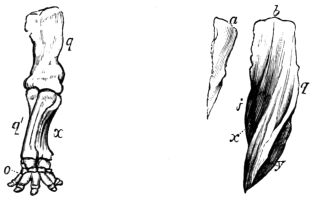
Fig. 7.—Anterior extremity of elephant. Shows how the bones of the arm (q),
forearm (q´x), and foot (o), are twisted to form an osseous screw. Compare
with Figs. 6 and 8.—Original.
Fig. 8.—Cast or mould of the interior of the left ventricle of the heart of a
deer. Shows that the left ventricular cavity is conical and spiral in its
nature. a Portion of right ventricular cavity; b, base of left ventricular
cavity; x, y, spiral grooves occupied by the spiral musculi papillares; j, q,
spiral ridges projecting between the musculi papillares. Compare with Figs. 6
and 7.—Original.
The force of muscles, according to the experiments of
Schwann, increases with their length, and vice versa. It is a
curious circumstance, and worthy the attention of those interested
in homologies, that the voluntary muscles of the
superior and inferior extremities, and more especially of the
trunk, are arranged in longitudinal, transverse, and oblique
spiral lines, and in layers or strata precisely as in the
ventricles of the heart and hollow muscles generally.17 If,
consequently, I eliminate the element of bone from these
several regions, I reproduce a typical hollow muscle; and
what is still more remarkable, if I compare the bones removed
(say the bones of the anterior extremity of a quadruped
or bird) with the cast obtained from the cavity of a
hollow muscle (say the left ventricle of the heart of the
mammal), I find that the bones and the cast are twisted
upon themselves, and form elegant screws, the threads or
ridges of which run in the same direction. This affords a
proof that the involuntary hollow muscles supply the type or
pattern on which the voluntary muscles are formed. Fig. 6 represents
the bones of the wing of the bird; fig. 7 the bones of the
anterior extremity of the elephant; and fig. 8 the cast or mould
of the cavity of the left ventricle of the heart of the deer.
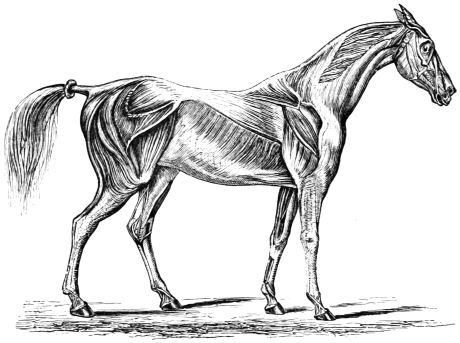
Fig. 9.—The Superficial Muscles in the Horse, (after Bagg).
It has been the almost invariable custom in teaching
anatomy, and such parts of physiology as pertain to animal
movements, to place much emphasis upon the configuration
of the bony skeleton as a whole, and the conformation of its
several articular surfaces in particular. This is very natural,
as the osseous system stands the wear and tear of time, while
all around it is in a great measure perishable. It is the link
which binds extinct forms to living ones, and we naturally
venerate and love what is enduring. It is no marvel that
Oken, Goethe, Owen, and others should have attempted such
splendid generalizations with regard to the osseous system—should
have proved with such cogency of argument that the
head is an expanded vertebra. The bony skeleton is a miracle
of design very wonderful and very beautiful in its way. But
when all has been said, the fact remains that the skeleton,
when it exists, forms only an adjunct of locomotion and
motion generally. All the really essential movements of an
animal occur in its soft parts. The osseous system is therefore
to be regarded as secondary in importance to the muscular,
of which it may be considered a differentiation. Instead
of regarding the muscles as adapted to the bones, the bones
ought to be regarded as adapted to the muscles. Bones have
no power either of originating or perpetuating motion. This
begins and terminates in the muscles. Nor must it be overlooked,
that bone makes its appearance comparatively late in
the scale of being; that innumerable creatures exist in which
no trace either of an external or internal skeleton is to be
found; that these creatures move freely about, digest, circulate
their nutritious juices and blood when present, multiply,
and perform all the functions incident to life. While the
skeleton is to be found in only a certain proportion of the
animals existing on our globe, the soft parts are to be met
with in all; and this appears to me an all-sufficient reason
for attaching great importance to the movements of soft
parts, such as protoplasm, jelly masses, involuntary and voluntary
muscles, etc.18 As the muscles of vertebrates are accurately
applied to each other, and to the bones, while the bones
are rigid, unyielding, and incapable of motion, it follows that
the osseous system acts as a break or boundary to the muscular
one,—and hence the arbitrary division of muscles into extensors
and flexors, pronators and supinators, abductors and adductors.
This division although convenient is calculated to
mislead. The most highly organized animal is strictly speaking
to be regarded as a living mass whose parts (hard, soft, and
otherwise) are accurately adapted to each other, every part
reciprocating with scrupulous exactitude, and rendering it
difficult to determine where motion begins and where it terminates.
Fig. 9 shows the more superficial of the muscular
masses which move the bones or osseous levers of the horse,
as seen in the walk, trot, gallop, etc. A careful examination
of these carneous masses or muscles will show that they run
longitudinally, transversely, and obliquely, the longitudinal
and transverse muscles crossing each other at nearly right
angles, the oblique ones tending to cross at various angles, as
in the letter X. The crossing is seen to most advantage in
the deep muscles.
In order to understand the twisting which occurs to a
greater or less extent in the bodies and extremities (when
present) of all vertebrated animals, it is necessary to reduce the
bony and muscular systems to their simplest expression. If
motion is desired in a dorsal, ventral, or lateral direction only, a
dorsal and ventral or a right and left lateral set of longitudinal
muscles acting upon straight bones articulated by an ordinary
ball-and-socket joint will suffice. In this case the dorsal,
ventral, and right and left lateral muscles form muscular cycles;
contraction or shortening on the one aspect of the cycle being
accompanied by relaxation or elongation on the other, the
bones and joints forming as it were the diameters of the
cycles, and oscillating in a backward, forward, or lateral
direction in proportion to the degree and direction of the
muscular movements. Here the motion is confined to two
planes intersecting each other at right angles. When, however,
the muscular system becomes more highly differentiated,
both as regards the number of the muscles employed, and the
variety of the directions pursued by them, the bones and
joints also become more complicated. Under these circumstances,
the bones, as a rule, are twisted upon themselves,
and their articular surfaces present various degrees of spirality
to meet the requirements of the muscular system. Between the
straight longitudinal muscles, therefore, arranged in dorsal and
ventral, and right and left lateral sets, and those which run in a
more or less transverse direction, and between the simple joint
whose motion is confined to one plane and the ball-and-socket
joints whose movements are universal, every degree of obliquity
is found in the direction of the muscles, and every possible
modification in the disposition of the articular surfaces.
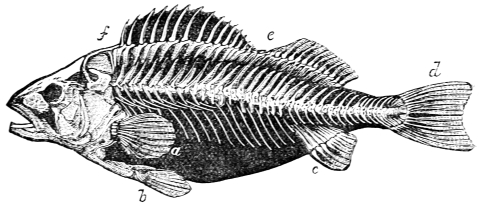
In the fish the muscles are for the most part arranged in
dorsal, ventral, and lateral sets, which run longitudinally; and,
as a result, the movements of the trunk, particularly towards
the tail, are from side to side and sinuous. As, however,
oblique fibres are also present, and the tendons of the longitudinal
muscles in some instances cross obliquely towards the
tail, the fish has also the power of tilting or twisting its
trunk (particularly the lower half) as well as the caudal fin.
In a mackerel which I examined, the oblique muscles were
represented by the four lateral masses occurring between the
dorsal, ventral, and lateral longitudinal muscles—two of
these being found on either side of the fish, and corresponding
to the myocommas or “grand muscle latéral” of Cuvier. The
muscular system of the fish would therefore seem to be arranged
on a fourfold plan,—there being four sets of longitudinal
muscles, and a corresponding number of slightly
oblique and oblique muscles, the oblique muscles being spiral
in their nature and tending to cross or intersect at various
angles, an arrest of the intersection, as it appears to me,
giving rise to the myocommas and to that concentric arrangement
of their constituent parts so evident on transverse
section. This tendency of the muscular fibres to cross
each other at various degrees of obliquity may also be traced
in several parts of the human body, as, for instance, in the
deltoid muscle of the arm and the deep muscles of the leg.
Numerous other examples of penniform muscles might be
adduced. Although the fibres of the myocommas have a
more or less longitudinal direction, the myocommas themselves
pursue an oblique spiral course from before backwards
and from within outwards, i.e. from the spine towards the
periphery, where they receive slightly oblique fibres from the
longitudinal dorsal, ventral, and lateral muscles. As the
spiral oblique myocommas and the oblique fibres from the
longitudinal muscles act directly and indirectly upon the
spines of the vertebræ, and the vertebræ themselves to which
they are specially adapted, and as both sets of oblique fibres
are geared by interdigitation to the fourfold set of longitudinal
muscles, the lateral, sinuous, and rotatory movements of
the body and tail of the fish are readily accounted for.
The spinal column of the fish facilitates the lateral sinuous
twisting movements of the tail and trunk, from the fact that
the vertebræ composing it are united to each other by a series
of modified universal joints—the vertebræ supplying the cup
-shaped
depressions or sockets, the intervertebral substance,
the prominence or ball.
The same may be said of the general arrangement of the
muscles in the trunk and tail of the Cetacea, the principal
muscles in this case being distributed, not on the sides, but
on the dorsal and ventral aspects. The lashing of the tail
in the whales is consequently from above downwards or
vertically, instead of from side to side. The spinal column is
jointed as in the fish, with this difference, that the vertebræ
(especially towards the tail) form the rounded prominences or
ball, the meniscus or cup-shaped intervertebral plates the
receptacles or socket.
When limbs are present, the spine may be regarded as
being ideally divided, the spiral movements, under these
circumstances, being thrown upon the extremities by typical
ball-and-socket joints occurring at the shoulders and pelvis.
This is peculiarly the case in the seal, where the spirally
sinuous movements of the spine are transferred directly to
the posterior extremities.19
The extremities, when present, are provided with their
own muscular cycles of extensor and flexor, abductor and
adductor, pronator and supinator muscles,—these running
longitudinally and at various degrees of obliquity, and enveloping
the hard parts according to their direction—the
bones being twisted upon themselves and furnished with
articular surfaces which reflect the movements of the
muscular cycles, whether these occur in straight lines anteriorly,
posteriorly, or laterally, or in oblique lines in intermediate
situations. The straight and oblique muscles are
principally brought into play in the movements of the extremities
of quadrupeds, bipeds, etc. in walking; in the movements
of the tails and fins of fishes, whales, etc. in swimming;
and in the movements of the wings of insects, bats, and
birds in flying. The straight and oblique muscles are
usually found together, and co-operate in producing the
movements in question; the amount of rotation in a part
always increasing as the oblique muscles preponderate. The
combination of ball-and-socket and hinge-joints, with their concomitant
oblique and longitudinal muscular cycles (the former
occurring in their most perfect forms where the extremities
are united to the trunk, the latter in the extremities themselves),
enable the animal to present, when necessary, an extensive
resisting surface the one instant, and a greatly diminished
and a comparatively non-resisting one the next. This arrangement
secures the subtlety and nicety of motion demanded by
the several media at different stages of progression.
Fig. 10.Fig. 11.Fig. 12.Fig. 13.Fig. 14.
Fig. 10.—Extreme form of compressed foot, as seen in the deer, ox, etc.,
adapted specially for land transit.—Original.
Fig. 11.—Extreme form of expanded foot, as seen in the Ornithorhynchus,
etc., adapted more particularly for swimming.—Original.
Figs. 12 and 13.—Intermediate form of foot, as seen in the otter (fig. 12),
frog (fig. 13), etc. Here the foot is equally serviceable in and out of the
water.—Original.
Fig. 14.—Foot of the seal, which opens and closes in the act of natation,
the organ being folded upon itself during the non-effective or return stroke,
and expanded during the effective or forward stroke. Due advantage is
taken of this arrangement by the seal when swimming, the animal rotating
on its long axis, so as to present the lower portion of the body and the
feet obliquely to the water during the return stroke, and the flat, or the
greatest available surface of both, during the effective or forward stroke.—Original.
The travelling surfaces of Animals modified and adapted
to the medium on or in which they move.—In those land
animals which take to the water occasionally, the feet, as a
rule, are furnished with membranous expansions extending
between the toes. Of such the Otter (fig. 12), Ornithorhynchus
(fig. 11), Seal (fig. 14), Crocodile, Sea-Bear (fig. 37,
p. 76), Walrus, Frog (fig. 13), and Triton, may be cited.
The crocodile and triton, in addition to the membranous
expansion occurring between the toes, are supplied with a
powerful swimming-tail, which adds very materially to the
surface engaged in natation. Those animals, one and all,
walk awkwardly, it always happening that when the extremities
are modified to operate upon two essentially
different media (as, for instance, the land and water), the
maximum of speed is attained in neither. For this reason
those animals which swim the best, walk, as a rule, with the
greatest difficulty, and vice versâ, as the movements of the
auk and seal in and out of the water amply testify.
In addition to those land animals which run and swim,
there are some which precipitate themselves, parachute-fashion,
from immense heights, and others which even fly.
In these the membranous expansions are greatly increased,
the ribs affording the necessary support in the Dragon or
Flying Lizard (fig. 15), the anterior and posterior extremities
and tail, in the Flying Lemur (fig. 16) and Bat (fig. 17, p. 36).
Fig. 15.Fig. 16.
Fig. 15.—The Red-throated Dragon (Draco hæmatopogon, Gray) shows a large
membranous expansion (b b) situated between the anterior (d d) and posterior
extremities, and supported by the ribs. The dragon by this arrangement
can take extensive leaps with perfect safety.—Original.
Fig. 16.—The Flying Lemur Galeopithecus volans, Shaw. In the flying
lemur the membranous expansion (a b) is more extensive than in the
Flying Dragon (fig. 15). It is supported by the neck, back, and tail, and
by the anterior and posterior extremities. The flying lemur takes enormous
leaps; its membranous tunic all but enabling it to fly. The Bat,
Phyllorhina gracilis (fig. 17), flies with a very slight increase of surface.
The surface exposed by the bat exceeds that displayed by many insects
and birds. The wings of the bat are deeply concave, and so resemble the
wings of beetles and heavy-bodied short-winged birds. The bones of the
arm (r), forearm (d), and hand (n, n, n) of the bat (fig. 17) support the
anterior or thick margin and the extremity of the wing, and may not inaptly
be compared to the nervures in corresponding positions in the wing of
the beetle.—Original.
Fig. 17.—The Bat (Phyllorhina gracilis, Peters). Here the travelling-surfaces
(r d e f, a n n n) are enormously increased as compared with that of the
land and water animals generally. Compare with figures from 10 to 14,
p. 34. r Arm of bat; d forearm of bat; e f, n n n hand of bat.—Original.
Although no lizard is at present known to fly, there can
be little doubt that the extinct Pterodactyles (which, according
to Professor Huxley, are intermediate between the lizards
and crocodiles) were possessed of this power. The bat is
interesting as being the only mammal at present endowed
with wings sufficiently large to enable it to fly.20 It affords
an extreme example of modification for a special purpose,—its
attenuated body, dwarfed posterior, and greatly elongated
anterior extremities, with their enormous fingers and outspreading
membranes, completely unfitting it for terrestrial
progression. It is instructive as showing that flight may be
attained, without the aid of hollow bones and air-sacs, by
purely muscular efforts, and by the mere diminution and
increase of a continuous membrane.
As the flying lizard, flying lemur, and bat (figs. 15, 16, and
17, pp. 35 and 36), connect terrestrial progression with aërial
progression, so the auk, penguin (fig. 46, p. 91), and flying-fish
(fig. 51, p. 98), connect progression in the water with
progression in the air. The travelling surfaces of these anomalous
creatures run the movements peculiar to the three
highways of nature into each other, and bridge over, as it
were, the gaps which naturally exist between locomotion on
the land, in the water, and in the air.
PROGRESSION ON THE LAND.
Walking of the Quadruped, Biped, etc.—As the earth, because
of its solidity, will bear any amount of pressure to which it
may be subjected, the size, shape, and weight of animals
destined to traverse its surface are matters of little or no
consequence. As, moreover, the surface trod upon is rigid
or unyielding, the extremities of quadrupeds are, as a rule,
terminated by small feet. Fig. 18 (contrast with fig. 17).
Fig. 18.—Chillingham Bull (Bos Scoticus). Shows powerful heavy body, and
the small extremities adapted for land transit. Also the figure-of-8 movements
made by the feet and limbs in walking and running. u, t Curves
made by right and left anterior extremities. r, s Curves made by right
and left posterior extremities. The right fore and the left hind foot move
together to form the waved line (s, u); the left fore and the right hind foot
move together to form the waved line (r, t). The curves formed by the
anterior (t, u) and posterior (r, s) extremities form ellipses. Compare with
fig. 19, p. 39.—Original.
In this there is a double purpose—the limited area presented
to the ground affording the animal sufficient support
and leverage, and enabling it to disentangle its feet with the
utmost facility, it being a condition in rapid terrestrial progression
that the points presented to the earth be few in
number and limited in extent, as this approximates the feet
of animals most closely to the wheel in mechanics, where the
surface in contact with the plane of progression is reduced to
a minimum. When the surface presented to a dense resisting
medium is increased, speed is diminished, as shown in the
tardy movements of the mollusc, caterpillar, and slowworm,
and also, though not to the same extent, in the serpents,
some of which move with considerable celerity. In the gecko
and common house-fly, as is well known, the travelling surfaces
are furnished with suctorial discs, which enable those
creatures to walk, if need be, in an inverted position; and
“the tree-frogs (Hyla) have a concave disc at the end of each
toe, for climbing and adhering to the bark and leaves of trees.
Some toads, on the other hand, are enabled, by peculiar
tubercles or projections from the palm or sole, to clamber up
old walls.”21 A similar, but more complicated arrangement,
is met with in the arms of the cuttle-fish.
The movements of the extremities in land animals vary
considerably.
In the kangaroo and jerboa,22 the posterior extremities
only are used, the animals advancing per saltum, i.e. by a
series of leaps.23
The deer also bounds into the air in its slower movements;
in its fastest paces it gallops like the horse, as explained at
pp. 40–44. The posterior extremities of the kangaroo are
enormously developed as compared with the anterior ones;
they are also greatly elongated. The posterior extremities
are in excess, likewise, in the horse, rabbit,24 agouti, and guinea
pig. As a consequence these animals descend declivities with
difficulty. They are best adapted for slightly ascending ground.
In the giraffe the anterior extremities are longer and more
powerful, comparatively, than the posterior ones, which is
just the opposite condition to that found in the kangaroo.
In the giraffe the legs of opposite sides move together and
alternate, whereas in most quadrupeds the extremities move
diagonally—a remark which holds true also of ourselves in
walking and skating, the right leg and left arm advancing
together and alternating with the left leg and right arm (fig. 19).
Fig. 19.—Diagram showing the figure-of-8 or double-waved track produced by
the alternating of the extremities in man in walking and running; the
right leg (r) and left arm (s) advancing simultaneously to form one step;
and alternating with the left leg (t) and right arm (u), which likewise advance
together to form a second step. The continuous line (r, t) gives the
waved track made by the legs; the interrupted line (s, u) that made by the
arms. The curves made by the right leg and left arm, and by the left leg
and right arm, form ellipses. Compare with fig. 18, p. 37.—Original.
In the hexapod insects, according to Müller, the fore and
hind foot of the one side and the middle one of the opposite
side move together to make one step, the three corresponding
and opposite feet moving together to form the second step.
Other and similar combinations are met with in the decapods.
The alternating movements of the extremities are interesting
as betokening a certain degree of flexuosity or twisting,
either in the trunk or limbs, or partly in the one and partly
in the other.
This twisting begets the figure-of-8 movements observed in
walking, swimming, and flying. (Compare figs. 6, 7, and 26x,
pp. 28 and 55; figs. 18 and 19, pp. 37 and 39; figs. 32 and 50,
pp. 68 and 97; figs. 71 and 73, p. 144; and fig. 81, p. 157.)
Locomotion of the Horse.—As the limits of the present
volume forbid my entering upon a consideration of the movements
of all the animals with terrestrial habits, I will describe
briefly, and by way of illustration, those of the horse, ostrich,
and man. In the horse, as in all quadrupeds endowed with
great speed, the bones of the extremities are inclined obliquely
towards each other to form angles; the angles diminishing as
the speed increases. Thus the angles formed by the bones of
the extremities with each other and with the scapulæ and
iliac bones, are less in the horse than in the elephant. For
the same reason they are less in the deer than in the horse.
In the elephant, where no great speed is required, the limbs
are nearly straight, this being the best arrangement for supporting
superincumbent weight. The angles formed by the
different bones of the wing of the bird are less than in the
fleetest quadruped, the movements of wings being more rapid
than those of the extremities of quadrupeds and bipeds.
These are so many mechanical adaptations to neutralize shock,
to increase elasticity, and secure velocity. The paces of the
horse are conveniently divided into the walk, the trot, the
amble, and the gallop. If the horse begins his walk by raising
his near fore foot, the order in which the feet are lifted is
as follows:—first the left fore foot, then the right or diagonal
hind foot, then the right fore foot, and lastly the left or
diagonal hind foot. There is therefore a twisting of the
body and spiral overlapping of the extremities of the horse
in the act of walking, in all respects analogous to what
occurs in other quadrupeds25 and in bipeds (figs. 18 and 19, pp. 37
and 39). In the slowest walk Mr. Gamgee observes “that
three feet are in constant action on the ground, whereas in
the free walk in which the hind foot passes the position from
which the parallel fore foot moves, there is a fraction of time
when only two feet are upon the ground, but the interval is
too short for the eye to measure it. The proportion of time,
therefore, during which the feet act upon the ground, to that
occupied in their removal to new positions, is as three to one
in the slow, and a fraction less in the fast walk. In the fast
gallop these proportions are as five to three. In all the paces
the power of the horse is being exerted mainly upon a fore
and hind limb, with the feet implanted in diagonal positions.
There is also a constant parallel line of positions kept up by
a fore and hind foot, alternating sides in each successive move.
These relative positions are renewed and maintained. Thus
each fore limb assumes, as it alights, the advanced position
parallel with the hind, just released and moving; the hind
feet move by turns, in sequence to their diagonal fore, and in
priority to their parallel fellows, which following they maintain
for nearly half their course, when the fore in its turn is
raised and carried to its destined place, the hind alighting
midway. All the feet passing over equal distances and keeping
the same time, no interference of the one with the other
occurs, and each successive hind foot as it is implanted forms
a new diagonal with the opposite fore, the latter forming the
front of the parallel in one instant, and one of the diagonal
positions in the next: while in the case of the hind, they
assume the diagonal on alighting and become the terminators
of the parallel in the last part of their action.”
Fig. 20.—Horse in the act of trotting. In this, as in all the other paces,
the body of the horse is levered forward by a diagonal twisting of the trunk
and extremities, the extremities describing a figure-of-8 track (s u, r t).
The figure-of-8 is produced by the alternate play of the extremities and feet,
two of which are always on the ground (a, b). Thus the right fore foot describes
the curve marked t, the left hind foot that marked r, the left fore foot that
marked u, and the right hind foot that marked s. The feet on the ground in
the present instance are the left fore and the right hind. Compare with
figs. 18 and 19, pp. 37 and 39.—Original.
In the trot, according to Bishop, the legs move in pairs
diagonally. The same leg moves rather oftener during the
same period in trotting than in walking, or as six to five. The
velocity acquired by moving the legs in pairs, instead of consecutively,
depends on the circumstance that in the trot each
leg rests on the ground during a short interval, and swings
during a long one; whilst in walking each leg swings a short,
and rests a long period. The undulations arising from the
projection of the trunk in the trot are chiefly in the vertical
plane; in the walk they are more in the horizontal.
The gallop has been erroneously believed to consist of a
series of bounds or leaps, the two hind legs being on the
ground when the two fore legs are in the air, and vice versâ,
there being a period when all four are in the air. Thus
Sainbell in his “Essay on the Proportions of Eclipse,” states
“that the gallop consists of a repetition of bounds, or leaps,
more or less high, and more or less extended in proportion to
the strength and lightness of the animal.” A little reflection
will show that this definition of the gallop cannot be the
correct one. When a horse takes a ditch or fence, he gathers
himself together, and by a vigorous effort (particularly of the
hind legs), throws himself into the air. This movement
requires immense exertion and is short-lived. It is not in
the power of any horse to repeat these bounds for more than
a few minutes, from which it follows that the gallop, which
may be continued for considerable periods, must differ very
materially from the leap.
The pace known as the amble is an artificial movement,
produced by the cunning of the trainer. It resembles that of
the giraffe, where the right fore and right hind foot move
together to form one step; the left fore and left hind foot
moving together to form the second step. By the rapid
repetition of these movements the right and left sides of the
body are advanced alternately by a lateral swinging motion,
very comfortable for the rider, but anything but graceful.
The amble is a defective pace, inasmuch as it interferes with
the diagonal movements of the limbs, and impairs the continuity
of motion which the twisting, cross movement begets.
Similar remarks might be made of the gallop if it consisted
(which it does not) of a series of bounds or leaps, as each
bound would be succeeded by a halt, or dead point, that could
not fail seriously to compromise continuous forward motion.
In the gallop, as in the slower movements, the horse has
never less than two feet on the ground at any instant of time,
no two of the four feet being in exactly the same position.
Mr. Gamgee, who has studied the movements of the horse
very carefully, has given diagrams of the walk, trot, and
gallop, drawn to a scale of the feet of a two-year-old colt in
training, which had been walked, trotted, and galloped over
the ground for the purpose. The point he sought to determine
was the exact distance through which each foot was
carried from the place where it was lifted to that where it
alighted. The diagrams are reproduced at figures 21, 22, and
23. In figure 23 I have added a continuous waved line to
indicate the alternating movements of the extremities; Mr.
Gamgee at the time he wrote26 being, he informs me, unacquainted
with the figure-of-8 theory of animal progression as
subsequently developed by me. Compare fig. 23 with figs. 18
and 19, pp. 37 and 39; with fig. 50, p. 97; and with figs. 71
and 73, p. 144.
Fig. 21.Fig. 22.
Fig. 23.
In examining figures 21, 22, and 23, the reader will do
well to remember that the near fore and hind feet of a horse
are the left fore and hind feet; the off fore and hind feet
being the right fore and hind feet. The terms near and off
are technical expressions, and apply to the left and right
sides of the animal. Another point to be attended to in
examining the figures in question, is the relation which
exists between the fore and hind feet of the near and
off sides of the body. In slow walking the near hind foot
is planted behind the imprint made by the near fore foot.
In rapid walking, on the contrary, the near hind foot is
planted from six to twelve or more inches in advance of the
imprint made by the near fore foot (fig. 21 represents
the distance as eleven inches). In the trot the near hind foot
is planted from twelve to eighteen or more inches in advance of
the imprint made by the near fore foot (fig. 22 represents the
distance as nineteen inches). In the gallop the near hind foot
is planted 100 or more inches in advance of the imprint made
by the near fore foot (fig. 23 represents the distance as 110 1/2
inches). The distance by which the near hind foot passes
the near fore foot in rapid walking, trotting, and galloping,
increases in a progressive ratio, and is due in a principal
measure to the velocity or momentum acquired by the mass
of the horse in rapid motion; the body of the animal carrying
forward and planting the limbs at greater relative distances
in the trot than in the rapid walk, and in the gallop than in
the trot. I have chosen to speak of the near hind and near
fore feet, but similar remarks may of course be made of the
off hind and off fore feet.
“At fig. 23, which represents the gallop, the distance
between two successive impressions produced, say by the near
fore foot, is eighteen feet one inch and a half. Midway
between these two impressions is the mark of the near hind
foot, which therefore subdivides the space into nine feet and
six-eighths of an inch, but each of these is again subdivided
into two halves by the impressions produced by the off fore
and off hind feet. It is thus seen that the horse’s body
instead of being propelled through the air by bounds or leaps
even when going at the highest attainable speed, acts on a
system of levers, the mean distance between the points of
resistance of which is four feet six inches. The exact length
of stride, of course, only applies to that of the particular horse
observed, and the rate of speed at which he is going. In the
case of any one animal, the greater the speed the longer is
the individual stride. In progression, the body moves before a
limb is raised from the ground, as is most readily seen when
the horse is beginning its slowest action, as in traction.”27
At fig. 22, which represents the trot, the stride is ten feet
one inch. At fig. 21, which represents the walk, it is only
five feet five inches. The speed acquired, Mr. Gamgee points
out, determines the length of stride; the length of stride
being the effect and evidence of speed and not the cause of it.
The momentum acquired in the gallop, as already explained,
greatly accelerates speed.
“In contemplating length of strides, with reference to the
fulcra, allowance has to be made for the length of the feet,
which is to be deducted from that of the strides, because the
apex, or toe of the horse’s hind foot forms the fulcrum in one
instant, and the heel of the fore foot in the next, and vice
versâ. This phenomenon is very obvious in the action of the
human foot, and is remarkable also for the range of leverage
thus afforded in some of the fleetest quadrupeds, of different
species. In the hare, for instance, between the point of its
hock and the termination of its extended digits, there is a
space of upwards of six inches of extent of leverage and
variation of fulcrum, and in the fore limb from the carpus to
the toe-nails (whose function in progression is not to be
underrated) upwards of three inches of leverage are found,
being about ten inches for each lateral biped, and the double
of that for the action of all four feet. Viewed in this way
the stride is not really so long as would be supposed if merely
estimated from the space between the footprints.
“Many interesting remarks might be made on the length of
the stride of various animals; the full movement of the greyhound
is, for instance, upwards of sixteen feet; that of the
hare at least equal; whilst that of the Newfoundland dog is
a little over nine feet.”27
Locomotion of the Ostrich.—Birds have been divided by
naturalists into eight orders:—the Natatores, or Swimming
Birds; the Grallatores, or Wading Birds; the Cursores, or
Running Birds; the Scansores, or Climbers; the Rasores, or
Scrapers; the Columbæ, or Doves; the Passeres; and the
Raptores, or Birds of Prey.
The first five orders have been classified according to their
habits and modes of progression. The Natatores I shall consider
when I come to speak of swimming as a form of locomotion,
and as there is nothing in the movements of the wading,
scraping, and climbing birds,28 or in the Passeres29 or Raptores,
requiring special notice, I shall proceed at once to a consideration
of the Cursores, the best examples of which are the
ostrich, emu, cassowary, and apteryx.
The ostrich is remarkable for the great length and development
of its legs as compared with its wings (fig. 24). In this
respect it is among birds what the kangaroo is among mammals.
The ostrich attains an altitude of from six to eight feet, and
is the largest living bird known. Its great height is due to
its attenuated neck and legs. The latter are very powerful
structures, and greatly resemble in their general conformation
the posterior extremities of a thoroughbred horse or one of the
larger deer—compare with fig. 4, p. 21. They are expressly
made for speed. Thus the bones of the leg and foot are inclined
very obliquely towards each other, the femur being inclined
very obliquely to the ilium. As a consequence the
angles made by the several bones of the legs are comparatively
small; smaller in fact than in either the horse or deer.
Fig. 24.—Skeleton of the Ostrich. Shows the powerful legs, small feet, and
rudimentary wings of the bird; the obliquity at which the bones of the legs
and wings are placed, and the comparatively small angles which any two
bones make at their point of junction. a Angle made by femur with ilium.
b Angle made by tibia and fibula with femur. c Angle made by tarso-metatarsal
bone with tibia and fibula. d Angle made by bones of foot with
tarso-metatarsal bone. r Bones of wing inclined to each other at nearly right
angles. Compare with fig. 4, p. 21, fig. 26, p. 55, and fig. 27, p. 59.—Adapted
from Dallas.
The feet of the ostrich, like those of the horse and deer,
are reduced to a minimum as regards size; so that they
occasion very little friction in the act of walking and running.
The foot is composed of two jointed toes,30 which spread out
when the weight of the body comes upon them, in such a
manner as enables the bird to seize and let go the ground
with equal facility. The advantage of such an arrangement
in rapid locomotion cannot be over-estimated. The elasticity
and flexibility of the foot contribute greatly to the rapidity
of movement for which this celebrated bird is famous. The
limb of the ostrich, with its large bones placed very obliquely
to form a system of powerful levers, is the very embodiment
of speed. The foot is quite worthy of the limb, it being in
some respects the most admirable structure of its kind in
existence. The foot of the ostrich differs considerably from
that of all other birds, those of its own family excepted.
Thus the under portion of the foot is flat, and specially
adapted for acting on plane surfaces, particularly solids.31 The
extremities of the toes superiorly are armed with powerful
short nails, the tips of which project inferiorly to protect the
toes and confer elasticity when the foot is leaving the ground.
The foot, like the leg, is remarkable for its great strength.
The legs of the ostrich are closely set, another feature of
speed.32 The wings of the ostrich are in a very rudimentary
condition as compared with the legs.33 All the bones are present,
but they are so dwarfed that they are useless as organs
of flight. The angles which the bones of the wing make with
each other, are still less than the angles made by the bones of
the leg. This is just what we would a priori expect, as the
velocity with which wings are moved greatly exceeds that
with which legs are moved. The bones of the wing of the
ostrich are inclined towards each other at nearly right angles.
The wings of the ostrich, although useless as flying organs,
form important auxiliaries in running. When the ostrich
careers along the plain, he spreads out his wings in such a
manner that they act as balancers, and so enable him to maintain
his equilibrium (fig. 25). The wings, because of the angle of
inclination which their under surfaces make with the horizon,
and the great speed at which the ostrich travels, act like
kites, and so elevate and carry forward by a mechanical
adaptation a certain proportion of the mass of the bird
already in motion. The elevating and propelling power of
even diminutive inclined planes is very considerable, when
carried along at a high speed in a horizontal direction. The
wings, in addition to their elevating and propelling power,
contribute by their short, rapid, swinging movements, to continuity
of motion in the legs. No bird with large wings can
run well. The albatross, for example, walks with difficulty,
and the same may be said of the vulture and eagle. What,
therefore, appears a defect in the ostrich, is a positive advantage
when its habits and mode of locomotion are taken into
account.
Fig. 25.—Ostriches pursued by a Hunter.
Professional runners in many cases at matches reduce the
length of their anterior extremities by flexing their arms and
carrying them on a level with their chest (fig. 28, p. 62). It
would seem that in rapid running there is not time for the arms
to oscillate naturally, and that under these circumstances the
arms, if allowed to swing about, retard rather than increase
the speed. The centre of gravity is well forward in the
ostrich, and is regulated by the movements of the head and
neck, and the obliquity of the body and legs. In running
the neck is stretched, the body inclined forward, and the legs
moved alternately and with great rapidity. When the right
leg is flexed and elevated, it swings forward pendulum-fashion,
and describes a curve whose convexity is directed
towards the right side. When the left leg is flexed and
elevated, it swings forward and describes a curve whose convexity
is directed towards the left side. The curves made by
the right and left legs form when united a waved line (vide
figs. 18, 19, and 20, pp. 37, 39, and 41). When the right
leg is flexed, elevated, and advanced, it rotates upon the iliac
portion of the trunk of the bird, the trunk being supported
for the time being by the left leg, which is extended, and in
contact with the ground. When the left leg is flexed, elevated,
and advanced, it in like manner rotates upon the trunk, supported
in this instance by the extended right leg. The leg
which is on the ground for the time being supplies the necessary
lever, the ground the fulcrum. When the right leg is
flexed and elevated, it rotates upon the iliac portion of the
trunk in a forward direction, the right foot describing the arc of
a circle. When the right leg and foot are extended and fixed
on the ground, the trunk rotates upon the right foot in a forward
direction to form the arc of a circle, which is the converse
of that formed by the right foot. If the arcs alternately supplied
by the right foot and trunk are placed in opposition, a more
or less perfect circle is produced, and thus it is that the locomotion
of animals is approximated to the wheel in mechanics.
Similar remarks are to be made of the left foot and trunk.
The alternate rolling of the trunk on the extremities, and the
extremities on the trunk, utilizes or works up the inertia of the
moving mass, and powerfully contributes to continuity and
steadiness of action in the moving parts. By advancing the head,
neck, and anterior parts of the body, the ostrich inaugurates
the rolling movement of the trunk, which is perpetuated by
the rolling movements of the legs. The trunk and legs of the
ostrich are active and passive by turns. The movements of
the trunk and limbs are definitely co-ordinated. But for this
reciprocation the action of the several parts implicated would
neither be so rapid, certain, nor continuous. The speed of
the ostrich exceeds that of every other land animal, a circumstance
due to its long, powerful legs and great stride. It can
outstrip without difficulty the fleetest horses, and is only
captured by being simultaneously assailed from various points,
or run down by a succession of hunters on fresh steeds.
If the speed of the ostrich, which only measures six or eight
feet, is so transcending, what shall we say of the speed of the
extinct Æpyornis maximus and Dinornis giganteus, which are
supposed to have measured from sixteen to eighteen feet in
height? Incredible as it may appear, the ostrich, with its
feet reduced to a minimum as regards size, and peculiarly
organized for walking and running on solids, can also swim.
Mr. Darwin, that most careful of all observers, informs us
that ostriches take to the water readily, and not only ford
rapid rivers, but also cross from island to island. They swim
leisurely, with neck extended, and the greater part of the
body submerged.
Locomotion in Man.—The speed attained by man, although
considerable, is not remarkable. It depends on a variety of
circumstances, such as the height, age, sex, and muscular
energy of the individual, the nature of the surface passed
over, and the resistance to forward motion due to the presence
of air, whether still or moving. A reference to the human
skeleton, particularly its inferior extremities, will explain why
the speed should be moderate.
On comparing the inferior extremities of man with the legs
of birds, or the posterior extremities of quadrupeds, say the
horse or deer, we find that the bones composing them are not
so obliquely placed with reference to each other, neither are
the angles formed by any two bones so acute. Further, we
observe that in birds and quadrupeds the tarsal and metatarsal
bones are so modified that there is an actual increase
in the number of the angles themselves. In the extremities
of birds and quadrupeds there are four angles, which may be
increased or diminished in the operations of locomotion.
Thus, in the quadruped and bird (fig. 4, p. 21, and fig. 24, p.
47), the femur forms with the ilium one angle (a); the tibia
and fibula with the femur a second angle (b); the cannon or
tarso-metatarsal bone with the tibia and fibula a third angle
(c); and the bones of the foot with the cannon or tarso-metatarsal
bone a fourth angle (d). In man three angles only are
found, marked respectively a, b, and c (figs. 26 and 27, pp. 55
and 59). The fourth angle (d of figs. 4 and 24) is absent.
The absence of the fourth angle is due to the fact that in man
the tarsal and metatarsal bones are shortened and crushed
together; whereas in the quadruped and bird they are elongated
and separated.
As the speed of a limb increases in proportion to the number
and acuteness of the angles formed by its several bones, it
is not difficult to understand why man should not be so swift
as the majority of quadrupeds. The increase in the number
of angles increases the power which an animal has of shortening
and elongating its extremities, and the levers which the
extremities form. To increase the length of a lever is to
increase its power at one end, and the distance through which
it moves at the other; hence the faculty of bounding or leaping
possessed in such perfection by many quadrupeds.34 If
the wing be considered as a lever, a small degree of motion at
its root produces an extensive sweep at its tip. It is thus
that the wing is enabled to work up and utilize the thin
medium of the air as a buoying medium.
Another drawback to great speed in man is his erect position.
Part of the power which should move the limbs is
dedicated to supporting the trunk. For the same reason the
bones of the legs, instead of being obliquely inclined to each
other, as in the quadruped and bird, are arranged in a nearly
vertical spiral line. This arrangement increases the angle
formed by any two bones, and, as a consequence, decreases
the speed of the limbs, as explained. A similar disposition of
the bones is found in the anterior extremities of the elephant,
where the superincumbent weight is great, and the speed,
comparatively speaking, not remarkable. The bones of the
human leg are beautifully adapted to sustain the weight of
the body and neutralize shock.35 Thus the femur or thigh
bone is furnished at its upper extremity with a ball-and-socket
joint which unites it to the cup-shaped depression (acetabulum)
in the ilium (hip bone). It is supplied with a neck
which carries the body or shaft of the bone in an oblique
direction from the ilium, the shaft being arched forward and
twisted upon itself to form an elongated cylindrical screw.
The lower extremity of the femur is furnished with spiral
articular surfaces accurately adapted to the upper extremities
of the bones of the leg, viz. the tibia and fibula, and to the
patella. The bones of the leg (tibia and fibula) are spirally
arranged, the screw in this instance being split up. At the
ankle the bones of the leg are applied to those of the foot by
spiral articular surfaces analogous to those found at the knee-joint.
The weight of the trunk is thus thrown on the foot,
not in straight lines, but in a series of curves. The foot
itself is wonderfully adapted to receive the pressure from
above. It consists of a series of small bones (the tarsal,
metatarsal, and phalangeal bones), arranged in the form of a
double arch; the one arch extending from the heel towards
the toes, the other arch across the foot. The foot is so contrived
that it is at once firm, elastic, and moveable,—qualities
which enable it to sustain pressure from above, and exert
pressure from beneath. In walking, the heel first reaches
and first leaves the ground. When the heel is elevated the
weight of the body falls more and more on the centre of
the foot and toes, the latter spreading out36 as in birds, to
seize the ground and lever the trunk forward. It is in this
movement that the wonderful mechanism of the foot is displayed
to most advantage, the multiplicity of joints in the
foot all yielding a little to confer that elasticity of step which
is so agreeable to behold, and which is one of the characteristics
of youth. The foot may be said to roll over the ground
in a direction from behind forwards. I have stated that the
angles formed by the bones of the human leg are larger than
those formed by the bones of the leg of the quadruped and bird.
This is especially true of the angle formed by the femur with
the ilium, which, because of the upward direction given to the
crest of the ilium in man, is so great that it virtually ceases
to be an angle.
The bones of the superior extremities in man merit attention
from the fact that in walking and running they oscillate
in opposite directions, and alternate and keep time with the
legs, which oscillate in a similar manner. The arms are articulated
at the shoulders by ball-and-socket joints to cup-shaped
depressions (glenoid cavities) closely resembling those found at
the hip-joints. The bone of the arm (humerus) is carried away
from the shoulder by a short neck, as in the thigh-bone (femur).
Like the thigh-bone it is twisted upon itself and forms a screw.
The inferior extremity of the arm bone is furnished with
spiral articular surfaces resembling those found at the knee.
The spiral articular surfaces of the arm bone are adapted to
similar surfaces existing on the superior extremities of the
bones of the forearm, to wit, the radius and ulna. These
bones, like the bones of the leg, are spirally disposed with
reference to each other, and form a screw consisting of two
parts. The bones of the forearm are united to those of
the wrist (carpal) and hand (metacarpal and phalangeal) by
articular surfaces displaying a greater or less degree of
spirality. From this it follows that the superior extremities
of man greatly resemble his inferior ones; a fact of considerable
importance, as it accounts for the part taken by the
superior extremities in locomotion. In man the arms do not
touch the ground as in the brutes, but they do not on this
account cease to be useful as instruments of progression. If
a man walks with a stick in each hand the movements of his
extremities exactly resemble those of a quadruped.
The bones of the human extremities (superior and inferior)
are seen to advantage in fig. 26; and I particularly direct
the attention of the reader to the ball-and-socket or universal
joints by which the arms are articulated to the shoulders
(x, x´), and the legs to the pelvis (a, a´), as a knowledge of
these is necessary to a comprehension of the oscillating or
pendulum movements of the limbs now to be described. The
screw configuration of the limbs is well depicted in the left
arm (x) of the present figure. Compare with the wing of the
bird, fig. 6, and with the anterior extremity of the elephant,
fig. 7, p. 28. But for the ball-and-socket joints, and the
spiral nature of the bones and articular surfaces of the extremities,
the undulating, sinuous, and more or less continuous
movements observable in walking and running, and the
twisting, lashing, flail-like movements necessary to swimming
and flying, would be impossible.
Fig. 26.—Skeleton of Man. Compare with fig. 4, p. 21, and fig. 24, p. 47.—Original.
The leg in the human subject moves by three joints, viz.,
the hip, knee, and ankle joints. When standing in the erect
position, the hip-joint only permits the limb to move forwards,
the knee-joint backwards, and the ankle-joint neither backwards
nor forwards. When the body or limbs are inclined
obliquely, or slightly flexed, the range of motion is increased.
The greatest angle made at the knee-joint is equal to the
sums of the angles made by the hip and ankle joints when
these joints are simultaneously flexed, and when the angle of
inclination made by the foot with the ground equals 30°.
From this it follows that the trunk maintains its erect
position during the extension and flexion of the limbs. The
step in walking was divided by Borelli into two periods, the
one corresponding to the time when both limbs are on the
ground; the other when only one limb is on the ground. In
running, there is a brief period when both limbs are off the
ground. In walking, the body is alternately supported by
the right and left legs, and advanced by a sinuous movement.
Its forward motion is quickened when one leg is on the
ground, and slowed when both are on the ground. When
the limb (say the right leg) is flexed, elevated, and thrown
forward, it returns if left to itself (i.e. if its movements are
not interfered with by the voluntary muscles) to the position
from which it was moved, viz. the vertical, unless the trunk
bearing the limb is inclined in a forward direction at the
same time. The limb returns to the vertical position, or
position of rest, in virtue of the power exercised by gravity,
and from its being hinged at the hip by a ball-and-socket
joint, as explained. In this respect the human limb when
allowed to oscillate exactly resembles a pendulum,—a fact first
ascertained by the brothers Weber. The advantage accruing
from this arrangement, as far as muscular energy is concerned,
is very great, the muscles doing comparatively little work.37
In beginning to walk, the body and limb which is to take
the first step are advanced together. When, however, the
body is inclined forwards, a large proportion of the step is
performed mechanically by the tendency which the pendulum
formed by the leg has to swing forward and regain a vertical
position,—an effect produced by the operation of gravity alone.
The leg which is advanced swings further forward than is
required for the step, and requires to swing back a little
before it can be deposited on the ground. The pendulum
movement effects all this mechanically. When the limb has
swung forward as far as the inclination of the body at the
time will permit, it reverses pendulum fashion; the back
stroke of the pendulum actually placing the foot upon the
ground by a retrograde, descending movement. When the
right leg with which we commenced is extended and firmly
placed upon the ground, and the trunk has assumed a nearly
vertical position, the left leg is flexed, elevated, and the trunk
once more bent forward. The forward inclination of the
trunk necessitates the swinging forward of the left leg, which,
when it has reached the point permitted by the pendulum
movement, swings back again to the extent necessary to place
it securely upon the ground. These movements are repeated
at stated and regular intervals. The retrograde movement of
the limb is best seen in slow walking. In fast walking the
pendulum movement is somewhat interrupted from the limb
being made to touch the ground when it attains a vertical
position, and therefore before it has completed its oscillation.38
The swinging forward of the body may be said to inaugurate
the movement of walking. The body is slightly bent and
inclined forwards at the beginning of each step. It is
straightened and raised towards the termination of that act.
The movements of the body begin and terminate the steps,
and in this manner regulate them. The trunk rises vertically
at each step, the head describing a slight curve well seen in
the walking of birds. The foot on the ground (say the right
foot) elevates the trunk, particularly its right side, and the
weight of the trunk, particularly its left side, depresses the
left or swinging foot, and assists in placing it on the ground.
The trunk and limbs are active and passive by turns. In
walking, a spiral wave of motion, most marked in an antero-posterior
direction (although also appearing laterally), runs
through the spine. This spiral spinal movement is observable
in the locomotion of all vertebrates. It is favoured in
man by the antero-posterior curves (cervical, dorsal, and lumbar)
existing in the human vertebral column. In the effort
of walking the trunk and limbs oscillate on the ilio-femoral
articulations (hip-joints). The trunk also rotates in a forward
direction on the foot which is placed upon the ground for the
time being. The rotation begins at the heel and terminates
at the toes. So long as the rotation continues, the body rises.
When the rotation ceases and one foot is placed flat upon the
ground, the body falls. The elevation and rotation of the
body in a forward direction enables the foot which is off
the ground for the time being to swing forward pendulum
fashion; the swinging foot, when it can oscillate no further
in a forward direction, reversing its course and retrograding
to a slight extent, at which juncture it is deposited on
the ground, as explained. The retrogression of the swinging
foot is accompanied by a slight retrogression on the part of
the body, which tends at this particular instant to regain a
vertical position. From this it follows that in slow walking
the trunk and the swinging foot advance together through a
considerable space, and retire through a smaller space; that
when the body is swinging it rotates upon the ilio-femoral
articulations (hip-joints) as an axis; and that when the leg
is not swinging, but fixed by its foot upon the ground, the
trunk rotates upon the foot as an axis. These movements
are correlated and complementary in their nature, and are
calculated to relieve the muscles of the legs and trunk engaged
in locomotion from excessive wear and tear.
Similar movements occur in the arms, which, as has been
explained, are articulated to the shoulders by ball-and-socket
joints (fig. 26, xx´, p. 55). The right leg and left arm advance
together to make one step, and so of the left leg and right
arm. When the right leg advances the right arm retires, and
vice versâ. When the left leg advances the left arm retires,
and the converse. There is therefore a complementary swinging
of the limbs on each side of the body, the leg swinging
always in an opposite direction to the arm on the same side.
There is, moreover, a diagonal set of movements, also complementary
in character: the right leg and left arm advancing
together to form one step; the left leg and right arm advancing
together to form the next. The diagonal movements
beget a lateral twisting of the trunk and limbs; the oscillation
of the trunk upon the limbs or feet, and the oscillation
of the feet and limbs upon the trunk, generate a forward
wave movement, accompanied by a certain amount of vertical
undulation. The diagonal movements of the trunk and
extremities are accompanied by a certain degree of lateral
curvature; the right leg and left arm, when they advance to
make a step, each describing a curve, the convexity of which
is directed to the right and left respectively. Similar curves
are described by the left leg and right arm in making the
second or complementary step. When the curves formed by
the right and left legs or the right and left arms are joined,
they form waved tracks symmetrically arranged on either
side of a given line. The curves formed by the legs and
arms intersect at every step, as shown at fig. 19, p. 39.
Similar curves are formed by the quadruped when walking
(fig. 18, p. 37), the fish when swimming (fig. 32, p. 68), and
the bird when flying (figs. 73 and 81, pp. 144 and 157).
Fig. 27 shows the simultaneous positions of both legs during a step, divided
into four groups. The first group (A), 4 to 7, gives the different positions
which the legs simultaneously assume while both are on the ground; the
second group (B), 8 to 11, shows the various positions of both legs at the
time when the posterior leg is elevated from the ground, but behind the
supported one; the third group (C), 12 to 14, shows the positions which
the legs assume when the swinging leg overtakes the standing one; and
the fourth group (D), 1 to 3, the positions during the time when the swinging
leg is propelled in advance of the resting one. The letters a, b, and c
indicate the angles formed by the bones of the right leg when engaged in
making a step. The letters m, n, and o, the positions assumed by the right
foot when the trunk is rolling over it. g Shows the rotating forward of the
trunk upon the left foot (f) as an axis. h Shows the rotating forward of
the left leg and foot upon the trunk (a) as an axis. Compare with fig. 4,
p. 21; with fig. 24, p. 47; and with fig. 26, p. 55.—After Weber.
The alternate rotation of the trunk upon the limb and the
limb upon the trunk is well seen in fig. 27, p. 59.
At A of fig. 27 the trunk (g) is observed rotating on the
left foot (f). At D of fig. the left leg (h) is seen rotating on
the trunk (a, i): these, as explained, are complementary movements.
At A of fig. the right foot (c) is firmly placed on the
ground, the left foot (f) being in the act of leaving it. The
right side of the trunk is on a lower level than the left, which
is being elevated, and in the act of rolling over the foot. At
B of fig. the right foot (m) is still upon the ground, but the
left foot having left it is in the act of swinging forward. At
C of fig. the heel of the right foot (n) is raised from the
ground, and the left foot is in the act of passing the right.
The right side of the trunk is now being elevated. At D of
fig. the heel of the right foot (o) is elevated as far as it can
be, the toes of the left foot being depressed and ready to
touch the ground. The right side of the trunk has now
reached its highest level, and is in the act of rolling over the
right foot. The left side of the trunk, on the contrary, is
subsiding, and the left leg is swinging before the right one,
preparatory to being deposited on the ground.
From the foregoing it will be evident that the trunk and
limbs have pendulum movements which are natural and
peculiar to them, the extent of which depends upon the
length of the parts. A tall man and a short man can consequently
never walk in step if both walk naturally and
according to inclination.39
In traversing a given distance in a given time, a tall man
will take fewer steps than a short man, in the same way that
a large wheel will make fewer revolutions in travelling over
a given space than a smaller one. The relation is a purely
mechanical one. The nave of the large wheel corresponds to
the ilio-femoral articulation (hip-joint) of the tall man, the
spokes to his legs, and portions of the rim to his feet. The
nave, spokes, and rim of the small wheel have the same relation
to the ilio-femoral articulation (hip-joint), legs and feet
of the small man. When a tall and short man walk together,
if they keep step, and traverse the same distance in the same
time, either the tall man must shorten and slow his steps, or
the short man must lengthen and quicken his.
The slouching walk of the shepherd is more natural than
that of the trained soldier. It can be kept up longer, and
admits of greater speed. In the natural walk, as seen in
rustics, the complementary movements are all evoked. In the
artificial walk of the trained army man, the complementary
movements are to a great extent suppressed. Art is consequently
not an improvement on nature in the matter of walking.
In walking, the centre of gravity is being constantly
changed,—a circumstance due to the different attitudes assumed
by the different portions of the trunk and limbs at different
periods of time. All parts of the trunk and limbs of a biped,
and the same may be said of a quadruped, move when a
change of locality is effected. The trunk of the biped and
quadruped when walking are therefore in a similar condition
to that of the body of the fish when swimming.
In running, all the movements described are exaggerated.
Thus the steps are more rapid and the strides greater. In
walking, a well-proportioned six-feet man can nearly cover
his own height in two steps. In running, he can cover without
difficulty a third more.
In fig. 28 (p. 62), an athlete is represented as bending
forward prior to running.
The left leg and trunk, it will be observed, are advanced
beyond the vertical line (x), and the arms are tucked up like
the rudimentary wings of the ostrich, to correct undue oscillation
at the shoulders, occasioned by the violent oscillation
produced at the pelvis in the act of running.
Fig. 28.—Preparing to run, from a design by Flaxman. Adapted. In the original
of this figure the right arm is depending and placed on the right
thigh.
In order to enable the right leg to swing forward, it is
evident that it must be flexed, and that the left leg must be
extended, and the trunk raised. The raising of the trunk
causes it to assume a more vertical position, and this prevents
the swinging leg from going too far forwards; the swinging
leg tending to oscillate in a slightly backward direction as
the trunk is elevated. The body is more inclined forwards
in running than in walking, and there is a period when both
legs are off the ground, no such period occurring in walking.
“In quick walking, the propelling leg acts more obliquely on
the trunk, which is more inclined, and forced forwards more
rapidly than in slow walking. The time when both legs are
on the ground diminishes as the velocity increases, and it
vanishes altogether when the velocity is at a maximum. In
quick running the length of step rapidly increases, whilst the
duration slowly diminishes; but in slow running the length
diminishes rapidly, whilst the time remains nearly the same.
The time of a step in quick running, compared to that in
quick walking, is nearly as two to three, whilst the length of
the steps are as two to one; consequently a person can run in
a given time three times as fast as he can walk. In running,
the object is to acquire a greater velocity in progression than
can be attained in walking. In order to accomplish this,
instead of the body being supported on each leg alternately,
the action is divided into two periods, during one of which
the body is supported on one leg, and during the other it is
not supported at all.
“The velocity in running is usually at the rate of about ten
miles an hour, but there are many persons who, for a limited
period, can exceed this velocity.”40
PROGRESSION ON AND IN THE WATER.
If we direct our attention to the water, we encounter a
medium less dense than the earth, and considerably more
dense than the air. As this element, in virtue of its fluidity,
yields readily to external pressure, it follows that a certain
relation exists between it and the shape, size, and weight of
the animal progressing along or through it. Those animals
make the greatest headway which are of the same specific
gravity, or are a little heavier, and furnished with extensive
surfaces, which, by a dexterous tilting or twisting (for the one
implies the other), or by a sudden contraction and expansion,
they apply wholly or in part to obtain the maximum of resistance
in the one direction, and the minimum of displacement
in the other. The change of shape, and the peculiar
movements of the swimming surfaces, are rendered necessary
by the fact, first pointed out by Sir Isaac Newton, that bodies
or animals moving in water and likewise in air experience a
sensible resistance, which is greater or less in proportion to
the density and tenacity of the fluid and the figure, superficies,
and velocity of the animal.
To obtain the degree of resistance and non-resistance necessary
for progression in water, Nature, never at fault, has
devised some highly ingenious expedients,—the Syringograde
animals advancing by alternately sucking up and ejecting the
water in which they are immersed—the Medusæ by a rhythmical
contraction and dilatation of their mushroom-shaped
disk—the Rotifera or wheel-animalcules by a vibratile action
of their cilia, which, according to the late Professor Quekett,
twist upon their pedicles so as alternately to increase and
diminish the extent of surface presented to the water, as
happens in the feathering of an oar. A very similar plan is
adopted by the Pteropoda, found in countless multitudes in
the northern seas, which, according to Eschricht, use the
wing-like structures situated near the head after the manner
of a double paddle, resembling in its general features that at
present in use among the Greenlanders. The characteristic
movement, however, and that adopted in by far the greater
number of instances, is that commonly seen in the fish (figs. 29
and 30).
Fig. 29.—Skeleton of the Perch (Perca fluviatilis). Shows the jointed nature of
the vertebral column, and the facilities afforded for lateral motion, particularly
in the tail (d), dorsal (e, f), ventral (b, c), and pectoral (a), fins, which
are principally engaged in swimming. The extent of the travelling surfaces
required for water greatly exceed those required for land. Compare the
tail and fins of the present figure with the feet of the ox, fig. 18, p. 37.—(After
Dallas.)
Fig. 30.—The Salmon (Salmo salar) swimming leisurely. The body, it will be
observed, is bent in two curves, one occurring towards the head, the other
towards the tail. The shape of the salmon is admirably adapted for cleaving
the water.—Original.
This, my readers are aware, consists of a lashing, curvi-linear,
or flail-like movement of the broadly expanded tail, which
oscillates from side to side of the body, in some instances with
immense speed and power. The muscles in the fish, as has
been explained, are for this purpose arranged along the spinal
column, and constitute the bulk of the animal, it being a law
that when the extremities are wanting, as in the water-snake,
or rudimentary, as in the fish, lepidosiren,41 proteus, and
axolotl, the muscles of the trunk are largely developed. In
such cases the onus of locomotion falls chiefly, if not entirely,
upon the tail and lower portion of the body. The operation
of this law is well seen in the metamorphosis of the tadpole,
the muscles of the trunk and tail becoming modified,
and the tail itself disappearing as the limbs of the perfect
frog are developed. The same law prevails in certain instances
where the anterior extremities are comparatively perfect,
but too small for swimming purposes, as in the whale,
porpoise, dugong, and manatee, and where both anterior
and posterior extremities are present but dwarfed, as in the
crocodile, triton, and salamander. The whale, porpoise,
dugong, and manatee employ their anterior extremities in
balancing and turning, the great organ of locomotion being
the tail. The same may be said of the crocodile, triton, and
salamander, all of which use their extremities in quite a subordinate
capacity as compared with the tail. The peculiar
movements of the trunk and tail evoked in swimming are
seen to most advantage in the fish, and may now be briefly
described.
Swimming of the Fish, Whale, Porpoise, etc.—According to
Borelli,42 and all who have written since his time, the fish in
swimming causes its tail to vibrate on either side of a given
line, very much as a rudder may be made to oscillate by
moving its tiller. The line referred to corresponds to the
axis of the fish when it is at rest and when its body is straight,
and to the path pursued by the fish when it is swimming.
It consequently represents the axis of the fish and the axis of
motion. According to this theory the tail, when flexed or
curved to make what is termed the back or non-effective
stroke, is forced away from the imaginary line, its curved,
concave, or biting surface being directed outwards. When,
on the other hand, the tail is extended to make what is termed
the effective or forward stroke, it is urged towards the imaginary
line, its convex or non-biting surface being directed
inwards (fig. 31).
Fig. 31.—Swimming of the Fish.—(After Borelli.)
When the tail strikes in the direction a i, the head of the
fish is said to travel in the direction c h. When the tail
strikes in the direction g e, the head is said to travel in the
direction c b; these movements, when the tail is urged with
sufficient velocity, causing the body of the fish to move in
the line d c f. The explanation is apparently a satisfactory
one; but a careful analysis of the swimming of the living fish
induces me to believe it is incorrect. According to this, the
commonly received view, the tail would experience a greater
degree of resistance during the back stroke, i.e. when it is
flexed and carried away from the axis of motion (d c f) than
it would during the forward stroke, or when it is extended
and carried towards the axis of motion. This follows, because
the concave surface of the tail is applied to the water during
what is termed the back or non-effective stroke, and the convex
surface during what is termed the forward or effective
stroke. This is just the opposite of what actually happens,
and led Sir John Lubbock to declare that there was a period
in which the action of the tail dragged the fish backwards,
which, of course, is erroneous. There is this further difficulty.
When the tail of the fish is urged in the direction g e, the
head does not move in the direction c b as stated, but in the
direction c h, the body of the fish describing the arc of a
circle, a c h. This is a matter of observation. If a fish when
resting suddenly forces its tail to one side and curves its
body, the fish describes a curve in the water corresponding
to that described by the body. If the concavity of the
curve formed by the body is directed to the right side,
the fish swims in a curve towards that side. To this there
is no exception, as any one may readily satisfy himself, by
watching the movements of gold fish in a vase. Observation
and experiment have convinced me that when a fish swims it
never throws its body into a single curve, as represented at
fig. 31, p. 67, but always into a double or figure-of-8 curve, as
shown at fig. 32.43
Fig. 32.—Swimming of the Sturgeon. From Nature. Compare with figs. 18
and 19, pp. 37 and 39; fig. 23, p. 43; and figs. 64 to 73, pp. 139, 141, and
144.—Original.
The double curve is necessary to enable the fish to present
a convex or non-biting surface (c) to the water during flexion
(the back stroke of authors), when the tail is being forced
away from the axis of motion (a b), and a concave or biting
surface (s) during extension (the forward or effective stroke of
authors), when the tail is being forced with increased energy
towards the axis of motion (a b); the resistance occasioned by
a concave surface, when compared with a convex one, being in
the ratio of two to one. The double or complementary curve
into which the fish forces its body when swimming, is necessary
to correct the tendency which the head of the fish has
to move in the same direction, or to the same side as that
towards which the tail curves. In swimming, the body of
the fish describes a waved track, but this can only be done
when the head and tail travel in opposite directions, and on
opposite sides of a given line, as represented at fig. 32.
The anterior and posterior portions of the fish alternately
occupy the positions indicated at dc and wv; the fish oscillating
on either side of a given line, and gliding along by a
sinuous or wave movement.
I have represented the body of the fish as forced into two
curves when swimming, as there are never less than two.
These I designate the cephalic (d) and caudal (c) curves, from
their respective positions. In the long-bodied fishes, such as the
eels, the number of the curves is increased, but in every case
the curves occur in pairs, and are complementary. The cephalic
and caudal curves not only complement each other, but they act
as fulcra for each other, the cephalic curve, with the water seized
by it, forming the point d’appui for the caudal one, and vice versâ.
The fish in swimming lashes its tail from side to side, precisely
as an oar is lashed from side to side in sculling. It therefore
describes a figure-of-8 track in the water (efghijkl of
fig. 32). During each sweep or lateral movement the tail is
both extended and flexed. It is extended and its curve
reduced when it approaches the line a b of fig. 32, and flexed,
and a new curve formed, when it recedes from the line in
question. The tail is effective as a propeller both during
flexion and extension, so that, strictly speaking, the tail has
no back or non-effective stroke. The terms effective and
non-effective employed by authors are applicable only in a
comparative and restricted sense; the tail always operating,
but being a less effective propeller, when in the act of being
flexed or curved, than when in the act of being extended or
straightened. By always directing the concavity of the tail
(s and t) towards the axis of motion (a b) during extension,
and its convexity (c and v) away from the axis of motion (a b)
during flexion, the fish exerts a maximum of propelling power
with a minimum of slip. In extension of the tail the caudal
curve (s) is reduced as the tail travels towards the line a b.
In flexion a new curve (v) is formed as the tail travels from
the line a b. While the tail travels from s in the direction t,
the head travels from d in the direction w. There is therefore
a period, momentary it must be, when both the cephalic
and caudal curves are reduced, and the body of the fish is
straight, and free to advance without impediment. The
different degrees of resistance experienced by the tail in describing
its figure-of-8 movements, are represented by the
different-sized curves e f, g h, i j, and k l of fig. 32, p. 68. The
curves e f indicate the resistance experienced by the tail
during flexion, when it is being carried away from and to the
right of the line a b. The curves g h indicate the resistance
experienced by the tail when it is extended and carried towards
the line a b. This constitutes a half vibration or oscillation of
the tail. The curves i j indicate the resistance experienced
by the tail when it is a second time flexed and carried away
from and to the left of the line a b. The curves k l indicate
the resistance experienced by the tail when it is a second
time extended and carried towards the line a b. This constitutes
a complete vibration. These movements are repeated
in rapid succession so long as the fish continues to swim
forwards. They are only varied when the fish wishes to turn
round, in which case the tail gives single strokes either to
the right or left, according as it wishes to go to the right or
left side respectively. The resistance experienced by the tail
when in the positions indicated by e f and i j is diminished
by the tail being slightly compressed, by its being moved
more slowly, and by the fish rotating on its long axis so as
to present the tail obliquely to the water. The resistance
experienced by the tail when in the positions indicated by
g h, k l, is increased by the tail being divaricated, by its being
moved with increased energy, and by the fish re-rotating on
its long axis, so as to present the flat of the tail to the water.
The movements of the tail are slowed when the tail is carried
away from the line a b, and quickened when the tail is forced
towards it. Nor is this all. When the tail is moved slowly
away from the line a b, it draws a current after it which,
being met by the tail when it is urged with increased velocity
towards the line a b, enormously increases the hold which the
tail takes of the water, and consequently its propelling power.
The tail may be said to work without slip, and to produce
the precise kind of currents which afford it the greatest
leverage. In this respect the tail of the fish is infinitely
superior as a propelling organ to any form of screw yet devised.
The screw at present employed in navigation ceases to
be effective when propelled beyond a given speed. The
screw formed by the tail of the fish, in virtue of its reciprocating
action, and the manner in which it alternately eludes
and seizes the water, becomes more effective in proportion to
the rapidity with which it is made to vibrate. The remarks
now made of the tail and the water are equally apropos of the
wing and the air. The tail and the wing act on a common
principle. A certain analogy may therefore be traced between
the water and air as media, and between the tail and
extremities as instruments of locomotion. From this it follows
that the water and air are acted upon by curves or wave-pressure
emanating in the one instance from the tail of the
fish, and in the other from the wing of the bird, the reciprocating
and opposite curves into which the tail and wing are
thrown in swimming and flying constituting mobile helices
or screws, which, during their action, produce the precise
kind and degree of pressure adapted to fluid media, and
to which they respond with the greatest readiness. The
whole body of the fish is thrown into action in swimming;
but as the tail and lower half of the trunk are more free to
move than the head and upper half, which are more rigid,
and because the tendons of many of the trunk-muscles are
inserted into the tail, the oscillation is greatest in the direction
of the latter. The muscular movements travel in spiral waves
from before backwards; and the waves of force react upon the
water, and cause the fish to glide forwards in a series of curves.
Since the head and tail, as has been stated, always travel in
opposite directions, and the fish is constantly alternating or
changing sides, it in reality describes a waved track. These
remarks may be readily verified by a reference to the swimming
of the sturgeon, whose movements are unusually deliberate
and slow. The number of curves into which the body
of the fish is thrown in swimming is increased in the long-bodied
fishes, as the eels, and decreased in those whose bodies
are short or are comparatively devoid of flexibility. In proportion
as the curves into which the body is thrown in swimming
are diminished, the degree of rotation at the tail or in
the fins is augmented, some fishes, as the mackerel, using the
tail very much after the manner of a screw in a steam-ship.
The fish may thus be said to drill the water in two directions,
viz. from behind forwards by a twisting or screwing of the
body on its long axis, and from side to side by causing its
anterior and posterior portions to assume opposite curves.
The pectoral and other fins are also thrown into curves when
in action, the movement, as in the body itself, travelling in
spiral waves; and it is worthy of remark that the wing of
the insect, bat, and bird obeys similar impulses, the pinion, as
I shall show presently, being essentially a spiral organ.
The twisting of the pectoral fins is well seen in the common
perch (Perca fluviatilis), and still better in the 15-spined
Stickleback (Gasterosteus spinosus), which latter frequently
progresses by their aid alone.44 In the stickleback, the pectoral
fins are so delicate, and are plied with such vigour, that
the eye is apt to overlook them, particularly when in motion.
The action of the fins can be reversed at pleasure, so that it
is by no means an unusual thing to see the stickleback progressing
tail first. The fins are rotated or twisted, and their
free margins lashed about by spiral movements which closely
resemble those by which the wings of insects are propelled.45
The rotating of the fish upon its long axis is seen to advantage
in the shark and sturgeon, the former of which requires
to turn on its side before it can seize its prey,—and likewise
in the pipefish, whose motions are unwontedly sluggish.
The twisting of the tail is occasionally well marked in the
swimming of the salamander. In those remarkable mammals,
the whale,46 porpoise, manatee, and dugong (figs. 33, 34, and
35), the movements are strictly analogous to those of the fish,
the only difference being that the tail acts from above downwards
or vertically, instead of from side to side or laterally.
The anterior extremities, which in those animals are comparatively
perfect, are rotated on their long axes, and applied
obliquely and non-obliquely to the water, to assist in balancing
and turning. Natation is performed almost exclusively by
the tail and lower half of the trunk, the tail of the whale
exerting prodigious power.
Fig. 33.—The Porpoise (Phocœna communis). Here the tail is principally engaged
in swimming, the anterior extremities being rudimentary, and resembling
the pectoral fins of fishes. Compare with fig. 30, p. 65.—Original.
Fig. 34.—The Manatee (Manatus Americanus). In this the anterior extremities
are more developed than in the porpoise, but still the tail is the great organ
of natation. Compare with fig. 33, p. 73, and with fig. 30, p. 65. The shape
of the manatee and porpoise is essentially that of the fish.—Original.
It is otherwise with the Rays, where the hands are principally
concerned in progression, these flapping about in the
water very much as the wings of a bird flap about in the air.
In the beaver, the tail is flattened from above downwards, as
in the foregoing mammals, but in swimming it is made to
act upon the water laterally as in the fish. The tail of the
bird, which is also compressed from above downwards, can
be twisted obliquely, and when in this position may be made
to perform the office of a rudder.
Fig. 35.—Skeleton of the Dugong. In this curious mammal the anterior
extremities are more developed than in the manatee and porpoise, and
resemble those found in the seal, sea-bear, and walrus. They are useful
in balancing and turning, the tail being the effective instrument of propulsion.
The vertebral column closely resembles that of the fish, and allows
the tail to be lashed freely about in a vertical direction. Compare with
fig. 29, p. 65.—(After Dallas.)
Swimming of the Seal, Sea-Bear, and Walrus.—In the seal,
the anterior and posterior extremities are more perfect than
in the whale, porpoise, dugong, and manatee; the general
form, however, and mode of progression (if the fact of its
occasionally swimming on its back be taken into account), is
essentially fish-like.
Fig. 36.—The Seal (Phoca fœtida, Müll.), adapted principally for water. The
extremities are larger than in the porpoise and manatee. Compare with
figs. 33 and 34, p. 73.—Original.
A peculiarity is met with in the swimming of the seal, to
which I think it proper to direct attention. When the lower
portion of the body and posterior extremities of these creatures
are flexed and tilted, as happens during the back and least
effective stroke, the naturally expanded feet are more or less
completely closed or pressed together, in order to diminish
the extent of surface presented to the water, and, as a consequence,
to reduce the resistance produced. The feet are
opened to the utmost during extension, when the more effective
stroke is given, in which case they present their maximum
of surface. They form powerful propellers, both during
flexion and extension.
The swimming apparatus of the seal is therefore more
highly differentiated than that of the whale, porpoise, dugong,
and manatee; the natatory tail in these animals being, from
its peculiar structure, incapable of lateral compression.47 It
would appear that the swimming appliances of the seals (where
the feet open and close as in swimming-birds) are to those of
the sea-mammals generally, what the feathers of the bird’s
wing (these also open and close in flight) are to the continuous
membrane forming the wing of the insect and bat.
The anterior extremities or flippers of the seal are not
engaged in swimming, but only in balancing and in changing
position. When so employed the fore feet open and close,
though not to the same extent as the hind ones; the resistance
and non-resistance necessary being secured by a partial
rotation and tilting of the flippers. By this twisting and
untwisting, the narrow edges and broader portions of the
flippers are applied to the water alternately. The rotating
and tilting of the anterior and posterior extremities, and the
opening and closing of the hands and feet in the balancing
and swimming of the seal, form a series of strictly progressive
and very graceful movements. They are, however, performed
so rapidly, and glide into each other so perfectly, as to render
an analysis of them exceedingly difficult.
In the Sea-Bear (Otaria jubata) the anterior extremities
attain sufficient magnitude and power to enable the animal to
progress by their aid alone; the feet and the lower portions of
the body being moved only sufficiently to maintain, correct, or
alter the course pursued (fig. 73). The anterior extremities are
flattened out, and greatly resemble wings, particularly those of
the penguin and auk, which are rudimentary in character.
Thus they have a thick and comparatively stiff anterior
margin; and a thin, flexible, and more or less elastic posterior
margin. They are screw structures, and when elevated and
depressed in the water, twist and untwist, screw-fashion,
precisely as wings do, or the tails of the fish, whale, dugong,
and manatee.
Fig. 37.—The Sea-Bear (Otaria jubata), adapted principally for swimming
and diving. It also walks with tolerable facility. Its extremities are larger
than those of the seal, and its movements, both in and out of the water,
more varied.—Original.
This remarkable creature, which I have repeatedly watched
at the Zoological Gardens48 (London), appears to fly in the
water, the universal joints by which the arms are attached to
the shoulders enabling it, by partially rotating and twisting
them, to present the palms or flat of the hands to the water
the one instant, and the edge or narrow parts the next. In
swimming, the anterior or thick margins of the flippers are
directed downwards, and similar remarks are to be made of the
anterior extremities of the walrus, great auk, and turtle.49
The flippers are advanced alternately; and the twisting,
screw-like movement which they exhibit in action, and which
I have carefully noted on several occasions, bears considerable
resemblance to the motions witnessed in the pectoral fins of
fishes. It may be remarked that the twisting or spiral movements
of the anterior extremities are calculated to utilize the
water to the utmost—the gradual but rapid operation of the
helix enabling the animal to lay hold of the water and disentangle
itself with astonishing facility, and with the minimum
expenditure of power. In fact, the insinuating motion
of the screw is the only one which can contend successfully
with the liquid element; and it appears to me that this
remark holds even more true of the air. It also applies
within certain limits, as has been explained, to the land.
The otaria or sea-bear swims, or rather flies, under the water
with remarkable address and with apparently equal ease in
an upward, downward, and horizontal direction, by muscular
efforts alone—an observation which may likewise be made
regarding a great number of fishes, since the swimming-bladder
or float is in many entirely absent.50 Compare with
figs. 33, 34, 35, and 36, pp. 73 and 74. The walrus, a living
specimen of which I had an opportunity of frequently examining,
is nearly allied to the seal and sea-bear, but differs from
both as regards its manner of swimming. The natation of this
rare and singularly interesting animal, as I have taken great
pains to satisfy myself, is effected by a mixed movement—the
anterior and posterior extremities participating in nearly an
equal degree. The anterior extremities or flippers of the
walrus, morphologically resemble those of the seal, but physiologically
those of the sea-bear; while the posterior extremities
possess many of the peculiarities of the hind legs of the sea-bear,
but display the movements peculiar to those of the seal.
In other words, the anterior extremities or flippers of the
walrus are moved alternately, and reciprocate, as in the sea-bear;
whereas the posterior extremities are lashed from side
to side by a twisting, curvilinear motion, precisely as in the
seal. The walrus may therefore, as far as the physiology of
its extremities is concerned, very properly be regarded as
holding an intermediate position between the seals on the
one hand, and the sea-bears or sea-lions on the other.
Swimming of Man.—The swimming of man is artificial in
its nature, and consequently does not, strictly speaking, fall
within the scope of the present work. I refer to it principally
with a view to showing that it resembles in its general
features the swimming of animals.
The human body is lighter than the water, a fact of considerable
practical importance, as showing that each has in
himself that which will prevent his being drowned, if he will
only breathe naturally, and desist from struggling.
The catastrophe of drowning is usually referrible to nervous
agitation, and to spasmodic and ill-directed efforts in the
extremities. All swimmers have a vivid recollection of the
great difficulty experienced in keeping themselves afloat, when
they first resorted to aquatic exercises and amusements. In
especial they remember the short, vigorous, but flurried, misdirected,
and consequently futile strokes which, instead of
enabling them to skim the surface, conducted them inevitably
to the bottom. Indelibly impressed too are the ineffectual
attempts at respiration, the gasping and puffing and the swallowing
of water, inadvertently gulped instead of air.
In order to swim well, the operator must be perfectly calm.
He must, moreover, know how to apply his extremities to the
water with a view to propulsion. As already stated, the body
will float if left to itself; the support obtained is, however,
greatly increased by projecting it along the surface of the
water. This, as all swimmers are aware, may be proved by
experiment. It is the same principle which prevents a thin
flat stone from sinking when projected with force against the
surface of water. A precisely similar result is obtained if the
body be placed slantingly in a strong current, and the hands
made to grasp a stone or branch. In this case the body is
raised to the surface of the stream by the action of the running
water, the body remaining motionless. The quantity of
water which, under the circumstances, impinges against the
body in a given time is much greater than if the body was
simply immersed in still water. To increase the area of support,
either the supporting medium or the body supported
must move. The body is supported in water very much as
the kite is supported in air. In both cases the body and the
kite are made to strike the water and the air at a slight
upward angle. When the extremities are made to move in
a horizontal or slightly downward direction, they at once
propel and support the body. When, however, they are made
to act in an upward direction, as in diving, they submerge
the body. This shows that the movements of the swimming
surfaces may, according to their direction, either augment or
destroy buoyancy. The swimming surfaces enable the seal,
sea-bear, otter, ornithorhynchus, bird, etc., to disappear from
and regain the surface of the water. Similar remarks may
be made of the whale, dugong, manatee, and fish.
Man, in order to swim, must learn the art of swimming.
He must serve a longer or shorter apprenticeship to a new
form of locomotion, and acquire a new order of movements.
It is otherwise with the majority of animals. Almost all
quadrupeds can swim the first time they are immersed,
as may readily be ascertained by throwing a newly born
kitten or puppy into the water. The same may be said of
the greater number of birds. This is accounted for by the fact
that quadrupeds and birds are lighter, bulk for bulk, than
water, but more especially, because in walking and running
the movements made by their extremities are precisely those
required in swimming. They have nothing to learn, as it
were. They are buoyant naturally, and if they move their
limbs at all, which they do instinctively, they swim of necessity.
It is different with man. The movements made by
him in walking and running are not those made by him in
swimming; neither is the position resorted to in swimming
that which characterizes him on land. The vertical position
is not adapted for water, and, as a consequence, he requires
to abandon it and assume a horizontal one; he requires, in
fact, to throw himself flat upon the water, either upon his
side, or upon his dorsal or ventral aspect. This position
assimilates him to the quadruped and bird, the fish, and
everything that swims; the trunks of all swimming animals,
being placed in a prone position. Whenever the horizontal
position is assumed, the swimmer can advance in any direction
he pleases. His extremities are quite free, and only
require to be moved in definite directions to produce definite
results. The body can be propelled by the two arms, or the
two legs; or by the right arm and leg, or the left arm and
leg; or by the right arm and left leg, or the left arm and
right leg. Most progress is made when the two arms and
the two legs are employed. An expert swimmer can do
whatever he chooses in water. Thus he can throw himself
upon his back, and by extending his arms obliquely above his
head until they are in the same plane with his body, can
float without any exertion whatever; or, maintaining the
floating position, he can fold his arms upon his chest and by
alternately flexing and extending his lower extremities, can
propel himself with ease and at considerable speed; or, keeping
his legs in the extended position and motionless, he can propel
himself by keeping his arms close to his body, and causing
his hands to work like sculls, so as to make figure-of-8 loops
in the water. This motion greatly resembles that made by
the swimming wings of the penguin. It is most effective
when the hands are turned slightly upwards, and a greater or
less backward thrust given each time the hands reciprocate.
The progress made at first is slow, but latterly very rapid,
the rapidity increasing according to the momentum acquired.
The swimmer, in addition to the foregoing methods, can
throw himself upon his face, and by alternately flexing and extending
his arms and legs, can float and propel himself for long
periods with perfect safety and with comparatively little exertion.
He can also assume the vertical position, and by remaining
perfectly motionless, or by treading the water with his
feet, can prevent himself from sinking; nay more, he can turn
a somersault in the water either in a forward or backward
direction. The position most commonly assumed in swimming
is the prone one, where the ventral surface of the body
is directed towards the water. In this case the anterior and
posterior extremities are simultaneously flexed and drawn
towards the body slowly, after which they are simultaneously
and rapidly extended. The swimming of the frog conveys an
idea of the movement.51 In ordinary swimming, when the
anterior and posterior extremities are simultaneously flexed,
and afterwards simultaneously extended, the hands and feet
describe four ellipses; an arrangement which, as explained,
increases the area of support furnished by the moving parts.
The ellipses are shown at fig. 38; the continuous lines representing
extension, the dotted lines flexion.
Fig. 38.
Fig. 39.
Fig. 40.
Thus when the arms and legs are pushed away from the
body, the arms describe the inner sides of the ellipses (fig. 38,
a a), the legs describing the outer sides (c c). When the
arms and legs are drawn towards the body, the arms describe
the outer sides of the ellipses (b b), the legs describing the
inner sides (d d). As the body advances, the ellipses are opened
out and loops formed, as at e e, f f of fig. 39. If the speed
attained is sufficiently high, the loops are converted into
waved lines, as in walking and flying.—(Videg g, h h of fig. 40,
p. 81, and compare with fig. 18, p. 37, and figs. 71 and 73,
p. 144.) The swimming of man, like the walking, swimming,
and flying of animals, is effected by alternately flexing and
extending the limbs, as shown more particularly at fig. 41,
A, B, C.
Fig. 41.—A shows the arms and legs folded or flexed and drawn towards the
mesial line of the body.—Original.
B shows the arms and legs opened out or extended and carried away from
the mesial line of the body.—Original.
C shows the arms and legs in an intermediate position, i.e. when they are
neither flexed nor extended. The arms and legs require to be in the position
shown at A before they can assume that represented at B, and they
require to be in the position shown at B before they can assume that
represented at C. When the arms and legs are successively assuming the
positions indicated at A, B, and C, they move in ellipses, as explained.—Original.
By alternately flexing and extending the limbs, the angles
made by their several parts with each other are decreased
and increased,—an arrangement which diminishes and augments
the degree of resistance experienced by the swimming
surfaces, which by this means are made to elude and seize
the water by turns. This result is further secured by the
limbs being made to move more slowly in flexion than in
extension, and by the limbs being made to rotate in the
direction of their length in such a manner as to diminish the
resistance experienced during the former movement, and
increase it during the latter. When the arms are extended,
the palms of the hands and the inner surfaces of the arms
are directed downwards, and assist in buoying up the
anterior portion of the body. The hands are screwed
slightly round towards the end of extension, the palms acting
in an outward and backward direction (fig. 41, B). In this
movement the posterior surfaces of the arms take part; the
palms and posterior portions of the arms contributing to the
propulsion of the body. When the arms are flexed, the flat
of the hands is directed downwards (fig. 41, C). Towards
the end of flexion the hands are slightly depressed, which has
the effect of forcing the body upwards, and hence the bobbing
or vertical wave-movement observed in the majority of swimmers.52
During flexion the posterior surfaces of the arms act
powerfully as propellers, from the fact of their striking the
water obliquely in a backward direction. I avoid the terms
back and forward strokes, because the arms and hands, so long
as they move, support and propel. There is no period either
in extension or flexion in which they are not effective.
When the legs are pushed away from the body, or extended
(a movement which is effected rapidly and with great energy,
as shown at fig. 41, B), the soles of the feet, the anterior surfaces
of the legs, and the posterior surfaces of the thighs, are
directed outwards and backwards. This enables them to
seize the water with great avidity, and to propel the body
forward. The efficiency of the legs and feet as propelling
organs during extension is increased by their becoming more
or less straight, and by their being moved with greater
rapidity than in flexion; there being a general back-thrust of
the limbs as a whole, and a particular back-thrust of their
several parts.53 In this movement the inner surfaces of the
legs and thighs act as sustaining organs and assist in floating
the posterior part of the body. The slightly inclined position
of the body in the water, and the forward motion acquired in
swimming, contribute to this result. When the legs and feet
are drawn towards the body or flexed, as seen at fig. 41, C, A,
their movements are slowed, an arrangement which reduces
the degree of friction experienced by the several parts of the
limbs when they are, as it were, being drawn off the water
preparatory to a second extension.
There are several grave objections to the ordinary or old
method of swimming just described. 1st, The body is laid
prone on the water, which exposes a large resisting surface
(fig. 41, A, B, C, p. 82). 2d, The arms and legs are spread
out on either side of the trunk, so that they are applied very
indirectly as propelling organs (fig. 41, B, C). 3d, The most
effective part of the stroke of the arms and legs corresponds
to something like a quarter of an ellipse, the remaining three
quarters being dedicated to getting the arms and legs into
position. This arrangement wastes power and greatly increases
friction; the attitudes assumed by the body at B and
C of fig. 41 being the worst possible for getting through the
water. 4th, The arms and legs are drawn towards the trunk
the one instant (fig. 41, A), and pushed away from it the next
(fig. 41, B). This gives rise to dead points, there being a
period when neither of the extremities are moving. The
body is consequently impelled by a series of jerks, the swimming
mass getting up and losing momentum between the
strokes.
In order to remedy these defects, scientific swimmers have
of late years adopted quite another method. Instead of
working the arms and legs together, they move first the arm
and leg of one side of the body, and then the arm and leg of
the opposite side. This is known as the overhand movement,
and corresponds exactly with the natural walk of the giraffe,
the amble of the horse, and the swimming of the sea-bear.
It is that adopted by the Indians. In this mode of swimming
the body is thrown more or less on its side at each stroke,
the body twisting and rolling in the direction of its length,
as shown at fig. 42, an arrangement calculated greatly to
reduce the amount of friction experienced in forward motion.
Fig. 42.—Overhand Swimming.—Original.
The overhand movement enables the swimmer to throw
himself forward on the water, and to move his arms and legs
in a nearly vertical instead of a horizontal plane; the extremities
working, as it were, above and beneath the trunk,
rather than on either side of it. The extremities are consequently
employed in the best manner possible for developing
their power and reducing the friction to forward motion
caused by their action. This arrangement greatly increases
the length of the effective stroke, both of the arms and legs,
this being equal to nearly half an ellipse. Thus when the
left arm and leg are thrust forward, the arm describes the
curve a b (fig. 42), the leg e describing a similar curve. As
the right side of the body virtually recedes when the left
side advances, the right arm describes the curve c d, while
the left arm is describing the curve a b; the right leg f
describing a curve the opposite of that described by e (compare
arrows). The advancing of the right and left sides of
the body alternately, in a nearly straight line, greatly contributes
to continuity of motion, the impulse being applied
now to the right side and now to the left, and the limbs
being disposed and worked in such a manner as in a great
measure to reduce friction and prevent dead points or halts.
When the left arm and leg are being thrust forward (a b, e
of fig. 42), the right arm and leg strike very nearly directly
backward (c d, f of fig. 42). The right arm and leg, and the
resistance which they experience from the water consequently
form a point d’appui for the left arm and leg; the two sides
of the body twisting and screwing upon a moveable fulcrum
(the water)—an arrangement which secures a maximum of
propulsion with a minimum of resistance and a minimum of
slip. The propulsive power is increased by the concave surfaces
of the hands and feet being directed backwards during the back
stroke, and by the arms being made to throw their back
water in a slightly outward direction, so as not to impede
the advance of the legs. The overhand method of swimming
is the most expeditious yet discovered, but it is fatiguing, and
can only be indulged in for short distances.
Fig. 43.—Side-stroke Swimming.—Original.
An improvement on the foregoing for long distances is
that known as the side stroke. In this method, as the term
indicates, the body is thrown more decidedly upon the side.
Either side may be employed, some preferring to swim on the
right side, and some on the left; others swimming alternately
on the right and left sides. In swimming by the side stroke
(say on the left side), the left arm is advanced in a curve,
and made to describe the upper side of an ellipse, as represented
at a b of fig. 43. This done, the right arm and legs are
employed as propellers, the right arm and legs making a
powerful backward stroke, in which the concavity of the hand
is directed backwards and outwards, as shown at c d of the
same figure.54 The right arm in this movement describes
the under side of an ellipse, and acts in a nearly vertical
plane. When the right arm and legs are advanced, some
swimmers lift the right arm out of the water, in order to
diminish friction—the air being more easily penetrated
than the water. The lifting of the arm out of the water
increases the speed, but the movement is neither graceful
nor comfortable, as it immerses the head of the swimmer
at each stroke. Others keep the right arm in the water
and extend the arm and hand in such a manner as to
cause it to cut straight forward. In the side stroke the left
arm (if the operator swims on the left side) acts as a cutwater
(fig. 43, b). It is made to advance when the right arm
and legs are forced backwards (fig. 43, c d). The right arm
and legs move together, and alternate with the left arm,
which moves by itself. The right arm and legs are flexed
and carried forwards, while the left arm is extended and
forced backwards, and vice versâ. The left arm always moves
in an opposite direction to the right arm and legs. We have
thus in the side stroke three limbs moving together in the
same direction and keeping time, the fourth limb always
moving in an opposite direction and out of time with the
other three. The limb which moves out of time is the left
one if the operator swims on the left side, and the right one
if he swims on the right side. In swimming on the left
side, the right arm and legs are advanced slowly the one
instant, and forced in a backward direction with great energy
and rapidity the next. Similar remarks are to be made regarding
the left arm. When the right arm and legs strike
backwards they communicate to the body a powerful forward
impulse, which, seeing the body is tilted upon its side and
advancing as on a keel, transmits it to a considerable distance.
This arrangement reduces the amount of resistance to forward
motion, conserves the energy of the swimmer, and secures in a
great measure continuity of movement, the body being in the
best possible position for gliding forward between the strokes.
In good side swimming the legs are made to diverge
widely when they are extended or pushed away from the
body, so as to include within them a fluid wedge, the apex of
which is directed forwards. When fully extended, the legs
are made to converge in such a manner that they force the
body away from the wedge, and so contribute to its propulsion.
By this means the legs in extension are made to
give what may be regarded a double stroke, viz. an outward
and inward one. When the double move has been made,
the legs are flexed or drawn towards the body preparatory to
a new stroke. In swimming on the left side, the left or
cutwater arm is extended or pushed away from the body in
such a manner that the concavity of the left hand is directed
forwards, and describes the upper half of a vertical ellipse.
It thus meets with comparatively little resistance from the
water. When, however, the left arm is flexed and drawn
towards the body, the concavity of the left hand is directed
backwards and made to describe the under half of the ellipse,
so as to scoop and seize the water, and thus contribute to the
propulsion of the body. The left or cutwater arm materially
assists in floating the anterior portions of the body. The
stroke made by the left arm is equal to a quarter of a circle,
that made by the right arm to half a circle. The right
arm, when the operator swims upon the left side, is consequently
the more powerful propeller. The right arm,
like the left, assists in supporting the anterior portion of
the body. In swimming on the left side the major propelling
factors are the right arm and hand and the right
and left legs and feet. Swimming by the side stroke is,
on the whole, the most useful, graceful, and effective yet
devised. It enables the swimmer to make headway against
wind, wave, and tide in quite a remarkable manner. Indeed,
a dexterous side-stroke swimmer can progress when
a powerful breast-swimmer would be driven back. In
still water an expert non-professional swimmer ought to
make a mile in from thirty to thirty-five minutes. A professional
swimmer may greatly exceed this. Thus, Mr. J. B.
Johnson, when swimming against time, August 5th, 1872, in
the fresh-water lake at Hendon, near London, did the full
mile in twenty-six minutes. The first half-mile was done in
twelve minutes. Cæteris paribus, the shorter the distance, the
greater the speed. In August 1868, Mr. Harry Parker, a
well-known professional swimmer, swam 500 yards in the
Serpentine in seven minutes fifty seconds. Among non-professional
swimmers the performance of Mr. J. B. Booth
is very creditable. This gentleman, in June 1871, swam
440 yards in seven minutes fourteen seconds in the fresh-water
lake at Hendon, already referred to. I am indebted
for the details regarding time to Mr. J. A. Cowan of
Edinburgh, himself acknowledged to be one of the fastest
swimmers in Scotland. The speed attained by man in the
water is not great when his size and power are taken into
account. It certainly contrasts very unfavourably with that
of seals, and still more unfavourably with that of fishes.
This is due to his small hands and feet, the slow movements
of his arms and legs, and the awkward manner in which they
are applied to and withdrawn from the water.
Fig. 44.—The Turtle (Chelonia imbricata), adapted for swimming and diving,
the extremities being relatively larger than in the seal, sea-bear, and walrus.
The anterior extremities have a thick anterior margin and a thin
posterior one, and in this respect resemble wings. Compare with figs. 36
and 37, pp. 74 and 76.—Original.
Fig. 45.—The Crested Newt (Triton cristatus, Laur.) In the newt a tail is
superadded to the extremities, the tail and the extremities both acting in
swimming.—Original.
Swimming of the Turtle, Triton, Crocodile, etc.—The swimming
of the turtle differs in some respects from all the other
forms of swimming. While the anterior extremities of this
quaint animal move alternately, and tilt or partially rotate
during their action, as in the sea-bear and walrus, the posterior
extremities likewise move by turns. As, moreover, the right
anterior and left posterior extremities move together, and reciprocate
with the left anterior and right posterior ones, the
creature has the appearance of walking in the water (fig. 44).
The same remarks apply to the movements of the extremities
of the triton (fig. 45, p. 89) and crocodile, when swimming,
and to the feebly developed corresponding members in the
lepidosiren, proteus, and axolotl, specimens of all of which are
to be seen in the Zoological Society’s Gardens, London.
In the latter, natation is effected principally, if not altogether,
by the tail and lower half of the body, which is largely developed
and flattened laterally for this purpose, as in the fish.
The muscular power exercised by the fishes, the cetaceans,
and the seals in swimming, is conserved to a remarkable
extent by the momentum which the body rapidly acquires—the
velocity attained by the mass diminishing the degree of
exertion required in the individual or integral parts. This
holds true of all animals, whether they move on the land or
on or in the water or air.
The animals which furnish the connecting link between
the water and the air are the diving-birds on the one hand,
and the flying-fishes on the other,—the former using their
wings for flying above and through the water, as occasion
demands; the latter sustaining themselves for considerable
intervals in the air by means of their enormous pectoral fins.
Flight under water, etc.—Mr. Macgillivray thus describes a
flock of red mergansers which he observed pursuing sand-eels
in one of the shallow sandy bays of the Outer Hebrides:—“The
birds seemed to move under the water with almost as
much velocity as in the air, and often rose to breathe at a
distance of 200 yards from the spot at which they had
dived.”55
Fig. 46.—The Little Penguin (Aptenodytes minor, Linn.), adapted exclusively
for swimming and diving. In this quaint bird the wing forms a perfect
screw, and is employed as such in swimming and diving. Compare with
fig. 37, p. 76, and fig. 44, p. 89.—Original.
In birds which fly indiscriminately above and beneath the
water, the wing is provided with stiff feathers, and reduced
to a minimum as regards size. In subaqueous flight the
wings may act by themselves, as in the guillemots, or in conjunction
with the feet, as in the grebes
.56 To convert the
wing into a powerful oar for swimming, it is only necessary
to extend and flex it in a slightly backward direction, the
mere act of extension causing the feathers to roll down, and
giving to the back of the wing, which in this case communicates
the more effective stroke, the angle or obliquity necessary
for sending the animal forward. This angle, I may
observe, corresponds with that made by the foot during extension,
so that, if the feet and wings are both employed,
they act in harmony. If proof were wanting that it is the
back or convex surface of the wing which gives the more
effective stroke in subaquatic flight, it would be found in the
fact that in the penguin and great auk, which are totally incapable
of flying out of the water, the wing is actually twisted
round in order that the concave surface, which takes a better
hold of the water, may be directed backwards (fig. 46).57 The
thick margin of the wing when giving the effective stroke
is turned downwards, as happens in the flippers of the
sea-bear, walrus, and turtle. This, I need scarcely remark, is
precisely the reverse of what occurs in the ordinary wing in
aërial flight. In those extraordinary birds (great auk and
penguin) the wing is covered with short, bristly-looking
feathers, and is a mere rudiment and exceedingly rigid, the
movement which wields it emanating, for the most part, from
the shoulder, where the articulation partakes of the nature of
a universal joint. The wing is beautifully twisted upon itself,
and when it is elevated and advanced, it rolls up from the
side of the bird at varying degrees of obliquity, till it makes
a right angle with the body, when it presents a narrow or
cutting edge to the water. The wing when fully extended,
as in ordinary flight, makes, on the contrary, an angle of
something like 30° with the horizon. When the wing is
depressed and carried backwards,58 the angles which its under
surface make with the surface of the water are gradually
increased. The wing of the penguin and auk propels both
when it is elevated and depressed. It acts very much after
the manner of a screw; and this, as I shall endeavour to
show, holds true likewise of the wing adapted for aërial flight.
Difference between Subaquatic and Aërial Flight.—The difference
between subaquatic flight or diving, and flight proper,
may be briefly stated. In aërial flight, the most effective
stroke is delivered downwards and forwards by the under,
concave, or biting surface of the wing which is turned in this
direction; the less effective stroke being delivered in an upward
and forward direction by the upper, convex, or non-biting
surface of the wing. In subaquatic flight, on the
contrary, the most effective stroke is delivered downwards and
backwards, the least effective one upwards and forwards. In
aërial flight the long axis of the body of the bird and the
short axis of the wings are inclined slightly upwards, and make
a forward angle with the horizon. In subaquatic flight the
long axis of the body of the bird, and the short axis of the
wings are inclined slightly downwards and make a backward
angle with the surface of the water. The wing acts more or less
efficiently in every direction, as the tail of the fish does. The
difference noted in the direction of the down stroke in flying
and diving, is rendered imperative by the fact that a bird which
flies in the air is heavier than the medium it navigates, and
must be supported by the wings; whereas a bird which flies
under the water or dives, is lighter than the water, and must
force itself into it to prevent its being buoyed up to the surface.
However paradoxical it may seem, weight is necessary
to aërial flight, and levity to subaquatic flight. A bird destined
to fly above the water is provided with travelling surfaces, so
fashioned and so applied (they strike from above, downwards
and forwards), that if it was lighter than the air, they would
carry it off into space without the possibility of a return; in
other words, the action of the wings would carry the bird
obliquely upwards, and render it quite incapable of flying
either in a horizontal or downward direction. In the same
way, if a bird destined to fly under the water (auk and penguin)
was not lighter than the water, such is the configuration
and mode of applying its travelling surfaces (they strike from
above, downwards and backwards), they would carry it in the
direction of the bottom without any chance of return to the
surface. In aërial flight, weight is the power which nature
has placed at the disposal of the bird for regulating its altitude
and horizontal movements, a cessation of the play of its
wings, aided by the inertia of its trunk, enabling the bird to
approach the earth. In subaquatic flight, levity is a power
furnished for a similar but opposite purpose; this, combined
with the partial slowing or stopping of the wings and feet,
enabling the diving bird to regain the surface at any moment.
Levity and weight are auxiliary forces, but they are necessary
forces when the habits of the aërial and aquatic birds and the
form and mode of applying their travelling surfaces are taken
into account. If the aërial flying bird was lighter than the air,
its wings would require to be twisted round to resemble the diving
wings of the penguin and auk. If, on the other hand, the diving
bird (penguin or auk) was heavier than the water, its wings
would require to resemble aërial wings, and they would require
to strike in an opposite direction to that in which they strike
normally. From this it follows that weight is necessary to the
bird (as at present constructed) destined to navigate the air,
and levity to that destined to navigate the water. If a bird
was made very large and very light, it is obvious that the
diving force at its disposal would be inadequate to submerge
it. If, again, it was made very small and very heavy, it is
equally plain that it could not fly. Nature, however, has
struck the just balance; she has made the diving bird, which
flies under the water, relatively much heavier than the bird
which flies in the air, and has curtailed the travelling surfaces
of the former, while she has increased those of the latter.
For the same reason, she has furnished the diving bird with
a certain degree of buoyancy, and the flying bird with a certain
amount of weight—levity tending to bring the one to
the surface of the water, weight the other to the surface of
the earth, which is the normal position of rest for both. The
action of the subaquatic or diving wing of the king penguin
is well seen at p. 94, fig. 47.
Fig. 47.—At A the penguin is in the act of diving, and it will be observed that the anterior or thick margin of the
wing is directed downwards and forwards, while the posterior margin is directed upwards and backwards. This has
the effect of directing the under or ventral concave surface of the wing upwards and backwards, the most effective
stroke being delivered in a downward and backward direction. The efficacy of the wing in counteracting levity is
thus obvious. At B the penguin is in the act of regaining the surface of the water, and in this case the wing is
maintained in one position, or made to strike downwards and forwards like the aërial wing, the margins and under
surface of the pinion being reversed for this purpose. The object now is not to depress but to elevate the body.
Those movements are facilitated by the alternate play of the feet. (Compare fig. 47 with fig. 37, p. 76.)
From what has been stated it will be evident that the
wing acts very differently in and out of the water; and this
is a point deserving of attention, the more especially as it
seems to have hitherto escaped observation. In the water
the wing, when most effective, strikes downwards and backwards,
and acts as an auxiliary of the foot; whereas in the air it
strikes downwards and forwards. The oblique surfaces, spiral
or otherwise, presented by animals to the water and air are
therefore made to act in opposite directions, as far as the
down strokes are concerned. This is owing to the greater
density of the water as compared with the air,—the former
supporting or nearly supporting the animal moving upon or
in it; the latter permitting the creature to fall through it in a
downward direction during the ascent of the wing. To counteract
the tendency of the bird in motion to fall downwards
and forwards, the down stroke is delivered in this direction;
the kite-like action of the wing, and the rapidity with which
it is moved causing the mass of the bird to pursue a more
or less horizontal course. I offer this explanation of the
action of the wing in and out of the water after repeated and
careful observation in tame and wild birds, and, as I am
aware, in opposition to all previous writers on the subject.
The rudimentary wings or paddles of the penguin (the
movements of which I had an opportunity of studying in a
tame specimen) are principally employed in swimming and
diving. The feet, which are of moderate size and strongly
webbed, are occasionally used as auxiliaries. There is this
difference between the movements of the wings and feet
of this most curious bird, and it is worthy of attention.
The wings act together, or synchronously, as in flying birds;
the feet, on the other hand, are moved alternately. The
wings are wielded with great energy, and, because of their
semi-rigid condition, are incapable of expansion. They therefore
present their maximum and minimum of surface by
a partial rotation or tilting of the pinion, as in the walrus,
sea-bear, and turtle. The feet, which are moved with less
vigour, are, on the contrary, rotated or tilted to a very slight
extent, the increase and diminution of surface being secured
by the opening and closing of the membranous expansion or
web between the toes. In this latter respect they bear a certain
analogy to the feet of the seal, the toes of which, as has
been explained, spread out or divaricate during extension,
and the reverse. The feet of the penguin entirely differ
from those of the seal, in being worked separately, the
foot of one side being flexed or drawn towards the body,
while its fellow is being extended or pushed away from it.
The feet, moreover, describe definite curves in opposite directions,
the right foot proceeding from within outwards, and
from above downwards during extension, or when it is fully
expanded and giving the effective stroke; the left one, which
is moving at the same time, proceeding from without inwards
and from below upwards during flexion, or when it is
folded up, as happens during the back stroke. In the acts of
extension and flexion the legs are slightly rotated, and the
feet more or less tilted. The same movements are seen in the
feet of the swan, and in those of swimming birds generally
(fig. 48).
Fig. 48.—Swan, in the act of swimming, the right foot being fully expanded,
and about to give the effective stroke, which is delivered outwards, downwards,
and backwards, as represented at r of fig. 50; the left foot being closed,
and about to make the return stroke, which is delivered in an inward, upward,
and forward direction, as shown at s of fig. 50. In rapid swimming
the swan flexes its legs simultaneously and somewhat slowly; it then
vigorously extends them.—Original.
Fig. 49.—Foot of Grebe (Podiceps). In this foot each toe is provided with its
swimming membrane; the membrane being closed when the foot is flexed,
and expanded when the foot is extended. Compare with foot of swan (fig.
48), where the swimming membrane is continued from the one toe to the
other.—(After Dallas.)
One of the most exquisitely constructed feet for swimming
and diving purposes is that of the grebe (fig. 49). This foot
consists of three swimming toes, each of which is provided
with a membranous expansion, which closes when the foot is
being drawn towards the body during the back stroke, and
opens out when it is being forced away from the body during
the effective stroke.
Fig. 50.—Diagram representing the double waved track described by the feet
of swimming birds. Compare with figs. 18 and 19, pp. 37 and 39, and with
fig. 32, p. 68.—Original.
In swimming birds, each foot describes one side of an
ellipse when it is extended and thrust from the body, the
other side of the ellipse being described when the foot is flexed
and drawn towards the body. The curve described by the right
foot when pushed from the body is seen at the arrow r of fig.
50; that formed by the left foot when drawn towards the
body, at the arrow s of the same figure. The curves formed
by the feet during extension and flexion produce, when united
in the act of swimming, waved lines, these constituting a
chart for the movements of the extremities of swimming birds.
There is consequently an obvious analogy between the
swimming of birds and the walking of man (compare fig. 50,
p. 97, with fig. 19, p. 39); between the walking of man and
the walking of the quadruped (compare figs. 18 and 19, pp. 37
and 39); between the walking of the quadruped and the
swimming of the walrus, sea-bear, and seal; between the
swimming of the seal, whale, dugong, manatee, and porpoise,
and that of the fish (compare fig. 32, p. 68, with figs. 18 and
19, pp. 37 and 39); and between the swimming of the fish
and the flying of the insect, bat, and bird (compare all the
foregoing figures with figs. 71, 73, and 81, pp. 144 and 157).
Fig. 51.—The Flying-fish (Exocœtus exsiliens, Linn.), with wings expanded and
elevated in the act of flight (vide arrows). This anomalous and interesting
creature is adapted both for swimming and flying. The swimming-tail is
consequently retained, and the pectoral fins, which act as wings, are
enormously increased in size.—Original.
Flight of the Flying-fish; the kite-like action of the Wings, etc.—Whether
the flying-fish uses its greatly expanded pectoral fins
as a bird its wings, or only as parachutes, has not, so far as I
am aware, been determined by actual observation. Most observers
are of opinion that these singular creatures glide up
the wind, and do not beat it after the manner of birds; so
that their flight (or rather leap) is indicated by the arc of a
circle, the sea supplying the chord. I have carefully examined
the structure, relations, and action of those fins, and am satisfied
in my own mind that they act as true pinions within
certain limits, their inadequate dimensions and limited range
alone preventing them from sustaining the fish in the air for
indefinite periods. When the fins are fully flexed, as happens
when the fish is swimming, they are arranged along the sides
of the body; but when it takes to the air, they are raised
above the body and make a certain angle with it. In being
raised they are likewise inclined forwards and outwards, the
fins rotating on their long axes until they make an angle of
something like 30° with the horizon—this being, as nearly as
I can determine, the greatest angle made by the wings during
the down stroke in the flight of insects and birds.
The pectoral fins, or pseudo-wings of the flying-fish, like
all other wings, act after the manner of kites—the angles of
inclination which their under surfaces make with the horizon
varying according to the degree of extension, the speed acquired,
and the pressure to which they are subjected by being
carried against the air. When the flying-fish, after a preliminary
rush through the water (in which it acquires initial
velocity), throws itself into the air, it is supported and carried
forwards by the kite-like action of its pinions;—this action
being identical with that of the boy’s kite when the boy runs,
and by pulling upon the string causes the kite to glide upwards
and forwards. In the case of the boy’s kite a pulling
force is applied to the kite in front. In the case of the flying-fish
(and everything which flies) a similar force is applied to
the kites formed by the wings by the weight of the flying
mass, which always tends to fall vertically downwards.
Weight supplies a motor power in flight similar to that
supplied by the leads in a clock. In the case of the boy’s
kite, the hand of the operator furnishes the power; in
flight, a large proportion of the power is furnished by
the weight of the body of the flying creature. It is a
matter of indifference how a kite is flown, so long as its
under surface is made to impinge upon the air over which
it passes.59 A kite will fly effectually when it is neither
acted upon by the hand nor a weight, provided always
there is a stiff breeze blowing. In flight one of two things
is necessary. Either the under surface of the wings must
be carried rapidly against still air, or the air must rush
violently against the under surface of the expanded but
motionless wings. Either the wings, the body bearing them,
or the air, must be in rapid motion; one or other must be
active. To this there is no exception. To fly a kite in still
air the operator must run. If a breeze is blowing the operator
does not require to alter his position, the breeze doing the
entire work. It is the same with wings. In still air a bird,
or whatever attempts to fly, must flap its wings energetically
until it acquires initial velocity, when the flapping may be
discontinued; or it must throw itself from a height, in which
case the initial velocity is acquired by the weight of the body
acting upon the inclined planes formed by the motionless
wings. The flapping and gliding action of the wings constitute
the difference between ordinary flight and that known
as skimming or sailing flight. The flight of the flying-fish is
to be regarded rather as an example of the latter than the
former, the fish transferring the velocity acquired by the
vigorous lashing of its tail in the water to the air,—an
arrangement which enables it to dispense in a great measure
with the flapping of the wings, which act by a combined
parachute and wedge action. In the flying-fish the flying-fin
or wing attacks the air from beneath, whilst it is being raised
above the body. It has no downward stroke, the position
and attachments of the fin preventing it from descending
beneath the level of the body of the fish. In this respect the
flying-fin of the fish differs slightly from the wing of the
insect, bat, and bird. The gradual expansion and raising of
the fins of the fish, coupled with the fact that the fins never
descend below the body, account for the admitted absence of
beating, and have no doubt originated the belief that the
pectoral fins are merely passive organs. If, however, they do
not act as true pinions within the limits prescribed, it is difficult,
and indeed impossible, to understand how such small
creatures can obtain the momentum necessary to project them
a distance of 200 or more yards, and to attain, as they sometimes
do, an elevation of twenty or more feet above the water.
Mr. Swainson, in crossing the line in 1816, zealously attempted
to discover the true action of the fins in question, but the
flight of the fish is so rapid that he utterly failed. He gives
it as his opinion that flight is performed in two ways,—first
by a spring or leap, and second by the spreading of the
pectoral fins, which are employed in propelling the fish in a
forward direction, either by flapping or by a motion analogous
to the skimming of swallows. He records the important fact,
that the flying-fish can change its course after leaving the
water, which satisfactorily proves that the fins are not simply
passive structures. Mr. Lord, of the Royal Artillery,60 thus
writes of those remarkable specimens of the finny tribe:—“There
is no sight more charming than the flight of a shoal
of flying-fish, as they shoot forth from the dark green wave
in a glittering throng, like silver birds in some gay fairy tale,
gleaming brightly in the sunshine, and then, with a mere
touch on the crest of the heaving billow, again flitting onward
reinvigorated and refreshed.”
Before proceeding to a consideration of the graceful and,
in some respects, mysterious evolutions of the denizens of the
air, and the far-stretching pinions by which they are produced,
it may not be out of place to say a few words in recapitulation
regarding the extent and nature of the surfaces
by which progression is secured on land and on or in the
water. This is the more necessary, as the travelling-surfaces
employed by animals in walking and swimming bear a certain,
if not a fixed, relation to those employed by insects, bats,
and birds in flying. On looking back, we are at once struck
with the fact, remarkable in some respects, that the travelling-surfaces,
whether feet, flippers, fins, or pinions, are, as a rule,
increased in proportion to the tenuity of the medium on which
they are destined to operate. In the ox (fig. 18, p. 37) we
behold a ponderous body, slender extremities, and unusually
small feet. The feet are slightly expanded in the otter (fig. 12,
p. 34), and considerably so in the ornithorhynchus (fig. 11, p.
34). The travelling-area is augmented in the seal (fig. 14, p.
34; fig. 36, p. 74), penguin (figs. 46 and 47, pp. 91 and 94),
sea-bear (fig. 37, p. 76), and turtle (fig. 44, p. 89). In the
triton (fig. 45, p. 89) a huge swimming-tail is added to the
feet—the tail becoming larger, and the extremities (anterior)
diminishing, in the manatee (fig. 34, p. 73) and porpoise (fig. 33,
p. 73), until we arrive at the fish (fig. 30, p. 65), where
not only the tail but the lower half of the body is actively
engaged in natation. Turning from the water to the air, we
observe a remarkable modification in the huge pectoral fins
of the flying-fish (fig. 51, p. 98), these enabling the creature
to take enormous leaps, and serving as pseudo-pinions. Turning
in like manner from the earth to the air, we encounter
the immense tegumentary expansions of the flying-dragon
(fig. 15, p. 35) and galeopithecus (fig. 16, p. 35), the floating
or buoying area of which greatly exceeds that of some of the
flying beetles.
In those animals which fly, as bats (fig. 17, p. 36), insects
(figs. 57 and 58, p. 124 and 125), and birds (figs. 59 and 60,
p. 126), the travelling surfaces, because of the extreme tenuity
of the air, are prodigiously augmented; these in many instances
greatly exceeding the actual area of the body. While, therefore,
the movements involved in walking, swimming, and flying are
to be traced in the first instance to the shortening and lengthening
of the muscular, elastic, and other tissues operating on
the bones, and their peculiar articular surfaces; they are to
be referred in the second instance to the extent and configuration
of the travelling areas—these on all occasions being
accurately adapted to the capacity and strength of the animal
and the density of the medium on or in which it is intended
to progress. Thus the land supplies the resistance, and
affords the support necessary to prevent the small feet of
land animals from sinking to dangerous depths, while the
water, immensely less resisting, furnishes the peculiar medium
requisite for buoying the fish, and for exposing, without
danger and to most advantage, the large surface contained
in its ponderous lashing tail,—the air, unseen and unfelt,
furnishing that quickly yielding and subtle element in which
the greatly expanded pinions of the insect, bat, and bird are
made to vibrate with lightning rapidity, discoursing, as they
do so, a soft and stirring music very delightful to the lover
of nature.
PROGRESSION IN OR THROUGH THE AIR. — The Wings of Insects, Bats, and Birds. — The Wings of Bats. — The Wings of Birds.
The atmosphere, because of its great tenuity, mobility, and
comparative imponderability, presents little resistance to
bodies passing through it at low velocities. If, however, the
speed be greatly accelerated, the passage of even an ordinary
cane is sensibly impeded.
This comes of the action and reaction of matter, the resistance
experienced varying according to the density of the
atmosphere and the shape, extent, and velocity of the body
acting upon it. While, therefore, scarcely any impediment
is offered to the progress of an animal in motion, it is often
exceedingly difficult to compress the air with sufficient rapidity
and energy to convert it into a suitable fulcrum for securing
the onward impetus. This arises from the fact that bodies
moving in the air experience the minimum of resistance and
occasion the maximum of displacement. Another and very
obvious difficulty is traceable to the great disparity in the
weight of air as compared with any known solid, this in the
case of water being nearly as 1000 to 1. According to the
density of the medium so is its buoying or sustaining power.
The Wing a Lever of the Third Order.—To meet the peculiarities
stated above, the insect, bat, and bird are furnished
with extensive surfaces in the shape of pinions or wings,
which they can apply with singular velocity and power, as
levers of the third order (fig. 3, p. 20),61 at various angles, or
by alternate slow and sudden movements, to obtain the
necessary degree of resistance and non-resistance. Although
the third order of lever is particularly inefficient when the
fulcrum is rigid and immobile, it possesses singular advantages
when these conditions are reversed, i.e. when the fulcrum, as
happens with the air, is elastic and yielding. In this case a
very slight movement at the root of the pinion, or that end
of the lever directed towards the body, is succeeded by an
immense sweep of the extremity of the wing, where its elevating
and propelling power is greatest. This arrangement insures
that the large quantity of air necessary for propulsion
and support shall be compressed under the most favourable
conditions.
It follows from this that those insects and birds are endowed
with the greatest powers of flight whose wings are the longest.
The dragon-fly and albatross furnish examples. The former
on some occasions dashes along with amazing velocity and
wheels with incredible rapidity; at other times it suddenly
checks its headlong career and hovers or fixes itself in the air
after the manner of the kestrel and humming-birds. The flight
of the albatross is also remarkable. This magnificent bird, I am
informed on reliable authority, sails about with apparent unconcern
for hours together, and rarely deigns to flap its enormous
pinions, which stream from its body like ribbons to the
extent, in some cases, of seven feet on either side.
The manner in which the wing levers the body upwards
and forwards in flight is shown at fig. 52.
Fig. 52.
In this fig. f f´ represent the moveable fulcra furnished by
the air; p p´ the power residing in the wing, and b the body
to be flown. In order to make the problem of flight more
intelligible, I have prolonged the lever formed by the wing
beyond the body (b), and have applied to the root of the wing
so extended the weight w w´. x represents the universal
joint by which the wing is attached to the body. When the
wing ascends, as shown at p, the air (= fulcrum f) resists its
upward passage, and forces the body (b), or its representative
(w), slightly downwards. When the wing descends, as shown
at p´, the air (= fulcrum f´) resists its downward passage,
and forces the body (b), or its representative (w´), slightly
upwards. From this it follows, that when the wing rises the
body falls, and vice versâ; the wing describing the arc of a
large circle (f f´), the body (b), or the weights representing it
(w w´) describing the arc of a much smaller circle. The body,
therefore, as well as the wing, rises and falls in flight. When
the wing descends it elevates the body, the wing being active
and the body passive; when the body descends it elevates
the wing, the body being active and the wing passive. The
elevator muscles, and the reaction of the air on the under
surface of the wing, contribute to its elevation. It is in this
manner that weight forms a factor in flight, the wing and the
weight of the body reciprocating and mutually assisting and
relieving each other. This is an argument for employing
four wings in artificial flight, the wings being so arranged
that the two which are up shall always by their fall mechanically
elevate the two which are down. Such an arrangement
is calculated greatly to conserve the driving power, and, as a
consequence, to reduce the weight. It is the upper or dorsal
surface of the wing which more especially operates upon the
air during the up stroke, and the under or ventral surface
which operates during the down stroke. The wing, which at
the beginning of the down stroke has its surfaces and margins
(anterior and posterior) arranged in nearly the same plane with
the horizon,62 rotates upon its anterior margin as an axis during
its descent and causes its under surface to make a gradually
increasing angle with the horizon, the posterior margin (fig. 53,
c) in this movement descending beneath the anterior
one. A similar but opposite rotation takes place during the
up stroke. The rotation referred to causes the wing to twist
on its long axis screw-fashion, and to describe a figure-of-8
track in space, one-half of the figure being described during
the ascent of the wing, the other half during its descent.
The twisting of the wing and the figure-of-8 track described
by it when made to vibrate, are represented at fig. 53.
The rotation of the wing on its long axis as it ascends and
descends causes the under surface of the wing to act as a
kite, both during the up and down strokes, provided always
the body bearing the wing is in forward motion. But the
upper surface of the wing, as has been explained, acts when
the wing is being elevated, so that both the upper and under
surfaces of the wing are efficient during the up stroke. When
the wing ascends, the upper surface impinges against the air;
the under surface impinging at the same time from its being
carried obliquely forward, after the manner of a kite, by the
body, which is in motion. During the down stroke, the
under surface only acts. The wing is consequently effective
both during its ascent and descent, its slip being nominal in
amount. The wing acts as a kite, both when it ascends and
descends. It acts more as a propeller than an elevator during
its ascent; and more as an elevator than a propeller during
its descent. It is, however, effective both in an upward and
downward direction. The efficiency of the wing is greatly increased
by the fact that when it ascends it draws a current of
air up after it, which current being met by the wing during
its descent, greatly augments the power of the down stroke.
In like manner, when the wing descends it draws a current
of air down after it, which being met by the wing during its
ascent, greatly augments the power of the up stroke. These
induced currents are to the wing what a stiff autumn breeze is
to the boy’s kite. The wing is endowed with this very remarkable
property, that it creates the current on which it rises
and progresses. It literally flies on a whirlwind of its own
forming.
These remarks apply more especially to the wings of bats
and birds, and those insects whose wings are made to vibrate
in a more or less vertical direction. The action of the wing
is readily imitated, as a reference to fig. 53 will show.
Fig. 53.
If, for example, I take a tapering elastic reed, as represented
at a b, and supply it with a flexible elastic sail (c d), and a
ball-and-socket joint (x), I have only to seize the reed at a
and cause it to oscillate upon x to elicit all the wing movements.
By depressing the root of the reed in the direction
n e, the wing flies up as a kite in the direction j f. During
the upward movement the wing flies upwards and forwards,
and describes a double curve. By elevating the root of the
reed in the direction m a, the wing flies down as a kite in
the direction i b. During the downward movement the
wing flies downwards and forwards, and describes a double
curve. These curves, when united, form a waved track,
which represents progressive flight. During the rise and fall
of the wing a large amount of tractile force is evolved, and
if the wings and the body of the flying creature are inclined
slightly upwards, kite-fashion, as they invariably are in ordinary
flight, the whole mass of necessity moves upwards and
forwards. To this there is no exception. A sheet of paper
or a card will float along if its anterior margin is slightly
raised, and if it be projected with sufficient velocity. The
wings of all flying creatures when made to vibrate, twist and
untwist, the posterior thin margin of each wing twisting
round the anterior thick one, like the blade of a screw. The
artificial wing represented at fig. 53 (p. 107) does the same, c d
twisting round a b, and g h round e f. The natural and artificial
wings, when elevated and depressed, describe a figure-of-8
track in space when the bodies to which they are attached
are stationary. When the bodies advance, the figure-of-8 is
opened out to form first a looped and then a waved track. I
have shown how those insects, bats, and birds which flap
their wings in a more or less vertical direction evolve tractile
or propelling power, and how this, operating on properly
constructed inclined surfaces, results in flight. I wish now
to show that flight may also be produced by a very oblique
and almost horizontal stroke of the wing, as in some insects,
e.g. the wasp, blue-bottle, and other flies. In those insects
the wing is made to vibrate with a figure-of-8 sculling
motion in a very oblique direction, and with immense energy.
This form of flight differs in no respect from the other, unless
in the direction of the stroke, and can be readily imitated, as
a reference to fig. 54 will show.
Fig. 54.
In this figure (54) the conditions represented at fig. 53 (p. 107)
are exactly reproduced, the only difference being that in
the present figure the wing is applied to the air in a more or less
horizontal direction, whereas in fig. 53 it is applied in a more
or less vertical direction. The letters in both figures are the
same. The insects whose wings tack upon the air in a more
or less horizontal direction, have an extensive range, each
wing describing nearly half a circle, these half circles corresponding
to the area of support. The body of the insect is
consequently the centre of a circle of motion. It corresponds
to x of the present figure (fig. 54). When the wing is seized
by the hand at a, and the root made to travel in the direction
n e, the body of the wing travels in the direction j f. While
so travelling, it flies upwards in a double curve, kite-fashion,
and elevates the weight l. When it reaches the point f, it
reverses suddenly to prepare for a return stroke, which is
produced by causing the root of the wing to travel in the
direction m a, the body and tip travelling in the direction i b.
During the reverse stroke, the wing flies upwards in a double
curve, kite-fashion, and elevates the weight k. The more
rapidly these movements are repeated, the more powerful the
wing becomes, and the greater the weight it elevates. This
follows because of the reciprocating action of the wing,—the
wing, as already explained, always drawing a current of air
after it during the one stroke, which is met and utilized by
it during the next stroke. The reciprocating action of the
wing here referred to is analogous in all respects to that observed
in the flippers of the seal, sea-bear, walrus, and turtle;
the swimming wing of the penguin; and the tail of the whale,
dugong, manatee, porpoise, and fish. If the muscles of the
insect were made to act at the points a e, the body of the
insect would be elevated as at k l, by the reciprocating action
of the wings. The amount of tractile power developed in the
arrangement represented at fig. 53 (p. 107), can be readily
ascertained by fixing a spring or a weight acting over a pulley
to the anterior margin (a b or e f) of the wing; weights acting
over pulleys being attached to the root of the wing (a or e).
The amount of elevating power developed in the arrangement
represented at fig. 54, can also be estimated by
causing weights acting over pulleys to operate upon the root
of the wing (a or e), and watching how far the weights (k or l)
are raised. In these calculations allowance is of course to be
made for friction. The object of the two sets of experiments
described and figured, is to show that the wing can exert a
tractile power either in a nearly horizontal direction or in a
nearly vertical one, flight being produced in both cases. I
wish now to show that a body not supplied with wings or
inclined surfaces will, if left to itself, fall vertically downwards;
whereas, if it be furnished with wings, its vertical fall
is converted into oblique downward flight. These are very
interesting points. Experiment has shown me that a wing
when made to vibrate vertically produces horizontal traction;
when made to vibrate horizontally, vertical traction; the
vertical fall of a body armed with wings producing oblique
traction. The descent of weights can also be made to propel
the wings either in a vertical or horizontal direction; the
vibration of the wings upon the air in natural flight causing
the weights (body of flying creature) to move forward.
This shows the very important part performed by weight in
all kinds of flight.
Weight necessary to Flight.—However paradoxical it may
seem, a certain amount of weight is indispensable in flight.
In the first place, it gives peculiar efficacy and energy to
the up stroke, by acting upon the inclined planes formed
by the wings in the direction of the plane of progression.
The power and the weight may thus be said to reciprocate,
the two sitting, as it were, side by side, and blending their
peculiar influences to produce a common result.
Secondly, it adds momentum,—a heavy body, when once
fairly under weigh, meeting with little resistance from the
air, through which it sweeps like a heavy pendulum.
Thirdly, the mere act of rotating the wings on and off
the wind during extension and flexion, with a slight downward
stroke, apparently represents the entire exertion on the
part of the volant animal, the rest being performed by weight
alone.
This last circumstance is deserving of attention, the more
especially as it seems to constitute the principal difference
between a living flying thing and an aërial machine. If a
flying-machine was constructed in accordance with the principles
which we behold in nature, the weight and the propelling
power of the machine would be made to act upon the
sustaining and propelling surfaces, whatever shape they
assumed, and these in turn would be made to operate upon
the air, and vice versâ. In the aërial machine, as far as yet
devised, there is no sympathy between the weight to be
elevated and the lifting power, whilst in natural flight the wings
and the weight of the flying creature act in concert and reciprocate;
the wings elevating the body the one instant, the
body by its fall elevating the wings the next. When the
wings elevate the body they are active, the body being passive.
When the body elevates the wings it is active, the
wings being passive. The force residing in the wings, and
the force residing in the body (weight is a force when launched
in space and free to fall in a vertical direction) cause the mass
of the volant animal to oscillate vertically on either side of
an imaginary line—this line corresponding to the path of the
insect, bat, or bird in the air. While the wings and body
act and react upon each other, the wings, body, and air likewise
act and react upon each other. In the flight of insects,
bats, and birds, weight is to be regarded as an independent
moving power, this being made to act upon the oblique surfaces
presented by the wings in conjunction with the power
expended by the animal—the latter being, by this arrangement,
conserved to a remarkable extent. Weight, assisted by
the elastic ligaments or springs, which recover all wings in
flexion, is to be regarded as the mechanical expedient resorted
to by nature in supplementing the efforts of all flying things.63
Without this, flight would be of short duration, laboured, and
uncertain, and the almost miraculous journeys at present performed
by the denizens of the air impossible.
Weight contributes to Horizontal Flight.—That the weight of
the body plays an important part in the production of flight
may be proved by a very simple experiment.
Fig. 55.
If I take two primary feathers and fix them in an ordinary
cork, as represented at fig. 55, and allow the apparatus to
drop from a height, I find the cork does not fall vertically
downwards, but downwards and forwards in a curve. This
follows, because the feathers a, b are twisted flexible inclined
planes, which arch in an upward direction. They are in fact
true wings in the sense that an insect wing in one piece is a
true wing. (Compare a, b, c of fig. 55, with g, g´, s of fig. 82,
p. 158.) When dragged downwards by the cork (c), which
would, if left to itself, fall vertically, they have what is virtually
a down stroke communicated to them. Under these
circumstances a struggle ensues between the cork tending to
fall vertically and the feathers tending to travel in an upward
direction, and, as a consequence, the apparatus describes the
curve d e f g before reaching the earth h, i. This is due to
the action and reaction of the feathers and air upon each
other, and to the influence which gravity exerts upon the
cork. The forward travel of the cork and feathers, as compared
with the space through which they fall, is very great.
Thus, in some instances, I found they advanced as much as a
yard and a half in a descent of three yards. Here, then, is
an example of flight produced by purely mechanical appliances.
The winged seeds fly in precisely the same manner.
The seeds of the plane-tree have, e.g. two wings which
exactly resemble the wings employed for flying; thus they
taper from the root towards the tip, and from the anterior
margin towards the posterior margin, the margins being
twisted and disposed in different planes to form true screws.
This arrangement prevents the seed from falling rapidly or
vertically, and if a breeze is blowing it is wafted to a considerable
distance before it reaches the ground. Nature is
uniform and consistent throughout. She employs the same
principle, and very nearly the same means, for flying a heavy,
solid seed which she employs for flying an insect, a bat, or a
bird.
When artificial wings constructed on the plan of natural
ones, with stiff roots, tapering semi-rigid anterior margins,
and thin yielding posterior margins, are allowed to drop from
a height, they describe double curves in falling, the roots of
the wings reaching the ground first. This circumstance
proves the greater buoying power of the tips of the wings as
compared with the roots. I might refer to many other
experiments made in this direction, but these are sufficient to
show that weight, when acting upon wings, or, what is the
same thing, upon elastic twisted inclined planes, must be regarded
as an independent moving power. But for this circumstance
flight would be at once the most awkward and
laborious form of locomotion, whereas in reality it is incomparably
the easiest and most graceful. The power which
rapidly vibrating wings have in sustaining a body which
tends to fall vertically downwards, is much greater than one
would naturally imagine, from the fact that the body, which
is always beginning to fall, is never permitted actually to do
so. Thus, when it has fallen sufficiently far to assist in
elevating the wings, it is at once elevated by the vigorous
descent of those organs. The body consequently never
acquires the downward momentum which it would do if permitted
to fall through a considerable space uninterruptedly.
It is easy to restrain even a heavy body when beginning to
fall, while it is next to impossible to check its progress when
it is once fairly launched in space and travelling rapidly in a
downward direction.
Weight, Momentum, and Power, to a certain extent, synonymous
in Flight.—When a bird rises it has little or no momentum, so
that if it comes in contact with a solid resisting surface it
does not injure itself. When, however, it has acquired all
the momentum of which it is capable, and is in full and rapid
flight, such contact results in destruction. My friend Mr. A.
D. Bartlett informed me of an instance where a wild duck
terminated its career by coming violently in contact with one
of the glasses of the Eddystone Lighthouse. The glass, which
was fully an inch in thickness, was completely smashed.
Advantage is taken of this circumstance in killing sea-birds,
a bait being placed on a board and set afloat with a view to
breaking the neck of the bird when it stoops to seize the carrion.
The additional power due to momentum in heavy
bodies in motion is well illustrated in the start and progress
of steamboats. In these the slip, as it is technically called,
decreases as the speed of the vessel increases; the strength of
a man, if applied by a hawser attached to the stern of a
moderate-sized vessel, being sufficient to retard, and, in some
instances prevent, its starting. In such a case the power of the
engine is almost entirely devoted to “slip” or in giving motion
to the fluid in which the screw or paddle is immersed. It is
consequently not the power residing in the paddle or screw
which is cumulative, but the momentum inhering in the mass.
In the bird, the momentum, alias weight, is made to act upon
the inclined planes formed by the wings, these adroitly converting
it into sustaining and propelling power. It is to this
circumstance, more than any other, that the prolonged flight
of birds is mainly due, the inertia or dead weight of the
trunk aiding and abetting the action of the wings, and so
relieving the excess of exertion which would necessarily
devolve on the bird. It is thus that the power which in
living structures resides in the mass is conserved, and the
mass itself turned to account. But for this reciprocity, no
bird could retain its position in the air for more than a few
minutes at a time. This is proved by the comparatively
brief upward flight of the lark and the hovering of the hawk
when hunting. In both these cases the body is exclusively
sustained by the action of the wings, the weight of the trunk
taking no part in it; in other words, the weight of the body
does not contribute to flight by adding its momentum and
the impulse which momentum begets. In the flight of the
albatross, on the other hand, the momentum acquired by the
moving mass does the principal portion of the work, the wings
for the most part being simply rotated on and off the wind to
supply the proper angles necessary for the inertia or mass to
operate upon. It appears to me that in this blending of
active and passive power the mystery of flight is concealed,
and that no arrangement will succeed in producing flight
artificially which does not recognise and apply the principle
here pointed out.
Air-cells in Insects and Birds not necessary to Flight.—The
boasted levity of insects, bats, and birds, concerning which so
much has been written by authors in their attempts to explain
flight, is delusive in the highest degree.
Insects, bats, and birds are as heavy, bulk for bulk, as most
other living creatures, and flight can be performed perfectly
by animals which have neither air-sacs nor hollow bones; air-sacs
being found in animals never designed to fly. Those
who subscribe to the heated-air theory are of opinion that the
air contained in the cavities of insects and birds is so much
lighter than the surrounding atmosphere, that it must of
necessity contribute materially to flight. I may mention,
however, that the quantity of air imprisoned is, to begin
with, so infinitesimally small, and the difference in weight
which it experiences by increase of temperature so inappreciable,
that it ought not to be taken into account by any one
endeavouring to solve the difficult and important problem of
flight. The Montgolfier or fire-balloons were constructed on
the heated-air principle; but as these have no analogue in
nature, and are apparently incapable of improvement, they
are mentioned here rather to expose what I regard a false
theory than as tending to elucidate the true principles of
flight.
When we have said that cylinders and hollow chambers
increase the area of the insect and bird, and that an insect
and bird so constructed is stronger, weight for weight, than
one composed of solid matter, we may dismiss the subject;
flight being, as I shall endeavour to show by-and-by, not so
much a question of levity as one of weight and power intelligently
directed, upon properly constructed flying surfaces.
The bodies of insects, bats, and birds are constructed on
strictly mechanical principles,—lightness, strength, and durability
of frame being combined with power, rapidity, and
precision of action. The cylindrical method of construction
is in them carried to an extreme, the bodies and legs of
insects displaying numerous unoccupied spaces, while the
muscles and solid parts are tunnelled by innumerable air-tubes,
which communicate with the surrounding medium by
a series of apertures termed spiracles.
A somewhat similar disposition of parts is met with in
birds, these being in many cases furnished not only with
hollow bones, but also (especially the aquatic ones) with a
liberal supply of air-sacs. They are likewise provided with a
dense covering of feathers or down, which adds greatly to
their bulk without materially increasing their weight. Their
bodies, moreover, in not a few instances, particularly in birds
of prey, are more or less flattened. The air-sacs are well
seen in the swan, goose, and duck; and I have on several
occasions minutely examined them with a view to determine
their extent and function. In two of the specimens which I
injected, the material employed had found its way not only
into those usually described, but also into others which ramify
in the substance of the muscles, particularly the pectorals.
No satisfactory explanation of the purpose served by these
air-sacs has, I regret to say, been yet tendered. According
to Sappey,64 who has devoted a large share of attention to the
subject, they consist of a membrane which is neither serous
nor mucous, but partly the one and partly the other; and as
blood-vessels in considerable numbers, as my preparations
show, ramify in their substance, and they are in many cases
covered with muscular fibres which confer on them a rhythmic
movement, some recent observers (Mr. Drosier65 of Cambridge,
for example) have endeavoured to prove that they are adjuncts
of the lungs, and therefore assist in aërating the blood.
This opinion was advocated by John Hunter as early as
1774,66 and is probably correct, since the temperature of birds
is higher than that of any other class of animals, and because
they are obliged occasionally to make great muscular exertions
both in swimming and flying. Others have viewed the
air-sacs in connexion with the hollow bones frequently, though
not always, found in birds,67 and have come to look upon the
heated air which they contain as being more or less essential
to flight. That the air-cells have absolutely nothing to do with
flight is proved by the fact that some excellent fliers (take the
bats, e.g.) are destitute of them, while birds such as the
ostrich and apteryx, which are incapable of flying, are provided
with them. Analogous air-sacs, moreover, are met
with in animals never intended to fly; and of these I may
instance the great air-sac occupying the cervical and axillary
regions of the orang-outang, the float or swimming-bladder
in fishes, and the pouch communicating with the
trachea of the emu.68
The same may be said of the hollow bones,—some really
admirable fliers, as the swifts, martins, and snipes, having
their bones filled with marrow, while those of the wingless
running birds alluded to have air. Furthermore and finally,
a living bird weighing 10 lbs. weighs the same when dead,
plus a very few grains; and all know what effect a few grains
of heated air would have in raising a weight of 10 lbs. from
the ground.
How Balancing is effected in Flight, the Sound produced by
the Wing, etc.—The manner in which insects, bats, and birds
balance themselves in the air has hitherto, and with reason,
been regarded a mystery, for it is difficult to understand how
they maintain their equilibrium when the wings are beneath
their bodies. Figs. 67 and 68, p. 141, throw considerable
light on the subject in the case of the insect. In those
figures the space (a, g) mapped out by the wing during its
vibrations is entirely occupied by it; i.e. the wing (such is
its speed) is in every portion of the space at nearly the same
instant, the space representing what is practically a solid
basis of support. As, moreover, the wing is jointed to the
upper part of the body (thorax) by a universal joint, which
admits of every variety of motion, the insect is always suspended
(very much as a compass set upon gimbals is suspended);
the wings, when on a level with the body, vibrating
in such a manner as to occupy a circular area (vider d b f of
fig. 56, p. 120), in the centre of which the body (a e c) is
placed. The wings, when vibrating above and beneath the
body occupy a conical area; the apex of the cone being directed
upwards when the wings are below the body, and downwards
when they are above the body. Those points are well seen
in the bird at figs. 82 and 83, p. 158. In fig. 82 the inverted
cone formed by the wings when above the body is represented,
and in fig. 83 that formed by the wings when below
the body is given. In these figures it will be observed that
the body, from the insertion of the roots of the wings into its
upper portion, is always suspended, and this, of course, is equivalent
to suspending the centre of gravity. In the bird and
bat, where the stroke is delivered more vertically than in the
insect, the basis of support is increased by the tip of the wing
folding inwards and backwards in a more or less horizontal
direction at the end of the down stroke; and outwards and
forwards at the end of the up stroke. This is accompanied
by the rotation of the outer portion of the wing upon the
wrist as a centre, the tip of the wing, because of the ever
varying position of the wrist, describing an ellipse. In insects
whose wings are broad and large (butterfly), and which
are driven at a comparatively low speed, the balancing power
is diminished. In insects whose wings, on the contrary, are
long and narrow (blow-fly), and which are driven at a high
speed, the balancing power is increased. It is the same with
short and long winged birds, so that the function of balancing
is in some measure due to the form of the wing, and the
speed with which it is driven; the long wing and the wing
vibrated with great energy increasing the capacity for balancing.
When the body is light and the wings very ample
(butterfly and heron), the reaction elicited by the ascent
and descent of the wing displaces the body to a marked
extent. When, on the other hand, the wings are small
and the body large, the reaction produced by the vibration
of the wing is scarcely perceptible. Apart, however, from
the shape and dimensions of the wing, and the rapidity
with which it is urged, it must never be overlooked that all
wings (as has been pointed out) are attached to the bodies
of the animals bearing them by some form of universal
joint, and in such a manner that the bodies, whatever the
position of the wings, are accurately balanced, and swim
about in a more or less horizontal position, like a compass set
upon gimbals. To such an extent is this true, that the position
of the wing is a matter of indifference. Thus the pinion
may be above, beneath, or on a level with the body; or it
may be directed forwards, backwards, or at right angles to
the body. In either case the body is balanced mechanically
and without effort. To prove this point I made an artificial
wing and body, and united the one to the other by a universal
joint. I found, as I had anticipated, that in whatever
position the wing was placed, whether above, beneath, or on
a level with the body, or on either side of it, the body almost
instantly attained a position of rest. The body was, in fact,
equally suspended and balanced from all points.
Rapidity of Wing Movements partly accounted for.—Much
surprise has been expressed at the enormous rapidity with
which some wings are made to vibrate. The wing of the
insect is, as a rule, very long and narrow. As a consequence,
a comparatively slow and very limited movement at the root
confers great range and immense speed at the tip; the speed
of each portion of the wing increasing as the root of the wing
is receded from. This is explained on a principle well understood
in mechanics, viz. that when a rod hinged at one end
is made to move in a circle, the tip or free end of the rod
describes a much wider circle in a given time than a portion
of the rod nearer the hinge. This principle is illustrated at
fig. 56. Thus if a b of fig. 56 be made to represent the
rod hinged at x, it travels through the space d b f in the
same time it travels through j k l; and through j k l in the
same time it travels through g h i; and through g h i in the
same time it travels through e a c, which is the area occupied
by the thorax of the insect. If, however, the part of the rod
b travels through the space d b f in the same time that the part
a travels through the space e a c, it follows of necessity that
the portion of the rod marked a moves very much slower
than that marked b. The muscles of the insect are applied
at the point a, as short levers (the point referred to corresponding
to the thorax of the insect), so that a comparatively slow
and limited movement at the root of the wing produces the
marvellous speed observed at the tip; the tip and body of the
wing being those portions which occasion the blur or impression
produced on the eye by the rapidly oscillating pinion (figs.
64, 65, and 66, p. 139), But for this mode of augmenting
the speed originally inaugurated by the muscular system, it is
difficult to comprehend how the wings could be driven at the
velocity attributed to them. The wing of the blow-fly is
said to make 300 strokes per second, i.e. 18,000 per minute.
Now it appears to me that muscles to contract at the rate of
18,000 times in the minute would be exhausted in a very
few seconds, a state of matters which would render the continuous
flight of insects impossible. (The heart contracts only
between sixty and seventy times in a minute.) I am, therefore,
disposed to believe that the number of contractions made by
the thoracic muscles of insects has been greatly overstated;
the high speed at which the wing is made to vibrate being
due less to the separate and sudden contractions of the muscles
at its root than to the fact that the speed of the different
parts of the wing is increased in a direct ratio as the several
parts are removed from the driving point, as already explained.
Speed is certainly a matter of great importance
in wing movements, as the elevating and propelling power of
the pinion depends to a great extent upon the rapidity with
which it is urged. Speed, however, may be produced in two
ways—either by a series of separate and opposite movements,
such as is witnessed in the action of a piston, or by a series
of separate and opposite movements acting upon an instrument
so designed, that a movement applied at one part increases
in rapidity as the point of contact is receded from, as
happens in the wing. In the piston movement the motion is
uniform, or nearly so; all parts of the piston travelling at
very much the same speed. In the wing movements, on the
contrary, the motion is gradually accelerated towards the tip
of the pinion, where the pinion is most effective as an elevator,
and decreased towards the root, where it is least effective—an
arrangement calculated to reduce the number of muscular
contractions, while it contributes to the actual power of the
wing. This hypothesis, it will be observed, guarantees to the
wing a very high speed, with comparatively few reversals and
comparatively few muscular contractions.
In the bat and bird the wings do not vibrate with the
same rapidity as in the insect, and this is accounted for by
the circumstance, that in them the muscles do not act exclusively
at the root of the wing. In the bat and bird the
muscles run along the wing towards the tip for the purpose
of flexing or folding the wing prior to the up stroke,
and for opening out and expanding it prior to the down
stroke.
As the wing must be folded or flexed and opened out or
expanded every time the wing rises and falls, and as the
muscles producing flexion and extension are long muscles
with long tendons, which act at long distances as long levers,
and comparatively slowly, it follows that the great short
muscles (pectorals, etc.) situated at the root of the wing must
act slowly likewise, as the muscles of the thorax and wing of
necessity act together to produce one pulsation or vibration
of the wing. What the wing of the bat and bird loses in
speed it gains in power, the muscles of the bat and bird’s
wing acting directly upon the points to be moved, and under
the most favourable conditions. In the insect, on the contrary,
the muscles act indirectly, and consequently at a disadvantage.
If the pectorals only moved, they would act as
short levers, and confer on the wing of the bat and bird the
rapidity peculiar to the wing of the insect.
The tones emitted by the bird’s wing would in this case
be heightened. The swan in flying produces a loud whistling
sound, and the pheasant, partridge, and grouse a sharp whirring
noise like the stone of a knife-grinder.
It is a mistake to suppose, as many do, that the tone or
note produced by the wing during its vibrations is a true
indication of the number of beats made by it in any given
time. This will be at once understood when I state, that a
long wing will produce a higher note than a shorter one
driven at the same speed and having the same superficial
area, from the fact that the tip and body of the long wing
will move through a greater space in a given time than the
tip and body of the shorter wing. This is occasioned by all
wings being jointed at their roots, the sweep made by the
different parts of the wing in a given time being longer or
shorter in proportion to the length of the pinion. It ought,
moreover, not to be overlooked, that in insects the notes produced
are not always referable to the action of the wings,
these, in many cases, being traceable to movements induced
in the legs and other parts of the body.
It is a curious circumstance, that if portions be removed
from the posterior margins of the wings of a buzzing insect,
such as the wasp, bee, blue-bottle fly, etc., the note produced
by the vibration of the pinions is raised in pitch. This is
explained by the fact, that an insect whose wings are curtailed
requires to drive them at a much higher speed in order to
sustain itself in the air. That the velocity at which the wing
is urged is instrumental in causing the sound, is proved by
the fact, that in slow-flying insects and birds no note is produced;
whereas in those which urge the wing at a high
speed, a note is elicited which corresponds within certain
limits to the number of vibrations and the form of the wing.
It is the posterior or thin flexible margin of the wing which
is more especially engaged in producing the sound; and if
this be removed, or if this portion of the wing, as is the case
in the bat and owl, be constructed of very soft materials, the
character of the note is altered. An artificial wing, if properly
constructed and impelled at a sufficiently high speed,
emits a drumming noise which closely resembles the note
produced by the vibration of short-winged, heavy-bodied
birds, all which goes to prove that sound is a concomitant of
rapidly vibrating wings.
The Wing area Variable and in Excess.—The travelling-surfaces
of insects, bats, and birds greatly exceed those of
fishes and swimming animals; the travelling-surfaces of swimming
animals being greatly in excess of those of animals which
walk and run. The wing area of insects, bats, and birds
varies very considerably, flight being possible within a comparatively
wide range. Thus there are light-bodied and large-winged
insects and birds—as the butterfly (fig. 57) and heron
(fig. 60, p. 126); and others whose bodies are comparatively
heavy, while their wings are insignificantly small—as the
sphinx moth and Goliath beetle (fig. 58) among insects, and
the grebe, quail, and partridge (fig. 59, p. 126) among birds.
Fig. 57.—Shows a butterfly with comparatively very large wings. The nervures
are seen to great advantage in this specimen; and the enormous expanse of
the pinions readily explains the irregular flight of the insect on the principle
of recoil. a Anterior wing. b Posterior wing. e Anterior margin of wing.
f Ditto posterior margin. g Ditto outer margin. Compare with beetle, fig.
58.—Original.
Fig. 58.—Under-surface of large beetle (Goliathus micans), with deeply concave
and comparatively small wings (compare with butterfly, fig. 57), shows
that the nervures (r, d, e, f, n, n, n) of the wings of the beetle are arranged
along the anterior margins and throughout the substance of the wings
generally, very much as the bones of the arm, forearm, and hand, are in the
wings of the bat, to which they bear a very marked resemblance, both in
their shape and mode of action. The wings are folded upon themselves at
the point e during repose. Compare letters of this figure with similar letters
of fig. 17, p. 36.—Original.
The apparent inconsistencies in the dimensions of the body
and wings are readily explained by the greater muscular development
of the heavy-bodied short-winged insects and birds, and
the increased power and rapidity with which the wings in them
are made to oscillate. In large-winged animals the movements
are slow; in small-winged ones comparatively very rapid. This
shows that flight may be attained by a heavy, powerful
animal with comparatively small wings, as well as by a
lighter one with enormously enlarged wings. While there is
apparently no fixed relation between the area of the wings
and the animal to be raised, there is, unless in the case of
sailing birds,70 an unvarying relation between the weight of
the animal, the area of its wings, and the number of oscillations
made by them in a given time. The problem of flight
thus resolves itself into one of weight, power, velocity, and
small surfaces; versus buoyancy, debility, diminished speed,
and extensive surfaces,—weight in either case being a sine
quâ non. In order to utilize the air as a means of transit,
the body in motion, whether it moves in virtue of the life it
possesses, or because of a force superadded, must be heavier
than the air. It must tread and rise upon the air as a swimmer
upon the water, or as a kite upon the wind. It must
act against gravity, and elevate and carry itself forward at
the expense of the air, and by virtue of the force which
resides in it. If it were rescued from the law of gravity on
the one hand, and bereft of independent movement on the
other, it would float about uncontrolled and uncontrollable,
as happens in the ordinary gas-balloon.
Fig. 59.—The Red-legged Partridge (Perdix rubra) with wings fully extended
as in rapid flight, shows deeply concave form of the wings, how the primary
and secondary feathers overlap and support each other during extension,
and how the anterior or thick margins of the wings are directed upwards
and forwards, and the posterior or thin ones downwards and backwards.
The wings in the partridge are wielded with immense velocity and power.
This is necessary because of their small size as compared with the great
dimensions and weight of the body.
If a horizontal line be drawn across the feet (a, e) to represent the horizon,
and another from the tip of the tail (a) to the root of the wing (d), the angle
at which the wing strikes the air is given. The body and wings when taken
together form a kite. The wings in the partridge are rounded and broad.
Compare with heron, fig. 60.—Original.
Fig. 60.—The Grey Heron (Ardea cinerea) in full flight. In the heron the
wings are deeply concave, and unusually large as compared with the size of
the bird. The result is that the wings are moved very leisurely, with a slow,
heavy, and almost solemn beat. The heron figured weighed under 3 lbs.;
and the expanse of wing was considerably greater than that of a wild goose
which weighed over 9 lbs. Flight is consequently more a question of power
and weight than of buoyancy and surface. d, e, f Anterior thick strong
margin of right wing. c, a, b Posterior thin flexible margin, composed of
primary (b), secondary (a), and tertiary (c) feathers. Compare with partridge,
fig. 59.—Original.
That no fixed relation exists between the area of the wings
and the size and weight of the body, is evident on comparing
the dimensions of the wings and bodies of the several orders
of insects, bats, and birds. If such comparison be made, it
will be found that the pinions in some instances diminish
while the bodies increase, and the converse. No practical
good can therefore accrue to aërostation from elaborate
measurements of the wings and trunks of any flying thing;
neither can any rule be laid down as to the extent of surface
required for sustaining a given weight in the air. The wing
area is, as a rule, considerably in excess of what is actually
required for the purposes of flight. This is proved in two
ways. First, by the fact that bats can carry their young without
inconvenience, and birds elevate surprising quantities of
fish, game, carrion, etc. I had in my possession at one time
a tame barn-door owl which could lift a piece of meat a
quarter of its own weight, after fasting four-and-twenty
hours; and an eagle, as is well known, can carry a moderate-sized
lamb with facility.
The excess of wing area is proved, secondly, by the fact that
a large proportion of the wings of most volant animals may
be removed without destroying the power of flight. I instituted
a series of experiments on the wings of the fly,
dragon-fly, butterfly, sparrow, etc., with a view to determining
this point in 1867. The following are the results obtained:—
Blue-bottle Fly.—Experiment 1. Detached posterior or thin
half of each wing in its long axis. Flight perfect.
Exp. 2. Detached posterior two-thirds of either wing in its
long axis. Flight still perfect. I confess I was not prepared
for this result.
Exp. 3. Detached one-third of anterior or thick margin of
either pinion obliquely. Flight imperfect.
Exp. 4. Detached one-half of anterior or thick margin of
either pinion obliquely. The power of flight completely
destroyed. From experiments 3 and 4 it would seem that
the anterior margin of the wing, which contains the principal
nervures, and which is the most rigid portion of the pinion,
cannot be mutilated with impunity.
Exp. 5. Removed one-third from the extremity of either
wing transversely, i.e. in the direction of the short axis of
the pinion. Flight perfect.
Exp. 6. Removed one-half from either wing transversely, as
in experiment 5. Flight very slightly (if at all) impaired.
Exp. 7. Divided either pinion in the direction of its long
axis into three equal parts, the anterior nervures being contained
in the anterior portion. Flight perfect.
Exp. 8. Notched two-thirds of either pinion obliquely from
behind. Flight perfect.
Exp. 9. Notched anterior third of either pinion transversely.
The power of flight destroyed. Here, as in experiment 4,
the mutilation of the anterior margin was followed by loss of
function.
Exp. 10. Detached posterior two-thirds of right wing in
its long axis, the left wing being untouched. Flight perfect.
I expected that this experiment would result in loss of
balancing-power; but this was not the case.
Exp. 11. Detached half of right wing transversely, the left
one being normal. The insect flew irregularly, and came to
the ground about a yard from where I stood. I seized it
and detached the corresponding half of the left wing, after
which it flew away, as in experiment 6.
Dragon-Fly.—Exp. 12. In the dragon-fly either the first or
second pair of wings may be removed without destroying the
power of flight. The insect generally flies most steadily
when the posterior pair of wings are detached, as it can balance
better; but in either case flight is perfect, and in no
degree laboured.
Exp. 13. Removed one-third from the posterior margin of
the first and second pairs of wings. Flight in no wise impaired.
If more than a third of each wing is cut away from the
posterior or thin margin, the insect can still fly, but with
effort.
Experiment 13 shows that the posterior or thin flexible
margins of the wings may be dispensed with in flight. They
are more especially engaged in propelling. Compare with
experiments 1 and 2.
Exp. 14. The extremities or tips of the first and second
pair of wings may be detached to the extent of one-third,
without diminishing the power of flight. Compare with
experiments 5 and 6.
If the mutilation be carried further, flight is laboured, and
in some cases destroyed.
Exp. 15. When the front edges of the first and second pairs
of wings are notched or when they are removed, flight is completely
destroyed. Compare with experiments 3, 4, and 9.
This shows that a certain degree of stiffness is required for
the front edges of the wings, the front edges indirectly supporting
the back edges. It is, moreover, on the front edges
of the wings that the pressure falls in flight, and by these
edges the major portions of the wings are attached to the
body. The principal movements of the wings are communicated
to these edges.
Butterfly.—Exp. 16. Removed posterior halves of the first
pair of wings of white butterfly. Flight perfect.
Exp. 17. Removed posterior halves of first and second
pairs of wings. Flight not strong but still perfect. If additional
portions of the posterior wings were removed, the
insect could still fly, but with great effort, and came to the
ground at no great distance.
Exp. 18. When the tips (outer sixth) of the first and
second pairs of wings were cut away, flight was in no wise
impaired. When more was detached the insect could not fly.
Exp. 19. Removed the posterior wings of the brown butterfly.
Flight unimpaired.
Exp. 20. Removed in addition a small portion (one-sixth)
from the tips of the anterior wings. Flight still perfect, as
the insect flew upwards of ten yards.
Exp. 21. Removed in addition a portion (one-eighth) of
the posterior margins of anterior wings. The insect flew
imperfectly, and came to the ground about a yard from the
point where it commenced its flight.
House Sparrow.—The sparrow is a heavy small-winged
bird, requiring, one would imagine, all its wing area. This,
however, is not the case, as the annexed experiments show.
Exp. 22. Detached the half of the secondary feathers of
either pinion in the direction of the long axis of the wing,
the primaries being left intact. Flight as perfect as before
the mutilation took place. In this experiment, one wing was
operated upon before the other, in order to test the balancing-power.
The bird flew perfectly, either with one or with
both wings cut.
Exp. 23. Detached the half of the secondary feathers and
a fourth of the primary ones of either pinion in the long axis
of the wing. Flight in no wise impaired. The bird, in this
instance, flew upwards of 30 yards, and, having risen a considerable
height, dropped into a neighbouring tree.
Exp. 24. Detached nearly the half of the primary feathers
in the long axis of either pinion, the secondaries being left
intact. When one wing only was operated upon, flight was
perfect; when both were tampered with, it was still perfect,
but slightly laboured.
Exp. 25. Detached rather more than a third of both
primary and secondary feathers of either pinion in the long
axis of the wing. In this case the bird flew with evident
exertion, but was able, notwithstanding, to attain a very considerable
altitude.
From experiments 1, 2, 7, 8, 10, 13, 16, 22, 23, 24, and
25, it would appear that great liberties may be taken with
the posterior or thin margin of the wing, and the dimensions
of the wing in this direction materially reduced, without
destroying, or even vitiating in a marked degree, the powers
of flight. This is no doubt owing to the fact indicated by
Sir George Cayley, and fully explained by Mr. Wenham, that
in all wings, particularly long narrow ones, the elevating
power is transferred to the anterior or front margin. These
experiments prove that the upward bending of the posterior
margins of the wings during the down stroke is not necessary
to flight.
Exp. 26. Removed alternate primary and secondary feathers
from either wing, beginning with the first primary. The bird
flew upwards of fifty yards with very slight effort, rose above
an adjoining fence, and wheeled over it a second time to settle
on a tree in the vicinity. When one wing only was operated
upon, it flew irregularly and in a lopsided manner.
Exp. 27. Removed alternate primary and secondary feathers
from either wing, beginning with the second primary. Flight,
from all I could determine, perfect. When one wing only
was cut, flight was irregular or lopsided, as in experiment 26.
From experiments 26 and 27, as well as experiments 7
and 8, it would seem that the wing does not of necessity
require to present an unbroken or continuous surface to the
air, such as is witnessed in the pinion of the bat, and that the
feathers, when present, may be separated from each other
without destroying the utility of the pinion. In the raven
and many other birds the extremities of the first four or
five primaries divaricate in a marked manner. A similar
condition is met with in the Alucita hexadactyla, where the
delicate feathery-looking processes composing the wing are
widely removed from each other. The wing, however, ceteris
paribus, is strongest when the feathers are not separated from
each other, and when they overlap, as then they are arranged
so as mutually to support each other.
Exp. 28. Removed half of the primary feathers from either
wing transversely, i.e. in the direction of the short axis of the
wing. Flight very slightly, if at all, impaired when only one
wing was operated upon. When both were cut, the bird flew
heavily, and came to the ground at no very great distance.
This mutilation was not followed by the same result in experiments
6 and 11. On the whole, I am inclined to believe
that the area of the wing can be curtailed with least injury
in the direction of its long axis, by removing successive portions
from its posterior margin.
Exp. 29. The carpal or wrist-joint of either pinion rendered
immobile by lashing the wings to slender reeds, the
elbow-joints being left free. The bird, on leaving the hand,
fluttered its wings vigorously, but after a brief flight came
heavily to the ground, thus showing that a certain degree of
twisting and folding, or flexing of the wings, is necessary to
the flight of the bird, and that, however the superficies and
shape of the pinions may be altered, the movements thereof
must not be interfered with. I tied up the wings of a pigeon
in the same manner, with a precisely similar result.
The birds operated upon were, I may observe, caught in a
net, and the experiments made within a few minutes from
the time of capture.
Some of my readers will probably infer from the foregoing,
that the figure-of-8 curves formed along the anterior and posterior
margins of the pinions are not necessary to flight, since
the tips and posterior margins of the wings may be removed,
without destroying it. To such I reply, that the wings are
flexible, elastic, and composed of a congeries of curved surfaces,
and that so long as a portion of them remains, they
form, or tend to form, figure-of-8 curves in every direction.
Captain F. W. Hutton, in a recent paper “On the Flight
of Birds” (Ibis, April 1872), refers to some of the experiments
detailed above, and endeavours to frame a theory of
flight, which differs in some respects from my own. His
remarks are singularly inappropriate, and illustrate in a forcible
manner the old adage, “A little knowledge is a dangerous
thing.” If Captain Hutton had taken the trouble to look
into my memoir “On the Physiology of Wings,” communicated
to the Royal Society of Edinburgh, on the 2d of August
1870,71 fifteen months before his own paper was written, there
is reason to believe he would have arrived at very different
conclusions. Assuredly he would not have ventured to make
the rash statements he has made, the more especially as he
attempts to controvert my views, which are based upon anatomical
research and experiment, without making any dissections
or experiments of his own.
The Wing area decreases as the Size and Weight of the Volant
Animal increases.—While, as explained in the last section, no
definite relation exists between the weight of a flying animal
and the size of its flying surfaces, there being, as stated, heavy
bodied and small-winged insects, bats, and birds, and the converse;
and while, as I have shown by experiment, flight is
possible within a wide range, the wings being, as a rule, in
excess of what are required for the purposes of flight; still
it appears, from the researches of M. de Lucy, that there is a
general law, to the effect that the larger the volant animal
the smaller by comparison are its flying surfaces. The existence
of such a law is very encouraging as far as artificial
flight is concerned, for it shows that the flying surfaces of a
large, heavy, powerful flying machine will be comparatively
small, and consequently comparatively compact and strong.
This is a point of very considerable importance, as the object
desiderated in a flying machine is elevating capacity.
M. de Lucy has tabulated his results, which I subjoin:72—
INSECTS.
BIRDS.
Names.
Referred to the kilogramme = 2lbs. 8oz. 3dwt. 2gr. Avoird. = 2lbs. 3oz. 4·428dr.
Names.
Referred to the kilogramme.
sq. yds.
ft.
in.
sq. yds.
ft.
in.
Gnat,
11
8
92
Swallow,
1
1
104
1/2
Dragon-fly (small),
7
2
56
Sparrow,
0
5
142
1/2
Coccinella (Lady-bird),
5
13
87
Turtle-dove,
0
4
100
1/2
Dragon-fly (common),
5
2
89
Pigeon,
0
2
113
Tipula, or Daddy-long-legs,
3
5
11
Stork,
0
2
20
Bee,
1
2
74
1/2
Vulture,
0
1
116
Meat-fly,
1
3
54
1/2
Crane of Australia,
0
0
139
Drone (blue),
1
2
20
Cockchafer,
1
2
50
Lucanus} Stag beetle (female),
1
1
39
1/2
cervus} Stag-beetle (male),
0
8
33
Rhinoceros-beetle,
0
6
122
1/2
“It is easy, by aid of this table, to follow the order,
always decreasing, of the surfaces, in proportion as the
winged animal increases in size and weight. Thus, in comparing
the insects with one another, we find that the gnat,
which weighs 460 times less than the stag-beetle, has fourteen
times more of surface. The lady-bird weighs 150 times
less than the stag-beetle, and possesses five times more of
surface. It is the same with the birds. The sparrow
weighs about ten times less than the pigeon, and has twice as
much surface. The pigeon weighs about eight times less
than the stork, and has twice as much surface. The sparrow
weighs 339 times less than the Australian crane, and possesses
seven times more surface. If now we compare the insects
and the birds, the gradation will become even much
more striking. The gnat, for example, weighs 97,000 times
less than the pigeon, and has forty times more surface; it
weighs 3,000,000 times less than the crane of Australia,
and possesses 149 times more of surface than this latter, the
weight of which is about 9 kilogrammes 500 grammes (25 lbs.
5 oz. 9 dwt. troy, 20 lbs. 15 oz. 2 1/4 dr. avoirdupois).
“The Australian crane is the heaviest bird that I have
weighed. It is that which has the smallest amount of surface,
for, referred to the kilogramme, it does not give us a
surface of more than 899 square centimetres (139 square
inches), that is to say about an eleventh part of a square metre.
But every one knows that these grallatorial animals are excellent
birds of flight. Of all travelling birds they undertake the
longest and most remote journeys. They are, in addition,
the eagle excepted, the birds which elevate themselves the
highest, and the flight of which is the longest maintained.”73
Strictly in accordance with the foregoing, are my own
measurements of the gannet and heron. The following details
of weight, measurement, etc., of the gannet were supplied
by an adult specimen which I dissected during the winter of
1869. Entire weight, 7 lbs. (minus 3 ounces); length of
body from tip of bill to tip of tail, three feet four inches;
head and neck, one foot three inches; tail, twelve inches;
trunk, thirteen inches; girth of trunk, eighteen inches; expanse
of wing from tip to tip across body, six feet; widest
portion of wing across primary feathers, six inches; across
secondaries, seven inches; across tertiaries, eight inches. Each
wing, when carefully measured and squared, gave an area of
19 1/2 square inches. The wings of the gannet, therefore, furnish
a supporting area of three feet three inches square. As
the bird weighs close upon 7 lbs., this gives something like
thirteen square inches of wing for every 36 1/3 ounces of body,
i.e. one foot one square inch of wing for every 2 lbs. 4 1/3 oz.
of body.
The heron, a specimen of which I dissected at the same
time, gave a very different result, as the subjoined particulars
will show. Weight of body, 3 lbs. 3 ounces; length of body
from tip of bill to tip of tail, three feet four inches; head and
neck, two feet; tail, seven inches; trunk, nine inches; girth
of body, twelve inches; expanse of wing from tip to tip across
the body, five feet nine inches; widest portion of wing across
primary and tertiary feathers, eleven inches; across secondary
feathers, twelve inches.
Each wing, when carefully measured and squared, gave an
area of twenty-six square inches. The wings of the heron,
consequently, furnish a supporting area of four feet four inches
square. As the bird only weighs 3 lbs. 3 ounces, this gives
something like twenty-six square inches of wing for every
25 1/2 ounces of bird, or one foot 5 1/4 inches square for every
1 lb. 1 ounce of body.
In the gannet there is only one foot one square inch of
wing for every 2 lbs. 4 1/3 ounces of body. The gannet has,
consequently, less than half of the wing area of the heron.
The gannet’s wings are, however, long narrow wings (those
of the heron are broad), which extend transversely across the
body; and these are found to be the most powerful—the
wings of the albatross—which measure fourteen feet from tip
to tip (and only one foot across), elevating 18 lbs. without
difficulty. If the wings of the gannet, which have a superficial
area of three feet three inches square, are capable of
elevating 7 lbs., while the wings of the heron, which have a
superficial area of four feet four inches, can only elevate 3 lbs.,
it is evident (seeing the wings of both are twisted levers, and
formed upon a common type) that the gannet’s wings must
be vibrated with greater energy than the heron’s wings; and
this is actually the case. The heron’s wings, as I have ascertained
from observation, make 60 down and 60 up strokes
every minute; whereas the wings of the gannet, when the
bird is flying in a straight line to or from its fishing-ground,
make close upon 150 up and 150 down strokes during the
same period. The wings of the divers, and other short-winged,
heavy-bodied birds, are urged at a much higher speed, so that
comparatively small wings can be made to elevate a comparatively
heavy body, if the speed only be increased sufficiently.74
Flight, therefore, as already indicated, is a question
of power, speed, and small surfaces versus weight.
Elaborate measurements of wing, area, and minute calculations
of speed, can consequently only determine the minimum of
wing for elevating the maximum of weight—flight being
attainable within a comparatively wide range.
Wings, their Form, etc.; all Wings Screws, structurally and
functionally.—Wings vary considerably as to their general
contour; some being falcated or scythe-like, some oblong,
some rounded or circular, some lanceolate, and some linear.75
Fig. 61.—Right wing of the Kestrel, drawn from the specimen, while being
held against the light. Shows how the primary (b), secondary (a), and tertiary
(c) feathers overlap and buttress or support each other in every direction.
Each set of feathers has its coverts and subcoverts, the wing being
conical from within outwards, and from before backwards. d, e, f Anterior
or thick margin of wing. b, a, c Posterior or thin margin. The wing of the
kestrel is intermediate as regards form, it being neither rounded as in the
partridge (fig. 96, p. 176), nor ribbon-shaped as in the albatross (fig. 62), nor
pointed as in the swallow. The feathers of the kestrel’s wing are unusually
symmetrical and strong. Compare with figs. 92, 94, and 96, pp. 174, 175, and
176.—Original.
All wings are constructed upon a common type. They
are in every instance carefully graduated, the wing tapering
from the root towards the tip, and from the anterior margin
in the direction of the posterior margin. They are of a
generally triangular form, and twisted upon themselves in the
direction of their length, to form a helix or screw. They
are convex above and concave below, and more or less flexible
and elastic throughout, the elasticity being greatest at the
tip and along the posterior margin. They are also moveable
in all their parts. Figs. 61, 62, 63 (p. 138), 59 and 60
(p. 126), 96 and 97 (p. 176), represent typical bird wings;
figs. 17 (p. 36), 94 and 95 (p. 175), typical bat wings; and
figs. 57 and 58 (p. 125), 89 and 90 (p. 171), 91 (p. 172), 92
and 93 (p. 174), typical insect wings.
In all the wings which I have examined, whether in the
insect, bat, or bird, the wing is recovered, flexed, or drawn
towards the body by the action of elastic ligaments, these
structures, by their mere contraction, causing the wing, when
fully extended and presenting its maximum of surface, to
resume its position of rest and plane of least resistance. The
principal effort required in flight is, therefore, made during
extension, and at the beginning of the down stroke. The
elastic ligaments are variously formed, and the amount of
contraction which they undergo is in all cases accurately
adapted to the size and form of the wing, and the rapidity
with which it is worked; the contraction being greatest in
the short-winged and heavy-bodied insects and birds, and
least in the light-bodied and ample-winged ones, particularly
such as skim or glide. The mechanical action of the elastic
ligaments, I need scarcely remark, insures an additional
period of repose to the wing at each stroke; and this is a
point of some importance, as showing that the lengthened
and laborious flights of insects and birds are not without
their stated intervals of rest.
Fig. 62.—Left wing of the albatross. d, e, f Anterior or thick margin of pinion.
b, a, c Posterior or thin margin, composed of the primary (b), secondary (a),
and tertiary (c) feathers. In this wing the first primary is the longest, the
primary coverts and subcoverts being unusually long and strong. The
secondary coverts and subcoverts occupy the body of the wing (e, d), and are
so numerous as effectually to prevent any escape of air between them during
the return or up stroke. This wing, which I have in my possession,
measures over six feet in length.—Original.
All wings are furnished at their roots with some form of
universal joint which enables them to move not only in an
upward, downward, forward, or backward direction, but also
at various intermediate degrees of obliquity. All wings
obtain their leverage by presenting oblique surfaces to the
air, the degree of obliquity gradually increasing in a direction
from behind forwards and downwards during extension and
the down stroke, and gradually decreasing in an opposite
direction during flexion and the up stroke.
Fig. 63.—The Lapwing, or Green Plover (Vanellus cristatus, Meyer), with one
wing (c b, d´ e´ f´) fully extended, and forming a long lever; the other (d e f,
c b) being in a flexed condition and forming a short lever. In the extended
wing the anterior or thick margin (d´ e´ f´) is directed upwards and forwards
(vide arrow), the posterior or thin margin (c, b) downwards and backwards.
The reverse of this happens during flexion, the anterior or thick margin
(d, e, f) being directed downwards and forwards (vide arrow), the posterior
or thin margin (c b) bearing the rowing-feathers upwards and backwards. The
wings therefore twist in opposite directions during extension and flexion;
and this is a point of the utmost importance in the action of all wings, as it
enables the volant animal to rotate the wings on and off the air, and to present
at one time (in extension) resisting, kite-like surfaces, and at another
(in flexion) knife-like and comparatively non-resisting surfaces. It rarely
happens in flight that the wing (d e f, c b) is so fully flexed as in the figure.
As a consequence, the under surface of the wing is, as a rule, inclined upwards
and forwards, even in flexion, so that it acts as a kite in extension
and flexion, and during the up and down strokes.—Original.
In the insect the oblique surfaces are due to the conformation
of the shoulder-joint, this being furnished with a system
of check-ligaments, and with horny prominences or stops, set,
as nearly as may be, at right angles to each other. The
check-ligaments and horny prominences are so arranged that
when the wing is made to vibrate, it is also made to rotate
in the direction of its length, in the manner explained.
In the bat and bird the oblique surfaces are produced by the
spiral configuration of the articular surfaces of the bones of
the wing, and by the rotation of the bones of the arm, forearm,
and hand, upon their long axes. The reaction of the
air also assists in the production of the oblique surfaces.
Fig. 64.
Fig. 64 shows left wing (a, b) of wasp in the act of twisting upon itself, the tip
of the wing describing a figure-of-8 track (a, c, b). From nature.—Original.
Fig. 65.Fig. 66.
Figs. 65 and 66 show right wing of blue-bottle fly rotating on its anterior
margin, and twisting to form double or figure-of-8 curves (a b, c d). From
nature.—Original.
That the wing twists upon itself structurally, not only in
the insect, but also in the bat and bird, any one may readily
satisfy himself by a careful examination; and that it twists upon
itself during its action I have had the most convincing and repeated
proofs (figs. 64, 65, and 66). The twisting in question
is most marked in the posterior or thin margin of the wing, the
anterior and thicker margin performing more the part of an axis.
As a result of this arrangement, the anterior or thick margin
cuts into the air quietly, and as it were by stealth, the posterior
one producing on all occasions a violent commotion, especially
perceptible if a flame be exposed behind the vibrating wing.
Indeed, it is a matter for surprise that the spiral conformation
of the pinion, and its spiral mode of action, should have
eluded observation so long; and I shall be pardoned for
dilating upon the subject when I state my conviction that it
forms the fundamental and distinguishing feature in flight,
and must be taken into account by all who seek to solve
this most involved and interesting problem by artificial means.
The importance of the twisted configuration or screw-like
form of the wing cannot be over-estimated. That this
shape is intimately associated with flight is apparent from
the fact that the rowing feathers of the wing of the bird are
every one of them distinctly spiral in their nature; in fact,
one entire rowing feather is equivalent—morphologically and
physiologically—to one entire insect wing. In the wing of
the martin, where the bones of the pinion are short and in
some respects rudimentary, the primary and secondary feathers
are greatly developed, and banked up in such a manner that
the wing as a whole presents the same curves as those displayed
by the insect’s wing, or by the wing of the eagle where
the bones, muscles, and feathers have attained a maximum
development. The conformation of the wing is such that it
presents a waved appearance in every direction—the waves
running longitudinally, transversely, and obliquely. The
greater portion of the pinion may consequently be removed
without materially affecting either its form or its functions.
This is proved by making sections in various directions, and
by finding, as has been already shown, that in some instances
as much as two-thirds of the wing may be lopped off without
visibly impairing the power of flight. The spiral nature of
the pinion is most readily recognised when the wing is seen
from behind and from beneath, and when it is foreshortened.
It is also well marked in some of the long-winged oceanic
birds when viewed from before (figs. 82 and 83, p. 158), and
cannot escape detection under any circumstances, if sought
for,—the wing being essentially composed of a congeries of
curves, remarkable alike for their apparent simplicity and the
subtlety of their detail.
The Wing during its action reverses its Planes, and describes a
Figure-of-8 track in space.—The twisting or rotating of the
wing on its long axis is particularly observable during extension
and flexion in the bat and bird, and likewise in the
insect, especially the beetle, cockroach, and such as fold
their wings during repose. In these in extreme flexion
the anterior or thick margin of the wing is directed downwards,
and the posterior or thin one upwards. In the act of
extension, the margins, in virtue of the wing rotating upon its
long axis, reverse their positions, the anterior or thick margins
describing a spiral course from below upwards, the posterior
or thin margin describing a similar but opposite course from
above downwards. These conditions, I need scarcely observe,
are reversed during flexion. The movements of the margins
during flexion and extension may be represented with a considerable
degree of accuracy by a figure-of-8 laid horizontally.
Fig. 67.Fig. 68.
Fig. 69.Fig. 70.
Figs. 67, 68, 69, and 70 show the area mapped out by the left wing of the
wasp when the insect is fixed and the wing made to vibrate. These figures
illustrate the various angles made by the wing as it hastens to and fro, how
the wing reverses and reciprocates, and how it twists upon itself and describes
a figure-of-8 track in space. Figs. 67 and 69 represent the forward
or down stroke; figs. 68 and 70 the backward or up stroke. The terms
forward and back stroke are here employed with reference to the head of
the insect.—Original.
In the bat and bird the wing, when it ascends and descends,
describes a nearly vertical figure-of-8. In the insect,
the wing, from the more oblique direction of the stroke,
describes a nearly horizontal figure-of-8. In either case the
wing reciprocates, and, as a rule, reverses its planes. The
down and up strokes, as will be seen from this account, cross
each other, as shown more particularly at figs. 67, 68, 69,
and 70.
In the wasp the wing commences the down or forward
stroke at a of figs. 67 and 69, and makes an angle of something
like 45° with the horizon (x x´). At b (figs. 67 and 69)
the angle is slightly diminished, partly because of a rotation
of the wing along its anterior margin (long axis of wing),
partly from increased speed, and partly from the posterior
margin of the wing yielding to a greater or less extent.
At c the angle is still more diminished from the same
causes.
At d the wing is slowed slightly, preparatory to reversing,
and the angle made with the horizon (x) increased.
At e the angle, for the same reason, is still more increased;
while at f the wing is at right angles to the horizon. It is,
in fact, in the act of reversing.
At g the wing is reversed, and the up or back stroke
commenced.
The angle made at g is, consequently, the same as that
made at a (45°), with this difference, that the anterior margin
and outer portion of the wing, instead of being directed forwards,
with reference to the head of the insect, are now
directed backwards.
During the up or backward stroke all the phenomena are
reversed, as shown at g h i j k l of figs. 68 and 70 (p. 141); the
only difference being that the angles made by the wing with
the horizon are somewhat less than during the down or forward
stroke—a circumstance which facilitates the forward travel
of the body, while it enables the wing during the back stroke
still to afford a considerable amount of support. This
arrangement permits the wing to travel backwards while the
body is travelling forwards; the diminution of the angles
made by the wing in the back stroke giving very much the
same result as if the wing were striking in the direction of
the travel of the body. The slight upward inclination of the
wing during the back stroke permits the body to fall downwards
and forwards to a slight extent at this peculiar juncture,
the fall of the body, as has been already explained,
contributing to the elevation of the wing.
The pinion acts as a helix or screw in a more or less horizontal
direction from behind forwards, and from before backwards;
but it likewise acts as a screw in a nearly vertical
direction. If the wing of the larger domestic fly be viewed
during its vibrations from above, it will be found that the
blur or impression produced on the eye by its action is more
or less concave (fig. 66, p. 139). This is due to the fact
that the wing is spiral in its nature, and because during its
action it twists upon itself in such a manner as to describe a
double curve,—the one curve being directed upwards, the
other downwards. The double curve referred to is particularly
evident in the flight of birds from the greater size of their
wings. The wing, both when at rest and in motion, may not
inaptly be compared to the blade of an ordinary screw propeller
as employed in navigation. Thus the general outline
of the wing corresponds closely with the outline of the blade
of the propeller, and the track described by the wing in
space is twisted upon itself propeller fashion. The great
velocity with which the wing is driven converts the impression
or blur into what is equivalent to a solid for the time
being, in the same way that the spokes of a wheel in violent
motion, as is well understood, completely occupy the space
contained within the rim or circumference of the wheel (figs.
64, 65, and 66, p. 139).
The figure-of-8 action of the wing explains how an insect,
bat, or bird, may fix itself in the air, the backward and forward
reciprocating action of the pinion affording support, but
no propulsion. In these instances, the backward and forward
strokes are made to counterbalance each other.
The Wing, when advancing with the Body, describes a Looped
and Waved Track.—Although the figure-of-8 represents with
considerable fidelity the twisting of the wing upon its long axis
during extension and flexion, and during the down and up
strokes when the volant animal is playing its wings before an
object, or still better, when it is artificially fixed, it is otherwise
when it is free and progressing rapidly. In this case the
wing, in virtue of its being carried forward by the body in
motion, describes first a looped and then a waved track. This
looped and waved track made by the wing of the insect is represented
at figs. 71 and 72, and that made by the wing of
the bat and bird at fig. 73, p. 144.
Fig. 71.
Fig. 72.
Fig. 73.
The loops made by the wing of the insect, owing to the
more oblique stroke, are more horizontal than those made by
the wing of the bat and bird. The principle is, however, in
both cases the same, the loops ultimately terminating in a
waved track. The impulse is communicated to the insect
wing at the heavy parts of the loops a b c d e f g h i j k l m n
of fig. 71; the waved tracks being indicated at p q r s t of
the same figure. The recoil obtained from the air is represented
at corresponding letters of fig. 72, the body of the
insect being carried along the curve indicated by the dotted
line. The impulse is communicated to the wing of the bat
and bird at the heavy part of the loops a b c d e f g h i j k l m n o
of fig. 73, the waved track being indicated at p s t u v w of
this figure. When the horizontal speed attained is high, the
wing is successively and rapidly brought into contact with
innumerable columns of undisturbed air. It, consequently, is
a matter of indifference whether the wing is carried at a high
speed against undisturbed air, or whether it operates upon air
travelling at a high speed (as, e.g. the artificial currents produced
by the rapidly reciprocating action of the wing). The
result is the same in both cases, inasmuch as a certain quantity
of air is worked up under the wing, and the necessary
degree of support and progression extracted from it. It is,
therefore, quite correct to state, that as the horizontal speed
of the body increases, the reciprocating action of the wing decreases;
and vice versâ. In fact the reciprocating and non-reciprocating
action of the wing in such cases is purely a
matter of speed. If the travel of the wing is greater than the
horizontal travel of the body, then the figure-of-8 and the
reciprocating power of the wing will be more or less perfectly
developed, according to circumstances. If, however, the
horizontal travel of the body is greater than that of the
wing, then it follows that no figure-of-8 will be described by
the wing; that the wing will not reciprocate to any marked
extent; and that the organ will describe a waved track, the
curves of which will become less and less abrupt, i.e. longer
and longer in proportion to the speed attained. The more
vertical direction of the loops formed by the wing of the bat
and bird will readily be understood by referring to figs. 74
and 75 (p. 145), which represent the wing of the bird
making the down and up strokes, and in the act of being extended
and flexed. (Compare with figs. 64, 65, and 66, p.
139; and figs. 67, 68, 69, and 70, p. 141.)
Fig. 74.Fig. 75.
Figs. 74 and 75 show the more or less perpendicular direction of the stroke of
the wing in the flight of the bird (gull)—how the wing is gradually extended as
it is elevated (e f g of fig. 74)—how it descends as a long lever until it assumes
the position indicated by h of fig. 75—how it is flexed towards the termination
of the down stroke, as shown at h i j of fig. 75, to convert it into a short
lever (a b), and prepare it for making the up stroke. The difference in the
length of the wing during flexion and extension is indicated by the short
and long levers a b and c d of fig. 75. The sudden conversion of the wing
from a long into a short lever at the end of the down stroke is of great importance,
as it robs the wing of its momentum, and prepares it for reversing
its movements. Compare with figs. 82 and 83, p. 158.—Original.
The down and up strokes are compound movements,—the
termination of the down stroke embracing the beginning of
the up stroke; the termination of the up stroke including the
beginning of the down stroke. This is necessary in order
that the down and up strokes may glide into each other in
such a manner as to prevent jerking and unnecessary retardation.
The Margins of the Wing thrown into opposite Curves during
Extension and Flexion.—The anterior or thick margin of the
wing, and the posterior or thin one, form different curves,
similar in all respects to those made by the body of the
fish in swimming (see fig. 32, p. 68). These curves may,
for the sake of clearness, be divided into axillary and distal
curves, the former occurring towards the root of the wing,
the latter towards its extremity. The curves (axillary and
distal) found on the anterior margin of the wing are
always the converse of those met with on the posterior
margin, i.e. if the convexity of the anterior axillary curve
be directed downwards, that of the posterior axillary curve
is directed upwards, and so of the anterior and posterior
distal curves. The two curves (axillary and distal), occurring
on the anterior margin of the wing, are likewise antagonistic,
the convexity of the axillary curve being always directed
downwards, when the convexity of the distal one is directed
upwards, and vice versâ. The same holds true of the axillary
and distal curves occurring on the posterior margin of the
wing. The anterior axillary and distal curves completely
reverse themselves during the acts of extension and flexion,
and so of the posterior axillary and distal curves (figs. 76, 77,
and 78). This antagonism in the axillary and distal curves
found on the anterior and posterior margins of the wing is
referable in the bat and bird to changes induced in the bones
of the wing in the acts of flexion and extension. In the
insect it is due to a twisting which occurs at the root of the
wing and to the reaction of the air.
Fig. 76.Fig. 77.Fig. 78.
Fig. 76.—Curves seen on the anterior (d e f) and posterior (c a b) margin in
the wing of the bird in flexion.—Original.
Fig. 77.—Curves seen on the anterior margin (d e f) of the wing in semi-extension.
In this case the curves on the posterior margin (b c) are obliterated.—Original.
Fig. 78.—Curves seen on the anterior (d e f) and posterior (c a b) margin of
the wing in extension. The curves of this fig. are the converse of those seen
at fig. 76. Compare these figs. with fig. 79 and fig. 32, p. 68.—Original.
The Tip of the Bat and Bird’s Wing describes an Ellipse.—The
movements of the wrist are always the converse of those
occurring at the elbow-joint. Thus in the bird, during extension,
the elbow and bones of the forearm are elevated, and
describe one side of an ellipse, while the wrist and bones of
the hand are depressed, and describe the side of another
and opposite ellipse. These movements are reversed during
flexion, the elbow being depressed and carried backwards,
while the wrist is elevated and carried forwards (fig. 79).
Fig. 79.—(a b) Line along which the wing travels during extension and flexion.
The body of the fish in swimming describes similar curves to those described
by the wing in flying.—(Vide fig. 32, p. 68.)
The Wing capable of Change of Form in all its Parts.—From
this description it follows that when the different portions of
the anterior margin are elevated, corresponding portions of
the posterior margin are depressed; the different parts of the
wing moving in opposite directions, and playing, as it were,
at cross purposes for a common good; the object being to
rotate or screw the wing down upon the wind at a gradually
increasing angle during extension, and to rotate it in an
opposite direction and withdraw it at a gradually decreasing
angle during flexion. It also happens that the axillary and
distal curves co-ordinate each other and bite alternately, the
distal curve posteriorly seizing the air in extreme extension
with its concave surface (while the axillary curve relieves
itself by presenting its convex surface); the axillary curve, on
the other hand, biting during flexion with its concave surface
(while the distal one relieves itself by presenting its convex
one). The wing may therefore be regarded as exercising a
fourfold function, the pinion in the bat and bird being made
to move from within outwards, and from above downwards
in the down stroke, during extension; and from without
inwards, and from below upwards, in the up stroke, during
flexion.
The Wing during its Vibration produces a Cross Pulsation.—The
oscillation of the wing on two separate axes—the one
running parallel with the body of the bird, the other at right
angles to it (fig. 80, a b, c d)—is well worthy of attention,
as showing that the wing attacks the air, on which it
operates in every direction, and at almost the same moment,
viz. from within outwards, and from above downwards,
during the down stroke; and from without inwards, and
from below upwards, during the up stroke. As a corollary
to the foregoing, the wing may be said to agitate the air
in two principal directions, viz. from within outwards and
downwards, or the converse; and from behind forwards, or
the converse; the agitation in question producing two powerful
pulsations, a vertical and a horizontal. The wing when
it ascends and descends produces artificial currents which
increase its elevating and propelling power. The power of
the wing is further augmented by similar currents developed
during its extension and flexion. The movement of one part
of the wing contributes to the movement of every other part
in continuous and uninterrupted succession. As the curves
of the wing glide into each other when the wing is in motion,
so the one pulsation merges into the other by a series of
intermediate and lesser pulsations.
The vertical and horizontal pulsations occasioned by the
wing in action may be fitly represented by wave-tracks running
at right angles to each other, the vertical wave-track being
the more distinct.
Compound Rotation of the Wing.—To work the tip and
posterior margin of the wing independently and yet simultaneously,
two axes are necessary, one axis (the short axis)
corresponding to the root of the wing and running across
it; the second (the long axis) corresponding to the anterior
margin of the wing, and running in the direction of its length.
The long and short axes render the movements of the wing
eccentric in character. In the wing of the bird the movements
of the primary or rowing feathers are also eccentric, the shaft
of each feather being placed nearer the anterior than the posterior
margin; an arrangement which enables the feathers to
open up and separate during flexion and the up stroke, and
approximate and close during extension and the down one.
Fig. 80.
These points are illustrated at fig. 80, where a b represents
the short axis (root of wing) with a radius e f; c d representing
the long axis (anterior margin of wing) with a radius g p.
Fig. 80 also shows that, in the wing of the bird, the individual,
primary, secondary, and tertiary feathers have each
what is equivalent to a long and a short axis. Thus the
primary, secondary, and tertiary feathers marked h, i, j, k, l are
capable of rotating on their long axes (r s), and upon their
short axes (m n). The feathers rotate upon their long axes
in a direction from below upwards during the down stroke,
to make the wing impervious to air; and from above downwards
during the up stroke, to enable the air to pass through
it. The primary, secondary, and tertiary feathers have thus
a distinctly valvular action.76 The feathers rotate upon their
short axes (m n) during the descent and ascent of the wing,
the tip of the feathers rising slightly during the descent of
the pinion, and falling during its ascent. The same movement
virtually takes place in the posterior margin of the
wing of the insect and bat.
The Wing vibrates unequally with reference to a given Line.—The
wing, during its vibration, descends further below the
body than it rises above it. This is necessary for elevating
purposes. In like manner the posterior margin of the wing
(whatever the position of the organ) descends further below
the anterior margin than it ascends above it. This is requisite
for elevating and propelling purposes; the under surface
of the wing being always presented at a certain upward angle
to the horizon, and acting as a true kite (figs. 82 and 83, p.
158. Compare with fig. 116, p. 231). If the wing oscillated
equally above and beneath the body, and if the posterior
margin of the wing vibrated equally above and below
the line formed by the anterior margin, much of its elevating
and propelling power would be sacrificed. The tail of the
fish oscillates on either side of a given line, but it is otherwise
with the wing of a flying animal. The fish is of nearly
the same specific gravity as the water, so that the tail may
be said only to propel. The flying animal, on the other
hand, is very much heavier than the air, so that the wing requires
both to propel and elevate. The wing, to be effective as
an elevating organ, must consequently be vibrated rather below
than above the centre of gravity; at all events, the intensity
of the vibration should occur rather below that point. In
making this statement, it is necessary to bear in mind that
the centre of gravity is ever varying, the body rising and falling
in a series of curves as the wings ascend and descend.
To elevate and propel, the posterior margin of the wing must
rotate round the anterior one; the posterior margin being, as
a rule, always on a lower level than the anterior one. By
the oblique and more vigorous play of the wings under rather
than above the body, each wing expends its entire energy in
pushing the body upwards and forwards. It is necessary that
the wings descend further than they ascend; that the wings
be convex on their upper surfaces, and concave on their under
ones; and that the concave or biting surfaces be brought
more violently in contact with the air during the down stroke
than the convex ones during the up stroke. The greater
range of the wing below than above the body, and of the
posterior margin below than above a given line, may be
readily made out by watching the flight of the larger birds.
It is well seen in the upward flight of the lark. In the
hovering of the kestrel over its quarry, and the hovering of
the gull over garbage which it is about to pick up, the wings
play above and on a level with the body rather than below
it; but these are exceptional movements for special purposes,
and as they are only continued for a few seconds at a time,
do not affect the accuracy of the general statement.
Points wherein the Screws formed by the Wings differ from those
employed in navigation.—1. In the blade of the ordinary screw
the integral parts are rigid and unyielding, whereas, in the
blade of the screw formed by the wing, they are mobile and
plastic (figs. 93, 95, 97, pp. 174, 175, 176). This is a curious
and interesting point, the more especially as it does not seem
to be either appreciated or understood. The mobility and
plasticity of the wing is necessary, because of the tenuity of
the air, and because the pinion is an elevating and sustaining
organ, as well as a propelling one.
2. The vanes of the ordinary two-bladed screw are short,
and have a comparatively limited range, the range corresponding
to their area of revolution. The wings, on the
other hand, are long, and have a comparatively wide range;
and during their elevation and depression rush through
an extensive space, the slightest movement at the root or
short axis of the wing being followed by a gigantic up
or down stroke at the other (fig. 56, p. 120; figs. 64, 65,
and 66, p. 139; figs. 82 and 83, p. 158). As a consequence,
the wings as a rule act upon successive and undisturbed strata
of air. The advantage gained by this arrangement in a thin
medium like the air, where the quantity of air to be compressed
is necessarily great, is simply incalculable.
3. In the ordinary screw the blades follow each other in
rapid succession, so that they travel over nearly the same
space, and operate upon nearly the same particles (whether
water or air), in nearly the same interval of time. The
limited range at their disposal is consequently not utilized, the
action of the two blades being confined, as it were, to the
same plane, and the blades being made to precede or follow
each other in such a manner as necessitates the work being
virtually performed only by one of them. This is particularly
the case when the motion of the screw is rapid and the mass
propelled is in the act of being set in motion, i.e. before it
has acquired momentum. In this instance a large percentage
of the moving or driving power is inevitably consumed in
slip, from the fact of the blades of the screw operating on
nearly the same particles of matter. The wings, on the other
hand, do not follow each other, but have a distinct reciprocating
motion, i.e. they dart first in one direction, and then
in another and opposite direction, in such a manner that they
make during the one stroke the current on which they rise
and progress the next. The blades formed by the wings
and the blur or impression produced on the eye by the blades
when made to vibrate rapidly are widely separated,—the one
blade and its blur being situated on the right side of the body
and corresponding to the right wing, the other on the left
and corresponding to the left wing. The right wing traverses
and completely occupies the right half of a circle, and compresses
all the air contained within this space; the left
wing occupying and working up all the air in the left and
remaining half. The range or sweep of the two wings, when
urged to their extreme limits, corresponds as nearly as may
be to one entire circle77 (fig. 56, p. 120). By separating
the blades of the screw, and causing them to reciprocate,
a double result is produced, since the blades always act upon
independent columns of air, and in no instance overlap or
double upon each other. The advantages possessed by this
arrangement are particularly evident when the motion is
rapid. If the screw employed in navigation be driven beyond
a certain speed, it cuts out the water contained within its
blades; the blades and the water revolving as a solid mass.
Under these circumstances, the propelling power of the screw
is diminished rather than increased. It is quite otherwise
with the screws formed by the wings; these, because of their
reciprocating movements, becoming more and more effective
in proportion as the speed is increased. As there seems to
be no limit to the velocity with which the wings may be
driven, and as increased velocity necessarily results in increased
elevating, propelling, and sustaining power, we have
here a striking example of the manner in which nature
triumphs over art even in her most ingenious, skilful, and
successful creations.
4. The vanes or blades of the screw, as commonly constructed,
are fixed at a given angle, and consequently always
strike at the same degree of obliquity. The speed, moreover,
with which the blades are driven, is, as nearly as may be,
uniform. In this arrangement power is lost, the two vanes
striking after each other in the same manner, in the same
direction, and almost at precisely the same moment,—no
provision being made for increasing the angle, and the propelling
power, at one stage of the stroke, and reducing it at
another, to diminish the amount of slip incidental to the
arrangement. The wings, on the other hand, are driven at a
varying speed, and made to attack the air at a great variety
of angles; the angles which the pinions make with the horizon
being gradually increased by the wings being made to
rotate on their long axes during the down stroke, to increase the
elevating and propelling power, and gradually decreased during
the up stroke, to reduce the resistance occasioned by the wings
during their ascent. The latter movement increases the sustaining
area by placing the wings in a more horizontal position. It
follows from this arrangement that every particle of air within
the wide range of the wings is separately influenced by them,
both during their ascent and descent,—the elevating, propelling,
and sustaining power being by this means increased to a
maximum, while the slip or waftage is reduced to a minimum.
These results are further secured by the undulatory or waved
track described by the wing during the down and up
strokes. It is a somewhat remarkable circumstance that
the wing, when not actually engaged as a propeller and elevator,
acts as a sustainer after the manner of a parachute. This
it can readily do, alike from its form and the mode of its
application, the double curve or spiral into which it is thrown
in action enabling it to lay hold of the air with avidity, in
whatever direction it is urged. I say “in whatever direction,”
because, even when it is being recovered or drawn off the
wind during the back stroke, it is climbing a gradient which
arches above the body to be elevated, and so prevents it from
falling. It is difficult to conceive a more admirable, simple,
or effective arrangement, or one which would more thoroughly
economize power. Indeed, a study of the spiral configuration
of the wing, and its spiral, flail-like, lashing movements, involves
some of the most profound problems in mathematics,—the
curves formed by the pinion as a pinion anatomically,
and by the pinion in action, or physiologically, being exceedingly
elegant and infinitely varied; these running into each
other, and merging and blending, to consummate the triple
function of elevating, propelling, and sustaining.
Other differences might be pointed out; but the foregoing
embrace the more fundamental and striking. Enough, moreover,
has probably been said to show that it is to wing-structures
and wing-movements the aëronaut must direct his
attention, if he would learn “the way of an eagle in the air,”
and if he would rise upon the whirlwind in accordance with
natural laws.
The Wing at all times thoroughly under control.—The wing
is moveable in all parts, and can be wielded intelligently
even to its extremity; a circumstance which enables the
insect, bat, and bird to rise upon the air and tread it as a
master—to subjugate it in fact. The wing, no doubt, abstracts
an upward and onward recoil from the air, but in doing this
it exercises a selective and controlling power; it seizes one
current, evades another, and creates a third; it feels and
paws the air as a quadruped would feel and paw a treacherous
yielding surface. It is not difficult to comprehend why this
should be so. If the flying creature is living, endowed with
volition, and capable of directing its own course, it is surely
more reasonable to suppose that it transmits to its travelling
surfaces the peculiar movements necessary to progression, than
that those movements should be the result of impact from
fortuitous currents which it has no means of regulating. That
the bird, e.g. requires to control the wing, and that the wing
requires to be in a condition to obey the behests of the will
of the bird, is pretty evident from the fact that most of our
domestic fowls can fly for considerable distances when they
are young and when their wings are flexible; whereas when
they are old and the wings stiff, they either do not fly at all
or only for short distances, and with great difficulty. This
is particularly the case with tame swans. This remark also
holds true of the steamer or race-horse duck (Anas brachyptera),
the younger specimens of which only are volant. In
older birds the wings become too rigid and the bodies too
heavy for flight. Who that has watched a sea-mew struggling
bravely with the storm, could doubt for an instant that the
wings and feathers of the wings are under control? The whole
bird is an embodiment of animation and power. The intelligent
active eye, the easy, graceful, oscillation of the head and
neck, the folding or partial folding of one or both wings, nay
more, the slight tremor or quiver of the individual feathers
of parts of the wings so rapid, that only an experienced eye
can detect it, all confirm the belief that the living wing has
not only the power of directing, controlling, and utilizing
natural currents, but of creating and utilizing artificial ones.
But for this power, what would enable the bat and bird to
rise and fly in a calm, or steer their course in a gale? It is
erroneous to suppose that anything is left to chance where
living organisms are concerned, or that animals endowed with
volition and travelling surfaces should be denied the privilege
of controlling the movements of those surfaces quite independently
of the medium on which they are destined to operate.
I will never forget the gratification afforded me on one occasion
at Carlow (Ireland) by the flight of a pair of magnificent
swans. The birds flew towards and past me, my attention
having been roused by a peculiarly loud whistling noise
made by their wings. They flew about fifteen yards from the
ground, and as their pinions were urged not much faster than
those of the heron,78 I had abundant leisure for studying their
movements. The sight was very imposing, and as novel as it
was grand. I had seen nothing before, and certainly have
seen nothing since that could convey a more elevated conception
of the prowess and guiding power which birds may
exert. What particularly struck me was the perfect command
they seemed to have over themselves and the medium they
navigated. They had their wings and bodies visibly under
control, and the air was attacked in a manner and with an
energy which left little doubt in my mind that it played quite
a subordinate part in the great problem before me. The
necks of the birds were stretched out, and their bodies to a
great extent rigid. They advanced with a steady, stately
motion, and swept past with a vigour and force which greatly
impressed, and to a certain extent overawed, me. Their
flight was what one could imagine that of a flying machine
constructed in accordance with natural laws would be.79
The Natural Wing, when elevated and depressed, must move
forwards.—It is a condition of natural wings, and of artificial
wings constructed on the principle of living wings, that when
forcibly elevated or depressed, even in a strictly vertical
direction, they inevitably dart forward. This is well shown
in fig. 81.
Fig. 81.
If, for example, the wing is suddenly depressed in a vertical
direction, as represented at a b, it at once darts downwards
and forwards in a curve to c, thus converting the vertical
down stroke into a down oblique forward stroke. If, again, the
wing be suddenly elevated in a strictly vertical direction, as
at c d, the wing as certainly darts upwards and forwards in
a curve to e, thus converting the vertical up stroke into an
upward oblique forward stroke. The same thing happens when
the wing is depressed from e to f, and elevated from g to h.
In both cases the wing describes a waved track, as shown at
e g, g i, which clearly proves that the wing strikes downwards
and forwards during the down stroke, and upwards and forwards
during the up stroke. The wing, in fact, is always advancing;
its under surface attacking the air like a boy’s kite. If, on
the other hand, the wing be forcibly depressed, as indicated
by the heavy waved line a c, and left to itself, it will as surely
rise again and describe a waved track, as shown at c e. This
it does by rotating on its long axis, and in virtue of its flexibility
and elasticity, aided by the recoil obtained from the
air. In other words, it is not necessary to elevate the wing
forcibly in the direction c d to obtain the upward and forward
movement c e. One single impulse communicated at a causes
the wing to travel to e, and a second impulse communicated
at e causes it to travel to i. It follows from this that a series
of vigorous down impulses would, if a certain interval were
allowed to elapse between them, beget a corresponding series of
up impulses, in accordance with the law of action and reaction;
the wing and the air under these circumstances being
alternately active and passive. I say if a certain interval
were allowed to elapse between every two down strokes, but
this is practically impossible, as the wing is driven with such
velocity that there is positively no time to waste in waiting
for the purely mechanical ascent of the wing. That the
ascent of the pinion is not, and ought not to be entirely due
to the reaction of the air, is proved by the fact that in flying
creatures (certainly in the bat and bird) there are distinct
elevator muscles and elastic ligaments delegated to the performance
of this function. The reaction of the air is therefore
only one of the forces employed in elevating the wing;
the others, as I shall show presently, are vital and vito-mechanical
in their nature. The falling downwards and forwards
of the body when the wings are ascending also contribute
to this result.
Fig. 82.
Fig. 83.
Figs. 82 and 83 show that when the wings are elevated (e, f, g of fig. 82) the
body falls (s of fig. 82); and that when the wings are depressed (h, i, j of
fig. 83) the body is elevated (r of fig. 83). Fig. 82 shows that the wings are
elevated as short levers (e) until towards the termination of the up stroke,
when they are gradually expanded (f, g) to prepare them for making the
down stroke. Fig. 83 shows that the wings descend as long levers (h) until
towards the termination of the down stroke, when they are gradually folded
or flexed (i, j), to rob them of their momentum and prepare them for making
the up stroke. Compare with figs. 74 and 75, p. 145. By this means the air
beneath the wings is vigorously seized during the down stroke, while that
above it is avoided during the up stroke. The concavo-convex form of the
wings and the forward travel of the body contribute to this result. The
wings, it will be observed, act as a parachute both during the up and down
strokes. Compare with fig. 55, p. 112. Fig. 83 shows, in addition, the compound
rotation of the wing, how it rotates upon a as a centre, with a radius
m b n, and upon a c b as a centre, with a radius k l. Compare with fig. 80,
p. 149.—Original.
The Wing ascends when the Body descends, and vice versâ.—As
the body of the insect, bat, and bird falls forwards in a
curve when the wing ascends, and is elevated in a curve when
the wing descends, it follows that the trunk of the animal is
urged along a waved line, as represented at 1, 2, 3, 4, 5 of
fig. 81, p. 157; the waved line a c e g i of the same figure
giving the track made by the wing. I have distinctly seen
the alternate rise and fall of the body and wing when watching
the flight of the gull from the stern of a steam-boat.
The direction of the stroke in the insect, as has been already
explained, is much more horizontal than in the bat or bird
(compare figs. 82 and 83 with figs. 64, 65, and 66, p. 139). In
either case, however, the down stroke must be delivered in a
more or less forward direction. This is necessary for support
and propulsion. A horizontal to-and-fro movement will elevate,
and an up-and-down vertical movement propel, but an oblique
forward motion is requisite for progressive flight.
In all wings, whatever their position during the intervals
of rest, and whether in one piece or in many, this feature is
to be observed in flight. The wings are slewed downwards
and forwards, i.e. they are carried more or less in the direction
of the head during their descent, and reversed or carried
in an opposite direction during their ascent. In stating that
the wings are carried away from the head during the back
stroke, I wish it to be understood that they do not therefore
necessarily travel backwards in space when the insect is flying
forwards. On the contrary, the wings, as a rule, move forward
in curves, both during the down and up strokes. The
fact is, that the wings at their roots are hinged and geared to
the trunk so loosely, that the body is free to oscillate in a
forward or backward direction, or in an up, down, or oblique
direction. As a consequence of this freedom of movement,
and as a consequence likewise of the speed at which the insect
is travelling, the wings during the back stroke are for the
most part actually travelling forwards. This is accounted for
by the fact, that the body falls downwards and forwards in a
curve during the up or return stroke of the wings, and because
the horizontal speed attained by the body is as a rule
so much greater than that attained by the wings, that the
latter are never allowed time to travel backward, the lesser
movement being as it were swallowed up by the greater. For
a similar reason, the passenger of a steam-ship may travel
rapidly in the direction of the stern of the vessel, and yet be
carried forward in space,—the ship sailing much quicker than
he can walk. While the wing is descending, it is rotating
upon its root as a centre (short axis). It is also, and this is
a most important point, rotating upon its anterior margin
(long axis), in such a manner as to cause the several parts
of the wing to assume various angles of inclination with the
horizon.
Figs. 84 and 85 supply the necessary illustration.
Fig. 84.
Fig. 85.
In flexion, as a rule, the under surface of the wing (fig. 84
a) is arranged in the same plane with the body, both being in
a line with or making a slight angle with the horizon (x x).80
When the wing is made to descend, it gradually, in virtue of
its simultaneously rotating upon its long and short axes,
makes a certain angle with the horizon as represented at b.
The angle is increased at the termination of the down stroke
as shown at c, so that the wing, particularly its posterior
margin, during its descent (A), is screwed or crushed down
upon the air with its concave or biting surface directed forwards
and towards the earth. The same phenomena are
indicated at a b c of fig. 85, but in this figure the wing is
represented as travelling more decidedly forwards during its
descent, and this is characteristic of the down stroke of the
insect’s wing—the stroke in the insect being delivered in a
very oblique and more or less horizontal direction (figs. 64,
65, and 66, p. 139; fig. 71, p. 144). The forward travel of
the wing during its descent has the effect of diminishing the
angles made by the under surface of the wing with the horizon.
Compare b c d of fig. 85 with the same letters of fig. 84.
At fig. 88 (p. 166) the angles for a similar reason are still
further diminished. This figure (88) gives a very accurate
idea of the kite-like action of the wing both during its
descent and ascent.
Fig. 86.
The downward screwing of the posterior margin of the
wing during the down stroke is well seen in the dragon-fly,
represented at fig. 86, p. 161.
Here the arrows r s indicate the range of the wing. At
the beginning of the down stroke the upper or dorsal surface
of the wing (i d f) is inclined slightly upwards and forwards.
As the wing descends the posterior margin (i f)
twists and rotates round the anterior margin (i d), and greatly
increases the angle of inclination as seen at i j, g h. This rotation
of the posterior margin (i j) round the anterior margin
(g h) has the effect of causing the different portions of the under
surface of the wing to assume various angles of inclination
with the horizon, the wing attacking the air like a boy’s kite.
The angles are greatest towards the root of the wing and least
towards the tip. They accommodate themselves to the speed
at which the different parts of the wing travel—a small
angle with a high speed giving the same amount of buoying
power as a larger angle with a diminished speed. The screwing
of the under surface of the wing (particularly the posterior
margin) in a downward direction during the down stroke is
necessary to insure the necessary upward recoil; the wing
being made to swing downwards and forwards pendulum
fashion, for the purpose of elevating the body, which it does by
acting upon the air as a long lever, and after the manner of a
kite. During the down stroke the wing is active, the air passive.
In other words, the wing is depressed by a purely vital act.
The down stroke is readily explained, and its results
upon the body obvious. The real difficulty begins with
the up or return stroke. If the wing was simply to travel in
an upward and backward direction from c to a of fig. 84,
p. 160, it is evident that it would experience much resistance
from the superimposed air, and thus the advantages secured
by the descent of the wing would be lost. What really
happens is this. The wing does not travel upwards and
backwards in the direction c b a of fig. 84 (the body, be it
remembered, is advancing) but upwards and forwards in the
direction c d e f g. This is brought about in the following
manner. The wing is at right angles to the horizon (x x´) at
c. It is therefore caught by the air at the point (2) because
of the more or less horizontal travel of the body; the elastic
ligaments and other structures combined with the resistance
experienced from the air rotating the posterior or thin
margin of the pinion in an upward direction, as shown at
d e f g and d f g of figs. 84 and 85, p. 160. The wing by
this partly vital and partly mechanical arrangement is rotated
off the wind in such a manner as to keep its dorsal or non-biting
surface directed upwards, while its concave or biting
surface is directed downwards. The wing, in short, has its
planes so arranged, and its angles so adjusted to the speed
at which it is travelling, that it darts up a gradient like a
true kite, as shown at c d e f g of figs. 84 and 85, p. 160,
or g h i of fig. 88, p. 166. The wing consequently elevates
and propels during its ascent as well as during its
descent. It is, in fact, a kite during both the down and up
strokes. The ascent of the wing is greatly assisted by the
forward travel, and downward and forward fall of the body.
This view will be readily understood by supposing, what is
really the case, that the wing is more or less fixed by the air
in space at the point indicated by 2 of figs. 84 and 85, p.
160; the body, the instant the wing is fixed, falling downwards
and forwards in a curve, which, of course, is equivalent
to placing the wing above, and, so to speak, behind the volant
animal—in other words, to elevating the wing preparatory to
a second down stroke, as seen at g of the figures referred to
(figs. 84 and 85). The ascent and descent of the wing is
always very much greater than that of the body, from the fact
of the pinion acting as a long lever. The peculiarity of the
wing consists in its being a flexible lever which acts upon
yielding fulcra (the air), the body participating in, and to a
certain extent perpetuating, the movements originally produced
by the pinion. The part which the body performs in flight is
indicated at fig. 87. At a the body is depressed, the wing
being elevated and ready to make the down stroke at b. The
wing descends in the direction c d, but the moment it begins
to descend the body moves upwards and forwards (see arrows)
in a curved line to e. As the wing is attached to the body
the wing is made gradually to assume the position f. The
body (e), it will be observed, is now on a higher level than
the wing (f); the under surface of the latter being so adjusted
that it strikes upwards and forwards as a kite. It is thus
that the wing sustains and propels during the up stroke. The
body (e) now falls downwards and forwards in a curved line
to g, and in doing this it elevates or assists in elevating the
wing to j. The pinion is a second time depressed in the
direction k l, which has the effect of forcing the body along a
waved track and in an upward direction until it reaches the
point m. The ascent of the body and the descent of the
wing take place simultaneously (m n). The body and wing,
are alternately above and beneath a given line x x´.
Fig. 87.
A careful study of figs. 84, 85, 86, and 87, pp. 160, 161,
and 163, shows the great importance of the twisted configuration
and curves peculiar to the natural wing. If the wing
was not curved in every direction it could not be rolled on
and off the wind during the down and up strokes, as seen
more particularly at fig. 87, p. 163. This, however, is a vital
point in progressive flight. The wing (b) is rolled on to the
wind in the direction b a, its under concave or biting surface
being crushed hard down with the effect of elevating the body
to e. The body falls to g, and the wing (f) is rolled off the
wind in the direction f j, and elevated until it assumes the
position j. The elevation of the wing is effected partly by
the fall of the body, partly by the action of the elevator
muscles and elastic ligaments, and partly by the reaction of
the air, operating on its under or concave biting surface.
The wing is therefore to a certain extent resting during the
up stroke.
The concavo-convex form of the wing is admirably adapted
for the purposes of flight. In fact, the power which the wing
possesses of always keeping its concave or under surface
directed downwards and forwards enables it to seize the air at
every stage of both the up and down strokes so as to supply
a persistent buoyancy. The action of the natural wing is
accompanied by remarkably little slip—the elasticity of the
organ, the resiliency of the air, and the shortening and
elongating of the elastic ligaments and muscles all co-operating
and reciprocating in such a manner that the descent of the
wing elevates the body; the descent of the body, aided by the
reaction of the air and the shortening of the elastic ligaments
and muscles, elevating the wing. The wing during the up
stroke arches above the body after the manner of a parachute,
and prevents the body from falling. The sympathy which
exists between the parts of a flying animal and the air on
which it depends for support and progress is consequently of
the most intimate character.
The up stroke (B, D of figs. 84 and 85, p. 160), as will
be seen from the foregoing account, is a compound movement
due in some measure to recoil or resistance on the part of the
air; to the shortening of the muscles, elastic ligaments, and
other vital structures; to the elasticity of the wing; and to
the falling of the body in a downward and forward direction.
The wing may be regarded as rotating during the down
stroke upon 1 of figs. 84 and 85, p. 160, which may be taken
to represent the long and short axes of the wing; and during
the up stroke upon 2, which may be taken to represent the
yielding fulcrum furnished by the air. A second pulsation is
indicated by the numbers 3 and 4 of the same figures (84, 85).
The Wing acts upon yielding Fulcra.—The chief peculiarity
of the wing, as has been stated, consists in its being a twisted
flexible lever specially constructed to act upon yielding
fulcra (the air). The points of contact of the wing with the
air are represented at a b c d e f g h i j k l respectively of
figs. 84 and 85, p. 160; and the imaginary points of rotation
of the wing upon its long and short axes at 1, 2, 3, and 4 of
the same figures. The assumed points of rotation advance from
1 to 3 and from 2 to 4 (vide arrows marked r and s, fig. 85);
these constituting the steps or pulsations of the wing. The
actual points of rotation correspond to the little loops a b c d
f g h i j l of fig. 85. The wing descends at A and C, and
ascends at B and D.
The Wing acts as a true Kite both during the Down and Up
Strokes.—If, as I have endeavoured to explain, the wing, even
when elevated and depressed in a strictly vertical direction,
inevitably and invariably darts forward, it follows as a
that the wing, as already partly explained, flies
forward as a true kite, both during the down and up strokes,
as shown at c d e f g h i j k l m of fig. 88; and that its under
concave or biting surface, in virtue of the forward travel
communicated to it by the body in motion, is closely applied
to the air, both during its ascent and descent—a fact hitherto
overlooked, but one of considerable importance, as showing
how the wing furnishes a persistent buoyancy, alike when it
rises and falls.
Fig. 88.
In fig. 88 the greater impulse communicated during the
down stroke is indicated by the double dotted lines. The
angle made by the wing with the horizon (a b) is constantly
varying, as a comparison of c with d, d with e, e with f, f
with g, g with h, and h with i will show; these letters having
reference to supposed transverse sections of the wing. This
figure also shows that the convex or non-biting surface of the
wing is always directed upwards, so as to avoid unnecessary
resistance on the part of the air to the wing during its ascent;
whereas the concave or biting surface is always directed downwards,
so as to enable the wing to contend successfully with
gravity.
Where the Kite formed by the Wing differs from the Boy’s Kite.—The
natural kite formed by the wing differs from the artificial
kite only in this, that the former is capable of being
moved in all its parts, and is more or less flexible and elastic,
the latter being comparatively rigid. The flexibility and
elasticity of the kite formed by the natural wing is rendered
necessary by the fact that the wing is articulated or hinged
at its root; its different parts travelling at various degrees of
speed in proportion as they are removed from the axis of
rotation. Thus the tip of the wing travels through a much
greater space in a given time than a portion nearer the root.
If the wing was not flexible and elastic, it would be impossible
to reverse it at the end of the up and down strokes, so as to
produce a continuous vibration. The wing is also practically
hinged along its anterior margin, so that the posterior margin
of the wing travels through a greater space in a given time
than a portion nearer the anterior margin (fig. 80, p. 149).
The compound rotation of the wing is greatly facilitated by the
wing being flexible and elastic. This causes the pinion to twist
upon its long axis during its vibration, as already stated. The
twisting is partly a vital, and partly a mechanical act; that
is, it is occasioned in part by the action of the muscles, in part
by the reaction of the air, and in part by the greater momentum
acquired by the tip and posterior margin of the wing,
as compared with the root and anterior margin; the speed
acquired by the tip and posterior margin causing them to
reverse always subsequently to the root and anterior margin,
which has the effect of throwing the anterior and posterior
margins of the wing into figure-of-8 curves. It is in this way
that the posterior margin of the outer portion of the wing is
made to incline forwards at the end of the down stroke, when
the anterior margin is inclined backwards; the posterior
margin of the outer portion of the wing being made to
incline backwards at the end of the up stroke, when a corresponding
portion of the anterior margin is inclined forwards
(figs. 69 and 70, g, a, p. 141; fig. 86, j, f, p. 161).
The Angles formed by the Wing during its Vibrations.—Not
the least interesting feature of the compound rotation of the
wing—of the varying degrees of speed attained by its different
parts—and of the twisting or plaiting of the posterior margin
around the anterior,—is the great variety of kite-like surfaces
developed upon its dorsal and ventral aspects. Thus the tip
of the wing forms a kite which is inclined upwards, forwards,
and outwards, while the root forms a kite which is inclined
upwards, forwards, and inwards. The angles made by the
tip and outer portions of the wing with the horizon are less
than those made by the body or central part of the wing, and
those made by the body or central part less than those made
by the root and inner portions. The angle of inclination
peculiar to any portion of the wing increases as the speed
peculiar to said portion decreases, and vice versâ. The wing
is consequently mechanically perfect; the angles made by its
several parts with the horizon being accurately adjusted to
the speed attained by its different portions during its travel
to and fro. From this it follows that the air set in motion
by one part of the wing is seized upon and utilized by
another; the inner and anterior portions of the wing supplying,
as it were, currents for the outer and posterior portions.
This results from the wing always forcing the air outwards
and backwards. These statements admit of direct proof, and
I have frequently satisfied myself of their exactitude by experiments
made with natural and artificial wings.
In the bat and bird, the twisting of the wing upon its long
axis is more of a vital and less of a mechanical act than in
the insect; the muscles which regulate the vibration of the
pinion in the former (bat and bird), extending quite to the
tip of the wing (fig. 95, p. 175; figs. 82 and 83, p. 158).
The Body and Wings move in opposite Curves.—I have stated
that the wing advances in a waved line, as shown at a c e g i
of fig. 81, p. 157; and similar remarks are to be made of
the body as indicated at 1, 2, 3, 4, 5 of that figure. Thus,
when the wing descends in the curved line a c, it elevates
the body in a corresponding but minor curved line, as at
1, 2; when, on the other hand, the wing ascends in the
curved line c e, the body descends in a corresponding but
smaller curved line (2, 3), and so on ad infinitum. The undulations
made by the body are so trifling when compared
with those made by the wing, that they are apt to be
overlooked. They are, however, deserving of attention, as
they exercise an important influence on the undulations made
by the wing; the body and wing swinging forward alternately,
the one rising when the other is falling, and vice versâ.
Flight may be regarded as the resultant of three forces:—the
muscular and elastic force, residing in the wing, which causes
the pinion to act as a true kite, both during the down and up
strokes; the weight of the body, which becomes a force the
instant the trunk is lifted from the ground, from its tendency
to fall downwards and forwards; and the recoil obtained from
the air by the rapid action of the wing. These three forces
may be said to be active and passive by turns.
When a bird rises from the ground it runs for a short
distance, or throws its body into the air by a sudden leap,
the wings being simultaneously elevated. When the body is
fairly off the ground, the wings are made to descend with
great vigour, and by their action to continue the upward
impulse secured by the preliminary run or leap. The body
then falls in a curve downwards and forwards; the wings,
partly by the fall of the body, partly by the reaction of the
air on their under surface, and partly by the shortening of
the elevator muscles and elastic ligaments, being placed above
and to some extent behind the bird—in other words, elevated.
The second down stroke is now given, and the wings again
elevated as explained, and so on in endless succession; the
body falling when the wings are being elevated, and vice
versâ, (fig. 81, p. 157). When a long-winged oceanic bird
rises from the sea, it uses the tips of its wings as levers for
forcing the body up; the points of the pinions suffering no
injury from being brought violently in contact with the
water. A bird cannot be said to be flying until the trunk is
swinging forward in space and taking part in the movement.
The hawk, when fixed in the air over its quarry, is simply
supporting itself. To fly, in the proper acceptation of the
term, implies to support and propel. This constitutes the
difference between a bird and a balloon. The bird can
elevate and carry itself forward, the balloon can simply elevate
itself, and must rise and fall in a straight line in the absence
of currents. When the gannet throws itself from a cliff, the
inertia of the trunk at once comes into play, and relieves the
bird from those herculean exertions required to raise it from
the water when it is once fairly settled thereon. A swallow
dropping from the eaves of a house, or a bat from a tower,
afford illustrations of the same principle. Many insects
launch themselves into space prior to flight. Some, however,
do not. Thus the blow-fly can rise from a level surface when
its legs are removed. This is accounted for by the greater
amplitude and more horizontal play of the insect’s wing as
compared with that of the bat and bird, and likewise by the
remarkable reciprocating power which the insect wing possesses
when the body of the insect is not moving forwards
(figs. 67, 68, 69, and 70 p. 141). When a beetle attempts
to fly from the hand, it extends its front legs and flexes
the back ones, and tilts its head and thorax upwards, so
as exactly to resemble a horse in the act of rising from the
ground. This preliminary over, whirr go its wings with immense
velocity, and in an almost horizontal direction, the
body being inclined more or less vertically. The insect rises
very slowly, and often requires to make several attempts
before it succeeds in launching itself into the air. I could
never detect any pressure communicated to the hand when
the insect was leaving it, from which I infer that it does not
leap into the air. The bees, I am disposed to believe, also
rise without anything in the form of a leap or spring. I
have often watched them leaving the petals of flowers, and
they always appeared to me to elevate themselves by the steady
play of their wings, which was the more necessary, as the surface
from which they rose was in many cases a yielding surface.
Elytra or Wing-cases, Membranous Wings—their shape and
uses.—The wings of insects consist either of one or two pairs.
When two pairs are present, they are divided into an anterior
or upper pair, and a posterior or under pair. In some
instances the anterior pair are greatly modified, and present
a corneous condition. When so modified, they cover the
under wings when the insect is reposing, and have from
this circumstance been named elytra, from the Greek ἔλυτρον,
a sheath. The anterior wings are dense, rigid, and opaque
in the beetles (fig. 89, r); solid in one part and membranaceous
in another in the water-bugs (fig. 90, r); more or less
membranous throughout in the grasshoppers; and completely
membranous in the dragon-flies (fig. 91, e e, p. 172). The
superior or upper wings are inclined at a certain angle when
extended, and are indirectly connected with flight in the
beetles, water-bugs, and grasshoppers. They are actively
engaged in this function in the dragon-flies and butterflies.
The elytra or anterior wings are frequently employed as sustainers
or gliders in flight,81 the posterior wings acting more
particularly as elevators and propellers. In such cases the elytra
are twisted upon themselves after the manner of wings.
Fig. 89.
Fig. 89.—The Centaur Beetle (Augusoma centaurus), seen from above. Shows
elytra (r) and membranous wings (e) in the extended state. The nervures
are arranged and jointed in such a manner that the membranous wings can
be folded (e) transversely across the back beneath the elytra during repose.
When so folded, the anterior or thick margins of the membranous wings are
directed outwards and slightly downwards, the posterior or thin margins
inwards and slightly upwards. During extension the positions of the margins
are reversed by the wings twisting and rotating upon their long axes, the
anterior margins, as in bats and birds, being directed upwards and forwards,
and making a very decided angle with the horizon. The wings in the beetles
are insignificantly small when compared with the area of the body. They
are, moreover, finely twisted upon themselves, and possess great power as
propellers and elevators.—Original.
Fig. 90.
Fig. 90.—The Water-Bug (Genus belostoma). In this insect the superior wings
(elytra or wing covers r) are semi-membranous. They are geared to the
membranous or under wings (a) by a hook, the two acting together in flight.
When so geared the upper and under wings are delicately curved and
twisted. They moreover taper from within outwards, and from before backwards.—Original.
Fig. 91.—The Dragon-fly (Petalura gigantea). In this insect the wings are
finely curved and delicately transparent, the nervures being most strongly
developed at the roots of the wings and along the anterior margins (e e, f f),
and least so at the tips (b b), and along the posterior margins (a a). The
anterior pair (e e) are analogous in every respect to the posterior (f f). Both
make a certain angle with the horizon, the anterior pair (e e), which are principally
used as elevators, making a smaller angle than the posterior pair
(f f), which are used as drivers. The wings of the dragon-fly make the proper
angles for flight even in repose, so that the insect can take to wing instantly.
The insect flies with astonishing velocity.—Original.
The wings of insects present different degrees of opacity—those
of the moths and butterflies being non-transparent;
those of the dragon-flies, bees, and common flies presenting a
delicate, filmy, gossamer-like appearance. The wings in every
case are composed of a duplicature of the integument or investing
membrane, and are strengthened in various directions
by a system of hollow, horny tubes, known to entomologists
as the neuræ or nervures. The nervures taper towards the
extremity of the wing, and are strongest towards its root and
anterior margin, where they supply the place of the arm in
bats and birds. They are variously arranged. In the beetles
they pursue a somewhat longitudinal course, and are jointed to
admit of the wing being folded up transversely beneath the
elytra.82 In the locusts the nervures diverge from a common
centre, after the manner of a fan, so that by their aid the wing
is crushed up or expanded as required; whilst in the dragon-fly,
where no folding is requisite, they form an exquisitely reticulated
structure. The nervures, it may be remarked, are
strongest in the beetles, where the body is heavy and the
wing small. They decrease in thickness as those conditions
are reversed, and entirely disappear in the minute chalcis and
psilus.83 The function of the nervures is not ascertained; but
as they contain spiral vessels which apparently communicate
with the tracheæ of the trunk, some have regarded them as
being connected with the respiratory system; whilst others
have looked upon them as the receptacles of a subtle fluid,
which the insect can introduce and withdraw at pleasure to
obtain the requisite degree of expansion and tension in the
wing. Neither hypothesis is satisfactory, as respiration and
flight can be performed in their absence. They appear to
me, when present, rather to act as mechanical stays or
stretchers, in virtue of their rigidity and elasticity alone,—their
arrangement being such that they admit of the wing
being folded in various directions, if necessary, during flexion,
and give it the requisite degree of firmness during extension.
They are, therefore, in every respect analogous to the skeleton
of the wing in the bat and bird. In those wings which,
during the period of repose, are folded up beneath the elytra,
the mere extension of the wing in the dead insect, where no
injection of fluid can occur, causes the nervures to fall into
position, and the membranous portions of the wing to unfurl
or roll out precisely as in the living insect, and as happens in
the bat and bird. This result is obtained by the spiral arrangement
of the nervures at the root of the wing; the anterior nervure
occupying a higher position than that further back, as in
the leaves of a fan. The spiral arrangement occurring at
the root extends also to the margins, so that wings which fold
up or close, as well as those which do not, are twisted upon
themselves, and present a certain degree of convexity on their
superior or upper surface, and a corresponding concavity on
their inferior or under surface; their free edges supplying
those fine curves which act with such efficacy upon the air,
in obtaining the maximum of resistance and the minimum
of displacement; or what is the same thing, the maximum
of support with the minimum of slip (figs. 92 and 93).
Fig. 92.
Fig. 92.—Right wing of Beetle (Goliathus micans), dorsal surface. This wing
somewhat resembles the kestrel’s (fig. 61, p. 136) in shape. It has an anterior
thick margin, d e f, and a posterior thin one, b a c. Strong nervures
run along the anterior margin (d) until they reach the joint (e), where the
wing folds upon itself during repose. Here the nervures split up and
divaricate and gradually become smaller and smaller until they reach the
extremity of the wing (f) and the posterior or thin margin (b); other nervures
radiate in graceful curves from the root of the wing. These also
become finer as they reach the posterior or thin margin (c a). r, Root of
the wing with its complex compound joint. The wing of the beetle bears
a certain analogy to that of the bat, the nervures running along the anterior
margin (d) of the wing, resembling the humerus and forearm of the bat (fig. 94,
d, p. 175), the joint of the beetle’s wing (e) corresponding to the carpal
or wrist-joint of the bat’s wing (fig. 94, e), the terminal or distal nervures
of the beetle (f b) to the phalanges of the bat (fig. 94, f b). The parts
marked f b may in both instances be likened to the primary feathers of the
bird, that marked a to the secondary feathers, and c to the tertiary feathers.
In the wings of the beetle and bat no air can possibly escape through
them during the return or up stroke.—Original.
Fig. 93.
Fig. 93.—Right wing of the Beetle (Goliathus micans), as seen from behind
and from beneath. When so viewed, the anterior or thick margin (d f) and
the posterior or thin margin (b x c) are arranged in different planes, and form
a true helix or screw. Compare with figs. 95 and 97.—Original.
The wings of insects can be made to oscillate within given
areas anteriorly, posteriorly, or centrally with regard to the
plane of the body; or in intermediate positions with regard to
it and a perpendicular line. The wing or wings of the one
side can likewise be made to move independently of those of
the opposite side, so that the centre of gravity, which, in
insects, bats, and birds, is suspended, is not disturbed in the
endless evolutions involved in ascending, descending, and
wheeling. The centre of gravity varies in insects according
to the shape of the body, the length and shape of the
limbs and antennæ, and the position, shape, and size of the
pinions. It is corrected in some by curving the body, in
others by bending or straightening the limbs and antennæ,
but principally in all by the judicious play of the wings
themselves.
The wing of the bat and bird, like that of the insect, is
concavo-convex, and more or less twisted upon itself (figs. 94,
95, 96, and 97).
Fig. 94.
Fig. 94.—Right wing of the Bat (Phyllorhina gracilis), dorsal surface. d e f,
Anterior or thick margin of the wing, supported by the bones of the arm,
forearm, and hand (first and second phalanges); c a b, posterior or thin
margin, supported by the remaining phalanges, by the side of the body, and
by the foot.—Original.
Fig. 95.
Fig. 95.—Right wing of the Bat (Phyllorhina gracilis), as seen from behind and
from beneath. When so regarded, the anterior or thick margin (d f) of the
wing displays different curves from those seen on the posterior or thin margin
(b c); the anterior and posterior margins being arranged in different
planes, as in the blade of a screw propeller.—Original.
The twisting is in a great measure owing to the manner in
which the bones of the wing are twisted upon themselves, and
the spiral nature of their articular surfaces; the long axes of
the joints always intersecting each other at nearly right angles.
As a result of this disposition of the articular surfaces, the
wing is shot out or extended, and retracted or flexed in a
variable plane, the bones of the wing rotating in the direction
of their length during either movement. This secondary
action, or the revolving of the component bones upon their
own axes, is of the greatest importance in the movements of
the wing, as it communicates to the hand and forearm, and
consequently to the membrane or feathers which they bear,
the precise angles necessary for flight. It, in fact, insures
that the wing, and the curtain, sail, or fringe of the wing
shall be screwed into and down upon the air in extension,
and unscrewed or withdrawn from it during flexion. The
wing of the bat and bird may therefore be compared to a
huge gimlet or auger, the axis of the gimlet representing the
bones of the wing; the flanges or spiral thread of the gimlet
the frenum or sail (figs. 95 and 97).
Fig. 96.
Fig. 96.—Right wing of the Red-legged Partridge (Perdix rubra), dorsal
aspect. Shows extreme example of short rounded wing; contrast with the
wing of the albatross (fig. 62, p. 137), which furnishes an extreme example
of the long ribbon-shaped wing; d e f, anterior margin; b a c, posterior
ditto, consisting of primary (b), secondary (a), and tertiary (c) feathers,
with their respective coverts and subcoverts; the whole overlapping and
mutually supporting each other. This wing, like the kestrel’s (fig. 61, p.
136), was drawn from a specimen held against the light, the object being to
display the mutual relation of the feathers to each other, and how the
feathers overlap.—Original.
Fig. 97.
Fig. 97.—Right wing of Red-legged Partridge (Perdix rubra), seen from behind
and from beneath, as in the beetle (fig. 93) and bat (fig. 95). The same
lettering and explanation does for all three.—Original.
The Bones of the Wing of the Bat—the spiral configuration
of their articular surfaces.—The bones of the arm and hand
are especially deserving of attention. The humerus (fig. 17,
r, p. 36) is short and powerful, and twisted upon itself
to the extent of something less than a quarter of a turn.
As a consequence, the long axis of the shoulder-joint is nearly
at right angles to that of the elbow-joint. Similar remarks
may be made regarding the radius (the principal bone of
the forearm) (d), and the second and third metacarpal bones
with their phalanges (e f), all of which are greatly elongated,
and give strength and rigidity to the anterior or thick
margin of the wing. The articular surfaces of the bones
alluded to, as well as of the other bones of the hand, are
spirally disposed with reference to each other, the long axes
of the joints intersecting at nearly right angles. The object
of this arrangement is particularly evident when the wing of
the living bat, or of one recently dead, is extended and flexed
as in flight.
In the flexed state the wing is greatly reduced in size, its
under surface being nearly parallel with the plane of progression.
When the wing is fully extended its under surface
makes a certain angle with the horizon, the wing being then
in a position to give the down stroke, which is delivered
downwards and forwards, as in the insect. When extension
takes place the elbow-joint is depressed and carried forwards,
the wrist elevated and carried backwards, the metacarpo-phalangeal
joints lowered and inclined forwards, and the
distal phalangeal joints slightly raised and carried backwards.
The movement of the bat’s wing in extension is consequently
a spiral one, the spiral running alternately from below upwards
and forwards, and from above downwards and backwards
(compare with fig. 79, p. 147). As the bones of the
arm, forearm, and hand rotate on their axes during the extensile
act, it follows that the posterior or thin margin of the
wing is rotated in a downward direction (the anterior or
thick one being rotated in an opposite direction) until the
wing makes an angle of something like 30° with the horizon,
which, as I have already endeavoured to show, is the greatest
angle made by the wing in flight. The action of the bat’s
wing at the shoulder is particularly free, partly because the
shoulder-joint is universal in its nature, and partly because the
scapula participates in the movements of this region. The
freedom of action referred to enables the bat not only to
rotate and twist its wing as a whole, with a view to diminishing
and increasing the angle which its under surface makes
with the horizon, but to elevate and depress the wing, and
move it in a forward and backward direction. The rotatory
or twisting movement of the wing is an essential feature in
flight, as it enables the bat (and this holds true also of the
insect and bird) to balance itself with the utmost exactitude,
and to change its position and centre of gravity with marvellous
dexterity. The movements of the shoulder-joint are
restrained within certain limits by a system of check-ligaments,
and by the coracoid and acromian processes of the scapula.
The wing is recovered or flexed by the action of elastic ligaments
which extend between the shoulder, elbow, and wrist.
Certain elastic and fibrous structures situated between the
fingers and in the substance of the wing generally take part
in flexion. The bat flies with great ease and for lengthened
periods. Its flight is remarkable for its softness, in which
respect it surpasses the owl and the other nocturnal birds.
The action of the wing of the bat, and the movements of
its component bones, are essentially the same as in the bird.
The Bones of the Wing of the Bird—their Articular Surfaces,
Movements, etc.—The humerus, or arm-bone of the
wing, is supported by three of the trunk-bones, viz. the
scapula or shoulder-blade, the clavicle or collar-bone, also
called the furculum,84 and the coracoid bone,—these three
converging to form a point d’appui, or centre of support for
the head of the humerus, which is received in facettes or
depressions situated on the scapula and coracoid. In order
that the wing may have an almost unlimited range of motion,
and be wielded after the manner of a flail, it is articulated to
the trunk by a somewhat lax universal joint, which permits
vertical, horizontal, and intermediate movements.85 The long
axis of the joint is directed vertically; the joint itself somewhat
backwards. It is otherwise with the elbow-joint, which
is turned forwards, and has its long axis directed horizontally,
from the fact that the humerus is twisted upon itself to the
extent of nearly a quarter of a turn. The elbow-joint is
decidedly spiral in its nature, its long axis intersecting that of
the shoulder-joint at nearly right angles. The humerus
articulates at the elbow with two bones, the radius and the
ulna, the former of which is pushed from the humerus, while
the other is drawn towards it during extension, the reverse
occurring during flexion. Both bones, moreover, while those
movements are taking place, revolve to a greater or less extent
upon their own axes. The bones of the forearm articulate at
the wrist with the carpal bones, which being spirally arranged,
and placed obliquely between them and the metacarpal bones,
transmit the motions to the latter in a curved direction. The
long axis of the wrist-joint is, as nearly as may be, at right
angles to that of the elbow-joint, and more or less parallel
with that of the shoulder. The metacarpal or hand-bones,
and the phalanges or finger-bones are more or less fused
together, the better to support the great primary feathers, on
the efficiency of which flight mainly depends. They are
articulated to each other by double hinge-joints, the long axes
of which are nearly at right angles to each other.
As a result of this disposition of the articular surfaces, the
wing is shot out or extended and retracted or flexed in a
variable plane, the bones composing the wing, particularly
those of the forearm, rotating on their axes during either
movement.
This secondary action, or the revolving of the component
bones upon their own axes, is of the greatest importance in
the movements of the wing, as it communicates to the hand
and forearm, and consequently to the primary and secondary
feathers which they bear, the precise angles necessary for
flight; it in fact insures that the wing, and the curtain or
fringe of the wing which the primary and secondary feathers
form, shall be screwed into and down upon the air in extension,
and unscrewed or withdrawn from it during flexion.
The wing of the bird may therefore be compared to a huge
gimlet or auger; the axis of the gimlet representing the
bones of the wing, the flanges or spiral thread of the gimlet
the primary and secondary feathers (fig. 63, p. 138, and fig. 97,
p. 176).
Traces of Design in the Wing of the Bird—the arrangement of
the Primary, Secondary, and Tertiary Feathers, etc.—There are
few things in nature more admirably constructed than the
wing of the bird, and perhaps none where design can be more
readily traced. Its great strength and extreme lightness, the
manner in which it closes up or folds during flexion, and
opens out or expands during extension, as well as the manner
in which the feathers are strung together and overlap each
other in divers directions to produce at one time a solid
resisting surface, and at another an interrupted and comparatively
non-resisting one, present a degree of fitness to which
the mind must necessarily revert with pleasure. If the
feathers of the wing only are contemplated, they may be conveniently
divided into three sets of three each (on both sides
of the wing)—an upper or dorsal set (fig. 61, d, e, f, p. 136), a
lower or ventral set (c, a, b), and one which is intermediate.
This division is intended to refer the feathers to the bones of
the arm, forearm, and hand, but is more or less arbitrary in
its nature. The lower set or tier consists of the primary (b),
secondary (a), and tertiary (c) feathers, strung together by
fibrous structures in such a way that they move in an outward
or inward direction, or turn upon their axes, at precisely
the same instant of time,—the middle and upper sets of
feathers, which overlap the primary, secondary, and tertiary
ones, constituting what are called the “coverts” and “sub-coverts.”
The primary or rowing feathers are the longest and
strongest (b), the secondaries (a) next, and the tertiaries third
(c). The tertiaries, however, are occasionally longer than the
secondaries. The tertiary, secondary, and primary feathers
increase in strength from within outwards, i.e. from the body
towards the extremity of the wing, and so of the several sets
of wing-coverts. This arrangement is necessary, because the
strain on the feathers during flight increases in proportion to
their distance from the trunk.
Fig. 98.
Fig. 99.Fig. 100.Fig. 101.
Figs. 98, 99, 100, and 101 show the muscles and elastic ligaments, and the arrangement of the primary and secondary
feathers on the ventral aspects of the wing of the crested crane. The wing is in the extended condition.
y (fig. 98), Great pectoral muscle which depresses the wing.
a b, Voluntary muscular fibres terminating in elastic band k. This band splits up into two portions (k, m). A
somewhat similar band is seen at j. These three bands are united to, and act in conjunction with, the great fibro-elastic
web c, to flex the forearm on the arm. The fibro-elastic web is more or less under the influence of the voluntary
muscles (a, b).
o, p, q, Musculo-fibro-elastic ligament, which envelopes the roots of the primary and secondary feathers, and
forms a symmetrical network of great strength and beauty, its component parts being arranged in such a manner
as to envelope the root of each individual feather. The network in question supports the feathers, and limits their
peculiar valvular action. It is enlarged at figs. 99 and 101, and consists of three longitudinal bands, r s, t u, v w.
Between these bands two oblique bands, g and h, run; the oblique bands occurring between every two feathers.
The marginal longitudinal band (v, w) splits up into two processes, one of which curves round the root of each
feather (x) in a direction from right to left (c, b, a), the other in a direction from left to right (d, e, f). These processes
are also seen at m, n of fig. 100.—Original.
The manner in which the roots of the primary, secondary,
and tertiary feathers are geared to each other in order to
rotate in one direction in flexion, and in another and opposite
direction in extension, is shown at figs. 98, 99, 100, and 101,
p. 181. In flexion the feathers open up and permit the air
to pass between them. In extension they flap together and
render the wing as air-tight as that of either the insect or bat.
The primary, secondary, and tertiary feathers have consequently
a valvular action.
The Wing of the Bird not always opened up to the same extent
in the Up Stroke.—The elaborate arrangements and adaptations
for increasing the area of the wing, and making it impervious
to air during the down stroke, and for decreasing the area
and opening up the wing during the up stroke, although
necessary to the flight of the heavy-bodied, short-winged
birds, as the grouse, partridge, and pheasant, are by no means
indispensable to the flight of the long-winged oceanic birds,
unless when in the act of rising from a level surface; neither
do the short-winged heavy birds require to fold and open up
the wing during the up stroke to the same extent in all cases,
less folding and opening up being required when the birds
fly against a breeze, and when they have got fairly under
weigh. All the oceanic birds, even the albatross, require to
fold and flap their wings vigorously when they rise from the
surface of the water. When, however, they have acquired a
certain degree of momentum, and are travelling at a tolerable
horizontal speed, they can in a great measure dispense with
the opening up of the wing during the up stroke—nay, more,
they can in many instances dispense even with flapping.
This is particularly the case with the albatross, which (if a
tolerably stiff breeze be blowing) can sail about for an hour
at a time without once flapping its wings. In this case the
wing is wielded in one piece like the insect wing, the bird
simply screwing and unscrewing the pinion on and off the
wind, and exercising a restraining influence—the breeze doing
the principal part of the work. In the bat the wing is
jointed as in the bird, and folded during the up stroke. As,
however, the bat’s wing, as has been already stated, is covered
by a continuous and more or less elastic membrane, it follows
that it cannot be opened up to admit of the air passing
through it during the up stroke. Flight in the bat is therefore
secured by alternately diminishing and increasing the area of
the wing during the up and down strokes—the wing rotating
upon its root and along its anterior margin, and presenting a
variety of kite-like surfaces, during its ascent and descent, precisely
as in the bird (fig. 80, p. 149, and fig. 83, p. 158).
Fig. 102.—Shows the upward inclination of the body and the flexed condition
of the wings (a b, e f; a´ b´, e´ f´) in the flight of the kingfisher. The body
and wings when taken together form a kite. Compare with fig. 59, p.
126, where the wings are fully extended.
Flexion of the Wing necessary to the Flight of Birds.—Considerable
diversity of opinion exists as to whether birds do or
do not flex their wings in flight. The discrepancy is owing
to the great difficulty experienced in analysing animal movements,
particularly when, as in the case of the wings, they are
consecutive and rapid. My own opinion is, that the wings
are flexed in flight, but that all wings are not flexed to the
same extent, and that what holds true of one wing does not
necessarily hold true of another. To see the flexing of the
wing properly, the observer should be either immediately
above the bird or directly beneath it. If the bird be diminishing
from before, behind, or from the side, the up and
down strokes of the pinion distract the attention and complicate
the movement to such an extent as to render the observation
of little value. In watching rooks proceeding leisurely
against a slight breeze, I have over and over again satisfied
myself that the wings are flexed during the up stroke, the
mere extension and flexion, with very little of a down stroke,
in such instances sufficing for propulsion. I have also observed
it in the pigeon in full flight, and likewise in the starling,
sparrow, and kingfisher (fig. 102, p. 183).
It occurs principally at the wrist-joint, and gives to the
wing the peculiar quiver or tremor so apparent in rapid
flight, and in young birds at feeding-time. The object to be
attained is manifest. By the flexing of the wing in flight,
the “remiges,” or rowing feathers, are opened up or thrown
out of position, and the air permitted to escape—advantage
being thus taken of the peculiar action of the individual
feathers and the higher degree of differentiation perceptible in
the wing of the bird as compared with that of the bat and insect.
In order to corroborate the above opinion, I extended the
wings of several birds as in rapid flight, and fixed them in
the outspread position by lashing them to light unyielding
reeds. In these experiments the shoulder and elbow-joints
were left quite free—the wrist or carpal and the metacarpal
joints only being bound. I took care, moreover, to interfere
as little as possible with the action of the elastic ligament or
alar membrane which, in ordinary circumstances, recovers or
flexes the wing, the reeds being attached for the most part to
the primary and secondary feathers. When the wings of a
pigeon were so tied up, the bird could not rise, although it made
vigorous efforts to do so. When dropped from the hand,
it fell violently upon the ground, notwithstanding the strenuous
exertions which it made with its pinions to save itself.
When thrown into the air, it fluttered energetically in its
endeavours to reach the dove-cot, which was close at hand;
in every instance, however, it fell, more or less heavily, the
distance attained varying with the altitude to which it was
projected.
Thinking that probably the novelty of the situation and
the strangeness of the appliances confused the bird, I allowed
it to walk about and to rest without removing the reeds. I
repeated the experiment at intervals, but with no better
results. The same phenomena, I may remark, were witnessed in
the sparrow; so that I think there can be no doubt that a certain
degree of flexion in the wings is indispensable to the flight
of all birds—the amount varying according to the length and
form of the pinions, and being greatest in the short broad-winged
birds, as the partridge and kingfisher, less in those
whose wings are moderately long and narrow, as the gulls, and
many of the oceanic birds, and least in the heavy-bodied long
and narrow-winged sailing or gliding birds, the best example
of which is the albatross. The degree of flexion, moreover,
varies according as the bird is rising, falling, or progressing
in a horizontal direction, it being greatest in the two former,
and least in the latter.
It is true that in insects, unless perhaps in those which
fold or close the wing during repose, no flexion of the pinion
takes place in flight; but this is no argument against this
mode of diminishing the wing-area during the up stroke
where the joints exist; and it is more than probable that when
joints are present they are added to augment the power of
the wing during its active state, i.e. during flight, quite as
much as to assist in arranging the pinion on the back or side of
the body when the wing is passive and the animal is reposing.
The flexion of the wing is most obvious when the bird is
exerting itself, and may be detected in birds which skim or
glide when they are rising, or when they are vigorously flapping
their wings to secure the impetus necessary to the gliding
movement. It is less marked at the elbow-joint than at the
wrist; and it may be stated generally that, as flexion decreases,
the twisting flail-like movement of the wing at the
shoulder increases, and vice versâ,—the great difference between
sailing birds and those which do not sail amounting to this,
that in the sailing birds the wing is worked from the shoulder
by being alternately rolled on and off the wind, as in insects;
whereas, in birds which do not glide, the spiral movement
travels along the arm as in bats, and manifests itself during
flexion and extension in the bending of the joints and in the
rotation of the bones of the wing on their axes. The spiral
conformation of the pinions, to which allusion has been so
frequently made, is best seen in the heavy-bodied birds, as the
turkey, capercailzie, pheasant, and partridge; and here also
the concavo-convex form of the wing is most perceptible. In
the light-bodied, ample-winged birds, the amount of twisting
is diminished, and, as a result, the wing is more or less flattened,
as in the sea-gull (fig. 103).
Fig. 103.—Shows the twisted levers or screws formed by the wings of the gull.
Compare with fig. 53, p. 107; with figs. 76, 77, and 78, p. 147, and with figs. 82
and 83, p. 158.—-Original.
Consideration of the Forces which propel the Wings of Insects.—In
the thorax of insects the muscles are arranged in two
principal sets in the form of a cross—i.e. there is a powerful
vertical set which runs from above downwards, and a powerful
antero-posterior set which runs from before backwards. There
are likewise a few slender muscles which proceed in a more
or less oblique direction. The antero-posterior and vertical
sets of muscles are quite distinct, as are likewise the oblique
muscles. Portions, however, of the vertical and oblique
muscles terminate at the root of the wing in jelly-looking
points which greatly resemble rudimentary tendons, so that I
am inclined to believe that the vertical and oblique muscles
exercise a direct influence on the movements of the wing.
The shortening of the antero-posterior set of muscles (indirectly
assisted by the oblique ones) elevates the dorsum of the
thorax by causing its anterior extremity to approach its
posterior extremity, and by causing the thorax to bulge out
or expand laterally. This change in the thorax necessitates
the descent of the wing. The shortening of the vertical set
(aided by the oblique ones) has a precisely opposite effect,
and necessitates its ascent. While the wing is ascending and
descending the oblique muscles cause it to rotate on its long
axis, the bipartite division of the wing at its root, the spiral
configuration of the joint, and the arrangement of the elastic
and other structures which connect the pinion with the body,
together with the resistance it experiences from the air, conferring
on it the various angles which characterize the down
and up strokes. The wing may therefore be said to be depressed
by the shortening of the antero-posterior set of
muscles, aided by the oblique muscles, and elevated by the
shortening of the vertical and oblique muscles, aided by the
elastic ligaments, and the reaction of the air. If we adopt
this view we have a perfect physiological explanation of the
phenomenon, as we have a complete circle or cycle of motion,
the antero-posterior set of muscles shortening when the
vertical set of muscles are elongating, and vice versâ. This, I
may add, is in conformity with all other muscular arrangements,
where we have what are usually denominated extensors
and flexors, pronators and supinators, abductors and
adductors, etc., but which, as I have already explained (pp. 24
to 34), are simply the two halves of a circle of muscle and
of motion, an arrangement for securing diametrically opposite
movements in the travelling surfaces of all animals.
Chabrier’s account, which I subjoin, virtually supports this
hypothesis:—
“It is generally through the intervention of the proper
motions of the dorsum, which are very considerable during
flight, that the wings or the elytra are moved equally and
simultaneously. Thus, when it is elevated, it carries with it
the internal side of the base of the wings with which it is
articulated, from which ensues the depression of the external
side of the wing; and when it approaches the sternal portion
of the trunk, the contrary takes place. During the depression
of the wings, the dorsum is curved from before backwards,
or in such a manner that its anterior extremity is
brought nearer to its posterior, that its middle is elevated,
and its lateral portions removed further from each other.
The reverse takes place in the elevation of the wings; the
anterior extremity of the dorsum being removed to a greater
distance from the posterior, its middle being depressed, and
its sides brought nearer to each other. Thus its bending in
one direction produces a diminution of its curve in the direction
normally opposed to it; and by the alternations of this
motion, assisted by other means, the body is alternately compressed
and dilated, and the wings are raised and depressed
by turns.”86
In the libellulæ or dragon-flies, the muscles are inserted
into the roots of the wings as in the bat and bird, the only
difference being that in the latter the muscles creep along the
wings to their extremities.
In all the wings which I have examined, whether in the
insect, bat, or bird, the wings are recovered, flexed, or
drawn towards the body by the action of elastic ligaments,
these structures, by their mere contraction, causing the
wings, when fully extended and presenting their maximum
of surface, to resume their position of rest, and plane of
least resistance. The principal effort required in flight
would therefore seem to be made during extension and
the down stroke. The elastic ligaments are variously formed,
and the amount of contraction which they undergo is in
all cases accurately adapted to the size and form of the
wings, and the rapidity with which they are worked—the
contraction being greatest in the short-winged and heavy-bodied
insects and birds, and least in the light-bodied and
ample-winged ones, particularly in such as skim or glide.
The mechanical action of the elastic ligaments, I need scarcely
remark, insures a certain period of repose to the wings
at each stroke, and this is a point of some importance, as
showing that the lengthened and laborious flights of insects
and birds are not without their stated intervals of rest.
Speed attained by Insects.—Many instances might be quoted
of the marvellous powers of flight possessed by insects as a
class. The male of the silkworm-moth (Attacus Paphia) is
stated to travel more than 100 miles a day;87 and an anonymous
writer in Nicholson’s Journal88 calculates that the common
house-fly (Musca domestica), in ordinary flight, makes 600
strokes per second, and advances twenty-five feet, but that
the rate of speed, if the insect be alarmed, may be increased
six or seven fold, so that under certain circumstances it can
outstrip the fleetest racehorse. Every one when riding on a
warm summer day must have been struck with the cloud of
flies which buzz about his horse’s ears even when the animal
is urged to its fastest paces; and it is no uncommon thing
to see a bee or a wasp endeavouring to get in at the window
of a railway car in full motion. If a small insect like a fly
can outstrip a racehorse, an insect as large as a horse would
travel very much faster than a cannon-ball. Leeuwenhoek
relates a most exciting chase which he once beheld in a
menagerie about 100 feet long between a swallow and a
dragon-fly (Mordella). The insect flew with incredible speed,
and wheeled with such address, that the swallow, notwithstanding
its utmost efforts, completely failed to overtake and
capture it.89
Consideration of the Forces which propel the Wings of Bats
and Birds.—The muscular system of birds has been so frequently
and faithfully described, that I need not refer to it
further than to say that there are muscles which by their
action are capable of elevating and depressing the wings, and
of causing them to move in a forward and backward direction,
and obliquely. They can also extend or straighten and
bend, or flex the wings, and cause them to rotate in the
direction of their length during the down and up strokes.
The muscles principally concerned in the elevation of the
wings are the smaller pectoral or breast muscles (pectorales
minor); those chiefly engaged in depressing the wings are the
larger pectorals (pectorales major). The pectoral muscles correspond
to the fleshy mass found on the breast-bone or
sternum, which in flying birds is boat-shaped, and furnished
with a keel. These muscles are sometimes so powerful and
heavy that they outweigh all the other muscles of the body.
The power of the bird is thus concentrated for the purpose of
moving the wings and conferring steadiness upon the volant
mass. In birds of strong flight the keel is very large, in
order to afford ample attachments for the muscles delegated to
move the wings. In birds which cannot fly, as the members
of the ostrich family, the breast-bone or sternum has no keel.90
The remarks made regarding the muscles of birds, apply
with very slight modifications to the muscles of bats. The
muscles of bats and birds, particularly those of the wings,
are geared to, and act in concert with, elastic ligaments or
membranes, to be described presently.
Lax condition of the Shoulder-Joint in Bats, Birds, etc.—The
great laxity of the shoulder-joint in bats and birds, readily
admits of their bodies falling downwards and forwards during
the up stroke. This joint, as has been already stated, admits
of movement in every direction, so that the body of the bat
or bird is like a compass set upon gimbals, i.e. it swings and
oscillates, and is equally balanced, whatever the position of
the wings. The movements of the shoulder-joint in the bird,
bat, and insect are restrained within certain limits by a
system of check ligaments and prominences; but in each
case the range of motion is very great, the wings being permitted
to swing forwards, backwards, upwards, downwards,
or at any degree of obliquity. They are also permitted to
rotate along their anterior margin, or to twist in the direction
of their length to the extent of nearly a quarter of a turn.
This great freedom of movement at the shoulder-joint enables
the insect, bat, and bird to rotate and balance upon two
centres—the one running in the direction of the length of the
body, the other at right angles or across the body, i.e. in
the direction of the length of the wings.
In the bird the head of the humerus is convex and somewhat
oval (not round), the long axis of the oval being directed
from above downwards, i.e. from the dorsal towards the ventral
aspect of the bird. The humerus can, therefore, glide up
and down in the facettes occurring on the articular ends of the
coracoid and scapular bones with great facility, much in the
same way that the head of the radius glides upon the distal
end of the humerus. But the humerus has another motion;
it moves like a hinge from before backwards, and vice versâ.
The axis of the latter movement is almost at right angles to
that of the former. As, however, the shoulder-joint is connected
by long ligaments to the body, and can be drawn
away from it to the extent of one-eighth of an inch or more,
it follows that a third and twisting movement can be performed,
the twisting admitting of rotation to the extent of something
like a quarter of a turn. In raising and extending the wing
preparatory to the downward stroke two opposite movements
are required, viz. one from before backwards, and another
from below upwards. As, however, the axes of these movements
are at nearly right angles to each other, a spiral or
twisting movement is necessary to run the one into the
other—to turn the corner, in fact.
From what has been stated it will be evident that the
movements of the wing, particularly at the root, are remarkably
free, and very varied. A directing and restraining, as
well as a propelling force, is therefore necessary.
The guiding force is to be found in the voluntary muscles
which connect the wing with the body in the insect, and
which in the bat and bird, in addition to connecting the
wing with the body, extend along the pinion even to its tip.
It is also to be found in the musculo-elastic and other ligaments,
seen to advantage in the bird.
The Wing flexed and partly elevated by the Action of Elastic
Ligaments—the Nature and Position of such Ligaments in the
Pheasant, Snipe, Crested Crane, Swan, etc.—When the wing is
drawn away from the body of the bird by the hand the
posterior margin of the pinion formed by the primary,
secondary, and tertiary feathers rolls down to make a variety
of inclined surfaces with the horizon (c b, of fig. 63, p. 138).
When, however, the hand is withdrawn, even in the dead
bird, the wing instantly folds up; and in doing so reduces
the amount of inclination in the several surfaces referred
to (c b, d e f of the same figure). The wing is folded by
the action of certain elastic ligaments, which are put upon
the stretch in extension, and which recover their original form
and position in flexion (fig. 98, c, p. 181). This simple experiment
shows that the various inclined surfaces requisite
for flight are produced by the mere acts of extension and
flexion in the dead bird. It is not, however, to be inferred
from this circumstance that flight can be produced without
voluntary movements any more than ordinary walking. The
muscles, bones, ligaments, feathers, etc., are so adjusted with
reference to each other that if the wing is moved at all,
it must move in the proper direction—an arrangement which
enables the bird to fly without thinking, just as we can
walk without thinking. There cannot, however, be a doubt
that the bird has the power of controlling its wings both
during the down and up strokes; for how otherwise could
it steer and direct its course with such precision in obtaining
its food? how fix its wings on a level with or above
its body for skimming purposes? how fly in a curve? how
fly with, against, or across a breeze? how project itself from
a rock directly into space, or how elevate itself from a level
surface by the laboured action of its wings?
The wing of the bird is elevated to a certain extent in
flight by the reaction of the air upon its under surface; but
it is also elevated by muscular action—by the contraction of
the elastic ligaments, and by the body falling downwards and
forwards in a curve.
That muscular action is necessary is proved by the fact
that the pinion is supplied with distinct elevator muscles.91
It is further proved by this, that the bird can, and always
does, elevate its wings prior to flight, quite independently of
the air. When the bird is fairly launched in space the
elevator muscles are assisted by the tendency which the body
has to fall downwards and forwards: by the reaction of the
air; and by the contraction of the elastic ligaments. The
air and the elastic ligaments contribute to the elevation of
the wing, but both are obviously under control—they, in fact,
form links in a chain of motion which at once begins and
terminates in the muscular system.
That the elastic ligaments are subsidiary and to a certain
extent under the control of the muscular system in the same
sense that the air is, is evident from the fact that voluntary
muscular fibres run into the ligaments in question at various
points (a, b of fig. 98, p. 181). The ligaments and muscular
fibres act in conjunction, and fold or flex the forearm on the
arm. There are others which flex the hand upon the forearm.
Others draw the wing towards the body.
The elastic ligaments, while occupying a similar position in
the wings of all birds, are variously constructed and variously
combined with voluntary muscles in the several species.
The Elastic Ligaments more highly differentiated in Wings
which vibrate rapidly.—The elastic ligaments of the swan are
more complicated and more liberally supplied with voluntary
muscle than those of the crane, and this is no doubt owing to
the fact that the wings of the swan are driven at a much
higher speed than those of the crane. In the snipe the wings
are made to vibrate very much more rapidly than in the swan,
and, as a consequence, we find that the fibro-elastic bands are
not only greatly increased, but they are also geared to a much
greater number of voluntary muscles, all which seems to
prove that the musculo-elastic apparatus employed for recovering
or flexing the wing towards the end of the down stroke,
becomes more and more highly differentiated in proportion to
the rapidity with which the wing is moved.92 The reason for
this is obvious. If the wing is to be worked at a higher
speed, it must, as a consequence, be more rapidly flexed and
extended. The rapidity with which the wing of the bird is
extended and flexed is in some instances exceedingly great;
so great, in fact, that it escapes the eye of the ordinary observer.
The speed with which the wing darts in and out in flexion
and extension would be quite inexplicable, but for a knowledge
of the fact that the different portions of the pinion form
angles with each other, these angles being instantly increased
or diminished by the slightest quiver of the muscular and
fibro-elastic systems. If we take into account the fact that
the wing of the bird is recovered or flexed by the combined
action of voluntary muscles and elastic ligaments; that it is
elevated to a considerable extent by voluntary muscular effort;
and that it is extended and depressed entirely by muscular
exertion, we shall have difficulty in avoiding the conclusion
that the wing is thoroughly under the control of the muscular
system, not only in flexion and extension, but also throughout
the entire down and up strokes.
An arrangement in every respect analogous to that described
in the bird is found in the wing of the bat, the covering or
web of the wing in this instance forming the principal elastic
ligament (fig. 17, p. 36).
Power of the Wing—to what owing.—The shape and power
of the pinion depend upon one of three circumstances—to
wit, the length of the humerus,93 the length of the cubitus or
forearm, and the length of the primary feathers. In the
swallow the humerus, and in the humming-bird the cubitus,
is very short, the primaries being very long; whereas in the
albatross the humerus or arm-bone is long and the primaries
short. When one of these conditions is fulfilled, the pinion
is usually greatly elongated and scythe-like (fig. 62, p. 137)—an
arrangement which enables the bird to keep on the
wing for immense periods with comparatively little exertion,
and to wheel, turn, and glide about with exceeding ease and
grace. When the wing is truncated and rounded (fig. 96,
p. 176), a form of pinion usually associated with a heavy body,
as in the grouse, quail, diver, and grebe, the muscular exertion
required, and the rapidity with which the wing moves
are very great; those birds, from a want of facility in turning,
flying either in a straight line or making large curves. They,
moreover, rise with difficulty, and alight clumsily and somewhat
suddenly. Their flight, however, is perfect while it lasts.
The goose, duck (fig. 107, p. 204), pigeon (fig. 106, p. 203)
and crow, are intermediate both as regards the form
of the wing and the rapidity with which it is moved.
The heron (fig. 60, p. 126) and humming-bird furnish extreme
examples in another direction,—the heron having a
large wing with a leisurely movement, the humming-bird a
comparatively large wing with a greatly accelerated one.
But I need not multiply examples; suffice it to say that
flight may be attained within certain limits by every size and
form of wing, if the number of its oscillations be increased in
proportion to the weight to be raised.
Reasons why the effective Stroke should be delivered downwards
and forwards.—The wings of all birds, whatever their form,
act by alternately presenting oblique and comparatively non-oblique
surfaces to the air,—the mere extension of the pinion,
as has been shown, causing the primary, secondary, and tertiary
feathers to roll down till they make an angle of 30° or
so with the horizon, in order to prepare it for giving the
effective stroke, which is delivered, with great rapidity and
energy, in a downward and forward direction. I repeat,
“downwards and forwards;” for a careful examination of
the relations of the wing in the dead bird, and a close observation
of its action in the living one, supplemented by a
large number of experiments with natural and artificial
wings, have fully convinced me that the stroke is invariably
delivered in this direction.94 If the wing did not strike
downwards and forwards, it would act at a manifest disadvantage:—
1st. Because it would present the back or convex surface of
the wing to the air—a convex surface dispersing or dissipating
the air, while a concave surface gathers it together or focuses it.
2d. In order to strike backwards effectually, the concavity
of the wing would also require to be turned backwards; and
this would involve the depression of the anterior or thick
margin of the pinion, and the elevation of the posterior or
thin one, during the down stroke, which never happens.
3d. The strain to which the pinion is subjected in flight
would, if the wing struck backwards, fall, not on the anterior
or strong margin of the pinion formed by the bones and
muscles, but on the posterior or weak margin formed by the
tips of the primary, secondary, and tertiary feathers—which
is not in accordance with the structure of the parts.
4th. The feathers of the wing, instead of being closed, as
they necessarily are, by a downward and forward movement,
would be inevitably opened, and the integrity of the wing
impaired by a downward and backward movement.
5th. The disposition of the articular surfaces of the wing
(particularly that of the shoulder-joint) is such as to facilitate
the downward and forward movement, while it in a great
measure prevents the downward and backward one.
6th and lastly. If the wing did in reality strike downwards
and backwards, a result the converse of that desired would
most assuredly be produced, as an oblique surface which
smites the air in a downward and backward direction (if
left to itself) tends to depress the body bearing it. This is
proved by the action upon the air of free inclined planes,
arranged in the form of a screw.
The Wing acts as an Elevator, Propeller, and Sustainer, both
during extension and flexion.—The wing, as has been explained,
is recovered or drawn off the wind principally by the
contraction of the elastic ligaments extending between the
joints, so that the pinion during flexion enjoys a certain
degree of repose. The time occupied in recovering is not
lost so long as the wing makes an angle with the horizon
and the bird is in motion, it being a matter of indifference
whether the wing acts on the air, or the air on the wing, so
long as the body bearing the latter is under weigh; and this
is the chief reason why the albatross, which is a very heavy
bird,95 can sail about for such incredible periods without flapping
the wings at all. Captain Hutton thus graphically
describes the sailing of this magnificent bird:—“The flight of
the albatross is truly majestic, as with outstretched motionless
wings he sails over the surface of the sea—now rising high
in air, now with a bold sweep, and wings inclined at an angle
with the horizon, descending until the tip of the lower one all
but touches the crest of the waves as he skims over them.”96
Birds of Flight divisible into four kinds:—
1st. Such as have heavy bodies and short wings with a
rapid movement (fig. 59, p. 126).
2d. Such as have light bodies and large wings with a
leisurely movement (fig. 60, p. 126; fig. 103, p. 186).
3d. Such as have heavy bodies and long narrow wings
with a decidedly slow movement (fig. 105, p. 200).
4th. Such as are intermediate with regard to the size of
body, the dimensions of the wing, and the energy with which
it is driven (fig. 102, p. 183; fig. 106, p. 203; fig. 107,
p. 204).
They may be subdivided into those which float, skim, or
glide, and those which fly in a straight line and irregularly.
The pheasant, partridge (fig. 59, p. 126), grouse, and quail,
furnish good examples of the heavy-bodied, short-winged
birds. In these the wing is rounded and deeply concave.
It is, moreover, wielded with immense velocity and power.
The heron (fig. 60, p. 126), sea-mew (fig. 103, p. 186), lapwing
(fig. 63, p. 138), and owl (fig. 104), supply examples of
the second class, where the wing, as compared with the body,
is very ample, and where consequently it is moved more
leisurely and less energetically.
Fig. 104.—The Cape Barn-Owl (Strix capensis, Smith), as seen in full flight,
hunting. The under surface of the wings and body are inclined slightly
upwards, and act upon the air after the manner of a kite. (Compare with
fig. 59, p. 126, and fig. 102, p. 183.)—Original.
The albatross (fig. 105, p. 200) and pelican afford instances
of the third class, embracing the heavy-bodied, long-winged
birds.
The duck (fig. 107, p. 204), pigeon (fig. 106, p. 203), crow
and thrush, are intermediate, both as regards the size of the
wing and the rapidity with which it is made to oscillate.
These constitute the fourth class.
The albatross (fig. 105, p. 200), swallow, eagle, and hawk,
provide instances of sailing or gliding birds, where the wing
is ample, elongated, and more or less pointed, and where advantage
is taken of the weight of the body and the shape of
the pinion to utilize the air as a supporting medium. In
these the pinion acts as a long lever,97 and is wielded with
great precision and power, particularly at the shoulder.
The Flight of the Albatross compared to the Movements of a
Compass set upon Gimbals.—A careful examination of the
movements in skimming birds has led me to conclude that
by a judicious twisting or screw-like action of the wings at
the shoulder, in which the pinions are alternately advanced
towards and withdrawn from the head in a manner analogous
to what occurs at the loins in skating without lifting the
feet, birds of this order can not only maintain the motion
which they secure by a few energetic flappings, but, if necessary,
actually increase it, and that without either bending the
wing or beating the air.
The forward and backward screwing action of the pinion
referred to, in no way interferes, I may remark, with the rotation
of the wing on its long axis, the pinion being advanced
and screwed down upon the wind, and retracted and unscrewed
alternately. As the movements described enable
the sailing bird to tilt its body from before backwards, or
the converse, and from side to side or laterally, it may be
represented as oscillating on one of two centres, as shown
at fig. 105; the one corresponding with the long axis of
the body (fig. 105, a b), the other with the long axis of the
wings (c d). Between these two extremes every variety of
sailing and gliding motion which is possible in the mariner’s
compass when set upon gimbals may be performed; so that
a skimming or sailing bird may be said to possess perfect
command over itself and over the element in which it moves.
Fig. 105.
Captain Hutton makes the following remarkable statement
regarding the albatross:—“I have sometimes watched
narrowly one of these birds sailing and wheeling about in all
directions for more than an hour, without seeing the slightest
movement of the wings, and have never witnessed anything
to equal the ease and grace of this bird as he sweeps past,
often within a few yards, every part of his body perfectly
motionless except the head and eye, which turn slowly and
seem to take notice of everything.”98
“Tranquil its spirit seem’d and floated slow;
Even in its very motion there was rest.”99
As an antithesis to the apparently lifeless wings of the
albatross, the ceaseless activity of those of the humming-bird
may be adduced. In those delicate and exquisitely beautiful
birds, the wings, according to Mr. Gould, move so rapidly
when the bird is poised before an object, that it is impossible
for the eye to follow each stroke, and a hazy circle of indistinctness
on each side of the bird is all that is perceptible.
When the humming-bird flies in a horizontal direction, it
occasionally proceeds with such velocity as altogether to elude
observation.
The regular and irregular in Flight.—The coot, diver, duck,
and goose fly with great regularity in nearly a straight line,
and with immense speed; they rarely if ever skim or glide,
their wings being too small for this purpose. The woodpecker,
magpie, fieldfare and sparrow, supply examples of
what may be termed the “irregular” in flight. These, as is
well known, fly in curves of greater or less magnitude,
by giving a few vigorous strokes and then desisting, the
effect of which is to project them along a series of parabolic
curves. The snipe and woodcock are irregular in
another respect, their flight being sudden, jerky, and from
side to side.
Mode of ascending, descending, turning, etc.—All birds which
do not, like the swallow and humming-birds, drop from a
height, raise themselves at first by a vigorous leap, in which
they incline their bodies in an upward direction, the height
thus attained enabling them to extend and depress their
wings without injury to the feathers. By a few sweeping
strokes delivered downwards and forwards, in which the
wings are made nearly to meet above and below the body,
they lever themselves upwards and forwards, and in a surprisingly
short time acquire that degree of momentum which
greatly assists them in their future career. In rising from
the ground, as may readily be seen in the crow, pigeon,
and kingfisher (fig. 102, p. 183), the tail is expanded and the
neck stretched out, so that the body is converted into an
inclined plane, and acts mechanically as a kite. The centre
of gravity and the position of the body are changed at the
will of the bird by movements in the neck, feet, and tail,
and by increasing or decreasing the angles which the under
surface of the wings makes with the horizon. When a bird
wishes to fly in a horizontal direction, it causes the under
surface of its wings to make a slight forward angle with the
horizon. When it wishes to ascend, the angle is increased.
When it wishes to descend, it causes the under surface of the
wings to make a slight backward angle with the horizon.
When a bird flies up, its wings strike downwards and forwards.
When it flies down, its wings strike downwards and backwards.
When a sufficient altitude has been attained, the length of
the downward stroke is generally curtailed, the mere extension
and flexion of the wing, assisted by the weight of the
body, in such instances sufficing. This is especially the case
if the bird is advancing against a slight breeze, the effort
required under such circumstances being nominal in amount.
That little power is expended is proved by the endless
gyrations of rooks and other birds; these being continued
for hours together. In birds which glide or skim, it has
appeared to me that the wing is recovered much more
quickly, and the down stroke delivered more slowly, than
in ordinary flight—in fact, that the rapidity with which the
wing acts in an upward and downward direction is, in some
instances, reversed; and this is what we should naturally
expect when we recollect that in gliding, the wings require
to be, for the most part, in the expanded condition. If
this observation be correct, it follows that birds have the
power of modifying the duration of the up and down strokes
at pleasure. Although the wing of the bird usually strikes
the air at an angle which varies from 15° to 30°, the angle
may be increased to such an extent as to subvert the position
of the bird. The tumbler pigeon, e.g. can, by slewing its
wings forwards and suddenly throwing back its head, turn
a somersault. When birds are fairly on the wing they have
the air, unless when that is greatly agitated by a storm,
completely under control. This arises from their greater
specific gravity, and because they are possessed of independent
motion. If they want to turn, they have simply to tilt their
bodies laterally, as a railway carriage would be tilted in
taking a curve,100 or to increase the number of beats given by
the one wing as compared with the other; or to keep the
one wing extended while the other is partially flexed. The
neck, feet, and tail may or may not contribute to this result.
If the bird wishes to rise, it tilts its entire body (the neck
and tail participating) in an upward direction (fig. 59, p. 126;
fig. 102, p. 183); or it rises principally by the action of the
wings and by muscular efforts, as happens in the lark. The
bird can in this manner likewise retain its position in the
air, as may be observed in the hawk when hovering above
its prey. If the bird desires to descend, it may reverse
the direction of the inclined plane formed by the body and
wings, and plunge head foremost with extended pinions
(fig. 106); or it may flex the wings, and so accelerate its
pace; or it may raise its wings and drop parachute-fashion
(fig. 55, p. 112; g, g of fig. 82, p. 158); or it may even fly
in a downward direction—a few sudden strokes, a more
or less abrupt curve, and a certain degree of horizontal
movement being in either case necessary to break the
fall previous to alighting (fig. 107, below). Birds which
fish on the wing, as the osprey and gannet, precipitate
themselves from incredible heights, and drop into the water
with the velocity of a meteorite—the momentum which
they acquire during their descent materially aiding them
in their subaqueous flight. They emerge from the water
and are again upon the wing before the eddies occasioned
by their precipitous descent have well subsided, in some cases
rising apparently without effort, and in others running along
and beating the surface of the water for a brief period with
their pinions and feet.
Fig. 106.—The Pigeon (Treron bicincta, Jerdon), flying downwards and turning
prior to alighting. The pigeon expands its tail both in ascending and
descending.—Original.
Fig. 107.—The Red-headed Pochard (Fuligula ferina, Linn.) in the act of dropping
upon the water; the head and body being inclined upwards and forwards,
the feet expanded, and the wings delivering vigorous short strokes
in a downward and forward direction.—Original.
The Flight of Birds referable to Muscular Exertion and Weight.—The
various movements involved in ascending, descending,
wheeling, gliding, and progressing horizontally, are all the
result of muscular power and weight, properly directed and
acting upon appropriate surfaces—that apparent buoyancy in
birds which we so highly esteem, arising not from superior
lightness, but from their possessing that degree of solidity
which enables them to subjugate the air,—weight and independent
motion, i.e. motion associated with animal life, or
what is equivalent thereto, being the two things indispensable
in successful aërial progression. The weight in insects and
birds is in great measure owing to their greatly developed
muscular system, this being in that delicate state of tonicity
which enables them to act through its instrumentality with
marvellous dexterity and power, and to expend or reserve
their energies, which they can do with the utmost exactitude,
in their apparently interminable flights.
Lifting-capacity of Birds.—The muscular power in birds is
usually greatly in excess, particularly in birds of prey, as, e.g.
the condors, eagles, hawks, and owls. The eagles are remarkable
in this respect—these having been known to carry off
young deer, lambs, rabbits, hares, and, it is averred, even
young children. Many of the fishing birds, as the pelicans
and herons, can likewise carry considerable loads of fish;101
and even the smaller birds, as the records of spring show,
are capable of transporting comparatively large twigs for
building purposes. I myself have seen an owl, which weighed
a little over 10 ounces, lift 2 1/2 ounces, or a quarter of its own
weight, without effort, after having fasted twenty-four hours;
and a friend informs me that a short time ago a splendid
osprey was shot at Littlehampton, on the coast of Sussex,
with a fish 5 lbs. weight in its mouth.
There are many points in the history and economy of birds
which crave our sympathy while they elicit our admiration.
Their indubitable courage and miraculous powers of flight
invest them with a superior dignity, and secure for their
order almost a duality of existence. The swallow, tiny and
inconsiderable as it may appear, can traverse 1000 miles at a
single journey; and the albatross, despising compass and landmark,
trusts himself boldly for weeks together to the mercy
or fury of the mighty ocean. The huge condor of the Andes
lifts himself by his sovereign will to a height where no sound
is heard, save the airy tread of his vast pinions, and, from an
unseen point, surveys in solitary grandeur the wide range of
plain and pasture-land;102 while the bald eagle, nothing
daunted by the din and indescribable confusion of the queen
of waterfalls, the stupendous Niagara, sits composedly on his
giddy perch, until inclination or desire prompts him to plunge
into or soar above the drenching mists which, shapeless and
ubiquitous, perpetually rise from the hissing waters of the
nether caldron.
Fig. 108.—Hawk and quarry.—After The Graphic.
AËRONAUTICS
The Vauxhall Balloon of Mr. Green.
AËRONAUTICS.
The subject of artificial flight, notwithstanding the large
share of attention bestowed upon it, has been particularly
barren of results. This is the more to be regretted, as the
interest which has been taken in it from early Greek and
Roman times has been universal. The unsatisfactory state of
the question is to be traced to a variety of causes, the most
prominent of which are—
1st, The extreme difficulty of the problem.
2d, The incapacity or theoretical tendencies of those who
have devoted themselves to its elucidation.
3d, The great rapidity with which wings, especially insect
wings, are made to vibrate, and the difficulty experienced in
analysing their movements.
4th, The great weight of all flying things when compared
with a corresponding volume of air.
5th, The discovery of the balloon, which has retarded the
science of aërostation, by misleading men’s minds and causing
them to look for a solution of the problem by the aid of a
machine lighter than the air, and which has no analogue in
nature.
Flight has been unusually unfortunate in its votaries. It
has been cultivated, on the one hand, by profound thinkers,
especially mathematicians, who have worked out innumerable
theorems, but have never submitted them to the test of
experiment; and on the other, by uneducated charlatans who,
despising the abstractions of science, have made the most ridiculous
attempts at a practical solution of the problem.
Flight, as the matter stands at present, may be divided
into two principal varieties which represent two great sects
or schools—
1st, The Balloonists, or those who advocate the employment
of a machine specifically lighter than the air.
2d, Those who believe that weight is necessary to flight.
The second school may be subdivided into
(a) Those who advocate the employment of rigid inclined
planes driven forward in a straight line, or revolving
planes (aërial screws); and
(b) Such as trust for elevation and propulsion to the
vertical flapping of wings.
Balloon.—The balloon, as my readers are aware, is constructed
on the obvious principle that a machine lighter than
the air must necessarily rise through it. The Montgolfier
brothers invented such a machine in 1782. Their balloon
consisted of a paper globe or cylinder, the motor power being
super-heated air supplied by the burning of vine twigs under
it. The Montgolfier or fire balloon, as it was called, was
superseded by the hydrogen gas balloon of MM. Charles
and Robert, this being in turn supplanted by the ordinary gas
balloon of Mr. Green. Since the introduction of coal gas in
the place of hydrogen gas, no radical improvement has been
effected, all attempts at guiding the balloon having signally
failed. This arises from the vast extent of surface which it
necessarily presents, rendering it a fair conquest to every
breeze that blows; and because the power which animates it
is a mere lifting power which, in the absence of wind, must
act in a vertical line. The balloon consequently rises through
the air in opposition to the law of gravity, very much as a
dead bird falls in a downward direction in accordance with
it. Having no hold upon the air, this cannot be employed as
a fulcrum for regulating its movements, and hence the cardinal
difficulty of ballooning as an art.
Finding that no marked improvement has been made in
the balloon since its introduction in 1782, the more advanced
thinkers have within the last quarter of a century turned
their attention in an opposite direction, and have come to
regard flying creatures, all of which are much heavier than
the air, as the true models for flying machines. An old
doctrine is more readily assailed than uprooted, and accordingly
we find the followers of the new faith met by the
assertion that insects and birds have large air cavities in
their interior; that those cavities contain heated air, and that
this heated air in some mysterious manner contributes to, if
it does not actually produce, flight. No argument could be
more fallacious. Many admirable fliers, such as the bats,
have no air-cells; while many birds, the apteryx for example,
and several animals never intended to fly, such as the orang-outang
and a large number of fishes, are provided with them.
It may therefore be reasonably concluded that flight is in no
way connected with air-cells, and the best proof that can be
adduced is to be found in the fact that it can be performed
to perfection in their absence.
The Inclined Plane.—The modern school of flying is in
some respects quite as irrational as the ballooning school.
The favourite idea with most is the wedging forward of a
rigid inclined plane upon the air by means of a “vis a tergo.”
The inclined plane may be made to advance in a horizontal
line, or made to rotate in the form of a screw. Both plans
have their adherents. The one recommends a large supporting
area extending on either side of the weight to be elevated;
the surface of the supporting area making a very slight angle
with the horizon, and the whole being wedged forward by the
action of vertical screw propellers. This was the plan suggested
by Henson and Stringfellow.
Mr. Henson designed his aërostat in 1843. “The chief
feature of the invention was the very great expanse of its
sustaining planes, which were larger in proportion to the
weight it had to carry than those of many birds. The
machine advanced with its front edge a little raised, the
effect of which was to present its under surface to the air
over which it passed, the resistance of which, acting upon it
like a strong wind on the sails of a windmill, prevented the
descent of the machine and its burden. The sustaining of
the whole, therefore, depended upon the speed at which it
travelled through the air, and the angle at which its under
surface impinged on the air in its front. . . . The machine,
fully prepared for flight, was started from the top of an
inclined plane, in descending which it attained a velocity
necessary to sustain it in its further progress. That velocity
would be gradually destroyed by the resistance of the air to
forward flight; it was, therefore, the office of the steam-engine
and the vanes it actuated simply to repair the loss of
velocity; it was made therefore only of the power and weight
necessary for that small effect” (fig. 109). The editor of Newton’s
Journal of Arts and Science speaks of it thus:—“The
apparatus consists of a car containing the goods, passengers,
engines, fuel, etc., to which a rectangular frame, made of
wood or bamboo cane, and covered with canvas or oiled silk,
is attached. This frame extends on either side of the car in
a similar manner to the outstretched wings of a bird; but
with this difference, that the frame is immovable. Behind
the wings are two vertical fan wheels, furnished with oblique
vanes, which are intended to propel the apparatus through
the air. The rainbow-like circular wheels are the propellers,
answering to the wheels of a steam-boat, and acting upon the
air after the manner of a windmill. These wheels receive
motion from bands and pulleys from a steam or other engine
contained in the car. To an axis at the stern of the car a
triangular frame is attached, resembling the tail of a bird,
which is also covered with canvas or oiled silk. This may
be expanded or contracted at pleasure, and is moved up and
down for the purpose of causing the machine to ascend or
descend. Beneath the tail is a rudder for directing the
course of the machine to the right or to the left; and to
facilitate the steering a sail is stretched between two masts
which rise from the car. The amount of canvas or oiled silk
necessary for buoying up the machine is stated to be equal
to one square foot for each half pound of weight.”
Fig. 109.—Mr. Henson’s Flying Machine.
Wenham103 has advocated the employment of superimposed
planes, with a view to augmenting the support furnished
while it diminishes the horizontal space occupied by the
planes. These planes Wenham designates Aëroplanes. They
are inclined at a very slight angle to the horizon, and are
wedged forward either by the weight to be elevated or by the
employment of vertical screws. Wenham’s plan was adopted
by Stringfellow in a model which he exhibited at the Aëronautical
Society’s Exhibition, held at the Crystal Palace in
the summer of 1868.
The subjoined woodcut (fig. 110), taken from a photograph
of Mr. Stringfellow’s model, gives a very good idea of the
arrangement; a b c representing the superimposed planes, d
the tail, and e f the vertical screw propellers.
Fig. 110.—Mr. Stringfellow’s Flying Machine.
The superimposed planes (a b c) in this machine contained
a sustaining area of twenty-eight square feet in addition to
the tail (d).
Its engine represented a third of a horse power, and the
weight of the whole (engine, boiler, water, fuel, superimposed
planes, and propellers) was under 12 lbs. Its sustaining
area, if that of the tail (d) be included, was something like
thirty-six square feet, i.e. three square feet for every pound—the
sustaining area of the gannet, it will be remembered
(p. 134), being less than one square foot of wing for every
two pounds of body.
The model was forced by its propellers along a wire at a
great speed, but, so far as I could determine from observation,
failed to lift itself notwithstanding its extreme lightness
and the comparatively very great power employed.104
The idea embodied by Henson, Wenham, and Stringfellow
is plainly that of a boy’s kite sailing upon the wind. The
kite, however, is a more perfect flying apparatus than that
furnished by Henson, Wenham, and Stringfellow, inasmuch
as the inclined plane formed by its body strikes the air at
various angles—the angles varying according to the length of
string, strength of breeze, length and weight of tail, etc.
Henson’s, Wenham’s, and Stringfellow’s methods, although
carefully tried, have hitherto failed. The objections are
numerous. In the first place, the supporting planes (aëroplanes
or otherwise) are not flexible and elastic as wings
are, but rigid. This is a point to which I wish particularly
to direct attention. Second, They strike the air at a given
angle. Here, again, there is a departure from nature. Third,
A machine so constructed must be precipitated from a height
or driven along the surface of the land or water at a high
speed to supply it with initial velocity. Fourth, It is unfitted
for flying with the wind unless its speed greatly exceeds
that of the wind. Fifth, It is unfitted for flying across
the wind because of the surface exposed. Sixth, The sustaining
surfaces are comparatively very large. They are,
moreover, passive or dead surfaces, i.e. they have no power
of moving or accommodating themselves to altered circumstances.
Natural wings, on the contrary, present small flying
surfaces, the great speed at which wings are propelled converting
the space through which they are driven into what
is practically a solid basis of support, as explained at pp. 118,
119, 151, and 152 (vide figs. 64, 65, 66, 82, and 83, pp. 139
and 158). This arrangement enables natural wings to seize
and utilize the air, and renders them superior to adventitious
currents. Natural wings work up the air in which they move,
but unless the flying animal desires it, they are scarcely, if at
all, influenced by winds or currents which are not of their
own forming. In this respect they entirely differ from the
balloon and all forms of fixed aëroplanes. In nature, small
wings driven at a high speed produce the same result as large
wings driven at a slow speed (compare fig. 58, p. 125, with
fig. 57, p. 124). In flight a certain space must be covered
either by large wings spread out as a solid (fig. 57, p. 124), or
by small wings vibrating rapidly (figs. 64, 65, and 66, p. 139).
Fig. 111.—Cayley’s Flying Apparatus.
The Aërial Screw.—Our countryman, Sir George Cayley,
gave the first practical illustration of the efficacy of the screw
as applied to the air in 1796. In that year he constructed a
small machine, consisting of two screws made of quill feathers
(fig. 111). Sir George writes as under:—
“As it may be an amusement to some of your readers to
see a machine rise in the air by mechanical means, I will conclude
my present communication by describing an instrument
of this kind, which any one can construct at the expense of
ten minutes’ labour.
“a and b (fig. 111, p. 215) are two corks, into each of which
are inserted four wing feathers from any bird, so as to be slightly
inclined like the sails of a windmill, but in opposite directions
in each set. A round shaft is fixed in the cork a, which ends
in a sharp point. At the upper part of the cork b is fixed a
whalebone bow, having a small pivot hole in its centre to
receive the point of the shaft. The bow is then to be strung
equally on each side to the upper portion of the shaft, and
the little machine is completed. Wind up the string by
turning the flyers different ways, so that the spring of the
bow may unwind them with their anterior edges ascending;
then place the cork with the bow attached to it upon a table,
and with a finger on the upper cork press strong enough to
prevent the string from unwinding, and, taking it away suddenly,
the instrument will rise to the ceiling.”
Cayley’s screws were peculiar, inasmuch as they were superimposed
and rotated in opposite directions. He estimated
that if the area of the screws was increased to 200 square
feet, and moved by a man, they would elevate him. Cayley’s
interesting experiment is described at length, and the apparatus
figured in Nicholson’s Journal for 1809, p. 172. In
1842 Mr. Phillips also succeeded in elevating a model by
means of revolving fans. Mr. Phillips’s model was made
entirely of metal, and when complete and charged weighed
2 lbs. It consisted of a boiler or steam generator and four
fans supported between eight arms. The fans were inclined
to the horizon at an angle of 20°, and through the arms the
steam rushed on the principle discovered by Hero of Alexandria.
By the escape of steam from the arms, the fans were
made to revolve with immense energy, so much so that the
model rose to a great altitude, and flew across two fields
before it alighted. The motive power employed in the present
instance was obtained from the combustion of charcoal,
nitre, and gypsum, as used in the original fire annihilator;
the products of combustion mixing with water in the boiler,
and forming gas charged steam, which was delivered at a
high pressure from the extremities of the eight arms. This
model is remarkable as being probably the first which actuated
by steam has flown to a considerable distance.105 The French
have espoused the aërial screw with great enthusiasm, and
within the last ten years (1863) MM. Nadar,106 Pontin
d’Amécourt, and de la Landelle have constructed clockwork
models (orthopteres), which not only raise themselves into the
air, but carry a certain amount of freight. These models are
exceedingly fragile, and because of the prodigious force
required to propel them usually break after a few trials.
Fig. 112, p. 217, embodies M. de la Landelle’s ideas.
Fig. 112.—Flying Machine designed by M. de la Landelle.
In the helicopteric models made by MM. Nadar, Pontin
d’Amécourt, and de la Landelle, the screws (m n o p q r s t of
figure) are arranged in tiers, i.e. the one screw is placed
above the other. In this respect they resemble the aëroplanes
recommended by Mr. Wenham, and tested by Mr.
Stringfellow (compare m n o p q r s t of fig. 112, with a b c of
fig. 110, p. 213). The superimposed screws, as already
explained, were first figured and described by Sir George
Cayley (p. 215). The French screws, and that employed by
Mr. Phillips, are rigid or unyielding, and strike the air at a
given angle, and herein, I believe, consists their principal
defect. This arrangement results in a ruinous expenditure of
power, and is accompanied by a great amount of slip. The
aërial screw, and the machine to be elevated by it, can be set
in motion without any preliminary run, and in this respect it
has the advantage over the machine supported by mere sustaining
planes. It has, in fact, a certain amount of inherent
motion, its screws revolving, and supplying it with active or
moving surfaces. It is accordingly more independent than
the machine designed by Henson, Wenham, and Stringfellow.
I may observe with regard to the system of rigid inclined
planes wedged forward at a given angle in a straight line or
in a circle, that it does not embody the principle carried out
in nature.
The wing of a flying creature, as I have taken pains to
show, is not rigid; neither does it always strike the air at
a given angle. On the contrary, it is capable of moving in
all its parts, and attacks the air at an infinite variety of
angles (pp. 151 to 154). Above all, the surface exposed by
a natural wing, when compared with the great weight
it is capable of elevating, is remarkably small (fig. 89,
p. 171). This is accounted for by the length and the great
range of motion of natural wings; the latter enabling the
wings to convert large tracts of air into supporting areas (figs. 64,
65, and 66, p. 139). It is also accounted for by the
multiplicity of the movements of natural wings, these enabling
the pinions to create and rise upon currents of their own
forming, and to avoid natural currents when not adapted for
propelling or sustaining purposes (fig. 67, 68, 69, and 70,
p. 141).
If any one watches an insect, a bat, or a bird when dressing
its wings, he will observe that it can incline the under surface
of the wing at a great variety of angles to the horizon.
This it does by causing the posterior or thin margin of the
wing to rotate around the anterior or thick margin as an
axis. As a result of this movement, the two margins are
forced into double and opposite curves, and the wing converted
into a plastic helix or screw. He will further observe
that the bat and bird, and some insects, have, in addition, the
power of folding and drawing the wing towards the body
during the up stroke, and of pushing it away from the body
and extending it during the down stroke, so as alternately to
diminish and increase its area; arrangements necessary to
decrease the amount of resistance experienced by the wing
during its ascent, and increase it during its descent. It is
scarcely requisite to add, that in the aëroplanes and aërial
screws, as at present constructed, no provision whatever is
made for suddenly increasing or diminishing the flying surface,
of conferring elasticity upon it, or of giving to it that
infinite variety of angles which would enable it to seize
and disentangle itself from the air with the necessary
rapidity. Many investigators are of opinion that flight is
a mere question of levity and power, and that if a machine
could only be made light enough and powerful enough,
it must of necessity fly, whatever the nature of its flying
surfaces. A grave fallacy lurks here. Birds are not more
powerful than quadrupeds of equal size, and Stringfellow’s
machine, which, as we have seen, only weighed 12 lbs.,
exerted one-third of a horse power. The probabilities therefore
are, that flight is dependent to a great extent on the
nature of the flying surfaces, and the mode of applying those
surfaces to the air.
Artificial Wings (Borelli’s Views).—With regard to the
production of flight by the flapping of wings, much may and
has been said. Of all the methods yet proposed, it is unquestionably
by far the most ancient. Discrediting as apocryphal
the famous story of Dædalus and his waxen wings, we certainly
have a very graphic account of artificial wings in the
De Motu Animalium of Borelli, published as far back as
1680, i.e. nearly two centuries ago.107
Indeed it will not be too much to affirm, that to this distinguished
physiologist and mathematician belongs almost all
the knowledge we possessed of artificial wings up till 1865.
He was well acquainted with the properties of the wedge, as
applied to flight, and he was likewise cognisant of the flexible
and elastic properties of the wing. To him is to be traced
the purely mechanical theory of the wing’s action. He figured
a bird with artificial wings, each wing consisting of a rigid
rod in front and flexible feathers behind. I have thought fit
to reproduce Borelli’s figure both because of its great antiquity,
and because it is eminently illustrative of his text.108
Fig. 113.—Borelli’s Artificial Bird.
The wings (b c f, o e a), are represented as striking vertically
downwards (g h). They remarkably accord with those described
by Straus-Durckheim, Girard, and quite recently by
Professor Marey.109
Borelli is of opinion that flight results from the application
of an inclined plane, which beats the air, and which has a
wedge action. He, in fact, endeavours to prove that a bird
wedges itself forward upon the air by the perpendicular vibration
of its wings, the wings during their action forming a
wedge, the base of which (c b e) is directed towards the head
of the bird; the apex (a f) being directed towards the tail.
This idea is worked out in propositions 195 and 196 of the
first part of Borelli’s book. In proposition 195 he explains
how, if a wedge be driven into a body, the wedge will tend
to separate that body into two portions; but that if the two
portions of the body be permitted to react upon the wedge,
they will communicate oblique impulses to the sides of the
wedge, and expel it, base first, in a straight line.
Following up the analogy, Borelli endeavours to show in
his 196th proposition, “that if the air acts obliquely upon
the wings, or the wings obliquely upon the air (which is, of
course, a wedge action), the result will be a horizontal transference
of the body of the bird.” In the proposition referred to
(196) Borelli states—“If the expanded wings of a bird suspended
in the air shall strike the undisturbed air beneath it
with a motion perpendicular to the horizon, the bird will fly
with a transverse motion in a plane parallel with the horizon.”
In other words, if the wings strike vertically downwards, the
bird will fly horizontally forwards. He bases his argument
upon the belief that the anterior margins of the wings are
rigid and unyielding, whereas the posterior and after parts of
the wings are more or less flexible, and readily give way under
pressure. “If,” he adds, “the wings of the bird be expanded,
and the under surfaces of the wings be struck by the air
ascending perpendicularly to the horizon, with such a force
as shall prevent the bird gliding downwards (i.e. with a
tendency to glide downwards) from falling, it will be urged
in a horizontal direction. This follows because the two
osseous rods (virgæ) forming the anterior margins of the
wings resist the upward pressure of the air, and so retain
their original form (literally extent or expansion), whereas
the flexible after-parts of the wings (posterior margins) are
pushed up and approximated to form a cone, the apex of
which (videa f of fig. 113) is directed towards the tail of the
bird. In virtue of the air playing upon and compressing the
sides of the wedge formed by the wings, the wedge is driven
forwards in the direction of its base (c b e), which is equivalent
to saying that the wings carry the body of the bird to
which they are attached in a horizontal direction.”
Borelli restates the same argument in different words, as
follows:—
“If,” he says, “the air under the wings be struck by the
flexible portions of the wings (flabella, literally fly-flaps or
small fans) with a motion perpendicular to the horizon, the
sails (vela) and flexible portions of the wings (flabella) will
yield in an upward direction, and form a wedge, the point of
which is directed towards the tail. Whether, therefore, the
air strikes the wings from below, or the wings strike the air
from above, the result is the same—the posterior or flexible
margins of the wings yield in an upward direction, and in
so doing urge the bird in a horizontal direction.”
In his 197th proposition, Borelli follows up and amplifies
the arguments contained in propositions 195 and 196. “Thus,”
he observes, “it is evident that the object of flight is to
impel birds upwards, and keep them suspended in the air,
and also to enable them to wheel round in a plane parallel to
the horizon. The first (or upward flight) could not be accomplished
unless the bird were impelled upwards by frequent
leaps or vibrations of the wings, and its descent prevented.
And because the downward tendency of heavy bodies is perpendicular
to the horizon, the vibration of the plain surfaces
of the wings must be made by striking the air beneath them
in a direction perpendicular to the horizon, and in this manner
nature produces the suspension of birds in the air.”
“With regard to the second or transverse motion of birds
(i.e. horizontal flight) some authors have strangely blundered;
for they hold that it is like that of boats, which, being impelled
by oars, moved horizontally in the direction of the
stern, and pressing on the resisting water behind, leaps with
a contrary motion, and so are carried forward. In the same
manner, say they, the wings vibrate towards the tail with a
horizontal motion, and likewise strike against the undisturbed
air, by the resistance of which they are moved forward by a
reflex motion. But this is contrary to the evidence of our
sight as well as to reason; for we see that the larger kinds
of birds, such as swans, geese, etc., never vibrate their wings
when flying towards the tail with a horizontal motion like
that of oars, but always bend them downwards, and so describe
circles raised perpendicularly to the horizon.110
“Besides, in boats the horizontal motion of the oars is easily
made, and a perpendicular stroke on the water would be perfectly
useless, inasmuch as their descent would be impeded
by the density of the water. But in birds, such a horizontal
motion (which indeed would rather hinder flight) would be
absurd, since it would cause the ponderous bird to fall headlong
to the earth; whereas it can only be suspended in the
air by constant vibration of the wings perpendicular to the
horizon. Nature was thus forced to show her marvellous skill
in producing a motion which, by one and the same action,
should suspend the bird in the air, and carry it forward in a
horizontal direction. This is effected by striking the air
below perpendicularly to the horizon, but with oblique
strokes—an action which is rendered possible only by the
flexibility of the feathers, for the fans of the wings in the act
of striking acquire the form of a wedge, by the forcing out of
which the bird is necessarily moved forwards in a horizontal
direction.”
The points which Borelli endeavours to establish are
these:—
First, That the action of the wing is a wedge action.
Second, That the wing consists of two portions—a rigid
anterior portion, and a non-rigid flexible portion. The rigid
portion he represents in his artificial bird (fig. 113, p. 220) as
consisting of a rod (e r), the yielding portion of feathers (a o).
Third, That if the air strikes the under surface of the
wing perpendicularly in a direction from below upwards, the
flexible portion of the wing will yield in an upward direction,
and form a wedge with its neighbour.
Fourth, Similarly and conversely, if the wing strikes the
air perpendicularly from above, the posterior and flexible
portion of the wing will yield and be forced in an upward
direction.
Fifth, That this upward yielding of the posterior or flexible
margin of the wing results in and necessitates a horizontal
transference of the body of the bird.
Sixth, That to sustain a bird in the air the wings must
strike vertically downwards, as this is the direction in which a
heavy body, if left to itself, would fall.
Seventh, That to propel the bird in a horizontal direction,
the wings must descend in a perpendicular direction, and the
posterior or flexible portions of the wings yield in an upward
direction, and in such a manner as virtually to communicate
an oblique action to them.
Eighth, That the feathers of the wing are bent in an
upward direction when the wing descends, the upward bending
of the elastic feathers contributing to the horizontal travel of
the body of the bird.
I have been careful to expound Borelli’s views for several
reasons:—
1st, Because the purely mechanical theory of the wing’s
action is clearly to be traced to him.
2d, Because his doctrines have remained unquestioned for
nearly two centuries, and have been adopted by all the writers
since his time, without, I regret to say in the majority of
cases, any acknowledgment whatever.
3d, Because his views have been revived by the modern
French school; and
4th, Because, in commenting upon and differing from
Borelli, I will necessarily comment upon and differ from all
his successors.
As to the Direction of the Stroke, yielding of the Wing, etc.—The
Duke of Argyll111 agrees with Borelli in believing that the
wing invariably strikes perpendicularly downwards. His words
are—“Except for the purpose of arresting their flight birds
can never strike except directly downwards; that is, against
the opposing force of gravity.” Professor Owen in his Comparative
Anatomy, Mr. Macgillivray in his British Birds, Mr.
Bishop in his article “Motion” in the Cyclopedia of Anatomy
and Physiology, and M. Liais “On the Flight of Birds and
Insects” in the Annals of Natural History, all assert that the
stroke is delivered downwards and more or less backwards.
To obtain an upward recoil, one would naturally suppose all
that is required is a downward stroke, and to obtain an upward
and forward recoil, one would naturally conclude a downward
and backward stroke alone is requisite. Such, however, is not
the case.
In the first place, a natural wing, or a properly constructed
artificial one, cannot be depressed either vertically downwards,
or downwards and backwards. It will of necessity descend
downwards and forwards in a curve. This arises from its
being flexible and elastic throughout, and in especial from its
being carefully graduated as regards thickness, the tip being
thinner and more elastic than the root, and the posterior
margin than the anterior margin.
In the second place, there is only one direction in which
the wing could strike so at once to support and carry the bird
forward. The bird, when flying, is a body in motion. It has
therefore acquired momentum. If a grouse is shot on the
wing it does not fall vertically downwards, as Borelli and his
successors assume, but downwards and forwards. The flat
surfaces of the wings are consequently made to strike downwards
and forwards, as they in this manner act as kites to
the falling body, which they bear, or tend to bear, upwards
and forwards.
So much for the direction of the stroke during the descent
of the wing.
Let us now consider to what extent the posterior margin
of the wing yields in an upward direction when the wing
descends. Borelli does not state the exact amount. The
Duke of Argyll, who believes with Borelli that the posterior
margin of the wing is elevated during the down stroke, avers
that, “whereas the air compressed in the hollow of the wing
cannot pass through the wing owing to the closing upwards of
the feathers against each other, or escape forwards because of
the rigidity of the bones and of the quills in this direction, it
passes backwards, and in so doing lifts by its force the elastic
ends of the feathers. In passing backwards it communicates
to the whole line of both wings a corresponding push forwards
to the body of the bird. The same volume of air is thus
made, in accordance with the law of action and reaction, to
sustain the bird and carry it forward.”112 Mr. Macgillivray
observes that “to progress in a horizontal direction it is necessary
that the downward stroke should be modified by the elevation
in a certain degree of the free extremities of the quills.”113
Marey’s Views.—Professor Marey states that during the
down stroke the posterior or flexible margin of the wing yields
in an upward direction to such an extent as to cause the under
surface of the wing to look backwards, and make a backward
angle with the horizon of 45° plus or minus according to
circumstances.114 That the posterior margin of the wing yields
in a slightly upward direction during the down stroke, I
admit. By doing so it prevents shock, confers continuity of
motion, and contributes in some measure to the elevation of
the wing. The amount of yielding, however, is in all cases
very slight, and the little upward movement there is, is in
part the result of the posterior margin of the wing rotating
around the anterior margin as an axis. That the posterior
margin of the wing never yields in an upward direction until
the under surface of the pinion makes a backward angle
of 45° with the horizon, as Marey remarks, is a matter of
absolute certainty. This statement admits of direct proof.
If any one watches the horizontal or upward flight of a large
bird, he will observe that the posterior or flexible margin of
the wing never rises during the down stroke to a perceptible
extent, so that the under surface of the wing on no occasion
looks backwards, as stated by Marey. On the contrary, he
will find that the under surface of the wing (during the down
stroke) invariably looks forwards—the posterior margin of
the wing being inclined downwards and backwards; as shown
at figs. 82 and 83, p. 158; fig. 103, p. 186; fig. 85 (a b c),
p. 160; and fig. 88 (c d e f g), p. 166.
The under surface of the wing, as will be seen from this
account, not only always looks forwards, but it forms a true
kite with the horizon, the angles made by the kite varying at
every part of the down stroke, as shown more particularly at
d, e, f, g; j, k, l, m of fig. 88, p. 166. I am therefore opposed
to Borelli, Macgillivray, Owen, Bishop, M. Liais, the Duke of
Argyll, and Marey as to the direction and nature of the down
stroke. I differ also as to the direction and nature of the up
stroke.
Professor Marey states that not only does the posterior
margin of the wing yield in an upward direction during
the down stroke until the under surface of the pinion makes
a backward angle of 45° with the horizon, but that during
the up stroke it yields to the same extent in an opposite direction.
The posterior flexible margin of the wing, according
to Marey, passes through a space of 90° every time the wing
reverses its course, this space being dedicated to the mere
adjusting of the planes of the wing for the purposes of
flight. The planes, moreover, he asserts, are adjusted not by
vital and vito-mechanical acts but by the action of the air
alone; this operating on the under surface of the wing and
forcing its posterior margin upwards during the down stroke;
the air during the up stroke acting upon the posterior margin
of the upper surface of the wing, and forcing it downwards.
This is a mere repetition of Borelli’s view. Marey delegates
to the air the difficult and delicate task of arranging
the details of flight. The time, power, and space occupied
in reversing the wing alone, according to this theory, are such
as to render flight impossible. That the wing does not act
as stated by Borelli, Marey, and others may be readily proved
by experiment. It may also be demonstrated mathematically,
as a reference to figs. 114 and 115, p. 228, will show.
Let a b of fig. 114 represent the horizon; m n the line of
vibration; x c the wing inclined at an upward backward
angle of 45° in the act of making the down stroke, and x d
the wing inclined at a downward backward angle of 45° and
in the act of making the up stroke. When the wing x c
descends it will tend to dive downwards in the direction f
giving very little of any horizontal support (a b); when the
wing x d ascends it will endeavour to rise in the direction g, as
it darts up like a kite (the body bearing it being in motion).
If we take the resultant of these two forces, we have at most
propulsion in the direction a b. This, moreover, would only
hold true if the bird was as light as air. As, however, gravity
tends to pull the bird downwards as it advances, the real
flight of the bird, according to this theory, would fall in
a line between b and f, probably in x h. It could not possibly
be otherwise; the wing described and figured by Borelli and
Marey is in one piece, and made to vibrate vertically on either
side of a given line. If, however, a wing in one piece is
elevated and depressed in a strictly perpendicular direction,
it is evident that the wing will experience a greater resistance
during the up stroke, when it is acting against gravity,
than during the down stroke, when it is acting with gravity.
As a consequence, the bird will be more vigorously depressed
during the ascent of the wing than it will be elevated during
its descent. That the mechanical wing referred to by Borelli
and Marey is not a flying wing, but a mere propelling apparatus,
seems evident to the latter, for he states that the
winged machine designed by him has unquestionably not
motor power enough to support its own weight.115
Fig. 114.
Fig. 115.
The manner in which the natural wing (and the artificial
wing properly constructed and propelled) evades the resistance
of the air during the up stroke, and gives continuous support
and propulsion, is very remarkable. Fig. 115 illustrates the
true principle. Let a b represent the horizon; m n the direction
of vibration; x s the wing ready to make the down
stroke, and x t the wing ready to make the up stroke. When
the wing x s descends, the posterior margin (s) is screwed
downwards and forwards in the direction s, t; the forward angle
which it makes with the horizon increasing as the wing
descends (compare with fig. 85 (a b c), p. 160, and fig. 88
(c d e f), p. 166). The air is thus seized by a great variety
of inclined surfaces, and as the under surface of the wing,
which is a true kite, looks upwards and forwards, it tends to
carry the body of the bird upwards and forwards in the direction
x w. When the wing x t makes the up stroke, it rotates
in the direction t s to prepare for the second down stroke.
It does not, however, ascend in the direction t s. On the
contrary, it darts up like a true kite, which it is, in the direction
x v, in virtue of the reaction of the air, and because the
body of the bird, to which it is attached, has a forward
motion communicated to it by the wing during the down
stroke (compare with g h i of fig. 88, p. 166). The resultant
of the forces acting in the directions x v and x b, is one acting in
the direction x w, and if allowance be made for the operation
of gravity, the flight of the bird will correspond to a line
somewhere between w and b, probably the line x r. This
result is produced by the wing acting as an eccentric—by
the upper concave surface of the pinion being always directed
upwards, the under concave surface downwards—by the
under surface, which is a true kite, darting forward in wave
curves both during the down and up strokes, and never
making a backward angle with the horizon (fig. 88, p. 166);
and lastly, by the wing employing the air under it as a fulcrum
during the down stroke, the air, on its own part, reacting
on the under surface of the pinion, and when the proper
time arrives, contributing to the elevation of the wing.
If, as Borelli and his successors believe, the posterior
margin of the wing yielded to a marked extent in an upward
direction during the down stroke, and more especially if it
yielded to such an extent as to cause the under surface of the
wing to make a backward angle with the horizon of 45°, one of
two things would inevitably follow—either the air on which
the wing depends for support and propulsion would be permitted
to escape before it was utilized; or the wing would
dart rapidly downward, and carry the body of the bird with
it. If the posterior margin of the wing yielded in an upward
direction to the extent described by Marey during the down
stroke, it would be tantamount to removing the fulcrum (the
air) on which the lever formed by the wing operates.
If a bird flies in a horizontal direction the angles made by
the under surface of the wing with the horizon are very slight,
but they always look forwards (fig. 60, p. 126). If a bird
flies upwards the angles in question are increased (fig. 59, p.
126). In no instance, however, unless when the bird is
everted and flying downwards, is the posterior margin of the
wing on a higher level than the anterior one (fig. 106, p.
203). This holds true of natural flight, and consequently
also of artificial flight.
These remarks are more especially applicable to the flight
of the bat and bird where the wing is made to vibrate more
or less perpendicularly (fig. 17, p. 36; figs. 82 and 83, p.
158. Compare with fig. 85, p. 160, and fig. 88, p. 166). If
a bird or a bat wishes to fly upwards, its flying surfaces
must always be inclined upwards. It is the same with the
fish. A fish can only swim upwards if its body is directed
upwards. In the insect, as has been explained, the wing
is made to vibrate in a more or less horizontal direction.
In this case the wing has not to contend directly against
gravity (a wing which flaps vertically must). As a consequence
it is made to tack upon the air obliquely zigzag fashion
as horse and carriage would ascend a steep hill (vide figs. 67
to 70, p. 141. Compare with figs. 71 and 72, p. 144). In
this arrangement gravity is overcome by the wing reversing its
planes and acting as a kite which flies alternately forwards and
backwards. The kites formed by the wings of the bat and bird
always fly forward (fig. 88, p. 166). In the insect, as in the bat
and bird, the posterior margin of the wing never rises above the
horizon so as to make an upward and backward angle with it, as
stated by Borelli, Marey, and others (c x a of fig. 114, p. 228).
While Borelli and his successors are correct as to the wedge-action
of the wing, they have given an erroneous interpretation
of the manner in which the wedge is produced. Thus Borelli
states that when the wings descend their posterior margins
ascend, the two wings forming a cone whose base is represented
by c b e of fig. 113, p. 220; its apex being represented
by a f of the same figure. The base of Borelli’s cone,
it will be observed, is inclined forwards in the direction of
the head of the bird. Now this is just the opposite of what
ought to be. Instead of the two wings forming one cone,
the base of which is directed forwards, each wing of itself
forms two cones, the bases of which are directed backwards
and outwards, as shown at fig. 116.
Fig. 116.
In this figure the action of the wing is compared to the
sculling of an oar, to which it bears a considerable resemblance.116
The one cone, viz., that with its base directed outwards,
is represented at x b d. This cone corresponds to the
area mapped out by the tip of the wing in the process of elevating.
The second cone, viz., that with its base directed backwards,
is represented at q p n. This cone corresponds to the area
mapped out by the posterior margin of the wing in the process
of propelling. The two cones are produced in virtue of the
wing rotating on its root and along its anterior margin as it
ascends and descends (fig. 80, p. 149; fig. 83, p. 158). The
present figure (116) shows the double twisting action of the
wing, the tip describing the figure-of-8 indicated at b e f g h d
i j k l; the posterior margin describing the figure-of-8 indicated
at p r n. It is in this manner the cross pulsation or wave
referred to at p. 148 is produced. To represent the action of
the wing the sculling oar (a b, x s, c d) must have a small scull
(m n, q r, o p) working at right angles to it. This follows because
the wing has to elevate as well as propel; the oar of a boat
when employed as a scull only propelling. In order to elevate
more effectually, the oars formed by the wings are made to
oscillate on a level with and under the volant animal rather
than above it; the posterior margins of the wings being made
to oscillate on a level with and below the anterior margins
(pp. 150, 151).
Borelli, and all who have written since his time, are
unanimous in affirming that the horizontal transference of the
body of the bird is due to the perpendicular vibration of the
wings, and to the yielding of the posterior or flexible margins
of the wings in an upward direction as the wings descend.
I am, however, as already stated, disposed to attribute
the transference, 1st, to the fact that the wings, both when
elevated and depressed, leap forwards in curves, those curves
uniting to form a continuous waved track; 2d, to the
tendency which the body of the bird has to swing forwards,
in a more or less horizontal direction, when once set
in motion; 3d, to the construction of the wings (they are
elastic helices or screws, which twist and untwist when they
are made to vibrate, and tend to bear upwards and onwards
any weight suspended from them); 4th, to the reaction of
the air on the under surfaces of the wings, which always act
as kites; 5th, to the ever-varying power with which the
wings are urged, this being greatest at the beginning of
the down stroke, and least at the end of the up one; 6th,
to the contraction of the voluntary muscles and elastic ligaments;
7th, to the effect produced by the various inclined
surfaces formed by the wings during their oscillations; 8th,
to the weight of the bird—weight itself, when acting upon
inclined planes (wings), becoming a propelling power, and so
contributing to horizontal motion. This is proved by the
fact that if a sea bird launches itself from a cliff with expanded
motionless wings, it sails along for an incredible
distance before it reaches the water (fig. 103, p. 186).
The authors who have adopted Borelli’s plan of artificial
wing, and who have indorsed his mechanical views of the
action of the wing most fully, are Chabrier, Straus-Durckheim,
Girard, and Marey. Borelli’s artificial wing, as already explained
(p. 220, fig. 113), consists of a rigid rod (e, r) in
front, and a flexible sail (a, o) composed of feathers, behind. It
acts upon the air, and the air acts upon it, as occasion demands.
Chabrier’s Views.—Chabrier states that the wing has only
one period of activity—that, in fact, if the wing be suddenly
lowered by the depressor muscles, it is elevated solely by the
reaction of the air. There is one unanswerable objection to
this theory—the bats and birds, and some, if not all the
insects, have distinct elevator muscles. The presence of well-developed
elevator muscles implies an elevating function, and,
besides, we know that the insect, bat, and bird can elevate
their wings when they are not flying, and when, consequently,
no reaction of the air is induced.
Straus-Durckheim’s Views.—Durckheim believes the insect
abstracts from the air by means of the inclined plane a component
force (composant) which it employs to support and
direct itself. In his Theology of Nature he describes a schematic
wing as follows:—It consists of a rigid ribbing in front,
and a flexible sail behind. A membrane so constructed will,
according to him, be fit for flight. It will suffice if such a
sail elevates and lowers itself successively. It will, of its own
accord, dispose itself as an inclined plane, and receiving
obliquely the reaction of the air, it transfers into tractile force a
part of the vertical impulsion it has received. These two parts
of the wing are, moreover, equally indispensable to each other.
If we compare the schematic wing of Durckheim with that of
Borelli they will be found to be identical, both as regards
their construction and the manner of their application.
Professor Marey, so late as 1869, repeats the arguments
and views of Borelli and Durckheim, with very trifling alterations.
Marey describes two artificial wings, the one composed
of a rigid rod and sail—the rod representing the stiff anterior
margin of the wing; the sail, which is made of paper bordered
with card-board, the flexible posterior portion. The other
wing consists of a rigid nervure in front and behind of thin
parchment which supports fine rods of steel. He states, that
if the wing only elevates and depresses itself, “the resistance
of the air is sufficient to produce all the other movements.
In effect the wing of an insect has not the power of equal
resistance in every part. On the anterior margin the extended
nervures make it rigid, while behind it is fine and flexible.
During the vigorous depression of the wing the nervure has
the power of remaining rigid, whereas the flexible portion,
being pushed in an upward direction on account of the resistance
it experiences from the air, assumes an oblique position,
which causes the upper surface of the wing to look forwards.” . . .
“At first the plane of the wing is parallel with the body
of the animal. It lowers itself—the front part of the wing
strongly resists, the sail which follows it being flexible yields.
Carried by the ribbing (the anterior margin of the wing) which
lowers itself, the sail or posterior margin of the wing being
raised meanwhile by the air, which sets it straight again,
the sail will take an intermediate position, and incline itself
about 45° plus or minus according to circumstances. The
wing continues its movements of depression inclined to the horizon,
but the impulse of the air which continues its effect, and
naturally acts upon the surface which it strikes, has the power
of resolving itself into two forces, a vertical and a horizontal
force, the first suffices to raise the animal, the second to move
it along.”117 The reverse of this, Marey states, takes place during
the elevation of the wing—the resistance of the air from above
causing the upper surface of the wing to look backwards. The
fallaciousness of this reasoning has been already pointed
out, and need not be again referred to. It is not a little
curious that Borelli’s artificial wing should have been
reproduced in its integrity at a distance of nearly two
centuries.
The Author’s Views:—his Method of constructing and applying
Artificial Wings as contra-distinguished from that of Borelli,
Chabrier, Durckheim, Marey, etc.—The artificial wings which I
have been in the habit of making for several years differ from
those recommended by Borelli, Durckheim, and Marey in
four essential points:—
1st, The mode of construction.
2d, The manner in which they are applied to the air.
3d, The nature of the powder employed.
4th, The necessity for adapting certain elastic substances
to the root of the wing if in one piece, and to the root and
the body of the wing if in several pieces.
And, first, as to the manner of construction.
Borelli, Durckheim, and Marey maintain that the anterior
margin of the wing should be rigid; I, on the other hand,
believe that no part of the wing whatever should be rigid,
not even the anterior margin, and that the pinion should be
flexible and elastic throughout.
That the anterior margin of the wing should not be composed
of a rigid rod may, I think, be demonstrated in a
variety of ways. If a rigid rod be made to vibrate by the
hand the vibration is not smooth and continuous; on the
contrary, it is irregular and jerky, and characterized by two
halts or pauses (dead points), the one occurring at the end of
the up stroke, the other at the end of the down stroke. This
mechanical impediment is followed by serious consequences
as far as power and speed are concerned—the slowing of the
wing at the end of the down and up strokes involving a
great expenditure of power and a disastrous waste of time.
The wing, to be effective as an elevating and propelling
organ, should have no dead points, and should be characterized
by a rapid winnowing or fanning motion. It should
reverse and reciprocate with the utmost steadiness and
smoothness—in fact, the motions should appear as continuous
as those of a fly-wheel in rapid motion: they are so in the
insect (figs. 64, 65, and 66, p. 139).
To obviate the difficulty in question, it is necessary, in my
opinion, to employ a tapering elastic rod or series of rods
bound together for the anterior margin of the wing.
If a longitudinal section of bamboo cane, ten feet in length,
and one inch in breadth (fig. 117), be taken by the extremity
and made to vibrate, it will be found that a wavy
serpentine motion is produced, the waves being greatest
when the vibration is slowest (fig. 118), and least when it
is most rapid (fig. 119). It will further be found that at
the extremity of the cane where the impulse is communicated
there is a steady reciprocating movement devoid of dead
points. The continuous movement in question is no doubt
due to the fact that the different portions of the cane
reverse at different periods—the undulations induced being
to an interrupted or vibratory movement very much what
the continuous play of a fly-wheel is to a rotatory motion.
The Wave Wing of the Author.—If a similar cane has added
to it, tapering rods of whalebone, which radiate in an outward
direction to the extent of a foot or so, and the whalebones
be covered by a thin sheet of india-rubber, an artificial
wing, resembling the natural one in all its essential points,
is at once produced (fig. 120). I propose to designate this
wing, from the peculiarities of its movements, the wave
wing (fig. 121). If the wing referred to (fig. 121) be made
to vibrate at its root, a series of longitudinal (c d e) and
transverse (f g h) waves are at once produced; the one series
running in the direction of the length of the wing, the other in
the direction of its breadth (vide p. 148). This wing further
twists and untwists, figure-of-8 fashion, during the up and down
strokes, as shown at fig. 122, p. 239 (compare with figs. 82
and 83, p. 158; fig. 86, p. 161; and fig. 103, p. 186).
There is, moreover, a continuous play of the wing; the
down stroke gliding into the up one, and vice versâ, which
clearly shows that the down and up strokes are parts of one
whole, and that neither is perfect without the other.
Fig. 117.
Fig. 117.—Represents a longitudinal section of bamboo cane ten feet long, and
one inch wide.—Original.
Fig. 118.
Fig. 118.—The appearance presented by the same cane when made to vibrate
by the hand. The cane vibrates on either side of a given line (x x), and appears
as if it were in two places at the same time, viz., c and f, g and d, e
and h. It is thus during its vibration thrown into figures-of-8 or opposite
curves.—Original.
Fig. 119.
Fig. 119.—The same cane when made to vibrate more rapidly. In this case
the waves made by the cane are less in size, but more numerous. The cane
is seen alternately on either side of the line x x, being now at i now at m,
now at n now at j, now at k now at o, now at p now at l. The cane, when
made to vibrate, has no dead points, a circumstance due to the fact that
no two parts of it reverse or change their curves at precisely the same
instant. This curious reciprocating motion enables the wing to seize and
disengage itself from the air with astonishing rapidity.—Original.
Fig. 120.
Fig. 120.—The same cane with a flexible elastic curtain or fringe added to it.
The curtain consists of tapering whalebone rods covered with a thin layer
of india-rubber. a b anterior margin of wing, c d posterior ditto.—Original.
Fig. 121.
Fig. 121.—Gives the appearance presented by the artificial wing (fig. 120)
when made to vibrate by the hand. It is thrown into longitudinal and
transverse waves. The longitudinal waves are represented by the arrows
c d e, and the transverse waves by the arrows f g h. A wing constructed on this
principle gives a continuous elevating and propelling power. It develops
figure-of-8 curves during its action in longitudinal, transverse, and oblique
directions. It literally floats upon the air. It has no dead points—is
vibrated with amazingly little power, and has apparently no slip. It can
fly in an upward, downward, or horizontal direction by merely altering its
angle of inclination to the horizon. It is applied to the air by an irregular
motion—the movement being most sudden and vigorous always at the beginning
of the down stroke.—Original.
The wave wing is endowed with the very remarkable property
that it will fly in any direction, demonstrating more or
less clearly that flight is essentially a progressive movement,
i.e. a horizontal rather than a vertical movement. Thus, if
the anterior or thick margin of the wing be directed upwards,
so that the under surface of the wing makes a forward
angle with the horizon of 45°, the wing will, when made to
vibrate by the hand, fly with an undulating motion in an
upward direction, like a pigeon to its dovecot. If the under
surface of the wing makes no angle, or a very small forward
angle, with the horizon, it will dart forward in a series of
curves in a horizontal direction, like a crow in rapid horizontal
flight. If the anterior or thick margin of the wing be directed
downwards, so that the under surface of the wing makes a
backward angle of 45° with the horizon, the wing will describe
a waved track, and fly downwards, as a sparrow from
a house-top or from a tree (p. 230). In all those movements
progression is a necessity. The movements are
continuous gliding forward movements. There is no halt or
pause between the strokes, and if the angle which the under
surface of the wing makes with the horizon be properly
regulated, the amount of steady tractile and buoying power
developed is truly astonishing. This form of wing, which
may be regarded as the realization of the figure-of-8 theory
of flight, elevates and propels both during the down and up
strokes, and its working is accompanied with almost no slip.
It seems literally to float upon the air. No wing that is
rigid in the anterior margin can twist and untwist during its
action, and produce the figure-of-8 curves generated by the
living wing. To produce the curves in question, the wing
must be flexible, elastic, and capable of change of form in all
its parts. The curves made by the artificial wing, as has
been stated, are largest when the vibration is slow, and least
when it is quick. In like manner, the air is thrown into
large waves by the slow movement of a large wing, and into
small waves by the rapid movement of a smaller wing. The
size of the wing curves and air waves bear a fixed relation to
each other, and both are dependent on the rapidity with
which the wing is made to vibrate. This is proved by the
fact that insects, in order to fly, require, as a rule, to drive
their small wings with immense velocity. It is further
proved by the fact that the small humming-bird, in order to
keep itself stationary before a flower, requires to oscillate its
tiny wings with great rapidity, whereas the large humming-bird
(Patagona gigas), as was pointed out by Darwin, can
attain the same object by flapping its large wings with a very
slow and powerful movement. In the larger birds the movements
are slowed in proportion to the size, and more
especially in proportion to the length of the wing; the cranes
and vultures moving the wings very leisurely, and the large
oceanic birds dispensing in a great measure with the flapping
of the wings, and trusting for progression and support to the
wings in the expanded position.
Fig. 122.
Fig. 122.—Elastic spiral wing, which twists and untwists during its action, to
form a mobile helix or screw. This wing is made to vibrate by steam by a
direct piston action, and by a slight adjustment can be propelled vertically,
horizontally, or at any degree of obliquity.
a, b, Anterior margin of wing, to which the neuræ or ribs are affixed. c, d, Posterior
margin of wing crossing anterior one. x, Ball-and-socket joint at root of
wing; the wing being attached to the side of the cylinder by the socket. t,
Cylinder. r, r, Piston, with cross heads (w, w) and piston head (s). o, o,
Stuffing boxes. e, f, Driving chains. m, Superior elastic band, which assists in
elevating the wing. n, Inferior elastic band, which antagonizes m. The alternate
stretching of the superior and inferior elastic bands contributes to the
continuous play of the wing, by preventing dead points at the end of the down
and up strokes. The wing is free to move in a vertical and horizontal direction
and at any degree of obliquity.—Original.
This leads me to conclude that very large wings may be
driven with a comparatively slow motion, a matter of great
importance in artificial flight secured by the flapping of
wings.
How to construct an artificial Wave Wing on the Insect
type.—The following appear to me to be essential features in
the construction of an artificial wing:—
The wing should be of a generally triangular shape.
It should taper from the root towards the tip, and from
the anterior margin in the direction of the posterior margin.
It should be convex above and concave below, and slightly
twisted upon itself.
It should be flexible and elastic throughout, and should
twist and untwist during its vibration, to produce figure-of-8
curves along its margins and throughout its substance.
Such a wing is represented at fig. 122, p. 239.
If the wing is in more than one piece, joints and springs
require to be added to the body of the pinion.
In making a wing in one piece on the model of the insect
wing, such as that shown at fig. 122 (p. 239), I employ one or
more tapering elastic reeds, which arch from above downwards
(a b) for the anterior margin. To this I add tapering elastic
reeds, which radiate towards the tip of the wing, and which
also arch from above downwards (g, h, i). These latter are so
arranged that they confer a certain amount of spirality upon
the wing; the anterior (a b) and posterior (c d) margins being
arranged in different planes, so that they appear to cross each
other. I then add the covering of the wing, which may consist
of india-rubber, silk, tracing cloth, linen, or any similar
substance.
If the wing is large, I employ steel tubes, bent to the
proper shape. In some cases I secure additional strength by
adding to the oblique ribs or stays (g h i of fig. 122) a series
of very oblique stays, and another series of cross stays, as
shown at m and a, n, o, p, q of fig. 123, p. 241.
This form of wing is made to oscillate upon two centres
viz. the root and anterior margin, to bring out the peculiar
eccentric action of the pinion.
If I wish to produce a very delicate light wing, I do so by
selecting a fine tapering elastic reed, as represented at a b of
fig. 124.
To this I add successive layers (i, h, g, f, e) of some flexible
material, such as parchment, buckram, tracing cloth, or even
paper. As the layers overlap each other, it follows that there
are five layers at the anterior margin (a b), and only one at
the posterior (c d). This form of wing is not twisted upon
itself structurally, but it twists and untwists, and becomes a
true screw during its action.
Fig. 123.
Fig. 123.—Artificial Wing with Perpendicular (r s) and Horizontal (t u) Elastic
Bands attached to ferrule (w).
a, b, Strong elastic reed, which tapers towards the tip of the wing.
d, e, f, h, i, j, k, Tapering curved reeds, which run obliquely from the
anterior to the posterior margin of the wing, and which radiate towards the
tip.
m, Similar curved reeds, which run still more obliquely.
a, n, o, p, q, Tapering curved reeds, which run from the anterior margin of
the wing, and at right angles to it. These support the two sets of oblique
reeds, and give additional strength to the anterior margin.
x, Ball-and-socket joint, by which the root of the wing is attached to the
cylinder, as in fig. 122, p. 239.—Original.
Fig. 124.
Fig. 124.—Flexible elastic wing with tapering elastic reed (a b) running along
anterior margin.
c, d, Posterior margin of wing. i, Portion of wing composed of one layer
of flexible material. h, Portion of wing composed of two layers. g, Portion
of wing composed of three layers. f, Portion of wing composed of four
layers. e, Portion of wing composed of five layers. x, Ball-and-socket joint
at root of wing.—Original.
Fig. 125.
Fig. 125.—Flexible valvular wing with india-rubber springs attached to its
root.
a, b, Anterior margin of wing, tapering and elastic. c, d, Posterior margin
of wing, elastic. f, f, f, Segments which open during the up stroke and
close during the down, after the manner of valves. These are very narrow,
and open and close instantly. x, Universal joint. m, Superior elastic
band. n, Ditto inferior. o, Ditto anterior. p, q, Ditto oblique. r, Ring
into which the elastic bands are fixed.—Original.
How to construct a Wave Wing which shall evade the superimposed
Air during the Up Stroke.—To construct a wing which
shall elude the air during the up stroke, it is necessary to
make it valvular, as shown at fig. 125, p. 241.
This wing, as the figure indicates, is composed of numerous
narrow segments (f f f), so arranged that the air, when the
wing is made to vibrate, opens or separates them at the
beginning of the up stroke, and closes or brings them together
at the beginning of the down stroke.
The time and power required for opening and closing the
segments is comparatively trifling, owing to their extreme
narrowness and extreme lightness. The space, moreover,
through which they pass in performing their valvular action
is exceedingly small. The wing under observation is flexible
and elastic throughout, and resembles in its general features
the other wings described.
I have also constructed a wing which is self-acting in
another sense. This consists of two parts—the one part
being made of an elastic reed, which tapers towards the extremity;
the other of a flexible sail. To the reed, which
corresponds to the anterior margin of the wing, delicate
tapering reeds are fixed at right angles; the principal and
subordinate reeds being arranged on the same plane. The
flexible sail is attached to the under surface of the principal
reed, and is stiffer at its insertion than towards its free margin.
When the wing is made to ascend, the sail, because of
the pressure exercised upon its upper surface by the air,
assumes a very oblique position, so that the resistance experienced
by it during the up stroke is very slight. When,
however, the wing descends, the sail instantly flaps in an
upward direction, the subordinate reeds never permitting its
posterior or free margin to rise above its anterior or fixed
margin. The under surface of the wing consequently descends
in such a manner as to present a nearly flat surface to the earth.
It experiences much resistance from the air during the down
stroke, the amount of buoyancy thus furnished being very
considerable. The above form of wing is more effective
during the down stroke than during the up one. It, however,
elevates and propels during both, the forward travel being
greatest during the down stroke.
Compound Wave Wing of the Author.—In order to render
the movements of the wing as simple as possible, I was
induced to devise a form of pinion, which for the sake of distinction
I shall designate the Compound Wave Wing. This
wing consists of two wave wings united at the roots, as
represented at fig. 126. It is impelled by steam, its centre
being fixed to the head of the piston by a compound joint
(x), which enables it to move in a circle, and to rotate along its
anterior margin (a b c d; A, A´) in the direction of its length.
The circular motion is for steering purposes only. The wing
rises and falls with every stroke of the piston, and the movements
of the piston are quickened during the down stroke,
and slowed during the up one.
Fig. 126.
During the up stroke of the piston the wing is very
decidedly convex on its upper surface (a b c d; A, A´), its
under surface being deeply concave and inclined obliquely
upwards and forwards. It thus evades the air during the up
stroke. During the down stroke of the piston the wing is
flattened out in every direction, and its extremities twisted
in such a manner as to form two screws, as shown at a´ b´ c´ d´;
e´ f´ g´ h´; B, B´ of figure. The active area of the wing is by
this means augmented, the wing seizing the air with great
avidity during the down stroke. The area of the wing may
be still further increased and diminished during the down
and up strokes by adding joints to the body of the wing.
The degree of convexity given to the upper surface of the
wing can be increased or diminished at pleasure by causing a
cord (i j; A, A´) and elastic band (k) to extend between two
points, which may vary according to circumstances. The
wing is supplied with vertical springs, which assist in slowing
and reversing it towards the end of the down and up strokes,
and these, in conjunction with the elastic properties of the
wing itself, contribute powerfully to its continued play. The
compound wave wing produces the currents on which it
rises. Thus during the up stroke it draws after it a current,
which being met by the wing during its descent, confers
additional elevating and propelling power. During the down
stroke the wing in like manner draws after it a current which
forms an eddy, and on this eddy the wing rises, as explained
at p. 253, fig. 129. The ascent of the wing is favoured by
the superimposed air playing on the upper surface of the
posterior margin of the organ, in such a manner as to cause
the wing to assume a more and more oblique position with
reference to the horizon. This change in the plane of the
wing enables its upper surface to avoid the superincumbent
air during the up stroke, while it confers upon its under surface
a combined kite and parachute action. The compound
wave wing leaps forward in a curve both during the down
and up strokes, so that the wing during its vibration describes
a waved track, as shown at a, c, e, g, i of fig. 81, p. 157. The
compound wave wing possesses most of the peculiarities of
single wings when made to vibrate separately. It forms a
most admirable elevator and propeller, and has this advantage
over ordinary wings, that it can be worked without
injury to itself, when the machine which it is intended to
elevate is resting on the ground. Two or more compound
wave wings may be arranged on the same plane, or superimposed,
and made to act in concert. They may also by a
slight modification be made to act horizontally instead of
vertically. The length of the stroke of the compound wave
wing is determined in part, though not entirely by the stroke
of the piston—the extremities of the wing, because of their
elasticity, moving through a greater space than the centre of
the wing. By fixing the wing to the head of the piston all
gearing apparatus is avoided, and the number of joints and
working points reduced—a matter of no small importance
when it is desirable to conserve the motor power and keep
down the weight.
How to apply Artificial Wings to the Air.—Borelli,
Durckheim, Marey, and all the writers with whom I am
acquainted, assert that the wing should be made to vibrate
vertically. I believe that if the wing be in one piece it
should be made to vibrate obliquely and more or less horizontally.
If, however, the wing be made to vibrate vertically,
it is necessary to supply it with a ball-and-socket joint, and
with springs at its root (m n of fig. 125, p. 241), to enable it
to leap forward in a curve when it descends, and in another
and opposite curve when it ascends (vide a, c, e, g, i of fig. 81,
p. 157). This arrangement practically converts the vertical
vibration into an oblique one. If this plan be not adopted,
the wing is apt to foul at its tip. In applying the wing to
the air it ought to have a figure-of-8 movement communicated
to it either directly or indirectly. It is a peculiarity of the
artificial wing properly constructed (as it is of the natural
wing), that it twists and untwists and makes figure-of-8 curves
during its action (see a b, c d of fig. 122, p. 239), this enabling
it to seize and let go the air with wonderful rapidity, and
in such a manner as to avoid dead points. If the wing be
in several pieces, it may be made to vibrate more vertically
than a wing in one piece, from the fact that the outer half
of the pinion moves forwards and backwards when the wing
ascends and descends so as alternately to become a short and
a long lever; this arrangement permitting the wing to avoid
the resistance experienced from the air during the up stroke,
while it vigorously seizes the air during the down stroke.
If the body of a flying animal be in a horizontal position,
a wing attached to it in such a manner that its under surface
shall look forwards, and make an upward angle of 45° with
the horizon is in a position to be applied either vertically
(figs. 82 and 83, p. 158), or horizontally (figs. 67, 68, 69, and
70, p. 141). Such, moreover, is the conformation of the
shoulder-joint in insects, bats, and birds, that the wing can
be applied vertically, horizontally, or at any degree of obliquity
without inconvenience.118 It is in this way that an insect
which may begin its flight by causing its wings to make
figure-of-8 horizontal loops (fig. 71, p. 144), may gradually
change the direction of the loops, and make them more
and more oblique until they are nearly vertical (fig. 73, p.
144). In the beginning of such flight the insect is screwed
nearly vertically upwards; in the middle of it, it is screwed
upwards and forwards; whereas, towards the end of it, the
insect advances in a waved line almost horizontally (see
q´, r´, s´, t´ of fig. 72, p. 144). The muscles of the wing are
so arranged that they can propel it in a horizontal, vertical,
or oblique direction. It is a matter of the utmost importance
that the direction of the stroke and the nature of the angles
made by the surface of the wing during its vibration with
the horizon be distinctly understood; as it is on these that
all flying creatures depend when they seek to elude the upward
resistance of the air, and secure a maximum of elevating
and propelling power with a minimum of slip.
As to the nature of the Forces required for propelling Artificial
Wings.—Borelli, Durckheim, and Marey affirm that it
suffices if the wing merely elevates and depresses itself by
a rhythmical movement in a perpendicular direction; while
Chabrier is of opinion that a movement of depression only is
required. All those observers agree in believing that the
details of flight are due to the reaction of the air on the surface
of the wing. Repeated experiment has, however, convinced
me that the artificial wing must be thoroughly under
control, both during the down and up strokes—the details of
flight being in a great measure due to the movements communicated
to the wing by an intelligent agent. In order
to reproduce flight by the aid of artificial wings, I find it
necessary to employ a power which varies in intensity at
every stage of the down and up strokes. The power which
suits best is one which is made to act very suddenly and
forcibly at the beginning of the down stroke, and which gradually
abates in intensity until the end of the down stroke, where
it ceases to act in a downward direction. The power is then
made to act in an upward direction, and gradually to decrease
until the end of the up stroke. The force is thus applied
more or less continuously; its energy being increased and
diminished according to the position of the wing, and the
amount of resistance which it experiences from the air. The
flexible and elastic nature of the wave wing, assisted by
certain springs to be presently explained, insure a continuous
vibration where neither halts nor dead points are observable.
I obtain the varying power required by a direct piston
action, and by working the steam expansively. The power
employed is materially assisted, particularly during the up
stroke, by the reaction of the air and the elastic structures
about to be described. An artificial wing, propelled
and regulated by the forces recommended, is in some
respects as completely under control as the wing of the
insect, bat, or bird.
Necessity for supplying the Root of Artificial Wings with
Elastic Structures in imitation of the Muscles and Elastic Ligaments
of Flying Animals.—Borelli, Durckheim, and Marey,
who advocate the perpendicular vibration of the wing, make
no allowance, so far as I am aware, for the wing leaping
forward in curves during the down and up strokes. As a consequence,
the wing is jointed in their models to the frame
by a simple joint which moves only in one direction, viz.,
from above downwards, and vice versâ. Observation and
experiment have fully satisfied me that an artificial wing,
to be effective as an elevator and propeller, ought to be
able to move not only in an upward and downward direction,
but also in a forward, backward, and oblique direction;
nay, more, that it should be free to rotate along its anterior
margin in the direction of its length; in fact, that its movements
should be universal. Thus it should be able to rise or
fall, to advance or retire, to move at any degree of obliquity,
and to rotate along its anterior margin. To secure the
several movements referred to I furnish the root of the wing
with a ball-and-socket joint, i.e., a universal joint (see x of
fig. 122, p. 239). To regulate the several movements when
the wing is vibrating, and to confer on the wing the various
inclined surfaces requisite for flight, as well as to delegate
as little as possible to the air, I employ a cross system of
elastic bands. These bands vary in length, strength, and
direction, and are attached to the anterior margin of the wing
(near its root), and to the cylinder (or a rod extending
from the cylinder) of the model (vide m, n of fig. 122, p.
239). The principal bands are four in number—a superior,
inferior, anterior, and posterior. The superior band (m)
extends between the upper part of the cylinder of the
model, and the upper surface of the anterior margin of the
wing; the inferior band (n) extending between the under part
of the cylinder or the boiler and the inferior surface of the
anterior margin of the pinion. The anterior and posterior
bands are attached to the anterior and posterior portions of
the wing and to rods extending from the centre of the
anterior and posterior portions of the cylinder. Oblique
bands are added, and these are so arranged that they give to
the wing during its descent and ascent the precise angles
made by the wing with the horizon in natural flight. The
superior bands are stronger than the inferior ones, and are
put upon the stretch during the down stroke. Thus they
help the wing over the dead point at the end of the down
stroke, and assist, in conjunction with the reaction obtained
from the air, in elevating it. The posterior bands are
stronger than the anterior ones to restrain within certain
limits the great tendency which the wing has to leap forward
in curves towards the end of the down and up strokes. The
oblique bands, aided by the air, give the necessary degree of
rotation to the wing in the direction of its length. This
effect can, however, also be produced independently by the
four principal bands. From what has been stated it will be
evident that the elastic bands exercise a restraining influence,
and that they act in unison with the driving power and with
the reaction supplied by the air. They powerfully contribute
to the continuous vibration of the wing, the vibration being
peculiar in this that it varies in rapidity at every stage of the
down and up strokes. I derive the motor power, as has been
stated, from a direct piston action, the piston being urged either
by steam worked expansively or by the hand, if it is merely a
question of illustration. In the hand models the “muscular
sense” at once informs the operator as to what is being done.
Thus if one of the wave wings supplied with a ball-and-socket
joint, and a cross system of elastic bands as explained, has a
sudden vertical impulse communicated to it at the beginning of
the down stroke, the wing darts downwards and forwards in
a curve (vide a c, of fig. 81, p. 157), and in doing so it elevates
and carries the piston and cylinder forwards. The force
employed in depressing the wing is partly expended in
stretching the superior elastic band, the wing being slowed
towards the end of the down stroke. The instant the depressing
force ceases to act, the superior elastic band contracts and
the air reacts; the two together, coupled with the tendency
which the model has to fall downwards and forwards during
the up stroke, elevating the wing. The wing when it ascends
describes an upward and forward curve as shown at c e of
fig. 81, p. 157. The ascent of the wing stretches the inferior
elastic band in the same way that the descent of the wing
stretched the superior band. The superior and inferior
elastic bands antagonize each other and reciprocate with
vivacity. While those changes are occurring the wing is
twisting and untwisting in the direction of its length and
developing figure-of-8 curves along its margins (p. 239, fig. 122,
a b, c d), and throughout its substance similar to what
are observed under like circumstances in the natural wing
(vide fig. 86, p. 161; fig. 103, p. 186). The angles, moreover,
made by the under surface of the wing with the horizon
during the down and up strokes are continually varying—the
wing all the while acting as a kite, which flies steadily
upwards and forwards (fig. 88, p. 166). As the elastic
bands, as has been partly explained, are antagonistic in their
action, the wing is constantly oscillating in some direction;
there being no dead point either at the end of the down or
up strokes. As a consequence, the curves made by the wing
during the down and up strokes respectively, run into each
other to form a continuous waved track, as represented at fig. 81,
p. 157, and fig. 88, p. 166. A continuous movement
begets a continuous buoyancy; and it is quite remarkable to
what an extent, wings constructed and applied to the air
on the principles explained, elevate and propel—how little
power is required, and how little of that power is wasted in
slip.
Fig. 127.
Fig. 127.—Path described by artificial wave wing from right to left. x, x´,
Horizon. m, n, o, Wave track traversed by wing from right to left. p,
Angle made by the wing with the horizon at beginning of stroke. q, Ditto,
made at middle of stroke. b, Ditto, towards end of stroke. c, Wing in
the act of reversing; at this stage the wing makes an angle of 90° with the
horizon, and its speed is less than at any other part of its course. d, Wing
reversed, and in the act of darting up to u, to begin the stroke from left to
right (vide u of fig. 128).—Original.
Fig. 128.
Fig. 128.—Path described by artificial wave wing from left to right. x, x´,
Horizon. u, v, w, Wave track traversed by wing from left to right. t,
Angle made by the wing with horizon at beginning of stroke. y, Ditto,
at middle of stroke. z, Ditto, towards end of stroke. r, Wing in the act
of reversing; at this stage the wing makes an angle of 90° with the horizon,
and its speed is less that at any other part of its course. s, Wing reversed,
and in the act of darting up to m, to begin the stroke from right to left (vide
m of fig. 127).—Original.
If the piston, which in the experiment described has been
working vertically, be made to work horizontally, a series of
essentially similar results are obtained. When the piston
is worked horizontally, the anterior and posterior elastic
bands require to be of nearly the same strength, whereas
the inferior elastic band requires to be much stronger
than the superior one, to counteract the very decided tendency
the wing has to fly upwards. The power also requires
to be somewhat differently applied. Thus the wing must
have a violent impulse communicated to it when it begins the
stroke from right to left, and also when it begins the stroke
from left to right (the heavy parts of the spiral line represented
at fig. 71, p. 144, indicate the points where the impulse
is communicated). The wing is then left to itself, the elastic
bands and the reaction of the air doing the remainder of the
work. When the wing is forced by the piston from right to
left, it darts forward in double curve, as shown at fig. 127;
the various inclined surfaces made by the wing with the
horizon changing at every stage of the stroke.
At the beginning of the stroke from right to left, the angle
made by the under surface of the wing with the horizon (x x´)
is something like 45° (p), whereas at the middle of the stroke it
is reduced to 20° or 25° (q). At the end of the stroke the angle
gradually increases to 45° (b), then to 90° (c), after which the
wing suddenly turns a somersault (d), and reverses precisely as
the natural wing does at e, f, g of figs. 67 and 69, p. 141. The
artificial wing reverses with amazing facility, and in the most
natural manner possible. The angles made by its under
surface with the horizon depend chiefly upon the speed with
which the wing is urged at different stages of the stroke; the
angle always decreasing as the speed increases, and vice versâ.
As a consequence, the angle is greatest when the speed is least.
When the wing reaches the point b its speed is much less
than it was at q. The wing is, in fact, preparing to reverse.
At c the wing is in the act of reversing (compare c of figs. 84
and 85, p. 160), and, as a consequence, its speed is at a
minimum, and the angle which it makes with the horizon at
a maximum. At d the wing is reversed, its speed being
increased, and the angle which it makes with the horizon
diminished. Between the letters d and u the wing darts
suddenly up like a kite, and at u it is in a position to commence
the stroke from left to right, as indicated at u of fig. 128,
p. 250. The course described and the angles made by
the wing with the horizon during the stroke from left to
right are represented at fig. 128 (compare with figs. 68 and
70, p. 141). The stroke from left to right is in every respect
the converse of the stroke from right to left, so that a separate
description is unnecessary.
The Artificial Wave Wing can be driven at any speed—it
can make its own currents, or utilize existing ones.—The
remarkable feature in the artificial wave wing is its adaptability.
It can be driven slowly, or with astonishing rapidity.
It has no dead points. It reverses instantly, and in such a
manner as to dissipate neither time nor power. It alternately
seizes and evades the air so as to extract the maximum
of support with the minimum of slip, and the minimum
of force. It supplies a degree of buoying and propelling
power which is truly remarkable. Its buoying area is
nearly equal to half a circle. It can act upon still air,
and it can create and utilize its own currents. I proved this
in the following manner. I caused the wing to make a
horizontal sweep from right to left over a candle; the wing
rose steadily as a kite would, and after a brief interval, the
flame of the candle was persistently blown from right to left.
I then waited until the flame of the candle assumed its
normal perpendicular position, after which I caused the wing
to make another and opposite sweep from left to right. The
wing again rose kite fashion, and the flame was a second time
affected, being blown in this case from left to right. I now
caused the wing to vibrate steadily and rapidly above the
candle, with this curious result, that the flame did not incline
alternately from right to left and from left to right. On the
contrary, it was blown steadily away from me, i.e. in the
direction of the tip of the wing, thus showing that the artificial
currents made by the wing, met and neutralized each
other always at mid stroke. I also found that under these
circumstances the buoying power of the wing was remarkably
increased.
Compound rotation of the Artificial Wave Wing: the different
parts of the Wing travel at different speeds.—The artificial
wave wing, like the natural wing, revolves upon two centres
(a b, c d of fig. 80, p. 149; fig. 83, p. 158, and fig. 122,
p. 239), and owes much of its elevating and propelling,
seizing, and disentangling power to its different portions
travelling at different rates of speed (see fig. 56, p. 120), and
to its storing up and giving off energy as it hastens to and
fro. Thus the tip of the wing moves through a very much
greater space in a given time than the root, and so also of the
posterior margin as compared with the anterior. This is
readily understood by bearing in mind that the root of the
wing forms the centre or axis of rotation for the tip, while
the anterior margin is the centre or axis of rotation for the
posterior margin. The momentum, moreover, acquired by
the wing during the stroke from right to left is expended inreversing the wing, and in preparing it for the stroke from
left to right, and vice versâ; a continuous to-and-fro movement
devoid of dead points being thus established. If the
artificial wave wing be taken in the hand and suddenly depressed
in a more or less vertical direction, it immediately
springs up again, and carries the hand with it. It, in fact,
describes a curve whose convexity is directed downwards, and
in doing so, carries the hand upwards and forwards. If a
second down stroke be added, a second curve is formed; the
curves running into each other, and producing a progressive
waved track similar to what is represented at a, c, e, g, i, of
fig. 81, p. 157. This result is favoured if the operator runs
forward so as not to impede or limit the action of the wing.
Fig. 129.
How the Wave Wing creates currents, and rises upon them,
and how the Air assists in elevating the Wing.—In order to
ascertain in what way the air contributes to the elevation
of the wing, I made a series of experiments with natural
and artificial wings. These experiments led me to conclude
that when the wing descends, as in the bat and bird, it
compresses and pushes before it, in a downward and forward
direction, a column of air represented by a, b, c of fig. 129, p.
253.119 The air rushes in from all sides to replace the displaced
air, as shown at d, e, f, g, h, i, and so produces a circle
of motion indicated by the dotted line s, t, v, w. The wing
rises upon the outside of the circle referred to, as more particularly
seen at d, e, v, w. The arrows, it will be observed,
are all pointing upwards, and as these arrows indicate the
direction of the reflex or back current, it is not difficult
to comprehend how the air comes indirectly to assist in
elevating the wing. A similar current is produced to the
right of the figure, as indicated by l, m, o, p, q, r, but seeing
the wing is always advancing, this need not be taken into
account.
If fig. 129 be made to assume a horizontal position, instead
of the oblique position which it at present occupies,
the manner in which an artificial current is produced by
one sweep of the wing from right to left, and utilized by it
in a subsequent sweep from left to right, will be readily
understood. The artificial wave wing makes a horizontal
sweep from right to left, i.e. it passes from the point a to the
point c of fig. 129. During its passage it has displaced a
column of air. To fill the void so created, the air rushes in
from all sides, viz. from d, e, f, g, h, i; l, m, o, p, q, r. The
currents marked g, h, i; p, q, r, represent the reflex or artificial
currents. These are the currents which, after a brief
interval, force the flame of the candle from right to left. It
is those same currents which the wing encounters, and which
contribute so powerfully to its elevation, when it sweeps from
left to right. The wing, when it rushes from left to right,
produces a new series of artificial currents, which are equally
powerful in elevating the wing when it passes a second time
from right to left, and thus the process of making and
utilizing currents goes on so long as the wing is made to
oscillate. In waving the artificial wing to and fro, I found
the best results were obtained when the range of the wing
and the speed with which it was urged were so regulated as
to produce a perfect reciprocation. Thus, if the range of the
wing be great, the speed should also be high, otherwise the
air set in motion by the right stroke will not be utilized by
the left stroke, and vice versâ. If, on the other hand, the
range of the wing be small, the speed should also be low, as
the short stroke will enable the wing to reciprocate as perfectly
as when the stroke is longer and the speed quicker.
When the speed attained is high, the angles made by the
under surface of the wing with the horizon are diminished;
when it is low, the angles are increased. From these remarks
it will be evident that the artificial wave wing reciprocates
in the same way that the natural wing reciprocates;
the reciprocation being most perfect when the wing is
vibrating in a given spot, and least perfect when it is travelling
at a high horizontal speed.
The Artificial Wing propelled at various degrees of speed
during the Down and Up Strokes.—The tendency which the
artificial wave wing has to rise again when suddenly and
vigorously depressed, explains why the elevator muscles of
the wing should be so small when compared with the depressor
muscles—the latter being something like seven times larger
than the former. That the contraction of the elevator
muscles is necessary to the elevation of the wing, is abundantly
proved by their presence, and that there should be so
great a difference between the volume of the elevator and
depressor muscles is not to be wondered at, when we remember
that the whole weight of the body is to be elevated by
the rapid descent of the wings—the descent of the wing
being entirely due to the vigorous contraction of the powerful
pectoral muscles. If, however, the wing was elevated with
as great a force as it was depressed, no advantage would be
gained, as the wing, during its ascent (it acts against
gravity) would experience a much greater resistance from
the air than it did during its descent. The wing is consequently
elevated more slowly than it is depressed; the
elevator muscles exercising a controlling and restraining
influence. By slowing the wing during the up stroke,
the air has an opportunity of reacting on its under surface.
The Artificial Wave Wing as a Propeller.—The wave
wing makes an admirable propeller if its tip be directed
vertically downwards, and the wing lashed from side to side
with a sculling figure-of-8 motion, similar to that executed by
the tail of the fish. Three wave wings may be made to act
in concert, and with a very good result; two of them being
made to vibrate figure-of-8 fashion in a more or less horizontal
direction with a view to elevating; the third being turned in
a downward direction, and made to act vertically for the
purpose of propelling.
Fig. 130.—Aërial wave screw, whose blades are slightly twisted (a b, c d;
e f, g h), so that those portions nearest the root (d h) make a greater angle
with the horizon than those parts nearer the tip (b f). The angle is thus
adjusted to the speed attained by the different portions of the screw. The
angle admits of further adjustment by means of the steel springs z, s,
these exercising a restraining, and to a certain extent a regulating, influence
which effectually prevents shock.
It will be at once perceived from this figure that the portions of the screw
marked m and n travel at a much lower speed than those portions marked
o and p, and these again more slowly than those marked q and r (compare
with fig. 56, p. 120). As, however, the angle which a wing or a portion of
a wing, as I have pointed out, varies to accommodate itself to the speed
attained by the wing, or a portion thereof, it follows, that to make the wave
screw mechanically perfect, the angles made by its several portions must
be accurately adapted to the travel of its several parts as indicated above.
x, Vertical tube for receiving driving shaft. v, w, Sockets in which the
roots of the blades of the screw rotate, the degree of rotation being limited
by the steel springs z, s. a b, e f, Tapering elastic reeds forming anterior or
thick margins of blades of screw. d c, h g, Posterior or thin elastic margins
of blades of screw. m n, o p, q r, Radii formed by the different portions of
the blades of the screw when in operation. The arrows indicate the direction
of travel.—Original.
A New Form of Aërial Screw.—If two of the wave wings
represented at fig. 122, p. 239, be placed end to end, and
united to a vertical portion of tube to form a two-bladed
screw, similar to that employed in navigation, a most powerful
elastic aërial screw is at once produced, as seen at fig. 130.
This screw, which for the sake of uniformity I denominate
the aërial wave screw, possesses advantages for aërial purposes
to which no form of rigid screw yet devised can lay
claim. The way in which it clings to the air during its
revolution, and the degree of buoying power it possesses, are
quite astonishing. It is a self-adjusting, self-regulating screw,
and as its component parts are flexible and elastic, it accommodates
itself to the speed at which it is driven, and gives
a uniform buoyancy. The slip, I may add, is nominal in
amount. This screw is exceedingly light, and owes its efficacy
to its shape and the graduated nature of its blades; the
anterior margin of each blade being comparatively rigid,
the posterior margin being comparatively flexible and
more or less elastic. The blades are kites in the same
sense that natural wings are kites. They are flown as such
when the screw revolves. I find that the aërial wave screw
flies best and elevates most when its blades are inclined at a
certain upward angle as indicated in the figure (130). The
aërial wave screw may have the number of its blades increased
by placing the one above the other; and two or more
screws may be combined and made to revolve in opposite
directions so as to make them reciprocate; the one screw producing
the current on which the other rises, as happens in
natural wings.
The Aërial Wave Screw operates also upon Water.—The
form of screw just described is adapted in a marked manner
for water, if the blades be reduced in size and composed of
some elastic substance, which will resist the action of fluids,
as gutta-percha, carefully tempered finely graduated steel plates,
etc. It bears the same relation to, and produces the same
results upon, water, as the tail and fin of the fish. It throws
its blades during its action into double figure-of-8 curves,
similar in all respects to those produced on the anterior and
posterior margins of the natural and artificial flying wing. As
the speed attained by the several portions of each blade varies,
so the angle at which each part of the blade strikes varies;
the angles being always greatest towards the root of the blade
and least towards the tip. The angles made by the different
portions of the blades are diminished in proportion as the
speed, with which the screw is driven, is increased. The
screw in this manner is self-adjusting, and extracts a large
percentage of propelling power, with very little force and
surprisingly little slip.
A similar result is obtained if two finely graduated angular-shaped
gutta-percha or steel plates be placed end to end and
applied to the water (vertically or horizontally matters little),
with a slight sculling figure-of-8 motion, analogous to that
performed by the tail of the fish, porpoise, or whale. If the
thick margin of the plates be directed forwards, and the
thin ones backwards, an unusually effective propeller is produced.
This form of propeller is likewise very effective in air.
CONCLUDING REMARKS.
From the researches and experiments detailed in the present
volume, it will be evident that a remarkable analogy
exists between walking, swimming, and flying. It will
further appear that the movements of the tail of the fish, and
of the wing of the insect, bat, and bird can be readily imitated
and reproduced. These facts ought to inspire the
pioneer in aërial navigation with confidence. The land and
water have already been successfully subjugated. The realms
of the air alone are unvanquished. These, however, are so
vast and so important as a highway for the nations, that
science and civilisation equally demand their occupation.
The history of artificial progression indorses the belief that
the fields etherean will one day be traversed by a machine
designed by human ingenuity, and constructed by human
skill. In order to construct a successful flying machine, it is
not necessary to reproduce the filmy wing of the insect, the
silken pinion of the bat, or the complicated and highly differentiated
wing of the bird, where every feather may be said
to have a peculiar function assigned to it; neither is it necessary
to reproduce the intricacy of that machinery by which
the pinion in the bat, insect, and bird is moved: all that is
required is to distinguish the properties, form, extent, and
manner of application of the several flying surfaces, a task
attempted, however imperfectly executed, in the foregoing
pages. When Vivian and Trevithick devised the locomotive,
and Symington and Bell the steamboat, they did
not seek to reproduce a quadruped or a fish; they simply
aimed at producing motion adapted to the land and
water, in accordance with natural laws, and in the presence
of living models. Their success is to be measured by
an involved labyrinth of railway which extends to every
part of the civilized world; and by navies whose vessels are
despatched without trepidation to navigate the most boisterous
seas at the most inclement seasons. The aëronaut has a
similar but more difficult task to perform. In attempting to
produce a flying-machine he is not necessarily attempting
an impossible thing. The countless swarms of flying creatures
testify as to the practicability of such an undertaking,
and nature supplies him at once with models and materials.
If artificial flight were not attainable, the insects, bats, and
birds would furnish the only examples of animals whose
movements could not be reproduced. History, analogy,
observation, and experiment are all opposed to this view.
The success of the locomotive and steamboat is an earnest
of the success of the flying machine. If the difficulties to
be surmounted in its construction are manifold, the triumph
and the reward will be correspondingly great. It is impossible
to over-estimate the boon which would accrue to mankind
from such a creation. Of the many mechanical problems before
the world at present, perhaps there is none greater than that
of aërial navigation. Past failures are not to be regarded
as the harbingers of future defeats, for it is only within
the last few years that the subject of artificial flight has
been taken up in a true scientific spirit. Within a comparatively
brief period an enormous mass of valuable data
has been collected. As societies for the advancement of aëronautics
have been established in Britain, America, France,
and other countries, there is reason to believe that our
knowledge of this most difficult department of science will
go on increasing until the knotty problem is finally solved.
If this day should ever come, it will not be too much to
affirm, that it will inaugurate a new era in the history of
mankind; and that great as the destiny of our race has been
hitherto, it will be quite out-lustred by the grandeur and
magnitude of coming events.
INDEX. — FOOTNOTES:
PAGE
Aerial creatures not stronger than terrestrial ones, 13
Aërial flight as distinguished from sub-aquatic flight, 92
Wings of insects, consideration of forces which propel, 186
Wings of bats and birds, consideration of forces which propel, 189
PRINTED BY T. AND A. CONSTABLE, PRINTERS TO HER MAJESTY,
AT THE EDINBURGH UNIVERSITY PRESS.
1
The Ephemeræ in the larva and pupa state reside in the water concealed
during the day under stones or in horizontal burrows which they form in the
banks. Although resembling the perfect insect in several respects, they differ
materially in having longer antennæ, in wanting ocelli, and in possessing
horn-like mandibles; the abdomen has, moreover, on each side a row of
plates, mostly in pairs, which are a kind of false branchiæ, and which are
employed not only in respiration, but also as paddles.—Cuvier’s Animal
Kingdom, p. 576. London, 1840.
2
Kirby and Spence observe that some insects which are not naturally
aquatic, do, nevertheless, swim very well if they fall into the water. They
instance a kind of grasshopper (Acrydium), which can paddle itself across a
stream with great rapidity by the powerful strokes of its hind legs.—(Introduction
to Entomology, 5th edit., 1828, p. 360.) Nor should the remarkable
discovery by Sir John Lubbock of a swimming insect (Polynema natans),
which uses its wings exclusively as fins, be overlooked.—Linn. Trans. vol.
xxiv. p. 135.
3
This is also true of quadrupeds. It is the posterior part of the feet
which is set down first.
4
“According to Sainbell, the celebrated horse Eclipse, when galloping at
liberty, and with its greatest speed, passed over the space of twenty-five feet
at each stride, which he repeated 2 1/3 times in a second, being nearly four
miles in six minutes and two seconds. The race-horse Flying Childers was
computed to have passed over eighty-two feet and a half in a second, or nearly
a mile in a minute.”
5
A portion of the timbers, etc., of one of Her Majesty’s ships, having the
tusk of a sword-fish imbedded in it, is to be seen in the Hunterian Museum
of the Royal College of Surgeons of England.
6
A flying creature exerts its greatest power when rising. The effort is of
short duration, and inaugurates rather than perpetuates flight. If the volant
animal can launch into space from a height, the preliminary effort may be
dispensed with as in this case, the weight of the animal acting upon the
inclined planes formed by the wings gets up the initial velocity.
7
“On the various modes of Flight in relation to Aëronautics.”—Proceedings
of the Royal Institution of Great Britain, March 22, 1867.
8
“On the Mechanical Appliances by which Flight is attained in the
Animal Kingdom.”—Transactions of the Linnean Society, vol. xxvi.
9
“On the Physiology of Wings.”—Transactions of the Royal Society of
Edinburgh, vol. xxvi.
10
Cyc. of Anat. and Phy., Art. “Motion,” by John Bishop, Esq.
14
“Lectures on the Physiology of the Circulation in Plants, in the Lower
Animals, and in Man.”—Edinburgh Medical Journal for January and February
1873.
15
Muscles virtually possess a pulling and pushing power; the pushing
power being feeble and obscured by the flaccidity of the muscular mass. In
order to push effectually, the pushing substance must be more or less rigid.
16
The extensor muscles preponderate in mass and weight over the flexors,
but this is readily accounted for by the fact, that the extensors, when limbs
are to be straightened, always work at a mechanical disadvantage. This is
owing to the shape of the bones, the conformation of the joints, and the
position occupied by the extensors.
17
“On the Arrangement of the Muscular Fibres in the Ventricles of the
Vertebrate Heart, with Physiological Remarks,” by the Author.—Philosophical
Transactions, 1864.
“On the Muscular Arrangements of the Bladder and Prostate, and the
manner in which the Ureters and Urethra are closed,” by the Author.—Philosophical
Transactions, 1867.
“On the Muscular Tunics in the Stomach of Man and other Mammalia,”
by the Author.—Proceedings Royal Society of London, 1867.
18
Lectures “On the Physiology of the Circulation in Plants, in the Lower
Animals, and in Man,” by the Author.—Edinburgh Medical Journal for September
1872.
19
That the movements of the extremities primarily emanate from the spine is
rendered probable by the remarkable powers possessed by serpents. “It is
true,” writes Professor Owen (op. cit. p. 261), “that the serpent has no limbs,
yet it can outclimb the monkey, outswim the fish, outleap the jerboa, and,
suddenly loosing the close coils of its crouching spiral, it can spring into the
air and seize the bird upon the wing.” . . . “The serpent has neither
hands nor talons, yet it can outwrestle the athlete, and crush the tiger in the
embrace of its ponderous overlapping folds.” The peculiar endowments,
which accompany the possession of extremities, it appears to me, present
themselves in an undeveloped or latent form in the trunk of the reptile.
20
The Vampire Bat of the Island of Bonin, according to Dr. Buckland, can
also swim; and this authority was of opinion that the Pterodactyle enjoyed
similar advantages.—Eng. Cycl. vol. iv. p. 495.
21
Comp. Anat. and Phys. of Vertebrates, by Professor Owen, vol. i. pp.
262, 263. Lond. 1866.
22
The jerboa when pursued can leap a distance of nine feet, and repeat the
leaps so rapidly that it cannot be overtaken even by the aid of a swift horse.
The bullfrog, a much smaller animal, can, when pressed, clear from six to
eight feet at each bound, and project itself over a fence five feet high.
23
The long, powerful tail of the kangaroo assists in maintaining the equilibrium
of the animal prior to the leaps; the posterior extremities and
tail forming a tripod of support.
24
The rabbit occasionally takes several short steps with the fore legs and
one long one with the hind legs; so that it walks with the fore legs, and leaps
with the hind ones.
25
If a cat when walking is seen from above, a continuous wave of movement
is observed travelling along its spine from before backwards. This
movement closely resembles the crawling of the serpent and the swimming of
the eel.
26
“On the Breeding of Hunters and Roadsters.” Prize Essay.—Journal of
Royal Agricultural Society for 1863.
27
Gamgee in Journal of Anatomy and Physiology, vol. iii. pp. 375, 376.
28
The woodpeckers climb by the aid of the stiff feathers of their tails; the
legs and tail forming a firm basis of support.
29
In this order there are certain birds—the sparrows and thrushes, for
example—which advance by a series of vigorous leaps; the leaps being of an
intermitting character.
31
Feet designed for swimming, grasping trees, or securing prey, do not
operate to advantage on a flat surface. The awkward waddle of the swan,
parrot, and eagle when on the ground affords illustrations.
32
In draught horses the legs are much wider apart than in racers; the legs
of the deer being less widely set than those of the racer.
33
In the apteryx the wings are so very small that the bird is commonly
spoken of as the “wingless bird.”
34
“The posterior extremities in both the lion and tiger are longer, and the
bones inclined more obliquely to each other than the anterior, giving them
greater power and elasticity in springing.”
35
“The pelvis receives the whole weight of the trunk and superposed
organs, and transmits it to the heads of the femurs.”
36
The spreading action of the toes is seen to perfection in children. It is
more or less destroyed in adults from a faulty principle in boot and shoemaking,
the soles being invariably too narrow.
37
The brothers Weber found that so long as the muscles exert the general
force necessary to execute locomotion, the velocity depends on the size of the
legs and on external forces, but not on the strength of the muscles.
38
“In quick walking and running the swinging leg never passes beyond
the vertical which cuts the head of the femur.”
39
“The number of steps which a person can take in a given time in walking
depends, first, on the length of the leg, which, governed by the laws of the
pendulum, swings from behind forwards; secondly, on the earlier or later interruption
which the leg experiences in its arc of oscillation by being placed
on the ground. The weight of the swinging leg and the velocity of the trunk
serve to give the impulse by which the foot attains a position vertical to the
head of the thigh-bone; but as the latter, according to the laws of the pendulum,
requires in the quickest walking a given time to attain that position,
or half its entire curve of oscillation, it follows that every person has a
certain measure for his steps, and a certain number of steps in a given
time, which, in his natural gait in walking, he cannot exceed.”
41
The lepidosiren is furnished with two tapering flexible stem-like bodies,
which depend from the anterior ventral aspect of the animal, the siren having
in the same region two pairs of rudimentary limbs furnished with four imperfect
toes, while the proteus has anterior extremities armed with three toes
each, and a very feeble posterior extremity terminating in two toes.
43
It is only when a fish is turning that it forces its body into a single curve.
44
The Syngnathi, or Pipefishes, swim chiefly by the undulating movement
of the dorsal fin.
45
If the pectoral fins are to be regarded as the homologues of the anterior
extremities (which they unquestionably are), it is not surprising that in them
the spiral rotatory movements which are traceable in the extremities of
quadrupeds, and so fully developed in the wings of bats and birds, should
be clearly foreshadowed. “The muscles of the pectoral fins,” remarks Professor
Owen, “though, when compared with those of the homologous members
in higher vertebrates, they are very small, few, and simple, yet suffice
for all the requisite movements of the fins—elevating, depressing, advancing,
and again laying them prone and flat, by an oblique stroke, upon the sides of
the body. The rays or digits of both pectorals and ventrals (the homologues
of the posterior extremities) can be divaricated and approximated, and the
intervening webs spread out or folded up.”—Op. cit. vol. i. p. 252.
46Vide “Remarks on the Swimming of the Cetaceans,” by Dr. Murie,
Proc. Zool. Soc., 1865, pp. 209, 210.
47
In a few instances the caudal fin of the fish, as has been already stated,
is more or less pressed together during the back stroke, the compression and
tilting or twisting of the tail taking place synchronously.
48
The unusual opportunities afforded by this unrivalled collection have
enabled me to determine with considerable accuracy the movements of the
various land-animals, as well as the motions of the wings and feet of birds,
both in and out of the water. I have also studied under the most favourable
circumstances the movements of the otter, sea-bear, seal, walrus, porpoise,
turtle, triton, crocodile, frog, lepidosiren, proteus, axolotl, and the several
orders of fishes.
49
This is the reverse of what takes place in flying, the anterior or thick
margins of the wings being invariably directed upwards.
50
The air-bladder is wanting in the dermopteri, plagiostomi, and pleuronectidæ.—Owen,
op. cit. p. 255.
51
The frog in swimming leisurely frequently causes its extremities to move
diagonally and alternately. When, however, pursued and alarmed, it folds
its fore legs, and causes its hind ones to move simultaneously and with great
vigour by a series of sudden jerks, similar to those made by man when
swimming on his back.
52
The professional swimmer avoids bobbing, and rests the side of his head
on the water to diminish its weight and increase speed.
53
The greater power possessed by the limbs during extension, and more
especially towards the end of extension, is well illustrated by the kick of
the horse; the hind feet dealing a terrible blow when they have reached their
maximum distance from the body. Ostlers are well aware of this fact, and
in grooming a horse keep always very close to his hind quarters, so that if
he does throw up they are forced back but not injured.
54
The outward direction given to the arm and hand enables them to force
away the back water from the body and limbs, and so reduce the friction to
forward motion.
56
The guillemots in diving do not use their feet; so that they literally fly
under the water. Their wings for this purpose are reduced to the smallest
possible dimensions consistent with flight. The loons, on the other hand,
while they employ their feet, rarely, if ever, use their wings. The subaqueous
progression of the grebe resembles that of the frog.—Cuvier’s Animal
Kingdom, Lond. 1840, pp. 252, 253.
57
In the swimming of the crocodile, turtle, triton, and frog, the concave
surfaces of the feet of the anterior extremities are likewise turned backwards.
58
The effective stroke is also delivered during flexion in the shrimp, prawn,
and lobster.
59
“On the Various Modes of Flight in relation to Aëronautics.” By the
Author.—Proceedings of the Royal Institution of Great Britain, March 1867.
61
In this form of lever the power is applied between the fulcrum and the
weight to be raised. The mass to be elevated is the body of the insect, bat,
or bird,—the force which resides in the living pinion (aided by the inertia of
the trunk) representing the power, and the air the fulcrum.
62
In some cases the posterior margin is slightly elevated above the horizon
(fig. 53, g).
63
Weight, as is well known, is the sole moving power in the clock—the
pendulum being used merely to regulate the movements produced by the
descent of the leads. In watches, the onus of motion is thrown upon a
spiral spring; and it is worthy of remark that the mechanician has seized
upon, and ingeniously utilized, two forces largely employed in the animal
kingdom.
64
Sappey enumerates fifteen air-sacs,—the thoracic, situated at the lower
part of the neck, behind the sternum; two cervical, which run the whole
length of the neck to the head, which they supply with air; two pairs of
anterior, and two pairs of posterior diaphragmatic; and two pairs of abdominal.
65
“On the Functions of the Air-cells and the Mechanism of Respiration in
Birds,” by W. H. Drosier, M.D., Caius College.—Proc. Camb. Phil. Soc.,
Feb. 12, 1866.
66
“An Account of certain Receptacles of Air in Birds which communicate
with the Lungs, and are lodged among the Fleshy Parts and in the Hollow
Bones of these Animals.”—Phil. Trans., Lond. 1774.
67
According to Dr. Crisp the swallow, martin, snipe, and many birds of
passage have no air in their bones (Proc. Zool. Soc., Lond. part xxv. 1857, p.
13). The same author, in a second communication (pp. 215 and 216), adds
that the glossy starling, spotted flycatcher, whin-chat, wood-wren, willow-wren,
black-headed bunting, and canary, five of which are birds of passage, have
likewise no air in their bones. The following is Dr. Crisp’s summary:—Out
of ninety-two birds examined he found “air in many of the bones, five
(Falconidæ); air in the humeri and not in the inferior extremities, thirty-nine;
no air in the extremities and probably none in the other bones, forty-eight.”
68
Nearly allied to this is the great gular pouch of the bustard. Specimens
of the air-sac in the orang, emu, and bustard, and likewise of the air-sacs of
the swan and goose, as prepared by me, may be seen in the Museum of the
Royal College of Surgeons of England.
69
In this diagram I have purposely represented the right wing by a straight
rigid rod. The natural wing, however, is curved, flexible, and elastic. It
likewise moves in curves, the curves being most marked towards the end of
the up and down strokes, as shown at m n, o p. The curves, which are
double figure-of-8 curves, are obliterated towards the middle of the strokes (a r).
This remark holds true of all natural wings, and of all artificial wings properly
constructed. The curves and the reversal thereof are necessary to give continuity
of motion to the wing during its vibrations, and what is not less
important, to enable the wing alternately to seize and dismiss the air.
70
In birds which skim, sail, or glide, the pinion is greatly elongated or
ribbon-shaped, and the weight of the body is made to operate upon the inclined
planes formed by the wings, in such a manner that the bird when it
has once got fairly under weigh, is in a measure self-supporting. This is
especially the case when it is proceeding against a slight breeze—the wind
and the inclined planes resulting from the upward inclination of the wings
reacting upon each other, with this very remarkable result, that the mass of
the bird moves steadily forwards in a more or less horizontal direction.
71
“On the Physiology of Wings, being an Analysis of the Movements by
which Flight is produced in the Insect, Bat, and Bird.”—Trans. Roy. Soc. of
Edinburgh, vol. xxvi.
72
“On the Flight of Birds, of Bats, and of Insects, in reference to the subject
of Aërial Locomotion,” by M. de Lucy, Paris.
74
The grebes among birds, and the beetles among insects, furnish examples
where small wings, made to vibrate at high speeds, are capable of elevating
great weights.
75
“The wing is short, broad, convex, and rounded in grouse, partridges,
and other rasores; long, broad, straight, and pointed in most pigeons. In the
peregrine falcon it is acuminate, the second quill being longest, and the first
little shorter; and in the swallows this is still more the case, the first quill
being the longest, the rest rapidly diminishing in length.”—Macgillivray,
Hist. Brit. Birds, vol. i. p. 82. “The hawks have been classed as noble or
ignoble, according to the length and sharpness of their wings; and the falcons,
or long-winged hawks, are distinguished from the short-winged ones by
the second feather of the wing being either the longest or equal in length to
the third, and by the nature of the stoop made in pursuit of their prey.”—Falconry
in the British Isles, by F. H. Salvin and W. Brodrick. Lond. 1855,
p. 28.
76
The degree of valvular action varies according to circumstances.
77
Of this circle, the thorax may be regarded as forming the centre, the
abdomen, which is always heavier than the head, tilting the body slightly in
an upward direction. This tilting of the trunk favours flight by causing the
body to act after the manner of a kite.
78
I have frequently timed the beats of the wings of the Common Heron
(Ardea cinerea) in a heronry at Warren Point. In March 1869 I was placed
under unusually favourable circumstances for obtaining trustworthy results.
I timed one bird high up over a lake in the vicinity of the heronry for fifty
seconds, and found that in that period it made fifty down and fifty up strokes;
i.e. one down and one up stroke per second. I timed another one in the
heronry itself. It was snowing at the time (March 1869), but the birds, notwithstanding
the inclemency of the weather and the early time of the year,
were actively engaged in hatching, and required to be driven from their
nests on the top of the larch trees by knocking against the trunks thereof with
large sticks. One unusually anxious mother refused to leave the immediate
neighbourhood of the tree containing her tender charge, and circled round and
round it right overhead. I timed this bird for ten seconds, and found that
she made ten down and ten up strokes; i.e. one down and one up stroke
per second precisely as before. I have therefore no hesitation in affirming
that the heron, in ordinary flight, makes exactly sixty down and sixty up
strokes per minute. The heron, however, like all other birds when pursued
or agitated, has the power of greatly augmenting the number of beats made
by its wings.
79
The above observation was made at Carlow on the Barrow in October
1867, and the account of it is taken from my note-book.
80
It happens occasionally in insects that the posterior margin of the wing
is on a higher level than the anterior one towards the termination of the up
stroke. In such cases the posterior margin is suddenly rotated in a downward
and forward direction at the beginning of the down stroke—the downward and
forward rotation securing additional elevating power for the wing. The posterior
margin of the wing in bats and birds, unless they are flying downwards,
never rises above the anterior one, either during the up or down stroke.
81
That the elytra take part in flight is proved by this, that when they
are removed, flight is in many cases destroyed.
82
The wings of the May-fly are folded longitudinally and transversely, so
that they are crumpled up into little squares.
84
The furcula are usually united to the anterior part of the sternum by
ligament; but in birds of powerful flight, where the wings are habitually
extended for gliding and sailing, as in the frigate-bird, the union is osseous in
its nature. “In the frigate-bird the furcula are likewise anchylosed with
the coracoid bones.”—Comp. Anat. and Phys. of Vertebrates, by Prof. Owen,
vol. ii. p. 66.
85
“The os humeri, or bone of the arm, is articulated by a small rounded
surface to a corresponding cavity formed between the coracoid bone and the
scapula, in such a manner as to allow great freedom of motion.”—Macgillivray’s
Brit. Birds, vol. i. p. 33.
“The arm is articulated to the trunk by a ball-and-socket joint, permitting
all the freedom of motion necessary for flight.”—Cyc. of Anat. and Phys.,
vol. iii. p. 424.
86
Chabrier, as rendered by E. F. Bennett, F.L.S., etc.
89
“The hobby falcon, which abounds in Bulgaria during the summer
months, hawks large dragonflies, which it seizes with the foot and devours
whilst in the air. It also kills swifts, larks, turtle-doves, and bee-birds, although
more rarely.”—Falconry in the British Isles, by Francis Henry Salvin
and William Brodrick. Lond. 1855.
90
One of the best descriptions of the bones and muscles of the bird is that
given by Mr. Macgillivray in his very admirable, voluminous, and entertaining
work, entitled History of British Birds. Lond. 1837.
91
Mr. Macgillivray and C. J. L. Krarup, a Danish author, state that the
wing is elevated by a vital force, viz. by the contraction of the pectoralis
minor. This muscle, according to Krarup, acts with one-eighth the intensity
of the pectoralis major (the depressor of the wing). He bases his statement
upon the fact that in the pigeon the pectoralis minor or elevator of the wing
weighs one-eighth of an ounce, whereas the pectoralis major or depressor of
the wing weighs seven-eighths of an ounce. It ought, however, to be borne in
mind that the volume of a muscle does not necessarily determine the precise
influence exerted by its action; for the tendon of the muscle may be made to
act upon a long lever, and, under favourable conditions, for developing its
powers, while that of another muscle may be made to act upon a short lever,
and, consequently, under unfavourable conditions.—On the Flight of Birds,
p. 30. Copenhagen, 1869.
92
A careful account of the musculo-elastic structures occurring in the wing
of the pigeon is given by Mr. Macgillivray in his History of British Birds,
pp. 37, 38.
93
“The humerus varies extremely in length, being very short in the swallow,
of moderate length in the gallinaceous birds, longer in the crows, very
long in the gannets, and unusually elongated in the albatross. In the golden
eagle it is also seen to be of great length.”—Macgillivray’s British Birds,
vol. i. p. 30.
94Prevailing Opinions as to the Direction of the Down Stroke.—Mr. Macgillivray,
in his History of British Birds, published in 1837, states (p. 34)
that in flexion the wing is drawn upwards, forwards, and inwards, but
that during extension, when the effective stroke is given, it is made to
strike outwards, downwards, and backwards. The Duke of Argyll holds
a similar opinion. In speaking of the hovering of birds, he asserts that
“if a bird, by altering the axis of its own body, can direct its wing stroke
in some degree forwards, it will have the effect of stopping instead of
promoting progression;” and that, “Except for the purpose of arresting
their flight, birds can never strike except directly downwards—that is,
directly against the opposing force of gravity.”—Good Words, Feb. 1865,
p. 132.
Mr. Bishop, in the Cyc. of Anat. and Phys., vol. iii. p. 425, says, “In
consequence of the planes of the wings being disposed either perpendicularly
or obliquely backwards to the direction of their motion, a corresponding impulse
is given to their centre of gravity.” Professor Owen, in like manner,
avers that “a downward stroke would only tend to raise the bird in the air;
to carry it forwards, the wings require to be moved in an oblique plane, so
as to strike backwards as well as downwards.”—Comp. Anat. and Phys. of
Vertebrates, vol. ii. p. 115.
The following is the account given by M. E. Liais:—“When a bird is about
to depress its wing, this is a little inclined from before backwards. When
the descending movement commences, the wing does not descend parallel to
itself in a direction from before backwards; but the movement is accompanied
by a rotation of several degrees round the anterior edge, so that the wing
becomes more in front than behind, and the descending movement is transferred
more and more backwards. . . . When the wing has completely
descended, it is both further back and lower than at the commencement of
the movement.”—“On the Flight of Birds and Insects.” Annals of Nat.
Hist. vol. xv. 3d series, p. 156.
95
The average weight of the albatross, as given by Gould, is 17 lbs.—Ibis,
2d series, vol. i. 1865, p. 295.
96
“On some of the Birds inhabiting the Southern Ocean,” by Capt. F. W.
Hutton.—Ibis, 2d series, vol. i. 1865, p. 282.
97Advantages possessed by long Pinions.—The long narrow wings are most
effective as elevators and propellers, from the fact (pointed out by Mr. Wenham)
that at high speeds, with very oblique incidences, the supporting effect
becomes transferred to the front edge of the pinion. It is in this way “that
the effective propelling area of the two-bladed screw is tantamount to its
entire circle of revolution.” A similar principle was announced by Sir George
Cayley upwards of fifty years ago. “In very acute angles with the current, it
appears that the centre of resistance in the sail does not coincide with the
centre of its surface, but is considerably in front of it. As the obliquity of
the current decreases, these centres approach, and coincide when the current
becomes perpendicular to the plane; hence any heel of the machine backwards
or forwards removes the centre of support behind or before the point of suspension.”—Nicholson’s
Journal, vol. xxv. p. 83. When the speed attained
by the bird is greatly accelerated, and the stratum of air passed over in any given
time enormously increased, the support afforded by the air to the inclined
planes formed by the wings is likewise augmented. This is proved by the
rapid flight of skimming or sailing birds when the wings are moved at long
intervals and very leisurely. The same principle supports the skater as he
rushes impetuously over insecure ice, and the thin flat stone projected along
the surface of still water. The velocity of the movement in either case prevents
sinking by not giving the supporting particles time to separate.
98
“On some of the Birds inhabiting the Southern Ocean.”—Ibis, 2d series,
vol. i. 1865.
100
“If the albatross desires to turn to the right he bends his head and tail
slightly upwards, at the same time raising his left side and wing, and lowering
the right in proportion to the sharpness of the curve he wishes to make, the
wings being kept quite rigid the whole time. To such an extent does he do
this, that in sweeping round, his wings are often pointed in a direction nearly
perpendicular to the sea; and this position of the wings, more or less inclined
to the horizon, is seen always and only when the bird is turning.”—“On some
of the Birds inhabiting the Southern Ocean.” Ibis, 2d series, vol. i. 1865,
p. 227.
101
The heron is in the habit, when pursued by the falcon, of disgorging the
contents of his crop in order to reduce his weight.
102
The condor, on some occasions, attains an altitude of six miles.
103
“Aërial Locomotion,” by F. H. Wenham.—World of Science, June 1867.
104
Mr. Stringfellow stated that his machine occasionally left the wire, and
was sustained by its superimposed planes alone.
105
Report on the First Exhibition of the Aëronautical Society of Great
Britain, held at the Crystal Palace, London, in June 1868, p. 10.
106
Mons. Nadar, in a paper written in 1863, enters very fully into the subject
of artificial flight, as performed by the aid of the screw. Liberal extracts
are given from Nadar’s paper in Astra Castra, by Captain Hatton Turner.
London, 1865, p. 340. To Turner’s handsome volume the reader is referred
for much curious and interesting information on the subject of Aërostation.
107
Borelli, De Motu Animalium. Sm. 4to, 2 vols. Romæ, 1680.
108
De Motu Animalium, Lugduni Batavorum apud Petrum Vander. Anno
MDCLXXXV. Tab. XIII. figure 2. (New edition.)
109
Revue des Cours Scientifiques de la France et de l’Etranger. Mars 1869.
110
It is clear from the above that Borelli did not know that the wings of
birds strike forwards as well as downwards during the down stroke, and forwards
as well as upwards during the up stroke. These points, as well as the
twisting and untwisting figure-of-8 action of the wing, were first described by
the author. Borelli seems to have been equally ignorant of the fact that the
wings of insects vibrate in a more or less horizontal direction.
114
“Méchanisme du vol chez les insectes. Comment se fait la propulsion,”
by Professor E. J. Marey. Revue des Cours Scientifiques de la France et de
l’Etranger, for 20th March 1869, p. 254.
115
Revue des Cours Scientifiques de la France et de l’Etranger. 8vo. March
20, 1869.
116
In sculling strictly speaking, it is the upper surface of the oar which is
most effective; whereas in flying it is the under.
117
Compare Marey’s description with that of Borelli, a translation of which
I subjoin. “Let a bird be suspended in the air with its wings expanded,
and first let the under surfaces (of the wings) be struck by the air ascending
perpendicularly to the horizon with such a force that the bird gliding down
is prevented from falling: I say that it (the bird) will be impelled with a
horizontal forward motion, because the two osseous rods of the wings are
able, owing to the strength of the muscles, and because of their hardness, to
resist the force of the air, and therefore to retain the same form (literally extent,
expansion), but the total breadth of the fan of each wing yields to the
impulse of the air when the flexible feathers are permitted to rotate around
the manubria or osseous axes, and hence it is necessary that the extremities
of the wings approximate each other: wherefore the wings acquire the form
of a wedge whose point is directed towards the tail of the bird, but whose
surfaces are compressed on either side by the ascending air in such a manner
that it is driven out in the direction of its base. Since, however, the wedge
formed by the wings cannot move forward unless it carry the body of the bird
along with it, it is evident that it (the wedge) gives place to the air impelling
it, and therefore the bird flies forward in a horizontal direction. But now let
the substratum of still air be struck by the fans (feathers) of the wings with
a motion perpendicular to the horizon. Since the fans and sails of the wings
acquire the form of a wedge, the point of which is turned towards the tail (of
the bird), and since they suffer the same force and compression from the air,
whether the vibrating wings strike the undisturbed air beneath, or whether,
on the other hand, the expanded wings (the osseous axes remaining rigid)
receive the percussion of the ascending air; in either case the flexible feathers
yield to the impulse, and hence approximate each other, and thus the bird
moves in a forward direction.”—De Motu Animalium, pars prima, prop. 196,
1685.
118
The human wrist is so formed that if a wing be held in the hand at an
upward angle of 45°, the hand can apply it to the air in a vertical or horizontal
direction without difficulty. This arises from the power which the hand has
of moving in an upward and downward direction, and from side to side with
equal facility. The hand can also rotate on its long axis, so that it virtually
represents all the movements of the wing at its root.
119
The artificial currents produced by the wing during its descent may be
readily seen by partially filling a chamber with steam, smoke, or some impalpable
white powder, and causing the wing to descend in its midst. By a
little practice, the eye will not fail to detect the currents represented at
d, e, f, g, h, i, l, m, o, p, q, r of fig. 129, p. 253.