It is difficult to realize the wealth, the variety, the diversity,
of "animal life." Even if we endeavour to pass in review
all that we have seen in woodland and meadow, in pond
or pool, in the air, on the earth, in the waters, in temperate
or tropical regions; even when we try to remember the
results of all anatomical and microscopic investigation displaying
new wonders and new diversities hidden from
ordinary and unaided vision; even when we call to mind
the multifarious contents, recent and fossil, of all the
natural history museums we have ever visited, and throw
in such mental pictures as we have formed of all the diverse
adaptations we have read about or heard described;—even
so we cannot but be conscious that not one-tenth, not one-hundredth,
part of the diversity and variety of animal life
has passed before our mental vision even in sample. It is
said that our greatest living poet once, when a young man,
left his companions to gaze into the waters of a clear, still
pool. "What an imagination God has!" he said, as he
rejoined his friends. Fit observation for the poet, whose
sensitive nature must be keenly alive to the varied endowments
which Nature has lavishly showered upon her
animate children.
Certain it is that words, mere words, can never present,
though they may aid in recalling, an adequate picture of
either the wealth or the beauty of animal life. Fortunately
for those who visit London (and who nowadays does not?),
we have, in our national collection in South Kensington,
the means of getting some insight into the wealth of life.
And much is being done there to aid the imagination and
to facilitate study for those who are not professed students.
Many of the birds are now to be seen set in their natural
surroundings, with their life-history illustrated. Our
frontispiece is taken from one of these cases. And this
admirable system will, no doubt, so far as space permits,
be extended; and, perhaps, dramatic incidents may be
introduced, like those (notably in the life of heron and
hawk) which form so marked a feature in the little museum
at Exeter. Anything which leads us to understand the life
of animals, and to go forth and study it for ourselves, has
an educational value.
In our National Museum, again, much is being wisely
done to illustrate the diversity and variety of structure
and the principles that underlie them. Observe, as you
enter the central hall, the case containing stuffed specimens
of ruffs (Machetes pugnax). Among the young autumn
birds there is not much difference between males and
females, the male being distinguished chiefly by its somewhat
larger size. Nor do the old birds, male and female,
differ much during the winter months. But in pairing-time,
May and June, the females are somewhat richer in
colour; while the males not only don the ruff to which the
bird owes its popular name, but develop striking colour-tints.
Among different individuals it will be seen that the
colour-variation is tolerably wide; but the same individual
keeps strictly, we are told, in successive seasons, to the
same summer dress. Note, next, in a bay to the right,
the great variety of form, ornamentation, and colouring
among the molluscan shells there exhibited. Observe that
the rich colours are often hidden during life by the dull
epidermis. Half an hour's attentive study of these varied
molluscan forms will give a better idea of the beauty and
diversity of these life-products than pages of mere description.
Pass on, too, to note, in a further bay to the right, the
extraordinary modifications of the antenna, or feeler, in
insects. There is the long, whip-like form in the locust;
the clubbed whip in the ant-lion and the butterfly; the
feathered form in certain moths and flies; the hooked form
characteristic of the sphinx-moths; the many-leaf form
in the lamellicorn beetles, like the cockchafer; and the
feathered plate of other beetles. Equally wonderful are
the diverse developments of the mouth-organs of insects,
the spiral tube of the butterfly or moth, the strong jaws of
the great beetles, the lancets of the gnat, the sucking-disc
of the fly,—all of them special modifications of the same
set of structures. Then, in the same bay, note some of
the striking differences between the males and females
of certain insects. In some there is an extraordinary
difference in size (e.g. the locust Xiphocera, and the moth
Attacus); in others, like the stag-beetle, it is the size of
the jaws that distinguishes the males; in others, again,
the most notable differences are in the length, development,
or complexity of the antennæ, or feelers; in some beetles
the males have great horns on the head or thorax; while
in many butterflies it is in richness of colour that the
difference chiefly lies—the brilliant green of the Ornithoptera
there exhibited contrasting strongly with the sober brown
of his larger mate.
The fact that the special characteristics of the male,
which we have seen to be variable in the ruff, are also
variable among insects, is well exemplified in the case of
the stag-beetle, in some males of which the mandibles are
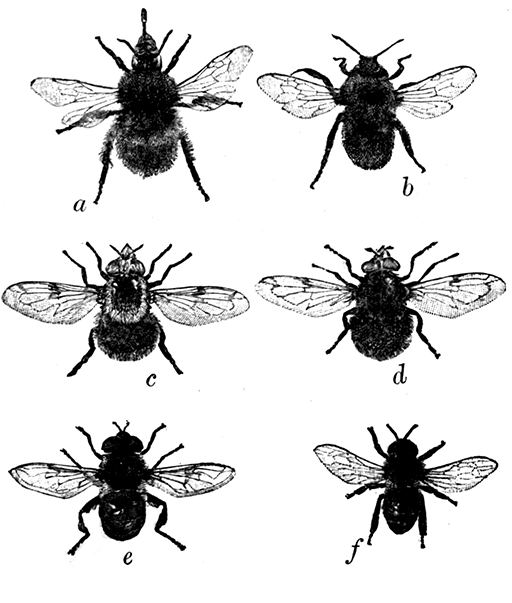
far larger than in others. This is shown in Fig. 22, which
is copied from the series displayed in the British Museum,
by the kind permission of Professor Flower.
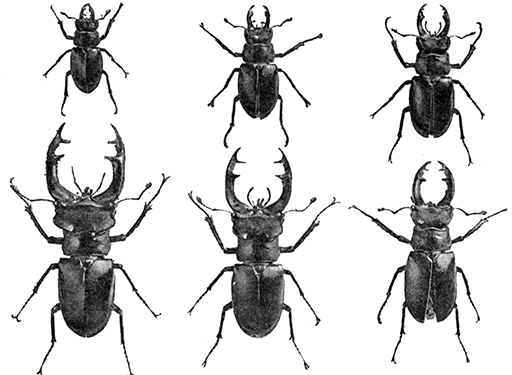
Fig. 22.—Variations in the size of, and especially in the head and mandibles of, the male stag-beetle
(Lucanus cervus). (From an exhibit in the British Natural History Museum.)]
Crossing the hall to where the vertebrate structures are
displayed, the development of hair, of feathers, of teeth,
the modifications of the skull and of legs, wings, and fins
are being exemplified. Note here and elsewhere the special
adaptations of structure, of which we may select two
examples. The first is that seen in the Balistes, or trigger-fish.
The anterior dorsal fin is reduced to three spines, of
which that which lies in front is a specially modified
weapon of defence, while that which follows it is the
so-called trigger. These two are so hinged to the underlying
interspinous bones and so related to each other that, when
once the defensive spine in front is erected, it cannot be
forced down until the trigger is lowered. The second
example of special adaptation is well displayed in specimens
of the mud-tortoise Trionyx. Between the last vertebra
of the neck and the first fixed vertebra of the dorsal series
is a beautiful hinge-joint, enabling the neck to be bent
back, S-fashion, when the creature withdraws its head
within the carapace. These are only one or two particular
instances of what any one who will visit the National
Museum may see for himself admirably displayed and illustrated.
No one can, one would suppose, pass through the
galleries in Cromwell Road and remain quite insensible to
the beauties of animal life. Beauty of form and beauty of
colour are conspicuously combined in many species of birds
and insects. And much of this colour-beauty and splendid
iridescence is known to be due to minute scales, to thin
films of air or fluid, and to microscopically fine lines
developed upon scales or feathers. But there is one phase
of beauty which cannot be exhibited in the museum—the
beauty that comes of life as opposed to death. For this
we must go out into the free air of nature, where the
animals not only have lived, but are still instinct with the
glow of life, and where the silence of the museum galleries
is replaced by the song of birds and the hum of insect-wings.
How have this wealth, this diversity, this beauty, this
manifold activity, which we summarize under the term
"animal life," been produced?
If we answer this question in a word—the word "evolution"[CI]—we
must remember that this word merely expresses
our belief in a general fact; and we must not
forget that many questions remain behind, all centering
round that little question, to which an adequate answer is
so difficult to give, the question—How? Reduced to its
simplest expression, the doctrine of evolution merely states
that the animal world as it exists to-day is naturally
developed out of the animal world as it existed yesterday,
and will in turn develop into the animal world as it shall
exist to-morrow. This is the central belief of the evolutionist.
No matter what moment in the past history of
life you select, the life at that moment was in the act of
insensibly passing from the previous towards a future condition.
Then at once arises the question—Does life remain
the same yesterday, to-day, and to-morrow? A thousand
indubitable facts at once make answer—No! Underlying
the law of continuity there is a law of change. Life to-day
is not what it was yesterday, nor will it be to-morrow the
same as to-day. What, then, is the nature of this change?
If it be replied that the change must be either for the
better or the worse, we shall have to answer the further
question—Better or worse in what respects?
Let us narrow our view from the contemplation of life
as a whole to the more particular consideration of an
organism as one of its constituent units. The individual
life of that organism depends on (some would say consists
in) its ceaseless adaptation to surrounding circumstances.
The circumstances remaining the same, or only varying
within constant limits, the adaptation may be more or less
perfect. A change in the direction of more perfect adaptation
will be a change for the better, a tendency to less
perfect adaptation will be a change for the worse.
But the relation of an organism to its circumstances or
environment is itself subject to change. The environment
itself may alter, or the organism may be brought into relation
with a new environment. We have to consider not only
the changes in an organism in the direction of more or
less perfect adaptation to its environment, but also changes
in the environment. These changes are in the direction
of increased simplicity or of increased complexity. So
that we may say that the modification of life is in the
direction of more or of less complete adaptation to simpler
or to more complex conditions. Where the adaptation
advances to more complex conditions, we speak of elaboration;
where it retrogrades to less complex conditions, we
speak of degeneration; but both fall under the head of
evolution in its more general sense. Viewed as a whole,
there can be little doubt that the general tendency of
evolution is towards more complete adaptation to more
diverse and complex environment. And this tendency is
accompanied by a general increase of differentiation and
of integration; of differentiation whereby the constituent
elements of life, whether cells, tissues, organs, organisms,
or groups of organisms, become progressively more
specialized and more different from one another; of
integration whereby these elements become progressively
more interdependent one on the other. We may conveniently
sum up the tendency towards more perfect
adaptation to more complex circumstances in the word
progress; the tendency to differentiation in the word
individuality; and the tendency to integration in the
word association.
Nobody now doubts the propositions thus briefly summarized,
and it is therefore unnecessary to bring forward
evidence in their favour.
We may pass, then, to the question—How? Evolution
being continuity, associated with change, tending in certain
directions, and accompanied by certain processes, how has
it been effected? What are its methods?
Natural selection claims a foremost place. We have
already devoted a chapter to its consideration. Animals
vary; more are born than can survive to procreate their
kind; hence a struggle for existence, in which the weaker
and less adapted are eliminated, the stronger and better
adapted surviving to continue the race.
It is scarcely possible to over-estimate what Darwin's
labour and genius have done for the study of animal life.
Through Darwin's informing spirit, biology has become a
science. But now we must be on our guard. So long as
natural selection was winning its way to acceptance, every
application of the theory had to be made with caution, and
was subjected to keen, if sometimes ignorant, criticism.
Now there is, perhaps, some danger lest it should suffer
the Nemesis of triumphant creeds, and be used blindly as
a magic formula.
First, we should be careful not to use the phrase, "of
advantage to the species," vaguely and indefinitely, but
should in all cases endeavour clearly to indicate wherein
lies the particular advantage, and how its possession
enables the organism to escape elimination; next, we must
remember that the advantage must be immediate and
present, prospective advantage being, of course, inoperative;
then we must endeavour to show that the advantage is
really sufficient to decide the question of elimination or
non-elimination; lastly, we must distinguish between
indiscriminate and differential destruction, between mere
numerical reduction by death or otherwise and selective elimination.
(1) In illustration of the first point, we may select a
passage from the writings of even so great a biologist as
Professor Weismann. As is well known, Professor Weismann
believes that senility and death are no part of the
natural heritage of animal life, but have been introduced
among the metazoa on utilitarian grounds. In his earlier
papers, he attributed the introduction of death, and the
tissue-degeneration that precedes it, to the direct action of
natural selection.[CJ] More lately, he attributes it to the
cessation of selection.[CK] Concerning this later view, we
shall have somewhat to say presently; we may now consider
the former as an example of too indefinite a use of
such phrases as "of advantage to the species." "Worn-out
individuals," says Professor Weismann, "are not only
valueless to the species, but they are even harmful, for
they take the places of those which are sound. Hence, by
the operation of natural selection, the life of our hypothetically
immortal individual would be shortened by the
amount which was useless to the species. It would be
reduced to a length which would afford the most favourable
conditions of existence of as large a number as possible of
vigorous individuals at the same time." This may be so,
but, as it stands, the modus operandi is not given, and is
not obvious. We start with a hypothetically immortal
metazoon. Barring accidents, it will go on existing indefinitely.
But you cannot bar accidents for an indefinite
time; hence, the longer the individual lives, the more
defective and crippled it becomes. There is neither natural
decay nor natural death here. The organism is gradually
crippled through accident and injury. But the crippled
individuals are harmful to the species, because they take
the places of those which are sound. Therefore, says
Professor Weismann, natural decay and death step in to
take them off before they have time to become cripples.
Now, the point I wish to notice is that there is no definite
statement how or why natural decrepitude should thus
be introduced. We must remember that it is not until a
late stage in evolution that, through the association of its
members, groups of organisms compete with other groups.
In the earlier stages, when we must suppose decrepitude
and death to arise on Professor Weismann's hypothesis, the
law of the struggle for existence is—each for himself
against all. The question, therefore, is—What advantage
to the individual is there in natural decay and death to
enable it, through the possession of these attributes, to
escape elimination? Surely none as such. At the same
time, it is quite conceivable that natural decay and death
may be the penalty the individual has to pay for increased
strength and vitality in the early stages of life. This,
probably, was Professor Weismann's meaning. But, if so,
it would surely have been better to state the matter in
such a way as to lay the chief stress on the really important
feature, and to say that, through natural selection, those
individuals have survived which exhibited predominant
strength and vitality for a shortened period, even at the
expense of natural decay and death. The increased life-power,
not the seeds of decay and death, was that which
natural selection picked out for survival, or rather that
which elimination allowed to survive.
In such ways—a short life with heightened activity
being of advantage to some forms, a more prolonged
existence at a lower level of vitality being essential to
others—natural selection may have determined in some
degree the relative longevity of different organisms. That
it caused the introduction of senility as a preparation for
death is a less tenable hypothesis.
And here we may note, in passing, that in using the
phrase, "of advantage to the race or species," we must
steadily bear in mind the fact that it is with individuals
that the process of elimination deals. In the individual it
is that every modification must make good its claim to
existence and transmission. Where the principle of association
for mutual benefit obtains, as in the case of social
insects, it is still the individual that must resist elimination.
Self-sacrifice, whether conscious or unconscious,
must not be carried so far as to lead to the elimination of
the self-sacrificing individual, for in this event it cannot
but defeat its own ends. Within these limits, self-sacrifice
is of advantage, as in the case of parental self-sacrifice, in
that it enables certain other individuals to escape elimination.
We should endeavour, then, not to use the phrase,
"of advantage to the species," vaguely and indefinitely, but
to indicate in what particular ways certain individuals are
to be so advantaged as to escape the Nemesis of elimination.
(2) The second point that I mentioned above scarcely
needs exemplification. That the advantage which enables
an organism to escape elimination must be present and
existent, not merely prospective, is obvious. Still, the
mistake is sometimes made. I have heard it stated that
feathers were evolved for the sake of flight. But clearly,
unless the wing sprang into existence already sufficiently
developed for flight, this would be impossible. The same
is true of the first stages of many structures which could
not be of service for the purpose and use to which they
were subsequently turned. Not impossibly, the earliest
"wings" were for diving, and flight was, so to speak, an
after-thought. Undoubtedly, structures which have been
fostered under the wing of one form of advantage have
been subsequently applied to new purposes, and fostered
through new modes of adaptation. Teeth, for example, are
probably modified scales, such as are found in the thorn-back
skate. But the early development of these scales
could have had no reference to their future application to
purposes subservient to alimentation.
Again, such and such a structure is sometimes spoken
of as a "prevision against emergencies." In his interesting
and valuable work on "The Colours of Animals,"
for example, Mr. E. B. Poulton says, "Dimorphism [in
the larvæ of butterflies and moths] is also valuable in
another way: the widening range of a species may carry it
into countries in which one of its forms may be especially
well concealed, while in other countries the other form may
be more protected. Thus a dimorphic form is more fully
provided against emergencies than one with only a single
form." And after giving, as an example, the fact that the
convolvulus hawk-moth has a browner and a greener form
of caterpillar, of which the browner is more prevalent
under European conditions, and the greener under those
which obtain in the Canary Islands, Mr. Poulton adds,
"This result appears to have been brought about by the
ordinary operation of natural selection, leading to the
extermination of the less-protected variety." Now, I do
not mean for one moment to imply that so careful and able
a naturalist as Mr. Poulton believes that any character has
been evolved through natural selection in prevision for
future emergencies. But I do think that his statement is
open to this criticism.
(3) It is sometimes said, in bold metaphor, that natural
selection is constantly on the watch to select any modification,
however slight, which is of advantage to the species.
And it is true that elimination is ceaselessly operative.
But it is equally certain that the advantage must be of
sufficient value to decide the question whether its possessor
should be eliminated or should escape elimination. If it
does not reach this value, Natural Selection, watch she
never so carefully, can make no use of it. Elimination
need not, however, be to the death; exclusion from any
share in continuing the species is sufficient. To breed or
not to breed, that is the question. Any advantage affecting
this essential life-function will at once catch the eye of
a vigilant natural selection. But it must be of sufficient
magnitude for the machinery of natural selection to deal
with. That machinery is the elimination of a certain
proportion of the individuals which are born. Which shall
be eliminated, and which shall survive, depends entirely on
the way in which the individuals themselves come out in
life's competitive examination. The manner in which that
examination is conducted is often rude and coarse, too rough-and-ready
to weigh minute and infinitesimal advantages.
What must be the value of a favourable or advantageous
modification to decide the question of elimination, to make
it an available advantage, must remain a matter of conjecture.
It will vary with the nature and the pressure of the
eliminative process. And perhaps it is scarcely too much
to say that, at present, we have not observational grounds
on which to base a reliable estimate in a single instance.
We must not let our conviction of its truth and justice
blind us to the fact that natural selection is a logical
inference rather than a matter of direct observation. A
hundred are born, and two survive; the ninety-eight are
eliminated in the struggle for existence; we may therefore
infer that the two escaped elimination in virtue of their
possession of certain advantageous characters. There is
no flaw in the logic that has thus convinced the world that
natural selection is a factor in evolution. But by what
percentage of elimination-marks the second of the two
successful candidates beats the senior on the list of failures
we do not know. We can only see that, on the hypothesis
of natural selection, it must have been sufficiently appreciable
to determine success or failure.
(4) And then, to come to our fourth point, we must
remember that, apart from the differentiating process of
elimination, there is much fortuitous destruction. A
hundred are born, and but two survive. But of the ninety-eight
which die, and fail to procreate, how many are
eliminated, how many are fortuitously destroyed, we do
not find it easy to say. And indiscriminate destruction
gets rid of good, bad, and indifferent alike. It is a mistake
to say that of the hundred born the two survivors are
necessarily the very best of the lot. It is quite possible
that indiscriminate destruction got rid of ninety of all sorts,
and left only ten subject to the action of a true elimination.
"In the majority of birds," says Professor Weismann,
"the egg, as soon as it is laid, becomes exposed to
the attacks of enemies; martens and weasels, cats and
owls, buzzards and crows, are all on the look out for it.
At a later period, the same enemies destroy numbers of the
helpless young, and in winter many succumb in the struggle
against cold and hunger, or to the numerous dangers which
attend migration over land and sea—dangers which decimate
the young birds." There is here, first, a certain amount
of fortuitous destruction; secondly, some selection applied
to the eggs; thirdly, a selection among the very young
nestlings; and, fourthly, a selection among the young
migratory birds. What may be the proportion of elimination
to destruction at each stage it is difficult to say.
Among the eggs and fry of fishes fortuitous destruction
probably very far outbalances the truly differentiating
process.
We may now pass on to consider shortly some of the
phenomena of degeneration, and the dwindling or disappearance
of structures which are no longer of use.
Many zoologists believe, or until lately have believed,
that disuse is itself a factor in the process. Just as the
well-exercised muscle is strengthened, so is the neglected
muscle rendered weak and flabby. Until recently it was
generally held that the effects of such use or disuse are
inherited. But now Professor Weismann has taught us,
if not to doubt ourselves, at least to admit that doubt is
permissible. On the older view, the gradual dwindling of
unused parts was readily comprehensible. But now, if Professor
Weismann is right, we must seek another explanation
of the facts; and, in any case, we may be led to recognize
other factors (than that of disuse alone) in the process.
Professor Weismann regards panmixia, or free intercrossing,
when the preserving influence of natural selection
is suspended, as the efficient cause of a reduction or deterioration
in the organ concerned. And Mr. Romanes
had, in England, drawn attention to the fact that the
"cessation of natural selection" would lead to some
dwindling of the organ concerned, since it was no longer
kept up to standard. In illustration of his panmixia, Professor
Weismann says, "A goose or duck must possess
strong powers of flight in the natural state, but such
powers are no longer necessary for obtaining food when it
is brought into the poultry-yard, so that a rigid selection
of individuals with well-developed wings at once ceases
among its descendants. Hence, in the course of generations,
a deterioration of the organs of flight must necessarily
ensue, and the other members and organs of the
bird will be sensibly affected."[CL] And, again, "As at each
stage of retrogressive transformation individual fluctuations
always occur, a continued decline from the original degree
of development will inevitably, although very slowly, take
place, until the last remnant finally disappears."[CM] Now,
I think it can be shown that panmixia, or the cessation of
selection, alone cannot affect much reduction. It can only
affect a reduction from the "survival-mean" to the "birth-mean."
This was referred to in the chapter on "Heredity
and the Origin of Variations," but may be again indicated.
Suppose the number of births among wild ducks be represented
by the number nine, of which six are eliminated
through imperfections in the organs of flight. Let us
place the nine in order of merit in this respect, as is done
in the table on p. 172. The average wing-power of the
nine will be found in No. 5, there being four ducks with
superior wing-power (1-4), and four with inferior wing-power
(6-9). The birth-mean will therefore be at the
level of No. 5, as indicated to the left of the table. But if
six ducks with the poorest wings be eliminated, only three
survive. The average wing-power will now be found in
No. 2, one duck being superior and one inferior to it
in this respect. It is clear that this survival-mean
is at a level of higher excellence than the birth-mean.
Now, when the ducks are placed in a poultry-yard,
selection in the matter of flight ceases, and, since all
nine ducks survive, the survival-mean drops to the birth-mean.
We may variously estimate this retrogression; but
it cannot be a large percentage—I should suppose, in the
case under consideration, one or two per cent. at most.
But Professor Weismann says, "A continued decline from
the original degree of development must inevitably take
place." It is not evident why such decline should continue.
If variations continue in the same proportion as before,
the birth-mean will be preserved, since there are as many
positive or favourable variations above the mean as there
are negative or unfavourable variations below the mean.
A continuous decline must result from a preponderance of
negative over positive variations, and for this some other
principle, such as atavism, or reversion to ancestral
characters, must be called in. But in the case of so long-established
and stable an organ as that of flight, fixed
and rendered constant through so many generations, it is
hardly probable that reversion would be an important
factor. Mr. Galton has calculated that among human-folk
the offspring inherits one-fourth from each parent,
one-sixteenth from each grandparent, leaving one-fourth
to be contributed by more remote ancestors. There is no
doubt, however, that among domesticated animals reversion
occurs to characters which have been lost for many
generations. But we should probably have to go a very
long way back in the ancestry of wild ducks for any marked
diminution in wing-power. It must be remembered that,
in the case of the artificial selection of domesticated
animals, man has been working against and not with the
stream of ancestral tendency. Reversion in their case is
towards a standard which was long maintained and had
become normal before man's interference. Reversion in
domesticated ducks should therefore be towards the greater
wing-power of their normal ancestry before domestication,
not in the direction of lessened wing-power and diminished
wing-structure. The whole question of reversion is full of
interest, and needs further investigation.
In the dwindling of disused structures, Mr. Romanes
has suggested "failure of heredity" as an efficient cause.
I find it difficult, however, to distinguish this failure of
heredity from the effects of disuse. To what other cause
is the failure of heredity due? If natural selection has
intervened to hasten this failure, this can only be because
the failure is advantageous, since it permits the growth-force
to be applied more advantageously elsewhere. And this
involves a different principle. Even so it is difficult to
exclude the possibility (to put it no stronger) that the
diversion of growth-force from a less useful to a more
useful organ is in part due to the use of the one and the
disuse of the other. But of disuse Mr. Romanes says,
"There is the gravest possible doubt lying against the
supposition that any really inherited decrease is due to
the inherited effects of disuse." We may fairly ask Mr.
Romanes, therefore, to explain to what cause the failure of
heredity is due. In any case, Professor Weismann and
his school are not likely to accept this failure of heredity
as an efficient factor in the process. Nor is Professor
Weismann likely to fall back upon any innate tendency to
degeneration. Unless, therefore, some cause be shown
why the negative variations should be prepotent over the
positive variations, we must, I think, allow that unaided
panmixia cannot affect any great amount of reduction.
In this connection we may notice Professor Weismann's
newer view of the introduction of bodily mortality. He
says, "The problem is very easily solved if we seek
assistance from the principle of panmixia. As soon as
natural selection ceases to operate upon any character,
structural or functional, it begins to disappear. As soon,
therefore, as the immortality of somatic [body-] cells became
useless, they would begin to lose this attribute."[CN] Even
granting that panmixia could continuously reduce the size
of ducks' wings, it is not easy to see how it could get rid of
immortality. The essence of the idea of panmixia is that,
when the natural selection which has raised an organ to
a high functional level, and sustains it there, ceases or is
suspended, the organ drops back from its high level. But
on Professor Weismann's hypothesis, immortality has
neither been produced nor is it sustained by natural selection.
How, therefore, the cessation of selection can cause
the disappearance of immortality—a character with which
natural selection has had nothing whatever to do—Professor
Weismann does not explain. He seems to be using
"panmixia" in the same vague way that, in his previous
explanation, he used "natural selection."
If panmixia alone cannot, to any very large extent,
reduce an organ no longer sustained by natural selection,
to what efficient cause are we to look? Mr. Romanes has
drawn attention to the reversal of selection as distinguished
from its mere cessation. When an organ is being improved
or sustained by selection, elimination weeds out all those
which have the organ in an ill-developed form. Under a
reversal of selection, elimination will weed out all those
which possess the organ well developed. In burrowing
animals, the eyes may have been reduced in size, or even
buried beneath the skin, through a reversal of selection.
The tuco-tuco (Ctenomys), a burrowing rodent of South
America, is frequently blind. One which Darwin kept
alive was in this condition, the immediate cause being
inflammation of the nictitating membrane. "As frequent
inflammation of the eyes," says Darwin, "must be injurious
to any animal, and as eyes are certainly not
necessary to animals having subterranean habits, a reduction
in their size, with the adhesion of the eyelids and
growth of fur over them, might in such cases be an
advantage; and, if so, natural selection would aid the effect
of disuse."[CO] Granting that the inflammation of the eyes is
a sufficient disadvantage to lead to elimination, such cases
may be assigned to the effects of a reversal of selection.
Perhaps the best instances of the reversal of selection
are to be found in the insects of wind-swept islands, in
which, as we have already seen (p. 81), the power of flight
has been gradually reduced or even done away with.
Such instances are, however, exceptional. And one can
hardly suppose that such reversal of selection can be very
far-reaching in its effects, at least, through any direct
disadvantage from the presence of the organ. One can
hardly suppose that the presence of an eye in a cave-dwelling
fish[CP] could be of such direct disadvantage as to
lead to the elimination of those members which still possess
this structure.
But may it not be of indirect disadvantage? May not
this structure be absorbing nutriment which would be more
advantageously utilized elsewhere? This is Darwin's
principle of economy. Granting its occurrence, is it effective?
We may put the matter in this way: The crustacea
which have been swept into a dark cave may be divided
into three classes so far as fortuitous variations of eyes
and antennæ are concerned. First, those which preserve
eyes and antennæ in the original absolute and relative
proportion and value; secondly, those in which, while the
eyes remain the same, the antennæ are longer and more
sensitive; thirdly, those in which, while the antennæ are
longer and more sensitive, the eyes are reduced in size and
elaboration. According to the principle of economy, the
third class have sufficient advantage over the first and
second to enable them to survive and escape the elimination
which removes those with fully developed eyes. It
may be so. We cannot estimate the available advantage
with sufficient accuracy to deny it. But we may fairly
suppose that, in general, it is only where the useless organ
in question is of relatively large size, and where nutriment
is deficient, that economy of growth is an important factor.
We may here note the case of the hermit crab as one
which exemplifies degeneration through the reversal of
natural selection. This animal, as is well known, adopts
an empty whelk-shell or other gasteropod shell as its own.
The hinder part of the body which is thus thrust into the
shell loses its protective armour, and is quite soft. Professor
Weismann seems to regard this loss of the hardened
cuticle as due entirely to panmixia. If what has been
urged above has weight, this explanation cannot be correct.
No amount of promiscuous interbreeding of crabs could
reduce the cuticle to a level indefinitely below that of any
of the interbreeding individuals. But it is clear that an
armour-sheathed "tail" would be exceedingly ill adapted
to thrusting into a whelk-shell. Hence there would, by
natural selection, be an adaptation to new needs, involving
not the higher development of cuticle, but the reverse. So
far as the cuticle is concerned, it is a case of reversed
selection. Whether this reversal alone will adequately
account for the facts is another matter.
Mr. Herbert Spencer has made a number of observations
and measurements of the jaws of pet dogs, which lead
him to conclude that there has been a reduction in size
and muscular power due to disuse. The creatures being
fed on sops, have no need to use to any large extent the
jaw-muscles. In this case, he argues, the principle of
economy is not likely to be operative, since the pampered
pet habitually overeats, and has therefore abundant nutriment
and to spare to keep up the jaws. It is possible,
however, that artificial selection has here been a factor.
There may have been a competition among the old ladies
who keep such pets to secure the dear little dog that never
bites, while the nasty little wretch that does occasionally
use his jaws for illegitimate purposes may have been
speedily eliminated. Pet dogs are, moreover, a pampered,
degenerate, and for the most part unhealthy race, often
deteriorated by continued in-breeding, so that we must not
build too much on Mr. Spencer's observations, interesting
as they undoubtedly are.
There is one feature about the reduction of organs
which must not be lost sight of. They are very apt to
persist for a long time as remnants or vestiges. The
pineal gland is the vestigial remnant of a structure connected
with the primitive, median, or pineal eye. The
whalebone whales and the duck-bill platypus have teeth
which never cut the gum and are of no functional value.
With regard to these, it may be asked—If disuse leads to
the reduction of unused structures, how comes it that
it has not altogether swept away these quite valueless
structures? In considering this point, we must notice the
unfortunate and misleading way in which disuse is spoken
of as if it were a positive determinant, instead of the mere
absence of free and full and healthy exercise. Few will
question the fact that in the individual, if an organ is to
be kept up to its full standard of perfection, it must be
healthily and moderately exercised; and that, if not so
exercised, it will not only cease to increase in size, but will
tend to degenerate. The healthy, functionally valuable
tissue passes into the condition of degenerate, comparatively
useless tissue. Now, those who hold that the inheritance
of functional modifications is still a tenable hypothesis,
carry on into the history of the race that which they find
to hold good in the history of the individual. They believe
that, in the race, the continued functional activity of an
organ is necessary for the maintenance of the integrity
and perfection of its structure, and that, if not so exercised,
the organ will inevitably tend to dwindle to embryonic
proportions and to degenerate. The healthy, functionally
valuable tissue passes at last into the condition of
degenerate, comparatively useless tissue. The force of
heredity will long lead to the production in the embryo
of the structure which, in the ancestral days of healthy
exercise, was to be of service to the organism. At this
stage of life the conditions have not changed. The
degeneration sets in at that period when the ancestral use
is persistently denied. There is no reason why "disuse"
should in all cases remove all remnants of a structure;
but if the presence of the degenerate tissue is a source of
danger to the organism which possesses it, that organism
will be eliminated, and those (1) which possess it in an
inert, harmless form, or (2) in which it is absent, will
survive. Thus natural selection (which will fall under Mr.
Romanes's reversed selection) will step in—will in some
cases reduce the organ to a harmless and degenerate
rudiment, and in others remove the last vestiges of the
organ.
On the whole, even taking into consideration the effects
of panmixia, of reversed selection, and of the principle of
economy, the reduction of organs is difficult to explain,
unless we call into play "disuse" as a co-operating factor.
It is well known that, in addition to and apart from
the primary sexual differences in animals, there are certain
secondary characters by which the males, or occasionally
the females, are conspicuous. The antlers of stags, the
tail of the peacock, the splendid plumes of the male bird of
paradise, the horns or pouches of lizards, the brilliant
frilled crest of the newt, the gay colours of male sticklebacks,
the metallic hues of male butterflies, and the large
horns or antennæ of other insects,—these and many other
examples which will at once occur to the reader are
illustrations of the fact.
As a contribution towards the explanation of this order
of phenomena, Darwin brought forward his hypothesis of
sexual selection, of which there are two modes. In the
first place, the males struggle together for their mates; in
this struggle the weakest are eliminated; those possessed
of the most efficient weapons of offence and defence escape
elimination. In the second place, the females are represented
as exercising individual choice, and selecting (in
the true sense of the word) those mates whose bright
colours, clear voices, or general strength and vigour render
them most pleasing and attractive. For this mode I shall
employ the term "preferential mating." Combining these
two in his summary, Darwin says, "It has been shown
that the largest number of vigorous offspring will be reared
from the pairing of the strongest and best-formed males,
victorious in contests over other males, with the most
vigorous and best-nourished females, which are the first
to breed in the spring. If such females select the more
attractive and, at the same time, vigorous males, they will
rear a larger number of offspring than the retarded females,
which must pair with the less vigorous and less attractive
males. So it will be if the more vigorous males select
the more attractive and, at the same time, healthy and
vigorous females; and this will especially hold good if the
male defends the female, and aids in providing food for
the young. The advantage thus gained by the more
vigorous pairs in rearing a larger number of offspring has
apparently sufficed to render sexual selection efficient."[CQ]
With regard to the first of the two modes, little need
be said. There can be no question that there are both
elimination by battle and elimination by competition in
the struggle for mates. It is well known that the emperor
moth discovers his mate by his keen sense of smell residing
probably in the large, branching antennæ. There can
be little doubt that, if an individual is deficient in this
sense, or misinterprets the direction in which the virgin
female lies, he will be unsuccessful in the competition for
mates; he will be eliminated from procreation. And it is
a familiar observation of the poultry-yard that the law of
battle soon determines which among the cock birds shall
procreate their kind. The law of battle for mates is, indeed,
an established fact among many animals, especially
those which are polygamous, and the elimination of the
unfit in this respect is a logical necessity.
It is when we come to the second of the two modes,
that which involves selection proper, that we find differences
of opinion among naturalists.
Darwin, as we have seen, suggested that those secondary
sexual characters which can be of no value in aiding their
possessor to escape elimination by combat result from the
preferential choice of the female, the female herself remaining
comparatively unaffected. But Mr. Wallace made an
exceedingly valuable suggestion with regard to these comparatively
dull colours of the female. He pointed out that
conspicuousness (unless, as we have seen, accompanied by
some protective character, such as a sting or a bitter taste)
increased the risk of elimination by enemies. Now, the
males, since they are generally the stronger, more active,
and more pugnacious, could better afford to run this risk
than their mates. They could to some extent take care
of themselves. Moreover, when impregnation was once
effected, the male's business in procreation was over. Not
so the female; she had to bear the young or to lay the
eggs, often to foster or nourish her offspring. Not only
were her risks greater, but they extended over a far longer
period of time. Hence, according to Mr. Wallace, the dull
tints of the females, as compared with those of the males,
are due to natural selection eliminating the conspicuous
females in far greater proportion than the gaudy males.
There is clearly no reason why this view should not be
combined with Darwin's; preferential mating being one
factor, natural elimination being another factor; both
being operative at the same time, and each contributing to
that marked differentiation of male and female which we
find to prevail in certain classes of the animal kingdom.
But Mr. Wallace will not accept this compromise. He
rejects preferential mating altogether, or, in any case,
denies that through its agency secondary sexual characters
have been developed. He admits, of course, the striking
and beautiful nature of some of these characters; he
admits that the male in courtship takes elaborate pains to
display all his finery before his would-be mate; he admits
that the "female birds may be charmed or excited by the
fine display of plumage by the males;" but he concludes
that "there is no proof whatever that slight differences in
that display have any effect in determining their choice of
a partner."[CR]
How, then, does Mr. Wallace himself suppose that
these secondary sexual characters have arisen? His
answer is that "ornament is the natural outcome and
direct product of superabundant health and vigour," and
is "due to the general laws of growth and development."[CS]
At which one rubs one's eyes and looks to the title-page to
see that Mr. Wallace's name is really there, and not that
of Professor Mivart or the Duke of Argyll. For, if the
plumage of the argus pheasant and the bird of paradise
is due to the general laws of growth and development,
why not the whole animal? If Darwin's sexual selection
is to be thus superseded, why not Messrs. Darwin and
Wallace's natural selection?
Must we not confess that Mr. Wallace, for whose genius
I have the profoundest admiration, has here allowed himself
to confound together the question of origin and the
question of guidance or direction? Natural selection by
elimination and sexual selection through preferential
mating are, supposing them to be veræ causæ, guiding or
selecting agencies. Given the variations, however caused,
these agencies will deal with them, eliminating some,
selecting others, with the ultimate result that those
specially fitted for their place in nature will survive.
Neither the one nor the other deals with the origin of
variations. That is a wholly different matter, and constitutes
the leading biological problem of our day. Mr.
Wallace's suggestion is one which concerns the origin of
variations, and as such is worthy of careful consideration.
It does not touch the question of their guidance into certain
channels or the maintenance of specific standards. Concerning
this Mr. Wallace is silent or confesses ignorance.
"Why, in allied species," he says, "the development of
accessory plumes has taken different forms, we are unable
to say, except that it may be due to that individual
variability which has served as the starting-point for so
much of what seems to us strange in form or fantastic in
colour, both in the animal and vegetable world."[CT] It is
clear, however, that "individual variability" cannot be
regarded as a vera causa of the maintenance of a specific
standard—a standard maintained in spite of variability.
The only directive agency (apart from that of natural
selection) to which Mr. Wallace can point is that suggested
by Mr. Alfred Tylor, in an interesting, if somewhat fanciful,
posthumous work on "Coloration in Animals and Plants,"
"namely, that diversified coloration follows the chief lines
of structure, and changes at points, such as the joints,
where function changes." But even if we admit that
coloration-bands or spots originate at such points or
along such lines—and the physiological rationale is not
altogether obvious—even if we admit that in butterflies the
spots and bands usually have reference to the form of the
wing and the arrangement of the nervures, and that in
highly coloured birds the crown of the head, the throat,
the ear-coverts, and the eyes have usually distinct tints,
still it can hardly be maintained that this affords us any
adequate explanation of the specific colour-tints of the
humming-birds, or the pheasants, or the Papilionidæ
among butterflies. If, as Mr. Wallace argues, the immense
tufts of golden plumage in the bird of paradise owe their
origin to the fact that they are attached just above the
point where the arteries and nerves for the supply of the
pectoral muscles leave the interior of the body, are there
no other birds in which similar arteries and nerves are
found in a similar position? Why have these no similar
tufts? And why, in the birds of paradise themselves, does
it require four years (for it takes so long for the feathers
of the male to come to maturity) ere these nervous and
arterial influences take effect upon the plumage? Finally,
one would inquire how the colour is determined and held
constant in each species. The difficulty of the Tylor-Wallace
view, even as a matter of origin, is especially great
in those numerous cases in which the colour is determined
by delicate lines, thin plates, or thin films of air or fluid.[CU]
Under natural selection, as we have seen, the development
of colour is fostered under certain conditions. The
colour is either protective, rendering the organism inconspicuous
amid its normal surroundings, or it is of warning
value, advertising the organism as inedible or dangerous,
or, in the form of recognition-marks, it is of service in
enabling the members of a species to recognize each other.
Now, in the case of both warning colour and recognition-marks,
their efficacy depends upon the perceptual powers
of animals. Unless there be a rapidly acquired and close
association of the quality we call nastiness with the quality
we call gaudiness (though, for the animal, there is no such
isolation of these qualities as is implied in our words [CV]),
such that the sight of the gaudy insect suggests that it
will be unpleasant to eat, the gaudiness will be of no avail.
And if there is any truth in the doctrine of mimicry, the
association is particular. It is not merely that bright
colours are suggestive of a nasty taste. The insect-eating
birds associate nastiness especially with certain markings
and coloration—"the tawny Danais, the barred Heliconias,
the blue-black Euplæas, and the fibrous Acræas;" and
this is proved by the fact that sweet insects mimicking
these particular forms are thereby protected.
So, too, with recognition-marks. If the bird or the
mammal have not sufficient perceptive powers to distinguish
between the often not very different recognition-marks, of
what service can they be?
Recognition-marks and mimicry seem, therefore, to show
that in the former case many animals, and in the latter
the insect-eating birds, mammals, lizards, and other
animals concerned, have considerable powers of perception
and association.
Among other associations are those which are at the
base of what I have termed preferential mating. We must
remember how deeply ingrained in the animal nature is
the mating instinct. We may find it difficult to distinguish
closely allied species. But the individuals of that species
are led to mate together by an impelling instinct that is so
well known as to elicit no surprise. Instinct though it be,
however, the mating individuals must recognize each other
in some way. The impulse that draws them together must
act through perceptual agency. It is not surprising, therefore,
to find, when we come to the higher animals, that,
built upon this basis, there are well-marked mating preferences.
And this, as we have before pointed out, following
Wallace, is an efficient factor in segregation. Let us,
however, hear Mr. Wallace himself in the matter.
There is, he says,[CW] "a very powerful cause of isolation
in the mental nature—the likes and dislikes—of animals;
and to this is probably due the fact of the rarity of hybrids
in a state of nature. The differently coloured herds of
cattle in the Falkland Islands, each of which keeps
separate, have been already mentioned. Similar facts
occur, however, among our domestic animals, and are
well known to breeders. Professor Low, one of the greatest
authorities on our domesticated animals, says, 'The female
of the dog, when not under restraint, makes selection of
her mate, the mastiff selecting the mastiff, the terrier the
terrier, and so on.' And again, 'The merino sheep and
the heath sheep of Scotland, if two flocks are mixed together,
each will breed with its own variety.' Mr. Darwin has
collected many facts illustrating this point.[CX] One of the
chief pigeon-fanciers in England informed him that, if
free to choose, each breed would prefer pairing with its
own kind. Among the wild horses in Paraguay those of
the same colour and size associate together; while in
Circassia there are three races of horses which have
received special names, and which, when living a free life,
almost always refuse to mingle and cross, and will even
attack one another. In one of the Faröe Islands, not
more than half a mile in diameter, the half-wild native
black sheep do not readily mix with imported white sheep.
In the Forest of Dean and in the New Forest the dark
and pale coloured herds of fallow deer have never been
known to mingle; and even the curious ancon sheep, of
quite modern origin, have been observed to keep together,
separating themselves from the rest of the flock when put
into enclosures with other sheep. The same rule applies
to birds, for Darwin was informed by the Rev. W. D. Fox
that his flocks of white and Chinese geese kept distinct.
This constant preference of animals for their like, even
in the case of slightly different varieties of the same
species, is evidently a fact of great importance in considering
the origin of species by natural selection, since it
shows us that, so soon as a slight differentiation of form or
colour has been effected, isolation will at once arise by the
selective association of the animals themselves."
Mr. Wallace thus allows, nay, he lays no little stress
on, preferential mating, and his name is associated with
the hypothesis of recognition-marks. But he denies that
preferential mating, acting on recognition-marks, has had
any effect in furthering a differentiation of form or colour.
He admits that so soon as a slight differentiation of form
or colour has been effected, segregation will arise by the
selective association of the animals themselves; but he
does not admit that such selective association can carry
the differentiation further.
Now, it is clear that mating preferences must be either
fixed or variable. If fixed, how can differentiation occur
in the same flock or herd? And how can selective association
be a means of isolation? Or, granting that differentiation
has occurred, if the mating preferences are
then stereotyped, all further differentiation, so far as colour
and form are concerned, will be rendered impossible; for
divergent modifications, not meeting the stereotyped
standard of taste, will for that reason fail to be perpetuated.
We must admit, then, that these mating preferences are
subject to variation. And now we come to the central
question with regard to sexual selection by means of
preferential mating. What guides the variation along
special lines leading to heightened beauty? This, I take
it, is the heart and centre of Mr. Wallace's criticism of
Darwin's hypothesis. Sexual selection of preferential
mating involves a standard of taste; that standard has
advanced from what we consider a lower to what we consider
a higher æsthetic level, not along one line, but along
many lines. What has guided it along these lines?
Not as in any sense affording a direct answer to this
question, but for illustrative purposes, we may here draw
attention to what seems to be a somewhat parallel case,
namely, the development of flowers through insect agency.
In his "Origin of Species," Darwin contended that flowers
had been rendered conspicuous and beautiful in order to
attract insects, adding, "Hence we may conclude that, if
insects had not been developed on the earth, our plants
would not have been decked with beautiful flowers, but
would have produced only such poor flowers as we see on
our fir, oak, nut, and ash trees, on grasses, docks, and
nettles, which are all fertilized through the agency of the
wind." "The argument in favour of this view," says Mr.
Wallace,[CY] who quotes this passage, "is now much stronger
than when Mr. Darwin wrote;" and he cites with approval
the following passage from Mr. Grant Allen's "Colour-Sense:"
"While man has only tilled a few level plains, a
few great river-valleys, a few peninsular mountain slopes,
leaving the vast mass of earth untouched by his hand, the
insect has spread himself over every land in a thousand
shapes, and has made the whole flowering creation subservient
to his daily wants. His buttercup, his dandelion,
and his meadowsweet grow thick in every English field.
His thyme clothes the hillside; his heather purples the
bleak grey moorland. High up among the Alpine heights
his gentian spreads its lakes of blue; amid the snows of
the Himalayas his rhododendrons gleam with crimson light.
Even the wayside pond yields him the white crowfoot and
the arrowhead, while the broad expanses of Brazilian
streams are beautified by his gorgeous water-lilies. The
insect has thus turned the whole surface of the earth into
a boundless flower-garden, which supplies him from year
to year with pollen or honey, and itself in turn gains
perpetuation by the baits that it offers to his allurement."[CZ]
Mr. Grant Allen is perfectly correct in stating that the
insect has produced all this beauty. It is the result of
insect choice, a genuine case of selection as contrasted with
elimination. And when we ask in this case, as we asked
in the case of the beautiful colours and forms of animals,
what has guided their evolution along lines which lead to
such rare beauty, we are given by Mr. Wallace himself the
answer, "The preferential choice of insects." If these
insects have been able to produce through preferential
selection all this wealth of floral beauty (not, indeed, for the
sake of the beauty, but incidentally in the practical business
of their life), there would seem to be no a priori reason why
the same class and birds and mammals should not have
been able to produce, through preferential selection, all the
wealth of animal beauty.
It should be noted that the answer to the question is in
each case a manifestly incomplete one. For if we say that
these forms of beauty, floral and animal, have been selected
through animal preferences, there still remains behind the
question—How and why have the preferences taken these
æsthetic lines? To which I do not see my way to a satisfactory
answer, though some suggestions in the matter will
be made in a future chapter.[DA] At present all we can say is
this—to be conspicuous was advantageous, since it furthered
the mating of flowers and animals. To be diversely conspicuous
was also advantageous. As Mr. Wallace says,
"It is probably to assist the insects in keeping to one
flower at a time, which is of vital importance to the perpetuation
of the species, that the flowers which bloom
intermingled at the same season are usually very distinct,
both in form and colour."[DB] But conspicuousness is not
beauty. And the question still remains—From what source
comes this tendency to beauty?
Leaving this question on one side, we may state the
argument in favour of sexual selection in the following
form: The generally admitted doctrine of mimicry involves
the belief that birds and other insect-eating animals have
delicate and particular perceptual powers. The generally
received doctrine of the origin of flowers involves the belief
that their diverse forms and markings result from the
selective choice of insects. There are a number of colour
and form peculiarities in animals that cannot be explained
by natural selection through elimination. There is some
evidence in favour of preferential mating or selective association.
It is, therefore, permissible to hold, as a provisional
hypothesis, that just as the diverse forms of flowers
result from the preferential choice of insects, so do the
diverse secondary sexual characters of animals result, in
part at least, from the preferential choice of animals through
selective mating.
If this be admitted, then the elaborate display of their
finery by male birds, which Mr. Wallace does admit, may
fairly be held to have a value which he does not admit.
For if preferential mating is à priori probable, such display
may be regarded as the outcome of this mode of selection.
At the same time, it may be freely admitted that more
observations are required. In a recent paper, "On Sexual
Selection in Spiders of the Family Attidæ,"[DC] by George W.
and Elizabeth G. Peckham, a full, not to say elaborate,
description is given of the courtship, as they regard it, of
spiders. The "love-dances" and the display of special
adornments are described in detail. And the observers,
as the result, be it remembered, of long and patient investigation
and systematic study, come to the conclusion that
female spiders exercise selective choice in their mates.
And courtship must be a serious matter for spiders, for if
they fail to please, they run a very serious risk of being
eaten by the object of their attentions. Some years ago I
watched, on the Cape Flats, near Capetown, the courtship
of a large spider (I do not know the species). In this case
the antics were strange, and, to me, amusing; but they
seemed to have no effect on the female spider, who merely
watched him. Once or twice she darted forward towards
him, but he, not liking, perhaps, the gleam in her eyes,
retreated hastily. Eventually she seemed to chase him off
the field.
We must remember how difficult it is to obtain really
satisfactory evidence of mating preferences in animals. In
most cases we must watch the animals undisturbed, and
very rarely can we have an opportunity of determining
whether one particular female selects her mate out of her
various suitors. We watch the courtship in this, that, or
the other case. In some we see that it is successful; in
others that it is unsuccessful. How can we be sure that
in the one case it was through fully attaining, in the other
through failing to reach, the standard of taste? And yet
it is evidence of this sort that Mr. Wallace demands. After
noting the rejection by the hen of male birds which had
lost their ornamental plumage, he says, "Such cases do
not support the idea that males with the tail-feathers a
trifle longer, or the colours a trifle brighter, are generally
preferred, and that those which are only a little inferior are
as generally rejected,—and this is what is absolutely needed
to establish the theory of the development of these plumes
by means of the choice of the female."[DD] If Mr. Wallace
requires direct observational evidence of this kind, I do not
suppose he is likely to get any large body of it. But one
might fairly ask him what body of direct observational
evidence he has of natural selection. The fact is that
direct observational evidence is, from the nature of the
processes involved, almost impossible to produce in either
case. Natural selection is an explanation of organic
phenomena reached by a process of logical inference and
justified by its results. It is not claimed for the hypothesis
of selective mating that it has a higher order of validity.
As we have already seen, biologists are divided into two
schools, one of which maintains that the effects of use and
disuse[DE] have been a potent factor in organic evolution;
the other, that the effects of use and disuse are restricted to
the individual. My own opinion is that we have not a
sufficient body of carefully sifted evidence to enable us to
dogmatize on the subject, one way or the other. But, the
position of strict equilibrium being an exceedingly difficult
and some would have us believe an undesirable attitude
of mind, I may add that I lean to the view that use and
disuse, if persistent and long-continued, take effect, not
only on the individual, but also on the species.
It is scarcely necessary to give examples of the kind of
change which, according to the Lamarckian school, are
wrought by use and disuse. Any organ persistently used
will have a tendency, on this view, to become in successive
generations more and more adapted to its functional work.
To give but one example. It is well known that certain
hoofed creatures are divisible into two groups—first, those
which, like the horse, have in each limb one large and
strong digit armed with a solid hoof; and, secondly, those
which, like the ox, have in each limb two large digits, so
that the hoof is cloven or split. It is also well known that
the ancestral forms from which both horse-group and ox-group
are derived were possessed of five digits to each
limb. Professor Cope regards the differentiation of these
two groups as the result of the different modes of use
necessitated by different modes of life. "The mechanical
effect," he says, "of walking in the mud is to spread the
toes equally on opposite sides of the middle line. This
would encourage the equal development of the digits on
each side of the middle line, as in the cloven-footed types.
In progression on hard ground the longest toe (the third)
will receive the greatest amount of shock from contact with
the earth."[DF] Hence the solid-hoofed types. Here, then,
the middle digit in the horse-group, or two digits in the ox-group,
having the main burden to bear, increase through
persistent use, while the other digits dwindle through disuse.[DG]
On the other hand, one who holds the opposite view will
say—I do not believe that use and disuse have had anything
whatever to do with the matter. Fortuitous variations in
these digits have taken place. The conditions have determined
which variations should be preserved. In the horse,
variations in the direction of increase of functional value
of the mid digit, and variations in the simultaneous
decrease of the functional value of the lateral digits, have
been of advantage, and have therefore survived the eliminating
process of natural selection.
Now, since it is quite clear, in this and numberless
similar cases, that we can explain the facts either way, it
is obviously not worth while to spend much time or
ingenuity in devising such explanations. They are not
likely to convince any one worth convincing. What we
need is (1) crucial cases which can only be explained one
way or the other; or (2) direct observation or experiment
leading to the establishment of one hypothesis or the other
(or both).
1. Crucial cases are very difficult to find. We cannot
exclude the element of use or disuse, for on both hypotheses
it is essential. The difference is that one school says the
organ is developed in the species by use; the other school
says it is developed for use. What we must seek is, therefore,
the necessary exclusion of natural selection; and that
is not easy to prove, in any case, to a Darwinian. If it can
be shown that there exist structures which are of use, but
not of vital importance (that is to say, which have not
what I called above the available advantage necessary to
determine the question of elimination or not-elimination),
then we are perhaps able to exclude the influence of natural
selection. I think, if anywhere, such cases are to be found
in faculties and instincts;[DH] and as such they must be
considered in a later chapter. I will, however, here cite
one case in illustration of my meaning.
We have seen that certain insects are possessed of
warning colours, which advertise their nastiness to the
taste. Birds avoid these bright but unpleasant insects,
and though there is some individual learning, there seems
to be an instinctive avoidance of these unsavoury morsels.
There is hesitation before tasting; and one or two trials
are sufficient to establish the association of gaudiness and
nastiness. Moreover, Mr. Poulton and others have shown
that, under the stress of keen hunger, these gaudy insects
may be eaten, and apparently leave no ill effects. Birds
certainly instinctively avoid bees and wasps; and yet the
sting of these insects can seldom be fatal. It is, therefore,
improbable that nastiness or even the power of stinging
can have been an eliminating agency. In the development
of the instinctive avoidance, natural selection through
elimination seems to be excluded, and the inheritance of
individual experience is thus rendered probable. As before
pointed out, it is not enough to say that a nasty taste or a
sting in the gullet is disadvantageous; it must be shown
that the disadvantage has an eliminating value. From
my experiments (feeding frogs on nasty caterpillars, and
causing bees to sting chickens), I doubt the eliminating
value in this case. Hence elimination by natural selection
seems, I repeat, to be excluded, and the inheritance of
individual experience rendered probable.
Mr. Herbert Spencer has contended that, in certain
modifications, natural selection is excluded on the grounds
of the extreme complexity of the changes, and adduces the
case of the Irish "elk" with its huge antlers, and the giraffe
with its specially modified structure. He points out that
in either case the conspicuous modification—the gigantic
antlers or the long neck—involves a multitude of changes
affecting many and sometimes distant parts of the body.
Not only have the enormous antlers involved changes in
the skull, the bones of the neck, the muscles, blood-vessels,
and nerves of this region, but changes also in the fore
limbs; while the long neck of the giraffe has brought with
it a complete change of gait, the co-ordinated movements
of the hind limbs sharing in the general modification.
Mr. Spencer, therefore, argues that it is difficult to believe
that these multitudinous co-ordinated modifications are the
result of fortuitous variations seized upon by natural selection.
For natural selection would have to wait for the
fortunate coincidence of a great number of distinct parts,
all happening to vary just in the particular way required.
That natural selection should seize upon the favourable
modification of a particular part is comprehensible enough;
that two organs should coincidently vary in favourable
directions we can understand; that half a dozen parts
should, in a few individuals among the thousands born, by
a happy coincidence, vary each independently in the right
way is conceivable; but that the whole organization should
be remodelled by fortunately coincident and fortuitously
favourable variations is not readily comprehensible. It
may be answered—Notwithstanding all this, we know that
such happy coincidences have occurred, for there is the
resulting giraffe. The question, however, is not whether
these modifications have occurred or not, but whether they
are due to fortuitous variation alone, or have been guided
by functional use. The argument seems to me to have weight.[DI]
Still, we should remember that among neuter ants—for
example, in the Sauba ant of South America (Oecodoma
cephalotes)—there are certain so-called soldiers with relatively
enormous heads and mandibles. The possession of
these parts so inordinately developed must necessitate
many correlated changes. But these cannot be due to
inherited use, since such soldiers are sterile.
Furthermore, according to Professor Weismann, natural
selection is really working, not on the organism at large,
but on the germ-plasm which produces it; and it is
conceivable that the variation of one or more of the few cells
in early embryonic life may introduce a great number of
variations in the numerous derivative cells. In explanation
of my meaning, I will quote a paragraph from a paper
of Mr. E. B. Poulton's on "Theories of Heredity."[DJ]
"It appears," he says, "that, in some animals, the great
groups of cells are determined by the first division [of the
ovum in the process of cleavage[DK]]; in others, the right
and left sides, or front and hind ends of the body; while
the cells giving rise to the chief groups on each side would
then be separated at some later division. This is not
theory, but fact; for Roux has recently shown that, if one
of the products of the first division of the egg of a frog be
destroyed with a hot needle, development is not necessarily
arrested, but, when it proceeds, leads to the formation of
an embryo from which either the right or the left side is
absent. When the first division takes place in another
direction, either the hind or the front half was absent from
the embryo which was afterwards produced. After the
next division, when four cells were present, destruction of
one produced an embryo in which one-fourth was absent."
Now, it is conceivable that a single modification or
variation of the primitive germ might give rise to many
correlated modifications or variations of the numerous cells
into which it develops; just as an apparently trivial
incident in childhood or youth may modify the whole
course of a man's subsequent life. It is difficult, indeed,
to see how this could be effected; to understand what could
be the nature of a modification of the germ which could
lead simultaneously to many favourable variations of bones,
muscles, blood-vessels, and nerves in different parts of the
body. This, however, is a question of the origin of variations;
and it is, at any rate, conceivable that, just as by
the extirpation with a hot needle of one cell of the cleaved
frog's ovum all the anterior part of the body should be
absent in development, so by the appropriate modification
of this one cell, or the germinal matter which produced it,
all the anterior part of the body should be appropriately modified.
These considerations, perhaps, somewhat weaken the
force of Mr. Spencer's argument, which is not quite so
strong now as it was when the "Principles of Biology"
was published.
(2) We may pass now to the evidence afforded by direct
observation and experiment. There is little enough of it.
The best results are, perhaps, those which have been
incidentally reached in the poultry-yard and on the farm
in the breeding of domesticated animals. We have seen
that, under these circumstances, certain parts or organs
have very markedly diminished in size and efficiency;
others have as markedly increased. Of the former, or
decrease in size and efficiency, the imbecile ducks with
greatly diminished brains have been already mentioned.
Mr. Herbert Spencer draws attention[DL] to the diminished
efficiency in ear-muscles, giving rise to the drooping ears
of many domesticated animals. "Cats in China, horses in
parts of Russia, sheep in Italy and elsewhere, the guinea-pig
formerly in Germany, goats and cattle in India, rabbits,
pigs, and dogs in all long-civilized countries, have dependent
ears."[DM] Since many of these animals are habitually well
fed, the principle of economy of growth seems excluded.
Indeed, the ears are often unusually large; it is only
their motor muscles that have dwindled either relatively
or absolutely. If what has been urged above be valid,
panmixia cannot have been operative; since panmixia per
se only brings about regression to mediocrity. If the effects
in these two cases, ducks' brains and dogs' ears, be not due
to disuse, we know not at present to what they are due.
In the correlative case of increase by use, we find it exceedingly
difficult to exclude the disturbing effects of artificial
selection. The large and distended udders of cows, the
enhanced egg-laying powers of hens, the fleetness or
strength of different breeds of horses,—all of these have been
subjects of long-continued, assiduous, and careful selection.
One cannot be sure whether use has co-operated or not.
Sufficient has now, I think, been said to show the
difficulty of deciding this question, the need of further
observation and discussion, and the necessity for a receptive
rather than a dogmatic attitude; and sufficient, also,
to indicate my reasons for leaning to the view that use and
disuse, long-continued and persistent, may be a factor in
organic evolution.
The diversity of the variations which are possible, and
which actually occur in animal life, is so great that it is
not easy to sum up in a short space the nature of variations.
Without attempting anything like an exhaustive classification,
we may divide variations into three classes.
1. Superficial variations in colour, form, etc., not necessarily
in any way correlated with
2. Organic variations in the size, complexity, and
efficiency of the organs of the body;
3. Reproductive and developmental variations.
Any of these variations, if sufficient in amount and
value to determine the question of elimination or not-elimination,
selection or not-selection, may be seized upon by
natural selection.
Our domesticated animals exemplify very fully the
superficial variations which, through man's selection, have
in many cases been segregated and to some extent stereotyped.
It is unnecessary to do more than allude to the
variations in form and coloration of dogs, cattle, fowls, and
pigeons. These variations are not necessarily in any way
correlated with any deeper organic variations. They are,
however, in many cases so correlated. For example, the
form of the pouter pigeon is correlated with the increased
size of the crop, the length of the beak carries with it a
modification of the tongue, the widely expanded tail of the
fantail carries with it an increase in the size and number
of the caudal vertebræ. And here we might take the whole
series of secondary sexual characters. These and their
like may be said to be direct correlations. But there are
also correlations which are seemingly indirect, their connection
being apparently remote. That in pigeons the
size of the feet should vary with the size of the beak; that
the length of the wing and tail feathers should be correlated;
that the nakedness of the young should vary with
the future colour of the plumage; that white dogs should
be subject to distemper, and white fowls to the "gapes;"
that white cats with blue eyes should be nearly always
deaf;—in these cases the correlation is indirect. But from
the existence of correlation, whether direct or indirect, it
follows that variations seldom come singly. The organism
is so completely a unity that the variation of one part, even in
superficial matters, affects directly or indirectly other parts.
In the freedom of nature such superficial variations are
not so obvious. But among the invertebrates they are not
inconsiderable. The case of land-snails, already quoted,
may again be cited. Taking variations in banding alone,
Mr. Cockerell knows of 252 varieties of Helix nemoralis
and 128 of H. hortensis. Still, among the wild relatives of
our domestic breeds of animals and birds the superficial
variations are decidedly less marked. And this is partly
due to the fact that they are in a state of far more stable
equilibrium than our domestic products, and partly to the
constant elimination of all variants which are thereby
placed at a serious or vital disadvantage. White rats,
mice, or small birds, in temperate regions, would soon be
seized upon by hawks and other enemies. If the eggs and
young of the Kentish plover, shown in our frontispiece,
were white or yellowish, like the eggs and young of our
fowls, they would soon be snapped up. The varied protective
resemblances, general and special, have been brought
about by the superficial variations of organisms, and the
elimination of those which, from non-variation or wrong
variation, remained conspicuous. We need only further
notice one thing here, namely, that, in the case of special
resemblance to an inorganic object or to another organism,
the variations of the several parts must be very closely,
and sometimes completely, correlated. The correlations,
however, need not, perhaps, have been simultaneous—the
resemblance having been gradually perfected by the filling
in of additional touches, first one here, then another there,
and so on.
Concerning "organic variations," little need be said.
It is clear that an organ or limb may vary in size, such
variation carrying with it a correlative variation in power;
or it may vary in complexity—the teeth of the horse tribe,
for example, having increased in complexity, while their
limbs have been rendered less complex; or it may vary
in efficiency through the more perfect correlation and co-ordination
of its parts.
The evidence of such variations from actual observation
is far less in amount than that of superficial variations.
And this is not to be wondered at, since in many cases
it can only be obtained by careful anatomical investigation.
Nevertheless, anatomists, both human and comparative,
are agreed that such variations do occur. And no one can
examine such a collection as that of the Royal College of
Surgeons without acknowledging the fact.
Thirdly, "reproductive and developmental variations"
are of very great importance. The following are among
the more important modifications which may occur in the
animal kingdom.
1. Variations in the mode of reproduction, sexual or
asexual.
2. Variations in the mode of fertilization.
3. Variations in the number of fertilized ova produced.
4. Variations in the amount of food-yolk and in the
way in which it is supplied.
5. Variations in the time occupied in development.
6. Variations in the time at which reproduction commences.
7. Variations in the duration and amount of parental
protection and fosterage.
8. Variations in the period at which secondary sexual
characters and the maximum efficiency of the several
organs is reached.
It is impossible here to discuss these modes of variation
seriatim. I shall therefore content myself with but a few
remarks on the importance of protection and fosterage. It
is not too much to say that, without fosterage and protection,
the higher forms of evolution would be impossible. If
you are to have a highly evolved form, you must allow
time for its evolution from the egg; and that development
may go on without let or hindrance, you must supply
the organism with food and lighten the labour of self-defence.
Most of the higher organisms are slow in coming
to maturity, passing through stages when they are helpless
and, if left to themselves, would inevitably fall a prey to
enemies.
In those animals in which the system of fosterage and
protection has not been developed a great number of
fertilized ova are produced, only a few of which come to
maturity. It might be suggested that this is surely an
advantage, since the greater the number produced the
greater the chances of favourable variations taking place.
But it has before been pointed out that these great numbers
are decimated, and more than decimated, not by elimination,
but by indiscriminate destruction; embryos, good,
bad, and indifferent, being alike gobbled up by those who
had learnt the secret of fostering their young. The
alternative has been between producing great numbers[DN] of
embryos which soon fend for themselves, and a few young
who are adequately provided for during development. And
the latter have proved the winners in life's race. If we
compare two flat-fishes belonging to very different groups,
the contrast here indicated will be readily seen. The
skate is a member of the shark tribe, flattened
symmetrically from above downwards. It lays, perhaps, eighty
to a hundred eggs. Each of these is large, and has a
rich supply of nutritive food-yolk. Each is also protected
by a horny case with pointed corners—the so-called sea-purse
of seaside visitors. These are committed by the
skate to the deep, and are not further cared for. But the
abundant supply of food-yolk gives the little skate which
emerges a good start in life. On the other hand, the
turbot, one of the bony fishes, flattened from side to side
with an asymmetrical head, lays several millions of eggs,
which float freely in the open sea. These are minute and
glassy, and not more than one-thirtieth of an inch in
diameter. When the fishes are hatched, they are not
more than about one-fifth of an inch in length. The
slender stock of food-yolk is soon used up, and henceforth
the little turbot (at present more like a stump-nosed eel
than a turbot) has to get its own living. Hundreds of
thousands of them are eaten by other fishes.
Or, if we compare such different vertebrates as a frog, a
sparrow, and a mouse, we find that the frog produces a
considerable number of fertilized ova, though few in comparison
with the turbot, each provided with a small store
of food-yolk. The tiny tadpoles very soon have to obtain
their own food and run all the risks of destruction. Few
survive. The sparrow lays a few eggs; but each is
supplied with a large store of food-yolk, sufficient to meet
its developmental needs until, under the fostering influence
of maternal warmth, it is hatched. Even on emerging
from the eggs, the callow fledglings enjoy for a while
parental protection and fosterage, and, when sent forth
into the world, are very fairly equipped for life's struggle.
The mouse produces minute eggs with little or no food-yolk;
but they undergo development within the womb of
the mother, and are supplied with nutrient fluids elaborated
within the maternal organism. Even when born, they are
cherished for a while and supplied with food-milk by the
mother.
The higher stages of this process involve a mental
element, and are developed under the auspices of intelligence
or instinct. But the lower stages, the supply of
food-yolk and intra-uterine protection, are purely organic.
A hen cannot by instinctive or intelligent forethought
increase the amount of food-yolk stored up in the ovum,
any more than the lily, which, by an analogous process,
stores up in its bulb during one year material for the best
part of next year's growth, can increase this store by a
mental process.
It cannot therefore be questioned that variations in the
amount of capital with which an embryo is provided in
generation would very materially affect its chances of
escaping elimination by physical circumstances, by enemies,
and by competition.
Nor can it be questioned that variations in the time
occupied in reaching maturity would, other things equal,
not a little affect the chances of success of an organism in
the competition of life. Hence we have the phenomena
of what may be termed acceleration and retardation in
development. These terms have, however, been used by
American zoologists, notably Professors Hyatt and Cope,
in a somewhat different and wider sense; for they include
not merely time-changes, but also the loss of old characters
or the acquisition of new characters. "It is evident,"
says Professor Cope, "that the animal which adds something
to its structure which its parents did not possess
has grown more than they; while that which does not
attain to all the characteristics of its ancestors has grown
less than they." "If the embryonic form be the parent, the
advanced descendant is produced by an increased rate of
growth, which phenomenon is called 'acceleration'; but if
the embryonic type be the offspring, then its failure to
attain the condition of the parent is due to the supervention
of a slower rate of growth; to this phenomenon the term
'retardation' is applied." "I believe that this is the
simplest mode of stating and explaining the law of variation:
that some forms acquire something which their
parents did not possess; and that those which acquire
something additional have to pass through more numerous
stages than their ancestors; and those which lose something
pass through fewer stages than their ancestors; and
these processes are expressed by the terms 'acceleration'
and 'retardation.'"[DO]
It is clear, however, that we have here something more
than acceleration and retardation of development in the
ordinary sense of these words. It would be, therefore, more
convenient to use the term "acceleration" for the condensation
of the same series of developmental changes into a
shorter period of time; "retardation" for the lengthening of
the period in which the same series of changes are effected;
and "arrested development" for those cases in which the
young are born in an immature or embryonic condition.
Whether there is any distinct tendency, worthy of formulation
as a law, for organisms to acquire, as a result of
protracted embryonic development, definite characteristics
which their ancestors did not possess, I think very questionable.
If so, this will fall under the head of the origin of variations.
That acceleration, in the sense in which I have used
the term, does occur as a variation is well known. "With
our highly improved breeds of all kinds," says Darwin,[DP]
"the periods of maturity and reproduction have advanced
with respect to the age of the animal; and in correspondence
with this, the teeth are now developed earlier than formerly,
so that, to the surprise of agriculturalists, the ancient rules
for judging of the age of an animal by the state of its teeth
are no longer trustworthy." "Disease is apt to come on
earlier in the child than in the parent; the exceptions in
the other direction being very much rarer."[DQ] Professor
Weismann contends that the time of reproduction has been
accelerated through natural selection, since the shorter the
time before reproduction, the less the number of possible
accidents. We may, perhaps, see in the curious cases of
reproduction during an otherwise immature condition,
extreme instances of acceleration. The axolotl habitually
reproduces in the gilled, or immature condition. Some
species of insects reproduce before they complete their
metamorphoses. And the females of certain beetles (Phengodini)
are described by Professor Riley as larviform.[DR]
Precocity is variation in the direction of acceleration,
and that condensed development which is familiar in the
embryos of so many of the higher animals may be regarded
as the result of variations constantly tending in the same
direction. That there are fewer examples of retardation
is probably due to the fact that nature has constantly
favoured those that can do the same work equally well in
a shorter time than their neighbours. But there can be
no doubt that, accompanying that fosterage and protection
which is of such marked import in the higher animals,
there is also much retardation. And as bearing upon the
supposed law of variation as formulated by Messrs. Hyatt
and Cope, it should be noted that this retardation or
decreased rate of growth leads to the production of the
more advanced descendant.
Given the occurrence of variations in certain individuals
of a species, we have the alternative logical possibilities
of their being inherited or their not being inherited. The
latter alternative seems at first sight to be in contradiction
to the law of persistence. Sir Henry Holland, seeing this,
remarked that the real subject of surprise is, not that a
character should be inherited, but that any should ever
fail to be inherited.[DS] Intercrossing may diminish a
character, and sooner or later practically obliterate it:
annihilate it at once and in the first generation it cannot.
This logical view, however, ceases to be binding if we admit,
with Professor Weismann, that variations may be produced
in the body without in any way affecting the germ. It is
also vitally affected if we believe that the hen does not
produce the egg, though she may, perhaps, modify the eggs
inside her; for the modification of the hen (i.e. the variety
in question) may not be of the right nature or of sufficient
strength to impress itself upon the germinal matter of the
egg. We may at once admit, then, that acquired variations
need not be inherited.
Passing to innate variations—variations, that is to say,
which are the outcome of normal development from the
fertilized ovum—must they be inherited, at any rate, in
some degree? It seems to me that they must, on the
hypothesis that sexual generation involves simply the
blending or commingling of the characters handed on in
the ovum or the sperm. The only cases where this would
apparently fail to hold good would be where the ovum
and the sperm handed on exactly opposite tendencies—a
variation in excess contributed by the male precisely
counterbalancing a variation in the opposite direction contributed
by the female parent. Even here the tendency is
inherited, though it is counterbalanced. On the hypothesis
of "organic combination" before alluded to (p. 150), variations
might, however, in the union of ovum and sperm,
be not only neutralized, but augmented. If the variation
be, so to speak, a definite organic compound resulting from
a fortunate combination of characters in ovum and sperm,
it might either fail altogether, or be repeated in an enfeebled
form, or augmented in the offspring, according as
the new conditions of combination were unfavourable or
favourable.
Whether innate variations ever actually fail to be
inherited, even in an enfeebled form, it is very difficult to
say; for if this, that, or the other variation fail to be thus
inherited, it is difficult to exclude the possibility of its
being an acquired variation not truly innate. Certainly
variations seem sometimes to appear in one generation,
and not to be inherited at all. And, as we have seen, Mr.
Romanes appeals to a gradual failure of heredity, apart
from intercrossing, to explain the diminution of disused
organs.
That a variation strongly developed in both parents is
apt to be augmented in the offspring is commonly believed
by breeders. Darwin was assured that to get a good
jonquil-coloured canary it does not answer to pair two
jonquils, as the colour then comes out too strong, or is
even brown. Moreover,[DT] "if two crested canaries are paired,
the young birds rarely inherit this character; for in crested
birds a narrow space of bare skin is left on the back of the
head, where the feathers are upturned to form the crest,
and, when both parents are thus characterized, the bareness
becomes excessive, and the crest itself fails to be
developed."
On the whole, it would seem that variations may either
be neutralized or augmented in inheritance; but the determining
causes are not well understood.
Another fact to be noticed with regard to the inheritance
of variations is that some characters blend in the offspring,
while others apparently fail to do so. Mr. Francis Galton,[DU]
speaking of human characters, gives the colour of the skin
as an instance of the former, that of the eyes as an
example of the latter. If a negro marries a white woman,
the offspring are mulattoes. But the children of a light-eyed
father and a dark-eyed mother are either light-eyed
or dark-eyed. Their eyes do not present a blended tint.
Among animals the colour of the hair or feathers is often a
mean or blended tint; but not always. Darwin gives the
case of the pairing of grey and white mice, the offspring of
which are not whitish-grey, but piebald. If you cross a
white and a black game bird, the offspring are either black
or white, neither grey nor piebald. Sir R. Heron crossed
white, black, brown, and fawn-coloured Angora rabbits, and
never once got these colours mingled in the same animal,
but often all four colours in the same litter. He also
crossed "solid-hoofed" and ordinary pigs. The offspring
did not possess all four hoofs in an intermediate condition;
but two feet were furnished with properly divided and two
with united hoofs.[DV] Professor Eimer[DW] has noticed that, in
the crossing of striped and unstriped varieties of the
garden snail, Helix hortensis, the offspring are either striped
or unstriped, not in an intermediate or faintly striped
condition.
These facts are of no little importance. They tend to
minimize, for some characters at least, the effects of intercrossing.
The variations which present this trait may be
likened to stable organic compounds, which may be inherited
or not inherited, but which cannot be watered down
by admixture and intercrossing. It is well known[DX] that,
in 1791, a ram-lamb was born in Massachusetts, with
short, crooked legs and a long back, like a turn-spit dog.
From this one lamb[DY] the otter, or ancon, breed was raised.
When sheep of this breed were crossed with other breeds,
the lambs, with rare exceptions, perfectly resembled one
parent or the other. Of twin lambs, even, one has been
found to resemble one parent, and the second the other.
All that the breeder has to do is to eliminate those which
do not possess the required character. And very rarely
do the lambs of ancon parents fail to be true-bred.
Now, it can scarcely fail that such sports occur in
nature. And if they are stable compounds, they will not
be readily swamped by intercrossing. It only requires some
further isolation to convert the sporting individuals into a
distinct and separate variety. Now, Darwin tells us that
the ancons have been observed to keep together, separating
themselves from the rest of the flock when put into
enclosures with other sheep. Here, then, we have preferential
mating as the further isolating factor. I feel
disposed, therefore, to agree with Mr. Galton when he
says,[DZ] "The theory of natural selection might dispense
with a restriction for which it is difficult to see either the
need or the justification, namely, that the course of evolution
always proceeds by steps that are severally minute,
and that become effective only through accumulation.
That the steps may be small, and that they must be small,
are very different views; it is only to the latter that I
object, and only when the indefinite word 'small' is used
in the sense of 'barely discernible,' or as small as compared
with such large sports as are known to have been
the origins of new races."
Connected, perhaps, with the phenomena we have just
been considering is that of prepotency.[EA] It is found that,
when two individuals of the same race or of different races
are crossed, one has a preponderant influence in determining
the character of the offspring. Thus the famous
bull Favourite is believed to have had a prepotent influence
on the short-horn race; and the improved short-horns
possess great power in impressing their likeness on other
breeds. The phenomena are in some respects curiously
variable. In fowls, silkiness of feathers seems to be at
once bred out by intercrossing between silk-fowl and any
other breed. But in the silky variety of the fan-tail
pigeon this character seems prepotent; for, when the
variety is crossed with any other small-sized race, the
silkiness is invariably transmitted. One may fairly suppose
that prepotent characters have unusual stability;
but to what causes this stability is due we are at present
ignorant.
Lastly, we have to consider the phenomenon of latency.
This is the lying hid of characters and their subsequent
emergence. We may distinguish three forms of latency.
1. Where characters lie hid till a certain period of life,
and then normally emerge.
2. Where the characters normally lie hid throughout
life, but are, under certain circumstances, abnormally
developed.
3. Where the characters lie hid throughout life, but
appear in the offspring or (sometimes distant) descendants.
Latency is often closely connected with correlated
variations. Secondary sexual characters, for example, are
correlated with the functional maturity or activity of the
reproductive organs. They therefore lie hid until these
organs are mature and ready for activity. When they
are restricted to the male, they normally remain latent
throughout the life of the female, but reappear in her male
offspring. Under abnormal conditions, such as the removal
of the essentially male organs, the secondary sexual characters
correlated with them do not appear, or appear in a
lessened and modified form. The males may even, under
such circumstances, acquire female characters. Thus
capons take to sitting, and will bring up young chickens.
Conversely, females which have lost their ovaries through
disease or from other causes sometimes acquire secondary
sexual characters proper to the male. Characters thus
normally latent abnormally emerge. Mr. Bland Sutton[EB]
gives a case of a hen golden pheasant which "presented
the resplendent dress of the cock, but her plumage was not
quite so brilliant; she had no spurs, and the iris was not
encircled by the ring of white so conspicuous in the male."
Her ovary was no larger than a split pea.
A curious instance of latent characters correlated with
sex is seen in hive bees. The worker bee differs from the
female in the rudimentary condition of the sexual organs,
in size and form, and in the higher development of the
sense-organs. But it is well known that, if a very young
worker grub be fed on "royal jelly," she will develop into
a perfect queen. Not only are the sexual organs stimulated
to increased growth and functional activity, but the correlated
size and condition of the sense-organs are likewise
acquired. The characters of queen and worker are latent
in the grub. According to the nature of the food it receives,
the one set of characters or the other emerges. Professor
Yung's tadpoles and Mrs. Treat's butterflies (ante, p. 59)
afford similar instances.
We come now to those cases of latency in which this
obvious correlation does not occur. They afford examples
of reversion to more or less remote ancestral characters.
In some cases the cause of such reversion—such unexpected
emergence of characters, which have remained latent
through several, perhaps many, generations—is quite unknown.
In others, at any rate among domesticated
animals, the determining condition of such reversion is the
crossing of distinct breeds.
Darwin gives[EC] an instance of reversion, on the authority
of Mr. R. Walker. He bought a black bull, the son of a
black cow with white legs, white belly, and part of the tail
white; and in 1870 a calf, the gr-gr-gr-gr-grandchild of
this cow, was born, coloured in the same very peculiar
manner, all the intermediate offspring having been black.
In man partial reversions are not infrequent. An additional
pair of lumbar ribs is sometimes developed, and in
such cases the fan-shaped tendons which are normally
connected with the transverse processes of the vertebræ are
replaced by functional levator muscles. Since it is probable
that the ancestor of man had more than the twelve pairs
of ribs that are normally present in the human species,
we may, perhaps, fairly regard the supernumerary rib as a
reversion. But it may be a new sport on old lines.
The occasional occurrence in Scotland of red grouse
with a large amount of white in the winter plumage,
especially on the under parts, is justly regarded by Mr.
Wallace[ED] as a good example of reversion or latency in
wild birds. There can be little doubt that, as he suggests,
the Scotch red grouse is derived from a form which, like
the wide-ranging willow grouse, has white winter plumage.
During the glacial epoch this would be an advantage.
"But when the cold passed away, and our islands became
permanently separated from the mainland, with a mild
and equable climate, and very little snow in winter, the
change to white at that season became hurtful, rendering
the birds more conspicuous, instead of serving as a means
of concealment." The red grouse has lost its white winter
dress; but occasional reversions point to the ancestral habit.
That crossing tends to produce reversion is a fact
familiar to breeders and fanciers, and one which is
emphasized by Darwin. When pigeons are crossed, there
is a strong tendency to revert to the slatey-blue tint and
black bars of the ancestral rock-pigeon. There is always
a tendency in sheep to revert to a black colour, and this
tendency is emphasized when different breeds are crossed.
The crossing of the several equine species (horse, ass, etc.)
"tends in a marked manner to cause stripes to appear on
various parts of the body, especially on the legs," and this
may be a reversion to the condition of a striped and zebra-like
ancestor. Professor Jaeger described a good case with
pigs. "He crossed the Japanese, or masked breed, with
the common German breed, and the offspring were intermediate
in character. He then recrossed one of these
mongrels with a pure Japanese, and in the litter thus
produced one of the young resembled in all its characters
a wild pig; it had a long snout and upright ears, and was
striped on the back. It should be borne in mind that the
young of the Japanese breed are not striped, and that they
have a short muzzle and ears remarkably dependent."[EE]
Darwin crossed a black Spanish cock with a white silk hen.
One of the offspring almost exactly resembled the Gallus
bankiva, the remote ancestor of the parents.
Such cases would seem to show that in our domestic
breeds ancestral traits lie latent. The crossing of distinct
varieties may either neutralize the variations artificially
selected, and thus allow the ancestral characters which
have been masked by them to reappear; or they may
allow the elements of the ancestral traits, long held apart
in separate breeds by domestication, to recombine with the
consequent emergence of the normal characters of the wild
species. But, in truth, any attempted explanations of the
facts are little better than guess-work. There are the
facts. And the importance of crossing as a determining
condition in domesticated animals should make us cautious
in applying reversion, as it occurs in such cases, to wild
species which live under more stable conditions where
crossing is of rare occurrence.
The subject of the origin of variations is a difficult one,
one concerning which comparatively little is known, and
one on which I am not able to throw much light.
Taking a simple animal cell as our starting-point, we
have already seen that it performs, in primitive fashion,
certain elementary and essential protoplasmic activities,
and gives rise to certain products of cell-life. In the
metazoa, which are co-ordinated aggregates of animal
cells, together with some of their products, there is seen a
division of labour and a differentiation of structure among
the cells. We see, then, that variation among these related
cells has led to differences in size, in form, in transparency,
and in function; while the cell-products have been differentiated
into those which are of lifelong value, such as
bone, cartilage, connective tissue, horn, chitin, etc.,
together with a variety of colouring matters; those which
are of temporary value, such as the digestive secretions,
fat, etc.; and those which are valueless or noxious, such as
carbonic acid gas and urea, which are excreted as soon as
possible. Here are already a number of important and
fundamental variations to be accounted for.
Let us notice that, wide as the variations are, they are
to a large extent hedged in by physical, chemical, and
organic limitations. We have already seen that the size
of cells is to a large extent limited, because during growth
mass tends to outrun surface; and because, while disruptive
changes occur throughout the mass, nutriment and
oxygen must be absorbed by the surface. This is a
physical limitation. Since the products of cell-life and
cell-activity are chemical products, it is clear that they can
only be produced under the fixed limitations of chemical
combination; and though in organic products these limitations
are not so rigid as among inorganic substances,
still that there are limitations no chemist is likely to
question. The organic limitations are to the varied, but
not very numerous, modes of protoplasmic activity.
Probably, even at the threshold of metazoan life, such
variations did not affect only individual cells, but rather
groups of cells. In other words, the differentiation was at
once and primarily a tissue-differentiation. What do we
know, however, about the primitive tissue-differentiation of
the earliest metazoa? Hardly anything. We may fairly
suppose that the first marked difference to appear was
that between the outside and the inside. In the formation
of an embryo this is the first differentiation we notice.
From the beginning of segmentation or, in any case, very
early, the outer-layer cells become marked off from the
inner-layer cells. The next step was, perhaps, the formation
of the mid-layer between the outer and inner. But
how further differentiations were effected we really do not
know, though we may guess a little. This, perhaps, we
may fairly surmise—that fresh differentiations presupposed
previous differentiations, and formed the basis of yet further
differentiations. Thus calcified cartilage presupposes cartilage,
and leads up to the formation of true bone. In all
this, however, we are very much in the dark. We can
watch, always with fresh wonder, the genesis of tissues in
the development of the embryo; but we do not at present
know much of the mode of their primitive genesis in the
early days of organic evolution: how can we, then, pretend
to understand their origins?
If we speculate at all on the matter, we are led to the
view that the variations must be primarily due to the
differential incidence of mechanical stresses and physical
or chemical influences. It may be admitted that this is
little more than saying that they are due to some physical
cause. Still, this at least may be taken as certain for
what it is worth—that the primitive tissue-differentiations
are due to physical or chemical influences, direct or indirect,
on the protoplasm of the cell. Here is one mode of the
origin of variations.
I do not wish to reopen the question whether these
variations originate in the germ or in the body. I content
myself with indicating the difference, from this standpoint,
between the two views. Take, for example, the end-organs
of the special senses, which respond explosively to physical
influences in ways we shall have to consider more fully in
the next chapter. If we hold that variations originating
in the body may be transmitted through the germ to the
offspring, then we may say that these variations are the
direct result of the incidence of the physical or molecular
vibrations on the protoplasm. But if we believe, with
Professor Weismann, that all variations originate in the
germ, then the variations in the end-organs of the special
senses, fitting them to be the recipients of special modes of
influence, result from physical effects upon the germ of
purely fortuitous origin, that is to say, wholly unrelated to
the end in view. The rods and cones of the retina are due
to purely chance variations, impressed by some chemical
or physical causes completely unknown on the germinal
protoplasmic substance. Those individuals which did not
have these chance variations have been eliminated. It
matters not that the rods and cones are believed to have
reached their present excellence through many intermediate
steps from much simpler beginnings. The fact remains
that the origin of all these step-like variations was fortuitous,
and not in any way the direct outcome of the physical
influences which their products, the rods and cones, have
become fitted to receive. I am not at present prepared to accept
this theory of the germinal origin of all tissue-variations.
Whether use and disuse are to be regarded as sources
of origin of variations is, again, a matter in which there
is wide difference of opinion. But if we admit that any
variations can take their origin in the body (as distinguished
from the germ), then there is no à priori reason
for rejecting use and disuse as factors. As such, we are, I
think, justified, in the present state of our knowledge, in
reckoning them, at all events, provisionally.
It is clear, however, that they are a proximate, not an
ultimate, source of origin. I mean that the structures
must be there before they can be either strengthened or
weakened by use or disuse. They are at most a source of
positive or negative variations of existing structures. They
cannot be a direct source of origin of superficial variations.
Gain or loss of colour; form-variations not correlated with
organic variations;—these cannot be directly due to use or
disuse. It is in the nervous and muscular systems and the
glandular organs that use and disuse are mainly operative.
When, however, organs are brought into relation, or fail to
be brought into relation, to their appropriate stimuli, we
speak of this, too, as use and disuse. We say, for example,
that persistent disuse may impair the essential tissues of
the recipient end-organs of the special senses, implying
that these tissues require to be brought into continued
relation to the appropriate stimuli in order that their
efficiency be maintained. So, too, we say that the epidermis
is thickened by use, meaning that it is brought into relation
with certain mechanical stresses. Through correlation,
too, the effects of use and disuse may be widespread. Thus
increase in the size of a group of muscles may be correlated
with increase in the size of the bones to which they are in
relation. In fact, so knit together and co-ordinated is the
organism into a unity, it is probable that hardly any
variation could take place through use or disuse without
modifying to some extent the whole organic being.
Once more, let it be clearly remembered that a large
and important school of zoologists reject altogether use or
disuse as a factor in variation. They believe that those
germs are selected through natural selection in which
there is an increased tendency to use or disuse of certain
organs. In this, however, we are all agreed. The real
question is what is the source of origin of this tendency.
On the view of germinal origin, we are forced back on
unknown physical or chemical influences in no wise related
in origin (though, of course, related in result) with the use
or disuse to which they give rise.
So far the main distinction between the two biological
schools seems to be that the one, placing the origin of
variation in the body-tissues, regards the variations as
evoked in direct reaction to physical or chemical influences;
while the other, placing the origin of variation in the
germ, regards the variations as of fortuitous origin.
I do not use the phrase, "of fortuitous origin," as in
any sense discrediting the theory. I am not attempting
the cheap artifice of damning a view that does not happen
to be my own with a phrase or a nickname. And I therefore
hasten to point out what variations I do believe to
have had a fortuitous origin. The phrase is often misunderstood,
and they will serve to explain its meaning.
If the reader will kindly refer to the tables of variations
in the bats' wings (Figs. 14-17), he will see that there are
a great number of bones which vary in length and vary
independently. And if he will also refer to Fig. 18, in
which seven species of bats are compared, he will see that
the differences arise from the increased length of one set
of bones in one species and another set of bones in another
species. Now, let us suppose that the long, swallow-like
wing of the noctule, a high flyer with rapid wing-strokes,
that catches insects in full flight, and the broad wings of
the horse-shoe, a low flyer, flapping slowly, and, at any
rate, sometimes catching insects on the ground, and covering
them with its wings as with a net; let us suppose, I
say, that to each species its special form of wing is an
advantage. Among thousands of independent variations
in the lengths of the bones there would be occasional combinations
of variations, giving either increased length or
increased breadth to the wing. In the noctule, the former
would tend to be selected; in the horse-shoe, the latter.
Thus the wing of the noctule would be lengthened, and that
of the horse-shoe broadened, through the selection of fortuitous
combinations of variations which chanced to be
favourable. Now, each individual bone-variation is, we
believe, due to some special cause; but the fortunate combination
is fortuitous, due to what we term "mere chance."
Darwin believed that chance, in this sense, played a
very important part in the origin of those favourable
variations for which, as he said, natural selection is constantly
and unceasingly on the watch. And there can be
little question that Darwin was right.
We must now consider very briefly some of the proximate
causes of variations. In most of these cases we
cannot hope to unravel the nexus of causation. When a
plexus of environing circumstances acts upon a highly
organized living animal, the most we can do in the present
state of knowledge is to note—we cannot hope to explain—the
effects produced.
All readers of Darwin's works know well how insistent
he was that the nature of the organism is more important
than the nature of the environing conditions. "The
organization or constitution of the being which is acted
on," he says,[EF] "is generally a much more important
element than the nature of the changed conditions in
determining the nature of the variation." And, again,[EG]
"We are thus driven to conclude that in most cases the
conditions of life play a subordinate part in causing any
particular modification; like that which a spark plays
when a mass of combustible matter bursts into flame—the
nature of the flame depending on the combustible matter,
and not on the spark."
Recent investigations have certainly not lessened the
force of Darwin's contention. From which there follows
the corollary that the vital condition of the organism is a
fact of importance. Darwin was led to believe that among
domesticated animals and plants good nutritive conditions
were favourable to variation. "Of all the causes which
induce variability," he says,[EH] "excess of food, whether or
not changed in nature, is probably the most powerful."
Darwin also held that the male is more variable than the
female—a view that has been especially emphasized by
Professor W. K. Brooks. Mr. Wallace, as we have already
seen, regards the secondary sexual characters of male birds
as the direct outcome of superabundant health and vigour.
"There is," he says,[EI] "in the adult male a surplus of
strength, vitality, and growth-power which is able to
expend itself in this way without injury." And Messrs.
Geddes and Thomson contend[EJ] that "brilliancy of colour,
exuberance of hair and feathers, activity of scent-glands,
and even the development of weapons, are in origin and
development outcrops of a male as opposed to a female
constitution."
There is, I think, much truth in these several views
thus brought into apposition. Vigour and vitality, predominant
activity and the consequent disruptive changes,
with their abundant by-products utilized in luxuriant outgrowths
and brilliant colours, are probably important
sources of variation. They afford the material for natural
selection and sexual selection to deal with. These guide
the variations in specific directions. For I am not prepared
to press the theory of organic combination so far as
to believe that this alone has served to give definiteness
to the specific distinctions between secondary sexual characters,
though it may have been to some extent a co-operating
factor. This, however, is a question apart from that of
origin. Superabundant vigour may well, I think, have
been a source of origin, not only of secondary sexual characters,
but of many other forms of variation.
And while these forms of variation may be the special
prerogative of the male, we may perhaps see, in superabundant
female vigour, a not less important source of
developmental and embryonic variations in the offspring.
The characteristic selfishness of the male applies his surplus
vitality to the adornment of his own person; the characteristic
self-sacrifice of the mother applies her surplus
vitality to the good of her child. Here we may have the
source and origin of those variations in the direction of
fosterage and protection which we have seen to have such
important and far-reaching consequences in the development
of organic life. The storage of yolk in the ovum, the
incubation of heavily yolked eggs, the self-sacrificing development
in the womb, the elaboration of a supply of
food-milk,—all these and other forms of fosterage may well
have been the outcome of superabundant female vigour,
the advantages of which are thus conferred upon the
offspring.
We may now proceed to note, always remembering the
paramount importance of the organism, some of the effects
produced by changes in the environment.
The most striking and noteworthy feature about the
effects of changes of climate and moisture, changes of
salinity of the water in aquatic organisms, and changes
of food-stuff, is that, when they produce any effect at
all, they give rise to definite variations. Only one or
two examples of each can here be cited. Mr. Merrifield,[EK]
experimenting with moths (Selenia illunaria and S. illustraria),
finds that the variations of temperature to which
the pupa, and apparently also the larva, are subjected
tend to produce "very striking differences in the moths."
On the whole, cold "has a tendency, operating possibly
by retardation, to produce or develop a darker hue in
the perfect insect; if so, it may, perhaps, throw some
light on the mechanism so often remarked in north-country
examples of widely distributed moths." Mr. Cockerell[EL]
regards moisture as the determining condition of a certain
phase of melanism, especially among Lepidoptera. The
same author states that the snail "Helix nemoralis was
introduced from Europe into Lexington, Virginia, a few
years ago. Under the new conditions it varied more than
I have ever known it to do elsewhere, and up to the
present date (1890) 125 varieties have been discovered
there. Of these, no less than 67 are new, and unknown
in Europe, the native country of the species." The effects
of the salinity of the water on the brine-shrimp Artemia
have already been mentioned. One species with certain
characteristics was transformed into another species with
other characteristics by gradually altering the saltness of
the water. So, too, in the matter of food, the effects of
feeding the caterpillars of a Texan species of Saturnia on
a new food-plant were so marked that the moths which
emerged were reckoned by entomologists as a new species.
The point, I repeat, to be especially noted about these
cases and others which might be cited,[EM] is that the variation
produced is a definite variation. Very probably it is
generally, or perhaps always, produced in the embryonic
or larval period of life. In some cases the variation seems
to be transmissible, though definite and satisfactory proofs
of this are certainly wanting. Still, we may say that if
the changed conditions be maintained, the resulting variation
will also be maintained. Under these conditions, at
least, the variation is a stable one. It is probable that,
apart from preferential mating, the varieties thus produced
will tend to breed together rather than to be crossed with
the parent form or varieties living under different conditions.
In this way varieties may sometimes arise by
definite and perhaps considerable leaps under the influence
of changed conditions. We must not run the adage, Natura
nil facit per saltum, too hard, nor interpret saltum in too
narrow a sense.
It is true, and we may repeat the statement of the fact
for the sake of emphasis, that we do not know how or why
this or that particular variation should result from this or
that change of climate, environment, or food-stuff; nor do
we know why certain variations (such as that which produced
the ancon breed of sheep) should be stable, while
other variations are peculiarly unstable. But in this we
are not worse off than we are in the study of inorganic
nature. We do not know why calcite should crystallize in
any particular one of its numerous varieties of crystalline
form; we do not know why some of these are more stable
than others. We may be able to point to some of the
conditions, but we cannot be said to understand why
arragonite should be produced under some circumstances,
calcite under others; or why the same constituents should
assume the form of augite in some rocks, and hornblende
in other rocks. We are hedged in by ignorance; and
perhaps one of our chief dangers, becoming with some
people a besetting sin, is that of pretending to know more
than we are at present in a position to know. Our very
analogies by which we endeavour to make clear our meaning
may often seem to imply an unwarrantable assumption
of knowledge.
In the last chapter I used the term "organic combination,"
and drew a chemical analogy. I wished to indicate
the particularity and the stability of certain variations, and
the possibility of new departures through new combinations
of variations, the new departure not being necessarily anything
like a mean between the combining variations.[EN] I
trust that this will not be misunderstood as a new chemico-physical
theory of organic forms. I have some fear lest I
should be represented as maintaining that a giraffe or a
peacock is a definite organic compound, with its proper
organic form, in exactly the same way as a rhombohedron
of calcite or a rhombic dodecahedron of garnet is a definite
chemical compound, with its proper crystalline form. All
that the analogy is intended to convey is that variations
seem, under certain circumstances, to be definite and stable,
and may possibly combine rather than commingle.
It only remains to bring this chapter to a close with a
few words of summary and conclusion.
The diversity of animal life must first be grasped. We
believe that this diversity is the result of a process or
processes of evolution. Evolution is the term applied to
continuity of development. It involves adaptation; and
adaptation to an unchanging environment may become
more and more perfect. But the environment to which
organisms are adapted also changes. Where the change is
in the direction of complexity, we have elaboration; where
it is in the direction of simplicity, we have degeneration.
Of these elaboration is the more important. It involves
both a tendency to differentiation giving rise to individuality,
and a tendency to integration giving rise to
association. Continued elaboration is progress; and this
is opposed to degeneration.
The factors of evolution fall under two heads—origin
and guidance. The origin of variations lies in mechanical
stresses, and chemical or physical influences. Whether
these act on the body (and are transmitted by inheritance)
or only on the germ, is a question which divides biologists
into two schools. In the latter case all variations are fortuitous;
in the former the development of tissue-variations
has been in direct response to the physical or chemical
influences. There are, however, in any case fortuitous
combinations of variations.
Whether use and disuse are factors of origin is also a
debatable point. Those who believe that physical influences
on the body are transmissible believe also that the effects
of use and disuse are transmissible.
The vital vigour of the organism is a determining condition
of importance. The vital vigour of males has
favoured the origin of secondary sexual characters; that of
females, the fostering and protection of young, and therefore
the development in them of vital vigour.
The almost universally admitted factor in guidance is
natural selection. But we must be careful not to use it
as a mere formula.
Whether sexual selection is also a factor is still a matter
of opinion. Without it the specific character and constancy
of secondary sexual features are at present unexplained.
If inherited use and disuse are admitted as factors in
origin, they must also be admitted as important factors in
guidance.
Questions of origin and guidance should, so far as is
possible, be kept distinct. These terms, however, apply to
the origin and guidance of variations. In the origin of
species guidance is a factor, no doubt a most important
factor. The title of Darwin's great work was, therefore,
perfectly legitimate. And those who say that natural
selection plays no part in the origin of species are, therefore,
undoubtedly in error.