ANTS.
Within the last ten or twelve years our information on
the habits and intelligence of these insects has been so
considerably extended, that in here rendering a condensed
epitome of our knowledge in this most interesting branch
of comparative psychology, it will be found that the
chapter is constituted principally of a statement of observations
and experiments which have been conducted during the
short period named. The observers to whom we are mainly
indebted for this large increase of our knowledge are Messrs.
Bates, Belt, Müller, Moggridge, Lincecum, MacCook, and
Sir John Lubbock. From the fact that these naturalists
conducted their observations in different parts of the
world and on widely different species of ants, it is not
surprising that their results should present many points
of difference; for this only shows, as we might have expected,
that different species of ants differ considerably in
habits and intelligence. Therefore, in now drawing all
these numerous observations to a focus, I shall endeavour
to show clearly their points of difference as well as their
points of agreement; and in order that the facts to be
considered may be arranged in some kind of order, I shall
deal with them under the following heads:—Powers of
special sense; Sense of direction; Powers of memory;
Emotions; Powers of communication; Habits general in
sundry species; Habits peculiar to certain species; General
intelligence of various species.
Taking first the sense of sight, Sir John Lubbock made
a number of experiments on the influence of light coloured
by passing through various tints of stained glass, with the
following results. The ants which he observed greatly
dislike the presence of light within their nests, hurrying
about in search of the darkest corners when light is admitted.
The experiments showed that the dislike is much
greater in the case of some colours than in that of others.
Thus under a slip of red glass there were congregated on
one occasion 890 ants, under green 544, under yellow 495,
and under violet only 5. To our eyes the violet is as opaque
as the red, more so than the green, and much more so
than the yellow. Yet, as the numbers show, the ants had
scarcely any tendency to congregate under it: there were
nearly as many under the same area of the uncovered
portion of the nest as under that shaded by the violet
glass. It is curious that the coloured glasses appear to act
on the ants in a graduated series, which corresponds with
the order of their influence on a photographic plate. Experiments
were therefore made to test whether it might
not be the actinic rays that were so particularly distasteful
to the ants; but with negative results. Placing violet
glass above red produces the same effect as red glass
alone. Obviously, therefore, the ants avoid the violet
glass because they dislike the rays which it transmits,
and do not prefer the other colours because they like the
rays which they transmit. Sodium, barium, strontium,
and lithium flames were also tried, but not with so much
effect as the coloured glass.
It has just been observed that the relative dislike which
Sir John Lubbock's ants showed to lights of different colours
seems to be determined by the position of the colour in
the spectrum—there being a regular gradation of intolerance
shown from the red to the violet end. As these ants
dislike light, the question suggests itself that the reason
of their graduated intolerance to light of different colours
may be due to their eyes not being so much affected by
the rays of low as by those of high refrangibility. In this
connection it would be interesting to ascertain whether
ants of the genus Atta show a similarly graduated intolerance
to the light in different parts of the spectrum; for
both Moggridge and MacCook record of this genus that it
not only does not shun the light, but seeks it—coming to
the glass sides of their artificial nests to enjoy the light of
a lamp. Possibly, therefore, the scale of preference to
lights of different colours would be found in this genus to
be the reverse of that which Sir John Lubbock has found
in the case of the British species.
As regards hearing, Sir John Lubbock found that
sounds of various kinds do not produce any effect upon
the insects. Tuning-forks and violin notes, shouting,
whistling, &c., were all equally inefficient in producing the
slightest influence upon the animals; and experiments
with sensitive flames, microphone, telephone, &c., failed to
yield any evidence of ants emitting sounds inaudible to
human ears.
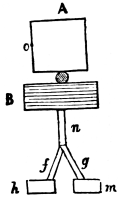 Fig. 1.
Lastly, as regards the sense of smell, Sir John Lubbock
found that on bringing a camel's-hair brush steeped in
various strong scents near where ants were passing, "some
went on without taking any notice, but others stopped,
and evidently perceiving the smell, turned back. Soon,
however, they returned, and passed the scented pencil.
After doing this two or three times, they generally took
no further notice of the scent. This experiment left no
doubt on my mind." In other cases the ants were observed
to wave about and throw back their antennæ when the
scented pencil was brought near.
That ants track one another by scent was long ago
mentioned by Huber, and also that they depend on this
sense for their power of finding supplies which have been
previously found by other ants. Huber proved their
power of tracking a path previously pursued by their
friends, by drawing his finger across the trail, so obliterating
the scent at that point, and observing that when the
ants arrived at that point they became confused and ran
about in various directions till they again came upon the
trail on the other side of the interrupted space, when they
proceeded on their way as before. The more numerous
and systematic experiments of Sir John Lubbock have
fully corroborated Huber's observations, so far as these
points are concerned. Thus, to give only one or two of
these experiments; in the accompanying woodcut (Fig. 1)
A is the nest, B a board, n f g slips of paper, h and m
similar slides of glass, on one of which, h, there was placed
pupæ, while the other, m, was left empty. Sir John Lubbock
watched two particular (marked) ants
proceeding from A to h and back again,
carrying the pupæ on h to the nest A.
Whenever an ant came out of A upon B he
transposed the slips f and g. Therefore at
the angle below n there was a choice presented
to the ant of taking the unscented
pathway leading to the full glass h, or the
scented pathway leading to the empty glass
m. The two marked ants, knowing their
way, always took the right turn at the
angle; but the stranger ants, being guided
only by scent, for the most part took the wrong turn at
the angle, so going to the empty glass m. For out of 150
stranger ants only 21 went to h, while the remaining 129
went to m. Still the fact that all the stranger ants did
not follow the erroneous scent-trail to m, may be taken to
indicate that they are also assisted in finding treasure by
the sense of sight, though in a lesser degree. Therefore
Sir John Lubbock concludes that in finding treasure 'they
are guided in some cases by sight, while in others they
track one another by scent.'
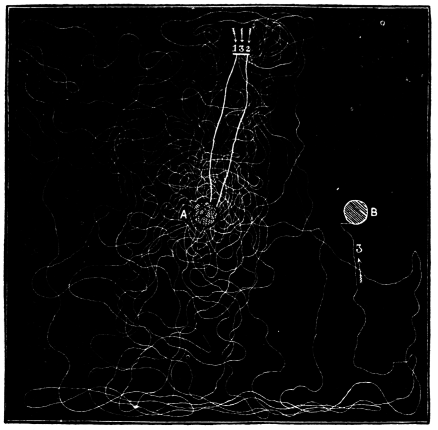 Fig. 2.
As further evidence showing how much more ants depend
upon scent than upon sight in finding their way, the
following experiment may be quoted. In the accompanying
woodcut (Fig. 2) the line marked 1, 2, 3 represents
the edge of a paper bridge leading to the nest; A the
top of a pencil which is standing perpendicularly upon
a board, represented by the general black surface; B
the top of the same pencil when moved a distance of
a few inches from its first position A. On the top
of this pencil were placed some pupæ. Sir John Lubbock,
after contriving this arrangement, marked an ant
and put it upon the pupæ on the top of the pencil.
After she had made two journeys carrying pupæ from the
pencil to the nest (the tracks she pursued being represented
by the two thick white lines), while she was in the
nest he moved the pencil to its position at B. The thin
white line represents the course then pursued by the ant
in its endeavours to find the pencil, which was shifted only
a few inches from A to B. That is, 'the ants on their
journey to the shifted object travelled very often backwards
and forwards and round the spot where the coveted
object first stood. Then they would retrace their steps
towards the nest, wander hither and thither from side to
side between the nest and the point A, and only after
very repeated efforts around the original site of the larvæ
reach, as it were, accidentally the object desired at B.'
Therefore the ants were clearly not guided by the sight
of the pencil.
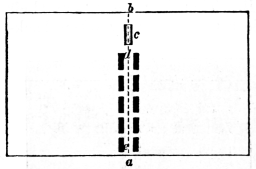 Fig. 3.
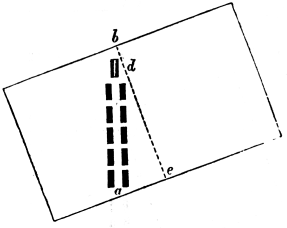 Fig. 4.
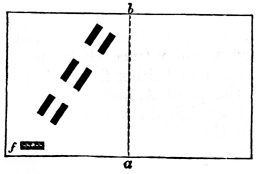 Fig. 5.
The same thing is well shown by another form of
experiment. 'Some food was placed at the point a (Figs.
3 and 4) on a board measuring 20 inches by 12 inches,
and so arranged that the ants in going straight from it to
the nest would reach the board at the point b, and after
passing under the paper
tunnel c, would proceed
between five pairs of
wooden bricks, each 3
inches in length and 1¾
inches in height. When
they got to know their
way they went quite
straight along the line d e
to a. The board was then
twisted as shown in Fig. 4. 'The bricks and tunnel being
arranged exactly in the
same direction as before,
but the board
having been moved, the
line d e was now outside
them. The change,
however, did not at all
discompose the ants;
but instead of going,
as before, through the
tunnel and between
the rows of bricks to
a, they walked exactly
along the old path to e.' Keeping the board steady, but
moving the brick pathway
to the left-hand corner of
the board where the food
was next placed (Fig. 5),
had the effect of making
the ant first go to the old
position of the food at a,
whence it veered to a new
position, which we may
call x. The bricks and
food were then moved towards
the right-hand corner of the board—i.e. over a distance
of 8 inches (Fig. 6). The ant now first went to a,
then to x, and not finding the food at either place, set to
work to look for it at random, and was only successful
after twenty-five minutes'
wandering.
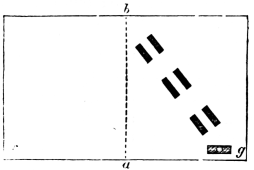 Fig. 6.
And, as evidence how
much more dependence
they place upon scent in
finding their way than
upon any other of their
faculties, it is desirable to
quote yet one further experiment,
which is of great
interest as showing that
when their sense of smell is made to contradict their
sense of direction, they follow the former, notwithstanding,
as we shall presently see, the wonderful accuracy of the
information which is supplied to them by the latter. 'If,
when F. niger were carrying off larvæ placed in a cup on a
piece of board, I turned the board round so that the side
which had been turned towards the nest was away from it,
and vice versâ, the ants always returned over the same
track on the board, and, in consequence, directly away
from home. If I moved my board to the other side of my
artificial nest, the result was the same. Evidently they
followed the road, not the direction.'
There can be little doubt that ants have a sense of
taste, as they are so well able to distinguish sugary substances;
and it is unquestionable that in their antennæ
they possess highly elaborated organs of touch.
As evidence of the accuracy and importance of the
sense of direction in the Hymenoptera, we must here
adduce Sir John Lubbock's highly interesting experiments
on ants—leaving his experiments in this connection on
bees and wasps to be considered in the next chapter.
He first accustomed some ants (Lasius niger) to go to
and fro to food over a wooden bridge. When they had
got quite accustomed to the way, he watched when an ant
was upon a bridge which could be rotated, and while she
was passing along it, he turned it round, so that end b was
at c, and c at b. 'In most cases the ant immediately
turned round also; but even if she went on to b or c, as
the case might be, as soon as she came to the end of the
bridge she turned round.' Next, between the nest and
the food he placed a hat-box twelve inches in diameter
and seven inches high, cutting two small holes, so that
the ants in passing from the nest to the food had to pass
in at one hole and out at the other. The box was fixed
upon a central pivot, so as to admit of being rotated easily
without much friction or disturbance. When the ants had
well learnt their way, the box was turned half round as
soon as an ant had entered it, 'but in every case the
ant turned too, thus retaining her direction.' Lastly,
Sir John took a disk of white paper, which he placed
in the stead of the hat-box between the nest and the
food. When an ant was on the disk making towards
the food, he gently drew the disk to the other side of the
food, so that the ant was conveyed by the moving surface
in the same direction as that in which she was going, but
beyond the point to which she intended to go. Under
these circumstances 'the ant did not turn round, but went
on' to the further edge of the disk, when she seemed 'a
good deal surprised at finding where she was.'
These experiments seem to show that the mysterious
'sense of direction,' and consequent faculty of 'homing,'
are in ants, at all events, due to a process of registering,
and, where desirable, immediately counteracting any change
of direction, even when such change is gently made by a
wholly closed chamber in which the animal is moving, and
not by any muscular movements of the animal itself. And
the fact that drawing the moving surface along in the
same direction of advance as that which the insect is
pursuing does not affect the movements of the latter,
seems conclusively to show that the power of registration
has reference only to lateral movements of the travelling
surface; it has no reference to variations in the velocity
of advance along the line in which the animal is progressing.[19]
Powers of Memory.
Little need here be said to prove that ants display
some powers of memory; for many of the observations and
experiments already detailed constitute a sufficient demonstration
of the statement that they do. Thus, for instance,
the general fact that whenever an ant finds her way to a
store of food or larvæ, she will return to it again and again
in a more or less direct line from her nest, constitutes
ample proof that the ant remembers the way to the store.
It is of considerable interest, however, to note that the
nature of this insect-memory appears to be, as far as it
goes, precisely identical with that of memory in general.
Thus, a new fact becomes impressed upon their memory
by repetition, and the impression is liable to become
effaced by lapse of time. More evidence on both these
features of insect-memory will be adduced when we come
to treat of the intelligence of bees; but meanwhile it is
enough to refer to the fact that in his experiments on
ants, Sir John Lubbock found it necessary to teach the
insects by a repetition of several lessons their way to
treasure, if that way was long or unusual.
With regard to the duration of memory, it does not
appear that any experiments have been made; but the
following observation by Mr. Belt on this point in the case
of the leaf-cutting ant may here be stated. In June 1859
he found his garden invaded by these ants, and following
up their paths he found their nest about a hundred yards
distant. He poured down their burrows a pint of common
brown carbolic acid, mixed with four buckets of water.
The marauding parties were at once drawn off from the
garden to meet the danger at home, and the whole formicarium
was disorganised, the ants running up and down
again in the utmost perplexity. Next day he found them
busily employed bringing up the ant-food from the old
burrows, and carrying it to newly formed ones a few yards
distant. These, however, turned out to be only intended
as temporary repositories; for in a few days both the old
and the new burrows were entirely deserted, so that he
supposed all the ants to have died. Subsequently, however,
he found that they had migrated to a new site, about
two hundred yards from the old one, and there established
themselves in a new nest. Twelve months later the ants
again invaded his garden, and again he treated them to a
strong dose of carbolic acid. The ants, as on the previous
occasion, were at once withdrawn from the garden, and
two days afterwards he found 'all the survivors at work on
one track that led directly to the old nest of the year before,
where they were busily employed in making fresh excavations.
Many were bringing along pieces of ant-food'
from the nest most recently deluged with carbolic acid to
that which had been similarly deluged a year before, and
from which all the carbolic acid had long ago disappeared.
'Others carried the undeveloped white pupæ and larvæ.
It was a wholesale and entire migration;' and the next day
the nest down which he had last poured the carbolic acid
was entirely deserted. Mr. Belt adds: 'I afterwards found
that when much disturbed, and many of the ants destroyed,
the survivors migrate to a new locality. I do not doubt
that some of the leading minds in this formicarium recollected
the nest of the year before, and directed the
migration to it.'
Now, I do not insist that the facts necessarily point to
this conclusion; for it may have been that the leaders of
the migration simply stumbled upon the old and vacant
nest by accident, and finding it already prepared as a nest,
forthwith proceeded to transfer the food and pupæ to it.
Still, as the two nests were separated from one another by
so considerable a distance, this hypothesis does not
seem probable, and the only other one open to us is that
the ants remembered the site of their former home for a
period of twelve months. And this conclusion is rendered
less improbable from a statement of Karl Vogt in his
'Thierstaaten,' to the effect that for several successive
years ants from a certain nest used to go through certain
inhabited streets to a chemist's shop 600 mètres distant,
in order to obtain access to a vessel filled with syrup. As
it cannot be supposed that this vessel was found in successive
working seasons by as many successive accidents,
it can only be concluded that the ants remembered the
syrup store from season to season.
I shall now pass on to consider a class of highly remarkable
facts, perhaps the most remarkable of the many
remarkable facts connected with ant psychology.
It has been known since the observations of Huber
that all the ants of the same nest or community recognise
one another as friends, while an ant introduced from
another nest, even though it be an ant of the same
species, is known at once to be a foreigner, and is usually
maltreated or put to death. Huber found that when he
removed an ant from a nest and kept it away from its
companions for a period of four months it was still recognised
as a friend, and caressed by its previous fellow-citizens
after the manner in which ants show friendship,
viz., by stroking antennæ. Sir John Lubbock, after repeating
and fully confirming these observations, extended
them as follows. He first tried keeping the separated ant
away from the nest for a still longer period than four
months, and found that even after a separation of more
than a year the animal was recognised as before. He repeated
this experiment a number of times, and always
with the same invariable difference between the reception
accorded to a foreigner and a native—no matter,
apparently, how long the native had been absent.
Considering the enormous number of ants that go to
make a nest, it seems astonishing enough that they should
be all personally known to one another, and still more
astonishing that they should be able to recognise members
of their community after so prolonged an absence. Thinking
that the facts could only be explained, either by all
the ants in the same nest having a peculiar smell, or by
all the members of the same community having a particular
pass-word or gesture-sign, Sir John Lubbock,
with the view of testing this theory, separated some ants
from a nest while still in the condition of pupæ, and,
when they emerged from that state as perfect insects,
transferred them back to the nest from which they had
been taken as pupæ. Of course in this case the ants in
the nest could never have seen those which had been
removed, for a larval ant is as unlike the mature insect as
a grub is unlike a beetle; neither can it be supposed that
a larva, hatched out away from the nest, should retain,
when a perfect insect, any smell belonging to its parent
nest—more especially as it had been hatched out by
ants in another nest;[20] nor, lastly, is it reasonable to
imagine that the animal, while still a larval grub, can have
been taught any gesture-signal used as a pass-word by the
matured animals. Yet, although all these possible hypotheses
seem to be thus fully excluded by the conditions
of the experiment, the result showed unequivocally that
the ants recognised their transformed larvæ as native-born
members of their community.
Lastly, Sir John Lubbock tried the experiment of
going still further back in the life-history of the ants
before separating them from the nest. For in September
he divided a nest into two halves, each having a queen.
At this season there were neither larvæ nor eggs. The
following April both the queens began to lay eggs, and in
August—i.e. nearly a year after the original partitioning
of the nest—he took some of the ants newly hatched from
the pupæ in one division, and placed them in the other
division, and vice versâ. In all cases these ants were received
by the members of the other half of the divided
nest as friends, although if a stranger were introduced into
either half it was invariably killed. Yet the ants which
were thus so certainly recognised by their kindred ants
as friends had never, even in the state of an egg, been
present in that division of the nest before. On this highly
remarkable fact Sir John Lubbock says:—
These observations seem to me conclusive as far as they go,
and they are very surprising. In my experiments of last year,
though the results were similar, still the ants experimented
with had been brought up in the nest, and were only removed
after they had become pupæ. It might therefore be argued
that the ants, having nursed them as larvæ, recognised them
when they came to maturity; and though this would certainly
be in the highest degree improbable, it could not be said to be
impossible. In the present case, however, the old ants had absolutely
never seen the young ones until the moment when,
some days after arriving at maturity, they were introduced into
the nest; and yet in all ten cases they were undoubtedly recognised
as belonging to the community.
It seems to me, therefore, to be established by these experiments
that the recognition of ants is not personal and individual;
that their harmony is not due to the fact that each
ant is individually acquainted with every other member of the
community.
At the same time, the fact that they recognise their friends
even when intoxicated, and that they know the young born in
their own nest even when they have been brought out of the
chrysalis by strangers, seems to indicate that the recognition is
not effected by means of any sign or pass-word.
We must, therefore, conclude with reference to this
subject that the mode whereby recognition is undoubtedly
effected is as yet wholly unintelligible; and I have
introduced these facts under the heading of memory only
because this heading is not more inappropriate than any
other that could be devised for their reception.
It ought here to be added also that the power of
thus recognising members of their community is not confined
by the limits of blood-relationship, for in an experiment
made by Forel it was shown that Amazon ants
recognised their own slaves almost instantaneously after
an absence of four months.
Under this heading I may also adduce the evidence as
to enormous masses, or, as we might say, a whole nation
of ants recognising each other as belonging to the same
nationality. New nests often spring up as offshoots from
the older ones, and thus a nation of towns gradually
spreads to an immense circumference around the original
centre. Forel describes a colony of F. exsecta which
comprised more than two hundred nests, and covered a
space of nearly two hundred square mètres. 'All the
members of such a colony, even those from the furthermost
nest, recognise each other and admit no stranger.'
Similarly, MacCook describes an 'ant town' in the
Alleghany Mountains of North America ('Trans. Amer.
Entom. Soc.,' Nov. 1877) which was inhabited by F. exsectoïdes.
It consists of 1,600 to 1,700 nests, which rise in
cones to a height of from two to five feet. The ground
below is riddled in every direction with subterranean
passages of communication. The inhabitants are all on the
most friendly terms, so that if any one nest is injured it
is repaired by their united forces.
It remains to be added in connection with this subject
that the recognition is not automatically invariable, but
when 'ants are removed from a nest in the pupa state,
tended by strangers, and then restored, some at least of
their relatives are certainly puzzled, and in many cases
doubt their claims to consanguinity. I say some, because
while strangers under the circumstances would have been
immediately attacked, these ants were in every case
amicably received by the majority of the colony, and it was
sometimes several hours before they came across one who
did not recognise them.'
It may also be added that Lasius flavus behaves
towards strangers quite differently and much more hospitably
than is the case with L. niger. The stranger
shows no alarm, but, on the contrary, will voluntarily
enter the strange nest, and she is there received with
kindness; although from the attention she excites, and
the numerous communications which take place between
her and her new friends, Sir John was 'satisfied that they
knew she was not one of themselves. . . . . Very different is
the behaviour of L. niger under similar circumstances. I
tried the same experiment with them. There was no
communications with the antennæ, there was no cleaning,
but every ant which the stranger approached flew at her
like a little tigress. I tried this experiment four times;
each stranger was killed and borne off to the nest.'
The pugnacity, valour, and rapacity of ants are too
well and generally known to require the narration of
special instances of their display. With regard to the
tenderer emotions, however, there is a difference of opinion
among observers. Before the researches of Sir John
Lubbock it was the prevalent view that these insects display
marked signs of affection towards one another, both
by caressing movements of their antennæ, and by showing
solicitude for friends in distress. Sir John, however, has
found that the species of ants on which he has experimented
are apparently deficient both in feelings of
affection and of sympathy—or, at least, that such feelings
are in these species much less strongly developed than
the sterner passions.
He tried burying some specimens of Lasius niger
beneath an ant-road; but none of the ants traversing the
road made any attempt to release their imprisoned companions.
He tried the same experiment with the same
result on various other species. Even when the friends in
difficulty are actually in sight, it by no means follows
that their companions will assist them. Of this, he says,
he could give almost any number of instances. Thus,
when ants are entangled in honey, their companions
devote themselves to the honey, and entirely neglect
their friends in distress; and when partly drowned, their
friends take no notice. When chloroformed or intoxicated
their own companions either do not heed them, or else
'seem somewhat puzzled at finding their intoxicated
fellow-creatures in such a condition, take them up, and
carry them about for a time in a somewhat aimless manner.'
Further experiments, however, on a larger scale, went to
show that chloroformed ants were treated as dead, i.e.
removed to the edge of the parade-board and dropped
over into the surrounding moat of water; while intoxicated
ants were generally carried into the nest, if they were ants
belonging to that community; if not, they were thrown
overboard. This care shown towards intoxicated friends
appears to indicate a dim sense of sympathy towards
afflicted individuals; but that this emotion or instinct
does not in the case of these species extend to healthy
individuals in distress seems to be proved, not only by the
experiments of burying already described, but also by the
following:—
On Sept. 2, therefore, I put two ants from one of my nests
of F. fusca into a bottle, the end of which was tied up with
muslin as described, and laid it down close to the nest. In a
second bottle I put two ants from another nest of the same
species. The ants which were at liberty took no notice of the
bottle containing their imprisoned friends. The strangers in the
other bottle, on the contrary, excited them considerably. The
whole day one, two, or more ants stood sentry, as it were, over
the bottle. In the evening no less than twelve were collected
round it, a larger number than usually came out of the nest at
any one time. The whole of the next two days, in the same
way, there were more or less ants round the bottle containing
the strangers; while, as far as we could see, no notice whatever
was taken of the friends. On the 9th the ants had eaten
through the muslin, and effected an entrance. We did not
chance to be on the spot at the moment; but as I found two
ants lying dead, one in the bottle and one just outside, I think
there can be no doubt that the strangers were put to death.
The friends throughout were quite neglected.
Sept. 21.—I then repeated the experiment, putting three
ants from another nest in a bottle as before. The same scene
was repeated. The friends were neglected. On the other
hand, some of the ants were always watching over the bottle
containing the strangers, and biting at the muslin which protected
them. The next morning at 6 A.M. I found five ants
thus occupied. One had caught hold of the leg of one of the
strangers, which had unwarily been allowed to protrude through
the meshes of the muslin. They worked and watched, though
not, as far as I could see, with any system, till 7.30 in the
evening, when they effected an entrance, and immediately attacked
the strangers.
Sept. 24.—I repeated the same experiment with the same
nest. Again the ants came and sat over the bottle containing
the strangers, while no notice was taken of the friends.
The next morning again, when I got up, I found five ants
round the bottle containing the strangers, none near the friends.
As in the former case, one of the ants had seized a stranger by
the leg, and was trying to drag her through the muslin. All
day the ants clustered round the bottle, and bit perseveringly,
though not systematically, at the muslin. The same thing happened
all the following day.
On repeating these experiments with another species (viz.,
Formica rufescens) the ants took no notice of either bottle,
and showed no sign either of affection or hatred. One is almost
tempted to surmise that the spirit of these ants is broken by
slavery [i.e. by the habit of keeping slaves]. But the experiments
on F. fusca seem to show that in these curious insects
hatred is a stronger passion than affection.
We must not, however, too readily assent to this
general conclusion, that ants as a whole are deficient in
the tenderer emotions; for although the case is doubtless
so with the species which Sir John examined, it appears
to be certainly otherwise with other species, as we shall
presently see. But first it may be well to point out that
even the hard-hearted species with which Sir John had to
do seem not altogether devoid of sympathy with sick or
mutilated friends, although they appear to be so towards
healthy friends in distress. Thus the care shown to
intoxicated friends seems to indicate, if not, as already
observed, a dim sense of sympathy, at least an instinct to
preserve the life of an ailing citizen for the future benefit
of the community. Sir John also quotes some observations
of Latreille showing that ants display sympathy with
mutilated companions; and, lastly, mentions an instance
which he has himself observed of the same thing. A specimen
of F. fusca congenitally destitute of antennæ was
attacked and injured by an ant of another species. When
separated by Sir John, another ant of her own species
came by. 'She examined the poor sufferer carefully, then
picked her up tenderly, and carried her away into the
nest. It would have been difficult for any one who
witnessed this scene to have denied to this ant the possession
of humane feelings.' Moggridge is also of opinion
that the habit of throwing sick and apparently dead ants
into the water, is 'in part to be rid of them, and partly,
perhaps, with a view to effecting a possible cure; for I
have seen one ant carry another down the twig which
formed their path to the surface of the water, and, after
dipping it in for a minute, carry it laboriously up again,
and lay it in the sun to dry and recover.'
But that some species of ants display marked signs
of what we may call sympathy even towards healthy companions
in distress, is proved by the following observation
of Mr. Belt. He writes:[21]—
One day, watching a small column of these ants (i.e.
Eciton humata), I placed a little stone on one of them to secure
it. The next that approached, as soon as it discovered its
situation, ran backwards in an agitated manner, and soon communicated
the intelligence to the others. They rushed to the
rescue; some bit at the stone and tried to move it, others seized
the prisoner by the legs and tugged with such force that I
thought the legs would be pulled off, but they persevered until
they got the captive free. I next covered one up with a piece
of clay, leaving only the ends of its antennæ projecting. It was
soon discovered by its fellows, which set to work immediately,
and by biting off pieces of the clay soon liberated it. Another
time I found a very few of them passing along at intervals. I
confined one of these under a piece of clay at a little distance
from the line, with his head projecting. Several ants passed it,
but at last one discovered it and tried to pull it out, but could
not. It immediately set off at a great rate, and I thought it
had deserted its comrade, but it had only gone for assistance,
for in a short time about a dozen ants came hurrying up, evidently
fully informed of the circumstances of the case, for they
made directly for their imprisoned comrade and soon set him
free. I do not see how this action could be instinctive. It was
sympathetic help, such as man only among the higher mammalia
shows. The excitement and ardour with which they
carried on their unflagging exertions for the rescue of their
comrade could not have been greater if they had been human
beings.
This observation seems unequivocal as proving fellow-feeling
and sympathy, so far as we can trace any analogy
between the emotions of the higher animals and those of
insects. That insects with such highly organised social
habits, and depending so greatly on the principles of co-operation,
should manifest emotions or instincts of an incipiently
altruistic character, is no more than we should
antecedently expect on the general principle of survival
of the fittest. Our only surprise should be that these
emotions, or instincts, should appear to be so feebly developed
in some species of ants, and, as we shall subsequently
see, also of bees. But it may be worth while in
this connection to point out that the valuable observation
of Mr. Belt above quoted refers to the species of ant which,
as we shall subsequently find, presents the most highly
organised instincts of co-operation that are to be met with
among ants, and therefore the greatest dependence of the
welfare of the individual on that of the community. And
the same remark is applicable to our native species, F. sanguinea,
which the Rev. W. W. F. White has repeatedly
seen rescuing buried companions very much in the manner
described by Mr. Belt; and he does not appear to be acquainted
with Mr. Belt's observations. He figures one
case in which he saw three ants co-operating to dig out
a buried comrade.[22]
Huber, Kirby and Spence, Dugardin, Burmeister,
Franklin, and other observers have all expressed themselves
as more or less strongly of the opinion that members
of the same community of ants, and other social Hymenoptera,
are able to communicate information to one
another by some system of language or signs. The facts,
however, on which their opinion rests have not been stated
with that degree of caution and detail which the acceptance
of the conclusion requires. Thus, Kirby and Spence
give only one instance of supposed communication between
ants,[23] and even this one is inconclusive, as the facts described
admit of being explained by supposing that the
ants simply tracked one another by scent; while Huber
merely deals in general statements as to 'contact of
antennæ,' without narrating any particulars of his observations.
Therefore, until within the last few years there
was really no sufficient evidence to sustain the general
opinion that ants are able to communicate with one
another; but the observations which I shall now detail
must be regarded as fully substantiating that general
opinion by facts as abundant and conclusive as the most
critical among us can desire. I shall first narrate in his
own words the more important of Sir John Lubbock's
experiments in this connection:—
I took three tapes, each about 2 feet 6 inches long, and
arranged them parallel to one another and about 6 inches
apart. An end of each I attached to one of the nests (F. niger),
and at the other end I placed a glass. In the glass at the end
of one tape I placed a considerable number (300 to 600) of
larvæ. In the second I put two or three larvæ only, in the
third none at all. The object of the last was to see whether
many ants would come to the glasses under such circumstances
by mere accident, and I may at once say that scarcely any
did so. I then took two ants, and placed one of them to the
glass with many larvæ, the other to that with two or three.
Each of them took a larva and carried it to the nest, returning
for another, and so on. After each journey I put another
larva in the glass with only two or three larvæ, to replace that
which had been removed. Now, if several ants came under the
above circumstances as a mere matter of accident, or accompanying
one another by chance, or if they simply saw the larvæ
which were being brought, and consequently concluded that
they might themselves find a larva in the same place, then the
numbers going to the two glasses ought to be approximately
equal. In each case the number of journeys made by the ants
would be nearly the same; consequently, if it was a matter of
scent, the two glasses would be in the same position. It would
be impossible for an ant, seeing another in the act of bringing
a larva, to judge for itself whether there were few or many
left behind. On the other hand, if the strangers were brought,
then it would be curious to see whether more were brought
to the glass with many larvæ than to that which only contained
two or three. I should also mention that every stranger was
imprisoned until the end of the experiment.
The results of these experiments were that during
47½ hours the ants which had access to a glass containing
numerous larvæ brought 257 friends to their assistance;
while during an interval 5½ hours longer those which
visited the glass with only two or three larvæ brought only
82 friends; and, as already mentioned, no single ant came
to the glass which contained no larvæ. Now, as all the
glasses were exposed to similar conditions, and as the
roads to the first two must, in the first instance at all
events, have been equally scented by the passage of ants
over them, these results look very conclusive as proving
some power of definite communication, not only that
larvæ are to be found, but even where the largest store is
to be met with.
To this interesting account Sir John Lubbock adds,—
One case of apparent communication struck me very much.
I had had an ant (F. niger) under observation one day, during
which she was occupied in carrying off larvæ to her nest. At
night I imprisoned her in a small bottle; in the morning I let
her out at 6.15, when she immediately resumed her occupation.
Having to go to London, I imprisoned her again at 9 o'clock.
When I returned at 4.40 I put her again to the larvæ. She
examined them carefully, and went home without taking one.
At this time no other ants were out of the nest. In less than
a minute she came out again with eight friends, and the little
heap made straight for the heap of larvæ. When they had gone
two-thirds of the way I again imprisoned the marked ant;
the others hesitated a few minutes, and then with curious quickness
returned home. At 5.15 I put her again to the larvæ.
She again went home without a larva, but after only a few
seconds' stay in the nest, came out with no less than thirteen
friends. They all went towards the larvæ, but when they had
got about two-thirds of the way, although the marked ant had
on the previous day passed over the ground about 150 times,
and though she had just gone straight from the larvæ to the
nest, she seemed to have forgotten her way, and considered;
and after she had wandered about for half an hour, I put her to
the larvæ. Now, in this case, the twenty-one ants must have
been brought out by my marked one, for they came exactly
with her, and there were no other ants out. Moreover, it would
seem that they must have been told, because (which is very
curious in itself) she did not in either case bring a larva, and
consequently it cannot have been the mere sight of a larva
which had induced them to follow her.
Further experiments proved, as we might have expected,
that although an ant is able to communicate to
her friends in the nest that she has found treasure somewhere
outside, she is not able to describe to them its precise
locality. Thus, having exposed larvæ and placed an
ant upon them as before, Sir John watched every time she
came out of the nest with friends to assist her, but instead
of allowing her to pilot the way, he took her up and
carried her to the larvæ, allowing her to return with a
larva upon her own feet. Under these circumstances the
friends, although evidently coming out with the intention
of finding some treasure, were never able to find it; but
wandered about in various directions for a while, and then
returned to the nest. Thus, during two hours she
brought out in her successive journeys altogether no less
than 120 ants, of which number only 5 in their unguided
wanderings happened to find the sought-for treasure.
This result seems to prove, as we might have expected,
that the communication is of the nature of some sign
amounting to no more than a 'follow me.' Other experiments
confirmed this result, and also brought out the
fact that 'some species act much more in association than
others—Formica fusca, for instance, much less than
Lasius niger.' Thus Sir John Lubbock placed some honey
before a marked specimen of the former species; but
although she visited and revisited the honey during an
entire day, she brought out no friends to share it; and
although in her journeys to and from the nest she happened
to pass and repass many other individuals, they took no
notice of each other.
The obvious objection to these experiments, that an
ant observing a friend bringing home food or a pupa
might infer, without being told, that by accompanying
the friend on the return journey she 'might participate in
the good things,' has been partly met by the fact already
stated, viz., that there is so very marked a difference in
the result if, on experimenting on two ants, one had access
to a large treasure and the other only to a small one. But
to put this matter beyond question, Sir John Lubbock
tried the experiment of pinning down a dead fly, so that
the ant which found it was unable, with all her tugging,
to move it towards the nest. At length she went back
to the nest for assistance, and returned accompanied by
seven friends. So great was her excitement, however,
that she outran these friends, 'who seemed to have
come out reluctantly, as if they had been asleep, and were
only half awake;' and they failed to find the fly, slowly
meandering about for twenty minutes. After again tugging
for a time at the fly, the first ant returned a second
time to the nest for assistance, and in less than a minute
came out with eight friends. They were even less energetic
than the first party, and having lost sight of their guide in
the same manner as happened before, they all returned to
the nest. Meanwhile several of the first party, which had
all the while been meandering about, found the fly, and
proceeded to dismember it, carrying the trophy to the
nest, and calling out more friends in the ordinary way.
This experiment was repeated several times and on different
species, always with the same result. Now, as Sir
John remarks, 'the two cases (i.e. those in which the ant
brought out friends to her assistance even when she had
no booty to show) surely indicate a distinct power of communication. . . . .
It is impossible to doubt that the friends
were brought out by the first ant; and as she returned
empty-handed to the nest, the others cannot have been
induced to follow her by merely observing her proceedings.
I conclude, therefore, that they possess the power of requesting
their friends to come and help them.'
In order to ascertain whether the signs which communicating
ants make to one another are made by means
of sound, Sir John Lubbock placed near a nest of Lasius
flavus six small upright pillars of wood about 1½ inch high,
and on one of these he put a drop of honey. 'I then put
three ants to the honey, and when each had sufficiently
fed, I imprisoned her, and put another; thus always keeping
three ants at the honey, but not allowing them to go
home. If, then, they could summon their friends by
sound, there ought soon to be many ants at the honey.'
The result showed that the ants were not able thus to call
to one another from a distance.
As additional proof of the general fact that at all
events some ants have the power of communicating information
to one another, it will be enough here to quote an
exceedingly interesting observation of the distinguished
geologist Hague. The quotations are taken from
his letters written to Mr. Darwin, and published in
Nature:[24]—
On the mantelshelf of our sitting-room my wife has the
habit of keeping fresh flowers. A vase stands at each end, and
near the middle a small tumbler, usually filled with violets.
Some time ago I noticed a pile of very small red ants on the wall
above the left-hand vase, passing upward and downward between
the mantelshelf and a small hole near the ceiling, at a
point where a picture nail had been driven. The ants, when
first observed, were not very numerous, but gradually increased
in number, until on some days the little creatures formed an
almost unbroken procession, issuing from the hole at the nail,
descending the wall, climbing the vase directly below the nail,
satisfying their desire for water or perfume, and then returning.
The other vase and tumbler were not visited at that time.
As I was just then recovering from a long illness it happened
that I was confined to the house, and spent my days in the
room where the operations of these insects attracted my attention.
Their presence caused me some annoyance, but I knew of
no effective means of getting rid of them. For several days in
succession I frequently brushed the ants in great numbers from
the wall down to the floor; but as they were not killed the result
was that they soon formed a colony in the wall at the base
of the mantel, ascending thence to the shelf, so that before long
the vase was attacked from above and below.
One day I observed a number of ants, perhaps thirty or
forty, on the shelf at the foot of the vase. Thinking to kill
them, I struck them lightly with the end of my finger, killing
some and disabling the rest. The effect of this was immediate
and unexpected. As soon as those ants which were approaching
arrived near to where their fellows lay dead and suffering,
they turned and fled with all possible haste. In half an hour
the wall above the mantelshelf was cleared of ants.
During the space of an hour or two the colony from below
continued to ascend until reaching the lower bevelled edge of
the shelf, at which point the more timid individuals, although
unable to see the vase, somehow became aware of trouble, and
turned about without further investigation, while the more
daring advanced hesitatingly just to the upper edge of the
shelf, when, extending their antennæ and stretching their necks,
they seemed to peep cautiously over the edge until beholding
their suffering companions, when they too turned and followed
the others, expressing by their behaviour great excitement and
terror. An hour or two later, the path or trail leading from
the lower colony to the vase was almost entirely free from ants.
I killed one or two ants on their path, striking them with
my finger, but leaving no visible trace. The effect of this was
that as soon as an ant ascending towards the shelf reached the
spot where one had been killed, it gave signs immediately of
great disturbance, and returned directly at the highest possible
speed.
A curious and invariable feature of their behaviour was
that when such an ant, returning in fright, met another approaching,
the two would always communicate, but each would
pursue its own way, the second ant continuing its journey to
the spot where the first had turned about, and then following
that example.
For some days after this there were no ants visible on the
wall, either above or below the shelf.
Then a few ants from the lower colony began to reappear,
but instead of visiting the vase which had been the scene of the
disaster, they avoided it altogether, and following the lower
front edge of the shelf to the tumbler standing near the middle,
made their attack upon that. I repeated the same experiment
here with precisely the same result. Killing or maiming a few
of the ants and leaving their bodies about the base of the tumbler,
the others on approaching, and even before arriving at the
upper surface of the shelf where their mutilated companions
were visible, gave signs of intense emotion, some running away
immediately, and others advancing to where they could survey
the field and then hastening away precipitately.
Occasionally an ant would advance towards the tumbler
until it found itself among the dead and dying; then it seemed
to lose all self-possession, running hither and thither, making
wide circuits about the scene of the trouble, stopping at times
and elevating the antennæ with a movement suggestive of
wringing them in despair, and finally taking flight. After this
another interval of several days passed, during which no ants
appeared. Now, three months later, the lower colony has been
entirely abandoned. Occasionally, however, especially when
fresh and fragrant violets have been placed on the shelf, a few
'prospectors' descend from the upper nail-hole, rarely, almost
never, approaching the vase from which they were first driven
away, but seeking to satisfy their desire at the tumbler. To
turn back these stragglers and keep them out of sight for a
number of days, sometimes for a fortnight, it is sufficient to
kill one or two ants on the trail which they follow descending
the wall. This I have recently done as high up as I can reach,
three or four feet above the mantel. The moment this spot is
reached, an ant turns abruptly and makes for home, and in a
little while there is not an ant visible on the wall.
In a subsequent volume of 'Nature' (viii. p. 244),
Mr. Darwin publishes another letter which he received from
Mr. Hague upon the same subject. It seems that Mr. Moggridge
suggested to Mr. Darwin that, as he and others had
observed ants to be repelled by the mere scent of a finger
drawn across their path, the observation of Mr. Hague
might really resolve itself into a dislike on the part of the
ants to cross a line over which a finger had been drawn,
and have nothing to do with intelligent terror inspired by
the sight of their slaughtered companions. The following
is Mr. Hague's reply to Mr. Darwin's request for further
experiments to test this point:—
Acting on Mr. M——'s suggestion, I first tried making simple
finger-marks on their path (the mantel is of marble), and found
just the results which he describes in his note as observed by
himself at Mentone, that is, no marked symptoms of fear, but a
dislike to the spot, and an effort to avoid it by going around it,
or by turning back and only crossing it again after an interval
of time. I then killed several ants on the path, using a smooth
stone or piece of ivory, instead of my finger, to crush them. In
this case the ants approaching all turned back as before, and
with much greater exhibition of fear than when the simple
finger-mark was made. This I did repeatedly. The final result
was the same as obtained last winter. They persisted in
coming for a week or two, during which I continued to kill
them, and then they disappeared, and we have seen none since.
It would appear from this that while the taint of the hand is
sufficient to turn them back, the killing of their fellows with a
stone or other material produces the effect described in my first
note. This was made clear to me at that time, from the behaviour
of the ants the first day I killed any, for on that occasion
some of them approaching the vase from below, on reaching
the upper edge of the mantel, peeped over, and drew back on
seeing what had happened about the vase, then turned away a
little, and after a moment tried again at another and another
point along the edge, with the same result in the end. Moreover,
those that found themselves among the dead and dying
went from one writhing ant to another in great haste and excitement,
exhibiting the signs of fright which I described.
I hardly hope that any will return again, but if they do,
and give me an opportunity, I shall endeavour to act further on
Mr. M——'s suggestion.
With this quotation I shall conclude the present division
of the chapter; for, looking to all the other observations
previously mentioned, there can be no question concerning
the general fact that ants have the power of communicating
with one another. And under subsequent headings
abundant additional evidence on this point will be
found implicated with the other facts detailed.
Swarming.—The precise facts with regard to the
swarming of ants are not yet certainly established. As
regards some of the facts, however, there is no doubt.
The winged males and females first quit the nest in enormous
numbers, and choose some fine afternoon in July
or August for their wedding flight. The entrances to
the nest are widened by the workers and increased in
number, and there is a great commotion on the surface
of the nest. The swarm takes place as a thick
cloud of all the male and female insects, rising together
to a considerable height. The flight continues for
several hours, usually circling round some tree or
tower, and it is during the flight that fertilisation is
effected. After it is effected, the swarm returns to
the ground, when the males perish, either from falling
a prey, in their shelterless condition, to birds or spiders,
or, on account of not being able to feed themselves, from
starvation. 'The workers, or neuter ants, of their own
colony have lost all interest in them from the moment of
their return, and trouble themselves no more about them,
for they well know that the males have now fulfilled their
vocation.' The great majority of the fertilised females
share the same fate as the males. But a small proportion
find concealment in holes, which they either dig for themselves,
or happen to find ready made, and there found a
new colony. The first thing they do is to pull off their
now useless wings, by scratching and twisting them, one
after the other, with the clawed ends of their feet. They
then lay their eggs, and become the queens of new
colonies.
Forel says that no fertilised female ever returns to her
original home; but that the workers keep back a certain
number of females which are fertilised before the swarming
takes place; in this case the workers pull off the wings
of the fertilised females. The majority of observers, however,
maintain that some of the females composing the
swarm return to their native home to become mothers
where they had been children. Probably both statements
are correct. A writer in the 'Groniger Deekblad' for
June 16, 1877, observes that, looking to the injurious
effects of in-breeding, the facts as related by Forel are less
probable than those related by other observers, and that, if
they actually occur, the females fertilised before flight are
probably kept by the ants as a sort of 'reserve corps to
which the workers resort only in case of need, and if they
fail to secure any returning queens.'
Nursing.—The eggs will not develop into larvæ unless
nursed. The nursing is effected by licking the
surface of the eggs, which under the influence of this
process increase in size, or grow. In about a fortnight,
during which time the workers carry the eggs from higher
to lower levels of the nest, and vice versâ, according to the
circumstances of heat, moisture, &c., the larvæ are hatched
out, and require no less careful nursing than the eggs.
The workers feed them by placing mouths together and regurgitating
food stored up in the crop or proventriculus
into the intestinal tract of the young. The latter show
their hunger by 'stretching out their little brown heads.'
Great care is also taken by the workers in cleaning the
larvæ, as well as in carrying them up and down the
chambers of the nest for warmth or shelter.
When fully grown the larvæ spin cocoons, and are then
pupæ, or the 'ants' eggs' of bird-fanciers. These require
no food, but still need incessant attention with reference
to warmth, moisture, and cleanliness. When the time
arrives for their emergence as perfect insects, the workers
assist them to get out of their larval cases by biting
through the walls of the latter. It is noticeable that in
doing this the workers do not keep to any exact time,
but free them sometimes earlier and sometimes later, in
accordance with their rate of development. 'The little
animal when freed from its chrysalis is still covered with
a thin skin, like a little shirt, which has to be pulled off.
When we see how neatly and gently this is done, and
how the young creature is then washed, brushed, and
fed, we are involuntarily reminded of the nursing of
human babies. The empty cases, or cocoons, are carried
outside the nest, and may be seen heaped together there
for a long time. Some species carry them far away from
the nest, or turn them into building materials for the
dwelling.'[25]
Education.—The young ant does not appear to come
into the world with a full instinctive knowledge of all its
duties as a member of a social community. It is led about
the nest, and 'trained to a knowledge of domestic duties,
especially in the case of the larvæ.' Later on the young
ants are taught to distinguish between friends and foes.
When an ants' nest is attacked by foreign ants, the young
ones never join in the fight, but confine themselves to
removing the pupæ; and that the knowledge of hereditary
enemies is not wholly instinctive in ants is proved by the
following experiment, which we owe to Forel. He put
young ants belonging to three different species into a glass
case with pupæ of six other species—all the species being
naturally hostile to one another. The young ants did
not quarrel, but worked together to tend the pupæ. When
the latter hatched out, an artificial colony was formed of
a number of naturally hostile species all living together
after the manner of the 'happy families' of the showmen.
Habit of keeping Aphides.—It is well known that
various species of ants keep aphides, as men keep milch
cows, to supply a nutritious secretion. Huber first observed
this fact, and noticed that the ants collected the
eggs of the aphides and treated them exactly as they
treated their own, guarding and tending them with the
utmost care. When these eggs hatch out the aphides are
usually kept and fed by the ants, to whom they yield a
sweet honey-like fluid, which they eject from the abdomen
upon being stroked on this region by the antennæ of the
ants. Mr. Darwin, who has watched the latter process,
observes with regard to it,—
I removed all the ants from a group of about a dozen aphides
on a dock plant, and prevented their attendance during several
hours. After this interval, I felt sure that the aphides would
want to excrete. I watched them for some time through a
lens, but not one excreted; I then tickled them with a hair in
the same manner, as well as I could, as the ants do with their
antennæ; but not one excreted. Afterwards I allowed an ant
to visit them, and it immediately seemed, by its eager way of
running about, to be well aware what a rich flock it had discovered;
it then began to play with its antennæ on the abdomen,
first of one aphis and then of another; and each, as soon
as it felt the antennæ, immediately lifted up its abdomen and
excreted a limpid drop of sweet juice, which was eagerly devoured
by the ant. Even quite young aphides behaved in this
manner, showing that the action was instinctive, and not the
result of experience.
The facts also show that the yielding of the secretion
to the ants is, as it were, a voluntary act on the part of the
aphides, or, perhaps more correctly, that the instinct to
yield it has been developed in such a relation to the requirements
of the ants, that the peculiar stimulation supplied
by the antennæ of the latter is necessary to start the
act of secretion; for in the absence of this particular stimulation
the aphides will never excrete until compelled to do
so by the superabundance of the accumulating secretion.
The question, therefore, directly arises how, on evolutionary
principles, such a class of facts is to be met; for it is certainly
difficult to understand the manner in which this
instinct, so beneficial to the ants, can have arisen in the
aphides, to which it does not appear, at first sight, to offer
any advantages. Mr. Darwin meets the difficulty thus:
'Although there is no evidence that any animal performs
an action for the exclusive good of another species, yet
each tries to take advantage of the instincts of others;'
and 'as the secretion is extremely viscid, it is no doubt a
convenience to the aphides to have it removed; therefore
probably they do not excrete solely for the good of the
ants.'[26]
Some ants which keep aphides build covered ways, or
tunnels, to the trees or shrubs where the aphides live.
Forel saw a tunnel of this kind which was taken up a wall
and down again on the other side, in order to secure a
safe covered way from the nest to the aphides. Occasionally
such covered ways, or tubes, are continued so as to
enclose the stems of the plants on which the aphides live.
The latter are thus imprisoned by the walls of the tube,
which, however, expand where they take on this additional
function of stabling the aphides, so that these insects are
really confined in tolerably large chambers. The doors of
these chambers are too small to allow the aphides to escape,
while large enough for the ants to pass in and out. Forel
saw such a prison or stable shaped like a cocoon, and
about a centimètre long, which was hanging on the branch
of a tree, and contained aphides carefully tended by the
ants. Huber records similar observations.
Sir John Lubbock has made an interesting addition to
our knowledge respecting this habit as practised by a
certain species of ant (Lasius flavus), which departs in a
very remarkable manner from the habit as practised by
other species. He says: 'The ants took the greatest care
of these eggs, carrying them off to the lower chambers
with the utmost haste when the nest was disturbed.' But
the most interesting of Sir John Lubbock's observations
in this connection is new, and reveals an astonishing
amount of method shown by the ants in farming their
aphides. He says:—
When my eggs hatched I naturally thought that the aphides
belonged to one of the species usually found on the roots of
plants in the nests of Lasius flavus. To my surprise, however,
the young creatures made the best of their way out of the nest,
and, indeed, were sometimes brought out by the ants themselves.
In vain I tried them with roots of grass, &c.; they
wandered uneasily about, and eventually died. Moreover, they
did not in any way resemble the subterranean species. In 1878
I again attempted to rear these young aphides; but though I
hatched a great many eggs, I did not succeed. This year, however,
I have been more fortunate. The eggs commenced to
hatch the first week in March. Near one of my nests of Lasius
flavus, in which I had placed some of the eggs in question, was
a glass containing living specimens of several species of plants
commonly found on or around ants' nests. To this some of
the young aphides were brought by the ants. Shortly afterwards
I observed on a plant of daisy, in the axils of the leaves,
some small aphides, very much resembling those from my nest,
though we had not actually traced them continuously. They
seemed thriving, and remained stationary on the daisy. Moreover,
whether they had sprung from the black eggs or not, the
ants evidently valued them, for they built up a wall of earth
round and over them. So things remained throughout the
summer, but on October 9 I found that the aphides had laid
some eggs exactly resembling those found in the ants' nests;
and on examining daisy plants from outside, I found on many
of them similar aphides, and more or less of the same eggs.
I confess these observations surprised me very much. The
statements of Huber have not, indeed, attracted so much notice
as many of the other interesting facts which he has recorded,
because if aphides are kept by ants in their nests, it seems only
natural that their eggs should also occur. The above case,
however, is much more remarkable. Here are aphides, not
living in the ants' nests, but outside, on the leaf-stalks of plants.
The eggs are laid early in October on the food-plant of the insect.
They are of no direct use to the ants, yet they are not
left where they are laid, where they would be exposed to the
severity of the weather and to innumerable dangers, but brought
into their nests by the ants, and tended by them with the utmost
care through the long winter months until the following
March, when the young ones are brought out and again placed
on the young shoots of the daisy. This seems to me a most
remarkable case of prudence. Our ants may not perhaps lay
up food for the winter, but they do more, for they keep during
six months the eggs which will enable them to procure food
during the following summer.
The following, which is taken from Büchner's
'Geistesleben der Thiere' is perhaps a still more striking
performance of the same kind as that which Sir John
Lubbock observed:—
The author is debtor to Herr Nottebohm, Inspector of Buildings
at Karlsruhe, who related the following on May 24, 1876,
under the title, 'Ants as Founders of Aphides' Colonies:'—'Of
two equally strong young weeping ashes, which I planted in my
garden at Kattowitz, in Upper Silesia, one succeeded well, and
in about five or six years showed full foliage, while the other
regularly every year was covered, when it began to bud, with
millions of aphides, which destroyed the young leaves and
sprouts, and thus completely delayed the development of the
tree. As I perceived that the only reason for this was the
action of the aphides, I determined to destroy them utterly.
So in the March of the following year I took the trouble to
clean and wash every bough, sprig, and bud before the bursting
of the latter, with the greatest care, by means of a syringe. The
result was that the tree developed perfectly healthy and vigorous
leaves and young shoots, and remained quite free from the
aphides until the end of May or the beginning of June. My
joy was of short duration. One fine sunny morning I saw a
surprising number of ants running quickly up and down the
trunk of the tree; this aroused my attention, and led me to
look more closely. To my great astonishment I then saw that
many troops of ants were busied in carrying single aphides up
the stem to the top, and that in this way many of the lower
leaves had been planted with colonies of aphides. After some
weeks the evil was as great as ever. The tree stood alone on
the grass plot, and offered the only situation for an aphides'
colony for the countless ants there present. I had destroyed
this colony; but the ants replanted it by bringing new colonists
from distant branches, and setting them on the young leaves.[27]
Again—
MacCook noticed, of the mound-making ants, that of the
workers returning to the nest from the tree on which the milking
was going on, a far smaller number had distended abdomens
than among those descending the tree itself. A closer investigation
showed that at the roots of the trees, at the outlets of
the subterranean galleries, a number of ants were assembled,
which were fed by the returning ants after the fashion already
described in feeding the larvæ, and which were distinguished
by the observer as 'pensioners.' MacCook often observed the
same fact later, among, with others, the already described
Pennsylvanian wood-ant. Distinguished individuals in the
body-guard of the queen were fed in like fashion. MacCook is
inclined to think that the reason of this proceeding is to be
found in the 'division of labour' so general in the ant republic,
and that the members of the community which are employed
in building and working within the nest, leave to the
others the care of providing food for themselves as well as for
the younger and helpless members; they thus have a claim to
receive from time to time a reciprocal toll of gratitude, and
take it, as is shown very clearly, in a way demanded by the
welfare of the community.[28]
Aphides are not the only insects which ants employ as
cows, several other insects which yield sweet secretions
being similarly utilised in various parts of the world.
Thus, gall insects and cocci are kept in just the same way
as aphides; but MacCook observed that where aphides
and cocci are kept by the same ants, they are kept in
separate chambers, or stalls. The same observer saw
caterpillars of the genus Lycœna kept by ants for the sake
of a sweet secretion which they supply.
Habit of making Slaves.—This habit, or instinct,
obtains among at least three species of ant, viz., Formica
rufescens, F. sanguinea, and strongylognathus. It was
originally observed by P. Huber in the first-named species.
Here the species enslaved is F. fusca, which is appropriately
coloured black. The slave-making ants attack a nest of
F. fusca in a body; there is a great fight with much
slaughter, and, if victorious, the slave-makers carry off the
pupæ of the vanquished nest in order to hatch them out
as slaves. Mr. Darwin gives an account of a battle which
he himself observed.[29]
When the pupæ hatch out in the nest of their captors,
the young slaves begin their life of work, and seem to
regard their master's home as their own; for they never
attempt to escape, and they fight no less keenly than their
masters in defence of the nest. F. sanguinea content
themselves with fewer slaves than do F. rufescens; and
the work that devolves upon the slaves differs according
to the species which has enslaved them. In the nests of
F. sanguinea the comparatively few captives are kept as
household slaves; they never either enter or leave the
nest, and so are never seen unless the nest is opened.
They are then very conspicuous from the contrast which
their black colour and small size present to the red colour
and much larger size of F. rufescens. As the slaves are
by this species kept strictly indoors, all the outdoor work
of foraging, slave-capturing, &c., is performed by the
masters; and when for any reason a nest has to migrate,
the masters carry their slaves in their jaws. F. rufescens,
on the other hand, assigns a much larger share of labour
to the slaves, which, as we have already seen, are present
in much larger numbers to take it. In this species the
males and fertile females do no work of any kind; and
the workers, or sterile females, though most energetic in
capturing slaves, do no other kind of work. Therefore
the whole community is absolutely dependent upon its
slaves. The masters are not able to make their own nests
or to feed their own larvæ. When they migrate, it is the
slaves that determine the migration, and, reversing the
order of things that obtains in F. sanguinea, carry their
masters in their jaws. Huber shut up thirty masters
without a slave and with abundance of their favourite
food, and also with their own larvæ and pupæ as a stimulus
to work; but they could not feed even themselves, and
many died of hunger. He then introduced a single slave,
and she at once set to work, fed the surviving masters,
attended to the larvæ, and made some cells.
In order to confirm this observation, Lespès placed a
piece of sugar near a nest of slave-makers. It was soon
found by one of the slaves, which gorged itself and returned
to the nest. Other slaves then came out and did
likewise. Then some of the masters came out, and, by
pulling the legs of the feeding slaves, reminded them that
they were neglecting their duty. The slaves then immediately
began to serve their masters with the sugar. Forel
also has confirmed all these observations of Huber. Indeed,
in the case of F. rufescens, the structure of the animal is
such as to render self-feeding physically impossible. Its
long and narrow jaws, adapted to pierce the head of an
enemy, do not admit of being used for feeding, unless
liquid food is poured into them by the mouth of a slave.
This fact shows of how ancient an origin the instinct of
slave-making must be; it has altered in an important
manner a structure which could not have been so altered
prior to the establishment of the instinct in question.
Mr. Darwin thus sums up the differences in the offices
of the slaves in the nests of F. sanguinea and F. rufescens
respectively:—
The latter does not build its own nest, does not determine its
own migrations, does not collect food for itself or for its fellows,
and cannot even feed itself; it is absolutely dependent on its numerous
slaves. Formica sanguinea, on the other hand, possesses
much fewer slaves, and in the early part of the summer extremely
few; the masters determine when and where a new nest shall
be formed, and when they migrate, the masters carry the slaves.
Both in Switzerland and England the slaves seem to have the
exclusive care of the larvæ, and the masters alone go on slave-making
expeditions. In Switzerland the slaves and masters
work together, making and bringing materials for the nest;
both, but chiefly the slaves, tend and milk, as it may be called,
their aphides; and thus both collect food for the community. In
England the masters alone usually leave the nest to collect
building materials and food for themselves, their slaves and
larvæ. So that the masters in this country receive much less
service from their slaves than they do in Switzerland.
Mr. Darwin further observes that 'this difference in
the usual habits of the masters and slaves in the two
countries probably depends merely on the slaves being
captured in greater numbers in Switzerland than in England;'
and records that he has observed in a community
of the English species having an unusually large stock of
slaves that 'a few slaves mingled with their masters
leaving the nest, and marched along the same road to a
tall Scotch fir tree, twenty-five yards distant, which they
ascended together, probably in search of aphides or cocci.'
And, according to Huber, the principal office of the slaves
in Switzerland is to search for aphides.
Mr. Darwin also made the following observation:—'Desiring
to ascertain whether F. sanguinea could distinguish
the pupæ of F. fusca, which they habitually
make into slaves, and which are an unwarlike species,
from F. flava, which they rarely capture, and never
without a severe fight,' he found 'it was evident that
they did at once distinguish them;' for while 'they
eagerly and instantly seized the pupæ of F. fusca, they
were much terrified when they came across the pupæ, or
even the earth from the nest, of F. flava, and quickly ran
away; but in about a quarter of an hour, shortly after
the little yellow ants had crawled away (from their nest
having been disturbed by Mr. Darwin), they took heart
and carried off the pupæ.'
Concerning the origin of this remarkable instinct,
Mr. Darwin writes:—
As ants which are not slave-makers will, as I have seen,
carry off pupæ of other species if scattered near their nests, it
is possible that such pupæ originally stored as food might become
developed, and the foreign ants thus unintentionally
reared would then follow their proper instincts, and do what
work they could. If their presence proved useful to the species
which had seized them—if it were more advantageous to the species
to capture workers than to procreate them—the habit of
collecting pupæ, originally for food, might by natural selection be
strengthened and rendered permanent for the very different
purpose of raising slaves. When the instinct was once acquired,
if carried out to a much less extent even than in our British
F. sanguinea, which, as we have seen, is less aided by its slaves
than the same species in Switzerland, natural selection might
increase and modify the instinct, always supposing such modification
to be of use to the species, until an ant was found as
abjectly dependent on its slave as is the Formica rufescens.
Ants do not appear to be the only animals of which
ants make slaves; for there seems to be at least one case
in which these wonderful insects enslave insects of another
species, which therefore may be said to stand to the ants
in the relation of beasts of burden. The case to which I
allude is one that is recorded in Perty's 'Intellectual Life
of Animals' (2nd ed. p. 329), and is as follows:—
According to Audubon certain leaf-bugs are used as slaves
by the ants in the Brazilian forests. When these ants want to
bring home the leaves which they have bitten off the trees,
they do it by means of a column of these bugs, which go in
pairs, kept in order on either side by accompanying ants. They
compel stragglers to re-enter the ranks, and laggards to keep
up by biting them. After the work is done the bugs are shut
up within the colony and scantily fed.
Wars.—On the wars of ants a great deal might be said,
as the facts of interest in this connection are very numerous;
but for the sake of brevity I shall confine myself to
giving only a somewhat meagre account.
One great cause of war is the plundering of ants' nests
by the slave-making species. Observers all agree that this
plundering is effected by a united march of the whole
army composing a nest of the slave-making species,
directed against some particular nest of the species which
they enslave. According to Lespès and Forel, single scouts
or small companies are first sent out from the nest to explore
in various directions for a suitable nest to attack.
These scouts afterwards serve as guides to the marauding
excursion. Forel saw several of these scouts of the species
F. rufescens or Amazon carefully inspecting a nest of
F. fusca which they had found, investigating especially
the entrances. These are purposely made difficult to find
by their architects, and it not unfrequently happens that
after all precautions and inspections on the part of the
invaders, an expedition fails on account of not finding the
city gates.
When the scouts have been successful in discovering a
suitable nest to plunder, and have completed their strategical
investigations of the locality to their satisfaction,
they return straight to their own nest or fortress. Forel
has then seen them walking about on the surface of their
nest for a long time, as if in consultation, or making up
their minds. Then some of them entered the nest, soon
after which hosts of warriors streamed out of the entrances,
and ran about tapping each other with their heads and
antennæ. They then formed into column and set out to
pillage the nest of the slave ants. The following is the
account which Lespès gives of such expeditions:—
They only take place towards the end of the summer and in
autumn. At this time the winged members of the slave species
(F. fusca and F. cunicularia) have left the nest, and the
Amazons will not take the trouble to bring back useless consumers.
When the sky is clear our robbers leave their town in
the afternoon at about three or four o'clock. At first no order
is perceptible in their movements, but when they are all
gathered together they form a regular column, which then moves
forward quickly, and each day in a different direction. They
march closely pressed together, and the foremost always appear
to be seeking for something on the ground. They are each
moment overtaken by others, so that the head of the column is
continually growing. They are in fact seeking the traces of the
ants which they propose to plunder, and it is scent that guides
them. They snuff over the ground like hounds following the
track of a wild animal, and when they have found it they
plunge headlong forward, and the whole column rushes on behind.
The smallest armies I saw consisted of several hundred
individuals, but I have also seen some four times as large.
They then form columns which may be five mètres long, and as
much as fifty centimètres wide. After a march, which often
lasts a full hour, the column arrives at the nest of the slave
species. The F. cuniculariæ, which are the strongest, offer
keen opposition, but without much result. The Amazons soon
penetrate within the nest, to come out again a moment later,
while the assailed ants at the same time rush out in masses.
During the whole time attention is directed solely to the larvæ
and pupæ, which the Amazons steal while the others try to
save as many as possible. They know very well that the Amazons
cannot climb, so they fly with their precious burdens to
the surrounding bushes or plants, whereto their enemies cannot
follow them. They then pursue the retreating robbers and try
to take away from them as much of their booty as possible.
But the latter do not trouble themselves much about them, and
hasten on home. On their return they do not follow the shortest
road, but exactly the one by which they came, finding their
way back by smell. Arrived at their nest, they immediately
hand over their booty to the slaves, and trouble themselves no
more about it. A few days afterwards the stolen pupæ or
nymphæ emerge, without memory of their childhood, and immediately
and without compulsion take part in all tasks.
According to Büchner's account,[30]—
From time to time the army makes a short halt, partly to
let the rearguard close up, partly because different opinions
arise as to the direction of the host, or because the place at
which they are is unknown to them. Forel several times saw
the army completely lose its way—an incident only once observed
by Huber. Forel puts the number of warriors in such
an army at from one hundred to more than two thousand. Its
speed is on an average a mètre per minute, but varies much
according to circumstances, and is naturally least when returning
laden with booty. If the distance be very great, such
bodily fatigue may at last be felt that the whole attack on the
hostile nest is given up, and a retreat is begun; Forel once saw
this happen after they had passed over a distance of two hundred
and forty yards. Sometimes it seems as though, on coming
within sight of the hostile nest, a kind of discouragement took
possession of them, and prevented their making the attack. If
the nest cannot at once be found, the whole army halts, and
some divisions are sent forward to search for it, and these are
gradually seen returning towards the centre. Forel also saw
such an army only searching the first day, advancing zigzag,
and with frequent halts, whereas on the following day it went
forward to its aim swiftly and without delay, having found out
the road. It seems that a single ant, even if it knows the way
and the place, is not able alone to lead a large army, but that a
considerable number must be employed in this duty. Mistakes
as to the road occur with special ease during the return journey,
because the several ants are laden with booty and cannot readily
understand each other. Individual ants are then seen to wander
about in every direction often for a long time, until they at last
reach a spot known to them, and then advance swiftly to their
goal. Many never come back at all. These mistakes easily
occur when the robbers which have passed into a hostile nest do
not come out again at the same holes whereby they entered, but
by others at some distance—for instance, by a subterranean
canal. Coming out thus in a strange neighbourhood, they do not
know which way to take, and only some chance to find the right
road during their aimless wanderings about, and recognise and
follow it by smell. On the other hand, such mistakes scarcely
ever happen to individuals in an unladen train, kept in good
array. Other species of ants (F. fusca, rufa, sanguinea) know
better how to manage under such circumstances than do the
Amazons. The laden ones lay down their loads, first find where
they are, and only take them up again after they have found
their way. If the booty seized in the nest first attacked is too
large to be all taken at once, the robbers return once, or oftener,
so as to complete their work. . . . . The ants, as already said,
have no regular leaders nor chiefs, yet it is certain that in each
expedition, alteration of road, or other change, the decision
during that event comes from a small knot of individuals, which
have previously come to an understanding, and carry the rest
and the undecided along with them. These do not always
follow immediately, but only after they have received several
taps on the head from the members of the 'ring.' The procession
does not advance until the leaders have convinced themselves
by their own eyesight that the main part of the army is
following.
One day Forel saw some Amazons on the surface of a nest
of the F. fusca seeking and sounding in all directions, without
being able to find the entrance. At last one of them found a
very little hole, hardly as large as a pin's head, through which
the robbers penetrated. But since, owing to the smallness of
the hole, the invasion went on slowly, the search was continued,
and an entrance was found further off, through which the
Amazon army gradually disappeared. All was quiet. About
five minutes later Forel saw a booty-laden column emerge from
each hole. Not a single ant was without a load. The two
columns united outside and retreated together.
A marauding excursion of the Amazons against the F.
rufibarbis, a sub-species of the F. fusca, or small black ants,
took place as follows:—The vanguard of the robber army found
that it had reached the neighbourhood of the hostile nest more
quickly than it had expected; for it halted suddenly and decidedly,
and sent a number of messengers which brought up the
main body and the rearguard with incredible speed. In less
than thirty seconds the whole army had closed up, and hurled
itself in a mass on the dome of the hostile nest. This was the
more necessary as the rufibarbes during the short halt had discovered
the approach of the enemy, and had utilised the time to
cover the dome with defenders. An indescribable struggle
followed, but the superior numbers of the Amazons overcame,
and they penetrated into the nest, while the defenders poured
by thousands out of the same holes, with their larvæ and pupæ
in their jaws, and escaped to the nearest plants and bushes,
running over the heaps of their assailants. These looked on
the matter as hopeless, and began to retreat. But the rufibarbes,
furious at their proceedings, pursued them, and endeavoured
to get away from them the few pupæ they had obtained,
by trying to seize the Amazons' legs and to snatch away
the pupæ. The Amazon lets its jaws slip slowly along the
captive pupa, as far as the head of its opponent, and pierces it,
if it does not, as generally happens, draw back. But it often
manages to seize the pupa at the instant at which the Amazon
lets it go and flies with it. This is managed yet more easily
when a comrade holds the robber by the legs, and compels it to
loose its prey in order to guard itself against its assailant.
Sometimes the robbers seize empty cocoons and carry them
away, but they leave them on the road when they have discovered
their mistake. In the above case the strength of the
rufibarbes proved at last so great that the rearguard of the retreating
army was seriously pressed, and was obliged to give up
its booty. A number of the Amazons also were overpowered
and killed, but not without the rufibarbes also losing many
people. None the less did some individuals, as though desperate,
rush into the thickest hosts of the enemy, penetrated
again into the nest, and carried off several pupæ by sheer audacity
and skill. Most of them left their prey to go to the
help of their comrades when assailed by the rufibarbes. Ten
minutes after the commencement of the retreat all the Amazons
had left the nest, and, being swifter than their opponents, they
were only pursued for about halfway back. Their attack had
failed on account of a short delay!
On another occasion observed by Forel, in which several
fertile Amazons also took part and killed many enemies, the
nest was thoroughly ravished, but the retreat was also in this
case very much disturbed and harassed by the superior numbers
of the enemy. There were many slain on both sides. That in
spite of the above-mentioned unanimity different opinions among
the members of an expedition sometimes hinder its conduct, the
following observation seems to show:—An advancing column
divided after it had gone about ten yards from the nest. Half
turned back, while the other half went on, but after some time
hesitated and also turned back. Arrived at home, it found
those which had formerly turned back putting themselves in
motion in a new direction. The newly returned followed them,
and the reunited army, after various wheelings, halts, &c., at
last turned home again by a long way round. The whole business
looked like a promenade. But apparently different parties
had different nests in view, while others were entirely against
the expedition. Yet perhaps it was only a march for exercise.
Outer obstacles do not, as a rule, hinder the Amazons when
they are once on the march. Forel saw them wade through
some shallow water, although many were drowned in it, and
then march over a dusty high road, although the wind blew
half of them away. As they returned, booty-laden, neither
wind, nor dust, nor water could make them lay down their
prey. They only got back with great trouble, and turned back
again to bring fresh booty, although many lost their lives.
The following is also quoted from Büchner's excellent
epitome of Forel's observations in this connection:—
The most terrible enemy of the Amazons is the sanguine
ant (F. sanguinea), which also keeps slaves, and thereby often
comes into collision with the Amazons on their marauding excursions.
It is not equal to it in bodily strength or fighting
capacity, but surpasses it in intelligence; according to Forel it
is the most intelligent of all the species of ants. If Forel, for
instance, poured out the contents of a sack filled with a nest of
the slave species near an Amazon nest, the Amazons apparently
generally regarded the tumbled together heap of ants, larvæ,
pupæ, earth, building materials, &c., as the dome of a hostile
nest, and took all imaginable but useless pains to find out the
entrances thereinto, leaving on one side for this investigation
their only object, the carrying off the pupæ; but the sanguine
ants under similar circumstances did not allow themselves to be
deceived, but at once ransacked the whole heap.
On another occasion, while a procession of Amazon
ants was on its way to plunder a nest of F. fusca, before
it arrived Forel poured out a sack-full of sanguine ants,
and made a break in the nest:—
The sanguine ants pressed in, while the fusca came out to
defend themselves. At this moment the first Amazons arrived.
When they saw the sanguine ants they drew back and awaited
the main army, which appeared much disturbed at the news.
But once united, the bold robbers rushed at their foes. The
latter gathered together and beat back the first attack, but the
Amazons closed up their ranks and made a second assault, which
carried them on to the dome and into the midst of the enemy.
These were overthrown, as well as a number of F. pratensis,
which Forel at this moment poured out on the nest. The conquerors
delayed for a moment on the dome after their victory,
and then entered the nest to bring out a little of the valuable
booty. A few Amazons which were mad with anger did not
return with the main army, but went on slaughtering blindly
among the conquered and the fugitives of the three species,
fusca, pratensis, and sanguinea.
The ravished rufibarbes once became so desperate at their
overthrow that they followed the robbers to their own nest,
and the latter had some trouble in defending it. The rufibarbes
let themselves be killed in hundreds, and really seemed as
though they courted death. A small number of the Amazons
also sank under the bites of their enemies. The nest contained
slaves of the rufibarbis species, which on this emergency fought
actively against their own race. There were also slaves of
the species fusca, so that the nest included three different species
of ants.
The same nest is often revisited many times on the same day
or at different periods, until either there is no more to steal,
or the plundered folk have hit upon better mode of defence.
A column which was in the act of going back to such a plundered
nest turned when halfway there, and halted, apparently
on no other ground than because it had met the rearguard
of the army, and had learned that the nest was exhausted,
and that there was nothing more to be had there. The
robbers then went off to a rufibarbis nest which was in
the neighbourhood, and killed half the inhabitants while
plundering the nest. The surviving rufibarbes returned
after the robbery and brought up new progeny; but thirteen
days later the Amazons again reaped a rich harvest from
the same nest. The Amazon army often severs itself into two
separate divisions when there is not enough for both to do
at the same spot. Sometimes one division finds something
and the other nothing, and they then reunite. If any obstacle
be placed in their way they try to overcome it, in doing which
some leave the main army, lose themselves, and only find their
way home again with difficulty. Forel has tried to establish
the normal frequency of expeditions, and found that a colony
watched by himself for a space of thirty days sent out no less
than forty-four marauding excursions. Of these about eight-and-twenty
were completely, nine partially, and the remainder
not at all successful. He four times saw the army divide into
two. Half the expeditions were levelled against the rufibarbes,
half against the fuscæ. On an average a successful expedition
would bring back to the colony a thousand pupæ or larvæ.
On the whole, the number of future slaves stolen by a strong
colony during a favourable summer may be reckoned at forty
thousand!
The internecine battles which occasionally break out
among the Amazons themselves are naturally the most cruel.
They tear each other to pieces with incredible fury, and knots
of five or six individuals which have pierced each other may be
seen rolling over each other on the ground, it being impossible
to distinguish between friend and foe. Civil wars among
men are also known to be the most embittered and the most
bloody.
The mode of attack practised by the other best known
species of slave-making ant, sanguinea, is somewhat
different:—
They march in small troops which, in case of need, summon
reinforcements, and therefore as a rule only reach their goal
slowly. Between the individual troops messengers or scouts
run continually backwards and forwards. The first troop
which arrives at the hostile nest does not rush at it, as do the
Amazons, but contents itself with making provisional reconnaissances,
wherein some of the assailants are generally
made prisoners by the enemy, which have time to bethink
and to collect themselves. Reinforcements are now brought
up, and a regular siege of the nest begins. A sudden invasion,
like that of the Amazons, is never seen. The besieging army
forms a complete ring round the hostile nest, and the besiegers
hold this with mandibles open and antennæ drawn back, without
going nearer. In this position they beat off all assaults of
the besieged, until they feel themselves strong enough to advance
to the attack. This attack scarcely ever fails, and has for its
chief object the mastering of the entrances and outlets of the
nest. A special troop guards each opening, and only allows
such of the besieged to pass out as carry no pupæ. This manœuvre
gives rise to a number of comical and characteristic
scenes. By this means the sanguine ants in a few minutes manage
to have all the defenders out of the nests and the pupæ left
behind. This is the case at least with the rufibarbes, while
the rather less timid fuscæ try, even at the last moment when
it is useless, to stop up or barricade the entrances. The sanguine
ants do not indeed possess the terrible weapons and the warlike
impetuosity of the Amazons, but they are stronger and larger.
If a fusca or a rufibarbis fights with a sanguine ant for the possession
of a pupa, it is generally very soon overcome. While
the main part of the army is penetrating into the nest to steal
the pupæ, some divisions pursue the fugitives, to take away from
them the few pupæ which may chance to have been saved.
They drive them even out of the cricket-holes in which they
have meanwhile taken refuge. In short, it is a razzia, or sweeping
burglary, as complete as can be imagined. In the retreat
the robbers in no wise hurry themselves, for they know that
they are threatened by no danger and no loss, and the complete
emptying of a large and distant nest often takes several days in
accomplishing. The ants which have been so thoroughly robbed
scarcely ever return to their former abode.
It must be admitted that a human army, robbing a foreign
town or fortress, could not behave better or more prudently.
Huber gives the following account of a battle waged
by sanguine ants:—
At ten, in a July morning, he noticed a small band of them
emerge from their nest, and march rapidly towards a nest of
negroes, around which it dispersed. A number of the blacks
rushed out, gave battle, and succeeded in defeating their invaders,
and in making several of them prisoners. Upon this,
the remainder of the attacking force waited for a reinforcement.
When this came up, they still declined further proceedings,
and sent more aides-de-camp to their own nest. The result of
these messages was a much larger reinforcement; but even yet
the pirates appeared to shun the combat. At last, the negroes
marched out from their nest in a phalanx of about two feet
square, and a number of skirmishes began, which soon ended in
a general mêlée. Long before the event seemed certain, the
negroes carried off their pupæ to the most distant part of the
nest; and when, after a longer encounter, they appeared to think
further resistance vain, they retreated, attempting to take with
them their young. In this, however, they were prevented, and
the invaders obtained possession of their nest and the booty.
When they had done this, they put in a garrison, and occupied
the night and the succeeding day in carrying off their spoil.
Büchner says—
Battles between ants of the same species often end with a
lasting alliance, especially when the number of the workers on
both sides is comparatively small. The wise little animals under
such circumstances discover, much more quickly and better than
men, that they can only destroy each other by fighting, while
union would benefit both parties. Sometimes they drive each
other out of their nests in a quite friendly way. Forel laid on
a table a piece of bark with a nest of the gentle Leptothorax
acervorum, and then put on it the contents of another nest of
the same species. The last comers were by far the more numerous,
and soon possessed themselves of the nest, driving out the
inmates. But the latter did not know whither to go, and
turned back again. They were then seized by their opponents
one after the other, carried away as far as possible from the nest,
and there put down. The oftener they came back the further
were they carried away. One of the carriers arrived in this
fashion at the edge of the table, and after it had by means of its
feelers convinced itself that it had reached the end of the world,
mercilessly let its burden drop into the fathomless abyss. It
waited a moment to see if it had attained its object, and then
turned back to the nest. Forel picked up the ant which had
fallen on the floor, and put it down right in front of the returning
ant. The latter repeated the same manœuvre as at first,
only stretching its neck further over the edge of the table. He
several times reiterated his experiment, and always with the
same result. Later the two colonies were shut up together in
a glass case, and gradually learned to agree.
At other times, however, warlike ants show great and
needless cruelty to one another:—
They slowly pull from their victim, that is rendered defenceless
by wounds, exhaustion, or terror, first one feeler and then
the other, then the legs one after another, until they at last
kill it, or pull it in a completely mutilated and helpless condition
to some out-of-the-way spot where it perishes miserably.
Yet some compassionate hearts are to be found among the
victors, which only pull the conquered to a distant place in order
to get rid of them, and there let them go without injuring
them.
The following account is also taken from Büchner's
'Mind in Animals,' p. 87:—
The doors are often guarded by special sentries, which fulfil
their important duty in various ways. Forel saw a nest of the
Colobopsis truncata, the two or three very small round openings
of which were watched by soldiers, arranged so that
their thick cylindrical heads stopped them up, just as a cork
stops up the mouth of a bottle. The same observer saw the
Myrmecina Latreillei defend themselves against the invasions
of the slave-making Strongylognathus, by placing a worker at
each of the little openings of the nest, which quite stops up
the opening either with its head or abdomen. The Camponotus
species also defend their nests by stretching their heads
in front of the openings, drawing back the antennæ. Each
approaching enemy thus receives a sharp blow or bite delivered
with the whole weight of the body. MacCook noticed in the nests
of the soon to be described Pennsylvanian mound-building ants,
the employment of special sentries, which lay watching within
the nest entrances, and sprang out at the first sight of danger
to attack the enemy; and it was wonderful to see with what
swiftness the news of such an alarm spread through the nest,
and how the inhabitants came out en masse to meet the enemy.
The Lasius species defend their large, strong, and very extensive
nests against hostile attack or sieges with equal courage and
skill, while other timid species seek to fly as speedily as possible
with their larvæ, pupæ, and fruitful queens. There is, as Forel
tells us, a regular barricade fight. Passage after passage is
stopped and defended to the uttermost, so that the assailants
can only advance step and step. Unless the latter are in an
enormous majority, the struggle may last a very long time with
these tactics. During this time, other workers are busy preparing
subterranean passages backwards for eventual flight.
Generally such passages are already made, and during a fight a
new dome of the Lasius may be seen rising at a distance, it not
being difficult for them to make this with the help of their extended
subterranean passages and communications.
The F. exsecta or pressilabris fights in a peculiar way, which is
due to care of their small and very tender bodies. It avoids all
single combats, and always fights in closed ranks. Only when
it thinks victory secure does it spring on its enemy's back. But
its chief strength lies in the fact that many together always
attack a foe. They nail down their opponent by seizing its legs
and holding them firmly to the ground, while a comrade springs
on the back of the defenceless creature and tries to bite through
its neck. But if threatened the holders sometimes take flight,
and so it happens that in battles between the exsectæ and the
much stronger pratenses not a few of the latter are seen running
about with a small enemy clutching their shoulders, and making
violent efforts to tear the neck of its foe. If the bearer is then
seized with cramp, the nervous cord has been injured. On the
other hand, if an exsecta is seized by the back by a pratensis it
is at once lost.
The tactics of the turf ants resemble those of the exsectæ,
three or four of them seizing an opponent and pulling off his
legs. In similar fashion the attack of the Lasius species is
chiefly directed against the legs of its enemies, three, four, or
five uniting in the effort. They understand barricade fighting
particularly well in their large well-built dwellings, and if it
comes to the worst fly by subterranean passages. They are
feared by most ants on account of their numerical superiority.
Forel one day poured the contents of ten nests of pratenses in
front of a tree trunk inhabited by Lasius fuliginosus (jet ant).
The siege at once began; but the jet ants called in help from
the nests connected with their colony, and thick black columns
were at once seen coming out from the surrounding trees. The
pratenses were obliged to fly, and left behind them a mass of dead
as well as their pupæ, which last were carried off by the victors
to their nests to be eaten.
Battles, however, are not confined to species of ants
having warlike and slave-making habits. The agricultural
ants likewise at times wage fierce wars with one another.
The importance of seeds to these ants, and the consequent
value which they set upon them, induce the animals,
when supplies are scarce, to plunder each other's nests.
Thus Moggridge says,—
By far the most savage and prolonged contests which I
have witnessed were those in which the combatants belong to
two different colonies of the same species. . . . . The most
singular contests are those which are waged for seeds by A.
barbara, when one colony plunders the stores of an adjacent
nest belonging to the same species, the weaker nest making
prolonged though, for the most part, inefficient attempts to
recover their property.
In the case of the other species of ant which I have watched
fighting, the strife would last but a short time—a few hours or
a day—but A. barbara will carry on the battle day after day
and week after week. I was able to devote a good deal of time
to watching the progress of a predatory war of this kind, waged
by one nest of barbara against another, and which lasted for
forty-six days, from January 18 to March 4!
I cannot of course declare positively that no cessation of
hostilities may have taken place during the time, but I can
affirm that whenever I visited the spot—and I did so on twelve
days, or as nearly as possible twice a week—the scene was one
of war and spoliation such as that which I shall now describe.
An active train of ants, nearly resembling an ordinary
harvesting train, led from the entrance of one nest to that of
another lower down the slope, and fifteen feet distant; but on
closer examination it appeared that though the great mass of
seed-bearers were travelling towards the upper nest, some few
were going in the opposite direction and making for the lower.
Besides this, at intervals, combats might be seen taking place,
one ant seizing the free end of a seed carried by another, and
endeavouring to wrench it away, and then frequently, as neither
would let go, the stronger ant would drag seed and opponent
towards its nest. At times other ants would interfere and seize
one of the combatants and endeavour to drag it away, this often
resulting in terrible mutilations, and especially in the loss of the
abdomen, which would be torn off while the jaws of the victim
retained their indomitable bull-dog grip upon the seed. Then
the victor might be seen dragging away his prize, while its adversary,
though now little more than a head and legs, offered a
vigorous though of course ineffectual resistance. I frequently
observed that the ants during these conflicts would endeavour
to seize one another's antennæ, and that if this were effected,
the ant thus assaulted would instantly release his hold, whether
of seed or adversary, and appear utterly discomfited. No doubt
the antennæ are their most sensitive parts, and injuries inflicted
on these organs cause the greatest pain.
It was not until I had watched this scene for some days that
I apprehended its true meaning, and discovered that the ants of
the upper nest were robbing the granaries of the lower, while
the latter tried to recover the stolen seeds both by fighting
for them and by stealing seeds in their turn from the nest
of their oppressors. The thieves, however, were evidently
the stronger, and streams of ants laden with seeds arrived
safely at the upper nest, while close observation showed that
very few seeds were successfully carried on the reverse journey
into the lower and plundered nest.
Thus when I fixed my attention on one of these robbed ants
surreptitiously making its exit with the seed from the thieves'
nest, and having overcome the opposition and dangers met with
on its way, reaching, after a journey which took six minutes to
accomplish, the entrance to its own home, I saw that it was
violently deprived of its burden by a guard of ants stationed there
apparently for the purpose, one of whom instantly started off
and carried the seed all the way back again to the upper nest.
This I saw repeated several times.
After March 4 I never saw any acts of hostility between
these nests, though the robbed nest was not abandoned. In
another case of the same kind, however, where the struggle
lasted thirty-one days, the robbed nest was at length completely
abandoned, and on opening it I found all the granaries empty
with one single exception, and this one was pierced by the
matted roots of grasses and other plants, and must therefore
have been long neglected by the ants. Strangely enough, not
one of the seeds in this deserted granary showed traces of
germination.
No doubt some very pressing need is the cause of these
systematic raids in search of accumulations of seeds, and there
can be little doubt that the requirements of distinct colonies of
ants of the same species are often different even at the same
season and date. Thus these warring colonies of ants were
active on many days when the majority of the nests were completely
closed; and I have even seen these robbers staggering
along, enfeebled by the cold, and in wind and rain, when all
other ants were safe below ground.
The agricultural ants of Texas do not appear to be
less pugnacious than their European congeners. Thus
MacCook says:—
A young community has sometimes to struggle into permanent
prosperity through many perils. The following example
is found in the unpublished Lincecum manuscripts. One day a
new ant-city was observed to be located within ten or twelve
yards of a long-established nest, a distance that the doctor
thought would prove too near for peaceable possession—for the
agriculturals seem to pre-empt a certain range of territory
around their formicary as their own, within which no intrusion
is allowed. He therefore concluded to keep these nests under
close observation, and visited them frequently. Only a day or
two had elapsed before he found that the inhabitants of the old
city had made war upon the new. They had surrounded it in
great numbers, and were entering, dragging out and killing the
citizens. The young colonists, who seemed to be of less size
than their adversaries, fought bravely, and, notwithstanding
they were overwhelmed by superior numbers, killed and maimed
many of their assailants. The parties were scattered in struggling
pairs over a space ten or fifteen feet around the city gate,
and the ground was strewed with many dead bodies. The new
colonists aimed altogether at cutting off the legs of their larger
foes, which they accomplished with much success. The old-city
warriors, on the contrary, gnawed and clipped off the heads and
abdomens of their enemies. Two days afterward the battlefield
was revisited, and many ants were found lying dead
tightly locked together by legs and mandibles, while hundreds
of decapitated bodies and severed heads were strewed over the
ground.
Another example, which is given in the published paper, is
quite similar, and had like result. In forty-eight hours the old
settlers had exterminated the new. The distance between the
nests was about 20 feet. While the young colonists remained
in concealment they were not disturbed, but as soon as they
began to clear away their open disk war was declared.
MacCook, however, says that 'these ants are not always
so jealous of territorial encroachment, or at least must
have different standards of rights.' For he observed many
cases of nests situated within twenty, and even ten feet
of one another, without a battle ever occurring between
members of the two communities. Therefore, without
questioning the accuracy of Lincecum's observations—which,
indeed, present no scope for inaccuracy—he adds,
'That neighbouring ants, like neighbouring nations of
civilised men, will fall out and wage war Lincecum's examples
show. Perhaps we should be quite as unsuccessful
in case of these ants as of our human congeners, should
we seek a sufficient reason for these wars, or satisfactory
cause for these differences in dealing with neighbours
which appear from the comparison of Lincecum's observations
with mine.'
In connection with the wars of these ants, the following
quotations may also be made from the same author:—
The erratic ants do not appear to be held as common enemies
by the agriculturals, and they are even permitted to
establish their formicaries within the limits of the open disk.
Sometimes, however, the diminutive hillocks which mark the
entrance to an erratic ant-nest multiply beyond the limit of the
agriculturals' forbearance. But they do not declare war, nor
resort to any personal violence. Nevertheless, they get rid of
them, oddly enough, by a regular system of vexatious obstructions.
They suddenly conclude that there is urgent demand
for improving their public domain. Forthwith they sally forth
in large numbers, fall eagerly to work gathering the little black
balls which are thrown up by the earth-worms in great quantities
everywhere in the prairie soil, which they bring and heap upon
the paved disk until all the erratic ant-nests are covered! The
entire pavement is thus raised an inch or so, and pains are taken
to deposit more balls upon and around the domiciles of their
tiny neighbours than elsewhere. The erratics struggle vigorously
against this Pompeian treatment; they bore through
the avalanche of balls, only to find barriers laid in their way.
The obstructions at length become so serious that it is impossible
to keep the galleries open. The dwarfs cease to contend
against destiny, and, gathering together their household stores,
quietly evacuate the premises of the inhospitable giants. It is
the triumph of the policy of obstruction, a bloodless but effectual
opposition.
Lastly, MacCook records the history of an interesting
engagement which he witnessed between two nests of
Tetramorium cæspitum. It took place between Broad
Street and Penn Square in Philadelphia, and lasted for
nearly three weeks. Although all the combatants belonged
to the same species, however great the confusion of the
fight, friends were always distinguished from foes—apparently
by contact of antennæ.
Habit of keeping Domestic Pets.—Many species of
ants display the curious habit of keeping in their nests
sundry kinds of other insects, which, so far as observation
extends, are of no benefit to the ants, and which therefore
have been regarded by observers as mere domestic
pets. These 'pets' are for the most part species which
occur nowhere else except in ants' nests, and each species
of 'pet' is peculiar to certain species of ants. Thus
Moggridge found 'a large number of a minute shining
brown beetle moving about among the seeds' in the nests
of the harvesting ant of the south of Europe, 'belonging
to the scarce and very restricted genus Colnocera, called
by Kraatz C. attæ, on account of its inhabiting the nests
of ants belonging to the genus Atta.' He also observed
inhabiting the same nests a minute cricket 'scarcely
larger than a grain of wheat' (Gryllus myrmecophilus),
which had been previously observed by Paolo Savi in the
nests of several species of ants in Tuscany, where it lived
on the best terms with its hosts, playing round the nests
in warm weather, and retiring into them in stormy weather,
while allowing the ants to carry it from place to place
during migrations. Again, Mr. Bates observes that
'some of the most anomalous forms of coleopterous insects
are those which live solely in the nests of ants.' Sir
John Lubbock also, and other observers whom we need
not wait to cite, mention similar facts. The Rev. Mr.
White says that altogether 40 distinct species of Coleoptera,
most of which he has in his own collection, are known
to inhabit the nests of various species of ants, and to
occur nowhere else.
As in all these cases the ants live on amicable terms
with their guests, and in some cases even bestow labour
upon them (as in carrying them from one nest to another
during migration), it is evident that these insects are not
only tolerated, but fostered by the ants. Moreover, as it
seems absurd to credit ants with any mere fancy or caprice
such as that of keeping pets, we can only conclude that
these insects, like the aphides, are of some use to their
hosts, although we are not yet in a position to surmise
what this use can be.
Habits of Sleep and Cleanliness.—It is probable that
all species of ants enjoy periods of true sleep alternating
with those of activity; but actual observations on this
subject have only been made on two or three species.
The following is MacCook's account of these habits in the
harvesting ant of Texas:—
The observation upon the ants now before me began at
8 o'clock; at 11 P.M. the cluster had nearly dissolved, only a
few being asleep. To illustrate the soundness of this sleep I
take the quill pen with which I write, and apply the feather
end of it to an ant who is sleeping upon the soil. She has
chosen a little oval depression in the surface, and lies with
abdomen upon the raised edge, and face toward the lamp. Her
legs are drawn up close to the body. She is perfectly still. I
gently draw the feather tip along the body, stroking 'with the
fur,' if I may so say. There is no motion. Again and again
this action is repeated, the stroke gradually being made heavier,
although always quite gentle. Still there is no change. The
strokes are now directed upon the head, with the same result.
Now the tip is applied to the neck, the point at which the head
is united to the pro-thorax, with a waving motion intended to
produce a sensation of tickling. The ant remains motionless.
After continuing these experiments for several minutes, I
arouse the sleeper by a sharp touch of the quill. She stretches
out her head, then her legs, which she also shakes, steps nearer
to the light, and begins to cleanse herself in the manner already
described. This act invariably follows the waking of ants from
sleep. The above description applies to the general habit of
somnolence as observed upon the two named species of harvesting
ants for nearly four months. I have often applied the
quill, and even the point of a lead pencil, to the sleeping Floridians
without breaking their slumber. There are some other
details which have not appeared in the behaviour of the individual
just put under observation.
Thus, I have several times seen the ants (Crudelis) yawning
after awaking. I use this word for lack of one which more
accurately expresses the behaviour. The action is very like
that of the human animal; the mandibles are thrown open
with the peculiar muscular strain which is familiar to all
readers; the tongue also is sometimes thrust out, and the limbs
stretched with the appearance, at least, of that tension which
accompanies the yawn in the genus homo. During sleep the
antennæ have a gentle, quivering, apparently involuntary motion,
which seemed to me, at times, to have the regularity of
breathing. I also often noted an occasional regular lifting up
and setting down of the fore-feet, one leg after another, with
almost a rhythmic motion.
The length of time during which sleep is prolonged appears
to vary according to circumstances and, perhaps, organism.
The large head-soldiers of the Floridian harvesters appear to
have a more sluggish nature than the smaller workers. Their
sleep is longer and heavier. The former fact the watch readily
determined. The latter appeared from the greater stolidity of
the creatures under disturbance. While the ants of one group
are taking sleep others may be busy at work, and these stalk
among and over the sleepers, jostling them quite vigorously at
times. Again, new members occasionally join the group, and,
in their desire to get close up to the heat and light, crowd their
drowsy comrades aside. I have seen ants who had been at
work in the galleries drop their pellets, push thus into the
cluster, and presently be apparently sound asleep. This rough
treatment is invariably received with perfect good humour, as
are like jostlings when the ants are awake. I have never seen
the slightest display of anger or attempt to resent disturbance
even under these circumstances, so peculiarly calculated to excite
the utmost irritation in men. But of course some of the
sleepers are aroused. They change position a little, or give
themselves a brief combing, and then resume their nap, unless,
indeed, they are satisfied. In watching these movements it was
quite evident that the Florida soldiers were far less easily disturbed
than their smaller fellows. They slept on stolidly while
all the others were in agitation around them. Moreover, their
very appearance, particularly when awaking out of sleep, indicated
the greater sluggishness of their temperament in this
respect.
The ordinary duration of sleep MacCook takes to be
about three hours.
Ants, like many other insects, are in the habit of
cleaning themselves, being, like them, provided by nature
with combs and brushes, &c., for the purpose. But, unlike
other insects, several species of ants are also in the habit
of assisting each other in the performance of their toilet.
The author last quoted gives the following account of this
process in the genus Atta:—
We take a couple; the cleanser has begun at the face, which
is licked thoroughly, even the mandibles being cared for, they
being held apart for convenient manipulation. From the face
the cleanser passes to the thorax, thence to the haunch, and so
along the first leg, along the second and third in the same
manner, around to the abdomen, and thence up the other side of
the ant to the head. A third ant approaches and joins in the
friendly task, but soon abandons the field to the original
cleanser. The attitude of the cleansed all this while is one of
intense satisfaction, quite resembling that of a family dog when
one is scratching the back of his neck. The insect stretches
out her limbs, and, as her friend takes them successively into
hand, yields them limp and supple to her manipulation; she
rolls gently over upon her side, even quite over upon her back,
and with all her limbs relaxed presents a perfect picture of muscular
surrender and ease. The pleasure which the creatures
take in being thus 'combed' and 'sponged' is really enjoyable
to the observer. I have seen an ant kneel down before another
and thrust forward the head, drooping, quite under the face,
and lie there motionless, thus expressing, as plainly as sign-language
could, her desire to be cleansed. I at once understood
the gesture, and so did the supplicated ant, for she at
once went to work. If analogies in nature-studies were not so
apt to be misleading, one might venture to suggest that our
insect friends are thus in possession of a modified sort of
Emmetonian Turkish bath.
The acrobatic skill of these ants, which has often furnished
me amusement, and which I shall yet further illustrate, was
fully shown one morning in these offices of ablution. The formicary
was taken from the study, where the air had become
chilled, and placed in an adjoining chamber upon the hearth,
before an open-grate fire. The genial warmth was soon diffused
throughout the nest, and aroused its occupants to unusual activity.
A tuft of grass in the centre of the box was presently
covered with them. They climbed to the very top of the spires,
turned round and round, hanging by their paws, not unlike
gymnasts performing upon a turning-bar. They hung or clung
in various positions, grasping the grass blade with the third and
fourth pairs of legs, which were spread out at length, cleansing
their heads with the fore-legs or bending underneath to comb
and lick the abdomen. Among these ants were several pairs,
in one case a triplet, engaged in the cleansing operation just
described. The cleanser clung to the grass, having a fore-leg on
one side and a hind leg on the other side of the stem, stretched
out at full length, while the cleansed hung in a like position
below, and reached over and up, submitting herself to the
pleasant process. As the progress of the act required a change
of posture on the part of both insects, it was made with the
utmost agility.
Similarly, Bates thus describes the cleansing process in
another genus of ants (Ecitons):—
Here and there an ant was seen stretching forth first one
leg and then another, to be brushed and washed by one or more
of its comrades, who performed the task by passing the limb
between the jaws and tongue, finishing by giving the antennæ a
friendly wipe.
Habits of Play and Leisure.—The life of ants is not
all work, or, at least, is not so in all species; for in some
species, at any rate, periods of recreation are habitually
indulged in.
Büchner('Geistesleben der Thiere,' p. 163) gives the
following abstract of Huber's celebrated observations in
this connection:—
It was of the pratensis that Huber wrote the observations
touching its gymnastic sports which became so famous. He
saw these ants on a fine day assembled on the surface of their
nest, and behaving in a way that he could only explain as
simulating festival sports or other games. They raised themselves
on their hind legs, embraced each other with their fore-legs,
seized each other by the antennæ, feet, or mandibles, and
wrestled—but all in friendliest fashion. They then let go, ran
after each other, and played hide-and-seek. When one was
victorious, it seized all the others in the ring, and tumbled them
over like ninepins.
This account of Huber's found its way into many popular
books, but in spite of its clearness won little credence from the
reading public. 'I found it hard to believe Huber's observation,'
writes Forel, 'in spite of its exactness, until I myself
had seen the same.' A colony of the pratensis several times
gave him the opportunity when he approached it carefully.
The players caught each other by the feet or jaws, rolled over
each other on the ground like boys playing, pulled each other
inside the entrances of their nest, only to come out again, and so
on. All this was done without bad temper, or any spurting of
poison, and it was clear that all the rivalry was friendly. The
least breath from the side of the observer was enough to put an
end to the games. 'I understand,' continues Forel, 'that the
affair must seem marvellous to those who have not seen it,
especially when we remember that sexual attraction can here
play no part.'
MacCook also gives an account of habits of play as indulged
in among ants of the other Hemisphere:—
At one formicary half a dozen or more young queens were
out at the same time. They would climb up a large pebble
near the gate, face the wind, and assume a rampant posture.
Several having ascended the stone at one time, there ensued a
little playful passage-at-arms as to position. They nipped each
other gently with the mandibles, and chased one another from
favourite spots. They, however, never nipped the workers.
These latter evidently kept a watch upon the sportive princesses,
occasionally saluted them with their antennæ in the
usual way, or touched them at the abdomen, but apparently
allowed them full liberty of action.
As to leisure, Bates writes:—
The life of these Ecitons is not all work, for I frequently saw
them very leisurely employed in a way that looked like recreation.
When this happened the place was always a sunny nook
in the forest. The main column of the army and the branch
columns, at these times, were in their ordinary relative positions;
but instead of pressing forward eagerly and plundering
right and left, they seemed to have been all smitten with a
sudden fit of laziness. Some were walking sternly about, others
were brushing their antennæ with their fore-feet; but the
drollest sight was their cleaning each other. [Here follows the
above-quoted passage.] The actions of these ants looked like
simple indulgence in idle amusement. . . . . It is probable that
these hours of relaxation and cleaning may be indispensable to
the effective performance of their harder burdens; but whilst
looking at them, the conclusion that the ants were engaged
merely in play was irresistible.[31]
Funereal Habits.—In another connection it has already
been stated that Sir John Lubbock found his ants to be
very careful in disposing of the dead bodies of their comrades.
This habit seems to be pretty general among many
species of ants, and is no doubt due to sanitary requirements,
thus becoming developed as a beneficial instinct by
natural selection. The funereal habits of the agricultural
ant are thus related by MacCook:[32]—
There is nothing which is apt to awaken deeper interest in
the life-history of ants than what may properly be called their
funereal habits. All species whose manners I have closely
observed are quite alike in their mode of caring for their own
dead, and for the dry carcasses of aliens. The former they
appear to treat with some degree of reverence, at least to the extent
of giving them a sort of sepulture without feeding upon
them. The latter, after having exhausted the juices of the body,
they usually deposit together in some spot removed from the
nest. I did not see any of the 'cemeteries' of the agricultural
ant upon the field, nor, indeed, observe any of their
behaviour towards the dead, but my artificial nests gave me some
insight of this. In the first colony had been placed eight agriculturals
of another nest, which were literally cut to pieces.
Very soon after the ants were comfortably established in their
new home, a number of them laid hold upon these disjecta membra,
and began carrying them back and forth around the formicarium.
The next day this continued, and several of their own number
who had died were being treated in like manner. Back and
forth, up and down, into every corner of the box the bearers
wandered, the very embodiment of restlessness. For four days
this conduct continued without any intermission. No sooner
would a body or fragment thereof be dropped by one bearer
than another would take it up and begin the restless circuit.
The difficulty, I easily understood, was that there was no point
to be found far enough removed from the living-rooms of the
insects in which to inter these dead. Their desire to have their
dead buried out of their sight was strong enough to keep them
on this ceaseless round, apparently under the continuous influence
of the hope that something might turn up to give them a
more satisfactory burial-ground. It does not appear greatly to
the credit of their wisdom that they were so long discovering
that they were limited to a space beyond their power to enlarge.
When, however, this fact was finally recognised they gave their
habit its utmost bent, and began to deposit the carcasses in the
extreme corner of the flat, as distant as possible from the
galleries on the terrace above. Here a little hollow was made
in the earth, quite up against the glass, wherein a number of
bodies were laid. Portions of bodies were thrust into the chinks
formed in the dry sod. This flat became the permanent
charnel-house of the colony, and here, in corners, crevices, and
holes, for the most part out of sight, but not always so, the
dead were deposited. But the living never seemed quite reconciled
to their presence. Occasionally, restless resurrectionists
would disentomb the dead, shift them to another spot, or start
them once more upon their unquiet wanderings. Even after
the establishment of this cemetery, the creatures did not seem
able to lay away their newly deceased comrades—for there were
occasional deaths in the formicary—without first indulging in
this funereal promenade.
In the formicaries established in glass jars, both of barbatus
and crudelis, the same behaviour appeared. So great was the
desire to get the dead outside the nest, that the bearers would
climb up the smooth surface of the glass to the very top of the
jar, laboriously carrying with them a dead ant. This was severe
work, which was rarely undertaken except under the influence
of this funereal enthusiasm. The jar was very smooth and quite
high. Falls were frequent, but patiently the little 'undertaker'
would follow the impulse of her instinct, and try and try again.
Finally, as in the large box, the fact of a necessity seemed to
dawn upon the ants, and a portion of the surface opposite from
the entrance to the galleries, and close up against the glass, was
used as burial-ground and sort of kitchen-midden, where all the
refuse of the nest was deposited. Mrs. Treat has informed me
that her artificial nests of crudelis behaved in precisely the
same way.
An interesting fact in the funereal habits of Formica sanguinea
was related to me by this lady. A visit was paid to a large
colony of these slave-makers, which is established on the grounds
adjoining her residence at Vineland, New Jersey. I noticed
that a number of carcasses of one of the slave species, Formica
fusca, were deposited together quite near the gates of the nest.
These were probably chiefly the dry bodies of ants brought in
from recent raids. It was noticed that the dead ants were all
of one species, and thereupon Mrs. Treat informed me that the
red slave-makers never deposited their dead with those of
their black servitors, but always laid them by themselves, not
in groups, but separately, and were careful to take them a
considerable distance from the nest. One can hardly resist
pointing here another likeness between the customs of these
social hymenopters and those of human beings, certain of whom
carry their distinctions of race, condition, or religious caste, even
to the gates of the cemetery in which the poor body moulders
into its mother dust!
It will be observed that none of these accounts furnish
evidence of ants burying their dead, as Pliny asserts to
have been the case with ants in the south of Europe. In
the Proceedings of the Linnæan Society, however (1861),
there is a very definite account of such a practice as
obtaining among the ants of Sydney; and although it is
from the pen of an observer not well known, the observation
seems to have been one about which there could
scarcely have been a mistake. The observer was Mrs.
Hutton, and this is her account. Having killed a number
of 'soldier ants,' and returning half an hour afterwards to
the place where the dead bodies were lying, she says:
I saw a large number of ants surrounding the dead ones. I
determined to watch their proceedings closely. I followed four
or five that started off from the rest towards a hillock a short
distance off, in which was an ants' nest. This they entered, and
in about five minutes they reappeared, followed by others. All
fell into rank, walking regularly and slowly two by two, until
they arrived at the spot where lay the dead bodies of the soldier
ante. In a few minutes two of the ants advanced and took up
the dead body of one of their comrades; then two others, and
so on, until all were ready to march. First walked two ants
bearing a body, then two without a burden; then two others
with another dead ant, and so on, until the line was extended
to about forty pairs, and the procession now moved slowly onwards,
followed by an irregular body of about two hundred ants.
Occasionally the two laden ants stopped, and laying down the
dead ant, it was taken up by the two walking unburdened behind
them, and thus, by occasionally relieving each other, they
arrived at a sandy spot near the sea. The body of ants now
commenced digging with their jaws a number of holes in the
ground, into each of which a dead ant was laid, where they now
laboured on until they had filled up the ants' graves. This
did not quite finish the remarkable circumstances attending
this funeral of the ants. Some six or seven of the ants
had attempted to run off without performing their share of
the task of digging; these were caught and brought back, when
they were at once attacked by the body of ants and killed upon
the spot. A single grave was quickly dug, and they were all
dropped into it.
The Rev. W. Farren White also, in his papers on ants
published in the 'Leisure Hour' (1880), after alluding to
the above case, corroborates it by some interesting observations
of his own. He says:—
Several of the little sextons I observed with dead in their
mandibles, and one in the act of burying a corpse. . . . .
I should mention that the dead are not interred without considerable
difficulty, in consequence of the sides of the trays being
almost perpendicular. The work of the sextons continued until
no dead bodies remained upon the surface of the nest, but all
were interred in the extramural cemeteries. Afterwards I
removed the trays, and turned the contents of the formicarium
upside down, and then I placed six trays on the surface of the
earth, two of which I filled with sugar for food. All six were
used freely as cemeteries, being crowded with the corpses of
the little people and their young, the larvæ which had perished
in the disruption of their home.
I have noticed in one of my formicaria a subterranean
cemetery, where I have seen some ants burying their dead by
placing earth above them. One ant was evidently much affected,
and tried to exhume the bodies, but the united exertions of the
yellow sextons were more than sufficient to neutralise the effort
of the disconsolate mourner. The cemetery was now converted
into a large vault, the chamber where the dead were placed,
together with the passage which led to it, being completely
covered in.
Leaf-cutting Ants of the Amazon (Œcodoma cephalotes).—The
mode of working practised by these ants is
thus described by Mr. Bates:—
They mount a tree in multitudes. . . . . Each one places
itself on the surface of a leaf, and cuts with its sharp scissor-like
jaws a nearly semicircular incision on the upper side; it
then takes the edge between its jaws, and by a sharp jerk
detaches the piece. Sometimes they let the leaf drop to the
ground, where a little heap accumulates, until carried off by
another relay of workers; but generally each marches off with
the piece it has operated on, and as all take the same road to
the colony, the path they follow becomes in a short time smooth
and bare, looking like the impression of a cart-wheel through
the herbage.
Each ant carries its semicircular piece of leaf upright
over its head, so that the home-returning train is rendered
very conspicuous. Nearer observation shows that this
home-returning or ladened train of workers keeps to one
side of the road, while the outgoing or empty-handed
train keeps to the other side; so that on every road there
is a double train of ants going in opposite directions.
When the leaves arrive at the nest they are received by a
smaller kind of workers, whose duty it is to cut up the
pieces of leaf into still smaller fragments, whereby the
leaves seem to be better fitted for the purpose to which,
as we shall presently see, they are put. These smaller
workers never take any part in the outdoor labours; but
they occasionally leave the nest, apparently for the sole
purpose of obtaining air and exercise, for when they leave
the nest they merely run about doing nothing, and frequently,
as if in mere sport, mount some of the semicircular
pieces of leaf which the carrier ants are taking to
the nest, and so get a ride home.
From his continued observation of these ants, Bates concludes—and
his opinion has been corroborated by that
both of Belt and Müller—that the object of all this labour
is highly interesting and remarkable. The leaves when
gathered do not themselves appear to be of any service to
the ants as food; but when cut into small fragments and
stored away in the nests, they become suited as a nidus
for the growth of a minute kind of fungus on which the
ants feed. We may therefore call these insects the
'gardening ants,' inasmuch as all their labour is given to
the rearing of nutritious vegetables on artificially prepared
soil. They are not particular as to the material which they
collect and store up for soil, provided that it is a material
on which the fungus will grow. Thus they are very partial
to the inside white rind of oranges, and will carry off the
flowers of certain shrubs while leaving the leaves untouched.
But, to quote again from Bates,—
They are very particular about the ventilation of their underground
chambers, and have numerous holes leading up to the
surface from them. These they open out or close up, apparently
to keep up a regular degree of temperature below. The great
care they take that the pieces of leaves they carry into the
nest should be neither too dry nor too damp, is also consistent
with the idea that the object is the growth of a fungus that requires
particular conditions of temperature and moisture to
ensure its vigorous growth. If a sudden shower should come
on, the ants do not carry the wet pieces into the burrows, but
throw them down near the entrances. Should the weather
clear up again, these pieces are picked up when nearly dried,
and taken inside: should the rain, however, continue, they get
sodden down into the ground, and are left there. On the contrary,
in dry and hot weather, when the leaves would get dried
up before they could be conveyed to the nest, the ants, when in
exposed situations, do not go out at all during the hot hours, but
bring in their leafy burdens in the cool of the day and during
the night. As soon as the pieces of leaves are carried in they
must be cut up by the small class of workers into little pieces.
Some of the ants make mistakes, and carry in unsuitable leaves.
Thus grass is always rejected by them, but I have seen some
ants, perhaps young ones, carrying leaves of grass; but after a
while these pieces are always brought out again and thrown
away. I can imagine a young ant getting a severe ear-wigging
from one of the major-domos for its stupidity.
When a nest is disturbed and the masses of ant-food spread
about, the ants are in great concern to carry every morsel of it
under shelter again; and sometimes, when I had dug into a nest,
I found the next day all the earth thrown out filled with little
pits, that the ants had dug into it to get out the covered-up
food. When they migrate from one part to another, they
also carry with them all the ant-food from their old habitations.
In Büchner's 'Geistesleben der Thiere' there is published
an interesting description of the habits of these ants,
which was communicated to the author by Dr. Fr. Ellendorf
of Wiedenbrück, who has lived many years in Central
America. Dr. Ellendorf says that—
It would be quite impossible for them to creep even through
short grass with loads on their heads for miles. They therefore
bite off the grass close to the ground for a breadth of about five
inches, and throw it on one side. Thus a road is constructed,
which is finally made quite smooth and even by the continual
passing to and fro of millions upon millions night and day. . . . .
If the road is looked down upon from a height with these
millions thickly pressed together, and all moving along with
their green bannerets over their heads, it looks as though a
giant green snake were gliding slowly along the ground; and
this picture is all the more striking in that all these bannerets
are swaying backwards and forwards.[33]
This observer made the experiment of interrupting the
advance of a column of these ants, with the interesting
result which he describes:—
I wished to see how they would manage if I put an obstacle
in their way. Thick high grass stood on either side of their
narrow road, so that they could not pass through it with the
load on their heads. I placed a dry branch, nearly a foot in
diameter, obliquely across their path, and pressed it down so
tightly on the ground that they could not creep underneath.
The first comers crawled beneath the branch as far as they
could, and then tried to climb over, but failed owing to the
weight on their heads. Meanwhile the unloaded ants from
the other side came on, and when these succeeded in climbing
over the bough there was such a crush that the unladen ants
had to clamber over the laden, and the result was a terrible
muddle. I now walked along the train, and found that all the
ants with their bannerets on their heads were standing still,
thickly pressed together, awaiting the word of command from
the front. When I turned back to the obstacle, I saw with
astonishment that the loads had been laid aside by more than a
foot's length of the column, one imitating the other. And
now work began on both sides of the branch, and in about half
an hour a tunnel was made beneath it. Each ant then took up
its burden again, and the march was resumed in the most perfect
order.
A migration of these ants is thus described by the same
observer:—
The road led towards a cocoa plantation, and here I soon
discovered the building which I afterwards visited daily. As I
again went thither one day I was met, at a considerable distance
from the nest, by a closely pressed column coming thence,
and all the ants laden with leaves, beetles, pupæ, butterflies,
&c.; the nearer I came to the nest, the greater was the
activity. It was soon plain to me that the ants were in the
act of leaving their dwelling, and I walked along the train
to discover the new abode. They had gone for some distance
along the old road, and had then made a new one through the
grass to a cooler place, lying rather higher. The grass on the
new road was all bitten off close to the ground, and thousands
were busy carrying the path on to the new building. At the
new home itself was an unusual stir of life. There were all
sorts of labourers—architects, builders, carpenters, sappers,
helpers. A number were busy digging a hole in the ground,
and they carried out little pellets of earth and laid them
together on end to make a wall. Others drew along little twigs,
straws, and grass-stalks, and put them near the place of building.
I was anxious to know why they had quitted their old
home, and when the departure was complete, I dug it up with
a spade. At a depth of about a foot and a half I found several
tunnels of a large marmot species, the terror of cocoa planters,
because in making their passages they gnaw off the thickest
roots of the cocoa plants. The interior of the ant-hill had apparently
fallen in through these mines. Unfortunately I was
unable to follow further the progress of the new building, for I
was obliged to leave the next day for San Juan del Sur. When
I returned at the end of a week the building was finished, and
the whole colony was again busy with the leaves of the coffee
plants.
Harvesting Ants (Atta).—The ants which, so far as at
present known, practise the peculiar and distinctive
habits to be described under this division belong for the
most part to one genus, Atta, which, however, comprises a
number of species distributed in localised areas over all the
four quarters of the globe. Hitherto nineteen species
have been detected as having the habits in question.
These consist of gathering nutritious seeds of grasses
during summer, and storing them in granaries for winter
consumption. We owe our present knowledge concerning
these insects to Mr. Moggridge,[34] who studied them in the
south of Europe, Dr. Lincecum,[35] and Mr. MacCook,[36] who
studied them in Texas, and Colonel Sykes[37] and Dr. Jerdon,[38]
who made some observations upon them in India. They
also occur scattered over a great part of Europe and in
Palestine, where they were clearly known to Solomon and
other classical writers of antiquity,[39] whose claim to accurate
observation, although long disputed (owing to the
authority of Huber), has now been amply vindicated.
Mr. Moggridge, who was a careful and industrious
observer, found the following points of interest in the
habits of the European harvesters. From the nest in
various directions there proceed outgoing trains, which
may be from twenty to thirty or more yards in length, and
each consists of a double row of ants, moving, like the
leaf-cutting ants, in opposite directions. Those in the
outgoing row are empty-handed, while those in the incoming
row are laden. But here the burdens are grass
seeds. The roads terminate in the foraging ground, or
ant-fields, and the insects composing the columns there
become dispersed by hundreds among the seed-yielding
grasses. The following is their method of collecting seeds;
I quote from Moggridge:—
It is not a little surprising to see that the ants bring in not
only seeds of large size and fallen grain, but also green capsules,
the torn stalks of which show that they have been freshly
gathered from the plant. The manner in which they accomplish
this feat is as follows. An ant ascends the stem of a fruiting
plant of shepherd's-purse (Capsella bursa-pastoris), let us say,
and selects a well-filled but green pod about midway up the
stem, those below being ready to shed their seeds at a touch.
Then, seizing it in its jaws, and fixing its hind legs firmly as a
pivot, it contrives to turn round and round, and so strain the
fibres of the fruit-stalk that at length they snap. It then descends
to the stem, patiently backing and turning upwards
again as often as the clumsy and disproportionate burden
becomes wedged between the thickly set stalks, and joins the
line of its companions on their way to the nest. In this manner
capsules of chickweed (Stellaria media) and entire calyces, containing
the nutlets of calamint, are gathered; two ants also
sometimes combine their efforts, when one stations itself near
the base of the peduncle and gnaws it at the point of greatest
tension, while the other hauls upon and twists it. I have
never seen a capsule severed from its stalk by cutting alone,
and the mandibles of this ant are perhaps incompetent to perform
such a task. I have occasionally seen ants engaged in
cutting the capsules of certain plants, drop them, and allow their
companions below to carry them away; and this corresponds
with the curious account given by Ælian of the manner in
which the spikelets of corn are severed and thrown down 'to
the people below,' τῷ δήμῳ τῷ κάτω.
The recognition of the principle of the division of
labour which the latter observation supplies, is further
proved by the following quotation from the same author.
A dead grasshopper which was being carried into their
nest was—
Too large to pass through the door, so they tried to dismember
it. Failing in this, several ants drew the wings and legs as far
back as possible, while others gnawed through the muscles
where the strain was greatest. They succeeded at last in thus
pulling it in.
The same thing is strikingly shown by the following
quotation from Lespès:—
If the road from the place where they are gathering their
harvest to the nest is very long, they make regular depôts for
their provisions under large leaves, stones, or other suitable
places, and let certain workers have the duty of carrying them
from depôt to depôt.
Büchner (loc. cit. p. 101) also makes the following
references to the statements of previous observers:—
The subterranean workers of this remarkable genus are very
clever. The Rev. H. Clark reports from Rio de Janeiro, that
the Sa-ubas have made a regular tunnel under the bed of the
river Parahyba, which is there as broad as the Thames at
London, in order to reach a storehouse which is on the opposite
bank. Bates tells us that close to the Magoary rice-mills, near
Para, the ants bored through the dam of a large reservoir, and
the water escaped before the mischief could be remedied. In
the Para Botanical Gardens an enterprising French gardener
did everything he could to drive the Sa-ubas away. He lit fires
at the chief entrances of their nests, and blew sulphur vapour
into their galleries by means of bellows. But how astonished
was Bates when he saw the vapour come out at no less a distance
than seventy yards! Such an extension have the subterranean
passages of the Sa-ubas.
The recognition of the principle of the division of
labour, which is shown by the above observations, is further
corroborated by the following quotation from Belt:—
Between the old burrows and the new one was a steep
slope. Instead of descending this with their burdens, they cast
them down on the top of the slope, whence they rolled down to
the bottom, where another relay of labourers picked them up
and carried them to the new burrow. It was amusing to watch
the ants hurrying out with bundles of food, dropping them over
the slope, and rushing back immediately for more.
The same thing has been observed, as already stated,
of the leaf-cutting ants—those engaged in cutting frequently
throwing down the fragments of leaf which they
cut to the carriers below. The prevalence of this habit
among various species of ants therefore renders credible
the following statements of Vincent Gredler of Botzen
which are thus recorded in 'der Zool. Gart.,' xv. p. 434:—
In Herr Gredler's monastery one of the monks had been
accustomed for some months to put food regularly on his window-sill
for ants coming up from the garden. In consequence of
Herr Gredler's communications he took it into his head to put
the bait for the ants, pounded sugar, into an old inkstand, and
hung this up by a string to the cross-piece of his window, and
left it hanging freely. A few ants were in with the bait.
These soon found their road out over the string with their grains
of sugar, and so their way back to their friends. Before long a
procession was arranged on the new road from the window-sill
along the string to the spot where the sugar was, and so things
went on for two days, nothing fresh occurring. But one day
the procession stopped at the old feeding-place on the window-sill,
and took the food thence, without going up to the pendent
sugar-jar. Closer observation revealed that about a dozen of
the rogues were in the jar above, and were busily and unwearyingly
carrying the grains of sugar to the edge of the pot, and
throwing them over to their comrades down below.
Many other instances of the division of labour might
be given besides these, and those to be mentioned hereafter
in other connections throughout the course of the
present chapter; but enough has been said to show that
the principle is unquestionably acted upon by sundry
species of ants.
That ants are liable to make mistakes, and, when they
do, that they profit by experience, is shown by the following
experiment made by Moggridge; and many other instances
might be given were it desirable:—
It sometimes happens that an ant has manifestly made a bad
selection, and is told on its return that what it has brought
home with much pains is no better than rubbish, and is hustled
out of the nest, and forced to throw its burden away. In order
to try whether these creatures were not fallible like other
mortals, I one day took out with me a little packet of grey and
white porcelain beads, and scattered these in the path of a harvesting
train. They had scarcely lain a minute on the earth
before one of the largest workers seized upon a bead, and with
some difficulty clipped it with its mandibles and trotted back at
a great pace to the nest. I waited for a little while, my attention
being divided between the other ants who were vainly endeavouring
to remove the beads, and the entrance down which
the worker had disappeared, and then left the spot. On my
return in an hour's time, I found the ants passing unconcernedly
by and over the beads which lay where I had strewed them in
apparently undiminished quantities; and I conclude from this
that they had found out their mistake, and had wisely returned
to their accustomed occupations.
When the grain is thus taken into the nest, it is
stored in regular granaries, but not until it has been denuded
of its 'husks' or 'chaff.' The denuding process is
carried on below ground, and the chaff is brought up to
the surface, where it is laid in heaps to be blown away by
the wind.
It is a remarkable thing, and one not yet understood,
why the seed, when thus stored in subterranean chambers
just far enough below the surface to favour germination,
does not germinate. Moggridge says that out of twenty-one
nests and among many thousands of seeds that he
examined, he only found twenty-seven cases of incipient
germination. Moreover, all these cases occurred in months
from November to February, while in the nests opened in
October, March, April, and May, no sprouted seeds were
discovered, though these are the months highly favourable
to germination. He is at a loss to suggest the treatment
to which the ants expose the seeds in order to prevent
their sprouting. 'Apparently it is not that moisture or
warmth or the influence of atmospheric air is denied to
the seeds, for we find them in damp soil in genial weather,
and often at but a trifling distance below the surface of
the ground;' and he has proved that the vitality of the
seeds is not impaired, for he succeeded in raising crops of
young plants from seeds removed from the granaries.
He also says,—
By a fortunate chance I have been able to prove that the
seeds will germinate in an undisturbed granary when the ants
are prevented from obtaining access to it: and this goes to show
not only that the structure and nature of the granary chamber
is not sufficient of itself to prevent germination, but also that the
presence of the ants is essential to secure the dormant condition
of the seeds.
I discovered in two places portions of distinct nests of Atta
structor which had been isolated owing to the destruction of the
hollow wall behind which they lay, and then the granaries well
filled up and literally choked with growing seeds, though the
earth in which they lay completely enclosed and concealed them
until by chance I laid them bare. In one case I knew that the
destruction of the wall had only taken place ten days before, so
that the seeds had sprouted in the interval.
My experiments also tend to confirm this, and to favour the
belief that the non-germination of the seeds is due to some
direct influence voluntarily exercised by the ants, and not
merely to the conditions found in the nest, or to acid vapours
which in certain cases are given off by the ants themselves.
These experiments consisted in confining a large
number of harvesting ants with their queen and larvæ in
a glass test-tube partly filled with damp soil and various
seeds, the whole being closed with a cork in the mouth
of the test-tube. Under these circumstances the seeds
all sprouted, showing that mere confinement in an atmosphere
of exhalations from the ants did not prevent germination.
Another series of experiments, undertaken at the
suggestion of Mr. Darwin, on the effects of an atmosphere
of formic acid, showed that although this vapour was very
injurious to the seeds, it did not prevent their incipient
germination. Therefore it yet remains to be ascertained
why the seeds do not germinate in the granaries of the
ants.
But in whatever way the ants manage to prevent germination,
it is certain that they are aware of the
importance in this connection of keeping the seeds as
dry as possible; for Moggridge repeatedly observed that
when the seeds which had been stored proved over-moist,
the ants again took them out and spread them in the sun
to dry, to be again brought into the nest after a sufficient
exposure.
Lastly, he also repeatedly observed the most surprising
and interesting fact that when, as we have seen was occasionally
the case, the seeds did begin to germinate in the
nests, the ants knew the most effective method of preventing
the germination from proceeding; for he found
that in these cases the ants gnawed off the tips of the
radicles. This fact deserves to be considered as one of
the most remarkable among the many remarkable facts of
ant-psychology.
Passing on now to the harvesting or agricultural ants
of Texas, attention was first called to the habits of this
insect by Mr. Buckley in 1860,[40] and by Dr. Lincecum,
who sent an account of his observations to Mr. Darwin,
by whom they were communicated to the Linnæan Society
in 1861. Five years later a paper was published in the
Proceedings of the Academy of Natural Sciences of
Philadelphia from the MS. of Dr. Lincecum. Lastly, in
1877 Mr. MacCook went to Texas expressly to study the
habits of these insects, and he has recently embodied the
results of his observations in a book of three hundred
pages.[41] These observations are for the most part confirmatory
of those of Lincecum, and for this as well as for
reasons to be deduced from the work itself, they deserve
to be accepted as trustworthy, notwithstanding that in some
cases they are provokingly incomplete. The following is
an epitome of these observations.
The ants clear away all the herbage above their nest in
the form of a perfect circle, or 'disk,' 15 or 20 feet in
diameter, by carefully felling every stalk of grass or weed
that may be growing thereon. As the nests are placed in
thickly grown localities, the effect of these bald or shaven
disks is highly conspicuous and peculiar, exactly resembling
in miniature the clearings which the settlers make in the
American backwoods. The disk, however, is not merely
cleared of herbage, but also carefully levelled, all inequalities
of the surface being reduced by building pellets of
soil into the hollows to an extent sufficient to make a
uniformly flat surface. The action of rain and the constant
motion of multitudes of ants cause this flat surface to
become hard and smooth. In the centre of the disk is the
gateway of the nest. This may be either a simple hole
or a hollow cone.
From the disk in various directions there radiate ant-roads
or avenues, which are cleared and smoothed like the
disk itself, and which course through the thick surrounding
grass, branching and narrowing as they go till they
eventually taper away. These roads are usually three or
four in number before they begin to branch, but may be
as many as seven. They are usually two to three inches
wide at their origin, but in large nests may be as much as
five. MacCook found no road longer than sixty feet, but
Lincecum describes one of three hundred feet. Along
these hard and level roads there is always passing, during
the daytime of the harvesting season, a constant stream
of ants—those going from the nest being empty-handed,
and those returning to it being laden with seeds. Of
course the incoming ants, converging from all quarters
upon the road, and therefore increasing in numbers as they
approach the nest, require greater space for free locomotion;
while the outgoing ants, diverging as they get further
from home, also require greater proportional space the
less their distance from the nest: hence the gradual
swelling in the width of the roads as they approach the
nests.
The manner of collecting the seeds in the jungle surrounding
the roads is thus described by MacCook:—
At last a satisfactory seed is found. It is simply lifted from
the ground, or, as often happens, has to be pulled out of the
soil into which it has been tightly pressed by the rain or by
passing feet. Now follows a movement which at first I
thought to be a testing of the seed, and which, indeed, may be
partially that; but finally I concluded that it was the adjusting
of the burden for safe and convenient carriage. The ant pulls
at the seed-husk with its mandibles, turning and pinching or
'feeling' it on all sides. If this does not satisfy, and commonly
it does not, the body is raised by stiffening out the legs, the
abdomen is curved underneath, and the apex applied to the seed.
I suppose this to be simply a mechanical action for the better
adjusting of the load. Now the worker starts homeward. It
has not lost itself in the mazes of the grass forest. It turns
directly towards the road with an unerring judgment. There
are many obstacles to overcome. Pebbles, pellets of earth, bits
of wood, obtruding rootlets, or bent-down spears of grass block
up or hinder the way. These were scarcely noticed when the
ant was empty-handed. But they are troublesome barriers now
that she is burdened with a seed quite as thick, twice as wide,
and half as long as herself. It is most interesting to see the
skill, strength, and rapidity with which the little harvester
swings her treasure over or around, or pushes it beneath these
obstacles. Now the seed has caught against the herbage as the
porter dodges under a too narrow opening. She backs out and
tries another passage. Now the sharp points of the husk are
entangled in the grass. She jerks or pulls the burden loose, and
hurries on. The road is reached, and progress is comparatively
easy. Holding the grain in her mandibles well above the
surface, she breaks into what I may describe with sufficient
accuracy as 'a trot,' and with little further interruption
reaches the disk and disappears within the gate. There are
variations from this behaviour, more or less marked, according
to the nature of the grounds, the seeds, and (I suppose) the individuality
of the harvesters; but the mode of ingathering the
crop is substantially as above. Each ant operated independently.
Once only did I see anything like an effort to extend sympathy
and aid. A worker minor seeming to have difficulty in testing
or adjusting a large seed of buffalo-grass, was assisted (apparently)
by one worker major, and then by another, after
which she went on her way.
But these ants do not confine their harvesting operations
to gathering fallen seeds; they will, like the ants of
Europe, also cut seeds from the stalk.
In order to test the disposition of crudelis to garner the
seeds from the stem, bunches of millet were obtained from the
North, and stalks eighteen inches high, crowned by the boll of
close-set seeds, were stuck in the mound of an active formicary.
The ants mounted the stems and set to work vigorously to
secure the seeds, clusters of twenty or more being engaged at
once upon one head. The seeds were carried off and stored
within the nest. This experiment proved pretty conclusively
that in the seeding season crudelis does not wait for the seeds
to drop, but harvests them from the plant.
The 'granaries' into which the seeds are brought are
kept distinct from the 'nurseries' for the pupæ. Their
walls, floor, and roof are so hard and smooth, that MacCook
thinks the insects must practise upon them 'some rude
mason's craft.'
He traced these granaries to a depth of four feet
below the surface of the ground, and believes, from the
statements of a native peasant, that they, or at least the
formicaries, extend to a depth of fifteen feet.
As regards the care that the ants take of the gathered
grain, Lincecum describes the same habit as Moggridge
and Sykes describe—viz., the sunning of wet seeds to
dry. MacCook, however, neglected to make any experiments
on this subject. Neither has he been able to throw
any light upon the question as to why the stored seeds do
not germinate, and is doubtful whether the habit of
gnawing the radicle of sprouting seeds, which prevails
in the European species, is likewise practised by the
American. On two other points of importance MacCook's
observations are also incomplete. One of these has reference
to an alleged statement, which he is disposed to
believe, that when some ants in a community have been
killed by poison, the survivors avoid the poison: he, however,
made no experiments to test this statement.
The other main point on which his observations are
defective has reference to a remarkable statement made
by Lincecum in the most emphatic terms. This statement
is that upon the surface of their disk the ants
sow the seeds of a certain plant, called ant-rice, for the
purpose of subsequently reaping a harvest of the grain.
There is no doubt that the ant-disks do very often support
this peculiar kind of grass, and that the ants are
particularly fond of its seed; but whether the plant is
actually sown in these situations by the insects, or grows
there on account of these situations being more open
than the general surface of the ground—this question
MacCook has failed to answer, or even to further. We are,
therefore, still left with Dr. Lincecum's emphatic assurance
that he has witnessed the fact. His account is that
the seed of the ant-rice, which is a biennial plant, is sown
in time for the autumnal rains to bring up. At the beginning
of November a green row or ring of ant-rice,
about four inches wide, is seen springing up round the circumference
of the disk. In the vicinity of this circular
ring the ants do not permit a single spire of any other
grass or weed to remain a day, but leave the aristida, or
ant-rice, untouched until it ripens, which occurs in June of
the next year. After the maturing and harvesting of the
seed, the dry stubble is cut away and removed from the
pavement or disk, which is thus left unencumbered until
the ensuing autumn, when the same species of grass again
appears as before, and so on. Lincecum says he has seen
the process go on year after year on the same ant-farms,
and adds,—
There can be no doubt of the fact that the particular species
of grain-bearing grass mentioned above is intentionally planted.
In farmer-like manner the ground upon which it stands is carefully
divested of all other grasses and weeds during the time it is
growing. When it is ripe the grain is taken care of, the dry
stubble cut away and carried off, the paved area being left unencumbered
until the ensuing autumn, when the same 'ant-rice'
reappears within the same circle, and receives the same agricultural
attention as was bestowed upon the previous crop—and
so on year after year, as I know to be the case, in all situations
when the ant's settlements are protected from graminivorous
animals.
In a second letter Dr. Lincecum, in reply to an inquiry
from Mr. Darwin whether he supposed that the ants plant
seeds for the ensuing crop, says:—
I have not the slightest doubt of it. And my conclusions
have not been arrived at from hasty or careless observation, nor
from seeing the ants do something that looked a little like it,
and then guessing at the results. I have at all seasons watched
the same ant-cities during the last twelve years, and I know
that what I stated in my former letter is true. I visited the
same cities yesterday, and found the crop of ant-rice growing
finely, and exhibiting also the signs of high cultivation, and not
a blade of any other kind of grass or weed was to be seen
within twelve inches of the circular row of ant-rice.—(Journ.
Linn. Soc., vol. vi. p. 30-1.)
Now, MacCook found the ant-rice growing as described,
but only on some nests. Why it does not grow upon all
the nests he does not understand. So far, then, as his
observations go, they confirm those of Dr. Lincecum; but
he does 'not believe that the ants deliberately sow a crop
as Lincecum asserts;' he thinks 'that they have for some
reason found it to their advantage to permit the aristida
to grow upon their disks, while they clear off all other
herbage;' but finally concludes 'that there is nothing
unreasonable, nor beyond the probable capacity of the
emmet intellect, in the supposition that the crop is actually
sown. Simply, it is the Scotch verdict—"Not proven."'
The following facts with regard to 'modes of mining'
are worth quoting from MacCook:—
In sinking the galleries the difficulty of carrying is not
great in a moist or tough soil, which permits the ant to obtain
goodly-sized pellets for portage. But when the soil is light and
dry, so that it crumbles into dust as it is bitten off, the difficulty
is greatly increased. It would be a very tedious task
indeed to take out the diggings grain by grain. This difficulty
the worker overcomes by balling the small particles against the
surface of the gallery, the under side of the head, or within and
against the mandibles. The fore-feet are used for this purpose,
being pressed against the side face, turned under, and pushed
upward with a motion similar to that of a man putting his
hand upon his mouth. The abdomen is then swung underneath
the body and the apex pressed against the little heap of grains
of dirt massed against the under side of the mandibles, or between
that and the smooth under surface of the head. Thus the
dust is compressed into a ball which is of sufficient size to justify
deportation.
The same operation is observed in the side-galleries, where
the ants work very frequently upon their sides or backs, precisely
as I have seen colliers do in Pennsylvania coal-mines.
The following is likewise worth quoting from the same
author:—
Seeds are evidently not the only food of our agriculturals.
When the ants at disk No. 2 had broken through the slight
mud-sediment that sealed up their gate, as described above,
they exhibited a peculiar behaviour. Instead of heading for
the roads and pressing along them, they distributed themselves
at once over the entire disk, radiating from the gate to all
points in the circumference, from which they penetrated the
jungle of grass beyond. In a moment a large number were
returning across the roads, out of the grass, over the pavement
toward the entrance. They bore in their mandibles objects
which I presently found to be the males and females of white
ants (Termes flavipes), which were filling the air, during and
after the rain, in marriage flight. They had probably swarmed
just before the shower. The agriculturals were under great
excitement, and hurried forth and back at the top of their
speed. The number of ants bearing termites was soon so great
that the vestibule became choked, and a mass of struggling
anthood was piled up around the gate. A stream of eager
insects continually poured out of the door, pushing their way
through the crowd that vainly but persistently endeavoured to
get in with their burdens. The outcoming ants had the advantage,
and succeeded in jostling through the quivering rosette
of antennæ, legs, heads, and abdomens. Occasionally a worker
gained an entrance by dint of sheer physical force and perseverance.
Again and again would the crowd rush from all
sides upon the gate, only to be pushed back by the issuing
throng. In the meanwhile quite a heap of termites, a good
handful at least, had been accumulated at one side of the gate,
the ants having evidently dropped them, in despair of entrance,
and hurried off to garner more.
In due time the pressure upon the vestibule diminished,
the laden workers entered more freely, and in the end this heap
was transferred to the interior. The rapidity with which the
ants were distributed to all parts of their roads, after the first
opening of the gates, was truly surprising. I was greatly
puzzled, at the first, to know what the cause of such a rush
might be. The whole behaviour was such as to carry the conviction
that they knew accurately what effect the rain would
have, had calculated upon it, and were acting in accordance
with previous experience. I had no doubt at the time, and
have none now, that the capturing of insects beaten down by
the rain is one of the well-established customs of these ants. I
saw a few other insects taken in, and one milliped, but chiefly
the white ants.
That very afternoon I found in a formicary which I then
opened several large colonies, or parts of one colony of termites,
nested within the limits of the disk and quite at home.
The next day numbers of the winged white ants were found
stored within the granaries of a large formicary. There is no
reason to doubt that these insects were intended for food, in
accordance with the quite universal habit of the Formicariæ.
A curious habit has been noticed by most observers to
occur in many species of ant, and it is one on which Mr.
MacCook has a good deal to say. The habit in question
consists in the ants transporting one another from place to
place. The carrying ant seizes her comrade by the middle,
and hurries along with it held aloft—the ant which is
carried remaining quite motionless with all her legs drawn
together. Huber supposed the process to be one enjoyable
to both the insects concerned, and to be performed by
mutual understanding and consent; but MacCook, in
common with most other observers, supposes that it is
merely a rough and primitive way of communicating to
fellow-workers the locality where their services are required.
He says:—
Keeping these facts in mind, we have a key to the solution
of the press-gang operations which Lincecum observed among
the agriculturals, and which have been fully described in other
species. In the absence of any common head or directory, and
of all executive officers, a change of location or any other concerted
movement must be carried forward by the willing co-operation
of individuals. At first sight, the act of seizing and
carrying off workers does not appear like an appeal to free-will.
It is indeed coercive, so far as the first act goes. But, in point
of fact, the coercion ceases the moment the captive is set down
within the precincts of the new movement. The carrier-ant
has depended upon securing her consent and co-operation by
thus bringing her within the circle of activity for which her
service is sought. As a rule, no doubt, the deported ant at
once yields to the influence around her, and drops into the
current of fresh enterprise, in which she moves with as entire
freedom and as independently as any other worker. But she is
apparently under no restraint, and if she so please, may return
to her former haunts.
Certain Ants of Africa.—Livingstone says of certain
ants of Africa:—
They have established themselves on the plain where water
stands so long annually as to allow the lotus and other aqueous
plants to come to maturity. When all the ant-horizon is submerged
a foot deep, they manage to exist by ascending to little
houses built of black tenaceous loam on stalks of grass, and
placed higher than the line of inundation. This must have
been the result of experience, for, if they had waited till the
water actually invaded their terrestrial habitations, they would
not have been able to procure materials for their aërial quarters,
unless they dived down to the bottom for every mouthful of
clay.[42]
The Tree Ant of India and New South Wales.—These
ants are remarkable from their habit of forming nests only
in trees. According to Col. Sykes' account, the shape of
the nest is more or less globular, and about ten inches in
diameter. It is formed entirely of cow-dung, which the
insects collect from the ground beneath, and work into
the form of thin scales. These are then built together in
an imbricated manner, like tiles or slates upon the roof of a
house, the upper or outer scale, however, being one unbroken
sheet, which covers the whole nest like a skull-cap.
Below this the scales are placed one upon another in a
wavy or scalloped manner, so that numerous little arched
entrances are left, and yet, owing to the imbricated
manner in which the scales are arranged, the interior of
the nest is perfectly protected from rain. This interior
consists of a number of irregular cells, the walls of which
are formed by the same process as the exterior.
In New South Wales there is another species of ant
which also frequents trees, but builds within the stem and
branches. In the report of Captain Cook's expedition its
habits are thus described:—'Their habitations are the
insides of the branches of a tree, which they contrive to
excavate, by working out the pith almost to the extremity
of the slenderest twig; the tree at the same time flourishing
as if it had no such inmate.' On breaking one of the
branches the ants swarm out in legions. Some of our
native species also have the habit of excavating the interior
of trees, though not on so extensive a scale.
Honey-making Ant (Myrmecocystus mexicanus).—This
ant is found in Texas and New Mexico. Capt. W.
B. Fleeson has observed its habits, and his observations
have been communicated to the Californian Academy of
Sciences, and also, by Mr. Henry Edwards, to Mr. Darwin.
The following are the chief points of interest in Capt.
Fleeson's results:—
The community appears to consist of three distinct kinds of
ants, probably of two separate genera, whose offices in the
general order of the nest would seem to be entirely apart from
each other, and who perform the labour allotted to them without
the least encroachment upon the duties of their fellows.
These three kinds are—
I. Yellow workers; nurses and feeders of II.
II. Yellow honey-makers; sole function to secrete a kind of
honey in their large globose abdomens, on which the
other ants are supposed to feed. They never quit
the nest, and are fed and tended by I.
III. Black workers, guards, and purveyors; surround the
nest as guards or sentinels, in a manner presently
to be described, and also forage for the food required
for I. They are much larger and stronger insects
than either I. or II., and are provided with very
formidable mandibles.
The nest is placed in sandy soil in the neighbourhood
of shrubs and flowers, is a perfect square, and occupies
about four or five square feet of ground, the surface of
which is kept almost unbroken. But the boundaries of
the nest are rendered conspicuous by the guard of black
workers (III.), which continuously parade round three of
its sides in a close double line of defence, moving in
opposite directions. In the accompanying diagram this
sentry path is represented by the thick black lines. These
always face the same points of the compass, and the
direction in which the sentries march is one column from
south-west to south-east, and the other column from south-east
to south-west—each column, however, moving in
regular order round three sides of a square. The southern
side of the encampment is left unguarded; but if any
enemy approaches on this or any other side, a number of
the guards leave their stations, and sally forth to face the
foe—raising themselves on their hind tarsi on meeting the
enemy, and moving their large mandibles in defiance.
Spiders, wasps, beetles, and other insects, if they venture
too near the nest, are torn to pieces by the guard in a
most merciless manner, and the dead body of the vanquished
is speedily removed from the neighbourhood of the
nest—the guard then marching back to resume their
places in the line of defence, their object in destroying
other insects being the defence of their encampment, and
not the obtaining of food.
The object of leaving the southern side of the square
encampment open is as follows. While some of the black
workers are engaged on duty as guard, another and larger
division are engaged on duty as purveyors. These enter
and leave the quadrangle by its open or southern side
along the dotted line marked a to the central point c.
The incoming line is composed of individuals each bearing
a burden of fragments of flowers or aromatic leaves.
These are all deposited in the centre of the quadrangle
c. Along the other diagonal e there is a no less incessantly
moving double line of yellow workers (I.), whose office it
is to convey the supplies deposited by the black workers
at c to b, which is the gateway of the fortress. It is remarkable
that no black ant is ever seen upon the line e,
and no yellow one upon the line a; each keeps his own
separate station, and follows his own particular duty with
a steadfastness and apparent adherence to discipline that
are most astonishing. The hole at d seems to be a ventilating
shaft; it is never used as a gateway.
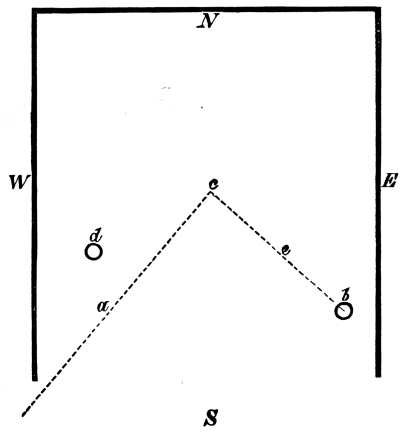 Fig. 7.
Section of the nest reveals, besides galleries, a small
chamber about three feet below the surface, across which
is spread, like a spider's web, a network of squares spun
by the insects, the squares being about ¼ inch across, and
the ends of the whole net being fastened to the earthen
walls of the chamber. In each one of the squares, supported
by the web, sits one of the honey-making ants (II.).
Here these honey makers live in perpetual confinement,
and receive a constant supply of flowers, pollen, &c., which
is continually being brought them by (I.), and which, by
a process analogous to that performed by the bee, they
convert into honey.
Such is an epitome of the only account that the world
has yet received of the habits and economy of this wonderful
insect, whose instincts of military organization seem
to be not less wonderful than those of the Ecitons, though
in this case they are developed with reference to defence,
and not to aggression. It is especially noteworthy that
the black and yellow workers are believed to belong to
'two separate genera;' for if this is the case, it is the only
one I can recall of two distinct species co-operating for a
common end; for even the nearest parallel which we find
supplied in other species of ants maintaining aphides, is
not quite the same thing, seeing that the aphides are
merely passive agents, like Class II., of the honey-making
ant, and not actively co-operating members of the community,
like Class I.
Ecitons.—We have next to consider the habits of the
wonderful 'foraging,' or, as it might be more appropriately
called, the military ant of the Amazon. These insects,
which belong to several species of the same genus, have
been carefully watched by Belt, Bates, and other naturalists.
The following facts must therefore be accepted as
fully established.
Eciton legionis moves in enormous armies, and everything
that these insects do is done with the most perfect
instinct of military organization. The army marches in
the form of a rather broad and regular column, hundreds
of yards in length. The object of the march is the capture
and plunder of other insects, &c., for food, and as the
well-organised host advances, its devastating legions set
all other terrestrial life at defiance. From the main
column there are sent out smaller lateral columns, the
composing individuals of which play the part of scouts,
branching off in various directions, and searching about
with the utmost activity for insects, grubs, &c., over every
log, under every fallen leaf, and in every nook and cranny
where there is any chance of finding prey. When their
errand is completed, they return into the main column.
If the prey found is sufficiently small for the scouts themselves
to manage, it is immediately seized, and carried
back to the main column; but if the amount is too large
for the scouts to deal with alone, messengers are sent back
to the main column, whence there is immediately dispatched
a detachment large enough to cope with the requirements.
Insects which when killed are too large for
single ants to carry, are torn in pieces, and the pieces
conveyed back to the main army by different individuals.
Many insects in trying to escape run up bushes and shrubs,
where they are pursued from branch to branch and twig
to twig by their remorseless enemies, until on arriving at
some terminal ramification they must either submit to
immediate capture by their pursuers, or drop down amid
the murderous hosts beneath. As already stated, all the
spoils that are taken by the scouts or by the detachments
sent out in answer to their demands for assistance, are
immediately taken back to the main column. When they
arrive there, they are taken to the rear of that column by
two smaller columns of carriers, which are constantly
running, one on either side of the main column, with the
supplies that are constantly pouring in from both sides.
Each of these outside columns is a double line, the ants
composing one of the two lines all running in the same
direction as the main army, and the ants composing the
other line all running in the opposite direction. The
former are empty-handed carriers, which having deposited
their burdens in the rear, are again advancing to the
van for fresh burdens. Those composing the other line
are all laden with the mangled remains of insects, pupæ
of other ants, &c. On either side of the main column
there are also constantly running up and down a few individuals
of smaller size and lighter colour than the other
ants, which seem to play the part of officers; for they
never leave their stations, and while running up and
down the outsides of the column, they every now and
again stop to touch antennæ with some member of the
rank and file, as if to give instructions. When the scouts
discover a wasp's nest in a tree, a strong force is sent out
from the main army, the nest is pulled to pieces, and all
the larvæ carried to the rear of the army, while the wasps
fly around defenceless against the invading multitude.
Or, if the nest of any other species of ant is found, a
similarly strong force, or perhaps the whole army is deflected
towards it, and with the utmost energy the innumerable
insects set to work to sink shafts and dig mines
till the whole nest is rifled of its contents. In these
mining operations the ants work with an extraordinary
display of organized co-operation; for those low down in
the shafts do not lose time by carrying up the earth which
they excavate, but pass on the pellets to those above; and
the ants on the surface, when they receive the pellets,
carry them, 'with an appearance of forethought that quite
staggered' Mr. Bates, only just far enough to ensure that
they shall not roll back again into the shaft, and, after
depositing them, immediately hurry back for more.
But there is not a rigid division of labour, although the
work 'seems to be performed by intelligent co-operation
amongst a host of eager little creatures;' for some of
them act 'sometimes as carriers of pellets, and at another
as miners, and all shortly afterwards assume the office of
conveyors of the spoil.' Again, as showing the instincts
of co-operation, the following may also be quoted from
Bates's account:—
On the following morning no trace of ants could be found
near the place where I had seen them the preceding day, nor
were there signs of insects of any description in the thicket;
but at the distance of eighty or one hundred yards, I came
upon the same army, engaged evidently on a razzia of a similar
kind to that of the previous evening; but requiring other resources
of their instinct, owing to the nature of the ground.
They were eagerly occupied on the face of an inclined bank of
light earth in excavating mines, whence, from a depth of eight
or ten inches, they were extracting the bodies of a bulky species
of ant of the genus Formica. It was curious to see them crowding
round the orifices of the mines, some assisting their comrades
to lift out the bodies of the Formicæ, and others tearing
them in pieces, on account of their weight being too great for a
single Eciton; a number of carriers seizing each a fragment,
and carrying it off down the slope.
These Ecitons have no fixed nest themselves, but live,
as it were, on a perpetual campaign. At night, however,
they call a halt and pitch a camp. For this purpose they
usually select a piece of broken ground, in the interstices
of which they temporarily store their plunder. In the
morning the army is again on the march, and before an
hour or two has passed not a single ant is to be seen
where the countless multitudes had previously covered
the ground.
Another and larger species of Eciton (E. humata)
hunts sometimes in dense armies, and sometimes in
columns, according to the kind of prey of which they are
in search. When in columns they are seeking for the
nests of a certain species of ant which have their young
in holes of rotten logs. These Ecitons when seeking for
these nests hunt about, like those just described, in
columns, which branch off in various directions. When a
fallen log is reached, the column spreads over it, searching
through all the holes and cracks. Mr. Belt says of
them:—
The workers are of various sizes, and the smallest are here
of use, for they squeeze themselves into the narrowest holes,
and search out their prey in the furthest ramifications of the
nests. When a nest of the Hypoclinea is attacked, the ants
rush out, carrying the larvæ and pupæ in their jaws, but are
immediately despoiled of them by the Ecitons, which are running
about in every direction with great swiftness. Whenever
they come across a Hypoclinea carrying a larva or pupa, they
take it from it so quickly, that I could never ascertain exactly
how it was done.
As soon as an Eciton gets hold of its prey, it rushes off back
along the advancing column, which is composed of two sets,
one hurrying forward, the other returning laden with their
booty, but all and always in the greatest haste and apparent
hurry. About the nest which they are harrying, all appears in
confusion, Ecitons running here and there and everywhere in
the greatest haste and disorder; but the result of all this apparent
confusion is that scarcely a single Hypoclinea gets away
with a pupa or larva. I never saw the Ecitons injure the
Hypoclineas themselves, they were always contented with despoiling
them of their young.
The columns of this species 'are composed almost
entirely of workers of different sizes;' but, as in the
species previously mentioned, 'at intervals of two or
three yards there are larger and lighter coloured individuals
that often stop, and sometimes run a little backward,
stopping and touching some of the ants with their
antennæ,' and looking 'like officers giving orders and directing
the march of the column.'
Concerning the other habits of this species, the same
author writes:—
The eyes in the Ecitons are very small, in some of the
species imperfect, and in others entirely absent; in this they
differ greatly from the Pseudomyrma ants, which hunt singly
and which have the eyes greatly developed. The imperfection
of eyesight in the Ecitons is an advantage to the community,
and to their particular mode of hunting. It keeps them together,
and prevents individual ants from starting off alone
after objects that, if their eyesight was better, they might discover
at a distance; the Ecitons and most other ants follow
each other by scent, and, I believe, they can communicate the
presence of danger, of booty, or other intelligence, to a distance
by the different intensity or qualities of the odours given off. I
one day saw a column of Eciton hamata running along the foot
of a nearly perpendicular tramway cutting, the side of which
was about six feet high. At one point I noticed a sort of
assembly of about a dozen individuals that appeared in consultation.
Suddenly one ant left the conclave, and ran with great
speed up the perpendicular face of the cutting without stopping.
It was followed by others, which, however, did not keep straight
on like the first, but ran a short way, then returned, then again
followed a little further than the first time. They were evidently
scenting the trail of the pioneer, and making it permanently
recognisable. These ants followed the exact line
taken by the first one, although it was far out of sight. Wherever
it had made a slight détour they did so likewise. I scraped
with my knife a small portion of the clay on the trail, and the
ants were completely at fault for a time which way to go.
Those ascending and those descending stopped at the scraped
portion, and made short circuits until they hit the scented trail
again, when all their hesitation vanished, and they ran up and
down it with the greatest confidence. On gaining the top of
the cutting, the ants entered some brushwood suitable for hunting.
In a very short space of time the information was communicated
to the ants below, and a dense column rushed up to
search for their prey. The Ecitons are singular amongst the
ants in this respect, that they have no fixed habitations, but
move on from one place to another, as they exhaust the hunting
grounds around them. I think Eciton hamata does not stay
more than four or five days in one place. I have sometimes
come across the migratory columns; they may easily be known.
Here and there one of the light-coloured officers moves backwards
and forwards directing the columns. Such a column is
of enormous length, and contains many thousands if not millions
of individuals. I have sometimes followed them up for two or
three hundred yards without getting to the end.
They make their temporary habitations in hollow trees, and
sometimes underneath large fallen trunks that offer suitable
hollows. A nest that I came across in the latter situation was
open at one side. The ants were clustered together in a dense
mass, like a great swarm of bees, hanging from the roof but
reaching to the ground below. Their innumerable long legs
looked like brown threads binding together the mass, which
must have been at least a cubic yard in bulk, and contained
hundreds of thousands of individuals, although many columns
were outside, some bringing in the pupæ of ants, others the legs
and dissected bodies of various insects. I was surprised to see
in this living nest tubular passages leading down to the centre
of the mass, kept open just as if it had been formed of inorganic
materials. Down these holes the ants who were bringing in
booty passed with their prey. I thrust a long stick down to
the centre of the cluster, and brought out clinging to it many
ants holding larvæ and pupæ, which probably were kept warm
by the crowding together of the ants. Besides the common
dark-coloured workers and light-coloured officers, I saw here
many still larger individuals with enormous jaws. These
they go about holding wide open in a threatening manner.
It was this ant which, as previously stated, showed
sympathy and fellow-feeling with companions in difficulties.
The habits of E. drepanophora are closely similar
to those of the species already described; and, indeed,
except in matters of detail, all the species of Ecitons have
much the same habits. Mr. Bates records an interesting
observation which he made on one of the moving columns
of this species. He says: 'When I interfered with the
column or abstracted an individual from it, news of the
disturbance was quickly communicated to a distance of
several yards to the rear, and the column at that point
commenced retreating.' The main column is in this
species narrower, viz., 'from four to six deep,' but extends
to a great length, viz., half a mile or more. It was this
species of Eciton that the same naturalist describes as enjoying
periods of leisure and recreation in the 'sunny
nooks of the forest.'
Next we have to consider E. prædator, of which the
same observer writes:—
This is a small dark reddish species, very similar to the
common red stinging ant of England. It differs from all other
Ecitons in its habit of hunting, not in columns, but in dense
phalanxes consisting of myriads of individuals, and was first met
with at Ega, where it is very common. Nothing in insect
movements is more striking than the rapid march of these
large and compact bodies. Wherever they pass, all the rest of
the animal world is thrown into a state of alarm. They stream
along the ground and climb to the summits of all the lower
trees, searching every leaf to its apex, and whenever they encounter
a mass of decaying vegetable matter, where booty is
plentiful, they concentrate, like other Ecitons, all their forces
upon it, the dense phalanx of shining and quickly-moving
bodies, as it spreads over the surface, looking like a flood of
dark red liquid. They soon penetrate every part of the confused
heap, and then, gathering together again in marching
order, onward they move. All soft-bodied and inactive insects
fall an easy prey to them, and, like other Ecitons, they tear
their victims in pieces for facility of carriage. A phalanx of
this species, when passing over a tract of smooth ground, occupies
a space of from four to six square yards; on examining
the ants closely they are seen to move, not all together in one
straightforward direction, but in variously spreading contiguous
columns, now separating a little from the general mass, now
reuniting with it. The margins of the phalanx spread out at
times like a cloud of skirmishers from the flanks of an army.
I was never able to find the hive of this species.
Lastly, there are two species of Eciton totally blind,
and their habits differ from those of the species which
we have hitherto considered. Bates writes of them:—
The armies of E. vastator and E. erratica move, as far as I
could learn, wholly under covered roads, the ants constructing
them gradually but rapidly as they advance. The column of
foragers pushes forward step by step, under the protection of
these covered passages, through the thickets, and on reaching a
rotting log, or other promising hunting-ground, pour into the
crevices in search of booty. I have traced their arcades, occasionally,
for a distance of one or two hundred yards; the grains
of earth are taken from the soil over which the column is passing,
and are fitted together without cement. It is this last-mentioned
feature that distinguishes them from the similar
covered roads made by termites, who use their glutinous saliva
to cement the grains together. The blind Ecitons, working in
numbers, build up simultaneously the sides of their convex
arcades, and contrive, in a surprising manner, to approximate
them and fit in the key-stones without letting the loose uncemented
structure fall to pieces. There was a very clear division
of labour between the two classes of neuters in these
blind species. The large-headed class, although not possessing
monstrously lengthened jaws like the worker-majors in E.
hamata and E. drepanophora, are rigidly defined in structure
from the small-headed class, and act as soldiers, defending the
working community (like soldier termites) against all comers.
Whenever I made a breach in one of their covered ways, all
the ants underneath were set in commotion, but the worker-minors
remained behind to repair the damage, whilst the large-heads
issued forth in a most menacing manner, rearing their
heads and snapping their jaws with an expression of the fiercest
rage and defiance.
Annornia arcens.—This is the so-called 'driver' or
'marching' ant of West Africa, which in habits and intelligence
closely resembles the military ants of the other
hemisphere. I shall therefore not wait again to describe
these habits in detail. Like the Ecitons, the marching
ants of Africa have no fixed nest, but make temporary halts
in the shade of hollow trees, overhanging rocks, &c.
They march in large armies, and, like the Ecitons, always
in the form of a long close column; but in this case the
relative position of the carriers of spoil and larvæ is reversed,
for while these occupy the middle place the
soldiers and officers march on either side. These have
large heads armed with powerful jaws, and never take
part in carrying; their function is to maintain order, act
as scouts, and attack prey. The habits of these ants
resemble most closely those of the blind Ecitons in that
they very frequently, and indeed generally, build covered
ways; they do so apparently in order to protect themselves
from the heat of the African sun. Their line of march
is therefore marked by a continuous arch or tunnel, which
is always being constructed by the van of the column.
The structure is made of earth moulded together by
saliva, and is very quickly built. But it is only built in
places where the line of march is exposed to the sunlight;
at night, or in the shadow of trees or long grass, it
is not made. If their camp is flooded by a tropical rainstorm,
the ants congregate in a close mass, with the
younger ants in the centre; they thus form a floating
island.
It is remarkable that ants of different hemispheres
should manifest so close a similarity with respect to all
these wonderful habits. The Chasseur ants of Trinidad,
and, according to Madame Merian, the ants of visitation
of Cayenne, also display habits of the same kind.
Many of the foregoing facts display an astonishing degree
of intelligence as obtaining among ants; for I think
that however much latitude we may be inclined to allow to
'blind instinct' in the way of imitating actions elsewhere
due to conscious purpose, some at least of these foregoing
facts can only be fairly reconciled with the view that the
insects know what they are doing and why they are doing
it. But as I am myself well aware of the difficulty that
arises in all such cases of drawing the line between purposeless
instinct and purposive intelligence, I have thought
it desirable to reserve for this concluding division of the
present chapter several isolated facts which have been observed
among sundry species of ants, and which do not
seem to admit of being reasonably comprised under the
category of instinctive action, if by the latter we mean
action pursued without knowledge of the relation between
the means adopted and the ends attained.
It will be remembered that our test of instinctive as
distinguished from truly intelligent action is simply
whether all individuals of a species perform similar adaptive
movements under the stimulus supplied by similar
and habitual circumstances, or whether they manifest individual
and peculiar adaptive movements to meet the
exigencies of novel and peculiar circumstances. The importance
of this distinction may be rendered manifest by
the following illustrations.
 Fig. 8.
We have already seen that the ants which Sir John
Lubbock observed display many and complex instincts,
which together might seem to justify us in anticipating
that animals which present such wonderful instincts must
also present sufficient general intelligence to meet simple
though novel exigencies by such simple adaptations as the
unfamiliar circumstances require. Yet experiments which
he made in this connection seem to show that such is not
the case, but that these ants, with all their wealth of
instinctive endowments, are utterly destitute of intelligent
resources; they have abundance of common and
detailed knowledge (supposing the adaptations to be made
consciously) how to act under certain complex though
familiar circumstances, but appear quite unable to originate
any adaptive action to obviate even the simplest
conceivable difficulty, if this is of a kind which they have
not been previously accustomed to meet. Thus, on a
horizontal rod B supported in a saucer of water S, and
therefore inaccessible to the ants from beneath, he placed
some larvæ A. On the nest N he then placed a block of
wood C D, constructed so that the portion D should touch
the larvæ at A. When the ants had made a number of
journeys over C D A and back again, he raised the block C D
so that there was an interval 3/10 of an inch between the end
of the block D and the larvæ at A.
The ants kept on coming, and tried hard to reach down
from D to A, which was only just out of their reach. . . . . After
a while they all gave up their efforts and went away,
losing their prize in spite of most earnest efforts, because it
did not occur to them to drop 3/10 of an inch. At the moment
when the separation was made there were fifteen ants on
the larvæ. These could, of course, have returned if one had
stood still and allowed the others to get on its back. This,
however, did not occur to them; nor did they think of letting
themselves drop from the bottom of the paper (P) on to the
nest. Two or three, indeed, fell down, I have no doubt by
accident; but the remainder wandered about, until at length
most of them got into the water.
In another experiment he interposed a light straw
bridge on the way between the nest and the larvæ, and
when the ants had well learnt the way, he drew the
bridge a short distance towards the nest, so that a small
chasm was made in the road. The ants tried hard and
ineffectually to reach across it, but it did not occur to
them to push the straw into its original position.
The following experiment is still more illustrative of
the absence of intelligence, because the adjustive action
required would not demand the exercise of such high
powers of imagination and abstraction as would have been
required for the moving forwards of the paper drawbridge.
To test their intelligence I made the following experiments:
I suspended some honey over a nest of Lasius flavus at a
height of about ½ an inch, and accessible only by a paper bridge
more than 10 feet long. Under the glass I then placed a
small heap of earth. The ants soon swarmed over the earth
on to the glass, and began feeding on the honey. I then removed
a little of the earth, so that there was an interval of
about 1/3 of an inch between the glass and the earth; but
though the distance was so small, they would not jump down,
but preferred to go round by the long bridge. They tried in
vain to stretch up from the earth to the glass, which, however,
was just out of their reach, though they could touch it with
their antennæ; but it did not occur to them to heap the earth
up a little, though if they had moved only half a dozen particles
of earth they would have secured for themselves direct access to
the food. This, however, never occurred to them. At length
they gave up all attempts to reach up to the glass, and went
round by the paper bridge. I left the arrangement for several
weeks, but they continued to go round by the long paper
bridge.
Another and somewhat similar experiment consisted
in placing an upright stick A, supporting at an angle
another stick B, which nearly but not quite touched
the ground at C. At the end of the stick B there were
placed some larvæ in a horizontal glass cell at D. Into
this cell were also placed a number of ants along with the
larvæ. The drop from D to C was only ½ an inch; 'still,
though the ants reached over and showed a great anxiety
to take this short cut home, they none of them faced the
leap, but all went round by the sticks, a distance of nearly
7 feet.' Sir John then reduced the interruption to 2/5 of
an inch, so that the ants could even touch the glass cell
with their antennæ; yet all day long the ants continued
to go the long way round rather than face the drop. Next,
therefore, he took still longer sticks and tapes, and arranged
them as before, only horizontally instead of vertically.
He also placed some fine earth under the glass
cell containing the larvæ. The ants as before continued
to go the long way round (16 feet), though the drop
could not have hurt either themselves or the larvæ, and
though even this drop might have been obviated by heaping
up the fine earth into a little mound 1/8 of an inch high,
so as to touch the glass cell.
It is desirable, however, here to state that all species
of ants do not show this aversion to allowing themselves
to drop through short distances; for Moggridge describes
the harvesting ants of Europe as seeming rather to enjoy
acrobatic performances of this kind; and the same fact is
recorded by Belt of the leaf-cutting ants of the Amazons.
Dr. Bastian, in his work on 'Brain as an Organ of Mind,'
suggests that the 'seeming lack of intelligence betrayed
by our English ants, from their disinclination to take a
small leap, may be due simply to their defective sight'
(pp. 241-2). But even this consideration does not extenuate
the stupidity of the ants which failed to heap up
the fine earth to reach the glass cell which they were able
to touch with their antennæ.
That the species of ants on which Sir John Lubbock
experimented were not, however, quite destitute of intelligence
is proved by the result of the following experiment:—
I put some provisions in a shallow box with a glass top and
a single hole in one side; I then put some specimens of Lasius
niger to the food, and soon a stream of ants was at work busily
carrying supplies off to the nest. When they had got to know
their way thoroughly, and from thirty to forty were so occupied,
I poured some fine mould in front of the hole, so as to cover it
to a depth of about ½ an inch. I then took out the ants which
were actually in the box. As soon as the ants had recovered
from the shock of this unexpected proceeding on my part, they
began to run all round and about the box, looking for some
other place of entrance. Finding none, however, they began
digging down into the earth just over the hole, carrying off the
grains of earth one by one and depositing them without any
order all round at a distance of from ½ to 6 inches, until they
had excavated down to the doorway, when they again began
carrying off the food as before.
This experiment was several times repeated on L. niger
and on L. flavus, always with the same result.
Thus, then, we may conclude that the reasoning power
of these ants, although shown by the first experiments to
be almost nil, is shown by this experiment to be not quite
nil; for the attempt to meet the exigencies of the case
by first going round the box to seek another entrance,
before taking the labour to remove the earth from the
known entrance, implies a certain rudimentary degree of
adaptive capacity which belongs to the category of the
rational.
Another point of considerable interest, as bearing on
the general intelligence of ants, is one that was brought
out as the result of a laborious series of hourly observations,
extending without intermission from 6.30 A.M. to
10 P.M. for a period of three months. The object of these
observations was to ascertain whether the principle of the
division of labour is practised by the ants. The result of
these observations was to show that during the winter-time,
when the ants are not active, certain individuals are
told off to forage for supplies, and that when any casualty
overtakes these individuals, others are told off to supply
their places. Thus, in the words of Sir John Lubbock's
analysis of his lengthy tables,—
The feeders at the beginning of the experiment were those
known to us as Nos. 5, 6, and 7. On the 22nd of November a
friend, registered as No. 8, came to the honey, and again on the
11th December; but with these two exceptions the whole of
the supplies were carried in by Nos. 5 and 6, with a little help
from No. 7. Thinking now it might be alleged that possibly these
were merely unusually active or greedy individuals, I imprisoned
No. 6 when she came out to feed on the 5th. As will
be seen from the table, no other ant had been out to the honey
for some days; and it could therefore hardly be accidental that
on that very evening another ant (then registered as No. 9)
came out for food. This ant, as will be seen from the table,
then took the place of No. 6 (No. 5 being imprisoned). On the
11th January No. 9 took in all the supplies, again with a little
help from No. 7. So matters continued until the 17th, when I
imprisoned No. 9, and then again, i.e. on the 19th, another ant
(No. 10) came out for the food, aided, on and after the 22nd,
by another (No. 11). This seems to me very curious. From the 1st
November to the 5th January, with two or three casual exceptions,
the whole of the supplies were carried in by three ants,
one of whom, however, did comparatively little. The other two
are imprisoned, and then, but not till then, a fresh ant appears
on the scene. She carries in the food for a week, and then she
being imprisoned, two others undertake the task. On the
other hand, in nest 1, when the first foragers were not imprisoned,
they continued during the whole time to carry in
the necessary supplies.
The facts, therefore, certainly seem to indicate that
certain ants are told off as foragers, and that during
winter, when but little food is required, two or three such
foragers are sufficient to provide it.
Although Sir John Lubbock's ants showed such meagre
resources of intelligent adjustment, other species of ants,
which we have already had occasion to consider, appear to
be as remarkable in this respect as they are in respect of
their instinctive adjustments. Unfortunately observations
on this subject are very sparse, but such as they are they
hold out a strong inducement for any one who has the
opportunity to experiment with the view of testing the
intelligence of those species in connection with which the
following observations have been made.
Réaumur states that ants will make no attempt to enter an
inhabited beehive to get at the contained honey, knowing that
the bees will slaughter them if they do so. But if the hive is
uninhabited, or the bees all dead, the ants will swarm into the
hive as long as any honey is to be found there.
P. Huber records that a wall which had been partly
erected by ants was observed by him—
As though it were intended to support the still unfinished
arched roof of a large room, which was being built from the
opposite side. But the workers which had begun the arch had
given it too low an elevation for the wall on which it was to
rest, and if it had been continued on the same lines it would
have met the partition wall halfway up, and this was to be
avoided. I had just made this criticism to myself, when a new
arrival, after looking at the work, came to the same conclusion.
For it began at once to destroy what had been done, and to
heighten the wall on which it was supported, and to make a
new arch with the materials of the old one under my very eyes.
When the ants begin an undertaking it seems exactly as if an
idea slowly ripened into execution in their minds. Thus if one
of them finds two stalks lying crosswise on the nest, which make
possible the formation of a room, or some little rafters which
suggest the walls and the corners, it first observes the various
parts accurately, and then quickly and neatly heaps little pellets
of earth in the interspaces and alongside the stalks. It brings
from every side materials that seem appropriate, and sometimes
takes such from the uncompleted works of its companions,
so much is it urged on by the idea which it has once conceived,
and by the desire to execute it. It goes and comes and turns
back again, until its plan is recognisable by the others.
Ebrard, in his 'Etudes de Mœurs' (p. 3), gives the
following remarkable instance of the display of intelligence
of F. fusca:—
The earth was damp and the workers were in full swing.
It was a constant coming and going of ants, coming forth
from their underground dwelling, and carrying back little
pellets of earth for building. In order to concentrate my
attention I fixed my gaze on the largest of the rooms which
were being built, wherein several ants were busy. The work
had made considerable progress; but although a projection
could be plainly seen along the upper edge of the wall, there
remained an interspace of about twelve or fifteen millimetres
to fill in. Here would have been the place, in order to support
the earth still to be brought in, to have had recourse to those
pillars, buttresses, or fragments of dried leaves, which many
ants are wont to use in building. But the use of this expedient
is not customary with the ants I was observing (F. fusca).
Our ants, however, were sufficient for the occasion. For
a moment they seemed inclined to leave their work, but
soon turned instead to a grass-plant growing near, the long
narrow leaves of which ran close together. They chose the
nearest, and weighted its distal end with damp earth, until its
apex just bent down to the space to be covered. Unfortunately
the bend was too close to the extremity, and it threatened to
break. To prevent this misfortune, the ants gnawed at the
base of the leaf until it bent along its whole length and covered
the space required. But as this did not seem to be quite enough,
they heaped damp earth between the base of the plant and that
of the leaf, until the latter was sufficiently bent. After they
had thus attained their object, they heaped on the buttressing
leaf the materials required for building the arched roof.
The characteristic trait of the building of ants, says Forel,
is the almost complete absence of an unchangeable model,
peculiar to each species, such as is found in wasps, bees, and
others. The ants know how to suit their indeed little perfect
work to circumstances, and to take advantage of each situation.
Besides, each works for itself and on a given plan, and is only
occasionally aided by others when these understand its plan.
Naturally many collisions occur, and some destroy that which
others have made. This also gives the key to understanding
the labyrinth of the dwelling. For the rest, it is always those
workers which have discovered the most advantageous method,
or which have shown the most patience, which win over to their
plan the majority of their comrades and at last the whole colony,
although not without many fights for supremacy. But if one
succeeds in obtaining a second to follow it, and this second
draws the others after it, the first is soon lost again in the
crowd.
Espinas also observed ('Thierischen Gesellschaften,'
German translation, 1879, p. 371) that each single ant
made its own plan and followed it until a comrade, which
had caught the idea, joined it, and then they worked together
in the execution of the same plan.
Moggridge says of the harvesters of Europe,—
I have observed on more than one occasion that when in
digging into an ants' nest I have thrown out an elater larva,
the ants would cluster round it and direct it towards some
small opening in the soil, which it would quickly enlarge and
disappear down. At other times, however, the ants would take
no notice of the elater, and it is my belief that the attentions
paid to it on former occasions were purely selfish, and that
they intended to avail themselves of the tunnel thus made
down into the soil, with the view of reopening communications
with the galleries and granaries concealed below, the approaches
to which had been covered up. I have frequently watched the
ants make use of these passages mined by the elater on these
occasions.
And again, as showing apparently intelligent adaptation
of their usual habits to altered circumstances, he gives an
account of the behaviour of these ants when a great
crowd of them were confined by him in a glass jar containing
earth. He says:—
On the following morning the openings were ten in number,
and the greatly increased heaps of excavated earth showed that
they must probably have been at work all night. The amount
of work done in this short time was truly surprising, for it
must be remembered that, eighteen hours before, the earth presented
a perfectly level surface, and the larvæ and ants, now
housed below, found themselves prisoners in a strange place,
bounded by glass walls, and with no exit possible.
It seems to me that the ants displayed extraordinary intelligence
in having thus at a moment's notice devised a plan by
which the superabundant number of workers could be employed
at one time without coming in one another's way. The
soil contained in the jar was of course less than a tenth part of
that comprised within the limits of an ordinary nest, while the
number of workers was probably more than a third of the total
number belonging to the colony. If therefore but one or two
entrances had been pierced in the soil, the workers would have
been for ever running against one another, and a great number
could never have got below to help in the all-important task
of preparing passages and chambers for the accommodation of
the larvæ. These numerous and funnel-shaped entrances admitted
of the simultaneous descent and ascent of large numbers
of ants, and the work progressed with proportionate rapidity.
After a few days only three entrances, and eventually only one,
remained open.
Concerning the harvesting ant of Texas, the following
quotation may be made, under the present head, from
MacCook. After remarking that these ants always select
sunny places wherein to build their nests, or disks, he
goes on to say that within a few paces of his tent—
A nest was made which was partly shaded by a small mesquite
tree that stood just beyond the margin of the clearing.
The sapling had probably grown up after the location of the
community, and for some reason had been permitted to remain
until too old to kill off. The shadow thrown upon the pavement
was very slight; nevertheless, fifteen feet distant a new
formicary was being established. The path from the ranch to
the spring ran between this new hill and the old one, and ants
were in communication between the two. An opening had
been made in the ground, and the beginnings of a new formicary
were quite apparent. This is the only instance observed of
what seemed an attempt at colonising or removing, and I associated
it with the presence of the small but growing shadow
of the young tree.
He also gives us a still more remarkable observation,
which indeed, I must candidly say, does not appear to me
credible. I am, therefore, glad to add that it does not
appear very distinctly from the account whether the
author himself made the observation, or had it narrated
to him by his guide. But here is the observation in his
own words:—
While studying the habits of the cutting ant I was tempted
to make a night visit to a farm some distance from camp, by
the farmer's story of depredations made by these insects upon
certain plants and vegetables. A long, dark tramp, a blind
and vain search among the fields, compelled us at last to call
out the countryman from his bed. He led us directly to one
of the cutting ants' nests, which was overshadowed by a
young peach tree. 'There they be, sir,' cried he triumphantly.
They were agriculturals! So also were the other nests shown.
The reason for this confounding of the two ants on the part of
the people hereabouts, and the reason for the 'cutting' operations
of our harvesters, will be explained farther on. It is only in
point here to say that the farmer affirmed that the ants under
the peach tree had stripped off the first tender leaves last spring,
so that scarcely one had been left upon the limbs. I am convinced
that the reason for this onslaught was the desire to be rid
of the obnoxious shade, and open the formicary to the full light
of the sun.
From this account it is not very clear whether the
writer himself saw evidence of the former denudation of
the tree, and if so whether there was any indication,
other than the word of the farmer, that the denudation
had been effected by the ants. To make this conclusion
credible the best conceivable evidence would be required,
and this, unfortunately, is just what we find wanting.
Somewhat the same remarks may be made on the following
quotation from the same writer, though in this case
his view is to some extent supported by an observation of
Moggridge, as well as by that of Ebrard already quoted:—
Here I observed what appeared to be a new mode of operation.
The workers, in several cases, left the point at which
they had begun a cutting, ascended the blade, and passed as
far out toward the point as possible. The blade was thus borne
downward, and as the ant swayed up and down it really
seemed that she was taking advantage of the leverage thus
gained, and was bringing the augmented force to bear upon the
fracture. In two or three cases there appeared to be a division
of labour; that is to say, while the cutter at the roots kept on
with her work, another ant climbed the grass blade and applied
the power at the opposite end of the lever. This position may
have been quite accidental, but it certainly had the appearance
of a voluntary co-operation. I was sorry not to be able to establish
this last inference by a series of observations, as the
facts were only observed in this one nest.
The observation of Moggridge, to which I have alluded
as in some measure rendering support to the foregoing, is
as follows. Speaking of European harvesters which he
kept in an artificial nest for the purposes of close observation,
he says:—
I was also in this way able to see for myself much that I
otherwise could not have seen. Thus I was able to watch the
operation of removing roots which had pierced through their
galleries, belonging to seedling plants growing on the surface,
and which was performed by two ants, one pulling at the free
end of the root, and the other gnawing at its fibres where the
strain was greatest, until at length it gave way.
And again,—
Two ants sometimes combine their efforts, when one stations
itself near the base of the peduncle, and gnaws it at the point of
greatest tension, while the other hauls upon and twists it. . . . .
I have occasionally seen ants engaged in cutting the capsules
of certain plants, drop them, and allow their companions below
to carry them away.
Lastly, the statements of these three observers taken
together serve to render credible the following quotation
from Bingley,[43] who says that in Captain Cook's expedition
in New South Wales ants were seen by Sir Joseph Banks
and others—
As green as a leaf, which live upon trees and build their
nests of various sizes, between that of a man's head and his fist.
These nests are of a very curious structure: they are formed by
bending down several of the leaves, each of which is as broad
as a man's hand, and gluing the points of them together so as
to form a purse. The viscous matter used for this purpose is
an animal juice. . . . . Their method of bending down leaves we
had no opportunity to observe; but we saw thousands uniting
all their strength to hold them in this position, while other busy
multitudes were employed within, in applying this gluten, that
was to prevent their returning back. To satisfy ourselves that
the leaves were bent and held down by the efforts of these diminutive
artificers, we disturbed them in their work; and as soon
as they were driven from their station, the leaves on which they
were employed sprang up with a force much greater than we
could have thought them able to conquer by any combination
of their strength.
This remarkable fact also seems to be corroborated
by the following independent observation of Sir E.
Tennent:—
The most formidable of all is the great red ant, or Dimiya.
It is particularly abundant in gardens and on fruit-trees; it
constructs its dwellings by gluing the leaves of such species as
are suitable from their shape and pliancy into hollow balls, and
these it lines with a kind of transparent paper, like that manufactured
by the wasp. I have watched them at the interesting
operation of forming these dwellings;—a line of ants standing
on the edge of one leaf bring another into contact with it, and
hold both together with their mandibles till their companions
within attach them firmly by means of their adhesive paper, the
assistants outside moving along as the work proceeds. If it be
necessary to draw closer a leaf too distant to be laid hold of by
the immediate workers, they form a chain by depending one
from the other till the object is reached, when it is at length
brought into contact, and made fast by cement.
I shall now pass on to the remarkable observation communicated
to Kirby by Colonel Sykes, F.R.S., and which
is thus narrated by Kirby in his 'History, Habits, and
Instincts of Animals:'—
When resident at Poona, the dessert, consisting of fruits,
cakes, and various preserves, always remained upon a small side
table, in a verandah of the dining-room. To guard against
inroads, the legs of the table were immersed in four basins filled
with water; it was removed an inch from the wall, and, to
keep off dust from open windows, was covered with a tablecloth.
At first the ants did not attempt to cross the water, but as the
strait was very narrow, from an inch to an inch and a half, and
the sweets very tempting, they appear, at length, to have braved
all risks, to have committed themselves to the deep, to have
scrambled across the channel, and to have reached the objects
of their desires, for hundreds were found every morning revelling
in enjoyment: daily vengeance was executed upon them without
lessening their numbers; at last the legs of the table were
painted, just above the water, with a circle of turpentine. This
at first seemed to prove an effectual barrier, and for some days
the sweets were unmolested, after which they were again attacked
by these resolute plunderers; but how they got at
them seemed totally unaccountable, till Colonel Sykes, who often
passed the table, was surprised to see an ant drop from the wall,
about a foot above the table, upon the cloth that covered it;
another and another succeeded. So that though the turpentine
and the distance from the wall appeared effectual barriers, still
the resources of the animal, when determined to carry its point,
were not exhausted, and by ascending the wall to a certain
height, with a slight effort against it, in falling it managed to
land in safety upon the table.
Colonel Sykes was a good observer, so that this statement,
standing upon his authority, ought not, perhaps, to
be questioned. But in all cases of remarkable intelligence
displayed by animals, we naturally and properly desire
corroboration, however good the authority may be on
which the statement of such cases may rest. I will, therefore,
add the following instances of the ingenious and
determined manner in which ants overcome obstacles, and
which so far lend confirmation to the above account.
Professor Leuckart placed round the trunk of a tree,
which was visited by ants as a pasture for aphides, a broad
cloth soaked in tobacco-water. When the ants returning
home down the trunk of the tree arrived at the soaked
cloth, they turned round, went up the tree again to some
of the overhanging branches, and allowed themselves to
drop clear of the obnoxious barrier. On the other hand,
the ants which desired to mount the tree first examined
the nature of the barrier, then turned back and procured
from a distance little pellets of earth, which they carried
in their jaws and deposited one after another upon the
tobacco-cloth till a road of earth was made across it, over
which the ants passed to and fro with impunity.
This interesting, and indeed surprising observation of
Leuckart's is, in turn, a corroboration of an almost
identical one made more than a century ago by Cardinal
Fleury, and communicated by him to Réaumur, who
published it in his 'l'Histoire des Insectes' (1734).
The Cardinal smeared the trunk of a tree with birdlime
in order to prevent the ants from ascending it; but the
insects overcame the obstacle by making a road of earth,
small stones, &c., as in the case just mentioned. In
another instance the Cardinal saw a number of ants make
a bridge across a vessel of water surrounding the bottom
of an orange-tree tub. They did so by conveying a
number of little pieces of wood, the choice of which
material instead of earth or stones, as in the previous case,
seems to betoken no small knowledge of practical engineering.
Büchner, after quoting these cases, proceeds to say
(loc. cit., p. 120),—
The ants behaved in yet more ingenious fashion under the
following very similar circumstances. Herr G. Theuerkauf,
the painter (Wasserthorstr. 49, Berlin), writes to the author,
November 18, 1875: 'A maple tree standing on the ground
of the manufacturer, Vollbaum, of Elbing (now of Dantzic),
swarmed with aphides and ants. In order to check the mischief,
the proprietor smeared about a foot width of the ground
round the tree with tar. The first ants who wanted to cross
naturally stuck fast. But what did the next? They turned
back to the tree and carried down aphides, which they stuck down
on the tar one after another until they had made a bridge over
which they could cross the tarring without danger. The above-named
merchant, Vollbaum, is the guarantor of this story,
which I received from his own mouth on the very spot whereat
it occurred.'
Büchner also gives the following case on the authority
of Karl Vogt (loc. cit., p. 128). An apiary of a friend was
invaded by ants:—
To make this impossible for the future, the four legs of the
beehive-stand were put into small, shallow bowls filled with
water, as is often done with food in ant-infested places. The
ants soon found a way out of this, or rather a way into their
beloved honey, and that over an iron staple with which the
stand was attached to a neighbouring wall. The staple was
removed, but the ants did not allow themselves to be defeated.
They climbed into some linden trees standing near, the branches
of which hung over the stand, and then dropped upon it from
the branches, doing just the same as their comrades do with
respect to food surrounded by water, when they drop upon it
from the ceiling of the room. In order to make this impossible,
the boughs were cut away. But once more the ants
were found in the stand, and closer investigation showed
that one of the bowls was dried up, and that a crowd of ants
had gathered in it. But they found themselves puzzled how to
go on with their robbery, for the leg did not, by chance, rest on
the bottom of the bowl, but was about half an inch from it.
The ants were seen rapidly touching each other with their
antennæ, or carrying on a consultation, until at last a rather
larger ant came forward and put an end to the difficulty. It
rose to its full height on its hind legs, and struggled until at
last it seized a rather projecting splinter of the wooden leg, and
managed to take hold of it. As soon as this was done other
ants ran on to it, strengthened the hold by clinging, and so made
a little living bridge, over which the others could easily pass.
The same author publishes the following very remarkable
observation, quoted from a letter to him by Dr. Ellendorf:—
It is a hard matter to protect any eatables from these
creatures, let the custody be ever so close. The legs of cupboards
and tables in or on which eatables are kept are placed in
vessels of water. I myself did this, but I none the less found
thousands of ants in the cupboard next morning. It was a
puzzle to me how they crossed the water, but the puzzle was
soon solved; for I found a straw in one of the saucers, which
lay obliquely across the edge of the pan and touched the leg
of the press: this they had used for a bridge. Hundreds were
drowned in the water, apparently because disorder had reigned
at first, those coming down with booty meeting those going up.
But now there was perfect order; the descending stream used
one side of the straw, the ascending the other. I now pushed
the straw about an inch away from the cupboard leg; a terrible
confusion arose. In a moment the leg immediately over the
water was covered with hundreds of ants, feeling for the bridge
in every direction with their antennæ, running back again and
coming in ever larger swarms, as though they had communicated
to their comrades within the cupboard the fearful misfortune
that had taken place. Meanwhile the new-comers continued
to run along the straw, and not finding the leg of the cupboard
the greatest perplexity arose. They hurried round the edge of
the pan, and soon found out where the fault lay. With united
forces they quickly pulled and pushed at the straw, until it
again came into contact with the wood, and the communication
was again restored.
This observation is strikingly, though unconsciously,
confirmed by a recent writer in the Leisure Hour (1880,
pp. 718-19), who having been much troubled by small red
ants in the tropics swarming over his provisions, placed
the latter in a meat-safe detached from the wall and
standing on four legs, each of which was placed in a little
tin vessel containing water. Eight or ten days afterwards
he found his provisions in the safe swarming with ants as
before, and on investigating their mode of access to them
found—
Proceeding along the whitewashed wall a string of ants
going and coming from the outer door to a height of four feet
on my wall, and corresponding with that of the safe; and looking
between it and the wall, I discovered the secret—the bridge
which these persevering little insects had made. It consisted of
a broken bit of straw, which rested with one end on a mud
buttress fixed to the wall, and the other on the overhanging or
projecting top of the safe, which came within an inch and a half
of the wall. So they must have carried the straw up from the
floor, and resting their end of it on the support they had prepared,
let it fall until its other end reached the safe, and then
crossed and completed the structure, for it was fastened at both
ends with the mortar composed of their saliva and fine earth.
Ruthlessly I destroyed the bridge, and moving the safe farther
from the wall, managed to prevent their inroads for that season
at least. Since then I have frequently seen short bridges, composed
entirely of the concrete or mortar which the white ants
use to cover up their workings, extending from a damp earthen
wall to anything not more than three-quarters of an inch
from it.
Of the Ecitons Mr. Belt says:—
I shall relate two more instances of the use of a reasoning
faculty in these ants. I once saw a wide column trying to pass
along a crumbling, nearly perpendicular slope. They would
have got very slowly over it, and many of them would have
fallen, but a number having secured their hold, and reaching
to each other, remained stationary, and over them the main
column passed. Another time they were crossing a watercourse
along a small branch, not thicker than a goose-quill. They
widened this natural bridge to three times its width by a
number of ants clinging to it and to each other on each side,
over which the column passed three or four deep; whereas
excepting for this expedient they would have had to pass over
in single file, and treble the time would have been consumed.
Can it be contended that such insects are not able to determine
by reasoning powers which is the best way of doing a thing?
Another observer, writing from the same part of the
world to Büchner, gives a still more wonderful account of
the ingenuity of Ecitons in crossing water. This observer
is Herr H. Kreplin, of Heidemühl (Station Ducherom),
'who lived for nearly twenty years in South America as
an engineer, and had often the opportunity of seeing the
driver ants in the forests there.' He writes to Büchner,
under date May 10, 1876, as follows:—
On both sides of the train, at about 10 mm. distance from
each other, stronger ants are to be seen, distinguishable from
the others by their foxy colour and very thick heads with
gigantic mandibles. These 'thickheads' play the same rôle in
the ant-state for which they are cast in cultured communities.
They look after the order of the march, and allow none to turn
either to the right or left. The least confusion in the regularity
of the march makes them turn round and put things straight
again. While the procession of the brown workers streams
on unceasingly with a swarming motion, the 'officers,' as the
natives call these thickheads, run constantly backwards and
forwards, ready to take the command on meeting any difficulty.
The crossing of streams by these creatures is the most interesting
point. If the watercourse be narrow, the thickheads soon
find trees, the branches of which meet on the bank on either
side, and after a short halt the column set themselves in motion
over these bridges, rearranging themselves in the narrow train
with marvellous quickness on reaching the further side. But
if no natural bridge be available for the passage, they travel
along the bank of the river until they arrive at a flat sandy
shore. Each ant now seizes a bit of dry wood, pulls it into the
water, and mounts thereupon. The hinder rows push the front
ones even further out, holding on to the wood with their feet
and to their comrades with their jaws. In a short time the
water is covered with ants, and when the raft has grown too
large to be held together by the small creatures' strength, a part
breaks itself off and begins the journey across, while the ants
left on the bank busily pull their bits of wood into the water,
and work at enlarging the ferry-boat until it again breaks.
This is repeated as long as an ant remains on shore. I had
often heard described this method of crossing rivers, but in the
year 1859 I had the opportunity of seeing it for myself.
It is remarkable that the military or driving ants of
Africa exhibit precisely similar devices for the bridging of
streams, namely, by forming a chain of individuals over
which the others pass. By means of similar chains they
also let themselves down from trees. It must be observed,
however, that these and all the above observations, being
independently made and separately recorded, serve to corroborate
one another so strongly that we can entertain no
reasonable doubt concerning the wonderful facts which
they convey.
I shall now bring these numerous instances to a close
with a quotation from Mr. Belt, which reveals in the most
unequivocal manner surprising powers of observation and
rational action on the part of the leaf-cutting ants of
South America, whose general habits we have already considered:—
A nest was made near one of our tramways, and to get to
the trees the ants had to cross the rails, over which the waggons
were continually passing and repassing. Every time they came
along a number of ants were crushed to death. They persevered
in crossing for some time, but at last set to work and
tunnelled underneath each rail. One day, when the waggons
were not running, I stopped up the tunnels with stones; but
although great numbers carrying leaves were thus cut off from
the nest, they would not cross the rails, but set to work making
fresh tunnels underneath them.
The foregoing facts concerning the intelligence of
ants fully justifies Mr. Darwin's observation that 'the
brain of an ant is one of the most marvellous atoms of
matter in the world, perhaps more so than the brain of a
man.' It may therefore be interesting in this particular
case to depart from the lines otherwise laid down throughout
the present work, and to devote a short section to the
anatomy and physiology of this nerve-centre with its appended
organs of sense.
The brain of an ant, then, is proportionally larger than
that of any other insect. (See Titus Graber, 'Insects,' vol.
i. p. 255.) In structure, also, the brain of an ant is in
advance of that of other insects, its nearest analogue being
the brain of a bee. The superiority of development is
particularly remarkable with reference to the 'stalked
bodies' of Dujardin; and these are largest in neuter
workers, which are the most intelligent members of the
community.
Injury of the brain causes, as in higher animals,
tetanic spasms and involuntary reflex movements, followed
by stupefaction.
An ant, whose brain has been perforated by the pointed
mandibles of an amazon, remains as though nailed to its place;
a shudder runs from time to time through its body, and one of
its legs is lifted at regular intervals. It occasionally makes a
short and quick step, as though driven by an unseen spring,
but, like that of an automaton, aimless and objectless. If it is
pulled, it makes a movement of avoidance, but falls back into
its stupefied condition as soon as it is released. It is no longer
capable of action consciously directed to a given object; it
neither tries to escape, nor to attack, nor to go back to its
home, nor to rejoin its companions, nor to walk away; it feels
neither heat nor cold, it knows neither fear nor desire for food.
It is merely an automatic and reflex machine, and is exactly
similar to one of those pigeons from which Flourens removed
the hemispheres of the cerebrum. Just in the same way behaves
the body of an ant from which the head has been taken away.
In the numerous fights between amazons and other ants, countless
cases have been observed of slight injury to the brain,
which have caused the most remarkable phenomena. Many of
the wounded were seized with a mad rage, and flung themselves
at every one that came in their way, whether friend or
foe. Others assumed an appearance of indifference, and walked
serenely about in the midst of the fighting. Others exhibited
a sudden failure of strength; but they still recognised their
enemies, approached them, and tried to bite them in cold
blood, in a way quite foreign to the behaviour of healthy ants.
They were also often observed to run round and round in a
circle, the motion resembling the manège, or riding-school
action of mammals, when one of the crura cerebri has been
removed.
If an ant is cut in half through the thorax, so that the great
nerve ganglia of the pro-thorax remain untouched, the behaviour
of the head shows that intelligence also remains untouched.
Ants mutilated in this way try to go forwards with their two
remaining legs, and beg with their antennæ for their companions'
aid. If one of these latter lets itself be stopped, then
we observe a lively interchange of thanks and sympathy expressed
by the actively moving antennæ. Forel placed near to
each other two such mutilated bodies of the F. rufibarbis. They
conversed with each other in the above-described way, and appeared
each to beg for help. But when he put in some similarly
mutilated ants of a hostile species, F. sanguinea, the
picture was changed; war broke out between these cripples
just in the same way and with the same fury as between perfect
ants.[44]
The antennæ appear to be the most important of the
sense-organs, as their removal produces an extraordinary
disturbance in the intelligence of the animal. An ant so
mutilated can no longer find its way or recognise companions,
and therefore is unable to distinguish between
friends and foes. It is also unable to find food, ceases to
engage in any labour, and loses all its regard for larvæ,
remaining permanently quiet and almost motionless. A
somewhat similar disturbance, or rather destruction, of the
mental faculties is observable as a result of the same
mutilation in the case of bees.[45]