ZOOLOGICAL IDENTIFICATION AND ETHNOLOGICAL EXPLANATION OF ANIMAL FORMS.
In the descriptions of the animals which follow the general plan will be
to consider first the identification purely from a zoological point of
view, and, secondly, the connection and, wherever possible, the meaning
of the use of the various animal figures wherever they occur.
MOLLUSCA
Fasciolaria gigantea. Representations of this marine shell are found in
several places in the codices. It is the only large Fusus-like species
on the western coast of the Gulf of Mexico, and, indeed, is the largest
known American shell. It is therefore not strange that it should have
attracted the attention of the Mayas and found a place in their
writings. Several figures are shown that represent Fasciolaria (Pl. 1,
figs. 1-9). One in the Codex Vaticanus 3773 (Pl. 1, fig. 3) in common
with those shown in Pl. 1, figs. 2, 6, 9, has the spire represented by
segments of successively smaller size. The species of Fasciolaria
occurring on the Yucatan and adjacent coasts is characterized by
numerous prominent bosses or projections on its later whorls, and these,
too, appear in conventionalized form in most of the representations. In
Pl. 1, fig. 2, the second whorl, and in figs. 6, 9, the third whorl is
shown with three stout tubercles in side view, corresponding to those
found in this region of the shell. Figs. 7, 8 (Pl. 1) are glyphs
representing the same species, but as in fig. 4, the spire is omitted,
though the knobs are present. Round spots of color are evidently
intended by the markings on the shells shown in figs. 3, 5, 6 (Pl. 1).
Fig. 5, shows a further modification of the spire, which here is made
like the head of a serpent.
The Mollusca in the codices are not always associated with the water
although this is usually the case. God N (Pl. 1, fig. 1) sitting with
the shell around his body is represented as in the rain and the shells
in Pl. 1, figs. 4, 6, appear under water. The snail (Maya, šot) is
considered by the Nahuas as the symbol of birth and death. The first
idea is well brought out in Pl. 1, fig. 2, where the human figure is
emerging from a shell. The same idea among the Mayas is seen in Pl. 1,
fig. 1, where god N is coming from a shell. As god N is usually
associated with the end of the year, we may have here the complementary
idea of death associated with the shell. The same meaning is brought out
in the Bologna Codex (Pl. 1, fig. 3) where the shell is decorated with
flint points, the symbol of death. As the tortoise is often identified
with the summer solstice, as previously pointed out, so the snail is
associated with the winter solstice.
Förstemann’s identification of the head-dress of god D (Dresden 5c), god
A (Dresden 9c, 13a), and god E (Dresden 11c) as representing snails is
not clear. Stempell (1908, p. 739) also follows the same course thinking
that the knob-like prominences represent the stalked eyes of snails.
This seems quite unlikely as such representations are usually short and
occur in too widely dissimilar connections. Moreover, there are
sometimes three of these instead of but a single pair (Dresden 14a). A
similar attempt has been made by Brinton to identify the head-dress of
the death god (god A) as the snail. The head-dress in Dresden 13a and
13b associated with god A looks far more like the head and upper jaw of
some mammal.
Oliva. A univalve shell frequently represented is of an oval shape,
pointed at each end, with a longitudinal lip and a short spire at one
extremity. This is doubtless a species of Oliva, a marine shell. Mr.
Charles W. Johnson informs us that O. reticulata is the species
occurring on the Yucatan shores, while O. splendidula is found in
other parts of the Gulf of Mexico. Representations of this shell are
shown in Pl. 1, figs. 10-12. In figs. 10, 11, the lip and spire are
apparent but in fig. 12 the lip only is seen as a white fissure against
the general dark background. An earthenware vessel representing a tapir
(Pl. 28, fig. 1) shows a string of Oliva shells about the animal’s
neck and similar strings very often decorate the belts worn by the
personages represented on the stelae of Copan.
The shell in the codices is found in most cases to represent zero in the
Maya numerical calculations. Just as a bar has the meaning five, and a
dot one, so the shell often has the signification of zero. This is seen
especially in the numeration by position in the codices (Pl. 1, figs. 7,
8, 10-14).
Other Mollusca. In addition to the species just described at least two
or three others occur in the Nuttall Codex, but so conventionalized that
it is out of the question to hazard a guess at their identity. One (Pl.
1, figs. 16, 17) is a bivalve with long pointed shell, another (Pl. 1,
figs. 18-20) is rounder with conventionalized scroll-like markings.
Figs. 21, 22 (Pl. 1) may be a side view of the closed bivalve shown in
figs. 16, 17, or possibly a species of cowry. In like manner, fig. 13 is
probably a side view of the mollusc shown in fig. 14, for it is seen
that in each case the figure showing the two opened valves has a
bipartite extended foot, whereas that of the single valve is simple.
This doubling of the single median foot of the bivalve may be an
artistic necessity for the sake of balance, or perhaps represents both
foot and siphon at the same end. Figs. 23, 24 (Pl. 1) seem to represent
molluscs still further reduced and conventionalized. These molluscs from
the Nuttall Codex (Pl. 1, figs. 15-24) are almost all found represented
in the blue water, whereas those which stand for zero in the Maya
codices have no immediate association with either water or rain.
INSECTA
The Honey Bee (Melipona). A portion of the Tro-Cortesianus appears to
treat of apiculture, as previously noted, or, at all events, contains
numerous figures of bees, some of which are shown in Pl. 2. As stated by
Stempell (1908, p. 735) this is doubtless a species of Melipona,
probably M. fulvipes or domestica. It is well known that this bee
was kept by the ancient Mexicans, and what appear to be improvised hives
are shown in Pl. 2, figs. 7, 10, where the combs are noted depending
from the ceiling or walls. These combs are seen to be composed of cells
roughly four-sided for the most part, though in fig. 11 several
hexagonal cells are present in the mass of comb held by the black god,
M. Darwin, in his Origin of Species, has called attention to the form
of the comb built by this bee, and considers its irregular cells of from
three to six sides intermediate in their degree of perfection between
those of the bumble bee (Bombus) and the honey bee of Europe (Apis
mellifica). The Caban form in connnection with the hive in fig.
10 may have some phonetic signifiance as kab is honey in Maya.
This sign occurs very frequently in the pages devoted to apiculture.
The figures of the bees in the codex show a number of interesting
variations. In figs. 1-3, 5, 11, the insect is less conventionalized
than in figs. 4, 6 (Pl. 2). The hairy feet are well indicated as well as
the segmented body and a single pair of wings. All the figures show an
anterodorsal view so that, on account of the size of the first pair of
legs, only the tops of the second pair appear in Pl. 2, figs. 1, 3, 5.
In fig. 2, however, two pairs are seen, and in figs. 4, 6, the
anthropomorphic tendency is further shown by providing the insect with
two pairs of limbs each with four or five digits, and a conventionalized
face, eyes and mouth. In Pl. 2, fig. 1, the bee is represented without
mouthparts but antennae only. This may indicate a drone or a queen bee
that takes no active part in the work of gathering honey or making comb.
Fig. 2 is perhaps the least reduced of any of the figures and shows the
worker bee with antennae and mouthparts.
The so-called “cloud balls” of the day sign Cauac (Pl. 2, fig. 8) may
represent the honey comb. Cauac is usually supposed to have some
connection with lightening and thunder although Valentini agrees with
the authors in associating Cauac with the bees and honey. The
Cauac-like forms in Pl. 2, figs. 7, 10, have been described above as
hives. The representation of legs in the full drawing of a bee as four
large limbs, an anterior and a posterior pair, coupled with the method
of drawing the insect as seen from above and in front, may have led to
its final expression by an X-shaped mark shown in connection with the
hives (Pl. 2, figs. 7, 10). The X is also seen in the day sign Cauac.
Apiculture was common among the various peoples of Central America and
Mexico. Las Casas speaks of hives of bees and Gomara states that the
bees were small and the honey rather bitter. Clavigero (Vol. 1, p.
68)300-* mentions six varieties of bees which were found in
Mexico;—the first is the same as the common bee of Europe, the second
differs from the first only in having no sting and is the bee of Yucatan
and Chiapas which makes the fine clear honey of aromatic flavor. The
third species resembles in its form the winged ants but is smaller than
the common bee and without a sting. The fourth is a yellow bee, smaller
than the common one but, like it, furnished with a sting. The fifth is a
small bee without a sting which constructs hives of an orbicular form in
subterranean cavities and the honey is sour and somewhat bitter. The
Tlalpipiolli, which is the sixth species, is black and yellow, of the
size of the common bee, but has no sting.
The natives of the country at the present time often cultivate hives of
bees in logs which they hollow out for this purpose and keep in a
specially constructed shelter. It is, however, rather the ceremonial
side of apiculture that is the interesting feature and this is clearly
emphasized in the Tro-Cortesianus. The section in this manuscript (80b,
103-112), as has been noted, is taken up almost exclusively with the
culture of the bee and in all probability represents a definite
religious ceremony or series of rites which are connected intimately
with bees and honey. Landa (1864, p. 292)300-† states that in the
month Tzoz the natives prepare for a ceremony in behalf of the bees
which takes place in the following month, Tzec. In the month Mol
another fiesta is undertaken in behalf of these insects so that the
gods may provide an abundance of flowers for the bees (Landa, 1864, p.
306).301-*
It seems clear therefore that we have represented in the pages of the
Tro-Cortesianus referred to, the rites carried out in this connection.
The more or less realistic drawings of the bees (Pl. 2, figs. 1-6, 9)
represent the god of the bees and to him offerings of food and incense
are being made. Pl. 2, fig. 11, shows the war god (M) with his eagle
head-dress offering a mass of honey in the comb to the god of the bees.
Curiously enough the bee does not seem to be represented in the Dresden
Codex. Förstemann’s identification of the head-dress of the goddess in
Dresden 9a as a bee does not seem to us to be correct.
In addition to the bees, there occurs in the Nuttall Codex 4 (Pl. 3,
fig. 4) a curious representation of an insect with a pointed beak-like
structure and a spine at the posterior extremity of its human-like body.
It is engaged in apparent conflict with a man and may represent a
hornet.
Blow-fly (Sarcophaga). Two figures in the Tro-Cortesianus (Pl. 3,
figs. 1, 2) are of special interest since they appear to have been
frequently regarded as picturing snakes attacking men. These are
thick-bodied sinuous creatures distinguished by the curious conformation
of the mouth and by a lateral row of dots that may represent the
metameric spiracles or, as commonly, a demarcation between dorsal and
ventral surfaces. That these are maggots of a blow-fly (Sarcophaga)
there can be little doubt, not only on account of their mouth parts
which are similar to those of the agave maggot (see later) but also
because of their relation to God F whom they are devouring. The latter
in fig. 1 is doubtless dead as shown by the closed eye and it is the
habit of the blow-fly to deposit its eggs in the nasal cavity of dead
animals as well as elsewhere on the body. The fact that in each case a
maggot is attacking the god’s nose may indicate that this habit was
known to the artist who, consequently, shows the larvae in this
position. In Pl. 3, fig. 2, the god’s eye is not closed but his passive
attitude while the maggot devours his hand and nose does not indicate
that he is in full possession of his strength. In addition to the
blow-fly, a screw-fly (Chrysomyia) lays its eggs on the bodies of
animals, often on persons sleeping, and these may hatch almost at once
into small maggots that penetrate the skin. It may be, therefore, that
the larvae here considered belong to this genus.
In addition to god F, in Tro-Cortesianus 24d, there is another
representation of the same god being attacked by a vulture. This bird is
evidently eating his nose. In this case the god is shown with the closed
eye as in 27d. In Tro-Cortesianus 25d the fly seems to be attacking the
mouth of god F. From the fact that no other god is ever found in this
connection it may be suggested that there may be some relation between
god F as a god of human sacrifice and the fact that his dead body is
being eaten by blow-flies and vultures. A portion of the body of the
person sacrificed was usually eaten by those taking part in the
ceremony.
Lepidopterous Insects. In Tro-Cortesianus 28c (Pl. 3, fig. 3) is shown a
second insect larva with curiously formed mouth parts. It is represented
as attacking agave which is springing from the ground as shown by the
Caban signs in the codex. Hough (1908, p. 591) has shown this to be
the larva of Acentrocneme kollari Felder, “called by the Mexicans
guson, and in Nahuatl mescuillin.” This grub, he says, is white,
about an inch long, and tunnels the fleshy leaves of the agave. It is
greatly prized as an article of food for “gusones to this day are
collected in April, boiled, wrapped in the epidermis of the agave, sold
on the streets of Mexico, and are eaten with avidity. To all appearances
they are nourishing and palatable, and it is said that connoisseurs
prefer them to oysters or swallows’ nests.” Hough believes “that the
discovery of the sap-yielding quality of the agave was through search
for these larvae.”
In the Nuttall Codex occur numerous representations of insects, some of
which appear to represent butterflies or moths (Pl. 3, figs. 5-8) but
these are quite unidentifiable. That shown in fig. 6 is colored blue in
the original, while the others are of various colors. Possibly the round
markings on the wings in figs. 5, 8, represent the ocelli on the wings
of certain species of moths. In this connection, too, it is interesting
to compare the conventionalized butterfly with its single eye and
pointed antennae from the Aubin manuscript (Pl. 3, fig. 9) with one
drawn on the same plan from the Nuttall Codex (Pl. 3, fig. 8).
MYRIAPODA
Representations of a centipede (probably a species of Scolopendra)
occur in the Dresden Codex and in several others examined. That shown in
Pl. 5, fig. 1, from the Vaticanus 3773, is perhaps the least
conventionalized.303-* This figure appears partly to encircle a
temple, behind which the major portion of its length is hidden and hence
is not here shown. The bipartite structure coming from the animal’s head
doubtless represents the mouthparts, and at its base on either side
arise antennae. The first pair only of legs is shown with a pinching
claw, possibly intended as a conventionalized hand, while the rest are
simple. The plumes decorating the posterior extremity are of course
extraneous and represent the tail of the quetzal or trogon.
In the Dresden Codex, god D constantly appears in connection with a
head-dress from which depends a centipede, greatly reduced and
conventionalized. Two forms of this centipede are shown in Pl. 3, figs.
15, 18. The body appears to consist of four or five segments each with
its pair of ambulatory appendages (though there may not always be the
same number of each) terminated by a circular segment with a
conventionalized three-knobbed structure, apparently corresponding to
the portion that bears the quetzal plume in Pl. 5, fig. 1. The outline
of the head in Pl. 3, fig. 15, is shown in dotted line but by solid line
in fig. 18. One of the antennae appears to be omitted from the former
figure, also, but both are present in the latter. The insect-like head
is made on much the same plan as that of the bee (Pl. 2, fig. 11), the
facial portion divided by a median line into a right and a left half
with a small triangle below for a mouth. The eyes, however, instead of
being circular like those of the bee are made as narrow elongated
projections extending inward from the dorsal margin of the facial disc.
The glyphs for god D in Dresden 7b (Pl. 3, fig. 11), Dresden 7c, and
Dresden 14b (Pl. 3, fig. 12) undoubtedly show three forms of the sign
for god D, only one of which (fig. 12) is given by Schellhas (1904, p.
22) among the signs of this god. In each of these cases the centipede
head surrounded by dots is shown in connection with the main part of the
glyph. In Dresden 44b (Pl. 3, fig. 13) there is a glyph which seems to
show the same centipede head although it has no connection with god D in
the place where it is found. In Dresden 27 (Pl. 3, fig. 14), moreover,
still another variant of the glyph for god D seems to occur. This shows
a prefix clearly representing the centipede and the “moon sign” is the
main part of the glyph. Directly beside this in the codex is found the
Ahau-like sign for god D and god D himself is represented in the
middle section of the page.
The association of god D with the centipede may be explained by the fact
that as this god is regarded as the Moon or Night god, so the centipede
is an animal which frequents dark places. Another point in this
connection may be made if we consider the head of the centipede in the
head-dress and in the glyphs as representing the day sign Akbal (Pl.
3, fig. 10) as Akbal in Maya means night. It must be admitted,
however, that the head might represent the day sign Chuen almost as
well as Akbal. The centipede is connected with death and destruction
in the same way as the owl. Both are shown in Vaticanus 3773, 13,
associated with the “house of drought.”
CRUSTACEA
With one possible exception no crustaceans were found depicted in the
Maya codices, but we have introduced figures of two from the Nuttall
Codex. The first of these (Pl. 4, fig. 5) is probably a crayfish,
perhaps Cambarus montezumae. It seems unlikely that the so-called
Spanish lobster (Palinurus) can be intended or the powerful spined
antennae would have been shown. It is interesting to note that the
stalked eyes are clearly pictured. The second example seems to be a crab
(Pl. 4, fig. 6). Two large chelae of nearly equal size are simply drawn
and four rounded projections at the top of the figure appear to
represent the walking legs. Its rotund form and subequal chelae suggest
the land crab, Geocarcinus, but exact determination is of course
impossible. What is certainly a large crab, perhaps of the same species,
is shown in Tro-Cortesianus 88c (Pl. 36, fig. 1) in connection with a
dog whose feet it seems about to pinch with its two large chelae. The
shell is ornamented in a conventionalized way as if with scales.
ARACHNIDA
In Codex Borbonicus 9 (Pl. 4, fig. 4) there is represented a
stout-bodied form of spider with two sharply pointed chelicerae
projecting from the conventionalized mouth. These characteristics
together with the absence of any web, suggest a large predacious
species, probably the tarantula (Tarantula sp.) which is common in
Mexico. The acute powers of observation shown by the artist are evinced
in this figure since he draws the spider correctly with eight legs
instead of the six or ten sometimes seen in drawings by our own
illustrators.
ARACHNOIDEA
The scorpion (Maya, sinaan) figures prominently in the
Tro-Cortesianus, two drawings from which are shown (Pl. 4, figs. 1, 2).
As here conventionalized, the jointed appendages are represented as
composed of an indefinite number of round segments. The large chelate
pedipalps are also prominently figured but the smaller walking legs are
commonly omitted. In Pl. 4, fig. 1, however, there is a pair of
posterior chelate appendages which are probably added to give a more
anthropoid cast to the figure. The slight projections along the sides of
the body in Pl. 4, fig. 2, probably do not represent the legs. In
another drawing (Tro-Cortesianus 44b) these are also present but further
reduced so as not to exceed the heavy fringe of spines surrounding the
body. In Pl. 4, fig. 1, the fringe alone appears. The formidable nature
of the scorpion is of course due to the poisonous sting at the tip of
the attenuated abdomen or “tail.” In the Maya pictures this portion is
usually shown as a grasping organ. Thus in fig. 1 it is similar to the
chela and holds a cord by which a deer has been caught. In fig. 2 the
“tail” is terminated by a hand. The same thing is seen in
Tro-Cortesianus 44b where the hand seizes a cord by which a deer is
snared. The scorpion is represented in the drawings with a
conventionalized face that is very characteristic. The facial disc is
divided into three parts by a median area of straight or irregular
lateral boundaries ending anteriorly in two in-turned scrolls suggesting
the alae of the nose. A circular eye is present in each of the lateral
divisions of the face while from the oral region projects a forked
tongue.
It is of course hazardous to attempt a specific identification of these
figures but, as pointed out by Stempell (1908, p. 739), there are two
large scorpions in Yucatan (Centruroides margaritatus and C.
gracilis) which are probably the species pictured in the codices.
The representations of the scorpion in the Tro-Cortesianus are almost
always associated with scenes of the hunt. As the deer is caught in a
trap so Förstemann considers that Pl. 4, fig. 1, shows a trap with five
appliances, the “tail” one alone being effective. Brinton (1895, p. 75)
notes that the Mayas applied the term sinaan ek, “scorpion stars” to a
certain constellation and suggests that it was derived from the
Spaniards. There is certainly some association between the scorpion and
water as, in Tro-Cortesianus 7a, the fore and hind legs of the animal
enclose a body of water. The scorpion “tail” alone appears in
Tro-Cortesianus 31a and 82a as the tail of a god. Its significance is
difficult to make out. Destruction is indicated by the scorpion in the
Aubin manuscript as suggested by Seler (1900-1901, p. 71).
In the Nuttall Codex there is a remarkably beautiful conventionalization
of a scorpion (Pl. 4, fig. 3) in which the tripartite nature of the head
is still preserved though it is so reduced as to resemble the calyx of a
flower. The “tail”, as elsewhere, and the legs are present.
PISCES
Figures of fish (Maya kai) occur commonly in the Maya codices in
various connections as well as in the stone carvings, but none of these
seems certainly identifiable. Among the representations, however, there
are clearly several species. One (Pl. 5, figs. 2, 6, 7-9; Pl. 6, fig. 9)
has a single dorsal fin, powerful teeth, and a generally ferocious
aspect and may represent some large predacious variety, perhaps a tunny.
The distinct operculum in most of the figures would preclude their
representing a shark. Other figures picture similar fish without the
prominent teeth (Pl. 5, fig. 4, 5; Pl. 6, figs. 2, 6, 10, 13). In two
cases the scales are diagramatically shown by straight or crescentric
lines (Pl. 5, fig. 4, 8). A third species of fish is shown provided with
two dorsal fins (Pl. 6, figs. 3, 11; Pl. 7, fig. 6, the last an
excellent stone carving). Others (Pl. 6, figs. 7, 14-17) represent
fishes without dorsal fins, one of which (fig. 7) from its length may be
an eel, possibly Muraena.
In the Nuttall Codex occurs a remarkable fish with an unmistakable wing
arising just behind the head nearly at the dorsal line. While this may
represent a flying fish (Exocetus), the head is so bird-like that the
whole may be merely a combination figure.
Of frequent occurrence in the Dresden is a glyph, two modifications of
which are here shown (Pl. 6, figs. 4, 5). Stempell suggests that the
vertical lines on the posterior portion of such figures may be gill
slits and that hence they may represent sharks in which these orifices
are without an operculum.
As with the molluscs, so with the fish, we naturally find them usually
associated with the water. This may be seen especially well in the
Nuttall Codex. In Dresden 33a (Pl. 6, fig. 13) the fish is clearly
associated with the operation of fishing as two figures are seated on
the edge of a body of water in the act of casting a net. An eel is shown
in the water under god B in Dresden 65b (Pl. 6, fig. 7) and fish are
shown just below the claws of a crocodile in text figure 1. In Dresden
44a god B holds a fish in his hands. As will be pointed out later (p.
314) this god is frequently associated with water. In Dresden 44c a fish
appears between god B and an unidentifiable deity. In the Maya codices
the greater number of representations of fish are in connection with
sacrifice. In Dresden 27 (Pl. 6, fig. 6) the fish is pictured resting on
two Kan signs, the symbol of maize or bread, and these in turn on a
flat bowl. In Dresden 29b (Pl. 5, fig. 9) the fish is represented
between the red and black numbers of the tonalamatl. Here again the
fish is shown as an offering.
In two cases only do we find the fish used as a part of the head-dress
and in each case the fish is graphically shown as held in the mouth of a
heron. One of these is in the Dresden Codex 36b (Pl. 5, fig. 3) and one
in the stone carving of the Temple of the Cross at Palenque (Pl. 15,
fig. 5). Fish are often represented on the stone carvings as feeding
upon a water plant. This is seen in the border at the bottom of the
Lower Chamber of the Temple of the Tigers at Chichen Itza (Pl. 5, figs.
2, 4; Pl. 6, fig. 2). In several instances at Copan fish are shown as
forming the sides of the Great Cycle glyph at the beginning of an
Initial Series (Pl. 6, figs. 14-17). It has often been suggested that as
the word fish in Maya is kai (usually written cay), there may be
some phonetic significance here, combining the fish, kai, with the
usually drum-like sign for stone, tun, making kai tun or katun.
This is the term usually given not to the Great Cycle but to the period
composed of twenty tuns and is probably derived from kal meaning
twenty and tun, a stone.
AMPHIBIA
Frogs. Figures undoubtedly representing frogs (Maya mutš or uo)
or toads are found in several places in the codices and in the stone
carvings, but it is quite impossible to refer them definitely to any of
the numerous species occurring in Central America, if, indeed, the
artists had any one species in mind. In the Tro-Cortesianus frogs are
not uncommon. In 31a there are four (Pl. 7, fig. 1) with water coming
from their mouths. They are characterized by their stout tailless
bodies, flattened heads and toothless mouths. In 101d (Pl. 7, figs. 2,
3) there are two, the first painted blue with spots of darker blue and
the second white and represented as broken in two in the middle. The
signs of death above the latter clearly show that a dead animal is
indicated. Pl. 7, fig. 6, shows the end of Altar O from Copan on which a
frog and a fish are pictured, the former in dorsal view, the latter in
lateral aspect. The peculiar pointed snout of this frog is similar to
that of the frog shown in Pl. 7, fig. 7, also in dorsal view. A somewhat
similar creature (Pl. 29, fig. 6) we have included and though it may
represent an opossum it has little to distinguish it from the figures of
frogs.309-*
God B in Tro-Cortesianus 12b should be associated with the frog. His
legs are those of a frog and he appears as if swimming in the water.
Frog in Maya is Uo which is also the name of the second month of the
Maya year. The first day of this month, according to Landa, corresponds
to August 5 of our year and this is the height of the rainy season in
the Maya region. The sign for Uo does not, however, resemble a frog in
any way. The frog above one of the figures in the Lower Chamber of the
Temple of the Tigers at Chichen Itza (Pl. 7, fig. 7) has clearly some
relation to the name or totem of the warrior. The Nahua custom is seen
here.
Toads are probably intended in Pl. 7, figs. 4, 5. In these the great
breadth of the head and mouth together with the short inflated body
combine to produce a very toad-like appearance. It is not unlikely that
they represent the huge marine toad, Bufo marinus, common from
southern Mexico to Brazil and in the West Indies. There seems to be no
distinction in the treatment of frogs and toads in the codices.
Tree-toad (Hyla eximia). Of great interest are the figures in
Tro-Cortesianus 26a and b (Pl. 8, figs. 1, 3), showing a god with
expanded finger tips and characterized further by the presence of two
parallel black stripes from the hinder and lower margins of the eye
respectively. The knob-like finger tips at once suggest one of the
tree-toads, and the presence of the two lines seems to indicate Hyla
eximia as the species represented. In this tree-toad there is a long
black lateral line running posteriorly from the tympanum and above it a
shorter line just as in the drawings. It appears to be a common species
in the valley of Mexico though but little seems to have been written of
its habits. At the beginning of the rainy season it repairs to pools of
water to breed and is then very noticeable from its loud voice. No doubt
its importance in the Maya economy was from its conspicuousness at the
beginning of the rainy period. This fact is brought out more strongly
when we consider that these gods representing the tree-toad are
associated with agriculture and the sowing of grain at the beginning of
the rainy season. Förstemann (1902, p. 35) identifies these figures as
god F. They are quite unlike the usual representation of this god and
are clearly god P as Schellhas (1904, p. 39) indicates. It is
interesting to note that the two black lines behind the eye are also
seen in the other gods shown in Tro-Cortesianus 26a and b although the
knob-like finger tips are lacking. The glyph for this tree-toad god is
recognized in the fifth place at the top of the same page (Pl. 8, fig.
2) by the same two black lines under and behind the eye.
REPTILIA
Serpent. It would be impossible in the present paper to enter into any
lengthy discussion of the use of the serpent (Maya kan) in Mexico and
Central America. It seems to be one of the main elements in the religion
and consequently in the art of the Mayas and Mexican peoples. It is
represented again and again in many forms and varied combinations. It
underlies the whole general trend of Maya art. The serpent is often
associated with feathers. The culture hero of the Nahuas,
Quetzalcoatl (feathered serpent) corresponds to a similar god among
the Mayas, Kukulcan (also meaning feathered serpent). The feathers of
the quetzal are the ones commonly used in connection with the serpent.
Any attempt at identification of the species represented is beset by
grave difficulties for so conventionalized have the figures often become
that, except in the case of the rattlesnake with its rattles, there are
no characteristic marks by which the species may be known. It is natural
to suppose that the species used for artistic purposes would be those
that are most noteworthy because of their size, coloring, or venomous
qualities. No doubt a number of harmless species were also used in the
religious ceremonies.311-* Such may be those used as hair ornaments in
many of the figures (Pl. 8, figs. 7-13, 15) and in which no indication
of a rattle is to be seen. The fierce eye of these reptiles is shown by
means of an exaggerated overhanging brow occasionally embellished by
recurved crests (Pl. 8, figs. 10, 11, 13, 15). These crests are
sometimes shown as two or three stalked knobs (Pl. 10, fig. 7) that
Stempell was misled into identifying as the eyes of snails. Various
heads of snakes usually with fangs exposed and tongue protruding are
pictured in Pl. 8, figs. 4, 6; Pl. 9, figs. 2, 4-6: one snake with a
spiny back is shown in Pl. 8, fig. 5, but obviously it represents merely
the artist’s endeavor to present as terrifying a creature as possible.
Various types of rattlesnakes are shown in Pl. 9. The presence of the
rattle is of course the characteristic, and this portion alone is
likewise used, in one case, at least, as a glyph (Pl. 9, fig. 7). It
cannot be denied, however, that some or most of the snakes in which no
rattles appear, are nevertheless intended for rattlers. It may have been
that the figures were so well understood that the addition of rattles in
the drawings was quite unnecessary. This, however, is quite conjectural.
The species of rattlesnake is probably Crotalus basiliscus or C.
terrificus of southern Mexico and adjacent regions, not C. horridus
or adamanteus as supposed by Stempell since these two species are
confined to the United States. Among the figures shown on Pl. 9, it is
noteworthy that five of the rattlesnakes show no fangs. Some are
spotted, but in a wholly arbitrary manner. Three are unmarked. One is
shown coiled about the base of a tree (Pl. 9, fig. 5), another coiled
ready to strike though the rattle is pictured trailing on the ground
instead of being held erect in the center of the coil as usually is done
(Pl. 9, fig. 9). A rattlesnake is shown held in the hand of a man in Pl.
9, fig. 8.
In Pl. 10, fig. 1, is shown a rattle-less snake with prominent fang,
coiled about the top of an altar which may represent a tree or bush.
From the latter fact, it might be concluded that it was a tree or
bush-inhabiting species, possibly the deadly “bush-master” (Lachesis
lanceolatus). Other figures (Pl. 10, figs. 3, 7; Pl. 11, figs. 1, 2)
are introduced here as examples of the curious head ornamentation
frequently found in the drawings. The two first are merely serpents with
the jaws extended to the utmost, and with a characteristic head
decoration. The last is provided with an elaborate crest. The size and
markings of the two serpents shown in Pl. 11, as well as their want of
rattles suggest that they may represent some species of large Boidae
as Loxocemus bicolor or Boa (sp?).
After having commented upon the various serpents occurring in the
codices and in several other places, we will now take up the manner and
connection in which the various figures occur. We shall pass over
completely the use of the “serpent column” at Chichen Itza, the
importance of the serpent motive in the development of the masked panel
as worked out by Spinden, and the countless representations of the
plumed serpent in the whole field of Maya design and decoration. In the
single Temple of the Tigers at Chichen Itza, the feathered serpent
occurs in the round as a column decoration supporting the portico, as
carved on the wooden lintel at the entrance to the Painted Chamber,
again and again on the frescoes of this room,313-* in the Lower
Chamber as dividing the bas-relief into zones or panels, and, finally,
as the center of the whole composition of this bas-relief. It will be
seen, therefore, that it will be necessary in a short paper, to limit
ourselves to the representations of the serpent in the Maya codices.
The serpent is most frequently associated with god B. Schellhas (1904,
p. 17), Fewkes (1894), Förstemann (1906), and Thomas (1882), seem to
agree that god B is to be identified as Kukulcan, the most important
of the deities of the Mayas and, as pointed out before, appearing in the
Nahua mythology, as Quetzalcoatl, and in the Quiche myths as
Gucumatz. It was also noted that the name means both in Maya and in
Nahuatl, the “feathered serpent” or the “bird serpent.” Other
authorities consider god B as Itzamna, another of the main gods of the
Mayas. Seler interprets god B as the counterpart of the Nahua rain god,
Tlaloc. It is certain that when god B and the serpent are associated
together water and rain are usually indicated. God H, “the Chicchan
god,” also has some relation to the serpent. As pointed out by Schellhas
(1904, pp. 28-30), this god often appears characterized by a skin-spot
or a scale of the serpent on his temple of the same shape as the
hieroglyph of the day Chicchan (serpent). The glyph belonging to this
deity also shows the Chicchan sign as its distinguishing mark. Similar
signs appear on the body of the serpent in many places, as in
Tro-Cortesianus 30a (Pl. 11, fig. 1).
We have already noted that the serpent, god B, and water are frequently
shown together, so the serpent also appears associated with water and
rain, when no figure of god B is present. From this connection, it can
be argued that there is some relation between the serpent and the coming
of the rains. These facts would give strength to the theory that god B
is to be identified as a rain god. In Dresden 33a, 35a, god B is seated
on the open jaws of a serpent, while the body of the reptile encloses a
blue field evidently signifying water. The number nineteen appears on
this blue color. It will be noted that there are nineteen spots on the
serpents in Pl. 11, figs. 1, 2. In Tro-Cortesianus 3a-6a, corresponding
scenes seem to be shown. The body of the serpent encloses water, and
here the number eighteen appears in each case. God B occurs always in
front of the serpent and his head appears as the head of the reptile in
the first instance. In Dresden 35a, 36a, the head of god B is pictured
as the head of the serpent in the midst of the water. In Dresden 37b
(Pl. 10, fig. 8), B is holding a snake in the water.
Water appears in connection with the serpent and god B in many places in
the Tro-Cortesianus. In 9, god B is pictured pouring water from a jar, a
common method of showing the idea of rain in the codices. In 12b, B
again is shown perhaps representing a frog, and behind him a serpent.
The reptiles in 13b-18b, are all associated with the idea of rain, the
turtle and frog also appearing in this section. In 30a (Pl. 11, fig. 1),
god B and a female figure are both pouring water from a jar, as they
stand on the body of a serpent. In 32a, the black god (L) is seen in the
rain, and a serpent is near, while in 32b and 33b (Pl. 9, fig. 1), the
serpent forms the belt of god L, and a female figure and water are seen
in both cases. The blue color of the snake and of god B in 31b (Pl. 11,
fig. 2) may also suggest water.
God B also occurs in connection with the serpent in Dresden 42a (Pl. 8,
fig. 14), where the god is seated on the reptile, in Tro-Cortesianus,
10b, where the head of the same god is the head of the snake, and in
Tro-Cortesianus 19a, where god B again and god A are each seated on the
open jaws of a serpent.
The astronomical role of the serpent is noted in Dresden 56b, 57b (Pl.
10, fig. 3), Tro-Cortesianus 5b, 12b, 15b, and 67b, where the snake is
shown in connection with a line of constellation signs, the kin or sun
sign prominent in most of the drawings. In the “battle of the
constellations” in Dresden 60, the serpent appears forming a sort of
altar, the seat of a figure which is supported by another figure. A
serpent head also appears at the foot of the latter figure.
That the serpent appears associated with the idea of time seems clear
from the fact of the long number series in Dresden 61, 62 (Pl. 10, fig.
7), and 69, which are shown in the spaces made by the winding of the
serpents’ bodies. In Tro-Cortesianus 13a-16a, four large reptiles appear
in connection with the lines of day signs.
The study of the serpent used as a head-dress is interesting. As noted
previously, quite a different kind of snake seems to be represented when
used in this connection. Two other points come out in this
investigation, namely, that it is only with female figures that the
serpent is employed as a head-dress, and in far the greater number of
cases the women are shown, either in the act of offering something, or
of pouring water from a jar. The usual type of serpent head-dress is
seen in Dresden 9c (Pl. 8, fig. 11), 15b (Pl. 8, fig. 12), 18a (Pl. 8,
fig. 13), 22b (Pl. 8, fig. 10), and 23b (Pl. 8, fig. 8). In the first
case, the offering is a jicara or gourd of some sacred drink
(baltše?), in the second and third examples, the dish is clearly
shown, but the offering is unidentifiable, in the fourth case, maize (a
Kan sign), and in the last, a fish resting on a dish. In Dresden 20a
(Pl. 8, fig. 15), a woman with serpent head-dress is seen associated
with the Moan-headed figure, possibly in the act of offering it as a
sacrifice.
In Dresden 39b (Pl. 8, fig. 7), 43b (Pl. 8, fig. 9), and 70, a similar
serpent head-dress is shown on a female figure in the act of pouring
water from a jar. In Tro-Cortesianus, the serpent head-dresses differ in
type only, and in two out of the four cases where they appear, water is
shown flowing from the breasts (30b) of the female figure or from the
mouth (32b). The woman thus represented in connection with the water is
god I, the water goddess of Schellhas. She is, as he notes (1904, p. 31)
usually the figure of an old woman. “Evidently, we have here the
personification of water in its quality of destroyer, a goddess of
floods and cloud-bursts.” We are not at all sure that we have here a
distinct god as similar female figures with serpent head-dresses occur
frequently in the Dresden Codex with no suggestion of water. The failure
to find any distinct glyph for this goddess seems to strengthen the view
of not considering her as a separate deity. Finally, in our
consideration of head-dresses, the serpent is to be seen in
Tro-Cortesianus 79c on the head of the first woman who is weaving.
Possibly, a conventionalized serpent forms the head covering of the
second figure who is represented as dead.
The serpent in Dresden 26c-28c (Pl. 10, fig. 1) coiled around the altar
which rises from a Tun sign is not easily explained. In 25c, the altar
is replaced by god B and in the former cases, the reptiles may stand for
this god with whom they are often associated.316-* The serpent seems
closely connected with the idea of offerings as the body of a snake is
shown in several instances as the support of the jar containing the
various gifts in Tro-Cortesianus 34a, 34b, 35a, 35b, 36a, 36b, and
possibly 52c (Pl. 9, fig. 3).
Finally the serpent is to be noted in a number of miscellaneous
connections:—in Dresden 36b (Pl. 19, fig. 11), as being attacked by a
black vulture,317-* in Tro-Cortesianus 40b (Pl. 9, fig. 4) a
rattlesnake is biting the foot of one of the hunters, and in
Tro-Cortesianus 66b, where the serpent has a human head and arm coming
from its open jaws. This is a very frequent method of representing the
serpent in the Maya stone carvings. In Tro-Cortesianus 60c, 100d (Pl. 9,
fig. 8), twice, 106a, and 111b, the rattlesnake is shown as a sprinkler
for the holy water in the hand (in the first, second and fourth
examples) of god D. Landa (1864, p. 150)317-† describes in the
ceremony of the baptism of children, that the leader of the rite wore on
his head a kind of mitre embroidered with plumage in some manner and in
his hand a small holy-water sprinkler of wood, carved skillfully, of
which the filaments were the tails of serpents, similar to serpents with
rattles.
In spite of the importance of the serpent in the manuscripts and stone
carvings, it never seems to appear as a separate deity. With one
exception, no glyph is to be found representing this reptile as is the
case with many of the animals. Tro-Cortesianus 106c (Pl. 9, fig. 7) is
this exception showing the rattles of a snake which are found in the
line of glyphs above two of the bees. No serpent appears in the picture.
The Nahuatl day, Couatl, has the signification serpent, as suggested
before, in discussing the meaning of the name Quetzalcoatl or
Quetzalcouatl. This day sign occurs throughout the Mexican
manuscripts as the head of a serpent (Pl. 8, figs. 4, 6; Pl. 9, fig. 2;
Pl. 10, figs. 2, 4-6).
Iguana. Of the lizards represented, the iguana (Maya hu) is the most
striking, and is readily identified on account of the prominent spines
along the back. As noted by Stempell, there are two or three species of
large lizards in Central America commonly called iguana, and it is
probable that the one here considered is the Ctenosaura acanthura of
Yucatan or Iguana tuberculata of South and Central America.
In the manuscripts the iguana is almost exclusively represented as an
offering (Pl. 12, figs. 1-6). It is usually found on top of the Kan
sign, meaning maize or bread,318-* and this, in turn, resting in a
bowl (Pl. 12, figs. 3, 4, 6). Landa (1864, p. 230)318-† gives a
pleasing confirmation of this offering of an iguana with bread. It is
possible that the object shown in Tro-Cortesianus 12b (Pl. 12, fig. 13)
may be the conventionalized representation of this lizard. It must be
admitted that this interpretation is very doubtful. The triangular
points suggest the lizard, but the pointed character of the sign as a
whole in no way resembles the back of this reptile. It is found
associated with three Kan signs. In Cakchiquel, a dialect of the Maya
stock, K’an, according to Guzman and Brinton (1893, p. 24) is the name
applied to the female of the iguana or the lizard, and this is believed
to be the original sense of the Maya term. It may also be noted that the
Nahua day sign Cuetzpalin, meaning lizard, is the one which
corresponds with the Maya day Kan. Pl. 12, figs. 10, 12, 14, show
representations of the day corresponding to Cuetzpalin in the Aubin
and Nuttall codices. These show a stout spineless species with a short
thick tail and may be the Gila monster (Heloderma horridum), a large
and somewhat poisonous species having much these proportions.
Further offerings are shown in Pl. 12, figs. 7, 8. These seem to be the
heads and forefeet of lizards, but, from the shape of the head, perhaps
not of iguanas.
In Stela D of Copan, the Uinal period glyph seems to be represented by
a spineless lizard covered with scales (Pl. 12, fig. 9). Frog-like
characteristics also appear. This stone monument is remarkable from the
fact that the glyphs are all more or less realistic representations of
human and animal forms. It should be noted that there certainly seems to
be some connection between the Uinal period glyph and the lizard. Pl.
13, fig. 9, represents a Uinal glyph from the Temple of the Foliated
Cross at Palenque and the lizard form is clearly seen in the eyebrow and
the upper jaw. Compare also Pl. 13, fig. 11, and Pl. 28, fig. 3. A
collection of glyphs of this period shows clearly the lizard-like
character of the face.
That some connection existed between the lizard and the idea of rain
seems clear from a reference in the Relacion de la Ciudad de Merida
(1900, p. 51).319-* Finally the lizard is shown in Dresden 3a (Pl. 12,
fig. 11) directly in front of god H beside the scene of human sacrifice.
Crocodile. The text figure (1) shows a dorsal view of a crocodile (Maya,
ayin) carved on the top of Altar T at Copan. The general form is
considerably conventionalized with limbs elongated and provided with
human hands and long toes. The protuberances of the back are roughly
shown by oval markings, which are here continued on the legs. The large
scales of the ventral surfaces also appear at the sides of the body, and
along the posterior edges of the limbs. The tail is shortened and
bifurcate. The most interesting portion, however, is the head. The snout
is distinctly pinched in at the base, though broadened again distally.
In the alligator the snout is broad and tapers but little. As in other
representations of the crocodile, the lower jaw does not appear, and
even in this dorsal view the artist seems to have deemed it necessary to
show the row of teeth as if in side view, or as though they projected
laterally from the mouth. What may represent ears or ear plugs are shown
one on each side behind the eyes. There are few other examples of full
drawings of the crocodile in the Maya writings. Dresden 74 shows an
animal which has been considered to represent a crocodile or alligator
but it seems to have more of the characteristics of a lizard.
 Fig. 1.
TOP OF ALTAR. T. COPAN.
Fig. 1.
TOP OF ALTAR. T. COPAN.
Figures of a crocodile (Crocodilus americanus) are frequent in the
Nuttall Codex, where there is one large figure of the entire animal (Pl.
13, fig. 8), making its way along under water. It is shown with numerous
dorsal spines, a long tail, and powerful claws. Curiously, however, it
has no lower jaw and the same is true of the numerous glyphs
representing the head of the animal. This is so pronounced a
characteristic, that it may be doubted if the open-mouthed head and the
single limb shown in Pl. 13, fig. 2, really picture the same animal,
though otherwise apparently referable to the crocodile. In the various
glyphs showing the head of this species, the prominent, elongate eyebrow
and the absence of the lower jaw are noteworthy points, while the teeth
may vary in number from three to six.
The glyphs (Pl. 13, figs. 1, 3-7) represent the Nahua day sign
Cipactli corresponding to the Maya day Imix. In the band of
constellation signs in Dresden 52b (Pl. 13, fig. 10), there occurs a
single figure with a long curled eyebrow and lacking the lower jaw. In
the upper jaw three teeth are indicated. A comparison of this figure
with the glyphs in the Nuttall Codex seems to leave little doubt that it
represents a crocodile. This is the sign which Förstemann (1906, p. 206)
interprets as standing for Saturn. Pl. 13, fig. 12, is certainly the
same sign as it stands in relatively the same position in the
constellation band on Dresden 53a. It represents the highly
conventionalized head of a crocodile. On Stela 10 from Piedras Negras
(Maler, 1901-1903, Pl. 19) the same glyph is seen.
The range of the alligator in North America does not extend to Yucatan,
hence the crocodile, which does occur there, is taken as the original of
all these figures. There is nothing in the latter that would distinguish
it from the alligator.
Turtles. Representations of the turtle (Maya, ak) are not uncommon
among the Mayas. At Uxmal there is a ruined building called Casa de las
Tortugas on which at intervals around the cornice there are carvings of
turtles. Turtles of at least two species occur in the Tro-Cortesianus.
With one exception, they seem to be limited to this codex. That shown on
Pl. 14, figs. 1-3, 5, is a large species with the dorsal scutes
represented by large diamond-shaped pieces. There is little that might
be considered distinctive about these turtles, although one (Pl. 14,
fig. 5) has the anterior paddles much larger than the posterior,
indicating a sea turtle. What is doubtless the same turtle is pictured
in several places in the Nuttall Codex. In one of the figures in the
latter manuscript, the shell is shown apparently in use as a shield (Pl.
14, fig. 4). This would indicate one of the large sea turtles, and there
is not much doubt that either the Loggerhead turtle (Thalassochelys
cephalo) or the Hawksbill (Chelone imbricata) is here intended.
Quite another species is that shown in Pl. 14, fig. 6. That this is a
freshwater turtle is plainly indicated by the parasitic leeches that are
noted fastened by their round sucking-discs to the sides of its body.
The long neck, pointed snout, and apparent limitation of the dorsal
spinous scutes to the central area of the back may indicate the snapping
turtle (Chelydra serpentina) or possibly a species of the genus
Cinosternum (probably C. leucostomum). It is hardly likely that it
is one of the true soft-shelled turtles (Trionyx), as the range of
that genus is not known to include Mexico. The turtle from Nuttall 43
(Pl. 14, fig. 11) may belong to the same species as its scutes seem
rather few, or it may be that the view shown here is of the ventral side
and that the scales indicate the small plastron of one of the sea
turtles.
The turtle appears alone as one of the figures in the tonalamatl in
several cases in the Tro-Cortesianus, 13a, 17a (Pl. 14, fig. 3), 72b
(Pl. 14, fig. 6). It is found associated with the toad appearing in the
rain in Tro-Cortesianus 17b (Pl. 14, fig. 2) and alone in the rain in
13a. In Tro-Cortesianus 81c (Pl. 14, fig. 5), it appears in front of an
unidentifiable god.
Schellhas has called the turtle an animal symbolical of the lightning
basing his opinion, as Brinton (1895, p. 74) tells us, on Dresden 40b
where a human figure with animal head is holding two torches in his
hands. This figure does not seem to us to represent a turtle, as is
commonly supposed, but a parrot, as will be pointed out later (p. 343).
Förstemann (1902, p. 27) identifies the turtle with the summer
solstice, as has been noted before, explaining that the animal is slow
of motion, and is taken to represent the time when the sun seems to
stand still. He bases his theory (1904, p. 423) in part on the fact that
the sign for the Maya month Kayab, which is the month in which the
summer solstice occurs, shows the face of the turtle (Pl. 14, fig. 10).
This undoubtedly is correct, but he seems to us wrong in classing as
turtles the figure in Dresden 40b (Pl. 25, fig. 1) with its accompanying
glyph (Pl. 25, fig. 6).
The turtle is found in connection with two sun (kin) signs beneath a
constellation band in Tro-Cortesianus 71a. Resting upon his body are
three Cauac signs. The single representation of the turtle in the
Dresden Codex is on page 49 (Pl. 14, fig. 12) where a god is pictured
with a turtle’s head. The heavy sharp beak indicates that he represents
one of the sea turtles previously mentioned. He is shown transfixed by a
spear and corresponds to the other figures in the lower parts of pp.
46-50. These all have some connection with the Venus period which is
considered in these pages.323-*
A number of glyphs representing the turtle are found throughout the
codices (Pl. 14, figs. 7-10). They are all characterized by the heavy
beak. It may be noted that these glyphs are virtually the same as the
sign for the first a in Landa’s alphabet. As the turtle is called ak
or aak in Maya, the reason is clear for the selection of this sign for
an a sound. These turtle glyphs often occur alone; one, however, (Pl.
14, fig. 7) is found in connection with the swimming turtle in
Tro-Cortesianus 17a (Pl. 14, fig. 3). Figs. 7-9 agree in having the
small scrolls at the posterior end of the eye. The head shown in Pl. 14,
fig. 10, has quite a different eye, though otherwise similar. Its
resemblance to the glyph on Pl. 25, fig. 9, is marked and suggests the
parrot. Schellhas (1904, p. 44) gives in his fig. 64, a glyph for the
turtle which seems clearly to be a glyph for the parrot (Pl. 25, fig.
7).
AVES
Herons (Ardea herodias; Hydranassa tricolor ruficollis). Only a few
water birds are shown in the Maya works. Several are found, however,
that seem to picture herons (Pl. 15, figs. 1-7). The best of these (fig.
5), a carving from the west side panel of the Temple of the Cross at
Palenque shows a crested heron standing on one foot and holding in its
bill a fish. A second figure (Pl. 15, fig. 1) is from the stucco
ornament from the Palace, House B, at Palenque. It is less carefully
executed, but seems to be a long-necked bird with a crest and outspread
wings curiously conventionalized. In the Nuttall Codex there is another
unmistakable heron (Pl. 15, fig. 4) with the same general
characteristics, though the crest is less prominent, here represented as
a series of erectile feathers separated at their tips. This elongation
of the crest seems to be carried still farther in what seems to be the
head and neck of a heron from Dresden 37b (Pl. 15, fig. 3) with erectile
feathers at intervals along its length.
The heron is seldom employed as a head-dress. In the Lower Chamber of
the Temple of the Tigers at Chichen Itza, one of the warriors wears a
bird head-dress (Pl. 15, fig. 2), which from the length of the bill is
probably made from a heron’s head, though the crest seems greatly
exaggerated. The bas-relief on which this is found is strongly Nahua in
feeling and execution. This head covering may indicate, according to the
Nahua fashion, the tribe to which the warrior belongs. Again in Dresden
36a (Pl. 15, fig. 7), a man is shown wearing as a head-dress the head
and neck of a heron that holds in its bill a fish. This head resembles
very closely that of the heron in fig. 1. What appears to be a similar
head is shown in Pl. 15, fig. 6. It is interesting to note that the
heron with a fish (Pl. 15, fig. 5) from Palenque also forms a part of a
complicated head-dress.
It is, of course, uncertain to which of the several herons occurring in
Central America these representations refer. Possibly the Great Blue
heron (Ardea herodias) or the Louisiana heron (Hydranassa tricolor
ruficollis) is intended. It seems not unlikely also, that one of the
white egrets may be shown as their crests are fairly conspicuous.
Frigate-bird (Fregata aquila). We have included here two figures (Pl.
15, figs. 8, 9) that undoubtedly represent a single species of bird. It
is characterized by a deeply forked tail and long beak, which has part
way on its length, a circular object surrounded by a circle of dots. It
seems still problematical what this object may be. In one figure (fig.
9), the beak is strongly hooked, in the other (fig. 8) it is straight,
but as the latter is plainly a much more carelessly made drawing, we may
infer that the hooked bill is more nearly correct. This would exclude
the Terns (Sterna), to which Stempell has referred the figures. It
seems probable that the frigate-bird (Fregata aquila) is the species
intended, as this is not only a large conspicuous form on these coasts,
but it has a long and strongly hooked beak and forked tail. The length
of the beak would probably exclude from consideration, the
swallow-tailed kite that also occurs in the region.
Both these birds are pictured, evidently as an offering or sacrifice. It
is very seldom that the whole bird is represented in this connection,
and still more infrequent to find anything but the turkey, which is the
usual bird of sacrifice. The figure from the Dresden Codex (Pl. 15, fig.
9) rests upon the usual bowl or jar, that from the Tro-Cortesianus (Pl.
15, fig. 8) is pictured upon a grotesque animal head, three Kan signs
and these upon the jar.
In the Tro-Cortesianus 20c, 21c, there occur several representations of
man-like forms with very peculiar heads. The latter are each provided
with a beak-like projection, on which appears the circle surrounded by
dots noted above in connection with the frigate-bird. Brinton concludes
that this mystic symbol is a representation of the curious knob on the
bill of the male white pelican, and therefore identifies these curious
figures as pelicans. Stempell follows Brinton in this, but considers
that they are the brown pelican (P. fuscus), since the white pelican
is rare or casual, as far south as Yucatan. Unfortunately, however, for
this supposition, the brown pelican lacks the curious knob that Brinton
believed to be represented by the circle of dots. Moreover, this same
sign occurs on the drawings of the bills of the frigate-bird and the
ocellated turkey, and is evidently not of specific significance. To our
minds it is doubtful if the figures under discussion are birds at all,
and we are unable to assign them a name with any degree of confidence. A
peculiar glyph occurs in connection with them which may be an aid to
their ultimate identification. Brinton calls the glyph the “fish and
oyster sign.”
Ocellated Turkey (Agriocharis ocellata). This turkey (Maya ku )
is an important species in the Maya economy, and is seen frequently in
the manuscripts. This is a smaller bird than the more northern true
turkey (Meleagris) and is characterized by the presence of curious
erect knobs on the top of the naked head. These are shown in
conventionalized form in the various figures (Pl. 16), and afford a
ready means of identification. On the bill of the bird shown in
Tro-Cortesianus 10b (Pl. 16, fig. 2) occurs again the curious symbol, a
circle surrounded by dots, previously noted under the frigate-bird and
pelican. It probably has some special significance. Other figures of
ocellated turkeys show but little in addition to the points just
discussed. One shown in Pl. 16, fig. 7, from Codex Vaticanus 3773,
however, has a circular ring about the eye and the wattles are indicated
as projections merely. In fig. 13, they are apparently shown as stalked
knobs found elsewhere in connection with serpent head ornaments. It is
only the head in this latter figure, which is considered in this
interpretation.
)
is an important species in the Maya economy, and is seen frequently in
the manuscripts. This is a smaller bird than the more northern true
turkey (Meleagris) and is characterized by the presence of curious
erect knobs on the top of the naked head. These are shown in
conventionalized form in the various figures (Pl. 16), and afford a
ready means of identification. On the bill of the bird shown in
Tro-Cortesianus 10b (Pl. 16, fig. 2) occurs again the curious symbol, a
circle surrounded by dots, previously noted under the frigate-bird and
pelican. It probably has some special significance. Other figures of
ocellated turkeys show but little in addition to the points just
discussed. One shown in Pl. 16, fig. 7, from Codex Vaticanus 3773,
however, has a circular ring about the eye and the wattles are indicated
as projections merely. In fig. 13, they are apparently shown as stalked
knobs found elsewhere in connection with serpent head ornaments. It is
only the head in this latter figure, which is considered in this
interpretation.
In the Nuttall Codex, there frequently occur representations of a bird
that was evidently used for sacrificial purposes. It is shown with
erectile head feathers and a ring of circular marks about the eye (Pl.
26, figs. 12, 14; Pl. 27, figs. 2-3) or with concentric circles (Pl. 27,
fig. 1). These figures are not surely identifiable, but probably
represent this turkey. Possibly they are the chachalaca (Ortalis vetula
pallidiventris), a gallinaceous bird, commonly kept in
semi-domestication in Mexico, whose bare eye ring and slightly erectile
head feathers may be represented by the drawings. It is probable that
this turkey is the bird represented frequently in the Maya codices as a
bird of sacrifice. The head alone usually appears in this connection,
among other places, in Dresden 34a (Pl. 16, fig. 10), 41c (fig. 14), 29c
(fig. 16), 28c (fig. 17), and in Tro-Cortesianus 12b (Pl. 16, fig. 11),
105b (fig. 12), 107b (fig. 15). In several of these places the head is
represented as resting on one or more Kan signs, again meaning bread,
as well as on the vessel or jar. In Dresden 26c (Pl. 16, fig. 9), the
whole turkey is pictured as an offering, as in the preceding case noted
in Dresden 35a (Pl. 15, fig. 9). The whole bird as an offering may also
appear in Tro-Cortesianus 4a (Pl. 16, fig. 4) corresponding to the
offering of venison and iguana on the following pages. This
representation of the entire bird is very rare although the fish, when
used as an offering, is always represented as a whole and the iguana is
in most cases when used in the same connection. Landa (1864, p.
222)327-* confirms the offering of the heads of birds with bread.
It is, however, the sacrifice of a bird, probably a turkey, by
decapitating, that is especially interesting, as the operation as shown
in the Dresden Codex 25c (Pl. 26, fig. 2), 26c, 27c, 28c, in the rites
of the four years, is described in full by Landa. In the codex, a priest
is represented as holding in his hand before an altar, a headless bird.
Landa (1864, pp. 212, 218, 224, 228)327-† tells us that in the
Kan, the Muluc, the Ix, and the Cauac years, the priests burnt
incense to the idol, decapitated a “gallina” (undoubtedly a turkey),
and presented it to the god.
The turkey is also used as a head-dress. Only in one case, however,
Tro-Cortesianus 95c (Pl. 16, fig. 5), is the whole bird represented in
this connection. This is clearly of totemic significance here, as it
occurs in that part of the codex where birth and infant baptism are
shown. In many other places there are curious partial representations of
bird heads in the front of head-dresses which may or may not be
identified as heads of turkeys. Among these are the head-dress of god H
in Dresden 7c, of god E in Dresden 11e, of god C in Dresden 13b, of god
A in Dresden 23c, and a female divinity in Dresden 20a (Pl. 16, fig.
13). Schellhas (1904, p. 43) identifies these birds as vultures.
That the turkey is connected with the rain seems clear. This is
especially the case among the Nahuas. In the Aubin manuscript the rain
god, Tlaloc, often appears in the disguise of the turkey-cock
(uexolotl), and in the Vaticanus 3773, 14, the turkey (Pl. 16, fig. 7)
is represented in the “House of Rain,” in contrast to the owl shown in
the “House of Drought” (Seler, 1902-1903, p. 75). It might be noted also
that Fewkes (1892, p. 228) shows that the turkey is emblematic of the
rain among the pueblo peoples. The same idea seems to be present among
the Mayas, as we note in the Tro-Cortesianus 10b (Pl. 16, fig. 2) the
turkey is pictured in the rain and surrounded on three sides by bands of
constellation signs.
Two methods of capturing the turkey are shown in the Tro-Cortesianus 93a
and 91a (Pl. 16, figs. 1, 3). By the first, the bird is captured alive
in a sort of wicker basket, which drops over it at the proper moment.
The second method is by the “twich-up” or snare, which consists of a
noose tied to a bent sapling and properly baited. In connection with Pl.
16, fig. 1, it may be suggested that possibly this represents a cage
rather than a trap, in which the bird is confined. The Lacandones at the
present time often keep their totem animals in captivity (Tozzer, 1907,
p. 40).
King Vulture (Sarcorhamphus papa). Numerous figures of vultures appear
in the codices and elsewhere. Indeed, they are among the most common of
the birds depicted. Two species only seem to occur in the writings, the
king vulture and the black vulture. The former is a large black and
white bird with the head and the upper part of the neck unfeathered,
except for numerous short, almost bristle-like plumules. These naked
portions are often colored red and there is a large more or less
squarish fleshy knob at the base of the upper ramus of the beak. This
conspicuous protuberance has been seized upon as a characteristic in the
conventionalized figures, and serves to identify the king from the black
vulture. In addition, a series of concentric circles about the eye seems
to be a rather constant mark of the king vulture, though they are also
sometimes found in connection with figures which, from the absence of
the rostral knob, must represent black vultures (Pl. 18, figs. 18, 27;
Pl. 19, figs. 7, 10, 11). In the case of the bird shown in Pl. 19, fig.
1, the knob is hardly apparent, and the same is true of Pl. 19, fig. 13.
Both these may represent king vultures. A remarkable figure is that
shown in Pl. 17, fig. 4, in which an ocellated turkey and a king vulture
confront each other with necks intertwined. The short hair-like black
feathers of the head are represented in this as well as in Pl. 17, fig.
11, and in the glyph carved in stone (Pl. 17, fig. 10), which from the
presence of the knob is probably a king vulture. The characteristic knob
is shown in a variety of ways. Thus, in Pl. 17, fig. 1, it is greatly
developed and resembles a large horn with a falcate tip. In Pl. 17, fig.
4, it is sharply angular and nearly square. Frequently, it is a circle
with a centered ring surmounted by one or two additional rings or
terminated by a mitre-shaped structure (Pl. 17, figs. 2, 5-7, 8-12). A
very simple form was found in the carving shown in Pl. 17, fig. 13,
where a long projecting knob is seen at the base of the culmen.
The king vulture seems to have a part to play as a mythological being,
as it is pictured as a god with human body and bird head in the act of
cohabiting with a woman in Dresden 19a, and with a dog in Dresden 13c
(Pl. 17, fig. 3). Moreover, the same vulture god is represented on a
blue background and under a band of constellation signs in Dresden 38b,
and is also to be noted in Dresden 8a. Förstemann (1906, p. 66) shows
that the thirteenth day of the Maya month is reached in the tonalamatl
reckoning at this place. This day is Cib, which corresponds to the
Nahua day Cozcaquauhtli, which has the meaning vulture, and here, as
previously noted, the vulture god is represented. In Tro-Cortesianus 22c
(Pl. 17, fig. 2) and 10a,330-* the king vulture appears alone, in the
first instance with a blue background, and in the second with a
background representing rain. Rain is also shown in connection with the
vulture god in Dresden 38b, and the black vulture in Tro-Cortesianus 18b
(Pl. 19, fig. 13).
The king vulture is found employed as a head-dress twice out of the
three times it appears in any connection with female figures,
Tro-Cortesianus 26c (Pl. 17, fig. 12) with male figure, and 94c (Pl. 17,
fig. 11) and 95c with female figures. The last two clearly have to do
with the baptism and naming of infants, as previously explained.
The study of the glyph used to indicate the vulture is interesting, for
we find it recurring again and again throughout the Maya codices and
often when there is no other drawing of the animal, as in Dresden 39c
(Pl. 17, fig. 5; Pl. 18, fig. 19). The first example (glyph 6) is
clearly the head of the king vulture, whereas the second (glyph 3) is
probably the head of the black vulture. The glyph in Dresden 38b (Pl.
17, fig. 7) appears in connection with the vulture god directly below
it. In Dresden 11b (Pl. 18, fig. 1), it occurs alone and no figure
appears in the usual place below. The Tun period glyph (Pl. 17, fig.
10) frequently shows vulture characteristics especially in the nostril
of the face. The teeth, however, often appearing in the Tun glyph
would be against this theory. The blending of bird and mammal
characteristics is not uncommon in the Maya drawings, however.
The Nahua day sign, Cozcaquauhtli, as previously noted, has the
meaning vulture, and we naturally find this bird frequently represented
in the Mexican codices. In the Nuttall Codex, the head of the king
vulture occurs repeatedly as a glyph for this day. In its less modified
forms (Pl. 18, figs. 2-4), the beak is merely a pair of flattened rami,
surmounted proximally by the conspicuous quadrangular knob. The minute
hair-like feathers on the otherwise naked head are shown as a fringe at
the throat and crown, while a conventionalized ear is represented
posteriorly. A series of interesting figures (Pl. 18, figs. 5-10)
illustrates steps in the further reduction of this head to a small glyph
in which only the beak with its large squarish knob remains (Pl. 18,
fig. 10).
Black Vulture (Catharista urubu). It is difficult to assign any single
characteristic to the figures representing the black vulture (Maya,
t om) other than the long raptorial beak. A number of drawings
probably depict black vultures, though this cannot be certainly
affirmed. Such are those shown in Pl. 18, figs. 11, 12, 14, 17; Pl. 19,
figs. 2-4, 13, 14. Stempell considers the vulture shown in Pl. 18, fig.
13, to be a king vulture, but it has no knob on the beak, and thus is
quite likely the black vulture. The fact that its head is shaped much
like that of the god with the king vulture head (Pl. 17, fig. 3) would
indicate merely the individuality of the artist. The coloring of the
species under discussion is uniformly black in the Dresden and
Tro-Cortesianus, except in certain cases where the birds are shown in
outline only, as in Pl. 19, fig. 12. It is not certain, however, that
these two last are black vultures, though they suggest the species. The
two birds shown in Pl. 19, figs. 5, 6, are almost surely black vultures,
and, as represented in the manuscript, are descending upon a man.
Stempell thinks they may be ravens, but this is very doubtful, for the
raven probably was unknown to the Mayas, since its range is to the
northward. What appears to be a crest is seen on the head of the bird in
Pl. 19, fig. 4. The black coloring and the shape of the bill otherwise
suggest the black vulture, though perhaps the crest would indicate the
harpy eagle. Similarly, Pl. 19, fig. 14, is provided with a sort of tuft
or crest, but its general appearance is suggestive of the vulture. A
pottery whistle (text fig. 2) from the Uloa Valley evidently represents
a black vulture. The head of the bird shows the characteristic wrinkled
appearance seen in the drawings, with the heavy beak. The absence of the
rostral knob would preclude its being a king vulture.
om) other than the long raptorial beak. A number of drawings
probably depict black vultures, though this cannot be certainly
affirmed. Such are those shown in Pl. 18, figs. 11, 12, 14, 17; Pl. 19,
figs. 2-4, 13, 14. Stempell considers the vulture shown in Pl. 18, fig.
13, to be a king vulture, but it has no knob on the beak, and thus is
quite likely the black vulture. The fact that its head is shaped much
like that of the god with the king vulture head (Pl. 17, fig. 3) would
indicate merely the individuality of the artist. The coloring of the
species under discussion is uniformly black in the Dresden and
Tro-Cortesianus, except in certain cases where the birds are shown in
outline only, as in Pl. 19, fig. 12. It is not certain, however, that
these two last are black vultures, though they suggest the species. The
two birds shown in Pl. 19, figs. 5, 6, are almost surely black vultures,
and, as represented in the manuscript, are descending upon a man.
Stempell thinks they may be ravens, but this is very doubtful, for the
raven probably was unknown to the Mayas, since its range is to the
northward. What appears to be a crest is seen on the head of the bird in
Pl. 19, fig. 4. The black coloring and the shape of the bill otherwise
suggest the black vulture, though perhaps the crest would indicate the
harpy eagle. Similarly, Pl. 19, fig. 14, is provided with a sort of tuft
or crest, but its general appearance is suggestive of the vulture. A
pottery whistle (text fig. 2) from the Uloa Valley evidently represents
a black vulture. The head of the bird shows the characteristic wrinkled
appearance seen in the drawings, with the heavy beak. The absence of the
rostral knob would preclude its being a king vulture.
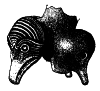 Fig. 2.
POTTERY WHISTLE, VULTURE. ULOA VALLEY, HONDURAS.
Fig. 2.
POTTERY WHISTLE, VULTURE. ULOA VALLEY, HONDURAS.
It is natural that this bird should find an important place in the Maya
writing, as it is an abundant species in the region considered, and of
great importance as a scavenger. The black vulture seems to lack the
mythological character associated with the king vulture. It appears
usually in connection with death and in the role of a bird of prey. This
is especially true in the Tro-Cortesianus where in 24d, 26d (Pl. 19,
figs. 5, 6) and 28c, it is attacking a human being, in the first and
last cases represented as dead. In 86a and 87a, the bird is shown
plucking out the eye of a man. In Dresden 3a (Pl. 19, fig. 7), it
appears at the top of the tree above the human sacrifice and seems to be
in the act of consuming the victim. In Tro-Cortesianus 91c, it also
appears in a tree. In Tro-Cortesianus 40a (Pl. 17, fig. 9), and 42a (Pl.
19, fig. 1), it is shown as eating the entrails of a deer. In the first
case, the bird looks like a king vulture, although this is the only
instance where this species is shown as a bird of prey. In
Tro-Cortesianus 28b and 36b (Pl. 18, fig. 17), the black vulture appears
eating the Kan sign. In the first example, the Kan represents the
newly sowed corn, in the second, the Kan is held by god F. Landa
(1864, p. 230)333-* records that in the Cauac year there was a
ceremony to prevent the ants and the birds devouring the corn. In
Dresden 34b and 35b, the vulture is shown on top of the head-dress of
god F, evidently the enemy of the harvest and, again, on 35b (Pl. 19,
fig. 4) on top of the Cauac sign. Its role as a bird of prey is
further shown in Dresden 36b (Pl. 19, fig. 11), where it is shown
attacking a serpent.
This vulture is associated with god B in Dresden 69b, with god M in
Tro-Cortesianus 70a (Pl. 18, fig. 12), and with god D in Tro-Cortesianus
67a (Pl. 17, fig. 1). The last may be the king rather than the black
vulture, as suggested above. The black vulture occurs only once as the
usual head-dress, in Dresden 17b (Pl. 18, fig. 13), and here in
connection with a female figure and the idea of birth. Two birds,
probably vultures, appear over the enclosure around the head of god C in
Tro-Cortesianus 100b (Pl. 19, fig. 12). In the Lower Chamber of the
Temple of the Tigers occurs a black vulture in bas-relief with a
necklace represented (Pl. 19, fig. 14).
The glyph of the king vulture has already been discussed. There are
other glyphs which seem to show the black vulture, although it is quite
possible that no sharp distinction was made between the two in regard
to the glyphs at least. In one case (Pl. 18, fig. 18), the wrinkled skin
of the head and neck is indicated much as in the case of the king
vulture. A few other glyphs are shown (Pl. 18, figs. 16, 19, 22, 27), as
well as a variety from the Nuttall Codex in which the minute hair-like
feathers of the head are variously represented, usually much exaggerated
as a sort of crest or comb. Pl. 18, fig. 22, is interesting as being the
only case in the Maya codices where the whole figure is shown in the
glyph. As noted in the case of the glyphs of the king vulture, the
greater number of these occur quite alone. They seem to indicate that a
full drawing of the bird is meant to be understood as occurring below.
Several of the carved glyphs (Pl. 19, figs. 8-10) show the black vulture
heads in some detail with the conspicuously open nostril and hooked
beak. A carving of the entire bird may be shown on Stela D from Copan
(Pl. 28, fig. 5), where the naked head and neck are marked off by lines
indicating wrinkled skin. The same lines on the neck of the bird
depicted on Pl. 28, fig. 2, will probably identify it as a vulture, and,
if the square ornament above the beak certainly is part of the figure,
it is unquestionably the king vulture. The knob is not, however, clearly
on the bird’s beak. There are two interesting glyphs which occur on the
eastern façade of the Monjas at Chichen Itza. The glyphs in this
inscription are unlike the usual Maya hieroglyphs, although several of
the so-called constellation signs can be made out. The two glyphs in
question represent the entire body possibly of a vulture, that on Pl.
17, fig. 13, probably the king vulture, and that on Pl. 18, fig. 14, the
black vulture.
Harpy Eagle (Thrasaetos harpyia). In the Nuttall Codex, what is
undoubtedly the harpy eagle is of frequent occurrence. This great bird
is not uncommon in the forests of southern Mexico and Central America,
and must have attracted the notice of the people from its size. The
elongated feathers at the back of the head form a conspicuous crest, a
feature that characterizes this species in most of the representations.
A stone carving from Chichen Itza (Pl. 20, fig. 10) pictures a harpy
eagle eating an egg-shaped object, and another similarly engaged is
copied from the Codex Vaticanus 3773 (Pl. 20, fig. 14). The former is
considered to be a vulture by Maudslay, but the presence of feathers
covering the head excludes this interpretation. In two stone glyphs (Pl.
20, fig. 1, 3), occurs a large bird apparently devouring something held
in its talons, as in Pl. 20, fig. 10. From this general resemblance, it
seems probable that both represent the harpy, although no crests are
shown on the glyphs. In the Dresden and the Tro-Cortesianus occur a few
figures of crested birds that probably are the same species. The crest
feathers are reduced to two, however, or, in some cases, what may be a
third projecting forward from the base of the bill (Pl. 20, figs. 5, 7,
12, 13). The last two figures are not certainly identifiable, though it
is probable that they represent the harpy.
The eagle seems to be the bird associated with warriors in the codices.
Seler (1900-1901, p. 89) notes that the eagle and the jaguar are both
the mark of brave warriors among the Nahuas. In the Aubin manuscript,
the warrior god, Yaotl, is always associated with the eagle
(quauhtli). In the Maya pantheon, god M is usually considered the war
god, as he is almost always armed with a spear. He is seen in Dresden 74
(Pl. 20, fig. 13), and in Tro-Cortesianus 109c with an eagle as a
head-dress. There are other gods, however, who wear a similar head
covering. God L appears in Dresden 14b (Pl. 20, fig. 7) and again in 14c
(Pl. 20, fig. 5) with an eagle head-dress. God D in Dresden 23c (Pl. 20,
fig. 11) has an eagle coming from a Tun sign on top of his head. The
eagle is probably represented at the prow of a boat in Dresden 43c (Pl.
20, fig. 12) in which god B is rowing. In Tro-Cortesianus 88c (Pl. 20,
fig. 4), a bird which may represent the eagle appears sitting on a
Cimi (death) sign. Above in the glyphs the character for the south is
shown. Here, clearly, there is some connection between the signs of the
cardinal points in the line of glyphs and the various creatures pictured
below.
There seems to be only one glyph which can in any way be taken for that
of the eagle in the Maya manuscripts and this appears only once, in
Tro-Cortesianus 107c (Pl. 20, fig. 9). This identification may be
questioned, as there is no drawing of an eagle associated with the
glyph. Attention has already been called to the two stone glyphs in Pl.
20, figs. 1, 3. There are various drawings of the glyph for the eagle in
the Nahua and Zapotecan codices (Pl. 20, fig. 8), as the Nahua day,
Quauhtli, has the meaning eagle. It is interesting to note in the
glyph from the Nuttall Codex (Pl. 20, fig. 8) the tips of the feathers
are crowned with stone points, a frequent way of representing birds of
prey among the Mexican peoples.
Yucatan Horned Owl (Bubo virginianus mayensis). Stempell makes a
serious mistake by confusing the eared owl shown in full face with that
shown in profile in the drawings, for he considers both to represent the
great horned owl. The figures are, however, quite different in every
way. The owl in full face view is unquestionably the great horned owl
(Maya, ikim), the Yucatan form of which is recognized by the
subspecific title mayensis. This is the bird opposed to the
“Moan-bird” which, as will be shown later, is associated with death. In
Pl. 21 are some truly remarkable figures which seem to represent this
horned owl, the first modelled in stucco from Palenque, the second
carved in stone from Yaxchilan, and the third carved in wood from Tikal.
Figs. 1 and 3 show the bird in flight with extended wings. The two
erectile tufts of feathers or “horns” are conspicuously represented in
fig. 3, at either side of the bird’s head and between them the flat top
of the crown is secondarily divided in like manner into three parts,
representing the “horns” and the top of the head. The beetling brows,
heavy hooked beak, and spread talons combine to give a fierce and
spirited mien to the great bird. Pl. 21, fig. 2, may be a greatly
conventionalized owl in which the essential characteristics of the bird
are reproduced in a rectangular design. The large bill is conspicuous in
the center, and in each upper corner terminates one of the ears. The
eyes are represented by rectangular areas at the base of the bill, each
with three vertical bars across it. Below the beak, or at either side of
the tip, are the feet, each with the claw cross-hatched. What seem to be
the reduced and highly conventionalized wings fill the lower corner of
each side of the figure.
The shield in the center of the Tablet of the Sun at Palenque (Pl. 22,
fig. 6) shows a face in which the motif seems to be the full-face view
of the horned owl. The hooked bill curves over the mouth at each side of
which is the curious scroll seen in the same connection in the figures
of Pl. 21. The ears are somewhat shorter in proportion than usual and
below each, at the sides of the face, is a large ear-plug, similar to
that elsewhere found. The eyes are still further conventionalized with a
decorative scroll surrounding each. Another example of the
conventionalized owl’s head is on Stela 1 from Cankuan (Maler, 1908, Pl.
13). We are not yet ready to advance an explanation of the reason why
the owl should occupy such a prominent position in the art of the Mayas.
In only one case is the horned owl found in the Maya manuscripts. In
Tro-Cortesianus 95c (Pl. 22, fig. 2), this owl appears as the head-dress
of a woman in that portion of the codex where baptism and naming are
shown. An owl’s head seems to be shown on the end of a warrior’s staff
in the bas-relief of the Lower Chamber of the Temple of the Tigers at
Chichen Itza (Pl. 22, fig. 4). Pl. 22, figs. 5, 7, show two owls from
the Aubin manuscript; the first is considered to be the screech owl
(chiqualli) and the second the horned owl (tecolotl, in Nahuatl).
Pl. 22, figs. 1, 3, show two drawings of owls from Nahua manuscripts.
Yucatan Screech Owl or Moan Bird (Otus choliba thompsoni). A second
species of owl is represented by the figures on Pl. 23. This has
likewise two feathered tufts or “ears” on its head and is always shown
with the head, at least, in profile, but the tufts one in front, the
other at the back of the head. The facial disc is not very prominent the
beak rather long, the tail short, and the plumage somewhat mottled. A
dark ring usually surrounds the eye. It is, with little doubt, the
screech owl, the only other form of eared owl commonly met with in the
Central American region, and in Yucatan is represented by the race above
indicated. This owl, under the name of the Moan bird,338-* is always
associated with the idea of death among the Mayas. The familiarity of
this species and its mournful quavering cry uttered at night have no
doubt led to its association with death and mystery as with owls in
other parts of the world.
This Moan bird has an important place in the Maya pantheon, as it is the
representative in many places of god A, the Death god. It appears with a
human body in Dresden 7c (Pl. 23, fig. 1), 10a (Pl. 23, fig. 8), and 11a
(Pl. 23, fig. 3) and in Tro-Cortesianus 66a (Pl. 23, fig. 2). In each of
these places, it occupies the space in which one of the regular gods is
usually found. In Dresden 10a, the day reached in the tonalamatl
reckoning is Cimi, meaning death, and here, as has been noted, is
found the Moan bird, the symbol of death, with another sign of death in
the circle just above the head of the bird (Pl. 23, fig. 8).
This owl is used as a head-dress itself, but always for women, Dresden
16a (Pl. 23, fig. 19), 18b (Pl. 23, fig. 5), Tro-Cortesianus 94c (Pl.
23, fig. 4), and 95c (Pl. 23, fig. 20). It occurs in both manuscripts in
the pages mentioned several times before, where birth, baptism, and the
naming of children are shown. The curious figure, with a head similar to
Pl. 23, fig. 21, carried on the back of some of the women, is the Moan
sign, referring to the idea of death, possibly to still-birth, as
copulation and birth are shown in this section of the codex (Dresden
18c, 19c). The Moan is found associated with man only once in the
manuscripts. In Tro-Cortesianus 73b (Pl. 23, fig. 18), he is found
perching on a curious frame-like structure in which god B is sitting.
There are several glyphs representing the Moan bird or screech owl; the
first type is easily identifiable, as the head of the bird is clearly
pictured (Pl. 23, figs. 11-14, 16). This head is frequently associated
with the number thirteen (Dresden 8b). It may occur in the line of
glyphs (Dresden 16c), and refer to the Moan pictured below, or it may
occur in the line of glyphs with no picture corresponding to it below
(Dresden 53b). Pl. 23, fig. 15, from Dresden 38c has been placed with
these drawings, although the identification is not certain. It may
refer, however, to the large Moan head below, on which god B is sitting
(Pl. 23, fig. 11). The second type of glyph does not resemble in any way
the Moan, but they are clearly signs for it, as they are often found in
connection with the picture of the Moan, Dresden 7c (Pl. 23, figs. 6, 7,
21) and 10a. In both places fig. 7 is associated with the number
thirteen. Schellhas also places Pl. 23, fig. 17, among the Moan signs.
 Figs. 3, 4, 5, 6.
GLYPHS OF MONTH MUAN SHOWING MOAN-BIRD CHARACTERISTICS.
Figs. 3, 4, 5, 6.
GLYPHS OF MONTH MUAN SHOWING MOAN-BIRD CHARACTERISTICS.
One of the eighteen Maya months is named Muan, and some of the glyphs
appearing for this month in the codices certainly represent the Moan or
screech owl. This is especially so with text figs. 3-6. Förstemann
(1904a) considers that the month Muan and, consequently, the sign as
well, refer to the Pleiades.
In connection with the screech owl referring to death, it is interesting
to note that among the Nahuas the owl is considered of unlucky augury
and is usually found in the “House of Death” and “of Drought”, as
contrasted with the turkey, considered as a bird of good fortune, and
found in the “House of Rain.”
Coppery-tailed Trogan or Quetzal (Pharomacrus mocinno). The quetzal is
common locally in certain parts of southern Mexico. Its brilliant
metallic green plumage and the greatly elongated tail feathers make it a
very notable bird. The feathers of the head are erect and stand out as a
light crest, those of the anterior portion being slightly recurved. The
delicate erect feathers of the head are well indicated in Vaticanus
3773, 17 (Pl. 24, fig. 9) and the tail, also, in this figure, is only
slightly conventionalized with an upward instead of the natural downward
sweep. In most of the representations, the crest feathers are
indicatd by large plumes, the most anterior of which project
forward. They may be even further modified into three knobs shown in
Dresden 7c (Pl. 24, fig. 1). The two characteristics of the quetzal,
namely its erect head feathers and its extraordinarily long tail
feathers, are often used separately. Thus the tail, which is commonly
drawn with the outer feather of each side strongly curled forward,
appears by itself in Pl. 24, fig. 8, or it may be seen as a plume in the
head-dress of a priest or warrior and in other connections as an
ornament. A greatly conventionalized drawing of the bird is also shown
in Pl. 24, fig. 11, in which the head bears a curious knob and the
dorsal feather of the tail is upcurled in the manner of the other
drawings. It is not at once apparent why the long drooping tail feathers
should be shown thus recurved. Possibly these feathers, when used by the
Mayas for plumes, curled over by their own weight, if held erect, so
that the representations are a compromise between the natural appearance
and that when used as ornament in the head decoration.
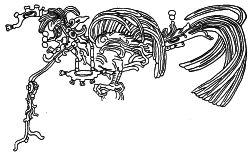 Fig. 7.
QUETZAL, TEMPLE OF THE CROSS, PALENQUE.
Fig. 7.
QUETZAL, TEMPLE OF THE CROSS, PALENQUE.
The color of the bird and the very long tail feathers have already been
mentioned, and these explain the reason of the importance of this bird
among the Mayas. It is claimed by several old authorities that the
quetzal was reserved for the rulers, and that it was death for any
common person to kill this bird for his own use. It seems from a
statement in Landa (1864, p. 190)341-* that birds were domesticated
for the feathers. This bird occurs again and again in various
modifications throughout the Maya art. The feathers of the quetzal are
the ones usually associated with the serpent, making the rebus,
Quetzalcoatl, the feathered serpent, the culture hero of the Nahuas,
or Kukulcan, which has the same signification among the Mayas. It is
impossible to mention here all the various connections in which the
quetzal appears. The feathers play an important part in the composition
of the head-dresses of the priests and warriors, especially those in the
stone carvings. A quotation has already been given from Landa, showing
the use made of feathers in the dress of the people. Text fig. 7 shows
perhaps the most elaborate representation of this bird. It is found on
the sculptured tablet of the Temple of the Cross at Palenque. The
quetzal is shown seated on top of a branching tree which was long taken
to represent a cross. A similar representation is seen on the tablet of
the Temple of the Foliated Cross from the same ruined city. In the Codex
Fejervary-Mayer, there are four trees in each of which there is a bird.
A quetzal is perched in the one corresponding to the east, which is
regarded as the region of opulence and moisture. Seler (1901, p. 17)
suggests that the quetzal in the tree on the two bas-reliefs at Palenque
may represent a similar idea and that temples which would show the other
three trees and their respective birds had not been built in that
center.
The representation of the quetzal as an entire bird is, after all,
comparatively rare. The most realistic drawing is seen on a jar from
Copan in the collections of the Peabody Museum. The whole body of the
bird is shown as a head-dress in a few places in the codices where birth
and the naming of children are pictured. In Dresden 16c (Pl. 24, fig. 3)
and Tro-Cortesianus 94c (Pl. 24, fig. 6), the quetzal is the head-dress
of women. In Dresden 13b (Pl. 24, fig. 2), a partial drawing of the bird
is shown as a part of the head-dress of god E, in Dresden 7c (Pl. 24,
fig. 1) of god H, and in Tro-Cortesianus 110c of god F. The feathers
alone appear as a female head decoration in Dresden 20c (Pl. 24, fig.
8). It occurs as a sacrifice among the rites of the four years in
Tro-Cortesianus 36b (Pl. 24, fig. 12). In Tro-Cortesianus 70a (Pl. 24,
fig. 5), it is found in the act of eating fruit growing over the “young
god.” In Tro-Cortesianus 100b (Pl. 24, fig. 4), the bird is perched over
the encased head of god C.
There seems to be a glyph used for the quetzal. In those drawn in Pl.
24, figs. 10, 17, it is noticeable that the anterior part only of the
head is shown. The first is a glyph from the tablet of the Temple of the
Sun at Palenque, and at least suggests the quetzal by the feathers on
the top of the head, as also Pl. 24, fig. 13, a glyph from Copan, Stela
10, where the entire head appears in a much conventionalized form. Other
glyphs are shown in Pl. 24, figs. 14-16, in which there is a single
prominent recurved feather shown over the eye, succeeded by a few
conventionalized feathers, then one or more directed posteriorly. It is
to be noted that whereas in many previous examples of glyphs the full
drawing of the animal or bird has been found in connection with them,
here with the quetzal glyphs there is no instance where a drawing of the
bird occurs with them. A curious human figure (Pl. 24, fig. 19), with a
head decoration similar to the frontal curve and markings on the quetzal
glyphs (fig. 14-16), may possibly represent this bird in some relation.
Blue Macaw (Ara militaris). A large macaw (Maya, mox or ṭuṭ)
is undoubtedly pictured in the figures in Pl. 25. The least
conventionalized drawing found is that shown in Dresden 16c (Pl. 25,
fig. 2), a bird characterized by long narrow tail feathers, a heavy
bill, and a series of scale-like markings on the face and about the eye.
Further conventionalized drawings are found in Pl. 25, figs. 3, 10, 13,
and Pl. 26, fig. 1. In all these the tail is less characteristic, though
composed of long, narrow feathers, and the facial markings are reduced
to a ring of circular marks about the eye. These last undoubtedly
represent, as supposed by Stempell, the bare space about the eye found
in certain of these large parrots. In addition, the space between the
eye and the base of the bill is partially bare with small patches of
feathers scattered at somewhat regular intervals in rows. It is probable
that this appearance is represented by the additional round marks about
the base of the bill in Pl. 25, figs. 1, 2, 5, 8, the last two of which
show the head only. There has hitherto been some question as to the
identity of certain stone carvings, similar to that on Stela B from
Copan, of which a portion is shown in Pl. 25, fig. 8. This has even been
interpreted as the trunk of an elephant or a mastodon, but is
unquestionably a macaw’s beak. In addition to the ornamental
crosshatching on the beak, which is also seen on the glyph from the same
stela (Pl. 25, fig. 5), there is an ornamental scroll beneath the eye
which likewise is crosshatched and surrounded by a ring of subcircular
marks that continue to the base of the beak. The nostril is the large
oval marking directly in front of the eye.
The animal in Dresden 40b (Pl. 25, fig. 1) has always been considered
to be a tortoise (Schellhas, 1904, p. 44, and Förstemann, 1904). This
animal, together with the dog, is found beneath the constellation signs
carrying firebrands; both are regarded as lightning beasts. By comparing
the head of the figure shown in Pl. 25, fig. 1, with figs. 2, 4, 5, of
the same plate, the reasonableness of the identification of this head as
that of a macaw and not that of a tortoise appears clear. The same
figure occurs in Tro-Cortesianus 12a (Pl. 25, fig. 3) carrying a torch.
In order to make this point clearer, we will take up the consideration
of the glyphs at this place, rather than at the end of the section as
usual. As the macaw in Pl. 25, fig. 1, has been hitherto identified as a
turtle, so the glyph found in connection with it (Pl. 25, fig. 6) has
been considered to stand for the turtle. Pl. 25, fig. 7, is another
drawing of the same glyph. By comparing the markings on the face of fig.
1, it is seen that a similar ring surrounds the eye shown on the glyph.
The second glyph (Pl. 25, fig. 7) is better drawn and shows, in addition
to the eye ring, the slightly erectile feathers at the back of the head.
Comparison with the glyphs representing turtles (Pl. 14, figs. 7-10)
hitherto confused with these macaw glyphs shows differences, the most
important of which are of course the eye ring and the feathers at the
back of the head.
Various other glyphs occur which undoubtedly represent the heads either
of macaws or smaller parrots. They are, for the most part, glyphs from
the stone inscriptions. A crest, resembling that depicted on the head of
the quetzal, is found on a glyph on Altar Q from Copan (Pl. 25, fig.
10). The eye ring, however, seems to indicate the macaw which also has
slightly erectile feathers on the head. Much doubt is attached to the
identification of the glyph of the month Kayae from Stela A,
Quirigua (Pl. 25, fig. 9). It resembles closely the glyphs of the turtle
(Pl. 14, figs. 7-9) and especially that on Pl. 14, fig. 10. The Quirigua
glyph has a prominent fleshy tongue, however, like the parrot. From the
fact that the glyph is certainly that for the month Kayab and the
Kayab glyphs in the codices (Pl. 14, fig. 10) resemble the sign for
a, in the Landa alphabet which seems to stand for ak (turtle), we
are led to identify this as a turtle rather than a parrot.
The use of the macaw as a lightning beast has already been commented
upon. The parrot is also used in the codices as a head-dress. As with
several other birds the only places in the manuscripts where the whole
bird is shown is in connection with the bearing of children and the
baptism. Here the parrot head-dress is seen on women, Dresden 16c (Pl.
25, fig. 2) and Tro-Cortesianus 94c (Pl. 25, fig. 13). There seems to be
an exception to the whole bird appearing as a head-dress exclusively
with women in Tro-Cortesianus 26c (Pl. 26, fig. 1), where god F appears
with a head-dress composed of the whole bird. The bird is also seen as a
head-dress on Altar Q from Copan (Pl. 26, fig. 3). The head of the macaw
appears as part of the head-dress of god H in Dresden 11a (Pl. 26, fig.
13), god E in Dresden 11b (Pl. 26, fig. 11), god F in Dresden 14b, god D
in Tro-Cortesianus 89a (Pl. 26, fig. 5) and of women in Dresden 12b (Pl.
26, fig. 6) and 19a (Pl. 26, fig. 9). In the rites of the four years in
Tro-Cortesianus 37b, there are two birds which are quite different from
those we have been considering, but which may represent macaws (Pl. 25,
fig. 12; Pl. 26, fig. 10).
In the Nuttall Codex, occur several figures of heavy-billed birds that
may be macaws or other smaller parrots of the genera Amazona or
Pachyrhynchus. They are not, however, certainly identifiable (Pl. 26,
figs. 4, 7).
Imperial Woodpecker (Campephilus imperialis). We have here introduced
two drawings from the Nuttall Codex (Pl. 27, figs. 5, 6) which seem to
represent the Imperial ivory-billed woodpecker, a large species that
occurs in the forests of certain parts of Mexico. The figures show a
long-billed bird with acutely pointed tail feathers, a red crest, and
otherwise black and white plumage. The red crest of the woodpecker is of
course highly conventionalized in the drawings where it is shown as of a
number of erect feathers instead of the prominent occipital tuft of
this bird. The crest and particularly the pointed tail feathers and long
beak combined with the characteristic coloring seem to leave little
doubt as to the identity of the species figured. This bird does not seem
to appear in the Maya drawings.
Raven (Corvus corax sinuatus) (?). There occurs in the Nuttall Codex a
figure of a large black bird (Pl. 27, fig. 7), which may be a black
vulture, but which, from the presence of what appear as prominent
bristles over the nostril, may also be a raven. These bristles are
rather prominent in ravens and quite lacking in the vulture, so that we
are led to identify the drawing as representing the former bird. We have
found no other figures that suggest ravens.
Miscellaneous Birds. Four drawings of birds from the Aubin manuscript
are shown here (Pl. 27, figs. 8-11), in order that the
conventionalization of the bird form may be seen. The first two are
supposed to represent the parrot (cocho) and the last two the turkey
cock (uexolotl). There is little in the drawings by which they can be
differentiated. In the codex, the heads of the parrots are colored red.
There is no doubt, however, about the identification, as they occur in
the same relative position on every page of the manuscript and are two
of the thirteen birds associated with the thirteen gods, the “Lords of
the House of Day” (Seler, 1900-1901, pp. 31-35). From the foregoing, it
may be seen that where there is no question about the identification,
the drawing of the bird form is rather carelessly done and no great
attempt is made to indicate the special characteristics of the different
birds.
As has been shown previously, it is not always possible to identify
without question many of the forms appearing in the manuscripts. This is
especially true with birds. In Tro-Cortesianus 20c, an unidentifiable
bird, painted blue, appears on the top of the staff carried by god F.
The head-dress of this same god in Tro-Cortesianus 27c is a bird form
and in Tro-Cortesianus 55b, the tonalamatl figure is a bird whose
identity cannot be made out with certainty.
MAMMALIA
Opossum (Didelphis yucatanensis, D. mesamericana). Figures
representing opossums are not with certainty identifiable in the Maya
writings. We have provisionally identified as a frog the animal shown in
Pl. 29, fig. 6, although at first sight the two median round markings
might be taken to represent a marsupial pouch. Stempell considers the
animals found in the upper division of Dresden 25-28 as opossums of one
of the above species, and this seems very possible. They are shown with
long tails, slightly curved at the tips, and with long head and
prominent vibrissae. A rather similar figure is found in the Nuttall
Codex (Pl. 34, fig. 7). There is nothing, however, that seems to
preclude their being dogs and, in our opinion, they represent this
animal.
Nine-banded Armadillo (Tatu novemcinctum). This is the common species
of armadillo (Maya, wetš) found throughout the warmer portion of
Mexico and Central America, where it is frequently used as an article of
food, and its shell-like covering is utilized in various ways. Several
representations of it occur in the Tro-Cortesianus (Pl. 29, figs. 1-4),
where it is characterized by its scaly covering, long ears and tail, and
the moveable bands about the body.
This animal is associated with the bee culture, as it is represented
twice in Tro-Cortesianus 103a (Pl. 29, figs. 1, 3) seated below a bee
under an overhanging roof. The hunting scenes in the Tro-Cortesianus
also show the armadillo; in 48a (Pl. 29, fig. 4) and in 91a it is shown
in a pit-fall. In the last case the Cauac signs are clearly seen on
top of the trap, whereas in the former case the same signs seem to be
indicated by the crosses. Finally, this same animal occurs seated in
Tro-Cortesianus 92d (Pl. 29, fig. 2) facing a female figure. There seems
to be no glyph used in connection with this animal.
Yucatan Brocket (Mazama pandora). Among the numerous representations
of deer in the Maya writings, there is but one that appears to show the
brocket. This occurs in Tro-Cortesianus 92a (Pl. 30, fig. 2), where a
hoofed animal with a single spike-like horn is shown, seemingly impaled
on a stake set in the bottom of a pit-fall. As stated by Stempell, this
animal from the character of its horns is probably to be identified as a
brocket, though there is nothing to preclude its being a young spike
buck of some species of Odocoileus.
Yucatan Deer (Odocoileus yucatanensis; O. thomasi). Several species
of small deer (Maya, ke) occur in Mexico and Central America whose
relationships are not yet thoroughly understood (Pls. 30-32). The
species of Yucatan and southern Mexico have small lyrate antlers with
few, short tines, rather different from the broader type of the more
northern species with well developed secondary tines. The former type of
antlers seems to be indicated by the conventionalized structure shown in
Pl. 32, figs. 8-12. These probably represent the Yucatan deer or its
ally Thomas’s deer of southern Mexico. Two of the figures, both from the
Nuttall Codex, show the lower incisor teeth (Pl. 32, figs. 8, 11),
though in other cases these are omitted. The larger part of the figures
of deer represent the does which have no antlers. For this reason it is
impossible to distinguish females of the brocket from those of the other
species of deer, if indeed, the Mayas themselves made such a
distinction. The characteristics of deer drawings are the long head and
ears, the prominently elevated tail with the hair bristling from its
posterior side (the characteristic position of the tail when the deer is
running), the hoofs, and less often the presence of incisors in the
lower jaw only and of a curious oblong mark at each end of the eye,
possibly representing the large tear gland.
The deer plays a large part in the Maya ceremonials. It is an important,
perhaps the most important animal offering as a sacrifice to the gods.
Several pages of the Tro-Cortesianus (38-49) are given over to the hunt
and the animal usually represented is the deer, the hunters are shown,
the methods of trapping, the return from the chase, and the rites in
connection with the animals slain. Tro-Cortesianus 48b (Pl. 30, fig. 1)
shows the usual method of trapping where the deer is caught by a cord
around one of the fore legs. Tro-Cortesianus 91a pictures the same
method and 92a (Pl. 30, figs. 2) shows where the deer is caught on a
spike in another type of trap. In Tro-Cortesianus 86a (Pl. 31, fig. 5)
the deer appears with a rope around his body held by a god who is not
easily identified.
Interesting descriptions of the hunt are given in several of the early
accounts.349-* It will be noted that the hunt was usually connected
with the religious rites and the offering of deer meat and various parts
of the body of the deer had a ceremonial importance. Attention is called
to similar practices among the Lacandones, the inhabitants of the
region of the Usumacinta at the present time (Tozzer, 1907), where the
greater part of the food of the people must, first of all, be offered to
the gods before it may be eaten by the natives.
The figures of the deer in the codices are clearly associated with god
M, and the latter may be considered a god of the hunt as well as a god
of war. It is very unusual to find a quadruped used as a head-dress in
any way, and yet in several cases we find god M has the head of a deer
as a sort of head covering, Tro-Cortesianus 50b (Pl. 31, fig. 6), 51c
(Pl. 31, fig. 7) and 68b. In the first two cases, the god seems to be
supplied with a bow and arrow. In a passage in Landa (1864, p.
290)350-* there is a description of this very scene.
In the month Zip, the hunters each took an arrow and a deer’s head
which was painted blue; thus adorned they danced. God M is found in one
case in the Dresden in connection with the deer. In Dresden 13c the
animal is represented as female and is shown in intercourse with god M.
An offering of venison is frequently pictured in the manuscripts. Landa
(1864, p. 220)350-† also furnishes a parallel for this. The haunches
of venison arranged as offerings in dishes are realistically seen in a
number of representations of religious rites, as in Dresden 28c (Pl. 31,
fig. 14) in the last of the rites of the dominical days, 35a (Pl. 31,
fig. 12) and in Tro-Cortesianus 5a above the serpent enclosing the body
of water, 65a in front of god B or D and 105b (Pl. 31, fig. 13) and 108a
(Pl. 31, fig. 15), both of which are in connection with the bee
ceremonies.
The head of the deer, rather than the legs, is also shown as an
offering, in Tro-Cortesianus 69b with god B and Tro-Cortesianus 78 (Pl.
31, fig. 10) in the line of glyphs. The whole deer may be represented as
an offering in Tro-Cortesianus 2b (Pl. 31, fig. 8).351-*
There are some examples in the manuscripts where the deer is pictured
quite apart from any idea of the hunt or an offering. In Tro-Cortesianus
14b, it is shown on top of the body of one of the large snakes and in
Tro-Cortesianus 29c (Pl. 31, fig. 3), it appears seated on the end of a
snake-like curve. The deer occurs in Tro-Cortesianus 30b (Pl. 30, fig.
6) in connection with the goddess from whose breasts water is flowing.
God B appears in Dresden 41c (Pl. 31, fig. 1) seated on a red deer. The
same animal is also to be noted in Dresden 60a (Pl. 30, fig. 5) in
connection with the combat of the planets.351-† A deer is seen in
Tro-Cortesianus 92d seated on a mat opposite a female figure in the same
manner as the armadillo on the same page and a dog on the preceding
page. These, as previously noted, probably refer to cohabitation. On Pl.
32, fig. 9, is a deer from the Peresianus and Pl. 32, fig. 12, shows
another from Stela N, east, from Copan.
The Nahua day Maçatl signifies deer and we naturally find a large
number of glyphs representing this animal among the day signs in the
Mexican manuscripts (Pl. 31, fig. 9; Pl. 32, figs. 8, 10, 11).
Yucatan Peccary (Tayassu angulatum yucatanense; T. ringens).
Peccaries (Maya, qeqem) of the T. angulatum group are common in
Mexico and Yucatan, and a number of local forms have been named. The
white-lipped peccaries also occur, but in the figures it is impossible
to distinguish the species. These animals are characterized by their
prominent snout, curly tail, bristling dorsal crest, and rather
formidable tusks, as well as by the possession of hoofs. By these marks
most of the figures are readily identifiable (Pl. 32, fig. 1; Pl. 33,
figs. 1, 2, 4-6, 9). The tail is, however, often omitted as well as the
erect line of bristles down the back. The presence of hoofs and the
possession of a truncated pig-like snout are sufficiently
characteristic. In the Dresden Codex occur several figures of undoubted
peccaries. Two of these are pictured in Pl. 32, figs. 2, 4. In each the
hoofs and curly tail appear, and in the latter figure the bristling back
is conventionally drawn by a series of serrations. These marks are
sufficient to identify the animals. Their heads are further
conventionalized, however, by a great exaggeration of the snout beyond
that slightly indicated in Pl. 32, fig. 1, and Pl. 33, figs. 6, 9. Other
representations of the peccary, are shown in Pl. 32, fig. 5, a man with
a peccary’s head, and fig. 7 in which the animal’s hoofs are replaced by
human hands and feet. In both cases the form of the head remains
characteristic. A curious combination is shown in Pl. 32, fig. 3, an
animal whose head and fore feet are those of a peccary, while the hind
feet have five toes, and there is a long tail. The addition of what look
like scales is found in a figure from the Dresden (Pl. 32, fig. 6).
The peccary is found in several different connections in the
manuscripts. As deer are found associated with the hunt, so, but to a
much more limited extent, the peccary. It is represented pictured as
being captured in snares of the familiar “jerk-up” type. Similar
drawings show this animal caught by the foreleg and held partially
suspended, Tro-Cortesianus 49a (Pl. 33, fig. 9),352-* 49c (Pl. 33,
fig. 1), and 93a (Pl. 33, fig. 4). Tro-Cortesianus 41b also shows the
peccary associated with hunting scenes. Another realistic drawing of
this animal in Dresden 62 (Pl. 33, fig. 6)352-† represents him as
seated on the open jaws of a serpent connected with a long number
series. We are unable to explain the signification of the appearance of
the animal in this connection. The peccary is pictured in
Tro-Cortesianus 27b (Pl. 33, fig. 5) seated on the left hand of the
goddess from whose breasts water is flowing.
The peccary seems to be associated with the sky, as it is seen in a
conventionalized form in four instances (Dresden 44b, 45b, (Pl. 32, fig.
4) coming from a band of constellation signs and in Dresden 68a (Pl.
32, fig. 2) coming from a similar band with god E sitting
underneath.353-* Above each of these conventionalized figures occur
the corresponding glyph forms (Pl. 33, figs. 7, 8), which show merely
the head with the exaggerated upturned snout. There is a striking
resemblance between these snouts and those of the stone mask-like
figures so frequently represented as a façade decoration in northern
Yucatan. The presence in the mouths of the faces there represented of a
recurved tusk in addition to other teeth is a further resemblance to the
drawings of peccaries. Stempell (1908, p. 718) has reproduced a
photograph of these extraordinary carvings and considers them the heads
of mastodons, apparently solely on account of the shape of the upturned
snout, whose tip in many of the carvings turns forward. They certainly
do not represent the heads of mastodons, but we are not ready to say
that the peccary is the prototype of these carvings, although the
similarity between the glyphs (Pl. 33, figs. 7, 8) and the masks is
worthy of note. One point which does not favor this explanation is the
fact that on the eastern façade of the Monjas at Chichen Itza where the
mask-like panel is seen at its best, we find a realistic drawing of a
peccary (Pl. 33, fig. 2) on the band of glyphs over the doorway, and it
in no way suggests the head on the panel and is quite different from the
head already noted as the glyph of the peccary in the codices.
Baird’s Tapir (Tapirella bairdi). No undoubted representations of
tapirs occur in the manuscripts here considered. Possibly tapirs did
not live in the country occupied by the Maya peoples. At the present
time they are found only to the south of Yucatan. In Central America
Baird’s and Dow’s tapirs are native, the latter, however, more on the
Pacific coast. We have included a drawing of an earthenware vessel (Pl.
28, fig. 1) that represents a tapir, about whose neck is a string of
Oliva shells. The short prehensile trunk of the tapir is well made and
the hoofs are likewise shown. A greatly elongated nose is found in many
of the drawings of the deities, but it does not seem clear that these
represent trunks of tapirs, or, as suggested by Stempell, mastodons! Two
such heads are shown in Pl. 39, figs. 7, 9. These offer a considerable
superficial resemblance to that of a tapir, but as no other drawings
that might be considered to represent this animal are found, it seems
very questionable if the long noses are other than parts of grotesque
masks. The superficial resemblance of the curious nose pieces of the
masks on the panel of the Maya façades to elephants’ trunks does not
seem to us especially significant, as otherwise the carvings are quite
unlike elephants. They have no great tusks as an elephant should, but,
instead, short recurved teeth similar to those representing peccary
tusks, as already pointed out.
Rabbit (Sylvilagus or Lepus). Rabbits and hares from their
familiarity, their long ears, and their peculiar method of locomotion,
seem always to attract the notice of primitive peoples. Several species
occur in Mexico, including the Marsh rabbit (Sylvilagus truei; S.
insonus), various races of the Cottontail rabbit (S. floridanus
connectens; S. f. chiapensis, S. f. yucatanicus; S. aztecus; S.
orizabae, etc.) and several Jack rabbits (Lepus alleni pallitans; L.
callotis flavigularis, L. asellus). It is, of course, quite
impossible to determine to which of these species belong the few
representations found. Several drawings, shown in Pl. 30, figs. 3, 4, 7,
8, are at once identifiable as rabbits from their long ears, round
heads, and the presence of the prominent gnawing teeth.354-* In two
of the figures (Pl. 30, figs. 7, 8), the entire animal is shown, sitting
erect on its haunches, the first with one ear in advance of the other, a
trait more characteristic of the jack rabbit than of the short-eared
rabbits. For convenience of comparison, we have placed beside these two
figures one of a deer in much the same position. It is at once
distinguished, however, by its long head, longer bushy tail, and by the
marks at each end of the eye. What at first sight appear to be two
gnawing teeth of the rabbit seem to be the incisors of the lower jaw.
This is the animal identified by Stempell as a dog.
The animal shown to be a rabbit in Dresden 61 (Pl. 30, fig. 8) is
pictured seated on the open jaws of a serpent in the same way as the
peccary on the following page. These two animals, together with two
representations of god B and the black god (Dresden 61), are each
clearly connected with the serpents on which they are sitting.
The Nahua day Tochtli signifies rabbit and naturally the animal occurs
throughout the Mexican manuscripts as representing this day (Pl. 30,
figs. 3, 4).
Other Rodents. We have included in Pl. 29, figs. 5, 7, 8, three
undetermined mammals. The second of these is characterized by the two
prominent gnawing teeth of a rodent and by its long tail. It may
represent a pack rat (Neotoma) of which many species are described
from Mexico. In its rounded ears and long tail, fig. 5 somewhat
resembles fig. 7, but it lacks the gnawing incisors. Still less
satisfactory is fig. 8 from Tro-Cortesianus 24d, at whose identity it
seems unsafe to hazard a guess. It is shown as eating the corn being
sowed by god D.
Jaguar (Felis hernandezi; F. h. goldmani). Throughout its range, the
jaguar (Maya, balam or tšakmul) is the most dreaded of the
carnivorous mammals. It is, therefore, natural that the Mayas held it in
great awe and used it as a symbol of strength and courage. A few
characteristic figures are shown in Pl. 34, figs. 1-3; Pl. 35, figs.
5-14. The species represented is probably Felis hernandezi, the
Mexican race of jaguar, or one or the other of the more or less nominal
varieties named from Central America. The distinguishing mark of the
jaguar, in addition to the general form with the long tail, short ears
and claws, is the presence of the rosette-like spots. These are
variously conventionalized as solid black markings, as small circles, or
as a central spot ringed by a circle of dots (Pl. 35, fig. 12).
Frequently the solid black spots are used, either in a line down the
back and tail or scattered over the body. The tip of the tail is
characteristically black, and the teeth are often prominent. Such a
figure as this (Pl. 35, fig. 10) Stempell considers to be a water
opossum (Chironectes), for the reason that it is held by the goddess
from whose breast water is flowing. This can hardly be, however, for not
only are the markings unlike those of the water opossum, but the large
canine tooth indicates a large carnivore. Moreover, the water opossum is
a small animal, hardly as big as a rat, of shy and retiring habits, and
so is unlikely to figure in the drawings of the Mayas.
As for the significance of the jaguar in the life of the Mayas, it may
be said that this animal seems to have played a most prominent part. At
Chichen Itza, the building on top of the southern end of the eastern
wall of the Ball Court, usually called the Temple of the Tigers, has a
line of jaguars carved in stone as frieze around the outside of the
building, and in the Lower Chamber of the same structure, the figure of
a jaguar (Maudslay, III, Pl. 43) serves as an altar. The front legs and
the head of a jaguar often are seen as the support of a seat or altar on
which a god is represented as at Palenque in the Palace, House E
(Maudslay, IV, Pl. 44) and in the Temple of the Beau Relief (Holmes,
1895-1897, Pl. 20). Altar F at Copan (Pl. 35, fig. 7) shows the same
idea. The head of a puma or jaguar (Pl. 34, fig. 6) appears in the
bas-relief of the Lower Chamber of the Temple of the Tigers, evidently
representing a part of an altar. A realistic carving of a jaguar was
found on a stone near the Temple of the Cones at Chichen Itza (Maudslay,
III, Pl. 52, fig. a), and another occurs near the present hacienda of
Chichen Itza carved in relief on a ledge of rock.
In the Maya manuscripts the jaguar appears in a number of connections.
Its mythological character is shown in Dresden 8a (Pl. 35, fig. 5),
where it is pictured as the tonalamatl figure. The day reached here in
the reckoning is Ix, and this corresponds to the Nahua Oceolotl,
which means jaguar. In Dresden 26, in the pages showing the ceremonies
of the years, the jaguar is carried on the back of the priest, evidently
representing one of the year bearers (Ti cuch haab). Balam, the name
of the jaguar, is the title given to the four Bacabs or Chacs, the
gods of the four cardinal points. In Tro-Cortesianus 64a, two jaguar
heads are noted as the end of curious bands of Caban signs over a
flaming pot. The second one is shown as dead. A jaguar head is employed
in two places in the Tro-Cortesianus, 34a and 36a, as a head-dress for a
god who is in the act of sowing corn. This animal appears very
infrequently in the pages of the Tro-Cortesianus given over to the
hunting scenes, 41c, 40c, 43b, and, even here, it never appears in the
same way as the deer and peccary, as an animal for sacrifice.
The jaguar as a predacious beast is noted in Tro-Cortesianus 28b (Pl.
35, fig. 8), where it is attacking god F in a similar way as the
vultures in the preceding picture. The jaguar appears in Tro-Cortesianus
30b (Pl. 35, fig. 10) seated on the right hand of the goddess from whose
breasts water is flowing. The figure in Tro-Cortesianus 12b between the
various offerings may be a jaguar or a dog, more probably from its
connection with an offering, the dog. A curious modification of the
jaguar may be shown in Tro-Cortesianus 20a (Pl. 34, fig. 2), where a god
is seated on the gaping jaws of some animal whose identity is uncertain.
It may be a serpent, although the black-tipped tail from which the head
appears to come certainly suggests the jaguar.
There are several carved glyphs in stone that probably represent
jaguars. Two of these (Pl. 28, fig. 4; Pl. 35, fig. 9) have the
characteristic round spots, but others are unmarked, and suggest the
jaguar by their general character only (Pl. 35, fig. 6). This latter
may, of course, represent the puma quite as well. A realistic jaguar
head appears as a glyph in Tro-Cortesianus 2a (Pl. 35, fig. 13). The
more usual glyph for the jaguar is more highly conventionalized,
although the spots and the short rounded ear are still characteristic
(Pl. 35, fig. 11). A slight modification of this glyph appears in
Dresden 8a in connection with the full drawing of the animal below.
The Nahua day Oceolotl, as already noted, means jaguar, and the jaguar
glyph is found among the day signs (Pl. 34, fig. 3). Seler (1904, p.
379) associates the jaguar in the Vaticanus and the Bologna with
Tezcatlipoca. He notes that the second age of the world, in which the
giants lived and in which Tezcatlipoca shone as the sun, is called the
“jaguar sun.” Tezcatlipoca is supposed to have changed himself into a
jaguar.
Puma (Felis bangsi costaricensis). As shown by Stempell, there can be
little doubt that some one of the mainly nominal species of Central
American puma is represented in Dresden 47 (Pl. 34, fig. 7). This animal
is colored reddish in the original, as is the puma, is without spots,
although the tip of the tail, as in the pictures of the jaguar, is
black. The animal is represented as being transfixed with a
spear.358-* Another animal colored red in Dresden 41c seems to
represent a puma. God B is shown seated upon him. A crude figure from
the Painted Chamber of the Temple of the Tigers (Pl. 34, fig. 5) is
probably the same species of puma. The cleverly executed head, shown in
profile in Pl. 34, fig. 6, is also perhaps the same animal, although it
may possibly represent the jaguar. One or the other of these two cats is
also intended, in Pl. 34, fig. 4, a drawing of a piece of pottery.
Coyote (Canis). Two figures from the Nuttall Codex have been included
as possibly representing coyotes (Pl. 35, figs. 1, 2). They are chiefly
characterized by their prominent ears and bristling hair, and seem to be
engaged in active combat. Coyotes of several species occur in Mexico and
though not generally regarded as aggressive animals are of a predacious
nature. No drawings of the coyote have been noted in the Maya codices.
Dog (Canis). The dog (Maya, peq) evidently played an important part
in the life of the Mayas as it does with other races of men generally.
On Pls. 36, 37, we have included certain figures of dogs from several
manuscripts. These may represent two breeds, for it is well known that
both a hairy and a hairless variety were found by the early discoverers
in Mexico.359-* Hairiness is more or less clearly indicated in the
following figures:—Pl. 36, figs. 1-7, 12; Pl. 37, figs. 4, 5. The
figures of dogs usually agree in having a black mark about the eyes that
frequently is produced as a downward curved tongue from the posterior
canthus. Sometimes, as in Pl. 37, figs. 1-3, 10, this tongue is not
blackened. Commonly also black patches are elsewhere distributed on the
body, generally on the back. These markings are probably the patches of
color separated by white areas that occur frequently in dogs or other
animals after long domestication.359-† We have included among the
figures of dogs two in which the eye is differently represented and
which are unspotted (Pl. 37, figs. 4, 6). These modifications may have
some special significance, but otherwise the animals appear most closely
to represent dogs.
We have already suggested that the animal attired in man’s clothing, and
walking erect in Dresden 25a-28a is likewise a dog, though Stempell
believes it to represent the opossum in support of which he calls
attention to its prominent vibrissae and slightly curled tail.
The dog played a large part in the religion both of the Mayas and the
Mexican peoples. It was connected especially with the idea of death and
destruction. The Lacandones of the present time make a small figure of a
dog to place on the grave (Tozzer, 1907, p. 47). This is but one of the
many survivals of the ancient pre-Columbian religion found among this
people. The dog was regarded as the messenger to prepare the way to the
other world. Seler (1900-1901, pp. 82-83) gives an interesting parallel
of the Nahua idea of the dog and his connection with death. He
paraphrases Sahagun as follows: “The native Mexican dogs barked, wagged
their tails, in a word, behaved in all respects like our own dogs, were
kept by the Mexicans not only as house companions, but above all, for
the shambles, and also in Yucatan and on the coast land for sacrifice.
The importance that the dog had acquired in the funeral rites may
perhaps have originated in the fact that, as the departed of both sexes
were accompanied by their effects, the prince by the women and slaves in
his service, so the dog was assigned to the grave as his master’s
associate, friend, and guard, and that the persistence of this custom in
course of time created the belief that the dog stood in some special
relation to the kingdom of the dead. It may also be that, simply because
it was the practice to burn the dead, the dog was looked on as the Fire
God’s animal and the emblem of fire, the natives got accustomed to speak
of him as the messenger to prepare the way in the kingdom of the dead,
and thus eventually to regard him as such. At the time when the
Spaniards made their acquaintance, it was the constant practice of the
Mexicans to commit to the grave with the dead a dog who had to be of a
red-yellow color, and had a string of unspun cotton round his neck, and
was first killed by the thrust of a dart in his throat. The Mexicans
believed that four years after death, when the soul had already passed
through many dangers on its way to the underworld, it came at last to
the bank of a great river, the Chicunauhapan, which encircled the
underworld proper. The souls could get across this river only when they
were awaited by their little dog, who, recognizing his master on the
opposite side, rushed into the water to bring him over.” (Sahagun, 3
Appendix, Chap. 1.)
As might be expected from the foregoing, there are abundant evidences in
the manuscripts of the presence of the dog in the various religious
rites and especially those which have to do with the other world, the
Kingdom of the Dead. In Tro-Cortesianus 35b, 36b, 37a, 37b, the pages
showing the rites of the four years, the dog appears in various
attitudes. In 35b and 36b, it bears on his back the Imix and Kan
signs, in 37a (Pl. 37, fig. 8) it is shown as beating a drum and
singing, in 37b (Pl. 36, fig. 2) it is beside a bowl containing Kan
signs. In all of these places, the dogs seem to be represented among the
various birds and animals which are to be sacrificed for the new years.
Landa (1864, p. 216)361-* states that in the Kan year a dog was
sacrificed. In the Muluc year, Landa (1864, p. 222)361-† records
that they offered dogs made of clay with bread upon their backs and a
perrito which had black shoulders and was a virgin. It has already
been noted that two of the dogs represented in Tro-Cortesianus 35b and
36b have a Kan and Imix sign fastened to the back. Moreover, we have
also pointed out that the Kan sign frequently seems to have the
meaning of maize or bread. It will be noted that in Tro-Cortesianus 36b
two human feet are shown on each of which is a dog-like
animal.361-‡ These may indicate the dance in which dogs were
carried as noted by Landa. Cogolludo (1688, p. 184)361-§ also mentions
a similar dance. Still another reference in Landa (1864, p. 260)362-*
mentions that in the months Muan and Pax dogs were sacrificed to the
deities.
Reference has already been made to the identification of the four
priests at the top of Dresden 25-28 as having the heads of dogs rather
than of opossums. It may be suggested that in the rôle of the conductor
to the other world the dog is represented as carrying on his back in
each case the year which has just been completed and therefore is dead.
This, of course, would necessitate the identification of god B, the
jaguar, god E, and god A as representing in turn the four years.
The dog, according to Sahagun’s account (p. 360) was looked upon as the
“Fire God’s animal,” and as an emblem of fire. This idea is seen
frequently in the Maya manuscripts where the dog with firebrands in his
paws or attached to his tail is coming head downward from a line of
constellation signs, as in Dresden 36a (Pl. 37, fig. 3), 40b (Pl. 37,
fig. 1) or is standing beneath similar signs as in Dresden 39a (Pl. 37,
fig. 2) and probably in Tro-Cortesianus 13a. His tail alone has the
firebrand in Tro-Cortesianus 36b. Firebrands are carried by figures
which have been identified by us as dogs in Tro-Cortesianus 24c (Pl. 37,
fig. 6), 25c, and 90a. Here the animal is represented as in the air
holding his firebrands over a blazing altar beside which god F is
seated. In two out of the four cases, F is shown as dead. The dog in
these latter examples has his eye composed of the Akbal sign. This
same glyph can also be made out with difficulty on the forehead of the
dog shown in Dresden 36a (Pl. 37, fig. 3). As has been noted, Akbal
means night and possibly death as well. It is certain that destruction
is indicated in the preceding examples as well as in Tro-Cortesianus 87a
and 88a (Pl. 37, fig. 4) where the dog is holding four human figures by
the hair.
Beyer (1908, pp. 419-422) has identified the dog as the Pleiades and
various other suggestions have been made that the dog represents some
constellation. The more common form of spotted dog is shown as a single
tonalamatl figure in Tro-Cortesianus 25d and 27d (Pl. 36, fig. 14) and
an unspotted variety in Dresden 7a (Pl. 37, fig. 10). The dog is
frequently shown as copulating with another animal or with a female
figure. In Dresden 13c (Pl. 37, fig. 7) the second figure is a vulture,
in Dresden 21b (Pl. 37, fig. 5) it is a woman and also in
Tro-Cortesianus 91c (Pl. 36, fig. 12).
The same animal appears also in a number of scenes not included in the
preceding. In Tro-Cortesianus 88c (Pl. 36, fig. 1) a dog is seated on a
crab and seems to be connected with the idea of the north as this sign
is noted above the figure; in Tro-Cortesianus 66b (Pl. 36, fig. 3) a dog
and another animal (Pl. 32, fig. 3) are seated back to back under a
shelter; in Tro-Cortesianus 30b a dog is seated on the right foot of the
woman from whose breasts water is streaming; in Dresden 29a (Pl. 37,
fig. 12) god B is shown seated on a dog; and, finally, in Dresden 30a
(Pl. 37, fig. 9) god B holds the bound dog by the tail over an altar.
The dog appears from numerous references to be used in connection with a
prayer for rain. Comargo (1843) in his history of Tlaxcallan states that
when rain failed, a procession was held in which a number of hairless
dogs were carried on decorated litters to a place devoted to their use.
There they were sacrificed to the god of water and the bodies were
eaten.
The glyphs associated with the dog are interesting as we have, as in the
case with the deer, one showing a realistic drawing of a dog’s head in
Tro-Cortesianus 91d (Pl. 37, fig. 13) and several others far more
difficult of interpretation. Pl. 37, fig. 11, seems to stand for the dog
as it is found in several places where the dog appears below, Dresden
21b, 40b. It is thought by some to represent the ribs of a dog which
appear in somewhat similar fashion in Pl. 37, fig. 8. Some of the
glyphs in the codices for the month Kankin show the same element (text
figs. 8-10).
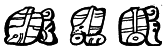 Figs. 8, 9, 10.
GLYPHS FOR MAYA MONTH KANKIN (RIBS OF DOG).
Figs. 8, 9, 10.
GLYPHS FOR MAYA MONTH KANKIN (RIBS OF DOG).
The Nahua day sign Itzcuintli signifies dog and corresponds to the
Maya Oc (Pl. 36, figs. 9-11). This in turn is considered by many to
stand for the dog as the animal of death and signifies the end. The
sore, cropped ears of the domesticated dog are supposed to be
represented in this sign, Oc. Nahua and other day signs for Itzcuintli
(dog) are shown in Pl. 36, figs. 4, 6, 13.
Bear (Ursus machetes; U. horriaeus). In northern Mexico, in
Chihuahua and Sonora, occur a black bear (Ursus machetes) and the
Sonoran grizzly (U. horriaeus). It is unlikely that the Mayas had much
acquaintance with these animals since they range more to the northward
than the area of Maya occupation. Stempell has identified as a bear, a
figure in Dresden 37a (Pl. 35, fig. 3). This represents a creature with
the body of a man walking erect but with the head apparently of some
carnivorous mammal, as shown by the prominent canine tooth. This appears
as a tonalamatl figure. The resemblance to a bear is not very clear.
Less doubt attaches to the figure shown in Pl. 35, fig. 4, which seems
almost certainly to depict a bear. The stout body, absence of a tail,
the plantigrade hind feet, and stout claws, all seem to proclaim it a
bear of one of the two species above mentioned. This picture is found in
connection with one of the warriors shown in the bas-relief of the Lower
Chamber of the Temple of the Tigers at Chichen Itza. It seems clearly to
designate the figure in much the same way as figures are named in the
Mexican writings, i.e., by having a glyph showing this nearby.
Attention has already been called to the fact that here at Chichen Itza,
and, especially on this bas-relief, there is much which shows a strong
influence from the north. The two figures in Tro-Cortesianus 43a are
probably bears. Förstemann (1902, p. 68) considers that they are men
masked as Chacs or Bacabs.
Leaf-nosed Bat (Vampyrus spectrum; Artibeus jamaicensis; or
Phyllostomus hastatus panamensis). Several remarkably diabolical
representations of bats (Maya, soɔ, usually written zotz) occur
among the Maya remains. These all show the prominent nose leaf
distinguishing the family Phyllostomatidae and, as the Mayas probably
used the largest and most conspicuous of the native species for artistic
representation, it is likely that some one of the three species above
mentioned is the one here shown.
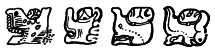 Figs. 11, 12, 13, 14.
GLYPHS FOR MAYA MONTH ZOTZ (BATS).
Figs. 11, 12, 13, 14.
GLYPHS FOR MAYA MONTH ZOTZ (BATS).
The bat had a place in the Maya pantheon. One of the months of the Maya
year (Zotz) was named after this animal and the glyph for this month
shows the characteristic nasal appendage. This is to be seen more
clearly in the glyphs selected from the stone inscriptions (Pl. 38,
figs. 1, 2, 4-6) than in those from the codices (text figs. 11-14)
although the nose leaf is still visible in the latter. The day sign
Akbal (night) occurs as the eye in the figures from the manuscripts. A
carving showing the whole body of the bat is used as a glyph in Stela D
from Copan (Pl. 38, fig. 3). This may also represent the Bat god who is
associated with the underworld, “the god of the caverns.” This god is
pictured on the “Vase of Chama” (Pl. 38, fig. 7) figured by Dieseldorff
(1904, pp. 665-666) and by Gordon (1898, Pl. III). Seler (1904a) has
discussed the presence of this god among the Mayas, the Zapotecs, and
the Nahuas. The bat does not seem to occur in the Maya manuscripts as a
god, although there are glyphs which seem to refer to this god (Dresden
17b), as pointed out by Seler, when there is no other representation of
this deity.
No doubt in the times of the Maya civilization, these bats haunted the
temples by day as they do now, and thus became readily endowed with a
religious significance.
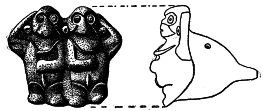 Fig. 15.
POTTERY WHISTLE, APE. FROM ULOA VALLEY, HONDURAS.
Fig. 15.
POTTERY WHISTLE, APE. FROM ULOA VALLEY, HONDURAS.
Capuchin Monkey (Cebus capucinus,—C. hypoleucus Auct.) With the
possible exception of one or two figures, monkeys (Maya, maaš or
baaɔ) are not represented in the Maya codices examined. In
Tro-Cortesianus 88c (Pl. 39, fig. 4) occurs a curious nondescript animal
with what seem to be hoofs on the forefeet, a somewhat bushy tail of
moderate length, and a head that appears to be distinctly bonneted,
somewhat as in the representations of the capuchin. Stempell regards
this as a monkey, though recognizing that the short bushy tail is unlike
that of any Central American species. The figure seems quite as likely a
peccary or possibly a combination of a deer with some other animal. A
glyph (Pl. 39, fig. 5) found directly above the figure just referred
to, suggests a monkey, though it cannot be surely identified. A pottery
whistle from the Uloa Valley (text fig. 15) shows two monkeys standing
side by side with a posterior extension for the mouth piece. Their heads
are shaped as in other representations of this monkey with a distinct
cap or bonnet and facial discs. A pottery stamp from the same locality
shows a monkey with a long tail (Gordon, 1898, Pl. 11, fig. f). It
recalls the drawings of monkeys given by Strebel (1899, Pls. 1-4).
In the Nuttall Codex are numerous heads and a few other figures of a
monkey, which from the erect hair of the crown, curling tail, and
distinctly indicated facial area must be the common bonneted or capuchin
monkey of Central America. This species does not occur in Yucatan. What
is undoubtedly the same animal is shown as a head glyph in Pl. 39, fig.
8, from the Aubin manuscript. The identifications of the head-forming
glyphs in the Nuttall and the Aubin manuscripts are certainly correct as
the Nahua day sign (Oçomatli) means ape.
 Figs. 16, 17, 18, 19.
GLYPHS FOR MAYA DAY CHUEN.
Figs. 16, 17, 18, 19.
GLYPHS FOR MAYA DAY CHUEN.
Text figs. 16-19, show some of the signs for the day Chuen from the
Maya codices. This is the day corresponding to the day Oçomatli of the
Nahuas. There is little resembling an ape in the Maya signs although it
has been remarked that the sign may show the open jaws and teeth of this
animal.
Förstemann (1897) as noted by Schellhas (1904, p. 21) alludes to the
fact that the figure of god C, which occurs also in the sign for the
north, in the tonalamatl in Dresden 4a-10a occurs in the day Chuen
of the Maya calendar, and this corresponds to the day Oçomatli, the
ape, in the Nahua calendar. This would suggest a connection between god
C and the ape and this may be seen in the glyphs for god C (text figs.
20-24). Förstemann sees “an ape whose lateral nasal cavity (peculiar to
the American ape or monkey) is occasionally represented plainly in the
hieroglyph picture.” He also associates god C with the constellation of
Ursa Minor.
 Figs. 20, 21, 22, 23, 24.
GLYPHS OF GOD C.
Figs. 20, 21, 22, 23, 24.
GLYPHS OF GOD C.
It will be seen from the detailed examination of the fauna shown in the
codices that after all a comparatively small part of the animal life of
the country occupied by the Maya speaking peoples is represented. The
drawings in some cases are fairly accurate, so that there is little
difficulty in determining the species intended by the artist. At other
times, it is hazardous to state the exact species to which the animal
belongs. It is only in a comparatively small number of cases, however,
that there is any great doubt attached to the identification. It will be
noted that the drawings of the Dresden manuscript are much more
carefully and accurately done than those of the Tro-Cortesianus. A
greater delicacy and a more minute regard for detail characterize the
Dresden drawings in general.
In the animals selected for reproduction by the Mayas, only those were
taken which were used either in a purely religious significance for
their mythological character (and here naturally there is to be noted an
anthropomorphic tendency) or animals were chosen which were employed as
offerings to the many different gods of the Maya pantheon. The religious
character of the whole portrayal of animal life in the codices is
clearly manifest, and it is this side of the subject which will come out
more clearly as the manuscripts are better known.


 auian de sacrificar.”


