COMPLICATIONS AND TREATMENT OF THE OPERATION — COLICS — TEARING
OF THE CLAMPS — HEMORRHAGE — SWELLING
OF THE SCROTAL REGION — GANGRENE — ABSCESSES — CHAMPIGNON — EXTRA
SCROTAL — INTRA
SCROTAL — INTRA ABDOMINAL — VARIOUS
TREATMENTS — FISTULA OF THE SCROTUM — INGUINAL
HERNIA — PERITONITIS — TETANUS — AMAUROSIS — COMPARATIVE
VIEW OF THE VARIOUS MODES OF CASTRATION.
Though the operation of castration is comparatively
simple in its various methods and is generally
successful in its results, still it is not entirely free
from accidents or complications. Indeed, among
those likely to meet our notice, there are some of
quite a serious character, which will develop themselves
independently of the skill and care with which
the operation may have been performed or whatsoever
attention may have been bestowed upon the
patient. Among these may be enumerated colics,
hemorrhage, swelling of the scrotum, gangrene, abscesses,
champignon, fistula, hernia, peritonitis, tetanus, and
amaurosis.
This, we have already seen, usually appears a
short time after the completion of the operation,
the suffering animal becoming uneasy, restless in
his stall, pawing the ground with his fore feet, and
sometimes lying down and rolling. As I have before
stated, these symptoms, as a rule, are of short
duration, and subside without other treatment than
a little walking exercise. It is rarely the case that
they fail to yield to an anodyne, or a dose of chloral
may be demanded before the symptoms are subdued.
When this accident occurs it is commonly attributable
to the omission of a careless operator
to secure the tail of the animal in such a manner
as to prevent its interference with those implements
by its entanglement, and tearing them
from the end of the cord, as a consequence. The
result of this is the appearance of a hemorrhage from
the spermatic artery, which can only be controlled
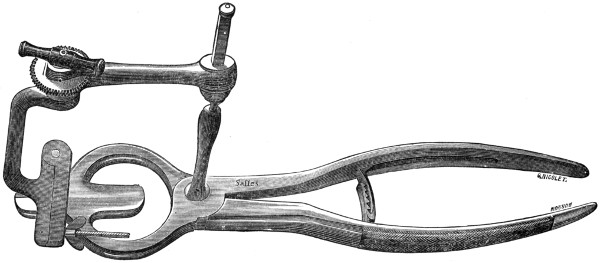
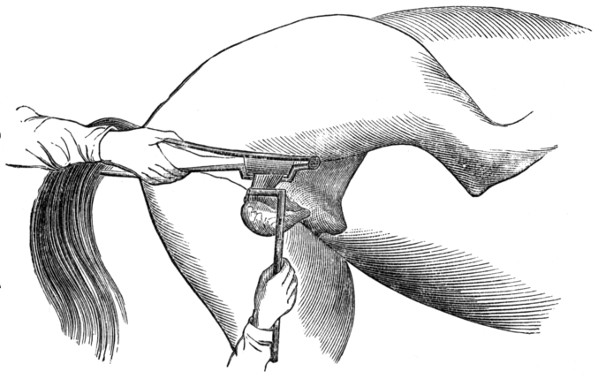
by either a reapplication of the clamps to the end of
the cord—if it can be thus secured—or by other
means, which will be considered when we reach the
subject of bleeding in general as connected with
other causes.
May be primary or secondary. In the first instance
it occurs in consequence of the insufficiency
of the means of hemostasis applied to the end
of the cord, as in the case of the operation by
simple excision, by cauterization, the too rapid crushing
of the cord, torsion, or the accident before referred
to—when the clamps have been torn off and
the cord lacerated about the point of their application.
Secondary hemorrhage manifests itself after a
longer interval following the operation. It may
occur, for example, after the removal of the clamps,
or when, during their removal, the mortified end of
the cord is too much interfered with by the sharp
end of the instrument used in cutting the string
which confines them together, or from too forcibly
pulling upon the cord itself; and in some instances
without any assignable cause other than a diseased
condition of the coats of the artery. This secondary
hemorrhage is usually, by reason of the inflammatory
condition of the blood vessels, of more threatening
aspect and more difficult to control than the
primary variety. The treatment indicated varies.
When caused by the tearing of the clamps, or at the
time of their removal, it may be checked by the reapplication
of the instrument. But if the cord
is retracted within the inguinal canal and cannot be
reached, and if it is already adherent to the surrounding
tissues, by granulations recently formed, the
checking of the flow may be very difficult. In many
cases the application of cold water, either in the
shape of the cold douche over the part, or iced
sponges, may prove sufficient. But in other cases
the cavity of the wound must be packed with balls
of oakum, wet either with water alone or any styptic
agent, such as a solution of perchloride of iron, the
whole being kept in place by a suspensory bandage,
or if necessary, a few points of suture.
These measures may be put in practice while the
animal is on his feet; but if they fail in their effect,
the surgeon must at once proceed to cast his patient
and ligate the artery—an operation of delicate execution,
and not always easy to perform, by reason of
the deep seated position of the vessel. The use of
the actual cautery has also been recommended, but
even when successful there are many objections to
this, one of which is the complication such an operation
may bring on by the introduction into the wound
of a scab which must necessitate for its expulsion a
serious amount of inflammatory action. As a rule,
however, the operation of packing is all that is required,
the oakum being left undisturbed for twenty-four
or even thirty-six hours. Its removal must be
undertaken with great caution.
This, as we have seen, is an almost necessary
consequence of the operation, the swelling making
its appearance a short time after the alteration is
accomplished. It usually first affects the parts
immediately around the edges of the wound,
and spreads forwards and upwards in such a
manner that the entire scrotum and sheath become
the seat of it. It is somewhat warm, tense,
and slightly painful. If there is no increase beyond
these limits, there is no occasion for alarm, as by
exercise, fomentations, and scarifications, with the
administration of diuretics, it ordinarily subsides.
But if it continues to increase, and extends upwards
and backwards, involving the inside of the thighs
and the perineum, loses its character of heat and
soreness, to become cold and painless, crepitating
under pressure, we must prepare to encounter the
most severe of all complications, that of gangrene,
requiring the most prompt and vigorous treatment,
as we shall presently see. It may also happen that
even while retaining the characteristics of healthy
œdema, it may assume such dimensions that the
penis becomes so involved that phymosis and paraphymosis
may supervene, to add to the other complications.
These, however, are not serious sequelæ,
as by proper care, with fomentations or scarifications,
and the use of a suspensory bandage, they
may be readily overcome.
This accident may be looked for from the
fourth to the eighth day, manifesting itself not
only by the extent which the œdema of the scrotal
region assumes, and by its characteristics of coldness,
loss of sensibility, and crepitant feeling, but
by the fœtid odor proceeding from the wound, and
by a change in the character, or the disappearance
of the suppuration, which is succeeded by a sanious,
bloody and offensive discharge. To this series of
symptoms are to be added a marked increase of the
general disturbance, manifested by increased thirst,
anorexia, fœtid mouth, change of color in the mucous
membrane to a livid hue, increase of pulse, with
weakening, increased respiration, temperature at first
elevated and then diminished, and after five or six
days a final termination in the death of the patient.
The progress of this complication is so rapid, and
the chances of recovery are so few, that the necessity
for prompt treatment becomes at once obvious. All
the diseased and mortified parts must be removed at
once, and means instantly employed to prevent the
absorption of gangrenous matter. Friction with ammoniacal
and turpentine liniments must be used over
the swelling; the parts must be subjected to the
actual cautery at white heat, and disinfecting agents
of all kinds must be freely used, as chloride of lime,
carbolic acid, and permanganate of potash, while internal
treatment must immediately be instituted by
the administration of stimulants and antiseptics in the
form of ammonia and phenic acid, or its preparations.
When these are likely to result from a too rapid
closure of the edges of the scrotal envelope, the
premature union may be readily prevented, as we
have before stated, by the careful introduction of the
finger into the wound while it is still suppurating.
But notwithstanding this precaution they will sometimes
occur as the result of the infiltration and accumulation
of the suppurative matter. A free incision
and proper attention to the cavity of the abscess, is
all that this accident requires. A careful examination
of the parts will, however, reveal another cause
for the formation of these abscesses. It is then
against these causes that the therapeutic treatment
must be directed. We refer now to the complication
known as the formation of a
This name is applied to an indurated condition
of the end of the cord, or in its thickness,
of a tumefied character, varying in size and extent,
and slow in its growth. It results from an excess of
inflammatory action, attributable to the manipulations
which become necessary during the performance
of the operation. The name “champignon”
(or mushroom) is applied to it by the French, on account
of the pedunculated appearance which it sometimes
assumes, and which causes it to greatly resemble
that fungus in its outward figure. It is also
known as schirrous or indurated cord. The tumor
is sometimes situated on the outside of the envelopes,
when it is known as extra-scrotal, but more commonly
it is found covered by the skin, in which case it is
better known as intra-scrotal. In this latter condition
it may be merely a growth at the end of the
cord, becoming, as determined by its location, of an
extra-inguinal character, or if the diseased process
extends as far as the upper inguinal opening, or beyond
it, it becomes, and is so denominated, intra-abdominal.
There is also an extra-intra-scrotal growth,
when it is partly within and partly external to the
scrotum. This tumor will vary greatly in size, being
sometimes very small in dimensions, and at others
having those of a man’s fist. We have ourselves
observed it equalling a child’s head in size.
The causes from which it originates are obscure,
and cannot be very well defined. Still, they may be
arranged under the heading of any of the morbific
causes which may excite an excess of inflammatory
action at the end of the cord. Amongst these may
be enumerated all violent tractions upon the cord at
the time of the operation; all unnecessary manipulations
during the process of cicatrization, such as
the too frequent introduction of the finger into the
wound with destruction of the granulations already
adherent to the cord, and the application of the appliances
for its division too low down upon it, leaving
that organ hanging too much, and the retraction
of the organ being insufficient to retain it in the inguinal
sac. Still, as a champignon may be developed
in the absence of all these causes, it would seem that
their growth may be attributed also to some specific
idiosyncrasy in the animal affected, the true nature
of which cannot be very accurately or easily understood.
It is held, however, by certain German and
Russian authors that exposure to cold exercises a
great deal of influence in the development of this
affection, and observation has largely established
the fact of its greater prevalence during cold seasons.
Symptoms of extra-scrotal champignon.—This is
otherwise known in the terminology of some pathologists
as true or superficial champignon. It develops
itself at the cut extremity of the cord as a granulating
mass, of a red color, varying in size, its growth,
nevertheless, allowing the cicatrization of the skin
to progress in such a manner that it forms a point of
attachment from which the tumor seems to proceed.
This form of it is usually of little account, as it may
easily be removed before it has attained to troublesome
dimensions. When of considerable proportions,
however, it may interfere materially with the
act of locomotion by causing pain in the cord, upon
which it drags more or less. It is not often or necessarily
accompanied by constitutional disturbance,
excepting in cases of excessive suppuration, which
may sooner or later undermine the general health
by exhausting the stamina of the patient.
If instead of showing its greatest development on
the surface of the scrotum, it occurs beneath it, a
greater or less degree of swelling will appear on one
or both sides of the inguinal region, the swelling being
somewhat hard, possibly the seat of one or more
fistulous tracks resulting from abscesses which have
at times opened, discharged, and closed; the animal
showing a certain amount of stiffness in the action
of the hind legs. In this case we shall have to
adapt our treatment to the deep champignon of Zundel,
under one of its three forms of extra-inguinal, intra-inguinal,
and intra-abdominal.
Under the first head we shall often discover, upon
inquiring into the history of the case, that for a
length of time, varying from months, perhaps, to
years, the animal had been affected with a swelling
which would gather, break, and slowly heal, leaving
no mark as an apparent indication of a diseased condition,
excepting that a certain degree of lameness
would have been observed to be present. Upon exploring
the testicular region it would then be observed
to be the seat of a tumor, either spherical or
pysiform, seldom painful, and more or less adherent
to the envelope that covered it. Above this the end
may be felt free from diseased process, and this is
the champignon in its chronic form. In this condition
it is not incompatible with the general health
of the animal affected, and forms no hindrance to his
usefulness. This condition of extra-inguinal growth
will sometimes dissolve away by an abscess-formation,
and quite disappear. But if the induration of the
spermatic cord extends to the upper portion, or that
which is enclosed in the inguinal canal, in such a
manner as to interfere with locomotion, the leg corresponding
with the diseased side being carried in
abduction, with numerous fistulous tracks existing
on the surface of the scrotum, the intensity of the
symptoms varying with the extent of the diseased
process, the condition of the cord will be easily discovered
by an examination of the parts, and the
presence of an intra-inguinal champignon established.
If, besides these symptoms, we discover by rectal
examination that there is in front of and above the
pubes a tumor more or less ovoid, or giving the
sensation of a cylindrical mass, of size varying to the
touch—which is the diseased indurated cord—the
case is judged at once to be one of intra-abdominal
nature. At times the inflammation may extend to
the sub-lumbar region, when the hand introduced
into the rectum may discover in that locality an
ovoid tumor or abscess which may be of great size.
This form of champignon is incomparably the most
serious of them all; an intense and persistent reactive
fever is always present, and this at length terminates
together the life and suffering of the animal.
The abscess may sometimes open externally, and in
some cases it may accumulate within the thickness
of the cord and form large collections; or, again, it
may find its way into the abdominal cavity, where it
may excite a fatal peritonitis.
This rapid examination of the various forms of
deep champignon will enable us easily to realize the
difficulty of the progress in the case. While the
pedunculated form, exterior to the scrotum, is not,
comparatively, a very serious matter, it becomes, on
the contrary, a very grave occurrence when it assumes
the characters of the intra-abdominal variety, and
must in a majority of cases be recognized as an incurable
disorder.
Treatment.—While champignon is an affection in
which surgical interference cannot usually be dispensed
with, it is still essential that the surgeon
should avoid being over hasty in determining in favor
of an operation, and he should give the case a
very careful consideration before deciding upon his
course. At first emollient applications, appropriate
topical treatment, and a few points of cauterization,
may be followed by a process of resolution. But in
the event of their failure four modes of operation
present themselves. These are, in their order, the
application of the clamps; the ligature; the linear
crushing or ecraseur; and cauterization. When the
case is one of the extra-scrotal variety, the application
of a ligature around the base of the peduncle,
or removal by ecraseur, will be the simplest mode
of treatment, unless there should exist a tendency to
infiltration of the cord, in which case the manipulations
to be followed become the same as those which
are adapted to that of the deep or intra-scrotal form.
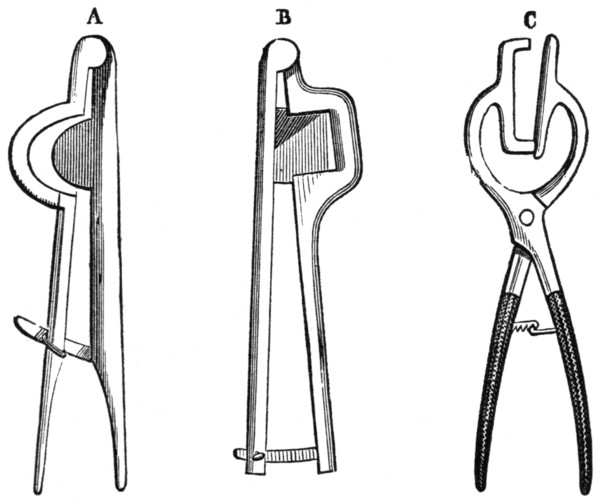
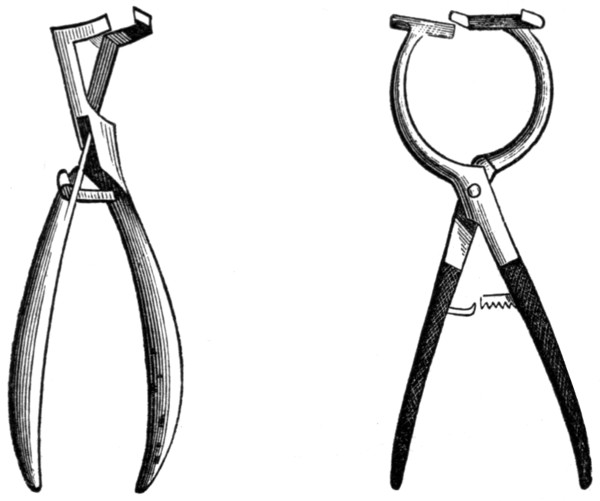
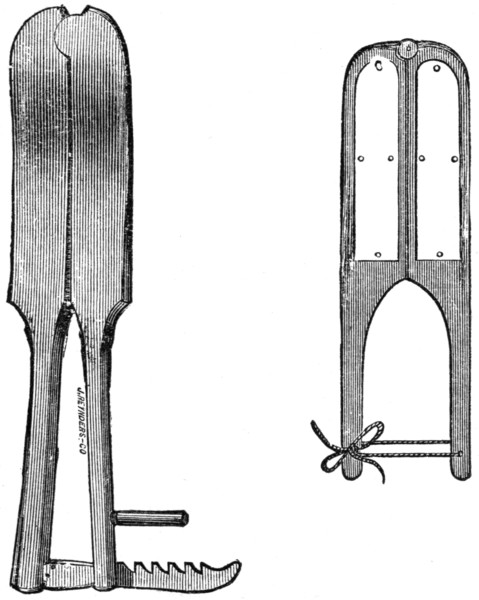
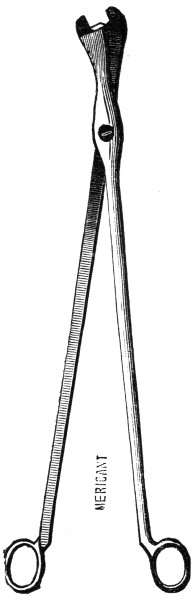
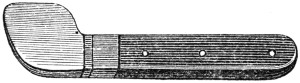
Fig. 25.
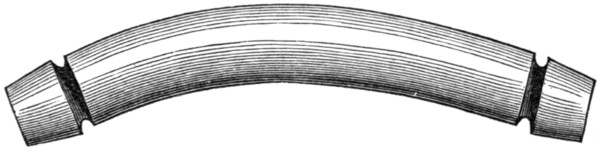
CURVED CLAMPS.
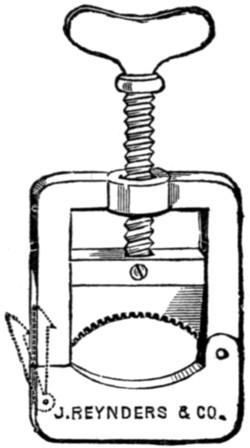
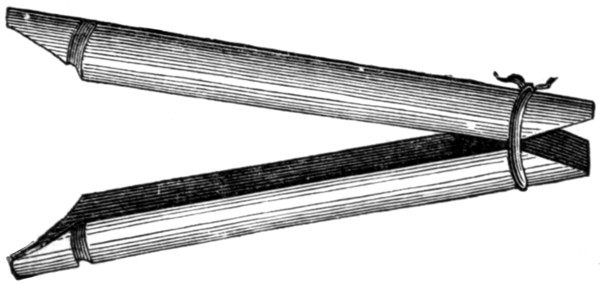
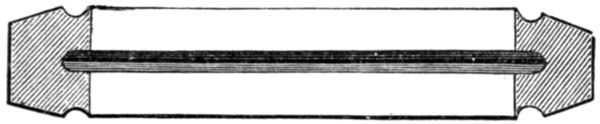
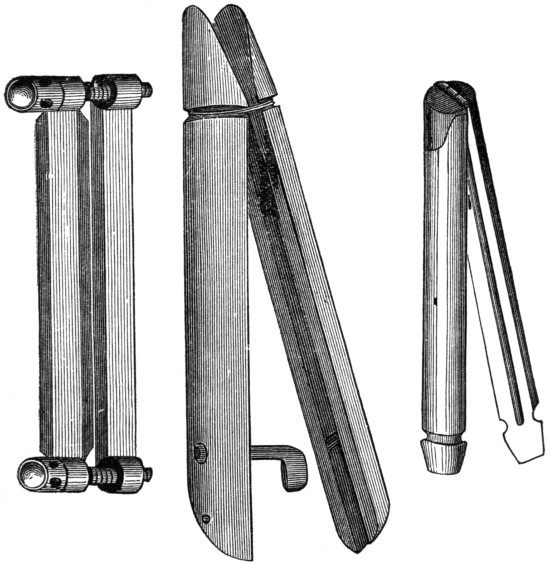
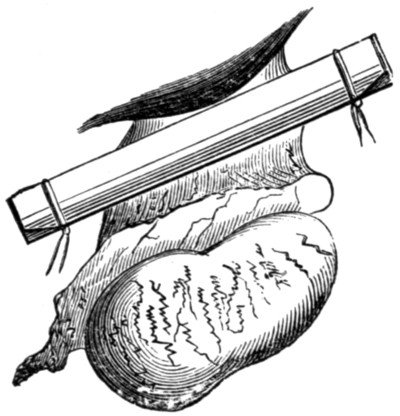
By the clamps.—When the application of the clamps
is resorted to, they may be similar to those used in
ordinary castration, or may be curved in form (Fig.
25). The animal to be operated on is to be thrown
on either side according to which cord is affected,
and an incision made through the envelopes as nearly
parallel with the median line of the body as the case
permits, when the tumor and the cord are carefully dissected
and separated from their adhesions. If the
tumor is suspended from the end of the cord there
will be no difficulty in applying the clamp above it
and upon a healthy portion of the cord. But if the
diseased process extends within the inguinal canal,
there will be need of great caution in dissecting the
cord up to the healthy structure. In doing this the
safer mode will be for the operator to treat the adhesions
with the fingers or the blunt end of the
scissors, rather than to employ the sharp edge of the
bistoury with the accompanying danger of causing
hemorrhage. If, on the contrary, the cord is diseased
to an extent that renders it difficult to reach a
healthy portion, other modes of operation—as by the
ligature—become the wiser and more practicable
indication. When the clamps are used it is necessary
to leave them in place for several days, and
sometimes they are allowed to slough off, while the
growth is usually suffered to remain for a few days
after the operation.
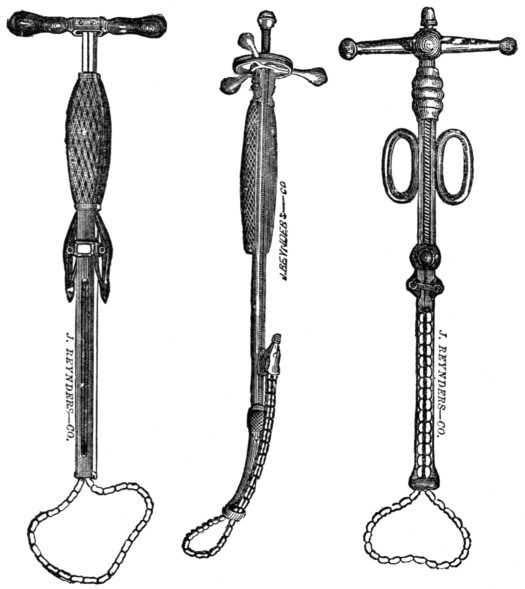
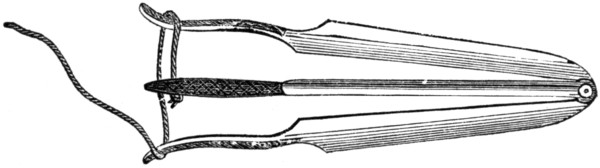
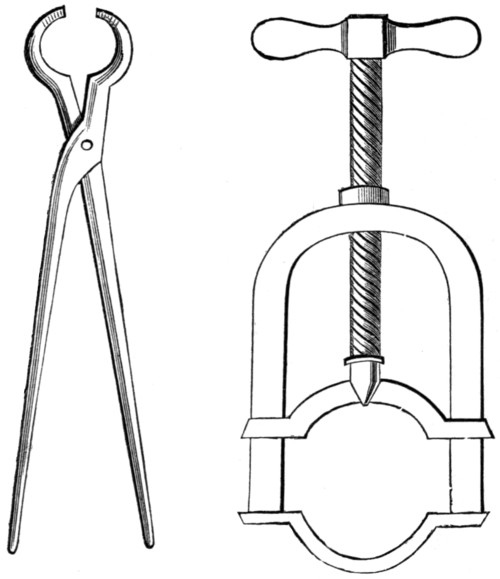
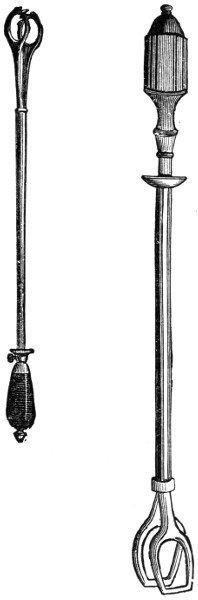
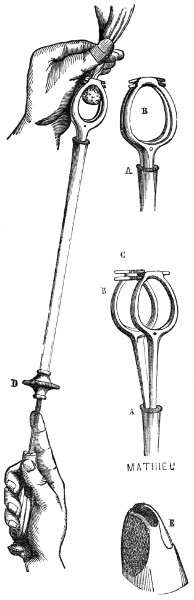
Fig. 26.

LIGATURE-CARRIER.
Ligature.—When this mode of procedure is adopted,
the tumor having been dissected and the cord well
freed from its adhesions with surrounding parts,
and the ligature being applied, the tumor may either
be amputated immediately or be left to slough off in
its own time. The ligature may be either of twine,
silk, or elastic cord. We have ourselves operated
by this method in the successful removal of growths
of very considerable size. So long as the upper portion
of the cord, which retains its healthy structure,
can be reached, the application of the ligature is attended
with no difficulty, the manipulations required
being similar to those which attend the removal of
all growths by the process of ligation. But if the
diseased process extends so far that the ligature
cannot be applied at the proper point, as in the case
of intra-inguinal champignon, it will be necessary to
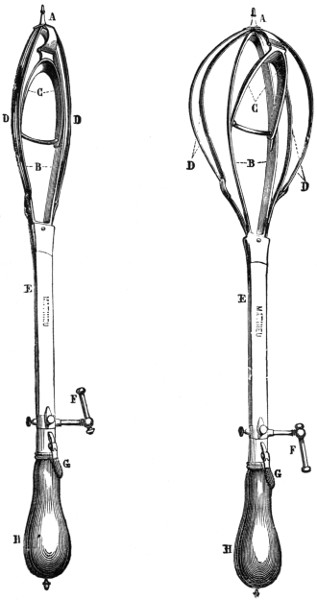
have resort to the ligature-carrier recommended by
Serres (Fig. 26). In using this instrument the loop
of the ligature being passed over the tumor around
the cord, is carried into the inguinal canal as high
up as possible, pressure being made by holding the
instrument against the cord, while strong traction is
made on the ends of the ligature, which is then secured
by a knot upon a small stick placed across the
opening of the instrument, with a view to the
prevention of slipping. If an increase of pressure is
found to be necessary, it can easily be obtained by
tightening the ligature from day to day as required.
If the size of the cord should be such as to prevent
a proper application of a single ligature, it may become
necessary to divide it in applying a double,
triple, or multiple ligatures, in accordance with the
rules for such ligating.
In whatsoever manner the ligature may be applied,
even when it is of the elastic kind, the process of
sloughing of the tissues is always a slow one. It is
for this reason that we agree with Prof. Bouley in
considering the treatment of champignon by the linear
crushing very much to be preferred.
Ecraseur.—The steps of the operation with this
instrument are similar to those required in the other
methods already considered. The champignon is isolated
from its surrounding parts, the chain is placed
on the cord above the base of the tumor, and the
amputation is completed by a slow pressure upon
the cord, which, crushing it by degrees, permits its
immediate removal. It must be done slowly, occupying
from ten to twenty minutes for the complete
separation of the champignon, according to the size
of the tumor. The operation being finished, the
parts are left in the condition of a simple wound,
where no cause exists to interfere with its rapid cicatrization.
Cauterization.—This is a mode of treatment which
we have never had occasion to submit to trial, having
always given the preference to the process we
have just referred to. It is recommended, however,
by European authorities. Some of these advocate
the “melting” process, or the introduction of sharp
points deeply into the thickest parts of the enlargement,
while others advise a removal of a portion of
the growth and deep cauterization afterwards. If
cauterization can be advantageously employed, the
best method, in our judgment, would be the process
of amputation with Paccalin, or with the galvanic
cautery. We may here, while referring to the application
of electricity in this connection, appropriately
refer to our own experience of a number of years
ago, in treating an animal suffering with intra-scrotal
champignon, by electrolysis, and succeeding after two
applications, in obtaining the complete removal of
the tumor. This method, however, consumes too
much time to justify its employment in general practice.
Being already aware of several causes of this complication
of the operation of castration, we may
readily appreciate the treatment they require. It
must be remembered that in a majority of cases, the
cause of this lesion is the presence of a foreign body
in the wound, and that until it is removed, it is in
vain to look for a cure. Prof. Bouley has reported
a case in which the fistula was due to the presence
of a pair of clamps over which the skin had almost
entirely cicatrized.
By this is understood the protrusion of some portion
of the contents of the abdominal cavity through
the inguinal ring, either a portion of the omentum
or of some part of the small intestines, creating
either an epiplocele or an enterocele. This complication
may take place either during the operation,
or shortly afterwards, or at the period of the removal
of the clamps. It proceeds from the violent struggling
of the animal during the operation; to the
colics which are so apt to supervene; to his position
when placed in a stall of which the floor is too much
inclined; or it may result from some of the various
modes of castration, as, for example, the uncovered
operation.
At times the two forms of hernia may present
themselves together, constituting a case of
entero-epiplocele. When the epiploan alone protrudes,
it need not give rise to any unnecessary
anxiety, as it may easily be either reduced and returned
to its place, or ligated with the clamps, or
torn apart. If, on the contrary, it is a portion of the
small intestines which becomes involved, the first
indication is to restore it to its place by the proper
taxis without delay, which may be readily done,
the animal being yet down and placed under an
anesthetic, by the rectal taxis combined with the
necessary inguinal manipulations. When this has
been accomplished the intestine is kept in place by
the application of a clamp over the cord, upon which
the fibrous coat of the cremaster has been carefully
drawn.
This complication, considered as one of the most
frequent following castration, is also, beyond doubt,
one of the most serious. It is generally the result of
exposure to cold, especially when its occurrence accompanies
the suppurative fever. But it also develops
itself in animals which have received the best
hygienic care, its appearance being attributed to an
excessive dragging of the cord, or to the extension
of the local inflammation by continuity of tissues.
It manifests itself generally between the second and
third day following the operation, except when it
becomes symptomatic, as of gangrene of the cord,
when we have seen it making its appearance towards
the tenth day.
The symptoms of this traumatic peritonitis differ
somewhat from those of the acute inflammatory type.
According to Gourdon, “the animal is dull and
refuses all food—the suppuration of the wound of
the scrotum has ceased, the bags and surrounding
parts become the seat of a warm, hard and painful
swelling. The animal stands with his four legs
brought close together, the back is stiff and arched,
the flanks are cordy, the abdomen painful, the pulse
hard, small and increased. As the disease progresses,
the symptoms are more marked, the enlargement
of the envelopes increases and is more diffuse, it extends
down to the abdomen, and even under the
chest, passes along the thighs, is less warm, less hard,
less painful, and pits under pressure. There are
slight colics, the pulse gets smaller, intermittent, the
respiration is increased, and the animal dies towards
the fifth or sixth day.”
The treatment to be recommended varies according
to different authors. While some prescribe depletive
and sedative treatment, laxatives and diuretics,
many prefer tonics and stimulants. The Germans
claim great results from the use of tincture of
arnica (in small doses) administered internally. The
external treatment consists in sinapisms, warm
fomentations, poultices, or fumigations under the
abdomen.
As with most cases of traumatic tetanus, this complication
is generally fatal, and it is, without doubt,
the most dangerous of all and marked by the greatest
mortality. It is generally admitted that exposure to
cold and dampness is one of the most prolific causes,
especially in animals which, having but recently recovered,
are too soon put to work. The various
modes of operation have also been considered to
have some influence upon its development, though
there is probably no ground upon which this theory
can find a support. Whether the nature of the soil
of a district, or its atmospheric condition, may have
any connection with it, is also a question. We know
that in some portions of Long Island, cases of tetanus
are commonly met with, at some seasons of the year,
after surgical operations of every kind. It may appear
within a few days following the castration, or it
may defer its visitation for a period of twenty days,
or longer.
The treatment adopted for the tetanus of castration
is that which is applied to all cases of that traumatic
affection.
This disease may also be included among those
classed as the sequelæ of castration, having been
known to follow cases where hemorrhage of the
small testicular artery had occurred. Tonic treatment
internally and local stimulating applications
may sometimes relieve this complication, but it will
generally be admitted to be incurable.
The process by simple excision, by reason of the
hemorrhage which necessarily accompanies it, though
not inevitably dangerous, must be excluded from the
domain of general practice.
That of scraping the cord has not, so far as our
knowledge extends, been sufficiently tested, either
in European or American practice, to justify its recommendation.
The process of torsion below the epididymis is too
much subject to the development of champignon, as
well as that of free torsion with the hands, to be admitted
by judicious operators, while the limited torsion
is a method which has taken rank amongst safe
operators, notwithstanding the enormous swelling of
the parts by which it is commonly accompanied, and
the necessity it involves of the introduction of the
fingers into the wound to prevent its premature
closing.
The method by the ecraseur, though occupying a
longer time in its completion than some others, has
secured very favorable results, especially in the
hands of American operators.
The operation by cauterization is highly recommended
by English veterinarians. We believe, contrary
to the statements of French authors, that it is
not widely in use on this Continent. The objections
urged against it are that the hemostatic effect upon
the cord is less reliable than in the method by the
clamps or the ligature; that there is more or less
danger of cauterizing the surrounding parts by the
effect of the radiant heat from the cautery; and that
the swelling which follows the operation is always
excessively great.
Castration by the clamps is the best known and
most extensively practised. It is easy and quick in
its performance; performs the most certain hemostasis
upon the artery, and notwithstanding some
slight objections, merits a preference over all others.
The principal objection alleged against it is that it
is attended with great pain to the suffering patient
when the pressure of the instrument upon the soft
tissues is first felt. This is a doubtful question, and
if this excessive amount of pain really exists, it certainly
cannot be of long continuance, merely on account
of the effect produced by the clamps themselves.
Of the various methods by ligature, that of the ligation
of the cord with its envelopes is applicable to
small animals only. That upon the cord alone is liable
to be followed by hemorrhage, or by the excessive
retraction of the cord into the abdominal cavity,
drawing the ligature with it. That of the efferent
canal, and of the cord by the subcutaneous mode are
not admitted in general practice, while that of the
artery alone has not been extensively performed on
large animals, so far as we are informed, except by
certain Massachusetts veterinarians.
The castration by double subcutaneous twisting, when
extensively applied to solipeds, will probably prove
to be the safest mode of all, and least likely to be
followed by complications. We are not informed as
to the extent to which it has been practised in this
country, even amongst ruminants.