⎯⎯⎯⎯⎯⎯●⎯○⎯●⎯⎯⎯⎯⎯⎯
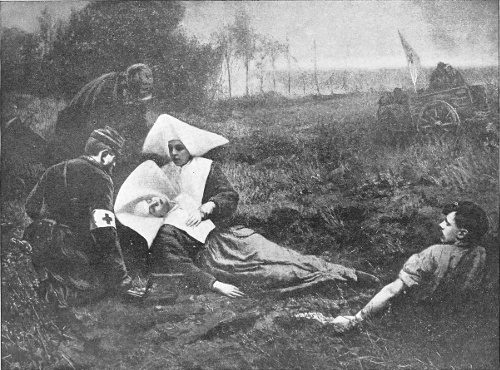
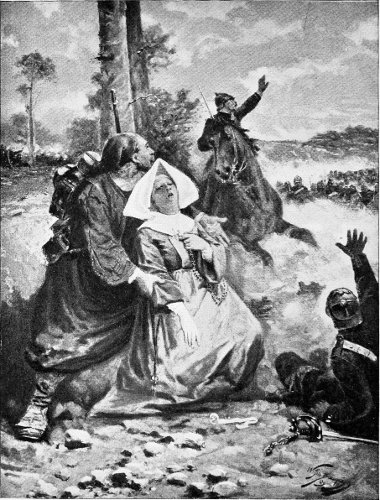
The frontispiece, entitled “An Innocent Victim,”
that adorns this volume is taken from a famous painting
executed by S. Seymour Thomas, an artist who is
rapidly rising to fame. Mr. Thomas was born in San
Augustine, Tex., studied in New York at the Art Students’
League, and from there went to Paris, where he is
recognized as an artist of great power. This picture was
exhibited at the World’s Columbian Exposition, in Chicago,
where it attracted great attention.
⎯⎯⎯⎯⎯⎯●⎯○⎯●⎯⎯⎯⎯⎯⎯
The official gazette of the French Government recently
published an order of the Minister of War granting medals
to certain Catholic Sisters. A gold medal has been awarded
to Sister Clare, of the Order of Sisters of St. Charles,
for twenty-seven years’ service in the wards of the military
hospital at Toul, and for previous service at Nancy, during
the whole of which time she had given constant evidence
of her devotion to duty. Silver medals have been given
to Sister Gabrielle for thirty-six years’ work, during twenty-three
of which she has been Superior; to Sister Adrienne
for thirty-eight years’ service, and to Sister Charlotte
for eleven years’ service. These last three religious have
been attached to the mixed hospital of Verdun, and, according
to the official notice, have been remarkable for
their zeal and their devoted care of the sick soldiers.
⎯⎯⎯⎯⎯⎯●⎯○⎯●⎯⎯⎯⎯⎯⎯
The Queen of England only a few months ago showed
her appreciation of the work of the Sisters in time of war
by bestowing the Royal Red Cross upon the venerable
Mother Aloysius Doyle, of the Convent of Mercy, Gort,
Ireland. The following correspondence deserves to be preserved:
Pall Mall, London, S. W.,
February 15, 1897.
Madam:—The Queen having been pleased to bestow
upon you the decoration of the Royal Red Cross, I have
to inform you that in the case of such honors as this it is
the custom of Her Majesty to personally bestow the decoration
upon the recipient when such a course is convenient
to all concerned, and I have, therefore, to request that
you will be so good as to inform me whether it would be
convenient to you to attend at Windsor some time within
the next few weeks. Should any circumstances prevent
your receiving the Royal Red Cross from the hands of
Her Majesty it could be transmitted by post to your present
address. I am, madam, your obedient servant,
GEORGE M. FARQUHARSON.
SISTER MARY ALOYSIUS.
St. Patrick’s, Gort, County Galway.
Sir:—I received your letter of the 15th, intimating to
me that Her Most Gracious Majesty the Queen is pleased
to bestow on me the Order of the Royal Cross in recognition
of the services of my Sisters in religion and my own
in caring for the wounded soldiers at the Crimea during
the war. My words cannot express my gratitude for the
great honor which Her Majesty is pleased to confer on
me. The favor is, if possible, enhanced by the permission
to receive this public mark of favor at Her Majesty’s
own hands. The weight of seventy-six years and the infirmities
of age will, I trust, dispense me from the journey
to the palace. I will, therefore, with sentiments of deepest
gratitude ask to be permitted to receive this mark of my
Sovereign’s favor in the less public and formal manner
you have kindly indicated. I am, sir, faithfully yours in
Jesus Christ,
SISTER M. ALOYSIUS.
February 17, 1897.
⎯⎯⎯⎯⎯⎯●⎯○⎯●⎯⎯⎯⎯⎯⎯
In August, 1897, at the close of the ceremonies incident
to the celebration of her Diamond Jubilee, the Queen
of Great Britain conferred the decoration of the Royal
Red Cross upon Army Nursing Sisters Mary Helen Ellis,
Mary Stanilaus Jones, Mary Anastasia Kelly and Mary de
Chantal Huddon, in recognition of their services in tending
the sick and wounded at the seat of war during the
Crimean campaign of 1854-56. Their services were very
much appreciated by Miss Nightingale, who, indeed, has
ever since shown her interest in them in many ways.
The three Sisters first mentioned, together with another
who has died since, were on their return from the East,
asked to undertake the nursing at a hospital, just then being
established in Great Ormond street, for incurable and
dying female patients, and to this hospital they have been
attached to the present time.
⎯⎯⎯⎯⎯⎯●⎯○⎯●⎯⎯⎯⎯⎯⎯
Professor Edward Roth, the well-known Philadelphia
educator, is authority for this episode of the Franco-German
war. He quotes General Ambert, who fought as a
private in the war, as follows:
“Oh, yes; one of them I shall never forget. Poor Sister
St. Claire! I see her this moment, her big black veil
trimmed with blue, as she makes her way through the
blood-smeared straw of our crowded barn. The roaring of
the cannon was awful, but she did not seem to mind it;
she did not seem to mind even the terrible fire that was
now raging through the last houses of the village, the
flames near enough to cast an unearthly glimmer on the
suffering faces of the wounded men. But, oh! how her
sharp ear caught the slightest complaint! How she flew
towards the faintest whisper!
“Everywhere at once—with each one of us at the same
time! What iron strength God must have put into that
little body! Your eye had hardly caught glimpse of it
when you felt already at your lips the cool refreshing drink
that you had not the courage to ask for. You had hardly
opened your dimmed eyes, heavy with pain and fever,
when you were aware of a face bending over you, keen, indeed,
and bright, though slightly poxmarked; but so resolute,
calm, smiling and kindly that you instantly forgot your
sufferings, forgot the Prussians with their bombs bursting
around you, forgot even the conflagration that was drawing
nearer and nearer and threatened soon to swallow up
the barn in which our ambulances had taken shelter.
Good Sister St. Claire, you are now with your God, the
voluntary victim of your heart and your faith, but I have
often wished since that you were once more among us,
listening to the thanks and prayers of such of us as are
still alive and never to forget you. But you did not hear
even the tenth part of the blessings of those that died
with your name on their lips as they sank to their eternal
sleep tranquilly, resignedly, hopefully, thanks to your
holy ministrations!
“It was the evening of August 16, 1870, the day of our
bloodiest battle—Gravelotte. For hours and hours the
wounded had been carried persistently and in great numbers
to the rear. In a large barn near Rezonville those of
us had been laid whose intense sufferings would not permit
them to be removed further. Thrown hurriedly down
wherever room could be found, the first arms you saw extending
towards you, were those of that little dark-faced
woman, her lips smiling, but her eyes glistening with tears.
A few yards only from the field of battle, from the very
thick of the fight; a few yards only from the muddy, blood-slipping
ground where you had just sunk, fully expecting
to be soon trampled to death like so many others, what
heavenly comfort it was to meet such burning charity!
How it at once relieved your physical sufferings, soothed
off your mortification and drove away your deadening
despair!
“Poor Sister St. Claire! All that evening and all that
long night to get water for the fifty agonized voices calling
for it every moment you had to cross a yard hissing with
bullets, but every five minutes out you went with your two
buckets and back you soon came as serene and undisturbed
as if God Himself had made you invulnerable.
And so the long night wore away.
“But next morning our army, after a fifteen hours’
valiant struggle and after resting all night on the battlefield,
had to fall back towards Metz, and the barn had to
be immediately vacated. There was no time for using the
regular ambulances, for the Prussians, though they could
not take any of our positions the previous evening, being
heavily reinforced were now steadily advancing. The
wounded, picked up hastily and carried out without ceremony,
were piled on trucks, tumbrils and every available
vehicle.
“Oh, the cries! the pains! the sufferings! Still, dear
Sister St. Claire, though for forty-eight hours you hadn’t
had a second for your own rest, you contrived to pass continually
from one end of that wretched column to the
other, with a little water for this one, a good word for that,
a smile or friendly nod for a third, your little arms lifting
out of danger a head that leaned over too far, or shifting
into a more comfortable position the poor fellow whose
leg had been cut off during the night and who would
probably be dead in an hour or two. Then you found a
seat for yourself on the last wagon.
“Alas! you were not there half an hour when the bullet
struck you—struck you as you were striving to keep a
poor, wounded, helpless man from rolling out. A squadron
of Uhlans suddenly cut us off from the army and made us
all prisoners.
“Poor Sister! It was by the hands of our enemies that
the grave was dug where you are now lying in the midst
of those on whom you expended the treasures of your
saintly soul. Of us that survive you there is probably not
one in a thousand that will ever know the name of that
little Sister of the Trinity—in religion Sister St. Claire—that
bright vision of charity flashing continually before us
during the long ride of agony in the barn near Rezonville.
“Your holy limbs are now resting in an unknown corner
of Lorraine—no longer your dear France—but your
blessed memory will live forever in the grateful hearts of
those you have died for!”
⎯⎯⎯⎯⎯⎯●⎯○⎯●⎯⎯⎯⎯⎯⎯
Lord Napier, who held a diplomatic position under
Lord Stratford de Redcliffe, in Constantinople, during the
Crimean War, gives the following testimony to the worth
of the Sisters of Mercy:
“During the distress of the Crimean war the Ambassador
called me in one morning and said: ‘Go down to
the port; you will find a ship there loaded with Jewish exiles,
Russian subjects from the Crimea. It is your duty to
disembark them. The Turks will give you a house in
which they may be placed. I turn them over entirely to
you.’ I went down to the shore and received about 200
persons, the most miserable objects that could be witnessed,
most of them old men, women and children, sunk
in the lowest depths of indigence and despair. I placed
them in the cold, ruinous lodging allocated to them by
the Ottoman authorities. I went back to the Ambassador
and said: ‘Your Excellency, those people are cold and
I have no fuel or blankets; they are hungry, and I have
no food; they are very dirty, and I have no soap; their
hair is in an undesirable condition and I have no combs.
What am I to do with these people?’ ‘Do?’ said the Ambassador;
‘get a couple of Sisters of Mercy; they will put
all to rights in a moment.’ I went, saw the Mother Superior
and explained the case. I asked for two Sisters.
They were at once sent. They were ladies of refinement
and intellect. I was a stranger and a Protestant, and I invoked
their assistance for the benefit of Jews. Yet these
two women made up their bundles and followed me
through the rain without a look, a whisper or a sign of hesitation.
From that moment my fugitives were saved. No
one saw the labors of those Sisters for months but myself,
and they never endeavored to make a single convert.”
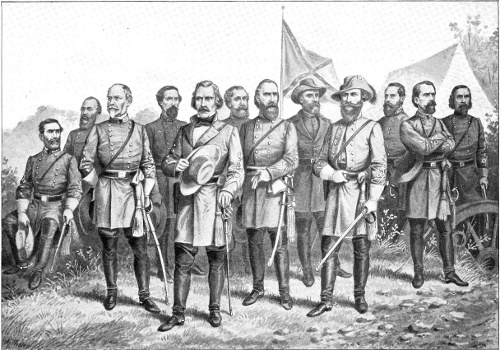
CONFEDERATE LEADERS OF THE CIVIL WAR.
BRAGG
SMITH
PEMBERTON
HAMPTON
EARLY
FITZ-HUGH LEE
PICKETT
“JOE” JOHNSTON
A. S. JOHNSTON
LONGSTREET
STUART
GORDON
In his speeches in after times Lord Napier repeatedly
referred to the singular zeal and devotedness constantly
shown by the Sisters to the sick of every denomination. On
one occasion, in Edinburgh, he remarked that the Sisters
faithfully kept their promise not to interfere with the religion
of non-Catholics, but, continued his Lordship, “they
made at least one convert; they converted me, if not to believe
in the Catholic faith, at least to believe in the Sisters
of Mercy.”
The few months spent at Balaklava by the devoted
Sisters witnessed a repetition of the deeds of heroism
which had achieved such happy results at Scutari and
Koulali. The cholera and a malignant type of fever had
broken out in those days in the camp. By night as well as
by day the Sisters were called to help the patients, yet
their strength seemed never to fail in their work of charity.
Besides the soldiers, there were sick civilians, Maltese,
Germans, Greeks, Italians, Americans and even negroes,
and to all they endeavored to give some attention.
The medical orders reveal the constant nature of the
nursing required at their hands. At one time the doctor
“requests that a Sister would sit up with his Dutch patient
in No. 9 ward to-night.” Again, “Sisters to sit up with the
Maltese and the Arab.” “Kind attendance on Jones every
night would be necessary until a notification to the contrary
be given.” “Keep the stump moist; a little champagne
and water to be given during the night.” “Elliot is
to be watched all night; powder every half hour; wine in
small dose if necessary.” The very confidence placed by
the physicians in their careful treatment added to their
toil. As the deputy purveyor-in-chief reported to the Government
in December, 1855: “The medical officer can
safely consign his most critical case to their hands; stimulants
or opiates ordered every five minutes will be faithfully
administered, though the five minutes’ labor were repeated
uninterruptedly for a week.”
The heroism of the nuns, however, was now well
known in camp, and never did workers find more sympathetic
subordinates than the Sisters had in their orderlies.
The fact that they would never lodge complaints or have
the orderlies punished only made the men more zealous in
their service. One of the Sisters found it necessary to correct
her orderly. “Perhaps, James,” she said, “you do not
wish me to speak to you a little severely.” He at once interrupted
her: “Troth, Sister, I glory in your speaking to
me. Sure, the day I came to Balaklava I cried with joy
when I saw your face.” One who had taken a glass too
much was so mortified at being seen by the Rev. Mother—whom
the soldiers call their commander-in-chief—that he
sobbed like a child. Another in the same predicament hid
himself that he might not be seen by the Sister. He had
never hidden from the enemy; a medal with three clasps
bore eloquent testimony to his bravery. “I don’t like to
say anything harsh,” said the Sister. “Speak, ma’am,” interrupted
the delinquent; “the words out of your blessed
mouth are like jewels falling over me.”
One of the Sisters writes: “We have not a cross here
with anyone. The medical officers all work beautifully
with us. They quite rely on our obedience. Sir John Hall,
the head medical officer of the army, is quite loud in his
promise of the nuns. The hospital and its hunts are scattered
over a hill. The respect of all for the Sisters is daily increasing.
Don’t be shocked to hear that I am so accustomed
to the soldiers now and so sure of their respect and
affection that I don’t mind them more than the school children.”
The soldiers in the camp envied the good fortune
of stratagem to have a few words with the nuns. “Please,
sir,” they would say to the chaplain, “do send a couple of
us on an errand to the hospital to get a sight of the nuns.”
As the time for the nuns’ departure approached the
cordial manifestations of respect and kindly feeling were
only the more multiplied. “The grateful affection of the
soldiers (a Sister writes) is most touching, often ludicrous.
They swarm around us like flocks of chickens. A black-veiled
nun, in the midst of red coats all eyes and ears for
whatever she says to them, is an ordinary sight at Balaklava.
Our doors were besieged by them to get some little
keepsake; a book in which we write ‘Given by a Sister of
Mercy’ is so valuable an article that a Protestant declared
he would rather have such a gift than the Victoria Cross
or Crimean medal.”
The Sunday after the nuns’ departure the men who
went to the chapel sobbed and cried as though their
hearts would break. When the priest turned to speak to
them and asked their prayers for the safe passage of the
nuns they could not control their emotion. “I was obliged
to cut short my discourse,” wrote the chaplain, “else I
should have cried and sobbed with my poor men.” This
sympathy was shown by Protestants and Catholics alike,
and from the commander-in-chief to the private soldier,
from the first medical officers to the simple presser in the
surgery, all was a chorus in praise of the “untiring, judicious
and gentle nursing of the Sisters of Mercy.”
Two Sisters of Mercy were summoned to their crowns
from the hospitals of the East. One was English, a lay
Sister from the convent at Liverpool. She fell a victim to
the cholera which raged at Balaklava. The other was a
choir Sister from Ireland, Sister M. Elizabeth Butler. Already
rumors of peace had brought joy to the camp, when
toward the close of February 7, 1855, she caught typhus
attending the sick and in a few days joyfully bade farewell
to the world. One of the surviving Sisters describes her
funeral. The Eighty-ninth Regiment obtained the honor
and privilege of bearing the coffin to the grave. One officer
earnestly desired to be among the chosen, but thought he
was not worthy, as he had not been at Holy Communion on
that morning. The whole medical staff attended. The
Sisters of Charity at the Sardinian camp sent five of their
number to express sympathy and condolence. Eight chaplains
attended to perform the last rites for the heroine of
charity.
The place of interment was beside the departed lay
Sister, on a rocky hill rising over the waters of the Black
Sea. The funeral was a most impressive sight. The soldiers
in double file, the multitudes of various nations,
ranks and employments, the silence unbroken, save by the
voice of tears, the groups, still as statuary that crowded
the rocks above the grave, the moaning of the sullen
waves beneath, all combined in a weird pageant never to
be forgotten by the thousands that took part in it. The
graves of these cherished Sisters were tended with loving
attention. Marked by crosses and enclosed by a high iron
railing set in cut stone, they are still quite visible from the
Black Sea beneath. Many a pilgrim went thither to strew
the graves with flowers; and to the present day many a
vessel entering the Black Sea lowers its flag in memory of
those heroines, who in the true spirit of charity devoted
their lives to alleviate the suffering of their countrymen.
⎯⎯⎯⎯⎯⎯●⎯○⎯●⎯⎯⎯⎯⎯⎯
The Very Rev. James Francis Burlando, of the Congregation
of the Mission, who is mentioned several times
in the text of this volume, was born on May 6, 1814, in the
city of Genoa, Italy. Very early in life he became impressed
with the desire of adopting the priesthood as his
vocation, and on the 16th of February, 1837, his Archbishop,
Cardinal Tadini, conferred on him the holy orders of
sub-deacon and deacon.
Soon after this he sailed for the United States and enlisted
for the American missions under Rev. John Odin, C.
M., late Archbishop of New Orleans, who at that time was
seeking recruits for the infant seminary at the Barrens,
Missouri. Before Father Burlando could come here he
was obliged to meet and overcome a very strong opposition
on the part of his good father, who, although a fervent
Christian, could not bear the idea of being separated from
his first-born son.
The very day that Father Burlando was to be admitted
to the novitiate he perceived his father at the Archepiscopal
Hall, waiting for an audience with Cardinal Tadini.
Guessing at once the motive of such an interview,
namely, that he might exercise his authority and command
the young deacon, in virtue of holy obedience, to
remain with his father and family, which would prevent
him from carrying out his holy desire, the young man
sought to baffle the intention of his father by seeing the
Archbishop first and securing his permission and blessing.
Accordingly he had recourse to the following stratagem:
He borrowed from his friends the various articles
of a clerical suit; from one a hat, from another a cassock
differing from his own, from a third a cloak, and, to render
the disguise more complete, he put on a pair of spectacles
and wig. Thus equipped, he entered the house of the
Cardinal, had a conversation with him, in which he received
his approbation and blessing, and passed out again
without being recognized by his father, who he left standing
at the door watching closely every young seminarian
who entered. Fearing he might be discovered, the young
man quickened his pace, and repaired immediately to the
venerable R. Bartholomew Gazzano, then Superior of the
Lazarists, who received him.
In the following June he left Genoa and repaired to
Turin, where he was ordained priest on the 9th of July by
the Most Rev. Aloysius Fransoni, Archbishop of that See.
To mitigate in some measure the pain which his good father
experienced on account of this separation, Father Burlando
wrote him a pressing invitation to honor and gratify
him by being present at his first Mass, on the 10th of July.
Touched by his son’s filial respect and affection, he at last
relented and assisted with tearful devotion at the impressive
ceremony.
A few weeks after Father Burlando went to the
Mother House, in Paris, whence he set out for New Orleans.
Having landed safely on the American shore, he
proceeded by steamboat to Missouri, and reached the Seminary
of the Barrens towards the close of the same year.
He filled many positions of trust and honor. The last and
most important field of his apostolic labors was the Community
of the Daughters of Charity, at the Central House
of St. Joseph’s, near Emmittsburg, Md., whither he repaired
in the spring of 1853, and where he remained for
the space of twenty-three years.
“During all that time,” says Father Gandolfo, his assistant,
“I had more occasion than anyone else of observing
his noble qualities of mind and heart. As a Superior
he was always kind, discreet, obliging, generous, amiable
and edifying in all that regarded the observance even of
the least rule, beginning from rising at 4 o’clock in the
morning at the first sound of the Benedicamus Domino.
He was exceedingly charitable and ever ready to assist me
at the first request in the performance of my duties, and
this notwithstanding his frequent attacks of neuralgia
and weakness of the digestive organs. I never saw him
misspend a minute of his time. If he was not occupied in
answering his numerous correspondents he was drawing
plans of hospitals and other buildings, or attending to
similar important affairs of the Community. He never retired
to rest without having first read the many letters he
daily received from every quarter of the United States. Although
he frequently retired very late and slept but a few
hours during the night, he was always ready for the hard
labor of the next day.”
It was largely due to the wise administration of this
worthy director that the Community owed, and owes, its
singular prosperity and development. It suffices to state
that when he assumed the duties of his position there were
only three hundred members distributed among thirty-six
houses, and he lived to see the white Cornette on the brow
of one thousand and forty-five Daughters of St. Vincent,
having under their control ninety-seven establishments
for the service of the poor, affording relief for almost every
species of misfortune. Owing to his superior knowledge of
architecture, he not only planned but personally supervised
the erection of the greater number of these charitable
institutions.
It would be impossible to enumerate the long and
painful journeys he took, the multiplied dangers to which
he exposed himself, and the many privations he endured
for the particular welfare of the different establishments
of the Sisters. How many sleepless nights he passed during
our late civil war! There were Sisters in the North
and Sisters in the South, but, by his constant vigilance,
his consummate prudence, his repeated fatherly admonitions,
and especially by his continual and fervent prayers,
he had the consolation of seeing the entire Community
free from all reproach and danger.
He has left many valuable volumes which prove his
ability as a writer as well as a thinker. One of these is
the “Ceremonial,” which was entrusted to him by the Most
Rev. Archbishop Kenrick, approved by the Provincial
Council, and which is now largely used throughout the
United States. In this valuable work all the details relative
to the Mass and offices of the Church, the sacred vessels
and other articles used are minutely described, so that
solemnity, beauty and becoming uniformity may be maintained.
He also compiled the life of Father De Andreis,
the pioneer of the Lazerists in this country. To him we
are also indebted for the publication of the beautiful life
of “Sister Eugenie, Daughter of Charity.”
A person remarked that he must be well and extensively
known throughout the United States, as he was always
traveling and had to register his name in the hotels.
“Oh, no,” he replied, “I give my name in as many different
languages as I can. In this way I pass unnoticed, and get
a little recreation at the expense of the poor recorder, who
is often at a loss to spell the foreign name. He looks bewildered,
repeats it several times, and casts an inquiring
glance at me; meantime I pretend stupidity and leave him
write whatever he likes. Then, you see, Francis Burlando
is not known.”
This devoted priest breathed his last on Sunday, February
16, 1873, at the close of a day well spent in the exercise
of his sacred functions. The funeral service took
place in the Central House of the Sisters of Charity, St.
Joseph’s, Emmittsburg, February 19, and the remains were
interred in the little cemetery of the Sisters of Charity, besides
the mortuary chapel, wherein repose the venerated
remains of Saintly Mother Seton, foundress of the Sisters
of Charity in the United States.
⎯⎯⎯⎯⎯⎯●⎯○⎯●⎯⎯⎯⎯⎯⎯
Mother Elizabeth Ann Seton, the founder and first
Superior of the Sisters of Charity in the United States,
was one of the most remarkable women in the history of
the Catholic Church in America. She was reared in the
doctrines of the Protestant Episcopal Church and did not
embrace the Catholic faith until after the death of her
husband.
This distinguished woman, who was born in the city
of New York on the 28th of August, 1774, was a younger
daughter of Dr. Richard Bayley, an eminent physician of
the metropolis. Her mother died when she was but three
years of age, but her father watched over her with all the
loving care of a good parent. As Miss Bayley advanced in
years, nature and education combined in developing those
admirable traits of character that were to make her so
lovable and merciful in later life. All of her friends and
relatives were members of the Protestant Episcopal
Church, but the physician’s daughter was more fervent in
her religious duties than any of those with whom she was
associated. From her earliest years she wore a small crucifix
on her person, and was frequently heard to express
regret and astonishment that the custom was not more
general among the members of her church.
At the age of twenty Miss Bayley was married to
William Seton, a prosperous and most estimable merchant,
of New York city. It was a happy marriage, and husband
and wife lived in mutual love and esteem. In 1800
Mr. Seton became embarrassed through a reaction in business,
caused mainly by the consequences of the Revolutionary
war. In this crisis Mrs. Seton was a help-mate in
every sense of the word. She not only cheered her husband
by her encouraging counsel, but rendered him practical
aid in arranging his business affairs.
In the course of her married life Mrs. Seton became
the mother of five children, Anna Maria, William, Richard,
Catherine Josephine and Rebecca. She was a model
mother, restraining, guiding and educating her offspring
with a mingling of tact, tenderness and edifying example.
She did not confine her goodness to her children, but was
ever ready to assist the poor and suffering. One of her
biographers says she was so zealous in this respect “that
she and a relative who accompanied her were commonly
called Protestant Sisters of Charity.”
The death of Mrs. Seton’s father in 1801 was a source
of great sorrow to this devoted woman. Years had only
served to cement the affectionate relations between father
and daughter. During the last three or four years of his
life Dr. Bayley was Health Officer at the Port of New
York. He was naturally of a philanthropic disposition,
and his official duties called him to a field that presented
an unbounded field for Christian charity. It was while in
the discharge of his duty among the immigrants that Dr.
Bayley contracted the illness which carried him to his
grave within a week’s time.
Mrs. Seton had scarcely recovered from the shock of
her father’s death when her husband’s health, which had
never been robust, began to decline rapidly. A sea voyage
and a sojourn in Italy were recommended. Mrs. Seton
could not permit her husband to travel alone in his weak
and exhausted state, and she accompanied him, along with
her oldest child, a girl of eight. The other children were
committed to the care of relatives in New York city. The
child caught the whooping cough on the way over, and
the anxious mother was constantly occupied in nursing the
husband and daughter. Before landing the unfortunate
trio were detained for many days at the lazaretto station in
the harbor of Leghorn. After they landed the good wife
was untiring in her attentions to her husband, but, in spite
of her love and solicitude, he died on the 27th of December
“among strangers and in a foreign land.”
On the following 8th of April, with her tears still
fresh upon the grave of her devoted husband, Mrs. Seton
sailed for home. Prior to this voyage and during the fifty-six
days that it occupied, Mrs. Seton began to take a deep
interest in the doctrines and practices of the Catholic
Church. She eagerly devoured all of the literature upon
the subject that opportunity offered, and also learned
much by frequent conversations with friends. Deep meditation
finally strengthened her in the desire to become a
Catholic. Her only fear was that a change in her religious
faith might bring about a coldness and a severance of the
friendship that existed between herself and her friends
and relatives—particularly her pastor—Rev. J. H. Hobart,
a man of singular talent and goodness, who afterwards
became the Protestant Episcopal Bishop of New
York.
Writing of the possibility of such an estrangement in
her diary at this time, Mrs. Seton says with evident feeling:
“If your dear friendship and esteem must be the
price of my fidelity to what I believe to be the truth, I cannot
doubt the mercy of God, who, by depriving me of one of
my remaining dearest ties on earth, will certainly draw
me nearer to Him.” She was not mistaken. When she returned
home the coldness of many of her Protestant
friends was a great trial to her warm and still bleeding
heart. The storm of opposition added to her grief.
The fact that Mrs. Seton was in doubt upon the question
of religion made her a subject of attack for the friends
of all denominations. Writing of this, she says: “I had
a most affectionate note from Mr. Hobart to-day, asking
me how I could ever think of leaving the Church in which
I was baptized. But, though whatever he says has the
weight of my partiality for him, as well as the respect it
seems to me I could scarcely have for anyone else, yet that
question made me smile; for it is like saying that wherever
a child is born and wherever its parents place it, there it
will find the truth; and he does not hear the droll invitations
made me every day since I am in my little new home
and old friends come to see me.
“It has already happened that one of the most excellent
women I ever knew, who is of the Church of Scotland,
finding me unsettled about the great object of a true faith,
said to me: ‘Oh, do, dear soul, come and hear our J. Mason
and I am sure you will join us.’
“A little after came one whom I loved, for the purest
and most innocent of manners, of the Society of Quakers
(to which I have always been attached), she coaxed me,
too, with artless persuasion: ‘Betsey, I tell thee, thee had
better come with us.’ And my faithful old friend of the
Anabaptist meeting, Mrs. T——, says, with tears in her
eyes: ‘Oh! could you be regenerated; could you know our
experiences and enjoy with us our heavenly banquet.’
And my good old Mary, the Methodist, groans and contemplates,
as she calls it, over my soul, so misled because
I have got no convictions. But, oh, my Father and My
God! all that will not do for me. Your word is truth, and
without contradiction, whatever it is. One faith, one hope,
one baptism, I look for, whatever it is, and I often think my
sins, my miseries, hide the light. Yet I will cling and hold
to my God to the last gasp, begging for that light, and
never change until I find it.”
Mrs. Seton’s doubts were finally set at rest, and on
Ash Wednesday, 1805, she was received into Catholicism
in old St. Peter’s Church, New York city. The embarrassed
state of her husband’s finances at the time of his death
had involved her, and she opened a boarding house for some
of the boys who attended a neighboring school. Some
months later Miss Cecilia Seton, the youngest sister-in-law
of Mrs. Seton, followed her into the Catholic Church. The
one thought of Mrs. Seton was now to devote her life to
the poor and to the Church. The opportunity came sooner
than she anticipated. The co-operation of the Church authorities,
and financial resources being forthcoming, a little
Community was formed in St. Joseph’s Valley, Emmittsburg.
Vows were taken in accordance with the
rules of the institute of the Sisters of Charity,
of France, and in a few months ten
Sisters were employed with the instruction of
youth and the care of the sick. They were poor but happy.
The first Christmas day, for instance, “they rejoiced to
have some smoked herring for dinner.” Rigid regulations
were adopted for the government of the new order, and its
growth was remarkable. Mother Seton had the satisfaction
of receiving her eldest daughter into the Sisterhood.
Mrs. Seton’s youngest daughter lived into the nineties
and died recently in the Mercy Convent, New York, where
she had lived as a Sister of Mercy for over forty years.
The sons of Mrs. Seton were prosperously launched in
business enterprises.
Mother Seton died on the 4th of January, 1821, in
the forty-seventh year of her age. Her bedside was surrounded
by the dark-robed Sisters of Charity and her only
surviving daughter, Josephine. Her end was happy and
tranquil. Her career was one of great piety and usefulness.
She has gone but her memory will live forever
through the perpetration of the great order that she planted
in the United States, and which has already grown to
proportions far beyond the most sanguine expectation of
its tender and affectionate founder.
⎯⎯⎯⎯⎯⎯●⎯○⎯●⎯⎯⎯⎯⎯⎯
This beautiful poem, descriptive of a Sister of Charity,
written by Gerald Griffin, has taken its place among those
precious bits of literature that never die. The author was
born in Limerick, Ireland, in 1803, and began his literary
career as a reporter for a London daily. He wrote many
novels, a tragedy and various poems. He died in Cork, in
1840.
A correspondent whose opinion is valued very highly
writes to remind the author of the “Angels of the Battlefield”
that a society of Sisters of Charity was first established
in Dublin by Mary Mother Aikenhead early in this
century. It was these ladies, particularly a sister and a
cousin of the poet who joined Mother Aikenhead, that inspired
Gerald Griffin’s beautiful lines. The Irish Sisters
of Charity make perpetual vows, wear veils and dress somewhat
similar to the Sisters of Mercy. They are not connected
with any other congregation. The “Sister of Charity”
is as follows:
She was once a lady of honor and wealth,
Bright glowed on her features the roses of health,
Her vesture was blended of silk and of gold,
And her motion shook perfume from every fold;
Joy reveled around her—love shone at her side,
And gay was her smile as the glance of a bride;
And light was her step in the mirth-sounding hall
When she heard of the daughters of Vincent De Paul.
She felt in her spirit the summons of grace,
That called her to live for the suffering race;
And heedless of pleasure, of comfort, of home,
Rose quickly like Mary and answered, “I come.”
She put from her person the trappings of pride,
And passed from her home with the joy of a bride;
Nor wept at the threshold as onward she moved,
For her heart was on fire in the cause it approved.
Lost ever to fashion—to vanity lost,
That beauty that once was the song and the toast.
No more in the ball room that figure we meet,
But gliding at dusk to the wretch’s retreat.
Forgot in the hall is that high-sounding name,
For the Sister of Charity blushes at fame;
Forgot are the claims of her riches and birth,
For she barters for heaven the glory of earth.
Those feet that to music could gracefully move
Now hear her alone on the mission of love;
Those hands that once dangled the perfume and gem
Are tending the helpless or lifted for them;
That voice that once echoed the song of the vain
Now whispers relief to the bosom of pain;
And the hair that was shining with diamond and pearl
Is wet with the tears of a penitent girl.
Her down-bed a pallet—her trinkets a bead,
Her lustre—one taper that serves her to read;
Her sculpture—the crucifix nailed by her bed;
Her paintings one print of the crown-thorned head;
Her cushion—the pavement that wearies her knees;
Her music—the Psalm or the sigh of disease;
The delicate body lives mortified there,
And the feast is forsaken for fasting and prayer.
Yet not to the service of heart and mind,
Are the cares of that heaven-minded virgin confined.
Like Him whom she loves, to the mansions of grief
She hastes with the tidings of joy and relief.
She strengthens the weary—she comforts the weak,
And soft is her voice in the ear of the sick;
Where want and affliction on mortals attend
The Sister of Charity there is a friend.
Unshrinking where pestilence scatters his breath,
Like an angel she moves mid the vapor of death,
Where rings the loud musket and flashes the sword
Unfearing she walks, for she follows the Lord.
How sweetly she bends o’er each plague-tainted face
With looks that are lighted with holiest grace;
How kindly she dresses each suffering limb,
For she sees in the wounded the image of Him.
Behold her, ye worldly! Behold her, ye vain!
Who shrink from the pathway of virtue and pain;
Who yield up to pleasure your nights and your days,
Forgetful of service, forgetful of praise;
Yet lazy philosophers—self-seeking men—
Ye fireside philanthropists, great at the pen,
How stands in the balance your eloquence weighed,
With the life and the deeds of that high-born maid?
⎯⎯⎯⎯⎯⎯●⎯○⎯●⎯⎯⎯⎯⎯⎯
(In Mr. Southey’s “Sir Thomas More” the following
account of the Beguines of Belgium and the Sisters of
Charity of France is reprinted from the London Medical
Gazette, Vol. I.)
A few summers ago I passed through Flanders on my
way to Germany, and at the hospital at Bruges saw some
of the Beguines, and heard the physician, with whom I was
intimate, speak in strong terms of their services. He
said: “There are no such nurses.” I saw them in the
wards attending on the sick, and in the chapel of the hospital
on their knees washing the floor. They were obviously
a superior class of women, and the contrast was
striking between these menial offices and the respectability
of their dress and appearance; but the Beguinage of
Ghent is one of their principal establishments, and, spending
a Sunday there, I went in the evening to vespers. It
was twilight when I entered the chapel. It was dimly
lighted by two or three tall tapers before the altar and a
few candles at the remotest end of the building, in the orchestra,
but the body of the chapel was in deep gloom,
filled from end to end with several hundreds of these nuns
seated in rows, in their dark dresses and white cowls, silent
and motionless, excepting now and then one of them
started up, and, stretching out her arms in the attitude of
the crucifixion, stood in that posture many minutes, then
sank and disappeared among the crowd. The gloom of the
chapel, the long line of these unearthly-looking figures,
like so many corpses propped up in their grave clothes—the
dead silence of the building, once only interrupted by a
few voices in the distant orchestra chanting vespers, was
one of the most striking sights I ever beheld. To some
readers, the occasional attitude of the nuns may seem an
absurd expression of fanaticism, but they are anything but
fanatics. Whoever is accustomed to the manners of Continental
nations knows that they employ a grimace in
everything. I much doubt whether, apart from the internal
emotion of piety, the external expression of it is graceful
in anyone, save only a little child in his night-shirt, on
his knees, saying his evening prayer.
The Beguinage, or residence of the Beguines at Ghent,
is a little town of itself, adjoining the city, and inclosed
from it. The transition from the crowded streets of Ghent
to the silence and solitude of the Beguinage is very striking.
The houses in which the Beguines reside are contiguous,
each having its small garden, and on the door the
name, not of the resident, but of the protecting saint of
the house; these houses are ranged into streets. There is
also the large church, which we visited, and a burial ground,
in which there are no monuments. There are upwards of
six hundred of these nuns in the Beguinage of Ghent, and
about six thousand in Brabant and Flanders. They receive
sick persons into the Beguinage, and not only nurse,
but support them, until they are recovered; they also go
out to nurse the sick. They are bound by no vow excepting
to be chaste and obedient while they remain in the order;
they have the power of quitting it and returning again
into the world whenever they please, but this, it is said,
they seldom or never do. They are most of them women,
unmarried, or widows past the middle of life. In 1244 a
synod at Fritzlau decided that no Beguine should be
younger than 40 years of age. They generally dine together
in the refectory; their apartments are barely yet comfortably
furnished, and, like all the habitations of Flanders,
remarkably clean. About their origin and name little is
known by the Beguines themselves, or is to be found in
books. For the following particulars I am chiefly indebted
to the “Histoire des Ordres Monastiques” (tome viii):
Some attributed both their origin and name to St.
Begghe, who lived in the seventh century; others to Lambert
le Begue, who lived about the end of the twelfth century.
This latter saint is said to have founded two Communities
of them at Liege, one for women, in 1173, the
other for men, in 1177. After his death they multiplied
fast, and were introduced by St. Louis into Paris and other
French cities. The plan flourished in France, and was
adopted under other forms and names. In 1443 Nicholas
Rollin, Chancellor to Philip the Good, Duke of Burgundy,
founded a hospital at Beaune and brought six Beguines
from Malines to attend upon it, and the hospital became so
famed for the care of its patients that the opulent people
of the neighborhood, when sick, were often removed to
it, preferring its attendance to what they received at
home. In one part of the hospital there was a large square
court, bordered with galleries leading to apartments suitable
to such patients; when they quitted the hospital the
donations which they left were added to its funds.
The Soeurs de la Charite, of France, are another order
of religious nurses, but different from the Beguines in being
bound by monastic vows. They originated in a charity
sermon, perhaps the most useful and extensive in its influence
that ever was preached. Vincent de Paul, a celebrated
missionary, preaching at Chatillon, in 1617, recommended
a poor sick family of the neighborhood to the care of his
congregation. At the conclusion of the sermon a number
of persons visited the sick family with bread, wine, meat
and other comforts. This led to the formation of a committee
of charitable women, under the direction of Vincent
de Paul, who went about relieving the sick poor of the
neighborhood, and met every month to give an account of
their proceedings to their superior. Such was the origin
of the celebrated order of the Soeurs de la Charite.
Wherever this missionary went he attempted to form similar
establishments. From the country they spread to cities,
and first to Paris, where, in 1629, they were established
in the parish of St. Savious.
And in 1625 a female devotee, named Le Gras, joined
the order of the Soeurs de la Charite. She was married
young to M. Le Gras, one of whose family had founded a
hospital at Puy, but, becoming a widow in 1625, in the
thirty-fourth year of her age, she made a vow of celibacy,
and dedicated the rest of her life to the service of the poor.
In her Vincent de Paul found a great accession. Under his
direction she took many journeys, visiting and inspecting
the establishments which he had founded. She was commonly
accompanied by a few pious ladies. Many women
of quality enrolled themselves in the order, but the superiors
*were assisted by inferior servants. The Hotel Dieu
was the first hospital in Paris where they exercised their
vocation. This they visited every day, supplying the patients
with comforts above what the hospital afforded, and
administering, besides, religious consolation. By degrees
they spread into all the provinces of France, and at length
the Queen of Poland requested Mademoiselle Le Gras, for
though a widow that was her title, to send her a supply of
Soeurs de la Charite, who were thus established in Varsovia,
in 1652. At length, after a long life spent in the
service of charity and religion, Mademoiselle Le Gras died
on the 15th of March, 1660, nearly seventy years of age,
and for a day and a half her body lay exposed to the gaze
of the pious.
A country clergyman, who spent several years in various
parts of France, gives an account of the present state
of the order, which, together with what I have gathered
from other sources, is in substance as follows: It consists
of women of all ranks, many of them of the higher orders.
After a year’s novitiate in the convent, they take a vow
which binds them to the order for the rest of their lives.
They have two objects, to attend the sick and to educate
the poor; they are spread all over France, are the superior
nurses at the hospitals, and are to be found in every town,
and often even in villages. Go into the Paris hospitals at
almost any hour of the day, and you will see one of these
respectable-looking women, in her black gown and white
hood, passing slowly from bed to bed, and stopping to inquire
of some poor wretch what little comfort he is fancying
will alleviate his sufferings. If a parochial cure
wants assistance in the care of his flock he applies to the
Order of Les Soeurs de la Charite. Two of them (for they
generally go in couples), set out on their charitable mission;
wherever they travel their dress protects
them. “Even more enlightened persons
than the common peasantry hail it as a
happy omen when on a journey with a Soeur de la Charite
happens to travel with them, and even instances are recorded
in which their presence has saved travelers from
the attacks of robbers.” During the Revolution they were
rarely molested. They were the only religious order permitted
openly to wear their dress and pursue their vocation.
Government gives a hundred francs a year to each
Sister, besides her traveling expenses; and if the parish
where they go cannot maintain them, they are supported
out of the funds of the order. In old age they retire to
their convents and spend the rest of their lives in educating
the novitiates. Thus, like the vestal virgins of old,
the first part of their life is spent learning their duties,
the second in practicing them, and the last in teaching
them.
⎯⎯⎯⎯⎯⎯●⎯○⎯●⎯⎯⎯⎯⎯⎯
(Written by John Greenleaf Whittier with reference to the work
of the Sisters of Mercy at the battle of Buena Vista, during the
Mexican war.)
Speak and tell us, our Ximena, looking northward far away,
O’er the camp of the invaders, o’er the Mexican army.
Who is losing? Who is winning? Are they far or come they near?
Look ahead, and tell us, Sister, whither rolls the storm we hear.
“Down the hills of Augostura still the storm of battle rolls;
Blood is flowing, men are dying; God have mercy on their souls!”
Who is losing? Who is winning?—“over hill and over plain,
I see but smoke of cannon, clouding through the mountain rain.”
Holy Mother! keep our brothers! Look, Ximena, look once more.
“Still I see the fearful whirlwind rolling darkly as before,
Bearing on in strange confusion, friend and foeman, foot and horse,
Like some wild and troubled torrent sweeping down its mountain course.”
Look forth once more, Ximena! “Oh! the smoke has rolled away;
And I see the Northern rifles gleaming down the ranks of gray.
Hark! that sudden blast of bugles! there the troop of Minon wheels,
There the Northern horses thunder, with the cannon at their heels.
“Jesu, pity! how it thickens! Now retreat and now advance!
Right against the blazing cannon showers Pueblo’s charging lance!
Down they go, the brave young riders; horse and foot together fall;
Like a plowshare in the fallow through them ploughs the Northern ball.”
Nearer came the storm and nearer, rolling fast and frightful on;
Speak, Ximena, speak and tell us who has lost and who has won?
“Alas, alas! I know not, friend and foe together fall,
O’er the dying rush the living; pray my Sisters for them all.”
“Lo! the wind the smoke is lifting; Blessed Mother save my brain!
I can see the wounded crawling slowly out from heaps of slain.
Now they stagger, blind and bleeding; now they fall and strive to rise;
Hasten, Sisters, haste and save them, lest they die before our eyes.
“O my heart’s love, O my dear one! lay thy poor head on my knee;
Dost thou know the lips that kiss thee? Cans’t thou hear me? Cans’t thou see?
Oh, my husband, brave and gentle! O my Bernal, look once more
On the blessed cross before thee! Mercy! Mercy! all is o’er!”
Dry thy tears, my poor Ximena; lay thy dear one down to rest;
Let his hands be meekly folded, lay the cross upon his breast;
Let his dirge be sung hereafter, and his funeral masses said;
To-day, thou poor bereaved one, the living ask thy aid.
Close beside her, faintly, faintly moaning, fair and young a soldier lay,
Torn with shot and pierced with lances, bleeding slow his life away;
But, as tenderly before him the lorn Ximena knelt,
She saw the Northern eagle shining on his pistol belt.
With a stifled cry of horror straight she turned away her head;
With a sad and bitter feeling look’d she back upon her dead;
But she heard the youth’s low moaning, and his struggling breath of pain,
And she raised the cooling water to his parching lips again.
Whisper’d low the dying soldier, press’d her hand and faintly smiled.
Was that pitying face his mother’s? Did she watch besides her child?
All his stronger words with meaning her woman’s heart supplied;
With her kiss upon his forehead, “Mother!” murmur’d he and died.
“A bitter curse upon them, poor boy, who led thee forth,
From some gentle sad-eyed mother, weeping, lonely in the North!”
Spoke the mournful Mexic woman, as she laid him with her dead,
And turn’d to soothe the living, and bind the wounds which bled.
Look forth once more Ximena! like a cloud before the wind
Rolls the battle down the mountains leaving blood and death behind.
Oh! they plead in vain for mercy—in the dust the wounded strive;
Hide your faces, holy angels! O thou Christ of God forgive!
Sink, O night, among thy mountains! let the cool gray shadows fall;
Dying brothers, fighting demons, drop thy curtain over all!
Through the thickening winter twilight, wide apart the battle rolled,
In its sheath the sabre rested and the cannon’s mouth grew cold.
But the noble Mexic women still their holy task pursued,
Through that long dark night of sorrow worn and faint and lacking food;
Over weak and suffering brothers, with a tender care they hung,
And the dying foeman bless’d them in a strange and Northern tongue.
Not wholly lost, O Father, is this evil world of ours;
Upward, through its blood and ashes spring afresh the Eden flowers;
From its smoking hill of battle love and pity send their prayer,
And still Thy white-wing’d angels hover dimly in our air.
⎯⎯⎯⎯⎯⎯●⎯○⎯●⎯⎯⎯⎯⎯⎯
Miss Catherine Elizabeth McAuley, the foundress of
the Order of Sisters of Mercy, ranks high among the notable
women whose achievements have enriched the history
of the Catholic Church. The religious institution first
planted by her in the city of Dublin has spread to such an
extent that its branches now spread into at least every
quarter of the English-speaking globe. The communities
of the Sisters of Mercy in the United States have done excellent
work in many fields, but they particularly distinguished
themselves as nurses during the unhappy conflict
between the North and the South.
Miss McAuley was born September 29, 1787, at Stormanstown,
Dublin, Ireland. She was the daughter of
pious, well-known and respectable parents. Her father
was especially prominent by reason of his goodness to the
poor and the unfortunate. One of his regular practices
was to have all the poor of the vicinity come to his house
on Sundays and holidays for the purpose of instructing
them in their religion. Both father and mother died when
the subject of this sketch was very young.
Shortly after this unfortunate event Catherine was
adopted by Mr. and Mrs. William Callahan, who belonged
to a family that was distantly connected with the mother
of Miss McAuley. Her foster-parents, although very
worthy people, were bitterly prejudiced against the religion
practiced by their adopted child. They were so opposed
to anything Catholic that they would not permit a
crucifix or a pious picture in the house. Despite this, Catherine
attended to her religious duties with great regularity
and fidelity, and by her gentleness succeeded in disarming
any anger or annoyance that they might have otherwise
felt regarding her course.
She was a model of all the virtues, and this fact did
not escape the attention of her foster-parents. Dean Gaffney,
writing of her at this period, says: “Everyone who
had distress to be relieved, affliction to be mitigated, troubles
to be encountered, came to her, and to the best of her
ability she advised them what to do. Her zeal made her
a missionary in her district.” In these works of charity
and usefulness she continued for several years, during
which she was rendering herself dearer and dearer to her
adopted parents. In the course of a few years both these
estimable people died, but not before the gentle foster-child
had led both of them into the Catholic Church. Catherine
was left the sole heiress of Mr. Callahan, and at once made
arrangements for systematically distributing food and
clothing to the poor.
Miss McAuley was now in a position to realize her
early vision of founding an institution in which servants
and other women of good character might, when out of
work, find a temporary home and be shielded from the
dangers to which the unprotected members of the sex are
exposed. She unfolded her plans to the Very Rev. Dr.
Armstrong and Very Rev. Dr. Blake, her spiritual advisers.
“It was deemed advisable,” says Dean Murphy, writing
of this, “not to take a house already built and occupied
for other purposes, and which she would have some difficulty
in adapting to her own designs, but to secure a plot
of ground that had never been built upon, and to erect an
edifice for the honor and glory of God that had never been
profaned by the vices and folly of the world, and which
should be as holy in its creation as in its use, and be dedicated
to God from its very foundation.” The building was
constructed and put into operation within a reasonably
short time. When finished it was discovered that the architect
had created a building which for all purposes could
be used as a convent.
This was regarded as a fortunate mistake. In the beginning
Miss McAuley had no thought of founding a religious
institute, but in working out the ideas that were
near to her heart she imperceptibly and almost unconsciously
drifted towards that end. Daniel O’Connell, the
great Irish liberator, was a friend and patron of Miss McAuley,
and frequently visited her establishment, which he
regarded as filling a long-felt want in the Irish capital. In
1827 O’Connell presided over a Christmas dinner given by
Miss McAuley to the poor children of Dublin.
In 1828, at the suggestion of the Archbishop of the
Diocese, she formed the Order of the Sisters of Mercy.
There had been a “Royal, Military and Religious Order of
Our Lady of Mercy,” dating back to the twelfth century,
and this new order, founded by a pious young woman, was
largely based upon the old one, except that it was intended
for women and not for men. Miss McAuley frequently
said that what she desired was to found an order whose
members would combine the silence, recollection and prayer
of the Carmelite with the active zeal of a Sister of
Charity. It seems to be generally conceded that she succeeded
in achieving her purpose. Three words, “works
of mercy,” briefly tell the story of the character of the labors
of the Sisters of Mercy. Miss McAuley did not finally
complete her laudable plan without having to overcome
many obstacles, and to set aside some very bitter opposition,
part of which came, not only from her own relatives,
but from bishops and priests as well.
A few years after the dedication of her institute Miss
McAuley and a few chosen companions decided that the
high purpose to which they had consecrated their lives
could be carried out if they would enter the religious
state. They were admitted to one of the convents of the
Presentation Order, and after a novitiate lasting one
year she and her companions received the religious
habit.
In October, 1831, she professed and was canonically
appointed by the Archbishop as Superior of the new order.
The costume worn by the members of the order was devised
by Mother Catherine, as she was thereafter called.
The Order grew rapidly in numbers and in prominence.
The life of its first Mother and foundress was active and
edifying. Her labors were not confined to any particular
work, but embraced everything that was in the interest
and for the benefit of the poor and unfortunate. In 1832
she won enduring laurels by assuming charge of the cholera
hospital in Dublin.
She died on November 11, 1837, resigned and happy,
and furnished an example of pious fortitude to the Sisters
that crowded about her deathbed. The Order that she
founded, as it exists to-day, is her best monument. Beginning
in Ireland in 1827 it was afterwards successfully introduced
into England, Newfoundland, Australia, New
Zealand, South America and the United States of America.
⎯⎯⎯⎯⎯⎯●⎯○⎯●⎯⎯⎯⎯⎯⎯
Notre Dame, Indiana, enjoys the distinction of a
Grand Army Post composed of Catholic clergymen, most
of whom are members of the faculty of Notre Dame University.
The organization was officially entered on October
6, 1897, as Post No. 569, Department of Indiana.
Very Rev. William E. Corby, C. S. C., the commander of
the new post, was chaplain of the Irish Brigade, and is
now the provincial, or head officer, of the order of the Holy
Cross in the United States. Dr. Corby is also the chaplain
of the Indiana Commandery of the Loyal Legion. To
this position he was nominated by General Lew Wallace.
The membership of the new post will be very small,
but large enough to have a few famous fighters and great
men of the war. With the exception of Colonel William
E. Haynes, the only lay member, the post is composed altogether
of members of the congregation of the Holy Cross.
The following complete the roster:
Very Rev. William Corby, C. S. C., chaplain Eighty-eighth
New York Volunteers, Irish Brigade.
Rev. Peter P. Cooney, C. S. C., chaplain Thirty-fifth
Medina.
James McLain (Brother Leander), C. S. C., B Company,
Twenty-fourth United States Infantry.
William A. Olmsted, C. S. C., captain and lieutenant
colonel Second Infantry, New York Volunteers, colonel
Fifty-ninth New York Veteran Volunteers; brigadier general
by brevet, commandery First Brigade, Second Division,
Second Army Corps, Army of the Potomac.
Mark A. Willis (Brother John Chrysostom, C. S. C.),
I Company, Fifty-fourth Pennsylvania Volunteers.
Nicholas A. Bath (Brother Cosmos, C. S. C.), D Company,
Second United States Artillery.
James Mantle (Brother Benedict, C. S. C.), A Company,
First Pennsylvania Heavy Artillery and Sixth
United States Cavalry.
John McInerny (Brother Eustathius, C. S. C.), H Company,
Eighty-third Ohio Volunteers.
Joseph Staley (Brother Agathus, C. S. C.), C Company,
Eighth Indiana Regulars.
Ignatz Mayer (Brother Ignatius, C. S. C.), C Company,
Seventy-fifth Pennsylvania Volunteers and One Hundred
and Fifty-seventh Pennsylvania Volunteers.
James C. Malloy (Brother Raphael, C. S. C.), B Company,
One Hundred and Thirty-third Pennsylvania Volunteers.
Colonel William E. Haynes.
General Olmsted, who is studying for the priesthood,
is much interested in the little gathering. He is justly
proud of the work of his men in the celebrated Hancock’s
Division. He refers to the Government reports in every
case as proof of the bravery of his soldiers. The General
said not long ago in an interview: “Very much that is
said of me is not true, but to show you that my men were
brave, I give you the reports from the department at
Washington.” The General read: “The losses of the First
Brigade, Second Division, Second Corps—my brigade—were
greater in the battle of Gettysburg than those that
occurred to any one brigade in the army. There was, beside,
a total casualty of 763 killed and wounded out of 1246
men at Antietam, a percentage of 61.”
Father Corby has the honor of being the only chaplain
to give absolution under fire. The event of his giving
absolution at Gettysburg to the Irish Brigade is the best
known of his achievements in chaplain life. It is said that
every man, Catholic and Protestant, knelt before the rock
upon which he stood, and the colors were lowered. Then
they went out and fought, and how many fell upon that
bloody field is too well known to be repeated. Father
Corby, although an old man, is hale and hearty, and does
all his work as provincial of the order without the aid of a
secretary.
Rev. Peter Cooney also has a brilliant war record, but
he and Father Corby are by no means the only two who
went to war from Notre Dame. In all there were eight
priests who went forth to service as chaplains in the war.
Beside these Mother Mary Angela, a cousin of James G.
Blaine, went forth with a large number of Sisters to nurse
the wounded and care for the dying. To these also great
praise is due.
There was much enthusiasm in Notre Dame over the
organization exercises, and among those present or who
sent their congratulations were General Lew Wallace,
General Mulholland, of Philadelphia; Colonel J. A. Smith,
of Indianapolis; General J. A. Golden, of New York; General
William J. Sewall, Colonel R. S. Robertson, of Fort
Wayne; General J. A. Starburg, of Boston; Captain Florence
McCarthy, of New York; Captain Emil A. Dapper, of
Grand Rapids; Captain J. J. Abercrombie, of Chicago;
Department Commander James S. Dodge, with his full
staff. The G. A. R. post from Elkhart and two posts from
South Bend helped to muster in the clerical veterans.
Commendatory messages were also received from a large
number of posts and leaders in the G. A. R.
⎯⎯⎯⎯⎯⎯●⎯○⎯●⎯⎯⎯⎯⎯⎯
St. Teresa’s Church, at the northeast corner of Broad
and Catherine streets, was temporarily used as a hospital
for wounded soldiers during the war. On July 4, 1897,
Rev. Joseph V. O’Connor, one of the eloquent priests of
the diocese of Philadelphia, delivered an address in this
church, relative to Catholics in the war. A score of
Grand Army posts attended the exercises, which were
also honored by the presence of the venerable Hugh
Lane, who has been pastor of the church during and
since the war. Father O’Connor’s address deserves a
place in this volume. He said:
“The sacred edifice in which you assemble is an appropriate
spot for religion and patriotism to meet, for
St. Teresa’s Church was for a time in the Civil War a
military hospital. The old railway station at Broad
and Prime streets was the rendezvous of the Union
troops from the North and East going to and from the
seat of war. The gleaming cross upon the church seemed
lifted in benediction over army after army marching
past. The poet Byron represents the forest of Ardennes
as weeping over the ‘unreturning brave’ of Waterloo,
but the sign of man’s redemption may have lifted up
many a Catholic soldier’s heart destined to be stilled in
the next battle. These walls, now bright with light and
color, have re-echoed the moans of the dying. The venerable
priest whose gracious presence lends dignity and
historic interest to this celebration prepared here many
a soldier for the last dread fight with death, the universal
conqueror. I seem to behold, mingling with your
solid phalanx, the shadowy forms of the brave men who
were delivered from the storm and earthquake of battle
to breathe out their spirits here in the peace of the
sanctuary.
“Far be it from me to limit to the Catholic breast
that noble fire of the love of country, which with purifying
flame burned in the great heart of the nation when
war sounded the trumpet call to the children of the republic.
It is occasion that shows the man. Our
Civil War was an occasion that showed our Church.
The legislative code of England was disgraced,
even in Victoria’s reign by the calumny and the imbecility
of penal laws against Catholics. To be a Catholic was
to be a traitor. In vain did we appeal to history, which
crowns with laurels the brows of unnumbered Catholic
patriots and heroes in every land of the universal Church.
The Thundering Legion fought for the Roman Emperor,
who decreed its martyrdom. The fleet of Protestant England
was led against the Armada of Catholic Spain by
a Catholic in the service of a Queen who sent his fellow-religionists
to the stake on account of their faith.
The patriotism of the Catholic is motived by his religion.
It rises superior to the form in which civil government
may be embodied. Were the Pope, as temporal prince,
to invade our country we should be bound in conscience
to repel him, nor would our patriotism conflict one iota
with our religious faith.
“Our people, driven by misgovernment from their
native soil, found the portals of the great Republic flung
open to them in friendly welcome. They came to the
North and to the West. Thus the great centres of
industry in the Northern States were crowded with
Catholics. Most of us had learned the bitter lessons
which tyranny, bad government and religious
rancor have to impart under the scourge of England’s
misrule of Ireland. As Bourke Cockran says, England’s
treatment of the Irish people has made the world distrust
her. Ireland’s love for America dates from before
the Revolution. The Irish Parliament passed resolutions
of sympathy with the American colonists. The
great tides of immigration from Ireland set in early and
continued until, at the outbreak of the Civil War, the
North was one-fourth Celtic in blood.
“The Catholic Church studiously refrained from any
official pronouncement upon the causes of the conflict
which she deplored. The first regiment to respond to
President Lincoln’s initial call for troops was the Sixty-ninth
New York. It was mainly Irish and Catholic.
Within forty-eight hours it was on its way to the front.
New York, pre-eminently a Catholic State, furnished one-seventh
of the military forces in the war for the Union.
“Obviously the Government had no reason for recording
the religious faith of its soldiers. Patriotism is
at once a natural and a civic virtue. That it may be
supernaturalized is evident from the words of St. Paul,
bidding us obey the higher powers for conscience sake.
The country had to face a condition, not a theory, and
whatever abstract reasoning has to say about State
rights, the will of the majority of the people, which is
the supreme law in a republic, decided for the maintenance
of the Federal Union. The best traditions of the
country, North and South, identified liberty with union.
God appears to have made the country one in geographical
formation, in sameness of language, in homogeneity
of character.
“Two illustrious Catholic prelates, recognized as
leaders in Israel—the Moses and the Joshua of the
Church—Archbishop Kendrick, of Baltimore, and Archbishop
Hughes, of New York, declared in favor of the
Union. The sainted sage of the primatial city
flung the starry banner from the pinnacle of
his Cathedral. The Archbishop of New York was so
thoroughly identified with the cause of the Union that
he was invested by the President and his Secretary of
State with the authority of envoy extraordinary to the
courts of Europe.
“Unroll the military records of our country and you
will read column after column of names that are historically
Catholic. Read the names on the tombstones of
soldiers in the great national cemeteries and you will
find in the Christian name alone confirmatory evidence
of the faith of the hero that sleeps beneath. The Catholic
knows that the Church imposes in baptism the name
of a saint. We may safely judge that he is a Catholic
who bears the name of Patrick and Michael, of Bernard
and Dominic. Not even the conservative spirit of the
Church of England could retain the old saintly nomenclature,
and Puritanism chose the names of Old Testament
worthies or names taken from natural history and
even heathen mythology.
“If we reckon our soldiers by their religion, the
majority would be Catholic and we should find that we
had given our children in far greater number than any
one denomination. On the second day of Gettysburg a
Catholic priest, ascending an eminence, lifted his hand
to give absolution, and far as the eye could reach rank
upon rank of soldiers bent their heads like cornfields
swept by the summer breeze. Hancock, the “superb,”
impressed by the solemnity of the scene, bared his brow.
If the poet thought that a tear should fall for Stonewall
Jackson because he spared Barbara Frietchie’s
Union flag, will not a Catholic murmur a prayer for the
great general who gave heed to the priest calling upon
his people to be contrite for their sins in the hour which
for many would be the last?
“The seven successive stormings of the heights of
Fredericksburg by the Irish Brigade has long passed into
history as surpassing Alma and the Sedan. Keenan’s
cavalry charge at Chancellorsville saved the Union
army at the cost of 300 lives. The charge of the Light
Brigade at Balaklava was described by a French officer
as magnificent, but unmilitary—‘C’est magnifique, mais
ce n’est pas la guerre.’ But Keenan’s charge was both
glorious and strategic. His troop rushed like a whirlwind
upon 20,000 Confederates. His men were shot down
or sabered in the saddle. The steeds, maddened by
wounds and uncontrolled by their dead riders, plunged
into the thick of the Confederate ranks, and so disconcerted
and appalled them that the main army of the
Union had time to save itself from otherwise inevitable
destruction. Perhaps the most critical point of the war
was the success or the failure of Sheridan’s devastation
of the Shenandoah Valley, which was the great base of
supplies for the South. Sheridan’s historic ride, which
saved the day at Winchester, was the exploit of a Catholic.
The Republic subsequently conferred upon this son
of the Church one of the highest and most responsible
positions in her keeping, the generalship of her armies.
“One of the first, if not the first band of trained
nurses that offered their services to the Government was
the religious society of the Sisters of Charity. Their
title is their history. Their services in hospitals and on
the field did more than tomes of controversy to
make the Catholic Church better known, and consequently
loved, by the American people. The convalescing soldier
by word and by letter spread the information
throughout the land that the ministrations of the Catholic
Sisterhood reminded him of a mother’s love and a
sister’s tenderness.
“The heroic devotion to duty of the Catholic chaplains,
who made no distinction of religion when a soldier
was to be helped, endeared the Catholic religion to
many who met a Catholic priest for the first time in
camp or hospital. Our own noble-hearted Archbishop
rendered such service to the wounded soldiers in St.
Louis that the Government offered him a chaplaincy.
Care of the body was often supplemented with the
higher care of the soul. In that parting hour, when
mortality leans upon the breast of religion, the example
of devoted priest and religious gently led many a soul
into the hope and the consolation of divine faith.
“God grant that our country shall never again reel
under the shock of war! Yet out of the nettle of danger
has come the flower of safety. Calumny, suspicion,
distrust of our patriotism were struck dumb. Never
again shall we be taunted with secret antipathy to free
institutions. The banner of the stars was rebaptized
in our blood. To the soldier of the war the Church owes
a debt of gratitude. He proved often by his death that
the religion which he professed, far from condemning his
patriotism, commended it as a virtue, and the faith that
sustained him in battle supported him when his heart
poured out the blood of supreme sacrifice upon the altar
of his country. And though no memorial marks his
resting place the Church in every mass pleads for the
repose of his soul.
“The soldier stands as the highest value which we
place upon our country and her institutions. He says to
all: ‘My country is worth dying for.’ In our thoughtless
way we take liberty, security of life and property, the
blessings of religion and safeguards of law and all the
beauty and amenity of our civilization as a matter of
course. Without the soldier all these goods would perish.
It is war that preserves and protects peace. The
soldier is the guardian of our homes. Honor him; make
peaceful and happy his declining years. Thank God with
David for preparing our hands for the sword, before
whose blinding ray, in the hand of the hero, domestic
treason and foreign conspiracy slink into their dens.
Bless God for making us a nation of soldiers, as well
as of citizens. The war proved that the American soldier,
North and South, is without a peer in bravery, in
discipline, in self-control. Whilst our Republic gives
birth to such heroic sons we may laugh armed Europe to
scorn.
“Soldiers, there is another battle, another field, a
greater Captain than even the archangel who led the
embattled seraphim to war. You divine my meaning.
Be soldiers of the cross! Fight the good fight of faith.
Be sober, pure, charitable. The laurel that binds the
warrior’s brow on earth soon fades. The flowers of
Decoration Day droop with the setting sun. But the
Divine Captain of our salvation will place upon your
brow, if you are faithful to the end, a crown that fadeth
not away, a wreath which you will receive amid the
shout of the heavenly armies.”
⎯⎯⎯⎯⎯⎯●⎯○⎯●⎯⎯⎯⎯⎯⎯
The purpose of the writer of this history, as already
stated, has been to furnish for the first time a full and
detailed story of the labors of the Catholic Sisterhoods
in the Civil War, but in doing that he has not had the
slightest intention of detracting from the splendid service
rendered by other bodies and other persons. One
of the most notable organizations that contributed its
part in the humane work incident to the war was the
Sanitary Commission. It had its rise in a spontaneous
movement of the women in New England. It is said
that 7000 branch Aid Societies were connected with the
Commission at one time. Charles J. Stille, of Philadelphia,
has written a history of the Commission, from
which most of the facts embodied in this sketch have
been obtained. Committees were sent to Washington,
the part of the Government, the Secretary of War, on
the 9th of June, 1861, issued an order appointing Henry
and after much negotiation, involving tedious delay on
W. Bellows, D. D., Professor A. D. Boche, LL. D., Professor
Jeffries Wyman, M. D., W. H. Van Buren, M. D.,
Wolcott Gibbs, M. D., R. C. Wood, surgeon U. S. A.; G.
W. Cullom, U. S. A.; Alexander E. Shiras, U. S. A., in
connection with such others as they might chose to associate
with them, “a commission of inquiry and advice in
respect of the sanitary interests of the United States
forces.” They were to serve without remuneration from
the Government and were to be provided with a room
for their use in the city of Washington.
They were to direct their inquiries to the principles
and practices connected with the inspection of recruits
and enlisted men, the sanitary condition of volunteers,
to the means of preserving and restoring the health and
of securing the general comfort and efficiency of the
troops, to the proper provision of cooks, nurses and hospitals,
and to other subjects of a like nature. The mode
by which they proposed to conduct these inquiries was
detailed in the letter of the New York delegation to the
Secretary of War on the 22d of May. The order appointing
them directed that they should correspond
freely with the department and with the Medical Bureau
concerning these subjects, and on this footing and within
these limits their relations with the official authorities
were established. To enable them to carry out fully
the purposes of their appointment the Surgeon General
issued a circular letter announcing the creation of the
Commission, and directing all the officers in his department
to grant its agents every facility in the prosecution
of their duties.
On the 12th of June the gentlemen named as Commissioners
in the order of the Secretary of War (with
the exception of Professor Wyman, who had declined his
appointment) assembled at Washington. They proceeded
to organize the Board by the selection of the
Rev. Dr. Bellows as president. Their first care was to
secure the services of certain gentlemen as colleagues,
who were supposed to possess special qualifications, but
whose names had not been included in the original warrant.
Accordingly Dr. Elisha Harris and Dr. Cornelius
R. Agnew were unanimously chosen Commissioners at
the first meeting, and George T. Strong and Dr. J. S.
Newberry in like manner at the one next succeeding.
At different periods during the war Rt. Rev. Bishop
Clark, Hon. R. W. Burnet, Hon. Mark Skinner, Hon. Joseph
Holt, Horace Binney, Jr., Rev. J. H. Heywood, Prof.
Fairman Rogers, J. Huntingdon Wolcott, Charles J.
Stille, E. B. McCagg and F. Law Olmstead were elected
by the Board members of the Commission.
At the first meeting a “Plan of Organization,” prepared
by the president, was presented, discussed and finally
adopted. On the 13th the Commission, in a body, waited
on the President and Secretary of War, who gave their
formal sanction to this plan of organization by affixing
to it their signatures. The experiences of the war suggested
but little alteration, even in the outline of this
report, while to a strict adherence to the general principles
it embodied the Sanitary Commission owed much
of its wonderful success.
The plan reduced to a practical system and method
the principles laid down in the letters of the New York
gentlemen to the Government authorities and endeavored
to apply them to the actual existing condition of
the army. Confining its proposed operations within the
limited sphere of “inquiry” and “advice,” which had been
assigned to it by the Government, it declared what it
proposed to do and by what methods in each of these departments
of duty.
In order that its work might be carried on systematically
and thoroughly two general committees were created,
one respecting “inquiry,” the other “advice.” The
object of the first was to determine by all the light
which could be derived from experience what must necessarily
be the wants and conditions of troops brought together
as ours had been, to ascertain exactly how far
evils which had proved the scourge of other armies had
already invaded our own, and to decide concerning the
best measures to be adopted to remove all causes of removable
and preventable disease.
Each branch of “inquiry” under this head was referred
to a distinct sub-committee. From the first was
expected such suggestions of preventable measures as
experience in former wars had proved to be absolutely
essential; to the second was entrusted the actual inspection,
by its own members or their agents, of the camps
and hospitals, so that the real condition of the army, in
a sanitary point of view, concerning which there were
many conflicting rumors, could be definitely known. To
the third was referred all questions concerning the improvement
of the health and efficiency of the army in respect
to diet, clothing, quarters and matters of a similar
nature.
In regard to the other branch of duty assigned to
the Commission under its appointment, that of “advice,”
the Board took the same wide and comprehensive views
as had guided them in regard to the needful subjects
of inquiry. Their purpose was to “get the opinions and
conclusions of the Commission approved by the Medical
Bureau, ordered by the War Department and carried out
by the officers and men.”
The interest excited in thousands of homes throughout
the land, whose inmates were members of aid societies
in favor of the Sanitary Commission, and who
looked upon it only as the almoner of their vast offerings
for the relief of the army, led to the popular error that
it was only a relief association upon a grand scale and
quite overshadowed in popular estimation its original
purpose, if not the peculiar and exclusive work before it.
The Commission itself, however, never departed from the
true scientific idea and conception of a preventive system,
and always regarded the relief system, vast as was
the place occupied by it in the war, as inferior in the
importance of its results to those due to well considered
and thoroughly executed preventive measures.
The Commission at the close of the war established
a pension bureau and war claim agency for the benefit of
disabled soldiers and their orphans and widows. The
entire money receipts of the Commission from 1861 to
1866 were $4,924,480.99, and the value of supplies furnished
is estimated at $15,000,000.
⎯⎯⎯⎯⎯⎯●⎯○⎯●⎯⎯⎯⎯⎯⎯
“By the flow of the inland river,
Whence the fleets of iron have fled,
Where the blades of the grave-grass quiver,
Asleep on the ranks of the dead—
Under the sod and the dew,
Waiting the judgment-day;
Under the one, the Blue;
Under the other, the Gray.
These in the robings of glory,
Those in the gloom of defeat,
All with the battle-blood gory
In the dusk of eternity meet—
Under the sod and the dew,
Waiting the judgment-day;
Under the laurel, the Blue;
Under the willow, the Gray.
From the silence of sorrowful hours
The desolate mourners go,
Lovingly laden with flowers,
Alike for the friend and the foe—
Under the sod and the dew,
Waiting the judgment-day;
Under the roses, the Blue;
Under the lilies, the Gray.
So with an equal splendor
The morning sun-rays fall,
With a touch impartially tender,
On the blossoms blooming for all—
Under the sod and the dew,
Waiting the judgment-day;
Broidered with gold, the Blue;
Mellowed with gold, the Gray.
So when the summer calleth,
On forest and field of grain,
With an equal murmur falleth
The cooling drip of the rain—
Under the sod and the dew,
Waiting the judgment-day;
Wet with the rain, the Blue;
Wet with the rain, the Gray.
Sadly, but not with upbraiding,
The generous deed was done:
In the storm of the years that are fading,
No braver battle was won—
Under the sod and the dew,
Waiting the judgment-day;
Under the blossoms, the Blue;
Under the garlands, the Gray.
No more shall the war-cry sever,
Or the winding rivers be red:
They banish our anger forever
When they laurel the graves of our dead—
Under the sod and the dew,
Waiting the judgment-day;
Love and tears for the Blue;
Tears and love for the Gray.”
⎯⎯⎯⎯⎯⎯●⎯○⎯●⎯⎯⎯⎯⎯⎯
The following interesting little incident is taken
from Very Rev. W. C. Corby’s book, entitled “Memoirs of
Chaplain Life:”
“On the 29th of November, 1863,” says Rev. Constantine
L. Egan, O. P., chaplain of the Ninth Massachusetts
Volunteers, “we advanced to Mine Run and
formed a line of battle and bivouacked for the night.
The enemy were posted on the east ridge, about one
mile from the stream called Mile Run, on a centre ridge
nearly 100 feet above the surface of the stream. Their
works could easily be seen by us posted on the west
ridge of the run. They were strongly fortified, their
works bristling with abatis, infantry parapets and epaulements
for batteries. About 3 o’clock on the evening
of the 30th the order was given to charge the enemy’s
line. Seeing the danger of death before us I asked the
colonel to form his regiment into a solid square so that
I could address the men. He did so. I then spoke to
them of their danger, and entreated them to prepare
for it by going on their knees and making a sincere act
of contrition for their sins, with the intention of going
to confession if their lives were spared.
“As the regiment fell on their knees, other Catholic
soldiers broke from their ranks and joined us, so that
in less than two minutes I had the largest congregation
I ever witnessed before, or even since. Having pronounced
the words of general absolution to be given in
such emergencies and danger, I spoke a few words of
encouragement to them.
* * * “After talking to the soldiers and finishing
my remarks, they arose from their knees, grasping
their muskets with a firm clinch, and went back to
their respective commands, awaiting the hour to expire
to make the assault.”
Smith Johnson, taking this as his theme, has written
the following poem, entitled “A Miracle of War,”
and dedicated it to Father Corby:
Two armies stood in stern array
On Gettysburg’s historic field—
This side the blue, on that the gray—
Each side resolved to win the day,
Or life to home and country yield.
“Take arms!” “Fall in!” rang o’er the line
Of Hancock’s ever-valiant corps—
For to the left the cannons chime
With music terribly sublime,
With death’s unceasing, solemn roar.
With spirits ardent, undismayed,
With flags uplifted toward the sky,
There stands brave Meagher’s old brigade
Those noble laurels ne’er will fade
Upon the page of history.
“All forward, men!” No, pause a while—
Dead silence follows like parade
At “order arms,” for ‘long the file
There moves a priest with holy smile—
The priest of Meagher’s old brigade.
All eyes were toward him reverent turned,
For he was known and loved by all,
And every face with fervor burned,
And with a glance his mission learned—
A mission of high Heaven’s call.
Then spake the priest: “My comrades, friends,
Ere long the battle fierce will surge,
Ere long the curse of war descends—
At such a moment God commends
You from the soul all sin to purge.
“Kneel, soldiers; lift your hearts to God,
In sweet contrition crush the pride
Of human minds; kneel on the sod
That soon will welter in your blood—
Look up to Christ, who for you died.”
And every man, whate’er his creed,
Kneels down, and whispers pass along
The ranks, and murmuring voices plead
To be from sin’s contagion freed
And turned from path of mortal wrong.
Across the vale the gray lines view
The priest and those who, kneeling now,
For absolution humbly sue,
And joining hearts, the gray and blue,
Together make the holy vow.
* * * * *
The smoke of battle lifts apace,
And o’er the field lie forms of men,
With glazen eyes and pallid face—
Dead—yet alive, for God’s sweet grace
Has saved them from the death of sin.
SMITH JOHNSON.
⎯⎯⎯⎯⎯⎯●⎯○⎯●⎯⎯⎯⎯⎯⎯
It has been aptly said that the battlefield of Gettysburg
has become the “Mecca of American Reconciliation.”
By act of Congress a National Park has been established
there, observatories erected and everything
possible done to make the battlefield convenient and attractive
to tourists.
The National Cemetery at Gettysburg was dedicated
November 19, 1863. The oration was by Edward Everett.
On this occasion President Lincoln made the famous
address that will never die. It was as follows:
“Four-score and seven years ago our fathers brought
forth on this continent a new nation, conceived in Liberty,
and dedicated to the proposition that all men are
created equal. Now, we are engaged in a great civil war,
testing whether that nation, or any nation, so conceived
and so dedicated, can long endure. We are met on a
great battlefield of that war. We have come to dedicate
a portion of that field as a final resting place for those
who here gave their lives that the nation might
live. It is altogether fitting and proper that we should do
this. But, in a larger sense, we cannot dedicate—we
cannot consecrate—we cannot hallow this ground. The
brave men, living and dead, who struggled here have
consecrated it far above our poor power to add or detract.
The world will little note nor long remember what
we say here, but it never can forget what they did here.
It is for us the living, rather, to be dedicated here to the
unfinished work which they who fought here have thus
far so nobly carried on. It is rather for us to be here
dedicated to the great task remaining before us—that
from these honored dead we take increased devotion to
that cause for which they gave the last full measure of
devotion. That we here highly resolve that these dead
shall not have died in vain; that this nation, under God,
shall have a new birth of freedom; and that the government
of the people, by the people, and for the people,
shall not perish from the earth.”
⎯⎯⎯⎯⎯⎯●⎯○⎯●⎯⎯⎯⎯⎯⎯
While the work of the zealous Catholic Sisterhoods
on the battlefield and in the camp and hospital was for
humanity in its broadest sense the effect of their example
and the beauty of their daily lives also had the effect
of clearing away the mists of prejudice that sometimes
distorted and clouded the views of honorable, well-meaning
and worthy non-Catholics. The writer has endeavored
to present the history of the labors of the Sisters
in a straightforward and dispassionate manner.
He has dealt exclusively in facts and has, as far as
possible, avoided comment. It has especially been his
aim to keep entirely clear of sectional disputes or religious
controversies. Hence it will be found that the story
of the work of the Sisters has reference, in the main, to
their devotion to suffering humanity. It was inevitable,
however, that men living in the atmosphere of sanctity
created by these good women should feel the consoling
benefit of their silent influence. The result was that
non-Catholics began to take a broader and more kindly
view of their Catholic comrades and fellow-citizens, and
long before the war closed they realized that the faith
and the flag were entirely compatible.
A few years ago William J. Onahan, of Chicago, in
an address, incidentally touched upon this very point.
Speaking of those who were distrustful of the Church
and its teachings he said: “If they could realize the harmony
and benevolent influence of her teaching, the number
of souls redeemed through her efforts and graces
from despair and sin, the wounded hearts solaced by her
balm—the extent of human misery she has removed or
mitigated? Let them but think how that Church has
consecrated the marriage tie, sanctified the home, shielded
the unfortunate, lifted up the lowly and sorrow-stricken,
staying the arm of the oppressor, pleading for
the rights of the poor against the power of the tyrant and
the greed of capital. Witness the asylums and the
refuges the Catholic Church has established all over the
world for every condition of infirmity and suffering—for
the orphans, the foundlings, the sick, the aged, the wayward
and the fallen.
“See the admirable sisterhoods—to which no
parallel can be found on earth—the Sisters of
Charity and Mercy, the Poor Handmaids of Jesus Christ,
the Sisters of St. Joseph, the nuns of the Good Shepherd,
the Little Sisters of the Poor and countless others,
varying in the admirable diversity of their charitable labors.
Watch these sisters at their appointed duties in
the hospitals and asylums, in the hovels of the poor, by
the bedside of the dying—aye, in pesthouses and smallpox
hospitals, as well as on the battlefield, ministering to
the dying soldier—all bent on doing God’s work for
God’s sake. Assuredly these facts—these daily examples
here before our eyes, within reach of our feet in
daily walk—assuredly these ought to serve toward dispelling
the false glare of prejudice.
“As a preliminary let me say I adopt without reserve
or qualification the language of the Baltimore Catholic
Congress: ‘We rejoice at the marvellous development of
our country, and regard with just pride the part taken
by Catholics in such development.’ In the words of the
pastoral issued by the Archbishops of the United States,
assembled in the third Plenary Council of Baltimore,
‘we claim to be acquainted both with the laws, institutions
and spirit of our country, and we emphatically declare
that there is no antagonism between them.
“We repudiate with equal earnestness the assertion
that we need to lay aside any of our devotedness to our
Church to be true Americans, and the insinuations that
we need abate any of our love for our country’s principles
to be faithful Catholics. We believe that our country’s
heroes were the instruments of the God of Nations in
establishing this home of freedom; to both the Almighty
and to His instruments in the work we look with grateful
reverence, and to maintain the inheritance of freedom
which they have left us, should it ever—which God
forbid—be imperiled, our Catholic citizens will be bound
to stand forward as one man, ready to pledge anew
their lives, their fortunes and their sacred honor.’
“Before turning to the question of the ‘rights and
duties’ let me first define what I understand by the term
‘Catholic Citizen.’ An American citizen, whether by
birth or adoption, who, having had the grace of Christian
baptism, believes and practices the teachings of the
Catholic Church—in other words a practical Catholic.
Now we come to the question of ‘rights and duties.’
What are our rights as citizens? No more, no less, precisely,
than those possessed by any other American citizen.
What are the rights we in common have with others?
In general terms we have the ‘right’ of enjoying
and defending life and liberty, of acquiring, possessing
and protecting property and reputation and of pursuing
our own happiness.
“We hold, in the language of the Constitution
of Illinois, that all men have a natural and
indefeasible right to worship Almighty God according to
the dictates of their own consciences, that no man can of
right be compelled to attend, erect or support any place
of worship, or to maintain any ministry against his consent,
that no human authority can in any case whatever
control or interfere with the rights of conscience. We
have a right to be protected in our persons and property;
we cannot be deprived of either without due process of
law; the right of free elections, to trial by jury, to equality
before the law—but I need not enter into detail of
the ‘Bill of Rights’ which specifies the catalogue of a
freeman’s inheritance. The highest and most precious
right, however, is that of religious freedom, liberty to
worship God without let or hindrance and free from religious
disabilities of any kind, and next to their own
rights as free men, to exercise it as shall best promote
the welfare of the city, State and nation.
“Catholics, then, are entitled to absolute equality before
the law, and this is according to the letter and spirit
of the Constitution of the United States, as well as of
the several States now, I believe, without exception.
There is nevertheless an unwritten law, which operates
as a practical discrimination against Catholics in public
life as effectually as though it were so expressed in the
Constitution. It is the law of public opinion deriving its
force and effect from popular prejudice. It is a well-known
fact that neither of the great political parties
would dare to nominate a Catholic for the Presidency,
and the same is true as to the office of Governor in the
different States. Surely it would not be claimed that
no American Catholic could be found qualified by position
and ability for any of these high offices.
“Eternal vigilance, it has been said, is the
price of liberty. Probably if Catholics were alert
in asserting their rights—in a just and lawful,
as well as in a reasonable manner—there would
be less disposition shown to infringe upon
those rights, and to ignore their claim to representation.
Again, the government, whether National or State, has
no just claim or authority to deny the rights of conscience
to Catholics, whether they be employed in the
service of the nation, in the army or naval forces, in penal
or reformatory institutions, in asylums, or elsewhere.
The State may lawfully and justly deprive a man of his
liberty and place him behind prison bars; but it has no
right to compel him while there to attend a form of religious
worship in which he does not believe; it should
not deny or hamper the attendance and ministrations of
priest or elder whose services are sought by the prisoner
or State’s own ward. Justice and sound policy alike
demonstrate the wisdom of invoking the services of the
Catholic Missionary for Catholics, whether in jail or asylum,
or on the frontier.
“General Grant testified that Father De Smet’s
presence among the Indians was of greater value
to the Government than a regiment of cavalry,
and recent events on our Northern borders intensify
the force of this conclusion. The Catholic missionary
is always a peacemaker. Catholics ask nothing in the
way of ‘privileges.’ We have no claim to privileges. We
only ask what we are willing to concede to others—equality
and fair play. If others are content to minimize
religious principles or to abdicate them entirely we must
be excused if we insist on holding fast to ours. We are
on firm ground in that respect; we do not care to follow
others into the “slough of despond.” We are persuaded
that every vexed question occupying and disturbing the
public attention, dividing and distracting the people can
be amicably adjusted, provided the wise men of the nation
and the States will take these questions out of the
hands of fanatics and bigots, who are only too eager and
anxious to inaugurate a reign of discord and religious
strife.
“Catholics, be assured, will have no part in this warfare,
beyond protecting and defending their rights—God-given
and Constitutional rights. They would be unworthy
of American citizenship were they to be content
with less.
“We now come to the question of the ‘Duties of
Catholics as Citizens.’ Let it be understood that in undertaking
to answer this, as well as the previous question
under consideration, I speak for myself only as a
Catholic layman. I express my own thoughts and convictions
unreservedly. What are the ‘duties’ referred
to? First, and primarily, I should say to be American,
in all that the term broadly implies. How do I define
the term American? It stands in my mind for liberty,
order, education and opportunities. It is the duty of the
Catholic citizen to love liberty for its own sake, order for
the general good and to illustrate the highest type and
model of civic virtue. It is a duty to foster and nourish
the purity of home life and the domestic virtues, eagerly
to promote education and to make every necessary sacrifice
for it, and to see to it that Catholic children shall
have the benefit of a sound Christian education. Catholics
should avail themselves of the material opportunities
and advantages offered in this wonderful age and country,
and strive to be in the front ranks in the march of
progress.
“The field is wide and inviting, the race is open
to all. The privilege of American citizenship should be
regarded as precious and priceless. Because so easily
acquired, perhaps, it is not sufficiently estimated at its
true value and worth. Think what American citizenship
confers; see what it assures! Equal part and membership
in this mighty empire—the equal advantage in its
unsurpassed opportunities—the unqualified privileges of
its unequaled freedom. No standing armies here to be
moved at a monarch’s caprice, weighing down and oppressing
the nation’s energies, draining it of its life blood,
sapping its vitality, and, worst evil of all, menacing the
peace of the world. No armed ‘constabulary’ to terrorize
over a peasant population and enforce the heartless
edict of brutal landlords. No hereditary or favored
classes. No obstacle to the unfettered enjoyment of
those rights which we possess from God in the natural
law, and that are guaranteed to us in the Constitution
and laws of the land—the right to life, liberty and the
pursuit of happiness.
“What a future opens before us, what possibilities
for ourselves and for our children! Justly are the American
people jealous of this inheritance. It must be
guarded with vigilant care, lest unworthy hands and
evil guidance should put it in peril. American liberty and
the opportunities of American life are too precious to
the human family to permit the one and the other to be
wrecked or endangered. I rejoice in every indication of
patriotic public spirit, whether shown in devotion and
respect for the country’s flag or in reverence and admiration
for the nation’s heroes. We need all these demonstrations
to keep alive in this material age the ardor
and purity of true patriotism.
“True American patriotism is the inheritance
and monopoly of no one class or condition. Its
title is not derived from accident of birth or color,
is not to be determined by locality. Montgomery,
Pulaski, Steuben, De Kalb, Rochambeau, the Moylans
and Sullivans, fought for American liberty in the
Revolutionary days with an ardor and a fidelity at least
equal to that displayed by those “native and to the manner
born.” Jackson was none the less a typical American
because of the accident of his father’s foreign birth,
or, as is sometimes intimated, of his own. And who
shall question the patriotic devotion of General Shields,
honorably identified with the early history of your own
State; of Meagher, of Mulligan, of Sheridan, of Meade
and countless others I might name.
“Apprehension is sometimes expressed at the growth
of foreign influence and the display of foreign customs,
but this fear is after all puerile. Under our system of
government the foreigner who comes to stay is soon assimilated,
and while there may be here and there instances
and examples, the outgrowth of foreign habits
and customs, not welcome to American notions, yet these
can be only passing and temporary accidents. The
foreigner, I insist, is all right, provided he is loyal to
American laws and government. We have no use for
any other.”
⎯⎯⎯⎯⎯⎯●⎯○⎯●⎯⎯⎯⎯⎯⎯
This record of their life and conduct could not be
brought to a more appropriate close than by the recital
of a touching romance of the war, growing directly out
of the work of the Sisters during that crucial period.
The episode upon which the story hinges gains added
interest from the fact that it constituted one of the actual
occurrences of the closing day of the war.
A few years before the first shot was fired upon
Sumter a household that was a perfect picture of domestic
felicity existed in one of the large cities of Kentucky.
It consisted of four persons—father, mother,
son and daughter. The parents were in comfortable circumstances,
and in their life and conduct were all that
the heads of a Christian family should be. The son and
daughter vied with one another in performing those little
acts of devotion and duty that go so far toward making
up the sum total of harmony and happiness that should
ever reign about the family hearthstone.
At the time our narrative begins the son was approaching
his twentieth year. He was a tall, handsome
manly fellow, and by a course of preparatory work was
now about to begin the final years of study at the West
Point Military Academy. The daughter, a girl of unusual
intelligence and beauty, was two years the junior
of her brother. Hers was a devout nature, and choice
and study led her to adopt the habit of a Sister of
Charity as the means for carrying out a desire to be both
useful and good during her transitory stay upon this
earth.
Just at this period death, by one of these inexplicable
strokes which can never be made quite clear to the
human intellect, carried off both parents. The devoted
children of such a loving father and mother were naturally
prostrated at such an affliction. But they rallied
nobly, and grief only served to bring out the better qualities
of their nature. After all that was mortal of their
dearest ones had been consigned to the earth they calmly
sat down and rationally discussed their future plans.
The result was just what might have been expected.
Both resolved to carry out their original design. The
parting was a sad one—the man going to complete his
knowledge of a soldier’s life—the woman to her convent
home to receive the final vows and to learn the last
lessons concerning the philosophy of charity in its sweetest
and grandest sense.
Many years passed and the brother and sister, in their
widely separated and totally different spheres of life,
were as dead to one another as if they had never lived
under the same roof. The Civil War with all of its horrors
began. What had been the theoretical discussions
of cabinets and the political orations of legislators now
developed into the fierce and awful reality of war. It
was no longer a question of what might or could have
been, the actual grim-visaged monster with all of the
hideous ills that follow was engaged in the work of
death and destruction.
Men volunteered their services. After them came the
nurses. One of these was Sister S——, from one of the
Northern houses of the Sisters of Charity. In order to
expedite her mission of mercy it was necessary that she
should enter the service of the Federal Government.
The record of her daily life from that time forth was the
record of every member of the Catholic Sisterhood that
served during the war. Days of uninterrupted work;
nights of ceaseless watching.
Soon after the siege of Vicksburg word was telegraphed
to Baltimore that a corps of Sisters of Charity
was needed at once to care for the scores of sick and
wounded then suffering in Louisiana. Only five Sisters
were available. They were sent at once, with Sister S——
in command. They found travel seriously impeded
from the start. This fact caused the good Samaritans
much anguish of mind, for the summons they received
said that many of the men would die unless they had
the immediate attendance of experienced nurses. When
the Sisters reached Chattanooga they found that a special
train had been provided for the purpose of rushing
them with all possible speed to the City of New Orleans.
On this train there were also a number of Union officers
carrying important sealed orders from the authorities at
Washington to the men in charge of the Union forces in
what was known as the “Department of the Gulf.” Sisters
and officers were filled with conflicting emotions, but
all had one object in common—the desire to reach New
Orleans at the earliest possible moment. With the Sisters
it was a race for life—for lives that might be saved
by their exertions. With the men it was a race for honor—for
promotion, perhaps for official commendation from
the General of the Army or the President of the United
States.
Finally the train steamed into the Crescent City,
and the officers went to seek their commanders and the
sisters their patients, who were in a small town on the
Mississippi River. Sister S—— divided her small force of
nurses with such rare good judgment and executive
ability that in twenty-four hours all of the sick and
wounded men were resting comfortably. Suddenly came
the order to depart and the Union troops all left the town,
taking with them such of the convalescent patients as
were able to bear the strain of travel. Twelve hours
later a portion of the Confederate army entered the
town, bringing several hundred of their sick and wounded.
Sister S——, thinking that the call to duty in this instance
was no less imperative than it had been in the
case of the Union men the day before, started for the hospital,
where the wounded Confederates had been carried.
One of the Union surgeons who had remained behind
with his wounded men, placed a detaining hand
upon her arm.
“Where are you going?” he said.
“To look after these men,” she replied.
“That is impossible,” he said. “You are in the service
of the United States Government, and you are
are not permitted to serve under the enemy. We have
no objection to your nursing the wounded Confederates,
but it must be under the auspices of our generals. The
Union forces will probably regain possession of this
town before nightfall, and then you can wait upon both
sides alike.”
“But I insist,” and the eyes of the usually mild-mannered
Sister sparkled as she stamped her foot in an emphatic
manner. “I know nothing of technical military
rules, but I insist upon my right to nurse these poor
men.”
“I regret very much being placed in such a position,”
said the surgeon gently, “but I am here representing the
Government.”
“And I,” responded the Sister, “am here representing
something greater than the Government.”
“What is that?” he asked in an incredulous tone.
“Humanity!” was the quiet reply.
The officer—a brave man obeying orders—did not
utter another word, but bowing his head opened the door
and admitted the Sister and her companions into the
presence of the sick.
Scarcely a minute had elapsed when the surgeon
heard the heartrending shriek of a woman come from the
interior of the building. Rushing in he beheld the Sister
kneeling beside a cot at the far end of the room. The
tears were pouring down her cheeks, but it was evident
that they were tears of joy. The bearded man upon the
cot was seriously wounded, but there was a placid expression
upon his countenance as he kissed the hands of
the Sister.
Need this dramatic scene be explained to the reader.
It was the son and daughter mentioned in the beginning
of this sketch—reunited after years of separation. The
one enlisted in the Confederate army, the other a nurse
serving under the Union Government. The sight drew
tears from rough soldiers who seldom betrayed emotion
of any character.
The Sister lavished every attention upon her wounded
brother. What would have been a solemn duty under
any conditions now became a work of love and affection.
But it was all in vain. He had been marked as a
a victim by the grim destroyer. In a few days he
breathed his last, edified and consoled by the presence of
his Sister and all of the offices of religion.
Funerals from the hospital always occurred at
night, and this was no exception. But the obsequies of
the young Confederate officer were out of the ordinary.
Every one about the hospital, and, indeed, in the town,
evinced a desire to do something as a mark of respect to
Sister S——. The moon was shining brightly on the night
of the interment, and it looked down upon a ghostly procession
that followed the body to its last resting place.
Six convalescent soldiers—three Union men and three
Confederates, acted as pall-bearers. The services of the
church were conducted by the chaplain. Sister S—— was
the chief mourner. The other sisters followed with
lighted tapers. No one took more interest in the proceedings
or did more for the convenience of those concerned
than the surgeon with whom the Sister had the
altercation a few days before. After the war the Sister
devoted herself to those works of charity and mercy,
which to a person with the desire and will are within
reach in times of peace as well as in times of war.
PUBLISHER’S NOTICE. — Archbishop Ryan’s Eloquent and Earnest Letter of Recommendation. — A Very Flattering Tribute from the Governor of Pennsylvania. — High Praise from the Commander-in-Chief of the Grand Army of the Republic. — Particularly Happy in Avoiding Sectional, Political or Religious Controversies. — Comment from the Official Organ of the Historical Society of Quebec, Canada. — Cordial Words from Right Rev. Edmond F. Prendergast, D. D., Auxiliary Bishop of Philadelphia. — General Miles, the Head of the Army, and the “Angels of the Battlefield.” — The work possesses “the Light and Interest Which Belongs to Incidents from Life.” — Record of Blameless Lives, “Strung Like Golden Beads on a Silver Thread.” — “Magnificent Contribution to the Best Literature of Our Day.” — “Supplies a Chapter Essential to the History of the War.” — “The Whole Book Clean and Written in an Easy, Practical Style.” — “Embodies the Work of Several Years of Research and Correspondence.” — “Will Take Its Place With Standard Histories of the War.” — “Vivid Pictures of Sisters Who Have Gone to Their Reward.” — The Data is “Presented in a Very Attractive and Pleasing Form.” — The Writer “Presents a Book With Not a Dull Page in it.” — “The Story of the Sisters Well Told in This Charming Book.” — “Illustrations in Perfect Taste from the Beginning to the End.” — “It Should Appeal Especially to Veterans of the War.” — Fills “A Gap in the Chronicle of the Gruesome Years of the War.” — The Effort “Was Well Worth Making, and the Task is Done Admirably.” — The Reader “Brought Face to Face With the Sterner Realities of War.” — All Will “Welcome This Delightful Volume With Its Sprightly Narrative.” — The “Clear, Crisp Newspaper English” One of Its Good Points.” — Illustrating “The Extent and the Superb Courage” of the Sisters. — “A Comprehensive Book That Makes History, and Valuable History.” — “The Twenty-Seven Chapters of the Volume Crowded With Stories.” — “A Fascinating Volume that Perpetuates the Memories of the Sisterhoods in the Civil War.” — “A Book Valuable as a Record and in its Literary Style.” — “The Descriptions of the More Important Engagements are Really Graphic.” — “It is Well to Let the World Know of Their Heroic Services.” — “Praiseworthy Attempt to Give Plain Facts Without Comment.” — “Fleeting Glimpses of Many of the Great Characters of the Time.” — Right Rev. I. F. Horstmann, D. D., Bishop of Cleveland. — An Indorsement from the Editor of a Well-Known Latin Journal. — Translation. — Pleasure Taken “in Complimenting the Author on His Splendid Production.” — “Recounts Many Incidents Which Will Be Read With the Deepest Interest.” — “This Comprehensive History of Mercy Reads Almost Like a Romance.” — “Tribute of Permanent Preservation Well Carried Out and Richly Deserved.” — “The Nobler Literature of the World Gains By This Work.” — Author of the Work has Succeeded in Compiling “a Fascinating Volume.” — “Performed His Task With Excellent Judgment and in a Broad Spirit.” — FOOTNOTES: — Transcriber’s Note:
⎯⎯⎯⎯⎯⎯●⎯○⎯●⎯⎯⎯⎯⎯⎯
No book on the war, that has been published in recent years, has
met with a more generous reception than has been accorded by the
reading public to the “Angels of the Battlefield.” Congratulations
and expressions of good-will have come from all classes of persons.
Following will be found brief comments from letters and from notices
of the secular and religious press. These references are in most cases
mere excerpts from lengthy reviews of the book. Of course it has
been impracticable to publish quotations from all of the newspapers, but
those that are given are of a representative character.
I beg to thank you for the copy of your book, “Angels of the Battlefield,”
which you were kind enough to send to me. I have read it with
great satisfaction and beg to congratulate you on your success in presenting
the touching and edifying scenes in which Charity sent her
Angels into both camps alike, to heal the sick and console the dying, to
chasten triumph and comfort defeat.
The mission of these “Angels of the Battlefield” was to remove the
strong prejudices that impeded the progress of the Church. It was like
the mission of Saints Peter and John to the poor lame man at the porch
that was called beautiful of Solomon’s temple. The nation, wounded and
crippled by the war, was sent in through the beautiful gate of Catholic
charity to view the true temple of God. And of those who never belonged
to the fold of the Catholic Church how many can cry out with
honest Captain Jack Crawford, quoted by you. “My friends, I am not
a Catholic, but I stand ready at any and all times to defend these noble women,
even with my life, for I owe that life to them.”
I earnestly recommend your excellent book to all with whom my
opinion may have any influence.—Most Rev. P. J. Ryan, D. D., LL. D.,
Archbishop of Philadelphia.
I am more than pleased with the work. It is a valuable addition to
our war literature. I cannot but recommend your subject matter and
approve of your literary style. I congratulate you heartily on the graceful
and deserved tribute to the women who served so faithfully and
loyally the cause of humanity during the dark days of our nation’s struggle.—Gen.
Daniel H. Hastings, Governor of Pennsylvania.
General J. P. S. Gobin, Commander-in-Chief of the Grand Army of the
Republic, writes:—
“I have at length had an opportunity to carefully read your volume,
“Angels of the Battlefield,” and wish to thank you for the pleasure you
have given me. Your book is a valuable addition to the literature of
the War. You have depicted those scenes with rare fidelity and without
exaggeration, which so frequently justified the title you have selected.—Very
truly yours, J. P. S. Gobin, Commander-in-Chief.
There is a praiseworthy attempt to give plain facts without comment
or unnecessary coloring. The author has been particularly happy in avoiding
sectional, political or religious controversies. Although many volumes
have been written concerning the work of women in the war, this
book is said to be the first connected and consecutive history of the self-sacrificing
labors of the Catholic Sisterhoods during that great conflict.—The
Washington (D. C.) Post.
As might be expected, the work is full of interest, and is an eloquent
tribute to the faith that produces such heroines. There was difficulty in
collecting the data for the genuine humility so characteristic of the Sisters
would move them to hide, rather than publish, the deeds, in themselves
so heroic, but in their eyes only what their duty, enlightened by faith
and enkindled by charity, demanded of them. In order to make the narrative
as consecutive as the scattered notes permitted, a sketchy account
of the war is introduced.—Le Courrier Du Livre, Quebec, Canada, official
organ of the Quebec Historical Society.
“I have read your beautiful work, ‘Angels of the Battlefield,’ from
beginning to end, with the greatest pleasure. It is certainly a most delightful
book, and I trust and hope that it will have readers everywhere.”—Right
Rev. Edmond F. Prendergast, D. D., Auxiliary Bishop of Philadelphia.
“Recently I had occasion to call on General Miles, the ranking officer
of the army, the Miles who gained such distinction as one of Hancock’s
fighting commanders. When I entered his office, at the War Department,
I found him reading a book in which he appeared to be deeply
interested. Having the curiosity which comes to newspaper men, both
by nature and from training, I could not restrain myself from asking the
General the name of the book. It proved to be “Angels of the Battlefield:
A History of the Catholic Sisterhoods in the War of the Rebellion,” a
work by a near friend and professional colleague of mine, Mr. George
Barton.—“S. M.” in Philadelphia Evening Star.
The author has been able to gather from personal interviews with
Sisters many narratives which give to his pages the light and interest
which belong to incidents from life. He possesses the vivid sympathy
with action and suffering, without which a history of this kind would be
no better than dry bones. The author is rightly touched by the heroism
that surrounded those cots, where enemies lay side by side in an agony,
which, for many, could only obtain surcease in the grave. Some incidental
descriptions of battles are animated, and we are sure our readers
will find themselves moved for the better by this narrative of heroic
charity on the part of the nuns, and soldierly heroism on that of the men
to whom they ministered.—The Catholic World Magazine, New York.
It is a sweet, and clean, and healthy book. The sketches are delightful
reading. The writer has poetic touch and a felicity of phrase.
Nothing is overdrawn. Mr. Barton writes without rhetoric, but with
wholesome sentiment, and rescues from the convents the story of the
part these Sisters took in the great drama of our Civil war. It has
been a labor of love, and the author has strung like golden beads on a
silver thread the record of the blameless lives of the Sisters and their
absolute devotion to duty. Literature and libraries are enriched by this
contribution to impartial history.—The Monongahela (Pa.) Daily Republican.
It was a beautiful thought to collect in one splendidly illustrated
volume the touching records of so many noble lives; to snatch from oblivion,
as it were, the names of those heroic Sisters whose deeds of mercy and
valor in our hospitals and on our battlefields have hitherto been known, in
some instances, to God and themselves alone. Your book is a unique and
magnificent contribution to the best literature of our day, and I wish
it the success it so richly deserves.—Eleanor C. Donnelly, of Philadelphia.
It supplies a chapter essential to the history of our Civil War. The
Christian religion claims that its teachings have mitigated the horrors
of war; and the conduct of the Catholic Sisterhoods, North and South,
furnished a striking evidence of the truth of such claims, in the particular
instance of our domestic conflict.
It is such books as yours that accomplish the end which the Sovereign
Pontiff, Leo XIII, most ardently desires, in the relations of Church and
State—the perfect accord of the love of our faith with the love of country.—Rev.
Joseph V. O’Connor, of the diocese of Philadelphia.
I offer you my sincere congratulations for having given us a volume
that illustrates heroic charity, in a manner calculated to command the admiration
of all men. Men may differ about politics, economics, creed, the
relative merits of men of letters and affairs; they will be one, however, in
recognizing the “Angels of the Battlefield” as the grandest types of all
the Christian virtues—charity—the bond of the true brotherhood of man.
The whole book is so clean, and written in such an easy, practical
style that it is more fascinating than a classical novel—even than a well-written
sensational one. After reading it through one feels like reading
it to some friend, and calling his attention to its many beautiful passages
and the thrilling episodes in which it abounds. It is a volume that
all can read with ease and interest—not alone in clubs and homes, but
in the refectories and community-rooms of our convents. From cover to
cover it is, in every chapter, calculated to edify all and inspire thoughts
and aspirations that are good, sweet and elevating.—Rev. William
Walsh, of the diocese of Nashville, Tenn.
This large volume embodies the work of several years of research
and correspondence on the part of the author. The war itself is the
merest thread upon which are strung these tales of womanly heroism
which have naught to do with political or sectional feeling. The brave
Sisters find in this volume their appreciative historian. The Catholic
Columbian “veterans should see that it finds a place in post libraries.”
The author has been at pains to collect all the data he could find—anecdotes,
thrilling incidents and statistics concerning the good nuns. His
book is very entertaining. We can well believe that it will delight many
an old soldier who knew the tender ministrations of the angels of the
battlefield. Veterans should see that it finds a place in the post libraries,
where such useful adjuncts are found.—Providence (R. I.) Visitor.
This work is one of much more than usual interest. It will take its
place with the standard books concerning the history of the great Civil
War.—Camden (N. J.) Review.
This interesting history gives especially vivid pictures of three Sisters
who became conspicuous by reason of their superior attainments—Sister
Anthony, Sister Gonzago and Sister Angela—all now gone to their reward.—Taggarts’
Times, Phila.
This interesting book is handsomely bound and beautifully and profusely
illustrated. It fills a gap in the history of the Rebellion. Mr.
Barton, who is a trained and able writer, has expended considerable time
in gathering the data about these noble women and he presents it in a
very attractive and pleasing form. The volume abounds with the personal
experience of the Sisters. The narrative is replete with thrilling and
pathetic incidents.—Pittsburg Dispatch.
The author of the book has succeeded in investing his work with an
absorbing interest. While he fully accomplishes his motive in setting
forth the numerous heroic acts and deeds of mercy of members of the
Sisterhoods, he has so interwoven them with stirring incidents of the
strife as to create a history that has an enduring value apart from its
personal interest. He has made his selections with a judgment of what
is most interesting and only acquired by a long experience in newspaper
work. He has, therefore, succeeded in making a book of over three
hundred pages with not a dull page in it. It is safe to say that no one
who reads the introductory chapter will willingly lay the book aside until
the whole work has been absorbed.—Major John W. Finney, in the
Pottsville Miners’ Journal.
Many books have been written about the faithful work of women during
the war, in hospitals and on the battlefields, but these books, at least
those we have seen of them, are strangely silent about the work of the
Catholic Sisterhoods in the same good cause. Some years ago we called
the attention of Mr. George Barton, of Philadelphia, to this fact and suggested
that a work of the Sisters in field and post hospitals during the
war would afford ample material for a most interesting and edifying
book. He saw the matter in the same light we did and set himself to the
task. The result is this admirable work. The labors of all the Sisters are
given in this charming book in detail and in chronological order.—Rev. L.
A. Lambert, LL. D., in New York Freeman’s Journal.
Typographically the work is a masterpiece. The seventeen half-tone
illustrations are beautifully executed; besides they are in perfect taste
from the frontispiece, Thomas’ “Innocent Victim,” to the closing scene,
“Lincoln at Gettysburg.” The volume is bound in red, with green trimmings,
and the lettering is tastefully brought out in gilt, giving an
artistic effect of coloring, pleasing to the eye and in keeping with the
interior exquisiteness of finish. As a holiday book the publishers could
not have improved on the “Angels of the Battlefield.”—The Connecticut
Catholic.
All sorts of books have been written about the late war, enough to
fill a good-sized library and, I think, I have read them all, but Mr. Barton’s
book is a new thing in that class of literature. The author has ventured
on untrodden paths, with the result that he has given to the public a vast
amount of interesting history that has not hitherto seen the light of day.
“Angels of the Battlefield” should meet with a generous welcome from all
classes and conditions of people, irrespective of locality or religious belief;
it should appeal especially to the veterans of the war, many of
whom now living have experienced the practical charity and kindness
of the gentle members of the various Sisterhoods. The general appearance
of the book is very attractive and makes it suitable for presentation
purposes.—Congressman James Rankin Young (S. M., in the Philadelphia
Evening Star).
This work will fill, we believe, a gap in the chronicle of those gruesome
years. The unselfish deeds of other women have been often related,
but the incessant and universal help of the Catholic religious
of the battlefields has never yet been placed in an orderly fashion before
the world.—Catholic Standard and Times, Philadelphia.
In the “Angels of the Battlefield” is given a history of the labors of
the Catholic Sisterhoods in the Civil War. Among all the agencies for
relief of suffering in that dreadful conflict, none was more beautiful and
more self-sacrificing than the work of these untiring Sisters. The effort
was well worth making, and Mr. Barton has done his task admirably.—Philadelphia
Evening Telegraph.
The author in this work leads us into an entirely new field of literature.
He treats of a subject never before taken up in such pretentious
shape. So vivid are his pictures of the great conflict and of the noble
and humane work done by these self-sacrificing “angels” that the reader
comes face to face with the sterner realities of the war. The book is an
altogether readable one, and is a worthy adjunct to the already published
literature of the Civil War.—Burlington (N. J.) Democrat.
Everyone who took part in the late war, on either side, will welcome
this delightful volume of reminiscence of one of the most beautiful and
touching aspects of that history so full of misfortune and horrors. The
special friends and admirers of the Sisterhoods, whose members participated,
will all seek to possess it, and also many Catholic apologists and
students of American history. The narrative is sprightly and abounds in
anecdotes. This publication well deserves the large sale it is sure to
have.—The (St. Louis) Church Progress.
The fact that a writer has actually found a field or phase of our
national history unrecorded, or as newspaper men would say, uncovered,
by a book is sufficient to entitle this volume to mention by the newspapers.
The work has been well done, not only as to the amount and
systematic presentation of evidence, the authenticity of which is confirmed
by numerous authorities of unquestionable standing, both in and
out of the Catholic Church, but also in the manner of treatment, the
language being the clear, crisp newspaper English, without which no
book need be expected to meet with any great degree of popular success.—The
Camden (N. J.) Post.
To the story of the part which our American womanhood played in
the war for the Union Mr. Barton has contributed some new data in
the field of our war literature which hitherto has been untouched. Moved
by a spirit of gentle enthusiasm, Mr. Barton has painstakingly told in a book
of several hundred pages how the Sistershoods of the Roman Catholic
Church toiled in the lowliest and most perilous offices of the nurse, as
they followed the armies into the very storm of shot and shell. The book
is full of anecdotes of historic value in illustrating the extent and superb
courage of the labors of these useful women. Let us hope that when
the true history of the Civil War shall be written, as it has yet to be,
there will be a place in it for them as among the noblest of their sex.—“Penn,”
in the Philadelphia Evening Bulletin.
Mr. Barton has written a book that makes history, and valuable history.
It is not one of the kind that, according to the proverb, his
enemies (if he has any) need rejoice over, but a tribute to the noble
band to which every kindly heart, irrespective of religious faith, will
respond. The author gives us a compact presentation of the history of
these noble women in the matricidal strike of the 60’s, a subject which
has been hitherto sadly neglected. The humility of the Sisters made the
collection of data difficult, but stories included in the work have been
gathered after much painstaking effort.—Louis N. Megargee in the Philadelphia
Times.
The twenty-seven chapters of the volume are crowded with incidents
and stories, some pathetic, some humorous, and others still historical.
There are fleeting glimpses of Generals McClellan, Butler, Jefferson Davis
and other characters of the time. One chapter is devoted to a collection
of non-Catholic tributes to the Sisters. There is a letter in the volume
that reveals General Butler in a chivalrous light. Some of the Sisters of
a convent at New Orleans had complained that their property was being
damaged by the military operations in that vicinity, and in response the
General sent a reply couched in language that presents the man in a new
light to those not intimately acquainted with him.—Philadelphia Inquirer.
To the annals of the war George Barton, an historical student of Philadelphia,
has just added a fascinating volume entitled “Angels of the
Battlefield,” in which he has endeavored to perpetuate the memories of
the members of the Roman Catholic Sisterhoods who helped to care for
the sick, wounded and dying in the Civil War. It is hard to obtain information
from such people, and as military records are proverbially careless
in such matters, the Sisters not coming within military jurisdiction,
the author was compelled to obtain his material by the slow process of
personal application to the witnesses of the many affairs in which these
Christian workers were the chief actors. The Sisters received no pay, and
the only gifts they accepted were upon the condition that the gift would
in turn be given again, in order to do good among those who most needed
it. Their services will never be forgotten, and the story of their devotion
and sacrifices will ever be one of the prettiest chapters in the annals
of the Union.—Margherita Arline Hamm in the New York Mail and Express.
Mr. Barton has presented to the public a valuable book, valuable as a
record and valuable in its literary style. It is well described by a historical
critic as a tribute to the noble band of women samaritans to which
every kindly heart, irrespective of religious faith, will respond. The Sisters
of Charity of Nazareth, who so readily and with such self-sacrificing
heroism volunteered their humble services to help the sick and administer
to the dying in the great Civil conflict receive in “Angels of the
Battlefield” a just and due recognition of their moral courage and heroism.—The
Chattanooga (Tenn.) Times.
His facts, gathered from letters still extant, from conversations had
with many of the surviving nuns, and the testimony of not a few who owed
their lives from the ministrations of the Sisters, give a very complete
and accurate account of his subject. He traces the work of the Sisters
at times with a vividness that is startling. His descriptions of the more
important engagements, especially of Shiloh, Antietam and Gettysburg,
are really graphic, and they give us the truest idea of the noble character
of the Sisters, who amid such scenes of carnage pursued uninterruptedly
their mission of love and mercy. “The Angels of the Battlefield” should
be read by everyone who desires to possess a complete knowledge of the
war.—The New World, Chicago.
Although the noble Sisters who for the love of God went forth during
the Civil War to nurse the sick and wounded do not desire to have their
deeds perpetuated on earth, it is well to let the world know of the heroic
services they rendered from 1861-5. The author presents in a compact
form the history of the labors of the Sisters during this period in a most
readable manner. The volume contains handsome illustrations of some of
the more prominent generals and Sisters of the war. Several valuable
pictures of battles are also given.—The Church News, Washington.
The “News” compliments the author upon the excellence of his work
and commends it to its readers. The labor of four of the most conspicuous
Sisterhoods are detailed in a most complete and thorough manner.
The book begins with the work of the Sisters of Charity, and then takes
up in natural sequence the labors of the Sisters of Mercy, the Sisters of
St. Joseph’s and the Sisters of the Holy Cross. There has been a praiseworthy
and successful attempt to give plain facts without comment or
unnecessary coloring. It is one of the best books of the year.—The Harrisburg
News.
The twenty-seven chapters of the volume are crowded with incidents
and stories, some pathetic, some humorous and others still, historical.
There are flitting glimpses of General McClellan, General Butler, Jefferson
Davis, and other characters of the time. One chapter is devoted to a
collection of non-Catholic tributes to the Sisters; while an appendix furnishes
the reader with some interesting and important facts that it was
deemed advisable to separate from the text.—The Union and Times, Buffalo.
It was a happy thought for you, even at this late hour, to gather
together some of the glorious records of the labors of the noble bands
of Sisters on the field and in the hospitals during the war. Gather up
the fragments lest they be lost. These victories of charity ought to be at
least as memorable as the bloody triumphs of the battlefield.—Ign. F.
Horstmann, Bishop of Cleveland.
“Angels of the Battlefield.” A History of the Labors of
the Catholic Sisterhoods in the Civil War. Auctore Georgio
Barton. The Catholic Art Publ. Co., Burd Building, 9th and
Chestnut str., Philadelphia. Pretium, tela $3.00, corio Russico
$4.00; editio elegans, corio Marocanno $5.00. Liber hic
iconibus venustissimis illustratus, chartae laevissimae impressus,
historiam complectitur rerum gestarum virginum
Sanctimonialium, in bello civili Americanorum curam militum
sauciorum gerentium. Historia certe modestior vulnera
medentium cruoremque abstergentium quam vulnera infligentium
& sanguinem profundentium, legendo tamen non
minus digna, praesertim siquis humanitatem non e ferocia
iudicare cupiat. Opus nobis placet, fortasse & aliis humanitati
studiosis placebit.—Arcade Mogyorossy, Editor Praeco
Latinus, Menstruum-Gentium-Latinum.
“Angels of the Battlefield.” A history of the labors of the Catholic
Sisterhoods in the Civil War, by George Barton, author. The Catholic Art
Publishing Company, Burd Building, 9th and Chestnut sts., Philadelphia.
The work is illustrated with the finest engravings and printed on very
fine paper. It relates to the work of the various Sisterhoods in caring
for the wounded soldiers in the late American Civil War. A history of
healing wounds and cleansing the bloodstains therefrom is certainly more
noble than that of the infliction and the shedding of blood. The reading
is not less worthy, especially if one does not wish to judge our race by
its barbarity, but by its virtue. It has been very gratifying to us, and perhaps
will be so to others who endeavor to humanize mankind.”—Arcade
Mogyorossy, Editor Praeco Latinus Menstruum-Gentium-Latinum.
We are personally acquainted with the author, have read the book
carefully, and take great pleasure in complimenting Mr. Barton on his
splendid production. While the battle scenes, camp life and other stirring
events of the war period from 1861-5 have received attention from the
bright minds, and the facts recorded on the pages of history in every
civilized country, yet this book by Mr. Barton is the first that treats
exclusively on the great work accomplished by the Catholic Sisterhoods
in the Civil war.—Clearfield Republican.
“Angels of the Battlefield” is a well printed, generously illustrated
volume of more than 300 pages, containing no inconsiderable amount of
information about the services rendered by Sisters of different religious
orders during the Civil war. Mr. Barton writes feelingly of their devotedness
and self sacrifices, and recounts many incidents which will be
read with the deepest interest. The author has wisely touched upon the
leading events of the years 1861-5, and thus rendered the volume more
acceptable to general readers than it would otherwise be. He is to be
congratulated on the services he has rendered to the cause of religion
and truth.—The Ave Maria.
“Angels of the Battlefield” is an elegantly bound volume, in cloth,
with gilt back and front, and beautifully illustrated. The book is
crowded with incidents and stories, pathetic, humorous and historical,
and the story of the self-sacrificing work of the Sisters is told in a compact
and comprehensive form. This history of mercy reads almost like a
romance.—Boston Daily Globe.
It is a noble record, North, South or West, and the tribute of permanent
preservation so well carried out by Mr. Barton is richly deserved.
We cannot afford to let the noble deeds of our women in the Civil
war, any more than those of our men, die out from our recollection and
gratitude. The Catholic Sisterhoods were active in the work of helping
and nursing in the Civil war, as they are in all wars and epidemics. Their
work was so unobtrusive that there has been difficulty in getting the
data necessary for this record, but by means of personal interviews and
the examination of records and newspaper files the author does justice to
the devotion of these good Sisters.—The Baltimore Sun.
One of the most beautiful stories of the Civil War has been fittingly
told at the end of thirty-two years. The materials were not easily gathered,
for, as the author remarks, a genuine humility has stood in the way
of the collection of the data, but the work has been done, and the nobler
literature of the world gains by its performance. As the self-sacrificing
Sisters ministered to all whom they could reach during the war, never asking
whether the uniform was blue or gray, so a striking and appropriate
characteristic of this book is the fact that the narrative is interwoven
without regard to the opposing lines of armies.—St. Louis Globe-Democrat.
The book fills 300 pages with its accounts of the different Sisterhoods
and their leading members. Incidentally it brings in many of the great
men of the sixties, such as Archbishop Hughes, whose labors for the
Union have made him immortal; Archbishop Kenrich, Archbishop Ryan,
General McClellan, General Butler, Abraham Lincoln, Archbishop Elder,
General Grant, Archbishop Spaulding, General Anderson, General Wood,
General Rosecrans, Governor Morton and Col. Mulligan. The author in
his endeavor to perpetuate the memories of the modest members of the
Catholic Sisterhoods, who helped the sick and wounded in the Civil War,
has compiled a fascinating volume.—Irish-American, New York.
The author of this book has performed his task with excellent judgment
and in a broad spirit. Most of the stories given were gathered in
personal interviews, by examination of various archives and records, and
by an extensive correspondence with Government officials, army veterans
and Superioresses of Convents and communities. The gentle ways, the
fathomless sympathies of the Sisters soothed and cheered the soldier who
lay sick and wounded. The Sister seemed to the sufferer like a link to his
mother. He was far more ready to unbosom his thoughts to the Sister
than to the doctor. In his last moments he would give the Sister his
messages, and asked to hold her hand as his life drifted away.—The Western
Chronicle.
Obvious printer errors corrected silently.
Inconsistent spelling and hyphenation are as in the original.