 ESIDES the representations of angels in art in accordance with the
imagination of individual artists, there are two important classes of
angelic subjects, one of which rests upon the authority of the
Scriptures, and the other upon that of the sacred legends. A
comprehensive treatment of these works would require several volumes of
the size of this book; but I will here give a suggestive outline of
them.
The first mention of angels in the Old Testament occurs in the third
chapter of Genesis, when it is related that cherubims were placed at
the east of the Garden of Eden, to keep the way to the Tree of Life.
Good pictures of this subject are as rare as they are beautiful. In them
the exquisite garden, the radiant cherubim, and the dazzling light from
the flaming sword, combine in producing a glorious effect.
In connection with the story of Abraham, angels frequently appear. The
sacrifice of Isaac is always an interesting subject, symbolizing, as it
does, in the submission of Isaac, that of Jesus, and in the willingness
of Abraham to give his son in sacrifice, that of the Divine Father to
give his well-beloved Son for the salvation of men. The appearance of
the angel to prevent the consummation of the sacrifice has been painted
many times, notably by Andrea del Sarto, whose poetical pictures of this
scene are in the Dresden and Madrid galleries.
The picture by Rembrandt is powerful, and painfully realistic. It is in
the Hermitage at St. Petersburg. The same scene in the Church of Santa
Maria della Salute, Venice, is by Titian, and is among the famous works
of this great master.
Our illustration after a picture by Il Sodoma, in the Cathedral of Pisa,
is in the best style of that master, who has been called the pride of
the Sienese school. His acknowledged power to render intense feeling is
seen in the face of Abraham, while the angel is an example of his
conception of beauty; the submissive Isaac, missing the pressure of his
father’s hand from his shoulder, without changing his position, turns
his eyes to discover the reason for the delay of the expected blow.
In the story of Hagar an angel twice appears, and one is surprised that
these charming subjects have so rarely been
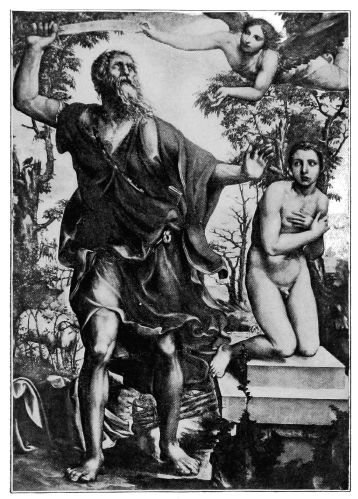
Il Sodoma.—The Sacrifice of Abraham.
painted, while the more disagreeable expulsion of Hagar from the home of
her youth has been frequently represented; the picture of this scene by
Guercino, in the Brera at Milan, is famous, and certainly tells the
story of “Cast out the bondwoman and her son” with directness; but there
is an element of vulgarity in it that so detracts from its good
qualities as to make one wonder that it could have been so much admired.
A far more tender subject is that which pictures Hagar in the wilderness
alone, and repentant of her fault, for which Sarah had chastened her; it
is at this moment that the angel appears and commands her return to
Abraham. A fine example of this rare subject by Pietro da Cortona is in
the Belvedere, at Vienna. Rubens also painted this scene.
A picture that is even more pathetic represents Hagar and Ishmael in
the wilderness of Beersheba. Ishmael is fainting from thirst, and Hagar
flings herself to the ground with the prayer, “Let me not see the death
of the child,” when an angel appears to comfort her, and guide her to a
hidden spring. The pathos of this scene must appeal to every mother, and
a picture of it by Rembrandt is so fine that one can but regret that it
is not in a public collection.
The visit of the three angels to Abraham is also a rare subject in Art.
I have already referred to that painted by Raphael, in the Vatican.
Murillo also represented it in a picture now in a private gallery in
England. In neither of these pictures have the angels wings.
The three beautiful figures by Raphael, however, are not like any men
whom we have seen; they impress one as beings of another and a far
higher sphere than ours. Murillo, on the contrary, shows us three
ordinary travellers, and but for the title of the picture, we should not
suspect that these men were celestial visitors. A large picture of this
subject by Rembrandt is one of the treasures of the Hermitage.
Jacob’s dream, with the ascending and descending angels, is an exquisite
motive for illustration, and has been variously pictured. A single angel
sometimes watches the sleeper, as if to inspire his dream and bring him
a blessing; again, there are many angels, and again, but a small number,
who move here and there, up and down, imparting a remarkable effect of
airy, graceful motion. The ladder, too, is widely varied, being
represented by one or several flights of steps, ascending to the clouds.
In the sixth arcade of the Vatican loggie is Raphael’s third and best
representation of this dream. Here Jacob’s face is turned towards the
ladder, on which are six angels; Jehovah appears above with outstretched
arms, and surrounded by a glory. It is not one of the best of Raphael’s
works, and, indeed, all representations of Jacob’s dream that I have
seen, are, to my mind, insufficient when compared with that of
Rembrandt, in the Dulwich gallery. This is a poem as essentially as it
is a picture. A stream of dazzling light forms the ladder, up and down
which float mystic, radiant angels. The whole impression is so like a
dream, so intangible, and yet so apparent, that one wonders how
Rembrandt, who so often dwelt upon the all too solid elements of his
motives, here caught the innermost spirit of this most spiritual
subject.
“The Comforting of Elijah” is a subject with rare possibilities, but has
been seldom represented.
Rubens painted a picture of this scene as symbolical of the Lord’s
Supper, the angel presenting to Elijah the bread and a chalice.
Following a custom of some landscape painters who introduced a
subject—mythological, historical, or Scriptural—into their pictures,
Paul Potter represented the “Comforting of Elijah” in the foreground of
one of his pictures. It also occurs in some ancient illuminated Bibles.
William Blake’s illustration of the text in Job, “When the morning stars
sang together, and all the sons of God shouted for joy,” is famous for
the unusual character of the angels. Like many pictures by this poet,
who was esteemed as half mad, it has an element of other worldliness
which is rarely seen in works of his era. Of this especial picture Mrs.
Jameson wrote: “His adoring angels float rather than fly, and, with
their half liquid draperies, seem about to dissolve into light and
love; and his rejoicing angels—behold them—sending up their voices
with the morning stars, that, singing, in their glory, move.”
The Vision of Ezekiel, in the Pitti Gallery, in Florence, is, so far as
I know, a unique representation of this subject. Raphael painted it for
Count Ercolani in Bologna. It is mentioned as early as 1589, in the
Inventory of the Tribune, and has been engraved and copied many times.
Jehovah is represented seated in a glory of cherubim’s heads, which are
almost unnoticeable by reason of the exceeding brightness illustrative
of the text, “And I saw as the color of amber, as the appearance of fire
round about within it, from the appearance of his loins even upward, and
from the appearance of his loins even downward. I saw as it were the
appearance of fire, and it had brightness round about.” In accordance
with this text also, Jehovah is nude in the upper portion of the figure,
the lower portion being draped in purple. Near the Jehovah are the four
animals symbolic of the evangelists, the cherub, the lion, the ox, and
the eagle, not earthly creations, but mysterious and spiritual as they
float along bearing the Messiah, while two small angels are near with
outstretched arms.
The sky effects of this wonderful picture are fine; the gray clouds are
rolling away, as if for the purpose of disclosing the vision. This
picture has been criticised on account of the nude figure of Jehovah; it
has been said to be a more proper representation of Jupiter than of the
Almighty, but Raphael is justified by the text itself.
Perhaps no representation exists which more acceptably renders the
symbolic nature of the Four Beasts than does this. The exact imitation
of nature, which appeared later in works of Art, is entirely opposed to
the true meaning of these emblems, which was sacred and mystical. The
cherub typifies St. Matthew, because his Gospel sets forth the human
nature of Christ more forcibly than the divine. The lion was appropriate
to St. Mark, because he first speaks of “the voice of one crying in the
wilderness,” typical of the lion. The ox belongs to St. Luke, since he
dwells on the priesthood of Christ, the ox symbolizing sacrifice; the
eagle to St. John, as the emblem of his inspiration, by which he wrote
so sublimely of the divinity of Jesus.
There are several other explanations of these symbols which are so often
seen in works of Art. But in this especial picture of the “Vision of
Ezekiel,” it would seem as if the throne of the Son of Man is composed
of these mystic beasts, while the angels are attending him, and gaze
into his face, as if watching for some service to be rendered.
When the Four Beasts are so pictured as to recall those who were full of
eyes within, and rest not day and night, saying, “Holy, holy, holy, Lord
God Almighty” (Revelation iv., 7), they fulfil the intention of the
symbol of the early Church, as it was understood by those to whom it was
sacred. But when, in the hands of an irreligious and realistic artist,
they become “as the beasts of the field,” his work is but a travesty
upon the mysterious religious symbols, which he thus debases.
The New Testament gives us a clearer idea of the nature and offices of
angels than we obtain from the Hebrew Scriptures. We learn of their
great numbers from the words of Jesus, “Thinkest thou that I cannot now
pray to my Father, and he shall presently give me more than twelve
legions of angels?” (Matthew xxvi., 53), and from Paul, when he speaks
of the “innumerable company of angels.” In the Gospels of St. Matthew
and St. Luke we learn that they are superior to human affections, and
not subject to change. “For in the resurrection they neither marry, nor
are given in marriage, but are as the angels of God” (Matthew xxii.,
30). “Neither can they die any more; for they are equal unto the angels”
(Luke xx., 36). By the words of Jesus, however, we are assured of the
sympathy of angels in all that concerns our spiritual good. In Luke xv.,
10, Jesus says, “Likewise I say unto you, there is joy in the presence
of the angels of God over one sinner that repenteth.”
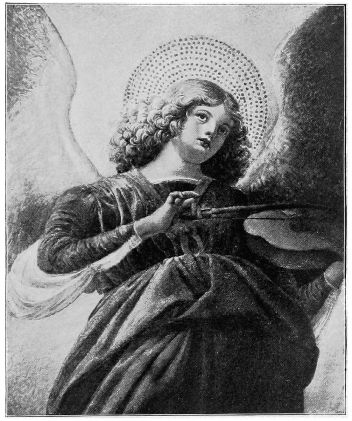
The belief that angels bear the souls of
Melozzo da Forli.—An Angel.
the redeemed to heaven, rests largely on the declaration by St. Luke
that “the beggar died, and was carried by the angels into Abraham’s
bosom;” and in Hebrews i., 14, St. Paul teaches that they are “sent
forth to minister for them who shall be heirs of salvation.”
In the annunciations of the birth of John the Baptist and of Jesus, the
angels were the messengers of God, as they so frequently were when they
appeared in the Old Testament.
That angels are attendant on Christ is taught in the declaration of St.
Matthew that “the Son of man shall come in the glory of his Father with
his angels.” And again, “When the Son of man shall come in his glory,
and all the holy angels with him.”
That angels are deputed to perform such acts as make for the
accomplishment of Christ’s mission is shown in Acts v., 19, when an
angel liberated the Apostles from prison, and commanded them to “speak
in the temple to the people all the words of life.”
When writing to the Romans, St. Paul speaks of angels, principalities,
and powers, thus enumerating the different orders of angels, and
declares their inability to separate us from the love of God, thus
implying that they can do nothing that does not accord with the will of
the Almighty,—that they have no power in themselves. Again, in writing
to the Colossians, St. Paul speaks of things “visible and invisible,”
and enumerates thrones, dominions, principalities, and powers, while to
the Ephesians he declares that God has placed Christ above all these
orders of celestial beings.
After the annunciations to Zacharias and the Virgin Mary, an angel next
appears, in the New Testament story, to instruct Joseph concerning the
miraculous conception of Jesus. The appearance to the shepherds follows,
of which I have spoken in connection with the subject of angelic choirs.
Again, Joseph was warned by an angel to flee into Egypt with Mary and
the young Child, to escape the anger of Herod. In ancient series of
pictures illustrating the life of St. Joseph, this scene was curiously
portrayed, and but one modern painter, so far as I know, has been moved
to represent it. In the Belvedere, in Vienna, there is an admirable
Dream of Joseph, by Anton Raphael Mengs.
Pictures of St. John the Baptist in the wilderness are variously
treated, and when he is represented as very young, he is attended by
ministering angels. This treatment is warranted by the legend which
teaches that he was a mere child of seven or eight years, and is
supported by the word of St. Luke in the last verse of the first chapter
of his Gospel, “And the child grew, and waxed strong in spirit, and was
in the deserts till the day of his shewing unto Israel.”
The pictures of the Baptism of Christ are numerous, and the number of
attendant angels is varied from two to four, as a rule, although there
are examples with even a larger number. Raphael, Verrocchio, Paul
Veronese, Francesco Albani, Perugino, Tintoretto, and many others
painted fine pictures of this subject, which, besides its great interest
from its importance in the life of the Saviour, affords an opportunity
for the representation of a beautiful landscape. The picture by Rubens
excels in this regard; and in his magnificent setting he has a group of
about thirty figures, producing the gorgeous effect which characterizes
his work, but failing to suggest the divinity of Christ, or the
devotional feeling of the works of Raphael or Verrocchio, and entirely
lacking the tenderness of Lorenzo di Credi.
The Bible also contains various texts which authorize a belief in the
existence of Satan and his demons. Isaiah exclaims, “How art thou fallen
from heaven, O Lucifer, Son of the Morning.” St. Matthew speaks of the
devil and all his angels, and many other Biblical expressions warrant us
in believing that the Spirit of Evil with his attendants is ever
tempting men to sin, thus plainly warranting the Fathers in their
teaching, to which we have referred.
It is not possible to picture the Temptation of Christ in an attractive
manner. Satan has been represented in various monstrous and repulsive
forms by some artists, while others have given him such disguises as
might well deceive an ordinary mortal. He has thus been presented in the
garb and with the bearing of a venerable peasant, and again as a monk
with robe and cowl, but his especial symbols usually manifest
themselves, in spite of all disguises.
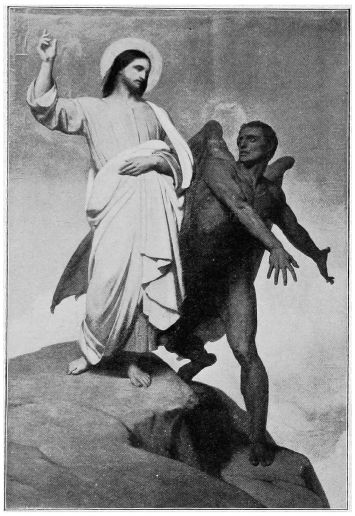
The picture by Ary Scheffer, in the Louvre, which our illustration
reproduces, tells the story of the temptation very simply and directly.
The style of this painter, sad and almost hopeless, is well suited to
subjects of this nature. The contrast between the perfect serenity of
the Saviour, and the hideous anxiety and determination of Satan, renders
this representation as acceptable as so unlovely a subject can be made.
In Perugino’s famous picture in the Sala del Incendio, in the Vatican,
Jesus and Satan are seen in mid-air, like a vision, while in the
background,
Ary Scheffer.—The Temptation of Christ.
surrounded by a dazzling light, another figure of Jesus is seen between
two ministering angels, while the whole scene is encircled by a
multitude of cherubim and angels.
In some pictures of this subject angels are represented as if waiting to
support the Master when he shall turn from the demon, but far more
attractive than these are the representations in which Satan does not
appear, and angels minister to Christ in the wilderness, as if
illustrating these beautiful lines:
“They in a flowery valley set him down
On a green bank, and straight before him spread
A table of celestial food—divine
Ambrosial fruits, fetched from the Tree of Life—
And from the fount of life celestial drink.
And as he fed, angelic quires
Sang heavenly anthems.”
One of Murillo’s splendid works was founded on the account of the pool
at Bethesda, as given in John v., 2-8. This was a favorite subject for
hospitals, and Murillo painted it for a hospital in Seville, from which
it was stolen by Marshal Soult.
In the foreground are Christ, the lame man, and three Apostles; in the
background is the pool with its fine porches, above which, in a
glorious, dazzling light, the angel hovers, as if about to descend to
stir the waters.
It is a magnificent example of the wonderful power of Murillo. The
beauty and tenderness of the head of Christ, and the graciousness of his
whole bearing, affect the beholder as do few representations of our
Lord. The atmosphere is soft and translucent, the angel gently floats
rather than flies, and the porches, while not too ornate, impart a
dignified balance to the scene. The coloring is such as is peculiar to
Spanish art, rich and subdued in contrast with that of the Italians.
For example, the red robe and blue mantle, so familiar in pictures of
Christ, are here replaced by a rich violet color, most harmonious with
the sentiment of the scene.
There is an ancient picture of this subject in a church near Bologna,
supposed to be the work of two artists, Jacopo Avanzi, and Lippo
d’Almasio. In the same city, in the Church of San Giorgio, is the
picture by Ludovico Caracci, which is, to say the least, very
decorative, and has been generously praised by some writers on Art. Many
representations of the pool of Bethesda are in hospitals,—as, for
example, that by Sebastian Conca at Siena,—rather than in galleries;
for this reason it is less familiar than are many other scenes in which
angels are represented.
There are some subjects too sacred in their character and too
spiritually subtle in their significance to be adequately pictured to
the eye. One of these, to my mind, is the Agony in the Garden of
Gethsemane. It has, however, appealed to many artists, and one must
admit that the night scene, the sleeping disciples, the suffering
Christ, the consoling angel, the approaching traitor, and the dimly
discerned city of Jerusalem afford unusually picturesque elements for an
effective picture. All these have been artistically treated, but The
Divine, the central thought in the scene, can scarcely be satisfactorily
expressed.
A most surprising error that has frequently been made in pictures of
this subject, is that of giving undue prominence to the sleeping
disciples. Their figures are often placed in the very foreground, as if
the spectator should chiefly consider the unfortunate somnolence of
Sir Edward Burne-Jones.—Mary Magdalene at the
Sepulchre.
these men; by which means the figures of Jesus and the angel are made to
appear as secondary. I have seen no picture in which the sleeping
disciples are satisfactorily introduced, and I greatly prefer certain
curious ancient representations of the Agony, in which Christ and the
angel only are present.
Many famous artists, from the time of Mantegna, have painted their
conceptions of the wonderful scene in the Garden. Correggio has at least
made Jesus the chief person, and his angel is apparently suited to his
office of a comforter. Paul Veronese, Albert Dürer, and Rembrandt have
all painted powerful pictures of this subject, and Ary Scheffer has
depicted the Agony of Christ with living vividness; but one and all of
these works fall so far short of one’s highest conception of this
wonderful event, that, except as examples of the design, coloring, and
manner of these masters, they appear to me of little value.
The visit of the women to the sepulchre of Christ is variously
represented, as would naturally result from the different accounts given
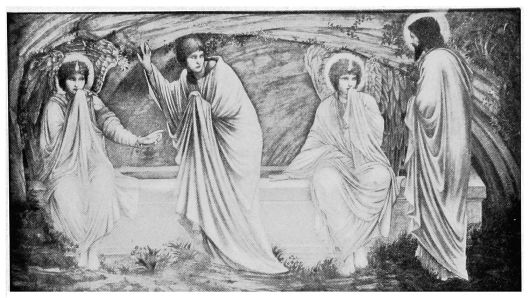
by the Evangelists. Some pictures represent Mary Magdalene alone, when
she saw two angels sitting where the body of Christ had lain, and almost
immediately beheld the risen Lord near by, as in our illustration after
Burne-Jones. Again, the other women are pictured who saw two men in
shining garments, and were told, “He is not here, but is risen;” more
frequently the three Maries are represented coming to the sepulchre,
bearing spices, and finding the guards paralyzed with terror, and an
angel who tells them that the Lord is risen.
These scenes have been represented in Art from its earliest and rudest
beginning, and were rendered with perfect simplicity, strictly
following the clear scriptural account. Later, the guards were omitted,
and the whole scene took on a more dramatic air, until, in the sixteenth
century, this subject was rarely painted, and has not again resumed its
earlier importance. It makes one in a series of subjects illustrating
the life of Christ, but is rarely seen as a separate work. Annibale
Caracci painted a picture of the Women at the Sepulchre, which is now in
the Hermitage at St. Petersburg; and in Siena there still exists an
example of the same subject by Duccio, who lived in the thirteenth
century.
Pictures of the Last Judgment, as usually painted, are illustrative of a
combination of scriptural teaching with the imaginative suggestions of
preachers, writers on religious subjects, poets, and artists, and
elements from the sacred legends. There is no scriptural warrant for the
presence of Satan and his demons in this scene, horribly effective and
impressive as they are; but I have reason to think that this element is
thoughtlessly accepted as authoritative by many who interest themselves
in religious art.
This subject was not represented in sculpture or painting before the
eleventh century, and but rarely after that until three centuries later,
when it was wonderfully portrayed, notably by Orcagna, in the Campo
Santo at Pisa.
The portions of these pictures for which there is scriptural authority
are important. Christ is the Judge in accordance with his own words,
Matthew xvi., 27: “For the Son of man shall come in the glory of his
Father with his angels; and then he shall reward every man according to
his works.” And still more emphatically in Matthew xxv., 31-46, where
the word-picture of the Judgment is a vividly realistic description of
some artistic representations of this scene.
The Apostles seated on each side of Christ are also warranted by his
words in Luke xxii., 30: “That ye may ... sit on thrones judging the
twelve tribes of Israel.” The Virgin, St. John the Baptist, patriarchs,
prophets, and saints are all admissible on the authority of St. Paul,
who says, I. Corinthians vi., 2: “Do ye not know that the saints shall
judge the world?” And in the following sentence: “Know ye not that we
shall judge angels?”
The angels are deputed to “gather together his elect from the four
winds,” Mark xiii., 27, and those who fill this office are the trumpet
angels in all these representations.
The division of those to be judged rests, on Daniel xii., 2: “And many
of them that sleep in the dust of the earth shall awake, some to
everlasting life, and some to shame and everlasting contempt;” and even
more positively on Christ’s words in Matthew xxv., already referred to.
In the utter absence of scriptural warrant for the picturing of the
devil and his satellites, who seize, torture, and hurl into hell those
doomed to shame and endless contempt, what defence of it can be made?
Certainly none from an artistic standpoint; and this consideration
should have prevented such representations. Artists should be
commiserated who could not sufficiently express the woe of the condemned
by the wretchedness of their faces and manner, as, hearing the fatal
“Depart from me, ye cursed, into everlasting fire, prepared for the
devil and his angels,” they go to the left, not daring

Fra Angelico.—An Angel conducting a Soul to Heaven.
to raise their eyes to Christ, nor even to look at the blessed of his
kingdom.
It would be a pleasure to consider separately the different methods of
representing the Judge of all the world and those surrounding him, as
seen in the works of the masters, but we are here concerned with the
angels alone, of which, in nearly all these pictures, there are three
classes.
The angels who hold the cross, scourge, nails, crown of thorns, and
other symbols of the Passion of Christ, emphasize the theological
teaching that men are judged according to their acceptance or rejection
of the Atonement by Christ for the sins of the world. In early pictures
of the Judgment these angels stand on clouds, below the Judge, but later
they were depicted as hovering above the Judgment Seat. In whatever
position they are placed, they appear to attribute a vast importance to
the prominence of the symbols of the Passion. Fra Angelico happily
places a single angel at the feet of Christ with the cross alone, as a
complete symbol of the suffering and death of Jesus.
The trumpet angels vary in number from two to many, and are differently
placed according to the varying designs of the artists. Orcagna and Fra
Angelico placed them below the Judge, thus indicating that their sound
could be heard in all the earth. In other pictures, they sound the
trumpets directly above the graves, which open, displaying the rising
dead, startled from their long sleep and struggling to gain a foothold
on the earth above.
The third class of angels are those who announce their fate to all who
are to be judged. They sometimes hold the balance in which souls are
weighed; again, they direct those who come to judgment to the right or
left, as in our picture from the Last Judgment by Fra Angelico, in the
Florentine Academy; and, again, as in Orcagna’s great picture in the
Campo Santo at Pisa, a grand warrior angel, with splendid wings,—a true
St. Michael,—clad in full armor, with his sword by his side, a glorious
halo about his head, and the angelic flame above his brow, holds out two
scrolls,—one of joy and one of woe,—on which are written the names of
the entire human race.
The pictures of the Last Judgment by Orcagna, Angelico, and Signorelli,
in the Cathedral of Orvieto, and Michael Angelo, in the Sistine Chapel,
are among the famous pictures of the world.
The Scriptures mention still other appearances of angels, as that to
Cornelius, when he was directed to send to Joppa for Peter; and, again,
when Peter was in prison and the Church prayed for him, an angel led
him forth and the Apostle departed to Cesarea for safety.
Philip was sent by an angel to meet the Ethiopian eunuch, and teach him
the truth, after which he baptized the eunuch, and was then caught away
by the Spirit, or angel of the Lord.
At times the angels were sent on missions of punishment, as when Herod,
in the midst of his blasphemy, was smitten by God’s messenger, and gave
up the ghost.
These subjects are rich in artistic suggestion, and nearly all have been
represented in painting or sculpture. The book of the Revelation, too,
abounds in visions of angels, from the beginning, when an angel from
heaven “signified it” to John the Divine, to the end, when the angel
refused to be worshipped, and declared himself the fellow servant of
John, and of the prophets, and of all that keep the sayings of the
book.
Fra Bartolommeo.—An Angel playing the Violin.