Baron Cuvier says that the most useful conquest achieved by man, is the
domestication of the dog—a conquest so long completed, that it is now
impossible, with any certainty, to trace these animals to their original
type. The cleverest of naturalists have supposed them to descend from
wolves, from jackals, or from a mixture of the two; while others,
equally clever, assert that they proceeded from different species of
dogs. The latter maintain that the Dingos of Australia, the Buansas of
Nepal, or Dholes of India, the Aguaras of South America, and several
other races, are original; and although they may not have produced the
dogs which attend man, they prove that we may attribute the latter to
predecessors of the same kind, without having recourse to other animals
which they more or less resemble. On the other hand again, some of our
first men are of opinion that there are now no original dogs, but that
all the packs called wild are those which have made their escape from a
state of domesticity. This is not the place to examine the merits of the
different proofs brought in favor of each argument; and I hasten to a
brief notice of some of those which subsist independently of human
assistance.
All dogs, wild or tame, walk upon their toes with a firm, elastic gait,
and their toes are not retractile. Their other external characters are
so varied, that it is impossible to give a general summary of their
colour or form; the largest on record (a Suliot, belonging to the king
of Naples), measured four feet at the shoulders; the least would
probably give a height of as many inches. All the untamed species are
lank and gaunt, their muzzles are long and slender, their eyes oblique,
and their strength and tenacity of life are almost marvellous.
The Dingo, or Australian dog, roams in packs through that vast country;
has a broad head, fierce, oblique eyes, acute muzzle; short, pointed,
erect ears; tail bushy, and never raised to more than a horizontal
position. He does not bark, but howls fearfully; is extremely sagacious,
and has a remarkable power of bearing pain. When beaten so severely as
to be left for dead, he has been seen to get up and run away. A man
proceeded to skin one, not doubting that life was extinct, and after
proceeding a little way with the operation, he left the hut to sharpen
his knife. When he returned, the poor animal was sitting up, with the
loose skin hanging over one side of his face.
The Dingos worry the cattle of the settlers, and will even eat pieces
out of them as they lie upon the ground; the leg of a sheep has been
frequently gnawed off by them. Domesticated dogs will hunt and kill
them; but show signs of great disgust afterwards, always, if they can,
plunging themselves into water, as if to get rid of the contamination
caused by such contact. One taken from his mother at six weeks old was
partially tamed; but at first he crouched down in all the darkest
corners he could find, looking at every one with aversion, and when
alone howling incessantly, especially if the moon were shining. He
became gradually reconciled to those who fed him, but to no one else. He
never gave warning of the approach of strangers, and never made an open
attack. It is remarkable that these dogs are not found in the closely
neighbouring island of Van Diemen's Land.
The wild dogs of India go under the name of Buansa, Dhole, and Kolsun,
are found in Nepal, the Nilgiris, Coromandel, the Dekkan, etc., and bear
various names, according to their locality. They prey night and day,
have an acute smell, a peculiar bark, not unlike that of a hound, and
are of a sandy or red colour. Their head is long; they have an
ill-natured look, oblique eyes; long, erect ears; powerful limbs, bushy
tail, fur varying according to climate, and all animals are afraid of
them. They kill tigers and cheetahs, and the remains of hogs and deer
are to be found in their path. An endeavour to tame one succeeded, and
he was as affectionate and intelligent as many other dogs.
In Java there is a large, wild dog, and in Beloochistan whole packs are
to be found, which pull down buffaloes with ease; their footmarks are
like those of a hound; and still further to the west a much larger
species is said to exist.
The Sheeb or Schib, of Syria, is wild, and is probably the wolf-dog of
Natolia. The Deeb of Nubia would seem to be also a primitive species,
but not resembling the packs of wild dogs which inhabit Congo and South
Africa, etc., and live in covers and burrows.
The hunters of South Africa tell us that they pull down the strongest
antelopes; they are very destructive to sheep, and mangle more than they
devour. They are extremely swift, and utter a sharp bark, or chattering
cry, which calls the pack together, and is very soft and melodious. The
hatred between them and tame dogs is unconquerable, and in their
appearance they look like a link between the wolf and the hyæna.
A large group of dogs includes all the indigenous canines of South
America, under the name of Aguaras, and resembles foxes. They are
silent, if not dumb, and appear to congregate in families rather than
packs. They have a peculiar propensity to steal and secrete, without any
apparent object for so doing.
Colonel Hamilton Smith, the able writer on dogs, does not acknowledge
some of these wild races, but thinks they are what he calls feral, or
domestic dogs which have regained their liberty, and have subsisted for
many generations on their own intelligence. To these he refers the
Natolians and Aguaras; but there can be no doubt concerning the feral
nature of the dog of St. Domingo, which descends from the hounds trained
to hunt human beings by the Spaniards, and which are supposed to have
regained their liberty in the woods of Haiti. It is of these dogs the
stories are told concerning runaway negroes, and which were taught by
means of raw food, placed in stuffed representations of human beings.
They are very handsome creatures, carrying their heads with an air of
conscious superiority. They follow a track rapidly, and in complete
silence; they, however, always seize their victims.
A contrast to the feral dog of St. Domingo, is the Alco of Mexico, with
its small head, short neck, and very thick body. Those of the Pampas
having assumed the shapes of all the dogs transported from Europe, have
now settled into what may be called curs. They are very bold, very
sagacious, are not inimical to men, but destructive to the young animals
in herds. They live in burrows, and if brought back to domesticity, are
valuable for their courage and highly developed senses.
In various cities exist herds of dogs, who do not own any masters; who
infest the streets in packs, and who are at once the scavengers, the
purifiers, and the greatest nuisances. In beautiful Lisbon; rising from
the Tagus with her stately towers, her gardens, her churches, her deep
blue sky, and her noble aqueduct, leading life's beverage to her
exquisite fountains, these animals abound; their presence being easily
accounted for by their owners bringing and abandoning them there at the
time of the vintage. They eat so many grapes when ripe, that they are
sent away in self-defence. Woe to the person who affronts one of them;
he is obliged to run hard, or else to keep them at bay, by threatening
to throw stones at them, and walking backwards; fortunately he can do
this in the narrow streets of this city, for he would be lost if
surrounded by them. They lodge by day in the holes of ruins, which are
so plentiful in Lisbon.
The same dogs, with regard to habits, are to be met with in the cities
of Russia, Turkey, and Egypt; but they differ in size and appearance.
Those of Turkey are particularly audacious, and in all cities, where
cleanliness is not systematically organised, they are doubtless of
infinite service; though I have read, in a pamphlet written by a French
savant, that those in Egypt are one means of continuing the plague,
for they uncover the carelessly buried bodies, and drag portions of
flesh and clothing into the houses of the living.
In some of the countries of Guinea, dogs are bred for the table, and sit
in circles in the market places for sale. I do not know from what race
they come; they are not used for any other purpose, and are small,
extremely ugly, and variously marked with brown, red, or black spots.
The passion for dog's flesh is in these countries very strong, and no
European can keep an animal of this kind many weeks. An officer arrived
at Cape Coast Castle when I was there, accompanied by three, not
imagining the temptation they would present to the appetite of the
natives. One disappeared in the act of landing, and the two others were
gone before three weeks had elapsed. My uncle fancied that his rank
would secure a favourite sent to him from Europe. He one morning
received a deputation from the king of a native town, requesting a
palaver, or conference. It was granted, and his sable majesty formally
made proposals for Cæsar to figure as a roast at a grand feast, which he
was about to hold. My uncle indignantly refused; the king increased the
sum offered, till it amounted to something considerable, and then the
Englishman, unable to control himself, left the room and sent the
customary refreshments, with a message, to signify that the palaver was
ended. Although every precaution was taken to save the animal, he was
stolen that same night, and gratified the palates of the African
gourmands.
I now come to what Colonel Smith calls "The Familiar Dogs," where we
find an amount of intellect, which forbids us to say that they do not
reason, and where self-sacrifice, fidelity, courage, and affection, in
many instances raise them far beyond more gifted creatures. It will be
advisable to follow the series of some established work in treating of
them, and I have selected that of Colonel Hamilton Smith, both for its
extent and its ability. He begins with those which are placed nearest to
the Arctic Circle of both hemispheres, and which form a group of large,
wolfish dogs, with tapering noses, pointed ears, and, generally
speaking, long, white and black hair. They are fierce, broad, and often
web-footed; they swim well, hunt together or alone, and when their
owners turn them out to obtain their own living, often fish with great
dexterity. When they quarrel they constantly destroy each other, for
they never will give up while they are alive. Among them are the
Siberian dogs, remarkable for the instinct with which they return to
their masters, after weeks of absence and self-subsistence, to drag
their sleighs. This is the more curious, as they are then always very
ill fed, and ill treated. They utter yells when about to be yoked, but,
once in file, they move silently and rapidly, sometimes, however, trying
to upset their drivers.
The tail of the Esquimaux dogs is bushy, and curls very much over the
back, which is covered with long, waving hair. They are very patient and
faithful, rapid in their paces, skilful and courageous when hunting,
carry burdens, and are very good tempered. They form a close attachment
to their masters; and one which had been kept in confinement in
Edinburgh, being let loose, entered the kitchen door, found his way
through his owner's house, and, leaping on his bed, gave every sign of
affection. At another time, as his master was walking in Princes Street
Gardens, his foot slipped, and he fell, upon which the dog tried to lift
him up by his coat. He was very cunning, and when he ate, strewed his
meat around him, to entice fowls and rats. He then laid himself down,
and pretended to be asleep; no sooner, however, did they come, than he
pounced upon and killed them.
A pair of Esquimaux dogs lived in the Menagerie of the Jardin des
Plantes, where they were great favourites; but it was extremely painful
to see the poor creatures panting with heat, and almost unable to move,
during the hot weather, only feeling happy when cold water was thrown
over them. The fondness of the Esquimaux dogs for oil never ceases, and
they do not like to drink water, unless it tastes of this substance. Two
of them are said to have stood hour after hour before a candle-maker's
workshop, evidently sniffing the fumes of the melted tallow with great
enjoyment. Their scent is particularly delicate, which renders them
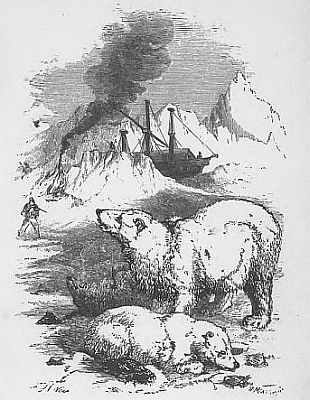
invaluable in the chase of the rein-deer. Nor are they, from their
resolution and ferocity, less useful in attacking the bear, the very
name of which beast, pronounced in their hearing, excites their ardour.
Even in the sledge they dash after their prey, out of the track,
dragging their owner into the pursuit.
In order to test the strength of the Esquimaux dogs, several experiments
have been made, among others by Captain Lyon, who found that three of
them could drag him, on a sledge weighing one hundred pounds, at the
rate of a mile in six minutes. With heavy loads they are often induced
to exert themselves by a woman walking before them, with a mitten in
her hand. Having been accustomed to receive food from her, they believe
that in this way she offers them meat. They are particularly obedient
and affectionate to women, because it is from them that they receive the
only kindnesses bestowed upon them, and a word from a female will excite
them to exertion, when the blows and threats of the men only make them
obstinate.
The dog of the Hare Indians, or Mackenzie river, was first described by
Dr. Richardson, and is of a smaller size than the Esquimaux breed, but
with broad feet, which prevent him from sinking into the snow. One of
them, only seven months old, ran beside this gentleman's sledge for nine
hundred miles, frequently carrying one of his master's mittens in his
mouth; all are very gentle, and, like the Esquimaux dogs, do not bark.
The large, powerful, and handsome dogs which go by the name of
Newfoundland, are not the pure breed of that country. The latter are
more slender in their make, have a sharper muzzle, a wilder look, and
are generally black in colour, with a rusty spot over each eye, and a
tawny muzzle. These are called Labrador dogs, and it is supposed that
they and the Esquimaux have contributed to form the commonly accepted
breed. What the latter have lost, however, in purity of blood, has been
gained on the side of beauty, and there is no animal of its size which
conveys a higher idea of intelligence and dignity, than the so-called
Newfoundland dog. All are semi-palmate, and dive, swim, and keep longer
in the water than any others of their tribe. One was picked up in the
Bay of Biscay, out of sight of any other vessel, fatigued and hungry,
and which, judging from the circumstances, must have been there for many
hours. Their fidelity, their courage, their generosity, are proverbial,
and yet it is whispered that they are occasionally capricious and not to
be trusted. During long years of intercourse with these animals, I never
met with an instance of this; and I have been told that it is more apt
to occur when they have been kept in confinement.
A noble creature of the mixed breed, and of the usual colour—black and
white—belonged to me, and his extreme good-nature, and endeavours to
guard everything belonging to the family, made him like a confidential
servant. The great defects in his disposition were heedlessness, and an
under estimate of his own power; he did not stop to think before he
acted, as many more cautious dogs will do; and he forgot that his weight
was so great as to spoil and crush whatever he laid himself upon. As an
instance of the former, he one day fancied he saw some one whom he knew
in the street, and immediately dashed through the window, smashing not
only the glass, but the framework. Directly he had done it he felt he
had been wrong, and returning through the shattered window, which was
opened for him, he hung his head and walked unbidden to a recess in the
room covered with matting, to which place he was always banished when
naughty, and seated himself. The bell was rung for the house-maid to
come and clear away the broken glass, and as the woman smiled when she
passed Lion, I turned my head towards him. There he sat, with a pair of
my slippers, accidentally left in the room, in his mouth, as if he
thought they would obtain his pardon. My gravity was disturbed, and
Lion, seeing this, humbly came up to me, and rested his chin on my
knees. I then lectured him concerning the mischief he had committed; and
he so perfectly understood, that for a long time, when any one pointed
to the window, he would hang his head and tail, and look ashamed. During
my absence he constantly collected articles which belonged to me, and
slept upon them. One day, on returning from church, he met me on the
stairs, dragging a new silk dress along with him by the sleeve, which he
must have contrived, by himself, to have abstracted from a peg in a
closet.
It must be owned that, clever as my Lion was, Professor Owen was
acquainted with a Lion who surpassed him. This gentleman was walking
with a friend, the master of the dog, by the side of a river, near its
mouth, on the coast of Cornwall, and picked up a small piece of
sea-weed. It was covered with minute animals, and Mr. Owen observed to
his companion, throwing the weed into the water, "If this small piece
afforded so many treasures, how microscopically rich the whole plant
would be; I should much like to have one!" The gentleman walked on; but
hearing a splashing in the water, turned round, and saw it violently
agitated. "It is Lion!" both exclaimed, "What can he be about? He was
walking quietly enough by our side a minute ago." At one moment they saw
his tail above the water, then his head raised for a breath of air, then
the surrounding element shook again, and at last he came ashore, panting
from his exertions, and laid a whole plant of the identical weed at Mr.
Owen's feet. After this proof of intelligence, it will not be wondered
at, that when Lion was joyfully expecting to accompany his master and
his guest on an excursion, and was told to go and take care of and
comfort Mrs. Owen, who was ill, that he should immediately return to the
drawing-room, and lay himself by her side, which he never left during
the absence of his owner; his countenance alone betraying his
disappointment, and that only for a few minutes.
Many instances are recorded of Newfoundland dogs having saved the lives
of those who have fallen into the water, and among them was my father;
who, when he was one day missing, was traced to a deep pond in his
mother's garden. His friend Trial was called; some of his young
master's clothes were shewn to the dog, the pond was pointed out, and
Trial dashed in, shortly bringing out the body. He watched all the
endeavours made to restore animation, and at last aided the work by
being allowed, when dry, to get into the bed, and with the warmth of his
body give heat and circulation to the half-expiring child.
A very interesting anecdote is given of a person who was travelling
through Holland, accompanied by a large Newfoundland dog. Walking one
evening on a high bank, by the side of a canal, his foot slipped; he
fell into the water, and being unable to swim, soon became senseless.
When he recovered his recollection, he found himself in a cottage, on
the opposite side of the canal, surrounded by peasants, who had been
using all means for restoring him to life. He was told, that one of them
returning home from his work, saw at a considerable distance, a large
dog swimming in the water, sometimes pushing, and sometimes dragging
something which he appeared to have great difficulty in supporting; but
which he at length succeeded in getting into a small creek. When there,
the animal pulled this object as far out of the water as he was able,
and the peasant discovered it to be the body of a man. The dog shook
himself, licked the hands and face of his master; the peasant obtained
assistance, and the body was conveyed to the house, where the
endeavours used for resuscitation proved successful. Two bruises, with
marks of teeth appeared, one on the shoulder, the other on the nape of
his neck, whence it was presumed, that his preserver first seized him by
the shoulder, but that his sagacity prompted him to shift his grasp to
the neck; as by so doing he could keep the head out of the water. He had
continued to do this for at least a quarter of a mile, and thus
preserved his owner, as much by his intelligence, as by his affection.
The Newfoundland dog, like many others, possesses a sense of time, and
Mr. Bell relates an instance of this, which occurred under his own
observation. He says, that a fine Newfoundland dog, which was kept at an
inn in Dorsetshire, was accustomed every morning as the clock struck
eight, to take in his mouth a certain basket, placed for the purpose,
containing a few pence, and to carry it across the street to a baker's,
who took out the money, and replaced it by the proper number of rolls.
With these Neptune hastened back to the kitchen, and safely deposited
his trust; but what was well worthy of remark, he never attempted to
take the basket, or even to approach it on Sunday mornings. On one
occasion, when returning with the rolls, another dog made an attack upon
the basket, for the purpose of stealing its contents; when the trusty
Neptune placed the basket on the ground, severely punished the
intruder, and then bore off his charge in triumph.
The proofs of intelligence which I have related, are perhaps surpassed
by those of Dandie, a Newfoundland dog belonging to Mr. M'Intyre of
Edinburgh; but it must be recollected, that Dandie's education had been
more carefully and continuously carried on, than that of his before
mentioned brethren. He selected his master's hat from a number of
others, or a card chosen by his master from a whole pack; picked his
master's penknife from a heap of others, and any particular article
which he might have been told to find, although he would have to search
among a multitude of others belonging to the same person; proving that
it was not smell which guided him, but an understanding of what he was
required to do. One evening, a gentleman in company with others,
accidentally dropped a shilling on the floor, which, after diligent
search, could not be found. Dandie had been sitting in the corner of the
room, apparently unconscious of what had been going on, Mr. M'Intyre
then said to him. "Find us the shilling, Dandie, and you shall have a
biscuit," the dog instantly jumped up, and laid the shilling upon the
table, which he had picked up unperceived by the party. On his return
home one evening after the family had gone to rest, Mr. M'Intyre could
not find his boot-jack; upon which he said, "Dandie, I cannot find my
boot-jack; search for it." The dog scratched at the room-door, his
master opened it, and going to a distant part of the house Dandie
returned with the boot-jack in his mouth; where Mr. M'Intyre recollected
to have left it under a sofa.
Several gentlemen were in the habit of giving Dandie a penny a day,
which he always took to a baker's, and exchanged for bread for himself.
One of them was accosted by the dog for his accustomed present; but he
said, "I have not a penny with me to-day, though I have one at home."
Having returned to his house, some time after he heard a noise at the
door; it was opened, and Dandie sprang in for his penny. By way of
frolic, the gentleman gave him a bad one; the baker refused to exchange
the loaf for it; the dog returned to the door, knocked, and when the
servant opened it, laid the penny at her feet, and walked away with an
air of contempt. He did not, however, always spend all his money, and
one Sunday, when it was very unlikely that he could have received a
present, he was observed to bring home a loaf. Surprised at this, Mr.
M'Intyre desired the servant to search the room for money. Dandie seemed
quite unconcerned till she approached the bed, when he gently drew her
from it. Mr. M'Intyre secured him, for he growled and struggled; and,
continuing the search, the woman found seven pence halfpenny under a
piece of cloth. From that time the dog could not endure her, and
henceforth hid his money in the corner of a sawpit, under a heap of
dust. He constantly escorted Mr. M'Intyre's friends home, when desired
to do so, however considerable the distance, and when they were safe, he
returned to his own quarters.
Mr. Jukes, in his "Excursions in and about Newfoundland," speaks of a
dog which appeared to be of the pure breed, and which he thought to be
more intelligent than the mixed race. This animal caught his own fish,
for which purpose he sat on a projecting rock, beneath a fish stage, on
which the fish were laid to dry, watching the water, the depth being
from six to eight feet, and the bottom quite white with fish-bones. On
throwing a piece of codfish into the water, three or four heavy,
clumsy-looking fish, called in Newfoundland sculpins, would swim in to
catch it. The instant one turned its broadside towards him, he darted
down, and seldom came up without the fish in his mouth. He regularly
carried them as he caught them to a place a few yards off, where he
deposited them, sometimes making a pile of fifty or sixty in the day. As
he never attempted to eat them, he appeared to fish for his amusement.
Long, lanky, rough-haired, with drooping, bushy tail; long ears, half
erect; long, sharp muzzle; black and fulvous in colour, often mingled
with brown and white, the Shepherd's Dog yields to none in fidelity and
sagacity. In his own peculiar calling, nothing can exceed his
vigilance, his quick comprehension, and his intimate knowledge of every
individual entrusted to his care. Rushing into the middle of his flock,
he singles out any one member of it, and brings it to his master. Fierce
in the defence of all, he keeps them together by incessantly prowling
round them, dragging the wanderers back to their companions, and
fiercely attacking those who would offer them an injury. At night he
guides them to their fold; and if this should be in an exposed
situation, he throws himself across the entrance, so that the intruding
enemy will have to pass over his body to commence his work of
destruction.
A ludicrous instance of the promptitude with which he punishes
offenders, is related by Colonel Smith, in the following manner:—"We
have witnessed the care they take of their charge, and with what
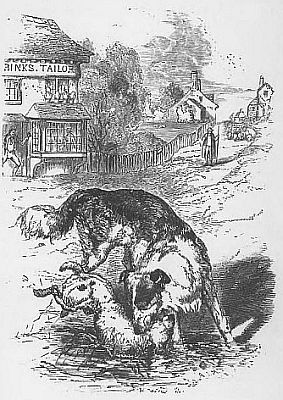
readiness they chastise those that molest them, in the case of a cur
biting a sheep in the rear of the flock, and unseen by the shepherd.
This assault was committed by a tailor's dog, but not unmarked by the
other, who immediately seized him, and dragging the delinquent into a
puddle, while holding his ear, kept dabbling him in the mud with
exemplary gravity; the cur yelled, the tailor came slipshod with his
goose to the rescue, and having flung it at the sheep-dog, and missed
him, stood by gaping, not venturing to fetch it back until the
castigation was over and the dog had followed the flock."
THE SHEPHERD'S DOG AND CUR.—Page 102.
As a proof of the comprehension of the shepherd's dog, I quote the
description of Mr. St. John, in his "Highland Sports:"—"A shepherd
once, to prove the quickness of his dog, who was lying before the fire
in the house where we were talking, said to me, in the middle of a
sentence concerning something else, 'I'm thinking, Sir, the cow is in
the potatoes.' Though he purposely laid no stress on these words, and
said them in a quiet, unconcerned tone of voice, the dog, who appeared
to be asleep, immediately jumped up, and leaping through the open
window, scrambled up the turf roof of the house, from which he could see
the potato field. He then (not seeing the cow there) ran and looked into
the byre [farm-yard], where she was, and finding that all was right,
came back to the house. After a short time the shepherd said the same
words again, and the dog repeated his look-out; but on the false alarm
being a third time given, the dog got up, and wagging his tail, looked
his master in the face with so comical an expression of interrogation,
that we could not help laughing aloud at him, on which, with a slight
growl, he laid himself down in his warm corner, with an offended air, as
if determined not to be made a fool of again."
Mr. Hogg, the Ettrick shepherd, is the person of all others to give an
adequate idea of the shepherd's dog, and I use very nearly his own
words. "My dog Sirrah, was beyond all comparison the best dog I ever
saw; he was of a surly, unsocial temper; disdaining all flattery, he
refused to be caressed; but his attention to my commands and interests
will never again, perhaps, be equalled by any of the canine race. I
thought I discovered a sort of sullen intelligence in his countenance,
notwithstanding his dejected and forlorn appearance; I gave a drover a
guinea for him. He was scarcely a year old, and knew so little of
herding, that he had never turned a sheep in his life; but as soon as he
discovered that it was his duty to do so, and that it obliged me, I can
never forget with what eagerness and anxiety he learned his evolutions.
He would try every way deliberately, till he found out what I wanted him
to do, and when I once made him understand a direction, he never forgot
or mistook it again. Well as I knew him, he often astonished me; for
when pressed hard in accomplishing the task that he was put to, he had
expedients of the moment, that bespoke a great share of the reasoning
faculty.
"On one occasion, about 700 lambs, which were under his care at weaning
time, broke up at midnight, and scampered off, in three divisions,
across the neighbouring hills, in spite of all that he and an assistant
could do to keep them together. The night was so dark, that we could
not see Sirrah; but the faithful animal heard his master lament their
absence in words which, of all others, were sure to set him most on the
alert; and without more ado, he silently set off in quest of the
recreant flock. Meanwhile the shepherd and his companion did not fail to
do all in their power to recover their lost charge; they spent the whole
night in scouring the hills, for miles around, but of neither the lambs
nor Sirrah could they obtain the slightest trace. They had nothing for
it, day having dawned, but to return to their master, and inform him,
that they had lost the whole flock of lambs, and knew not what was
become of one of them. On our way home, however, we discovered a lot of
lambs at the bottom of a deep ravine, and the indefatigable Sirrah
standing in front of them, looking round for some relief, but still true
to his charge. The sun was then up, and when we first came in view, we
concluded that it was one of the divisions which Sirrah had been unable
to manage until he came to that commanding situation. But what was our
astonishment, when we discovered that not one lamb of the whole flock
was wanting. How he had got all the divisions collected in the dark is
beyond my comprehension. The charge was left to himself from midnight
until the rising sun, and if all the shepherds in the forest had been
there to assist him they could not have effected it with greater
propriety."
An exceedingly good shepherd's dog appears to concentrate all his powers
in his own immediate vocation; and in this does he exert and exhaust his
whole capacity. If he be suddenly awoke, and hurriedly called, he rears
himself up to see what sheep are running away, and he is so honourable,
that he will lie among pails full of milk, and neither touch them
himself, or suffer cat, rat, or any other creature to molest the store.
The drovers' dogs are somewhat larger, and more rugged. They are as
sagacious as the shepherd's dog, but they are trained to act with more
cruelty to their charges.
The original St. Bernard dog, which has for years been the object of so
much interest, resembles the Newfoundland in form, hair, color and size.
Another race with close, short hair, is trained to the same services;
and one of the latter belonged to me for some time, establishing himself
in the good graces of every one by his good temper and fidelity. He
must, however, with all his good qualities yield to Bass, the property
of Sir Thomas Dick Lauder, who thus writes of him. "My St. Bernard was
brought home direct from the Great St. Bernard, when he was a puppy of
about four or five months. His bark is tremendous; so loud, indeed, that
I have often distinguished it nearly a mile off. He had been missing for
some time; when, to my great joy, one of the letter carriers brought
him back; and the man's account was, that in going along a certain
street, he heard his bark from the inside of a yard, and knew it
immediately. He knocked at the gate, and said to the owner of the
premises 'You have got Sir Thomas Lauder's big dog.' The man denied it.
'But I know you have,' continued the letter carrier, 'I can swear that I
heard the bark of Sir Thomas's big dog; for there is no dog in, or about
all Edinburgh, that has such a bark.' At last, with great reluctance,
the man gave up the dog to the letter carrier, who brought him home
here. But though Bass's bark is so terrific, he is the best natured and
most playful dog I ever saw; so much so indeed, that the small King
Charles's spaniel, Raith, used to tyrannize over him for many months
after he came here from abroad. I have seen the little creature run
furiously at the great animal when gnawing a bone, who instantly turned
himself submissively over on his back, with all his legs in the air,
whilst Raith, seizing the bone, would make the most absurd and
unavailing attempts to bestride the enormous head of his subdued
companion, with the most ludicrous affectation of the terrible growling,
that might bespeak the loftiest description of dog-indignation. When a
dog attacks Bass in the street or road, he runs away rather than
quarrel; but when compelled to fight by any perseverance in the
attacking party, he throws his enemy down in a moment, and then,
without biting him, he lays his whole immense bulk down upon him, till
he nearly smothers him. He took a particular fancy for one of the
postmen who deliver letters here, whose duty it was, besides delivering
letters, to carry a letter bag from one receiving house to another, and
this bag he used to give Bass to carry. Bass always followed that man
through all the villas in this neighbourhood where he had deliveries to
make, and he invariably parted with him opposite to the gate of the
Convent of St. Margaret's, and returned home. When our gate was shut
here to prevent his following the postman, the dog always leaped a high
wall to get after him. One day when the postman was ill, or detained by
some accidental circumstance, he sent a man in his place. Bass went up
to the man, curiously scanning his face, whilst the man rather retired
from the dog, by no means liking his appearance. But as the man left the
place, Bass followed him, shewing strong symptoms that he was determined
to have the post-bag. The man did all he could to keep possession of it.
But at length Bass, seeing that he had no chance of getting possession
of the bag by civil entreaty, raised himself on his hind legs, and
putting a great fore-paw on, each of the man's shoulders, he laid him
flat on his back in the road, and quietly picking up the bag, he
proceeded peaceably on his wonted way. The man, much dismayed, arose
and followed the dog, making, every now and then, an ineffectual attempt
to coax him to give up the bag. At the first house he came to, he told
his fears, and the dilemma he was in, but the people comforted him, by
telling him that the dog always carried the bag. Bass walked with the
man to all the houses at which he delivered letters, and along the road
till he came to the gate of St. Margaret's, where he dropped the bag and
returned home."
The peculiar services which the St. Bernard dog is taught to perform,
have made them the blessings of the snow-covered regions in which they
dwell; their sense of smell is very acute, their large, full, eye, is
very expressive, and their intelligence has saved many persons from
death, when overtaken by cold on the Alpine passes. One of these noble
creatures wore a medal, in commemoration of his having preserved
twenty-two lives, and he at last lost his own in an avalanche, together
with those whom he was endeavouring to protect. They carry food and wine
with them; and followed by the monks, who have vowed themselves to the
task, seek those who need assistance.
In passing over a number of dogs mentioned by Colonel Smith, concerning
which I have no data for anecdotes, I pause for a moment at the drover,
or cattle-dog of Cuba, and Terra Firma, in America, placed by him among
the native dogs, (Canis Laniarius), because they are so serviceable in
landing cattle from vessels. The oxen are hoisted out by slings passed
round the base of their horns; and when they are allowed to fall into
the water, men generally swim and guide them by the horns. This office,
however, is often performed by one or two dogs, who, catching the
frightened animal by the ears, force it to swim to the landing-place,
instantly releasing it when it touches the shore, and can walk to its
destination. They are equal to mastiffs in strength; and Colonel Smith
considers them as the feral dogs of St. Domingo, in continued
domesticity, and to have been taken from Spain to the West.
Elegance of form, grace of movement, beauty of countenance,
extraordinary swiftness, and great strength; are all combined in the
Greyhound, as recorded during the last three thousand years; and
continued at the present moment, in various degrees, from the noble
sporting dog, to the delicate pet of the drawing-room. The narrow, sharp
head, the light, half hanging ears, the long neck, the arched back, the
slender yet sinewy limbs, the deep chest, shewing the high development
of the breathing organs, and the elevated hind quarters, all shadow
forth the peculiar qualities of these dogs. Their coat has been adapted
to the climate in which they originally lived: here it is smooth; but
becomes more shaggy as they are from colder regions. Still their
Eastern origin is always to be detected by the care which they require
during our winters; and (like the Arab horses) those kept for coursing
are muffled up in cloths during our periods of cold temperature. Their
form, their clear, prominent eyes, shew that they secure their prey by
speed, not by smell, and such is their power in this respect, that they
will run eight miles in twelve minutes, and will run down the hare with
fatigue, while they themselves are comparatively fresh. Colonel Smith
fixes their earliest origin to the westward of the Asiatic mountains,
where the Bactrian and Persian plains commence, and the Scythian steppes
stretch to the north. Thence they have been spread over Europe, Asia,
and part of Africa, many have again become wild, and others are the
pampered dependents of amateur sportsmen. Many Russian noblemen keep
packs of them in the Steppes.
The Scotch greyhound (Cania Scoticus), generally white, with black
clouds, is said to be the most intellectual of all, and formerly to have
had so good a scent, as to be employed as a blood-hound. Maida, whose
name is immortalized as the favourite of Sir Walter Scott, was a
Scottish greyhound.
The Irish is the largest of all the western breeds, and is supposed to
owe this distinction to mingling with the great Danish dog. To it
Ireland owes the extirpation of wolves, and itself now scarcely exists
but in name.
An instance is recorded of a black greyhound, in Lancashire, who adopted
a life of freedom, and lived upon depredation. Many attempts were made
to shoot her, but she eluded them all; she was at last ensnared in a
barn, where she had placed her puppies; they were destroyed, and she
partially reclaimed, so as to be useful in coursing; but she always
retained that wild look which told of her frolic. A Mr. Kirkpatrick
possessed a greyhound which always took care of the meat in the kitchen,
and defended it from cats and other dogs.
The rough, large-boned, ill-looking Lurcher, is said to have descended
from the rough greyhound and the shepherd's dog. It is now rare, but
there are some of its sinister-looking mongrel progeny still to be seen.
They always bear the reputation of being poachers' dogs, and are deeply
attached to their owners. They have a fine scent; and a man confessed to
Mr. Bewick, that he could, with his pair of lurchers, procure as many
rabbits as he pleased. They never give tongue, but set about their work
silently and cautiously, and hunt hares and partridges, driving the
latter into the nets of the unlawful sportsmen. They will even pull down
deer.
There are still many English hearts which beat quicker at the cry of the
hound; there are some old ones which throb at the recollection of the
well-appointed field, when the bugle summoned them to the chase, when
gallant steeds carried them over gate, hedge, ditch, and river; they
even glory when they refer to fearful tumbles, barely escaping with
life, and some meeting with a death next in honour, according to their
notions, to that of a soldier in action. There are some young ones who
listen with entranced ears to the deeds of their forefathers, and amidst
the toil of the dark counting-house, wish that such times could come for
them. They never will come again; railroads have been invented, men's
minds have been diverted into other channels; and fox-hunting, with its
concomitant evils and its attendant pleasures, is gradually disappearing
from fox-hunting England. Some, on whom the spirit of Nimrod has
descended with such force, as to render them impatient under the
privation, go to distant lands, and there perform feats worthy of the
mighty hunter; but it is neither with hawk nor hound, and before many
generations have passed, our beautiful race of hunting dogs will exist
but in name.
There are more varieties of these hounds than I can here enumerate; but
all possess a larger development of brain than the greyhound; their nose
is broader, as well as their jaws; their ears are large and hanging;
their tail is raised and truncated, and they have a firm, bold, and
erect gait, an appearance of strength, independence, and (if I may be
allowed to use the expression) candour, which is vainly looked for in
other dogs. They came to us from the East, probably at a later period
than those dogs which more resemble the wolf.
The once-esteemed Blood-hound is now rare, and I copy Mr. Bell's
description of the breed, in possession of his namesake:—"They stand
twenty-eight inches high at the shoulder; the muzzle broad and full, the
upper lip large and pendulous, the vertex of the head protuberant, the
expression stern, thoughtful, and noble; the breast broad; the limbs
strong and muscular, and the original colour a deep tan, with large
black clouds. They are silent when following their scent; and in this
respect differ from other hounds, who are generally gifted with fine,
deep voices. Numbers, under the name of sleuth-hounds, used to be kept
on the Borders, and kings and troopers, perhaps equally marauders, have,
in olden times, found it difficult to evade them. The noble Bruce had
several narrow escapes from them, and the only sure way to destroy their
scent was to spill blood upon the track. In all the common routine of
life they are good-natured and intelligent, and make excellent
watch-dogs. A story is related of a nobleman, who, to make trial whether
a young hound was well instructed, desired one of his servants to walk
to a town four miles off, and then to a market-town, three miles from
thence. The dog, without seeing the man he was to pursue, followed him
by the scent to the above mentioned places, notwithstanding the
multitude of market people that went along the same road, and of
travellers that had occasion to come; and when the blood-hound came to
the cross market-town, he passed through the streets without taking
notice of any of the people there, and ceased not till he had gone to
the house where the man he sought rested himself, and where he found him
in an upper room, to the wonder of those who had accompanied him in this
pursuit."[4]
The stately Stag-hound, with his steady, cautious qualities, is little
less valuable than the blood-hound for following a scent. Marvellous
feats are related of his perseverance and strength in pursuit of his
game; but since the reign of George the Third, the breed has not been
kept up. That monarch was particularly fond of this description of
hunting; but now, having fallen into disuse, it is not likely to be
revived. Stag-hounds are somewhat smaller than the blood-hound; rougher,
with a wider nose, shorter head, loose hanging ears, and a rush tail,
nearly erect. A most remarkable stag hunt is recorded as having taken
place in Westmoreland, which extended into Scotland. All the dogs were
thrown out except two, who followed their quarry the whole way. The stag
returned to the park whence it started, where it leapt over the wall
and expired, having made a circuit of at least 120 miles. The hounds
were found dead at a little distance, having been unable to leap the
wall.
The fox-hounds are still smaller than the stag-hounds, are generally
white in colour, with clouds of black and tan. They have been known to
run at full speed for ten hours, during which the hunters were obliged
to change their horses three times, or abandon the pursuit.
The Harrier and the Beagle are still smaller varieties: as the name
indicates, the former are used exclusively for hunting the hare, and
have nearly superseded the beagle, which is chiefly valuable for its
very musical note. There was a fancy breed of them in the time of Queen
Elizabeth, so small, that they could be carried in a man's glove, and
were called singing dogs. They used to be conveyed to the field in
paniers.
Turnspits are descended from ill-made hounds, which they resemble in
body, but have very short, and even crooked legs. They are rough or
smooth. They are said also to be derived from terriers, and it seems to
me that the perpetuation of malformation in several breeds will produce
the turnspit. They derive their name from having been used to turn the
kitchen spit, being put into an enclosed wheel, placed at the end for
the purpose. It is a curious fact, that now the office is abolished, the
race has become nearly extinct. I extract the following from Captain
Brown's "Popular Natural History," to prove, that if turnspits had
crooked legs, they had not crooked wits:—"I have had in my kitchen,"
said the Duke de Liancourt, to M. Descartes, "two turnspits, which took
their turns regularly every other day in the wheel; one of them, not
liking his employment, hid himself on the day he should have wrought,
when his companion was forced to mount the wheel in his stead; but
crying and wagging his tail, he intimated that those in attendance
should first follow him. He immediately conducted them to a garret,
where he dislodged the idle dog, and killed him immediately." The
following occurrence at the Jesuit's College at Flêche, shows that
others of the species have kept the turnspit to this disagreeable duty.
When the cook had prepared the meat for roasting, he found that the dog
which should have wrought the spit had disappeared. He attempted to
employ another, but it bit his leg and fled. Soon after, however, the
refractory dog entered the kitchen, driving before him the truant
turnspit, which immediately, of its own accord, went into the wheel. A
company of turnspits were assembled in the Abbey Church of Bath, where
they remained very quietly. At one part of the service, however, the
word "spit" was pronounced, rather loudly. This reminded the dogs of
their duty, and they all rushed out in a body, to go to their respective
dwellings.
From the word "Spanish" being often prefixed to the name of the Pointer,
it is supposed that these dogs came to us from the Peninsula; but as all
dogs came from the East, their more ancient origin is to be ascribed to
the Phœnicians, who brought them, not only to that country, but probably
to England, although many think they were not known here before 1688.
In consequence of long training, the peculiar faculty of pointing at
game has become an innate quality on their part; young dogs inherit it,
and they only require that discipline which is necessary to make all
puppies behave themselves. If we look at a pointer, the first remark
which naturally arises, is that he is a large, indolent hound. He is
however, extremely docile and affectionate. The black are said to be the
best, but they vary in color; their fur is quite smooth, and they are
considered very valuable dogs. Mr. Gilpin speaks of a brace of pointers,
who stood an hour and a quarter without moving. This, however, was
exceeded by Clio, a dog belonging to my father, who stood with her hind
legs upon a gate for more than two hours, with a nest of partridges
close to her nose. She must have seen them as she jumped over the gate,
and had she moved an inch, they would have been frightened away. My
father went on, and having other dogs, did not miss Clio for a long
time; at length he perceived she was not with the rest, and neither
came to his call or whistle; he went back to seek her, and there she
stood, just as she had got over the gate. His coming up disturbed the
birds, and he shot some of them; but Clio when thus relieved, was so
stiff that she could not move, and her master sat down on the grass and
rubbed her legs till she could bend them again. She died of old age,
having been with us fourteen years from her birth; there were no signs
of illness: and she went out in the morning with the shooting party. The
first question on the return of the sportsmen was, an inquire for Clio;
search was made, and she was found quite stiff in the stable, having
apparently come home to die.
Of the general intelligence of the pointer, the following is a proof. A
gentleman shooting in Ireland, with a dog totally unused to fetch and
carry, killed a snipe. It fell in soft, boggy ground, where he could not
get to pick it up. After some vain efforts to approach it, he hied on
the pointer, by saying, "Fetch it, Fan! fetch it." She seemed for a
moment puzzled at such an unusual proceeding, and looked round
inquisitively once or twice, as if to say; What do you mean? Suddenly
the sportsman's dilemma seemed to flash upon her. She walked on, took
the bird in her mouth quite gently, and carried it to where the ground
was firm; but not one inch further would she bring it, despite all the
encouragement of her master, who now wished to make her constantly
retrieve. This, however, was the first and last bird she ever lifted.
A favourite pointer was lent by a gentleman to a friend; but after some
years of trial, finding the dog would not hunt with him, the friend
requested his master, then in Ireland, to receive him back. He was
conveyed in a packet from Bristol to Cork, and his owner went to meet
his dog. The vessel was at some distance from the shore; but seeing him
on the deck, the gentleman hailed the sailors, and requested he might be
sent in a boat. No sooner, however, did the dog hear his master's voice,
than he leaped into the water, and with great demonstrations of joy swam
to him on the shore. Such meetings have frequently been too much for
dogs, who have died from excessive joy at seeing those they loved, after
a long absence.
The sporting dog called the Setter, is distinguished by his long, silky
hair, and has consequently been considered as a large spaniel. The head
shews an unusual development of brain; and his character for affection
and intelligence corresponds with this formation. He is very handsome,
is said to have come from Spain to this country, and his original colour
to have been deep chestnut, or white. He is now marked with brown, or
black, as well as having these colours.
A gentleman in Ireland received a present of a beautiful black setter
puppy, from an unknown hand. He bred and cherished him, and the memory
of Black York is still fresh in his country; not only for his perfect
symmetry, his silky, raven black hair, but for his gentle, submissive
disposition. He was a nervous dog when young, for even a loud word
alarmed him, which, combined with his mysterious arrival, and an
involuntary affection, induced his master to transfer him from the
kennel to the drawing-room. From that time York acquired confidence, and
lost his timidity; he first walked out with the nursemaids and children,
and then accompanied his master. The latter went one morning to a rushy
field, to look at some newly born foals; and there York pointed to a
snipe. The bird rose, and pitched some hundred yards away, York's nose
detected him a second time: he crept on a dozen paces, and couched
again. This circumstance betokened his natural perfections; but with his
temperament, the firing a gun might be a dangerous trial. He was taken
day after day to mark the snipes, and praised for his conduct. After
this, his master took his gun and an attendant, with orders to the
latter, if York should attempt to levant or run away, he was to catch
him in his arms. It occurred as he had anticipated; poor York was
dreadfully frightened; every limb quivered, but he was soothed by
caresses, and encouraged to go where the dead snipe was lying. In a
moment he appeared to comprehend the whole. He smelled the snipe,
looked at the gun, then in his master's face, and became bolder when he
there saw approbation. Another point, another shot, and another snipe;
and York and his master returned home; the gun was put in the corner,
and the snipes close by, on the carpet. A dozen times, while his master
was drinking his wine, York stole quietly to the corner, smelled the
snipes, and examined the gun. From that day he gave up walking with the
nursemaids, and became a matchless field dog.
York was never willingly separated from his master, and was very unhappy
at his absence; he soon ascertained, that a carpet bag put into the gig,
was the signal for going away; and one day, he secretly followed, and
only shewed himself when he thought he was at such a distance that he
could not be sent back again. He was taken into the gig, and by this
means escaped a sad death.
While he was away, a mad dog infected the kennel, and nine setters, and
two Skye terriers were obliged to be killed, Black York alone remaining.
"From the moment," says York's master, "I took him from the kennel to
the parlour, he cut all low connections; on the human race his
affections seemed to be concentrated, and on one occasion, he gave a
marked instance of his fidelity and intelligence. His mistress had gone
with her maid to the beach to bathe, and a general permission had been
given to the servants to go to the neighbouring fair a mile off. The
young nurse, in the giddiness of girlhood, left the baby in his cot.
According to the then existing custom, the hall-door was wide open and,
save the sleeping baby, Black York and cats, no living thing held
possession of the premises. A strange priest arrived, to ask and receive
hospitality. He entered the hall, and the dog, otherwise quiet, sprang
forward and assailed him like a tiger. The priest retreated, York's back
was ridged for battle, and a mouthful of unquestionable teeth hinted to
his Reverence, that the canine customer would prove an ugly one. He
retreated accordingly, and York sat down beside his sleeping charge.
There he remained on guard until the absent mother returned; when she
entered the drawing room, her four legged representative laid his tongue
gently across the infant's face, and without opposition permitted Father
Malachi to walk in."
Equally interesting is the biography of Mr. Bell's setter, Juno, who
from a puppy was one of the best dogs that ever entered a field. "She
appeared to be always on the watch, to evince her love and gratitude to
those who were kind to her;" and she had other than human friends. "A
kitten, which had been taken from its mother, shewed the usual horror of
cats at Juno's approach. She however seemed determined to conquer the
antipathy, and by the most winning perseverance completely attached the
kitten to her; and as she had lately lost her puppies, she became its
foster-mother. Juno also played with some tame rabbits, enticing them by
her kind manner; and so fond was she of caressing the young of her own
species, that when a spaniel of my father's had puppies, and all but one
were destroyed, Juno would take every opportunity of stealing this from
its mother, and lick and fondle it with the greatest tenderness. When
the poor mother discovered the theft, she hastened to bring back her
little one; only to be stolen again at the first opportunity, until at
length, Juno and Busy killed the poor puppy between them, from excess of
tenderness."
I close this account of the setter, by giving an instance of the
remarkable power of dogs to return to their homes from a distance, so
often cited, and which was exemplified by my father's setter Flush, a
dog of remarkable beauty and value. His master drove him in his dog cart
as far as London, a distance of above fifty miles, being the first stage
of a shooting excursion in another county. The carriage was so
constructed, that the opening to admit air was above, and not at the
sides, so that Flush could not possibly have seen any part of the road.
On his arrival in town, the groom tied him up by a cord, with access to
a kennel in the yard of the inn where my father stopped. He saw him the
last thing at night, but in the morning the rope had been severed, and
the dog was gone. All inquiries proved fruitless, it was supposed the
great value of the dog had tempted some one to purloin him, and in great
trouble his master wrote home his lamentations. Late in the evening of
the day in which he was missed, my mother heard a scratching and whining
at the front door, as she passed through the hall. Not supposing in any
way it could relate to her, she did not heed it. In about half an hour a
smothered bark met her ears, and then she ordered a servant to open the
hall door and ascertain the cause. There was poor Flush—wet, dirty,
hungry, and weary; with the remainder of the rope hanging to his neck.
He had never been a house dog, and that he should seek the
dwelling-house rather than the stable at some little distance, was
another proof of his sagacity; he knew he should be there more
immediately cared for, and so he was. My mother fed him herself; and,
stretched before the fire, he forgot his troubles. The joyful news was
conveyed to my father, as fast as the post would take it, and from that
time Flush was a companion in the drawing-room, as well as in the
shooting excursion.
The infinite variety of spaniels almost precludes a separate enumeration
of each in a limited work, I shall, therefore, confine myself to a few
general remarks. He may be called a small setter, as the setter is
called a large spaniel, having the same long hair and ears; but the
former is even more silken in its texture. With some it curls more, and
is a little harsher, and these are fonder of the water than the others.
Their attachments are strong, their intelligence great, and the beauty
of some of them makes them much sought as pets; they are, however,
generally useful to the sportsman. The only fault which can be laid to
their charge, and this perhaps only extends to a few, is, that they are
apt to love strangers as well as friends. As an instance to the
contrary, was a beautiful little red and white Blenheim, who was most
unsociable, and whose affections were most difficult to win. I, however,
succeeded, when on a visit to her mistress; and two years after, when I
repeated my visit, expected to have the same difficulty. She, however,
when the first bark had been given, became silent, and she did not
favour me with a sly bite on the heel, as she was in the habit of doing
to strangers. Before the evening was over, the recognition was complete,
and she jumped into my lap. Her mistress took pains to prevent her from
coming in contact with vulgar dogs, always thought her possessed of the
most refined habits, and was sure she never would be too fat, because
she ate so delicately. One evening, a small, social party of us were
listening to the music of Handel, executed by two of the finest
performers in the world, when through the door, which stood a little way
open, Fanny glided in, with a large piece of fat and skin in her mouth.
I thought I was the only person who saw her, and remained quite still;
presently my eye caught that of the gentleman of the house, who made a
sign that he also had discovered her, and our equanimity was much
disturbed. She crouched rather than walked round the room, dragging her
bonne bouche over the rich folds of the delicately-tinted silk damask
curtains, as they lay upon the ground, till she reached a very obscure
corner under the piano, where she proceeded to enjoy herself. As soon as
the glorious music was concluded, "Did you see Fanny?" was the
exclamation, and the delinquent was dragged out before the last morsel
was devoured; so there was proof positive. The next morning the cook
told her mistress that she was in the habit of stealing such morsels as
I have described, and hiding them, and that she only took them out to
eat when she [the cook] was gone to church. Poor Fanny's reputation for
refinement was for ever clouded.
In the same house lived a larger spaniel, of the variety which takes to
the water, and named Flora. She was an excellent house-dog, and,
generally speaking, under no restraint. Some alarm, however, occasioned
by a real or reported accident, caused the magistrate of the town in
which her master resided, to issue an order, that no dogs should leave
the premises of their owners without being muzzled. Accordingly, Flora,
when she went out with the servant, had this instrument put on; she
hated it at first, tried all she could to get it off, but at length
appeared to become indifferent to the confinement which it produced. In
consequence of this, it was, perhaps, more carelessly buckled on, and
one day it came off, and the man stooped to put it in its place; Flora,
however, was too quick for him, she took it up in her mouth, plunged
with it into a neighbouring pond, and when she reached the deepest part,
dropped the muzzle into it, and swam back, with her countenance
expressing delight.
All dogs enjoy the sport to which they are bred, and M. Blase tells us,
that he was once shooting near Versailles, when his friend, M.
Guilleman, accompanied him, with permission to kill wild ducks on the
preserve. There was but one dog between them, but at the first shot, a
fine spaniel ran up to them at full speed. He plunged into the water,
and caressing M. Guilleman, seemed to say—"Here I am at your service;
amuse me, and I will amuse you." The gentlemen pursued their sport all
day, and the dog proved excellent. No one appeared to own him; but the
sport over, off he set at full gallop, and they saw him no more. They
spoke of him to the keeper of the water, who informed them, that the dog
belonged to a sportsman living two leagues distant, who was at that time
laid up with the gout. "The dog knows," added the keeper, "that persons
come to shoot here every Sunday; and on that day, regularly makes his
appearance. Having done his duty for the first sportsman whom he meets,
he returns to his master."
Mr. Martin, in his clever little treatise on dogs, vouches for the truth
of the following story:—"One morning, as a lady was lacing her boots,
one of the laces broke. She playfully said to her pet spaniel who was
standing by her, 'I wish you would find me another boot lace,' but
having managed to use that which was broken, she thought no more about
it. On the following morning, when she was again lacing her boots, the
dog ran up to her with a new silken boot-lace in his mouth. This created
general amazement; for where the dog had obtained it no one could tell.
There was no doubt, however, that he had purloined it from some one
else."
A black and white spaniel, belonging to a friend of mine, seemed to
understand everything said to him, and if his master whispered in his
ear, "Find something for your master," every loose article which he
could carry was sure to be laid at his master's feet, and frequently the
ladies of the family were obliged to lock their work-boxes, to prevent
their contents from being carried off by Dash. If one glove were
missing, and the other were shown to him, he did not rest till he had
found it; and, one day I saw him push a pile of music-books off a
What-not, and drag a glove out which had been deemed irrecoverable. A
countryman, charged with a letter to be delivered to Dash's master,
arrived at the house while that gentleman was at breakfast. The man was
shown into a parlour, where he was about to sit down, when a growl
saluted his ears. Turning round, he saw Dash lying in a chair near the
fire-place, who reared his head, and the ring of the bell-pull hanging
close by, he put his paw in it. As often as the man attempted to sit, so
often did Dash growl; till at last the stranger's curiosity being
excited, as to what the dog would do if he persevered, he sat down in a
chair. Dash then effectually pulled the bell; and the servant who
answered the summons, was much astonished when he heard who had rung.
He, however, was equally pleased, for it explained a mystery which had
long puzzled him and his fellow servants. It seemed, that whenever any
of them sat up for their master or mistress when they were out, the
parlour bell was sure to ring immediately after they had settled
themselves to sleep. Of course they had never suspected the spaniel,
although, when they afterwards discussed the matter, they recollected
that when they awoke, he was not to be seen. There was no doubt that
directly he saw their eyes closed, he went to the bell in order to rouse
them to watchfulness.
Even surpassing these histories of reason and fidelity, is that which
Mr. Bell relates, in nearly the following terms:—"My friend was
travelling on the continent, and his faithful dog was his companion.
One day, before he left his lodgings in the morning, with the
expectation of being absent till the evening, he took out his purse in
his room, for the purpose of ascertaining whether he had taken
sufficient money for the day's occupation, and then went his way,
leaving the dog behind. Having dined at a coffee-house, he took out his
purse, and missing a Louis d'or, searched for it diligently, but to no
purpose. Returning home late in the evening, his servant let him in with
a face of sorrow, and told him that the poor dog was very ill, as she
had not eaten anything all day, and what appeared very strange, she
would not suffer him to take her food away from before her, but had been
lying with her nose close to the vessel without attempting to touch it.
On my friend entering the room, she instantly jumped upon him, then laid
a Louis d'or at his feet, and immediately began to devour her food with
great voracity. The truth was now apparent; my friend had dropped the
money in the morning, when leaving the room, and the faithful creature
finding it, had held it in her mouth until his return enabled her to
restore it to his own hands; even refusing to eat for a whole day, lest
it should be out of her custody."
All dogs trained for the service may become Retrievers or finders of
game, which they bring to their master without injury. Spaniels,
however, are generally preferred. Mr. St. John had one called Rover, a
black water-spaniel, who noticed everything that was spoken, and acted
accordingly. If at breakfast-time his master said, "Rover must stop at
home to-day, I cannot take him out," Rover never offered to go: but if
he said, "I shall take Rover with me to-day," the moment breakfast was
over, he was on the alert, never losing sight of his master. Plans were
frequently made for the ensuing morning in the dog's presence; and one
day he was not taken; ever after, when Rover heard over night what was
to take place, he started alone, very early, and met the party, sitting
in front of the road with a peculiar kind of grin on his face,
expressing a doubt of being well received, in consequence of coming
without permission. Directly, however, he saw he was well received, he
threw off his affected shyness, and jumped about with delight.
Though a most aristocratic dog in his usual habits, when staying in
England with Mr. St. John, he struck up an acquaintance with a
rat-catcher and his curs, assisting them in their business, watching at
the rat-holes where the ferrets were in, and being the best dog of all;
for he never gave a false alarm, or failed to give a true one. The
moment he saw his master, however, he cut his humble friends, and
declined their acquaintance in the most comical manner.
A dark-brown retriever, named Sam, was in the habit of going into a
kennel of hounds, who always crowded round and caressed him. When they
were in the field at exercise, Sam was told to go and amuse them; he
then went among them, jumped Jim Crow, and played all sorts of antics,
leaping and tumbling about in the most laughable manner, they looking at
him most attentively. He went with his master to call upon a lady; she
patted him, asked if he were the celebrated Sam, and hearing he was, she
invited him to stay with her. The animal ran to his master, looked up,
and seemed to ask for his consent. He was told to return to the lady,
and take care of her, upon which he ran to her, took her basket from
her, and tried to express his willingness to serve her. He remained with
her for some hours, and when his master arrived to fetch him, the lady
was so pleased, that she asked for his company till the next day. Sam's
owner petted and praised him, told him to be a good dog, and stay with
the lady until she had given him his breakfast the next day. The dog was
contented to remain, ate his breakfast on the ensuing morning, then
looked up in the lady's face, wagged his tail, left the house, and ran
home. He was in the habit of fetching his master's clothes, and of
returning them to their proper places; and he knew their names. He sat
in a chair at dinner with the family, without making any confusion; or
dined alone, alternately taking a piece of bread and meat, and then
drinking a little milk; and if any one said, "Give me a piece, Sam," he
instantly obeyed. When all was gone, he cleared away the things. He
would fetch his master's horse from the inn, pay the hostler, and ride
back upon the saddle. In short, he seemed to comprehend every thing that
was said to him and was a model of good nature and obedience.
Wonderful as these stories are as matters of reason, they are perhaps
exceeded by some of the tricks performed by the Poodle-Dogs, who are
easily distinguished by their crisply curling hair, their large round
head, and long ears, and to whom water is as welcome and familiar as
land. Two of them, educated in Milan, exhibited their powers in Paris,
and I can vouch for the veracity of the following statement:—The elder
was named Fido, and the younger Bianco. The former was a serious, steady
dog, who walked about with much solemnity; but Bianco was giddy and
frolicsome. A word was given to Fido from the Greek, Latin, Italian,
French, or English languages, and selected from a book, where fifty
words in each tongue were inscribed, which, altogether, made three
hundred combinations. He selected from the letters of the alphabet those
which composed the given word, and laid them in order at the feet of his
master. On one occasion, the word heaven was told to him, and he
quickly placed the letters till he came to the second e, when, after
vainly searching for the letter in his alphabet, he took it from the
first syllable, and inserted it in the second. He went through the four
first rules of arithmetic in the same way, with extraordinary celerity,
and arranged the double cyphers in the same way as the double vowel in
heaven. Bianco, however, although so heedless, was quicker than Fido,
and when the latter made a mistake, was called on to rectify it, but as
quickly dismissed, as he was wont to pull his companion's ears, to come
and play with him.
One day Fido spelt the word Jupiter with a b, but the younger
savant being summoned to correct the error, he carefully contemplated
the word, and pushing out the b, replaced it with a p. A lady held
her repeating watch to the ear of Fido, and made it strike eight and
three quarters. Fido immediately selected an 8, and then a 6, for the
three-quarters; the company present and the master insisted upon his
error, and he again looked among his cyphers, but being unable to
rectify it, he coolly sat himself down in the middle and looked at those
around him. The watch was again sounded, and it was ascertained that it
struck two for every quarter, which quite exonerated Fido. Both dogs
would sit down to play ecarté, asking each other for, or refusing cards,
with the most important and significant look, cutting at proper times,
and never mistaking one card for another. Bianco occasionally won, and
went to the cyphers to mark his points, and when he was asked how many
his adversary had gained, he took out an 0 with his teeth. They
sometimes played at ecarté with one of the company assembled to see
them, when they evinced the same correctness, and seemed to know all the
terms of the game. All this passed without the slightest audible or
visible sign between them and their master.
There is a water dog at Hastings, belonging to Page the boatman, who, on
receiving a penny, immediately takes it to a baker's shop for the
purchase of a roll, nor will he part with it till the person who serves
him has put the bread upon the counter; he then lays it down, and walks
off with his purchase in his mouth. Another dog of this kind, also of my
acquaintance, was the family carrier; that is, she carried books, work,
etc., to any person or any room pointed out to her; and as we rather
encroached on her, she lost almost all her teeth from the hard and heavy
burthens with which she was laden. We had only to say, "Cora, take this
to so and so," and if the good dog could not find the person, she
brought it back and stood before us. At the same hour every afternoon,
she, untold, brought her master's boot-jack and slippers into his study,
to be in readiness for his return.
Under the despised name of curs, Colonel Smith classes the sharpest, the
drollest, the most pertinacious, the most mischievous, and yet the most
useful terrier; together with several other small dogs. Long-haired,
rough-haired, long-eared, short-eared, brush-tailed, smooth-tailed,
long-legged, short-legged, black-eyed, black-nosed; white, brown, black,
tan, sandy, mixed; every degree of pure or mongrel blood; terriers of
all kinds swarm around us, playing all sorts of antics, evincing all
kinds of impertinences, catching all sorts of vermin, and presenting
themselves to us in every shape of beauty or ugliness, of which their
race is capable.
The most ancient of this influential, if not respectable tribe of dogs,
indeed the most ancient dog of Great Britain, is the Scotch Terrier,
brought to us, probably, from the north-west of Europe by our primitive
inhabitants. There are two varieties of indigenous terriers—the one,
smooth, usually white or black in colour, with tan spots; sharp muzzle;
bright and lively eyes; pointed or slightly turned-down ears; and tail
carried high. It is, however, supposed that the Scottish race, with a
shorter and fuller muzzle, stouter limbs, hard, shaggy fur, sometimes
white in colour, but more often sandy or ochry, is the oldest and most
genuine breed. One of these clever and excellent beasts, named Peter,
lived with my mother for some years, and during the whole of that time
evinced the greatest sagacity and attachment. He constantly understood
the conversation, provided it related to cats, rats, or himself; and
often when we spoke of him casually, without even knowing he was in the
room, or calling him by his name, he has laid his head on our knees and
wagged his tail, as much as to say, "I understand." He was a most
inveterate enemy to all rats, mice, and cats, nipping them in the back
of the neck, and throwing them over his head at the rate of one in a
minute. Before he came into our family, he won a wager that he would
kill twelve rats in twelve minutes: the second rat fastened on his lip,
and hung there while he despatched the other ten, and then, within the
given time, he finished that also. The inhumanity of such wagers did not
rest with him. He was stolen more than once, and brought back when a
reward was advertised; and, the first time, the signs of suffering about
him were very manifest. The beard under the chin, the tufts of the ears,
the fringes of the legs, had been all cut off, and he had been rubbed
with red ochre to disguise him for sale. He was placed with many others
in a cellar, ready for shipping, and the dog-dealer, or rather
dog-stealer, who brought him to us, said he thought he would have died
of grief in a day or two, for he refused to eat, and seemed to be
insensible either to kindness or anger. For three weeks he hung his head
and shrunk into corners, as if he felt himself degraded; but at last our
caresses and encouragement brought back his usual bold and lively
bearing.
For the last three months of my mother's existence, Peter was almost
always on her bed, night and day; and during the final four weeks, when
death was daily expected, he was sad and dull: which was attributed to
the change in the habits of the family. Forty-eight hours before all was
over, Peter crept into a corner under the bed, which had always been his
place of refuge when in trouble; and we with difficulty prevailed on him
to quit it, even when his mistress wished to see and say farewell to
him. On that occasion he hung his head, and appeared to be so miserable,
that apprehensions of malady on his part were entertained. He returned
to his corner, and was not thought of for some time. At length all was
quiet in the room, and I was about to leave it, when I recollected
Peter. He was with difficulty prevailed on to leave his corner, where he
lay, curled up and trembling. I lifted him up to take a last look of his
beloved mistress, but he laid his head on my shoulder, and was so much
distressed that I carried him away immediately. On the following day, he
accompanied me up stairs, and when I passed my mother's door, he looked
up in my face as much as to say, "Are you going in there?" but I replied
"No!" and he never again asked for entrance. The coffin was soldered
down, and removed from the bed-room to the dining-room; and thus had to
pass the drawing-room where all the family were assembled. On ordinary
occasions, Peter was furious at the sound of strange footsteps in the
house, and even barked loudly when any one knocked or rang at the
street-door. On this occasion, however, he suffered the men employed to
pass and repass frequently, without making the slightest noise; but that
he was conscious of some unusual occurrence was evident from his jumping
into my arms, where, as the coffin was brought down, he sat with ears
erect, and eyes fixed, and panted and trembled in the most agitated
manner till all was quiet. As long as the body remained in the house, he
took every opportunity of walking round it and lying under it, and when
it was removed at five o'clock one morning, to begin its journey to the
family vault, he was again much agitated, but never offered to bark. On
the following day, I and others started to attend the funeral at a
considerable distance, and my daughters were to arrive at eight o'clock,
to pass the day in the house of their deceased grandmother. I took leave
of Peter, placed him on a mat in the hall, and said, "Stay there till
the girls come." He laid himself down; and the servants assured me, he
never moved till the parties arrived; when he met them with subdued
looks, and closely attached himself to them as long as they were
present. I returned two hours after midnight; and the first sound which
I heard, when the carriage stopped at the door, was a noisy
demonstration of joy from Peter. He thenceforward resumed all his usual
habits, barking on all occasions; but he never was quite the same in
disposition. He grew indifferent to every one except my brother, never
played again; and four years after was found dead in his corner of
refuge.
But it is not in a mournful light alone that we must view the Scotch, or
indeed any other terrier; for they are the most untiring playful beings
under the sun. I picked up a poor little expiring puppy by the edge of a
pond one day, recovered him, brought him up, and there never was a more
faithful or amusing beast. He proved to be a shaggy Scotch terrier; and
his heedless youth had to undergo many corrections before he became the
perfect model of obedience which his maturity presented. One of his
misdemeanours was, to kill the young chickens. The woman who managed the
poultry could not imagine why these little creatures died so fast, and
at first suspected that they picked up and swallowed something which
poisoned them. She, however, opened one, and did not find anything in it
which confirmed her suspicions; but the feathers were ruffled on the
back of the neck, and she was then convinced that they were destroyed by
a much larger animal than themselves. She watched for some days; and at
length saw Mr. Bruin, my dog, creep through a little hole in the palings
of the yard, and squat himself down, very gravely, as if he had not a
thought of mischief in him; presently a little chicken ran past him,
snap went Bruin at the back of its neck, and giving it a toss over his
head as he would a rat, the little thing was dead. Another was served in
the same way; and I was then called to inflict the punishment I thought
most proper. I was averse to beating him at first, so I pointed to the
chicken, and scolded him so much that he appeared to be very sorry for
what he had done. But he was then young and giddy, and the impression
made was but slight. In three days he returned to his tricks, and I was
obliged to chastise him more severely. I tied a dead chicken round his
neck, beat him, and shut him up all day in a tool-house, where I visited
him several times, pointed to the chicken, and repeated how naughty he
was. He was so ashamed that he could not look me in the face, and in the
evening, when I released him, he could not eat. He recovered his gaiety
in a day or two because he was entirely forgiven; but he never again
went into the poultry-yard, and if by chance he saw a chicken, he would
hang his head and tail, and walk round it at such a distance, that he
evidently recollected his former conduct.
The great friend and playmate of Bruin, was Pincher a very accomplished,
smooth terrier, capital dog to go with the hounds, and to kill all sorts
of obnoxious animals. If the two appeared to be asleep, and we
exclaimed "Cat!" or "Rat!" in one instant they were on their legs,
seeking in every direction for their game. They hunted on their own
account sometimes, and were often seen with a red spaniel, trotting
through the fields, no doubt conspiring together to have a feast. Both
Bruin and Pincher were perfectly aware when Sunday came round; and
although on other days, when they saw us equipped for a walk, they were
most vociferous in their entreaties to go also, on Sunday they hid
themselves under the sofa, and never offered to accompany us. They knew
where we went, and generally came to meet us on our return, sometimes
venturing as far as the gate of the churchyard, which was a mile
distant, but never went within the enclosure.
One of my brothers, who was more peculiarly Pincher's master, had a
great fancy to be a doctor as he called it; and he chipped various flint
stones into fancied instruments. With these he pretended to perform
operations on Pincher, who would lie perfectly passive under his hands,
to have his teeth drawn, his limbs set, his wounds bandaged, his veins
opened. The grand finale used to be an entire cutting up, which the boy
copied from the same process practised on pigs. The dog was laid upon a
table, with his legs stuck out which he made as stiff as possible. His
head was then cut off, and as soon as the flint was passed across his
throat, the head fell on one side, and it might have been thought that
the dog fancied it was really off, so entirely did he let it lie without
motion. The flint was then passed round his legs, each of which fell
down without further movement, as close to the body as he could pull
them. At last, when all was ended, my brother said, "Jump up, good dog!"
and Pincher bounding off the table shook himself to life again.
A favourite terrier was in the habit of accompanying his master, who was
a clergyman, to church, where he was so perfectly quiet, that few
persons knew of his presence. On one occasion, he went to a funeral, and
when the procession left the church, accompanied his master to the side
of the grave, where he mingled with the attendants. The parties remained
for some little time looking at the coffin after it was lowered, and the
clergyman slipped away, unobserved even by his dog. An hour after, as he
sat at dinner with his friends, his sexton requested to speak with him.
He was admitted into the room, when he said it was impossible to close
the grave, and that he did not know what to do. "Why?" asked the
gentleman, "Because Sir, your terrier stands there, and flies so
fiercely at us whenever we attempt to throw a spade full in, that we
dare not go on." One of the house servants was sent to the churchyard,
and there saw the dog in a perfect fury, defending the grave; she
refused to come to his call, so by main force he removed her, and
carried her to the drawing-room. There, the moment she saw her master,
her transport of joy equalled her former fury; and it is supposed that,
not seeing her master go away, and missing him, she fancied he was in
the grave, and thus strove to protect him from injury.
The same dog and a companion, equally faithful and sagacious, attached
themselves to their master's horse, and whenever they could, went out
with it. He rode out on it to dinner, the two dogs with him, who went
contentedly into the stable with their friend. He ordered his horse when
it was time to go away; but as it was a long while coming to the door,
inquiries were made about the delay, upon which the groom appeared, and
said he dared not take the horse out of the stable, for one of the
clergyman's dogs was on its back, and the other by its side, flying at
every person who came near the animal. The owner comprehended the
mystery, and going to the stable himself, brought forth the steed: the
groom was a stranger, and the dogs dared not trust him with their
master's property.
A terrier, known to Professor Owen, was taught to play at hide and seek
with his master, who summoned him, by saying "Let us have a game," upon
which the dog immediately hid his eyes between his paws, in the most
honourable manner, and when the gentleman had placed a sixpence, or a
piece of cake in a most improbable place, he started up and invariably
found it. His powers were equalled by what was called a Fox-terrier,
named Fop, who would hide his eyes, and suffer those at play with him to
conceal themselves before he looked up. If his playfellow hid himself
behind a window curtain, Fop would, for a certain time, carefully pass
that curtain, and look behind all the others, behind doors, etc., and
when he thought he had looked long enough, seize the concealing curtain
and drag it aside in triumph. The drollest thing, however, was to see
him take his turn of hiding; he would get under a chair, and fancy that
he was not seen; of course, those at play with him pretended not to see
him, and it was most amusing to witness his agitation as they passed.
When he was ill he had been cured by some homœopathic globules, and ever
after, if anything were the matter with him, he would stand near the
medicine box, and hold his mouth open.
A black and tan terrier, belonging to a linen-draper in Swindon,
directly the shop was opened in the morning, was in the habit of going
to the post-office with his master; the letter bag was put into his
mouth, and he carried it home. One morning he took it into his head to
precede his master, and go alone. The post-master, on seeing him, felt
so certain his owner was at the door, that he delivered the bag to him,
with which he ran home while his master was seeking him. From that time
it became his regular duty to fetch the letters daily.
Sir Walter Scott tells us of the remarkable comprehension of human
language evinced by his Bull-dog terrier, called Camp. He understood so
many words, that Sir Walter felt convinced an intercourse with dumb
animals might be enlarged. Camp once, bit the baker, for which Sir
Walter beat him, and, at the same time, explained the enormity of the
offence; after which, to the last moment of his life, he never heard the
least allusion to the story, in whatever voice or tone it might be
mentioned, without getting up and retiring into the darkest corner of
the room, with great appearance of distress. Then, if it were said that
the baker had been well paid, or that the baker was not hurt after all,
Camp came forward, capered, barked, and rejoiced. When he was unable,
towards the end of his life, to attend his master in his rides, he
watched for his return, and the servant used to tell him Sir Walter was
coming down the hill, or through the moor, Camp never mistook him,
although he did not use any gesture, but either went out at the front to
ascend the hills, or at the back to get at the moor side.
These anecdotes, taken from many others concerning Terriers, cannot be
better ended than by some concerning a Russian terrier. As I once was
acquainted with an inimitable monkey, named Jack, so do I now know an
inimitable dog of that name. He is small, white, with some quaintly
placed dark brown spots on the body and head; his eyes are of the most
brilliant black, he is slightly and genteelly made, and he has a
quantity of curling hair on his back only, which gives him a peculiar
appearance. He formerly resided in Ireland with the mother of his
present possessor, to whom he evinced that devoted attachment which
ought to be named canine, for there is nothing equal to it in any other
animal. This lady was ill for some years before her death, and could
only take exercise in an invalid chair. When she was ready to go out,
she would say, "Now, Jack, I am ready for the chair," upon which he
immediately scampered off to the stables, placed himself in the vehicle,
and was dragged to the door. Then he got out till his mistress was
placed comfortably in it, when he seated himself at her feet. If they
went through the garden, the carriage was stopped at Jack's favourite
beds of flowers, for he had a remarkable fancy, like a cat, to enjoy
their perfume; mignonette being always a source of delight. On one
occasion, in Dublin, he was lost; sought for, and met in the arms of a
policeman, who was carrying him home. The man said he had actually
delivered himself up at the station, for he came into the room where
several men were seated, looked at one of them, as he stood at his feet,
and quietly suffered his collar to be inspected and himself taken up and
carried.
He entered the drawing-room where his two mistresses were sitting, and
made signs for one of them to go to the door. She did not heed his
request; upon which he pulled her gown with his teeth, and she, thinking
he must have some extraordinary reason for it, then followed him; the
instant she opened the door wide, he squatted himself in the middle of
the mat placed there, thumping the floor with his tail; before him lay
six dead rats, which he had killed and brought to be seen, they being
laid out, rat fashion, in due form, and he displaying his prowess with
great pleasure. Jack went to Torquay with his young mistress, where he
was one day lying in the balcony, enjoying the sea breezes. An Italian
came past with his organ, and a monkey; he stopped before Jack, and
suffered his monkey to climb the pillars which supported the balcony and
enter. Jack never tamely suffered the intrusion of strangers; but such a
stranger as this was beyond all patience; he seized him, shook him; the
poor monkey squealed, the Italian bawled out for his companion, and
Jack's mistress rushed to the window and rescued the unfortunate
creature, just time enough to save him from Jack's final gripe. Some
days after this, Jack was walking out with his mistress's brother, who
was a great invalid, when the sound of an organ saluted his ears. In one
moment he came up with it, seized the accompanying monkey between his
teeth, and dashed past his astonished master, with the hind legs of the
creature hanging out on one side, and the feathered hat on the other. In
vain did the gentleman call; Jack either did not hear or did not heed;
he took his way to the stable where his master's horse was kept, and
would have immolated the monkey, had not the grooms there saved him from
death. The invalid and the owner of the monkey arrived at the same
moment, each delighted at the safety of the poor victim. Jack, to this
day, cannot endure an organ or a monkey.
The Pariah dogs of India, when wild, occupy the woods in numerous packs;
they have long backs, pointed ears, sharp noses, and fringed tails.
Their fondness for human beings is very remarkable; and they will attach
themselves to a stranger, and not suffer any ill-usage to keep them at a
distance. One was known to follow a gentleman travelling in a palanquin
till he dropped from fatigue. There is a minute variety, white, with
long silky hair, like a lap dog, and this is trained to carry flambeaux
and lanterns. Bishop Heber gives an account of a poor Pariah dog, who
followed him during a part of his journey through India. He ordered the
cook to give him some scraps, and the animal strongly attached himself
to the bishop. When the party were obliged to cross a rapid river, at
rather a dangerous ford, the dog was so frightened at the black roaring
water, that he sat down by the side and howled piteously, as the bishop
went over. He, however, assumed courage to follow; but was again
distressed when one of the Sepoys was missing; he ran back to the spot,
and howled, returned to the bishop, then back to summon the defaulter,
and continued this till the man had rejoined his party.
The bishop relates a story of one of these dogs who, being in search of
water, thrust his head into an earthen jar, and could not get it out
again; he rushed about in all directions, bellowing and howling in the
most fearful manner. The guard sprang to their feet, and stood prepared
to encounter an enemy, whose approach they thought was announced by the
blast of a war-horn. Halters were broken, and horses and mules pranced
over the tent ropes; and it was some minutes before the cause of this
confusion was ascertained.
A massive form, arched skull, deep lower jaw, strong legs and neck,
semi-hanging ears, truncated tail, and frequent presence of a fifth toe,
distinguish the noble Mastiff. They are silent, phlegmatic dogs,
conscious of their own strength, seem to consider themselves more as
companions than servants, are resolute, and face danger with the utmost
self-possession. A cold region, such as the highest ranges of Central
Asia, is best adapted to their perfect development, and yet their only
wild type is met with in Africa. They are old denizens of Great Britain,
and are said to have been brought here before the Romans conquered the
country. They are not supposed to have come originally from Africa, but
from Thibet, through the north of Europe.
They have been known to conquer lions; and yet, while they possess the
most indomitable strength and courage, they are the gentlest of animals,
suffering children to sit upon them, pull them roughly, and small dogs
to snap and snarl at them. Confinement alone disturbs their temper. They
are excellent guardians, and such is their deliberate coolness, that
they have been known to walk quietly by the side of a thief without
doing him an injury, merely preventing his escape. They will, however,
suffer the rogue to go away, if he has not already purloined anything.
It is well known that dogs love to be in a crowd of people, and this is
frequently the temptation for them to enter churches. A number of dogs,
in a village of Bohemia, had followed this practice, including an
English mastiff, belonging to a nobleman who lived there. A magistrate
who presided at a Court, observed upon it, and said, in an authoritative
voice, "No dogs shall be allowed to go to church, let me not see one
there in future." The mastiff was present, and seemed to listen with
attention, not without effect, for on the ensuing Sunday, he, rising
early, ran barking at the village dogs, took his station near the door
of the church, killed the only dog that ventured in, notwithstanding
the prohibition; and always posted himself as a sentinel on duty, before
the church, but without ever afterwards entering it.
An English gentleman, some time ago, went to some public gardens, at St.
Germain, with a large mastiff, who was refused admittance, and the
gentleman left him in the care of the bodyguards, who were placed there.
The Englishman, some time after he had entered, returned to the gate,
and informed the guards that he had lost his watch, telling the
sergeant, that if he would permit him to take in the dog, he would soon
discover the thief. His request being granted, the gentleman made signs
to the dog of what he had lost, who immediately ran about among the
company, and traversed the gardens, till at last he laid hold of a man.
The gentleman insisted that this person had his watch; and, on being
searched, not only his watch, but six others, were discovered in his
pockets. What is more remarkable, the dog took his master's watch from
the other six, and carried it to him. This is rather an old story, but
it is an excellent example of the sagacity of the mastiff.
The following anecdote has been sent to me while writing the above, by
the gentleman who witnessed the occurrence, and, as Glaucous was half a
mastiff, I insert it in this place:—
"An Irish gentleman, possessed a couple of immense dogs, male and
female, half Newfoundland, half mastiff, which were celebrated for
their sagacity, courage, and high-training. They were, in the most
comprehensive sense, amphibious, and their home being near the sea, they
spent many hours daily in the water.
"One day a young gentleman, related to the owner of these dogs, and to
whom the male, who was called Glaucous, had attached himself with the
ardent affection so characteristic of his species, was walking on the
shore with him. It was nearly low water, and a sand-bank, covered during
high tide, was visible at some hundred yards distance from the shore.
His attention was drawn to this object, from the circumstance of the
water being in a state of commotion around it, while the sea elsewhere
was perfectly placid. On further examination, he discovered that some
large fish was chasing a shoal of whiting, and in his eagerness to
capture his prey, he more than once ran on the sand-bank.
"Directing the dog's attention to these objects, he was encouraged to
swim to the sand-bank, which he soon attained, and he had not been there
a minute, before the large fish made another dash almost under his nose.
The dog immediately pursued the fish; and ere it had reached the deep
water he seized it by the shoulders, and bore it to the sand-bank. The
fish, however, remained far from passive under such treatment, for as
soon as it was released, it opened its large jaws, and bit the dog so
fiercely as to cause his muzzle to be crimsoned with blood.
"A few struggles brought the fish again into his own element, in which
he quickly disappeared. But the dog, though severely bitten, was not
discomfited. A cheering call from his young friend, was followed by his
dashing into the water after his finny foe, and diving, he reappeared
with the fish trailing from his jaws. Again he bore him to the
sand-bank, and again the fish made good use of his teeth.
"But it was evident that the struggle could not be much longer
continued. Availing himself of every opportunity, the dog used his
powerful tusks with terrible effect on the fish's shoulders, and at
last, taking a good gripe of his prey, he set off for the shore. When
about halfway, the fish managed to break loose, but Glaucous was too
quick for him, and once more seizing him, he landed his prize with all
the apparent triumph evinced by a veteran angler, who secures a monster
salmon after a lengthy battle. The fish turned out to be a hake; it
weighed seventeen pounds, and when opened was found completely filled
with whitings."
The Bull-dog, with his truncated nose, his broad mouth, red eyelids,
large head, forehead sinking between the eyes, nose rising, under-jaw
projecting, often showing the teeth, and thick make, has not those
outward characters which compose beauty.
Their heads have always black about them; but the rest is brindled,
buff, ochry, or white. They are said to be less sagacious than other
dogs, and less capable of attachment; but their great strength, their
courage, and extreme pertinacity in keeping hold when they have once
taken a gripe, makes them most valuable for completing the packs of
hounds trained to hunt boars, wolves, and still larger animals. When
excited they are terrific in appearance, and were formerly used for
bull-baiting in this country. In Spain and Corsica, where this practice
is still continued, they may be seen in all their strength and power. I
have been told they are gentle when not engaged in their cruel sport.
The Pug has been by some considered as a variety of the bull-dog, and
others reject this opinion. His round head, grotesquely abbreviated
muzzle, and small, tightly curled tail, they think, entitling him to a
place of his own among dogs. Authorities state that he is a cross,
ill-tempered little dog, but my own experience contradicts this. The two
with whom I have come in frequent contact, have been remarkably playful
and good-natured. One was the pet of a lady; and his bringing up ought
to have made him gentlemanly; but he had several low tricks in the
eating way; such as stealing from the scullery, which used to provoke
his mistress. His place for hiding the purloined dainties was under the
pillow of her bed, and frequently at her nightly examination of the
spot, she found, not only bones, but dead mice.
Pug number two, was a very clever fellow, who used to walk out by
himself every day, and when he wished to re-enter the house, he always
rang the door bell; either by shaking the wire with his paw, or taking
it between his teeth. He was clever in fetching what was wanted from
distant parts of the house, but was very much afraid of being by himself
in the dark. He had formed a great friendship with a kitten, and the two
used to bask together before the fire. If Pug were told to fetch some
article from the bed-room, after the house was closed for the night, he
insisted on having puss's companionship. If she were unwilling to move,
he dragged her along with his mouth, and frequently mounted several
stairs with her, before she gave consent to the proceeding.
Multitudes of anecdotes exist, which have been handed down to us, as
relating to dogs, without any information of the species of the
principal actors, as in the following instances.
The fire dog, only just dead, was to be seen at almost every
conflagration in London, either mounted on the engine, or tearing along
by its side, seeming to think his presence necessary on all such
occasions. He was well known at all the engine stations, though he did
not belong to, or derive his support from any individual. There is now a
dog, at the Temple, which belongs to the inn, and not to any one
person; he is a mongrel, is fed wherever he chooses to ask, and is to
be seen everywhere within the precincts of the place. Dogs have
frequently been known to attach themselves to regiments, in the same
manner. One named Battalion, belonged to the first regiment of Royal
Guards in France. Being always stationed at the guard-house, he remained
there. The frequent change of masters was of no importance to him; he
did not even go to the barracks; and considered himself as the property
of twelve soldiers, two corporals, a sergeant, and a drummer, whoever
they might happen to be; but if the regiment changed garrison, he
installed himself at the new guard-house. He never took any notice of
those who did not wear the same uniform.
The histories of the smuggling dogs on the frontiers of France, are well
known, but these smugglers are now almost all destroyed. The extent to
which this illicit commerce was carried, was enormous. Dogs notions of
property, however, are often very scrupulous; a lady at Bath found her
way impeded as she walked by a dog, who had discovered the loss of her
veil, though she had not; the animal had left his own master to seek it
for her; he found it, and then returned to his owner. They often shew a
presentiment of danger, and gave notice of the earthquake at Gabaluasco
in 1835, by leaving the town, also at Concepcion, in the same manner.
Some dogs have a great antipathy to music, others only to certain tones,
and I have known a dog who always set up a howl at particular passages.
There was one who, before the great revolution in France, used to march
with the band at the Thuileries because he liked it, and at night
frequented the opera and other theatres.
The most surprising histories told of dogs are concerning their speech.
Liebnitz reported to the French Academy of Sciences, that a dog had been
taught to modulate his voice, so that he could distinctly ask for
coffee, tea, and chocolate. After this we may believe that a dog was
learning to say Elizabeth. I have often watched for such sounds, from
energetic, clever dogs, who have evidently tried vivâ voce to make me
acquainted with some circumstance, but never heard anything
intelligible, and I cannot imagine that the organs of speech are
bestowed upon a favoured few; without which the articulation of words
must be impossible.
Volumes might be filled with these anecdotes of dogs, but I will here
conclude my list with the picture given by Mr. St. John of his pets,
portraying a happiness which contrasts strongly with the miserable
condition of many ill-used animals, belonging to hard-hearted masters,
who perform valuable services, and are yet kicked, spurned, or
half-starved.
"Opposite the window of the room I am in at present," says this
gentleman, "are a monkey and five dogs basking in the sun, a
blood-hound, a Skye terrier, a setter, a Russian poodle, and a young
Newfoundland, who is being educated as a retriever. They all live in
great friendship with the monkey, who is now in the most absurd manner
searching the poodle's coat for fleas, lifting up curl by curl, and
examining the roots of the hair. Occasionally, if she thinks that she
has pulled the hair, or lifted one of his legs rather too roughly, she
looks the dog in the face with an inquiring expression to see if he be
angry. The dog, however, seems rather to enjoy the operation, and,
showing no symptoms of displeasure, the monkey continues her search; and
when she sees a flea, catches it in the most active manner, looks at it
for a moment, and then eats it with great relish. Having exhausted the
game on the poodle, she jumps on the back of the blood-hound, and having
looked into her face to see how she will bear it, begins a new search,
but, finding nothing, goes off for a game at romps with the Newfoundland
dog. While the blood-hound, hearing the voice of one of the children, to
whom she has taken a particular fancy, walks off to the nursery. The
setter lies dozing and dreaming of grouse; while the little terrier sits
with ears pricked up, listening to any sounds of dog or man that she
may hear; occasionally she trots off on three legs to look at the back
door of the house, for fear any rat-hunt, or fun of that sort may take
place without her being invited. Why do Highland terriers so often run
on three legs, particularly when bent on any mischief? Is it to keep one
in reserve in case of emergencies? I never had a Highland terrier who
did not hop along constantly on three legs, keeping one of the hind legs
up as if to give it rest."
A proof of the sudden attachments which dogs will form, is given by Mr.
Murray, to whom the dog of his guide took a fancy. Mr. Murray passed the
night in the house of his master, fed him, and the animal sat looking up
in his face. The next morning the party started on foot to cross the
Pyrenees, and when the guide had fulfilled his agreement and received
his reward, he took his leave; the dog, however, followed Mr. Murray,
and no threats or entreaties could prevail on him to turn back. He
proceeded to an inn with his new friend, and Mr. Murray was making a
bargain with the innkeeper to send the dog to his owner, when a boy came
from the man, to claim the beast. He followed the boy two or three times
for a few yards, and invariably returned. A strong cord was then tied
round his neck, and the boy was told to lead him with that; but at a
little distance, finding that he could not get rid of the cord, the dog
leaped upon the boy, threw him down, dragged the cord out of his hand,
and returned to Mr. Murray. After this it seemed inevitable that they
should travel together. Mr. Murray sent for the master, bought the dog,
and eventually took him to Scotland, having a place secured for him
always in the diligence; and from the moment he arrived, he became the
pet of the family.
Another instance of the same feeling in dogs, occurred to a sporting
traveller in Norway (Mr. Lloyd, if I mistake not) to whom the dog of a
peasant took the same sudden liking.