One M’Dougal, a native of Argyleshire, having
emigrated to Upper Canada, from anxiety
to make the most of his scanty capital, or some
other motive, he purchased a location, where
the price of land is merely nominal, in a country
thinly peopled, and on the extreme verge of
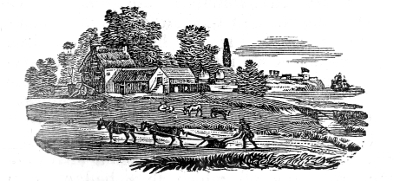
civilization. His first care was to construct a
house, and plant in the wild. This task finished,
he spent his whole time, early and late, in the
garden and the fields. By vigorous exertions,
and occasional assistance, he brought a few
acres of ground under crop; acquired a stock
of cattle, sheep and hogs; made additional inroads
on the glade and the forest, and, though
his toils were hard, gradually and imperceptibly
became, in a rough way, “well enough to live,”
as compared with the poverty he had abandoned
at home.
His greatest discomforts were, distance from
his neighbours, the church, markets, and even
the mill; and, along with these, the suspension
(or rather, the enjoyment) after long intervals
of time, of those endearing charities and friendly
offices, which lend such a charm to social life.
On one occasion, M’Dougal had a melder of
corn to grind, and as the distance was considerable,
and the roads none of the smoothest, this
important part of his duty could only be performed
by starting with the sun, and returning
with the going down of the same. In his absence,
the care of the cattle devolved on his
spouse, and as they did not return at the usual
hour, the careful matron went out in quest of
them. Beyond its mere outskirts, the forest was,
to her, terra incognita, in the most emphatic
sense of the term; and with no compass, or
notched trees to guide, it is not to be wondered
at that she wandered long and wearily to very
little purpose. Like alps on alps, tall trees arose
on every side—a boundless continuity of shade—and,
fatigued with the search, she deemed it
prudent to retrace her steps, while it was yet
time. But this resolution was much easier
formed than executed; returning was as dangerous
as “going o’er,” and, after wandering
for hours, she sunk on the ground, her eyes
swollen and filled with tears, and her mind
agitated almost to distraction. But here she had
not rested many minutes, before she was startled
by the sound of approaching footsteps, and,
anon, an Indian hunter stood before her, “a
stoic of the woods, a man without fear.” Mrs.
M‘Dougal knew that Indians lived at no great
distance, but as she had never seen a member
of the tribe, her emotions were those of terror—quickening,
it may be said, every pulse, and
yet paralyzing every limb. The Indian’s views
were more comprehensive; constantly on the
look out, in search of the quarry, and accustomed
to make circuits, comprising the superficies of
many a highland mountain and glen, he had
observed her, without being observed himself,
knew her home, recognized her person, comprehended
her mishap, divined her errand, and
immediately beckoned her to follow him. The
unfortunate woman understood his signal, and
obeyed it, as far as terror left her power; and,
after a lengthened sweep, which added not a
little to her previous fatigue, they arrived at the
door of an Indian wigwam.
Her conductor invited her to enter, by signs:
but this she sternly refused to do, dreading the
consequence, and preferring death in the open
air to the tender mercies of cannibals within.
Perceiving her reluctance, and scanning her
feelings, the hospitable Indian darted into the
wigwam, and communed with his wife, who,
in a few minutes, also appeared: and, by certain
signs and sympathies, known only to females,
calmed the stranger’s fears, and induced her to
enter their lowly abode. Venison was instantly
prepared for supper, and Mrs. M’Dougal—though
still alarmed at the novelty of her situation,
found the viands delicious, and had rarely,
if ever, partaken of so savoury a meal. Aware
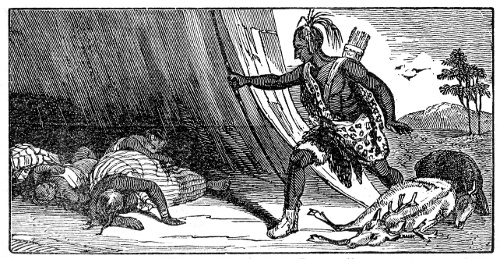
that she was wearied, the Indians removed from
their place near the roof, two beautiful deer
skins, and, by stretching and fixing them across,
divided the wigwam into two apartments. Mats
were also spread in both, and next, the stranger
was given to understand, that the further dormitory
was expressly designed for her accommodation.
But here again her courage failed
her, and to the most pressing intreaties, she
replied by signs, as well as she could, that she
would prefer to sit and sleep by the fire. This
determination seemed to puzzle the Indian and
his squaw sadly. Often they looked at each
other, and conversed softly in their own language:
and, at last, the Red took the White
woman by the hand, led her to her couch, and
became her bedfellow. In the morning she
awoke greatly refreshed, and anxious to depart,
without further delay—but the Indian would
on no account permit it. Breakfast was prepared—another
savoury and well-cooked meal—and
then the Indian accompanied his guest,
and conducted her to the very spot where the
cattle were grazing. These he kindly drove
from the wood, on the verge of which Mrs.
M‘Dougal descried her husband, running about
every where, hallooing and seeking for her, in
a state of absolute distraction. Great was his
joy, and great his gratitude to her Indian benefactor,
who was invited to the house, and treated
to the best the larder afforded, and presented,
on his departure, with a suit of clothes.
In about three days he returned, and endeavoured,
by every wile, to induce Mr. M’Dougal
to follow him into the forest. But this invitation
the other positively declined—and the poor
Indian went on his way, obviously grieved and
disappointed. But again he returned; and,
though words were wanting, renewed his intreaties—but
still vainly, and without effect:
and then, as a last desperate effort, he hit upon
an expedient, which none, save an Indian
hunter, would have thought of. Mrs. M’Dougal
had a nursling only a few months old—a fact
the Indian failed not to notice. After his pantomimic
eloquence had been thrown away, he
approached the cradle, seized the child, and
darted out of the house with the speed of an
antelope. The alarmed parents instantly followed,
supplicating and imploring, at the top
of their voices. But the Indian’s resolves were
as fixed as fate—and away he went, slow
enough to encourage his pursuers, but still in
the van by a good many paces, and far enough
ahead to achieve the secret purpose he had
formed—like the parent-bird, skimming the
ground, when she wishes to wile the enemy
from her nest. Again and again Mr. M’Dougal
wished to continue the chase alone—but maternal
anxiety baffled every remonstrance; and
this anxiety was, if possible, increased, when
she saw the painted savage enter the wood, and
steer, as she thought, his course towards his
own cabin. The Indian, however, was in no
hurry;—occasionally, he cast a glance behind,
poised the child almost like a feather, treading
his way with admirable dexterity, and kept the
swaddling clothes so closely drawn around it,
that not even the winds of heaven were permitted
to visit it roughly. It is, of course, needless
to go into all the details of this singular
journey, further than to say, that the Indian, at
length, called a halt on the margin of a most
beautiful prairie, teeming with the richest vegetation,
and comprising many thousands of acres.
In a moment the child was restored to its parents—who,
wondering what so strange a procedure
could mean, stood, for some minutes, panting
for breath, and eyeing one another in silent and
speechless astonishment.
The Indian, on the other hand, appeared
overjoyed at the success of his manœuvre—and
never did a human being frisk about and
gesticulate with greater animation. We have
heard, or read, of a professor of signs: and
supposing such a character were wanted, the
selection could not—or, at least should not—be
a matter of difficulty, so long as even a remnant
remains of the aborigines of North America.
All travellers agree in describing their gestures
as highly dignified, eloquent, and intelligent:
and we have the authority of Mr. M’Dougal
for saying, that the hero of the present strictly
authentic tale, proved himself to be a perfect
master of the art. The restoration of the child—the
beauty and wide extent of the prairies,
and various other circumstances combined—flashed
across our countryman’s mind—operating
conviction where jealously and distrust had
lurked before. Mr. M’Dougal, in a trice, examined
the soil, and immediately saw the propriety
of the advice given by the untutored one.
By a sort of tacit agreement, a day was fixed
for the removal of the materials of our countryman’s
cabin, goods and chattels;—and the
Indian, true to his word, brought a detachment
of his tribe to assist in one of the most romantic
“flittings” that ever was undertaken either in
the old or new world. In a few days a roomy
log-house was fashioned, and a garden formed
in a convenient section of the beautiful prairie,
from which the smoke was seen curling, and
the woodpecker tapping at no great distance.
M‘Dougal was greatly pleased at the change—and
no wonder, seeing that he could almost
boast of a body-guard as bold as the bowmen
of Robin Hood. His Indian friend speedily
became a sort of foster brother, and his tribe as
faithful as the most attached Tail of Gillies that
ever surrounded a Highland chieftain. Even
the stupid kine lowed, on finding themselves
suddenly transferred to a boundless range of
richest pasture:—and, up to the date of the
last advices, were improving rapidly in condition,
and increasing in numbers.
The little garden was smiling like a rose in
the desert-grass, overabundant, was gradually
giving way to thriving crops, and the kine so
well satisfied with their gang, that the herds
and enclosures were like unheeded to keep them
from the corn. The Indians continued friendly
and faithful—occasionally bringing presents of
venison and other game, and were uniformly
rewarded from the stores of a dairy, overflowing
with milk, butter, and cheese.
Attached as the Red man was to his own
mode of life, he was induced at length to form
a part of the establishment, in the capacity of
grieve, or head shepherd—a duty he undertook
most cheerfully, as it still left him opportunities
of meeting and communing with his friends,
and reconnoitering the altering denizens of the
forest. Let us hope, therefore, that no untoward
accident will occur to mar this beautiful
picture of sylvan life; that the M’Dougal colony
will wax stronger, till every section of the
prairie is forced to yield tribute to the spade
and the plough.