The Castle of Laxemburg—Heron-Hawking—The Empress of Austria—A
Royal Hunt—Fête at the Ritterburg—A Recollection of Christina
of Sweden—Constance and Theodore, or the Blind Husband—Poland—Scheme
for her Independence—The Comte Arthur
Potocki—The Prince de Ligne and Isabey—The Prince de Ligne’s
House on the Kalemberg—Confidential Chats and Recollections—The
Empress Catherine II.—Queen Marie-Antoinette—Mme. de
Staël—Casanova.
‘These sovereigns on their holidays,’ as the Prince de
Ligne called them, had to be constantly amused, or
at any rate prevented at all cost from being bored.
The committee appointed by the emperor, and composed
of the most eminent personages of the Austrian
Court, cudgelled their brains to devise a new diversion
for each day. They were, above all, very busy
with the preparations for the great imperial tournament
which, it was intended, should constitute a
never-to-be-forgotten feature of the brilliant functions
of the Congress. The cut, the shape, and the
colour of the dresses were matters of incessant study;
the horses were drilled every day; the champions
spent many hours rehearsing the various movements
and passes which were to remind all of us of the
ancient days of chivalry; the ladies tried on the magnificent
gowns and ornaments, the historical accuracy
of which was to carry the suffrages of everybody
by pleasing the eye. But pending the termination
of those busy preparations, a big hunt had been
organised in the woods and park of the imperial
residence, Laxemburg, and numerous invitations
issued.
Laxemburg is about six miles from Schönbrunn.
The park is laid out on English models. There are
densely-wooded plantations at irregular intervals,
further on vast lawns leading to thick and sombre
forests; swelling tracts of ground ingeniously
arranged, and masses of rocks; everywhere the most
varied and unexpected vistas. In one word, art has
combined in a restricted space the different beauties
of nature. The most conspicuous feature, though, is
a magnificent piece of water, one might call it a lake,
the aspect of which reminds one of the landscapes of
Switzerland. On its limpid surface there lay at that
period a miniature frigate with its cannon, masts and
rigging, and other small craft, the brilliant bunting
of which imparted life and colour to the rippling,
dancing wavelets.
Schönbrunn had been the object of Maria-Theresa’s
predilection, consequently Laxemburg had suffered as
a residence at the cost of its neighbour. Emperor
Francis made up for the undeserved neglect. On a
slope some short distance from the lake, he erected the
‘Ritterburg,’ which has become one of the principal
sights of Austria. It is an exact imitation of one of
the sombre castles or forbidding manors of mediæval
feudalism. The massive walls, flanked by crenellated
towers, are surrounded by a deep moat filled with
water. The inner court, with its pavilions, its
barriers, the whole arranged for single combats and
tournaments, forms the lists. The halls are in keeping
with the court; they are filled with stands of
arms, coats of mail, breastplates, lances, etc. From its
Gothic pillars hang panoplies; from its ogival arches
are suspended banners, their staffs adjusted amidst
turbans, richly embroidered, Oriental vestments, the
spoil wrested from the infidels; in short, the relics of
the victories that saved Christianity.
In another hall are preserved weapons, dresses, and
other venerable remains of the heroes whose prowess
founded the German Empire, of Rudolph of Hapsburg,
of Maximilian I., and of Charles V.
Still further on, there is a hall hung with the cloaks
of the first Knights of the Golden Fleece. In a hall
leading out of that one stand the white marble effigies
of the emperors sprung from the House of Austria.
These are succeeded by a series of vast reception
rooms, several of which are most admirable in virtue
of their decoration. There is no longer an attempt
at imitating the Gothic style; they are filled with
the marvels of art of the period itself—that is, the
masterpieces spared by the hand of time, most exquisite
specimens of sculpture, delicately-worked panels,
whole ceilings. All these precious relics were collected
from the convents suppressed at the period of
the building of the ‘Ritterburg.’ Everything calculated
to heighten the illusion was conveyed to the
‘Ritterburg.’ In one spot there is a narrow winding
stair, leading to a dungeon, or rather a torture-chamber,
with its massive doors, its irons and chains,
and even its instruments of torture. Crouching
against the further wall, there is the figure of an
ill-fated prisoner, dressed as a Knight Templar and
bending beneath the weight of his fetters. By some
ingenious mechanism, he slowly and painfully drags
himself with an effort from his sitting posture to hold
out his arms to the spectator. The gruesome imitation
is so perfect as to produce a shudder in the
beholder.
The topmost story of that tower is a spacious
room called the Hall of Judgment. Narrow ogival
windows admit only a sparse light. Twelve stone
seats are ranged in a circle along the walls. In the
centre there is a round table with a circular hole in
it, big enough to admit a human head and no more.
On the day of his trial the accused man was bound to
a chair; by means of a contrivance consisting of ropes
and pulleys, he was quickly raised to the summit of
the tower, and suddenly his head emerged from the
hole in the board. Before the interrogatory, he was
asked the whole truth; he replied, knowing that at
the slightest sign from his judges the rope attached
to his chair could be cut and he himself be flung from
a height of two hundred feet on to the stones of his
dungeon. Nothing could give a more striking idea
of the terrible ‘proceedings’ of feudal justice in the
Middle Ages than this mechanism.
The committee entrusted with the programme of
the fêtes had, it was said, entertained the idea of
giving a representation of a judiciary ascension as
described; the scene had even been cast. The
Empress of Austria was, however, of opinion that
such a picture of anguish and torture would only
mar the brightness of the fête she was preparing for
her guests.
The chapel of the ‘Ritterburg’ is not the least of
its curiosities. It is the same which was constructed
by St. Leopold in the twelfth century at Kloster-Neuburg.
The materials were transferred piecemeal
to its present site, and the monument is in perfect
keeping with all those relics of past days.
Among the many works of art in the Castle of
Laxemburg itself, there are several paintings by
Canaletto; amongst others views of Schönbrunn, of
the Graben, and the Church of the Capuchins.
Maria-Theresa came now and again to Laxemburg
to exchange the cares of state for the relaxations of
hawking. The ‘Ritterburg’ had not been built then.
When, amidst the difficulties of finding new recreations,
the fêtes committee conceived the project of
bringing the guests of the Congress to Laxemburg
and entertaining them there, the idea of ‘flying’ the
hawk naturally presented itself. In the vicinity of
that Gothic castle nothing could be more in harmony
with the style of its construction than an amusement
borrowed from the traditions and manners of the
feudal ages.
The place of meeting was on the banks of the lake,
not far from a marshy spot tenanted by numerous
flocks of water-birds. Foremost among the company
was the lovely Empress of Austria, famed for her
love of sport and her marvellous skill, the graceful
Elizabeth, Empress of Russia, Queen Caroline of
Bavaria, her sister, and a number of ladies, several of
whom wore the elegant costume of the sixteenth
century. At the head of the sovereigns on horseback
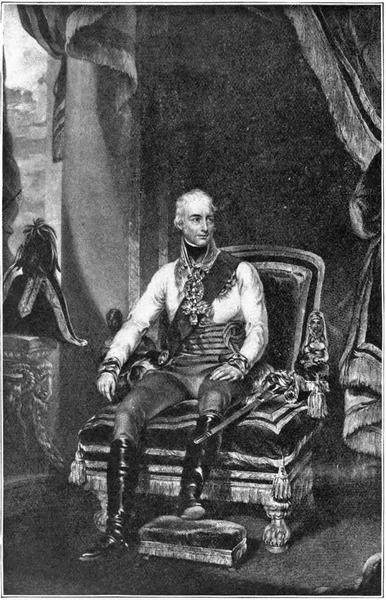
was Emperor Francis, unflaggingly hospitable.
Amidst them, in a low-wheeled calèche, is the enormous
King of Würtemberg, famed for his former
hunts and hunting exploits, and anxious to witness
tranquil amusement, altogether unlike the fatigues
and perils he was wont to court.
The huntsmen in their handsome uniforms, holding
their dogs in leash, come first; then come the falconers
with their hooded birds on their wrists, and behind
these the eager mass of spectators.
At a spot where the reeds and rushes impede the
view of the lake, there is a halt, and the dogs’ leashes
are slipped to start the birds. The air rings with
barking, and all eyes are strained upward in expectation
of the struggle, somewhat novel to the majority.
All of a sudden, a grey-plumaged heron takes its
flight, at first slowly, heavily, and with listless
movement; then spreading its wings it rises rapidly.
At the sight of the bird, promising not an easy victory
but a protracted struggle, the falconers get ready,
encouraging their birds with their cries, awaiting a
signal from the empress to give the first pursuer
flight.
The signal is given, and in the twinkling of an eye
the hood is removed from one of the hawks and it is
set free. The falconer points to the fleeing heron, the
impatient hawk shakes its pinions, utters a cry, and
quick as lightning soars aloft. The affrighted heron
tries in vain to rise higher than his pursuer, but the
latter directs its flight in such a manner as to be constantly
hovering above its quarry. Each attempt of
the heron meets with a counter-move on the part of
the hawk, compelling its victim to descend. If the
heron shows signs of returning to the starting-point
where the hunters are, the hawk, swift as a flash,
bars its progress in that direction and forces it to take
the opposite one; it keeps worrying the other bird,
tiring it and practically dazzling it by the repeated
beating of its pinions, until it finally brings it back
to the point within an easy view of the spectators of
the struggle. The heron at length determines upon
resistance. Steadily pursuing its course, and apparently
motionless, it presents its long bill, sharp like a
sword, to its foe. The hawk, on its part, decides
upon attack. Rapidly wheeling round and round
the heron, it lowers its flight, then re-ascends and
all at once grips the flanks of its victim. Then
begins a veritable struggle at close quarters, with all
its fury and all its rapidly changing incidents.
The heron has the first advantage; it aims a terrible
stroke at its adversary, piercing it between the neck
and one of its pinions as if with a dagger. The hawk,
nevertheless, clings to the heron and rends the latter’s
flesh with its beak. The heron quickly follows up its
strokes; compelled to fight and at the same time to
carry the weight of its foe, it multiplies its attack
without getting rid of its assailant, and the blood of
both stains their plumage crimson. In spite of this,
the hawk looks like getting the worse of it. There is
a longer interval between its attacks, which are
neither as fierce nor as sure as heretofore, and the
victory bids fair to remain with the heron, when the
falconer despatches a second hawk from among those
which, though hooded up to now, seem aware of the
struggle going on, to judge by the flapping of their
wings and the sudden stiffening of their feathers.
The freshly-despatched combatant is a hen-bird,
easily recognised by its beautiful brown plumage, for
it is noteworthy that among this species the females
are bigger, stronger, and bolder than the males. No
sooner is the hood removed than the female rises
into the air and, disdaining all preliminary evolutions,
fastens its beak into the neck of the heron. The air
is rent by the cries of the hunters, the barking of the
dogs, and the braying of the horns. The heron’s
resistance is, from that moment, useless. The new
assailant virtually smothers it, and, moreover, digs
its claws into the heron’s back, while the male, its
strength revived by the timely aid of the female,
renews its attacks. It becomes merely a question of
seconds with the ill-fated heron. After a few spasmodic
movements, rendered uncertain by the loss of blood,
it finally closes its eyes and drops to the earth. The
two hawks utter screeches of victory, tear their
victim’s eyes out, and without letting go of it for
a moment, drag it to the falconer’s feet.
According to the ancient usages of the chase, a
huntsman stepped forward at that moment, and,
plucking from the heron’s neck its fine and elegant
plumage, constituting as it were a natural aigrette,
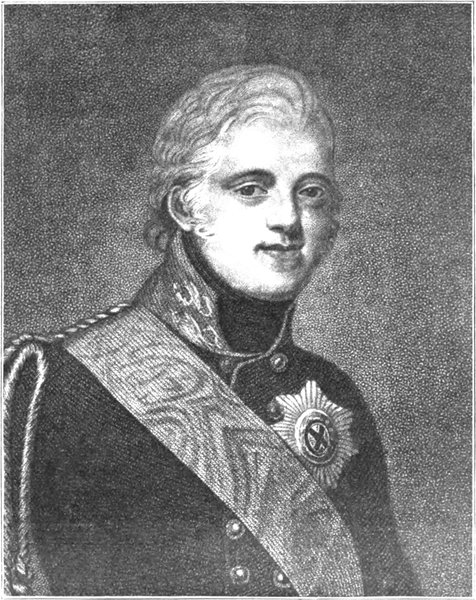
he handed it to Emperor Alexander, who, in his turn,
immediately offered it to the lovely Empress of
Austria. The horns sounded ‘the death,’ while the
birds devoured their quarry, and the illustrious guests
crowded round the falconers to compliment them.
This, after all, was only the prelude to a more
important sporting item of the programme. Every
care had been taken to ensure its success. The
signal for a new start was given, and we moved
towards another part of the park, where on an immense
lawn surrounded by trees a vast arena had
been arranged for the guns. At one side there was
a circular stand for the guests of the Court. The
sovereigns and the high personages in whose honour
the entertainment was given took up their positions,
each one provided with four pages charged with loading
the guns, in order to spare the principals the
slightest fatigue.
The general beating-up had taken place on the
previous night. At the word of command from the
empress the circle of beaters drew in, and at the
same moment from all the outlets of the wood, there
emerged a numberless quantity of wild-boars, deer,
hares, and game of all kind, which in a few moments
were killed by the privileged marksmen, amidst the
general applause of the lookers-on.
My friends and I had taken up our positions a
little distance away from the Empress of Austria, who
was using only a musket, loaded with ball, and who
aimed exclusively at hares or small game, which she
never missed.
This file-firing, or rather this kind of slaughter, only
ceased when the number of animals killed amounted
to several thousands. Once more the forest rang with
the barking of the dogs, the cries of the spectators,
mingled with the sound of hunting-horns. The
ground literally disappeared under the heaped-up
game, its blood still trickling. Truly, after the noble
struggle we had just witnessed, it became difficult not
to admit that the amusements of our fathers were
superior to ours.
Ypsilanti seemed surprised at the remarkable skill
of the Empress of Austria, and at the steadiness of
her aim. Without for a moment wishing to detract
from either, I told him what I had seen in the arsenal
at Stockholm, namely, a long carabine which was
loaded with a single pellet of the smallest shot, and
with which, it is said, Queen Christina amused
herself by bringing down the flies on the walls of her
rooms without ever missing one.
Soon after the termination of the sport, night set
in rapidly. Suddenly, as if at the touch of a magic
wand, the lawn and the avenues of the park were
lighted up by enormous ‘pitch-pots,’ known in Turkey
as machala, the blaze of which carries very far.
At the same moment, the inside of the ‘Ritterburg’
was illuminated from roof to basement for the reception
of the illustrious guests who were going to
assemble there. When Emperor Francis constructed
the castle as an exact illustration of the ideas prevailing
during the feudal era, he certainly did not
foresee the forgathering under its roof in one day of
such a number of illustrious personages, from emperors
to knights. Though only those provided with invitations
had been admitted to Laxemburg, their number
was so great as to make perambulation in the various
halls and reception rooms exceedingly difficult. The
animated crowd, and the profusion of light constituted
the strangest and most striking contrast to the sombre
arches, the panoplies, the dresses and the ornaments
of mediæval times.
The lovely imperial hostess did the honours of the
feudal manor with her usual grace. A magnificent
collation was served, to which succeeded a concert of
a peculiar kind. In a corner of the principal hall
there was an enormous organ; its construction, sound,
and ornaments faithfully recalling the machines with
brass pipes and bellows with which the piety of
our forefathers provided the cathedrals of the Middle
Ages. The deep tones of the organ were accompanied
by a band of wind instruments, played by musicians
expressly brought from Bohemia, where instrumental
music appears to have reached perfection. To complete
the illusion, they had selected some of the old
national melodies, the traditions of which have been
preserved for centuries. In the intervals, huntsmen,
placed on a tower overlooking the castle, played
hunting tunes that sounded like an echo coming from
the skies.
On several occasions during previous concerts, I
had noticed a young man whose eyes were covered
with a black bandage, and who was guided through
the crowd by a young lady with an elegant figure, but
whose face was hidden by a thick veil. This time
they were close to the organ, and they evidently
enjoyed the music greatly. I asked the Comte
François de Palfi who were these young people,
imparting an air of sadness to a fête rather than partaking
of its joys.
‘That young man,’ he answered, ‘is the Comte
Hadick, the young woman is his wife, and their story
is most interesting.
‘Bound by a very close friendship, additionally
cemented by long and important services to each
other, the Comtes Hadick and Amady made up their
minds to tighten these bonds still further by uniting
in marriage their children, who were about the same
age. Théodore Hadick, the only offspring of the
illustrious family, was in consequence brought up with
young Constance, who from her infancy bade fair to
be as kind in disposition as she was beautiful in face
and figure. At fifteen the feelings of these two young
people were already what they would continue to be
all their lives. The castles of the two magnates were
practically adjacent to each other. Constance, by being
present at the lessons of her young friend, easily learned
all those exercises calculated to impart both bodily and
mental gracefulness without being hurtful to beauty.
What united them still more was their passionate
fondness for music, which passion appears innate with
the Hungarians. They were held up everywhere as
models of perfection and virtue, and their fathers
were already discussing the time of their wedding,
when the war broke out.
‘As you are aware, the laws of Hungary compel
every noble personally to fight for his country; and
in the periods of great danger, when the whole of
the nation rushes to arms, the magnates march
with their banners at the head of their vassals. The
Comte Hadick, jealous for the honour of his house,
was very anxious for his son to share the forthcoming
campaign. Constance, hiding her grief, and
solely occupied with the future and the glory of
her betrothed, watched with great courage the preparations
for a parting which the chances of war
might prolong and render eternal.
‘Theodore, impatient to devote himself to his
country, hurried the moment that was to afford
him the chance of showing himself still more worthy
of the girl whom he loved, and the day of his departure
was finally fixed upon. The previous evening,
though, the betrothal took place at the castle, and it
was with the certainty of Constance’s hand that the
young count at the head of his vassals went to join
the Hungarian army at Pesth. You know the result
of the campaign. The Hungarians kept up their
reputation for brilliant valour. Théodore, in virtue
of several signal actions, deserved the cross conferred
upon him by the chapter of the Order of Maria-Theresa,
a distinction considered one of the foremost
in the annals of chivalry.
‘But while the young man supped full with glory,
Constance had been carried to the brink of the grave
by a cruel illness. Stricken down by an attack of
most virulent smallpox, she hovered for a long time
between life and death. The doctors, while saving her,
could not prevent the face which had been one of the
most beautiful from becoming almost hideous. She
was only allowed to look at herself when she was on
the high road to recovery.
‘The sight, as you may imagine, filled her with
despair, and, convinced that Théodore could no longer
love her under such conditions, she ardently prayed
for death.
‘In vain her father and the Comte Hadick tried to
reassure her. Haunted by the horrible dread of being
no longer worthy of her betrothed, she refused to be
comforted, and the young girl was simply dying of
despair, there being not the faintest hope left.
‘Nevertheless, one morning, when she was nestling
in the arms of her father, who bade her live at least
for him, the servant who had accompanied Théodore
to the war suddenly rushed into the apartment,
announcing the immediate coming of his master,
whose voice, a moment afterwards, was heard outside.
‘“Constance, Constance, where art thou?”
‘At that voice so dear to her, the young girl, lacking
the courage to fly, covered her face with her
handkerchief and her hands.
‘“Do not come near me, Théodore, I have lost my
beauty. I have no longer anything to offer thee but
my heart.”
‘“What do I hear? But look at me, Constance!”
‘“No, no, thou wouldst only recoil at seeing me.”
‘“What does it matter, if thy love is the same,
Constance. Constance, I can no longer see thee.”
‘She raises her eyes and looks. Théodore was
blind. The charge of a musket had deprived him of
his sight.
‘“God be praised!” exclaimed Constance, falling on
her knees. “Théodore, we shall be united, for thou
canst still love me. I shall be thy guide; yes, I shall
be to thee as I was in the first moments of our love,
and thou shalt be able to love me still.”
‘Shortly after that they were married. Never was
there a couple so deserving of happiness more really
happy than they. The comtesse takes her husband
everywhere, never leaving his side for a moment.
He is the object of her most delicate attentions; her
love for him seems increased by his terrible affliction.
She does not wear that veil to hide her scarred
features, but because she is afraid that the remarks of
the crowd on her vanished beauty may sadden the
heart of the husband whom she worships.
‘The young comte’s passion for music appears to
have increased since he lost his sight. He regularly
attends every concert; and his faithful companion,
who appears only to live for him, is always at his side.’
The concert came to an end just as the comte finished
his touching story. Then the windows were opened
and magnificent fireworks let off on the lake. The
sheaves of fire crossing each other and being reflected
in the water; the numerous craft, illuminated and
streaming with bunting; the masses of light standing
in relief against the sombre background of the forest;
the sound of the horns mingling with the shells and
fusees—all this combined produced a truly magical
effect.
Finally, after this well-spent day we began to think
of getting back to Vienna, probably to recommence
next morning the pursuit of the apparently inexhaustible
round of pleasure.
The next day, however, I had promised to spend
with the Prince de Ligne at his house on the Kalemberg.
When I got there, I found the prince in
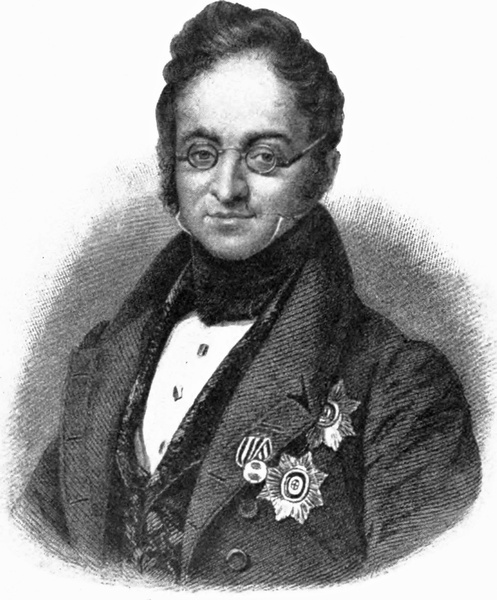
company with M. Nowosilitzoff, a Russian statesman
of great ability and a trusty adviser of Emperor
Alexander, who, it was said at the time, was deeply
interested in the future of Poland. The constitution
of that country, its organisation and its institutions,
which were to reinstate her in her former rank among
the European nations—in short, her destiny—was one
of the gravest questions submitted to the deliberations
of the Congress. A most confidential councillor of the
czar and a member of the provisional government of
Warsaw, M. Nowosilitzoff was at that period engaged
in drawing up the constitution intended by the czar
for his new kingdom.
The Prince de Ligne professed an ardent sympathy
for Poland. He admired her chivalrous and hospitable
customs, and above all that frankness which
forms the chief trait of the Polish character. Added
to this admiration was his gratitude to a nation which
had formerly admitted him among the ranks of its
nobility. Consequently, he sat listening attentively
to the projects of Alexander, projects which just then
inspired a certain belief. As for me, the subject
appealed to me like everything connected with the
country in which I spent some of the best years of
my youth.
‘After so many unprecedented efforts, after so many
disappointed hopes and useless sacrifices, Poland bids
fair to breathe at last,’ said M. Nowosilitzoff. ‘Deceived
for many years by the man who had the misfortune
to consider his will as a ruling principle,
his power as a proof of his statesmanship, and his
success as a reason for it, the Poles were not altogether
unjustified in believing in promises tending to reinstate
them as a nation.’
‘There is no nation on the face of the earth who
would not have made the same sacrifices for so noble
an illusion,’ remarked the prince.
‘No doubt, but constantly letting their thoughts
run back, as they do, to the brilliant periods of their
history, they would fain see their country assume the
proud and independent attitude it adopted under the
Bathoris, the Sigismunds, and the Sobieskis; and in
this beautiful dream of the past, and, moreover,
deceived by the actual state of politics in Europe,
they will not stop their ambition at the point imposed
by their geographical position. They will only find
a country in the strictest sense through us and with
us,’ the councillor went on. ‘Poland, completely independent
and organised on the very risky basis of its
erewhile constitutions, would only secure an ephemeral
existence; she would carry her own germ of destruction.
Is she to form a permanent camp in the centre
of pacified Europe, or shall she arm all her nomadic
sons like the Sarmatians of old, in order to make up
by living ramparts for the natural frontiers and
fortresses she lacks? She must have a support in
order to insure her independence. Truth, I know,
can only triumph slowly over the power of prejudice;
but what is there to oppose the fact which henceforth
is only too palpable? The hope of a better future, a
hope which can only be indulged by unthinking
creatures whom the disasters of their country have
failed to restore to reason and coolness of mind.’
‘Burke has said somewhere,’ replied the prince,
‘that the division of Poland would cost its authors
very dear; he might have said the same of the
defenders of the nation, for it is probable that the
active share of Napoleon in the affairs of Poland has
contributed in no small degree to his downfall. May
the projects of Alexander remain exempt from a
similar fatality! Everything will depend upon the
guarantees given for the maintenance of the Polish
nationality! A people may resign itself to having
been vanquished; it will never resign itself to being
humiliated.’
‘The solicitude of the emperor for his new subjects
admits of no discussion,’ observed M. Nowosilitzoff.
‘To be convinced of this, you have only to
glance at this manuscript. It is the draught of the
Constitution of the Kingdom of Poland, and it is
corrected by the hands of Alexander himself. If it
be true that great thoughts proceed direct from the
heart, there is ample evidence here of the nobleness
of Alexander’s. The laws and the constitution of
the kingdom will be the keystone of the peace of
Europe.’
In fact, the few pages he read to us from the
manuscript redounded as much to the honour of the
statesman as to that of the philanthropist. Poland
would indeed have been a happy country, if an
erroneous policy had not struck all those dreams of a
moment with utter barrenness.55
The commentary of M. Nowosilitzoff, which followed
upon the reading of the document, was interrupted
by the arrival of the Comte Arthur Potocki, the youthful
friend of the Prince de Ligne. Though a Pole,
and animated by the most generous feelings towards
his country, his presence vexed the privy councillor
to such an extent as to cause him instantly to roll up
his manuscript without adding another word, and to
leave us shortly afterwards.
The Comte Arthur Potocki, son of the Comte Jean
of the illustrious family of that name, and one of the
best educated men in Europe, had a noble face, an
elegant figure, and a cultivated mind. At an age
when most men spend their time in pleasure and
frivolous pursuits, he was conspicuous for a sterling
judgment, a wide knowledge, and the most exquisite
politeness. It is not surprising then that he was one
of the most notable men in Vienna society, and
eminently fit to occupy a similar position everywhere.
The Prince de Ligne was very fond of Arthur, whom
he called his Alcibiades, and who in his turn worshipped
the bright and witty octogenarian, so indulgent
to young men.
‘Everything has been finally arranged for the
imperial carrousel (musical ride), which is irrevocably
fixed for next week,’ said the young comte, ‘and I
have brought you the tickets which the Grand-Marshal
Trauttmansdorff has told me to remit to you. It
will be one of the most brilliant spectacles ever witnessed.
To-morrow night everybody in Vienna laying
claim to be somebody is going to the Court to see the
“living pictures” arranged by Isabey. They will be
followed by romances sung and enacted by the handsomest
women of the Court, the lovely Duchesse de
Sagan, the Princesse Paul Esterhazy, the Comtesse
Zichy, and several of our most elegant fair ones.
Do not fail to come, gentlemen; you had better take
advantage of the joyous hours. It is rumoured that
the Congress will terminate on the 15th December.
Good-bye, until to-morrow. Let the thought of the
closing of the Congress be with you every moment, as
it is with me.’ Saying which, he took his departure.
The prince reminded me that I had promised to
spend a few hours with him on that day at his house
on the Kalemberg. Before going thither he wished
to go to Isabey’s to sit for his portrait, and he asked
me to accompany him.
‘During that hour of torture to me,’ he laughed,
‘you will have an opportunity of looking at a series of
portraits from his brush. Isabey is the recorder of
the Congress in pigments. And inasmuch as he is
almost as clever with his tongue as with his brush,
you’ll not waste your time.’
In a short time we reached the artist’s quarters in
the Leopoldstadt. The front of the house was provided
with a barrier to prevent the deadlock of the
visitors’ carriages. Isabey’s arrival at Vienna had
been preceded by his deserved reputation.56
Presented by the Duc de Sérent to Marie-Antoinette,
Isabey, at the age of twenty, painted the portrait of
the lovely and ill-fated queen, who treated him with
the utmost kindness, and always called him her little
Lorrain. Subsequently, having become the painter-in-ordinary
of Napoleon, he reproduced the features of
all the celebrated men and all the handsome women
of the Empire. It was he who superintended the
fêtes of that brilliant and short-lived era.
At Vienna, all the European celebrities solicited
the distinction of reproduction by his brush, and he
could scarcely comply with all their requests. The
number of portraits he painted at that period is
positively surprising, and supplies a proof of his
talent having been as fertile as it is graceful. Whenever
there was a question of organising this or that
entertainment for which the Congress was the pretext,
the artist who had drawn the designs for Napoleon’s
coronation was, as may be imagined, considered in
the light of a ‘God-send.’ Nothing was done without
consulting him.
According to Isabey himself, it was M. de Talleyrand
who had prompted the idea of his going to
Vienna; and art is indebted to that journey for his
remarkable and historical drawing of a ‘Sitting of
the Plenipotentiaries at the Congress.’
The fall of Napoleon deprived Isabey of nearly all
his functions. One day, in the study of the statesman
who at that time was supposed to have mainly
contributed to that catastrophe, the artist spoke regretfully
of a restoration which, as far as he was concerned,
spelt ruin. On one of the walls of the room hung an
engraving of the ‘Peace of Munster,’ after Terburg.
Pointing to it, Talleyrand said, ‘A Congress is to be
held at Vienna. Why not go there?’ The few
words were as a ray of light in the darkness to Isabey,
and from that moment his mind was made up.
Talleyrand did more than give a hint. He gave him
a most cordial welcome, and proved a kindly and
appreciative patron.
On Prince Eugène’s arrival in Vienna, one of his
first calls was upon Isabey. In his equivocal position,
he felt only too glad to see somebody reminding him
of his younger days. The painter by his bright
recollections often dispelled the sadness of the prince.
It was Eugène who shortly afterwards took Isabey
to Emperor Alexander. Isabey’s conversation was
always interesting, but it became positively sparkling
and historically valuable when recounting the marvellous
details of the coronation, which, as has been said,
were arranged by him. Isabey was not less delightful
when recalling the familiar and every-day life at
Malmaison.
Already in 1812, during a tour through Germany,
Isabey, being in Prague, had made a sketch of the
Prince de Ligne, which sketch he carefully preserved
and which hangs to this day (1830) in his studio.
Notwithstanding the seventy-and-eight years of the
model, the sketch shows the noble and delicately cut
features which to the end were the object of everybody’s
admiration. At that period the Prince de
Ligne only knew Isabey by reputation. One morning
he called upon the artist, who happened to be out.
But his album lay open near his easel. Instead of
leaving his card, the prince took up a pen and wrote
a dozen tripping and sparkling lines, describing
Isabey’s talent, finishing up with:
‘He constitutes as great an honour to art as to his country;
And in virtue of this impromptu, I also am a painter.’
This tribute to Isabey’s talent on the part of the
Prince de Ligne is only one of the valuable testimonies
contained in Isabey’s album. Every important personage
in Europe, ministers, generals, artists, ladies of
high degree, have equally considered it a pleasure to
testify to their admiration and their esteem.
Isabey had been quartered magnificently, like Benvenuto
Cellini in days of yore, at the Louvre. His
studio, hung from floor to ceiling with sketches, drawings,
and portraits in a more or less advanced stage
of completion, impressed one with the idea of a magic
lantern, representing in turns all the notable personages
who at that moment had forgathered in Vienna.
The hour taken up with the prince’s sitting seemed
short to me. Every now and again the work was
interrupted by this or that subtle remark or lively
reminiscence. The conversation ran principally on
a little adventure in connection with the game
of ‘leap-frog,’ which caused such a stir in Paris at the
period of the Consulate, and which was obstinately
believed in, in spite of Isabey’s denials. Here it is
in its original version.
Bonaparte, as is well known, was in the habit of
walking with his arms crossed upon his chest, and
his head slightly bent forward. Isabey was at
Malmaison, and he and some of the First Consul’s
aides-de-camp were having a game of leap-frog on
the lawn. Isabey had already jumped over the heads
of most of them, when, at the turning of a path, he
espied the last player who, in the requisite position,
seemed to be waiting for the ordeal. Isabey pursued
his course without looking, but took his flight so
badly as only to reach the other’s shoulders, and both
rolled over and over in the sand, and to Isabey’s
consternation, his supposed fellow-player turned out to
be Bonaparte. At that period, Bonaparte had probably
not pondered the possibility of a ‘fall’; hence, it was
said, refractory at this first lesson, he got up, foaming
at the mouth with anger, and drawing his sword,
pounced upon the unfortunate leaper. Isabey,
luckily for himself better at running than at leaping,
took to his heels, and jumping the ditches dividing
the property from the high road, got over the
wall and never stopped until, breathless, he reached
the gates of the Tuileries. Isabey, it was added,
went immediately to Mme. Bonaparte’s apartments,
and she, after having laughed at the mishap, advised
him to lie low for a little while. It was still further
reported that it wanted all Josephine’s angelic goodness
of heart and cleverness, besides her usual influence
over Bonaparte, to appease the latter’s anger
and to obtain the painter’s pardon. Bonaparte at
that moment was only ‘Consul for Life,’ but people
already foresaw the Empire, and the section of Paris
society which was not too well pleased at the prospect
of a possible return to former ideas naturally made the
most of the anecdote of Malmaison. The denials of
Isabey, who took good care to make short work of all
the detailed rumours, found little or no belief; the
adventure was considered extremely diverting, and
Isabey’s contradiction of it had no effect.
In the course of our conversation with Isabey, the
Prince de Ligne pressed him very closely on the
subject, as if the definitive fall of Napoleon sufficed to
restore to Isabey all his freedom of speech and all
his frankness on the matter. Isabey, on the other
hand, kept on defending himself with no less energy.
‘That adventure of Malmaison,’ he said, ‘is an
invention from beginning to end. It is ridiculous,
and one of those semi-historical exaggerations which
have grieved me more than I can tell. Napoleon
was made to play a part utterly at variance with his
character. When that story was bruited in Paris, I
had not set eyes upon him for more than six weeks.
The moment I heard of it, and of the particulars with
which it was embellished, I went to St. Cloud. As
soon as he saw me, he came up to me, and I had no
difficulty in convincing him that I had no share in
the matter; it really seemed to aim at ruining me
for ever in his estimation. He was exceedingly kind,
and reminded me of the well-known rejoinder of
Turenne, when his valet struck him by mistake, and
apologised by saying he fancied it was a fellow-servant
(called George). “And supposing it had been
George, there was no need to strike so hard,” said
Turenne. But,’ observed Isabey, ‘refuted or not,
the stories that pander to people’s spitefulness are
repeated, and finally remain as quasi-truths.’
‘Had I been in your place,’ said the prince, ‘I
should not have taken the trouble to refute the fable.
If it had been attributed to me, I should have
accepted the part. It would have been rather interesting
to jump like that on the shoulders of him who
so unceremoniously jumped so well on the shoulders
of others.’
Afterwards the conversation drifted to young
Napoleon, whose portrait we had admired a few days
previously at Schönbrunn.
‘That child,’ said Isabey, ‘has only one thought
occupying his mind, the recollection of his father.
One morning as he was sitting to me, there was the
sound of bugles; the Hungarian Guards were passing
down one of the courts. He immediately glides off
his chair, runs to the window, comes back, and
taking my hand, says, “Here are papa’s lancers
going by.”’
The portrait of the Prince de Ligne was already
sufficiently advanced to enable one to judge of the
likeness, and I complimented Isabey upon it. All those
who knew the admirable old man were struck with
the marvellously faithful reproduction of him as a
whole.
In a few moments we gaily resumed the course
of our little pilgrimage. The Kalemberg is a hill
overlooking Vienna, and offering a most picturesque
birdseye view of the city. The prince had established
his summer quarters there some years ago,
dividing his time in the delicious retreat between art,
pleasure, and the delightful society his fame constantly
attracted thither.
On our way we chatted about the pastimes and
diversions of Vienna, and he gave me a rapid picture
of them, for it could be said absolutely of him what
he said of Casanova: ‘Each word is a sketch, and
each thought is a book.’
‘Fitly to describe the fairy scenes succeeding
each other here without interruption would want
an Ariosto, that magician of poesy,’ he said. ‘In
fact, I shall not be surprised at the festal committee
shortly issuing a proclamation, to the sound of
trumpets and through all the towns and villages of
the monarchy, promising a prize to the fortunate man
devising a new pleasure for the assembled sovereigns.’
‘Thoroughly to enjoy oneself in Vienna, prince,
one ought to know German somewhat better than
foreigners as a rule know it,’ I answered. ‘Their
want of familiarity with the language prevents them
from catching the subtle shades of the joys and
manners of a class of the population which, though
not the foremost, is unquestionably not the least
interesting to study and to observe. In connection
with this, I may be permitted to quote the reply
of Bacon to a young man, who, not knowing any
foreign language, consulted him on his plan of travels.
“Go to school, young friend, and don’t go travelling,”
remarked Bacon.’
‘What would he have said to Metastasio, who, after
living for twenty years in Vienna, had not mastered
as many words of German, which quantity he considered
sufficient to save his life in case of need?’
laughed the prince. ‘Besides, you find your own
tongue the only one adopted here, not only in society
and at all the festive gatherings, but also at all the
conferences of the Congress. That much, indeed,
was due to its precision and its universal use. It
was necessary to establish a general means of communication
between so many strangers; without this
the Congress would have become a Babel.’
‘And also, prince, because no language lends itself
more easily to the biting epigrams and sparkling
repartees which are, as it were, like a bottle of champagne
that’s being “uncorked,”’ I replied. ‘The proof
of it is in your recent answer to the Baron de ——,
when he told you that the emperor had made him a
general. “He has appointed you to be a general,
he could not make you one,” is a fair sample of the
pliability of French.’
Chatting like this about many trifles, which on his
lips became interesting subjects, the prince rapidly
reviewed the foremost figures of society, generals,
statesmen, elegant women, etc.
‘This Congress, with its intrigues of all kinds hidden
by fêtes, is decidedly like Beaumarchais’ La Folle
Journée. It is an imbroglio with ever so many
Almavivas and Figaros. As for the Basilios, one
runs against them at every turning. I sincerely trust
people may not be compelled to exclaim by and by
with the joyous barber: “Whom, after all, are they
leading by the nose?”’
We soon got to the courtyard of his modest
residence. The house was small, but comfortable,
and the prince might have easily realised the wish
of Socrates by filling it with true friends. It had
been built on the site of a monastery founded in
1628: Leopold rebuilt it after the siege of Vienna;
Joseph I. enlarged it; Joseph II. suppressed it. Since
then, the prince had bought it. On the front door
was engraved his favourite sentence:—Quò res
cumque cadunt, semper stat linea recta.
‘I so thoroughly feel the barrenness of everything,’
he often said, ‘that there is no merit in my being
neither envious nor spiteful, nor vainglorious.’
He began by taking me into his garden.
‘I should fail in all the traditions of ownership
if I did not start by making you acquainted with
all the details of my principality. Inasmuch as my
house with its enclosure is scarcely more spacious than
the domain allotted by the people to the president
of the loftily perched republic of San-Martino, we’ll
go the round of it in less time than an act of mental
contrition would take. Nevertheless, such as it is,
the place enables me to escape from the bustle of
fêtes, from the fatigue of pleasure, and from the
crowd of majesties and highnesses. Here, and here
alone, I am enabled to enjoy my own society. I
come here to get the fresh air, and to recruit the
strength I spend every evening on the incessant
festivities of the Congress.’
At the end of the garden, he opened the door of a
pavilion, positively suspended over the Danube, and
from which the whole of Vienna could be taken in at
a glance.
‘This,’ he said, ‘is the spot whence John Sobieski
started at the head of his brave Poles, and with less
than thirty thousand men saved the empire by routing
all the Ottoman forces of the Grand-Vizir Kara-Mustapha.
Sobieski’s faculty of instantly perceiving
a situation was so sure and so thorough that at
the sight of the enemy’s dispositions, he coolly said
to the generals surrounding him that those dispositions
were defective, and that infallibly he would beat
his foes. It was impossible to say of him what is
commonly said of kings, namely, that they have won
a battle personally, when they have only looked at it
from afar. They may have won the battle personally,
but not by their presence. Sobieski won his
battles in person, and by his presence.
‘I like the letter he wrote to the queen, his
wife, on the day after the victory, which was dated
from the tent of the grand-vizir himself. There is
genuine greatness without the slightest admixture of
false modesty in the following words: “Let Christendom
rejoice and give thanks to the Lord; the infidels
can no longer insult us by saying: ‘Where is now
your God?’”
‘Sobieski had one of the greatest gifts ever vouchsafed
to a commander—the faculty of inspiring
confidence in his troops. The Polish cavalry which
came to the rescue of Vienna had no doubt a most
martial look; they were mounted on the handsomest
horses, and their arms were magnificent. This was
by no means the case with the infantry; one regiment
in particular was in such a sorry plight that
Prince Lubomirski advised their crossing the Danube
at night, for the sake of the nation’s honour.
Sobieski simply smiled. “As you see them,” he said,
“they are invincible: they have sworn not to change
their clothes except for those taken from the enemy.
In the last war they only wore the Turkish uniform.”
Sobieski’s remark did not, perhaps, provide his
soldiers with clothes; it did better than that: it ran
from mouth to mouth, and the regiment performed
deeds of unsurpassed valour. You are aware that
after that brilliant feat of arms which was the signal
for the relief of Vienna, they applied to the Polish
hero the words of Pius V. with regard to Don Juan
of Austria, after the battle of Lepanto: “There was
a man sent from God, whose name was John.” What
an admirable quotation!’ wound up the prince.
‘Austria had no doubt forgotten the application of
that sentence of gratitude when, later on, she effaced
from the rank of European nations the country of
her deliverers!’ I remarked.
‘Go and remind her of it, and see what you’ll get
for your pains. Furthermore, you must expect her
to answer in the way of a set-off to the advocates
of Poland: “You take care to remind us of your
saving Vienna in 1683. We are certainly very
grateful to you, but each time you mention it, we are
bound to tell you that Austria delivered you out
of the hand of Sweden, which had conquered you in
the reign of Charles-Gustavus; hence, we are
quits.”’
‘To this, prince, Poland could reply both in virtue
of priority of age and of the number of her services,
that the aid she lent to Austria, notably to her
founder, Rudolph of Hapsburg, largely contributed
to place Austria among the most powerful monarchies
of Europe. Be that as it may, in this iniquitous
proceeding, Austria plays the part of the dog in La
Fontaine’s fable, who carries his master’s dinner round
his neck: she interfered in order to take her share of
the spoil; it would have been more noble to prevent
the spoliation.’
By that time it was three o’clock, and we partook,
in a small room adjoining the library, of the provisions
which we had brought with us in the prince’s
carriage. It was one of the most delightful collations
I remember. The prince was fond of telling
stories; his way of narrating them was so delightful
and admirable that I was only too pleased to listen.
This added to his own enjoyment, and his well-stored
memory poured out tale after tale without the
slightest effort.
‘One of my sweetest recollections,’ he said, ‘was
my first journey to France as the bearer of the happy
news of the battle of Maxen. My entrance upon the
scene was entirely to my taste. I was received
everywhere, in Paris, Versailles, and at the Trianon,
by the Baron de Bezenval, the Comte de Vaudreuil,
the Comte d’Adhémar, the Princesse de Lamballe,
the fascinating Mme. Jules de Polignac; then at the
beginning I was presented to La Harpe at Mme. du
Barry’s, to D’Alembert at Mme. Geoffrin’s, to Voltaire
at Mme. du Deffand’s. Mme. du Deffand was probably
gifted with more natural grace and power of fascination
than any woman of her time.’
After this he gave me some brilliant sketches of
many of the celebrities who, during his long career,
had honoured him with their friendship. Empress
Catherine, whom he called ‘his living glory’;
Emperor Joseph II., ‘his visible providence’;
Frederick the Great, ‘his claim to immortality,’ and
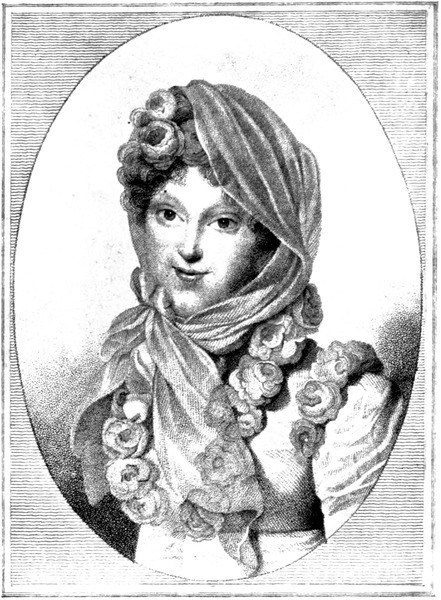
finally Marie-Antoinette, of whom he related many
charming traits, always ‘harking back’ with the
greatest delight to the Court of France, where he had
met with such a distinguished welcome.
‘The love of pleasure and the attractions of society
took me to Versailles,’ he said; ‘gratitude brought
me back to it. My lad, judge for yourself how far
I was justified in yielding to illusion, that ruler of
the world. Presented to the Comte d’Artois, I
naturally began by treating him like the king’s
brother, and we finished up by his treating me as
if I were his brother. Later on, I happened to be
present at the meeting of Joseph II. and Frederick II.
The latter notices my liking for great men, and he
invites me to Berlin. My son Charles marries a
Polish girl;57 knowing that I am in the good books
of Catherine, they imagine, perhaps, that I might
make a King of Poland, and they confer the honour
of Polish citizenship upon me. I arrive in Russia,
and the grandeur and simplicity of Catherine win my
heart. She selects me to accompany her to the
Taurida, during that journey which seems to belong
to fable rather than to history. In consequence of
my taste for the “Iphigenias” of literature, she gives
me the site of the temple where Agamemnon’s
daughter officiated as priestess. Finally there is the
paternal kindness of Emperor Francis I.; the maternal
kindness of that grand Maria-Theresa, and the sometimes
fraternal kindness of immortal Joseph II.
There are the confidence and friendship of Landon
and of Lasey; the familiar intercourse with Marie-Antoinette;
the cordial intimacy of Catherine the
Great; the goodwill of the great Frederick; my conversations
with Jean-Jacques Rousseau; my stay at
Ferney with Voltaire, and, fitly and gaily to wind up,
after the great events of the last twenty years, the
marvels and diversions of the Congress. Such in brief
is my life. My memoirs would be most interesting.
During the whole of that time I have seen calumny,
ingratitude, and injustice assail everything I loved
and admired.’
He seemed buried in thought for a few moments.
‘No,’ he said at last, ‘men’s idiocy and ill-nature
respect nothing. In Catherine’s case these two have
endeavoured to sully the grandeur one admires; in
Marie-Antoinette the grace and beauty one worships.
France has a few pages in her annals which one day
she will wish to tear up. After having most grossly
slandered the most beautiful and the most sympathetic
of queens, whose goodness of heart, which
was that of an angel, no one could appreciate better
than I, and whose soul without reproach was as
pure and as white as her face, the cannibals
immolated her as an offering to their bloodthirsty
liberty.’
At these words his voice grew low, and his eyes
filled with tears. The tears of such a friend, of an
old man and a wise one, were the most eloquent
tribute to Marie-Antoinette’s memory.
‘This is my study,’ he said, opening another door,
‘and here I am free from the intrusion of all those
parrots who besiege me in my little house on the wall.
Here I let my pen wander as my imagination and
whim prompt me.’ He showed me a great many works
completed, and a number of unfinished manuscripts.
‘All this has been written for myself, to satisfy
the cravings of my own heart. They are what actors
would call “my asides.”’
I asked him if the world at large was not to
benefit by his lessons of experience.
‘No, no,’ he replied, ‘I have too often had proof
that here below a man’s reputation depends upon
those who have none. And what, when all is
said and done, is this glory before which one bows
down, and which one pursues with all one’s might?
The same day witnesses its birth and its death, so
short, after all, is life. Ypsilanti, about whom we
have chatted so often, has gloriously lost his arm.
When at present he makes his appearance in a
drawing-room, he is surrounded, he is pointed out
to public curiosity, and people tell of the battle in
which he distinguished himself. To-day he is a
young hero; before many springs pass over our
heads, and they pass very quickly, people will call
him the old cripple.
‘Never had a woman a more glorious welcome
than that accorded to Mme. de Staël in Vienna six
years ago. Her arrival and her stay constituted, as
it were, a date, for people still say—“When Mme.
de Staël was here.” Well, the enthusiasm was soon
succeeded by a spirit of criticism the reverse of good-natured.
Nevertheless, if there be anything in this
world which is not all vanity, assuredly it is the admiration
one inspires; but how long does that admiration
last? At the outset Mme. de Staël carried all
hearts, and conquered all minds.’
‘Not in virtue of her personal attractions, for even
in her portraits she did not seem to me sufficiently
good-looking to please.’
‘That’s true, she could never have possessed a
pleasing face; her mouth and nose were ugly. But
her magnificent eyes marvellously expressed everything
that went on successively in that brain so rich
in lofty or virile thoughts; her hands were beautifully
shaped, hence the care she took to direct attention
to them by her habit of constantly fingering a branch
of poplar provided with a few leaves, the shaking
of which, according to herself, was the necessary
accompaniment to her words. Her conversation was
simply dazzling; she discussed every subject with
a marvellous facility; she expressed herself in an
animated, brilliant and poetical manner. The larger
her audience, the loftier did her genius soar. She
was only at her ease with men capable of judging her,
but on such occasions she was truly great.
‘Well, all those titles to admiration were soon
made light of. The human mind, by an inevitable
reaction, passes from enthusiasm to carping. In
a short time people laid stress on Mme. de Staël’s
defects; her brilliant qualities were no longer taken
into account. In general conversation, it was said,
she showed herself more anxious to dazzle than to
please; her monologues reduced her interlocutors to
the roles of complacent listeners; when she addressed
a question to some one, she rarely waited for the
answer. She was fond of society in which she was calculated
to shine, but she did not care for the society
of women, which, as a rule, affords fewer resources
to an intellect like hers than that of men. And
the women have not forgiven her, however much her
genius may have conferred honour on her own sex.
‘Hence, she gradually saw a diminution of her
celebrity, a celebrity which had become necessary to
her, and which, nevertheless, was not to her the road
to happiness. She constantly regretted France, from
which she was irrevocably exiled, in consequence
of her opposition to the government; she had designated
Bonaparte as Robespierre on horseback. It
may therefore be said that she served her own cause
when endeavouring to overtopple the obstacle to her
return to Paris; and on the task she set herself, she
brought to bear all the energy of a genius, stimulated
by the hatred of a woman.
‘I have much admired Mme. de Staël; I still admire
her, and I strongly suspect that the author of the
Dialogue sur l’enthousiasme wanted to paint me in the
character of Cleon.’ The prince, when uttering those
last words, glanced at me smiling. ‘She felt much
vexed at some one daring to question merit which at
that time everybody agreed in pronouncing incontestable.
That little bit of criticism was the first.
The author particularly censures her novel Corinne.
In that respect he was wrong. Wishing to attack
her, he had no business to attack her writings. That,
assuredly, was not her vulnerable side. But he would
have been justified in blaming the pretension to refer
everything to herself, the inconstancy of opinion
which was so dangerous to her friends who took her
at her word, the pedagogic and biting tone, the
histrionic elation, in the manner of Corinne, her
neologism in intellectual matters, which was so utterly
antipathetic to me, and the craving to appear on the
boards, where she displayed not the slightest talent,
inasmuch as her true vocation lay in acting in real
life. On all those points he would have been justified
in venting his spite either in prose or in verse. You
are aware that we were within an ace of falling out
for ever in consequence of a spiteful remark which
was told to her as coming from me. After the
performance of her tragedy, Agar dans le Désert, in
which, to be frank, she seemed more ugly than usual,
some one, who was not the Prince de Ligne, is reported
to have said that the proper title of the piece ought
to have been La Justification d’Abraham. She
sulked for a long time, and I had much difficulty in
convincing her of my innocence.’
After that the prince showed me a small manuscript,
which has been published since, and which he had then
just finished. Its subject was the Venetian Casanova.
When that famous adventurer was tired of hawking
about Europe his projects, his magic secrets, and his
striking personality; when, in fact, he felt old age
creeping over him and poverty staring him in the
face, he applied to the Prince de Ligne. Almost as
a matter of course, the latter made him welcome,
bestirred himself on his behalf, and got him the post
of librarian to his nephew, the Prince de Wallstein.
Casanova’s curiously chequered career appealed to
the imagination of the old marshal. He also had had
many adventures during his existence. He liked the
ready and biting wit of the Venetian, his profound
and varied learning, and his philosophically-turned
and ever fresh comments.
‘Yes,’ said the prince, ‘Casanova was the most
diverting individual I have ever met with. It was he
who said that a woman is never older than her lover
fancies her to be. His inexhaustible recollections,
his imagination, which was as vivid as it had been at
twenty, his enthusiasm with regard to myself, won my
heart. He often read his memoirs to me. They partake
of the nature of those of a knight-errant and of
the “Wandering Jew”; unfortunately they’ll never
see the light.’58
His writing-table was littered with verses, the
greater part unfinished.
‘You are looking at those sketches,’ he said. ‘It is
because I am unable to work like the majority of
poets. There are two dictionaries at their disposal,
the dictionary of the heart and the rhyming dictionary.
When there is no longer anything in the
first, or when they can no longer read it, they open
the second. When my heart no longer dictates, I
leave off writing.’
We spent a little more time in examining several
charming portraits of women with whom he had been
in love, and a rich collection of letters written by the
sovereigns and the most illustrious personages of
Europe during half a century.
The hour for returning struck, and we left the
delightful retreat which, one day, will become
historical. But amidst those brilliant reminiscences
of the Vienna Congress, my grateful memory could
not omit that day wholly passed in familiar conversation
with the Prince de Ligne.