On the afternoon of Sunday, the 11th of
July, 1897, the balloon Ornen left the
port of Virgo, Spitzbergen, carrying in its car
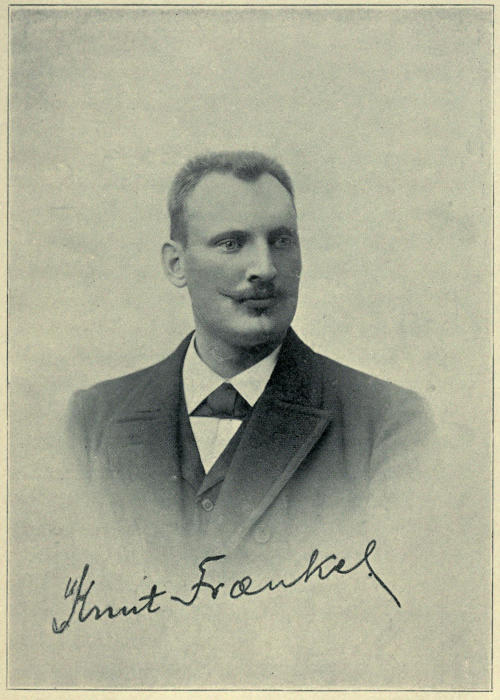
Messrs. Andrée, Strindberg, and Fraenkel, the
bold explorers, starting for the conquest of the
North Pole.
All the papers of the day were immediately
filled with discussions in various strains, pessimistic
or favourable comments and prognostications,
articles full of hope or criticism,—each,
in short, looking upon this extraordinary expedition
from its own point of view.
The first part of this bold enterprise is
accomplished, and now we are confronted with
the terrible question: Where are they?
The comments took their usual course.
However, towards the middle of August we
heard that one of the carrier pigeons belonging
to Andrée’s expedition had been killed, on the
22nd of July, by one of the seamen of the
fishing boat Alken, between the Spitzbergen
North Cape and the Seven Isles, in about 80°
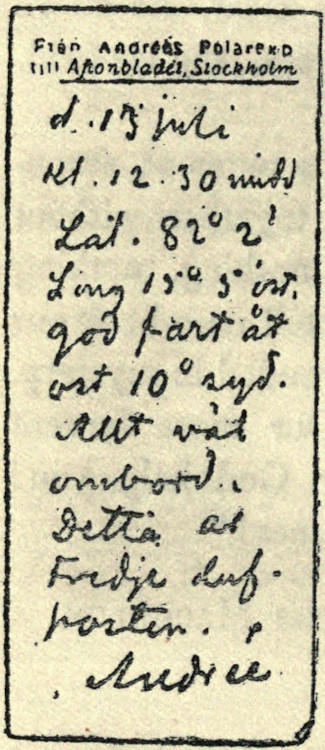
N. Lat. This pigeon carried a message, which
was confirmed, more than a month later, when
the whaler Alken returned to Hammerfest; it
was couched in the following terms:—
“13th July, 12.30 p.m., 82.2° N. L., 15.5°
E. Long. Good progress towards the north.
All goes well on board. This message is the
third brought by a pigeon.—Andrée.”
Andrée, therefore, appears to have despatched
three pigeons in less than three days,
and the balloon seems to have covered, during
this time, a distance of scarcely 187½ miles—a
fact which is accounted for by the calm which
reigned on the second day.
No other trustworthy news has since come
to hand. Much noise was made about a
telegram originating from Krasnoïarsk in
Siberia, which announced that a balloon, believed
to be Andrée’s, had been sighted on
the 14th of September, for some minutes, in
the province of Jēnisseisk.
This message was rather vague. Supposing
that the balloon remained in the air for more
than sixty days (which is still within the limits
of possibility), it ought to have crossed, in
order to arrive at that point, over 625 miles
of inhabited land, without being perceived,
which is rather doubtful. On the other hand,
Andrée would not travel such a long way in
regions where communications are comparatively
easy and where he would have been in
perfect safety, without effecting a landing and
stopping on his journey.
Knowing the temperament of these heroes,
who start with high courage towards the unknown,
in order to try to lift the veil which
still hides those mysterious regions from mortal
eyes, and after having read the narrative of the
wonderful voyage of Nansen and his companions,
shall we despair?
Has not Andrée already been highly favoured
by chance and accident? Has he not already,
in his career as an aeronaut, escaped from
dangerous situations in which many others,
perhaps, would have perished? Let us hope,
then, that his lucky star will not forsake him,
and that fortune, which favours the brave, will
bring back to us, victorious, the three savants
who have a full claim to our unstinted admiration.
I may add that the preparatory stages of the
expedition were very troublesome; obstacles
of all kinds, bad weather, and, in particular,
contrary winds, made two attempts futile.
Only on the third attempt were the explorers
able to leave terra firma finally and float in
space towards this inaccessible pole, the search
for which has already cost science so many
illustrious lives.
In fact, a first expedition organized in June,
1896, went to Spitzbergen, at which place a
balloon and all the plant necessary for its
inflation were fitted up. But after a long wait
for the south wind, which did not come, the
explorers were compelled to return to Europe,
as the season was too far advanced.
Now, before narrating the preliminaries of
the second expedition and commencing the
story of our voyage across the polar sea, it
seems expedient briefly to recapitulate the
history of the Swedish expedition to which we
have had the honour to belong, and to give
some details as to the construction of the aerial
ship, and the work accomplished last year on
Dane’s Island.
An undertaking bristling with so many difficulties
could not possibly be carried through in
an inhospitable country in a season which lasts
barely two months; and this fact the reader
will be able to appreciate later on.
H. L.
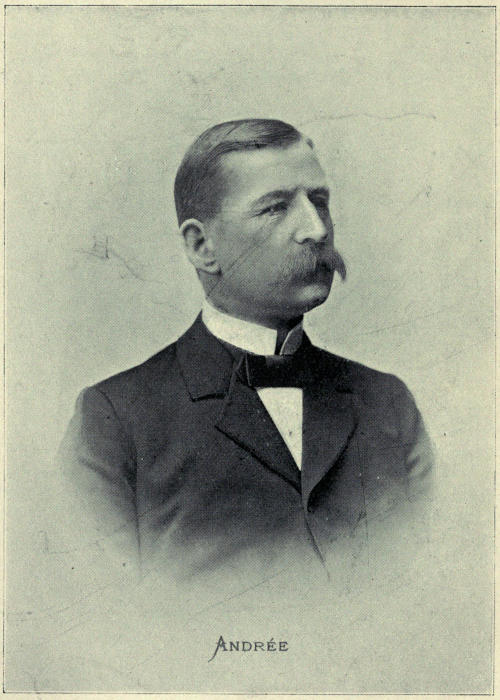
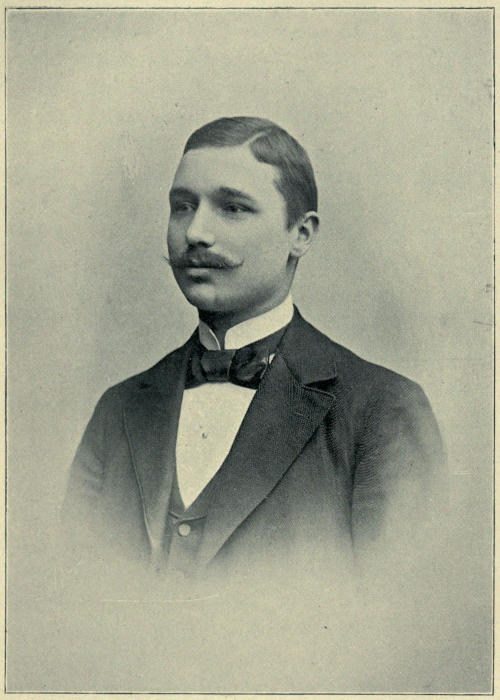
The Engineer Andrée BIOGRAPHICAL NOTES
Salomon-Auguste Andrée was
born on the 18th of October, 1854, at
Grenna, a little town in the province of
Smoiland. His father was a chemist. The
rather severe training received at the hands
of their father, imbued the children of the
Andrée family at an early age with the
spirit of obedience and punctuality. Their
father died some years ago, and their mother,
a distinguished lady, died in the spring of
1897.
After finishing his educational course young
Andrée entered the technical school, an institution
exclusively intended for civil engineers,—artillery
and army engineers’ officers having a
separate Higher School. He chose the mechanical
engineering section of the school, and
left it an engineer. He thereupon worked for
some time (as is frequently the custom in
Sweden) as a simple mechanic in a workshop,
sharing in every respect the life of an ordinary
workman. Later on, he travelled abroad for
purposes of study.
The knowledge he thus acquired, both theoretical
and practical, procured him the distinction
of being appointed, at the early
age of twenty-six, assistant professor of pure
and applied physical science at the technical
school.
At the age of twenty-eight, in 1892, he took
part in a Swedish meteorological expedition
to Spitzbergen. He wintered there until the
next year, directing the experiments and
observations on atmospheric electricity.
In 1884, Andrée was appointed chief
engineer to the Patent Office,—being a newly
created post,—and from 1886 to 1889 he
occupied, at the same time, a professor’s
chair at the technical school of Stockholm.
However, his position at the Patent Office,
being a post of the highest importance, claimed
all his time and energy, and Andrée found
himself obliged to resign the professorship.
But he could not give up the idea of
scientific aerostation, a problem which had
always haunted his mind since his early youth.
The Swedish Academy of Science, which
counts among its members famous men like
A. Nordensjold, G. Retzius, G. Mittaz-Leffler,
the mathematician, H. Hildebran and O.
Montelius, the antiquarians, and others known
and esteemed by the learned world, turned
their attention to Andrée’s projects, and in
1892 he received from the Academy and the
“L. J. Hjerta Memorial Foundation,” a subvention
for the purpose of undertaking
scientific aerial navigation—an honour which
was unprecedented in Sweden.
From that time Andrée devoted himself to
aerial navigation, and made his first ascent at
Stockholm in the summer of 1893.
He has since made a number of ascents for
scientific purposes, some of which were of
a most perilous nature—one resulting in a
disaster in the Baltic. On another occasion
he was carried from Gothenburg over the
Baltic, after having traversed the whole of
Sweden. The reefs round the Isle of Goëland
presented the greatest difficulties to his
landing. This last attempt nearly cost Andrée
his life; but these “little accidents” were not
calculated to discourage a man of his temperament.
He made several experiments at steering
by means of a guide-rope and a sail, and
came to the conclusion that it would be possible
to direct the course of the balloon even
while keeping it at a low altitude.
Thereupon, early in 1895, Andrée presented
to the Academy of Sciences a well matured
project for exploring the regions of the North
Pole with the aid of a balloon; the start was
to be made from Spitzbergen, where the
inflation of the balloon was to be effected.
The estimated cost amounted to about
£7,177.
A National subscription was opened, which
was completed in a few days by four generous
donors.
Mr. A. Nobel, of lamented memory, subscribed
£3,588.
The King of Sweden, wishing to show the
interest taken by him in the expedition, gave
£1,656.
Baron Dickson, well known for his liberality,
also gave £1,656.
The sum was completed by Mr. R. Lamm
and some other donors.
Mr. R. Lamm, moreover, undertook to
supply all the mechanical part of the various
apparatus.
Having once settled the financial aspect of
the question, Andrée made several journeys
all over Europe, in order to obtain personal
interviews with foreign scientific celebrities
and gain them over to his views concerning
this bold enterprise. He visited, one by one,
the aeronautical establishments, procuring at
the same time samples of the tissues employed,
and obtaining the opinions of various constructors.
Thereupon, on his return to Stockholm, he
carefully tested the samples which he had
brought with him; he felt interested in the
English and German products, but gave preference
to the French industry. Finally his
choice fell on Chinese Pongee silk, cemented
together in double, threefold, and fourfold
layers, and varnished, this tissue having
been advocated and experimented with for
several years past by M. H. Lachambre,
to whom Andrée entrusted the construction
of the balloon on condition that M. Lachambre
should follow the expedition to
Spitzbergen, where the benefit of his experience
would be at Andrée’s service.
The Aerial Vessel Description of the Balloon for Andrée’s Polar Expedition, and the Appliances Constructed at the Aerostatic Workshops of Vaugirard.
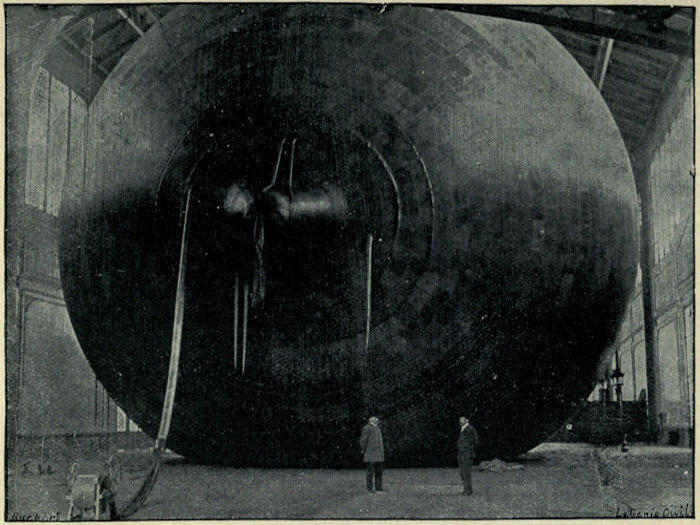
After studying the question for a long
time, Andrée finally decided to give
his balloon the cubical contents of 158,924 feet,
and the shape of a sphere terminating in a
slightly conical appendage.
This sphere, fitted with two lateral regulating
valves, one lower automatic valve, and a
“rending flap,” measures 22 yards in diameter,
by 1,431 yards surface; it is enclosed in a
net of hemp cord, terminating in systems of
“crow feet,” and suspending ropes attached to
the car by means of a “load ring.”
The upper part of the balloon is protected
against rain and snow by a varnished silk
cover, the apex of which is fixed to the upper
pole of the envelope, and the lower margin to
the meshes of the net.
The Envelope.—In making up the envelope,
600 pieces of best quality Pongee silk,
each from 18 to 19 yards long by about 18
inches wide, were used. From each of these
a piece was cut off which was tried in both
directions—that of the chain and that of the
weft; then the pieces were classified according
to their strength, in order to be subjected to
the operation of cementing or joining together.
All these pieces, after being cemented together,
were tried again before being used.
The trials were made by means of a Perreaux
dynamometer, with strips about 2 inches wide
by 4 inches long, under the control of Messrs.
P. de Nordenfeld and Noël, engineers of the
Nordenfeld Company, to whom Andrée had
entrusted the task of testing the materials used
in the construction of his balloon.
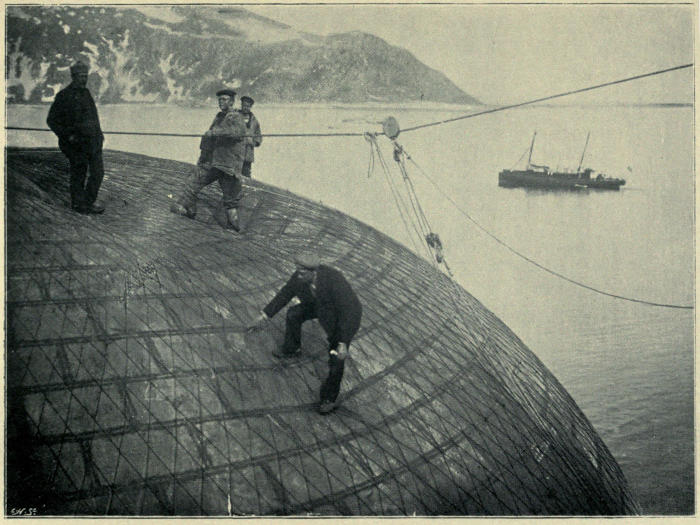
VIEW OF THE LOWER PART OF THE BALLOON.
The tests gave the following results:—For
double tissue, the breaking strains varied from
5,291 lbs. to 7,936 lbs. per yard, for threefold
tissue from 6,854 to 12,125, and for fourfold
tissue, made up of the best single pieces found,
from 13,227 to 15,873 lbs. per yard.
The minimum resistance demanded by Andrée
was fixed at 2,204 lbs. per yard and per
single thickness of Pongee. This minimum
was therefore greatly exceeded.
The cemented pieces were classified according
to their strength, for distribution over the
surface of the balloon as the strain demanded.
The upper part of the envelope is a disc 19
feet 8 inches in diameter, formed by twenty-four
widths of fourfold silk. The adjoining
part, consisting of threefold silk up to 13 feet
1 inch below the equator of the sphere, is
composed of forty-one zones made up of forty-eight
widths each.
The remainder of the balloon, down to the
lower parallel, having a diameter of 23 feet, is
of double material, being made up of twenty-two
zones of forty-eight widths; and finally
the lower part, including the appendage, is of
threefold silk, and consists of five zones of
forty-eight widths, and three zones of twenty-four
widths each.
The portions made up of threefold and
double Pongee are joined together by an intermediate
zone in which the various widths of
material are alternately made up, half of threefold
and half of double tissue.
In each zone the various widths, or pieces
of material, are identical in shape; twenty-seven
different templates had to be designed
in order to determine the exact shape of the
various pieces or widths of material, the total
number of which is 3,360. The cutting out
of these pieces was effected with the aid of
a cutting blade guided by a steel rule, following
the outlines of a template. At first those belonging
to one and the same zone were joined
together, and the zones were then joined so
that the various pieces or widths overlapped each
other in such a manner as to give the balloon
the aspect of a structure of bricks or freestone.
The cemented joints of the various pieces
are ½ inch wide; they are then sewn by a
machine, with three seams made with fine
silk in the double or threefold material, and
four rows of stitches in the fourfold material.
These joints or seams are then covered, outside
and inside, with a strip of single silk 1⅕
inches wide, cemented on with a special varnish
recently discovered by M. Lachambre.
The strips cemented by this new process
have the double advantage of rendering the
seams impermeable and restoring to the joints
the resistance of which the stitching deprives
them.
The varnish used for this cementing meets
all requirements; it preserves the natural suppleness
of the material, is unaffected by the
balloon varnish, which has linseed oil for its
basis, and is proof against water and changes
of temperature.
The tests made with the joints thus constituted,
proved that their resistance was greater
than that of the adjoining parts, and Andrée,
who only desires an equal strength throughout,
naturally was very well satisfied with this
result.
The seams are 4,811 yards long, with three
or four rows of stitching, representing a line
of single stitching equal to a length of 15,310
yards, and the total length of the cemented
strips is nearly 9,842 yards.
The two hemispheres of the balloon were
first formed; their weight was 2,116 lbs., and
before proceeding to the last equatorial closing
seam, they were given three coats of Arnoul’s
varnish (the best balloon varnish hitherto
tried); a fourth coat being given after the
two halves had been joined together, on the
premises of the “Palais du Champ de Mars,”
remaining from the 1889 Exhibition.
Net.—The net of the polar balloon is composed
of 384 hemp cords, ⅙ inch thick by
211 feet 7 inches long, each having a breaking
strain of not less than 873 lbs. (in the tests
made the minimum result was 925 lbs., while
the maximum was 1,190 lbs.).
Each cord is jointless; its two ends are fixed,
at the upper pole, to a cordage ring or crown
measuring 26 inches in diameter and 2⅓ inches
in thickness. There are no knots in this
net, the cords being interwoven at their
crossing points, one being passed through the
other; it was in this way that the “Henri
Giffard” captive balloon was finished in 1878.
The crossing points are strengthened by
ligatures of fine twine.
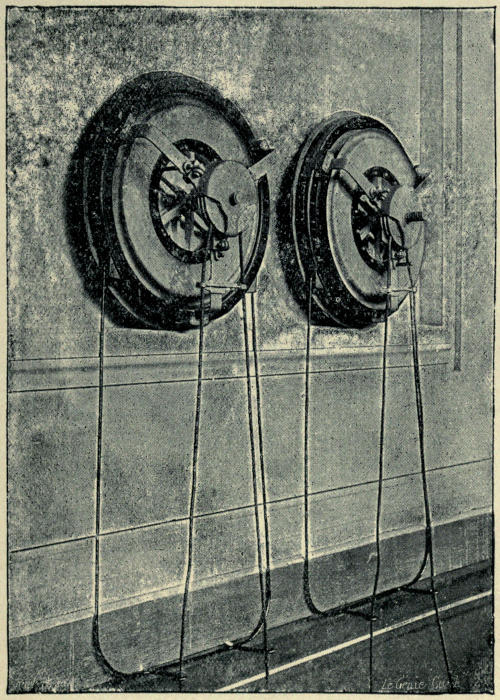
VALVES FOR WORKING THE BALLOON.
The circumference of the net, all the way
up, consists of 192 meshes, the dimensions of
which vary according to the area of the zone
they are to cover. These meshes, the number
of which is no less than 19,000, represent a
length of twine amounting to nearly 16,404
yards.
The lower part of the net is formed by a
system of three zones of crowfeet or cringles,
each zone reducing, by one-half, the number
of meshes composing the next upper zone.
The first row of crowfeet is mounted on
thimbles of nickeled brass, the second and
the third on wooden pulley-blocks, having
sheaves of lignum vitæ; and forty-eight suspending
cords, each fitted at its end with an
eye, complete the net and form points for tying
it to the retaining ring by means of toggles.
These suspending cords have a diameter of
⁷⁄₁₀ inch, and a bearing-strain of no less than
6,613 lbs.
The net thus constituted weighed 776 lbs.
In order to preserve the cordage from moisture
it was impregnated with vaseline, except in
the upper part, which was covered with a
projecting cover of varnished silk; after this
operation the weight of the net was 974 lbs.
Eight detachable equatorial cringles were
fixed to the equator of the net. They were to
serve for holding up the balloon, and preventing
it from oscillating, in the shed which was
to shelter it at Spitzbergen, while awaiting a
favourable wind for the departure of the expedition.
Protecting Cover.—A spherical calotte of
single silk, varnished with four coats and
vaselined, and having an area of 1,560 square
feet, covers the upper part of the balloon. It is
finished in the same way as the balloon, being
composed of overlapping widths to the number
of 720.
The seams, having a width of ¼ inch, are
hooked together, and sewn with two rows of
stitching with silk thread. They are not
covered with cemented strips. Their total
length is 656 yards.
The vertex of the protecting cover, of conical
shape, is of double silk. It rests on a small
wooden structure, likewise of conical shape, the
base of which, placed on the material at the
upper pole of the balloon, is surrounded and
held in place by the crown of the net.
The lower zone, terminating the protecting
cover, is of double silk. Its extreme edge
is put round a hemp bolt-rope, ³⁄₁₀ inch in
diameter, which is sewn into the material;
ninety-six eyes made above this bolt-rope are
intended to receive thongs for fixing the protecting
cover to the meshes of the net.
This protecting cover weighs 88 lbs. Its
object is to protect the top of the balloon
against rain, and more especially to prevent
incrustation with snow between the meshes of
the net.
Valves.—The balloon has no valve at the
top, because its action would probably be
affected by snow; but it is provided with two
manipulating valves, of equal dimensions, one
being placed at the equator, and the other
one metre above the equator. These are at
150 degrees angular distance from each other.
These valves, constructed on a system of
Andrée’s, measure 9⅘ inches in external diameter.
Each is formed by a disc of aluminium
bronze, 9 inches in diameter, and under normal
conditions rests on a circular piece of walnut
wood, but can be withdrawn therefrom by
moving it along a screw which occupies the
centre. This movement is effected from the
car of the balloon by means of two cords for
each valve, passing through the interior of the
balloon and issuing from it near the appendage
through four tubes, arranged in pairs.
Gas-tightness is obtained by a circular rubber
band, against which the outer margin of the
valve disc rests. The orifice for the escape of
gas measures 7⅘ inches in diameter. In order
to fix the valves to the balloon, two openings,
7⅘ inches in diameter, are made in the material.
The margin around these openings is strengthened
by collars, 19⅖ inches in diameter, of
threefold material, cemented and sewn on; the
seat of each valve is applied internally to the
material of the balloon, the margin of which is
caught between two rubber bands, and thereupon
pressed against the seat by an external
wooden hoop and bolts.
These valves do not present any external
projection against which the cord of the net
might catch.
The automatic valve closing the appendage
was suggested to Andrée by M. Lachambre,
and was adopted. It measures 39 inches in
external diameter, with a discharge orifice 34
inches in diameter. The valve disc, of threefold
Pongee silk, is 35⅘ inches in diameter. It
is provided with two glazed windows, in order
to enable the aeronauts to inspect the interior
of the balloon. This disc, which is slightly
conical, is fitted upon a walnut-wood ring,
which acts as a seat, in which it is held by
the traction of six spiral springs of steel wire,
fastened on one side to the end of the wooden
spokes of the valve, and on the other side to
the top of a small frame fixed on the seat. The
frame, mounted on the wooden ring or crown,
is formed by twelve nickeled steel tubes.
The valve is guided in its course by a central
steel tube, sliding in another tube, which serves
as an axis for the frame. A small cotter limits
its action, the length of which is equal to one-half
of the radius of the discharge orifice. The
joint is rendered gas-tight at the periphery of
the valve by means of a brass blade resting on
a rubber band stretched in a groove of the seat.
The valve commences to open under the
action of an internal pressure corresponding to
³⁄₁₀ inch water column. In order to fix it to the
balloon, it is placed in the interior of the appendage,
the margin of which, held between two
rubber bands, is kept tight against the seat by
an external belt or ring of brass, fastened by
bolts.
“Rending Flap.”—The rending flap is 4½
yards high, and has a surface of 4⁷⁄₁₀ square
yards. It is formed of threefold Pongee silk,
and is rectangular in shape, terminating in a curvilinear
triangle, the point of which is turned
upwards. Its vertical axis is at an angular distance
of 105 degrees from each of the two
manipulating valves; the lower base, which
is 35⅖ inches wide, reaches down to 19⅗ inches
above the equator. The seams joining the
material of the “rending flap” to that of the
balloon are similar to the seams of the various
widths, and are likewise covered with cemented
strips.
In the interior of the balloon the upper
extremity of the “rending flap” is of fourfold
silk; its edge is put round a stick of hard
wood, to which a rope for pulling is fixed, by
means of which the rent is made. This rope
descends to the car after having passed through
the lower part of the envelope, near the appendage,
in a tube.
In order to make the rent with ease, which
will require an effort equal to a traction of about
220 or 250 pounds, Andrée intends to use a
small grapnel, which he will attach to the end
of this rope and throw to the ground at the
proper moment.
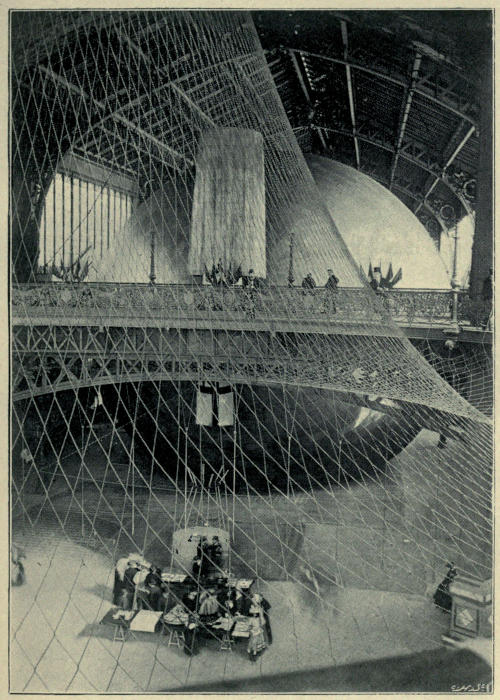
THE BALLOON IN THE 96 FEET GALLERY OF THE CHAMP DE MARS
EXHIBITION.
Thereupon the balloon will be emptied very
rapidly, and all dragging along the ground will
be avoided, however violent the wind may be.
Of course Andrée will not make use of the
“rending flap” until he is travelling over
hospitable regions and wishes to terminate his
aerial voyage and alight definitely.
Bands for Protection against water.—
Sundry Details.—Above the appendage, at
the parallels measuring 16 feet 4 inches and 22
feet 11 inches respectively in diameter, there
are fixed, by one of their edges, two vertical
circular bands nearly 4 inches high.
These bands are of single silk; their purpose
is to form gutters for carrying off any
water which might run down the material
of the balloon, and thus protect the car in
which the observers are stationed from rain.
In the interior of the appendage there is
another band, differently placed, forming a
circular trough, intended to receive any water
that might result from a strong condensation
of the gases contained in the balloon, and
thus prevent any accumulation of such water
over the automatic valve. Between the external
band, of 16 feet 4 inches in diameter,
and the appendage, and facing the tube through
which the rending cord passes, the inflating
nozzle, which is 19 feet 8 inches long, is
fixed.
The two cords which control each of the
manipulating valves are worked by pulling:
one, being that which opens the valve, is
painted blue; the other, which closes it, retains
the natural colour of the hemp.
The cord acting upon the rending flap is
coloured red.
Along a meridian traced on the envelope
coloured marks are made, with figures indicating
every 546 yards of cubic contents of the
segment above each mark. This will admit of
the progress of inflation at Spitzbergen being
rapidly ascertained.
On two other meridians, suitably situated,
are shown the positions for the straps to
support the sails with which the polar balloon
is to be provided.
The Car.—In the construction of the car,
the use of iron or steel was prohibited, so as to
avoid interfering with the action of the magnetic
instruments. Its form is cylindrical,
measuring two metres in diameter, from centre
to centre of its sides, which are of cane basket-work
mounted on a framework of chestnut-wood;
eight handles of wicker-work are
attached to the cylindrical part, at a convenient
height, to facilitate the transport.
The bottom is strengthened by wooden crossbeams
placed externally and fastened to the
basket-work by bolts and brass plates put on
the inside.
The cylindrical part is truncated on one side,
having a plane surface which is to form part
of an inclined plane intersecting the lower floor
of the car, and extending from this floor to
midway up the cylinder, the length of the chord
formed by the plane intersecting the base being
51 inches.
When the balloon touches the ground, rolling
of the car will be avoided by this flat surface,
which will rest and drag on the ground. Internally,
the upper margin of the side is fitted
all round with about 100 cords terminating in
buckles or eyes. To these cords, which are
passed through the basket-work, instruments
and various objects are to be attached. The
roof of the car is a disc or cover, likewise of
basket-work, slightly convex in order to prevent
any accumulation of water. The margin of the
periphery of this cover forms a cavity into
which the margin of the car is inserted, thus
preserving its peculiar shape. Cross-pieces of
wood fixed inside the cover or roof impart to
it the necessary rigidity to support the observers;
entrance to the car and exit therefrom is
effected by means of a trap-door which moves
on hinges.
Above the flattened part, the cylindrical side
of the car is fitted with two square windows
with glass panes of 5¾ inches side; the bottom
of the car has two square openings of 7⅘ inches
side, closed by wooden trap-doors.
The car is covered with tarpaulin having
openings corresponding to those in the basket-work.
The tarpaulin of the roof forms a vertical
rim 3⁹⁄₁₀ inches in width, perforated with
holes for draining off rain-water. The car is
suspended by six hemp ropes 1¹⁄₁₀ inch thick.
Their respective strength is from 17,636 lbs. to
19,841 lbs. They are interwoven with the
basket-work, and joined together at the bottom
of the car by a hexagon of rope.
START OF THE VIRGO FROM GOTHENBURG, 7TH OF JUNE, 1896.
Above the roof they are joined to each other
by five horizontal ropes placed at equal distances
and forming a kind of balustrade 3 feet 3
inches high, which was to be covered in later
on either with tarpaulin or some other enclosing
material.
The thickness of these horizontal ropes is
⅕ inch, except the uppermost rope, which is
³⁄₁₀ inch thick.
About 6 feet 6 inches above the roof, the
hexagon formed by the six ropes is drawn
together by a hexagon of rope-work measuring
3 feet 3 inches inside diameter.
The upper end of the suspending ropes
terminates in an eye or loop joining it to the
ropes of the load ring.
On the circumference of the upper edge
of the car six brass balls are fastened, at
equal distances from each other, forming the
lower part of a system of ball links which are
to carry a structure intended to support the
scientific instruments. This structure was
made at Stockholm under the supervision of
Andrée.
The fitting up and equipment of the car was
also carried out under his supervision.
The aeronauts will generally be on the flooring
of the roof, for the purpose of observations.
The interior of the car forms their sleeping
apartment, where they will each rest in turn.
Marks of the Expedition.—All the
articles comprising the aerostatic equipment
are marked with the words “Andrée’s Polar
Expedition 1896,” which are branded upon
wooden articles, engraved on metal articles, and
painted with a durable paint on the protecting
cover, the envelope, the tarpaulin of the car,
and the ballast bags.
Some ropes of the net and the suspending
rope are fitted with small plates strongly fixed
to them, on which the above mark is engraved.
The articles not affording sufficient space for
the whole mark bear the abridged mark “Aée’s
Exp 1896.”
The following articles were made at Stockholm;
viz., the “load ring” connecting the
balloon with the car, the provision basket, the
guide-ropes, sails, etc., as well as the plant for
making pure hydrogen gas, a description of
which will be found later on. Only the gas
conducting pipes, which are of silk, and the
ballast bags, were manufactured at Paris, being
supplied from the Vaugirard factory.
Exhibition of the Equipment and Plant
at the Champ de Mars (Old Buildings of
the 1889 Exhibition).—The order for the
articles described above was given by Andrée
to M. H. Lachambre at the end of December,
1895, and delivery was to be effected between
the 15th and 20th of May, 1896, failing which
the contractor made himself liable to an enormous
progressive fine, in proportion to the
number of days of delay, and if delivery was
not made before the 3rd of June the order
could be cancelled. But the work was executed
within the stipulated time, and towards the end
of April the whole plant was conveyed to the
Champ de Mars, into the 30 m. gallery, in
order to be examined there by the Commission.
According to a clause of the agreement the
envelope was to be inflated with air, and before
the last varnishing to be submitted to
an internal pressure equal to 3 inches water-column.
This trial took place on the 3rd of May,
in the presence of Messrs. de Nordenfeld,
engineer of the Nordenfeld Company, Gaston
Tissandier, Colonel Renard and Commander
Renard, managers of the Central Establishment
of Military Aerostation of Chalais-Meudon.
The openings of the balloon were provisionally
closed; the valve in the appendage was
replaced by a wooden hoop covered by a disc
of material containing a glazed window, 7⅘
inches in diameter, thus permitting inspection
of the interior of the balloon. The latter was
inflated by means of a ventilator supplying
about 70,633 cubic feet of air per hour.
Andrée’s experts, who had followed up the
manufacture step by step, then examined
minutely all the parts, and declared the
material to be faultless, and quite in accordance
with the desires expressed by Andrée.
After this examination, which showed that
the envelope inflated with air did not lose its
contents to any appreciable extent, the balloon
was emptied, and was then given the last coat
of varnish. This having been done, it was
again inflated for the purpose of drying.
The net suspended by the crown, in the
centre of the central dome, and with the suspending
ropes attached to the balustrade of
the first gallery, presented the appearance of
a vast tent, the summit of which was 131 to
164 feet above the ground.
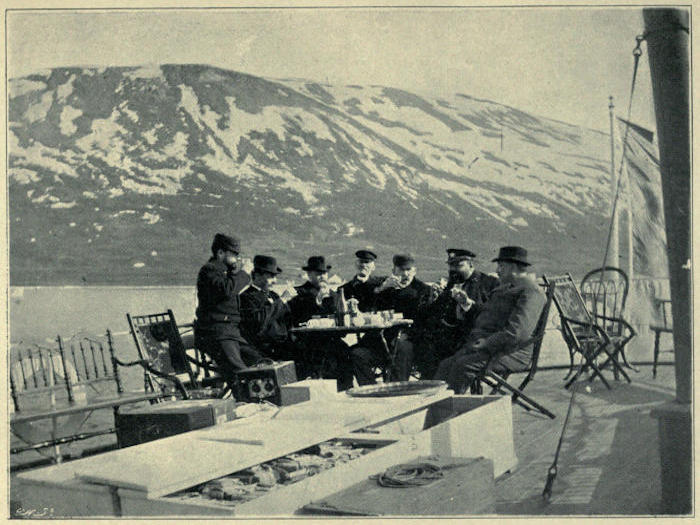
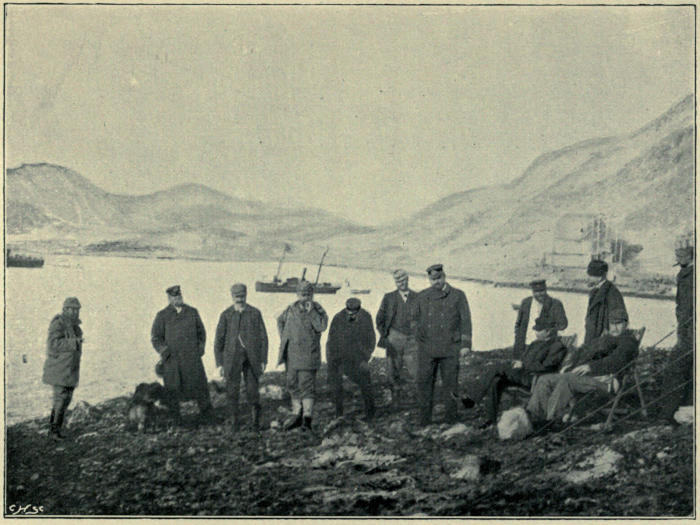
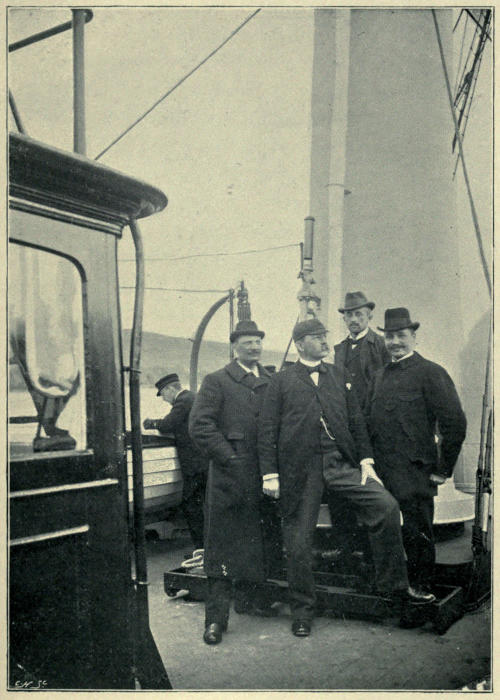
STAFF-OFFICERS OF THE EXPEDITION.
The car, the valves, and in short all the articles
made at Paris were exhibited at the Champ
de Mars. A little balloon of 1,148 feet, fully
equipped, and inflated with air, suspended by
the side of the polar balloon, served for comparison.
This exhibition, which was not arranged
with a view to profit, was thrown open
to the public from the 10th to the 14th of May.
The 10th of May was reserved for special
guests, and M. Félix Faure, President of the
French Republic, was the first visitor. He
took much interest in the various parts of the
balloon, which he examined at length, and in
the details of its construction. He expressed
his best wishes for the success of this interesting
expedition.
There were present at the same time as the
President, M. de Nordenfeld, Swedish engineer,
M. Gaston Tissandier, Colonel Renard, and
Commander Renard, who had also watched
the work in its various stages, and had co-operated
therein to a certain extent.
The Swedish colony was represented by
M. Dué, minister plenipotentiary, and Gustav
Nordling, vice-consul.
Among the other guests were Messrs. Poubelle,
Prefect de la Seine, Admiral Sallandrouze
de Larmornaix, General Mathieu, M. Decauville,
senator, M. Coulet, solicitor to the Swedish
Legation, etc.
During the next four days over 30,000 persons
came to see the North Pole balloon, and
expressed their good wishes for the success
of the three bold Swedish explorers whose
courage is universally admired.
A. M.
FIRST PART TWO MONTHS AT SPITZBERGEN
I The Departure
I left Paris on the night of the 2nd of
June, 1896, to accompany Andrée and his
companions to Spitzbergen, as had been arranged.
My mind was much taken up with
speculations as to the ultimate fate of the
expedition, and the responsibility I had undertaken
weighed rather heavily upon me.
Without stopping at the various stages of
my journey, Cologne, Hamburg, and Copenhagen,
though all of them very interesting
towns, I arrived at Gothenburg, where I was
received by Captain Andrée, brother of the
explorer; and although much fatigued by
forty hours’ railway and boat travelling, my
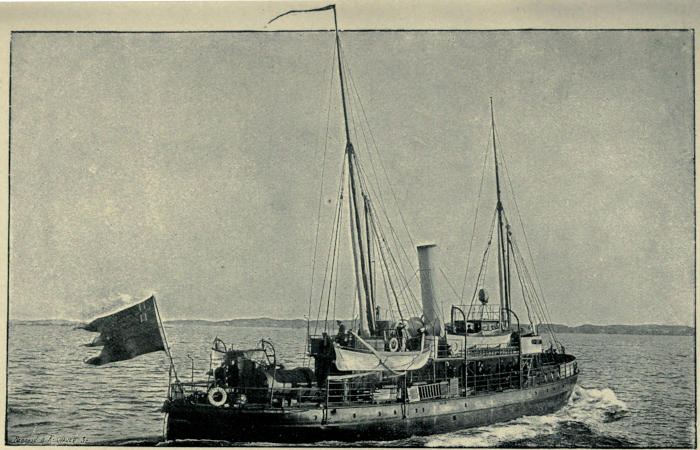
first visit was to the good ship Virgo, which
was to be my home for several months, and
convey me towards the northern regions.
Andrée, who left nothing to chance, had
chosen his vessel well, and his brother superintended
her loading and equipment.
When I arrived work was proceeding with
feverish activity, and it is almost impossible
to conceive the quantity of goods which were
stowed away in this small vessel of 300 tons.
I was present at the embarkation of the barrows
of sulphuric acid which had been brought
from England.
We have a select crew, composed almost
entirely of engineering students from the
technical school of Stockholm, and officers
who have taken berths as ordinary sailors
in order to follow the expedition; one can
see that there will be no more lack of brave
and generous hearts than of scientific heads.
On the morning of the 5th of June, the
three explorers arrived from Stockholm. At
night a grand fête brought us together at
Baron Dickson’s, one of the generous promoters
of the enterprise.
Saturday evening, 6th of June.—Popular
fête at Lorensburg Park; numerous speeches
and enthusiastic toasts; reading of telegrams
and kind wishes for the success of the expedition.
The tables are adorned with magnificent
bouquets of natural flowers enclosed in
pyramids of ice. The effect is most picturesque,
and this is certainly an idea which has never
yet suggested itself, as far as I know, to the
minds of the managers of our great culinary
establishments; I now give them the benefit
thereof. What can be more attractive than
the picture of flowers and chandelier-lights
reflected in these miniature icebergs?
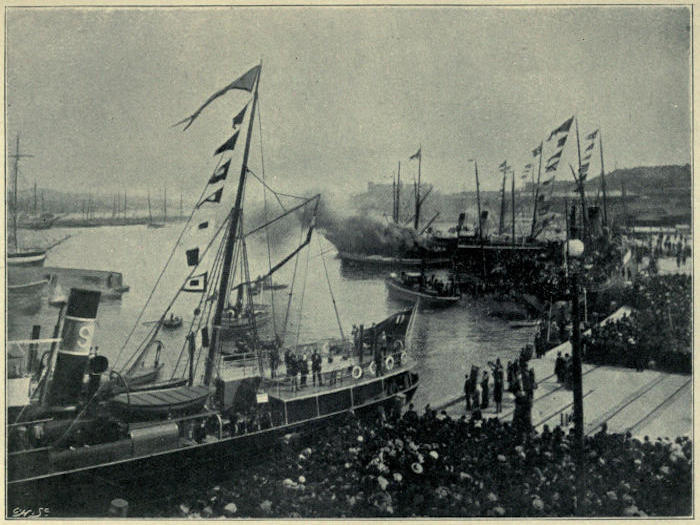
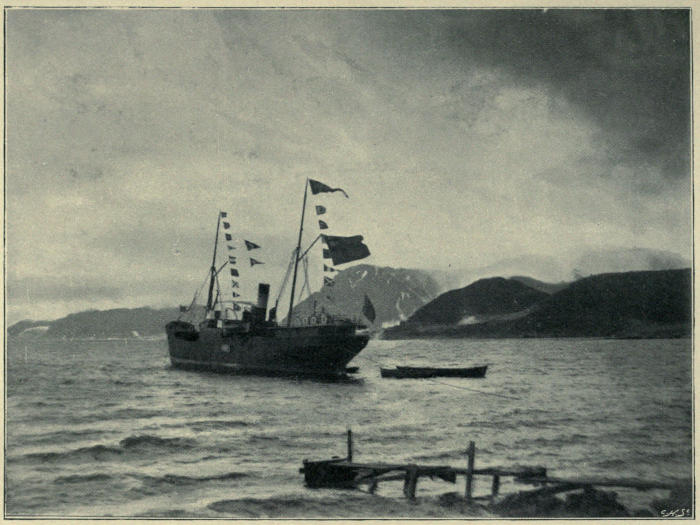
Sunday, June 7th.—I arrived at the port at
8 a.m. The Virgo has been dressed in her
gala bunting; her masts are resplendent with
many-hued streamers. At the stern proudly
floats the splendid silk flag presented by the
ladies of Gothenburg. The deck is adorned
with flowers and ribbons; I am touched at
the sight of my national colours.
All the vessels in port are dressed with
bunting, and crammed with spectators. An
army of photographers, who all have their
cameras pointed at the Virgo, are preparing
to immortalize the vessel as she now appears.
The launches and all the boats, large and
small, are making the Virgo their rendezvous.
The rest of the population is on the quays
and the neighbouring buildings.
M. Vieillard, a friend, who came to accompany
me, left me at nine o’clock; we arranged
to meet at Spitzbergen.
I saluted Baron Dickson, his daughter and
his niece, who were on the quay. His son
came to the Virgo to shake hands, and wish
me a good voyage.
The three explorers also arrived with their
friends crowding round them. The partings
were very touching, and the emotion, in which
all present shared, reached its height when
precisely at ten o’clock the signal for starting
was sounded.
The Virgo is slowly moving.
The enthusiasm becomes indescribable. An
immense hurrah, four times repeated, is volleyed
from every panting breast. Handkerchiefs
and hats are waved frantically, the cheers
burst forth with redoubled vigour. Andrée,
Ekholm, and Strindberg, appear at the bulwarks
with their bouquets and their ribbons:
they signal their adieux and acknowledge
ours.
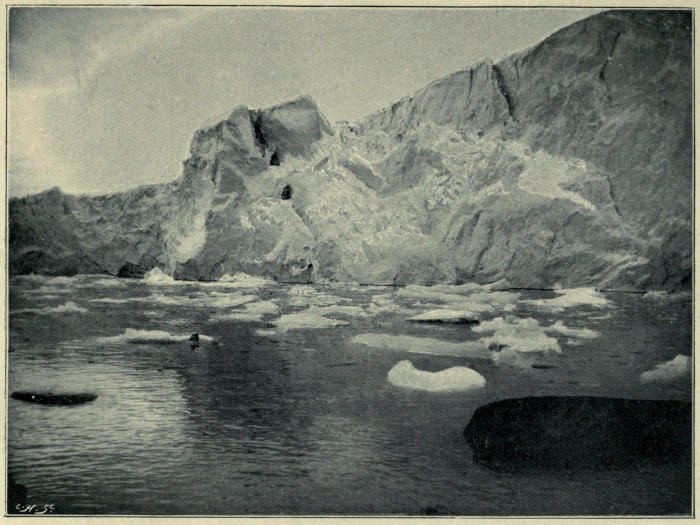
THE FIRST FLOATING ICEBERGS.
Then we, too, have our share in this grand
and most impressive manifestation.
The flag of the Virgo dips by way of salute,
and then rises again, and at this moment the
cortége of vessels and boats forms up around
our vessel, which has progressed a little towards
the open sea.
Something like a hundred boats follow in
our wake. On several of them bands are playing,
and a regular procession commences.
Those who have no boats follow along the
quays; it is a veritable tide of human beings.
A few inevitable collisions occurred between
some of the impetuous small craft, but most
happily no serious accident is to be regretted.
The sun is shining gloriously; the sky, too,
has put on its festive garb, and seems desirous
of encouraging the bold explorers leaving for
the conquest of the North Pole.
We are now out in the open sea.
At one o’clock we are assembled on the quarter-deck,
and the introductions commence:—
Herr Andrée, former pupil of the higher
technical school of Stockholm, Director of the
Patent Office, and commander of the expedition;
Herr Ekholm, doctor of natural philosophy,
chief of the Meteorological Office of Stockholm;
Herr Strindberg, former student of Upsala
University, second master at the Free University
of Stockholm;
Herr Svante Arrhénius, hydrographer, chief
of the Stockholm University, professor of
natural philosophy;
Herr Grumberg, naturalist, master at the
Stockholm University, higher school;
Dr. Carl Ekelund, physician to the expedition;
Captain Hugo Zachau, commander of the
Virgo, which ordinarily plies between Gothenburg
and Hull.
Nor must we forget the stewardess Charlotte,
a complaisant Swede, wearing a coquettish little
white toque, of the comic-opera style, trimmed
with a pretty ribbon bearing the badge of the
expedition. This charming person made me
three pretty curtsies, and an acquaintance was
soon formed between us. It is she who will
wait on us at table. She seems much at her
ease on board the Virgo, and she has better
sea-legs than I have. She has made a napkin
ring with ribbons for each of us; mine bears
the French colours. She is, moreover, very
amusing. There is also the cook, who excels in
the preparation of omelettes aux anchois—but I
must not anticipate.
After the introductions we taste the brandy
and whisky; we drink toasts for the success
of the polar expedition; then several speeches
are made. At three o’clock we assemble for
dinner in the dining saloon. The captain does
the honours at the table; he is a jolly amphitryon,
and robust both physically and morally.
The meal passed off very gaily.
I was seated near Strindberg and Professor
Arrhénius, with whom I can speak in my own
language, and also learn a few words of
Swedish. This, in fact, is simply by way of
retaliation, as I have been appointed “professor
of the French language” by acclamation.
We take our coffee on deck, smoking
delicious Havannahs presented to the expedition.
Gently cradled by the waves, I abandon
myself to revery. How many things I have
seen since my departure, and how far away
from home I am already! Nevertheless, I
have only reached the first stage, and much
excitement is still in store for me.
I have taken possession of my cabin, which
adjoins the kitchen and dining saloon, and am
settling down there as comfortably as possible,
but not without difficulty, as the place allotted
to me is very small.
At eight o’clock the dinner bell once more
unites us round the table, and the evening is
spent in frankest cordiality. The voyage
commences very promisingly.
II Out at Sea
June 8th, 1896, 10.30.—We have been
under way for twenty-four hours; we are
in sight of Norway, off the Forsund, at a
distance of nine miles from the coast, but the
mist prevents us from seeing very far. The
fir-clad mountains are vaguely outlined to our
right, and the Virgo is heading due north-west.
There is nothing for us to do but take life as
it comes. I commence my diary in my cabin.
The sea, though a little rough, has not yet
troubled me. Andrée alone has already paid
his tribute.
Tuesday, June 9th, Coasts of Norway.—Sea
rough, general discomfort, moral prostration;
I am unable to write. The Virgo
rolls heavily. At the present moment, 6 p.m.,
it is as light as at midday.
Wednesday, June 10th, 6.30.—The temperature
has gone down considerably; we have
crossed the polar circle. A steamer has kept
company with us this morning at a distance of
7½ miles on our port side. Sea rough.
Thursday, June 11th, 10 a.m.—In sight of
the Loffoden Islands; sky overcast; some few
rays of the sun; sea smoother; the vessel still
rolls.
Friday, June 12th, 9.30.—At last we are in
the straits which lead to Tromsö. I was so ill
to-night that I should have thrown myself into
the sea had I forgotten, for one moment, my
duty and my family.
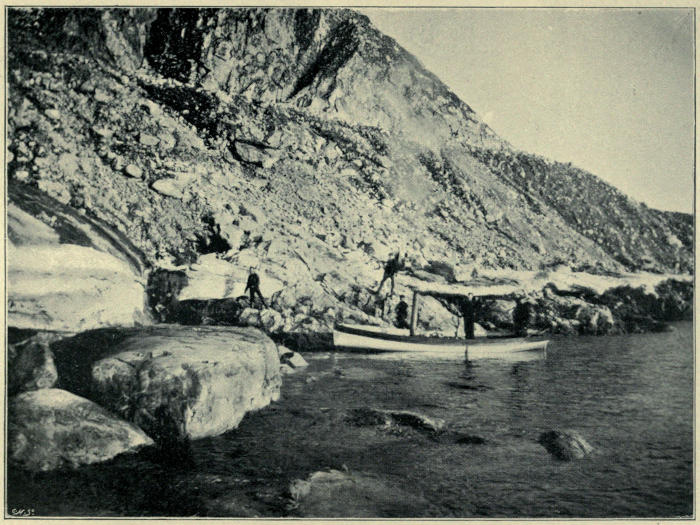
DANES ISLAND AND THE PIKE HOUSE.
At 11 p.m. I sent for the doctor; it seemed
to me that I was going to die all alone in my
narrow cabin. He ordered me champagne and
sleep. Charlotte, the stewardess, brought me
some oranges, and took off my boots, which I
had not had the courage to take off for four
days. Oh, Charlotte, my fair Scandinavian
maid, with your clear eyes, your engaging
smile, your gay face, and your lithe but robust
physique, how you must have pitied “the
French gentleman,” as they called me, who
but the other day was so nimble, so sure of
himself to all appearance, and who has suddenly
become more inert and helpless than
an old cap that has been cast away by the
skipper!
And in spite of the horrible tortures I
suffered, I was vaguely conscious of the strange
humour of the situation of having my boots
removed by dainty female hands better adapted
for millinery than for such a rough task.
Have you ever been sea-sick? If you have,
you will understand me. How well I then
understood what is narrated of Cicero, who,
having taken refuge on board a vessel in
order to escape the assassin sent out for him
by Marc-Antony, preferred returning to Gaeta,
to face the death which he feared, to enduring
any longer the tortures of sea-sickness.
The bay bristles with high granite mountains
with snow-capped summits. The Virgo
makes signals for a pilot, who is a long time
coming; she stops from five o’clock to nine
awaiting him, and strange to say, when the
noise of the engine ceases we have a feeling
of sadness. It is as if something was wanting
from our lives.
At last, at half-past nine the much-wished-for
pilot arrives, and the Virgo resumes her
route towards Tromsö, the promised land.
We are now floating on a lake whose banks
are clad with verdure. I behold with some
amount of pleasure the objects surrounding
me.
What a contrast! On the right a group of
well-built, brick pilots’ houses, on the mountain
slope, facing the sea. Heavy cumuli cover
the summits of the rocks; above, the sky is of
a pure blue, and the bright sun pours floods
of golden light over the landscape.
On the left there is a church standing all
alone, the rendezvous of the fishermen who
inhabit the coast in summer.
The sailors are getting ready the boat which
is to set us ashore, as there is no quay at
Tromsö, and the Virgo will remain at anchor
in the roads.
The bay is getting narrower and villages
succeed each other, with telegraph lines on
both banks. Numerous Norwegian fishing
boats are ploughing the sea. The air is pure
and dry.
The Virgo glides majestically over the waves
like a large bird. The landscape becomes animated
and really fairy-like.
At eleven o’clock we sight Tromsö with its
steeple, its wooden houses and villas rising in
tiers one above the other on the slope of a
very fertile mountain. The pilot is still
steering the Virgo. Objects appear larger
and more distinct; there is the harbour, with
its vessels at anchor.
At ten minutes past one we arrive opposite
Tromsö. We drop anchor at about five furlongs
from the shore. As I have already
mentioned, there is no landing stage. We are
already surrounded by several boats. There
is M. Aagaard, the consul, coming to welcome
us. Then the telegraph messenger
appears, to hand Andrée a package of telegrams.
Lastly there are the friends of the
explorers, and the members of the Geological
Commission, who are going to travel with us
as far as the Ice-Fjord.
We take a seat in a boat which puts us
ashore in a few minutes.
June 14th.—We left Tromsö at 1 a.m. in
splendid weather. The farewells of the inhabitants,
who came flocking in crowds to cheer
us, were very touching, and the Virgo resumed
her course towards the north.
The sun was shining so brilliantly, as I have
said, that I could scarcely realize whether it
was midday or midnight.
Although less solemn than at Gothenburg,
our departure was very imposing. The whole
town was assembled on the quays, and all the
boats of the port were formed in line to do us
homage. There were tourists in steam-launches
and fishing boats. In short, the whole populace
of Tromsö had made a point of being
there to wish us God-speed.
In the boats there were many well-dressed
ladies; in one boat, in particular, there were
five females frantically waving their handkerchiefs
to the sailors.
Then Tromsö receded into the background,
and will soon be nothing to us but a memory,
a vision looked back to with regret.
Sunday passed without any incident. On
Monday night we fell in with the first icebergs,
and progress became more difficult.
DANSK-GATT.
June 16th, noon.—Since the morning we
have been running along the coast of Spitzbergen,
my future home, the place of my temporary
exile. The progress of the boat is slow
and perilous, in the midst of floating ice-blocks,
which threaten to crush us at every moment.
It requires all the experience of the captain
and all the vigilance of the man at the wheel
to avoid a catastrophe.
The ice pilot is on the look-out in the rigging,
and indicates by signal the open channels.
We have seen a large number of birds,
whales throwing up an immense stream of
water, seals, etc. Three of these animals were
disporting themselves on an ice-floe within
gunshot. They were at once saluted by a
discharge of guns, which did not hit them.
A variety of birds, very common in these
regions, among them the auk, or fulmar (a
kind of wild duck), which dives immediately
it is pursued. This is, moreover, the way in
which these birds seek their food, like all birds
of the polar regions, for they live on fish. The
steward of the vessel has just killed two with
one shot. These birds have a very clumsy
flight, their tail is very short, and it is only
with the aid of their web feet that they steer
themselves.
Yesterday, while passing near the Isle of
Beeren-Eiland, which was hidden from our view
by the fog, we saw myriads of birds of all
kinds, among others a large number of sea-gulls.
This morning the thermometer stood at 2°
above zero (Centigrade), 35·6 Fahr.
There was hoar-frost all along the rigging,
and the sailors on the watch above cannot be
overwarm.
We met a Norwegian sailing boat which
was hunting walrusses, and had been cruising
for several days in sight of Spitzbergen; they
gave us some useful hints as to the state of
the ice. Every now and then a sailor took
soundings; the depth was from 15 to 20
fathoms.
The Virgo has just stopped her engines;
the officers are holding a council. We are
at the 76th degree of latitude, and we have
not much further to go in order to reach Ice-Fjord,
where we shall put in first before proceeding
to Norsk-Oarna.
To the right the mountains covered with
eternal snow; in front of us an impassable ice-field.
There is an open passage near the
coast, but the captain does not know the depth
of water there. He is examining his charts.
We shall have to wait. However, I fear a
delay which will not suit Andrée.
III The Installation
Wednesday, June 17th, in lat. 77°
N.—After having vainly sought a
passage during the whole of yesterday,
the captain considered it wise to take refuge
in the Horn-Sund Bay, a small natural port to
the south-east of Spitzbergen, where he cast
anchor this morning at four o’clock.
Here we are secure from all danger, and
shall patiently wait till the sea is open, which
will not be long.
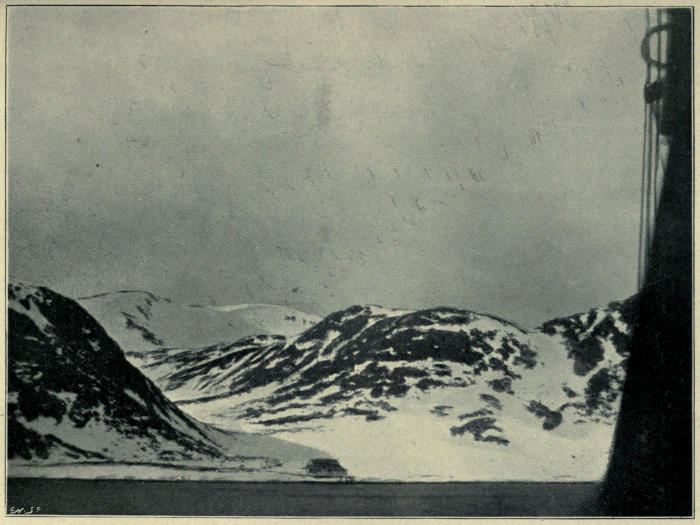
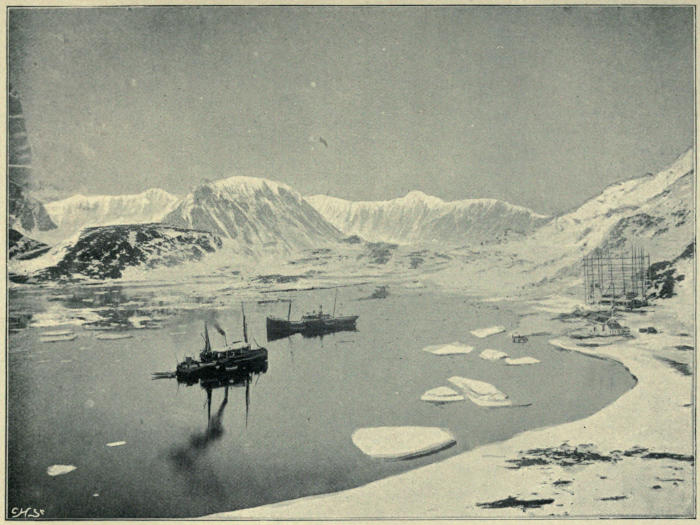
Our little harbour is a marvel of creation;
a ring of mountains covered with snow, the
summits of which were this morning veiled in
mist. Immense glaciers, from which portions
detach themselves with a fearful crash, animate
this white landscape, while at the same time
they inspire us with a feeling of vague dread.
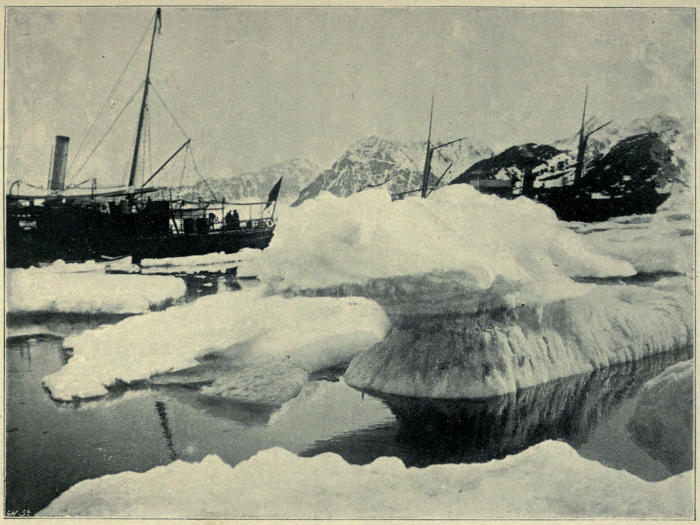
Gigantic icebergs, resembling in their shape
and bluish colour immense crystals of copperas,
are drifting about in the middle of the
bay—a veritable oasis, where the temperature
is very mild, notwithstanding the snow which
covers the ground almost entirely.
The sun is very hot, casting a golden reflection
over the whole of this charming picture,
which the birds enhance by their glad song, as
if to testify to their joy and love of life.
At 9 a.m. we set foot on terra firma with
undisguised satisfaction. Andrée, Ekholm, and
Strindberg go ashore equipped with their instruments.
They fix our bearings and determine
the magnetic declination.
In fact, they have been working incessantly
since we went to sea. They are true men of
science, in love with their work, learned, yet
making no show of their knowledge. The
geologists have found a vast field for their
researches, and the botanists have been able
to collect at their ease. However, while the
fauna is varied enough, the flora is very scanty,
being confined to a few lichens, with mosses
of a pretty green colour, cochlearias, and dwarf
saxifrages, the tiny violet flowers of which are
charming to behold.
Some climbed the mountains and descended
the slopes on ski, the beloved snow-shoes of the
Scandinavian. Others went hunting with the
arms presented by Swedish armourers to the
Polar Expedition. As for myself, I was
content to admire this imposing nature, and
tried to utilise my modest talents as an amateur
photographer, in order to perpetuate on negatives
the splendid picture in which the Virgo
was set, now appearing reduced to Liliputian
proportions.
Our general quarters were established on
the ruins of an encampment which had belonged
to a party of Siberian hunters who
spent the whole of last year on this spot.
There are many fragments of driftwood cast
ashore by the waves, and numerous bones;
a sailor picked up an enormous vertebra of a
whale, and the doctor extracted a molar from
the jaw of a bear (the bear was no longer there
to protest).
The pilot went to explore the sea from the
top of the mountains. No change this morning
in the state of the ice.
We reassembled on the Virgo for lunch at
two o’clock. Andrée went in the ship’s boat to
shoot seals, but without hitting any. After
lunch we returned to the shore, and each of us
occupied himself according to his taste. The
sky cleared up, and a very cold and cutting east
wind arose. The boat was tossed about a
good deal as we returned, and the current
drove before it all the pieces of ice floating in
the bay. At 11.30 p.m., at the moment when
I am writing these lines, a sun-ray is falling
through my porthole, and the wind is whistling
with some violence.
Saturday, June 20th, 4 a.m.—Pleasant
awakening at the mouth of the Bay of Ice-Fjord,
opposite the Raftsund, which has been
at anchor since last night.
Weather dull, a fine cold rain. A boat
comes towards us, bringing a correspondent of
the paper Aftonbladet, of Stockholm, who is to
accompany us to Norsk-Oarna.
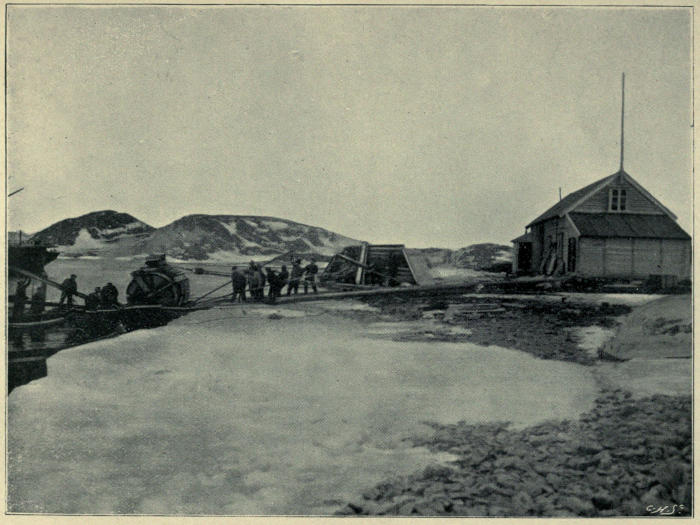
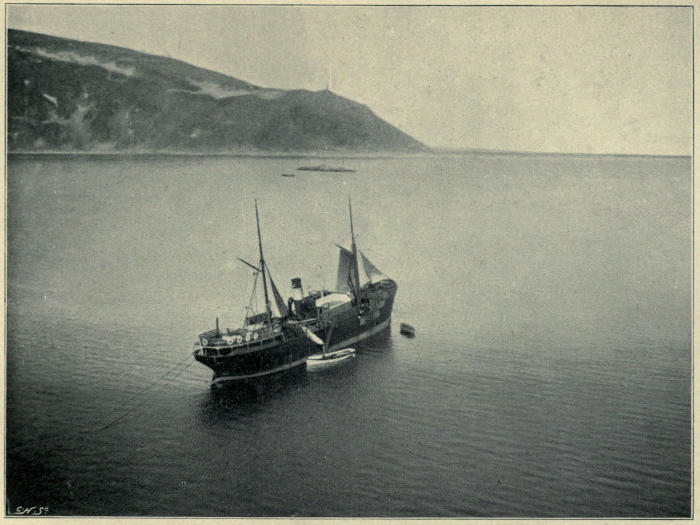
ARRIVAL OF A GENERATOR.
A small boat brings my friend Vieillard, who
is the bearer of despatches for me. We spend
two hours together, and my joy is great at seeing
him again, and at last hearing news from
my family. Then the moment of parting
comes. M. Vieillard rejoins his vessel in order
to return to France; he takes with him my
letters and despatches. I take several negatives
of the Raftsund, a splendid boat; and the
Virgo then continues her course towards the
north, after having exchanged the customary
salutes.
The sea is free from ice, and the Virgo is
now going ahead full speed.
Sunday, 21st.—Towards 2 a.m. we arrive in
sight of the Norsk-Oarna Islands, the place
intended for the erection of the shed and the
future centre of our operations.
During the morning we take a reconnoitring
trip by boat round the islands in order to find
a favourable place, accessible to our vessel, the
unloading of which will be very difficult in the
absence of a landing quay and all the plant
usually available in any port.
The charts which we possess of this region
are very inaccurate. Andrée takes a survey of
several points of the coast. The huntsmen in
the boat bagged about ten eider-geese. We
gave up the idea of establishing ourselves here,
and in the afternoon we reached the Isle of
Amsterdam, 7½ miles to the south-west.
The sky is clear, the air is keen and cutting.
Monday morning.—The three explorers
made a fresh survey, and Andrée finally decided
on the little vale of Dansk-Gatt as the
point where we are to establish ourselves.
The place is sheltered on all sides by high
mountains, opening out to the north only upon
the open sea. A wooden hut, formerly constructed
by an Englishman, Mr. Pike, will
serve us as a shelter, and we shall leave there
the surplus of our reserve store of provisions.
This hospitable little house already possesses a
depôt of preserved provisions, coal, and various
articles. The ground is strewn with pieces of
rock and covered with snow, into which one
sinks up to one’s knees.
Tuesday, June 23rd.—At 6 a.m. the vessel
began to unload; all the boats are out at sea.
The Virgo cannot approach nearer than within
164 yards of the bank. The disembarkation of
the balloon and the gas plant will present very
serious difficulties, and will certainly take up
much precious time.
Thermometer 2° (35·6 Fahr.) above freezing
point. Barometer 29·92 inches. Wind south-west,
fresh. Sky cloudy, clear patches at rare
intervals. Sun very hot. Sea calm. The
steam launch has got up steam. Mr. Pike’s
yacht came to visit the house on the 16th inst.
This little structure, built entirely of wood like
the Norwegian houses, is comfortable enough;
it contains a dining-room, bed-rooms, and a
kitchen. There are stoves in all the rooms, and
our sailors have lighted them in order to dry
the walls; the lock shuts badly, and the door is
kept to with a piece of ice. The garret serves
excellently as a dove-cot, and we install our
pigeons there, but they will not be so comfortable
there as in their ordinary pigeon-house;
nevertheless, it will be a convenient shelter for
them. These pigeons have been trained at
Hammerfest. We have already despatched
several while at sea, but do not know yet
whether they have returned to Norway.
Wednesday, June 24th.—The unloading of
the vessel proceeds rapidly. The site for the
shed is ready, and the carpenters are starting
work.
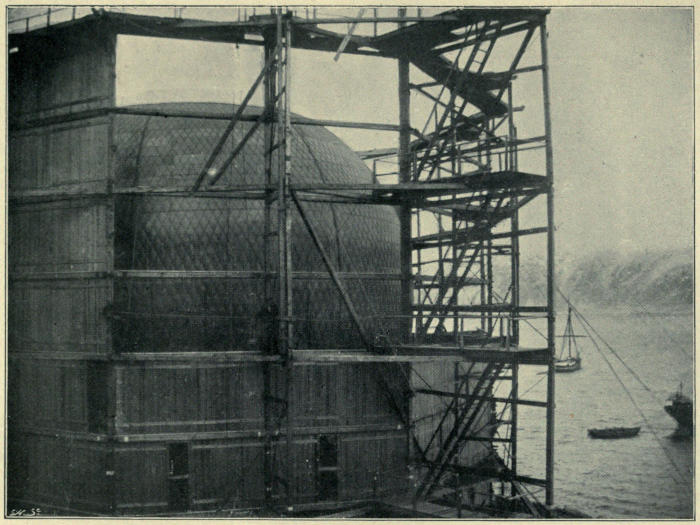
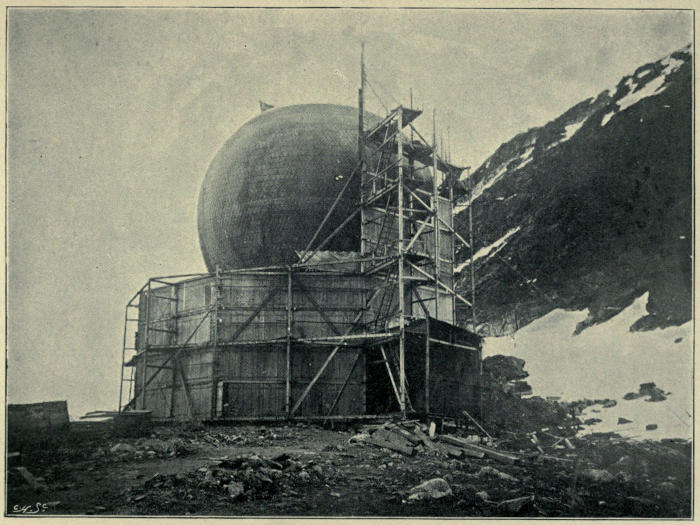
This shed, intended to shelter the balloon,
deserves special mention. Designed in a very
ingenious manner, it was erected at Gothenburg,
where the inhabitants of the town could inspect
it before it was dismantled for shipment. It is
of octagonal shape, and consists of four storeys,
each measuring 196·8545 inches in height.
The various storeys are joined to each other by
means of bolts; the last storey is surmounted by
a balcony all round.
In order to facilitate re-erection in Spitzbergen,
the component parts of each storey are
marked with marks of different colour. The
floor of the shed is composed of timber work,
all meeting in the centre, and made fast on the
rocks with pieces of wood, for the ground is
very irregular, and it is impossible to level
it.
On the east and west sides, two staircases
lead to the balcony, and at the same time serve
to strengthen the structure.
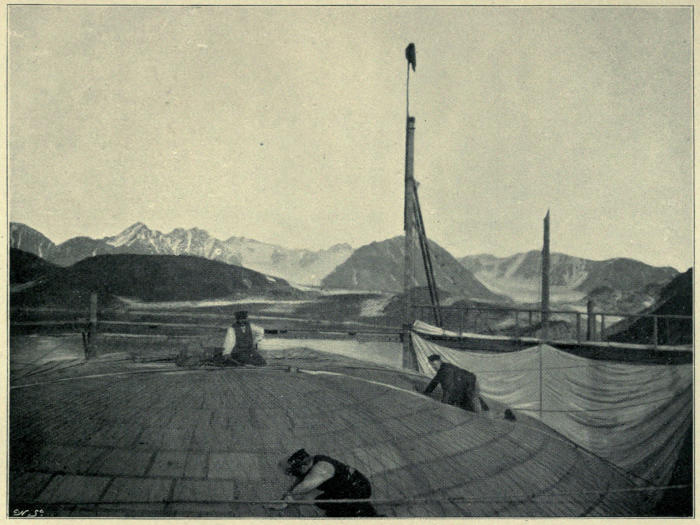
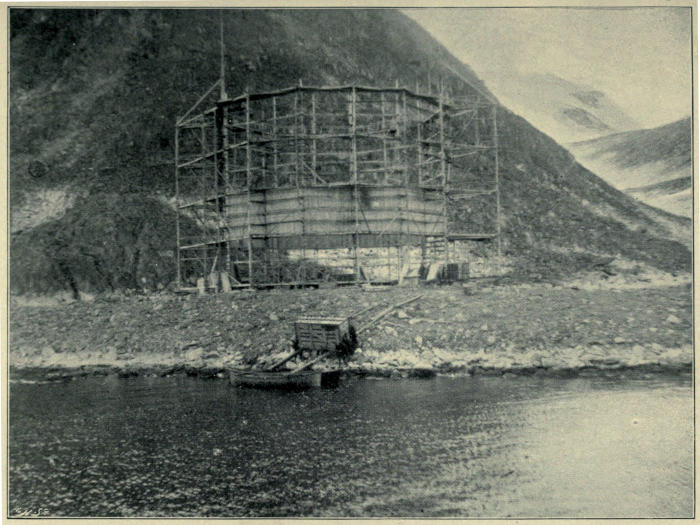
The re-erection of this shed at Dane’s Island
was very laborious. It was carried out with
much skill by the two master carpenters, assisted
by the crew.
It was necessary, first of all, to remove the
snow which covered the ground, to lay foundations,
and join together the beams, which were
put up and shifted by means of a hand-winch
placed in the centre of the structure, and slewing
all round.
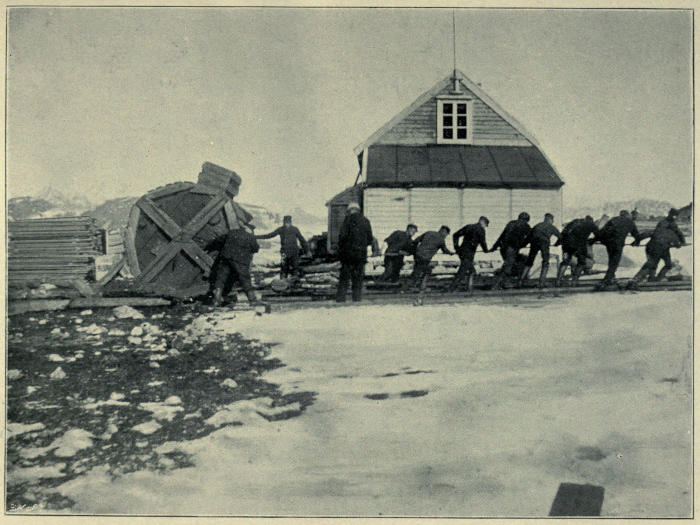
ARRIVAL OF A GAS GENERATOR.
The work was frequently interfered with by
storms, which compelled the carpenters to interrupt
their task.
The framework, when once put up, was
closed in with large panels of wood prepared
in Sweden.
The upper part of the shed is carried up
on the south side, above the rest of the
structure, by means of beams 16 feet 4 inches
high, carrying a canvas cover, intended to protect
the top of the balloon against a violent
wind.
A movable roof or canvas awning, sliding
on wire cables, was intended to protect the
balloon against snow. Unfortunately time did
not permit of putting it up in position.
June 26th.—In the morning the sun appeared;
the sky is very clear, and the snow is
slowly melting. The temperature is pleasant
to-day; but now, in the afternoon, the cirri are
approaching, and I believe that the fine weather
will not last long.
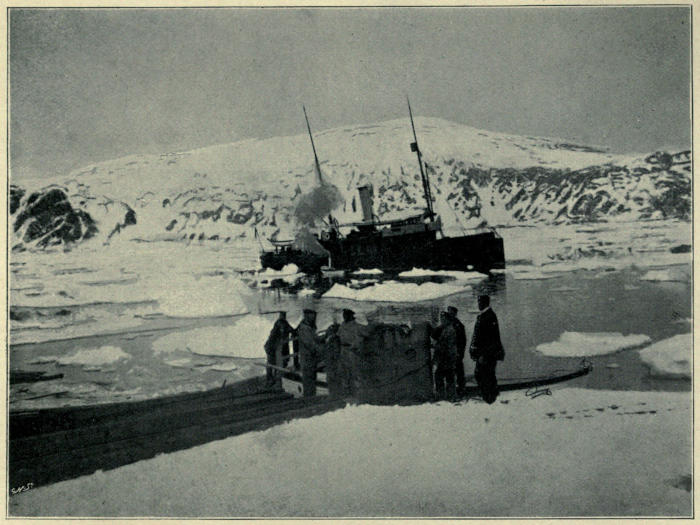
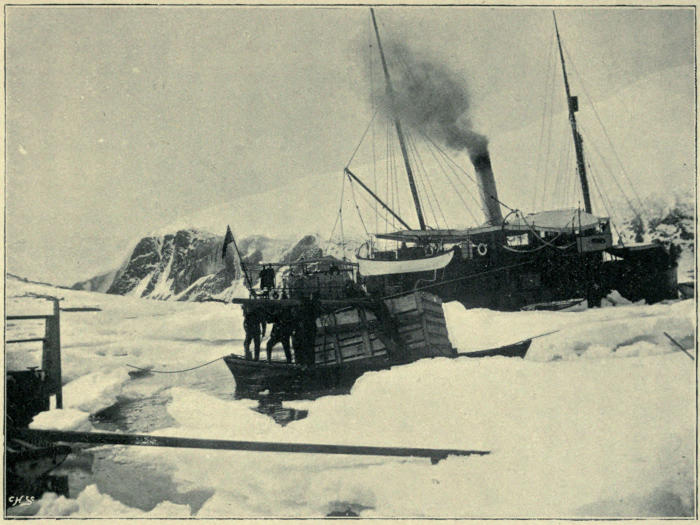
The Virgo, relieved of part of its cargo, was
able to get within 66 yards of the shore. The
crew then proceeded to discharge the heavy
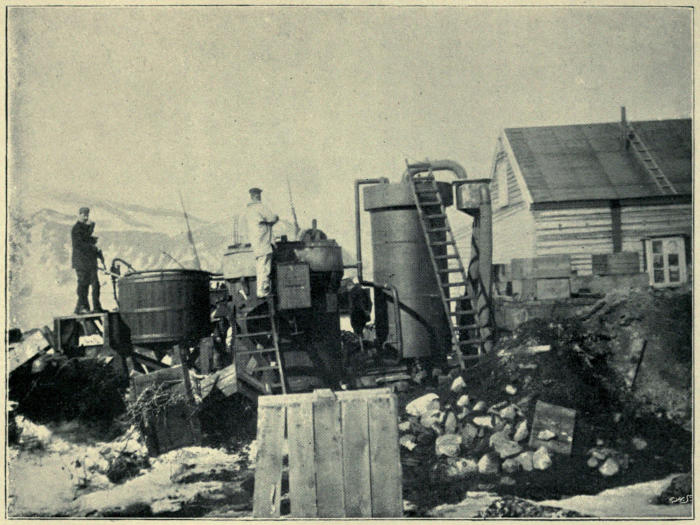
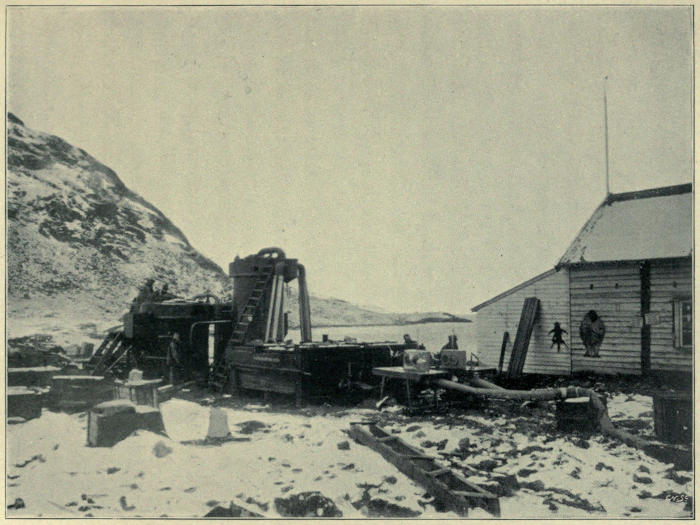
packages, hydrogen generators, and the case
containing the balloon. The three ship’s boats,
coupled together, were made up into a kind of
raft, hauled by the steam launch.
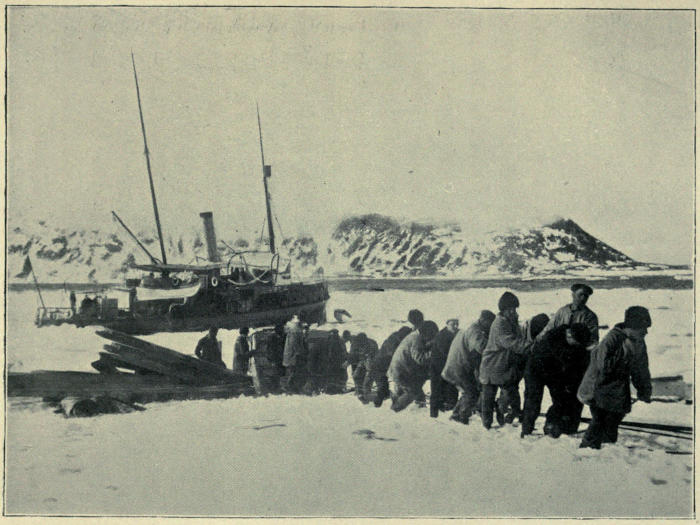
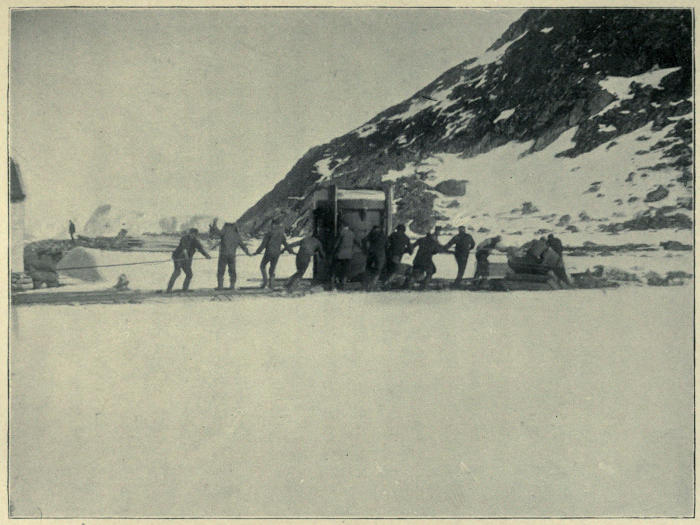
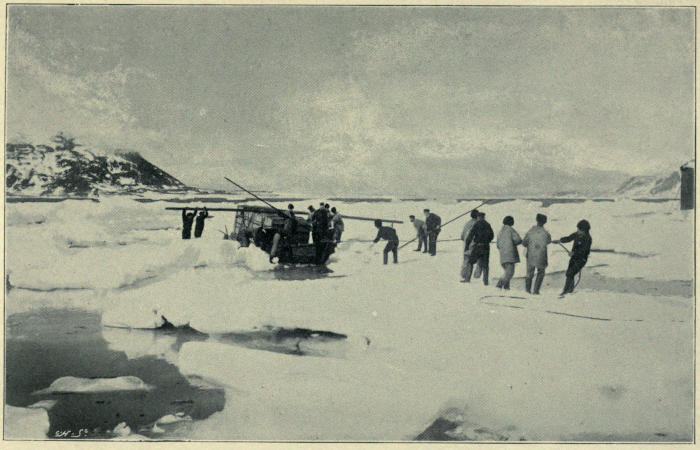
In order to bring ashore these packages,
which weighed from two to three tons, it was
found necessary to form a roadway (or a kind
of inclined plane), with the aid of two large
pine logs brought from Norway, and to haul
them by means of a pulley tackle drawn by the
whole of the crew.
One is struck with the calm and intense
stillness which reigns in these regions remote
from all civilization. The mountain birds alone
break its monotony, and give us a joyous
concert.
In roaming over the islands, one is surprised
at the number of tumuli and human remains to
be met with. This is because Spitzbergen, too,
has its history, and that a rather troubled one;
but we will not speak of it here.
IV The Victoria —Bear Hunting
On the 27th of June, in the afternoon, our
attention is attracted by the arrival of a
vessel coming from the north. It is always a
pleasant event to come across other navigators
in these distant regions; it makes one feel less
lonely and isolated. It is Mr. Pick’s Victoria,
commanded by Captain Nilson, who hunts bears
and seals on these shores. She casts anchor
near the Virgo. We enter a boat and go to
welcome the travellers.
Andrée obtains some information from the
captain as to the state of the ice in the north.
I pay a visit to the boat, which, though otherwise
plain and rough, is nevertheless fitted up
to perfection for the peculiar nature of her expeditions.
She contains various objects which
are not without interest for me, who am a new-comer
to these regions, such as skins of bears
and various birds; also a live young bear,
captured at the Norwegian islands, which utters
ominous growls, and seems to protest energetically
against this outrage upon its liberty.
Sunday, the 28th of June, was an eventful
day, and full of emotions. The Victoria left
at 9 a.m. for Ice-Fjord, taking with her an
enormous parcel of letters, with our best wishes
for our nearest and dearest.
After an early lunch we started for an excursion.
Strindberg, Grumberg, Arrhénius, Dr.
Ekelund, two engineers, two sailors, and myself,
went off in the steam launch.
The weather was superb, the sea calm, the
sky a little misty; some pretty cumuli touched
the summits of the mountains. We steamed
round Dane’s Island, and shaped our course
towards Smeerenburg.
Our little boat goes ahead full speed, and
gives herself up to a mad race among floating
ice-blocks which cover the surface of the bay.
The spectacle is marvellous. We are surrounded
by imposing rocks, whence the snow
descends in capricious veins and furrows, and
whose craggy summits, gilded by a glowing sun,
are set off against an azure sky of exceeding
purity. These granite rocks, of grotesque and
erratic shape, throw the most fantastic shadows
upon the white surface of the glaciers.
The atmosphere is so transparent that it is
very difficult to estimate distances merely by
the eye. The mountains are from 2,000 to
3,000 feet high, and yet at first sight one
would think that they are very easy to climb.
I have very often been misled by this optical
illusion. Sounds can be heard very clearly at
a great distance.
We cross the course of the little sailing boat
of Stadling, the correspondent of the Stockholm
Aftonbladet, and the colombophile of the
polar expedition.
He is also starting on a journey of discovery,
together with two companions.
We take our course towards the east, and
land on a little islet covered with moss.
Our guns bring down several eider-geese,
and on setting foot ashore we came across
several nests of these birds, containing three
or four eggs of the size of goose eggs and of
a greyish-green colour.
But our survey is soon made, and we
resume our course in a south-easterly direction,
where we can already see the outline of the
Isle of Moffen, which is the goal of our excursion.
This isle presents a singular contrast with
the surrounding mountains, owing to the vigour
of its colouring, which changes from a light-green
to a dark-brown.
The mosses of different varieties, interspersed
with yellowish lichens and saxifrages of a
delicate violet tint, offer us a soft carpet, inviting
to rest, and delighting to the eye.
Thousands of birds, making a deafening noise,
inhabit this enchanted land.
But their tranquillity is disturbed by our
prosaic and insatiable hunters, who give themselves
up to a veritable hecatomb of game.
They have scarcely got ashore, and about
one hundred eider-geese are already lying on
the ground. They are so numerous and so unsuspecting
that they will scarcely move away
more than a few yards from us; one can easily
see that their solitude is rarely disturbed by
visitors of our species, or at least of an equally
bellicose character.
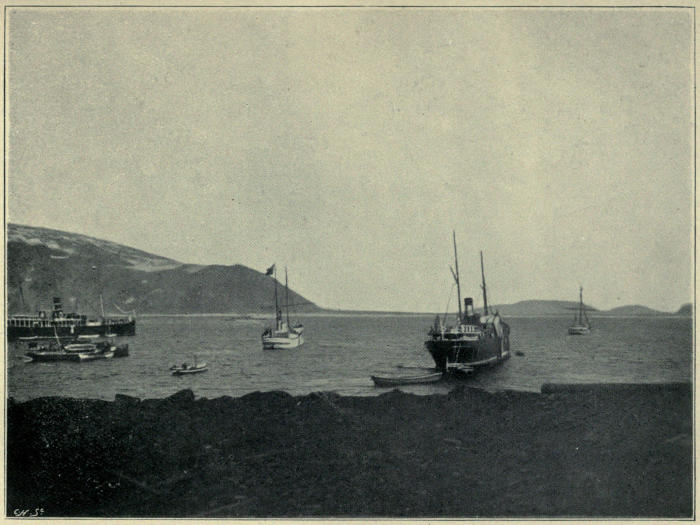
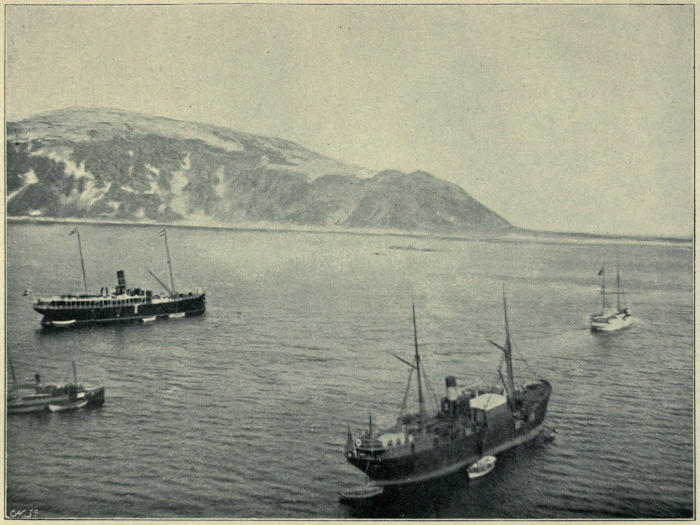
THE EXPRESS, THE ERLINE JARL, THE VIRGO, DEPARTURE OF THE VICTORIA.
They much resemble our domestic ducks,
and one might easily imagine one’s self in the
midst of a park or a poultry yard. At one
moment I had about ten around me, come to
drink or bathe in a little brook of clear water,
which babbled in a cascade over the moss
and pebbles.
At every step one comes across a nest made
of moss and feathers, sheltered by a fragment
of rock. The female bird has plucked off her
softest down to protect her eggs or her brood
against the frost. The brooding bird is
scarcely disturbed by our approach. She
covers up her eggs and hides them under the
down before taking her flight, if she is given
time to do so. The reports of the gun repeated
again and again by the echo reverberating
from the mountains resemble the rolling
of thunder and make a hideous din.
At four o’clock, a lunch, highly appreciated,
is served out on a bank of moss. This meal,
partaken with vigorous appetite, consists of
ham, caviar, and slices of smoked reindeer-flesh;
the whole being washed down with light
beer, and seasoned by the most unrestrained
gaiety. A pure Havannah cigar completes this
most unconventional feast.
We fill our lungs with the pure air, and
feel it a joy to live.
But time glides swiftly by, and we must think
of returning. We are two hours’ journey from
the Virgo.
Our sailors make an extensive raid upon the
nests, and return loaded with baskets full of
eggs and down. The game is put on board
and we depart.
As we run along, the coast and glaciers are
covered with seals, but the noise of our engine
frightens them and they flee at our approach.
The sea has become rough, and the wind,
which takes us port, sends up waves which
threaten to swamp the boat. We are much
tossed about, but I can now stand the rolling
of the vessel like an old mariner. However,
we must not boast: one cannot be too sure of
anything. The temperature has gone down
perceptibly, and the cumuli, which a short time
ago were hovering on the sides of the mountains,
are now lowering down upon the sea,
and soon envelop us completely. We are
now in the midst of a very dense and cold fog.
We can scarcely see a few yards in front of us,
and we must slacken speed in order to avoid
collision with the icebergs detached from the
glaciers. The sun, which, a moment ago, still
showed very feebly, has completely disappeared.
We are plunged into utter darkness,
and in spite of compass and charts we have,
for the moment, lost our bearings. What a
change, after the aspect of the sky a short
while ago! The engineer whistles by way of
a call to the Virgo, but there is no response
from that vessel.
Without being actually desperate, our situation
is becoming critical, as we no longer know
exactly what distance we have covered.
We run a risk of passing our island without
perceiving it, and of getting lost at sea!
At last, after several detours, we recognise
the lagoons of the Isle of Amsterdam on the
right, and soon a sailor points out the Virgo,
which looms in the semi-darkness at a distance
of fifty yards or so in front of us.
At this moment it is 8 p.m. The captain,
Andrée, and Ekholm are on the deck. Without
being alarmed at our fate, they were glad
enough to see us back again; but Stadling’s
boat has not yet come back.
The mist becomes thicker and thicker, and
one can scarcely see from one end of the vessel
to the other. One of the crew is ringing the
bell every few moments, in order to indicate the
route to the three belated tourists. The supper
passes off very gaily. Each recounts his adventures
and describes his impressions; mine have
been of a very lively nature. But the day had
still a far more remarkable event in store for us.
We were beginning to be rather troubled
about the fate of our friends, when at about 10
p.m., having gone up on to the gangway to see
how the fog was, I heard, very faintly at first,
a murmuring sound, then a song keeping time
with the splash of oars. No doubt it is they;
evidently they, too, have lost their way.
The outline of the gallant little craft appears
a few yards away, and the boat comes on propelled
by oars, as they had been compelled to
take down their sail. But what is that shapeless
mass, of a doubtful white, spotted with red,
which fills the bottom of the boat?
Although worn out with fatigue, the excursionists
are radiant; they have performed
veritable prodigies: they have been bear-hunting,
and bring back three dead bears in
their frail boat.
DANES ISLAND.
They are at once the object of an enthusiastic
ovation, while the animals—a large she-bear
and two cubs—are hoisted on board, leaving
a pool of blood in the bottom of the little boat.
You already know Stadling, permit me to
introduce his two companions—Appelberg,
engineering student of the Stockholm technical
school, and Axel Stack, chemical engineer at
the Stockholm University—and let the first-named
gentleman recount in his own words
the circumstances of this somewhat dramatic
adventure:—
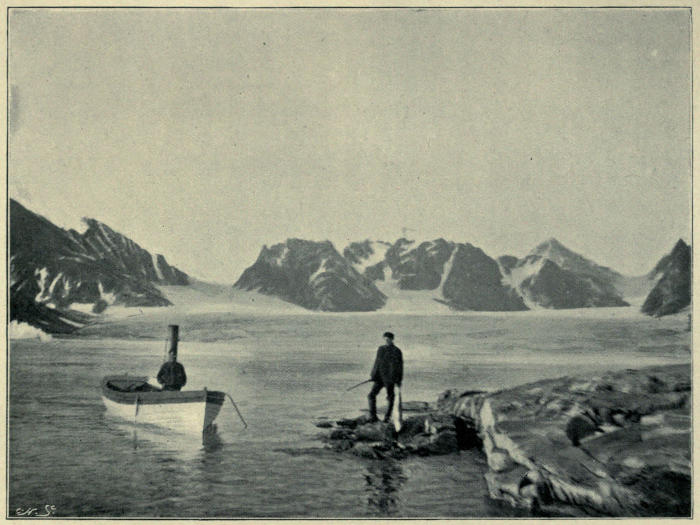
“You will remember the charming day we
had on the 28th of June; the sun glistened on the
waters of Smeerenburg as on a mirror, the surrounding
mountains enhancing the wildness and
grandeur of the scene. You will also remember
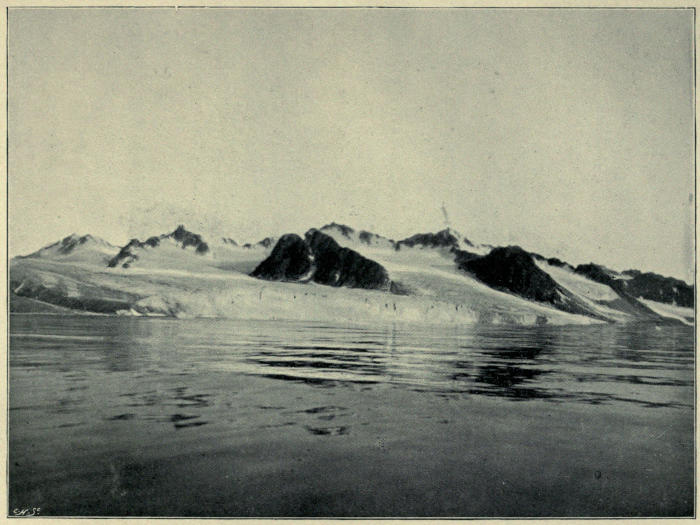
the glacier at the bottom of Smeerenburg. I have
told you about the adventure we had opposite
this glacier, when in consequence of a sudden
split a detached mass of enormous size produced
in the sea an immense wave, which threatened
to engulph our small boat and gave us an
unexpected douche.
“Immediately after this adventure I hastened
to take a photo of the glacier. While searching
for a suitable point, I discovered in the snow
on the shore the track of three bears going
from east to west, in the direction of South-Gatt
and the open sea. Having informed my
companions of this lucky find, I returned to the
boat, followed by my friends, one of whom was
gravely engaged in drying his clothes in the
sun, after the enforced bath caused by the
splitting of the glacier.
“Thereupon a rather original chase commenced;
my companions rowed, whilst I held
the rudder lines, at the same time observing
through my glasses the tracks on the bank and
following their direction. The tracks of the
bears led us continually from east to west.
Here and there the animals evidently had rested
in some natural trenches formed in the snow.
In other places there were sloping grooves
on the bank, where the bears had amused
themselves by sliding on these natural sledges.
Having passed two promontories and a very old
glacier, we arrived at a third promontory, beyond
which there was another glacier about 1¼
mile wide. In front of it there was an iceberg.
“When we arrived at the extreme point of
the promontory, we stopped, as no further
tracks were visible; from this we concluded
that the bears must be somewhere in the neighbourhood.
“Having reconnoitred as far as the firm ice,
protected by large icebergs, I perceived the
bears below the glacier, jumping one after another
from a block of ice. The mother, followed
by her cubs, was giving herself up to this
exercise either to amuse herself or to give her
young ones a lesson in gymnastics,—I do not
know which.
“At any rate I watched with curiosity for
some moments this scene of ursine family life.
It was an exceedingly curious sight, I assure
you. But this patriarchal and rustic scene was
destined soon to come to an end, thanks to the
huntsman’s instinct which suddenly awoke
within me. I felt bound, at all cost, to kill this
interesting family, the mother and her cubs.
Why? Who can reason with passion, who can
reason with a hunter! Without further idle
reflection, and as the chief of a gang who has
resolved upon an immediate attack on a long-desired
prey, I ordered my comrades to remain
in the boat until I returned, and on my knees I
crept over the ice, behind the fragments of
rocks, towards the three animals. This ice was
perforated like a sieve, and the water fell from
it in small cascades with a continuous and
monotonous noise; small fragments were
detaching themselves from it every moment,
without, however, retarding my progress.
“Regardless of all risk, I continued to drag
myself along behind fragments of rocks and
approached to within about 430 yards of my
quarry. Now I had no longer any shelter; I
was exposed to view. Then I took a long
aim, fired and wounded one of the cubs. The
mother rushed towards it, sometimes looking
about her, and sometimes licking the poor
beast.
“I could see her very closely with my
glasses. I fired a second time, and the mother
then turned furiously towards me. My cartridges
had got damp and missed fire. I
became nervous. I was obliged to go and
fetch fresh ammunition from the boat. The
she-bear gave up her first idea of attacking
me and returned to her cubs.
SMEERENBURG GLACIER.
“Then, having taken fresh ammunition, we
commenced, all three of us, to drive the animals
towards the open water, and at last, to
our delight, saw the mother, followed by her
cubs, start swimming. Mr. Stack remained on
the ice armed with an oar, in order to cut off
their retreat; Appelberg and myself gave chase
from the boat. The she-bear, with one of the
cubs on her back, swam at a fairly good pace
towards us. We had scarcely had time to row
three or four minutes before the mother had
climbed upon a large block of ice floating in
the midst of the open water. Having approached
to within fifty or sixty yards I fired
again, and my bullet striking the bear between
the two shoulders, passed through her lungs.
The animal uttered a terrible cry, which was
re-echoed from the mountains. In a great
fury she threw herself into the sea, swimming
towards us with rage, but only for a few
moments. The poor beast soon died, still
carrying on her back the cub which I had first
wounded. It was at once killed, and the other
immediately afterwards.
“We thereupon dragged the animals towards
the ice-bank, where I photographed my
victims, stretched out lifeless; and it was not
without much difficulty that we succeeded in
putting them aboard our frail boat. At last we
started on our return to the Virgo, still full of
excitement, when suddenly we were caught in
the fog in the midst of the Smeerenburg
waters.”
The next day the ice pilot, an old sea-dog,
assisted by Stadling, proceeded to cut up the
three animals, the skins of which were salted,
and enclosed in barrels; after this the most
delicate morsels, seasoned with various sauces
by the cook, who displayed all her talents,
adorned the table at several meals. Without
being absolutely exquisite, the dish is appetising,
and besides, the chance of dining off polar
bear does not occur very often.
V The Midnight Sun
Friday, July 3rd.—I have not put foot
on shore to-day. For three days past we
have had terrible weather, and I wonder
whether the shed will be able to resist the fury
of such a wind. However, this is an east
south-east wind, which would suit perfectly well
for the voyage, though the start would be very
difficult under these circumstances; this delays
the work of the carpenters, and the shed does
not rise up very quickly. I felt very dull to-day,
and was happy enough to read again all
the old journals which had served for packing
purposes, as I am not very well stocked with
works of a purely literary character, a few
volumes only composing my whole library. I
also read again the expedition of the Jeannette,
which Andrée had lent me, and the dramatic
episodes of that story were not calculated to
raise my spirits. What an extraordinary
climate!
In these regions fine days are very rare,
though it is clear all night; but for a long
time past the sun has scarcely been seen. The
thermometer remains near freezing-point.
But the midnight sun! What a never-to-be-forgotten
spectacle is presented by this polar
sea in these radiant nights!
As soon as the fog lifts its veil, leaving the
eye at full liberty to roam over the horizon,
one sees an endless succession of palaces of ice,
strong castles, cathedrals, and fantastical structures,
some majestically indifferent to the waves
which caress their mighty bases, the others
slowly rocking to and fro, notwithstanding
their ponderous masses, and at each oscillation
of their sparkling faces emitting from their
alabaster sides rocket-like flashes of emeralds,
rubies, and sapphires.
THE VIRGO, AMSTERDAM ISLAND.
Numerous cascades pour down from the vast
sides of these icebergs into basins formed in the
very bases of these enormous ice-mountains,
subsequently losing themselves in the waters
of the sea; and all these waterfalls, large
and small, are lit up by the hot, red rays of a
brilliant sun.
This polar nature, which one imagines to be
so poor, so icy, so inert, in regions which we
only know from dull and cold narratives of voyages,—this
wonderful nature lavishly spreads
out before my eyes the sight of an endless
mass of sparkling and flashing diamonds, a
veritable pyrotechnic display of another world,
which the rays of the sun cause to burst forth,
and change twenty times in a minute.
And all this, like a sublime jewel casket,
rests on velvet of an unheard-of variety, delicate
green, pale pink, orange red, crimson,
bright red, purple, golden yellow, violet, sky-blue,
a marvellous velvet of deep soft and
delicately shaded tints, which the calm and
irradiated water seems to spread out for the
greater delight of the eye and the soul.
In the presence of all this grand and mighty
nature, what becomes of man’s most ingenious
artifices invented to charm by the excess of
accumulated marvels?
How paltry are the most superb decorations
of his theatres compared with what one sees
here—here where the water alone and the sun
undertake the mise en scène! What are all the
marvels hatched by his brain, by his sovereign
industry, in the presence of miracles of colouring
and brilliancy engendered by a ray of light
penetrating a fragment of ice?
Tuesday, July 7th.—We had very bad
weather on Saturday; on Sunday the atmosphere
calmed down a little, and yesterday
(Monday) we had a splendid day. We took
advantage of this to make an interesting
excursion in the steam launch to Magdaleina
Bay. The peninsula contains an immense
necropolis, dating back several centuries; it
is here that the whalers of Smeerenburg came
to bury their dead.
We killed a very large seal, which nearly
caused the boat to capsize when we got him on
board. Strindberg killed a black fox at the
foot of a glacier.
We returned at midnight in brilliant sunshine;
in fact, at present we constantly see the
sun when the sky is clear. He is describing a
circle, of which the Virgo appears to be the
centre, and the sunshine is sometimes very hot.
This morning the temperature was 68° Fahr.
in the sun, and 41° Fahr. in the shade.
The work of erecting the shed is being
pushed on as quickly as possible, but it is a
gigantic task. To-day they have reached
the second storey; there are to be two more
storeys above that, and these are the most
difficult ones to erect.
In the midst of this feverish work the days
pass anxiously by, for I have had no news from
Europe. I am already much perturbed, when
at last, on the night of July 12th, after a very
dull day, the watch all at once signals the arrival
of a small sloop, which is sure to bring our mail.
In a few moments everybody is on deck, and
the captain of the small boat, the Express,
hands us an enormous bundle of letters, which
Andrée distributes among us. I received
fourteen, and it would be difficult for me to
express the joy I felt at this moment.
The Express brings six English and German
tourists, who have come, somewhat early, to be
present at the departure of the balloon. They
are received on board the Virgo, and evince a
very lively interest in Andrée’s project.
VI National Fête
On board the “Virgo,” July 14th, at night.—The
bad weather continues, and the
squall is so violent that the little sloop
Express has been unable to put to sea. We
have a very gay lunch. Andrée made a little
speech, which greatly moved me. He spoke of
the national fête in France and of aerostation,
which I represent. He praised the self-denial
which I had exhibited, and finally expressed to
me the pleasure he felt in seeing the bonds of
friendship becoming closer day by day. He
did not forget either family or friends.
The captain ordered the French tricolore to
be hoisted on the mainmast and the ship to
be dressed with bunting. Champagne sparkled
in the glasses.
ARRIVAL OF THE CAR.
Strindberg played the national air, and those
present overwhelmed me with kind attentions.
The following letter will give an idea of the
close friendship which reigned amongst us:—
“On Board the Virgo, Dansk-Gatt, July 14th, 1896.
“To Madame Lachambre, Paris.
“Dear Madame,—
“To-day being the national fête
day of your native country, la belle France,
we gladly seized the welcome opportunity
to present to M. Lachambre our sincere
thanks for the great services which he has
rendered to our expedition by the careful and
excellent work which he has executed, and for
his personal attendance here in order to give us
the benefit of his valuable experience. Certainly,
this voyage has been a great sacrifice, both for
you and for him, and it is, therefore, our duty
to thank you as well as M. Lachambre.
“We have this day drunk the health of
M. and Madame Lachambre, at the same time
hoisting the tricolour and singing the ‘Marseillaise.’
On this occasion Andrée has had
the honour of fixing on M. Lachambre’s breast
the decoration of the Academical Palms, and
we have congratulated him with enthusiasm on
receiving this well-merited distinction.
“We beg you will rest assured, Dear
Madame, that we are doing our best to minimise
the inconveniences resulting to M. Lachambre
from a life in these very inhospitable regions.
“We are, Dear Madame,
“Yours most respectfully,
(Signed) “S. A. Andrée; Nils
Ekholm; Nils Strindberg;
Zachau, captain of
the Virgo; Goste Grumberg,
zoologist; Carl Ekelund,
physician; Svante
Arrhénius, hydrographer.”
And while Strindberg strummed on his
violin the most poetical and impassioned
Swedish tunes, the wind raged outside and
the vessel rocked and creaked fearfully.
Dansk-Gatt, on board the “Virgo,” July 16th,
noon.—The storm, after calming down for a
short time, burst forth again last night with
renewed violence, and the Express, which left
at eight, was obliged to return in haste some
hours afterwards to take shelter near the Virgo.
The Virgo is a strong vessel, capable of
braving a storm, but it is otherwise with the
small sloop, which already has barely escaped
shipwreck in coming here.
VII The Inflation
July 21st.—To-day for the first time we
were able to commence devoting our attention
to the balloon, which, since its disembarkation,
has remained enclosed in its case at
the foot of the shed.
It is now brought to the entrance and
extended on the floor, covered with a thick
layer of felt.
It is spread out after the manner of a cast-net,
the valves are fitted to it, together with
their rigging, the net is placed in position, as
well as the protecting cover.
The inflating pipes, passing through an
opening made in the middle of the floor, are
joined to the gas apparatus situated 87 yards
away below the shed, behind Pike House.
This very difficult work (the envelope alone
of the balloon weighs nearly 3,086 lbs., and
the net 992 lbs.) was finished in the evening
of the 22nd, in a fine and penetrating rain.
On the morning of the 23rd snow commenced
to fall in large flakes. The balloon is covered
by it with a thick layer, when about a hundred
cubic feet of gas commence to raise with difficulty
the heavy envelope of silk. This operation
commences even before the shed is quite
finished. Part of the upper enclosures is still
wanting, and Andrée abandons the idea of
having the canvas awning put up, which, however,
would have been very useful; but time
presses, and every delay may jeopardize the
departure.
The car, installed in an annex to the shed,
is marvellously devised. The lower part is
completely surrounded with sailcloth. It receives
its light through two lateral windows.
The middle is occupied by a kind of mattress,
covered with a sleeping sack of reindeer skins.
All around are compartments for holding
books, charts, and instruments, toilet articles,
and the kitchen utensils, arms, ammunition, etc.
It is entered through a trap-door made in the
ceiling. Above, at a height of one metre, a
ring, mounted on jointed railings, which
keep it in a horizontal position, forms a
balcony, in the centre of which two of the
explorers will remain while the third is resting.
To this circle the instruments,—compasses,
sextants, theodolites, barometers, thermometers,
photographic appliances, etc., are attached.
The six ropes, by which the car is suspended,
are joined at the upper part by a
cable, which brings them nearer to the centre,
while keeping them away from the balcony;
they then extend from this hexagon towards
the suspension ring, which is fastened to the
net.
Six canvas pockets, with compartments, are
fixed between the suspending ropes from the
ceiling of the car up to the balcony, for the reception
of any articles or instruments which the
aeronauts may require to have at hand at
any moment.
The load ring carries a table or board
divided into compartments occupied by four
baskets intended to hold a number of accessories,
buoys, grapnels, ropes, etc.
In the centre of the platform a square
opening leaves room for a rope ladder, attached
to the appendage of the balloon, and
facilitates the inspection of the interior through
windows let into the safety valve. This platform
may, if necessary, serve as a refuge for
the aeronauts, should they be compelled to
abandon the car.
The load ring supports a differential pulley
for moving the guide-ropes, the action of
which, combined with that of the sail, is to
afford the possibility of a certain deviation
from the direction of the wind.
The sails are fixed to the net by hemp
straps.
The three guide-ropes are attached to this
pulley by a very ingenious piece of mechanism.
With the aid of a crank and a bevel gear,
the guide-ropes, which are composed of several
sections joined to each other by screw connections,
can be turned. Should the end of
a guide-rope get caught between the ice to
such an extent as to arrest the flight of the
balloon, the aeronauts can release themselves
by exerting an effect of torsion on this guide-rope
by means of the crank, and abandoning
the length of rope caught; a fresh length
of guide-rope will then be added at the top
if necessary, making use of spare lengths of
rope.
AN EXCURSION TO MAGDALEINA BAY.
In order to prevent the guide-ropes becoming
detached at an inopportune moment,
Andrée has devised the plan of providing a
spring consisting of a flat piece of steel which
exerts a pressure upon the connecting screw
nut; the pressure of these springs is graduated,
increasing upwards, so that it will always be
the lowest length of rope which will detach
itself first. These guide-ropes are impregnated
with vaseline, which renders them insubmersible
and greatly facilitates their gliding
over the ice.
Above the ring, victuals and provisions of
all kinds are stored in canvas bags divided
into compartments and strongly fastened between
the suspending ropes; all the articles
are fixed so that no shock can throw them out.
The number of suspending ropes is forty-eight,
forming forty-eight equal intervals, of
which thirty-six are occupied by bags of provisions,
and twelve by sledges, boats, spars, etc.
The provisions comprise tins of preserved
food of all kinds, chocolate, compressed bread,
condensed milk, champagne, claret, alcohol,
fresh water, not forgetting butter, an indispensable
article of diet in the polar regions.
All these bags are weighed, classified, and
labelled, and make up a weight of 2,204 lbs.
What is not consumed will serve as ballast,
Andrée having considered it more practical to
carry provisions in place of ballast.
The apparatus for cooking the food consists
of a cylinder suspended by a strap 32 feet
6 inches in length, along which a rubber tube
runs; inside the cylinder a spirit lamp is
lighted by being brought in contact with a
match ignited with the aid of a small and
very simple contrivance worked by a cord.
A small cooking pot filled with water,
and enclosed in the cylinder, can be made to
boil in a few moments. The lamp can be
extinguished from the car by blowing down
the rubber tube, and a mirror, arranged at an
angle of 45 degrees, enables the occupants
of the car to see whether the lamp is well
extinguished before hoisting the apparatus up
into the car.
VIII The Erline Jarl
Dansk-Gatt, July 23rd.—The south
wind, which has blown almost constantly
since our arrival at Dansk-Gatt, ceased
on the 19th of July, and north and north-easterly
winds are now blowing, with their
usual accompaniment of rain or snow.
The gas-working apparatus acts very regularly,
yielding about 78 cubic yards per hour.
The work is divided into spells of six hours
at a time, the first watch, from 8 a.m. to 2
p.m., being entrusted to me. I am assisted
by two seamen only, one of whom speaks
French fairly well,—viz., a Mr. Knos, engineer,
who has signed for the voyage. My place is
then taken by Strindberg, who, in his turn, is
relieved by Andrée, whom I succeed again.
At 11 p.m. the sound of a siren breaks the
stillness of the night, awakening the echoes of
the mountains. I then see the Erline Jarl,
a splendid boat, flying the Norwegian flag,
coming on slowly and majestically, in order to
cast anchor at some distance from the Virgo.
Around the place where the sulphates and
residues of the hydrogen apparatus discharge
into the sea, the sea-water has assumed a rusty
colour for a distance of several miles. This
peculiarity causes great astonishment among
the new arrivals, who imagine that they can
see the sea-bottom.
Captain Zachau, of the Virgo, goes to welcome
the new-comers, and returns on board his
vessel with a load of letters for our crew.
The snow falls thicker and thicker, and the
shed does not afford the least protection. I
have a kind of sentry-box rigged up for me in
the packing-case for the net of the balloon.
We experienced much difficulty at the commencement
of the inflation, and I am frequently
compelled to obtain assistance from the gas
works, the material of the balloon being so
very heavy to shift about.
SOLAR OBSERVATIONS AT MAGDALEINA BAY.
I may mention one incident in particular.
The balloon had already absorbed 1,308 cubic
yards of gas, when the apparatus suddenly
stopped and absolutely refused to act, which
caused great excitement among the members
of the expedition. What does it mean? Here
is the solution of the enigma.
The pump, which draws its supply from the
sea, has taken up such a quantity of shrimps
that all the cocks are choked up. We scarcely
expected to see shrimps interfere in this matter.
Andrée, who had thought of everything else,
had forgotten to reckon with these diminutive
factors. The generators and valves are cleared
out and cleaned, and the suction pipe is fitted
with a rose, whereupon work goes on without
any further hitch.
For the production of the hydrogen 55,115
lbs. of sulphuric acid and 33,069 lbs. of iron
shavings have been used. All that chemistry
and physical science has hitherto produced by
way of purifying, weighing, and testing instruments
is embodied in Andrée’s plant.
On the morning of the 24th of July the
tourists brought over by the Erline Jarl begin
to arrive on the island; there are about sixty
of them, from all countries. Several of them
bring me news from my friends, and an acquaintance
is soon struck up. We are assailed
with questions on all hands. Andrée does the
honours of the establishment with much grace,
and propounds his theories as to the means he
proposes to adopt in his endeavours to reach
the pole. He explains the instruments and
apparatus, while I distribute among the tourists
some samples of the material employed for the
balloon.
We hear news from Europe, always acceptable
to a degree which no one can conceive
who has never been far away from his native
country. Besides, in these wild regions everything
tends to augment the unconscious longing
for all that one has left behind, and those
who come from a region more or less near to
one’s native country at once assume something
of the nature of long-expected personal friends.
The night of the 24th is spent very pleasantly.
I dine on board the Erline Jarl, and
hear a concert given by real artistes. My
thoughts wander back to scenes of the past,
and I say to myself that had some one sitting
next to me at a concert in Paris told me at
the time that in so many months, or at such
and such a time, I should hear the same instruments
and enjoy the same tunes at Spitzbergen,
I should have been very much surprised at
such a suggestion.
Saturday, 25th.—At noon the small sloop
Express arrives, carrying mails. At 1 p.m. the
Erline Jarl leaves on a trip towards the north.
The programme consists in approaching close
to the ice-field, and the amiable Captain Bade
offers me a place on board his ship. But,
however much inclined to accept, I cannot
leave Andrée at this moment, as the balloon
demands all our attention.
Sunday, 26th.—Andrée lectures to our crew.
His spirited and expressive language, his technical
explanations, given with perfect clearness,
frequently elicit loud applause.
Monday, 27th.—The inflation is completed
at the moment when the Erline Jarl returns
from her trip.
The Victoria arrives at night, and the simultaneous
presence of the four vessels gives
Dansk-Gatt a festive air, which is greatly
enhanced by the lovely sunshine. Our little
international colony is very lively.
After waiting a week in order to witness the
start of the balloon, the tourists lose patience.
They want to be at Vadso on the 9th of
August to see the eclipse of the sun.
On July 30th a sumptuous dinner is given
us on board the Erline Jarl, and on the 31st
the tourists come in a body to the foot of the
shed.
To the right and to the left of the entrance
the crews of the Virgo and the Erline Jarl
are formed up in line; at the back the passengers
are grouped round the explorers.
Several speeches are made by the captain of
the Erline Jarl and some of the tourists;
thereupon a young lady, who is travelling with
her fiancé and a relative, attaches to Andrée’s
arm a blue ribbon, and then hands him for the
journey a bottle of the best wine, a cake, and
a rose-tree with four roses, one for each explorer.
Captain Bade, of the Erline Jarl, then addressed
Andrée as follows:—
“If you reach the mysterious point for which
you are bound, deposit there the fourth of the
roses, as a token of peace with the old world.”
“My dear friend,” Andrée replied, in accents
full of emotion, “you who have come
so far to see me set out for the conquest of the
unknown, my dear friends, I thank you!
THE VIRGO DECKED FOR THE 14TH OF JULY FÊTE.
“Mademoiselle, you have adorned me with
a ribbon on the eve of my departure; this
ribbon shall be my talisman. I have been
called a great man, but it will be difficult for
me to earn this title if the north winds still
continue to blow for some weeks as they do
now. Our greatness will fly with them—far,
far away! What can we do to remedy this?
If we cannot make a start, we shall, at least,
be able to say that we have done all that is
humanly possible, and you will be able to bear
witness thereto.
“You are about to return to the south, and
if you meet the winds we are so urgently in
need of, send them on to us here, and we shall
welcome them as messengers from our good
friends on board the Erline Jarl.
“My friends of the Virgo, a fourfold cheer for
our friends who will send us a South Wind!”
During this touching speech the Erline Jarl
fires off a salvo of twenty-one guns in honour
of the Andrée Expedition, the report of which
shook the valleys to the echo.
Thereupon, the speeches being over, we
leave the isle in order to spend the rest of
the night on board the Erline Jarl, which is
dressed, as is also the Virgo, with a multitude
of flags, as on great gala days, and I never feel
weary of contemplating the noble colours of
the French flag proudly floating at the head
of the splendid vessel,—a delicate compliment
to me on the part of the captain, which moves
me more than I can tell.
How full of meaning to me is this flag!
How full of souvenirs and consolation! And
how well one can understand, when far away
from his native country, all the silent eloquence
of this impersonal being, this glorious symbol!
Amidst all these people, speaking languages
which I do not understand, amidst all this
group of men isolated at the world’s end, and
I myself feeling lost in the midst of them, so
to speak, owing to the difficulty of making
myself understood by them, it contains a living
embodiment of my native land, the very representative
of the soil of France—her flag
hoisted on a foreign vessel in token of the
esteem in which the children of this noble
country are held. And this flag seems to say
to me: “You are not alone; I am here too!
You are no longer isolated; we are some one;
we are taken into account here!”
We go on board, and soon the peaceful
reports of champagne corks—another reminder
of French soil—accentuate the numerous toasts
which follow each other in the large saloon.
Then our spirits becoming more and more
elated, there are songs, cheers, the loud hum
of animated conversation, wishes of good luck,
plans for future meetings, and we leave the
hospitable vessel in order to return to the
Virgo at a very advanced hour.
What a day! And how hearts are drawn
to each other under circumstances like these,
when at rare intervals, few and far between,
the oppressive and monotonous loneliness of
arduous travels in these frigid solitudes is
suddenly broken by boisterous meetings of
persons, hitherto strangers, who are so speedily
transformed into old friends!
August 1st, 9 a.m.—Under a misty sky,
heavy with snow, the Erline Jarl hoists her
anchor, sweeps round majestically, sends us
her last farewells and good wishes, and then
slowly glides away over the waters, leaving
behind her a foamy wake. The throbs of her
engine become more and more regular; soon
we no longer hear them; and it is with a choking
sensation in our bosom, which will readily
be understood, that we see this fine vessel
outlined and gradually disappearing on the
horizon, which, for a short moment, had come
to bring life and joy into our midst.
Yet a long time after, leaning with my arms
on the handrail of the gangway, I followed
with my eyes the black cloud of smoke which
the Erline Jarl trails over the waves; I still
hear a last salute from the siren, and return
in deep thought to my cabin, in a sadder frame
of mind than I should care to admit.
Grumberg, the naturalist, is working unceasingly
to enrich his collection; he dredges,
fishes, hunts, and sets snares for foxes. He has
succeeded in capturing two very young animals,
which he has installed on the island, in a nice
improvised cage, to which some anonymous
wag has attached a card bearing one of the
petitions of the Lord’s Prayer in Swedish:
“Give us this day our daily bread.”
STRINDBERG.
Grumberg watches his protégés with jealous
care, and intends to offer them to a zoological
garden in Stockholm; but on the night of the
departure the foxes, who for a long time past
had been working to effect their escape by
gnawing through the boards of the cage, made
good their escape and fled into the mountains,
pursued by the sailors, who gave chase. They
are not caught yet. I much doubt whether
Grumberg will be able to catch them again
next summer.
But who knows; Fate is so fitful! You
ought, said some one, to have attached a
“favour” to their tails, so as to recognise them
again. I, on my part, remarked that these
young foxes might, perhaps, have been acquainted
with La Fontaine’s fable, entitled
“The Little Fish and the Fisherman,” and that
they would be sure to return to him as soon as
they had grown to a reasonable size. And I
amused myself by producing a revised copy
of this fable, specially re-edited to meet the
circumstances.
Translation.
The little fox will grow a big fox,
Provided God will grant him life;
But to release him in the meantime
I think would be foolish indeed.
Two foxes that were but foxlets, as yet,
Quite young little things,
Were captured by chance
By the good Doctor Grumberg
On the Isles of Spitzbergen.
“All is fish that comes to the net,” said he,
on beholding his prey.
They will serve to start a collection;
Let us make a pretty cage for them.
One of these foxlets, regretting his captivity,
said to him, in his own fashion,—
“What are you going to do with us? We
should make a very poor present for a small
museum.
“Let us grow up into foxes; you can catch
us later on, some fine day, and a good museum
will pay you a good price for us.
“Whereas, in order to make a gift worth
giving, you would have to get about a hundred
of our size, which gift, after all, would be little
worth.”
Little worth? “Well then,” replied the
hunter, “that may be.
“My good friend, Renard, you who preach so
well, you must go into the cage; and you may
say what you like, it will be made at once.
“‘One bird in the hand is worth two in the
bush,’—one is sure and the other is not.”
But the two foxlets, deaf to these remarks,—possibly
they did not understand the doctor’s
language,—worked so hard and so well, that
one day the learned man, in search of curiosities,
found an empty cage.
The amiable Dr. Ekelund has rarely had
any occasion to act in his professional character,
as apart from a few jammed fingers and other
minor injuries the state of health is excellent.
Hence he employs his leisure time in pulling
nails out of cases, or else he prepares for
stuffing the birds of various species which he
has killed when out hunting. During the
inflation of the balloon, he superintends the
action of the gas apparatus, and takes turns in
this duty with Professor Arrhénius and Stake.
These gentlemen are also taking their share
in the meteorological service which is carried
on regularly by the staff of the expedition.
The observations are minutely recorded
every hour in the ship’s log. On the Isle of
Amsterdam the snow is tinged with red for
a considerable distance, and the savants are
collecting it to examine it microscopically. It
presents, in fact, certain peculiarities; it is
thought that it contains very small plants.
Scoresby, the famous whaler, had already remarked
this.
IX The Snow
Dansk-Gatt, August 4th.—The Express
left last night, carrying away our
last letters; and as the season is advanced,
we have now no hope of receiving at
Dansk-Gatt any more news from Europe.
The north wind is still blowing, and has
brought a regular snowstorm; the mountains
have donned their winter mantle, and nature
seems to prepare for sleep. Birds are becoming
rare, and their joyful cries are no longer
to be heard. A white hood covers the top
of the balloon, which only awaits a current of
wind from the south to take flight; but this
wind, which was blowing during July, has now
completely subsided. What an irony of fate!
Who could foresee such a contretemps, and
how admirably successful the expedition would
have been were we in possession of the secrets
of the gods.
THE CUPOLA OF THE BALLOON (TOP OF THE SHED).
At present the sky is overcast and dark in
the north; it is a long time since the sun has
shown itself. The sea is very rough.
The flag hoisted on top of the mountain,
behind the balloon-shed, to indicate the direction
of the wind, was blown down last night
by the squall. It was the opinion of the ice-pilot
that we were in no danger of being
packed in the ice until the end of the month;
but the captain, who was answerable for the
safety of the men, declared that the Virgo should
weigh anchor on the 20th at the latest, at any
cost, to resume her voyage southwards, no
matter what the fate of the polar expedition
might be.
Andrée and his two companions were
patiently waiting for the clouds to break up
and for a fresh southern wind, in order to take
their flight. They have the faith which gives
courage. The balloon seems anxious to be
freed from her fetters to show her strength and
her power. Everything is ready, weighed and
anticipated; everything is seen to and checked
in the smallest details by Andrée; provisions,
instruments, and outfits, all are in their places.
We have only to suspend the car and to
pull down the northern part of the shed. This
would not take many hours, but we want a
favourable wind, and for this we are waiting in
vain. The delay, unavoidable though it is,
endangers the success of Andrée’s expedition,
and is very regrettable, for the sun is very low,
and the polar night is approaching.
August 5th, noon.—The snow keeps on
falling, but the wind is turning to the south-west.
It is almost what is required, and hope
is quickly reviving. May Fate soon open the
route to the north to Andrée, and return me
to my country and my anxious family! At
seven o’clock in the evening the state of the
atmosphere remains unchanged; the snow is
whirling about, and the sky is gloomy.
Dansk-Gatt, August 6th.—A small balloon,
launched at 6 o’clock, having ascended to the
height of 325 yards, took an easterly direction.
The gas apparatus is working; the balloon
which has been inflated for ten days, is full.
It is covered with snow and there is not a
single spot on the balloon shed that is not
white. The car is, however, protected by an
awning, but the whirling snow penetrates
everywhere.
It is impossible to stop on deck, for the
wind is raging, and the day goes by in monotony
and gloom. Every one longs for the end
of this campaign which seems interminable; so
long as tourists and whaling boats were moored
near us, and brought with them life and movement
to this solitary spot, our stay was very
agreeable—it was a lively and cheerful international
colony. Now Dansk-Gatt has resumed
its mournful and forsaken aspect.
“And the snow was still falling,” as Xavier
de Montépin would say.
Then, confined within the walls of my cabin,
my dominion of two square metres, I begin to
peruse the few books I have and which, alas!
I know already by heart, but still hoping to
find therein something very interesting, if not
new, at least old. And I was not disappointed,
for I read over with great interest La Mer,
by my playfellow, the excellent poet Jean
Richepin, whose verses on snow were very
much to the point.
It is long, long since, when sitting on the
benches in our little school at Belleville, we
were looking together over the top of the map
of Europe at this small archipelago, named
Spitzbergen, which appeared to my childest
imagination to be an inaccessible point.
X A Long Wait
Smeerenburg, Friday, August 7th.—Noon.
The sky is bright and the sun
is sending us a few rays which are reviving
our hopes a little. The snow is melting;
but the wind, though slight, is still
blowing from the west. The balloon which
holds its gas well is dripping little by little.
I made a long excursion on the east side of
Dane’s Island. The island of Fogll-Sund is
glittering in the midday sun. The birds have
awakened. I saw several flocks of eiders.
At six o’clock four pilot balloons are launched,
three were driven south-west at 547 yards and
one towards the sea at 65 yards.
Saturday, 8th, 10 o’clock.—Sky overcast,
wind slight and uncertain, with tendency to
turn S.E. Thermometer 7° (44·6 Fahr.).
Afternoon, S.E. wind at 1,093 yards; on
land wind still, or slightly to the north.
At nine o’clock in the evening the upper
wind is still S. Let us hope that it will descend
and that, at last, our plans may be realized.
Sunday, August 9th.—Morning, S. wind
slight; afternoon, dead calm; hardly any need
to say every one is weary. Ekholm declares
that the balloon is losing about 66 lbs. per
day; he thinks it able to stand a voyage of
from forty to fifty days’ duration. But under
the circumstances it is really very little; yet
the envelope is solid and well finished.
Monday, August 10th.—Balloon very full
although no gas was let in since last Friday
(sixty-five yards). Temperature somewhat
higher. S. wind, very slight, barometer at a
standstill.
4 o’clock p.m.—Wind on land, nil.
A pilot balloon launched at 2 o’clock. Rose
to 109 yards; direction N. Speed from thirteen
to fourteen feet per second. Evening, 7
p.m., S. wind, pretty strong in the upper
regions.
Then a complete change, the north wind
prevailing.
What, then, are we going to fail at the last
moment?
Must we pack up this balloon, ready to take
her flight to a land around which so many
vain efforts have been made for centuries past?
“My kingdom for a horse!” cried Richard
III., in one of those struggles in which the
human wretch thinks he acquires so much
glory by massacring his fellow-man and by
spreading death in his path. And what would
not the three hardy explorers have given for a
breath of favourable wind, which would have
enabled them to carry on the struggle they had
commenced against the unknown!
What bitter reflections came into my mind!
In a smiling country, where everything bespeaks
work and prosperity, where each one
trusts to the future, happy in the labours
undertaken, happy in his daily tasks, suddenly
there arises this very wind so much longed for
here, and in a few minutes the tempest in its
blind fury has sown death and ruin where life
and wealth were working together!
Here science stood in need of a little of this
destructive wind, of ever so little, but none
came.
And possibly, further away, ships were being
wrecked and lives destroyed by it.
THE BALLOON IN THE SHED DURING ITS DEFLATION.
Oh, for a balloon that could be steered!
Why have we not one here?
Friday, August 14th (19th day of inflation),
7 a.m.—The lieutenant has just informed us
that a south wind is blowing; in fact it is pretty
strong. The gas apparatus is set to work to
complete the inflation.
The snow is falling gently, but it melts
quickly. At nine o’clock Andrée launches a
small balloon which takes a northerly course at
an elevation of forty to fifty yards, but it
immediately turns off to the east as it rises,
then the wind turns due west and we cease to
hope.
Our joy was of short duration. Besides,
the season is now too far advanced to attempt
such a voyage. It is winter.
XI The Fram
At half-past nine the ice-pilot signalled a
three-master off the eastern cape of the
Isle of Amsterdam.
Great excitement prevails on board the
Virgo. What object has this vessel in coming
to these regions visited only by whalers and
tourists? She stops and hoists the Norwegian
flag on her main mast. One cry went up from
all hearts: “Nansen! Nansen coming back
from the Pole.”
Those who had seen the photo of the ship
Fram, recognise her perfectly well in the
steamer which is lying at a distance of 2½ miles
from us.
The snow is falling fine and thick. The
captain and Andrée, Ekholm and Strindberg,
are leaving in a steam launch to receive their
valiant compatriots. When a few fathoms
from the Fram, Andrée and his companions
raise a vigorous cheer in honour of Nansen,
but the faces of the sailors on board are
saddened with a painful expression. Nansen
is not with them. On the 14th of March,
1895, he left them at 84° lat., accompanied by
the young lieutenant, Johannsen, taking with
him sledges, twenty-eight dogs, and provisions
for 120 days. He directed his steps towards
the North Pole in the hope of returning by
way of Franz-Josef land, where the Jackson
Expedition was to winter.
After the exchange of greetings of welcome
and when the emotion of the first moment had
subsided, the members of the two expeditions
indulged in a friendly conversation, happy
and surprised at the same time to meet again
in the glacial Arctic Ocean, free at last.
The Fram, which only a day before was
packed in the ice at 81°, heard of our presence
from a whaler; as soon as she was in open
water she made for Dansk-Gatt in the hope of
getting news of Nansen.
Captain Sverdrup, Lieutenant Hansen, the
doctor and five other members of the crew,
take their places in the launch. The remaining
three men stay on board, while the small party
are coming to visit our quarters and the balloon,
which is waiting in the shed.
It is easy to imagine how greatly these brave
men are astonished.
Then the expedition comes on board the
Virgo where champagne soon foams in glasses.
It is a pleasure to look at these brave sailors who,
after three years and two months passed amidst
the polar ice, are so happy to find themselves
in the company of their “brothers in arms,
and companions in peril.”
I am proud to be one of the first to greet
the Fram on her return to these distant regions.
I had the good fortune to converse at some
length with Lieutenant Hansen, who speaks
French fairly well. He is an amiable man, of
about thirty years of age, a little over medium
height, dark, with bright eyes and intelligent
forehead, and pleasing manner.
He put numerous questions to me concerning
the events which had taken place in Europe
during the last three years. I informed him
of the death of Alexander III., of the assassination
of President Carnot, etc., and I spoke to
him also of new discoveries and inventions:
cinematographe, X-rays, etc., etc.
THE SHED AND THE BALLOON CASE.
All this seemed to greatly interest him.
Then in a few words he told me the extremely
touching story of the Fram’s voyage.
Andrée made a speech and proposed a toast
to Nansen and his gallant companions. The
captain and the lieutenant replied in a few vigorous
and moving words, and I felt myself struck
with admiration for these brave men who have
carried the European colours to the 86th degree
of latitude.
They are happy to see their country and
their homes again, but they are calm and patient
as becomes true heroes. The lieutenant has a
fiancée awaiting him, Andrée hands him a
letter, only just arrived, from his mother. He
also hands Captain Sverdrup a letter addressed
to Nansen, and bearing the inscription, “The
North Pole.”
The Fram’s library contains the Five
Weeks in a Balloon, by Jules Verne, and
the crew had often dreamt of the possibility
of a balloon expedition coming to their relief.
The dream was very near reality. In life
everything is unforeseen, yet everything happens.
If the polar balloon had started a few
days ago it would have surely noticed the
Fram on its way. “Man proposes and God
disposes.”
It is painful to think that we shall have to
take the aerostatic material back to Sweden
and wait.
Disappointment for Andrée’s polar expedition:
joy and triumph for the Nansen expedition
if their commander returns soon.
Andrée places in the captain’s button-hole
a sweet-scented rose, “La France,” a rare
flower in Spitzbergen, and offers him a box of
excellent cigars, a present which is greatly
appreciated by our genial guests. Then the
launch takes them back to their vessel amidst
the hurrahs of the crew of the Virgo.
At five p.m., in a fine chilling snow, we pay
our visit to the Fram and take photos of her.
When we are near the ship about twenty
Siberian dogs, ranged in her bow, receive us
with loud barks, but soon they recognise that
we are friends and their bark is rather one of
joy than any indication of hostility. They are
all pleased at our caresses. Captain Sverdrup
does the honours of his ship, which, if she has
not the refined elegance of the Erline Jarl,
yet inspires confidence by her sturdy appearance.
She is the traditional Norwegian ship,
with wooden hull well strengthened, her masts
and her bulwarks roughly cut; in the bow the
upturned boats, placed on frames, form a kind
of shelter under which are suspended a couple
of dozen bears’ hams, partly cured and dried;
birds freshly killed for eating, casks and articles
of every description, winch, anchors, cables,
etc. In the stern the tiller is placed in a square
hole made in the hull of the ship. On one side
a spare tiller consisting of a massive piece of
wood; compass, instruments, and the necessary
rigging.
I stop at the observation post where the
lieutenant tells us about his work and shows
us the charts of the voyage; then we descend
into the cabins, passing near the kitchen from
which proceeds a very agreeable odour.
Traversing about ten steps of a very dark
staircase, I find myself in the saloon, which
has a hexagonal shape not devoid of originality.
A lamp, with a reflector, fixed on the central
pillar, emits a vague light to which my eyes
accustom themselves with difficulty.
The wainscotting is of a primitive style of decoration,
painted white, picked out with bright
colours, in which red and green predominate.
There is a very comfortable sofa in the background,
placed opposite a table, at which the
crew take their meals. The walls are adorned
with several pictures, one of which is an illustration
of a Norwegian legend: three princes,
who have metamorphosed themselves into
white bears in order to win the hearts of three
coy princesses whose hair seems to be flying
heavenwards. The bears, good princes as
they are, are licking their feet. Another picture
is the portrait in crayons of Mrs. Nansen
and her child. The saloon is heated by a
stove, which keeps it at an even temperature
of 15 to 16 degrees. Air and light are admitted
by a glazed skylight running across the
stern deck.
On the left there is an automatic harmonium
with a keyboard, to amuse the crew on dull
days. One of our hosts, the engineer, improvised
several tunes for us; it is wonderfully
original, and if it were not for the respect due
to Nansen, we would have invited the fair
Charlotte, the stewardess with whom the
reader is already acquainted, to have a dance,
as the ladies were with us.
For more than three years woman had not
entered Nansen’s ark, and the crew were
demonstratively gallant. The cabins of the
crew are situated around the saloon whence
they receive their supply of air, having no
other communication with the outside; they are
lighted by lamps fixed on the walls. The cabins
of the captain, lieutenant and doctor, with
their maps, instruments, arms, and different
other objects, are very interesting: photographs
and hundreds of weird objects constitute
a droll ensemble.
In every cabin there is a portrait of the
loved one.
The captain showed us the chart of the
Fram’s voyage as made out by the observations;
and after that a collection of very curious
photographs representing the life and the stirring
wanderings of the crew since their departure
in 1893. The vessel in the midst of
the ice, their winter quarters, the encampment,
the glaciers, the icebergs, the observations, the
mirage, the aurora borealis, the Fram buried
under the ice which almost annihilated her,
the crew working fifteen days with pickaxes to
clear away the ice, the sledges, the dogs, the
windmill at the mizzen mast for driving the
electric dynamo, the moonlight, Nansen’s departure,
etc., are so many pictures which one
cannot look at without heartfelt emotion, and
which leave far behind everything written or
pictured by Jules Verne in Captain Hatteras.
We leave the Fram at nine p.m. after hearty
farewells.
During the night the Nansen expedition
peacefully took its course to the south. They
have still on board provisions and coal for
three years.
Sunday, August 16th.—The snow ceased
falling, and the sun who does not renounce
his rights, comes for an instant to restore
another glimmer of hope; the wind, although
mild, vacillates and appears to tend northwards.
Another disappointment.
At last, on Monday, August 17th, after
twenty-one days of waiting in feverish anxiety,
Andrée resigns himself to open the valves of
the balloon, which is quite full; and it is with
regret, easily understood, that I watch the
escape of 17,658 cubic feet of gas, to produce
which gave us so much labour.
THE SWEDISH GUNBOAT SVENSKSUND.
The folding and packing are not easy work.
And then, as the case of the balloon had been
destroyed, it was necessary to improvise one
and take the whole material back on board the
Virgo. The planks of the shed, except those
of the second storey, required for the stability
of the edifice, have been removed. The gas
apparatus is covered over, and all the delicate
or fragile parts are shipped on board.
Thursday, August 20th.—The Virgo is
loaded. The morning was spent in solidly
tying up all objects which might be shifted by
rolling. Andrée is working in the shed up to
the last moment; he is tying down the boards,
shrouding the frames; he has the half of the
floor carried off so that the wind may sweep
away the snow. Then he leaves, fixed to a
post, a framed placard stating the ownership
and the object of the shed, which he commends
to the care of the few fishermen who
are still in the islands of the North.
Finally, after lunch, at four o’clock, the Virgo
weighs anchor. We take a last photograph,
and a last look at Dane’s Island, which soon
disappears in the fog. The expedition is at an
end.
XII The Storm
The barometer has undergone a rapid
depression since last night. Hardly
had we rounded Amsterdam Island, taking a
south-west course, when the vessel began to
roll, and a few moments later the storm struck
us. The sky darkened and the Virgo lurched
terribly. I was again a prey to terrible sea-sickness
and retired to my cabin. All the
kitchen utensils and earthenware vessels are
dancing a jig round me. The Virgo which has
lost some of her ballast is rolling frightfully.
The captain has had a small jib placed at the
bow which lessens the rolling.
The wind is raging and furious waves are
sweeping the deck. Only a few of the crew
have escaped sickness, and in the evening the
dining-room is empty.
Every two hours the ship is stopped and
Professor Arrhénius takes samples of water at
various depths; when the engine stops the
rolling is still worse. We are overtaken by a
snowstorm and darkness is complete. After
twenty-four hours on a south-westerly course,
which is taking us away from Tromsö, the
Virgo returns south-east, and the storm begins
to subside. We see ships at a distance, and
the temperature rises as we draw nearer to
Norway.
It was on the 22nd that we passed near
Beren Island, which was hidden by the fog.
A number of birds surrounded our ship which
is again sailing fast.
XIII My last Night on the Virgo
The storm has blown over. I recovered
my appetite and my good humour, and
the night of the 23rd-24th was a very pleasant
one.
For some time past I had seen no darkness,
and this night was not without poetic surroundings.
A few stars are already twinkling in the
zenith, when at about ten o’clock the sun disappeared
from the horizon leaving a long twilight
which lasted until dawn.
A LAPLANDERS’ CAMP.
The sky was tinted with purple hues forming
an immense rainbow, stretching from west
to east. Grey clouds of the weirdest forms
travelled through space, and lent animation to
a view which it would be difficult to paint.
The full moon, which appeared as the sun set,
shone brightly, casting her white light on the
silvery waves. The disc was extremely large,
and the outlines of the land were shown very
distinctly.
Alone on the bridge, I gave myself up to
my dreams. The temperature having perceptibly
risen, I experienced the greatest comfort
in sailing thus in the direction of the land.
My companions were hardly able to rouse me
from my contemplation and induce me to go
down and play cards in the dining-room, where
a lamp was lit for the first time. The sea was
as calm as a lake, and navigation was a pleasure
in this calm after the storms we have
endured.
August 24th.—It is dawn, the moon is
waning and the day-star resumes possession
of the scene. Birds still accompany us and
whirl round the Virgo, the black smoke of
which unrolls itself like a plume of feathers.
We are approaching the Norwegian coast,
and can see the cliffs. Vessels and craft of
every description are moving to and fro. We
are coming back to life; we feel that we are
returning to civilization. The breakfast at nine
o’clock is very animated. The weather is
warm, and we are all preparing to make our
entrance into Tromsö.
At eleven o’clock we are at last in sight of
the town, and by noon the Virgo is berthed in
the port opposite the Fram, which we had met
at Dansk-Gatt on the 14th of August.
XIV The Return
We are at once surrounded by friends, and
learn with pleasure that Nansen is a
guest on board the small white yacht Otaria,
anchored near the Fram, which she brought in
tow from Hammerfest.
I much regret not being able to shake hands
with him, but I am leaving my companions
after sincere and heartfelt farewells to take my
passage on the mail boat Haakon Jarl, which
is leaving in a few minutes. Dr. Ekelund
accompanies me to Trondhjem. One of the
officers on board hands me letters and papers
from France. Now, then, I am going to have
a foretaste of the pleasure of again seeing
those dear to me; I already feel that they are
near me.
The Haakon Jarl is a superb steamer, conducting
the mail service along the coasts of
Norway, where railways are unknown.
Navigation through the fjords is full of
charms and surprises. The landscape is of the
most varied description: at one time tall rocks,
snow-capped like the mountains of Spitzbergen;
at another, green wooded hills, fertile
prairies with large herds of cattle grazing, and
arable land in all its luxuriance. Little hamlets
on the mountain sides, villages, châlets nestling
mid fir trees and beeches suggest the picturesque
scenery of Switzerland.
The vessel threads her way through the
islands, and touches at all the stations on her
route.
The plaintive sound of the siren re-echoes
from the mountains, announces her arrival, and
small vessels surround the steamer to receive
and deliver dispatches, to take off passengers
and their luggage, and then to make for their
various destinations.
A WHALE.
The fore-deck is one mass of cases, heaps of
bricks, casks, bales, bark, and articles of every
description. With the exception of a few
tardy tourists going from Tromsö to Trondhjem,
as it is already late in the season, passengers
seem to change at every station. In
some places the banks on either side are quite
near, and it requires all the skill of the captain
to make his way between the beacons, and avoid
the numerous rocks scattered along the course.
During the winter the passage is lighted by
the lighthouse, but just now the nights are
short, and there is very little darkness. We
pass a great many vessels going through the
Loffoden Islands.
Meals are served in a sumptuous saloon, and
the traditional amateur concert takes place
after dinner. The evening is spent in smoking
cigars on deck, where Nature is the leading
feature on the programme. The scene is as
full of variety as of surprises.
First the sun, whose immense scarlet disc
sinks slowly into the wave, leaving in its track
a fiery horizon. The whole sky is coloured
with tints running the gamut from violet to
light grey. Clouds assume fantastic forms,
merge into one another, transform their outlines,
then disappear; then the pale moon
appears, and its silvery glimmer is reflected on
the waters.
I stand for hours together in an ecstasy of
admiration before these changing pictures, so
little known to Parisians. A few stars are
shining in the firmament; the air is pure, the
night calm, and the atmosphere pleasant.
I can breathe freely and enjoy life. The
light breeze, which brings us the perfumes
from the pine woods, is barely enough to stir
the surface of the sea. In the wake of the
ship is a long phosphorescent track. Every
turn of the propeller brings me nearer to my
country, the main object of my thoughts.
The Haakon Jarl stayed a few hours at
Bodo, a small Scandinavian town, beginning to
show traces of civilization. Doctor Ekelund
and I landed. We were pleased to find some
newspapers, in which a meeting of Andrée and
Nansen at Tromsö was referred to, also the
Polar voyage chart of the celebrated Norwegian
explorer. We afterwards attended an open-air
concert given by a family of German artists.
During our passage to Torghatten, a small
troupe of the Salvation Army came on board,
and amused us a good deal with some of their
musical performances, and their devout, though
rather extravagant, practices.
The captain, a respectable lady, with her
head concealed at the farther end of a huge
poke-bonnet, which would not be out of place
at Madame Tussaud’s, was gravely seated in a
rocking-chair, and presided over the spiritual
concert given by the members of the congregation.
The devout musicians, leaning against a
heap of dried cod-fish, sang in more or less
plaintive tunes the praises of the Lord, who
doubtless understands all languages. For my
part, I did not understand a single word of
these hymns, but I could judge by the faces of
the audience that the music, which emollit
mores, did not convince them. It was a wonder
we did not throw them some small change; we
expected that one of the pleasant company
would go round, hat in hand, to make a collection
for the expenses of the institution, or
for any other more prosaic purpose.
A pretty young girl, of sixteen or seventeen
years of age, with her hair arranged after the
fashion of Miss Helyett (doubtless the captain’s
niece), followed in a book, though with a distracted
sort of devotion, the songs of the
Salvation Army.
However, the amusements on board were
not very numerous, and this was the chief item,
as far as I was concerned, in the passage from
Tromsö to Trondhjem, where the main body
of the army awaited their brethren, who were
coming from the North to gain souls for Paradise.
Thursday, August 27th.—About four p.m.
the town of Trondhjem appeared to be south-east.
This is the haven so long wished for,
although I have no right to complain of this
latter portion of my voyage, during which no
one suffered from the rolling of the vessel.
The largest northern town in Norway, where
the houses and buildings are made entirely of
wood, has really an original appearance, and I
sincerely regretted that I could not make a
longer stay; but a few hours afterwards I left
my amiable guide, Dr. Ekelund, and took a
quick train on the single-line railway which was
to carry me, within seventeen hours, over the
310 miles that divided me from Christiania.
The train started with some difficulty, and
could only ascend the first incline with the aid
of a locomotive coupled on behind. At last it
proceeded at its normal rate of speed; the line
was so bad that my carriage was shaken terribly.
The pinewood structures seemed extremely
fragile, and the bridges thrown over
the lakes and streams made one giddy.
After our two months stay at Spitzbergen,
where the vegetable kingdom is represented by
moss and lichen, it was pleasant to come back
to verdure, trees and flowers. Here Nature is
displayed in all her splendour, and I should
never tire of admiring the marvellous landscapes,
the châlets, the torrents and the waterfalls
which all contribute to the grandeur of
Norwegian scenery.
The farmers gathering in the harvest, the
wood-cutters cutting down trees which they
send down from the top of the mountain by the
river, which conveys them to a port where they
will be received and either sent to a saw-mill or
shipped on board a trading vessel—all here is
life and movement. What a contrast to the
frozen solitudes of Spitzbergen! Hamar is the
terminus of the narrow railway. Here we
entered the elegant carriages that cross to
Elsinore; and lastly, a few hours later, we
neared Christiania and descended at full speed
such a steep incline that at each moment we
asked ourselves with terror where we should go
if the brakes failed to act.
On getting out at Christiania, we found ourselves
in the midst of civilization. At the
station I was assailed by an army of touts, from
whom I only escaped by taking refuge in the
fly from the Grand Hotel, where French is
spoken, and where I found a degree of comfort
to which I had become unaccustomed—the
refined luxury of great cities. At breakfast I
listened to a concert that would not have been
out of place on our grands boulevards. I visited
the town, which is very interesting, and made
purchases of furs and articles of which Norway
has the monopoly, various knick-knacks and
little trifles that afterwards serve to remind
us of our wanderings. I stayed two hours in
Copenhagen, and at last on Sunday the 30th
of August I embarked, at dawn, at the mouth
of the canal at Kiel, on board the mail-boat
Skiruer, on which I made my last passage. All
the passengers on the boat were on deck to see
the German fleet which was drawn up at this
station. Twenty ironclads, a great many despatch-boats
and torpedo-boats lying at the
entrance of the canal excited great curiosity;
moreover the spectacle was new to me as well
as to most of the passengers, and it is not one
that can be seen every day.
DEPARTURE FOR A HUNTING EXPEDITION.
At last I arrived at Hamburg and came
on to Paris, passing through Cologne and
Liège.
The polar balloon was returned to me a little
while after, to be kept until the time when
M. Andrée should start on his expedition.
By my advice, Andrée agreed that I should
increase the volume of his balloon as much as
possible by adding to its equator two zones of
silk of treble thickness, thus bringing the cubic
measurement of the balloon to about 176,582
feet. The result of this addition was an increase
in the ascending power of nearly 650 lbs., which
is not to be despised.
The outer envelope was then re-varnished
inside and out, and, the repairing being completed,
the balloon was sent off towards the
end of April, 1897, to Gothenburg to be
shipped on board the Svensksund.
Andrée’s new companions, M. Fraenkel,
acting member, and M. Svedenborg, assistant,
came to Paris in the spring[1] to go through a
course of balloon practice. They made a series
of ascents for practice from the aerostatic park
at Vaugirard in the “Nobel” and the “Fram,”
under the direction of Messrs. Machuron, Lair
and myself.
Notwithstanding my desire to revisit the
polar regions, I gave up my place to my nephew
and collaborator, who, more fortunate than
myself, witnessed the departure of the balloon.
Awaiting the return of the courageous explorers,
I conclude the account of this voyage
which will constitute an epoch in my life and
will leave behind it ineffaceable memories.
On the 18th of May the town of Gothenburg
prepared to witness the second
departure of the Polar Expedition. On the
quays of the port the inhabitants assembled in
crowds testified to Andrée their admiration for
his ever memorable undertaking.
The rebuffs he experienced last year had not
shaken his faith; he still stood firm, and was
still the same, with his eagle eye and his iron
will.
Notwithstanding his modesty, Andrée could
not help being moved by the enthusiastic
manifestations that were showered upon him.
His perseverance disarmed the most sceptical.
The good wishes of everybody followed him
and his companions. People at last understood
that this innovator is a man.
At six p.m. the Svensksund, which had no
other decoration than the national flag, weighed
anchor amidst the tumultuous acclamations of
the public. Most of the ships were decorated
with flags and saluted the Svensksund as she
passed them.
We rapidly left them behind.
As was the case last year, a number of vessels
laden to the water’s edge crowded round the
port. Some filled with friends and relations
of the explorers accompanied us as far as the
open sea, where the last adieux were said. One
boat came alongside and took the telegrams
which we wished to send to our families and
friends.
Soon the shores of Sweden, gilded by the
rays of a beautiful sunset, gradually disappeared
from the horizon, and we were steaming along
on the open sea at full speed.
The Svensksund is a Swedish gun-boat of
300 tons, solidly built, which in winter renders
great service to merchant vessels by cutting
passages through the ice, with which the port of
Gothenburg is blocked during the period of frost.
ON THE ICEBERGS.
This boat, which is manned by picked men,
and admirably suited for cruising in the Arctic
regions, has been graciously placed at the
disposal of the Andrée Expedition by His
Majesty the King of Sweden.
On board were all kinds of valuable articles,
scientific instruments and the aerostatic apparatus;
the balloon was placed in the best
ventilated position, and will be able to make
the voyage without the least danger. If our
vessel is strongly built and calculated to resist
the pressure of ice, its flat form is less suited to
the open sea, and causes considerable rolling.
I soon felt the first symptoms of sea-sickness,
and retired to my cabin where I remained until
the following evening. On the 20th of May I
woke up relieved, although my brain was still
somewhat clouded, but this feeling was soon
dissipated on the deck by a fresh breeze and
a bright sun. We were in sight of the
Norwegian coast; and we soon entered the
fjords where the voyage became more enjoyable
between the high mountains that fringe the two
opposite shores. Very little vegetation; moreover
the snow still covered all the more elevated
parts and those that do not catch the rays
of the sun; spring was just commencing at
this latitude.
Along the shore are scattered a few habitations,
generally low and surrounded sparsely
by shrubs which were just beginning to put
forth their first green leaves.
At noon we arrived at Bergen, an important
Norwegian port, which is advantageously situated,
the vegetation being much more advanced
here than in the districts we had been passing
through. Here the banks were green and
beautifully tinted; the background consisting
of snow-covered mountains, which reflect a
dazzling light.
We left Bergen at two o’clock, after having
engaged a pilot to steer us through the fjords.
The sky was clear, the sea calm and still;
moreover, here, the wind has no sweep, and
there is no fear of storms. We saw on all
sides birds and wild ducks of various species,
and occasionally dolphins showed themselves
disporting in the water.
Suddenly the scene was changed.
We passed into a fog, which was slight at
first, but gradually became denser and denser;
we had to slacken speed, and at four
o’clock were obliged to stop, the course becoming
dangerous amidst the numerous islets
and reefs with which the fjords are studded.
The captain anchored his vessel for the
night in a little bay sheltered by high and
precipitous mountains (latitude 60° 48´, longitude
East of Greenwich 4° 48´ 30´´). This
delay enabled us to attend a grand dinner
given by the officers of the vessel, Captain
C. A. Ehrensvärd, Lieutenants G. Norselius
and G. Celsing, and Dr. J. Chr. Lembke,
to welcome the members of the expedition,
M. S. A. Andrée, engineer, and head of the
expedition; Messrs. Nils Strindberg, of the
University of Stockholm, and Knut Fraenkel,
civil engineer, the companions of Andrée;
Lieutenant Svedenborg, assistant; and the
engineer, Stake, to whom is entrusted the
erection and management of the gas apparatus.
M. Fraenkel, in the name of his mother, who
conceived the idea of this delicate attention,
presented each member of the expedition with
a souvenir. This was a silver napkin ring,
bearing on one side, in Swedish, Souvenir
of the Polar Expedition, 1897, and on the
other, engraved in a shield, the name of the
recipient.
The dinner, which was extremely well arranged,
did credit to Lieutenant Celsing, the
steward of the ship; we had set before us the
best of claret and champagne, the greater part
of which was supplied from presents sent to
the expedition.
Captain Ehrensvärd, in the name of all the
officers, wished us welcome, and enthusiastic
toasts were drunk in honour of Andrée and his
companions, and also to the success of their
undertaking. The members of the expedition
were toasted, those engaged to be married in
particular; these last toasts concerned Strindberg
and myself more especially.
Andrée read several telegrams received at
the time of the departure from Gothenburg,
which contained the last expressions of sympathy
from distant friends.
The dinner went on amidst great gaiety. I
felt delighted with the very cordial attitude of
my neighbours, who spoke French, as far as
their acquaintance with our language permitted,
so as to enable me to join in their conversation
and follow what they said as far as possible.
Notwithstanding the fog that surrounded us
it was still daylight at 11 p.m. After having
partaken on the bridge of the traditional
Swedish punch, we all retired for the night.
The next morning, May 21st, as the fog
had not lifted, the captain gave the order to
leave the fjords and continue the voyage in
the open sea. Slowly we quitted our haven,
the last narrow creek was cleared, and we were
soon scudding northwards at full speed, some
miles from the shore.
On May 22nd we returned to the route
through the fjords, which were now free from
fog. We sighted Aalesund, an important fishing
port. On the outskirts of the port we saw
on the beach several large square surfaces, of
a whitish colour, symmetrically arranged in
wooden frames. These we found were quantities
of salted cod being dried in the open
air. This industry constitutes one of the
greatest resources of the inhabitants of these
regions, who export the fish in large quantities
to all parts of Europe.
In the evening we proceeded on our course
in company with a Norwegian mail-boat, which
saluted the Svensksund several times. The passengers
cheered Andrée lustily, thus testifying
their interest in the expedition.
Next day, at one o’clock, we passed Brono,
a little Norwegian port (latitude 65° 28´). At
this point the passage between the two shores
is very narrow, and much care is required to
avoid striking against the rocks, that can be
seen under the water; happily we had nothing
to fear with our officers, who acted with consummate
skill.
May 24th.—A splendid morning, but in
these parts snow must have fallen the night
before, for the banks were quite covered. The
vegetation was not so advanced here as in the
districts we had passed, and there were fewer
trees.
DANES ISLAND SEEN BY THE MIDNIGHT SUN.
We crossed the limit of the Arctic circle, and
the event was celebrated by drinking champagne.
In the evening the sky became overcast,
and a fine, light rain began to fall; later
on, at a few hours’ journey from Tromsö, we had
some heavy falls of snow, followed by gleams
of sunshine, which reminded me of our snowstorms
in France. But on entering the port
of Tromsö there was a blinding fall of snow,
and the Svensksund had to grope its way in, as
it was impossible to see our course. At last, at
11 p.m., we cast anchor, and received a visit from
the harbour-master, who brought us a voluminous
packet of letters, telegrams, and newspapers.
I received news from France that
gave me great pleasure. This was the last
port at which we should touch, as we were then
going direct to Spitzbergen, where we should
receive no communications for several weeks.
May 25th.—The snow-fall continues. The
inhabitants of Tromsö declared that it was a
favourable omen for Andrée, and augured well
for his success, for at the time of Nansen’s
visit, in 1893, a great deal of snow fell,
which was a rare occurrence at that time of
the year.
We went through the town, and much admired
a number of little villas surrounded by
clusters of trees, which reminded us of the
sunny slopes of Meudon.
The town was very lively and very busy.
Ladies and young girls, most elegantly dressed,
were walking about the streets, and also fishermen,
sailors, etc. We even met a cyclist. Where
shall we find the limit of the bicycle? I was
astonished to see one in a country that has no
practicable roads and very few fine days.
Below, on the sea, were docks built on
piles; a little port where about fifty fishing
boats were lying. Further out was a mail-boat
arriving from Trondhjem.
We visited the Museum, which contains all
kinds of animals and birds belonging to the
polar regions, teams of reindeer, Esquimaux
huts, arms, and fishing tackle of the most
remote periods. All the houses in Tromsö
are built of wood, and one wonders what would
be left of the town if a fire should ever break
out. Every year tribes of Laplanders come
from the North to exchange goods with the
traders; they bring chiefly skins of reindeer,
foxes, wolves, and white bears, and many
articles made of bone and reindeer’s horns,
which are always carved with representations
of polar animals.
Later on, on July 2nd, on our return from
Spitzbergen, we had the opportunity of visiting,
at a few leagues from Tromsö, an encampment
of these interesting nomads.
The excursion was organized and directed by
our friend, Lieutenant Norselius. The party
consisted of Dr. Lembke, Lieutenant Svedenborg,
the engineer, Stake, and myself. Herr
Aagaard, the brother of the Consul of Tromsö,
was kind enough to accompany us. As he
knew a few words of the Lapp language, he
offered to act as interpreter. Some of the crew
went with us.
I will not dwell here on the customs of
these people, as they have already been described
in several works. The Laplanders are
very friendly and peaceably inclined towards
strangers.
In our honour they collected their reindeer
together, a herd of 400 to 500, which were
feeding on a mountain in the distance. A
chief, who was provided with a little telescope,
used it skilfully to follow the movements of
this great herd, which was driven by only two
children and a few dogs. We saw these animals
on a distant slope, all collected together, and
advancing towards us like a swarm of ants in
motion. A hill hid them from us for about
half an hour; they then reappeared at a distance
of a few hundred yards, in the midst of a
few scattered shrubs. The herd approached;
their horns, which are very large, kept interlacing,
freeing themselves, and then becoming
entangled with the shrubs which were shaken
by the compact and moving mass. It seemed
like a moving forest. A fenced enclosure is set
apart for the animals. When they had to be
driven into their pen, a Laplander approached
the head of the herd, caught one of the reindeer
with the aid of a lasso, which he used as
skilfully as the hunters of the Pampas, and then
pulled it in, ringing a bell.
The effect was then most curious. The attention
of the rest of the herd was attracted to
the captive which they followed at a distance,
step by step, hesitating, and advancing as if
under the influence of some peculiar fascination.
The whole herd was thus enticed into the enclosure,
the outlet of which was then shut.
SHIPS AMONG THE ICE.
The captive reindeer which led the others
in was then released, and great excitement
seemed to prevail amongst all the animals.
About a dozen of them got on to a little mound
in the middle of the enclosure, and remained
there the prisoners of the others who kept
walking round them. This performance lasted
for more than half an hour. In the meantime
some of the Laplanders, armed with lassos,
caught some of the does in order to milk them,
and the whole herd was then set at liberty.
The reindeer dispersed into the thickets, quickly
climbed the mountain, and soon disappeared
from view. We bought a few trifles from these
people, who are very honest in their dealings,
and at the same time very business-like. They
lose no opportunity of doing a stroke of business;
they even demanded payment if they
were photographed, and if this was refused,
they tried to screen themselves from our
cameras. The instantaneous process dismayed
them very much.
After having left the camp of the Laplanders,
on our return to the seashore, our curiosity
was attracted by an enormous whale, which
had been brought to the beach to be cut up.
This mammal, which was not less than 70 feet
long, had been killed a few days before in the
Northern Seas.
II Arrival at Spitzbergen
May 26th.—We were waiting in the
port of Tromsö for news of the Virgo,
which had left Gothenburg two days
after us, on May 20th.
The day before, the Svensksund had laid in a
stock of provisions and coal. On the after-deck
a large cage had been made for the reception
of some sheep. We also took a great many
fowls on board, so that we should be provided
with fresh meat during our stay at Spitzbergen,
as a change from tinned provisions.
As we had not received any news of the
Virgo, we left Tromsö at 3 p.m. to go and meet
her at an appointed place. A splendid day
cheered our hearts, and most of the inhabitants
of the town came running along the quays, and
cheered the Svensksund as she departed.
The captain then had a cask hoisted on to
the top of the foremast, in which the look-out
man, who had orders to give notice of any
passing vessel amongst the floating ice, took
up his station.
After this had been done, warm clothes were
distributed amongst the crew. Each received
large boots, a fur hood, gloves, etc. Our sailors
seemed quite delighted with their new outfit.
At five o’clock we arrived at the appointed
place, but the Virgo was not there. We accordingly
took shelter in a bay whilst waiting for her.
The next day, May 27th, having awoke at
3 o’clock in the morning, I went on shore with
Lieutenant Svedenborg. We went hunting
over the mountains, amidst boulders of rock
and deep ravines. We saw very little vegetation;
a few scattered bushes of prickly shrubs,
putting forth a few miserable shoots; a great
deal of moss and grass in the damp parts
surrounding the pools formed by the melting
snow. Many springs swelled the streams,
which formed numerous waterfalls on their
way down to the sea. We brought down
several birds, but lost some eiders, for these
birds, when wounded and pursued, dive to
reappear no more. They hide their bodies
from their foe, perishing at the bottom of the
sea by entangling themselves in the seaweed.
The Virgo joined us at 2 p.m. Her captain
came on board for instructions. At 6 o’clock
we weighed anchor, and set out for Spitzbergen.
Andrée hoped that we should get
there quickly, and without hindrance. The
north north-east wind which had been
blowing violently for some days, would, he
thought, drive away the floes of ice from the
coast of Greenland.
For three days we were tormented by a
strong north wind, which blew a gale. The
sea was very rough. I was ill, and could eat
nothing for two days—a victim to sea-sickness.
However, I got up in the evening of May 30th.
The vibrations of the vessel were then imperceptible
to me. I was surprised at first, and
then pleased. I seemed to be waking from a
bad dream.
Our boat rolled terribly, with sudden movements
due to its flat shape—movements which
were all the more frequent owing to the waves
being very choppy in the northern seas. I could
not, in spite of myself, help thinking of the
smooth and easy motion of our transatlantic
liners, where one is quite at one’s ease.
I was astonished, on arriving on deck, to
see the mountains that fringe Spitzbergen, and
to hear that in three hours we should reach
Dansk-Gatt, a strait between Dane’s Island and
the Island of Amsterdam, to the north-west of
Spitzbergen, in latitude 79° 43´.
The Virgo followed us at some distance;
she too rolled a great deal. The wind was
high and cold; some blocks of ice floated
here and there, but not many. By a fortunate
circumstance the Arctic Ocean was quite free.
Andrée had predicted that it would be so, and
he was pleased to see that he would lose no
time this year. Nevertheless, those who had
never visited these shores were somewhat deceived;
they had expected to be encountering
icebergs, and meeting with unheard-of difficulties.
In fact they looked for something very
different to ordinary voyages, something which
would keep constantly before their minds the
fact that they were in the Frozen Ocean.
Our wishes were soon granted; the prevailing
north-east wind had driven the ice floes
into the open sea; the ice round the coast,
being sheltered by the mountains, remained,
and the entrance to the Dansk-Gatt was quite
blocked up.
We had to slacken our speed; the vessels
could only cut a passage through, pushing
before them blocks of scattered ice driven
one against another, and breaking with a loud
report, terrifying the various polar birds and
disturbing the siesta of various seals, which
quickly dive and disappear behind other floes.
I took some photographs, the success of
which was doubtful, as it snowed fast. Fortunately
we were quite close to Virgo Bay,
and after an hour of slow, winding, and
difficult progress, going round large masses
of ice that could not be driven aside, we
perceived the balloon shed; it was still standing!
To the right was Pike House half-hidden
by snow.
We each provided ourselves with a telescope
or field-glass. The shed especially occupied
our attention; it had suffered some
damage, we noticed an alteration in it, but at
that distance it was impossible to ascertain
the extent of the injury.
As we slowly approached the coast, we took
soundings every minute, and at last, at 6 p.m.,
the captain gave the order to stop. The
anchors were cast, as we should probably
remain there some time; only about a hundred
yards separated us from the shore.
THE BALLOON CASE IN THE ICE.
The Virgo, which should have followed us
closely in order to profit by the passage made
by the Svensksund, remained some distance
behind; she seemed to be impeded by the
ice and advanced very slowly. She pushed
along for another hour before casting her
anchor. Less fortunate than we were, her
screw, which had neither the flexibility nor the
resistance of ours, had been sorely damaged
by the ice.
The various emotions produced by this
eventful voyage and the keen air of Spitzbergen
had sharpened all our appetites. Lieutenant
Celsing ordered us a grand dinner,
washed down with good wine and champagne,
to celebrate our arrival at Dane’s Island. I
own that, for my part, I did justice to it, after
having been so severely tried by the sea.
After dinner we went on shore. Our boat
found a passage through the ice after much
groping and winding; we at last reached the
shore, which was edged with ice covered by
a layer of snow, in which we sank half-way
up to our knees. After a rapid glance at Pike
House, which we found in good condition, we
directed our steps towards the balloon shed
which interested us more. The poor shed, the
base of which had partly disappeared under
the snow, had suffered greatly; it had been
wrenched round and seemed to lean towards
the east. Last year the boarding of the
second floor had been left to strengthen it;
several of these planks had been broken or
torn away by the wind, some had been carried
to some distance—we could see ends sticking
up here and there in the snow.
On the western side we discovered a split
in a beam where it joined the framework. It
was this accident that had caused the wrenching
of the roof-timbers and occasioned the greater
part of the damage. However, this damage
could be repaired, and Andrée, after his examination,
expressed great satisfaction with
the work of Svedberg, the builder of this
frail edifice, which was not intended to withstand
a winter, and must have resisted great
stress of wind and weather. It is true that
last year, before leaving Spitzbergen, Andrée
had strengthened the shed as much as his
resources and the materials at his disposal
allowed, as has been seen by the foregoing
account.
III Preparations at Dane’s Island
May 31st.—The day after we arrived
every one set to work.
We first turned our attention to
carpentering; with the aid of pulleys and
screw-jacks we succeeded in restoring to a
certain extent the beams of wood to the
positions they had normally occupied, and they
were then fixed by steel guys.
A detachment of sailors cleared away the
snow, which in the shed was over six feet
deep. This work was rendered long and
tedious by a thick layer of ice under the snow,
which had to be broken with the ice-pick; the
snow was taken away in sledges.
There was a great deal to do, but our workmen
were skilful and were directed by experienced
masters. Andrée did not leave the
scene of operations all day, and watched every
detail attentively; in the evening he was
happy to inform us that the damage would
be more easily repaired than he had at first
thought, and that in a fortnight the shed
would be ready to receive the balloon.
June 1st.—The work was resumed and
carried on diligently.
While the carpenters were busy repairing
the shed, detachments of sailors proceeded
to unload the materials contained in each
vessel. This last operation was greatly hindered
by the floating ice, which, under the
action of the wind, was continually changing
its position, and sometimes threatened to crush
our little boats, which had to be hoisted on
deck when we were not using them. Then
the wind, which had been north-east, veered
round to the east; it drove the ice in another
direction, and seemed to be trying to send it
out of our way. Every now and then came
gusts of snow, but these did not stop the
work.
The temperature varied from 30 Fahr. to
35·6; that of the sea-water was 28·4 Fahr.;
the wind alone seemed to cut our faces.
LANDING THE CAR.
Not being able to take part in the work
that was going on, I passed my time as best
I could. Pike House, the description of which
has already been given, was a curiosity which
attracted my attention. I read the visitors’
names inscribed on its walls; amongst them
I was pleased to find my uncle’s signature,
and I yielded to the temptation of adding my
own.
I spent the morning in transforming one of
the rooms into a photographic laboratory.
The carrier pigeons of the expedition were
placed in the attic which they had occupied
last year.
Behind Pike House, buried under the snow,
were the remains of the gas apparatus. After
clearing away the snow we found that the
parts had not suffered much, and that they
could be used with the apparatus we had
brought.
That evening, accompanied by Strindberg,
Fraenkel, and Svedenborg, we set out on an
excursion over the snow and ice, along the east
coast. We went as far as the little Albert
Island, which was still united to Dane’s Island
by ice. Strindberg, who is a very good shot,
succeeded in killing a seal, which we could not
take with us for want of a boat; he returned to
the Svensksund for a boat, but the distance was
great, and the dead seal soon sank.
On returning to the vessel, we saw a fine
silver fox, which was sniffing along our tracks.
He was out of the reach of our bullets, and, as
soon as he saw us, he ran off, greatly terrified
by such unexpected visitors. He stopped
from time to time to turn round and make sure
that he had not been the victim of an illusion,
and then went on his way more swiftly still,
and escaped to the mountains.
On our return to Virgo Bay, it was difficult
to reach the Svensksund; the wind, which had
gone round to the north a little while before,
had brought a good deal of ice. There were
no longer any passages sufficiently wide to
allow a boat to be steered through them; we
stepped on to one mass of ice, and, by jumping
from one to the other, we were able to regain
the vessel.
June 2nd.—The wind had changed again
from north to east. The bay had become
cleared of a great portion of the ice with which
it was filled a few hours before.
A little steam launch brought by the Svensksund
was then able to render useful service.
The unloading went on more quickly; we
hastened on that of the Virgo especially, as
she was to leave us directly afterwards, carrying
news of us to our friends.
Strindberg was engaged in some photographic
studies of the snow and ice; I spent
part of the day with him developing the plates.
June 3rd.—The sky was very clear at two
o’clock in the morning; there was not a cloud
upon the horizon, and there was nothing to
warn us that a few hours later a strong north
wind would bring us violent squalls laden with
snow, and at the same time bring back the ice
that had been driven away from us. This bad
weather somewhat hindered the work during
the morning. After breakfast there was a little
interlude at the expense of a seal which had
gone to sleep on a block of ice. It was more
than 200 yards from the ship, happily for itself,
for ten guns or carbines were levelled at it from
the deck, and at the word of command from the
captain a volley saluted the new-comer, who
immediately disappeared, having no doubt
formed a bad opinion of the human race.
In the evening the captain and the first
lieutenant of the Virgo came to dine with us.
At this meal some bread was eaten called
“French bread,” supplied to the expedition by
M. Schumacher, a Stockholm baker; a large
quantity of it was taken on board. This bread,
sealed up hermetically in light boxes of tinned
copper, was in a perfect state of preservation,
although then a month old.
June 4th.—During the night we experienced
a violent north-east wind, which drove the ice
into our bay, quite stopping the unloading of
large packages. By means of planks a road
was formed on the ice, and all the light
packages were carried on the men’s backs.
This violent wind, however, rendered us real
service, and did a great deal towards the
repairing of the shed; it quite restored to their
places the roof-timbers, and they were soon
fixed in their places by guys, and at the same
time the planks were replaced so as to increase
the solidity of the structure.
June 5th.—The weather was very fine; the
thermometer showed 37·4 Fahr.
VIEW OF THE APPARATUS FOR PRODUCING HYDROGEN GAS FOR THE BALLOON.
Strindberg made the ascent of a neighbouring
hill situated to the west of the place
occupied by our ship. At the summit, 656 feet
above the sea-level, he fixed a mast, on which
was placed an apparatus for observing the direction
of the wind. This ingenious instrument
consists of a vane carrying with it in its movements
a horizontal disc divided into eight equal
sectors. On the outer circumference, at the
points of division, are fixed vertically the
figures from 1 to 8, cut into plates of copper.
The diameter 1-5 falls in the vertical plane of
the vane, and figure 5 always faces the wind.
It is easy by means of a compass to determine
the direction from any point from which we can
read the figures of the disc. It is sufficient
to observe the angle that is made with the
magnetic meridian by the visual radius, going
to the number facing you, and to deduce from it
by a very simple calculation the angle of the
line 1-5, i.e., the angle of the direction of the
wind with the north. For instance, supposing
we are to the east of the post of observation,
and number 3 is facing us, number 5, which
always faces the wind, will be at the north, the
point from which the wind comes. Every day
the explorers, by turns, every four hours, made
meteorological observations. All the instruments
were examined, and the results carefully
noted. Strindberg set up a tent on the shore,
where he spent several hours a day taking
magnetic observations.
Work was suspended during June 6th and
7th for the Whitsuntide holidays.
Every one sought for some amusement to
pass the time; some of the sailors found one,
which was somewhat rough. They ascended a
hill covered with snow situated behind the
shed; on arriving at the summit they slid
down, toboggan fashion, from a height of
656 feet, each trying to make a record speed.
This game was not without its comic side;
often one of the men lost his position, rolling
over and over to the bottom; fortunately in the
snow there was no danger.
On June 8th all the little colony went back
to work; the weather was fine, with a north
wind that piled up the ice round the ships.
The greater number of light packages were,
however, unloaded, but there was still heavy
luggage which could not be moved.
On June 9th one of the gas generators was
taken off, a large wooden tank lined with lead,
which had to be handled with care, its own
weight rendering it fragile. After it had been
let down into a boat, a passage was with
difficulty cut for it through the ice to the
shore.
The next day other parts of the gas apparatus,
no less bulky, were taken off the Virgo;
the difficulties attending their unloading were
still greater than before. Armed with ice-picks,
some of the sailors tried to break up the
smaller pieces; others, provided with saws
made specially for the purpose, attacked enormous
masses. The boat advanced very slowly,
but this extra work involved an expenditure of
precious time.
At last by the evening of that day all the
parts of the gas apparatus were landed. The
engineer, Stake, assisted by the mechanics,
proceeded to fix it up. Before this could be
done, it was necessary to clear away an
enormous quantity of snow which occupied the
space allotted to this installation, and which,
when swept in a circle round it, formed a
regular enclosure, a temporary fortification.
June 11th.—Strindberg and Fraenkel turned
their attention to the carrier pigeons, and, with
the aid of india-rubber wafers, fixed to the
wing and tail feathers several labels bearing
the following inscriptions:—
“Andrée.”
Aftonbladet.
“Stockholm.”
The pigeons, moreover, were numbered consecutively;
their destination was the office of
the Aftonbladet, and they came from a dove-cot
situated at Maréchamm, belonging to M.
Uno Godenhejlm, formerly a post-master.
I gave myself up on this day to the study of
a sport which is quite Scandinavian, the “ski”
(snow-shoes); Strindberg kindly gave me both
theoretical and practical lessons. After many
tumbles on snowy slopes, my course of instruction
was completed; I only needed practice.
This agreeable mode of locomotion is very
useful for making long journeys over the snow.
PLACING A GENERATOR.
I employed part of the day in making a
fox-trap, consisting simply of a box closed on
one side by a metal grating, and on the other
by a sliding door. This latter would close
automatically when the animal touched it, a
bird fastened to the bottom of the cage serving
as a bait. In the evening I tried the sledges
which were to be taken in the balloon. I
harnessed myself to one of them, and took my
trap half a league away to the hills, where I
set it so as to be able to observe it from the
Svensksund, whence I could see by means of a
telescope when the door of the cage was shut.
I had not long to wait; the next morning
the cage was closed. I went up to the mountain,
and soon perceived through the grating of
the cage a cunning little head and two bright
eyes, which were attentively watching all my
movements.
The prisoner was a young fox; there were
several species of them at Spitzbergen. We
had already seen three kinds: one was a fine
glossy black, another silvery white, and a third
had yellow and brown spots. The little captive
belonged to this last category. Seeing
himself discovered, my fox darted against the
grating, growling at my approach and showing
his pretty little sharp teeth. With many precautions,
putting my hands through the bars of
the cage, I succeeded in muzzling him and in
tying his paws together with cords. Having
thus made it impossible for him to do any
harm, I led him over the snow to Pike House,
where my arrival with my prisoner at the end
of a long string excited much curiosity and
caused considerable mirth.
I hoped to take this young fox back to
France. He was put in a cage, where he
received many visits from persons interested;
one of the latter not having closed the door
with sufficient care, the Spitzbergen fox, in no
way inferior to those of our own country in
point of cunning, succeeded in opening it and
recovered his liberty. He was even seen to
pause ironically for a few moments in front of
the balloon shed, where the changes that had
been made seemed to interest him.
IV The Landing and Preparation of the Balloon—The Inflation
June 12th.—Two weeks had elapsed
since our arrival at Dane’s Island. The
work connected with the shed had been
pressed forward, and as Andrée had announced,
the shed was ready to receive the balloon. A
large canvas tent, made in eight equal sections,
was fixed over its entire circumference half-way
up the shed; it was drawn up in the centre by
the aid of pulleys connected with the top of the
building. We were thus comfortably sheltered
from snow or rain whilst getting the balloon
ready.
The unloading of the Virgo was finished,
and the ship was ready to start as soon as the
ice should disperse. We went on board to
drink coffee and take a parting glass of punch.
June 13th.—On Sunday we had arranged to
take a trip with the steam launch, but it was
impossible to leave our prison; the north wind,
which had blown with more violence during
the last few days, had brought us enormous
blocks of ice, detached from the ice-field and
from the glaciers. Strindberg and I took
several photographs of the floating ice, which
occupied our whole day.
The Virgo still a prisoner.
June 14th.—We could not wait any longer
and lose the advantage of our hard work; the
case containing the balloon had to be landed.
This enormous package, weighing no less
than 4,409 lbs., was pretty easily let down
from the ship on to a boat; the great difficulty
was to get it on land, although the distance to
be traversed scarcely exceeded a hundred and
twenty yards.
The streams left between the ice were too
narrow, and sometimes they were even completely
blocked up.
Lieutenant Norselius, at the head of a band
of picked men, directed the operations. The
picks and saws did their work, widening the
narrow streams into which the boat was pushed
along the cleared space, until a fresh obstacle
was encountered. It was a real wall of ice
with which we had to deal now; ice-picks
and saws were powerless to open a path.
Lieutenant Norselius thought of an ingenious
plan, which he at once put into execution.
With the aid of a dynamite cartridge carefully
laid, he succeeded in breaking into small
pieces this portion of the ice-field; it was then
easy to part the pieces of ice, and the boat
slowly advanced, but the surrounding pieces,
which had been held back by the larger mass,
drew together, and the boat was caught
between them and then lifted up; the case
leant over on one side and threatened to fall
over. Some of the sailors hung on to the
other side, trying to restore its equilibrium,
whilst others pulled or pushed the boat, which
was still blocked up. The case was tied with
cables, one end of which was connected with
the ship and the other with the shore, then the
whole party harnessed themselves to a third
rope, trying by their united efforts to start the
boat. At last we felt it move; it was a
moment of anxiety for us all; then it glided
unchecked over the ice into an open space,
once more narrowly escaping being capsized
with its burden. Happily some of the sailors
had time to hang on to the end of a long
pole laid across the top of the case, and with
the help of the cables, equilibrium was preserved.
Our fears then dispersed, all serious obstacles
were surmounted, and the rest of the work was
easy. A few more hours of toil and patience,
and after a whole day’s labour the balloon was
at length landed.
Every one was glad to see her in safety after
the dangers she has passed through. Andrée
warmly thanked Lieutenant Norselius for the
zeal and skill he had displayed in this difficult
operation.
June 15th.—The balloon case, which had
been left on the bank on the previous evening,
had now to be conveyed to the shed erected a
few yards higher up. The first part of the
distance was soon covered, as the case is
dragged over greased timbers laid down in the
snow; the remainder of the journey was
rendered difficult by the huge stones by which
the route is obstructed. These difficulties,
however, were as nothing compared with those
of last night, and the case was soon got below
the shed, and afterwards hoisted on to the
flooring.
THE GAS APPARATUS.
A few hours later the balloon was stretched
and the folds spread out. It was in perfect
condition; the apertures were closed up with
discs consisting of wood, or with false valves;
it was then partially inflated with air with a
very simple inflator designed by Andrée, but
the process was a very lengthy one, as the
inflator was very feeble.
June 16th.—I spent the day inside the
balloon, where, with the help of ten seamen, I
put another coat of varnish on the seams.
The Virgo, which has been waiting four
days in her prison of ice, can at last start to-day;
in fact, her time is up, for she must be
at Tromsö before the 20th of June, otherwise
Andrée will have to pay a heavy fine for every
day’s delay.
It took two days to re-varnish the seams.
On the 18th of June all the air in the balloon
was let out so as to prepare for the inflation
by gas; the net is again placed over it, and
the valves inserted. The inflating tubes are
brought under the floor of the shed and connected
with the nozzle through an opening
made in the centre of the floor. The inflation
by gas began at seven on the morning of the
19th of June.
Stake, the engineer, is superintending the
manufacture of the hydrogen. It is produced
by the action of sulphuric acid diluted with
water on iron. The acid, the strength of
which is 60°, is brought in iron drums, each
containing 220 lbs. We have 176,369 lbs. of
it, and 66,138 lbs. would suffice to inflate the
balloon.
The gas apparatus was constructed at Stockholm
from well-known designs. The acid is
raised, by means of a hand pump, into a mixing
tank “C,” made to hold 2,817 pints, and meanwhile
water is introduced which reduces the
contents to a solution representing about 16°.
The acidulated compound passes thence into
two lead-lined generators “G,” containing the
iron, which is dropped in as required through
a hopper placed half-way up, and closed
with a hydraulic joint. The iron shavings
put into the outside part of this hopper are
pushed down, thus forcing the shavings in
the inner part into the generator. Each
generator is closed by a lid with a hydraulic
joint. The apparatus is freed from the mud
deposited at the bottom by means of a self-closing
cock.
The hydrogen produced by this reaction
passes into a purifier “L,” filled with coke,
and provided with a tapering grate; through
this grate the gas makes its way into the
washing compartment, and passes through the
column of coke in which is circulating the
water that falls from the rose attached to the
top.
SKETCH OF THE CONSTRUCTION OF THE HYDROGEN GAS-PRODUCING
APPARATUS.
The overflow runs away through a pipe at
“U” at the bottom of the apparatus. A steam-pump
feeds the purifier and the mixing tank
with sea-water, which, by the way, is quite
suitable for this process.
On leaving the purifier the hydrogen traverses
a chamber “H,” from which two tubes
lead to the dryers “S”; these dryers consist
of rectangular boxes containing purifying materials
and quicklime laid on a grating near
the bottom.
Before being conveyed into the balloon the
gas thus prepared passes through two testing
chambers “E,” each of which contains a thermometer,
a hygrometer, and some litmus-paper;
glass sight-holes are provided to facilitate inspection.
Pressure gauges fixed in various positions
show the pressure of the gas current.
This voluminous apparatus is capable of producing
5,297 to 7,000 cubic feet of gas per
hour, but Andrée will not allow the output to
exceed 2,118 cubic feet per hour, his object
being to secure a gas which has had ample
time for proper washing and purifying.
June 20th.—During the first twenty-four
hours about 42,379 cubic feet of gas were
generated.
Andrée and Fraenkel are busy to-day superintending
the inflation of the balloon; the rest
are preparing for a trip northwards with the
steam-barge commanded by Lieutenant Norselius.
GETTING THE BALLOON CASE ASHORE.
They propose reaching Red Bay, to the
N.E. of Spitzbergen, near 80° parallel.
We left Virgo Bay at nine in the morning,
and steered to the north along the coast of
Smeerenburg. As we went along the guns
brought down several birds. At one o’clock
we were at Red Bay, which was one immense
ice plain reaching up to the islands at the
entrance to the bay. It was on one of these
islands, not shown in any polar chart, that we
landed and scared away a flock of eiders and
a fox which was lying in ambush for them.
From our position we commanded a full
view of the entire expanse of the gulf.
Here nature presents a wilder aspect than
we have ever seen her under. The bay opens
out towards the north.
East and west the bay is flanked with lofty
mountains whose summits are lost in the fog;
wide fissures afford shelter to enormous numbers
of birds of various species, who build
their nests at different altitudes. Some perch
on the sharp edges of the rock, while others
describe huge curves or shoot along after the
manner of birds of prey. We noticed some
wild geese, some goelands, the “king of the
algæ,” the auk, and others, all filling the air
with sharp piercing cries, deafening one with
their fiendish concert.
About six and a half miles to the south, and
forming the background to the gulf, a gigantic
glacier, indented with crevices, rises like a
mighty wall. The glacier is lit by a few rays
of the sun filtering through a curtain of fog,
and reflects them in tints of blue.
We take a long look at this great pale-looking
expanse imperceptibly gliding towards
the sea, impelled by a slow and mysterious
force, while from it huge ice tracts are always
breaking away and crashing down with a roar
that seems like an earthquake.
It would be interesting to make the tour of
Red Bay, but we are short of time, and we
ought to be provided with snow-shoes to carry
us over the snow which covers the ice. We
saw in the snow very recent footprints of bears,
but we vainly searched the horizon with our
glasses. Bruin was invisible.
After a frugal repast on a rock in the open
air, we made ready for our return. A cold,
chilling fog settled down on the sea and enveloped
us for two hours. We were very
anxious to get back on board the Svensksund
to warm ourselves once more, for we had not
brought any warm clothing.
June 21st and 22nd.—The inflation of the
balloon still progressing. As it fills we re-varnish
the outside seams.
Meantime, Andrée is preparing and fitting
out the car, adjusting the suspension ring and
the rope attachments. On the other hand,
Strindberg, Fraenkel and Svedenborg are busy
coating the guide-ropes with a compound of
grease and vaseline.
To save time in the work to be done when
starting, the carpenters are demolishing the
upper portion of the shed on the north side,
as Andrée thinks this useless.
V Amusements at Spitzbergen—Testing the Gas-Tightness of the Balloon—Arrival of the Vessels Express and Lofoten
The inflation of the balloon was completed
on the 22nd of June at midnight. The
dome can be seen above the shed; our balloon
is now only awaiting a suitable moment for
launching forth into space.
Next morning two Swedish flags float
triumphantly over the shed. But before a
start can be made, many minor matters still
remain to be attended to, small details which
always take up a very long time, and to-day
work was stopped at noon. In compliance with
Swedish custom we have been celebrating the
eve of the feast of St. John, one of the most
important Scandinavian festivals.
Time hangs heavily during these days of
rest. Amusements are rare, and but little
varied at Spitzbergen. The sailors themselves
are compelled to forego one of their favourite
sports; the snow on the mountains having
partly melted, has laid bare large sharp-edged
stones, among which it would be dangerous
to practise tobogganing. However, they have
found another amusement. On the summit
of a neighbouring mountain rising up almost
in a peak, which they succeed in climbing, they
displace enormous pieces of rock, and these
roll down dragging with them an avalanche
of stone, accompanied by prolonged and deafening
sounds which are re-echoed, like the rolling
of thunder; and thus do our sailors amuse
themselves.
We are no less limited than the sailors in
our choice of amusements in these deserted
regions, far away from all that makes life seem
worth living. We are longing for our nearest
and dearest; it is now a month since we became
exiles.
Absorbed by vague thoughts, my looks
mechanically tend towards the open sea, hoping
to descry a sail coming to call on us and
bring us news from home. But the horizon
is bare, except that here and there a few icebergs
are floating on the waves.
All around us, mountains, barren rocks,
snow, and glaciers; no vegetation to gladden
our sight, nothing but a few varieties of moss
bearing tiny white, violet, and yellow flowers;
the yellow ones, larger than the rest, resemble
very much the butter-cups, with which our
meadows are dotted in spring. The flora is
excessively poor in these icy regions. What
a contrast to the luxuriant vegetation of Brazil,
the rich and prolific nature of which country
I was admiring three years ago, being then
engaged on a mission on behalf of the Brazilian
Military Authorities!
ON THE TOP OF THE BALLOON.
In order to overcome the melancholy which
seems to come over me to-night, I am glad
to start with Fraenkel on a boating excursion.
We take some provisions with us, and at nine
o’clock we set off hap-hazard, in glorious
sunshine. We shoot some birds, chiefly eider-geese.
Near the Albert Isle, in the Smeerenburg,
a group of seals, disporting themselves
on the ice, attracts our attention. It is impossible
to get near them by water; we
therefore alight and drag our boat up on to
the ice. But the wary animals plunge under
as soon as we approach. It is no use waiting
for them over their holes, as the seal will
travel a long way under water, in order to
re-emerge some hundreds of yards away from
the place where it dives. It then proceeds
to make a fresh hole; with its breath alone,
emitted and inhaled repeatedly, it can pierce
masses of this ice, measuring at least a yard
in thickness.
Not far from the place where the seals disappeared,
there is an opening free from ice;
we decide, at all events, to wait some minutes
on the brink of this pond. Two of the seals
appear, and are at once greeted by us with
bullets; the water is dyed red with blood over
a large expanse, but the two animals, though
wounded in the head, have strength enough
left to dive under the ice, there to die.
Baffled in this attempt, we return to our
boat and continue our trip in the Smeerenburg
in a south-easterly direction; we wish to
reach the glaciers haunted by bears, but a thick
fog surprises us on our way and stops our
progress. We have no compass; in order to
get back and avoid losing ourselves in the fog
we are obliged to follow the coast-line, which
considerably increases the distance to be
covered. Objects are beginning to assume
fantastic forms in the fog. At one part of the
coast which I know perfectly well, having
roamed over it several times, a rock of from
sixteen to nineteen feet high appears to us
a mountain of respectable dimensions; further
on, the ice round the coast is about six feet
above the water, and this looks to us like a
colossal glacier; then we come across some
eider-geese, which animals seem to assume
awful dimensions, appearing to us about thirty-two
feet high. Finally, becoming more and
more subject to these curious effects of optical
illusion, taking small blocks of ice for
enormous icebergs, we imagine we can identify
a walrus in a moving mass which appears to
be the size of a small whale: we approach the
animal, whose true nature we recognise when
its size still appears to be thirteen or sixteen
feet—it is a small bird of the size of a pigeon.
After several hours of a dispiriting journey
made in the damp and penetrating cold, tossed
to and fro by the waves, which have become
very rough, while the water, lashed by a
contrary wind, is constantly dashing in our
faces, we arrive near Virgo Bay at the very
moment when the fog commences to clear,
and with it these phantasmagoric effects
gradually disappear.
We feel as if we had awakened from a
hideous nightmare, and are glad to see the sun
once more, shedding its warm rays upon us.
We return on board the Svensksund at 6
a.m., after roaming about on the sea for nine
hours, and just at the time when all on board
are waking up.
We celebrate St. John’s day as far as we
can under the circumstances; at night a
copious dinner is served, and we are much
astonished at seeing such a variety of dishes
set before us, although more than a month has
elapsed since we last renewed supplies; this
is a surprise reserved for us by Lieut. Celsing,
who acts as steward on board our craft.
June 25th.—A most pleasant awakening: a
sailor puts into my hands a parcel of letters
and journals—news from France. None but
they who have had the experience of being
separated from their nearest and dearest, far
from their native land, in a dull and desolate
region like Spitzbergen, can ever know the
joy experienced when a chance mail unexpectedly
brings news from those one holds most
dear.
I eagerly scan the letters and journals before
troubling myself about ascertaining the name
of the vessel which brought them. I then
learn that it is a little sloop, the Express, chartered
at Tromsö by three German tourists,
Messrs. Th. Lerner, Dr. Fr. Violet, and G.
Meisenbach, who have come to Spitzbergen
for a few weeks. The small steamer has been
severely tried during her passage by a storm
which swept away two of her boats; she leaves
to-night for the north, for Mossel Bay, where
there is a “refuge” containing a store of
provisions and boats intended for the shipwrecked;
our tourists will find boats there to
replace those they have lost.
June 26th.—Stake, the engineer, spent yesterday
in preparing wide strips of light material
which, after being impregnated with acetate
of lead, are blackened at those parts which
come in contact with the sulphuretted hydrogen
gas.
Placed on the seams of the balloon, these
strips enabled us to perceive the slightest traces
of an escape of gas. But the practical application
of this method was difficult and required
some care. For getting on to the balloon,
the extremities of a horizontal cable crossing
the shed transversely were fixed to the two
highest poles at the top; a pulley supporting
a double rope was passed over the cable; we
placed one leg on the loop and slid through
space to the balloon. When we wished to
return, two men drew back the pulley by
means of a pulley-tackle. Some sailors found it
a quicker and more satisfactory plan to descend
by the meshes of the net.
Eight and sometimes ten of us were at work
on the dome of the inflated balloon, and we
had to perform compulsory gymnastic feats in
order to support ourselves amidst the cordage
of the net.
The sailors, being accustomed to this kind
of exercise, climbed about the balloon quite at
their ease; but I must confess that at first I
had a slight feeling of dizziness; this, however,
soon passed off.
It was a curious sight to see so many men
on this silken envelope, which is the only
barrier to the gas. The fact is unprecedented
in the history of balloons.
If the work that we were engaged upon was
long and difficult, the result was no less satisfactory.
We found in this manner some very
slight escapes of gas, which were at once carefully
stopped.
June 27th, Sunday.—We received a visit
from a Norwegian vessel, the Lofoten, commanded
by Captain Sverdrup, ex-captain of
the Fram, who accompanied Dr. Nansen on
his recent expedition to the Polar regions.
Among the passengers on board this vessel
were Mr. Stadling, one of the members of the
Andrée expedition last year, and already
known to the reader. He will remain with us
henceforth, but there being no room on board
the Svensksund, Stadling will take up his residence
at Pike House.
The little sloop Express was returning from
its voyage northwards to Mossel Bay; three
steamers had met in Virgo Bay, and gave the
place an aspect of cheerfulness and animation
rarely observed there.
The Lofoten, which had started from Hammerfest
on the 23rd of June, brought us some
letters and papers. Unhappily some of the
Swedish journals contained the sad news of the
death of Baron Dickson, the generous Mæcenas
of M. Andrée, who, on the eve of our departure
from Gothenburg, invited all the members
of the expedition, and was most profuse
in his words of encouragement to the bold
explorers.
We take this opportunity of testifying our
respect for the great man, the philanthropist,
the savant, snatched away from his friends
before he had seen the achievement of the
grand work with which he had associated his
name.
Let us offer to his memory the tribute of our
respectful admiration and gratitude.
VI The Last Preparations—Anticipations
June 28th.—The balloon had now been
inflated for more than five days; it
had undergone a loss of gas which may
be approximately estimated at 5,297 to 5,956
cubic feet, or a mean loss of 1,059 to 1,236
cubic feet every twenty-four hours. When the
tests which we were making, and which were
to be continued as far as the equator of the
balloon, should be concluded, it would have
become still more air-tight, and the balloon
would then be in excellent condition.
The Lofoten left us this morning at six
o’clock, firing off four salutes from her guns,
and with reiterated cheering. From the top
of the balloon I watched the evolutions of the
graceful vessel as she described a parabola
round the Svensksund; her flags were raised
and lowered, and then the Lofoten rapidly
glided away.
THE INFLATED BALLOON IN ITS SHED, THE NORTHERN PART
OF WHICH HAS BEEN REMOVED IN ORDER TO FACILITATE ITS DEPARTURE.
The work of looking for escapes was concluded
on this day.
The cover for protecting the balloon from
snow and rain was placed over the dome.
Andrée has finished adjusting the hoop to
the car; the systems of pulleys, tackle, rigging
attachments, etc., had all been most carefully
prepared.
June 29th.—The hoop was then disconnected
in order to be fastened to the rigging of the
net. This operation being effected, we fixed
on this hoop, horizontally, a bamboo pole;
to this mast the sails, which already hung from
the ropes, were to be fixed. A system of
pulleys and tackle was arranged to effect the
various manipulations required between the car
and the hoop.
The three guide-ropes, weighing 1,984 lbs.,
were stretched from the shore to the hoop, and
also eight other cables, each 76 yards long
and weighing together 881 lbs. These latter,
together with the guide-ropes, serve to prevent
the balloon from coming too close to the earth,
giving the effect of throwing out ballast to the
extent of 881 lbs. more than the weight of the
guide-ropes before the car could touch the
ground. Under these conditions, the balloon
will always keep its centre of gravity, even
when exposed to a storm. The above-mentioned
eight ropes serve another important
purpose: they can be used to lengthen the
guide-ropes in case it should be necessary to
sacrifice those parts that fix into the ground
at any time during the journey. Andrée can
get rid of the lower part of the guide-ropes
by a screw locked by a spring which connects
this part with the rest of the hoop; a turn
given from the top of the car is sufficient to
start the spring and the screw. A second
method consists of a dynamite explosive. This
last method is preferable, for, in this case, only
the part connected with the ground is lost.
The storing of the car was almost finished.
A number of articles of all kinds were placed
in it: scientific instruments, compasses, sextants,
telescopes; photographic appliances and
accessories; pharmaceutical preparations; culinary
articles, lamps and electric batteries, arms,
ammunition, etc., etc.; no space but what is
utilised or is set apart for some particular purpose,
and still a large space is left for a bed and
some furs.
The provisions for the expedition were unpacked
and exhibited in one of the rooms of
Pike House. As was the case last year, they
consisted of preserved foods and wines of all
kinds. Dr. Lembke superintended their storage.
They were packed in labelled pockets
made of strong material, joined together and
laid one over another so as to form one long
bag; thirty-six similar bags containing 1,663
lbs. of food were attached to the top of the
hoop by thirty-six suspending ropes.
Andrée is taking enough for four months
only. He thinks this is sufficient, and that,
if he should have to winter upon the ice, their
arms will give them the opportunity of laying
in a fresh stock of provisions. Pointing to his
cartridges, he said, smiling, “There is some
concentrated food.”
The various provisions left behind were carefully
stored in Pike House; there was a great
deal, enough to feed a large party for a whole
year.
Twelve remaining ropes were hung with
sledges, snow-shoes, a boat formed of a
wooden framework that can be taken to pieces,
and covered with a double covering of water-proofed
material of the same nature as the
envelope of the balloon. This very light boat
measured six yards in length; it was a marvel
of skilful construction.
Every one was surprised to see the quantity
of things that could be stowed away in the
rigging, without causing any confusion, and
arranged over the platform of the hoop, within
reach.
On the hoop itself, a number of articles were
placed: picks, shovels, hatchets, anchors, a
little windlass, buoys, etc. All these articles
are of bronze or copper; the hatchets have a
steel blade, set in copper. Andrée takes with
him twelve despatch buoys, each consisting of
a sphere of cork 7⅘ inches in diameter coated
with a thick coat of paint, partly blue and
partly yellow, and protected by a network of
copper wire. At the bottom the buoy is
weighted by a cone filled with lead, which
gives it the appearance of a top; at the upper
portion is a copper stopper inscribed with the
words “Andrée’s Polar Expedition, 1896,” and
a number. This stopper closes a cavity cut in
the cork to receive a tube, in which will be
enclosed documents or messages from the explorers.
The buoy is surmounted by a spiral
spring of copper supporting a little Swedish
flag of thin metal.
The buoys will be thrown out at different
points of the voyage of the balloon. A thirteenth,
larger than the others, will be left at
that point of the route that shall be the nearest
to the geographical pole that can be reached by
the balloon.
July 1st.—We then proceeded to estimate
the ascending power of the balloon. It was
calculated that it could carry 3,747 lbs. of ballast,
including that part of the cordage intended to
be used as ballast, and that it could keep up for
a minimum period of thirty to thirty-five days.
This period could be extended in case of need,
by sacrificing the sails and other parts that had
become useless, the car if necessary, and part
of the guide-ropes, as the explorers could still
take refuge on the hoop, to which was attached
all their provisions and necessaries. In this
manner nearly 1,763 lbs. of supplementary
ballast could be obtained, which would increase
the length of the voyage by twenty days.
The aeronauts could thus remain in the air
for more than fifty days, and at the same time
keep their food and the necessary apparatus
and cordage. Thus their departure would take
place under most promising conditions.
As to the point of landing, the chances seem
to point most to Siberia, which offers a very
large extent of land; next in order of probability
comes Alaska, in North America. Andrée
did not think that the balloon could be drawn
towards Greenland, with its gigantic glaciers
attaining to such great altitudes, as the surrounding
lower strata of air cool rapidly by
contact with this boundless frozen mass, and
currents would be formed there that would
radiate in all directions. Only the currents of
the upper atmosphere would approach these
regions; but the Andrée balloon always travels
close to the earth, which is, moreover, another
point in favour of its longevity. We need not
fear, therefore, that the explorers will be lost in
the glaciers of Greenland.
THE MEMBERS OF THE EXPEDITION.
Variable winds may drive the balloon for
several days over the ice-field and over the
ocean, before it can meet with a spot favourable
to its descent. We have already seen
that it could keep up for more than fifty days;
therefore, unless any serious accident or unforeseen
delay occurs, there is every reason to
hope that before this time the aeronauts will
have set foot on some hospitable ground. If,
owing to some unforeseen cause, they should
be obliged to descend on the ice-field, they
would have to return in the same way as Dr.
Nansen.
He, after leaving his ship, the Fram, in
company with Lieutenant Johannsen, remained
for fifteen months on the ice-field with only
three months’ provisions.
Andrée took with him thirty-two carrier
pigeons. We expect that some will return to
Dane’s Island, where they have stayed for more
than a month, and that they will bring us news
of our friends. But we fear that these messengers
will never return to Sweden; from
Spitzbergen alone, they would have to travel
a distance of nearly 1,637 miles in order to
find their dove-cot. Those set free at the
Pole would therefore have to travel more than
2,188 miles, and over the greater part of the
journey they would find neither shelter nor
food. Such great distances have never before,
to my knowledge, been traversed by carrier
pigeons, and, probably, those belonging to the
expedition will not leave the balloon where
they are lodged and fed, or if they do leave it,
it will be to lose themselves in the Arctic
regions and there perish miserably.
Andrée told us, therefore, not to be uneasy
if we received no news of him for a year, as
he might descend at a spot from which communication
with other countries would be difficult,
which would oblige him to winter with
the Lapps or Esquimaux, or in an uninhabited
part, where he would be left to his own resources,
and he would then not be able to
return till the following year.
VII Before the Departure—Waiting for the South Wind
June 30th.—Andrée called us together
to discuss the methods to be employed
for starting his balloon. One great difficulty
was, how to get the balloon out of its
enclosure without the silk running the risk of
being damaged by the wood of the shed.
Every one gave his opinion, and from all
the suggestions put forward, the following conclusions
were drawn:—
(1) All projecting parts of the shed against
which the balloon might be injured should be
covered with a thick pad of felt, in order to
prevent any accident to the silk.
(2) The balloon, at its equator, should be
protected by wide straps, which should be
attached to the south side of the shed, so as to
prevent it rolling against the mooring posts
under the action of the wind.
(3) The south side of the shed should be
closed as high as possible, and the highest
floor should be provided with canvas to add
to the height of the shelter; the canvas should
be stretched out only at the last moment.
(4) For starting, the balloon should be held
firmly to the ground by three cables attached
to the hoop. It should be allowed to ascend
to a sufficient height to allow of the car being
placed in position, and then we should only have
to free the balloon from its straps and cut the
cables, in order to set it at liberty.
Orders were then given to put into immediate
execution the operations decided
upon.
The carpenters at once proceeded to the
supports of the shed and padded all the projecting
parts inside, whilst the sailors hastened
to prepare the straps and the required
canvas.
The polar balloon was soon ready to be
launched into the air. Only the final operations
remained to be carried out: the south
side of the structure would have to be demolished,
but this would not take long. Andrée
having already had two floors demolished, only
one remained to be removed; the ground floor,
as it was not in the way, would be left to
support the structure.
The placing of the car in position would only
take a few minutes.
For the next few days we waited for the
favourable wind.
Since our arrival at Spitzbergen, north winds
had been blowing continuously. We had had
no breeze from the south worth mentioning;
the direction of the wind had always varied
within the west-north-east sector. Andrée
augured favourably from this; he hoped, and
was even persuaded, that this state of affairs
could not last much longer, that a change
would soon take place in the atmosphere of
the Arctic regions, and that south winds would
prevail in their turn.
These days of waiting were very dull and
monotonous. Idleness made us depressed; we
sought for distractions. At meal-times, when
all the members of the large family were
assembled together, cheerfulness was restored,
and, on the slightest excuse, we did not fail to
give little entertainments, sometimes original
and comic, which gave us all pleasure.
In Sweden, birthdays are always celebrated
with great rejoicings, the person interested receiving
presents, congratulations, etc. July 1st
was the birthday of Dr. Lembke, a very genial
and agreeable companion, on whom we had
conferred, since our arrival at Dane’s Island,
the title of “King of Spitzbergen,” on account
of his corpulence and great stature.
ON THE BRIDGE OF THE SVENSKSUND: MESSRS.
FRAENKEL, ANDRÉE, SVEDENBORG, AND STRINDBERG.
We were all racking our brains to think of
a present to offer His Majesty; but this was
very difficult at Spitzbergen, where resources
were necessarily limited. Nevertheless, we
made our preparations, and in the morning,
before our doctor was awake, each one brought
his offering. Strindberg’s was a royal crown
made out of a piece of silk gas tubing, the
upper part of which he had fashioned most
artistically; Fraenkel’s, a balloon of gold-beater’s
skin, inflated with hydrogen, ornamented
with long streamers of gay colours;
the engineer Stake’s, a box of handkerchiefs
cut out of the bands of stuff used to test the
impermeability of the balloon; another brought
some eiders’ eggs bearing humorous inscriptions;
lastly, boxes of chocolate, biscuits,
bonbons, fruit, etc., etc., and a bouquet composed
of mosses and white and violet flowers,
representing all the flora of the region.
At table, the doctor’s place was decorated
with a large garland of different mosses, on
which were laid raisins, almonds, oranges, etc.
The offering of the gifts was a very interesting
little ceremony; each gift, more or less
original, was received with good-humoured
hilarity. And, in the evening, the champagne
flowed merrily to emphasize our good wishes
to the “King of Spitzbergen,” whose fund of
amusing and funny stories seemed inexhaustible,
but who asked to be allowed to resign
his crown in order to pass his life more cheerfully
and simply amongst his own people.
July 5th.—Since our arrival at Dane’s Island,
after the first three or four days we had neither
rain nor snow. The temperature, which varied
very little, had always kept a few degrees
above freezing point; a pleasant warmth was
felt in the sun, when we were sheltered from
the wind.
On this day, the change foretold by Andrée
seemed to be coming, and for the first time
since our arrival it rained, and the wind blew
from the south-east.
July 6th.—The south wind at last, so long
awaited, so ardently desired! It blew a gale.
The rain had ceased; heavy clouds were passing
northwards; a few hours would be
sufficient to take the explorers to their destination.
Andrée devoted himself to meteorological
observations while the first preparations were
being made. The gas apparatus was set going
at once to fill up the balloon.
Soon everything was ready; they were only
waiting for Andrée’s orders to demolish the
shed. He, absorbed by his observations, was
meditating and seemed undecided. He kept
going from one instrument to another, taking
the direction of the wind from various points,
comparing this direction with that of the
clouds: it seemed difficult to him to come to
a decision. The barometer had fallen too
rapidly. Certainly the start would have to be
made during a barometric depression, but we
expected it to be slow and gradual. At last,
after two hours’ observations, Andrée came
slowly back to us to tell us the result of his
researches. In a calm, firm voice, he said he
should not start that day, because the wind,
then very favourable, would not last long.
He was very vexed, but he hoped that before
long there would be other currents of air, more
stable and more favourable. Nevertheless, he
said when once the 15th of July was past, he
would start on the first opportunity, even if the
atmospheric conditions were only moderately
favourable; but now he feared to compromise
the success of the expedition by a premature
departure.
It will be seen that Andrée combined great
prudence with his scientific experience; moreover,
his predictions proved correct. The next
day, the south wind was succeeded by a north
wind, and we still waited.
July 9th.—Bad weather, rain and a west
wind. A Norwegian sailing vessel took refuge
in our bay. It was returning from the ice-field,
where the crew had been hunting seals, and
had killed more than 700. The sailors were
engaged in cutting up the animals; the skins
were salted and the fat stored in barrels to be
melted down.
July 10th.—The bad weather continued, with
cold fogs and rain.
The Lofoten visited us for the second time
with more tourists. Amongst them, I was
pleased to meet some friends of our family:
M. and Mme. H. Vieillard, and two other
French travellers, M. Obermeyer, editor of the
Figaro, and his wife. I much regretted not
having time to say much to my fellow-countrymen.
The Lofoten is engaged in a regular
service between Hammerfest and Advent Bay;
she had little time to spare, having extended
her trip to come to Dane’s Island, and could
not stop more than an hour in Virgo Bay.
In the evening the sky cleared, the rain
ceased, and a strong wind blew from the south-west.
The barometer, which had been falling
for two days, still continued to do so slowly.
We now had a chance of a wind favourable to
our expedition.
VIII The Departure
Sunday, July 11th.—A decided south
wind! Would it last this time, or would
it again prove a delusion?
Andrée and his companions consulted for
some time the various instruments from each
post of observation. The atmospheric conditions
seemed favourable.
Together with Andrée, we went to the top
of the shed to examine carefully the work that
had been done, and to arrange about the preparations
for starting. The wind was very
violent. The wooden structure trembled under
our feet; I feared sometimes that it would be
blown down, and the balloon destroyed. But
this apparently light structure was really very
solidly built, of which fact it had furnished
excellent proofs. Moreover, it was sheltered
by a hill 329 feet high.
After having enumerated the various operations
to be performed, Andrée returned to his
observations for a few minutes. The result
was favourable. The direction of the wind
seemed quite settled; but he did not give the
order to start. This time he dared not take
the sole responsibility of this decision, so he
consulted his fellow-travellers. It was a very
delicate question for the members staying behind,
Svedenborg and myself, to decide; the
decision rested rather with those directly interested.
Strindberg and Fraenkel wished to
start at once, and besides, what were we waiting
for? Time was passing, the season was
advancing; therefore, the sooner, the better.
Andrée did not express his opinion; it was
not necessary, we guessed it. He was burning
to set out for the conquest of the Pole; and he
only said, “The departure is decided upon.”
We returned on board the Svensksund,
where the sailors in uniform, and in the presence
of the officers, were attending a short
religious service, after having been reviewed as
usual on Sunday.
As soon as the decision was known, Captain
Ehrensvärd gave orders for the whole crew to
resume their working clothes immediately.
K. FRAENKEL.
Two Norwegian sailing vessels, returning
from the north, entered the bay, and made
ready to cast anchor opposite the shed. Signals
were exchanged, to ask them to take up a
different position, so as to leave a free passage
for the Andrée balloon, which would start in a
few hours.
The workers are ready, and are being taken
ashore by the boats.
The carpenters and a detachment of sailors
go quickly up into the shed, and demolish the
northern portion with surprising rapidity.
It is 11 o’clock in the morning. Andrée is
standing before the shed, observing everything.
His orders follow one another, brief and rapid;
his voice resounds, rendered still stronger by a
speaking trumpet. Nothing is heard but the
crackling of the wood as it is broken away, and
the wooden beams as they come crashing to
the ground. A detachment of men clear away
the rubbish as it falls.
On the south side, at the top of the shed,
sailors are stretching the canvas between the
masts, thus increasing by 13 feet the height of
the roof.
Everywhere is feverish activity; the preparations
go on rapidly.
We now turn our attention to the balloon,
which slowly rises, as the bags of ballast are
slowly let down from mesh to mesh until they
stop at the hoop.
The wind becomes more and more violent.
Puffs reach the balloon, which sways greatly
from side to side; the equatorial straps support
it well, and restrain its movements.
The cords are then arranged which work the
valves and the rending flap. These delicate
parts require constant inspection during these
last operations, in order to prevent their working
badly. Stadling hangs over the circle, on
to a horizontal rope, a series of baskets in
which were the carrier pigeons. This preliminary
part of the preparations being concluded,
the ballast bags are withdrawn until the
balloon is properly balanced. The hoop remains
firmly held to the ground by three cables
long enough to enable it to rise sufficiently
high for the car to be fixed in position. The
rest of the ballast bags are collected into
three groups, hung to the hoop by three
ropes.
The car, which, with all its contents, weighs
nearly 1,102 lbs., is brought under. It is slipped
into its place, and quickly fastened to the hoop
by the six cables supporting it.
Andrée walks round the balloon and round
the shed, giving a last glance at every detail,
satisfying himself that everything is ready and
in good working order.
The solemn hour has arrived.
Strindberg, who has always been a great
friend of mine, as we have a mutual sympathy
with one another, begs me to send his fiancée
proofs of the last photographs that I shall
succeed in developing, and which would interest
her. He shows great emotion while
speaking to me; it is not fear of the perils that
he is about to face, but other sentiments that
are agitating him at this moment. It is easy
for me to guess what they are.
When will he see again that charming
Swedish girl, whose photograph which he
has so often shown me, and carries next his
heart?
How many days, how many months, will she
be anxiously waiting, and receiving no news?
What anxiety, what suspense, await that
poor young girl?
But what joy will follow the glorious return
of her beloved! What firm bonds of affection
will bind them together after this long, hard
separation!
Oh! how I wish them this happiness with
all my heart!
Greatly affected myself, I shake convulsively
the hand of my friend, who is leaving all that
he holds dearest in the world for the glorious
accomplishment of a scientific enterprise, and
with a final clasp I promise him once again
that his wish will be a sacred duty to me!
He gives me a last letter for his fiancée; then,
controlling the emotion which was overcoming
him, he rejoins Andrée and Fraenkel, who are
also taking leave of their friends.
VIEW OF THE BALLOON TAKEN IMMEDIATELY AFTER ITS DEPARTURE.
Andrée is thanking all the members of the
expedition for the help they have rendered him
in his enterprise. He gives the captain several
telegrams written in haste at the last minute;
one, addressed to the King of Sweden, is
worded thus:—
“Spitzbergen, July 11th, 2.25 p.m.
“At the moment of their departure, the
members of the expedition to the North Pole
beg Your Majesty to accept their very humble
salutations, and the assurance of their deepest
gratitude.
“ANDRÉE.”
Another telegram, addressed to the Aftonbladet,
Stockholm, said:—
“In accordance with our decision previously
arrived at, we commenced on Sunday, at 10.45,
the preparations for our ascent, and at this
moment, 2.30 p.m., we are ready to start.
“We shall probably be driven in a north-north-easterly
direction. We hope gradually
to reach regions where the winds will be more
favourable to us.
“In the name of all our comrades, I send
our warmest regards to our friends, and to our
country!
“ANDRÉE.”
The last farewells are brief and touching;
few words are exchanged, but hearty handclasps
between those whose hearts are in
sympathy say more than words.
Suddenly Andrée snatches himself away
from the embraces of his friends, and takes
his place on the wicker bridge of the car,
from whence he calls in a firm voice:—
“Strindberg,—Fraenkel,—let us go!”
His two companions at once take their
places beside him. They are all three armed
with a knife for cutting the ropes supporting
the groups of ballast bags.
This being done, Captain Ehrensvärd and
Lieutenants Norselius and Celsing give their
sailors orders which are at once put into execution.
The equatorial straps fall at one stroke.
The balloon, freed from this restraint, moves
slightly; it quits the state of torpor in which it
seemed to be plunged; it now seems to have
come to life, and, notwithstanding its shelter,
it rolls greatly on its lower moorings, from
which it tries to free itself.
We wait a few seconds, in order to seize a
moment of calm, before the order is given to
start.
Three of the most adroit sailors, armed with
knives, hold themselves in readiness, at a
given signal, to cut the three cables by which
alone the balloon is now held captive.
The entire crew of the Svensksund are present,
and also the crews of the three Norwegian
whaling vessels anchored in Virgo Bay.
There is profound silence at this minute;
we only hear the whistling of the wind through
the woodwork of the shed, and the flapping of
the canvas, which hangs over the upper part of
the south side.
Amongst the cordage of the car are seen the
three heroes, standing admirably cool and calm.
Andrée is always calm, cold, and impassible.
Not a trace of emotion is visible on his countenance;
nothing but an expression of firm resolution
and an indomitable will.
He is just the man for such an enterprise;
and he is well seconded by his two companions.
At length the decisive moment arrives.
“One! Two! Cut!” cries Andrée in Swedish.
The three sailors obey the order simultaneously,
and in one second the aerial ship, free
and unfettered, rises majestically into space,
saluted with our heartiest cheers.
We rush to the doors to get out of the shed.
I have the chance of getting out first through a
secret opening I have made in the woodwork,
so as to be able to rush to my photographic
apparatus and have time to take a few snapshots
at this stupendous moment.
Being encumbered with the heavy cordage
that it takes with it, the balloon does not rise
to a height of 328 feet.
It is dragged by the wind.
Behind the mountain that is sheltering us
stormy winds are raging, and a current of air
sweeps down from the summit and attacks the
balloon, which for a moment descends rapidly
towards the sea. This incident, which we had
foreseen before the departure, but the natural
cause of which struck few of the spectators at
the moment, produces great excitement amongst
some of us. The sailors rush to the boats to be
ready to lend assistance to the explorers, whom
they expect to see engulfed in the waves. Their
alarm was of short duration; the descending
movement soon becomes slower, and the car just
touches the water and ascends again immediately.
Unfortunately, the lower parts of the guide-ropes,
which were made so as to become detached
if they should be caught in the ground,
have remained on the shore. At the start the
ropes were caught in some rocks on the shore,
and the screws for separating the parts worked.
But Andrée is well provided against this loss,
so that this accident is not likely to have
serious consequences.
At the edge of the water, on the beach
studded with rocks and large stones, we all
stand, breathlessly watching the various phases,
rapidly following one upon another, of the
commencement of this stirring and unprecedented
aerial journey.
The balloon, which has now righted itself at
about 164 feet above the sea, is rapidly speeding
away; the guide-ropes glide over the water,
making a very perceptible wake, which is visible
from its starting point, like the track made by
a ship. The state of affairs seems to us on the
shore to be the best that could be hoped for.
We exchange last signals of farewell with our
friends; hats and handkerchiefs are waved
frantically.
Soon we can no longer distinguish the
aeronauts; but we can see that they are
arranging their sails, as these latter are displayed
in succession on their bamboo mast;
then we observe a change of direction. The
balloon is now travelling straight to the north;
it goes along swiftly, notwithstanding the
resistance that must be offered by the dragging
ropes; we estimate its speed at from 18 to 22
miles an hour. If it keeps up this initial speed
and the same direction, it will reach the Pole
in less than two days.
The aerial globe seems now no bigger than
an egg. On the horizon an obstacle appears
in the route; this is the continuation of a
chain of mountains about 328 feet high right
in the path of the balloon, which seems very
close to the obstacle, and some of the sailors
round me, who have never before seen a balloon
start on its trip, seem in great terror; they
think the balloon will be hopelessly wrecked.
I reassure them, telling them that the balloon
is still far away from the hills, which will be
easily surmounted, without there even being
any necessity to throw out ballast.
The balloon travels on, maintained at the
same altitude by the guide-ropes. In the
neighbourhood of the hills there is an upward
current of air; the balloon will follow this;
it would only risk striking against the obstacle
if the movement were downwards, which is not
the case. Moreover, the guide-ropes first rest
upon the rocks and thus lighten the balloon,
which gradually rises.
We see it clear the top of the hill, and stand
out clearly for a few minutes against the blue
sky, and then slowly disappear from our view
behind the hill.
Scattered along the shore, we stand motionless,
with hearts full, and anxious eyes, gazing
at the silent horizon.
For one moment then, between two hills, we
perceive a grey speck over the sea, very, very
far away, and then it finally disappears.
The way to the Pole is clear, no more
obstacles to encounter; the sea, the ice-field,
and the Unknown!
We look at one another for a moment, stupefied.
Instinctively we draw together without
saying a word. There is nothing, nothing
whatever in the distance to tell us where our
friends are; they are now shrouded in mystery.
“Farewell! Farewell! Our most fervent
prayers go with you. May God help you!
Honour and glory to your names!”
Alexis Machuron.
The Last Message from Andrée
The following message from Andrée shows
the progress made by the hardy explorer.
We reproduce it in facsimile.
(1)—The Andrée Polar
Expedition to the “Aftonbladet”
Stockholm.
July 13th, 12.30 p.m.,
82°2´ north latitude, 15°5´
east longitude. Good
journey eastwards, 10°
south. All goes well on
board. This is the third
message sent by pigeon.
Andrée.
Butler & Tanner, The Selwood Printing Works, Frome, and London.
The Pupils of Peter the
Great
A History of the Russian Court and Empire
from 1697 to 1740
By R. NISBET BAIN
Author of “Gustavus III. and His Contemporaries,” “Charles XII.”
“Hans Christian Andersen: A Biography”
WITH PHOTOGRAVURE FRONTISPIECE AND PORTRAITS
Demy 8vo, 318 pp. Price 15s. net.
OPINIONS OF THE PRESS:
“LIGHT ON A LYCEUM PLAY.”
“Mr. Nisbet Bain’s new volume about the makers of Russia could not have appeared
at a time more opportune for the attraction of popular interest than the moment
when Sir Henry Irving has taken it upon him to interpret for us, on the stage of the
Lyceum, the character of Peter the Great. His familiarity with the history and politics
of Northern Europe in the last century renders him peculiarly fitted for the task of
presenting us with a picture of the Russian Court and Empire up to the death of the
Empress Anne.”—Daily Chronicle.
“Mr. Bain has here put together from authentic sources an interesting and useful
book. Without attempting the picturesque, he has written a book that attracts the
reader; his judgment is sound, he is unprejudiced and tolerant, and he understands the
strange world that he is depicting. His portraits have the great merit of fidelity, and
he has a good knowledge of contemporary European politics.”—Manchester Guardian.
“An excellent piece of historical study, founded entirely on original research, sober,
broad, and sympathetic in treatment, with a fine sense of historical proportion, and most
illuminating as respects the light it throws on a dark and ill-known time and country.”—Spectator.
“A lucid and masterly sketch of the slow development of the modern Russian State
between the year 1697 and 1740.”—Daily News.
“Mr. Nisbet Bain is, without question, the best informed student of Northern history
who now writes for the British Public, and the volume before us will add to his reputation.”—Manchester Courier.
WESTMINSTER
Archibald Constable and Co 2 WHITEHALL GARDENS
1898
ANNOUNCEMENTS
The Life of Sir Charles Tilston
Bright
By EDWARD BRAILSTON BRIGHT, C.E., AND CHARLES
BRIGHT, C.E., F.R.S.E.
With many Illustrations, Portraits, and Maps. 2 vols.
Demy 8vo, £3 3s. net. (£2 2s. net to subscribers before publication.)
Debateable Claims
A Series of Essays on Secondary Education
By JOHN CHARLES TARVER,
Author of “Some Observations of a Foster Parent.”Crown 8vo, 6s.
Dante’s Ten Heavens
A Study in the Paradiso
By EDMUND GARDNER.
Demy 8vo.
A French View of English Contemporary Art
By E. DE LA SIZERANNE. Translated by H. M. Poynter.
Crown 8vo.
Highland Dress and Ornament
By LORD ARCHIBALD CAMPBELL.
Demy 8vo.
Andrée and his Balloon
By HENRI LACHAMBRE and ALEXIS MACHURON
With coloured Frontispiece and 40 full-page plates.
Crown 8vo. 6s.
This volume contains an accurate account of the making and equipping of Mr. Andrée’s balloon, and a
detailed account of the first attempt made in 1896, when, owing to the bad weather, Andrée and his two
companions could not start, and a detailed and authoritative account of the final preparation and start
for the famous flight into the Unknown.
The volume is fully illustrated, and contains a short biography of Andrée.
The two authors accompanied the Expedition to Spitzbergen, the one author in 1896, and the other in
July, 1897.
The volume is of very great general interest, containing as it does the only authoritative account of
the expedition up to date, and is of special value to all interested in ballooning, as the authors are
acknowledged experts.
This work is being published simultaneously in four different languages.
The Kingdom of the Yellow Robe
By ERNEST YOUNG.
Fully Illustrated by E. A. Norbury, R.C.A., and from Photographs.
Demy 8vo.
Constable’s “Hand Gazetteer of India”
Uniform with Constable’s “Hand Atlas of India.”
A BOOK OF Travels and Life in Ashantee
By R. AUSTIN FREEMAN, F.R.G.S.
Fully Illustrated, from drawings by the Author, and from Photographs. 2 Maps.
Demy 8vo.
A Northern Highway of the Czar
By AUBYN TREVOR BATTYE, Author of “Ice-bound on Kolguev.”
Illustrated. Crown 8vo. 6s.
The dedication of this volume has been graciously accepted by His Majesty the Czar
of Russia.
Our Troubles in Poona and the Deccan
By ARTHUR TRAVERS CRAWFORD, C.M.G., late Commissioner of Poona.
Fully Illustrated. Demy 8vo, 14s.
Few of the troubles we have had in India from time to time have assumed so serious
an aspect as the recent disturbances in Poona; but the extreme alarmist view taken
by the press at home and the public utterances of certain ill-informed “globe-trotters”
have had a mischievous effect in confusing the mind of the British Public as to the
rights and wrongs of the case. The Author of this book, having a large experience of
the districts affected, has written this work in order to make the situation clear.
Two Native Narratives of the Mutiny in Delhi
Translated from the Originals by the late
CHARLES THEOPHILUS METCALFE, C.S.I. (Bengal Civil Service).
Demy 8vo, with large Map. Just Ready.
These two narratives are a unique and interesting contribution to the literature of the
Indian Mutiny—inasmuch as they are the only ones from a purely native source.
One is the diary, kept daily throughout the Siege of Delhi in 1857 by Munshi Jeewan
Lall. This man, who was an official in the employ of the Governor General’s Agent in
Delhi, was all along loyal to us, and remained, till his death, an honoured servant of the
British Government. He gave the original diary to the translator on the occasion of the
Imperial Assemblage at Delhi in 1877. The other narrative is by an educated native
nobleman—Nawab Mainodin Hassan Khan. He threw in his lot with the rebels, and
had eventually to fly, with a price on his head. After some years of exile he returned
to India, stood his trial, and was acquitted of complicity in murder, and pardoned for his
share in the fighting. This result was brought about mainly through the influence of Sir
T. Metcalfe, whose life he had saved during the Siege. The Nawab subsequently drew
up the narrative from materials in his possession, and gave it in the original to the translator.
Mr. Metcalfe having died before the papers were ready for publication, they are
now edited and brought out by his widow.
Constable’s Hand Atlas of India
A NEW SERIES OF SIXTY MAPS AND PLANS PREPARED FROM
ORDNANCE AND OTHER SURVEYS UNDER THE DIRECTION OF
J. G. BARTHOLOMEW, F.R.G.S., F.R.S.E., &c.
In half-morocco, or full-bound cloth, gilt top, 14s.
“It is tolerably safe to predict that no sensible traveller will go to India in future
without providing himself with ‘Constable’s Hand Atlas of India.’ Nothing half so
useful has been done for many years to help both the traveller in India and the
student at home. ‘Constable’s Hand Atlas’ is a pleasure to hold and to turn over.”—Athenæum.
NOW READY AT ALL LIBRARIES
Through China with a Camera
By JOHN THOMSON, F.R.G.S.
With about 100 Illustrations. Foolscap 4to. One Guinea net. This work contains
probably the finest series of pictures of China ever published.
CONTENTS.
Chapter
I.
A Brief Sketch of the Condition of China, Past and Present.
”
II.
The Chinaman Abroad and at Home.
Chinese Guilds—Hong-kong—Native Boats—Shopkeepers—Artists—Music Halls.
”
III.
The Chinaman Abroad and at Home (continued).
Gambling—Typhoons—The floating population of Hong-kong—North
branch of the Pearl River.
”
IV.
Canton and Kwang-tung Province.
Tea—Foreign Hongs and Houses—Schroffing.
”
V.
Canton (continued).
Its general appearance—Its population—Streets—Mode of transacting business—Signboards—Work
and Wages—The willow-pattern bridge—Juilin, Governor-General of
the two Kwang—Clan fights—Hak-kas—The mystic pills—Dwellings of the poor—The
Lohang-tang—Buddhist monastic life—On board a junk.
”
VI.
Canton (continued). Macao. Swatow. Chao-chow-fu—Amoy.
The charitable institutions of China—Macao—Description of the town—Its inhabitants—Swatow—Foreign
settlement—Chao-chow-fu—Swatow fan-painters—Modellers—Chinese
art—Village warfare—Amoy—The native quarter—Abodes of the poor—Infanticide—Manure-pits—Human
remains in jars—Lekin—Romantic scenery—Ku-lang-su—The
foreign settlement.
”
VII.
Formosa.
Takow harbour, Formosa—La-mah-kai—Difficulties of navigation—Tai-wan-fu—The
Taotai—His yamen—How to cancel a state debt—The Dutch in 1661—Sylvan lanes—Medical
Missions—A journey to the interior—Old watercourses—Broken land—Hak-ka
settlers—Poahbe—Pepohoan village—Baksa valley—The name ”Isla Formosa“—A
long march—The central mountains—Bamboo Bridges—”Pau-ah-liau“ village—The
physician at work—Ka-san-po village—A wine-feast—interior of a hut—Pepohoan dwellings—A
savage dance—Savage hunting-grounds—La-lung village—Return journey.
”
VIII.
Foochow and the River Min.
The Japanese in Formosa—Cause of the invasion—The River Min—Foochow Arsenal—Chinese
gunboats—Foochow city and great bridge—A City of the dead—Its inhabitants—Beggars—Thieves—Lepers—Ku-shan
Monastery—The hermit—Tea plantation
on Paeling hills—Voyage up the Min—Shui-kow—An up-country farm—Captain Sheng
and his spouse—Yen-ping city—Sacrificing to the dead—Shooting the Yen-ping rapids—A
Native passenger-boat.
”
IX.
Shanghai. Ninpo. Hankow. The Yangtsze.
Steam traffic in the China Sea—In the wake of a typhoon—Shanghai—Notes of its
early history—Japanese raids—Shanghai foreign settlement—Paul Sü, or ”Su-kwang-ki“—Shanghai
city—Ningpo—Native soldiers—Snowy valley—The Mountains—Azaleas—The
monastery of the Snowy Crevice—The thousand-fathom precipice—Buddhist
Monks—The Yangtsze, Kiang—Hankow—The Upper Yangtsze, Ichang—The
Gorges—The great Tsing-tan rapid—Mystic fountain lights—A dangerous
disaster—Kwei-fu—Our return—Kiukiang—Nanking; its arsenal—The death of
Tsing-kwo-fan—Chinese superstition.
”
X.
Chefoo. Pekin. Tientsin. The Great Wall.
The foreign settlement—The Yellow River—Silk—Its production—Taku forts—The
Peiho River—Chinese progress—Floods in Pei-chil-li—Their effects—Tientsin—The
Sisters’ chapel—Condition of the people—A midnight storm—Tung-Chow—Peking—The
Tartar and Chinese divisions of the metropolis—Its roads, shops and people—The
foreign hotel—Temple and domestic architecture—The Tsungli Yamen—Prince Kung
and the high officers of the empire—Literary championship—The Confucian Temple—The
Observatory—Ancient Chinese instruments—Yang’s house—Habits of the ladies—Peking
enamelling—Yuen-Ming-Yuen—Remarkable cenotaph—A Chinese army—Li-Hung-Chang—The
inn of ”Patriotic Perfection“—The Great Wall—The Ming tombs.
Problems of the Far East
JAPAN—COREA—CHINA
By the Rt. Hon. GEORGE N. CURZON, M.P.
With numerous Illustrations and Maps. Extra crown 8vo, 7s. 6d.
This volume, written by the Under-Secretary of State for Foreign Affairs, is of unusual
value at present, in view of the various questions which will arise in connection with the
position of the great Powers and China and Japan in the Far East.
“Certainly the influence of Mr. Curzon’s thoughtful generalizations, based as they are upon wide
knowledge, and expressed in clear and picturesque language, cannot fail to assist in solving the problems
of the Far East.”—Manchester Courier.
The Popular Religion and Folk-lore of
Northern India
By WILLIAM CROOKE
With numerous Full-page Plates. 2 Vols. Demy 8vo, 21s. net.
“The book is in every respect an admirable one, full of insight and knowledge at first
hand.”—The Times.
The Household of the Lafayettes
By EDITH SICHEL. Demy 8vo. 15s. net.
“May be warmly commended to every student of social history.”—Globe.
“A work of notable ability and strength.”—World.
“ ... A volume of deep and pathetic interest.... We scarcely know any book which presents
a more vivid picture of the French Revolution.”—Glasgow Herald.
“Every one who takes any interest in the France of the last quarter of the eighteenth century should
read this well-written book.”—Publishers Circular.
Medals and Decorations of the British Army and Navy
By JOHN HORSLEY MAYO
(Late Assistant Military Secretary to the India Office.)
Dedicated by Permission to Her Most Gracious Majesty Victoria, Queen and Empress
With Fifty-five Plates Printed in Colours and many Illustrations in the text.
2 vols. Super-Royal 8vo. Over 600 pp. £3 3s. net.
“Of the manner in which the work has been carried out it is impossible to speak except in terms of
warm praise. The medals and ribbons are beautifully reproduced. To produce such a work, so beautifully
illustrated, has necessitated much expense and a corresponding price; but we can scarcely imagine
a barracks or a Queen’s ship that will be long without it.”—Pall Mall Gazette.
“An exhaustive record, and it will be strange if the inquirer searches its pages for information on a
particular medal or decoration and is disappointed.”—Scotsman.
“For beauty and fidelity the coloured reproductions of Army and Navy medals and decorations surpass
anything of the kind we have ever seen.”—Daily News.
“One cannot too highly praise the numerous illustrations. The letterpress, too, is extraordinarily full
and elaborate. Altogether the work is a mine of authoritative information on its subject, and should
abundantly satisfy at once the military enthusiast and the specialist in numismatics.”—Glasgow Herald.
“These two volumes appeal powerfully to all who cherish the great patriotic traditions of the English
race, and their value for official reference is, moreover, incontestable.”—Leeds Mercury.
The Principles of Local Government
By GEORGE LAURENCE GOMME, F.S.A., Statistical Officer of the London County
Council.
Demy 8vo, 284 pages, price 12s.
This volume is of very great value to all interested in various questions of Local
Government, especially in view of the forthcoming County Council elections. Mr.
Gomme is acknowledged as one of the greatest living authorities on the subject.
“The Statistical Office of the County Council has produced a work of great value in the Principles of
Local Government.”—London.
“There is much to be learned from Mr. Laurence Gomme’s historical and analytical lectures.”—Daily
Mail.
“His criticisms on the existing system show a thorough mastery of a complicated subject.”—Daily
Chronicle.
Problems of Modern Democracy
By EDWIN LAURENCE GODKIN. Crown 8vo, 7s. 6d.
“The most noteworthy book on Democracy since Mr. Lecky’s.”—Glasgow Evening News.
Reflections and Comments
By EDWIN LAURENCE GODKIN. Crown 8vo, 7s. 6d.
“Mr. Godkin’s book forms an excellent example of the best periodical literature of his country and
time.”—The Daily News.
CONSTABLE’S LIBRARY OF Historical Novels and Romances
EDITED BY LAURENCE GOMME.
Crown 8vo, 3s. 6d., cloth.
After a Design by A. A. TURBAYNE.
With Illustrations of all the principal features, which include reproductions of royal and
historical signatures, coins, seals, and heraldic devices.
Just Published.
Westward Ho!
By CHARLES KINGSLEY.
With numerous Illustrations.
To be followed by
Reading Abbey
CHARLES MACFARLANE.
Already Published.
Harold: The Last of the Saxons
By LORD LYTTON.
The Camp of Refuge
CHARLES MACFARLANE.
“Now we are to have for the first time a fairly complete edition of the best historical novels and
romances in our language. Messrs. Archibald Constable & Co. have had a happy idea in planning such
a scheme, which is likely to have an enthusiastic reception.”—National Observer.
Farthest North
By FRIDTJOF NANSEN
A Few Copies of the
Library Edition of Farthest North
By FRIDTJOF NANSEN
2 Vols. Royal 8vo, £2 2s. net, are still for sale.
The Library Edition contains:
OVER ONE HUNDRED FULL-PAGE AND A LARGE NUMBER OF
TEXT ILLUSTRATIONS.
THREE PHOTOGRAVURE PLATES.
SIXTEEN COLOURED PLATES IN FACSIMILE OF DR. NANSEN’S OWN
WATER-COLOUR, PASTEL, AND PENCIL SKETCHES.
AN ETCHED PORTRAIT OF THE AUTHOR.
THREE MAPS.
“A masterpiece of story telling.”—Times.
“A book for everybody who loves a story of romance and adventure.”—Westminster
Gazette.
“The genius of Defoe could scarcely contrive a more absorbing story
than we have in the second volume of the book.”—Spectator.
Dr. Nansen’s Great Book contains over 100 Full-page Illustrations, a
large number of Text Illustrations, sixteen Coloured Plates, four Large
Maps, two Photogravure Plates, and an Etched Portrait.
Sir Henry Wotton: A Biographical Sketch
By ADOLPHUS WILLIAM WARD, Litt.D., LL.D.,
Principal of the Owens College, Manchester; Hon. Fellow of Peterhouse, Cambridge.
Fcap. 8vo. 3s. 6d.
“A delightful monograph entirely worthy of its admirable subject.”—Glasgow Herald.
English Schools. 1546-1548
By A. F. LEACH, M.A., F.S.A.,
Late Fellow of All Souls’, Oxford; Assistant Charity Commissioner.
Demy 8vo. 12s.
“A very remarkable contribution to the history of secondary education in England, not less novel in
its conclusions than important in the documentary evidence adduced to sustain them.”—The Times.
“This is the most valuable book on the history of English Education that has seen the light for many
a long year.”—The Journal of Education.
Spenser’s Faerie Queene
Complete in Six Volumes. Fcap. 8vo, cloth, 9s. net.
Edited by KATE M. WARREN.
Volumes I., II., and III. now ready, 1s. 6d. net each.
Also cloth gilt extra, with Photogravure frontispiece, 2s. 6d. each net.
“For school use especially and as a pocket edition this reprint is just what the general reader requires.”—Liverpool
Daily Post.
“Miss Warren, however, really explains all that is necessary to an intelligent understanding of the
text.”—Leeds Mercury.
“The text is good, there is a full and accurate glossary, and the notes are clear and to the point. The
introduction, too, is neatly written.”—Catholic Times.
Some Observations of a Foster Parent
By JOHN CHARLES TARVER.
Crown 8vo. 6s.
“A very excellent book on the education of the English boy. The book is one which all parents
should diligently read.”—Daily Mail.
The Chronicle of Villani
Translated by Rose E. Selfe.
Edited by the Rev. P. H. WICKSTEED.
Crown 8vo. 6s.
“The book, picturesque and instructive reading as it is, is not less interesting and still more valuable
for readers of Italy’s greatest poet.”—Scotsman.
“Perhaps no one book is so important to the student of Dante as the chronicle of his contemporary
Villani.”—Athenæum.
At all Libraries and Booksellers.
Adventures in Legend
Tales of the West Highlands.
By the MARQUIS OF LORNE, K.T., M.P.
Fully Illustrated. Crown 8vo, 6s.
Just Ready.
The Dark Way of Love
By CHARLES A. GOFFIC. Translated by E. Wingate Rinder.
Crown 8vo, 3s. 6d.
By the Roaring Reuss: Idylls and Stories of the Alps
By W. BRIDGES BIRTT.
With four Full-page Illustrations. Crown 8vo, 5s.
Odd Stories
By FRANCES FORBES ROBERTSON.
Crown 8vo, 6s.
“Written for the most part in graceful and vigorous English, veined with a pretty sentiment, and not
seldom rising to dramatic power.”—Pall Mall Gazette.
“Charming are the short sketches Miss Frances Forbes-Robertson has reprinted.”—Illustrated London
News.
“Bright and artistic, some of them original, none commonplace.”—Sketch.
“The book is steeped in an atmosphere of fantasy, which makes us feel as if we had been to the edge
of the world and smelt the flowers which grow there.”—Literature.
Dracula
By BRAM STOKER. Crown 8vo, 6s.
“One of the most enthralling and unique romances ever written.”—The Christian World.
“The very weirdest of weird tales.”—Punch.
“Its fascination is so great that it is impossible to lay it aside.”—The Lady.
“The idea is so novel that one gasps, as it were, at its originality. A romance far above
the ordinary production.”—St. Paul’s.
“Much loving and happy human nature, much heroism, much faithfulness, much dauntless
hope, so that as one phantasmal ghastliness follows another in horrid swift succession the
reader is always accompanied by images of devotion and friendliness.”—Liverpool Daily Post.
“A most fascinating narrative.”—Dublin Evening Herald.
In the Tideway
By FLORA ANNIE STEEL (Author of “Miss Stuart’s Legacy,” “On the Face of
the Waters,” etc.). Crown 8vo, 6s.
“It is too late in the day to speak of Mrs. Steel’s position. This is assured, but this book adds greatly
to an established position. It is profoundly impressive.”—St. James’s Budget.
“Wonderfully bright and lively both in dialogue and incidents.”—Scotsman.
NEW BOOKS FOR CHILDREN
The King’s Story Book
Edited by G. LAURENCE GOMME. With numerous full-page
Illustrations by C. HARRISON MILLER.
Crown 8vo, cloth gilt, 6s.
“Mr. Gomme has hit upon a happy idea for a ‘story-book,’ and has carried it out with signal success.”—Publisher’s
Circular.
“Mr. Gomme’s selection is of great interest.”—St. James’ Gazette.
“The book is most informative, as well as full of interest.”—Vanity Fair.
“We give honourable mention to ‘The King’s Story Book.’ It is a book of stories collected out of
English romantic literature. This is a book that will thrill more than any modern effort of the imagination;
a more striking collection of stories of daring and valour was never got between two book covers.”—Pall
Mall Gazette, Nov. 23, 1897.
The Laughter of Peterkin
Crown 8vo, 6s.
A Re-telling of Old Stories of the Celtic Wonder-world. A book for young and old.
By FIONA MACLEOD.
“This latest and most excellent piece of work of Miss Macleod’s.”—Spectator.
“To no more skilful hands than those of Fiona Macleod could the re-telling of these old tales of the
Celtic Wonderland have been confided.”—Morning Post.
“The writing is full of beauty and passion.”—St. James’ Gazette.
“The book is a charming fairy tale.”—Athenæum.
“This book has so much charm of style and good writing that it will be eagerly read by many other
than the young folk for whom it is intended.”—Black and White.
A Houseful of Rebels
A Fairy Tale.
By WALTER C. RHOADES. Illustrated by PATTEN WILSON.
Crown 8vo, cloth gilt, 4s. 6d.
“It is exactly the sort of story which will interest.”—Weekly Sun.
“A charming story, well told, and is beautifully illustrated by Patten Wilson.”—Manchester Courier.
“Readers will laugh till they cry over the first fifty pages of a ‘Houseful of Rebels.’”—Manchester
Guardian.
Songs for Little People
By NORMAN GALE.
Profusely Illustrated by HELEN STRATTON. Large Crown 8vo, 6s.
“Miss Stratton has headed, and tailed, and bordered the verses with a series of exquisitely pictured
fancies.”—Bookseller.
“Simple, charming little verses they are of fairies, animals, and children, and the illustrations are
strikingly original.”—Pall Mall Gazette.
London Riverside Churches
By A. E. DANIELL
Profusely illustrated by
ALEXANDER ANSTED
Imperial 16mo, 6s.
“A little time ago Mr. Daniell gave us a book on the churches of the City of London. He has
now turned his attention to ‘London Riverside Churches.’ He takes the Thames from Greenwich to
Kingston, and tells the stories of the various notable churches touched by this line. The book is fully
illustrated from sketches by Alexander Ansted.”—Daily Chronicle.
BY THE SAME AUTHOR
London City Churches
With Numerous Illustrations and a Map showing the position of each Church.
Imperial 16mo, 6s.
“Mr. Daniell’s work will prove very interesting reading, as he has evidently taken great care in
obtaining all the facts concerning the City churches, their history and associations.”—London.
“The illustrations to this book are good, and it deserves to be widely read.”—Morning Post.
The Books of the Bible
IN SEPARATE VOLUMES
Printed in Red and Black. Cloth, paper label, uncut edges, 1s. net; cloth
gilt, 1s. 6d. net; whole leather, 2s. 6d. net.
THE BOOK OF THE PSALMS
ST. MATTHEW
ST. MARK
ST. LUKE
ST. JOHN
THE FOUR GOSPELS
In One Volume
Cloth, paper label, 2s. 6d. net; purple cloth gilt, 3s. net; white cloth gilt, 3s. net;
whole leather, 4s. net.
Others to follow.
“Very tasteful in appearance.”—Glasgow
Herald.
“Exquisite volumes.”—The Globe.
“The edition is very attractive.”—Westminster
Gazette.
“The idea is excellent.”—The Record.
THREE NOTABLE REPRINTS
Boswell’s Life of Johnson
Edited by AUGUSTINE BIRRELL
With Frontispieces by ALEX. ANSTED. A Reproduction of
Sir JOSHUA REYNOLDS’ Portrait.
Six Volumes. Foolscap 8vo. Cloth, paper label, or gilt extra, 2s. net per Volume.
Also half morocco, 3s. net per Volume. Sold in Sets only.
“Far and away the best Boswell, I should say, for the ordinary book-lover, now on the market.”—Illustrated
London News.
“The volumes, which are light, and so well bound that they open easily anywhere, are exceedingly
pleasant to handle and read.”—St. James’s Budget.
“Constable’s edition will long remain the best both for the general reader and the scholar.”—Review
of Reviews.
CONSTABLE’S REPRINT OF
The Waverley Novels
The Favourite Edition of SIR WALTER SCOTT
With all the original Plates and Vignettes (Re-engraved). In 48 Vols. Fcap. 8vo.
Cloth, paper label title, 1s. 6d. net per Volume, or £3 12s. net the Set. Also cloth gilt,
gilt top, 2s. net per Volume, or £4 16s. net the Set; and half-leather gilt,
2s. 6d. net per Volume, or £6 net the Set.
“This is one of the most charming editions of the Waverley Novels that we know, as well as one of
the cheapest in the market.”—Glasgow Herald.
The Paston Letters, 1492-1590
Edited by JAMES GAIRDNER, of the Public Record Office
3 vols. Fcap. 8vo. With 3 Photogravure Frontispieces, cloth gilt extra, or paper label
uncut, 16s. net.
“This edition, which was first published some twenty years ago, is the standard edition of these remarkable
historical documents, and contains upwards of four hundred letters in addition to those published
by Frere in 1823. The reprint is in three small and compact volumes, and should be welcome to
students of history as giving an important work in a convenient form.”—Scotsman.
“One of the monuments of English historical scholarship that needs no commendation.”—Manchester
Guardian.
POETRY
Selected Poems
By GEORGE MEREDITH
Crown 8vo. 6s.
“A volume which abounds in imaginative vision as well as intellectual strength.”—Standard.
“His poems are achievements of the intellect ... there is wit in them and genius.”—Scotsman.
“We hope that a large public will wake up to the high and serious beauties and the real genius of Mr.
Meredith’s finest poetry.”—St. James’s Gazette.
“These Selected Poems are a literary store.”—Scotsman.
Songs of Love and Empire
By E. NESBIT
Now Ready. Crown 8vo, cloth gilt.
New Poems
By FRANCIS THOMPSON
Fcap 8vo, 6s. net.
“There is in these new Poems a wider outlook, a greater breadth of
sympathy than were discovered in their predecessors.”—Globe.
“A true poet.... At any rate here unquestionably is a new poet, a
wielder of beautiful words, a lover of beautiful things.”—I. Zangwill, in the
Cosmopolitan, Sept., 1895.
“At least one book of poetry has been published this year that we can
hand on confidently to other generations. It is not incautious to prophesy
that Mr. Francis Thompson’s poems will last.”—Sketch.
“Mr. Thompson’s new volume will be welcomed by all students and
lovers of the more ambitious forms of poetry.”—Glasgow Herald.
Whitman. A Study
By JOHN BURROUGHS
12mo. Cloth gilt, 6s. net.
“Altogether the most complete, the most sympathetic, and the most penetrating estimate of Walt
Whitman that has yet been written.”—Daily Mail.
Fidelis and Other Poems
By C. M. GEMMER
Foolscap 8vo, cloth gilt, 3s. 6d. net.
“It has undeniable beauty, and it would have been a pity if this and some of the shorter poems included
in the same collection had not seen the light. Distinction of tone, careful craftsmanship, and a
rich vocabulary characterise most of them.”—Manchester Guardian.
“Touched with a dainty grace is “Baby-Land.” ... “A Reverie” in whose tender pathos and
stately movement we find an abiding charm.”—Literature.
A Tale of Boccaccio and Other Poems
By ARTHUR COLES ARMSTRONG.
Crown 8vo, cloth gilt, 5s. net.
The Cyclists’ Pocket Book
For the year 1898.
FULL OF INFORMATION.
Cloth boards, 1s. Leather, 1s. 6d.
A special feature of the 1898 edition of “THE CYCLISTS’ POCKET BOOK”
is a list of Hotels offering advantages to Cyclists in town and country, also the
“CYCLISTS’ TELEGRAPH CODE” (enlarged and improved).
“A very handy little volume ... in size and shape most convenient ... an excellent
little work. Can highly recommend it to our readers.”—The Irish Cyclist.
“The most useful pocket book for cyclists we have yet seen.”—Westminster Gazette.
“Should be read and digested by all riders ... very useful, a valuable handbook,
and one long wanted.”—Land and Water.
“Cyclists will pronounce it to be in its way a gem ... appears complete in every
respect.”—Scotsman.
“A wonderfully compact and handy volume—a mass of useful information ... quite
a novelty.“—Daily Mail.
“Neatly arranged ... a handy little volume.”—The Field.
“The telegraphic code ... a very valuable feature.”—England.
The Art and Pastime of Cycling
By R. J. MECREDY and A. J. WILSON
With Numerous Illustrations. Paper, 1s.; cloth, 1s. 6d.
“A very useful and well-compiled guide to cycling.”—Wheeling.
“The treatise is written in simple language, and its directions are clearly expressed.”—Sporting
Life.
“Will be of great value both to beginners and devotees of the wheel.”—Whitehall Review.
“The Game of Polo”
By T. F. DALE (“Stoneclink” of “The Field”)
Fully Illustrated
Demy 8vo One Guinea net
“A handsome volume.... The author, ‘Stoneclink,’ of The Field, is one of the recognised
authorities of the sport, and what he does not know about it is not knowledge.”—Pall Mall Gazette.
“A book which is likely to rank as the standard work on the subject.”—Morning Post.
“The author writes in a pleasant, spirited style, and may be taken as an admirable guide. A
really charming addition to the library of those who are devoted to the game.”—The Globe.
New Popular Edition
OF THE
Works of
George Meredith
Crown 8vo, 6/- each
With Frontispieces by Bernard Partridge, Harrison
Miller and Others.