AROUND THE TAVERN'S FLAMING GRATE
Around the tavern's flaming grate,
The rafting done and the hour late,
The raftsmen sit and laugh and sing,
Or 'bove the conversation's din,
Keep time with feet to violin,
On which the lively strains are played,
Of Devil's Dream or White Cockade.
"Right—Right—t!—Halt! Left—Left! Halt!"
Loud and clear rang out the voice of the raft pilot, so loud and
prolonged that even the roar of rushing waters and the wild lashing of
wind among the tree laden banks were not able to overcome the stentorian
commands.
It was a rough night in the wilds of western Pennsylvania. The rain had
descended steadily for three days, and now the Lycamahoning had arisen
from its ordinary rippling tranquillity into a boisterous, turbulent
onrushing tide. Raftsmen had been constantly busy throughout the winter,
felling the gigantic pines and firs, squaring them with their great
broad axes, and then with the aid of hickory saplings and pins and bows
of the same tough material, lashing them securely one against the other,
rafting them in for the cruise down the river to the Ohio. The first
flood had come, and so violent was its nature that many a hardy raftsman
had added additional bulyokes and hawsers to his rafts, fearing the loss
of his winter's labour. The night had set in stormy and dark. The clouds
that had covered the face of the heavens for the greater part of the
week had grown in intensity, and had been belching down their floods
with renewed violence. The wind had arisen, softly at first, and then
augmenting into a small tornado, charging through the acres of treetops
that added additional sombreness to the murky night, until beaten to
madness with the invisible storm weapons and stung with the drenching
rain, tree fought with tree, lashing themselves with their wooden arms
into an agony of conflict.
"Who in the name of common sense can be running timber on a night like
this? He is either a madman or an imbecile," so thought rather than said
a horseman who had paused on the road to listen to the shouts. He placed
his hand up over his brows, shielding his view from the drenching rain,
and stared, from his elevation, out over the roaring stream. There was a
flash of lightning, illuminating the yellow foam-flecked flood and out
in the centre a raft, long and heavy, yet tossed like a feather on the
rolling flood waves. There were two figures at the great rear oar, one
of whom was the pilot, one figure in the centre with a coil of rope in
his grasp, and at the front oar-running backward and forward, leaping on
the great oar handle to jerk its cumbersome blade from the stream,
running it back to the opposite side, plunging it in the flood once
more, and with handle overhead pushing with might and main,—were six
figures, seeming in the distance like the dancing forms of a puppet
show, whose various motions were controlled by the dark form of the
pilot in the rear. The flash of lightning passed away in a roll of
thunder, and all was wrapped in darkness again.
"Left! Left!"
"Halt!"
"Left! Left!"
The raft was rounding a curve in the stream.
"Left! Left! Push! Push, with a will. More backbone to it, boys! Once
more and a glass of toddy at Burke's for each man! Left! Left! Now then!
Heave to it! With all your might! Halt! Don't let it pull you off! Hold
on to her!" bawled the raft pilot.
"Again! Left! Left!"
"Halt!"
"Now then, Tom! Jump for it!"
"Run out the rope!"
"Snub! Snub!"
"There, ease up, Tom! Take the next tree!"
"All right," bawled a voice from the shore.
And slowly the great raft, a hundred and twenty feet long and forty
wide, swung in from the flood after two trials had been made to break
the speed. Closer and closer to the bank, away from the force of the
current, until alongside she was safely secured with a double hawser, a
prisoner under the guardianship and control of two massive oaks. The
immense oars were swung clear of the water and their handles lashed to
the centre -pieces. Up over the creek bank, stumbling through thick
underbrush and over fallen trees, came the hardy crew and at length
gained the turnpike. The weather in the meantime had grown colder and
the rain changed to falling snow. The wind had fallen in its violence.
Onward stumbled the crew, then at length up a slight elevation, through
a covered bridge, and the lights, twinkling through many small windows,
flashed before their eyes. It was the town of Burgtown, famed for its
two rows of log houses, each having an upper story, and doubly famed for
its renowned hotel of sawn timber and its hospitable but talkative host;
famed also for the scholarship and mystery surrounding its founder.
Scholarship and mystery! Yes, scholarship, for no one could withstand
the logic of the Reverend Mr. Burg, and his tall, dark form, his deep
eyes with their unfathomable look, was enough to awe even the stoutest.
Mysteriousness? Yes, mysteriousness, for he had come in the night and
had gone in the night. He was like Melchizedek in one respect, no one
knew his father or his mother, no one knew his birthplace, and no one
knew his end. There was a story rife among some of the town people that
he had been guilty of some unministerial conduct in the neighbourhood of
Standing Stone, thought it best for him to put the Alleghenies between
himself and his old location, and had accordingly travelled with more
speed than elegance to the Lycamahoning, where with the aid of a
ploughline he had plotted and laid out the town. He was gone before the
settlers that poured in became fully acquainted with him. Two years had
elapsed since then and people remembered little of him with the
exception of Peter Burke, the tavern keeper, and it seemed that Burke's
knowledge increased with the years, and Burg became in the annals of his
mind a demigod, a sort of modern Romulus, whose figure and deeds became
larger and mightier as they reached into the dimness of the past.
The raft pilot, followed by his men, entered the door of Burke's place.
The roaring fire of logs in the great stone chimney was most welcome to
them after their night of toil. They made a picturesque group as they
stood stamping the mud and snow from their long-legged logging shoes and
brushing the great, soft flakes from caps and homespun wamuses. The
majority of the eight were stout, ordinary-looking young men, with
something of the air of the woods in their manner and appearance. The
pilot was an exception. He was of medium height and stoutly built, with
an intelligent face, lighted up with keen, sharp, grey eyes, that
flashed in merriment in repartee, and that were even cunning and
penetrating at times. He was the American product of the "canny"
Scotchman, a Scotch American.
Along one side of the public room ran the rude bar counter with a few
homely bottles and jugs, and near them, his rounded form a living
advertisement for his wares, one eye smiling a welcome, the other, which
was squint and cross-eyed, gazing unwinkingly, blankly, out of the
window as if trying to penetrate the darkness, was the form of the
tavern keeper.
"Supper for eight?" asked the tavern keeper.
"Aye, ye ken that," answered the raft pilot.
Peter Burke, with a rolling motion, tumbled off to a rear door which he
swung wide.
"Supper for eight rafters," he bawled.
"Arright," squeaked a distant, feminine voice.
"Hallo, Hugh," said a deep voice from a corner near the flaming
fireplace.
"Hallo yerself," said the pilot.
"What led you to pilot on a night like this, when the creek is getting
higher and higher. I thought a raftsman ought to know that the proper
time to raft is when the flood is falling, not rising."
"Not always," said the pilot, and then added, "Is that you, Bill?"
"Yes, it's I, sure enough."
"Well, you're schoolmaster and I'm raft pilot; every man to his own
calling, and I suppose every man ought to know best what to do in his
own calling; yet you'd criticise me for running timber on a rising
flood."
"There are little things in all trades that most everyone ought to know.
I was riding to the Burg when I heard your shouts on the raft and I
wondered what ill-witted fellow was running on a rising flood on a night
like this."
"Don't think it science, eh?" a little nettled to be called ill-witted.
"No. Every one ought to know that when the stream is rising it is higher
in the centre than it is on the sides and when falling higher on the
sides than in the centre. Hence by due process of ratiocination,"—the
school-master paused to give the large, scholarly word due
emphasis—"you must run on a falling flood."
"That's what 'tiz to be a scholard," muttered the tavern keeper,
admiringly.
"Aye, science and scholard," snorted Hugh Lark, the pilot; "and I
suppose if you had a raft on a sand bar, you'd wait for a falling flood
and jack it off with a hoisting jack, eh?"
There was a roar of laughter from the crowd of raftsmen, and Hugh
smiled, his good humour once more restored.
"Oh, in that case it's different, but that's a single exception," said
Professor Bill, in some humiliation.
"No single exception. Suppose ye had a raft tied up above the island or
down under the hill, would ye run on a rising or wait for a falling
flood?"
"I would most assuredly wait for a falling flood, and—"
The schoolmaster was interrupted by a chuckle from Hugh, and broad grins
from his assembled men.
"I've no doubt that ye would, but you'd find your raft a-scattered all
the way twixt here and Pittsburgh. Why, mon, there's ne'er a hawser made
that can hold a raft in those positions in a rising flood. 'There are
more things in heaven and earth, Horatio, than are dreamt of in your
philosophy.'"
Professor Bill Banks, or Professor Bill, as he was commonly known, was
silenced. The last remark and the quotation from Shakespeare had put him
to rout. He flushed and kept his eyes on the fire. The raftsmen were
delighted. There was nothing they enjoyed so much as a tiff between Bill
and their pilot. Professor Bill was the most learned man of the
neighbourhood. Since the exodus of the Reverend Burg he had held the
pre-eminence. He was the leader, and there was none to dispute with him
with any fair show of success except Hugh, the pilot. Hugh had
invariably come off second; here he had achieved first honours. Hugh was
well read in a number of subjects, but his knowledge was only such as he
could find by perusing history, in which indeed he was a fair scholar,
and the topics of the day.
"Was stuck, Hugh?" asked the tavern keeper, with some new measure of
respect.
"Aye, yesterday the creek was full of floating timber and we stuck on a
sand bar. There were no rafts behind to shove us off and we had to wait
for a greater flood. We wouldn't have stuck if Tom, there, hadn't lost
his head."
Tom, a great hulking fellow, looked a trifle sheepish.
"You see," continued Hugh Lark, "I was up at the crosscut and in making
the bend, I was just gitting the raft pinted when he was afraid we'd
strike and tear up. He bellowed like a bull, 'We'll strike, we'll tear
up, some un run out a rope and tie up.'"
"It war pretty nigh striking, though," muttered Tom, in some apology.
"Nonsense! Why, there were fully fifteen feet of water on either side.
How could we strike or even run out and tie up when we had nothing to
run on but water? The rain had stopped for an hour or two and we were
getting on fine. The flood was a-carrying us on with a good speed. The
banks were slipping by as if they were running the other way. The front
men were dipping occasionally, but they hung on to the oar. Then come
the bend. I could see it a hundred yards before we come to it, the water
a-swirling and a-twisting like a yallow ribbon and then disappearing
from sight behind the trees. 'Left, men, left,' I shouted. Then Tom lost
his head. He let go the oar, and the oar being too much for the other
chaps, and being afeared of being yanked into the flood they let go too,
and the next minute came the thud of grounding. I saw that it was
a-coming and braced myself, hanging on to the oar. But the fellows in
front, how they tumbled! They were around Tom in the centre,
a-galleyhooting and shouting. I never had such a crew of numbskulls.
When the grounding came they tumbled over each other like nine-pins."
Supper was announced and the hungry raftsmen wended their way to the
eating department, a plain long room, ceiled with pine, and adorned with
sundry prints of "Babes in The Wood," and "Red Riding Hood." The table
was a heavy wooden affair, evidently the result of home labour; the
provisions with which it was plentifully laden were of the class found
in every woodsman's home, viz., pork, beans, corn bread, burr-wheat
bread, and home-made syrup.
A split log, the level side up, the rounded side down, into which were
inserted several hickory legs, served in lieu of chairs, and seated upon
this, the hungry raftsmen fell to with a will.
Meantime the public room was occupied by the tavern keeper and Professor
Bill Banks. Professor Bill was apparently thirty years of age. He had a
high forehead, blue eyes, a mass of dark hair overhanging his ears, and
a prominent Roman nose. The nose seemed to give great strength to his
features, as also did his chin. He was clad in the customary tail coat,
tight pantaloons with straps, neckerchief, and over all towered his tall
"nail keg" silk hat. Professor Bill was attired for a special occasion.
He was going to visit, ostensibly, the father of a certain rustic
damsel, and had stepped in for his mail. The talk with the pilot nettled
him, for in an argument he liked to show his superiority, as he was the
recognised great man of letters in the place. The talk was not the only
thing that disturbed and ruffled his feelings. His horse had
inadvertently stepped into a washout on the road, and had fallen so lame
that it was utterly impossible for him to proceed.
"Hear of Big Paddy's accident?" asked the tavern keeper, wishing to
promote a better feeling.
"No," curtly said Bill.
"Ha! Ha! He!" cackled the tavern keeper, "it war amusin'."
"Come, cease those asinine cachinations and explain," said Bill, with
some irritation.
"Yer a great scholard, Bill," said the tavern keeper, in some admiration
at this flow of erudite language, "but when ye'd speak highly of me, I'd
wish ye could use plainer words. Well, big Paddy and his uns are
a-build ing a new church in the burgh, and they were all a-drinking of
rye to make the work go lively. Big Paddy would always do the heaviest
work. At last there war the heavy corner stone to lift off the wagon,
and none could roll her down. Paddy were nigh full when the stone come.
Ha! Ha! He!" and the tavern keeper went off into another cackle of
laughter, his cross-eye blinking with tears of merriment, and his
protuberant stomach laughing in sympathy. "Ha! Ha! He!" and he went off
into another cackle that threatened to strangle him.
"If it's your whiskey that made him ridiculous, I do not wonder, for its
the most catholicon panacea for the diminution of intelligence and
propagating of blatant puerility and asinine imbecility extant. Witness
yourself for an example." Bill was becoming sarcastic.
"So 'tiz, so 'tiz," said the tavern keeper, highly pleased. "I say,
Professor, what a high larnt person ye are; now—do ye,—do ye think ye
could write that daoun?"
"Why?"
"I could git it printed on a sign and it 'ould look grand-like. I'd be
much 'bleeged to ye, Bill," said Burke, earnestly.
Professor Bill smiled good humouredly, and asked, "Well, about Paddy?"
"Oh, he looked at 'em all a-tugging at the stone, for it war a whopper,
and then he ups and says, 'Let be, now, let the auld man have a chance,'
and with that he grabbed a-hold of it. He pulled it off, but it war too
much for him, and it come down kerflop on his foot. There war an uproar
and the big paddies and little ones come a-running up and screaming and
shouting: 'And are ye hurted now, Daddy? And—and—and are ye hoorted
now, Pappy? And are ye hoorted now, grand-daddy?' Big Paddy war mad.
'Tare and hounds,' said he, 'trow a stun like that on a man's fut and
ask if he war hoorted, ye spalpeens.'"
The tavern keeper went off into another cackle of laughter, and the
schoolmaster feebly joined in.
The rafting crew now returned from the supper-room and gathered around
the flaming open fireplace. Rafting stories followed each other in rapid
succession, Hugh Lark seeming to have the greatest fund. Clay and
corncob pipes were brought out from various pockets and soon wreaths of
smoke began to dim the atmosphere.
"Hear of old Jim Handy's trip?" asked one after Hugh had told a rather
exciting story.
"No," said Hugh.
"Let's hear it," said the others.
"Jim had ne'er been on the water and thought it would be a nice thing
for him to go on a trial trip. He had allers said that the land war good
enough fer him, and that he would ne'er trust himself to nawthing but
solid land. Some of the boys up on the Big Lycamahoning, that were
cutting timber fer him, up and began talking of the funny times they had
down at the mouth, the dancing and the parties. And then they begun to
talk of the ride down, just as easy as riding a good hoss. The old man
had a powerful set of rafts to run, and he saw one after another go
down the stream and the fellows cherry and 'parently enjying the ride.
They got him so worked up over the ride, and the good times they had,
that he decided to go, too, on the last raft. They told him that all he
would have to do would be to stand in the centre and perhaps they could
make a chair fer him to set on. The old man war tickled with the idea.
On the river they told him they could put up a regular shanty on the
raft and it would be like travelling in a coach, and then he would have
a chance to see Pittsburgh. The old man had never seen Pittsburgh and it
war the capping argument. Then some fool fellow told him of the dams and
the going under the water five or six feet when the raft would plunge
over the shoots. The fellows told him that they could fix that all
right. They would make a high wooden horse fer him to sit on when they
would take the shoots. That fixed him. Last week the raft war ready to
make the trip. They had a slanting pole fixed in the centre, and a seat
up at the top where the old man could sit in the dry when the raft would
plunge under. It went all right till they come to the big dam. Then as
they war making fer the shoot and were fairly in it, all the fellows at
the front oar dropped it and run up the pole after the old man. The old
man hollered to them that they would break it down, but they didn't
keer. Up they went, and just as they were plunging under, the pole
broke, and down tumbled the old man with all the others. The raft war
oak and sunk dead, like lead. It went to the very bottom and then rose
again. The old man hung on and so did the others, but he was mad,
a-cussing and swearing and spitting water like a water dog. It war a
sight to see."
The fellow burst into a laugh that was echoed by the others.
"If he had been a-riding that sixty-foot stick that you rode, Hugh, he
would been scared worse, eh," said one of the rafters.
"Tell us the story, Hugh," said others.
"It were not much," said Hugh. "A sixty-foot stringer war torn off by
one of the rocks in the Rough Water. I thought we ought not to lose it,
and so gave the rear oar into the hands of my assistant and jumped for
it. I landed clear in the centre of the stick as it slipped behind me.
The raft was going faster than the stick. How do ye account for that,
Bill?" asked Hugh, pausing in his narrative.
"Very easy," said Bill. "The timber stick did not give so much surface
for the force of the current as the raft. Hence the raft went the faster
of the two. But the stick?" inquired Bill, who was also interested.
"Well, I landed as I said in the centre of the stick, then slipped down
on my hands and knees, and began to guide it. Sometimes it would roll
and I would have to roll with her to keep on top. Then I had to watch
lest I should get jammed against the rocks. I jumped off several times
to avoid being squeezed, and swum back again. Once I got atween the
stick and the rocks and she was a-coming for me. I dived under it, come
up on the other side, and that's what saved me from certain death. I
couldn't catch up to the raft and so I rode the stick all the way to the
river, where the raft was awaiting for me. That was all there was to it.
It was an exciting time, though."
There were murmurs of admiration from the assembled raftsmen and then
more tales followed. Rafts torn up in the rough water, raftsmen drowned
though expert swimmers, deeds of rescue, and things of a similar nature
followed in rapid succession. The home distilled liquor was used
sparingly, and finally the fiddle was brought forth and music enlivened
the public room. White Cockade, Devil's Dream and others followed, the
raftsmen keeping time with their heavy boots and sometimes by dancing.
One of the younger raftsmen executed a woodman's fling in a creditable
manner, encouraged by the handclapping of the others and the occasional
shouting in tune with the melody "Heigh ho—de-do, de-do, de-do, de-do!"
In the midst of the revel the door was opened and two strangers entered.
They had evidently been riding far, for their garments showed the trace
of hard travel. The one who appeared to be the spokesman was tall, well
proportioned, with a tangled mass of auburn hair, more tangled by the
pelting storm without, and a beard trimmed in the Vandyke style and of
the same hue as his hair. The other was a giant in size, standing fully
six feet six inches, and broad in proportion. He had the dark hair and
features of the Celt.
The tavern keeper was all hospitality. Room was made for them around the
flaming fire log and their clothes, damp with the storm, were soon
drying. There was a lull in the conversation of the raftsmen, the fiddle
had been consigned to its place o'er the chimney piece.
"Can we get supper?" asked the one with the red beard.
The tavern keeper nodded and added, "Certain, and a good one at that,"
and going to the rear door he bawled to the cook, "Supper fer two
gents."
"Arright," squeaked the distant, feminine voice.
"Our horses must be fed and stabled also," said the same gentleman. The
tavern keeper gave the necessary directions to a tow-headed boy, who
disappeared into the outer darkness.
"And 'ere," thundered the larger of the two strangers, as he opened the
door after the boy, "see that you rub the horses down well and give them
a good bed, and a warm mash."
The giant returned to the fire and stood before its pleasing blaze.
"You uns kin sign yer names when ye git warm." It was the tavern keeper
that spoke, and the travellers, taking the hint, moved over to the
soiled record book and added their names to the few already inscribed
there. Peter Burke, tavern keeper, scrutinised the names carefully with
his good eye, while the other seemed to be studying the appearance of
the strangers. One of the raftsmen leaned over to Hugh and whispered in
his ear that to be cross-eyed was a wonderful talent for the tavern
keeper; he could read the names on his book and size up the people at
one and the same time.
"You uns travelling fer?" asked one of the raftsmen.
"No, sir," laconically responded the red-headed one.
"Come from Kittanning?" said another.
"Yes, sir."
"How's election news down there, and what's opinion on John Quincy
Adams?"
"Adams seems to be very popular, and Jackson has a good following."
"Adams will carry the day, no doubt," said the pilot.
"He'll not can do that," muttered some one in dissent. Whereupon there
followed a small debate on the merits of the two candidates for
Presidential position.
"Up here 'lectioneering?" inquired a third, turning to the strangers
again.
"I calculate you are from the west, stranger," said Hugh Lark.
"You've struck it partly," laughingly said the red-headed stranger, and
then apparently tired of answering questions, added, "We're here from
Louisiana and are here prospecting."
Curiosity, instead of being appeased, was instantly aroused. A sharp
look flashed into Hugh's eye as he scrutinised them.
"Wall," said the tavern keeper, "I allers said thar war something in
these hills. What ye think 'tiz, stranger, gold?"
"No, we're prospecting for character."
"Karakter," said the tavern keeper, musingly, "I ne'er hearn tell of
that metal afore."
"Don't think there's much about here?" asked the red-headed stranger,
with just the shadow of a smile.
"Not as I knows of," and the tavern keeper rubbed his head in doubt.
Professor Bill snorted in disgust.
"Look here, stranger, we have more character, good sterling character,
in this section than our dotard friend informed you of."
Peter Burke, tavern keeper, looked pleased at this compliment. To be
called a friend of Professor Bill's and a friend, too, with that "high
larndt word ahead of it!" If Professor Bill was a drinking man he would
have set up a glass to Bill then and there free.
"Character, sir!" continued Bill. "We sent forth the most stalwart
characters during the Revolution, though not from this immediate
neighbourhood, yet from Western Pennsylvania—Captain Brady, the Indian
fighter, and scores of others. Hugh Lark, there, can tell you of his
father, Captain Ande Lark, the sharpshooter, who performed prodigies of
valour in many a hard fought field."
"Aye," said Hugh, "'tiz all true."
"And didn't they hold the Britishers down at Concord and Lexington,
Yorktown and Stony Point?" continued Bill.
"Aye, all ken they did that," said Hugh.
"And what was it for?" said Bill, getting oratorical. "The tyrant
oppressed us; taxed us without representation; quartered soldiers on us
in times of peace, and seized the patriots' powder and ball. Then, sir,
the American eagle screamed in wrath and the noble characters,
Washington, Putnam, Morgan, Green, Brady, Lark, and hundreds of others
went forth to war, to battle valiantly for the cause of freedom and shed
their blood for the rights of man. Even in the humbler walks of life
sterling character was demonstrated. The ploughboy, the woodsman, the
tradesman, the farmer, all left their habitations, and with their old
flint-locks over their shoulders sped to the defence of their nation's
life and honour. This country was won by the stout courage of the
colonial fathers, and their stout-hearted sons to-day have within their
breasts the same doughty heroism that dominated the republic in that
day. Yes, but a few years ago, the War of 1812 made lucid that fact.
Lundy's Lane, Fort Meigs, Thames River,—who has forgotten them?
Character! The country is full of it, sir."
"So 'tiz, so 'tiz," interjected the tavern keeper; "Professor Bill's
high larndt and orter know."
"And," said Bill, "should the tocsin of war sound once more, the temple
of Janus be closed, and strife with bloody claws sweep like a dragon
over the land, should even all Europe band together against us, send
their fleets to harass our waters, their hirelings to devast our land,
they would find how patriots could contend for the heritage of their
ancestors, how they could battle against the iron heel of oppression,
and victory again would ultimately crown the American arms. All, because
of her brave characters."
"Thas so; Bill's a scholard and orter know," said the tavern keeper,
nodding sagely.
"Patrick Henry was not the only one who said 'give me liberty or give me
death.' The spirit of heroism is in the hearts of the American citizens.
They breathe it in the very air. Mountains, trees, birds, and even the
very beasts of the wild, proclaim alike the freeman's land. None can
wrest it from us while there is a God and while Americans are true to
themselves."
Professor Bill sat down amidst a round of applause from the admiring
raftsmen, while the tavern keeper rubbed his hands in the keenest of
pleasure.
"Bill," said one of the raftsmen, "ye'll hev to git that speech down fer
the Fourth o' Jerly. That's the best speech we uns heard since the
Senator talked in Indiana."
"So 'tiz," said the tavern keeper. "Bill's a scholard. I say, Bill,
could yer write that daoun?"
"What's that?" inquired Bill.
"Why, about the eagle a-hollering like mad fer liberty and so on. Ye
see, we uns are gitting a new brand of stuff with an eagle on it and it
would look grand like to hev them words on, too."
"Aye, perhaps," said Bill with a smile, "but I wonder how they teach
those events over in England. They must ignore them. Say, stranger, how
do they teach in Louisiana those salient points of our national
history?"
"What a scholard!" murmured the tavern keeper as he passed a drink to a
newcomer.
"Concerning the salient points of American history," responded the
red-bearded stranger, "they teach about the same as in this section, I
surmise,—that is, local events are dwelt upon unduly and there is a
tendency to glorify the victories and mitigate the defeats. The school
children, there, know more about Jackson and the Battle of New Orleans
than about Ross or Fort Meigs. In England the same thing obtains. Local
events are prominent and the glorious things are magnified, while the
dark, unhappy events are passed lightly over."
"Yes, so I thought. Now in this country, though, there is a tendency to
do those things, yet national and international questions are fairly
represented," said Bill.
The stranger shook his head in dissent.
"The very same thing is as prevalent in America as in England. The
bright things are haloed and the dark obscured. The schoolboy gets but
one side of the question at issue. History ought to be taught for the
sake of truth and not for the sake of generating patriotism. Take the
American Revolution. Children, here, are taught that England was a
hateful tyrant, taxing us unreasonably, simply for the pleasure of
showing the strong hand, and wantonly aggressive in destroying the
patriots' powder and ball. Yorktown, Stony Point, and Saratoga are dwelt
on. What American does not know those battles by heart and how feebly
impressed on the American mind are the occupations of Boston, New York,
Philadelphia, the Battle of Brandy-wine, the Long Island defeats, and
the disasters in the South? Now a fair way would be to emphasise both
sides of the war, the battles, and the causes. Causes are given in many
American histories of the war, but they are American causes; the English
are not mentioned. Would it not be foolish to war without a cause?"
"Well, what causes did Britain have for the war and her oppression?"
said Bill, sharply.
"Many," said the red-bearded stranger, sharply. "Taxation, for instance,
is not wrong in itself. The government of a country is supported by
taxes. Britain sent quite a few armies to this country in the time of
the French and Indian war to protect the colonies. Could the colonies,
notwithstanding the bravery of her few colonial troops, have withstood
the armies of France, Montcalm and the others, without aid? Hence the
armies of Braddock, Amherst, Wolf and others. The home government was
burdened with a debt that had been greatly for the protection and
augmentation of the American colonies. Indeed, had that war not been;
had Wolf not taken Quebec, the glorious United States would be only a
narrow strip of country along the Atlantic seaboard. Even this part and
other parts west of the Alleghenies would be French soil, and you would
all be French citizens."
"The stranger must be a scholard, too," muttered the tavern keeper.
"And," continued the stranger warming up, "England, therefore, incurred
a great debt and insured to America the territory to the Mississippi and
even be yond partly. What benefit was this to the English citizen? Had
he a right to pay it all? Ought not America a right to bear a part of
the burden?"
"True," said Bill, thoughtfully, "but how about non-representation? Was
it right to tax us without our consent?"
"Easily explained," resumed the stranger. "England herself did not have
representation. Many parts, great cities, Manchester, Sheffield, and
others had none. The House of Commons did not represent England. Was
representation to be given to the colonies when it was denied to England
herself?"
"Very true," said Bill, uneasily, "but what about oppressive taxes?"
"Not much oppression. Americans admitted themselves that it was not the
weight of the taxes, which were small, but the principle of the thing.
The chief taxes were stamp and tea taxes and taxes of a similar nature.
The burden was laid on the rich, mostly. The labouring man had little
occasion for stamped paper. In reference to tea, tea was a luxury and
not a necessity at that time. Is there much oppression in that? And
about the seizing of powder and ball of the patriots, that's nothing
more than the United States would do should the State of Pennsylvania
gather up powder and ball to be used against the national government."
"Well, why did the American nation arise en masse in revolt, if they
were not overly oppressed," persisted Bill.
"The American people did not arise en masse," responded the stranger.
"There were thousands of citizens, wealthy and influential, on the
King's side, until toward the middle of the war. Would it have been so
easy for the British to take Boston, New York, Philadelphia, and
Charleston, if they were wholly in favour of Washington and the war? No.
They would have burned their cities like the Russians did Moscow. Both
sides ought to be taught in the study of history and a better grasp of
truth would result. About non-representation, that was wrong and the
Americans were partly justified in struggling against it. The English
people are struggling for the same thing, to-day. They have no real
representation, but will get it soon. It is much better, however, to win
representation and liberty by peaceful means than by war."
There was silence for a moment, and then Professor Bill responded.
"Those are new ideas to me, and you have opened up a new channel of
thought; but at least you will admit that our histories are
substantially correct and fair in reference to the late war, the War of
1812. What right had England to prey upon our commerce and impress our
seamen even though they were formerly Englishmen?"
"The preying upon commerce was piracy upon the part of England——"
"Good and well said," affirmed Professor Bill.
"The impressment of American seamen—Americans must handle the subject
carefully or——"
"Or what?"
"They'll be trampling on their own laws and government. England claimed
once an Englishman always an Englishman, naturalisation notwithstanding.
American law, that is based on English to a great extent, is somewhat
the same. A citizen of the United States cannot throw off his allegiance
and unite with another nation without the consent of the United States.
Witness the case of Murray and the Charming Betsey in 1804, before the
Supreme Court. In the case of Isaac Williams before the Circuit Court of
the United States for the District of Connecticut, in 1797, it was
decided that no member could dissolve the compact of citizenship except
by consent of the United States, and there had been no consent on the
part of the United States. These cases were of Americans who attempted
to become citizens of the newly formed republics of South America. And
yet we say England was wrong in taking American citizens, who had been
formerly Englishmen, and had become naturalised Americans contrary to
England's will. There is an apparent inconsistency in the matter,
visible even to the dullest mind."
Professor Bill was silent and apparently in deep thought.
"You have travelled some," said Hugh Lark.
"Yes," said the red-bearded stranger. "My friend here and myself, during
the last eight years have been travellers. We have been in Brazil and
other American countries. That is why I remember the cases of the
Charming Betsey and Williams. The decision of the United States in
those cases still rankles in the hearts of the people of the southern
continent."
The raftsmen and schoolmaster were eager for tales of adventure and
strange countries, when the supper bell rang, and the two gentlemen
disappeared into the long dining-room. After supper they retired, being
thoroughly tired with the travel of the day.
"Who air those fellows?" asked one of the raftsmen.
The question was voiced by all in the public room.
The tavern keeper, obsequiously handed the record book to Bill, who read
out for the benefit of all the following:
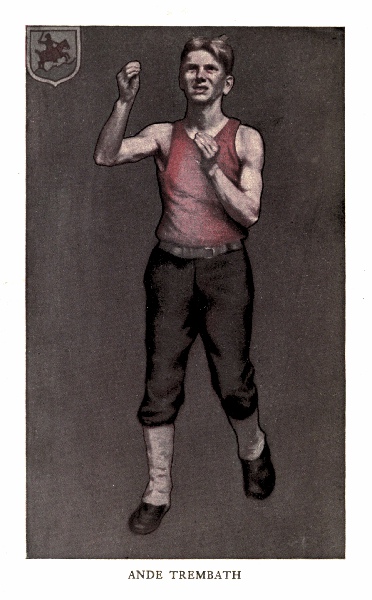
"Andrew Trembath, Esq., New Orleans."
"Richard Thomas, New Orleans."
"The one must be a lawyer," said Professor Bill, with a good bit of
respect in his tones.
"Did you notice the silent one? What a giant in size he is? He'd make an
oar fly, I'll wager, eh, Hugh?" said one of the raftsmen.
"Aye," said Hugh, meditatively.
"The one fellow is a Cornishman," said Bill.
"Whas that, Bill?" said the tavern keeper.
"A native of the southwest of England, a section noted for its minerals
and seamen."
"How do ye ken that, Bill?" asked Hugh Lark.
"Because," said Bill,
"By Tre, Tri, and Pen,
Ye may know the Cornishmen."
CHAPTER XXII
THE LYCAMAHONING
The sun arose o'er the eastern hills of Lycamahoning, a great disc of
flame, fretted with the great solemn pines and oaks of the hilltops, and
driving before it the opaline radiance of early twilight. Pine needles
lost the sombre hue of night and glistened and gleamed with a richer
emerald where the ever-shifting sunbeams touched and gloried them with
light. Trees of oak and pine, a hundred and fifty feet in height,
enveloped with interlacing branches hill and lowland, except where,
oasis-like, the fields and cabin of some squatter dappled the general
surface of woodland. A few clouds still remained on the western horizon,
dark and threatening, but the day was propitious for fine weather.
Ande and Dick, for the strangers were none other, were aroused by the
first, glancing rays of the sun that penetrated the curtains of their
little window. Flinging aside the curtain drapery, they gazed forth
delighted on the scene. Within a few yards of the house wall rolled the
roaring, yellow flood of the Lycamahoning, a mighty torrent, sweeping
beyond its natural bounds. Tree trunk and brush and what not tossed
hither and thither by its rollicking mood, yet bore ever onward. It was
an ambitious stream, for the banks could not hold it. The turnpike,
beyond the bridge, was hidden three feet from sight, and tearing through
the underbrush on either side of the public way was an ever-widening
torrent. The town was on higher ground than the turnpike beyond and so
escaped the damage of the flood.
"What a grand country, Dick, old chap," said Ande, surveying the scene
with interest. "This is better than hot Louisiana or even the
Mississippi prairies."
"Humph!" yawned Dick; "but not better than Brazil." Then as he ceased
stretching his great arms over his head; "Just think of it, Ande, if we
had not been picked up by that outward bound Brazilian ship, we would
not be independent now. Ah! diamonds and gold! That's the country, lad."
"Softly, softly, Dick," said Ande in a lower tone, "we're not going to
advertise our circumstances. A month or so here, then home to Merrie
England."
"And right glad will I be," said Dick; "but let's down and see what this
settlement in the backwoods is like."
Ande followed by Dick went cautiously down the steep stairway, that
seemed squeezed between the great chimney and the farther wall and led
out at the bottom into the public room. There was no one in the public
room when they entered, and so they wended their way across to the door
and thence out into the street, if street it could be called. The hotel
of Peter Burke was at the head of the main and only street of Burgtown,
and one walking straight from the front door of the hotel would pass
down an avenue, prolific in stumps, midway between two rows of log
houses. Back of the tavern and but a few yards from it rolled and roared
the Lycamahoning, and but a few yards from the north end was the covered
bridge. It thus stood with the homes stretching from it in parallel
lines, like a captain at the head of his soldiers. Several citizens were
abroad already with their axes and were busily felling a forest giant
that, isolated and ostracised with a few others, waved its branches in
the air above the middle of the main thoroughfare of Burgtown. Several
raftsmen with Hugh Lark at their head were standing at the end of the
broad porch gazing over toward the bridge and the rushing yellow flood,
shaking their heads dubiously at it, well knowing that there would be no
rafting either that day or the next. The flood was too high.
There was the sound of cracking and rending of wood from the
thoroughfare, a swishing and snapping of branches, a cry of warning,
then one of terror, and with a resounding blow the mighty, woodland
giant sprawled its full length on the ground. With an exclamation Hugh
Lark leaped into the roadway followed by the other raftsmen and Ande and
Dick. They were soon on the scene. There pinned to the earth under the
heavy tree trunk, unconscious, his brow streaked with blood, was a man,
evidently the chief chopper.
Women from the neighbouring homes were wringing their hands in dismay,
and then from a distant cabin came a woman's scream, a cry full of
anguish, and then a flying form burst the crowd and flung herself down
near the head of the unconscious chopper. With tender hands she mopped
the blood from his forehead and kissed his pale brow again and again,
calling by every endearing name to the unconscious one to answer her.
Hugh Lark wiped the moisture from his eyes, as did many others. Then
with the instinct of the leader of men:
"Run, Jack, and get the rope and tackle and block from the raft. Jim, go
get the heaviest crowbar from the tavern, and the rest of you men get
crowbars. Peter Burke, get to thy tavern as fast as your legs will carry
you and bring a flask of brandy."
"Can nothing be done until the coming of the block and tackle," ventured
Ande. "Is it too heavy for a couple of fellows to lift by main
strength?"
The raft pilot shook his head. "Three men could not lift the butt of
that tree, and more than three couldn't try, without doing more injury
to Tom underneath. I only hope he won't die before the rope comes."
Dick had not said a word, but he now hauled off his coat, and placing
his big arms around the butt end of the fallen tree began to exert his
strength.
"The man is mad," muttered Hugh Lark to one or two bystanders, while
they all looked and wondered.
The blood mounted to his face and forehead, crimsoning his features like
the sunrise of a rainy day, and then the veins stood out like whipcord
upon his brow and arms, but the tree moved not. There was a straining of
the eyes of Old Ironsides until they threatened to burst from their
sockets, a rigidity of the limbs that though motionless yet indicated
that the giant was putting forth every atom of his strength. The
spectators scarcely breathed. Then, even before the people were aware of
it, the tree began to move, silently, slowly, almost imperceptibly, inch
by inch, up from the fallen, injured chopper. There was a suppressed
murmur from the crowd, then Hugh with a bound was beside the injured
man, and with the assistance of Ande quickly and deftly hauled him from
his perilous position. There was a shout from the tavern. The rope and
tackle was coming, but there was no need of them. Then Peter Burke, his
cross eye glaring at the bystanders, and his other fastened upon Hugh
and the succoured one, pushed his rotund, sebaceous body through the
crowd, and with one fat, trembling hand extended to Hugh the brandy. A
swallow of the fiery liquor and the fellow opened his eyes.
"Hurt much, Tom?" asked Hugh and the chopper's wife in almost one
breath.
"Not much. Pretty well shuk up. Yes—pretty well shuk up."
They assisted the fellow to his feet, and then to his cabin home, still
muttering in his dazed fashion: "Pretty well shuk up! Yes—pretty well
shuk up."
Hugh was relieved. It was evident that whatever injuries he had
received, the shock was more than them all, and with rest he would
evidently pull through it.
The clang of a breakfast bell sounded on the morning air, and the
rafters and travellers trooped to the tavern.
The fame of Dick and his companion speedily spread through the
neighbourhood. Dick, according to rough estimates, had lifted a weight
of two hundred stone. Hugh Lark was the most affable of all. Tom, the
injured chopper, had been a lifelong friend, and this aid to a friend in
distress he could not forget.
"Ye'll come down and see my raft," said he after breakfast. "You have
never seen a raft and it'll be interesting to see how it's put together,
and how we manage it with the great oars; and then I have something to
tell you that will be, no doubt, interesting."
Together Hugh and our travellers wended their way around the tavern end,
and down the edge of the stream. They rounded a bend in the stream and
there, riding in the comparatively quiet water of the eddy, was the raft
of the night before. With a bound Hugh was on it, followed by the
others.
"Ye'll notice the way it's put together. First we square the timber
sticks after they are cut to proper lengths, then tumble them into the
water side by side, and bore these holes with the augur three inches
apart. Then we get the stoutest ash or hickory poles, green and strong,
and lay across the top of them midway between the holes, and bind them
to the timber with well seasoned hickory bows and wooden pins. Ah! I see
you are trying the oar." This last to Ande, who swung with his weight
the great oar blade from its fastenings, and shoved it to and fro. "It's
not easy work in a strong flood, and especially in the Rough Water."
"The Rough Water?"
"Aye! That's a section of the stream in the Big Lycamahoning some
fifteen miles from here, where in a course of ten miles the water rushes
with the speed of a race horse. It's most dangerous because of the rocks
and requires a steady head and a ready hand to pilot through. Yet I have
done it many a time and had no accidents. I suppose, with the exception
of old Pegleg, I'm the only pilot that can say as much," and then seeing
the look of inquiry on the faces of his auditors he continued: "Pegleg
is a one-legged pilot who feels as much at home on the bobbing raft as
he does on the land. But," and Hugh looked at his auditors kindly, "I
didn't fetch ye here for the sake alone of showing the raft. I wanted to
get you away from the prying eyes and ears of old Peter Burke and the
rest. Last night I felt little like saying much about certain knowledge
that I have, but men who have favoured our village by saving the life of
one of its citizens, and one of my best friends at that, deserve
something in return. If you are prospectors, come to my place to-morrow
evening and mayhap I can give ye the information that would be of value
to you. But not a word to any others, and especially to old Peter."
"We'll be on hand, never fear," said Ande.
There was a crashing in the underbrush of the shore, and two or three of
the raftsmen leaped on the raft.
"When do ye think we can safely start, Hugh?" asked one.
"In two days, not before. The flood will take that time to go down to a
good rafting stage. In the mean time, boys, we'll go home; but day after
to-morrow we start out for down stream."
All returned to the tavern where, after some conversation, the raftsmen
betook themselves to their homes and Ande and Dick having mounted their
horses, well rested with the night, pushed down stream, toward the west,
on a rude, half-cleared mountain trail. The road wound itself in a
sinuous line over hills and through deeply wooded glens, but always the
roar of the stream was in their ears.
"What boundless forests these are," said Ande, as they rested their
horses on the summit of a steep declivity and gazed o'er the rolling
mass of treetops. "No wonder Professor Bill was so oratorical. This is
the famous country through which Armstrong marched his troops in 1756
against Shingas and Jacobs, the Shawnese chiefs of Kittanning, and near
this section, no doubt farther south, poor grandfather lost his life. It
was a fatal mistake."
"Perhaps we shall find something in this section that will tell us of
your grandfather."
"If we do, it will be in connection with the Indian eldorado, spoken of
by my father."
They had pushed on rapidly and were now nearing the mouth of the Little
Lycamahoning. The gleam of a great expanse of water between the trees
ahead indicated their approach.
"That must be the Big Lycamahoning of which Lark spoke."
"Hist!" said Dick, "there are some wild geese on the big creek. Hear
them gabble. There must be fully a score. It's fortunate we have our
guns with us."
They were now fairly in the outer shadow of the trees that o'erhung the
trail, and the stream, swollen by the flood to three times its natural
size, stretched before them three hundred yards in width.
"You take the right of the group, and I'll take the left," whispered
Ande.
Simultaneously with the crack of their own guns another sounded from the
midst of the willows that fringed the shore. There was a confused
"Hank—Hank!" from the frightened birds as they rose in flight. A second
later, a light canoe darted swiftly from the willows, and an aged
hunter, its only occupant, gathered up the five or six birds that were
slain, placed them in his canoe, and rapidly paddled up stream. All
happened so quickly that the canoe with its aged occupant shot around a
bend in the stream and disappeared from sight before Ande or his friend
could say a word.
"Cool robbery! let's after him," said Ande, and suiting his action to
the word, he pushed his horse into the stream and swum to the other
side, followed by Dick. The trail was struck again on the other side and
up the stream they went at as fast a gait as the many stumps and fallen
trees would allow. Several times they crossed the stream by swimming
their horses. Two miles up stream the creek valley widened and the
stream, winding around the base of a hill, formed a loop or peninsula of
some fifteen acres or so in extent. Here, in a small, grassy clearing, a
rude cabin of unhewn logs greeted their vision. It was a one-storied
affair pierced with loopholes, and had a small window in the end facing
the stream. The roof of heavy hand-made clapboards, weighted down with
poles, was green with age as also were the mossy logs of its walls. The
door, a heavy affair of split timber, was ajar and near it on a wooden
settle was the figure of the hunter, a man of some seventy years. The
hair of his head and beard were snowy white, but his active frame belied
his years. He was clad in leathern breeches, heavily fringed along the
outer seams, and moccasins of the same tough material. A loose, woollen
wamus, the product of the settlements, served in lieu of shirt and coat.
His coonskin cap was beside him on the bench and he was busily engaged
in plucking the captured birds. The sound of trotting horses aroused him
from his work and he cast a keen, scrutinising, blue eye on the
approaching invaders of his little domain.
"I say, sir, we'd like to know why you appropriated our birds," said
Ande.
"Aye?" inquired the hunter.
Ande repeated the question.
"I shot these birds."
"Well, we shot some too and you seized them all."
"Ye did shoot some?"
"Yes, we did; we were on the road at the fording and fired at them."
The old man gazed at them earnestly, and evidently believing their tale,
said:
"I thought that more were killed with my shot than customary, and if ye
fired at the same time that I did, that explains my not hearing the
report of your guns. Ye are welcome to some of them."
"Oh, no," said Ande, somewhat mollified by the hunter's generosity and
explanation. "We thought you were robbing us, but it was clearly a
mistake."
"Will ye sit down; it's nigh dinner time and, if ye can eat with a lone
old man, you're most welcome. Ye can pasture your horses in that bit of
clearing."
The invitation was accepted. The horses were tethered out where they
could nibble the grass, and they returned.
"Come from afar?" interrogated the old hunter.
"From Louisiana," said Ande.
"Here hunting?"
"No, prospecting."
The old hunter straightened up as if shot, and gazed at them as if he
would pierce them through with those keen, blue orbs of his.
"What for?" suspiciously.
"Metal, either silver or gold," explained Ande, whose suspicions were
also aroused.
"Do ye think ye will find it?"
"Yes, somewhere."
"Where?"
"Along this stream."
"And do ye have any aid to help ye in your search?"
"We have little but our own knowledge."
"And your home is in Louisiana?"
"No, we came from there."
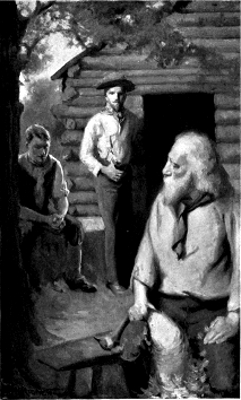 "The old hunter straightened up as if shot, and gazed at
them"
"The old hunter straightened up as if shot, and gazed at
them"
The old man arose with the birds which he had finished plucking and
cleaning, and was silent for a time while he placed them in a home-made
oven for cooking. Returning to the settle he took up the conversation.
"Ye'll find naught here but woods and hills and coal."
"Have you been here long?" asked Ande, in turn becoming the inquirer.
"Nigh sixteen years."
"How does it happen that you, a hunter, should frequent this section,
which is rapidly becoming civilised?"
"Well, the country is becoming more peopled the last year or so, but
there is still tolerable hunting. There's black bear in plenty, and
there's deer, beaver, coon, and wild birds, and then I have other
reasons. This is nigh the place where my father was slain."
"Your father was a hunter, too, then?"
"Aye, aye, he hunted some. He hunted some," went on the old hunter, more
to himself than his auditors.
"And did Indians kill him?" asked Dick, becoming interested.
"He was captured by Indians and——" The old man shook his head and
then: "Dinner is nigh ready and ye are no doubt as hungry as I am
myself." The trapper led the way into the little cabin. Everything
within was comfortable as the life of the woods could make them. A rough
oak table stood near the opened window, a pile of bear and deerskins in
one corner near the fireplace indicated the place where the aged hunter
took his rest at night, several rifles hung affectionately on the
branches of deer antlers o'er the fireplace, and along the wall ran a
slab bench cut from a split log, the rounded side down, into which was
inserted the legs. The dinner of roast goose was soon placed on the
table and the hungry men sat down and did full justice to the fare. The
old hunter fell into a stage of taciturnity from which he could not be
aroused. Toward the close of the meal the host again became talkative
and pressed his guests, if they stayed long in the neighbourhood, to
call as often as they liked.
"It's a bit lonely for an old man, and I like company at times," said
he, as they were preparing to leave. They promised to come.
The horses were soon untethered and mounting they rode back to Burgtown.
"Dick," said Ande in the privacy of their own room, "I believe that old
fellow could tell us something about father, possibly about grandfather.
I believe he knows at least something about the eldorado."
"He looked most suspicious when you mentioned that we were prospectors."
"His father was a hunter before him, and surely the one or the other
must have met him. We'll see as time goes by. We'll call upon him again
and try to worm some knowledge out of him. To-morrow we'll get
something, I believe, from Hugh Lark, that will bring us close to the
mark at least, I'm a-thinking."
CHAPTER XXIII
THE RAFT PILOT'S HOME
"Here easy quiet, a secure retreat,
A harmless life that knows not how to cheat,
With home-bred plenty—the owner bless,
And rural pleasures crown his happiness;
Unvexed with quarrels, undisturb'd with noise,
The country king his peaceful realm enjoys."
—Dryden.
There was the steady tramp, tramp of horses' feet o'er the woodland
trail and, by the moon's shimmering gleam that sifted down through the
shadowy forest screen o'erhead, two horsemen could be perceived picking
cautiously their way in the darkness of the shadow. In clear places,
where the moonlight beamed unhindered, they pressed forward into a brisk
trot and then again slowing down to a steady tramp as they plunged once
more into some shadow. The road was uncertain, filled with pitfalls,
stumps of fallen forest giants, and other hindrances that necessitated
careful procedure. It was Ande and Dick on their way to the home of Hugh
Lark, raft-pilot, and squatter on a ridge of hills, the watershed
between the Great and Little Lycamahonings that poured their floods into
the Allegheny River. The hoot of a night owl sounded dismally in the
neighbouring forest and then, as if his call was the waving of an
orchestra leader's baton, forth burst in full chorus hundreds of other
birds of night, the most with the weird song "Whip-poor-will,
whip-poor-will."
The effect was grewsome and Ande shivered slightly.
"Dick," said he, "I had a dream last night that troubled me much."
Dick was all attention.
"It seemed in my dream that I had found somewhere a pearl of great price
and I cherished it as I did my own soul. In the upper Big Lycamahoning
district I found a large, silver ingot. In seeking to grasp the ingot I
lost the pearl, and I was filled with sorrow, and then the ingot turned
into a diamond of the first water and I was glad. I awoke then, and the
sun was beaming brightly in through the tavern window on my face."
Ande ceased speaking. Dick was silent for he was thinking, and, though a
good, sincere Methodist, was slightly superstitious.
"God knows, Ande, what it all means, but it seems to me that ee'll lose
summat and gain summat better."
Dick had spoken partly in the old Cornish dialect, which they frequently
spoke when by themselves.
"Aye, I guess that's the interpretation," said Ande, thoughtfully. The
way was pursued in silence for some time, unbroken save by the tramp of
horses' feet and the whirring wings of some bird whose solitude was
disturbed.
A mile or so was passed over and then through the trees ahead was the
gleam of a light, and after a time they rode into Hugh Lark's clearing.
The log house, two stories in height, loomed up darkly in the dusk of
evening. The moonlight touched up its clap-board roof and the edges of
its huge stone chimney, lighting them fantastically, and through the
greased paper-paned window came the glow of a fire within, evidently
from the great fireplace. There was the baying of a hound, and then the
quick bark of a shepherd dog in concert, and then the door opened and
the frame of Hugh was outlined against the inner light.
"Get back, you dogs! Back to your kennel, Shep, and you, Jack, over to
the barn with you!" he bellowed, and the dogs, that looked most
aggressive, slunk off at the word of their master. The horses were soon
fastened to the rail fence and the horsemen approached the house to be
greeted on the threshold with the outstretched hand of Hugh.
"Come in, mon, come in. It's a cauld nicht, as they ca' it in auld
Scotland," and he grasped each man's hand welcomingly and drew them
within and up to the great fireplace, for though spring had come, yet
the nights were cold. Hugh had greeted them as a Scotchman can. Though a
tolerably educated man, yet he loved to drop now and then back into his
mother tongue. The pilot's wife, a comely dame but little younger than
himself, sat near the light of the fireplace busily spinning. His two
chubby children had been put to bed in the room o'erhead and the scene
within was that of quiet, home comfort. Bunches of dried herbs and a few
hams and flitches of dried bacon and deer meat depended from the rafters
of the ceiling. A few common prints adorned the rude white-washed walls
and o'er the mantle piece, supported by deer antlers, was an old-time
flint-lock rifle of great weight and heavy bore. The pilot introduced
his wife, who, having made the customary courtesy, resumed her spinning,
the whir, whir of the wheel mingling with the cracking of the fire-logs.
Hugh drew forward two home-made chairs for his visitors, and Ande sat
down, but Dick was interested in the great rifle o'er the mantle piece.
Hugh noticed his concentrated look on the old rifle.
"Aye, ye are looking at a highly prized relic in that rifle. Test the
weight of it, sir; notice the large bore capable of carrying a ball the
size of a schoolboy's marble."
Dick took down the gun and examined it.
"That rifle could tell many a tale, Mr. Dick, if it could speak. It was
my father's, Captain Ande Lark's gun. Ye ken that captains of
sharp-shooters in the days of Washington carried guns. A gun was more
use to them then than all of the swords made. Father fired the last shot
out of it in 1794, when he was mortally wounded by Indians on the
Kiskiminatas. It was this way," said Hugh, seeing the look of interest
on the faces of his visitors. "After the Revolution, the nation was
heavily indebted, and not even the efforts of Robert Morris could save
the nation from financial ruin had not many patriots, among whom was my
father, withheld their claims for service. Some speculating jobber
offered to trade father a thousand acres of land, where Braddock met his
defeat, for the com mission papers and his claims. Father accepted, and
loading up his goods on a flat boat he floated down the river
Kiskiminatas. He was attacked by lurking savages along the river side
and, although he succeeded in bringing down several of them by bullets
from 'Old Thump,'"—and the pilot waved his hand expressively toward the
old rifle,—"yet he received a wound himself from which he afterward
died."
Hugh Lark was silent and his usually pleasant face was sober and sad.
There was a long pause, unbroken save by the puffs and clouds of
ascending tobacco smoke.
"Light the lamp, Mary," he at length said.
Mrs. Lark arose from her work and took from a receptacle in the wall a
species of lamp much used by the woodsmen. It consisted of a turnip,
split, and hollowed out within. A stick, around which was wrapped a
strip of oiled linen, was inserted upright in the centre, and the vessel
having been filled with deer grease was ready for use. The visitors
gazed at this primitive vessel, that at best gave forth but a dismal
light and a far more disagreeable odour.
"Candles are too much of a luxury for us at present, so we still use the
old turnip lamp. But to get down to business. I wanted to speak to you
of prospecting."
Hugh poked the fire logs a little, and Mrs. Lark arose and brought in a
pitcher of home-made cider and some drinking vessels, and then retired.
"Ye must ken that the Indians kenned more of this country than we do,
having lived here longer," said Hugh, as he raked a brand from the fire
and lit his pipe; and then without pausing for an answer he continued:
"I have read much for a backwoodsman and know of how the spirit of
jealousy has ruled nations as well as people. The same spirit of
jealousy that led the Asiatics to conceal from Europeans their arts and
sciences is within the Indian breast. The Phœnecians, so I have read,
hid so truly their art of making their beautiful colour called
Phœnecian purple that to-day we know nothing of it. The pyramids
to-day are monuments of the lost sciences of the ancients. There is much
wealth in the hills of the country, known to the Indian alone. Father
thought the same as I did and was convinced of it by a wound he received
in an Indian expedition with the famous Sam Brady. His wound was probed
and the bullet ye see tied to the old lock by a cord was the one taken
out of the wound." Both examined the silver bullet that was attached to
the lock of "Old Thump."
"He found the mine. Then you know its location, Mr. Lark?"
"Perhaps we had best have an understanding first, before I say much
more. If ye are agreed to give me a fair share with yourselves we will
go ahead."
"We are perfectly agreed, and more. If you give my friend, Dick, a
share, I desire nothing."
Hugh looked mystified at Ande and said partly in the Scotch dialect,
"And ye're not after the siller yoursel'?"
Ande seeing that he must explain, related the tale of his grandfather's
dishonour, and Hugh, with various nods and puffs, listened.
"Aye, I see, I see," said Hugh; "and ye think the unearthing of this
Indian mine will bring to light your family honour. Ye said the other
night that ye were prospecting for character, and we thought it was a
joke on the tavern keeper," and Hugh's features relaxed into a smile.
"But now for my tale. Indians appear here, from the Shawnee tribes in
the west, every few years. They remain for a time and then disappear.
Some say they come for hunting, some for to visit the graves of their
tribe, but I always had my own opinions. Some years ago there was a
great flood and we raftsmen went down to get the rafts in safer
positions. I was busy piloting when I thought I saw something out on the
waters. It was not a rock nor a piece of driftwood, and after I had
almost wearied my eyes I saw it was the head of a man. I gave the oar to
Tom, the fellow ye saved from the tree the other day, Mr. Dick, and
flung out a rope. It fell nigh the fellow and we dragged him in, and if
it wasn't a half-breed Indian, a Canadian, so he afterward told me. He
was far from his tribe and people and had hurt himself in some scrimmage
or other with a wild animal. After we got the raft safe in good
quarters, we took him up to our place here and nursed him for many a day
until he was ready to leave, and then he showed what stuff he was made
off. He wanted to reward me for my kindness. By his directions I got
some paper and a pen and drew off a rude map of the Big Lycamahoning
region. After it was made he put his brown finger on a certain section
and said, 'If white man know what under there they shoe their oxen with
silver.' Here's the map," and Hugh took from an inner pocket of his
woollen wamus a rude roll of paper which he spread out for their view
near the old turnip lamp. Ande took out his father's map and compared it
with the other.
"Ye have a map, too," said Hugh.
"The one sent me years ago by my father."
The two maps coincided in all the essential features.
"And now we know the place and the only thing that remains for us is to
set the date of going on our search. The first night of the full moon
would be best suited to our purpose. And there must be another let into
the secret, for we can't get along handily without the use of the only
canoe on the Big Creek, and that's Hunter Tom of the Loop," said Hugh.
"Who's Hunter Tom?" asked Dick.
"He's a queer old character, and has been in the neighbourhood of the
Big Creek for the—well—as long as any of us around here, and for a
great time longer. He's a hunter and has a cabin over in a little
clearing alongside of the Big Creek."
"The very man we ate dinner with the other day," said Ande, and turning
to Hugh he related the circumstances of their adventure.
"The very same man, and a better guide and hunter none ever saw,"
replied Hugh, emphatically. Good-nights were now spoken, and, mounting,
the young men rode back to Burgtown.
CHAPTER XXIV
THE HUNTER OF THE LOOP
Several times had Ande and Dick visited the old hunter's cabin in the
Loop, and there was a growing friendship between the old trapper and the
young men. They told him quite a little of their travels, but never
mentioned the mines of Brazil. Once the hunter mentioned that he had
been a soldier under Brock and had been a hunter ever since. New hope
sprang up within the breast of Ande. If this old hunter had been in the
service of Brock and had travelled the American wilds for such a time he
must surely have met his father. At length the question found utterance.
"You were in the service of Brock. Did you ever meet one of my name
either in the army or afterwards. My father was in his service and
possibly you may have met him."
"One of your name,—thy father? No, no, Mr. Ande, I know naught. None of
that name has ever met me."
Ande, having received this reply, had not the temerity to push his
inquiry further. He admired the old hunter for his kind disposition, and
especially because he had seen service under Brock. He had frequently
tried to get him to relate tales of battles and adven tures, but the old
man was of a taciturn nature, a quality born in him by his years of
woodcraft. But his taciturnity did not hinder their intimacy or his
friendship. He had given them rare treats in canoeing; night after night
they had dropped down with the stream to the shelter of willows, and
secure from observation had quietly awaited the coming of the deer to
slake their thirst at the margin of the stream. On one occasion he had
taken them with him through the Rough Water, shooting the rapids with
consummate skill, and pointing out to them the marks of interest, such
as Pilot Rock or Shawnee Rock, Driftwood, the Sluice and others.
It was the evening just before the full moon when they made their last
trip, still-hunting for deer. They had dropped down with the current,
and had just secluded their craft beneath the willows when harsh,
guttural, sometimes musical voices were heard on shore, at some
distance. The old hunter placed a warning hand on the shoulder of Ande,
and with the whisper of "Hist!" they listened. Bidding the young men be
silent, and on no account to move from their position, the old trapper
slipped up o'er the bank and in an instant was gone from sight. The same
voices continued for the space of many minutes without interruption, and
then, as cautiously as he had withdrawn, the hunter returned. With
finger on his lip to indicate silence he cautiously dipped the paddle,
and they moved silently up stream, skirting the willows in their
journey. When beyond hearing distance he spoke in audible tones.
"The Shawnese are in the land. They must have come up from the Ohio."
"But they are peaceful, no doubt?"
"Aye, they are peaceful; but I always mistrust them. The cruelties they
heaped upon my father and the cruelties that I have witnessed at their
hands have always made them hateful to me."
"How do you know that they are Shawnese?" asked Dick.
"How do I know, lad? I have had more dealings with the Indians and the
Shawnese than any one around this section. I remember the time I met
Tecumseh and his brother, the Prophet, in the Ohio region years ago, and
their language is as familiar to me as my own. The silver mine that the
pilot was a-telling ye of was even then current among them, but more as
a legend than as an active fact."
"The silver mine?"
"Aye, the silver mine. Haven't I searched for it, and found it not. I
searched for it until I was weary, and then I gave it up. Of what value
is silver or gold to me now. My friends are all dead, and I, myself,
have not so many years to live that I should delve after the curse of
earth. Two years after I left the old Dart I swore, on the receipt of
news of the death of my dear ones, never to return, unless,——" The old
hunter was silent.
"Unless?"
"Not unless I accomplish my purpose here. I came not here as a hunter,
lad, alone;—there were other pur poses, vain probably now." There was
an element of sadness in the hunter's tone. "And yet I should like to
see the old home once more. It is very dear to me."
"'Ah, happy hills! Ah, pleasing shade!
Ah, fields beloved in vain!
Where once my careless childhood strayed
A stranger yet to pain!
I feel the gales that from ye blow,
A momentary bliss bestow,
As waving fresh, their gladsome wing
My weary soul they seem to soothe,
And redolent of joy and youth
To breathe a second spring.'"
"Why, Hunter Tom, that's Gray's Ode to Eton College," said Ande with
increased respect.
"Aye, sirs, ye are a bit surprised to hear an old backwoodsman and
hunter quote that, but I have a right to it, for I was an Etonian,
myself, in younger days."
The keel of the light canoe grated on the rocky shingle of the Loop
shore. Hunter Tom had insisted on going straight to his cabin on his
discovery of the Shawnese. The young men waited until early dawn and
then started for Burgtown. On the way they met Hugh Lark astride of his
gray mare.
"Hallo! hitting the trail as usual! Well, we'll have a different trail
to-night. We meet at Hunter Tom's place at eight o'clock and set out
from there. See ye to-night," and Hugh was off up the trail.
"Hunter Tom is a queer character," said Ande to Dick, as they continued
their way. "He's a combination of the old hunter and the scholarly
civilian. It's a wonder we never heard of his scholarly attainments
before."
"From what I have heard, he doesn't mix up with the people around here.
What a marvellous woodsman he is, and how silently he approached the
Shawnese camp!"
The log houses of Burgtown hove in sight, and they dropped all
conversation as they rode up through the double row of log homes and
alighted at the tavern of Peter Burke.
CHAPTER XXV
EUREKA! THE ELDORADO!
"So the boat's brawny crew the current stem
And, slow advancing, struggle with the stream;
But if they slack their hands or cease to strive,
Then down the flood with headlong haste they drive."
—Dryden.
It was still early dawn when Hugh Lark reached the hunter's cabin.
Hunter Tom was cleaning his rifle and before the door was a pot of lead
melting o'er a slow fire. A bullet mould was lying near by ready for
use.
"Halloo, Tom!" said Hugh, as he dismounted.
"Good-morning," said the old hunter, a little curtly and yet with some
dignity, for he liked not the unceremonious manner of Hugh, though Hugh
was the only intimate acquaintance he had resident in the neighbourhood.
"Going hunting?"
"No," said the old hunter, a little more friendly. "I was down the creek
and saw some Shawnese."
"Why, ye don't expect a brush with them in these days of peace?"
"I tell ye," said the old man, testily, "those were the enemies of my
father and, peace or no peace, I trust them not unless I have Brown
Bess ready and a quantity of powder and ball nigh at hand," and he
continued his polishing and oiling.
"Well, we have some work and we would like to have ye along, if ye can
go." The old man made room for him on the rude bench, and looked at him
inquiringly. Hugh related the purposed expedition.
"And ye think there is a silver mine, and ye want me to help find it,
and if I do I go fair shares?"
"Aye," and Hugh nodded. "Ye see there are two young chaps, travellers,
prospectors; they say they know ye——"
"Aye! ye mean the English travellers, Mr. Ande and Mr. Dick."
"Well, ye see they are prospectors and know the real stuff when they see
it."
"So they told me," said the old man, nodding.
"Well, we want ye to go along and use your big canoe. I calculate
between your intimate knowledge of the section and their prospecting
science and my divining rod that we can get at the bottom of this.
To-night will be full moon and we would like to start from your place
for up stream about eight o'clock."
"Aye," said the old hunter, but he looked a bit dubious when Hugh
mentioned the divining rod. Hugh was a firm believer in the accuracy of
the rod that he had constructed. It was witch-hazel, curiously carved
and with a bit of silver at the end of it. The principle, according to
Hugh's statement, was like attracted like.
"Well, I'll go," said the old man, after some thought. "I warn ye,
though, to take your guns with ye, for the Shawnese are here."
"Oh, they'll give us no trouble, but we'll take our guns. There may be a
chance of shooting a deer or so," said Hugh as he departed. The old man
shook his head, forebodingly, as Hugh's form disappeared down the trail.
On his way back to Burgtown the pilot met the Shawnese, a full fifteen
in number, great, strong, athletic fellows, but beyond a brief, cursory
"Howdy!" and a glance they passed on.
At about seven o'clock that evening Hugh Lark rode up to the tavern of
Burgtown. Burke, the tavern keeper, met him at the entrance.
"Going rafting, Hugh?"
"No. Air the two strangers here?"
"Been rafting?"
"No. Air Mr. Ande and Mr. Dick here?"
"But ye surely have more rafts to run, Hugh?"
"Ye ken well enou' that I'm not a-going rafting. How could I go rafting
a-horse-back. But perhaps ye think that I can get the gray mare to pull
an oar, and I've no doubt that she could do that, for she has a heap
more sense than some men I know that are not very far from me," said
Hugh, exasperated.
"Yes, the mare has great sense," replied Peter, gazing at the animal
with a bland eye. "I kalkilate you uns air going to find that mine,
Hugh?"
"We are going a-hunting," said the nettled Hugh.
At this moment Ande and Dick came forth upon the long porch, and Hugh's
anger was mollified.
"Are ye ready?"
"Yes," said Ande, and the next moment two horses were led around to the
front by the stable lad and they vaulted into their saddles and prepared
to leave.
"I say, Mr. Ande,"—the tavern keeper had the habit of calling them by
their first names, perhaps from Hugh's custom—"I say, air you uns
a-going hunting fer thet mine?"
Ande gazed at the curious tavern keeper gravely and then responded:
"The primary intention of our nocturnal expedition is to reconnoitre the
situation of the argentiferous fissures indigenous to this locality, the
elucidation of which will be beneficial to us and of salient value to
the community at large."
"Oh, I thought you uns were a-going to find the mine," said Burke,
apologetically, and as they rode off he said, to himself, "Wot
langwidge! wot a scholard! He beats Bill, but,—dang it, if I believe
they're going fishing, though. They hain't no hooks or rods and who ever
hearn tell of a man going fishing with a gun."
So saying, he went within.
The sun had gone down and twilight was creeping on, enveloping the earth
with its soft hazy light, as the three rode over the lower bridge and
o'er the trail to the forks of the creek. The moon was not up, but it
was twilight still when they forded the Big Creek and turned up the
trail to Hunter Tom's cabin. A short distance, and a glimmering light
penetrated the trees and underbrush ahead.
"Some one on the trail," said Dick.
"No," responded the pilot, "'tis a light from Hunter Tom's cabin. The
old man must be getting ready to start."
The light was dimmed by a brighter effulgence beyond. A rim of silver
shoved itself above the neighbouring hills, and then a semi-circular
disc, gradually growing in brightness and flooding hill and ravine with
mellow light. Giant boulders and tree trunks were silhouetted against
its rising disc, and on a tree branch just athwart the centre was,
grotesque and huge, the figure of the lone bird of night—an owl.
"Plenty of light to-night," said Hugh.
"But not more than we need; the search will require all the light we can
get," said Ande.
They arrived at Hunter Tom's cabin and dismounted. The horses were
hobbled and turned out to graze in the clearing. Tom, hearing the noise,
opened the door, and cheerfully welcomed them within. The hunter was
clothed in his customary fringed buckskin and home-made moccasins, but in
his belt, in addition to the usual hunting knife, was a small Indian
tomahawk.
"Why, Tom, one would think ye were on the warpath," said the pilot,
jokingly.
"Aye, and a warpath it may prove," soberly, and then seeing the look of
the pilot concentrated on the tomahawk in his belt: "This tomahawk I
secured in the Indian country of the Ohio in 1812. It is an effective
weapon."
"But surely you don't expect a fight," said Dick.
The old man shook his hoary locks mysteriously and muttered, "The
Shawnese."
By the light of the turnip lamp the pilot brought forth his map and
spread it out on the rough wooden table. The hunter scanned it
approvingly, and then:
"Where did ye get it, Hugh?"
The pilot related his experience with the Canadian Indian, and the
hunter nodded his head as the pilot repeated the Indian legend and
directions.
"I know the place so well that ye have no need of a map."
"Ye ken the place without a map?" said Hugh.
"Aye! haven't I searched for it full eighteen years ago, and ten years
ago, before there was a settler in the region; I hunted until I was
weary. If ye find no more success than I found, ye will have your labour
for your pains. But we can try. The place where we will land is there."
The hunter placed his knotty finger on a portion of the map. All crowded
around the table.
The old hunter's finger was placed on the map at the mouth of a small
stream. A moment passed in silent contemplation.
"And now we must be off if we would do much to-night." The old hunter's
words aroused all to action. A couple of pickaxes, a shovel and a
crowbar, that were in readiness, were shouldered by the pilot, and Dick,
at the hunter's suggestion, took up an old tin lantern, pierced with
holes and having a candle within, to be used in an emergency. The hunter
carefully extinguished the turnip lamp and drawing the door shut behind
him led the way to the canoe. The tools were placed in the stern and
then the pilot, followed in regular sequence by the hunter, Dick and
Ande, took their stations, and soon under the steady sweep of four stout
paddles the canoe, though heavily laden, glided up stream.
The evening was still, save for the cry of some wild bird of night and
the plash of some wavelet breaking on the shelving shore. Trees and
shrubbery, underbrush of the shores, glided by slowly, and were
swallowed up in the obscurity of the regions passed. Here and there with
a skilful sweep of the paddle the pilot changed the course of the canoe
to escape contact with some rock or sunken log. Now and then the hunter
would give a sign of silence, and the paddles in their incessant sweep
would be stilled into inactivity, while the canoe would drift for a
moment until the hand of the pilot in the bow grasped some over-swinging
tree branch and stayed her downward course. A moment of silence, in
which the hunter strained his ears, would ensue, and then with a shake
of the head he would give the sign to proceed. Once he insisted much to
the protests of the pilot of going ashore. They drew in to the heavily
wooded bank and he disappeared with no change on his immovable
countenance. The pilot grumbled to himself at this unnecessary caution.
The old man was in his dotage or had become filled with childish fear,
thought he, and so he informed the others when the hunter was absent.
Who was going to hurt them? Not the settlers, for they were all safe
abed by this time. Not that wandering band of Shawnese. It would be too
perilous for them in these days of peace and in a section already
vacated by their fathers to make room for the settlers. After the first
hour the work of paddling became less arduous, the force of the current
had abated, and they shot into a long stretch of slightly moving water.
"Still Water," said the pilot. "It'll be easy from now on until we reach
some distance above."
"Aye," murmured the hunter; "but it'll not be still for long."
"No sign of rain; the sky up there is so closely studded with stars that
there's not room for a cloud. There'll be no rain, or I'm no pilot.
Haven't I piloted here for years, and before I came to this region I run
as many rafts down the Susquehanna as any raftsman in the State."
The hunter raised his hand as if deprecating the sound of the pilot's
voice, and then said in low tones:
"I have lived in the cabin at the Loop for nigh ten years, and have
tramped these regions before my cabin was built, and I can read the
stream as well as a scholar reads his book. In three hours what we call
the 'Still Water' will be running like a mill race."
The pilot smiled a smile of superior wisdom.
"Look," said the hunter, as he dipped his palm in the water and drew up
a little for the pilot's inspection. "The stream is turbid and
discoloured, the first sign of the coming flood. There has been great
rain at the headwaters. I can see it in the water; I can smell it in
the air."
The pilot's smile left his features and he scanned the bosom of the
Still Water and then:
"There's some truth in that."
"Aye," said the hunter, "and if we would get to the place we must paddle
as strongly as possible. There's the swifter water beyond."
All bent to the paddles again with renewed efforts and the Still Water
was soon passed, and the heavier paddling in the swifter water of the
upper stream followed. Now they were in the shadow of some towering hill
or under the dark tree boughs—that interlaced and formed a dark canopy
overhead; now again the canoe shot out into a flood of pale moonlight.
The latter the hunter disapproved and the pilot, grumbling, changed the
course at times, avoiding the moonlight sections of the stream for the
shadowy regions along the shores. At length the hills receded from the
stream on the right and gave place to a gently rising plain, burdened
with oaks and wild grasses, while the hills to the left seemed to be
higher and more precipitous than those down stream.
"The place is nigh here," said the hunter.
They rested on their paddles for a moment in the shadow of a great
boulder that stayed the downward drift of the canoe. Ande and the pilot
instinctively felt for their maps and tried to refresh their memory in
reference to the directions, but the dim light almost made it useless.
Hunter Tom, in the meantime, was scanning the stream and shores and
seemed to be ill at ease.
"The mouth of the little run is but a dozen rods up stream. Ye can put
away the maps, lads, for I know the place." At the words of Hunter Tom
both Ande and the pilot dropped their maps in the canoe, and all bending
to the paddles while the hunter with his keen sight directed their
movements, they moved on. Then came the babbling, rippling sound of a
little run as it leaped, gurgling with delight, into the stream, like a
child into the arms of its mother. The craft was turned to shore and
soon grated on the pebbly beach. They stepped ashore and stretched their
cramped limbs, while Hunter Tom tied the canoe to a swaying pine, and
then pursuing his directions, they followed up the run. Ten yards up the
run a divided oak was located.
"Now," said the Hunter, as he gazed around uneasily, "fifty yards due
north."
Dick, having a pocket compass, now took the lead, following a course due
north, and in the rear was the pilot balancing his divining rod, while
Ande as closely as possible measured the distance. Hunter Tom, taking
little interest in the affair, seemed to concentrate his attention on
the trees, underbrush and regions around about.
"'Tis here, as near as I can calculate it, that the fifty yards end,"
said Ande.
"And the divining rod says the same, and it tells truth," said Hugh, the
pilot, with a little triumph in his tones.
"My calculations, heretofore, located the spot a bit beyond," said the
hunter, with the first interest he had betrayed since they landed. "Ye
may be right."
Dick and the pilot grasped the pickaxes and set to work with vigour,
while Ande used the shovel and occasionally removed with his hands some
large boulder that impeded their work. The hunter seemed to constitute
himself watchman and was incessantly on guard. The work went on for an
hour, and considerable debris was removed when Dick's pickaxe slipped
from his hands and disappeared from sight. With an exclamation he leaned
forward and found that it had disappeared in an old excavation a few
feet in depth. The excavation was widened and the pilot, leaping in,
began to work with increased vigour. Hunter Tom now became as deeply
interested as the others. It was at a spot that he had not investigated
before. That old excavation must mean something, he thought.
There was the sound of a metallic click as the pilot's implement struck
something hard. With an exclamation of "I've found it," he reached down
and grasped something which he handed up to Ande for investigation. It
was a small tobacco or snuff-box of ancient make.
"Time enough to look at that when we find the ore," said Ande, as he
placed it in his inside pocket. The work was again resumed. The labour
of excavation now became harder and Dick with his great strength took
the pilot's place. At length a peculiar, grey, metallic substance
rewarded their labour. A handful of small cubes and octahedral pebbles
were passed up for inspection.
The tin lantern was lighted and around about clustered the pilot, Dick,
and the hunter, while Ande held the handful close to the flame.
"The grey, metallic lustre looks like silver glance. It may be the
blossom of sulphide of silver or sulphide of lead. We ought to have
daylight for a better examination," said Ande; "now——"
Crack! Crack! Crack!
Crack! Crack! Crack!
There was the whistling of bullets in the trees around them, and
spiteful thuds as leaden missiles flattened themselves against the
rocks. The lantern fell with a crash to the ground, perforated with a
dozen bullets. The candle sputtered and went out.
"Quick!" shouted Hunter Tom. "'Tis the Shawnese. Aye, I feared it."
The pilot grasped his rifle and the prospectors theirs.
"This way! To the canoe!" roared Tom, and slipping from tree to tree,
they reached the landing in breathless haste. Then came a yell that
echoed through the hills, a yell—hellish and replete with rage.
Trusting in their numbers, scorning concealment and fearing their
victims would escape, the Shawnese charged after them. At the landing
there was a sanguine scene, and now it was that old Tom showed the
experience and skill he had gained in the Ohio region. Stationing
himself behind a tree the old hoary-headed hunter fired, loaded, and
fired again and again, and each time by the yell the bullet had found a
mark. But the Shawnese were now close at hand and a hand to hand
conflict ensued that was savage in the extreme. Hunter Tom seemed to be
possessed with the fury of a madman. The presence of the foes that had
tortured his father seemed to fill him with a wrath that was demoniacal.
With clubbed rifle he beat back the foremost and sent him to the ground,
lifeless, then with a swift turn he flung the useless weapon into the
canoe, and with knife and tomahawk gave blows right and left. Swifter
than a weaver's shuttle the bright weapons flashed in the pale
moonlight. Nor was the hunter alone active in the fray, for Dick—great
Dick, made more effective use of the butt of his gun than the muzzle by
using it as a farmer would his flail. Ande and the pilot, for a time,
had fired from a natural breast-works of boulders along the shore, but
the proximity of the enemy was so close that they, too, were compelled
to resort to the butts of their guns. At one time the pilot was down,
but the dusky face over him went down a moment later under a crashing
sweep of Ande's gun. The desperate valour of these few men was beginning
to tell upon the spirits of their foes. One-third of their number were
upon the ground, dead or helpless. There was a shout and a few
unintelligible words among them, and then, as if in concert, they began
to retreat slowly, followed by the impetuosity of Dick and Ande. Tom
thanked his good fortune then for his understanding of the Shawnese
tongue; he understood their plan to draw them from the shore and to give
chance for two or three skulking forms to gain the rear.
"To the canoe! Back for your lives!" he shouted, and simultaneously
rushed for the shore. Dick and Ande were either too confused by the
yells around them or hard pressed in the conflict to give heed. Not so
the crafty pilot. With instinct he seemed to understand the import of
the retreat, and rushed headlong into the water after the canoe. The
rope by which it was attached had stretched itself to its full length
and the canoe had edged out by the force of the rising current. He had
almost reached it when a shot rang out from the shore, and the pilot,
flinging up his arms, plunged into the muddy tide. Hunter Tom who was
next to him, tried ineffectually to grasp his falling form, but the next
moment the swirling waters bore him away. There was no time for regret.
The canoe was hauled in and Tom in its bow, with knife ready to sever
the rope, looked shoreward for his friends.
Ah! What a scene! A sight that, though it filled the old hunter with
alarm, yet thrilled him with admiration. Ande, apparently deeply
wounded, was on the ground and Dick—did he ever appear so heroic?
Standing head and shoulders above the tall savages, he seemed like a
pine surrounded by scrub oaks. Nor was the giant Cornishman idle for,
like a child's toy, the heavy rifle whirled and whistled around his head
and shoulders. Death lurked in its sweeping circle. Nor was strategy of
any avail. One sought to run in under his guard, while another was
receiving the attack, but the attacking party went down under a terrific
swing, while the stooping, swiftly moving strategist received, the next
moment, a jolt from the end of the gun barrel that was as disastrous as
the blow of the butt. Four had already fallen under those sweeping
blows. Old Tom paused not for an instant. While some occupied Dick's
attention in front, one or two were edging toward the rear, and should
they accomplish their purpose the end was certain. With a cry of "Have
at them," the hunter leaped from the canoe, beat off the skulking forms
in the rear, and then reaching down he grasped the unconscious Ande,
like a father would a child, and hurriedly placed him in the canoe.
"Back, Dick, lad!" he shouted as he pushed out a little from the shore.
Dick heard the call, and with another sweep of his weapon cleared a
broader circle, but the rifle unused to the unnatural strain, broke at
the lock. Flinging the shattered piece in the face of an advancing enemy
he leaped to the shore. Two Shawnese, one a powerful built fellow,
strove to intercept him, but there were other defences.
Crack! A shot rang out from the canoe. It was the trapper's gun that
spoke, and one fell under that unerring aim. Crash! went Dick's great
fist on the countenance of the other, and the dazed Shawnese sat down in
a heap. Hunter Tom could have laughed then and there at the repulse of
the latter, but there was not much time for sentiments of any kind. Dick
had leaped into the stream after the canoe and was pushing toward it
through the swift current. There were a few yells of disappointment on
shore, and then a perfect fusillade of bullets hissed spitefully on the
waters and crashed through the underbrush on the farther shore and
then—like the falling of a forest giant that had felt the biting
steel in its vitals, Dick fell. He struggled for a moment to reach the
hunter's outstretched hand and then sank, and the swift current, now a
roaring turbulent, gyrating mass, swelled to foaming madness by the rain
at the headwaters, whirled his great body under the bellying bow of the
canoe—and he was gone from sight.
With a quick sweep of the knife Hunter Tom cut the rope, and the canoe,
freed, bounded away on the surface of the flood like a thing of life.
Carefully pillowing Ande's head on his rolled up wamus in the rear, he
lay down in the bow and with one hand over the gunwale, holding the
paddle, he sought to guide the swiftly floating craft, while with his
head slightly raised he kept a keen lookout for the bodies of Dick and
the pilot. The Shawnese kept up a running fire on shore for the distance
of a half a mile, when the fire slackened, and evidently the swiftness
of the current and the gloom cast by the heavy foliage overhead had
caused pursuit to be abandoned. The Still Water was reached and the aged
hunter perceived with grim satisfaction that his prediction had come
true. What was some hours before a still, softly flowing body was now a
rollicking, turbulent mass that glowed with a yellow, dunnish hue in the
moonlight. Onwards bounded the canoe, the hunter guiding it with
unerring hand, now avoiding a towering rock, now bending with the full
power of his muscles to guide the craft around a sharp bend in the
stream. Fear of pursuit having long been left behind, he had arose to a
sitting posture, and was lending to the onward force of the current the
might of his own arms. No vessel ever scudded before a gale faster than
the canoe on that eventful night. Once the sole, lone canoeist thought
he saw the body of Dick floating before him on the surface of the tide
and he redoubled his efforts to overtake him. The object was reached,
but proved but a piece of driftwood, darkly dappling the yellow flood.
With the first feeling of relief that he had experienced that night he
saw the winding course of the Loop before him. Once more the paddle was
brought into vigorous requisition, and then with a sigh of relief he
turned the prow toward shore and the keel grated on the shelving beach.
Tenderly he lifted Ande from the stern and laid him on the sward, then
turning to the canoe he lifted it bodily from the water and, taking it a
few yards inland, hid it securely in the underbrush. Then returning to
his unconscious companion he carried him to his cabin home. Knowing that
he dared not leave his wounded friend, and yet wishing to arouse the
citizens of Burgtown, he went without, unhobbled the horses, and with a
smart blow sent each galloping home to town. This done he returned to
the cabin, barricaded the house, both window and door, loaded his rifle,
and feeling secure, turned to resuscitate the wounded man. With a
woodsman's skill he laboured through the long hours of the night until
the dawn appeared, examining, with muttered commentations.
"Ah, a wound in the arm. It could not have been the last. A brave young
man and fought like an old Indian fighter. Aye, another wound in the
leg; 'tis only a flesh wound and will heal soon or old Tom doesn't know
his art. And here's a slash of a knife in the breast. Ah! 'twas a cruel
stroke, that. But none of them are strong enough to lay such a man out.
He has the strength of a young lion and Tom will bring him through. But
what's this?" In handling the unconscious man's head the hair had fallen
aside and revealed the stroke of a tomahawk or knife. "Zounds! A ghastly
wound that. It must have stunned him." With water taken from an earthen
basin in the corner of the cabin he bathed the wounds, poured in some
healing lotion and bound them up with a rude skill. Then, having poured
a little brandy down his throat, he began to chafe his hands and wrists
until, with the glimmering light of dawn, the light of consciousness
returned.
"Where am I?"
"Safe here in my cabin, lad."
"And Dick and the pilot?"
"They are gone, my lad, the Lord knows where," answered the old hunter,
and with his eyes glistening with tears he related the closing scenes of
the fight, and how Dick and the pilot were shot and swallowed up in the
flood.
"Poor Dick—I have lost in him the pearl, and my dream is fulfilled."
He sank back in weariness and closed his eyes. Suddenly the wounded man
started to a sitting position and whispered with excited face:
"The Shawnese. Don't you hear them, Tom, Hunter Tom? They are stealing
through the woods and around the house. I hear them. Give me a gun, and
we'll defend the cabin."
The effort was too much, and he sank back again on the couch of
deerskins in a semi-conscious condition.
Tom, too, had heard something, but it was not the tread of Indians. The
next moment there was a shout without and the clatter of approaching
horses' feet. 'Twas the settlers.
CHAPTER XXVI
THE RISING
"All parts resound with tumults, plaints and fears;
And grisly death in sundry shapes appears."
—Dryden.
There was great excitement in Burgtown. The old tavern keeper had found
three horses without his door, standing there jaded, tired, in the early
dawn. He recognised them as the animals of the pilot and the two
prospectors. Around the tavern's long porch were assembled Professor
Bill Banks, the town citizens, and several outside squatters, a motley
assemblage, listening to old Burke's recital. The tavern keeper was
filled with importance, for once he was the centre of attraction and
seemed like a Fourth of July orator, so breathless did all seem to hang
upon his words. His round body was swelled to greater proportions as he
proceeded, in a roundabout way, to narrate what he knew of the affair.
"It war this way. The pilot, Hugh Lark, he kem a-riding up about dark
last night and asked fer the strangers, whether they was to home in the
tavern. He seemed powerful anxious to have them right away. 'Going
rafting, Hugh?' sez I, social-like. 'No,' sez he; 'air Mr. Ande and Mr.
Dick in?' 'Been rafting?' sez I. Then he fired up, mad-like, and talked
about the grey mare of hisn being able to pull a oar as good as any
raftsman. I had my doubts of that, though the mare has a heap of sense.
But I thought he war joking, and I guess he war. About that time I up
and asked whether he war a-going a-hunting for the mine. You see the
strangers air pros—whatever it is—I mean they war miners, and we uns
had the idee that they were a-searching for something of that kind. He
up and sez, short-like, that he warn't and that they war just going
hunting. 'Bout this time Mr. Ande and Mr. Dick come out, and their
hosses were brought around, and they jumped on, and then I thought I
would ask Mr. Ande, being as he war allers social-like. 'Air ye going to
find thet mine, Mr. Ande?' sez I. Then he up, and in high larndt
langwidge, told we uns about their going after some kind of fishes, but
I ne'er hearn tell of a man going fishin' without hooks and with a gun
and——"
"Come, cut it short," said Professor Bill, impatiently. "At what hour
did they go?"
"'Bout seven o'clock last night, and——"
"And when did the horses return?"
"Well, if I do hev to say it——"
"Come," said Bill, with the authority of a leader, "when did they
return?"
"Well—I kalkilate 'bout five o'clock in the morning, leastways they
were here when we uns got up."
"And which way did they go?"
"Well, ye see, Mr. Ande, who is a great scholard and high larndt,
he——"
"Egregious dolt! Vociferous driveller!" exclaimed Bill, in exasperation,
"can't you say which way they went."
"Gosh, what langwidge!" murmured the tavern keeper in excessive
admiration of Bill's explosion, but seeing that Bill was getting angry
he answered quickly: "As I live, Bill, I think they went down creek to
old Hunter Tom's, seein' as Hugh war fond of Tom. Leastways they went
that way and——"
Old Burke's words were drowned in the commands of Bill.
"Every man get his horse and gun and we'll start in five minutes. Others
can follow. We go to Hunter Tom's place. Perhaps some accident has
happened. Fetch me some brandy, Burke; if they are hurt they may need
it."
Rapidly the men collected, and under the able generalship of Professor
Bill Banks forth they sallied. The tavern keeper watched them gallop
down the town road and thunder over the lower bridge, and when they had
disappeared among the trees of the farther shore he entered the tavern.
"Wot a scholard Bill is," he murmured as he endeavoured to write down
his learned words. "Egg—egg—" he murmured, and then he slowly allowed
his tongue to follow the twisting, uncertain movements of his quill pen.
"It's no use," he said, as he flung down the quill; "Bill will hev to
write her down fer me. Wot a scholard! He'll be a Congressman yit."
Bill and his men in a short time reached the hunter's cabin in the
Loop. Tom, hearing the shout of familiar voices, flung open the door,
and in a few, brief words narrated the adventures of the night. They had
been up the creek, he said, and had been attacked by Shawnese. About the
object of their night expedition he was silent.
The news of the presence of Indians in the neighbourhood was new to all
but two of the party, who had seen them as the pilot had seen them on
the former day. Bill, with the skill of a general, divided his forces.
Two he told to remain with Ande in the cabin; some were sent down the
river in search of the pilot and Dick; the remainder and greater number,
with the hunter in their midst, were to take the trail up stream to
avenge themselves on the remaining Shawnese. According to the hunter's
account but half a dozen at the most remained. Tom was in little hopes
of finding them, as by this time they had made good their escape; but
Professor Bill was inflexible, and forth up the creek trail they
started. Part of the expedition went in Tom's canoe and the rest,
leaving their horses in Tom's clearing, started forth on foot. The place
of the battle was reached after an hour or so, but little was to be
learned. At the landing, with the exception of trampled ground and a few
pools of blood, nothing could be seen. The bodies of the slain Shawnese
were either buried or consigned to the flood. The neighbourhood was
thoroughly searched, the woods and hills beaten by the scattering
settlers, but Shawnese, living and dead, and even Dick's broken rifle,
had dis appeared. Expecting the rising of the settlers they had decamped
in haste. Disappointed in their quest they returned to the Loop.
There they waited the return of the party down stream while they
listened to Hunter Tom's cursory narrative of the battle and the chief
events. He told how they were surprised, but not for what purpose they
had journeyed to that locality; how the pilot fought and slew a couple
of the foe and afterward, rushing into the flood to reach the canoe, was
shot down by an Indian bullet; how Dick, "the giant," as he was
sometimes called by the settlers, towered a head and shoulders o'er the
enemy.
"I'll wager he knocked them down like nine-pins," said Professor Bill
Banks.
"Aye," said the hunter, "he did that; he handled his rifle like a
farmer's flail, and every time he struck he threshed their top-knots
out. Then, when I caught up the lad in yonder and took him back to the
canoe, he cleared a wider circle for himself and leaped like a kangaroo
toward shore."
"And they didn't dare stop him?" asked one.
"Not they? They couldn't. Aye, there were two fellows, one a stout one,
good-sized, that did hedge in to cut him off, but one was shot down and
the other——" The old man allowed his weather-beaten face to relax into
a grim smile of humour as the scene arose before him in mind.
"And the other?"
"Well, the other come too nigh to Mr. Dick's big fist, and he went down
in a heap with the most astonishing look on his countenance that I ever
saw on the face of any one. It makes me smile now when I think of it.
Then Mr. Dick came leaping and pushing through the water. I had pushed
out a little from shore and had my knife ready to cut the rope as soon
as he could reach the canoe, when a hailstorm of bullets skipped across
the water and Dick plunged under and I saw him no more. The rest of the
tale you know."
The narrative was finished, but it was noticed by several that the old
hunter spoke very little of his own achievements in that battle. And yet
they knew that he had not been idle.
"And did Mr. Ande do much fighting?" asked Professor Bill.
"Fighting? Aye, he fought like an old Indian fighter. In all my
experience with Indians, I have come across none who put up a braver
battle than the young lion cub in yonder; aye, and fighting wounded at
that, for he carries a wound in the chest that would have killed an
ordinary man, and a wound in the leg, and another in the arm that would
have made many a stout heart give in, but he fought on until he received
that blow on the head that rendered him unconscious. Brave—very brave."
"And how about yourself, Tom?" asked one of the settlers.
"Oh, I killed a few," said the old hunter, simply.
There was a shout from down the creek trail, and the sound of horses'
hoofs, and proceeding as rapidly as possible over the uncertain trail
the band from down stream entered the clearing.
"What news?" asked Professor Bill, rising from his recumbent position.
"We found the pilot and he's living, but pretty badly hurt. He was
pulled on a raft by the Pegleg pilot, and they put him off at a tavern
further down stream."
A cheer went up from all the assembled settlers, and the wildwood rang
with their voices again and again, and then when silence had come there
were various comments.
"I thought the pilot was too tough to be put out by a single bullet,"
said one.
"I knew that ye couldn't drown an old water dog like him," said another.
"Did they get a doctor," said Professor Bill.
"Yaas," drawled one of the returned expedition, "they got a doctor and
he fixed him up, but he can't be moved yet for some time, but he'll pull
through, he said. We didn't have much time fer to talk with Hugh, for we
uns wanted to see about the tother fellow and the Shawnese. We went all
the way to the mouth of the creek, and there we learned thet five
Indians were seen crossing the river in a canoe some hours before. Now,
I remembers it, some of the fellows at the mouth said they seemed in a
powerful hurry, and passed over the river in the early dawn, and were
making their way toward Michigan."
"And Mr. Dick?" asked the Professor.
"Nawthing was seen of him at all. He must be drowned by this time."
There was a little conference between Professor Bill and the hunter
about moving Ande to Burgtown, but the old man strenuously opposed it,
and Bill acquiesced in his plan of leaving him at the Loop until he
should recover. The setting sun saw all of the expedition trotting
homeward to Burgtown, where the events of the day were gone over again
and again for the benefit of Peter Burke, tavern keeper. In the mind of
that worthy they were tabulated and placed on the same shelf in his
memory as the records of Reverend Burg.
CHAPTER XXVII
THE SECRET OF THE SNUFF-BOX
It was in the late fall and the forests and wildwood had adorned
themselves with their autumnal dress. Hills, mountains and ravines were
gorgeous with mantles of scarlet, of brown, and of gold, while amidst it
all several hardy ranges of pine seemed to resist the onward sweep of
the frost, and triumphant in their vernal-hued robes, seemed to fling
their plumy tops this way and that in contempt of their conquered
brethren who wore the livery of the frost tyrant. Here and there several
forest giants, weaker than their brethren, were completely denuded of
their garments and stood mournfully shivering, trembling, sighing, in
the faint afternoon breezes. The rocks and boulders of the Loop, once
covered with green creepers, now were bare and desolate, except where a
creeper, its leaves smitten to blood red hue, sought to lend its warmth
to its cold, rocky, affianced one. The cabin of Hunter Tom seemed to
stand out more clearly in relief against the general background of
leaves and hills. The door was ajar and the window partly open, but it
had no occupant. In a little glade near the cabin, and on a pile of bear
and deerskins, was the form of Ande Trembath, apparently in a gentle
slumber. Near him, seated on a rude, wooden bench, wedged in between the
bases of two chestnuts, were the forms of Hunter Tom and the pilot, Hugh
Lark. Hugh had recovered from the severe injuries of the Shawnese battle
and had returned to his home and his pursuit of rafting. The old hunter,
his hoary hair falling like a veil o'er his ears and shoulders, was
engaged in cleaning "Brown Bess," as he called his trusty rifle, but he
was not so intent upon this as he was in listening to the conversation
of the pilot. It was their first meeting after the notable events of the
previous spring, and Hugh was relating his experience.
"I don't remember much of the things that happened after the first few
moments that I was shot. I was intent on bringing the canoe closer to
land, and was just reaching out for it when I heard a shot and then felt
a sting alongside of the head, and then I remember falling and hearing
the waters buzzing around my ears like ten thousand bees. Then I kenned
naething for, it seemed to me, quite a time. Then there was a time of
dim consciousness, and I knew I was floating on at a pretty good speed,
but it seemed I didn't care where I went, until at last I came to my
full senses by a heavy blow that I got on the arm. I had been dashed by
the flood against one of the rocks below the Still Water. Then I
realised where I was, and tried to make for land, but the strength of
the flood, or my own weakness, made all my efforts useless. I swept past
the cabin there and soon approached the place where the Little
Lycamahoning empties into the Big, and there I made a strong effort to
get ashore, and did succeed in getting away from the violence of the
current, but in the meantime I was swept onward past Pilot Rock and I
began to hear the roar of the rapids of the Rough Water. I knew I could
never get through that stretch of water alive, and had given myself up
for lost, when old Pegleg with his raft hove in sight. There ne'er was a
more welcome sight. I shouted to them and they heard me, and, as I swept
by, they flung me a rope that I managed to grasp, and they hauled me on
board. I was so done out that I couldn't speak until they put me off at
the tavern, some miles down."
"It was a marvellous escape, and ye ought to thank God for it," said the
hunter.
"Aye, I have many a time."
"I'm afraid we have seen the last of Mr. Dick."
"If he wasn't killed outright he must have been battered to pieces in
the Rough Water, for I don't think there is a man living that could go
through the Rough Water without some support. I have taken a stick of
timber through, but riding a stick of timber and going through with
nothing but your own arms is a different case. I have seen sticks of
timber that have drifted through and been gathered in at the mouth of
the creek, and the way they have been gouged and splintered in contact
with the rocks was a caution. No man could be beaten around that way and
live."
There was a pause of some length, during which Hunter Tom forgot his
cleansing of the rifle, and there was a moisture in his eye, a faint
indication of the sad ness that he had within him, and all the while the
mellow autumnal sunshine poured down and around them through the crimson
foliage o'erhead, and the birds of the neighbouring woods seemed to sing
merrily as if jesting, laughing, at the solemn import of the pilot's
words. It was the pilot who broke the silence.
"Is Mr. Ande nigh well?" with a nod at the slumbering form on the
bearskins.
"Still weak, although his wounds have healed. I believe he came off the
worst of any of us in the battle. But he's getting stronger. He was much
worried about Mr. Dick and the maps being lost."
"Maps lost?"
"Aye. He said that both maps were placed in the bottom of the canoe
before we landed. They may have been dropped out when I hauled the canoe
ashore and hid it among the underbrush when I returned. The doctor
thinks, though, he will be able to be moved soon, and then we shall have
a search for them." Tom mentioned the doctor with a tinge of sarcasm as
if in contempt of doctors and their medicine. "The lad was getting on
well enough under my care, but Professor Bill insisted on calling in the
doctor, and so I handed over the case to him, though the lad would have
done just as well, if not better, under my own care."
"Do ye think ye can find the mine again?"
"Aye, perhaps, and yet 'twill be a hard thing. I looked o'er the ground
when the searching party was with me. The oak and the stream can be
found easy enough, but the place of excavation I looked for in vain.
The whole hill is covered with loose stones and debris and
should we find it, I doubt whether it will prove much more than a small
vein of sulphide of lead. I might possibly find it again, for my memory
is good, but I have sickened of the whole affair. What use is it to me?"
There was a tinge of bitterness in the old man's tones.
"Ye were interested in it, though, years ago, for ye told us so."
"Aye, that was when I was younger than I am now. But my friends and
family are all dead, and I am an old man. The rifle gives me all that I
need; the spring that gushes forth from under the big rock gives all my
drink; I am content to be as I am until God calls me hence; and then I
shall go where there is no injustice and where traitorous friends shall
be rewarded according to their due and all wrong righted; I am content."
The old man had finished cleaning his rifle; he entered the cabin and
returned with a battered violin. Placing it tenderly 'neath his chin, he
proceeded gently to draw the old bow across the strings, gently as if he
was loathe to awaken the slumbering form on the bearskins near at hand.
But the first, faint tones, quivering and like a child's cry, awakened
the sleeper. He turned his eyes to Hugh and smiled a welcome and then
extended his hand.
"Ah, Hugh, old fellow, glad to see you back and well. I heard that you
had returned," shaking Hugh's hand as he knelt down beside him, "and
wondered why you didn't come over and see your fellow soldier. Poor
Dick is gone, though, and the maps are lost."
"And Hunter Tom says it's useless to try and find the mine," said Hugh,
regretfully.
"It may be useless, but we can try. You know that it's not for the
silver alone that I'm looking, Hugh."
"Aye, I ken well enou' that."
"Tom, could you play us something. You didn't know, Hugh, that Hunter
Tom is a player. He can make the violin talk, and he has often made me
cheerful when I felt sad."
Hunter Tom readjusted the violin, and forth upon the afternoon air,
silencing the birds for a time and rivalling them in sweetness, pealed
the tones of the old violin. It was a martial strain at first that
seemed to swell and soar like some triumphant march of some hero
returning from the wars. The stream back of the cabin seemed to roar in
harmony with the melody, like the thrilling chords of some giant bass
viol. The blood mounted to Ande's cheeks as he listened, and his eyes
brightened. The pilot gazed at the figure of the old hunter with awe and
reverence. If the melody was warlike and stirring the figure of the old
man was more so; yes, it was imposing, like some old Viking, who had
dared the deep and conquered it; the hunter's figure straightened, his
eye flashed, and his hoary locks and beard, stirred by the breeze,
appeared to roll away from his head and features like the dashing waters
of some cataract from its rocky crest. On and on went the melody,
soaring and wildly triumphant with its strong major chords. Then,
almost imperceptibly, there was the change to the minor key, and then a
number of changes from one to the other, and the effect was like hearing
the distant murmur of crashing pieces of artillery. At times there would
be a wild shriek from the upper chords and then the same repetition of
booming artillery fire. The old man seemed to be giving a musical
history of one of his own battles. Then, all of a sudden, all was in the
minor key, soft and sorrowful. There was a wailing hopelessness in the
tones. The old man's form ceased to tower at his full height, his head
sank lower and more lovingly upon the violin, and the strains were like
the requiem of a lost soul. The pallor returned to Ande's cheeks and
Hugh bowed his head in his hands. The leaves o'erhead rustled in
whispering sympathy, and here and there one would fall—a crimson tear
from the eye of a giant.
The melody ceased.
"Tom, I didn't ken that ye could play like that. It made me feel that I
was fighting the Shawnese again, and that I was knocking them right and
left, and then it seemed to me that I was in the Rough Waters, hearing
the noise of the rapids, and guiding a raft around the rocks, and then
it seemed to me as if the raft was a-dashed to pieces and I was flung
solitary and alone on the shore without a friend and without a baubee in
my pocket to buy a night's lodging. It near made me greet. Hunter Tom,
ye are a wonderful man."
There were tears in the pilot's eyes.
"I tell you, Hunter Tom, you should be on the stage. Play like
that before an audience in New Orleans, New York, or London and your
fortune is made. Whose melody was it?" said Ande.
"The melody is my own. Ne'er a note of it was e'er on paper; I composed
it here in the wilderness and it's a history of my own life and my
family. The end of the piece represents me now, a solitary dweller in
the wilderness, an exile from home, with no friends but the great God
above." The old man bowed his head in weariness, and then sat down on
the wooden bench 'neath the trees.
"Ye have other tunes?" asked Hugh.
"Hunter Tom, you never told me that you were a composer and ne'er played
that for me before. You have other melodies of your own; play them for
us," said Ande.
"Aye, I have other tunes, and many of my own, but I'm not going to make
ye sad with an old man's woes. I'll play ye 'Chevy Chase' and 'I See
Three Ships Come Sailing In,' to make your hearts glad, and then I'll
give ye some more of my own composition." The familiar airs, one after
the other, in sequence, airs so delightful to the English ear, came
forth from the violin under the magical touch of the old man, and all
the while the pilot listened as if he was entranced, and Ande,—it
seemed as if the green fields and coasts of England arose before him.
Again he saw the Manor and the Manor woods, the Bowling Green of old
Helston, and the gleaming, shimmering waters of the Lowe, and the
rolling blue of the channel beyond. All passed before him again as if
in a dream, and then there were faces that passed before his mind, Tom
Puckinharn, Pengilly, and Tom Glaze, and the face of his mother, and
back beyond all, a dark-eyed, youthful face, with dark curling locks
deep on a broad brow, a countenance, merry, and with something of the
joyousness of spring flowers in the gently flushing cheeks. There was an
intense longing in his eyes as he allowed his imagination to roam at
will. Ah, it was eight long years since he had seen her, and heard those
words: "You are my knight." Would she remember him still? Was she
married?
The thought gave him pain, and he drove it from him and thought of other
themes. The Primrose Cottage arose clearly to his mind. Ah, he must get
well soon and return to those haunts of boyhood, and to the dear ones of
years ago. But what was that that the old hunter was playing? It could
not be "Chevy Chase." The opening bars were swept off the strings with a
master's hand. Soft at first and then with louder, more resonant tones.
The old man was standing again, his head partly elevated, a look of
hopefulness on his weather-beaten countenance. The pilot was drinking
in, with eager ears, the melody, and sat motionless. The opening bars
were finished, and the old hunter's voice rang out clear and with a
wonderful pathos in the tones. He had sung before in other melodies, but
never with such feeling as now. Ande rose on one elbow and stared
excitedly at the old man. That song! Where had he learned it!
"Blithe bird of the wilderness, sweet is thy song,
Blithe lark of the wildwood, O, all the day long,
A-singing so cheerily in the green tree,
Thy anthem dispels gloom and sorrow from me;
Thou sayest in thy song, 'What can sadness avail?
Injustice shall fall and the good shall prevail.'"
Old Hunter Tom seemed wrapped up in the melody and utterly oblivious to
all things around him. With a low plaintive interlude, he continued:
"Yet bird of the wilderness, sad is our lot,
Our home confiscated, our name a sad blot;
The Cornish chief stricken at Prestonpan's fight,
Wounded at Culloden for King and the right,
And captured at Braddock's defeat in the glen
Was——"
There was an outcry from one of the auditors, that interrupted the
melody.
"Hunter Tom! Hunter Tom! Where did you get that song? Where?"
The old man had paused with the bow in midair, and with a vexed look at
being interrupted, and then, seeing the flushed countenance and gleaming
eyes of his patient, thought the heat was too much for him, and that his
head was affected.
"The heat of the sun has affected his head, Hugh. Come let us get him in
the shade."
"No! No! Where did you get that melody?" excitedly.
"I told ye that I was going to sing ye some of my own songs. It's my own
song, lad," soothingly, "and now, Hugh——"
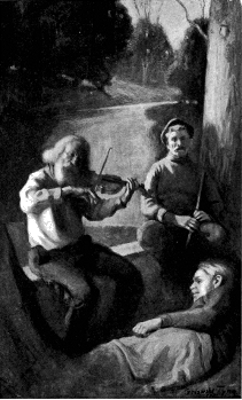 "Sweet bird of the wilderness, sweet is thy song"
"Oh! God be thanked! My father! My father!" striving to arise to his
feet.
"The poor lad is raving, Hugh," and yet with some pallor in his bronzed
features.
"I am not raving! You are my father and I am your son!"
The violin crashed to the ground and was splintered on a projecting
rock.
"No, no, you are raving, lad. I have no son. They are all dead, these
many years."
"Mr. Ande," said the pilot, striving in vain to calm him. "Mr.
Trembath——"
"What!" exclaimed the old man in agitated tones. "Is thy name Trembath?
Thy father's name, lad?"
"Major Thomas Trembath."
"Of where?"
The old man asked the question with trembling, faltering lips, eager,
yet fearful of mistake.
"Of Cornwall, and Major under——"
"My son—my son!" The cry that went up rent the air and startled even
the birds o'erhead. Old Tom was down on his knees, his arms encircling
his patient, and with streaming eyes uplifted to the heavens, he
murmured fervently, "God, great God, I thank thee! Thou art very good."
And then to his new-found son: "But they told me that mother and you
were dead. The black sealed letter! Who sent it? It reached me after
Proctor and Tecumseh's defeat at the——Ah! I see it all. Another
scheme of Lanyan's! A curse upon their race! But no, I must be merciful
since God has been merciful to me in restoring to me, in my old age, a
son. Thy mother, lad?"
"Is well when I left home and there will be many happy days for her when
we return! and as for me, I'm not dead, although the Indians did near
finish me."
"And ye were all these years searching for me?"
"No; mother and I thought you were dead, and yet, at times, we would
have hope of you still being alive. I was searching mainly for the
honour of grandfather and to remove the stain from our name."
"A true son of your race," said the old man warmly and with pride. "Ye
are just the same as I was at your age. I might have known ye for my
son, and yet the letter of your death and your mother's death took all
thought on that subject from my mind."
The pilot with a sense of delicacy, and wondering to himself, had
withdrawn from the scene at the start, but was now returning. He saw
them seated side by side on the bearskin, and seating himself near them
listened with interest to the tales of both father and son.
Before beginning his narrative of his eventful life he turned to the
pilot.
"Hugh, this is my son, Andrew Trembath, who with his mother I had long
thought dead, and I must introduce myself also, for the Loop and the
settlers of Lycamahoning will see me not much longer. Now I know that my
wife is living I shall return to the place of my birth. I have long been
known by the name of Hunter Tom, and unknown by any other. I am Thomas
Trembath, once Major of the 6th Royal Infantry of England, and have
been a soldier in three wars, the War of the Colonies against England,
the Peninsular War under the great Wellington, and the War of 1812 under
Brock and Proctor. The tale of my whole life would be useless, but it is
but fair to my son to narrate the last one, and the history of my hunter
life here. Ye must know that there was a stain of treason against our
house."
Hugh nodded his head.
"I mentioned that to him the first night I spent at his home,"
interjected Ande.
"Well," continued the Major, "it was mainly for the purpose of removing
the stain that I came to this region from Spain. I would have much
preferred to fight under the Iron Duke and against the French than
against the Americans, but the thought of once more being in the region
where my father was shot, and possibly gleaning something of value that
would remove the stain of treason, spurred me on. Our regiment was on
board the Royal George and landed at Quebec, and from thence to the
interior it was a weary march, only part of the time alleviated by canoe
trips. At first we were under that worthy imitator of Wellington, Brock,
and had he lived I have no doubt but what the war would have terminated
differently; but he was slain, and Proctor, a stain on British
generalship, was placed in his stead. My life was spent part of the time
with my regiment and then, for some months, I was an agent of the
government among the Indians of the Ohio. It was my purpose to glean
from them, of my own account, news of my father. Possibly some aged
chiefs would still remember the capture of my father, and would know
something of his being found in French uniform with a French commission
as captain in his pocket. Should he be guiltless of any treason against
England these savages, being so closely allied with the French of that
time, would no doubt know of it. Since they were our allies then and
friendly, an affidavit from them might be of some service. An Indian's
word is as good as another in a court of law. I overcame the natural
repugnance that I had to them, and ingratiated myself with them. An old
chief gave me much knowledge of my father's capture, but concerning the
rest nothing was to be learned. Then I thought of the second plan. My
father had a great knowledge of mining and metals, and, while he was
resident with the Indians of the Kittanning region, learned the secret
of a mine somewhere in the neighbourhood of the Lycamahoning. I resolved
to discover the whereabouts of the mine and possibly solve my father's
honour at the same time. I learned much as to its location, but nearly
lost my life by my incautious repetition of the Indian legend, for on
the way back to Malden I was slightly wounded by an Indian. From that
time on we were busy fighting, and due to the conduct of our own
generals we lost Michigan and a part of Canada. It was after the fatal
battle of the Thames that I received the letter from home that filled my
heart with sorrow and made me an exile. It was a cruel letter, stating
that my wife and boy were dead. England had no more charms for me. I plunged off into the wilderness
of New York and Pennsylvania, and after a few years worked my way into
this region. I hunted for many years before I resolved to make it my
home. The mine I searched for again and again, but met no success, and I
finally gave it up in despair. Then I built the cabin here, and the rest
of the tale is known to you both as well as myself. Though I have not
discovered the honour of my father, yet I shall return to my old home
and take up my former life."
The Major finished his tale.
"Ye have had a wonderful life, Tom," said the pilot, "and I'll be right
sorry to see you leave, but I have no doubt that Mr. Ande has a tale to
tell?" He gazed questioningly at Ande Trembath.
Ande, thus summoned, related the story of his life. The Helston Grammar
School, the smugglers, and that long night with Dick on the waves of the
channel, the rescue by an outward bound Brazilian ship, their adventures
in Brazil, and their sojourn in Minos Geraes in the Sierra Do Frio
district, were all successively dwelt on, but he mentioned not the
wealth he had accumulated there.
"Mr. Ande," said the pilot, after he had finished, "do ye ken aught of
the metal box I handed up from the old excavation that night?"
"The metal box? Why, it must be still in the pocket of my coat, that I
have not worn since that eventful time."
The Major entered the cabin and soon returned with the garment. The box
was still there, from the bulging appearance of the exterior.
"Father, take it out and examine it."
The old Major did so.
"Truly, an ancient specimen," said he, and then he started, for there on
the one side was the engraved figure of a warrior galloping amidst ocean
waves. He turned it over, and on the silver lid, in slightly worn
characters, was the following:
CAPTAIN ANDREW TREMBATH
"'Tis the snuff-box of my father!" exclaimed the Major, trembling with
excitement. "At last the secret of his latter life may be explained. God
be thanked if it can!"
The box was opened and, crowding around it, they examined the contents.
A few papers, yellow with age, met their vision. The first was
extracted, opened, and spread out.
"A letter from thy grandmother to thy grandfather, son Ande," said the
Major, and he read it with an agitated voice. The next, a small book,
was taken out, and the Major turning to the fly leaf read, "The Diary of
Captain Ande Trembath." The first part was a record of sundry things at
home in the palmy days when Captain Ande Trembath was Squire of Trembath
Manor, and the Major hurried over it, for he was interested in what was
beyond. Toward the middle of the diary he paused, and began to read.
"8th July, 1755. We are not more than twenty miles from Du Quesne, and
in a day or so we will see the flag of our country planted on that
fortress. So far no attempt has been made to hinder our march. The enemy
must be demoralised."
"Ah, Braddock and his soldiers had great confidence," said the Major;
"but see here is a great blank of many days." He hurried over the blank
pages and again paused and began to read.
"Nov. 30th, 1755. Quite a time has elapsed since writing. The glorious
hopes of our army were shattered in a day by a few hundred savages. I
was wounded and left on the field for dead. When I came to myself I saw
an Indian face bending o'er me. It was Musqueta, a sub-chief under
Shingas, and seeing me able to move and alive he promptly took me
prisoner, and with a few others I was taken to the chief's headquarters,
the Indian town of Kittanning. They told me the whole army was slain.
Incredible fact! I was not able to write on account of my bonds. I
learned their language and they had some idea of adopting me into their
tribe. Indeed, Musqueta had lost a son, and no doubt it was on account
of that that he spared me at the defeat, hoping to adopt me into the
tribe as his own son. The thing was detestable to me, and I refused all
offers of the kind. Then I was forced to run the gauntlet, but it was my
salvation, for, seizing a club and leaping through the weakest part of
their grinning line, I escaped by my running powers. The swiftest foot
of old Cornwall can outstrip the savage."
"He must have been a swift runner," interjected Hugh.
"He was that, but we must see what happened after his escape. All this I
knew before by my conversation with the Shawnese under Tecumseh when I
was an Indian agent, but nothing more," said the Major, and turning to
the diary he again resumed.
"There was a shout and such a yelling when I escaped that it almost
unnerved me, but I distanced my pursuers, and utterly left them in the
course of a mile or so. My escape was toward the north along the banks
of the river, but I had not gone more than a few miles before I
encountered a small detachment of French troops. There was no getting by
them at first, but at length I succeeded, after having first slain the
French captain, their commander, which, since I could not avoid it, I
trust God will forgive me. I accidentally met him in the wood, slew him,
and since I could better make my escape in a French uniform, the whole
region being French, I exchanged clothes. A commission was in his
pocket, in which commission I inserted my own name for greater
security."
The old Major paused and wiped the tears of joy from his eyes and
murmured, "Thank God for that. Ande, my son, our family name may now
stand forth as honourable and upright as any in the British Isles. He
was no traitor. Here is the proof. We will depart for England and lay
this diary before the authorities and get the signatures of Hugh, here,
and the other settlers in testimony." The diary was forgotten for a
moment, but the pilot was intensely interested in what followed.
"Read on, Tom, and let's see what happened, and how he got to this
region," said he.
Major Trembath resumed reading.
"I arrived the same day at the mouth of a small stream coming from the
east, where I found a canoe."
"Must have been the mouth of the Lycamahoning," said the pilot.
"Aye," said the Major, and continued:
"Up this stream I journeyed for fully ten miles when the force of the
current became swifter, and I perceived that there were rapids ahead,
and so once more took to the land, carrying the canoe, since it was a
light affair, with me. I was anxious to place as many miles between me
and the Kittanning region as possible. I am now fully forty miles from
the enemy and deem myself safe for the time at least. Knowing their
language, I discovered a secret when among them—the existence of a
silver eldorado, and from remarks I surmise it must be nigh my present
location.
"Dec. 1st, 1755. I have found the location of the eldorado. I shall
remain a time and investigate.
"Dec. 25th, 1755. It is Christmas day, but I cannot keep it in the old
style. I have laid in a supply of deer meat for the winter. In the
spring I shall endeavour to find my way east to Standing Stone and be
once more among the loyal people of the crown. Excavated two feet of the
mine. It is either sulphide of lead or silver or both."
The Major ceased reading and ran over in silence a number of short
entries, then paused, and then continued reading:
"August 1st, 1756. I shall work for a day or so yet and then taking some
of the stuff east with me get it assayed. The hunting parties of Indians
are becoming more numerous, and I cannot stay much longer concealed. In
a few days I shall start for Standing Stone."
"The last entry," said the Major, as he closed the diary and replaced it
in the snuff-box. "The subsequent events are as clear to me as if they
were written on paper. The snuff-box, with its contents, was lost in the
old excavation some time before my father left the neighbourhood. Later
he left the section, and on his overland trip encountered Armstrong's
troops, who shot him by mistake. The honour of our name is cleared."
Early the following spring a canoe was seen descending the Big
Lycamahoning. Two occupants were in it, Major Thomas Trembath and his
son. They were going to shoot the rapids of the Rough Water, and
descending the river to Pittsburgh depart thence to the sea coast, and,
to use the Major's own expression, "From there, home to Merrie England."
CHAPTER XXVIII
MISFORTUNES
"'Tis a downright shame," said bluff Captain Tom Lanyan, with some
warmth, as he flung his grey hair back from the livid scar along his
forehead, and stumped once or twice up and down the room in indignation.
"A shame rather to Miss Midget, herself, to refuse the alliance of a
house like ours," snapped Mistress Betty.
"Now the old squire is in ill health and the estate is entirely within
your power, brother James. I say it's a shame to pester the poor girl to
marry Richard, if she doesn't want to," continued the captain.
"Very well," said Sir James with the slightest trace of a scowl on his
placid features, "she shall not be pestered any longer, although many a
girl would jump at the chance. I have changed my plans."
"Bless you, brother, you are more generous than I thought," and the
captain's face actually lighted up with a smile, that was like the
sunshine on a beetling, ragged cliff.
"I have changed my plans," continued Sir James, "I have another plan for
Richard. Of what benefit is it to us to have an alliance with a fallen
family. It would be much better to seek the Godolphin family. There is
the daughter of Lady Godolphin, who will fall heir to the inheritance
that a prince might envy, and I do not think the earl would oppose my
purpose, for the fortunes of the Lanyans are ascending. With the
Godolphins back of me, securely tied in alliance, I could demand
anything from the government, and obtain it."
"I shall not marry the daughter of Godolphin," said young Mr. Richard,
and his thin lips, so like his father's, closed in a narrow, determined
line. "I shall marry Mistress Alice Vivian." Sir James's features
flashed with anger. Richard Lanyan continued unawed. "The squire is in
favour of it, and you were yourself some time ago. It remains only for
the girl to be won over."
"Yes, I was in favour of it, but that was when the Vivians were in good
circumstances. The old squire proposed it, himself, years ago, but times
have altered. There shall be no alliance with the Vivians. Godolphin is
friendly and is relying upon me for support in the House of Commons. For
the last two weeks things have looked most favourable toward an alliance
with the most distinguished and powerful family of Cornwall, and I am
not one to slight the opportunities presented." There was determination
in Sir James's tones.
"I shall marry Mistress Alice Vivian," said the son.
"You shall not," with a click of the jaws.
"I shall," with an answering, determined click. Richard Lanyan turned on
his heel and left the hall.
"It will be so much better, after all," said Mistress Betty, echoing her
brother's thoughts. "Our family might rival the Godolphins in time. Miss
Midget will be sorry the day she ever refused. I must set myself to win
Richard over from his infatuation, and I flatter myself I shall succeed.
When did a woman ever fail?" Mistress Betty tilted her heavy eagle nose
at an angle, as much as to say, you'll soon see how a woman's superior
wisdom will manage it.
The old captain slowly shook his head as if in doubt.
"You may manage it, and I hope you will, but I would as soon attack a
battery of artillery as try and turn a man away from the girl of his
choice. I hope you will succeed, for the girl doesn't want Richard, and
it is a shame to pester her and the poor old squire. I am glad the thing
is settled, though, in brother James's mind, for you'll let them stay,
brother James?"
"Squire Vivian must pay the mortgage within a week, when it comes due,
or leave the premises. I already have a tenant for the Manor should he
fail."
"But—Zounds! That's an outrage!" fumed Captain Tom.
"Nothing but a common procedure of law," asserted Sir James, coolly.
"Aye, it all sounds fine enough, and I suppose it must be so," said the
captain, angrily shaking his head, and stumping up and down; "but 'tis
an outrage all the same. The poor old squire will be driven out without
a home."
"Captain Tom, don't be unreasonable. You know that Squire Vivian will
not be homeless, for James intends to let him have the Primrose Cottage
at a nominal rent," said Mistress Betty, championing Sir James.
"Aye, and the poor widow, Trembath, has already been driven from the
Primrose Cottage, and whether she is in the Union Home, or elsewhere, no
one knows. Is that just, James?"
"The Trembaths were traitors to the government," said Sir James, wincing
a little under Tom's sharp shaft, "and beside I am not responsible for
her loss of money by investment. I offered to loan her the money, and
took a mortgage. How could I know that the investment would fail?"
"You advised her," said Captain Tom, bluntly.
"It was her own doing," said Sir James, sharply, "and besides it has all
turned out favourably to us. We can't all be on top of the heap, Captain
Tom; some must be up and some must be down to make room for those who
get up. It's a law of nature, the survival of the fittest, and through
it all the circumstances of the Lanyans are better now than they have
been for a hundred years." So saying, Sir James turned on his heel and
wended his way into the library, where he was soon absorbed in his
London mail. Captain Tom called for his horse and rode off to Helston,
and Mistress Betty retired to her own private apartments.
Such were the scenes that happened two years previous to the discovery
of Major Thomas Trembath by his son Ande at the Loop. At Trembath Manor
was a far different scene.
"Ally, dear, draw the curtains and let me look out once more on the
park," said the querulous voice of the old squire. A tall, young lady,
with a sweet, though pallid countenance, arose to do his bidding. The
curtains were withdrawn, and the bright afternoon sunshine flooded the
sick man's bed chamber, and cast a halo of brightness o'er his features.
But what a countenance! Time and sickness had wrought great changes. The
old, hale, hearty, rubicund look was replaced by the pale, pained
expression of suffering.
"Come hither, dear."
Alice approached the bedside, and the old squire, taking her hand,
looked at her earnestly for a moment.
"I have fallen into the hands of a cruel master, my child. He who was my
friend is partly responsible for my position. After all I did for him,
working for his election to Parliament some years ago; for you must
understand, dear, that had it not been for old Squire Vivian and some of
his friends, Sir James Lanyan would not now represent our section. And
how has he repaid it?" continued the old man bitterly, and angrily.
"Father," laying her cool hand on his throbbing temples, "you know the
doctor says you must not excite yourself."
"Aye, I know. I know, Allie, but I can't help speaking of it. He
inveigled me into schemes of his own making, purposely, I believe now,
to ruin me, and get the estate and the mine into his own hands. A
dastard! A selfish villain! And now he is going to foreclose the
mortgage, and in a week, my poor Allie, your old sick father and
yourself will be without a roof to shelter them. An ungenerous rogue!"
said the old man with another burst of anger.
"Never mind, father, you have me, your Allie, left, and I'll take care
of you," and she smoothed down his scattered locks and laid her cheek
close to his. The action and words seemed to quiet the old squire for a
time, and he kissed the pale cheek of his daughter.
"You are a good daughter. Has Mr. Richard Lanyan been here to-day?"
"No, father."
"Has his man—Bob Sloan—as untrustworthy as the villain, Sir James—has
he been here?"
"No, father," endeavouring to soothe him.
"Aye, he is giving me time to think; you know his proposition, child,"
said the old man gently. "I shall not live long, and it distresses me to
think of my child homeless when I am gone." He laid his hand, that once
stout, brown hand, now pale and thin, upon the bowed head of the girl,
who was silently weeping. "It may prolong my life if you accept Richard,
and our home will be yours. Long ago, before I knew of the villainy of
Sir James, I purposed in my heart your marriage to Richard. Now, though
I know the father and his trickery, yet I think I know the son, Richard,
and I believe him free from his father's faults. He seems a good young
man and talented, and loves you, child, sincerely, and he may make up in
kindness to you for the injustice done to me. Years ago, in my strength,
I thought it must be so, but now I have learned many things by sickness,
and I would not urge you against your will."
"Father," said the girl, raising her tear-stained face, "if it will
make you live longer I will not oppose; I will freely and gladly
consent. I will do anything to add to your life. Have you not been both
a kind, loving father and mother to me?"
"Bless you, my dear Allie," said the squire as he sank back exhausted,
and then, in a whisper, "'Tis better than doctor's medicine. Call
Stephen Blunt—and write an answer to James Lanyan's letter that you
will find in yon desk."
Alice gave the order and sat herself down at the desk to answer as
briefly as possibly the epistle of Lanyan. It was soon written, and the
next moment Stephen Blunt appeared. He came in looking more bent and
decrepit than usual, for the sickness of his master was weighing heavy
upon him.
"Stephen," said the squire faintly, "send one of the servants with that
to Lanyan Hall and await a reply."
The taciturn, old steward took the missive handed him by Alice, bowed
and withdrew. A great load seemed to be removed from the old squire's
mind, and he slept peacefully for three hours. By that time the servant
had returned with the answer. Alice would have rather read it herself
first, but the querulous voice of the squire must not be resisted, and
so she passed it unopened to him. He unfolded it with trembling, eager
hands, and devoured the few lines written there. His countenance grew
paler, and then flushed an angry hue, until the great veins on his brow
stood forth like whipcords.
"What! What! It can't be so!" he shrieked. He crushed the letter in his
hands with rage and was about to fling it from him, but the motion and
passion was too much for him, and with a gasp he fell
backward—unconscious. The crushed letter dropped from his relaxed hand
and fell to the floor, where it remained unnoticed for the time.
"To the doctor, quick!" said Stephen Blunt to the servant that was in
the room. The servant was down and out in a moment. The same horse that
carried him to the Lanyans' was near at hand, and he vaulted into the
saddle, and went tearing down the carriage drive.
With a shriek of "My father!" Alice fell to the floor in a faint.
"Carry her to her rooms! He is not dead! I will not believe it until the
doctor comes," said old Stephen Blunt. The servants carried their young
mistress to her apartments, while Stephen, murmuring many things to
himself, bathed the squire's forehead until the physician came. In a few
minutes there was the sound of clattering hoofs on the gravel of the
drive-way, then a rapid step on the stairs, and the physician was in the
sick man's room. A look and a touch sufficed.
"He is past help. It is as I feared—a sudden stroke of apoplexy
produced by some shock." He picked up the crumpled letter from the
floor, opened it, read it with compressed lips, and placed it in his
pocket.
The news spread o'er the whole village with the rapidity of wildfire,
and by night every man, woman and child knew and sympathised with the
bereavement at the Manor, for Squire Vivian was generally liked.
The funeral was held in the parish church, and old Parson Trant preached
the sermon. With his eyes wet with the flood of sympathy and sorrow, and
his voice unsteady and quivering, he delivered to the hushed multitudes
an address upon "How are the mighty fallen." He called to their minds
the deeds of the squire and his open, frank, generous life in such a
tender manner that many of the audience wept in sorrow as acute as his
own. There was possibly one of that audience who felt more keenly than
others, and he bowed his head down as if ashamed to meet the gaze of the
people around him. It was Captain Tom Lanyan. His sorrow was increased
with the thought that it was some action of his brother that caused the
squire's death. None of the other Lanyans were present. Sir James had to
leave to attend to some business in Plymouth, and, informing his lawyer
to foreclose the mortgage on the estate and tin mine and secure a tenant
for the Manor, he embarked on the first vessel from Falmouth. Mistress
Betty was ill of same fancied ailment, and Richard was, no one knew
where.
After the funeral there was much condolence offered to Mistress Alice
Vivian, but no personal help, no one being aware that the Manor and even
the home furniture had passed out of the hands of the Vivian family. But
Alice knew, and with a sickening sense of loneliness and helplessness
she passed out of the gates of the Manor on the evening of the same day
of the funeral. She had packed up her little personal belongings and had
forwarded them that afternoon to Penzance, where she in tended following
on the morrow. With a heart full of unuttered grief she wended her way
to the old parish church and churchyard to pay a last visit to her
father's tomb. The sun had long since disappeared beneath the horizon,
and the pale, glimmering moon flooded hill and dale with ghostly, limpid
light, whitening the cornices of the old church tower in the distance,
deepening the shadows 'neath the trees, and bringing into gleaming
prominence the white monuments of the departed. The gates of the
cemetery were passed at length, but there was no fear or terror in her
heart. Why should she fear? The dead could not hurt her, and it was less
lonely here than in the great, empty Manor house. The church door was
not locked, and opening it she passed down the long aisle, the tile work
underneath echoing hollowly to her faint tread. Near the altar was the
tomb of her father. The moonbeams, penetrating the coloured windows,
illuminated it with a soft warm radiance, so clear, that the lettering
could be easily discerned. She contemplated the inscription with
tearful, stony gaze and then read softly to herself:
Richard Vivian, Esq.
Trembath Manor
"How are the mighty fallen."
It was the text of the funeral sermon that was inscribed below. There
was nothing more save the dates of birth and death. Suddenly a keener
sense of her loss and loneliness came upon her, and she bowed herself to
the floor, giving vent to the first outpouring of grief—a grief that
she had restrained until then. Sobs and cries, low, yet full of grief,
shook and convulsed her frame.
"Oh, father! father! do you know how lonely I am? I am your daughter,
your Allie, and you always wanted me near you. I am here near you,
father, and yet I cannot feel your presence, for you are gone and I am
alone." A great sob checked her utterance, and for a long time she
struggled with her grief, murmuring incoherently, and, then arising, she
dried her eyes.
"Perhaps he sees still, and pities my grief and solitude. Parson Trant
said that the dead are more alive than the living—'I am the God of
Abraham, Isaac and Jacob; God is not the God of the dead, but of the
living.'" She quoted the Scripture passage softly to herself, and it
seemed to give some comfort. "Yes, he must see and hear." A noise near
the distant tower door startled her. She gazed that way, though not in
fear. Who could be in these sacred precincts at night beside herself?
she asked mentally. The noise was not repeated. It was some owl or bat,
or perhaps it was a slight breeze that had moved the slightly opened
door, she thought, and then turning to the altar she knelt down in
prayer.
"O God, I have now no father, no friend, no helper but Thee. I am
friendless, homeless, poor and lonely. Be my helper and give me
strength. Be my father, O Thou who art above, and hold me in Thy
protecting arms. Thou art the defence of the widow and the fatherless;
be Thou the defence of the fatherless now and hold me in the hollow of
Thy hand. O God, all Thy waves and Thy billows have gone over my soul.
At one blow I lose all. Supported by a father's love, it is taken from
me; reared in comfort, I am reduced to bitter poverty; surrounded by
friends—yet to-day alone and helpless, and yet,—Thou wilt not forsake
me, for Thou dost mark the sparrow's fall. I go a stranger among
strangers in a strange land, yet Thou wilt not forsake me. Oh, be a
light to my feet, a guide to my way, and a stay in my helplessness."
Some time more she spent at the altar in silent prayer, and then arising
and casting a long lingering look at the silent tomb near her, she
slowly wended her way down the silent and deserted church, and thence on
and out of the cemetery.
Without she walked rapidly along the highway, when the figure of a man
emerged from the shadow of the cemetery gate and followed and overtook
her.
"Mistress Alice," he said, laying a detaining hand on her arm. She
started and would have fled, but he restrained her. "You are out late;
let me attend you."
"I asked not your escort, Mr. Richard Lanyan."
"Ah, but I choose to give it," said the young man, in a determined tone,
and then added: "Mistress Alice, why will you not listen to reason? You
know that you are friendless and poor and I would help you,—yes, lay
down my life for you. I——"
"I do not require your aid. Why do you push your attentions upon me when
you know they are unwelcome, and especially at this sad time?"
"Ah, but Mistress Alice, my love for you——"
She gave an impatient gesture.
"Have I not often said that it is vain and useless. I do not wish it,
and your father——"
"Does not wish it, either," interjected Lanyan with an unpleasant scowl,
"but that matters not; I wish it."
"But I do not, and I must not encourage you. I cannot give you what I
have bestowed upon another." Her face flushed and then resumed its
pallid expression.
Mr. Richard Lanyan was silent, but his facial muscles twitched with
emotion, and his dark eyes gleamed with hidden fire.
"I say that no one shall take you from me. My father nor no one else
shall stand as a bar in the way."
"I stand in the way, myself. My own heart is the strongest bar."
"If you will neither listen to reason or affection, there are other
means," he said, threateningly.
"You are a coward and a miscreant, sir, to use such words to me."
"There are other means and——"
The words were scarcely uttered when she was seized from the rear and a
cloak flung o'er her head.
"The coach, Bob," said Richard.
"'Tis coming, sir."
There was the rattle of wheels and a coach stopped near them. The door
was wrenched open and as he placed her within he finished the sentence,
"There are other means, and he, whoever he is, will never get you,
except over the dead body of Richard Lanyan."
The deed was done so quickly that the dazed girl had but time to utter a
muffled shriek as the door slammed, and her subsequent cries were
drowned by the rattling wheels and trotting horses.
Mr. Richard Lanyan, angry with repeated rejections, had made his master
movement.
CHAPTER XXIX
TOM GLAZE TO THE RESCUE
"Oh, here's to the ale,
The merry King Ale,
It makes one jolly
Though home comforts fail;
We'll swing and we'll sing,
Merry as a king,
The tankard we love
For the joy it'll bring."
Chorus.
"Then swing tankard round
With ale pale or brown,
We'll clunk and we'll clunk
Till we clunk un all down!
Down! Down!
"King George, rich and hale,
Is naught to King Ale,
He reigns and cares not
For the poor man's wail,
But jolly King Ale
Makes sorrow to fail,
Huzza for the tankard
Of rud, brown or pale."
Loud and boisterous came the roaring voices of half-drunken tipplers
from behind the green doors of an ale-house in the upper part of
Falmouth. At the close of each chorus there was a thumping of tankards
and fists upon the tables within that made the midnight hour a perfect
babel of sounds.
"That's Tom Puckinharn's voice, I could swear to un," said a tall,
well-built man, as he paused on the pavement without. He was talking to
himself and evidently referred to one voice louder than the others,
leading the chorus. A frown swept over his rugged features.
"Here I be following 'im all the evening from tavern to tavern and just
missin' 'im at every place, and he a-spending his 'ard-earned money in
drink and his poor wife, Susy, at home a-crying her eyes out. If it
wadn't that I had promised Susy to fetch 'im home I'd wash my 'ands and
disown 'im."
His thoughts were interrupted by the overturning of a table, the
upsetting of chairs, the crash of falling tankards and voices in angry
altercation within.
The stimulating effect of the ale he had imbibed had increased Tommy's
natural proclivity to wit and repartee in the earlier part of the
evening, and some of his shafts of ridicule had been directed at two
young Scottish Highlanders, soldiers of Castle Pendennis on leave of
absence. The petticoat men, as he had called them, had remembered him,
and in the drinking chorus they took umbrage at the trifling mentioning
of King George's name. There were angry words and then the ringing of
steel.
The sounds stirred the man without to action. Pushing aside the swinging
doors, a sight met his vision that tinged his spirit with righteous
indignation. Chairs and tables were overturned; tankards were on the
floor, with their spilt contents trickling away in sundry streams;
Tommy's friends were huddled in fear in one corner, while unfortunate
Tommy, in the grasp of the two half-intoxicated Highlanders, was forced
to his knees. They had jerked him over the table and, with irate mien
and with murder in their bloodshot eyes, had their sword points close to
his breast.
With a quick bound and a blow the stranger sent the one Highlander
reeling to the floor, and, with a Cornish side-kick on the ankle and a
blow of his other fist, Highlander number two fell with a crash among
the overturned chairs and spilt liquor.
"Ah! ye call yourselves sodjers and braave men, but thee'rt
bubble-'eaded cowards for two of 'ee with swords to attack one unarmed
man! Ah! ye drunken buccas! see if I don't report 'ee to your governor."
The two fallen Highlanders were either too inebriated with liquor, or
dazed by the sudden attack, or dismayed by the threat of informing the
governor of Pendennis Castle, to arise at once, and the stranger,
casting a look of supreme contempt on them, grasped Tommy by the collar,
jerked him to his feet and led him from the place. As they were going he
could not but hear the admiring comments of two or three of the
spectators.
"Ah! Dear!—Dear!—Man alive!—Did 'ee see un? 'Ow he knacked the
sodjers down! 'Tez Tom Glaze, the Carnish champion!"
"The Carnish champion, the Carnish champion," went from lip to lip. The
green doors fell to behind Glaze and Puckinharn and cut off the murmured
admir ation. Glaze hurried his nephew down one street and then into
another before he suffered himself to speak the anger that was within
him. Then giving Tommy a great shake to add to his soberness and
intelligence, he began:
"I tell 'ee, Tommy, thee'rt a great chuckle-head and will wend up by
being a brocken buddle if 'ee keeps on like this. Here I come to see my
nephew, a respectable pilchard seller, and find un spending his time and
money in taverns. Thee ought to be ashamed of thyself. Do 'ee call
drinking and fighting a good time? Thee wert singing that ale would make
'ee hearty and merry and that sorrow would fail. I tell 'ee that ale
brings trouble, and poverty, and sickness and broken health, and would
'ave caused thy funeral if I 'adn't come in when I did, for they sodjers
had blood in their eyes. And thy wife at home a-crying her eyes out and
without money. I tell 'ee I felt more like giving thee a skevern than I
did the sodjers, a great chuckle-head, as 'ee art."
"Ah, Uncle Tom, doan't 'ee go on like that," said the crestfallen Tommy.
"My head is almost mazed with the 'eadache; les go down to the kay
[quay] and see if I won't feel better."
"Hark 'ee, Tom Puckinharn, let this be the last of thy drinking. Will
'ee promise?"
"Umsh—Yes—I promise."
"A man is always wuss off when he drinks. His money is gone, 'is time is
gone, and 'is health is gone, and he winds by going into the Union Poor
House. Now here I am,—I, Tom Glaze, champion Cornish wrastler and all
round fighter, and I ne'er would be so had I took to drink. There was
Jack Trewlan, champion before me, stout and strong, the champion of a
dozen battles, and I thrawed 'im in ten minutes. I got an under holt and
heaved 'im over my shoulders, and 'e went down like a bullock. Cause
why? Cause 'e took to drink."
"'Ark!" said Tommy. "Wasn't that a woman's cry?"
They listened and the cry was repeated.
"'Urry up," said Glaze, "some woman in distress,—upon a foach if thee
art drunk, 'ee can run a bit."
Away they went in the direction of the quay from which the shriek came,
Tommy's uncle ahead, while he himself lurched along in the rear, like a
distressed ship in a storm. They arrived at the entrance of the pier,
and saw by the glimmering, flickering light of the lamp, at its head, a
woman struggling in the grasp of a burly man. A coach swept by them at
this moment and passed around the corner and up market street.
"Bring her along, Bob," cried a voice from a boat at the landing.
Bully Bob, for it was he, seeing the approach of newcomers, redoubled
his efforts, when he received a blow that staggered him and he released
his grasp. The woman ran screaming to her rescuers and Glaze placed
himself in front of her. Bully Bob, recovering from the sudden assault,
rushed in wrath at his aggressor, crying fiercely, "I'll eat 'ee up!"
Glaze grasped him with a quick, deft movement, and with a heave, threw
him over his shoulder into the deep harbour water beyond. There was a
cry of rage, and then a splash, and then the sound of oars in a long,
steady pull, rounding the head of the pier.
"The fellow in the boat will pick un up, and I think they won't bother
us nor the lady for the present," said Glaze.
"Why, 'tes Mistress Alice Vivian!" exclaimed Tommy Puckinharn, now
thoroughly sobered. She had fainted under the excitement and he
supported her with his arms. Glaze gazed at the countenance of the
unconscious woman.
"'Zackly so; so it is," and he paused in some thought, and then, as
though he had reached some conclusion, he relieved Tommy of his burden,
and, followed by his nephew, he strode along to the nearest house, a
small brown cottage, from the lower window of which gleamed a light. A
rap on the door brought an answer, in the shape of a woman's quavering
voice, demanding who was there.
"It's me, Tom Glaze, Mrs. Trembath." There was a pause within, then some
hurried movement.
"Mrs. Trembath," said Tommy to his uncle, in some surprise. "Is that
Ande's mother? How did she get here, and how did 'ee know she lived
'ere, Uncle Tom?"
"When she was turned out by the Lanyans, I got 'er this cottage," said
Glaze. Further conversation was interrupted by the rattling of bolts
within, the door was opened, and the gleam of candle light shot over all
concerned.
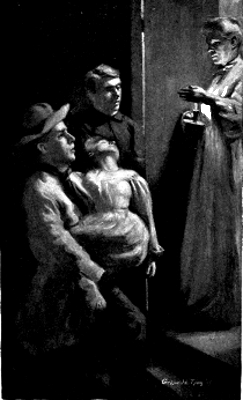 "The door was opened, and the gleam of candle light shot
over all concerned"
"The door was opened, and the gleam of candle light shot
over all concerned"
Bearing his unconscious burden, Glaze, followed by his nephew, entered,
and soon related his tale.
"Poor girl! Poor dear!" said Mrs. Trembath, as she chafed Alice's hands
and then essayed to pour a little reviving cordial down her throat. The
cordial revived her, and she opened her eyes, and then, in as many words
as kind, motherly Mrs. Trembath would allow, she told her story.
"The young villain!" exclaimed Glaze, indignantly, as he heard of the
doings of Mr. Richard. "I wish it was 'im instead of Bob, that I flung
into the harbour."
"Poor child!" said Mrs. Trembath, as she drew the girl to herself. "The
ones who afflicted you and defrauded you of your home, did the same to
me. We are in similar circumstances, and you shall stay here until you
feel better."
But Mistress Alice was far from soon being strong and well again. The
long period of nursing her sick father, his death, the loss of the
Manor, and the harrowing experience of that wild night's ride to
Falmouth, were too much for her worn constitution, and she succumbed to
brain fever. Throughout the long period of her sickness Mrs. Trembath
would have been sorely distressed had it not been for the generosity of
Glaze and Puckinharn. Glaze, as a friend of the old squire, having
received his patronage, thought he was in duty bound to leave a
sovereign now and then in Mrs. Trembath's hands, and his nephew, having
taken the pledge, found he had many spare shillings and sixpences to
spend in so good a cause.
CHAPTER XXX
THE MAJOR'S HOME-COMING
"Ande, son, we'll push straight on to the village; thy mother, lad, was
always an early riser, and mayhap will have a light in the window," said
the old Major, after they had eaten a light breakfast in the Angel Inn.
Major Trembath and his son, Ande, had arrived three o'clock that morning
at the Falmouth Breakwater. They had hurriedly left the ship and had
taken the early morning stage coach for Helston, arriving there in time
for an early breakfast.
"Shall we get horses?" asked the son.
"Horses, lad, what do I want with a horse? Have I not tramped scores of
miles with the rifle over my shoulder, when I was a solitary hunter at
the Loop. My limbs are as strong now as they were a score of years ago,
and I doubt much, after these years of hunting and tramping, whether I
would feel as much at home on horse-back as I would on my own feet. Then
we must remember, lad, that though our name is untarnished and
honourable, we are still poor, and it behooves us to be devotees of
economy. Horses, no; they are not to be thought of."
Ande acquiesced, and forth in the morning twilight they started. What a
happy two-mile walk that was! The Major related tales of his youth
associated with the section through which they wended their way, and the
son related tales as well. The incident of the duck cave and the scared
Greggs was forcibly brought to mind as they passed the cave, and he told
the story much to the hearty amusement of his father.
The activity of youth seemed to fill the frame of the old Major as he
approached the proximity of the village. His steps seemed to lengthen
and increase in rapidity. Then through the dim twilight the outlines of
the village burst upon their vision, and then the Major strained his
keen eyes to catch the first view of the Primrose Cottage. At length he
saw it.
"It's there still," he cried joyously, and then added, "But no light.
Thy mother is late in rising, lad."
They followed the roadway past the village and up the ascent to the
cottage home. The hedges on either side of the little domain were sadly
out of repair, and the Major noticed it.
"Things gone badly since I was in these parts, but we will soon have
them on a better footing."
They opened the rickety gate softly, and then stole into the doorway.
Then grasping the rapper, the Major lifted it and rapped hard several
times. Then smilingly, with dancing expectant eyes, they stood back and
awaited. What a joyful greeting, they thought. But there was no answer,
nor even the shadow of a sound that greeted their own echoes.
"You try, Ande, lad."
Ande advanced to the door and rapped, but the same death-like silence
prevailed.
"Something wrong," said the old Major. "Ah! what's that writing?" His
keen eyes, sharpened by years of woodcraft, had caught the glimpse of a
paper tacked to the upper portion of the door. In the happy anticipation
of coming reunion they had not noticed it before. Ande tore it from its
fastenings and brought it forth more closely to their vision.
"For rent,—James Lanyan," slowly read Ande.
"Some cursed doings of the Lanyans," said the old man weakly, and he sat
down on the steps, for in his disappointment his strength began to fail
him. Just at this moment a lad was seen passing, and Ande accosted him.
"Mrs. Trembath? Why—her's gone nigh two years ago. Sir James Lanyan got
the place and sold her out."
"Where did she go, lad?" asked the Major, faintly. "No one knows that,
sir."
The old man buried his face in his hands. His spirit, so cheery a short
time before, seemed broken.
"Are the Vivians still here?" asked Ande, sharply, for there was an
angry passion raging within him.
"Old squire died a year or so ago. The Lanyans got the Manor, and some
says as how the old squire died of a broken heart, sir."
"And Mistress Alice?"
"Her's gone, too; no one knows where; the Lanyans turned 'er out."
"The black-hearted villain! Thief! Rogue!" roared Ande, his passion
bursting forth beyond all bounds. The lad fled in affright at the
dreadful words and the black countenance, that was in truth diabolical
with rage. The old Major sought to calm him, but of little avail.
"For all that the Lanyans have done to me and mine, the dishonourable
scandal on our name, the suffering and humilation it has caused us, and
these last cruel and inhuman deeds, I will be terribly revenged on him
and his!" Ande Trembath raised his hand to heaven and continued his
invective. The hatred of a lifetime seemed to culminate in a torrent of
expressions like these. Then there was silence.
"We'll go and see Parson Trant at the rectory, father," said Ande, and
the old Major, seemingly with no resolution of his own, was assisted to
his feet, and on they trudged.
The glimmering twilight had merged into dawn, yet there was a light in
the parson's study window and his head, now thoroughly silvered, could
be seen bending over his manuscript. The short walk seemed to revive the
Major's spirits. They knocked and were admitted.
The old parson knew neither of them for a moment. Then Ande spoke.
"What! Parson Trant, and do you not remember me, Ande Trembath?"
"Why, Ande, my dear lad! This is a surprise! How you have grown! Why,
lad, where have you been all these years? And this is your friend?" With
his kindly, fatherly greeting, he shook hands warmly, and then turned
to the other stranger.
"More than friend," said Ande.
"And do you not know me?" smilingly said the old Major, as he advanced
with outstretched hands. The rector passed his hand o'er his forehead
once or twice, as he scrutinised the stranger, and then,—
"What! Impossible! Yes—No—Yes, it must be he. My old friend and
school-fellow, Thomas Trembath! Well, well, well, well!" and the old
parson upset a pile of books in his eagerness to reach the Major. Tears
of delight were in his eyes as he flung open the study door and called,
"Harriet! Harriet!" His wife, a pleasant old lady, soon came in.
"Harriet, do you know these two gentlemen?" The genial old parson was
smiling, and rubbing his hands in delight. "Ah, I thought you wouldn't.
This is our old friend, Major Thomas Trembath, and this is his son,
Ande."
"Goodness me!" exclaimed Harriet, as she cordially welcomed them, and
entered into her husband's pleasure.
"And now come in and have a cup of tea. Breakfast is about ready?" said
the parson aside to his wife, inquiringly, and receiving an affirmative
answer, notwithstanding protests that they had already breakfasted, the
Major and his son were ushered into the little breakfast room, where,
over the tea table, the parson related the facts of Squire Vivian's
sickness, and how both Manor and cottage had passed into the hands of
the Lanyans. He mentioned the fatal letter that had caused the squire's
death, and brought it forth, and mentioned both the disappearance of
Mrs. Trembath and Mistress Alice Vivian. If ever Ande swore revenge in
his heart it was during that narrative, in which all the brutal plans of
Sir James Lanyan were revealed in a plain, unvarnished manner. Woe
betide James Lanyan or his, if their paths crossed.
"I am glad he and his are not of my parish," said the old parson; "but
now tell me of your experience and wandering."
The Major briefly narrated his wanderings, to which Ande added a short
sketch of his own, with the exception of his good fortunes in the gold
and diamond regions of Brazil.
"Wonderful!" exclaimed the old parson, and then as a sudden thought
struck him. "But now you must find Mrs. Trembath, and I would suggest
that you would find some news of her, no doubt, at Helston, for this is
the Floraday. Ah! there are the bells of old St. Michael, now, and in a
short time the town will be crowded with people from far and near to
keep the old festival. You will get news of her from some one."
"That I will," said the old Major, as he arose from the table. "That I
will; and if I fail there, I shall search through every town of
Cornwall."
The parson insisted upon their going in his own carriage, but the very
thought of news to be obtained in Helston made the old Major impatient
of any delay, and he persisted in going on foot, and so with a friendly
handshake, Major and son left the rectory for Helston.
"Hark'ee, son Ande, injustice shall fall yet and right shall prevail; I
feel it," and the old Major strode on with renewed hopefulness.
Long before they entered the town it had put on its holiday attire.
Homes were decorated, windows garlanded, doors swung wide open, and the
bells of old St. Michael were booming and pealing in the festival which
the abrasion of centuries could not obliterate. From the upper portion
of the town came the pealing of fifes and rattling of drums and the
drawling voices of old men mingled with the more melodious voices of
boys and girls, singing the ancient Hal Lan Tow chant. Up in front of
the Helston Grammar School stand the authorities of the borough
demanding a holiday in behalf of the pupils, and when it is granted,
according to custom, how the lads and young men pour out of the old
dormitory, with hats tossing in the air! Vehicles, from the humble cart
to the emblazoned coach of the gentleman, keep rolling into town, while
every road and footpath is dotted with foot travellers. The streets
begin to crowd more and more. Citizens in the finest broadcloth rubbed
elbows with the humble fustian of farmers, and ladies in the finest
brocades and silks pass, with kindly greetings, the figures of country
maidens and women in humbler attire. Lads are blowing whistles, and
others are shouting to their fellows. But now the noon hour has come,
and from the head of Coinage Hall street come the rolling of drums, the
signal for the commencement of the annual, festival, street dance. In
front of the forming procession are the two town beadles with wands,
fancifully and artistically garlanded with flowers. The wands are the
emblems of their authority. They are the great men of the hour. Behind
them are the drummers, the fifers, and the serpent players, with their
instruments and forms so festooned with flowers and evergreen that it is
almost impossible to see their features. They are in motion. The old
beadles prance in a dignified way in front of the advancing procession,
waving their wands and giving directions in the meantime. The music of
the various instruments are pealing out in one steady strain, punctuated
here and there with the sullen, "boom, boom—boom—boom" of the big
drums, and the "rat a-tat-tat" and occasional roll of the kettle drums.
Now they are dancing, hand in hand in the rear, to the first half of the
melody. Now with a rattle of the lesser drums the second half begins.
The gentleman with the second lady releases her hand and seizes the
first and whirls her out of the procession in a circle and returns. The
action is continued by the second gentleman and so on down the line.
Then again the first refrain is taken up and the procession moves
onward. They are followed by a great crowd of spectators. Now the
beadles have disappeared. They have but entered one of the homes. The
procession of merrymakers follow. The beadles emerge from another door
and on goes the festival parade. Is that customary? Oh, yes. It is one
of the customs of time immemorial, and the party owning any of the homes
thus entered feels highly honoured. Through all the streets wends the
dance and then it is brought to a close by a turn on the Bowling Green.
Now follows a dance of the tradespeople in one of the inns of the town,
while the gentry enter the renowned Angel Inn for a purpose similar.
A porter stands at the door of the hall above the Angel Inn to solicit
sixpences to defray expenses. A dignified, aged man, with hair and beard
neatly trimmed, passes in with the others. He is followed by another, a
younger one, his exact counterpart in height and facial appearance. Both
of them are well tanned by exposure, and their garments seem to be of
foreign make. They are the old Major and his son, Ande Trembath.
"Bless my soul!" exclaims a rugged old fellow, stumping up with a slight
limp in one limb. He stands in front of Major Trembath and stares at
him; then passes a hand, rough and brown and heavy, through his grey
hair, throwing it back from his brow, revealing a long, livid scar along
the forehead.
"Bless my soul! You are my old comrade, Tommy Trembath, or my eyesight
fails me. Is it not so?"
"I am that person," said the Major, smiling, and grasping the extended
hand he shook it warmly. "And how is my Captain Tom Lanyan?"
"I am right well, and I can't say how glad I am to see my old comrade,
once more, back in England. We all thought you dead. You haven't been on
British soil the last eighteen years. Where have ye been wandering all
this time?"
The Major related a part of his adventures briefly.
"The honour of our family is established, Captain Tom; my father was no
traitor and the proof of it is in the hands of the government
authorities at this time," concluded the Major.
"I always knew it; I always knew it," said Captain Tom. "I have always
had my beliefs, and I'm right glad now that they have come true."
"Aye, I know it," said the Major. "You were always my stoutest friend,
in the camp and out."
The two old comrades of the Napoleonic wars talked on and on, while Ande
wandered from them, earnestly scanning the features of those he met, but
none did he recognise. The violins, sweeping into the melody of the
Floraday, announced that the dance was on, but he did not engage in it.
He gazed here and there, vainly endeavouring to behold a face he loved.
He was becoming wearied with his search, when, across the hall, he
noticed an aged, veiled lady and near her another, much younger. It was
the young lady that held him spellbound for a moment. His eyes were
riveted upon her countenance that was in profile. There was a shooting
thrill through his whole system and his blood seemed to be mounting in
great billows to his head. He caught a fuller glimpse of her features,
and then his heart gave one mad leap and apparently stood still for a
moment. Could he ever forget that countenance, pale and yet beautiful as
on the eve, in the long ago, when she had called him her knight. With a
half cry he was up and pushing through the crowd, but, before he reached
the other side, he saw them both pass out of the crowded ballroom. With
a few, rapid steps and bounds he passed down the stairway, almost
knocking over the porter at the door.
In the street without he missed the familiar figure, then his heart beat
joyfully once more, for he caught a glimpse of her entering the Bowling
Green. The aged, veiled lady was not with her. He hastened down the
crowded street and entered the comparatively deserted Bowling Green. He
swept a rapid glance around, but she had disappeared and his heart sank
once more. Then he saw a flutter of lace amidst the leaves of a retired
garden seat. She was standing when he reached her, but perhaps the
record of his diary is better descriptive of the scene that followed.
DIARY OF ANDREW TREMBATH, Gent.
May 8th, 1829; Afternoon.
I saw my lady in the garden seat arbour, my lady Alice, the love of my
childhood, the ideal of my waking hours, the vision of my wanderings,
and the dream of my slumbers. She whose features were engraven on my
heart by the memory of other years, and around whom clustered the
fondest recollections of youth, was standing gazing at the setting sun
that, as it sank in golden and roseate hues, painting the sea and sky
with the glories of heaven, seemed likewise to retouch, with its
refulgent beams, her curling raven locks and beauteous eyes with
additional splendour. There was a faint flush on her cheeks in the midst
of their pallor, like an early wild-rose nestling by a belated
snowdrift. It seemed to me that she was much taller than formerly. So
tall and majestic indeed was she that I was awed, notwithstanding my
love that had been slumbering for years. I heard her murmur,
meditatively:
"Ah, if he would only come,—my life, my hope!"
My heart smote me with despair and an icy coldness seized me; a lump
arose in my throat that seemed to choke my breath ing. My hopes seemed
dashed to the ground, my idol shattered and a mass of chaotic ruin. I
tried to withdraw, but had advanced too far, for she saw me and there
was a slight additional flush on her countenance, and gentle recognition
in her eyes. I advanced to the shadow of the arbour and bowed low,
humbled with my previous thought, yet persistent and determined to know
the truth once and for all.
"Mistress Alice Vivian,—Mistress Alice, I am Andrew Trembath, who has
loved you all these years. You called me your knight once and gave me
reason to hope that you were not indifferent to my feelings for you. But
there was a bar, sinister and heavy, between us,—the stain of treason
against our name. Now all bars have been removed; our name is
honourable; no wealth is a hindrance. You have been my dream throughout
my boyhood days and the star of my wanderings in more mature years, and
I lay my hand and heart at your feet."
She answered not, and I feared to lift my eyes lest I should read what I
half suspected from that brief, murmured exclamation I had heard, that
there was another. Despair seized me at her continued silence.
"You were expecting some one?"
"Yes," she said, meditatively.
"And you love him,—him?" How bold was that question! I know not now
whether I feared more her rebuke or the proof of my agonizing doubt.
"Yes," she said gently, and I thought pityingly.
I arose, staggered, and would have fallen but for the friendly support
of a tree. Better to have perished with brave Dick in the floods of the
Rough Water than to have my love thus wrenched from my heart and my
cherished longing prove a vain delusion. I recollect the substance of my
rambling, half incoherent apology for disturbing her. Oh! How empty
heart, earth, life appeared then! The sun had gone down, and with it the
sun of happiness for me! I turned to go.
"Ande,—Mr. Trembath."
There was something commanding in that tone that I could not resist. I
paused and waited for her to continue.
"Is it not unseemly for old friends to part thus. Here, seat yourself
with me in this arbour." I moodily did so. "I cannot say how glad I am
to greet once more a friend of my childhood days. You have been a true
friend to me." What a bitter mockery those words seemed to me. I was
silent and she continued: "You have been a true friend and I cannot
choose but to speak plainly. But tell me of your life and wanderings."
Little by little I told my story, but I could not refrain from my love
for her, for one was so involved with the other that they could not be
sundered. I told all with the exception of my fortune in the Brazilian
mines. She seemed interested with the interest of a friend. I gazed at
her after my tale was finished, and with the melancholy thought of what
I had aspired to and what I had lost. She smiled, and I thought she was
laughing at my presumption in laying my poor affections at her feet. It
enraged me, and I arose to go.
"One moment," she said; "I have news for you; your mother is found and
your father is with her, but I have other matters to mention."
This was the solitary joy that now filled me and life seemed brighter.
"I was expecting some one this evening."
"Yes," I said, the clouds again coming over my soul; "yes, I know."
"No, you do not know; I was expecting some one, and, as you rightly
surmised, I love him."
"Aye," I murmured, for she seemed cruel, "and you could not love
another?"
"No, no, I could not love another. You would not desire to see me
unhappy and poor?"
"No," I said, doggedly, digging with my heel in the turf.
"Suppose I had the opportunity to marry," she said, mischievously, and
with a merry light scintillating in her eyes, "to marry one who would
give me wealth, happiness, love, and my old home, who took me on a long
ride of twenty miles and told me of these things, would you say, 'No.'"
"No," I said, sadly, "marry where your heart directs you."
"But suppose he was Mr. Richard Lanyan?"
I bounded to my feet as if shot. Oh, what a demoniacal thing is hatred!
Humbled and sad at the loss of her, the thought of one of that accursed
race possessing her seemed like turning my blood from freezing coldness
to boiling heat. My countenance must have been frightful; it terrified
her. I could not speak. She trembled and drew away from me and hastily
said, "But suppose I did not love him?" I was dumbfounded, and she
continued, earnestly, while her eyes beamed with a new light.
"Suppose I did not love him? I was expecting him whom I loved—yes,
loved from girlhood; I mourned him as dead, yet loved him more and more,
and after many years I saw him at a Floraday in the Angel Inn ballroom.
I saw him push through the crowd and I came here expecting him. I love
him and could not love another,—and—and—and—Oh—Ande,—can't you
see?"
Change darkness into sunlight and my feelings can be expressed. The full
light of all seemed to burst upon my vision and dazed me; then as I saw
more clearly, I recollect her stretching her arms toward me, and my
leaping forward to clasp that wavering form.
Here the incident in the diary closes, and it remained for others to
relate what happened afterward. They sat down again in the arbour and
her head was on his shoulder.
"And you did love me, after all," said Ande, and the old, happy, boyish
smile illuminated his features.
"I have always loved you from that moment at the gate of the Primrose
Cottage, so many years ago. Forgive me for the doubt I put you in, but
you looked so doleful at my first words that I could not resist the old
mischievous spirit."
He leaned down and kissed her lips, and there was a long silence,
unbroken save by the chirping birds and rustling leaves. A short time
afterward thither came the veiled, elderly lady, accompanied by the
Major.
"Alice, child, art here? I have found him, Major Trembath, my husband."
"Mother!" joyfully cried the young man, as he flung himself into her
arms.
"How tall you are, son Ande," said his mother, after their first
affectionate greeting; "yes, as tall as your father, and"—here she
turned her gaze upon Alice—"you have found a sister along with myself."
"No, not sister, but my affianced wife," said Ande, proudly.
"And I can call you daughter in reality," said happy Mrs. Trembath, as
she kissed her affectionately.
But now the Bowling Green became crowded with people. The ball was over.
Gentlemen and tradespeople mingled in the sight-seeing of the great
event of that memorable day—the wrestling. A space had been cleared and
roped off in the centre of the Bowling Green, and soon forth came the
gladiators, great, tall, muscular fellows, farmers from the country,
miners from the tin mines, and seamen from Penzance and the Lizard
Point. The men from the Lizard were great, giant-like men over six feet
in stature. The spectators watched with intense interest. Jack Trewlan,
anxious once more for honours, was among them, but went down and out of
the lists in the very first contest. The poorest wrestlers were disposed
of first, and then came men of the first class. Among the latter was a
great Lizard Point fellow,—a veritable Goliath in size. Six feet, six
inches he stood in his stocking feet and weighed fully two and twenty
stone. The measurement of his chest was fifty-three inches, of his waist
thirty-nine, of his arms—the right biceps—nineteen inches, the
left—a trifle less; his limbs were in proportion to his other
measurements. A wild cheer went up from the Lizard men as he stood forth
in the roped arena. He had easily vanquished all his fellows,—the great
Lizard fellows were as wooden men in his powerful grasp,—and he was
entitled to do battle with the champion.
There was another cheer, mainly from the tin miners and farmers, as the
champion of Cornwall, Tom Glaze, the victor of nineteen pitched battles,
came forth to do battle for the twentieth time for the position he held.
The champion was not near so tall or heavy as his opponent, but he was
stoutly and toughly built; his muscles were iron-like with constant
practice, and in his many battles he had gained that dexterity,
cautiousness, tack and trickiness, that was characteristic and essential
to a champion.
"A tough opponent, Tom," said one of the gentlemen.
"The bigger they are the heavier they fall," said Tom, and yet there was
a little doubt in his mind as he sized up the Goliath before him. A
moment they stood, their white duck wrestling jackets in relief against
the background, and then they closed into action. The young Lizard
fellow was cautious and wary. Tom Glaze seized his favourite hold,—the
celebrated Cornish hug, and back and forth they wavered, but the young
Colossus seemed to have his great limbs, like pillars, firmly rooted in
the ground. Glaze was as agile as a panther, twisting and trying trick
after trick. Once he nearly had him on the hip and a hoarse "Huzza" and
"Bravo" went up from many throats,—but it was only a partial success.
The young Lizard fellow now tried to bring into play his great strength,
but every grasp was eluded. Glaze had not been champion so long without
learning many things.
"At un, Tom, thraw un down!" cried the men of Helston and the miners to
their champion.
"At un, lad, heave un over thy 'ead!" exclaimed the Lizard and Penzance
men to their partisan.
"Wait a bit," said a Lizard man, with a knowing wink to a companion,
"wait a bit, till 'e uses 'is strength; our man is only playing with un,
I tell'ee."
"Ah, dear, dear,—us thought Glaze 'ad un then; but 'e's up again."
"Bravo! Bravo!" shouted the men of Penzance and the Lizard, and they
fairly danced with delight, as Glaze went partially down.
"No fall!" bawled the referee.
"Ah was a fall, sure enough!" shouted an excited Lizard fellow; "I seed
un."
"Seed un," snorted Tommy Puckinharn, who was near at hand; "thee doesn't
mean to say thee seed un with they great, fishy eyes of thine, do 'ee?"
"Ah was a fall," persisted the Lizard man.
"'Twasn't," said Tommy.
"Ah was."
"What's the use of saying ah was when ah wasn't," said Tommy,
philosophically.
"'Ere, 'ere, no fighting," said a town beadle, as he came up to preserve
peace.
The wrestlers after a brief rest again approached each other. Now in a
crouching position they circle around each other, each waiting for an
opportunity for a good hold. Suddenly they spring forward like tigers.
It was a collar and elbow hold; they tugged, strained, now pushing, now
pulling. Determination is on the features of each. It is apparent that
the young giant is exerting his strength to the utmost. He is slowly
pushing Glaze backward. Glaze gave way slowly and then with a smile and
a twist and a sudden jerk—
"Huzza! Huzza! Glaze forever!" bellowed the Helston men. The young
Lizard giant had gone, like a crashing oak, to the ground.
"No fall," bawled the referee. The Lizard gladiator had but fallen to
his knees and was soon up again, and the contest was renewed.
"Man alive! Did 'ee see un? 'E went down like a kibbel in a shaft," said
one tin miner to another. The one addressed answered not, but kept
shouting to Glaze:
"The Carnish ankle kick, boy! Kick un in the ankle, and poke un over!"
"Another case of Corineus and the giant Gog-ma-gog,"[8] said Captain Tom
Lanyan to his friend, the Major.
"Aye, possibly," said the Major.
On went the wrestling match, with the advantage at one moment to Glaze,
at another to the young opponent. Glaze seemed the better in agility and
wrestling tricks, but his skill in these things were offset by the
giant's strength and wariness. The crowd from a wildly shouting mass
became silent, and were alertly watching every movement of the straining
figures. They were at last becoming aware of what Glaze knew for quite a
time. The champion had met his match. He knew it, for with all of his
skill he was unable to overcome his opponent. But what was still more
manifest was that the young Lizard giant, with all of his strength,
could not conquer the old, wrestling hero.
The time was up at last, and there were stout huzzas for both as they
shook hands. The decision went to Glaze, not on falls, but on points, as
he showed the greater skill.
Then Glaze held up his hand for silence and began to speak.
"I want to congratulate my opponent on his stout defence, and say 'e's
the hardest man I ever met in a wrastling match."
There was a roar of cheers, and then when silence came, he continued:
"Men, you knaw the decision is just as to points. My opponent could not
thraw me, as 'ee have seen, and I couldn't thraw 'im. Now, I'm getting
old for the ring, and am about going to quit wrastling. This is my last
battle. I 'ave only waited until I could find the man I couldn't thraw,
and now I've found un, I give to him the championship and all the
honours of the position. What do 'ee say? Is it right?"
There was silence for a moment, and then, after the import of Glaze's
generous offer became more fully understood, there was a resounding
cheer that went up again and again. The people knew that, next to Glaze,
there was none more capable or worthy of defending the championship of
Cornwall than the young Lizard giant.
"Do ye know, lad, who the young Lizard chap was?" asked the Major of
Ande,—but Ande was gone. Both wrestlers had been taken up on the
shoulders of the crowd and carried, with various shoutings, to the Angel
Inn. Ande followed, pushing and shoving his way through the crowd. When
he entered the Inn, he shouted, "Where's the champion?"
"He's up in his room, changing his clothes," said the landlord.
Ande pushed his way up the stairs and opened the door of the room
indicated.
"Dick, Dick, Dick, old fellow!"
"Ande,—why bless——"
The two friends were locked in each others arms. Then came a time of
explanation. Dick had passed through the Rough Waters of the
Lycamahonings safely. He who had breasted the breakers of the Lizard
could easily take care of himself in the rapids. He was wounded, to be
sure, and the struggle through the rapids had exhausted him, but he was
picked up in the river and for some time was in the care of the good
settlers of Kittanning; then he had returned.
"You must come back with me to see my father and mother and my intended
wife," said Ande. Ande insisted, and Dick yielded. They passed out
through the inn and down to the Bowling Green. There were Major
Trembath, Mrs. Trembath and Mistress Alice Vivian, to each of whom Dick
was successively introduced.
"What's wrong, Dick?" asked Ande. Dick was staring with all his eyes at
the Major, and then he burst forth in answer:
"Why, bless me, Ande, if the Major and old Hunter Tom are not the same,
they are brothers."
"The same, Dick, lad," said the Major, smilingly, and Dick again grasped
his hand and shook it warmly.
"I never expected to see you and Ande again, and I can't say how glad I
am that things have turned out as they have," said Dick.
He explained how he had returned to his people, who had long mourned him
as dead, and how overjoyed they were to see him. He was now a
prosperous, independent farmer of the Lizard, and was also preparing to
enter the shipbuilding trade. "Thanks be," said he, in an undertone to
Ande, "to the mines of Sierro Do Frio."
CHAPTER XXXI
ANDE'S REVENGE
——"A grudge, time out of mind begun,
And mutually bequeathed from sire to son."
—Tatian.
"Lanyan forever! Lanyan forever!"
"Trembath forever! Trembath forever!"
The old town of Helston was a roaring, gesticulating mass, and the
shouting of bellowing partisans reverberated up and down Coinage Hall
Street. Crowd met crowd, waving their respective banners, opprobious
names were shouted, fists flung in the air, and a special force of
officers were busy from early morn quieting unruly fellows, some of them
more stirred by the spirits of the Angel Inn than the spirits of
politics. It was the period of the election for the Reform Parliament.
Sir James Lanyan had come forth on the old party platform, and, most
unexpectedly, in opposition to him, came Andrew Trembath. The latter had
made himself eligible by the purchase of the Primrose Cottage, thus
making himself a landholder of forty shillings annual value.
Towards noon the crowds converged upon the Bowling Green, where upon a
raised platform sat the Mayor, the town functionaries, the candidates,
and their proposers and seconds.
The figure of Sir James was just as tall as of old; the same eagle nose
and piercing eyes; the same easy, urbane manner and distinguished
appearance. The Conservatives admired him. His wealth, astuteness,
experience, all urged the necessity of his return to the forum of
government. There was an easiness of manner in the very position Sir
James occupied that augured well his own hopes of the coming election.
Why should he not have hopes? The interests of the landed party were all
back of him. The Godolphins and all their followers were in his train.
Reform measures were dangerous in their eyes to the staid health,
political, of the country.
On the left, Andrew Trembath was not so easy in his mind. Sir James was
an old general, and he knew it; but within Ande's breast was the buoyant
hopes of youth. Here was the first stroke of revenge against an ancient
foe. Could Sir James be beaten in his cherished hopes, and that by an
upstart of a hated family, the more triumph.
The preliminary proceedings were gone through rapidly. Sir James, with a
good bit of wisdom, had selected as his proposer a retired country
gentleman and as his second a tradesman of Helston, thus drawing from
the sympathy of both classes. The proposer, however, weakened his cause
by his interlarding his speech with many classic quotations, learned no
doubt when he was a lad at Eton, and also by a most unfortunate
mentioning of the stain of treason on the name of the opposing
candidate. Sir James, himself, though he sympathised with his proposer,
felt irritated that he should make such a blunder, and a slight frown
passed over his placid features.
The proposer of Andrew Trembath was none other than the Reverend Mr.
Trewan, headmaster of the Grammar School. In a short, neat speech, and
with a few, withering remarks, he scattered the arguments of the
proposer's speech in favour of Sir James. Then speaking of his
candidate, Andrew Trembath, he referred to his being a scholar of his
own school, his honesty, uprightness, and his grasp upon the problems
that were stirring old England to her very centre, and closed with an
able plea for the seating of ability, though that ability was young.
There were strong cheers and many "hears!" from the crowd on its
conclusion. But none of these preliminary cheers were so hearty as those
which greeted the second, as he arose to greet the audience. And no
wonder, for the seconder of Mr. Trewan's speech was the new champion of
Cornwall, Dick Thomas. Sir James looked a trifle worried, for he saw the
diplomacy in the choice of these. The headmaster of the Grammar School
had weight, and Dick Thomas had the hearts of the commonality. The
speech which he made was homely enough, and demonstrated that he was, as
he said, more a man of action than one of words. But he was Dick Thomas,
and Dick Thomas was a host.
Sir James arose with a look of relief on his features. He was a man
accustomed to deal with the masses, and wished to offset, as much as
possible, the blunders of his own proposer and the enthusiasm of the
crowd over the speeches of the opposition. His speech was replete with
smooth phrases, and the whole was conducted to the close with the
arguments of a logician and the subtility of an old parliamentarian. He
demonstrated that he had a clear grasp on the problems of the day, and
the temper of the people toward them, but what he did not know was the
growing popular estimation of himself among the masses. They were
getting to realise that Sir James Lanyan was a "trimmer" and was more
for Sir James Lanyan than anything else. He said in part:
"For upwards of a dozen years I have served the people of this section
as their representative in the House of Commons, and I trust that, at
this time, the confidence of the electors, that they have manifested so
often heretofore in my experience and labours, will still remain with
me. [Hisses and groans.] These are stirring times and the storms have
swept over, again and again, the ship of state, threatening to founder
her, and reduce the civilisation of the grandest and most enlightened
country under the sun to a melancholy wreck and ruin, battered and
beaten by every sea, and a prey of the pirates of Europe. To a careful
observer, what perils threaten our country? The spirit of the old-time
Luddites has again broken forth in the wrecking of machinery and
ruthless destruction of property, and there is trouble and turmoil on
every side that, unless checked by the firm hand of a Conservative
government, will bring anarchy and ruin. In the midst of all these
movements come our friends of the opposition with their so-called,
universal panacea of Reform. Reform! Reform what?
"Would you reform the introduction of machinery? We cannot do it. If the
people themselves could see the benefits of the oncoming flood of
invention, they would not desire to do it. With the vision of a prophet
I clearly see the time when business shall be enlarged, living become
cheaper, wages higher, all on account of the increased output and
increased commerce brought and caused by the introduction of machinery.
Will this affect Cornwall? To-day, Cornwall has nothing but her farms,
her fisheries and her mines, but with the advent of new machinery will
come the spreading of new factories, until even within the 'Delectable
Duchy' shall roar and sound the noise of spindles, giving employment to
thousands of Cornishmen and their children. The increased wealth of the
country will add to the price to be obtained for fish commodities and
farm products, and there will be an era of prosperity for the hardy
miner, fisherman and farmer such as they have never dreamed of before.
Reform? Shall we reform the election laws and boroughs. The statement is
frequently made that the election laws give unequal representation, and
that there are members of the Commons not placed there by the people,
and it is true; but abolish the present system and you will purloin from
the nation the services of some of her stoutest pillars. If everything
is to depend upon a wider suffrage and the throwing out of what has been
called pocket boroughs, where would our broad-minded statesmen, who
have, tempo rarily, not the support of the people, come in? Had it not
been for a pocket borough, Burke, that Cicero of English politics, would
never have entered the halls of legislation. Had it not been for the
pocket borough, our most eminent statesmen, North, Flood, Canning,
Plunket, Brougham, and others, equally indispensable, would not have
gained a foothold in the parliamentarian halls. Sheridan, defeated at
Stafford, found support in Ilchester; Grey, refused by Northumberland,
was returned by Tavistock."
Here Sir James was interrupted by a rough, country lout, who said
gravely that he had a question to ask of great importance.
"Well, my man," and Sir James flashed a keen look at him.
"I would like to ask," said the fellow with a leer, "whether m'lord
could lend me half a sovereign?"
The absurdity of the thing gave the audience its desired fun, and a roar
of laughter came from the crowd. But Sir James was not the man to be put
down with the word of a buffoon. With a smile of sarcasm, he responded:
"Yes, my man, I can lend you not only a half a sovereign, but twenty
sovereigns, when the cause of good government, which I represent, has
prevailed, and then you will need no borrowing, but you will have so
many, easily earned by yourself, that you will want to lend instead of
borrow. The very reason that so many are out of half sovereigns to-day
is because of the mob spirit and discontent stirred up by the element of
so-called reform. I ask whether it was patriotism that stirred
up the agitation for so-called reform? No. It could not have been that,
for the best good of the nation, at the present time, requires peace and
harmony."
Continuing, Sir James referred to the agitation of France that gave vent
to Napoleon, and was interrupted here and there with various crys of
"Tommy-rot!" and "Gammon!" from his opponents, and equally strong
"Hears!" from the Conservative wing, and closed his speech with a strong
plea for the upholding of the old line party.
He was not nearly so confident when he finished as when he began. He was
beginning to realise that there was an undercurrent against him,
personally. His agents had brought him word before of this, but he had
placed it all down to the spirit of the reform movement. But now he was
beginning to realise different. Dick Thomas and Ande's agents had not
been idle in the period of the canvass. Sir James' conduct in reference
to the Trembaths, to the Vivians, and his crookedness in politics, was
fully aired among the voters, and those who could not be persuaded to
vote against the old line policies, were moved, by the revelation of the
unscrupulous conduct of Sir James, to abstain from voting at all.
There was silence when the new candidate, Andrew Trembath, arose to
respond. Shaking back the tangled masses of auburn hair from his
forehead, he opened his speech in clear, ringing tones. His introduction
demonstrated that he had a tolerably clear perception of the issues of
the day. He spoke feelingly of the popular agitation.
"These riots, this breaking of machinery, this tumult in many parts of
the kingdom, to what is it due? To the spirit of reform? No. Rather is
it due to the desire of the people for better conditions. The time has
come when the voice of the people shall be heard, and that voice speaks
in no uncertain accents. Too long has the government been in the hands
of demagogues who have little to recommend them for election but
corruption; and now all over this fair land of ours the people have
arisen in their might, and demanded an extended suffrage. It is true, as
Sir James has said, that great and good men have been returned from
these pocket boroughs, but that single advantage can be offset by
innumerable and inevitable disadvantages. These pocket boroughs are
generally nests of corruption, held and dominated by some lord or
landholder. The half a dozen or so good men that were placed in position
by them can be offset by the hundreds of members that are fitter for
Newgate than for the parliamentarian halls."
"Men like James Lanyan," shouted some one in the crowd.
An angry hue was on Sir James' countenance for a moment, but neither he
nor Ande noticed the interruption.
"What right has a green mound in a grassy field or a hayrick to send a
representative, while great and flourishing towns like Manchester and
Sheffield have none?"
"Hear! Hear! Hear!" shouted many in the crowd.
Continuing, Ande took up, one by one, the arguments of the opposition,
and tore them shred by shred, until not a vestige remained. Then he
triumphantly drew from his pocket a perfect arsenal of facts, culled
from Sir James' speech of years ago, when, turned down for a time by his
own party, he sought refuge in the ideas of reform. The very facts used
in his conversation with Squire Vivian, Captain Tom Lanyan and the
others, when around the tea table in Lanyan Hall so many years ago, and
which facts he used in a speech on the hustings at that time, were
quoted now, and they were like arrows piercing his very soul. The
Conservative wing were silent with consternation, and Sir James looked
down, uneasily. Then turning to the record of Sir James in the Commons,
he quoted how he had again and again voted against the will of his
constituents. Then after a few, withering flights of oratory, which sent
the Radicals wild with delight and chilled the Conservatives into icy
stillness, he said:
"And now, members of the Conservative wing, you are going to vote for a
man who has uttered sentiments like these, and acted in this manner. I
need not speak to the members of my own party, I know their
determination for good government, but to you Conservatives. You are
going to vote for a man who has thus betrayed your sacred trust and thus
surrendered your standards to the enemy. What does all his actions and
speaking amount to in your minds? Just this, that though he is an
experienced hand, yet you know not what he stands for. Like a
vacillating weather vane, he is apt to be turned one way or the other as
the interests of Sir James Lanyan may direct."
There was an uproarious "Hear! Hear!" from the Radicals, and the black
looks that the Conservatives turned on Sir James were perceived by even
that worthy himself. He shrugged his shoulders and took on his
indifferent and placid expression. But Andrew Trembath was not through
yet, for he continued bringing up clause after clause of Sir James'
speeches, sweeping the audience fairly off its feet with a torrent of
indignant oratory such as it had never before heard. All the poetry in
his nature, all the passion of years of wrong heaped upon his family,
burst forth then and there. There was no more applause from any in that
assemblage, for they were all so enthralled that they hung upon each
word uttered, riveted their eyes upon each gesture, and remained
motionless like a painted throng. Then turning from indignant invective,
he gazed lovingly over the Bowling Green and swept his vision around
toward the town, and his eyes became misty with emotion.
"Helston! Dear old Helston!" he exclaimed, and he stretched out his arms
to the town and people, and there was such emotion, tenderness and love
in that tone that the crowd wept though they could not tell why.
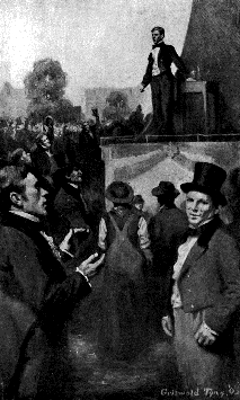 "He opened his speech in clear, ringing tones"
Sir James' proposer had called him a foreigner in little touch with
English ideals. He proved the contrary. He called vividly to mind the
days spent as a school lad among them, the exciting days of the hurling
match
when Breage was defeated, and men nodded their heads and smiled
as they remembered. Then sweeping into the closing address, he said:
"We need a strong and experienced hand at the helm in these perilous
times, it is true, but far more do we need honesty, virtue, and
manliness. Is youth, though inexperienced, yet with average
intelligence, to be despised and condemned by the very fact of youth?
Ask the rector or parish minister the names of the two most prominent
lights in the expansion of religion, and he will say young Saul and
youthful Timothy. Gray at thirty-four finished the most beautiful elegy
in the English tongue. Milton began his career at a tender age.
Shakespeare was but twenty-seven when his name became an authority on
the drama. Napoleon, in his meteoric career, astonished and convulsed
the world, yet he was a young man. What name more brilliant in English
annals for courage and success than that of the well-beloved Wolfe of
Quebec fame—yet he perished on the field of battle at the age of
thirty.
"Civil government has also her young heroes. Need I mention the great
name of Burke, who, at the age of twenty-six, won for himself a
reputation for statesman-like judgment and skill that has placed his
name high on the imperishable roll of fame. Need I mention Fox, and that
other character who still lives as a blessing in the minds of
Englishmen—still lives as the greatest diplomatist of the age—still
lives in the agitation for liberty and fair representation that so
pervades the country to-day?"
"Pitt! Pitt! Pitt!" roared the crowd.
"Aye, you have named him. Ask any bookman for a life of William Pitt,
and he will hand you down a history of England from 1781 to 1806, for
from twenty-one years of age down to the day of his death, his life has
been a history of the empire. Is youth and inexperience to be despised?
No! No!"
"No! No!" shouted the crowd, taking up the words of the speaker. "Huzza
for Andrew Trembath!" And for the space of a few minutes the crowd let
out its pent-up enthusiasm in wild gesticulating of hands and roaring of
voices.
The speaker concluded with a peroration that was eloquent and
passionate. Pathetic passages at times hushed that great crowd into
silence, moved it to tears, and then again swayed it to applause, and
when it was finished, and the speaker resumed his seat, there was
silence for a moment—then, like the roaring of great guns in battle
action, the throng, Radical and Conservative, sent up shout after shout,
that reverberated again and again o'er the town of Helston, and caused
the birds in the neighbouring trees to take refuge in flight. Such a
speech had never been delivered from the hustings before. Old men shook
their heads sagely, and muttered to each other that in a short time
another Pitt would astonish England and the world, and that one would be
from Cornwall.
Suffice it to say, that Andrew Trembath was elected by an overwhelming
vote as M. P. for Helston.
Old Parson Trant met him the next day near the Primrose Cottage, and
congratulated him on his election and bright, future prospects.
"I had a purpose in view," said Ande. "It was not so much my desire to
enter Parliament as my antagonism to Sir James. I have had my first
revenge, and there are others to follow."
"Lad, lad," said the old parson, as he sadly shook his head, "I like not
that revengeful spirit, though you have had much provocation. There is a
better way of revenge."
"What way?"
"'If thy enemy hunger, feed him; if he thirst, give him drink.'"
Ande said nothing, and the conversation, after a time, passed to other
themes.
After his defeat, Sir James Lanyan gave his attention to speculation,
but the ventures turning out unprofitable, he was compelled to sell
Trembath Manor, through his solicitors, to the agents of a wealthy
American traveller. But this was but a drop in the bucket of his
financial reverses, and Lanyan Hall followed suit. The purchaser of
Lanyan Hall was Andrew Trembath, but the fact was unknown to any one but
old Parson Trant, to whom Ande had confided the secret of his wealth.
Subsequently the purchaser was revealed to Sir James, and the revelation
seemed a crushing blow to him, for he sickened and began to sink
rapidly.
"'Tis my second revenge," said Ande to old Parson Trant, and there was a
grim, determined look on his features. "There are others to follow."
"Lad, lad, you must not go on in this way. Vengeance is of God.
'Vengeance is mine, I will repay.' There is a much better way, and you
can do me, your old pastor, a favour, and render God a service at the
same time." The old parson drew a pathetic picture of Sir James in his
present condition, poor, helplessly sinking into the grave. To follow up
any more of this revenge was hellish. It belied Ande's nature to
continue thus, and if this revenge should continue, he, the parson,
could not love him any more. There was one thing that would prolong Sir
James' life, and that was the bringing back to him of his son, Richard,
who was leading a wild, vicious life somewhere in London. This was the
report of the physician. "He must be brought back to his father, who is
calling for him. Who is better fitted for that mission than yourself,
Master Ande? You are going to attend Parliament in a few weeks. Go a
little before—aye, go at once to London, and take up this mission."
"I! I!" stammered Ande, in some astonishment and with a little of the
old, angry feeling tingling in his veins. "You know what we have
suffered—you——"
"But, Ande," interrupted the old rector, as he placed his arm around his
shoulder in the same, affectionate manner as in the olden days, and with
kind, loving tones resumed, "If Christ had felt that way to us, where
would we be?" The old parson preached one of the most appealing sermons,
then and there, that he had ever delivered. Concluding, he said, quoting
the words of Scripture: "'Ye have heard that it hath been said an eye
for an eye and a tooth for a tooth; but I say unto ye, resist not evil.
Ye have heard that it hath been said, ye shall love thy neighbour and
hate thine enemy; but I say unto you, love your enemies, bless them
that curse you, do good to them that hate you,—that ye may be the
children of your Father in heaven.' 'Be not overcome of evil, but
overcome evil with good.'"
"Would it not be hypocritical to show kindness, when you are bitter with
revenge within?"
"No; by showing kindness, even though you do not feel it within, yet
nevertheless it has a healthy action on the soul. Do a kindness and you
grow kind. We become what we do, my lad. Do it now, not because of your
feelings, but because the Lord commanded it. And by and by you will do
kindness to an enemy because your own heart commands it."
"I will go in the morning."
"And God will bless you, my son," said the old rector, as he parted from
him and wended his way home. There, the parson mentioned the matter to
his wife, Harriet, with some doubt as to the issue.
"I fear me, Harriet, it is like sending a fire-brand to quench a
fire-brand."
Andrew Trembath was true to his promise, for that week saw him in
London, actively pushing the search. Hearing of a midnight brawl, in
which Richard was engaged, and which was publicly published in the
newspapers, he sought that quarter, but Richard, fearing perhaps the
police, had fled. His father had also heard of the brawl. It was the
last of a series of crushing disgraces on the part of his son that sent
Sir James into the grave. Ande did not give up the search, but
Parliament convening, he was forced to give more time to other affairs.
It was in the early hours of the morning when one of the night sessions
of Parliament adjourned, and Andrew Trembath, tired of the stupid,
blocking tactics of those opposed to reform, was wending his way home to
his rented quarters in Portman Square. The streets were deserted and he
hastened along absorbed in his thoughts. A figure stole out from the
shadow of some buildings in his rear. There was a quick leap, the
glitter of steel in the air, and then Ande felt a stinging sensation in
his shoulder. Like a flash he turned and had his assailant pinioned in
an iron grip. He struggled to release himself, but to no avail. The
knife dropped with a clang to the pavement and Ande kicked it from him.
The light of a street lamp flashed on the would-be assassin's features.
"Richard Lanyan! You! You! You, who broke your father's heart,—you, the
Etonian scholar,—you, base as you are, stoop to be the assassin!"
"Yes, curse you!" gritted the answer from between the clenched teeth of
the writhing assailant.
"And why?"
"Because you have been the ruin of father, and not I. You occupy his
place in Parliament. You took away Lanyan Hall. You took away the only
woman I ever loved, and it is—revenge."
"Lanyan, listen to me," sternly, and still keeping his grip. Ande
related in brief epitome the injuries he and his and the Vivians had
received at the hands of Richard and his father, closing with the
question: "Who has been the injured party? Your father's place I occupy
because the people put me there. Your father lost Lanyan Hall because of
his foolish speculations. If I hadn't bought it, some one else would.
His death was mainly brought on by your own sottish conduct."
The eyes of Lanyan flamed with sullen passion, as he muttered, "I'll not
endure this from you," and again made an effort to escape.
"Make another effort to escape and I hand you over to the watchman, or
perhaps better still I could kill you where you are. What would the law
and opinion say if I should? They would say it was good riddance of a
rough character and in self-defence, and you see I have the strength to
carry it out."
Lanyan paled a little, notwithstanding the brave heart he had, for he
realised that he was but feeble in the hands of this man, his captor. He
ceased his struggles and listened sullenly.
"But I have other plans," said Ande, gently. "I believe the fellow who
won a prize at Eton is capable of better things. I place the best
construction on your past actions. It was the ungovernable love for
Mistress Alice Vivian that caused much of your past action."
There was no answer.
"I know that was the cause, and also the cause of your whole life being
spent thus, and also of this last attempted deed. And I had been
searching for you for months before your father's death, plunging into
every slum and dive of London. I promised to bring you back to your
father, and thus prolong his days. Your name was the last he called upon
in his delirium. I tried to find you, but failed."
Ande released his grasp, for it was unnecessary. Lanyan was weeping in
an agony of remorse and wretchedness.
"But still the hour is not too late now to begin again in right paths,
and rear up your family name to its former, ancestral honour. You can do
it."
"I cannot," groaned Lanyan, all hatred and vengeance apparently gone
from him. "I cannot; I have no money, and to live honestly in a poor
position——No—No."
"I will help you. Come now, Lanyan, let us forget the past evils between
our families. Oh, think how good God is to prevent you in the commission
of a great crime, this night, that would blast your name irretrievably.
God is better to us both than we deserve. He bestowed upon us these
minds, these souls, and placed us in a beautiful world, and yet we abuse
His gifts. Think, Lanyan, that you and I have souls to present upright
and pure before the great God, the Father. It is a terrible thing to
think that these passions, if we allow them to rule us here, by God's
judgment, they shall rule us in the future. I confess that my hatred for
you and yours has mastered me heretofore, but Parson Trant preached me
a special sermon privately, when he asked me to seek you, and I have
revolved it over and over again in my mind, and, with God's help, which
I prayed for and received, my hatred is gone. If I had found you before,
I should not have spoken to you in this way. I should have probably
mentioned your father's desire to see you and left. Now it is different.
Let the past be past, and here is my hand."
Lanyan grasped the hand extended to him and there was a wavering in his
voice as he said:
"Trembath, you have a much better nature than I have. I must go."
"No, no," said Ande, detaining him, and he poured forth his plan, then
and there, for the turning over of Lanyan Hall to Richard. This was
conditioned on his reform.
Richard was to have possession of the ancestral place at a nominal rent,
and when the rent would total the sum Ande had paid for it, the deed of
complete ownership was to pass over to Richard.
There was silence for a moment.
"Come," said Ande, as he placed one arm over his shoulder, "don't on
account of past ill feeling refuse this chance of making a man of
yourself and uplifting, once again, your ancient family."
There was a period of inward conflict in the breast of the man beside
him, and then, in resolute tones, he answered, simply: "I'll try.
Forgive me, Trembath, for to-night's action, and for the injustice done
by our family."
The two men shook hands firmly, and separated, Ande to seek a surgeon to
have his wound dressed. But the wound gave him little pain, and what
pain there was was wonderfully alleviated by the gladness of soul
within. He knew that the best vengeance was forgiveness, as the old
rector had said.
CHAPTER XXXII
CHRISTMAS IN THE OLD HALL
"Lo, now is come the Christmas feast
Let every man be jolly,
Each room with yvie leaves is dress'd
And every post with holly;
Now all our neighbours' chimneys smoke
And Christmas blocks are burning,
Their ovens, they with baked meats choke,
And all their spits are turning;
Without the door let sorrow lie,
And if for cold it hap to die,
We'll bury un in a Christmas pie,
And evermore be merry."
—Withers.
"Ah, this is like Christmas," said the old Major as he wended his way
with his wife and Ande to Trembath Manor on Christmas eve. The Manor was
to be reopened that night and the strange owner, through his secretary,
had sent out invitations to the country around, and among those
receiving invitations were the Major and his wife and son.
They passed through the gates, the old Major pausing a moment to scan
the Trembath arms and remarking, "I am glad the new owner has not seen
fit to remove our coat-of-arms from the gates."
"The drive-way is in better shape than it was in the days of Squire
Vivian," said Ande, as the gravel crunched under their advancing steps.
"A careful and neat owner; it will do me good to meet him," said the
Major.
Forth through the trees ahead gleamed the twinkling lights of many
windows, only obstructed by the passing of forms within and the figures
of many great holly wreaths. The great lantern in front of the double
doors was gleaming brilliantly through its festoons of evergreen, and
from the hall could be heard the sound of ringing festivity and
jollification. The door was opened widely at the sound of the great
knocker, and the butler footman, bowing low, ushered them into the great
hall. Groups of elderly people were engaged at their favourite game,
whist, at different tables, and down the long room were others engaged
in sundry amusements. The panelled walls had been rewaxed and were
glistening with holly and mistletoe. The large picture of Squire
Vivian's father still smiled friendly at the picture of King George II
on the other wall, and in the great open fireplace roared, cracked,
leaped, danced and shouted with all the ecstacy of Christmas jollity the
flames of the great yule log.
"Where's the new squire?" whispered the old Major to his son. He had
hardly asked the question, before he started back in amazement at a
sight he saw over the great, panelled fireplace. Two great
oil-paintings, heavy in their rich framings, riveted his attention. He
stared at them and then at the crowd of Christmas revellers, who, though
now thoroughly quieted, yet had gleams of suppressed merriment on their
countenances. What could it mean? Those pictures? Where had they
obtained them? Was his mind affected? He knew that he was growing old,
and as he dazedly thought of this, he hurriedly passed his hand through
his whitened hair, a gnarled, brown bough in the midst of a snowdrift.
The folding doors, separating the servants' hall from the apartment they
were in, were thrown open, revealing the merry faces of group after
group of servants. It was a tableau of suppressed excitement, broken at
length by the voice of Parson Trant.
"My friends, we have gathered here not only for Christmas festivity, but
to do honour to the dead and to the living." Pointing to the picture on
the right, he continued: "Behold the picture of Captain Andrew Trembath.
You are all aware of the terrible injustice done his memory. He was the
most patriotic and loyal of Cornish gentlemen. His long war record amply
testifies the fact. He was wounded at Prestonpans, and at Culloden, and
did worthy service under Braddock in America. After that deplorable
battle, he was captured by the Indians, escaped from them, slew a French
officer, garbed himself in his uniform and for greater security in the
enemy's country inserted his name in the dead officer's commission
papers. He was accidentally shot by the troops of General Armstrong, the
thought of treason penetrated the public mind and the estate of Trembath
was confiscated. Yet, after all these years truth prevails. An old
snuff-box, found in the wilds of America, reveals the secret, and though
dead, Captain Andrew Trembath is once more honoured by the people as a
faithful soldier and loyal subject of the King." Then, turning to the
other picture, he continued:
"Behold the picture of Major Thomas Trembath, who served the King nobly
in the Peninsular campaign, in the War of the American Colonies and in
the Canadian War. He disappeared, due to an impression conveyed to him
that his family was dead, and for many long years was an exile in the
wilds of America. Then as a hunter he lived by the pursuit of game. To
the place of his abode came his son, Andrew Trembath, and after a time
became known to him, and through the finding of the records of the
snuff-box, already mentioned, he is restored to his former
honours,—friends and country. His life formerly was sad, now we trust
his declining years will be full of sunshine, and I greet and welcome
him as Squire Trembath, the rightful master of Trembath Manor."
"Welcome to your own, again, comrade," said old Captain Tom Lanyan, as
he heartily shook the squire's hand.
Others crowded around the old squire, among them Dick Thomas, Tom Glaze,
and numerous of the parish gentry.
The old squire and his wife were so dazed that they could not speak, and
so they were escorted to the great armchairs in readiness for them near
the great yule log, and one by one the Christmas guests came near and
gave their greetings. When it was all finished, the new squire found his
voice.
"I am glad, my friends, to be with you here in the hall of my fathers,
but all this seems too wonderful to me to be true; yet I cannot help but
believe what has been told me—but how has all this come about? Has the
government——"
"There has not been anything wonderful about it but the kindness of
Providence," said Ande Trembath, arising to speak. "Years ago, when a
lad, I resolved to remove the stain of treason from our name. My life
here and at school is familiar to you all. By a strange series of
adventures my classmate, Dick Thomas, and myself found ourselves adrift
on a bit of wreckage in the English channel. We were picked up by a
Brazilian ship and after a weary journey were landed at Rio de Janeiro.
For some time we laboured in the fields of planters, and then betook our
way inland to the ridges of Sierro Do Frio. It was here that we laboured
under a brazen sun for the space of three years. I cannot tell of all
the various vicissitudes that overtook us there. At one time I was down
with fever and, but for the help of Dick, would have succumbed to its
ravages. At another time I repaid the debt by nursing Dick through a
serious illness. Gentlemen, you have all seen him wrestle with Tom
Glaze, but he was not the hardest opponent he met. He had the hardihood
to win championship honours in a struggle with an immense Brazilian
puma, or mountain lion. I do not remember whether Dick sprang at the
lion or the lion at him. All I remember was seeing man and beast in a
hideous mix-up, worse than any wrestling match I had ever seen. I ran to our cabin for a gun, but
it was unnecessary, for when I returned, there were Dick and the lion
stretched beside each other. He had choked it to death, but was so
lacerated himself that it was months before he became well. In the midst
of our work we were successful, both in diamonds and gold, and quitted
the regions wealthy men. I deposited my wealth in the banks of New
Orleans, and the charm of the hunting life still being on me, and being
anxious to visit the place of my grandfather's death, we journeyed to
the Kittanning region. The result of that Kittanning trip is now known
to all England. I heard that the Manor was for sale, and secretly,
through agents, purchased it. And now, father and mother, I hand over to
you the title deeds of Trembath Manor and the Wheal Whimble tin mine as
a Christmas present. I wish also to add this check on the Bank of
England for the sum of fifty thousand pounds. A merry Christmas, and may
you have many, happy years in the home of our people."
"Merry Christmas! 'Tis the merriest Christmas I have had in years," said
the old squire with emotion, as he wiped the tears away, that would
persist in gathering in his eyes.
Mrs. Elizabeth Trembath said nothing, but her bright shining eyes
revealed her happiness as she gently pulled her son's head down and
kissed him.
Here the thrumming of a harp was heard and a curtain was drawn from an
alcove near by, revealing Uncle Billy, the droll, with an orchestra at
his back. In the meantime Ande withdrew. The droll and his orchestra
paused not a moment, but plunged, with voices and instruments combined,
into the Hymn of the Lark.
The song was sung to its very end, and the old squire, as he nodded,
said, "Yes, yes, it's true; evil fails at last and right prevails."
He had hardly finished speaking when the orchestra burst into strains of
Mendelssohn, and down the great, hall stairway came a procession such as
it had never witnessed before. First came a troop of little girls
bearing flowers and scattering them profusely in the way. Then followed
ladies. "Ah, the bridesmaids," whispered some one, and then followed by
their respective attendants, in regular procession, came Ande Trembath
and his affianced bride, Mistress Alice Vivian. Slowly they proceeded up
the hall and took their respective positions before old Parson Trant.
The orchestra gave one clashing peal of music and then was silent, and
then arose the mellow voice of the rector in the marriage ceremony of
the Church of England. At the words, "Can any man say aught why these
two should not be joined together in holy wedlock," the voice of the
squire was heard.
"There have been so many things happening on this Christmas eve, that I
hesitate to interrupt the service, but have the laws of England changed
in my absence. I mean that law that states that no marriages are lawful
except those performed in a parish church?"
"The laws of England are the same," said Parson Trant, "but we have a
special dispensation from the archbishop, dispensing with the banns, and
allowing, in consideration of the return of Squire Trembath and the
happiness of this occasion, the ceremony to be performed in the Manor of
Trembath."
"Ah, that is different; my blessing and heartiest well wishes," said the
squire, as he sank back in his armchair.
After the ceremony all adjourned to the dining hall, where an elaborate
wedding dinner awaited them. During the wedding feast the old squire
told of his many adventures, to which Dick and Ande added some of their
own.
"It tells like a story-book," said Tom Glaze, in admiration.
"Or rather like a drama," said bluff Captain Tom Lanyan. "Wouldn't I
have liked to have been in the Shawnee fight," and the tough, old,
Wellington veteran rubbed his hands in delight.
"I have a bit of news," said Ande, as he drew a letter from his pocket.
"Here is a letter from Hugh Lark in America, just received." He scanned
it rapidly and replaced it, and then turned with a smile to his father
and the company. "He says that he has given up the idea of the silver
mine, that Professor Bill Banks has been elected to Congress, and that
old Burke still thinks Bill is high larndt."
The voices of carol singers were heard without, and the wedding dinner
being ended, they again returned to the main hall to enjoy the singing.
The "curl" singers were followed by the old play of St. George and the
Turk, performed by village lads. Then, in the closing scenes of the
evening's festivities, Parson Trant pro posed his favourite hymn, and
out on the evening air, echoing even far beyond the walls of Trembath
Manor, the mellow voices of the trained singers, the piping of childish
voices, the worn voices of the older parties, and the music of the
droll's orchestra mingling all together, pealed the strains of Cowper's
hymn:
"God moves in a mysterious way,
His wonders to perform,
He plants his footsteps in the sea
And rides upon the storm."
THE END
All Lovers of Nature Should Read
"Jay Gould Harmon"
with
Maine Folks
BY
GEORGE SELWYN KIMBALL
A Beautiful
Picture of
Life in the
Maine Woods
Stunning
Cover |
 |
Ten
Full Page
Illustrations
Frontispiece
in Color
Price $1.50 |
ANOTHER
"QUINCY ADAMS SAWYER"
C. M. Clark Publishing Co., Inc., Boston
Lords of the Soil
By LYDIA A. JOCELYN ... and ... NATHAN J. CUFFEE
A Story of Indian Life Among
the Early English Settlers....
Since the days of Fennimore Cooper there has been no Indian
book so true to life, as brilliantly written or as interesting.
10 Full-Page Pictures with Colored
Frontispiece by A. B. Shute....
480 pages that one is sure to read without
stopping.
Mrs. Jocelyn has championed the Indian cause in her novel,
showing in vivid colors the gross injustice and rapacity of
the early white settlers in their treatment of the magnanimous
and unsuspecting "Lords of the Soil."
Price, . . . . $1.50
Sold by all Booksellers or sent postpaid by the Publishers on receipt of
price
C. M. CLARK PUBLISHING CO., Inc.,
211 Tremont Street, ... Boston, Mass.
THE
Baronet Rag-Picker
A ROMANCE OF LOVE AND ADVENTURE
By CHARLES S. COOM
MR. COOM HAS WRITTEN OF CLEVER, LOVABLE PEOPLE
SUCH AS WE ALL KNOW IN EVERY DAY LIFE
|
Ten Full-Page
Illustrations with
Colored Frontispiece |
|
380 Pages of most
interesting reading
and a story that will
please every one |
|
Bound in Silk
Cloth stamped in
many colors making
most unique and
attractive Cover |
|
In Paper, Press-work
and Typography
it is the climax of
Bookmaking |
|
RETAIL PRICE
$1.50
FOR SALE BY ALL BOOKSELLERS OR SENT POSTPAID
BY THE PUBLISHERS ON RECEIPT OF PRICE
C. M. Clark Publishing Co., Inc.
211 Tremont St. Boston, Mass.
Hope Hathaway
IS ANOTHER STRONG WESTERN STORY OF MONTANA RANCH
LIFE BY THE AUTHOR OF "Marie of the Lower Ranch," AND
WITH EACH COPY THE PUBLISHERS ARE GIVING
FREE
Eight Stirring Pictures
BY
Charles M. Russell
The Cowboy Artist
These pictures are the exact size and true reproductions
of the originals and are all ready for framing
The above pictures are reproductions
of three of
the originals.
Price of Book and Pictures, $1.50
C. M. CLARK PUBLISHING CO., (Inc.)
BOSTON, MASS.
Transcriber's Note. Some punctuation misprints have been corrected.