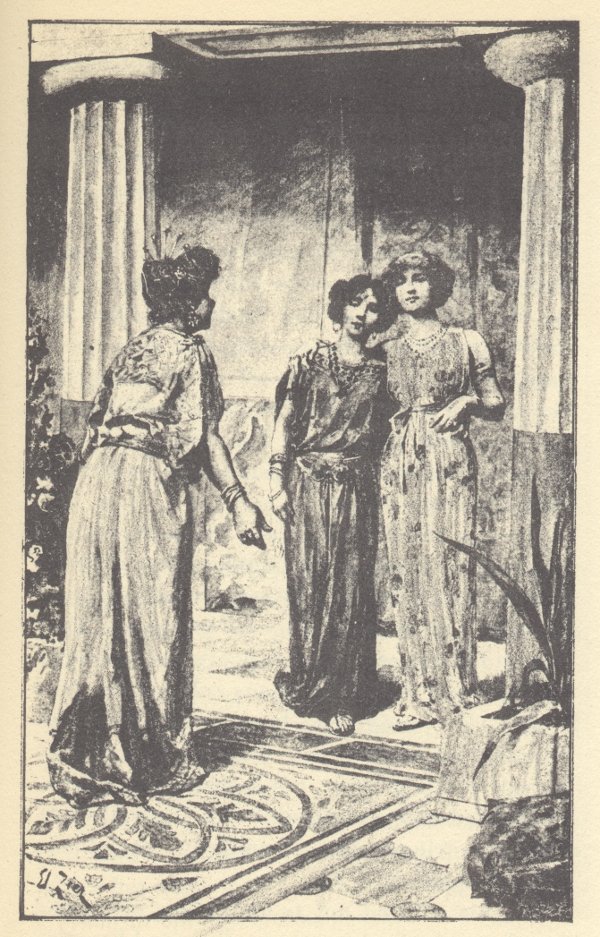
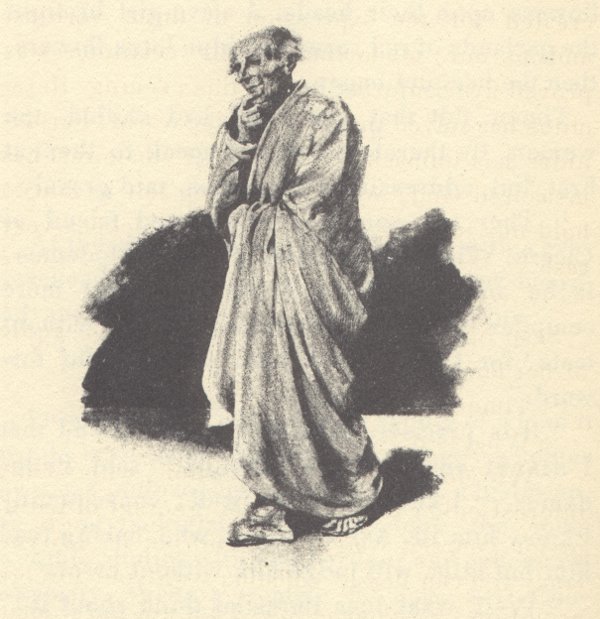
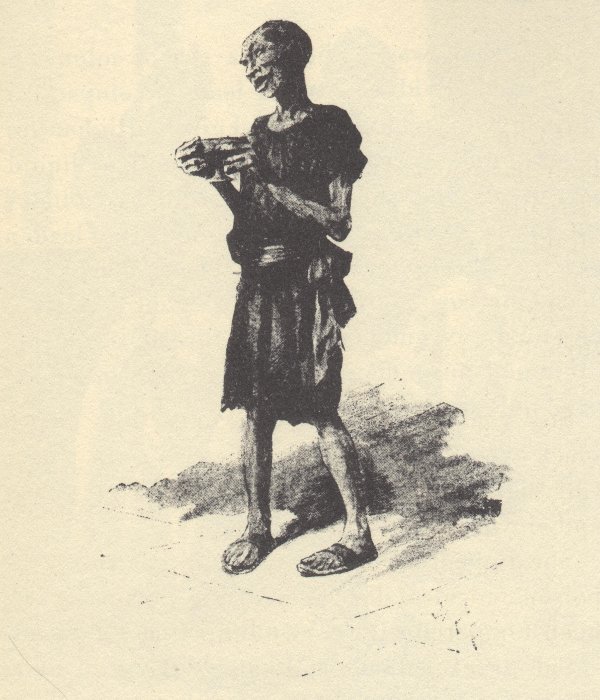
At these words, a sickly little man, with a grey forehead, grey eyes, and a
small, grey beard, advanced with little steps and said smiling:
“I was there.”
Phrasilas was a polygraph of repute of whom it would have been difficult to say
exactly whether he was a philosopher, a grammarian, a historian, or a
mythologist. He undertook the most weighty studies with timid ardour and
ephemeral curiosity. Write a treatise he dare not. Construct a drama he could
not. His style had something hypocritical, finniking, and vain. For thinkers he
was a poet; for poets he was a sage: for society he was a great man.
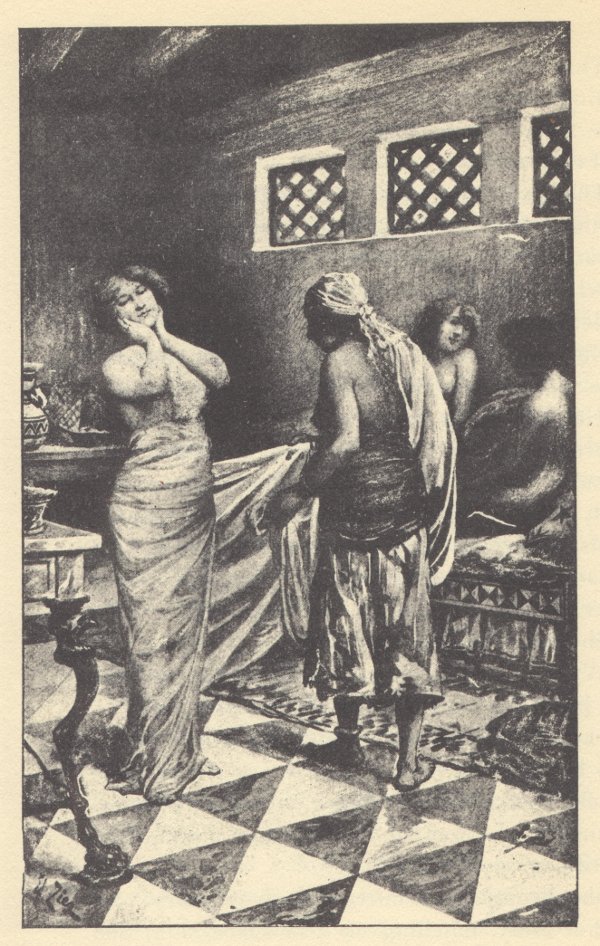
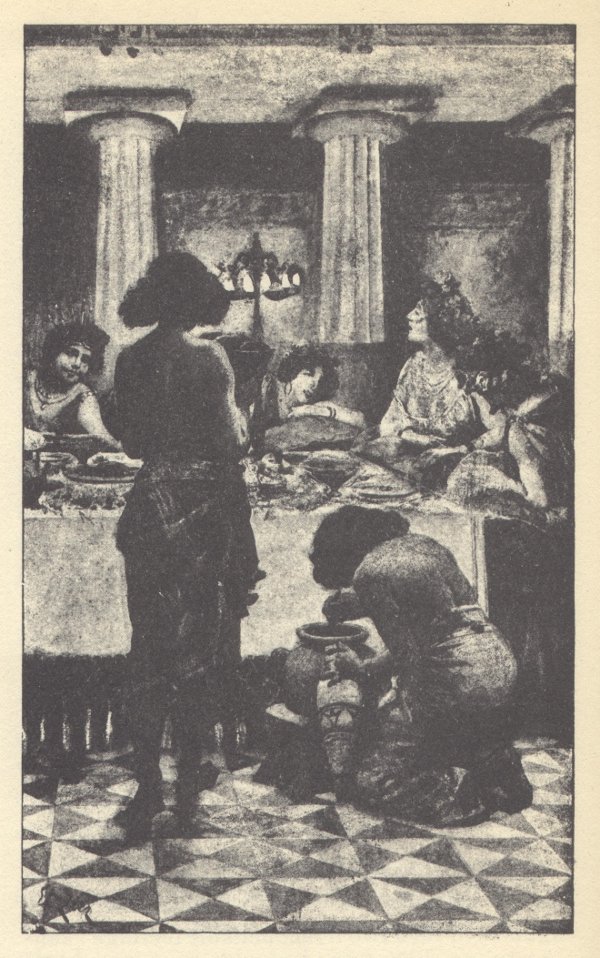
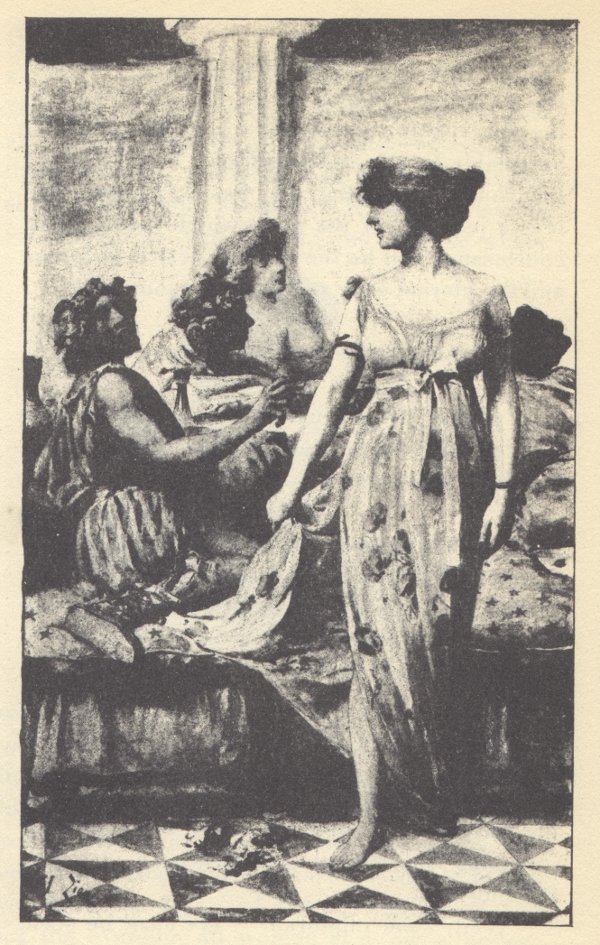
“Come! to table!” said Bacchis. And she lay down with her lover
upon the bed which stood at the head of the banqueting board. On her right,
reclined Philodemos and Faustina with Phrasilas. On Naukrates’s left,
Seso, then Chrysis and young Timon. Each one of the guests reclined in a
diagonal position, leaning upon silken cushions and wearing wreaths of flowers
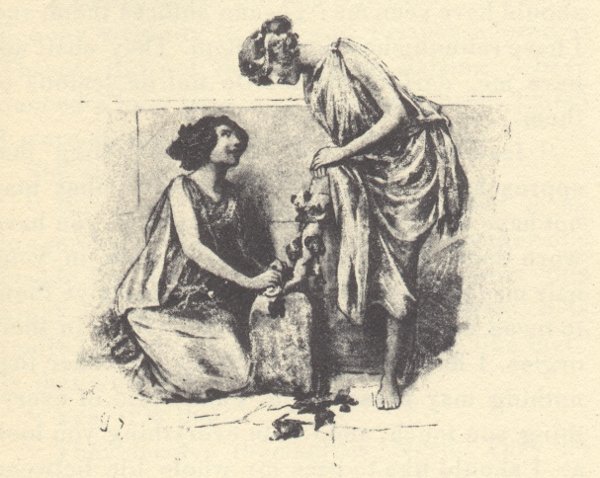
upon their heads. A slave-girl brought the garlands of red roses and blue
lotus-flowers, then the banquet began.
Timon felt that his freak had chilled the women. He therefore did not speak to
them at first, but, addressing Philodemos, said gravely:
“They say you are the devoted friend of Cicero. What do you think of him,
Philodemos? Is he an enlightened philosopher or a mere compiler, without
discernment and without taste? for I have heard both opinions put
forward.”
“It is precisely because I am his friend that I cannot answer your
question,” said Philodemos. “I know him too well; consequently I
know him ill. Ask Phrasilas, who, having read him but little, will judge him
without error.”
“Well, what does Phrasilas think about it?”
“He is an admirable writer,” said the little man.
“In what sense?”
“In the sense that all writers, Timon, are admirable in something, like
all landscapes and all souls. I cannot prefer the spectacle of the sea itself
to the most monotonous plain. And so I am unable to classify in the order of my
sympathies a treatise by Cicero, an ode of Pindar, and a letter written by
Chrysis, even if I knew the style of our excellent little friend. When I put
down a book, I am content if I carry away in my memory a single line which has
given me food for thought. Hitherto, all the books I have opened have contained
that line: but no book has ever given me a second. Perhaps each of us has only
one thing to say in his life, and those who have attempted to speak at greater
length have done so because they were inflated by ambition. How much more do I
regret the irreparable silence of the millions of souls who have said
nothing.”
“I am not of your opinion,” said Naukrates, without lifting his
eyes. “The universe was created for the expression of three verities, and
to our misfortune, their certitude was proved five centuries before this
evening. Heraclitos has solved the riddle of the world; Parmenides has unmasked
the soul; Pythagoras has measured God; we have nothing left us but to hold our
tongues. I consider the chickpea very rash.”
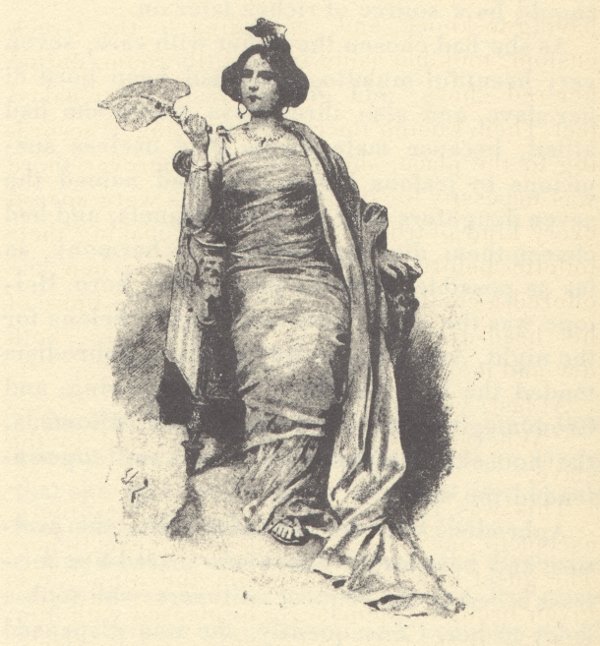
Seso lightly tapped the table with the handle of her fan.
“Timon, my friend,” she said.
“What is it?”
“Why do you propound questions without any interest either for me who am
ignorant of Latin, or for yourself who want to forget it? Do you fancy you can
dazzle Faustina with your foreign erudition? My poor fellow, I am not the woman
to be duped by your words. I undressed your great soul last night under my
bed-clothes, and I know the chickpea it concerns itself with.”
“Do you think so?” said the young man, simply.
But Phrasilas began a second little couplet, with a suave, ironical intonation.
“Seso, when you think fit to give us the pleasure of judging Timon,
whether to applaud him, as he deserves, or to blame him, unjustly in my
opinion, remember that he is an invisible being and that the nature of his soul
is hidden from us. It has no existence in itself, or at least we cannot know
it; but it reflects the souls of those that mirror themselves in it, and
changes its aspect when it changes its place. Last night it resembled you
exactly; I am not astonished you were pleased with it. Just now it took the
image of Philodemos; that is why you have just said it belied itself. Now it
certainly does not belie itself, because it does not affirm itself. You see my
dear, that we ought to beware of rash judgments.”
Timon shot a glance of irritation at Phrasilas, but he reserved his reply.
“However that may be,” answered Seso, “there are four of us
courtesans here, and we intend to direct the conversation, in order that we may
not resemble pink children who only open their mouths to drink milk. Faustina,
you arrived the last, please begin.”
“Very good,” said Naukrates. “Choose for us, Faustina. What
shall we talk about?”
The young Italian woman turned her head, raised her eyes, blushed, and with an
undulation of her whole body, sighed:
“Love.”
“A very pretty subject,” said Seso, trying not to laugh.
But no one took it up.
The table was covered with wreaths, flowers, tankards, and jugs. Slaves brought
wicker baskets, containing bread as light as snow. On terra-cotta plates were
to be seen fat eels sprinkled with seasoning, wax-coloured alphests, and sacred
beauty-fish.
There was also a pompilus, a purple fish which was supposed to have sprung from
the same foam as Aphrodite, bebradons, a grey mullet served up with calmars,
multi-coloured scorpenas. Some were brought in their little sauce-pans, in
order that they might be eaten foaming hot; fat tunnyfish, hot devil-fish with
tender tentacles, slices of lamprey; finally the belly of a white electric eel,
round as that of a beautiful woman.
Such was the first course. The guests chose little tit-bits from each fish, and
left the rest to the slaves.
“Love,” began Phrasilas, “is a word which has no meaning, or
rather too much, for it designates in turn two irreconcilable feelings: sensual
gratification and passion. I do not know in what sense Faustina takes
it.”
“I like to have the sensual gratification.”
“For my part,” interrupted Chrysis, “I like to have the
sensual gratification, and to leave passion to my lovers. We must speak both of
one and the other, or my interest will only be partial.”
“Love,” murmured Philodemos, “is neither passion nor sensual
gratification. Love is something quite different.”
“Oh, for Heaven’s sake,” exclaimed Timon, “let us have
a banquet for once without philosophies. We are aware, Phrasilas, that you can
uphold with graceful eloquence and honeyed persuasiveness the superiority of
multiple pleasure over exclusive passion. We are aware also that after having
spoken for a full hour on such a thorny question, you would be ready, during
the next hour, with the same graceful eloquence and the same honeyed
persuasiveness, to defend the arguments of your adversary. I do not. . . .
.”
“Allow me . . .” said Phrasilas.
“I do not deny,” continued Timon, “the charm of this little
sport, or even the wit you bring to bear on it. I have my doubts as to its
difficulty, and consequently as to its interest. The Banquet you
published some time ago and incorporated in a story of lighter tone, and also
the reflexions you placed recently in the mouth of a mythical personage who
resembles your ideal, seemed new and rare in the reign of Ptolemy Auletes. But
for three years we have been living under the young Queen Berenice, and I know
not by what transformation the method of thought you had adopted, that of an
illustrious exegetical critic, harmonious and smiling, has suddenly grown a
century older under your pen, like the fashion of tight sleeves and yellow
hair. Excellent master, I deplore it, for if your stories lack fire, if your
experience of the female heart is not worth serious consideration, on the other
hand you are gifted with the comic spirit, and I am grateful to you for having
made me smile.”
“Timon!” cried Bacchis in indignation.
Phrasilas motioned to her to be silent.
“Let him alone, my dear. Unlike most men, I retain only the eulogistic
portion of the judgments people pass upon me. Timon has given me his; others
will praise me on other points. It would be impossible to live in the midst of
unanimous approbation, and I regard the very variety of the sentiments I
provoke as a charming flower-bed in which I desire to breathe the scent of the
roses without tearing up the spurge.”
Chrysis moved her lips in a way which showed clearly how slight was the value
she set on this man and his cleverness at terminating disputes. She turned
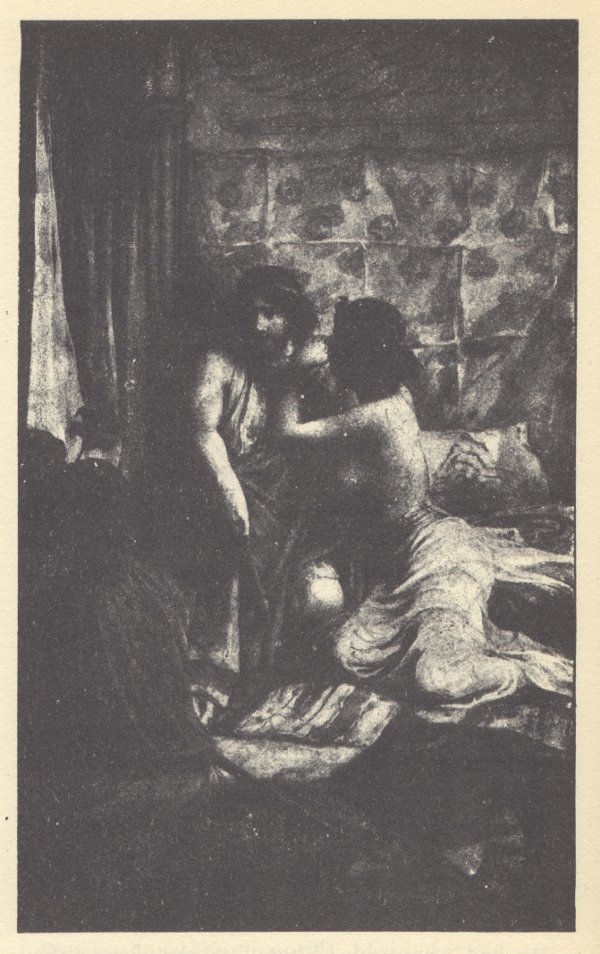
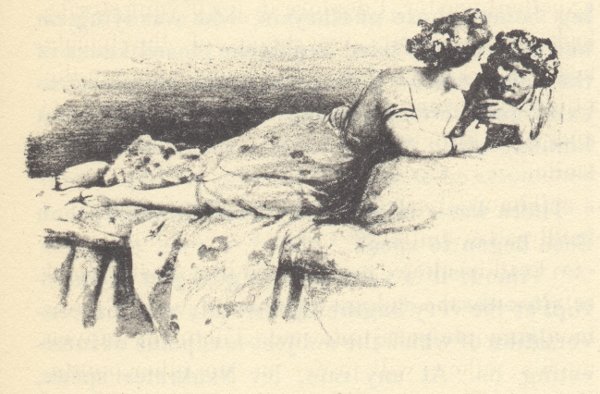
towards Timon, who shared her bed with her, and put her hand on his neck.
“What is the aim of life?” she asked him.
It was the question she usually asked when she was at a loss what to say to a
philosopher; but this time she introduced a tender note into her voice, and
Timon fancied he detected a declaration of love.
Nevertheless he answered with a certain calm:
“Each one has his own object in life, my Chrysis. There is no object
universal and common to all beings. For my part, I am the son of a banker whose
clientèle is composed of all the great courtesans of Egypt, and, my father
having amassed an enormous fortune by ingenious methods, I restore it
honourably to the victims of his favours by sleeping with them as often as the
strength the Gods have given me allows me to do so. I have decided that my
energy is only susceptible of performing one duty in life. I have chosen this
duty because it combines the exigencies of the rarest virtue with contrary
satisfactions that another ideal would support less easily.”
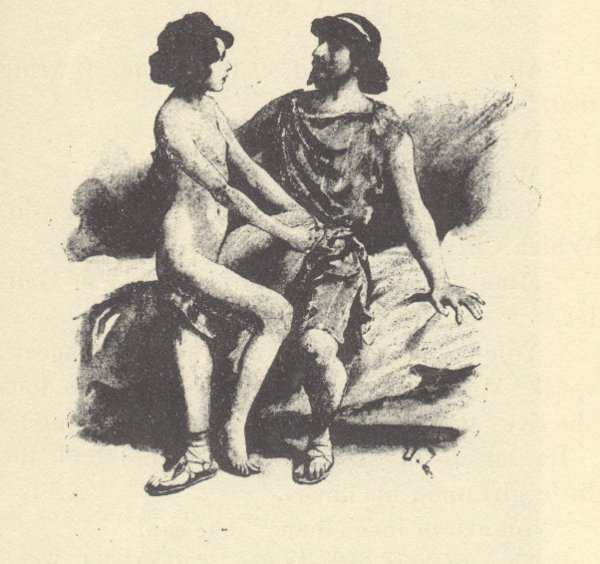
During this speech he had slipped his right leg behind those of Chrysis, who
was lying on her side, and he tried to part the closed knees of the courtesan
as if to give a precise object to existence for that evening. But Chrysis did
not humour him.
There was a silence for several minutes; then Seso began to speak.
“Timon, it is very annoying of you to interrupt at the very beginning the
only serious conversation of which the subject is capable of interesting us. At
any rate, let Naukretes speak, since you are so spiteful.”
“What shall I say about love?” answered the Guest par excellence.
“It is the name given to sorrow to console those who suffer. There are
only two ways of being unhappy: either we desire what we have not, or we
possess what we desired. Love begins with the first, and comes to an end with
the second, in the most lamentable state, that is to say, as soon as it
succeeds. May the gods preserve us from love!”
“But to possess unexpectedly,” said Philodemos, smiling; “is
not that true felicity?”
“What a rarity!”
“Not at all, if one is careful. Listen to me, Naukrates: not to desire,
but to act in such a way that the opportunity offers itself; not to love, but
to cherish from a distance certain well-chosen women for whom one feels one
might have a taste in the long run, if chance and circumstances combined to
throw them into one’s arms; never to adorn a woman with qualities one
wants her to have, or with beauties of which she makes a mystery, but always to
take the insipid for granted in order to be astonished by the exquisite. Is not
this the best advice a sage can give to lovers? They only have lived happily
who, in the course of their dear existences, have been wise enough occasionally
to reserve for themselves the priceless purity of unforeseen joys.”
The second course was drawing to a close. There had been pheasants, attagas, a
magnificent blue and red porphyris, and a swan with all its feathers, the
cooking of which had been spread over forty-eight hours so as not to burn its
wings. Upon curved plates one saw phlexids, pelicans, a white peacock which
seemed to be sitting on a dozen and a half of roast and stuffed spermologues;
in a word, enough food to feed a hundred persons on the fragments left behind
after the choice pieces had been set aside. But all this was nothing compared
with the last dish.
This chef-d’œuvre (such a work of art had not been seen for many a long
day at Alexandria) was a young pig, of which one half had been roasted and the
other boiled. It was impossible to distinguish the wound which had provoked its
death, or by what means its belly had been stuffed with everything it
contained. It was stuffed with round quails, chicken breasts, field-larks,
succulent sauces, and slices of vulva and mince-meat. The presence of all these
things in an animal apparently intact seemed inexplicable.
The guests uttered an unanimous cry of admiration, and Faustina asked for the
recipe. Phrasilas smilingly delivered himself of sententious metaphorical
maxims; Philodemos improvised a distich in which the word
χοῖρος was taken alternately in both senses.
This made Seso, already drunk, laugh till the tears flowed, but Bacchis having
given the order to pour seven rare wines into seven cups for the use of each
guest, the conversation strayed.
Timon turned to Bacchis:
“Why,” he asked, “should you have been so hard on the poor
girl I wanted to bring with me? She was a colleague, nevertheless. If I were in
your place, I should respect a poor courtesan more highly than a rich
matron.”
“You are mad,” said Bacchis, without discussing the question.
“Yes, I have often noticed that those who, once in a way, venture to
utter striking truths, are taken for lunatics. Paradoxes find everybody
agreed.”
“Nonsense, my friend; ask your neighbours, where is the man of birth who
would choose a girl without jewels as his mistress.”
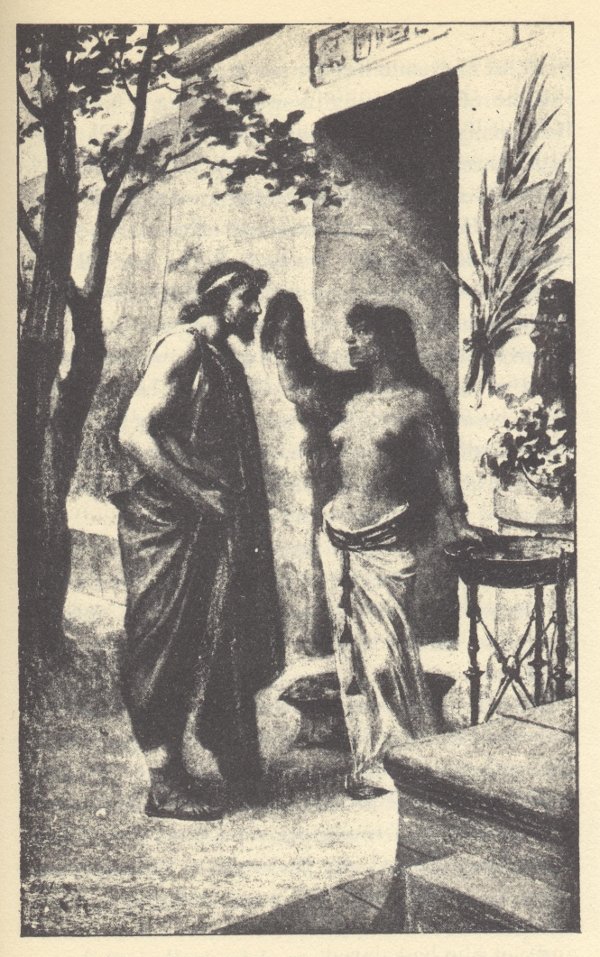
“I have done it,” said Philodemos with simplicity.
And the women despised him.
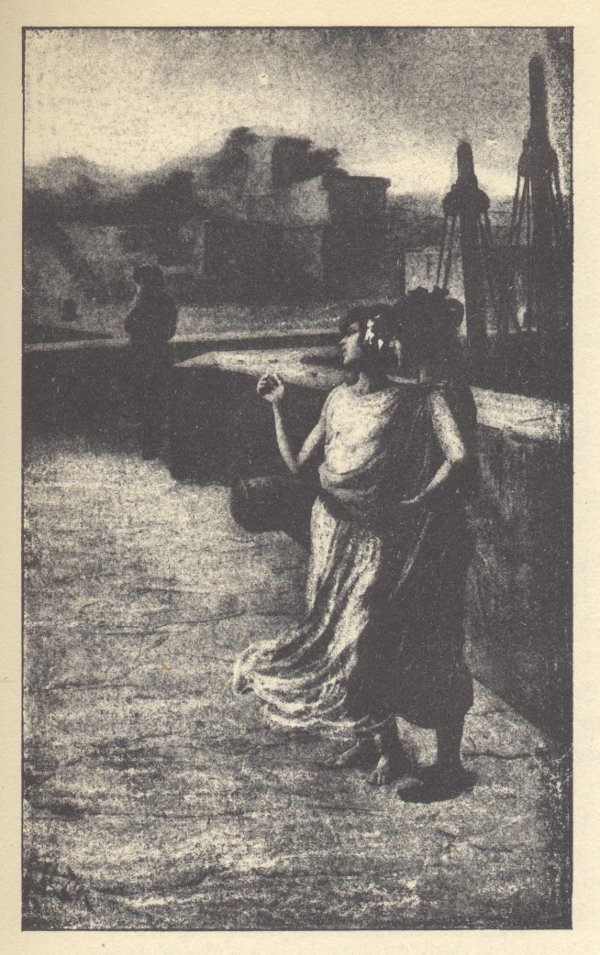
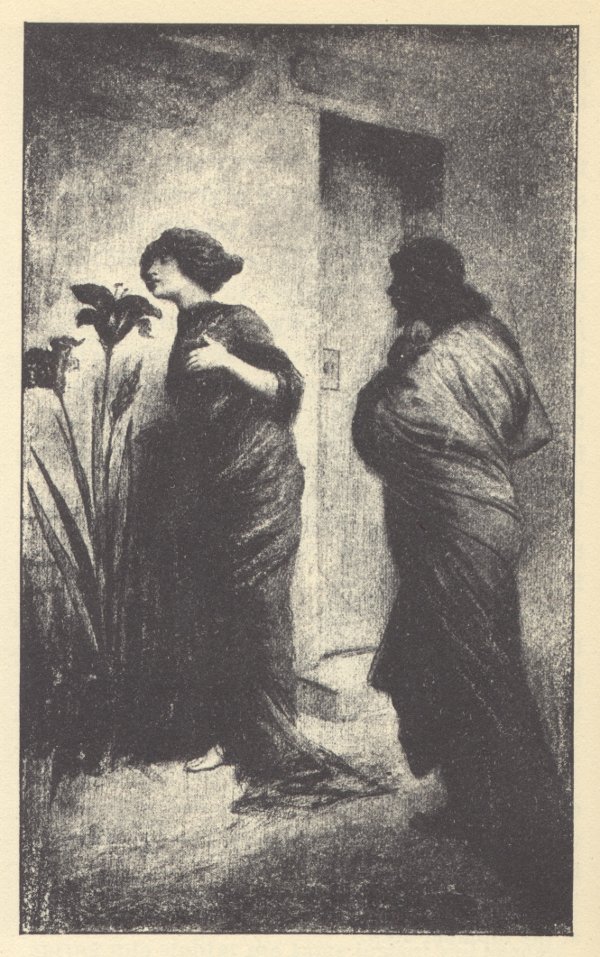
“Last year,” he went on, “at the end of spring,
Cicero’s exile gave me good reason to fear for my own safety, and I took
a little journey. I retired lo the foot of the Alps, to a charming place named
Orobia, on the borders of the little lake Clisius. It was a simple village with
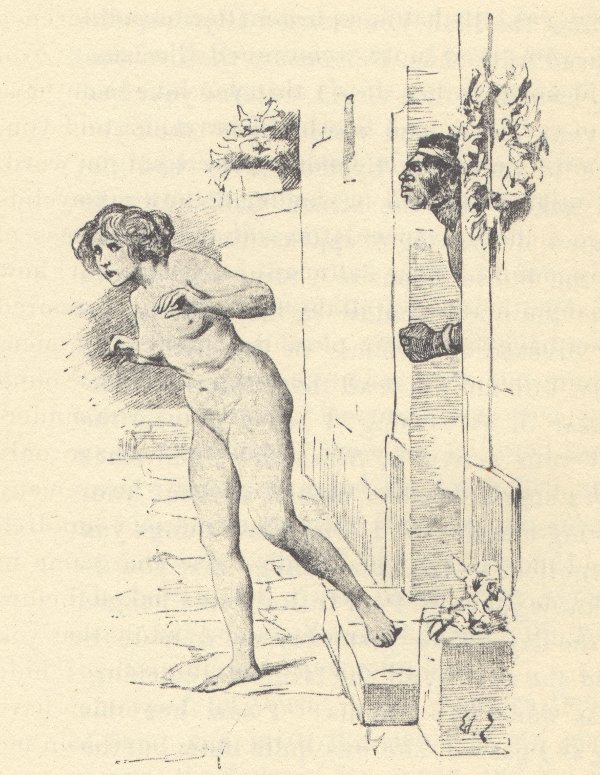
barely three hundred women, and one of them had become a courtesan in order to
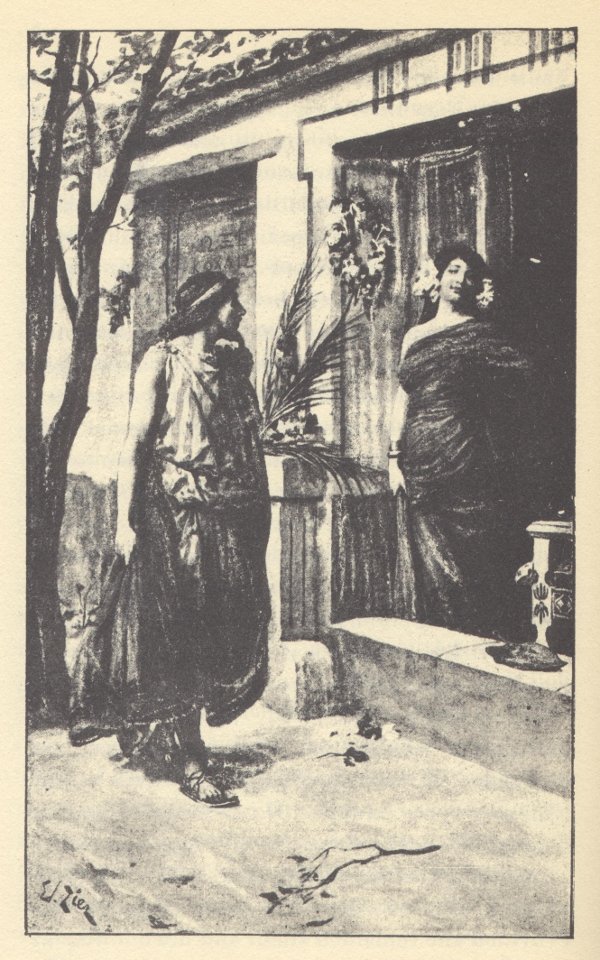
protect the virtue of the others. Her house was to be recognised by a bouquet
of flowers hanging over the door, but she herself was indistinguishable from
her sisters or cousins. She was ignorant of the very existence of paint,
perfumes, cosmetics, transparent veils and curling-tongs. She did not know how
to preserve her beauty, and depilitated herself with pitchy resin just as one
pulls up weeds from a courtyard of white marble. One shudders at the thought
that she walked without boots, so that it was impossible to kiss her naked feet
as one kisses Faustina’s, softer than one’s hand. And yet I
discovered so many charms in her that beside her brown body I forgot Rome for a
whole month and blessed Tyre and Alexandria.”
Naukrates nodded approval, took a draught of wine, and said:
“The great event in love is the instant when nudity is revealed.
Courtesans should know this and spare us surprises. Now, it would seem on the
contrary that they devote all their efforts to disillusioning us. Is there
anything more painful than a mass of hair bearing traces of the curling irons?
Is there anything more disagreeable than painted cheeks that leave the marks of
the cosmetics on the mouth that kisses them! Is there anything more pitiable
than a pencilled eye with the charcoal half rubbed off? Strictly speaking, I
can understand chaste women using these illusory devices: every woman likes to
surround herself with a circle of male adorers, and the chaste ones amongst
them do not run the risk of familiarities which would unmask the secrets of
their physique. But that courtesans whose end and resource is the bed, should
venture to show themselves less beautiful in it than in the street is really
inconceivable.”
“You know nothing about it, Naukrates,” said Chrysis with a smile.
“I know that one does not keep one lover out of twenty; but one does not
seduce one man out of five hundred, and before pleasing in the bed one must
please in the street. No one would notice us if we did not rouge our faces and
darken our eyes. The little peasant-girl Philodemos speaks of, attracted him
without difficulty because she was alone in her village. There are fifteen
thousand courtesans here. The competition is quite another thing.”
“Don’t you know that pure beauty has no need of adornment, and
suffices for itself?”
“Yes. Well, institute a competition between a pure beauty, as you say,
and Gnathène, who is old and plain. Dress the former in a tunic covered with
holes and set her in the last row at the theatre, and put the latter in her
star-embroidered robe in the places reserved by her slaves, and note their
prices at the end of the performance: the pure beauty will get eight obols and
Gnathène two minæ.”
“Men are stupid,” Seso concluded.
“No, simply lazy. They do not take the trouble to choose their
mistresses. The best-loved women are the most mendacious.”
“But if,” suggested Phrasilas, “but if, on the one hand, I
should willingly applaud . . .”
And he delivered himself, with great charm, of two set discourses entirely
devoid of interest.
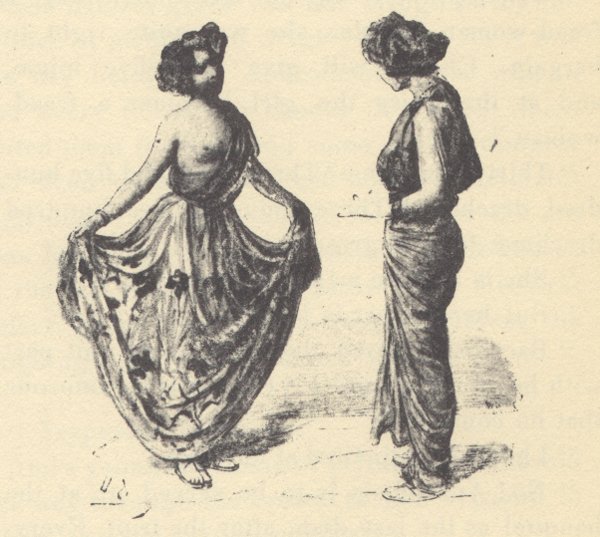
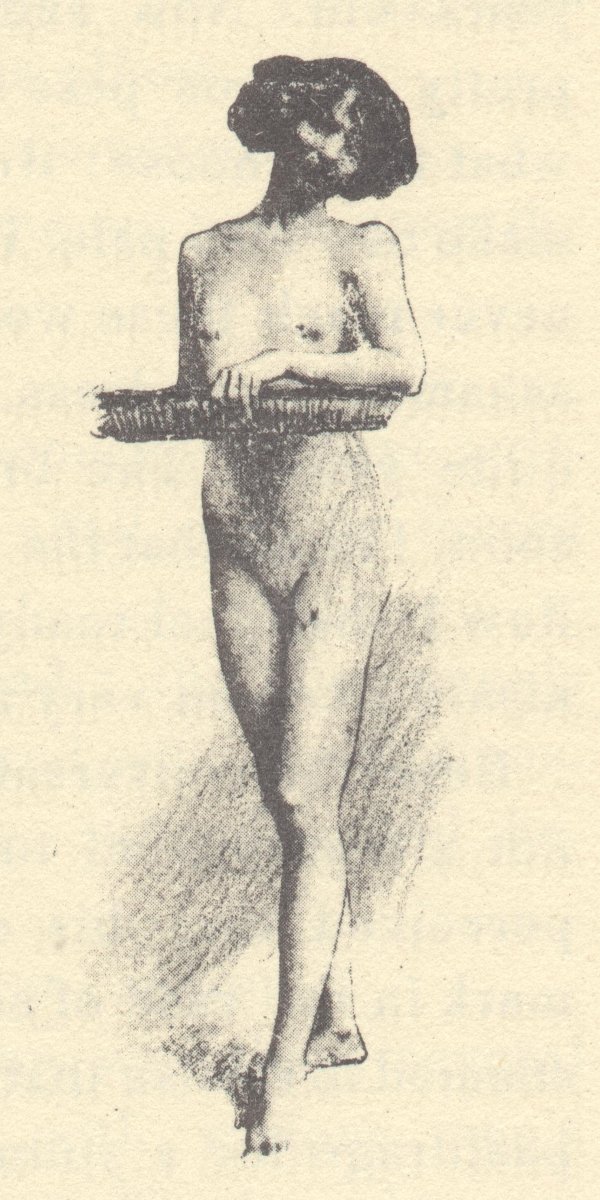
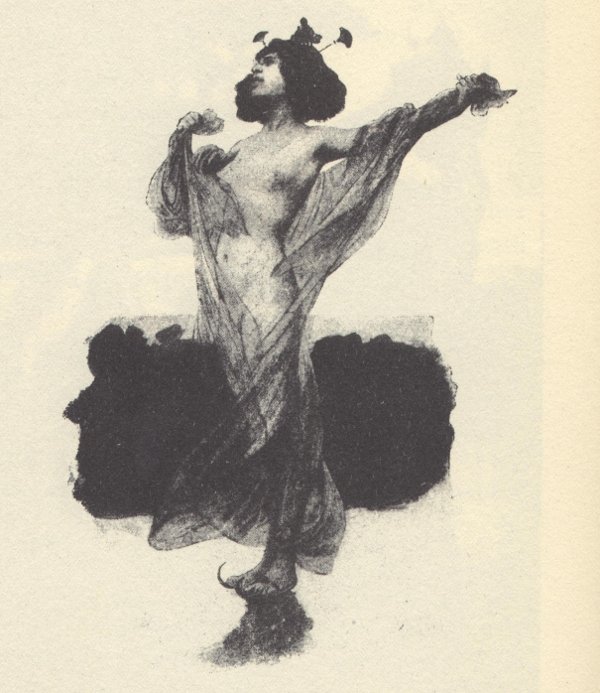
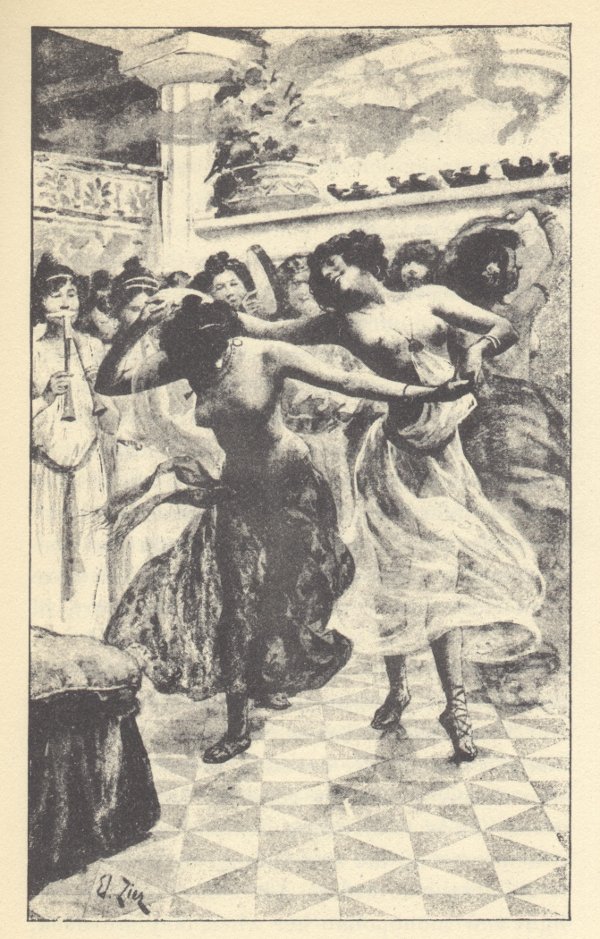
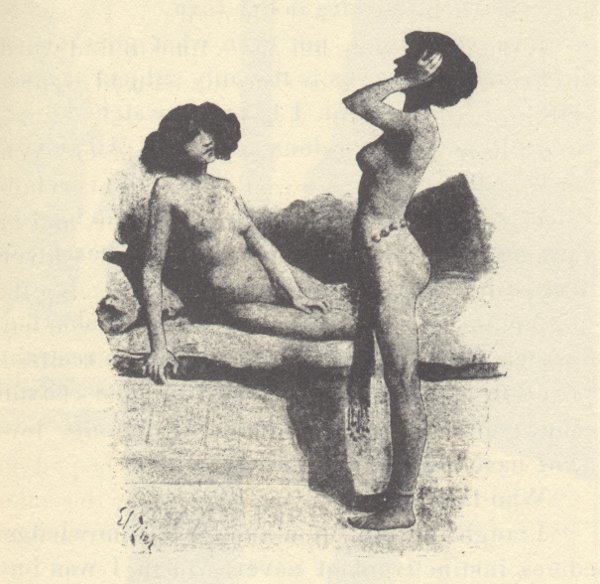
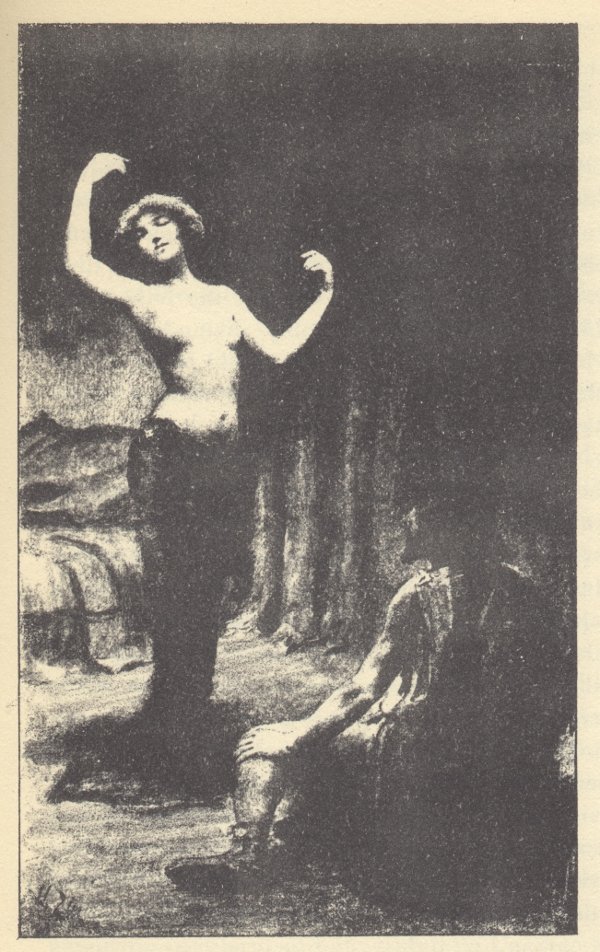
One by one, twelve dancing girls appeared, the two first playing the flute and
the last the timbrel, the others manipulating castanets. They arranged their
bandelets, rubbed their little sandals with white resin, and waited with
extended arms for the music to begin . . . A note . . . two notes . . . a
Lydian scale, and the twelve young girls shot forward to the accompaniment of a
light rhythm.
Their dance was voluptuous, languorous, and without apparent order, although
all the figures had been settled beforehand. They confined their evolutions to
a small space: they intermingled like waves. Soon they formed in couples, and
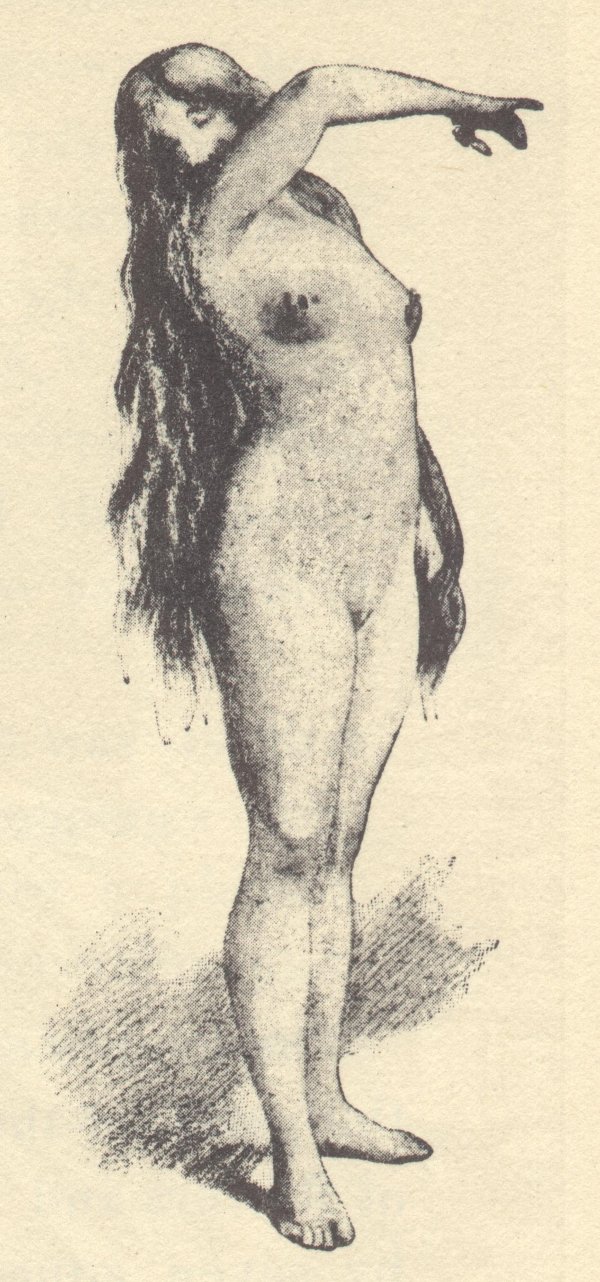
without interrupting the step, unfastened their girdles and let their pink
tunics glide to the ground. An odour of naked women spread about the men,
dominating the perfume of the flowers and the steam of the gaping viands. They
threw themselves backwards with brusque movements, with their bellies tightly
drawn, and their arms over their eyes. Then they straightened themselves up
again and hollowed their loins, and touched one another, as they passed, with
the points of their dancing breasts. Timon’s hand received the fugitive
caress of a hot thigh.
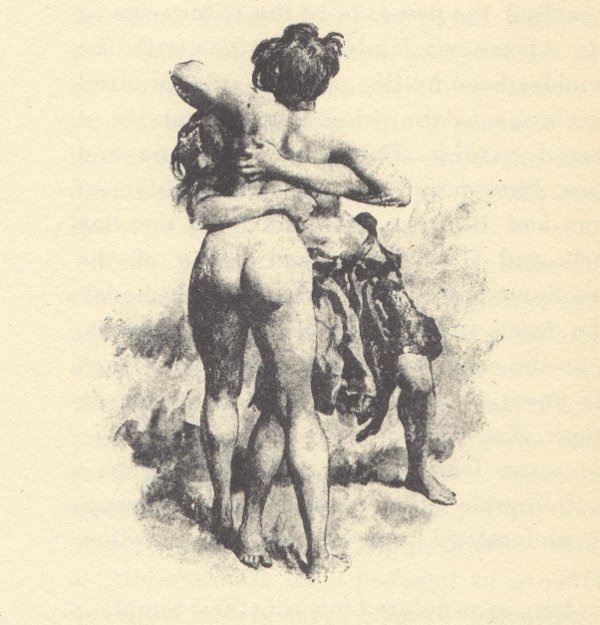
Soon they formed in couples.
“What does our friend think about it?” said Phrasilas with his
piping voice.
“I feel perfectly happy,” answered Timon. “I have never
before so clearly understood the supreme mission of women.”
“And what is it?”
“Prostitution, either with or without art.”
“That is only an opinion.”
“Phrasilas, once again, we know that nothing can be proved: worse still,
we know that nothing exists, and that even that is not certain. This being
conceded and in order to satisfy your celebrated mania, permit me to hold a
theory at once contestable and antiquated, as all of them are, but interesting
to me, who affirm it, and to the majority of men, who deny it. In the ease of
thought, originality is an ideal still more chimerical than certitude. You are
aware of that.”
“Give me some Lesbian wine,” said Seso to the slave. “It is
stronger than the other.”
“I maintain,” Timon went on, “that the married woman, by
devoting herself to a man who deceives her, by refusing herself to all others
(or by committing adultery very rarely, which comes to the same thing), by
giving birth to children who deform her before they see the light and
monopolise her when they are born,—I maintain that by living thus a woman
destroys her life without merit, and that on her wedding-day a young girl
concludes a dupe’s bargain.”
“She acts in fancied obedience to a duty,” said Naukrates without
conviction.
“A duty? and to whom? Is she not free to settle a question which concerns
nobody but herself? She is a woman, and in virtue of her sex is generally
insensible to the pleasures of the intellect; and not content with remaining a
stranger to one half of human joys, she excludes herself, by her marriage, from
the other aspect of pleasure. Thus a young girl can say to herself, at the age
when she is all passion: ‘I shall know my husband, and in addition, ten
lovers, perhaps twelve’, and believe that she will die without having
regretted anything? Three thousand women will not be enough for me on the day I
take my leave of life.”
“You are ambitious,” said Chrysis.
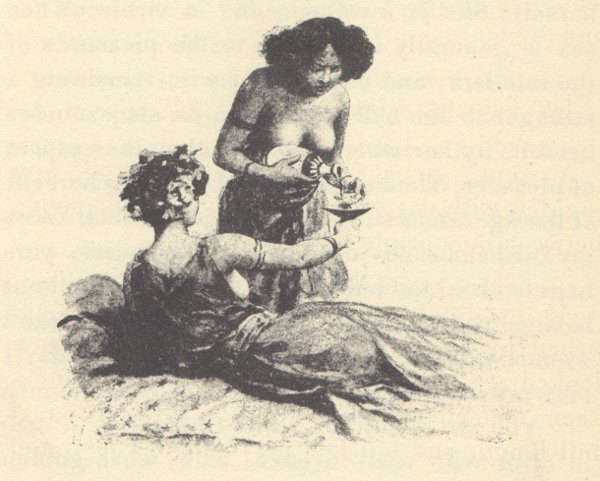
“But with what incense, with what golden poesy,” exclaimed the
gentle Philodemos, “should we not praise to eternity the beneficent
courtesans! Thanks to them, we escape all the complicated precautions, the
jealousies, the stratagems, the throbbings of the heart that accompany
adultery. It is they who spare us hours of waiting in the rain, rickety
ladders, secret doors, interrupted meetings, and intercepted letters and
misunderstood signals. O! dear creatures, how I love you! With you there are no
sieges to be undertaken: for a few little coins you give us what another would
hardly be capable of granting us as a condescension, after three weeks of
coldness. For your enlightened souls, love is not a sacrifice, it is an equal
favour exchanged by two lovers, and so the sums we confide to you do not serve
to compensate you for your priceless caresses, but to pay at its proper price
for the multiple and charming luxury with which, by a supreme complaisance, you
pacify nightly our ravenous passions. As you are innumerable, we always find
amongst you both the dream of our lives and our fancy for the evening, all
women at a day’s notice, hair of every shade, eyes of every colour, lips
of every savour. There is no love under heaven so pure that you cannot feign
it, nor so revolting that you dare not propose it. You are tender to the
disreputable, consolatory to the afflicted, hospitable to all, and beautiful!
That is why I tell you, Chrysis, Bacchis, Seso, Faustina, that it is a just law
of the gods which decrees that courtesans shall be the eternal desire of lovers
and the eternal envy of virtuous spouses.”
The dancing-girls had ceased dancing.
A young girl-acrobat had just entered, who juggled with daggers and walked on
her hands between the upright blades.
As the attention of the guest was entirely absorbed by the lassie’s
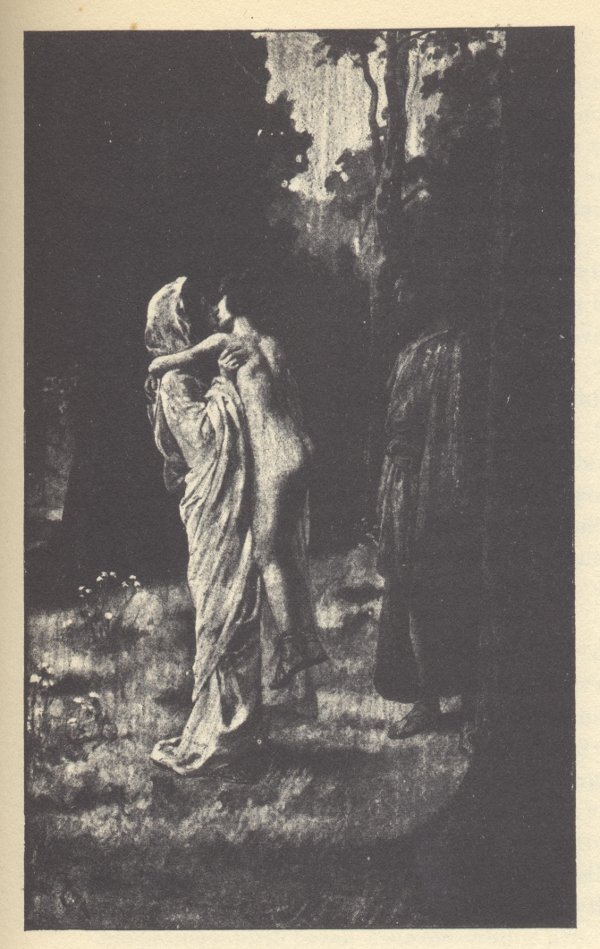
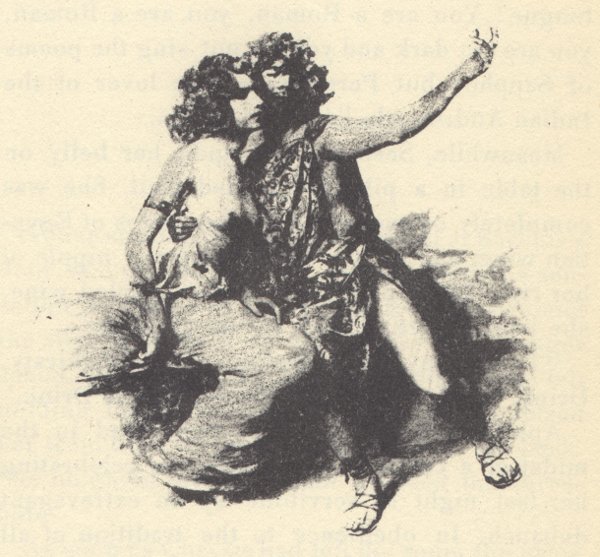
dangerous sport, Timon looked at Chrysis, and gradually, without being seen,
manoevered so that he lay behind her at full length and touched her with his
feet and mouth.
“No,” said Chrysis in a low voice, “no, my friend.”
But he had slipped his arm around her through the large slit in her robe and
was carefully caressing the reclining courtesan’s delicate, burning skin.
“Wait,” she implored. “We shall be seen. Bacchis will be
angry.”
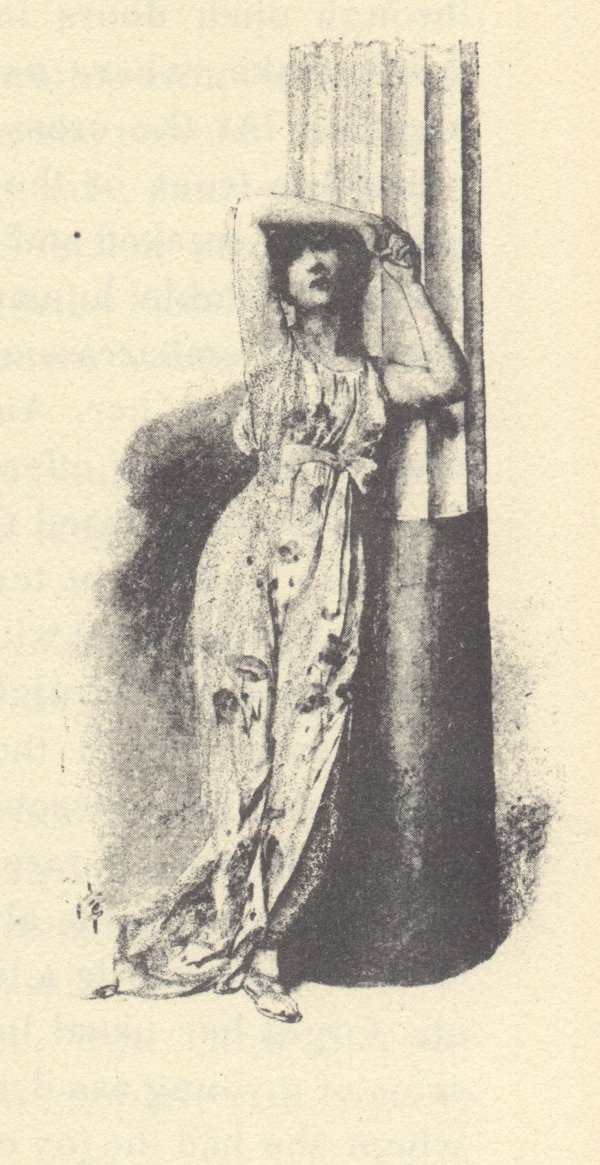
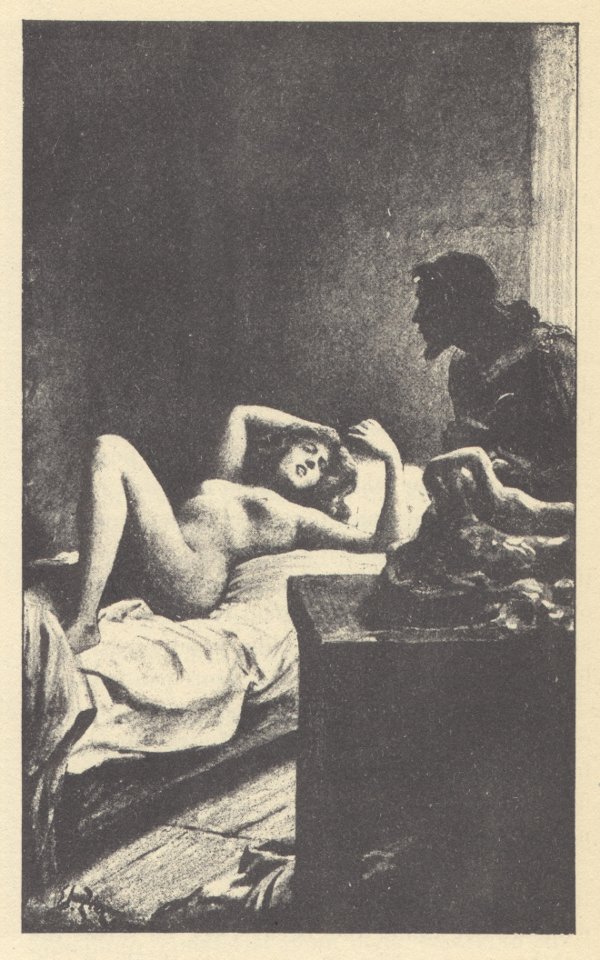
She let herself slip down from the bed.
A glance convinced the young man that he was not being watched. He ventured
upon a caress after which women rarely resist when once they have allowed
things to go so far. Then, in order to quench by a decisive argument the last
scruples of expiring modesty, he put his purse in her hand, which happened by
chance to be open.
Chrysis resisted no longer.
Meanwhile the young acrobat continued her subtle and dangerous tricks. She
walked upon her hands, with her skirt reversed, with her feet dangling in front
of her head, between sharp swords and long keen blades. The effort occasioned
by this critical posture, and perhaps also the fear of wounds, flooded her
cheeks with dark warm blood, which heightened still further the glitter of her
wide-open eyes. Her waist bent and straightened itself again. Her legs parted
like the arms of a dancing girl.
A violent respiration agitated her naked breast.
“Enough,” said Chrysis briefly: “you have only excited me a
little. Let us have no more of it. Leave me. Leave me.”
And at the moment when the two Ephesians rose, according to the tradition, to
play The Fable of Hermaphroditus, she let herself slip down from the bed
and went out feverishly.