Colours of Ancient Races and Mythical Ages—Caucasian Race
Theory—The Aryan or Indo-European Theory—Races and Languages—Celts
and Teutons—Fair and Dark Palæolithic Peoples in Modern
Britain—Mediterranean Man—The Armenoid or Alpine Broad-heads—Ancient
British Tribes—Cruithne and Picts—The Picts of the
"Brochs" as Pirates and Traders—Picts and Fairies—Scottish Types—Racial
"Pockets".
The race problem has ever been one of engrossing
interest to civilized peoples. In almost every old
mythology we meet with theories that were formulated
to account for the existence of the different races living
in the world, and for the races that were supposed to
have existed for a time and became extinct. An outstanding
feature of each racial myth is that the people
among whom it grew up are invariably represented to
be the finest type of humanity.
A widespread habit, and one of great antiquity, was
to divide the races, as the world was divided, into
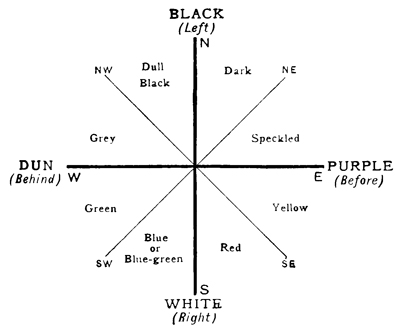
four sections, and to distinguish them by their colours.
The colours were those of the cardinal points and chiefly
Black, White, Red, and Yellow. The same system was
adopted in dealing with extinct races. Each of these were
coloured according to the Age in which they had existence,
and the colours were connected with metals.
In Greece and India, for instance, the "Yellow Age"
was a "Golden Age", the "White Age" a "Silver
Age", the "Red Age" a "Bronze Age", and the
"Black Age" an "Iron Age".
Although the old theories regarding the mythical
ages and mythical races have long been discarded,
the habit of dividing mankind and their history into
four sections, according to colours and the metals chiefly
used by them, is not yet extinct. We still speak of
the "Black man", the "Yellow man", the "Red
man", and the "White man". Archæologists have
divided what they call the "pre-history of mankind"
into the two "Stone Ages", the "Bronze Age" and the
"Iron Age". The belief that certain races have become
extinct as the result of conquest by invaders is
still traceable in those histories that refer, for instance,
to the disappearance of "Stone Age man" or "Bronze
Age man", or of the British Celts, or of the Picts of
Scotland.
That some races have completely disappeared there
can be no shadow of a doubt. As we have seen,
Neanderthal man entirely vanished from the face of the
globe, and has not left a single descendant among the
races of mankind. In our own day the Tasmanians
have become extinct. These cases, however, are exceptional.
The complete extinction of a race is an
unusual thing in the history of mankind. A section
may vanish in one particular area and yet persist in
another. As a rule, in those districts where races are
supposed to have perished, it is found that they have
been absorbed by intruders. In some cases the chief
change has been one of racial designation and nationality.
Crô-Magnon man, who entered Europe when the
Neanderthals were hunting the reindeer and other
animals, is still represented in our midst. Dr. Collignon,
the French ethnologist, who has found many
representatives of this type in the Dordogne valley
where their ancestors lived in the decorated cave-dwellings
before their organization was broken up by the
Azilian and other intruders, shows that the intrusion
of minorities of males rarely leaves a permanent change
in a racial type. The alien element tends to disappear.
"When", he writes, "a race is well seated
in a region, fixed to the soil by agriculture, acclimatized
by natural selection and sufficiently dense, it
opposes, for the most precise observations confirm it,
an enormous resistance to new-comers, whoever they
may be." Intruders of the male sex only may be bred
out in time.
Our interest here is with the races of Britain and
Ireland, but, as our native islands were peopled from
the Continent, we cannot ignore the evidence afforded
by Western and Northern Europe when dealing with
our own particular phase of the racial problem.
It is necessary in the first place to get rid of certain
old theories that were based on imperfect knowledge
or wrong foundations. One theory applies the term
"Caucasian Man" to either a considerable section or
the majority of European peoples. "The utter absurdity
of the misnomer Caucasian, as applied to the
blue-eyed and fair-haired Aryan (?) race of Western
Europe, is revealed", says Ripley,[91] "by two indisputable
facts. In the first place, this ideal blond type
does not occur within many hundred miles of Caucasia;
and, secondly, nowhere along the great Caucasian chain
is there a single native tribe making use of a purely
inflectional or Aryan language."
The term "Aryan" is similarly a misleading one.
It was invented by Professor Max Müller and applied
by him chiefly to a group of languages at a time
when races were being identified by the languages
they spoke. These peoples—with as different physical
characteristics as have Indians and Norseman, or
Russians and Spaniards, who spoke Indo-European, or,
as German scholars have patriotically adapted the term,
Indo-Germanic languages—were regarded by ethnologists
of the "philological school" as members of the
one Indo-European or Aryan race or "family".
Language, however, is no sure indication of race. The
spread of a language over wide areas may be accounted
for by trade or political influence or cultural contact.
In our own day the English language is spoken by
"Black", "Yellow", and "Red", as well as by
"White" peoples.
A safer system is to distinguish racial types by their
physical peculiarities. When, however, this system is
applied in Europe, as elsewhere, we shall still find
differences between peoples. Habits of thought and
habits of life exercise a stronger influence over individuals,
and groups of individuals, than do, for instance,
the shape of their heads, the colours of their
hair, eyes, and skin, or the length and strength of
their limbs. Two particular individuals may be
typical representatives of a distinct race and yet not
only speak different languages, but have a different
outlook on life, and different ideas as to what is right
and what is wrong. Different types of people are in
different parts of the world united by their sense of
nationality. They are united by language, traditions,
and beliefs, and by their love of a particular locality
in which they reside or in which their ancestors were
wont to reside. A sense of nationality, such as unites
the British Empire, may extend to far-distant parts of
the world.
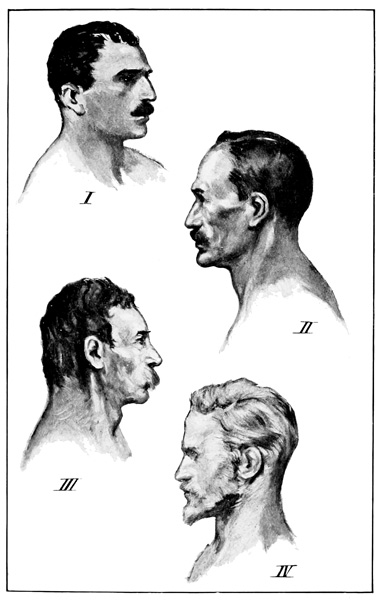
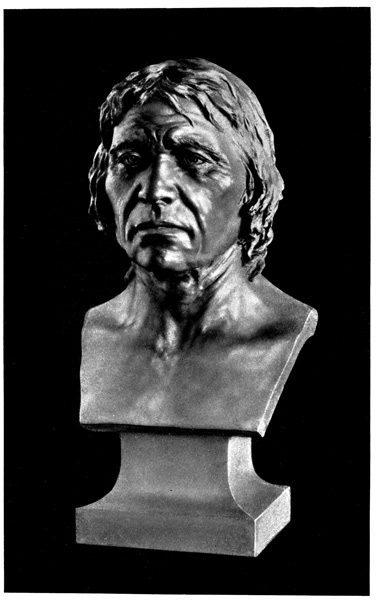
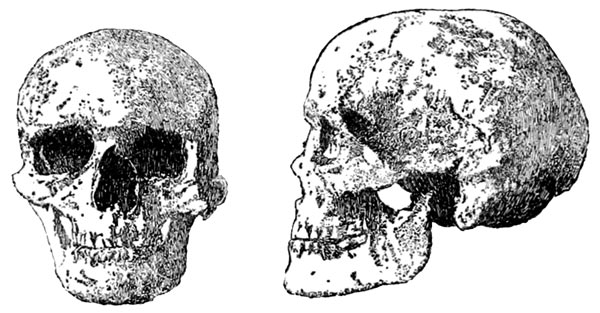
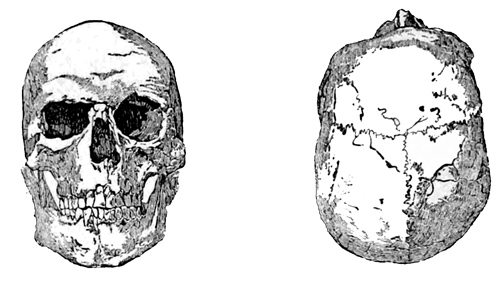
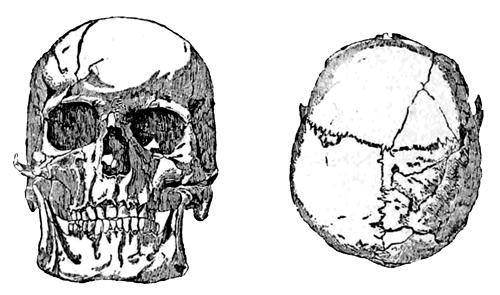
EUROPEAN TYPES
I, Mediterranean. II, Crô-Magnon. III, Armenoid (Alpine).
IV, Northern.
But, while conscious of the uniting sense of nationality,
our people are at the same time conscious of and
interested in their physical differences and the histories
of different sections of our countrymen. The problem as
to whether we are mainly Celtic or mainly Teutonic is
one of perennial interest.
Here again, when dealing with the past, we meet with
the same condition of things that prevail at the present
day. Both the ancient Celts and the people they called
Teutons ("strangers") were mixed peoples with different
physical peculiarities. The Celts known to the Greeks
were a tall, fair-haired people. In Western Europe, as
has been indicated, they mingled with the dark Iberians,
and a section of the mingled races was known to the
Romans as Celtiberians. The Teutons included the
tall, fair, long-headed Northerners, and the dark, medium-sized,
broad-headed Central Europeans. Both the fair
Celts and the fair Teutons appear to have been sections
of the northern race known to antiquaries as the "Baltic
people", or "Maglemosians", who entered Europe
from Siberia and "drifted" along the northern and
southern shores of the Baltic Sea—the ancient "White
Sea" of the "White people" of the "White North".
As we have seen, other types of humanity were "drifting"
towards Britain at the same time—that is, before
the system of polishing stone implements and weapons
inaugurated what has been called the "Neolithic
Age".
As modern-day ethnologists have found that the
masses of the population in Great Britain and Ireland
are of the early types known to archæologists as Palæolithic,
Neolithic, and Bronze Age men, the race history
of our people may be formulated as follows:
The earliest inhabitants of our islands whose physical
characteristics can be traced among the living population
were the Crô-Magnon peoples. These were followed
by the fair Northerners, the "carriers" of Maglemosian
culture, and the dark, medium-sized Iberians, who were
the "carriers" of Azilian-Tardenoisian culture. There
were thus fair people in England, Scotland, and Ireland
thousands of years before the invasions of Celts, Angles,
Saxons, Jutes, Norsemen, or Danes.
For a long period, extending over many centuries,
the migration "stream" from the Continent appears to
have been continuously flowing. The carriers of
Neolithic culture were in the main Iberians of Mediterranean
racial type—the descendants of the Azilian-Tardenoisian
peoples who used bows and arrows,
and broke up the Magdalenian civilization of Crô-Magnon
man in western and central Europe. This
race appears to have been characterized in north and
north-east Africa. "So striking", writes Professor
Elliot Smith, "is the family likeness between the early
Neolithic peoples of the British Isles and the Mediterranean
and the bulk of the population, both ancient
and modern, of Egypt and East Africa, that a description
of the bones of an Early Briton of that remote
epoch might apply in all essential details to an inhabitant
of Somaliland."[92]
This proto-Egyptian (Iberian) people were of medium
stature, had long skulls and short narrow faces, and
skeletons of slight and mild build; their complexions
were as dark as those of the southern Italians in our
own day, and they had dark-brown or black hair with a
tendency to curl; the men had scanty facial hair, except
for a chin-tuft beard.
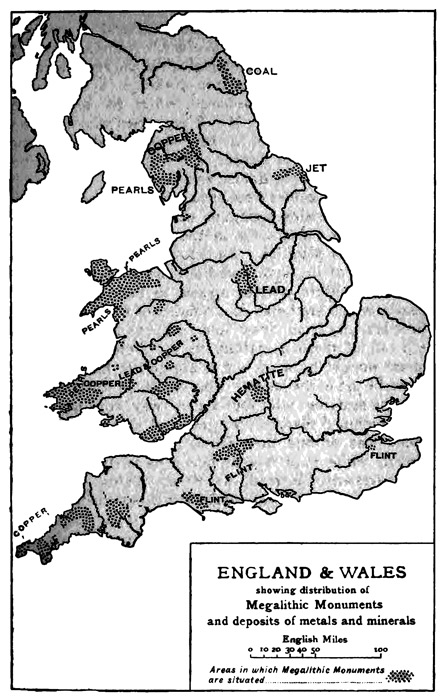
These brunets introduced the agricultural mode of life,
and, as they settled on the granite in south-western
England, appear to have searched for gold there, and
imported flint from the settlers on the upper chalk
formation.
In time Europe was invaded from Asia Minor by
increasing numbers of an Asiatic, broad-headed,
long-bearded people of similar type to those who had
filtered into Central Europe and reached Belgium and
Denmark before Neolithic times. This type is known
as the "Armenoid race" (the "Alpine race" of some
writers). It was quite different from the long-headed
and fair Northern type and the short, brunet Mediterranean
(proto-Egyptian and Iberian) type. The Armenoid
skeletons found in the early graves indicate that
the Asiatics were a medium-sized, heavily-built people,
capable, as the large bosses on their bones indicate, of
considerable muscular development.
During the archæological Bronze Age these Armenoids
reached Britain in considerable numbers, and
introduced the round-barrow method of burial. They
do not appear, however, as has been indicated, to have
settled in Ireland.
At a later period Britain was invaded by a people
who cremated their dead. As they thus destroyed the
evidence that would have afforded us an indication of
their racial affinities, their origin is obscure.
While these overland migrations were in progress,
considerable numbers of peoples appear to have reached
Britain and Ireland by sea from northern and north-western
France, Portugal, and Spain. They settled
chiefly in the areas where metals and pearls were once
found or are still found. "Kitchen middens" and
megalithic remains are in Ireland mainly associated with
pearl-yielding rivers.
The fair Celts and the darker Celtiberians were invading
and settling in Britain before and after the Romans
first reached its southern shores. During the Roman
period, the ruling caste was mainly of south-European
type, but the Roman legions were composed of Gauls,
Germans, and Iberians, as well as Italians. No permanent
change took place in the ethnics of Britain
during the four centuries of Roman occupation. The
Armenoid broad-heads, however, became fewer: "the
disappearance", as Ripley puts it, "of the round-barrow
men is the last event of the prehistoric period
which we are able to distinguish". The inhabitants
of the British Isles are, on the whole, long-headed.
"Highland and lowland, city or country, peasant or
philosopher, all are", says Ripley, "practically alike
in respect to this fundamental racial characteristic."
Broad-headed types are, of course, to be found, but
they are in the minority.
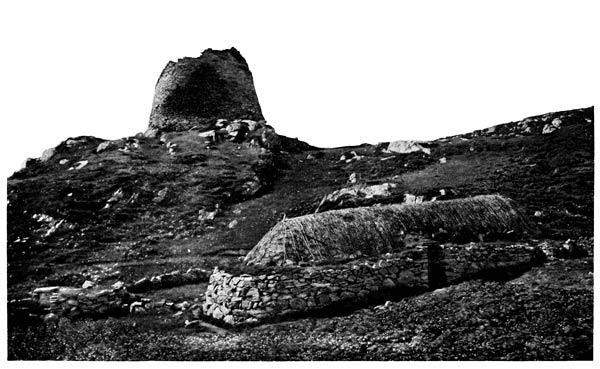
Valentine
RUINS OF PICTISH TOWER AT CARLOWAY, LEWIS
Modern "black house" in the foreground.
The chief source of our knowledge regarding the early
tribes or little nations of Britain and Ireland is the work
of Ptolemy, the geographer, who lived between a.d. 50
and 150, from which the earliest maps were compiled in
the fourth century. He shows that England, Wales,
Scotland, and Ireland were divided among a number of
peoples. The Dumnonii,[93] as has been stated, were in
possession of Devon and Cornwall, as well as of a large
area in the south-western and central lowlands of Scotland.
Near them were the Durotriges, who were also in
Ireland. Sussex was occupied by the Regni and Kent
by the Cantion. The Atrebates, the Belgæ, and the
Parisii were invaders from Gaul during the century that
followed Cæsar's invasion. The Belgæ lay across the
neck of the land between the Bristol Channel and the
Isle of Wight; the Atrebates clung to the River Thames,
while the Parisii, who gave their name to Paris, occupied
the east coast between the Wash and the Humber.
Essex was the land of the Iceni or Eceni, the tribe of
Boadicea (Boudicca). Near them were the Catuvellauni
(men who rejoiced in battle) who were probably rulers
of a league, and the Trinovantes, whose name is said to
signify "very vigorous". The most important tribe
of the north and midlands of England was the Brigantes,[94]
whose sphere of influence extended to the Firth of Forth,
where they met the Votadini, who were probably kinsmen
or allies. On the north-west were the Setantii,
who appear to have been connected with the Brigantes
in England and Ireland. Cuchullin, the hero of the Red
Branch of Ulster, was originally named Setanta.[95] In
south Wales the chief tribe was the Silures, whose
racial name is believed to cling to the Scilly (Silura)
Islands. They were evidently like the Dumnonii a
metal-working people. South-western Wales was
occupied by the Demetæ (the "firm folk"). In south-western
Scotland, the Selgovæ ("hunters") occupied
Galloway, their nearest neighbours being the Novantæ
of Wigtownshire. The Selgovæ may have been those
peoples known later as the Atecotti. From Fife to
southern Aberdeenshire the predominant people on the
east were the Vernicones. In north-east Aberdeenshire
were the Tæxali. To the west of these were the Vacomagi.
The Caledonians occupied the Central Highlands
from Inverness southward to Loch Lomond.
In Ross-shire were the Decantæ, a name resembling
Novantæ and Setantii. The Lugi and Smertæ (smeared
people) were farther north. The Cornavii of Caithness
and North Wales were those who occupied the "horns"
or "capes". Along the west of Scotland were peoples
called the Cerones, Creones, and Carnonacæ, or Carini,
perhaps a sheep-rearing people. The Epidii were an
Argyll tribe, whose name is connected with that of the
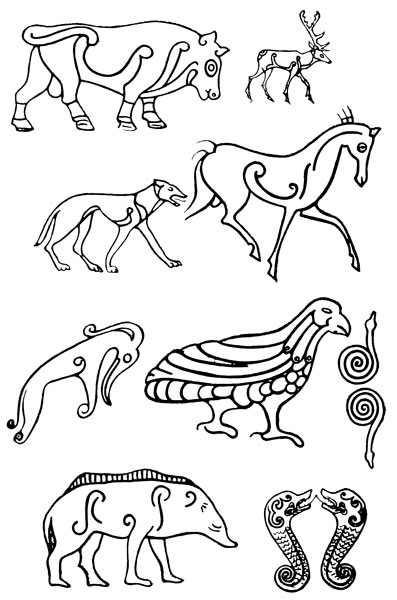
horse—perhaps a horse-god.[96] Orkney enshrines the
tribal name of the boar—perhaps that of the ancient
boar-god represented on a standing stone near Inverness
with the sun symbol above its head. The Gaelic name
one horse-stone remains in an old church tower.]
of the Shetlanders is "Cat". Caithness is the county
of the "Cat" people, too. Professor Watson reminds
us that the people of Sutherland are still "Cats" in
Gaelic, and that the Duke of Sutherland is referred to as
"Duke of the Cats".
The Picts are not mentioned by Ptolemy. They
appear to have been an agricultural and sea-faring
people who (c. a.d. 300) engaged in trade and piracy.
A flood of light has been thrown on the Pictish problem
by Professor W. J. Watson, Edinburgh.[97] He shows
that when Agricola invaded Scotland (a.d. 85) the predominant
people were the Caledonians. Early in the
third century the Caledonians and Mæatæ—names
which included all the tribes north of Hadrian's
Wall—were so aggressive that Emperor Septimus
Severus organized a great expedition against them.
He pressed northward as far as the southern shore of
the Moray Firth, and, although he fought no battle, lost
50,000 men in skirmishes, &c. The Caledonians and
Mæatæ rose again, and Severus was preparing a second
expedition when he died at York in a.d. 211. His son,
Caracalla, withdrew from Scotland altogether. The
Emperor Constantius, who died at York in a.d. 306,
had returned from an expedition, not against the Caledonians,
but against the Picts. The Picts were beginning
to become prominent. In 360 they had again to
be driven back. They had then become allies of the
Scots from Ulster, who were mentioned in a.d. 297
by the orator Eumenius, as enemies of the Britons
in association with the Picti. Professor Watson, drawing
on Gaelic evidence, dates the first settlement of the
Scots in Argyll "about a.d. 180".
In 368 the Caledonians were, like the Verturiones, a
division of the Picts. Afterwards their tribal name disappeared.
That the Picts and Caledonians were originally
separate peoples is made clear by the statement of
a Roman orator who said: "I do not mention the woods
and marshes of the Caledonians, the Picts, and others".
In 365 the Pecti, Saxons, Scots, and Atecotti harassed
the Britons. Thus by the fourth century the Picts had
taken the place of the Caledonians as the leading tribe,
or as the military aristocrats of a great part of Scotland,
the name of which, formerly Caledonia, came to be
Pictland, Pictavia.
Who then were the Picts? Professor Watson shows
that the racial name is in old Norse "Pettr", in Old
English "Peohta", and in old Scots "Pecht"[98] These
forms suggest that the original name was "Pect".
Ammianus refers to the "Pecti". In old Welsh "Peith-wyr"
means "Pict-men" and "Peith" comes from
"Pect". The derivation from the Latin "pictus"
(painted) must therefore be rejected. It should be borne
in mind in this connection that the Ancient Britons
stained their bodies with woad. The application of
the term "painted" to only one section of them seems
improbable. "Pecti", says Professor Watson, "cannot
be separated etymologically from Pictones, the
name of a Gaulish tribe on the Bay of Biscay south of
the Loire, near neighbours of the Veneti. Their name
shows the same variation between Pictones and Pectones.
We may therefore claim Pecti as a genuine Celtic word.
It is of the Cymric or Old British and Gaulish type, not
of the Gaelic type, for Gaelic has no initial P, while those
others have." Gildas (c. a.d. 570), Bede (c. a.d. 730), and
Nennius (c. a.d. 800) refer to the Picts as a people from
the north of Scotland. Nennius says they occupied
Orkney first. The legends which connect the Picts
with Scythia and Hercules were based on Virgil's mention
of "picti Agathyrsi" and "picti Geloni" (Æneid
IV, 146, Georgics, II, 115) combined with the account by
Herodotus (IV, 10) of the descent of Gelonus and Agathyrsus
from Hercules. Of late origin therefore was
the Irish myth that the Picts from Scythia were called
Agathyrsi and were descended from Gelon, son of
Hercules.
There never were Picts in Ireland, except as visitors.
The theory about the Irish Picts arose by mistranslating
the racial name "Cruithne" as "Picts". Communities
of Cruithne were anciently settled in the four provinces
of Ireland, but Cruithne means Britons not Picts.
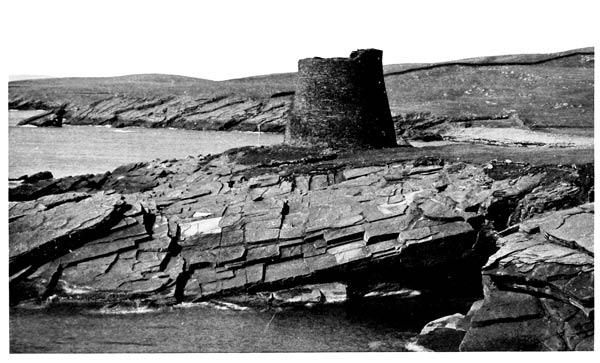
Valentine
A SCOTTISH "BROCH" (Mousa, Shetland Isles)
Compare with Sardinian Nuraghe, page 136.
The ancient name of Great Britain was Albion, while
Ireland was in Greek "Ierne", and in Latin "Iubernia"
(later "Hibernia"). The racial name was applied by
Pliny to Albion and Hibernia when he referred to the
island group as "Britanniæ". Ptolemy says that Albion
is "a Britannic isle" and further that Albion (England
and Scotland) was an island "belonging to the Britannic
Isles". Ireland was also a Britannic isle. It is
therefore quite clear that the Britons were regarded as the
predominant people in England, Wales, Scotland, and
Ireland, and that the verdict of history includes Ireland
in the British Isles. The Britons were P-Celts, and
their racial name "Pretan-Pritan" became in the Gaelic
language of the Q-Celts "Cruithen", plural "Cruithne".
In Latin the British Isles are called after their inhabitants,
the rendering being "Britanni", while in Greek it
is "Pretannoi" or "Pretanoi". As Professor W. J.
Watson and Professor Sir J. Morris Jones, two able and
reliable philologists, have insisted, the Greek form is the
older and more correct, and the Latin form is merely an
adaptation of the Greek form.
In the early centuries of our era the term "Britannus"
was shortened in Latin to "Britto" plural "Brittones".
This diminutive form, which may be compared with
"Scotty" for Scotsman, became popular. In Gaelic it
originated the form "Breatain", representing "Brittones"
(Britons), which was applied to the Britons of Strathclyde,
Wales, and Cornwall, who retained their native
speech under Roman rule; in Welsh, the rendering was
"Brython". The Welsh name for Scotland became
"Prydyn". The northern people of Scotland, having
come under the sway of the Picts, were referred to as
Picts just as they became "Scots" after the tribe of
Scots rose into prominence. In this sense the Scottish
Cruithne were Picts. But the Cruithne (Britons) of
Ireland were never referred to as Picts. Modern scholars
who have mixed up Cruithne and Picts are the inventors
of the term "Irish Picts".
The Picts of Scotland have been traditionally associated
with the round buildings known as "brochs", which are
all built on the same plan. "Of 490 known brochs", says
Professor W. J. Watson, "Orkney and Shetland possess
145, Caithness has 150, and Sutherland 67—a total of
362. On the mainland south of Sutherland there are 10
in Ross, 6 Inverness-shire, 2 in Forfar, 1 in Stirling,
Midlothian, Selkirk, and Berwick-shires, 3 in Wigtownshire.
In the Isles there are 28 in Lewis, 10 in Harris,
30 in Skye, 1 in Raasay, and at least 5 in the isles of
Argyll. The inference is that the original seat of the
broch builders must have been in the far north, and that
their influence proceeded southwards. The masonry
and contents of the brochs prove them to be the work
of a most capable people, who lived partly at least by
agriculture and had a fairly high standard of civilization....
The distribution of the brochs also indicate that
their occupants combined agriculture with sea-faring....
The Wigtown brochs, like the west coast ones generally,
are all close to the sea, and in exceedingly strong
positions."
These Scottish brochs bear a striking resemblance to
the nuraghi of the island of Sardinia. Both the broch
and the nuraghe have low doorways which "would at
once put an enemy at a disadvantage in attempting to
enter".
Describing the Sardinian structures, Mr. T. Eric
Peet writes:[99] "All the nuraghi stand in commanding
situations overlooking large tracts of country, and the
more important a position is from a strategical point of
view the stronger will be the nuraghe which defends it".
Ruins of villages surround these structures. "There
cannot be the least doubt", says Peet, "that in time of
danger the inhabitants drove their cattle into the fortified
enclosure, entered it themselves, and then closed the
gates."
In the Balearic Islands are towers called talayots which
"resemble rather closely", in Peet's opinion, the nuraghi
of Sardinia. The architecture of the talayots, the nuraghi,
and the brochs resembles that of the bee-hive tombs of
Mycenæ (pre-Hellenic Greece). There are no brochs in
Ireland. The "round towers" are of Christian origin
(between ninth and thirteenth centuries a.d.). A tomb
at Labbamologa, County Cork, however, resembles the
tombs of the Balearic Isles and Sardinia (Peet, Rough
Stone Monuments, pp. 43-4).
The Picts appear to have come to Scotland from the
country of the ancient Pictones, whose name survives in
Poitiers (Poictiers) and the province of Poitou in
France. These Pictones were anciently rivals of the
Veneti, the chief sea-traders in Western and Northern
Europe during the pre-Roman period. We gather
from Cæsar that the Pictones espoused the cause of the
Romans when the Veneti and their allies revolted.
They and their near neighbours, the Santoni, supplied
Cæsar with ships.[100] These were apparently skiffs which
were much lighter and smaller than the imposing vessels
of the Veneti. As the big vessels of the Armada were
no match for the smaller English vessels, so were the
Veneti ships no match for the skiffs of the Pictones.
The Picts who settled in Orkney appear to have
dominated the eastern and western Scottish sea-routes.
It is possible that they traded with Scandinavia and
imported Baltic amber. Tacitus states that the Baltic
people, who engaged in the amber trade, spoke a dialect
similar to that of Britain, worshipped the mother-goddess,
and regarded the boar as the symbol of their deity.[101]
Orkney, as has been noted, is derived from the old
Celtic word for boar. The boar-people of Orkney who
came under the sway of the Picts may have been related
to the amber traders.
The Scottish broch-people, associated in tradition with
the Picts, were notorious for their piratic habits. In
those ancient days, however, piracy was a common
occupation. The later Vikings, who seized the naval
base of Orkney for the same reason we may conclude
as did the Picts, occupied the brochs. Viking means
"pirate", as York Powell has shown. In Egil's Saga
(Chapter XXXII) the hero Bjorn "was sometimes in
Viking but sometimes on trading voyages".[102]
It may be that the term pictus with the
racial name Pecti, because the Picts had adopted the
sailor-like habit of tattoing their skins—a habit which probably
had a religious significance. Claudian, the fourth-century
Roman poet, refers to "the fading steel-wrought
figures on the dying Pict". Like the sea-faring Scots
of northern Ireland who harried the Welsh coast between
the second and fifth centuries of our era, the Picts of
Scotland had skiffs (scaphæ) with sails and twenty oars
a side. Vessels, masts, ropes, and sails were painted
a neutral tint, and the crews were attired in the same
colour. Thus "camouflaged", the Picts and Scots were
able to harry the coasts of Romanized Britain. They
appear to have turned Hadrian's wall from the sea. The
Pictish sea-faring tribes, the Keiths or Cats and the
Mæatæ, have left their names in Caithness, Inchkeith,
Dalkeith, &c., and in the Isle of May, &c.[103]
A glimpse of piratical operations in the first century
before the Christian era is obtained in an Irish manuscript
account of certain happenings in the reign of
King Conaire the Great of Ireland. So strict was
this monarch's rule that several lawless and discontented
persons were forced into exile.
"Among the most desperate of the outlaws were the
monarch's own foster brothers, the four sons of Dond Dess,
an important chieftain of Leinster. These refractory youths,
with a large party of followers, took to their boats and ships
and scoured the coasts of Britain and Scotland, as well as of
their own country. Having met on the sea with Ingcel, the
son of the King of Britain, who, for his misdeeds, had been
likewise banished by his own father, both parties entered
into a league, the first fruits of which were the plunder and
devastation of a great part of the British coast."
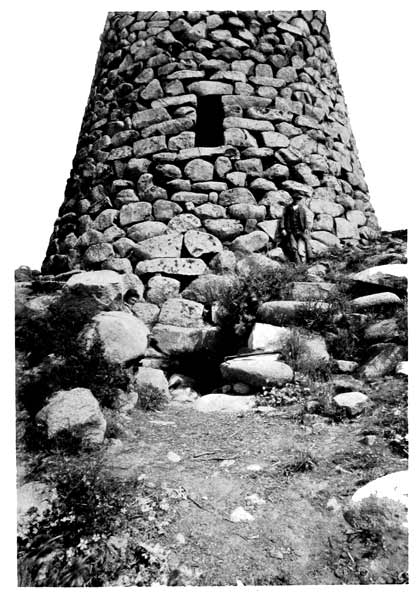
By courtesy of the Director of The British School of Rome
A SARDINIAN NURAGHE (page 134)
Compare with the Scottish "Broch", page 132.
They afterwards made a descent on the coast of Ireland,
and when King Conaire returned from a visit to
Clare, "he found the whole country before him one
sheet of fire, the plunderers having landed in his absence
and carried fire and sword wherever they went".[104]
In his description of Britain, Tacitus says that the
inhabitants varied in their physical traits. Different
conclusions were drawn concerning their origin. He
thought the Caledonians were, because of their ruddy
hair and muscular limbs, of German descent, and that
the dark Silures of Wales were descendants of Iberian
colonists. He noted that the inhabitants of southern
England resembled those of Gaul.[105]
Later writers have expressed divergent views regarding
the ethnics of the British Isles. One theory is that
the fair Teutonic peoples, who invaded Britain during
the post-Roman period, drove the "dark Celts" westward,
and that that is the reason why in England and
Scotland the inhabitants of western areas are darker
than those in the eastern. As we have seen, however,
the early metal workers settled in the western areas
for the reason that the minerals they sought for were
located there. In south-western Scotland the inhabitants
are darker than those on the east, except in
Aberdeenshire, where there are distinctive megalithic
remains and two famous pearling rivers, the Ythan and
Ugie, as well as deposits of flint and traces of gold.
The people of Scotland are, on the whole, the tallest
and heaviest people in Europe. It has been suggested
that their great average stature is due to the settlement
in their country of the hardy Norsemen of the Viking
period, but this is improbable, because the average
stature of Norway, Sweden, and Denmark is lower
than that of Scotland. A distinctive feature of the
Scottish face is the high cheek-bone. The Norse
cheek-bone is distinctly flatter. It may be that the
tall Crô-Magnons, who had high cheek-bones, have
contributed to Scottish physical traits. That all the
fair peoples of Britain and Ireland are, as has been
indicated, not necessarily descendants of the fair Celts
and Anglo-Saxons is evident from the traces that have
been found of the early settlement in these islands of
the proto-Scandinavians, who introduced the Maglemosian
culture long before the introduction of the
Neolithic industry. Modern ethnologists lean to the
view that the masses of the present-day population of
Europe betray Palæolithic racial affinities. In no
country in Europe, other than our own, have there been
fewer ethnic changes. As we have seen, there were
only two or three intrusions from the Continent between
the periods when the bronze and iron industries were
introduced—that is, during about a thousand years.
The latter invasions were those of types already settled
in Britain. As in other countries, the tendency to revert
to the early types represented by the masses of the
people has not been absent in our native land. The
intrusions of energetic minorities may have caused
changes of languages and habits of life, but in time the
alien element has been absorbed.[106] Withal, the influences
of climate and of the diseases associated with localities
have ever been at work in eliminating the physically
unfit—that is, those individuals who cannot live in a
climate too severe for their constitutions. In large
industrial cities the short, dark types are more numerous
than the tall, fair, and large-lunged types. The latter
appear to be more suited for an open-air life.
"Pockets" of peoples of distinctive type are to be
found in different parts of the British Isles. In Barvas,
Lewis, and elsewhere in the Hebrides, pockets of dark
peoples of foreign appearance are reputed by theorists,
as has been indicated, to be descendants of the sailors
of the Spanish Armada. They resemble, however, the
Fir-bolgs of Ireland and the Silures of Wales. Hertfordshire
has a dark, short people too. Galloway, the
country of the ancient Selgovæ (hunters), is noted for
its tall people. It may be that there is a Crô-Magnon
strain in Galloway, and that among the short, dark
peoples are descendants of the ancient metal workers,
including the Easterners who settled in Spain. (See
Chaps. IX and XII.) Beddoe thinks that the Phœnician
type "occasionally crops up" in Cornwall.[107]