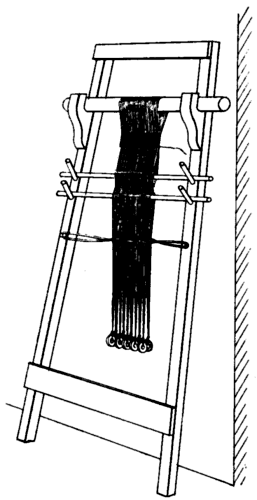
IN the tomb of Chnem-hotep, at Beni Hasan, there is a wall painting
of a horizontal loom with two weavers, women, squatting on
either side, and at the right in the background is drawn the figure of
the taskmaster. There are also figures represented in the act of
spinning, etc. For the present we are concerned with the weaving
only.
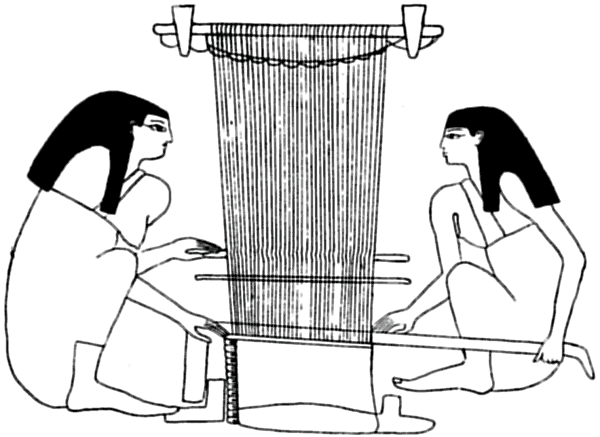
Fig. 1.—Horizontal Loom, Tomb of Chnem-hotep, from the illustration in Cailliaud’s
Recherches, etc. Same size as published.
Of this illustration, there appear to be six reproductions. We
have first of all, Fig. 1, that of Fred. Cailliaud (Recherches sur les
Arts et Métiers, etc., Paris, 1831) with illustrations of drawings made
by himself in the years 1819 to 1822. His publication was followed
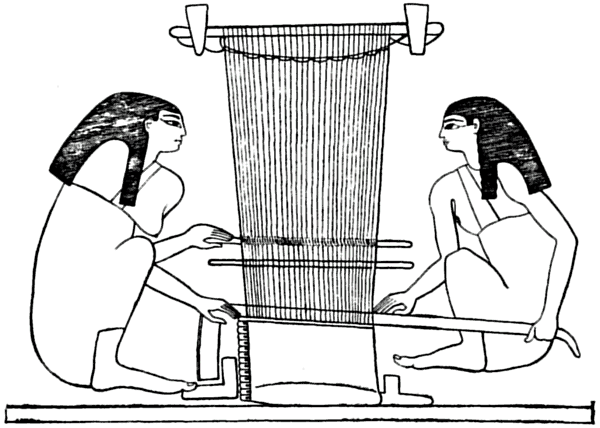
by Fig. 2, that of Sir J. G. Wilkinson (Manners and Customs, etc., London,
1837). Mr. John Murray, whose house has published Wilkinson’s
work from the first edition to the last, informs me that a few of the
drawings were made by George Scharf, afterwards Sir George Scharf,
Keeper of the National Portrait Gallery, but that most of them seem
to have been made by Joseph Bonomi, the well known Egyptologist.
Wilkinson’s woodcut, although clearly and neatly done, is on a very
small scale; nevertheless it admits of a fair comparison with those
reproduced on a larger scale.
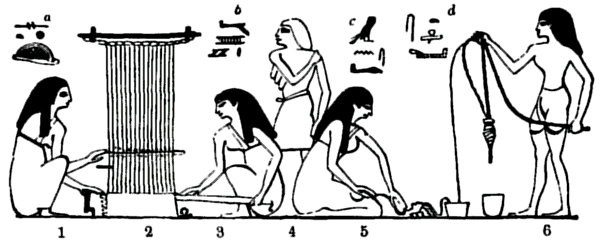
| Figs. 1 & 3. Weaving. |
Fig. 4. Male Overseer. |
| Fig. 2. Loom. |
” 5. Hackling. |
| ” 3. Putting in the woof, but not by a shuttle thrown with the hand. |
” 6. Twisting the double threads for the warp. |
| a Weaving. |
b Chief of Loom. |
c Facing. |
d Pulling out. |
Fig. 2.—Horizontal Loom, Tomb of Chnem-hotep, from Sir J. G. Wilkinson’s Manners and
Customs, London, John Murray, 1878, Vol. I., p. 317. Same size as published.
Fig. 3.—Horizontal Loom, Tomb of Chnem-hotep, from the illustration in Rosellini’s
Monumenti (Monumenti Civili), Plate XLI. Reduced one-fifth lineal of size published.
Fig. 4.—Horizontal Loom, Tomb of Chnem-hotep, from Lepsius’ Denkmäler. Same size as
published.
Fig. 5.—Horizontal Loom, Tomb of Chnem-hotep,
from Prof. Percy Newberry’s Beni Hasan, I. Plate
29. Same size as published.
After him, Fig. 3, N. F. J. B. Rosellini began the publication of
his great work (I Monumenti dell’ Egitto, Pisa, 1832-1844). The
similarity between the comparatively few drawings published by
Cailliaud and the very large number published by Rosellini is very
great. It is of course quite possible Rosellini may have made use of
some of Cailliaud’s drawings. Five years after Rosellini’s publication
came that of C. R. Lepsius (Denkmäler, Leipzig, 1849), Fig.
4, his drawings having been made in the years 1842 to 1845.
Since the time of Lepsius until quite recent years I can trace
no further copying until we get the illustration, Fig. 5, in Prof.
Percy Newberry’s Beni Hasan, London, 1910. In this work
the reproduction is about one twentieth of the original, or
about three fifths of the size of that of Wilkinson, and unfortunately
so crude as not to be available for our present purpose.[B] Lastly we
have the reproduction, Fig. 6, from Mr. N. de Garis Davies’ drawing
made in 1903, and now first published by kind permission of Mr.
F. Ll. Griffith.
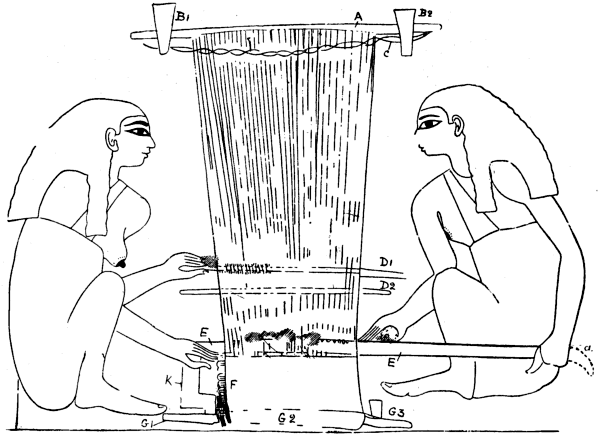
Fig. 6.—Horizontal Loom, Tomb of Chnem-hotep. Size of original: Height of the figures
9¼" = 24·4 cm. Drawn by Mr. N. de G. Davies, and now published for the first time by
permission of Mr. F. Ll. Griffith.
In the various reproductions by the above explorers, the only three
which agree very closely are those of Cailliaud, Rosellini and Davies.
The others vary considerably and in essentials do not agree with the
above nor with one another. The differences may in the first instance
be due to difficulties in copying the original in the tomb. Others may
be due to ignorance of detail on the part of the secondary copyist—the
man who prepared them for publication—so that he was unable to
follow up the clues on the drawings laid before him. The differences
may also be due to careless copying and to “touching up” of the
copies when made; they may be slightly due to deterioration and
obliteration of the original in the course of time.
The Encyclopædia Biblica gives a variant from all six illustrations,
but approaching nearest to that of Cailliaud, Rosellini and Davies. It
is misleading in so far that the drawing has been made to suit
Professor Kennedy’s idea as to what it should be.
Some of the differences are of minor importance, but a comparison
will help materially to our understanding of the method of weaving
adopted by the Egyptians from the XIIth to the XIXth Dynasties, or
about B.C. 2000 to 1200. To go into details, and taking Mr. N. de G.
Davies’ illustration as our basis, we find slight differences in the shape
of the pegs B, B1, which are immaterial. A more pronounced difference
is seen in the way in which the threads are attached to the warp beam A.
Neither Wilkinson nor Lepsius carry these threads over the beam, the
former carrying them only as far as the laze threads C, while the latter
carries them up to a line drawn parallel to and below the beam; Cailliaud
and Rosellini carry them over the beam while Mr. Davies carries them
half way only. The object of this half carrying over is not clear. The
threads in chain-form at C are probably laze threads, apparently placed
there so that in case of any disarrangement of the warp threads the
weaver can from that point run her fingers along them and get them
disentangled. It has been suggested to me that this chain-form might
be a tension chain for taking up slack warp, but the former explanation
seems the more likely.
All the drawings but Wilkinson’s show the warp threads converging
towards the breast beam; Wilkinson shows them parallel and
in Lepsius their convergence is excessive. There should be a slight
convergence shown, as in the course of weaving the threads get drawn
in, and in later forms of looms in semi-civilised countries we find an
endeavour to counteract this tendency by the use of a tool known as a
“temple.”
The cross sticks D1, D2, look like laze rods. It may not be out
of place here to point out that in primitive weaving laze rods serve
two purposes, or one more than in the later somewhat more advanced
looms. They serve throughout to keep the warp threads in place, and
they serve to separate the odd threads from the even (1, 3, 5, 7 from
2, 4, 6, 8, &c.), and in so doing take the place of the fingers in making
the “shed,” i.e., the opening through which the “weft (or woof)”
is passed, a function which in turn is usurped by the “heald (or
heddle).” The heddle therefore becomes a very important factor, and
Dr. H. G. Harrison by no means overstates the case when he says that
the development of the heddle is the most important step in the
evolution of the loom (Horniman Museum Handbooks, No. 10, pp.
47-49). We may now return to the drawing. Wilkinson shows the rod
D1 indistinctly and the left hand end only of D2. Lepsius’ artist
seems to have taken a liberty with D1 but in the right direction, by
making it more definitely into an early form of heddle—the loop and
rod—but he shows D2 the same as Cailliaud and Rosellini. Prof.
Kennedy argues that these rods are in the wrong position and that
D1 which is a heddle should be in the place of D2. Mr. Davies’
drawing as well as those of Cailliaud and Rosellini show that D1 is a
heddle while D2 is shown to be a laze rod. Asiatic primitive looms,
like those from Borneo and Bhutan, have two laze rods but no heddle;
on the other hand many primitive African looms have one laze rod
and one heddle as is the case with this Egyptian loom. More threads
are shown on the left hand end of D2 than on the right hand end.
Mr. Davies informs me that the same quantity should be shown from
end to end across the warp, but on the right hand side they are so
indistinct that he was just able to detect but not to trace them and
so he omitted them.
We now come to the rod E. Cailliaud and Rosellini show an
undulation at the one end a, but do not make the other end clear.
Wilkinson shows a small hook at the end a, which appears to me to be
a transcriber’s development of the curved end of his two predecessors;
in the text Wilkinson says there is a hook at each end of this stick,
but he does not show any at the end opposite to a; he refers to these
hooks more than once (1st ed., III., p. 126 footnote). Lepsius has
altered the shape of the curve and transferred it from the end a to the
opposite end. In Mr. de G. Davies’ drawing, it has been inserted in
dotted lines, as the original is in such a state that tracing is almost
impossible. Wilkinson, Erman, v. Cohausen (Das Spinnen u. Weben
bei den Alten, in Ann. Ver. Nassau. Altherthumsk., Wiesbaden, 1879,
p. 29), and others call it a shuttle, but I am more inclined to consider
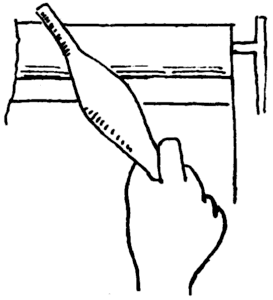
it a slashing stick (“sword” or “beater-in”) for pushing the
weft into position. A tool which appears to be a beater-in and of
similar end shape is seen held in the hand of a woman on a wall
painting at El Bersheh—see Fig. 11, top right-hand corner. We have
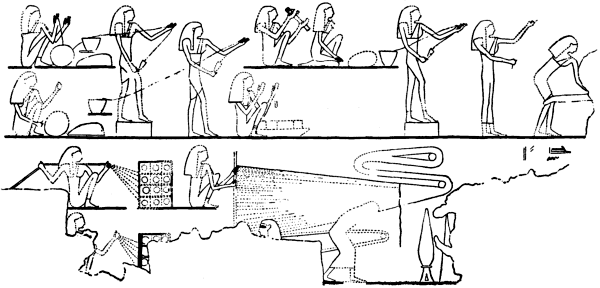
in another illustration, Fig. 7, an article which appears to be a spool,
which I think confirms the view that E is not the shuttle but the
beater-in. In all the illustrations, too, the pose of the hands of the
women bearing on this stick is indicative of a downward pressure and
not of a grasp.
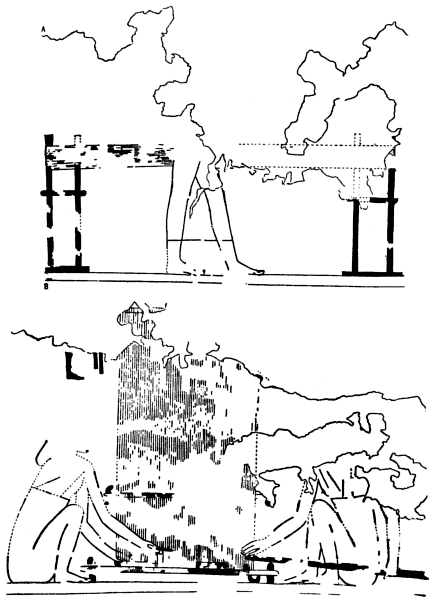
Fig. 7.—Tomb of the Vizier Daga. Date about end XI. Dynasty, B.C. 2000. Mr. N. de G.
Davies’ Five Theban Tombs, Plate XXXVII.
The upper illustration indicates a woman warping or beaming, probably warping.
In the lower illustration note the left hand figure holding the spool in her hand. At first
sight this small black line looks like a continuation of the “beater-in” in the hands of the
other weaver, but Mr. Davies informs me that it is quite a distinct article, and that there can
be no doubt about it. Just above the breast beam there are 8 or 9 threads of weft but they
are too faint to be included.
The selvedge F on the one side of the cloth and not on both sides
is also interesting from the fact that selvedges do not appear on the
Egyptian cloths until the XVIII. Dynasty circa B.C. 1600.
The breast beam:—It appears to me that the three portions
marked G1, G2 and G3 joined up are intended to represent the breast
beam and its holding pegs, similar to the warp beam A and its pegs
B1, B2, but the portion K is not clearly drawn in any of the reproductions.
Wilkinson omits this altogether, but in its place has two
black pieces which also are still less clear. Lepsius has omitted G2
altogether and appears to have made G1 and K and G3 into treadles,
by raising G1 above the level of G3, and to support the view that
these are treadles, he makes use of the overseer’s foot by placing it on
the supposed treadle, and the casual observer thinks it is the foot of
the woman weaver. However, Mr. Davies’ copy seems to offer a solution.
He agrees with Cailliaud and Rosellini in so far as G1, G2 and G3 are
concerned. With him K takes quite a different form, in fact it looks very
similar to an article which an attendant woman in another panel has close
by her, see Fig. 8. It might perhaps be a rest to prevent the
beater-in being driven home too forcibly—this, however, is still
only a surmise—as the length of the beater-in makes it heavy at the
far end.
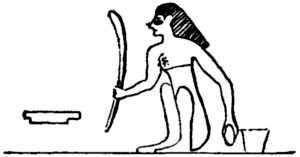
Fig. 8.—Weaver with the support K,
Fig. 6; the woman appears to hold a
beater-in in the right hand and a ball of
thread in the left hand. Rosellini.
In Cailliaud the warp threads are coloured in pale blue and red
on top of the black lines of the drawing; he has painted the selvedge
and finished cloth a pale blue, as well as that portion of G2 which is
covered by the cloth indicating that this is the breast beam, G3 and
G1 are painted a dark red. Rosellini colours A, B1, B2, D1, D2, G3
orange; G1 and K dark red, but E from end to end light ochre. This
shows that K is distinct from E.
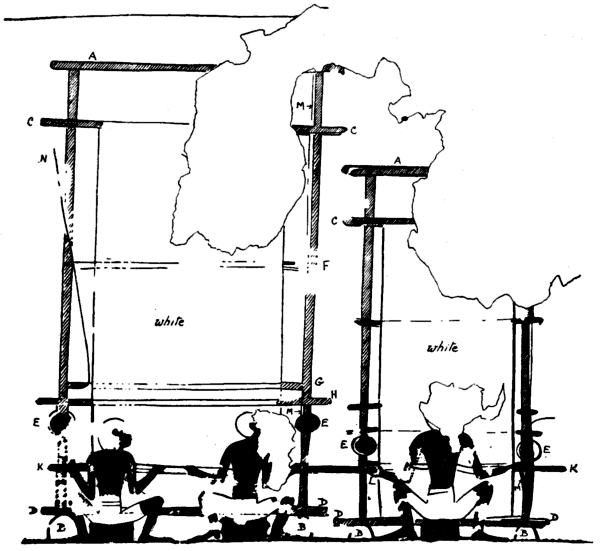
Fig. 9.
Upright or Vertical Looms from the
Tomb of Thot-nefer at Thebes, XVIII.
Dynasty, circa B.C. 1425. From a
drawing by Mr. N. de G. Davies. Size
of original: Height from Base Line to
top of frame at A, 11½" = 29 cm.
In consequence of this loom being represented as upright it is
often spoken of as an upright or vertical loom. But it is drawn upright
because the Egyptian artist did not understand perspective, and
it was only by making the loom upright that he was enabled to show
the details we have just been examining. For the same reason mat
making is illustrated edgeways. If the loom were an upright one the
two women weavers would have had their backs turned towards the
onlooker as can be seen in Fig. 9. Any doubt on the matter has however
been set aside by Prof. John Garstang’s extremely interesting
discovery of a wooden model depicting a group of women spinning
and weaving which he illustrates in his work, The Burial Customs
of Ancient Egypt, London, 1907. After referring to the woman
spinning, he continues: “The other seated figures apparently
represent women at work upon a horizontal loom; the frame
and the woof [sic, should be warp] threads are faintly represented
upon the board. It is possible that they are making mats or,
perhaps, weaving (p. 132).” He gives an illustration of the group
taken from a photograph, but as it does not show the lines
which indicate the loom lying horizontally on the ground nor
the warp threads, I have asked him to let me have a drawing
made of it and, with his kind permission, it is now reproduced
here, Fig. 10. The threads of the warp and the
finished piece of cloth at the breast beam end are clearly
indicated. The whole model supports conclusively the well
founded supposition that the loom we have been considering
is a horizontal one. Curiously enough, Prof. Garstang does
not appear to appreciate the important bearing of his discovery,
for on a later page (p. 134) in speaking of Lepsius’ illustration,
discussed above, he says: “the weavers are seen at work at an upright
loom.”
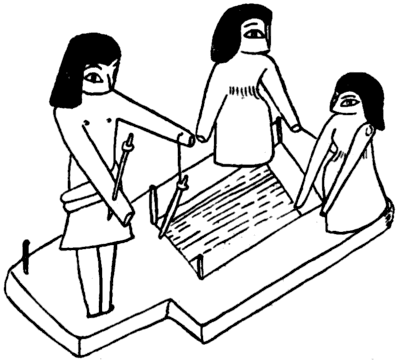
Fig. 10.—Horizontal Loom. Outline sketch by
Miss Davey of the original model of a group of one
woman spinning and two women weaving, found by
Dr. John Garstang at Beni Hasan. The model is in
the Museum of the Liverpool Institute of Archæology.
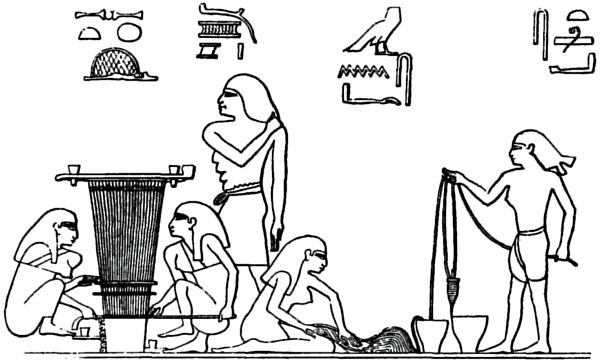
It must not be thought that the Beni Hasan representation is the
only one which illustrates a horizontal loom. A second one is
reproduced by Prof. Percy Newberry from the tomb of Tehuti-hetep
circa 1938-1849 B.C., see Fig. 11. In the upper portion the women
are seen spinning and preparing the thread generally, while in the
lower portion two women on the left are warping, and in the centre
three apparently are “beaming,” i.e. putting the warp on to the
beams preparatory to commencing to weave, the warp threads being
apparently drawn over pegs to ensure the proper tension. This
illustration shows the warp flat against the wall like the mat making
shown at Beni Hasan.
Fig. 11.—Tomb of Tehuti-hetep. Date about 1939-1849 B.C. From Professor Percy
Newberry’s El Bersheh I. Pl. 26.
Note the woman on the top right hand corner holding a “beater-in.”
A third representation of a horizontal loom is reproduced from
the forthcoming volume of the Egypt Exploration Fund by kind
permission of Mr. N. de G. Davies, who made the copy. In this,
Fig. 7, already referred to, the lower portion is all that has come
down to us. The cloth is not shown contracted as in the Beni
Hasan representation, the two laze rods are drawn close to each other
and here also an attempt appears to have been made to show the over
and under lapping warp threads; the laze rods appear each with a
hook, the hook on the upper rod turned upwards and the hook (if it
be one) on the lower rod turned downwards. It is possible these
hooks may be pegs to prevent the shifting of the laze rods. It
may be that one of the two rods is a heddle rod the indication being
the fine double lines, but this may not be compatible with the hook
at the end of the rod. The weaver on the left holds a spool
in her hand, evidently a piece of stick with the weft thread wound
round it, which she is pushing through with her fingers. The weaver
on the right holds a beater-in as shown in the Beni Hasan drawing.
The breast beam is held in position by two pegs near the right one
of which there is a curved article of indeterminate use.
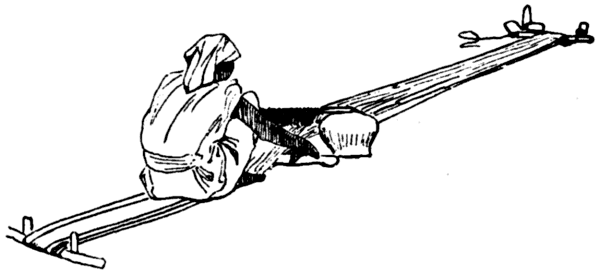
Fig. 12.—Study of a Bedawin Arab weaving, from a sketch taken in the Forties of last
Century, by Frank Goodall, R.A. The original sketch is in Bankfield Museum. The weaver
appears to be provided with one heddle and a beater-in.
There is no very clear evidence as to how the finished cloth was
“taken up” unless we accept it that the bulging out of the part G2
means that it was wound round the breast beam as is done on hand
and power looms of the present day. Some very long pieces of cloth
have come down to us and unless they were “taken up” in this way
a long stretch of ground would have been necessary. A modified form
of this horizontal loom has been met with in recent years among the
Bedawin Arabs, as shown in the illustration of a study sketch, Fig.
12, made by Frank Goodall, R.A., in the forties of last century. The
loom was provided with pegs like the old Egyptian loom but it was
supplied with a primitive heddle resting on a stone at each side of the
warp and it would appear that the weaver, to a certain extent, did not
take up the woven cloth by winding it round the breast beam and by
that means retaining his position, but, as the weaving progressed and
the line of finished cloth got beyond his reach, he crept up to it
and so got farther and farther away from the breast beam until
in the end he arrived at the warp beam. Similar looms are still used
for mat making by the Egyptian fellah.
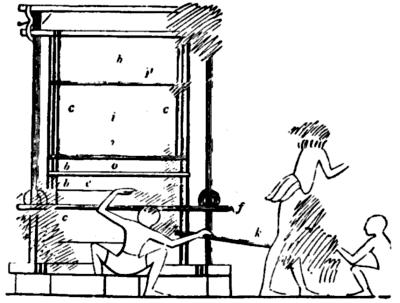
Fig. 13.—Upright or vertical loom. Wilkinson’s
Ancient Egyptians, London, John Murray. 1st ed., Vol.
III., p. 135.
Apart from the horizontal loom Wilkinson and Robert Hay[C] also
recorded the existence of an illustration of an upright loom, said in
error to be at Eileithyias (El Kab). Wilkinson’s copy, Fig. 13, is
more elaborate than that of Hay. Mr. Davies informs me that the
original is not at Eileithyias, but in the tomb of Nefer-hotep at
Thebes. Wilkinson in regard to this illustration quotes the oft-repeated
statement of Herodotus (circa 460-455 B.C.) in reference
to looms in general:—“Other nations make cloth by pushing the
woof upwards, the Egyptians on the contrary, press it down.” On
this statement Wilkinson remarks: “This is confirmed by the
paintings which represent the process of making cloth; but at Thebes,
a man who is engaged in making a piece of cloth with a coloured
border or selvedge, appears to push the woof upwards, the cloth being
fixed above him, to the upper part of the frame” [Fig. 13]. But I
am unable to follow Wilkinson in this, for I can find no indication
in his illustration which shows how the beating-in of the weft is
accomplished. From the illustration all one can say is that it
might have been done either way. Wilkinson’s illustration is lettered
from a to p but this lettering is not explained by him at all,
excepting in the case of the letter k, of which he says: “k is a
shuttle, not thrown, but put in with the hand. It had a hook at the
end ...” and he proceeds to refer to the drawing elsewhere of the
horizontal loom. He does not show the hooks in his illustration. In
Fig. 14, I give the sketch made by Mr. N. de G. Davies of the remains
of the original from which Wilkinson made his illustration.
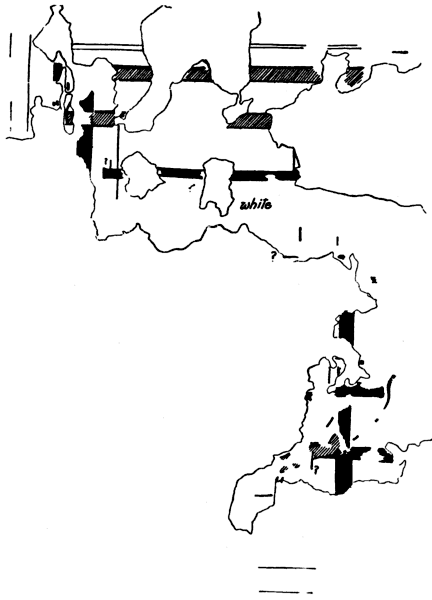
Fig. 14.—Drawing by Mr. N. de G.
Davies, Jan. 1913, of an Upright Loom
in Tomb 49 at Thebes, belonging to Nefer-hotep,
at end of XVIII. Dynasty, B.C.
1330. Drawn when in a better state by
Wilkinson, Fig. 13, and Hay.
A more satisfactory drawing of upright looms is that which Mr.
N. de G. Davies has placed at my disposal for reproduction here. I
append his description, Fig. 9. “The picture of men working at
two looms is taken from the tomb of Thot-nefer at Thebes, who was a
royal scribe in the middle of the 18th Dynasty, circa 1425 B.C. In
his tomb his house is shown. He himself sits in the hall, while inside
some servants spin and weave, make bread, store the grain, etc. The
roof of the chambers is supported on pillars, and between two of these
the looms are set up which are here depicted. They are not attached
however, either to the roof or the pillars. Faint sketching lines are
mixed up with the darker reds in which the picture was re-drawn, and
the whole very simply and carelessly executed. I have found it difficult
to make it clear. In my sketch the first faint sketching outlines appear
as lines. The more solid red lines which replaced these I have ‘hatched,’
and certain portions including the men’s flesh colour, the stools, the
discs I have put in solid black, partly because they are for the most
part more solid and dark red in the original, and partly to distinguish
the portions more clearly from one another. The horizontal lines
which cross the web are very faintly drawn and almost as good as
obliterated by the white paint which had been put on the web. I
have put them in just to show that the bars were conceived of as passing
behind or under the web and concealed by it.
“The larger loom is worked by two men, the smaller by one man
only. The looms consist of an oblong frame A set up on two stones B.
The warp is attached to the warp beam C on top and the breast beam
D at the bottom. The threads of the warp are not shown, no difference
being made between any woven part and the warp threads; to
all is given one smear of white paint. Two discs E are seen hanging
against the frame posts, one on each side, the earlier sketch showing
a larger disc than the final drawing in dark red.
“Two slender laze rods F are shown on the large loom and heavy
bars G, H, lower down; a somewhat similar laze rod and beams are
also shown on the smaller loom.
“The weavers sit on benches with their backs to the spectator.
The artist has not dared to draw a back view of their heads, but has
turned each man’s head to the right to show a profile. They are
holding a heavy looking rod which looks like a ‘beater-in.’ One would
expect to see a shuttle but perhaps this was too small an object for so
rough a picture—perhaps the man at the smaller loom holds an
exaggerated shuttle L in his right hand.
“The lines M seen alongside the framework are the faint red
sketch lines not cords. The diagonal line N on the left I do not
understand, it does not seem an accidental one.
“On the left hand of the two looms the original shows a man
spinning coarse thread into finer(?) using two spindles at once; the
threads pass through rings fixed in the ceiling as in a picture at Beni
Hasan. Behind him two girls are breaking up the flax and two others
are making coarse threads of the fibres, almost exactly like those in
the tomb of Daga (No. 103) a couple of hundred yards away.”
To this description of Mr. Davies I would like to add a word about
the discs E. Wilkinson indicates these as rings apparently joining
the horizontal beam to the post of the frame, the form of the ring
being arrived at as explained by Mr. Davies by the original outline
of the sketch having been made larger than the final drawing of
the circle, or disc, and not obliterated. In Mr. Davies’ drawing these
discs hang on or are fixed on to the uprights only, and I am inclined to
think they represent balls of weft thread hanging up in the same way
as we see whole rows of coloured balls hanging on the looms of Persian
rugmakers, and as can be seen on an Indian rug loom in Bankfield
Museum.
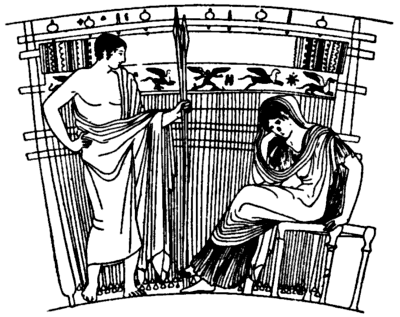
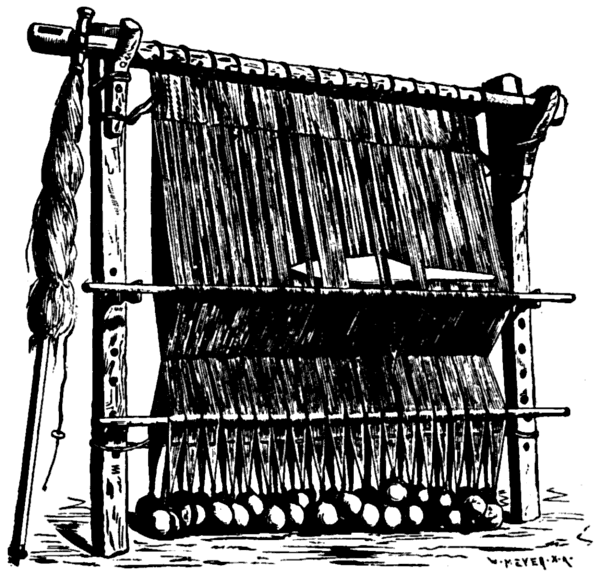
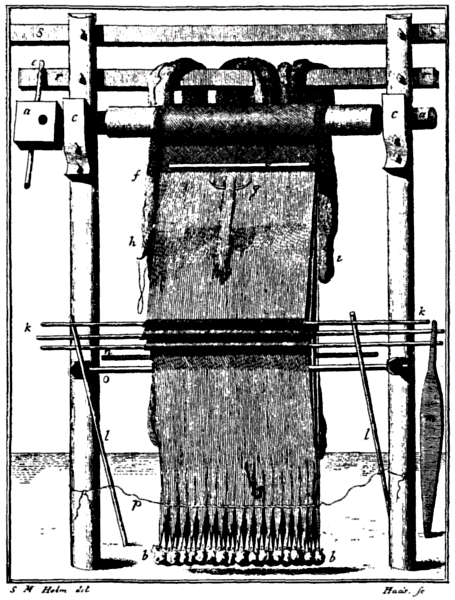
It is also very clear that these Egyptian vertical looms are very
different from the Greek looms in so far as we know anything about
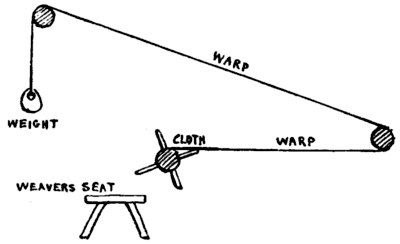
them. The Greek looms had an upper beam only and the warp
threads were bunched at the lower end and weighted with metal or clay balls to
keep them taut, Fig. 15. The individual warp threads were not weighted; they
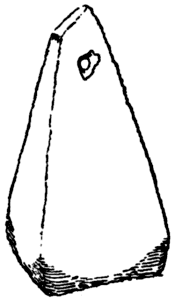
were bunched and then weighted. The pyramidal shaped clay warp weights
found in Egypt are I understand considered by Egyptologists to belong to
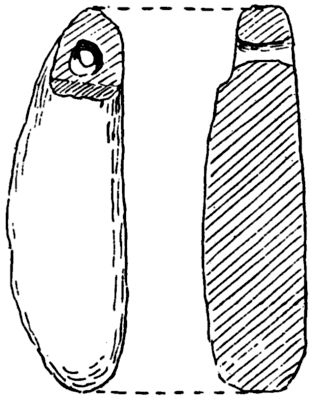
the Roman period, but in the Manchester University Museum there is a
mud article which Miss M. A. Murray describes as a warp weight, Fig. 17, so
that it is possible vertical looms with warp weights may yet be forthcoming
as an Egyptian and not a foreign industrial tool. But Dr. H. R. Hall
informs me this weight was probably found in the ruins of houses where
Ægean pottery was found and hence it is probably a temporary warp
weight of those people and not an Egyptian article.
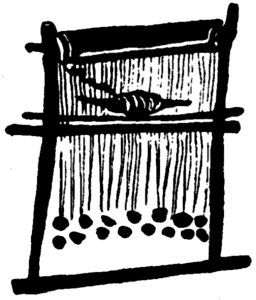
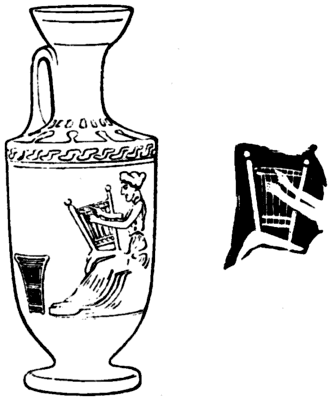
Fig. 15.—Greek loom with spool
and warp weights. Illustration on a
skyphos (van Branteghem vase in the
Ashmolean Museum, Oxford). From
H. B. Walters’ paper on Odysseus &
Kirke on a Boeotian vase, Jour. Hellenic
Studies, 1892-3 XIII. p. 81.
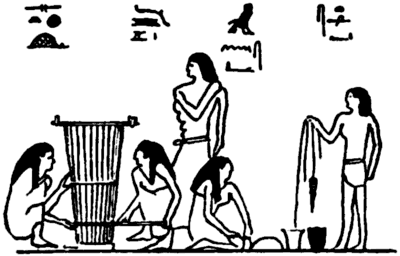
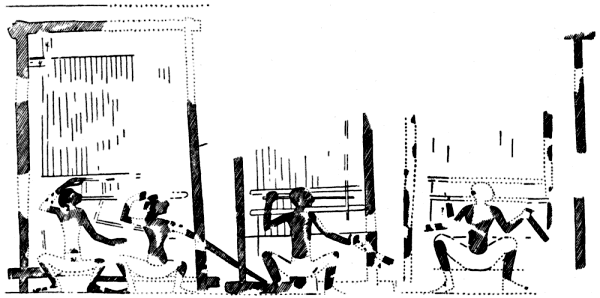
Since writing the above Mr. N. de G. Davies has very kindly sent me
on a new set of illustrations, Fig. 16, of which he says; “My attention
was called to the scene by Dr. Alan Gardiner. The scenes which represent
the preparation of the flax and the stretching of the warp are almost
replicas of those in the tomb of Daga of the Middle Kingdom, so far
as we can judge, while the pictures of the looms resemble closely those
in the tombs of Thot-nefer and Nefer-hotep. The work is done by
both men and women. Men prepare the flax while women stretch the
warp. Men mostly work the loom, either singly or with a companion.
But in one case a woman is seen at work at one of the upright looms.
She is shewn sitting sideways on the low bench and is not pictured
in a back view with widely spread legs like the men. Unfortunately
the work is so slovenly and so much injured that few exact outlines
can be secured, and hence all detail is insecure. There are also superfluous
lines in red colour which confuse the picture. The tomb is
Ramesside in date (circa 1200 B.C.) The inscription over the seated
man is too broken to be read.”
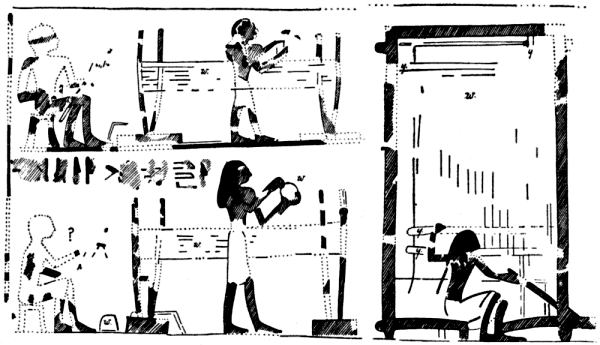
Fig. 16A.—Weavers at work as represented in the Tomb of Nefer-ronpet, Superintendent of
Weavers at Thebes. Date about 1200 B.C. From a drawing by Mr. N. de G. Davies.
Fig. 16B.—Weavers at work as represented in the Tomb of Nefer-ronpet, Superintendent of
Weavers at Thebes. Date about 1200 B.C. From a drawing by Mr. N. de G. Davies.
The drawings appear to confirm generally what we have gathered
from Mr. Davies’ previous illustration, Fig. 9.
In so far as I know, not many loom parts have yet been discovered,
and those which I have had an opportunity of studying do not assist
us to much knowledge beyond that which we have gained by a study
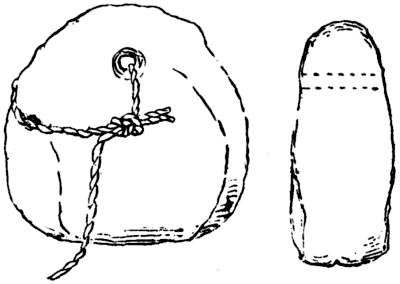
of the wall paintings. We have the article from Kahun already
mentioned, which may possibly be a warp weight, as it somewhat
resembles the later warp weights found elsewhere. It is of hardened
mud with a perforation at the thin end through which a piece of
string has been passed and knotted (Fig. 17), but so far no illustration
of a loom with weights has been found, either for the period to which
this article belongs or to any other period. On the other hand the
material is not suitable for a net-sinker, nor is it intended to be made
to stand up. As mentioned above it is probably Ægean.
Fig. 17.—Piece of perforated hardened mud.
Possibly a warp weight, 10 cm. × 8·7 × 4·2
(315/16 in. ×
27/16 in. ×
15/8 in.) Weight 470 gramms (1 lb. ½ oz.) Probably
of Ægean origin. Kahun. Manchester Museum.
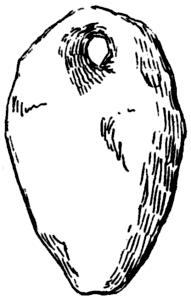
Fig. 18.—Burnt-clay warp
weight. Height 11·4 cm. (4¼ in.)
Weight 260 gramms (9¼ oz.)
Probably Roman. Bankfield
Museum. (Received from Prof.
Flinders Petrie).
Another form of warp weight, of burnt clay, is somewhat frequently
met with, Fig. 18, but it is described as appertaining to Roman times,
and may therefore be either a Greek or Roman article. Similar
weights from Cyprus and North Africa, &c., can be seen in the
British Museum.
Wooden pegs have been found at Gurob, which may possibly have
been used for holding the warp and breast beams in position, Fig. 19.
These pegs may appear to be rather short for the purpose, but in very
primitive looms the warp is not kept so taut as might and should be,
and hence there is not the same heavy strain on the pegs as we should
deem necessary. The way to settle their use would be to fix them in
solid ground and test them.
Fig. 19.—Wooden Peg, possibly
used for holding the warp and
breast beams. Length 13·5 to
10·2 cm. (513/16 in. to 4 in.) Gurob
XVIII.-XIX. Dyn. (about 1580-1205
B.C.) Manchester Museum.
Fig. 20.—Long straight lath with notches at each end, probably a laze
rod. Length 1 m. 24 (4 ft. 13/16 in.)
Breadth 5·2 cm. (2 in.) Thickness 2·2 cm.
(7/8 in.) Kahun. Manchester Museum.
Fig. 21.—Long curved lath. Probably a “beater-in.” Length 1 m. 20
(3 ft. 11¼ in.) Breadth 6·5 cm. (111/32
in.). Thickness 1 cm. (3/8 in.) Kahun.
XII. Dynasty about 2000-1788 B.C. Manchester Museum.
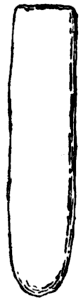
At Kahun a long straight lath, Fig. 20, was found which is probably
a laze rod, the notches being apparently for a nooze to slip into
and so prevent the rod working towards the weaver which it has a
tendency to do.
Another long but curved lath, Fig. 21, also found at Kahun is
probably a beater-in.
Most large Egyptian collections contain one or more specimens of
wooden combs, which are generally called weavers combs, and ascribed
to Roman times. But one at least, Fig. 22, has been found with
XVIIIth to XIXth Dynasty articles at Gurob, that is belonging to
the period 1580-1150 B.C., which is long before Rome existed. None
of these so-called combs, for they are really embryo reeds, are shown
on the wall illustrations so that they no doubt belong to a later date
than that of the XIIth Dynasty. If, as I take it, these “combs” are
the forerunners of the reed and were used to drive the weft threads
home, and if also the Romans had upright looms provided with warp
weights instead of the breast beam, then I think the “comb” may not
be Roman but may be a late Egyptian invention. For, on trying to
use such a comb on a replica of a Scandinavian upright loom provided
with warp weights (instead of with the breast beam) I can get no good
result, in fact rather the opposite, but tried on a primitive horizontal
loom provided with a breast beam the comb is found to be of some
assistance, especially if the warp is not very taut as is generally the
case with primitive looms. At Bankfield we have an Indian rug loom,
already referred to, with warp and breast beam on which a somewhat
similar instrument, but of iron, was used.[D]
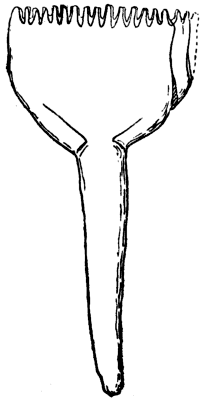
Fig. 22.—Weaver’s Comb—a Beater-in.
19·5 cm. × 9·8 × 4·2 (7¾ in. ×
37/8 in. ×
15/8 in.)
Gurob. Manchester Museum.
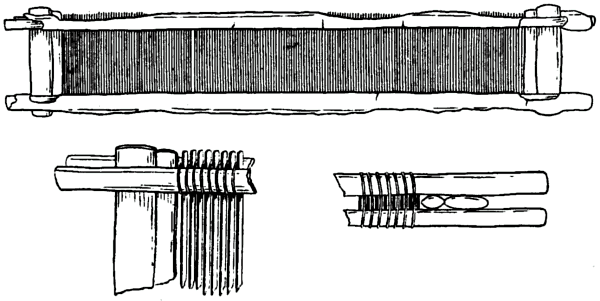
Fig. 23.—Possibly a warp spacer, somewhat
similar in object to the raddle of
modern hand loom weaving. Height 2·8 cm.
Width 2·5 cm. (11/8
in. × 1 in.) The slots are
6 mm. (¼ in.) apart, 3 mm. (1/16
in.) wide, and about 10 mm. (3/8 in.)
deep. From Gurob but probably Roman. Bankfield Museum.
(Received from Prof. Flinders Petrie).
An article which Prof. Flinders Petrie describes as a “warp spacer”
is shown in Fig. 23. From fragments in the Egyptian Collection,
University College, London, it would appear to have been originally
more than a meter (three feet) long. It may have been used as a sort
of a “raddle,” a tool used for assisting to keep the warp threads in
position when being beamed, i.e. put on to the loom. At Bankfield we
have an old local hand loom the warp beam of which is provided with
a series of holes in which pegs were once inserted to keep the coloured
warp threads in position.
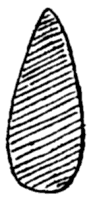
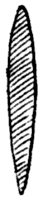
Fig. 24.
½ size of end of Fig. 24.
½ size section of Fig. 24.
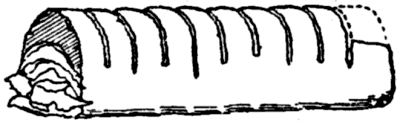
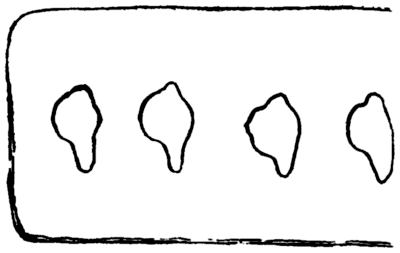
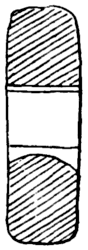
A long piece of perforated wood described by Prof. Flinders Petrie, Kahun, p. 29, as a
Weaver’s Beam for making rush mats. Length 96·8 cm. × 8·0 × 3·0 (3 ft. 1¼ in. × 3¼ in.
× 13/16 in.) From Manchester Museum.
A piece of frame, Fig. 24, has been described as a “weaver’s beam”
for making rush mats like the modern hasira. It is provided with 28
holes which are arranged about 27 to 40 mm. apart. The holes may
have been more or less circular originally, and worn into present shape
by threads, etc., and look more irregular inside than they really are,
as the inside surface of the holes is fairly smooth; the holes are slightly
larger, on an average about 4 mm., on the face shown than on the other
face. Prof. Flinders Petrie seems to think it resembles the frame on
which the modern Egyptian mat is made.
We now come to the two reeds in the Museum of the Liverpool
Institute of Archæology, which Dr. John Garstang discovered near
Abu Kirkas, tomb No. 693, of which he tells us: “They are 27
and 29 inches (68·6 and 73·7 cm.) in length respectively, and are
precisely similar in general form. They are constructed on a system
of nineteen or twenty reeds to the inch, and they may be seen to be
exactly similar to the modern reed taken from a loom in the village of
Abu Kirkas. It is not possible, unfortunately, to assign a precise date
to these objects. They were found in a tomb which contained no
other remains; this tomb was surrounded by others, all of them likewise
very much disturbed, but equally characteristic of the general
nature of the Middle Empire tombs, and containing nothing but
Middle Empire objects. Since, in general, few tombs of this site show
signs of intrusive burial of a later age, there is no reason to suppose
that these objects are of any date later than the XII. Dynasty (The
Burial Customs of Ancient Egypt, London, 1907, pp. 134-136).”
The horizontal looms we have been describing belong to this
period, and the artists have not shown any reeds with them. My
studies of primitive looms lead me to think that these Egyptian looms
are of a date far anterior to the invention or the application of a reed.
It has also, I believe, been remarked by those who have examined
cloths of this date, that the irregular array of the warp threads is
good proof that reeds could not have been in use. I have already
pointed out that in the evolution of the loom the reed puts in a late
appearance, but apart from this fact, I do not think the artist would
have omitted such an important tool had it been in use in his time.
Fig. 25.—Reed in Cairo Museum. Length 66 cm. (26 in.) It consists of two wooden
frames fitted with flat iron wires. String is wound round the frames binding them
together. Then a kind of canvas(?) cover in placed over the frames to cover up the
projecting ends of the wires, but this has disappeared in places.
Dr. Garstang points out that although the surrounding tombs
contained Middle Empire objects, the reeds were found in a tomb without
any other remains. This can hardly be considered evidence tending
to prove that they belonged to the period named, and it is certainly
weakened by the accompanying statement that the reeds are exactly
similar to the modern reed, for that is almost sufficient to prove that
they are not 3900-3700 years old. To me they seem comparatively
modern and very similar to one in the Cairo Museum which MM.
Brugsch and Quibell are inclined to think is Coptic with this difference,
that in Dr. Garstang’s reeds the divisions appear to be of cane or
wood, while in the Cairo reed they are of iron (?steel). The sketch of
this Coptic reed, Fig. 25, has been drawn specially for me, and Miss
W. M. Crompton, Assistant Keeper in Egyptology in the Manchester
University Museum, has kindly examined the sketch with the article
and pronounced it correct. We may, I think, safely conclude that the
reed found by Dr. Garstang is Coptic and not Ancient Egyptian.
As regards the actual work of weaving, balls of thread have been
found and so have very flat bobbins and pieces of stick with thread
wound round which may have been spools as indicated in the drawing,
Fig. 7. There is no reason why balls of thread should not have been
used as they are in uncivilised countries at the present day, as, for
instance, in Tibet, as reported by W. W. Rockhill in Diary of a
Journey through Mongolia and Thibet, Washington, 1894, p. 41.
I am unable to agree with a recently made statement published
in The Labyrinth, Gerzeh and Marghuneh, by Prof. Flinders Petrie,
E. A. Wainwright and E. Mackey, p. 6, which runs: “The fact of
the weft not being at right angles to the warp, if one may conclude
by the fabrics, does not, I think, imply that such weaving is of
inferior quality. When I noticed the peculiarity first, I thought it
might have arisen through distortion by stretching over the body,
but repeated examples of the same fact have led me to consider
other causes. We know how closely analogous to ‘darning’ was
the early weaving; and in our days it is not unusual to find
stockings not darned at right angles, and it may be the women
weavers of old sometimes put in the weft more or less out of true
right angle. In the childhood of weaving we should expect different
methods, and it may be, seeing that we have no selvedged cloth until
very long after this time, that they experimented with a diagonal
weft to see if it would not reduce the tendency to fray out at the
sides.” The amount the warp and weft are out of the right angle
is stated to be about 20°. The specimen shown me under the
microscope indicated clearly that the warp and weft were not at right
angles and that the interstices were not square but diamond shaped.
It is possible to arrange the warp threads diagonally from beam
to beam, but with continuous weft (that is in weaving so as to get
selvedges) the weft has the tendency to slip up on one side and down
on the other, hence the weaving is made laborious. With a separate
weft for each pick, i.e., for every once the shed is opened, there is
naturally not this tendency, but this alleged diagonally woven cloth
frays just as easily as any other piece of cloth without selvedge, so in
either case there is not only no advantage but distinct disadvantage
taking the diagonal “beaming” into consideration. We must give
the Egyptians credit for using the least laborious of two methods, that
is if the second one were known to them.
Apparent diagonal weaving can be produced by anyone taking an
ordinary piece of linen or cotton cloth, cutting off the selvedge and
stretching the cloth in a direction diagonally to the direction of the
warp and weft, and a piece of diagonally woven cloth is the result!
The probability is that the specimen of cloth, without a selvedge,
having been stretched over the body for a long period of time, has, in
the course of that time lost its nature and when removed it has
retained its altered form and gives us the impression of having been
woven diagonally.
In the foregoing I have shown how extremely simple was the
whole apparatus for weaving in use by the Ancient Egyptians, and one
is rather surprised to be told that about B.C. 1200, in the time of
Rameses III., the Egyptians “built and used looms very much more
complicated than has hitherto been believed to be the case,” or to be
referred to “the really complicated form of loom used.” Yet this is
what Mr. Thorold D. Lee tells us (pp. 84 and 86) in his paper on The
Linen Girdle of Rameses III. (Ann. of Archæology and Anthropology of
the Liverpool Institute of Archæology, July, 1912, V.)
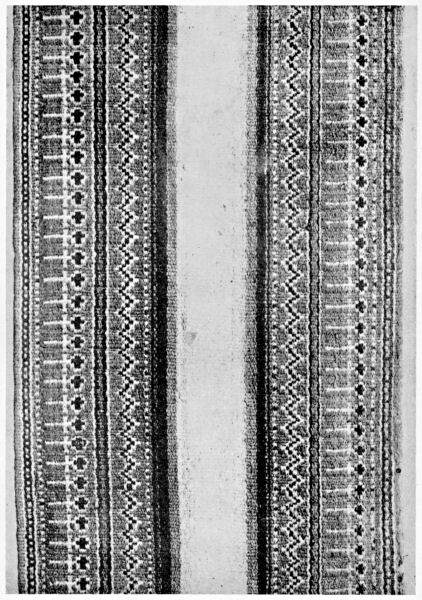
The characteristics of this girdle are its great length, 17 feet
(5 m. 2), its even taper diminishing from 5 in. (12·7 cm.) in width to
17/8 in. (4·8 cm.) in width, its elaborate design and excellent workmanship.
Perhaps the chief of these characteristics is the taper. It is
most probable, as Mr. Lee points out, that in the weaving the warp
threads have been gradually dropped out to make the taper, rather
than that additional warp threads have been added. As it is easy to
drop a warp thread, and almost impossible to add one while weaving is
in progress, Mr. Lee’s view is confirmed by this. It would also be
almost impossible to keep the warp taut if the number of warp threads
were increased as the work went on. This means that the girdle was
commenced at the wide end and finished at the narrow end.
It is common knowledge that when a warp thread drops out, its
place is indicated by a thinness or fine opening for the whole length
of the missing warp, and this is so because the reed, besides pushing
the weft into position, also acts as a warp spacer, that is to say it keeps
the warp threads properly apart, every one being properly aligned.
When no reed is used the warp threads are not so evenly placed—they
are not so parallel to one another for there is nothing but their
tautness to keep them in position. Hence there is every reason to
conclude that when, on a loom provided with a reed, warp threads have
been removed their position must be indicated, and vice versa if no
reed has been used the position of the removed threads will not be so
clearly indicated, but there will be a more marked shrinkage in the
width of the cloth as well as in the pattern, and this is what has taken
place in the girdle giving us the diminishing taper.
“THE LINEN GIRDLE OF RAMESES III.”
Reproduced by kind permission of Dr. Clubb, Director, The Museums, Liverpool.
If this diminishing taper were indicated by a decrease in the width
of the pattern commencing at the selvedges, then it might be presumed
that a reed had been used for the central portion only—a very clumsy
even if feasible arrangement, but the pattern begins to decrease along
the middle and hence no reed could have been used.
It does not follow that because a loom was not provided with a reed
it was without heddles. Anyone who will examine the large series of
primitive looms at Bankfield Museum, will observe that heddles preceded
reeds; this must necessarily be so as the making of the shed is the
first step in weaving, while the reed’s work is more that of a finisher.
But the heddles are all extremely primitive, and in my experience do
not exceed four in number where there is no reed. Such a quantity
of heddles with its complicated harness as Mr. Lee considers necessary
is quite out of the question with a loom so undeveloped as not to be
provided with a reed. Hence the indication is that the girdle was
woven on a loom of a primitive character.
In carrying out the work the weaver has made many mistakes.
On the left hand side of the right hand row of red crosses (they come
out black in the photograph) there is an “end down” for a considerable
distance—that is a thread has been missed.
On the same row of crosses three white threads show above and
below, while on the left hand row of crosses there are five white threads
above and below. The crosses are neither the same size nor shape in
the two columns and curiously their white hafts in both columns point
to the left instead of one row pointing to the left and the other to the
right. Then again the white point at the right apex of the zigzag on
the left corresponds to a red point at the left apex of the right hand
zigzag, but if the girdle had been woven on an advanced loom with
dobby and harness these points would have been red in both places.
As regards the large number of warp threads to the inch which
Mr. Lee puts down as 272-340 (107-134 per cm.), this does not by any
means indicate a complicated piece of machinery for the weaving of
this belt or any other fabric. The greater the number of threads to
the inch the finer must the threads be in order to get them into the
allotted space, and in the weaving there will be so many more threads
to raise and lower in order to make the shed opening. It means
multiplying the work but does not necessarily mean that a more complicated
loom must be used in the weaving.
It is not possible without opening the fabric to be quite positive
on the many points which are raised, but there seems nothing about it
which should prevent its having been made on a simple loom. Although
superior to most, but not all, of the well known Coptic cloths in Bankfield
and in many other museums, it very closely resembles some of
them in many respects excepting in the taper.
I should add that in making my examination of this girdle I was
kindly assisted by Mr. C. A. Trigg, a well known Halifax mill
manager and designer. We made the examination independently
and on comparing notes afterwards found that we agreed in all
essential points.
By W. W. Midgley, Curator, retired, The Museums, Bolton.
“So far back as 1834, Mummy cloths occupied the attention of
James Thompson, F.R.S., who, after researches into their characteristics
and structure wrote a paper on the subject, which appears in the
London and Edinburgh Philosophical Magazine, Vol. V., page 355.
From that time until quite recently, little additional knowledge on the
subject has appeared. In the early part of 1910, Prof. W. M. Flinders
Petrie, F.R.S., expressed a desire that the writer should undertake
microscopic investigation of the body-wrappings of cloths of the III.
and early IV. Dynasties (circa 2980-2750 B.C.) which he had brought
home from excavations made at a cemetery near Meydum, Upper
Egypt. The report upon them forms part of the “Historical Studies,”
Vol. II., of the British School of Archæology in Egypt.
When Mr. Ling Roth suggested that some of the examples of
Egyptian Mummy cloths in Bankfield Museum should be examined on
similar lines, describing the construction of the fabrics and yarns,
together with the characteristics of the fibres used, I undertook to
carry out the work and forward to him the results for permanent
reference.
Each of the fifteen cloths submitted was first examined by mounting
about ¾" × 5/8" (20 mm. × 16 mm.) of the cloth on 3" × 1" (76 mm.
× 25 mm.) glass slips, and covering with thin glass, so as to find out
its plan of composition and the number of warp and weft threads per
linear inch. Afterwards, a little of the warp threads as well as of the
weft, was untwisted and the fibres separated, and these mounted apart
on another 3" × 1" slip (76 × 25 mm.), so that the kind of textile fibre
used and the diameter of the fibres could be measured. These microscopical
preparations will be kept in Bankfield Museum, as they may
be of interest to microscopists in the locality.
The cloths are from three sources:—Nos. 1 and 2 being from the
private collection of Dr. Wallis-Budge, who has given the specimens to
Bankfield Museum; Nos. 3 to 8 are from the old Meyer collection in
the Liverpool Museum (unfortunately the origin of them is unknown);
and those marked 9 to 15 were taken from a mummy of the XXVI.
Dynasty, brought to this country by Lord Denbigh, and now also in
the Liverpool Museum.
A.—Specimens of Mummy cloths from Theban Tombs date about
B.C. 1400, presented by Dr. Wallis-Budge.
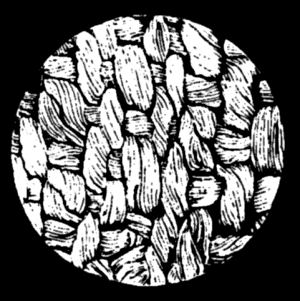
1. A plain “one-up-and-one-down” linen cloth. The yarns in
this example are more irregular in diameter than usual—the warp
strands varying from 1/25"th
to 1/71"st (1 mm. to
·2/8 mm.) The warp
has about half its strands doubled (that is twined together), whereas
the weft has only about one in twenty doubled. See Fig. 26.
2. This is a coarser fabric, has been dyed with saffron, and is somewhat
brittle to tease out the fibres. Both these cloths had evidently
absorbed some of the gums or balsams used in the process of embalming,
and hence the difficulty of separating the fibres for identification
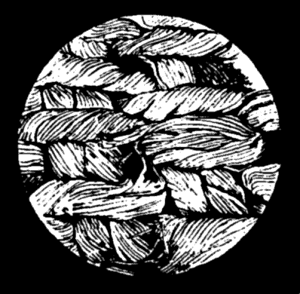
is increased. The structure of the fabric is peculiar, and, indeed, the
only instance I have seen in Egyptian cloths. A portion, near the
middle of the piece sent, has the warp strands in pairs parallel to each
other, a few of them being double yarns, while all the remainder are
doubled. Of the weft, nearly half are double yarns. See Fig. 27.
Fig. 26.—Magnified 10 diameters.
Fig. 27.—Magnified 10 diameters,
showing the warp yarn in pairs.
B.—Specimens from the Meyer Collection, marked No. 11088.
(Date of acquisition about 1856; date and place of origin unknown).
3. This is a beautifully soft, fine Wool fabric, containing no size
or balsam. From the fineness of the yarn and of the individual fibres
I have no doubt that the wool has been imported from India, or, more
likely, that the cloth was made in Cashmere. The texture is a plain
weave, has a selvedge edge, the warp yarns are doubled, while the weft
is single yarn. It is much to be regretted that the particulars of
locality, of burial, and the period of time to which this interesting
fabric belongs has been lost. I assume from the general characteristics
that it is of a late period—probably not earlier than the Ptolemaic.
4. This linen cloth has a plain selvedge, regular weave, and contains
no size. About 25% of both warp and weft yarns are doubled,
and all are very even in diameter.
5. A coarse linen cloth with plain selvedge. All the yarns are
single and even in diameter.
6. This is a coarse, highly-sized linen cloth. The yarns are
agglutinated, are brittle, and it is difficult to separate the fibres. The
sample submitted has been cut from the end of the piece and shows
the warp ends.
7. A coarse linen cloth, sized and brittle. No selvedge on the
piece sent. Both warp and weft yarns are single, and even in diameter.
8. This is a very coarse linen fabric heavily sized and brittle.
Both warp and weft yarns are single and very irregular in diameter.
C.—Lord Denbigh’s: XXVI. Dynasty.
9. A soft-spun linen cloth containing no size. Specimen has
been cut from the body of the fabric, showing no selvedge. About
half of the warp is composed of doubled yarns of irregular diameter;
the weft is of doubled yarns and more regular in diameter.
10. The selvedge of this linen fabric is peculiar and somewhat
elaborate. The outer margin is composed of four sets of ten yarns
parallel to each other, forming one strand of warp; then comes a space
of 19/10" (48 mm.) where the warp yarns are dyed red; then occurs
three more sets of ten parallel yarns (the object being to strengthen
the selvedge), followed by the general body of the fabric. The entire
selvedge is 2¼" (57 mm.) wide. About half the warp yarns are
doubled, while all the weft are composed of doubled yarns, both being
fairly even in diameter, and not sized.
11. A fine, soft, linen cloth, with selvedge 11/8" (29 mm.) wide;
the three outer and the two inner strands of the warp are made up of
many parallel yarns, as in No. 10, with an interspace of 3/8" (10 mm.)
All the warp yarns are dyed red, about 25% of them being doubled;
the weft is peculiar in having five or six strands of single yarns
alternating with six or seven double yarns, giving a faint stripe in the
fabric.
12. A linen cloth, with no selvedge edge. It has been dyed red,
probably ferum, a dye which I find uniformly associated with friable
or decomposing fibres.
13. A peculiarly coloured fine linen cloth; the pattern is caused
by some of the warp yarns being dyed, and occurring sometimes of
four, two, or one red strands, with grey ones intermixed. A few of the
warp yarns are doubled. The weft is composed of single yarns and
are all in the grey.
14. A coarse soft-woven linen fabric, containing no size. Lines
are indicated at irregular distances along the cloth, varying from
5/16" to
9/16" (8 to 14 mm.); these are caused by the introduction of
three strands of doubled yarn in the warp while the remainder are
single yarns. The weft is all of doubled yarns; both warp and weft
are very regular in diameter.
15. This is a variegated linen fabric with warps coloured something
like No. 13, but the red strands of warp are more irregular in
distribution. Like it, a few of the warp yarns are doubled, both the
red and the grey; while the weft is all of single yarns and in the grey.”
[A considerable quantity of specimens of the cloths which were
woven by the Ancient Egyptians has been examined both in this
country and abroad. I may, however, call special attention to the
results of examination published in Miss M. A. Murray’s excellent
little work The Tomb of Two Brothers, Manchester Museum Publications,
No. 68, 1910.—H.L.R.]
| Specimen No. |
Nature of Textile Fibre. |
Warp Ends per inch. |
Weft Picks per inch. |
Micro Measurements of Ten Fibres. |
| Weft. |
Warp. |
Mean of |
| Max. |
Min. |
Max. |
Min. |
Weft. |
Warp. |
| |
|
|
|
in. |
in. |
in. |
in. |
in. |
in. |
| A. |
|
|
1 |
Linen |
44 |
32 |
1/1400 |
1/3333 |
1/1424 |
1/3330 |
1/1768 |
1/1786 |
| |
|
2 |
” |
10 |
17 |
1/1786 |
1/3330 |
1/1780 |
1/2860 |
1/2020 |
1/1905 |
| |
|
|
|
|
|
|
|
|
|
|
|
| B. |
|
|
3 |
Wool |
224 |
40 |
1/833 |
1/2500 |
1/833 |
1/2000 |
1/1351 |
1/1429 |
| |
|
4 |
Linen |
64 |
32 |
1/1429 |
1/2500 |
1/1250 |
1/5000 |
1/1818 |
1/1754 |
| |
|
5 |
” |
56 |
20 |
1/1250 |
1/3333 |
1/1250 |
1/2500 |
1/1754 |
1/1724 |
| |
|
6 |
” |
48 |
24 |
1/1250 |
1/2500 |
1/1000 |
1/2500 |
1/1640 |
1/1594 |
| |
|
7 |
” |
48 |
20 |
1/1111 |
1/2500 |
1/1000 |
1/2500 |
1/1408 |
1/1428 |
| |
|
8 |
” |
36 |
16 |
1/833 |
1/3333 |
1/1111 |
1/2500 |
1/1456 |
1/1613 |
| |
|
|
|
|
|
|
|
|
|
|
|
| C. |
|
|
9 |
” |
48 |
24 |
1/1666 |
1/3333 |
1/1666 |
1/3333 |
1/2222 |
1/1860 |
| |
|
10 |
” |
32 |
60 |
1/833 |
1/3333 |
1/908 |
1/3333 |
1/1724 |
1/1613 |
| |
|
11 |
” |
80 |
36 |
1/1429 |
1/3333 |
1/1000 |
1/3333 |
1/1887 |
1/1784 |
| |
|
12 |
” |
96 |
40 |
1/1111 |
1/2500 |
1/1250 |
1/2500 |
1/1724 |
1/1695 |
| |
|
13 |
” |
80 |
36 |
1/1111 |
1/2500 |
1/1429 |
1/2500 |
1/1640 |
1/2040 |
| |
|
14 |
” |
56 |
24 |
1/909 |
1/3333 |
1/1250 |
1/2500 |
1/1594 |
1/1695 |
| |
|
15 |
” |
64 |
36 |
1/1250 |
1/2000 |
1/1429 |
1/2500 |
1/1724 |
1/1818 |
| |
|
|
|
|
|
|
|
|
|
|
|
| Specimen No. |
Nature of Textile Fibre. |
Warp Ends per Centim. |
Weft Picks per Centim. |
Micro Measurements of Ten Fibres in Millimetres. |
| Weft. |
Warp. |
Mean of |
| Max. |
Min. |
Max. |
Min. |
Weft. |
Warp. |
| 1 |
Linen |
17 |
12·6 |
·0181 |
·0076 |
·0178 |
·0076 |
·0144 |
·0142 |
| 2 |
” |
4 |
6·7 |
·0142 |
·0076 |
·0143 |
·0089 |
·0126 |
·0133 |
| 3 |
Wool |
88 |
15·6 |
·0305 |
·0101 |
·0305 |
·0127 |
·0188 |
·0178 |
| 4 |
Linen |
25 |
12·6 |
·0178 |
·0101 |
·0203 |
·0050 |
·0140 |
·0145 |
| 5 |
” |
22 |
7·8 |
·0203 |
·0076 |
·0203 |
·0101 |
·0145 |
·0147 |
| 6 |
” |
19 |
9·5 |
·0203 |
·0101 |
·0254 |
·0101 |
·0155 |
·0159 |
| 7 |
” |
19 |
7·8 |
·0229 |
·0101 |
·0254 |
·0101 |
·0180 |
·0178 |
| 8 |
” |
14·1 |
6·3 |
·0305 |
·0076 |
·0229 |
·0101 |
·0174 |
·0157 |
| 9 |
” |
19 |
9·5 |
·0152 |
·0076 |
·0152 |
·0076 |
·0208 |
·0130 |
| 10 |
” |
12·6 |
23·6 |
·0305 |
·0076 |
·0278 |
·0076 |
·0147 |
·0157 |
| 11 |
” |
31·5 |
14·1 |
·0178 |
·0076 |
·0254 |
·0076 |
·0135 |
·0142 |
| 12 |
” |
37·4 |
15·6 |
·0229 |
·0101 |
·0203 |
·0101 |
·0147 |
·0149 |
| 13 |
” |
19 |
14·1 |
·0229 |
·0101 |
·0178 |
·0101 |
·0155 |
·0124 |
| 14 |
” |
22 |
9·5 |
·0278 |
·0076 |
·0203 |
·0101 |
·0159 |
·0149 |
| 15 |
” |
25 |
14·1 |
·0203 |
·0127 |
·0178 |
·0101 |
·0147 |
·0140 |
It is very obvious they had no scale to work to.