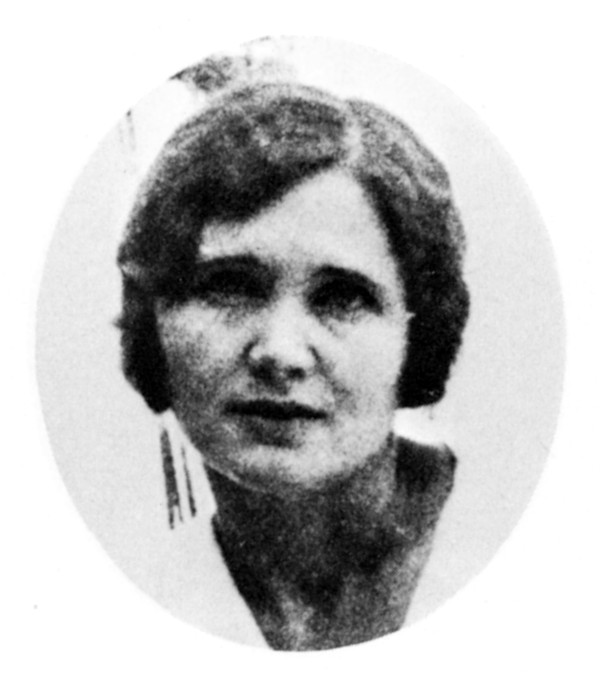
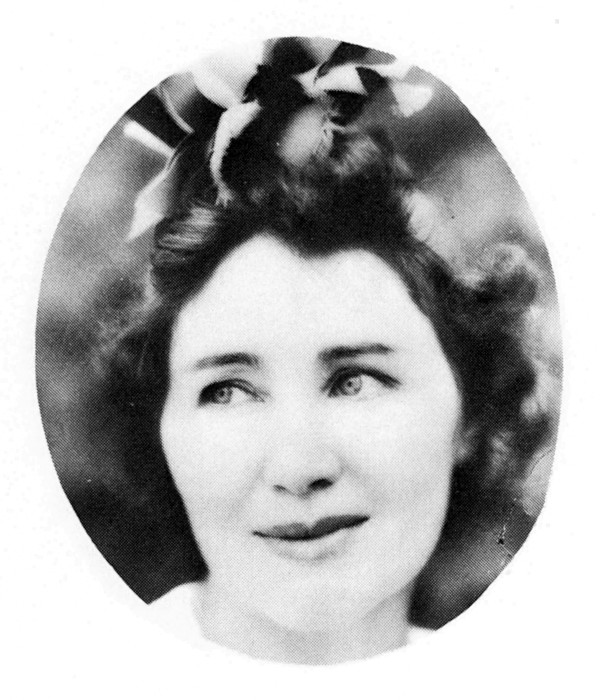
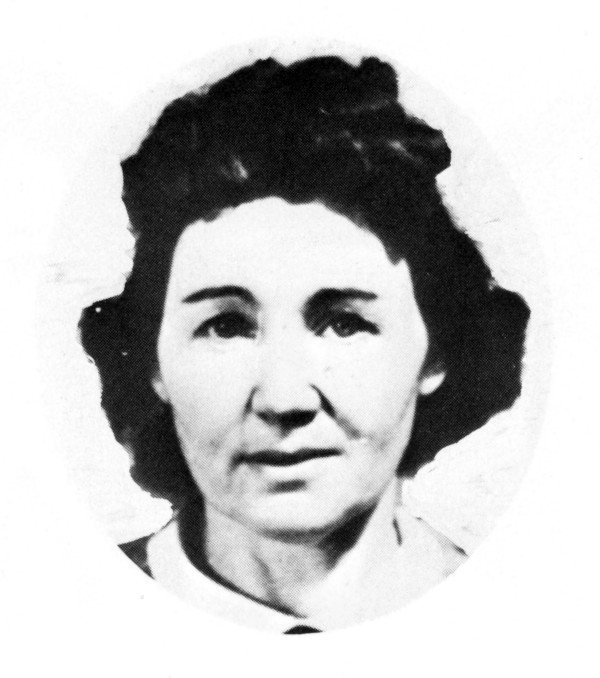
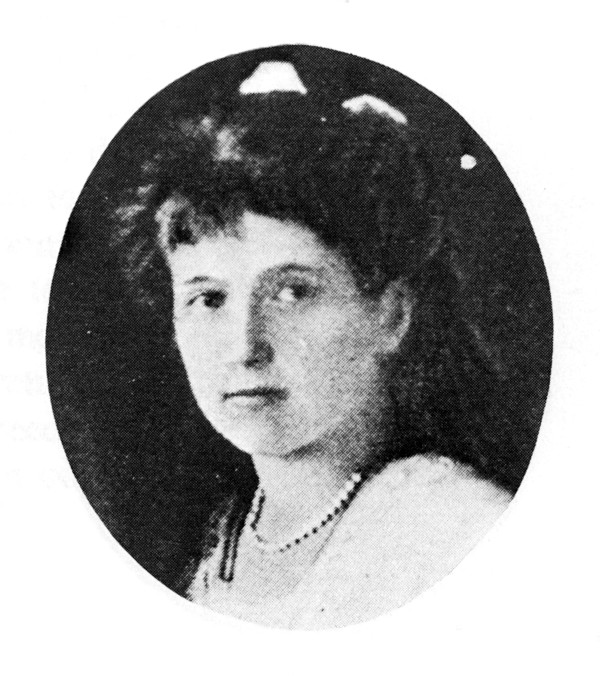
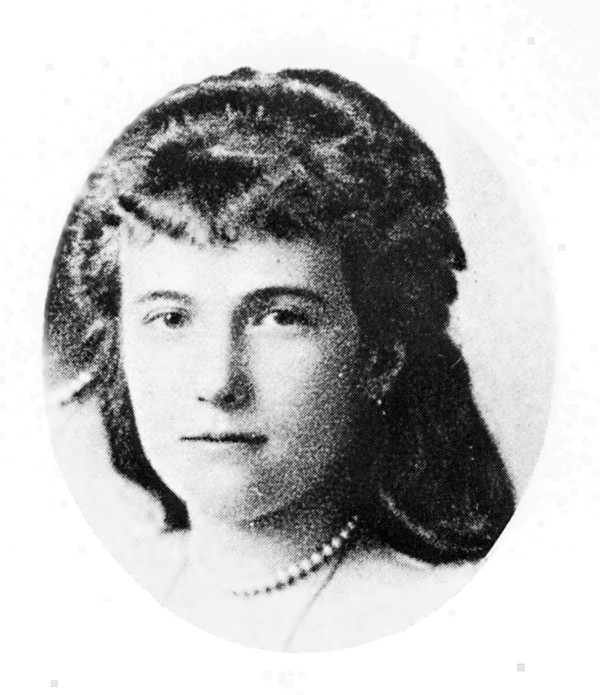
This is the only authentic autobiography of
the Grand Duchess Anastasia Nicholaevna,
fourth daughter of the late Emperor Nicholas II
and the late Empress Alexandra Feodorovna of
Russia.
The Grand Duchess Anastasia furnishes authentic
information and many previously unpublished
details concerning the life of the
Imperial Family and suite from the days of her
childhood to the date of the murder of her
parents and other members of her Family in
Ekaterinburg on the night of July 16-17, 1918.
Her story is divided into six major parts: the
youthful years, the period of the First World
War, arrest and exile, life in Tobolsk, life in
Ekaterinburg, and the period after the tragedy
which includes her rescue and escape to
Bukovina.
The life of a Grand Duchess of Russia was
no downy bed of roses. Discipline was imposed
by the Tsar and Tsarina, particularly the latter.
Study was an essential duty which took many
hours. During the war years there were responsibilities
connected with the operation of hospitals
for the wounded. Always over the Family hung
the fear of the possible demise of the heir to
the throne, the young Tsesarevich and Grand
Duke Alexei Nicholaevich, who had inherited
haemophilia through his Mother.
The Grand Duchess Anastasia rejects vigorously
various accusations directed against each
of her parents. She explains in her preface the
reasons for her long submergence and for her
present re-emergence forty-five years after her
reported death.
Her style is brisk and invigorating. Her sense
of humor repeatedly delights with accounts of
lighter events and anecdotes.
This is an invaluable historical record.
ROBERT SPELLER & SONS, Publishers
33 West 42nd Street
New York, N.Y. 10036
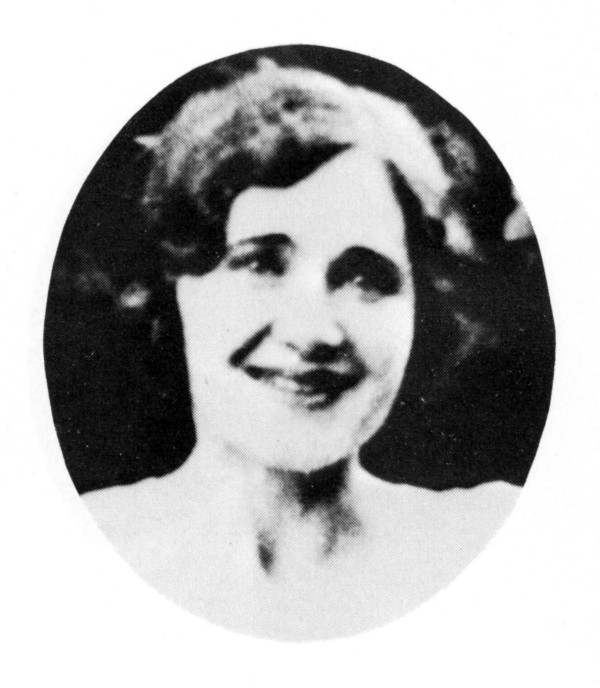
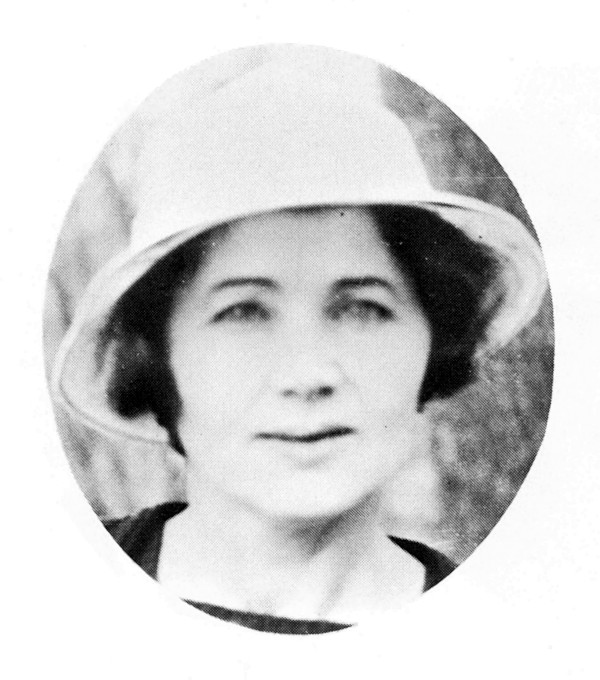
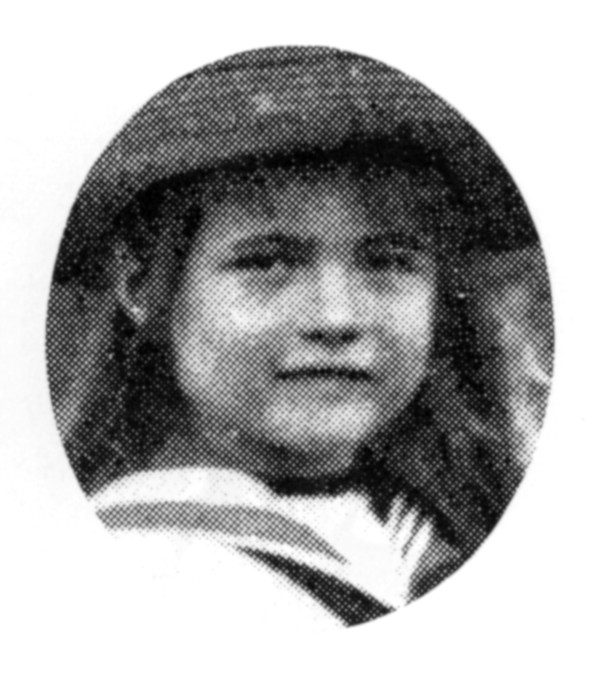
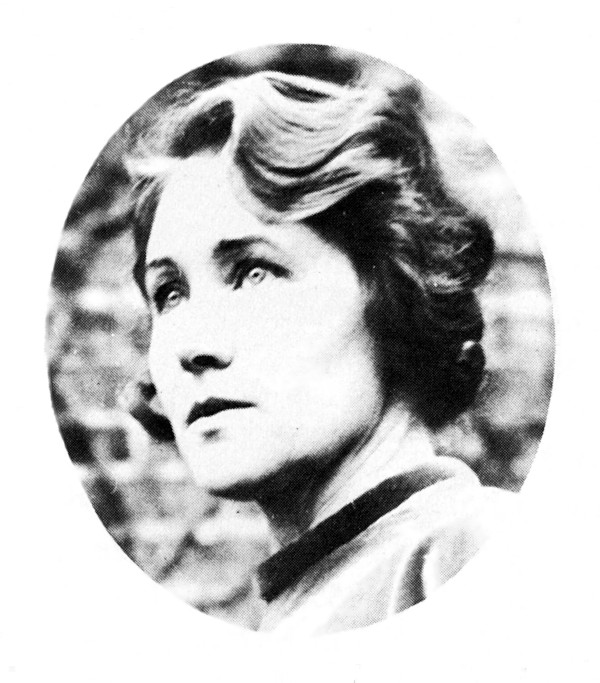
Photograph by Stephen Gaillard
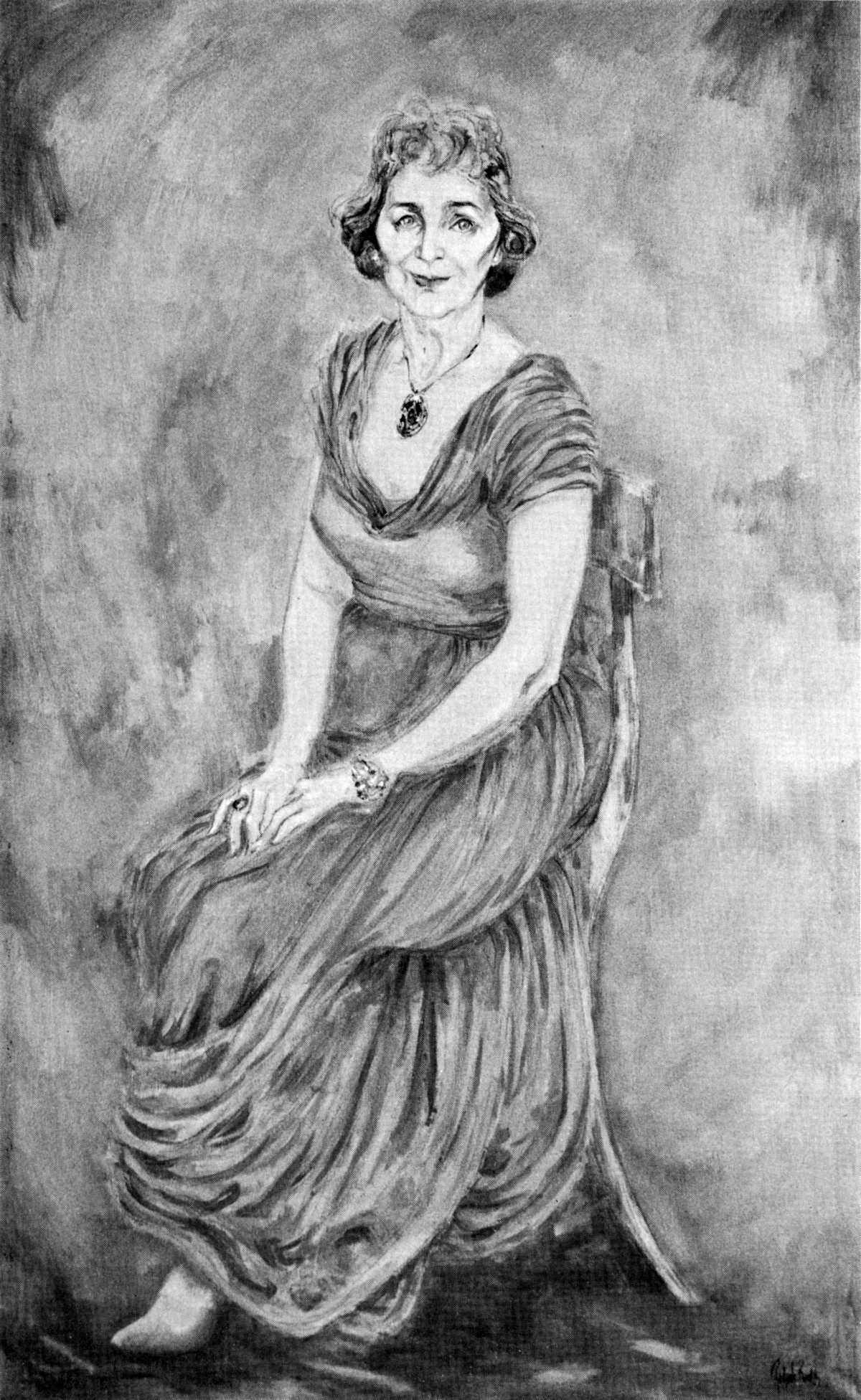
Portrait by Richard Banks
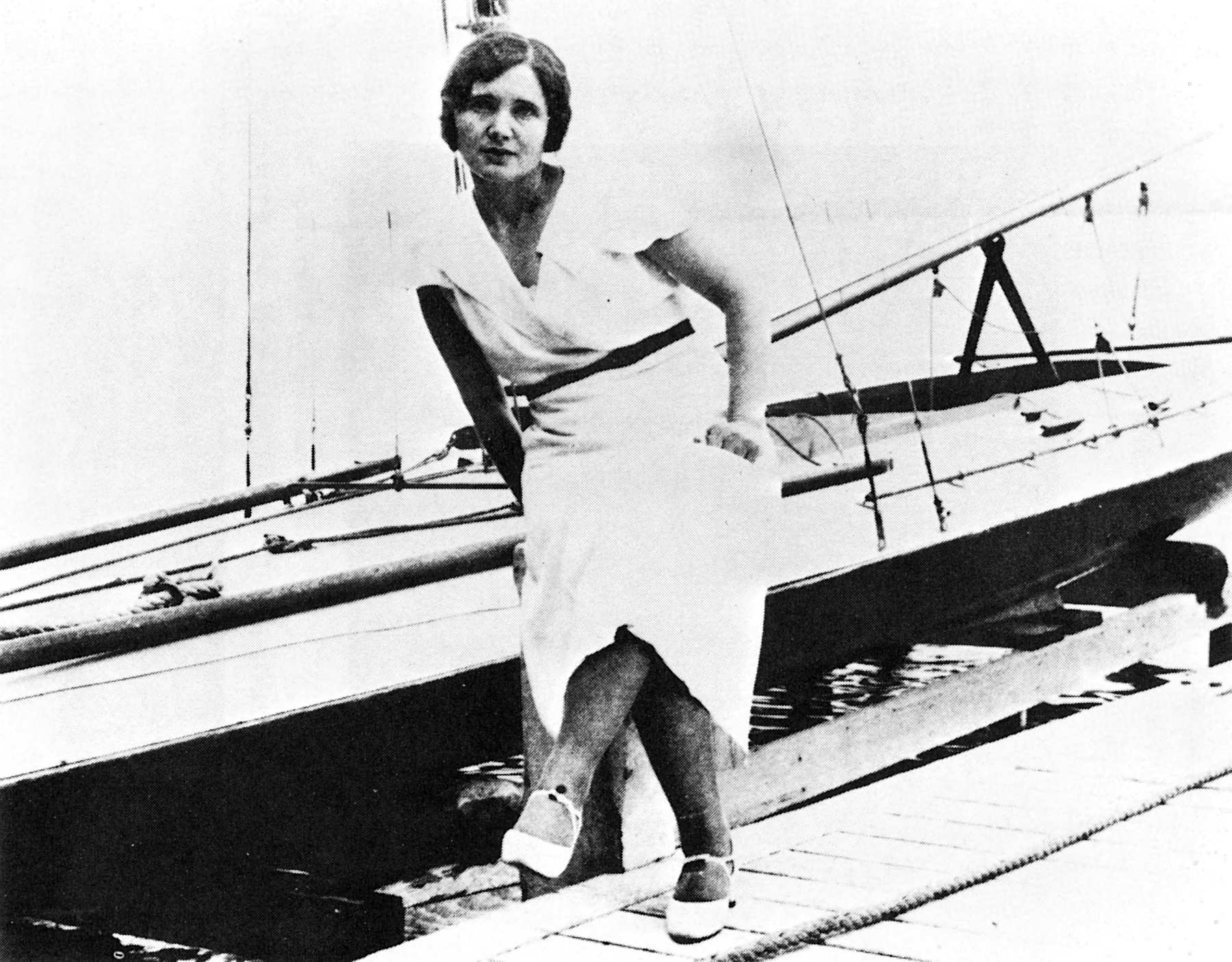
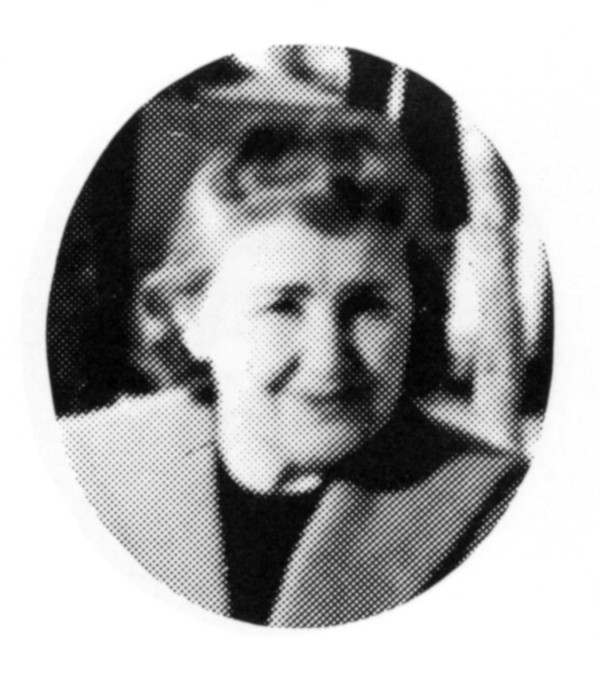
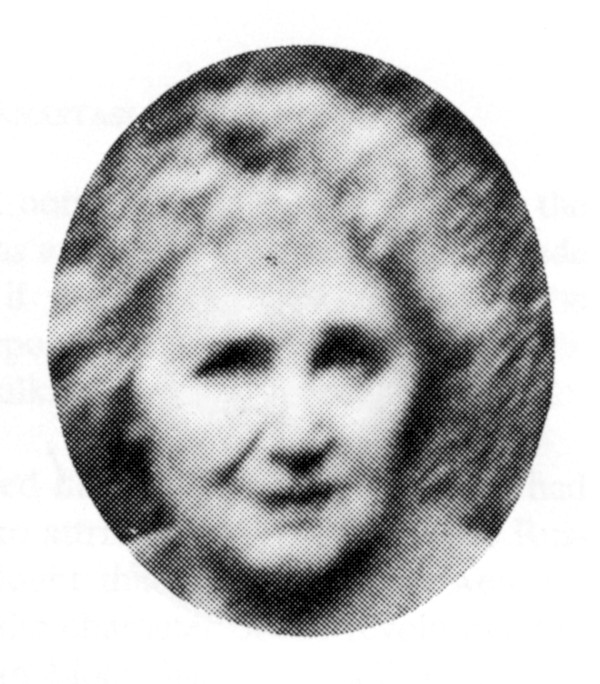
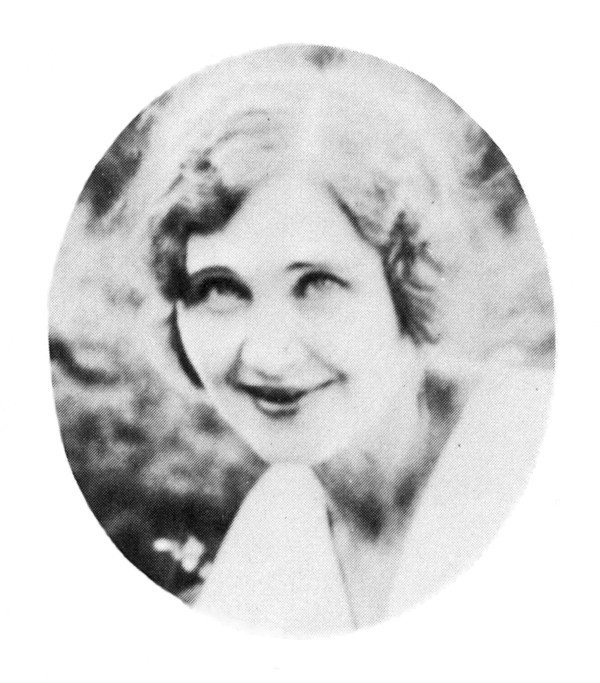
H.I.H. THE GRAND DUCHESS ANASTASIA NICHOLAEVNA OF RUSSIA
The Autobiography of H.I.H. The Grand Duchess
Anastasia Nicholaevna of Russia
To My Father, His Imperial Majesty, the Emperor Nicholas II,
To My Mother, Her Imperial Majesty, the Empress Alexandra
Feodorovna,
To My Brother, His Imperial Highness, the Tsesarevich Alexei
Nicholaevich,
To My Sisters, Their Imperial Highnesses, the Grand Duchesses
Olga, Tatiana, and Marie;
To those dear and understanding friends who perished with My
Family in Ekaterinburg;
Dr. Eugene Botkin, Mlle. Anna Demidova, Ivan Kharitonov,
and Trup;
To those faithful friends and companions who, because of their
loyalty to us, perished before or after the tragedy which befell
My Family:
Countess Anastasia Hendrikova, Mlle. Ekaterina Schneider,
Prince Vasily Dolgorukov, Count Ilia Tatishchev,
Nagorny, Chemodurov, and Ivan Sidniev;
To My Brother’s youthful companion and helper, whose fate I never
learned:
Leonid Sidniev;
To My Uncle, His Imperial Highness, the Grand Duke Michael
Alexandrovich, and his secretary and friend, Nicholas Johnson,
both of whom disappeared, apparently murdered by the
Bolsheviks;
To My Aunt, Her Imperial Highness, the Grand Duchess Elizabeth
Feodorovna, and her faithful nun, Varvara, who were brutally
murdered by the Bolsheviks;
To other members of the Imperial Family who were murdered by
the Bolsheviks;
To all members of the Imperial Family who died during the First
World War and the Civil War in Russia;
To all members of the Imperial Family, living and dead, who survived
the Bolshevik revolution;
To those dear and helpful friends:
Count Apraxin and Captain Nilov;
To the two officers who came to pay their respects and salute My
Father for the last time at the station at Tsarskoe Selo just
before our departure for Siberia:
Kushelev and Artasalev (?);
To friends who voluntarily accompanied My Family into exile;
To my rescuer, Alexander;
To Nikolai; to the Serbian, the Croatian, and the former Austrian
soldier; and to all others who befriended and aided me during
the long journey from the vicinity of Ekaterinburg to a refuge
in Bukovina;
To those millions of heroes of the Russian Empire, sung and unsung,
who gave their lives in defense of their country against
the Central Powers and against the Bolsheviks;
To all members of the Imperial Armed Forces who served their
Emperor and their country faithfully and loyally at all times;
To the millions who died in Russia from execution, starvation and
other causes deriving from Bolshevik cruelty, tyranny and
misrule;
To the members of the Imperial Armed Forces who are now living
outside their homeland and especially those among them who
are maimed and destitute;
To all who have helped me in any way since I left Russia;
To all these—departed and living, known and unknown, relatives
and friends—I am eternally grateful.
Acknowledgements
The present book could never have been completed without the
encouragement, inspiration and help of friends who were interested
in having the story of my family, as known to me, the youngest of
the four daughters of the late Emperor Nicholas II and the Empress
Alexandra, and my own story made known to the world.
My indebtedness to these friends is deep and lasting. First of all
must be mentioned the late Mrs. Helen Kohlsaat Wells, a close
friend and confidante for many, many years. She worked with me
closely during the years 1930 to 1934 during which we completed
the first complete draft of the manuscript. Many years later we
worked intermittently on revising the manuscript until Mrs. Wells’
untimely death. Also in a separate category is the late Mr. John
Adams Chapman, whose friendship and counsel were so valuable at
all times. Deserving of special gratitude are Mrs. Marjorie Wilder
Emery, Miss Edith Kohlsaat, Mr. and Mrs. Norman Hanson, Mrs.
John Adams Chapman, Mr. and Mrs. Louis Ellsworth Laflin, Jr.,
and Mr. and Mrs. Francis Beidler II.
A few weeks after my arrival in Bukovina—after I had
had time to recover from the emotional and nervous shock and
body wounds which I had suffered at the time of the tragedy
on the night of July 16-17, 1918—I decided to write about
my home life with my beloved family, about our arrest, about
our exile in Tobolsk and Ekaterinburg, about the assassination
of the family in Ekaterinburg, and about my rescue and subsequent
escape across the frontier.
I made many, many notes, totaling over three hundred pages.
I spent hours and hours in the writing, days and nights of
introspective experiences, of grief and horror. I wrote in a
peasant cottage in a lonely village dotted with thatched-roof
houses. I wrote at night in the candlelight, agonizing over my
story. At times the only relief I had from my misery was the
howling or barking of a dog. I remembered my beloved
Father’s words, “Dearest children, are you awake?” Tear after
tear dropped as I labored.
I remembered also my Father’s desire that a history of
Russia should be written by a member of our family. My
Father had had in mind that such a history might be written
by my two oldest sisters and, to that end, he gave them much
valuable information. As it has turned out, it is the youngest
sister, the one least prepared to do so, upon whom devolves
the task of writing such a book, if it is to be written. That is
something for the future.
In 1918, after my escape, I thought that the book I had
decided to write about my family and myself might include
historical data and interpretation which would be of interest
to the world and would be of benefit to the Russian people and
to their, and my, native land. I particularly wanted to let the
world know the facts about the arrest, exile and murder of my
parents, sisters and brother, and about the nature of the
Bolshevik regime in my country. It was the notes for this book
that I produced so painfully and painstakingly.
These early notes unfortunately vanished in 1919 when I
was on my way by train from Rumania to Serbia—second
homeland to us Russians—while in the vicinity of Turnu-Severin.
I had accepted from another traveller—I thought he
was an Italian—his kind offer of a slice of bread and a piece
of ham. Three or four hours later I became ill and had to leave
the compartment. When I returned some time later, the heartless
traveller, who had no pity for a young woman travelling
alone, had disappeared along with my suitcase and a blanket.
The suitcase contained not only my precious notes, so laboriously
produced, but also some personal belongings, some
letters, and a list of about one hundred names of the men who
had done most of the harm to Russia, and to my family. These
names I had written down from memory, based upon information
furnished by my rescuer, Alexander. Most of these names
were already familiar to me.
In Yugoslavia, I resumed work on my book. I continued the
task later in Rumania and, once more, in Yugoslavia. I again
wrote many pages of notes, using a pencil stub and scraps of
paper. Such of these notes as remained legible were used
subsequently in the preparation of the first draft of the present
book.
Later, in the early thirties, some years after my arrival in
the United States, I began to revise my materials which were
in a disorganized but generally readable condition, assisted by
my good friends, the late Mrs. Helen Kohlsaat Wells, and her
sister, Miss Edith Kohlsaat. During this phase of the undertaking
I was determined to complete the book as soon as possible
and to make provision for its publication only after my own
demise.
For about twenty years, I was unable to work on the
manuscript, due to the necessity of making my own living.
During this period I gave no attention whatever to the manuscript
which I had confided for safekeeping to my lawyer, a
friend who was aware of my real identity and who wished to
help me ultimately to find a publisher.
Five or six years ago I decided to resume work on the book.
A complete revision and reorganization of my materials were
again required. Once more I had the benefit of Helen Wells’
assistance and counsel.
I had also the great and valued encouragement of my good
friends the late John Adams Chapman and Mrs. Marjorie
Wilder Emery.
Early in 1963 I mentioned to a friend in New York, who was
unaware of my identity, that I had in my possession a manuscript
on the Russian Revolution. He suggested I get in touch
with a close friend, Dr. Jon P. Speller of Robert Speller & Sons,
Publishers, Inc. This I did. The first member of the firm with
whom I talked was Mr. Robert E. B. Speller, Jr., who surprised
me with the depth of his knowledge of my family. I informed
him that the Grand Duchess Anastasia had left the manuscript
with me, a close friend, shortly before her death in 1919. I
hoped—naively—to achieve early publication of the manuscript
while keeping secret my true identity. Dr. Jon Speller
then joined the conversation. He asked if I would be willing to
take a polygraph examination to back up my statements. Upon
my consenting to do so, they agreed to read the manuscript.
They, and their father, Mr. Robert E. B. Speller, Sr.,
President of the firm, after reading the manuscript became
convinced for various reasons that the manuscript could have
been written only by a member of the Imperial family. They
questioned me at length and finally I confided to Dr. Jon
Speller and then to Mr. Robert Speller, Jr. that their suspicions
were correct, that I was Anastasia, but that, if possible, I
would like to retain my anonymity.
Therefore the polygraph examination, given by the noted
polygraph expert Mr. Cleve Backster, was begun by testing me
on my statements that I was a friend of Anastasia. Mr. Backster
quickly recognized that I was withholding pertinent information,
even to the extent that I could be Anastasia; I finally
admitted my real identity to him. In a series lasting more than
thirty hours in all, Mr. Backster became convinced that I am
really Anastasia. I signed a contract with Robert Speller &
Sons and began editing my book with Mr. Earl L. Packer,
senior editor of the firm, and Mr. Robert Speller, Jr.
My reasons for bringing the book before the world at the
present time will, I hope, be readily understood. They are not
complicated. First, I wished to come to the defense of my
deceased parents, against whom many unfounded accusations
and slanders were made. Second, I felt that various distortions
of history which have been given wide circulation needed to
be corrected. Third, I wished to expose the falsity of the
claims of other persons to be the Grand Duchess Anastasia.
Fourth, I desired to establish a foundation which would set
up a museum, with a small chapel therein, to honor my family
who loved Russia so faithfully; and also to assure, in so far as
I might be able to do so, funds for its maintenance, hoping
proceeds from the sale of the book might in large measure
provide such funds. Fifth, I wished to establish a fund for the
provision of financial assistance to destitute former Russian
soldiers and officers; again I hoped that the proceeds of the
sale of the book might help in this undertaking. Sixth, I
planned that, in the event the proceeds of the sale of my book
should provide sufficient funds to enable me to do so, I would
assist financially a very small number of charitable and philanthropic
organizations which, for the most part, I have already
definitively selected.
Sometime earlier I had come to doubt that, if publication of
the book were postponed until after my death, as I had earlier
resolved, my projects would ever materialize. Also, I thought
unlikely the possibility that anyone but myself could or would
make knowledgeable and effective defense against whatever
unfavorable criticism might be made of the book and myself
upon its publication.
I have had the opportunity for a relatively quiet life in the
United States, where I have had comparative freedom from all
the attentions that might have surrounded an earlier reappearance
in the world in my true identity. But my purposes, as
enumerated above, could not be accomplished by remaining
longer submerged. So I have resolved to balance the opportunities
for good against the possible personal inconveniences,
hoping still to be able, after publication of my book, to continue
to live undisturbed a simple, private life devoted in large
part to further writing.
A.N.R. 1963
PART I The Youthful Years — I EARLIEST MEMORIES
It was June 5th, 1901, by the Russian calendar, June 18th
by the new. Suspense and excitement abounded at Peterhof.
The accouchement of the Tsarina was momentarily expected.
The fourth child, surely this time it would be a boy. Russia
bowed to the little Grand Duchess Olga, then to the baby
Tatiana. But Marie, a third daughter in succession, had been
entirely too many. However, all would be righted if this fourth
child were the long-awaited Tsarevich.
At last, the guns: the baby had arrived; a three hundred
gun salute would announce an Imperial Grand Duke and heir
to the Russian throne. One hundred and one guns would announce
a Grand Duchess. The guns saluted a second time.
The people paused to count—three, four, five, on and on,
came the rhythmical booms. The populace stood breathless.
Twenty-three, on and on, one hundred, one hundred and one,
the guns stopped. No, it could not be. It was not possible.
Alas, yes. The fourth child of the Tsar and Tsarina of Russia
was another daughter. Caught in an anticlimax, the man in
the street went his way, but diplomatic Russia said “Bah” and
resented the Tsarina who could not fulfill her function. The
Tsar and the Tsarina accepted the inevitable and said, “It is
God’s will.”
All the while I, the unconscious cause of this frustration,
had lain peacefully in the same little crib which had cradled
the three sisters before me. It was not long however before
the unwelcomed wee one won the hearts of its parents and I
was christened Anastasia, but to the world outside I was number
four, almost forgotten beyond the family circle.
As a child, my tomboy spirit predominated and I was permitted
to indulge this urge until I became something of a
novelty in a court reeking with formality. Nothing pleased me
more than an audience, especially when they nodded and whispered
“cute.”
My next older sister Marie and I were inseparable. At an
early age my greatest delight was to arouse her curiosity.
Often when we were at the height of some make-believe, I
would suddenly dart away. Marie was as slow to action as
I was quick, so I would slip out of sight into one of my hiding
places. Then began the hunt I revelled in. The searchers
went around, as I listened from my vantage point, purring
with satisfaction when I heard the call, “Anastasia, where are
you? Be a good girl and give us a hint.” These games began
good-naturedly, but often when the hunt dragged on, I lost
patience and felt compelled to reveal my whereabouts.
Secret hiding places became an obsession with me, especially
tiny ones so snug I had to squeeze into them. There I
often stayed gloating over the bewilderment and eventual rage
of searchers. Once when I was quite young I slipped out of
the nursery onto the balcony. It was late in the afternoon and
the long shadows fascinated me, so that I must have remained
there quietly for a long time. Suddenly I heard excited voices
and I decided to keep perfectly quiet. At dusk, in the uncertain
light, I flattened myself against the shadowed wall. The
sentries were spreading over the park; the worry was growing.
I was thrilled when I knew they were searching for me,
but I was a little frightened of the gathering darkness. I ran
quickly down the stairs and to the main floor. Mother was
talking to one of the officers when her eyes suddenly fell on
me.
“Anastasia,” she cried, “where have you been?”
“Right on the balcony and no one could find me,” I answered
with all the glee in my voice I could muster.
Almost before I could finish, Father was beside me. He
took me by the hand. One look at his face warned me that
something was very wrong. Without a word he signaled to
the distressed nurse. Her face was flushed. She marched me
to my room and I never ventured one look of triumph as she
undressed me. She did not say a word until I was in bed. Then
she said, “You were a very naughty girl to worry your Mother
so. She was very hurt.”
Mother always came to kiss me goodnight. I didn’t stir in
my bed lest I should miss her footsteps. Finally I heard her
approaching with my sisters; their voices sounded happy. She
stopped at the door for only a moment, and Marie entered the
room alone. When the nurse turned out the lights, I realized
that Mother was not going to kiss me that night.
The next morning a penitent little girl asked herself: “Will
Mother come to me now?” And: “Will she be cross with me?”
I was full of contrition, but how could I express it if Mother
were not in a receptive mood? My eyes fastened on the door,
hoping to see Mother’s face. Suddenly she appeared. I ran to
her and wrapped myself around her neck. I promised never to
worry her again.
Mother’s daily round took her to the nursery the first thing
every morning before breakfast to say a prayer with us children
and to read one chapter to us from the Bible. She was
usually attired in a beautiful dressing gown of white—occasionally
in other soft colors—her hair braided and tied with
silk ribbon to match the trimming of her gown, a habit acquired
from her grandmother, Queen Victoria of England.
These were precious moments to us children. She was a fairytale
empress—stately and beautiful.
On July 30th, 1904, Russian calendar, August 12th by the
new, my little brother was born on a Friday noon. Three hundred
guns announced the birth of the heir from the Fortress
of Sts. Peter and Paul, in St. Petersburg.
On the same day, it was learned that the Russian fleet at
Port Arthur had been sunk on August 10th by the Japanese
navy. My Mother often said it was a day of sunshine and a
day of darkness at the same time. It would have been customary
to hold a large banquet to celebrate the birth of an
heir to the throne but my Father would not hear of it. Instead,
prayers were offered in the churches for the lost ones at sea
and for the baby Tsarevich. All day long the bells rang out
from all the churches of Russia. Thirteen years later Mother
spoke of this day as being as gloomy as the day we arrived in
Ekaterinburg. It was on Alexei’s thirteenth birthday, and
about the same hour in 1917, that the family was informed
they must leave their beloved home in Tsarskoe Selo.
I do not remember Alexei’s christening since I was so small,
but I have been told about it and have often seen his christening
mantle and the cross which he wore on a chain around his
neck. These were displayed in a glass case along with the
christening dresses of us sisters. Olga’s was an exact copy of
that of Marie Antoinette’s older daughter. It had been made
in Lyons. Olga and Tatiana held a corner of the long mantle
which was attached to the cushion because of its weight.
Alexei’s godmothers were his grandmother, the Dowager Empress
Marie Feodorovna; his sister, Olga Nicholaevna; his
aunts, Mother’s sisters, the Princesses Irene of Prussia and
Victoria of Battenberg (subsequently Marchioness of Milford
Haven). The godfathers were his grand uncles, the Grand
Duke Alexei Alexandrovich and King Edward VII of Great
Britain; his cousin, Kaiser Wilhelm II of Germany; his great-grandfather,
King Christian IX of Denmark; his uncle, the
Grand Duke Ernest Louis of Hesse, the Empress’ only
brother; and his Aunt Irene’s husband, Prince Henry of Prussia.
To commemorate his birth the cornerstone for the Feodorovsky
Sobor (Church) was laid in Tsarskoe Selo.
Now that this handsome brother had arrived, the handicap
of my life, that of being a girl, seemed somewhat lifted.
Alexei was a beautiful little boy with a very light complexion
and curly auburn hair which my Mother brushed lovingly
into a curl in the middle, big blue eyes, long eyelashes and a
most alluring smile. He was the most fascinating thing in my
existence, so whenever an opportunity presented itself, I ran
into his nursery bringing various toys to him. Mother had
many pet names for him, among them: “My precious Agoo”
and “Kroshka” which means crumb. Olga and Tatiana were
permitted to hold the baby; Marie and I could only hold his
feet.
One of my most vivid childhood experiences, when I was
nearly four years old, happened on a Sunday when we sisters
as usual were dressed in white, ready to go to church.
We heard excited voices and saw Mother running upstairs.
This frightened us and we all ran after her to the nursery.
There I saw a spot of blood on little Alexei’s shirt. While
nurse was bathing him he sneezed, thereby causing a discharge
of blood from his navel. Though I was very young, I
could easily tell from the faces about me that something
was wrong. At the time just what it was I could not understand.
A few years later, when I was about seven, we three
younger children were playing in the garden when our brother
fell over his cart. Soon a large blue swelling developed around
his ankle. When Mother came she fainted at the sight, knowing
it was the dreaded haemophilia that might kill her son.
As a result, the lives of Father and Mother were noticeably
saddened. Father searched in every country for a specialist,
but without success.
We were continually reminded that we must be careful
of Alexei. He was so easily hurt. The toys I was in the habit
of bringing to him were removed before they reached his
hands. Once he fell on his head and his face swelled so terribly
that his eyes were almost closed and his whole face became
a purplish yellow, a dreadful sight. At one moment he
would be perfectly well; an hour later, he would lie in bed
seriously ill. We were instructed not to speak to anybody
about it, but we innocently gave away the secret of his illness
to some members of our staff who had led us into believing
that they already knew all about it.
Mother was constantly at his side, never trusting any one
else to care for him. Each time, when he recovered, Mother
was entirely exhausted, so much so that she was unable to
leave her room for days at a time.
When Alexei was well and his normal chubby self, it was
hard to remember that we had to be careful when we played
with him. I often felt belligerent when he teased me saying,
“Go away, you’re playing just like a little girl; you don’t know
this game.” I maintained my composure pretty well and occasionally
retaliated by refusing to play with him, but he bitterly
complained of such treatment. Suddenly he would be
well again at which time it was difficult to restrain him from
getting too bold or playing games that might end in disaster.
Alexei had several guards, Cossacks who were trustworthy
and on duty day and night. Every morning they searched the
palace grounds before any member of the family could walk
about in them. Alexei also had two special attendants. One
was Derevenko, nicknamed Dina, a huge strong sailor, a
member of the crew of Father’s yacht, the “Standard.” He
was no relation of Dr. Derevenko, Alexei’s physician. Dina
applied hot compresses and light massages to Alexei, when
they were needed. Dina also gave foam treatments, and always
carried him around when he was not able to walk.
Unfortunately Dina turned against his master during the
revolution and was later arrested by the Soviets when they
found some of Alexei’s belongings in his luggage.
The other attendant was Nagorny. He was the last to give
Alexei his usual care. Nagorny took charge of him during the
revolution, and was killed in Ekaterinburg because he defended
the little boy’s property. These two, Dina and Nagorny,
were constantly at Alexei’s side to see that he did not harm
himself. They helped my brother to grow to normal boyhood
by using the exercises prescribed by Dr. Derevenko and the
suggestions of M. Pierre Gilliard, our French tutor. They
helped to carry on in such a way that the little fellow never
suspected that he was being shielded. For he was not told of
the serious nature of his illness but was to realize it for himself
when he grew older.
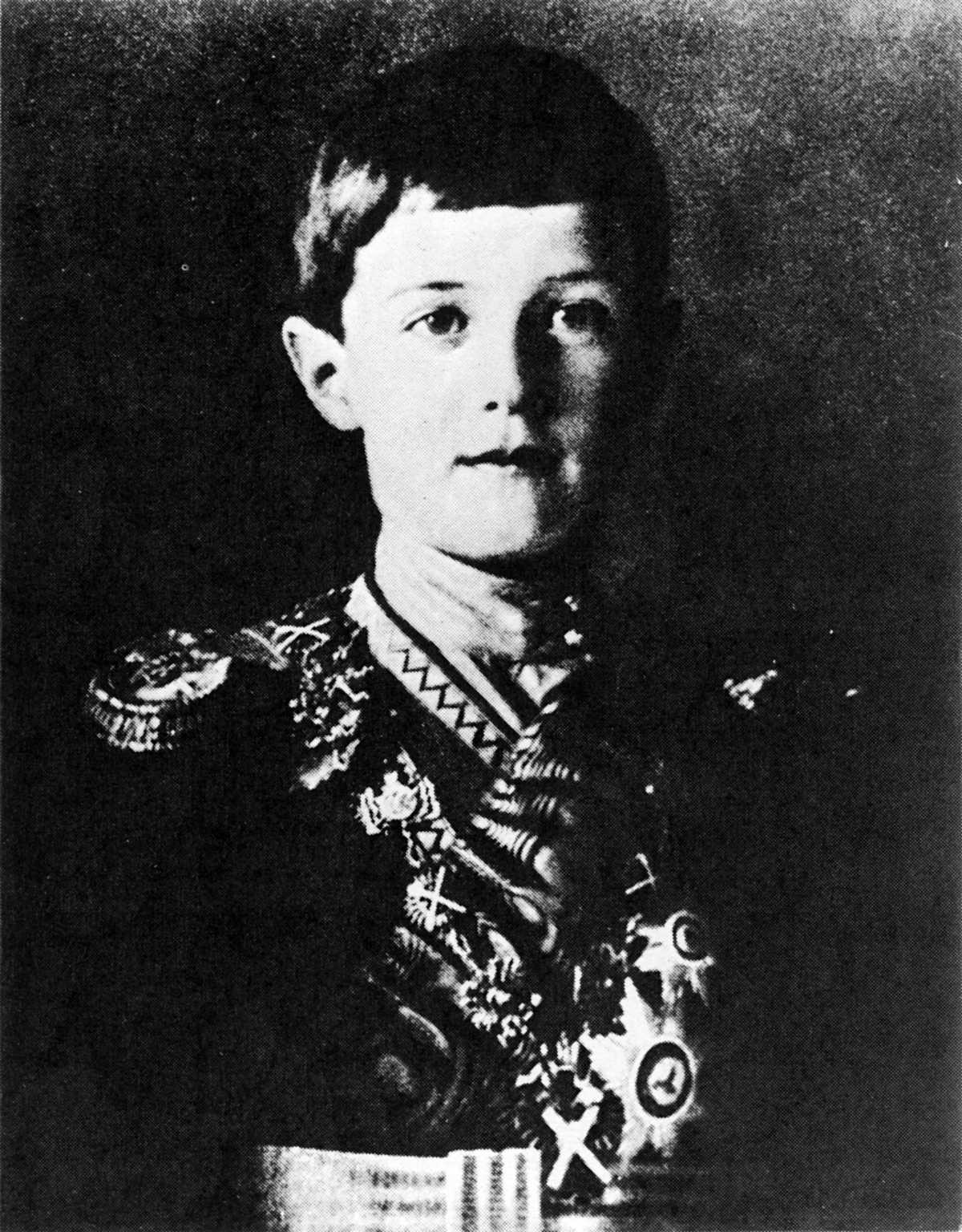
At his birth Alexei received many titles: “Hetman of all
the Cossacks,” “Knight of St. Andrew,” “Knight of the Seraphim
of Sweden,” “Head of the Battalion of the Horse Infantry,”
“Head of the Siberian Infantry,” “Head of the Cadet
Corps” and others. Alexei loved everything military. I think
he had a uniform for almost every military order in Russia.
He was so proud to wear each one, and carried himself with
true military bearing. From childhood he had worn a white
sailor suit with ribbons around his collar. When we cruised
in the Baltic, he wore a white sailor cap with the name
“Standard” in white on a blue band. When cruising on the
Black Sea he had a black band with yellow lettering.
One day in a snow storm I pulled Alexei on his sled. Then
he insisted that it was his turn to pull me. Soon his hands became
swollen but fortunately this did not result in one of his
serious attacks. He was not permitted to take part freely in
sports, though he was allowed to ride a tricycle and later a
bicycle, when he was carefully followed by Dina. Finally he
was allowed to drive a small motor car with his cousins or
a friend.
Alexei had playmates other than myself. I remember a
youngster who was driven up the driveway accompanied by
a guard and well supplied with many toys. He had among
other things a box of powdered chalk. Considering the boy
an intruder and unable to hide my jealousy, while he was escorted
by the runner, I snatched the box from his hand and
scattered the contents all over the floor. It all happened so
quickly that no one was able to stop me. Soon I was escorted
to Mother. By the time I reached her I was all smiles—a bit
strained to be sure. She sat silently and held my little hands,
studying them and wondering how they could do such a thing.
I peeked at her face, putting on my most winsome smile.
Mother assured me that “Smiles will not help.” Just then
Father came in and sent me to my room for the rest of the
day. Later he came to see me and said, “You must not fight
with your younger friends. Always be a little lady.” “I don’t
want to be a lady,” I said defiantly. Father answered, “Then
you cannot live in this place.” “Where will I live then?” “In
one of the guard houses,” said Father. My dear Father often
apologized for Alexei and myself.
Gentle as Father was, I took those remarks seriously, because
I knew he always meant what he said. So I applied myself
to the idea of “being a lady.” It soon paid off. Some time
later when I was roaming through the park I chanced upon
two workmen who were fighting in the ravine. It looked serious
and desperate. With all the ladyship I could muster I
ordered them to stop. To my astonishment they did. The contrast
between little me and those two, so huge and menacing,
convinced me that there must be something in this ladylike
business after all.
By nature I enjoyed the rough and tumble, while being a
lady meant being dignified, sewing, practicing on the piano,
in general following in the footsteps of Olga and Tatiana. I
would much rather have played the kind of games that Alexei
enjoyed. Marie did not like these games at all. She preferred
dolls, which I thought were not half as much fun as shooting
off pop guns. I often held the gun while Alexei slid down
the toboggan slide held on the lap of his attendant Derevenko
or his assistant Nagorny.
The park surrounding our home at Tsarskoe Selo lent itself
to my eager desire for exploring the world around me,
although even this could not satisfy my curiosity about that
part of the world which lay beyond the fence. One afternoon
I found an owl opposite the balcony in the garden. I had
seen something flying which fell to the ground. When I ran
to it I found an owl which did not move. I wanted to pick it
up, but was told it was bad luck to do so. In spite of this advice,
I picked up the bird and stroked and fed it. In a short
time it became a real pet so it could even recognize my step.
It always stayed nearby, hopping about in a small area, though
it didn’t seem to be hurt. Whenever it heard me, it would fly
up and sit on the rail of the balcony. While the owl was
perched there, it seemed to stare at me and I could not resist
walking around, fascinated by its twisting neck and staring
eyes which apparently followed my movements.
Most of the time I was content to wander through our fairyland
park with my sisters and brother. Its beauty was overwhelming
with fine vistas embracing gardens, ravines, lakes
and even islands. We often sailed our toy boats on the lake
or rowed Alexei in a boat Sometimes we sat on shore watching
the varied reflections on the surface of the lake. These
might be reflections of the Feodorovsky Sobor with its golden
cupola, or again a glimpse of the luxuriant tree tops, or the
rapidly changing cloud formations. On the lake the swans
glided back and forth in graceful splendor, but, when they
came near our shores, with one stroke they erased all the pictures
before our eyes.
These swans were my special pets. I usually carried bread
to throw to them. One day in a mischievous mood, I made
them think I had come to feed them. When they swam toward
me expectantly, I ran away. I was suddenly thrown to the
ground, and the largest of the swans with his wings spread
wide stood over me. He began to beat me with his wings. My
screams brought help from one of the guards, who drove off
the swan. When I stopped sobbing I had not lost my love for
the swans, but I had learned I could not tease them.
Father found time to visit us at play every day, often only
for a few minutes, but he made us happy with these visits.
Sometimes he watched us as we went down the slide which
had been installed in a large room on the ground floor. He
whistled as each child took her turn and the rest of us jumped
up and down expressing delight.
Several times, as a great treat, we children were permitted
to take our bath in Father’s big, sunken tile tub, large enough
for one to swim several strokes. After the bath we romped
over the huge couch in Father’s dressing room, watching the
flames dance in the fireplace.
Mother called Father’s study “the forbidden land.” We
children were not allowed to enter it, which made me rather
curious about it. I often ran down the hall, hoping that I
would find a way to get into the study, but there was always
someone who would send me back. If I could have found out
what Father did there, I would have been satisfied. One day
I managed to slip through the narrow passage of his dressing
room and opened the door leading into his study. I was
breathless with excitement, but kept quiet. I was about to
open the door for a tiny peek, to see if Father were there,
when I heard footsteps. I decided to retreat quietly as if I
had gotten there by mistake. But as I backed out I had
moved too quickly and gone too far. I rolled down several
steps right into the middle of Father’s sunken tub. Fortunately
I was not hurt, but my feelings were. I extricated myself and
retreated down the hall in the midst of laughter. I never did
know my discoverer.
My curiosity was still not satisfied, and I was determined
to keep trying. I used all sorts of excuses for going to his study
with pressing messages or gifts. But Mother spoke with finality:
“Father cannot be disturbed in his work.” In spite of
Mother’s words, the opportunity finally presented itself. One
day I stood quivering on the threshold. There was Father at
his desk looking quite serious. I leaned forward on my toes
to take in all that I could see, so far forward that I lost my
balance and fell on my face into the room. I was terribly
frightened, but Father rushed to me and with a smile picked
me up saying: “What are you doing here, baby?” Then he
sat me down at his desk and held me on his knees. I was
speechless to think I was in the forbidden place. I glanced at
piles of papers, then at Father’s face. With a hug and a kiss
he deposited me in the hallway. “Now run along, my little
Curiosity.” I skipped away elated and I could hardly wait to
tell Marie I had actually been in “the forbidden land.”
I was often instrumental in getting my sister and my
brother in trouble. When we drove to Pavlovsk, a short distance
from Tsarskoe Selo, I watched for the moment when
the nurse was occupied with my cousin’s attendant. I snapped
my fingers—a signal to dash to the brook for the mud fight.
Within seconds our faces and white clothes were beyond recognition.
These mud fights made the nurse furious. Once when
she rebuked me, she said it was a pity I had not been born
a boy. This worried me so, I went to Mother with the question,
“Do you love me, Mother?” “You know I do, little
Shvibzchik,” was her reply, using her pet name for me. “But if
I were a boy, would you love me more?” I questioned her
tearfully. Mother understood; she shook her head a decided
“No” and I was satisfied.
Sometimes after tea, I slipped into the servants’ quarters
to partake of tea again, because I thought they had more interesting
things to eat. I was quite wrapped up in my small
world without realizing that there was any other. And yet being
born into a royal family I still kept wondering whether
I should have been someone else. I wondered if my grandmother,
the Dowager Empress Marie, ever forgave me for
not being a boy. That might explain her critical attitude
toward me. I thought I sensed an unsympathetic bearing in her
and I often retaliated by being irritable which in turn justified
her criticism of me. On second thought this same Grandmother
understood me perhaps better than anyone else. When
all despaired of me, she would say, “Don’t worry, she’ll tame
down after a while.” This may have been a comforting thought
to my family, but not to me. I did not want to be like my
Granny, not at all. She was small, dark-eyed, deep-voiced,
always beautifully groomed. I wanted to be like Tatiana, tall,
beautiful and graceful. Often after I was tucked in bed, I
whispered a prayer that God might transform me overnight
into a girl like Tatiana. Grandmother was Alexei’s favorite.
He loved her more than we sisters did. She was Father’s
mother and there was a strong bond between them.
I remember the satisfaction I felt when some Danish relatives
were visiting us and my Grandmother said to one,
“Anastasia is certainly small,” and the relative replied, “You
are not very tall yourself.” This kind person must have sensed
that I was touchy about my height and she attempted to defend
me before Grandmother.
When Father’s work was done for the day, he would enter
Mother’s apartment and whistle melodiously. This was the
signal for a family get-together or for an exercise outdoors.
Sometimes Father took me on a walk alone. He listened seriously
to my talk and pretended to be concerned about my
petty problems. I swelled with pride that he considered my
little world was as important as his. He was a lover of nature,
and this knowledge made our walks even more interesting.
Father had the reputation of being graceful and a good tennis
player. He played with the best professionals in the Crimea
and won most of the time. Olga and Tatiana often played with
him and I looked forward to the day when I would be able
to match him in a real game. But that day never came. Before
the war I was too young, and during the war there was no
opportunity. I did return the balls occasionally when Father
was practicing.
II SCHOOL DAYS
With excitement I looked forward to my first day of
school. I was anxious to make a good impression on my
teachers. Dressed in a blue or white pinafore and with ribbon
bows on my hair, holding my Mother’s hand, I felt quite
grown up as I joined Marie in the school room on the second
floor of the palace. I was proud to hear Mother say that I
was good, quiet, and thoughtful as I sat at a fair-sized table
opposite my tutor, answering the questions. But to Mother’s
disappointment my good behavior did not last long. As the
days passed, confinement began to irk me and I longed for
the outdoors. School became a difficult chore for me, and no
doubt I was difficult for my teachers. My mind turned to the
other side of the classroom door. Only the threat of punishment
could bring me to a school desk at all, and once there,
instead of concentrating on my lessons, I planned my activities
for the hours after school.
My mind dreamed about Vanka, the donkey, when she
came as a present to Alexei. She was very bright and extremely
stubborn. She was named for a character in a humorous Russian
song of the time. Vanka was cunning. When Alexei hurt
himself, she laid her head on his shoulder as if she were crying.
She could shake hands, wobble as if dancing, and rolled
her eyes flirtatiously. She understood every word we said,
often shook her ears in joy. But when things were not in her
favor, she stared straight at us. Her ears stood up into a half-cone.
She had been a circus donkey, but she would only perform
when she felt like it. Derevenko, the sailor, could make
her walk while I rode her, but she wanted a lump of sugar
in payment for every step she took.
“Anastasia, put your mind on your work,” jarred my consciousness
away from Vanka and back into the classroom.
I did like arithmetic and drawing. I would often doodle until
my pencil was taken away and the lessons resumed. In the
spring it was more difficult to concentrate. The warm, sweet
air and the chirping birds would not let me sit still.
Often after school, Mother would take me to my favorite
farm where I felt complete freedom. Here were many soft
creatures to cuddle: tiny pink piglets, toylike lambs, calves
and colts, the cutest I ever saw. There were human babies,
too, belonging to the farm workers, but Olga had a way of
monopolizing them. Every place we went the children followed
us and were anxious to show anything new that happened.
They all spoke at once, excitedly. We pretended to
be surprised, which encouraged them to tell each story over
again.
One day one of the workers gave me a tiny chick, born
late in the season. We put it in a basket with some straw in
it. I covered it with my handkerchief and went ahead of
Mother to hide it in the carriage, and waited there impatiently.
I was afraid that the little thing would die before we
reached home. Soon after Mother heard the chick cry, she
said, “You have taken a baby from its mother. You must keep
it well and happy.” This chick taught me my first lesson in responsibility.
You never saw so much affection lavished on
such a small thing. I fed it most tenderly and presented it with
my precious pillow which until then had belonged to my doll.
In spite of my devoted care the chick’s cries grew fainter and
fainter and one morning I found it lying on its back. It was
a shock.
I decided to give my chick a funeral. I dressed it regally
with veil and gown and, as a great concession, I allowed
Marie and Alexei to help lay the little form on a mattress of
rose petals in a pretty box. A bouquet of white flowers was
placed on its breast. Then we invited everyone to the funeral.
Besides, I wanted no one to miss seeing how beautifully I had
prepared my pet. Alexei was the priest, Marie and I chanted
mournfully. Derevenko, the sailor, prepared the grave. The
box was opened for all to see. At last the box was closed and
placed on top of a stretcher, which was hoisted up on the
pallbearers’ shoulders. I, the chief mourner, led the procession
with a black band on my arm. We buried the box amidst
quantities of flowers, then marked the grave with the prettiest
stones.
For a week I mourned at the grave every day, wondering
how the chick looked after its journey to heaven. Finally, I
dug up the box. I opened the cover expecting that the little
angel had flown away, but instead I ran to Mother to tell her
the worms were eating my pet. Mother explained that the box
contained the shell of the chick, the soul was already flown
away, now nature was destroying only the shell.
I was quite socially inclined, and made calls on anyone
staying in the palace. I chatted with all on various subjects.
“If Olga and Tatiana ever marry, will they leave us? Olga
squeezed an orange peel yesterday and it squirted right into
my eye. Do you know that Mashka (Marie) put on her underwear
wrong side out and refused to change it, it is very bad
luck. Did you hear that “baby” (Alexei) painted a droopy
mustache on his face with a crayon? Olga says, he looks like
the Cossack in Riepin’s painting. Do you know that painting?
Why do you think Marie did not take her cold bath this
morning? Olga says that mother kangaroos hide their babies
in a sack on their bodies and the babies poke their heads out
to see where they are going. Why doesn’t papa get cribs for
the kangarooshkas?” These ideas or others like them were
expressed to all in five to ten minutes of social visits. Sometimes
I asked them to tell me stories like the Golden Apple
and the Princess. I clapped my hands and thanked them for
the most delicious story. If anyone was not well, I was ready
to play nurse. My one cure for the indisposed was always a
wet towel on the forehead.
Some of my most pleasant early memories about Mother
were the times when she told us stories. There was one favorite
she was asked to repeat over and over. One day she
changed the words slightly and I burst into tears, saying: “But,
Mommy, I like the old story better.”
When I was older, Mother read to me an American book
called Ramona. As much as I could understand, it was a fascinating
story about an Indian girl. It made a big impression
on me, and left me with the most tender feeling of affection
for the Indian girl. Several years later, when I heard that an
American gentleman was coming to see Mother, I begged to
be allowed to meet him. I remember that I wore my best new
dress, of white silk, a recent gift from Queen Alexandra of
England. This frock had smocking at the waist. I was told
it came from Liberty’s of London. I kept this dress until the
war, at which time I gave it to an orphanage.
At the time of this American’s visit, the nurse was supposed
to bring me downstairs when Mother rang the bell. But, when
I heard the signal, I ran ahead, and flew down the spiral stairway
as fast as my feet could carry me, and burst breathlessly
into the room. A tall handsome gentleman arose and politely
kissed my hand as we were introduced. Distressed, and almost
in tears, I looked sideways up to him as I cried out in surprise:
“Mother, this gentleman is not an American because
he does not have his feather hat or his blanket.” The poor
man, whoever he was, tried his best to explain, but to me, he
still was not an American.
Mashka (Marie) had the most wonderful disposition, but
I often got her into trouble. We used to practice on the piano
in a room above Mother’s boudoir where she could hear us.
When the instructor, Mr. Konrad, happened to step out for
a minute, we began to roughhouse. Soon the telephone rang
and we knew it was Mother to remind us to attend to our practice
and not to fool around.
Mother realized that we missed having friends of our age,
and she made up for it by forming a closer knit family of our
own. Occasionally we saw the Tolstoy girls or the children
of General Hesse, once Father’s aide-de-camp. We took some
lessons, danced and played with them: two boys and a girl
about the age of my sister Olga. But no intimacy whatever
was allowed. We also enjoyed our cousins, Aunt Xenia’s children,
when they were at home.
When Alexei was about seven years old, he had a nurse
named Maria Vishniakova. She disturbed Olga and made her
cry. Vishniakova told Mother that the muzhik Rasputin had
been upstairs in our apartments and conducted himself improperly.
According to the tradition of the Russian court, no
men were allowed in the girls’ rooms except the two Negro
doormen, Apty and Jim. Father became so upset by the report
that he personally questioned Vishniakova. She was evasive,
and gave one date, then another. When Father told her that
Rasputin according to the report was nowhere near St. Petersburg
during those dates, she admitted her whole story was a
fabrication and that it was a malicious relative of the Imperial
family who had had her say what she did. She then
burst out crying and of course she was discharged. It was
then that the attack on Rasputin began.
Another incident which caused a great deal of confusion
some years before the war involved our governess, Mlle.
Tutcheva, a native of Moscow. She spoke various languages,
but no English. Aunt Ella (the Grand Duchess Elizabeth
Feodorovna), Mother’s sister, had recommended her for this
important position. Tutcheva was a cultured woman and came
from a fine family, but at the same time was unpleasantly outspoken
and domineering. She hated the English so that she
would not allow the English language to be spoken in her
presence, and often criticized the English, especially when we
went through our albums of our trips. She even complained
to us about our own Mother, that she was English and not a
Russian, and constantly exchanged sharp words with Mlle.
Butsova, Mother’s favorite lady-in-waiting, addressing her in
an abusive manner, but Mlle. Butsova spared no words for
her either. All this made us children excited and nervous.
Mlle. Tutcheva was also in continual conflict with others in
the palace. To our dismay she also spoke unkindly of Princess
Maria Bariatinsky. Later she told Aunt Ella that Rasputin
visited our apartments although at no time had any of us sisters
seen the man in the upper quarters.
Aunt Ella made a special trip to Tsarskoe Selo from Moscow
to inform Mother of this gossip. This incident also came
to Father’s notice and he came to our rooms to ask about it.
We all said we had not seen the peasant in our apartments
at any time. Then the police records showed that he was away
on those days. Tutcheva finally admitted that the story was
untrue and that she had never in her life seen Rasputin. She
was dismissed.
Father loved everything about Russia: her people, her customs,
her music and her national food, particularly he was
fond of the dark bread. It was baked only in the military
kitchens and was most delicious. He also enjoyed a glass of
slivovitsa, a plum cordial. During the war he preferred non-alcoholic
drinks and omitted strong drinks when prohibition
was established, making no exception for himself. However,
some wine and other drinks were served to high foreign military
officers in Mogilev. Father disliked and often neglected
taking medicine even though it was necessary for his weak
stomach. He believed, as did his Romanov ancestors, that nature
is the best medicine.
Father had the best possible education and training. One
of his favorite teachers was the famous Konstantin Pobedonostsev.
This man was an outstanding theologian and
lawyer. He taught Father both law and religion, so that his
faith remained strong to the very end. Another favorite was
General Danilov who taught military tactics. He was carefully
selected for this most important assignment. Father had a
Swiss tutor who taught him the French language and literature,
and an English tutor, named Charles Heath, who acquainted
him with the English language and literature.
Father had the most extraordinary memory. He was able
to recite many Russian, French and English poems, including
passages from Shakespeare. He was a fast reader and writer,
his sentences being short and concise and always written in
ink. He enjoyed the classics. His reading also included the
works of Gogol; Gorbunov’s stories of Russia; and Feodor
Dostoevsky, many of whose autographed novels were on the
shelves of our library; likewise the works of Longfellow,
Dickens, Wordsworth and many others. He was familiar with
international law and often remarked that many diplomats
complicated matters to such an extent that it took a great deal
of time to unravel a simple problem.
On the “Standard,” the Imperial yacht, he had in his cabin
the complete works of Shakespeare and other English contemporary
authors, and books carefully selected by our tutors
for us to read during our cruise.
The strict training demanded of my Father, the future
Tsar, was due to the discipline of his austere father, Alexander
III. Had Father not felt restrained by his oath of office, I feel
sure he would have lifted some of the restrictions he had inherited
from his predecessor. His love for his people and his
gentle nature were often shown when he lessened the punishment
of soldiers by their officers. He believed in a close family
relationship and on one occasion, after receiving a request,
he granted permission to a Jewish woman to see her sick son
in their prison hospital as often as she pleased.
Father was very loyal to his friends, many of whom he
had known from his childhood. He disliked the waste of time
on petty talk.
Many requests were withheld from him, and occasionally
actions were taken without his knowledge or approval.
In spite of previous attempts on his life, he had resumed
the ancient custom of the “Blessing of the Waters” on the
river Neva in St. Petersburg. When a little girl, I was told
that at one of these ceremonies an explosion occurred on the
river, injuring several persons including my Father’s physician.
Part of the canopy and the windows of the Winter Palace were
shattered. Father, therefore, ordered the discontinuance of
this tradition. When an epidemic broke out soon after, the
peasants attributed it to the decree. So the order was rescinded
and the Epiphany ceremony was resumed. Once I
was present at this picturesque ceremony which was one of
the great national and religious traditions of Russia.
At this ceremony the dignitaries of the Church and State
gathered at the Winter Palace. The procession formed there
and proceeded to the river, followed by the church dignitaries.
Father took his position in front of a crimson and gold canopy.
A hole had already been cut in the ice. At the end of the ceremony
the priest handed Father the cross which he dipped
in the water and then raised high and made the sign of the
cross in the air. This was repeated three times. It was so cold
that the drops of water froze as they fell on the ice. After the
ceremony the procession returned to the Palace, where luncheon
was served to hundreds of guests, who formed a brilliant
array in their court regalia.
I remember how beautiful the ladies looked at the luncheon
in the Palace following the ceremony. They wore long court
dresses of various pastel colors and jeweled filets (kokoshniki)
from which soft veils hung down. There were glittering diamonds,
rubies, emeralds, sapphires and alexandrites, the latter
a rare stone found in the Urals in 1833 and named after
the future Alexander II, my great-grandfather.
Many officers wore the dress uniform of their regiment: the
Horse Guards were in white and gold; the Cossacks in deep
blue or crimson; and the Hussars in white and gold with scarlet
dolmans over their shoulders. The “Blessing of the Waters”
ceremony was conducted the last time in January 1916. It did
not stir the same feelings as before. This time there were many
dignitaries present and the foreign High Command, including
our friend, Sir John Hanbury-Williams, and, of course, Sir
George Buchanan, the British Ambassador.
Grandeur surrounded us in the Winter Palace where I spent
the first years of my life. But during the Russo-Japanese war
in 1905 we moved to Tsarskoe Selo, when my childhood recollections
began to take root.
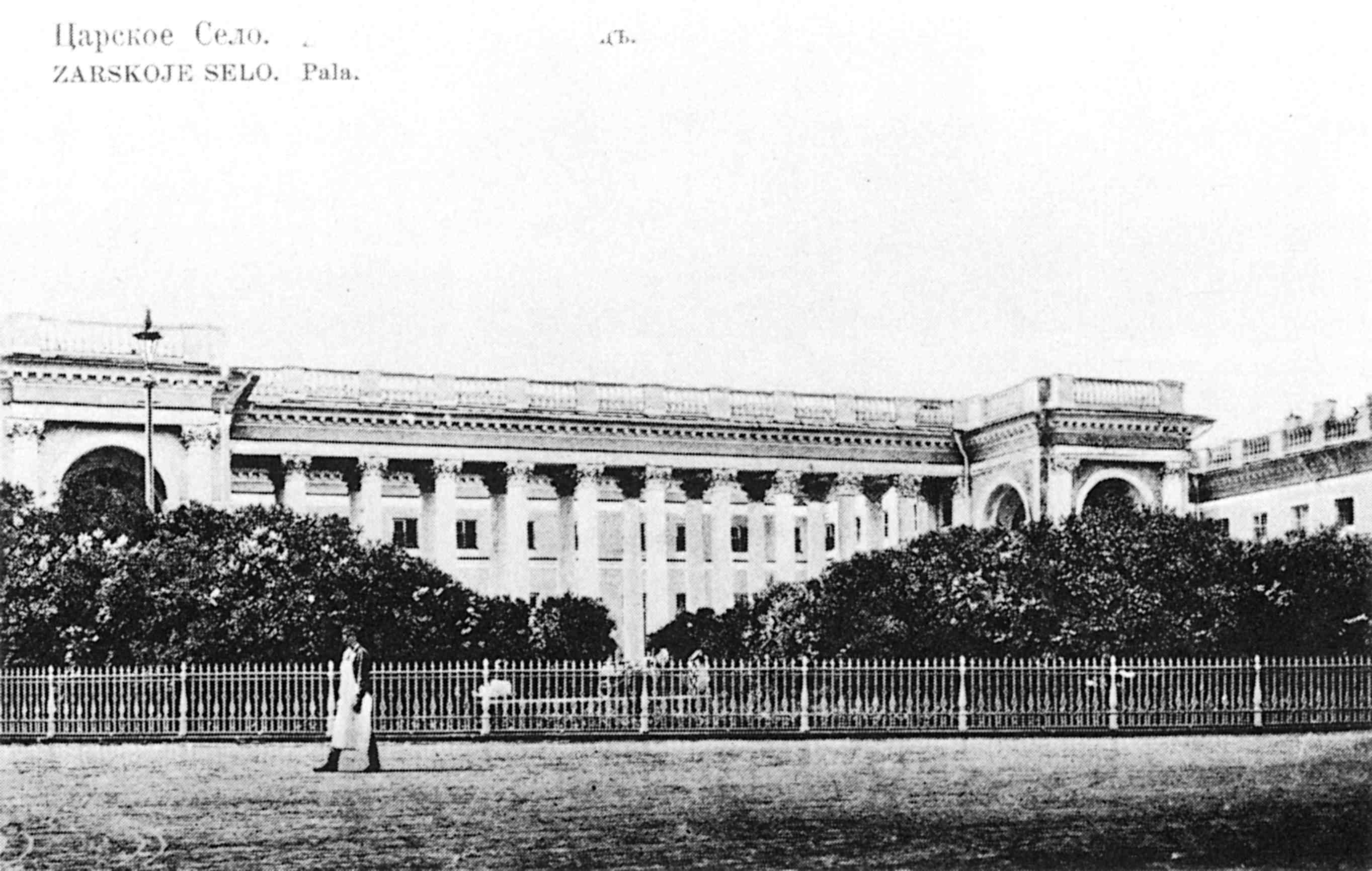
The Alexander Palace at Tsarskoe Selo was our permanent
home. Many members of the Imperial family had their residences
in this suburb and nearby; it was only fourteen miles
south of St. Petersburg. Our Palace stood in the middle of a
vast park of about six hundred acres, in which were located
stables, barracks, greenhouses and several churches, including
the Feodorovsky Sobor (Church) and Our Lady of Znamenie
which was my Mother’s favorite. There were islands nearby.
On the “Children’s Island”, Alexei had a small house; the
four rooms were left as they had been at the time of Alexander
II. In a book case were some books by the poet Zhukovsky
and there were also books by Byron, Schiller and other poets
which he had translated into Russian. Zhukovsky who was
the tutor to Alexander II spent a great deal of time with
him before he came to the throne.
There were some tiny ports for landing, bridges, dog kennels
and an elephant house, a concert hall and a Chinese
village, a theatre and so on. In the palace grounds was also a
white tower, a photographic building and an arsenal. The
barracks for the regiments were located in the vicinity.
Before the war the cabinet ministers came to Tsarskoe Selo
with their reports in the morning and were ushered into
Father’s study by an aide-de-camp. Occasionally however,
Father met various officials in St. Petersburg. In order to save
time and money the private audiences once a week were held
in the Winter Palace in the General Chamber. Because of several
hundred audiences that were held during the day, Father
could give only a few minutes to each of these audiences and
they were held standing. The reports of the high officials were
received from 10:00-10:30 after his walk.
Several hundred attendants took care of the grounds and
buildings; many of them lived outside. The personnel included
the Grand Marshals of the Court, Masters of the Hunt, Masters
of Ceremonies, Equerries, Chamberlains, coachmen,
valets, butlers, chauffeurs, gardeners, cooks, maids, etc.
In Tsarskoe Selo the Palace of Catherine the Great was surrounded
by a tall fence featuring a finely wrought iron gate.
This building was like a museum, with its matchless rooms
of amber and malachite and its mosaic and gold decorations.
Two rooms I especially recall: one an anteroom in which
Catherine kept her famous collections of snuffboxes, and the
other a drawing room with a ceiling of ivory silk satin, in
the center of which a tremendous double eagle was embroidered.
In a third room, the walls were of satin, with
exquisitely embroidered golden wheat and pastel blue cornflowers.
There was another room with a double eagle inlaid
in its mosaic wooden floor.
The private chapel had a large balcony for the choir. This
awesome Palace was in great contrast to Alexander Palace,
which we thought had a homelike atmosphere.
While I was a little girl, during our absence the public had
permission to go through the Palace, but it was reported that
the men conducting the tours allowed their relatives to enter
our private chambers. Mother resented this abuse and the
tours were forbidden. Later even the park could not be visited
and everyone had to have a special permit from the Household
Minister to enter even the Tsarskoe Selo grounds; this
rule applied also to those employed in our service.
III CRUISES
During the summer we vacationed on the yacht, but,
since Tsarskoe Selo was inland, we went beforehand to Peterhof
on the Gulf of Finland. There was a splendid feeling of
anticipation of a trip ahead. The great palace of Peterhof
was too formal with its many groups of fountains and Peter
the Great grandeur. We preferred to stay in the little Alexandria
Cottage, while we waited for Father to get away. It
was exciting for us children. I remember how often I packed
and unpacked my little suitcase, with scraps of papers, which
I called my secret records. Among my prized possessions was
an old bedroom slipper on which our dogs loved to chew.
These things in the little suitcase were my precious childish
treasures.
Alexandria Cottage stood to the east of Peterhof Palace;
it consisted of two simple buildings joined to each other by
an enclosed passageway. We had a glassed-in winter garden
where palms and other tropical plants abounded and flowers
flourished. Also, there were garden chairs and a doll house
for us children to play in during the rainy days. Occasionally
we had our luncheon here.
This estate had originally been purchased by my great-great-grandfather,
Nicholas I, and he was the first to occupy it.
There was a saying that Peterhof started with Nicholas and
would end with Nicholas. The park was beautifully landscaped,
with winding paths, ravines, and magnificent white birches
against the green spruce trees. Its natural rustic beauty had
been preserved since the time of Nicholas I.
The entrance to the grounds of Peterhof presented a breathtaking
view. Tall, graceful trees on both sides arched the
roadway, while between them were fountains, bronze statues
representing various historical events and enormous urns filled
with flowers. A short distance away was a pavilion, a tall
tower which we often climbed to get a view of the activities
on the Island of Kronstadt. We walked to worship at the
nearby Alexander Nevsky Church, named after a national
hero who defeated the enemies of Russia in the thirteenth
century. From Peterhof we took a tender to Kronstadt, the
naval base on the island bearing the same name. There we
boarded the yacht, the “Standard”, which was too large to
come in to the wharf of Peterhof. We youngsters were each
assigned a sailor to watch over us. My poor sailor had his
hands full since disappearing was almost an obsession with
me. Once he caught me just in time as I climbed the ship’s
rail and nearly fell overboard.
Our cabins were large and airy; they were upholstered in
light chintzes and each had a washstand, cold and hot water,
dresser and desk. Olga and Tatiana occupied one cabin; Marie
and I, another. Dinners were held in the big dining salon
on the upper deck. There was a chapel where services were
held regularly by the ship’s chaplain. Mother as at home stood
behind the screen. The “Standard” was painted black with
gold decorations at the bow and the stern. It was a two-decker
and had two smoke stacks.
I was often frightened on the “Standard” when at sunset
a gun salute was fired from the deck. It hurt my ears. When
it was time for the firing of guns I would run through the corridor
down to the other side of the boat and hold my hands
over my ears. The hoisting of the flag took place at 9:00 A.M.
and the lowering at sunset.
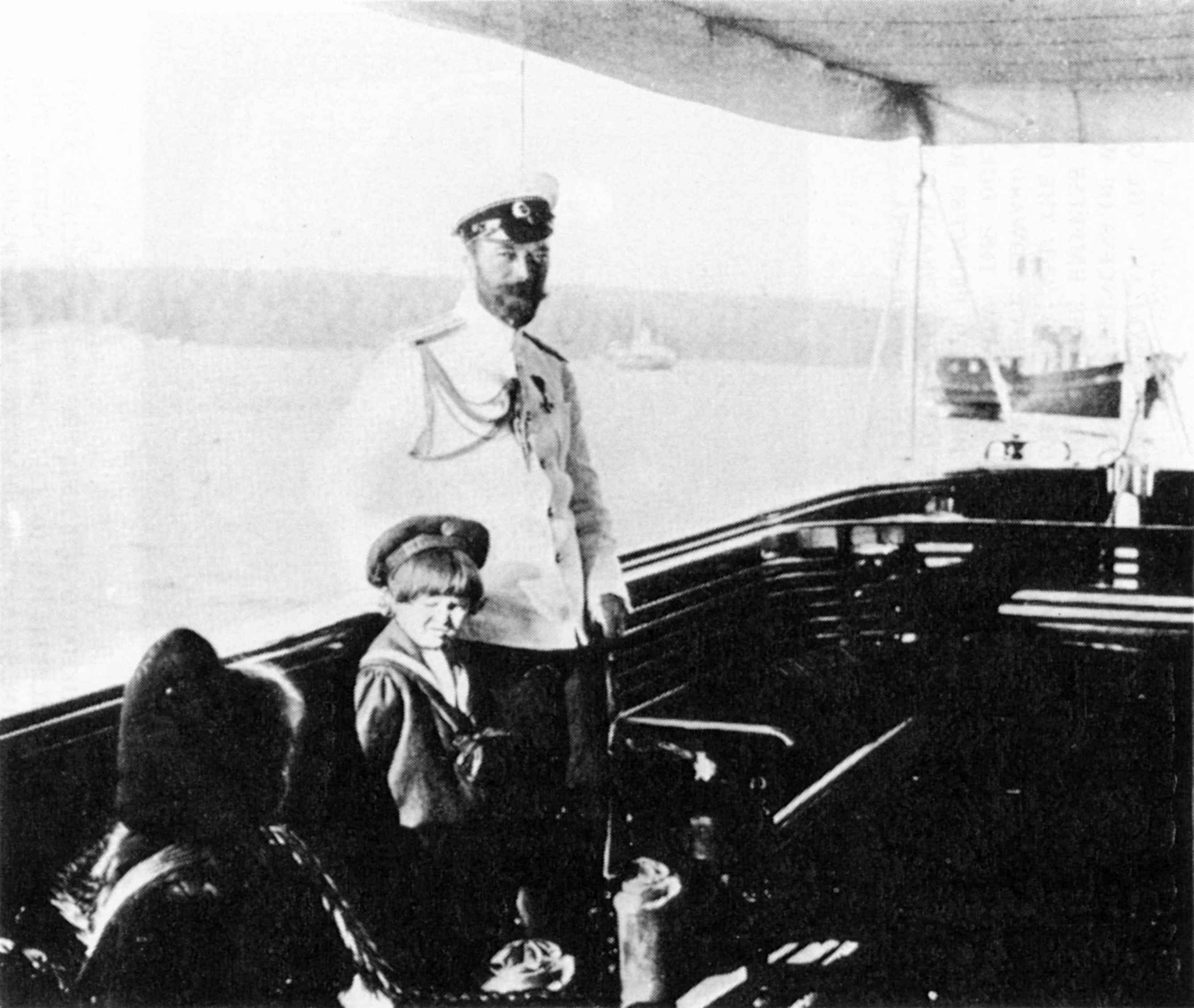
Charles Dehn, captain of the “Standard,” was a person
whose companionship Father enjoyed, and my brother was
Captain Dehn’s shadow. Alexei never questioned anything
“Pekin Dehn” said. Dehn’s wife, Lili, was a dear friend of
my Mother’s, as well as of us children. Mother was the godmother
of their infant son, Titi, who occasionally came to visit
us. When he was about seven years old, he could already speak
several languages. We loved to see this handsome boy. At tea
time he sat next to Mother. When she poured tea, he asked,
“Sugar, Madame, and how many?”
Another officer of the yacht, Drenteln, was one of Father’s
aides-de-camp and a devoted friend; he accompanied us on
our trips. He knew Father from his young years and went
with him to the Preobrazhensky regiment. Father found him
interesting and they often talked all evening and well into the
morning.
Father enjoyed all kinds of sports: tennis, boxing, swimming,
diving; and he could stay under water some minutes.
He was an expert rider and an excellent dancer, but was not
especially fond of hunting. He was devoted to the Navy and
when we were on our cruises he spent a great deal of time
studying navigation. He was particularly proud of the
“Standard” which was built at the Bay of Odense in Denmark
at the time of his marriage. During one of our cruises
we visited the yard where the boat was built. Each cruise
brought fond memories to my parents of their honeymoon.
Mother once said that the happiest years in her life were on
board the “Standard”.
For us a cruise meant spending a part of each day on shore,
tramping in the Finnish forests. On the yacht our attendants
turned a rope for us girls to jump. Then there was the tug of
war with an admiral or a captain and other officers joining
in. Sometimes we roller-skated on the deck. Everyone participated
in the fun, except Mother and Alexei. They could not
enjoy activities, but they joined in the laughter.
Occasionally we received word that the Dowager Empress
Marie, my Father’s mother, was cruising on the “Polar Star”
in the neighborhood and would pay us a visit. On board was
Admiral Prince Viazemsky. Immediately the holiday atmosphere
changed to serious work. We children had to stay on
board, practicing our music, because Grandmother always
liked to see our musical progress and a concert was invariably
planned. Grandmother was a gifted musician herself and was
brought up in a musical atmosphere with her whole family
constituting an orchestra. I was told that on one occasion
the public was invited to a concert in which her whole family
took part, including her father (Apapa), who later became
King Christian IX of Denmark, and her mother (Amama),
subsequently Queen Louise.
When Grandmother Minnie arrived everyone became tense.
I especially felt rebellious at the endless warnings to be on my
good behavior. We three younger children had our own early
supper, because we could not sit quietly through the dinner
in her honor. Try as I might, I was bound to do the wrong
thing and disappoint everyone when Grandmother was around.
Fortunately her visits were not long and the minute she left
we resumed our former manners.
When our yacht anchored in a sheltered cove, we went
mushroom hunting. Mother and Alexei seldom joined us in
this. But when Alexei came, together we darted this way and
that way, dodging the tall trees, and trying to catch the scent
of mushrooms. The ground was all springy with pine needles
and moss so that we fairly hopped along. It was fun to hear
the twigs crunch beneath our feet.
Father was a fast walker; to keep up with him, I had to run.
On one of these walks we came to a little stream, partly covered
with twigs and moss. Father jumped over it and stretched
out his hand to me. “Jump,” he said. The ground was slippery
and uneven and I failed to get a firm enough grip on Father’s
hand so I fell into the middle of the brook, with its bed of
yellow mud and clay. My face, hair and dress were plastered
with mud and so were my canvas shoes. The long, wet walk
sent me to bed for a while.
Before the war we used to take a trip every other year to
Fredensborg Palace near Copenhagen. It was great fun for
us children to visit the white villa at Hvidore, which stood
majestically amidst the flowering trees and bushes, with its terraces
offering a magnificent view of the sea, each level rising
smaller and smaller to the top.
From the terraces the sight of sailboats and yachts in the
bay gave us a feeling of tranquility and relaxation. Beyond
the marshes were the Danish farms with their charming
thatched-roof houses, tall poplar trees, golden wheat fields and
millions of scarlet poppies which added grandeur to this
natural landscape. It was this that impressed my young mind
during our first visit. This villa belonged to my little Grandmother
and her sisters, Queen Alexandra of England and
Thyra, Duchess of Cumberland. It was at this quiet place at
Fredensborg where the happy family reunion took place during
the summer months.
We were especially excited on one occasion when Queen
Alexandra and Uncle Bertie (King Edward VII of England)
joined us at Reval on their yacht, the “Victoria and Albert”.
I recollect that King Edward came dressed in Scottish kilts.
Grandmother Marie and Aunt Olga arrived on their yacht,
the “Polar Star”. Later we were joined by Uncle George,
who subsequently became King George V of England, with
his wife May (Queen Mary) and their children, including the
eldest son David, later Edward, Prince of Wales. In addition,
there were many other boys and girls belonging to other relatives.
We had a great family reunion and a full schedule of
activities. Fishing, bathing, rowing, wading in the shallow
waters in the bay and various games were the order of the
day. We youngsters enjoyed the high swings which were put
up especially for us. Alexei, though only four or five years
of age, had been well versed in geography and could name all
the various ports in the Baltic. The Russian Ambassador to
London, Count Alexander Benckendorff, regarded Alexei as
being an unusually bright child. Soon we were off again in
the fiords for a glimpse of Norway. When we were in sight
of Christiania (Oslo), so many yachts and other vessels surrounded
the “Standard” that we were forced to turn back.
Apparently the news of our visit had preceded us.
On our return we brought with us a number of Royal
Copenhagen pieces which were adorned with capricious scenes
of winter or summer meadows, all interpreted so realistically,
and also numerous figurines of animals and fowl, all executed
in those soft blue and white colors, some with a touch of
brown. Only the hands of Danish artisans could create those
heavenly colors.
Once I remember Kaiser Wilhelm II was cruising on his
yacht in our vicinity and our ship fired a salute to him. The
salute was returned and when the Kaiser came on board our
ship, he greeted Father with a kiss and exclaimed, “My most
valued friend.” The German band played the Russian national
anthem; then the Russian band played the German anthem.
During the ensuing visits, the Kaiser took quite a liking to me,
calling me “The Little Joker”. I also remember how he danced
in a way that Mother thought was undignified and unbecoming
to an Emperor. He was one cousin who drove us to
despair.
Grandmother Marie joined us in Reval. She brought with
her her sister-in-law, Queen Olga of Greece. Queen Olga was
the consort of King George I, Grandmother’s brother who
was later assassinated. This deed made a fearful impression
on us. I remember when Granny cried, “Why do they want
to kill an innocent man?” I remember King George as being
quite bald, so much so that the Kaiser remarked one time
that King George had his own exclusive moon. Extreme baldness
seemed to be a feature of the Danish royal family. Kaiser
Wilhelm referred to the Danish branch as the “deaf, bald-headed
Danes”. King Gustavus V and Queen Victoria of
Sweden also paid us a visit. They came on their yacht. We
later returned their visit by going to Stockholm.
Quite often our trips were marred by unpleasant incidents,
such as the time when, while cruising in Finnish waters, an
English freighter persisted in coming too close to our yacht.
When our repeated warnings were ignored, we were forced
to fire a shot which unfortunately wounded a member of the
English freighter’s crew. On this trip we were invited to visit
Prince Henry of Prussia (Mother’s brother-in-law) at a beautiful
villa on the shore overlooking the sea at Jagernsfeld, so
that the Kaiser could show us his fleet at Kiel. Unfortunately
the weather prevented us from doing this and after a brief
stop we proceeded to England.
A twenty-one gun salute greeted the “Standard” as we entered
the English harbor of Cowes on the Isle of Wight. This
was returned by the Russian warships and we passed through
a cortege of yachts lined up on each side as we sailed down
the middle. Soon the “Victoria and Albert” and the “Standard”
were alongside each other. Cheers filled the air and salutes
were exchanged. Not until the next morning did the real entertainment
begin, when King Edward VII appeared on the
bridge dressed in the uniform of a Russian admiral. Father
stood next to him in the uniform of a British admiral. The
Russian and the British flags were flying, as bands played
both national anthems. Amidst the greetings and cheers we
proceeded aboard the “Victoria and Albert” to the royal pier.
We exchanged pleasant visits and many pictures were taken
for our albums.
At luncheon on the yacht, we sat at a long table. King
Edward sat in the middle, Mother, dressed in white, looking
beautiful and radiant sitting beside him. Queen Alexandra
was opposite the King with Father next to her. Alexei kept
trying to get King Edward’s attention; until finally the King
said: “All right, Alexei, what do you want?” Alexei replied
gloomily, “It’s too late now, Uncle Bertie; you ate a caterpillar
with your salad.” We were served from gold plates and
the table decorations were in pink roses.
The other guests at dinner were the Crown Prince of
Sweden, the Prince of Wales (later George V), Princess Beatrice,
and Princess Irene, wife of Prince Henry of Prussia.
Mother gave a dinner on the “Standard” for the ladies in
honor of Queen Alexandra. At the many dinners on our yacht,
I remember there were many elegant and beautiful ladies,
several hundred of them: friends, relatives, English, Swedish,
German and Russian. On one occasion King Edward gave a
talk thanking us for the visit and turning to my Mother called
her his “dear niece”.
There were several excursions, and in the afternoon tea
was served on the lawn of the Royal Yacht Club. Several hundred
guests were present, mostly relatives and friends. Mother
knew them all.
Alexei was accompanied by a playmate. One day we were
all whisked to Osborne House, where Princess Henry, Mother’s
sister, and Princess Beatrice played with us on the lawn. This
included Marie, Alexei, his companion and myself. Alexei
was all slicked up from head to toe in a white sailor suit. Both
boys behaved disgracefully. In the afternoon before tea, this
brother of mine crawled over a new car belonging to one of
our relatives and by teatime his white sailor suit was completely
wrinkled and disreputable. He refused to leave the car
and added, “You girls can go to the tea; I am happy at what
I am doing.” All of us were disgusted with our brother. Finally
his sailor servant, Derevenko, took him off the car. At tea
we frowned at him and motioned with our hands to keep at
a distance from us, pretending that he did not belong to our
family. Tearfully he added to our embarrassment by saying
aloud; “What is the matter with you girls? I do not like your
attitude. If I were not ashamed, I would cry.”
At another time Olga and Tatiana had quite an experience.
Dressed in their gray suits they walked about the town of
Cowes, unattended. They paused in their sightseeing before a
window display and entered the shop to purchase postcards
and photographs for our albums. As they came out of the shop
a carriage bearing Count Benckendorff and a friend stopped
on the other side of the street. The girls ran across to surprise
them, and surprised they were—to find my sisters unescorted.
My sisters became frightened when a large crowd,
having heard about our visit, recognized my sisters and gathered
around them. Finally the girls made their escape through
a store as a constable blocked the door against the pressing
crowd. Two carriages were summoned, one for the constable,
the other for the girls. At the suggestion of the constable, they
finally avoided the crowd by taking refuge in a church. This
was their first experience of an unescorted adventure, and
their last. When they returned to us, we youngsters kept asking
them about it a dozen times, especially when we saw the
pictures of the incident in our albums. What a great and priceless
triumph it was: that young girls of our position were
allowed to show themselves unescorted in public.
Prince David, who was to become King Edward VIII,
came by torpedo boat to Osborne House from Dartmouth
where he was attending the Royal Naval College. And before
we left, he took Father through his college. Father was so
impressed with Dartmouth, he talked of sending Alexei there.
This was the end of our visit. King Edward, Queen Alexandra,
Prince George, then Prince of Wales, and Princess Mary with
all their children came to bid us good-bye as we sailed away
from Cowes after a most memorable visit.
As usual our party included Princess Obolensky, Mlle.
Butsova, a lady-in-waiting, of whom Mother was very fond,
as were we all; also Mlle. Tutcheva, our governess, with whom
I was continually at swords’ points, because she could not hide
her jealousy of Mlle. Butsova, and also because of her derogatory
remarks about our English relatives. Present too, were
Count Fredericks, Father’s chamberlain, Ambassador Izvolsky,
Prince Beloselsky-Belozersky, Dr. Botkin, Dr. Derevenko,
Captain Drenteln and many other Russians from our escort
ships.
The “Standard” then sailed to Cherbourg, where President
Fallières was to meet us in his yacht, the “Marseilles”. During
this cruise, as on others, we ran into a great deal of fog
and storm and our speed was greatly reduced. We arrived late
in Cherbourg. Father reviewed the French fleet with the
French President, and we children were allowed to take pictures
of submarines which were important exhibits in our
albums. These albums and Olga’s description in her diary were
a source of great pleasure to us later during the war when
we could relive each moment of this pleasurable trip. During
our arrest in 1917, these pictures were confiscated.
President Fallières gave a dinner on the deck of a battleship,
in honor of my family. It was a beautiful affair. The
table was in the shape of a horseshoe. In the center of the
table, roses were arranged to form the Russian coat of arms.
During the dinner bands played popular compositions of
French and Russian composers. Afterwards there were floats
on the water, lighting up scenes from the opera Lohengrin
and others. Someone must have informed them that Mother
loved this opera by Richard Wagner. Launches were made
to look like dolphins, sea serpents, Lohengrin’s swan, a huge
egg (on top of which was a rooster pulling a gondola with a
man inside playing a mandolin), a huge grasshopper and many
other fantastic shapes. A float carrying a band of musicians
drawn by many make-believe swans ended the procession.
There were also beautiful fireworks lasting late into the night.
Later a complete movie of the entire display was sent to us;
when Alexei was ill, he amused himself by operating the
projector with interest.
The next day we all went to the yacht’s chapel for a divine
service, and to give thanks for the wonderful trip and our
new friends. Later the President brought us gifts. To Alexei
he presented miniature rifles, guns and drums, as well as a
military tent completely equipped with a miniature cot, table
and folding chairs. Alexei was overwhelmed. Afterwards he
derived many happy hours in the park playing with his field
equipment. It was this little gun that the Bolsheviks seized
while he was playing with it in the garden during our arrest
in Tsarskoe Selo. Olga received a writing desk set of dark
blue enamel, beautifully initialed. Tatiana received a travel
clock which she took with her later to Tobolsk. Marie received
a dollhouse, two stories high, completely furnished, including a
bath tub and electric lighting. I received a beautiful doll with
a complete trousseau, even a veil for a bride. A twenty-one-gun
salute was fired at our departure from Cherbourg, as at
Cowes.
This cruise made me appreciate Olga and Tatiana; they
impressed me highly with their graceful manners. I did so
wish I could be like them when I grew up. They were so tall
and each looked to be every inch a Princess, while it did not
seem that I had grown at all during these years. Even Alexei
was an inch or more taller than I. Marie too was tall. People
said I would be short like my Grandmother. I was tall enough
when I sat down, but my limbs were not long enough to suit
me. Our Captain had a suggestion, that I hop on one foot,
then on the other, three times a day, saying that would produce
the desired results. I followed his instructions, even
doubled and tripled his recipe, but without success. On a
cruise, when I confided to him that his suggestions bore no
fruit, he nearly died laughing. I never forgave the Captain
for making me feel so ridiculous.
In spite of these several cruises during that summer of
1909, Mother’s health did not improve sufficiently to satisfy
the doctors. She suffered from neuralgia. Karlsruhe was recommended,
so the family went to Mannheim, to Uncle Ernest’s
castle at Friedberg. Princess Louis of Battenberg and her two
sons were there too. Then we went to Wolfsgarten near Darmstadt.
Darmstadt was Mother’s old home, where as a young
lady she lived with her brother Ernest when he became the
reigning Grand Duke on the death of his father. Mother was
fond of him because he replaced her late parents, and so we
were irresistibly drawn to him. Uncle Ernest was handsome,
kind, musical and artistic. Mother had the same talents as her
brother. His second wife Eleonor (Onor) was a delightful
person. She had known Mother since childhood, and their
friendship grew stronger each year. This trip therefore was
meaningful to our family.
I recall little of our stay. There was a constant flow of
Mother’s relatives and hordes of royal children. We four sisters
had only one bedroom to ourselves and Father had one
small room where he could receive people. I remember
Mother’s sister Irene (Amity) and her husband Prince Henry,
the Kaiser’s brother. She completely won us over with her tender
affection, and referred to us as “the dear children.” She
was closer to Mother than were any of Mother’s other sisters.
It seemed that we were always being summoned to meet a new
cousin, aunt, uncle or a friend. One of the relatives had a
homely nose, but fortunately I do not remember who she was.
Father went to Potsdam as guest of the Kaiser and Kaiserin.
It gave me a queer feeling when I first realized the Kaiser’s
deformity. I remember seeing him ride his horse in his Hussar
uniform. He stuck his reins into his belt; with fingers resting
partly on his hip he cleverly manipulated the reins. He
seemed to lean his weight heavily to one side. Aunt Irene
explained to us about his left arm. She said: “When Prince
Wilhelm was born, the doctors and his father rejoiced because
the child was a boy. But the little infant had not yet shown
signs of life. They did everything to get him to breathe. They
slapped him, tossed him into the air, swung him by his feet,—there
was a full hour of working over him. At last he gave a
feeble cry. His mother, ill at the time, did not know of the
overly rough treatment of her baby. Later when she found
out, she was in despair, she blamed the doctors and the nurses
for the injury her child had received. For his left arm, which
had been pulled out of the socket, became paralyzed and later
shrivelled.”
Many of our relatives were in deep mourning for King
Edward VII of England (Uncle Bertie), who had passed
away in the spring of 1910. Kaiser Wilhelm had been hunting
with Father in the Oranienburg forest near Berlin, and upon
their return, in the presence of the widow, Queen Alexandra,
and of the new King George V and Queen Mary, he looked at
all the ladies in black dresses and white collars and remarked:
“Everyone is dressed in black because the old rooster has died.”
He knew Queen Alexandra was partly deaf and could not hear
his remark; but there were many others who did, including the
beautiful Princess Alice and her husband, Prince Andrew of
Greece, who had come with Cousin George from England.
We all bore disapproving expressions at his remark, and one
relative whispered, “Wilhelm must be mad.”
All of the family knew that the Kaiser was tactless. During
the time when he was only heir apparent, he never hesitated
to express his impatience at having to wait so long to inherit
the throne. Long before his grandfather and father died, he
wrote the Proclamation, so as to be ready when the occasion
should present itself. Aunt Irene and Mother cried when
they heard that the young Emperor, Wilhelm II, the day he
ascended the throne, ordered everyone in the palace placed
under surveillance, including his own mother, the Empress
Victoria; this in spite of his having sworn to his father that
he would always uphold the honor of the royal house. He
despised his courtiers, calling them parasites—the same men
who during the war wrested his power and then held him practically
under arrest. He hated the sight of his Mother’s friends
and ladies-in-waiting and without hesitation he once said that
the only joy in his life was being at the Yacht Club. Now he
was obviously pleased that Uncle Bertie was no longer in his
way. His dislike had begun when Uncle Bertie had called him
“the boss of Cowes” and, whenever possible, had avoided
holding the regatta when Wilhelm was present. One would
not have believed that he had the use of only one arm and
with it skillfully steered the sailboat.
Kaiserin Augusta Victoria always looked beautiful with a
clear, almost transparent complexion, and was most friendly
but quiet. I was intrigued by the black ribbon which she wore
around her throat. She and the Kaiser showed us pictures of
the palace at Potsdam. It was beautiful except for one room
which I thought was in bad taste. This room had ornate pillars
encrusted with all kinds of precious and semiprecious
stones and odd-shaped shells. I understand that Father had
contributed a large uncut diamond to this conglomeration,
which also included geological specimens, together with petrified
snakes wrapped around the pillars, turtles and crocodiles
in creeping or crawling positions.
One day Father went with the Kaiser to the mausoleum
and placed a wreath on the tomb of the Emperor Frederick
III, the Kaiser’s father. Photographs were taken on this occasion;
later, in the bitterness of war, while looking at these
pictures, Mother said; “Papa would rather lay a wreath on
Wilhelm’s tomb.” We children cut the pictures of the Kaiser
out of all our photographs. Alexei tore up his pictures of
Germany completely, remarking that he (the Kaiser) did not
deserve to be called a godfather, and indignantly tramped the
old photographs with his feet. I did the same. After our arrest
and imprisonment in Tsarskoe Selo, I purposely broke
several gifts from the Kaiser pretending that it was an accident
in every case.
Before we departed for home, Father gave the Kaiserin a
pendant of pearls and sapphires, which we had previously
proudly displayed to our friends for their approval. We liked
the Empress and often felt sorry for her because she had to
put up with such an intemperate husband. The Kaiserin gave
each of us girls a sewing basket complete with all necessary
equipment. We used these until 1914, when we gave them
away not wanting to see them again. Some of the Kaiser’s
sons, resplendent in immaculate uniforms and eagle-crested
helmets, escorted us to the station, frequently clicked their
heels as they saluted us, making our departure a gala affair.
The Kaiserin was forbidden to accompany us to the station.
At the time Mother considered this an insult, but a letter from
Aunt Eleonor revealed that the Kaiser in a fit of anger had
slapped her face that morning before our departure, and each
of his five fingers had left an impression on her face.
As we boarded the train, Father was dressed in his civilian
overcoat and Alexei wore his customary dark-blue sailor suit,
while we sisters wore our traveling suits as it was already cold.
On the train, Alexei said: “I was scared of those cousins.”
Upon the occasion of that visit to Germany, Father, out of
courtesy, appointed the Kaiserin Augusta Victoria honorary
colonel-in-chief of the Grodno Hussars. This aroused terrible
consternation, especially on the part of Grandmother who was
so furious that she cried and carried on bitterly, saying that
she hoped she would never see the Kaiserin wearing that uniform.
I am sure she never did. En route home Father received
word from Aunt Ella that two Russian millionaires whom he
knew had committed suicide. This made a sad impression on
us children. Later, after we arrived home, Mother received a
Christmas gift from the Kaiser, two enormous red enamelled
vases. I presume they were made by the royal manufacturers.
These vases were placed in a room in our home, one on each
side of a console table.
Each member of our family settled into his usual routine
of activities. The problem of finding playmates for my brother
loomed large again. Derevenko, the sailor, had two sons, both
younger than Alexei; they became my brother’s playmates,
for which my Mother was bitterly criticized.
IV THE CRIMEA
Lessons were always an ordeal for me, especially when
it was time for a visit to the Crimea, for our hearts had always
been set on the sea. Lessons, however, were never neglected,
for Mother was always strict about their regularity. Livadia
was the favorite estate of my Father, as it had been that of his
father and grandfather before him. It is located at Yalta on
the Crimean peninsula, and its sunshine and warmth were a
welcome change after the gloomy, cold days spent in our more
northerly home at Tsarskoe Selo.
At this time Dr. Botkin, Mother’s physician, who was ill,
requested permission to have his children come aboard our
yacht. Mother replied that they could come as often as they
wished during their father’s convalescence. I heard that the
sick should not be forsaken. I, as a good Samaritan, did my
part by visiting the doctor every day, sitting at the edge of his
couch with my folded hands, like those of an old lady, wishing
to entertain him. We were all very fond of him. He had a
wonderful gift of story telling, and after taking in every word
I flew like a bullet to tell Marie and Alexei every detail of our
conversation, often embellishing it to add more zest to the
story. At home I used to wait for him in the room next to
Mother’s bedroom. I knew he had to pass this room after he
finished her examination. I stopped him and opened my heart
to him with my childish problems. He asked me all kinds of
questions, and in turn I received from him first hand information
about his family. I always carried scraps of paper in
my hand. Asking him for his pencil, I scribbled down some
kind of curly-cues for my record.
We were so excited when we heard that his two children,
Tatiana and Gleb, were coming to visit their father. Dr.
Botkin had told us so much about his children that we felt
we knew them. At first Gleb was shy and Tatiana excited, but
soon we all got acquainted and had a hilarious time. My older
sisters left the newcomers to us younger ones. I remember
hiding from Tatiana behind a drapery. Dr. Botkin was resting
on a couch and kept saying: “I see you, Anastasia,” since my
shoes were clearly visible protruding underneath the drapery.
I did not answer him. Finally Tatiana pushed aside the curtain
expecting to find me there, but all she found were my shoes.
I had left them there and moved to another hiding place.
Dr. Botkin was so understanding in the way he got into the
spirit of our games. In my eagerness for his children to have a
good time, I asked him confidentially what I could do to make
his family happy. He replied, “Just being with you is the
greatest pleasure you can give.” His children called him
“Papula,” and I too appropriated that as my pet name for him.
In Ekaterinburg, when times were sad, I often said: “Cheer up,
Papula; all will be right.” In Tsarskoe Selo, we girls had little
opportunity to play with anyone from outside except occasionally
with our cousins.
One of the unforgettable sights at Livadia was the Hill of
the Cross (Krestovaya Gora) which greeted our eyes each time
we reached the Bay of Yalta, and we gazed upon it in thanksgiving
for our safe arrival. It was this towering mountain with
a monumental cross at its peak that fascinated me. I refused
to believe that the world was round but I imagined that the
peak was one of the props which supported the sky like an
umbrella. To explore the mountain, I devised a plan. I ran to
Marie about it, since she always was interested in my adventures.
As a result, one sunny afternoon, when I was overcome
by curiosity and our nurse was absorbed with the others, Marie
and I slipped through the bushes and were actually on our way.
We dashed from bush to bush until we thought we were safe
from possible pursuers. Unfortunately the mountain which we
had set out to climb proved to be farther than we had anticipated.
On and on we went. Finally we could move only slowly.
The mountain was still far away. Bewildered and discouraged
we turned homeward. We were worn out. Suddenly we noticed
guards coming toward us. We rushed toward them, weariness
forgotten. “Here they are,” a voice sang out, and we two
explorers were hurried back to the palace.
I recall an incident involving Alexei. He suddenly seemed
to have disappeared. At the first report everyone thought in
terms of drowning, kidnapping, or some other tragedy. Every
guard and the household help ran in different directions.
Father, by instinct, went straight toward the sea, and there he
found Alexei happily playing on the beach with a pile of shells
he had gathered.
At Livadia we had beautiful orchards, bearing every kind
of fruit. We loved to spend our leisure time in these orchards.
The gardeners displayed apples, peaches, apricots and cherries,
all according to the season. We were especially proud of our
vineyards nearby at Massandra. We had every kind of grape—white,
purple, red—each one a perfect specimen and unusually
large. Whenever we visited the wine cellar we found
large bunches of grapes artistically arranged on platters in
the reception room. They looked so tempting with sprays of
leaves accentuating the soft colors of the fruit. After tea, cakes
and grapes were passed.
After our tour of the vineyards we usually took the lift down
and walked through seven huge store rooms. These contained
many shelves of bottled wines lying on their sides, dated,
labelled and crested with the Russian double eagle. These
bottles were in deep red, white or blue marked with their age,
which went back several generations. Father commented on
the age and quality of the wines stored there on platforms, in
large barrels, holding several hundred gallons of wine to age.
It was here that the coronation wine was made and bottled;
a lot of it still remained in these rooms at the time of the
revolution. There were varieties of wines here which were used
in the palace at Tsarskoe Selo. Father drank only occasionally.
He disliked champagne, but enjoyed a glass of sherry. Mother
and we children used some only for medicinal purposes.
Many of our activities were centered around the waters of
the Black Sea. We often went bathing but none of us children
could be called good swimmers. As a matter of fact we were
afraid of the deep water, especially since that frightful incident
when I was swept under by a huge wave and was saved by
Father from drowning. After this a platform or breakwater
was built for our protection.
Nineteen eleven was a turbulent year for us. On our way to
the Crimea we stopped for several days in Kiev. Father and
my older sisters accompanied by the ladies of honor and by
Crown Prince Boris, the heir to the Bulgarian throne, went to
the opera. After the first act, when the curtain fell and the
orchestra played, voices were heard from the audience and
confusion began. Prime Minister Stolypin who sat in a white
coat in the front row had been shot. The bullet pierced the
cross and his chest. The foul deed was done by a man who
used a pass given him by a friend of the Okhrana who had
been made to believe that he was anxious to be present at the
performance. The family returned earlier than expected. Father
was as white as a ghost and both sisters shook when they
reached the train where Mother was in a state of collapse. She
had already heard about the murder. It was said that the
Minister, Count Witte, who wanted to regain his former position,
which he had lost to Stolypin, exchanged sharp words
with Stolypin shortly before the killing took place. Father
ordered no reprisal, stating that court action should settle the
matter. For this he was deeply criticized.
Madame Narishkina told us then the experience the Stolypin
family had had during the Japanese war. Their home in
St. Petersburg was bombed and about two dozen people were
injured; one remained a cripple. She said that arms, fingers
and limbs were scattered all over the garden.
Amongst Mother’s closest friends was Mme. Anna Vyrubova
(née Taneeva) who sometimes quarrelled with members of
the staff. Anna Vyrubova even declared war on Mlle. Butsova.
Mother said: “Never again will I have her in Livadia,” but
she broke her promise again and again. Anna’s mother before
her marriage was a Tolstoy and her husband was related to
General Voyeykov, the commandant of the palaces in Tsarskoe
Selo. He, too, was disliked by many.
Mother invited Anna to come to the Crimea despite the
feeling against her. She had been our friend for a long while
and we accepted her as though she were a member of the
family. Her house in Tsarskoe Selo was conveniently located
a short distance from the palace gate and we children loved to
go to Anna where we did not spare her cookie jar which was
always full and accessible. There was no formality at her house
and we were free from surveillance. Anna knew how to make
us feel at ease with her friendliness and understanding, and our
ties with her grew stronger. Sometimes even Father joined
Mother at Anna’s, and that was a unique experience for my
parents. It was at her house that Mother and sometimes Father
saw the Starets (Rasputin). Hence all the messages from the
Starets to Mother came through Anna.
We had heard of the malicious stories about Anna’s relationship
with Rasputin. However, a thorough investigation
disclosed that these terrible rumors were totally unfounded
and that Rasputin had never visited her house when she was
alone. Mother had a special interest in her because she had
encouraged Anna to marry an officer who had been shell-shocked
during the Russo-Japanese war. The marriage eventually
ended in divorce. After the death of Rasputin, Anna
moved to our house because Mother feared she, too, might be
killed. Her father, Alexander Sergeevich Taneev, held a position
at court and Father esteemed him highly. He was also a
fine musician and from him Anna had inherited much talent.
A love for music bound Mother and Anna into this close
friendship. These musical hours served to release Mother’s
suppressed ambitions. In her younger days she had taken voice
lessons, learning many arias from operas. Had she been born
into another family, she could have made music her profession.
Miss Baumgarten or Miss Clements usually accompanied
Mother during her vocal practice. Mother played many complicated
compositions on the piano; the harder they were the
better she liked them. She possessed great patience and would
never stop until her undertaking was accomplished. When she
played she always laid her rings on a tray. She had an idea
that the rings interfered with the clearness and softness of the
melody.
Anna was a constant visitor in our house and occasionally
Father dropped in to listen and enjoy the simple pleasures
Mother and Anna had together. Whenever possible, in the
evening, we children were allowed to slip into the room to
hear them play and sing classical numbers. At these Mother
was radiantly beautiful and she carried the melody with much
expression and feeling; we were often deeply touched. There
was an expression of sadness in those melodies and the plaintive
ones were those she sang the best. Father enjoyed Mother’s
informal concerts but never encouraged the presence of
strangers during these intimate musical evenings. He also was
musical and while young often played the piano with Madame
Narishkina.
Mother often played and sang with Countess Emma Fredericks,
the daughter of our chamberlain. She, too, had a beautiful
voice; unfortunately she was a cripple. I often wondered
what became of her when misfortune swept the country.
Another musically gifted friend was the lady-in-waiting,
Baroness Iza Buxhoeveden. All these people contributed considerably
to Mother’s happiness. Alexei’s illness in 1912 aggravated
Mother’s heart condition and forced her to withdraw
considerably from her hitherto enjoyed pleasures. When the
war came, she stopped singing altogether, though she did take
part in chants during church services, especially when we were
under arrest.
Father encouraged all sorts of artistic endeavors. He wished
to give an opportunity to all the poor to hear the best of concerts
and see the plays and cinemas. The year of my birth he
sponsored Narodny Dom, a cultural center in St. Petersburg,
not far from the Cathedral of Sts. Peter and Paul. This included
large concert halls, a theatre and a cinema. The same
artists who performed at the Imperial Theater were heard and
seen in this cultural center, at the cost of only a few kopecks.
Never did Livadia seem more magical than at the time we
arrived to find a beautiful new palace replacing the old wooden
structure which had stood for generations. The new palace
construction began in 1910 and was finished in 1911. It had
forty or fifty rooms. It rose naturally from its surroundings as
if it had grown out of the fertile soil itself. The old palace had
been torn down because it developed some kind of malodorous
mushroom which was hazardous to our health; so now only a
memory existed in our minds. This was in contrast to the new
building, so full of light and air, which was constructed of steel
and of native, white Crimean Inkerman stone. It was quite as
dazzling, in the sunshine, as the sea itself, and, indeed, cheerfully
different from anything we had ever lived in. It did not
seem like a palace, least of all ours. Mother was charmed,
especially with the harmonizing colors; her pleasure made a
home of it immediately. She was everywhere, supervising the
putting up of different pictures or icons, or the placing of vases
(designed by her) of exquisite blossoms on various tables.
Father had made plans with the gardeners to make sure there
would be plenty of Mother’s choice, favorite flowers. Her
greatest favorite was lobelia. She loved its purplish-blue hue
so much she requested that the same shade of velvet be set
into the stair rail, next to the Byzantine-style chapel leading
upstairs to the second floor apartments.
This time the old porcelain stoves were omitted and the
palace was heated by hot water. All the rooms had direct bells
connected with the room of the officers on duty who could
enter the rooms if needed. Father later had telephone booths
installed throughout the park, so he could be found wherever
he might be. Also we had some trained dogs to watch the
palace grounds. The colonnades and balconies were in white
marble, and some of the lower rooms were in lemonwood,
mahogany and redwood. Mother with the help of her architect,
Krasnov, selected all the needed articles. She herself had
painted a picture of wisteria vines which hung in one of her
rooms in the Alexander Palace in Tsarskoe Selo (proof of her
artistic talents). In our chapel there she had a glass screen of
that same color, behind which she prayed undisturbed.
Father, too, was delighted with the new palace but his delight
centered more on the outdoors, with its rare specimens of
trees, shrubs and plants. The climate of the Crimea lent itself
to all sorts of agricultural experiments, and he gave a great
deal of time to naturalizing importations from the famous
Nikitsky Botanical Garden near by. Whenever Father had a
free moment to himself he enjoyed working in the gardens
under the bright sun. In the spring there were varieties of
hyacinths in bloom, white, purple and pink. Many flowering
trees and shrubs embellished the beauty and elegance. Mother
loved the combination of wisteria and smoke tree. A year
before the war a storm destroyed many of these rare trees,
which were soon replaced by new importations.
In front of the palace, facing the sea, was a lovely, life-sized,
reclining female figure in pure white marble. Alexei and I
discovered a hole on the side of the figure. It was large enough
to squeeze a kopeck into, which we promptly did. On the
following morning we rushed out to see if it was still there.
I have many vivid memories of the place and the happy
times which we all enjoyed while there. To me the Crimean
peninsula was a concentration of nature’s best: snow-capped
mountains with little Tartar villages nestling on their slopes,
high plains under cultivation, and valleys full of wild flowers
and berries. The estate itself was especially beautiful, with its
wide lanes, lovely gardens, and many orchards bearing every
kind of fruit. But, perhaps, most beautiful of all, and certainly
the accent for all the other natural beauties surrounding
Livadia, was the sea itself. Even today, as I think of my childhood
visits to the Crimea, happy memories come to my mind.
I can see pictures of vividly colored flowers, soft green-blue
waters and deeper skies, all fused together in the melting sunshine
of the Russian Riviera. Life here was most pleasant, with
less formality and with more leisure time for Mother and
Father to spend with us children. Our visits usually came in
the spring and fall, and the protracted winter which intervened
became for all of us one long period of anticipation. Our last
stay of any length was just before World War I, when I was
almost thirteen.
We went to the Crimea by special train. We invariably went
first to Sevastopol, where Father inspected the naval installations.
These included the admiralty, naval barracks, hospital,
and other buildings. Father frequently lunched with the officers
at the Officers Club. When he was ready to proceed, we
boarded a yacht or tender at the Tsarskaya Pristan (dock) and
landed at Yalta where we were greeted by the people who lined
the road as our carriages passed through. The natives considered
this day a holiday.
Granny Marie had not visited the Crimea since the death
of her husband, Alexander III, in 1894 and even the new
palace which stood majestically among the trees could not
induce her to pay us a visit. During the revolution, however,
she was forced to flee to the Crimea.
Before the war, while we were in the Crimea, Father got
up one morning before dawn, and dressed himself in a soldier’s
uniform. Eluding the guards, he walked toward the rising
sun. He passed through villages and saw people working
in gardens and fields. All seemed happy and contented as they
passed by him. We, afterwards, wondered if he had his great-granduncle,
Alexander I, in mind. For it was believed that
Alexander left one early morning, disguised as a beggar,
walking for weeks through the villages until he reached a
Siberian monastery. History tells us that Alexander I was ailing
and died in Taganrog. But many believe that the day
he was supposed to have died, he was seen escaping into the
darkness of the palace grounds. His wife had a simple funeral
for him, which was witnessed by only a few. The body was
then brought to St. Petersburg where it was laid in a mausoleum
in the Cathedral of Saints Peter and Paul—where all the
Russian emperors were entombed. But it is said that the entombed
body was not the Emperor’s but that of a soldier who
had died in Taganrog at the same time that Alexander I had
escaped. Alexander I allegedly died while hiding in an
ancient monastery in Tomsk as a monk; the birthmarks on
the body were the same as those of the Emperor. Later the
Cathedral in St. Petersburg was flooded and, when the coffin
that allegedly held the body of the Emperor was opened, it
was found to be empty. The investigation disclosed that the
coffin had been pried open in the past and the body removed.
Father, however, after walking all day and talking to the
peasants, returned late in the afternoon. He found the police
and his staff officers terribly worried over his disappearance.
Father was happy. He said it had been one of his most pleasant
walks for he had seen how his people lived. General Dumbadze,
who was responsible for Father’s safety, was very much
upset over this incident.
Another time, when Father tried unsuccessfully to leave the
palace in Tsarskoe Selo, dressed as a soldier, one of the guards
saluted him as he passed. Father asked him: “Do you know
me?” The guard answered: “I do, Your Majesty, by your
kind eyes.”
In the Crimea there were other activities to look forward to:
such as the bazaar that was organized under the patronage of
Mother and Princess Bariatinsky. This bazaar was held annually
and the funds raised went to the support of the Children’s
Tuberculosis Sanatorium. This institution was located
on the Imperial estate of Massandra. It was housed in a beautiful
building overlooking the sea and was surrounded by
spacious grounds with avenues bordered by roses and rare
species of carefully labelled shrubs and trees. This adjoined
the Imperial vineyards. Here several hundred children were
cared for and educated, and when they were cured of tuberculosis,
many entered schools of higher learning. These children
came from all over the Empire, from rich and poor alike.
The large sums needed to support the hospital were raised
through donations, concerts, plays, bazaars, selling flowers and
photographs. Mother and her friends, with the assistance of
my sisters, made many articles to be sold at this bazaar. We
three younger ones felt the responsibility, too, and enthusiastically
found buyers for flowers and for tickets to the concerts.
The public was always generous.
Alexei was most eager to help in this project as he, himself,
suffered so much and understood the misery of others. From
time to time he gave his whole monthly allowance to this cause.
Once, on our private train on the way to the Crimea, Aunt
Ella joined us at the station in Moscow. She, too, brought with
her gifts for the bazaar. We took turns selling Easter eggs on
the train and, by the time we reached the Crimea, the donations
had grown enormously large. One of our entourage carried
the basket while Alexei sold many of these treasures with
his heartbreaking sales talk to our friends who were on the
train. He kept a careful account of all the gifts he collected
which were valued at several hundred thousand rubles; a check
for 50,000 rubles came from Prince Dolgorukov. Alexei never
forgot this generosity and looked forward to another year in
order to do the same thing. When he was subsequently praised
for this, he answered cheerfully: “I never had more fun in my
life!”
Our cousins, the Princesses Nina and Xenia Georgievna,
helped us in this charity project when they were at their estate
in Kharaks. Our other relatives from Ai-Todor, adjoining
Livadia, always lent their aid as did those of the Youssoupoff
family. Countess Vorontsova-Dashkova, that beautiful woman,
was a great supporter of this charity.
In 1914 the “Standard” was brought to the Crimean waters
from the Baltic, through the North Sea. Box after box was
carried down from the “Standard.” They contained items to
be sold at charity bazaars which were held in the gymnasium
under the auspices of the Governor of Yalta. Most of the
buyers wished to purchase something handmade by my Mother
or that had been touched by her. Madame Zizi (Elizabeth)
Narishkina assisted Mother and handed to the guests whatever
Mother selected. It might be a child’s bonnet, a cushion, or
a scarf. Mother thanked them and offered her hand which they
always insisted upon kissing. Olga and Marie, Tatiana and I
sold at different stalls. Hundreds of beautiful handmade boxes
of all kinds of shapes and sizes, in lapis lazuli, malachite,
leather, or in the famous transparent enamel, or the lacquer
boxes of papier maché were sold in great quantities. In the
evening, after supper, a concert was given by Madame Plevitskaya,
the nightingale of Russia. Her graceful bows were like
a weeping willow and her long fingertips touched the floor
before us. She was noted for her rendition of national songs.
Plays were given in our honor which were often attended
by our friends and cousins. On one of these occasions Alexei
was unruly. During the intermission he acted like a wild colt.
His friend encouraged him in this exhibition. He jumped on
top of a chair and then up on a table, pretending that he was
delivering a speech. He changed his voice, using a peculiar
accent in pronouncing certain letters. Marie and I were so
ashamed of him and could not believe it was our brother.
Mother said she would never again allow him to appear in
public without the two older sisters.
Everyone worked hard and made large donations besides.
During the war a part of this sanatorium was turned into a
hospital for the wounded officers who recovered quickly to
return to combat.
Father’s purpose in taking the long walks mentioned above
was to make sure that the exercises required of his troops
during maneuvers were not too strenuous for them. He frequently
exceeded by several miles per day the distance the
troops were required to march. On such walks Father carried
only water and bread.
V SPALA: 1912
The summer of 1912 found us once more in Peterhof.
Before long we departed on another cruise for official reasons.
Kaiser Wilhelm came to Russia for a few days for
nautical ceremonies and to inspect the Viborg infantry of
which he was the honorary colonel-in-chief; he cruised with us
in Finnish waters. He was so noisily jovial that Mother called
him “the comedian.” At this time in our presence, one of his
officers said something about “my men.” The Kaiser turned
sharply and curling his mustache nervously said, “Once again,
they are my men.” He was happy one minute and moody the
next, so that my sisters remarked, “There is something wrong
with him.” But, of course, at my age, I saw only the humorous
side of his nature and enjoyed his amusing anecdotes and
clever caricatures, drawn by himself, mostly characterizing his
own relatives. He was jealous of Mother, because he could not
understand how she could become all Russian, as his English
mother had never become all German. He liked our yacht, the
“Standard,” and said, “Nicky, I would like to have the ‘Standard’
myself, but with a German crew.” Father’s face flushed.
He knew what he meant. The remark was intended to indicate
German superiority in navigation. After a pause, Father answered:
“We are very fond of the ‘Standard’; it is quite
comfortable and the family enjoys it a great deal.”
The Kaiser often asked Father for donations for his charities
and Father could not refuse him. This made my Mother angry.
It was during this cruise that the Kaiser’s action and behavior
aroused disgust in Mother more than before. Often she said:
“I remember when he was a young man he used to provoke
Granny with his sharp words. But Granny did not spare him,
either.”
At the time of his departure, the Kaiser surprised everyone
by kissing Father’s hand in the presence of our Foreign Minister,
Izvolsky, who remarked, “A kiss on the hand and a stab
in the back.” This diplomat foresaw, obviously, the great events
of the coming World War I. We were glad when the Kaiser
sailed away on the “Hohenzollern.” Grandmother also did not
feel kindly toward the Kaiser since the German absorption of
Schleswig-Holstein and the expulsion of the native Danes from
their homeland. The wound was so fresh that she strongly
resented the Kaiser’s visits to Denmark. Kaiser Wilhelm hated
every living Slav and I have often wondered how he felt in his
heart when he accepted expensive gifts from us and ate food
with Father, who was not only a Slav but defended all the Slavs.
The same year we went to the monastery of Borodino to
celebrate the Napoleonic defeat on the Berezina River in the
war of 1812. The people wept from joy to see the Imperial
family and they gave Alexei relics of the war of 1812.
Occasionally in the fall hunting lured Father to Poland to
his estates at Belovezh in the government of Grodno. On our
way there we landed in Reval where Alexei laid a stone at the
harbor to Peter the Great. Father reviewed the Sixth Army
Corps here, while Mother and we children visited the Nicholas
Institute for Girls. In Belovezh we stayed in our new large red
brick shooting lodge, with several watch towers and a fine
balcony, from where we viewed the game brought in after the
day’s hunt. One side of this residence held rare stuffed animals
found here years ago and the other side was used by us as our
living quarters. The house was located in the midst of a forest
of pine and white birch trees surrounded by picturesque hills
and ravines. Most of the best hunting took place in the vicinity
of Belovezh and Spala.
Our lodge at Spala was a two-story, gloomy, wooden villa
near a river and a park; one side was closely surrounded by
tall trees through which little sunshine penetrated, making it
necessary to keep the lights burning in the corridors and halls.
The whole house here, too, was decorated in English chintzes.
We sisters went horseback riding over the broad, sandy
roads and alleys which wound through the woods of white birch
and fragrant pines. In the midst of fir trees the ground was
covered with yellow milk mushrooms, as bright and smooth
as silk which the natives ate raw. We also found time to play
in the park or fish in the brook and occasionally Father and
his guests had a game of tennis.
These forests had been stocked with game for generations
of royal hunters. There were many wild animals roaming at
large, including deer, wild boar, lynx, and wild fowl. But the
most rare and sought was the auroch, an unusual variety of
bison found only here and in the Caucasus mountains. At dusk
the party returned, the prey was spread on the lawn and everyone
was supposed to rush out to examine it and express great
admiration. Mother often made some excuse to stay indoors,
or appeared, out of courtesy, briefly on the balcony; she did
not care to see these lovely creatures killed. The sight of dead
deer with their large pathetic eyes, still open, reminded her
too much of a human suffering.
Here, too, were many mounted heads, killed in previous
years, which adorned the various walls in the house. I was
glad when Mother had some of them removed from the dining
room. Several large landscape paintings in heavy frames and
some paintings of horses brightened these rooms. But the other
pictures of hunting dogs with a fowl in their mouths or a large
boar lying on the green grass with a spot of blood on its body
was not very cheerful.
In spite of the wonderful care which always surrounded
Alexei, he bumped his knee during our trip on the yacht,
bursting a blood vessel, which affected his groin and developed
into a black and blue lump. It was so painful he could not bear
to have the doctor examine it. His condition had bettered and
the swelling below his abdomen was somewhat reduced, but
when he was taken for a ride in a carriage, suddenly he became
very ill and the swelling increased again, as did his temperature,
and he became delirious.
Mother’s sister, Princess Irene, wife of Prince Henry of
Prussia, and their son, Prince Sigismund, were visiting us at
the time. She was very sympathetic regarding Alexei’s misfortune
because one of her sons had died of haemophilia. She
was one of the very few who knew about Alexei’s condition
from the earliest symptoms. Those outside the family did not
know of the serious nature of Alexei’s illness. Now Aunt Irene
joined Mother in taking care of Alexei, especially since our
trip to Spala had been planned several months ahead and previously
arranged engagements could not be cancelled without
arousing suspicion concerning the state of Alexei’s health.
We had many house guests who had come from several
foreign countries and from many parts of Russia. Friends from
nearby Warsaw sometimes joined us for dinners and entertainments
which had been arranged for the pleasure of our guests.
There was dancing and other professional amusements. But
it was difficult for Mother to appear to be enjoying these
festive occasions when at the same time fate might claim the
life of her son. She ran up the stairs whenever possible, in order
to be with Alexei for a few minutes. Meanwhile Father carried
on as host, with Princess Irene taking Mother’s place as hostess
during Mother’s absence.
We sisters gave a French play before our guests. I was
delighted that our Swiss tutor, M. Pierre Gilliard, gave me a
part that contributed largely to the success of our little performance.
But, while performing before our audience, I mixed
up my lines and could not hear the prompter; so I resorted to
improvising. At this moment, while the guests were hilarious
over my ad libbing, an elastic of my most delicate undergarment
broke and the embarrassing white ruffled cambric fell
to the floor. The audience became well-nigh hysterical and
laughed far more than if I had remembered my lines.
The secrecy surrounding Alexei’s illness had always tormented
me. I knew bleeding was involved, like the bleeding
of a wound that could not be stopped. Marie and I were almost
as ignorant as the general public as to the real nature of his
illness. I remember tiptoeing into my brother’s room and there
I saw Mother lying on a couch. In one corner was a basin filled
with pieces of cotton which she had been applying to the blue
swelling. As Alexei’s condition became worse, the rest of the
family joined Mother at the side of his bed. I would have
preferred to be outside where I could not see my brother’s
suffering or hear his moans, yet something held me inside.
There they were, Father, Olga, Tatiana, and Marie, all huddled
together, a thin layer of hope spread over their despair. They
were all in an attitude of prayer, and totally unaware of the
struggle that was taking place in me. Suddenly, shame-faced,
I slipped in beside them and found myself in the front ranks
of the sorrowing family.
We all watched Mother, her hand enclosing Alexei’s as
though she were trying to transmit her own strength into his
frail body. He was not lying in a pool of blood as I had always
expected but looked quite normal, except that he was very pale
and moaned pitifully. His eyes seemed to be sunk into his head
and he wore a peculiar expression on his face. Mother knelt
beside him, encouraging her little son with a smile which
seemed to say, “You will be well soon.” So long as Mother did
not give up, Alexei knew his condition was not hopeless. We
knew her heart was breaking, but before Alexei she was a
picture of confidence and hope. Mother knew that if she left
Alexei to the nurses, the boy would stop fighting, for it was
her heroic presence which strengthened him.
Dr. Botkin, Mother’s private physician, relieved her on
many nights as did my Aunt Irene. Dr. Fedorov, Dr. Dreifuss
and Dr. Ostrogorsky were all summoned to repeat all the
treatments which had helped in previous attacks. Dr. Fedorov,
a renowned specialist in haemophilia, was in charge of Alexei.
He had brought my brother through several other attacks, after
which Dr. Derevenko, who was Dr. Fedorov’s assistant, became
Alexei’s personal physician. The doctors’ efforts did not seem
to bring about any change. Mother, however, remained confident
even when the doctors were shaking their heads in
despair. Mother understood every agony of the boy and seemed
to be able to relieve his suffering. Alexei extended his feverish
hands to her in appreciation. They understood each other
perfectly.
Hopelessness was crushing Father. It was such double torture
with the fear of losing Mother as well as Alexei in the
event anything happened to Alexei. We had practically given
up hope, but not Mother. She would not give up. We braced
ourselves to meet the inevitable. Mother’s face was white but
calm before Alexei’s searching eyes. As a last resort she
directed that a telegram be sent to Rasputin at his home in
Siberia, imploring him to pray for Alexei’s recovery. In the
morning Mother sent for Father Vassiliev to administer the
holy sacrament to our brother. Alexei and Mother looked
straight into each other’s eyes, the one sending out waves of
assurance, the other hopefully receptive. The light in her eyes
never failed him.
In the meantime a bulletin had been issued about the boy’s
serious condition. Father felt that the people had the right to
know about their Tsarevich, although it was torture to reveal
the secret kept so long. At this time Father also ordered the
sending of wires to our foreign diplomatic representatives with
a view to locating specialists who might be able to help Alexei,
but no medic for this malady was found.
The doctors worked feverishly, their foreheads moist with
their exertions. Silence was broken as Alexei moaned and
Mother whispered, “Has no word come from the Starets?”
Alexei clung to life even when all of us except Mother thought
each breath might be his last. Under the tension we even
wished that it would be, to spare him further agony!
Suddenly one of the officers approached with a quick step
and handed a telegram to Father. He read it aloud to all of
us in a clear voice. “The little one will not die, do not let him
be bothered too much.” (This was the sense of the telegram,
the words are my own.) When we all heard these words, the
air became charged with renewed hope. Alexei must have felt
it too for he relaxed into a deep sleep. It continued for so long
that Mother kept listening to his heart to make sure that he
was still with us. When he awoke, the bleeding had stopped.
Whether it was the medicine, the holy sacrament, or our
prayers, as well as those of Rasputin, which caused the sudden
turn for the better, we could not tell, but we knew that death
had been averted. We had seen a miracle before our very eyes.
From that moment on, the boy’s ravaged body began to
mend. We could only think of Rasputin as a holy man and the
instrument in the healing of my brother. I recall seeing him
later—only three or four times—but he made a deep impression
on me. He was so different from other human beings. His
piercing eyes seemed to look right through me even into the
depths of my innermost self. He frightened me. When I first
saw him he said, “Is this the little one?” and I was afraid that
he would touch me, but he didn’t. He wore a long cassock with
a cross hanging down on his chest. He looked like a monk.
I was told he walked long distances barefoot, not having the
necessary money to travel by train. But when I saw him he
wore boots. By nature he was a son of the soil, like a wild plant
nourished by accident.
Grigory Rasputin was not a monk at all except in a very
loose sense. He was not even a member of any holy order. He
was a Starets, a pilgrim and lay preacher among peasants.
Could he be a biblical character come to life? I wondered. On
his many journeys he had learned many of nature’s remedies.
He had faith in them in the face of modern scientific medicine.
He believed nature had made provision for man’s health as
she had made provision for his food and drink. He knew an
herb or berry for various maladies. His remedies were simple;
it did not seem possible they could be effective. I heard he used
to put dried berries in his tea. For bronchitis, he used high
bush cranberries or red raspberry juice. We did not follow any
of his remedies for my brother. We believed that ultimately
God was the only Healer.
Father Vassiliev, our chaplain, held services twice a day in
the camp chapel, which had been especially built in a large
tent in the garden, until our departure from Spala in the late
fall. Many different gifts were sent to Alexei during his illness,
including some enamel and silver icons of St. Alexius and a
Virgin and Christ in gold and decorated with precious stones.
These and others came with the blessing of the churches in
their incessant prayer for his health.
After this dreadful experience in Poland, Alexei was like
something that had been lost but was now found. We could not
do enough for him, but in spite of the attention we gave him,
he was not spoiled. He was only an average boy and there
was no reason for him to be different because he had been
born to a royal family. There was a magnetism about the little
fellow which no one could resist, yet Mother and Father tried
to be firm with him. We all knew Alexei was the most important
thing in Mother’s life; in fact, he was in all of ours. His
condition meant misery or happiness to the whole family. Our
first question every morning was, “How is Alexei?” We really
did not need to ask because when Mother was happy, obviously
he was all right.
Later we heard all kinds of atrocious stories spread about
the illness of this innocent little boy. How could any human
being think of anything so cruel and untrue is beyond my
imagination.
Alexei was very sensitive and sometimes when Mother
rebuked him he would run to Olga for sympathy. He adored
Olga and said he was going to marry her. He was even jealous
of her in a way, because he did not want her to pay attention
to strangers when he was present. He had a talent for making
us forget to scold him when he had done something wrong
by distracting our attention. We all knew his strategy but it
was hard to punish him when we saw him perched on a chair
like a little sparrow, wondering what he would say to get our
minds off the coming reprimand.
Late in the fall a few weeks before Christmas when the snow
had buried the ground, Alexei was well enough to be moved
to Tsarskoe Selo and there he made further recovery from his
recent attack. This illness damaged the nerve and caused his
left leg to become shorter. It required painful treatments and
a special pad was placed in his shoe to build up the heel, so
that he limped only slightly.
Mother had put so much of herself into the agonizing condition
that it was hard for her to be herself again. For weeks
she lay prostrate from her nursing and emotional strain but
blissfully conscious of victory. She was disappointed not to be
able to go to church to give fitting thanks for Alexei’s recovery,
but the priest came to the house and conducted a special
service in the palace chapel. When she felt well enough to be
up and around again, Dr. Botkin found her heart again in a
weakened condition and confined her to her room.
During these periods of rest, following the exhausting care
of Alexei, Mother devoted herself to intensive religious study.
The sparing of Alexei was God’s answer to her prayers; her
gratitude was so consuming she lived in a realm of religious
dedication. She had a rare collection of Bibles, which were
brought to her from St. Petersburg and Moscow; these she
studied, making comparisons of the various editions. She would
then discuss what she had learned with Father who was no less
interested but who did not have the time he would have liked
to devote to the subject.
In our library we had some rare scrolls and texts. They had
come from Egypt, Persia, Palestine, Sinai, and elsewhere. One
of these was the famous Codex Sinaiticus, dating from the
fourth century A.D., which was first discovered by the German
scholar Tischendorff in a monastery on the Sinai peninsula.
Great-grandfather, Alexander II, had acquired the manuscript;
later, in 1862, he had it published. There were also very early
Russian texts. All these were under lock and key but we could
see them in the glass case. Father knew the history of each of
these texts and versions. The children’s library was separate.
On its shelves were Russian fables and stories, and there were
translations from the Danish. We had some originals signed
by Hans Christian Andersen.
Mother was reared and educated in England and Germany
and distinguished herself in her studies. She, herself, was a
philosopher and often discussed philosophy with her friends.
She saw things the others could not see and sometimes connected
religion with the writings of the great philosophers.
However, she was not a fanatic as many described her, but
she could see and understand things the others did not. She
was well informed on various subjects. She understood and
reasoned the value and depth of her religion. Her and Father’s
knowledge of history surpassed that of many historians and
their vocabulary was powerfully rich.
When Mother was strong enough, we children joined her
at luncheon or tea. In the winter she selected a sunny room
where a folding table was used for the occasion. One of
Mother’s rooms was decorated in her favorite color, mauve,
and was cosy with matching brocades, curtains and upholstery.
One wall was covered with a collection of icons which were
gifts from different people. These were continually lighted by
two lamps, one blue and one pink. Some of these icons were
the most beautiful that Byzantine art could produce, others
were very simple, but all were symbols to Mother and a means
of remembering the donors. Mother loved every one of them,
and was most appreciative when people presented her one of
these religious treasures. Some of them she carried with her
from Tsarskoe Selo to Alexandria and Livadia palaces and
later to Tobolsk and Ekaterinburg. She wanted to have the
most meaningful in her room. Others hung in one of the small
rooms of the chapel together with some of her Bibles and a
panagia. She also had some icons of great historic importance.
Icons of these types were made only by the Greeks, Russians,
Serbians, Bulgarians, and Rumanians. No statues were
permitted in our churches, since we discarded the pagan idols
at the time of the adoption of the Greek orthodox religion.
A lot of the best treasures in the country were looted during
the revolution. Other gifts were hung in the long hall which
ran the whole length of the palace including all kinds of plates
and other objects of historical value which we had received
during many trips in Russia and abroad.
We were shocked to see how frail Mother looked when she
finally emerged from her convalescence. It was an effort for
her to walk the length of the hall and she was wheeled to the
lift which took her to Alexei’s room. She permitted him to
come down to the music room and lie on the sofa, or to amuse
himself in the library with his electric trains. He built villages,
fountains, churches out of blocks. We girls read to him or
engaged him in games to keep him occupied. I can still see my
brother in the blue nightshirt which he wore after his bath
when he came down every evening before retiring. Mother took
his emaciated hand and they went upstairs to hear his prayers.
She had a tendency to overdo, hoping no one would suspect
how much these illnesses of Alexei took out of her. It is true
that bulletins had been issued telling of the serious condition
of the Tsarevich but the nature of the illness had never been
revealed to the people—that would be admitting hopelessness.
When Alexei and Mother were well enough to travel we went
down to the Crimea where the change and rest were always
refreshing to both.
These attacks of Alexei were hard on us. For one thing our
education was disrupted. It was difficult for us to concentrate
on anything other than our brother’s health. The shared sorrow
welded us into a closer family and the realization of this
brought a change in my life. Thoughts of self seemed empty;
childish pleasures began to lose their charm. My life was now
so bound up with the family that I could no longer be lighthearted
and free as before.
Reluctantly I realized I was taming down, through sorrow,
not discipline. My childhood pastime of painting took a more
serious turn. I even attempted to write imaginary stories about
animals. Mother was so pleased with my efforts she sent one
of these stories to Aunt Irene saying, “See what our little
Nastia has done.” I now took a greater interest in music and
hoped that by working hard I might sing as well as Mother or
play like Olga. I loved Olga for her true kinship and often
kissed her hand for her understanding of us younger sisters.
A week or two was a long time for me to stick to anything.
Again and again I would revert to my childhood spirit but
each time with less of my former zest. My reputation of being
a problem child persisted. People often asked, “Where does
the little one, small in size, store so much, much energy? She
has an endless supply of jokes and pranks.” Some enjoyed my
humor as I could tell from the expression on their faces, and
some did not.
Marie and I had all kinds of “properties” with which to
carry out our practical jokes. We had a set of stuffed animals
which we called our “Circus Kingdom.” We had a mechanical
mouse, a yellow iridescent snake with a moving head and a
red, sharp tongue, a snapping turtle which might tangle in a
victim’s dress. Frightened, our victim would jump up on a sofa
or chair while Marie and I pretended to be equally scared and
put on an act with wide-open mouths.
Often, new attendants were warned to watch out for me
and my pranks, but in the end they suffered. In all these
activities I was the leader and most of the time in disgrace.
Once Alexei sprinkled water over me saying, “You must have
been born in a dry summer, your jokes have outgrown you.”
Perhaps my most effective toy for playing pranks was a
large doll with brown phosphorescent eyes that shone in the
dark. This mechanical doll, when wound, would open and
close its eyes, making life-like, blinking motions. On one occasion,
I wound my doll while Marie was watching at the bedroom
door and, when we heard our victim coming, I left the
doll on the floor facing the door. We then jumped into our
beds and pretended we were asleep. The attendant, who had
come to see if we were all right, saw this awful thing on the
floor in the dark with its blinking eyes. Terrified she ran
screaming into the hall and awakened everyone on the whole
floor. After this a sign was put up on our playroom door which
read, “Enter only by permission of Olga and Tatiana.” This
was designed to prevent Marie, Alexei, and myself from entering
the room at will.
In the face of recent family heartaches I was less and less
proud of my reputation as a prankster.
VI JUBILEE: 1913
The spring of 1913 marked the three hundredth anniversary
of the Romanov dynasty. Celebrations began with a great
jubilee in St. Petersburg. We arrived from Tsarskoe Selo a
few days ahead of the festivities and took up our residence in
the Winter Palace. On the first day we drove in open carriages
through streets lined with troops to the Cathedral of Our Lady
of Kazan where a picturesque ceremony was held. It was a
gray, cold and rainy day, in contrast to the brilliance that
awaited us inside the Cathedral.
According to custom the Tsar entered first, followed by the
Heir to the Crown. When Alexei appeared, it was not a strapping,
healthy Tsarevich to whom all the Grand Dukes and
dignitaries bowed, but a frail little boy of nine, carried in the
arms of a Cossack. This was a sad moment for us. We had
hoped Alexei would at least be well enough to walk but he
had not recovered sufficiently from his recent illness. We stood
under a canopy in the middle of the great church. Alexei sat
in a chair. Mother worried about Alexei. She asked us to watch
him also. Dr. Derevenko stood nearby. We sisters were dressed
in white, as was Mother. She wore the blue ribbon of St. Andrew,
the order studded with diamonds and rubies. We had
the red ribbon of the order of St. Catherine with its dazzling
star. Grandmother Marie stood with us, trim and regal as
always, blazing with diamonds, rubies and emeralds. The elite
of St. Petersburg were assembled here, a magnificent sight,
with the high clergy in golden robes and elaborate mitres, and
the high military dignitaries in uniforms embroidered in gold.
During the service a dove flew into the Cathedral and
circled above our canopy. Afterwards friends told us they
were afraid it would fly into the lighted candles and start a
fire, but fortunately it flew out of the church through a door.
Since the dove is an important symbol of peace in our religion,
a representation of the Holy Ghost, we all wondered
if this event had a special significance. (It is worthwhile mentioning
that also during the coronation, Father said, “A
pigeon flew during the ceremonies.” Later, in Ekaterinburg
on the day of tragedy, while we were having our last walk in
the yard, a pigeon flew over us three times and then dashed
repeatedly against the window.) After the ceremony, in the
afternoon, we were attired in national costumes, as were our
guests. Mother was especially beautiful, in her high kokoshnik,
with her white robe exquisitely embroidered in silver and long
veil. In the evening she wore a tiara of Catherine II and a
necklace of diamonds. It was valued at several million rubles.
It was so heavy that she used it in all only a few times. Olga
and Tatiana were attired in soft pink tulle gowns, Marie and
I in white silk and lace.
Some evenings later a ball was held in the Winter Palace.
It was the first official appearance for us two younger sisters,
the first time we participated in such a grand affair. I remember
how excitedly we looked forward to that occasion. Mother
was indisposed that evening and, after a short while, suggested
that we leave early and go to our rooms. Grandmother, however,
took our side and asked Mother to let us stay longer, and
promised that she would personally look after us. Mother
burst into tears and said: “These women of St. Petersburg
might talk about the girls, and Anastasia’s jokes might be
misinterpreted.”
I was very unhappy that evening for fear that every move
I might make or every word I might speak would be used
against me. All the innocent joy was taken from me that gala
night for fear of those women’s sharp tongues.
From St. Petersburg we proceeded by train to Moscow
where the Jubilee continued. On this occasion Mother wore
the crown jewels. She never cared for them after the unfortunate
incident which occurred during her early married life.
At that time Granny felt that she still was entitled to wear the
crown jewels instead of the young Empress. In the underground
vaults in the Winter Palace there was a section where Mother
kept some of her personal jewels. Any time she wished to have
them, she notified the court chamberlain, Count Benckendorff,
who sent several responsible persons with papers to fetch the
desired pieces which were then brought under guard to Mother.
After the anniversary festivities we never spent another
night at the Winter Palace, our childhood home. But during
the war my sisters often stopped in the rooms for a glass of
tea, after various charitable meetings. It is sad to think what
became of the treasures stored in those vaults and elsewhere
for generations, belonging not only to the Imperial family but
to the Russian people as well. These treasures, worth billions of
rubles, were held until the leaders of the revolution, Lenin,
Trotsky (Bronstein), Apfelbaum, Rosenfeld and others got
their clutches upon them. It was rumored that much of it was
divided among their relatives who came to our country for
that purpose and to kill and loot. These people and their successors
have been exporting our Russian national treasures, so
long guarded by the Imperial family, and selling them to
foreign countries.
From Moscow we went to Vladimir, then to Nizhni Novgorod
and to Yaroslavl. The latter—an old historic city with
a view of the wide river—was a charming sight. I cannot even
begin to describe the enthusiastic reception. Throngs of children,
cadets, the nobility and the townspeople lined the streets
right down to the dock. What a rich sight from the river—this
beautiful city on a little hill! The bells were still ringing until
we could no longer hear them. We passed an expanse of
meadows, shimmering fields, and the breeze was sweeping like
a soft veil over that heavenly country.
In every city there were similar festivities, and dinners with
many guests who had been especially selected to honor my
Father and my Mother. Father’s guests at dinner were mostly
men, and Mother entertained ladies in separate drawing rooms.
The famous Plevitskaya sang again and bowed gracefully
before the appreciative audience. There were many outstanding
entertainments at which we made many new friends.
We were so tired at the end of our trip that Tatiana, in this
mood, said: “People and more people—I am tired of them!”
Mother, overhearing her say this, reprimanded her.
On our way to Kostroma we sailed on the Volga. People
lined the shores, some even wading into the water up to their
waists. When our boat developed some trouble and while the
repairs were being made, the people thronged the shores and
sang “God Save the Tsar.” The Imperial party was delayed in
reaching Kostroma. It was in this terraced city overlooking
the Volga River that the Romanov dynasty had its official
beginning, and now a special ceremony was to be held to
celebrate the three hundredth anniversary of the Romanov
reign.
At last we reached the city and proceeded to the monument
of Susanin. This was a column on which rested a bronze bust
of the first Romanov Tsar, Michael Feodorovich. This column
was supported by the peasant, Susanin. The latter was the
Russian patriot who deliberately misled the Polish army
which had invaded Russia and asked Susanin to lead the way
to the whereabouts of the newly elected Tsar, who was in
hiding. As a result of Susanin’s false directions, the Polish
army was destroyed and was driven out. The plot of the
famous opera, “A Life for the Tsar” by Glinka, was drawn
from this heroic incident. This opera was one of my Father’s
favorites. From the time of Feodor Romanov, a number of the
brides of the Grand Dukes upon marriage adopted Saint
Feodor and took the name of Feodorovna as a patronymic.
From the monument, the procession continued to the
Ipatiev Monastery, where the first Romanov was sheltered in
1613. In the monastery courtyard was the beautiful Cathedral
of the Holy Trinity and within it stood the iconostasis and the
throne of Tsar Michael Feodorovich. This monastery had been
built by a Tartar prince who was the founder of the Godunov
family and who was the first to be baptized there.
While in the Cathedral we visited the dark rooms in which
Michael once had lived. We sat on the chairs with the beautifully
embroidered double eagles on their backs, and drank
tea from the original containers at the same table once used
by Tsar Alexei. In one of the rooms was a portrait of Michael
and Alexei Romanov. Both looked a little like my Father. The
legend tells us that Alexei was born on St. Job’s day, and so
was my Father. And their experiences were sad, but those of
Alexei were not as tragic as those of my Father.
Also, we went to the cemetery and laid an exquisite wreath
made of silver in the form of the cap of Monomakh and
decorated with jewels on the grave of Michael.
Parenthetically speaking, it was a strange coincidence that,
in Ekaterinburg in 1918, in the Ipatiev House, the last Emperor
of Russia, Nicholas II came to his tragic end. The
Romanov dynasty was born in the Ipatiev Monastery in
Kostroma in 1613 and died in the Ipatiev House in Ekaterinburg,
three hundred and five years later. History tells us that,
at the election of Michael Feodorovich Romanov, a crippled
beggar woman who claimed to be a wandering saint had predicted
that the Romanov dynasty was born with Michael and
would die with another Michael. And so it happened. When
Father abdicated, his brother Michael succeeded him to the
throne but soon abdicated.
Another strange incident was that a three hundred year old
tree of immense diameter, said to have been planted by
Michael, had been cut down just before we arrived in Kostroma.
We saw it mounted on huge wooden blocks to be
preserved as an object of historical interest.
One of the members of our party on this trip was Prince
Dolgorukov, a direct descendant of the family that built the
city of Kostroma and also the first church in the Kremlin in
Moscow. Prince Dolgorukov, faithful friend of our family,
followed us to Tobolsk and later to Ekaterinburg where he,
too, came to a tragic end.
The year 1913 also marked two hundred years since the
seat of government moved from Moscow to St. Petersburg in
1713.
During this entire trip we received many gifts and pictures,
and our albums were filled with photographs of historic events.
On our way home we stopped at the Nicholas Palace in
Moscow. At the functions there, Mother wore the old Slavonic
robe and the crown jewels. These jewels she never wore again
after the Jubilee celebrations ended. This was a year of many
anniversaries and festivities. Several regiments celebrated their
hundredth anniversary. The Naval Cathedral at Kronstadt
was reconsecrated in celebration of its hundredth anniversary.
We attended all these functions.
Soon we were back in Tsarskoe Selo resuming our daily
routine. During this busy year Baroness Iza Buxhoeveden became
lady in waiting, replacing the young Princess Elizabeth
(Lili) Obolensky whose health had become impaired. Lili had
taken several trips with us, including the one to England. We
had known Baroness Buxhoeveden previously. She had already
assumed some responsibilities in the palace. All the ladies in
waiting were required to be single and to come from titled
families. Mother did not believe in all the old court etiquette
with its traditions and restrictions. To her it did not matter
whether these young ladies were princesses or baronesses. She
selected them on the basis of the best possible ability, education
and culture. Baroness Buxhoeveden came from a Baltic family
which had produced several ambassadors. Her father had been
an ambassador to Denmark.
The position of lady in waiting was an honorary one to
which many young ladies looked forward. To distinguish
their rank from the other staff, they received badges studded
with diamonds, with Mother’s initial and a crown on its top.
Some were in silver and some in gold according to their length
of service. The ladies in waiting were not permitted to discuss
political affairs at any time and all the happenings were to be
kept in strict secrecy. They were not allowed to enjoy the company
of the officers and aides in the palace.
Their duty was to accept telephone calls for Mother and
for us girls, make notations of the calls, note incoming and
outgoing telegrams, filing them by date, and make a memorandum
of all telegrams and letters. They also were to chaperon
us on drives or at any other function. Maids, a footman
and a carriage were provided for their comfort. Extra ladies
were called to the palace for the day if needed. Later during
our arrest in Tsarskoe Selo, our letters and telegrams did not
escape from being read. Iza shared our deprivations and followed
us later to Tobolsk, Siberia, but was not permitted
entry into the governor’s house.
PART II The First World War — VII EVE OF THE WAR: 1914
Early in the spring of 1914 we went to Livadia. Full
days of school work were continued here. M. Pierre Gilliard
and our Russian tutor, M. Peter Vasilievich Petrov, accompanied
us as usual. Sometimes our tutors were invited to lunch
with us and afterwards joined us in our hikes when the sun
was bright and warm, or in some other recreational pastime.
Our hikes took us through the park or along the shore to
Yalta or to the Church of Alexander Nevsky on the opposite
hill. Dinner was the focal point of the day with friends and
relatives as guests. We children, especially, enjoyed Prince
Igor Constantinovich and the Grand Duke Dimitri Pavlovich.
Aunt Ella, Mother’s older sister, the widow of the Grand Duke
Serge, brother of Alexander III, was another cherished guest.
She and Mother had similar religious views, having inherited
this mysticism from their mother, Princess Alice, Grand
Duchess of Hesse, daughter of Queen Victoria of England.
Grandmother Alice, I was told, was a student of religious
history and movements, having been inspired by her tutor, a
theologian who was a close friend of the Hesse family. He
also had a direct influence on Mother. This theologian imbedded
into her thoughts the terrible fear of sin. For years
we children watched her struggle, trying to leave this deeply-buried
mysticism and return to reality. However, due to the
thoughtless criticism by my other grandmother, Father’s
mother, Marie Feodorovna, and also the unsympathetic attitude
of the Russian court, she sought comfort in this mysticism
and her whole soul once more overflowed with it. Then
with the misfortune of her son’s illness, she reverted to it all
the more. At the same time she pretended not to notice the
criticism and tried to hide her pride; but her sensitive heart
suffered and the words which she should have spoken hardened
in her soul. Courtiers took her for a heartless, cold and
eccentric woman. She, having been raised by her austere
grandmother, tried to carry on in an efficient English manner.
Even though her humble faith grew stronger, her English upbringing
never left her and she never became a true Russian
in manners, but in her heart and soul she was a better Russian
than most native-born Russians.
We boarded our yacht, the “Standard”, which had been
brought to the Crimean waters from the Baltic Sea via the
North Sea. We went on several short cruises on the Black
Sea. Once we crossed to Constantsa on the Rumanian
coast to return a visit of King Carol and Queen Elizabeth
(Carmen Sylva) of Rumania. They had come to see us with
their grandnephew, the future King Carol II. It was an overnight
trip to Constantsa. Carmen Sylva at her late age was still
beautiful, as also was Princess Marie (Missy), wife of Prince
Ferdinand; later they became sovereigns of Rumania. During
this visit Princess Marie and my sister Olga developed a close
friendship. The strained relationship between Mother and
Missy’s sister Victoria, who was divorced from Mother’s
brother Ernest, was improved; all was forgotten now. We had
luncheon in a pavilion which seemed to rise right out of the
sea. From this vantage point we could see many yachts and
smaller boats cruising back and forth for a closer look at the
“Standard”.
In the afternoon, tea was served on board the “Standard”
for the members of the two families. After tea a great many
dignitaries joined us on board ship.
1906
1913—JUBILEE YEAR
THE GRAND DUCHESS ANASTASIA
COMMUNICATION. DATED JUNE 14TH, 1901 (OLD STYLE), FROM THE
EMPEROR NICHOLAS II TO THE PRESIDENT OF THE UNITED STATES
ANNOUNCING THE BIRTH ON JUNE 5TH (OLD STYLE) OF THE GRAND
DUCHESS ANASTASIA
CONTINUATION OF COMMUNICATION ANNOUNCING THE BIRTH OF
ANASTASIA, SIGNED BY NICHOLAS II AND COUNTERSIGNED BY COUNT
LAMSDORF, MINISTER OF FOREIGN AFFAIRS
Courtesy The P.B. Corporation
ca. 1896
THE EMPRESS ALEXANDRA FEODOROVNA
Courtesy The P.B. Corporation
PETERHOF—1901
THE EMPRESS ALEXANDRA FEODOROVNA
THE GRAND DUCHESS ANASTASIA, THE
TSESAREVICH ALEXEI NICHOLAEVICH,
AND THE EMPEROR NICHOLAS II ON A
TENDER APPROACHING THE “STANDARD”—ca. 1908
Courtesy The P. B. Corporation
THE TSESAREVICH ALEXEI, THE EMPRESS
ALEXANDRA, AND THE EMPEROR NICHOLAS
II—ca. 1908
THE RUSSIAN IMPERIAL FAMILY ON VISIT TO BRITISH ROYAL FAMILY—ENGLAND—1909
SEATED ON THE GROUND (l. to r.): THE TSESAREVICH ALEXEI AND THE GRAND
DUCHESS ANASTASIA. SEATED ON CHAIRS (l. to r.): MARY, PRINCESS OF WALES
(LATER QUEEN MARY); NICHOLAS II; KING EDWARD VII; THE EMPRESS ALEXANDRA;
GEORGE, PRINCE OF WALES (LATER KING GEORGE V); AND THE GRAND
DUCHESS MARIE NICHOLAEVNA. STANDING (l. to r.): PRINCE EDWARD DAVID
(LATER PRINCE OF WALES AND KING EDWARD VIII, NOW THE DUKE OF
WINDSOR); QUEEN ALEXANDRA; PRINCESS MARY, NOW THE PRINCESS ROYAL,
DOWAGER COUNTESS OF HAREWOOD; PRINCESS VICTORIA; THE GRAND DUCHESS
OLGA NICHOLAEVNA; AND THE GRAND DUCHESS TATIANA NICHOLAEVNA.
THE GRAND DUKE ALEXANDER MIKHAILOVICH AND THE GRAND DUCHESS XENIA
ALEXANDROVNA AND THEIR CHILDREN (l. to r.): THE PRINCE NIKITA, THE
PRINCESS IRINA, AND THE PRINCES ANDREI, DIMITRI, VASILI, FEODOR, AND
ROSTISLAV—ca. 1909
Courtesy E. L. Packer
ALEXANDER PALACE, TSARSKOE SELO—ca. 1912
Courtesy E. L. Packer
THE NEW PALACE, LIVADIA—ca. 1912
Courtesy E. L. Packer
NICHOLAS II—ca. 1914
Courtesy E. L. Packer
THE EMPRESS ALEXANDRA—ca. 1910
THE TSESAREVICH ALEXEI—ca. 1913
Courtesy The P. B. Corporation
THE TSESAREVICH ALEXEI TESTING FOOD OF RUSSIAN TROOPS—1911
Courtesy E. L. Packer
NICHOLAS II AND THE EMPRESS ALEXANDRA—ca. 1914
THE GRAND DUCHESS ANASTASIA—TSARSKOE SELO—1914
THE GRAND DUCHESSES MARIE, TATIANA, ANASTASIA AND OLGA—ca. 1913
THE EMPRESS ALEXANDRA WITH HER DAUGHTERS, THE GRAND DUCHESSES OLGA,
TATIANA, ANASTASIA AND MARIE—ca. 1913
NICHOLAS II AND THE EMPRESS ALEXANDRA AND THEIR CHILDREN, THE GRAND
DUCHESSES MARIE, TATIANA, OLGA AND ANASTASIA AND THE TSESAREVICH
ALEXEI—ca. 1913
NICHOLAS II AND THE EMPRESS ALEXANDRA AND THEIR CHILDREN (l. to r.) THE
GRAND DUCHESSES OLGA, MARIE AND ANASTASIA, THE TSESAREVICH ALEXEI AND
THE GRAND DUCHESS TATIANA—ca. 1913
Courtesy The P.B. Corporation
THE GRAND DUCHESSES OLGA AND TATIANA—ca. 1914
Courtesy The P.B. Corporation
THE GRAND DUCHESSES MARIE AND ANASTASIA—ca. 1914
THE GRAND DUCHESSES ANASTASIA, OLGA, TATIANA AND MARIE ON BOARD THE “STANDARD”—1914
Photograph by the late Colonel N. Koishevski
NICHOLAS II
Photograph by the late Colonel N. Koishevski
(l. to r.) THE GRAND DUCHESS ANASTASIA,
THE EMPRESS ALEXANDRA AND
PRESIDENT POINCARÉ
STATE VISIT OF FRENCH PRESIDENT RAYMOND POINCARÉ TO RUSSIA—1914
That night a grand banquet was held in the beautifully
decorated pavilion overlooking the sea. The lights reflected
on the water as various craft sailed by, and the sound of
music spread over the sea like a cloud. It was a gala occasion
with many garlands and flags flying. I could not help watching
Olga intently for I had overheard someone say that this
trip was planned with a view to her possible marriage into the
Rumanian royal family. At the dinner table Olga and Prince
Carol sat side by side, apparently having a good time. The
table was decorated with tricolors: red, white and blue, and
small gifts were exchanged. Olga received a Rumanian national
costume which was beautifully embroidered; the skirt
was in a dark color woven in a pattern of gold and silver
thread, and the blouse daintily embroidered in white. Princess
Marie did not hesitate to admit that she herself was a beauty,
especially her blue eyes. She was the eldest daughter of Prince
Alfred, Duke of Edinburgh, and the Grand Duchess Marie
Alexandrovna of Russia. She was named Marie Alexandra
Victoria, after both her grandmothers, the Russian Empress
Marie Alexandrovna and Queen Victoria of England. As already
mentioned, her younger sister Victoria Melita (Ducky)
was the divorced wife of Mother’s brother Ernest of Hesse;
she was now married to the Grand Duke Cyril Vladimirovich.
Another sister, Alexandra (Sandra), married Prince Ernest
of Hohenlohe-Langenburg. A third sister was Beatrice (Baby
B.), wife of the Infante Alfonso of Spain, first cousin of
Alfonso XIII.
I was filled with a compelling interest I had never before
experienced. But when we sailed away that night, I learned it
had been decided Olga was too young to marry. Later she
told us that she would rather stay single than marry outside
of Russia. We sisters were so happy we could not help teasing
her about losing a husband. It was a good thing that
Alexei did not know about Olga; he would have been sick with
worry that she might leave Russia. Later I wished Olga had
married at that time, she might be alive today.
During the war Prince Carol came to Russia several times
and stayed with us for a few days. Once he was accompanied
by Prime Minister Bratianu. However, even this time, Olga
was not given an opportunity of being left with him alone for
one single minute, entirely apart from others. There were always
ladies in waiting and we the younger ones excitedly
were in and out of the room. She had no chance to hold his
hand and less of being kissed.
Nor was any one else given an opportunity to be with
Olga unchaperoned. It was in Tobolsk that Mother first realized
her mistake in not giving more independence to her
older daughters.
Olga was named after my Aunt Olga. She was tall, slender,
blonde with a lovely fresh complexion. Her eyes were a lustrous
blue, her nose was slightly turned up. She often jokingly
referred to it as “the little stub”. When she smiled she displayed
beautiful white teeth. As I look back, I am more and
more appreciative of her fine character. She was an omnivorous
reader and wrote some stories which she sent to Aunt
Missy, Queen Marie of Rumania, who in turn sent Olga stories
she had written. Olga’s poetry was destroyed by herself at the
time of the revolution. She had a deep religious faith and often
sat beside a patient at the hospital praying that God might
spare the life of the young soldiers. Her touch on the piano
was excellent and was able to master the most difficult compositions
of Tchaikovsky, Wagner, Mozart, and Beethoven.
Mother and Olga often played duets on the piano. Her talent
for composing and writing was inherited from her Danish and
Romanov sides which boasted a long line of artists, poets,
sculptors and musicians. She was a mezzo soprano; she memorized
musical compositions very easily. Mr. Konrad was her
musical instructor, as well as ours. Father’s favorite was
Tchaikovsky’s “Chanson Sans Paroles”. When she played it for
him, his face lighted up with pleasure. She loved Father
tenderly. Often, when Father was troubled, he talked over
his problems with Olga and permitted no other member of the
family to be present. She loved children and sponsored several
who were confined to the hospital. She even provided for their
education by setting aside money from her allowance.
Going back to our Rumanian cruise, we arrived in Odessa
at night, where the Imperial train was ready to take us to
Kishinev for the unveiling of the monument to Alexander I.
I remember the trip especially because Alexei misbehaved. No
doubt this was due to fatigue brought on by the heat on the
train. In Kishinev we were the guests of the Governor, an old
friend, who wore the longest beard I have ever seen, reaching
almost to his waist.
At the tea which followed, champagne was served. At an
opportune moment, Alexei took a glass of champagne and
drank it down before anyone could stop him. Soon this
champagne took effect and he became very gay so that all the
ladies, old and young surrounded him. I never realized he
possessed such a sense of humor. Youngster that he was, he
did not realize what the champagne had done to him. Of course
the family was terrified at this display. In the evening back
on the train when the effect had worn off, Father gave him a
scolding and he was put to bed.
We children now realized that Alexei’s illness and the
Jubilee had brought our studies to a virtual halt. Alexei and I
used to have our French lessons together, but now he was
far ahead of me. French was much easier for him than for
me. I was really bored with all my studies. When I entered
the classroom, my face grew long, but when school hours
were over, I shot out of the detested place like a bullet. As a
result my tutors were not fond of me and I felt their disapproval.
We had been home a short while when the world was
shocked at the news of the assassination of the Archduke
Francis Ferdinand of Austria and his wife on the streets of
Sarajevo, on June 28th, 1914. After that date Father spent
very little time with us. He was constantly busy with his ministers,
diplomats and the Grand Dukes. The President of
France, M. Poincaré, spent four or five days with us at Alexandria
Cottage in Peterhof. He was as complaisant as President
Fallières whom he had recently replaced. Father felt
drawn to him from the start, admiring his diplomacy and
friendly manner. Several dinners were given in his honor with
the Imperial family attending. Everyone looked grave and
alarmed, and I gathered matters must be serious. Why should
the assassination of an Austrian be so threatening to Russia?
I was told that Russia had an agreement which might implicate
us all unless the affair could be settled amicably. The
hour the President departed, the Austrian ultimatum was
served at once on Russia and on Serbia.
Out of this puzzling dilemma which hung over Russia, two
things were clear to me: the quiet paleness of Father and
Mother’s tearful entreaties imploring that Russia be kept out
of war. Mother kept repeating, “The country is not recovered
from one war before it is in another.” She was thinking of
the Japanese war, whose horrors were still fresh in her mind.
Mother’s agonized face vividly foreshadowed the tragedy
ahead.
Every summer there was a review of regimental maneuvers
at Krasnoe Selo (near Tsarskoe Selo). This time they were held
in honor of King Frederick Augustus III of Saxony. We sisters
enjoyed horses and each had a favorite horse of her own.
Tatiana especially knew a great deal about them, since she
had been taught riding by a competent riding master, but so
did we all. The two older sisters were unusually graceful on
horseback, more so than Marie and I.
Cossack horses were especially fascinating to me, since they
seemed to understand one’s very thoughts. Tatiana described
to me how the Cossack and his horse grow up together. Training
begins when the young Cossack is given a horse, a progeny
of a Cossack horse, trained to the requirements of the Cossack
regiment. From then on boy and horse are one, inseparable,
each learning to understand the other: the boy is the head
and the horse is the body. When the responses are mutual,
they are ready to enter actively the Cossack regiment. I often
wished I were a boy so that I might be a Cossack with a noble
horse and wear a stunning uniform.
We drove speedily past the cheering crowds. To see these
maneuvers was most interesting and exciting as we watched
from the Imperial pavilion. In one performance a large unit
trotted in perfect formation, then suddenly all the riders
jumped off their horses in unison, then jumped back on their
saddles without a single horse breaking its gait or changing
its speed. In another exercise each horseman threw his black
cape around his own shoulders and over his horse, so skilfully
that the cape covered both horse and rider. There were
many stunts and jumps over wide trenches filled with water;
no one fell into them. During the luncheon, which was served
under tents following the exercise, a message came stating
that Austria-Hungary had declared war on Serbia (August 1st,
1914). At once we left for home.
I remember previous years when I was taken to see the
review of the troops annually in May. All the society of St.
Petersburg felt it was a privilege to pay hundreds of rubles for
a box seat at these maneuvers. The proceeds from the sale
of tickets went to charities. I still carry in my mind that upon
our approach a signal was given and cheers spread along
the quays.
Our carriages were drawn each by two pairs of pure white
horses. Father always rode to the left side of Mother’s and
Grandmother’s equipage, accompanied by the staff. We sisters
followed swiftly in our carriage between the lines of troops
until we reached the Imperial box under a green tent. Father
reviewed his troops. First to march were the men of his own
Preobrazhensky regiment, then the Hussars, the Pavlovsky
regiment, the Lancers, the cuirassiers and the others.
Father did not think that the Emperor Francis Joseph
would wage war on Serbia on account of the killing of the
Archduke and his wife. Father thought so because of the remark
the old Emperor had made, in the presence of Father
and persons about him, that the Archduke was good for nothing,
that not a bone in his body was worth saving, and that
he was not fit to carry the Crown.
During the latter part of the war several captured, high-ranking
Austrian officers told the Court Chamberlain, General
Tatishchev, that the old Emperor was directly responsible
for the Sarajevo incident and that the Archduke was purposely
sent there, where he was hated and murdered by oppressed
Bosnians of the Dual Monarchy. The officers thought
it was a deliberate excuse to provoke war and the aim was to
destroy the little Kingdom of Serbia and take it under control
as had happened earlier with Bosnia and Herzegovina.
They knew that this little country would not be able to resist
the two powers, Austria-Hungary and Germany. But those
millions of suppressed plucky Serbs had already endured deprivation
of freedom and arrests and confiscation of their
property under the Dual Monarchy. They were determined to
defend what was left of their country from being dismembered
again, and all were willing to die for the right to live in their
own land.
Father sent a telegram to Kaiser Wilhelm asking that the
Austro-Hungarian-Serbian dispute be tried by the International
Arbitration Court at The Hague. He also sent word to King
Carol of Rumania to wire the Kaiser that Russia did not want
war. But all was in vain. They took the killing of this good-for-nothing
Archduke as a deliberate excuse, even though
the murder was committed by their own citizens who resented
the Dual Monarchy. It was common knowledge that Russian
mobilization which was under way was directed against Austria,
not Germany.
VIII NO CHOICE BUT WAR
Events moved rapidly. Austria and Germany declared
war on Serbia. More than ever Father was shut away from
us, doing all in his power to keep Russia out of the conflict.
But Russia was an ally of Serbia. There was no choice. German
and Austrian troops were already mobilized and were
conducting maneuvers near our border, and soon we, too,
were in war. Mother wept copiously. “Why,” she asked,
“should millions of Russians lose their lives because one man
is killed? Wilhelm has brought this on. I never trusted him.
I never forgave him the humiliation and indignities toward
our Granny (Queen Victoria).” My thoughts flew back to the
visit in Germany when the Kaiser was my friend. Only two
years ago we had exchanged jokes. Now he was Russia’s
enemy, Mother’s enemy, and mine. Wilhelm, Mother’s own
cousin.
Before we knew it the Austrian troops were threatening the
old Russian fortification of Bendery. I was filled with forebodings.
Being a believer in dreams, I tried to interpret a
dream I had had the night before this news arrived. I dreamed
that the forest on the Russian western border was ablaze. I
could hear the crackling of the timber and could see fierce
fire raging high into the sky.
A few years later, during my escape, I crossed these same
forests and remembered my dream. Then the trees were not
on fire but lay with their huge roots pulled out of the ground—witnesses
of the terrific suffering and tragedy that had occurred
there.
At Tsarskoe Selo that evening, after the news of the German
advance, we prayed to the Almighty, hoping that disaster
could still be averted and peace could be maintained. We
realized how much Father was suffering when he appeared
late for dinner. His face was pale, his bearing indicated anguish.
He said, “Russia has no choice but war, when the armies
of Germany and Austria are already on Russian soil.” Mother
burst into tears, and so did we all. Supper was not finished
that night. We left the table. That same evening, Foreign Minister
Sazonov and the British Ambassador, Sir George Buchanan,
spent half of the night conferring with Father. The
next day Father was at his desk at five in the morning, working
until breakfast. Alexei, who was ill, did not know about
the war until the next morning.
In the afternoon we all went to St. Petersburg, except Alexei.
As we were entering the Winter Palace, people gathered in the
square and surrounded us as they cheered. After an old Russian
tradition they kissed Father’s shoulders and Mother’s
skirt. This display of loyalty brought tears to Mother’s eyes.
Father went directly to a meeting at the huge Nicholas Concert
Hall with the ministers and generals. Then the Te Deum
was sung. When Father appeared on the balcony of the Winter
Palace to read the Manifesto declaring war, all of us children
and other relatives stood behind him. At once the voices died
down and all was quiet as though the whole world had suddenly
fallen asleep. The thousands of people who had assembled
in the square knelt down, their garments making a
rustling sound, and in unison sang “God Save the Tsar.” At
this time Father took an oath that he would never make peace
so long as one enemy remained on Russian soil. Then he
promised his people that he would defend all the Slavs, even
if he would have to shed his own blood. It was a painful moment
to announce to the people that war was an actuality.
We returned to Alexandria and several days later we all
left for Moscow. We were greeted with the same enthusiasm
there. The church bells rang continually as we passed from
the station to the Kremlin. People were everywhere, on roof
tops, balconies and trees. The Russian national anthem was
heard repeatedly along the way. Alexei was ill, and had to
be carried to the Cathedral of the Assumption to hear the
Te Deum. The patriotic demonstrations lasted three days.
“Ura” (hurrah) resounded everywhere. From Moscow we
went near by to Sergievo to pray at the celebrated Troitsko-Sergievskaya
Lavra. Practically every living person in the area
lined the streets to the monastery, the richest and most important
monastery in Russia. It covered a large territory and
was surrounded by a lofty, thick wall with many towers. It
contained some dozen of churches and many historical treasures,
some dating from ancient days. Many pages of Russian
history had been devoted to this monastery, about the heroic
defense by the monks in 1608 against the Poles. Here were
the tombs of Tsar Boris Godunov and his family. Here Father
received an icon to carry with him through the battles. This
icon was sent to the field chapel at General Headquarters and
remained there to the last.
With war an actuality, all Russia seemed to unite in a determination
to win a quick victory. Whenever Father travelled,
the people greeted him enthusiastically; sometimes the whole
family went with him and heard him deliver his war messages.
During these trips the air was full of unity and the family
never felt closer to the people. Many letters were received from
students who begged to be allowed to go to war. “A beautiful
patriotism,” Father said. “But how little they understand what
war is.”
During the first days of the war, all factions drew together
in a great patriotic surge. We saw some of our own relatives
return to Russia to take part in the war. We sisters hardly
knew some of these relations. All helped in the war effort;
even our frail Grandmother did her bit in hospital work. Later
she spent a great deal of time in Kiev, with her younger daughter
Olga, our aunt, who worked in her own hospital there
as a Sister of Mercy. Being so near the front, she received
the most critical cases.
Life in the palace quickened. For days on end Mother could
not think of anything but the hospitals. Were they adequate
for the most certain strain ahead? She was not ignorant of
the heavy task. In her younger days, before her marriage, she
had taken up medicine for a while, knowing that the dreaded
haemophilia might be in her genes. She wanted to be prepared
to take personal care of any children she might have
in the event they should inherit it. Later on, through the long
illness of Alexei and during the war, her previous knowledge
of this affliction helped enormously in her work. Mother also
had a medical library on the second floor in Tsarskoe Selo,
where in addition to texts, all kinds of anatomical diagrams
and other materials could be found. Even before the war she
was an excellent organizer of hospitals and charitable institutions,
being particularly interested in orphanages. In addition
to her medical training, Mother had studied philosophy
in one of the German universities. In fact I recall the very
drawer in the desk in a room on the balcony where she kept
her documents and other papers of this nature. Most of all, I
was always sure, Mother was determined to meet with courage
any problems she had to face. So now, a nurses’ course
was arranged for Mother, Olga and Tatiana, so that they
might serve the wounded more effectively.
Alexei no longer played at soldiering. He was now in serious
military training. In Father’s study there was always a
chair for Alexei, where he sat on certain days listening to various
reports brought by the Ministers. He was not allowed to
make any comments at these conferences, although, after the
Ministers left, he could ask questions about anything that
puzzled him.
“If Alexei could take part in things, why not I?” Mother said,
“During a war there are first duties. Yours is to continue your
education in order to be useful later on.” How disappointing.
Yet the war-electrified patriotism compelled me to dig in at
my school work and to pursue my formal education. Stirring
sounds of bands and marching feet often disturbed my good
intentions. I learned the meaning of discipline and self-sacrifice
from the men under arms.
My newly awakened conscientiousness would not let me
waste a minute. Besides working on my lessons, I joined a
group of young women in hemming children’s dresses for
various charities. Later under Marie’s supervision we worked
in the palace workroom on garments and often we called officers
of Father’s own regiment on duty in the palace to turn
the wheels of the sewing machines and sort the garments.
We had learned sewing at an early age because Mother had
always stressed its importance in any woman’s life. She, herself,
was expert at sewing and during the early years of her
marriage made some of the layettes for us infants. Many of
her embroideries sold at benefits and some handmade blouses
in silk or linen, beautifully tucked and embroidered, went as
gifts to our relatives in England and in Germany.
Grandmother, too, was clever at hand work. She could repair
her own exquisite handkerchiefs so perfectly one would
never know they had been mended. Grandmother could knit
well, too; during the war she made fine woolen gloves for the
soldiers and sent some to Father. Marie and I concentrated on
socks, gloves, and caps, and received our war news while
we were knitting in the evening. War and our mutual problems
became the greatest teachers of responsibility. When I
became the honorary chief of a regiment, the 148th Caspian
Infantry, the monthly reports I received of my regiment brought
to me news of the losses in dead and wounded. These reports
were frightening and I ran to Olga to find what could be
done to ease the situation. She said; “Hundreds of wounded
are coming every day and it is horrible the way they suffer.”
I heard that the German losses were even greater.
Once again I wanted to be a doctor when I grew up. Soon
after this, Mother allowed Marie and me to visit our own hospital
more often. As we entered the building they were carrying
a wounded man with bloody bandages. He was taken
directly to the operating room; a moment later they carried
him right out again. The doctors had found he was already
dead when he was brought to the operating room. I had a dizzy
spell. I was ill. No, I never could be a doctor. The sight of that
poor boy could never be erased from my mind. For weeks I
could smell blood. Red became a haunting color with its reminder
of the horror of that picture. Even red medicine made
me ill all over again.
Day after day Olga and Tatiana worked beside Mother at
the hospital. They got up at seven, attended lectures, and then
again resumed their hospital work. In the evening, they read
while knitting. I could not understand how they endured it
all. It was comforting, however, to learn that Olga, like me,
could not bear to see suffering. Tatiana was like Mother in
her ability to see beyond the suffering to the relief she was
able to give. Doctors were scarce, and Mother assisted in many
operations. Each day before going to the hospital she stopped
at the Znamensky Sobor, the little church she had restored,
to pray that her hands might be blessed with the power to do
things right. She felt so obligated to each wounded soldier, she
wanted to nurse him with her own hands to relieve his suffering.
At the sight of each new patient she prayed anew for the
war to end. She spent all day at the hospital and came home
exhausted and would lie on her sofa for a short rest.
With tragedy on all sides Father ordered strict economy.
Every possible kopeck must be saved to benefit the soldiers.
Mother reduced our staff of servants. Our meals became
simpler. Father insisted that the Court, without exception,
must observe all the restrictions. These economies were not
too difficult for us children, since we had not been brought up
to expect extravagant luxuries. Mother had always preached
to us against wastefulness, and against idleness. These ideals
were now more necessary. We accepted whatever we received
with appreciation. We had very few dresses. I wore the ones
handed down from my sisters. Being much smaller than they,
the fit was not perfect and required alterations. A few tucks
here and there made me happy in them. When we did get a
new dress we were so careful with it that we could hardly bear
to sit down. Each of us had definite duties to perform.
Olga and Tatiana continued their studies and carried on
with their hospital work and also made out schedules for us
younger sisters for the next day. In addition they checked
supplies for the hospitals, attended meetings for charitable
organizations, and supervised the raising of money through
concerts and plays. Many of the leading artists donated their
services and large sums were raised for the expanding hospitals
and other charities. Our friend Madame Plevitskaya proved
most helpful by generously donating her time and her talent
to the war effort. Mother eagerly awaited reports showing the
financial account of these benefits.
Marie and I selected gramophone records to be sent to the
convalescent wards, also books which the soldiers might like
to read. We ordered fruit, candies, cakes, games, stationery,
soap and pencils. Box after box was taken to the hospitals.
Sometimes we played dominoes with the men, or watched those
who could play croquet, or wrote letters to their families.
Our playrooms were now deserted. Alexei’s electric automobile
had been stored under the slide. His special duties kept
him occupied, as did his class work. When he did go for a
ride, with a friend or with one of his cousins, he made it appear
as if they were engaged in an important war project.
With the beginning of war most gaiety ceased. Benefits became
the social functions; anyone not helping was out of
fashion. Everyone worked together to make each benefit a
successful affair. To raise money, photographs of the Imperial
family were sold. There were name days set aside when one
member of the family was played up throughout Russia; the
newspapers helped in the competition. It was exciting to see
whose photographs sold best. Tatiana proved a great favorite
with the people.
Many relatives and friends turned their homes into hospitals,
often paying the expenses themselves. In addition, they
devoted all their time to the wounded. Some had as many as
seventy patients in their residences. Olga designed an attractive
calendar, each page gave the historical event of that day.
It became a favorite and was ordered by the thousand. Aunt
Olga, Father’s sister, made drawings and paintings which
brought large sums to charities. Moreover there were outright
gifts in large amounts. A banker named Yaroshinsky donated
over a quarter of a million rubles. Yaroshinsky was assistant
manager of Mother’s own hospital train. He reappears later
in my memories of Tobolsk and Ekaterinburg.
In 1915, before Father took over the Supreme Command of
the Russian Armies in the Field, there were occasional officers’
balls. Father and Mother attended these affairs but stayed only
long enough to show their interest in them, always having in
mind that it might be their last gaiety. Marie and I were too
young to attend any of these functions at this time, but Olga
and Tatiana went. When they were dressed to leave they came
to show themselves to Marie and me that we might have a little
touch of festivity. Their joy in being gowned in evening clothes
instead of the customary nurse’s uniform made them radiantly
happy.
Their eyes sparkled and their cheeks were flushed, making
them look more beautiful, so that I was sure each might meet
her Prince. Mother always wanted her daughters to be poised
and act natural in the company of men. It was all so romantic,
I could hardly wait until I, too, could go to such affairs. My
sisters looked every bit the princesses they were, soft and graceful
in manner, stately and tall, and we younger sisters had to
be told about these parties over and over again in every detail.
Aunt Olga, Father’s sister, from the kindness of her heart
realized, while the young men were at the front, the young
ladies at home were more than ever appreciative of a little
gaiety. She, too, planned several parties at her home in Petrograd
(the new name for St. Petersburg). These usually came
on Sunday when we met a great many young people. At other
times, we were asked to see stage plays at Countess Sheremetieva’s.
The Countess was a close friend of our Aunt Olga.
We had a wonderful time at these parties.
Aunt Olga was very close to us girls, more like a sister than
an aunt, only thirteen years older than my sister Olga. She understood
the art of living; she was full of life and gaiety; her
visits brought joy to our lives. When she left, it seemed all
the fun went with her. She loved sports; besides tennis she
liked skating and skiing; she played a good game of billiards,
often with her mother; also croquet and many other games.
She was an excellent painter. Her religious art was appreciated
by many churches. She was a woman of deep faith and loved
her religion. Mother and Aunt Olga often talked about religion.
The latter had a good voice and played several instruments.
An excellent linguist she spoke at that time Russian,
English, French and had some command of both Danish and
German.
Her love for peasants was great. She disliked formality, and
was happy to by-pass the rules of etiquette, which were forced
upon the royal families. She considered them old-fashioned.
She loved to dress like a peasant. Because of her liberal views
she became a target of cheap gossip. Her husband, Prince
Peter of Oldenburg, was chronically ill. Uncle Peter was tremendously
rich, but all his wealth could not give her the child
she so longed for. For this marriage my Grandmother was
responsible. Finally and after fifteen years of marriage the
Grand Duchess obtained an annulment, against my Father’s
wishes, and married Colonel Nicholai Koulikovsky, a tall
handsome officer, who was her former husband’s aide-de-camp
and the head of her hospital in Kiev. For this she was criticized
by gossiping women, but Aunt Olga felt it was her own
affair and not that of the women who did nothing good in
their lifetime but interfered with the lives of others. Prince
Peter indeed was nice but companionship alone was not enough
to make their marriage completely successful. This condition
caused a strained family relationship, and she was eventually
to be exiled. But while we were in Tobolsk even Father wrote
to her.
While Grandmother was in Petrograd, even for a short visit,
she utilized her time folding bandages with her companions.
Olga and Tatiana after their meetings in the Winter Palace
often drove to the Anichkov Palace to take tea with Granny.
They brought us news of her. When she was not well, Mother
sent us children to see her. We took along some delicacies as
a present. For some reason I felt uncomfortable and self-conscious
in Grandmother’s presence. I could not help but
admire her; she carried herself in such a stately manner in her
pretty clothes, mostly black.
During the early part of the war, Mother took us to Moscow
to see our Aunt Ella (Elizabeth), whose husband, the Grand
Duke Serge, was murdered by a bomb. I did not remember
Aunt Ella in any other way than in a nun’s costume with its
finely draped habit covering her hair entirely. Her features
were beautiful and symmetrical. Many highly titled men would
have given anything if she would but consider a second marriage;
some even made suggestions to Mother who, knowing
her sister, realized it was useless.
I learned a great deal of history from her. She told us that
when she first came to Russia as the bride of Serge Alexandrovich,
she studied the Greek Orthodox religion with the court
priest for several years before she felt sufficiently versed in it
to join the Church. The night before Uncle Serge’s name day,
she said to him, “I have a gift for your name day.” “A piece of
jewelry?” “No, my dear, something more precious to you.”
At breakfast next morning she said, “My gift to you today is
my embracing the Greek Orthodox religion.” Uncle Serge replied:
“This is the happiest day of my life since our marriage.”
In 1914 when Aunt Ella was with us in the Crimea, she told
us sisters that during the Japanese war Uncle Serge offered
to take command of the army, confident that he would win and
prevent a civil war. But Count Witte, the Prime Minister, opposed
it. A controversy ensued and the two men became
enemies. After the signing of the peace treaty, which was encouraged
by the President of the United States, Theodore
Roosevelt, Uncle Serge and Count Witte fought over it.
Soon after this someone threw a bomb at Uncle Serge as he
was leaving the Kremlin in a sleigh. Aunt Ella heard the explosion
and she knew it was intended for her husband. This
occurred just outside the gate. She and her lady in waiting ran
out to find only the remnants of his body which the two gathered
with their bare hands for burial. They also gathered the
pieces of his torn uniform which Aunt Ella enclosed in a
holder in the shape of a cross and later kept in her convent
cell. It was after his death that Aunt Ella went into the convent
of Martha and Mary. From then on she wore a habit of
her order in soft pale gray, which was artistically draped
around her head. She thought Count Witte was behind the
man who killed her husband. Yet she forgave them. She even
sent food, cigarettes, and clothing to the prisoners who had
murdered her husband and frequently went to visit them in
prison in spite of Father’s objections.
Many sufferings and much unrest took place while Count
Witte was Prime Minister (1905-6). Madame Narishkina
often spoke to us children about the opening of the Duma in
1906. She said that at the time Mother, Grandmother and
many others cried when during a reception people marched to
the Tauride Palace singing the revolutionary song. She said,
“Witte gave all the power to the Duma, and because of the
character of this power the Duma was dissolved in 1906.” But
it left the most damaging results, and these effects germinated
and were ripe at the opening of the Fourth Duma in 1912.
Witte was still living at that time. Even during the war the
Duma so jeopardized the life of the nation that finally it collapsed.
The news from the front was for a time encouraging; there
was talk of a short war. People seemed to work harder than
ever. At this time Father was often summoned to the telephone
which he did not want to have on his desk in his study.
Even while Father was on his daily short walks, frequently
an officer on a velocipede was dispatched to fetch him on an
urgent matter.
IX FAMILY HEARTACHES
The news from the front was bad. There were serious
reverses. Father was staggered. The people and the army were
dissatisfied with Grand Duke Nicholai Nicholaevich, who was
in command of the Russian armies at the front. A change had
become imperative.
My father now decided to take over the Supreme Command
of the Russian Armies in the Field. He realized that a tragic
hour was at hand. The Army already had begun to show disunity,
under the Grand Duke Nicholai Nicholaevich who continually
complained about Father, not only to Grandmother
and our Aunts but also to the officers of the high command.
Father thought that this older giant who was at least 6′ 4′′,
would be better off in the warmer climate of the Persian front
as he suffered from rheumatism. But the Grand Duke claimed
that Father was jealous of his position.
Father’s decision meant going to General Headquarters and
entrusting the government to others in his absence, hoping
for the wholehearted support of the Duma. It also meant separation
from the family. Mother believed completely that this
was the correct decision, but never from that moment on was
she free from constant worry.
Before his departure Mother drove with Father to the
Cathedral of Sts. Peter and Paul, then to Our Lady of Kazan
to pray for guidance in his undertaking and to dedicate all,
even life itself, to the task. Then they crossed the Troitsky
bridge over the Neva, which was built as a memorial to the
silver wedding anniversary of Alexander III and Marie Feodorovna.
At this time Mother believed she saw the sign of a cross in
the sky. This saddened her, for she became worried that Father
by taking command would encounter personal danger. She
dreaded lest he become the victim of some fanatic assassin, as
was his grandfather, Alexander II.
We realized this risk when we went to the Alexander Station
to see Father entrain for Mogilev. The waiting room was
filled with guards and secret police. No one was admitted
except by special permit. Even ministers and relatives could
not enter except by invitation. When the big, blue, Imperial
train, with its double eagle crest, pulled out of the station, we
saw Father standing at the wide window of his sitting room.
It was a comfort to know that each hundred feet of track
was guarded by a soldier against accidents or bombs. No one
knew in which car Father rode. All the church bells rang until
the train was no longer in sight. The Nicholas railway on
which they travelled provided a direct line to General Headquarters.
Several days before the trip, roads were searched
and guards were posted. As a further precaution, railroad
tracks crossing the Nicholas line were removed until Father’s
train passed. Once he said, “I have known from my early
years that I will fall a victim for my country.” Nevertheless,
Father disliked all the fuss.
With Father speeding away from us, we knew he would
carry on efficiently and with determination. Of course he
would miss his family, but we were going to send him letters
daily and an occasional package containing needed articles.
We often sent him fruit and books and occasionally flowers
received from Livadia. I can still hear Mother say, as she examined
the flowers while placing them in the box, “When one
sees these heavenly blossoms, how can one be reconciled to
this terrible war?” Whatever went into each package was lovingly
and tenderly packed; and Father knew it. Mother often
packed everything with her own hands and made a list of
what she included. A jaeger (messenger), an aide-de-camp,
or a relative waited until it was ready. Mother sometimes
handed the package to him personally and he departed to the
undisclosed destination where Father was. There was always
a letter in the package, describing our activities, sometimes
only a note from Mother, containing a language just the two
of them could understand, words that made her love sing in
Father’s heart.
In going to General Headquarters, Father discarded all
conventionality. He went behind the lines to fight with his
men in arms. He took it as a matter of faith that it was his duty
to sacrifice everything in order to save Russia. He promised
to do so the day he took the Crown. He said, “I shall not allow
my people to be insulted and to be trampled upon by
the enemy.”
His cheerful disposition gave great inspiration and happiness
to the Army whom he loved more than his family; here
he found happiness among his men in arms.
We heard of victories. Surely the war would soon end especially
since reports from the front showed that prisoners
were captured by tens of thousands at a time. “A supreme
success,” Father wrote home. No wonder a few months later
the Kaiser wanted to sign a peace.
Spring, 1916. Father sent word it would be impossible for
him to be with us at Easter. This was his first absence from
home at this important holiday, which in the Greek Orthodox
religion is celebrated more fervently than Christmas. Instead
he sent Mother a gift from G.H.Q., a most beautiful
Easter egg, which he himself had designed. It was indeed a
rare gift, made by Fabergé himself because his many workers
were at the front and some of them had been killed. M.
Fabergé delivered it in person, and, in our presence, Mother
opened the beautifully wrapped package and exclaimed, “It is
exquisite. How can human hands make such a beautiful work
of art?” Then, when she opened the egg itself, five dainty
miniatures of us children unfolded in a row. Father had remembered
Mother’s expressed wish to own a miniature of us
children. M. Fabergé beamed with pleasure, as did Mother and
we children. That Easter the service was held by Father Vassiliev
at the Feodorovsky Sobor and we all took Communion.
Easter afternoon was the customary time to distribute gifts
to the hospital patients. These consisted of china eggs and real
eggs and some sweets. We “tied” hundreds of the special china
eggs. They had been decorated with the gold-crested double
eagle with Mother’s initials on one side and the Red Cross
emblem on the other. Usually they had the hole lengthwise
from one end to the other so that a ribbon could be pulled
through to be suspended below an icon under which there was
a burning lamp (lampadka). Also, special Easter eggs were
made by Fabergé, and Father distributed them to the Allied
Mission as well as to deserving men. Mother, too, sent some
of these to Petrograd to the English Hospital for Lady Sybil
Grey so that she might give them to her patients. Mother
also sent a beautifully hand-painted one to Lady Sybil herself
in appreciation for her excellent work at the hospital, also
to Lady Buchanan. Our household maids received gold enamel
bijou trinkets; many girls wore a necklace of them for six
weeks preceding Ascension Day.
This particular Easter afternoon, a little family argument
ensued between Mother and Olga, who wanted to wear a
pretty dress for this occasion. Mother insisted that Olga and
Tatiana wear their nurse’s uniforms as usual. There were
pleadings, opinions, and disagreements, but Mother stood her
ground. We all went to the hospital to which we were assigned
and we sisters agreed among ourselves that Mother was wrong
and unfair to deny a change for the two young girls, who would
have found pleasure in appearing before the patients in a different
dress. In the evening, Alexei came running into our
bedroom. He was excited and upset. He informed us that
“Olga was crying.” He ran to his tutor’s room and returned.
We rushed into her bedroom and tried to comfort her, assuring
her that we felt Mother had been unjust. Olga soon forgot
the whole thing and Mother never knew of our indignation.
Mother worried about Father’s loneliness, in the midst of
responsibilities and without the comforts of home and family.
However, Mother was quite surprised when Father wrote that
he had no time to be lonely, and that, on his next trip home,
he would take Alexei with him to G.H.Q. M. Gilliard, his
Swiss tutor, and others would accompany Alexei, so that his
studies need not be neglected. Dina Derevenko and Nagorny
would watch over him. Dr. Fedorov was already at G.H.Q. as
Father’s physician and also as lecturer to the Headquarters
hospital staff.
The more Mother thought on this subject the more reasonable
it seemed to her. Alexei would learn military science first
hand. He would get acquainted with officers and men, and
learn about war in general and foreign representatives in particular.
Above all, he would be the best possible company for
his Father. So Alexei left home—in tears. It was the first
time he had been separated from Mother. While Alexei was
away, Mother would slip into his room every day and pray
on her knees beside his empty bed. His absence was a heartrending
experience for her. We tried hard to comfort and
console her by showing how much we, too, missed the little
fellow.
So Alexei joined his Papa, but now Mother’s worries began
to increase. She telephoned almost every day, asking about
Father’s and Alexei’s health. She wondered whether Alexei
was getting the proper food, having enough sleep. Was he
careful, or was Father too busy to pay attention to Alexei?
In spite of these worries she was proud to hear that they were
together, sharing the same room.
While Mother worried, Alexei was proud of his association
with Father. We discovered it when we arrived in Mogilev.
With great pride Alexei showed us his bed beside Father’s,
then added, “We say our prayers together, too. But sometimes,
when I am tired and forget, Papa says them for both
of us.” He could not wait to show us photographs of himself
standing beside Father reviewing troops and partaking of the
soldiers’ rations. Father was proud to show Russia what a real
Tsarevich she had in Alexei and the tender relationship between
Father and son and the country. This made Mother
proud enough to endure the heartache of the little boy’s absence
from home. Alexei remained at General Headquarters.
Mother talked constantly about her “boys” at the hospitals.
They were all her boys. On her trips to nursing centers to visit
the wounded, Olga and Tatiana accompanied her when she
made her rounds. When the sickrooms were on the second
floor, she had to be carried upstairs in a wheel chair. She was
their symbol of courage, representing home and loved ones,
and they died in peace. When the day was done she was exhausted,
but it seemed to mean so much to the men that the
Empress herself cared so deeply for their welfare. She could
never face death philosophically. She considered each death
as that of her own son, each death a fresh cause to despair
at the futility of war and the greed of Wilhelm.
She was a very good Christian and followed the religious
teaching, but towards the Kaiser she disregarded all the teachings
of Christianity and her hatred for him was beyond description.
Mother, seeing all the young on the verge of death, suffered
vicariously with them, and spent many sleepless nights
pacing the floor. Often in the darkness of the night, she ordered
her chauffeur to drive her to the cemetery. From grave
to grave this tall shadow went and said a prayer in this quiet
place for the young men. She knew them all and grieved over
the loss of the lives they gave to their country. She often
sent us sisters to plant flowers on the graves of these men;
they were all her children.
I cannot describe more deeply nor find words that could
give a better understanding and do justice to this much misunderstood
woman. She insisted upon being present at the
most gruesome operations. Carefully she handed the instruments
to the surgeon, while one of my sisters stood by with
the freshly threaded needles ready for use. Mother, looking
upon these heartrending scenes, tried to give her very inner
self to these sons and husbands and brothers of Russia. So did
the nurses who worked heroically in our hospitals or public
institutions, practically all of them volunteers. Mother never
postponed taking care of important matters. She checked the
reports on supplies for the hospitals to see if they were sufficient.
Mother had at first considered the question of the duration
of Alexei’s stay at G.H.Q. Now she planned a hospital inspection
tour in the area, so that she would be able to bring him
home. But Father and General Hanbury-Williams asked
Mother to let the little boy stay at G.H.Q. We left for home
without Alexei.
When Father was absent for any reason, General Alexeiev
was in complete command. All military matters were discussed
between them; they worked together congenially. A number
of times Father took Alexei with him to inspect the troops
of Generals Ivanov and Brussilov and to decorate all those
involved in heroic action with crosses. The soldiers were quite
impressed with Alexei. In the uniform of a private, he stood
proudly beside Father during military reviews. By the erectness
of his posture and the tenseness of his expression, it was
obvious he felt deeply responsible. They returned to G.H.Q.
from the front, which was within the range of German guns.
Fortunately the Kaiser did not know this. Father insisted that
his food come from the field kitchen—the same that the soldiers
had.
My sisters continued working; when they were tired they
rested on little stools at a bedside reading, praying for the
sick, or writing letters if the patients were unable to do so.
Olga was deliberate in her decisions and very exact in all her
work. She was responsible and successful in raising a great deal
of money by her carefully planned programs of entertainment,
which were always carried out successfully. Tatiana who was
physically stronger was prone to take the lead in their hospital
work. We heard from doctors that she was unusually gifted
in this type of work, took everything calmly and systematically
and with a clear head. Mother always counted on her to carry
out the most pressing work with accuracy, and she never
failed.
Mother also used to sit with the sick men for hours and
when the officers were returning to the front, Mother was introduced
to each as he passed her and gave him a prayer book.
Standing next to Mother, Madame Narishkina gave each one
a package containing a set of underwear, made out of silk in
the “Marie-Anastasia Workshop.” It was to protect them from
body lice, mainly at the front.
Alexei, when home, visited the wounded often at our hospital.
He enjoyed listening to the men of war speak of their
experiences at the front, never tired of hearing stories. Often
he told them jokes to make them laugh. He felt indignant
when the time came to leave, when the merriment might only
have begun.
As to our trips no one knew the date of our departure or
return. Count Fredericks, Minister of the Court, made all the
arrangements. In the fall we left for an inspection of different
military hospitals, stopping on our way in Mogilev. We
made our headquarters on the train which stood on the track
in a deep forest, some distance from the station. A few days
later, Father and Alexei returned home with us. The many
dangerous trips to the front, the sight of the wounded in the
hospitals, and the feeling of responsibility made a deep impression
on Alexei, causing him to be nervous.
While at home, Father had a long talk with Olga, and asked
her to see that Mother kept all those hated people out of our
house. But Mother, thinking they were helping her, continued
to have them. Olga disliked Rasputin, never wanting his name
brought up in her presence. When our company mentioned his
name she changed the conversation. Once I heard her say to
Mother, “Why do you listen to some of these women? Their
minds and upbringing are so different from yours. Why do
they come to you with all kinds of gossip? In their position,
they should not be permitted to interfere with things that do
not concern them.”
Mother answered, “But, my dear, every ruler must have
contact with the people outside. That is the only way to get at
the truth. Granny (Queen Victoria) had confidential informers,
and consequently knew everything that was going on.”
Olga replied, “That is all right, Mother, but these people
were not constantly in Granny’s company. Especially we like
to have a visit with Father when he is home for a short period.
You must keep your public and private lives separate.”
These unworthy, capricious people irritated Olga when they
became involved in matters about which they knew nothing.
Their careless words later ignited a devastating flame. Marie
often was reprimanded because of friction with one of them
who was a constant friend of Mother’s.
Soon Father and Alexei left for an inspection at the front;
they went as far as Chernovitsy, Bukovina, where I spent some
time after my escape. Could Father ever have dreamed that a
child of his would ask shelter near this battered city? He was
also in Warsaw, and described the battle in that area to us.
He brought back many pictures, showing, as I recall, on one
side of a road thousands of crosses on the graves of Russian
soldiers and on the other side the enemy’s graves. We prayed
God that our men would be able to defend our country.
My parents visited the Red Cross units and ambulance
trains for the evacuation of the wounded village people and
went to the field hospitals to say a few encouraging words to
the wounded. Mother and we sisters carried envelopes containing
writing paper, handkerchiefs, sweets, fruit and other
articles for distribution. Father depended on us sisters for
these supplies. Ambulance trains were named after us children
and the train was met by that person whose name it bore.
Often these trains arrived simply packed with the wounded
who in some cases were even lying on the floors which were
covered with straw and blankets. Frequently infections set in,
when flesh was torn and bones were shattered. German bullets
usually made a jagged hole, tearing the flesh. Russian bullets
made a clean cut. Infections were especially prevalent
during springtime when the snow had melted and the trenches
were filled with polluted water which made it impossible for
the men to lie down. It was difficult to move the wounded
along roads cut up by the heavy artillery. Instead muddy fields
had to be used for their transportation to the nearest hospital
or the train; often the mobile hospital got stuck in the field
and the rescue work had to be done in the dark. It was heartbreaking.
Every possible space was used. Even the Catherine Palace
in Tsarskoe Selo had to be utilized. Mother also had built many
new hospitals with Father’s and her own money; she appointed
Madame Zizi Narishkina as the head of the hospitals. Mother
also established refugee homes for the unfortunates whose
farms were plundered and laid waste by artillery. For the
evacuated village people, shelters and orphanages, hospitals
and convalescent homes were constructed. She had built about
ninety military hospitals from Petrograd down into the
Ukraine.
Many men released from the hospital were unable to return
to the front. Some of them were sent to farms and trades.
Others learned to paint and their pictures were bought and
sold at different bazaars; some were taught to weave rugs;
others did wood carving; still others took up sculpture, photography,
printing or bookkeeping. All this was made possible
through the organized efforts of my family.
Grandmother and other members of the Imperial family
did the same. She even built camps in Germany to house Russian
prisoners of war there. But a Red Cross doctor and a
nurse returned from Germany with a report of the terrible
conditions, the mistreatment of prisoners, and the lack of heat
and sanitation. They said that many wounded were infected
with sores and no nurses were permitted to help them. Officers
were insulted and beaten, because they refused to give the
Germans information as to the situation at the front. One of
the Kaiser’s sons was present and saw all these conditions and
indignities. Over the Russian prisoners the Germans put Russian
Jews, who had run away to avoid serving in the army.
The mistreatment of the prisoners was unbelievable.
Through the Red Cross, Mother sent supplies to these camps
in Germany including Bibles, books, bandages and other
necessities. She also helped to organize camps near the railroad
stations in Siberia for German and Austrian prisoners of
war; many such prisoners were sent to work on farms. These
camps were well regulated as she was eager to demonstrate
that Russia could lead in the humane treatment of prisoners.
For this she was deeply criticized on the ground that she was
saving the lives of our enemy. Maybe later the same men were
the killers of her own family.
Often my sisters came with a story of some unusual occurrences.
One young patient coming out of anesthesia sang and
moved his arms as if conducting an orchestra. When he was
told later what he had done and that Mother was present, he
apologized, fearing he might have used some vulgar words.
Another said that he had received a letter from his girl friend.
He kept on repeating all the sweet words only a bride-to-be
can write to her fiancé.
We looked forward to the evening when we could snuggle
around Mother in her room. Usually there was a letter from
Father. These arrived by special messenger and were delivered
to Mother by Mother’s ladies in waiting or maids. Mother
read parts to us and afterwards seemed more contented. She
preferred to open her own personal mail. Mother eyed her
other letters with suspicion, turning them over. When she
read a line or two, her face grew dark, her eyes flashed anger;
she tore them to bits and threw them in the wastebasket. With
all the misery in the world, many found time to criticize her
and were too cowardly to sign their name. God forgive them
for the unpleasant hours they caused Mother, not to mention
the injury to our war effort. She said the Germans used the
same method of propaganda as did the Japanese in 1905.
Father never allowed us girls to discuss these unpleasant
matters. Once when Father was absent, I mimicked one of
the suspected trouble-makers. I was promptly reprimanded,
then everyone burst out in laughter. My technique worked.
The next morning Mother’s eyes were red and swollen. She
said she had read late and her eyes hurt. It was obvious to us
that she had cried herself to sleep. We four sisters got off a
letter to Father begging him to come home for a day or two.
Father and Alexei arrived. Now Mother was a new person.
She gave all her heart and soul to Father, and Alexei’s entertaining
chatter lifted her spirits. Her eyes were no longer red
and swollen; instead they glistened. Evenings found the whole
family gathered together in Mother’s boudoir. If one had
looked in, he would have been impressed by the harmony in
that room.
Mother expressed her wish to have a little house, away from
everybody, where she could have peace and quiet. We wished
so, too. Mother’s and Father’s love for each other would
have made a home out of any humble dwelling.
All too soon Father had to leave. Alexei was so diverting,
we wished we could keep him home, but the little fellow was
too proud of his association with Father even to listen to such
a suggestion. Good-byes were hard on Mother, and we often
wondered whether we had been wise in asking Father to come
from G.H.Q. After he left, Mother prayed daily for his safe
return; she was proud of his service to the country.
Almost on the very day of Father’s departure, the anonymous
letters began to come in greater numbers. Mother almost
dreaded reading the numerous letters because of their venomous
content. One of the letters was signed by Princess Vasilchikova.
She accused Mother of many things and claimed to
be speaking for the women of Petrograd. She suggested that
Mother leave Russia and go back to Germany where she had
come from. How little she knew that Mother came from the
little province of Hesse and had no connection with Prussia.
I wondered what this woman thought the Empress’ children
would do? Obviously this and other letters were inspired by
those who wanted to overthrow the Imperial family and its
government in order to gain control of the country, as they
eventually did.
Mother even was accused of sitting behind a curtain at the
top of the stairway of her maple sitting room which let into
Father’s study, listening to all the reports given Father on the
progress on the war. These reports she was supposed to transmit
to Kaiser Wilhelm. This ridiculous gossip was not only
believed by many in Russia but was even circulated in foreign
countries. The story was so impossible it hardly needs
refuting. To reach the spot, Mother would have had to climb
some dozen steps to the top of the balcony room, which she
could not have done because of her heart condition. Besides,
Mother never was left alone. She always had a personal attendant
with her on duty, day and night. In a room next to
Mother’s bedchamber, a bell was connected with the maid’s
room in which there was a narrow bed and a comfortable
armchair; also a small table on which were magazines and
books for the maid’s relaxation. The other personnel were
dismissed at 11:00 P.M. Most of her help had been with
Mother since her marriage; we parted with some, when we
left for Tobolsk. Her loyalty to her adopted country was unquestionable
and her personal dislike for the Kaiser and his
government was almost an obsession with her.
Another rumor, freely circulated, was to the effect that
Mother had been visited secretly by the German General
Ludendorff. This and many other similar rumors were part of
the propaganda to destroy Russia by attacking the heart of
the Russian government. Mother was depressed and exhausted
as these accusations multiplied. Some of the writers demanded
the discharge of all officials with foreign names. This would
have meant dismissing people like faithful Trina Schneider
whose loyalty was beyond suspicion. In the end she, too, was
killed outside of Perm. She had taught both Mother and Aunt
Ella the Russian language. Now she served as a reader and a
governess to Marie and myself. Some of the people had German
names but were Scandinavian; others were descendants of
people brought to Russia during the reign of Catherine the
Great.
With Father at G.H.Q., there was much he could not follow
first hand. Mother felt she must report to him everything that
came to her notice. All the praise, criticism, advice, countless
suggestions of many individuals were brought to her that
she might pass them on to Father. Sometimes these were important
messages, sometimes they were petty and trivial in
comparison with the momentous questions that confronted the
nation. Mother was eager for advice but unfortunately most
of the suggestions came from those she had the least reason
to trust, persons who were suspected of being the real instigators
of the propaganda against her. More and more she felt
that most of those who volunteered to advise her were serving
their own self-interest.
Reports often brought depressing information: that Father’s
orders, his telegrams, were purposely sabotaged, and often were
replaced by others. Inefficiency and betrayals were noticeable.
Father was frequently imposed upon as a result of his
kindness and generosity. Mother said, “He must make his will
felt, inspire wholesome fear through firmness and discipline.
To inspire love is not enough.” With her own background
Mother often wished that Russia had some of the efficiency
of the Germans. She thought Russia needed more ingenuity
and greater economic independence. She felt the need of more
railroads for the transportation of troops and supplies, though
one Siberian line had just been completed during the war (in
1915).
Petrograd was full of crosscurrents. One said this, another
said that. Mother did not know whom she should believe. In
spite of slanders that were heaped on her, she still wanted to
find out the truth to pass on to Father. The people were tired,
tired of everything, especially of war. Whatever the reason,
they were in a careless mood in their attitude toward their
country. No one had brought proof to back up their accusations
of Anna and Rasputin. These two, in Mother’s opinion,
were continually persecuted. Had not Anna given every kopeck
of her compensation for injury in a terrible train wreck
to establish a hospital for convalescent soldiers so that they
might receive training in some trade? The hospital was so successful
that before the Revolution hundreds of invalids had
been trained and she had purchased the land on which to
build an additional building. What greater proof of her loyalty
was needed? Could anyone know better than Mother the
power of Rasputin’s prayers? Had she not witnessed his miracle
on Alexei? Now all she wanted for Father was divine
guidance to see things straight and to bring Russia safely
through this ordeal. Had not Rasputin used his foreknowledge
which made him see what others could not? He had foretold
several events which later came true. Once he predicted that
our death would follow his death and that in the event of a
member of the family surviving, he or she would meet with
disaster in 1960.
Another accusation was that Mother was hiding Uncle
Ernest in the palace. Uncle Ernie had been in Russia with
his family in 1912. It was at the new palace in the Crimea.
That was the last time he visited Russia. During the war, the
Kaiser made it so disagreeable for Uncle Ernest that, in 1918,
he abdicated. He and his father had worked so hard to make
their country economically sound. We had a few letters from
Aunt Victoria, Mother’s sister in England. Prince Louis of
Battenberg, her husband, was the First Sea Lord of the British
Admiralty. Pressure was brought against him also during the
war hysteria so that he was forced to resign his commission,
in spite of his loyalty to his adopted country, Great Britain.
When the war broke out, the Grand Duke Constantine Constantinovich
and his wife were in Germany. They were subjected
to considerable mistreatment so that, a year after, he
died. Father was furious when he received the report of the
abuses from the Grand Duke himself. Grandmother also was
passing through Germany at the outbreak of the war, and she,
too, was subjected to the same indignities. The death of the
Grand Duke Constantine was a great loss, not only to the
family, but to all Russia. The Grand Duke was a most brilliant
scholar, poet and patron of music and drama. He wrote plays,
essays, poems, using a pseudonym. He translated Hamlet into
Russian. He wrote a play entitled King of Judea. It was a
magnificent production, in which he took part. Even when
his health was failing, he continued to promote the arts. The
last production in which I saw him on the stage was Hamlet.
He played the leading role of the Danish Prince himself. Some
of his children had parts in it. During the last performance
my family was present. Alexei sat with Mother in the front row
and excitedly called out, “Mother, Mother, do you know that
is Uncle Constantine! And that there is an officer of the
Guards?” Uncle Constantine sponsored a number of young
people in music and drama. He had a theatre of his own and
designed his own stage settings.
He was deeply religious and brought up his family in the
best Christian tradition. Despite his good life he suffered great
misfortune. Shortly before he died, his son-in-law was killed
in the war. Earlier, one of his sons, Prince Oleg, had been
a battle casualty. While the Germans were retreating Oleg
followed them on his horse when a wounded German
officer played dead and shot him; he soon died in the hospital.
The names of his children were all taken from early history.
During the revolution, three more sons were brutally murdered,
together with Aunt Ella, near Alapaevsk.
I remember Aunt Mavra, Constantine’s wife, and one of her
daughters having tea with us for the last time, shortly before
the revolution. Always deeply religious, they crossed themselves
for safe driving before they entered their car. Whoever
could have known that we would never see one another again?
Still Aunt Mavra lived through all the tragedy that befell her
innocent family.
Mother seldom came to the dinner table these days. She
was served in one of her rooms and we joined her after the
meal. At that time Father’s letters were read and reread. Usually
there was a clever one from Alexei, too. His note was
always so cheering to Mother that we hoped she could retain
the mood till bedtime. To break the monotony, I planned on
entertaining them, even though it made me feel sad rather than
lighthearted, but, once I started, everybody began to laugh and
we were soon all in the midst of great merriment.
Watching Mother carefully, when she looked troubled, I
sprang a new joke or some lighthearted remark to cheer her
up again. In this self-appointed task I had a helper. I found
a book of funny stories, which I kept in one of the drawers
in the round table in the music room, and in privacy I delved
through it. It contained many jokes which I did not understand,
but, believing they must be funny, I put my own interpretation
upon these and tried them out on the family in the
evening.
On Father’s last trip to the capital, his appearance before
the Duma was a great success. In his speech he urged unity
and warned that only unity would bring victory—the victory
he reminded them was so near. Hearing his inspiring message,
everyone was optimistic. There was country-wide rejoicing,
especially when shortly afterward the news came that Erzerum,
which had been stubbornly held by the Turks for so long, had
fallen.
Father said that he was willing to grant liberal concessions
but he feared that this was not the time for great, radical
changes. They would have too damaging an effect during
wartime.
Sir John Hanbury-Williams was in Petrograd for several
days and saw Olga and Tatiana at this presentation of Father’s
at the Tauride Palace (Duma). He afterwards said to Olga:
“Knowing your Imperial Father the way I do, I am most sorry
for His Majesty; so is all the High Command, for there is not
one single word of truth in all the propaganda circulating. He
assuredly does not deserve such malicious criticism.” Hanbury-Williams
thought that Father’s address was most enthusiastically
accepted and would bring good results. However, it
created apprehension among the enemy who seemed to be losing
hope of winning the war. Nevertheless, it provoked more
damaging propaganda. Father repeated that he would not
yield to Germany. More than ever, Wilhelm made Father his
target. He aimed at him with traitors who spread their lies
insidiously underground like the roots of a tree. There were
attacks on Father from all directions—a whispering campaign
spread to injure his reputation before his people. Of course
Mother already had come in for her share of this terrible barrage
of falsehood; in her case the slander centered around
Anna and Rasputin. But that only made Mother stubborn,
and she closed her ears and no longer would believe anyone
around her. She had felt for a long time that she was doomed
to death from the day she set her foot on Russian soil.
X MOGILEV
The year 1916, the date May 6th. It was Father’s forty-eighth
birthday. The day before, we went to G.H.Q. at Mogilev
to be with him. As usual we stayed on our train. On this occasion
the Russian and all the Allied High Command, as well
as some of our relatives, came to extend to Father their congratulations.
Mother, shy and reserved by nature, came with us even
though she dreaded meeting the members of the Allied Military
Missions, some of whom she had not yet met. We knew
many of the officers quite well. I particularly remember our
friend General Keller, Generals Ivanov, Lechitsky, Dieterichs,
Yanin, Resin, Kornilov, Brussilov, Father’s Chief of Staff,
General Alexeiev, General Dubensky, the military historian
attached to G.H.Q., and Captain Nilov. I recall, too, the traitor,
General Ruzsky, who left such a bad impression in the
Baltic.
In the morning we went to the garrison church services
nearby, under the thick pine trees. There were many high
ranking men and titled guests in attendance.
Mother had ordered flowers from the Crimea to be used as
decorations for the occasion. We sisters made two flower arrangements
for Father’s study and his bedroom. One of these
was placed on the table in his bedroom in front of an icon
of Saint Nicholas. On the piano in the big hall were large
branches of white orchids artistically arranged.
Dinner was served to about fifty guests. All the members of
foreign missions and the Russian generals and their wives
who happened to be there attended, as well as a number of
the Grand Dukes who came to Mogilev especially for this
occasion.
We assembled in the large hall and stood in line with Father
to receive the congratulations of the guests. We girls wore
white dresses and white hats trimmed with ostrich feathers.
Uncle Serge Mikhailovich, who was in command of the Russian
artillery, was present. Others were the Grand Duke Cyril
and his brother the Grand Duke Boris Vladimirovich; they
could not disguise their bitter hatred for the family, especially
for Mother, when their turn came to take our hands.
At the dinner Mother sat next to Father and at her side was
our handsome, lively brother Alexei. Opposite them was Olga,
Hanbury-Williams and the others. In the evening we took in
a movie. Prince Igor Constantinovich was there and accompanied
us next morning on a walk in the forest, where spring
flowers were abundant.
From Mogilev we went to Sevastopol, Crimea, making several
stops on the way to inspect military hospitals. At the
Tsarskaya Pristan (dock) in Sevastopol we were greeted
with cheers by sailors from Navy vessels. Everywhere we
went, we were met with a great deal of friendliness by the
people who came forth with flowers, fruits, and gifts of money
for the hospitals. We also made a surprise visit to the Romanov
Institute of Physical Therapy. In Evpatoria we met Admiral
Kolchak, who later played an important role in fighting the
Communists in 1918 in order to capture Ekaterinburg and
rescue us. Unfortunately he was betrayed by the Czech troops.
We had tea with Anna, who had been sent there by Mother
on a special mission some weeks earlier. Father and Alexei
went back to Mogilev and we left for Tsarskoe Selo. Anna
accompanied us for several stations, and then returned to the
Crimea.
About this time the people began to show unrest as a result
of a rumor, which an investigation showed had been
spread by German agents, to the effect that Mother and Aunt
Ella were hiding Uncle Ernest. It upset my Mother so much
that she had a heart attack.
When demonstrations began to take place in Moscow, because
of this false propaganda, Mother was told that Kerensky,
who up to now was biding his time, urged Guchkov to start
a revolution, while the situation was still hot. Mother said
he should be hanged for it. While Kerensky was plotting
against my family, Father was at the front making every effort
to bring Kaiser Wilhelm to his knees, despite the offers for
the separate treaty which were made by the Kaiser who stressed
that an alliance with Germany would be more beneficial to
Russia than one with England. But all the proposals were ignored.
Father knew the German position in the war was the
lack of physical strength, particularly after Father’s Chamberlain,
General Tatishchev had interviewed German officer
prisoners and was told by them that the Kaiser had lost all
his power which now rested in the hands of the High Command.
Mother went to Mogilev again and this time she took Anna
with her. It caused a great deal of trouble and more hatred
sprang from it. Even our own cousin, the Grand Duke Dimitri
Pavlovich, spread the most unjust lies: that some drink was
given to Father by Anna and that he was under hypnosis. How
shameful that this young man in return for love gave disloyalty
to the man who had given him kindness and affection
as if he were his own father. Another ridiculous rumor was
that gold had been shipped over the border to Germany in the
coffins in which supposedly were bodies of German soldiers
killed in the war.
Mother became resentful toward these rumors and stubborn
in her reaction to them. Now she and Father would defend any
innocent friend who was brought under false suspicion or
accusation. How could anyone believe such falsehoods, especially
against my Father, which were found in the end not to
be true. Madame Narishkina once said to us that Mother’s
friends brought her nothing but misfortune. It is true, but for
this misfortune many others also were responsible. Anybody
could have believed anything under the prevailing chaotic
conditions of rumor and deceit For example, some years before
the war, while the family was in the Crimea, every day a
bouquet of fresh flowers was sent to Father for his desk in his
study, and the card in them bore the signature “Ania.” This
naturally aroused great consternation. Upon investigation, it
was found that Ania Vyrubova at that very time had been with
her family in the small village of Terijoki on the Gulf of
Finland and so could not possibly have sent the flowers. Later
Princess Sonia Orbeliani, once Mother’s lady in waiting, a
bitter enemy of Anna’s, in a fit of anger revenged herself on
Anna by saying that Anna had hired a gardener to send the
flowers.
Another rumor related that Rasputin came to the palace
by way of the back porch and visited the children’s quarters.
In the first place, there was no back porch. On one occasion,
he did come upstairs to see Alexei in his sickbed, using the
private spiral stairway from Mother’s apartments, but subsequently,
whenever Rasputin came, Alexei was carried downstairs.
Moreover, Rasputin was accompanied by Father
Vassiliev and almost always the Emperor was present. Father
had traced this rumor to its source, and everyone connected with
the story admitted that they had not seen Rasputin enter the
palace, but that they were told to say so by a certain person.
In fact, I never saw the peasant in any of our private quarters.
These were always guarded at the foot of each stairway. We
were so surrounded with people that he could not have avoided
being detected by many.
This false rumor grew stronger and more outrageous stories
were added to it. Those spreading these cruel gossips which
injured Mother’s reputation were those who never had an
opportunity even to see any member of the Imperial family,
people whose feet never had trodden the grounds of Tsarskoe
Selo. For every person living in this village was known to the
police and any stranger coming into the area was always
picked up and investigated. Anyone entering there had to
carry his credentials. Those who spread such propaganda lived
to regret it, but their remorse came much too late. Tragic as
it was, these paid agents schemed to take Father away from the
front because they knew his presence was all-important.
Alexander Park was enclosed by an iron fence, which was
topped with three rows of barbed wire. Inside and outside
were sentries at regular intervals. Every day these grounds
were searched to be sure that no one was hiding there. Not a
single person could enter the palace without a great deal of
red tape. There were four entrances to the palace. The peasant
was not allowed to use the main gate. In retrospect, this was
probably a mistake as it gave an air of mystery to his rare visits.
Accompanied by Father Vassiliev, he entered through the side
or garden gate (across from the Znamensky Cathedral) which
was accessible to only a few. The procedure here was simpler
but any such entry was recorded, as was the case at the main
gate. These authentic official entries were available since the
time of Peter the Great, but many were destroyed by the
invading Communists.
The visitor had to present proper credentials as to whom
he was to see and for what purpose. His name was written
several times; also the time of his arrival to the very minute.
Halfway up the driveway to the palace the door of the car or
the carriage was opened and the vehicle checked; also again
a note was made of the identity of the visitor. In the meantime,
the sentry at the gate had already telephoned the palace guard,
announcing the arrival of the person. At the palace entrance,
the guard on duty opened a square, barred window, and the
visitor was ushered into a room where he presented his card
to the officer on duty. The latter checked and compared the
name and description of the visitor with names and photographs
in a book, copies of which were found on tables in
various parts of the palace. Then the visitor was directed to
the reception room, where Mother received him. This was the
procedure for all.
At each end of the corridor, and at the foot of every stairway,
there was always an officer on duty who kept a record
to the minute of everyone going up and down the stairs, no
matter how many times a day.
Upon departure of a visitor, the same accuracy as to time
was maintained, and a record of his stay was handed to the
palace police. There were also a number of runners and about
thirty-five guards on duty in the corridors and stairways alone;
not all were armed. That same strict rule applied to all the
palace staff, including the well-known Mistress of the Robes,
Madame Narishkina, and the ladies in waiting. In fact when
any one of us, even Father, arrived, the carriage was always
inspected. We were never left unattended and we did not know
what privacy was, being always surrounded by our teachers,
ladies in waiting, governesses, nurses and chambermaids who
frequently entered our rooms.
Secret police continually checked every activity of everyone.
It would have been impossible to enter or leave in secrecy.
No doubt there was a file on Rasputin with a complete record
of his visits to the minute, showing how long he had been there
and whom he had seen; and the names of the officers on duty
had to appear in the record, especially after it was rumored
that Rasputin was a spy. The secret police were watching him;
according to some it was only for his own protection. But, at
the same time, his activities were being carefully scrutinized.
One slip on his part would have sent him to his death. The
palace chief of police kept a copy of such records; another
copy was delivered to the chief of police in Petrograd. In fact,
during our arrest, these records were checked on Rasputin and
on every member of our family to the very morning of our
departure from the palace. The Ministers were responsible for
many troubles, because they gathered around Rasputin and
that gave him more confidence.
As for Mother’s supposed pro-German leanings, how often
I wished Kaiser Wilhelm could have been in our household to
hear the uncomplimentary remarks attached to his name.
Alexei and I used to stuff pillows and take shots with toy guns
at Uncle Wilhelm. The name Wilhelm aroused such invectives
we were ordered not to use the word.
Olga Constantinovna, wife of King George I of Greece,
sister of the Grand Duke Constantine Constantinovich, spoke
to Mother about the peasant. She had become very upset about
the gossip and because of it and the hot summer of 1916, she
had suffered a heart attack. Later Father’s friend, Prince
Volkonsky, came to see Father to warn him about the peasant.
At that time, Aunt Ella became so upset by these rumors
that she sent Count Sheremetiev, a friend and distant relative
of ours, to deliver the message that Rasputin had been using
our family name for his personal advantage while under the
influence of liquor in Moscow. Mother and Father even now
refused to believe the tale. It left Father very distressed. He
could not understand how this highly educated man could
have allowed anyone to recount such tales to him. This good
family raised a great deal of money for hospitals; in their huge
villa in Petrograd they sponsored a hospital for officers and
paid for the upkeep from their own pockets. Besides, two of
their sons were at the front.
Shortly afterwards, Aunt Ella herself appeared at Tsarskoe
Selo. First, she talked to Mother alone about the peasant, but
Mother said, “Sister, you do not believe all that do you?” Ella
said, “I do not, but the people do.” Mother asked, “And who
are those people? Please do not speak, as the others do. There
is not one word of truth in what your friends are telling you.”
Mother was especially furious and could never forgive her
sister when she said that God might punish Mother by taking
her son away from her. That was a most painful remark for
my Mother. The following morning, Aunt Ella pleaded on her
knees before my parents. Even then they refused to believe the
story. Instead Father turned to his aide-de-camp saying, “Have
a train ready for the Grand Duchess’ departure.” Father at
once left for G.H.Q. very upset. When Aunt Ella entered the
room where we had bid good-bye to Father, her eyes were wet
with tears and she was wiping them with her handkerchief.
This was a sorrowful parting for both sisters as well as for the
whole family. We kissed her for the last time, never to see
her again. When she was leaving the rooms she lifted a hand,
saying, “Remember the fate of the other Empresses.” Mother
and both older sisters accompanied Aunt Ella to the station.
We were told that Aunt Ella knew then that Rasputin would
be killed.
Mother often asked why people had not opened their eyes
to see something else besides an inclination for harm, which
springs from stupidity and ignorance. Why were they not able
to judge us, and see the good we had done? Even now she did
not see that one could be capable of falsehood. Mother had
such a love for Russia that often she said, “I would rather die
than see Germany win the war!” She was English in every way.
She had spent most of her time with Granny (Queen Victoria),
and from her earliest childhood had taken a dislike for her
cousin Wilhelm, largely because of his lack of consideration
toward their Granny.
During this time, Mother’s mail was more voluminous than
ever. One of the letters she received called her attention to the
illustrated magazine Niva, in which was an article with a
photograph of a dog undergoing vivisection. Among the magazines
usually to be found on the table in the room next to
Mother’s room, I could not find this issue. Because we were
not allowed to remove books or magazine from the shelves,
Mother immediately requested Mr. Shcheglov, our librarian,
to bring this magazine to her. She asked me to find the page
showing this needless cruelty. I opened the periodical; it fell
open at that page. Strapped to a table, the unfortunate animal
was being operated on without anaesthesia. This horrifying
picture made an enormous impression on us. Mother without
wasting time took steps to prevent such laboratory work being
done without the animals being anaesthetized.
At once she became unpopular with many technicians and
medical men. We all were always sympathetic towards animals,
especially Alexei who frequently took home many homeless
animals; he fed them and never feared being harmed by them.
This good child repeatedly said, “Some time I shall have a
large place for all the animals who have no home. I will feed
them and care for them myself.” Many unfortunate animals
were made homeless by war. He brought dozens of cats and
dogs and sent them to our farms. Proudly he once said, “I am
positive there is not a mouse left here.” The farmer agreed
with him there was none.
There were always appeals to Mother for help. If a son was
missing, she was asked to help trace him. Any injustice which
came to her attention she tried to resolve by appealing to the
proper authorities. When the burdens became too heavy,
Mother rushed to the Church. To her, religion was more than
worship, it was life. She loved the rituals, candles, chanting
and prayers. Through the unburdening of her heart, through
supplication for guidance, she was strengthened and helped to
think more clearly, to understand more deeply and accept
God’s will with greater humility. But dishonesty, insincerity,
friction and perfidious gossip were continually clouding her
sense of God’s will. At such a time disunity was high treason
to Church and State. She wanted a new regime so that Alexei
would not have to struggle with the old autocracy handed
down by his Grandfather.
Father had taken an oath in his war manifesto that he would
never make peace so long as one enemy soldier remained on
Russian soil. The enemy knew that only a revolution could
defeat the Russian armies, so they spread a network of lies
to poison the Russian mind. Their central theme held that
Mother was redoubling her pro-German activities. In the
Duma attacks were made on Father in an effort to discredit
him. Many friends no longer participated at the meetings of
the Duma; they could not stand to hear the slander of their
Emperor.
These words are painful for me to put in writing, and I shall
not further denounce these slanderers, as it would be against
my Christian belief.
Word was brought from General Headquarters that Alexei
had caught cold on the train during a trip to the front. He
had sneezed and burst a blood vessel in his nose. When
Dr. Fedorov was unable to stop the bleeding, also fearing that
his cold might get worse, he suggested that Father return
Alexei to Tsarskoe Selo. He had almost died on his way home
because of the jolting and jarring and it had been necessary
to stop the train several times at night in order to change
Alexei’s dressings. He collapsed into unconsciousness several
times and seemed to be on the verge of death. All night
Nagorny had to support his head.
Meanwhile in Tsarskoe Selo, we were receiving wires posting
us on his condition. Some arrived late in the evening so
that Mother sat up all night, fearing that the end had come.
At six in the morning Anna called Rasputin and requested
him to pray for Alexei. Rasputin replied that Alexei would be
better, not to worry, and that the bleeding would stop. Strange
as it may seem, the bleeding did stop shortly thereafter. Later
we were told that Anna informed the peasant that Alexei was
better. Mother went to the station to meet the train and when
Alexei was carried down the platform, he smiled at her. She
was thankfully relieved. His bleeding stopped. Mother kissed
him and he drew her hand to his lips. Father left again for
G.H.Q. and Alexei remained at home recovering from his
illness.
In spite of my brother’s poor health, our parents insisted
that, as soon as his condition improved and the weather permitted,
he must return to Mogilev. It was felt necessary that
he prepare himself for his future responsibilities, even though
his health had been impaired. Father said that Alexei was not
to be shielded behind the scenes as he himself had been
during the reign of Alexander III. As soon as the war should
be over, Alexei, accompanied by his tutors, was to go to
England to receive special training. My little brother became
nervous under the strain, and we all felt sorry for him. Once,
at two o’clock in the morning, Alexei awakened Olga in her
room and said, “I cannot sleep; I am worried.”
The fact that I had been asked to share the responsibility
with Olga and Tatiana deeply stirred me. They suggested that
Mother should not be left alone in her bedroom at night while
Father was away even though a maid was in the room next to
Mother’s. We sisters decided to take turns spending the nights
with Mother, as well as time after school hours. Alexei was
hurt, because he was not asked to share this loving trust. He
protested: “Am I not a member of the family? I am tired of
taking humiliations from you. You seem to enjoy giving me
orders.” I explained that he could do his share by sleeping in
Father’s bedroom when he returned to G.H.Q. This satisfied
him.
I shadowed Mother, amused her, and did everything in my
power to make her happy. I did many things by which I hoped
to spare her needless steps. I accepted my responsibility seriously
and was a little hurt at Mother’s amused surprise at my
obvious attentiveness. It pleased me to have Mother call me
her little helper, because I saved her many steps. Often Alexei
called Mother on the telephone and, while she was talking to
him, I would run up and warn him not to call Mother again.
I felt responsible for her and at the same time I was filled with
a sense of importance while on duty at her side. For some time
we thought Mother’s health was deteriorating under the strain
of worry and sorrow. Now her heart became worse and she no
longer was able to give actual care to the wounded at the
hospital.
While Father was home, he had several stories about Rasputin
investigated. One report declared that Rasputin had
boasted in a restaurant, in public, that the embroidered upper
blouse which he wore that evening had been presented to him
by the Empress. Father sent for this man, whom he had disliked
for so long. He questioned him about his claim. The
peasant appeared to be surprised and frightened, but had
finally admitted that he had made the remark. “How dare
you?” Father looked straight into his eyes. Then, Father
pointed to the door and Rasputin was shown out by an aide-de-camp.
Olga remarked later to us sisters that the only regret
she had was that the peasant had not been thrown out long
before this.
Father never liked nor believed in the Starets and neither did
we girls. Even Alexei was doubtful about the peasant’s honesty.
In our presence, Rasputin was always respectful and unobtrusive.
Mother, however, was convinced that Alexei’s life
during his most severe attacks was saved by Rasputin’s prayers.
Mother was impressed by the man’s simple common sense.
He had such a saintly approach that Mother believed that he
was a man sent by God. Most of the messages from Rasputin
had come to Mother through Anna. It was at Anna’s house
that Mother saw this wandering monk and their conversation
was always about religion. There was little doubt that he was
a healer of a sort which some Christian Churches have always
known and recognized. However, many discounted Rasputin’s
healing claims by explaining that he always came into the
picture when Alexei was already on the way to recovery.
When Alexei was previously ill, because some one inserted
into his lower body some kind of serum which caused him
untold suffering and many sleepless nights, Rasputin was
blamed for it. It was Rasputin who made all the nurses
and maids go to confess at the church as a result of which it
was found that someone close to the family was responsible
for this illness.
The attacks Alexei suffered had become fewer and less
serious. My parents were hopeful Alexei would eventually
outgrow his trouble. Alexei was often puzzled about Rasputin,
whom he considered to be a healer. One day he asked, “Tell
me, Mommy, why is it that God listens to the peasant’s prayers,
but not to mine.” Mother honestly believed that Rasputin was
sent to save her son. Under similar circumstances any mother
would have felt the same.
On another occasion we had Father Vassiliev as our guest.
Alexei was just getting over a bad cold. He asked why people
said that the peasant was a saint. Papa replied that he would
rather have Father Vassiliev explain this to Alexei. The clergyman
answered that anyone who does good and lives according
to the Holy Scriptures could be a saint. “Then what shall
I do that God will listen to my prayers?” asked Alexei.
Father Vassiliev of the Feodorovsky Sobor taught Alexei
religion. Alexei was deeply attached to his instructor, who
was very religious, had a kind heart, loved people, made friends
easily and was loyal and defended them when they were in
trouble. Alexei was bright, lively, had a quick mind, delicate
features, a white, clear complexion and coppery, auburn hair.
In secret among the family he was called “Ruchka” (the hand).
This he knew, although we did not at first know it.
XI OUR LAST AUTUMN IN TSARSKOE SELO
The fall of 1916 was a beautiful one, with the brilliant
flames of orange oak and russet beech trees, elms and avenues
of lime trees all fused harmoniously as in a painting. It was our
last autumn in Tsarskoe Selo. Again, Alexei joined his Father
at G.H.Q. and both went to review the troops at the front. As
usual, Father inspected the field kitchens and tasted the food
to be sure that it was kept up to the prescribed standards. Then
they visited the hospitals in Kiev, at the same time spending
several days with Granny who had been living there in the
palace near the beautiful Dnieper river for the duration of
the war, in order to be near her daughter Olga.
Upon their return to G.H.Q., Alexei sent a note home to
say that Father was distressed after having had a talk with
Granny; she had changed. Alexei, although a child, was conscious
of the fact that this disquieting conversation stemmed
from Ruchka’s illness and the peasant. Granny did not know
that Alexei knew that in secret he was called “Ruchka”. There
were other relatives present at this discussion, one of them
being Uncle Sandro (Alexander Mikhailovich). He was the
head of military aviation and was stationed in Kiev.
During this conversation, Aunt Olga defended Alicky
(Mother) whereas Granny blamed everything on her. Grandmother
openly predicted then that all would end in disaster.
Alexei promised Mother that he would never cause Father
trouble, and would be careful of his own health. He told us
later that he had cried on the train while Father was in his
study, and that he no longer loved his Granny as he used to.
At this time Aunt Olga was happily remarried. Her husband
was the handsome officer of the Guard whom she had known
for a long time, Colonel Nicholai Koulikovsky.
Soon Mother and we sisters went on another tour to the
hospitals and were greeted enthusiastically everywhere. We
received big donations for the hospitals. During this tour we
stopped for a several days’ visit with Father. This was to be our
last trip to G.H.Q. We knew right away that something connected
with Rasputin was troubling Father, as a result of his
last visit to Kiev.
Now Father asked Granny to leave for the Crimea in order
to end the gossip, which without Granny’s encouragement
would never have taken place. Later even Olga wrote her
asking for God’s sake to leave for the Crimea. But all was
in vain.
At this time Uncle Sandro, the husband of Aunt Xenia,
proposed to Father that he should promulgate the constitution
on his name day, December 6th, but Father said it was impossible
because at the coronation he had sworn on the Bible to
uphold the autocracy.
Now we already knew of the plan to assassinate Mother,
Father and many of his aides, especially Prince Dolgorukov,
Captain Nilov, A.D.C. Mordvinov, Count Fredericks and
others. It was organized in Kiev by Guchkov. Granny and the
Grand Duke Nicholai Nicholaevich in Caucasia supported the
idea, but Granny confessed to Father, during her last conversation
with him, that she did not know that the Guchkov plan
was to assassinate Father and the others. She believed that they
were working towards Father’s abdicating the throne to the
Grand Duke Nicholai Nicholaevich.
The former Governor of Mogilev, Mr. Pelts, who let my
Father use his residence, and others also warned Father of
the plot and told him that many officers were approached by
Guchkov to carry out the mass murder but they all refused.
The secret police were to close in on Guchkov but Father
wanted to have more proof. On this visit Granny wanted us
children to come to Kiev, but we feared that the murder might
be committed while we were away. After the abdication and
before Father left Mogilev, Granny came on her train to
Mogilev. Even then she blamed the abdication on Mother.
Then Father asked her whether she knew of the plan to assassinate
him and Alicky, his wife. She cried that she had not
known of the plan to murder but had encouraged the abdication.
With these words they parted forever. No matter what,
Father was condemned from the day of Lenin’s brother’s execution
during the reign of Alexander III, and also from the day
of the execution of Trotsky’s brother who was connected with
one of the most dangerous revolutionary organizations during
the Japanese war.
Father occupied a section of one floor in the Governor’s
home in Mogilev. Built on a wooded hill, it enjoyed a
magnificent view of the broad Dnieper River. Father had two
large rooms, one being the bedroom he shared with Alexei.
In it, two iron beds stood side by side, separated by a little
table on which was a Bible and an icon. There were also a
mahogany dressing table, a wash stand, a settee, and a bookcase.
The windows of this room faced the river on one side,
the garden and the parade grounds on the other. The adjoining
room was Father’s office with windows facing the parade
grounds. It held a large Victorian desk fully equipped, some
photographs of the family, several barometers and a floor
lamp; also Alexei’s desk used for his school work, a settee,
and a bookcase. Next to the office was a large anteroom with
two big portraits of Father and Mother, plus a couch, a piano,
and numerous chairs. Next was a large, gloomy dining room.
The entire suite had parquet floors and fine carpets.
Some of the upper and lower floors were occupied by
Father’s staff: General Voyeykov, Count Benckendorff, Prince
Vasily Dolgorukov, A.D.C. Nilov, Dr. Fedorov and Dr.
Derevenko, now in charge of Alexei; Prince Igor Constantinovich
often came here. With Father was also General Dubensky,
a friend of the Grand Duke Dimitri, Count Sheremetiev,
A.D.C. Drenteln, and others. Father was accompanied
by his rather numerous military escorts and by his tall bodyguard
Dendeniev, a Cossack officer, who almost always was
at his side. This officer could fire at the smallest flying object
in the air without ever missing one shot. Also present was
Father’s personal guard, Polupanov.
In Mogilev, we took some short trips, sometimes driving
to the beautiful Archayerevsky woods; or we walked in the
deep snow, while Alexei played in the park with young cadets.
At some distance from the Governor’s home under the pine
trees was the Army field chapel. The General Staff office was
within a short distance of the house. Due to the shortage of
houses, all government buildings and some private residences
were converted into living quarters for the military staff and
hospitals. In the winter Father had his luncheons in the dining
room at the Governor’s house. The General Staff officers and
officers on duty from the front were usually asked to join him
at the noon meal. At these meals no military business was
discussed. Discussions of such matters took place every morning
in the Supreme Command office near by. Father disliked
sitting at the table longer than necessary and, as soon as the
meal was over, he rose from the table and his guests followed.
During the summer, the luncheons were held in a large tent
on a hill in the pine woods.
In the evening, when we were there, Father tried to be with
us on our train. He poured the tea himself with only the family
present. Father’s train stood on a sidetrack in the woods, his
study was at the end and two strong Cossacks stood always
on guard.
On one visit, we saw General Hanbury-Williams. He spoke
to us about his children, especially his two sons who were
actively engaged in the war. The General and Alexei became
great friends. He and General Rickel both spoke to Mother
about the boy, saying that his presence made them forget about
the war and that Mother should leave him in Mogilev. My
brother remained at G.H.Q. General Hanbury-Williams was
often invited to dinner with Father and Alexei.
We left Mogilev. When we arrived at Tsarskoe Selo, we
found one of Mother’s ladies in waiting, Princess Sonia
Orbeliani, critically ill. This young friend of ours had suffered
some years earlier a back injury caused by a fall from her
horse. Now the spine began to trouble her seriously. In the
end she was totally paralyzed. We had a special nurse for her,
and she continued to stay in our house. Her room adjoined
our rooms, and Mother went to see her every night to make
sure that she was comfortable. Having her in our home caused
a great deal of jealousy among the other ladies in waiting and
our staff. Sonia, herself, was jealous of Anna Vyrubova, who
in turn quarrelled with her. Poor Sonia was still young when
she left the world. Several times during her illness, before the
war, we took her to the Crimea and we sisters pushed her
about in her wheel chair. Fortunately for her she passed away
quietly before the fear of devastation settled over our family.
Father returned home with Alexei just in time to attend Sonia’s
funeral.
Father was home for a few days only. He wanted to have
a quiet evening with just the family. Anna invited herself the
very first evening. This upset Mother so much that she said
exasperatedly, “I hope Anna can live one day without seeing
me!”
We sisters and brother left Mother’s room early, hoping
that Anna would do the same, but Mother told us the next
morning that Anna had continued to stay until very late.
Father told Olga that after the Christmas holidays, he would
keep Alexei at G.H.Q. most of the time in order to avoid having
Rasputin called in the event Alexei should become ill.
While home Father told us of a report that in one of the
military hospitals a wounded soldier who had been decorated
for his bravery with the St. George Cross—one of the highest
decorations in the Russian army—had asked for and received
photographs autographed by each member of the Imperial
family. After he was discharged from the hospital, in his
bedside table drawer was found a German code. It was intended
to use the pictures signed by us in propaganda leaflets which
were to be dropped in the Russian trenches. This soldier was
identified and he confessed. There were important names involved
in the plot. He was executed, and his Latvian mother
was placed under surveillance.
Meantime Father investigated everything in the palace. To
his great dismay and disappointment, he found disloyalty.
German machine guns were found hidden near Peterhof, and
in the outskirts of our farms at Dudendorff near the Swiss
chalet. No one knew how these were smuggled in. Our own
family was now being exposed to danger. The propaganda
having failed at the front, it started to penetrate into homes,
schools, hospitals and elsewhere. One day a folder was found
on our library table. The headline said, “Germans are killing
the Russian peasants, confiscating their cattle and taking everything
for themselves.” The article went on to say that Mother
was a spy and was collaborating with German agents. How
this folder came to be placed on the table remained a mystery.
Mother’s real sorrow was that now Russia had begun to believe
these unfounded lies. At this time, King George of England
wanted Mother to come to Sandringham for a rest, but she
refused to hear of it. “I shall rest when the war is over,” she
said.
Father also discovered that many peacetime guards had been
removed from duty at the palace and sent to the front without
his knowledge, leaving the palace guard insufficiently manned.
Father ordered additional guards to be sent from the mixed
regiments but his orders were disobeyed. Instead, revolutionists
were assigned to guard the palace.
The last time we saw Granny was in Kiev some weeks
before Christmas of 1916.
Our last trip to inspect hospitals was shortly before Christmas.
Accompanying us was Anna Vyrubova. More and more
we discovered how much, under a superficial politeness, Anna
was hated. She was aware that her friendship with Mother
caused Mother a great deal of suffering. It was at this time
that we went to the old city of Novgorod. At the station we were
met by the Governor with bread and salt and his family presented
us with flowers; greetings came from a squadron of
Mother’s own Uhlan Guards. Both sides of the streets were
lined with military men, school children, and civilians. With
cheers and “ura” they threw their caps into the air, waved their
handkerchiefs, and pelted our limousines with flowers. At last
we reached the cathedral where special carpets were stretched
and the church was packed with well-wishers. Princes Igor
Constantinovich and Andrei Alexandrovich came from nearby.
At luncheon Igor remarked, “The people most assuredly displayed
great joy and devotion to you.”
In the afternoon we went to the hospital and Mother was
touched by the kind reception. It gave her courage and
strength. To everybody’s surprise she was able to walk to the
second floor to see the sick men. Here, too, we were given
money to aid the wounded. At twilight, with music, our
automobiles were escorted to the station. We reached home
late that night. This trip gave Mother a lift and confidence and
for days she carried a smile of contentment, thanks to the
people of Novgorod.
The Christmas of 1916 stands out brilliantly in contrast to
the Christmas that followed. None of the secret joy was missing.
Before the war, when still quite young, we children used to
be sent on a long drive as the Christmas Eve dusk gathered.
Oh, the thrill of watching the daylight merge into night’s
cocoon, knowing the excitement that would come with darkness!
At last the drive was over and we stood on the very
threshold of the mysterious room where Christmas Eve was to
be celebrated. From somewhere nearby Christmas carols were
wafted up to us. As the door opened, there stood the glittering
tree, each year more beautiful than any before. The room was
filled with people: family, friends, and the palace staff. From
the highest to the most humble servant, everyone gathered
around the tree. Each was remembered with a gift, no one was
forgotten. For weeks my sisters, with the help of ladies of the
court, had wrapped the presents, each looking like a gleaming
jewel. The day before Christmas, most Russians take no food,
only water, until the first star appears in the heavens. This year,
in the early morning, we went to a service at the Feodorovsky
Sobor, and at dawn the Christmas trees were lighted for us,
the officers and the guard. We sisters had helped to decorate
the trees.
The fast was followed by the Christmas Eve dinner of twelve
courses, representing the Twelve Apostles. No meat was served,
but there were many kinds of fish, each course having a symbolic
meaning. There were hors d’oeuvre, soup, mushrooms,
fruit and nuts, etc.
We decided to keep our own tree, set up on the second
floor, until late after the New Year. The flames of war and
intrigue hissed and sizzled but could not outshine the glow
of Christmas. First of all there were plans for the hospitals
and orphanages, great effort being put into the personal cheer
of each invalid and needy person. There were sparkling trees
decorated by Mother’s own hands, with white and silver ornaments.
With the hospitals full of wounded men and the tense
condition at the front, every one made a special effort to effect
a semblance of gaiety. On Christmas day, in the early afternoon,
the tree was lighted for the Guard, the regimental orchestra
played, and the Cossacks danced and sang. Everyone
stood around the tree and Olga, acting for Mother, presented
the gifts. Our gifts were usually simple and useful.
Although that Christmas had the familiar setting, it did not
have the customary joyous spirit. First of all, Father’s duties
claimed his time with heavy responsibilities. I remember that
the day before his departure for Mogilev, he was discouraged
and upset. He had a long talk with Olga in his study before he
left. Asking her to persuade Mother in some way that she
should not write him daily long letters, he relied on the help
of our oldest sister. For these letters, telling Father what should
be done, were resented by him. He was especially annoyed
when Anna sent along her own naive suggestions; these he
called stupid. “Everyone is issuing orders and I have to listen
to them,” he said. He also asked Mother not to talk with her
friends regarding matters they knew nothing about. That, he
pointed out, was the Ministers’ business and no one else’s.
Father himself had asked Mother not to do this. He was tired
and worried about the things she mentioned, long before she
was aware of the fact that Father’s replies to her were short
and concise. Mother felt surprise that he made no comment on
what she had written. Then she decided to go and see Father
in Mogilev.
Mother was a great thinker and a reader of scientific books,
natural science, religion and astronomy. She could solve the
hardest mathematical problems. She spent many hours in her
small library next to her sitting room, reading her rare books
on Indian philosophy, given her by the Grand Duchess Anastasia
Nicholaevna, the divorced wife of the Duke of Leuchtenberg
and later the wife of the Grand Duke Nicholai
Nicholaevich, who himself was also a scholar of Persian and Indian
history. Mother never wasted one minute. Everyday she
spent many hours with her secretary on reports. Her mail was
enormous. She wrote beautifully and her letters were sad and
touching. She cared little for wealth. She left behind in Tsarskoe
Selo and Petrograd, Livadia, and Alexandria items of immense
value—her platinum, rock crystal desk set, and a gold one;
her dressing table accessories; her collection of crosses and
boxes; the dozen genuine blue sapphire, gold-rimmed glasses
(the work of Bolin) given her one at a time over a period of
years by Father; valuable laces; and over 300 Easter eggs.
She took with her only a few keepsakes; many of the most
valuable items were left in Tsarskoe Selo in the care of Count
Benckendorff.
At the end of the holiday week there came a great change.
On December 30th, 1916, Olga came to us excitedly and
whispered: “Rasputin is missing!” His daughter had just telephoned
Anna that he had not been home all night. This had
alarmed Anna who had seen Rasputin just the previous evening,
in Petrograd—for a few minutes only, in order to avoid
further talk. Anna remembered that Rasputin had told her
then that Prince Felix Youssoupoff was to call for him late
in the evening to take him to his home to meet his wife, Irina.
Mother was sure that our pretty cousin, Princess Irina, was
in the Crimea and ill at that time. Irina was the daughter of
Father’s sister, Xenia, and the Grand Duke Alexander Mikhailovich,
the grandson of the Emperor Nicholas I, and
Father’s favorite cousin and his brother-in-law.
Olga and Tatiana left to attend to their work in the hospital
as usual, while Marie and I reluctantly went to the schoolroom.
After classes we joined the family and found, to our horror,
that suspicion of Rasputin’s disappearance pointed not only
to Prince Youssoupoff but to our own cousin, the Grand Duke
Dimitri Pavlovich. After a thorough investigation by the police,
it was established that Rasputin had been murdered, his body
wrapped in a military blanket and thrown into the Neva river
in Petrograd.
The frozen corpse was found two days later, under the ice.
It was assumed that the body had been carried in a Red Cross
car, then thrown into the river from the bridge. Inasmuch as
a Red Cross conveyance had been involved, it came as a sickening
shock to learn that the murder was linked to these two
young men with the knowledge of the Commander of the
Red Cross, Purishkevich, who was a member of the Duma.
Several previous unsuccessful attempts on Rasputin’s life had
been made. Once he was stabbed by a young woman in Siberia
and another time deliberately run over by a carriage. Each
time he had escaped serious injury.
It was especially shocking to find Dimitri Pavlovich involved
for, ever since he had been a young man, he had had a room in
our home in Tsarskoe Selo and in the Crimea. His sister, Marie,
had also spent many happy days with us. Aunt Ella had brought
him up as her own son after his widowed father married a
second time and left Russia for a while. Dimitri was considered
a member of our family and we all were extremely fond of
him. It was almost impossible for us to believe that he could
be implicated in the murder of this much despised man. Later
we heard that his role in the affair was very minor.
Suddenly the news came that General Hanbury-Williams’
son had gone down with Lord Kitchener on the torpedoed
“Hampshire” in the North Sea. It was such a blow to our
family that we all cried on hearing the tragic news. Mother
sent some orchids to the General with our profound sympathy.
Later, Alexei told us that, when the General appeared that
evening for dinner, and when they greeted each other, the
General threw his arms around Alexei in tears. Alexei said:
“My heart went out to him.” After dinner, they kissed each
other, the General calling Alexei the most loving child as he
departed for his quarters. The next day General Hanbury-Williams
once more joined Father and Alexei at dinner.
In the meantime, Father had received a telegram announcing
that Rasputin had been killed. Father and Alexei left for
Tsarskoe Selo, and Alexei never saw the General again. Painfully
Alexei described to us the last evening he had with the
General. Alexei, sympathetic and sensitive, suffered with him
and felt he, himself, should return to G.H.Q. as the unfortunate
General needed someone to comfort him. The General later
sustained another sad blow, upon learning that his second son
had been wounded. We all felt his tragedies as though they
were our personal loss.
Father posed for a moment only for a family picture beside
the tree. Then he read the report of the Rasputin murder. His
reaction was: “To think that a member of the Imperial family
could commit such a crime as to kill the Starets. I am ashamed
to face the peasants who are fighting valiantly for Russia, and
many of whom have died. And yet these boys find time for
murder, as though there is not enough crime in the world.”
Those who committed the murder should have been at the
front. How unjust to kill a man without a trial and without
an opportunity to defend himself. It may be these young men
imagined themselves to be patriots in killing one who had
repeatedly prophesied future reverses for the Empire. If this
despised man was undermining the foundation of Russia by
promoting a dishonorable peace with the enemy, then he
deserved even a greater punishment. But there was no proof.
Father did not come home because Rasputin was killed but
because our two relatives were involved in the crime, and the
punishment had to come from him only.
Because of Rasputin’s death, a great rejoicing had swept
over Petrograd. There were telegrams of congratulation for the
illustrious deed, toasts with the touching of glasses filled with
champagne. No one could foresee that these toasts, with glasses
“bottoms up”, were for their own funeral.
Father struggled with the problem of how to punish the
young men. He ordered Felix to be exiled to one of his estates
in the province of Kursk. It was during my escape in 1918,
when I set foot there, that the whole picture seemed to come
into focus before me: Mother, Dimitri, Felix. It must have been
a great shock to the quiet, beautiful, young wife, Irina, who was
deeply in love with her husband, Felix. Most of the people
thought of this Oxford graduate as a fascinating handsome
man, having a great deal of humor, one who could never do
such a terrible thing. But he believed that this was the solution
to save Russia. Dimitri was sent to the General Staff on the
Persian border, where the Grand Duke Nicholai Nicholaevich
was. Luckily Dimitri escaped the fate of his father, his half-brother,
his cousins, and other relatives who were killed in
1918-1919. Immediately, his relatives tried to intercede, as had
been done at the time of the coronation disaster, which it was
claimed, was the result of the negligence of the Grand Duke
Serge Alexandrovich.
It was a blow to Father himself, since we all were so fond
of Dimitri. Besides he was Father’s ward and like a brother
to us. On account of Dimitri’s poor health, after having spent
several months at the front early in the war, he was sent back
to Petrograd and, since then, he had spent his time there
without occupation and so had become involved in this crime.
His own father, the Grand Duke Paul, expressed dissatisfaction.
Even though the punishment was light, still the relatives
resented it and expressed coolness towards us. The Grand
Duke Alexander Mikhailovich, Father’s brother-in-law, came
to see Father but to no avail. Father said forcefully: “No
matter whether it was a Grand Duke or a peasant, the law
is the same for all.”
Almost the whole Romanov family, led by the Grand Duke
Cyril, his mother, Marie Pavlovna, and his brothers, Andrew
and Boris, signed a petition in which they asked for the release
of the two young heroes. My father was so angered by this,
he said: “They would never have dared ask such a favor from
my austere father, Alexander III” and “No one has the right
to commit a murder, especially in time of war and within my
realm.”
The Grand Duchess Marie Pavlovna (née Duchess of
Mecklenburg-Schwerin) being successful in turning almost
all the relatives, as well as many influential friends, against
my family hoped by this division of the family to bring the
crown to her son. She invited to her parties some mutual friends
and continued her slander against my family. Among these
courted guests was Rodzianko, President of the Duma. Some
of these could no longer tolerate her scheming and, to her
amazement, they asked to be excused and left in the midst of
the conversation. The most damaging effect, due to this division
of the Imperial family, was the plot organized by the Grand
Duke Cyril to kill Mother and Father. The planning had taken
place at the Imperial Yacht Club in Petrograd, of which my
Father and all the relatives were members. Many friends also
belonged to it.
They were given a warning to discontinue making trouble
while other men were dying in the trenches. Father gave orders
to separate them, and they were to go to their various estates.
This blow was more than they could bear. No matter what the
cost, they were determined to uproot this man who was a thorn
in their side.
After the sad parting of the two sisters in Tsarskoe Selo,
Aunt Ella’s bitterness toward my Mother increased. I was told
that she knew then that there was to be an attempt on the life
of Rasputin, yet she did not discourage Dimitri from taking
part in it; instead, she spent her time in a convent where she
met one of her friends, and prayed on her knees in this convent
while the murder in Petrograd was being committed. I
wonder now whether she was praying for her own soul. To
my sorrow her life also ended very painfully in 1918.
XII REVOLUTION
Mother once thought that, if Alexei could not be spared,
Dimitri might marry one of her daughters in order to carry
on the Romanov line. Now she had to take Rasputin’s death
philosophically. At the same time, she grieved over the mistake
of the young men, especially the one whom she had loved as
her own son. Unfortunately, the Emperor Paul (1796-1801)
had decreed that no female be allowed to succeed to the Russian
throne. I think that, in case of political turmoil, the decree
could have been set aside. Olga would have made a wonderful
Empress. She was intelligent, well-read, had a kind disposition,
was popular among her friends, and understood human
nature. She was a true Russian in heart and soul. She could
not have been easily deceived. I am sure that she would have
ruled wisely in the interest of her people. Father had inherited
from his father, Alexander III, the autocratic form of government
which contributed in part to the downfall of Russia.
Father stayed on but we hardly saw him, except at mealtime.
He left the table hurriedly and buried himself in state papers
and military problems. It was a great comfort, nevertheless,
to have him with us.
The Germans reasoned that Rasputin’s death would remove
one of the most fruitful subjects of their propaganda. Consequently
they hastened to push forward another subject. German
agents dropped leaflets into the Russian trenches stating that
the Tsar was about to sign a separate peace treaty with Germany.
It was also said that Mother, while she visited Father
in Mogilev, had entertained Generals Ludendorff and Hindenburg
at night and received letters from her brother, Uncle
Ernest. Another rumor had it that the Russian officers of the
General Staff and the Grand Dukes were gambling and wasting
their time in cabarets while Russian soldiers were dying
in the trenches.
The patriotic army was not taken in by this propaganda,
because they had seen Father’s devotion to the cause of Russia.
But General Ludendorff and the Kaiser intensified this propaganda
because they knew it was impossible to defeat the brave
Russian army without the connivance of a revolution behind
the lines. The idea was to divide, conquer, poison the mind
of the Russian people and weaken loyalty to the Emperor.
Mutiny was feared at the front since Father was away in
Tsarskoe Selo, not because our troops were inadequately fed,
clothed and supplied with arms. On the contrary the troops,
Father said, were never so strong and well-fed, and our military
strength was now greater than at the beginning of the war.
But the supplies were deliberately delayed by the merchants
who received bribes from German agents while Father was
away. So the goods were withheld from the markets by the
merchants. Ten million rubles were spent to overthrow Russia
by revolution. It was this money that originally had been intended
to be used to improve the conditions of the Russian
prisoners of war in Germany. Father’s presence was needed at
General Headquarters. In spite of Alexei’s symptoms of measles
and the fever that raged in him, Father left for G.H.Q.,
promising to return soon. For Mother, always apprehensive
of Alexei, had begged Father to stay home a few days until the
boy’s condition could be better determined. But Father’s plans
had been made some months ahead for a surprise attack on
the enemy and could not be changed.
Father had hardly departed before riots and strikes became
a common occurrence in Petrograd. Shortages were reported;
there was plenty of bread, even though it was not available in
the stores. However, many merchants—some were foreigners
and some were not—hid the products or raised the prices so
high that the poor could not purchase any meat, butter, or
other essential commodities. Train loads of grain stood on the
tracks until the grain became mouldy and unfit for human
consumption.
One morning Mother entered her room to find Father’s
picture lying on the floor. The glass covering this picture, taken
recently at the trenches, was broken at the position of Father’s
neck in the photograph. Immediately Mother’s superstitious
nature reappeared. There was, she felt, something wrong with
Father. This breakage could have been the work of a hostile
servant but, more likely, the wind had done it. To Mother it
was a bad omen. Again her anxious mind went back to the
large cross she saw in the sky as they crossed the Troitsky
bridge a few years before. Did these signs indicate that Father
was to bear a heavy cross in the future?
Then she had a dream which increased her anxiety. In it
she saw the Grand Duke Serge, who had been blamed for the
coronation disaster and had been dead for years, come to visit
us; suddenly he began to dance and wave a chiffon veil. Father
sat and watched him. All at once the Grand Duke came to the
end of his little dance, and the veil he was waving caught on
the stone on top of the crown on Father’s head. A quick move
of the Grand Duke and the crown was off Father’s head and
dashed to the floor. Seven of the large stones seemed to disappear,
only one being left. Soon that, too, began to evaporate
slowly until it became a tiny pebble and finally vanished. The
dream haunted her. Did it mean that the crown would be lost?
The little stone that vanished—did that indicate that Alexei
might be taken away from us?
Another bad omen! The chain which held the cross and the
ruby ring (actually it was a red diamond) which Father had
given to Mother and which she lately had been wearing around
her neck, had broken. These she had always considered her
good luck charms. She often placed her ruby ring on the chain
with the cross and now, when the chain broke, the ring rolled
one way and the cross another. Did this have a meaning in
relation to Father’s safety or did it indicate a rift between
Father and the Church? Later this same ring was taken from
Mother by Voykov several weeks before the tragic night at
Ekaterinburg; he wore this red diamond on his little finger.
Mother and I, myself, were great believers in dreams; I still
believe in mysticism.
Mother had not heard of Father’s safe arrival at G.H.Q.
Finally we received the news that he had reached his destination.
Serious disorders in the streets of Petrograd began two
days later and lasted for about ten days. While the air was
thick with suspicion, strikes, riots, and accusations, we children
were seized with measles. Alexei had been ill before Father
left; next Olga was stricken; then Tatiana; and, at last, I caught
the disease. Marie helped Mother to care for us, but not for
long because she, too, fell ill. Then both she and I contracted
pneumonia and had to be placed in oxygen tents.
Early in March, we heard through General von Grooten,
assistant to General Voyeykov, Commandant of the Palaces,
and at that time with Father at G.H.Q., of the conversation he
had had with the military commandant in Petrograd, General
Belyayev. He had, himself, been able, through General Voyeykov,
to speak to Father and tell him of the true state of affairs.
Rodzianko had wired His Majesty that everything was quiet.
The General had acted on his own initiative because he could
see the critical conditions in Petrograd and in Tsarskoe Selo.
Father was relieved to hear that we were alive. Through General
Belyayev, Father sent word that we should do nothing
until he returned home. But we must be ready to go away at
a moment’s notice. He had also been informed that we all were
ill, but he hoped that, when he arrived home, we would be
well enough to leave. He did not know that Marie and I and
several others at the palace had pneumonia.
At this time Rodzianko called the palace to say that Father
was well but we were in great danger and should go at once
to Gatchina Palace, about thirty miles southwest of Petrograd.
Uncle Michael also had his residence there, and many other
relatives of the Imperial family maintained villas in the park.
Had we gone there, we would have had more freedom. Two
parallel wings, connected by a third, were almost completely
enclosed. Each wing had more than several hundred rooms,
and the grounds held a fair-sized lake in the middle. The
estate included thousands of acres of gardens, forest and
ravines. We might more easily have escaped from there abroad.
There were rumors that Uncle Ernest was hiding in a
tunnel. People probably confused a tunnel at Alexander Palace
in Tsarskoe Selo with a natural passage at Gatchina. This
natural passage could be entered from the stairway of the
palace into a dark narrow hall, the exit of which led to the
bank of Silver Lake adjoining the Baltic Sea. This spooky
tunnel was cold, damp, and had a mournful echo. All these
gruesome things came to my mind. I could see the statue of
Paul I in front of the palace. His clothes, which were brought
into his room after his assassination, remained there undisturbed
as on the day he left the palace. There was a belief that
Paul’s ghost walked at night about the vast rooms, corridors,
and terraces. Others even claimed that they had heard him
calling in the tunnel, and some servants were afraid to leave
their rooms when the clock struck twelve midnight. This
palace was my Grandfather’s favorite residence.
In Tsarskoe Selo there was a tunnel or passage through one
of the park entrances. This entrance, with a stone structure
over the gate, was carefully watched, and was used by the
workers—delivery men, repair men, cooks, maids, gardeners
and others. No one could enter this passage without showing
his or her pass and the picture on the pass had to correspond
with the one in the book which was at the disposal of the
guard. When these workers reached the inner end of the
tunnel, they were in the English basement of the palace where
there were a number of rooms set aside for their use. These
included a lounge, dining rooms, etc. In another section of
the basement were rooms for the officers, including a dining
room which was below Mother’s bedroom. Five or six hundred
workers used this tunnel daily. It was one of the busiest and
most widely used entrances. Practically all these people using
this gate had been known to the guards, inasmuch as they had
used this entrance for many years.
We heard that the soldiers were breaking into stores, getting
drunk, and even becoming intoxicated on wood alcohol. As
a result, some were poisoned and died. These deaths were
blamed on the palace guard.
Mother was on duty with us children all night for several
nights. Although she made frequent changes, she appeared
constantly in her nurse’s uniforms. She rested on the sofa in
order to be near us. The trials my Mother endured during
these turbulent days are beyond description. One of the first
things Mother did as a prisoner was to go through her personal
letters. She burned some of the intimate ones she had
received from Father during their courtship. Other letters
which she destroyed were those from her Granny, Queen
Victoria. When Mother was a young bride, expecting her first
child, her Granny gave her useful advice. All letters written
by the Imperial family were almost always numbered and
dated so that it was easy to know whether any were missing.
When the palace was searched by the commissars appointed
by the Provisional Government, they noticed the paper ashes
in the fireplace. They accused Mother of having burned important
evidence. She could not change their suspicion that
she had burned more than personal letters of sentiment. When
she was through burning them, she said; “All is dead—but not
my memories. No one can take them from me.” Then she
buried her face in her hands, resting her arms on the mantel
of the fireplace where she had burned her Granny’s own handwritten,
cherished letters. She wept bitterly over the flame that
carried Queen Victoria’s precious words into smoke.
The authorities now read all the remaining letters of my
Father and my Mother. When they were unable to find anything
detrimental with which they could accuse them, they
fabricated all kinds of lies in order to deceive the general public.
They even forged Mother’s handwriting and signature and
published all sorts of atrocious lies against my parents. Several
of those “letters” we saw later in Ekaterinburg; the handwriting
was very much like Mother’s. Mother was accused of pro-German
sympathies and actually of being a spy. What would
it have mattered to the traitors if Mother had been a spy?
But she was not. It was purposely done with a view to putting
the blame on someone who would have produced the most
damaging results to the country. It was all a part of the traitors’
pattern of intrigue to wreck the country and to weaken the
Russian government, if necessary by revolution.
All these accusations were a betrayal and deceit. They sprang
from the rumor that Mother, with the help of her brother, was
seeking a separate peace with Germany. Mother was falsely
accused, had absolutely nothing to do with it. It was caused by
the actions of Princess Maria Vasilchikova, of whom I have
written before, who also knew Uncle Ernest. She came from
a Russian family who were also friends of Aunt Ella. She
had known Mother for some ten years. She was a friend of the
Imperial families of Austria and Germany, and, just before
the outbreak of war in 1914, she was in Austria. Sometime
in 1916, she had been persuaded by the Austrian and German
Governments to write letters to Mother in which she stressed
that both Governments had always been friendly with Russia,
that they wished to renew this friendship, but that they did not
put much faith in the alliance with England. Three or four
such letters came to my family. These letters were known to
all the High Command, the secret police and to the Minister
of War. Father did not answer them. Both Governments, he
said, should have known better. Instead, they waged war
rather than take Serbia to the tribunal at the Hague.
Father was angered when he heard that Maria had been to
see the Russian prisoners of war in Germany, expecting that
they would put pressure on Father to agree to a truce. He had
received information that these prisoners were well cared for,
but the subsequent report from the Red Cross proved that was
not true. In one of her letters Maria stated that, if the treaty
were not considered, all Russia would be endangered. Evidently
Maria well knew the aim of the enemy: fostering revolution.
She also went to see Uncle Ernest, and subsequently a letter
came from her and Uncle Ernest, addressed to Mother, sent
by way of Sweden.
Mother was very angry and terribly upset about Maria and
Uncle Ernest, particularly that he would even think that Father
might conclude such a treaty. She said that she never wanted
to see her brother again. She answered this letter herself and
emphasized that no separate peace treaty would be signed with
Germany. Because Mother sent this letter without Father’s
consent, he was greatly upset.
Then a letter from Wilhelm II came to Count Benckendorff
asking him to encourage Father to sign a separate treaty.
Father said, let him write such letters to all my Allies, but a
separate German treaty with Russia only, will never take place.
Still later a letter came from Petrograd from that same
Maria, enclosing a note from Uncle Ernest. She begged for an
audience with my Mother, who refused to grant her request
but, instead, referred Maria’s letter to the proper authorities.
Her appearance in Petrograd stirred up considerable trouble
because it made people believe that she had been to see Mother.
Then she wrote to Aunt Ella and, when Aunt Ella did not
answer, she went to see Minister Sazonov. He, too, angrily
said: “There will be no separate peace with Germany.” All the
letters were turned over to the secret police who were especially
furious at her saying that her estate in Austria would be confiscated.
At this, Mother remarked: “Why should Russia be
held responsible because Maria’s estate will be confiscated?”
Father ordered that Maria be sent to her sister’s estate. Father
was very angry, saying “Wilhelm must be mad.” How could
anyone forget the actions of the German and Austrian Emperors
which brought on the war and resulted in the loss of
thousands of Russian lives, widespread suffering and enormous
destruction of property, especially in the Ukraine.
How absurd for anyone to think that Mother would spy for
Germany. For she had waited so long for a son to fulfill the
need of the country when Father’s time was to come. How
could she betray anyone she loved dearly, her husband, her
son, or her adopted Mother Country! Anyone believing such
illogical and unintelligent propaganda was not a healthy
thinker.
One day the commissars, in searching the palace again,
discovered a secret panel cupboard. No one knew how they
discovered the secret door as it was so well concealed in the
wall. This secret closet contained a number of Mother’s treasures
of various kinds. There was a keepsake of no value, an
accordion-pleated fan which had upon it pictures of Mother
and Father when they were young. It had been presented to
them on one of their visits to France. From one angle, when
you looked at it, there appeared a picture of Mother; from
another angle, it showed a picture of Father. At this time,
some others of Mother’s keepsakes were removed. One, especially
beautiful, was a fan with a tortoise shell handle, jewelled
with emeralds; the pleated lace was studded with tiny, double
eagle, gold sequins. There were many other items of great
value.
As we lay in our darkened rooms trying to recuperate, we
kept asking why Father did not come. Five invalids at once!
When Madame Lili Dehn, the wife of Charles Dehn, the captain
on our yacht and a friend since our childhood, received the
news of our illness, she left her little boy with a nurse and
rushed to help us, but the day of her arrival she became a
prisoner in the palace with the others. She brought us the news
that shops had been plundered, and that serious clashes had
arisen between rebels and police. Dr. Derevenko brought news
that the Liteiny Arsenal in Petrograd was in the hands of the
rebels, that explosions in factories were taking place and that
soldiers had been deserting their posts in panic.
Princess Obolensky, Olga Butsova and Princess Dundakova,
once ladies in waiting, and the brother of Captain Charles
Dehn likewise offered their assistance, but were denied entry
to the palace. Mother had so wished that they could be with
us, because they had always been faithful to us. Countess Anastasia
(Nastinka) Hendrikova, a lady in waiting, heard of our
illness and she left the Caucasus and came to Tsarskoe Selo to
offer her assistance.
To Mother’s distress she found that many of her servants
had contracted the flu as the epidemic swept the palace and
some had run away in fear, including Derevenko, the sailor,
Alexei’s servant. He told the other employees that he might
prefer to serve the new regime; he was finally arrested by
order of the Provisional Government, which had found stolen
property on him.
We could hear the clashing of the mutineers, the screams
and the shouts and some shooting near the palace gate. Mother
was shocked to find there were so few soldiers on duty. She
hurried to the phone to speak with the officer at the main gate,
but there was no answer. She phoned the other entrance and
the officer on duty informed her that many guards had deserted
their posts, only a few being left to guard the palace.
A cannon was brought into the courtyard in readiness, but
Mother begged the guards not to fire even one single bullet
into the crowds. No matter what the consequences, she wished
no blood shed on account of her family.
Mother heard noises in the officers’ room below her bedroom.
She went down personally with Marie. She requested
one of the officers to accompany her to the section where the
guards came in to warm themselves. Mother ordered that hot
tea should be served to them as often as they came in, because
the temperature had dropped to 18° below zero.
Dr. Botkin was announced and when he entered our rooms
he looked pale and distressed. He told Mother of a rumor that
Father had been shot. But Mother refused to believe this. With
the world collapsing around her, she crept back to her children.
This good man, who was Mother’s personal physician, offered
to care for the five invalids. Because of the emergency he even
helped to change our garments, although there was a rule that
no man could render such assistance.
Some time after the New Year, the Grand Duke Paul, in
spite of his failing health, took command of the regiments in
Tsarskoe Selo. This was most encouraging to us. All became
quiet for a short period. The Grand Duke came to the palace
and talked with Mother at some length. Marie heard raised
voices in the next room. The conversation was mostly about
Anna Vyrubova. The public objected to her staying in the
palace. At this time her parents, the Taneevs, came from
Terijoki on the Gulf of Finland to be with their daughter during
her illness, as she demanded so much attention. Everyone
thought that Anna with her measles required more care than
all five of us put together. So her parents continued to stay
with us until Anna had recovered. This increased the public’s
resentment.
We had known for a long time that an attempt had been
made on Anna’s life, in her own home, so, in order to prevent
another crime, she had been asked to stay with us. Mother
became resentful toward the Grand Duke Paul, who warned
her that the palace would be stormed and that Anna would be
carried away dead. Mother indignantly said that it was no one’s
business whom she had in her home and that she had the right
to keep anybody she wished in the palace. Mother and the
Grand Duke parted in hot anger. It went on and on, so that this
talk left Mother in an agitated mood.
Anna was told by the others of the unpleasantness Mother
had on her account with the Grand Duke Paul. Mother had
suffered many such experiences before, just because of her
strong will; she always defended this friend from jealous creatures.
Several servants, because they so despised Anna, later
reported to the Provisional Government everything that took
place in the palace; they even told about the letters that Anna
suggested be burned. They were dismissed and, before their
departure, they asked to speak with Count Benckendorff. But
this was denied them. However, no one could convince Mother
that Anna’s presence in our home caused a great deal of trouble
and, at the same time, endangered our lives. Even after she
had recovered from her illness, Anna continued to stay with us.
When we were little girls, Mother resented Anna’s intrusions,
but when Anna confided in Mother that her parents were
harsh to her, Mother felt sorry and took the girl under her
wing. Mother told Madame Zizi Narishkina that she remembered
how unpleasant her own life had been when her own
brother, Ernest, was first married. At the time, she could not
even speak to her brother and, in order to avoid conflict, with
her new sister-in-law, she spent her days in her rooms. Subsequently,
Granny took her to England.
Anna continued to come to the house on the pretense that
her husband was away. At the same time she was telling her
husband that she was being called for duty at the palace. When
Mother found out that Anna misrepresented the facts, she
became so upset that it caused her first heart attack. At the
same time, Mother’s personal physician resigned his post because
he felt that the heart attacks would continue as long as
Anna was present. Mother never told us children about this,
but we learned about it from Madame Narishkina. However,
to my Mother, no one could say one word against Anna and
many felt that she had some undue influence over the Empress.
We sisters became aware of the general feeling of the greater
danger we were facing. So we displayed coolness toward Anna.
That again displeased Mother, and she insisted that we be
friendlier to Anna. She reprimanded us in spite of our weakened
condition. She became angry with Olga and Marie, and
said, “I will not allow anyone to criticize my friend.” Olga
however said; “Anna, with her petty talks has made herself
indispensable to you.” This, though true, so agitated Mother
that we were sorry Olga ever brought the matter up. Even
Dr. Botkin felt that, for the sake of the children, Anna should
be sent back to Terijoki in Finland.
Now all who entered the palace were searched, the women
by a woman, and the men by a guard.
XIII ABDICATION
At Mogilev, Captain Nilov, Major General Prince Vasily
Dolgorukov and others with whom Father discussed the matter
agreed that he should leave immediately for the capital.
He was then ready to grant the Constitution. Mother also
wired him to this effect. Soon afterwards a telegram was received
informing Father that the revolution in Petrograd had
been crushed. The news displeased General Ruzsky, who at
that time was the Commanding General of the Northern
Front. He and others were afraid that people would accuse
the Duma and himself of treason, so they made one last
attempt to damage the standing of my Father. At the same
time they knew that our troops were strong, were well provided
for, and eager for the spring offensive, for the last
surprise attack, which was to bring a complete victory to our
armies within three months.
Ruzsky disliked General Alexeiev and his son, and openly
displayed hatred for them both. He did everything to separate
Father and General Alexeiev, whom Father had known
for some time and found most capable. General Ruzsky also
had an animosity toward Count Fredericks because he knew
that the old Count was suspicious of him. General Ruzsky
wanted Father to relieve the Baltic Baron from his post as
Court Minister, saying that the people resented anyone with
a German name in a high position. When Father took the
Supreme Command of the Armies in the Field, the Count had
warned him that Ruzsky was a dangerous man and would inevitably
weaken Father’s position among the people. Granny
too tried to discourage Father and felt that Alicky (Mother)
was responsible for this appointment. But Father was determined
to correct the inefficiency and raise the morale of
his army.
It had been reported the Grand Duke Nicholai Nicholaevich
was inclined to favor one officer over another with resulting
injustices. General Krymov told Prince Dolgorukov
at the time Father took the Supreme Command that there was
great rejoicing among the officers and soldiers. They knew
that from now on there would be no favoritism shown in the
army. The effect of this new spirit was shown in the victories
that followed when thousands of German and Austrian soldiers
were captured, together with vast quantities of ammunition.
Every night thousands of the enemy soldiers escaped
across the border and sought sanctuary in Russia. The German
High Command indeed had a good reason for ordering
Princess Vasilchikova to write numerous letters suggesting a
separate peace treaty.
Going back to General Ruzsky, the officers became suspicious
of the old General. Knowing that Father disliked gossip
and accusations, they were so secretly enraged with
Ruzsky that they were ready to kill him. Later, Prince Dolgorukov
told us that Captain Nilov, at the time of Father’s
abdication, became so furious at Ruzsky’s attitude that he
angrily struck the table with his fist and declared; “His
Majesty must not abdicate! He has the Army and the peasants
with him. Ruzsky will destroy the Empire and the Emperor,
but I will have the pleasure of killing him with my own hand.”
However, the rapid progress of the revolution deprived him
of this privilege, and the General’s life was spared by a narrow
margin. Whoever would suspect that this near-sighted
man with thick glasses, this short, insignificant, old man with
a wrinkled face whose gray hair stood up like the bristle of a
stiff brush was capable of spying? Even his epaulets, his sloping
shoulders, were not commensurate with the military bearing
one expected of a general. He was well aware of the
rapidly changing conditions in Petrograd. This was the man
of whom Father said; “I can never forgive Ruzsky because, as
a Russian general, he committed the most terrible crime
against his country.” During one of our visits to Mogilev, General
Ruzsky was there. He acted strangely toward Mother,
trying to avoid her eyes. His nervousness indicated that his
conscience was bothering him.
About this time Father received a telegram from the Caucasus
from the Grand Duke Nicholai Nicholaevich suggesting
that Father abdicate. This was a disheartening blow to Father.
He knew however it was a deliberate gesture of revenge, because
Father had found it necessary to relieve the Grand Duke
from his supreme command in the field. At the same time,
Father had relieved Prince Orlov (Fat Orlov), who had held
the position of Director of Chancery, and had sent him to
the Caucasus with the Grand Duke. While Nicholai Nicholaevich
was in Tiflis, he made a great impression on the people
with his enormous height and his thunderous voice. His great
physical strength and enthusiastic manner, as well as his
skilled horsemanship, added to his personal popularity.
Meanwhile General Ewers and General Ivanov were ready
to send troops to Petrograd to crush the riots. But Ruzsky
wired Rodzianko, asking him to take no action. (Rodzianko
was related to Prince Youssoupoff by marriage.) Still another
blow Father received was that the Litovsky and Volinsky regiments,
constituted of recruits, had capitulated to the revolutionists.
On top of this, Father was misinformed that Mother
had been killed and that the children who had been ill were
in grave danger!
About this time, Father still at G.H.Q., felt that there was
still time to avert the revolution if he could get support from
the people of Petrograd who would recognize that the coming
spring offensive would defeat Germany. He discussed this
with his Chief of Staff, General Alexeiev, who had confidence
in the strength and loyalty of the Army. They decided that
Father should leave for the capital where he was to grant the
Constitution. But Ruzsky, Shulgin, and Guchkov prevented
Father’s reaching the city on time. Purposely, by direction of
the Duma, the train was shunted back and forth until the
revolution had taken a stronger root and the abdication, which
Father had so stubbornly resisted all night long, was finally
forced upon him.
Before Father left G.H.Q., he wired to General Khabalov
in Petrograd that riots during the war were not tolerable, and
must be crushed at once. But the General wired back that it
was all too late; that his barracks were already deserted, and
that the two companies of Life Guards, commanded by my
paternal cousin, the Grand Duke Cyril Vladimirovich, had
marched through the city, led by the Grand Duke himself
with a red band on his arm and a rosette on his chest. This act
alone gave untold encouragement to the revolutionists. Cyril
thought that this was the opportune moment for him, with
the help of various members of the Imperial family, to seize
the Crown.
At this time the Grand Duke Michael (Uncle Misha) who
was being held at the Tauride Palace (the Duma), knew what
Cyril was trying to do and refused to see him. Uncle Misha
had been called from Gatchina to discuss the possibility of
becoming Regent. The problem was complicated by the poor
physical condition of the Tsarevich who, Uncle Michael felt,
could not assume the heavy burden of rule in view of the
condition the country was in and in view of his lack of experience.
Meanwhile Cyril Vladimirovich was seeking to establish
good relations with the newly-formed government. But, even
now, Rodzianko had begun to doubt the Vladimir family. All
this was told to Mother by the Grand Duke Paul Alexandrovich
himself.
Cyril proceeded to the Duma and handed over the troops
under his command to the new regime. This was a deliberate
revenge against my Mother. Previous to this, Cyril and his
German mother, Marie Pavlovna, the elder (née Duchess of
Mecklenburg), the widow of the Grand Duke Vladimir,
Father’s deceased uncle, had often spoken admiringly of Bismarck,
who had once been German Ambassador to Russia.
They had also praised Kaiser Wilhelm, in spite of the fact
that the countries were at war. The Grand Duchess had made
no secret of her sympathies. She and her son had given huge
parties to which they had asked many influential friends. We
heard that among them were General Ruzsky, Princess Radziwill
and Sir George Buchanan, the British Ambassador. We
heard also that they also entertained many revolutionists and
German agents who no doubt gained much valuable information
as they mingled with other guests. Father received this
report after our arrest in Tsarskoe Selo. The invitations to
these parties were most extravagant. The double eagle and
the crown were embossed in different shades of green, yellow,
and blue with real gold sheets or red and blue enamel, pressed
into the finest grade of paper.
This attractive plotter, Marie Pavlovna (the elder) was a
charming personality and an excellent conversationalist. She
did everything in her power to tarnish the names of my Father
and Mother. Her son Cyril had married the Princess Victoria
Melita of Saxe-Coburg and Gotha, granddaughter of Queen
Victoria and divorced wife of Mother’s only brother, the
Grand Duke Ernest of Hesse, who was a grandson of Queen
Victoria.
Mother had had a sad experience when Victoria became
Ernest’s wife, because of Victoria’s jealous disposition. At the
time Mother had had no choice but to live in the same home
with the unhappy couple. Fortunately, the benevolent Granny,
Queen Victoria, soon took Mother to England. Then, when
there was no sister-in-law to pick at, Victoria made Uncle
Ernest’s life miserable, and their marriage ended in divorce
several years later. Subsequently, Victoria married Cyril, and
they were banished from Russia, but had returned just before
the outbreak of World War I. Cyril expressed malicious
joy when four daughters in succession were born to the Imperial
couple; and later, when it became known that the new
heir to the throne, Alexei, was afflicted with haemophilia—which
might kill him early in life—Cyril had felt that the
throne was already within his grasp. This was especially true
when Uncle Michael was banished from Russia, after having
married a divorcée. Now Cyril’s hopes for the Crown were
redoubled and his mother held, practically, a court of her own.
But these relatives of ours lived long enough to see the catastrophe
in which they plunged their country.
When the secret of Alexei’s haemophilia had been learned
by Cyril’s mother, she suddenly, after more than thirty years
of indecision, decided to adopt the Russian orthodox religion
in order to strengthen her son’s potentials for eligibility for
the throne. Such maneuvering was entirely in vain, inasmuch
as the church would never have accepted, let alone crowned,
as Tsar a man whose wife’s first husband was still alive. This
same factor of marriage to a divorced woman also affected
the eligibility of Uncle Michael to succession.
Now at last Mother agreed to the suggestion of men who
had stood by her during the trying times: General von
Grooten, Prince Putiatin, and her secretary, Count Apraxin,
who came by foot from Petrograd in the winter cold solely
to tell Mother that Father was to arrive the next morning;
also Count Adam Zamoyski, A.D.C., and General Dobrovolsky.
Their suggestion was that she visit the troops assembled
in the courtyard. Mother and Marie, accompanied by Count
Benckendorff and Count Apraxin, greeted and thanked them
for their kind services. At this time Mother could see no
noticeable difference in the men’s behavior. Count Apraxin
was a devoted friend of my parents and loyal to the end.
He was deeply religious, encouraged culture and the arts,
and had a knowledge of conditions in the country.
Before the abdication, an ukase was signed by Father dismissing
the old Cabinet and appointing Prince George Lvov
as Prime Minister. By it the Grand Duke Nicholai Nicholaevich
was to resume his former position as Commander-in-Chief
of the Army. In spite of Prince Lvov’s protest, all the old
Ministers were arrested by the Provisional Cabinet, then still
under his direction. The pressure came from Kerensky, Shulgin
and Guchkov, the latter a bitter enemy of Mother’s. He
was, it was said, influenced by traitors from abroad.
There now was an epidemic of measles, flu and pneumonia
in the palace. Twice a day additional doctors were permitted
to attend all who were ill, officers of the guard standing behind
them during all examinations. It was embarrassing to the
patients to have these strange men in their bedrooms. Count
Benckendorff spoke to the commissar, asking that the guards
remain in the hall. No extra nurses were permitted to help
care for the sick.
We heard that Countess Fredericks had contracted pneumonia
and been taken to the English Hospital, then under
supervision of Lady Georgina Buchanan. But the Ambassador,
Sir George Buchanan, ordered that she be removed at once.
He expressed himself as being averse to helping any one of the
old regime, because he believed in the new social order. In the
midst of bitter cold, they carried her out on the street, but a
good Samaritan gave her refuge. Her crippled daughter,
Emma, our friend, was taken before the Duma, where her
jewels were confiscated. The rebels wanted to arrest the old
Count but not finding him at home they set his house on fire,
destroying not only his residence but his valuable family art
collection as well. Strange to say, we knew that Sir George
liked us personally and also enjoyed his life and women in
Russia. He had known Mother and Uncle Ernest for a long
time. He had been in our house many times enjoying meals
with us, and often came to see the newsreels of the war which
were shown in our palace. This middle aged Ambassador was
admired by many women and through them he gained popularity
in Petrograd. It was said that he accepted hospitality
from the highest to the lowest women of all kinds of character
and position. At the end he became hated by the jealous husbands
who were at the war. Later he regretted his mistakes
and praised Father’s loyalty to his Allies.
Father was disturbed when he heard that Sir George said
he would not care if Germany would invade his own country,
England. Especially when Sir George helped to spread untrue
stories about Mother, which disturbed Princess Victoria of
Battenberg, Mother’s older sister, who wrote Mother an upsetting
letter. Father requested the Grand Marshal of the
Court, Count Benckendorff to write King George to recall
Sir George from his post. At the same time Father ordered
Peter Bark to withdraw all his personal money from the banks
in England; the rapid progress of the revolution made the
withdrawal impossible.
In contrast, Sir George’s wife, Lady Georgina, was most
energetic in the war work, and Father presented her with the
Order of St. Catherine. She supervised a sewing group at the
Embassy, also the Anglo-Russian hospital on the Nevsky
Prospect, and was the head of the British convalescent home.
The Provisional Government sent General von Grooten,
Commandant of Tsarskoe Selo, to prison. It also placed under
arrest Colonel Girardi, Chief of Police, General Resin, once
the Commandant of the Combined Regiments, and Prince
Putiatin. Mother sent A.D.C. Captain Linevich, one of
Father’s closest friends, to negotiate with Rodzianko but we
never saw him again. He too was arrested. About this time
we were told to have our bags ready to leave Russia at a moment’s
notice. Our suitcases and our trunks were brought from
the storerooms and were placed upstairs in two rooms. Mother,
when free from nursing duties, selected the most important
articles to be packed. But everything that went into these
trunks later was checked by the new masters.
We heard that two revolutionary divisions were marching
toward Tsarskoe Selo with tanks and armored cars, to storm
the palace, but the harsh wintry weather prevented them from
reaching the village. One night, soon afterwards, all the lights
went out for about twenty minutes. The courtyard, the park,
the gates, everything was dark. Then our water supply was
cut off, but fortunately it was soon restored. Also the lift at
the end of the hall was put out of commission and Mother had
to be carried to the second floor. All these events kept us in
a continual state of apprehension, and we became frightened,
thinking that the rebels were trying to get into the grounds.
Later we were told that on this dark night, the rebels had
attempted to remove Rasputin’s body from the grave, by order
of the Provisional Government. Not knowing the exact location,
they dug up the body of our old butler, who had died
about the same time as Rasputin, and burned his remains in
the Pergolovo forest. It was this faithful butler who carried
my great-grandfather, Alexander II, into the Winter Palace
the day he was killed. Since then he had continued as a family
butler until, years before, illness overtook him, after which
time he was cared for by the family.
The rumor which said that Mother had ordered Rasputin’s
body to be buried in the park in Tsarskoe Selo was not true.
She had nothing to do with his burial, although she had sent
a message suggesting that his body should be shipped to his
family in Siberia. It was Anna Vyrubova’s desire to have this
man buried on the property she owned on the other side of
the Alexander Park gate and the Alexandrovka village, near
the woods on the high road to Viborg. Anna believed that he
had saved her life and she paid the expenses of the funeral,
which was officiated over by Father Vassiliev. The gossip continued
that we had signed an icon especially to be placed in
Rasputin’s coffin. It was true that shortly before his death
we had signed an icon which was for the coffin of one of our
tutor’s sons who had been killed. But as Father had already
sent one for the tutor’s son’s coffin, the other icon that had
been signed was placed in the butler’s coffin.
The first unfounded rumors about Rasputin started a long
way back. There was a foreign representative who antagonized
the Christians in Persia. My Father—defender of Christianity—was
informed about this man’s malicious actions and
used his influence to have this instigator removed from his
diplomatic post in Persia. Since then this man was looking for
an opportunity to strike back at the Imperial Family. With the
help of a collaborator he wrote a book most insinuating in its
nature and based on malicious lies. The collaborator demanded
$60,000 from my Mother to prevent the publication
of this slanderous book, but Mother ignored this threat, and
refused to be blackmailed, for there was absolutely no truth
in their accusation. During the war the contents of this book
was circulated throughout Russia, thus poisoning the minds
of the people against my Mother. With their first venture a
success, they now started a vicious campaign against Father
by picturing him as weak, irresponsible and incapable of holding
the Crown, and by so doing they rendered the Bolsheviks
a most useful service. Yet none of these instigators knew
Father personally for they had never had an opportunity to
set foot inside the village of Tsarskoe Selo.
One afternoon at home the mutineers insisted on seeing
Mother and Alexei, because of a rumor that Alexei had died
or escaped. Mother, accompanied by Count Benckendorff and
Marie, went out on the balcony. In a voice, clear but weak,
she said; “I hear you want to see me and my son, but why?
My son is critically ill, and he must not expose himself to cold.
To see him is impossible at this time. For myself I am only
a mother who is nursing her sick children.” They left without
a single word. That same unlucky evening, March 13th, Marie
became ill and was taken into the sick room with a high temperature.
With the help of Baroness Buxhoeveden, Madame
Dehn, Dr. Botkin, and several nurses and maids, Mother managed
to take care of all the invalids.
In the midst of this confusion, word reached Mother of
Father’s abdication. Then later in the same afternoon the
Grand Duke Paul returned, with a bulletin announcing Father’s
abdication. He expressed sympathy for our plight and suggested
that we leave Russia as soon as possible. Mother burst
into tears saying, “Russia is lost; Russia was betrayed.” Mother
could not bear to convey this news to Alexei, and asked M.
Gilliard to do so. Alexei’s reaction was to say; “How can that
be? Father promised Alexander III that Russia would always
remain an autocracy, and Father had to swear to uphold this
type of rule.” It did not occur to him that Father no longer
was the Emperor and that he himself no longer was the
Tsarevich. He was thinking only of the life of Russia. With all
his troubles, he never thought selfishly of himself. To us sisters,
Mother with quivering lips gave details of the recent
happenings. Soon afterwards, boxes containing Father’s various
documents, including the abdication papers and the speech
he had delivered to his beloved army, arrived at the palace.
We knew that Mother had been tortured with the thought
that Father had been shot; now we learned that Father too had
been tormented with the rumor that she had been murdered.
But soon we heard that Father was on his way to Petrograd;
that when he was about to leave, Shulgin and Guchkov arrived
in Mogilev. Father was surprised when he saw how
Ruzsky received these men with the warmest greetings. Father
knew then that they were bosom friends and that Ruzsky was
a spy.
Six men were responsible for the delay which prevented
Father’s train from reaching the capital. The train was delayed
by the railway officials on orders from the Duma, in
order to give the revolution a chance to become solidified.
Kerensky worked from Petrograd; Guchkov, Kalenin, Gribushchin
and Shulgin were on the train with Father; and at the
other end was General Ruzsky, Commander of the Northern
Front, located in Pskov. When Mother heard this, she said;
“I urged Father to close the Duma long ago. Before Papa left
for G.H.Q., he was discouraged with the Duma and left a
signed order with the Premier, Prince Golitsyn, to dissolve it
at once, but the Premier failed to carry out his orders.”
Immediately after Father’s abdication, two of his close
friends came to see him. One was General Count Keller and
the other was General Khan of Nakhichevan. Both were
Generals of the Guard and had known Father for many years.
They asked Father’s permission to send their troops to Petrograd
to suppress the revolution. Father was in favor of this,
but since he was no longer in power, he suggested that they
make this proposal to the Provisional Government. No doubt
General Ruzsky received the offer of these two generals, but
purposely tabled their suggestion.
From Pskov Father’s train went back to Mogilev to enable
him to take leave of his beloved Army. Here once more General
Count Keller came to see Father. He kissed his hand, saying;
“Your Majesty, I would rather be dead, before I would
serve any other government.” Later, I heard, he shot himself
or was shot.
In Mogilev, General Alexeiev, Father’s trusted friend, now
made known that Father was a prisoner. Present were a number
of generals and the committee of the newly formed government,
and several grand dukes, including Boris Vladimirovich,
Cyril’s brother, who wanted to see Father, but General Voyeykov
said that the Emperor could not see him.
Soon after Father’s farewell speech to the Army, the General
Staff took the loyalty pledge to the Provisional Government,
which then ordered that Father’s initials be removed
from their epaulets, but these men refused to remove them,
saying that they would kill the traitors before they would do
such a thing. And Father said, “Now, it is too late.”
Prince Dolgorukov later related to us that Father’s tears
were streaming down his face and that he turned away from
the window of his study which was facing the parade ground.
He could not see this painful performance inflicted upon his
beloved Army. Before he left G.H.Q., he received the news
that Granny was on her way to Mogilev. He dreaded a meeting
with her, as she usually distressed him so much that he
found her harder to handle than all of his ministers put together.
He saw her on the train; she blessed him and they
parted forever.
Later after several days aboard the train, Father finally
reached Tsarskoe Selo, on March 9/22, 1917, at 11:30 A.M.
Here at the pavilion (station) many of Father’s lifelong friends
his trusted officers and his favorite aides-de-camp, who had
come on the train with him, departed in an effort to save
their own lives. It was said, though no one ever will know
whether this really was true, that on the train that same morning
before they reached Tsarskoe Selo they were told that if
they stayed with Father they would be shot. “They deserted
me in my saddest hour,” said Father. Among those of whom
he spoke were Cyril Narishkin, chief of his mobile secretariat,
the son of our dear Zizi Narishkina, the Mistress of the Robes;
and also Count Grabbe, an A.D.C., whom we had known
since our childhood. I remember when he accompanied us
sisters on long walks on the shore in the Crimea and the
time when I, in mischievous play, poured sand down his neck.
Others who deserted Father were a Duke of Leuchtenberg
and our friend A.D.C. Mordvinov whose daughter I knew and
liked, and Sablin, whom we children loved like one of our
own, once a lieutenant on the “Standard.” All of them had
been close associates and friends. Captain Drenteln, a most
beloved friend and a member of a battalion of Father’s own
Preobrazhensky regiment, also disappeared.
Father came directly upstairs to Mother. He found Marie
and myself desperately ill; I was only partly conscious. At
first I thought that I dreamed of his being home. A few days
later I realized how bad he looked. He was thin and his eyes
were sad. His left shoulder shook nervously, much more than
before. Only later Prince Dolgorukov told us of the unpleasant
experience Father had upon his arrival at Tsarskoe Selo.
Father had left the pavilion (station) and had received a
shock upon seeing that his chauffeur was already dressed in
civilian clothes. An even greater shock awaited him: although
all the guards on duty, both at the outside gate and at the
Palace entry, had been informed of the exact hour for the
arrival of the Emperor, they showed their newly-acquired importance
by asking the chauffeur over the phone for the identity
of the occupants of the car. Both times the chauffeur
replied, “It’s His Majesty.” With deliberateness, they replied,
“Let Nicholai Alexandrovich pass through.” Father was very
angry at this curt treatment and was surprised to see the antechamber
packed with people, only a few of whom he knew.
He passed by without saying a word. When Mother heard of
his arrival, she ran breathlessly down the stairs and the full
length of the long corridor and fell sobbing into his arms.
Both of them came directly upstairs.
We were told that the same afternoon several men from
the Provisional Government appeared to question Father at
length.
At this time these terrible men ordered the staff wearing
Father’s badges on their shoulders to have them removed,
without Father’s consent, and to have Father and the family
placed under arrest. Now Mordvinov wanted to come to the
palace, but the Government forbade it.
Father brought home copies of his abdication and his farewell
speech to the Army. We were able to learn more about
the abdication which had taken place at 3:00 P.M. on March
2/15, 1917, in the study of his private train at the railroad
station in Pskov. Later after talking with Dr. Fedorov, Alexei’s
physician, Father abdicated also on behalf of the Tsarevich
in favor of his brother Michael, although Father knew that
the Holy Synod of the Russian Church would not recognize
Michael as Heir to the Throne. But he did so, in order to
avoid a bloody revolution. We were also told by those who
had been with Father on the train, that General Ruzsky threatened
Father, saying “If the Emperor will not sign it now, I
would hate to say what may happen to his family.” With swimming
eyes we read the touching words in which he asked his
people to uphold the Provisional Government and to try to
be loyal to it. Following is my Father’s farewell address.
Leave of the Army
I address you for the last time, soldiers so dear to my
heart. Since I have renounced in my name, and that of my
son, the Throne of Russia, the powers I exercised have been
transmitted to the Provisional Government which has been
formed on the initiative of the Imperial Duma.
May God help it lead Russia on the path of glory and
prosperity.
May God bless you also, glorious soldiers, to defend our
native land against a cruel enemy. For two and a half years
you have in every hour undergone the fatigues and strain
of a wearing campaign, much blood has been spilt, great
efforts have been crowned with success, and already the
hour is at hand when Russia with her splendid allies will
finally crush by one joint and daring effort the last resistance
of the enemy.
A war such as this, unknown in history, must be continued
to the final and definite victory. Whoever dreams of
peace or desires it—at this moment—is a traitor to his
country and yields it to the enemy.
Carry out your duty, protect our beloved and glorious
country, submit yourselves to the Provisional Government,
render obedience to your chiefs, and remember that any
slackness in your service means a gain to your enemies.
With the firm conviction that the boundless love that
you have for our great country will ever remain in your
hearts,
I pray that God may bless you, and that St. George the
Great Martyr may lead you to victory.
(Signed) Nicholas
(Countersigned) Alexeiev, C.G.S.
Father’s speech was a heavy blow to his men; they were
stunned from the shock. One of his personal guards had a heart
attack while Father was speaking. Father urged the troops to
continue the war, at any price, until victory was complete.
The hour was at hand, he said, when Russia would finally
crush the last resistance of the enemy. But this resistance did
not materialize, nor, in fact, did the Emperor’s own planned
powerful attack. Some people of the upper classes in Petrograd
failed to support him in regard to this final blow against the
enemy, designed to win the war within three months, as Father
had promised in his last speech before the Duma in Petrograd
a short while before. It was not Father’s war, but the war of
the nation. When Uncle Michael came to urge Father to return
immediately to G.H.Q., he found Father on the verge
of departure, despite the serious condition of Alexei.
The current malicious gossip was more important to the
political leaders than was the destiny of their country. These
same leaders afterwards criticized Father, saying that because
he loved his family so much, fear of having his family killed
caused him to abdicate. The killing of his family would not
have solved the problem, which would have been solved easily
by the leaders themselves had they not supported the traitors
and not spread unfounded lies, especially about my Father,
whose men were shedding their blood at the front. If I may
ask, in what had we children sinned before our people that
we should have to give up our lives—we children who, from
the oldest to the youngest, denied ourselves all amusement
and devoted our energy to the war effort? Should we children
have had to pay the penalty of death? Why did not those
busy conspirators take their weapons and go to fight the common
enemy?
They could not say anything against my older sisters, upon
whom they had never had an opportunity to lay their eyes.
What they said about me, because of my innocent jokes and
pranks, I have never given a rap about.
When Dr. Botkin read Father’s last addresses, his eyes moistened
and he added, “Only His Imperial Majesty could speak
such deep words.” Father repeated the words of Tsar Nicholas
I: “Gde raz podniat Russkii flag, on uzhe spuskatsia ne
dolzhen.” (Where once the Russian flag is raised, it shall never
be lowered.)
Little by little we received more details. At first Father abdicated
in favor of Alexei, with Uncle Michael as Regent. But
after consulting Dr. Fedorov about his son’s delicate health,
Father abdicated also for Alexei in favor of his brother
Michael, who was called in from Gatchina to Petrograd, to
accept first the Regency, and then the Throne. To Father’s
intense disappointment Uncle Misha, after accepting, soon abdicated
because of pressure by the Provisional Government,
in whose hands the nation’s fate then rested. This new government
placed under arrest many ministers and high officials,
because they refused to sign the loyalty pledge to the Provisional
Government. What was happening in Petrograd at
this time Father did not know until he reached home.
General Ruzsky and others, in order to hide their crime,
spread the most heartless rumor that Father had been drinking
wine before his abdication. However, Father was not alone
during this painful ordeal. With him on the train was his
friend, the Minister of the Household of the Court, Prince
Vasily Dolgorukov; Flag Captain Nilov, A.D.C.; General
Voyeykov, Chief of Administration of the Palaces in Tsarskoe
Selo; Count Vladimir Fredericks, Father’s Chamberlain;
and the latter’s assistant, General Mossolov. Others
present on the train were A.D.C. Count Grabbe, Commandant
of an Escort; A.D.C. Captain Drenteln; A.D.C. Cyril
Narishkin, head of the Chancery; Colonel Mordvinov and
General Dubensky. The Provisional Government was represented
by Kerensky’s friend, Vershchinin, and others.
Prince Dolgorukov spoke to us of this merciless rumor, saying
that Father at the time drank only tea and paced back and
forth in his study. Father’s valet and his butler, after reading
this lie, saw Count Benckendorff and in tears said that those
who spread such a lie had committed a great sin toward their
Emperor. It was also said that during the last night on the
train Father sat up all night in his study. At midnight one of
the engineer officers, who previously had conducted many trips
during Father’s travels, asked to see Father and was received.
He sank to his knees, kissed Father’s hand and tearfully said,
“Your Majesty, I will never serve these bandits. It is the end
of my life.” After the train reached the pavilion in Tsarskoe
Selo and just as Father was getting into his automobile and
as the standing officers were saluting Father for the last time,
a shot was heard and the engineer officer fell dead.
PART III Arrest And Exile — XIV ARREST
It was decided to separate Mother from the rest of the
family. But Father objected, saying that it would be cruel to
take Mother from her sick children. At last it was conceded
that Father should stay downstairs in his apartment and
Mother on the second floor with us.
Now that we all were under arrest, Mother was allowed
to remain with the sick children upstairs and Father was permitted
to join his family at mealtime. But all the conversation
at the table had to be carried on only in the Russian language.
I was told that our private wing of the palace was strongly
guarded by a new kind of guard. They were noisy and overbearing.
Mother warned everybody to be courteous to the
sentry.
Had we children not been ill, Father would have insisted
that we go to England; at least the children if Mother had refused
to leave. From what he said later, we were convinced
that he himself would not have left Russia.
At once Kerensky appointed his communist friend Korovichenko,
whom he called his governor, as a commissar over
us. This man proved to be rude, dishonest, insulting, ignorant,
and he quarrelled with everyone in our household, disturbing
and annoying us every hour of the day. The guards were selected
for the same qualities as those of their masters. We were
grateful when General Kornilov sent Colonel Kobylinsky and
Commissar Makarov to replace the cruel Korovichenko.
From my sick bed all this was hard to imagine. I could not
believe it, until I was able to sit up by the window. I noticed
that the appearance and the action of the soldiers and officers
were not the same. Gradually our health improved. Tatiana
had temporarily lost her hearing and we had to write communications
for her. Alexei’s condition was still not up to par.
To kill our dull moments we played light games, worked
on word games and other puzzles and listened to French
history read to us by Mlle. Schneider.
We were told that Kerensky was coming to see us. The name
Kerensky brought terror to our hearts. Was he not the instigator
behind the treatment that Father was receiving? We waited,
dreading his visit. When the time of his arrival drew near, we
were filled with antagonism and fear. We were told that it was
this enraged man, Kerensky, and his communist friend, Korovichenko,
who had assembled our employees in the large hall.
Kerensky told them that they were no longer working for us,
and that they were from now on to take orders only from
those who paid their wages. He meant of course the Provisional
Government, who appropriated the money belonging to the
people of Russia and us. But they themselves were paid to
live in an abundance such as one could only read about in
fiction.
Some of the servants were bribed to spy on us and Anna.
A few servants hated Anna to such an extent that they notified
Kerensky of Anna’s improved condition. Kerensky angrily
ordered Anna to dress at once, and she was then taken to
prison. Alexei never before heard such rough voices and
he burst out crying. “Will he kill us?” he asked his tutor.
Those two men not only disturbed the family but upset everybody.
I saw these men passing by on their way to the classroom
where they were to see my parents. Father brought
Kerensky into a room and introduced my two older sisters, by
merely saying, “My daughters, Olga and Tatiana.” Marie and
I were still in bed, recovering from our illness.
When I first saw Kerensky, a man of medium height, he appeared
to be nervously twisting his finger. His face was pale
and ugly, with small greenish eyes imbedded in a peculiarly
shaped head, which was flat on top. His brown hair stood
up similar to General Ruzsky’s. Whenever I see a man like
this, it always has an unpleasant connotation for me. Outside
in the hall and behind him, there was a committee of workers,
allegedly soldiers and sailors but really nothing but released
convicts, untidy, rough-looking individuals, who were armed
with daggers and hand grenades. We were frightened. At first,
I thought I was seeing this nightmare with my feverish eyes.
With the help of foreign spies, and convicts released by
Kerensky and the new leaders, these traitors were anxious to
break the morale of the armies. They told the soldiers that
the land was to be divided among them, but first they should
return home in order to receive their share of land. They said
that it was a case of first come, first served, and inasmuch as
capital punishment had been abolished, wholesale desertions
from the armed forces resulted.
In the meantime the munitions and other factories fell into
the hands of the new government and many were set on fire.
So the soldiers, lacking supplies, had no choice but to desert
their posts. All this helped the enemy who was ready to collapse.
Thanks to Kerensky for the ruination of the army.
When the arrest of my family, especially of Father, became
known to the public, it caused a harmful effect on the morale
of the Army, and in general the situation became dangerous.
Many soldiers left their posts in panic; even in Tsarskoe Selo,
Father’s own military escort, not from choice but from fear,
displayed red ribbons. The rebels were freeing criminals who
were breaking into wine cellars and becoming intoxicated.
The snow was very heavy that winter, and the new leaders
cared little about having it cleared away. There was only a
narrow space available where Father and the others could
walk about. This proved actually to be a godsend to Father, because
exercise was vital to his health and was the only activity
permitted him at this time. Each day from the window
I watched Father shovel snow. No doubt that for Father it
was much more than exercise. His physical exertions enabled
him to maintain his mental faculties in every respect.
In the beginning he had an unpleasant experience, during
his outdoor exercise, when he was allowed to walk in only a
small area close to the palace. One day on his return from
his walk, he extended his hand to one of the soldiers, but the
man refused to take it. This was hard on Father and made
him realize the extent and intensity of the propaganda against
him. Father’s philosophical attitude toward these incidents
made him a greater hero in our eyes.
To us children, Kerensky was at first a beast, a dragon
waiting to devour us. His repeated visits kept us filled with terror.
He thought at first that he could come to the palace at
any time and wander about in our own home, without permission
from the proper authority and without Father’s consent.
Kerensky, always accompanied by the Marshal of the Court,
followed by a messenger, was received in Father’s study.
Father was always courteous, wishing to make everything
easy for the new government. But this man Kerensky at first
did not seem to know the meaning of courtesy. After a while
he saw Father’s ready cooperation and became quite human.
We children began to feel more relaxed in his presence. After
several conversations with Kerensky, our parents felt more
confidence in him. However, Mother could not forget the recent
injustice she had suffered, and she hoped her innocence
was now proven. But Kerensky had made no attempt to inform
the public of the true situation at the palace. He was
responsible for Anna’s arrest, and Mother could not forgive
him, especially since she believed that Anna was still ill when
she was sent to prison. Madame Lili Dehn also had to leave
the palace at the same time. Moreover Madame Zizi Narishkina
became ill with pneumonia and left the palace because
Mother felt she would receive better care at a hospital.
This wise little lady was a favorite of my Father whom she
had known since his childhood. She was like a mother to our
Mother. Her kindness and simplicity was written all over her
face. She insisted that she be addressed as Madame instead of
Princess, yet she was a true-blooded Princess. Among us she
called my Father Nicky. In spite of her old age, she too had
been a victim of unfair criticism. It caused so much resentment
that the newspapers had been forced to retract their
false stories.
Even my Aunt Olga, who loved peasants, had been condemned
because she enjoyed visiting and accepting their hospitality.
Our prison hours were well regulated. We were permitted
two walks during the day, between 11-12 and 2-5. With
nervous excitement we waited the designated hour, eager not
to miss one second of the out-of-doors. As the clock struck
eleven, we and the staff gathered in the semicircular room
where we were to meet the guards who were to accompany us
on our walks. We had to wait sometimes as much as one half
hour. This meant our walk was sometimes curtailed that
much. We felt cheated, and the thought that Father could
do nothing about it made us feel worse. We discovered that
the more we fretted, the longer the delay; so we learned to wait
submissively. The key to the circular room was held by the
commissar on duty, and the other doors, including the balcony
facing the Znamensky Cathedral and the gate, were
sealed. We had to wait until the commandant appeared with
the key to open the door. Since Korovichenko was as a rule
basking himself in the sun, he made it a habit of being late.
Even the sentries hated the sight of this man. When we did go
out finally, we walked briskly to cover lost ground. Sometimes
we crossed the bridge over the ravine, since the area was less
exposed to the public view. But because of demonstrations our
afternoon walks soon were scheduled later and we were outdoors
until 8:00 P.M. Our friends helped us with our garden
work. M. Gilliard proved well-nigh indispensable.
At first we had no news from our relatives. But we were
pleasantly surprised when several letters came to Father and
to Tatiana from Aunt Xenia at Ai-Todor in the Crimea. The
letters giving us news of the family were the only joy we had
had since our arrest. Our mail was censored and parts of the
letters we received were inked out.
Probably Aunt Xenia found our letters dry and uninteresting.
But we wrote them reluctantly, as in a daze—we so
strongly felt the blow of the happenings in our country and to
its people. The shock was so great that no outsider ever will
know the feeling unless he lives through a similar experience,
that is, if he loved his country. We were glad Granny was there
too. It was her first stay in the Crimea since the death of her
husband, Alexander III. We had been wanting to write to
them but we feared repercussions.
For months we waited for a reply to our letters which we
were obliged to leave unsealed for censorship. We hoped that
our coming departure would take us to the Crimea to be together
with the rest of the family. Father hungrily read the
newspapers, even though the ones he received had been thoroughly
censored, parts of them inked out. All too often the
papers were withheld altogether. Father read every word carefully
to find some clue to the real truth. One of our best sources
of information came from the various members of our household.
Before long they too no longer were free to leave the
palace. All around our home there was a strong guard posted,
especially in the small garden in front of Mother’s windows
and the garden gate across from the Znamensky Cathedral,
which was the closest to Mother’s balcony. She was very much
disturbed, having these men watch her windows; she never
could look out. During this time we saw some one drive in and
out of the courtyard in Father’s favorite automobile, a Packard
sledge (sleigh). Kerensky of course often used our private
cars, chauffeurs, and even our valuable horses.
After midnight another unpleasant incident occurred. Several
uncouth revolutionists, headed by a Pole named Mstislavsky,
came from Petrograd. They proceeded to show their
thievish authority by ordering the telephone and telegraph lines
from the outside disconnected. After a great deal of bickering
and fighting with the guards, who would not let them enter
the grounds, Mstislavsky broke down the gate with his heavy
artillery trucks. It caused such a noise that a large number
of persons collected on the avenue and loud voices were heard
from the angry crowd. This noise awakened the household.
The bandits forced themselves towards and into the palace,
in spite of everything. They were armed and threatened the
officers on duty, “Shoot us, or we will shoot you.” Count
Benckendorff and Prince Dolgorukov came down and told
Mstislavsky and his companions that it was impossible for
them to talk to the Emperor. The intruders were asked to produce
the required permit from General Kornilov, commanding
the troops in the area at this time. The officers on duty then
said, “You arrest us, or we will arrest you.” Notwithstanding,
the bandits went upstairs to the gallery room. There they encountered
Father who was walking toward them. Without a
word the bandits ran away in terror.
Kerensky was held responsible for this incident, having revealed
to Mstislavsky the anticipated departure of the Imperial
family for England via Murmansk.
Subsequently we heard that Mstislavsky ordered many innocent
families shot, people who were in his way; also he and
his friends seized from them anything to their liking.
We shortly learned that all escape routes were already
blocked.
Korovichenko’s transfer lifted our hopes. His place was
filled by Colonel Eugene Kobylinsky, an officer of the Imperial
Guard. We were thankful to General Kornilov for sending
this wonderful man, who served my family faithfully in
spite of many dangers to his own life. He was sincerely
anxious to alleviate our condition and was determined to save
us. But with many hundreds of men in our guard he was helpless,
as any action of his would have drawn suspicion upon
him. He went with us to Tobolsk and stayed there until four
days before our departure, when he became dangerously ill.
Consequently, we did not see this kind man again before we
left for Ekaterinburg. Another well-disposed man was Commissar
Makarov, a very intelligent and cultured person with
a great deal of tact and knowledge of several languages.
He had a prison record for having killed a policeman. For
this, this fine looking man paid fifteen years of his young life
before he was released. He accepted his punishment as having
been deserved. His imprisonment had not embittered him, and
his gentle, kind manners had not changed.
Many of the guards we had known from our childhood.
Whenever possible Colonel Kobylinsky tried to have these men
accompany us during our walks, as these guards could not
tolerate an abusive attitude of others toward us. Nevertheless,
he did not dare to defend us. By this time the Provisional
Government had become convinced that Father had no intention
of making trouble for them. Father eagerly followed the
course of the war and grieved at the way it was going. If only
he could have now had a part in it, even as a private!
There were secret messages suggesting our escape to Germany.
Father answered, “No, we shall not escape like convicts.”
One day Father was walking, Alexei was sitting on the
bench, with his dog Joy at his feet, and we sisters were a
short distance from Father, when a large enclosed car rapidly
drove in and two young men in it wanted Father and Alexei
to get into the car and escape with them. Father was very upset
by it. He said, “Go at once.” Soon after more new guards
appeared.
During this time we became tired of eating cabbages and
carrots. We longed for something different. Those days no
green vegetables came out of the greenhouses. Father saw
the rich fields for labor lying open to us, and he was willing
to work. So, in the spring, Father suggested a vegetable garden
be planted in an open space where some trees had been cut
down. We were all eager for outdoor exercise. Count Fredericks
talked it over with Colonel Kobylinsky who gave permission
to go ahead. We were now full of enthusiasm, with plenty
of ideas of fresh food as our objective.
Father began to work, and even Mother, for the first time,
cheerfully was willing to leave the house in the afternoon.
She was wheeled in her chair into the garden. She sat under
a tree near the brook, while the guards paced back and forth
on the bridge. Mother seldom walked those days. We planted
the seeds and watered the vegetable beds from a barrel. As
I worked, I thought of the words in the beautiful Russian song
which said:
“The Christ had a garden, where many roses bloomed,
He watered them thrice a day to make a wreath for himself.”
Because of the demonstrations, we worked late in the day,
often till 8:00 P.M. In the evening Father read to us while we
were sewing or knitting. When the first green shoots appeared,
we were thrilled with the thought of salads within a month.
The seedlings grew into bushy plants. The blossoms became
tiny beans. In another week or so we would have our first
harvest from sixty luxuriant beds in all. Spring, which always
seems to hold a special appeal for all Russians, was beautiful
but sad for us.
XV SUBJUGATION
When the first days of July with their white nights were
approaching, a time when night is much like day in those
northern regions, when twilight spreads a kind of magic transparency
in the distant sky and woods, we saw creeping figures
with shining bayonets emerge from the bushes. They were
watching the windows of the prisoners. I wish I did not love
that great country with so much promise, whose soul lies in
debris now and of which I cannot speak without the feeling
of a heavy weight on my chest.
Before the leaves came out, we withdrew to an area where
we thought we could not be seen so easily. That led us to the
greenhouses. We found them dreadfully neglected. No one
had taken care of the plants. The gardeners had been discharged
or put to work in some other capacity. Now many
rare and valuable bushes surrounding the colonnades were
cut down against everybody’s objection. The orders, we were
told, came from Kerensky. Tears were in Father’s eyes to see
such destruction.
We realized that the iron fence which protected us from
the outside was now our prison wall. The driveway was a
source of fear. Even the bushes and the trees of our beloved
park secreted spies who watched every move we made. Even
though we were accustomed to isolation from the world by a
cordon of police and military protection, being surrounded by
unfriendly guards was indeed depressing.
During the turbulent days, even the swans cried mournfully
every morning because they knew we were in the palace, and
they felt that something was wrong that we did not speak to
them and feed them. Even these majestic birds must have
known....
Our food now was ice-cold, more so than ever before. Our
kitchens were in a separate building and the food was wheeled
through the long tunnel in large carriers which had to be
opened for inspection. Therefore the food cooled off before
it reached our apartments.
Sometimes we played on the “Children’s Island.” On several
occasions Alexei went out in a rowboat with his toy sailboats,
but was not allowed to enter his little four-room playhouse
where he used to play with his cousins and young cadets. It
was locked up and his rowboat taken away, making him very
unhappy.
We enjoyed our cycling, Father and Alexei on bicycles and
we four girls on velocipedes. In the afternoon even Mother
went into the woods and sat in the shade with her tapestry
work, copying the original pattern of her Hepplewhite chair,
while Father, his officer friends and others were cutting down
the dead trees. We sisters helped to carry the smaller pieces
and built tall stacks for the wood to dry during the summer
months.
We heard that our friend Captain Nilov, whom we called
“the little admiral”, once a commandant on the “Standard”
and later at G.H.Q. with Father, had been arrested on order
of Kerensky and shot without trial. This because he said while
at G.H.Q. that he would kill General Ruzsky. Fortunately for
Ruzsky, Captain Nilov was denied this pleasure. General
Ruzsky also had a cordial dislike for Captain Nilov because
the latter knew that Ruzsky was a traitor.
We already by this time had begun to enjoy our fresh vegetables.
We lingered and feasted our eyes on the beauty of
nature which until now had been taken for granted. Alexei,
not yet thirteen, in the early summer delighted in shedding
his boots and wading into the sparkling water up to his knees.
It did not take much to satisfy him during these trying times.
He wished nothing more from those heartless men than to be
free to enjoy God’s given creation. How fortunate we human
beings are, to see and feel all the loveliness and enjoy it to the
utmost! How cruel too when men deny this privilege to their
fellowmen!
Later, when we were in Tobolsk, Alexei recalled the Children’s
Island and wistfully expressed the hope that he might
be able to return to it and wade in the water again. He spoke
of his playrooms, his small cars, and then all of a sudden he
seemed to realize that these reminiscences of former places,
dear to his heart, caused only pain, and he never spoke of
them again.
Many days we saw curious strangers and friends being
driven from the fence. The people, knowing the time of our
walks, gathered along the fence; some even climbed on top
of carriages to get a better view of us. Especially on Sundays,
there were a great many watching us through the railing.
Often we saw familiar, friendly faces in the crowd, but we
were afraid to recognize them. Once I thought I saw near the
fence some of the Tolstoys—Marie and Elizabeth, also Pasha
and her brother. Mother in her youth had met from time to
time some of the Tolstoy relatives who lived abroad. Another
time we saw friends from Petrograd and some nurses from the
Tsarskoe Selo hospitals.
Near Easter my parents were informed that about eighty
servants and workers employed in the palace were to be discharged.
My family was perturbed, because some servants had
families who depended on their earnings, and many of them
had been with my family from the time of Father’s marriage.
Before these people, so close to us, left, both parents thanked
them for their past services and each one of them was presented
with a gold or silver medal. Orders came that Count
Benckendorff and all ladies in waiting, as well as Prince Dolgorukov,
should leave us. However, they were permitted to
stay without compensation.
During Lent we were allowed to have services in our private
chapel, but Father Vassiliev had to eliminate Father’s
name from the ritual. With trembling voice he stopped in confusion
when he came to the part in which he was supposed
to say, “Long Life for the Imperial Family.” I am sure that in
his mind he added the omission to his own satisfaction. When
Father Vassiliev became ill, after much negotiating Count
Fredericks, the Court Minister, received permission to have
Father Belyayev, a deacon and four singers come to the palace
during the Easter holidays.
Palm Sunday services had been held in the palace chapel
on the ground floor at the fourth entrance of the building.
During the services we were carefully watched. The guards
were secreted behind the draperies and the altar. Father
Belyayev seeing all this could not control his emotions; his
tears fell freely down his vestment.
During the Holy Week two services a day were the only refreshing
moments in our new lives. Mother stood behind a
large screen made in her favorite purplish-blue crystal glass,
which Father had given her previously. Behind the screen was
a small, cushioned, kneeling stand, on top of which rested a
Psalter. On the wall to the right, were several religious paintings,
inherited from her Mother Alice and several gifts from
her Granny, Queen Victoria. The Psalter was searched when
it was brought in and again when taken away. In the small
room on Mother’s right adjoining the chapel some Bibles were
kept. Mother was very much annoyed when a guard stood behind
her throughout the service. “Even in this holy place,”
she said, “one is deprived of a moment of meditation.”
On the day of the Lord’s Crucifixion the revolutionists decided
to bury their own dead. With the red flags flying and a
band blaring forth with the Marseillaise and Chopin’s Funeral
March, the procession advanced through the avenues of lime
trees and stopped opposite the circular balcony from which
we could see them marching. Among the dead they paraded
were bodies taken from the cemetery, including those who
died in the cellar, which they had set on fire during a drinking
spree. But their evil scheme came to an end on this day, when
angry, black clouds darkened the sky, when a terrific hail and
wind storm furiously broke whole branches from the trees
and pelted the metal roof of the palace with large hailstones.
Candles were lit. When daylight returned, the courtyard was
flooded, and there were large cakes of ice in the water. All
was quiet now.
The same screeching cry and the detested Funeral March
that should be reserved only for the dead was now heard every
day. It became annoying even to the sentries. Often they
whistled sarcastically as soon as the demonstrators appeared.
I even heard this abhorrent March in my sleep.
Saturday night the staff, the servants and others, several
hundred in all, were present at the midnight service in our
chapel, which lasted till an early morning hour. The procession,
headed by the priest who carried an icon, went through
the rooms with the lighted candles and the message: “Khristos
Voskrese (Christ is Risen)”, bringing the hope that our dark
lives might be brightened.
We thought it was a sad Easter, but a worse one was to
follow. On this Easter morning the staff, the chief of the
guards, the commandant, officers, ladies in waiting and a few
others assembled in Father’s library to break the blessed bread.
In the afternoon those on duty assembled in Mother’s room for
congratulations.
This year our relatives, and high ranking military men,
Ministers, and the representatives of foreign countries no
longer were permitted to come to congratulate us on this Holy
Day. Queen Olga of Greece, the sister of the Grand Duke
Constantine Constantinovich, miraculously entered the grounds
but her entry into the palace was prevented. Her kind message
and the Easter egg were delivered to us by an officer. A great
many others came but were turned back at the gate.
There were several birthdays during our five months of imprisonment
at Tsarskoe Selo. First came my Father’s. On his
birthday, services were held in the chapel. The words “Long
Life for the Tsar” were still missing; a sad day. Then Mother’s,
then came Tatiana’s, and on June 5th, Russian calendar, I became
sixteen years old—the year I should have been officially
presented to the Russian court. But there was no debut for me
and I did not care. The family did their best to make an occasion
of it. A service was held in the chapel and I received
congratulations from all around me. A year earlier a design
made by Fabergé for my lavalier had been approved by my
family, to be made of diamonds and pearls. I was to receive it
on this day. Instead, these sixteen diamonds and sixteen pearls,
one for each birthday and one for each name day, were sewn
into my clothes when we left for Siberia. Not long after my
own birthday came Marie’s, and then just before our departure
from Tsarskoe Selo came Alexei’s.
More about our imprisonment. First, there was some improvement
in Mother’s health. However, during the hot spell
in July her heart condition became worse. She was forced to
lead a quiet life. There were no more separations, no more
hospital work and no attacks of haemophilia for Alexei. We
all fell into a routine. Lessons had been entirely neglected
since our illness. Some of our instructors came from outside.
They taught in the gymnasium and in other schools. Now it
was no longer permissible for them to resume their former
duties. Monsieur Gilliard spent most of his time with Alexei,
and in general was most helpful in reorganizing the household
with which the others were inexpert to cope.
We had books galore to choose from, and several pianos
for our use. We resumed piano lessons—now with Anastasia
Hendrikova; previously they were given by Mr. Konrad.
Father began to teach us history, geography and natural science;
Mother, religion; Baroness Buxhoeveden, English; Dr.
Botkin, Russian; M. Gilliard, French; Mlle. Schneider, mathematics.
There was only one thing lacking—inspiration.
From the very first Kerensky barged into Father’s rooms
without warning, much to the disgust of the Court Marshal
who followed him angrily. Kerensky asked Father whether
he would go to Germany if the Kaiser would extend an invitation.
Father disappointed him by answering, “I shall never
set foot on German soil. I have already previously rejected
the invitation.” A car supposed to carry us over the border
crashed into the fence as it tried to drive through the gate.
Even if an opportunity had presented itself, dozens of strong
chains that bound us to our Mother country would not let us
leave Russia. There was an offer that we leave Russia by way
of Murmansk, but Kerensky betrayed it to the revolutionists,
even though we would not have accepted the offer.
Suddenly Kerensky wanted General Kornilov’s resignation
but the General refused to comply with his order. Kerensky
then told Father that Kornilov was a traitor. What was Kerensky?
I wonder now if the General was not in Kerensky’s way!
Kerensky also was against Captain Count Kotsebue, the Commandant
of the Palace who formerly was an Uhlan Guard
officer. Kerensky forced him to give up his post in favor of
Kerensky’s communist friend, Colonel Korovichenko.
Once after a walk when Father was about to enter the
palace, one of the new guards stepped in front of him and
barred his entrance. Alexei from the open door saw what happened
and burst out crying. Another time Father was walking
with Prince Dolgorukov in the park when one of the new
officers followed close behind and stepped on his heel. Father
turned suddenly and hit the officer with his walking cane so
hard that the officer bent double. After that none of them
tried this incivility again.
Years later I spoke by chance to a former Russian officer
who said the Emperor should have “prayed less but worked
more.” But this officer’s wife at that time remarked to her
husband, “What kind of officer were you? When you became
ill with appendicitis you carried on like an infant! Is that
bravery?” My Father not only prayed and worked but possessed
the bravery of a hero. Every day he spent ten to fourteen
hours at his desk. There was no other man that worked
and fought harder and with more determination than did
Father. Such words were spoken only by German traitors
and weaklings who did everything to buy the privilege to stay
far behind the front lines. Some said that Father was mild.
Perhaps he was; he might have been appreciated in another
country. However, many said that Father should have ordered
guns, but the Emperor would not take the lives of men. He
was very kind because he did not believe in the ruthlessness
of Ivan the Terrible, or Lenin, Trotsky, Apfelbaum, Rosenfeld,
Himmer, and others.
The very things we loved most, were now turning against
us. Each morning when I awakened I hoped for an improvement.
But one glance around convinced me the times were not
right. One day a bullet hit a window in Father’s study and left
an ugly round scar, showing the great thickness of the glass.
Our walks continued, but every time we went out we discovered
many familiar faces had disappeared, and were replaced
by new ones. In the park the sentries followed us closely and
engaged us in conversation. Most often we did not care to
hear what they said. Then came an order limiting our walk to
the first bridge of the brook. Now we were confined to a more
restricted area. We tried to ignore the impertinence of guards
who lolled in our chairs on the lawn in front of the small balcony
which led into the entry room. This balcony was a few
steps up and had an entrance on each side, but the arbitrary
guards prevented us from entering except through one side
only. Mother watched us from the window, and when we returned
to her, one glance indicated that she had been weeping.
We knew it was the sight of our being so restricted that
made her cry. Whether long or short, these walks remained
the most coveted events of our day. Mother too was wheeled
out in her chair, and sat with her embroidery in the shade.
Usually she was surrounded by the young guards who asked
her all kinds of questions, mostly religious ones. Those big
children understood her and she won them with her kindness.
At first our captivity at Tsarskoe Selo was not so difficult,
even though there was a complete lack of privacy and our freedom
to come and go was restricted. In fact it was not much
different from our usual routine as we had been accustomed to
watchful eyes and many limitations. We would have been
fairly comfortable if we had had enough heat and the right
food for the convalescents.
The familiar rooms, furnished with what we always considered
to be our own possessions, were at once comforting
and disturbing. But soon we found out that these things and
many personal household treasures no longer belonged to us.
Many of these were confiscated immediately, including all
Mother’s silver sets. Some of these were heirlooms from her
Granny, Queen Victoria, and some were Father’s wedding
gifts. Other confiscations included trays, platters, urns and
numerous gold plates, gold tea glass holders and spoons, over
five hundred table place settings, Mother’s imperial jade figurines
and crosses by Bolin, the most famous jeweller in Petrograd;
also many priceless gold icons decorated with precious
stones and other treasures.
They even took Alexei’s jade and rock crystal collection of
animals, gold swords, miniatures of the family, and his icons,
many of which were presented to him during his illness in
Spala in 1912 and were especially esteemed by him, because
the people had prayed before them to spare his life. Some of
these were in gold, studded in precious stones. On his birth
in 1904 the Shah of Persia ordered a religio-historical rug to
be made and had presented it to Alexei on his twelfth birthday.
Approximately 12 feet by 16 feet, it took twelve years to make.
As I remember it, it had Christ’s face in the middle, surrounded
by about a hundred world leaders from the time of
Moses up to 1900. There was an excellent likeness of George
Washington.
Olga and Tatiana had saved some money with which they
were able to redeem some of our tea sets, place settings and a
few gold tea glass holders. Our home had the finest Persian
rugs and Hepplewhite furniture. The gallery contained fine
paintings and rock crystal chandeliers.
Father read in the paper that capital punishment had been
abolished. He knew this would mean disaster for Russia. He
wrote a long letter to the Provisional Government and expressed
his views, pointing out the detrimental effect it would
have on the Army and the country as a whole. Moreover, it
would cause a great deal of danger to the public—and so indeed
it happened. He preferred death before such conditions
should develop. He gave no thought to his own fate and that
of his family. As a consequence of the abolition of the death
penalty, Kerensky was blamed openly for the murder of hundreds
of young cadets and the torture of their superior officers.
It was said that he was hand in glove with the perpetrators of
these crimes. Many of these officers were well known to us. We
heard that many of them were bound, then covered with straw
saturated with kerosene, which was then set on fire before
the eyes of their stricken families.
Kerensky was a good speaker and his words flowed smoothly.
He seemed to impress people as being honest in his undertakings.
This belief in him eventually vanished. He spoke of
freedom and many exciting ideals poured from his lips. He
promised that when these ideals were put into effect they
would bring a prosperous republic and a good fruit. But his
theory brought nothing but tragedy. Yet the seeds of the fruit
continued to grow, and do so even now.
During this time, Kerensky’s absurd promises were constantly
broken. Many came to regard him as a sheer opportunist.
First, he told us that we had an invitation to go to
England. Later he contradicted himself by saying that the
invitation had been cancelled. We were puzzled and still we
had to trust him. In the beginning Father believed that he was
the right man for the office. Soon people began to doubt Kerensky’s
sincerity, but we could do nothing to repudiate him.
All kinds of fantastic stories were germinating during Kerensky’s
short-lived administration which emerged rapidly but
was soon carried away into a river reddened with blood. Even
his own friends whom he himself had liberated betrayed him.
With the air of a conqueror he went to General Headquarters,
and the people sarcastically said, “A Napoleon is
now on the march. With a snap of his fingers, he will sweep on
to Berlin and secure the keys to the city.” The new hero
marched with thieves and murderers of Russia, and with these
men he thought that he could win the war, and thus gain
popularity. They carried the red flag and sang, “My poidyom
vperyod i vyigrayem voinu s krasnym flagom—(We are marching
forward and will win the war with the red flag).”
Many officers whom Kerensky had kept arrested, and who
were anxious to fight the enemy, were left by this man to rot
and die in unkempt prisons. He wanted to be the sole power
and to keep all in his hands. As a result Prince Lvov, Rodzianko
(once his friend) and Generals Alexeiev and Kornilov,
as well as many others, resigned their positions.
Kerensky moved into a section of the Catherine Palace,
which once was occupied by Father’s A.D.C., and indulged
in luxuries to gratify his palate. It was said that all kinds of
vegetables and rare flowers were especially raised for his pleasure,
that he spared nothing to satisfy his thirst for luxuries, and
that he left terror and rivers of blood for the Russian people
to remember him by.
My little brother seemed to have faith in Kerensky and on
one occasion he asked him whether Father could legally abdicate
for him too. Kerensky replied, “Yes and no, but in your
case I think, yes.” How surprised Father was at this. Alexei
must have been puzzled by the abdication and evidently, on
thinking it over, he wanted an explanation by someone else.
XVI DEPARTURE
The illness we sisters had just gone through resulted in a
partial loss of our hair. When Marie became half-bald our doctor
suggested that we have our heads shaved, which was done
shortly before our departure for Tobolsk. We four looked so
much alike afterwards that we could not tell who was who.
Outdoors we wore turbans, especially when we were working
in the vegetable garden which was beautiful and ready for
our use.
On the evening of Monday, July 31st, 1917, old style, Kerensky
permitted Uncle Michael to come to the palace. Father
was grateful for this kind gesture on the part of Kerensky. At
that time Uncle Michael had already been placed under arrest.
The visit had a painful effect. No one of the family was
allowed to see Uncle except Father. Kerensky and Colonel
Kobylinsky had to be present during the visit which took place
in Father’s study. The meeting was distressing to Father and
I am sure it was also to Uncle Michael. It was almost useless,
because privacy was denied to the brothers. Neither thought
this was to be the last time that they would see each other.
Under the conditions the two brothers were deprived of an
opportunity to confide in each other. However, I remember
Father saying that he would not have abdicated under any
circumstances had he known that Uncle Michael would also
abdicate. It was said that the latter did so under pressure while
being held as a prisoner by the Provisional Government, for
which Kerensky was responsible. At this meeting Father asked
about his mother and was told by Uncle that it was impossible
for him to see her. Father said: “Why not send Mr. Johnson
(Uncle’s secretary) or contact General Ivanov.” Father asked
Uncle to have Kerensky arrange for us to go to the Crimea.
Granny was in the Crimea—for the first time since the death
of her husband, Alexander III. Also our Aunt Xenia with
her family and Aunt Olga with her new-born first child were
there.
As Alexei’s thirteenth birthday had approached, we had
trembled for fear that something might happen on that day.
We somehow expected our departure, but not on such short
notice. So many momentous incidents had been connected with
the number thirteen that we sisters were superstitious about
that number. The three hundredth anniversary of the Romanov
dynasty was celebrated in 1913. On March 13th, 1917, Marie
became deadly ill with measles and pneumonia. On Sunday,
July 30th (August 12th), 1917 Alexei became thirteen years
old. Misfortune struck us again. After the Te Deum in our
chapel and congratulations for Alexei’s birthday, Count
Benckendorff brought the news that we were to leave the next
day. We still hoped it would be the Crimea. Because of Alexei’s
birthday it was postponed to the following day. We all went
about as if nothing had happened, but in our hearts there
was grief and fear. Alexei played on the little island and we
went out and looked over the garden. We knew then that it
was our last time in this beloved place. If we must go, let’s
go quickly.
We did not know our destination. Kerensky made a secret
of it. He assured Father it would be a safer place, and that we
should take with us plenty of warm clothing. Both parents
were stoical. Evidently we were not going to the Crimea. For
weeks our trunks had been ready, but now we each had been
told to decide what additional, but only needed, articles we
wished to take with us. Mother said to leave everything undisturbed.
I laid aside many things which finally had to be
abandoned. I felt like a traitor. At last, I finished sorting.
I was determined to help pack my own suitcase for the first
time. It was no longer possible to take anything out of our
vaults, treasures given Mother by Father and her family. A
number of her precious icons were wrapped carefully. She
took only those given by proven, loyal friends. We children
also selected some from the corners of our bedrooms to take
with us on this trip.
In spite of our intentions to travel lightly, trunk after trunk
was filled and sent downstairs. If we should ever reach England
we wanted so much to have some of our things with us.
It was decided that any member of our household who so
wished could go with us, but anyone who did not intend to
follow us should leave the palace immediately. A number of
employees, not wanting to be separated from their families,
had already left. Father preferred to take along only those
without family responsibilities. However, many servants left
their families behind and followed us into exile. No doubt, it
took courage to follow us, especially when our destination
was not known, yet we hated to leave so many behind whose
loyalty we never questioned. At the same time it was decided
that the garden vegetables would be used by those employees
who stayed with us to the last. Count Benckendorff was to remain
in the palace and care for Father’s private business affairs.
Before we left Father reminded Count Benckendorff that
he, through Count Rostovtsev, Mother’s secretary who was in
charge of our private fortunes, and through Mr. Peter Bark,
whose responsibilities related to family private interests
abroad including insurance and investments, should pay, respectively,
all our bills at home and abroad. One of Count
Benckendorff’s stepsons, Prince Valia Dolgorukov, was to go
with us. We heard later that Kerensky went back to the palace,
after taking us to the station, and ordered Count Benckendorff
to leave our home at once.
Father was given the choice of taking one of the generals
with him. He selected General Tatishchev. This friend, who
was independently rich, had all the necessary qualities and was
liked by everybody. The several hundred men who carried
our baggage downstairs were rewarded. One of them, a soldier,
lifted his three-ruble note to his lips and kissed it. By
the way his shoulders shook, we knew that he was crying. A
few of our trunks were left upstairs and some were brought to
Tobolsk much later. We were allowed to take with us several
dogs. I took my “Jemmy” who had been given to me by Anna.
Being small she did not require much food.
We were now leaving our bedrooms, music room, class
room, and playrooms, where we had placed our dolls with their
arms stretched out as if they were asking us not to leave them
behind. Alexei tearfully placed his Teddy bear against the door
to guard his possessions. As we wandered through the rooms
in lingering farewell, each tried not to see the other. Those who
were to stay behind cried and kissed us children every time
they saw us. These good-byes to our childhood home were
dreadful. This ancestral home we were leaving was part of us.
We gave it a reverential farewell. Marie and I went to our
knees in the corner of our bedroom, set up with icons. Our
eyes were fixed on the empty places from which some icons
had been removed to go with us on this trip.
We were nervous, full of anguish, and, in spite of our efforts
to be brave, we cried and we were reduced to sobs. Our good
friend Dr. Botkin, who had been absent because of illness in
his family, had just returned. He gave us sisters drops of
valerian to quiet our nerves. What went on in Father’s and
Mother’s hearts only they knew. It was a queer, heartrending
feeling when we left our rooms not knowing of the future
ahead.
We five children went down the private spiral stairway. As
we did so, the memory of my young years came back to me.
I remembered when I happily used to run up and down the
steps trying to make two at a time. Now I could not see them;
a handkerchief was pressed to my swollen eyes. The stairs led
us to Mother’s apartment. She had just finished a thanksgiving
prayer when we appeared. We did not dare to look at her.
No doubt that to Father that home was full of Tsar-spirits,
looking down on him from portraits condemning this final
surrender of autocracy. A life-sized portrait of Mother when
she was young, happy, and beautiful hung in Father’s study—his
favorite portrait. It was by Kaulbach, painted in 1903. He
stopped and examined it as if he had never seen it before.
No doubt in Mother’s mind were the words Aunt Ella said
to her once: “Remember what happened to other Empresses!”
Mother may also have thought of the painting of Marie
Antoinette and her children by Mme. Vigée-Lebrun, which
was given to Mother by the President of France. Was she
thinking now of a common misfortune? Or, possibly, she
thought of the words of the Emperor Joseph II, brother of
Marie, when he prophesied to his pretty sister the coming
disaster: “In very truth, I tremble for your happiness; the revolution
will be a cruel one and perhaps of your own making.”
But it was not the case with my Mother: revolution was of the
traitors’ making. I often ask myself, why was Mother so drawn
to this unfortunate woman, who in character and education
was so different from my Mother? At home in the glass wardrobe,
were Olga’s and Tatiana’s christening gowns. They were
copies of the dresses of Marie Antoinette’s children. In another
case were a few copies of the Queen’s own dresses, made for
Mother in Lyons during one of her early visits to France. We
were all puzzled by the fascination Marie had for Mother, who
was a student of history and had an aversion for its tragic pages.
Our departure was scheduled for midnight, August 13th,
new style. Before the fateful hour arrived we were served tea.
Midnight came but no summons. Nevertheless, shortly after
one in the morning, we assembled in the semicircular hall. Our
personal luggage was standing at one side. Soon Count Benckendorff
came with a message that General Tatishchev had
informed him that he was not allowed to come to the palace
but would be at the station to meet us.
Books and magazines were brought to us. We could not
read anything. My thoughts went back to the pages Mlle.
Schneider had read to us while we were recovering from our
illness, and to the painting on the wall of Marie Antoinette in
a large hat, sitting with her children and a white, long-haired
dog at her feet. This large, gold-framed painting, approximately
six feet high, dominated the room. Below it there was a simple,
inlaid console table and on the floor, on either side, stood two
tall red French enamel vases. Somehow I had the idea that
they had been a gift to the family from Cousin Wilhelm. From
the time of the outbreak of the war, I had a strong impulse to
break them.
Father, who long before had read all the best known books
on the French Revolution, asked for those volumes again when
the reign of terror swept our country. My older sisters read
them, too. Marie and I, because of our weakened eyes, went
through only certain parts. No doubt these traitors and the
revolutionists had read them also, and followed the same pattern.
Kerensky likewise was probably not ignorant of these
events. There are so many similarities between the French and
the Russian Revolutions.
Now the French Revolution stood full of meaning before me.
During the coronation festivities in France, when Louis XVI
and Marie Antoinette were being crowned, a number of shocking
disasters occurred. These were similar to the tragedy that
occurred at the coronation of my parents. In the former, when
France’s economy declined and conditions were bad, only 35
per cent of the land was held by the French peasants; the rest
was in the hands of the Church, the nobility and the crown.
But Russia economically was strong in spite of the war and
the devastation of the western areas.
When a daughter was born to the royal couple, Marie
Antoinette had eighty attendants at her service. History records
that she was a gay woman with demands for unlimited
luxury and extravagance. It was also said that during the
critical economic conditions in her country, she had purchased
an enormously expensive jewel for herself. They discovered
much too late that this was not true.
The Russian people would not have believed that Father
and Mother had been extravagant. As Father commented,
when the revolution broke out 75 to 80 per cent of Russian
soil was in peasant hands. When one of the children in our
family was born, we had only a few attendants. Besides, Mother
never cared for gaiety or luxury. During the war we repaired
our own clothes and made our own beds. As Louis XVI was
betrayed by Mirabeau, so Father was betrayed by the Allies,
with the help of the Duma and men like Kerensky, Ruzsky,
Lenin, and Trotsky, and other foreign instigators. Many foreign
elements gave aid and encouraged the revolution in my
country. As horrors occurred in France, so did they in Russia.
Marat asked for a quarter of a million lives, but Trotsky,
Lenin, Apfelbaum and others of the clique demanded more
than fifteen millions. Allegedly they all were guilty of something.
Most of the educated classes, millions of peasants, and
forty thousand Greek Orthodox clergymen were killed.
Many of the revolutionists were shipped to Russia for the
purpose of inciting the plundering, robbing and strangling of
Russia. They were supported by the prisoners of war, mostly
Austro-Hungarians and Germans. They were helped by a
powerful branch of the Christian church, who were apparently
desirous of detaching our people from the Greek Orthodox
Church. Fortunately the Russian people were and still are
very devoted to and proud of their own religion which they
consider to be the true exponent of the Christian faith as delegated
to us by the Apostles and particularly by the Apostle
Paul. (Read M. Pierre Gilliard’s book, Thirteen Years at the
Russian Court.)
Distressed and restless we sat in this room, wondering if the
same misfortune that befell the court of Louis XVI was awaiting
us. In one instance to stimulate the revolution, the weapon
was the jewel; in the other, Rasputin. We wondered whether
the other courts of Europe and particularly our own royal
relatives were making any efforts to save Russia and ourselves.
At four in the morning we had tea again. As daybreak was
pouring through the windows and the lights were turned off,
breakfast was ordered for 5:30. By mistake or by force of
habit, the table for us five children and the governess was set
upstairs. This caused a furious consternation and confusion
around the watchful men. We were not allowed to go upstairs
and we did not care to return there again.
Finally an excited officer came running and announced to
Count Benckendorff that he had talked with Kerensky who was
on his way to us. The room became full of people who waited
interminably to say good-bye to us and to the staff who were
to go with us. The sentries filled the doorways, forming a long
line on both sides to the waiting motors. We strained our
swollen eyes in the dawning light to see all we could as the
cars sped down the courtyard and through the garden’s side
entrance.
Near the fence there were some people who had been waiting
all night to have a glimpse of their Emperor for the last
time. They ran toward this gate but were repulsed by the sentry.
We saw the church with its blue dome, the double eagle
and the golden cross, the little lake, the palace, the park, all
for the last time. The iron gates, our prison gates, swung open
and closed after us. Our hearts closed with them. There were
no bells ringing as we left our home, no cheering of the regiments
of Cossacks who used to pass in brilliant parade before
the palace. No convoy followed the Emperor on horses, dressed
in tall caps and red and blue coats; and no yellow flag fluttered
on the car. No flag caught the morning breeze on the roof top;
it had been removed long ago, even though Father and we
were still there. The cars moved like a funeral procession.
Escorted by a detachment of cavalry, we arrived at the
Alexander station. The air was fresh. The golden sun flooded
the sky. One hoped that he could hear the words: “I shall light
your way wherever you go.” What a change in the appearance
of this charming and beautiful village had taken place! The
immaculate asphalt roads of Tsarskoe Selo I used to drive over
only five months ago were no longer the same. I could see the
wound the new leaders had inflicted upon this peaceful village.
It was indeed a depressing and fearful sight.
In order to board the train, our automobiles stopped a short
distance from our own white station, which was not far from
the public one. Approaching it we saw in the distance a heap
of luggage still being loaded into the train. With the troops
guarding the vicinity, we walked along and crossed the track.
As we were to board the train, Mother gave her hand to
Kerensky who kissed it and wished her a pleasant trip. There
was no stool to step on and Mother had trouble negotiating
the high step. When she reached her compartment, she collapsed
and fell before anyone could catch her, spraining her
ankle and a finger, and struggling to catch her breath. Dr.
Botkin gave her a sedative. Partly because of the heat, it was
several days before she recovered from the strain.
It was sad to leave our friends, especially those officers who
stood at the station humbly with their caps in their hand, and
their heads bowed for the last time—their final reverence to
Russia. The family stood near the windows in two different
cars and blessed those good men, when suddenly several of
them entered the car, and wanted to fall on their knees before
Father, but he would not let them do so. Instead, he embraced
them, their faces resting on his shoulder. This great man
thanked his loyal officers (especially two men, Kushelev, and
another whose name I do not remember but which was something
like Artasalev) for their services with the words, “Be
loyal and help your country; they need you now more than
ever.”
With these words, they withdrew, and Father touched his
own insignia of command, promoting them to a higher rank
for the last time. This touching scene made him withdraw from
the window so that they might not see the tears in his eyes.
Suddenly on order of Commissar Kozmin, all the shades of the
car were drawn.
Already within the confines of these quarters, Father’s spiritual
agony was supreme. He knew that he had abdicated not
for selfish reasons, but to avoid the bloodshed which he foresaw,
but which the others did not. Now, this suffering family
carried with them into uncertainty the centuries-old secrets of
the dynasty.
With a quick jerk and screech the wagons-lits began to
move. The vibration sent shivers to our souls. It was 6:30 A.M.
We hoped the train would be heading for the west or south.
However, it was not long before we realized much to our disappointment
that we were heading eastward.
Father once promised us that as soon as the war was over,
he would take us to visit the Siberian cities. It was now evident
that Father’s promise to us of a Siberian trip was being fulfilled
without advance knowledge or planning. Later when Kerensky
was being accused by the people for sending us to Siberia, he
did not have the courage to admit it, but instead cowardly tried
to lay the blame on my Mother by saying that it was her wish
to have the family go to Siberia. The truth is however that
when it became evident that we were being sent to Siberia,
Mother remarked, “Of all places, how could he think of
Siberia?”
Just before our departure from Tsarskoe Selo, Father made
each of us sign our names on slips of papers, put them in
separate envelopes and leave them in our rooms.
XVII JOURNEY
It was broad daylight outside but inside, with shades drawn
and lights glaring, it might as well have been night. We were
all terribly tired and we sat quietly for some time before having
our breakfast. No one knew what the other was thinking. Our
hearts were heavy and there were tears. Mother gathered us
with her eyes. “We are together,” she said. “You are my wealth
and I am rewarded by the Lord for giving me such a good
family.”
Our train consisted of four or five cars. One car was occupied
by us. In the next car were Prince Vasily Dolgorukov,
General Tatishchev, Mlle. Schneider, Countess Hendrikova,
Dr. Botkin, M. Gilliard, and Colonel Kobylinsky. In addition
there were Commissar Makarov, Vershchinin, and another
person whose name escapes me.
The other cars were occupied by our household staff and
the guard. We were grateful to them all for staying with us,
grateful too that Kerensky had allowed Colonel Kobylinsky
and Commissar Makarov to accompany us.
Coffee was served to us; it helped lift our spirits. We hardly
moved except to go to the dining car for our meals. Mother
and Alexei were served theirs in their own compartments. It
was very hot, dry, and dusty, especially before we reached
Asiatic Russia. The train made a number of stops to take water,
usually a short distance from the stations. All the time we were
closely watched and guarded by the sharpshooters commanded
by Colonel Kobylinsky. It was a grim ride, but Kerensky had
made Father believe we were headed for a much safer place.
On the third day we passed the city of Perm and followed
a river. The view was picturesque, a typically Russian scene.
We felt the change of air as we crossed from European to
Asiatic Russia, through the Ural Mountains. The train reduced
its speed. Luckily for Mother, the air became cooler, otherwise
she might have had heart failure. We passed through Ekaterinburg
with its two stations one on each side of the city. No one
would have believed then that eleven months later, this
Siberian city would become the scene of one of the world’s
most atrocious crimes about which many volumes would be
written.
Several times along the way and between stations the train
would stop, once for one full hour, which gave us an opportunity
to take a walk along the tracks under the watchful eyes
of our guard. This gave us sisters a chance to pick violas along
the track.
Father had been in Siberia in 1890-1891. Consequently, he
knew Siberia well, not only the cities, but the locations of
different industries and the mining regions, which he had
visited during his travels. He pointed to us locations of the
most important industries, such as the iron works, paper mills,
and gold and copper mines. He was sent to Siberia by his
father, Alexander III, with the engineers at the head of the
committee for the construction of the railroads connecting
European Russia with the shores of the Pacific Ocean.
When he ascended the throne he continued the work entrusted
to him by his father, to complete this construction. The
Amur line was finished in March 1915 exactly two years before
the revolution. He told us that the first stone for the Ussuri
line was laid in Vladivostok in 1891, upon his return from the
Far East. Several uncles also had been in the Far North of
Siberia. The University of Tomsk was inaugurated during the
reign of my Grandfather, Alexander III. Father gave to the
museum of Ekaterinburg part of its famous Numismatic Department,
with its rare coin collection. He also gave large
contributions to the Ural mining school in Ekaterinburg. The
Ural Society for Natural Sciences was under the patronage of
my Uncle, the Grand Duke Michael Alexandrovich. The
Imperial stone cutting works and the gold melting department
which were also in Ekaterinburg belonged to the Imperial
family.
THE DOWAGER EMPRESS MARIE FEODOROVNA—1914
THE EMPEROR NICHOLAS II
THE EMPRESS ALEXANDRA FEODOROVNA
THE TSESAREVICH ALEXEI—MOGILEV—1916
THE GRAND DUKE MICHAEL ALEXANDROVICH
THE GRAND DUCHESS ELIZABETH FEODOROVNA
THE GRAND DUCHESSES ANASTASIA, MARIE AND TATIANA—TSARSKOE
SELO—1917
NICHOLAS II AND HIS CHILDREN (l. to r.): THE GRAND DUCHESSES
ANASTASIA, OLGA, TATIANA AND MARIE AND THE TSESAREVICH
ALEXEI, WITH A CONVOY OF CAUCASIAN OFFICERS—ca. 1916
THE TSESAREVICH ALEXEI AND HIS SISTERS, THE GRAND DUCHESSES
OLGA, ANASTASIA AND TATIANA—TSARSKOE SELO—1917
THE GRAND DUCHESSES MARIE, OLGA, ANASTASIA AND TATIANA—TSARSKOE
SELO—1917
Courtesy The P. B. Corporation
VIEW OF CITY OF TOBOLSK FROM A HILL
Courtesy The P. B. Corporation
VIEW OF CITY OF TOBOLSK
IPATIEV HOUSE, EKATERINBURG—1918
THE DEATH CHAMBER, IPATIEV HOUSE—EKATERINBURG—1918
THE HANDKERCHIEF TAKEN BY THE GRAND DUCHESS ANASTASIA FROM
EKATERINBURG TO BUKOVINA
THE PIECE OF GLASS FOUND IMBEDDED IN THE FLESH OF THE GRAND
DUCHESS ANASTASIA SUBSEQUENT TO THE TRAGEDY
MAP OF EKATERINBURG AND VICINITY—ca. 1918
THE GRAND DUCHESSES MARIE AND ANASTASIA—SPALA—1912
THE GRAND DUCHESS ANASTASIA—WISCONSIN—WINTER
1934-35
Courtesy The Chicago Tribune
NICHOLAS II, THE GRAND DUCHESSES TATIANA, OLGA, MARIE AND ANASTASIA
AND THE TSESAREVICH ALEXEI; IN THE FOREGROUND, THE PRINCE VASILI—ca.
WINTER 1913-14
THE GRAND DUCHESS ANASTASIA—ILLINOIS—ca.
1960
THE GRAND DUCHESSES OLGA, TATIANA, ANASTASIA AND MARIE—TSARSKOE
SELO—1917
Photograph by Robert E. B. Speller, Jr.
THE GRAND DUCHESS ANASTASIA—RHODE
ISLAND—1963
THE GRAND DUCHESS ANASTASIA—RUMANIA—ca.
1929
THE GRAND DUCHESS ANASTASIA—WISCONSIN—ca.
1934
THE GRAND DUCHESS ANASTASIA WITH
MARJORIE HANSON, GRANDDAUGHTER OF
MRS. WILLIAM H. EMERY—WISCONSIN—ca.
1944
Photograph by Robert E. B. Speller, Jr.
THE GRAND DUCHESS ANASTASIA—ILLINOIS—1963
The Alexander house for the poor and other civic institutions
were built in their entirety from funds of Alexander III.
Some of our friends had some industries in these regions,
namely Count Vorontsov-Dashkov, Countess Stenbock-Fermor,
General Tatishchev, Prince Dolgorukov, Count Ignatiev,
Prince Demidov, Baroness Meller-Zakomelsky, Count
Muraviev-Amursky, Count Stroganov, and others. All these
names were familiar to us. General Count Tatishchev, who was
with us on the train, gave us many historical facts about
Ekaterinburg. His ancestors had built this city in honor of
the Empress Catherine the Great.
Ekaterinburg is the junction of various railroads, connecting
the Siberian main line via Perm with Tiumen and
Cheliabinsk and other side lines. On Father’s wedding date
November 14th, 1894, old style, a library and free reading
room was given by him; and every year thereafter, whole sets of
books were sent to Cheliabinsk on this day. He described to us
the tea packaging business at Kiakhta in the Transbaikal, from
where many of our grey horses came.
On the way to Tiumen we saw feeding stations, medical
shelters and railroad car churches and portable schools. They
were built for the convenience of the settlers. Practically in
every city was a school or a hospital built from the funds of
my Grandfather.
We kept climbing higher and in the morning we stopped
near the town of Bazhenovo. Some peasants who saw us wanted
to come close to us, but were sent back by the guards. They
told the men that the distilleries, which had been closed during
the war, were reopened and the people were becoming intoxicated
on the spirits and wines produced there. They also said
that the emerald mines already had been closed and that the
workers were spending their time in the wine cellars getting
drunk.
On the fourth midnight our train arrived in Tiumen where
we were to take a boat to Tobolsk. While our trunks and other
heavy boxes were being loaded on the boat, we walked for
several hours through the dimly-lighted street near the dock
in the cool Siberian air and crossed the three railroad tracks
to the boat. In the distance and around the bend of the river
we could see the flickering lights of the city of Tiumen.
We boarded the small, two-decker steamer “Rossia.” Father
and his friends stayed on the deck until morning. We sisters
got up early to get a view of the city in the distance, but the
boat was already on its way, escorted by two smaller vessels,
“Kormilets” and “Sibiriak.” We passed many small rivers, and
swamps and lakes, parts of which were covered with reeds and
millions of red flowers. Mother called them saltwort. We saw
some red foxes and white partridges, and on a swamp there
was a singing swan. We saw many beautiful birds, some familiar
to us and some not.
Father said Godunov, Volynsky and Prince Bariatinsky
contributed a great deal to the progress of Tiumen. Tsar Alexei
Mikhailovich founded Tiumen in 1664 and visited this frozen
land himself. Alexander II constructed hospitals and later
Father sponsored shelters, feeding places and medical centers
for the exiles on their way to the settlements.
Speaking of exiles in Siberia, the first exiles to Tobolsk
Government began at the time of the murder of Tsarevich
Dimitri in 1591. Two Romanov brothers, Ivan and Vasili
Nikitich Yuriev-Zakharin, and Prince Beloselsky were banished
in 1601 by Tsar Boris Godunov. Later even Sheremetiev
and Prince Dolgorukov were exiled to Tiumen and Tobolsk.
The descendants of those old families were close friends. Another
coincidence: the first Romanov was to visit Siberia and
the last Romanov was to die in Siberia. The people believed
that Ivan the Terrible was responsible for the establishment
of the prisons here. However, vicious propaganda tried to make
the people believe that it was Father who had established these
prison camps. This was nothing more than an unadulterated
Bolshevik lie.
In the late afternoon we came to the juncture of the Tobol
and the Tura Rivers. We passed the village of Pokrovskoe
where on a high bank overlooking the Tobol stood Rasputin’s
house. Soon the Irtysh River met the Tobol, and we continued
on the Irtysh, which by now had become wider. On the second
day, late in the afternoon we arrived in front of Tobolsk. This
city seemed to be built on two levels of a hill, one above the
other. Near the upper level of the town was a stone wall. We
were told that this wall was a fortress and was built in the 16th
century in order to protect the new colonies from invasion by
plundering Kirghiz, Kazak and Kalmuk tribes. There were lots
of people at the wharf; apparently they had heard of our coming.
Dr. Botkin, Colonel Kobylinsky and Commissar Makarov
went to see the Governor’s house, where we were to stay, and
they found that the house was being redecorated and was not
yet ready for occupancy, so we continued to live on the boat for
a number of days. They also found that the furniture was inadequate
and the beds were not suitable for our parents. They
took it upon themselves to find beds. Later Makarov purchased
even a piano, using a part of his own money for this purpose.
During the day the steamer made little trips on the river.
Several times we went ashore for a walk and once to the
monastery of Abalak, around the bend where the Irtysh and
the Tobol Rivers met.
A carriage from the monastery was provided for Mother’s
use, but the rest of us preferred to walk the narrow road up the
hill, under a strong guard. The monastery stood amidst lovely
grounds on a hill not far from the landing place. There were
people on one side at the monastery church, who began to cry
when they saw us. We prayed before the miraculous Image of
the Holy Virgin with her hands raised from her elbows and
the Christ Child resting in the folds of her robe. Her headgear
was studded with pearls.
This Image of the Holy Virgin later was brought to Tobolsk.
Peace and contentment we found in our undisturbed prayers,
in this Holy sanctuary. Our hearts were strengthened, and it
gave us a new hope and courage. The iconostas, with many
Byzantine icons, was much more beautiful than the one in
Tsarskoe Selo. We had often heard of this monastery and now
we had the opportunity to see it. We were grateful to Colonel
Kobylinsky and Commissar Makarov for allowing us this kind
of privilege. We never forgot this gracious gesture.
At night the boat anchored in the middle of the river in
front of Tobolsk.
At last the house was ready. Mother, Alexei and Marie were
driven to the house, while Father and the rest of us walked
along the Tulyatskaya street to the house. I think that was the
street leading from the dock. Later, Marie told us that, when
Mother passed near the Lutheran church, her eyes filled with
tears. She said: “It reminds me of the day after your Grandfather’s
death. I was baptised in the old chapel in Oreanda in
the Crimea.” It was the day she was converted to the Russian
Orthodox Church and given the name of Alexandra Feodorovna
with the title of Grand Duchess of Russia and the
style of Her Imperial Highness.
PART IV Tobolsk — XVIII ORIENTATION
I had pictured the house in the midst of woods, but when
I saw it surrounded by a high wooden fence still being erected,
it gave me a feeling of loneliness and fear. When we crossed
the noisy, wornout wooden sidewalk and the gate closed behind
us, we were prisoners. Paradoxically the name of the street
was Svoboda (Freedom).
With us came the following: Our faithful friend General
Ilia Tatishchev, General Valia Dolgorukov, Dr. Eugene Botkin,
M. Pierre Gilliard, Countess Anastasia Hendrikova and
Mlle. Ekaterina Schneider; also Miss Alexandra Tegleva, a
nurse and her assistant, Elizabeth Ersberg, and the chambermaids,
Miss Tutelberg and Anna Demidova; Father’s servant,
Terenty Chemodurov; Mother’s servant, Alexei Volkov;
and Ivan Sidniev, the servant of us four sisters. Also there
were our brother’s personal attendants, Trup, Ivanov and
Markov, and his male nurse, Klementy Nagorny; a writer, a
hairdresser; several cooks including Kharitonov and his helper,
Leonid Sidniev; and other help. About forty people came with
us. Later came Mr. Sidney Gibbs, our English tutor, and
Dr. Derevenko, who were permitted to join us and resume their
duties. Still later Baroness Buxhoeveden, a lady in waiting,
followed, joining us on the boat on the day we were leaving for
Ekaterinburg. This does not include the military personnel,
which numbered about 300-400.
The house itself was quite nice. Our quarters on the second
floor were smaller and more crowded than those we were
accustomed to. We occupied three bedrooms: one for my
parents, one for Alexei, and the other for us four girls. On this
floor there was a big hall with a piano and a comfortable divan,
tables and other pieces of furniture. Next to Alexei’s room was
a room for his male nurse. Father’s study was in a corner room
at the head of the stairway. We also had a balcony which we
found extremely pleasant when the sun was out. From it
Mother watched us when we went for a walk in the small yard.
Often we went out on the balcony to see the sunset and the
view of the cathedral and the low mountains in the background.
It was beautiful; the sun seemed so much brighter than
in Petrograd or Tsarskoe Selo.
The arrangements of the first floor were the same as on the
second. The rooms opened on both sides of a long corridor
which ran from the front to the back of the house. The closest
room to the vestibule was occupied by an orderly officer on
duty. M. Gilliard’s room and the dining room were on this
floor, as were the remaining quarters used by our household.
But later the larger rooms had to be divided by partitions to
make two rooms out of one, in order to accommodate everyone
possible. Almost all the rooms had parquet floors, and on
the second floor we had some of our fine Persian scatter rugs
and others, all sent to us from Tsarskoe Selo by Makarov. Most
of the remainder of the staff was housed across the street in
the large residence which belonged to a rich merchant named
Kornilov. Extra maids had accommodations in town.
Our walks were not exciting, because of the limited space,
which consisted of a small garden, where there were some
Siberian irises, and a part of the street and a part of a square
joined to the garden by a high wooden fence. This space was
always guarded by a dozen or more soldiers on the outside and
by that many more inside. In the back of the house there were
the temporary barracks built to accommodate the guards. From
here they could observe all our activities. We played ball or
tug of war among ourselves; and occasionally other games with
the guards. Father was always present at these games.
We began to feel almost natural in our prison house. The
small quarters took the form of a home and we settled down
into a peaceful routine. From the absence of shooting and rioting,
it was evident the revolution had not reached this part of
the country. In fact, everything was so quiet it was hard to
believe it could be Russia.
One of Father’s complaints was the lack of news. We were
completely isolated. We did receive a locally published newspaper
containing mostly hearsay. No first hand information
freshened its pages, nor did it contain any foreign news.
Now and then Commissar Makarov and the guards inadvertently
dropped some news. Our friends from across the
street were at liberty to enter the governor’s house and resume
their duties. They even were permitted to see the town, but
we could not go out. Thanks to Colonel Kobylinsky, our first
two months at Tobolsk were quite pleasant. The house came
near to being the kind of home that Mother had always longed
for—one in which we could be close to each other. No external
duties claimed any of us, not even Father—a situation that
made him restless.
There were many guards everywhere, but they, like Colonel
Kobylinsky, had come with us from Tsarskoe Selo and knew
us as submissive prisoners. They became our friends and we
chatted with them freely. The colonel was very kind; Father
nicknamed him “our friend.” There was no friction because
we complied with every demand. They trusted us but still they
watched us as they were ordered to do.
Our food was simple but nourishing. Our own chef, Kharitonov,
and his helper cooked to our satisfaction. In living this
simple life, Mother became much stronger. She ceased to fret
over the wounded soldiers, whom she could no longer help,
and she found compensation in her writing, painting and religion
and in our close family life. At least, we were all under
the same roof. She had her one wish: the right for us to belong
to each other. Our being together went a long way to soften
our captivity.
At first it was very difficult for Mother to adjust herself to
the new experience of housekeeping, managing personally and
coming in direct contact with the attendants. The sudden
change from many servants to a few was very confusing to her.
She had not kept house for some years; even while living with
her Granny she had devoted her time to her studies. Since these
servants had to assume duties which were strange to them, we
sisters helped Anna and Tootles in their daily work. Operations
were not always smooth but the servants were willing and
adaptable and above all loyal. After a while Colonel Kobylinsky
gave permission for several maids from Tsarskoe Selo,
who were willing to come, to join us. But the sudden changes
in Tobolsk kept them waiting there for weeks and in the end
they never were able to enter the house.
At this time we had a few letters from different friends but
nothing from our relatives in the Crimea. The latter were constantly
in our minds and we wished so much to be near them
in that beautiful country, among all those flowers and near the
blue-green sea. Then, as if by mental telepathy, Colonel Kobylinsky
arrived, his pale face beaming with excitement, and
handed a letter to Father from Aunt Xenia in the Crimea. It
calmed us, but at the same time left in our hearts a painful
and lonely feeling which stayed with us incessantly. Later a
number of letters came from that distant land. One such letter
took six months to arrive. Father wrote short letters as there
was always the fear of bringing trouble to the recipients.
When shortly our English tutor, Sidney Gibbs, arrived in
Tobolsk, he brought us first hand information on the happenings
in the Crimea and the conditions in Tsarskoe Selo and
Petrograd.
The older men who came with us from Tsarskoe Selo, especially
of the First and the Fourth regiments became our
friends. They were kind to us and could not understand why
we were held prisoners. These men loved Alexei, and to them
he still was their Tsarevich. Those good fellows brought him
gifts, which they proudly presented to him with loving smiles
and touching words. I will never forget the time when one of
these men spent many evenings carving a puzzle out of white
soft wood. It was chain-like and every turn made gave it a
new design. Another man made for him a set of wooden
Kalmuk toys, from the great-grandfather to the tiniest baby
boy. They fitted into each other so skilfully that when all together
they formed only one big great-grandfather. Alexei was
touched by these gifts. We knew all these men and the families
of some of them. Knowing their financial condition, we felt
sorry for them.
The soldiers of the Second regiment, who at first were unpleasant,
had by now become actually insolent. They formed
a Soldiers Committee under the direction of a man called
Arnold Goldstein who came to Tobolsk about a month after
our arrival and at once started to poison those men. All other
individuals who came to Tobolsk were at once arrested but
this man was allowed to stay and make trouble. The committee
asserted its authority over the officers whom Kerensky had
sent when we first arrived in Tobolsk. The friendly spirit that
prevailed in our prison was reported. Stern orders bounced
back. Our kindly guards had to step aside, and radical ones
took their places. Colonel Kobylinsky tried to resist but, alas,
it was a losing fight.
Shortly after we reached Tobolsk, the young townspeople
had a dance on the street, called “Krugom.” The girls were
dressed in handsome embroidered red babushkas and the boys
in high boots and pleated trousers. The dance starts when one
of the girls calls her boy friend by his name, saying please
come. He takes off his fur cap and the couple dance in the
middle of the circle while the balalaika and accordion
play and the participants sing a song—the words of which
usually center on water, birds, the moon, etc., all taken from
nature. The boy then kisses this girl, the girl of his heart, and
asks her to dance with him. The girl then calls another man
who in turn invites his own girl. The first couple drops out and
the procedure is repeated.
Father liked the Siberian climate and the fabulous splendors
of the sunrise and sunset over the mountains and the soft clouds
hiding the distant hills. We too found it agreeable and peaceful
after the turbulent months we had just gone through. But these
tranquil few weeks came to an end all too soon. We shortly
learned that one of our former ladies in waiting, Mlle. Rita
Khitrovo was in Tobolsk. Her unannounced arrival caused us
a great deal of apprehension. We felt that our Russian
teacher, Mlle. Bittner, in whom Colonel Kobylinsky was interested,
might find an opportunity to exaggerate the reasons for
Mlle. Khitrovo’s presence in Tobolsk and thereby create an
incident which would have serious repercussions. Once Mlle.
Khitrovo was seen talking to a member of our staff across
the street, and making a cross with her hand toward the balcony
on which we were standing. Immediately after that she
was arrested and sent away. The letters she had brought with
her were seized and were not delivered to their owners until
after they had been censored. Following this incident Kerensky
ordered that all persons coming to Tobolsk must be registered.
As a result of this incident Commissar Makarov who knew
of Khitrovo’s coming was relieved of his post and replaced by
Commissar Pankratov and his deputy, Nikolsky. Pankratov,
despite his prison record, was kind to us. His knowledge of
languages and his taste for art and literature betrayed his cultural
background. This middle-aged man often used to tell us
sisters about his experiences in prison. Yet never once did he
complain. Instead he admitted his guilt. He was a man of fifty
with dark hair. He made a notation on every letter received
and often delivered our mail, most of which was addressed to
him, saying that he was glad that our friends had not forgotten
us. Once he told Marie that no harm would come to us while
he was there.
Nikolsky was a Pole of disreputable background. He was
rude and fanatic and had an uncontrollable temper and hatred.
He immediately ordered everyone to have his picture taken
and to carry a card showing the name, age and day of birth,
because he had had to have his picture taken and carry a card
while serving a prison term for killing two men.
Our schedule for the week was made up by Olga and M.
Gilliard. Our friends were the only gleam of light in our daily
life. To change the atmosphere it was decided to stage some
plays in which the staff and we children could take part. A
stage was put up in the big hall on the second floor, which also
served us as a school room and later as a chapel. All our
friends from across the street were asked to these performances
to share in this diversion. Olga was in charge of the music, if
such was needed. Alexei was not very keen about taking part
in the plays and often begged for someone else to take his role.
There was always an officer present at these performances.
But soon rapidly changing conditions no longer permitted us
these recreations.
Our day began at eight in the morning with breakfast served
to us and our friends in the dining room downstairs. It consisted
of tea or weak coffee. Olga had hers with Father in his
study, and Alexei his with Mother. At 9:00 A.M. we younger
sisters took our lessons in the big hall, but during the cold
spell, before the house warmed up we started the first lesson
in bed with Mother. We wore in the house our woolen leggings
or boots and were bundled in warm cardigans. Our instructors
were M. Gilliard, Mlle. Hendrikova, Mlle. Bittner, once a
teacher at the gymnasium in Tsarskoe Selo. Father continued
with the history and geography lessons. The classes lasted from
9:00-11:00 A.M. Alexei had his lessons in M. Gilliard’s or
his own room. Afterwards we went out into the yard for a half
hour’s exercise before our luncheon at 1:00 P.M.
Father and Olga ate luncheon with us in the dining room.
Mother and Alexei had theirs upstairs. Our luncheon consisted
of soup, meat or fish and sweets. From two to four we went out
again and helped saw wood behind the greenhouse. Mother
seldom went out with us in the morning. Alexei joined us in the
afternoon after his rest and, when the weather permitted,
Mother sat in a chair in the sun, sewing, knitting, writing or
painting. When indisposed she stayed upstairs. Sometimes
she played the piano and sang, mostly religious pieces. From
3:45 to 4:00 there was a short break for tea, for the family
only, during which Mother poured the tea herself. The lessons
started again at 4:00 and lasted until 6:00 or 7:00 P.M.
Dinner was served at eight; the menu was the same as that
served at luncheon except that we had no dessert. Mother
always was present at these meals. After dinner, coffee was
served upstairs. While Father poured, all stood up except
Mother. We could not help noticing that usually there were
thirteen persons at the dinner table, seven from the family,
and six from the staff. Occasionally Dr. Derevenko and his son
were asked to dinner, also Colonel Kobylinsky and Mlle.
Bittner.
During the first few weeks the food was satisfactory; this
did not last long because many products became scarce and
prices went sky high.
It was decided to raise our own food. Within a month we
had many chickens, turkeys, and ducks that enjoyed swimming
in their little pond which we had made by diverting a small
portion of a brook which ran through the garden. The horse
stable was used for pigs and even the greenhouse was converted
into a chicken coop.
Soon the people learned of the hour of our walks. They
tried to get a better view of us through the cracks between the
boards, and many of them kneeled down in prayer for us. Even
Kalmuks who are Mohammedans raised their hands and
prayed to Allah for us, without being afraid to do so. To many
millions, the Emperor and Empress were still the Father and
Mother of Russia.
In October before navigation on the river stopped for the
winter, and after his enforced return to Tsarskoe Selo, our
friend Makarov sent us from there some warm clothes and
rugs, curtains, linens and other needed items as well as some
provisions.
During Kobylinsky’s administration we were permitted to go
to church on Sundays and holidays. The church services were
held at 8:00 A.M. when it was still dark. We assembled in the
yard and proceeded to the church flanked on each side by
sentries. The church was a short distance from the house and
in getting there we had to cross the street, pass through a
small park and onto another street. Father went into the
church first, followed by Mother, Alexei and then us sisters.
Some of the guards entered the church and stood behind us
while the others remained outside, waiting near the steps.
On our return, after the service and as a mark of honor, the
church bells kept ringing until we entered the house. This
procedure however was changed by Nikolsky who, in a childish
show of authority, ordered that the ringing of the bells be
stopped before we reached the gate. Church services for us
were strictly private and the public was not permitted to participate
in the services while we were there. Instead they
waited outside, and as we left the church they kneeled and
kissed the ground after we passed as a sign of their love for
the family.
When Dr. Derevenko came to Tobolsk with his son Kolia,
it was a joy for Alexei. The two boys played together, read and
wrote little stories. Alexei was happy to have a friend to play
and eat with. But this did not last very long. One day Nagorny
carried a letter from Alexei to his friend Kolia. It was nothing
more than childish play. Nikolsky searched Nagorny and
found the letter. He immediately went to Pankratov with it,
saying, “You see how easily they can smuggle letters out and
who knows what else?” Kolia was forbidden to come into the
house, and only occasionally were they permitted to play outdoors
under the watchful eyes of the guards, provided they
kept at a distance from each other.
For weeks Mother had been suffering from neuralgia. Now
her teeth caused her a great deal of pain. Everyday she waited
patiently for her dentist, who was to come all the way from the
Crimea. I never knew of anyone who suffered so much and
still had so much patience and never complained. On the
arrival of Dr. Kostritsky, he repaired Mother’s false tooth and
one of my front teeth which had been damaged. He brought
us news from Granny and both our aunts who were in the
Crimea. From a previous letter we had learned that Grandmother
was ill and was complaining about the shortage of food
and the fact that her belongings had been taken away from
her, news which distressed us considerably, especially my
Father. We had also received a charming letter concerning
Aunt Olga telling us about her baby son being driven in a
carriage drawn by a small donkey. I remembered when I was
a little girl I rode in a small wicker chair strapped on the side
of a pony. The news brought by Dr. Kostritsky was cheerful
on the whole.
Finally Dr. Botkin’s children, Tatiana and Gleb, arrived in
Tobolsk. We hoped that they would join us in our class work,
but even that was denied us and we could only see them from
the second floor window.
The situation was gradually getting worse. Nikolsky was
stirring up more hatred among the soldiers and poisoning
their minds with false doctrines.
Dr. Botkin spent several hours with Father, telling him of
the conditions in Tsarskoe Selo and Petrograd. We now had
a fairly good idea of the existing situation in our country. We
heard that Pravosudovich, head engineer of the Imperial personal
train, had been shot; also that Kerensky, his relatives
and his friends were splurging at the Catherine Palace, indulging
in all kinds of luxuries, of which we had deprived
ourselves at all times, especially during the war. Kerensky and
his friends were driving in our cars and carriages, and even
some servants lay at his feet. Within a short time this man who
not long ago had appeared on our threshold in Tsarskoe
Selo, with men whose past was steeped in crime, was now enjoying
all the luxuries of which he deprived the original owners.
We had several letters from Anna Vyrubova and even some
packages. We gathered from her letters that Anna was having
a terrible time, though her language was cryptic. She was
forced to assume her maiden name in order to avoid persecution.
All our mail that came through the regular channels
was censored and the contents were known to Colonel Kobylinsky.
Father tried to discourage the sending or receiving of
mail secretly. He even asked his own relatives to address their
letters to Commissar Pankratov, in order to avoid any misunderstanding.
Father wrote only a few letters, primarily to
his mother and to his sister Xenia.
We had news from the English sisters of mercy in Petrograd,
and from the hospitals in Tsarskoe Selo; also we heard
from Countess Orlova-Davidova; from Shura Petrovsky, whose
husband was one of Father’s aides-de-camp, and from Liuba
Khitrovo, sister of Rita Khitrovo who had been arrested in
Tobolsk. The news we received indicated untold tragedies.
Many officers were shot after they recovered from the wounds.
The Provisional Government cared little for these helpless
men.
We heard that the people wanted their Emperor back and
that the Army was hostile to the new Government, refusing
to take orders from the former convicts, spies and invaders,
and that it wanted to get rid of Communist agitators around
the country. Again Kerensky refused to sanction this proposal,
because he wanted to retain all power in his hands, even
though it would mean the destruction of Russia. Father knew
then that the country was lost. We heard all kinds of stories.
One concerned a boat caught sailing in the dark on the Volga
River without the permission of the authorities. On the shore,
it was discovered that this boat carried six bullions of gold,
each worth a fortune. When asked where they were taking this
loot, the persons aboard replied that they were taking it to
the village of one of the leaders.
Kerensky made many blunders. He prevented the Army
from crushing the revolution at a time when it was ready and
willing to do so. The soldiers of our regiments, who came with
us from Tsarskoe Selo, complained to General Tatishchev
that they had not received the allowances that Kerensky had
promised they would receive while they remained with us.
As a result they were discontented. Many of these men had
to meet their family needs. Some of them were able to obtain
extra jobs, but those who were not able to do so became angry,
which strengthened their sympathy for Bolshevism.
A few weeks before Christmas came the shocking news
that Kerensky’s Provisional Government had fallen and that
the Bolsheviks had taken control of the country. He was now
receiving a dose of his own medicine. The persecutors were
more lenient and less cruel toward him than he was toward
his Emperor and his family. General Tatishchev told us that
when Kerensky was betrayed by his colleagues—the Bolsheviks—he
jumped from the second floor of the Winter Palace
in order to save his life and in his haste to do so left the belt
of his tunic behind. It was said that Prince Volkonsky was
an eye witness to this heroic performance. A brave man, indeed.
An Emperor without portfolio, a minister, a lawyer, an
orator, and Napoleon, all in one.
There was talk that if the Ukraine were to go to Germany,
Father would be placed on the throne by German help. Father
said, “Never will I or my son accept the throne with the help
of the enemy.”
We learned that the Winter Palace had been plundered and
that many of its treasures were in the hands of foreign bandits
from both hemispheres who came to our country to rob, take
and plunder. They pulled down our tricolor flags—white, blue,
and red. White stands for snow, blue for the heavenly sky
and red for the blood spilled in defense of our country. They
hoisted their own flag over the Winter Palace. They removed
the double eagles from the buildings and were burning them
on the streets before the eyes of respectable citizens. They
emptied the historical treasures preserved for generations by
our forefathers, the pride and wealth of Russia when she was
in her glory. These treasures were sold abroad. The wine cellars
of the Palace were broken open and the mob drank so
much wine that some of them literally died from it; the rest
of the old wines were poured from the bridge into the Neva
River.
The secret police still was working at the time of our arrest.
Before our exile the names appearing below were given
to my Father which he remembered and made us remember.
When some of these men found it necessary to escape from
Russia for their lives, they were given sanctuary by other countries,
instead of being tried for their crimes against the Russian
people. These men dared to look into the eyes of Russians
knowing what they had done to them, and how easy the Russian
people had forgiven them all the wounds they had inflicted
upon them.
Communism was founded and organized by these men
whose real and assumed names follow.
Original names
Changed to
Bronstein
Trotsky
Tsederblum changed to Ulianov then to
Lenin
Apfelbaum
Zinoviev
Rosenfeld
Kamenev
Goldenberg
Mikhovsky
Krachmann
Zagorsky
Hollender
Mieshkovsky
Tsederblum II
Martov
Himmer
Sukhanov
Goldmann
Goriev
We were told that Tsederbaum (Tsederblum?), Lenin’s
father, was arrested for murdering a policeman; his sons were
very young. One son was brought up in Simbirsk by a well-to-do
half-Kalmuk and half-Christian family by the name of
Ulianov. The other sons were with Lenin’s uncle, Tsederbaum.
While in college both boys met secretly with other boys and
inspired them with revolutionary ideas, such as the derailing of
the train in which the Emperor and his family were riding; as a
result many people were killed. One brother was hanged; the
second, Lenin (Ulianov), ran away; and the third was in hiding
in Russia until the revolution when he reappeared. There
were two brothers who are mentioned above in my list which
was given Father while in Tsarskoe Selo. Later in Tobolsk
and more so in Ekaterinburg, additional names were given to
us to remember, the names of men with whom we actually had
contact. Unfortunately I can only remember now the names of
about twenty-five out of a total of approximately one hundred.
One morning Colonel Kobylinsky arrived in Father’s study.
With tears in his eyes he informed Father that a peace treaty
was to be signed, but that prior to the signing the old Russian
Army would have to be demobilized. Father said that this terrible
move by the Bolsheviks was dangerous not only for Russia
but also for the world; that this move on the part of the
traitors should now make the Russian people realize that they
were being deceived. I cannot describe the feeling it left on
us. Father was a prisoner, trapped like a lion in a cage, thousands
of miles away.
But going back to Kerensky, it is significant that when he
was in danger, he did everything to save his own life. But he
never stopped to think that he was the one who had sent the
Imperial family to the distant, frozen North. Did he give a
thought to the fact that the unfortunate victims were trapped
by the traitors and by the bribed convicts, and not by their
own people? Now we could see why he had ordered the arrest
of everyone who came to our aid and who was willing
to risk his life, as well as ours, to save us. Kerensky had given
his word of honor to Father that he would protect us. He knew
what these men were like and what they were doing. I often
ask myself the question: did he do it intentionally? Will one
ever know?
If Kerensky was sincerely interested in protecting us, he
could have ordered the train in which we were traveling, under
the Japanese Red Cross flag, to proceed to Vladivostok
from where we could have gone to Japan whose Emperor was
quite friendly with Father and would have given us the protection
of his country. During the war we had a visit by two
young Japanese Princes who brought beautiful gifts for Mother
and us from the Empress of Japan. They also visited Father
in Mogilev.
Now the Russian people were helpless, numb as from paralysis.
With stunned eyes they watched the nightmarish happenings
in their country, the wiping out of their possessions, and
the tragic end of their families.
XIX WINTER
The days passed rapidly as winter approached, the cold was
relentless. We were glad of the warning to bring warm clothes.
December was very cold and it continued through the months
of January and February. The house was unbearably cold
and our bedroom was like an ice house; even a glass of water
had frozen solid overnight. Our rooms were large and each
had only one tile stove, providing scant heat against the raw
winds that forced themselves right through cracks in the
windows. Even Mother, who always preferred cool rooms,
complained of the cold. The only time the house ever felt
warm to us was on coming in from the icy outdoors.
Mother’s arthritis began to give her serious trouble, her
joints and fingers became swollen. She suffered a great deal
of pain and was not able to write or paint as much as before.
Tatiana had a gift for nursing. She knew how to care and comfort
the sick. She massaged Mother’s frostbitten hands in a
bowl of warm water. Mother’s eyesight troubled her, too; her
glasses no longer helped, since she needed new ones. The
cork on the bridge of her frame had broken off and she felt
this increased her sinus condition which bothered her to the
very end. After a long debate a doctor came and she at last
had her new glasses. Now she spent a great deal of time in
theological studies and writing in the old Slavonic language.
Father’s joints were swollen also, but my saintly Father
never complained lest he might worry us.
We all were supposed to keep our diaries. Alexei made only
occasional entries. Whenever he was encouraged to think of
something, he wrote “The same old thing.” I too lost interest,
for fear that writing what took place in our daily lives might
cause us trouble. Olga and Tatiana wrote a great deal, but
right after our parents left, General Tatishchev suggested that
they burn all unnecessary papers. Olga’s poems and Mother’s
poems and paintings all went up in smoke.
Our dogs always went with us on our walks. They were our
constant diversion; they saved these outings from complete
boredom. We envied their retrieving sticks we threw and jumping
happily, since we ourselves felt cramped. Every morning
my own dog Jemmy announced her arrival by scratching frantically
at the bedroom door. Her happy mood made us forget
our troubles. I carried her up and down the stairway, because
her legs were too short to climb the stairs. Her long silky ears
got into everything. Her long tongue was always out. The poor
animal did not know that a few months later her happiness
would end in Ekaterinburg.
For months before Christmas we worked on gifts for everyone
who came with us from Tsarskoe Selo. We had some yarn
on hand and some was sent to us by our friends. Mother made
waistcoats, mufflers, mittens, socks and wristbands. We tore
apart old blouses and fashioned them into handkerchiefs and
then embroidered initials on them. Pieces of silk were made
into fancy bookmarks—some of which we painted and some
we embroidered. We wanted to surprise our friends with these
gifts, in appreciation of their loyalty to us.
Mother, however, seemed to have a premonition of trouble.
First, she was worried about Anna, who, she thought, might
be in trouble for sending letters and packages to us. Mother
warned Anna to be careful about sending people with messages.
She feared they might betray us. And so it happened.
The least suspected person was Soloviev, husband of Matriona,
Rasputin’s older daughter. Soloviev came to Tobolsk several
times with letters and packages. Even Olga and Marie called
the situation to Mother’s attention, and suggested that Anna
should let the officers handle matters and not the Yaroshinsky-Soloviev
clique; but Mother said that Anna would die before
she would betray us.
In the evening we gathered in Father’s study which was
smaller than our other rooms. Father read to us and we sewed
until our fingers became so stiff we could hardly hold the
needles. But there was a richness in that room that made us
reluctant to complain. Sometimes we played dominoes, bingo,
or durachka, a card game (resembling five hundred) which
Father disliked. Tatiana played bridge best of all, while
Mother’s favorite was bezique. Ten o’clock was bed time for
us younger girls, but Alexei used to retire at eight. Later on
when life became monotonous, Mother asked our friends to
join us in the evening. Some played games and others read.
Father also brought with him his diaries and his letters.
These had been confiscated in Tsarskoe Selo but were returned
to him when nothing incriminating was found in them.
We sat around Father in the middle of the room, away from
the draft of the windows, listening to his reading aloud. I am
sure his heart felt sad as did our own. We learned many interesting
events that took place before and during Father’s
reign. Father wanted Olga or Tatiana to write a history of
present events as soon as we were free, and for that reason he
wanted us to remember every event that took place before and
after our arrest and during our life in Tobolsk.
Our letters to friends were harmless; some went through
Colonel Kobylinsky’s hands and were read by him, but some
were not. Later, when we were in Ekaterinburg, we were
shown photostatic copies of these letters carried back and
forth by Soloviev. Then we realized he was a spy. Once in
Ekaterinburg, Mother in her dark hour said, “I warned Anna
again and again to be careful of what she was doing, and now
she has made another mistake.” After this Mother never again
mentioned Anna’s name. I hope she did not leave this world
with this bitterness in her heart toward her friend, who unfortunately
brought one serious trouble after another not only
to Mother but to the whole family. Olga and Marie always opposed
Anna but Mother resented anyone saying anything
against her friend.
It had been promised that when Baroness Buxhoeveden arrived,
she would be staying with us. We fixed her room ourselves
and the final touches were approved by Mother. It was
Christmas week when she reached Tobolsk. The day she was
supposed to come to the house, Colonel Kobylinsky notified
Father that he wished to speak to him. He informed Father
that the Soldiers’ Committee decided against her joining us.
Not having money Iza and her English assistant organized
English classes in town and found many people enthusiastic
to study this language. She met us only on the boat when we
left for Ekaterinburg.
On two occasions, the icon of the Image of the Holy Virgin
was brought from the Abalak Monastery to the Church of the
Annunciation for services which the family attended.
The first time was November 14th, old style, the anniversary
of my parents’ wedding. We had prayed before this icon
in the Monastery and were deeply moved to be able to do so
again. The church bells rang as we left the church and continued
until we reentered the house.
The second time was on Father’s name day—December 6th,
old style. No one was allowed to enter this holy place while
we were there. At the end of the service, as though nothing
had changed, prayers were offered, ending with a Mnogoletie
(“Long Life for the Imperial Family”) as had always been
done before the revolution. We were surprised at the priest’s
courage. Father’s face turned white and we all glanced at each
other. Olga’s pale face turned faintly red, and she wiped her
eyes. We wondered if there was going to be trouble ahead.
There was. They promptly demanded the death penalty for
Father Vassiliev, but he was saved, though not for long. He
was sent away by Bishop Hermogen and was replaced by another
one. The nuns too were taken away.
We were now forbidden to attend church services, but after
hours of pleading with the Soldiers’ Committee by Colonel
Kobylinsky, we received permission to attend church services
but only on the twelve principal holidays. From now on the
restrictions became more severe.
Finally Christmas eve arrived. Mother presented everyone
with one of the gifts we had been working on for months. The
villagers too were thoughtful. They sent us two Christmas
trees, one of which we sent to our friends across the street,
with whom we shared some delicacies that were sent us by
the Ivanovsky nunnery and by the head people of the local
museum. In the evening, vespers were held in the big hall and
we were grateful that there was no interference. We looked
forward to the Christmas morning services at the church.
Somehow I felt a sadness as we walked along the path
packed with snow. It was cold and dreary and at eight in the
morning still dark. The sky overhead was heavy. It gave me
simultaneously a feeling of loneliness and apprehension. It was
so quiet that only the crackling of the frozen snow under
our feet broke the stillness. We did not speak to each other;
each one was occupied with his own thoughts. It is quietness
like this that awakens one’s heart to fond memories of the
past. We crossed the small garden and with my mind’s eye
I could see the museum, the little park, and in it the proud
obelisk dedicated to Yermak, the conqueror of Siberia. A short
walk, but my thoughts covered thousands of miles behind the
frozen plains of Siberia. I could see our Grandmother, our
aunts and their children, and our friends, and I wondered if
they had forgotten us. Above all I thought of our old homes,
where I had spent sixteen happy years of my life. All seemed
so cold and so far away.
My thoughts came back to Tobolsk. Only recently we had
discussed with our friends here the historical background of
this town. It frightened me. I thought of the chapel adjoining
the Metropolitan’s residence where the Bell of Uglich was
formerly hung. This bell summoned the people of Uglich when
Prince Dimitri, son of Ivan the Terrible, was murdered in 1591.
By an order presumably given by Boris Godunov, this bell was
transferred to Tobolsk, where it was damaged by fire and recast.
We too were transferred to Tobolsk, by Kerensky.
Father realized what the prison life had done to his family.
We once overheard Father saying to Prince Dolgorukov, in
the presence of Colonel Kobylinsky, that his heart was aching
for his little family whose life which had just begun was
about to come to an end. He continued, “During my whole
life I tried to serve my country faithfully, and if I have done
wrong I am willing to suffer for it. I am not sorry for myself
or my wife, but for the children. It is a crime to punish these
innocent youngsters. They are so pure and so good. They are
the children of Russia.”
On New Year’s morning we went to church. It was one of
the twelve holidays on which we were permitted to attend
services. The new priest officiated but he appeared nervous.
Then we heard that our former priest, Father Vassiliev, who
had officiated at the previous service, had been taken away
from the Abalak monastery. He was then tied, beaten and
thrown still alive into the Tobol River in front of the
monastery. It was very cold that morning. The temperature
often went down to 25°-35° below zero. The church was
unheated but dimly lighted, and we could offer only one
candle apiece. Although we were provided with rugs, even
then our feet were numb from the cold, but our hearts
found comfort, warmth and hope ahead. Due to the extreme
cold, my sisters and brother became ill again with the German
measles. This time, however, they were not so seriously ill as
the previous year.
Through General Tatishchev Father was informed that we
could not go to church on Epiphany day, commemorating the
baptism of our Lord, which falls some twelve days after
Christmas. It was decided to build a movable altar in a corner
of the big hall on the second floor, where we took our
lessons and gave our plays. Mother busied herself by supervising
the placing of the icons in their proper places. The priest
and the four nuns came to the house for the Divine Liturgy
and the Blessing of Water. Father and we children sang with
the choir which consisted of some members of our staff, including
Nagorny, Alexei’s servant, who had a very fine voice.
At the end of the service, according to custom, the priest
dipped the cross into the water and with it sprinkled the water
in the air in the shape of a cross. We all kissed the cross but
when Alexei’s turn came to kiss it, the priest bent over and
kissed his forehead. It touched Alexei deeply. This kindness
meant so much to the little, frail boy. To the last he never
forgot this courtesy, nor did we. We “broke bread” with our
friends in the dining room downstairs.
It was on this day that Prince Dolgorukov and General
Tatishchev pleaded with Father to have his epaulettes removed.
For the sake of his family, finally Father gave in. Right then
and there something died within him. He did keep his St.
George’s Cross and the French Croix de Guerre. He was very
proud of them. Father told his valet, Chemodurov, that General
Tatishchev should remove the epaulettes before brutal
hands touched them. With a painful expression the general
removed them. I remember when the St. George decorations
were given to Father and Alexei. General Ivanov sent Father’s
friend Prince (Toly) Bariatinsky to present these decorations
while Father was home for a few days.
Practically buried by snow, we were permitted to make a
mountain. Hundreds of shovelsful of snow were carried up
and covered with water, which froze immediately. The process
was repeated until a good sled course was built. We helped our
friends, Prince Dolgorukov and M. Gilliard, as well as the
soldiers, until we were exhausted.
January 12th/25th was Tatiana’s twenty-first name day.
After the Te Deum, which was held in the house, we all extended
to her our congratulations. Even the soldiers of the
Fourth regiment presented her with various blooming plants
and flowers. Except for Mother, we had no gifts for her.
We heard that Felix Youssoupoff was killed. Mother said,
“God forgive his mistakes.” Later the rumor was denied.
We had a swing in the back yard, but Nikolsky’s men at
night wrote vulgar words on the wooden seat board. We were
forbidden to go near it until Dr. Botkin, Colonel Kobylinsky
or Pankratov had examined it. Our outdoor exercises were
limited to the small space allotted to us. Each day they found
something new to accuse us of. One afternoon Alexei was on
the front steps before the house, which were protected by a
wall about 2-3 feet high on either side. He heard some children
on the street and climbed on top of this wall which was
about 35-40 feet from the fence. Nikolsky saw Alexei from
the window, and like a bullet ran out of the house and loudly
reprimanded the little boy, who had done no harm. From then
on we feared him.
From the window, hungrily, I watched the children romp
and play all wrapped up like little bear cubs in bright red felt
boots. They rode around in bright colored orange or red
sleds, or were drawn by plucky little horses which reminded
me of the Crimea. These ponies looked so warm in their winter
“coats” and so alive as they tramped over the packed snow
with their bells ringing and jauntily pulled their sleighs behind
them. I pressed my face against the window. The jingling bells
outside and the icy cold of the window cutting into my cheek
inside were cruel substitutes for my great desire to go sleigh
riding myself.
Nikolsky taught the soldiers all kinds of communistic doctrines
which he called Yurovsky’s teaching. At that time we
did not know who this evil Yurovsky was. The hatred Nikolsky
taught to the men, he was to experience himself. Soon afterwards
the soldiers drove Nikolsky out. Unfortunately, old Pankratov
had to go too. His going was a loss to us because he
always defended us. From what we heard in advance about
the new commissar who was coming from Ekaterinburg, we
were apprehensive.
There were many repercussions in store for us. All the old
soldiers of the Fourth and First regiments, who had come with
us from Tsarskoe Selo, were ordered to leave. Before they did
so, however, they came quietly one by one to Father’s study
to say good-bye. Almost all of them cried as Father embraced
them and thanked them for their loyalty to us. One of them
brought a small body icon for Father to remember him by,
and another one brought with him a small notebook which he
asked us to autograph. Two men from the Fourth regiment
refused to leave the place, saying that they would stay to
guard their Emperor. At the point of a gun they were taken
away and later we heard that they were shot, near the river.
When the last several hundred men were leaving, they assembled
on the street behind the fence in front of the house.
We all, even Mother, went part way to the snow mountain to
see our friends depart. We were never to see them again. The
whole family and all around us were crushed by their going
and, as they went, our hopes left with them.
We derived a lot of pleasure out of tobogganing on the
snow mound we had worked so hard to build. But our pleasure
lasted only one month. To the guards the snow mound was a
sore spot and we tried to pacify them by not going to its top,
so as not to attract the attention of passers-by who often gathered
on the other side of the street to watch us. Notwithstanding,
the Soldiers’ Committee decided to have the mound
demolished. We soon heard heavy chopping and pounding in
the garden, and we knew then that the snow mound was being
destroyed. They cut deep notches across the mound so it could
not be used for tobogganing and in order to prevent us from
looking across the street. We showed no resentment at what
they did, although in our hearts we felt differently.
Now we had even less space for exercise than we had had
before and we tried to amuse ourselves as we elbowed each
other in the yard. We looked at each other understandingly
even though no words were uttered.
More bad news reached us, that agents of the underground,
friends and relatives of the men listed previously, continued to
pour into Russia from foreign countries by the thousand, followed
later by Generals Pilsudski and Ludendorff and Count
von Mirbach, the German Ambassador. We were told that all
the buildings in Moscow including all of the Imperial quarters
in the Kremlin were taken over by these intruders. These men
ordered that the Russian Army be disbanded and that all German
and Austro-Hungarian prisoners of war be released from
the camps. These camps were scattered on the important railroad
lines and mining regions throughout the territories of
Omsk, Tomsk, Tiumen, Ekaterinburg, Cheliabinsk and other
cities.
Up to now Father had refused to allow himself to be depressed.
But this time he no longer was able to hide his feelings.
He suffered painfully, because he believed his Allies, in
whom he had had faith, had failed to help him in these difficult
times. They could have prevented these men from coming
to Russia. Instead, passports and other documents were
issued to them. Father said again that fifty years from now
there would be no democracy left, that when Russia falls the
whole world will fall with it. A year later, when I recalled
these words, in 1919, I wrote in my notebook, “Only the future
will tell.”
Father was so distressed that he often sat up at night with
only a little flickering lamp in the corner of his study. Mother
knew that Father could not sleep. We heard the cracking of the
floors which were more pronounced at night. She had left her
bedroom and gone to him. We heard her say: “Nicky, are you
not tired? Can you not sleep? I came to keep you company,
dear.” Said Father: “No, Alicky, I am not tired. I thank you
for thinking of me.” Such words of devotion and understanding
always rang in our ears.
The only joy we had at this time was whenever we heard
from our family or our friends. We longed so much to see our
aunts, especially Aunt Olga’s baby. Aunt Xenia’s letters described
to us the little man so charmingly that we felt as if
we knew him.
XX DANGER
After Nikolsky and Pankratov left, Colonel Kobylinsky
brought back the key to the balcony which Nikolsky had taken
away. Now Mother was again able to sit on the balcony in the
sun. For several months we lived quietly and peacefully. But
when the new guards came, our lives saddened.
One day Olga was found crying. She had been unhappy.
She said that she had been observing the developments and believed
that we were doomed. Father sent for Colonel Kobylinsky
who admitted that danger was creeping upon us. Prince
Dolgorukov and General Tatishchev believed she was right
and thought we should escape before the new commissar from
Ekaterinburg arrived. But our parents refused to leave Russia,
and would not think of separation. We humbly bowed our
heads and accepted the inevitable.
All of a sudden a change came into our lives. The Bolsheviks
turned their binoculars on us. One day Colonel Kobylinsky
informed Father that the Imperial family must go on
rations, because keeping us was too heavy a burden on the
Communist regime. Each one of us was to receive 600 rubles
per month, the same as the soldiers. Father knew nothing
about the cost of the operation of our establishment. He asked
M. Gilliard, who was the most practical of all, to set up a
budget and Prince Dolgorukov and General Tatishchev to help
him. When they came with figures, it was concluded that ten
servants had to be discharged. My parents became terribly
distressed and made all kinds of excuses: this one had a sick
mother, another had an invalid son, a third was the sole supporter
of his motherless children. What would happen to all
these families who came here from Tsarskoe Selo? It went on
and on. At last Gillek (M. Gilliard) and General Tatishchev
made their own decision, and ten servants came to thank us
for treating them so kindly in the past. It was sad losing them,
though we could not foresee how fortunate they were.
The new commissar from Ekaterinburg arrived and we
heard that he had brought with him about one hundred men,
all fanatical Marxists. He was a red-faced brute by the name of
Zaslovsky, with a bad reputation.
No sooner had the new young men arrived than trouble
developed between them and the old soldiers who had refused
them entry to our residence. They became angry and threatened
to storm the house. Colonel Kobylinsky and Zaslovsky
were bargaining all night downstairs. We dressed and sat up
expecting trouble. Long after midnight we heard familiar
voices in the corridor. Colonel Kobylinsky sent for more
guards to insure our safety. We heard some foreign voices
coming from outside the gate, then a loud voice saying, “I am
following the orders of Colonel Kobylinsky. I cannot let you
in. Then speak to him.” As a result of this incident Colonel
Kobylinsky wanted to resign but Father persuaded him to stay
with us. We felt that his presence was helpful to us, even
though we knew that he had no power over the new soldiers.
Father believed that at least ten of the new men were disguised
former officers. However, if they were former officers
they were helpless, because Zaslovsky ordered more men from
Tomsk. These men boasted that they had killed the director
of the Cadet School and destroyed the headquarters of the
Fourth Siberian Army Corps stationed in Tomsk. They said
that they had burned the house on Father’s estate in the town
of Bernaul on the river Ob and had killed the superintendent
in charge. Father had inherited several big estates with large
milk and cheese plants in Siberia. Tons of these products were
distributed every year to different charitable institutions.
Father had visited his estates during the construction of the
Trans-Siberian railroad. Zaslovsky bragged that they had already
destroyed the gold smelting works and had taken away
all the available gold. They also tried to plunder the monastery
at Tomsk but were driven away by the monks. This is the
monastery that was referred to previously.
Zaslovsky brought us much misery and inexpressible horror
right from the start. He ordered us to keep from five to six
feet away from the fence, and to go out only under guard and
only for thirty minutes twice a day. Our outdoor exercise consisted
mainly of cutting wood. We performed this humble
work in the back of the building cheerfully and without complaining,
and by so doing we helped members of our household
whose duty it was to supply the house with wood.
Zaslovsky had our house searched and several items belonging
to Father were taken away.
Each day brought some new deprivations or restrictions and
some fresh heckling by the guards who took pleasure in humiliating
us. In return we acquiesced in their demands, disarmingly,
at least outwardly. Following Father’s example we
accepted everything. Among the soldiers only a few good men
were left. In the past, each relay of guards had started out to
be severe, then gradually softened. But not these men. They
were a dangerous lot. In order to avoid trouble Father and his
friends—all of them understood carpentry—had earlier built
a ladder which led outside to the top of the roof of an unused
greenhouse, which had already been converted into a chicken
coop. They also built a platform where we could sit in the sun
without being seen from the street.
More restrictions were put on us. The last two days before
Lent are by custom days of merriment during which the people
enjoy themselves at concerts, balls and in many other ways.
Zaslovsky, fearing riots by the people, forbade us to leave the
house during those two days. The schools were closed and
there was a constant flow of students from the gymnasium.
They were gay; we heard the bells ringing; the children were
expecting to see the monkey and to hear the organ grinder,
who had stopped before the house for Alexei to witness the
spectacle and to hear the children sing and play. But Zaslovsky
had locked the balcony door and had taken the key back
to the office. We heard loud voices outdoors; the guards were
driving the students and the youngsters away with the butts
of their rifles. The youngsters ran and the students cried: “Go
back from where you came, you unwelcome guests.” Zaslovsky
said he would shoot anyone who came near the fence. In
spite of the warning, the passers-by continued to walk past the
house, even more than before. When the people saw us in
the window, they always removed their caps and bowed low.
Sorrow and dread were our constant companions. We woke
up with sadness, and went to bed in sadness. Father tried to
read to us, but the silent interchange of fear muddled the
thread of the story he read. He tried to make his voice firm
and hopeful but it did not have the ring of former days.
Up to now we were able to send and receive some letters
from our relatives in Ai-Todor in the Crimea. Now we heard
that the mail service was being discontinued. However, we
continued to receive some letters. Since Zaslovsky’s arrival we
had stopped writing letters as we knew that they would not be
mailed. The last letter we received from the Crimea told us
that the family there had been separated. Aunt Xenia with
her family and Grandmother had been moved to the chateau
of Dyulber, belonging to the Grand Duke Peter Nicholaevich.
Though they were not far from the Youssoupoffs at Koreiz,
still they could not see each other.
A few weeks before our departure for Ekaterinburg we received
a letter from the family through a peasant woman from
the Crimea. She had carried this letter surreptitiously thousands
of miles. Through her, in return, we sent a letter to the
family in the Crimea, together with a photograph of the family—one
of the few we had taken in Tobolsk. It was our last
link with Granny and our aunts. The very last letter we received
came from Irene Tatishcheva. A few of our letters
were returned to us undelivered.
We huddled closer together, not so much for warmth, as to
feel the strength of each other’s presence. In the evening we
dreaded to think of what the morning would bring. Morning
returned with the same overhanging fear. Mother’s first words
were: “Thank God for the night just past and for the breaking
of the new day. Also for giving me such a good family.
The Almighty is watching over us.” Then Father read from
the Bible some reassuring message.
Our brief walks around the yard brought us no inspiration.
They were cut shorter. Mother assured us that God was with
us even in our trials. No harm could come to those who had
faith in Him. He is putting us to the test. What good is our religion
if we are not victorious over suffering? So we continued
to endure, brightening the darkness in our hearts with the trust
that in time God would lead the way to our safety.
Not being able to attend church was our hardest punishment.
Mother especially missed this spiritual support. It had
helped us. We had found there the answer to our prayers, and
temporary relief. Tatiana made her decision to sacrifice her
life in search of theological subjects. She became stronger and
firmer in her belief and spent part of the day in reading the
Testaments. Mother was a tower of strength to us. She was
full of resourcefulness and hope, continually replenished by
faith. We felt sure our fate was in the hands of God. This trust
in Him made Father calm and resigned. He was one of those
who had the truth within him. He carried his grief silently and
maintained his high spirits for the sake of his family. We
shuddered at the thought of being separated and clung closer
together.
Suffering had made Mother meek and more tender and her
soul had grown stronger. Under Mother’s influence Olga composed
a prayer which follows:
Give patience, Lord, to us Thy children,
In these dark, stormy days to bear
The persecution of our people,
The tortures falling to our share.
Give strength, just God, to us who need it,
The persecutors to forgive,
Our heavy, painful cross to carry
And Thy great meekness to achieve.
When we are plundered and insulted,
In days of mutinous unrest,
We turn for help to Thee, Christ-Saviour,
That we may stand the bitter test.
Lord of the World, God of Creation,
Give us Thy Blessing through our prayer,
Give peace of heart to us, O Master,
This hour of utmost dread to bear.
And on the threshold of the grave,
Breathe power divine into our clay
That we, Thy children, may find strength
In meekness for our foes to pray.
Zaslovsky hated everybody. He even kicked our friendly
dog Lisa, because the dog wanted to make friends with him.
He also beat the dog in the yard and stepped on our cat without
any reason. He said that before he left he would do away
with all our pets. We suffered and our animals clung to us.
When they heard his loud voice downstairs, they all ran and
hid under Mother’s chaise longue. Eventually the soldiers
drove Zaslovsky away and he went back to Ekaterinburg.
In the meantime our finances were getting low and Anna
Vyrubova made an arrangement with a banker named Yaroshinsky
to send us some money through Soloviev, the husband
of Matriona, Rasputin’s older daughter. Marie and I knew
Yaroshinsky from Tsarskoe Selo. He had financed Marie’s and
my hospital and we had seen him occasionally. He spoke poor
Russian with a Polish accent. He told us once that he had an
uncle who was a cardinal in Italy. Soloviev was entrusted with
several thousands of rubles and some letters to be delivered to
us. We did not know Soloviev but knew that Anna trusted
him and that he had delivered some letters to Tobolsk previously.
We received only thirty thousand rubles out of the
three hundred thousand that were sent to us by Anna. Later
in Ekaterinburg we were shown copies of all letters and records
of the money, which Soloviev took as a payment for spying on
us. Because he was the husband of Matriona, Anna had confidence
in him in financial and other matters. Dr. Botkin told
Father that Yurovsky said that Soloviev and Yaroshinsky were
friends of General Pilsudski, Lenin and Trotsky and of Voykov
(who later, it seems, signed the death verdict of the Imperial
family).
We still had about 35-40 employees whose wages we were
unable to meet. Food became a problem. We had no sugar,
coffee or butter. When the good people of Tobolsk learned of
the conditions in the Governor’s house they sent us whatever
they had. Some of the merchants and the heads of the city had
met Father in 1891 when, on his way home from Japan, he
had made an extensive tour throughout Siberia. At that time
the museum of Tobolsk was established and Father deposited
a great deal of money in the Imperial banks for the upkeep of
this museum. Magazines and articles were sent to us and we
read them with interest. Incidentally it was twenty-seven years
later, in July also, when the murder took place in Ekaterinburg,
July 16th-17th, 1918.
One morning we awoke to an acute misery; Alexei was ill.
The dreaded disease had returned. And now our previous
deprivations seemed insignificant. The youngster’s resistance
had been lessened. He was thin and unable to take the food
offered him. As always Mother nursed him. Her care for him
was the same but her affection for him had changed. My heart
tells me not to say that, but conscience tells me otherwise.
Alexei sensed it. I remember how much Mother loved her
precious “Agoo” and wanted to have him close to her on the
chaise longue. I can still see this little boy under a blue silk
and lace cover lying on her chaise, or later, his hand in her
hand, going into his bedroom to say a prayer. M. Gilliard and
all the others knew of the change on Mother’s part, and they
gave Alexei more love now to make up for the loss of a part
of his Mother’s affection. We sisters became much closer to
him, and our hearts formed as one and this one we gave to
our unfortunate brother and to our Father who suffered so
much.
Following the incident when Nagorny was caught carrying
a letter from Alexei to Dr. Derevenko’s son, the Doctor was
not permitted to come to the house. But now his services were
needed and he, at last, was allowed to see his patient.
When the conditions became dangerously bad, following
Nikolsky’s departure, Father wrote an important document
about the war, which was placed in a safe place until a change
in the Government should occur. At that time it was to be released
to the proper authorities. It was left in care of four men
and it was endorsed and countersigned by at least four persons.
A treaty between Bolshevik Russia and Germany was now
in the process of being signed. We were told that one of
its provisions was that the Imperial family was to be brought
to Moscow unharmed. Evidently the Germans suspected that
our captors were dangerous and would not spare our lives.
Father feared if the family went to Moscow, he might be
forced to sign the treaty in order to save his family’s life. He
said: “Now the people know who are the real traitors to Russia.
All these years they have been accusing Mother for being
a spy and wanting to sign a separate treaty with Germany.”
Father blamed the downfall of the Russian Army—our
national pride—on Kerensky, Guchkov, Ruzsky and Shulgin.
He said that now Germany would get all kinds of concessions,
which would reduce Russia to poverty, but that Germany
would not enjoy these concessions. The treaty was prepared
in advance by Tsederbaum, Bronstein, Apfelbaum, Rosenfeld
and others—better known to the world today as Lenin, Trotsky,
Zinoviev, Kamenev. Not many Russians among them, but
traitors. I well remember that as we sat one evening, Father
said to Prince Dolgorukov, “Valia, you remember the time
when I refused even to consider a separate treaty with Germany.
I would not accept any appeasement after the loss of
thousands of lives and all the property damage. I was determined
to bring Germany to her knees. Even if I had signed
a separate treaty, Germany would have paid for all the damage
done, and now she is going to get from the traitors anything
she wants.” Father went on, “Germany will not enjoy
the things she has done to us, and our Allies will not either.
They are digging their own graves and soon they will be
buried in them. If Russia falls, the whole world will topple
with her, and within fifty years from now there will be no
democracy left, believe me, Valia.” I remember the last words
as though they were spoken only yesterday.
By betraying his country he would have bought freedom for
himself and his family. Every soldier knew that Russia was
betrayed and that the propaganda about my family was totally
untrue. But they were helpless. Father never lived for himself
but for his people; they sinned against him and still he loved
them. Mother said the time would come when they would stand
before Him to answer for murdering our country. The Bolsheviks
had every reason to remove Father and all male
Romanovs, because by so doing they would eliminate all interference
with their plans, and no emperor would ever be in
power again.
Lenin had a personal hatred for the Imperial family. He
waited for an opportunity to get his revenge. When Father
was a young man, he and his parents were on their way to the
Caucasus when the train in which they were riding was derailed
and eighty people lost their lives and many more were
injured. The roof of the Imperial car was on the verge of collapse
when my Grandfather, Alexander III, held the roof on
his shoulders, preventing further disaster. Six years afterwards
he died as a result of the injuries he suffered on that day. The
conspirators who caused this derailment were Lenin and his
brother. Lenin’s brother was caught and was executed. Lenin
himself escaped abroad. The Russian people did not know that
Lenin was one of the Ulianov-Tsederbaum brothers. Later
it was established that Lenin himself was the mastermind in
causing this accident. Little did the people suspect that he
was later also an agent of the German government. Trotsky’s
brother was also a revolutionary; he was hanged in 1905.
Lenin and Trotsky came to Russia shortly after Father’s abdication.
Once my Granny told me if Grandfather had not held
up the roof of the railway car they would all have been crushed.
Aunt Olga suffered an injury to her back, and Granny to an
arm. From the life-size painting which hung in Father’s billiard
room, I judge my Grandfather to have been enormous,
with broad shoulders and colorful, healthy cheeks, a handsome
specimen. I would not be surprised if his voice was a
deep baritone, like the voice of a lion roaring throughout
the vast rooms of the Gatchina Palace. That kind of impression
my giant Grandfather made on me.
Father was emphatic about two things: He would accept
nothing from Germany and would not permit the family to
become separated. After seeing what these people had done
to Father, we sisters, though we longed for freedom and an
opportunity to enjoy our life, young as we were, were ready to
sacrifice everything and even die to save our country.
A new detachment of guards arrived from Moscow under
the supervision of a man named Yakovlev. He had been in
Tobolsk for several days and no one knew the reason for his
being in town. Before the thirteenth day of each month approached
we feared some kind of trouble, and the 13th of
April was no exception. On this day Yakovlev put under arrest
General Tatishchev, Prince Dolgorukov, Countess Hendrikova,
Mlle. Schneider and Mr. Gibbs. They were ordered
to move into our house.
After all the rooms had been searched, Yakovlev, wanting
to be sure that Alexei was ill, brought in a doctor from the
outside, who soon verified the boy’s illness.
I remember a conversation one evening with Count Tatishchev.
Prior to the war he represented Father at the German
Court and spoke German fluently. During the war he questioned
German prisoners who told him that their officers were
dissatisfied and that even Von Moltke, the German Commander
in the field, was disgusted the way things were going
by 1917, and was in favor of putting the Kaiser under arrest;
that virtually the Kaiser was a prisoner at his own headquarters
and no longer had the power to do anything about the
situation. Besides, it was further said, Germany was at the
point of collapse.
Ludendorff was then master of the Army and the Empire.
It was the Russian revolution which was so skillfully promoted
by the traitors who had settled for a while in Switzerland
that saved Germany. Had it been delayed even by as short a
period as three months, victory would have been ours.
Another evening the subject of discussion was the treaty
which was about to be signed. As usual we were gathered
in the big hall. With us were Prince Dolgorukov, General
Tatishchev, M. Gilliard and Mr. Gibbs; also the two ladies in
waiting, Mlle. Hendrikova and Mlle. Schneider, both of whom
were later killed outside of Perm. Father turned to General
Tatishchev and said: “General, do you remember the letter
that Wilhelm wrote to me in which he said that he wanted
to sign a separate treaty with Russia, after which the whole
affair would be forgotten and the two countries would be
friends again?” Across the face of that letter Father had written:
“Our friendship is dead.” There was a second letter, this
one to Count Benckendorff, in which the Kaiser asked the
Count to speak to Father about a treaty with Germany.
We all knew about these letters as we were at General Headquarters
at the time. Father showed these letters to Sir John
Hanbury-Williams and the other members of the Foreign High
Command. His own reaction (which may have been sent to
Berlin by Count Benckendorff) to these letters was, “If the
Kaiser wants peace, let him make his proposals to all my
Allies; a separate treaty with Russia alone is out of the question.
No treaty without indemnities to my country and my
Allies.”
Prince Dolgorukov said to Olga, “Knowing how honest His
Majesty is, he would and could not break the promise he
made when he put his hand on the Bible, assumed the purple
and was crowned, and received the Orb and the Sceptre. At
the same time he kneeled in prayer to guide him in his service
as Tsar and Judge of the Russian Empire and to keep his heart
in the will of God asking for His guidance to help him in his
task to rule wisely and be a true father to his people, in order
that on the Day of Judgment he may answer without shame.”
During the proclamation of war Father again swore with his
hand on the Bible never to make a peace with the enemy as
long as one enemy soldier was on his soil.
Father would never have betrayed his Allies. However, the
Allies did not recognize his loyalty to them and his unwillingness
to sign a separate treaty with the Central Powers. Because
of his loyalty and their failure to recognize it, he underwent
great spiritual suffering, particularly because he knew that it
would mean the end of Russia at a time when he so needed the
support of the Allies which they failed to give. Even the Bolshevik
leaders feared that the stubborn Emperor might be a
threat to them, and decided that the only thing left to do was
to kill him. Father might still be alive today, if he had been
willing to betray his Allies. It was known that Wilhelm had
more confidence in Father for keeping his word in honorable
dealings than in his other cousins.
XXI SEPARATION
At this time the new commissar informed Father that he
would have to leave Tobolsk within twenty-four hours; and
that, because he could not take along the entire family on account
of Alexei’s inability to travel, he could take with him
any other member of the family who wished to accompany
him. That meant separation, the thing we dreaded most.
Mother was caught between two tortures, at Yakovlev’s mercy.
If she accompanied her husband, she must leave behind her
sick boy, who needed her above everything else. But should
Father face whatever was ahead alone? Suppose he was to be
tried and questioned, would he not need her support? Might
they not try to force him to sign the shameful Brest-Litovsk
treaty, by threatening to kill his family? Yet Alexei might die
without Mother. And what about Father? Did this mean death
for him? We knew that all this was surging through Mother’s
tormented mind, just as it was through ours.
General Tatishchev wanted to go with Father and said:
“Your Majesty, you will not sign anything. They will have to
kill us both.”
Olga was like a mother to Alexei. With Gillek, our loyal
friend at his side, and Dr. Derevenko across the street, Alexei
would be well cared for. At last Tatiana spoke up. She suggested
that Mother and Marie go with Father. We knew that
was the right suggestion. We knew also how Mother and
Alexei would grieve for each other. In the midst of this discussion
Father, as was always his habit, went outside in the
yard to be alone and not show his agony to others. He had
always found the answer to his problems when alone, but
this time he had none.
Father was supposed to leave at night, but it was decided
to wait till morning when it would be safer to travel on the
river. If only they could wait a few days, perhaps Alexei would
be able to go with them. It was decided that General Tatishchev
should stay in Tobolsk while Dr. Botkin, Prince Dolgorukov,
Chemodurov (father’s old attendant) Sidniev (our
footman) and Anna Demidova, Mother’s maid, would go with
them. Colonel Kobylinsky selected eight soldiers of our guard,
under the supervision of eight officers, who would accompany
them on this trip.
All day we moved about in a daze, as if we were under
hypnotism. Mother ordered her most needed articles to be
packed. Tatiana with trembling hands placed them in the suitcase.
She swallowed fast to turn back the tears but in spite
of stoical efforts more than one tear dropped on the articles
and sank deep out of sight. Alexei cried incessantly. With him
was Gillek (Gilliard), his faithful tutor. Alexei called for
Mother for hours but she could not go to him. She could not
hide her tears. At last she found strength to see him. When
Gillek left the room, Mother threw herself on her knees in
front of his bed and her face next to his, though she could
not control her emotions. Her arms around Alexei’s thin body,
she wept bitterly over the sick boy, “We will be back in a few
days. We will soon be together.” A few drops of valerian were
given him. While she sat in a chair, holding his hand, Alexei
fell asleep. Then Mother bent over him and kissed her sick
boy. He woke up and started to cry again. We could all see
that she had prepared herself for this ordeal.
Mother understood the seriousness of this trip, that it might
mean the death of all three of them. They all accepted it
stoically in the hope that it might save their country even
though it could lead to the loss of their lives.
The presence of new guards produced another problem,
but Colonel Kobylinsky promised that he would see to it that
all who remained behind would be cared for by him personally
and that he would have the few remaining old soldiers
on guard in the house and watching over us. Countess Hendrikova
and Mlle. Schneider were to move in with us.
When all the business was finished, late at night we all assembled
in the large hall. All the employees, with tear-stained
eyes, came to say good-bye to those who were leaving. Mother
embraced all the women and Father all the men. After tea our
friends from downstairs departed. The family did not go to
bed; our friends also stayed up all night. At 3:30 A.M. tea
was again served to the travellers. All changed into clothes
for the trip and took with them a few valuables which could
be sold, if necessary. But upon their arrival in Ekaterinburg,
Mother’s and Marie’s handbags were searched and the contents
confiscated.
Mother drew us daughters into our room. We gathered
around her. Then and there I suddenly realized what Tobolsk
had done to her. Mother’s hair was partly grey and her eyes
were sunken deep in her head. Her beautiful skin was lined
and transparent, and her neck thin and drawn. Her clothes
hung on her wasted frame—she cared little how much she
had aged. She was speaking slowly as if the choke in her
throat would not let the words come through. “My only desire,”
she said, “is that should we ever be scattered outside
of Russia, I hope none of you will ever choose Germany, and
that you will never do anything to disgrace yourselves. There
will be some people who will try to put you in a compromising
position—to take advantage of your youth. Always keep respectable.
Never marry for wealth or power, only for love and
devotion. The greatest happiness I can ask for you, if ever
you will marry, is that you will love your husbands as I do
mine, your dear Father, and we are thankful, for He has rewarded
us by giving us such an understanding family.”
We fell on our knees while she prayed for our safekeeping.
Then she drew each one of us to her and kissed us feverishly.
She embraced us together, then tore herself from our clinging
arms and started toward the door. Suddenly she was back
again to hug us once more. Again and again she tried to
leave. Each time she came back.
Until the last moment we could not believe that God would
let this separation take place. Not only that we feared what
would happen to them when they reached their destination,
but there was the dangerous river to cross for which one closed
carriage and several tarantasy (Siberian primitive open carriages)
were provided, now that the ice was thawing. The
night was dark and cold. It was safer to start early in the morning,
because the river freezes overnight, and they had to travel
in the middle of the river where the ice was thicker and safer.
Without a word, Marie clutched my hand; my arms flew
around her. With burning cheeks our lips met. Then and there
I felt that a great part of my life was gone. Marie was my
other half.
Father was the most possessed of us all. He was so brave,
parting from him was the hardest, for we might never see him
again. Mother was gone. We stood there motionless, not yet
believing, staring at the door she had just passed through. She
was heading for Alexei’s room. We knew that she wanted to
be with him alone. We could see into the room. She found
him crying with his head buried under the covers. He always
thought it was bad taste to cry before others.
Through the mist in our eyes we saw Father standing. He
was white, but with a faint smile on his face, he said: “Come
now, children. We will only be away for a short time. Hurry
Alexei’s recovery so that he will be well enough to travel.”
Somehow we passed the intervening hours with the servants,
those faithful few who had given us their all in their desire to
lessen our suffering, friends whose loyalty had lightened our
burdens. Now these friends were pouring out their love and
devotion we so needed, all the time assuring us of their watchfulness
over Alexei and ourselves. Nothing would happen to
him or to us sisters. We never could have gotten through that
night without our friends.
Each moment we thought to be the last, yet each moment
was filled with the hope that the trip would be called off. The
minutes passed into hours. Midnight, morning, each second
was filled with listening dread. Then came the guards, and
Colonel Kobylinsky and Yakovlev. Mother went again into
Alexei’s room as he was still crying. Almost gayly she assured
him she would be back soon. Father made a cross over us,
gave his blessing and kissed our wet cheeks. “All ready,” a
voice came. “Certainly,” Father answered. We followed our
parents out of the house and stood on the steps to see them
seated in the waiting tarantasy. In one a mattress had been
rolled to make a seat; it was covered with a blanket. This vehicle,
drawn by three horses, Mother and Marie occupied. The
other one had a bundle of straw to serve as a seat, which also
was covered with a blanket. Father and Yakovlev got into
this one. There were also tarantasy to carry the others, all the
luggage and three folding beds. The guards stepped aside; the
gate opened and closed. They were gone. Prince Dolgorukov,
Dr. Botkin, Chemodurov and Anna Demidova were with
them. The officers and soldiers were following on horseback.
The gate closed at 4:00 A.M., April 26th, 1918, new style,
leaving us standing there in tragic silence, confused, frightened,
bewildered as to our future. We ran to our room, threw
ourselves on the beds and sobbed until we could cry no more.
Our dear friend Gillek was with Alexei. We could not get to
him. He understood. Thank God, for our loyal friends who
defended us. How much they suffered on account of us! And
how many good people lost their lives to save us. God give
them everlasting peace.
Alexei was calling. The room was full of his calls, pitiful
calls for Mother and Father. Tatiana bent over him tenderly
with both arms wrapped around his frail body. From utter
exhaustion his cries grew fainter. She pressed him close. At
last he quieted down and fell asleep in his new mother’s arms.
After the parents left, we sisters assumed additional duties.
I, being of a restless nature, was given the task of entering all
bills and receipts in a big book at the end of each day. The
first time I opened the book I found inside many bills and
copies of receipts and promissory notes that were given to
merchants by Prince Dolgorukov and General Tatishchev. On
inquiry we found out that when the expense money which had
been promised to Father by Kerensky and which was to be
drawn from our own funds, had failed to come, our household
bills had been cared for, unbeknown to Father, by Prince
Dolgorukov and General Tatishchev. When their own personal
funds were exhausted, these good friends of ours gave the
merchants their own personal notes guaranteeing payment of
these debts. This fact was kept secret from Father.
The same railroad for which Father and his forefathers laid
the first stone in construction was now to carry him to his
death. All was left for the new masters who claimed credit
for everything and who even changed the names of our once
proud cities, universities, hospitals, palaces, museums, industrial
and other enterprises, regarding which they had nothing
in common except the desire to blow them up at the first opportunity.
They renamed them after the worst thieves and
murderers in all history. Petrograd, built by Peter the Great,
they changed to Leningrad after that murderer, Lenin, whose
body upon his death became black and so badly decomposed
that the poor chemist was shot because he was not able to
complete the process of embalming.
The leaders went into the prisons where among thousands
of innocent officers, clergymen and others, they found a man
resembling Lenin. At four o’clock in the morning they shot the
innocent victim and his body was embalmed. Later that same
morning Lenin’s body was disposed of. Today millions of tourists
see this mausoleum on Red Square close to the wall of the
Kremlin. Within a short distance of the red brick wall lie
the Holy Sanctuaries. Here are the remains of the murdered
man under glass. If you should see this man, do not condemn
him, for he is an innocent victim, but pray for him that his
suffering was not long. I have heard this from a friend who
met a sister of the nurse who was present at this event.
The curtain had fallen on the travellers—Father, Mother
and Marie. They had left. The new day could not draw the
curtain aside to permit one look into their uncertain future.
Only our anxiety could keep them from continuing the trip
and force them to return. Perhaps the river would prove impassable
and they would have to wait for the thaw, when we
could all go together. If Alexei’s illness had not delayed our
trip, perhaps we would all have been taken to Moscow. Probably
Mother would have given her consent that the children
go abroad, and she and Father would have stayed in Russia.
This matter was laid before her, but she would not listen. She
emphasized that the trial was only the preparation of the spirit;
she was willing to die for her country. She prepared us to believe
her belief. Olga, Marie, Alexei and I were not willing,
Tatiana accepted the inevitable.
We received no news to break our apprehension; no sunshine
dispelled our dread. Dread loomed everywhere, but we
knew we must not give in but hope this trip would bring betterment
to our lives. There was Alexei to cheer and there were
new guards to win over.
At night we heard heavy footsteps and the clicking of arms.
Every sound suggested fear. We heard that Count Benckendorff
was negotiating with Mirbach for our rescue. Olga kept
warning us to be particularly careful. “Now that we are alone,
we must be cautious with those cruel men,” she said. When
Dr. Botkin left us, we lost one of our staunchest protectors.
Now our good friend and tutor, M. Gilliard, played the role
of a brother to us. Other friends who had moved into our
house were now fellow prisoners. They were helpless but at
least we had them as consultants. Colonel Kobylinsky, that
blessed little man, was still with us. It gave us comfort. Others
too were protecting us, including General Tatishchev, Mlle.
Bittner, Shura Tegleva, and Alexei’s faithful Ukrainian servant,
Nagorny.
The guards continued to flow into Alexei’s room to check
on his health. They still did not believe he was ill. We sisters
were anxious for Alexei to be well, so that when the river
thawed we should be able to follow our parents. Meantime
one of the men who drove the family half way to Tiumen
brought a letter from Marie describing the incredible condition
of the river. It was a miracle that Mother had survived that
trip. We were sick at heart that they were suffering there,
while here we suffered just as much. The new guards were
rough and frightening. We submitted to their tyranny, making
no challenge to their disagreeableness. But we were eager
for any news which might come to us through Colonel Kobylinsky.
Now the poor man had grown nervous and troubled,
his hands shook and a strain was noticeable on his face.
The following day Colonel Kobylinsky brought word that
the family was safely on the train. The destination was not
mentioned. Then came a short note from Mother addressed
to us all. It said the journey had been very difficult but they
were on the train. We tried hard to read between the lines
but found nothing more there.
Day after day followed monotonously; anxiety made us too
tired to think; and we lost interest in our studies. In spite of
M. Gilliard’s and Mlle. Bittner’s gentle approach, we could
not concentrate on our lessons.
We grieved for those we loved most. Every turn we made,
the emptiness reminded us of the former times and we were
unable to escape from that feeling. Our hearts beat painfully
without refreshing news.
The Holy Week was unbearably sad. Almost four days
passed without news. At last on Good Friday, Colonel Kobylinsky
received a telegram. It read, “We are safe.”
The only comfort we had was when we noticed an improvement
in Alexei’s health. We tried to amuse him, but he too
had no thought beyond what was happening to Mother and
Father. Now I realized why Mother had taken Marie with her.
In case of separation from her husband, she would not be left
alone. Marie had the patience of a saint, her presence would
be comforting to both.
Olga was frail in nature. Mother had wished to spare her
this trip if possible. Tatiana would take the responsibility for
Alexei’s care. To alleviate the boredom, I had been given the
responsibility of keeping the family accounts and soon assumed
the role of family banker and bookkeeper. A special
permit was required each day for our food purchases. Every
evening, I entered in the ledger all our expenditures; General
Tatishchev made me believe I was indispensable in that capacity.
Nagorny was a godsend to Alexei. He slept in Alexei’s room
and kept the boy busy, amusing him with tales of his province
in the Ukraine; of the great poet Taras Shevchenko, and he
recited some pastoral and other poems, including “Naimichka”
(The Maid), a beautiful poem. This great poet asked
to be buried in the expanse of the golden wheat fields on the
broad Dneiper River. Here Alexei used to wade and play in
the sand at General Headquarters in Mogilev.
Our days were long, but the nights were even longer. On
Easter Eve we were permitted to attend the midnight service
in the big drawing room. It was a sad performance. We heard
that the guards had completely disrobed the priest and searched
him thoroughly. They searched the nuns, too, who came to
sing in the service. They insulted them. During the service the
guards were disturbing and hurled improper remarks. Had we
known what would happen, we would not have requested the
service at all.
Outside there was the constant sound of footsteps on the
wooden sidewalk. Now that the snow had begun to melt, the
garden was full of slush. Soon we were not allowed to go out
at all. We waited anxiously for Alexei to get well and for the
ice to melt on the river. Then we received a letter, ominously
brief. It said the family had halted at Ekaterinburg. They were
safe, but there was no detailed explanation. All three of them
were accommodated in one room. Marie slept on the floor.
We were grateful that Father, in particular, had not been taken
to Moscow where he would have met a disastrous end, because
he would never have agreed to sign a treaty harmful to his
country.
We knew of Ekaterinburg from Father and General Tatishchev.
We had passed around the city on the train en route to
Tiumen the summer before.
Coincidentally the founder of Ekaterinburg was an ancestor
of General Tatishchev who had dedicated the name Ekaterinburg
to the Empress Catherine the Great. General Tatishchev
was destined to be shot in his ancestor’s city of Ekaterinburg
years afterwards. My Father had many friends and relatives
interested in different business enterprises. The Imperial family
owned the stone cutting works and had other commercial
operations. Close friends of ours had extensive businesses in
this region. Knowing this vicinity General Tatishchev spent
several evenings telling us about the city, where two months
later my family, and he as well, were destined to be murdered.
Alexei was nearly well but the river was still not open for
navigation. Any day, however, the conditions would be right
for our departure. The Commandant ordered Dr. Derevenko
to let him know the minute the boy would be able to travel.
Once more our house was searched. They took many of Father’s
belongings.
The men who guarded us at this time were the most vicious
we had had. They hurled obscene words at us, then laughed
at our flushed faces. Rodionov, the new commissar, was a wild
bloodthirsty Latvian, always insulting. He took several pieces
of our valuable possessions as souvenirs. Now almost all our
guards were completely new and strange to us. The only
friendly ones who remained were those who, thanks to Colonel
Kobylinsky, were posted at each door. They were old guards
and saw to it that only his own men could enter our rooms.
We received orders not to lock our doors at night: our last
bulwark of privacy was removed. On the pretense of finding
out whether we were asleep, at any time of night, a guard
without knocking or asking for permission was free to enter
our bedrooms and other rooms. Now that Marie was gone,
we three sisters remained in the same corner bedroom. Being
frightened, we took turns guarding our room at night. While
the other two slept, one of us sat up in bed on watch, wrapped
in a blanket. When the floors creaked, we knew that the guard
was approaching, and the one on watch would lie down pretending
to be asleep.
We became insensitive to the new guards and were no longer
annoyed by their overbearing conduct. Our worst anxiety was
to get some news from Colonel Kobylinsky, but he did not
appear; not in the morning, not in the afternoon, not the next
day. What did all this mean? He had never stayed away so
long. Finally the news came; our beloved Colonel had become
ill and had been sent away just a few days before our nearing
departure and was not permitted to say good-bye. We hoped
our parents were not informed about this. It would add greatly
to their troubled minds.
The guards were now everywhere, even at the door of our
bathroom. We never went alone to bathe, always Shura or
Mlle. Schneider was with us. One morning Tatiana crossed the
hall on her way to the dressing room. A guard followed her
closely, though she was not at first aware of it. When she heard
footsteps behind her, she turned back suddenly and bumped
into Rodionov, thus crashing into the wall. He had something
hard on his person which hit her breast, so that she was pained
and frightened. She screamed. When we arrived she was trembling
and ghastly pale. She did not get over the shock for some
time. After this incident none of us dared go into the bathroom
alone. Always Volkov, Mother’s old groom of the chamber,
or Nagorny paced back and forth in the hall.
From then on we assumed a mock respectfulness, hoping
to shame these men and to arouse their conscience. We believed
the only way we could hold them at bay was by appealing to
their sense of honor. But the way they leered and chuckled
gave us a feeling of hopelessness. Without my Father, Dr.
Botkin, or Colonel Kobylinsky they might dare anything.
May 6th, old style, was my Father’s birthday, his second
during our captivity. It was distressing to think this was the
first time in our lives we could not congratulate him. Marie
told us later that Mother and Father wished to have a service
in Ekaterinburg on that day, but no priest was permitted to
come to the house.
More than ever we were anxious to be on our way. The desire
to be with our parents was above all else. Yet we wanted to
do nothing which might harm our brother. The lack of letters
and news from our family spelled tragic overtones. One or two
letters did arrive from Dr. Botkin to his son Gleb and daughter
Tatiana, and they managed to relay news to us. But these
messages told little beyond the word “well.” That word told
us they were alive but were so restricted they were unable to
communicate with us.
At last the river opened and the boats could navigate.
Alexei, though far from well was able to sit up in a wheel chair.
We hoped the trip might help him to get his strength more
quickly, especially the thought that he was on the way to his
Mother might prove a tonic. With this idea in mind we persuaded
Dr. Derevenko to tell the Commandant that Alexei
was able to travel. At once he was glad to comply with our
wishes, since our condition was so wretched.
For some time in anticipation of this signal our suitcases had
been packed. We had very few clothes with us. But Anna
Demidova on behalf of Mother wrote to us from Ekaterinburg,
that the medicine (meaning the jewels) should be packed
carefully. General Tatishchev took the inventory; there were
not many pieces, but they were invaluable. The General estimated
the value of the stones and other items at between three
and four million rubles. He and Gillek (M. Gilliard) and Shura
Tegleva took great care in placing them in our clothes, suitcases,
and pillows. We were to carry these things with us. Some
of the large stones had been removed from their settings in
Tsarskoe Selo. Mother also had taken from her big trunk in
Tsarskoe Selo a few small valuable laces, which she always
supervised when the inventory of these priceless pieces was
taken, usually twice a year.
It had now been three weeks since our parents had left and
we had lived through all kinds of hardships. The night before
we were notified that our departure was scheduled in the
morning at 11:00 A.M. The guards were standing at each
street corner, as they hurriedly whisked us through the streets
to the dock.
On May 20th, 1918, we boarded the “Rossia,” the same
boat that brought us to Tobolsk almost ten months before.
No other boats followed us. We reached the steamer before
noon, but not until late in the afternoon did we start to move.
No one was allowed on the dock but in the afternoon people
crowded on the river bank to see us depart. Some pressed
handkerchiefs to their faces, some wiped their eyes with their
long sleeves, some made crosses in the air or on their breasts.
When the crowds grew larger we were told to get back into our
cabins, which were damp and cold.
About an hour or so later, before our departure, we were
allowed to come out on the upper deck. We recognized some
familiar faces on the shore, but were puzzled not to see the
Botkin children among the people. We could not later explain
the reason to their father. Upon our arrival in Ekaterinburg,
fearing for their safety, Dr. Botkin addressed a letter to
Voykov in regard to their coming, but the sinner’s eyes were
closed. Later Nagorny told us that one man had called out:
“Lunatics, what are you doing to this innocent family? God
will punish you for your brutality.” Rodionov, having heard
this remark, said to us, “Your friends called us lunatics.” They
were lucky that the boat was sailing, otherwise not one of them
would be alive now.
PART V Ekaterinburg — XXII REUNION
With us on the “Rossia” were General Tatishchev, Mlle.
Hendrikova, Iza Buxhoeveden, M. Gilliard, Sidney Gibbs and
Mlle. Schneider, who had once taught Russian to Mother and
Aunt Ella; also Alexei Dmitriev, the hairdresser; Alexandra
Tegleva, governess; Elizabeth Ersberg and Miss Tutelberg
(“Tootles”) and Alexei (Diatka) Volkov, Mother’s groom of
the chamber; valet Trup; Leonid Sidniev, Klementy Nagorny,
Ivan Kharitonov, and others.
We were concerned about Alexei, so we went to his cabin
and to our dismay we found that he and Nagorny had been
locked up in the cabin for the night. Dr. Derevenko, too, was
not permitted to see my brother. The Doctor and Nagorny
protested such cruelty toward the sick boy. Rodionov shouted
back, saying, “You will see who is running this boat.” Then
after a series of curses in Russian and expressions in some
foreign language, he continued: “I have orders to shoot anyone
who resists.” No more could be said or done, and we were
thankful that Nagorny was with him. We were not allowed to
close our cabin doors. The trip to Ekaterinburg would not be
long! We did so hope nothing would happen to Alexei now at
the last minute. The spring air on the river Tobol—the little
that sifted through our windows—was refreshingly sweet,
though the cabins were raw and chilly. The next day they
permitted us to sit on deck. We could see the shores were a
fused iridescence of the early tree leaves; the stream was
swollen and formed numerous little lakes. From our midstream
view the world seemed tenderly beautiful. Could our world
be tender? Was this a new beginning, or an end?
The guards armed with bayonets were everywhere, dampening
any desire on our part to indulge in any kind of conversation.
Whoever spoke to us had to raise his voice well above
normal, speak in Russian only, and sit at some distance from
us. We were happy when Alexei was allowed to be carried out
on the deck in his wheel chair. He remained quietly in the sunshine;
his eyes followed M. Gilliard whenever he left him for
a moment. Alexei was very attached to this faithful friend and
protector. He was afraid to talk for fear he might be locked
up in his cabin again. He sat worried and forlorn, occupied
with troubled thoughts. The little fellow realized the seriousness
of his trip, he was obviously in deep agony. Our hearts
beat painfully for him. We tried to play some games but none
could concentrate. We spoke little for fear they might misinterpret
our most innocent conversation.
On the second morning, May 22nd, we arrived in Tiumen.
Here were more guards armed to the teeth, even with a machine
gun. They were afraid of possible riots when we would disembark.
There were crowds of people to see the arrival of the
first boat of the season, or perhaps they were aware of our
being on board. We waited on the boat several hours before
we disembarked, then we walked from the landing, crossing
the same tracks to the waiting train as we had done, in reverse,
the previous year. A group of ladies threw flowers at our feet,
but we did not dare to look in their direction. We saw they
were wiping their tears with handkerchiefs. Many crossed
themselves and others made a cross in our direction. Still others
stood motionless except for their quivering lips. An elderly
gentleman knelt down. Immediately a guard pushed him over,
swearing at him in a mixed tongue. I felt ashamed to see such
brutal disrespect for venerable years. This Russian gentleman
was one of the old generation. I could tell by his posture and
by the cut of his clothes. He had a familiar look; it seemed
I had seen him before somewhere. Tatiana asked Commissar
Rodionov if it would be possible to have Baroness Buxhoeveden
and others with us. He grinned, saying “Panie, nyet” (lady, no).
We were exhausted and hungry. We had had nothing to eat
since noon the day before, and still there was a long trip ahead
of us to Ekaterinburg. Finally our brave Nagorny managed
to get us a bottle of milk. I presume someone gave it to him
and he rushed to give it to us. We sisters each had half a glass
and the rest we saved for our brother. Then we were transferred
to the train. One car was assigned to us girls and our
brother. One side of the aisle was occupied by us sisters and
Hendrikova, Buxhoeveden, Schneider, and Ersberg. On the
other side were General Tatishchev, Alexei and Nagorny. We
were not allowed to speak with those on the other side. Now
Alexei was separated from his devoted teacher and protector,
M. Gilliard. The rest of the suite, we understood, was in the
car behind.
We did not dare to undress that night since the guards were
pacing back and forth in the aisle and at each end of the car.
They stood or sat continually guarding us as if we were criminals.
The shades were pulled down all night, but several dim
lights were kept on. We knew we were approaching Ekaterinburg
when the guards spoke of Bazhenovo, a town near Ekaterinburg.
At midnight the train stopped and we spent the rest
of the night there on the train. We remembered Bazhenovo
where, on our way to Tobolsk, we had stopped along the track.
Father had told us that near here were the famous emerald
mines.
About nine o’clock in the morning several men entered our
car and said, “Please carry your own personal luggage.” The
guards made no move to help us. Nagorny, heavily guarded,
was told to pick up Alexei. Without a word he carried him off
the train. It was raining and dark clouds were hanging over the
area making a most depressing day. Some people stood near
the road under the trees which had begun to show their green
leaves.
Evidently the news of our arrival had leaked out. The guards
loudly ordered the people to turn their backs toward us. We
carried our heavy suitcases and other belongings. Olga had
been ill during the night and was still so dizzy she could hardly
walk. She was unable to carry much. We feared she had
had a heart attack that night but Dr. Derevenko, who was
probably in the next car, had not been allowed to see her. Four
or five carriages met us near the railroad tracks, I presumed in
the outskirts of the city. I remembered passing Ekaterinburg
the previous summer on the way to Tiumen. The railroad ran
partly around the town; there were two stations. I think our
train was stopped near the station where a demonstration on
the part of the populace would be less likely.
Nagorny placed Alexei in the first carriage, then he ran
toward us to give us a hand. He tried to reach for the heavy
suitcase which Tatiana had carried with great effort in one
hand, the dog and the blanket in the other, but he was brutally
pushed aside. We struggled with our burdens in the muddy
ground mixed with cinders; no one was permitted to come to
our assistance. Our carriages with suitcases and a commissar
in each followed the carriage bearing Alexei and Nagorny.
While the rain continued, they raised the hood of the carriage
in which I rode. In the carriage with me was a man whom I
later recognized as Zaslovsky.
Sitting on the edge of the seat I could see that we had entered
a broad avenue; shortly on the left I saw a church. Proceeding
into another broad avenue, there was a chimney visible behind
a wooden fence at the end of which the carriage stopped. I saw
a short distance away another church. It was the view of this
church that remained in my memory that day as I entered the
Ipatiev House.
Trembling with fear we were eager to reach the premises.
At the arch of some sort of a porte-cochere we stepped out from
the carriage. It was 9:40 A.M. or perhaps a little later when
we entered the Ipatiev gate. At the entrance stood Goloshchekin,
the Commissar. Olga entered first and we followed her.
As we entered the house, we were met by a rough-looking man
who stood in the vestibule. From here we were escorted through
a wide stairway and entered an anteroom and then passed into
another room which was the Commissar’s office. We each had
to present, separately, our identity cards, each with its serial
number and photograph of the bearer, taken in Tobolsk some
time earlier. They showed the place and date of birth, surname,
patronymic and family name, as well as our address at Tobolsk.
We found Father standing near the hallway at the foot of the
stairway. He threw his arms around us. Then Alexei was placed
in Father’s arms. Mother and Marie met us at the threshold.
We sobbed in each other’s arms, but when Alexei was brought
to Mother, she put her head on his chest and wept bitterly.
“My baby, my precious one!” It was nice to hear again these
words which had been missing in Tobolsk. Joy and sorrow
mingled in that tragic reunion.
Mother looked pale, haggard, and prematurely aged. Even
Marie had lost her glow. Father’s once clear blue eyes were
circled with dark shadows and his hair was sprinkled with gray.
His hands were thin and I noticed dark spots on them. “It is
his liver,” Dr. Botkin said. Marie gave her bed to Alexei. In
Father’s and Mother’s room were the three folding beds which
had been brought from Tobolsk. We four sisters moved into
one room.
Late in the afternoon, our cook Kharitonov, his helper
Leonid Sidniev and the valet Trup were brought to us. They
told us they had been questioned for hours. Their interrogators
stripped them of their extra clothing and took some of their
belongings. The interrogators had not forgotten the unpleasant
incident which took place on the boat, where Nagorny exchanged
angry words over Alexei’s being locked up overnight
in his cabin. They told us that General Tatishchev, Countess
Hendrikova and Mlle. Schneider had been arrested and taken
away to prison. But they were unable to find out what had
become of Dr. Derevenko, M. Gilliard, Buxhoeveden, Tegleva,
Ersberg, Father’s valet Kirpichnikov and the others. Our
money, including our household money, carried by General
Tatishchev, had been taken away from him. Now we had
nothing left. Father wrote to Voykov asking of what these
people were guilty to be sent to prison.
In spite of these unpleasant incidents we were glad and
pleasantly surprised to have these few friends with us again.
Mother was thankful to have these men, since Father’s old
valet Chemodurov had been taken ill as a result of the trip
from Tobolsk and sent to a hospital. On the day after our
arrival it was our turn to be searched. Our suitcases were
opened and ransacked. Fortunately we had brought with us
little clothing. My shoes were almost worn out. While on the
boat, Iza Buxhoeveden promised to let me have a pair of her
own shoes. She wore size 4½, the same as I. But she was
forbidden to give me hers.
The trunks which were shipped from Tobolsk reached the
house but they were taken directly to the attic. We heard banging
above the dining room and the sitting room. Evidently
they had taken the keys to our trunks from General Tatishchev
when they arrested him and were removing our belongings.
Several times they asked Olga to play the piano, which was
in Commissar Yurovsky’s room. There we recognized our table
linens, on one occasion a large one with the double eagle and
the crown woven in it, and also one embroidered in the center
with the double eagle and the crown. Commissar Yurovsky
also helped himself to Father’s clothes which were much too
tight and too short for him.
With all our troubles Olga became ill again with a nervous
stomach disorder and suffered excruciating pain. Mother and
Father and Marie had a small wardrobe when they first came
to Ekaterinburg, but most of their clothes were in their trunks.
One misfortune followed another in rapid succession. To add
to our distress, Alexei knocked his knee against the bed while
trying to get up. At first he fainted and after some minutes the
pain became unbearable. An internal hemorrhage caused him
untold suffering, with no immediate relief or medical help.
Finally, after several letters to Yurovsky and pleading by Dr.
Botkin, Dr. Derevenko was allowed to administer medical treatment.
Mother spoke to the doctor while he attended Alexei,
but he gave no reply. The guards were at the door watching
him. He looked pale and his hands shook. When he did not
respond to Mother’s question, she realized that he was under
strict orders not to speak to us. Mother was so upset by these
events that she burst into tears. The doctor’s face turned red and
he looked at her pleadingly. He gave her some lotion, salve,
clean gauze and epinephrine as Tatiana took charge of Alexei.
Dr. Derevenko saluted and left like a shadow or a dream that
comes and goes. Tatiana was to apply the compresses of
epinephrine to my brother’s knee. When the cotton was used
up, she washed the gauze and saved it, and when that too was
gone, she used Father’s old shirts or our old blouses. For weeks
Alexei suffered. He lost a great deal of weight and became
weak. Not only was his knee stiff, but this time both feet were
partially paralyzed and one leg somehow became shorter again.
Nevertheless, Dr. Derevenko was forbidden to take care of his
young patient. We were not able to use the foam apparatus.
The instruments were in a trunk in the hallway but were useless
because most of the time there was no electricity and very
little hot water. This was the only trunk that was turned over
to us—because nothing was in it that those cruel men wanted.
It became apparent that the new life we dreamed of and the
new hope that ran through us were being mocked at every turn.
Restrictions and distrust teamed together to destroy our morale.
We four sisters shared one bedroom. The first days we slept
on the bare floor covered with blankets and a conglomeration
of coats and cushions, as the house had been stripped of rugs
and carpets. The floor was cold and damp. Olga and Tatiana
became so thin their bones ached from sleeping on the hard
floor. I was well padded then and felt less discomfort than the
others. After a while we received heavy mattresses made of
sacking stuffed with straw. These had to be turned over every
day creating much dust and making my Mother’s sinus worse.
We sisters were frightened and agreed among ourselves that
one of us should keep watch at night as we had done during
the last days at Tobolsk, lying down during the day on our
parents’ beds to make up for lost sleep.
Marie described to us their treacherous trip from Tobolsk
to Tiumen. As they were crossing the Irtysh River in tarantasy,
the ice, which was many feet thick, began to break up with a
thunderous noise, so much so that even the sharpshooters and
officers who were escorting the family under Rodionov’s surveillance
were frightened.
The horses struggled in the thick slush which came up to
their stomachs. Unable to raise their feet they merely pushed
the slush ahead of them. Large pieces of ice wedged between
the wheels, causing the spokes to break. In front of Rasputin’s
house, a crack like thunder was heard underneath and a huge
block of ice heaved close to them. One of the horses fell and
could not get up and it took the efforts of all the guards to lift
him to his feet with the aid of a wooden plank. What Rasputin
had predicted ran through Marie’s mind: that our family would
visit his village and that our death would follow his death.
When Mother saw that Marie was frightened, she tried to brace
her up.
Horses had to be changed a number of times before Tiumen
was reached. Father, Dr. Botkin, and Prince Dolgorukov got
out and walked in the marsh to lighten the burden of the
horses which were wet, steaming and foaming at the mouth.
In the evening the party was put up at a peasant’s cottage where
some tea and food was served. Mother’s clothes were wet; she
was so cold that her teeth were chattering and her lips were
blue.
After resuming their trip, Father recognized one of his
generals going in the opposite direction, dressed in peasant
garb. Their eyes met. Neither one spoke. During this trip
Dr. Botkin became ill, but in spite of that they had to continue
their trip during the night, because the river did not thaw as
rapidly at night. Finally they arrived at a point near Tiumen
early in the morning.
Here part of the ice had already melted near the banks of
the river, and it became necessary for them to put up a temporary
bridge in order to cross the opening between the ice
and the shore. Although it was early in the morning—just after
daybreak—all kinds of guards were there to meet them, only
a few of whom spoke Russian. The rest seemed to be foreigners.
Under a heavy escort of soldiers armed with guns and hand
grenades suspended from their belts, they were taken to the
railroad station. Here they boarded a train. The entire party
was seated in one car with Father, Mother and Marie on one
side and the others on the other side. These included Prince
Dolgorukov, Dr. Botkin, Chemodurov, Father’s old valet, Anna
Demidova and Sidniev—once a footman to us girls. The family
was not allowed to speak to any one of them.
For four whole days the train was shuttled back and forth
by Yakovlev, who had charge of the family and was sympathetic
to Father. He feared that when they reached Moscow, if
Father should refuse to comply with their demands, the entire
family would be killed. Father was puzzled at Yakovlev’s
changes as to going or not going to Moscow. But soon the
family recognized that Yakovlev was against those traitors in
Moscow, but he was helpless, knowing that Father would not
leave Russia, especially not leave his family to the mercy of
these cruel men. The Germans were in control in Moscow
and Father was convinced that all orders concerning our
family came from Count Mirbach. Yakovlev’s purpose, therefore,
was to forestall this. The train itself was even set on fire
in order to give the prisoners a chance to escape. Father would
not take advantage of this, as the rest of the family would have
been held in Tobolsk as hostages. Soon thereafter Yakovlev
received orders to proceed to Ekaterinburg. They spent Palm
Sunday on the train.
As they were approaching Ekaterinburg a Commissar came
asking for their papers. Father had only an identification card
he always carried in his billfold of light leather embossed with
a crown in gold. It bore his name, the date and the place of
his birth, his religion and marital status. It also indicated the
issuing office: the Imperial desk. In addition he had the identification
card that had been issued to him at Tobolsk, which
contained his picture and the words: Nicholas Alexandrovich
Romanov, ex-Emperor, Citizen, Tsarskoe Selo.
In Ekaterinburg a photograph of the whole party of five
was taken by Commissars Sverdlov and Goloshchekin, both
Jews. Near the station at Ekaterinburg the people on the street
went down on their knees and kissed the ground on which my
family passed. They were guarded by the same men who came
with them on the train, plus some additional guards who now
surrounded them. Upon entering the house each gave his
name and was admitted, but when Prince Dolgorukov gave
his name the Commissar said: “You are under arrest.” This
beloved friend of many years with whom Father had played
during his childhood, was now separated from them. Prince
Dolgorukov pulled out of his pocket one of his general’s epaulettes
which had been removed from his uniform in Tobolsk.
He handed it to Father and said: “It came from my Emperor
and I give it back to my Emperor.” There was no chance to
shake hands. He saluted Father and said, “God be with You,
Your Majesties.” He was taken away.... Father was so shaken
by this incident, he wrote a note to Goloshchekin, who was in
charge of all prisoners, but it was fruitless.
At two o’clock in the morning a great mob of people gathered
outside the house. Several shots were fired. From the screams
they knew some were killed. The guards then entered and made
a thorough search of the house. They took Father’s money and
Mother’s jewelry and stripped all the others, including the maid,
of their valuables. Anna Demidova had all her savings with
her and also jewelry given to her by the family over the years.
A foreigner who spoke to Mother in German and to Father in
French, although he understood Russian, was insulting. It was
said that he was Yurovsky’s, Trotsky’s and Mirbach’s friend,
and that he was sent to the Ipatiev House from Moscow as
a connoisseur of antiquities for a Swiss firm. His name started
with “K”. Father resented this treatment and said that up to
now he had been accustomed to deal with honest men, and
that he did not need to be reminded by a foreigner that he was
a prisoner not of his own people, but of traitors, convicts and
foreign agents. It is unbelievable that such men could come into
our country and wrest all power from the people.
The guards were Russians whose orders came from foreigners
in Moscow. Even though most of the guards were ex-convicts,
they could see the injustice that was being done. And
sooner or later they began to be more lenient. But immediately
the change in their attitude was noticed, they were replaced
by new recruits.
Such was Marie’s account of their trip and stay in Ekaterinburg.
The arrival of Kharitonov, our chief cook; Trup, the valet;
and Leonid Sidniev, the 14-year-old kitchen helper, cheered
somewhat the gloomy atmosphere. When Dr. Botkin met us,
he threw his arms around us and kissed each one of us, as if
we were his own children. Tears filled his eyes. In less than a
month he had greatly changed, as had all the others.
Father’s knuckles were swollen with arthritis. His kidney
condition caused excruciating back pains. Mother’s hands too
were swollen more than before and the lump on the index
finger of her right hand was quite noticeable. She no longer
could hold a needle in her fingers. All this was due to the very
difficult trip from Tobolsk and the mental agony which persisted.
Dr. Botkin’s sad eyes forced a smile, beneath the swollen
bags under them. His pastime was limited to reading. The
dear man was anxious for news of his children, but we had
none to offer, except a few indefinite rumors we had heard on
the boat. In spite of the surrounding terrors, Dr. Botkin continued
to reflect his intelligence, kindness and tenderness. Why
should dear “Papula” be punished? I remember his children
called him that. Commissar Yurovsky was especially abusive
to him, Dr. Botkin wished his children to be brought to Ekaterinburg.
He begged Commissars Avdiev and Yurovsky to
have this done but the request was denied. Fortunately, by
not coming to Ekaterinburg, they escaped the tragedy that
befell their father. This seemed so unnatural since Yurovsky
was the father of three children, and the son of a Jewish rabbi.
One would think that he would be kind to other children.
Up to now our parents had had their food prepared outside.
But when Kharitonov arrived, he resumed his duties as our
cook. In the beginning we were allowed fifteen minutes each
day to walk in the small, muddy garden; soon the grass began
to show signs of life and the fragrant lilacs began to bloom.
We were permitted to take some violets and lilacs to Mother,
but they had to be examined at the office before they were
taken into our apartments. A few trees showed considerable
abuse, as the horses had chewed off much of the bark on the
white birch and poplar trees. We picked the blossoms of the
linden tree, dried them and used them to make tea. There was
always something fragrant in the garden; when the acacia was
in bloom the fragrance seeped through the windows. Sometimes
Mother went out with us in the yard, when Alexei was feeling
better. After Nagorny was taken away and when Father was
ill, Dr. Botkin or Marie carried Alexei down into the garden.
One day when Dr. Botkin carried him, Alexei threw his arms
around his neck and kissed this good friend on both cheeks
in gratitude. During our walking exercises we were subjected
to the watchful eyes of the guards. They all carried hand
grenades in their belts. Some of these were good men, but none
stayed more than a few days. Once we heard them say, “Where
there are devils, there is Hell, and that is what we have now.”
Our window panes had been painted white outside, except
for a tiny space at the top through which we could glimpse
the blue sky. After a while Father wrote Yurovsky asking
him to remove enough paint so that we could see the thermometer
which was on the left side of the window frame outside.
We saw nothing but walls, prison walls.
Alexei asked Father to request that M. Gilliard be returned
to us. This too was denied. Alexei also asked Father how long
we would have to stay in this place. Father could not help
but tell the truth, “It might be long.” Alexei never brought up
that question again.
Sometimes at night shots would be heard; an agonized cry,
then quiet. They searched our house again. We sisters were
still without beds. They told us to set our clocks ahead by two
hours. We had our breakfast at 12:30 noon. Kharitonov had
to work not only for us and our staff but also for these terrible
men. The odors of fish and other good-smelling things
would drift to our rooms, but they were not for us. These
foods were for the Commandant and the guards. We were
given a thin fish soup or half-cooked veal cutlet at noon and a
cold one at night. Father could not eat these things, so he went
frequently without food. Mother’s meals consisted usually of
spaghetti and tea, which little Leonid prepared for her over a
small kerosene burner, because she refused to sit at the same
table with those vulgar men. The guards ate at the same table
with the family. For us, it was a question of eating the revolting
stuff or starving while the guards lived off the fat of the
land at our expense.
XXIII DEPRIVATION AND COURAGE
Every week Father was questioned in the Commissar’s
room, while the guards stood by at the doorway of our rooms.
One day Father returned very upset after being questioned for
two hours. They showed him a war document, the “Orange
Book” as it was called, from which a number of documents
were missing and accused Father of destroying these documents
and substituting a letter from the Emperor Francis
Joseph of Austria, in which he wrote to Father that he did
not wish to acquire any territory, but to die in peace in his
old age. They ignored the fact that these documents had been
held at the Ministry of War after they had been read by
Father and the General Staff. Their suspicions were based on
the assumption that it was impossible for the Emperor Francis
Joseph to have written such a letter.
We had no privacy, not even the privacy of a prison. All
the doors of our rooms had been removed before we arrived
at the Ipatiev House. At any time of the day or night the
guards or the Commandant would stalk into our rooms, without
knocking. This occurred about every three hours for their
check-up. The stench of liquor that flooded the rooms warned
us of their approach. They sat on Alexei’s bed. They drank
from our tumblers. They stuffed into their pockets anything
that caught their eye. They came in twos or threes. By this
time we had kept only our most treasured keepsakes, so
whatever they helped themselves to was a real loss to us. But
even precious things were worth losing if they would but leave
us alone without this constant intrusion. They kept coming in
more often, flaunting their authority in our faces, joking at our
expense, and toying with the veneer of our composure. By
comparison, the first guards at Tobolsk were gentlemen. We
could not believe these creatures were soldiers. They seemed
too uncouth to have been in any service of the Army. At night
their hideous brawlings reached us from their quarters below
to fill us with disgust and terror. Dr. Botkin tried to intercede.
He went to the Commandant and urged him to see that his
men were less rowdy, but they continued to act as before.
Father seldom spoke to the Commissars. Anything he needed
he wrote down and handed it to his valet Trup to deliver to
Yurovsky.
In cases of illness, Dr. Botkin took care of us on his own
accord. We sisters at home were trained not to be familiar
with anyone around us, and always to be reserved. Mother also
spoke seldom to her help, except when giving orders; and yet
she was very kind to those who were in trouble or in need.
Mother was the first one to help them financially. And now
when Anna Demidova lost all her belongings Mother promised
to replace their losses to all who were in our service.
Once when Kharitonov was ill, we sisters undertook the
task of preparing the food. One day a burlap sack of potatoes
was brought to the kitchen. “Peel them,” said one of the guards.
Potatoes! Something so real, so much a part of the earth, to
hold in our hands. We fondled each one, breathing in its
earthy smell; no perfume like it. We made a game out of paring
and when we finished, there was only a small pile of peelings.
It was a refreshing task. We assumed some of these
would be for our meals, but no potatoes were served to us.
We helped on another occasion in the kitchen, baking bread.
Kharitonov was appreciative of our help, since he had lately
been in poor health, and the task of cooking for so many,
commissars and others as well as for us, was too much for
him.
Twice a week two maids came in to care for our rooms.
They cleaned, washed the floors and changed our bedding.
We helped them all we could and were glad to see the new
faces about. We could not converse with them, because the
guards stood at the doorway wherever they worked. We saw
their frightened faces. We understood and they applied themselves
to the execution of their strict orders. Upon entering
our rooms and again on leaving they were searched. But somehow
these women managed to tell us that some of our friends
had been imprisoned and some shot.
Now we utilized a code using verses of the Bible. While
the women worked, Mother or one of us sisters was told to
read certain verses from St. John. We hoped the maids understood
that she was to communicate with someone on the outside.
The next time she came to clean she merely raised one
or two of her fingers. We thought that someone had been interviewed
and had suggested that we read Chapter 1 or Chapter
2. Another time we understood we were expected to read
other chapters of the Bible. In that way we thought we were in
touch with someone on the outside. We did this when conditions
became dangerous. It was the only hope we believed
might save us at the crucial moment. But if any of these messages
reached anyone outside we did not know it.
We knew that food was being delivered to the house from
the neighboring monastery every other day, for our family
use. However, very seldom did any of this food reach us. The
Commissars took most of it for themselves. During our meals
Avdiev sat at our table and so did the guards. At such times
the food was much better. Our few remaining servants felt
uncomfortable sitting at the same table with us, and they
asked Dr. Botkin to speak to Father about it Father made it
easier for them by saying: “We are all in the same boat, and
if we are to sink we might as well sink together.” They were
exceedingly sympathetic and showed us more kindness. We
could read the grief in their faces, but they were as brave as
the rest of us. Trup and Kharitonov were approached by
Voykov to cook for them at the club outside, a home of the
Commissars. In spite of Kharitonov’s wife and a daughter being
in Ekaterinburg, both refused, and preferred to work for
their old employers without compensation. In response to
Mother’s anguished prayers, Alexei began to feel better now.
One day, Yurovsky came in and said abruptly, “Alexei is better
now. He does not need Nagorny any longer.” Poor Nagorny
was taken away. This faithful Ukrainian had done no more
than serve his young master faithfully. Also our young footman
Sidniev was taken away.
What was left of our silver disappeared gradually, except
for a few forks and spoons which we kept in our rooms. Most
of our silver had been seized from us in Tsarskoe Selo during
the Kerensky regime. Part of it was repurchased by my two
older sisters from their savings and part was purchased by
Count Benckendorff who gave it back to us.
At meal time these wretched guards monopolized the conversation
with all kinds of jokes. Their table manners were
atrocious and their appetites voracious. One of the guards
leaned against Dr. Botkin to light his cigarette from the candle
which stood in the center of the table. His sleeve got into the
food, and I without a thought gave him my napkin. The man
actually looked ashamed. But as time wore on, we thought we
could notice an improvement in the attitude of the guards.
Some became tolerant and a few were even friendly. During
one of our walks in the garden one of these men spoke so that
Father could hear him say, “How cruel and senseless to hold
and abuse an innocent man.” This guard suddenly disappeared,
as did others. Every day there were new arrivals to
replace those who were being sent away, for showing sympathy
for us, which no doubt worried Yurovsky.
At night we tried to create a homelike atmosphere by lighting
candles on the table. These nourished our souls, even if
the food did not nourish our bodies. But we were told to burn
one candle at a time, or one kerosene lamp. So for a long time
we did burn only one candle. Often we were compelled to sit
in the dark or go to bed early. Electricity was off most of the
time. There were promises that it would be fixed tomorrow,
but tomorrow never came and we never saw electric lights
again.
Among our household dishes, Kharitonov had a box of gold
candles. When the men searched the kitchen they became suspicious
and melted some of the candles but found nothing.
Yurovsky had an office in the house. This consisted of an
impressive desk and community bed covered with a military
blanket, on which he and others took turns resting their
troubled heads. The room, dirty and filled with cigarette butts,
became a human pigsty. A samovar graced a table, many
glasses of tea were consumed. A German newspaper rested
majestically by the samovar. There was also a pointed knife
with a black horn handle, a special culinary tool with which
Yurovsky had proudly speared his cutlet at the supper table
and expertly carried it straight into his mouth, profusely decorated
with a curly, bushy black beard and mustache. In the corners
of his protruding mouth there was an accumulation of
saliva which never experienced a lonely hour. A dish with a
mound of fresh butter was replaced as soon as it was finished.
We long ago had forgotten the taste of butter. Since
his last cold, the doctor had prescribed this diet for Yurovsky’s
weak chest. This brute even looked for sympathy.
The table was covered with an elegant damask table cloth
with a woven double eagle and a crown in the center. We also
recognized Prince Dolgorukov’s handkerchiefs, presumably
taken away from him during his arrest. His coat of arms displayed
a hand holding an arrow. Dolgorukov means “long
arm.”
Frequently the guards asked Olga to play the balalaika or
the piano, for their amusement. Sometimes she played her own
compositions. Father could but consent so long as the pieces
were not construed to have a double meaning. Whatever the
guards ordered we complied with, thankful for an occasional
moment when they occupied themselves with something constructive.
But when they insisted that Olga sing “We Abandon
the Old Regime,” she stood up and in a firm tone said, “I will
not do it, even if you kill me.” Surprised they were at her
courage. Once when she played Andante Contabule by Tchaikovsky,
they screamed “No” at the top of their voices. “It is
sad, play something else, please.” Then she played a war song,
“He Died in the War Hospital.” “No, no, please stop it; it is
sad too, play something else.” Cheerfulness they were seeking
at the hands of those who long ago had forgotten the meaning
of a happy mood. Father always stood at the doorway when
anyone of us played or sang for them. But Mother was never
left alone. This habit we had formed at Tsarskoe Selo. No matter
what we did one of us remained with her.
It had become a regular thing to search our quarters, not
so much for valuables, since by now they had already taken
an inventory of them, as for possible means of escape. Each
day there was a fresh excuse. They constantly suspected us of
having something incriminating. They heard that we had guns
hidden, they would say. No matter what the answer was, a
whole troop of them would stalk in. Each day’s experience
sharpened our detective powers. We could see without looking.
Every time they stole we sensed it. We saw them take our
silver spoons, pencils, soap and other articles. They removed
everything they saw and slipped them up their sleeves. They
took apart a picture with a heavy enamel frame with the excuse
that the frame might have something hidden in it. Underneath
they found a photograph of Mother’s beloved brother
Ernest. With all the persecution she had feared to display her
brother’s photograph. So she covered it with one of our pictures.
They said nothing. Even we had not known that her
brother’s picture was hidden underneath. They also took a
gold chain with an icon which hung over Alexei’s bed. We
never made any effort to stop them, nor did we give any sign
that we saw. We ignored their thievery and curiosity since
Father said: “We must not let them know how much they annoy
us; soon they will grow tired and leave us alone.”
After much argument and after waiting for over two weeks,
Dr. Botkin was able to persuade Yurovsky to have a window
opened in one of the rooms for ventilation. They unlatched
two other windows, then accused us of unlatching them. We
sisters moved our mattresses for the night closer to that window
for a breath of air. Father’s and Mother’s beds were also moved
closer to our room, where there was only one window open,
and where near by was the guard booth. We felt sorry for
Dr. Botkin, Sidniev, Trup and Nagorny. They had no privacy.
They shared the same room with doors removed and at one
end was the staircase which was used by the guards to go
downstairs. The room had two opposite doors, one leading
through a hall into one side and the other into the apartment
on the other side; Nagorny and Sidniev had been taken away
in the beginning of June before the heat became unbearable.
Poor Kharitonov and little Leonid had slept in the hot kitchen.
Our days were irregular although we arose regularly at
eight in the morning. Before breakfast we held a service and
sang a prayer in our room. Father, Mother, Dr. Botkin and
all the rest joined us for a half hour of prayer and meditation.
These were the most pleasant moments of the day, because
our friends were with us at this hour.
Mother worried more about Alexei, since he had grown
steadily worse with the small amount of nourishment he had.
Now all the supply of tissue-building ingredients was gone
from his diet. The Commandant would not heed Dr. Botkin’s
plea for the food necessary to his well-being—gelatine, vegetables
and fruit. The saintly “Papula” (Dr. Botkin) begged
Yurovsky to be generous to the sick boy, but to no avail.
Father also wrote to Yurovsky, but this too was ignored by
him. All this tension reacted on Mother’s heart. She had grown
much weaker and her lips, when blue, warned us of a heart
attack.
Father looked desperate, because he could do nothing to
spare his children. We knew he himself could stand anything
for Russia, anything but the persecution of his family. Only
occasionally did his hopelessness come to the surface, though
he tried to disguise it from us. With us sisters low spirits rotated
from one to another. Each lived for the other. Father
knew everything that went on in our hearts and often told us
what we were thinking.
XXIV THE NIGHTS ARE LONG
It was a sad moment when we heard that Nagorny and
Sidniev had been taken away. Without any notice they were
ordered to get ready in a few moments time. Dr. Botkin told
us that both men wanted to see us before they left. Nagorny
said, “I am employed by my Emperor and I am going to see
him.” But he was rudely pushed toward the stairway. Poor
Leonid lost his only relative, his uncle Sidniev, who had devoted
his life to this little orphaned boy. Now Leonid, the
scullery boy, took the responsibility of taking care of our dogs.
It was a great treat not only to Alexei but to the family to
see someone who had been with us in Tobolsk. Leonid’s smiling
face brought some diversion to Alexei, but Leonid too was
a prisoner in the house, like the rest of us. The two boys played
navy games with toy boats and so were able momentarily to
forget the existing conditions surrounding us. Since Leonid
was an orphan, Alexei’s ambition was to give him the best
possible education and care for him as long as he would be
in need.
Now that Nagorny was gone, Father himself carried Alexei
down into the courtyard for his daily airing of thirty minutes.
Father’s tenderness choked us afresh each time. All the time
it was evident to us that Father was buckling under the weight
of his own injured back. We had little heart to go out at all
into a cheerful courtyard full of heartless men. The thirty
minutes airing was hardly worth the strain on Father, but the
fresh air was medicine to Alexei, until God would answer our
prayers.
We did not take the wheel chair down into the garden.
Mother wanted Alexei to walk a little each day. We took turns
holding him under the arms; his legs were so weak they would
have collapsed under him without support. Dr. Botkin thought
that braces on both legs would help. The rubber had gone to
pieces on the braces he had been using. Olga and Tatiana took
stays, hooks, and other parts of our corsets and made two
braces that hooked in front. Not having any rubber, they
padded these with cotton placed between two pieces of cloth.
These proved to be effective and Alexei was able to go outdoors
wearing these braces under his trousers.
Once when we walked around the courtyard some birds
made a commotion. In my mind I wondered if they came from
the Crimea. One little fellow warbled on so eternally that we
were lifted as by a religious service. From then on we listened
hungrily, each songster seeming a harbinger of that world
so shut away from us.
Now our walks were cut down to fifteen minutes. The time
was so short that it seemed we were back in the house at the
moment of leaving! Olga used to say, “Back into the vault.”
Mother seldom went out with us but, on our return, she
eagerly drank in the sweet air that still clung to our clothes.
There were a few ways left for us to amuse ourselves but
these had grown monotonous. Our books, which had been
taken away from us on our arrival, were now restored and we
read them but our thoughts were far away.
Father read the Bible aloud, often starting on the page at
which he opened the book. We girls had our tapestries, but
the lack of yarn and the bad light caused us to give up working
on them. Mother no longer sewed, her eyes being bad from
the inadequate light of our lone candle. It was too much of
a strain.
Alexei no longer had his toy soldiers, the guards having
seized them some time earlier. Now he passed many hours cutting
out paper soldiers with his little friend Leonid—lining
them up in formation on the squares of a chessboard. We sisters
helped to design different uniforms and color them. Anything
to help the boys forget the dreary hours. The guards
leaned over the boys’ shoulders commenting on the play.
Father wrote Yurovsky requesting a priest to come and
hold a service. After a long debate with Dr. Botkin, one of
the Commissars came at last to inform us that, on the next
day, a priest would come to hold a service in the house, the
first one in Ekaterinburg. Mother was ecstatic. We selected
our choice icons and, with the help of our friends, we put up in
the sitting room a small altar, a table covered with a hand-embroidered
cloth. With the coming of the priest and the
service a little light crept into the Ipatiev House.
Just before the service began, Alexei’s bed was brought into
the room. He had been suffering from the cold as well as from
swollen hands and legs partially paralyzed from his knees
down. Yurovsky leered at us from one corner of the room but
we ignored him. The priest’s voice trembled. He was upset for
fear of making a mistake, probably knowing the fate of Father
Vassiliev in Tobolsk.
It was an inspirational day; the simple ritual, the chanting,
the Communion and its consummation, our lips kissed the
cross, and our souls feasted on the Blessed Bread. Exaltation
swept through us and we soared to an enveloping oneness with
God. Father read the Holy Scripture and we all sang. What
a day it was!
After the service Mother said: “The priest and the deacon
seemed so sad. Priests are in great danger these days. I pray
they get into no trouble for coming to the house.”
Did the guards feel as we felt that day? They did not interfere
with our taking Holy Communion. God’s hand was upon
us and we felt safer. The world of prison and persecution was
not real. We had glimpsed the real world, that world where
our souls were filled and a new life flowed into our withering
flesh. Mother kept repeating: “The Communion has been such
a healer.”
Perhaps it was the influence of this Communion service
which gave us an inspiration. We girls put our heads together
and wrote a prayer of seven verses, one for each member of
the family. We memorized each verse completely so that we
could destroy the written copy in order to keep the prayer to
ourselves. We agreed that if we were ever separated, we could
communicate with each other by using one or more of the
verses as a sort of unwritten code. We were delighted with
the idea and worked on its composition, each member contributing.
Olga put the prayer together in its final form. Then
we memorized it verse by verse. When everyone had mastered
the prayer we tore into the tiniest bits the paper on
which the prayer was written and disposed of them, a little at
a time, every day. Six verses of the prayer follow:
Our Father of all men, Giver of our lives,
In our saddest, stormy hour of this day,
We stand at the Gate of our Lord,
Give Thy courage and nourishment to our innocent bodies.
Watch over us in the hour of our fate, bathed by our tears.
Almighty Father, though men may stain their hands in martyr blood,
Fill our hearts with forgiveness,
Grant Thy salvation to us—defenseless—
As we pray for the sickness of the souls who have gone astray.
O, Father in Heaven, light up the land of Russia.
Enlighten her way from darkness to understanding,
Stretch Thy Blessed hand over those in need of Thy help.
Lighten their sorrows and heal their wounds.
Almighty Father, breathe into us Thy power, Thy strength;
And when the storm breaks, grant us patience.
With prayers on our lips, numb the pain in our bodies;
With compassion, close our eyes with Thy blessed hand forever.
When we are no more, open Thy doors to the hungry spirits of our souls.
Guide them in a prayer to be worthy of Thy Kingdom,
And grant that we may receive Thy mercy on the day of judgment.
Blessed Father, Thou hast bestowed life upon us with the great power of Thy hand.
Grant that, when Thou takest our lives’ spirits to be born free again,
We may rest in peace in Thy heaven, O blessèd Father of all men.
XXV ACCUSATION
Yurovsky was now getting worse than ever, especially
when his men were nearby. He chose to ignore the insolence
of his men when they caught us washing our glasses after they
finished drinking out of them. Dr. Botkin again tried to intercede
but, while Yurovsky pretended to be shocked, his attitude
did not change.
The maid came and whispered that Nagorny had been shot
a few days after he was taken away. She thought Sidniev too
had been shot.
The Commandants continually fabricated that Father was
in touch with the outside world, and that Father had written a
letter to some person telling him how to get into the house.
Father had no knowledge whatever of the layout of the house.
From the day we entered the premises all of us, including
Father, were confined to our quarters. We used the same stairway
every time we went out or returned. We could not even
see the street because the window panes were painted to make
them opaque. We heard only the voice of the guard on duty
in front of our window, who often sang obnoxious songs. There
were two tall wooden fences surrounding the house, but we
did not know their distance from each other.
Another day, Yurovsky and Goloshchekin told Dr. Botkin
that both Father and Mother knew of an escape plot. Dr. Botkin
answered firmly it was not true. It had been suggested to
us in Tobolsk, but Father refused even to think of such a thing.
Then Yurovsky said that we had been communicating with
our friends. For some time our parents were puzzled but, after
learning that every move they made and every letter they wrote
were known to the authorities in Moscow, they realized that
they were being betrayed. There was nothing incriminating in
their letters that were sent from Tobolsk through Markov and
Soloviev. They were not censored by Colonel Kobylinsky.
However, Mother complained in those letters about the leaders
selling out Russia to the enemy. She also expressed her
harsh feelings toward the traitors and the crooked foreign
policy that centered in Moscow and said that Father would
stand firm no matter what the consequences might be.
One morning Yurovsky and Voykov appeared with some
papers. After making themselves comfortable in our sitting
room, they called Father’s attention to photostatic copies of
the letters that Mother had written to Anna Vyrubova and
other friends in Tsarskoe Selo and Petrograd. There were
some letters written to us from Mlle. Fredericks and Mme.
Sukhomlinova, the wife of a former Minister of War. These
were carried to and from Tobolsk by Soloviev, husband of
Matriona, Rasputin’s oldest daughter, who was selected for
this mission by Anna Vyrubova.
There were also letters purportedly in Mother’s handwriting
but which she did not write. Voykov said: “You thought
Anna, Yaroshinsky, Markov and Soloviev were your friends.
We have photostatic records of all the letters and activities in
Tobolsk.” Father glanced at the photostatic copies, recognized
Mother’s and Anna’s handwriting. His face turned white and
the “Otsu mark” on his forehead became red.
To explain this “Otsu mark”: Before his marriage, Father
had made a tour around the world and, on the last lap of his
journey, while in Japan, the Emperor invited him to visit a
temple where no Christian had ever set foot before. Father rode
in a ricksha, followed by Prince George of Greece and many
other rickshas. The road was lined on both sides by the police.
At the end of the line the last policeman struck Father with
his sabre on the head close to the hair line. Father was saved
by his hat, and the second blow cut his arm with which he
covered his face. At this moment Father jumped down and
ran into a store blinded with blood, still followed by the madman.
Then Father ran out of the store pursued by the would-be
killer. At this moment Prince George overtook the latter
and knocked him down with his cane. The police became
confused and clashed sabres among themselves. Fortunately
the examination by his private physician showed that the
wound was not serious, but it left Father suffering from frequent
headaches and with a permanent scar. The family called
it the “Otsu scar” or “Otsu mark”.
We two younger sisters also knew Yaroshinsky. He was a
rich banker and during the war, he financed Marie’s and my
hospital in Tsarskoe Selo. Once he told Marie and me, while
at the hospital office, that he had come to Russia with his poverty
stricken Polish parents to work in the mines. Marie
remarked later, “But where did he get all the money?” However,
the conversation had come to an end.
Mother warned Anna to be careful about whom she was
sending to Tobolsk. Moreover, she warned her to destroy all
our letters and not to involve people not known to us. Anna
failed to heed those warnings and in the end Mother died with
a feeling of bitterness toward her well-meaning but careless
friend. We knew Anna did not do it intentionally but from
stupidity.
Yurovsky was right. We had been betrayed. Poor Father
had had no part in it. It was clear to us then that the leaders
in Moscow knew of Father’s firmness, but Yakovlev, who was
in charge of Father on the train, felt that if Father came to
Moscow, he might be persuaded to compromise with the leaders—Mirbach,
Ludendorff, Lenin, Kamenev and Trotsky. My
Father never would have done anything to harm his people.
Father made Yakovlev understand that he could expect no
appeasement from him; that he would rather have his right
hand cut off than sign anything that would harm Russia. He
also told Yakovlev that he was prepared to sacrifice his life
for his country. Yakovlev, Father said, had telephoned Moscow
of Father’s stubbornness. They knew that Father was dangerous
to them and that his people wanted to have their
Emperor back on the throne. They decided that Father’s presence
would ruin their negotiations and that the best thing to
do would be to keep him in Ekaterinburg. Yakovlev however
had disobeyed the orders from Moscow and kept the train that
carried Father shuttling back and forth for four days till they
were finally detained in Ekaterinburg. Yakovlev had given
Father to understand that he himself was against the foreign
invaders and the traitors.
The Emperor and his family were clearly not their own masters—they
belonged to Russia. He was the father of all Russia
and the children were the children of Russia. He tried to impress
his family to be simple and not to show importance and
conceit, but to be humble and kind toward the people and
serve them in good faith.
It was decay and disunity that poisoned and divided the
people from the Emperor and split the Imperial family into
factions. It was not a cyclone that ripped apart and ravaged
the Empire, but a disaster and robbery planned from abroad
years before by insidious men, and when the first opportunity
presented itself, they struck a deadly blow to this great Slavic
Empire. How many other great ancient empires suffered the
same fate—Egypt, Babylon, Persia, Rome, and others. It was
an epoch of short-sightedness on the part of the people who
were not able to see with their own eyes what the Emperor
and Empress saw, and failed to recognize the accomplishments
they had achieved for Russia. But they looked blindly in trust
to the very ones who were murdering their country before their
very eyes.
It was hard for the Emperor and his family to die, but it
was even harder for him to die with the knowledge that his
death was also the death of Russia. He could have saved himself
and his family by signing the disastrous treaty of Brest-Litovsk,
but not he; he could not do this to his country, the
land he loved beyond all measure. He would not do it, even
in the moment of the greatest personal danger. He never broke
his fidelity to the oath that he took on the day of his coronation,
and he carried this heavy load on his shoulders, courageously
and uncomplainingly, for more than twenty-two years.
Many people do not see or do not want to see the full extent
of those demoniacal days; neither do they see the grandeur of
the deeds performed by this great man, the Emperor Nicholas
II.
Many thought that the Emperor was not powerful enough
to bear the Russian crown. The world did not realize the
strength it took to carry this burden of representing innumerable
races. That alone would have broken the stamina of any
ordinary man. The Emperor was made a constant victim, but
the strength, loyalty, and superhuman power which made up
this man, in contrast, were lacking in his contemporaries.
Those who really knew Father would readily admit that his
predominant characteristics were fearlessness, kindness, honesty,
loyalty and firmness. When he knew he was right, he
stood by his convictions. He was often called the “Stubborn
Tsar.” He disliked gossip and idleness and refused to listen
to those who warned him against his enemies and spies.
An officer who later helped me escape from Russia told
me the names of several officers who were involved in actions
against Father. There were some good names; one was the
son of a high Finnish statesman appointed to his position by
Father. The son was an officer and was a coward; he feared
being wounded. He received money from the Germans to help
in the attack against my Father.
I knew Father for seventeen years of my life, especially
closely during our imprisonment, when we were together almost
every minute of the day. His refusal to save himself and
his family at the expense of Russia should be proof enough of
his strength and character. When Moscow pressured him,
Father with deep emotion said, “My family and I will never
agree to what they ask me to do, no matter what happens.
Anything they have to say, they should say to me and leave
my family out of it. They have taken everything away from
them, their youth and freedom, but none of them will yield to
German spies and convicts who do not represent Russia, and
will never forsake the Russian people.” Father suspected the
final outcome. He knew Moscow’s intentions of discrediting
him before his people, but he stood firm in his refusal. Even in
the hour of danger, he respected his high morals and obligations.
Most of the conversation was conducted through Dr.
Botkin. Father seldom came in contact with these men. It
may have been during these conversations that Dr. Botkin
said to Father, “When I needed your help you were very kind
to me, and I have made my mind up never to leave you as
long as I am needed.”
Now all the hope of freedom vanished, and I often in
despair pressed my body against the damp wall that held us
prisoners, wondering if ever we would see the sunshine break
through this wall again.
XXVI FEAR AND DREAD
After the incident with Yurovsky over the intercepted
letters, almost overnight Mother’s hair turned white. She became
weak and could hardly walk without leaning on someone’s
arm. Even when prayer bolstered her spirit, her hands
shook and her voice faded into a whisper. For one month she
suffered untold agony, refusing to believe that we had been
betrayed. Yet she said, “It is God’s Will.” In these words we
could sense her craving for the Holy Communion which
brought her the calmness of God’s spirit. Father would look
at her and turn his face aside so that his falling tears would
not be seen. It was his quiet way of bearing himself that carried
along the rest of us. He dropped his head, but not for
long. Once more he would hold himself erect, determined
to look beyond these cruel conditions to the time when Russia
would once more believe in him and repent. For each
other’s sake we tried again and went through each day with
renewed faith in God and hope for the morrow.
Here we never went out to Church. The priest came to us
only twice. Whatever services we had, we held them ourselves.
Mother read aloud from the Bible; the rest of us chanted the
prayers. We had our own service every day. The comfort of
the homemade service lifted us all and gave us satisfaction.
Morning, noon and evening we refreshed our faith in God. Religion
was our nourishment, especially to Mother. There is no
book as precious as the Bible and nothing will ever be able
to take its place. It is the Word of God and will never die.
Even the hovering guards listened in quiet, their heads bowed.
We were astonished.
At last the hard shell of the guards began to crack and out
of the cracks oozed a crude shame. In their rough way they
tried to atone for their treatment of us. They extended pity
when all we wanted was to be left alone. They even gave us
some of that by lessening their intrusion into our privacy.
Mother called it victory—an answer to our prayers. But when
it was discovered that they were becoming lenient, they were,
much to our sorrow, promptly removed. The last part of June
or the beginning of July they were replaced by the toughest,
lowest crew imaginable. These men were beasts. We tried
submissiveness, courtesy, but to no avail. When they saw the
comfort we derived from our daily services they took away
our Bible. But they could not take away our faith. Mother
said, “This is another test. Is there not enough of Christ in us
to do without the Bible?” But Mother was more shaken than
I had ever seen her as she said this. Father looked at the
guards and accepted the humiliation.
The men were so unshakeable and cruel. Now we no longer
saw or heard them. Their inhuman treatment had built a wall
around us, a wall of fear, hard and dark on the outside, soft
and mystical inside. We became a world apart, detached from
mundane things. Our bodies touched the ground, but our souls
were far above in God’s world. Each day of persecution lifted
us higher. We were helping Christ to carry His burden. We
were marked to suffer, for Russia.
In our last days our privacy was so uncertain we never
wholly undressed. The men were there with a repulsive curiosity.
Instinctively we drew our skirts aside as one draws away
from vermin. The new guards were not Russian at all. We
heard every kind of language: Polish, Latvian, Hungarian,
German and Yiddish. In the dining room, carelessly thrown
on the table, we saw German newspapers which we did not
touch. The guards were ready for any trouble, their expressions
were filled with accusations.
Yurovsky took a fiendish delight in drawing the family into
conversation. The evil in his soul came through, to scar his
face. We wanted to hold ourselves aloof but we did not wish
to anger him. His mouth was always full of saliva and every
time he spoke we feared it would fly out at us. Yurovsky,
Sverdlov, Goloshchekin and Medvediev with four Letts and
Hungarians searched the entire house. They pulled out all
our suitcases, books and pictures and examined every nook
and corner, and by the time they were through searching, the
house was in complete disorder.
Father read a great deal in order to get his mind off the
humiliating surroundings. He wondered if we could memorize
such and such a passage, hoping thereby to relieve our nervous
tension. He still believed that the fate of our family and Russia
was in God’s hands. His belief was a great comfort to us,
and helped to carry us through the dark nights. At length our
Bible was returned to us.
Yurovsky came into our quarters one day with a cigarette
in his mouth. As he stood in front of us, he pulled out a match
from his pocket, struck it on the sole of his shoe and lighted
the cigarette. It was not hard to recognize it as one of Father’s
gold-tipped, Russian double-eagle cigarettes. These cigarettes
were made especially for Father by Benson and Hedges with
his name on them, but Father had not used many of these during
the war. Yurovsky wanted Father to see him smoke this
long, slender aristocrat of cigarettes, hoping to hurt his feelings.
When he finished smoking he left the gold-tipped butt
on the ashtray for us to see. We girls also noticed he wore
some of Father’s clothes, probably taken from the trunks in
the attic. His appearance was always untidy, no matter what
he wore, and his shirt was always open at the neck. From
his bushy, black eyebrows he looked out sideways, never
straight into one’s eyes.
To our horror we were not allowed to lock our bathroom
door, so we went in pairs to wash, one of us always stood near
the door for fear that someone might walk in. Near the bathroom
there was a stairway leading downstairs, at the head of
which there stood a guard, all eyes. One day while Marie and
I were crossing the hall, I noticed something shining on the
floor and picked it up. It was a key with the inscription, “Made
in U.S.A.” We wondered if there were an American in the
house, perhaps for the purpose of saving us. Mother thought
she had heard some one talking in English, but she was not
sure.
Yurovsky was an assumed name. He and many others had
changed their names so as to attribute their crimes to the Russian
people. There is no doubt that many Russians were involved
in crime but when the character of the revolution was
revealed and much Russian blood had been spilled, then it
was too late for those who supported the revolutionists to repent.
The revolution was a foreign importation of Lenin and
Trotsky—it destroyed the soul of Russia. They attacked the
churches and smeared the altars with human blood, those
altars that had stood there since Byzantine times. This beautiful
religion, “The Eastern Church”, our forefathers had
adopted while persecution of the Christians was still practiced.
Many of those of varying backgrounds who took a leading
part in the revolutionary movement in Russia were poisoned
by German propaganda. Germany, I have heard, spent many
tens of millions of dollars of Russian money to promote the
Revolution; this money was made available to them for the care
of the Russian prisoners of war. Instead they used the money
to overthrow Imperial Russia, while our warriors were starving
in dirty barracks.
Father was accused of being instrumental in the Jewish
pogrom in the Ukraine. The fact is Father did not know about
it at all until one of the Grand Dukes, while on his way to
the Crimea, heard of it and telephoned Father. Immediately
the Preobrazhensky regiment was dispatched by special train,
and other military forces and police were sent from Bendery
to quell these riots. Jews were not the only casualties of these
disturbances. Other nationalities such as Bulgarians were taken
for Jews, and some were killed. The pogrom was touched off
by the following incident. A small boy was seized allegedly by
Jews. A Jewish sect at that time, in its ritual, believed in sacrificing
a Christian and taking his blood. For this purpose they
took the boy who was without stain. The veins on the boy’s
body were cut in many places from which blood was taken.
From this torture he died. When the boy was not found
someone reported hearing a scream. A storekeeper placed the
boy into a nail barrel and carted it away to a field. There he
was found dead with bloody nails imbedded in his body. The
barrel was traced to the storekeeper. The discovery of the
crime marked the start of the pogrom. This incident was told
to us children by our friend Dr. Vatrik, the famous surgeon
who came occasionally to the palace to care for Alexei during
his illness. According to another account the boy was not
seized by Jews, but by one of his relatives.
ca. 1911
1934
1934
ca. 1906
ca. 1916
ca. 1960
1917
1963
ca. 1938
1917
1914
ca. 1944
1909
1913
ca. 1913
ca. 1934
1963
ca. 1934
1940
1943
ca. 1913
1914
ca. 1913-14
1914
ca. 1914
1922
ca. 1960
ca. 1928
ca. 1929
1963
1917
1917
ca. 1936
1914
1915
ca. 1938
1938
ca. 1913
ca. 1934
ca. 1914
1912
ca. 1934
1934-35
ca. 1913
The Imperial family never hated the Jews. Jews were received
in all military hospitals with the same care as any other
men during the war. Many Jews fought heroically for Russia
and died on the battlefield. But many did everything possible
to escape being taken into the army, by crossing the border
to the Austrian and German side, where they were placed
over Russian prisoners of war and caused them untold suffering.
Father did more for the Jews than any Emperor before
him. My parents always advocated the principle of freedom
of religion.
Count Benckendorff and several others connected closely
with my family from the time of Grandfather’s reign were
Roman Catholics.
A new commissar arrived from Moscow, and Father was
questioned several times in the next few days. The Commissar
hinted at the possibility of freedom to leave the country, if
Father would consider signing certain documents. Father vehemently
rejected having anything to do with Moscow. He
made it clear that he had nothing more to say.
Father once asked us, after he returned from one of these
talks, if we children would accept freedom in Germany or stay
and suffer. We all agreed to stay in our country. He seemed
pleased at this mutual feeling. Soon afterwards new guards arrived
and our situation became worse, almost unbearable.
These heartless men made us understand that their duty was
to cause us every kind of humiliation and deprivation.
One afternoon Voykov came and demanded to see our
jewels. They searched the house many times. Finally he
picked Mother’s engagement ring—a large ruby of a beautiful
color, actually a red diamond, probably the only one of
its kind in the world. When Father was about eighteen years
old, various jewelers in St. Petersburg began to search for rare
stones. Bolin, the well-known jeweler, found this diamond
and Father purchased it from him to be made into an engagement
ring for his future bride. Voykov took this ring as a
souvenir, he said, and wore it on his little finger. Father could
do nothing but forget the loss. Voykov was still wearing the
ring when we saw him again a few days before the tragedy.
On another day, this man again came into our living room
without warning and began a long discourse about Ulianov
(Lenin) and Pilsudski. He claimed that these two would soon
be regarded as the world’s greatest men. Father made no reply
but picked up a book and began to read. When Voykov continued
his assertions, Father agreed with him saying that no
doubt what he said was true.
XXVII OUR FINAL DECISION
On Saturday, July 13th, 1918 (new style), we made our
final decision, after Father was questioned for the last time.
Now Yurovsky and Voykov pretended to have a special interest
in Alexei. We feared they might take him to Moscow, so
that Father would be forced to yield to their demands. Father
said they would have to kill him first before they could touch
any of his children. They knew that Father meant every word
of it. Those heartless men got into Alexei’s room, sat on his
bed and watched him cut out his soldiers. They kept up a
rapid-fire conversation, even though Alexei was annoyed. We
wondered if they were trying to gain my brother’s confidence
in order to poison him. So we warned Alexei not to eat anything
they might give him.
Yurovsky, unlike other Commissars, constantly followed us.
We were conscious of his presence and could not ignore him.
He was surrounded with guards mostly of foreign origin whose
breath reeked with alcohol, though he himself did not appear
to take any. He told Dr. Botkin he had had pneumonia a year
before and since then his doctor forbade the use of alcohol.
We felt that the new guards were dangerous men.
One of them, a German or Austrian, whose name was
Mebus or Nebus, said he was sent by Trotsky to search the
house. He must see everything of value. He rifled through
every drawer, suitcase, bed and mattress and cushion. Among
the medicine bottles they found one bottle with Persian grey
powder. They took the bottle, saying that it was dynamite.
Dr. Botkin was present when they sent this dangerous explosive
to be analyzed outside, in spite of his explanation that
it was a powder prescribed for Mother to be used in a vaporizer
for her sinus trouble. Shortly thereafter it was returned,
having been found by the chemists to be a harmless powder.
After his initial haul, Mebus returned, saying he had been
searching in the bathroom, and announced that he had found
some bullets wrapped in a woman’s garment, also some guns
hidden under something, God knows where. We saw that the
garment in question was a blouse belonging to one of us sisters,
probably taken from the trunks in the attic, but we had
not seen these trunks nor the garment since we left Tobolsk.
The keys of these trunks and our money had been entrusted
to General Tatishchev, but upon our arrival in Ekaterinburg
we were separated from him. The Commissars probably confiscated
the General’s belongings and thus found the keys,
which they must have recognized as ours by special markings
upon them.
We did not know where the entrance to this attic was. As
to the blouse, it was originally sent to us in Tobolsk by Anna
Vyrubova. Nebus or Mebus came in with the blouse, accompanied
by a Commissar named Horwath, a Hungarian, and by
four or five others who spoke German. When we heard them
saying “Kishason” (lady), we knew they were Hungarians.
One of these men wore an open shirt, and from his neck hung
a black cord, a cross and a small square bag of soiled white
cloth with something in it.
Thousands of these prisoners of war had willingly joined
the Cheka, some for political reasons, others for religious reasons—or
lack of them—and still others for loot. Horwath’s
companions also included two Jews named Beloborodov and
Goloshchekin (they had adopted these names). They fixed
their eyes on our icons with a remark to which we did not
reply.
That same afternoon Yurovsky, Beloborodov, Goloshchekin
and Horwath walked through our rooms, demanding that we
place all our jewels on the table. At this time we wore only
our gold baptismal crosses and silver rings with an inscription
“Save and Protect us”. We were afraid not to expose everything,
especially with eyes fastened on us girls so suspiciously.
They made no effort to examine our travelling clothes and for
that we were thankful. They took everything they saw. Yurovsky
with the help of others made a list of every item, then gave
Father a copy—a scrap of paper—as a receipt, signed by all
four thieves. He asked Father to value each item. Father said,
“They have great sentimental value to us, since many of them
are gifts from my wife’s family and her grandmother—Queen
Victoria—and from myself.” Yurovsky asked: “But how much
would such a piece cost if purchased today?” Father answered,
“I am not a jeweler by trade, I cannot put a value on them.”
Their grasping hands trembled when they took our treasures
and placed them between layers in a cushioned bag. Later by
searching the dining room and among the household things
they found some gold-coated candles. They became suspicious
and melted some but, to their disappointment, found nothing
in them. The clinking of glasses in the office that evening kept
us awake until long past midnight. No doubt the jewels were
disposed of before our eyes were closed. These stolen and now
blood-stained treasures were sold in foreign lands and are no
doubt now adorning various ladies in many countries.
Early in the evening of this Saturday, Yurovsky stood excitedly
at the door of our parents’ bedroom and said, “Nicholai
Alexandrovich, your request is granted. The priest will be here
tomorrow to conduct Sunday services.” The same evening we
gathered some icons and, with the help of Father’s valet, a
table was prepared in the middle of the rear wall and covered
with a long white towel. We got everything ready for the next
morning and prayed that there would be no unpleasantness
between these godless men and the priest.
Sunday morning, July 14th, arrived and as we assembled
in our room, Yurovsky came in and asked if we were ready.
“Right, we are,” said Father. One of us sisters wheeled
Alexei’s chair into the room. He gazed happily around with
a greeting to the little group of a few friends who waited for
us to enter the big room. However, a mistake had been made
in this service. In his note to Yurovsky, Father had requested
a service called “Obiednya” at which Communion is administered.
We were all surprised to find that “Obiednitsa” was
being conducted at which no Communion is administered. It
is a service that is held for the dead.
Father asked Dr. Botkin to check with Yurovsky, because
he had requested a Communion. Yurovsky motioned to the
priest, saying, “A Communion is requested.” Evidently Yurovsky
knew that the service for the dead was meant for our own
funeral service. No doubt Father must have known that the
tragedy was near because he requested the Communion. While
the priest made his preparations and covered the wine chalice
with a fine embroidered cloth, Yurovsky made an attempt to
take the chalice from him to see what was in it. Father
Storozhev jerked the chalice away and in a trembling
voice shouted, “I will not let you touch this Holy Sacrament
with your hands.” The priest stood some distance from us,
since we were not permitted to have confession in the usual
way. He raised the cross and said, “God shall forgive your
sins.” We went to our knees in tears as Yurovsky stood aside
watching us. We sisters were weeping throughout the entire
service, and, as our hearts were only human, we could not
chant during this service. We arose; the priest held the cloth
over the chalice and administered the Holy Communion to us,
while the deacon sang the creed.
Father Storozhev had brought the usual prosphora—the
small biscuit which is given to each communicant—but Yurovsky
insisted on breaking each of these into pieces to make sure
there was nothing hidden in them. Dr. Botkin and others who
until now had maintained their composure broke down. A
napkin was brought and the prosphora was broken into pieces
by the priest, and the service was concluded. In this dimly-lighted
room a rite so divine and profound in our moment of
solitude gave us a secret hope in our hearts. After the service
Father kissed on both cheeks, according to Russian custom,
the few remaining friends—Dr. Botkin, Trup, Kharitonov and
the little Leonid. Mother and we sisters kissed Anna Demidova,
our faithful maid.
Mother gave her hand to Dr. Botkin; he bowed and kissed
her fingertips. All noticed that on his face was a strange expression.
He was nervous after hearing the prophetic words being
sung “Peace to the Soul.” He kissed us children on both
cheeks, while tears fell from his eyes and remained between
his glasses and the bags beneath his eyes.
Dear Papula, how he suffered beyond measure for his
loyalty to us. His face always brightened whenever he saw me.
I always engaged him in a conversation. Somehow he felt
closer to Alexei and to me than to our sisters. At the end this
good man became bold, in spite of his frailty. He was somewhat
older than my Father. At that time Father was fifty years
old and Mother forty-six. There was a unity and peace among
us. Father said, without bitterness, “A great crime is being committed,
but I feel we have been true to ourselves and to Russia.
The Russian people have been betrayed.” Olga, who could
say things so beautifully, added from her tender heart, “The
Russian people have been hypnotized and one must not judge
them by the present. They are good people.” Dr. Botkin added,
“Be true, do not fear, in a minute all will pass.” We were
startled at his words, and we wondered afterwards whether he
realized the full meaning of what he was saying. He must have
known of our destiny.
In spite of the hostile actions of Yurovsky and his accomplices
throughout Father Storozhev’s service, we felt we had
been enfolded by God and filled with power to ignore the brutality
of the guards. When they came into the sitting room
while Father was reading aloud, one of us stood up, so that
they might see as little as possible.
On Monday, July 15th two maids came to clean the rooms
as usual. Obviously they were frightened and seemed anxious
to deliver some message to us, but the guards’ presence everywhere
prevented any communication. On the same day, Yurovsky
brought his associates to the house. These included
Voykov, Goloshchekin and Jacob Sverdlov who were comrades
of Lenin, Trotsky, and other international conspirators.
We saw these four and others in the house all day long; they
followed us even into the garden, when we went out for a fifteen
minute walk in the afternoon. Once Sverdlov said to
Father that when the festivities of the Three Hundred Year
rule of the Romanov Dynasty were celebrated in 1913, he was
ready to blow up the whole Imperial family with a bomb.
Father replied, “What kept you from doing it? I probably
would not be here today nor would my family be.”
On Tuesday July the 16th, the young kitchen boy, Leonid,
who used to come to play with Alexei for an hour every day,
had no sooner arrived than a guard announced that Leonid’s
uncle, Ivan Sidniev (our former footman) had come to see
the boy. The little fellow jumped to his feet and happily said,
“Oh, please forgive me, I shall be back.” We knew right then,
it was some sort of trick. When he did not return and Father
inquired why, he was told, “Tomorrow he will come.”
On the 16th also, Alexei got up, though his cold was worse,
due to the hot water treatments for his swollen hands and feet
which were still partially paralyzed. In the afternoon, we took
him into the small garden where he was able to walk a little,
but had to be carried down the steps. We all went out except
Marie, who remained with Mother who had not been out for
several days.
While we were in the garden a pigeon flew toward the porch,
frantically flapping its wings. Then it flew to the other side
of the house, where we were not allowed to walk. Upon our
return Mother to our surprise told us that a bird flapped its
wings on her bedroom window and she could see only a fluttering
shadow of a bird’s wings in the window glass which was
painted white. Then she said, “At the coronation we were
presented with two birds; and, as you remember, during the
Three Hundredth Anniversary a pigeon flew inside the Cathedral
when the service was held; and today a bird came into
the picture again.”
Some time before the tragedy Dr. Botkin was sent by
Yurovsky to ask Mother if she wished her sister Ella to come
to see her and that, if so, Yurovsky would arrange her transportation.
Mother at once wrote to her sister to say that we
were looking forward to her arrival.
Very late that afternoon, Father and the rest of us were
asked by Goloshchekin and Yurovsky to write letters to our
friends and relatives here and abroad to the effect that we were
in the far North, in Sweden, and that we were quite happy in
our new surroundings. Olga angrily replied, “If we get there,
we will write to our friends from there and not from here.”
Dr. Botkin had written such a letter or letters under pressure
since he feared for the lives of his children. He said he had
written one to Madame Elizabeth Narishkina and one or more
to his children hoping they were still in Tobolsk.
Evidently those men wanted the world to believe that we
escaped at night and were hiding somewhere in the wilderness
and that our friends after receiving such letters would be satisfied
that we were safe. In this way they wanted to hide their
crime from the people. While Father was reading, suddenly he
turned to us and said, “It is exactly twenty-seven years this
month (July 1918) since I returned from Japan and that is
the icon which was presented to me in the Government of
Ufa upon my arrival there.” It was from the Government of
Ufa that Father’s train was returned a few weeks earlier to
Ekaterinburg. Someone commented that it seemed weird that
Father suddenly at this time should remember that unpleasant
event which took place in Japan, where he almost lost his life.
In the evening Yurovsky walked into our sitting room
startling us. Jemmy, my little dog, charged at him, snarling.
She had never acted like that before. I called her back, but it
was too late. Yurovsky grabbed her by the neck and carried
her away, saying, “Who brought this dog up here?”
Yurovsky reappeared as if nothing had happened and began
talking, though no one heard what he said. Our only
thought was, “What became of Jemmy?” No apologetic attitude
crept into his affability. He continued to talk and to toy
with my frightened stupefaction. Then he walked to Alexei and
sat on his bed as if they were on the most intimate terms. He
pulled out a revolver and handed it to brother saying, “Do
you want to see an American automatic?” “No,” replied
Alexei. No doubt all the warning given against the man leaped
into the boy’s mind. He did not want to take it but Yurovsky
thrust the weapon into his hand. “Is it loaded?” asked Alexei.
Father stood up next to Alexei and said, “Please leave my son
alone, he is not well.” Ignoring Father’s request Yurovsky answered,
“It is not loaded now, but it will be.” Alexei became
frightened as he held the pistol and Yurovsky regarded him
with amusement.
At last Yurovsky went out. Mother with trembling hands
picked up a book as we gathered around while Father read
aloud. He let the book open itself and read: “Let us take
courage and be strong, look straight with our spiritual eyes up
to Christ.” Then again he read: “Do not fear those who kill
the body, but those who wish to kill the soul.” It may not be
exact but as I remember it went like that. His voice was hardly
stronger than a whisper. We could hardly hear him over the
drunken shouts that shrieked through the house from the
guards’ quarters. Mother bent her head close to the window
and listened in bewildered absorption. Her cheeks turned
somewhat red, she looked around and smiled. Finally she said,
“I hear the beautiful Ave Maria so clearly, just as if it were
being played in this very room.” We strained our ears again
but could not hear what Mother claimed she was hearing.
I tried desperately to lose myself in the quotation which
Father had just read, but Jemmy kept coming to my mind. I
was afraid they had killed her. Father said, “Most of the Russian
people usually are kind to animals.” Those were comforting
words, but was Yurovsky a Russian? I was depressed with
the thoughts about Jemmy, added to the off-key singing of the
guards downstairs. Mother also noticed that they seemed unusually
noisy this night, and they were drinking entirely too
much. Father laid the book down and said: “The best thing
we can do is to go to bed and forget about it.”
That evening as Father crossed the hall he saw several extra
guards examining some rifles in the middle of the hall near the
doors between the office and the stairway. When they saw
Father, they lowered the butts of their rifles to the floor.
Father knew every make of gun. He said, “These are the high-powered,
German army rifles holding usually five cartridges;
they can be fired singly or in rapid succession.” Olga replied,
“I remember at the hospital, soldiers used to come with their
bones shattered and their flesh mutilated. We always knew the
type of gun which inflicted such wounds. Russian guns caused
clean wounds.” Then Father added, “If Wilhelm had enough
poison, he would have poisoned all the bullets.” This was the
last time he mentioned the Kaiser’s name. It was four or five
hours before the tragedy.
Father knew the Kaiser was obsessed with the thought of
victory at any cost, victory even if it meant the sacrifice of the
Kaiser’s own godson, my brother, whom he had vowed to
protect according to our religion; also the sacrifice of his own
cousins, my parents, and their daughters, too, for whom on
his last visit in 1912 he had professed so much love. All this
must have been on his conscience. Yet Holland gave refuge
to this man who enslaved Russia and his own country as well.
These German guns which Father saw were frightening but
we could not believe and it did not even come to our minds
that Wilhelm, bad as he was, would permit the assassination
of our family. We knew that Germany had demanded that our
family should be delivered to Moscow unharmed; apparently
the German High Command had learned of the character of
our jailers.
Later I heard that the assassination was not known to Wilhelm
until afterwards and that the German High Command
was responsible, as well as some of our Allies, for all the
catastrophe in my land. They had sent, or permitted, these men
to come to Russia in order to bring about a revolution. They
knew that if the old government should recover power it would
not be pleasant for those responsible for the terrible killings
and robberies they had caused in my country.
After my escape I was told that, when the Kaiser heard of
the killing of our family and of the Grand Duchess Elizabeth
and some of the other Romanovs, the Kaiser was beyond himself.
He cried bitterly for hours, saying: “I have lost my best
friend. Nicky was my best friend. I loved them all. My hands
are clean. Why have the other cousins permitted such crimes
to take place? My conscience is clean. I did not know what
they were doing. I had nothing to do with it. It was Mirbach
and Ludendorff, supported by those Nicky believed were his
friends.”
In the last hours at Ekaterinburg Father spoke and his words
are still fresh in my mind. He said: “It is the end of Russia, but
of the Allies, too. They have dug their own graves and soon
they too will lie in them, and Germany will pay retribution
for her deeds of treachery. No one can escape consequences,
no matter what they do to avoid them; sooner or later they will
have to pay. The taste of blood is an epidemic and it will soon
flow all over the world.”
Wilhelm could not bring disgrace on Father before the people
of Russia, but he did bring disgrace on himself before the
world.
The orders to kill the entire Romanov family came direct
to Voykov, Beloborodov, Goloshchekin from the top Bolshevik
leaders: Trotsky, Lenin, Sverdlov, Apfelbaum and the other
men I have mentioned previously. They exchanged telegrams
daily. On the 16th of July Yurovsky had a long talk with the
men in Moscow. In the afternoon when Yurovsky came into
our sitting room, Mother got up and went into her bedroom.
He boasted that he, Sverdlov, Beloborodov and other comrades
in Ekaterinburg were connected by telephone the entire
morning talking with the comrades in Moscow. Dr. Botkin
told us later that Yurovsky had talked with Trotsky, Lenin
and others and that Goloshchekin or Sverdlov, or both, had
just returned from Moscow, and that there had been a great
deal of activity and excitement at the office.
In fact the Kremlin leaders were responsible for sending
the Austro-Hungarians and Letts to guard the house inside for
the last two weeks. Father remarked, “They use the same tactics
as the Chinese did in the Boxer rebellion. But the danger
here has come to the native people in their own land but not
to foreigners.”
These two weeks our lives had hung by a thread and on
the 16th of July between 9:00 A.M. and 12:30 P.M. our destiny
was sealed.
During my escape my rescuer told me that all the guards
outside the house—they were Russians—were given vodka to
drink—as much as they could consume. None of them knew
what was to take place inside that night. He also told me that
one of his friends was told by one of the outside guards that
the crime never would have taken place if the guards inside
had been Russians and if the guards outside had not all been
given free drinks late that evening. These outside guards, Russians,
would have turned their guns on the foreigners because
their humiliation was at its summit.
XXVIII DAWN TURNS TO DUSK
On Tuesday, July 16th, in the early evening, we heard
directly below our rooms what we thought was the moving of
large and heavy objects. The noise disturbed the whole household.
We went to bed at 10:30 but could not sleep. Drunken
voices from outside penetrated into all our rooms. Yurovsky’s
room was on our floor somewhat removed from our quarters.
From his room came the sounds of lewd talking. Soon we
heard heavy footsteps approaching in our direction. The light
went on and then a deep voice was heard. It was Yurovsky’s.
He entered the room and then went on into Father’s room.
Soon Father appeared in the doorway and in a faltering voice
told us to hurry and get ready as we had to leave within the
next forty minutes. While we were washing and dressing, we
prayed and quietly cried. We were almost ready when another
guard came in, telling us not to pack any of our belongings
as there was no time. We took only a few essential things.
Tatiana ran into our parents’ bedroom and helped Alexei to
put on his braces over his limbs while Olga packed Alexei’s
medicine. He was still ill and quite helpless and began to weep
as did we sisters.
We girls dressed in white blouses and lightweight gray skirts
and jackets and carried top coats, which bore some of our
treasures sewn inside. Father and Alexei were dressed in military
coats; Mother in a black suit. When we were ready, Dr.
Botkin came in with a small bag and a coat on his arm.
The last few minutes before we left, we went to our knees
and fervently prayed before an ancient icon of Christ and
shared the holy prosphora given us by the priest on the previous
Sunday. This icon for centuries had been handed down
from one Russian sovereign’s family to another. All our treasures
had been catalogued for many years; there was a description
of each piece with its origin and history. We carried this
icon to Tobolsk and Ekaterinburg. We knew that it was the
oldest and the most venerated of all the icons and more valuable
than those that were embellished with gold and silver
and studded with precious stones.
This framed cloth icon was said to have been made from
the towel that was used by Jesus to wipe the perspiration and
blood from His face before His crucifixion and it pictured
clearly, though faintly, the imprint of His face. Subsequent
tests disclosed that the cloth of the icon was made of the same
material that was used in Jerusalem at the time of Christ, and
that the spots and outline of the face were of human blood
and perspiration. It was further shown that no human hand
could have made this icon and for that reason it was called
in Russian “Nerukotvorenny Spas” which means: No-hand-created
Saviour. We left our rooms with a prayer on our lips.
My heart was pounding and a cold chill ran over my body as
I was again struck with the violent force of the premonition
which had haunted me all day long, ever since I awoke with a
horrible dream early that morning. I had dreamed that I stood
in the doorway of a very small wooden house somewhat like
a fishing shack. It stood on a wooden platform. Presently I
sensed that the little shack was floating on waters which were
gradually rising from below the surface. As I looked through
the mist I could see nothing around but water: no forest or
mountain which could produce any safety. Not a murmur or
a sound or a ripple could be heard. The depressing, lonely
quietness engulfed me. I knew I was sinking slowly.
I was haunted by this nightmare when a man came into the
dining room where the family had assembled, together with
Dr. Botkin, Ivan Kharitonov and Anna Demidova. The man
asked, “Are you ready?” Father answered, “Right, we are.”
“Follow me, please,” the man said. Before we left the dining
room Anna, who had with her two pillows, a blanket and a
tiny bag, handed one of the pillows to Tatiana. Concealed in
the pillows were some of our jewels.
With his lantern shedding a feeble light the man now led
us along the hall and down the stairway into the courtyard.
Father’s strong and protective arms were carrying Alexei who
was crying from fear.
Suddenly I remembered our dogs. “Jemmy,” I said tearfully.
“My dog, please let me have her.”
“You will get your dogs downstairs,” shouted one of the
men.
With our help, Mother followed behind Father. The man
moved his lantern from side to side to give a better light to
the stairway. Mother almost fell as we reached the ground
floor and passed into the yard. We saw shadows moving around
in the court. The air was cool and the night was bright.
We re-entered the same building, passed through a hallway,
and entered the second room on the right. It was approximately
the same arrangement as upstairs. This was probably
where we had heard the noises earlier in the evening from my
sisters’ and my room. It had sounded as if furniture and other
heavy objects were being moved. This room was about the
size of our sleeping room and had not one single piece of
furniture in it.
Dr. Botkin and Anna were told to put their small bags on the
far side of the room, and we, too, had to put our jackets and
top coats in the same place. The house was on an elevation so
that these rooms were actually on the ground floor, I think one
step up or down. Yurovsky went ahead of Father. In the hall
he said something to Father, pointing to the first door we had
just passed. Father held Alexei until three chairs were brought.
Then he placed Alexei on one of the chairs and left the room.
Mother sat on the left side of Alexei. About eight men were
there when we came in. Probably some who followed us had
been the shadows in the courtyard. They were dressed partly
in civilian and partly in foreign military uniforms. All had revolvers
stuck in their holsters and hand grenades attached to
their belts.
Trup had been compelled to follow us. He had been ill for
some days and had not been on hand to care for Father’s
personal things. The guards had either failed to arouse him
earlier or his fate had been decided at the last minute, for he
appeared in his night garment and carried his clothes on his
arm. We had not been allowed to see him frequently during
his illness. He was not more than thirty-four or thirty-five. He
looked much thinner and was almost blue in the face.
Tatiana rearranged the pillow which she had taken from
Anna to make Alexei more comfortable, while we waited for
Father to come back. In four or five minutes the group of men
separated into two groups. Father walked between them. His
face was ashen and the “Otsu mark” on his forehead was red
like fire. His left shoulder and the left side of his face just
below his eye were twitching. He pulled a handkerchief from
his pocket, wiped his face and took the chair next to Alexei
on the latter’s right side. What this man Yurovsky had said
to Father in that room no one will ever know. Father preceded
Yurovsky who was followed by others and who remained
standing in the middle of the group.
I was on my Mother’s left side and Dr. Botkin was behind
her on her right. My sisters were a few steps behind us. The men
stood about eight feet away facing us. I am sure the others
thought as I did that we were trapped, and there was nothing
to do or say.
When Father entered the room, Mother started to raise
herself. Suddenly she trembled and fell back into the chair as
her head slumped to her right shoulder toward Alexei. Then
I screamed and grabbed Dr. Botkin’s arm. While I was screaming,
Yurovsky said something, exactly what, I did not hear.
Simultaneously, I heard screams....
After this I was somewhat conscious. Still I felt no pain
and did not see anyone fall but my lips were frozen cold and
I felt very clammy and there was a violent ringing in my ears.
I wanted to get up but I felt as if I were paralyzed, and lost
consciousness entirely.
How long I lay in blackness, which held me floating between
life and death, I cannot tell. Was it hours or days? I do
not know. All too soon I awoke from oblivion to realization
and horror. I had no sensation of coming back to life. All at
once I knew I was alive and in pain. My mind was clear, I was
cold and conscious of some terrible catastrophe. At first I
shrieked frightfully; then I was afraid to breathe and to open
my eyes. I knew I had just come to from unconsciousness.
I began to feel the increasing pain and shiver from the wet
cold, and became convinced that I was not dreaming. But a
fear came over me. First I thought that I fell on the floor and
got hurt, and that they, thinking I was dead, had buried me
alive without a coffin, and that my grave was not yet sealed.
I tried to control my shrieks realizing too well what had happened,
though all was perfectly quiet now. Still I did not wish
to open my eyes for fear of what I would see. I was cold and
in great pain. My neck seemed swollen. I felt a tightness
around my nose and swelling below my left eye.
The others: Were they beside me? Were they alive but
afraid to move? I began to wonder. In the darkness I could
feel no body warmth; I could hear no sound of breathing.
Suddenly, it came to me. I remembered the anguished screams.
I lay in a hush, a silence that was all the more pronounced
by contrast with the noise and frantic screams before. It was
the silence of death and the tomb. I opened my right eye,
just a little. Quickly I closed it. My left eye was so swollen,
it could not open. The air was heavy and there was a smell of
damp earth. I listened. Surely someone must be near me. I
moved my hands cautiously. I could feel on my right a crumbly
earthen wall. Was I in a tomb? Buried alive? My eye flew open.
I could see a tiny opening a little distance above.
I made a move, only to feel excruciating pain. I felt nauseated.
My head pounded with pain. When the convulsion
passed away, I lay exhausted, wet, clammy, awaiting the death
I could not escape. Now I did not want to escape. I wanted
to die. How long could I last in this tomb? Dear God, let it
be quick! Why did they not bury us together? We always
wanted to be together, in life and in death. My convulsive
noises had brought nothing but silence. I was frightened and
so ill. I began to weep chokingly. My cries resounded through
the hollowness, increasing my feeling of loneliness. If only
someone would hear and end my agony. My ears rang, my
head reeled with dizziness. My nausea returned. Once more
I was in the grip of a convulsion.
PART VI After The Tragedy — XXIX DUGOUT
Suddenly I felt a hand on my forehead. I stiffened with
terror, unable to cry or even feel nausea. Was it the hand of
death? Now I was cold all over, except my head—the hand
warmed my forehead. The hand lifted. I waited for the
weapon to plunge. I could not look. I kept my eye closed. I
waited. The suspense would hold no longer.
I opened my eye a little. I could see a candle light. My eye
opened wider. I saw a woman coming toward me. I screamed
and shut my eye. Again I felt the warm hand on my forehead.
I was hardly breathing. I waited another eternity. The hand
went away. As I lay there in fear, I wondered if it was a real
woman or a vision. She was no one I had seen before. She
came closer again and lifted a container of water to my lips,
but I could not lift my head to drink it.
“Where does it hurt you?” she said in Russian, but with a
foreign accent. I wanted to answer, but no words came. I
pointed to my stomach and gagged a little. It was too much
effort. I began to feel ill, writhing in nausea. I felt a thin slice
of preserved lemon thrust through my lips. My lips smarted.
I clutched them with my hand. There was something wrong
with my lips, my left arm, my head, my ankle and nose. She
had bandaged my abdomen. I was too miserable to care. The
lemon preserve soothed the nausea. I sucked it eagerly but
hardly tasted it, it was so washed with tears. I lay there stupefied
as my eye fastened on the lighted candle. It was so frightening,
so bewildering: the tomb, the candle, the woman. The
flame flickered and almost went out as she moved.
Again startled, my eye moved around to find that once more
the woman was creeping down the wall; a few steps and she
was at my side. She lifted the candle nearer, placed it on the
little table beside my bed, set down a basin of water, threw
back my covers, and began to undo the bandage about my
stomach. Without a glance at my face she washed my wound
and deftly rebandaged it. Still without looking at my face,
she unbandaged my leg, bathed and bandaged it again. She
dressed my head wounds, washed my face and hands, picked
up her basin and disappeared up the wall and through the
ceiling.
Fascinated and yet horrified, I stared at the spot where she
disappeared. Suddenly two feet appeared again, a skirt, a
woman coming down. She was at my side and placed another
thin slice of this rare lemon preserve to my lips. She looked
at me for a minute. Then she climbed up the wall and was
gone.
I did not know where I was, but now I could see a trap door
and a ladder of not too many rungs leading up to it. I have
a clear picture of the woman’s face as she nursed me. She had
nice features, black eyes; the hair, perhaps dark brown once
was now partly gray and pulled back tight into a knot at the
back of her head. She seemed no older than my Mother. Her
hands were long and slender; she was tall and thin. She did
not look like a peasant, but her general appearance told me
she was no stranger to hardship. She was confident and efficient
but did not seem to be a professional nurse.
For a moment I forgot my aches and pains. I wanted to
know who this person was. How did an utter stranger happen
to be with me? How did I get here? How long ago had things
happened? Perhaps several days, since I felt crusted dry blood
on the left side of my eyebrow, nose and cheek. My hair was
matted and stiff with blood, crumbs of dried blood covered
my pillow. My left leg was so sore I could hardly move it. My
finger nails were packed with stained matter. But where was
my family? I was afraid to think. My head hammered, my
jaws ached, my ears rang. Every little emotion—every motion—was
an agonizing experience. I must have cried myself to
sleep, for I awoke sobbing. Perhaps it was a nightmare. It
could not be that I, the little one, always protected and spared
could be alone. Now the woman was moving about near me.
Were they, too, being cared for by strangers? I sobbed until
sleep overtook me. There was no way of measuring time. I
wept until I slept to wake up sobbing until I wept myself to
sleep again.
After the sobbing a violent nausea seized me and the woman
rushed up the ladder to bring me a drink of water. She sponged
my lips and fed me with a spoon. All too soon I discovered
why my lip was sore. My two upper front teeth were broken
and driven almost through the upper lip. One of these front
teeth had been filled in Tobolsk by Dr. Kostritsky who took
care of Mother’s false tooth and Father’s teeth. Several of my
teeth, in the lower left jaw, were also loose; they merely were
in place. There was a small hole in my right cheek and a piece
of flesh was missing.
Sleep was the only respite. Wakefulness brought nothing but
horror and haunting thoughts. I welcomed sharp pain as it
distracted my thinking. How long this orgy of weeping and
sleeping kept up I have no idea. Occasional moments of composure
wedged themselves in as I realized I felt better. Immediately
desperation drove me into fresh weeping. I wanted
to die. I was afraid to think.
All the time the woman worked tirelessly to make me comfortable.
I could not help but feel sorry to see her climb up
and down the ladder to bring me something when her efforts
seemed to do me so little good. She was thorough but gentle.
She changed my dressings often. While she busied herself with
me, I kept my eyes closed—the sight of her accentuated my
loneliness. She seemed cruelly impersonal as she worked over
me. She wanted to do a good and thorough job. If she would
only speak to me, give me some sign of sympathy, that I might
know she felt friendly! She always avoided meeting my eyes,
eyes that now squinted through smarting slits, so sore were
they from constant crying.
Her care was faithful but she seemed oblivious to the hungry
soul inside me. She washed my scalp wound but made no attempt
to comb my matted hair. Each passing day there were
fewer and fewer bits of dried blood on the pillow. Finally she
cut my hair on the two spots of my scalp in order to keep the
wound clean. The deep round hole in front of my ankle and
the wounds in my back were still painful.
The torments of my mind partially overcome, I wanted to
ask questions, yet I did not. As long as I did not know definitely,
I could hope. At such moments I was almost glad of
the woman’s lack of sympathy. Her most expressive kindness
was when she placed her hand on my head when I felt nauseated,
but that hand was too much of a reality and always a
fresh spur to loneliness. The nausea attacks became routine
under the incessant crying. The woman did everything in her
power to relieve them, everything except to extend a sympathetic
word.
Uncertainty was tearing my heart. One minute I longed
desperately for the woman to talk. The next minute I watched
her with horror for fear she would. Perhaps she was waiting
for me to grow strong enough to hear the truth—the last thing
I wanted to hear. If I could only be told that the others were
being cared for, I would not murmur at this temporary separation,
and the pain would not be so great.
The moment came when my torture boiled to the surface.
The woman was dressing my wounds when the desire to know
the answers became overwhelming.
“Where am I?” I whispered.
She hesitated, then in a low voice I could hardly catch, she
said, “In a little room underneath a house.” Then she added,
after a pause, “It is very dangerous; never talk aloud lest
someone might hear.”
“The others?” I gasped. It was out—the question. If I could
only retrieve it. Suspense. I thought she never would answer.
She turned her face away and said, “All gone. Please ask me
no more, that is all I know.” She rushed to the ladder and
went away.
All gone. I had known it all the time but would not admit it.
Yet everything had happened so quickly, I could not be sure.
The excitement, the running up and down the stairs, the confusion,
the room filled with rough-looking men. The woman
with dishevelled hair; who was she? Was all this a vision or a
reality? To this day I’ll never know. Yurovsky, the most
vicious man in the world swaggered after Father, whispering
things I could not hear. Father’s shocked face, Mother’s trembling,
her slumping back in her chair: all this horror together
kept reappearing in my consciousness. The words, “All gone,”
whirled around my head flying out at me from all directions
at once. Those soft blue clouds which I imagined carried them
rapidly through the clear skies. I still could not believe it.
Perhaps only Father and Mother are gone, and brother and
sisters are somewhere in a prison.
Another period of oblivion ended. Consciousness returned
to find the woman bending over me. The sight of her brought
back a realization of the horrible truth; the family was no
more, only I was left. No, it could not be. Now I wanted her
to tell me more, but she shook her head. I understood.
Frantic with the hopelessness of it all, I shivered down into
my covers. My foot struck something solid but warm. It was
a bed warmer, a hot stone wrapped in a cloth. Using my uninjured
foot I manoeuvred it so that I got my hands on it. To
me it was more than stone, more than warmth. I now felt the
woman was sympathetic and underneath her still exterior I
discovered a new companionship.
In spite of longing to die, I awoke from each sleep more
alive. Each awakening brought a little less suffering and pain.
I could now turn my head with less pain and without dizziness.
The nausea attacks were almost gone—I was getting better.
Sleep was the great healer: the vitality of youth swayed the
balance.
With real resentment I allowed the woman to tend to my
wounds. Since they were not serious enough to let me die, I
had no desire to examine them to ascertain their nature. So far
I had received very little nourishment from taking food, partly
because I was afraid the nausea might return.
She brought me some delicious soup with a strong flavor
and containing some barley. It was nourishing; I could almost
feel an increased strength as I took it. Yet I did not want to
get well. The woman gave me good care, but it seemed to be
mistaken kindness. Now that I knew the worst, she seemed
more distant than ever. It was as if she feared for her own life.
She did what was necessary and departed quickly. But why
was she nursing me? I could not understand it. I only knew
I was alone and could not die. Hauntingly the prayer we sisters
had written together kept coming to my mind. I tried to say it
but the words had lost their meaning.
Over and over haunting thoughts catapulted into my mind.
How did I escape the death intended for the whole family?
Why did they want to do away with us? We could have gone
abroad, never to return, if we could only have kept together.
I remembered Mother’s frequent words, that the throne had
brought nothing but unhappiness to our family. We all loved
our Motherland and would have been content to live as ordinary
citizens in some obscure part of it.
Had Father suspected this ending? When he carried his head
erect, was he looking forward with hope or was he facing death
squarely to show how bravely a Tsar could die? At the price
of disloyalty to Russia, he could have saved his life. Not he,
not Mother, nor any of us could be tempted to save ourselves
at Russia’s expense. Except when his epaulettes were removed,
I had never seen Father bitter, but only infinitely sad that he
could not spare his people the tragedy of a revolution. The
ruthless propaganda would not let the nation know him for
what he was—one who wanted to do right and do it well.
Father was the victim of the Kaiser’s intrigue. Mother was
misunderstood. She had done only what she thought was best
for Russia. Now I could see it all. From the very first, there
had been no chance....
We had been moved to Tobolsk, further inland, making our
escape less possible. Siberia was far from Finland, the mecca
of fugitives. Father had believed Kerensky who assured him
we would be safer in the hinterland—far safer as targets!
I hoped and prayed that Mother’s heart had failed her before
the assassins’ bullets reached her. I hoped that she had cheated
Yurovsky and his fellow-murderers. This would have given me
great satisfaction. He at no time fooled Mother. She knew,
suspected, and understood it all. She and Olga had uncanny
discernment.
We believed God would always take care of us. The little
intuitive prayers that arose within us, when suddenly confronted
with a fresh persecution; the strength that we received
in adjusting ourselves to new humiliating requirements; the
exaltation we felt in the sense of God’s guidance. All these
underlined the idea, “Though I walk through the valley of the
shadow of death, I will fear no evil, for Thou art with me.”
Perhaps if we had not trusted so exaltingly, we might have done
more to help ourselves.
These were my thoughts of despair when suddenly I heard
voices in my cell, faint voices, but I could understand this
much: the man said, “Organized parties are searching everywhere,
in the woods, in the houses. They have found nothing.
No one suspects us, but you can see we are in danger.” He said
much more than that, but this is all I could understand.
“Which one of your sisters was very tall?” the woman asked.
“Tatiana,” I replied excitedly.
Turning to the man she said, “It is too bad. Just think, she
too, could be alive if ...”, her voice faded away, as if she
was trying to keep me from hearing.
“If what?” I burst out with a cry and tried to get out of bed
only to fall back in pain. When I gained my composure, I
looked for the man, but he was gone. The woman was still
there.
“Tell me, ‘if what?’” I pleaded, as I stretched out my hand
to her.
“Please do not ask any questions. I cannot answer,” she
said, as she rushed to climb the ladder.
Was there no end to my tortures? I was so near to a little
truth, then to lose it forever. Tatiana. What could have happened
that she did not come through ... as I had. Together
we might have found something to live for. That man ...
who could he be? He had the same kind of accent as the
woman. From what I had heard him say, it did not seem as if
he had been one of the actual rescuers. He spoke as if he had
heard through someone else; as if he were connected with the
rescuers in some manner. He, too, was frightened, all because
of me. Had they saved me for a humane reason or had they
stolen my body to rob it and finding me alive thought it safer
to nurse me back to health than to dispose of me?
For the first time I began to observe my surroundings. The
place was tiny with a ceiling so low a good-sized person standing
could easily touch the ceiling with his head. The width and
length seemed about nine by ten feet. All four walls were of
dirt with little roots protruding. The floor was also plain earth,
covered by a braided oval straw mat extending from my bed
almost to the ladder. Now I could see plainly about what I had
first taken to be my unsealed grave. Close to the ceiling was
a small window, a dirt-stained pane of glass about five by eight
inches which let almost no light through. I was lying on an
army cot. On the opposite wall was a wooden ladder leading
to the trap door. To the right of the ladder was a wooden
bench covered with blankets, which looked as if it had been
used as a bed. Beside me was a small marble-topped table
with a drawer. A small candle on the table lighted the room.
A chair was the only other object in my dugout.
The question came to my mind, what had become of my
clothes—my white blouse, gray plaid skirt? Now I was clad
in a white cotton nightdress, much too large for my frail body.
It probably belonged to this woman. And where were my
shoes? Had the man discovered the precious stones in the heels?
Had they found the other stones which were sewn in my
clothes, especially inside the buttons? We sisters had some
money in the belts of our skirts. What had become of all that?
They could have everything if only they would tell me about
Tatiana. The man knew why she had not come through, and
so did the woman, yet they would not talk to me. The man
thought I could be moved, but he soon discovered I could not
stand on my feet. The woman’s hand was on my covers; then
I felt sudden warmth in my shivering body. The stone was
back, good and hot, nicely wrapped. I curled around it.
Gradually my body marched on toward recovery; my head
had ceased to throb. I could turn it easily. Immediately the
woman sensed this progress and removed the bandages. My
wounds were less painful. Again with her uncanny insight into
my condition, she placed the pillow behind me and sat me up
in bed.
One day when I was sitting up in bed, I noticed on the table
next to me a brown lump. It looked like a section of a dried
apple. I picked it up; it gave me a feeling of horror, and I
quickly dropped it on the army blanket covering my bed. As
I looked at it closely, I saw a familiar design. I unfolded a
small portion of it, and recognized the edge as the handkerchief
that was given me by Grandmother, who also gave one to each
of my sisters. I could not imagine where this handkerchief had
come from. I remembered that when our rooms had last been
searched, I had picked it up from the floor and had placed it
on a small table in Mother’s room. I do not remember taking
it when we rushed to get dressed that final night, nor did I
intend to use this fine lace handmade keepsake. I must have
picked it up absent-mindedly. According to the woman, when
I was brought into the dugout that fateful morning, the handkerchief
was clutched tightly in my hand. I had brought it with
me when we left Tsarskoe Selo to Tobolsk and then to Ekaterinburg.
I intend to place it in the museum which I plan to
establish. Mother had beautiful laces and had brought a few
small pieces with her to Tobolsk. Fearing they might be mishandled,
these valuable laces were to be divided among us
children.
The woman cared for me quite frequently, although I had
no clock to mark the passing hours, nor was there any sunshine
by which to conjecture the time of day. During my convalescence
she let me wear a white cotton jacket which had
starched pleating around the neck and down the front. This
bed jacket was far too large for me, but it was her best. The
sheets on my bed were of a coarse cotton; so was the pillow
case. The latter was edged with a peasant lace and was buttoned
together. Over the sheet, she had placed a warm army
blanket.
The room was dark, day hardly distinguishable from night.
The little window high up near the ceiling was covered on the
outside with hay, as I later discovered. A little light did penetrate
into this dugout, but at night she hung a dark cloth over
this pane. My eyes were sore from the lighted candle and I
put it out except when she cared for me. I had no book or
magazine or newspaper. No calendar to mark the time of year
or the day of the month. I had no idea whether it was summer
or fall. My room was always cool and damp and the days long.
As I lay in this dark mustiness, I had time to think about
everything that took place during my seventeen years with my
dear family. There were so many sudden changes in the political
hysteria, that I wondered if in my thoughts I was confused!
It was unbelievable that actually such developments really had
taken place. One day I asked the woman, whether all the turmoil
was a reality or just a nightmare!
“No!” she replied, “it is true.”
Propped up in bed, from this vantage point, I was able to
see and hear the man, should he ever come back. I would
judge whether he was friend or foe. Whatever the man might
be, I was sure the woman had nothing to do with my rescue
beyond the determination to make me well. But I remember
the words, “You see how careful we must be.” That sounded
as if they were working together. Perhaps others were involved,
others saved? When the man should come back I was determined
to find out all the events from him, from my last recollection
to the present time. The questions they had asked me
gave me hope that Tatiana had been saved.
Absorbed in these thoughts, I was unaware that someone had
come down the ladder until I suddenly realized the man stood
beside me. Behind him was the woman holding a lighted
candle. Waves of fresh, sweet air wafted out from his clothes.
“Good evening,” he said, “it is cool outside.” “How do you
feel?” he asked.
My lips said, “Better, thank you,” but all the time I was
thinking, he sounds friendly. I will ask him.
Before I could open my mouth to form the words, his manner
became serious, almost severe. “Never speak out loud,”
he warned. “Only in a whisper. It is very dangerous.”
He wheeled around and was gone up the ladder without
another word. The woman followed.
I looked hard at that man and felt satisfied he was not one
of the Ekaterinburg guards, nor was he anyone I had ever seen
before. In his shabby English clothes I could not be sure what
he was. He carried himself erect like a soldier, his hair was
well-groomed and he had an easy manner. He looked at me
squarely without self-consciousness and delivered his orders
without hesitation.
The woman usually carried my food on a rough, wooden
tray. Gradually, she brought me more solid food. Occasionally
I had some potato; fresh fish was on my regular diet. When
eating solid food I had to be very careful as I was afraid that
I might swallow some of the teeth that were broken at the
roots.
I found one disfigurement after another. I could chew only
on the right side of my mouth. Feeling around my head, I
realized I was covered with welts, one more painful than the
other. I also discovered two long grooves, one on the right side
of my head, back of the ear, about an inch long, which still
remained very painful. I wondered if this pain was the result
of the accident or was inherited from my Mother who had a
sensitive spot on her head. Her hairdresser had to be very
careful when arranging her hair. Mine might have been caused
by the bullet that had grazed my head. The pain indicated that
my nose, too, was broken.
A deformed, partly toothless girl at seventeen, alone in a
world that did not care. My only consolation was that in spite
of everything the Lord continued to be beside me.
Beneath the bandage of my stomach, no part was shot away.
I could not find a bullet hole; instead, my skin was covered
with traceries as though cut by myriads of flying glass. The
woman seemed pleased that I was well enough to take an
interest in my wounds. She actually volunteered the information
that she had pulled out small pieces of blue glass from my
flesh. She spread honey over my abdomen and finally the
honey drew the glass slivers out.
She asked, “Do you remember carrying any glass container
with you?”
Mother often carried a small blue bottle of smelling salts.
It was possible she had this in her hand at the time.
The woman showed me the wounds on my left leg, an oval
gash, very deep; and a small one in the back; a round, corresponding
hole in the front. She said nothing more as though
to give no loophole, but worked rapidly and then hurried up
the ladder.
The man became a more frequent visitor in my dugout. He
was always friendly, more so than the woman. He always had
something pleasant to say about the weather, perhaps a cheerful
“Good evening.” After a while he brought along another
man who seemed to be of an entirely different type—dressed
in peasant clothes, and obviously a peasant. Both were impatient
for me to get well. They were inquiring about my
progress, asking the woman how soon I might be up and
around. From their nervousness I could see they were in constant
terror of discovery. During one of the visits, I saw a
newspaper folded in the pocket of the first man. When he
turned around I recognized only the Latin characters. I could
not tell what the language was.
Whenever the men came I was frightened and excited,
hoping that one of them would drop a hint that another member
of my family was saved. It was hard for me to believe that
all were gone. With these thoughts and uncertainties surrounding
me, I was terrified. I knew nothing of an outside world—my
home in Tsarskoe Selo was the only world I knew. Perhaps
all this was a retribution, because I had often envied girls
who were free to go where they wished. As a young girl I had
never taken anything seriously. I had always been shielded,
often looked on with amusement, until the war broke out when
suddenly I discovered how serious life was to be. Now no one
was left to stand between me and reality. These dirt walls were
reality. Yet even here someone protected me. Beyond these
walls there seemed to be some sinister power, yet I could not
comprehend it all. Days and days passed, perhaps weeks and
months.
Sitting up in bed was a short preliminary, a to-be milestone.
Standing on my feet, first touching the ground, I felt the
braided straw rug on the earthen ground as my head reeled in
dizziness. I could not get back to my bed fast enough. That
proved one thing; I was not as well as my nurse had thought.
Next morning she put me on my feet once more. My legs
were stronger and there was no return of my dizzy spell. I stood
a very short time, then thankfully I found myself in bed. This
was repeated. I protested against these exercises, because my
thoughts and my whole being were disturbed by them.
All too soon she had me walking the length of the rug
several times. I wept defiantly as she led me along. I staggered
frightfully, but in the end I forced myself to walk as long as I
could endure it. Finally I had it mastered and the woman was
satisfied.
Then came the time when the woman began to bring things
from above. She brought clothes to dress me in. First she drew
on long, heavy underwear. Then she put on me a pair of old
black cotton stockings, a slip, and an old gingham dress, so
faded the original blue-gray color was almost undiscernible.
Finally she fastened on peasant shoes two or three sizes too
large. My original shoe size was about four-and-a-half at the
time. She stood me up, tied a babushka on my head, threw a
coat around my shoulders and walked me toward the ladder.
“We are going upstairs,” she said. “The outdoors.”
My heart started to beat. Perhaps they were going to kill me.
The thought of possible death did not generate fear now.
If I were going to my death, my mind was ready, but my
body lagged. My hands held tight to the rung of the ladder
when I realized the left side of my lower back was injured. I
could not raise my feet without help. The woman lifted them
one at a time—to the first rung, then to the second. She unclutched
my hands and placed them on the next higher step.
She swung herself behind me, her hands on the rung beside
mine, her body framed me like a strong armchair. She began
to climb, lifting me ahead of her, up and up, and through the
trap door.
I climbed out on my hands and knees as she instructed me
to do. She guided me along a dark hall about two yards wide
through a door to the opposite side and into a room. Sitting
at a table in front of me were the two men who had previously
visited my dugout. A candle on the table was the only light
in the room. The windows were tightly covered with heavy
cloth. These things my eyes took in as the woman led me to
a chair facing the men. My mind was calm but my body shook
uncontrollably.
The man, my first visitor, was the spokesman. “Don’t be
afraid,” he began. “You know we are trying to help you.”
His voice was reassuring and my body calmed a little.
“We are in great danger,” he continued. “Spies have been
everywhere, searching for missing bodies. If anyone comes near
you, and tries to speak to you, pretend to be deaf and dumb.
Make signs with your hands but never speak to anyone, not
even to us, unless we first speak to you. We cannot be careful
enough.” In a softer tone he added, “I grieve to inform you—the
others are no more. I can tell you nothing more.”
He paused deferentially. I understood. That subject was
closed between us.
In a moment he went on, “It is becoming too dangerous to
remain here. We must go away, but first you must accustom
yourself to the outdoors. Ahead of us is a long, strenuous
journey. We dare not risk the daylight, so the trip must be
made after dark. Tonight will be a starter. Tomorrow we will
see you again.”
XXX RECOVERY
I was dismissed. It was over. I was not to be killed. My
body throbbed with gladness.
The woman was standing beside me. She led me to the door
and out into the open night. The air was sweet and fresh, so
noticeable after being accustomed for so long to musty air.
I breathed deeply to refresh my whole being. It was so long
since the last time I had seen the night all lighted up with
golden stars so near and yet so far. This was the most beautiful
night and the saddest one I could remember. The horizon
seemed to be far away, sad and quiet as if the world were in
a deep slumber. But probably this very minute some one was
facing a death sentence.
A heavy stone lay on my soul. I could find no consolation.
Never will I see them again. My sisters fresh as rosebuds, in
the very morning of their lives, and now withered away before
they even blossomed, their youthful faces now covered with
the cold earth, vanished completely and forever before my
very eyes. My heart was aflame with a grief that was tearing
my soul.
Were these the same stars which looked down on us at
Tsarskoe Selo? At Livadia? The same as on our cruises, when
Father’s stories about the heavens seemed so real? Father
could see them no more; nor Mother, nor sisters, nor my
brother Alexei. Knowing that their eyes were closed forever,
filled me with a loneliness I could not bear.
How could the stars go on shining as if nothing had happened?
How could the air be so sweet and fresh when such
foulness had taken place? If my family could not breathe this
fresh air, how could I? And how could I gaze on this heavenly
grandeur?
All about me reminded me of my family. I had no more
tears but I cried inwardly. I lost my balance. I collapsed on
the ground. The man and the woman were watching me. They
rushed to help me to my feet, and back into the house and
down the ladder.
Again I sank into the damp earthiness of my tiny room,
thankful for its darkness. Here I felt closer to my family. Outside
the stars could sparkle, the air could be fresh, but inside
the contrast could not flaunt itself before me. I need not look
at a world untouched by our tragedy.
In the middle of the night I awoke to find myself walking
about my dugout. I was completely confused, with no idea of
where I was. My bare feet sank into the soft dirt. At last my
foot touched the straw rug which led me to my bed, and in
bed was still the welcoming warmth of the stone wrapped in
a cloth.
Walking around with bare feet had given me a slight cold.
The woman was upset; she attributed the setback to the night
air, to my first trip outdoors. The men called early in the
morning. They were annoyed that I had a cold but agreed with
the woman it was best to defer another trip upstairs until I
felt better. I heard them say, “Speed up her recovery.”
I lay still another night wrapped in my thoughts. Though
the men had said that my family was no more, still I would
not believe it How could they be so sure? I would never cease
to hope, since I had learned how difficult it was to die. To me
their nobility, their trust in God, their character were more
impressive than the grandeur of the night. God would not fail
them.
But we were separated. That was certainty. Somewhere I
would be deposited to face an indifferent world, a world that
would not bend its knee to me. I must suppress my identity
and make a new life, all alone. God knows how I missed them
all. I lay there, one minute hoping, then despairing. I felt close
to them in a world which was not theirs nor mine. The woman
continued her care of me; I was suspended between two worlds
belonging neither to this one nor the one to come. The idea
crossed my mind several times that suicide was an easy escape
from my misery, but my strong faith based on years of prayer
would not permit this lack of will power.
Soon my cold faded away and once more the woman had
me climbing the ladder. This time she stood on a chair, put
both hands under my arms and lifted me up the few rungs
through the trap door. In a few moments I was again in the
presence of the same two men.
As before, the only light came from the candle on the table.
The windows had the same heavy coverings. I almost said,
“Good evening,” but remembered not to, just in time. With
no preliminaries the spokesman started immediately.
“We are very much interested in straightening out a few
things,” he said. “We want to ask you some questions.”
I was all fear. At Tobolsk, at Ekaterinburg, questions
meant traps. Surging through me, I remembered my Mother’s
advice: “Answer courteously but give no information.”
“Were they unkind to you in Tobolsk?”
I wanted to tell the truth. In spite of my impaired speech,
they wanted me to answer their questions.
“Very unkind, the last days,” I answered.
“What sort of things did they do to you?”
I hesitated. There had been so much torture and suffering,
it was difficult to begin with any specific detail. In contrast to
the final outcome, the treatment we endured at Tobolsk suddenly
seemed trivial. I could not mention anything specific,
not yet. The tragedy towered over all events, making all others
seem unimportant.
“Everything to contribute to our unhappiness and humiliation,”
I said.
“Who were with you in Tobolsk?” he began.
Something I could answer easily. I told him, “Our friends,
and household help.” Their faithfulness excited my memories.
“Did they all go with you to Ekaterinburg?”
While in thought, I raised my eyes and saw a door on my
right side which apparently led into another room. Through
a crack I saw a bright light and a shadow flitting across the
crack in a sort of rhythmical motion, as if someone were
swinging back and forth. My thoughts were distracted for a
moment. My training came to my aid. I could see without
betraying what I saw. I hid my surprise at discovering that
there were other people in the house besides the two men and
the woman. I dismissed my curiosity since I was beginning to
have confidence in these men. Their questions must be answered.
I began, “Some went first with Father, Mother, and Marie,
Dr. Botkin, Prince Dolgorukov, a maid and Father’s valet.
When our parents left Tobolsk the others stayed to take care
of us children who were left behind to go later when Alexei
should be better.”
What kind of quarters did we have in Ekaterinburg? Did
we have enough to eat? Did we ever go outdoors? Did we see
our friends? How did we pass the time? These questions were
meant to pave the way for more questions that were to come
later and to encourage me to answer them. In a way I was glad
to confide my sorrow.
When they were through, one of the men signalled the
woman, who led me outdoors. My second walk in the air. I
had decided to take the outing without once lifting my eyes to
the sky. I took short breaths and leaned heavily on the woman’s
arm. We walked around the house. Guarding us, I sensed
rather than saw, was one of the two men, walking a few feet
behind us. At last we were back at the entrance. The house
was dark as we entered the first room and passed through the
open trap door and down the ladder. The trap door was
lowered and I noticed a cloth was nailed on the inside. No
sounds must penetrate through that floor. The exertion and
gratification at my own courage put me into a sound sleep
that night.
I awoke stronger and aware of a new milestone in my march
to recovery. Each day the terrifying world I knew nothing of
drew closer. I had almost ceased to struggle to keep from
entering this world of reality. I was being carried like a leaf
floating on the surface of a fast-flowing stream. I could not
stop or sink. The prospect of living my life in good health
would have been frightening enough, but now I must face ill
health and loneliness as well. If only crying could oust these
seething tortures.
The woman was busy folding a blanket. When she finished
she piled it on her arm, tossed the pillow on top and lowered
her chin on it for a firm grip on her burden. Now she was
climbing the ladder, load and all. There was something final
in the way she climbed. It suddenly dawned on me that she
had spent the many nights close by my side. Satisfied that I
was out of danger, she was henceforth going to sleep upstairs.
I had not been conscious of her presence; misery had made me
deaf and blind. Now that her watchful custody was removed,
I became frightened and longed for the nearness I had not
been aware of.
Without a clock, I had no idea at what time our day started.
When the woman appeared, it was morning. The smoky window
became a panel of gray after she removed its covering.
I always listened for a “Good morning.” But that was
all. She never did tell me what I should call her. If I needed
her attention, I whispered, “Lady, please.” I did overhear the
man call her Iliana or Irina. When she combed my hair, she
did it gently. All her services were performed tenderly. I
thought I detected a resemblance between her and the man
who was the first spokesman. I wished I knew something about
these men and the woman.
After an early supper she helped me to get dressed again in
the same grotesque clothes and took me to the room above. The
same men awaited me; the same rhythmical shadow flitted
through the crack. Previously the questions had been of a
general nature. Now they began to ask me more personal ones.
They asked about Madame Vyrubova. Did she influence the
Tsarina? Was she intimate with Rasputin? Did she live in the
palace? I did not want to answer any of these questions, yet
I did not dare to refuse.
All the time the shadow continued to pass over the lighted
crack of the door. Who could it be? Was there someone writing
down my answers? I was terrified. Suddenly I became so
exhausted that I thought I would fall from the chair. My interrogator
saw the situation and excused me. The woman accompanied
me outdoors, and we walked around the house several
times. Then I returned to my little hole. Once more I sank into
my congenial darkness. The woman climbed the ladder, her
touch was as soft as a feather. The trap door opened, then
lowered back into place, quietly but firmly.
One day she brought me a piece of meat and vegetables.
I refused to eat meat. The woman had no longer to bandage
my wounds; they had healed sufficiently. Now I felt an itching
sensation on my head and the woman was pleased with my
progress. “Your hair will cover it nicely,” she said. There in
the darkness my hair was growing fast. I was able to braid it.
Ahead of me lay the nightly inquisition. Yet each trip into
the outdoors made me more independent physically. Once
more and many times later I sat in the question room trying to
control myself in the face of the curiosity of these two men and
the woman. Now my Mother was the subject of their questioning.
“Did your uncle come from Germany to see the Tsarina?”
The shadow in the next room seemed poised for my answer.
Suddenly I was glad of the recording. Here was the opportunity
to show Mother as the eager helpmate that she really was,
trying to report to Father the facts as she saw them in his
absence. “Did the Tsarina listen to Rasputin, because she
believed in his honesty, foreseeing, and experience?”
I answered, “Whatever Mother did, she did it only for the
good of Russia. When Father did not agree with Mother, she
accepted his decision as final, knowing she could have no
further influence.” I expressed these thoughts as carefully as
I could, hoping whoever it was would take them down accurately.
Every evening for some two weeks I was questioned. Each
period of questioning lasted about an hour. When each bout
was ended I was burning as with a fever. The questions were
personal and plentiful. The subjects were continually changed,
covering the entire Imperial family and the palace staff, as well
as the household employees. Many of these questions seemed
so impertinent to me that one night I burst out, “Why are you
asking me all this?” They replied, “We only want to know.”
Gradually I began to take in my outdoor surroundings. Not
far away I saw a haystack. Beyond it, a dark vastness, perhaps
a forest or low hills. During my walks around the house, I
noticed that it was square and squat like most peasant houses.
I gathered it was made of wood. The roof was shingled. I tried
to find my tiny window and finally located it behind the camouflage
of hay. I could hardly see it. Now I understood why my
room was so dark.
The house stood some distance from the road and a long
dirt driveway extended from the road to the rear of the house.
To one side was a large shed, perhaps a barn, which apparently
did not house any animals since I heard no sounds from it
Occasionally I did hear lowing herds in the distance. Perhaps
one of these cows was responsible for the milk I received each
day. There were no signs of horses or chickens. But several
times I heard a faint train-whistle in the distance. I never saw
any arrivals or departures. Did these men come from the neighboring
houses and walk across the fields? What went on in
this house was a complete mystery to me. Did these two men
and the woman live in this house? There was another young
woman. Was she behind the ill-fitting door? I had only seen
the hall and the question room, but I felt sure there was another
room in the house. The furnishings I saw were meagre. Perhaps
this was an abandoned farmhouse or discarded servants’
quarters attached to someone’s estate. The outside, too, had
a deserted appearance. I noticed some hay scattered near the
house. My observations were all based on what little I could
see in the darkness. I felt sure these people were in someone’s
service, or they were using the place as a temporary hideout.
The men became quite friendly. The woman continued her
silent care of me. The men talked freely, even joked about my
recovery. Without warning, the question I had always suppressed,
suddenly broke out. “Why did you rescue me?” I
inquired.
The faces of both men turned red. The man I first met was
shocked. The second man’s eyes blazed with fury. “What is it
that you want to know?” he said.
My feelings were deeply hurt at this coarse reply. My fears
returned in full force. The worst must lie ahead.
It was obvious that I must soon go away, otherwise these
people would pay the penalty. Now I wanted to stay in my
dugout forever. It was mine and I was part of it. I would
inscribe my name here, but where exactly? I had nothing with
which to write, no crayon, pen or pencil. There was a hairpin
on the table. Quickly I was out of bed and standing on the rug.
I pulled out the small drawer and set it upside down on my bed
and began scratching my name with the hairpin. I bore down
with all my strength on the bottom of the drawer and formed
the letters and numbers: “A.N.R. 1918.” It could not have
been a legible signature but, such as it was, there it would
stay, a witness to my habitation, these hairpin hieroglyphics.
A few days after this incident the woman seemed to take
unusual pains with my grooming. She braided my hair
smoothly. She gave me a fresh pillow which had a lace edging,
sat me up and dressed me in one of her jackets. She arranged
my covers neatly. By the time she had finished the men were
already descending the ladder.
The first man took a small kodak from his pocket and after
lighting several candles snapped my picture. A few days later
they returned with several prints. I had one of these until it
disappeared with my manuscript. The clearest object in the
picture was the lace on the pillow case. How different I looked!
My nose was still swollen, my jaw caved in, my eyes had many
light dots.
“Isn’t it a splendid likeness?” the spokesman was saying.
As they turned to climb the ladder, they reminded me of
the danger of their position. “Things are terrible,” they said
in unison. “People are lined up and shot at the slightest excuse.”
I gathered that they were more and more frightened at having
me around. The questioning continued, followed by a walk
each time. How could they think of so many things to ask?
My family would have been surprised at my diplomatic skill.
The mystery continued. I learned no more about the house.
After each outing I was returned to my dugout. Then I began
to feel an undercurrent of excitement which told me that the
time of my departure was near.
One day when I was again in the question room, one of the
men said, “We can not stay here any longer. We are taking
you to another little place. It is very risky. Never forget to be
deaf and dumb. Speak only with your hands. We start early
in the morning. You will take a short walk now, then sleep
until we awaken you.”
Our outing was brief. Once more I was hustled down the
ladder. The woman helped me into bed and went away. Some
time after midnight, the woman returned. This hour reminded
me of the night at Ekaterinburg. I began to cry. Her worn,
white face told me only too well that she had worked many
hours preparing for our departure. She brought me a cup of
milk. Her hand was shaking. I felt a warm feeling of appreciation.
I too was trembling. I spilled the milk. She dried the
splash on my dress and turned away but our souls were knit
together.
She rushed me to dress in the same clothes I had worn before,
except that the old dress now had a wide hem. It almost reached
to my ankles. My black stockings were well hidden by my
high laced shoes and the long dress. She tied a babushka
around my head.
Silently she handed me a label which had apparently been
removed from someone’s coat or dress. Stamped on brown
taffeta in gold were a double-headed eagle and the words,
“Mikhailov Moskva.” Mikhailov was the name of a well-known
Moscow firm. I could not recall having ever seen such a label
and could only guess at her motive in giving it to me. Possibly
she thought I would recognize it and surmise something as to
what had happened to its owner. I still have it.
I asked once more what had become of my old clothes that
I had had on that fatal night. Puzzlingly she replied, “They
were so badly bloodsoaked that I had them burned.” I wished
to ask her again what became of the items I had had hidden
in my clothes. I was afraid. I was at their mercy. I had no
choice. There were some fifty large diamonds and pearls and
about twenty-five rubies, emeralds and sapphires.
I took a final glance at the room and thought of the uncertain
future ahead. Now that I was leaving this tiny spot,
I knew that I owed it a great deal. The only thing I had to give
it I had already given—my initials.
In front of the ladder I knelt down to pray for a moment
for my dear ones. I dreaded to leave the dugout for fear that
I might never again visit this part of the world where the
remains of my beloved ones no doubt were buried—somewhere
nearby.
My mind went back to a question I was once asked: Why
did I always stand at some distance from my sisters? I now
realized that I must have unconsciously had the premonition
that we would some day be separated.
I blew out the candle and groped my way through the room
to climb the ladder, and out through the trap door. A clam
was being tom from its shell.
In the hall I was greeted with a rush of fresh air. Our departure
was to be immediate, with no light of any kind. In a
few seconds the woman led me outdoors.
XXXI WESTWARD TREK
I was conscious of figures mysteriously scurrying back and
forth to the house. My eyes began to focus better and I could
see standing a man who led me to the back of a hay wagon,
as if to introduce me to the scheme devised for my escape.
He took my hand that I might feel him unlatch a little door,
then he pushed my arm through the opening, indicating to me
the empty space inside. He guided my hand to the bottom, to
the bedding of hay and the blanket, then the arched roof
to feel the hoops laid closely above. He directed my fingers to
the cloth between the hoops, trying to let me know a covering
had been thrown over to keep the hay from falling through.
He made me touch the sides of the wagon and the arched top
covered with hay. My hiding place was to be this coop,
camouflaged as a load of hay. The ingenious plan revealed
once more the risk these people were taking. I stood hesitating
between fear and appreciation, when suddenly I found myself
being lifted feet first through the tiny door. He handed me a
bottle of water and without a word hooked the little door.
Locked up in my little cage, I listened. Footsteps. It seemed
there were many. I was anxious to catch every sound. I could
hear nothing. The wagon bent forward as under a heavy
weight. A stronger lurch and we were in motion.
Now I felt like a little calf being taken to the market. Yet
I had reason to trust these people. Their careful preparation,
their discreet silence could be only for my safety. I could not
understand them, but I could not mistake their kindness.
Perhaps someone would meet me at our destination. The serious,
elaborate precautions indicated we were in great danger.
This first part of the journey was no doubt the most critical.
Through the rear of the wagon I could see a light. It was the
sun coming up.
I presume we traveled for hours, the horse moving at a
steady and brisk pace. I could tell when we were going up or
down. The road was rough and I was badly shaken. These
country roads were in poor shape and full of ruts. The dust
sifted through the partitioned door and filled my eyes and
nostrils. I felt I was suffocating. I could hardly breathe. My
dry throat stiffened. I reached for the bottle, found and removed
the cork, swallowed some water to wash the dust
down, and sponged my face. My cramped coop was long
enough to permit me to lie full length, and high enough so
I could easily turn over. I could even draw up my knees, though
I could not sit up. I rolled on my stomach and pressed my
face against the little door to catch any current of air. I hoped
they would soon stop, but dared not call out for fear that my
voice would betray us. The driver seemed to know the road
well, as the cart did not hesitate in making any of the turns.
It had no springs and it jolted brutally and ceaselessly. My
head was splitting. Would my wounds break open? My face
was stiff and plastered with a mixture of dust and sweat. I was
miserable. We travelled for a long time. Then light began to
penetrate through the door and the wagon took a sudden turn.
A plunge down and up again, then slowly along a level road
with many bends. It stopped. I listened. Had we been halted
for searching? Did someone jump down from the driver’s seat?
Some one was coming around the wagon. It was one of the
men, pushing the hay from the little door.
Suddenly the door flew open. In came a rush of fresh air.
Feeling unsteady I tottered into the arms of the woman. I was
glad she had come with us. She smiled, reflecting my pleasure
at seeing her. She held me for a moment before I could walk
around to loosen my tensed body.
It was most exciting to find myself free in the woods in the
daylight. I learned there was no trouble here. We had stopped
for a rest and to care for the horse. My eyes squinted and
watered painfully, and I could distinguish very little. I bathed
my eyes and the woman tied a cloth over them and left me
sitting on a log. I lifted the cloth a tiny bit to accustom my
eyes to the light. First I saw some green, then the forest, then
a winding stream and myriads of bushes screening us from
the road—a perfectly secluded spot. Later in the evening we
resumed our journey, stopping several times for a rest. At
daybreak the light started again to seep into my coop. The
way the horse turned indicated we were not here by accident,
but had actually stopped according to plan.
It was a beautiful morning; the dew still on the grass made
the air superb. I could see some deep orange-colored flowers
and some wild asters. I plucked some of those dry seeds from
the plants and tossed them into the air, hoping they would
fly through the woods in the direction where my family was
resting. I knew so little of the cruel facts surrounding my dear
ones. If I could only kneel beside their graves for a silent
prayer. But even this was denied me. Water rushed down a
little stream and humming insects flitted about No prison
walls here.
Presently the woman spread the army blanket on the ground,
motioning me to sit on it, and opened a lunch basket. She had
some hard boiled eggs, one for each of us, fried fish, bread.
It was a sumptuous feast, and a glorious feeling there under
the shaggy trees, the profusion of pines and birches, under
the deep blue sky—a typical Siberian scene. The horse stood
still munching. The leaves hung motionless, the birds were
quiet; all nature seemed to breath in suspended and sympathetic
silence as we ate our lunch hungrily.
The great sacrifice these people were making impressed me
once more and I felt appreciative. In no time all three were
asleep. In order to make it easy for everybody I had an urge
to run away, but because of the effort these people were
making, my conscience would not permit it. Also probably at
the “little place” they knew of, someone might be waiting
for me.
The little brook rumbled on in the quiet of the countryside.
It alone defied silence. The trees stood in a colored hush of
yellow, red and green. The white birch and the trembling aspen
beat their wings. All this indicated it was early fall and nature
was ready for its long sleep. After taking these details of the
setting, I realized I, too, was exhausted.
The men were harnessing the horse and the woman was
packing when I awoke. She was waiting to fold my blanket.
I was chagrined to have been such a poor sentinel, but no
harm had resulted. Now the men were ready. The woman
started for the wagon, so I followed, though I could have enjoyed
nature in that spot indefinitely. In a few minutes I was
back in my coop; the men and the woman were in their places.
The wagon bent forward several times and we were on our
way again.
We moved steadily and confidently. The way must have
been perfectly familiar to our driver. I did not hear any other
passing wagons, nor was I conscious of passing through any
village. I kept thinking about the beautiful spot in which we
had lunched. That day God and nature were fused together.
There in that beautiful resting place the family had been with
me in spirit guiding me in the very air I breathed, caressing and
encouraging me. I imagined I could hear Father’s quieting
words. Even now I thought those words might be directing us.
The driver seemed so sure of the way I became less alone, less
suffocated, less desperate. I could lie quietly. Transcended, I
simmered in wishful dreams. This was the second night on the
road. The wagon rumbled. Another abrupt turn awakened me.
I listened. The horse halted. One of the men was opening the
door of the coop. He pulled me out and set me on my feet.
We were in the midst of a thicket. The third stop on our journey.
It was twilight, the sky still holding its sunset colors. The
colors faded into the gathering darkness.
The men worked hurriedly, nervously and anxiously to get
through feeding and watering the horse. It was a short stretching
period, only long enough to eat from our basket and let
the horse finish his feed. Not one word broke the evening
silence, not one moment was wasted. Once more I lay in the
coop and the horse started out again.
Even in the dark I could feel a certainty of direction. The
horse’s feet met the ground as if the way was not strange to
him. We went on about the same pace as during daylight. Each
moment I was prepared for any difficulty which might arise.
So far there had been no trouble. Would we travel all night?
I could not sleep in the chilling darkness and I did not suppose
any of the others did. Suddenly a lurch to the left, a short run
and a halt. No sounds, only poignant stillness. One of the men
helped me out of the cage. I found myself standing beside a
house. The woman opened the door and walked in. They all
seemed to know this house. Though it was dark, they made
their way around, and lighted a candle. The woman led me
to a bed. After she finished with me, she went out of the room.
It seemed but a moment before the woman was awakening
me from my sleep. I was getting used to the inevitable. It was
still dark when she came in with a candle in her hand. She
guided me to a table where milk and bread was laid out for me.
Then she led me outdoors to the wagon which stood ready.
I could see clearly by the light of the stars.
To my surprise, we did not stop at the rear of the wagon.
We passed to the front where one of the men already sat in the
driver’s seat. The second man turned as if to help me up. I
looked at the woman, seeking an explanation. She put her lips
to my forehead, pressed my hand, then gently pushed me
toward the man who helped me to the seat beside the driver.
The other man climbed after me. The wagon started, it had
two horses this time. We had left the woman behind! I suddenly
realized the woman had said good-bye. I was never to
see her again. We turned out of the yard, onto the country
road. A man on each side of me and the woman gone. I had
misgivings. The men sat rigid, gazing at the pre-dawn blackness.
They were on the alert. To them, leaving the woman
behind was a planned milestone in their hazardous task. Her
part was finished, now it was up to them to carry on.
The woman was protection to me, the last remnant of a
feminine world. We were still in danger, judging by their
alertness. I wondered why I had not returned to the coop.
These men were stoical and brave to attempt this journey at
all. Their continual watchfulness inspired confidence. One of
these men had annoyed me with his questions several days ago.
Now he sat beside me.
Each moment took me farther away from the woman. I had
taken her protection for granted. My feeling for her had been
a mixture of wonder and resentment. I always hoped that some
day she would talk to me and tell me what I wanted to know.
Now that day was gone forever. But she had done her part
faithfully and I must be grateful. That last night at the dugout,
when we looked eye to eye, she understood what I wanted
most. I would have liked to put it in words. That night I had
felt close to her. Now she was far from me, free to return to
her accustomed way of life. What was her life? On our way,
had we dropped her at her home? This dugout, where I had
been so long, was it far from Ekaterinburg?
The men spoke of Uktus and Mramorskaya. Was one of
these the location of my dugout? It was an irritating mystery.
No part of the mystery was solved and now the woman was
gone without telling me a thing.
The men kept peering through the darkness, taking advantage
of its unlimited screen to make all possible progress. My
inner darkness exceeded the darkness of the night. At length
the outer darkness lifted to herald the coming dawn. Soon
the majestic sun appeared unchallenged. I was cold and numb
until a quick turn of the wagon made me forget my numbness.
The horses halted and the men stood up to stretch. They
jumped down and helped me to alight. Then handing me the
basket and the army blanket, they began to unharness the
horses. This was the beginning of our fourth day on the road.
I attended to the food while the men cared for the horses. The
basket contained a fresh supply of food—black bread, eggs
and a bottle of water. The woman must have baked the bread
for us, while we were asleep. I found a sunny spot on which
to spread the blanket while we ate.
When we finished they jumped to their feet, folded the
blanket and we were off again. I climbed to the driver’s seat,
where we sat three abreast. We were a family of peasants
driving between work fields. My faded clothes fitted perfectly
into the scheme. That day the horses seemed to know the
route as well as the driver. They knew all the byways. They
must have driven these roads frequently. From a hill I could
see a village in the distance. I did not ask their names and
the men did not volunteer the information. We did see some
people walking on these roads. We also passed a few wagons.
When I noticed that the men were less tense, I assumed we
were beyond the danger zone. We were all in a more relaxed
mood. We stopped in another spot and laid out the food, but
there was very little left. They were so tired, they hardly could
eat The meager meal was soon finished and they harnessed the
horses. One of them took the blanket and climbed on top of
the hay and spread it out. The other man helped me up; here
I was to spend my night. How imperturbable these men were,
so reassuring when I was most afraid. Their thoughtfulness
touched me. Now that the men could not see me, I could shed
the tears I had turned back yesterday. I fell asleep until the
wagon halted again. I sat up in fright. It was a dark night.
The stars were quivering. I heard the straps fall. The whiffle-tree
hit the ground. The horses were stepping out of their
traces. We were to spend the night here. The men stretched
outside beside the wagon.
We had been sleeping for a while when I thought I heard
a scream of some kind. I heard it again. Now it was a shriek,
the horses neighed with a shrill sound and jerked the wagon
to which they were tied. The men sprang to their feet and began
to pull some hay off the wagon. They threw it to the
ground and lighted a match to make a fire. Soon the horses
quieted down. I overheard the men saying there were two
wolves.
After this scare it was easy to keep awake. I felt sorry for
the men who were up and down several times during the night.
At last dawn appeared and I heard them stirring in preparation
for a new departure. I combed my hair, using my fingers
for a comb and my palm for a brush, trying to make myself
as presentable as possible. I knew I did not look well groomed
but I did not much care. One of the men helped me down
from the wagon, the other brought some water and poured
it into my hands. I washed my face without soap. We had
spent the night not far from a farmhouse known to my companions.
We emerged from the forests into open fields, then another
forest. Judging by the sun I figured we were moving in a southwesterly
direction. These inscrutable men stopped at another
byway for rest and food. We ate bread and washed it down
with water. Not a word was spoken during lunch. Soon we
rattled again along the roads and country lanes without any
special incident. We met a number of frail men and women,
and barefoot children wearing tattered clothes. We got out of
one rut only to get into another. The jerks and vibrations were
making me ill.
Now the farms were great distances apart. A shortage of
seeds in their shacks indicated a harsh struggle to raise food
and keep the family warm. The condition of the country was
such that it permitted only a bare existence. What went on
in the big cities could hardly interest these peasants. Perhaps
these people had not even heard of the massacre of the thousands
of people, of their Emperor and his family. Surely the
chances of meeting with anyone acquainted with the Imperial
family must be remote. Who could associate this pathetic,
toothless, faded creature between these two men with anything
royal? I heard later that all the grain was taken away
from the peasants and many died during the winter of 1917-18.
Now the men talked freely about their journey. They even
joked about their fright. But they exchanged only a few words
with me. They did not address me nor use my real name or
title.
Late in the evening the wagon halted again. It seemed like
an eternity since the woman had left us. The horses were unharnessed
and tied to a tree. We rested until dawn broke.
Now we had no food.
They seemed eager to reach the destination. All of a sudden,
in the mid-afternoon, the horses made a sharp turn and
we entered an open stretch with fields and a few trees on a
nearby hill. Below, in the distance, we could see a village.
The horses were unharnessed, hitched to long ropes so they
could graze at will. The men stretched out by the wagon and
soon were sound asleep. I had no idea where we were.
In the early evening, the men awakened. They jumped up
and shook themselves, saying, “Let us get going.” We were
leaving the horses and wagon behind and taking off on foot.
They looked back several times to make sure the horses were
safe. I had become fond of those horses and hated the thought
of leaving them. Soon we were three abreast. We began descending
the hill, then went up and down several times until
we could see the village more clearly. One of the men gave
the other directions and then returned to his horses. The
second man and I started down the small hill to the village.
As I looked back I saw in the dusk only the figure of our departed
companion going up the hill. Now my hostility toward
him was lost in the widening distance between us.
How long could I walk in my huge and uncomfortable
boots? Would my wounded left leg hold up? In spite of all
the care I had received, it continued to pain. The ground we
walked on was rough. It was hard to keep my feet from sliding
around in my boots. It was dark when we reached the
village. Several dogs barked and ran out in the street, and
then turned back to their houses. Here and there in the windows
flickered an occasional candle or a kerosene lamp. All
was quiet in the streets as if the villagers had turned in for
the night. We kept walking until we reached a small dimly-lighted
house. My companion gave two short knocks on the
window and a tall lean man with a cane came to the door.
He held the door open for us and said, “I have been expecting
you for the last two nights.” I extended my hand to him.
He held it in both of his hands, kissed it, and looked into my
eyes, without a word. A tear rolled down his cheek. He stood
in silence ... overcome with emotion, then said; “My dear,
you must be tired and hungry after such a trying trip.” His
voice and words were touching and more friendly and warm
than I had heard in several months. He drew me to a chair at
a table and when I was seated the two men sat on either side
of me.
XXXII ALEXANDER
“Did you have any trouble getting here?” my host asked.
“Very little,” answered my companion. “We used a few
matches—only three are left—to set fire to some hay in order
to drive away two wolves. Matches are scarce these days.”
“Do you want some?” asked my host, handing him some
loose ones.
“Thanks,” said my companion, “It is very pleasant here,
but I must not stay long.”
“Marushka,” called our host, “tea, please.”
Immediately thinly sliced ham with cheese and bread were
placed on the table, also a small samovar. My host was surprised
when I refused the meat (a great luxury it was) but
since Ekaterinburg I had not been able to stand the sight of
it, remembering the shortage. I felt guilty taking sugar in
my tea, but my host insisted and I took a lump but did not
stir the tea in anticipation of a second glass. It was refreshing
to us all.
As we finished, my companion said to me, “You are indebted
to this gentleman, not to me. He saved your life.”
As if to end such embarrassing conversation, my host stood
up and handed my companion an old, thick envelope, brown
from age. The envelope was so thick that I thought it must
have contained paper money and perhaps some jewelry. My
companion lifted the flap and glanced inside it as our host
said, “Take some bread and cheese to your friend. He must
be hungry.”
“Are you really leaving?” I asked.
“Yes,” he said, “my part is done.”
I did not know what he meant, but I did feel confidence in
my host. Meantime I thanked the man for everything he and
the others had done to help me. I began, “There is nothing
I can offer you, but my deep, deep gratitude and appreciation.
In the name of my family and myself, I thank you for
what you have risked for me.”
He bowed and was gone. Each good-bye was less of Russia.
That part of my rescue in the little room beneath the
house was over.
The man had said that I owed my life to my host. What
part had the latter played? I did have a sense of security with
him. He seemed like one of my own people. I felt I could
talk to him freely and find out who he was.
“Is this your house?” I ventured.
“Yes and no,” he said. “The cottage belongs to a former
estate. Marushka’s husband worked on this farm but now
he is missing in the war. The woods and fields you crossed
were also part of the estate. One section used to belong to a
family who were relatives of the Giers of the Ukraine.”
“Was there not a governor by that name?” I asked. “I remembered
meeting him and his daughter.”
“The very same,” my host agreed, and I felt a common
bond with him.
Just then Marushka came in and announced everything
was ready for me. I thanked my host and followed her.
The house contained two rooms besides the kitchen. The
host slept in the room in which we had tea. Marushka and
I occupied the other room. I slept on a cot, Marushka on a
narrow wooden bed next to the wall. On a stand stood a
basin, a pitcher with water, soap and towel, and a lantern.
I discovered this house, like many others, did not have inside
conveniences.
Next morning outside the window I saw a vegetable garden.
A small dog completed the friendliness of the house. He would
sniff around every time I bathed the wound on my leg. When
I shed a tear, as I washed, he would look at me soulfully as
if to sympathize. He licked my hands. I was drawn to him
right away and could not entertain the thought that I might
have to leave him some day. He followed me everywhere in
the day time and slept by my cot at night, as if to protect me
from danger. You might have thought he had always belonged
to me.
In the morning my host said, “We will not hurry. You need
the rest and time for your wound to heal better. We will remain
here a week or so.”
I was glad to hear this for he had already made me feel
so comfortable in mind and body that I was glad to wait. He
seemed to want to talk. After weeks of silence it was a treat
to converse.
He said his name was Alexander, that he was an officer
during the war. He had received the St. George’s Cross for
his distinguished service in the Russian Army. He had also
been decorated with the medal of St. Vladimir, 3rd class,
usually given to commandants of large units. He knew my
Father’s mother, and on one occasion had met us children
at G.H.Q. when he had come to see Father.
During the war he was wounded in the abdomen and was
nursed at the hospital in Kiev or Rovno where he had met
my Aunt Olga. One evening he talked of my Father, saying
His Majesty was kind, really too kind. He was so patient and
understanding through his banishment. Only Christ could understand
his suffering. Their Majesties suffered a long time.
He bent his head and tears rolled down his cheeks. “It is all
finished for all of us and for Russia.”
I remembered my Father’s tears on that final night of July
16th-17th after his talk with Yurovsky.
My host and I wept together. I breathed a prayer of gratitude
to God for such a sympathetic and good friend. We had
many talks together, but we did not touch on the subject so
delicate to both of us. For the present neither of us felt equal
to it. I wanted to hear of my rescue, yet again I did not, because
of my family. He avoided the subject, fearing the effect
the truth might have on me. We did talk of my life beneath
the house. I told him of the excellent care the woman had
given me, and said I was frightened by the various questions
the men asked me.
“They questioned you?”, he said. “What about?”
“About my family, the imprisonment,” I answered. He was
surprised at this news.
“Do you think they knew who you were?”
“Yes.” I said, “They never came out with it, but, judging
from their questions, I suspected they had guessed.”
“Then we must leave immediately,” he said. “There will
be trouble.”
He seemed agitated and called Marushka to get things
ready. It was the third evening I had been with my host. Now
we must cut short the week of delay we had both looked
forward to.
On the fourth day, long before dawn, my host and I took
to the road. It was early September, by the Russian calendar.
I became aware of the date from a calendar hung in Marushka’s
room. She used the previous year’s calendar, having
changed the dates on it. Marushka, weeping as she did so
often because of the loss of her husband, saw us to the door.
We said a quick good-bye, and the little dog stood puzzled.
It was hard to shut the door in the face of my little friend.
We were off. I carried nothing. My host carried a small
canvas bag containing some food and a salve for his wound.
We walked without event, and by late morning we were near a
small town. My companion was quiet. At times he did not
seem sure which road we should take. We rested about an
hour; then suddenly he said, “I know now where we are. I
see the church steeple over there.” He began to tell me that
he was familiar with this part of the country. After walking
several more hours, we came upon the ruin of a factory. We
sat on the fallen bricks and ate our lunch. We had bread, hard-boiled
eggs and a bottle of sour milk, and we purchased some
apples.
For the first time, I knew approximately where we were.
Passing the ancient city of Ufa, high up on the banks at the
junction of the Ufa and Belaya Rivers, we had a beautiful
view. We could see the vast stone quarries and stone cutting
mills spread before our eyes. There were many chimneys, a
witness to the size of Russian industries. But no smoke came
out of them.
Part of Ufa was inhabited by Bashkirs, but now there were
very many foreigners who were purchasing grain from the government,
exchanging precious stones and platinum for the
food sold or given them by the Bolshevik leaders, while the
Russian people were not able to purchase their own products.
Here we stayed well into the afternoon, when my host surprised
me by saying, “We are lucky that the train is leaving
on this day. We will take the train from Ufa.”
We remembered that the depot was on the other side of
the town, but when we reached it, we found no train there.
We were told that the train had stopped farther down the
track. We followed the track for a distance until we found the
train standing. There were many peasants but the foreigners
with their loot were boarding it first; some of the peasants even
got up on the roofs of the cars. We finally managed to get
into the doorway, but had to stand up all night. There were
facilities on the train, but the rest rooms were packed with
people.
We were afraid to get off the train for fear of not being
able to get back on again. Our next stop was a small town
named Bugulma. Here we changed to another train to go on
to Simbirsk (since renamed Ulianov, after that heinous
Tsederbaum-Ulianov-Lenin). We saw the Volga River at one
of its most beautiful spots, the picturesque city of Simbirsk
lying high on the bank, its many church steeples spread out
before us. Suddenly I remembered what Miss Rita Khitrovo,
former lady in waiting, had said of her ancestors, who had
founded Simbirsk, and how we had hoped to make a trip to
this historic city when the war was over. Palisades had been
constructed here by the Boyar Khitrovo in the seventeenth
century to defend the city from the Tartars.
Every Russian knew the song “Stenka Razin” about the
famous Volga River robber, and that the many legends about
him originated here. We saw the monument dedicated to the
Russian historian, Karamzin. At Nicholas Garden, Alexander
pointed out to me the Club of the Noblesse.
Seeing all this I felt a great pain in my chest. We passed
the Convent of the Redeemer. I begged Alexander to let me
enter it, since no one would know my identity. Alexander refused
to listen to me, saying that many priests and nuns had
already been driven out of convents, and many had been
killed. It was no time to remain in Russia. It was dangerous;
it might betray our whereabouts. So I had to be content with
a prayer every time we passed a church. The sight of those
holy sanctuaries lifted my spirits and calmed my nerves.
Alexander seemed to know this city, for without hesitation
we walked some distance from the station to a wooden gate
leading to a small house. He knocked on the door and an attractive
lady of some forty years opened the door. Her name
was Alexandra. They were happy to see each other.
“You look tired,” were her words of greetings.
“I am,” he said, “my side is troubling me.”
“You need a rest, I will have tea ready in a minute.” She
invited us to sit down.
“Nikolai will be back any minute; he will bring some bread,”
she said. “Usually the bread line is quite long and one must
start very early in the morning.”
I was not prepared to find such a lovely lady in this house.
I wondered who she was and what her relationship to my host
could be. She was very aristocratic looking. Soon Nikolai,
dressed shabbily in civilian clothes, like Alexander, arrived
with a loaf of bread tucked under his arm. I could see he was
a warm friend of Alexander. He was delighted to see us and
said he had rather expected us. He and Alexander chatted at
length while we drank our tea.
As we finished, he turned suddenly to Alexander and asked,
“How did you ever happen to go to E.K. (that is, Ekaterinburg)?”
Alexander answering at length: “I wanted to join Admiral
Kolchak’s army but was arrested and put in prison for a time.
While there, I had a fresh attack and they let me out of prison.
Instead of going to a hospital, I went to Ekaterinburg. There
I met a priest by the name of Father Storozhev whom I visited
several times. He informed me of the desperate condition at
the Ipatiev House. It seemed he had been summoned to conduct
a service there and was alarmed about the consequences.
He suggested I contact a man by the name of Voykov, who
was in charge of hiring the guards and other workers. I applied
as a worker, but did not get the job.
“One day I went to the guard house next to the Ipatiev
House where I became friendly with the guards through a
guard whom I had met previously and with whom I later
played chess. I returned to the guard house several times. Some
of the guards were jolly but rough; most of the outside guards
were Russians, former convicts. They did not object to my
presence. They remained guarding the house to the last. The
inside guards, I was told, were replaced by foreigners two
weeks before the tragedy.”
Alexander was right; they were foreigners, mostly ex-prisoners
of war.
It was as if Alexander were taking the opportunity to tell
Nikolai, in front of me, what had happened. He felt that I
ought to know.
“I saw Father Storozhev a few days before the night of
July 16-17th,” he continued. “I went to the guard house again,
after dark, because the priest had given me a feeling of danger.
I did not tell him where I was going nor did I see him
again. When I came upon the guards with whom I played
chess, I saw most of them had been drinking heavily.
“They asked me to drink a toast to Comrade Yurovsky; he
sent the liquor in appreciation for their services. I refused to
take anything pointing to my wound. ‘Never mind, tovarishch,’
one of the guards said. ‘More will be left for us. You are sick
and only good for the dogs.’ They seemed to be drowning
something in drink. I am sure they were not aware of the
forthcoming murder. I began to feel uneasy and feared there
was real danger. I was afraid to leave the place. I wished I had
four or five armed men with me. After dinner it was announced
that no one would be allowed to leave or enter the place.
They looked at me and said jokingly, ‘We have a new prisoner.’
“Some of the guards left drunk for their various posts. With
several other guards I entered the courtyard. I heard a truck
drive up to the house about eleven P.M. I offered the truck
driver to help him back up the truck. He accepted my offer.
It flashed through my mind that this truck might be for the
purpose of secretly taking the family away. After a while
the driver fell asleep, giving me the opportunity to get into the
back of the truck. I lay down flat in the back of the truck.
Imagine the shock when I felt warm, twitching objects thrown
next to me. I knew then what had actually happened.”
At this point Alexander burst into tears. I ran out of the
room. I had been hoping he would say that some of my family
were still alive, but he denied it with his tears.
Only twice was the subject again brought up, once by
Alexander and later by Nikolai who told me the rest of Alexander’s
heroic rescue. From fear, Alexander remained in the
truck, horror stricken and unable to move, realizing his dangerous
position. He had no choice but to lie there quietly next
to still warm and twitching bodies. If discovered, he too would
have been shot. That night most of the guards were drunk.
The truck moved rapidly out of the courtyard through the
streets and then slowly over the bumpy country roads, the
wheels sliding out of one deep rut into another. Suddenly
Alexander heard a moan among the bodies. As the truck
turned at the bend of the road, he picked up two bodies and
tossed them into the bushes. The guards on horseback being
far behind, Alexander jumped into a ditch and lay among
the bushes until he knew they had passed. Returning to the
bodies, he quickly examined them. One appeared to be lifeless.
He wrapped the live one with his coat and carried it a
long way to the first house he could find. It was the house
with the dugout underneath. Alexander took notice of the location,
which was in the vicinity of Uktus and Mramorskaya.
The long walk with the heavy burden caused his wound to
rupture, and infection set in on the side of his abdomen. He
was ill and soaked in blood, not knowing what to do. He took
a chance in asking unknown strangers to care for me, offering
them a generous reward. If these people had known from the
beginning who I was, they would probably have refused to
care for me for fear of being discovered. One of these men
kept Alexander informed of my condition. This explained why
our journey from our little hiding place to Alexander’s cottage
was so dangerous. I told Alexander and Nikolai about having
some valuables sewn in my clothes. They said that that was
perhaps another reason why my clothes had been burned and
why they cared for me the way they did. They were well paid.
Alexander also paid them through the brown envelope. How
much was in it, I did not ask. He did say that I was fully
clothed when he delivered me to the house and that my clothes
were soaked in blood, probably from that of the others as
well as my own.
When I left the dugout, I carried with me only the blood-stained
handkerchief, the piece of blue glass, and my soul.
If any one is still alive from among those who were with us
in Tobolsk, he would recognize the handkerchief as the one
seen in Tobolsk.
Alexander said nothing about leaving Simbirsk. I took it
for granted that we would be moving on, but was grateful
for the respite in which to get hold of myself. All I had heard
had unnerved me. I suspected Alexander needed a rest for
our strenuous trip ahead. On the evening of our third day a
truck drove up. Alexander and I said good-bye to Mlle. Alexandra
and were on our way again.
Alexander sat on the front seat with Nikolai, and I sat in
the back on the straw-covered floor of the truck. We drove
through the night with only the customary stops in wooded
spots for rest and to change drivers, Alexander seemed unusually
thoughtful; he was continually trying to spare Nikolai
and me all he could. He made attempts at light conversation.
“We missed the hottest month of the year; it is usually in
July, and January is the coldest,” he said.
I learned the truck belonged to a factory in Kursk, where
Nikolai was employed by the new government in some industrial
capacity, and the truck was to be delivered there. We continued
our journey in the truck until late in the afternoon,
when we stopped in a wooded spot with tall poplars, birches,
walnut and elm trees which grew profusely in this area near
Penza. We rested a while and then proceeded toward the city,
an old historical site. We made some purchases of food here,
although the prices were prohibitive. Alexander noticed a
woman selling shawls. He approached her and asked for the
price. It was so high that he glanced at me disappointedly—he
knew I was cold as I had no coat. The woman came close
to me and stared into my eyes. I was frightened. She said she
would take only one-fourth of the price she had first asked.
She selected the best one and placed it on my shoulders. When
we left, I turned back for a glance at her; she was making a
cross in our direction. Alexander hurried away, as I limped
along next to him. At the time the cruel murder of the Imperial
family was already known in Russia. Here we met people
of many races, Tartars, Buriats, Kirghiz and others.
We passed a lovely square with beautiful trees where the
Lermontov monument stood. Descending, we passed Sadovaya
Avenue. It reminded me of the Sadovaya in Tsarskoe
Selo. The canal, the pond, the orangeries, the Chinese Village,
the Siberian blue bridge and the palace all came to my
thoughts.
The truck rolled on. Nikolai glanced at me. I knew he felt
sorry for me. Both men watched me tenderly giving every
kindness to make up for the loss I had had some weeks ago.
I was appreciative of all their attentions and hoped to cause
them no unnecessary trouble.
When we passed Tambov, Alexander said he had some
friends in Voronezh; perhaps we could get a little rest there.
We arrived in Voronezh in the afternoon and stopped in front
of the Convent of St. Mitrophanes. With my companions’
consent, I walked into the convent and asked if I might rest
there for a few hours, while Alexander and Nikolai went to
see their friends and a doctor. Here the kind nuns washed my
clothes and prepared a hot bath for me, washed my hair, and
dressed the sores on my leg which looked infected.
In about three hours, when I was ready to leave, they
packed some food for us, all they could spare. While I prayed
with the nuns, I was seized by a most extraordinary feeling.
Three times I felt a breeze flying over my shoulders. My lips
froze, I turned around and sensed nothing. In my mind I saw
my family in the church in Tsarskoe Selo, entering through
the small side door the Feodorovsky Sobor where we prayed
with our beloved escort. The choir in the Feodorovsky Sobor
with its beautiful voices sang throughout with such perfection
that one wished it would never come to an end. I also saw my
loved ones in Tobolsk in the winter church. Coming back
to present surroundings, I realized that I stood alone among
a few humble women. There was only a murmur of voices
within these sacred walls. I thanked God for the kindness I
had received in this convent. My heart found peace and I felt
refreshed. I often wondered if they knew who their guest was.
As I came out of the convent, I was horrified to see Alexander
approaching, his face pale, grief-stricken and excited.
He said, “There is no use going to the Crimea. I have just
heard from responsible sources that your Grandmother, both
aunts, their husbands, and all their children have been killed.
We also learned from a relative that Vostorgov (a high clergyman
in Moscow), together with a great many others, were
assassinated last month. Among them were the young Ministers
Maklakov and Khvostov, who had replaced the old Minister
Goremykin, Minister of the Interior.”
That Khvostov’s wife, Anastasia, had been shot in Moscow,
I had learned previously. I could not cry but shook as if in
a state of fever. All this distressing news pointed out our own
danger. I had hoped that in a week I would be in the Crimea
with my relatives.
We heard, too, what had happened in Sevastopol. The revolutionists
had killed and tied stones to the feet of the young
cadets and thrown them into the Black Sea. Their disappearance
was a mystery until a young woman on her way to market
saw some bodies and reported them. She was turned away
from the scene and was not allowed to enter the street where
the bodies were seen. Later a diver went down and came up
screaming. “They are alive and walking on the bottom of the
sea,” he claimed. He had lost his mind. A second diver discovered
the bodies were upright; heavy stones were tied to
their feet and the waving motion of water made them look as
if they were walking.
Only fate helped me to listen with fortitude to this heartrending
news about my relatives. Later I learned that the report
about them was not true.
Alexander had also heard that late one night in June, 1918,
Uncle Misha and his English secretary, Nicholas Johnson (who
thought his presence might help the Grand Duke), were taken
away into the woods near Perm, and mysteriously disappeared.
Unfortunately they had been executed, as I learned much
later.
Father was right, the taste of blood begets an epidemic.
Having heard all this about the Crimea, we knew that going
there was out of the question, so we did not, as originally
planned, go through Tula, which, I was told, seemed like our
best route. We went instead to Kursk where Nikolai delivered
the truck. While he was delivering it, we purchased some food.
The price of bread was not so exorbitant, but we paid outrageous
prices for the other products. Now we were headed
for the Rumanian border.
When we first started this trip we passed mountainous fir-clad
country—with many ravines. Now the country was much
flatter and dotted with many granaries. We walked through
forests and cut through the muddy wheat fields. We rested,
then walked some more. We slept in farmers’ sheds on straw,
glad of any place to keep dry, as it rained almost every day.
We crossed railroad tracks, we saw rusty freight cars full of
sacks of wheat. All were moldy, and the wheat was growing
through the burlap sacks while the people were starving, forbidden
to take this grain. Later on, when we ran out of food,
Alexander bought some wheat from a farmer and both men
ate a little of it. I would have eaten some, too, if I could
have chewed it. The grain swelled inside of them and both
men were uncomfortable, drinking water whenever they could.
We heard that many had died who had eaten raw wheat.
We were not far from Kremenchug (on the east bank of
the Dnieper) where, according to a letter we had received in
Tobolsk, Lili Dehn was living. I would have liked to join
her. Fighting was going on in the area. We continued our
westward trek.
Many citizens in order to disguise their identity lived in
charred railway cars. The walls were patched with canvas, the
only protection against cold and heat. Many children were
born on these cars, and died there as a result of exposure and
lack of food. No one claimed the bodies of the dead which
were buried in shallow graves near the railroad tracks. Many
grain elevators were filled with charred corpses. The foreigners
seemed well-fed and well-dressed; they received all the best
attention. This was the “liberty” that Kerensky—and later the
Bolsheviks—had championed, polluting the minds of the
people.
As we continued on our way Nikolai and I noticed that
Alexander was lagging behind. Nikolai stopped to examine
him and found a pus spot on his shirt, just below his waistline
on the left side. His wound was infected again. Fortunately, he
had an effective salve with him which they applied and then
bandaged the wound. We hoped that it would tide him over
until we could get to a doctor. We gathered some leaves and
made a bed for him. I put my shawl over him as he stretched
out on the wet leaves. Nikolai and I sat beside him, hoping
he would be able to reach the next village. I would have given
my right arm and eye to save this good friend.
We were surprised to learn from the crackling noise of
branches that there were other people in these woods. The
footsteps came closer and suddenly two men walked up to us.
They seemed to be afraid of us. When they saw us they started
to go back in the same direction they came from.
“Come and join us,” said Nikolai in a friendly tone of voice.
“Is anything the matter?”, asked one of the men in a language
we recognized as Serbian.
“Our friend’s wound has opened and is infected,” said
Nikolai, “and we do not know what to do.”
The Serbian, in broken Russian, suggested that, when night
came, we take our patient to the nearest house. He volunteered
to look for and find a house. While we waited for his
return, we talked with the other man and found that he was a
Croatian. The two of them had not been able to get on the
train in Kursk and had started to walk to the border. Both
had been officers in the last war. One fought on our side, the
other fought on the enemy’s side. Now they were on their
way to their respective homes.
The Serbian returned in about an hour. He had located a
house not too far away. At dusk the Serbian and Nikolai
helped Alexander to his feet and supported him all the way to
the house.
It was a thatched-roof, white-washed house in which a
young woman about thirty-five years old lived with her four
children. The little boy, five years old, with his blond curly
hair and big gray eyes reminded me very much of Alexei at
that age. I was drawn to him at first sight, especially when
he looked at our invalid and asked, “Is the father ill?” His own
father had been wounded in the war and they hoped he would
get home soon. He imagined that his father had been ill the
same way.
Small as the house was, we all spent the night there. We
two women slept in one room with all the children, the men in
the other room. By morning our invalid felt much better. We
lingered all day to make sure that he was capable of continuing
the trip. The woman was most generous. She shared
with us her scanty food. To avoid the heat of the day the
Serbian and the Croatian planned to start on their way in the
early evening. When Alexander heard about their leaving, he
insisted that Nikolai and I go with them. We protested, but he
said his temperature was normal and the little mother promised
to give him the best of care. He assured us everything would
be easier if we obeyed him. Finally we were convinced and
reluctantly left him with the promise that as soon as we were
over the border, Nikolai would come back for him.
XXXIII ESCAPE
Now when an opportunity presented itself, it must not be
rejected. The four of us struck out on foot about ten in the
evening. I cried all night, recognizing that we had left our dear
friend to die when he needed us most. We walked all night
until the next noon, through wheat fields, hoping to find some
peasant home where we could get some food. We had had our
last meal just before we left the peasant woman. On the way
we had no breakfast or lunch, and not enough money for train
fare, nor did Nikolai and I have documents to permit our
crossing of the border.
It became unbearably hot. A good farmer provided us with
food and shelter for the night. We slept till the following morning,
then started out again. The farmer’s news was most alarming.
He said that the war was continuing. Socialism was
spreading to Austria and Germany. Crimes were increasing
daily. Criminals were even crossing the border to Russian
territory to commit their killings and robbings.
A third prisoner, who had been in the Austrian army, was
the last to join us. He had a supply of food which he shared
with us. As we came closer to the border, the number of
refugees increased, and there was more apprehension. Nikolai
expressed fears that we might be turned away from the border,
or might even be put into prison. I was prepared for any eventuality.
One thing I was sure of: I would never let anyone
know who I was.
We finally emerged from that gruesome forest. We crossed
a small stream where we drank some water and filled our bottle.
As we continued our journey, the Serbian officer began to
question me. He asked me so many questions, I was afraid he
was suspicious. Nikolai, too, became anxious about these conversations.
He said he would go ahead and walk with the
Serbian to find out what was in his mind; in the meantime I
walked with the Croatian and the former Austrian soldier.
Finally Nikolai returned, satisfied and said, “He knows the
facts, but will not betray us, I am sure.” The Serbian was a
loyal friend, offering considerable protection to me all the
way. When we were near the border, he scouted ahead to see
what could be done to make the crossing successfully. Nikolai
made an arrangement with the Austrian soldier as to where,
in case of separation, he could find us.
We were in constant sight of many refugees in rags, the
children undernourished, thin and ill. We heard that the
German armies were still in Kiev. We saw troop trains going
by. Many people were on the way to the border, wearing garments
partly military, partly civilian. People were being arrested
because they had no passports. Our latest companion
was helpful in directing us to the border. He had fought on
the Austrian front and was himself on his way to Bukovina.
Now we were five, approaching dangerous territory. Two had
been prisoners of war and had the necessary documents for
crossing the line. The Serbian had his papers. It was suggested
that I pose as the wife of one of them for the purpose
of entering Rumania. The Serbian would not do; the Croatian
would be better. He had been on the German side. Nikolai
would be my brother.
At this time we were tired and hungry. We had not eaten
in the past twenty-four hours. We located another peasant who
furnished us with food but was not able to give us lodging.
Nikolai spotted a haystack. I climbed on top and covered
myself with hay. The four men slept at the base of it. I was
sound asleep when I was suddenly awakened by a terrific clap
of thunder. The rain began to pour. The lightning was frightening.
The men called to me to come down. By the time I slid
down to the bottom, my clothes were soaking wet. All five of
us dug our way into the hay and remained there huddled, warm
and steamy until we fell asleep. It must have rained for hours,
coming down in sheets. When we were ready to walk again, the
fields were a mass of mud and water. My ankle bothered me
considerably. Poor Nikolai carried me over the mudholes, up
to his knees in water. Many times we were glad that our invalid
friend was not with us; he could never have survived the
strenuous trip. Every time I stepped, mud oozed out of my
boots and my leg hurt. On top of all the trouble I was seized
with a terrible itch all over my body, adding a great deal of
discomfort to the usual fatigue. Squirming around in my loose-fitting
garments did not relieve the itch. Now something new
had to be endured. All this may have been due to some poisonous
weed in the hay. I was miserable and hungry, having had
no food all day. It was decided that in case of separation at
the border, Nikolai would follow with Alexander in four or
five weeks, and that he could find me through the Austrian
soldier.
I had given Nikolai endless messages to give to Alexander.
I wanted Alexander to know how grateful I was and how close
I felt toward him, for saving my life. It was hard to say good-bye
to Nikolai since he was the last link with my beloved
Russia. I wanted to throw my arms around him and say a
prayer of thankfulness for all the sacrifices he and Alexander
had made for me. I felt sure in my heart that the separation
was to come soon. He warned me not to cry in case his escape
should fail, but to walk away as if I were following my
husband. As we continued through the muddy fields, we found
some tiny potatoes, which the rains had washed to the surface.
We rubbed off the soil and ate them raw. At dusk we were
practically at the border. The Ukraine was still occupied by
Germany. It was our luck; one month later the uprising was
in full swing in Germany.
My face was swollen and covered with small red pimples.
The Serbian had just returned from a scouting search when
suddenly we heard the command, “Halt. Where are you
going?”
“We are going to a doctor,” answered Nikolai.
“All of you? And for what?” said the guard.
“Look at the lady for our answer,” said Nikolai.
“It looks like cholera. Who are you?” asked the guard.
“Her brother,” said Nikolai, and the Croatian assured the
guard that he was my husband. Three of them, the Serbian,
the Croatian, and the Austrian soldier produced their papers.
Facing Nikolai, the guard persisted, “Where are you from?”
“The village over there,” answered Nikolai, pointing back.
“There are whole families ill, all needing medical care. When
we obtain some drugs we will return to the village. We must
locate a doctor soon.”
“What doctor?” asked the guard.
“There used to be a doctor over the bridge,” said the
Serbian, pointing straight ahead.
“But you cannot go that way. It is under German occupation.
Do you really know a doctor?”
“We’ll surely find one.” Nikolai retorted.
“But you absolutely cannot cross here,” said the guard
pointing to Nikolai.
“How far are you going?” the guard turned to the Croatian.
“How soon will you be back?” he inquired. “You are all right,
but where are your wife’s papers?”
“Does she need papers to see a doctor?”
The questions were answered, but no one heard or cared
what they were—we were all but drowned in the terrific rain.
“All right, go on.” said the guard at last with a gesture of
hopelessness, “but be back in one hour.” He turned to Nikolai
saying, “Not you!”
So only four of us crossed the bridge. The flimsy, temporary
structure shook as we did so. We glanced into the
waters below but saw nothing in the darkness. All nature was
angry.
I had made a cross in the air as Nikolai and we others
parted in the dark. Only his shadow was running away, in
order to escape the guard. I prayed to God that He might
spare him and that Alexander, Nikolai, and I would meet
again.
Now we were to face a new hazard. As we approached the
demarcation line several soldiers approached us, asking where
we were going. The two former prisoners of war spoke German
and presented to the guards their papers. They were in
order. Turning to me, the Croatian said that I was his wife.
The Serbian, too, showed his papers. After hours of conversation
and questionings and waiting, an officer arrived to say
that everything was in order. I was to be permitted to enter
Bukovina.
Now I was having my last look toward my troubled country,
leaving it to the darkness of night.
When this long journey had started I had had no real wish
to leave my country. I was ill in body and soul. I needed rest
and quiet. My resistance was low. I wished for security. Willy-nilly,
I went along with my early companions, then with Alexander
and Nikolai, and lately with my new acquaintances.
With quivering lips, I had now left behind me the land I
loved so much, and, somewhere in the wilderness, the remains
of my beloved family. There were, also, Alexander and Nikolai.
With deep feeling I had left all the tragedies behind.
God wanted it that way—to lay their swords and their lives
at the altar of their country. May He grant them rest in Heaven.
Father departed with his family very young, but in true Christian
faith and fidelity to Russia. Now free from the cruel human
lies, injustices and misunderstandings, he left the world
not in pomp and glory, but in greater glory. He died for his
country and his people whom he loved best.
With these thoughts in my mind I left behind the land of
my heritage forever.
XXXIV REFUGE
The rain came down in torrents and washed my tears from
my sunken cheeks. Now I was alone with strangers. As we
walked away from the border, we were drenched, hungry,
and tired, with no prospect of a place to sleep. We spied a
faint light ahead and hurried toward it. The man of the house
would not accept Russian paper money. At that point the
Austrian soldier produced some of his money, which he had
been saving, and bargained with the proprietor for us to stay
briefly, hoping that I would feel better quickly. I consulted
the woman whom we also saw about my itching. She suggested
pouring sour milk over a bed sheet and rolling me in
it. This she did so completely that only my eyes and mouth
were left uncovered. The only unaffected parts of my body
were the palms of my hands and soles of my feet. This treatment
brought great comfort and relief. My leg was better,
though still swollen.
I was ready to resume my travel. The woman provided us
with sufficient food to last for several days’ journey. She also
gave me some rags with which I wrapped my feet so that they
would not slide around in my boots. We passed many wheat
fields and woods of tall oak trees; many had been uprooted
and were lying dead, leaving big holes in the ground which
were now filled with water and mud. The trenches were uncovered
and deserted and the rain made rivers of them. The
war had turned this area into a battleground. We could see
pieces of clothing, brass artillery shell cases, chains, pieces of
iron and other odds and ends of metal buried in the trunks
of trees—mute testimony to the destructive power of artillery.
Tragedy was all around us. Rains had washed away the traces
of blood shed here during the past four years. Suddenly I spied
a geranium plant in the midst of the holocaust. Here and
there were pieces of blankets and abandoned, rusty canteens.
Unexpectedly, here something gave away under my feet,
uncovering some leaves. I screamed. It was a pair of feet—the
flesh was all gone, just bones. They fell apart under the
impact of my weight. The others responding to my scream
came over and removed the leaves from the sunken body of a
Russian soldier. His uniform was so rotted and stained, it was
impossible to tell that he was an officer, but a rusty watch
was still wrapped around his wrist bone. The woods showed
all kinds of tragedies.
Father knew this battlefield as he himself had been shelled
several times while inspecting the troops. For this he and
Alexei received their St. George decorations. Father had had
his to the last day. He knew the devotion and bravery of his
men, those heroes who sacrificed everything. In the end they,
too, paid with their lives, making room for Lenin and Trotsky.
The day before the war in 1914, I dreamed that woods like
these I had just crossed were in flames, the fire was red and
went high up to the sky. I heard the crackling of the trees.
I knew then that the war was unavoidable, especially when
in the evening for the first time Father appeared late for dinner.
Now I recalled my dream as I saw this place of suffering.
In distress I left the touching scene.
The men carried me through the deep mudholes, taking
turns. I worried that I was too heavy. Actually I weighed only
forty kilograms, not quite ninety pounds. The latest companion
to join us, the Austrian soldier, had been stationed
in these parts with the Austrian army and knew well the nearby
villages. Moreover, he himself came from this part of the
country. He volunteered to be our guide. A day or two later,
in the afternoon, we came to a stretch of woods where we saw
some women picking yellow mushrooms.
A young woman among them already had her baskets full.
We spoke to the young woman who said she was going home,
part way to the nearby village.
We joined her. The men carried her baskets. The odor of
these mushrooms brought back gnawing memories. Toward
the end of the day, we reached the village. The Austrian soldier
knew this village, having relatives here. Through him
we were able to be taken care of for the night. He went into
the house while we waited outside. An elderly woman came
out and in a Slavic language I understood, said, “Come in,
my child, I hear you have an injured foot. I know you are
hungry. I will have supper ready for you in a minute.” She
seemed so clean and kind and motherly, I was drawn to her
immediately. We followed her into the house and there we
met her daughters who also welcomed us.
I sat on a low stool shivering, while one of the girls took
off my muddy boots and the other brought pails of water from
outdoors which they poured into a large kettle on the wood-burning
stove. My muddy stockings were stuck to my feet.
Warm water was poured over them to take off the worst of
the plastered mud. The mother took a sharp knife and scraped
some salt into a fresh pail of warm water to serve as disinfectant.
By the time we finished with my foot, the supper was
ready. It consisted of warm mamaliga—a yellow mush made
out of maize—with warm milk poured over it. It was a new
dish to me, but nothing ever tasted better.
The mother examined my wound. While she washed it a
tear dropped on my ankle. Our eyes met. “I think it will be
all right, I do not see any infection.”
The warm milk soon stopped the chattering of my teeth.
The good girls had already made up a bed for me: a small
wooden bed with linen sheets spread over a narrow mattress.
They had hardly left the room when I was fast asleep. The
girls shared the same room with me, but I was not aware of
them. When I woke up the next day, the girls told me that
the men had been waiting for me since eleven in the morning.
“What time is it now?” I asked.
“Four in the afternoon,” they laughed. “Several times the
men came in and looked to see if you were asleep or dead,
and were reassured.”
Evidently I felt safe at last. The girls told me excitedly
that the men had slept in the barn and later had helped their
mother clean the stable. The Germans had left her one horse
and one cow, confiscating all the rest of the livestock before
the Russian invasion, fearing that the Russians would take it.
When I started to dress, to my surprise I could not find my
wet travelling clothes. Instead of my clothes I found a new
outfit: everything from a cotton dress to a pair of shoes. This
humble family had presented me with Sunday clothes belonging
to their youngest daughter, six months my junior.
I located the men in the garden eating half-dried plums
still on the trees. They were relaxed, free and happy after
getting me safely across the border.
I, too, was relaxed and free.
At long last I had found a peaceful refuge with this unknown
but friendly family which had taken me into its midst
and made me a welcome member.
It was October 24th, 1918 ... for me a new day ... and
the beginning of a new life.
Marie, Queen of Rumania (subsequently Dowager Queen, previously Crown Princess), née Princess of Great Britain, 76-78
Marie Alexandrovna, Empress, née Princess of Hesse-Darmstadt, 77
Marie Alexandrovna, Duchess of Saxe-Coburg and Gotha (subsequently Dowager Duchess), Princess (Alfred) of Great Britain, Duchess of Edinburgh, née Grand Duchess of Russia, 77
Marie Pavlovna (“the younger”), Grand Duchess, subsequently Princess (William) of Sweden, Duchess of Södermanland, then Princess (Serge Mikhailovich) Putiatin, 135
Marie Pavlovna (“the elder”), Grand Duchess (Vladimir Alexandrovich), née Duchess of Mecklenburg-Schwerin, 138, 155-57
Marie Thérèse, Princess (Louis Antoine) of France, Duchess of Angoulême, née Princess of France, 6, 197, 198
Victoria, Queen of Sweden, née Princess of Baden, 30
Victoria Feodorovna, Grand Duchess (Cyril Vladimirovich), (previously Grand Duchess of Hesse-Darmstadt), née Princess Victoria Melita of Great Britain, 76, 77, 151, 156
The Grand Duchess Anastasia
Nicholaevna was born in Peterhof,
Russia, in 1901. A member of a
close-knit family, the Grand Duchess
was educated--as were her three
sisters and her brother, the Tsesarevich
Alexei--by private tutors,
Russian, English and Swiss.
She accompanied her Family on several trips abroad and on
numerous trips within the country, including extensive travel in 1913--a
year widely celebrated in Russia as the Three Hundredth
Anniversary of the ascension to the throne of the first Romanov,
Michael Feodorovich.
After the escape of the Grand Duchess Anastasia from Russia--the
point at which the present volume ends--she lived for short
periods in Rumania and Yugoslavia and for many years in the
United States, principally in Illinois and Wisconsin. She is now an
American citizen and is currently living in New York City.
A future volume, on which she is working, will deal with her
life and experiences in the post-escape years.
A lover of animals, the Grand Duchess is now completing a
short book entitled My Friends: the Dogs, all of the royalties from
which will be contributed to animal shelters and organizations
devoted to the health and well-being of dogs.
The Grand Duchess Anastasia is creating a foundation which
will establish and maintain a museum devoted to Russian culture and
containing a chapel in memory of her Family. A substantial portion
of her royalties from her autobiography will be turned over to the
foundation and to a very small number of charitable and philanthropic
organizations which she has, for the most part, already
definitively selected.
THE AGE OF TRIUMPH AND FRUSTRATION: MODERN DIALOGUES
$4.95
By Ambassador Charles Yost
THE CRETAN DRAMA
$7.50
The Memoirs of H.R.H. Prince George of Greece
CHALLENGE OF THE STEPPES: ROOTS OF THE COLD WAR
$6.00
By Joseph F. Rudinsky, D.D., LL.D.
ALWAYS WITH HONOUR
$5.00
By General Baron P. N. Wrangel
THE BEST WAR AT THE TIME
$5.00
By Clarence Lininger,
Colonel, U. S. Army (Ret.)
Brig. Gen., N.Y. Guard (Ret.)
RECOLLECTIONS OF THE THIRD REPUBLIC
$6.00
By Joseph Paul-Boncour
EDUCATION OF AN HISTORIAN
$6.00
By Professor Halvdan Koht
A SECOND LOOK AT AMERICA
$5.00
By General Emilio Aguinaldo and
Ambassador Vicente Albano Pacis
KHAKI AND GOWN
$6.00
By Field Marshal Lord Birdwood
With an Introduction by
Sir Winston Churchill
SOLDIERING ON
$5.00
By General Sir Hubert Gough
THE UNPUNISHED CRIME
$5.75
By Alfreds Berzins
THE MISSION OF ISRAEL
$5.95
Edited by Jacob Baal-Teshuva
Transcriber’s Note
Minor printer’s errors were corrected by the transcriber. As far as
possible, however, the original spelling and punctuation have been
retained.