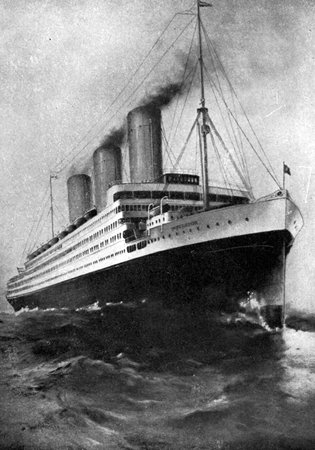
In all the long record of disasters involving the
loss of human life there is none which appeals
so strongly to the imagination as those which
have occurred upon the high seas, and among
these the loss of the Titanic stands out preëminent
as the most stupendous and heartrending
tragedy of them all. The ship itself
was not only the latest and largest of those
magnificent ocean liners which, because of their
size and speed and luxurious appointments,
have taken such a strong hold upon the public
imagination, but it was popularly believed that
because of her huge proportions, and the special
precautions which had been taken to render
her unsinkable, the Titanic was so far proof
against the ordinary accidents of the sea as to
survive the severest disaster and bring her passengers
safely into port.
The belief that the Titanic stood for the
"last word" in naval architecture certainly
seemed to be justified by the facts. She was
not a contract-built ship in the commonly accepted
sense of that term. On the contrary,
she was built under a system which conduces to
high-class workmanship and eliminates the
temptations to cheap work, which must always
exist when a contract is secured in the face of
keen competition.
The famous White Star Company have
pointed with pride to the fact that the excellence
of their ships was due largely to the fact that
they had been built in the same shipbuilding
yard and under an arrangement which encouraged
the builders to embody in the ships the
most careful design and workmanship. Under
this arrangement, Messrs. Harland & Wolff,
of Belfast, build the White Star vessels without
entering into any hard and fast agreement
as to the price: the only stipulation of this
character being that, when the ship is accepted,
they shall be paid for the cost of the ship, plus
a certain profit, which is commonly believed to
be ten per cent.
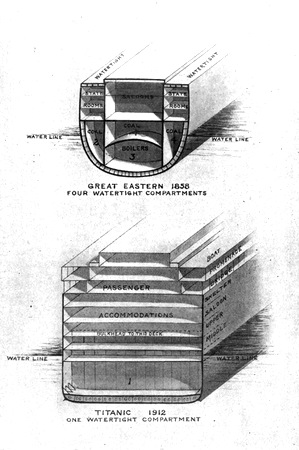
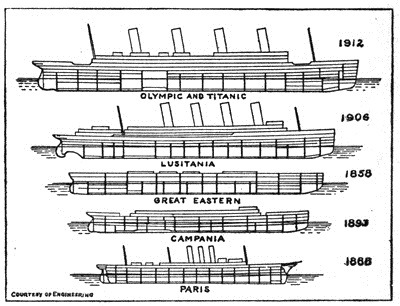
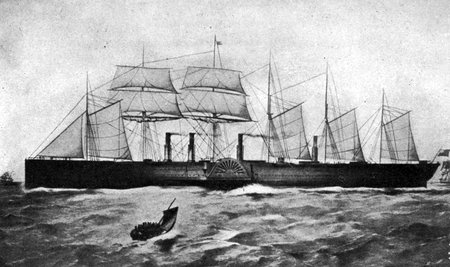
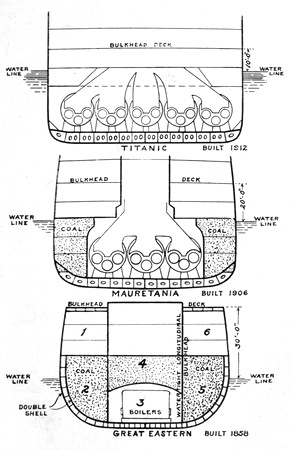
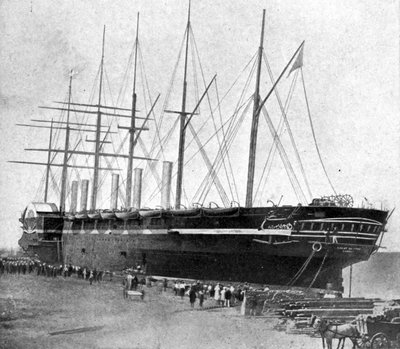
GREAT EASTERN 1858
FOUR WATERTIGHT COMPARTMENTS
TITANIC 1912
ONE WATERTIGHT COMPARTMENT
Titanic shows omission of inner skin, longitudinal bulkheads,
and watertight decks. Transverse bulkheads are lower by 20 feet.
Fifty Years' Decline in Safety Construction
Of the strength of the Titanic and the general
high character of her construction there can be
no doubt whatever. Not only was she built to
the requirements of the Board of Trade and
the insurance companies, but, as we have
noted, she was constructed by the leading shipbuilding
company of the world, under conditions
which would inspire them to put into the
world's greatest steamship the very best that
the long experience and ample facilities of the
yard could produce.
The principal dimensions of the Titanic, as
furnished by her owners, were as follows:
PARTICULARS OF THE TITANIC
| Ft. |
Ins. |
| Length over all |
882 |
9 |
| Length between perpendiculars |
850 |
0 |
| Breadth extreme |
92 |
6 |
| Depth moulded to shelter deck |
64 |
3 |
| Depth moulded to bridge deck |
73 |
3 |
| Total height from keel to navigating bridge |
104 |
0 |
| Load draft |
34 |
6 |
| Gross tonnage |
45,000 |
| Displacement in tons |
60,000 |
| Indicated horsepower of reciprocating engines |
38,000 |
| Shaft horsepower of turbine engine |
22,000 |
In this connection the following table, giving
the dimensions of the most notable steamships,
from the Great Eastern of 1858 to the Imperator
of 1913, will be of interest. How rapidly
the weight (displacement) increases with the
length of these large ships, is shown by the
fact that, although in length the Titanic is only
about 27 per cent. greater than the Great
Eastern, in displacement she exceeds her by
considerably over 100 per cent.
PARTICULARS OF NOTED TRANSATLANTIC LINERS
| Great Eastern |
1858 |
680 |
83.0 |
58.0 |
27,000 |
7,650 |
14.0 |
| City of Paris |
1888 |
528 |
63.0 |
41.9 |
13,000 |
20,700 |
21.8 |
| Teutonic |
1890 |
565 |
57.6 |
42.2 |
12,000 |
19,500 |
21.0 |
| Campania |
1893 |
600 |
65.0 |
41.6 |
18,000 |
30,000 |
22.01 |
| St. Paul |
1895 |
536 |
63.0 |
42.0 |
16,000 |
18,000 |
21.08 |
| K. Wilhelm der Grosse |
1897 |
625 |
66.0 |
43.0 |
20,890 |
30,000 |
22.5 |
| Oceanic |
1899 |
685 |
68.5 |
49.0 |
28,500 |
27,000 |
20.7 |
| Deutschland |
1900 |
663 |
67.0 |
44.0 |
23,600 |
36,000 |
23.5 |
| Kaiser Wilhelm II |
1903 |
678 |
72.0 |
52.6 |
26,000 |
38,000 |
23.5 |
| Adriatic |
1907 |
709 |
75.6 |
56.9 |
40,800 |
16,000 |
17.0 |
| Mauretania |
1907 |
760 |
88.0 |
60.6 |
44,640 |
70,000 |
26.01 |
| La France |
1912 |
685 |
75.5 |
52.10 |
27,000 |
45,000 |
23.5 |
| Titanic |
1912 |
850 |
92.6 |
64.3 |
60,000 |
60,000 |
22.5 |
| Imperator |
1913 |
880 |
96.0 |
62.0 |
65,000 |
70,000 |
23.0 |
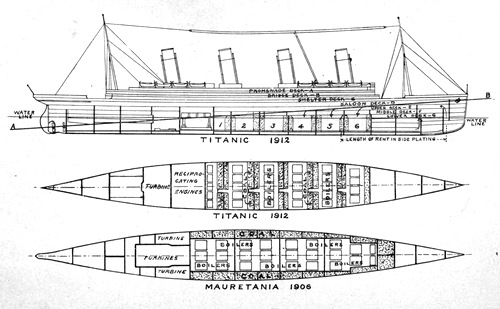
The general structure of the Titanic is shown
by the midship section, page 83,
and the side
elevation, page 129.
For about 550 feet amidships
she contained 8 steel decks, the boat
deck, promenade deck, bridge deck, shelter deck,
saloon deck, upper deck, middle deck, and lower
deck. The highest steel deck that extended
continuously throughout the full length of the
ship was the shelter deck. For 550 feet amidships
the sideplating of the ship was carried up
one deck higher to the bridge deck. The
moulded or plated depth of the ship to the shelter
deck was 64 feet 3 inches and to the bridge
deck 73 feet 3 inches. This great depth of over
73 feet, in conjunction with specially heavy
steel decks on the bridge and shelter decks, and
the doubling of the plating at the bilges, (where
the bottom rounds up into the side,) conjoined
with the deep and heavy double bottom, served
to give the Titanic the necessary strength to
resist the bending stresses to which her long
hull was subjected, when steaming across the
heavy seas of the Atlantic. The doubling of
the plating on the bridge and shelter decks
served the same purpose as the cellular steel
construction which, as mentioned in the previous
chapter, was adopted for the upper deck of
the Great Eastern.
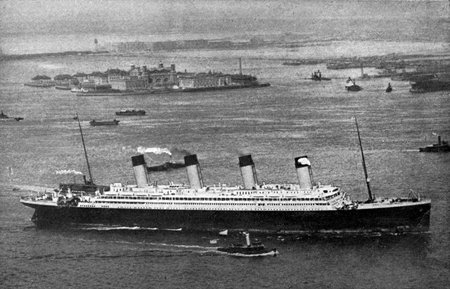
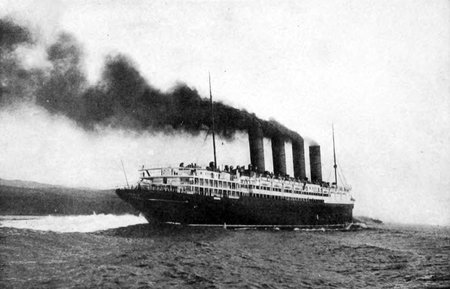
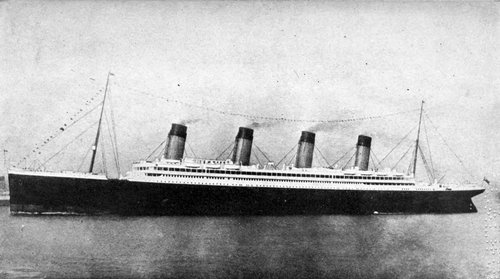
Courtesy of the Scientific American
Olympic, Sister to Titanic, Reaching New York on Maiden Voyage
The dimensions of the frames and plating of
the hull were determined by the builder's long
experience in the construction of large vessels.
The cellular double bottom, which extended the
full width of the ship, was of unusual depth and
strength. Throughout the ship, its depth was 5
feet 3 inches; but in the reciprocating engine-room,
it was increased to 6 feet 3 inches. The
keel consisted of a single thickness of plating,
1½ inches thick, and a heavy, flat bar, 3 inches
in thickness and 19½ inches wide. Generally
speaking, the shell plates were 6 feet wide, 30
feet long, and 2½ to 3 tons in weight. The
largest of these plates was 36 feet long and
weighed 4¼ tons.
Amidships, the framing, which consisted of
channel sections 10 inches in depth, was spaced
3 feet apart. Throughout the boiler-room
spaces, additional frames, 2½ feet deep, were
fitted 9 feet apart, and in the engine- and
turbine-rooms, similar deep frames were fitted
on every second frame, 6 feet apart. These
heavy web-frames extended up to the middle
deck, a few feet above the water-line, and added
greatly to the strength and stiffness of the hull.
Had the inside plating of the double bottom
been carried up the sides and riveted on the
inner flanges of these frames, as shown in the
sketch on page 107,
it would have served the
purpose of an inner skin; and when the outer
skin of her forward boiler-rooms was ruptured
by the iceberg, it would have served
to prevent the inflow of water to these two large
compartments. Mr. Ismay, the President of
the International Mercantile Marine Company,
in his testimony at the Senate Investigation,
stated that among the improvements, which
would be made in the Gigantic, now under construction
for the company, would be the addition
of an inner skin. Doubtless he had in mind
the construction above suggested.
The 10-inch channel frames extended from the
double bottom to the bridge deck, and some of
these bars were 66 feet in length and weighed
nearly 1 ton apiece. The frames were tied together
along the full length of each deck by the
deck beams of channel section, which, throughout
the middle portion of the ship, were 10
inches deep and weighed as high as 1¼ tons
apiece. The transverse stiffness of the framing
was assured by stout bracket knees, riveted to
the frames and deck beams at each point of connection,
and by the 15 watertight bulkheads,
which were riveted strongly to the bottom and
sides of the ship, and also by 11 non-watertight
bulkheads, which formed the inner walls of the
coal bunkers on each side of the main bulkheads.
The bridge, shelter, saloon, and upper decks
were supported and stiffened by four lines of
heavy longitudinal girders, worked in between
the beams, which were themselves carried by
solid round pillars placed at every third deck
beam. In the boiler-rooms, below the middle
deck, the load of the superincumbent decks was
carried down to the double bottom by means of
heavy round pillars.
Such was the construction of the Titanic; and
it will be agreed that, so far as the strength and
integrity of the hull were concerned, it was admirably
adapted to meet the heavy stresses
which are involved in driving so great and
heavy a ship through the tempestuous weather
of the North Atlantic.
The first sight of such a gigantic vessel as
the Titanic produces an impression of solidity
and invulnerability, which is not altogether justified
by the facts. For, to tell the truth, the
modern steamship is a curious compound of
strength and fragility. Her strength, as must
be evident from the foregoing description of
the framing of the Titanic, is enormous, and
ample for safety. Her fragility and vulnerability
lie in the fact that her framework is overlaid
with a relatively thin skin of plating, an
inch or so in thickness, which, while amply
strong to resist the inward pressure of the
water, the impact of the seas, and the tensile
and compressive stresses due to the motion of
the ship in a seaway, etc., is readily fractured
by the blow of a collision.
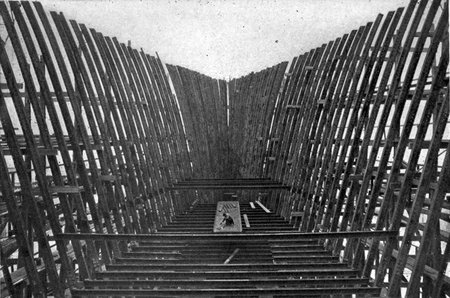
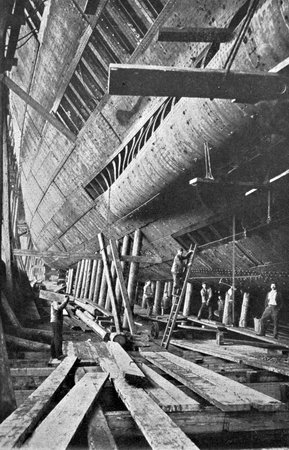
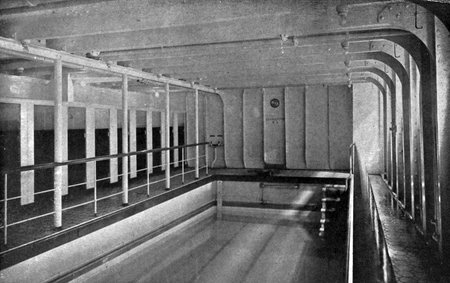
The Framing and Some of the Deck Beams of the Imperator, as Seen from Inside
the Bow, Before the Outside Plating Was Rivetted on
In a previous chapter it was shown that when
the Titanic is being driven at a speed of 21
knots, she represents an energy of over 1,000,000
foot-tons. If this enormous energy is arrested,
or sought to be arrested, by some rigid
obstruction, whether another ship, a rock, or
an iceberg, the delicate outside skin will be torn
like a sheet of paper.
It was shown in Chapter IV that protection
against flooding of a ship through damage
below the water-line is obtained by subdividing
the hull into separate watertight compartments,
and that, roughly speaking, the degree of protection
is proportionate to the extent to which
this subdivision is carried. Applying this to
the Titanic, we find that she was divided by 15
transverse bulkheads into 16 separate compartments.
But, in this connection it must be noted
that these bulkheads did not extend through the
whole height of the ship to the shelter deck,
as they did in the case of the Great Eastern,
and therefore it cannot be said that the whole
of the interior space of the hull received the
benefit of subdivision. As a matter of fact,
only about two-thirds of the total cubical space
contained below the shelter deck was protected
by subdivision. Water, finding its way into the
ship above the level of the decks to which the
bulkheads were carried, was free to flow the
whole length of her from stem to stern. Furthermore,
the value of the subdivision below
the bulkhead deck depends largely upon the degree
to which this deck is made watertight. If
the deck is pierced by hatchways, stairways, and
other openings, which are not provided with
watertight casings and hatch covers, the integrity
of the deck is destroyed, and the bulkhead
subdivision below loses its value.
It was largely this most serious defect—the
existence of many unprotected openings in the
bulkhead deck of the Titanic—that caused her
to go down so soon after the collision.
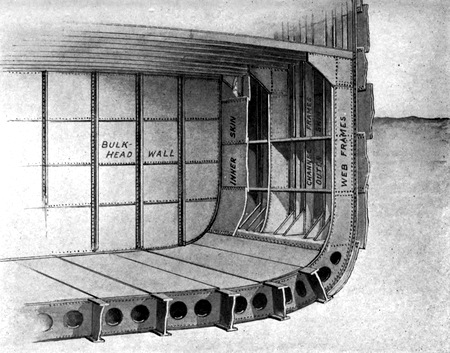
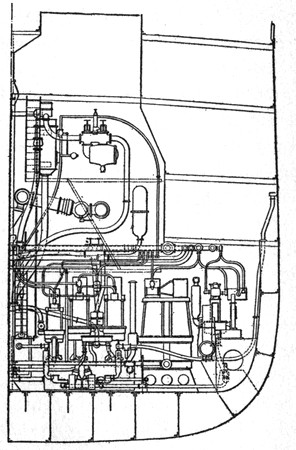
This Drawing Shows How the Plating of the Inner Bottom
of Such a Ship as the Titanic May Be Carried up the Side
Frames to Form an Inner Skin
Referring now to the side elevation of
the Titanic on page 129,
it will be noted that
the only bulkhead which was carried up to
the shelter deck was the first, or collision
bulkhead. The second bulkhead extended to
the saloon deck, and on the after side
of this and immediately against it was a
spiral stairway for the accommodation of the
crew, which led from their quarters down
to the floor of the ship. Here the stairway
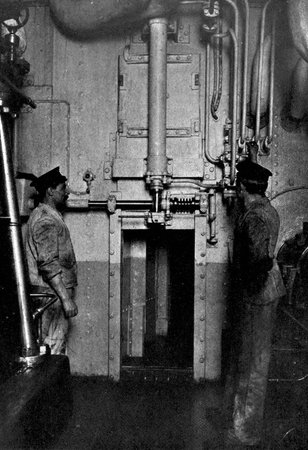
terminated in a fireman's passage, which led
aft through the third and fourth bulkheads, and
gave access through a watertight door to the
foremost boiler-room. The seven bulkheads,
from No. 3 to No. 9, extended only to the upper
deck, which, at load draft, was only about 10
feet above the water-line. Bulkhead No. 10 was
carried up one deck higher to the saloon deck,
as were also bulkheads 11, 12, 13, and 14. Bulkhead
No. 15 terminated at the upper deck.
Now, it will be asked: what was the factor in
the calculations which determined the height of
these bulkheads? The answer is to be found in
the Board of Trade stipulations, to which reference
was made in Chapter IV, page 62.
These stipulations establish an imaginary safety line,
below which a ship may not sink without danger
of foundering. The safety line represents the
depth to which a ship will sink when any two
adjoining compartments are opened to the sea
and therefore flooded. If the two forward compartments
are flooded, for instance, the bow
may sink with safety, until the water is only
three one-hundredths of the depth of the ship,
at the side, from the bulkhead deck. If two
central compartments are flooded, the ship is
supposed to settle with safety until the bulkhead
deck at that point is only three one-hundredths
of the depth of the side, at that
place, above the water.
The raising of the height of the bulkheads, by
one deck, at the engine-room, is due to the
operation of this rule; for here the two adjoining
compartments, those containing the reciprocating
engines and the turbine, are the largest
in the ship, and their flooding would sink the
ship proportionately lower in the water.
Now it takes but a glance at the diagrams on
page 66
to show that the application of the
Board of Trade rule brought the bulkhead line
of the Titanic down to a lower level than that
of any of the other notable ships shown in comparison
with her. It was the low bulkheads,
acting in connection with the non-watertight
construction of the bulkhead deck, that was
largely answerable for the loss of this otherwise
very fine ship.
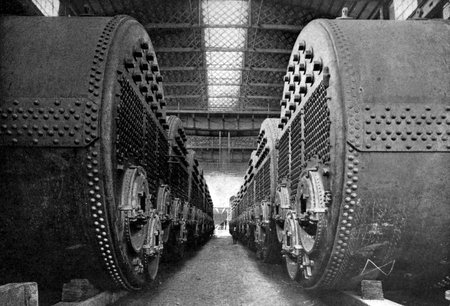
Courtesy of Scientific American
Twenty of the Twenty-nine Boilers of the Titanic Assembled, Ready for
Placing in the Ship
Another grave defect in the Titanic was the
great size of the individual compartments, coupled
with the fact that the only protection against
their being flooded was the one-inch plating of
the outside skin. If this plating were ruptured
or the rivets started along the seams, there was
nothing to prevent the flooding of the whole
compartment and the entry, at least throughout
the middle portion of the ship, of from 4,000 to
6,000 tons of water—this last being the approximate
capacity of the huge compartment which
contained the two reciprocating engines. Now,
if safety lies in minute subdivision, it is evident
that in this ship safety was sacrificed to some
other considerations. The motive for the plan
adopted was the desire to place the coal-bunkers
in the most convenient position with regard to
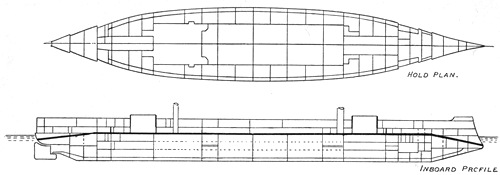
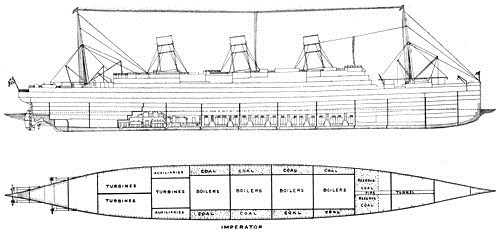
the boilers. By reference to the hold plan of
the Titanic, page 129,
it will be seen that her
29 boilers were arranged transversely to the
ship. With the exception of the five in the
aftermost compartment, they were "double-ended,"
with the furnaces facing fore and aft.
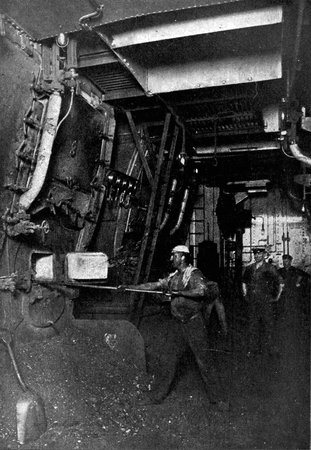
To facilitate shovelling the coal into the furnaces,
the coal-bunkers were placed one on each
side of each transverse watertight bulkhead.
The coal supply was thus placed immediately
back of the firemen, and the work of getting the
coal from the bunkers to the furnaces was
greatly facilitated. Now, while this was an admirable
arrangement for convenience of firing,
it was the worst possible plan as far as the
safety of the Titanic was concerned; since any
damage to the hull admitted water across the
whole width of the ship. The alternative plan,
which should be made compulsory on all large
ocean-going passenger steamers, is the one
adopted for the Mauretania, Kaiser Wilhelm
II, Imperator, and a few other first-class ships,
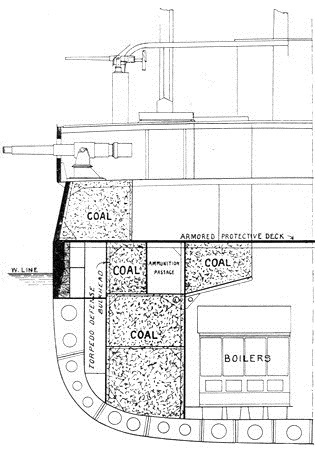
in which the coal-bunkers are placed at the sides
of the ship, where they serve to prevent the
flooding of the main boiler-room compartments.
It is probable that any one of the ships named
would have survived even the terrific collision
which sank the Titanic.
The objection has been raised against longitudinal
coal-bunkers, that they are not so conveniently
placed for the firemen. A large force
of "coal passers" has to be employed in wheeling
the coal from the bunkers to the front of
the furnaces. This, of course, entails an increased
expense of operation.
The use of transverse coal-bunkers must be
regarded as one among many instances, in
which the safety of passenger ships is sacrificed
to considerations of economy and convenience
of operation.