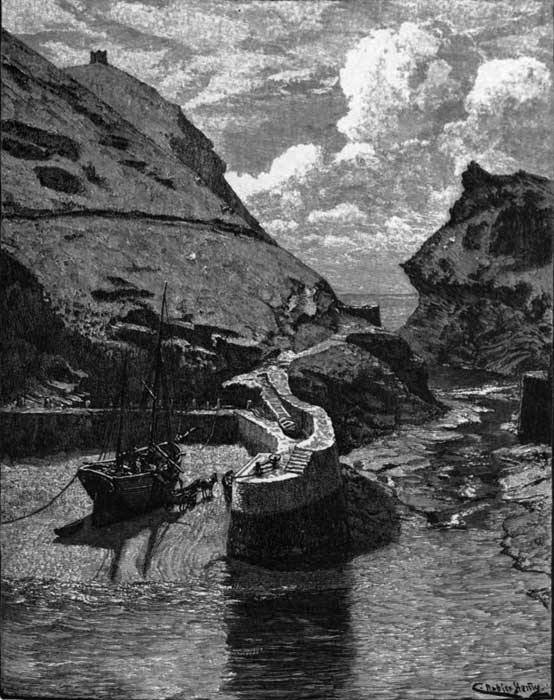
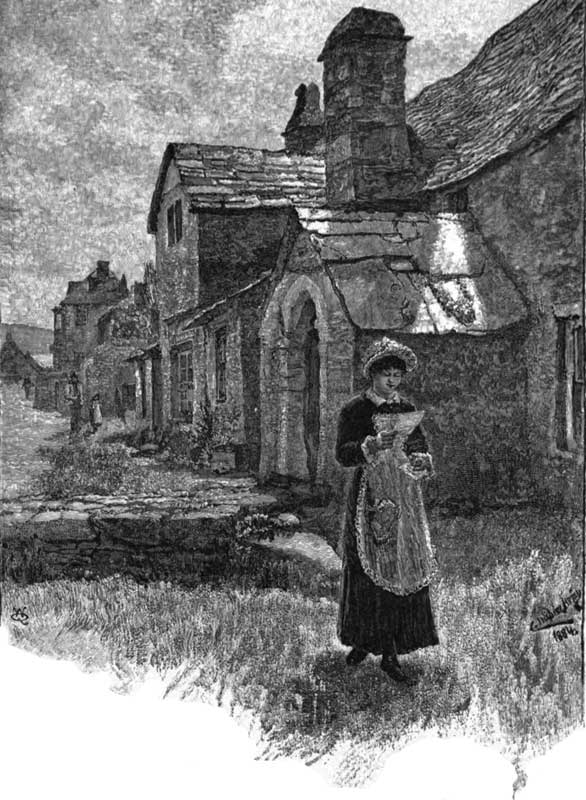
"And a beautiful day it is, ladies, though it won't do for Kynance."
Only 8 a.m., yet there stood the faithful Charles, hat in hand, having
heard that his ladies were at breakfast, and being evidently anxious
that they should not lose an hour of him and his carriage, which were
both due at Falmouth to-night. For this day was Saturday, and we were
sending him home for Sunday.
"As I found out last night, the tide won't suit for Kynance till
Wednesday or Thursday, and you'll be too tired to walk much to-day.
I've been thinking it all over. Suppose I were to drive you to Kennack
Sands, back by the serpentine works to Cadgwith, and home to dinner?
Then after dinner I'll give the horse a rest for two hours, and take
you to Mullion; we can order tea at Mary Mundy's, and go on to the cove
as far as I can get with the carriage. I'll leave it at the farm and be
in time to help you over the rocks to see the caves, run ahead and meet
you again with the carriage, and drive you back to Mary Mundy's. You
can have tea and be home in the moonlight before nine o'clock."
"And you?" we asked, a good deal bewildered by this carefully-outlined
plan and all the strange names of places and people, yet not a little
touched by the kindly way in which we were "taken in and done for" by
our faithful squire of dames.
"Me, ma'am? Oh, after an hour or two's rest the horse can start
again—say at midnight, and be home by daylight. Or we could go to bed
and be up early at four, and still get to Falmouth by eight, in time
for the church work. Don't you trouble about us, we'll manage. He" (the
other and four-footed half of the "we") "is a capital animal, and he'd
get much harder work than this if he was at home."
So we decided to put ourselves entirely in the hands of Charles,
who seemed to have our interest so much at heart, and yet evinced a
tenderness over his horse that is not too common among hired drivers.
We promised to be ready in half an hour, so as to waste nothing of this
lovely day, in which we had determined to enjoy ourselves.
Who could help it? It was delightful to wake up early and refreshed,
and come down to this sunshiny, cheerful breakfast-table, where, though
nothing was grand, all was thoroughly comfortable.
"I'm sure you're very kind, ladies, to be so pleased with everything,"
apologised our bright-looking handmaiden; "and since you really wish
to keep this room"—a very homely parlour which we had chosen in
preference to a larger one, because it looked on the sea—"I only wish
things was better for you; still, if you can make shift—"
Well, if travellers cannot "make shift" with perfectly clean tidy
rooms, well-cooked plain food, and more than civil, actually kindly,
attendance, they ought to be ashamed of themselves! So we declared we
would settle down in the evidently despised little parlour.
It was not an æsthetic apartment, certainly. The wall-paper and carpet
would have driven Morris and Co. nearly frantic; the furniture—mere
chairs and a table—belonged "to the year one"—but (better than many
modern chairs and tables) you could sit down upon the first and dine
upon the second, in safety. There was no sofa, so we gladly accepted
an offered easy-chair, and felt that all really useful things were now
ours.
But the ornamental? There was a paper arrangement in the grate, and
certain vases on the chimney-piece which literally made our hair stand
on end! After a private consultation as to how far we might venture,
without wounding the feelings of our landlady, we mildly suggested that
"perhaps we could do without these ornaments." All we wanted in their
stead were a few jars, salt-jars or jam-pots, in which to arrange our
wild flowers, of which yesterday the girls had gathered a quantity.
The exchange was accepted, though with some surprise. But when, half
an hour afterwards, the parlour appeared quite transformed, decorated
in every available corner with brilliant autumn flowers—principally
yellow—intermixed with the lovely Cornish heath; when, on some excuse
or other, the hideous "ornament for your fire-stoves" was abolished,
and the grate filled with a mass of green fern and grey sea-holly—I
know no combination more exquisite both as to colour and form—then we
felt that we could survive, at least for a week, even if shut up within
this humble room, innocent of the smallest attraction as regarded art,
music, or literature.
But without doors? There Nature beat Art decidedly.
What a world it was! Literally swimming in sunshine, from the sparkling
sea in the distance, to the beds of marigolds close by—huge marigolds,
double and single, mingled with carnations that filled the air with
rich autumnal scent, all the more delicious because we feel it is
autumnal, and therefore cannot last. It was a very simple garden,
merely a square grass-plot with a walk and a border round it, and its
only flowers were these marigolds, carnations, with quantities of
mignonette, and bounded all round with a hedge of tamarisk; yet I think
we shall always remember it as if it were the Garden of Armida—without
a Tancred to spoil it!
For—under the rose—one of the pleasures of our tour was that it was
so exclusively feminine. We could feed as we liked, dress as we liked,
talk to whom we liked, without any restriction, from the universal
masculine sense of dignity and decorum in travelling. We felt ourselves
unconventional, incognito, able to do exactly as we chose, provided we
did nothing wrong.
So off we drove through Lizard Town into the "wide, wide world;" and
I repeat, what a world it was! Full filled with sunlight, and with an
atmosphere so fresh and bracing, yet so dry and mild and balmy, that
every breath was a pleasure to draw. We had felt nothing like it since
we stood on the top of the highest peak in the Island of Capri, looking
down on the blue Mediterranean. But this sea was equally blue, the sky
equally clear, yet it was home—dear old England, so often misprized.
Yet, I believe, when one does get really fine English weather, there is
nothing like it in the whole world.
The region we traversed was not picturesque—neither mountains, nor
glens, nor rivers, nor woods; all was level and bare, for the road lay
mostly inland, until we came out upon Kennack Sands.
They might have been the very "yellow sands" where Shakespeare's elves
were bidden to "take hands" and "foot it featly here and there." You
might almost have searched for the sea-maids' footsteps along the
smooth surface where the long Atlantic waves crept harmlessly in,
making a glittering curve, and falling with a gentle "thud"—the only
sound in the solitary bay, until all at once we caught voices and
laughter, and from among some rock, emerged a party of girls.
They had evidently come in a cart, which took up its station beside
our carriage, laden with bundles which looked uncommonly like bathing
gowns; and were now seeking a convenient dressing-room—one of
those rock-parlours, roofed with serpentine and floored with silver
sand—which are the sole bathing establishments here.
All along the Cornish coast the bathing is delightful—when you can
get it; but sometimes for miles and miles the cliffs rise in a huge
impregnable wall, without a single break. Then perhaps there comes a
sudden cleft in the rock, a green descent, possibly with a rivulet
trickling through it, and leading to a sheltered cove or a sea-cave,
accessible only at low water, but one of the most delicious little
nooks that could be imagined. Kynance, we were told, with its "kitchen"
and "drawing-room," was the most perfect specimen of the kind; but
Kennack was sufficiently lovely. With all sorts of fun, shouting, and
laughter, the girls disappeared to their evidently familiar haunts, to
reappear as merry mermaids playing about in a crystalline sea.
A most tantalising sight to my two, who vowed never again to attempt
a day's excursion without taking bathing dresses, towels, and the
inevitable fish-line, to be tied round the waist,—with a mother
holding the other end. For we had been warned against these long and
strong Atlantic waves, the recoil of which takes you off your feet even
in calm weather. As bathing must generally be done at low water, to
ensure a sandy floor and a comfortable cave, it is easy enough to be
swept out of one's depth; and the cleverest swimmer, if tossed about
among these innumerable rocks circled round by eddies of boiling white
water, would have small chance of returning with whole bones, or of
returning at all.
Indeed, along this Cornish coast, life and death seem very near
together. Every pleasure carries with it a certain amount of risk; the
utmost caution is required both on land and sea, and I cannot advise
either rash or nervous people to go travelling in Cornwall.
Bathing being impracticable, we consoled ourselves with ascending the
sandy hillock, which bounded one side of the bay, and sat looking from
it towards the coast-line eastwards.
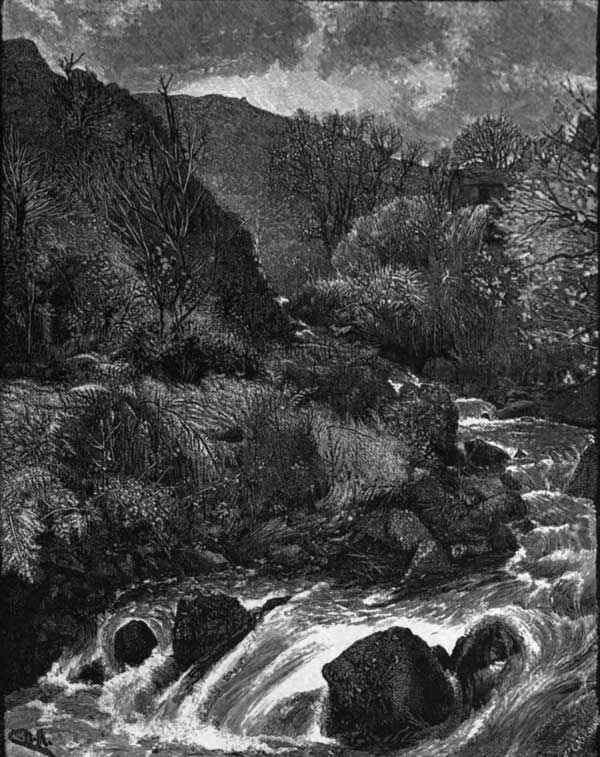
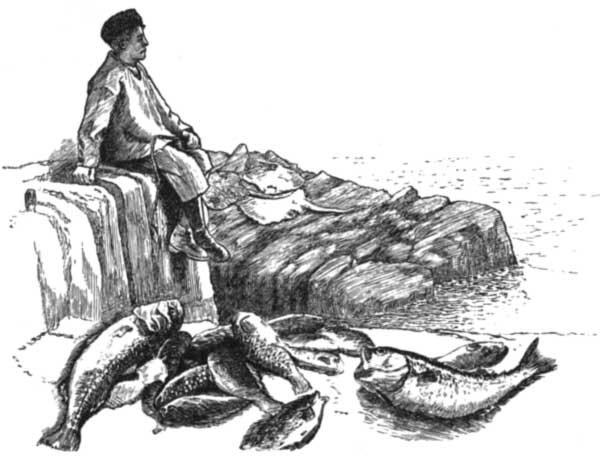
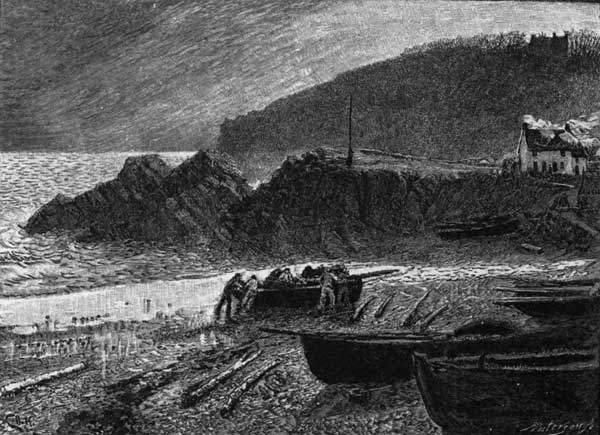
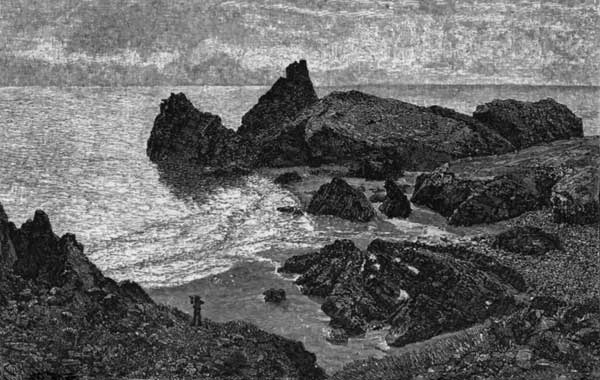
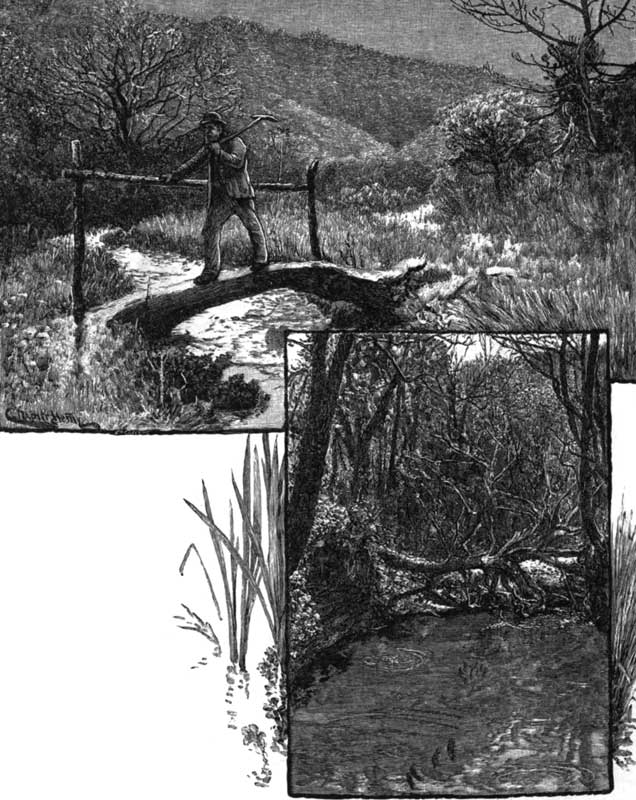
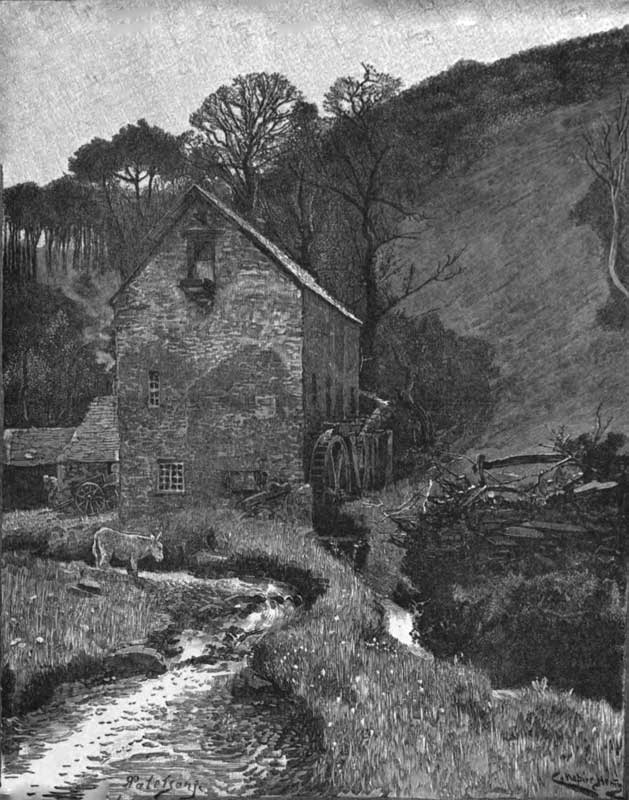
POLTESCO.
What a strange peace there is in a solitary shore, an empty sea, for
the one or two white dots of silent ships seemed rather to add to than
diminish its loneliness—lonelier in sunshine, I think, than even in
storm. The latter gives a sense of human life, of struggle and of
pain; while the former is all repose, the bright but solemn repose of
infinity or eternity.
But these thoughts were for older heads; the only idea of the young
heads—uncommonly steady they must have been!—was of scrambling
into the most inaccessible places, and getting as near to the sea as
possible without actually tumbling into it. After a while the land
attracted them in turn, and they came back with their hands full of
flowers, some known, some unknown; great bunches of honeysuckle,
curious sand-plants, and cliff-plants; also water-plants, which fringed
a little rivulet that ran into the bay, while, growing everywhere
abundantly, was the lovely grey-green cringo, or sea-holly.
All these treasures, to make the parlour pretty, required much
ingenuity to carry home safely, the sun withered them so fast. But
there was the pleasure of collecting.
We could willingly have stayed here all day—how natural is that wish
of poor young Shelley, that in every pretty place he saw he might
remain "for ever"!—but the forenoon was passing, and we had much to
see.
"Poltesco, everybody goes to Poltesco," observed the patient Charles.
So of course we went there too. At Poltesco are the principal
serpentine works—the one commerce of the district. The monotonous hum
of its machinery mingled oddly with the murmur of a trout-stream which
ran through the pretty little valley, crossed by a wooden bridge, where
a solitary angler stood fishing in imperturbable content.
There were only about a dozen workmen visible; one of whom came
forward and explained to us the mode of work, afterwards taking us
to the show-room, which contained everything possible to be made of
serpentine, from mantelpieces and tombstones, down to brooches and
studs. Very delicate and beautiful was the workmanship; the forms of
some of the things—vases and candlesticks especially—were quite
Pompeian. In truth, throughout Cornwall, we often came upon shapes,
Roman or Greek, proving how even yet relics of its early masters or
colonisers linger in this western corner of England.
In its inhabitants too. When, as we passed, more than one busy
workman lifted up his head for a moment, we noticed faces almost
classic in type, quite different from the bovine, agricultural
Hodge of the midland counties. In manner different likewise.
There was neither stupidity nor servility, but a sort of dignified
independence. No pressing to buy, no looking out for gratuities,
only a kindly politeness, which did not fail even when we departed,
taking only a few little ornaments. We should have liked to carry off
a cart-load—especially two enormous vases and a chimney-piece—but
travellers have limits to luggage, and purse as well.
Pretty Poltesco! we left it with regret, but we were in the hands
of the ever-watchful Charles, anxious that we should see as much as
possible.
"The driving-road goes far inland, but there's a splendid cliff-walk
from Poltesco to Cadgwith direct. The young ladies might do it with a
guide—here he is, a man I know, quite reliable. They'll walk it easily
in half an hour. But you, ma'am, I think you'd better come with me."
No fighting against fate. So I put my "chickens" in safe charge, meekly
re-entered the carriage, and drove, humbly and alone, across a flat
dull country, diversified here and there by a few cottages, politely
called a village—the two villages of Ruan Minor and Ruan Major. I
afterwards found that they were not without antiquarian interest, that
I might have gone to examine a curious old church, well, and oratory,
supposed to have been inhabited by St. Rumon. But we had left the
guide-book at home, with the so longed-for bathing gowns, and Charles
was not of archæological mind, so I heard nothing and investigated
nothing.
Except, indeed, numerous huge hand-bills, posted on barn doors and
gates, informing the inhabitants that an Exhibition of Fine Arts,
admittance one shilling, was on view close by. Charles was most anxious
I should stop and visit it, saying it was "very fine." But as within
the last twelvemonth I had seen the Royal Academy, Grosvenor Gallery,
and most of the galleries and museums in Italy, the Fine Art Exhibition
of Ruan Minor was not overwhelmingly attractive. However, not to wound
the good Cornishman, who was evidently proud of it, I explained that,
on the whole, I preferred nature to art.
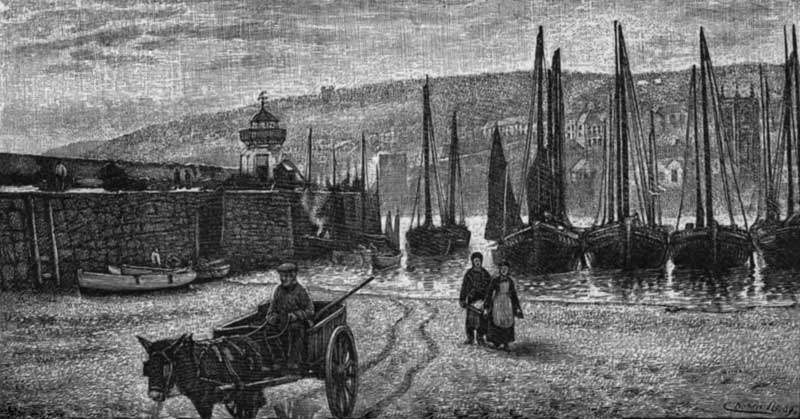
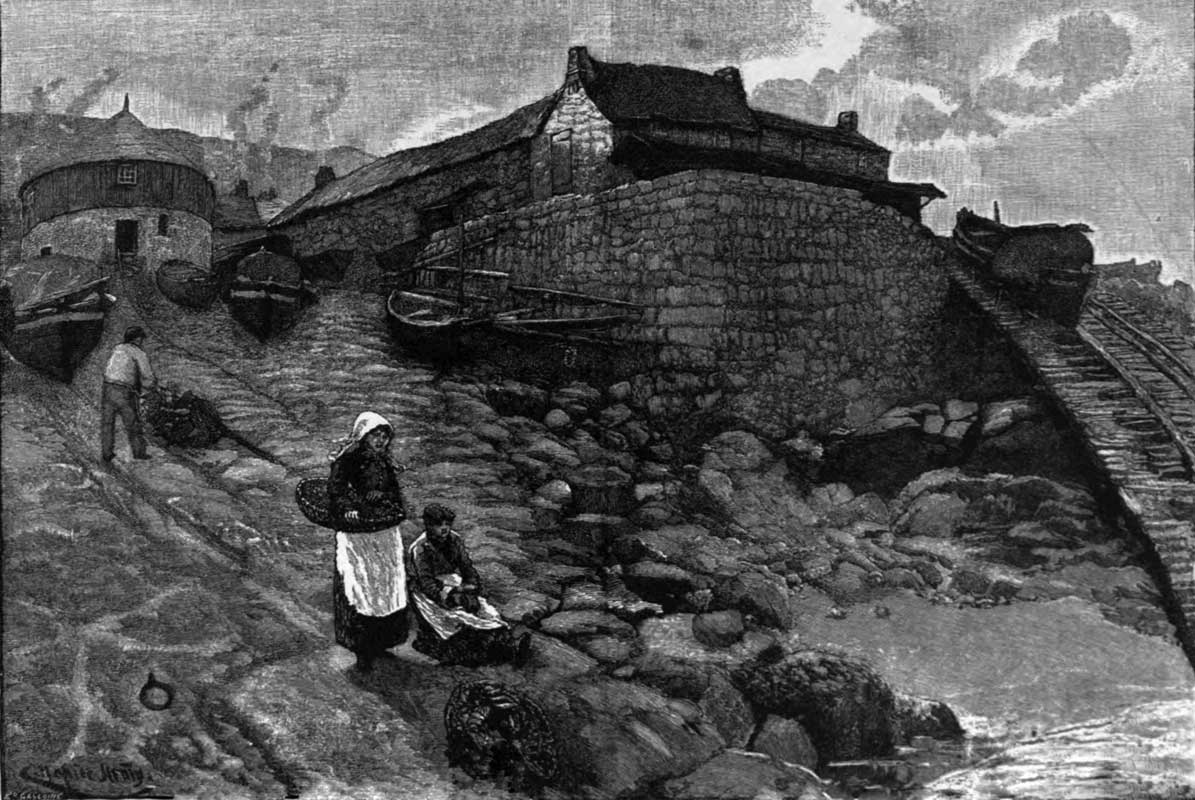
And how grand nature was in this fishing-village of Cadgwith, to which
after a long round, we came at last!
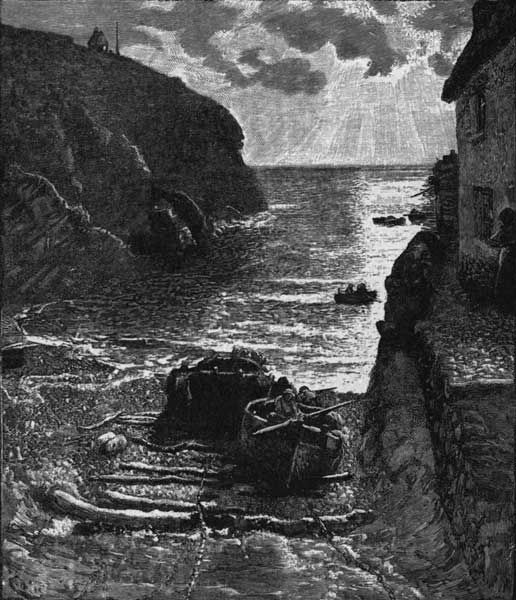
CADGWITH COVE.
Nestled snugly in a bend of the coast which shelters it from north
and east, leaving it open to southern sunshine, while another curve
of land protects it from the dense fogs which are so common at the
Lizard, Cadgwith is, summer and winter, one of the pleasantest nooks
imaginable. The climate, Charles told me, is so mild, that invalids
often settle down in the one inn—a mere village inn externally, but
very comfortable. And, as I afterwards heard at Lizard Town, the parson
and his wife—"didn't I know them?" and I felt myself rather looked
down upon because I did not know them—are the kindest of people,
who take pleasure in looking after the invalids, rich or poor. "Yes,"
Charles considered Cadgwith was a nice place to winter in, "only just a
trifle dull."
Probably so, to judge by the interest which, even in this
tourist-season, our carriage excited, as we wound down one side and
up another of the ravine in which the village is built, with a small
fishing-station at the bottom, rather painfully odoriferous. The
fisher-wives came to their doors, the old fisher-men stood, hands in
pockets, the roly-poly healthy fisher-children stopped playing, to
turn round and stare. In these parts everybody stares at everybody,
and generally everybody speaks to everybody—a civil "good-day" at any
rate, sometimes more.
"This is a heavy pull for you," said a sympathetic old woman, who had
watched me leave the carriage and begin mounting the cliff towards the
Devil's Frying-pan—the principal thing to be seen at Cadgwith. She
followed me, and triumphantly passed me, though she had to carry a bag
of potatoes on her back. I wondered if her feeling was pity or envy
towards another old person who had to carry nothing but her own self.
Which, alas! was enough!
She and I sat down together on the hill-side and had a chat, while I
waited for the two little black dots which I could see moving round the
opposite headland. She gave me all kinds of information, in the simple
way peculiar to country folk, whose innocent horizon comprises the
whole world, which, may be, is less pleasant than the little world of
Cadgwith. Then we parted for ever and aye.
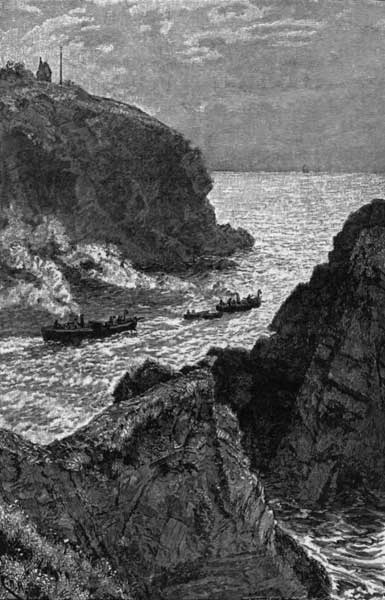
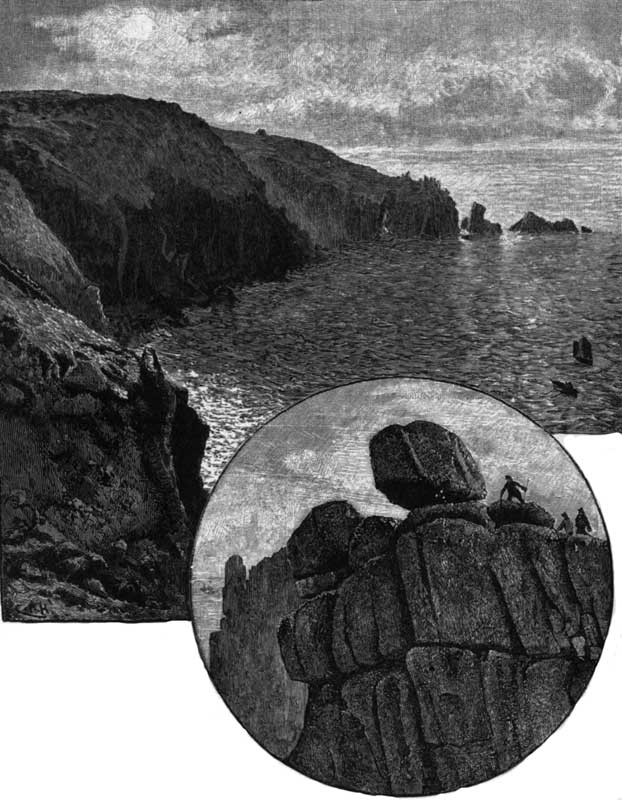
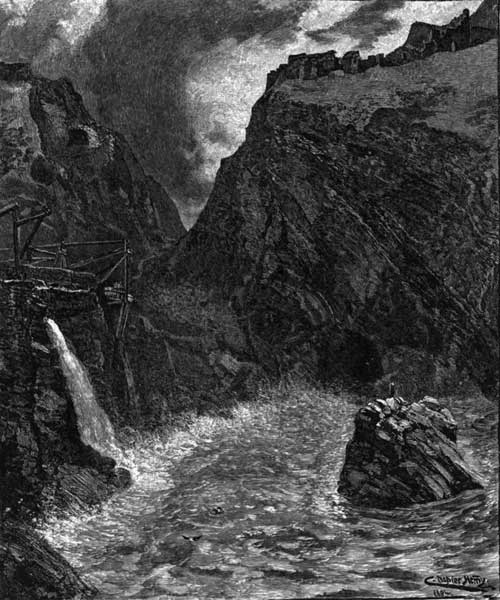
The Devil's Frying-pan is a wonderful sight. Imagine a natural
amphitheatre two acres in extent, inclosed by a semi-circular slope
about two hundred feet high, covered with grass and flowers and low
bushes. Outside, the wide, open sea, which pours in to the shingly
beach at the bottom through an arch of serpentine, the colouring of
which, and of the other rocks surrounding it, is most exquisite,
varying from red to green, with sometimes a tint of grey. Were Cadgwith
a little nearer civilisation, what a show-place it would become!
But happily civilisation leaves it alone. The tiny farm-house on the
hill-side near the Frying-pan looked, within and without, much as it
must have looked for the last hundred years; and the ragged, unkempt,
tongue-tied little girl, from whom we succeeded in getting a drink
of milk in a tumbler which she took five minutes to search for, had
certainly never been to a Board School. She investigated the penny
which we deposited as if it were a great natural curiosity rarely
attainable, and she gazed after us as we climbed the stile leading to
the Frying-pan as if wondering what on earth could tempt respectable
people, who had nothing to do, into such a very uncomfortable place.
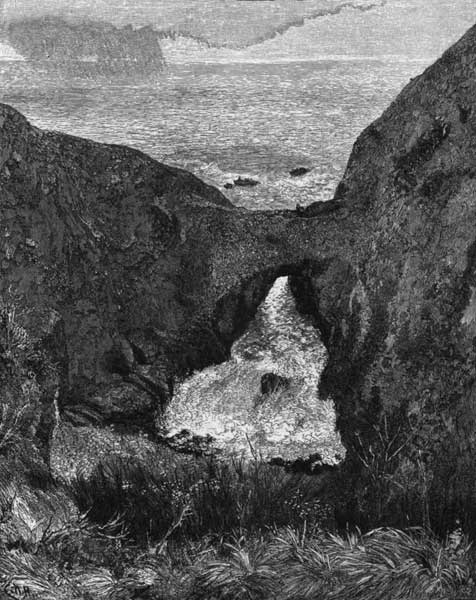
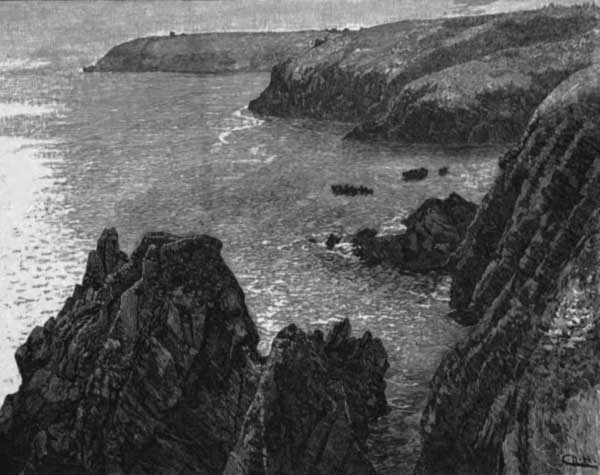
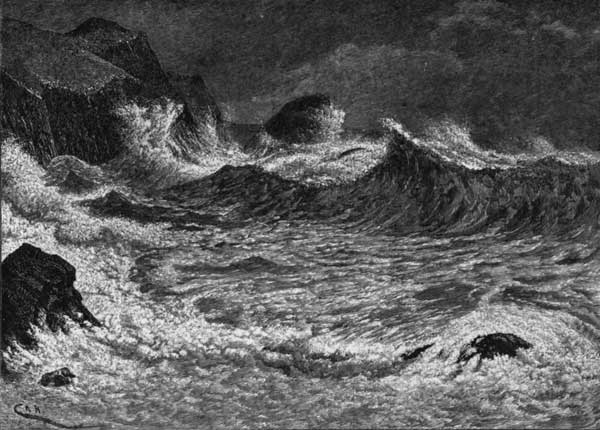
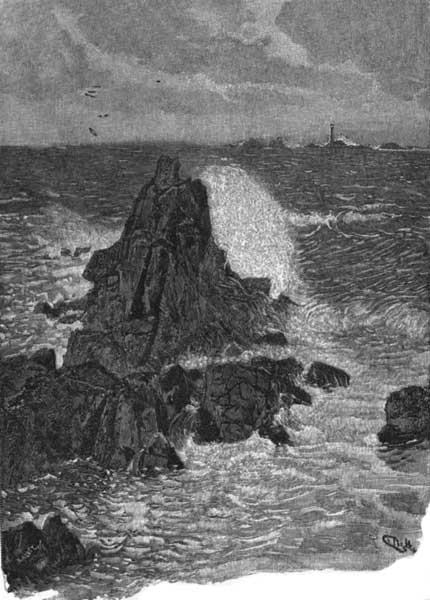
THE DEVIL'S FRYING PAN, NEAR CADGWITH.
Uncomfortable, certainly, as we sat with our feet stuck in the long
grass to prevent slipping down the slope—a misadventure which would
have been, to say the least, awkward. Those boiling waves, roaring each
after each through the arch below; and those jagged rocks, round which
innumerable sea-birds were flying—one could quite imagine that were
any luckless vessel to find itself in or near the Frying-pan, it would
never get out again.
To meditative minds there is something very startling in the perpetual
contrast between the summer tourist-life, so cheerful and careless,
and the winter life of the people here, which must be so full of
privations; for one half the year there is nothing to do, no market
for serpentine, and almost no fishing possible: they have to live
throughout the dark days upon the hay made while the sun shines.
"No, no," said one of the Lizard folk, whom I asked if there was much
drunkenness thereabout, for I had seen absolutely none; "no, us don't
drink; us can't afford it. Winter's a bad time for we—sometimes for
four months a man doesn't earn a halfpenny. He has to save in summer,
or he'd starve the rest of the year."
Which apparently is not altogether bad for him. I have seldom seen,
in any part of England or Scotland, such an honest, independent,
respectable race as the working people on this coast, and indeed
throughout Cornwall.
We left with regret the pretty village, resolving to come back again
in a day or two; it was barely three miles from the Lizard, though the
difference in climate was said to be so great. And then we drove back
across the bleak down and through the keen "hungry" sea-air, which made
dinner a matter of welcome importance. And without dwelling too much
on the delights of the flesh—very mild delights after all—I will say
that the vegetables grown in the garden, and the grapes in the simple
green-house beside it, were a credit to Cornwall, especially so near
the sea-coast.
We had just time to dine, repose a little, and communicate our address
to our affectionate friends at home—so as to link ourselves for a few
brief days with the outside world—when appeared the punctual Charles.
"Don't be afraid, ladies, he's had a good rest,"—this was the
important animal about whose well-being we were naturally anxious.
Charles patted his shoulder, and a little person much given to deep
equine affections tenderly stroked his nose. He seemed sensible of the
attention and of what was expected from him, and started off, as lively
as if he had been idle for a week, across the Lizard Down and Pradenack
Down to Mullion.
"I hope Mary will be at home," said Charles, turning round as usual to
converse; "she'll be sure to make you comfortable. Of course you've
heard of Mary Mundy?"
Fortunately we had. There was in one of our guide-books a most
glowing description of the Old Inn, and also an extract from a poem,
apostrophising the charms of Mary Mundy. When we said we knew the
enthusiastic Scotch Professor who had written it, we felt that we rose
a step in the estimation of Charles.
"And Mary will be so pleased to see anybody who knows the
gentleman"—in Cornwall the noted Greek Professor was merely "the
gentleman." "She's got his poem in her visitors' book and his portrait
in her album. I do hope Mary will be at home."
But fate was against us. When we reached Mullion and drove up to the
door of the Old Inn, there darted out to meet us, not Mary, but an
individual concerning whom Fame has been unjustly silent.
"It's only Mary's brother," said Charles, with an accent of deep
disappointment.
But as the honest man who had apparently gone through life as "Mary's
brother" stood patting our horse and talking to our driver, with both
of whom he seemed on terms of equal intimacy, his welcome to ourselves
was such a mixture of cordiality and despair that we could scarcely
keep from laughing.
"Mary's gone to Helstone, ladies; her would have been delighted, but
her's gone marketing to Helstone. I hope her'll be back soon, for I
doesn't know what to do without she. The house is full, and there's a
party of eleven come to tea, and actually wanting it sent down to them
at the Cove. They won't get it though. And you shall get your tea,
ladies, even if they have to go without."
We expressed our gratitude, and left Charles to arrange all for us,
which he did in the most practical way.
"And you think Mary may be back at six?"
"Her said her would, and I hope her will," answered the brother
despondently. "Her's very seldom out; us can't get on at all without
she."
This, and several more long and voluble speeches given in broad
Cornish, with the true Cornish confusion of pronouns, and with an air
of piteous perplexity—nay, abject helplessness, the usual helplessness
of man without woman—proved too much for our risible nerves. We
maintained a decorous gravity till we had driven away, and then fell
into shouts of laughter—the innocent laughter of happy-minded people
over the smallest joke or the mildest species of fun.
"Never mind, ladies, you'll get your tea all right. If Mary said she'd
be back at six, back she'll be. And you'll find a capital tea waiting
for you; there isn't a more comfortable inn in all Cornwall."
Which, we afterwards found, was saying a great deal.
Mullion Cove is a good mile from Mullion village, and as we jolted over
the rough road I was remorseful over both carriage and horse.
"Not at all, ma'am, he's used to it. Often and often he comes here with
pic-nic parties, all the way from Falmouth. I'll put him in at the
farm, and be down with you at the Cove directly. You'll find the rocks
pretty bad walking, but there's a cave which you ought to see. We'll
try it."
There was no resisting the way the kindly young Cornishman thus
identified himself with our interests, and gave himself all sorts
of extra trouble on our account. And when after a steep and not too
savoury descent—the cove being used as a fish cellar—we found
ourselves on the beach, shut in by those grand rocks of serpentine,
with Mullion Island lying ahead about a quarter of a mile off, we felt
we had not come here for nothing.
The great feature of Mullion Cove is its sea-caves, of which there are
two, one on the beach, the other round the point, and only accessible
at low water. Now, we saw the tide was rising fast.
"They'll have to wade; I told them they would have to wade!" cried an
anxious voice behind me; and "I was ware," as ancient chroniclers say,
of the presence of another "old hen," the same whom we had noticed
conducting her brood of chickens, or ducklings—they seemed more like
the latter now—to bathe on Kennack Sands.
"Yes, they have been away more than half an hour, all my children
except this one"—a small boy who looked as if he wished he had gone
too. "They would go, though I warned them they would have to wade. And
there they are, just going into the cave. One, two, three, four, five,
six," counting the black specks that were seen moving on, or rather in,
the water. "Oh dear, they've all gone in! I wish they were safe out
again."
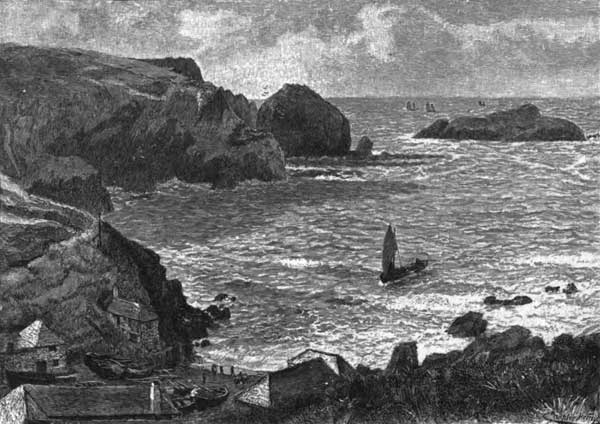
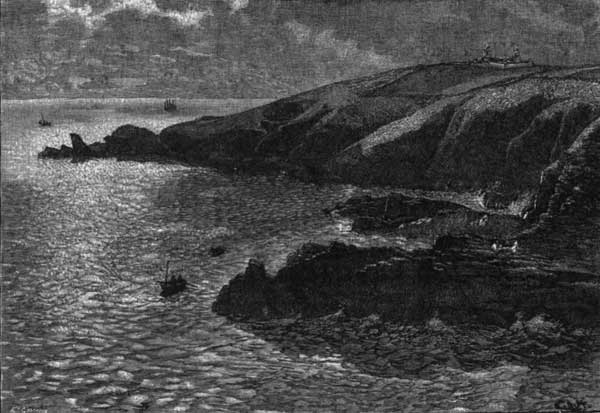
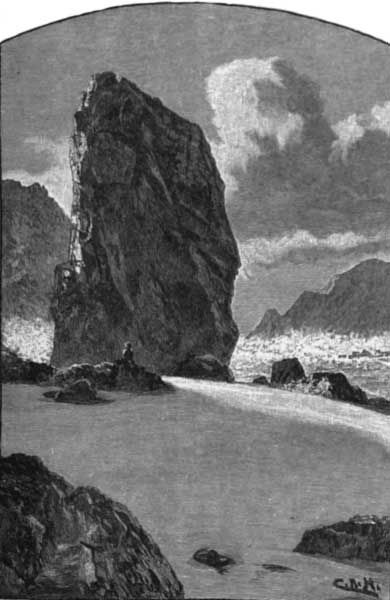
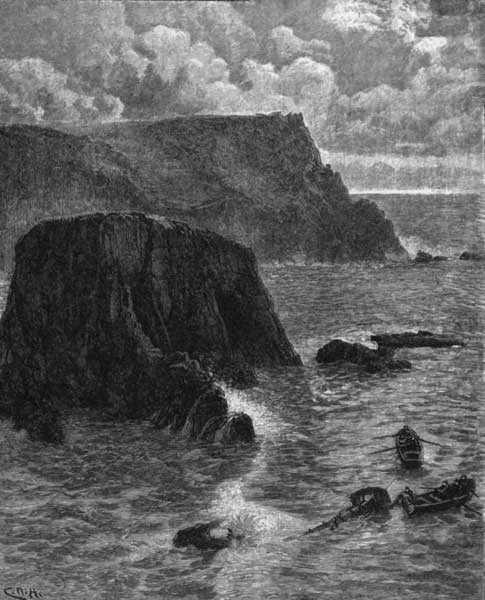
MULLION COVE, CORNWALL.
Nevertheless, in the midst of her distress, the benevolent lady stopped
to give me a helping hand into the near cave, a long, dark passage,
with light at either end. My girls had already safely threaded it and
come triumphantly out at the other side. But what with the darkness and
the uncertain footing over what felt like beds of damp seaweed, with
occasional stones, through which one had to grope every inch of one's
way, my heart rather misgave me, until I was cheered by the apparition
of the faithful Charles.
"Don't go back, ma'am, you'll be so sorry afterwards. I'll strike a
light and help you. Slow and steady, you'll come to no harm. And it's
beautiful when you get out at the other end."
So it was. The most exquisite little nook; where you could have
imagined a mermaid came daily to comb her hair; one can easily believe
in mermaids or anything else in Cornwall. What a charming dressing-room
she would have, shut in on three sides by those great walls of
serpentine, and in front the glittering sea, rolling in upon a floor of
the loveliest silver sand.
But the only mermaid there was an artist's wife, standing beside her
husband's easel, at which he was painting away so earnestly that he
scarcely noticed us. Very picturesque he looked, and she too, in her
rough serge dress, with her pretty bare feet and ankles, the shoes and
stockings lying in a corner as if they had not been worn for hours.
Why should they be? they were quite unnecessary on those soft sands,
and their owner stood and talked with me as composedly as if it were
the height of the fashion to go barefoot. And far more than anything
concerning herself, she seemed interested in my evident interest in the
picture, which promised to be a remarkably good one, and which, if I
see it on the R. A. walls next year will furnish my only clue to the
identity of the couple, or theirs to mine.
But the tide was fast advancing; they began to take down the easel, and
I remembered that the narrow winding cave was our only way out from
this rock-inclosed fairy paradise to the prosaic beach.
"Look, they are wading ashore up to the knees! And we shall have to
wade too if we don't make haste back."
So cried the perplexed mother of the six too-adventurous ducklings.
But mine, more considerate, answered me from the rocks where they were
scrambling, and helped me back through the cave into safe quarters,
where we stood watching the waders with mingled excitement and—envy?
Alas! I can still recall the delicious sensation of paddling across the
smooth sea-sand, and of walking up the bed of a Highland burn. But "Oh!
the change twixt Now and Then," I sat calmly on a stone, dry-shod; as
was best. Still, is it not a benign law of nature, that the things we
are no longer able to do, we almost cease to wish to do? Perhaps even
the last cessation of all things will come naturally at the end, as
naturally as we turn round and go to sleep at night?
But it was not night yet. I am proud to think how high and steep was
the cliff we re-ascended, all three of us, and from which we stood
and looked at sky and sea. Such a sea and such a sky: amber clear, so
that one could trace the whole line of coast—Mount's Bay, with St.
Michael's Mount dotted in the midst of it, and even the Land's End,
beyond which the sun, round and red, was just touching the top of the
waves. We should have liked to watch him drop below them—that splendid
sea-sunset of which one never tires, but we had some distance to walk,
and we began to rejoice in the prospect of Mary Mundy's tea.
"I'll go on ahead and have the carriage ready," said the ever
thoughtful Charles. "You can't miss your way, ladies. Just follow the
hedges"—that tempting aerial promenade, to which we were now getting
accustomed, becoming veritable Blondins in petticoats—"then cross the
cornfield; and take to the hedges again. You'll be at the farm-yard
directly."
Not quite—for we lingered, tempted by the abundance of corn-flowers,
of which we gathered, not handfuls but armfuls. When we reached
it, what a picture of an English farm-yard it was! With a regular
old-fashioned English milk-maid—such as Izaak Walton would have loved
to describe—sitting amidst her shining pails, her cows standing round
her, meekly waiting their turn. Sleek, calm creatures they were,
Juno-eyed and soft-skinned—of that peculiar shade of grey which I
have seen only in Cornwall. And, being rather a connoisseur in cows,
I have often amused myself to notice how the kine of each country
have their own predominant colour, which seems to harmonise with its
special landscape. The curious yellow tint of Highland cattle, the red,
white, or brown of those of the midland counties, and the delicate
grey of Cornish cows, alike suit the scene around them, and belong to
it as completely as the dainty little Swiss herds do to their Alpine
pastures, or the large, mild, cream-coloured oxen to the Campagna at
Rome.
But we had to tear ourselves away from this Arcadia, for in the midst
of the farm-yard appeared the carriage and Charles. So we jolted
back—it seemed as if Cornish carriages and horses could go anywhere
and over everything—to the Old Inn and Mary Mundy.
She had come home, and everything was right. As we soon found,
everything and everybody was accustomed to be put to rights by Miss
Mary Mundy.
She stood at the door to greet us—a bright, brown-faced little
woman with the reddest of cheeks and the blackest of eyes; I have no
hesitation in painting her portrait here, as she is, so to speak,
public property, known and respected far and wide.
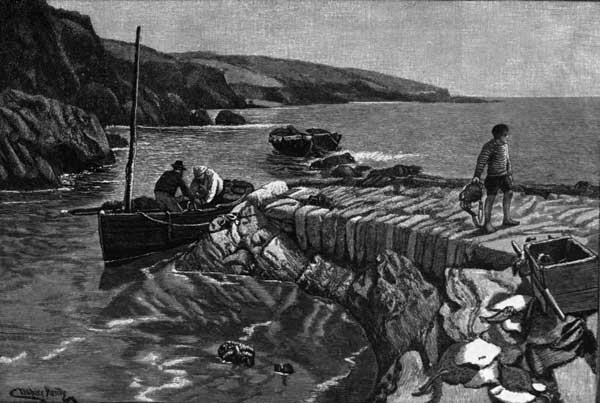
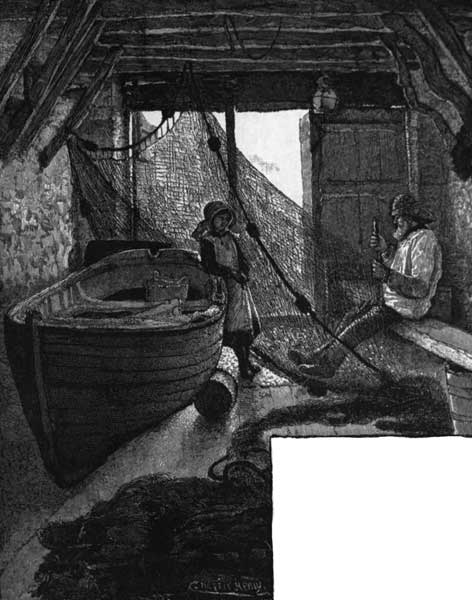
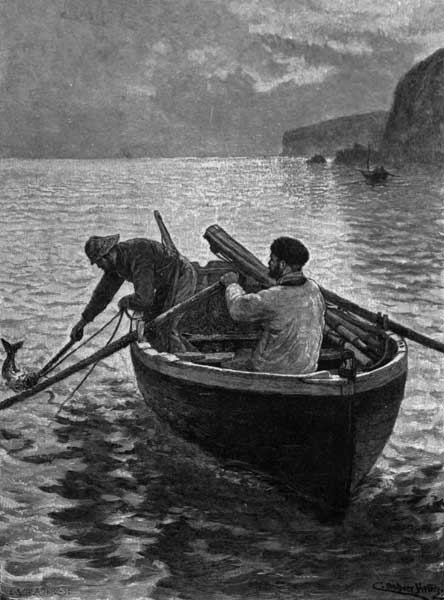
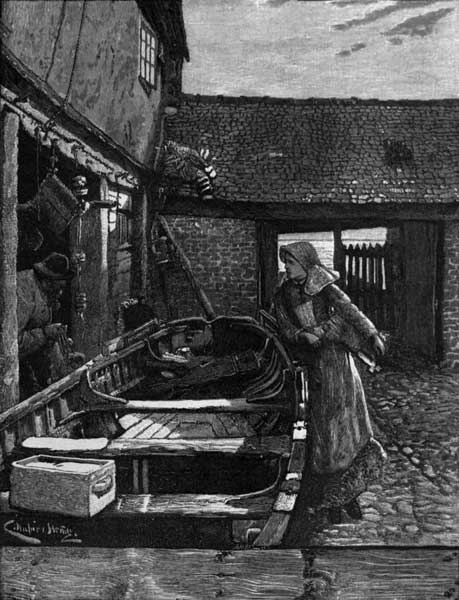
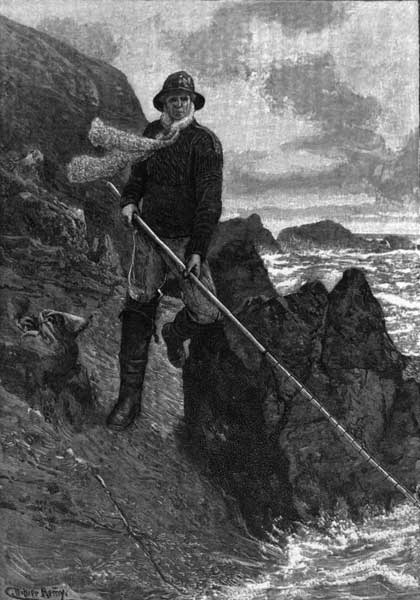
A CRABBER'S HOLE, GERRAN'S BAY.
"Delighted to see you, ladies; delighted to see any friends of the
Professor's; and I hope you enjoyed the Cove, and that you're all
hungry, and will find your tea to your liking. It's the best we can do;
we're very homely folk here, but we try to make people comfortable,"
and so on and so on, a regular stream of chatty conversation, given in
the strongest Cornish, with the kindliest of Cornish hearts, as she
ushered us into a neat little parlour at the back of the inn.
There lay spread, not one of your dainty afternoon teas, with two or
three wafery slices of bread and butter, but a regular substantial
meal. Cheerful candles—of course in serpentine candlesticks—were
already lit, and showed us the bright teapot full of that welcome drink
to weary travellers, hot, strong and harmless; the gigantic home-baked
loaf, which it seemed sacrilegious to have turned into toast; the rich,
yellow butter—I am sure those lovely cows had something to do with
it, and also with the cream, so thick that the spoon could almost have
stood upright in it. Besides, there was a quantity of that delicious
clotted cream, which here accompanies every meal and of which I had
vainly tried to get the receipt, but was answered with polite scorn,
"Oh, ma'am, it would be of no use to you: Cornish cream can only be
made from Cornish cows!"
Whether this remarkable fact in natural history be true or not, let me
record the perfection of Mary Mundy's cream, which, together with her
jam and her marmalade, was a refection worthy of the gods.
She pressed us again and again to "have some more," and her charge for
our magnificent meal was as small as her gratitude was great for the
slight addition we made to it.
"No, I'll not say no, ma'am, it'll come in handy; us has got a young
niece to bring up—my brother and me—please'm. Yes, I'm glad you came,
and I hope you'll come again, please'm. And if you see the Professor,
you'll tell him he's not forgotten, please'm."
This garniture of "please'm" at the end of every sentence reminded
us of the Venetian "probbedirla," per ubbedirla, with which our
gondolier Giovanna used to amuse us, often dragging it in in the oddest
way. "Yes, the Signora will get a beautiful day, probbedirla," or "My
wife has just lost her baby, probbedirla." Mary Mundy's "please'm"
often came in with equal incongruity, and her voluble tongue ran on
nineteen to the dozen; but her talk was so shrewd and her looks so
pleasant—once, no doubt, actually pretty, and still comely enough for
a middle-aged woman—that we departed, fully agreeing with her admiring
Professor that
"The brightest thing on Cornish land
Is the face of Miss Mary Mundy."
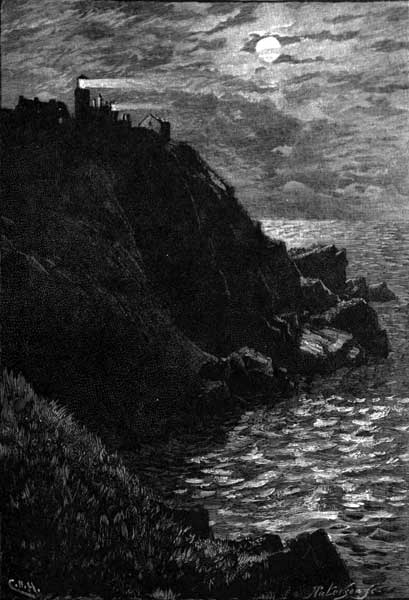
Recrossing Pradenack down in the dim light of a newly-risen moon,
everything looked so solitary and ghostly that we started to see moving
from behind a furz-bush, a mysterious figure, which crossed the road
slowly, and stood waiting for us. Was it man or ghost, or—
Only a donkey! A ridiculous grey donkey. It might have been Tregeagle
himself—Tregeagle, the grim mad-demon of Cornish tradition, once a
dishonest steward, who sold his soul to the devil, and is doomed to
keep on emptying Dozmare Pool, near St. Neots (the same mere wherein
Excalibur was thrown), with a limpet-shell; and to spend his nights in
other secluded places balancing interminable accounts, which are always
just sixpence wrong.
Poor Tregeagle! I fear some of us, weak in arithmetic, had a secret
sympathy for him! But we never met him—nor anything worse than that
spectral donkey, looming large and placid against the level horizon.
Soon, "the stars came out by twos and threes,"—promising a fine night
and finer morning, during which, while we were comfortably asleep,
our good horse and man would be driving across this lonely region to
Falmouth, in time to take the good people to church on Sunday morning.
"And we'll do it, too—don't you be anxious about us, ladies," insisted
Charles. "I'll feed him well, and groom him well. I likes to take care
of a good horse, and you'll see, he'll take no harm. I'll be back when
you want me, at the week's end, or perhaps before then, with some party
or other—we're always coming to the Lizard—and I'll just look in and
see how you're getting on, and how you liked Kynance. But take care of
the tide."
We thanked our kindly charioteer, bade him and his horse good-bye,
wished him a pleasant journey through the moonlight, which was every
minute growing more beautiful, then went indoors to supper—no! supper
would have been an insult to Mary Mundy's tea—to bed.