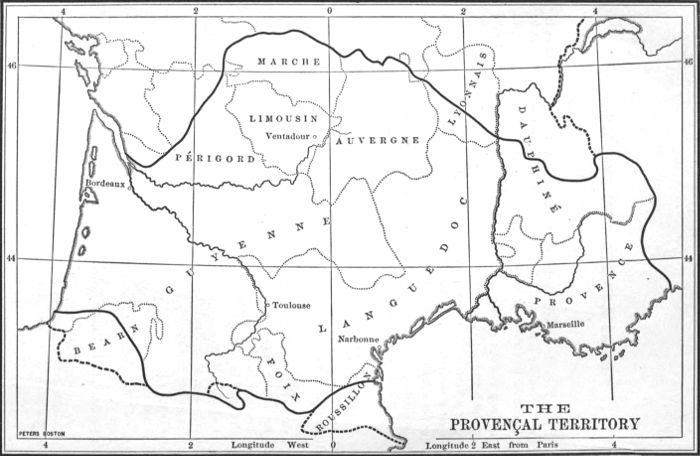
14. Inasmuch as Provençal, like the other Romance languages,
grew out of the Latin commonly spoken under the
Roman Empire, we must take this latter language as our
starting-point. The transformation was so gradual and continuous
that we cannot assign any date at which speech
ceases to be Latin and begins to be Provençal; since, however,
the various Latin dialects—destined to become later
the various Romance languages—began to diverge widely in
the 6th and 7th centuries, we may, for the sake of convenience,
say that the Latin period ends at about this time.
Before this, certain changes (which affected all the Romance
tongues) had occurred in the popular language, differentiating
it considerably from the classic Latin of the Augustan
writers. Although the most important of these alterations
have to do with inflections rather than with pronunciation,
the sound-changes in Vulgar Latin are by no means insignificant.
15. It is essential at the outset to distinguish “popular”
from “learned” words. The former, having always been a
part of the spoken vocabulary, have been subject to the
operation of all the phonetic laws that have governed the
development of the language. The latter class, consisting of
words borrowed by clerks, at various periods, from Latin
books and from the Latin of the Church, is naturally exempt
from sound-changes that occurred in the vulgar tongue before
the time of their adoption. The form of learned words
depends, in the first place, on the clerical pronunciation of
Latin at the date of their borrowing; then, if they came into
general use, their form was subject to the influence of any
phonetic laws that were subsequently in force. The fate of
borrowed terms differs, therefore, according to the time of
their introduction and the degree of popularity which they
afterwards attained.
16. The place of the primary accent, which in Classic
Latin was determined by quantity, remained unchanged in
Vulgar Latin even after quantitative distinctions were lost.
A short vowel before a mute followed by a liquid may, in
Classic Latin, be stressed or unstressed; in Vulgar Latin it
is usually stressed: cathédra, tenébræ.[14]
There are some exceptions to the rule of the persistence of
the accent in Vulgar Latin:—
1. An accented e or i immediately followed by the vowel of the
penult transfers the stress to this latter vowel, and is itself changed to y:
filíŏlus > filyólus, mulíĕrem > mulyére. This shift is perhaps due to a
tendency to stress the more sonorous of two contiguous vowels.
2. An accented u immediately followed by the vowel of the penult
transfers the stress to the preceding syllable, and is itself changed to w:
habúĕrunt > ábwerunt, tenúĕram > ténwera. This shift cannot be explained
on the same principle as the foregoing one; it is perhaps due in
every case to analogy—hábuit, ténui, for instance, being responsible for
the change in habúerunt, tenúeram.
3. Verbs compounded with a prefix, if their constituent parts were
fully recognized, were usually replaced in Vulgar Latin by a formation in
which the vowel and the accent of the simple verb were preserved: défĭcit
> disfácit, réddĭdi > reddédi, rénĕgo > renégo, réquĭrit > requærit. In
récĭpit > recípit the accent but not the vowel was restored, speakers having
ceased to associate this verb with capio. In cóllĭgo, érĭgo, éxĕo, ínflo the
composite nature of the word was apparently not recognized.
4. The adverbs ĭllāc, ĭllīc accented their last syllable, by the analogy
of hāc, hīc.
17. In Provençal the primary accent falls on the same
syllable as in Vulgar Latin: bonitātem > V. L. bonitáte > Pr.
bontát, compŭtum > V. L. cómputu > Pr. cónte; cathĕdra > V. L.
catédra > Pr. cadéira; filiŏlus > V. L. filyólus > Pr. filhóls,
tenuĕram > V. L. ténwera > Pr. téngra, requĭrit > V. L. requærit
> Pr. requér, illac > V. L. illác > Pr. lai.
1. Some learned words have an irregular accentuation, apparently due
to a mispronunciation of the Latin: cándĭdum > quandí, grammátĭca >
gramatíca, láchry̆mo > lagrím, spírĭtum > esprít (perhaps from the formula
spirítui sancto). Others were adopted with the correct stress, but shifted
it later: fábrĭca > fábrega > fabréga (and fárga), fémĭna > fémena > feména
(and fémna), láchry̆ma > lágrema > lagréma, sémĭnat > sémena >
seména (and sémna), vírgĭnem > vérgena > vergína (and vérge).
2. Dimércres < dīe Mercūrī (perhaps through ✱dīe Mércŏris) has evidently
been influenced by divénres < dīe Vĕnĕris.
3. Some irregularities due to inflection will be discussed under Morphology.
18. The secondary accent, in Vulgar Latin, seems not to
have followed the Classic Latin quantitative rule, but to have
fallen regularly on the second syllable from the primary
stress: cṓgĭtó, cupĭ́dĭtā́tem. If this secondary accent followed
the tonic, its vowel probably developed as an unstressed
post-tonic vowel; if it preceded, its vowel was apparently
treated as a stressed vowel. This treatment was doubtless
continued in Provençal until the intertonic vowel dropped
out: cógĭtó cógĭtánt > cug cúian (cf. cánto cántant > can cántan),
✱comĭnĭtĭāre > comén’tiáre > coménzár > comensár. As may be
seen from this last example, after the fall of the intertonic
vowel, the secondary stress, being brought next to the primary,
disappeared, and its vowel was henceforth unaccented.
Cf. § 45, 1.
19. Short, unemphatic words had no accent in Vulgar
Latin, and were attached as particles to the beginning or the
end of another word: te vídet, áma me. Such words, if they
were not monosyllabic, tended to become so; a disyllabic
proclitic beginning with a vowel regularly, in Vulgar Latin,
lost its first syllable: illum vídeo > V. L. lu véyo > Pr. lo vei.
A word which was used sometimes independently, sometimes
as a particle, naturally developed double forms.
20. Latin had the following vowels, which might be long
or short: a, e, i, o, u. The diphthongs, æ, œ, au, eu, ui, were
always long: æ and œ, however, were simplified into monophthongs,
mainly in the Republican epoch, æ being sounded ę̄,
œ probably ẹ̄; au retained (save in some popular dialects) its
old pronunciation; eu did not occur in any word that survived;
ui, in cui, illui, in Vulgar Latin, was accented úi (as
in fui). The simple vowels, except a, were, doubtless from
early times, slightly different in quality according to their
quantity, the long vowels being sounded close, the short
open: ẹ̄, ị̄, ọ̄, ụ̄; ę̆, į̆, ǫ̆, ų̆.
21. Between the 1st and the 7th century of our era, the
Classic Latin quantity died out: it had apparently disappeared
from unstressed vowels as early as the 4th century,
from stressed by the 6th. It left its traces, however, as we
have seen, upon accentuation (§ 16), and also upon vowel
quality, the originally long and short remaining differentiated
in sound, if they were accented. Of the unaccented vowels,
only i shows sure signs of such a differentiation, and even for
i the distinction is evident only in a final syllable: vēnī vēnĭt
> vẹnị vẹnįt.
22. The vowels of Vulgar Latin are a, ẹ, ę, ị, į, ọ, ǫ, ụ, ų,
with the diphthongs áu and úi; the old æ and œ had become
identical in sound with ę and ẹ. As early as the 3d century
of our era, į was changed, in nearly all the Empire, to ẹ, and
thus became identical with the vowel coming from original ē.
A little later, perhaps, ų, in the greater part of the Empire,
became ọ, thus coinciding with the vowel that was originally
ō. Ypsilon, in words taken from the Greek, was identified, in
early borrowings, with Latin u; in later ones, with Latin i:
βύρσα > Pr. borsa, γῠρος > Pr. girs. Omicron, which apparently
had the close sound in Greek, generally (but not always)
retained it in recently borrowed words in Vulgar Latin: τόρνος
> tọrnus (cf. Pr. tọrn), but κόλαφος > cŏlăphus = cọlapus or
cǫlapus (cf. Pr. cǫlp).
The development of the Vulgar Latin vowels in Provençal
will now be examined in detail:—
a
23. Cl. L. ā, ă > V. L. a > Pr. ą: ărbŏrem > ąrbre, grātum
> grąt, măre > mąr.
1. The ending -arius shows an irregular development in French and
Provençal, the Provençal forms being mainly such as would come from
-ĕrius; as in parlier, parleira. In the earliest stage we find apparently
-ęr´ and -ęr´a; then -ęr´ and -ęir´a; next -ęr, -ięr and -ęira, -ięira;
finally, with a reciprocal influence of the two genders, -ęr, -ięr, -ęir, and
-ęra, -ięra, -ęira, -ięira: caballarium > c(h)avaler -ier, -eir, ✱man(u)aria
> manera -iera -eira -ieira. The peculiar treatment of this suffix has
not been satisfactorily explained. See E. R. Zimmermann, Die Geschichte
des lateinischen Suffixes -arius in den romanischen Sprachen, 1895;
E. Staaff, Le suffixe -arius dans les langues romanes, Upsala, 1896, reviewed
by Marchot in Zs., XXI, 296, by Körting in Zeitschrift für französische
Sprache, XXII, 55; Meyer-Lübke, Gram., I, 222, § 237; Zimmermann
in Zs., XXVI, 591; Thomas in Rom., XXXI, 481 and in Bausteine
zur romanischen Philologie, 641. The likeliest theory is that of
Thomas: that -arius was associated with the Germanic ending -ari and
participated in the umlaut which affected the latter; cf. Phon., pp. 34-36.
2. In Gascony and Languedoc ei is used for ai < habeo. The ei perhaps
developed first as a future ending (amar -ei) by analogy of the preterit
ending -ei (amei): see Morphology, §§ 152, 1, 162, (4), 175, (4), where
this latter ending is discussed also. For a different explanation, see
Meyer-Lübke, Gram., I, 222, § 237.
3. A few apparent irregularities are to be traced to the vocabulary of
Vulgar Latin. For instance, Pr. sereisa represents, not Cl. L. cĕrăsus, but
V. L. cĕrĕsĕa: see Meyer-Lübke, Einf., § 103. Uebre is from ✱ŏpĕrit, or
apĕrit modified by ✱cŏpĕrit = cōperit. Voig is from ✱vŏcĭtum = vacuum:
Einf., § 114.
4. Such forms as fontaina = fontana < fontāna, etc., and tres = tras <
trans, etc., are French or belong to the borderland between French and
Provençal.
24. In some dialects, particularly in Rouergue, Limousin,
Auvergne, and Dauphiné, a became ạ before a nasal, and at
the end of a monosyllable or an oxytone: canem > cạn, grandem
> grạnt, cadit > cạ, stat > estạ.
1. The conditions differ somewhat in the various dialects, according
as the nasal consonant falls or remains, and is followed by another consonant
or not. In Limousin the sound is ą before an n that cannot fall:
see § 11, (5). In Rouergue and in Dauphiné, ạ appears before all nasals.
The poets generally follow the Limousin usage. See F. Pfützner, Ueber
die Aussprache des provenzalischen A, Halle, 1884.
ẹ
25. Cl. L. ē, ĭ, œ > V. L. ẹ > Pr. ẹ: habēre > avẹr, mē > mẹ,
mensem > mẹs, plēnum > plẹn, rēgem > rẹi, vēndĕre > vẹndre;
ĭnter > ẹntre, fĭdem > fẹ, malĭtia > malẹza, mĭnus > mẹns, mĭttĕre
> mẹtre, sĭccum > sẹc, vĭrĭdem > vẹrt, pœna > pẹna.
1. Some words have ę instead of ẹ:—
(a) The ending -ētis in the present indicative becomes -ętz through
the analogy of ętz < ĕstis.
(b) Camęl (also ẹ), candęla (also ẹ), cruzęl, fizęl (also ẹ), maissęla have
ę through the analogy of the suffix -ęl < -ĕllus. In camel the substitution
probably goes back to Vulgar Latin.
(c) Many learned words, including proper names, have ę for ẹ: decręt,
Elizabęt, Moysęs, pantęra, requięs, secręt (ẹ), sencęr.
(d) Espęr for espẹr < spēro, quęt for quẹt < qu(i)ētum are perhaps bad
rhymes. Bartolomeo Zorzi, a Venetian, rhymes -ẹs with -ęs; in Catalan
these two endings were not distinguished.
(e) Individual cases: adęs, ‘at once,’ probably from ad id ĭpsum, seems
to have been affected by pręs and apręs < ad prĕssum; mostięr < monastērium
shows the influence of ministĕrium; nęr nięr (also nẹr nẹgre) <
nĭgrum perhaps shows the influence of entęr entięr and the numerous
adjectives in -ęr -ięr; nęu nięu nęy < nĭvem has been attracted by bręu
gręu, lęu; senęstre (cf. late Lat. sinexter) is evidently influenced by dęstre.
2. Many words have i instead of ẹ:—
(a) Berbitz = vervēcem, camis = camĭsia, come from alternative V. L.
forms, berbīcem, ✱camīsia. Planissa (also -eza), sebissa, etc., probably
show -īcia for -ĭtia. For dit = dĭgĭtum see § 65, Y, 1.
(b) In many learned words Latin ĭ is represented by i in Provençal:
albir, martire, edifici, iuzizi, servizi, vici, etc.; iusticia, leticia, tristicia, etc.
Aurilha (also ẹ) < aurĭcula, cilh, (also cieilh, sobreselhs) < cĭlium, issilh <
exĭlium, familha < famĭlia, maístre (also maẹstre maiẹstre) < magĭstrum,
meravilha (also ẹ) < mirabĭlia, perilh < perĭculum, etc., are probably
learned forms. Máistre and mestre are French.
(c) Ciri (cere) = cēreum, iure (cf. ebriac) = ēbrium (or ✱ĕbrium), marquis
(ẹ), merci (ẹ), país (ẹ) = ✱pagēnsem, plazir (ẹ), pris (ẹ), etc., are
French.[15] For a discussion of iure and a different explanation of ciri,
see P. Savj-Lopez, Dell’ “Umlaut” provenzale, 1902, p. 4.
(d) Ins (also entz) < ĭntus, dins (also dens) < de ĭntus, dintre (cf. en,
entre) < de ĭnter have not been satisfactorily explained. Regular forms
with ẹ are found in Béarn, Gascony, Dauphiné, and the Alps.
(e) Individual cases: tapit < ταπήτιον shows the modern pronunciation
of Greek η; verin = venēnum is an example of substitution of suffix.
3. Arnei, fei, mei = me, palafrei, perquei, sei = se are French or Poitevin
forms; they are common in William of Poitiers. Mercey, rey = re,
used by Marcabru, seem to be due either to an imitation of such forms
as the preceding or to the analogy of crei cre < crēdo. Cf. § 65, N, 3.
4. Contránher seems to be a fusion of constrĭngere and contrahere; vendanha
< vindēmia shows French influence.
26. An ẹ in hiatus became i: lĭgat > lia, vĭa > via.
27. When there was in the next syllable a final ī, V. L.
ẹ was changed in Provençal to i: ecc’ĭllī > cilh, ecc’ĭstī > cist,
fēcī > fis, ✱prēsī > pris, ✱vēnuī > vinc, vigĭntī ✱vĭntī > vint.
1. In the nominative plural of masculine nouns and adjectives this
change was regularly prevented by the analogy of the singular and the
accusative plural: mĭssī > mes, plēnī > plen. We find, however, cabil <
capĭllī.
2. Dec for ✱dic < dēbuī seems to have been attracted by the dec <
dēbuit of the third person. Venguest for venguist < ✱venuĭstī is due both
to the influence of the plural forms venguem, venguetz and to the analogy
of the weak preterits, such as cantest, vendest.
ę
28. Cl. L. ĕ, æ > V. L. ę > Pr. ę: infĕrnum > enfęrn, fĕrrum
> fęr, pĕdem > pę; cælum > cęl, quærit > quęr.
1. Such forms as glisia, lire, pire, pis, profit are French. Profich may
be a cross between profieg and profit, or it may be due to the analogy of
dich.
2. Cossint, mint, sint, used by Arnaut Daniel, are perhaps faulty
rhymes.
3. Auzil < avicĕllī, in the Boeci, may be due to the analogy of such
plural forms as cabil < capĭllī, il < ĭllī, etc. Briu, sometimes used for
breu < brĕvem, is evidently connected with abrivar, ‘hasten,’ the origin of
which is uncertain. Elig shows the influence either of eligir (beside
elegir) or of dig. Ginh = genh < ingĕnium evidently follows ginhos < ingeniōsus
and its derivatives. Isme (esme) is a post-verbal noun from
✱ismar (cf. azismamen), a dialect form of esmar < æstimare. Quis <
✱quæsi, tinc < tĕnui are due to the analogy of pris < ✱prēsī, vinc < ✱vēnuī.
4. Beside nęula < nĕbula, we find nebla, neble, presumably from the
same source, and also nible, niól, nióla, niúl, niúla, nivól. According to
Nigra, Archivio glottologico italiano, XV, 494, nūbes > nūbĭlus > ✱nĭbŭlus
(and ✱nĭbūlus?), whence might be derived ✱níŭlus ✱niúlus, which would
account for niól-a, niúl-a, and perhaps for a ✱nívol > nivól. Nible might
be regarded as a cross between neble and niul. Cf. § 38, 3.
5. In ẹs < ĕst the ẹ probably comes from such combinations as mẹ’s,
quẹ’s, understood as m’ẹs, qu’ẹs. Espẹlh < spĕculum shows the influence
of cossẹlh, solẹlh. Estẹla presupposes a Latin ✱stēla or ✱stēlla for stĕlla:
cf. the Fr. and It.
6. Plais, ‘hedge’ seems to be a cross between plĕxus and paxillus,
‘fence.’ Vianda (< vivenda?) is probably French.
7. Volon < volentem shows the influence of the ending -ŭndus.
8. Greuga < con-gregar has been influenced by greu < ✱grĕvem = gravem
influenced by lĕvem. Cf. grey < grĕgem.
29. Before a nasal, in most of the dialects of Limousin,
Languedoc, and Gascony, ę became ẹ: bĕne > bẹn, dicĕntem >
dizẹn, tĕmpus > tẹms, tĕnet > tẹn, vĕniam > vẹnha, vĕntum >
vẹnt.
30. Early in the history of Provençal, before u, i, or one of
the palatal consonants l´, r´, s´, z´, y, tš, dž, an ę broke into ię,
except in a few dialects of the west and north: dĕus > dięus,
mĕum > mięu; amāvi > ✱amai > amęi amięi,[16] ✱fĕria > fięira,
✱ec(c)lĕsia? (Cf. Zs., XXV, 344) > glięiza, lĕctum > lięit,
pĕjus > pięis; vĕtŭlum vĕclum > vięlh, ministĕrium > mestięr,
✱ec(c)lĕsia? > glięza, mĕdia > mięia, lĕctum > lięg. There
seems to be also, at least in some dialects, a tendency to
break the ę before a g or a k: lĕgunt > lięgon; ✱sĕquit > sęc
sięc, subjunctive sięgas (sęga), but infinitive sęgre < ✱sĕquere.[17]
The breaking was probably due to a premature lifting of
the tongue under the influence of a following high vowel or a
palatal (or velar) consonant.[18] Before u it occurred everywhere
except in the extreme west; before palatals the ę apparently
remained intact both in the extreme west and in
Quercy, Rouergue, Auvergne, and Dauphiné. At first, no
doubt, the diphthong was less marked than it became in the
12th and 13th centuries. It is not indicated in our oldest
text, the Boeci (breu, deu, eu, mei, meler, vel)[19], and it frequently
remains unexpressed even in the writings of the
literary period.
It is to be noted that ę does not break before u < l nor
before i < ð: bĕllus > bęls > bęus, pĕtra > ✱pęðra > pęira,
Pĕtrum > ✱Pęðre > Pęire, rĕtro > ✱ręðre > ręire[20]. The breaking
must, therefore, have occurred before these developments
of l and ð, both of which apparently antedate the Boeci: cf.
euz = els, v. 139; eu = el, v. 155; Teiric < ✱Teðric < Theodorīcum,
v. 44, etc. On the other hand, there is no diphthong
before ts, dz, s, z coming from Latin c´, cy, pty, tty, ty:
dĕcem > dętz, pĕttia (or pĕcia) > pęssa, nĕptia > nęssa, ✱prĕtiat
> pręza, prĕtium > prętz[21]. The breaking, therefore, took
place after these consonants had ceased to be palatal. We
may ascribe it with some confidence to the period between
the seventh and tenth centuries.
1. A number of cases of ię before r are doubtless to be explained by
analogy. Hĕri > ęr; autre + er > autręr, which, through the influence of
adjectives in -ęr -ięr, became autrięr: hence the form ięr. Fĕrio, mĕreo
> fięr, mięr; hence, by analogy, the first person forms profięr, quięr, then
the third person forms fięr, mięr, profięr, quięr, sięrf (but sęrvon, sęrva),
and the subjunctives ofięira, sofię(i)ra.
2. Ięsc (= ĕxeo), ięscon, ięsca receive their diphthong either from
earlier forms with s´ or from ięis < ĕxit.
ị
31. Cl. L. ī > V. L. ị: amīcum > amịc, fīnem > fịn, trīstem
> trịst.
1. Frẹg, frẹit are from V. L. ✱frĭgdum = frīgĭdum, the ĭ being perhaps
due to the analogy of rĭgĭdum.
32. In the 13th century or earlier the group iu, in most
dialects, became ieu: captīvum > caitiu caitieu, æstīvum >
estiu estieu, revīvĕre > reviure revieure, sī vās > sius sieus.
ọ
33. Cl. L. ō, ŭ > V. L. ọ > Pr. ọ, which developed into ụ
probably during the literary period: dolōrem > dolọr, spōnsa >
espọsa, flōrem > flọr; bŭcca > bọca, gŭla > gọla.
1. An irregular ǫ, which is found in some words, goes back to Vulgar
Latin: cǫbra = re-cŭperat, cǫsta (also ọ) = cōnstat, nǫra = nŭra, ǫu =
ōvum, plǫia = plŭvia, redǫbla = ✱redŭplat, sǫbra = sŭperat, suefre = sŭffero.
V. L. ✱cŏperat may be regarded as a fusion of cŭperat and ✱cŏperit
(§ 40, 1; cf. Rom. XXXI, 9); ✱cŏstat is unexplained; ✱nŏra shows the influence
of sŏror and sŏcĕra; the ŏ of ✱ŏvum has been explained as due to
differentiation from the following v; ✱plŏia is to be connected with the
popular plŏvĕre (cf. Meyer-Lübke, Einf., § 142); ✱sŏperat follows the
analogy of ✱cŏperat; ✱sŏffero evidently follows ŏffero. Redǫbla (also ọ)
is not accounted for. If trǫba has anything to do with tŭrbat, it was perhaps
influenced by prŏbat (cf. Zs., XXVIII, 50). Engǫissa < V. L.
✱angŏstia = angŭstia. See A. Thomas, Nouveaux essais de philologie
française, 1904, 339.
2. Some words have ü: iüs (also iọs) < deōrsum shows the influence
of süs < sūrsum; lür (usually lọr) < illōrum (cf. lur in the dialects of
Navarre and Aragon) comes through an ✱illūrum due to the analogy of
illūi = illi; melhüra (ọ), peiüra (ọ) perhaps follow aüra < ✱a(u)gūrat;
rancüra is a mixture of rancōrem and cūra; üis is from V. L. ūstium =
ōstium (cf. Zs., XXV, 355); üpa < ŭpŭpa is due to onomatopœia.
3. The adverbs ar, ara, er, era, eras, meaning ‘now,’ are hardly to be
connected with hōra. Meyer-Lübke takes era, etc., from a Latin ✱era
corresponding to Greek άρα; ara, ar may come directly from άρα, άρ:
cf. Gr., III, 552, note.
4. Tonleu, ‘tariff,’ from τελώνιον, shows double metathesis. For
adoutz, ‘fount,’ see A. Thomas, Essais de philologie française, 1897, 205.
34. Before tš, dž (and it, id), before n´, and before final i,
an ọ becomes ü in various dialects: cōgĭtat > cüia cüida,
✱stŭdiat > estüia, fŭgit > füg, refŭgium > refüg; jŭngĕre >
iünher, ŭngĕre > ünher, pŭgnum > pünh; dŭī > düi, sŭm > sọ
+ i > süi. The ü before tš, dž apparently occurs everywhere
except in Dauphiné; before n´ it is to be found in nearly all
the dialects of the north and west; before final i it seems to
be limited to Bordeaux, Auvergne, and a part of Languedoc.
ǫ
35. Cl. L. ŏ > V. L. ǫ > Pr. ǫ: cŏr > cǫr, cŏrpus > cǫrs,
mŏrtem > mǫrt, ŏpĕra > ǫbra, rŏta > rǫda.
1. For demọra (also ǫ) < ✱demŏrat, see Meyer-Lübke, Gram., I, 204,
§ 220. For prọa (also prǫa, prueva) < prŏbat, see Rom., XXXI, 10, footnote
3.
36. Before a nasal, in most of the dialects of Limousin,
Languedoc, and Gascony, ǫ became ọ: bŏnum > bọn, fŏntem
> fọnt, pŏntem > pọnt. Cf. E. Levy in Mélanges de philologie
romane dédiés à Carl Wahlund, 1896, p. 207.
1. If the nasal was n´, the vowel remained open in most or all of these
dialects: cŏgnĭta > coinda cuenda cuenhda, lŏnge > lonh luenh, sŏmnium >
sonh suenh.
37. Early in the history of Provençal, before u, a labial
consonant, a g or a k, an i, or one of the palatal consonants
l´, n´, r´, s´, z´, y, tš, dž, an ǫ broke, in most dialects, into a
diphthong which developed into ue, üo, üe, or ü[22]: bŏvem >
bǫu büọu büeu, ✱ŏvum > ǫu üou üeu, nŏvus > nǫus nüous
nüeus; ✱cŏpero > cǫbri cüebre[23], nŏva > nǫva nüeva, ŏpus >
ǫps üops, prŏbat > prǫa prüeva, ✱trŏpo? > trǫp trüeb; cŏquus
> cǫcs cüocs cüex, fŏcum > fǫc füoc füec füc, crŏcus > grǫcs
grüocs grüecs, jŏcum > iǫc iüoc iüec iüc, lŏcus > lǫcs lüocs
lüecs, lŏcat > lüoga, pŏtui > püec, sŏc(ĕ)rum > (sǫzer) sǫgre
süegre (fem. süegra); ✱ingrŏssiat > engrǫissa engrüeissa, ✱angŏstia
> engǫissa engüeissa, nŏctem > nǫit nüoit nüeit, ŏcto >
ǫit üeit, pŏstea > pǫissas püeissas, prŏximus > prǫymes prüeymes;
fŏlia > fǫlha füolha füelha fülha, ŏcŭlus ŏclus > ǫlhs
üolhs üelhs ülhs, lŏnge > lǫnh lüenh, sŏmnium > sǫnh süenh,
cŏrium > cǫr cüer, pŏstea > pües, prŏximum > prǫsme prüesme,
✱plŏia > plǫia plüeia plüia, ✱inŏdiat > enǫia enüeia enüia,
✱pŏdiat > pǫia püeia püia, nŏctem > nüoch nüech nüh, ŏcto >
üeg.
The breaking was probably due to a premature lifting of
the tongue under the influence of a following high vowel or a
palatal or velar consonant, or to a premature partial closure
of the lips in anticipation of a following labial. Before i or a
palatal the diphthong was at the start presumably üo; before
u or a labial or velar consonant, uo: from these two types,
the first of which influenced the second, came the later developments.
Ü is a reduction of üo or üe; it apparently does
not occur before u.
The dialect conditions are mixed, the development in each
region depending somewhat on the following sound. In the
southwest, ǫ and ue seem to prevail; in the northwest, ü; in
the west, in Limousin, and in Auvergne, üe; in Languedoc,
üo; in the east and south, üe, üo, ǫ.
The date of breaking is discussed in § 30.
1. In some words where a diphthong would be expected, none is found,
although it may have existed: mǫu < mŏvet, nǫu < nŏvem, plǫu < ✱plŏvit;
trǫp < þrop; brǫcs < ✱brŏccus, iǫgon < jŏcunt, lǫgui < lŏco. The form
püoc or püec < pŏtui is regularly reserved for the first person, pŏtuit being
represented by pǫc.
2. A few cases of irregular breaking are easily explained: püosc püesc
(= pŏssum) and püosca püesca (= pŏssim) owe their diphthong either to
earlier forms with s´ or to the analogy of püec; sǫfre süefre süfre (= sŭffert)
are from ✱sŏfferit, formed upon ✱ŏfferit = ŏffert (cf. § 33, 1); vüelc
(= vŏlui) follows the analogy of vüelh (< ✱vŏleo = vŏlo) and of püec.
ụ
38. Cl. L. ū > V. L. ụ > Pr. ü: ✱habūtus > avütz, jūstum >
iüst, mūrum > mür, mūtus > mütz, nūdus > nütz, plūs > plüs.
The date of the change of ụ into ü is not known; there is
no ü in Catalan, and there may have been none in early
Gascon. It seems likely that the Celts, when they adopted
Latin, pronounced ū a little further forward in the mouth
than did the Romans; that their ụ continued to advance
gradually toward the front of the mouth until it became ü;
and that this ü spread to the parts of France that were not
originally Celtic.[24] In the literary period the sound was probably
ü in most or all of the Provençal dialects.
1. Pr. ọnze represents a V. L. ✱ŭndĕcim, which in Gaul and Spain replaced
ūndĕcim. Lọita lücha, trọcha trücha probably go back to Latin
double forms, ✱lŭcta lūcta, ✱trŭcta trūcta.
2. Nǫssas < ✱nŏptias = nūptias, by analogy of ✱nŏvius, ‘bridegroom,’
from nŏvus.
3. Before u, Pr. ü apparently became i: nūbem > ✱nüu > niu, pūlĭcem
> ✱püuze > piuze. See §§ 63, (4); 74, (2).
au
39. Cl. L. au > V. L. au > Pr. au: aurum > aur, gaudium >
gaug, paucum > pauc, thesaurus > tesaurs.
1. Bloi < blauþr, ioi, ioia, ioios, lotia < ✱laubja, noiza, onta < hauniþa,
or, sor, tesor, etc., are French or Poitevin; ioi is a good Poitevin form.
Iai, ‘joy,’ seems to be a fusion of ioi and Pr. iai = gai.
2. Anta < hauniþa is unexplained.
40. (1) The fate of an unaccented vowel depended largely
upon the syllable in which it stood: in general, unstressed
vowels in the initial syllable remained intact, while all vowels,
except a, fell (at different dates) in the other syllables. The
fall of unaccented vowels resulted in many new consonant
groups: collocáre > colcár, hóminem > ómne, sábbatum > sápte.
(2) The vowels e̯ and i̯, instead of falling or remaining
unchanged, became y in Vulgar Latin, early in our era: alea
> alya, diŭrnus > dyųrnus, mĕdium > mędyu. Similarly u̯
became w: placui > placwi, tĕnuis > tęnwis.
1. Apparently, however, e̯é, i̯é > e; o̯ó, u̯ó > o: prĕhĕndĕre > prĕndĕre;
abĭĕtem > ✱abētem, facĭēbat > ✱facēbat, parĭĕtem > parētem, quĭētus >
quētus; cŏhŏrtem > cōrtem, cŏŏpĕrit > cōpĕrit ✱cŏpĕrit; dŭŏdĕcim > ✱dōdĕcim.
The short e and o in prĕndĕre and ✱cŏpĕrit are not accounted for.
In mulĭĕrem[25] > Pr. molhęr the i̯ remained long enough (perhaps under
the influence of the nominative mŭlier) to palatalize the l.
Initial Syllable.
41. Usually, in the literary language, Latin a > Pr. a; Latin
æ, œ, and e, i (without regard to quantity) > Pr. e; Latin
o, u (long or short) > Pr. o; Lat. au > Pr. au, unless the next
syllable contained an ú, in which case the au was reduced (in
the Vulgar Latin time) to a. Ex.: amīcum > amic, caballus
> cavals; æquālem > egal, ✱pœnĭtĕre > penẹdre, dēbēre > devẹr,
mĕliōrem > melhọr, dīlĕctum > delęit, dīvīnum > devin, dīvīdĕre
> devire, fīnīre > fenir, mĭnōrem > menọr; plōrāre > plorar,
sōlātium > solatz, cŏlōrem > colọr, ✱vŏlēre > volẹr, mūstēla >
mostẹla, sŭbĭnde > sovẹn; aucĕllum > auzęl, audīre > auzir,
augŭstum > aọst, ✱augūrium > aür.
1. An initial vowel is occasionally lost, either through elision with the
article (✱eclĕsia > ✱eglęisa, la eglęisa > la glęisa) or through the dropping
of a prefix (ingĕnium > engẹnh gẹnh): epĭscŏpus > bisbes, alauda >
lauzeta, occasiōnem > ocaiso caiso.
2. In a few words the vowel of the initial syllable disappeared, for
some unknown reason, before r in Vulgar Latin: ✱cŏrrŏtŭlāre > ✱crŏtŭlāre
> crollar, dīrēctus > drēctus[26] > dreitz, quĭrītāre > ✱crītāre > cridar.
3. Domne, used familiarly as a proclitic (§ 19), lost its first syllable,
and, before a vowel, was reduced to n. The combinations de n, que n
(followed by a proper name) were understood as d’en, qu’en; hence the
title en, ‘Sir.’ See Schultz-Gora in Zs., XXVI, 588; Elise Richter in
Zs., XXVII, 193; V. Cescini, Manualetto provenzale, 2d ed., 1905, 168 ff.
4. The proclitic ọ probably comes from a V. L. ot, not from aut.
42. The vowel of the initial syllable, especially in verbs,
was extremely subject to the influence of analogy: cülhir (ǫ)
through cülh (ǫ) < cŏllĭgit, dizẹn < dīcĕntem through dire <
dīcĕre, dürar through dür < dūrum and düra < dūrat, finir
through fin < fīnem, fivęla through fibla < fībula, puęiar (ǫ)
through puęia (ǫ) < ✱pŏdiat.
1. Avangęli (e) is perhaps influenced by avan; blisọ (e) < blas may possibly
have been influenced by tiso; gazardọ < wiðarlôn shows the influence
of gazanhar; in piucęla (pülcęla) < ✱pūellicĕlla (Zs., XXV, 343) the
püu of the first syllable was changed to piu just as pūlĭcem became piuze
(see § 38, 3); in vas = ves < ve(r)sus the a is due to the analogy of az <
ad; vais is unexplained, vaus follows daus (§ 44, 6). If dessẹ is from de
exín, the first syllable is irregular. Beside maniar < manducare are unexplained
forms meniar miniar. In duptar (o), suritz (o) the u doubtless
represents ụ or ọ, not ü. Girofle < Καρυόφυλλον and olifan orifan < elephantem
are French.
43. Sometimes the initial syllable was altered by a change
of prefix or a false idea of etymology: aucire < occīdĕre (cf.
the Italian and Rumanian forms), diman (e) < de máne (cf.
di < dīem), dementre < dum ĭntĕrim (cf. de < de), engǫissa <
✱angŭstia (cf. en < in), envanezir < evanēscĕre, escür < obscūrum
(cf. es- < ex-), preọn prefọn (o) < profŭndum, redọn <
rotŭndum (re- in V. L.: Schuchardt, Vokalismus des Vulgärlateins,
II, 213), trabalh < trepalium (cf. tra- < tra- = trans-).
Dimenge (also ditmenge) is from dīe domĭnĭco.
1. On the same principle are doubtless to be explained such double
forms as evori (a), saboros (e), socors (e), somondre (e), soror (e). Serori
occurs in a Latin inscription.
2. The prefix eccu-, under the influence of ac and atque, became ✱accu-
in southern Gaul and elsewhere: aco < ✱accu’hoc, aquel < ✱accu’ĭllum,
aquest < ✱accu’ĭstum, aqui < ✱accu’hīc. Eissi < ecce hīc sometimes becomes
aissi through the analogy of aissi < ac sīc.
3. In such forms as tresanar, the prefix tres- is French.
44. Local or partial phonetic changes affected the initial
syllable of many words: demandar (do-) < demandāre, emplir
(üm-) < implēre; ciutat cieutat < cīvĭtātem; eissir issir < exīre,
getar gitar < ✱jĕctāre; crear criar < creāre; mercẹ (mar-) <
mercēdem; delgat (dal-) < delicātum.
1. Nearly everywhere there is a tendency to change e to o, u, or ü before
a labial, especially before m: premier promier prumier, remas romas,
semblar somblar, trebalh trubalh. So de ves > ✱do ves > dous.
2. In the 13th century, nearly everywhere, iu > ieu: piucela pieucela.
3. Many dialects of the north and west change ei and e to i: deissendre
dissendre, eissam issam, eissi issi, eissilh issilh, leisso lisso, meitat
mitat; degerir (i), denhar (i), disnar, en in, enfern (i), entrar (i), envers (i),
escien icient, proclitic est ist, estar (i), estiers (i), Felip (i), gelos (i), genhos
(i), genolh (i), gequir (i), guereiar (i), guerensa (i), i(n)vern, isnel irnel,
peior pigor, proclitic per pir, premier (i), semblar (i), serven (i), serventes
(i), sevals (i), trebalhar (i), tremblar (i). In disnar, ivern, isnel only i is
found. In some dialects there is an alternation of e and i, e being used
when there is an í in the next syllable, i when there is none, fenít, sirvén.
In vezí < vīcīnum the e probably goes back to V. L.: cf. Fr.
4. In a few dialects e in hiatus with a following vowel becomes i:
crear criar, leal lial, prear priar, preon prion, real rial.
5. In many dialects of the north and west e has a tendency to become
a before r: guerentia garensa, merce marce, pergamen pargamen.
6. In some dialects there is a tendency to assimilate e to an á in the
next syllable: delgat dalgat, gigant iaian, deman (a), semblar (a), serrar (a),
tremblar (a). So de vás (§ 42, 1) > da vás > dávas; hence daus, under the
influence of deus > de ves.
Intertonic Syllable.
45. The term intertonic is applied to the syllable that follows
the secondary (§ 18) and precedes the primary accent.
In this position all vowels, except a, regularly disappeared in
popular words, probably between the 5th and the 8th century[27];
a apparently remained: ✱bŭllĭcāre > boiar (bollegar),
bŏnĭtātem > bontat, ✱carrĭcāre > carcar cargar, caballĭcāre >
cavalcar cavalgar, cĕrĕbĕllum > cervęl, cīvĭtātem > ciutat, cŏllŏcāre
> colcar colgar, dēlĭcātum > delcat delgat, excommūnĭcāre
✱excommĭnĭcāre > escomeniar, vĕrēcŭndia > vergọnha; calamĕllum
> calamęl, invadĕre ✱invadīre > envazir, margarīta >
margarida, mīrabĭlia > miravilha, parav(e)rēdus > palafrẹs.
1. The vowel is preserved in a number of words in which it originally
bore the secondary accent (§ 18): abbréviáre > abreuiar, calúmniáre > caloniar,
✱eríciónem > erisso; on the other hand, ✱cominítiáre (through ✱comín’tiáre)
> comensar, partítiónem (through ✱pártiónem) > parso. Cf. Zs.,
XXVII, 576, 684, 693, 698, 701, 704. When kept, the vowel is sometimes
altered: ✱carōnea ✱caróneáta > caraunhada, ✱cupídietósus > cobeitos cobitos,
papíliónem > pabalho.
2. The prefix mĭnus- was reduced to mis- (or mes-) in Gaul, perhaps
at the close of the Vulgar Latin period: ✱mínus-prétiat > mespreza. Menes- was
used also. Cf. P. Marchot, Phon., pp. 43, 44.
3. Mostier is from ✱monistĕrium, altered, by the influence of ministĕrium,
from monastērium. Comprar is from V. L. comperare. Calmelh
calmelha (cf. calamel above) are Provençal formations from calm. Caresma
or caresme seems to be from V. L. ✱quarrēsĭma = quadragēsĭma.
Anedier < anatarium shows the influence of anét ánet < anătem (§ 48, 1).
4. In learned words the vowel is generally preserved: irregulár, irritár,
pelicán, philozophía. The vowel is, however, often altered, the exchange
of e and i being particularly frequent: esperít, femeníl, orifán, peligrí (e),
soteirán (sotrán) < subterraneum influenced by dereirán and primeirán.
46. Very often the intertonic vowel was preserved by the
analogy of some cognate word or form in which that vowel
was stressed: devinár through devín, finimén through finír,
guerreiár through guerréia, noiridúra through noirír, oblidár
through oblít, pertusár through pertúsa, reusar through reúsa,
servidór through servíre.
1. In such cases the preserved vowel is sometimes altered, the exchange
of e and i being especially common: avinén, covinén, sovinénsa, cf.
venír, ven; enginhár, enginhós, cf. genh; envelzír, cf. vil; gememén, cf.
gemír; issarnít (eissernít), from excĕrnĕre; randóla, from hirŭndŭla, perhaps
influenced by randón; temerós (o), from ✱timorōsus, influenced by
temér; traazó (i), from traditiōnem, with a substitution of suffix; volentiérs,
from voluntarius, under the influence of volén < volentem.
47. (1) The vowel of the penult of proparoxytones fell in
many words in Vulgar Latin, especially between a labial and
another consonant, and between two consonants one of which
was a liquid: ✱avĭca > ✱auca, cŏm(i)tem, cŏmp(u)tum, dēb(i)tum,
dŏm(i)nus[29]; alt(e)ra, vĭg(i)lat, cal(i)dus, vĭr(i)dem;
frig(i)dus, nĭtĭdus > ✱nĭttus, pŏs(i)tus, pūtĭdus > ✱pūttus.
(2) The classic Latin -culus comprises an original -clus
(sæclum) and an original -culus (aurĭcŭla). In popular
Latin both were -clus (✱macla, ŏclus, etc.), to which was assimilated
-tŭlus in current words (vĕtŭlus > vĕclus, etc.).
(3) Many popular words which in Vulgar Latin had very
generally lost the vowel were for some reason introduced into
southern Gaul in their classical forms, and not a few were
adopted both in the uncontracted and in the syncopated
state: fragĭlem > frágel (cf. Fr. fraile, It. frale), jŭvĕnem >
iọve (cf. Fr. iuevne); clĕrĭcum > clęrgue clĕr’cum > clęrc, dēbĭtum
> dẹute dēb’tum > dẹpte, flēbĭlem > frẹvol flēb’lem > frẹble,
mal’habĭtum > malaute mal’hab’tum > malapte, nĭtĭdum >
nẹde ✱nĭttum > nẹt, hŏmĭnem > ome hŏm’nem > omne, pŏpŭlum
> pǫbol pŏp’lum > pǫble.
1. Cŏgnĭtum seems to have become ✱cónhede, whence coinde cuende
conge. Cf. § 79, Gnd, Gnt.
48. The unaccented penult vowels that had not already
fallen disappeared, in most cases, in the transition from
Latin to Provençal: ✱carrĭcat > carca, cŏllŏcat > cǫlca, cŭrrĕre
> cọrre, spathŭla > espatla, ✱ĕssĕre (= ĕsse) > ęstre, ī(n)sŭla
isla, pĕssĭmum > pęsme, pōnĕre > pọnre, ✱rīdĕre > rire, tabŭla >
taula, tŏllĕre > tǫlre.
1. A apparently was more tenacious than other vowels, and frequently
remained as an indistinct e: anătem > ánet, which, being associated with
the diminutive ending -ét, became anét (cf. modern Pr. anèdo); cannăbim
> cánebe (learned?); cŏlăphum > ✱cólebe > cǫlbe, but cŏl’phum > cǫlp;
Stĕphănum > Estęve; lampăda > lámpeza; ŏrgănum > órguene (later orguéne)
órgue; ŏrphănum > ǫrfe; raphănum > ráfe; Rhŏdănum > Rǫzer;
✱sēcăle (= sĕcāle) > séguel (but cf. modern segle selho). Cf. A. Thomas
in the Journal des savants, June, 1901, p. 370. See also P. Marchot, Phon.,
pp. 90-94. Cf. § 45, footnote. It is noteworthy that ✱cólebe ultimately
lost its penult, while the other words lost the final syllable or none.
49. Under certain conditions, however, a vowel which had
not fallen in the Latin of southern Gaul was often kept in
Provençal. It was then probably indistinct in sound, and
was written usually e, but occasionally o.
(1) After c´, g´, or y the vowel was apparently retained in
some dialects and lost in others. When the c´, g´, or y was
intervocalic, forms with and without the vowel are about
equally common; when the c´, g´, or y was preceded by a
consonant, forms with the vowel predominate, and after cons.
+ c´ the vowel was apparently never lost. After intervocalic
c´: cŏcĕre (= cŏquĕre) > cǫire cǫzer, dīcĕre > dire dízer, dūcĕre
> düire ✱düzer (condücir dedüzir), facĕre > faire ✱fázer (fazedọr,
etc.), gracĭlem > graile, ✱nŏcĕre (= nŏcēre) > nǫire
nǫzer, placĭtum > plach, sŏcĕrum > sǫzer (sǫgre is from sŏcrum),
✱vŏcĭtum (= vacuum) > vuech. After intervocalic g´ or
y: bajŭlus > bailes, fragĭlem > frágel, imagĭnem > imáge, lĕgĕre
> lęire legír (through ✱lęger?), rĭgĭdum > rẹide rẹge, rĭgĭda >
rẹgeza, ✱tragĕre (= trahĕre) > traire tragír (through ✱tráger?).
After cons. + c´: carcer > cárcer, crēscĕre > crẹisser, nascĕre >
náisser, pascĕre > páisser, parcĕre > párcer, ✱tŏrcĕre (= tŏrquēre)
> tǫrzer. After cons. + g´ or y: angĕlum > ángel
(learned?), ✱cŏll’gĕre (= cŏllĭgĕre, through cŏllĭgo etc.) > cǫlre
cuelher colhír, ✱dē-ēr’gĕre (= ērĭgĕre) > dẹrdre dẹrzer, ✱fŭlgĕrem
(from fŭlger = fŭlgur) > fọuzer, jŭngĕre > iọnher, margĭnem
> marge, plangĕre> planher, vĭrgĭnem > vẹrgena vẹrge.
(2) After ks, s, ss, and sy the vowel was apparently retained
in some dialects and lost in others: dīxĕrunt > diron
dissęron (through ✱dísseron)[30], dūxĕrunt > düystrent düissęron
(✱dúisseron), fraxĭnum > fraisne fraisse, traxĕrunt > traissęron
(✱tráisseron), tŏxĭcum > tuęissec; asĭnum > asne ase, mĭsĕrum
> miser (learned), ✱prē(n)sĕrunt > prẹson prezęron (✱prẹzeron),
rema(n)sĕrunt > remastrent remasęron (✱remáseron);
✱ĕssĕre (= ĕsse) > ęstre ęsser (used in Rouergue, Limousin,
Marche, and Dauphiné), ✱mĭssĕrunt (= mīsĕrunt) > mestrunt
(mẹsdren) mesęron (✱mẹsseron), passĕrem > pásser; ✱cō(n)sĕre
(= consuĕre) > coser (cozír is from V. L. ✱cosīre).
(3) Between a labial and a dental the vowel was apparently
kept: cŭpĭdum > cọbe,[31] fēmĭna > fẹmena fẹme (but
fēm’na > fẹmna), jŭvĕnem > iọve, ✱lūmĭnem > lüme (lūmen >
lüm), hŏmĭnem > ómen óme (but hŏm’nĕm > omne), tĕpĭdum >
tębe,[31] tĕrmĭnum > tęrme. Cf. § 48, 1.
(4) Between a dental and a guttural the vowel remained
long enough for the guttural to become y (§ 52; § 65, G):
mĕdĭcum > ✱mędegu > ✱mędeye > mędže (= mege). If the
first consonant was a liquid or a nasal, the vowel apparently
allowed the guttural to become y in some dialects, but not in
others: ✱carrĭcat > caria carga, clĕrĭcum > clęrie clęrgue, mŏnăchum
> monie mongue. Caballĭcat > cavalga, cŏllŏcat >
cǫlca cǫlga show an earlier fall. In clĕr´cum > clęrc the fall
goes back to Latin times.
(5) Between lv and r the vowel was kept in some dialects
and lost in others: sŏlvĕre > sǫlver sǫlvre, vŏlvĕre > vǫlver
vǫlvre, pŭlvĕrem > polvęra.
50. Some learned proparoxytones kept for a while both
post-tonic vowels (usually written e), but most of them ultimately
either shifted their accent to the penult (§ 17, 1) or
dropped their final syllable: domĕstĭcum > domęstegue, lacrĭma
> lágrema, mĕrĭtum > męrite, hŏrrĭda > ǫreza, rēgĭmen >
régeme; fĭstŭla > festóla, fragĭlem > fragíl, mĕrĭtum > merít,
tĕrmĭnum > termíni; diacŏnum > diágue, flēbĭlem > frẹvol (cf.
flēb´lem > frẹble), nĭtĭdum > nẹde (cf. ✱nĭttum > nẹt), ōrdĭnem
> órde, pŏpŭlum > pǫbol (cf. pŏp´lum > pǫble), prīncĭpem >
príncep prínce. Cf. § 47, (3).
Final Syllable.
51. As early as the 8th century, in popular words, the
vowels of final syllables fell, the fall occurring first, perhaps,
after liquids: hĕrĭ > ęr, malĕ > mal; bŏnŭs > bos, cŏlăphŭm >
cǫlp, cōgĭto > cüg, panĕm > pan, prĕtiŭm > prętz.
(1) Latin a, however, remained, being generally pronounced
ạ: audiăm > auiạ, bŏnă > bonạ, fīliās > filhạs.[32]
(2) Latin final ī probably remained in all dialects later
than the 8th century, and in some until the beginning of the
literary period: hábuī > águi > aguí. Before it fell, it changed
an accented ẹ in the preceding syllable to ị: see § 27.
(3) Latin i and u remained if they were immediately
preceded by an accented vowel: fuī > füi, mĕī > męi, sŭī > sọi;
cavum ✱caum > chau, dĕus > dęus, ĕgo ✱ĕo ✱ĕu > ęu, rīvum
rīum > riu. In such cases the two vowels formed a diphthong.
(4) Before final nt Latin e, u remained as e, o: cantent >
canten, vēndunt > vẹndon.
1. In Aude, Tarn, Aveyron, Corrèze, and a part of Haute-Garonne,
final ī was preserved as late as the 12th century: pagadi, salvi, soli. See
Rom., XIV, 291-2 and XXXIV, 362. Such forms occur also in Vaud and
Dauphiné. Cf. Gram., II, p. 82.—In the dialect of some texts, -ī, before
falling, palatalized a preceding l (or ll), n (or nn), nd, nt, or t: annī > anh,
bellī > beill, ✱infantī > efanh, ✱spiritī > esperih, mundī > monh. See
Rom., XXXIV, 353.
2. In the extreme east there are traces of final -ōs: aquestos, ellos,
tantos.
3. Grau for gra < gradum, niu for ni < nīdum are Catalan. Amiu for
amic < amīcum, chastiu for chastic < castīgo belong to the dialect of Forez,
and point to a very early fall of the guttural in that dialect. Cf. § 65,
D, G.
4. Aire, vaire, beside air < aĕrem, vair < varium, probably show the
influence of the numerous nouns in -aire (amaire, etc.); cf. § 52, (1).
Fores beside fors < fŏris, nemes beside nems < nĭmis, senes beside sens <
sĭne probably developed the e when the next word began with a consonant:
see § 62, (3). For colbe, see § 48, 1. Reide rede perhaps owes its -e to
rege: § 49, (1). Beside volp < vŭlpem there is a volpe.
5. Coma, beside com, con, co < quōmŏ(do), apparently owes its -a to the
analogy of the adverbs bona and mala and other adverbs of manner. For
a different explanation, see J. Vising in the Tobler Festschrift (Abhandlungen
Herrn Prof. Dr. Tobler… dargebracht, 1895), p. 113.
6. E seems to have been inserted in the second person singular of
some verbs, to distinguish it from the third person: co(g)nōscis > conọisses,
co(g)nōscit > conọis.
52. When the fall of the vowel would have resulted in an
undesirable consonant group at the end of a word, the vowel
was retained as an indistinct e: dŭbĭto > dọpte, lŭcrum > lọgre.
The principal groups that call for a supporting vowel are:
(1) a consonant and a liquid; (2) a labial and a dental;
(3) in proparoxytones, a consonant and a c´ or c originally
separated by the vowel of the penult; (4) in proparoxytones,
a consonant and an m or n originally separated by the vowel
of the penult. Ex.: ĭnter > ẹntre; aptum > apte; ✱dōdĕcim >
dọtze, jūdĭco > iütge; ✱Jacŏmus > Iacmes, asĭnum > asne.
If the word was a paroxytone, and the first consonant was
a palatal and the second an r, the supporting vowel stood
between the two: major > maier, mĕlior > męlher, mŭlier >
mọlher, pĕjor > pęier, sĕnior > sęnher. Otherwise the supporting
vowel followed the consonant group.
The four classes of groups (aside from the palatal + r just
mentioned) will now be examined in detail:—
(1) Examples: alter > autre, Carŏlus > Carles, dŭplus >
dọbles, ✱ĕssĕre > ęstre, fabrum > fabre, ✱mĕr(ŭ)lum > męrle,
nŏster > nǫstre, pauper > paubre, pŏp(ŭ)lum > pǫble, pōnĕre >
pọnre, recĭpĕre > recẹbre, rŭmpĕre > rọmpre, tŏllĕre > tǫlre, vŏlvĕre
> vǫlvre; mascŭlum > mascle, etc.; flēb(ĭ)lem > frẹble,
etc. Under this head is included r-r (cŭrrere > cọrre, quærĕre
> quęrre), but not ll and rr (bĕllum > bęl, fĕrrum > fęr).
In Provençal the first element was often changed, later than
the 8th century, into a vowel, original b and v becoming u,
and d, t, c, g, and y being turned to i: bĭbĕre > bẹure, scrībĕre
> escriure, ✱mŏvĕre > mǫure, plŏvĕre > plǫure, vīvĕre >
viure; latro > laire, matrem > maire, radĕre > raire, ✱rīdĕre >
rire, vĭtrum > vẹire; desīdĕro > desire, etc.; amātor > amaire,
servītor > servire, etc.; dīcĕre > dire, dūcĕre > düire, facĕre >
faire, gracĭlem > graile, ✱tacĕre > taire; frīgĕre > frire, weigăro
gaire, lĕgĕre > lęire; bajŭlum > baile. Apparent exceptions to
the rule are intervocalic cl, gl, which were probably reduced
to single consonants before the 8th century: ŏc(ŭ)lum > ǫlh,
vĭg(ĭ)lo > vẹlh.
1. The rare forms frair, mair, pair, Peir (still used in Gascony), beside
regular fraire, maire, paire, Peire, are probably due to proclitic use; so sor
beside sorre < sŏror, and possibly faur beside faure < faber. The learned
albir = albire < arbĭtrium may be due to the analogy of other double
forms. Dimerc for dimercre (§ 17, 2) perhaps follows dimenc.
2. Rr requires a vowel in a few dialects: corre = cor < cŭrrit, ferre =
fer < fĕrrum, torre = tor < tŭrrem.
(2) Examples: cŭbĭtum > cọde; cŏmĭtem > comte; dēbĭtum
> dẹpte dẹute, § 47, (3); dŏmnum > domne; dŭbĭto > dọpte;
hŏspĭtem > ǫste; sabbătum > sapte.
1. Azaut seems to be post-verbal from azautar < adaptāre. Escrit <
scrīptum shows the influence of dit < dīctum. Malaut, beside malaute
malapte < mal´habĭtum, is reconstructed from the feminine malauta on
the model of aut, auta. Set < sĕptem must have developed as a proclitic.
(3) Examples: jūdicem > iütge[33]; pŏllĭcem > pǫuze; quīndĕcim
> quinze; salĭcem > sauze; sēdĕcim > sẹdze;—canŏnĭcum >
canonge canọrgue,[34] § 49, (4); clĕrĭcum > clęrge clęrgue (§ 48,
2); mĕdĭcum > mętge; mŏnăchum > monge mongue mǫrgue,[34]
§ 49, (4); vĭndĭco > vẹnie; viatĭcum > viatge, etc.
1. The forms poutz, sautz, beside pouse, sauze, would seem to indicate
that lc´ did not require a supporting vowel in all dialects.
2. ✱Ficotum (= jēcur), a fusion of συκωτόν (‘fig-fattened’) and fīcus,
combined with ✱hēpăte (= hēpar), became ✱fẹ́catu ✱fẹcitu ✱fẹgidu, and
then, through the influence of the familiar ending -igu (= ĭcum), ✱fẹdigu
> fẹtge. See G. Paris in Miscellanea linguistica in onore di G. Ascoli,
1901, p. 41; H. Schuchardt in Zs., XXV, 615, and XXVIII, 435; L. Clédat
in Revue de philologie française et de littérature, XV, 235. Pege, for peich
< pĕctus, seems to be due to the analogy of fetge.
(4) Examples: æstĭmo > esme; dĕcĭmum > dęsme; fraxĭnum
> fraisne; incūdĭnem > enclütge (cf. § 80, Dn); ✱metĭpsĭmum
> medẹsme; pĕssĭmum > pęsme; prŏxĭmus > prǫsmes.
1. Faim < facĭmu(s) doubtless lost its -e through the analogy of the
alternative form fazẹm < ✱facímu(s) and of the usual endings -ám, -ẹm.
(5) In some dialects, at least, by, mby, mny, py, rny required
a supporting vowel: rŭbeum > rọtge, cambio > camie,
sŏmnium > songe suenh, apium > ache api, ✱Arvĕrnium[35] > Alvęrnhe;
ratge (= rabiem) is probably French. Original lm,
rm, sm required a supporting vowel in some dialects but not
in others: hëlm > ęlme ęlm, ŭlmum > ọlme ọlm, palmum >
palm; ✱ĕrmum ἔρημον > erm, fĭrmum > fẹrm, gĕrmen > gęrme;
spasmum > espasme.
(6) Many verbs regularly have an -e in the first person
singular of the present indicative: desire, dọpte, iütge, etc.
By the analogy of these, -e often appears in the first person
singular of verbs which need no supporting vowel: remīro >
remir remire. By the analogy of the preterit (águi, füi, etc.),
-i is very often substituted for this -e: azọr azọri, cant canti,
prętz pręzi, etc.
53. Many late words preserve the final vowel as -e: benigne,
bisbe < epĭscŏpum, digne (cf. denhar), mixte (cf. mẹst),
regne (cf. reing), signe (cf. sẹnh). Cf. § 50; (for cǫlbe)
§ 48, 1; and (for cǫinde, etc.) § 47, 1. Learned formations
from nouns in -ium usually end in -i, simply dropping the
-um: capitǫli, edifici, empęri, iüzízi, martíri (martíre), negǫci,
ofíci, periüri, remęzi, servízi, vici. Similar forms in -i
were sometimes taken from the accusative of nouns and adjectives
in -ius: Boęci < Boëthium, prǫpri (prǫpre) < prŏprium,
savi < sabium.
1. It should be remembered that the Latin words, at the time of their
adoption, had undergone various phonetic changes in the clerical pronunciation:
cf. § 15. A form remezi, for instance, presupposes a pronunciation
of remĕdium as remęðiu(m).
54. The Latin consonants which we have to consider are:
b, c (= k), d, f, g, h, j (= y), l, m, n, p, qu (= kw), r, s, t, v
(= w), x (= ks). To these we must add the Vulgar Latin w
coming from u̯, and y coming from e̯, i̯: see § 40, (2). Furthermore,
in words borrowed from Germanic dialects we find
b, ð, h, k, þ, w, which call for special notice; and, in words
borrowed from Greek, ch, k, ph, th, z.
The Latin d, f, j, l, p, t call for no remark at present.
Latin h, in popular speech, became silent very early (hŏc >
ŏc, hŏmo > ŏmo), and, although an attempt was made to restore
it in polite speech, it left no trace in the Romance languages:
cf. Rom., XI, 399. Double consonants were pronounced distinctly
longer than single ones: annus, ĭlle, ŏssum, tĕrra.
55. Latin b, c, g, m, n, qu, r, s, v, w, x, y show the following
developments in popular Latin speech:—
B between vowels became, through failure to close the lips
tightly, β (bilabial v), from the 1st to the 3d century of our
era: habēre > aβẹre. The same change took place, to a certain
extent, when the b was not intervocalic, but we have
few, if any, traces of it in Provençal. Between vowels, even
in learned words, the clerical pronunciation was probably β
or v until the 7th century. Cf. V.
C before a front vowel (e, i), as early as the 3d century,
doubtless had, in nearly all the Empire, a front or palatal
articulation; that is, it was formed as close as possible to
the following vowel[36]: cĕntum > c´ĕntu, dūcĕre > dūc´ĕre. The
next step was the introduction of an audible glide, a brief y,
between the c´ and the vowel[37]: c´yęntu, dục´yere. By the
5th century this c´y had developed into a kind of ty, the c´
having been drawn still further forward: t´yęntu dụt´yere.
Through a modification of the y-glide, the group then became,
in the 6th or 7th century, tš or ts: tšęntu tsęntu. See
H. Schuchardt, Voc., I, 151, and Ltblt., XIV, 360; P. E.
Guarnerio, in Supplementi all’ Archivio glottologico italiano, IV
(1897), pp. 21-51 (cf. Rom., XXX, 617); G. Paris, in the
Journal des savants, 1900, 359, in the Annuaire de l’École
pratique des Hautes-Études, 1893, 7, in the Comptes rendus des
séances de l’Académie des Inscriptions, 1893, 81, and in Rom.,
XXXIII, 322; W. Meyer-Lübke, Einf., pp. 123-126; F. G. Mohl,
Zs., XXVI, 595; P. Marchot, Phon., pp. 51-53; W. Meyer-Lübke,
in Bausteine zur romanischen Philologie, 313. Cf. G
and X.[38]
G between vowels, before the accent, disappeared in some
words in at least a part of the Empire: le(g)ālis, li(g)āmen,
re(g)ālis, (realis is attested for the 8th century); ĕgo, generally
used as a proclitic, everywhere lost its g; on the other
hand, g was kept in castigāre, fatigāre, ligāre, negāre, pagānus.
G before a front vowel (e, i), by the 1st or 2d century, was
pronounced g´ (cf. C): gĕntem > g´ĕnte, fragĭlis > frag´ĭlis. As
early as the 4th century this g´, through failure to form a close
articulation, opened into y[39]: yęnte, fráyilis. Before an accented
e or i an intervocalic y disappeared, in the greater
part of the Empire, being fused with the vowel: magĭster >
mayįster > maẹster, ✱pagēnsis > payẹsis > paẹsis, regīna > reyịna
> reịna.[38]
M and n, when final, were weak and indistinct from the
earliest times, except in monosyllables; by the 3d or 4th century
they had probably disappeared altogether from the end
of polysyllables: damnu, nọme; but jam, non.
N before spirants (f, j, s, v), except in the prefixes con- and
in-, became silent during the Republican period, the preceding
vowel, if it was short, being lengthened by compensation[40]:
mē(n)sis, pē(n)sare. If the syllable con- or in- was
not recognized as a prefix, the n fell: co(n)sul, co(n)ventum,
i(n)fas. In learned and newly constructed words the n was
pronounced. Cf. M.
Qu, gu before o or u were reduced to c, g in the 1st or 2d
century: see W.
R before s, in a number of words, became s in the Republican
period: deōrsum > deōssum, dŏrsum > dŏssum, sūrsum >
sūssum; so, in a part of the Empire, pĕrsĭca > pĕssĭca, vĕrsus
(preposition) > vĕssus. Early in our era ss after a long
vowel was reduced to s: deōsu, sūsu.
S was probably always voiceless, or surd, in classic Latin,
but became voiced between vowels, in Gaul, at the end of
the Vulgar Latin period: casa. To initial s + consonant an i
or e was prefixed, at first, no doubt, after a word ending in a
consonant: in schŏla > in iscŏla; this process began in the 2d
century and had become general by the 4th.
V, originally pronounced w, became β probably in the 1st
century: vīvĕre > βīβĕre. Before u, v regularly disappeared,
but it was restored by analogy in many words: flavus > flaus,
ōvum > ŏum, rīvus > rīus; but also ŏvum, rīvus, by the analogy
of ova, rivi. In the greater part of the Empire v apparently
fell also before an accented o: pavōnem > paōne, pavōrem
> paōre. Cf. W. When a β, representing either b or v,
became contiguous to a following consonant, it changed to u:
✱avĭca > aβĭca > auca, gabăta > gaβata > gauta, ✱flavĭtat > flaβĭtat
> flautat. In several words rv became rb in Latin: vervēcem
> berbēce berbīce, cŏrvus > cŏrbus, cŭrvus > cŭrbus.
W coming, in the 2d or 3d century, from u̯ (§ 40) differed
from Latin v, then pronounced β, but was probably identical
with Germanic w: dēbuī > dẹbwị, placuī > placwị, sapuit >
sapwit, tĕnuis > tęnwis. W fell between a consonant and o
or u: antīquus > antịcus, battuo > batto, carduus > cardus,
cŏquus > cǫcus, distĭnguo > distįngo, mŏrtuus > mǫrtus; so
eccu’hŏc > Pr. acǫ. Cf. Qu.
X (= ks) was reduced to s, in the 2d or 3d century, before
a consonant or at the end of a word of more than one syllable:
sĕstus, sĕnes; but sĕx. So the prefix ex- > es- before
any consonant but s: ✱exgaudēre > Pr. esiauzir, ✱exlucēre <
Pr. esluzir, ✱exmĭttĕre > Pr. esmẹtre; excernĕre > ✱escernīre >
Pr. eissernir. Ex- + s apparently became either ex- or ess-:
✱exsanguinātum > Pr. eissancnat, ✱exsaritāre > Pr. eissartar,
✱exsĕquĕre > Pr. essęgre, ✱exsŭrgĕre > Pr. essọrger, ✱exsūcāre
> Pr. eissügar essügar.
Y coming, in the 2d or 3d century, from e̯ or i̯, (§ 40)
coincided with Latin j: habeam > abya, eāmus > yamus, tĕneat
> tęnyat; audio > audyo, fīlia > fịlya, vĕniat > vęnyat. As
early as the 4th century the groups dy, gy were reduced to y;
and ly, ny probably became l´, n´: mĕdius > mędyus > męyus,
corrĭgia > corrįgya > corrẹya; mĕlior > męlyor > męl´or, tĕneo
> tęnyo > tęn´o.
56. Germanic b, ð, h, k, þ, w call for special mention:—
B did not participate in the change of Latin intervocalic b
to β: roubôn > Pr. raubar. The words containing it were evidently
adopted after this phonetic law had ceased to operate.
ð, þ were pronounced by the Latins as d, t: ✱waiðanjan >
✱wadanyāre > Pr. gazanhar (It. guadagnare), þrëscan > ✱trescāre
> Pr. trescar.
H, at the beginning of a word, was lost in the greater part
of the Empire, including southern Gaul: hapja > ✱apya > Pr.
apcha. H between vowels was lost in some words and replaced
by kk in others: spëhôn > Pr. espiar, fëhu > Pr. fęu,
jëhan > ✱yekkīre > Pr. gequir. Ht was regularly replaced by
tt: slahta > ✱sclatta > Pr. esclata; but wahta, perhaps borrowed
at a different period, became Pr. gaita.
K, in southern Gaul, did not take the palatal pronunciation
before front vowels: skërnon > Pr. esquernir, skina > Pr. esquina,
skiuhan > Pr. esquivar, ✱rîk-ĭtia > Pr. riquẹza; only
the derivatives of Franko (doubtless Latinized early) show
palatalization, as ✱Francia > Pr. Fransa. G, however, seems
to have been palatalized: gîga > Pr. giga, geisla > Pr. giscle.
Before a, in words introduced early, k and g were treated like
Latin c and g: kausjan > Pr. cauzir chauzir, gâhi > Pr. gai
iai; see § 11, (1).
W was vigorously pronounced, and, through reinforcement
of its velar element, came to be sounded gw: warjan > ✱warīre
gwarīre > Pr. garir, wërra > ✱węrra gwęrra > Pr. guęrra.
57. Greek ζ, θ, κ, φ, χ did not exactly correspond to any
Latin consonants:—
Z, whatever may have been its original pronunciation, received
in Vulgar Latin the value dy, which then, like any
other dy, became y: ✱zelōsus (from ζῆλος) = dyelọsus yelọsus
> Pr. gelọs. The infinitive ending -ίζειν, introduced in such
words as βαπτίζειν, > baptizāre = bapti(d)yāre, became very
common in the form -įdyāre -įyāre, and was used to make
new verbs: wërra + ίζειν > ✱werrįdyāre gwerrįyāre > Pr. guerrẹiar.
θ, in the popular speech of Rome, was replaced by t:
similarly χ was replaced by c: σπαθή > spatha = spata; χορδή
> chŏrda = cǫrda.
κ was apparently intermediate in sound between Latin c
and g; it was generally replaced by the former, but sometimes
by the latter: κατά > cata, κυβερνᾰν > gubernare.
φ, in Greek, was in early times (perhaps until the 4th century
of our era) a strongly explosive p; it then developed
into f. In words borrowed by the Romans in the early period
it was replaced by p; in later words it was sounded f: κόλαφος
> cŏlăphus = cǫlapus, φασίολος > phaseŏlus faseŏlus.
58. The fate of all these consonants in Provençal depended
largely on their position in the word: we must therefore
distinguish initial, medial, and final consonants. In a
general way, the first tended to remain unchanged, the second
to weaken, the third to disappear. Furthermore we must
separate single consonants from consonant groups: the latter
resisted change better than the former; but a group consisting
of dissimilar elements tended to assimilate them.
59. A consonant preceded by a prefix was treated as an
initial consonant as long as the character of this preceding
syllable was recognized: de-cadĕre > decazẹr, de-pĭngĕre >
depẹnher, præ-parāre > preparar, re-cordāre > recordar, re-patriāre
> repairar, re-pausāre > repausar, se-dūcĕre > sedüire.
If, however, the initial syllable ceased to be recognized as a
prefix, the following consonant was treated as a medial consonant:
præpŏsĭtum > prebǫst, retŏrta > redǫrta; so, perhaps,
profŭndum > preọn. The rare rebọnre (beside repọnre) <
re-pōnĕre has the special sense ‘to bury’.
Single Initial Consonants.
60. B, d, l, m, n, p, r, s, t underwent no change: ben, dọn,
lǫc, mẹ, nau, pauc, rius, si, tü.
1. For cremetar < ✱tremitāre, see Meyer-Lübke, Einf., § 194. For
granolha < ✱ranŭcŭla, see Körting, ranuculus.
61. C, c´, f, g, g´, β, y suffered some change. C, g must
be distinguished from c´, g´: § 55, C, G.
C, g before o, u remained unchanged: colōrem > colọr, cūra
> cüra; gŭla > gọla, gŭtta > gọta. Before a they changed
only in the north and northeast, where they became (perhaps
from the 7th to the 9th century) respectively tš and dž:
campus > camps champs; gaudēre > gauzir iauzir.
C´ > ts, which just before and during the literary period
was reduced to s: cælum > cęl sęl, cīvitātem > ciutat ciptat
siptat. For g´, see Y.
Y, comprising Latin dy, g´, gy, j, and z, became dž (except
in Béarn, where it remained y): diurnālem > iornal (yornal),
deō(r)sum > iọs; gĕlus > gęls, gentīlem > gentil (yentil), gȳrāre
> girar; jam > ia, jŏcum > iǫc (yǫc), jŭvĕnem > iọve; ✱zelōsus
> gelọs.
F remained unchanged, except in Béarn and a part of
Gascony, where it became h: famem > fam ham, fĭdem > fẹ
hẹ, fŏcum > fǫc hüc, fŏlia > fuelha huelha.
β > v (the dentilabial spirant), except in Béarn, Gascony,
and parts of Languedoc, where it became b: vĕnit > ven be,
vĕntum > vent bent, vĕrsus (§ 55, R) > vęs bęs, vōs > vọs bọs.
1. In a few words β, owing to Germanic influence, was replaced by
w > gw: vadum + watan > gua, vastare + wôst > guastar. So vagīna >
guaína, Vascŏnia > Gasconha. Cf. gw below.
Initial Groups.
62. There are three classes of groups: those ending in l or
r, those ending in w, and those beginning with s:—
(1) Bl, br, cl, cr, dr, gl, gr, pl, pr, tr underwent no
change: blasphemāre > blasmar, brĕvem > bręu, clarus > clars,
crŭcem > crọtz, drappus > draps, glaciem > glatz, gradum >
gra, plēnum > plẹn, precāre > pregar, trans > tras. Gras is
from grassus, a fusion of crassus and grossus. For grǫcs <
κρόκος see § 57, κ.
(2) Gw (Germanic w) and kw (Latin qu) were reduced,
perhaps in the 10th century, to g and k, except in the west,
where the w was retained: wahta > gaita guaita, warjan >
garir guarir, wërra > gęrra guęrra, wīsa > gisa guisa; quando
> can quan, quare > car quar. It should be noted that the u
was commonly kept in the spelling (especially before e and i)
after it had ceased to be pronounced, gu and qu being regarded
merely as symbols for “hard” g and c. For cinc <
quīnque, see § 87, kw. Sw remained in suavem > suau.
(3) To groups beginning with s a vowel had been prefixed
in Vulgar Latin (§ 55, S); this vowel appears in Provençal
as e. Sc´ apparently did not occur in any popular word; sl
early became scl; the other groups (sc, scl, scr, sp, st, str)
remained unchanged, except that in the north and northeast
sc > stš before a: scala > escala eschala, schŏa > escǫla,
slahta > ✱sclatta > esclata, scrībĕre > escriure, spīna > espina,
stare > estar, strĭngĕre > estrẹnher.
63. (1) It is well to note at the outset that when, through
the fall of an unaccented vowel (§ 51), an early Provençal b,
d, dz, dž, g, z, or ž was made final or contiguous to a final
s, it became voiceless: ŏpus > ǫbus > ǫbs ǫps, ŏrbum > ǫrbu
> ǫrb ǫrp: datum > dadu > dad dat, vĭrĭdem vĭrdem > vẹrde
> vẹrd vẹrt; prĕtium > prędzu > prędz pręts (written pretz),
vōcem > vọdze > vọdz vọts (written votz); mĕdium > męyu
mędžu > mędž mętš (written meg or mech); amīcus > amigus
> amigs amics, largum > largu > larg larc; rīsum > rizu > riz
ris; basium > bažu > baiž baiš (bais). The combination tšs,
however, loses either its second or its third element: ✱gaudios
> gautšs > gautš or gauts (both of them often written gaugz);
so nŏctes > nuetšs > nuetš or nuets (nuegz). For local variations
of g, see (6). For apud > ab ap am an, see § 65, P. 2.
(2) Under the same conditions, y became i: vĭdeo > vẹyo
> vẹy vẹi, pĕjus > pęyus > pęys pięis.
(3) Under the same conditions, ð, coming from intervocalic
d, fell when final, but became t before s: audit > auði
> auð au; crūdus > cruðus > cruds crüts. So crūdum > crü,
fĭdem > fẹ, fraudem > frau, gradum > gra, nīdum > ni, nōdum
> nọ, pĕdem > pę, sapidum > sabe, tĕpidum > tębe; grados >
grats, nōdus > nọts, nūdus > nüts, pĕdes > pęts. The two sets
of forms influenced each other: hence degras, fes,[41] nis, pes,
etc.; crut, grat, not, nut,[41] etc.
(4) Under the same conditions, β, coming from v or from
intervocalic b, became u if preceded by a vowel, but fell if
preceded by a consonant: bĭbit > bẹβi > bẹβ bẹu, vīvit >
βịβi > βịβ vịu, claves > claβes > claβs claus, vīvus > βīβus >
βịβs vịus; salvet > sal, salvum > sal, sĕrvit > siẹr, nĕrvos >
nęrs, salvus > sals, sĕrvus > sęrs. Sometimes, however, final
β preceded by a consonant, instead of falling, became f:
salvet > salf, salvum > salf, sĕrvit > sięrf, vŏlvit > vǫlf; it may
be that these are the only regular forms for cons. + β when
final, and that sal, sier are due to the analogy of sals, siers.
(5) Under the same conditions, final n, if preceded by a
vowel, was kept in the extreme west, parts of the north, and
all the southeast and east, but fell everywhere else; n before
s was generally kept only in the southeast and east: bĕne >
be ben, canem > ca can, sŏnum > so son[42]; bŏnus > bos bons,
mansiōnes > maisọs maisọns. In mĭnus > mẹns the n was
kept, perhaps through the analogy of menọr. If the n was
preceded by a consonant (r), the fall seems to have been even
commoner: cŏrnu > cǫr cǫrn, tŏrno > tọr tọrn; diŭrnus > iọrs
iọrns. For iọrnh < diŭrnī, see § 51, 1. Provençal n coming
from nn never falls: annus > ans.
(6) Under the same conditions, g, representing original c
or g, became c after o or u, and after other vowels either
became c or was changed to i (which fused with a preceding
i): fŏcum > fǫc, lŏcus > lǫcs, paucum > pauc, Hūgo > Uc; Aureliācum
> Aurelhac, dīco > dic di, Henrīcum > Enric Enri,
✱trago > trac trai. The forms with c are the commoner;
they have been most persistent in the west.
(7) The vocalization of l before s (malus > maus) is a different
phenomenon from the foregoing. See § 65, L.
(8) An m or an n that becomes contiguous to final s often
develops into mp or nt, but oftener (judging from the spellings)
does not: nĭmis > nems nemps; annos > ans anz.
(9) Between a liquid or a nasal and a final s, a b or a p
generally fell, unless supported by the analogy of a form in
which the b or p was final: ambos > ams ambs, cŏrpus > cors,
tĕmpus > tems temps; cf. balbs (balb), orbs (orb).
1. The d, n, t of the proclitics ad, quid, in, aut, et will be treated under
Final Consonants.
64. Final ts from any source, in Provence, Limousin, and
a part of Languedoc and Gascony, was reduced, during the
literary period, to s: amātis > amatz amas, habētis > avętz
avęs, dīcit > ditz dis, grandes > granz grans, latus > latz las,
prĕtium > prętz pręs. On the other hand, in a part of Limousin
(especially in Limoges), and also in Dauphiné, -ts,
in the second person plural of verbs, became t: habētis >
avęt.
Single Medial Consonants.
65. The single medial consonants will now be considered
separately, in alphabetical order:—
β, coming from b or v, became v; except in the west and a
part of the centre, where, if it remained intervocalic, it
changed to b: habētis > avętz abętz, debēre > devẹr debẹr,
faba > fava faba; avārum > avar, æstīva > estiva, brĕvem >
bręu,[43] clavem > clau, dīe Jŏvis > diiǫus, lĕvat > lęva, novĕlla
> novęla nabęra (Gascon), vīvus > vius. When the preceding
or following vowel was o or u, a β before the accent fell
in most dialects, being fused with the vowel: abŭndare >
aondar abondar, gŭbĕrnare > goernar governar, proclitic ŭbĭ
> ọ, prŏbare > proar, sŭbĭnde > soẹn sovẹn sobẹn, trĭbūtum >
treüt; Lŭdovīcus > Lozoics, Provĭncia > Proẹnsa Provẹnsa,
novĕllum > noęl novęl, novĕmbrem > noembre novembre, pavōnem
> paọn, pavōrem > paọr (cf. § 55, V).
1. The perfect endings -avi etc., -ivi etc. had lost their v in Latin.
For avia, etc., see § 87, β.
2. Abans, beside avanz, avan < ab ante, apparently shows the influence
of Pr. ab = apud. Abet < abiĕtem (§ 40, 1) is unexplained: cf. Italian abete.
Abora is a Provençal compound of ab and ora. Trap, beside trau < trabem,
is doubtless from the nominative traps < trabs, which seems to have
been differentiated in meaning from the V. L. nominative trabis.
3. Brey, grey, ney, beside breu < brĕvem, greu < ✱grĕvem, neu < nĭvem
(cf. § 25, 1, e), have been subjected to the attraction of grey < grĕgem, ley
< lēgem. Greug is a post-verbal noun from greuiar < ✱grĕviare.
4. Natiz = natius < natīvus seems to have been influenced by mestis
< mixtīcius. Massis is from ✱massīcius.
5. Paziment = pavamen owes its z perhaps to the analogy of aizimen.
6. In purely learned words, b and v were written as in Latin: diabol,
diluvi.
C, from the 4th to the 6th century, was voiced to g, and
then developed like any other g. See G.
1. After au, apparently, c did not change: ✱auca (< ✱avĭca < avis) >
auca, pauca > pauca, rauca > rauca, ✱traucare (? < ✱trabucare) > traucar.
Cf. § 65, P, 3.
2. In purely learned words, c remained unchanged: vocal. Alucar
aluchar, aluc seem to be learned formations patterned after antelucānus
and Low Latin lucānus.
C´, when it became contiguous to a consonant, through the
fall of the unaccented vowel of the penult, was reduced to i:
cŏcĕre > cǫire, dīcĕre > diire dire, dīcĭtis > ditz, facĕre > faire,
facĭmu(s) > faim, facĭtis > faitz, fēcĕram > fẹira, fēcĕrunt >
fẹiron, gracĭlem > graile. When it remained intervocalic, it
was assibilated during the transition period (§ 55, C); in
most of the Provençal territory it became dz, which during
the literary period was simplified to z; but in some dialects
of the south and the northwest it resulted in idz (later iz), an
i-glide having developed before the consonant while it was
still palatal: aucĕllum > auzęl, jacēre > iazẹr, lĭcēre > lezẹr,
lūcēre > lüzẹr lüzir lüisir, placēre > plazẹr plaizẹr; crŭcem >
crọz crọiz crọis (see §§ 63, 64), dīcere > dízer, dīcit > ditz dis,
dūcit > dütz düs, facit > fatz fas, jacet > iatz ias iays, pacem >
patz pas pais, placet > platz plas plais, verācem? > verais, vōcem
> vọtz vọiz.
1. Aucel, beside auzel, perhaps belongs to a dialect in which c´ was not
voiced after au: cf. C, 1. See § 80, Bc´.
2. Iasser, beside iazer, seems to be due to ias < jacet and iassa < jaceat.
3. For desma deima, see S, 1.
4. In purely learned words, c´ > ts: acĭdum > aci.
D, in a part of the west, remained unchanged; elsewhere,
during the Vulgar Latin period, it opened into ð, which fell
in the 11th century and earlier in parts of the north and east,
and in the rest of the Provençal territory became z as early
as the first part of the 12th century: audīre > auzir auir
audir,[44] audit > au,[45] cadit > ca, crudēlem > cruzęl cruęl crudęl,
fīdat > fia, ✱gaudo > gau, hŏrrĭda > ǫreza, hŏrrĭdum > ǫre,
laudo > lau, alauda > lauzẹta laudẹta, rīdat > ria, tradĕre >
trazir trair tradir, vidēre > vezẹr vẹr vedẹr, vĭdet > vẹ. When
ð became contiguous to a following consonant (except final
s), it changed to i: divīdĕre > divire,[46] traditōrem > traidọr
(which, influenced by traïr, was pronounced traïdọr).[47]
1. Crey, beside cre < crēdo, follows dei < dēbeo, vei < vĭdeo. Mercey,
beside merce < mercēdem, shows the influence of grey < grĕgem, lei <
lēgem, and perhaps French fei < fĭdem. Cf. β, (3).
2. Grau = gra < gradum, niu = ni < nīdum belong to the Catalan
dialect, in which ð fell before the 8th century: gradum > graðu > gra-u
> grau, the u being preserved through combining into a diphthong with
the a.
3. In purely learned words, d remained: odi < ŏdium.
F is very rare (cf. § 59). The few examples appear to
show that f (presumably in the 6th century or earlier) became
β, and then developed like any other β (see β): Stĕphănum >
Estęve, co(n)fortāre? > ✱coβortar > ✱coortar > conortar
(through the common use of the double forms, con-, co-),
gryphum > griu, raphănum > rave rafe, ✱refusāre > rehusar
refusar, ✱prefŭndum (= pro-) > preọn. Nevertheless, cofịn <
cŏphĭnum, defǫrs < de fŏris, grifọ, profięg < profĕctum, rafe,
would seem to indicate that in some words, possibly less popular
at the outset, f was retained.
1. In purely learned words, f was kept: antifona, Caifas, philozophia.
G, representing original c and g, had a varied development.[48]
For the fall of g in some words in Vulgar Latin, see
§ 55, G.
(1) Before a, g remained in the greater part of the territory,
but in the north and east it early became y; and this
y was generally retained in the eastern dialects (often fusing
with a preceding i), while in most of the northern it developed
into dž (cf. Y): amīca > amiga amiia amia, dīcam > diga
dia, mīca > miga miia mia,[49] pacāre > pagar paiar, precāre >
pregar preiar; castigāre > castigar castiar, legālem > leial leyal
lial, ligāmen > liam, lĭgātum > legat liat, plaga > plaga plaia,
regālem > reial, rūga > rüa.[50]
(2) Before o and u (ü), g was preserved, except in a few
words which (doubtless in Vulgar Latin times) lost it either
in all or in many dialects: acūtum > agüt, secŭndum > segọn,
secūrus > segürs; ✱a(u)gūrium > agür aür, a(u)gŭstum >
agọst[51] ahọst, proclitic ĕgo > ęu, ✱fagŏttum > fagǫt, figūra >
figüra, Hugōnem > Ugọ. For a g that becomes final or contiguous
to final s, see § 63, (6): amīcus > amics amis, Auriācum
> Auriac, cŏcum (= cŏquum) > cǫc, jŏcus > iǫcs, Ludovīcum
> Lozoic Lozoi, prĕco > pręc; castīgo > chastic chasti.
(3) Between the last two vowels of a proparoxytone, g,
early in the Provençal period, became y, which developed
into dž before the literary epoch; cf. § 49, (4): clĕrĭcum >
clęrge, ✱coratĭcum > coratge, domĭnĭcum > dimẹnge, manĭca >
mania, mĕdĭcum > męge, mŏnăchum > monge, ✱paratĭcum >
paratge, viatĭcum > viatie. In some dialects, however, the
vowel of the penult, after liquids and nasals, fell too early for
the g to become y: clęrgue,[52] esta(t)ga, mętgue, mongue.
1. Amiu, chastiu belong to the dialect of Forez; so perhaps fau < fagum,
preu < prĕco. These forms indicate a very early fall of the g in the
dialect to which they belong. Cf. § 51, 3.
2. In purely learned words, Latin g remains unchanged: paganōrum >
paganor.
G´ became y during the Vulgar Latin period (§ 55, G).
See Y.
1. In purely learned words the letter g was retained, but it was doubtless
pronounced dž: astrologia.
L remained: colōrem > colọr, male > mal, ✱volēre (= velle)
> volẹr. Before final s, l became u in most dialects, in some
as early as the 10th century: malos > maus, talis > taus; l
was written, however, long after l had been vocalized. Under
the influence of forms in which -ls > -us, final l became u in
the southwest and in some other regions: Aprīlem > abriu.
Cf. § 74, (2). Au < -al is common in William of Poitiers.
1. For Gascon l > r, see § 10.
2. Orifan, beside olifan < elephantem, is probably French.
L´ will be considered, as ly, under Groups, § 73, Ly.
M remained: amāre > amar, hŏmo > om, timōrem > temọr.
1. Occasionally -am rhymes with -an (afan: fam, portam: avan); this
seems to show an indistinct pronunciation of the final nasal in some dialects.
Cf. aven = avem < habēmu(s) in the Nobla Leyczon. Cf. § 167, 2.
N remained: bŏnas > bonas, donāre > donar, lūna > lüna.
For n final or contiguous to final s, see § 63, (5): fīnis > fis
fins, panem > pa pan.
1. In canorgue, dimergue, morgue, etc., beside canonge, dimenge, monge,
etc., the r may be explained partly by dissimilation, partly by the analogy
of clergue and of words with double forms (§ 87).
2. Menhs meins, beside regular mens < mĭnus, show the influence of
the alternative forms genhs geins and gens from ingĕnium (see § 73, Ny).
3. Iassey (= iasse, the latter part of which may be from exín = exĭnde),
tey (= te < tĕnet), used by Marcabru, are doubtless due either to a mistaken
imitation of conventional borderland forms (see § 25, 3) or to the
analogy of crei = cre < crēdo (crei itself being due to the analogy of dei <
dēbeo, vei < vĭdeo).
N´ will be considered, as ny, under Groups, § 73, Ny.
P, from the 4th to the 6th century, was voiced to b: capĭllum
> cabẹl, rīpa > riba, ✱sapēre (= sapĕre) > sabẹr, trepalium
> trebalh; capit > cap (§ 63), sapis > saps.
1. In some borderland dialects p > v, as in French: saver. Evescat,
evesque, beside bisbat, bisbe, are French.
2. Apud, used as a proclitic, became for some reason in Vulgar Latin
✱apu, which developed regularly into ✱abu and, after the fall of intertonic
vowels, ab. This ab assimilated its b more or less to a following consonant,
becoming ap before voiceless consonants, am before nasals; am,
used before dentals, became an: hence we have four forms, ab, ap, am, an.
Amb perhaps developed first from am before l, as in am l’autre; when used
before a consonant with which mb did not readily combine, it expanded
into ambe. See Elise Richter, Zs., XXVI, 532; J. Huber, Zs., XXX, 583.
3. In some dialects, apparently, p was not voiced after au: sapuĕrunt
✱sapwĕrunt ✱saupĕrunt > saubron saupron. Cf. § 65, C, 1.
4. In purely learned words, p remains: epifania.
R remained: amāra > amara, durāre > dürar, ĕrat > ęra.
Final rs was reduced to s, in most dialects, during and after
the literary period: priōres > priọrs priọs (Girart); the reduction
apparently began in Limousin as early as the 12th century
(Bertran de Born rhymes iọs and flọrs).
1. Final r began to fall in many dialects in the 14th century. At
present it has disappeared all through the south and west: amōrem >
amou, flōrem > flou.
2. In some dialects (especially those of Gard and Hérault) intervocalic
r and z were confused, probably during the literary period: gyrāre >
girar gisar; conversely audīre > auzir aurir. Cf. Revue des langues romanes,
XL, 49, 121.
S was voiced to z, probably from the 4th to the 6th century:
pausa > pausa, presĕntem > presen; rīsum > ris (§ 63).
1. An s that became contiguous to n was changed, in a few dialects,
to r: almosna almorna, disnar dirnar. In modern Limousin and some of
the dialects of Dauphiné, Languedoc, and Gascony, s has disappeared
before nasals: asne ane, caresma carema, disnar dinar (so blasmar blamar,
desma dema); the fall began during the literary period. S before a consonant
in many of the modern dialects, and final s in some, has become
i: asne aine, caresma careima (so perhaps desma deima, pruesme prueime);
some traces of this change occur in texts of the literary period. Cf. Zs.,
XXIII, 413. Isla, in Limousin, became ilha (perhaps through iyla):
cf. Zs., XXIII, 414. Cf. § 78.
2. In some southeastern dialects intervocalic z after au has changed
to v: causa cauva (so auzir auvir); possibly the auvent of the Boeci, v. 23,
is to be connected with this.
T, from the 4th to the 6th century, was voiced to d: amāta >
amada, natālis > nadals, servitōrem > servidọr; habētis > avętz
avęs avęt (§§ 63, 64), latus > latz las, natum > nat. For a t
which became contiguous to r (amātor > amaire), see § 52,
(1), and § 70, Tr.
1. In some dialects of the south and southeast, final t fell shortly
after the literary period: amātum > amat ama.—Appoestat is French.
2. Tōtus, in Gaul, became tōttus as early as the 4th century: hence Pr.
tota totas. For meteis < met-ĭpse see § 131, (2).
3. Espaza (beside espada) < spatha, was perhaps influenced in its pronunciation
by the spelling of the Latin word.[53] Ez, coming from et before
a vowel, shows the influence of az (< ad + vowel) and quez (< quĭd +
vowel). Grazal, ‘grail’, is perhaps a cross between ✱cratella < crater and
gradale, ‘service-book’; so grazalet. Grazir grazire (cf. agradar) is perhaps
altered from an earlier ✱grazar < ✱gratiare. Mezeis < met-ĭpse,
mezesmes, meesmes (beside medesmes) < ✱met-ĭpsĭmus have been subjected
to the analogy of ez < et and quez < quĭd or of ĭd ĭpsum: § 131, (2).
4. In some dialects tī became a sound written h: peccatī > peccah. See
§ 51, 1.
5. In purely learned words, t remains: eternal.
W will be considered, as gw, under Groups, § 72, βw.
X is a symbol for ks: see Groups, § 79, Ks.
Y, representing Latin dy, g´, gy, j, and z (cf. § 55, G, Y;
§ 57, Z) had a varied development.
(1) When it became contiguous to a following consonant
(§§ 45, 49) it changed to i: adjutāre > ayudāre > ay’dar >
aidar, medietātem > meitat; cōgitāre > cüidar, frīgĕre > frire,
lĕgĕre > lęyre, propagĭnem > probaina, rĭgĭda > rẹida, ✱tragĕre
> traire; bajŭlus > bailes.
(2) When it remained intervocalic, it became dž in most
of the territory, but in the northeast and parts of the north it
was not changed:[54] audiam > auia, in-ŏdiare > enoiar, invĭdia
> envẹia, invĭdiōsus > enveiọs enveyọs, ✱gladia > glaya, mediānum
> meian, ✱pŏdiāre > poiar, radiāre > raiar, sordĭdior >
sordẹier, vĭdeat > vẹia; fragĭlem > fragel; ✱exagiāre > assatiar
essaiar essayar, corrĭgia > corrẹia corrẹya, fagea > faia faya,
regiōnem > reiọ; dīe Jŏvís > diiǫus, major > maier, pĕjor >
pięier, pejōrem > peiọr, trŏja > trǫia; baptizāre > bateiar. For
a dž or a y that became final or contiguous to final s, see
§ 63, (1), (2): audio > auch, in ŏdio > enuęg (plural enuętz
enuęg) enǫi, gaudium > gauch, gladium > glai, mĕdium > męg
męi, hŏdie > ǫi, pŏdium > puęg pǫi, radium > rai; fŭgit > füg
füi, grĕgem > gręy, lēgem > lẹg (pl. lẹitz) lẹi, lĕgit > lięg, magis
mais,[55] rēgem > rẹi, exagium > essai; pĕjus > pięis.
(3) Before accented e or i, y disappeared (doubtless in
Vulgar Latin: § 55, G), except in some western dialects,
where it became dž: vagīna > guaīna, ✱legīre (= lĕgĕre) >
legir,[56] magĭster > maẹstre maiẹstre magẹstre, ✱pagē(n)sis >
paẹs pagẹs, regīna > reïna, sagĭtta > saẹta saiẹta sagẹta.
1. Detz ditz > dĭgĭtus are irregular and unexplained. The word is irregular
in some other Romance languages, notably in Italian. Cf. Gröber’s
Grundriss, I, p. 507.
2. Glavi, beside glai (and learned glazi) < gladium, is supposed by
some to show the influence of Celtic cládibo. Cf. Körting; also H.
Schuchardt, Zs., XXV, 345.
3. Messér seems to be a contraction (due to proclitic use) of ✱messeyer
= mes, ‘my’, + ✱seyer? < ✱sĕyor = sĕnior (cf. A. Lindström, L’analogie
dans la déclinaison des substantifs latins en Gaule, 1897-8, pp. 292-3).
4. In purely learned words, di, g, gi, z are retained, the g being pronounced
presumably as dž, the z as z: odi, fragil, regio, canonizar.
Medial Groups.
66. Medial groups may be conveniently classified as follows:—A.
Double Consonants (1); B. Groups of Dissimilar
Consonants: groups ending in l (2), groups ending in r (3),
groups ending in w (4), groups ending in y (5), groups
beginning with l, m, n, r, or s and not ending in l, r, w, or y
(6), all other groups (7). This order will be followed.[57]
1. It should be noted that the prefixes ad-, sub- regularly assimilate
their d or b to the following consonant: ✱ad-rīpāre > arribar, sub-venīre
> sovenir. Sosrire, sosterrar, sostraire show a substitution of prefix, due,
no doubt, to the analogy of sospirar, sostener.
1. Double Consonants.
67. In general, the double consonants became single, in
the 9th or 10th century (perhaps earlier before the accent),
but underwent no other change save those described in §§ 63,
64: abbātem > abat, sĭccum > sẹc, rĕddo > ręt, affībulāre >
afiblar, aggregāre > agregar, flamma > flama, pĭnna > pẹna,
cappa > capa, passum > pas,[58] mŭttum > mọt, advenīre ✱avvenīre
> avenir.
(1) Cc before a, in the east and northeast, became tš; elsewhere,
c; bŭcca > bọca bọcha, vacca > vaca vacha.
(2) Ll, in some southern dialects, became l´; elsewhere, l:
capĭllum > cabẹl cabẹlh, grȳllum > gril grilh, mantĕllum >
mantęl mantęlh, villānus > vilas vilhas. It is possible, however,
that -llī regularly became l´ in Limousin, while ll before
other vowels was not palatalized: caballum > caval, caballī >
cavalh; ĭllī > ilh, ĭllōs > ẹls; this would account in part for
the frequent occurrence of lh in the poems. So in some dialects
-nnī > n´: annī > anh. Cf. § 51, 1. For final ls and l,
see § 65, L: ĭllos > ẹls ẹus, vallem > val vau. For Gascon l
> r, see § 10: appĕllat > apęla apęra.
(3) Rr, when intervocalic, seems generally to have been
distinguished from r during the literary period and later:
cŭrrĕre > cọrre, ✱corrŭptiāre > corrossar, errāre > errar, tĕrra >
tęrra. Occasionally, however, rr is found in rhyme with r.
2. Groups Ending in L.
68. The groups of two consonants will be treated in alphabetical
order. It will be seen that bl, rl, sl remained unchanged;
ml developed a glide consonant between its two
members; pl, tl, βl and yl respectively voiced, assimilated,
and vocalized their first element; while cl, gl were fused into
l´. For an explanation of this last phenomenon, see § 79.
Bl > bl: nĕbŭla > nębla, ✱oblītāre > oblidar, sabulōnem >
sablọn.[59]
βl > ul: fabŭla ✱faβla > faula, sibilāre ✱siβlāre > siular,
tabŭla ✱taβla > taula.
Cl > l´: genŭcŭlum > genọlh, ŏcŭlum > ǫlh, sĭtŭla ✱sĭcla[60] >
sẹlha, vĕtŭla vĕcla[60] > vęlha. In learned words we find gl, cl:
✱e(c)clĕsia > glęiza, joculārem > ioglar, sæcŭlum > sęgle sęcle.
C´l > il: gracĭlem > graile.
Dl > dl, which during the literary period became ll and
then l: mŏdŭlum > ✱mǫdle mǫlle.
Gl > l´: rēgŭla > rẹlha, ✱strĭgŭla > estrẹlha, vĭg(ĭ)lat > vẹlha.
Lẹula < lĕgŭla, tẹula < tēgŭla are irregular: cf. Archivio glottologico
italiano, XIII, 439, 459.
Ml > mbl: sĭmĭlāre > semblar, trĕmŭlat > trẹmbla. In sembrar
we find an r < l due perhaps to the analogy of membrar
< memorāre. In semel gives ensẹmble essẹms.
Pl > bl: cōpŭla > cọbla, dŭplum > dọble. Learned words
have pl: duplicar.
Rl > rl: Carŏlus > Carles, hōrolŏgium > orlǫi, ✱paraulare >
parlar.
Sl > sl: ī(n)sŭla > isla. For ilha, see § 65, S, 1.
Tl > tl, which during the literary period became ll and then
l: rŏtŭlum > rǫtle rǫlle, spathūla > espatla espalla espala. In
really popular words tl had become cl in Vulgar Latin.[61]
Yl > il: bajŭlus > bailes. Cf. § 65, Y, (1).
69. A group of three consonants remained unchanged,
except that double consonants became single: ambulāre >
amblar, implēre > emplir, avŭncŭlus > avọncles, cĭrcŭlus >
cẹrcles, mascŭlus > mascles, ✱afflammāre > aflamar, inflāre >
enflar, ŭngŭla > ọngla, emplastrum > emplastre.
1. Selcle, beside cercle, seems to show an assimilation of the r to the l
of the next syllable. Empastre, beside emplastre, has been influenced by
pasta. Emblar is probably from V. L. ✱imbolare = involare.
3. Groups Ending in R.
70. The groups of two consonants will be treated in alphabetical
order. It will be seen that br, gr, lr, nr generally
remained unchanged; mr, sr, zr (and sometimes lr, nr) developed
a glide consonant; cr, pr voiced, and βr, c´r, dr, tr, yr
vocalized their first element.
Br > br, also ur, occasionally ir (through ür): fabrum >
fabre faure[62], fĕbrem > fębre fęure, lībra > liura; Octōbrem
> ochọyre. For brg, see § 80.
βr > ur, occasionally ir: bĭbĕre > bęure, débēr’ hábḙo > deβr’áyo
> deurái, ✱rōbŏrem > rọure rọire; ✱mŏvĕre (= mŏvēre) >
mǫure, plŏvĕre > plǫure.
Cr > gr: acrem > agre, lacrĭma > lagrema, lŭcrum > lọgre,
macrum > magre, sacrāre > sagrar, sŏcrum > sǫgre.[63] In late
learned words we find cr: secret.
C´r > ir: cŏcĕre > cǫire, dīcĕre > dire, dūcere > düire, facĕre >
faire. Cf. § 49, (1).
Dr > ðr > ir: divīdĕre > devire, quadrum > caire, vídēr’
hábe̯o > veð’r-áyo > veirái. After au, apparently, ð simply disappeared:
claudĕre > claure. Late learned words have dr:
quadrupedi.
Gr, in popular words, was reduced to r in Vulgar Latin in
parts of the Empire fra(g)rāre > ✱frarar ✱flarar flazar, intĕ(g)rum
> entęr entięr, nĭ(g)rum > nęr nięr,[64] pere(g)rīnum > peleri,
pĭ(g)rĭtia > perẹza; these forms occur in Gascony,
Rouergue, and Limousin, but forms with gr are found in the
same region. Elsewhere, in these same words, and everywhere,
in more bookish words, gr remained in Vulgar Latin;
this gr was kept in most of the Provençal territory, but was
changed to ir in Dauphiné, Auvergne, and Languedoc: fragrāre
> flairar, integrāre > enteirar, intĕ́grum > entęgre entęir,[65]
nĭgrēscĕre > negrezir, nĭgrum > nẹgre nẹir,[65] peregrīnum > pelegri,
pĭgrĭtia > pigręza. Purely learned words have gr everywhere:
agricultura.
G´r: see Yr.
Lr usually remained unaltered, but in some dialects became
ldr[66]: vălēr’ hábe̯o > valrai valdrai, ✱vólēr’ hábe̯o > volrai
voldrai.
Mr > mbr: camĕra > cambra, memorāre > membrar, nŭmĕrum
> nọmbre.
Nr usually remained unaltered, but in some dialects became
ndr[66] cĭnĕrem > cẹnre cẹndre, dīe Vĕnĕris > divenres divendres,
in-gĕnerāre > engenrar, Henrīcum > Enric, expōnĕre > espọnre
espọndre, ✱gĕnĕrem (= gĕnus) > genre, gĕnĕrum > genre gendre,
honorāre > onrar ondrar, tenēr’ habeo > tenrai tendrai, venīr’
habeo > venrai vendrai.
Pr > br: capra > cabra, cŭperāre > cobrar, erĭpĕre > erẹbre,
ŏpĕra > ǫbra, pauper > paubre, ✱pĭperāta > pebrada, recĭpĕre >
recẹbre, sŭperāre > sobrar, sŭper > sọbre. Purely learned
words have pr: caprin. It is uncertain whether paupre (beside
the usual paubre) is a Latinism or represents some dialect in
which au prevented voicing.
Sr > str: ✱ĕssĕre (= ĕsse) > ęstre. For ęsser, see § 49, (2).
Tr > dr > ðr > ir: amātor > amaire, fratrem > fraire, latro >
laire, mater > maire, ŭtĕrem > ọire, pĕtra > pęira, Pĕtrus >
Pęires, petrōnem > peirọ, petrōsus > peirọs, pre(s)by̆tĕrum
(Einf., § 140) > prevẹire, servītor > servire, vĭtrum > vẹire.
Learned words have dr and tr: ✱poenĭtĕre > penedre (penedir),
impetrāre > impetrar.
Yr > ir: frīgĕre > frire, lĕgĕre > lęyre.
Zr > zdr: mīsĕrunt + ✱mĭssĕrunt > ✱mẹzron mẹsdron.
1. Redebre (beside rezemér) < redĭmere has apparently been influenced
by recebre. The Burgundian sor for sobre comes from the prefix sŭr-
(sŭr-rīdēre, etc.). Perri < ✱pētrīnum is probably French.
71. A group of three consonants nearly always remained
unchanged, except that double consonants became single:
ŭmbra > ọmbra, arbŏrem > arbre, sepŭlcrum > sepulcre, ✱canc(e)rōsus
> cancrọs, ✱addīrēctum > adrẹit, fŭndĕre > fọndre,
ardĕre > ardre, ✱offerīre > offrir, ✱Hungaría > Ongria, rŭmpĕre
> rọmpre, apprĕssum > apręs, asprum > aspre, ŭltra > ọltra,
intrāre > entrar, mo(n)strāre > mostrar, mĭttĕre > mẹtre. Lβr
and rg´r, however, regularly became ldr and rdr, and llr
became ldr to the same extent as lr (q. v.): absŏlvĕre >
absǫldre (absolvre is probably a Latinism), pŭlvĕrem > pọldre;
✱dē-ēr’ gĕre > dẹrdre; tollĕre > tǫlre tǫldre. Rmr became rbr
in marmor > marbre (also marme). Prendre often became
penre (perhaps to distinguish it from pendre < pĕndĕre)
through the analogy of genre gendre, etc.; the first r having
been lost by dissimilation.
1. The four-consonant group sbtr is reduced to str in prestre < prĕsby̆ter.
Prever is perhaps a proclitic syncopation of a V. L. ✱preβiter.
Cf. § 78, 1.
4. Groups Ending in W.
72. This class includes not only Latin gu̯, qu̯, but all combinations
of consonant + u̯, cf. § 40, (2). A w thus evolved
seems to have developed like Germanic w (cf. § 56, W): it
became gw (assimilating the preceding consonant, unless that
consonant was a liquid or a nasal), and then was reduced,
before the literary period, to g, cf. § 62, (2). Pw, however,
had a quite different history, owing, on the one hand, to the
affinity of its two labial elements, and, on the other, to the
stability of the voiceless stop, which prevented the assimilation
that we find in βw > ww.
1. G. Körting (Zs., XXII, 258) would explain through the analogy of
the perfects in -cui all other perfect forms which in Provençal have g
and c corresponding to Latin -ui etc.
ßw > ww > gw > g: habuĭssem > aguẹs, dēbuit > dẹc (§ 63);
✱co(g)nōvuit (cf. Meyer-Lübke, Gram., II, p. 357) > conọc,
✱crevuĭstī > creguist, ✱movuĭsset > mogues, ✱plŏvuit > plǫc. We
seem to have the same combination in Germanic treuwa >
tręgua tręga (treva is probably French).
1. The diphthong of aic = habuī is probably not a phonetic development.
The first and third persons of the preterit, aic and ac (< habuit),
have been differentiated after the pattern of the present—ai and a.
Dw > gw > g: ✱sĕduit > sęc.
1. Vezoa < vĭdua must be an early learned word: veuva is perhaps
from veua < veuða < veðua.
Kw > gw > g: antīqua > antiga, ĕqua > ęga, æquālem > egal
(engal has received through a mistake in etymology the prefix
en- or e- < in-), nŏcuit > nǫc, placuĭstī > plaguist, ✱sĕquĕre
(= sĕqui) > sęgre, ✱sequīre > seguir, tacuĭssem > taguẹs.
1. Several words show a different development: cf. Ltblt., XXIV, 335;
Zs., XXVIII, 381. In aqua (or acqua) and aquĭla (or ✱acquĭla) the first
consonant became, for some reason, a spirant, which later changed to i:
aχwa > aiwa > aigua aiga, áχwila > áiwila > áigwila > aigla. So aiglentina.
These same words show irregularities in other languages. Perhaps
the dialect form eigal (Auvergne, Arles) for egal is to be explained
in the same way; but the ei here may be analogical.
2. In several words kw was reduced to c (or c´) in Vulgar Latin:
coquĕre (+ cŏcus) > cŏcĕre > cǫzer, tŏrquēre ✱tŏrquĕre (+ ✱tŏrco ✱tŏrcunt)
> ✱tŏrcĕre > tǫrser. Cf. § 55, W.
Lw > lgw > lg: caluit > calc, ✱toluĭstī > tolguist, valuĭssem
> valguẹs, vŏluĕrunt (§ 16, 2) > vǫlgron.
Nw, ngw, nkw > ngw > ng: tĕnuit > tẹnc, ✱venuĭsset > venguẹs;
sanguem > sanc; cīnque (= quinque) > cinc.
1. Tęuns < tĕnuis is probably a learned word; the transposition of u
and n may have been due originally to a misreading of the letters. Ianuer,
manual, etc. are learned. Maneira is apparently from a Vulgar
Latin ✱man(u)aria from manuarius. For enquerre < inquærĕre, see § 59.
2. Exstĭnguĕre (+ ✱exstĭngo ✱exstĭngunt) > ✱estĭngĕre > estẹnher.
Pw > upw > up > ub: sapuĭsset > saubẹs, recĭpuit > recẹup.
1. Saupes apparently belongs to a dialect in which au prevented voicing.
Cf. § 65, P, 3.
Rw > rgw > rg: mĕruit > męrc.
Sw seems to have been reduced early to s in consuetūdĭnem
✱costūmen > costüm (costüma). Cōnsŭo apparently became
✱cōsio, whence an infinitive ✱cōsĕre or ✱cosīre (Pr. cǫzer,
cosir).
Tw > dw > gw > g: pŏtuit > pǫc.
1. Ba(t)tuo, qua(t)tuor were reduced to batto, ✱quattor in Vulgar Latin:
Pr. bat, quatre.
5. Groups Ending in Y.
73. This class contains: 1st, combinations of consonant +
y < e̯ or i̯, cf. § 40, (2); 2d, consonant + g´ > y (§ 55, G), the
g´ having been in some cases always contiguous to the preceding
consonant, in others originally separated from it by a
vowel; 3d, consonant + g > y, the g representing an original
c or g between the last two vowels of a proparoxytone, cf.
§ 65, G, (3). It does not include dy and gy, which early
became y: see § 65, Y. See § 63, (1). The groups will be
considered in alphabetical order:—
Bry > bry in ebriācum > ebriac (iure is probably French).
βy was early reduced to y in habeo habeam etc. and dēbeo
dēbeam etc., partly, no doubt, through the proclitic use of
these words, partly under the influence of audio > ✱auyo
audiam > ✱auya and video > ✱veyo vĭdeam > ✱veya; this y,
like any other medial y (§ 65, Y), became džy̆ or remained y:
ai (for some reason there seems to have been no form ✱ach),
aia; dẹi dẹch, dẹia. Aside from these words, βy > udž and
uy apparently in the north; elsewhere uy, by, vy—uy prevailing
in the west, by and vy in the south and east. When
the y became final, it changed to i, which, after a consonant,
was syllabic. Ex.: abbrĕviat > abręuia, ✱aggrĕviat > agrẹuia,
allĕviat > alęuia, avĭŏ́lum > aviǫl aiǫl, cavĕa > gabia cauia,
labia > lavia-s, ✱leviarius > leugięrs, ✱rabiam (= rabiem) >
rabia rauia,[67] ✱rabiāre > rabiar, rabiōsus > rabiọs rauiọs, rŭbeum
> rọg rọi,[68] ✱sabium > savi sabi, atavia > tavia, vidŭvium
> vezọig bedọi.[68] In purely learned words, Latin bi, vi,
etc., are kept: abiurament, fluvial. Brĕvio > bręy: cf. § 65, β, 3.
Cc´y: see C´y.
Cly > l´: coclearium > cuilhięr.
Cty > is: factiōnem > faissọ, lectiōnem > leissọ, suspectiōnem
> sospeissọ. In purely learned words we find the spellings
cti, cci, which doubtless indicate ktsy or ksy: electio, accio.
Cf. Ssy.
C´y, cc´y, kwy > ts; this ts, when it remained medial, was
reduced, before and during the literary period, to s: bracchia >
brassa, bracchium > bratz bras (§ 64), faciam > faza fassa,
faciem > fatz fas, glaciem > glatz glas[69], laqueāre > lassar, laqueum
> latz las, ✱pĕcia > pęssa, placeam > plassa. Learned
words have zi and ci, doubtless pronounced at first dzi, tsi,
later zi, si (cf. A. Horning, Zs., XXIV, 545; XXV, 736):
iuzizi iudici, edifici, Grecia. Cf. Pty.
D-g > dž: jūdĭco > iütge, mĕdĭcum > męge, ✱sĕdĭcum > sęie[70].
Dy: see § 55, Y and § 65, Y.
Gdy: see § 80, Gd.
Gy: see § 55, Y and § 65, Y.
Kwy: see Cy.
Lc´y > lts > uts > us: calceāre > caussar. Cf. Lty. See § 74,
(2).
Lg´ apparently became ldz > udz > uz in ✱fŭlgĕrem (= fŭlgur)
> fọuzer.
Ll-g´ > l´ in cŏllĭgit > cuęlh. Cf. Ly.
Lly: see Ly.
Lny > n´: balneum > banh.
Lty > lts >uts > us: ✱altiāre > auçar aussar. Cf. Lc´y. See
§ 74, (2).
Lvy > lby > uby in salvia > saubia (Gascon).
Ly, lly > l´: consĭlium > cossẹlh, fīlium > filh, fīlia > filha,
nūllī + vowel > nülh. Learned words have li: familiarmens.
Lili liri lire < līlium are doubtless learned; lis is French.
Mby > mby, mdž, and ndž; mdž being the usual form in
the literary language: cambiāre > camiar caniar cambiar.
Mmy > my, mdž, and ndž: commeātus > comiatz coniatz.
Mny > n´ in Limousin and in the extreme east and southwest,
elsewhere ndž: somniāre > sonhar soniar. Somni, beside
suenh songe, is learned.
Mply > mply in ampliāre > ampliar, probably learned.
My > my and n´: sīmia > simia, vindēmia > vendẹmia vendanha.
Nc´y > nts > ns: ✱Francia > Fransa. Cf. Nty.
Nd-g > ndž: ✱pĕndĭcat > penia, vĭndĭco > vẹnie. Similarly
mandūcāre > ✱mandugare manduyare mandyare > maniar[71].
Ndy > n´: ✱Burgŭndia > Borgọnha, verecŭndia > vergọnha.
N-g > ndž: ✱excommĭnĭco (= excommūnĭco) > escomẹnie[71],
mŏnăchum > monie.
Ng´ > n´ and ndž: jŭngĕre > iọnher iọnger, ŭngĕre > ọnher
ọnger, plangĕre > planher planger, pŭngĕre > pọnher pọnger.
Angel is probably learned.
Ng´y > ndž: spŏngia > esponia.
Nny > n´: stanneum > estanh.
Nty > nts > us: cantiōnem > cansọ, comĭn(i)tiāre > comensar,
sperantia > esperansa. Purely learned words have nti:
essentia. Cf. Nc´y.
Ny > n´: extraneum > estranh, tĕneo > tenh, vĕniat > venha.
Before or during the literary period final n´ or n´s lost its
palatal quality in many dialects: ingĕnium > genh gen. If
estraniar comes from extraneāre (and not from ✱extranicāre),
it must be a word of later adoption; so estrangier. In sotran
< subterraneum there is probably a change of suffix.
Pry probably became regularly bry: capreŏlum > ✱cabriǫl
cabirǫl (cabrǫl seems to be a new formation from cabra).
Coyre <? cŭpreum is unexplained.
Pty > ts, which, when it remained medial, was reduced,
before and during the literary period, to s: ✱captiāre > cassar,
✱corrŭptiāre > corrossar, nĕptia > nęssa, ✱nŏptias (§ 38, 2) >
nǫssas. Cf. C´y.
Py remained py in the west and a part of the south, and
elsewhere became ptš, later tš: apium > ache api, ✱apprŏpiat
(< prŏpe) > aprǫpcha aprǫcha aprǫpia, sapiam > sapcha sacha
sapia, sapiĕntem > sachent sapient, sēpia > sẹpia. Asabentar
is from sabẹn. Piion < pipiōnem is French. Learned words
have pi: copia; but mancĭpium > mancip massip.
Rc´y > rts (> rs?): urceŏ́lum (Zs., XXVI, 668) > orzǫl.
Rdy > rdz: ✱dis-tardiat > destarza. Ordi = hŏrdeum is perhaps
from the genitive hŏrdeī, as in tres modii hordei, etc.
R-g > rdž: clĕrĭcus > clęries.
Rg´ > rdž and rdz (> rz): argĕntum > argen, ✱burgē(n)sis
> borgẹs borzẹs (also borgues, under the influence of borc),
✱dē-ērĭgit > dẹrs, ✱dē-ē(i)gĕre > dẹrzer (also derdre: § 71), sŭrgĕre
> sọrger sọrzer, sŭrgit > sọrtz.
Rny > rn´: ✱Arvĕrnium > Alvęrnhe.
Rr-g > rdž: ✱carrĭcat > caria.
Rry > ir: porrum > ✱porreum > poyre; but ✱horrearium?
> orgięr (cf. Körting).
Rt-g > rdž and rts (> rs): ✱excŏrtĭcat > escǫria escǫrsa.
Rty > rts > rs ✱fortiāre > forsar, tĕrtium > tęrz tęrs. Convercio
is learned.
Rvy > rvy rby: ✱cĕrvia > cervia cerbia.
Ry > r´, which developed into ir when it remained medial,
but became r at the end of a word[72]: ✱exclariāre > esclairar,
✱donatōria > donadọira, ✱fĕria > fęira fięira, fĕriat > fęira, matĕria
> madęira, ✱mŏriat > mǫira, primaria > premęira premięira
(§ 23, 1), ✱punitōria > punidọira, varia > vaira, variāre
> vairar; ✱a(u)gūrium > aür, cŏrium > cuęr, ✱donatōrium >
donadọr, impĕrium > empięr, mĭnistĕrium > mestięr, ✱mŏrio >
mǫr muęr, monastĕrium > mostięr (§ 45, 3), primarius > premięrs,
✱punitōrius > punidọrs. If the ry is preceded by au,
it apparently remains unchanged: Auriācum > Auriac (Zs.,
XXVII, 559). Learned words have ri: bori < ebŏreum, contrari.
1. Adjectives in -er (-ier) and -or, coming from -arium and -ōrium,
regularly have feminines in -eira (-ieira) and -oira. By the analogy of
the masculine, there is a feminine in -era in parts of the west; by the
analogy of the feminine, there is a masculine in -eir in Auvergne. The i
of vair probably comes from the feminine vaira and from the verb vairar.
The noun feira sometimes becomes fiera like a feminine adjective.
Sc´y: see Ssy.
Ssy, sc´y, sty > s´, which in most of the territory became is,
but in the west and the extreme east developed into i(t)š and
(t)š: ✱bassiāre > baissar baichar bachar, ✱angŭstia > engọissa,
✱ingrŏssiat > engruęissa, fascia > faissa, ✱grassiāre > graissar,
pŏstea > puęissas pueih püch, ūstium > üis.
Sty: see Ssy.
Sy > z´, which in most of the territory became iz, but in
parts of the northeast, north, and west developed into i(d)ž
and (d)ž, and in some scattered dialects gave y and z:
basium > bais bai (§ 63), basiare > baisar baiiar baiar bayar
basar, quasi + vowel > cais quaish, camisia (cf. Archiv für
lateinische Lexikographie, XII, 265) > camiza, cerĕsea (Einf.,
§ 103) > ciręiza cirięiia cerięya cerięza, ma(n)siōnem > maisọn
maiiọn maiọn mayọ, occasiōnem > ochaizọ, pre(hen)siōnem
> preisọ (cf. enpreyọna, ‘imprisons’), quĭd se + vowel > quẹis,
Ger. sazjan > saisir, to(n)siōnem > toisọ.
T-g > dž: ✱coratĭcum > corage, ✱paratĭcum > parage, viaticum
> viatie. For messatgue, etc., see § 65, (3).
Try apparently became ir: atrium? > aire, arbĭtrium >
albire.
Tty > ts > s: ✱plattĕa > plassa.
Ty > apparently t´ > d´ > generally d´z´,[73] which in most of
the west and north became dz, but in the south and east
developed into idz; dz and idz, when they remained medial,
were reduced, before and during the literary period, to z and
iz: ✱altĭtia > altẹza, ✱bellĭtia > belẹza, malĭtia > malẹza, pigrĭtia
> perẹza, ✱prĕtiat > pręza, ✱rikĭtia > riquẹza; palatium >
palatz palaitz palais (§ 64), pŭteum > pọtz püis, prĕtium > prętz
pręs, solatium > solatz solas; potiōnem > pozọn poizọn, ✱pretiāre
> prezar, ratiōnem > razọ raizọn, s(t)atiōnem > sazọ saizọn.
The forms without i prevail in the literary language, and in
words in which the dz comes after the accent (especially in
the ending -ẹza) they seem to have encroached largely upon
the ground of the others.[74] According to some philologists,
the development of ty differed according to its position before
or after the accent: for a brief bibliography of the discussion,
see Zs., XXVII, 689. In learned words we find zi, ci, çi, ti:
estimatio, iustizia -icia -ecia -eçia, natio nacio, negoci, servizi
-ici (cf. A. Horning, Zs., XXIV, 545, XXV, 736, XXXI, 200).
1. Palai (beside palatz -aitz -ais) may have been made from palais
(used by Bertran de Born and in Flamenca) by dropping the s which was
regarded as an inflectional ending. It was perhaps influenced by such
words as bais bai: cf. Sy. A clerical Latin ✱palasium, however, would account,
not only for palai palais, but also for French palais and for Italian
palagio.
2. Modern poijon (Alps) and rajo (Limousin) have perhaps followed the
analogy of such words as maison maijon majon: cf. Sy.
3. Escoisson < excŭtiunt seems to follow ✱escois < excŭtio. It was
perhaps influenced by conoisson < co(g)nōscunt.
4. Some of the modern western dialects have d in radon, sadon, etc. =
razo, sazo, etc.
6. Groups Beginning with L, M, N, R, or S.
74. (1) Of the groups beginning with l (and not ending
in l, r, w, or y), the following remained unchanged (except
that c before a became tš in the north and northwest).— lb,
lc (and llc), lg (llg), lm, lp, lv: alba > alba; calcāre > calcar,
collocāre ✱colcāre > colcar (-char); collocare ✱collogare ✱colgare
> colgar; hëlm > ęlm, ŭlmum > ọlm; cŏlăphum ✱cŏlpum > cǫlp
(κόλπος > gọlfe is unexplained); calvum > calv (= calf?), salvāre
> salvar. Ld, ls (lls), lt (llt) were regularly unchanged
except for the vocalization of the l: see below. Lc´ (llc´) became
lts, and then the l was vocalized: see below. Lc´p
became lp in calce pīsāre > calpisar. Lg´, llg´, have been
treated in § 73. Lvs, lvt became ls, lt, and then the l was
vocalized: see below.
(2) L became u before the dental consonants d, s, t in
most of the dialects. The vocalization seems to have begun
in the 8th century and to have progressed through the literary
period and later. It is difficult to trace it, as l long continued
to be written for u. In modern Provençal, ls remains
in Languedoc, lt in Rouergue. Auça occurs in the Boeci.
The l was probably first retracted, to differentiate it from the
following dental; and then this velar l was opened into u.
Ex.: cal(ĭ)daria > caudiera, cal(ĭ)dum > caut, sŏl(ĭ)dum >
sǫlt sǫut; falsum > fals faus, malos > mals maus, valles > vals
vaus; ✱fallĭta > fauta, mŭltum > mọlt mọut, ✱tŏllĭtum > tǫlt
tǫut; dŭlcem > dọlz dọutz dọus, pŏllĭcem > pǫutz, salĭcem >
sautz; calvus > ✱cals caus, ✱vŏlvĭta > vǫlta vǫuta. So ✱altiat
> auça aussa, ✱calceare > cauçar caussar: cf. § 73, Lc´y, Lty.
In dọs (= dọus) and mọt (= mọut) the ọ seems to have absorbed
the u. Cf. § 65, L.
1. The final t of molt seems to have been lost sometimes before a consonant:
hence mul, which, influenced by man, ‘many’, became mon.
2. Altretal (also autretal) became atretal by dissimilation; hence we
have also atressi for altressi (autressi). Aital, aitan seem to be made up
of tal, tan with the first syllable of aissi (< ac sīc), regarded as a prefix
meaning ‘just’.
3. Pallĭdus > palles (through the feminine ✱páleza).
4. Fouzer is from fŭlger or ✱fŭlgerem = fŭlgur.
75. Of the groups beginning with m (and not ending in l,
r, w, or y), the following usually remained unchanged—mb,
md, mf, mp, ms, mt: gamba > gamba (if bobansa is from
βόμβος, it is irregular); ✱semitarium ✱semidarium > semdięr;
triumphāre > triomfar; lampas ✱lampa > lampa; ✱camisīle?
> camsil (dialectically cansil; so Samson, Sanso); cŏmĭtem
> comte (dialectically conte). For mbd in ambo dŭos see
§ 111, 2. Mn in the literary language generally remained unchanged
(often spelled mpn), but in some dialects it was assimilated
into nn, which was locally simplified into n: dŏmĭna
dŏmna > dompna domna donna dona, damnāre > dampnar
damnar dannar danar, fēmĭna ✱fēmna > fẹmna fẹnna (feme is
from fémena < fēmĭna),[75] hŏmĭnem ✱hŏmnem > omne (ome is
from ✱ómene < hŏmĭnem).[75] When final, it regularly became
n, occasionally m: damnum > dan, somnum > son som.[76] Mnc´
> ndz nz in ✱domnicĭlla > donzẹla. Mpt mt > mt, dialectically
nt: computāre > comtar contar, temptāre > temptar tentar;
domitāre > domptar.[77]
76. (1) Of the groups beginning with n (and not ending
in l, r, w, or y), the following generally remained unchanged
(except that c, g before a became tš, dž in the north and
northeast)—nc, nd, ng, nm, nt: hanka > anca, blank- >
blanc (-ca -cha), franko > franc (-ca -cha); mandāre >
mandar, ŭnda > ọnda; lŏngum > lonc (-ga -ia), plango >
planc, rĭng > rẹnc; anĭma > anma (also, by dissimilation,
arma); sentīre > sentir. For final nd, nt, see (2) below.
Nc´ > nts ns: ✱francē(n)sis > francẹs, mancĭpium > mansip
(also massip: cf. ns below), vĭncere > vẹncer vẹnser. Nct
became in different dialects n´ int nt ntš: jŭnctum > iọnh
ioint iọnt iọnch, ŭnctūra > onchüra, ✱pĭnctūra > peintüra penchüra,
planctum > planh planch, sanctum > sanh saint sant.
Ndc´ became, in different dialects, ndz (later nz), nts, ndž:
quīndĕcim > quinze quintze quinge. Ndt > nd nt: ✱rendĭta
> renda renta. Nf remained in some dialects, while in others it
became ff, then f: confŭndit > confọn cofọn, infantem > enfant
effant efant, infĕrnum > enfęrn efęrn. Ng > ng: mŏnăchum
✱mon’gu > mongue (manĭcum > margue by dissimilation). Ns,
in learned words and new formations (see § 55, N), remained
in most dialects, while in others (especially those of the
centre) it became ss, then s; consĭlium > consẹlh cossẹlh, in
sĭml > ensẹm essẹm, ✱insignāre > ensenhar essenhar, pensāre
> pensar pessar, sensus > sens; for final ns, see § 63, (5).
Ntc´ > nts ns in pantĭcem > pansa. Nv remained in some dialects,
while in others it became vv, then v: convenīre > convenir
covenir. Ndc, ndg, n-g, ng´ have been treated under § 73.
(2) Final nd remained as nt in the eastern and central part
of the territory, became n in the west and a part of Limousin,
and disappeared altogether in a part of Languedoc and
Gascony: amando > aman, descĕndit > deissẹn, grandem > grant
gran gra, mŭndum > mọnt mọn, vēndit > vẹnt bẹn, profŭndum
> preọn, quando > quant quan. Final nt remained in most
of the territory, but in a part of Languedoc and Gascony
became n or disappeared: fŏntem > font fon fo, mŏntem >
mont mon, quantum > quant quan, vĕntum > vent bent be.
For efanh, parenh, monh < mŭndi, etc., see § 51, 1.
77. Of the groups beginning with r (and not ending in l,
r, w, or y), the following remained unchanged (except that c,
g before a became tš, dž in the north and northeast)—rb,
rc, rd, rf, rg, rm, rn, rp, rs, rt, rv: barba > barba, cŏrbum >
corp; barca > barca, cĭrcāre > cercar, clĕrĭcum ✱clĕrcum > clęrc,
fŭrca > fọrca fọrcha, mercātum > mercat; ardĕntem > arden,
✱perdūtum > perdüt, vĭr(ĭ)dem > vẹrt; ŏrphănum > ǫrfe; ✱carricāre
✱carrigāre ✱cargāre > cargar cariar, largum > larc (-ga
-ia), sērĭca ✱sēr’ga > sẹrga; ĕ́rēmum > ęrm, fōrma > fọrma;
hibĕrnum > ivęrn, tabĕrna > tavęrna, tornāre > tornar; wërpan
> guerpir; arsum > ars, cŭrsum > cọrs (for vĕrsus > vęs, see
§ 55, R); artem > art, fŏrtem > fǫrt; servīre > servir. For final
rn, rs, see § 63, (5); § 65, R. Rc´> rts rs: parcĕre > parcer,
parcit > partz, ✱tŏrcĕre > tǫrser. Rdc´ became, in different dialects,
rdz (later rz), rts, rdž: quatuŏrdĕcim ✱quattōrdĕcim >
quatọrze quatọrtze quatọrge. Rdg before a > rg, rdž: vĭridicantem
✱vĭrdigantem > verguan verian. Rdt > rd: perdĭta >
pęrda. Rps > rs: ✱escarpsus (= excerptus) > escars. Rtm >
rtm or rm: fŏrti mĕnte > fortmen formen. For rg´ see § 73.
78. Of the groups beginning with s (and not ending in l,
r, w, or y), the following usually remained unchanged through
the literary period (except that c before a became tš in the
north and northeast)—sc, sm (ssm), sn, sp, st: ✱bŭscum
(? = bŭxum)? > bọsc, ✱lŭscum > lọsc, pascha > pasca pascha,
pĕrsĭca pĕssĭca ✱pĕsca > pęsca, piscātor > pescaire, piscarium
> pesquier peschier, þrëscan ✱trescāre > trescar; ex-mĭttĕre
✱esmĭttĕre (§ 55, X) > esmẹtre, pĕssĭmus > pęsmes; eleemŏsy̆na
> almǫsna, asĭnum > asne; expōnĕre ✱espōnĕre > espọnre, gaspildjan?
> guespilhar; præpŏsĭtum > prebǫst, trīstem > trist.
For final scs, sts, see 2 below. Sc´ became, in most of the
territory, is; in parts of the north and northeast, s; in the
west and the extreme east, i(t)š and (t)š (cf. § 73, Ssy):
co(g)nōscĕre > conọisser, crēscĕre > crẹisser, ex-cĕrnĕre ✱escĕrnīre
> eissernir, ✱ex-cerebellāre ✱es- > esservelar, fascem >
fais, nascĕre > naisser nasser naicher nacher, pĭscem > pẹis
pẹich pẹch. Scb became sb in epĭscŏpus ✱ebíscobus > bisbes
(also bispes and ebesques). Spm became sm in blasphemāre
> blasmar. Spt > st: hŏspĭtem > ǫste (also ǫsde). Stg became
sg and sdž in domesticāre ✱-gāre > domesgar domesiar.
Stm became sm in asthma > asma. For the later history of
the s in all these groups, see § 65, S, 1.
1. Prĕsby̆ter became regularly pręstre: § 71, 1. But beside prĕsby̆ter
there existed in Vulgar Latin prebĭter (Einf., § 140), the syllable pres- being
replaced by the Latin prefx præ- or pre-, through the analogy of
such words as præbĭtor, præposĭtus. From the accusative prebĭtĕrum we
have regularly prevẹire. Pręire is a cross between pręstre and prevẹire.
2. Final sts, in nearly all the territory, was reduced to ts: finïstis >
finitz, hŏstis > ǫz (accusative ǫst), trīstes > tritz (sg. trist); but sts was
kept in ẹstz < ĭstos and in its derivative aquẹstz. Similarly final scs was
generally reduced to cs: ✱bŭscus? > (bǫcs) bǫcs (accusative bǫsc), quĭsquis
> quẹcs.
3. Conois etc. < co(g)nōsco etc. (beside conosc etc.) are doubtless due to
the second and third persons (conoisses conois etc.). Some of the modern
eastern dialects have -isso corresponding to -sca (freisso etc.): this seems
to indicate an old metathesis of sc in that region.
7. Miscellaneous Groups.
79. Of the groups not yet discussed, the most important
are ct, gd, gn, ks, which show palatalization. It is now
generally assumed that the Celts, who had turned their native
ct into χt, pronounced Latin ct in the same way when they
learned Latin (Meyer-Lübke, Einf., § 186), and likewise
substituted χs for ks (Meyer-Lübke, Gram., I, § 650), and
probably χd, χn for gd, gn. The χ was attracted into a palatal
spirant by the following dental, and the dental itself was
then palatalized. Most philologists explain the development
of cl, gl into l´ (cf. § 68) in a similar way. Inasmuch as
Indo-European pt had also been changed to χt in Celtic, it is
not unlikely that the Celts substituted χt, χs for Latin pt, ps
in a few words; the χ replacing p may sometimes have been
rounded.
1. To account for palatalization in the non-Celtic parts of southern
Gaul, we may assume either that the spirant pronunciation spread from
the Celtic to the other regions, or that in the latter the palatalization
came about simply through the mutual attraction of the guttural and
the dental.
80. The groups will now be discussed in alphabetical
order:—
Bc > (✱pc), ptš (before a): ✱reprŏb(ĭ)cat > reprǫpcha.
Brg > rg or urg in fabrĭca ✱fabrĭga > farga faurga. Cf. § 70,
Br.
Bs > bs in the learned words absens, absensa.
Bsc > sc: obscūrus > escürs.
Bst > st: sŭbstat > sọsta.
Bt > bt, t: subtīlem > sobtil sotil. See also βt below.
Bts > ts: sŭbtus > sọtz.
βc > uc: ✱avĭca ✱aβca > auca.
βc´ > udz or uts, later uz, us: avicĕllum ✱aβcĕllu > auzęl
aucęl. Cf. § 65, C´, 1.
βd > ud, in the west bd: dēbĭtum ✱dēβĭdu ✱deβdu > dẹude,
mal’habĭtum ✱malaβĭdu ✱malaβdu > malaude; cīvitātem ✱cīβidāde
✱ciβdad > cibdat. Cf. βt below.
βt > ut, in the west pt: dēbĭtum ✱dēβtu > dẹute dẹpte, dŭbĭto
✱dŭβto > dọute dọpte, mal’habĭtum ✱malaβtu > malaute malapte;
cīvitātem ✱cīβtate > ciutat (later cieutat: § 44, 2)
ciptat, ✱mŏvĭta ✱mŏβta > mǫuta, ✱remōvĭtum? > remọute
(Girart). Depte, malapte are not confined to the west (modern
Limousin dete, Dauphiné malate); they come also from
Latin dēb’tum, mal’hab’tum: cf. § 47, (3).
Cc´ > its > is; in the west and the extreme east itš or tš:
ecc’hīc > eici eissi eichi achi.
Cm > cm, m: ✱Jácomus > Iacmes Iames (also, perhaps borrowed,
Iaimes, Iaumes).
C´m > im or sm: dĕcĭmum > dęime dęsme, facĭmu(s) > faim.
Cf. § 52, (4).
Ct > tš in most of the territory; but in the north and northeast,
and in the southwest, it became, as in French, it: coctāre
> cochar coitar, dīctum > dig dit, factum > fag fait, lacte > lag
lait, lĕctum > lięg lęit, lūcta > lücha, nŏctem > nuęg nuęit,
pactum-a > pacha, pĕctus > pięg pęitz, ŏcto > uęich[78] uęit. The
ct of (e-)jectāre > getar does not show popular treatment;
the word is similarly irregular in most of the other languages.
C´t seems to give the same results as ct, namely tš and it:
dīcĭtis > ditz, ✱explĭcitāre > esplechar espleitar, facĭtis > faitz,
placĭtum > plach plait, (hence plaieiamen, plaideiar), ✱vŏcĭtum
(= vacuum) > vuęch vǫig[79] vǫh (hence voiar; voidar would
appear to presuppose a form ✱vǫit).
DC, dg: see § 73, D-g.
DC´, in the greater part of the territory, became dz, later z;
but in Auvergne and some western dialects it became ts, and
in parts of the southeast and southwest it gave dž: duŏdĕcim
✱dōdĕcim > dọze dọtze dọge, jūdĭcem > iütge, radicīna > razina,
sēdĕcim > sẹze sẹtze sẹtge. Iütge may have been influenced
by iütiar.
Dn developed peculiarly in consuetūdĭnem ✱costūmen >
costüm, incūdĭnem ✱inclūd-? > enclütge.
Gd > dž and id, corresponding to the tš and it from ct:
✱frĭgdum (= frīgdum) > frẹg frẹit (fem. frẹia frẹida).[80] The
irregularity in amy̆gdăla > amandola goes back to Vulgar
Latin. Frezir freizir is perhaps from ✱fre(i)zar (cf. Italian
frizzare) < ✱frigdiare.
G’d: see Yd.
Gm > m: pigmĕntum > pimen. Fragment is learned. Greek
γμ became um: phlĕgma > flęuma, sagma > sauma.
Gn > n´: agnĕllum > anhęl, pŭgnum > pọnh. According to
the rhymes, final n´ would seem to have become n in many
dialects. Stagnum > estanc, rēgnum > rẹnc (also reing) show
an early metathesis. When gnōsco lost its g, cognōsco became
✱conōsco in popular Latin.
Gnd > n´d, later, in different dialects, ind, n´d, nd, ndž:
cŏgnĭtum ✱cŏn´ĭdu > ✱cǫnhede ✱cǫnhde, then cǫinde, cuęnde,
cǫnge. Cf. Gnt below. See § 47, 1.
Gnt > n´t, later, in different dialects, int, n´t, nt: cŏgnĭtum >
✱cŏn´ĭtu > ✱cǫnhete (the t being due to clerical influence) >
cǫinte cǫnte; dĭgnitātem ✱dĭn´tāte > denhtat. Cf. Gnd above.
Ks > is, in most of the territory; in Auvergne and in the
extreme east it became itš or tš: ac sīc > aissi, exāmen > eissam
eicham echam, exĭlium > eissilh, exīre > eissir eichir
ichir, ✱exorbāre > eissorbar, laxat > laissa, uxōrem > oissọr,
tŏxĭcum > tuęissec. In essaiar, essemple, essilh, the prefix
became es- through the analogy of ex- before consonants: cf.
§ 55, X.
Ksc > sc; before a, in the north and northeast, stš: ✱laxicāre
> laschar, toxicāre > toscar.
Ksm > s´m, later sm: prŏxĭmum > prǫsme pruęsme. For
the later history of the s (pruęime), see § 65, S, 1.
Kss > is: ✱exsanguinātum > eissancnat, ✱exsūcāre > eissügar
(essugar presupposes a Vulgar Latin es-: see § 55, X).
Pf > f: sapphīrum > safir.
Ppc > (✱pc), ptš (before a): ✱cloppicāre > clopchar.
Ps, in some dialects, remained unaltered; but in most of
the territory it changed (through χs: § 79) to is, iš, š, s, and
us; iš and š belonging especially to the west, us to the east:
capsa > capsa caissa caisha casha, ĭpse > ẹps ẹis, ĭpsa mĕnte >
epsament eissamen ichamens, met-ĭpse > medẹis mezẹish medẹs
mezẹus, ne-ĭpse > neẹps nẹis nẹus. The ps forms seem to
have been crowded out by the others, especially by those
with is.
Pt > pt, later t (except in parts of Languedoc and Gascony);
in a few words, ut, it: ✱accaptāre (or ✱accapitāre?) >
acaptar achatar, aptum > apte, adaptāre > azautar (hence
azaut) through ✱aðaχtāre (§ 79), baptizāre > baptegar (g =
dž) bateiar, capitāle > captal catal chatal, captīvum > captiu
catiu and more commonly caitiu chaitiu (through ✱caχtīβu:
§ 79), rŭpta > rọta, septimāna > septmana setmana, sĕptem >
sęt. Escrich escrit (= scrīptum) are based on dich dit.
Td > t (through V. L. tt): nĭtĭdum > nẹt, pūtĭdum > püt.
Cf. § 47, (1).
Tm: marĭtĭma > marẹdma.
Tn: if renha, ‘rein’, is connected with rĕtĭne (see Körting),
it must have been influenced by renhar < regnāre.
Ts: et sīc, under the influence of ac sīc, became ✱ec sīc >
eissi eichi ichi.
Yd > dž and id: cōgĭto ✱cōyĭdo > cüg cüit, cōgitāre ✱cōyidare
> cüiar cüidar, rĭgĭdum ✱rĭyĭdu > rẹide (§ 50, 1). Rede and
the feminine reza are peculiar. Cf. § 49, (1).
81. The only single consonants that occur in Latin at the
end of a word are b, c, d, l, m, n, r, s, t. The only groups
(in words preserved) are ks, nt, st.
Single Final Consonants.
82. D, n, r, t at the end of proclitics (ad, in, per, et) are
really medial consonants and must be distinguished from
final n, r, t in independent words (nōmen, frater, amat); final
d occurs only in proclitics. The consonants will be treated
in alphabetical order:—
B appears as b in Iacǫb, p in Iǫp, both learned.
C apparently fell after all vowels in some dialects; in others
it fell only after back vowels, and became i after a and front
vowels: eccu’hŏc (§ 55, W) > acǫ (§ 43, 2), ecce hŏc > aissǫ çǫ
sǫ, hŏc > ǫ meaning ‘it’ (while ǫc, ‘yes’ probably comes
from ✱hocque: cf. A. Thomas in Rom., XXXVII, 322); fac
> fai, illác (§ 16, 4) > lai la, ecce hac > sai sa; dīc > di, ecce
hīc > eici, sīc > si. Düi < dūc may perhaps be explained as
due to the analogy of düire and of fai. Cf. § 63, (6).
D in apud fell early: see § 65, P, 2. In the proclitics ad,
quĭd, the d disappeared before a consonant, and before a
vowel became in most dialects ð > z (cf. § 65, D): a, quẹ; að
az, quẹð quẹz.
L fell in in sĭmul > essẹm. It remained in the learned
Abęl, tribunal. It is believed by some that sivals, ‘at least’,
comes from sī vel.
M fell in Vulgar Latin at the end of a word of more than
one syllable (§ 55, M): crēdam crēda > crẹza, dōnum dōnu >
dọn, fŏrtem fŏrte > fǫrt; Adam is learned. At the end of an
independent monosyllable, it fell in some dialects and in
others became n (cf. § 65, N): jam > ia, rĕm > rẹ rẹn (Marcabru
uses rẹy for the rhyme), sŭm (verb) > sọ sọn. At the
end of proclitics, m was probably kept at first before vowels
and labials, while it became n before dentals, ŋ before gutturals,
and disappeared before spirants; but the n forms
(helped by the analogy of en, non) and those without a final
consonant replaced m before vowels and partly before labials,
and probably took the place of ŋ before gutturals; we find,
then, sometimes m before labials, but either no consonant or
n before all other sounds: quĕm > que, sŭm (verb) > sọ sọn,
sŭm (= sŭum) > sọ sọn sọm, ✱tŭm (= tŭum) > tọ tọn tọm.
N fell in Vulgar Latin at the end of a word of more than
one syllable (§ 55, M): nōmen nōme > nọm. At the end of
proclitics we generally find n before a vowel, a form without
n before spirants, both forms before other consonants, but
often m before a labial: ĭn > en (en amar, en cant), e (e
Fransa, e ls), em (em breu); nōn > non (non es, non ges), no
(no falh, no tol), nom (nom plagues).
R remained: amātor > amaire, cŏr > cǫr, marmor > marbre
(marme shows dissimilation), sŏror > sǫrre (sor through proclitic
use). So in proclitics: per > per, sŭper > sọbre.
1. A Provençal final r began to fall in the west and south in the 14th
century: cf. § 65, R, 1.
S remained: amīcus > amics, cŏrpus > cǫrs, facias > fassas,
fŏrtes > fǫrtz, ŏpĕras > ǫbras, sŭbtus > sọtz. Between a palatal,
or an n that did not fall, and an s, a t developed in
some dialects: annos > anz, fīlios > filz; cf. § 63, (1), (8).
1. Final s began to fall or to become i in many dialects as early as the
14th century: cf. § 65, S, 1. In mai, beside mais, the fall was earlier.
2. Final ts > t, in the second person plural of verbs, in parts of Limousin
and Dauphiné: habētis > avęt. Cf. § 64. In all first person
plural forms (except esmes) final s fell very early: amāmus amāmu’ >
amám. Cf. § 167.
3. Through the influence of such common adverbs as entz < ĭntus,
fors < fŏris, ios < deōrsum, mais < magis, mens < mĭnus, nemps < nĭmis,
plus < plūs, sotz < sŭbtus, sus < sūrsum, s, coming to be regarded as an
adverbial ending, was often added to the suffix -men (belamens), to many
other adverbs, as ensem-s, era-s, onca-s, poissa-s, and to some prepositions,
as sen-s (cf. tras, vers, etc.). By the analogy of such double forms,
we have for, men beside fors, mens.
4. Magis, used as a proclitic, probably became in Vulgar Latin ✱mais
and ✱mas, whence Provençal mais and mas. For mai, see 1 above.
T, in independent words, fell very early, except in the
preterit of verbs; there it was retained in most dialects in
weak preterits of the first and third conjugations, in many
dialects in weak preterits of the fourth, but disappeared in
strong preterits: amat > ama, cantābat > cantava, dar’ ✱hat >
darạ, dōnet > dọn, stat > estạ, partībat > partia, placet > platz,
tenēr’ + -ē(b)at > tenria, vĕnit > ven; donāvit > donęt donę,
vēndĭdit ✱vendĕ́dit > vendęt vendę, partīvit partīt > partị partịt,
placuit > plac, vīdit > vi. In the proclitics et and ✱ot (= aut),
the t fell before consonants; before vowels it became d,
which, under the influence of ad and quĭd, developed like an
original d: et > e, eð ez; ✱ot > o, oð oz; later, e and o came
to be used often before vowels also.
Final Groups.
83. Ks remained in Vulgar Latin at the end of monosyllables
only (§ 55, X); there it became, in Provençal, is: rēx
> rẹis, sĕx > sęis. Grecx, nicx are Latinisms.
Nt was generally reduced to n; but in the extreme north
and some parts of the south the t was retained in -ant: amant
> aman, habē(b)ant > avian aviant; cantent > canten; vēndunt
> vẹndon. In some dialects the n fell after o, u (vẹndo, au);
-on and -o were used concurrently by the poets.
St > s in ĕst > ęs. Cf. § 28, 5.
84. For certain consonant changes no laws have been
established.[81] Some of them doubtless originate in the language
of children, which is governed by principles different
from those which regulate the speech of adults. Others are
due to vague associations of sound or sense. Borrowed and
learned words are especially exposed to such whimsical alteration.
Insertion.
85. The insertion (or addition) of a consonant, in such
cases as those mentioned below, is probably always due to
some false association or wrong etymology, but the specific
cause often cannot be ascertained; the added consonant
seems to be generally a liquid or a nasal:—
alhọndre -s < aliŭnde: V. L. ✱aliŭnder?
consi = cossi < eccu’ sīc: analogy of the prefix co- con-. Cf. § 76, (1),
nf, ns.
enclutge < incūdĭnem: cf. French enclume.
engal = egal < æquālem: analogy of the prefix e- en-. Cf. § 76, (1),
nf, ns.
invęrn = ivern < hibĕrnum: hi- mistaken for the prefix in-; cf. Italian
inverno, etc.
parven (hence parvensa) < parĕntem (parēre): analogy of ferven, serven,
or of espaven, espavensa, or influence of parui, etc.?
penchenar < pectināre: analogy of pencheire, penchura?
perdris = perditz < perdīcem: progressive assimilation? Cf. French
perdrix.
pǫuzer = pouze < pŏllĭcem: confusion with polgar < pollicāre.
refreitọr = refeitor < refectōrium: association with refreidar (freit).
renlinquir = relinquir < relĭnquĕre: analogy of e- en-; cf. reforsar and
French renforcer.
Metathesis.
86. Metathesis is not very common in Provençal, although
a few texts offer many examples; it is apparently restricted
to liquids and nasals:—
cabirǫl = ✱cabriol < capreŏ́lum.
cocodrilla < crocodīlum: cf. Italian coccodrillo.
craba = cabra < capra.
enfrondar = ✱enfondrar < French effondrer <?✱infŭndulāre.
escremir < skirmôn: cf. French escrimer.
estanc < stagnum: cf. French étang.
esturmen = estrument < instrumĕntum: cf. Italian stormento.
formir = fromir < frumjan: cf. French formir, etc.
freïr = ferir < ferīre.
grada = garda < ✱warda.
grepir = guerpir < wërpan.
lhun = nulh < nūllum: analogy of negun. Cf. Fr. nune part (Balzac).
presseguier (also pess-) < ✱préssega < pĕrsĭca.
rẹnc (also regne) < rēgnum.
trida < τίγριδα.
tronar < tonitruāre + thrŏnus.
truǫill < tŏrculum.
trobar <?tŭrbāre: see Körting.
1. In ginhol = genolh < genŭcŭlum the palatalization is shifted from
the liquid to the nasal. In lunh = nulh < nullum, on the other hand, the
palatalization remains at the end of the word, but the liquid and the nasal
change places.
Dissimilation.
87. Dissimilation, like the other irregular phenomena,
affects mainly liquids and nasals, particularly r; it is not,
however, entirely confined to these classes. The two nasals,
m and n, are similar enough to undergo dissimilation. Some
of the cases go back to Vulgar Latin, while others are peculiar
to Provençal or to Provençal and French. In the table
below, a dash indicates the total disappearance of the consonant
in question.
β + β > β + — (v + —): habēbam > ✱aβēa > avia, ✱vivāciārium
> viacier, vivācius > viatz. Vianda, whatever its ultimate
origin may be, was probably borrowed from French.
kw + kw > k + kw: quīnque > cīnque > cinc.
l + l > r + l, — + l, d + l: calamĕllum > calamęl caramęl,
✱umbilīcŭlum > emborígol, flēbĭlem > flẹble frẹble fẹble, ŭlulāre
> ulular udolar. Perhaps püs = plüs < plūs is to be explained
by dissimilation, occurring in such phrases as plus
larc, plus lonc.
m + m > n + m: memorāre > membrar nembrar (renembransa).
m + n > m + r: ✱comĭnicāre > comenegar comergar, ✱indomĭnicātum
> endomeniat endomergat, mancĭpium > mansip
massip marsip, manĭcum > margue, mŏnăchum > mongue
morgue.
n + m > r + m: anĭma > anma arma, ✱mĭnimāre > mermar.
n + n > n + r, r + n; ? d + n: canŏnĭcum > canónegue canorgue,
venēnum > verin; nec ūnum > negün degün? (cf.
Andalusian and Asturian dengun, Catalan dingu, apparently
from nec ūnum + nĭngŭlum).
r + r > r + —, — + r, l + r: ✱Bernhardum > Bernart Bernat,
marmor > marbre marme, prŏprium > prǫpri prǫpi; dīe
Mércūrī (influenced by dīe Vénĕris) > dimęrcres dimęcres,
grandem rem > granrẹ ganrẹ, pr(eh)ĕndĕre > prenre penre,
prĕsby̆ter > pręstre pęstre; arbĭtrium > albire, ✱Arvĕrnium >
Alvęrnhe, peregrīnus > pele(g)rīnus > peleris, pŭrpŭra > pọlpra.
s + s > — + s: ✱spasmāre > (espasme) pasmar (cf. French
pâmer), perhaps through confusion of the initial es- with the
prefix ex-.
t + t? > — + t: statiōnem? > sazọ (cf. French saison, Spanish
sazon).
y + y > y + —: ✱disjejūnāre > ✱disjeunāre > ✱disy’nāre >
dis´nar disnar.