There followed a moment’s silence, the awful silence of
the executioner’s sword suspended in the air. Humanity
in bondage draws its head between its shoulders, and, like
the sweat of the agonising, cold rain, pours down the walls
of the houses. Now....
A bestial voice shrieks again in the street: “Long live
the Dictatorship of the Proletariat!”
The neighbouring streets repeat the cry. A drawn
shutter rattles violently in the dark. Street doors bang
as they are hurriedly closed. Running steps clatter past
the houses, accompanied by two sounds: “Long live ...
Death....” The latter is meant for us. Shots ring out
at the street corner.
“Death to the bourgeois!” A bullet strikes a lamp
and there is a shower of glass on the pavement. A carriage
drives past furiously, then stops suddenly amid shouts.
A confused noise follows and the shooting dies away in the
distance. Other cars follow its track into the maddened,
lightless town. What is happening there, beyond it,
everywhere, in the barracks, in the boulevards? Sailors
are looting the inner city: a handful of Bolsheviks have
taken possession of the town. There is no escape!
One thought alone contains an element of relief: we
have reached the bottom of the abyss. It is disgraceful
and humiliating, but it is better than the constant sliding
down and down. Now we can sink no lower.
Presently the streets regained their former quiet, and
nothing but the throbbing of our hearts pierced the silence.
There is no escape for us. The opened gutters have
inundated us. St. Stephen’s Hungary has fallen under
the rule of Trotsky’s agent, Béla Kun, the embezzler. And
all round us events are taking place which we have no
longer the power to prevent.
6I have no idea how long this nightmare lasted. We were
silent: everybody was struggling with his own sufferings.
The lamp burnt low, and again the clock struck. I caught
at its sound, and counted the strokes: nine. Countess
Chotek, who had been with us, was there no longer, nor
did I see my brother. Time went slowly on. My room
appeared to me like the dim background of a painting;
figures sat in the picture rigidly, disappeared, and then
were there again. The door opened and closed. I saw
my journalist friend, Joseph Cavallier, in a chair which
had been empty a moment before. He spoke and pressed
me to go—mad rumours were circulating in the town,
awful events were predicted for the night. Lieut.-Col. Vyx
and the other members of the Entente missions had been
arrested, and it was intended to disarm the British monitors
on the Danube. The Russian Red Army was advancing
towards the Carpathians, the Bolsheviks had declared for
the integrity of our territory. Béla Kun’s Directorate had
declared war on the Entente. “You must escape to-night,”
said my friend; “they are going to arrest you.
Come to us.”
My mother called me and I opened her door with
apprehension. She was sitting up in bed, propped high
between the pillows: her face was livid and appeared
thinner than ever. She too had heard the cries in the
street, was aware of what had happened, and knew what
was in store for us. Her haggard, harassed look inspired
me with strength to face our fate.
“Why don’t you come here? Why can’t we talk things
over in here?” She did not mean to cause pain, but her
words stabbed me. Poor dear mother!
When Joseph Cavallier told her of his proposal she
shook her head:
“You live on the other side of the river, don’t you?
Don’t let her go so far.” Suddenly she recovered herself
and turned to me: “It is raining hard and I heard you
coughing so badly all day.”
The others had followed us into her room, and all had
something to say. My sister-in-law mentioned her brother
Zsigmondy who lived near by: he had offered me shelter
in his home. My mother alone was silent. Though she
could not say it, it was she who was most anxious for me
to go. She looked at me imploringly. That decided me.
“It can only be a question of a day or two,” I said.
“Then, when they have failed to find me here, I can come
back.”
7Did I believe what I said? Did I imagine that things
would happen like that? Or did I attempt to deceive
myself so that I might bear it the more easily? I noticed
a deep shadow that stole suddenly, I knew not whence,
over my mother’s face. It appeared on the other faces too,
as if all of them had aged suddenly. And beyond them,
around us, in the houses opposite, all over the town, people
aged suddenly in that ghastly hour.
They all went away and left me alone in my room. I
knew I ought to hurry, yet I stood idle in front of the open
cupboard. How many, I thought, are standing, hesitating
like this to-night, how many are hurrying and running
aimlessly about, not knowing whither to turn? Will it
be the same here as in Russia? Quietly the door opened
behind me: my mother had risen and came to me so that
we might be together as long as possible.
“I will take just a few things, very few,” I kept repeating,
as if I wanted to force the hand of fate to make my
trial short. “Perhaps I may be able to come home
to-morrow....”
My mother did not answer. She tied the parcels together
for me.
“The housekeeper must not know till to-morrow morning
that you have gone....” She looked out into the ante-room
to see that no one was about, then opened the door
herself and accompanied me down the corridor. The house
seemed asleep, the sky was black, and the courtyard
underneath was like a dark shaft in which rain-water had
accumulated.
Leaning on my arm my mother walked along with me.
In silence both of us struggled to keep control over our
emotions. At the front door we stopped. Nothing was
audible but the patter of the rain. My mother raised her
hand and passed it over my face, caressingly, as though she
would feel the outlines that she knew so well.
“Take every care of yourself, my dear, dear one!”
I was already running down the stairs. She was leaning
over the balustrade, and I heard her voice behind me,
keeping me company as long as possible, calling softly,
“Good-night!”
“Good-night....” I called back, but my voice failed
me in a pain such as I had never felt before.
Beyond the street door there was a rattle of gunfire. I
tried to keep cheerful, and kept saying: “To-morrow I
shall come back to her, to-morrow.” I groped my way
across the dark yard and knocked at the concierge’s window.
8He came out, looking curiously at me in the glare of his
lantern: “There is a lot of shooting out there. It would
be wiser to stay at home.” But I shook my head and the
key turned in the lock; the door opened stealthily, and
closed carefully behind me, as though unwilling to betray
me.
Next instant I stood alone in the rain. I shuddered:
my retreat was cut off. Home, everything that was good,
everything that protected me, was behind that door,
beyond my reach.
Motor horns, human shouts, rang here and there in the
distance, whilst the rain poured in streams in the broken
gutters. The road seemed absolutely empty. Suddenly
I heard steps on the other side of the street. They had not
approached from the distance but had started quite near
by; someone must therefore have stepped from out of the
shadow of the house opposite. Had he been waiting there
spying on me? The steps became hurried, passed me,
crossed the street. A dark shape hugged the wall under
the recess of a door. No bell was rung. I stopped for an
instant: the incertitude of the past few weeks reappeared.
The knowledge of being watched, pursued, the torture of
being deprived of my freedom, made me catch my breath.
The threat had followed me so long, appearing and disappearing
in turn, menacing me from under every porch,
from every dark corner. Should I fly from it? Should
I turn down a by-street?
Suddenly I felt tired and ill: my pulses were leaden and
my brain seemed weighed down with heavy stones. For
an instant I contemplated giving in. I seemed to be of so
little significance compared with the enormity of universal
misfortune. The crash of general collapse had drowned
the small moans of individual fates.
The shadow suddenly emerged from under the porch
and barred my way. We stared at each other. Then a
well-known voice said, “Is it you?” It was my brother
Béla, who had been watching for me so that he might
accompany me.
Only a few lamps were alight on the boulevard, and our
heels crushed the fragments of glass from the broken ones.
Empty cartridge cases shone in the puddles.
Machine-guns stood in the middle of the street. Some
men passed, carrying a red flag; then a lorry, bristling
with bayonets, rumbled heavily by, full of armed sailors.
One of these shouldered his rifle and aimed at us. He did
not shoot, and when for an instant he appeared in the light
9of a lamp before the darkness swallowed him again, I
could see the bestial grin which contorted his face. The
lorry disappeared, but we could hear his voice shouting
something in Russian. There are many of these here
to-day. “A bourgeois, to hell with him!” The cry of
Moscow fills Budapest.
Frightened forms ran across the openings of the streets
on the other side, and the air was filled with wild movements
and lurching fear. At last I rang the bell of the front door
which was to shelter me, and my brother wished me Godspeed
and turned back. It was some moments before the
door opened, and a woman came along, dragging her feet.
She looked at me suspiciously and seemed frightened.
Where was I going?
I murmured something, crammed some money into her
hand, and brushed past her. Here too the courtyard was
absolutely dark. I hesitated in front of the door of one
of the flats: something urged me to go on, something else
drew me back. At last I knocked, and a friendly face
appeared. The table was still laid under the welcoming
light of a swinging lamp: how peaceful was the sight of
that quiet little home after the howling, dirty, soaking
street! Michael Zsigmondy and his wife welcomed me,
but whether or not they had expected me I cannot say;
at all events they seemed to consider it quite a natural
thing that I should have come.
“What is the time?”
“Past eleven.”
There was a knock at the door.... We looked at each
other. A tall, dark young man entered. “Count Francis
Hunyadi,” announced Zsigmondy, relieved. He did not
mention my name, and they carefully avoided addressing
me. The newcomer spoke:
“Nobody knows what is happening. It is said that the Communists
want to hand the town over to the rabble to plunder.”
I thought of my mother, who was surely thinking of
me too. Behind her I saw more faintly other faces:
brothers, sisters, friends, acquaintances. I began to
tremble for all those I loved.
Zsigmondy went to the telephone, but the exchange
gave the invariable answer: “Only official communications
are permissible.” Then that stopped too. The telephone
exchanges have passed into the hands of the Communists.
The rain stopped; the streets livened up, and now and
then the howls of the excited rabble came up to us: “Long
live the Dictatorship of the Proletariat!”
10The children were taken into another room, and my bed
was made up in the night nursery. Bright pictures of
fairy tales were on the walls, lead soldiers and toy horses
on the floor. However long I may live I shall never again
feel as old as I felt in that nursery.
March 22nd.
The day was already breaking when weariness overcame
me and lulled me into something resembling sleep. It
must have lasted a short time only, then an almost physical
pain about my heart woke me. I felt like a person who
has lost someone very dear to him and on awakening is
reminded of his bereavement not by memory but by grief.
I shrunk from complete awakening. Not yet, not for just
one more minute! But it was in vain I tried to hide from
consciousness, swiftly I remembered everything. Hungary
was no longer. She had been betrayed, sold. Finis
Hungariæ.
I found myself moaning inarticulately. My heart was
wounded and bleeding, and the blood that was flowing was
the blood of all those who were Hungarian. I pressed my
clenched fists to my eyes, pressed them so hard that my
eyeballs hurt and red flashes passed before them. Then I
opened them quickly and the grey dawn stared at me with
dimmed eyes. Their day had come!
The street seemed dead, but it was only resting from the
night’s revels. It must have been an hour later when steps
interrupted the silence—a hunchbacked little monster was
coming down the street with a sheaf of posters over his
arm and a bucket in his hand. Now and then he stopped,
smeared his paste over a wall, and when he went on red
posters marked each of his stopping places.
“Long live the Dictatorship of the Proletariat!”
The town must be given no chance to regain its breath,
to recover consciousness. When it wakes its whole body
will be covered with the red eruption. It will be everywhere.
It will cover the barracks, the royal palace, the
very churches.
I turned away from the window: it was useless looking
out: everywhere it was the same thing. A morning paper
was lying on the table. Yesterday’s compositors’ strike
was over. Socialist compositors had set the papers of the
Communists and the red was pervading the black print:
“Unite, Proletarians of the World!” This was followed
by Károlyi’s proclamation:
11“To the Hungarian people! The government has
resigned. Those who till now have governed by the will
of the people and with the support of the Proletarians have
come to the conclusion that circumstances require a new
orientation. Orderly production can only be secured by
handing over the power to the Proletarians. Besides the
danger of anarchy in the productive activities of the
country there is the danger of foreign politics. The Peace
Conference in Paris has secretly decided that nearly the
whole of Hungary is to be occupied by armed forces. The
mission of the Entente has declared that the lines of
demarcation will be considered in future as political
frontiers. The obvious reason for a further occupation of
the country is that Hungary is to be made the battle
ground of the war against the Russian Soviet troops, now
fighting on the Roumanian frontier. The territories robbed
from us are intended as the reward of those Czech and
Roumanian armies which are to be used to defeat the
forces of the Russian Soviet. I, the Provisional President
of the Hungarian Popular Republic, am obliged by this
decision of the Paris Conference to appeal to the proletariat
of the world for justice and help; consequently I resign
and hand over the powers of government to the Proletariat
of Hungary.—Michael Károlyi.”
I was filled with disgust. He admits that it was he who
has handed it over! I felt with horror that this proclamation
was nothing but the base documentary evidence of
the sale of a betrayed nation.
“I alone can save Hungary!” It was with these words
that Michael Károlyi started his lies on the 31st of October,
1918. “I hand the powers of government to the Proletariat
of Hungary,” he declares on the 21st of March, 1919, when
lies fail him. In the interval he has squandered and sold
Hungary. The mask has fallen, and behind it appears
boldly the rabble which he calls the Proletariat of Hungary.
Practically all its leaders appear in the list of the
“Revolutionary Government Council.” Just as in Károlyi’s
Government it is headed by a deceptive Christian clown;
Alexander Garbai is the President. The others are all
foreigners. All the People’s Commissaries are Jews, there is
now and then a Christian among the assistant commissaries,
then again Jews and still more Jews. Jews are to administer
the capital, Jews are at the head of the police. A Jew
is to be governor of the Austro-Hungarian Bank.
This list gives one furiously to think. The puppets of
the October show have been swept from the stage by the
12events of last night. The demoniacal organisers, the raving
wire-pullers and prompters have taken their place, and for
the first time in the long history of Hungary, Hungarians
are excluded from every inch of ground, whether in the hills
and the vales of the Carpathians, or on the boundless plains.
The country has been divided up among Czechs,
Roumanians, Serbians and Jews.
The newspaper continues to address “Everybody.” The
Revolutionary Council proclaims haughtily that it has
taken over the government and that it is going to build up
its workers’, peasants’ and soldiers’ councils. Hungary
becomes a Soviet Republic. The Revolutionary Council
will start without delay a series of fundamental changes.
It decrees the socialisation of big estates, wholesale businesses,
banks and means of communication. The land
reform will not take the shape of dividing up the land into
small holdings but of organising it into socialistic productive
co-operative societies. The death penalty will be
imposed on the bandits of the Counter-revolution as well
as on the brigands who indulge in looting. It will organise
a powerful proletarian army. It declares its intellectual
and sentimental community with Soviet Russia. It offers
an armed alliance to the Russian Proletariat. It sends
brotherly greetings to the working masses of England,
France, Italy and America, appealing to them not to
tolerate any longer the looting expeditions of their capitalistic
Governments against the Soviet Republic of Hungary.
It offers an armed alliance to the workers and peasants of
Bohemia, Roumania, Serbia and Croatia. It appeals to
German Austria and Germany to ally themselves with
Moscow.... Long live the Dictatorship of the Proletariat!
Long live the Hungarian Soviet Republic!”
I thought of the stories related by returning prisoners
of war, the vague news of the Russian Revolution, the
distant outlines of its nefarious actors and its beginnings
at Petrograd. Russia’s awful fate filled me with anguish
and apprehension.
This was the first ordinance of the Revolutionary
Council:
“Martial Law.—Anybody resisting the orders of the
Soviet Government or inciting to rebellion against it will
be executed. Revolutionary tribunals will sit and try the
criminals. Budapest, March 21st, 1919.”
I jumped up: I felt I should choke unless I did something.
“That soldier down there is still walking up and down,”
said Mrs. Zsigmondy quietly.
13“It is lucky that the house has entrances on two streets.
I shall go out by the other.”
A sharp wind, cleared by rain, was blowing on the boulevard.
The carriages seemed to have disappeared, and only
motor-cars were rushing about, armed sailors standing on
their steps and long-haired Jews, smoking big cigars, sitting
inside. The shops were closed, and red posters flamed from
their lowered shutters.
“Long live the Soviet Republic allied to Russia!”
The wind blew the torn down posters of the Károlyi
Government over the unswept pavements. Now and then
hurrying pedestrians passed with bent heads, their eyes
expressing stunned bewilderment. They could not understand
what had happened.
A chemist’s shop was open: that was the only concession.
My head was on fire and my chest torn with coughing. I
went in. Many people were waiting for their prescriptions.
Two people whispered to each other: “The resignation
of the Government was simply a sham to frighten the
Entente into re-establishing the old lines of demarcation.”
“Goodness no, my dear sir, there has been too much of
Károlyi’s cowardly pacificism. The Bolsheviks want to
reconquer the whole of Hungary.” A lean young man
standing by began to gesticulate wildly: “If that is so,
every Hungarian ought to stand by them.” The
other nodded: “We shall soon go home to Pressburg....”
I was staggered. So they are still credulous, they still
believe! I went on sadly. When I reached the offices of
the National Federation of Hungarian Women I was taken
aback. There was nobody waiting there, the ante-room
was empty.
What a great thing we had been attempting, we women!
To stop a cart running down a slope! We wanted to
spread light and confidence and strength into the homes
and people of Hungary. Was it to be all in vain, our
sufferings, our labour?
As I opened the door into the inner office there was a
sudden silence within, and the secretary rose from his table.
Familiar faces turned to me, but they looked at me in
silence, as if a question were on their lips, as if they expected
something.
Faithful, brave women! In this moment I felt that
after all everything was not lost. What we had sown could
not be trampled down, the flames we had lit could not be
extinguished.
14A young girl looked in and nodded. “Soldiers are
gathering in front of the house....”
We began to hurry. One gathered the list of names,
another threw our appeals into a basket: “There is a
corner of my house where they won’t look for them, I shall
hide them there.” Another tied some documents together:
“My husband will hide them somewhere in the National
Museum.”
“I will take these to a decorator who has hidden many
other dangerous documents,” said the secretary.
I wrote a farewell letter to my collaborators at the long
table on which I had done so much work. “We won’t
dissolve and we won’t cease to exist. Let everyone continue
our work as best she can till we meet again. And if there
is any trouble and anyone is persecuted, say that I am the
cause of all.”
A girl leant against a cupboard and covered her eyes,
while two others dragged a heavy basket through the door:
it contained our office outfit. Suppressed sobs were audible
near the wall underneath the high crucifix. We shook
hands, no one said a word, and they let me go alone. But
when I turned back from the door I saw they were all
looking after me.
The guardians of the house were some quiet, gentle nuns.
I knocked at their door and the Mother Superior opened it
as if she expected me.
“I thank you for your hospitality and pray your
forgiveness if our presence brings you misfortune.”
“Nothing happens but what God wills,” answered the
nun, with a resigned expression on her gentle face bordered
with white veiling.
Meanwhile the soldiers had retired from the vicinity of
the house, so I, as usual, bent my way towards home. Only
when I reached the beginning of my street did I realize what
I was doing. It was too late to turn back. Something
attracted me painfully, as though my heart were attached
to an invisible thread which was being drawn rapidly
towards the further end of the street. There it was that
I used to turn in other times when I felt weary. If only
I could go there, just for the time necessary to open the
door, look in, and nod. And the thread pulled me harder
and harder, with ever increasing tension. I crossed the
street. Just one more step to be nearer. Just one more!
As I leant forward I put my hand to the wall of a strange
house. For an instant I perceived our entrance and saw
the windows shining above. I looked at each of them
15separately. The fifth was that of a room of many memorable
evenings, my mother’s window. I bowed to it, as if
in greeting. Someone quite near to me bowed at the same
time. What was that? It was only my shadow that
followed my movements on the sunlit wall. Had anybody
observed me? How ridiculous I must have seemed! With
hastened steps, very fast, I returned to those who had given
me shelter.
Hours followed which have escaped my memory. News
from the impenetrable tangle filtered through in the
afternoon. The town has become more and more strange
and incomprehensible: it has put its neck into the halter
while talking of reconquering the country. Reliable news
is now obtainable of Károlyi’s resignation, and the proceedings
of the ministers’ Council have been divulged by
journalists. Before the meeting Károlyi had a long secret
talk with Kunfi; thence Kunfi proceeded directly to the
prison, where he made formal compact with Béla Kun and
the Communists in the name of the Social Democratic
Party. The agreement was drawn up in writing. Meanwhile,
in the old House of Parliament, Pogány-Schwarz
proclaimed the Dictatorship of the Proletariat. After that
everything went quickly: barracks, arsenals and munition
depots had already been given up to the Communists.
Now the post office and the telegraph have come into their
power.
Kunfi obtained from Károlyi an order for the release
of Béla Kun and his fellow prisoners; he then drove to
fetch them and they left their prison, as Hungary’s all-powerful
masters, to occupy the sleeping capital.
Meanwhile Károlyi was sitting with his Countess and the
former Prime Minister Berinkey in a room of the Prime-Ministerial
Palace. The town was getting restless in the
dark night. Wrapped in a blanket, Károlyi shivered and
asked what was happening out there. When he was told
that his proclamation had already been read in the Workers’
Council he asked sleepily, “What proclamation?”
“Why, your resignation!”
“Impossible! I scarcely remember what it contained, I was
so hurried to sign it. Its publication must be prevented.”
An official told him that he was too late. “It is already
being printed by the papers and will appear in the morning.”
Károlyi stammered that he had no intention of withdrawing
it, he only wanted to alter some passages. But
the Communists had taken good care that by then it should
have already been telephoned to Vienna. The wires
16carried the news of Károlyi’s resignation and his disgrace,
and the document, as edited by Kéri-Krammer, is preserved
for the edification of a horrified posterity.
This is not a tale, not a figment of imagination devised
to make people’s flesh creep. In the night of the 21st
of March Károlyi stood with his narrow head bent to one
side, his hollow chest heaving, in the room formerly occupied
by Stephen Tisza, and before the cock crowed thrice....
This morning someone met Károlyi and his wife walking
on the embankment of the Danube. A big red carnation
was glowing in his button-hole, and his wife wore a bright-red
hat in the shape of a Phrygian cap and a red collar on
her coat. Both looked happy and were laughing. “I am
so pleased,” Countess Károlyi said to a friend, “Hungary
has never been so happy as it is now.” At the Prime
Minister’s house, when taking leave, Károlyi expressed
himself in the same sense.
“It must not be forgotten,” he declared, “that, though
it may ruin a few individuals and now and then inflict hardships
on certain people, it has to be borne in the interest
of the community. Let us pour oil on the wheels of the
new Government and let us do all in our power to make
it a success, because that is the interest of the Hungarian
people.”
They speak like that. Adorned ostentatiously with red
flowers and a red hat—wearing the hangman’s colours—these
two human beings walk about after having achieved
their work. One of their confidants, a Communist comrade,
said of them: “Károlyi and his wife wanted a revolution
that he might become the President of the Republic. Now
they want Bolshevism that in the reaction which they hope
will follow in its suit they may rule as autocrats.” And
the confidant grinned as he spoke. Is this the solution of
their enigma? I don’t know. Those who say so have
stirred the witches’ cauldron with them.
Suddenly I saw Béla Kun. I saw him as he had appeared
to me on New Year’s Eve at the barracks when he went to
incite the soldiers. Károlyi let him, Pogány helped him.
Now they sit all together. And Számuelly is with them, so
are Kunfi, Landler and Böhm. They have not yet recovered
from the first shock: their good fortune has surpassed
their wildest expectations. Even in their dreams they had
never hoped for so much.
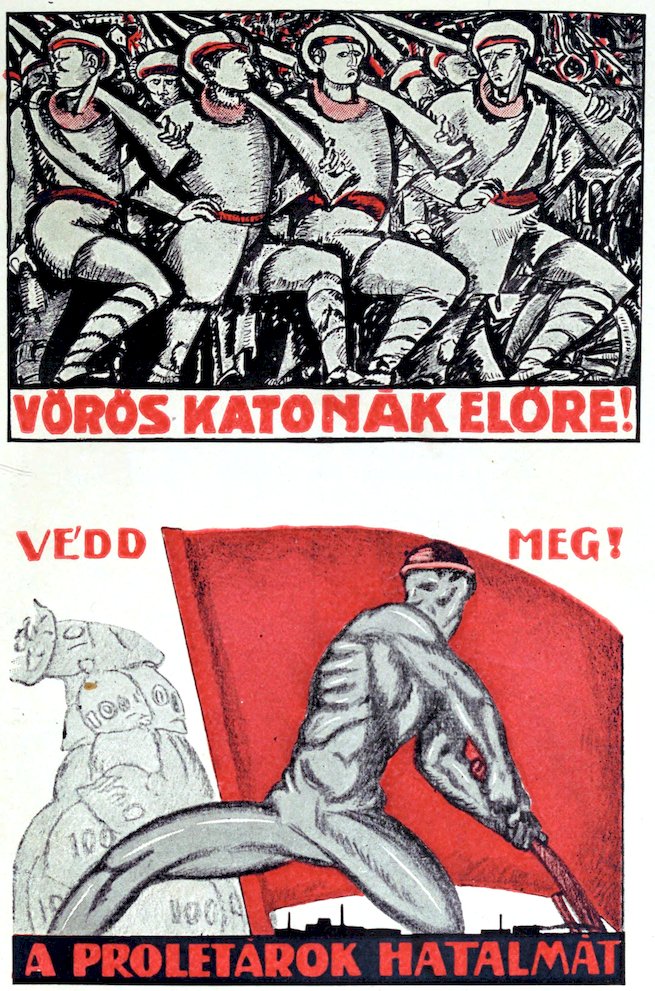
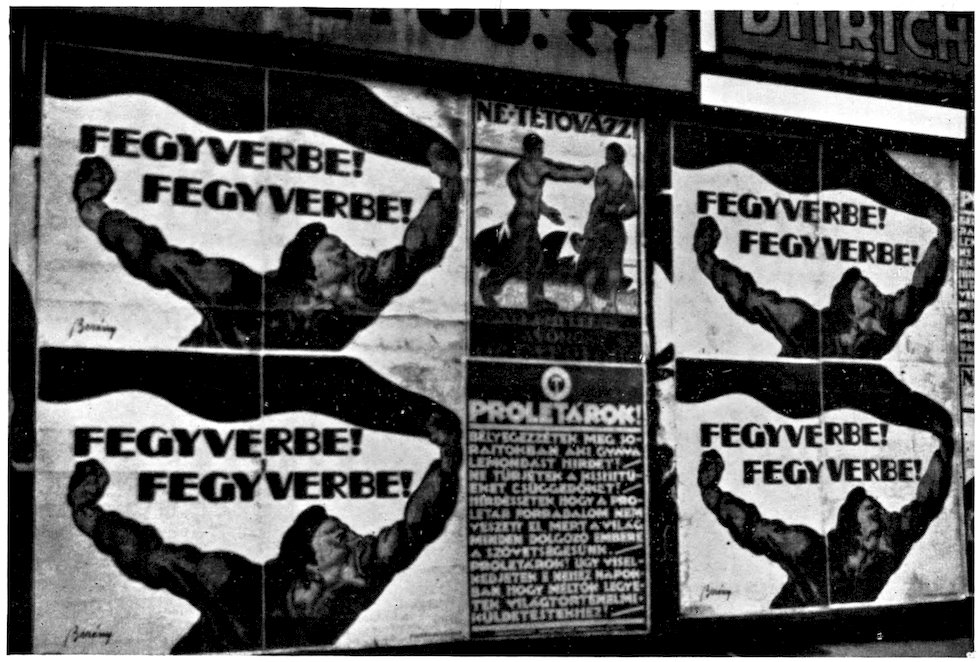
TWO “RED” POSTERS.
17At Limanova and at Doberedo the Hungarians showed
themselves obstinate heroes; who would have thought
that they would so easily bend their heads under the yoke?
The all-powerful Peoples’ Commissaries are already moving.
The people are crowding in front of the editorial offices of
‘The Red Newspaper,’ where Számuelly’s belongings are
being packed on a carriage. Béla Kun too is leaving the
two rooms which he had hired with Russian money under
the name of Dr. Sebestyén. Whither are they going?
Into the royal castle? Into the Prime Minister’s palace,
or elsewhere? They have the widest possible choice:
everything is theirs.
There was a knock at my door. One friend after another
came in bringing news. Béla Kun has sent Communist
agitators all over the country. They drive through the
villages in motor-cars, beflagged in red, and shout: “The
Dictatorship of the Proletariat has been proclaimed! Kill
the gentlefolk!” A new order has been issued: it is
forbidden to wear arms; even revolvers have to be delivered
to the authorities. Only the ‘reliable people,’ Red
soldiers, factory guards and workmen’s levies, are allowed
weapons. The shops remain closed: their goods are
declared common property. The newspapers are to be
communised or prohibited. The buildings of the conservative
Budapesti Hirlap have been occupied by the
editorial staff of ‘The Red Newspaper.’ Armed men
occupy the tables, and on the front of the building the
Red flag floats.
A message reached me from Elisabeth Kállay: she and
her family have gone into the country and she asked me
to come to them. But I shook my head; to-morrow I
return to my mother.
Many have left town. Those who could went by train,
others fled by carriage, on foot, by whatever means they
could manage. All traces of them disappear—they simply
exist no longer. One political party after another pronounces
its extinction. The general officers and high
officials have disappeared from the scene. Nobody
attempts to raise a dam against the deluge, though
yesterday a sluice-gate might have stopped it.
October 31st has returned like a haunting spectre and
we live the evil day again. Then the trap was baited with
the device: ‘Independent Hungary,’ now it is: ‘Territorial
Integrity.’ The whole thing is like the semi-conscious
feeling during a nightmare that one has dreamt the same
horrors before.
Where are those who used to be always ready to give
advice to the King in Schönbrunn and the halls of the
Vienna Burg? Why do they not advise our unfortunate
18nation now? And where are now those who during the
war were ready to order thousands ‘over the top’ into
the jaws of death whenever a single trench was in danger?
Where is my whole haughty race which used to go so
proudly, singing a merry tune, to face death on foreign
fields? Why does it stand now, with glaring eyes, inactive,
on our fields at home? Since Károlyi’s treason, four and
a half months have passed. And this new danger finds us
again without a leader, without organisation. Running
shapes are in flight. Shadows are disappearing in the
distance, shadows which once were thought the great
realities of Hungary. And those who stay with us, in
offices, in poor officers’ quarters, are but hungry, ragged,
grey little shadows with bended heads.
Wherever the red hand of Bolshevism has grasped the
rod of power it has always raised a spirit of resistance.
The streets of Moscow, Petrograd, Helsingfors, Berlin and
Altona have run with the hot human blood of revolt—Budapest
alone has submitted in dizzy apathy. Is the
hideous enchantment more powerful here than elsewhere?
Here, where in the time of Károlyi’s revolution there were
no more than two hundred and sixty thousand organised
workers and even yesterday no more than five thousand
Communists? What has happened? Austrian bugles
have called on Hungarian troops for too many charges
during the war. Those who might have saved us to-day
are dead.
I felt a desperate longing for action: to do something
even if one had to die in the effort, to do something which
would break the charm and free the energies benumbed by
its humiliating spell! I clenched my fists and shook my
head in frenzy; it cannot remain like this. To-morrrow—to-morrow
I shall go home. And wearily I shut my tired eyes.
The hours dragged on so slowly that they never seemed
to come to an end. Night was falling. The lamp was lit
in the next room. The street door was locked.... What
was that? The slamming of it resounded as if a lid had
been banged violently on a giant box. And we are all
sitting in the box and waiting helplessly for our fate to be
decided out there. As long as the house doors were open
the houses along the street seemed to hold each other by
the hand, and if one had got into trouble the slightest
movement would have been enough to warn the others.
That is so no longer. When the doors are shut the houses
release each other’s hands and each is left to itself with its
own misfortune.
19Out there in the dark threatening streets the stolen
motors are racing to and fro without a stop, carrying
treacherous plans, hostile orders, all over the town. And
behind the doors no one is safe until these plans and orders
have decided his fate.
It was just before midnight when the bell rang in the
ante-room. Its sound choked the breath in our throats.
Zsigmondy went out to open the door. It was all right:
only my brother Béla had sent me a message not to go out
to-morrow till he had spoken to me.
Then we retired for a restless sleep. A lamp was burning
on the table of the night nursery; my bed was made, but
I sat for a long time on its edge, waiting like a patient in
the surgeon’s waiting room. There was a smell of printer’s
ink somewhere: if only one could read in these times, I
thought. There was a newspaper on the table. No, not
that. I turned from it in disgust. I wanted to escape
the present.
How often have I found consolation in books during sad
hours! But is there a book that could lull the present
sorrows to rest? I remembered having read Faust during
a great storm at sea till the night had passed, and during
an evil night of the war my mother and I had read Toldi
till the morning came. I wondered if to-day the armed
knight could carry me off with him as he rides to Buda to
fight a last fight for Hungary’s honour, to kiss faithfully
great King Louis’s hand? I shook my head. Was there
nothing? Hamlet, with visionary raving eyes, came and
went, but did not arrest me. Niels Lyne and The Idiot,
and rusty, armoured Don Quixote.
A patrol passed under the window. A soldier pulled his
bayonet over a corrugated shutter as if sharpening it for
some future victim. The others laughed, then they went
on. Silence followed, the silence of a huge wicked town
that gapes.
How long will it last? Why can I not think of anything
else? If I were at home now I would count my books to
pass the time. One, two, three.... I imagined myself
taking an old volume from the shelf. Kant’s Critique of
Pure Reason. What good is that? At the other end of
my bookcase there is another book in a parchment binding
as smooth and cool as ivory: the Iliad. I thought of it—I
had bought it in Siena, a long time ago. Bright, great
heroes, Homeric songs, would mean nothing to me now.
And Dante. No, I do not want him. His Inferno knows
nought of the tortures we endure.
20The horn of a solitary motor resounded through the night,
and volleys were fired in the direction of the barracks.
Quietly, so as to make no noise, I began to walk up and
down in the nursery. There were books lying about among
the toys; picture-books, coloured animals, big, funny
alphabets. I looked at several; and thus a much used,
shabby story book came into my hand.
I sat back on the edge of the bed, the book open. It
brought to me the memory of holidays, old Sundays, mild
childish illnesses.... Someone is reassuring me, kisses me,
hushes me and reads in a subdued voice at my bedside,
strokes the hair from my forehead.... The pages turn
quickly. And where neither Goethe nor Arany nor Dante
nor Kant could succeed in carrying away my thoughts this
revolutionary night, the eternal fairy-tale, that consoler
of children, of sick and of suffering, triumphed.
CHAPTER II
21
March 23rd.
One gets the impression that things have been like this
for ever so long, though it all started only the day before
yesterday. Good Friday was just two days ago. To-day
is Sunday—but not Easter. The resurrection has failed
and the grave-diggers sit grinning on the tomb.
In some churches the bells were ringing, in others the
people had gone to Mass, my brother’s message kept me at
home. Again there was a newspaper lying on the table.
In huge black letters Béla Kun’s proclamation to the
proletariats of the world was glaring at me: “To
Everybody!” It was revolutionary incendiarism, inciting
hatred. In their old-fashioned way the church bells
appealed above the roofs for love and good-will. Meanwhile
the wireless had spread broadcast the news of
Hungary’s shame and misfortune. And from Moscow
there came the triumphant answer. It is published in
The People’s Voice:
“This afternoon at five o’clock the Hungarian Soviet
Republic got into wireless communication with the Russian
Soviet. The Hungarian Soviet called Comrade Lenin to
the apparatus. Twenty minutes later Moscow answered:
‘Lenin speaking. Request Comrade Béla Kun should
come to wireless station.’ But Béla Kun was at the
meeting of the People’s Commissaries, so another comrade
answered from the wireless station: ‘Last night the
Hungarian Proletariat seized all powers, established the
Dictatorship of the Proletariat, and greets you as the
leader of the International Proletariat. The Social
Democratic Party has adopted the Communist point of
view and the two parties have united. We call ourselves
the Hungarian Socialist Party. We ask for instructions
in this matter. Béla Kun is Commissary for Foreign
Affairs. The Hungarian Soviet offers the Russian Soviet
a defensive and offensive alliance. Fully armed, we turn
against all the enemies of the Proletariat and ask for
information concerning the military situation.’”
At nine in the evening Moscow called again.
“Lenin speaking.... Hearty greetings to the Hungarian
Soviet’s Proletarian Government, in particular to Comrade
22Béla Kun. I have just communicated your message to
the Congress of the Communist Party of Bolshevik Russia.
Enormous enthusiasm ... we will send a report on the
military situation as soon as possible.... A permanent
wireless connection between Budapest and Moscow is
absolutely necessary. With Communist greetings, Lenin.”
‘Lenin speaking’.... How terrible these two words
sound; how terrible the deathly silence that follows them!
‘Lenin speaking’.... So he is there now, with his bald
head bent sideways, his enigmatic smile frozen on his broad
mouth, his Kalmuk eyes open wide and his nostrils
expanded as though he smelt blood. ‘Lenin speaking’....
And Trotsky is there too, his bestial, cruel face
peering over us; his mouth broadens and the red beard
on his chin shakes. All the other Russian Jewish tyrants
are there too, and they wave their bloody hands. They
may give their orders; their lieutenants will obey, and
we shall live or die according to their good pleasure and
instructions.
My brother Béla came into the room and I learned from
him that I could not go home any more. In hasty excited
sentences he told me that yesterday evening when he had
gone to see our mother the glaring lamps of a big car had
suddenly lit up the dark street. It stopped in front of the
next house, though this has no entrance from our street.
Three men dismounted from the car and kept our street
door under observation.
“Mother’s housekeeper has been talking to them this
afternoon, probably to inform them that you have left.
She had scarcely returned when the car pulled up before
our door and the men asked for you. They wanted to come
up to our flat. They insisted, affirming that they came
from the police, and had to see you personally. The
concièrge told them that you had left town and banged
the door in their faces. The car, however, remained where
it was and kept the house under observation. The men
only left at dawn, hoping to see you return.”
While he told me all this I had a feeling as though an
ugly hand were groping for me in the dark, trying to get
hold of me, but missing me, passing beside me. It was
the hand of Lenin.
My brother said, following up his own thoughts: “You
cannot remain with the Zsigmondys. It is impossible for
you to go home. They informed the concierge that they
would come and fetch you to-day.”
“... LENIN SPEAKING.”
23My mother’s face appeared before me, a haunted
expression in her blue eyes. It would be terrible for her
to see me arrested. What was I to do? I had sent a
message to Count Stephen Bethlen this morning, but he
had already left home. Everybody for whom I send has
disappeared. The threads are broken. How shall I start?
Left to themselves, what can women do at a time like this?
I had not noticed that the Secretary of the Women’s
Union had entered. He told me that in a few days it would
be impossible to travel without a permit and advised me
to leave town while it was still possible. The Kállays had
been prevented by the crowds at the station from leaving
by train to-day, but would start to-morrow, and invited
me to go with them.
I hesitated; but, after all, it was only a question of a
few days. So as soon as I was alone I wrote to my mother
and told her I should leave next day, though I did not yet
know my destination, and asked her to spend the evening
with me.
Hours have never passed so slowly. When it was quite
dark I escaped from the house. A cold wind blew through
the empty streets. The tired town had once more resigned
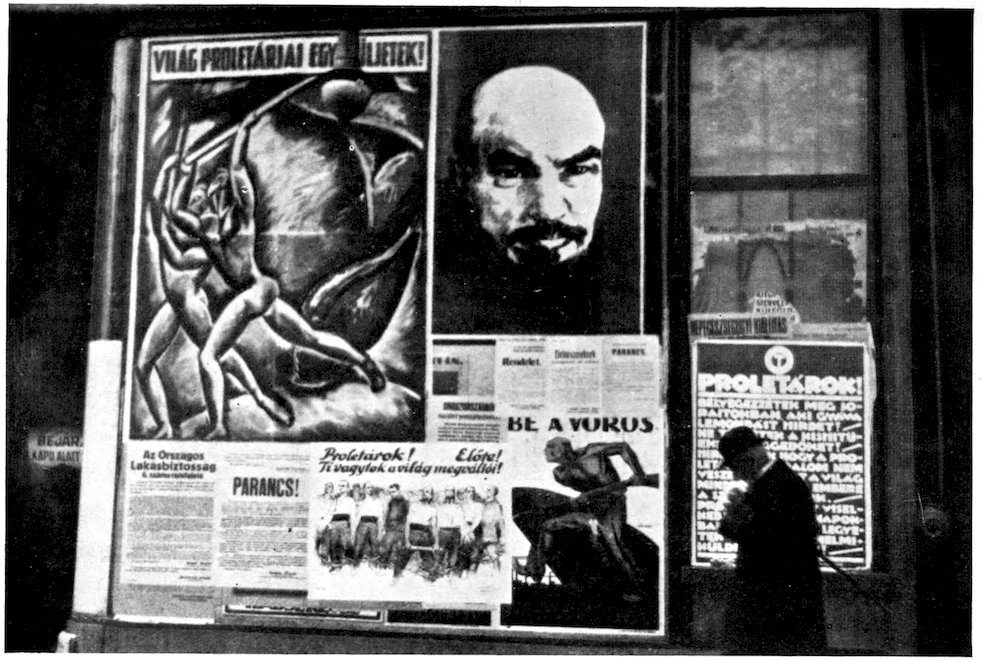
itself to its fate and now suffered in silence; the posters
alone spoke; huge sheets covered the walls. The same
words everywhere: Proletariat ... Dictatorship ...
Proletariat.... The broken street lamps had not been
repaired, and the pavement was covered with refuse: for
days the streets have not been swept.
The staircase was in darkness. A single lamp was
burning in my sister’s sitting-room. And there, in the dim
light, I saw my mother again. I was shocked by her
appearance: she seemed to have become shorter since we
had parted and her face was much thinner. Did she fret
for me? Was I the cause of this change? Never in my
life did I feel so moved in her presence as then.
And yet she seemed quite calm, and on one occasion she
even laughed, with her own hearty laughter. We talked
of all sorts of things, except the fact that I should no longer
be with them on the morrow. The children seemed quite
happy, chattering among themselves in a corner. The
hours passed so happily for me that now and then I had
the illusion that the old times had returned for a moment
before disappearing for ever.
One or the other would say: “At most it can last a week
or two.” Or again: “Colonel Vyx has been locked up
and an English officer has been assaulted in the street.
Insults of this kind will surely not be taken lying down by
24the Great Powers. It is impossible that the Entente should
suffer the establishment of Bolshevism in Hungary. She
knew how to send ultimatums demanding lines of demarcation,
so that the Roumanians and her other friends could
loot at leisure, now she is sure to display more energy when
her own interests are at stake.”
“Let us put no hope in anybody but ourselves,” said
my brother-in-law. “It was the Entente who brought us
to this.”
One of my nephews said: “That is the reason why so
many people are rather pleased that the Communists
display hostility to the Entente. Who knows, perhaps
our territorial integrity....”
“Don’t expect any good from these people,” I interrupted.
“Among the apostles of Communism there may
be some idealists, but those who apply it practically are
all scoundrels. It is impossible, man cannot withstand
nature.”
Suddenly someone asked if I had decided where I was
going to. Should I accept the Kállay’s invitation, or
should I attempt to get across the river Ipoly to Pressburg
and thence into foreign territory?
“Do the Kállays realise what this invitation means in
these days?”
“You must not accept it otherwise,” my mother said.
“Wherever you go, you must mislead those who are
after you,” said my brother-in-law. “Write a letter and
have it posted in another part of the country.”
My mother rose: “It is time to go.”
My heart stopped beating. But she held her head high
and there were no tears in her eyes. Only when leading her
down the stairs did I feel that she leaned more heavily on
me than she used to. Who will lead her when I am gone?
My nephew, Alexander Eperjessy, took her home. I
asked him to occupy my room and stay with my mother,
otherwise I should not be able to tear myself away.
“Don’t worry about me,” mother said; “and don’t
you come back till you can do so openly and without
danger.”
I have been with her almost daily as long as I can
remember, yet it was only this evening that I really learned
to appreciate her. She had never asked for anything and
yet was always ready to give. She never spoke of herself
and listened to everybody. She had no words of endearment,
she kissed vaguely and her arms were rarely
caressing. She was never demonstrative, the seat of her
25affections was her heart and not her lips. And while we
were walking side by side through the dark night on our
short, sad road, I felt that if this heart were one day to
stop, then mine would throb but haltingly ever after.
We had passed the house which had given me shelter.
I thought my mother had not noticed it, being accustomed
to go on towards home. But suddenly she stopped, and,
as was her wont on rare occasions, she drew my head to
her quickly and gave me a kiss which went half into the air.
“Now, my dear, God bless you!”
I tried to find her hand but failed. She had already
left me and I could no longer see her in the dark. I could
only hear her step in the empty street. That quaint, dear
step, which sounded as if she dragged one of her feet a
little. Then that ceased too. Silence, empty silence,
dominated the night. Silently I wept, and the world
disappeared in my tears.
March 24th.
Dawn. The dawn rose with a dull greyness over the
ill-fated city, as though the light had risen from the mire.
Morning was in sole possession of the dirty unswept streets.
I leant far out of the window, and in the distance I noticed
two soldiers staggering painfully along. One of the
achievements of the Dictatorship of the Proletariat:
prohibition of alcohol!
As I turned back I caught sight of my travelling bag.
My mother had packed it yesterday and had smuggled it
out of the house without the spying servant observing
them. I sat down by it and waited. After a time the
house awoke and the time passed more quickly. I do not
remember all that followed: Zsigmondy changed my
money, and I noticed how little I had—one thousand six
hundred crowns. I counted it over again, but that did
not make it more. My mother had wanted to give me
some, but it had all come so unexpectedly that we had
only very little money in the house, and she would need
that little.
I should have liked to put back the clock, but there was
the cab waiting in the street and they were carrying my
bag down the stairs. As I waved my hand from the
corridor Mrs. Zsigmondy leant out of the door which had
opened to me so hospitably and smiled through her tears.
When I was in the carriage it suddenly occurred to me
that perhaps I ought not to have accepted Zsigmondy’s
26offer to come with me to the station: he might get into
trouble; but he insisted so simply and heartily that I could
say no more.
From behind the clouds a pale sun lit up the gloomy
town. All the shops were closed, and the tiny red flags
adorning the buildings fluttered in an icy wind. Careworn
faces passed rapidly before the window of the rattling cab.
A black crowd had gathered on the pavement in front of
a pork-butcher’s shop, the signboard of which advertised
luscious hams and appetising sausages, looking now like
the impossibilities of a prehistoric age. But the shop
window was absolutely empty. Further on a baker’s shop
displayed a wooden sign on which were painted beautiful
loaves and rolls. This, too, gave the impression of a
diagram in a museum, showing things of the past; it made
one feel suddenly hungry. Posters everywhere, innumerable
red posters. But there were no goods in the shops,
and disappointed women slunk along the walls.
“The Red Newspaper!” howled a tiny urchin. “The
Young Proletarian!” And he waved the papers in the
air. Few passers-by bought any, but went on with their
heads drawn between their shoulders as if they expected
blows. Is this the town of the glorious revolution, this
sad mass of dirty, frightened buildings standing amidst
piles of dustbins filled to the brim? Is this the rapturous
achievement for the sake of which Hungary had to perish—a
town where the factories have stopped, the shops are
closed and all work has ceased? A town where all and
everybody have but one of two thoughts: either “We
have lost everything,” or “Now everything is ours!”
The appearance of the principal railway station was like
a nightmare. Its walls were covered with obscene drawings
and dirty scribblings; it had not been swept, and sawdust
had been strewn over the mud. Machine-guns were standing
in the ankle-deep dirt, greasy pieces of paper were flying
about, unnameable filth covered the flagstones and oozed
beneath the people’s feet. A rough, impatient crowd
pushed and jostled, and the air was pervaded by an
insufferable stench.
While Zsigmondy took my ticket I looked at the people.
Many of them kept their eyes to the ground as if they
wanted to hide—these were in flight. Some swore
obscenely. A sailor was examining luggage at the entrance,
and rewarded himself for his trouble by continually putting
things from them into his pocket. At a distance I saw
Elisabeth Kállay. She saw me too, but we did not take
27any notice of each other. Suddenly I found my sister
Mary standing by my side. She was very pale and only
her eyes greeted me. The Secretary of the Women’s
Union came towards me: “The trip won’t last long and
I shall bring you news!”
I passed the newspaper stall. Nothing but ‘Red
Newspapers,’ ‘The People’s Voice,’ ‘The Young Proletarian,’
and the little red and blue volumes of ‘The
Workmen’s Library.’ In the crowd I managed to embrace
my sister. Then, “God bless you, Zsigmondy!”
Now I was on the platform. I had to walk a good
distance before I shrank into the corner of my compartment.
The train was a long time in starting, and human
shapes were hurrying down the corridor. A fat man tore
the door open and looked inside as if searching for somebody.
Then I, too, looked on the ground like those anxious to hide.
Suddenly the columns before the window slowly began to
move. Then the shape of goods sheds passed slowly by.
The wheels rattled over the points. Then the compartment
became lighter: we had reached the open track. And
as the train gathered speed I knew that I had left the town,
with its People’s Commissaries, its police, its prisons, behind
me. I was free!
For a moment I realised this, then again my consciousness
became dimmed and a pleasant fatigue overcame me.
From the window I watched the telegraph wires rise, then
came a post and jerked them down, then they rose again
till the next post came. I turned to look at my fellow
travellers. Every seat was occupied. In one sat an
officer whose insignia of rank had been torn from his collar,
leaving the marks of three stars. His field-gray cavalry
cap was ornamented with a red rosette. As soon as
Budapest was left behind us he took his cap off and threw
the rosette out of the window. An old lady looked on in
alarm and drew away from him: her husband wore the
‘red man’ ostentatiously in his button-hole. Both seemed
scared. Opposite sat a well-dressed man, who buried his
face deeply in a book, using it as a screen. I looked at it:
The Workmen’s Library. On the title-page was the drawing
of a book from the pages of which sprang a naked, unkempt
workman, holding a burning lamp in his hand. This lamp,
I suppose, represented the light spread by the contents of
the book. I strained my eyes to catch the title: it ran
“The Principles of Communism, by Frederick Engels.
Translated by Ernest Garami.”
Why read it now? I thought. Why did he not read it
28long ago? Why have not all those who suffer to-day read
it long ago? It was there, always, in their midst. Its
principles were set out in a thousand publications, in a
thousand minds. These little books have been doing their
work for a long time, and their wrappers were pink only
because for the time being they did not dare to demonstrate
outwardly that they were red.
“The slave is sold once for all. The proletarian has to
sell himself every day, every hour.... The slave frees
himself if he abolishes the institution of slavery. The
proletarian can only free himself by completely destroying
private property. This cannot be achieved by any other
means than by a revolution.” And in the Socialist
revolution there is an end to the family, the country, and
religion.
I stared at the stranger. Why did he want to read
about these things now? They have been proclaimed
aloud for tens of years. But what had been done in
Hungary to counteract them? Has anybody been at work
among the people contradicting them? Has anyone
founded a popular library to proclaim the tenets of Christ,
the significance of country and family, the primary conditions
of human society, with similar persistence among
the people? The Communists worked hard. They fixed
their goal and with every action, every word, every letter,
strove to achieve domination. Meanwhile Magyardom let
the decades pass passively, inactively, and now that the
earth has given way under its feet it has lost its head.
The alarmed fellow-traveller went on reading his book,
hastily turning page after page. I should have liked to
tell him that it was no good hurrying now—he was too late.
Just then a man stopped in the entrance of our compartment,
a violin in his grimy black hand. His low forehead
was surrounded by curling oriental black hair, his eyes were
bloodshot, and one of his nostrils was missing, as though
it had been gnawed away by some animal. He pressed
his fiddle under his bristly blue chin, a smile began to
spread over his horrible syphilitic face, and with a slow
rhythm the bow passed over the chords. His body swayed
to and fro with the tune, and each movement seemed to
raise a filthy stench in the compartment. The tune and
the musician became one, and above the rattling of the
train sounded the strains of the ‘Internationale.’
“I’ll play it again if anybody wants to learn it,” he said,
as he finished, and looked round with a sly, aggressive look.
But nobody answered. Only the man with the ‘red man’
29in his button-hole jumped up nervously and waved a
twenty-crown bank-note in his hand. The filthy black
hands seized it eagerly and disappeared. Then we heard
the fiddle whining in the next compartment: the Jew-Gipsy
was teaching the new tune to the people.
“If anybody wants to learn it....”
Aszód!... The train stopped. I had often heard that
after Budapest Aszód had been the place where the
Communists had met with the greatest measure of success.
I looked out of the window. Over the Reformatory a huge
red flag was flying, and a similar flag was hoisted over
the station. A crowd gathered in front of one of the
carriages, and some people who were late came tearing
along and took their hats off. A fat little man with Semitic
features and a red rosette descended from a reserved
compartment. He might have been a broker, but now
he was addressed as “Comrade on a Political Mission.”
He was received by a deputation and people cringed before
him. I noticed that the crowd was composed of two types
only: the impudent adventurer and the frightened coward,
but presently others joined them. Someone said they were
agitators from Budapest and had come with armed soldiers.
Propaganda and terror—the two means of government
of the Communists. The fiddler was one of them: he, too,
was an agitator.
I passed through the festive crowd unobserved, they
being too busy to pay any heed to the travellers. Far out
beyond the platform a dilapidated little local train was
smoking. Mrs. Kállay and her two daughters were heading
for it, so I followed them. At last we dared to get into the
same compartment. We even exchanged a few words, and
the further we got from the Red town the freer we felt.
Elisabeth Kállay whispered to me that she was hiding
her diadem in her dress, and Lenke furtively produced an
old revolver from under her coat. We could not help
laughing. Other passengers also seemed to have their
secrets, for many of them were abnormally corpulent and
sat uncomfortably on their seats. Everybody was saving
whatever he could, and nowadays only that which one can
carry on one’s person can be said to belong to one.
The air blowing in through the window was pure and
sharp, and beyond the line were lush meadows, deep,
swampy fields, budding trees, white cottages, roads, carts
and peasants. Here everything seemed to be going on as
usual, as if nothing had happened. The mud of the country
roads was cleaner than that on the asphalt of the town.
30We had left the flat country of the disgraced capital and
presently the hillocks of Nográd came to meet us under
the evening sky, the bare, red-brown woods and white
villages on the banks of the Galga forming the landscape.
A landau was waiting for us behind the station. The
coachman took off his hat respectfully and spoke to us
just as in the old days. How strange it seemed! Springless
carts rattled down the road and the elderly men in them
doffed their hats: had not they yet been told that they
were in duty bound to hate those who had always protected
them? A church bell pealed somewhere on the top of a
hill, and the light of a bright fire streamed out of the door
of a house. A woman stood within its beams and made
the sign of the Cross. She did not yet know that the new
power had declared war on God.
Now the road goes up a hill, the wheels crunch on fine
gravel, a gate opens between the trees, and a sudden light
flares up in the night. We have reached the Kállays’
turretted castle.
In a few minutes we are all sitting together in a well
heated room. A wide garden surrounds the house, the
night surrounds the garden. And the world is far away,
somewhere beyond.
Berczel. March 27th, 1919.
Days have passed since my arrival, yet I do not think
that I shall ever forget the first morning when I awoke here.
I seemed to be floating in a pure ocean of absolute silence.
Then, quite suddenly and unexpectedly, a small voice fell
from above into the ocean of silence. After the threatening
hum of the revolution in the city, the wild howling, the
panting hatred and the ominous nightly tramplings, there
was such beauty in this voice that I remember being
enraptured in the semi-consciousness of waking.
A small bird was sitting on a twig before my window.
Instead of the abyss of human infernos, of narrow streets
and worn dark walls, my eyes lighted on a twig and a bird,
and I wept out of sheer gratitude that such things still
existed. I should have liked to gather in my hands every tiny
particle of the sound so that I might send it to those who
remained prisoners among the stones of that accursed city.
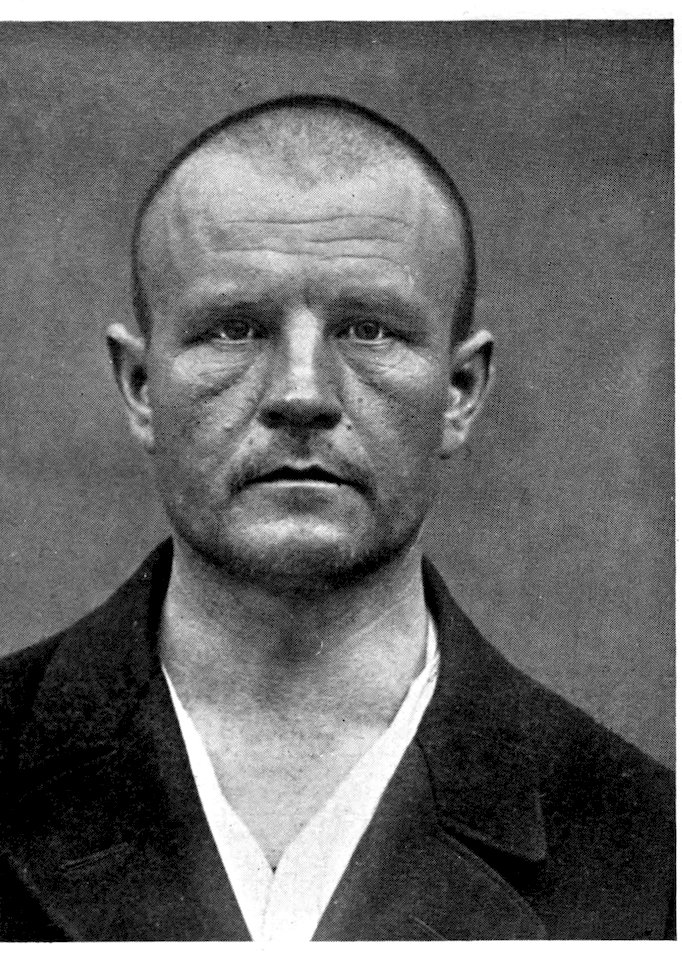
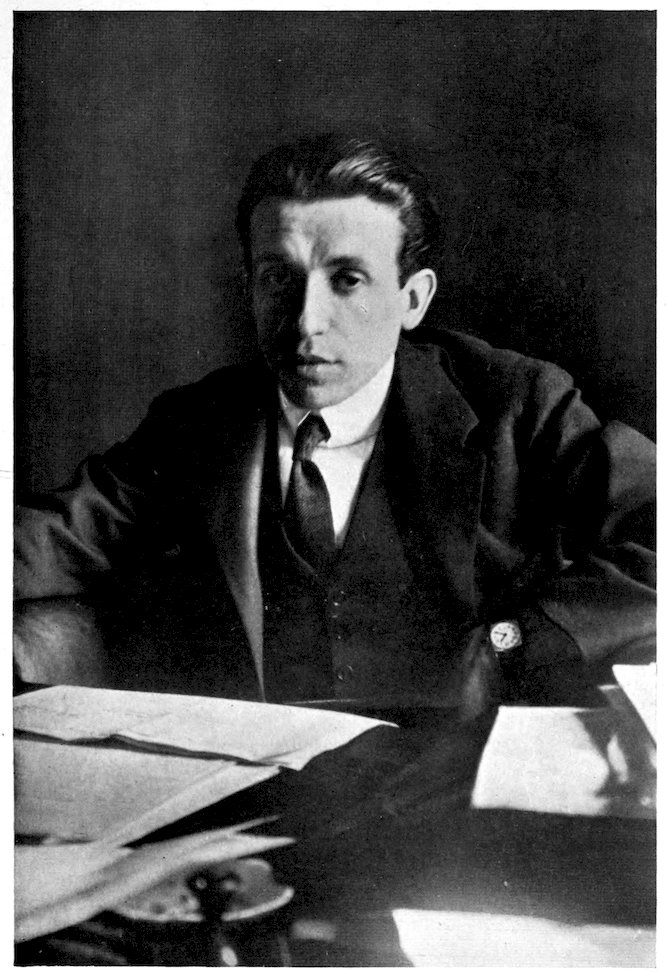
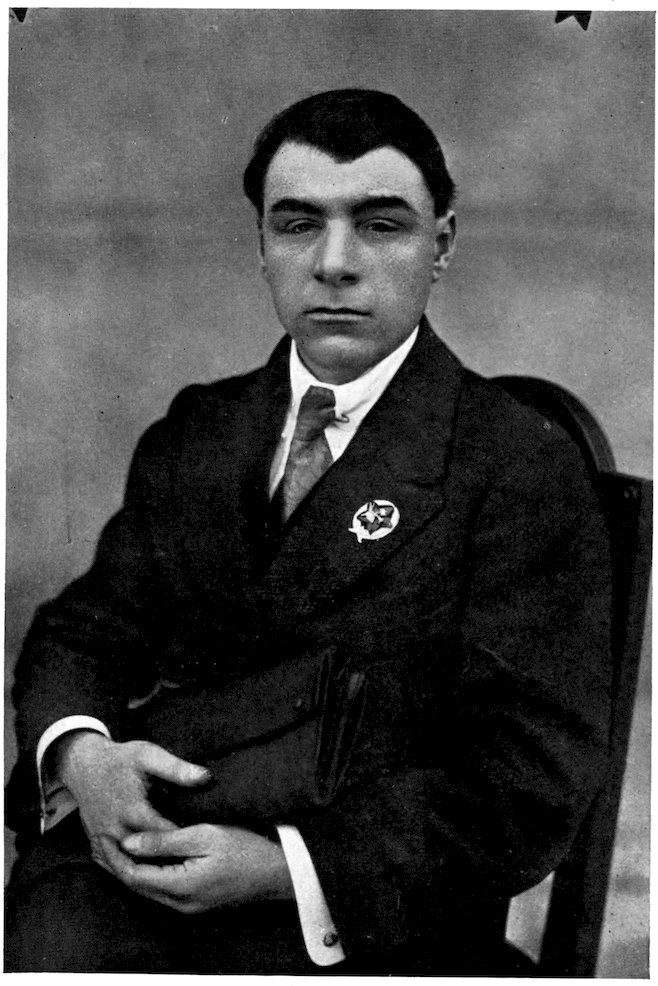
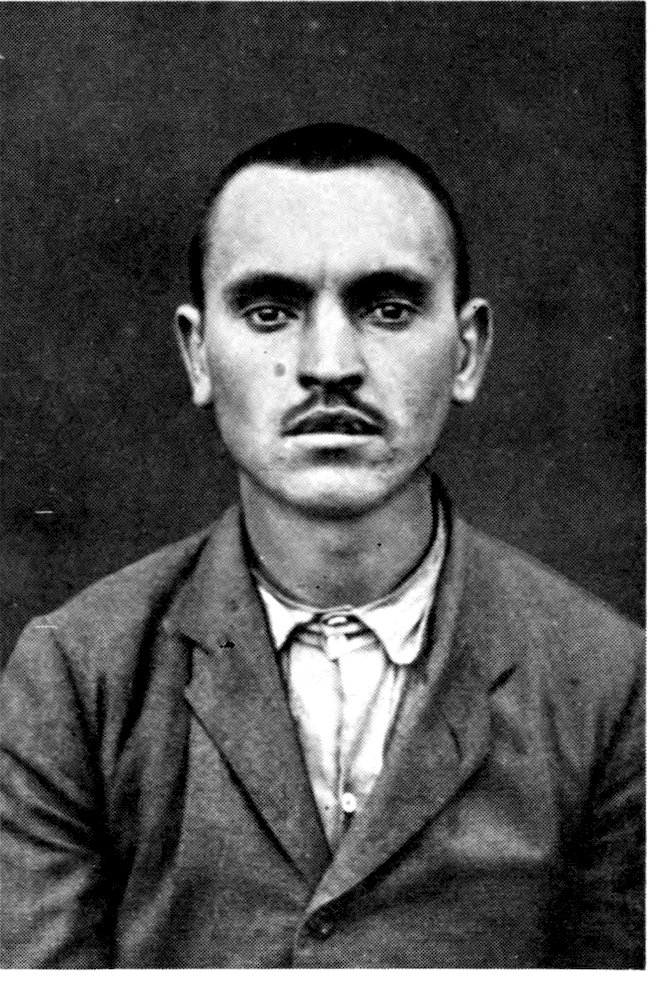
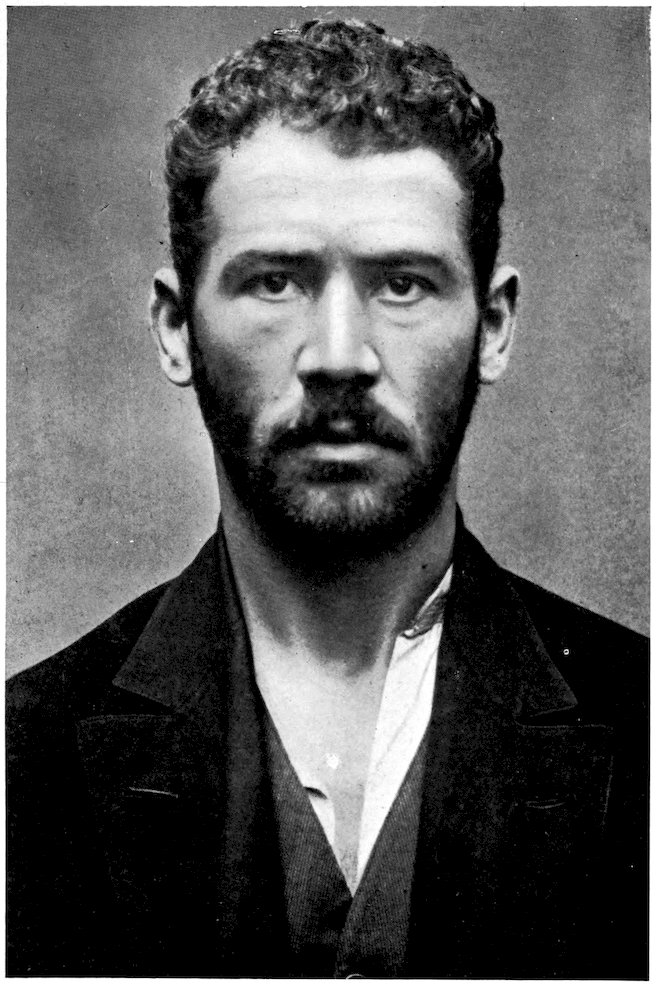
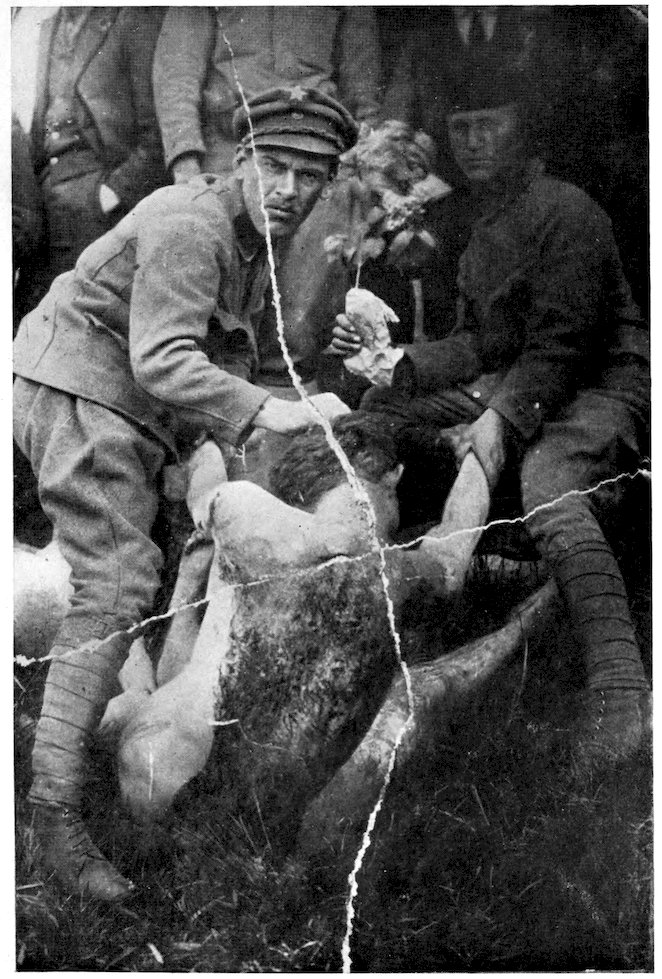
GEORGE NYISTOR.
LABOURER. ASSISTANT COMMISSARY FOR AGRICULTURE.
31How different is life here! It is like a fairy-tale related
to soothe children at bed-time.... It is a quiet village.
On the hillock can be seen the bell tower and the shingled
roof of the church. Below, at its foot, are small cottages
and small farmyards. People go to bed early in the
evening: only now and then is a window lit up. The cow
bells ring, a dog barks somewhere. And horror does not
creep through the night, worry does not sit on the threshold
of the morn, threatening the dread shadow of events to
come. To-day is like yesterday and to-morrow bears no
different aspect. Sometimes I fear that conscience has died
of exhaustion within me. A clouded glass screen has risen
between me and the world. Even the village seems to be
beyond the screen and there is nothing on this side of it
but a castle, a wide park, and narrow, useless little paths
on which the past treads undisturbed. These are set with
white seats which have not been provided for fatigue.
Beds of flowers which only exist in order to be beautiful,
dark violets, without a purpose but just to flower.
A white lace hat appears and disappears in the cool
sunshine: the widow of Benjamin Kállay passes under
my window. Her husband, the most brilliant Finance
Minister of Francis Joseph’s reign, the inspiring spirit of
the Monarchy’s Eastern policy, the governor of Bosnia
and Herzegovina, had been a scholar and a historian. The
old lady had been the uncrowned queen of the small southern
provinces and one of the most beautiful women of the
receptions at the Vienna Burg. Now she discusses with
the bailiff the spring sowings, though when the harvest
comes they may no longer be hers. For that matter, are
the house and gardens still her own? Everything is
uncertain. She also worries about a son and a daughter.
Elisabeth Kállay had been the one Hungarian maid of
honour of Queen Zita, accordingly the Communists eye her
with distrust. Frederick Kállay is an aide-de-camp to
the Archduke Joseph and had left Budapest with him. She
has had no news since then. “Good God, what are we
coming to?”
When she says this her two daughters rise in revolt:
they will have no despondency. I like to hear them speak:
they voice the fine, strong vitality of my race:
“And you, why are you always staring into the air?”
Elisabeth has put her hand on my shoulder. “Instead of
moping like this you had better go and commit your
thoughts and sorrows to paper.”
“I have taken a good many notes. When I left I asked
my young nephew to keep them for me. But what’s the
good of going on with them?”
Elisabeth Kállay, however, urged me on: “Go on
writing your diary; it will come in useful some day.”
32Thus one evening, when I was left to myself, I took up
my pen and looked back on the past days and gathered
fading memories. It is a practice, however, that makes
things both easier and harder. This diary affords the
relief of self-confession, but it also tortures me by compelling
me to live the past over again. And who shall say if
I shall ever reach the end?
I looked up from my writing: Lenke Kállay appeared
at my window, holding her head high. She brought news,
good news. Elisabeth said: “Let no one dare to speak
of evil tidings.”
Stephen Bethlen is in Vienna and has petitioned the
Powers through the French High Commissioner, M. Alizé,
for help against Bolshevism. The Entente is certain to
intervene and will send troops to checkmate the Proletarian
Dictators. Thirty thousand French soldiers have embarked
at Marseilles, with General Pétain in command.
“It won’t continue like this much longer. We shall get
on our legs again presently.”
Did they say it, or did I? We have said it for a thousand
years and when the men grew tired of saying it the women
said it. They said it during the Tartar invasion, after the
defeat at Mohács. To-day we say it again, though everything
has collapsed, though we have been robbed of our
all and are the most unfortunate people on earth.
Yet we still trust and have faith. Why? Nobody
knows. Yet how often have I felt in me that faith which
is stronger than our fate, and how often have I noticed it
flaming up in others! What is it? The mysterious desire
for existence? Or is it more than that, is it the subconscious
knowledge of our vitality?
It is like the belief in the miraculous deer—an old legend
which is ever present in the Hungarian mind in time of
trouble. It tells how among the endless swamps of Maeotis,
at the beginning of time, a white deer with shining antlers
appeared to two brothers who were lost in the morass.
The divine deer lured them on and guided them over
invisible tracks. And to this day, whenever we fall in the
morass the miraculous animal appears, gleaming white and
leaping lightly across the bog, and guiding us along invisible
tracks towards the future.
Things can’t remain like this: we shall get on our legs
again presently. The Miraculous Deer is leading us.
33March 28th.
The folding doors of the big drawing-room on the first
floor open quietly, and in the room beyond books with gilt
backings are set among flowers. The fire is already burning
brightly in the porcelain stove in the dining-room, whilst
above the red-shaded lamp the ceiling appears heavy and
dark. Between the windows stands a chest that once
belonged to Imre Thököly: the walls are ornamented with
Oriental dishes and old Chinese plates.... The footman
stands stiff in his black dress coat: his white shirt gleams,
and his hands holding the dish are gloved in white. Little
silver buttons glitter on the page’s jacket.
My thoughts fly homeward: in the villages there is still
a sense of home, which has long since departed from the
towns. I thought of the past winter, the closed shops, the
scanty tables. If only I could give that sense of home to
somebody.... And again I feel the glass screen raised
between myself and reality.
Mrs. Benjamin Kállay, dressed in white silk, presides
over the table. Her head is held up a trifle haughtily;
her sharp profile is crowned with snow-white hair, and her
full chin disappears in lace. Somehow she reminds me of a
portrait of Louis XV.... Presently she nods and rises:
her gait is solemn and slow: the wings of the door open
before her and we follow her into the drawing-room.
Outside, drums are being beaten in the village, and now
and then a scrap of the crier’s announcement reaches our
ears.
“The revolutionary council.... Revolutionary tribunals ... the president and two members ... prosecuting
commissary ... clerk of the court.... No restrictions
whatever ... any hour of the day ... in the open ...
death sentence ... carried out without delay....”
I had a curious impression that the words seemed to have
little connection with what was said: ‘Lenin speaking....’
Nobody actually said that, yet I seemed to hear those
two words as a sort of refrain.
The drumming went on:
“False reports ... revolutionary tribunal ... executed....
The Revolutionary Council is abolished.... In the
Soviet republic all rank, title and nobility are abolished....”
At this moment the footman brought the coffee on a
silver tray: “Is it your Excellency’s pleasure that coffee
be served here?”
How incongruous it all seemed! The huge room, the
unreal continuation of the old aristocratic life. Is it real,
34or is it a mirage? The snow-white lady, her head erect,
among her lace, sitting in an arm-chair. Her two daughters,
one leaning gracefully over her embroidery, the other turning
the leaves of a book. The huge Venetian glass
chandelier, which once shone over Maria Theresa, spreads
a gentle light. On the wall, between two pastels representing
children, the Empire clock of gilded wood ticks
slowly, and its ticking sounds as if ripe corn were being
rubbed together. Slowly life is passing before our eyes, a
grain of life with every moment that departs beyond recall.
The mirage is still there. Nothing is altered. But
outside, the filthy tide is rising, spreads and rolls onwards
from the Red town, covers the fields, touches the villages,
laps at the walls of the cottages. It comes nearer and
nearer; and the wind which it raises drives before it
phantoms which rush by and in their flight glare in through
the windows. Elsewhere it is different. The glitter of
the peasant’s scythe menaces the castle. The despoiled
landlords have to flee or become the bailiffs of Béla Kun’s
‘Co-operatives of Production’ on their own estates. Our
fate is coming without doubt. But still, here in the great
drawing-room, life has not yet altered. These people
round me are just waiting for whatever is to come, and
whether death or reprieve be their destiny, they are
faithful to the blood which is in them.
CHAPTER III
35
March 29th.
Communists from Aszód have arrived in the village. The
glass screen between myself and reality has suddenly
cracked. The agitators dragged a table in front of the
town hall, climbed on it and addressed the crowd. When
we asked the coachman what had happened, he looked
down and gave an embarrassed, evasive answer:
“They are going to stay till to-morrow....”
These Communists boasted that the workmen of the
aeroplane works at Aszód had got the town in their power
and that the directorate had had the lord of Iklad, Count
Ráday, and his wife, arrested.
The news has only just reached us. When the Rádays
heard of the proclamation of the Dictatorship of the
Proletariat they wanted to go to Budapest with the manager
of the aeroplane works. But the Communists of Aszód
were quicker than they. They closed the barriers, and
the Lord Lieutenant of the county and his wife, who had
nursed the wounded in the hospital of Aszód during the
war, were escorted back by armed Red soldiers, some of
whom she had herself nursed back to life. They locked
the Countess up in the Reformatory, the Count and the
manager they put up against the wall. A firing squad was
drawn up: a lieutenant enquired if all was ready. At the
last moment they let them go. It was all done for amusement,
to give them a good fright. One often hears of such
things nowadays; the novelty and strangeness of it are
wearing off.
Countess Ráday did not know that her husband was
still alive until he returned to her.
But this villainy was relieved by a generous action.
When the people of Iklad heard what had been done to
their landlord and benefactor, they rose and armed themselves
with scythes, and went to his rescue, but before they
reached Aszód the prisoners had been sent to Budapest.
For a long time this band of armed peasants threatened the
Reformatory. Unfortunately not every village is like
Iklad and not all landlords like Count Ráday.
Other news reached us too, uncertainly and stealthily,
from castles and towns. Then the first newspapers came
36from the capital: the great day they had prepared and
announced had at last dawned, and we shrank from its
contact. With what a voice was it proclaimed! Our
language had never yet been prostituted in this way, their
alien press uses our tongue to torture us. It spits on our
past with grinning contempt and drags in the mire
everything that might still promise a better future. The
triumph of the revolution howls from its pages. Vulgar
brutalities, foaming, abject hatred, are enclosed in the
wrappings of world-saving theories.
The only paper of the Counter-revolution has been
suppressed: the conservative Budapesti Hirlap has been
strangled and the subscribers sent ‘The Red Newspaper.’
The newspapers which have been allowed to continue their
existence approve, fawn, incite and lend their old reputation
to facilitate the conquest of the groping, tottering countryside.
Unsuspecting people absorb the poison from the
papers to which they have been accustomed. Ideas become
confused; even the honest lose their bearings. The papers
propagate their news as ordered by the head of the
Bolshevist press-directorate—a Jew.
If ever the time comes to call to account this soul-killing,
defeatist, alien press, which revelled over the revolution,
over Károlyi, the capitulation, the Republic, the foreign
occupation, and now lauds Béla Kun and Bolshevism;
should ever that time come, I can imagine the defence:
‘... the terror, ... brutal force....’ But why do the
papers carry on? Why do they not stop publication?
The press-dictator elucidates this point when he declares
proudly, “the Free Union of Journalists played an important
rôle in the preparation and realisation of the political
revolution in October and the social upheaval of to-day.”
These mouthpieces of Hungarian public opinion have for
the last few decades been exclusively Jews.
Though I shudder with disgust yet I cannot resist the
temptation of taking the newspaper into my hand, and I
read ‘The People’s Voice’ of March 25th:
“The work has begun.... The courage to demolish, the
relentlessness of destruction and the unfaltering determination
to rebuild, these are the spiritual instruments by
which the Proletarian State must be established and its
socialism must be realised.”
What can be their physical instruments when destruction
is only a spiritual aid? I read on: “Lenin predicts
victory in the near future!... The Russian Red
army is victorious on the Galician frontier, and the enemy
37is in flight. The victory surpasses all hopes.... The
position of the Imperialist Government in England is
shaken. Hungarian events have caused the downfall of
Clemenceau.... Serbian imperialism is on the verge of
complete collapse. The southern counties have accepted
the principle of the Dictatorship of the Proletariat. There
are signs of disruption in Serbia. The Proletariat is
preparing for the final battle.”
The papers lie in a heap, and I pick them up at random:
“The Revolutionary Government has decided to raise a
Red army. It has been decided to change the names of
the barracks from that of imperialist kings and militarist
generals. In future they will bear the names of Lenin,
Marx, Liebknecht, Rosa Luxemburg....”
A Red army instead of the national army. Instead of
Francis Joseph and Maria-Theresa barracks we shall have
Lenin and Rosa Luxemburg barracks.
“Austria has recognised the Hungarian Soviet Republic
and has accredited the envoys of Béla Kun.... Two
new Soviet Republics: On the 28th a Soviet Republic was
proclaimed in Wiener Neustadt. In Chotin the Bessarabian
Soviet Republic has been proclaimed. At the elections for
the Workers’ Councils in Brunswick the Communists have
gained a victory.”
My nerves began to give way: though it might be all
untrue, I could stand it no longer. I fled, out of the room,
out of the house, out of the garden.... In the village
the drum was beating. “The Revolutionary Government
has decreed....” I turned back. Is it impossible to
get away from it for a moment? I locked the garden door
behind me so that I should hear it no longer. A white dog
was playing on the lawn and its mistress followed; she
was carrying a Viennese newspaper.
“At the request of Clemenceau allied troops under
General Mangin are to be sent against Béla Kun’s Soviet
Republic. Balfour protests. The British——”
“We are the prisoners of the Entente and what happens
inside the prison depends upon the gaolers.”
Suddenly the window panes rattled with the vibration
of a distant, dull boom.
“Guns!” we both exclaimed simultaneously. “From
the direction of the Ipoly river. Far away.... At
last!...” Then we suddenly looked at each other in
amazement; what we felt seemed so incredible. It is to
our enemies that we must look for liberation, to France,
to the country of Franchet d’Espérey, Colonel Vyx, and
38to our little neighbours who for months have been robbing
and tearing our country. What has happened to us?
Humanity has sometimes forgotten for centuries the
plans and the power of the Jews. The fate of Egypt, the
conquest of Canaan, the dissolution of Rome, the religious
strife in Byzantium, the decline of Spain ... these and
many other things. And far away are the great persecutions
of the Jews, which were always the consequence of
too much audacity, too great activity, on the part of the
chosen people. These persecutions, the fruits of exasperation,
were never of long duration, and after them Jewry
quickly sank back into obscurity, whence it threw sand
into the eyes of the peoples that they might be blind for
a generation and forget.
In the years before the war the suspicions of the
Hungarian nation, so often aroused before, had been lulled
to sleep. We saw how the Jews, coming from the East,
took possession of the land after acquiring the liquor shops
of the villages. From the little draper’s shop in the town
they laid grasping hands on our whole economic life. We
saw them during the war withdrawing into safety and
acquiring millions while our own folk gained crutches.
We heard that the Zionist Congress of Paris carried the
following resolution: “Jewry must try to get possession
of Budapest first, then Hungary, so as to have a base for
the establishment of its world-rule.” And many of us
read in 1917, during the war, the declaration of their leading
spirit in Hungary, published in Világ, the mouthpiece of
Freemasonry: “We reserve our institutions, our means
and our men for a superhuman effort later on.” Now the
later on has arrived, has emerged from obscurity. Twenty-four
Jewish People’s Commissaries lead the rest and
pronounce judgment of life and death upon Hungary.
The sound of an enemy gun is heard in the distance, and
suffering humanity breathes freer and thinks of liberation.
Perhaps it will come nearer and shoot down the walls of
our prison.... But no: happier nations would never be
able to understand that that was needed.
March 30th–31st.
Items of news arrive daily, but there is no sequence. Only
a few days ago it was announced that ‘the British Foreign
Secretary protests. London will not permit it.... Thirty
thousand French troops have embarked in Marseilles....’
Now the talk is of General Mangin’s Anglo-French armies:
he is on the way and has taken the field against the
Bolsheviks.
THE JEWS CALL A MEETING AND DECIDE TO ORGANISE A JEWISH RED REGIMENT TO FIGHT FOR BOLSHEVISM.
39I put out my candle and sat alone in the dark. A vision
of spectres rose about me, shaking their heads, apathetic
spectres of suppressed doubts which extinguished all hope.
What if nobody comes to our help, if the nations allow us to
perish miserably while they stand round and watch us being
eaten up by the worms which arise from our own decay?
Surely we cannot descend utterly into the depths unless
the victorious Great Powers permit it? Why do they not
prevent it, if they do not want Bolshevism? With Károlyi
for ever cringing, Colonel Vyx, the head of the Entente’s
Military Mission has stopped at nothing. Taking advantage
of his position he has trodden for months on our self-respect.
He has treated the Eastern bulwark of Europe, a highly
cultured people with a lineage as ancient as his own nation’s,
like the French officers treat the savages in their own
colonies. Why did this egotistical little Jew of Alsatian
origin, possessed of plenipotentiary powers, withdraw all
the French troops from Budapest on the eve of the proclamation
of the Dictatorship? Why did he permit the
Posts and Telegraphs, over which he had absolute censorial
sway, to serve Béla Kun in the preparation of his revolution?
Some day these questions will be answered. The message
signed by Colonel Vyx, published in the papers of the 26th,
although the provinces only got the news to-day, throws
some light upon one point. The Military Mission of the
Entente unexpectedly appeals “in the name of conciliation
and justice” to the Revolutionary Government “to give
without delay every possible publicity to the following
communication.” It refers to the document in which
Károlyi announces his resignation: “In his proclamation
to the Hungarian people the President of the Republic
said that the Mission of the Entente had stated that it
would in the future consider the lines of demarcation as
political frontiers. I formally declare that this is an
erroneous interpretation of the words used.... It has
never been intended to suggest such political frontiers.”
So it appears that once again Michael Károlyi has
deceived the nation. But is it not curious that Colonel
Vyx’s mission has delayed this explanation until now?
Why did it not take action at once, when Károlyi endeavoured
to justify his resignation by the alleged finality of
frontiers fixed in the Entente’s note? Why did it allow
him to use nationalist arguments in order to throw Hungary
40into the arms of Bolshevism? And why did Colonel Vyx
permit Béla Kun to creep in under the same nationalist
flag which had covered Károlyi’s exit?
Who consented to play the game of these two abject
creatures in the fateful hour when the stakes were a country’s
fate? The tardy explanation of the Entente Mission
inevitably creates the impression that Colonel Vyx played
into their hands, or, at the least, that he showed considerable
partisanship in their favour.
The exposure of Károlyi’s deception concerning the fixing
of frontiers shows the falsity of Béla Kun’s battle-cry:
“For territorial integrity!” Now that he wields both
armed forces and finances, he sings another tune. He has
declared to a correspondent of the Viennese Neue Freie
Presse: “In Soviet Hungary we do not insist on territorial
integrity.... We do not recognise any economic
frontiers.” These are the men who have Hungary’s fate
at their mercy! The very thought makes one’s blood
boil. Is all our ancient pride of race, all our glorious
history, to be thus trampled under foot by Jews? Why
does the Entente delay? Why does it give Bolshevism
time to recruit an army for its own support?
The Red Soldier, a new daily paper, has just appeared
in Budapest. Propaganda is active: Pogány recruits,
Számuelly directs. What a nightmare it is! The cradle
of the Red army is draped with low-class comedy. Its
advertisements take the shape of newspaper paragraphs
and vicious posters. From a world of brothels, of cheap
upholstery, of merry-go-rounds, of foul-mouthed agitators
speaking from red stands, is the Red army recruited.
It is proposed to hold Red soldiers’ gala performances at
the theatres, and the newspapers are devoting unending
columns to rapturous approval of the idea. “The temple
of the Muses stands in festive attire!” Yes—and to the
sounds of the Internationale the crowd rushes the free seats.
In every theatre a different leader will address the audience:
the Galician Neros will mount the stage and play their parts.
“There is no such thing as one’s own country! Long live
the country of all the Proletarians! An army is the tool
of nationalist society. Death to militarism! Long live
the Red army!”
Someone knocks at my window: it is Elisabeth Kállay
in a fur coat standing in the twilight. Yes, by all means
let us go. The evening has become heavy and unbearable
indoors. Let us get some fresh air.
We walked along the river Galga, and frost from the
41hills came on the breath of the icy wind. Coming home
we crossed the courtyard. There was a light in the stable
and a pink-cheeked, fair little girl was sitting on the threshold.
Indoors a woman was sitting on a stool beside a
cow and one could hear the milk squirting regularly,
sharply, into the pail. The coachman doffed his hat and
remained bareheaded, a farmer who was leaning against
the wall stood up and saluted us. I could not help thinking
of the war-cry of ‘The Red Newspaper’: “Class war
must be carried into the villages!”
They were talking of the agitators in Aszód.
“Let them bark,” said the farmer placidly; “first we’ll
see what those people in Budapest are up to.”
I could not distinguish his face but it seemed to me that
it was not an individual but the whole Hungarian peasantry,
suspicious, cautious, who had spoken. The Hungarian
peasant speaks little and is not over-fond of work. Now
he leans on his plough and watches gravely who shall be
the owner of the soil.
“Michael Károlyi has promised it to us. It is true he
did not redeem his pledge, and what he gave of his own
was, as it turned out later, no longer his property.”
“The Communists have promised even more,” said
Elisabeth Kállay in the cautious way which the times had
taught us.
“They only promise the townsfolk that everything is
to be theirs,” said the farmer; “here they say that the
land too, is common property.”
“Well, well,” said the coachman, “it is not easy to
understand these new-fangled laws.”
“That is why we first listened to the Communists,”
continued the farmer reflectively. “We wanted to see
what was going to happen to the land. But later on....”
He remained silent for a time, as if debating with himself if
he ought to speak out or not. So the coachman continued:
“When they started to talk about the law abolishing
religion, we did not like it.”
“That’s so,” agreed the farmer; “nor did we like it
when they made a law that, if I may be excused mentioning
such things, if people lived together for a year in free
love, that should make them a lawfully wedded couple.”
There was silence for a time. The men, ashamed to talk
to us of these matters, seemed to whisper among themselves.
“But what roused the women into white heat,” the
farmer laughed, “was the decision that even a married
man could marry like this over and over again, as his old
42marriage was automatically dissolved by any subsequent
union.”
The former gravity had disappeared.
“After that the Communists were in a hurry, I can tell
you, to get on their carts. They would not dare to come
back here at any price.”
The woman had finished the milking some while ago and
was standing in the stable door beside the child. Now she
spoke from her dark corner:
“They said they would make picture-shows of the
churches, and that there would be no more illegitimate
children, nor any inheritance, and that the State would
take over our children.”
At these words the little girl clung crying to her mother’s
skirts. “Mummie dear,” she implored, “you won’t let
the horrid State take me away from you....” The woman
shook her head. The coachman laughed and said: “I
don’t know, if you are really naughty....”
The child howled, so her mother picked her up in her
arms and in that one tender movement negatived all
Communist ordinances. She disappeared, carrying the
weeping child and seeming to become one with it. I
followed them with my eyes: beyond them, set in a sea of
darkness, were the soft outlines of the sleeping village: the
roofs of the cottages alone were visible under the starry sky.
And Lenin is to come here too!
Bled white, the villages sleep and offer no resistance. But
in their very dreams the villagers cling to the soil; and the
soil is their country, and their country is Great Hungary.
My heart went out to the villages. The village, the
Hungarian village, is selfish like a child, indifferent like a
sign-post, and as strong as wind and weather. Its sins
are the wild revels derived from its vineyards; the desire
for fecundity in men, women and soil alike. Its blessings
are sowing and reaping.
There is here a ray of hope. Will the Hungarian village
be our salvation?
April 1st–2nd.
Even a few days seems a long time when one is counting
the hours. And now the second week has gone and there
is no sign of our distress coming to an end.
Bolshevism is destroying with the impudence of ignorance
and building with the inexperience of barbarism. Lenin
decreed that the old order should be ruthlessly destroyed
43and the new order constructed without delay. The
Bolsheviks of Budapest hasten to obey. With such
insatiable zeal do they set to work that their topsy-turvy
legislation is but a disclosure and a legalisation of their
previous arbitrary actions.
The papers give practically no other news. They aim
blows at human ethical conceptions and at Hungarian
life. They provide a defence for evil-doers and for brigands.
The Jewish Commissary for Justice has proscribed the
administration of justice, for he has suspended the sittings
of the law-courts!
Never before have I realised to what an extent we are
at these people’s mercy. Károlyi set the criminals free;
the criminals let crime loose to supply their needs.
Immorality and lawlessness require the freedom of crime
for their sway. To produce unlimited means for its rule
Bolshevism abolishes the private property of others,
distributes it among its own adherents, and uses it to pay
its servants.
Anxiety is now perpetually with me: I feel like a person
going late at night through a dark abandoned street who
hears moaning from behind a closed window. It is impossible
to enter: no policeman can be found. What is
happening? Dark speculations haunt one’s mind as long
as night endures.
Class hatred has established spies and watchers in all
the houses of Budapest: the secret agents of the new
power are to be found in every house; they watch, blackmail,
and report. On their good-will depends the
distribution of food tickets within the house, and those
whom they suspect are deprived of bread. Their sanction
is required to obtain permits if one requires wood, soap,
or boot laces, and Proletarians alone receive the permits.
There is a meatless week in Budapest. The countryside
is refusing to send supplies, and food is running short.
Yet they proclaim boisterously that Plenty is the outcome
of social production! It is the business of the ‘confidential
man’ in every house to see that the Proletarian should not
notice the wolf at the door. But it is the intellectual
workers who are on short rations: the middle classes are
to be deprived of food tickets. Everything is for the
Proletarian. Such privileges have never before been
known, but it is not love for the Proletarian that inspires
these privileges; it is the hatred for the Hungarian
Christian citizens, the delight in their sufferings, that are
the principles upon which the new rulers govern.
44Under the guise of philanthropy Galician Jews and
Proletarian rabble are planted among the hated bourgeoisie.
The kitchen is common property and the middle-class
occupier is obliged to put his furniture at the disposal of
the intruders. Home is home no longer. Even in the
restricted area assigned to them the bourgeoisie is to have
no peace. The Jewish Dictator of the capital has decreed:
“Baths for the Proletarian children!” It sounds a very
human provision, but is really only a pretence for new
provocation. A tendencious poster has appeared, announcing
that the bourgeoise women who “from their
silken couches used to step into their perfumed baths”
shall make room for dear little Proletarian children, who
till now were deprived of the luxury of cleanliness. The
order runs:
“... We also requisition the bath-rooms of private
dwellings once a week, on Saturdays, for the whole day, for
the gratuitous bathing of the children sent by schools
and nursery schools with their certificates. The owners
of the bath-rooms have to provide gratuitously the
necessary fuel, lighting, towels and soap.—Moritz Preuss.”
And the class they call bourgeois can buy neither fuel
nor soap! They want the bourgeoisie to perish, perhaps
they revel in the idea that they may thus introduce vermin
and infection into clean homes. Abroad they create the
impression of being philanthropists, and at home they
amuse the rabble. For days the houses of Budapest have
been terrified by the rumour that Tibor Számuelly intends
to allow the mob three hours’ plunder.
My own home was continually in my mind. I could
see my mother sitting alone among her household gods.
I could see her walking through the rooms, touching now
one thing, now another, things that remind her of my
grandmother, of my great-grandmother, of old times,
things that are part of her life.... She cannot write to
me, nor can I write to her. I long to go to her for a day,
or only for an hour....
As I said this Elisabeth Kállay looked at me:
“Do you know how many of us are already in prison?
Do you want to go there too?”
It seemed to me that my mother’s face was leaning over
me and that she repeated: “Don’t worry about me, and
don’t come home till....”
A carriage drove through the gate, came slowly up the
drive and stopped in front of the house. A carriage in the
village! The hospitable generation which lived before us
45saw nothing terrifying in that. But now I asked myself:
“Have they come to requisition? Are they agitators,
Socialist delegates, or detectives? Are they on my track?”
My heart beat fast, and a plan occurred to me. I
resolved that if they came for me I would escape by the
other side of the house, where there is a little door under
the walnut staircase, and that thence I should make for
the vineyards, and over the hillock on to the main road.
I was quite astonished to find how exactly I remembered
every ditch, every lane, as if from the very start I had
observed the country with a view to a possible escape.
Then came a sound of movement and of laughter,
starting under the porch and spreading all over the house.
The newcomer was a friend, Baroness Apor, lady-in-waiting
to the Archduchess Augusta. She brought us newspapers
and news. A Vienna paper gave a long account of how
Count Louis Salm had boxed the ears of Michael Károlyi
in the street—the latter was in Vienna on behalf of the
Revolutionary Cabinet. As he was emerging from the
door of a house of doubtful reputation Count Salm ran up
to him: “Take that for the Italian front, that for Hungary ...” and as the blows fell each was similarly explained.
A crowd gathered round them and a cab was passing.
Károlyi made desperate signs for it to stop. Then Count
Salm exclaimed: “Look at him, this is Michael Károlyi who
has betrayed Hungary!” The cabman swore a big oath,
lashed out with his whip at Károlyi, turned his horse and
drove on, while the blows were still falling hard. I wish
it had been a Hungarian who had given them!
Baroness Apor told us that Archduke Joseph’s palace
had been occupied by the Red commander. The furniture
had been carried off and ‘communised’ by the comrades.
The Archduke and the Archduchess had been compelled
to flee on the evening of the 21st. They escaped on foot
in pouring rain, to the accompaniment of a good deal of
shooting in the town, and hid with some faithful friends
until next evening. Then they managed to escape in a
ramshackle old coach through the excise barriers of Buda
and made off for the hills. The Archduke travelled south
with two aide-de-camps; the Archduchess went to Alcsuth
after having given all her jewels to her husband for travelling
expenses. He will attempt to get into communication with
the French commander in the hope of raising the nation.
New hope!... The room seemed to brighten up and
life ceased to seem a burden. Perhaps after a week, or a
few days.... No, neither after a few days, nor hereafter—because
46when it came to crossing the frontier into occupied
territory the Archduke turned back: he could not bring
himself to leave that last bit of our country which is the
only hope of our resurrection.
Meanwhile his son had been arrested and had been taken
on a springless cart to Kanizsa, his guards telling him all
the way that Számuelly was waiting there to settle his
business. They asked him if he wanted a ‘black coat’
for his journey, and pointed to trees: “This one would do
nicely, or do you prefer that one?” Now he is imprisoned
in Budapest.
So is the former Prime Minister, Alexander Wekerle,
and Bishop Count Mikes, and Count George Károlyi who
hates the Communists. Countess Raphael Zichy stayed
at home, refusing to leave. Is she repeating her famous
saying: “There is no terror, there is only cowardice!”
“Under pretence of looking for arms,” Baroness Apor
told us, “armed Red soldiers invade houses at night. The
safe deposits have been broken open and pilfered by the
Government. It is impossible to withdraw money from
the banks. All jewelry worth more than two thousand
crowns becomes ‘public property.’ Mine has been taken
too. A friend of mine preferred to throw her pearls into
the Danube. Anybody who still possesses anything is
hiding it if he can. There is a perfect exodus to the hills
of Buda. At first people only buried little jewel-cases.
Then came the rumour of a new order. The larders were
going to be ransacked. Off to the hills went the barrels of
lard, the boxes of sugar and tea, the household linen.”
One of us broke in:
“Yes, but what do people say, how long will this last?”
“Nobody knows. People are in despair. News is
contradicted as soon as published. Károlyi negotiates
with the Missions of the Entente in the name of the
Bolshevik Government. The Italians, they say, are
sympathetic. It is even said that they are disposed to
recognise the Soviet Republic. The Italian delegate,
Prince Borghese, is a great friend of Béla Kun and the
beautiful Jewesses of the Commune. It is also rumoured
that a Boer general called Smuts is to be sent here to
force the Bolshevik crowd to resign.” Baroness Apor
glared rigidly before her as if she saw something terrible.
“Számuelly is getting more and more to the fore,” she
continued after a short pause. “The Government threatens
in his name whenever it wants to cause alarm. The
others are busy drawing up the new Constitution. They
47speak and issue orders as if things were to remain like this
for ever.”
None of us said anything. Our thoughts were so similar
that speech was superfluous.
April 4th.
Sometimes nobody visits us for days; but it happens
occasionally that people come to see us. As soon as I hear
their steps on the gravel I run and hide in my room. The
other day while I was sitting there Countess Dessewffy was
saying in the drawing-room that the police were after me,
but that she knew I had made good my escape to
Switzerland. It seemed quite amusing. With the exception
of one friend nobody knows that I am here or who I
am. This is Baron Jeszenszky, whose property is near by,
at Kövesd. He often goes to Budapest. Then we wait
impatiently for the news he brings back. Anything that
gives hope finds credence with us. Baron Jeszenszky
waves his hand in despair: “Mark my words, this will
never come to an end.”
The more we contradict him the more pessimistic he
becomes. If, however, we agree, he gets angry and becomes
hopeful. “What lack of faith!”
I feel similarly inclined, and so does everybody else, for
we express our doubt only in the hope of being contradicted;
we try hard to raise some hope in ourselves and are angry
when it is thrown over.
We went early to bed and I read Sir Thomas More. The
book opened where the conquering Utopys reaches his
island where he is going to found the realm of universal
happiness:
“... But Kyng Utopys, whose name, as conqueror,
the Iland beareth (for before his tyme it was called Abraxa)
which also brought the rude and wild people to that
excellent perfection in al good fassions, humanitye and
civile gentilnes, wherein they nowe goe beyond al the people
of the world: even at his firste arrivinge and
enteringe upon the lande, furthwith obteynyge the victory....”
Sir Thomas More, the forefather of Socialism, imagined
it like that. He wanted to found his land of universal
happiness on a gentle, civilised people. Will there ever
be people like that on this earth? Until there is, Socialism
will remain the island of Utopia.
48April 5th.
The men of the village Directorate came up to the castle
to-day. There was some formality about their visit, and
they wore their black Sunday hats. Mrs. Benjamin Kállay
received them herself. The bad man of the village spoke
the loudest among them, and whenever this occurred the
others cast their eyes down and nudged their neighbours:
“Come, speak up, now!” I thought of the little peacock-blue
Sèvres vases up in the drawing-room; the Persian
dishes and the old hand-painted fans in the glass-case.
How were they going to describe them in their inventory?
One of them declared that no more wine must be brought
up from the cellar, for prohibition had been enforced.
Nothing in the house must be removed, for it all belongs
henceforth to the State. The others nodded as they
looked around. “The people from the towns are going
to come soon.” And so they left without making an
inventory.
The day has not yet come, but what of the morrow?
Incertitude is increasing daily. Everything becomes transitory.
In one’s plans one does not even dare to make
arrangements for the following day. Generally one makes
no plans at all. Days and hours become independent
units, without continuity or cohesion among them.
The Sunday hats of the Directorate were flocking back
to the garden gate. One of them lingered behind, then
seized the opportunity of turning back. He stood there
before us, an old man, humble, hat in hand, with sad eyes:
“Dear little lady,” he stuttered shamefacedly, “might
I ask your Excellency for a little wine? Nobody will know.
I want it for an invalid. A young woman who is dying.”
A bottle was given to him and he hid it furtively under his
coat.
The Soviet Government threatens with its summary
jurisdiction anyone found drinking wine. Not even the
sick are allowed any. But drunken soldiers stagger
unmolested in the gutter. The People’s Commissaries have
champagne orgies in their special trains and throw the
empty bottles from the windows. They have drinking
bouts in the Soviet House of Budapest, the former Hotel
Hungaria, which they have requisitioned. The occupants
were expelled without notice and within a few hours the
Commissaries, some with their wives, others with their
mistresses, occupied the place.
JULIUS HEVESI alias HÖNIG.
VICE-COMMISSARY, MINISTRY FOR SOCIALISATION.
49Everything I see, everything I hear, carries my thoughts
to the guilty town, bids them seek among its million people,
for the sake of one! To-day I received the first message
from home. Charles Kiss, our faithful friend, has escaped
from among the accursed walls and brought me a letter
from my mother. She is well; she has already left for our
cottage among the hills of Buda. She was in want of
nothing, nobody interfered with her. They have not been
looking for me. Thus Kiss brought me nothing but good
news.
While I listened to him I was filled with joy: “Then
there is no longer any reason why I should not go home!”
At this his face changed suddenly. No, not yet, better wait
a little longer.... And as he argued the point I suspected
his former statements more and more. So they had only
been designed to re-assure me!
Hans Freitag, Councillor at the German Legation, had
come to see my mother and had warned her that I ought
to escape if I were still there. Now the removal of my
mother to the hills had a different meaning to me: my
mother had to choose between her flat in town and her
cottage in the hills. Need for choice came suddenly and
she had moved the previous day. But I learnt that the
flat was now occupied by very decent people; the Red
soldiers who brought them behaved quite nicely. They
had put altogether three families and a school into the flat;
they were Jews and Proletarians but it was all right, no
harm had been done, everything had gone smoothly. Only
a little furniture and a few pictures were left behind in the
flat.
Slowly I began to visualise the whole thing. Red
soldiers.... That meant she had been expelled by force.
All sorts of insignificant trifles swept through my head.
The tiny treasures of the old show-case.... The snuff-box
which had a tinkling little tune hidden within it.... The
yellow porcelain dame with her crinoline and her unnaturally
slender waist.... Where have they gone to, those
friends of my childhood? And the ash-tray which used
to stand near the clock? Has it gone? And the watercolours?
And my mother’s work-basket, her patience
cards? The crucifix from Ravenna on my bookcase?
Who has removed it? My manuscripts, my books, my
pictures?
The Jewish Commissary of Education had decreed that
books left in houses became the property of the Soviet
Republic. All collections of books have to be reported.
Valuable pictures become common property.
Charles Kiss re-assured me: “Everything is still there,”
50but I could believe his kind-hearted statements no longer.
A torturing picture haunted me incessantly: I saw a home
pulled to pieces, strange people in our rooms and the front
door, through which my lonely mother had to leave, wide open.
The subject had been changed a long while ago, but I
had not noticed it. I realised it only when I heard someone
say: “It will last longer than we had expected.”
I shuddered as a hopeless silence ensued. The ticking of
the clock above fell on our ears. One by one the minutes
dropped into eternity seeming to make time unbearable.
Yet from the silence of despair victorious hope dared to
raise its head.
“The People’s Commissaries seem to be already
quarrelling among themselves,” said Charles Kiss. “They
are even said to have come to blows. Számuelly wanted
to get the Red army into his own hands.”
“Yes, they may quarrel over a question of power, but
when it comes to oppressing us they hold together.”
“Yet it ended with the downfall of Pogány. The
adherents of Számuelly informed the Soldiers’ Council that
he intended to abolish the system of ‘confidential men’
which had been so successful in poisoning the mind of the
remnant of our army. Now the Social-Communists require
a well-disciplined, serviceable army.
“Marxism only sticks to its principles, ends and catch-words
as long as they serve as weapons to attack society.
The ‘confidential men’ would not stand the plan. It
happened yesterday. In the afternoon they drew up the
International Red Regiment, which is ready for any
mischief. Accompanied by an infuriated mob of dissatisfied
workmen and hungry good-for-nothings they went up
to the Royal Castle. They invaded St. George’s Square,
clamouring for Pogány. The ‘confidential men’ of the
regiment broke into the Commissariat of War. From the
balconies they urged their men on. The system of
‘confidential men’ to which Pogány owed his shameful
power, by means of which he had removed Ministers of
War and terrorised the whole nation into submission, now
became the instrument of his own downfall.”
The dogs barked somewhere in the grounds. This alone
broke the silence. Then Charles Kiss went on:
“In a few minutes the news spread over the town. Many
heard the howling of the demonstrators who were cursing
Pogány. People were already saying that he had been
hanged and that Béla Kun had been hanged at his side.
Later on it turned out that the news was false. All that
51had happened was that the Cabinet had increased the
number of its members and had made certain changes.
There are now more Jewish People’s Commissaries than
ever. Pogány and Számuelly have become Commissaries
for Education. Béla Kun controls the War Office. Then
people found a new ray of hope. We put all our confidence
in General Smuts.”
“So the news was true after all?”
“We expected a lot of him,” Kiss went on. “Budapest
was confident that a British general, one of the Delegates
of the Paris Peace Conference, would not come to an agreement
with Béla Kun and his company. The town was full
of hope. Everybody had some good news. Számuelly’s
declaration was attributed to the general’s coming.”
“What sort of declaration?”
He took a newspaper out of his pocket and spread it over
the table. There it was, in huge type, in a conspicuous
place. It was characteristic of the world we lived in that
it was considered within the province of the Minister of
Education to make such a declaration.
“For several days unscrupulous elements have been
spreading the news that I intend giving permission for
general plundering. This is a base calumny and a disgraceful
lie. I appeal to the Comrades to give me an opportunity
to face the scoundrels who spread this news and to make an
example of them. I ask them to help me to put those who
spread this news before a Revolutionary Tribunal and have
summary justice meted out to them. Tibor Számuelly,
Assistant People’s Commissary for Education.”
“When it became known,” Kiss went on, “that General
Smuts, though he had ordered rooms in an hotel, had not
even entered the town but had summoned Béla Kun to the
railway station, there was no limit to our illusions. But
it did not last. This morning the Communists informed
us triumphantly of their success; the Entente had entered
into negotiations with the Governments of Moscow and
Budapest....”
My mind reverted to Brest-Litovsk. We did not know
it at the time, but it was there that we lost the war. Now
even the victors may lose it in Budapest and Moscow.
“General Smuts came here,” Kiss added sadly, “not
to threaten but to negotiate. The journalist friends of the
People’s Commissaries told us that General Smuts had
offered the Government a favourable line of demarcation.
If Béla Kun will consent to come to some arrangement, the
Powers are prepared to compel the Roumanians to retire
52eastwards and to form a neutral zone occupied by British,
French and Italian troops. The journalists also say that
the General will recommend in Paris that the interested
States should hold a conference which would finally fix
their respective frontiers. He promised to use his influence
to persuade the Powers to invite Béla Kun’s Government
to Paris. He will have the blockade raised and provide
fats and other articles of which we are in need. All he
required in compensation was the cessation of all attempts
to spread the idea of a world-revolution. The success
made Béla Kun dizzy. He would be satisfied with nothing.
The attempt of the Entente to compromise with him has
strengthened his position incredibly, and now he is proclaiming
to the world that the Great Powers are afraid of
him. He wants no increase of territory, he wants free
trade and free propaganda in the neighbouring States.”
Last autumn, the great collapsing Monarchy appealed
to Wilson and asked for his intervention. Through Mr.
Lansing, his Secretary of State, he sent the following
answer: “We will not negotiate with you.” And with
cruel irony he referred the peace-begging Power to its little
neighbours. Then he did not deign to speak to us, but he
has no hesitation in bargaining with Béla Kun. Are they
really afraid of him? Or do they think that he will surrender
Hungarian nationality in exchange for the freedom
of Bolshevism? Is the national ideal of Hungary more
dangerous in the eyes of the Entente than the national
ideal of the Jews? The British General has gone. His
steps die away in the distance. He has knocked at our
window and we could not move and appeal to him. The
villains have tied our hands and gagged us and we strain
at our bonds in helpless agony.
CHAPTER IV
53
April 6th.
The woman for whom we were asked for wine yesterday
was buried to-day. The coffin was placed on the ground
in the clean-swept little farmyard, and her mother arranged
the corpse as though she were putting it to bed. Suddenly
she knelt down beside the coffin and with her trembling,
rugged old hand stroked the rough boards and cried aloud:
“Good God, why hast thou taken her from me, why could
not I die in her place?...”
Thus do mothers address grim death. What will they
say when the attempt is made to take their living children
from them? Her lament became louder and louder and
dominated the ceremony. The Cantor said farewell to the
deceased in verses, singing them to an old-fashioned melody
which he repeated over and over again. This melody
contained the memory of ancient bards and the sorrows
of wandering troubadours; the verses mentioned by name
all the mourning relations, each of whom, as his name was
pronounced, sobbed loudly, as though expressing his
personal grief in the general mourning. When the husband
was named he pressed his face into his doffed hat and his
shoulders shook with sobs. The others had their turn, but
the old woman alone lamented from the beginning to the
end.
Everybody wept over his own sorrow, in the coffin alone
there were no tears. The tree in the yard stretched over
it, and as the branches swayed in the wind the dim sunlight
threw their shadow over the coffin. The shadow revealed
that there were fresh buds on the branches, signs of nature’s
resurrection, and I realised that spring was coming.
“In Paradisum....” The priest blessed the coffin,
blessed it as he blesses an infant at a christening, the
couples at a wedding, with the same large movement which
has served since the time of Christ for the blessing on this
earth of new life, of love and of death.
In Budapest the Red Power has decreed that from this
day Christ’s churches are to be closed and kinematographs
established in them. The Christian priesthood is threatened
with the halter. The teaching orders are expelled and the
nuns driven from the bedside of the sick and the cradles
of the orphans. The dresses of their Orders are torn from
54them. Their buildings become Communist meeting-places
and the scenes of secret orgies.
Theoretical Socialism has declared that religion is the
private affair of the individual. Now that it has got past
the stage of theory and has entered that of bloodthirsty
reality religion has ceased to be a private affair, for not
even the soul must possess private property. Private
property has been abolished and common property has
been substituted. Religion is no longer a private affair, it
is public business. And public business in Hungary is now
controlled in the name of the Dictatorship of the Proletariat
by twenty-six Jewish People’s Commissaries, who this day
crucify the Word with the same panting hatred with which
they crucified Him two thousand years ago. And the
people stand now as before, unimpressed, at the foot
of the Cross, again not understanding what is being crucified
above its head with laughter, contempt and hatred.
It is easier to drive cattle on than human beings; this
the Communists realise. By taking from the people its
religion they take everything from them but the couch,
the platter and the cup; they deprive them at a stroke of
morals, philosophy and beauty.
The people knelt round the coffin and prayed, because
someone was there to tell them to pray; they turned to
their inner selves, above the cup and the platter, because
there was someone who told them that there was a God above.
Then the funeral procession wended its way out of the
little farmyard. Four men lifted the coffin, one of them
the dead woman’s husband. His head leant against the
boards as though leaning on her shoulder. The weeping
crowd followed them up the hill-side. The bell tolled in
the steeple above the roofs. And the bell was still ringing
for the dead when, the funeral over, the mood of the people
had changed. The girls, gay in their finery, displayed
their charms. Two farmers bargained over the purchase
of a cow. A young man pinched the arm of a grinning
maid....
April 7th.
News reached us to-day. After driving the King from
Schönbrunn, Vienna has driven him from Eckartsau too.
An escort of British officers protected him and his family.
Henceforth he is to live in Prangins. Thus the little
mountainous region whence long ago Rudolph, Count of
Habsburg, set out towards the Imperial Crown, bearing in
55his hand his great destiny, has now, after eight hundred
years, received his heir, holding nothing in his hand but
the past. But there is as much force in an historical past
as in an historical future.
The event provokes a few sardonic lines, set among the
brief news items of the Red papers. The French mob
shouted insults at its King when he was taken to the
Temple. To-day the rabble shouts too. But the
Hungarian nation has nothing in common with the rabble.
The same crowd which knocked down one night the statue
of Francis Joseph in Budapest and smashed the effigies
of kings on the millenary memorial, is now vomiting insults
shamelessly in the columns of its newspapers. But it is
the foreign hand, the foreign voice, that acts and speaks.
The double-headed eagle which swooped down on so
many thrones of Europe, has returned with broken wings
to the mountains. Its shadow passed like a cloud over
the fields of lost battles.
A short notice is all that the foreigners’ press has to give
to the King of Hungary. Those who fawned before him in
endless columns so long as they could use him against the
country, now have no more to give to him when he in turn
can give no longer. Cowardice knows no mean between
cringing and slinging mud. As for the Hungarians, whatever
they may think, in presence of the misfortune of a
man and a King, they bow respectfully and in silence.
King Charles IV. expiates not only his own mistakes,
but those of his predecessors for four centuries. The
descendant pays with the loss of his country, because the
ancestors would never make Hungary their home. The
dynasty allowed its advisers systematically to weaken
Hungary. And this camarilla, to keep the people of the
Great Plain in check, has let loose upon it every possible
nationality, ending with the immigrant gabardined fathers
of Béla Kun and Számuelly. But it was not alone upon
us, it was upon them too. The Habsburgs never understood
that our strength was their strength and our weakness
their weakness. Their whole country was made up of
peoples which were attracted by their kindred beyond the
borders. The peoples of the Monarchy were all looking
outward. The petted Austrians looked towards Germany,
the Poles towards Warsaw, their favourites, the Czechs,
towards the Slav giant, the Roumanians towards young
Roumania, the Southern Slavs towards Serbia, the Italians
towards Italy, the Jews towards the Jewish Internationale.
The Hungarians alone had no such kin. We did not look
56longingly anywhere, nobody tempted us beyond the frontiers.
And yet the rulers preferred all the other peoples
to us, and loaded them with goods, treasures and power.
And now the peoples have gone, taking with them our
land, our goods, our treasures. This is the harvest of four
hundred years policy of divide et impera; the peoples are
divided, but the Habsburgs rule no longer over them.
Between the torn pieces the crown has fallen to the ground.
April 8th.
There were elections yesterday in what is left of Hungary.
Now that Socialism is in power it shows how it carries out
the principles of universal suffrage and secret ballot, which
for decades were the catch-words with which it endeavoured
to seduce the electorate. The time has come when no
obstacle to Marxism exists, all ways and means are at its
disposal. In the village since early morning men and
women have been flocking to the communal hall. In the
Soviet Republic, Proletarians alone have a vote, but those
who do not avail themselves of their right are deprived
of their food tickets and are liable to be summoned before
the Revolutionary Tribunal. Priests have no votes.
Hungarian gentry cultivating their own land have no votes,
nor have crippled heroes nor invalided officers. Lawyers
are not Proletarians. But any Russian or foreign Jew
can vote if he is a Proletarian. And the Jews who, before
the social upheaval, claimed that they belonged to cultured
classes, have now turned Proletarians. Even the sons of
bank directors. At the town hall door stood a man who
handed out the printed list of the official candidates.
The voters looked at the list. One or two read it and
swore.
“Let’s cross this one out and write our cousin’s name
instead,” the women advised. The returning officers
shouted: “Let no one dare to cross out the names of
candidates or substitute others in their place!”
“Well, Mr. Comrade,” a labourer asked, “then what
am I to do with this bit of paper?”
“You just go and vote with it, comrade,” was the answer,
and the ticket was taken out of his hand.
“Devil take it!” exclaimed the men, passing lists over
the table. And in this spirit the proud and triumphant
Proletariat elected its council.
In the neighbouring villages and even in Budapest it
was done in the same way. Comrade Landler’s emissaries
57had prepared the lists of candidates in advance.
Preliminary meetings and the assembling of crowds were
prohibited. Even the privileged class of Budapest working
men only saw the printed list of the candidates when the
voters entered the booth.
Somebody who had visited Budapest told us who were
the candidates of the People’s Commissaries. In one single
constituency there were twenty-two comrades whose name
was Weiss—a typically Jewish name. Under the supervision
of Red soldiers everything went off smoothly. In
one single ward only was there any disturbance. There the
terrorists had not dared to forbid gatherings; consequently
the electors put their heads together, made up a list of their
own, and defeated the official candidates. This little
incident was quickly settled by the Commissary for the
Interior: he simply annulled the election and the official
list was declared duly elected. Socialism has shown how
it applies its own principles when it achieves power. The
advocates of the unrestricted freedom of the press tolerate
nothing but the official newspapers. The champions of
free assembly will not tolerate the gathering of a few people
in the street. Those who incessantly clamoured for a
reduction of working hours have introduced forced labour.
The frenzied enemies of militarism shout at their recruiting
meetings: “Join the Red army!” The foul-mouthed
demagogues of secret universal suffrage impose on the
people their official candidates.
The foreign intruders have put the roof on the edifice of
which Hungarian labourers had been the masons and
bricklayers. Does Hungarian labour see at last for what
ends its trade-unions have been used? Those who attained
power through the trade-unions are now attempting to
destroy them. By a single decree the Jewish tyrants of
the Soviet Republic have abolished the unions. The
Commissaries of Hungary boldly declare in their official
newspaper, ‘The People’s Voice’:
“Part of their task has been achieved by the power
displayed in the great battle of class war.... They
caused the upheaval of the Proletarian Revolution. Class war
is marching on victoriously and has left trade-unionism
behind it. It has become superfluous. The humanitarian task
of trade-union organisations must come under State control.”
April 9th.
Catastrophes get more and more frequent, evil spreads
58and takes root. Early in the morning of the 7th a Soviet
Republic was proclaimed in Münich. Will Bolshevism
stop there or will it involve unfortunate Red Austria? If
our premonitions are realised the horrible rule which
attempts the subjugation of the world will extend from the
Eastern border of Asia to the banks of the Rhine.
Bestial tyranny spreads like a deluge over the earth,
and the bloodless victims of the war are dragged helplessly
into the vortex. It has already swept away towns,
countries, even continents in its uncurbed stream. It has
surged up from under the earth through the gratings of
gutters, through the doors of dark dwellings, down the
marble staircases of banks, over the columns of the newspapers.
The groping, mystical Slav, the high-spirited yet
conservative Hungarian, the meditative clumsy Teuton,
what a contrast of races! Yet the realisation of the Soviet
system has been accompanied in every case by wonderfully
similar symptoms. The awful conception shows no trace
whatever of the racial characteristics of the three peoples,
yet it has been carried through on the same plan and by people
of the same psychology in Moscow, Budapest and Münich.
When Russia collapsed Kerensky was ready, and
Trotsky’s spirit was watching behind Lenin’s shadow.
When Hungary was fainting and reeling from loss of blood,
there, behind Károlyi, were Kunfi, Jászi and Pogány on
the look-out, and they were followed by Béla Kun and his
band. And when Bavaria began to totter, Kurt Eisner
was waiting to organise the first act. As with us and with
Russia, the second act followed and there stood Max
Levian (Lewy), the Moscow Jew, to proclaim the repetition
of the Proletarian Republic and the replica of Hungarian
and Russian Bolshevism.
While I was tracing the connection of the bloody events,
my mind turned to certain incidents of the past. Early
spring was looking through my window and gentle winds
fanned my face. But I thought of a dense, sticky fog. It
was from the fog that a man’s howl rose: “Long live the
Revolution! To death with Tisza!” There it was again,
howling from the staircase of the House of Parliament:
“Let us see no more soldiers!” What demoniacal power,
hidden by the fog, prompted these cries? What power
cast its spell to lure a haughty, brave nation into shame,
cowardice and perdition? Months have passed since I
first asked this question, and the obvious answer revolted
my conscience, which required time to be convinced. But
Calvary has taught me the lesson. Now I seek no longer,
I know. It is not by accident that the scourge and the
executioner, the law and the law-giver, the judge and the
sentence, of the Turanian Hungarians, the Teutonic
Bavarians and the Slav Russians were one and the same.
The racial differences of the three peoples are too great to
render that mysterious resemblance possible. It is clear
that it must originate from the soul of another people
which lives among them, but not with them, and has
triumphed over all three. The demon of the Revolution
is not an individual, not a party, but a race among the races.
ALEXANDER CSIZMADIA.
LABOURER. ASSISTANT COMMISSARY FOR AGRICULTURE.
59The Jews are the last people of the Ancient East who
survived among the newer peoples of shorter history. As
the carriers of biblical tradition they have been assured a
certain tolerance and they look for the accomplishment of
certain ancient curses. Despised in some places, they were
feared in others, but everywhere they remained for ever
foreigners.
The Jew comes uninvited and declines to go when
dismissed. He spreads and yet holds together. He
penetrates the bodies of the nations. He invisibly organises
his own nation among alien peoples. He creates laws
beyond the law. He denies the conception of ‘patrie’
but has a ‘patrie’ of his own which wanders and settles
with him. He scoffs at other people’s conception of God
and yet builds churches of his own everywhere. He
laments the fallen walls of Jerusalem and drags the ruins
invisibly with him. He complains of his isolation but
builds secret ways as arteries of the boundless city which
has by now spread practically throughout the world. His
connections and communications reach everywhere. Otherwise
how can it be possible that his finances and his press
should, wherever they may be centred, strive for the same
goal all over the world? How is it that his racial interests
are identical in a Ruthenian village and in the heart of New
York? He praises one individual, and the praise rings
over the globe. He condemns another, and that man’s
ruin begins wherever he be. Orders are given in mysterious
secrecy. What the Jew finds ridiculous in other people,
he keeps fanatically alive in himself. He teaches anarchy
and rebellion only to the gentiles, he himself obeys blindly
the directions of his invisible leaders.
Mirabeau was led towards the Revolution by Moses
Mendelssohn and the influence of beautiful Jewesses. They
were there, in Paris, behind every revolution, and they
appear in history among the leading spirits of the Commune
of 1871. But they are only visible during the hours of
60incitement and success; they are not to be found among
the martyrs and the sufferers. When the returning powers
of order proceeded to take revenge on the Commune, Marx
and Leo Frankel had fled.
It was during the days of the Turkish Revolution that a
Jew said proudly to my father: “We made that: the
Young Turks are Jews.” I remember at the time of
the Portuguese Revolution Marquis Vasconcellos, the
Portuguese Minister in Rome, telling me: “The Revolution
of Lisbon is instigated by Jews and Freemasons.” And
to-day, when the greater half of Europe is in the throes of
revolution, the Jews lead everywhere in accordance with
their concerted plans. Plans like these cannot be conceived
in a few months or a few years. How, then, is it possible
that people have not noticed it? How could such a worldwide
conspiracy be concealed when so many people were
involved? The easy-going and blind, the bribed, wicked
or stupid agents of the nation did not know what the game
was. The organisers in the background belonged to the
only human race which has survived antiquity and has
remembered how to guard a secret. That is the reason
why not a single traitor was found among them.
April 10th.
Baron Jeszenszky paid us a visit.
“You would not recognise Budapest any longer. There
are queues in front of all the restaurants. Many people
take up their seat on the kerb early in the morning, so as
to make sure of a dinner. They have to take tickets
beforehand if they want to get a meal, just as one used to
book one’s seat for the theatre. The meals too are like
stage meals, for they consist of tiny portions of bad food
which have to be gulped down in a hurry because the
following number is waiting impatiently. A porridge of
millet, greens and stewed cabbage, that is the menu. That
is the food for which people wait for hours and pay
exorbitant sums. They enter hungry and leave hungry.
They stagger, sick with hunger. Everybody is emaciated.”
Only the new privileged classes, the families of People’s
Commissaries, the millionaires of the Revolution and the
body-guard of the Cabinet, the ‘Terror Boys,’ live well.
I thought of the Batthyány palace. A band of terrorists
occupied it in the first days of the Commune, and they
have remained there ever since. The grand drawing-room,
where I used to see masses of azaleas between the magnificent
61old furniture, is theirs, with everything that artistic
and beauty-loving generations have collected. I wonder
who listens now to the ticking of the old clock which once
belonged to Michael Apafi, Prince of Transylvania? What
hands finger the ivory Christ of Countess Louis Batthyány?
Dreadful tales are told of the palace. It is said that those
who are dragged there by the terrorists are never seen again.
Baron Jeszenszky then spoke of other things.
“Palaces are treated worse than other places. The finer
the mansion the dirtier the people who are installed in it.
Cooking ranges are put into the drawing-rooms, their
chimneys rest against the brocade-covered walls. Libraries
are transformed into sculleries.
Somebody mentioned the National Club.
“The whole place is unspeakably filthy,” Jeszenszky
said. “The silver, the whole equipment, the library, have
all been confiscated. The office which disposes of the
property of the Church has been established there. An
unfrocked priest of the Piarist Order sits there organising
the despoiling of the Church and the confiscation of the
property of the various creeds. The provincial Soviets
receive their orders to attack convents and the palaces
of bishops from this place.”
Evening was darkening the windows. The clock struck.
For a while we stayed with Jeszenszky, then we walked
towards the village.
“Let us look at that house which is for sale,” said
Elisabeth Kállay, as we turned off the main road.
We crossed a small farmyard. The house was surrounded
by mud, and it took some time before the good wife could
be found. She asked us to wait as the master was out, and
brought us chairs. A young man strolled out from the
stable, doffed his hat, and sat down on the stairs. Now
and then he looked stealthily at us, then went on smoking
his pipe in silence.
Lenke Kállay spoke to him.
“One knows little that is good and little that is bad
about this new order,” he said cautiously. “There are
some who like it and some who don’t. It may be true that
the Government intends to give every farmer three hundred
acres and make them free of taxes.” Then he cast his eyes
down and began to stir the mud with the point of his boot.
“You see, they will confiscate nothing but big fortunes,
and that for justice’s sake.”
The sound of a cart was heard approaching from
the main road. Elisabeth Kállay turned in that direction.
62“I have heard that carts and horses are being
requisitioned for the Red army.”
The attitude of the man changed suddenly. He raised
his head threateningly and his voice was full of rage:
“Just let them try. I will knock down the first who
touches mine!”
April 11th–13th.
Palm Sunday. Spring has come. Easter is approaching
through awakening nature, and yet this Palm Sunday is
very different from all those I can remember. The days of
persecution, forgotten for thousands of years, are rising
from their grave and haunting us. Life is like the ravings
of a fever-stricken brain; the Christian faith is persecuted
in Hungary to-day. Our churches are in danger. Kunfi,
the People’s Commissary for Education, the Jew who has
so often changed his religion, has decreed that the priests
must read from the pulpit every Sunday for three weeks
only that which they are directed to read.
The apathetic village has cast off its apathy: as if rising
in defence of its property it becomes demonstrative. In
the be-ribboned costumes of the country, girls in white
shirts, with long waists and short skirts, women in shawls,
are going up the hill-side. Behind them comes the throng
of men. The procession has a determined obstinate look
about it. Besides its faith, beyond its prayers, there is in
the soul of this people the old Hungarian spirit of rebellion.
There are many of them; the whole village, even the
invalids, have turned up. The banners of the church are
swaying slowly, higher and higher up the hill. A cross,
carried aloft, shows against the sky. The little sun-kissed
square in front of the church swarms with men in black and
women in all colours of the rainbow. Bells ring and the
smell of incense pervades the cold air of the church.
Palm leaves are consecrated by the priest at the altar.
I hid behind the Kállays in the dim light of the oratory.
The crowd surged at the end of the aisle, furrowed faces,
seamed with toil. In front of them little girls, starched
little figures rendered artificially ugly, their tightly-plaited
hair standing up on the sides of their heads, like little horns
ornamented with ribbons. The boys stood on the other
side. Those who stood bare-footed on the cold flags raised
their feet alternately to warm them against their legs. A
tall boy nudged his small brother. The little one looked
back, but prayed on without laughing. Even the children
63seemed more serious than usual. I have never seen a more
serious crowd.
The poor village organ struggled pantingly with the
Gregorian chants. Under the motionless church banners
the human voices rose, some high, some low, a little out of
tune and clumsy. Yet the ancient liturgical song, the
thousand-year-old mournful song of Palm Sunday was very
touching.
“... And they betrayed the Son of Man to be crucified....”
These words, so often heard, fell like blows on my heart,
and had now a new meaning for me. I felt that this Palm
Sunday was not a commemoration of the past, but a
statement of the dark happenings of the present. Christ
was undergoing a fresh Passion on this earth. The ancient
plaintive tune of the Passion continued in the church.
“... Then did they spit in His face, and buffeted Him;
and others smote Him with the palms of their hands, saying
Prophesy unto us, thou Christ, who is he that smote Thee?”
As if all the church were thinking the same, a shudder
went through the crowd: the same people had smitten
Him two thousand years ago.
“... And when He was accused, He answered nothing....”
It seemed an awful duty to repeat the cry of the Jews
from the Gospels: “Let Him be crucified!” And the
words followed by which the people of Jerusalem accepted
the responsibility for the sentence:
“His blood be on us and on our children!”
There was a moment’s silence, as if the people were
following the burden carried by their voices. And then,
as from afar, the song resumed:
“... And led him away to crucify Him....”
The organ, like a decrepit old shepherd, gathered the
flock together. The voices rose in unison and clamoured
in such despair as has probably never been heard in this
our land:
“... My God, my God, why hast Thou forsaken Me?”
The people chanted it with pale faces, with broken hearts,
and in that moment every one of them was Christ and
Christ’s words were their own.
The sounds had died away, and yet a feeling as of a
wound remained. The church door opened and through
the doorway the bright sunshine floated in. And the
centuries-old hymn of Hungarian Catholicism rang out in
a last appeal. It spread, rose, and mingled with spring,
64and its eastern rhythm and western faith clamoured to the
endless blue sky.
April 14th.
Nowadays I often feel like one who has lost his way in an
unknown country on a dark night. He dares not move:
he stands in the dark and waits for the sun to rise. But
sunrise never seems to come, his terror becomes insufferable,
and his mind becomes unhinged.
The whole of Hungary is in darkness to-day. Those who
were once together are separated. Each isolated district
bears its tribulation in solitude. What is happening in
Transylvania, in Upper Hungary, down in the South,
beyond the Danube, or in Budapest itself? In the dark
one hears nothing but the awful crash of collapse, one is
ignorant what has fallen down and where the cataclysm
happened. Then all of a sudden news comes in secret
whispers. The whole country is falling. In Transylvania
and in the South the Roumanians and Serbians rule with
the scourge in their hands. In Upper Hungary the Czechs
labour to fill the prisons. They persecute and punish
everything Hungarian. But for that, life must be more
tolerable there than in the Red area, because there people
have the hope of resurrection. The events here, if they
are to continue, can only end in death. In Budapest and
in all that remains of Hungary the miscreants are erecting
gallows. At first they promised integrity, bread, peace
and freedom. Now they are sneering at our territorial
integrity. They give us starvation instead of bread, a
Red army instead of peace. Here and there the disillusioned,
betrayed victims raise their voices. Deception,
as a means of government, can never be anything but
transitory, and can only be followed by the honest truth
or by terrorism. What will become of us? How often
have we asked that question?
I gazed out upon Nature’s calendar. When I left home
it was still winter; it snowed now and then and the bare
branches showed up black against the bleak sky. Then
one day the sickle of the moon appeared, like the windblown
flame of a torch, above the hillock, and green clouds
covered the bushes. The green clouds have turned into
young leaves and beyond the hillock above the steeple
night raises a round red disk in the sky. Many days have
passed. Enough days for the moon to grow to its full size.
65The Night of April 14th–15th.
The embers have died in the stove. I watched them for
a long time: now they are collapsing, and it is cold. There
has never been a cold like this, yet I sit here and write,
though there is no reason for it. But after all, I do not
write for others, I do not write to keep a record of my
thoughts, I write only to relieve my feelings.
Charles Kiss came this evening, running the gauntlet of
the police in order to bring me news.
It may be an afterthought, but it seems to me that I
knew he was coming. I believe I felt something impending,
something I had feared for days, something unavoidable.
In the evening the others had discussed the coming Easter
festivities. I did not join in the conversation; I kept out
of it whenever I could, and perhaps it was this that gave
me a lonely feeling. There is such a thing as presentiment.
I am not allowed to stay here.
To-day everybody who is Hungarian is outlawed and
homeless on every inch of Hungarian soil. To their
bloodhounds our ‘rulers’ throw the lives of those who
dare to fight against them. I have fought against them
and my life has been proscribed.
They have selected for the deed a certain Mikulics, a
one-eyed terrorist, nicknamed ‘the Cyclops’ by the others.
I never heard of him before, but it appears that he is the
plenipotentiary chief of the Air Service. Számuelly said
of him that he was so cruel that even he could not stand
up against him. This man has been commissioned to settle
with me. He himself said: “I must do away with her.”
And henceforth my life will depend upon my ability to
avoid him. There is another one also who is after me, and
he too is quite unknown to me. He is the head of the
newly-established Secret Service, and is a bosom friend of
Számuelly. He is called Otto Korvin, though his real
name is Klein. He is a hunchbacked little Jew who used
to be a bank clerk.
The idea of it fills me with terror. A hand seems to be
feeling for me, slowly, steadily, trying to grasp me. I
have had that feeling ever since Charles Kiss told me about
it. Faithful friend! How concerned he was, and how
pale he looked; he could only talk in whispers. When
his carriage stopped under the porch, Lenke Kállay shouted
to him:
“Do you bring good news?”
“I’ll tell you when we are alone.” And when no one
else was within earshot he told us the news he brought. I
66remember clearly that I nodded and wondered at the same
time why I did so. My mother has been examined....
Eight armed soldiers surrounded our cottage. Meanwhile
detectives examined everybody in the house separately.
It lasted two hours. They were threatening and declared
that it was useless to try to deceive them, they were on my
track and knew full well where I was.
My mother showed the letter I had written to her and
declared it had reached her from the other side of the
Danube. That was all she knew about me. She seemed
cool and composed all the time and she looked so haughtily
at them that suddenly they ceased calling her comrade.
They even took their hats off and talked to her bareheaded.
After they had left, my sister Mary found my mother in
her room lying on the sofa. She was in a state of collapse
and cried bitterly. On her table lay the warrant for my
arrest.
“I cannot bear the sight of it,” she said. “Put it
somewhere where I cannot see it.”
No tears came to my eyes, and yet I was sobbing inwardly
and unseen. I saw by their faces that they thought I was
quite collected.
My brothers and sisters were questioned too, principally
Vera, who had worked so much with me in the interests
of the Counter-revolution, and Géza. They were called to
the police station. Charles Kiss also was arrested. He
came before a Jewish monster called Juhász, the head of
the investigation department of the political police. The
other officials were just like him. The office was all dirt,
confusion and Jews.
“They filled me with disgust and when I found myself
unguarded I escaped.” He laughed like a naughty boy who
had played a prank. And I laughed too, though my heart
was breaking. Then suddenly I thought, what if they
were to arrest my mother in my place? Or take some
other hostage?... The room reeled round me at the
thought.
“I must go home and give myself up,” I stammered.
All of them began to argue at this. It would be sheer
madness, they said; nobody would suffer for me.
“I shall bring disaster on this house too....” I tried
to find words to express my regret. Meanwhile the others
were planning my escape. I only realised this when
T heard that my family wanted me to fly the
country.
BÉLA JUHASZ alias GOLDSTEIN.
A CHIEF OF THE SECRET POLICE.
JOSEPH PECZKAI.
ONE OF SZÁMUELLY’S “DEATH TRAIN” COMPANY.
67“Through Balassagyarmat....” I heard Elisabeth
approve the plan. Aladár Huszár was sure to help me
across the river Ipoly.
It was Lenke Kállay who pointed out that it was essential
that the servants should not know whither I went. I was
to travel to Aszód as if I were going to Budapest, turn back
there and go to Balassagyarmat. I shuddered with disgust:
the station of Aszód with its red flags, the fat political
delegate, the fiddler, the Internationale, came to my mind.
I remembered a seat on the platform and reflected that I
should have to sit there from seven in the morning till five
in the afternoon. The people would be able to look at me
without my being able to hide my face.
As soon as I was alone these details assailed me with
redoubled force. I leant my forehead against the windowpane,
which felt smooth and cold, and soothed me as a cool
hand might have done. I looked at my watch. It had
stopped: I had forgotten to wind it up. A carriage rattled
by under the window; it was taking Charles Kiss to the
station. To-morrow at the same time it would carry me,
and I shall be alone. I had refused to go with him, my
fate must not be shared by others: anyone arrested in my
company would be dragged down with me to the same
disaster. Let him go, if possible, in peace; let him make
his escape, my gratitude will go with him. No one has
ever shown me greater kindness than he.
CHAPTER V
68
April 15th–16th.
My last day in Berczel. It seems to me as if a mischievous
hand had passed over the pleasant picture and had effaced
it. Here and there a tinge remained. This morning the
sun was shining on the lawn in front of my window and in
its golden rays the dog scampered eagerly. Afternoon
wore quickly on, and the sun shone no longer. The ears
of corn rustled together in the gilt clock on the wall. How
many grains are there still in store for me?
Young George Kállay went for Baron Jeszenszky, whose
advice was certain to be worth having. When he was told
what had happened he grasped the situation at once. He
wrote me a letter of recommendation to the dismissed
magistrate of Aszód and took charge of my papers.
“I shall put them up the chimney. They may not find
them there.”
Beyond the garden on the crest of the hillocks the train
from Aszód was passing along like a tiny, smoking toy.
This train had been haunting me the whole day. Now it
was gone. For this one day I need not fear the arrival of
the bloodhounds. And if they should come to-morrow
they will find the place empty.
“A carriage from the station should be here by now,”
said Lenke. So they had been thinking of the same thing.
The horn of a motor-car resounded on the main road. Mrs.
Kállay looked up from her embroidery: “I had a bad
dream last night. I dreamt that a big motor stopped in
front of the house and that detectives stepped out of it.”
The car had passed the garden gate, but the shock it had
given us remained. Now I could think of one thing only;
the slow passage of time and the wish that it would pass
faster. If only I were gone from here and knew that the
people who had befriended me were no longer incurring
danger on my behalf! I made a miserable attempt to say
something to that effect: “Thank you, and please forgive
me.” Henriette Apor gave me her box of matches: there
were only a few left in it, yet it was a precious gift, for there
had been no matches in the house for a long time.
I never thought a human being could be so alone in the
world. Now everybody must be for himself only. I had
69premonitions of death, and thought of those I had seen,
whose deaths I had witnessed. I began to understand
their feelings at the approaching struggle in which none
could render them aid. It had been of no use to hold their
hands, to adjust their pillows, to sit up with them. And
now there was nobody even to hold my hand, to sit up
with me.
The rain began to fall in scattered drops, as though a sad
spirit had wept upon the window panes. On that fateful
night of March it had rained thus when I left my home and
the streets resounded with the shout: “Long live the
Dictatorship of the Proletariat!” These had been the
words that brought calamity upon us. Here with the rain
the feeling of outlawry and isolation seized me, and I faced
a dark vindictive world. I shut my eyes, wishing I could
escape from myself.
I may have slumbered restlessly, tossing about, for a few
minutes; then I jumped up as if I had been shaken and
began to dress with needless speed by the light of the candle.
It was dark outside when the door of my room opened
quietly. Elisabeth Kállay was standing there. She came
to bid me farewell, and the action steadied me. We shook
hands: “God bless you!”
When the big gate of the castle opened before me, the
piercing cold cut me like a knife, and I shrank back. Night
stood in front of me like a damp black wall, through which
I must pass. For an instant I felt as if someone were
dogging my footsteps. The gate slammed with a bang
behind me and made me feel as if all gates had closed on me
and as if I were excluded from everything; a homeless,
countryless, beggarly wanderer on earth.
I penetrated deeper and deeper into the damp blackness,
making my way through the garden towards the stables
where the carriage was waiting for me.... The wheels
splashed in the mud, rain poured, my shoulders and my
skirt round my knees were soaked. Dawn was breaking
when we reached the main road.
From the wayside station a dark, cold little train carried
me through the frosty morning. I may have fallen asleep
for awhile, but I remember the last violent jerk: Aszód!
It was just the same: putrid filth covered the platform.
There, on the side of a waggon, was the inscription written
in human excrement: “Death to the bourgeois!” The
station was if possible even dirtier than before. Notwithstanding
the early hour, a sad and sleepy deputation
with red flags was waiting there. One of them said at the
70exit that there was going to be a recruiting meeting, a
comrade from Budapest was going to make a speech, his
special train was already signalled. This made me hurry.
The parcel of food given me before I started was pulled
from under my arm, but it did not matter. My valise was
already in the cloak-room and I hurried off towards the
town. A red flag was floating on the Reformatory like a
piece of raw flesh. There were flags everywhere, and
strange big posters covered the walls. The lines on them
appeared to represent mad knots of tangled intestines.
When I looked more closely, my eyes made out the outlines
of horrible soldiers, pregnant giant women, skulls, bloodstained
workmen, bare to the waist, glaring at me. “Join
the Red army!” “Alcohol is dead!” “To arms,
Proletarians!”
I was so tired that everything frightened me. The bare
trees on the sidewalk stood in a row as if waiting for victims
to be hanged on them. The dais which stood covered with
red under the grey sky in the middle of the market place
looked like a scaffold and the houses seemed to watch it
wickedly, disdainfully. The streets were covered with
mud: the repulsive mess spread all over the place and the
houses alone seemed to keep it within its bed. If one
of them had been removed, it seemed that the mud would
have overflowed the whole country.
People lived in these surroundings, dragged themselves
resignedly along in the black mire, surrounded by the
monstrous posters. Nobody rebelled, they just let themselves
sink and drown. This resignation stretched beyond
the town, and the whole country surrendered to its fate.
A Jew dressed like a townsman except for his cap passed
in a carriage, stopped, and beckoned. Two men of the
working class ran up to him. He pointed towards the
market and gave orders. The men listened respectfully.
Then the man in the cap looked at me, and as his gaze
fell on me I felt the blood rush to my head, for he turned
back as if he knew me. It seemed to me that I too recognised
this weak face, these thick, soft lips, these shapeless
ears. Perhaps it has bowed before me over the counter
of some Budapest bank, this puffy face which now looked
slimy and dark as if it had been shaped out of the mud.
But it passed from my sight.
A number of Red soldiers were loafing in front of a low
house. They wore flat caps ornamented with red ribbons,
and red-bordered blouses after the Russian pattern. This
group impressed me strangely and filled me with anxiety:
71they were not Hungarian soldiers, they were enemies.
They were the armed servants of a foreign power, the sole
relics of our disbanded army! The Red army! Hungarian
national guards, Hungarian hussars, were you disbanded
to become like these? This was the first time I had seen
the Red guards of the Soviet.
Behind the soldiers the walls were posted with orders
and regulations. A door was wide open and machine-guns
could be seen pointing from the disordered yard within.
A few steps further a woman was standing on the pavement
talking through an open window. She kept glancing
anxiously behind her and I heard her sigh. Nowadays
only those who look round in fear and sigh can be trusted,
so I went up to her.
“Can you tell me where M. Sárkány, the magistrate,
lives?”
“That door there.” The woman looked frightened and
went away quickly. I entered a small house.
“No, Comrade Sárkány is not in, he has left town.”
The earth seemed to give way under me. What was I
to do? Could they let me in, I asked. I had come from
far and was tired. But it was no good. Then I said I had
a message, and at this I was allowed to enter. It was still
early in the day. I had a long time to wait. Then Mme.
Sárkány came in. While she read Baron Jeszenszky’s
letter, she became more and more excited.
“Then.... I see.... That is the reason ... the
Reds have been looking this morning for a lady and a
gentleman.”
I thought of Charles Kiss. Was it possible they were
looking for us?
“You cannot stay here,” said Mme. Sárkány. “The
house is watched. Bokányi has come from Budapest and
is going to give an address in the market place. There are
journalists with him. They are going to be quartered here
and they are sure to recognise you.” She turned very pale.
“No, you cannot stay here. The best thing you can do
is to take the next train and travel on to Hatvan.”
The instinct of self-preservation rebelled in me so that
I was astonished at the heat with which I replied: “That
would be to run straight into the prison gate. Why does
everybody send me nearer Budapest, when the train is the
most likely place where I could be recognised?”
“Here you are not in safety for a minute.”
“If I could get a carriage....” Then a sudden idea
came to me. “I could go to Iklad, to Countess Ráday....”
72Mme. Sárkány nodded and left the room at once. How
long she was away I could not tell, I only know that she
came back once more and told me to get ready as there
would be a carriage for me presently. I was very cold, and
asked for a cup of tea. Then I hesitated before making my
next request. Could I have a few matches? In great
haste she gave me some. “Be quick.... Be quick!”
The door was torn open and an old lady stood on the
threshold. Her face was grey and she clasped her head
between her hands.
“It is too late. The Reds have taken the carriage!”
I went out all the same. Three soldiers stood near a cart
and I pressed money into the hand of one of them. He
looked at it stealthily so that the others should not see. I
implored them to let me have the cart. I did not want to
go far, not half an hour, and I would send it back....
While they were debating the matter I suddenly jumped
into the cart and the driver whipped up his horses. “To
the station, for my luggage!”
The soldiers shouted insults after us but the noise of the
wheels drowned their words. The cart was covered with
liquid manure. There was a hole in one of the bottom
boards and through it I could watch the road running past.
I shuddered; once more I had to cross this awful town.
At the station I snatched my valise. “Be quick!
Drive on!” Then suddenly I caught sight of the mud-faced
man with the cap. The coachman looked back at
me and seemed to understand my trouble; he gave the
horses their heads and the rickety little cart flew over the
sea of mud. The puffy face looked after me, but we turned
off into a side street and the low houses and closed shops
were quickly left behind. Astonished faces peeped out
of the windows: I must have looked rather quaint in my
town dress on a manure cart! Motor-cars passed from
the opposite direction, probably carrying agitators from
Budapest. Nowadays one only sees Jews in motor-cars.
Instinctively I covered my face with my handkerchief.
The road passed under the walls of a fine old castle: its
outlines appeared for an instant against the grey sky from
among the trees of the park. It was the only spot of beauty
in the sea of mud.
“The one who lived there committed suicide,” the driver
said, pointing with his whip towards the castle. The
board put across the cart which served me as a seat was
jumping to and fro. I caught hold of the edges of the cart
and leant forward.
73“Who lived there?”
“It used to be a boarding school. Little ladies were
taught in it.”
I asked for more details.
“Well, you see,” he said, weighing his words, “when
the new order of things came, a comrade was sent down
here. He was no older than fifteen and he was a Jew, the
beggar was. He used to declaim to the school children in
the market place....”
I asked him to go on.
“I am ashamed to speak of these things,” the man
grumbled, “but, with your leave, that son of a bitch used
to explain aloud there in the market place how children
were produced. He also said that one need not obey one’s
parents. He also said that it did not matter if girls went
wrong, it was only the priests who pretended that it was
a sin. No more need to worry about bastards, the State
would look after them.” He pushed his hat back on his
head and expectorated violently. “Damn his eyes! No
more God, no more honour! Here in the boarding school
he said the same thing as in the market place. He
encouraged the little misses to make love freely with the
boys. He had pictures to show them how it was done.
The headmistress just wept and wrung her hands. At last
she did for herself.”
The cart rattled. Something seemed to shake within me
too. I looked down and saw the road through the hole in
the bottom: the earth receded rapidly under the cart.
When I looked up at last the town was no longer in sight.
I had left the execution ground.
Rain now began to fall anew, but I did not heed it, for a
fresh breeze was blowing over the fields, and those whom I
met, peasants on carts or on foot, were different from those
in town. A village came in view, a house, a garden full
of flowers. The cart entered the yard of Iklad, and a
girl came running towards me from the corridor:
“They are not at home! Since they have been taken
to Aszód they have not been allowed to come home.”
I was very cold and very tired: “Might I stay here a
little—till the train for Balassagyarmat comes?”
“Please don’t!” exclaimed the frightened girl. “We
are expecting the Communists every minute. They are
coming to requisition things.”
“Of course, it does not matter....” And I thought
of the heavy clang with which the gate of Berczel had
closed behind me. All gates were closed as this one now.
74“Let us go,” I said to the coachman.
By this time the girl had recovered her senses. “You
might go to the house of the railway guard, and wait for
the train there. Uncle Nagy, the guard, is a kind man, he’ll
let you.” And she added something about bringing me
some dinner when the Communists were gone.
Under centenarian trees, on the other side of the road,
the guard’s house was hidden beside the roadway. A
fowl-house, a little stack of wood, a garden with quaint
little flower-beds.... A tall elderly man, dressed in the
blouse of the railway guards, came towards me. He
touched his cap and asked me what I wanted. The office
was closed, the train would not arrive till five.... So
he was going to send me away too.... I felt again how
tired I was, wet to the bone, and ravenously hungry. I
spoke slowly, so as to gain time and to be able to stay for
a little longer under a roof, out of the rain, and also to
nurse my hopes a little. But the man did not send me
away. He shrugged his shoulders:
“Of course you are welcome to stay here if you like.
But you won’t find it over comfortable.”
I laughed from sheer joy, laughed aloud. I could stay,
and it was my host who apologised! Tears came to my
eyes: comfort? He did not realise what royal comfort
he offered me. A corner where I would withdraw out of
sight, a nook whence I should not be driven, a seat which
is not drenched with rain and on which I might rest.
His wife came in too, a kindly little woman, aged before
her time. She invited me into the room and wiped a chair
with her apron, then began splitting wood in the kitchen.
When the fire had burnt up she opened the door so as to
let in the warmth.
Warmth! As it slowly thawed me it also thawed my
heart. At first my mind remained inactive, I was just
happy. Then I began slowly to take notice of the things
around me. Under the low roof, above the piled-up bed,
a text was hanging in a gaudy frame. I read it over and
over again during my long wait, and yet I cannot remember
it. Oleographs and family portraits hung on the walls,
the women sitting in stiff poses, the men with long, waxed
moustaches. A fretwork basket stood on the chest of
drawers. Everything shone in a reddish, warm light. A red
piece of cloth served as a curtain over the window. And
as I sat on my hard chair the guard’s hut seemed slowly to
become strangely familiar to me, as did the room with its
cheap ornaments, as if I had been there before. But then
75the house stood in another landscape, far away, on the
Carso, amidst bleak rock, on a wild mountain. Then I
was young, and writing my first novel: Stonecrop. That
other house, to which I had given the youth of my creative
power, stood between two tunnels. And it dawned upon
me that perhaps there was no such thing as hazard, that
even little guards’ houses return to you the love you have
once bestowed upon them.
Something caught my eye, I had not noticed it before—a
calendar hung on the whitewashed wall and I read in the
dim, reddish light: April 16, 1919. That recalled me to
reality. Carriages passed on the road coming from the
direction of Aszód—stolen carriages, and in them sat
suspicious-looking people, Jews in fur coats, and they all
drove into the courtyard of the castle. I watched them
from behind the red curtains. They entered the house
noisily: was it not all theirs? And the windows of
the castle stared in rigid astonishment out into the
garden, as if they wondered what was happening behind
them.
Hours passed by. In the castle yard the Communists
were packing up, taking whatever they fancied. I sat
quietly in my room and looked out through the window.
Sometimes a noise made me draw back, then I returned
to my post of observation. It may have been about noon
when a hand-driven trolley car arrived from Aszód. Voices
issued commands in the small office and steps were heard
all over the house. I held my breath in alarm. At last
they went, and silence ensued. Dinner was ready in the
kitchen: there was a smell of boiled potatoes. I was very
hungry and the good woman offered me some, but there
were so few on the little earthenware dish. “No, thank
you, it is too early.”
Later on the girl sent a message from the castle that the
Communists had eaten or carried away everything eatable
from the kitchen and the larder. She could send me no
food, but would I write my name down so that she might
inform the Countess when she came home? I remembered
the alias Elisabeth Kállay had selected for me to hide my
identity when I came to Balassagyarmat: ‘Elisabeth
Földváry’.... I repeated it to myself several times.
It seemed funny that henceforth this should be the name
by which I should be known. The guard’s wife tore the
date from the calendar and told me I could write it down
on that, but I did not do so, and she took no notice. She
came and went, working in the house like an ant, tidied
76up her kitchen, then took the red curtain from the window
and began to wash the window panes.
The rain had stopped and a cold wind whistled and
howled, driving the clouds before it. In the house the
signal bells hummed all the while. The guard came in,
rolling a grimy little signal flag in his hands, and spoke to
his wife about the Communists. If this went on much
longer they would carry off everything from the castle. He
spoke to me too, and told me that when the people from
Aszód had arrested Count Ráday he had been compelled
to wash the Jews’ cars in the street. “But he gave it
them! He turned up the sleeves of his shirt and ordered
the scoundrels to watch him, saying ‘now you shall learn
how to do this job properly!’” The guard laughed to
himself: the story pleased him immensely: “But then
the men of Iklád got out their scythes, and the next two
villages joined them. They were going to fetch the Count
and the Countess with six horses, because each village insisted
on supplying at least two horses for his carriage....”
Suddenly the guard went out. I saw his cap in front of
the window and he held the signal flag in his hand. With
a great clatter a clumsy goods train passed over the rails.
Soldiers with red ribbons were escorting it and shouted at
him as they passed. A chalked inscription ornamented
the black waggons: ‘Long live Béla Kun! Long live
the Red army!’
“The vagabonds, they are conveying arms! And as
for the Directory of Aszód, they are a lot of cruel Jew boys.
The people live in terror of them. Even at night the
inhabitants have no rest. During the war the Czech
deserters were kept in cotton wool at the aeroplane factory.
Now they are the greatest Communist heroes. They steal
more than all the others together.” Then he scowled.
“But things will be different soon! It is no good giving
us a lot of their worthless banknotes. They won’t take
us in. We railwaymen will have something to say in the
matter!”
The telephone rang in the office: Aszód on the line, my
train was signalled. My lassitude vanished suddenly, but
as I stepped out of the little house I felt as if a veil had been
torn from my face, and the exposure seemed physically
painful.
COUNTRYFOLK GOING TO DRAW RATIONS.
77Slowly, hissing and panting, the train approached.
People were sitting on top of the waggons, people hung
from the steps, and even the buffers had their riders. I
tried to get up but was pushed back. I ran along the
train but not a door would open, for inside the people were
pressed against them. I ran on and on, saying to myself
‘anywhere, anyhow will do.’ I struggled with another
door-handle. The train started. What on earth shall I
do if I lose it? The guard came to my rescue at last, but
boxes and trunks blocked the door. Someone pushed me
forward, someone else pulled. My bag hit me in the back.
And then I could move no more and the train carried me
away.
I had got into an old condemned carriage and an icy wind
blew unhindered through its unglazed windows. People
were crowding against one another on the narrow floor—women,
soldiers, an officer, a dirty fat man. Wedged
between them, I stood on one leg, the only foothold I could
secure, indeed I was practically suspended by the pressure
of their fetid bodies. But as things were I thought myself
lucky. I had to take my ticket on the train, and when the
conductor forced his way to our compartment he asked
me for my trade-union permit. So now they were going
to make me get off again, I thought. I pretended to look
for it in my bag, but the officer who was crushed up against
me spoke to the conductor and shewed him some paper:
“make the ticket out for two.” The conductor did so and
the officer pocketed tickets for himself and for me. I paid
him the fare, he too was going to Balassagyarmat.
Suddenly I found myself standing on both feet, and
thus I noticed that the crowd had diminished. At
every small station someone got off and there were no new
passengers. Now one could look through the window into
the corridor of the carriage preceding ours. A young man
in a fur coat sat there smoking; he wore a soft hat and his
face was flushed with the cold. For a time I looked at him
indifferently; then suddenly I began to feel uneasy. I
didn’t want to see him, yet I felt my eyes attracted by
him. My apprehensions steadily increased: I was angry
with myself, it was all imagination! But if this man
should be searching for me?...
We reached the station which serves Berczel: I had
left it twelve hours earlier, in the morning. How tired I
had become since then! The door of the next carriage
opened suddenly and the man in the fur coat jumped on
to the platform and strode towards the stationmaster’s
office. He was searching for me! I was as convinced of
it as if somebody had told me. He was going to Berczel
and he would not find me there! I felt incredibly happy.
He had but to turn his head.... Good-night, comrade!
78Good luck! All sorts of mocking words came to my mind
and I felt like making faces at him.
Passengers elbowed their way past me and several got
out. The door remained open and the cold streaming in
brought me to my senses. I turned my back to the door
and looked at the path wending its way across the green
squares of fields and meadows. Suddenly I felt as if
something had struck me on the chest: the man in the short
fur coat was standing in the door looking at me! He was
resting his chin in his hand and held his head a little on
one side as if he were trying to remember something.
Every drop of blood left my face. Without thinking,
instinctively, in self-defence, I turned to the opposite
window. But I could not see the landscape, everything
was blurred before my eyes.
How long did it last? I only know that I felt as if
something had vanished behind me. The minutes seemed
to gather into masses and fall into hollow space. I felt
I was falling with them. Good God, how long is this to
last? Let him clutch me by the shoulders, if he likes, let
him arrest me, but let something happen, let the suspense
come to an end! Then I began to take heart: after all,
what does it matter now? At least let the scoundrels see
that I am not afraid. I pulled myself up, as high as I could,
and forced a smile to my lips.
The train started and the shock banged the door to.
Was it possible? For an instant I felt the reckless delight
of salvation sweep through me: I breathed freely: I
scolded and cheered myself mentally. Poor fool, how
could you have such delusions! Then the whole
carriage reeled before my eyes: the man in the
short fur coat was sitting on a box next to me! He was
sitting there with his knees drawn up like a mischievous
imp.
In spite of myself my jaw began to tremble: I was
afraid with a fear I had never known before, and notwithstanding
the cold the sweat rolled down my face. But
still I managed to keep myself erect and presently forced
myself once more to smile. All sorts of possibilities coursed
madly through my head. If I were arrested nobody would
know of my fate, and the one-eyed monster into whose
hands I was to be delivered could dispose of me without
difficulty. My mother did not know that I was travelling,
the Kállays whom I had left, the Huszárs to whom I was
going, would each be ignorant that I was not safely with
the other. One could invoke the Entente Mission on
79behalf of prisoners at Budapest, but if I were trapped now,
nobody would seek me until too late....
The man was still sitting on the box. He rolled a cigarette,
blew out the smoke and now and then looked up at me. I
shall never forget his eyes. Some travellers got into the
train at the next station and the corridor again became
crowded. Two men who wore red buttons in their coat
lapels waxed enthusiastic over the revolution: “That
we should have lived to see it!” One could guess that
they were speaking from fear. The man on the box
nodded. How contemptible were these people who were
Hungarians and had sold themselves to the foreigners;
the whole thing was degrading and dirty; my pride revolted
at it. To be arrested by this scum; miserably, without an
attempt to escape; to wait for fate like one paralysed,
unable to move! My passivity suddenly weighed on me
like a great shame. I grasped my bag and forced my way
through the crowd into the next compartment. There
too the passengers stood jammed between the seats. Next
to me was wedged a man whose face I remembered vaguely.
He had a thin, fair moustache and wandering eyes, and
kept making notes in a book, tearing out the pages and
going on writing. However, I soon gave up watching him,
for I noticed that the man in the short fur coat who was
sitting in the corridor got up every now and then and
looked into the compartment as if he were watching me.
I waited for an opportune moment, and when he sat down
on his box and was out of sight of me, I snatched up my
bag and went further along the train. I had no plan, I
only wanted to go on, get away, do something. It might
succeed. I might escape at the next station. I might
jump off the train.
As I was moving away from the fair-haired scribbling
man, he suddenly pushed something between the handle
of my bag and my hand. Then I remembered how curiously
he had looked at me and had then written in his book
and torn the page out. I thought I felt a scrap of paper in
my palm, but I went on quickly from carriage to carriage,
each more crowded than the other, between human bodies,
boxes, trunks, baskets. I was pushed about, handled
roughly, and sworn at. Whenever anybody looked at me
I felt as if my face were being skinned. Why did they all
look at me so familiarly as if they had seen me before?
Why had I not got a face like everybody else? I pushed
on. Suddenly I could go no further, I had come to the
end of the train, to the last carriage. There was an empty
80place near a broken window; all the sparks of the engine
were blown into it by the wind, so nobody wanted it. I
withdrew into that corner and covered my face with a
handkerchief; it protected me and hid me. Nobody paid
any attention to me so I opened the little paper in my hand.
A sentence was written on it in irregular halting lines. I
remember every word:
“A warrant against you, with your portrait, is circulating
here. Escape. If caught they will do for you.”
Was it death, or was it just fear I felt then? I carefully
tore the paper into little bits and threw them out of the
window. Everything was in a haze; there were people
in the compartment, I could hear voices, but everything
seemed remote.... I was alone with myself. About an
hour may have passed, perhaps more: I liked to think
that time was flying, I liked my little corner, although the
wind blew through it and cut my face like a knife. My
limbs ached on the hard seat and I was ravenously hungry:
since last night I had had nothing but a cup of tea. Suddenly
everything became dark, and soot-laden smoke filled
the compartment. Before I grasped what it was the chance
had passed. A tunnel.... If I had thought of it earlier I
might have.... Nonsense, I should have broken my neck.
The train stopped: we were on the open track. There
was a deep ditch along the embankment—I might get off
here. The passengers crowded to the windows and someone
shouted from outside: “It’s not likely that the train
will be allowed to enter Balassagyarmat. The Czechs are
shelling the station.” I made myself as small as possible
in my corner. It was nonsense, all nonsense.... Then
there was another station. Red soldiers everywhere. I
saw the man in the short fur coat again; he was running
about the station, then stopped and stared towards the
place where we had pulled up in the open. He shook his
head and seemed to be swearing. Was he looking for me?
At all events he jumped back into the train.
Night was now falling and we had to wait a long time in
the station, for the engine-driver had gone to an inn for
his supper. A passenger said that they had sent for him
but that he had replied: “Let them get up steam
themselves.”
It was night before we started again, and rain began to
fall. Slowly light began to stream towards us through
the clammy darkness, and people in the compartment got
ready to get out. A voice said “Balassagyarmat.” I
stood near the door, opened it suddenly, threw out my bag
81and jumped. The other doors opened a good deal later,
when I was already running through the exit towards the
town. Nobody asked me for my ticket, or took any notice
of me. I reached a paling, overshadowed by a huge walnut
tree, leant against it, and waited till everybody had passed,
people and carriages. For an instant I caught sight of
the man in the short fur coat going towards the town.
Then the lights of the station went out, and I was alone in
the dark at the foot of the tree.
It was over! And yet the terror remained. I still felt
that strange will searching for me in the dark, saw the hand
industriously groping for me, missing me over and over
again. It had not yet found me, but perhaps later on....
Instinctively I ducked in my hiding-place. The hand
missed me. It had missed me till now, but every time it
seemed to get nearer its goal. The watching motor-car
in front of the doorless house in Stonemason Street; the
Red soldiers in Aszód; the man with the dark puffy face
and the one in the short fur coat.... Every time the
hand had been nearer. One lucky movement and it would
have got me. It had been so yesterday, it might be so
to-morrow, but at any rate it had missed me to-day and I
was still free.
I looked round and my eyes became accustomed to the
dark. Where was I to go? A broad street overshadowed
by trees led from the station to the town. Should I follow
that? I retained a confused memory of the instructions
Elisabeth Kállay had given me. Soldiers came towards
me, then a few people, at last a little boy. I resolved to
confide in the latter. “Will you help me to carry
my bag?”
The boy caught hold of it but it was too heavy for him,
so we carried it together. After all, that had not been my
object. What I really wanted was to find the house of
Aladár Huszár. The boy was not quite sure of it, but he
led bravely on through the rain. We left gardens and
small villas behind us and came in sight of a church by
dripping trees and a soaking sandy road. A woman was
standing in one of the doorways: She put us right: “The
end of the town, the last house but one.” New anxieties
now took hold of me: up till the present I had only worried
about finding my way, and now that I had found it, it
occurred to me that they might have left the town. Aladár
Huszár had the reputation of being a counter-revolutionary
and was suspected by the new power. His wife was the
president of the county branch of the Federation of
82Hungarian Women, and she had been attacked by the
local Socialist-Communist papers.
The boy passed through an iron gate and we went up a
few steps till we came to a door with glass panes. I was
very nervous. I was going to ask for shelter from people
who themselves were threatened. I felt painfully ashamed
of myself.
“There is the bell!” the boy said. Yet I still hesitated.
Only those who have stood on a stranger’s threshold,
doubting the quality of their welcome, can appreciate my
feelings.
The boy deposited the bag, asked for his money and ran
away.
The ringing of the bell broke the silence of the house,
and the sudden sound frightened me. I imagined the
uneasiness caused to those within. In these times even a
knock in broad daylight is enough to cause alarm.
Rapid steps approached from the further end of the long
corridor and a frightened maid asked me what I wanted.
“Will you say that Elisabeth Földváry has arrived?”
Doors opened; there was a ray of light, and in its beam a
fine setter ran barking towards me, followed by Aladár
Huszár. I had only once seen him before, but I recognised
him at once; his fair head and his broad shoulders showed
up clearly against the lamp light. For an instant he
looked at me searchingly: “Elisabeth Földváry?...”
By now we were alone, and I whispered my real name to
him. He jerked his head in surprise. “We were told
yesterday that you had escaped to Switzerland.”
“Help me to get across the Ipoly!”
“There’s no hurry, we will discuss it; now come inside
quickly.” He picked up my bag and we went into the
house as if we were old friends. We crossed the small hall
and entered a room in which the light was reflected from
the glass doors of high bookcases, and comfortable furniture
stood on oriental carpets. I was met by a remarkably
beautiful young woman. Her forehead was like marble and
her eyebrows met over her big blue eyes shaded by dark
eyelashes. Her face was cold and her features seemed
nearly rigid. I felt anxious: What was she going to say?
She seemed neither astonished nor nervous, though she had
lately been told I had escaped abroad, and she behaved as
if it had been the most natural thing in the world for a
stranger wanted by the police to drop in on them in the
middle of the night. She gave her orders quietly, calmly:
EUGENE HAMBURGER.
CLERK. COMMISSARY FOR AGRICULTURE.
83“We will make up a bed here in the library; we have no
other room. Red officers are quartered on the first floor.
They wanted to plant Communists in our two spare rooms,
so we put our old coachman there.”
I leant wearily against a bookcase: the room was going
round. Then they gave me hot food, and I could detect
in the sympathetic expression of Huszár that hunger,
sleepless nights, cold and suffering had left their marks
upon my face. My dress was hanging on me and my hands
trembled. The children, two little girls and a boy, came
in. They were told I was a relation of theirs. In a few
minutes I watched them being put to bed.
Outside, the rain was falling and the world was full of
Red soldiers, detectives, hatred, misery, dirt, fear, humiliation.
In here the little children were praying in their
long white nightgowns and over their bed a tiny red, white,
and green flag was dangling like an emblem of faith. The
electric lights went out: it was eleven o’clock. The house
became quiet. We stayed up for a time round a single
candle. Words were unnecessary between us. We all
felt equally the terrible misfortune of our country: the
sufferings of each of us were due to the same cause.
“Many good friends have fled this way,” said Aladár
Huszár.
“Will you help me over, too?”
He shook his head. “The river is in flood and the
bridges are guarded. It cannot be managed yet. You
must stay here; it is only a question of days. Colonial
troops have been seen near by and my men tell me that
there are some at one of the bridges. To-day we heard
that British troops had arrived. They say there are thirty
thousand of them. The French are in Arad. They may
come here this very night. Wait for the downfall of the
Soviet.”
I was tired, dead tired, but in spite of my exhaustion his
words refreshed me as though they heralded the coming
of dawn. It seemed strange not to be sent away. They
did not want me to go. I should be allowed to rest a little.
I felt extreme gratitude but could find no words in which
to express it.
CHAPTER VI
84
Balassagyarmat, April 17th.
I thought my excitements had come to an end, but
ill-fortune has looked me in the face again. It has just
glanced at me, but has not seized me yet. And now, how
long shall I be here? Shall I be driven away, or will this
be the scene of my capture?
I can no longer see the end of my road. I never seem to
know when I shall be able to put a full-stop at the end of
my sentence. It makes no difference. If my diary must
remain a fragment, fragments can bear witness. Every
clod plays its part in a land-slide, and there is some fragment
of the great tragedy in every particle that composes it.
When I woke this morning it took me a long time to
realise where I was. The daylight was reflected from the
glass doors of a bookcase, and I heard the sound of a reedflute.
The primitive melodies of the cow-herd mingled
with the trampling of the cattle. But where was I?
Something gripped my heart and forced the truth from
it. A fugitive, an outlaw! I looked out of the window:
cows were coming down the little street on the outskirts
of the town. Everything was different from my surroundings
of yesterday. The house opposite was indifferently,
ignorantly looking at its reflection in the puddles. Somewhere
in that direction the railway station must lie, and
the road to it crosses the square in front of the town hall.
I had a good idea what this square must be like. A big
market with arcades, an old fountain, the old town hall
with its tower.... Yes, it must be like that.
“Good morning!” The children’s clear voices called
me from the next room. Breakfast was ready on a glass-covered
verandah, opening on to the back garden. The old
flower-bed under the sprouting ornamental trees had been
replaced by vegetables, but shrubs remained, and beyond
the fence were trees, shingled roofs, little gardens. Aspen
trees, willows and graceful, slender poplars were reflected
from a soft, brilliant mirror—the Ipoly in flood. On the
other side of the river were the vineyards where the Czechs
were encamped. For two months their guns have been
trained on the town.
I mentioned my notes; Huszár gave me some paper and
85a pencil. Then the front door bell rang. Who could it be?
It was unusual to have visitors at that hour. Gregory, the
faithful old coachman, put his head in.
“Two armed Reds are here!” he exclaimed.
I clasped my hands in terror. Mrs. Huszár turned
white to the lips:
“What are we to do if they are after you? The town
is full of detectives.” She went out and when she came
back she was laughing. “I was never so frightened in my
life. They asked me: ‘Does Comrade Huszár live here?’
Then one of them made an awful face and added: ‘We
have been informed that there is a—er—library in the
house.’ I really thought they had found you. And all
they had discovered was our library!”
It was a good library; I spent a long time among its
volumes, and found them representative of Hungarian history
and of the development of Socialism. I determined to study.
“You’d better write a book,” said Mrs. Huszár. “When
we have got over these times, let people know what we have
gone through.”
April 18th.
Good Friday. At the feet of Christ’s cross, under the
black sky, on the Red land, Hungary has been crucified
among the nations.
We hoped that an attack on the town would be
delivered this night by the Czechs. It sounds sheer madness,
and yet it was so. It was different last year, when
Károlyi had opened our frontiers and our predatory
neighbours could walk in undisturbed on our unconscious,
shackled towns. Balassagyarmat was the only one that
rose to arms and drove out the intruders.
Hideous change! We are waiting for the Czechs! And
this day all those who are Hungarians in the republic of
the Jewish tyrants are waiting in suspense.
April 19th.
The night has passed. At dawn only a few stray rifle
bullets whistled over and into the Ipoly, disturbing the
surface of the water for a moment, but the river soon
resumed its smoothness and everything is now as it was
yesterday. There is no change, and our deliverers still
hesitate. But within our shamefully constricted frontiers
the outlines of the picture become clear, and the undermining
86of society goes on with devilish speed. The newspapers
which reached us this day publish an incredible
order—the sixty-second within three weeks.
“The Revolutionary Cabinet considers it its duty to
revise the procedure of such criminal proceedings as
have been instituted before the proclamation of the Soviet,
so as to save from punishment those Proletarians who were
called before the tribunals by the old order in the interest
of capitalism alone, and, on the other hand, to punish
severely, those who have sinned against the working
Proletarians.”
This order is without precedent in the history of human
law. It destroys at a blow the progress of centuries. It
endows the privileged and only recognised class, the
Proletarians, with the monopoly of crime.
Even in the administration of justice, Bolshevism stands
on the basis of class hatred and serves the class war. If
the Proletarian has robbed a member of the middle classes,
he cannot be punished; if he has murdered a bourgeois,
he cannot be condemned, because his actions were simply
acts of self-defence against the tyranny of capitalism.
And after abolishing crime as such, it proceeds to the
destruction of its traces. All records are burnt in stacks,
and the files of criminal proceedings which might involve
those in power to-day are made away with. Béla Kun
embezzled the funds of a workmen’s benevolent society.
The papers of the prosecution have been burnt and the
leader of the Soviet has purged his honour in the ashes.
Once the Roman Empire of the West, Byzantium, Friul,
Saxony, all paid tribute to the old Hungary. The profiles
of conquered Emperors, of Cæsars and of Princes, minted
in gold, flowed into the Danubian province of Hungary,
and later on the harvests of peace sent their surplus into
the treasury of the land, the fruits of valour and of work.
To-day the ruling power burgles safes. Protected by
its ordinances, it steals jewels, gold and precious stones,
proclaiming, “No compensation is due for property
delivered to the State.” Everything that can be exchanged
for foreign gold is confiscated. Even stamp collections
which are worth more than two thousand crowns are taken,
the happiness of little schoolboys, the hobby of collectors.
The head of the Directorium of Balassagyarmat returned
yesterday from Budapest. Huszár heard him relating
proudly in the street that he had spoken with Béla Kun
himself. The position of the Soviet Republic has been
considerably strengthened abroad and at home, and the
87economic conditions are excellent. Béla Kun has declared
that he has such a reserve in jewels, pearls, medals and art
treasures that there was no bourgeois Government in the
world that could compete with him. Negotiations are on
foot for the disposal, in Holland, of these treasures. Huszár’s
next statement filled me with shame and anger. Béla Kun
was bargaining with foreign antiquaries for the sale of the
Holy Hungarian Crown!
It is said they offered him 170,000 crowns for it. The
stones are second-rate, the gold is thin, there is just the
historical value left. 170,000 crowns for the past glories
of the Kings of Hungary! That is their value to-day.
The Cabinet is still expectant: will anybody bid any
more? And if one day there is a higher bidder, Béla Kun
and Számuelly, Comrade Landler and the others, will open
the iron-bound chest in the Coronation Chapel, lean over
it, finger it, and the Jews will take Europe’s oldest royal
crown[1] to the auction room. Will they have time to do
it? I thought of what the president of the Balassagyarmat
Directorate had said. They all talk as if they were to last
for ever. Meanwhile, the other bank of the Ipoly, the hill
with the vineyards, keeps silent.
If things were to remain like this for long! The idea
tortures me incessantly and forces me to think of my
unhappy position. My hosts are hospitable, kind, touchingly
so, but have I the right to accept their generosity?
Aladár Huszár has given up his office, he declines to serve
the Soviet. His wife’s jewels have been seized, they have
no food coupons. What is consumed to-day cannot be
replaced to-morrow. Every gift means a privation for
them. And what if I should be found and arrested in
their house! There are ten years of penal servitude in
store for those who shelter me. I must do something. If
there is no change presently I shall have to go. Have the
waters of the Ipoly receded during the night? Perhaps
the Czechs are not guarding the banks any longer? Perhaps
the bridge is open?
“Let us wait,” said Mrs. Huszár. “We confidently expect
an attack to-night, and that would save you.”
“Let us go and have a look. Maybe....”
We walked slowly along the bank of the river. The air
was clear and fresh and the wind rippled the flooded waters.
A woman came along the road with a hamper over her arm
and greeted us.
88“Do you come from the other bank?”
The woman nodded: “We have a little field over there.
But in future, from to-day, the Czechs have refused to let
me pass. They shoot at anyone who approaches the
bridge. They are preparing something.”
As she passed on we looked at each other and then
towards the bridge. That road then existed no longer.
The barbed wire in the middle marks the frontier. Reds
and Czechs stand on either bridgehead. The tree which
had fallen across the river near the gardens, the living bridge
over which fugitives had quite recently crawled across, is
now under water in mid-stream. The Ipoly is like a sea.
The silver stream is flowing over the green velvet of the
inundated fields and meadows. The willows on the banks
draw a veil over the silver. Against the lovely blue background
of the distant hills, the poplars look like rows of
furled flags. All nature seems in ecstasy. Birds sing in
the dazzling sunshine.
A cart rattled behind us full of soldiers, carrying bread
for distribution among the guards in the villages. It
passed us quickly and disappeared at the turning of the
road, but the smell of bread remained in the air.
It is the Saturday before Easter. The churches are
watched by the mercenaries of the new power and I must
avoid their eyes. Only the banks of the river and the
main road are free to me. And yet I am in church. Under
the long cupola of the branches, the mild winds of spring
sound like an organ, recalling to me the eternal mysteries
of the Resurrection.
April 20th.
Events cast their shadows before them, and as they
arrive they enter the shadow.
Our little street on the outskirts of the town was unusually
restless this morning. As the bells recalled the memories
of past Easters to my mind, the neighbouring villagers
were passing under my window in picturesque costumes
on their way to church. I could hear the sound of footsteps,
the rustle of petticoats, even a threat in the loud
voices of the young men. A few of them wore red and
white flowers with green leaves stuck in their hats.
On the other side of the street, soldiers were leaning out
of the window of the Reds’ guard-room. A few were loafing
about in the street. They looked suspiciously at the
peasants and as soon as these had passed they talked
among themselves excitedly.
ON THE BANKS OF THE IPOLY.
89One soldier rang our front-door bell and insisted on being
given a suit of clothes, as he was going to a wedding.
Gentlefolks had plenty to give him. To give more weight
to his claim he began to boast his prowess: “The attack
is expected at Uszok. We are going to wipe out the Czechs
and unite with the Russians, who have already crossed the
Carpathians.” He took what he had exacted under his
arm and hurried off.
When Aladár Huszár came home he spoke more
cautiously than usual.
“There is much ado among the comrades. On the 16th
the Roumanians attacked between the Szamos and the
Maros. The Red International Regiment fled at the first
shot. How the Russian and Viennese Jews ran! They
stormed the trains in their panic, and left the poor Széklers
to their fate, even before the Roumanians had developed
their attack.”
We looked at each other: we had never imagined it
like this. Even when our sufferings seemed most unbearable
we would have wished it otherwise. Where are the
British and the French troops?
“The members of the local Directorate suppress the
facts,” said Huszár, after a long silence. “At any rate it
looks suspicious that they should again talk so much about
the World-Revolution. The World-Revolution is always
to the front when their own affairs are on the decline.
Their newspapers are full of it; Italy and France are
seething. Soviet rule has become more powerful in Munich.
The proclamation of the Soviet in Vienna is only a question
of hours.”
How much of this is true? How much lies? Aladár
Huszár began to roll cigarettes. He offered me one: they
always offer, always give, and I am for ever asking and
thanking. A match? I should have liked to ask for one,
but could not say the word, so I just held the cigarette in
my hand. Mrs. Huszár nodded to her husband: “Give
her a light....” He jumped up and went to the writing table
and brought back a small cigarette lighter in his
palm. “Here is a little Easter present for you.”
His wife let her sewing fall into her lap and looked at me.
“Well done,” she said, “I hate seeing you obliged to ask for
every trifle, when you yourself have given up everything.”
At that moment I saw behind the lovely cold face the
warm heart it endeavoured to hide.
Huszár took his hat. “I will go to the railway station
for a newspaper.” He seemed restless.
90“What has happened?” asked his wife.
He hesitated for a moment. “The Directorate has
received a secret order by telephone. The Cabinet has
decided that hostages are to be taken.”
A cloud seemed to pass over the brightness outside, and
I felt suddenly cold. This news was the most terrible we
had yet heard. Hostages! The foreign race is going to
guarantee its life with Hungarian lives!
A very little time seemed to have passed before the door
flew open and Aladár Huszár stood there, his eyes shining
and his face drawn with excitement.
“They are done for!” He was so excited that he
laughed spasmodically, while his eyes were full of tears of
emotion. “Look here!” He waved the newspaper in
front of us: “The Revolution is in danger!”
In turn we snatched the newspaper out of each other’s
hands. The General Staff of the Workers’ and Soldiers’
Council had met on the 19th at the Opera House. It was
Kunfi who addressed the crowd:
“The Entente is forging a ring of iron round Soviet
Hungary.”
We looked at each other. So they will not let us perish
after all! Human mercy comes to the rescue at last!
“Just listen! Béla Kun himself admits that they are
done for: ‘According to reports the Roumanians have
taken Szatmár-Németi. The inhabitants at once abolished
the Soviet Republic, hoisted white flags and raised cheers
for the King. Private property was re-established. The
Roumanians are advancing on Nagy-Várad. In Debreczen,
however, the workmen managed to suppress the Counter-revolution.
Everybody must go to the front. If
necessary, we are ready to die for the Dictatorship of
the Proletariat!’”
We have learned to read between the lines of ‘The Red
Newspaper.’ They are afraid, and in their fear they
threaten furiously. The electrician War Minister threatens
the working classes: “Anyone committing acts of indiscipline
will be dealt with as if he were a Counter-revolutionary.”
As for the bourgeoisie, Pogány shook
his fist at it during the stage meeting at the Opera.
“Comrades, we must inform the bourgeoisie that from
this day we consider it our hostage. (Violent applause.)
Let the bourgeois take notice that they will get no respite
from any advance the Entente’s army may make, because
every step which brings the Serbian and Roumanian armies
nearer shall be made a bitter trial to the bourgeois amongst
91us. (Stormy applause.) Let not the bourgeoisie rejoice,
let it not stick white flags out of its windows, for we shall
paint them red in their life-blood!” (Raving applause
lasting for several minutes.)
Then Számuelly mounted the tribune: “The
Proletarian country is in danger!” he exclaimed. “Death
to all the enemies of the Proletariat! Death to the
bourgeois! Although no blood has yet been shed in
defence of the Republic, the blood of the Proletarians may
yet flow, but then bourgeois blood will flow too.”
And the audience, the foreign crowd of the Workers’
Council, clapped furiously as the Jew, Számuelly, prophesied
the shedding of the blood of the Hungarian Proletariat
and the Hungarian bourgeoisie, stirred up against each
other. Labour, driven to the slaughter, is to vent its fury
and destroy the intellectuals. Magyardom is to crush
Magyardom’s brain with its own hand.
Madness! They sentence both their slaves and their
enemies. Will they last long enough to accomplish the
destruction of the nation?
The general assembly on Saturday before Easter resolved
that every Proletarian must rise to arms in the defence of
the Dictatorship.
One is oppressed by a sense of calamity. The Roumanians
in Nagy-Várad! But on the other hand, the horrible
Dictatorship is falling. Humanity has pity on us. Even
if the Roumanians make encroachments now, peace will
restore our territory to us.
There were steps in the street. A man stopped on the
kerb and looked up at our window. I remembered that
I had seen him on the same spot yesterday. Mrs. Huszár
pressed her husband’s arm. Then the street lamps were
lit, and we watched from the dark room. The sinister
shape was still standing at the corner.
April 21st.
The town remained quiet and the house was wrapped in
silence. I could hear nothing but the throbbing of my
pulse. Was that man still standing at the corner?
After midnight the roar of a single gun disturbed the
night. I waited, but the ominous silence returned. Such
must be the silence in a lunatic asylum at night.... The
lamps burn low in the corridors, and now and then steps
pass between the cells. The watchman makes his round....
Out there the Red patrols pass under the window.
Dawn begins to break: salvation has failed again. And
92yet the hours are flying for us. If the powers of the
Entente delay, the Dictatorship will make us pay for
their attempts. Let them hurry, lest they be too late.
The Dictators are proclaiming their threat that blood will
flow. They are covering the walls with posters: “To
arms!” “Advance, Red soldiers!” “Rise in defence
of the Proletariat!” “The Revolution is in danger!”
The fleeing Reds have been reformed near Debreczen
and Nyiregyháza. A number of battalions and batteries
have been removed from this western theatre. Trains are
running at unusual hours: the Directorate is nervous.
The petty tyrants proclaim the victories of the Red army,
the reckless courage of the Proletarian heroes. Booty,
innumerable prisoners! The newspapers write in the
same strain. From the capital come telephone messages
and telegrams in cypher. Meanwhile the Czechs are
shouting from the other bank: “Hey, Reds, there is a Red
Easter in store for you!” It is said that many soldiers
deserted this night from the town: certainly there seem
to be fewer about than usual. They are disillusioned now;
when they enlisted, they were told: “Down with war!
Henceforth a soldier’s life will be exempt from danger.
Red soldiers will have good pay and they can do whatever
they like.” And now, all of a sudden, revolutionary
court martials are established. Béla Kun abolishes the
Soldiers’ Councils and the ‘confidential’ system, and
behold, the soldiers have to go to war!
Towards evening we went to the bank of the river. Tiny
armed figures were visible on the other shore, and single
soldiers passed us in haste; they had already removed
the red from their caps and a few wore bonnets of the old
pattern. A cold wind was blowing, driving back the
waters in silvery ripples, and shaking the aspen trees; a
shudder passed over the reeds. Another soldier came
along from the town. When he caught sight of us he left
the road and made quickly for the fields.
“He’s deserting!”
The small figures with bayonets on the other bank were
gradually absorbed by the darkness. A tree in blossom
alone stood out white against the leaden grey sky. Our
souls knew hope again. If only the frosty wind does not
kill the early spring!
April 22nd.
No news has reached us: the telegraph wires are silent:
people have even stopped whispering in the street. The
93soldiers are leaning indolently out of the guard-room
windows, and the Czech guns are silent.
No news! Yet suddenly an awful reminder of the times
we live in reached my ear. A child was singing in the
street. I could not see it, but could hear that it was
coming nearer and nearer, so I began to listen. The little
songster was just crossing the end of the narrow street
and for an instant the break in the houses gave his voice
free access to us. “My father ... my mother ...”
It was a small boy and he was balancing himself on the
kerbstone as he repeated the refrain. Then I caught the
words:
“My father, my mother, you may——for all I care....”
The song went on, to the stupid tune of a Budapest
music-hall ditty. I have heard many disgusting things
told of the new schools established by the Bolsheviks, but
I think this was the most disgusting—and the most
disastrous. The degradation of the Hungarian schools
was not the achievement of a day: it was started unobserved
before the war by our Freemasons’ educational
policy and by Freemason mayors of the capital. Then
Károlyi came and prepared the way for Bolshevism in the
education of Hungary’s younger generation. The mass
appointment of Jewish masonic professors and teachers;
the Bolshevik reform of school books; the destruction of
the souls of the children; the degradation of parental
authority; the systematic destruction of moral and
patriotic principles; the revelation of sexual matters; all
these were the work of Károlyi’s Government. The Soviet
Government, when it came, had only to change a few men
and names, and the whole machine was ready to their
hand, to work exclusively, and to their entire satisfaction,
in the interest of revolution.
One shudders at the thought of those who have the
education of Hungary’s childhood and youth in their
hands. They all belong to the foreign race. The
Commissaries for Education: Kunfi, the morphomaniac;
Lukács a degenerate; Pogány, who is openly accused of
murder; and Számuelly, the murderer in Russia of captive
Hungarian officers. The dictator of the students, or so-called
‘young-workers,’ is an assassin, the same Lékai-Leiter
who had attempted to kill Tisza on the steps of
the House of Parliament the day before the outbreak of
the Revolution. Murderers and men devoid of moral
sense, how should they consider schools as anything but
94the means of propaganda, as devilish laboratories which
may serve to poison young guiltless minds? Normal
education is a process of civilization: Bolshevik education
is demoralisation.
In the dormitories of girls’ boarding schools young
Jewish masters are made to sleep, so as to accustom the
little girls to the presence of men. Jewish medical students
accompany little girls to the mixed bathing places that
they may kill all modesty with ridicule. Sexual education
grows apace. The purpose of nursery schools has been
changed: the teachers have been informed confidentially
that the kindergarten must be used to estrange the children
from their mothers and supplant the family. All toys
are declared common property in order that the children
may forget the crime of private ownership. And while
our rulers are forcing the present generation of youths into
the Red army, they decree that playing with lead soldiers
must be forbidden to the coming generation, lest one day
the slaves dream of liberation.
An order has been issued that the old reading and history
books must be given up: they are being replaced by new
history books, written by people who do not even know
our language. The workshop of destruction is producing
new school books, for the Commissary for Education has
given instructions that in future all school books must
preach the gospel of class war. Hungarian literature is
no longer to be taught; henceforth nothing but ‘universal
literature’ is to be taught in Hungarian schools. Such
scraps of our history as are allowed to be taught are falsified
and systematically besmirched: “John Hunyady was a
mountebank, Matthias Corvinus a charlatan, Denis
Pázmándy a scoundrel.”
It is not difficult to understand the purpose of the little
boy’s blasphemous song: let the children despise their
fathers and mothers so that even at home parents may fail
in their efforts to repair the destruction wrought in the
schools.
For fifty years a devilish fiend has been slowly robbing
the Hungarian people of its soul. Now that it has attained
power it is destroying that soul with feverish haste, lest
they should recover their soul when they regain their
consciousness.
April 25th.
Black and white shapes are circling in the sky: the storks
have come back, birds of so many legends and stories.
95They left us in the autumn, stayed away for many months,
and yet they have found their way back to their own ragged
nests on the trees along the banks of the Ipoly.
I looked at them as they descended, calm and peaceful.
They did not attempt to take possession of a strange nest,
of another bird’s home. Mysterious, inviolable laws lead
them to their own nests, regardless of the fact that in our
country, at the foot of their trees, a man may no longer
claim his own home. ‘Every house becomes common
property,’ and he who dares to oppose this order is tried
by a Revolutionary Tribunal.
Someone had gone out of the room and left the door open.
I could see a man in the corridor and heard him say that
he had just come on foot, now and then getting a lift on a
cart. He brought a letter for Aladár Huszár from his
mother at Budapest. I could not help envying Huszár—for
me there is never a letter, nor any news.
Huszár showed me his letter: it read as though his
mother were taking leave of him on her death bed. They
are starving in the capital and are living under a perpetual
threat. If three people stop to talk to each other in the
street they are promptly driven apart by the former
boisterous advocates of the right of free assembly. Nobody
is allowed in the streets after ten o’clock at night; even
family gatherings at home are prohibited, and after eleven
o’clock all lights have to be extinguished in the houses.
People are spied on in their own homes by the ‘confidential
men’ who are quartered on them, and anybody who dares
to move a hand is denounced. Poor Mrs. Huszár complained
bitterly in her letter that a man-servant whom she
had dismissed for theft had since been quartered on her
with his wife. They are her guardians. Another old lady
was compelled to find quarters for prostitutes, who received
Red soldiers at night. And these people have to be fed.
They get drunk, dirty the furniture and cover the floor with
filth. There are no servants: she herself has to clean up
after them, to save the place from pollution. Meanwhile
the storks return to their last year’s nest. Nature disregards
man-made ordinances and continues her eternal
laws.
Instinctively I looked at the newspaper. News: the
advance of the Roumanians has been stopped. Lower down
were three nominations: the Revolutionary Cabinet has
appointed the distinguished typewriter salesman, Böhm,[2]96Commander-in-Chief on the Eastern front. The Chief of
Staff of this ridiculous and humiliating Commander is to
be the Austrian comrade Aurelius Stromfeld, the very man
who sent a note to Károlyi informing him that the final
victory of the Russian Soviet armies and the World-Revolution
were inevitable. What new misfortune is this
gifted but misguided megalomaniac preparing for us? The
third nomination was that of Számuelly to be the President
of the Tribunal of Summary Jurisdiction established on
the Eastern front. He is to be the absolute judge of all
Counter-revolutionary movements behind the front. In
his order issued from General Headquarters he stated his
intentions clearly: “I do not ask the bourgeoisie for
anything, but I should like it to engrave my words on its
memory: whoever raises his hand against the power of the
Proletariat signs his own sentence of death. As for the
execution of the sentence, it will be our business to attend
to that.”
Who is this man who has the power to speak like that?
Whence does he come, he who from this day onwards can
dispose of our lives without further appeal?
He appeared in the dark beginnings of the Revolution,
at the side of Béla Kun. They crossed the Russian frontier
together. Both brought with them the instructions and
the gold of Trotsky.
I remember him: it was last winter, and at that time
Visegrad street was the well-known ‘secret’ nest of the
Communists. Two figures were coming towards me from
the corner, from the direction of ‘The Red Newspaper’s’
editorial offices: one was Maria Goszthonyi, who under
the name of Maria Csorba filled important functions in the
Soviet and roused the Communist rabble by her reckless
speeches; the other was a young man who, although he
had no hump yet bore on his face that curious expression
common to hunchbacks. I learned later on that this man
was Tibor Számuelly.
His grandfather came from Galicia in his gabardine with
a bundle on his back. Tibor Számuelly came young to
Nagy-Várad, and without possessing any special gift for
writing and endowed with a superficial education only,
he became a journalist. I may say here that my information
concerning him has been obtained from people who
knew him personally at that time. In the cafés he used
to seek out quiet corners and sit if possible alone at a table.
He practically never removed his black gloves—he always
wore black clothes and a black tie, and his long straight
black hair was combed back from his forehead. His
clean-shaven consumptive-looking face was furrowed with
blue-black shadows.
TIBOR SZÁMUELLY.
97Presently this son of a Polish Jew became a Bohemian
eccentric, and wore clothes after the English fashion;
but the change was only skin-deep, his soul was filled with
the ardour of the crowded Synagogue. It remembered
the dim lights of the eves of the old faith’s Sabbaths, the
seven lighted candles, the lust for vengeance of the despised.
He mixed little with Christians, and as for the Christian
women of bad fame with whom he came into contact, it
was only to humiliate them (so he said) that he sought
their company. He spoke with hatred of everything that
was Hungarian, though he disguised his own characteristic
name under a Hungarian form. At the beginning of the
war he was writing short unimportant articles for a newspaper
in Fiume. Then he joined the staff of the Catholic
Hungarian Courier.
He was called up for military service when war broke
out. For a time he cleverly managed to postpone joining
his regiment and then for a while he shirked in various
orderly-rooms behind the front. Later on he surrendered
to the Russians, and when the Revolution broke out there
a sudden change took place in the demeanour of this Jew
boy, who till then had been rude and overbearing with
his subordinates and cringing to his superiors. He quickly
rose above the others. Soon he was seen recruiting for
the Red army among the Hungarian prisoners of war. He
used threats and every conceivable pressure. The Jewish
Czars restored his freedom, and in astonishing proof of
racial solidarity, the insignificant little Jew of Nyiregyháza
became a commander in the Russo-Jewish army of the
Soviet. And then, at last, it seems, he gave the rein to
his long-nursed hatred: he ordered the slaughter of
ninety-two Hungarian officers, prisoners of war.
Last year, in November, he came ‘home,’ and soon after
met Károlyi at Béla Kun’s quarters. Henceforth the two
met often, and it was under Károlyi’s protection that he
proclaimed at Communist meetings: “Death to the
Bourgeois!” On the eve of March 22nd he was already
Assistant Commissary for War: now he has become
President of the Revolutionary Tribunals.
Before he left Budapest for General Headquarters he was
sitting one afternoon in the window of Budapest’s smartest
confectioner’s and was looking out on the square. Several
people who were close by heard him say: “I am going to
98build a guillotine on this square. So many bourgeois must
be killed that the tumbrils will have to drive through pools
of their blood.”
Somebody who had been to Budapest told me that
Számuelly was surrounded by terrorist guards, that his
special train was provided with machine-guns, and that an
executioner always travelled with him. In the Journalist’s
Club, the revolutionary ‘Otthon,’ the once obscure reporter,
has become the most important personage among the
journalist representatives of his race. One of the most
prominent among them, Alexander Bródy, is said to have
embraced him at a champagne supper and to have hailed
him as “Our prophet!”
Yes, that is what he is, their prophet!... Now that
I think of him, the memory of his dark hyena-like features
becomes more and more distinct. He grins appreciatively
at his new power. I can see his black sleek head and his
hand beckoning death. Gallows are erected wherever he
goes. And the gallows, like black Hebrew characters,
remain in the landscape when his special train has passed
on to some other rebellious district. It is in these black
characters that this foreigner is inscribing his name upon
our history. Tibor Számuelly has been brought up in
the secret rites of hatred and belongs to an ultra-orthodox
sect of oriental Jews which is stricter in the observance of
its ceremonies than any other. The sect of Chesidem
resembles the Hebrews of the Old Testament, grave,
prejudiced and dark. It shuns the light of the sun. Its
adherents admit of no other truth than that which is
contained in the Thora, and that only because it is there.
This sect interprets the covenant strictly and to the letter;
‘an eye for an eye, a tooth for a tooth’ is the foundation
of its creed.
Számuelly’s degenerate soul has been formed and shaped
by these rites and teachings. Thus he has become the
most characteristic type of this sect whose ruling spirits
for many years have lived and increased stealthily in our
midst. Hatred has been given free rein, the type has
thrown off its mask, and the thirst for vengeance, stored
up for innumerable years, is about to be quenched. In
the person of Számuelly the Revolutionary Cabinet has
found an executioner for the Hungarian people who is
blood of its blood, soul of its soul.
CHAPTER VII
99
April 24th.
As it was getting dark last night a man crept into the yard.
He looked round carefully: the street was empty:
suddenly he ran up the back stairs.
Alarming news had been spreading over the town during
the day: bands of terrorists are going about arresting
people. The Cabinet is issuing open threats, becoming
reckless in its fear of overthrow. Strict orders are being
sent to the provincial towns. The Directorate of
Balassagyarmat has been dismissed, having been accused
of weakness and of favouring the gentlefolk. New men
are coming forward, a young fellow scarcely twenty years
old is to be the Dictator of the proud county. Another
of the same type is to command the garrison. Jews have
gone, but still Jews are coming. They have orders to
take hostages in the county, so that should the Czechs
attack these could be thrown to the fury of the mob.
Something is necessary to occupy the rabble whilst the
Directorate is making its escape.
Lights in the windows disappeared earlier than usual
this evening, and the steps of the patrols resounded through
empty, overawed streets.
Aladár Huszár is the friend of a people who are of no
importance to-day. The man who stole in by the back
door brought a warning: he must escape, they are going
to arrest him to-night. So Huszár left his home and went
into the dark streets.
The cold penetrated everywhere, even through the walls.
We were sitting in fur coats. The candle had burnt to the
end, and there was no firewood in the house.
Suddenly we heard the noise of rifle-butts banging
furiously upon the door.
Mrs. Huszár looked at me: “Is it for him, or is it for you?”
We put out the candle and opened the window a little.
Soldiers were standing outside. “Is anything the matter?”
“No,” came the answer; then a face emerged from the
obscurity: “We’re only making preparations.” The face
looked scared. “We’re looking for the comrade
commanders.”
“They’ve gone out.”
100There was a good deal of swearing. Then: “The
good-for-nothing scoundrels!”
I wondered if the officers had deserted too!
April 25th.
To-day has been like a nightmare. Bayonets have been
glinting in front of our windows. About noon soldiers
poured through the main street. They climbed fully
armed into commandeered carts, and drove furiously
towards Örhalom. The Czechs have opened their attack!
At nightfall the clatter of arms was heard in the direction
of the prison. Doors slammed and dogs howled in the
dark: the Communists were taking their hostages....
The telepathy of common disaster enables us to guess
each other’s thoughts; we say nothing, but we are thinking
in common; never has there been such sympathy among
suffering humanity. On the Saturday before Easter, only
a few days ago, Aladár Huszár remarked: “I am so sorry
for you. It must be terrible to have to leave one’s own
home, not knowing whither to go and not being sure of
a safe lodging for the night.” To-day I thought precisely
the same thing concerning him. He has gone, with his
faithful friend George Pongrácz. To-morrow they will
come here to fetch him and will search the house. We
shall all be questioned. And if they recognize me....
Well, so be it!
April 26th.
It is impossible to sleep these nights, and the lumbering
steps of patrols passing in the icy darkness alone mark the
progress of time.
Early this morning a Red soldier called and inquired
after Aladár Huszár. “He’s got to report at once.”
Then another came and questioned the servants. Mrs.
Huszár was unperturbed. They told her that if her husband
did not turn up they would arrest her in his place, so she
proceeded to pack a small bag, just as I had done not long
before. About noon detectives came and held a consultation
in the ante-room. Then they went through the house
systematically, and as they proceeded I fled before them,
from room to room. When I could go no further I hid
under the staircase, feeling rather like an animal caught
in a trap. Would they find me? What good had my
efforts been? Again I felt the invisible hand groping
around me....
101They went, but others soon came. Across the road, at
the corner, stood a sentry, his face turned towards the
house. In the afternoon posters appeared on the walls—red
paper with huge black letters: “He who receives a
visitor in his house will be summoned before the
Revolutionary Tribunal. Any stranger found within the
town after twenty-four hours will be expelled.”
Life has fresh troubles in store for me every day. I am
resigned to my fate: but ten years’ hard labour are in
store for those who have taken me in!
Mrs. George Pongrácz came to us, her husband has had
to fly for his life. They have only recently been married.
Poor girl, she is left quite alone. We tried to devise some
plan to escape from this place. Mrs. Pongrácz said at
last: “In a village not far from here there’s a dear old
lady whom I know very well; nobody would look for you
there.”
We decided on it hurriedly. Mrs. Pongrácz wrote a
letter to her friend, Mrs. Michael Beniczky, at Szügy, and
told her that Elisabeth Földváry, a poor relation of the
Huszárs, with a weak heart(!) begged her hospitality for
a few days as she was afraid of the Czech guns. Then
she left, and we made hasty preparations. Mrs. Huszár
hid her husband’s arms and clothes and then we collected
all the letters and papers in the house that might have been
dangerous and made a fire of them in the nursery. Huszár’s
desperate counter-revolutionary writings went up in
flames—letters, handbills, appeals of the Women’s
Federation—a sad auto da fé: months of hard work, hope
and enthusiasm were committed to the flames. However,
the children enjoyed it and danced round the unaccustomed
blaze; even we ourselves drew nearer and were glad of
the warmth.
We were called up again during the night: a cart stopped
in front of the house, and the steps of soldiers resounded.
Those who will live after us will never be able to understand
the terror and anxiety which were conjured up by a few
steps in the night, a cart stopping in front of the house....
“They are coming...!”
Mrs. Huszár went to the door. They were soldiers—two
Red officers come to commandeer night quarters.
They marched in and took possession of a room upstairs,
and for a time we could hear them moving about overhead.
Are the Czechs going to attack? But the great silence
of expectation continues undisturbed under the frigid sky.
102April 27th.
The riverside churches were ringing their bells for Mass,
and the town had turned its face in their direction. Our
street was empty, except for the Red soldier on sentry
duty at the corner. Mrs. Huszár went with me to the
door, and when the Red sentry looked towards the town
I slipped quietly out. His back was turned to me and I
escaped his notice. I carried a tiny parcel under my arm,
containing just a few things. How little suffices for our
bare needs! Mrs. Pongrácz followed me, and we went
quickly across the main street.
I had not been in this direction since the evening when
I arrived here, and my imagination had replaced the
topography of the town on the banks of the Ipoly by quite
a different place. It had placed an ancient town hall with
a venerable tower on the market place, where none actually
existed. It had placed around it old-fashioned houses
with arcades where in reality were tiny shops crowded
together and an old fountain in the middle of the square.
I looked round, but reality left no impression on me and
the picture of my imagination remained.
Whenever people came towards us I experienced a
feeling of terror; I raised my handkerchief and pretended
to blow my nose.
“If there are many more people coming,” I said,
laughing even in my distress, “I’m likely to get a sore
nose.”
Red soldiers were standing at the railway crossing, and
they asked us where we were going.
“We are only going to Szügy, near by, to spend the day.”
There came another few yards of street with suburban
houses, and suddenly we found ourselves on the main road
among endless open fields basking in the sunshine. There
was a sharp wind blowing, but spring hovered over the
woods of the neighbouring hills. The wayside flowers
stood in the grass like long-waisted, wide-petticoated little
peasant girls. It was like a feast-day, a Sunday of a
hundred bright colours. Suddenly I felt an inexpressible
desire for freedom. For weeks I had been hiding among
friends, stealthily, making myself as small as possible,
like one endeavouring to make his way through a thorny
thicket. Now at last I had reached the open and the sun
was shining on my face. I laughed with sheer joy, and
the wind mimicked my mirth as it swept softly over the
land.
As if the main road were a church parade, carriage
103followed carriage in long procession, fat young Jews in
service uniform with the Soviet cap lolling within them.
Fine thoroughbreds pranced beside them, stolen horses
with grooms in stolen liveries. A smart turn-out
approached rapidly, the harness and trappings ornamented
with the silver arms of a count. The coachmen wore a
Hungarian livery. Lolling back on the cushions was a
vulgar-looking man, and beside him a shapeless but smartly
dressed female was making herself comfortable.
“That is the Dictator of the county and his wife,”
whispered Mrs. Pongrácz; “I recognise Count Mailath’s
mackintosh. The dress his wife is wearing belonged to
the Countess, she wore it when her husband was installed
Lord Lieutenant. These people have taken possession of
the castle of Gárdony and have had all the furniture they
want sent from it to their own house. The ‘comrade’ is
said to be vastly annoyed because coats of arms and crests
‘disfigure’ the cigarette-cases he acquired there.”
I turned my face towards the fields; the reflection of
the sun glittered in a circle round the spokes of the wheels
and dust rose in long clouds beneath them. When they
had passed and the dust had settled I looked anxiously
behind me. Presently peasants on foot overtook us; it
is only honest people who walk nowadays. One bare-footed
old peasant carried his boots dangling from his
crook over his back. Poor deluded millions! Do they
still believe that everything belongs to the Proletarians?
Do they still believe it when the carriages of their former
rulers throw the dust into their eyes as their new masters
ride by in them? When will the peasantry of this
credulous country crush those who have dared to trick it?
I caught sight of the spire of a church beyond the turning
of the road, and shingled roofs hiding among the trees.
There stood the fine old County Hall, with its double roof
dating from the period of Maria Theresa—a red flag floating
over it. And plastered all over the walls of the cottages
were the joyful posters: “Long live the Dictatorship of
the Proletariat.”
We left the main road. A red handkerchief waved from
a pole on top of a peasant’s cottage: the Directorate had
resided there. Then we crossed an abandoned cemetery,
a tall crucifix standing out darkly above the high grass
that covered the tombstones. But the sun was shining
and the wind blew freshly. We came to a neglected old
garden; within the open gate of wrought-iron Red Guards
were loafing; happy or unhappy, whoever liked could go
104in and out. A large number of munition cases were stacked
in the wood shed and on the terrace of the old manor-house.
I looked at the inscriptions: Explosive.No. 15 ecrasite shell.
“There is enough here to blow up a town with.”
Mrs. Pongrácz nodded. “In the next field there’s a
Red Battery. The Czechs in the vineyard are shelling it.”
Beyond, above the shingled roof of the manor-house,
two morose old firs rose towards heaven, their lowest
branches touching the young grass. The house with its
pillars reminded me of the old garden in Algyest which was
my childhood’s delight. But here the soldiers had trampled
down the grass of the lawn, and the heavy munition
waggons had cut deep ruts in the road. Near the gate
where the soldiers were, crumpled paper and broken bottles
were lying about. But behind the house, on the other
side, the garden was practically untouched, and amidst
the young awakening of Spring it was beautiful in its wild
tangle of growth.
A door opened and an old lady came towards us. She
had scarcely looked at me when she said: “You did well,
child, to come to me.”
She had scarcely looked at me! This was Hungary
indeed—the old, hospitable Hungary which to-day is
forbidden by the immigrants!... “Anyone receiving
a visitor in his house will be summoned before the
Revolutionary Tribunal....”
The overgrown garden peeped in through the grated
window; the trees were covered with moss, and old stone
seats lined the path. Here was peace. The path was
over-run with grass and my feet left no mark on it. I can
stop here, even I to whom rest has been so long denied.
No search will be made for me here, and I shall be able to
sleep at night. There will be no knockings at my window,
my dreams will not be haunted by the sound of cartwheels,
the ringing of bells, the tramping of feet....
Szügy, April 28th.
The sun shone into the room; its rays rested on the old
furniture and travelled on with soundless steps. Mrs.
Beniczky, who was sitting at the writing table, turned now
and then towards me and spoke in a low voice, cautiously,
for listening ears are everywhere. She inquired about my
family, for she had known the Földvárys in other days.
My answers became more and more confused. Later on
she began to talk of the Counter-revolution and mentioned
105my name, my real name, spoke of me, of my real self. The blood
rushed to my face: she must have thought I had not heard
her, for she repeated her question: “Do you know what happened
to Cécile Tormay? My daughter met her last winter.”
“They say she has escaped to Switzerland....” How
ashamed of myself I felt! I had stolen into this house
under a false name, with false credentials. I had asked
my hostess for shelter, though I knew it meant danger to
her. I hated myself, and it was on the tip of my tongue
to tell her the truth. Oh, why could she not see that I
was deceiving her, she who received me with the words:
“You have done well, child, to come to me.”
We were three at dinner: a visitor had come from
Balassagyarmat to see Mrs. Beniczky. We talked of
books, and the guest, who had no more notion of my
identity than our hostess, mentioned The Old House.
“What has happened to Cécile Tormay? I am told
there is a warrant out against her.”
It was fortunate that I was sitting with my back to the
light. Again I stuttered something about Switzerland.
As if speaking to herself, Mrs. Beniczky said: “But why
did she not come here? I would have hidden her so that
nobody could have found her.”
What a burden of self-reproach these words lifted from
my conscience; they told me that it was not entirely by
favour of an assumed name, but to some extent for my
own sake, that I was received here.
April 29th.
This morning the garden beyond the two tall firs was
deliciously quiet: the trees and shrubs seem to exclude
everything that makes life vile and terrible.
Later in the day one of the maids overheard some soldiers
talking near the pump. Somewhere in the neighbourhood
a priest has been arrested and they are going to execute
him because a red, white and green flag has been found in
his possession. To the Revolutionary Tribunal with him
who treasures a Hungarian flag! The ‘Cabinet’ has
ordered that every flag, with the exception of red or black
ones, must be given up. Poor Hungarian flag! Between
the black and yellow of the Austrian and the red of the
Bolsheviks, fate has granted it scarcely an interlude in
which to float freely over a free people in a free country.
Henceforth the national flag is proscribed in the land of
the Hungarian nation.
106The soldiers went on to talk of other things. One
whispered: “Have you heard that Comrade Számuelly
is hanging people in Hajdúszoboszló?...”
Reality has penetrated the garden with all its hideousness.
Trees and shrubs can keep it out no longer. Death to
everything that is Hungarian! In the county of the noble
Hajdú, the Jewish Dictatorship, in flight before the
Roumanians, is hanging people—Hungarians. From
General Headquarters Comrade Böhm is driving our people
to the slaughter-house. It is said that the pavements of
the capital are drenched with rivers of blood. At night
there are frequent splashes in the Danube between Buda
and Pest. People disappear and never return. The gaols
are crowded. Early risers find pools of blood on the chain
bridge, with a crushed hat beside them. Who has been
murdered? Who are the murderers? There is no answer,
but the blood and the news spread.
April 30th.
The blossoming plum-trees stood like brides in the grass:
whenever the breeze rose their white veils fluttered. Time
was marked only by the shadow of a slender tree which
swept like a giant clock-hand over the lawn and
disappeared. Evening fell.
On the main road a soldier on horseback came slowly
into sight. He wore the gay hussar’s cap of olden times
and his dolman swung on his shoulder with the paces of
his horse. He looked as if he had stepped out of a picture-book
of the past into a strange world of new soldiers with
Soviet caps. A Hungarian hussar, a bugler! Remote
from the present as his appearance was, the sound of his
bugle seemed even more to belong to the past, and the
cool evening resounded with the ancient call—a call composed
by Haydn, a solemn call: ‘To prayer.’ The music
spread and the forbidden call echoed through the village.
In front of the gate the hands of the Red soldiers went
instinctively to their caps. But they stopped halfway,
for all prayer is forbidden. On the other side of the road
the political delegate to this front, the little Jew Katz,
was walking about in patent leather boots. Suddenly he
recognised the tune of the bugle call, and his face became
distorted with rage. He ran angrily towards the bugler.
The soldiers looked down as though to avoid the Syrian
eye of the Revolutionary Tribunal.
GEORGE LUKÁCS alias LÖVINGER.
ASSISTANT COMMISSARY FOR FOOD.
107For some time after silence had been restored and the
dust had settled down I stood there, waiting. Nowadays
one is always waiting. How many things have failed to
come! The ultimatum of the Entente, the French army
from Marseilles, British relief troops, the opposition
Government in Fiume, counter-revolutions, regiments of
officers attacking from beyond the frontiers, relieving
Szekler battalions.... And yet it was good to hope:
it helped one to live. But these are things of the past.
Now it is only the Rumanians who are coming, and
Számuelly is having people hanged....
The night was long and restless. I put out the candle
for economy’s sake and for hours lay motionless in the
dark. Wherever my thoughts strayed they encountered
filth and blood.
Then suddenly, out there in the spring night, a nightingale
began to sing. I groped my way through the dark room
and opened the window. You little artist, the only artist
who may practise his art freely in this sad country to-day!
What was it I read in the newspaper this morning?
“Order ... National Council for Intellectual Production....
The publication of intellectual products is exclusively
in the hands of the National Council....” Art is the
vehicle which conveys to us the eternal mystery of the
universe. Art is faith wrought into the visible. Art is
an aristocracy. Art has precursors, and woe to him who
attempts to limit its expanse with shackles. He kills
thought, he strikes the image of God as it were in the eye.
Those who have adopted the precepts of Karl Marx
speak to-day of ‘party art,’ ‘mass art,’ and ‘co-operatives
of spiritual production.’ What perversely wicked fools are
these people whose leader claims to be an author and yet
kills literature in Hungary! George Lukacs-Lowinger, the
hydrocephalic little Jewish philosopher, son of a millionaire
banker, who became a Proletarian apostle through the
influence of his Bolshevik wife. As Deputy Educational
Commissary of the Soviet he had the book and music shops
closed down, and after having thus stopped all literary
life and effort, he invented ‘the literary register’! He
discovered that talent had to be classified, and that each
class had to be shut up in a separate drawer, like the goods
in a grocer’s shop. He therefore decreed that writers were
to be divided into three classes, and that the question as
to which class a writer belonged was to be decided by a
special Directorate. The authors are to receive monthly
salaries according to the class to which they are allotted,
and for this salary they have to write. They have no
108other source of income, but the fixed salary is paid to them
whatever they produce, so long as it is in accordance with
the interests of the Dictatorship of the Proletariat and
Class War. Needless to say, the Communist poets all
belong to the highest class.
May 1st.
Early this morning the sounds of a Gypsy band came
from the village, playing the Internationale; thus I realised
that this was May Day.
Strict orders have been issued that the village is to be
draped in red. A red flag must be hoisted on the town hall, and
red ribbons are to float from the windows of the cottages.
The Gypsy band came up to the house and played on
the terrace, and the soldiers sang. Mrs. Beniczky and I
withdrew to the bottom of the garden. Everything has
been commandeered by the Reds: a roast is preparing for
them in the kitchen, and other dishes were in process of
making. To-night there is going to be a ball. “Two
balls,” said the chambermaid, “because we Proletarians
refuse to dance with the peasant girls.”
Once upon a time May Day was the day of youth, the
day of festive excursions for little sempstresses, students,
apprentices and children. Then it became the day of
manifestations, and, later, of threats. The new saviours
of the world promised the millenium for this day. On a
blood-soaked land the blood-maddened masses are streaming
towards the final battle which is to bring them an
utterly unattainable victory. Red flags unfurled in a
storm of blood are floating under a sky painted red by
incendiary fires.
The first of May has been selected by the Communists
for the birthday of the world-revolution. Lenin’s messages
are being scattered broadcast. Moscow has sent its
propaganda gold. And the Dictators of the Proletariat
are offering their slaves the scent of blood, so that this
May shall be their victory.
In Budapest preparations for this festival have been
going on for weeks. They hoped to celebrate it with a
victory for the Red arms, but for victory they have had
to substitute shams. The further the Red army has been
forced to retire in the East, the louder they proclaim their
Red May.
Panem et circenses! There is no bread, the capital
faints for lack of food, so let there be a circus for the people.
109The last rags are falling from the backs of the destitute
millions, so let the town be garbed in red. Entire houses
are covered with it; bridge-heads, terraces, walls; even
the electric trams have been painted blood-red. The
Revolutionary Cabinet has exchanged thirty millions’
worth of cattle in Vienna for the red decorations of starving
Budapest. The programme of the festivities is so long
that the newspapers have no space to report the defeats
on the Eastern front.
There are meetings and processions everywhere; everybody
has to join in; everybody has to decorate his house;
otherwise.... May, Spring, glorious feast of freedom, he
who dares to remain indifferent to these will be summoned
before a Revolutionary Tribunal.
The entire capital has turned red, and on the red background
gigantic white plaster statues have been set. On
the drill ground a red-covered coffin, two stories high and
forty-five yards long, has been erected to the memory of
Martinovics, to the leader of the peasant rising, Dózsa, to
Charles Liebknecht of Spartacist fame, and to Rosa
Luxemburg.
The entrance of the tunnel under the castle hill in Buda
is draped in red, and plaster statues of Soviet soldiers with
terrifying faces and with rifles raised ready to strike are
standing beside it. The naked red giant, hammer in hand,
of ‘The People’s Voice’ is displayed at the street corner:
“Death to the bourgeois!”
The memorial of our millenary is also covered with red.
Over the statue of Arpád, the conqueror, which has been
covered with planks, a plaster statue of Marx has been
erected. In front of the House of Parliament, like a
blood-covered giant bladder, is a red globe. Andrássy’s
statue has been covered by a red Greek temple, and there
again, ten yards high, are the heads of Marx, Lenin,
Liebknecht, Engels and Rosa Luxemburg. Plaster, plaster,
red cloth (made of paper), red columns, red flag-staffs and
flags, wreaths, five-pointed Soviet stars. A sickening red
disguise over the deadly pallor of the Hungarian capital.
A red rag rouses a thirst for blood in a frenzied bull.
What is it they want, there, on the banks of the Danube?
What is it all for? Is it a sudden madness, or is it
the accomplishment of the frightful prophecy of the
Apocalypse?
I took up my Bible. The prophecy and its realisation
stood out in red letters before my eyes. But a few days
later in the prophecy there comes one on a white horse,
110dressed in white linen. And the white one vanquishes the
red.
May 2nd.
News has just reached us: the Red army has retired
before the Rumanians and has crossed the Tisza. The
Serbians have occupied Hódmezövásárhely. The Czechs
have occupied Miskolcz and are attacking in two sectors.
The population is helping them and there is no resistance;
the Reds are in flight. What a terrible position is ours:
the invaders fill us with horror, and yet we await them
eagerly: we look to assassins to save us from our hangman.
And while we bite our lips in helpless anguish our sufferings
are unheeded by humanity, which is concerned only with
the fact that the Soviet Republic protects foreigners. The
Republic of course has decreed that its agents must behave
with the greatest courtesy to foreigners, and it has
established an ‘Office for the protection of Aliens.’ Is
there not a single foreigner who thinks of asking his own
people for help for us, who did not intern them during the
war and are now persecuted slaves in our own country?
In past centuries the Rumanians and Serbs fled to us
for asylum against their own tyrants, and to us also came
the wandering Jew. But now they are all working together
to wipe us from the face of the earth. Yet we shared with
them everything we had, and they readily received our
protection. It is said that only a misguided fraction of
the Jews is active in the destruction of Hungary. If
that be so, why do not the Jews who represent Jewry in
London, in New York, and at the Paris Peace Conference
disown and brand their tyrant co-religionists in Hungary?
Why do they not repudiate all community with them?
Why do they not protest against the assaults committed
by men of their race?
A storm is coming, and its breath bends the trees of the
garden. The branches of the old firs rise and fall over
the lawn like slime-covered oars on a turbulent lake. The
leaves of the aspen are thrust apart by the wind as if it
were blowing aside the hair from a face walking against
the storm. The willow bends as if it were gathering
flowers in the grass. The guns thunder near Örhalom.
The wind is rising, and already it is roaring like furious
giant hounds barking at the setting sun.
The soldiers say that the Czechs are going to attack
to-night.
THE RED MAY DAY IN BUDAPEST.
CHAPTER VIII
111
May 3rd.
A wild night, like a witches’ Sabbath. The nightingale
did not sing, the only sound was the roar of the guns. The
shells are still stacked on the other side of the wall of my
room, out there on the terrace, and if in the dark a shell
were to strike here, not one stone of the village would be
left on another. But there is so much misery nowadays
that no one troubles about such things.
Again the attack did not come off, and during the whole
night the garden was wringing its green hands. I was
awakened early by excited voices, all talking of the hopeless
situation of the Proletarian army. The Rumanians have
occupied the bridge-heads at Szolnok and are marching
on Budapest. Béla Kun has fallen.
The rumours spread through the villages, and the peasant
members of the small Directorates, recruited by force,
are saying with pallid lips: “I cannot be blamed, I have
only done what I was told. No harm can come to me, I
never wanted it.” The Communists of Szügy have
suddenly become very polite: the Red soldiers actually
saluted us. “What is going to happen?” I asked one
of them, and as I did so a drunken voice shouted in the
yard: “Down with the Dictatorship of the Proletariat!”
The political delegates to the front have vanished, and
disorderly, ugly indiscipline has taken hold of the men.
Sergeant Isidor Grosz shouted his orders in the village
street in vain, no one paid the least attention to him. One
of the soldiers shouted at him: “Shut up! You left
your battery, didn’t you, comrade, when the Czechs were
shelling us?” I remembered the story of this Isidor
Grosz. He went to see his fiancée, having written out a
pass for himself and forged his commander’s signature to
it. When he turned up again his commander brought
him before a court martial. Then the 32nd regiment of
heavy artillery began to grumble, and Isidor Grosz ran
straight to Béla Kun to complain. The discipline in the
Red army is as loose as this everywhere, which explains
the feeble resistance it is making. Meanwhile Comrade
112Böhm, the Commander-in-Chief, declares that Proletarian
self-respect is everywhere victorious.
The door opened; Mrs. Beniczky looked round and
then said in a whisper:
“The Counter-revolution has broken out in
Balassagyarmat. People are shouting in the street: “We
never were Communists!” Our people have seized a
telegram: in it the Soviet Cabinet has disclosed the
situation. It has fallen.”
Steps came along the terrace. We looked round in
alarm. It was Mrs. Aladár Huszár.
What had happened in Balassagyarmat? And her
husband? She made a sad gesture, then said that I must
go with her. The Czechs were attacking and Balassagyarmat
was preparing to receive them. They only want
the railway line. Szügy is not going to be occupied, so
that if I remained here I should still be in the Soviet
Republic. We should have to hurry.
“So they have not fallen after all? And what about
the Counter-revolution?”
She told us hastily that a meeting had been held at the
square in front of the county hall. Captain Bajatz, who
last winter had driven the Czechs out of the town, announced
from the balcony that the situation was hopeless. “It is
a military impossibility to hold the town.” An officer
then exclaimed: “Down with the Dictatorship of the
Proletariat!” Whereupon Comrade Sugár, the political
delegate, elbowed his way to the front on the balcony and
incited the people against the bourgeoisie and the officers.
“They must be extirpated! Spare neither women nor
children! It is they who have brought the Czechs down
on us!” The attitude of the crowd changed suddenly:
fists were raised and bayonets pointed towards the
bourgeoisie. Blood flowed. Captain Bajatz fled: he was
last seen riding towards Kóvár, and as he reached the
bridge the Reds opened fire on him. That was the
gratitude of Balassagyarmat for his having saved it once.
However, he spurred his horse and with two other officers
rode over to the Czech lines. Since then the other bank
of the Ipoly has livened up. And in the streets of the
town the Proletarians are clamouring for our death and
shout that they are going to kill the hostages if the Czechs
enter. “The whole town is in an uproar, and the railway
barriers are guarded. Let us go!”
I was loth to go, and Mrs. Beniczky looked affected too.
She said nothing, but she must have wondered that I
113should leave her now, when it was fear of a Czech
bombardment that had driven me here.
“I must explain.... It was not because of the—of
the bombardment that I came here.”
“I knew that much, Elisabeth; it was not fear that
brought you here. But I did not question you, I just
enjoyed having you.”
The assumed name suddenly became unbearable.
“Dear Mrs. Beniczky, I am not the person you think.”
She stepped back and looked at me in surprise. “But
who are you then?”
Her eyes sparkled when I told her. “Goodness me!
But then....” She kissed me and her face showed clearly
that she was anything but displeased. “Mind you come
back if things turn out otherwise than you expect.” And
she looked after us as long as her eyes could follow.
Most of the soldiers had removed the red ribbon from
their caps and had replaced it by a white flower. By
nightfall whole troops of them were going off. A bandylegged,
unkempt young Jew was hurrying towards Mohora.
“There goes Béla Kun’s soldier!” the Reds shouted.
They laughed and one of them spat in the dust.
As we approached the town the country became more
and more deserted. We could hear the sound of rifles in
the distance. The poplars along the Ipoly were bent as
though the weight of the leaden sky pressed them down.
Everything bowed to the wind, the dust raced along, and
petals were swept in showers from the fruit trees. When
we had reached the streets two soldiers, pale as death,
came running past us. They glared at us suspiciously,
with frightened eyes. Others followed them, carrying
rifles and haversacks. They shouted excitedly at us:
“Into the houses. Nobody must remain in the streets.”
Another group came running along, dragging a little
fair-haired lieutenant with them. They were holding his
hands, and pulling him along so that he should not escape.
They even implored him: they needed him. Opposite
some railings they knelt down, the raised stocks of their
rifles pressed against dead-white cheeks.
“The Czechs are here!”
We reached the house and banged the door behind us.
Machine-guns rattled and a gun roared, making the windows
shake. Opposite, under the palings, soldiers bent low and
ran feverishly towards the barracks at the end of the town.
“There they are, near the wood. They have crossed
the Ipoly!”
114No human being was now visible in the streets. The
rattle of the machine-guns continued, and the guns fired
more rapidly, the shells whining through the air above our
heads and bursting in the vineyards towards Szügy. A
cloud rose wherever they struck the earth.
“The church spire of Kóvár has been hit, it’s disappeared
altogether.”
On the main road some cows were rushing along in a
wild stampede, the heavy coat of the cow-herd swinging
right and left as he ran. Everything was dashing for shelter.
The street became darker and quieter, and the rifles
alone broke the silence of the night. The electric lights
were out, the current had failed.
Hours passed, then heavy fists were heard banging at
some door. Armed men clattered past our window and
went on towards the prison. The unsuccessful Counter-revolution
had disclosed the honest people. Another door
banged in the next street: they were taking hostages.
And in every part of Hungary doors are banging like
that to-night....
Balassagyarmat, May 4th.
We are still ascending our blood-covered Calvary; later
on its stations may show up clearly. There, at that corner,
did they put the cross on our shoulders, there did they
smite our faces, there did they spit into our eyes, there
did we collapse under the cross, and nobody came to help
us to bear it. We had to rise and drag it further.
Yesterday we thought we had escaped. Yesterday the
news came that the Cabinet had fallen and that the Red
armies were everywhere on the run. To-day they have
shunted the ill-success of their arms and the people’s fury
on to the bourgeoisie. The game of the Károlyi revolution
is being repeated. Instead of pogroms, let there be
massacres of Christians. They spoke of it at the market place:
Számuelly is coming to restore order. The lives
of the fallen Red soldiers must be revenged.
Mobilisation!... The newspaper seems to be composed
entirely of exclamation marks. ‘To the factory workers!’
‘Order!’ ‘Appeal!’ ‘Decree!’
Comrade Pogány has sounded a tocsin of alarm: “The
news from the front is bad. Our defeat at the front means
the return of the Dictatorship of the Bourgeoisie, our
victory means the conservation of the Dictatorship of the
Proletariat. Everything depends on organised labour.
115To-day the position is this: the revolutionary Proletariat
of Budapest can no longer trust the front, on the contrary,
it rests with the Proletariat of Budapest to save the front
by its revolutionary impetus. The Dictatorship has
reached its crisis....”
Only after this confession did the newspaper give a
belated account of the May festivities of the capital. The
town in scarlet: hundreds of thousands in the streets:
an exodus to the woods: illuminations, fireworks.... And
the poor people who expected to be fed on the festive
occasion staggered back like madmen to the great incertitude,
hungry, and their eyes sore with the scarlet glare.
The deadly colour of the red madness was still on the
walls of the houses when at 2 p.m. the trembling Cabinet
met in the great room of the Town Hall. Meanwhile rain
had begun to fall, and the thirty millions’ worth of red
paper-cloth was soaked; red streamed down the houses,
the walls, the plaster statues, the pavement. Everything
was painted red. It is said that the town looked like a
huge blood-covered slaughter-house. And then the news
spread that the Dictatorship had fallen.
The newspapers reported the details of the emergency
meeting of the Workers’ Council. Béla Kun shouted to
the audience that “The masses of the Red army are
fleeing before the hireling armies of Imperialism. Looking
now,” he said with raised voice, “at Soviet Hungary, I
remember a story by Gorki. Gorki went to Paris in search
of the spirit of Revolution, seeking its aid for the
struggling revolution of the Russian Proletariat. He
searched for the ancient Revolution, crowned with the
good Phrygian cap, he searched and inquired, and at last
was led to a hotel where he found a courtesan, a woman
fallen more or less to the level of a street prostitute, and
he asked her not to give herself to the Czar, but to help
the Revolution. But the woman the Revolution had
turned into a courtesan gave herself none the less to the
Czar; so Gorki ends with these words: ‘I wanted to
spit my bloody, purulent saliva into her face.’”
That is the kind of thing Béla Kun remembers when he
looks at ‘this Soviet Hungary’ and he dares to say it to a
race to whom Louis Kossuth once said: “I prostrate
myself before the greatness of the Nation.” Kossuth
prostrated himself while Béla Kun thinks of expectorating.
I read the report to the end: nobody seems to have
risen to choke the words in his throat. In his awful
Ghetto-lingo Béla Kun went on:
116“... It is not the Rumanians, it is our own troops who
are a danger to Budapest. We had to disarm the units
which returned from the northern part of the Tisza, so as
to save at least their weapons for the Proletariat. The
morale of the troops is such that Budapest is helplessly
at the mercy of a Rumanian attack. The question arises,
comrades, shall we give up Budapest, or shall we fight
for Budapest? I have always told my comrades that I
know neither morality nor immorality. I know of only
two things; those that are useful to Proletarianism and
those which endanger Proletarianism. And I declare
that it is dishonourable to tell the bourgeois the truth if
this truth is to be hurtful to the Proletariat. But, comrades,
I will not deceive the Proletariat. I will tell you
that the workers’ battalions are wanting in the fighting
spirit which would entitle us to think of the salvation of
Budapest....”
Thus does this man speak of his own character, the man
who in his absolute power admits that: “We were a
small group, in opposition to the majority of working men,
when we started the fight for the Dictatorship.” And
he reveals the terrible secret of his success: Károlyi’s
high treason. “I feel somehow that if the Dictatorship
were to perish now, it would perish only because it gained
a bloodless victory. It was too cheap, it was given us
for nothing....”
In fact, it cost nothing except Judas’ money and perhaps
the existence of Hungary. For now Béla Kun has
renounced the whole of Hungary and is ready to satisfy
any territorial demands the Czechs, Rumanians and Serbs
may raise, on condition that his power is left to him, and
“Budapest, where the protest against capitalism can make
a stand.”
His is no longer a human thirst for power: it is an
insatiable animal greed, which allows the limbs of its prey
to be torn off as long as it can devour the heart. After
having bartered away the land which the nation has held
for a thousand years in exchange for a single town, he has
telegraphed to our hungry neighbours, offering them the
ancient soil of the nation. And all he has to say to his
comrades about this unexampled deed is this: “It was
not for our pleasure that we sent those telegrams to the
surrounding bourgeois states....”
A stranger soul has never used stranger language in
Hungary.
BÉLA KÚN GIVES AN ADDRESS IN KASSA.
117While Béla Kun was declaiming: “I am not in despair ... I do not want to make you despair, comrades ...
you will never hear despondent words from my lips....
I shall never give it up.... I say we won’t be downhearted ... bad times, but not hopeless....” news was
brought to the assembly: the position in the field is not
hopeless! The attitude of the meeting altered at once.
The orator became truculent once more.
“If possible we must defend the Dictatorship before
Budapest, through the Bakony, to Wiener Neustadt....
We must not resign our power!”
The Workers’ Council then adopted a resolution—that
it is the duty of organised labour “to defend to the last
drop of blood the achievements of the Dictatorship of the
Proletariat.”
How this defence is to be conducted was revealed by a
comrade called Surek:
“Honoured Workers’ Council.... The bourgeoisie is
grinning and rubbing its hands everywhere. We must
freeze this grin on its face! To-morrow we must go to the
factories and our first duty will be to exterminate the
bourgeoisie effectively, in the strictest sense of the word.
We must keep our pledge that when the Entente comes
here it shall find nothing but mountains of bourgeois
corpses and a determined Proletariat. Enough bourgeois
must not be left alive to form a Government.”
In deference to foreign countries this speech was not
reported in the papers; but political agitators are spreading
the words of Comrade Surek.
Now and then a bowed female form passes the window,
her face set towards the prison, carrying food for some
hostage. The observation post of the Reds has been
established on the prison roof, just above the hostages.
Let the Czechs shell it! Soldiers stop the women, inspect
their baskets and take whatever they fancy. Then they
say, as a parting greeting: “That is the last dinner you
need bring! If the Czechs enter, we shall hang the swine.”
May 5th.
The bombardment has ceased and the town is creeping
out of its holes. But people pass each other stealthily,
without exchanging words, as if they dared no longer talk.
And above the county hall the wind is toying with the red
flag. A blood-red shawl is floating in the spring breeze:
Szolnok has been retaken.
In the afternoon Gregory, the Huszárs’ coachman, came
118running horror-stricken from the town: the Reds have
declared that instead of Aladár Huszár they are going to
arrest his wife.
It was about ten o’clock when there was a knock at
the door.
“Let me go,” I said to my friend. Are they coming
for her, or has her husband come back, or are they searching
for me? The candle guttered in the wind, and at the garden
gate three men with fixed bayonets emerged from the dark.
They pushed me aside without saying a word and marched
up the stairs into the room. I ran and got in front of them.
“What do you want?”
They strode towards me menacingly and suddenly I
found myself surrounded. They looked round suspiciously,
and the leader said roughly: “Why is there a light in
this house?”
I gave some explanation. One of the soldiers, a long,
angry-faced man, leant over me threateningly:
“This is no time to have lights burning. Just you look
out! If we catch you again we shall hang you on that
lamp-post there, at the corner.”
When they went I felt as if a throttling hand had released
my throat.
May 6th.
I have been thinking of my mother all morning. This is
her name day, and I cannot be with her. Fate is
continually pushing back the hands of the clock that will
strike the hour of our reunion.
The town is beflagged with red flags. What has
happened? Szolnok? Or is it some other victory?
The Powers of the Entente have ordered the Rumanians
back, and now they are standing waiting beyond the Tisza.
Meanwhile we perish here.
Számuelly has no time to come here, luckily: he is
restoring order in the towns which put out white flags on
the arrival of the Rumanians. Six Hungarians were hanged
on the 3rd of May. Mrs. Huszár received the news, one of
the victims being a relation of hers, Béla Batik, an only
son the war left to his mother. Számuelly sat in judgment
over him. “Off you go to the gallows!” said he, and he
himself put the halter round his neck. Then he lit a
cigarette and clapped Batik on the shoulder saying: “It
will be all right, my hangman has the knack of it. Listen,
you dog! I grant you the time it takes me to smoke this
119cigarette. If you will tell me meanwhile the names of
your accomplices I will let you off.” He then sat down
on a chair and smoked while the other stood under the
gallows with the rope round his neck. The cigarette was
finished. “Long live the White army and Hungary!”
Batik shouted, and Számuelly released the trap with his
own hand.
Bloodstains multiply everywhere. We now know the
names of at least two of the victims whose blood has been
spilt on the chain bridge. They were Alexander Hollán and
his father. They had worked hard all their lives and they
were slaughtered by those who called themselves the
leaders of the ‘workers.’
It happened on the 27th of April. All over Budapest
it was forbidden for anybody to be in the streets after
10 p.m. The window blinds had to be drawn and if a
light was visible in a window the ‘Terror Boys’ fired at it.
Armed lorries were continually rushing about in the dark
streets. The town listened with bated breath: hostages
were being taken. Motors were racing up the castle hill:
it was a hunt for human victims. When these had been
collected a car crossed over to Pest and stopped on the
bridge. The two Holláns were hustled out on to the
lower quay. Probably it was there that their captors
intended to do the deed, but for some unknown reason
they ordered their victims back again into the car. They
started off but stopped again at the pillar and obliged the
tortured men to get off. The motor-car waited near by
and those in it heard a violent altercation going on in the
dark. Shots were then fired and there followed two
splashes in the Danube.
Nobody has seen the two Holláns since. The story of
the happenings was told by Karátson, a Secretary of State
and one of their fellow prisoners. Then, one does not know
how, the news filtered out and is being whispered to-day
behind the closed doors and windows of Budapest. Many
know it, only poor Alexander Hollán’s wife is in ignorance.
The Communists declare that her husband is in gaol, and
at noon her little grey shadow waits day after day amongst
the other women at the prison gate. She brings food and
linen to her husband and sends messages, and thanks the
terrorists at the gate for transmitting them. Meanwhile
the Danube carries her dead gently towards the sea.
The prisons are crowded with hostages awaiting their
fate. Death perpetually hovers over them, for they are
threatened daily with execution and daily one or another
120of them is led off to the prison yard. They blindfold him
and fire over his head—for fun. The hangmen of to-day
greatly enjoy gloating over their victims’ fear. Yet to
produce terror is the delight of degraded souls. Hearsay
reports hundreds who are the innocent inhabitants of
prisons, but names cannot be ascertained. Yet we know
there are Archduke Joseph Francis, Bishop Count John
Mikes, Alexander Wekerle, the former Prime Minister, the
president and the vice-president of the Hungarian Academy
of Sciences, several former Ministers, court dignitaries and
members of parliament, generals, lord lieutenants, landlords,
and many others, among them the aged Count Aurel
Dessewffy, Lord Chief Justice, who was dragged by Red
soldiers from the side of his wife’s deathbed to be cast into
prison. There is the élite of the Hungarian nation, with
many others whose names have not reached me. Many
unknown people, students, women, farmers, manufacturers,
even some workmen. They are all hostages—prisoners
in their own country—pawns for the lives of Béla Kun,
Számuelly, Pogány, Landler and other comrades.
May 7th.
Now and then comes the sound of distant gunfire. Whence
does the wind bring it? The Reds have beaten the Czechs
back all along the Ipoly. A new poster has been stuck
on the wall of the house opposite, it is an appeal to the
inhabitants of Balassagyarmat by Comrades Riechmann,
the political delegate, and Singer:
“Comrades! We have vowed on our ideals that if any
among you who want to restore the old order raise their
sacrilegious hands against us, we shall strike them down
with our iron fists and smite them like a hammer smites
the anvil. What do they want? To bring back the old
criminal order? Do not attempt the impossible, because
henceforth the slightest attempt will mean paying with
your lives, and we will deal with you as with ordinary
assassins who are a danger to human life. Behold your
heroes, sitting in gaol and waiting for the sentence of
justice for their vile, incredible treasons.... What does
the country mean to the bourgeois? You have seen how
it created happiness and comfort for them, while our share
was misery.... And we declare to the bourgeoisie of
the whole world that we will not give up our town and our
country, because now they are ours, it was we who defended
them for fifty-two months.... Long live the World-Revolution!
Long live Béla Kun!”
121Comrades Singer and Riechmann! They cannot even
write the Hungarian language, and yet they dare to claim
not only our country but its defence during the war which
they successfully shirked for fifty-two months. Let them
behold from their graves, those who have fallen on distant
battlefields, those whose feet were frozen in paper boots,
those whose wives hungered and shivered in the queue!
Among my relations fourteen followed the call. All of
them were young. Eight of them will never return. Do
they behold these things from their graves?
At the end of October the disbanded soldiers came back
from the world-war clamouring for pogroms. In November
they were already demanding the blood of their own kin.
The air was full of secret promptings: ‘Everything shall
be yours!’ Later on there came the shout: ‘Plunder
the gentle folk!’ Those who first whispered saved thus
their fortunes and their lives. And the people chose as
its leaders the owners of the gin-shops and declared the
landlords their foes. And Comrades Singer and Riechmann
declare to-day that our country is their country and no
longer ours. The leadership of the nation which was once
Széchényi’s, Kossuth’s, Deák’s and Tisza’s, is now theirs.
May 8th.
Béla Kun has asked the Rumanians for an armistice.
His offer expresses deadly fear. If he can retain the rest
of mutilated Hungary in his grip he will renounce any
territory, is ready for any sacrifice.
Madarescu, the commander of the Rumanian troops in
Transylvania, answered three days later. In his conditions
he never mentions the Soviet but always speaks of Hungary.
He insists on the disarmament of all Hungarian forces. He
requires that the Hungarian Command shall acquiesce in
the execution of the ultimate conditions whatever they
may be. He requires the delivery of all arms, guns,
ammunition, means of transport, equipment and provisions.
He demands all railway material and armoured trains, and
orders the return of all prisoners of war, hostages and
civilian population carried off by the retiring army. This
reparation is to be done without any obligation of
reciprocity on Rumania’s behalf. That is how Hungary
is spoken to to-day! And the Dictatorship of the
Proletariat, which has helped the advance of the Rumanians
from the Maros and Szamos to the Tisza, may count this
122humiliating tone among its achievements. It is we alone
feel the pain. When on the 1st of May the Rumanians
crossed the Tisza, Béla Kun prepared for flight. The
families of the People’s Commissaries were packing up.
Big sums were smuggled out of the country. Then the
Rumanians were stopped by the Entente, so Béla Kun
gained time. He organised the workers’ battalions and
to-day he answers Madarescu’s armistice proposals by
mobilisation. So we continue in agony.
New orders have been posted up in the streets of
Budapest:
“To save the Proletarian Revolution we order the general
mobilisation of the Proletariat. Budapest will from this
date be under martial law. We appeal to the Proletariat
to do its duty to the last.
The Revolutionary Cabinet.”
And the hated and persecuted middle classes are ordered
to pay the blood tax for the salvation of their executioners:
“Every officer of the reserve who is under forty-five years
of age must report for active service. Those who refuse
to obey this order....” If the middle classes do not
obey, they are threatened with the Revolutionary Tribunal;
the Proletarians, however, if they enlist, “will receive
in addition to their pay the usual wages of
workmen.”
No, it is not yet over, indeed it is beginning once more.
In Budapest the comrade Commissaries and their wives
are reviewing the troops, and the electrician Commander-in-Chief
is starting in the royal train from his Headquarters
to inspect the troops in the provinces.
The Galician Neros are now quite at home in their bloody
and fantastic rôle. Their chronicle, ‘The People’s Voice’
which until lately has spent all its energies in undermining
authority and in attacking militarism, now reports in
rapture: “Comrade Böhm inspected the troops and
expressed his complete satisfaction at their appearance.
After the review the Commander-in-Chief travelled with
his whole staff to the front, where he inspected the advance
line and received the reports of his generals. Comrade
Böhm has expressed his confidence....”
It is an old familiar text, only the name of Comrade
Böhm has been substituted for that of the Archduke.
1914 ... 1919!
Here in this place it is not very easy to hold a review,
for the greater part of the garrison has evaporated. The
place of Captain Bajatz has been filled by a local butcher’s
assistant who commands the army from a coffee house.
Comrade Riechmann is the chief of the general staff.
EUGENE SZANTO alias SCHREIBER.
ASSISTANT COMMISSARY FOR WAR.
123Towards evening the news spread that the Czechs are
going to surround Balassagyarmat to-night. A nightingale
was singing in the moonlit garden, and voices rose in the
garden next door:
“If the Czechs do not come to-night it will be the end
of the hostages. The soldiers have been shouting all day
under the prison walls ‘You are going to die, you swine!’”
At that moment a cannon roared in the vineyards.
“Bless your sweet little throat,” exclaimed the voice of
an old woman.
“Don’t bless it so loud or you will find yourself in prison.”
“But the nightingale!” stammered the old woman.
“Of course,” someone laughed; “I thought you referred
to the Czech gun.”
Wild firing came from the Ipoly, and bullets whistled
right and left. We ran towards the house. Near the shed
a bullet passed so close to me that I felt the wind of it:
it passed over my head and struck the wall like a mad
wasp. The shutters of the houses were closed rapidly,
they give one at any rate a feeling of shelter. Bullets
continued to spatter on the walls. Every now and then
we rushed out, looked round in the moonlight, and then
rushed back again. All the while the wasps are buzzing
round the house.
May 9th.
On the sunny side of the street, tired, ill-looking,
prematurely aged people came slowly from the direction
of the prison. The hostages have been released. The
order came from Budapest:
“The Soviet takes hostages when danger is imminent.
As the Soviet is at present in no immediate danger, we
order their provisional release.”
The wife of a railwayman came into the yard with eyes
red with weeping. The soldiers had deserted their post,
so Comrade Riechmann and the butcher’s commander
ordered the railwaymen out. They at least love their
country, and last winter they opposed the Czechs. Now
they have driven them back again, having made forty
prisoners. But thirty-eight railwaymen are missing, and
Comrade Böhm is going to credit internationalism with
this victory won by Hungarian nationalism.
A carriage rattled down the street. Nowadays whenever
124a carriage stops anywhere all the windows and walls of
the neighbourhood are on the alert. We noticed that
everybody was looking in our direction.
Gregory the coachman put his head through the door:
“Here they are!”
Detectives. I hid my notes in the sofa cushions and
fled before them from room to room. They requisitioned
uniforms and field-glasses. They also inspected the library
and told us that the piano was public property. Even
sewing machines are taken by the Government, and it
makes no difference if the owner is a tailor. Thus are
they killing home industries. They took all the tobacco
they could find, nor did opera-glasses escape; “The army
needs them. We give no receipt. These things no longer
belong to you, nothing belongs to you.” And they took
them. As they left they questioned the maid in the
corridor:
“And where may your master be?”
I heard the girl reply mockingly, “In town!”
“Don’t play the fool!” the detective shouted, “we
know he has run away. We are searching the whole
county for him.”
Again the girl chaffed them. “What an idea! How
can he have run away? They are pulling your leg. He
comes home every night.”
“Well I never,” said the man to his companion, and
they whispered among themselves. The maid thought
herself very clever and laughed contentedly.
When they had left, Gregory the coachman came in.
“They said they will come back and watch for him
every night.”
Mrs. Huszár advised me to go back to Szügy till this
zeal blew over.
In the afternoon the sky became clouded. The fusilade
died down. The stuffy heat preceding a storm weighed
heavily on us. In town they were burying some soldiers,
unfortunate victims of the Red war. The passers-by
stopped on the kerb and stared at the funeral, while the
procession passed slowly under red flags. A red cross was
borne in front of it, then came the coffins, draped in red,
followed by two vulgar-looking girls, in red dresses, carrying
wreaths of red flowers tied with red ribbons. Under the
grey sky, on the grey road, death, dressed in red, proceeded
towards the cemetery. And among the green fields, in
verdant peace, the garden of Szügy was waiting for me.
CHAPTER IX
125
Szügy, May 11th.
Since I left Szügy the almond trees have blossomed; so
beauty came to meet me, and my heart lost some of its
wildness and I felt less lonely and sad.
When I reached the bottom of the neglected garden I
saw that someone was sitting on the stone seat leaning his
elbows on the table and staring towards the sun. For an
instant I was taken aback: who was this man? Then
I remembered: he must be one of the officers quartered
on us. Abject distress was depicted on his downcast face.
It was despair that drove many patriotic officers through
hunger and poverty into the Red army, and among the
humiliated they are the worst; trampled, threatened,
insulted, hungry, shivering and watched; the helpless
prey of a typewriter-agent commander-in-chief, of the
delegates to the front, of scum.
So the pathless garden has appealed to another
unfortunate. He too would like to escape, but cannot;
he too would like to hope, and there is nothing to hope for.
What is in store for us? Every attempt we have made
has broken down, our hopes from abroad, our hopes from
our own efforts. The Red press is howling for blood.
“Death to the bandits of the Counter-revolution!”
The greater part of Hungary’s aristocracy fled abroad
in March: the Hungarian peasantry keeps obstinately
silent on its isolated farms, in its sequestered villages. So
there are none left for a counter-revolution but those who
for a thousand years have borne the weight of our destinies.
Once they were the electors of kings, when they were
known as the gentry, later as the educated classes, and
to-day as the middle classes. They have always been to
the fore when death or toil was demanded of them, and
always in the background when royal favours and grants
were distributed; but never have they been mediocre in
fibre. This class will be for ever the trunk of the oak,
the power that supports the tree and stands up against
the blows of the axe, yet does not receive the rays of the
sun. Now the axe has fallen. Men were wanted who
dared to die, and in Budapest the first attempt at a
126counter-revolution flared up. But somebody betrayed it,
and those caught were sentenced to life-long imprisonment
and their leaders executed.
Then came the news that the ‘Cabinet’ had sent to
the Hungarian Legation in Vienna one hundred and forty
million crowns to finance a revolution; whereupon Hajób,
the Secretary of the Legation, and the patriotic Hungarian
employees stormed the Communist Legation. The money
fell into the hands of the counter-revolutionaries.
‘The Red Newspaper’ foamed as it reported the matter.
Our hopes rose. It was said that over twenty thousand
Hungarians, able to bear arms, were in Vienna, and in our
imagination the right bank of the Danube was already
aflame. People whispered: “the Hungarians of Vienna
have started, it is only a question of days and they will
knock over the Dictatorship.” Then one night about
fifty officers crossed the frontier—and were disarmed by
the Austrian frontier guards.
Still there was hope. The ideals of the Budapest
conspiracy survived its martyrs. The thread was not
dropped. Brave men began once more to organise. It
was decided that the aeroplane which was to give the
signal for the rising was to fly over Budapest on the 4th
of May at three o’clock in the morning. On the eve of
the event a few officers, confident of victory, appeared in
a restaurant with white roses and with restored decorations
and insignia of rank, and made the gypsy band play the
national anthem. This stupid demonstration naturally
aroused the attention of spies, and the same night Colonel
Dormándy, Captain Horváth and several brave officers
and officials were arrested.
When I reached the house a letter was waiting for me
from Mrs. Huszár. A clergyman of the reformed church
is going to-morrow to his parents who live on the other
bank of the river, and he will take me with him. One
has only to ford the river and one is safe.
May 12th.
I had a curious dream last night. I dreamt the moon was
shining on the manor-house. I had to escape, and was
implored to hurry. Somebody hastily pressed a bundle
tied up in a handkerchief and a staff into my hand. Then
I found myself on the main road along the river, alone in
the silvery light of the moon. The water was visible
between the trees and sparkled brightly. Then I noticed
127that the bundle in my hand became heavier and heavier.
I looked at it and found that it was all covered with blood;
blood was streaming out of it and running down my staff
till it covered the road.
Later I told Mrs. Beniczky my dream. “Don’t go,”
said she; “a better opportunity will come.” So I stayed.
In the afternoon the commander of the artillery in the
village came to take leave. The Czechs are retiring all
along the line, the Reds in pursuit. The Rumanians also
have lost the initiative. In Germany the awful conditions
of peace have provoked an outburst of Spartacism. The
Germans are making an alliance with the Russians. France
does not care; she requires her troops for troubles at home.
The domination (such as it was) of the Entente in Hungary
has come to an end. The gunner looked down in despair:
“The Soviet is going to rule the world,” said he.
If this is true I shall not escape; I shall go back to my
mother and report myself. One gets tired of being a
fugitive.
There was a knock at the door and in came Mrs. Huszár.
She too was pale and spoke in whispers:
“Bad news. It is all over, and the town is full of
detectives. You mustn’t stay any longer; you must
leave here immediately.”
“And your husband? Supposing it’s true that things
are going to continue like this for years?”
“I’ve just heard from him,” said Mrs. Huszár, “he’s
hiding in the woods. He’s having a bad time of it too, but
then he is a man.” She had no thought for herself, only
for others. “There’s no need for you to stay with us.”
So we agreed that I should be informed as soon as the
clergyman returned and get ready to start.
The moon was filtering through the trees and in the
blue light on the lawn the white fluffy dandelion clocks
swayed like tiny Chinese lanterns on the ends of miniature
poles. The breeze swept across the grass and extinguished
the lanterns. The fluff floated in the moonlight: the
image of our torn hopes.
May 13th.
This morning a soldier I had not seen before came in
through the garden gate, bringing the officer’s dinner in a
canteen. He put down the canteen on the steps of the
terrace and went into the kitchen. The men have ordered
128roast veal for their own dinner. When he came back he
saw that a dog was licking the officer’s food.
“What does it matter?” said he; “dogs can feed out
of the same trencher.”
May 14th.
The last frost was shimmering on the grass, and machine-guns
were clattering away as if needles of steel were sewing
a shroud in the air.
A cloud rose on the main road, as if raised by a whirlwind:
a carriage came racing along at a mad gallop. A young
man was driving, giving the horses their head, and as he
leant forward I saw that he had a gentlemanly appearance.
That was all I could see through the dust; the carriage
passed in a flash.
Shots were fired at it. “Stop him!” howled a hoarse,
thick voice from a cottage.
They are going to arrest him; already a mounted
trooper is galloping after him. But his horse shied at the
shooting, rose on its hind legs, and then swerved with his
rider into the fields. Meanwhile the carriage had disappeared,
and my heart followed it. The fate of the driver
is mine, his escape is my escape. I do not know who he
was. I could not even see his face clearly, but he is
‘wanted,’ so we are friends. It is only thieves and malefactors
who are not hounded in Hungary to-day. They
are free, they judge, rule, and speak in the name of the
country. Those who are hunted are my brethren.
May 16th.
The garden has never attained such supreme beauty;
it seems to open in the morning as for an embrace. Its
silence was interrupted this morning, however, by a sound
like a giant blue-bottle humming in the distance. It flew
fast, came nearer and nearer, its hum became a roar. A
motor-car was racing along, a grey, luxurious field car, like
the one the King used to have. I looked out between
the shrubs. The car stopped near the path, and the driver
in his leather coat leant forward, adjusting something
near the steering wheel. There were three passengers in
the car, the one on the right, lolling back among the
cushions, a fat, high-shouldered, short-necked, broad Jew,
129whose very attitude was unpleasant. Under his flat Soviet
cap greasy black hair curled over his neck. His clean-shaven
face reminded one of a music-hall artist.
The car started and disappeared in a cloud of dust. I
shrank back with disgust. Why had that face come here?
Where had I seen it before? I shuddered. It was as
though a soft slimy toad had suddenly appeared on the
surface of a clear sylvan pool. The garden closed over
the vision and the flowering lilacs effaced its impression.
In the evening I was told that the man in the princely
motor, with his suite, was Joseph Pogány.
I suppose I ought to be amused. Here am I, outlawed,
sentenced to death, and sleuth-hounds have been let loose
upon my tracks. The chauffeur is probably our housekeeper’s
fiancé, the same who was set to spy on our home.
And these people who have been searching for me for
weeks were standing just now a few paces from me; they,
openly, free, while I was hiding in the bushes. May the
same fortune attend their search for others.
May 17th.
Yesterday a newspaper was thrown from the train. The
old middle-class newspapers have stopped publication even
in their new Communist disguise. Following the Russian
example there are now only official papers; ‘The People’s
Voice,’ ‘The Red Newspaper,’ ‘The Red Soldier,’ ‘The
Young Proletarian’; Világ, the old newspaper of the
Freemasons, has remained, though it disguises its identity
under the name of The Torch and serves as official mouthpiece
of the Commissary for Education; and there is the
old capitalistic Pester Lloyd used by the revolutionary
Cabinet as its semi-official, German mouthpiece.
The newspaper went from house to house through the
village and at last reached us. It proclaims in gigantic
type: “Victories of the Proletarian army. Lenin
congratulates Béla Kun by wireless on his victories.” So
Lenin is speaking once more!
The sun is shining and yet the horizon appears dark and
sad. Is it really possible that they should triumph in the
end? Suddenly I laughed: Comrade Landler has published
an article in ‘The People’s Voice,’ telling the story
of how he visited a workmen’s battalion with Béla Kun
and Pogány. To quote him verbatim: “When they saw
us they cheered. Then a curious thing happened—our
130comrades asked for our autographs. We were obliged to
give our autographs, not to one, not to ten, but to half
a battalion. He who cannot interpret this incident must
be afflicted with blindness. An army which is on such a
high level of culture that its men, a few miles behind the
front, ask for nothing but autographs, an army like that
cannot fail to be victorious!”
The paper was still in my hand when I came to a little
plot of land below the garden known by the name of ‘the
parson’s green.’ It used to be glebe land but Mrs. Beniczky
has rented it for many years. She has just been informed
by the Directorate that this is to be her last year of tenancy.
However, they are graciously allowing her corn to grow
there. John Kispál, the gardener, a member of the
Directorate, was hoeing in it, and behind him a small girl
was sowing corn in the furrows. When Master Kispál
perceived the newspaper in my hand, he leant on his hoe
and sucked at his pipe so violently that he drew his cheeks
in. Then he sent the girl for tobacco and looked round
cautiously. That is the way people have nowadays when
they want to speak openly.
“Tell me, Miss,” said he, “what is going to happen?”
“How should I know?”
“Well, the gentle folks always know more than we do;
they get it out of their brains. Brains can’t be taught.”
He gave a long pull at his pipe. “Nowadays they put a
man up against the wall if he says what he thinks. Mistress
Bakalár has been carried off in chains, because she could
not keep her mouth shut. She said that the Reds were
greater enemies than the enemy. It was no help to her
that she was a first-class Proletarian, rifle-butts played
havoc with her head.” The gardener looked down pensively.
“Even that is not the worst of it. What’s worse
is that they are forsaking the country. How can any
Hungarian do such a thing?”
“Those in power to-day are not Hungarian.”
“What? You don’t mean to say that Béla Kun is
not a Hungarian?”
“Why, his real name is Cohen!”
Kispál’s mouth opened wide. “If that is so, the gentle
folk have treated us very unfairly. Why did they allow
such a thing? Believe me, if he had come here under his
true name the people would have had none of him.”
BÉLA KÚN (1) AND TIBOR SZÁMUELLY (2) IN THE MAY DAY PROCESSION.
131When I reached the house the soldiers were making a
great noise in the kitchen. They told the maid that an
army order had arrived: the 32nd Artillery would have
to leave this place. A small battery would come in its
place with a hundred and fifty men. But they were not
quite sure about obeying this order yet: Sergeant Isidor
Grosz has a sweetheart near by, and Katz, the political
delegate, does not want a change either. So they have
sent to Budapest to ask Béla Kun to change the gunners.
They will stay on with the 8 c.m. guns, and if they do not
get their way they are going to blow up all the ammunition.
Comrade Pogány was in a temper when he left here. In
the morning when he rushed into the commander’s office
he shouted and did not say “good morning” to anybody.
He asked an officer:
“How many recruits, and what stuff are they made of?”
“Eighty men, poor fellows, mostly flat-footed.”
“Why did they join up?”
“For pay, clothes and boots,” the officer answered.
“Not for the ideals of the Proletariat?” Pogány insisted.
“I can’t tell. The matter was never mentioned.”
The People’s Commissary turned his back on him
furiously and ordered the officers to parade in front of
the men; then he asked the latter: “Are you satisfied
with the comrade officers?” After that, though the Red
press describes his indomitable courage at the head of
storming troops and gushes over his self-sacrificing heroism,
he retired to a safe distance behind the front.
And the gunners are going to remain another day because
they want to have a dance as a send-off. The men say
that Isidor Grosz has come to an arrangement with Béla
Kun—he came back with his pockets bulging with money,
so now he does not mind leaving. It is to be hoped that
none of the others will take the thing amiss: there is a
lot of ammunition in the woodshed and on the terrace.
The gate stands open, and there is nobody to guard it.
Even children steal in and break the boxes open, stealing
the cartridge cases and the cordite to make fireworks with.
The maid went to the dance to-night. There was a
Gypsy band. The soldiers danced and “the Proletarian
army, as a sign of its great, self-respecting discipline,”
emptied several barrels of wine.
May 19th.
The Red press is shrieking with sarcasm, mixed with
hatred: “The parody of a Government in Arad!” What
is it, an opposition Government? Surely not a Hungarian
132Government? But it is. It was formed in Arad on the
5th of May, two weeks ago, and we, living in the same
country, have received the news only to-day! That is
how The Terror deals with our news. At last...! I
read the manifesto of Arad over and over again. “The
real leaders of the nation being now in prison or banished,
we assume the leadership provisionally.”
A Hungarian voice, after a long silence. It does not
boast, it has none of the conceit of the distributors of
autographs, it is manly and modest like the man who is
at the head of this provisional Government, though for
an instant his name repelled me. Károlyi! Awful
memories are connected with that name, and an irremovable
curse. After Michael Károlyi comes another Károlyi;
but Count Julius Károlyi’s personality stands high above
the name, as if in expiation of the crimes which another
bearer of it has committed. The Foreign Secretary,
Baron Bornemissza, has been for years the leader of the
Hungarians whom fate has cast among the Rumanians.
The Minister of War is not a typewriter-agent or a second-rate
journalist, but a real soldier. And all the names are
of this stamp but one: Varjassy has been Károlyi’s and
Jászi’s man. But that matters little now, and the more
‘The People’s Voice’ fulminates, the greater is my joy.
“Who are these nobodies?” the Communist paper asks.
“Hungarians!” replies the air, replies life, replies morning
and night. And hope made golden promises.
Dense masses of soldiers came from the village this
afternoon, and the gunners of the 32nd came to harvest
in our garden. They are leaving this evening and flowers
are required for the train. So they made a dead set at
everything that blossomed in this quiet realm of green.
Branches cracked, the garden moaned. Within an hour
the dreamy little shrubs were changed into scarecrows,
the grass was purple with the blossom of lilac. Branches
were twisted and cut down to stumps, wounded plants were
stripped of twigs and leaves. They have trampled Spring
to death. I raged inwardly; let them have the flowers,
but why this mad destruction? I went into the house:
I could not bear the sight of it.
May 20th–21st.
After the tepid rain in the night the sun has come out
from among the clouds, and the ill-treated shrubs look less
133hopeless, laden as they are with glittering drops. The rain
has made the grass raise its head and some forgotten lilacs
have opened their blossoms.
Ever since break of day the air has been humming above
our heads. Steel moles are mining the clouded sky. They
are invisible till they fall with a terrific crash and raise
mole-hills on the ground.
The Reds have retaken Miskolcz from the Czechs. Eleven
counter-revolutionaries have been arrested in Budapest.
In the ‘Frankel Leo’ barracks a memorial tablet has been
unveiled to the French Communist leader of that name
who was born in Old Buda.
In other countries there is peace, there is a future. They
awake daily without fear, their dreams are not nightmares;
they have doors they can close, cupboards that are not
searched, a hearth which is not shared by uncivilised,
spiteful strangers. There one may sing and laugh. One
may even speak openly, happily. They have music,
pictures, and books, and no one comes to take them from
them. Man is allowed to create, their minds produce
songs and sculptures and pictures, scholars pursue their
studies, and women have not forgotten to smile. And in
the stifling fetid atmosphere of ugliness, humiliation,
reckless brutality, restraint, slavery, and hatred, I am
homesick for an hour’s beauty. Just for an hour to have
things as they used to be!
Mrs. Beniczky had a visitor to-day, an elderly lady who
lived in the village. I escaped quietly to my room, and
although the visitor spoke in whispers, now and then she
forgot herself and then her voice reached me. Suddenly
she became aware that she was raising her voice and pulled
herself up.
“I understand that a poor relation of the Huszárs is
staying with you, where is she?” she asked anxiously.
“In the next room? Goodness, then I ought to....”
“Don’t worry,” said Mrs. Beniczky, laughing quietly,
“she is hard of hearing.”
Since I have been in hiding goodness knows how many
things I have been. First an escaped teacher, then a
nurse, then a poor relation; now I am deaf. Yet under
false names, under all sorts of disguises, almost invariably
I have met with kindness. Of course some people
naturally tried to impress me with their own importance,
and I shall be for ever grateful to them, for they have
taught me what it feels like to have to put up with other
people’s conceit. There was a ‘comrade’ officer of the
134Reds who used to make me feel fearfully small—I was
only a ‘poor relation.’ He scarcely ever took any notice
of me, and when I said anything he looked ostentatiously
bored. O poor relations, unwanted superfluities, you have
been my teachers, once I was one of you, and when these
times are over never shall I forget that I am of your kin.
When the visitor left I sat before the fire and read
Petöfi’s poems to my hostess. Slowly the day closed in
and when the light failed we sat talking quietly in the dusk.
“It was lucky that I did not let you go with the parson,”
said Mrs. Beniczky; “God has preserved you.”
The news had reached us in the afternoon. Although I
had refused to go with him, the Reverend Sebastian Kovács
had started off to see his parents, but while he was fording
the river both the Czechs and the Reds had fired on him
from the banks. He threw himself into the water—a
woman who saw the whole thing recognised him and came
to tell us. That was the last that was heard of him.
“If you had been there, if they had arrested you, or....
Do you remember your dream the previous night?”
I shuddered: once more I saw the white moonlit road
and the little bloody bundle of my dream. Again I felt
the groping hand around me. For two months it has
reached out for me, missed me, come closer, missed me
again.
“There was no reason why you should go,” said Mrs.
Beniczky, “this is a sequestered place, and you are as safe
here as if your mother were watching over you.”
Then, all of a sudden, I saw my mother again. She
was not visible, yet I could see the poise of her head, her
blue eyes, and the wonderful smile on that delicate, narrow
face.
Petöfi’s book was lying open on my knee: “Mother, our
dreams do never lie....”
And in the dark the smile was still present.
May 22nd.
Last night two officers staying in the house came into the
dining-room bringing maps which they spread on the table.
Their faces were the picture of despair. Their position
has daily become more insufferable and orders from General
Headquarters have now reached the political agents at
the front that all officers are to be watched by ‘reliable
individuals’—the said reliable individuals being Jews in
135every case. This routine was begun yesterday, and two
soldiers with fixed bayonets are posted in front of every
officer’s quarters. They take it in turn to follow their
officer wherever he goes, they eat at his table, they sleep
in his room. This is in strict accordance with the Russian
plan, only Trotsky favours Chinese soldiers for the job.
Voices sounded at the door and the officers snatched
up their maps. A soldier with his bayonet fixed stood in
the doorway. The shade of the hanging lamp cast the
light low on the table, so that the soldier’s face remained in
the dark; only his repulsive, protruding eyes shone as
they passed inquisitively round the room. Then he
shouted to the officers: “Come along, comrades!” So
we were left alone once more, and only the roar of guns
broke the silence of the night.
At dawn the little village became a swarming camp.
A.S.C. carts covered with tarpaulins came clattering from
the direction of Balassagyarmat. The banks of the Ipoly
are being evacuated and the soldiers are hastily packing.
Camp kitchens and mounted troops clatter along the main
road. Dust, clouds of dust. Buglers sounding the ‘fall-in’
and nobody paying the slightest attention.
Mrs. Beniczky and I held a council this morning. If
the Czechs are really going to occupy Balassagyarmat,
nobody would think of looking for me there. What shall
I do? Finally we decided that I could go, and we took
leave of each other; but it was with a heavy heart I left
the old house and the garden behind me.
John Kispál, the gardener, a member of the Directorate,
proposed to help me reach the town. As we came to the
barrier at Szügy an armed soldier barred our road and
pointed his bayonet at me. “Where are you going?
Have you got a pass? No? Then back you go!”
“Steady, man, steady!” said John Kispál with an air
of importance. “Don’t you see she is with me? I am
a member of the Directorate, and don’t you forget it, my
boy!”
The soldier looked at me. “Why are you going into
the town? What have you got in that parcel?” Then
he growled: “Well, you can go to hell if you like, so far
as I am concerned.”
John Kispál stepped out proudly and his face showed
clearly the satisfaction he felt at being such an influential
man that even Red soldiers got out of his way. I couldn’t
help chuckling: in Soviet Hungary a member of the
Directorate uses his influence to help me to escape and
136carries my bundle on his back. Meanwhile the warrant
for my arrest lies on my writing table at home.
“What’s going on here?” John Kispál asked two
passing farmers. The men shrugged their shoulders
contemptuously: “The Directorate of Balassagyarmat is
on the run,” said one of them. “They are afraid of
sharing the fate of their colleagues in Fülek.” He made
a circle round his neck with his finger and looked upwards.
We had been walking for some time when the gardener
suddenly turned to me:
“I should like to ask you, Miss, what you think about
it all? Shall I come to any harm when things come right?
That is always on my mind, because I don’t think a man
ought to assume that things will always remain as they are.
They may, but they may change too. It is wise to arrange
matters so that whether things remain as they are or
whether they change one may always be nice and snug.”
Guns thundered from the vineyards and a shell shrieked
across the Ipoly and fell near the road, raising a cloud up
to the sky. Not a single carriage was visible on the road
now: the motors of the delegates-to-the-front, the members
of the Directorate and the ‘reliable individuals’ have all
been swept from the landscape by the wind raised by a
single shell. In the distance behind us they were tearing
along at a wild gallop, off the road whenever possible. I
began to feel safe. There is less danger in shells than in
Bolsheviks.
Bugle calls could still be heard in the direction of the
town, and my pulses began to throb. What if the barriers
on the other side were to close and I should have to stay
on in my Red prison!
“I haven’t any papers,” the gardener said; “you’ll
have to go on alone. Go straight through the High Street.”
He was pale and obviously afraid. So presently I found
myself alone. I jumped over the rails: people were
running towards the houses so nobody took any notice of
me, and I reached the Huszárs’ house in safety. Mrs.
Huszár and the children welcomed me with open arms.
A soldier was following me down the street, stopping at
every corner to sound the alarm. I noticed that his bugle
was ornamented with a huge red tassel which the rising
wind blew against his mouth. And as I looked back in
the twilight it seemed to me that the bugler was calling
blood.
CHAPTER X
137
May 23rd.
I had hurried in vain. The Directorate has come back,
so I have to remain in my Red prison. The battle last
night caused many casualties, and the towns near the front
are bewailing their dead. Everything that is Hungarian
sorrows. The wheel of Fate is turning in blood, slowly,
terribly. It is turned by the Powers, but it is our blood.
Noon came, then afternoon, again the enchanting hour
of sunset on the banks of the Ipoly. The sun stands on
the hills above the bank and pulls at the golden net which
he cast over the valley in the morning. Like a fisherman
he pulls the light, glittering net over the fields and crops.
The net glides on, fast, without a sound. Now and then
its gold is arrested for an instant by a shrub, by the verdure
of a poplar, by the aspen of the river banks. Then the net
glides on, and the trees, the crops, the water, the meadows,
grow dark. The net has reached the horizon. For an
instant, like a golden line, it lingers on the blue crest of the
hills, then suddenly it dips into the west on the other side
and is gone.
I love this light: it has touched the steeples of our
churches, the thresholds of our cottages, from one end to
the other of our country. For a thousand years it has
come to us with dawn, over Transylvania, over the
Carpathians, the Great Plain, over the waters of the Tisza
and the Danube, over the fields of Banat, over the Carso,
over the blue, salt bay of Fiume, over all our ancient,
humiliated counties, over Buda and Pest, over Pressburg
and Trencsén. All that has been torn asunder is united
again in its net. But the catch of the great fisher is scanty
now: he carries naught but another Hungarian day, a
day of anguish, of blood, and of tears.
Only occasional rifle shots sounded round the house now;
the town was going to rest. The electric light went out
early to-night, so Mrs. Huszár and I sat facing each other
by candle-light.
Shells screeched through the air above the roof. What
is happening to our country? For days we have had no
newspapers. Tribunals of Terror sit at night. Racing
motors spread death and Béla Kun speaks of plans for
tens of years.
138The clock on the wall has stopped; goodness knows
how long we have been sitting like this. Better to do
something than sit and think, so I fetched my patience
cards. Tiny cards, the coloured toys of an old world.
Crowned kings, ermine cloaked, powdered little queens,
haughty young knights, they all look as if in their vanity
they were leaning over a mirror to see their reflection.
When I left home my mother packed these cards in my
bag, and they have become my only luxury. Whenever
I look at them they tell me something gently, in whispers,
of my home. Soothers of worries, prophets, fortune-tellers!
We laid the cards slowly out on the table, collected
them, started anew. How thin my hands have
grown....
Over the roof, high up, another shell whines. Then a
splintering crash. Now the other side answers....
“The Reds....”
“That one came from the Czechs.”
Silence.
“There’s another Red.”
We spoke mechanically, for by now we had got to know
the voices of the guns. Meanwhile the little queens and
kings on the table came and went by the light of the candle.
“The Czechs....”
Three weeks! For three weeks it has been like this.
Yesterday, to-day, to-morrow—it is always the same.
There are no longer nights and days: there is nothing but
monotonous, continuous explosions.
What if it is to be always like this? What if this is to
continue for ever! The very air seemed to shudder.
From the opposite side of the table a pair of wide-open,
fixed eyes stared at me.
“The Czechs....”
Machine-guns were rattling somewhere near the Ipoly,
and the dogs barked. Another bullet struck the wall.
“The Reds....”
Again the windows shook with the detonation. At the
end of the room the door opened by itself, making room
for hopeless despair, which entered and sat down to keep
us company.
May 24th–25th.
If after the bloody battles of the war the victorious generals
had occupied our country their conquest would have put
139an end to the slaughter. But Hungary was occupied
without fighting by twenty-four Jews. The state of war
has become permanent, the slaughter continues, and—worst
of all misfortunes—for months there have been
continuous executions. Sentence of death is everywhere.
Some take a long time to realise it, but it is there none the
less.
Dreadful news reaches us from Budapest: the city is
starving; and in answer to this, Béla Kun declared at a
meeting of the Workers’ Council: “There are enough
supplies to prevent the Proletariat of Budapest from going
hungry.” He forbore to speak of the inhabitants of the
city, only of the privileged Proletarians, which for him
means the Jewish intellectuals and, possibly, those who
profess to be Red Proletarians. They will not go hungry.
If Hungarians do ... Béla Kun shrugs his shoulders.
The cruel ingenuity of the People’s Commissaries is
inexhaustible. Whatever they do not dare to do themselves
is done by the Workers’ and Soldiers’ Council, and
as a silent means for wholesale executions food tickets have
been introduced. The inhabitants are divided into classes,
one class receives bread, the other is denied it. Those who
receive red tickets—the workmen performing manual
labour, Red soldiers and all the Red élite—will still be able
to eat their fill. The recipients of blue tickets—officials,
teachers, widows, pensioners—may continue hungry. Those
who receive no food tickets will have to die of starvation.
Thus it is possible to carry out executions merely by the
use of coloured scraps of paper.
“The classification of the head of the household will apply
to all those members of the family who live with him.” This
order reveals the intended extermination of a class: the
children of the Hungarian educated classes are to be
exterminated with their parents. The Dictatorship of the
Proletariat, which carries its class war into everything,
even into its administration of justice, its ‘First Reader’
and the nursery schools, uses daily bread as a weapon of
war. Never has cruelty been displayed with such cynicism.
Not only does the Dictatorship of the Proletariat make
a distinction between adults, but it extends its favouritism
to the children. It distributes food with discrimination,
the children of the ruling class enjoying a preference. Let
the miserable little ones who had the misfortune to be born
in the grey, modest homes of officials or other intellectuals
instead of having seen the light of the world as offspring
of labourers or Red soldiers, let those poor little children
140starve and perish. Since Herod nothing so wantonly cruel
has been known in human history.
May 26th–29th.
For two months the blood-reeking news has been coming.
At first we shook our heads incredulously. Rubbish!
Visions of a distracted mind. Terror inspires mad tales.
Then the news died down, and now, all of a sudden, it has
returned with proofs and names.
It was at the beginning of April that I heard that a
sailor in Budapest was recruiting a band of terrorists
among freed convicts and Russian Jews. Next we heard
that these people had occupied the palaces of Counts
Batthyány and Hunyady. On the first of May they hung
out a huge sign over the palaces: The Lenin Boys, and
ever since then they have been known by that name.
The Lenin Boys, armed to the teeth, clad in leather coats,
appear at night in the streets of Budapest or in those
provincial towns where the miserable population dares
to show signs of dissatisfaction. The other day they
carried off the organisers of the Counter-revolution, Colonel
Dormándy and Victor Horváth, who are said to have been
tortured atrociously. They were tied up in the cellars
of the Batthyány palace, burning cigars were stuffed into
their mouths, water was forced in enormous quantities
down their throats, and nails were driven under their
finger-nails. Whether they still live no one knows; there
are others too. Last week we heard that a counter-revolution
had been attempted at Makó and that the
former President of the House of Commons, Louis Naváy,
had been killed. We could not believe it: all his life he
had been an advanced Liberal who had fought for universal
suffrage, and he was a gentle scholar and philanthropist;
moreover after the Revolution began he retired from all
public affairs.
1. EUGENE VARGA alias WEISSFELD.
3. DR. HELEN PECZKAI.
2. ALEXANDER NYÁRI.
4. JOSEPH GAJDOS.
(For an account of these Terrorists, see theAppendix.)
141But the news persisted: the terrorists had gone down
to Makó to take hostages and amongst others they had
arrested Louis Naváy, his nephew Iván and the mayor of
the town, and had taken them by rail to Budapest. When
the train stopped at the station the terrorists shouted into
the compartment where the prisoners were: “Let the
Counts and Barons step forward!” Nobody moved, then
a man who as an orphan had been brought up by the
kindness of the Návays shouted: “This one’s a Right
Honourable and that one’s an Honourable, take these.”
The Lenin Boys dragged them from the train and forced
them to dig their graves at the bottom of the embankment.
There was no time for a tribunal, so they fired at them
without any preliminaries, stabbed them repeatedly with
their bayonets, and crammed them into the half-dug graves.
One of them was not quite dead when they were buried,
and his poor protruding hand waved feebly for a time.
The picture of it haunted me for many nights. It was
impossible! Incredible! But the news was repeated and
proved to be true. Other news followed.
A young ensign named Nicholas Dobsa, eighteen years
old, suddenly disappeared in Budapest. He was asked
by the Terror Boys for his identity papers, and he laughed.
He said nothing, just laughed. Poor boy, he disappeared
behind the door of the Batthyány palace never to reappear.
Others disappeared too, and more pools of blood were
found in secluded places. Many other violent deaths were
reported, though rumour could not give the names.
Meanwhile Számuelly’s special train is on the move all
the time, and wherever it stops there are executions. It
started at Szoboszló, a long distance from here, and the
news came to us by an eye witness, Antony Szatmáry, a
railway man. It happened on the 23rd of April, when the
Red front was at Debreczen. During the morning a hussar
suddenly stepped out of the ranks and shouted: “Let us
run, the Rumanians are coming!” So the International
Battalion started off at once. The remnants of the army
fled on the last train to Szoboszló, and my informant,
Szatmáry, was pressed in to act as stoker. An armoured
train, advancing cautiously, met them, and a black-haired,
red-nosed young man leant out of the window: “What
news, comrade?” “We are the last to leave,” the stoker answered.
The young man was Számuelly, and when he stopped at
Szoboszló he was mad with rage. He ordered the station
master to be flogged, as well as some workmen, and when his
train reached the signal-box and saw that a white flag had
been hoisted on the church spire he ordered the train back
and ran into the town with his terrorists, accompanied by
a fair-haired, blue-eyed woman on horseback. He arrested
three men at random, Körner a mill-owner, Joseph Tokay
a police officer, and Ladislaus Fekete the mayor, and had
them hanged on trees in front of a chemist’s shop. “Be
quick!” he said, and cleaned his nails while the execution
was being carried out. Then he boarded his train again
142and went on. In Kaba he had the curate, the notary and
the magistrate hurriedly tortured, and moved on again,
because the Rumanians were coming. Thence he went
to Szolnok, where he took hostages and had them hanged.
One hundred and fifty were executed. They were all
Hungarians—and Christians....
Steps approached the house and Mrs. Huszár exclaimed
in alarm: “The parson!”
The Reformed minister, Sebastian Kovács, looked
frightfully thin in his black coat. His face was ashen and
fresh furrows played round his mouth. He spoke pantingly,
as if he had been running hard, and turned to me.
“God protected you that you did not come with me.
When I reached the Ipoly both Reds and Czechs came
rushing towards me. I had no choice, so ran into the
river and threw myself into the water, which was simply
swept around me by bullets. The Reds fired volleys after
me.”
That was the history of the journey I should have had to
share.
“You would undoubtedly have been shot or arrested,”
the minister went on. “The Czechs wanted to intern me,
and the Reds were hunting for me. For three days I hid
among the crops before I dared to come home. I hear
that a Czech shell struck the church; we had arms hidden
under the roof.”
Bullets were again whistling in the street. The minister
shuddered and looked anxiously round, then he smiled,
embarrassed: “Since then my nerves won’t stand it. I
had rather too much of it.” He sat down almost in a
state of collapse, and although he was a young man he
looked very old.
May 30th–31st.
The banks of the river were unusually silent this evening.
Just as it was getting dark the soldiers rolled a hogshead
into the museum garden—the museum serves as a barracks.
We heard one of them saying under our window that there
was going to be a distribution of rum. What does that
mean?
The patrol passed. Then the strains of a Gypsy band
filtered through the night. Silence followed. It must have
been about two in the morning when a voice mingled with
my dreams. I woke, but could not at once grasp its
meaning.
“SZÁMUELLY ... TOOK HOSTAGES AND HAD THEM HANGED.”
143“Attack....”
“Who?”
“The Reds!...”
That was not what we had hoped for! For an instant
my heart stopped beating. Doors were carefully opened
and closed. The little girl came into the room and sleepily
dragged her pillow behind her, like a white ant carrying a
load too heavy for it. She lay down on the couch and fell
asleep.
Wild firing was going on, so we opened the window.
Suddenly the rifle shots seemed to come much nearer.
The dawn was full of explosions and the deadly arpeggios
of the machine-guns ran into one another, their staccato
notes running in endless sequence up and down the banks
of the Ipoly. Someone was playing the dance of death in
the grey light. Shells passed so rapidly over the roof that
it was impossible to tell which side fired them, and stray
bullets thudded against the walls of the houses. Not a
soul was visible. The house shook and every sound echoed
through it as it does when one is under the arch of a
bridge.
This went on for several hours: the vague grey objects
regained their outlines, and things assumed their natural
colours. The golden sun shone on green trees and on the
brown tiles of the roofs. The artillery went on firing, but
the rattle of the machine-guns seemed to get further and
further away. The fight was now beyond the Ipoly, somewhere
among the vineyards. It was not the other bank
that had come to break down our prison, it was our prison
that had spread to the other side.
A young boy doubled up on a bicycle passed under our
window. “The Reds have crossed the river!” he shouted.
“The Czechs are running along the whole line.” People
began to appear from the houses and a peasant girl stepped
aimlessly into the middle of the street. The vineyards
became silent; the Red guns alone went on firing and
there was no answer from the other side. But it was not
the silence of the living; it was the silence of death. Under
the tension the dam which kept the Red waves in bound
has broken, and the wave has spread and flowed over little
hamlets, villages, and castles, hitherto untouched. God help
the people on the other bank, for they are all Hungarians
and their share is suffering and death. The victory remains
with Trotsky’s agents. The long road of homelessness has
144become longer in front of me, stretching into the unknown,
even beyond the frontiers.
Presently the guns on our bank stopped firing too and
on the main road little figures, bent under heavy loads,
could be seen approaching. When they got nearer I saw
that they were soldiers—the victorious Reds returning
from the villages on the other bank among the vineyards,
laden heavily with loot. They had captured the entire
camp of the fleeing Czechs and brought bundles of rice,
matches, tobacco, sacks of dried prunes, barrels of rum,
wine and honey. A Jewish front delegate had even
obtained a carriage, which he had loaded high with plunder,
and the soldiers roared with laughter as he drove down
the street. Let Béla Kun run after the Czechs himself
if he wants to! They were very merry and some of them
very unsteady on their feet.
About noon, however, their merriment was unexpectedly
interrupted. Firing broke out suddenly and machine-guns
rattled in the vineyards. A soldier without his cap and
his face white with fright rushed towards the Museum
garden. “The Czechs have come back!” he shouted, and
his voice rang down the street. “They’re in the vineyards
again and have captured our people!”
The Czechs had, in fact, returned to the vineyards and
caught sixty Reds pilfering there. The buglers sounded
the alarm in vain: the Red army was busy cooking rice
and drinking rum. Some Proletarian women, who had had
no share in the booty, stood there, arms akimbo, and
scolded the soldiers: “Of course when there’s a distribution
of meat or of milk you’re always in the front row. Then
you shout that you are Reds and steal the milk from the
kiddies’ mouths. But when it is a question of driving
away the Czechs you run home with what you have stolen.
You let them take the hill.”
Most of the soldiers were drunk, in fact they had got
tipsy before the attack began, for while they were falling
in Gypsies played to them and rum was distributed.
“Mental degradation by means of alcohol was one of
the weapons of the bourgeois,” shouts the Red press.
“Alcohol is the Proletariat’s greatest foe,” is posted by
the Communists on all the walls. Yet the Dictatorship of
the Proletariat makes the class-conscious Red army drunk
whenever it wants to drive it to face unnecessary death.
145May 31st.
What hast thou done, Michael Károlyi?
When morning came the Czechs had stealthily, quietly
evaporated from the hills, fleeing before a miserable handful
of Reds. They are the same Czechs who five months ago
descended from the mountains of Zólyom and took undisputed
possession of Pressburg and Kassa, impregnable
Komárom, a third of our country. How they would have
run if they had had to face the hussars of Limanova and
the territorials of Gorlice! But Károlyi’s minister of war
did not want to see any soldiers, the same Linder who
recently, at a review, exclaimed to comrades Böhm,
Pogány and Landler in front of their armed servants:
“You see we had to break up the old army to create this.”
Two towns and all the heights above them have been
taken by the Reds, who have captured machine-guns and
two heavy guns. The Czechs were surprised in their sleep
and fled half-naked, all the prisoners being taken in their
night clothes. Peasants’ carts laden with Czech uniforms
and boots rattled over the bridges all night. I could not
sleep: I thought of the people on the other bank of the
Ipoly, whom I do not know and yet for whom I fear. When
they wake they will find the train of the plunderers which
brings the awful Red epidemic of tyranny and terrorist
tribunals. And when it comes back it will carry away
hostages....
The clock struck. Half-past one.... A long train
whistle; buffers knocking together; coupling-chains
clanging in the dark. Fetters and skeleton keys....
May the Lord have mercy on us all!
June 1st.
A drum is being beaten in the village and the sound echoes
from street to street. The Revolutionary Cabinet has
decreed general conscription, and a small minority of alien
race disposes of the nation’s blood by simple decree. I
shuddered. Henceforth they are going to force everybody
to take up arms for them against himself.
An aeroplane flew over us. “An Italian machine,” said
someone in front of the house. The airman was reconnoitring
the Ipoly valley—eyes from another world looking
down on us, indifferently, without sympathy. To him we
appear only as black spots, swarming ants. Does he know
that the ants are suffering, that the ant-hill has been kicked
146to pieces and that strange vermin have invaded it? He
flew on—a dragonfly passing across the prisoner’s window.
The catafalque of the fallen Red soldiers has been erected
in front of the county hall; red flowers, a red cross. (Why
the cross?) Red shrouds showed under the lids of the red
coffins. Only the little son of Stefanovic was not among
them—the only child of a counter-revolutionary railway
man. He was the best pupil of his school, a fervent little
patriot, but was called up and had to go. He was wounded
under the vineyards and implored the soldiers in vain to
take him back to Balassagyarmat. They had no time—they
were carrying rice. So the boy dragged himself to a
field of oats and when the Czechs came back they found
him and clubbed him to death with the butts of their rifles—“the
little red vermin.” His parents brought the
corpse back, and the Directorate sent them a red coffin.
“That is enough,” said his father, “he shall never be
buried with such tomfoolery.”
Among the dead Reds there are many little Stefanovics.
Passers-by stop reverently at their graves, for they hated
the Directorship of the Proletariat and loved their country.
Two soldiers came into the yard, two sad-faced boys,
and asked for red flowers and red ribbons for their comrades.
Out there, unmarked graves; in here, propaganda funerals.
In front of the county hall Comrade Singer pronounced
the valedictory discourse:
“We take leave of you with the promise that we will
fight with merciless hatred against the bourgeoisie, and,
should we perish, the very blades of grass will continue
the fight, animated by our hatred.”
In the cemetery the minister spoke:
“My brethren in the Lord, standing at these open
graves, let your last word be that of love....”
In these two speeches Christ and those who had crucified
him met.
June 2nd.
Sometimes the candle flares up before it goes out. So
with the news to-day. In this morning’s paper we read:
“Szeged is in the hands of the counter-revolutionaries.
The opposition Government has removed from Arad to
Szeged and is in communication with the Hungarian
counter-revolutionaries of Vienna. Western Hungary is
organising and in Szeged Hungarian White Guards are
being formed under French protection....”
ALEXANDER SZABADOS alias SINGER.
ASSISTANT COMMISSARY FOR FOOD.
147It is actually in the Red papers! Have the Entente
Powers stopped the Rumanians on the banks of the Tisza
to give us a chance of saving ourselves by our own efforts?
That would at least be human justice. A nation, deadly
humiliated, could thus regain its self-respect. If only this
were the case! Then we could bless our two months’
sufferings. Not Rumanians but Hungarians would retake
Budapest from the Red tyrant.
I noticed this morning that the soles of my boots were
worn through. What a shock! What shall I do if they
give way? We had frozen, black potatoes for supper and
when we rose from the table Mrs. Huszár told a story about
some bread and butter. The little girl began to cry: she
was hungry after her supper and wanted some bread and
butter.
Torn boots, black potatoes, what do they matter?
There are Hungarian soldiers in Szeged!
CHAPTER XI
148
June 3rd.
I’ve got a fever of some kind and it frightens me—it would
be terrible to be ill at such a time and in a strange house.
I must try to keep going, but oh! how I long to go to bed.
A man came in from the village this morning and reported
that when the Reds made their advance on Friday morning
the houses of all Jews were at once surrounded by Jewish
Red soldiers with fixed bayonets—to prevent them from
being looted. This was corroborated by one of the owners
of the protected houses himself.
Thus even after the abolition of private property the
Dictatorship officially protects all Jews’ belongings.
Beyond the Ipoly Red soldiers have plundered Sztregova,
the ancient castle where Imre Madách wrote The Tragedy
of Man; but the Jewish Red soldiers protected the house
of Fischer, the land agent of Leszeny....
June 7th.
I’ve had to give in: I can hardly distinguish things and
am unable to move.
Baron Alexander Jeszensky came to see me, bringing
messages from Bercel. Charles Kiss is with the Kállays
and is coming to fetch me in a couple of days. He has
made all preparations for my escape to Vienna.
June 8th.
The Reds have retaken Kassa from the Czechs. Poor
City. It received the victors with red, white and green
flags, thinking they were Hungarians. Orders promptly
came that the flags were to be removed.
Two days ago someone knocked at our window late at
night. Anxiety spread through the house; men’s voices
were audible from the corridor. Aladár Huszár had come
home! He looked like an apparition, a man of the woods,
for his dress was torn, his shirt was in shreds, and his
149beard and hair had grown inordinately long. For six
weeks he had been hiding with his friend George Pongrácz
in the wild hills of Börzsöny.
They, too, were expecting the fall of the Dictatorship
and were waiting for the intervention of the Entente. Then
came the offensive of the Reds. As the battle was progressing
northwards they concluded that the Reds were winning
and that there was no escape; and as they could not ask
for asylum from the Czechs, whom they had formerly
helped to drive out, what was the good of waiting any
longer?
“So we came home,” said Huszár, and despair was in
his eyes. “We shall give ourselves up to the Directorate
and stand our trial.”
The Directorate had ordered proceedings to be taken
against them, but miraculously had failed to arrest them.
The doctor came to see me this morning—I’ve got
rheumatic fever, and in the afternoon the children brought
me some forget-me-nots from the river. Dusk came, then
darkness. When I woke up a candle was burning in the
room and Charles Kiss was sitting at my bedside. He
brought me news of my mother, after all this time; she
is alive and well, but fretting about me as she has not
heard from me for weeks. She was questioned many
times by the Red agents and they forced her to swear that
as soon as she knew where I was she would report to them.
Once a detective said to her: “How must you have
brought up your daughter for her to behave like this?”
“I brought her up as a Hungarian,” my mother replied
simply. Whereupon the detective hung his head and then
said, as if ashamed: “I, too, am Hungarian,” and he
kissed my mother’s hand. Since then there have been no
more inquiry agents to see her.
Then Charles Kiss talked about himself. Most of the
time he has been hiding in Western Hungary, where the
whole region is in a ferment, counter-revolutions breaking
out here and there. But as soon as ever there is news of
one Számuelly makes a sudden appearance. In Devecser
he had the counter-revolutionaries hanged round the
church; with the exception of a young teacher they were
all peasants. He forced the women to look on. In
Nagygencs he had a farmer hanged in front of his children.
The farmer did not die at once and when he was in his
150coffin he sat up. The wife and children ran to him sobbing.
But the Terror Boys know no pity: they finished him off
in his coffin.
Charles Kiss is going to escape to Vienna. To do this
he has to go through Budapest—a long way round. I
watched his face anxiously, afraid he might say that I
should have to take the same road, but to my relief he
said nothing. I raised my arm to shake hands with him
when he went, and had to clench my teeth to restrain a
cry of pain. Then I lay for hours motionless, and all
through the night made preparations. In the morning
I was as tired as if I had wandered along endless roads.
June 11th.
The newspapers are howling victory—the delivery of
Kassa. The Internationale is played and the Red Guard
of Honour (?) cheers as Garbai and Béla Kun pass before it.
Far away I seem to hear wild Kuruc songs ... and see
the Kuruc horsemen waving their caps to their prince[3]....
Our lovely town, longing for deliverance from Czech
captivity. What a different home-coming you must have
expected!
And this is how (according to the reporters) Béla Kun
held forth:
“Dear comrades! Now, comrades, the Dictatorship of
the Proletariat is a fine thing, is it not? You have scarcely
tasted it, but you will soon see what a beautiful, good and
reasonable thing the Dictatorship of the Proletariat is,
from the workers’ point of view. The Proletarian who
labours, who was oppressed, cannot understand how anyone
can want anything else but the Dictatorship of the
Proletariat. It is so simple. We do not mind what
language a labouring brother Proletarian speaks, we have
but one enemy—the bourgeoisie, whatever language it
may speak....”
Above the words of Béla Kun and the other ‘comrades’
I seem to hear a thundering voice rising from the depths
of the Cathedral crypt:
“Why did you bring me home? I listened in peace to
the murmur of the sea....”
151June 12th.
It has been rumoured for days and now it turns out to be
true: Clemenceau is negotiating with Béla Kun in the
name of the Peace Conference. His Note came by wireless
from Paris to Budapest “to the Hungarian Government.”
This Note, which declares to the Hungarian Government
that it has just been decided to summon its delegates, calls
upon it to stop its attack against Czecho-Slovakia, otherwise
the Governments of the Allied and Associated Powers
will take the firmest measures to force Hungary to do so.
The Note reminds Béla Kun of the gratitude which he owes
to the Allied Powers because: “on two occasions they have
stopped the advance of the Rumanian armies which had
crossed the frontiers fixed by the armistice, and had prevented
them from advancing on Budapest, and had stopped the
Serbian and French armies on the southern front of
Hungary.”
Clemenceau, the President of the Peace Conference, is
ready to sit down at a table with Béla Kun. His blind
hatred is ready for anything so long as it leads to the
poisoning of the open wound in the side of poor Hungary,
fallen in a gallant fight. And we, poor fools, expected
human charity from the victors, who by this very document
certify that for months they have been responsible for the
prolongation of Bolshevik misrule in Hungary!
Béla Kun, the Communist of 1919, thus answered
M. Clemenceau, the Communist of 1871:
“Monsieur Clemenceau, President of the Peace Conference.
Paris.
“The Hungarian Soviet Government has observed with
pleasure the intention of the Allied and Associated Powers
to convoke Hungary to the Paris Peace Conference. The
Hungarian Soviet Republic has no hostile intention towards
any people in the world, it desires to live in friendship and
peace with all of them, all the more as it does not insist
on territorial integrity.” Then he goes on sarcastically:
“We are delighted to hear that the Allied Powers have
ordered the Czecho-Slovak republic, the kingdoms of
Rumania and Yugo Slavia to stop their attacks, but we
are forced to emphasise the fact that the States in question
have paid no heed to the orders of the Allies.” Finally
he offers the help of the Red army “to enforce the orders
of the Allies.”
152June 13th.
We only heard of it to-day, although it happened at the
beginning of the month: the Directorates of Szombathely
and Celldömölk had attempted to use the military to enforce
the enlistment of railwaymen of military age in the Red
army. They, however, decided to stop work and overthrow
the Dictatorship of the Proletariat by a strike. All honest
railwaymen joined the rising one after the other, and on
the 2nd of June all trains between the Austrian frontier
and the Danube stopped. The train of Számuelly with
its Lenin Boys alone was running. As Budapest had
refused to join in, the railwaymen did not succeed in
stopping the traffic throughout the country, and after a
struggle of six days they returned to work. The trains
started from gallows-trees and with them the halting
circulation of the Dictatorship of the Proletariat was
restored. Another hope gone. Then followed the fulfilment
of Béla Kun’s promise: “I shall hang a few
railwaymen in every station and then order will be restored.
I have done the trick before in Russia.”
But meanwhile the smouldering fuse had again blazed
up and counter-revolution broke out in Sopron. Other
towns followed, but it did not last long, for in a few hours
the Reds came in from all sides. In Csorna the Terrorists
of Györ collected the counter-revolutionaries and crammed
one hundred and fifty into a small cell, then closed the iron
shutters to suffocate them.
Then Számuelly arrived in the town. In front of him
armed guards ran shouting: “Into the houses!” and
those who did not manage to get out of the way in time
were shot. When Számuelly with his Lenin Boys actually
entered the town the streets had been cleared, so the black
hyena in his armoured car raced amidst a deathly silence
to sit in judgment.
A table was placed in the open, and the prisoners were
led before Számuelly one after another. He examined
nobody and only asked who was possessed of property.
Then he ordered some to the left and some to the right.
No witnesses were called: Számuelly alone represented
the tribunal. “To death!” he shouted to those on the
left, and eighty started for the square in front of the church.
One of the men sentenced, a journeyman bootmaker,
collapsed on the way and was left there. The others were
beaten with rifle-butts and spat upon by their hangmen.
The eye-glasses of Lieut. Takács were thrust into his eyes
until the eyeball was forced out of its socket, and while
153he walked on they even tore his handkerchief away so that
his eyeball hung on his cheek. They boxed the ears of
Gyula Akics, a mill-owner, while he stood under the gallows,
and then Stephen Tárcsay, Louis Laffer, Gyula Németh
and Francis Glaser were hanged. No doctor was present
at the execution. Before the corpses were cold the Lenin
Boys stripped them and made the other prisoners bury
them. Számuelly watched the execution and made jokes.
Next day he went to Kapuvár and entered the place
with a band of a hundred and fifty Terrorists armed with
machine-guns and hand grenades. All he asked the
prisoners was their name. “Hang them!” he cried. The
mayor, the police sergeant and three others were led in
front of the Catholic Church. He reprieved one of them
on the way, because he was told he was the president of
the Jewish congregation. In this place, too, the prisoners
were beaten on their way to execution. The rope broke
when police sergeant Pintér was hanged. His two little
children ran up and implored mercy, but Számuelly would
not relent. He then imposed a fine of millions on the
town, and all the cattle he could lay hands on were driven
away. Then he went on, without remorse, calmly, in his
princely special train.
This death train passes through Hungary day and
night, and wherever it stops men are hanged on the trees
and blood is spilt on the pavements. Along its track
people often find naked and mutilated corpses. In the
Pullman car Számuelly sits in judgment. I heard this
from a reliable man, who had gone over with the Socialist
party to the Communists to save his own skin. He had
to report to Számuelly in Szolnok, and it was then that he
saw the train.
Számuelly lives permanently in this train, and even in
Budapest he sleeps in it, being surrounded by thirty
selected Terrorist guards. His special executioner travels
with him. The train consists of two parlour cars, two first-class
carriages in which the Terrorists travel, and two
third-class carriages for the victims. The executions take
place in these, and the floors of the cars are covered with
blood-stains. The corpses are thrown out of the windows,
while Számuelly sits in his Pullman car surrounded by
tapestry walls, bevelled mirrors, and fragile gilt Louis XVI.
furniture covered with pink brocade, and seated before
his delicate, feminine writing table, he disposes of people’s
lives.
Through every action of practical Marxism, through all
154its ordinances and institutions, even through the communication
of its news, there grins cruelty—the repulsive,
morbid cruelty of sensuality.
The brave kill, the cowards torture. The Hungarian
people can be wild, ruthless, coarse and even vindictive,
but through all its history it has never been cruel. It is
not a sensual race. It expresses sensuality neither in its
ancestral religion, nor in the conception of its gods of
pagan times, nor in its legends, stories, folk-songs, humour
or art. The cruelty of the Bolsheviks, on the other hand,
is imbued with the sensuality of pathological aberration.
Its origin is neither Slav nor Turanian, but of another race
living in our midst. The history of the Hebrews, the
Covenant, the Talmud and the Jewish literature of the
various languages of the world, everything that originates
with Jews, is overflowingly sensual. Cruelty finds its
fantasy and energy in sensuality. The bloody invasion
of the Turks, the merciless oppression of the Austrians,
were incomparably milder than the cruelty of the
Bolsheviks.
Szâmuelly’s train races on without a stop, past trembling
little guards’ houses, through torpid, insignificant stations,
through plains and over hills. It rushes through the
country from end to end, to forge, with the cruelty of the
conquering race, permanent shackles round our ruined
country. No other sound is heard throughout the land;
just the shriek of a train.
June 14th.
The town was smothered in a stifling white heat. Under
the window the little street basked lifelessly in the sun.
As far as I could see from my pillow nothing was happening.
Our fate was as stifling and as motionless as the street.
The first national congress of Soviets is meeting to-day
in Budapest. On the previous two days the Communist
party held meetings in the Hungarian House of Parliament.
I began to read the report: “There was a red shine in
the eyes....” Then I stopped: a grimy old wall in
Budapest came to my mind, a glaring red poster sticking
to it.... And under a blue sky a giant labourer was
furiously painting the House of Parliament red with a
brush that dripped....
THE EXECUTIONERS OF SZÁMUELLY’S “DEATH TRAIN.” (Hanged 29 Dec., 1919.)
155I continued to read the account of the Communists’
general meeting. The reporter, with the traditional rapture
for everything that is new, gushed over the aspect of the
altered assembly room in the House of Parliament. The
old frescoes have disappeared, and instead of the sacred
crown above the chairman’s seat, “a fierce-looking labourer
with a Phrygian cap is contemplating the place, with the
Soviet’s five-pointed star above his heart. On the wall
there are no longer pictures of ‘historical celebrities,’ nor
of ‘glorious battles,’—new strokes of the brush have
transformed them into symbolical, grandiose decorations.”
How they hurry to cover and efface everything that was
ours! Yet even while they are painting their ordinances
with our blood, every successive beat of the country’s
heart is louder and louder, more and more threatening.
“What have you done with our country? With our
language, our honour, the purity of our children, the
memory of our greatness? The throbbing of the
Hungarian blood bodes ill, but they hear it not, though
the anger of a deeply insulted nation is boiling up around
them. They will not hear, they plunder and murder as
before and hold meetings in the stolen house of our stolen
country. Their newspaper chroniclers record with satisfied
racial self-consciousness the arrival of the delegates:
“They entered without the slightest embarrassment,
without emotion, without fuss.”
The strength and misfortune of the Jewish race are that
it is surprised by nothing and does not believe in the aims
which it professes.
I thought of the great hall where once the noble figure
of Stephen Tisza dominated so many storms, and I thought
also of those who could never have invaded the place had
they not passed over his dead body. They do not know
it, but they are going to their ordeal, for even as they
speak the blood begins to ooze out of the country’s open
wound.[4]
“As they passed before the red draperies their faces
showed up against the red background.” Many of the
People’s Commissaries have escaped from gaols and lunatic
asylums: is the background of these faces a fitting place
for the Hungarian labourer, painted above the presidential
stand with a Phrygian cap and a Soviet star? If this
labourer could articulate, his cry would sound the knell of
this ‘assembly.’ I have spoken with many real Hungarian
labourers during the last few weeks, on shaky, springless
156carts, near railway embankments, in the fields, near the
hills, on the main roads, and how many of them have
cursed those who deliberate this day over our ruins. But
they were not there in the great hall among the speakers.
It was Béla Kohn, Richard Schwarz, and William Böhm
who spoke. The committee is composed of: Moritz
Heller, Rabinovits, Vera Singer, William Lefkovits, Elias
Brandstein, and Arpád Schwarz.
What did they discuss during the two days? Did they
raise the question whether it was fitting to shed blood in
order to accomplish their universal brotherhood or whether
they should attain their aim by starvation? Did they
mention that round the green table in Paris foreign hands
are squeezing our thousand years old frontier, while others
are standing by eager to tear off such parts as have not yet
been distributed?
Not they! The Dictators discussed a proposed change
of name of their party and debated the expediency of
tightening or relaxing the pressure of the Dictatorship.
In this the hand of Lenin appears, for a few days ago the
Russian tyrants sent a message to their Budapest branch
that henceforth it must call itself ‘the United Communist
party of Hungary.’ Many members obeyed, but the more
cunning ones advocated the advantages of the ‘Socialist’
sign. They look ahead and hope that should Communism
collapse somehow in Hungary it might be possible to save
the Jewish domination by returning to the old conditions.
That is the only thing that matters to them; everything
else is of secondary importance—the school books, the
gallows, the prisons, the keys of the safe deposits, the
fresh soldiers’ graves, the new casualties, the recent
mutilations. Henceforth it will be unnecessary to
characterise the Dictatorship and its tyrants; their
deliberations have disclosed their nature.
“The power of the Dictatorship of the Proletariat is now
in the hands of an active minority,” said Béla Kun. In
giving the list of the delegates’ names ‘The Red Newspaper’
and ‘The People’s Voice’ show what this active minority
is. Practically every member of it belongs to the foreign
race. In his programme, Béla Kun clamours for the
application of merciless violence. “The quotation of
pacificism has suffered a slump, and the quotation, not of
the imperialistic war but of the revolutionary class war,
is soaring.... The army is nothing but the armed
Proletariat. It is a class army ... this does not mean
that we intend to limit our recruiting to the industrial
157Proletariat of the towns. It would be rank folly to expose
to the risk of death none but the élite of the Proletariat.
The self-conscious Proletarians must be distributed among
the Proletarians who possess self-consciousness in a lesser
degree. We must be sparing with the class-conscious
Proletarians.”
This is meant for the educated classes, the manufacturers
and agriculturists. Never have words contained more
calculated iniquity. The Israelites have redeemed their
blood with that of the Canaanites. Let him bear the
cross who is about to be crucified on it.
Béla Kun continued to outline his programme. He had
but a few words for the land question: “That my
programme does not say much about it is quite natural.
It is a question concerning which we are still groping in
the dark. I admit that.”
They will talk about it later, when the peasant has paid
the blood tax. Till that is done, let him live in the illusion
that his land is his own and is not appropriated by the
Co-operatives of Production belonging to the Government.
“The Dictatorship must apply stricter measures!”
Pogány exclaimed. He spoke of the Counter-revolution
in West Hungary. “There is only one road open for us:
Forward, to the left!”
Comrade Horváth, of whom it is common knowledge
that he has stolen his clothes from Count Joseph Károlyi’s
castle, declared that the prestige of the Dictatorship ought
to be improved and expressed himself disparagingly of the
Soviet delegates: “I declare and am ready to prove that
in Székesfehérvár one evening there were sixty political
delegates in the coffee-house whose Polish-Jewish origin
was unmistakably written on their faces.”
Vágó-Weiss, a People’s Delegate, interrupted: “How
dare you talk like that?” and Számuelly banged his desk
with his fist. How hurt they are if we touch anything
belonging to them; but if we express pain when they
destroy our God and our country they hang us.
All references to gallows, all threatening and bloodthirsty
speeches were suppressed by the newspapers, out
of consideration for foreign countries. The meeting was
concluded by a speech by Béla Kun in which Hungary’s
Dictator furnished some further characteristic details
about himself and his order.
“First of all I want to deal with Comrade Schwarz’s
interruption,” the Commissary for Foreign Affairs said, and
then proceeded to answer the comrade who had proposed:
158“if our party’s old programme contained the abolition of
capital punishment, its present programme ought to contain
it too.” In his answer Béla Kun made some humorous
remarks concerning capital punishment and said that the
old Socialist programme had claimed the right for everyone
to install and operate small stills (loud laughter). Richard
Schwarz interrupted: “I was not joking!” Béla Kun
continued: “I know full well that Comrade Schwarz was
not joking, for he is not a humorous man (laughter), and
yet there was some unconscious humour in his proposal
(hear, hear). When a programme like ours is under
consideration ... a programme which forms the foundation
of the Dictatorship ... it is unseemly to discuss
such trifles. This settles, as far as I am concerned, the
proposal made by Comrade Schwarz, and I propose its
rejection. (Signs of approval.)”
Finally, to complete his self-characterisation, he expressed
his ideas on intellectual production:
“It is in the nature of things that the Dictatorship is
not over-favourable for the development of personal
liberties, it is not propitious to the assertion of individuality;
but if our intellectual life has declined, bear in mind that
it is not our intellectual life but the remnant of the
bourgeoisie’s organisation of physical tyranny which it
was pleased to call literature.”
(Shades of Goethe, Arany, Shelley, Andersen, Flaubert,
Dostoyevski, masters of your art, know you all that you
are naught but that part of ‘the bourgeois organisation
of physical tyranny which is called literature.’)
The window near my bed is open. The birds twitter
and I can hear the concert of frogs by the Ipoly. A dog
barks. Birds, frogs and dogs all speak their own language:
why do not the Budapest Communists debate in Hebrew?
June 16th.
The Soviet assembled yesterday in Budapest and meetings
were held from morning till night. The national delegates
of our county’s Soviet attended. The Red newspapers
this morning are bursting with pride, with ecstasy over the
opening festivities.
“The labouring people of Hungary have gone to
Budapest to lay the foundations of a new Constitution
which will create a new atmosphere and bring happiness
in its wake.”
159As a matter of fact the labourers of Balassagyarmat are
indifferent and miserable. Nobody bothers about the
Soviets. They have no part in it. The whole thing is
strange and distant to them.
“The will of the millions,” say the newspapers. And
there it meets, this curious assembly, elected by orders
of the People’s Commissaries, by the privileged fraction
of the population, with lists prepared in advance, under
the supervision of soldiers with fixed bayonets.
A theatre was the scene of the opening ceremony. The
First National Assembly of Hungarian Soviets met in a
suburban theatre in the neighbourhood of the old clothes’
market. “Red walls and wreaths, arranged by inspiring,
artistic hands,” the Red chronicler reports. “Silence
dominates the audience of thousands, the crowded boxes,
when the curtain is raised.” On the stage there is a red
tribune ornamented with artificial red flowers and a long
table where the People’s Commissaries assemble. “A
historical, grandiose gathering,” says the reporter of ‘The
People’s Voice.’ “The stage is inundated with a flood
of light. The strains of the Internationale rise. Everyone
feels that this is the beginning of the second thousand of
Hungary’s historical years.” (A pity it’s begun on the
stage, though.) “You are burying to-day this country’s
thousand years old Constitution,” said Alexander Garbai,
the President of the Council, in his opening speech. But
a People’s Constitution grows from its soil, like the crops,
and no executioners can kill the soil. To-day the soil is
suffering in silence: it is the apotheosis of Béla Kun. “The
Congress rose for him and applauded him madly for several
minutes.” His will is done. He imposes the ‘Constitution’
he likes, and the Soviet joins the Third International. Its
leader then produced a message from Red Russia’s leader:
“Every Proletarian will fight like a tiger; we shall win or
die!” The factory workers swore fidelity: “We will
be the pillars of the Soviet Republic.”
Steps came along the quiet street and somebody said
“good day”: it was Mrs. Huszár speaking through the
window. The local schoolmaster was outside and wanted
to borrow a copy of Marx’s works. He has to give a lecture
on the Communist Declaration. He doesn’t want to, but
what is he to do? He will get two hundred crowns for it,
and if he disobeys he will be dismissed; besides, he has
so many children....
I remembered a tale of the country where the hunchbacks
lived. Once upon a time there was a country which was
160inhabited exclusively by hunchbacks. If by any chance
anyone with a straight back happened to enter the country
he was at once put to death. Everything went on all right
till one day it pleased God to give an exceptional year for
wine. Hills and vales resounded with the music of the
grape harvest, and it so happened that many people got
drunk on the new wine. In the land of hunchbacks the
ground was shaking with dancing and the air was filled
with songs. Then it happened that a drunken young
fellow snatched the hump from his back and waved it with
joyful shouts above his head. Others imitated him—all
had regained their courage. So they shook their false
humps from their backs and finally it turned out that
there was only one genuine hunchback in the whole of the
hunchbacks’ country.
The steps receded from the window: the teacher went
off with Marx’s writings under his arm.
Wait till the grape harvest, land of Hunchbacks!
June 19th.
This is Corpus Christi but I know it only by the distant
sound of the bells. Now the procession is passing with
doffed hats, gravely, silently, under the church banners.
The villagers have come to town, there is a sea of people
and the organ sounds in the distance. In a cloud of incense
the Host is floating down the church, out under the open
sky, and it glitters in the sun. As it passes the people
kneel. Christ walks among His people. He walks everywhere
in the country and they dare not interfere with him.
Only when the procession had returned to church did little
Jew boys rush up and throw thousands of handbills among
the people. One of them flew to me through the window.
“Proletarians of the world, unite! Read this and pass
it on! The Revolution cannot indulge in sentimentality
and must not know pity. Gallows or bullets! It will be
wise for the bourgeois and hooligans not to try to attack
the Revolution, because at the first attempt iron fists will
stifle their souls in them with unrelenting deadliness. The
Revolution is prepared for everything, all means will be
employed by her to preserve her glorious purity as
an eternal purity. Woe to those who attack her
treacherously!”
161June 20th.
In Budapest, too, the victors made preparations for Corpus
Christi day.
It happened in Buda, in front of St. Matthias’ church during
the procession. I have it from an eye witness. Round
the banners thousands of children were thronging, among
crowds of their elders. A motor-car came racing down
Tárnok Street, a Commissary’s car, the son of a political
delegate sitting in it. His sweetheart, a waitress, stood in
front of a shop and waved her hand to him. The young
Jew wanted to show off his power, so he shouted to the
chauffeur: “Run them down!” The car made straight
for the procession, which fled in panic. When the car
reached the Host the Jew boy spat on It. The crowd
raised a shout and would have lynched the blasphemous
wretch if Red soldiers had not rescued him, dragging him
under a doorway. The crowd attacked the door, but
before the Terror Boys could arrive the soldiers themselves
had settled the aggressors with their bayonets.
And at the same time a similar incident took place at
the bottom of the castle hill near St. Christina’s church.
A Jew drove through the multitude and before he could be
prevented spat on the Host. In this case the crowd fell
on him and beat him to death. Later on shots were fired
into the church. News of this kind comes from all quarters.
CHAPTER XII
162
June 21st.
I like to listen to the children when they talk about the
banks of the Ipoly. The dragonflies have made their
appearance over the slow, warm water. The golden maple
has withered in the garden. The crops are hot between the
furrows. I like to hear that summer has come. The
terrible time is passing.
In the name of the Entente, Clemenceau has sent a new
ultimatum to the Soviet.
“The Hungarian army fighting on Czecho-Slovak
territory must be withdrawn at once behind the frontiers
fixed for Hungary.... The Rumanian troops will be
withdrawn at once as soon as Hungarian troops withdraw
from Czecho-Slovakia.... If within four days after the
14th of June the Government does not comply with this
demand, the Allies will take punitive measures.”
On the other hand the powers of the Entente declare “in
the name of peace and justice” that the frontiers to be
fixed in a subsequent message will “permanently separate
Hungary from Czecho-Slovakia and Rumania and that
these Powers will be obliged to withdraw behind the fixed
natural frontiers.”
An hour must have passed since we began and we are
still reading the names of towns and villages cut off by
Clemenceau’s line in the name of “peace and justice.”
163The name of every lost town, every little village is a
stab. They want to take the sky above our heads, the
ground under our feet. They want to take our ancient
Hungarian towns, which we have not conquered by arms
but which we have built with the sweat of our brow. They
want to take the region of Sopron, where the giant of
Hungarian music, Francis Liszt, was born; Czenk, where
the builder of modern Hungarian culture, Count Stephen
Széchenyi, sleeps his eternal sleep; Pressburg, the ancient
coronation town, whence the cry of Hungarian fidelity
“Moriamur pro rege nostro!” rang out over land and sea.
They take Kassa with the grave of the champion of
Hungary’s freedom, Francis Rákoczy; Munkács, the
birthplace of our great painter, Munkácsy; Gyulafehérvár,
the resting-place of Europe’s saviour, John Hunyady, the
scourge of the Turks; Kolozsvár, where stands the birthplace
of the great prince of the Renaissance, Mathias
Corvinus; the field of Segesvár, the cemetery of our
national poet, Petöfi. They want to take Arad where
thirteen martyrs of our independence, including Count
Leiningen, died within an hour for their country. They
want to take Szalonta, John Arany’s purely Hungarian
birthplace, the district where the oldest and purest
Hungarian is spoken. They want to tear from us our
brethren the Vends, Ruthenians and millions and millions
of Hungarians. They want to take two rivers, the Drava
and the Sava, and three mountain ranges, the Tátra, the
Mátra and the Fátra, which adorn and form the armorial
bearings of Hungary. And all this never belonged to those
to whom it is given.
They want to rob us of our cradles and graves, “in the
name of peace and justice....” My God! “Natural
frontiers....” Are they making fun of our sufferings?
Dare they call the wound cut into the country’s body
“Natural frontiers?”
Somebody in the room laughed gruesomely.
“Here, we overlooked this: the frontier is only fixed
till the conclusion of a definitive peace treaty....”
I clung to the words, supported myself with them as
with crutches.
“Of course these frontiers are meant for the Bolsheviks
only. They are threats to induce them to surrender....”
Aladár Huszár shook his head sadly:
“You will see, all this will remain....”
June 22nd–23rd.
The days when something happens to us are not always
the worst. The long dragging hours of eventless days are
just as terrible. To stand roped to the mast of a wreck,
to wait passively, to gaze at the hopeless horizon and to
fancy that every white wave is a sail. To see the lights of
phantom vessels, to hear imaginary voices. There is
nothing to see, nothing to hear: all this is as much torture
as the catastrophe itself.
June 24th.
The blossoms of the acacias have faded, but this year I
164have not seen their beauty. Now they have fallen to the
ground and something else is in the air—a rich scent which
floats through my window. If it had a colour it would be
white, if it were visible it would smile—the limes are
blooming. Somewhere, everywhere.
Books are less heavy to my weary hands, and I can now
sit up in bed. The shrill whistle of the trains no longer
pierces my brain, and there are many trains running, more
and more every day. The troop trains are coming back:
something is happening.
The Soviet meeting was suddenly broken up and
Budapest is under martial law. The Soviet members of
Balassagyarmat have already come home, and judging by
their reports the triumphant Soviet must have been a
strange gathering. During the proceedings the comrades
unfolded their greasy parcels and began to eat, filling the
place with the smell of garlic and the litter of food. Notwithstanding
prohibition there was a good deal of drinking
in the dining-room, and while the comrades in the House of
Parliament were gushing about Proletarian happiness,
outside, at the entrance to the former House of Lords, the
leather-jacketed Lenin Boys were brutalising pale and
starving people.
Béla Kun presided autocratically over the assembly.
Whenever anything began to go contrary to his desires a
motion of his hand closed the debate. On the last day but
one ninety-seven members had put down questions, but
he shouted at them that he was fed up with their talk and
in twenty-four hours he hustled the Communist Constitution
through. The Soviet members of the capital attacked
those of the provinces; they clamoured that it was their
fault that the capital was starving, why did they tolerate
all the counter-revolutions? The provincial members, on
the other hand, declared that the Communist administration
was bankrupt, was worse than any other, and finally left
the place as a protest. The wind was already veering and
only Béla Kun’s terrorism saved the Directorate. The
Commissaries were shouting: “We won’t stand the
preaching of pogroms in the Soviet!” There was great
excitement. William Böhm declared that an anti-Semitic
pogrom putsch had been started in Budapest two days ago.
THE LIBRARY OF COUNT GEORGE SZÁPÁRY AFTER THE REDS HAD BEEN THROUGH IT.
165The Commander-in-Chief held forth in gloomy strains:
“Though the Red army is gaining victory after victory,
the situation is not altogether rosy....” On the 2nd
of May, he declared, amidst frenzied applause, the People’s
Commissaries and the members of the Workers’ Council
were to proceed to the front. “Our publicity agents have
spread the news over the country, yet the comrades still
stick tight to Budapest. If Eugene Landler with his
twenty stone can climb hills and lie in trenches under fire,
surely the others can do their duty too, otherwise the
Proletarian soldier will no longer believe in Proletarian
equality.” Then the Red Commander shouted in despair:
“The reserves have not turned up. If this goes on for
another four weeks, Vágó, Landler and Pogány can go
into the trenches under my leadership if they like, but
there won’t be any soldiers left....”
I pictured the scene and could not help laughing at its
absurdity. I could see the twenty-stone mass of Landler,
and Pogány’s terrific circumference protruding from the
trenches, while Comrade Böhm, the typewriter agent, with
his Field Marshal’s baton elegantly held to his hip, stands
over them, the shadow of his legs throwing an O on the
deserted landscape. “A grandiose historical group,” ‘The
People’s Voice’ described it. Just so.
My friends heard me laughing, came into my room, and
laughed too. The children, who hadn’t seen anybody
laugh for a long time, could not understand what had
happened to us, so they, too, burst out laughing.
“And this is the gang which rules over us!”... The
laughter stopped suddenly and there was silence—the same
silence as yesterday and the days before that. The
children stopped laughing too, and shyly left the room....
Another train whistled beyond the trees and a former
artillery officer ran in for a moment to see the Huszárs.
Strange rumours are flying about: the army is falling to
pieces all along the front: the soldiers are threatening to
shoot their commanders: Béla Kun promised peace and
bread and now they have war and paper money: at
Branyiszkó the Székler battalions and workmen-soldiers
demanded the national flag to be brought out and others
left the front: yesterday a victorious regiment retreated
from Léva to Ipolyság: on the Danube the Reds are
retiring too, without any cause, dispersing in all directions:
the men at the front have sent an ultimatum to Béla Kun
demanding that the “comrades should come out into the
firing line too,” or they will fight no longer: all the soldiers
are saying the same thing:—“the Jews swagger about in
patent leather boots behind the front while we die.”
It was not the ultimatum of Clemenceau and the Allies
that stopped hostilities with the Czechs, it was this attitude
of the troops. “Why did we beat the Czechs?” the
166soldiers grumbled. “What was the good of shedding all
that blood if we have to come back?”
“Our blood is cheap to the comrades!” others
answered.
The soldiers who are passing through the station talk
about marching on Budapest: they are going to brain the
People’s Commissaries! Huge inscriptions are chalked
up all along the trains: “To death with Béla Kun!”
“Kill the Jews!”
A poster has been stuck up opposite our house: it
represents a Red soldier with Semitic features holding a
rifle; his raised hand points in front of him and his mouth
is open as though he were pronouncing the inscription:
“You! Counter-revolutionaries, lurking in the dark,
spreading false reports, Tremble!”
‘The Red Newspaper’ shouts in the same bloodthirsty
strain: “We demand martial law against the Counter-revolution!
We demand that the administration of martial
law should be placed in the hands of the only man fit for
the position—Comrade Tibor Számuelly. Tibor Számuelly
is a brave and energetic man, who dares to be ruthless for
the sake of the Revolution.... With ten men he crushed
the Counter-revolution in Western Hungary.... All
honour to him who, in the interests of the Revolution, recoils
from nothing, who has enough culture and courage to
choose with energy and revolutionary faith the only path
that is possible, the path that is inevitable, the path trod
by Saint-Juste and Marat. The right system for every
emergency, the right man for every job! Martial law
for the degraded Counter-revolution. Tibor Számuelly for
the suppression of the Counter-revolution!”
To-day’s ‘People’s Voice’ reports that martial law has
already been proclaimed; its administrator, however, will
not be Számuelly but Commissary Joseph Haubrich, the
Red Military Commander of Budapest, who is a Christian.
But it is obvious why the choice fell on Haubrich and not
on Számuelly. The Jewish race is short-sighted where
the lessons of history are concerned, though it is not lacking
in prescience. Számuelly’s gallows, set up in the Hungarian
villages, are not discernible in Paris and Rome, but foreign
countries have their eyes on Budapest. So as far as
Budapest is concerned let it be a Christian who sheds the
blood of the Christians that rise against Jewish tyranny.
The Red press proves this assumption to be correct.
Számuelly’s slaughters were passed over in silence, but the
first execution under martial law in Budapest is announced
167in huge type: “Counter-revolutionary sentenced
to death!”
In Budapest and in the provinces small hand-written and
typed handbills are now being circulated, marked “Copy
this and pass it on!” These handbills set forth the aims
of the foreign race which, under the ægis of the Dictatorship
of the Proletariat, has come into power, and appeal to the
Hungarian people to be patriotic. Among others who
undertook the distribution of these leaflets was Géza
Herczeg, a young man of the clerical class. He was caught
and “On Monday night the Revolutionary Tribunal
sentenced him to be shot.”
So a Hungarian has died because he distributed bills
inciting his compatriots to rebel against the Jewish terror.
On the feast of Corpus Christi a young Jew spat on the
Host, another fired at the altar, and in another place a
volley was fired at the procession. Számuelly favours the
proximity of churches for his executions, but in Béla Kun’s
Soviet Republic there has been no conviction for persecuting
Christians. The cup has now overflowed, the millions are
beginning to see. The eyes of the soldiery have been
opened by the useless deaths of their fellows and by the
acts of the champagne-drinking delegates-to-the-front.
Recruiting is announced to begin in our county to-morrow,
but village after village is sending messages to the
Directorate that it will not permit it. The peasantry is
fairly aflame. ‘Comrade’ nowadays means Jew in the
minds of the peasants.
On the other bank of the Ipoly they have beaten the
political delegate to death; his name was Ignace Singer.
I remember seeing the red-haired Ignace Singer, the
torturer of Balassagyarmat, and the rest of the Directorate
bolting in coaches from the Czechs; it was he who, after
the defeat of the local Counter-revolution, shouted from
the balcony of the county hall: “Slaughter the bourgeois
and don’t spare their women and children!” His voice
will be heard no more—nor will that of his friend, Comrade
Riechmann, who has chosen the wiser part and has
absconded with five million crowns in cash.
One more storm and the fury of the betrayed people will
break through the dams. The people has recovered its
memory; it remembers who exploited it during the war,
who enriched himself by Hungary’s disaster, who dragged
it into the terrible peace, into civil war and death. The
air is resonant with this new consciousness, conceived in
blood. In the great plain one can hear metallic clicks
168which bode danger: with set teeth the Hungarian
peasantry is sharpening its scythes; and the edge is not
meant for the crops, for the peasant looks towards Budapest.
The news has been spreading for days. In the county of
Pest counter-revolution has flared up. Aszód and Pécel
have risen, Cumania and the whole length of the banks
of the Danube are in ferment. It started on the 19th of
June, on the feast of Corpus Christi, and the tocsin carried
the news from village to village along the banks of the
Danube. The peasants took their scythes, tore up the
railways and cut the telephone wires. The Directorate took
to flight and the Red Guards surrendered and ran for
their lives.
Kalocsa, Duna-pataj, Dömsöd, Tas, Lacháza ... names
that sound like ancient Hungarian music. They are
ringing with the sound of Hungarian hopes ... Hungarian
scythes.
June 25th.
It was long after midnight when I heard steps coming from
the direction of the railway station. A voice said in the
street: “There will be no trains for Budapest to-morrow.”
The news spread in the morning—nobody knew who
had brought it, it just came suddenly. The Counter-revolution
has broken out in Budapest! Imagination supplied the rest.
The Hungarians working for us in Vienna ... a railway
strike ... the names of villages and counties ... all
along the Danube ... the whole of Western Hungary,
Szeged.... The Whites are marching with fifty thousand
men from Szeged towards Budapest.
Stories inspired by hope.
Then somebody came from Vácz, bringing news.
Yesterday at four o’clock in the afternoon four cannon-shots
were heard in the direction of Budapest. The cannonade
increased. People ran down to the banks of the
Danube and listened with their ears to the ground. Many
stuck ribbons of the national colours in their coats. There
is a counter-revolution in Budapest! The barracks rose
against the Dictatorship of the Proletariat, and most of
the factories joined in. The monitors on the Danube
shelled and destroyed the Hotel Hungaria, which had
become Soviet House. The ships hoisted the national flag,
and white flags are floating from the castle, from Mount
Gellert, from the houses of Buda.
169A fierce joy seized me and I wanted to get out of bed,
I felt ill no longer. Then ... nothing especial happened
and yet things began to lose their brightness. Evening
came. We laughed no more and suspense became pain.
No newspapers arrived. The train was very late; there
was a passenger from Budapest—Comrade Frank, Dictator
of the County, and once again he talked loudly under the
porch, and he wore a red tie. A gentleman passed with a
white handkerchief protruding from his pocket. “Remove
that counter-revolutionary badge!” shouted Frank. My
friends sat around me in silence, none of us dared speak of
plans. Hope dried up in our hearts. Then the door was
cautiously opened and somebody came in. It was a
railwayman—they always have the latest news. The
Counter-revolution in Budapest has been defeated, and
those who were caught are to be hanged!
In Budapest everybody knew about it beforehand,
people talked openly in the streets. The signal was
expected for three o’clock, when the monitors would open
fire. The moving spirits of the rising were Captain
Lemberkovics and a military chaplain, Julius Zákány.
Haubrich, the Red commander of the garrison, appeared
to side with the rising and declared that in case of success
he would assume the military dictatorship; in case of
failure, however, he would deal mercilessly with the
organisers. He also informed the credulous counter-revolutionaries
that the Soviet had ordered him to declare
martial law. He had managed to postpone it till the 26th,
but could hold out no longer. Let them therefore have
the rising on the 24th, on Tuesday. Thus it was Haubrich
himself who fixed the date and on Tuesday morning his
posters appeared on the wall. Martial law! The carrying
out of the Counter-revolution was entrusted to a Red
brigade of Hungarian soldiers composed of about three
thousand men, and they had thirty guns and a few
armoured cars. Haubrich knew of this, and just before
the rising he despatched the brigade to the Northern front.
From that moment the Counter-revolution was reduced
to a forlorn attempt, supported by the men of the artillery
barracks, the monitors, the military academy and the
patriotic workmen of a factory in Ujpest.
When the signal was given in the harbour of Old Buda,
the three monitors came forth under the national flag and
began to shell Soviet House. Fifty pupils of the military
academy occupied a telephone exchange and meanwhile
people were gathering at the appointed places. Officers,
170citizens, students and policemen met under doorways.
The workmen, however, forsook the rising at the last
moment. Many of the officers were late. In places where
four or five thousand armed men were expected, only ten
or twenty appeared, and of the twenty thousand hoped
for only a few hundreds turned up.
The men in the artillery barracks were restrained by
Communist orators, who appeared suddenly and informed
them that the Counter-revolution had already been
defeated everywhere, and made them arrest their officers.
The monitors gave up their useless cannonade and fled
down the Danube to the south. The workmen of the
factory were persuaded to surrender to a band of terrorists
who had hurried to the spot. Shots were exchanged
between Buda and Pest. The colours on the masts of the
ships on the Danube and on the soldiers’ caps changed
from red, white and green to red as events took this turn.
Terror Boys on lorries with machine-guns raced through
the empty streets, shooting into the windows and firing
volleys at the houses, occasionally breaking into houses
and carrying the occupants off. They tore down the
national colours wherever they found them, and corpses
began to strew the pavements. When evening came the
unfortunate town knew that it had not yet freed itself
from the tyrant and that there was seemingly no hope left.
By its organisation the Red power had swept away in a
few hours the rising of the barracks, the monitors and the
factories. The whole thing crumbled away in blood,
misfortune and retreat. Everything was lost.
Not everything! In the general collapse a handful of
Hungarian boys kept the flag flying. The forsaken cadets
of the military academy held out. Till next morning
these boys in white uniforms defended the telephone
exchange which had been entrusted to them against the
assaults and machine-guns of the Reds. They also defended
the building of their academy, besieged by a whole regiment.
The attacking Reds were reinforced in the morning, artillery
was brought up, and Haubrich sent a message to the effect
that if they did not surrender he would have the whole
place blown to pieces. Then only did the gate open and
the heroes of the Counter-revolution lay down their arms.
Soldiers with fixed bayonets drove a group of boys in white
uniforms to the condemned cells.
Everything is lost. Yet there has been this ray of light
in a town wrapped in darkness and shame. Our honour,
which the men could not defend, was saved by a few boys;
171and through our despair there appeared a vision of a new
generation worthier than the old. What will be their fate?
The nights are nights of terror and nobody sleeps; some
fight with horrors, others hope and pray.
Poor boys! I think of them and their mothers, of
unknown, pale, sleepless women, strangers to me yet
closely kin. I, too, have a mother.
June 26th.
The Red press rhapsodizes to-day. “The Counter-revolutionary
plot has failed. Capitalism attempted to
regain its power. It was led on by a tricolour flag. The
mean, cowardly bourgeois mob of priests, bankers, aristocrats,
officers, Jew boys, has crept out of its lairs to incite
pogroms.”
This is a cunning attempt to twist the truth. The
persecution of the Christians must be screened, and as
there is none to contradict it, Béla Kun’s press boldly
calls executed Christians ‘Jews’ so as to persuade the
grumbling people that the Dictators do not protect their
own race. And it accuses the Jewish bankers of sympathy
for the Counter-revolution so as to throw sand in the eyes
of the peasantry led to the scaffold. Géza Herczeg, to
whom they allude, was a Hungarian, and the Jewish
bankers have nothing in common with Hungary’s struggles.
I have it on the authority of one of the noblest figures
of the Counter-revolution, a friend of mine, that when in
desperation the organisers of the Counter-revolution asked
for a loan from the Hungarian Jewish bankers abroad, and
the Hungarian aristocracy, for the present deprived of all
its means, offered to guarantee it, they refused with
derision; for although the Dictatorship of the Proletariat
is causing them temporary losses, they are ready to
sacrifice themselves for the final triumph of their race
and declare proudly that “this Béla Kun is, after all, a
wonderful fellow!”
The written materials for the history which is to be
compiled to-morrow is already being intentionally falsified
by the newspapers of to-day. The Counter-revolution was
not a fight of Capitalism against the Proletariat, it was
a fight of the Hungarian nation against the foreign race.
Its victims are not bankers and capitalists, but the poor
Hungarian middle-class, starving intellectuals, struggling
manufacturers, poverty-stricken officials, and artisans,
172while its butchers are not Proletarians but Számuellys,
Joseph Pogánys, George Lukács and Béla Kuns.
“Bad news....”
It is cold. The door rattles and the wind comes in at
every crevice. Out of doors under a leaden sky the trees
are blown nearly to the ground.
Someone says in a whisper:
“There is an old saying that when there is a wind like
this in June it means that the gallows are busy.”
They are hanging Hungarians everywhere. Brave
Captain Lembrovics and his friend, Lieutenant Filipec,
have been killed. They have hanged the leaders of the
factory workers, Ladislaus Orszy and foreman Martinovics.
Other factory workers and bourgeois have been shot in
front of the factory by terrorists.
‘The People’s Voice’ reports the news with satisfaction:
“The Court martial has sentenced Stephen Kiss, Joseph
Grasse and Ladislaus Szabó, former officers, and Zoltán
Oszváth, a captain on the active list, Antony
Waldsteinbrecht, a former lieutenant of the reserve,
and Francis Imrey, a former captain, to death by hanging.”
The Terror tribunal is now trying the pupils of the
military academy. And who will count the corpses thrown
into the Danube, the dead bodies lying in the streets?
Now and then one hears a name from among the many.
Madarász, a young medical student, was beaten to death
because he had the temerity to study with a candle burning
in his room. To the shame of humanity they have also
murdered Dr. Nicholas Berend, the famous children’s
specialist.
Comrade Haubrich proclaims proudly: “Order reigns
in Budapest,” and has the following proclamation posted
up:—
“After June 26th the doors of all houses must be closed
at 8 p.m. No one is allowed in the streets after 10 p.m.
More than three people must not be together in the street.
All theatres and places of amusement are to be closed.”
And the Dictators order the city, distracted with sorrow,
to hoist red flags on its houses. The walls are covered
with orders.
“Any counter-revolutionary attempt, or offence, will
be punished by hanging. Any counter-revolutionaries
caught armed will be shot on the spot.
Budapest. June 25th, 1919.
Joseph Haubrich, Béla Kun,
Commander of the Garrison. Deputy Commander-in-Chief.”
173They give orders, sentence and murder undisturbed. The
wind is howling. Trees are blown nearly to the ground.
And all over Hungary there are hangings.
June 27th.
Now that it has passed we begin to realise that even in our
despair we had still hopes. It is no good to tell us we
were wrong, we persisted in believing in the success of the
heroic inhabitants of the banks of the Danube. That is
over too, for there also the Counter-revolution has been
defeated. A political delegate boasted loudly in front of
the county hall of Balassagyarmat: “We have settled
the whole lot. While Béla Kun and Haubrich worked in
Budapest, Számuelly dipped the peasants’ rising in red.
He took his revenge on the farmers. Any village that
had injured the Jews was simply exterminated.”
People are fleeing from those parts, coming in our
direction, and escaping over the Ipoly into the hills, where
the Czechs are. The Czechs take our people to Olmütz
if they are officers and to Pressburg if they are civilians.
The fugitives know the fate in store for them, yet they go
there; anything is better than the gallows.
People escaping from sentence of death are continually
ringing at the door, seeking Aladár Huszár. Somehow
those who are in trouble know his name, and they come
to him pale and exhausted, even as I came. Often they
cannot speak, yet he understands them as he understood
me. The Directorate keeps an eye on him and his house
is watched—detectives swarm around it. But he manages
frequently, when night has come, to conduct anxious
shadows through the quiet streets of the town to the living
bridge across the Ipoly. Meanwhile the Red sentry loafs
at the corner and glares at our windows. Hours pass.
Mrs. Huszár walks quietly up and down in the next room.
She stops suddenly, resumes her walk, then stops again.
The whole house shares her vigil. Then the small gate
opens ... so he has come home at last. The wind covers
the tracks of the fugitives, the news of blood alone remains.
The banks of the Danube are one continuous death
rattle: for a whole week Számuelly has been hanging.
The Revolutionary Cabinet despatched him and he arrived
with his terrorists at Kunszentmiklós the day after the
rising. With him came his two Russian Jew hangmen,
Itzigovic and Osserovic, and, dressed in black and with
174leggings, a little Jew hangman called Kohn-Kerekes. The
latter was overheard having an argument with Gustav Nick,
a freed murderer and terrorist, as to whether one could hang
two or three within five minutes.
Számuelly toyed with his elegant chamois gloves. He
wore patent leather boots, a Soviet cap, and on the breast
of his Russian blouse a red Soviet star. Ignace Fekete, a
telegraph operator, was dragged before him. Számuelly
inquired why his orders had not been obeyed? “Hang
him!” Somebody told him that Fekete was a Jew. He
made a sign to Kohn-Kerekes: “Let him go!” Jews
are only hanged by mistake.
In Tass he had two men hanged on a mulberry tree in
front of the town hall because they carried sticks. “Where
did you buy those sticks?” “Somewhere,” the men
answered haughtily. “Hang them!” ordered Számuelly.
In Solt he had the notary and the innkeeper hanged. He
spat on Lieutenant Azily when he was already on the
gallows. And on he went with his hangmen. Csengöd,
Öregcsertö ... everywhere he hanged.
In Duna-pataj he met with resistance, so he attacked the
peasants, who had only scythes, with guns. Yet they
stood their ground for five hours. Hundreds and hundreds
perished. In to-day’s ‘Red Newspaper’ Számuelly reports
in Duna-pataj alone three hundred counter-revolutionaries
killed. When his Terror Boys got possession of the village
he had sixty men, old and young, hanged and shot without
questioning them. He himself fixed the rope round several
of the victims’ necks and kicked the corpses with his
patent leather boots. In Dunaföldvár also the trees were
turned into gallows. After a desperate battle Kalocsa
was forced to surrender. Számuelly erected his gallows
in front of the house of the Jesuits. During the execution
a priest in full canonicals, with a crucifix raised high,
appeared in one of the windows and from a distance gave
absolution to the martyrs. Poor Hungarian peasants,
unknown yesterday, now immortal! They were thrown
naked into pits—the Directorates did not even register
their names. Számuelly, with disgusting callousness,
certified ‘suffocation’ as the cause of death.
A single gesture on the part of humanity would have been
sufficient to save us from all this shedding of Hungarian
blood. Instead, the victorious powers encircled us and
pointed us out to their own working men as an example
of the blessings of practical Marxism. They talked of
‘peace’ in Paris. And to satisfy the more sensitive of
their citizens their representatives in Budapest now and
then entered a formal protest against the shedding of blood.
ARPÁD KEREKES alias KOHN.
SZÁMUELLY’S FAVOURITE HANGMAN.
175A traveller came with the evening train from Budapest
and he brought news. The Revolutionary Council had
fixed Thursday for the executions, which were to take
place in public, in one of the finest squares of the town, the
Octogon. All preparations were made: the military
cordon was posted early in the afternoon: the Lenin Boys
were there. The whole town was trembling with excitement
and a crowd of some ten thousand people assembled,
waiting and murmuring. There were no gallows—it was
intended to hang the counter-revolutionaries on the lamp-posts.
The carts for the corpses arrived, and the excitement
of the crowd increased. Six o’clock struck. Somebody
shouted: “They are bringing the condemned!” Then
it was given out that the hanging would not take place. At
the last moment Colonel Romanelli, the head of the Italian
Military Mission, had sent a note of protest to Béla Kun,
which was reported in the newspapers:—
“I address to you the demand that you respect without
exception the lives of all the hostages and political prisoners
who have fallen into your hands in consequence of the late
events, including those who were taken after armed resistance.
I warn you and every member of your Government
that you will be called jointly and severally to account if you
execute the sentences mentioned above.”
Béla Kun answered as follows:—
“The Hungarian Soviet repudiates all threats which
render the members of the Government responsible for
events which are the internal affairs of the country.” He
appealed to the “friendly feelings testified by Italy
towards the Soviet” and expressed his doubt whether
Italy could be the protector of “gangs of assassins who,
in the interest of the Counter-revolution had intended to
murder women and children and exterminate the Jews”
and who had been sentenced by judges of the Soviet
“according to their own laws.”
Számuelly goes on hanging people in the provinces, but
in Budapest the execution on the Octogon was prevented
by the manly and determined attitude of the colonel. But
while Italy saves a few lives with one hand, what action
does she take with the other? Why does Italy refuse to
know who Béla Kun is and what it means in the eyes of
Hungary that he can boast of his friendship with Italy and
that the Red army can proclaim “We are smashing the
Counter-revolution with Italian guns and Italian arms?”
176It is said that the pearls from the lovely white necks of
Hungarian women go abroad, and that fine thoroughbreds
are driven from the Hungarian prairies in exchange for
guns sent to exterminate us.
If this is true, there will be no blessing on the exchange.
Spilt blood will ooze out from under the pearls and from
under the hoofs of the horses.
CHAPTER XIII
177
June 28th.
The Counter-revolution has been beaten everywhere. The
power of the Dictators seems never to have been greater.
When they first came they had to share their power with
the trade-unions, the Soldiers’ Council, the ‘confidential
men,’ the Peasants’ and Workers’ Councils and later on
with the National Soviet. Within three months they have
freed themselves of all these. First of all the peasants
disappeared as a deciding factor. They were followed by
the ‘confidential men’ and these by the Soldiers’ Council.
The Workmen’s Council was reduced to a shadow, the
trade-unions were transformed and subdued, the Soviet
was sent home, and of the remnant of these three they
made a dummy, the ‘Economic Council,’ in whose hands
the new constitution was placed. The beginning and the
end of this Constitution is the domination of their race
over the ruins of the destroyed power of the State. The
edifice of tyranny has been perfected. All means and all
power are in its hands. It has absolute sway over life and
death. Law-giver, executive, judge, gaoler and executioner,
all in one.
The red flags of victory are floating over seas of
Hungarian blood. The Dictators are revelling. Complimentary
addresses and telegrams are pouring in. Among
the first, Comrade Frank pays his homage to the Cabinet
in the name of the Directorate of Balassagyarmat. The
County of Nográd! Its people bite their lips with shame
and hatred. At the recruiting meeting of Balassagyarmat
not a single man presented himself for enlistment, so the
meeting had to be closed, and the Directorate asked the
Government for Terror troops, so that violence and rifle
butts may be used to force men into the army.
Meanwhile the Red press reports a sequence of
congratulatory addresses. The women raise their voices
too. What may they have to say? In the name of the
national organisation of Communist women, Sarah Goldstein,
Mrs. Elias Brandstein, Maria Csorba-Goszthony, Ida
Josipovich and Vera Singer, the women whom the unfortunate
inhabitants of Budapest called ‘Lenin Girls’ after
the defeat of the Counter-revolution, “greet with love
178Comrade Haubrich and request him to present their heartfelt
gratitude to the others.” Meanwhile demented mothers
and sisters weep for the captive pupils of the military
academy and the shadows of horrified women roam under
the acacias on the banks of the Danube.
“The country honours the victors of the Counter-revolution.”
So the comrades of the Frank type swear
to fight to the last breath for the victory of the Revolution,
and Sarah Goldstein and those of her kin send their “loving
thanks,” their warm gratitude. Otherwise there is silence.
Awful silence. And the summary tribunals of the
Revolution are sitting permanently.
Colonel Romanelli prevented the executions at the
Octogon, but hostages are strangled secretly, quietly, on
out-of-the-way building plots, in the deep recesses of dark
yards. There are frequent executions in Parliament
Square: the rabble hangs about there for hours on end;
women sit on the kerb and wait.
“What are you waiting for?” someone asked. “For
an execution,” a surly woman answered.
It is so simple, the Entente sees nothing of this. Soldiers
with fixed bayonets bring a victim. The hearse follows.
The crowd turns to the steps. A volley is fired. The
stones beneath the lions are battered with bullet marks.
The hearse goes off slowly and the square becomes empty.
There is nothing more to be seen.
In the House of Parliament, on the side reserved for the
Peers, are officers of the Political Investigation Department,
modelled on the Russian Cheka, and Otto Korvin-Klein
sits there in judgment. Since the representatives of the
Entente have invited Béla Kun to disband the terror
detachments, the Lenin Boys have transferred their
quarters from the Batthyány palace to this place.
In the adjoining houses people only sleep in the daytime:
at night they look trembling towards the House of
Parliament from behind their darkened windows. Above
the entrance of the House of Lords shines a huge arc lamp.
Motors pass incessantly. This is the time when the
terrorists collect the hostages, the material for Korvin-Klein.
The cars stop under the lamp. The light shows
leather-coated men dragging along their miserable victims,
whom they push into the entrance. Now and then a
scream filters through the walls of the House of Parliament.
Then, as if by word of command, the engines of the motors
begin to purr, the horns are blown to drown every groan,
every death rattle. Armed Lenin Boys emerge from the
179gate, dragging a form with them. The group proceeds to
the lower quay. Arms clatter, the steps die away in the
distance. There is a splash. Then the black group
returns, but there is no longer anyone in their midst.
Romanelli has protested against public executions. But
near the House of Parliament people cannot sleep at night.
The streets are dark and empty. In the whole town
there is but one other doorway lit up: under a red canopy
an arc lamp burns above the door of Soviet House. Beside
it is a small trench mortar and terrorists stand on the
pavement in front of it. On the balcony a huge red flag
hides the machine-guns, and the entrance is vividly
illuminated. The People’s Commissaries arrive in motor-cars.
The terrorists line up. Present arms! Mrs. Béla
Kun receives the same honours. And within the walls of
Soviet House the comrades insist on being called
‘Excellencies.’
A country gentleman told me about this; ignorant of
the change he went straight from the station to the Hungaria
Hotel. The guards mistook him for somebody belonging
to the place, and only when he wanted to pay his bill did
they discover that he was an outsider. Afraid of being punished,
the frightened servants smuggled him out and the
news of the orgies in Soviet House escaped with him. Michael
Károlyi and his wife spend an evening there now and then.
For a long time I had not heard of them. In the first
week of the Dictatorship of the Proletariat Michael Károlyi
stood as an invisible power above the Revolutionary
Cabinet. The People’s Commissaries treated him with
respect. But after the Soviet elections, when Béla Kun
and his followers had obtained full control, Károlyi was
thrust into the background. They wanted to send him to
Gödöllö, the former royal residence, as Commissary of
Production, and later they placed their former protector
with a Communistic co-operative society. For appearances’
sake Károlyi pays occasional visits to his office, but he
does no work whatever. He has had a gramophone installed
in his office. Detectives guard the peace of his villa in the
hills of Buda, while motor lorries pass between the starving
houses to carry food and ice to him. But the hospitals
have no ice for their patients. His wife is often seen in a
glaring red hat, driving through the quiet streets in the
car of the People’s Commissaries. At night they partake
of the festivities of Soviet House behind locked doors,
in company with Béla Kun, Comrade Dovcsák, Pogány,
Landler and their womenfolk. The Gipsies who play to
180them spread the tale. The revels go on and the music
never stops. Disregarding prohibition, French champagne
flows freely. Tibor Számuelly pours some into Countess
Károlyi’s glass, pouring it with the hand that fixes the
rope round his victims’ necks. They drink to the eternal
prosperity of the Soviet, and costly banquets are consumed
in illuminated halls while the dark town is starving. The
evening ends in voluptuous dancing. Then the music dies
away....
July 2nd.
People are being stopped in the street.
“Your purse!”
The 91st order of the Revolutionary Cabinet is being
put into execution:
“The banknotes of the Austro-Hungarian Bank, of the
denomination of 50, 100, 1000, and 10,000 crowns, are
withdrawn from circulation on the 1st of July of this year.
Anyone using them after that date for payment, accepting
or proffering them or exchanging them, will be charged
before a revolutionary tribunal. Besides the punishment,
all notes found in the possession of the culprit will be
confiscated. The informer shall receive half the value of
the confiscated amount.”
Detectives are about and the Red soldiers are confiscating
on their own account. They present their bayonets:
“Your purse! Get it out of your pocket! Blue money is
prohibited!” and they take the notes of the Austro-Hungarian
Bank. Some of them keep the purse too—as
a souvenir. But the white-backed Soviet money is returned
with derision to the owner. Red posters on the
walls proclaim: “Social production is the source of
prosperity!” The Soviet system, after despoiling the
treasury, the safe deposits and private dwellings, has now
started to ‘produce’ from people’s pockets.
Just as Marxism was incapable of realising its political
conception, so it is incapable of realising its economic
ideals. In its attempt to alleviate the want of small
change the Cabinet ordered six locksmiths’ shops in
Budapest to manufacture twopenny iron coins. The cost
of production of each of these coins was over a shilling.
The Marxian pamphlet theory has collapsed in the light of
the sun; its political application has resulted in unheard-of
tyranny and slaughter, and its economic application in
bankruptcy and robbery.
181The Jews have been spreading the news for days that
the ‘blue’ money of the Austro-Hungarian Bank is going
to be valueless. This morning at dawn their wives went
to the bridge over the Ipoly and stopped the peasant
women who were bringing their baskets to town. An old
woman from the other side came into the yard and told us
that the Jewesses were, after all, kind to the poor people.
They read out at the bridge the new law about the ‘blue’
money. Those who did not turn back at the news had
theirs exchanged by the Jewesses, out of sheer kindness,
so as to save them from the Revolutionary Tribunal. For
three two-hundred-crown banknotes they had given her
a thousand-crown Soviet note. Of course it was a
‘white’ note and her husband would not have such things
in the house, but in any case the soldiers would have taken
the blue notes and the white ones are better than nothing.
Aladár Huszár came in.
“What has happened? Anything wrong?”
“No, nothing.” He was looking for his wife. They
talked for some time, then came back. I felt that they
had read the anxiety in my eyes.
“A reliable carriage has come from the other side of
the Ipoly. You can escape by that.”
So we need worry no longer. Fate has decided.
“We have no right to detain you. You are safer there.”
And tears stood in their eyes too.
Aladár Huszár went to bring the carriage to the door
while I packed my meagre belongings. It was slow work;
every trifle reminded me of something and every movement
reminded me that I was still convalescent. Where
shall I rest to-night? To part from good friends to go on
the road again, further from home, to knock again at
strangers’ doors? To ask the Czechs for protection! I
shuddered.
When I had finished packing I sat down on a chair and
held my breath. I wanted to think hard what I should
have to do. I had little money and my boots were worn.
Yet, somehow I must get to Nyitra, whence I could escape
to Vienna. If I got well I might find some work. Or
perhaps at Szeged.... It tired me out to think of it.
Noon came, then afternoon: Aladár Huszár came in
with great glee, a smile in his eyes. “You’ve got to stay
with us! The carriage has gone, I could not find it. Fate
has decided.”
“You stay at home with us,” his wife said softly.
Fate’s carriage had gone. Goodness knows where it is
182now. It may be a good omen, it may mean that these
things will not last much longer.
“We have lived through bad days together,” said
Aladár Huszár. “We will share the good ones that are
coming as well.”
We smiled at each other. We know by now that
sufferings unite people more than joys.
July 5th.
Everybody says that Balassagyarmat will be in the neutral
zone. Its military evacuation is expected for to-day and
people are so excited they hardly know what to do with
themselves. They stroll about in the street with their
hands in their pockets. There is no work, no food; the
shops, even the chemists, are empty. Women gather at the
street corners. And from the other bank there comes an
uninterrupted stream of heavily-laden carts. Fine old
furniture, bedding, mattresses, old family portraits, are
heaped pell-mell on them. On one, amidst torn silk
curtains, on empty bags, I caught sight of a beautiful
bracket clock, the jolts of the car making its soul hum.
“The famous Balassa clock from Kékkö Castle,” said
Aladár Huszár.
There came a flock of sheep, followed by a troop of
singing soldiers, then a herd of pigs, and some cattle.
Valuable Swiss milch cows with huge udders were being
driven to the slaughter-house.
The people glared gloomily at the plunderers.
“The main roads are littered with books,” a young man
said in front of the window. “Everything you see has
been stolen.” The loafers shook their heads and swore.
“The whole of the highlands is ruined. They did not rob
the gentry only!”
“Who is all this going to belong to?” an old peasant
inquired.
“Who?” said a frightfully shabby man with a
gentlemanly appearance. “Listen to this! It tells you
who: ‘The Red soldiers’ Ten Commandments. 10th
commandment: Don’t take rich people’s houses, cattle,
land or jewellery. Leave those to the Soviet.’”
July 6th.
They are coming! Somebody said so and the news ran
through the town and blossomed out in every little house.
183They are coming! How often have we said these words
with horror within the last terrible nine months. The
soldiers are coming from the front and are no longer
defending our frontiers. The French, the Czechs, the
Rumanians, the Serbians, are coming. The Communists,
the Red soldiers, the searchers, the detectives, are coming.
They are coming, the terrorists. Then again we said,
‘the Rumanians are coming.’
And now the words are in our mouths again and they
sound joyful and great. Hungarians are coming! From
Szeged! Everybody says so. It is simply a question
of days.
The Red press splutters with rage. It foams with vulgar,
coarse words against the Entente and Count Stephen
Bethlen, because it has heard that even in occupied
territory Hungarian White Guards are allowed to be
enlisted. But, according to ‘The People’s Voice’: “The
comic-opera Government of Szeged has not strength enough
to organise the rabble of the bourgeoisie, it has not even
the power to form an armed force from its hooligans,
cut-throats and gutter mob, for the realisation of its sinister
projects.”
We really know nothing at all, we do not even know
whence the news came, yet we keep saying to each other:
“They are coming....”
When darkness fell I took a walk in the little back garden.
Suddenly somebody rose from among the shrubs, it was
the wife of Gregory, the coachman:
“Do tell me, please, Miss, what is happening?”
The question came suddenly and I answered instinctively:
“Our own people are coming! The Hungarians have
started from Szeged!”
The old woman looked me straight in the eyes, as though
seeking confirmation. It was obvious that she had something
to say. Then she folded her shrivelled old
hands, and, in a devout, humble attitude, which
words cannot express, her voice rose through the silent
night:
“Our Father, which art in Heaven, hallowed be Thy
name!”
July 7th–10th.
The fleeing Directorates from the Highlands are flocking
in and requisitioning houses for themselves. Female
detectives have come from Budapest. The escaped
184Directorate of Losoncz has quartered itself on Balassagyarmat.
Its chief, Comrade Szijgyártó, terrorises and issues
orders right and left. He wants to dismiss all the officials
who had been left in their places and threatens that
he will not allow any bourgeois family more than one room
whatever be the number of its members. He commandeers
whatever he wants—take everything from the bourgeois!
They are taking even from the poor. Orders have been
received that sixty head of cattle have to be sent to
Budapest; they will not even leave the milch cows.
There is no food: the Government has stopped all
supplies for Balassagyarmat, it being in the neutral zone.
For days the bakers have baked no bread, nobody will
cart wood, and there is no salt. A peasant offered four
chickens for two pounds of salt, although he would not
sell them for two hundred and forty crowns. One cannot
buy anything for money. Our Sunday dinner cost us a
towel and a sheet: everything is done by barter, money
has disappeared from circulation.
In vain has the Cabinet decreed under the pain of severe
penalties that the ‘blue’ money (of the Austro-Hungarian
Bank) must be exchanged within nine days for their own
‘white’ banknotes. At ‘The People’s Bank’ of
Balassagyarmat the people of the whole county have so far
exchanged twenty crowns. The peasants hide their money
and say: “What good is it to pay it into the bank if it is
worthless? Let the worthless things remain in our trunks.”
The other day a soldier stuck the white money he had
received for pay on the wall. It has no purchasing value.
The peasants laugh among themselves. They are hiding
their crops, they did not enlist, and they will not give their
money to Béla Kun. As for the propaganda speakers,
they say: “We sent them back to the Government—in
blankets.”
Since things have taken this turn, the three hundred
crowns daily wage fails to revive the enthusiasm of the
Jewish agitators engaged by the Dictatorship of the
Proletariat. The Commissary for Education has now
decreed that henceforth the teachers will have to speak
to the people in the villages.
Voices in the next room. Railwaymen, postmen, simple
citizens now frequently slip in by the back door; they
come for advice and bring the news.
185The Czechs have again entered Kassa, but the Rumanians
have not withdrawn from the Tisza, whatever Clemenceau
may have promised. The heroic pupils of the military
academy escaped death at the last moment: the Terror
tribunal sentenced them to hard labour. This is to
Romanelli’s credit. It is said that it was he who delivered
Baron Perényi and his patriotic companions from gaol
whither the Counter-revolution of June 24th had brought
them.
A deep sad voice spoke: “Fourteen counter-revolutionaries
have been sentenced to death in Budapest....”
I strolled out into the little back garden but even there
I could not breathe. The trees did not move. The soil
was hot and above it the air trembled like leaves above an
open fire.
July 12th.
They came slowly round the corner, talking with an air
of importance. Then they stopped, as though quarrelling.
They had Soviet caps on their heads and were dressed,
regardless of the heat, in leather coats and black leggings.
Then I noticed the hand grenades in their belts. They
had a bestial look about them, with faces that betrayed a
familiarity with gaol. The hand of one was covered with
black hair and he had a costly ring on his finger. Where
did he get it from? I shuddered.
They have been coming for days, their number has
increased since the Entente insisted on the evacuation of
Balassagyarmat. The forsaken town listens trembling at
night when their nailed boots clatter along the pavement
and stares at them with horror from under doorways, from
behind drawn curtains. They laugh, boisterously, their
mouths wide open....
I looked after them. As they lifted their feet I saw the
heavy nails on their heels. How many human faces have
they crushed?
The Lenin Boys, escaped convicts, miscreants ready for
any mischief—these are the props of the Dictatorship of
the Proletariat. These are the men who take hostages.
These are the judges presiding over the terrorist tribunals
of Bolshevism. They judge and hang when and where
they like. They can do as they like. Their commander is
a sailor called Cserny who was a leather-worker before
the war. His car is constantly racing through the streets
186of Budapest. Several people have described him to me.
He always wears a cap drawn deeply over his face and
goes about in a leather waistcoat with long sleeves, a red
scarf round his neck. His face is clean-shaven and his eyes
are animated by the soft, greedy expression which is
characteristic of a bloodthirsty feline playing with its prey.
There are many rings on his red hands and he uses scent.
His appearance is that of a footman dressed in his master’s
clothes. His decisions are rapid, he does not waste time
on his victims, and when he has finished with them he
spends hours looking at the artistic frescoes of the House
of Parliament. He is sentimental and without mercy.
He purrs and claws.
It is said that this man got to know Károlyi when the
sailors mutinied in Cattaro. After the mutiny he fled to
Budapest. He was given money by his friends and sent
on a tour of instruction to Bolshevist Russia, where he
made the acquaintance of Számuelly in a school for
agitators in Moscow. Soon after the October revolution
he came to Budapest and during the whole Károlyi régime
he agitated undisturbed among the sailors. On the night
of March 21st he commanded the plunderers.
And since then this brigand[5] is the absolute master of
the nights of Budapest.
July 13th.
If bread runs short in a town the Revolutionary Cabinet
at once despatches—a propaganda speaker to the place.
Comrade Soma Vass has arrived.
The people taking their Sunday walk stopped in front
of the town hall. Comrade Vass (Weiss is his real name)
appeared suddenly on the balcony, near the red flag. But
he wasted his time with his threats and incitements, the
public remained cool and indifferent.
A labourer shouted to him: “Give us bread!”
The speaker waxed hot: “That is not the question to-day.
The question now is the preservation of the
Dictatorship of the Proletariat. We will not tolerate the
Counter-revolution!”
“Is bread a counter-revolution?” the labourer heckled.
“Don’t interrupt, comrade! We shall crush the
Counter-revolution. We shall exterminate it. We shall
hang every bourgeois. If there are not enough gallows in
this Soviet Hungary, we will grow them. Yes, comrades,
we will grow them!”
JOSEPH CZERNY WITH HIS TERRORISTS “THE LENIN BOYS.” (Hanged 18 Dec., 1919.)
187The heckler swore. One man lit a cigarette and
several cried, “Shut up,” but Comrade Soma Vass went on
talking. Nobody paid any attention to him, the people
chatting among themselves. “He will grow gallows ...
a nursery of them ... grow them, shape them....
Well, at least he has a programme of a sort.”
And thus, after all the destruction, Béla Kun’s spokesman
has nailed down the only creative policy of Hungary’s
Socialist production. They are going to grow gallows.
July 14th–20th.
Béla Kun has sent a note to Clemenceau asking for the
evacuation of the Tisza as promised in compensation for
the abandoned offensive against the Czechs; he received
the following answer:
“Béla Kun, Budapest. In answer to your wireless
which you sent on the 11th inst. to the President, the Peace
Conference declares that it cannot negotiate with you as
long as you fail to observe the conditions of the armistice.”
For a time I stared at the text of the telegram. How
much blood, shame and suffering would have been spared
to humanity if the victorious powers, instead of sending
propositions through General Smuts to Béla Kun’s band
of murderers and dangling before the Soviet’s eyes the
possibility of its admission to the Peace Conference, had
sent from the start a reply to this effect. Let the spilt
blood and the inhuman tortures fall on the heads of those
who wanted to bargain when conscience, honour and charity
forbade any bargaining.
It is all clear now. The victorious Great Powers did
not enter into negotiations with Béla Kun because they
were pressed to do so by their own Proletariat, for that
pressure would still exist, but simply because he made
light of the integrity of the country to which he had not
the slightest title. This shame can never be wiped out.
The frigid, tardy note cannot restore the lowered dignity
of the victorious States.
Béla Kun answered, his reply couched in provocative,
ironical terms. He made little attempt to disguise the
doubt he had of Clemenceau’s veracity and derided his
impotence to impose his will on the Rumanians and Czechs.
Orders for mobilisation are again covering the walls of
188the town, and the village criers are walking the streets and
beating their drums. Huge posters have made their
appearance, representing the running figure of a sailor, his
mouth wide open. His head is about two feet long, his
arms about three yards. Above his head he stretches a
red cloth inscribed with the words: To Arms! And
while this frightful poster-sailor overruns poor, truncated
little Hungary, deprived of its seashore, Béla Kun puts
out his tongue at the peace conference. At the meeting
of the ‘Committee of 150’ he rang the tocsin with one
hand: “The Proletariat in Hungary is going through its
crisis!” The other he waved in triumph: “To-day the
Hungarian Soviet is an important factor in international
affairs, more important than old Hungary ever was! This
is proven by Clemenceau’s last despatch....” He had
a word for everybody, but through his boasting one could
hear the chattering of his teeth. The Bavarian Soviet
has died, the Austrian Soviet was never born, the armies
of the Russian Soviet did not come to the rescue. And
throughout Hungary his enemy Counter-revolution raises
its head. It is there on the edge of the scythe as the stone
sharpens it, it is in the glaring emptiness of the recruiting
offices, at the idle writing desks of the offices, in the movement
which hides the blue banknotes and refuses the
white ones, in the stroke of every oar that crosses the
Tisza at Szeged.
The Dictatorship is groping about, seeking something
to cling to. As a last hope it is clinging to the phantasmagoria
of world-revolution, which, after all, was from the
beginning the foundation of its politics. So the Soviet
Cabinet has addressed an appeal to the Proletariat of the
world, calling on it to demonstrate in favour of the
Hungarian and Russian Soviets and to proclaim world-revolution
on July 20–21st.
A RECRUITING PLACARD FOR THE RED ARMY.
CHAPTER XIV
189
July 21st.
People call revolutions ‘youth’ and ‘dawn’. But
revolutions are not daybreaks, nor are they the chaos out
of which comes the beginning of all things. They are not
the first hour of a new age, but the last decaying hours of
a senile age in which the features of the times have become
distorted.
This is not dawn! Revolution is the midnight agony
of a passing age, when the vision of the future appears only
through the blood and sweat of the dying. The senile age
dies in the revolution. And when the disorder of dawn
has passed and morning breaks, man becomes a child again
and an autocratic power takes it by the hand and leads it
back to order, to law, to church, to early Mass, into the
presence of God. Then comes the youth of the age, the
period of dreaming idealism, of fights for freedom, of Art.
This age gathers flowers, ploughs and reaps, sings and
follows the footsteps of the beloved. Then comes the age
of manhood. It creates industry and commerce, it goes
on board ship, weighs anchor and brings treasures from
beyond the seas. The treasures increase, the superfluities
accumulate and flow into a few hands, the reign of gold
raises its head above the misery of millions.
The evening comes over a pale world of ill omen. The
nauseous scent of faded flowers pervades the air. In
saturnalian revelries the cups are emptied to the dregs.
These are the hours of wild, dissolute orgies, old faces
painted to look young, derisive laughter. The bells of
the churches only mark time, law is only respected by
the simple and regarded no better than stupid, traditional
nursery tales by the cunning. The tired incapable crowd
is ruled by degenerates, hereditary wrecks, criminals and
lunatics. Respect disappears, the hand that worked drops
its tools and the hour of midnight approaches.
Then comes the agony of the senile age. Blood is shed,
flames rise to the sky and between fire and blood the age
dies. Revolutions are not mornings. They are the death-struggles
of the midnight hour. And we poor Hungarians
have been for months the witnesses of such an artificially
190provoked agony. It ends the age, but, above my sufferings,
I feel that the real dawn is coming towards us.
July 22nd.
The day of the heralded world-revolution has passed.
The Red press gushes over the strikes in other countries,
but reports that the Dictatorship will summon before the
Revolutionary Tribunal any Hungarian workman who
dares to stop work. In a fortunate country like Soviet
Hungary there is no longer any need for strikes. In
Russia, where happiness has been attained to an even
higher degree, workmen who strike are executed. None
the less there is no work being done in town to-day. Nor
is there any on other days. Why work? For forged
banknotes?
World-revolution! That is the word which is being
whispered to-day at street corners. A mad hallucination!
Yet, if it were to come? What if man’s evil spirits were
powerful enough to send millions in the same hour to the
assault of their God, their country, their home and
humanity? Or if Béla Kun’s word is just successful
enough to induce the Proletariat of the Western Powers
to tie their Governments’ hands so that things may continue
here as they are for months and years, till the fire has
burnt out?
A solitary figure came through the silence, came quickly,
with an elastic gait, though the bag on his back seemed
heavy. He turned his head constantly to right and left,
and his eyes, widely opened, had a stare in them which
reminded one of the demented. He looked round, then
again started quickly towards the Ipoly. Then he
disappeared.
This stranger passes here frequently nowadays, though
he is not always the same. Sometimes he is young, sometimes
old. He is fleeing from gaol and death, and dreams
of Szeged. Two friends of my brother Géza escaped this
way, across the river. They came to the house, on their
way to Szeged. They had no idea I was here, but they
brought news of my brother. He is hiding in the hills of
Buda, like the others who have not escaped abroad and
are not yet in prison.
They also told us that Stephania Türr had been in
Budapest in June, looking for Count Stephen Bethlen and
me, to take us to Italy.
191One evening there was a knock at our gate at an unusual
hour and a newcomer stood in front of us like a shadow—Count
Stephen Keglevich, fleeing from his property in
Abony. His wife and children are coming to us too, they
have had to flee separately, so as not to attract attention.
They were driven out by hunger and the children were
on the verge of starvation, for the only food they could
obtain was what the peasants succeeded in bringing them
by stealth from Count Keglevich’s own farm. Since May,
when Szémuelly suppressed the Counter-revolution in
Abony, that region has been like a mortuary, and now
war is beginning again there. So they are escaping to
Ipolykürt, beyond the Ipoly, to the plundered castle.
There they will, at any rate, be able to sleep on the bare
ground—the one thing the Reds and the Czechs could not
take away.
The patriotic Counter-revolution of the faithful Vends
in Western Hungary has been defeated by the Reds and
the Vends have fled into Austria. They have been interned
in Feldbach and many Hungarian officers have joined them.
Baron Lehár is their commander. In Szeged the legendary
hero of Novara, Nicolas Horthy, is Minister of War. Paul
Teleki is Foreign Secretary. General Soós and Gömbös
are organising the national army. When I took leave of
the latter in March, I knew that I should hear of him if
I lived.
It is said that Colonel Julier, the new Chief of Staff, who
was forced to take Stromfeld’s place at the point of the
revolver, will be Red only till he has crossed the Tisza. It
is also said that whole battalions of the Red army are
deserting to Szeged. In our imagination that town, like
a mirage, is floating amidst national coloured flags on the
banks of the Tisza, above the Great Plain. We see the
three colours, we hear the National Anthem whenever we
think of the town. Our proscribed flag, our proscribed
hymn! I am a beggar, for the property of the dead and
the condemned reverts to the Soviet. But when my
imagination sees the three colours floating against the sky,
when the great prayer of my race echoes in my mind, I am
the richest woman in Hungary.
A hand has put ‘The Red Newspaper’ on the table:
big type again:—“Revolutionary outbreaks in Paris,
Berlin and Turin. Demonstrations of the foreign
Proletariat in favour of the world-revolution.” Then, set
in small type, a short notice:—“Kiel.... The demonstrations
have passed without the slightest disturbance.”
192That is the history of the world-revolution. It is finished
and the door is still open.
July 23rd.
The news is in everybody’s mouth: the Reds have won
a decisive victory on the Tisza and the members of the
Directorate have regained their confidence. It is from the
attitude of these people that the town reads the position
of the Dictatorship. Their star is in the ascendant and
the Proletarians treat us with more rudeness than ever.
Red colour has again blossomed out on the soldiers’ caps,
but they do not feel too sure about it, and instead of ribbons
they wear geraniums. That generally means that the
position is doubtful: a ribbon cannot be removed suddenly,
a flower is quickly torn off.
Goodness only knows how often I have wandered round
the little back garden. If it is really true that the Reds
have crossed the Tisza! Those who have seen their bestial
destruction in their own country, and observed them
returning with booty stolen from people of their own
blood, must falter when they think of their victims.
“What news?”
In Huszár’s hand the journal’s yellow, mean paper
rustled. “They have crossed ...” he paused, then went
on: “... On July 20th we crossed the Tisza at various
points.... From Tokaj to Csongrád we are pursuing
the beaten Rumanian troops everywhere....”
So they have won a victory with our blood against our
own blood; for this is not a question of Rumanians. A
defeat of the Rumanians, the re-occupation of the torn-off
territory, the release of our Hungarian brethren, were not
the objects of the Dictatorship’s ambition, but a new
larder and a new field for robbery, new slaves and new
legions. And we cannot even deceive ourselves with the
belief that the news is untrue. It is true, it must be true,
because Béla Kun, who loses his head when in despair and
is impudent after success, has sent to Clemenceau, the
President of the Peace Conference, the following ironical,
provoking message: “We have been obliged by the
Rumanian attack, which was undertaken against the
wishes of the Entente, to cross the Tisza, and to enforce
the wishes of the Entente against the Rumanians.”
THE LENIN BOYS POSE FOR THEIR PHOTOGRAPH WITH THEIR VICTIM.
193Our thoughts travel wearily to those parts where, behind
the receding Rumanian flood, foreign energy will set against
each other the few remaining Hungarians. Számuelly’s
train is under steam, and if it starts it will plant the further
shore of the Tisza with gallows.
A tightly-shuttered house has been burning here in
Hungary for months. Nobody tried to extinguish it. At
last the smoke choked itself, the fire burnt itself out. Who
troubled about those who were in the house? Those
outside cared only that the fire should not spread to the
adjacent houses. Now the windows of the house on fire
have burst, the fire has been revived by the air, the flames
lick the palings, spread, flare up, run. What if they were
to ignite the Great Plain and unite with the Russian
conflagration?
Evening came. Hours dropped into space. One of us
picked up the paper and we now noticed something for the
first time. Below the news of the passage of the Tisza,
three words darkened the page: “Sentence of death.”
At Saint Germain the victors presented their peace treaty
to the remnant of Austria.
Our quarrel with Austria has lasted for centuries, and
she brought us hard times, yet there is no people on earth
to whom her fate causes as much pain to-day as to us. We
have fought and fallen together on the battlefield. Now
they hang a beggar’s satchel round the neck of unfortunate,
torn Austria, and out of irony, with devilish cunning, send
her to take her share with her own predatory enemies, in
the plunder of Hungary. They compensate her with
Western Hungary, with a piece of land that promises
endless revolts and is meant to act as a living wedge to
prevent for ever an understanding between the two
despoiled peoples. It is a devilish plan, the most perfidious
part of the terrible Peace Treaty. It pretends to be a
present, but it is a curse and a disgrace.
A single candle was burning on the table, and by its
light we could see a map on the wall—the map of Hungary!
That unit of a thousand years which was not created by
man but was made into one country by nature. The
thing I could never believe, which was always deemed a
threat meant only for the Revolutionary Bolshevist
Government, the frontier of Hungary as delineated by
Clemenceau, has disclosed itself in the Austrian treaty as
the real aim of their vengeance. In the name of peoples
and nations the men at the Peace Conference are preparing
a crime which is only paralleled by the partition of Poland.
Suddenly I see, like a train of misty ghosts, a shackled
procession pass before my eyes: the granite walls of the
194Carpathians; the mysterious rushes of Lake Fertö; the
sea under the Carso; the Danube rushing through the
Iron gate; the summits of Transylvania; the forests of
Mármaros—all of them under a foreign yoke! I did not
own an inch of that ground, and yet it was all my own.
They take it from me, and equally from everyone who is
Hungarian. Aladár Huszár has drawn upon the map the
frontiers fixed by the Paris Peace Conference. It is as if
a knife were passing through our flesh, leaving a line of
blood wherever it passes. The ancient frontiers are all
left far beyond the line and deep in the country there is an
awful gash. The red line proceeds on the map, staggers
now and then as though in horror, stumbles, recoils and
then goes on, leaving ancient Hungarian cities without,
cutting pure Hungarian regions in two, leaving a miserable,
truncated body—the Hungary of the Peace Conference!
Those who have never leant over the map of their own
country, those who have never drawn with weeping eyes
new frontiers within the old historical boundaries at the
bidding and according to the predatory desires of enemy
peoples, those are ignorant of the meaning of torture, of
lust for vengeance, of revolt, of hatred, of patriotism.
“We shall take it back!...”
Which of us said it? It matters not. It is not the
saying of one person, it is the word of a whole nation. Even
in our misery and destruction we had the strength to say
it. “We will take it back!” That is the phrase which
all our coming generations will breathe. That is the phrase
mothers will teach to their infants. Bride and bridegroom
will pledge each other’s troth with that phrase before the
altar. Those who go will leave this phrase as an inheritance,
those who remain will take their oath upon it. We
will take it back! The last clod, the meanest tree, every
spring, every blade of grass, every stone.
Nothing moved in the silence of the night. Only the
flame of the burnt-out candle flickered.
“Let us go ... we must sleep. This is the last candle
in the house....”
July 24th–29th.
There is one piece of news to-day that gives us some hope.
Even if the ship seems still afloat, it is sinking, for the
first rats are leaving it. Michael Károlyi, who proclaimed
he would hold out to the last breath, who has betrayed
195Hungary and has driven her into Bolshevism, has been
arrested with his wife and secretary at a Czech frontier
post and sent to Prague. Retribution must be near, for
he was afraid and fled. It is reported that since the banks
refuse to pay more than two thousand crowns to any one
individual, he provided himself with several millions of
Austro-Hungarian Banknotes and a false passport. He
wanted to go through Vienna to Milan, but Italy did not
desire his presence. Bavaria refused to admit him, but
Prague offered him an asylum. They owed it to him.
Without Michael Károlyi the Hungarian Highlands would
never have passed into Czech captivity.
He has gone, fled from the nation’s just vengeance, but
he cannot escape the long arm of God’s justice. Millions
of Hungarians driven into slavery and homelessness, seas
of spilt Hungarian blood, miles of Hungarian land, cry out
to heaven against him.
A mean man, a debased politician, and one of the greatest
traitors in the world’s history.
Iscariot has passed.
July 29th–31st.
Sometimes one can learn a town’s news by watching its
street corners. To-day some soldiers gathered opposite
the house. One of them said something, gesticulating,
while the others stood and stared at the pavement. There
were no red flowers in their caps, though I saw some in the
gutter. Shortly afterwards I saw them leave the village
with their bundles on their backs and disappear through
the corn-fields.
Everybody is talking about the tremendous losses of
the Red army. The official papers try to screen them:
“Our victorious armies.... The whole of Rumania’s
forces opposing them.... We withdrew our troops
behind the Tisza, in perfect order, without any losses in
men or material....”
“Twenty-eight thousand dead,” says rumour, and ten
thousand men are reported drowned in the Tisza. Soma
Vass need not plant his nurseries for gallows, the wholesale
murder of Hungarians has been successfully accomplished
on the banks of the Tisza. And while they died, Comrade
Landler, the Commander-in-Chief of the Red army, and
other comrades watched them from a safe place through
field-glasses. The Rumanian victory and the defeat of
196the Reds are both paid for in Hungarian blood. Never
have Hungarians died a more tragic death.
If this sort of thing lasts much longer there will be no
one but lunatics left when the end comes. Every hour
brings new tales of terror. In Budapest Tibor Számuelly
is gaining more and more power. He wants to become
Dictator. Hitherto the Dictatorship has been too lenient,
so the terrorists are going over to his side. And their one
idea, before they lose their power, is to be revenged on the
nation. Already the Directorates have received secret
instructions and are drawing up lists. Számuelly is
preparing for a massacre of the citizens. None shall be
spared, neither artisans nor peasants.
News comes from the other bank that the Czechs are
returning. They say they have orders to occupy Vácz
on the 3rd. More and more soldiers are disappearing from
the village, and Terror Boys are continually flowing in
from Budapest to take their place. There are already
eighty here.
After the arrival of the evening train people steal in the
dark towards the Ipoly. Hitherto it has been Hungarians
who were escaping, now it is mostly Jews who slink along
the walls carrying parcels. In the town hall they are
feverishly packing up the archives of the Directorate;
the Jewish comrades have again withdrawn into the
background.
Szijgyártó has now become the absolute master of the
town. Among other things he issued an order to-day that
every individual who is not registered and whose stay is
not considered justified by the Directorate must leave
Balassagyarmat within twenty-four hours, on pain of being
summoned before a Revolutionary Tribunal. Those who
come from Budapest will be sent back there under police
escort. Once more there is talk of searching houses: the
terrible hand groping for me has returned. It will be bad
luck if it catches me now when its days are already
numbered.
We discussed the matter and the old plan of escape was
revived—across the Ipoly, somehow to Vienna, to Szeged;
but again the horror of asking hospitality from the Czechs
in my own country, my poverty, my illness, interfered.
“Let’s wait and see how things develop,” said my
friends.
How often have they said that!
Suddenly I thought of the house in Szügy: I
could not leave without bidding it farewell; so I
walked over to it and saw the garden and its mistress
once more.
TERRORISTS WITH A VICTIM WHOM THEY HAVE FLAYED AND TORTURED TO DEATH.
(This photograph was found at their headquarters.)
197When I was there last the crops were still standing; now
the wheat was in sheaves and summer walked between their
gold over the fields. Then I came to the garden and found
that the clean-swept courtyard was no longer a soldiers’
right of way. Crimson ramblers were blooming on the
walls of the house, and round about the pump the downtrodden
grass had sprung up again. On the terrace, green
plants and garden furniture had taken the place of
ammunition boxes. How rapidly the ruts of ammunition
carts and service waggons and dirt and garbage disappear.
Will it be like this elsewhere too?
Before I left, Mrs. Beniczky walked through the garden
with me and we stopped for a moment near the trees
between which I had caught a glimpse of the hussar bugler
among the Red soldiers, near the bushes whence I had
watched Pogány’s car. How much had happened since
then! The trees had become dark green and grave; the
garden had passed its nuptial glory. Its wreath had
faded, its most beautiful flowers had gone.
When I reached the small railway station of Balassagyarmat
I saw that soldiers were running about, throwing
their arms into waggons. “They are evacuating the
town,” said a railway man, laughing scornfully. On the
open track, amidst piles of boxes and bags, carriages,
bedding, machine-guns, and pianos were standing near the
waggons, ready to be loaded. The streets were quiet, but
carts were standing at the doors of some of the houses and
people were hurriedly packing things at random into them.
They are running away! Yet Comrade Landler reported
in ‘The People’s Voice’ of the 29th that: “There is no
change in the situation at the front.”
The Red press is indulging in paroxysms of fury against
the Szeged Government. “Cheats, scoundrels, Jingoes,”
are the epithets bestowed by Béla Kun’s newspapers; and
all the time little handbills are being secretly passed from
hand to hand. They were dropped by an aeroplane from
Szeged: “The hour of delivery is at hand! Prepare to
support the National Government!”
The village listens, tense under the Red posters which
disfigure its walls. It listens abstractedly, as though
trying to hide its thoughts, and behind closed doors and
windows people put their heads together. Stories born
of desire are spreading, but the insufferable thought that
we are in need of help from the Rumanians dominates our
198imagination and hopes: “The national army has already
left Szeged!... Whole Red regiments have passed over
and have laid down their arms. White Hungarian troops
will come with the Rumanians. Perhaps to-morrow....
In Budapest the commander of the garrison has prepared
the population for a general alarm should the Dictatorship
of the Proletariat be in danger. The whole town is covered
with posters.... An hour after the alarm has been
sounded nobody must be in the streets. Soldiers must
hurry to their barracks, workmen to their respective
headquarters. Within an hour from the alarm all electric
trams must be withdrawn.... All shops and public
offices must be closed at once, as well as the doors and
windows of houses. Simultaneously with the alarm martial
law will be declared.”
Such preparations have never been made before, either
in May when the Rumanians attacked, or in June during
the Counter-revolution. Those who come from Budapest
speak of the disruption of the Red army as it retires, of
its anarchy, of mutinies of Terror detachments, of
Számuelly’s autocracy. It is impossible to get a clear
picture of what is happening: “The White army is approaching!
The Rumanians are advancing from the Tisza!”
One can hear the crackling and collapsing of the
Dictatorship. The powers of the Entente have sent a
note, and the Cabinet has felt obliged to publish it in its
press. This note is no longer addressed to the Soviet or
the Dictatorship of the Proletariat. At last, then, the
Allied and Associated Powers are going to address themselves
to the Hungarian people! Under the title:
‘Declaration of the Entente on the Blockade!’ the Red
press screens the Note of the Powers in which they declare:
“We sincerely desire to make peace with the Hungarian
people....” But peace can only be concluded if the
Hungarian people is represented by a Government which
“represents really the will of the people, and not by one
whose power rests on terror.”
It has taken the Entente Powers four and a half months
to come to this decision! No wonder they have been slow
to discredit Béla Kun, for, after Károlyi, he has rendered
them invaluable service. He has ruined and robbed
Hungary of her last sources of strength. Now they can
take possession of the booty which is no longer capable of
offering resistance and can pay with our thousand years’
old possessions the war bills presented to them by their
little allies.
199August 1st.
The news reached the village last night. The Red army
has gone to pieces. Comrade Landler reports that after
“the unchanged situation at the front, we are attacking
the Rumanians who have crossed the Tisza.... The
Red army is in perfect order and has gained a victory over
the Rumanians.... We have retired, unbeaten, of our
own accord.”
The members of the Balassagyarmat Directorate are
unable to disguise their nervousness, the comrades are
rushing about the shops clamouring to buy no matter what
so long as they can get rid of their white Soviet banknotes.
But however much they pester and threaten, the shopkeepers
refuse to sell. The shop windows are empty, only the
propaganda shop of the Commissariat of Education still
offers its wares—pamphlets, portraits of the Commissaries,
Red stars, badges with the ‘Red man’ and plaster busts
of Lenin and Marx. But these are at a discount to-day.
The town is practically without traffic and the telegraph
wires bring incessant orders from Budapest: “Let
everyone remain at his post. Let none dare to run
away....”
Steps halted outside and I heard a Semitic voice say:
“Let us lead it into other channels....” What did
that mean? While I was pondering the front door bell
rang. The Sub-prefect has come with a wire from
Budapest. Béla Kun’s rule is over!
Something snatched at my heart and I felt that I wanted
to shout.
“It’s certain to be true,” the Sub-prefect said. “A
purely Socialist Government is being formed.” And he
folded his hands carefully as if he were afraid of committing
himself.
A purely Socialist Government! That was not what we
had expected! Now I remembered the rumours that the
delegates of the Entente had not been negotiating with
the Viennese committee of Count Stephen Bethlen, nor
with the Government of Szeged, but had been exchanging
pourparlers for days, not with Hungarians, but with
William Böhm, Kunfi and with Károlyi’s henchman,
Garami.
I thought at once of what I had heard outside my window:
“Let us lead it into other channels....”
So the Jews are still to be our leaders: the Red hangmen
of yesterday are resuming their old garb of moderate
Socialism and are preparing to pass the power from one
200hand into the other. The world-revolution has not come
off, and there have been other mistakes in their calculations;
they reckoned every item as they thought—the threats of
the Entente, the attacks of the Rumanians—but they forgot
to take into account that dying Hungary might have energy
enough to cross its arms over its torn breast and undermine
Bolshevism from within with its old weapon, passive
resistance, despite the failure of the Entente and Rumanian
arms.
There were shouts in the guard-room opposite:
“Who said that? Arrest him!” And Red Guards and
Terrorists rushed towards the post office. If the postmaster
said so, he must be arrested. But instead of
answering them the postmaster called up Budapest, a
Terrorist meanwhile holding one of the receivers. And
along the wires the question rang to Budapest. The
answer came at once: “The Government has resigned,
the Soviet exists no longer. Budapest is mad with
happiness.”
The Terrorists glared at each other terror-stricken, but
they did not arrest the postmaster; instead they went to
the Directorate for instructions. But the Red offices in
the town hall were empty and the comrades had disappeared.
Some of them had been suddenly taken ill and had been
obliged to go home. The news rushed along the darkening
streets and in a few seconds it had spread all over the town.
Peace on earth and good-will among men!
The house became too narrow for me. So did the garden.
A violin was being played next door, sobbing to the accompaniment
of a piano. Then, in spite of ourselves, we all
burst into the forbidden, outlawed, Hungarian hymn. We
just stood and sang, and the National Anthem went up in
that summer night, to the starlit firmament.
Below, in the dark, on the other side of the street,
noiseless dark figures slunk away. In the light streaming
from open windows the neighbours stood bareheaded.
They were praying too.
CHAPTER XV
201
August 2nd.
The shepherd’s flute sounded slowly through the breaking
morning. I felt disappointed; my elation had passed;
my mind was still racked with anxiety. Everything
seemed the same in the streets: the red flag was still
floating over the county hall, the Red soldiers were leaning
out of the guard-room window just as they had done during
the victories of the Dictatorship of the Proletariat over the
Czechs. A schoolmaster who lived near by was walking in
his shabby Sunday coat towards the teachers’ Communist
school. What has happened? The gates of the prison
are open: are the captives afraid to leave it?
A little boy took his red, white and green toy flag from
above his bed and waved it out of the window. A man in
the street shouted at him threateningly.
About noon the wife of a neighbour came, bearing
alarming news: they want to arrest Aladár Huszár. He
went to the teachers’ Communist school and distributed
ribbons with the national colours and made a speech
to the teachers. When Comrade Weiss, the examining
Commissary, arrived, the National Anthem was filling the
place. In his fury Comrade Weiss tore up all the teachers’
certificates. The Jewish teachers stood by him, while the
Hungarians left the place with Huszár, singing the National
Anthem. Outside Red guards met them and tore the
national colours off all of them.
So when Aladár Huszár came home we hoisted a huge
red, white and green flag on the house.
The drum! What has the Town Crier to say now?...
“It is forbidden to wear or exhibit any emblems....”
Presently two hooligans invaded us and tore down our flag,
but we don’t care. The whole village is in a ferment.
Patrol followed patrol. A man feverishly pasted pink
posters on the walls, displaying the telegram of the
Secretariat of the Socialist-Communist Party.
“As the result of an agreement with the Entente, a
Workmen’s Government
formed by the trade-unions has assumed power. The
officials of the existing workmen’s organisations will
202continue to act without interference.... The strictest
martial law is to be proclaimed.”
Green posters were then stuck up beside the pink ones
all along the street, containing the text of the new
Government’s telegram. They called themselves a
Workmen’s Government instead of a Revolutionary
Cabinet, Ministers instead of Commissaries. President:
Peidl; Interior: Peyer; Justice: Garami-Grünfeld; then
followed three of Béla Kun’s Commissaries: Agoston-Augenstein
for Foreign Affairs, Haubrich for War and
Dovcsák for Commerce; at the end of the list the former
President of the Soviet, Garbai, Minister for Education.
I remembered the conversation I had overheard
yesterday: “Let us lead it into other channels....”
Moritz Kohn has arranged his fraudulent bankruptcy and
suddenly Mrs. Moritz Kohn’s name appears above the
shop. But what is the National Army doing?
The Dictatorship of the Soviet collapsed with the Red
army; its position became hopeless on the 31st of July
when it became known that the Rumanians would not stop
a second time at the Tisza. Béla Kun had hurriedly convoked
the Workers’ and Soldiers’ Council of Five Hundred
yesterday afternoon. And in the great hall of the new
town hall, where on the 21st of March a handful of men
had proclaimed the Dictatorship of the Proletariat, Béla
Kun resigned in a halting, tearful voice. During the
night he fled with the other Commissaries and their families
to Austria, finding protection under the wings of their
co-religionist Chancellor Renner. With the help of the
Peidl Government they made their way to the frontier,
protected by an escort supplied by the Italian military mission
in Budapest! It is said that Számuelly has disappeared.
But among those who fled with Béla Kun was the bloodthirsty
Weiss—and so were Schwarz, Vágó and Pogány,
and the twenty-stone lawyer, Comrade Landler, the Red
Commander-in-Chief. They absconded from their army
between the Danube and the Tisza, after having driven
it into death and destruction, though they had sworn to
stand by it to the last drop of blood.
Without wounds received on the fields of Bolshevik
glory, but with many millions of Austro-Hungarian banknotes,
they disappeared into the obscurity from which
they had emerged to Hungary’s misfortune a few months
before. They have gone, as Michael Károlyi did before
them. So the country hoisted its tricolour flag once more.
But the Government of Peidl, which not only tolerated
but abetted and organised the flight of the criminals,
would not tolerate such a resurrection; so it forbade the
flag and proclaimed martial law.
BÉLA VAGO alias WEISS.
ASSISTANT COMMISSARY FOR HOME AFFAIRS.
203Aladár Huszár has been arrested in the street and is in
prison. The commander of the Red garrison wants to
have him executed for the National Anthem incident, and
for wearing ribbons of the national colours, but the chief
of the police telephoned to Budapest, asking that he be
reprieved. The answer came: “Keep him in custody
and let the Terrorists take him to Budapest.” The
Terrorists openly declare that they are going to settle with
him on the way. Mrs. Huszár wanted to see her husband,
but the Terrorists would not let her. “Comrade Szijgyártó
is interrogating him now.” The news spread like wildfire.
Machine-guns were mounted in front of the county hall.
Then the whole town began to simmer and even the
inhabitants of the red-postered houses came forth—officials,
teachers, the whole educated class, the people of
no importance coming to protect the unimportant folk’s
friend. The railway men, the postmen, all of them,
clamoured that Huszár should be set free. And suddenly
the Red garrison went over to their side.
The drum again:
“Anybody found in the streets after 9 p.m. will be
arrested by the Red patrols.”
But just then the Red guards sent a message to Comrade
Szijgyártó that if the prisoner was not released by nine
they would lay down their arms and refuse to serve any
longer.
People were talking excitedly in the streets, saying that
the Rumanians were already in Aszód and were coming
in our direction. Comrade Szijgyártó shook his fist with
rage: “I ought to have had him hanged at once.” The
crowd became more and more threatening and—at nine
o’clock Aladár Huszár was at home. He was quite calm.
Comrade Szijgyártó had run at him with raised fists, had
pointed a revolver at him, and threatened to shoot him....
Suddenly we heard sobs from the end of the table. It
was only then that we noticed the children. With wide
open eyes, deadly pale, they were standing there and they
had heard everything. When we were as small as they
my mother would not allow anyone to tell us gruesome
stories; but in spite of their parents the children of this
age live through things which we were not even allowed
to be told in fairy tales.
204August 3rd.
The town is in the hands of the Terrorists and no news
comes from Budapest. The last message came this morning.
The delegates of the Entente are negotiating with
the new Government and are inclined to recognise it. The
Rumanian advance has ceased.
In the streets of Balassagyarmat the Communists, who
were trembling yesterday, are again assuming a provocative
attitude; the comrades who were ill recovered suddenly.
The propaganda shop has been opened again and the
window is full of Communist Declarations. More than
two people are not allowed to meet in the street.
The Terrorists wanted to arrest Aladár Huszár again,
but he had fled. The door bell is ringing all day—detectives
and red guards inquiring for him. And in the village the
inhabitants and the railwaymen are arming secretly.
August 4th.
A shot was fired close to the house and this was followed
by a regular fusillade. People came running out of the
houses and for some minutes there was confusion. The
wife of Gregory, the coachman, tumbled in breathlessly:
“What goings-on!—the soldiers have barred our street.
They are driving the people into the houses at the point
of the bayonet.”
I thought at once of Aladár Huszár and hoped they
had not arrested him. His wife received many messages
not to show herself in the street and naturally we wanted
to know what had happened; so by the irony of fate, it
was I who crept out of the house.
The people I met spoke excitedly; everybody was
coming from the direction of the county hall and nobody
was going that way. A man said: “Turn back, you
cannot go there. A new detachment of Terrorists has
arrived and there is a corpse in the street.”
So the trouble was not about Huszár. I thanked him
for the warning, but went on. Another running crowd
was coming towards me. A servant girl leant against the
wall and began to tie her boot laces.
“What’s happening there?”
The girl answered, panting:
“They have red caps, goodness only knows what they
are, perhaps French, but they are firing furiously.”
The shooting had stopped now. Two schoolboys were
205peeping out from behind a door: “The Jews have
taken up arms,” they said mysteriously. The street
leading to the station was absolutely empty and nothing
was audible but my steps. Men in leather coats were
standing in groups in front of the county hall and round
the machine-guns bayonets were glittering in the sun. I
looked round rather alarmed, this was the first time I had
seen the place and I had pictured it differently. There
was no tower on the town hall and not a trace of my
imaginary arcades or old pump. It was a pity, but the
disillusionment of a dream is always so.
As if I had suddenly been perceived the bayonets turned
towards me and the men in the leather coats shouted
furiously: “Back!” Someone looked out of a ground-floor
window. The soldiers promptly stuck their bayonets
into it. “Bloody bourgeois, in with your head, or I’ll
knock it off!” I saw that the Terrorists were coming in
my direction, so I thought it was time to turn back.
In the afternoon a detective called. He was one of those
whom we call ‘radishes,’—Red outside and White within.
He inquired after Aladár Huszár and told his wife that the
red caps who had been mistaken for Frenchmen were
hussars back from the Tisza front and that the firing was
caused by an attempt of the town guards to disarm Comrade
Szijgyártó. He was saved by the Terrorists, who were
now masters of the town. Then he looked carefully round:
“The Lenin Boys have decided to hold out to the last.
They want to revenge the fall of the Dictatorship and
intend to plunder to-night. There are a hundred of them.
They are out to kill and have marked this house. Be
careful!” He looked round again. “And please don’t
forget to tell Mr. Huszár when he gets back into office
that I am not a Communist.”
Hours passed. The news passed like a shudder through
the streets. Many locked their front doors. I buried my
papers again and we also hid the money that was in the
house. We all packed up our most necessary things. As
evening fell, we could bear our isolation no longer. I must
try.... I will go towards the station; perhaps I shall
hear something by chance. But the streets echoed with
emptiness and the station was deserted. Only a
workman was sitting on the weighing machine filling his
pipe.
“When is the next train for Budapest?”
“There won’t be any train,” the man answered and
lit his pipe. Then he closed his eyes.
206I went homewards. New posters were showing on the
walls:—
“Strict martial law.... All gatherings are prohibited
and those who do not obey the injunctions of the Red
guards will be shot on the spot.... Szijgyártó. County
Commander.”
Near a paling a short elderly Jew was standing and
talking to a woman. Quite coolly, obviously so that I
should hear it, he said: “At half-past five the Rumanians
entered Budapest.”
I stumbled, though my foot had not hit an obstacle, and
the blood rushed to my face. The Rumanians! I could
hardly grasp it. The Rumanians! That is the reason,
then, why our people could not come! That is the reason
why the Entente stopped them! That is why so many of
us had to die during the long months of waiting! The
occupation of Budapest was reserved by the Great Powers
for the Rumanians so that the city might become their
prey and they might still act the rôle of deliverers.
I felt giddy as I walked home. The blow and the
humiliation were so great that everything else became
indifferent.
Budapest is in the hands of the Rumanians!
The clock struck nine; suddenly I heard a violent
knocking and furious cursing at the end of the corridor,
and a fat, angry man rolled into the room. He had forgotten
to take his hat off, and his pipe was in his mouth.
It was old Schlegel, a stout old German market gardener
from the banks of the Ipoly, a fiery Hungarian patriot, who
within the last few months had helped innumerable refugees
across the river.
“Donnerwetter! The devil, why don’t you open your
door? I knock—the curfew—they shoot people down out
there.”
Now that he was in safety, he calmed down and put his
fat hand on Mrs. Huszár’s shoulder: “I just came to tell
you you need not be anxious. Your husband is in my
house. We have plenty of arms. If the Communists try
their slaughtering trick here, I’ll come too and shoot them
like dogs.” He produced from his pocket a huge rusty
revolver and waved it like a mace threateningly above his
head. “That is all I had to say.”
I stole to the front door to see if all was clear. The new
moon had already set and there was not a soul in the street.
I made a sign to the old man and in his gouty way, his
right leg always foremost, he passed me into the street.
207Without a word he touched his hat and with shaky, baby-like
steps disappeared at the end of the street between the
high stalks of the Indian corn. The electric light went
out. The town moved no longer.
Our vigil was illuminated by a single candle, and we kept
looking at the clock. It was said that the Terrorists were
guarding the streets leading out of town so that nobody
should be able to escape. Looting was to begin at
midnight. Even if they did their work quickly it would
take them half an hour before they came here. This house
was said to be marked as their third point of attack.
Somehow I remembered a horror of my childhood. I
was quite small. My grandmother Tormay was telling us
stories about her Huguenot ancestors. She told us how,
before the massacre of Saint Bartholomew, the men of
Catherine de Medici had locked all the gates of Paris so
that none should be able to escape and then marked with
chalk the houses inhabited by Huguenots. “But that
happened more than three hundred years ago,” my grandmother
said, “when people were still wild and cruel.”
The clock struck midnight.
I asked Mrs. Huszár to escape at once with her children
into the fields of Indian corn as soon as the shooting started.
We listened. Nothing ... only the clock struck again.
Half-past twelve. My friend was standing near the window
listening, and I thought how often we had sat up through
the nights like this during the last few months.
“Do you remember? That night when we kept saying,
‘Now the Czechs have fired!’ ‘Now the Reds!’”?
Our fate has not altered. The Dictatorship of the
Proletariat is still alive and continues to torture us.
One o’clock!
A hen fluttered up the roof of the house opposite. Under
the stars silence pervaded the summer night.
Half-past one!
A dog barked, and all round other dogs responded.
“They are coming!”
The anxious moments passed. The dogs were silent
again and in the cool dawn the first cock crowed, followed
at intervals by others. It reminded us of clocks striking
the hour in succession.
The sun rose. The Terrorists have not come. Who
can say why? The St. Bartholomew’s night of Balassagyarmat
has not come off.
208August 5th.
This morning we learnt that before starting on their
plundering expedition the Terrorists found a supply of
champagne in the cellars of one of the hotels. They got
so drunk that they could not even stand. So a few hundred
bottles of champagne saved the town. Comrade Szijgyártó
was the only man who remained sober. It appears that
he received an ambiguous message from the Budapest
Workmen’s Government and in the course of the night he
sent his detectives out to find whither he could escape.
When his men returned they reported that the roads to
the villages were guarded by armed men, so he was obliged
to wait till the Lenin Boys had slept off their drunkenness.
But meanwhile the old police of Balassagyarmat had
assembled. Now people are talking of the Terrorists’
intention to escape by train, but the police will disarm
them at the station.
Everybody was out of doors. Here and there a young
man in a leather coat, with a brand new hat on his head,
appeared, looking innocently at the crows.
Mrs. Huszár noticed it too and we looked at each other.
“They have changed their garb....”
Suddenly policemen, railwaymen, guards with white
flowers, officials, women and boys began rushing towards
the station. The whole street was running and its rush
was watched from both sides by the posted horrors of the
Dictatorship of the Proletariat. The Red soldiers, wild
sailors, half-naked workmen wading in blood, shapeless
female monsters. Yesterday they were all alive; now,
as I passed them quickly they receded on the walls beside
me as the phantoms of a terrible past.
A youth came running from the direction of the county
hall shouting at the top of his voice.
“The Lenin Boys have escaped!” While people were
waiting for them at the station they fled with their booty
from the other end of the town. People swore and angry
voices shouted: “Scoundrels! But they will be caught!”
In that moment, as if a chain round the town’s chest had
broken, Balassagyarmat breathed freely again. Men raised
their heads, spoke loud and freely, many careworn faces
made an attempt to smile. There was talk and laughter
under the trees lining the streets. Then a boy started to
work and others took it up—arms were raised, sticks and
pocket-knives worked feverishly, and in a few minutes, all
through the town, the posters of the Dictatorship were
hanging in shreds from the walls. Thick layers of paper
209fell on the pavement, bright coloured scraps covered the
cobbles, and were trodden in the dust.
The grape harvest has come in the land of hunchbacks.
August 6th.
Days have passed since the murderers of the country have
fallen and fate has not yet done justice to them. Reality
has achieved nothing, so it remains for imagination to sit
in trial over the criminals.
People tell each other that Michael Károlyi and Béla
Kun have been given up by the Czechs and Austrians and
that both have been hanged. Between the Danube and
the Tisza and in Western Hungary the peasants are
arresting the hiding butchers of the Dictatorship and
delivering them up to the justice of the crowd, who make
them eat the posters scratched from the walls. Then they
are executed by those whose father, mother, husband or
child they have murdered.
Then comes one authentic piece of news: Tibor
Számuelly has committed suicide. He was the first who
tried to escape. The Cabinet had not yet resigned when
he rushed in his car to the aerodrome, hoping to fly to
Russia. But not one of the pilots would undertake the
job. Then he started with some of his hangmen on a
lorry towards Austria but was arrested on the way, and
while unwatched shot himself dead.
“That is not fair,” said a farmer, “he ought to have
been strung up on a dung-heap.”
“He deserved the torture chamber, not a bullet!” And
the people curse the scoundrel furiously for having escaped
human justice.
But once again our elation is stifled by sorrow, for we
are receiving more and more unexpected names of the
victims of the Dictatorship of the Proletariat. In the last
hours, during its agony, the reign of terror has snatched
the lives of Oscar Fery and his faithful companions,
Menkina and Borhy.
Oscar Fery, the organiser of the Hungarian county
police, was the heroic soul of the Counter-revolution. He
was a brave soldier, who, notwithstanding that he was a
Lieutenant-General, stayed in Budapest during the
Commune so that in case of need he might be on the spot
to lead his police. The Dictators were afraid of him—he
did not run away! A few days ago, he was dragged
210from his home at night and with two faithful officers was
taken to the Terrorists’ barracks. When the fall of the
Dictatorship was unavoidable, the prisoners were killed in
the cellars one after the other. Oscar Fery was the last,
and as he was being taken to the cellar he fell over the
mutilated bodies of his companions. There was an awful
storm that night, the roaring of the wind dominated every
sound. Yet for hours one could hear the screams of the
victims in the cellar of the barracks.
The murderers have escaped, but their saviours continue
to rule over Hungary while the Entente negotiates with
them. And the Rumanians are in Budapest.
“One can’t go on living like this. We would much
rather be killed.” I have seen weeping men to-day.
August 7th.
There are no trains yet from Budapest and the town is
surrounded by a ring. Nobody can get out of it; no
passengers, no newspapers come to us. The Workmen’s
Government has cancelled all the orders of the Dictatorship,
and no fresh orders have come through yet. Only a part
of the troops from the Tisza front could be disarmed. The
soldiers have over-run the country and many are robbing
and plundering.
A doubtful rumour spread yesterday evening. It was
said that an opposition Government had been formed in
the capital. Is it true? Or, as so often before, is it only
an invention arising from our hope? Yet hope is rising.
“You sit down and write an article in remembrance of
Balassagyarmat,” said Aladár Huszár. “The old patriotic
newspaper has reappeared.”
For months I have been writing only for my own self
and the idea of publicity came disturbingly to me, as if
someone were watching my pen over my shoulder.
“Resurrection ...” I chose that title for my article and
I signed my name—the first time since the events of
March.
As I wrote it many thoughts passed through my mind.
The name of Elisabeth Földváry, my companion and
protector during the sad days, has fallen off me as a cloak.
I return it to those who have a right to it and I hope they
will forgive me for using it. I give it back—but not with
a light heart. The cloak, worn for so many months, has
practically grown on me, and refuses to part from me.
211I must seek a road that leads me back to my own self.
And while seeking it, two individualities collided within
me: my own, which has to fight and work, and the other,
the poor, tired, shy, retiring one, which has realised the
pleasures of obscurity and the peace of quiet irresponsibility.
Suddenly I feel frightened. Will that which life has left
me be enough for what life expects from me?
The door flew open as if torn by a hurricane:
“Come, come, all of you!” shouted Aladár Huszár,
holding a paper in his hand. “Great news. A
proclamation....”
“Why? What? Whence?”
He read, deeply moved:
“To the Hungarian people! Inspired by the everlasting
love with which I cling to the Hungarian people, looking
back on the sufferings we have gone through together in
the last five years, I give way to the request addressed to
me from all quarters and will attempt to solve the present
impossible situation!”
We no longer asked any questions, we knew who it was
who for five years had suffered in common with us, he who
loves the Hungarian people with everlasting devotion, the
people forsaken by everybody, whom nobody loves. The
Archduke Joseph!
After all the hatred—everlasting love! A tear ran
down my cheek; I did not wipe it away but left it there
to wash off the traces of so many sufferings.
A Government has been formed and its members are
Hungarians, not foreigners. Stephen Friedrich is Prime
Minister.
There was a time when Friedrich had been misled by
Michael Károlyi. He took his part in the October
Revolution though in the course of the winter he had
opened negotiations with the Counter-revolution. He too
is responsible for those events, but he is the only one who
has shown contrition and has redeemed his fault. After
the closing of the darkest and most humiliating pages of
Hungary’s history he has written his name on the first
clean page.
The sun was shining and on the roof of the county hall
the red, white and green flag was being hoisted. The eyes
of a whole town filled with tears.
On October 31st the hands of traitors drew the flag into
the Revolution as a snare. Then, in tragical disgrace, it
was made to float over the country which its enemies
occupied and tore to pieces. The sight of it became a
212torture, my soul revolted against it, and I turned away
from it that I might not see it; it became unclean and was
besmirched. And when everything that it stood for had
been crushed and dissipated, they tore it down with derision.
From that moment it became ours again: it was persecuted
like ourselves. It was sentenced to death, stood before the
Revolutionary Tribunals; prison and the gallows were in
store for those who harboured it. The flag became a
martyr. Because innocent Hungarian blood has been
shed for it, because it has been consecrated with blood, and
blood has brought it back to us and raised it above us—God
have mercy on him who dares to touch it! Its
tricoloured folds are now unfurled under the sky. And
beneath it, on the walls of Balassagyarmat, there stand
the letters of the Palatine’s message: “... with everlasting
love....”
Peasants, gentlemen, workmen, and Red soldiers of
yesterday gathered in front of the proclamation and read it,
deeply moved. I stood there too. The sun had set and
yet it seemed that some mysterious afterglow lit up the
faces....
August 8th.
The day has come. The terrible spell is broken.
Hungary again takes her fate in her own hands. And
to-day I am to see my mother again.
Life returns to the groove whence it was torn some
months ago. Through the breach in the walls which have
encircled us the horizon is widening, the first train to the
capital is starting. And I take leave of the house which
has given me a home, I take leave of the people, the
children, of my little corner near the window and of
the shady palings of the back garden, of everything that
has been kind to me in my misfortune, of all the
unforgettable things....
Through the windows of the train the station buildings
were already receding. Then the last little houses disappeared,
the waters of the Ipoly, the poplars on its banks,
the glittering heights of the distant Fátra. Then everything
became small and distant. The green trees gathered close
together, the roofs sank in the distance, and the flag above
the county hall seemed to rise higher and higher. Its staff
had become invisible, only its folds were floating like a
huge, tricoloured bird which had stopped in its flight
213above the town. And winding like a thread of silver
between its swampy meadows the Ipoly kept me company
for a time. Then parched fields came towards me, a sad,
dry country. In the fields of Indian corn the empty,
straggling stalks rustled in the wind raised by the train.
And this rattling noise is heard everywhere in Hungary
to-day, for everything has been burnt.
Somebody in our compartment whispered: “It was
for to-day that Számuelly had fixed the massacre of the
bourgeoisie.... It was to have begun in Budapest.
Then all over the country.... Lenin and Trotsky had
ordered a stricter Dictatorship.”
‘Lenin speaking!’ The awful words dissolved like
rotten things in the air. He speaks no longer here! Nor
does Számuelly; but there are voices from gallows-pits,
from the graves and from the unburied dead.
The track curved, and from the direction of the old
castle of Nográd we could see a storm racing towards us.
In a few moments the sky was black. The train threw
itself against the hurricane, then was compelled to stop.
The heavy carriages trembled; the trees slanted and the
dust rose in dark clouds. The wind moaned like a monster
organ. Such a wind preceded the world-war. To prevent
premonitions I said quickly: “If we stick to each other
and do not forget.... In one year, in two, or ten or
even a hundred years, Hungary will arise again, for there
is a little speck of earth which belongs to us. Six feet of
ground at the foot of Golgotha was enough to bring the
Resurrection....”
The storm passed to the west and the spires and cupolas
of chastened Budapest appeared again in sunshine above
the plain and the hills.
I took leave of my companions at the station and then
a carriage carried me off. I was alone. Flags were floating
above me on all the houses—curious flags, that had been cut
in half when the terror was requisitioning them for an
auto-da-fé. On the walls the orders of Rumanian generals
were posted—on white paper. Like ambulant ruins, the
electric trams with smashed windows crawled along their
rails. The shops were still closed and between the blinds
one could see that the windows were empty. The dusty
glass showed traces of removed posters. After the
robberies of Communism, life had not yet returned to the
beggared town.
With steel helmets and fixed bayonets a Rumanian
patrol came round a corner. The blood rushed to my
214face, and then I noticed something else: in ramshackle
cabs Rumanian officers with painted cheeks and rouged lips
were sitting with young Jewesses. How quickly they have
made friends! And how happy they seem!
A motor lorry was standing in front of a house from
which Rumanian soldiers were removing typewriters. War
contribution—everything is war contribution. With
mighty swings they threw the delicate machines one on
top of the other. A thud, a crash—that was the end of
them! Rumania is acquiring the tools of Western culture.
But instead of broken typewriters it might have acquired
capital in the shape of hundreds of years of Hungarian
gratitude, if it had been content to leave the little that
was left to a ransacked people.
Over the bridge flags were playing in the breeze.
Suddenly I saw them no more. There, above the hill,
sadly, stood the royal castle. Opposite, on the shore of
Pest, the House of Parliament was standing with its
darkened stones. The building seemed quite young a
year ago. How suddenly it has aged, how tragic have
become its bloodstained cellars, its bullet-marked walls,
the square where the rabble watched the executions, the
stairs leading to the river!
On the side of Buda the flags were floating too, on the
bridgehead, on the houses. Towards the end of the town
the palings showed now and then the traces of torn-off
red posters.
Then I came in sight of our hills. But since I had last
been here the forest has disappeared. The Dictatorship
of the Proletariat has exterminated that too.
Now I was going up the hill; nobody was waiting for
me, nobody knew I was coming. All the way along I was
smiling to myself.
The high, double roof of our house showed up
bright against the blue sky. The gate was open, the
pebbles crunched under my feet, I opened the front
door.
A white wall, an oaken staircase, flowers on my mother’s
table. And I stood there, irresolute. Steps were approaching,
peculiar steps, as if one foot were slightly dragged
behind the other. Blessed steps, beloved steps, I ran to
meet them! My mother stood in the door.
I felt that I turned pale. Already the flame was dying
within her and she was preparing for the long journey.
But I will keep her back, she must stay with me. She
opened her arms and I felt her, who had always been taller
than I, so small, so elusive, against my heart. I will keep
her back, will make her stay.
ROUMANIAN TROOPS OCCUPYING BUDAPEST.
215And in her arms my outlawry died. I was home again.
THE END.
APPENDIX. THE CRIMINALS OF THE DICTATORSHIP OF THE PROLETARIAT [6]
216
By OSCAR SZOLLOSY, LL.D.,
Councillor in the Royal Hungarian Ministry of Justice.
Lenin’s well-known axiom to the effect that in revolutions
for every honest-minded man (unfortunately) are to be
found hundreds of criminals, can scarcely be applied to
Hungarian Bolshevism, for among the notorious exponents
of the same even the lamp of Diogenes would hardly have
enabled us to detect one honest-minded man. Criminalists
of long standing who lived through the horrors of the Red
Régime in Hungary, which lasted from March 21 to the
end of July, 1919, could testify, even without the decisions
of the court of laws, that the leading spirits of the ‘Soviet
Republic’ (with the exception of a few fanatics) consisted
of common criminals, to the greater part of whom might
be applied with perfect aptness the definition of Anatole
France, ‘encore bête et déjà un homme.’
Every revolution has its idealistic champions, its
enthusiasts who inflame the masses with a fiery passion
and are themselves ready to endure all the suffering of
Calvary in the service of the creed which they profess.
Fanatic apostles of high aims may be sympathetic even in
their fatal errors; and there is always something sublimely
tragical in their fall. Who would doubt the unselfish
enthusiasm of Camille Desmoulins, of Jourde, or of Louise
Michel for their ideals, for which they were content to suffer
and die?
217In our moral judgment we distinguish between political
and other criminals; a similar sharp distinction is made by
the general conceptions of criminal law, for political
agitators are liable to confinement as first-class misdemeanants,
while thieves are imprisoned in common jails
and murderers are condemned to the gallows.
Revolution, as a movement of the masses aiming at the
violent overthrow of the existing system of law, from the
standpoint of criminal law is a single cumulative criminal
act; committed against the community as a whole,—a
movement called into being by the co-operation of individuals
grouped into a mass in which individual actions are
merely insignificant episodes. The masses, however, cannot
be called to account under the criminal law; the judgment
on them is pronounced by the nation and by history. The
work of the judge is to investigate the individual guilt
of the persons taking part; in this manner he finds himself
dealing with numberless varieties of revolutionary acts—from
agitation, riot, through destruction of movable
property and numerous other offences, to murder,—the
series comprising practically all the acts known to the
criminal code. But of all these offences the only ones
which may be classified as political crimes are those unlawful
attacks against the aims of the State and the realization
of the same which are of a political character by virtue
alike of their objects and their nature (e.g., incitement
against the constitution or against the binding force of the
law); in cases where only the tendency or motive is of
such character, while the means employed are base, as is
true of most revolutionary offences,—for without violence
and dangerous threats there can be no revolution,—we are
confronted, not with political, but with common crimes.
The incendiaries of Paris who set fire to the Tuilleries were
common criminals, though they acted from a political
motive.
And those who, clothing themselves in the red cloak of
revolution, with Phrygian caps on their heads, ‘work for
their own enrichment,’ are not revolutionists at all—merely
criminals.
Bolshevism, the wildest form of Marxian Communism,
which annihilates capital under the pretext of making property
public, destroys or distributes among its own votaries
the private possessions of others, abolishes the right of
choice of labour, subverts the thousand years old system
of production and, in order to effect all these things, ruins
all the institutions of an historic State, concentrates the
218proletarians in the ‘council’ system with the object of
exercising dictatorial power over the bourgeois classes,
persecutes religion and national sentiment, places physical
labour above intellectual work, transforms the common
seaman into an admiral, employing the real admiral as a
scavenger,—this suppression of the common liberties, more
tyrannical in character than the despotism of any Cæsar,
could not have maintained itself for even the briefest space
of time without resorting to the means of extreme terrorism.
Therefore, having disarmed the bourgeois classes, and
rendering them defenceless, it placed King Mob on the
throne and used the same to keep the other members of
the community in constant fear and trembling.
In our country the Dictatorship of the Proletariat
was nothing more or less than an organized rule of the
mob, under the demoniacal direction of Belial, the spirit
of destruction of Jewish mythology.
But what were the elements composing this mob?
So long as the State power is the expression of the common
will of the people and has at its command disciplined
physical force, the authority of the State and the moral
constraint involved suffice to hold in check those criminal
propensities and hidden instincts which are latent in the
masses. Under such circumstances the expression ‘mob’
is restricted to vagabonds, professional criminals, the
denizens of the common haunts of crime who are a public
danger. But, the moment the rule of law is overthrown
and the respect for authority vanishes, the lid of the box
of Pandora flies open, and the criminal or unhealthy
instincts hitherto kept in check rush unimpeded from their
secret hiding-places, and the mob is recruited by men who
have so far been peaceful and industrious day-labourers,
factory hands, students, tradesmen or officials. And those
degenerate individuals who are criminally inclined are only
too eager to join any movement which enables them to give
free vent to their inclinations. During the opening weeks
of the Bolshevik régime Budapest became the gatheringplace
of international adventurers flocking thither from
all quarters of the globe,—‘Spartacus’ Germans, Russian
Jews, Austrian, Rumanian, Bulgarian, and Italian communists
hastened thither in the hope of finding rich booty
under the ægis of the Soviet Government. At a mass
meeting held in the suburbs, speeches were delivered by
demagogues in six different languages.
But more foreign still to this country than the rabble of
strangers were the leading People’s Commissioners themselves,
219though all were born on Hungarian soil. They
hated, not merely the bourgeoisie, but the whole Hungarian
people, with whom they never had anything in common.
Their hatred was most violent against the agricultural
peasant class, which forms the bulk of the nation, whereas
the industrial labourers represent barely more than five
per cent. of the whole population. While at Petrograd,
in the service of Lenin, Béla Kún had had Hungarian
prisoners of war, officers and privates alike, shot en masse
with machine-guns, for refusing to join the Russian Red
Army.
When the future People’s Commissioners, laden with
Russian gold, emerged from obscurity, they pushed into
the background the former leaders of the working classes.
In their incendiary speeches and newspaper articles could
be heard the hissing of the vipers of hatred. The terrible
trials of the four and a half years’ war, its demoralising
effect, the exorbitant demands advanced after the defeat
by soldiers embittered by battle and grown accustomed
to a distaste for a life of work, the unemployment caused
by the shortage of raw materials, and the discontent of
the industrial labourers that had long been lurking beneath
the surface,—all these circumstances in a few months
ripened the seeds sown by the wicked and unscrupulous
agitation of the adventurers. Their adherents consisted,
besides a few educated persons of disordered intellect[7] or
greedy of profit, of a small fraction of socialist labourers
(who terrorized the rest of their fellows) and the mob
described above.
Were these men really capable of believing in the
incredible,—of believing that the results of a social evolution
of a thousand years could be changed in a single night by
the help of bands of terrorists? Did they believe that
they could violate human nature by means of their
peremptory ‘orders’ (edicts), or that the world-revolution
220with which, as an inevitable certainty, they constantly
sought to cajole their partisans would really hasten to their
assistance? Did they honestly desire to ‘redeem’ the
working classes,—which, in fact, they ruined,—with their
devilish system? And is the bestiality of their instruments
the only charge that can be laid at their doors? There
were evidently some men among them who cherished such
a belief and such a desire; but it would be extremely
difficult to draw such a conclusion from the nature of their
deeds. On the contrary, it is certain that almost all of
them were actuated by the hope of personal aggrandizement,
by a morbid and unbridled desire of omnipotence;
they desired to seize for themselves everything that seemed
of any value to them in the country and to destroy everything
that stood in their way. An exceptionally favourable
opportunity for the realization of their aims was afforded
them by the desperate situation of the country and the
lethargy of the exhausted bourgeois classes; and to this
end they hastened to exploit the infatuation of the masses.
Pre-eminent among them, alike for ability and for skill
in the application of Bolshevik ideology, was the People’s
Commissioner for Foreign Affairs, the keen-witted, astute
and extraordinarily active Béla Kún,[8] who remained to
the end the soul and leading spirit of the Red régime.
Already during his activity as a provincial journalist, this
lizard-faced, well-fed agitator had shown the greatest
contempt for the morals in general acceptance among the
middle classes and had consequently been only too ready
to sell his pen as a means to hush up delinquencies committed
by the bourgeoisie. He had been compelled, in
consequence of petty embezzlements committed at the
expense of the proletariat, to resign his post in the office
of the Kolozsvár Workmen’s Insurance Institute. Earlier
in life he had been a votary of night orgies; and during
the ‘lean’ days of the Soviet régime he did not abstain
from sumptuous banqueting, while everywhere the masses
intoned the refrain of the Internationale, ‘Rise, starving
proletarians, rise!’ As People’s Commissioner, he took
up his quarters in a fashionable hotel on the Danube
Embankment, under the protection of a body-guard armed
with hand grenades. His inflammatory speeches, in which
he employed all the hackneyed casuistry of the demagogue,
at first exercised a suggestive influence even on the more
sober-minded section of the working classes. He preached
the necessity of an inexorable application of the dictatorship;
and he himself—ignoring his own revolutionary
tribunals—gave orders for the perpetration of secret
murders committed in the dark. It was in this way that
he got terrorists to kill two Ukranian officers who had come
here to repatriate Russian prisoners of war and whom he
suspected of implication in a plot against his person. In
a similarly secret manner he provided for the murder,
among others, of Francis Mildner, captain in the Artillery,
for having (as he, Béla Kún, declared) encouraged the
pupils of the Ludovica Military Academy to ‘stick to
their guns’ during the Counter-revolution in the month
of June. Moreover, he gave Joseph Cserny, the formidable
‘commander’ of the ‘terror-troops,’ a general authorization
for the perpetration, by means of his underlings, of similar
murders.
SZÁMUELLY, ARRIVING BY AEROPLANE FROM MOSCOW, BRINGS GREETINGS FROM THE RUSSIAN COMMUNISTS.
221The only one of his associates who surpassed him in
bloodthirsty cruelty was Tiberius Szamuelly,[9] a horrible
figure who was the object of universal abhorrence, even
among the working classes,—a man who experienced a
perverse enjoyment in the destruction of human life.
This degenerate successor of Marat and Hébert was a
sharp-featured, narrow-chested Jewish youth of low
stature; according to medical men who knew him, his
blood was tainted, and he was consumptive. Prior to
the war, he acted as reporter—without talent indeed, but
never without a monocle—to a clerical news agency;
during the war he was an officer in the reserve; and, at
the age of twenty-eight, his hatred of mankind and his
experiences in Russia qualified him for appointment as
a People’s Commissioner. He was a type of humanity of
the lowest kind, degenerate alike physically and mentally.
In the Governing Council he came into conflict even with
Béla Kún, because the latter declined to comply with his
delightful suggestion that the mob should be allowed at
least three days’ free pillage immediately after the proclamation
of the Dictatorship of the Proletariat. It was
he who, at the meeting of the Budapest Workers’ Council,
raised the cry of ‘Death to the Bourgeoisie!’ and the
following day the seething crowd swarming along the
boulevards echoed his cry—‘Death to the Bourgeoisie!’
In April he was authorized to exercise in person, in the rear
of the Red Army and in places where there was any counter-revolutionary
movement, the rights of the revolutionary
222courts-martial. And, indeed, he accomplished his task
thoroughly; those whom the members of the local
Workers’ Councils branded as ‘white’ he had hanged,
without even the formality of a trial, on the nearest pear
or apple tree. As a rule, his manner of sentencing to
death the victims brought before him, was by a motion
of the hand or by secret ‘cue’; though sometimes he
pronounced formal sentence in the words—‘Step under
the tree!’ These words were enough for his hangmen.
He condemned to death persons ‘taken up’ at random
against whom there was not even the shadow of a
suspicion,—mostly for the simple reason that they belonged
to the detested peasant class. At Duna-pataj he ordered
his underlings to bury a wounded peasant, whom he saw
being treated by a surgeon, alive in a grave together with
the dead. At Sopron-Kövesd he had an old railway
booking-clerk of the name of Schmidt hanged, and compelled
his son to watch the dying father’s convulsions for
twenty-five minutes, and then hanged the son on the same
tree by the side of the father. A short time previous to
the overthrow of the Commune, he endeavoured to establish
a military dictatorship; and his particular adherents had
drafted a list of the State officials, police officers and
aristocrats who had been selected as doomed to be
slaughtered within three short hours.
A dwarf in comparison with this monster was the red-handed,
black-souled Joseph Pogány,[10] one of Count
Stephen Tisza’s murderers and the demon of demoralization
of our former army. From being a socialist journalist, he
became President of the Soldiers’ Council, later People’s
Commissioner for Public Education, and finally Commander
of an Army Corps. He was the son of a Jewish ‘corpse-washer’
of the name of Schwarz; and, though endowed
with but mediocre ability, was incredibly ambitious.
In his maniacal endeavour for self-assertion, the comic
elements were overshadowed only by the depravity of the
means he employed. Grotesquely adipose in figure, he
loved to ape the poses and gestures of Napoleon, and
revelled greedily in the delights of power. He travelled
without exception in a Pullman car or in an automobile;
and at one of the health resorts on the shores of Lake
Balaton,—when the misery of the country was at its height,—he
arranged horse-races in which his Red Hussars took
part,—for his own distraction and in his own honour. At
223the first news of the approach of the Rumanian army, he
warned the entire population of Budapest that they must
consider themselves as the hostages of the Soviet Republic.
(It was at the same juncture that ‘Comrade’ Surek,
inspired with noble zeal, proposed at the Central Soviet
meeting that all hostages should be butchered at once and
mountains raised of bourgeois corpses!)
Hardly had the men of the Soviet seized the reins of
government, when the homo delinquens commenced his revels;
every base and filthy impulse was let loose, greed and
bloodthirstiness held a bacchanalian feast. When the old
order was restored it was found necessary, as a result of the
denunciations received, to institute proceedings in no less
than 15,000 criminal cases; and the number of persons
kept in detention by the Public Prosecutor in the metropolis
alone exceeded three thousand: on the occasion of their
arrest, almost all of the latter were found to be in the
possession of stolen money or other stolen valuables.
Typical criminals were placed in possession of all our
public institutions,—with the exception of the jails and convict
prisons, from which, indeed, individuals apparently
harmless to the proletariat State were released en masse
(those discharged from the convict prison at Sopron, for
instance, included a gipsy condemned for robbery and
murder) to make room for respectable men, hostages and
political prisoners. The former convicts were wanted to
recruit the ranks of the ‘political terror-troops’ and the
Red Guard, as well as to furnish functionaries to do the
more important work of the administration of justice.[11]
Hitherto it had been the sole ambition of journeymen in
general to be able to set up for themselves as independent
masters of their respective trades: now, they were
informed by the Voros Ujság (Red Journal) that masters
were without exception dishonest extortioners, since they
employed workmen for wages: so they came to despise,
not only their masters, but their handicrafts, too, and
ended by joining the Red Guards or some other band of
pillagers.
During four months and a half all Budapest wore the
appearance of one vast condemned cell. The night visits
of savage Red Guards and drunken terrorists, domiciliary
224visits (the most convenient pretexts for the ‘official organs’
to plunder flats), the ‘commandeering’ of food and
dwellings, compulsory recruiting, the taking of hostages,
the arrest and torture of innocent persons, and the glaring
posters with their gruesome threats,—kept the inhabitants,
stripped of everything and nearly all suffering the pangs
of hunger, in a state of nervous tension, while suicides of
embittered fathers were every-day occurrences. Those
who had hitherto been held in check by the authorities,
had now become the authorities themselves; and, to the
citizen accustomed to a disciplined mode of life, nothing
can be more disheartening than the knowledge that the
‘authorities’ are the greatest enemies to the security of
life and property.
When, under the pretext of ‘nationalization,’ the Soviet
authorities proceeded vigorously to confiscate property,
thirty-four banks were occupied by armed forces and placed
under Communist management. The entire stock of money
and securities was seized, as well as the jewellery, gold
coins and foreign currency deposited in the safes. From
the Austro-Hungarian Bank (Budapest branch) two hundred
million crowns were taken and conveyed to Vienna for
propaganda purposes; while foreign currency of the
value of at least forty to fifty million crowns was distributed
among the immediate adherents (male and female alike)
of the new masters of the country. Of the foreign securities
seized several millions’ worth were sold; while the Sacred
Crown, the most jealously guarded of all the nation’s
treasures, was offered for sale. (The crown adorning the
dome of the royal palace was covered with a red cap.)
The salaries of the persons employed by the new
bureaucracy and the wages of the workmen were raised
so enormously that there could be no doubt as to the
probability of a speedy bankruptcy of the State. A prison
warder was paid wages amounting to about 30,000 crowns
a year. The Exchequer was soon empty; and there was
a shortage of the means of payment. At this juncture
Julius Lengyel, People’s Commissioner for Finance, declared
to a meeting of the ‘trustees’ (Vertrauensmänner) of the
officials of the bank of issue that ‘there are excellent foreign
and native forgers able to make perfect counterfeits of the
Austro-Hungarian banknotes.’ The services of these
‘excellent forgers’ were actually requisitioned; and they
made an enormous number of forged Austro-Hungarian
banknotes, of 200, 25 and 2 crowns respectively. Thus
the workers’ delight at the rise of wages became converted
into bitter disappointment, for they were paid in forged
notes which possessed a very trifling purchasing value.
The country folk refused to have anything to do with
money forged under the ægis of ‘authorities’ whose term
of power was so problematical, and in consequence ceased
to supply the capital with food.
1. LEOPOLD RADO alias ROTH.
3. ERNEST BAUMGARTEN.
2. OTTO KORVIN alias KLEIN.
4. WILLIAM AUSCH.
(For an account of these Terrorists, see theAppendix.)
225Meanwhile Terror was working at high pressure, not
sparing even the better-disposed among the working
classes. Its appointed instruments—the Detective Department
of the Ministry of the Interior, with the bloodthirsty
Otto Korvin-Klein at its head, the Revolutionary Tribunals,
and the Political ‘Terror Troops’—never for a single
moment lapsed from the level of their respective callings.
Otto Korvin (Klein), a hunchbacked, clean-shaven
gnome of twenty-five years, was a well-paid official of a
joint-stock company when he was called upon to join the
ranks of the red, bloodstained knights of hate. It was he
who issued orders for the seizure as hostages of the notabilities
of our public life,—politicians, judges, bishops, writers,
manufacturers, generals; he who was known as ornamentum
civitatis,—the former Prime Minister, Alexander Wekerle,
a man of seventy years,—the former Ministers of War
(Home Defence), Hazay and Szurmay, the Speaker
(President of the House of Deputies), Charles Szasz, the
most distinguished of Hungarian publicists, Eugéne Rakosi,
Bishop Mikes, etc.,—all these men now became the inmates
of a common jail. But in many cases, the instruments of
Korvin’s vindictiveness—the terrorists and detectives—did
not even trouble to convey the hostages to prison;
dragging the victims out of bed and away from their homes
in the dead of night, they simply murdered them and
robbed their corpses. Alexander Hollan, Secretary of
State, and his aged father were shot on the Chain Bridge,
their bodies, bound together, being thrown into the Danube.
Louis Navay, a former speaker of the Lower House,
together with his younger brother and a local magistrate,
while being conveyed from Mako to Budapest, were dragged
from the train at Félegyháza, placed on the brink of a
grave dug in the neighbourhood of the railway station, and
then shot and stabbed with bayonets until they were dead;
on the same occasion, the Soviet mercenaries, as they
proceeded on their journey, shot three more hostages in
the train and seven at the railway station of Hodmezovasarhely.
Maybe these unfortunate men had a happier fate than
was that of some of the political prisoners whom Korvin
226subjected to his diabolical inquisition in the cellars beneath
the Houses of Parliament. What was enacted there, in
defiance of all human feeling, surpasses the utmost limits
of bestiality. Some had the soles of their feet beaten with
rubber sticks or their bare backs belaboured with belts or
straps; others had their ribs or arms broken, or tacks
driven in under their nails; some were compelled to drink
three litres of water at a draught, or had rulers stuck down
their throats, to force them to make disclosures. By the
side of a certain lieutenant-colonel Korvin placed a guard
with a hand grenade, ordering the latter to kill the unfortunate
officer, if he dared to open his mouth; another
prisoner he threatened to shoot unless he spoke immediately.
A lieutenant was found wearing on his breast an image of
the Blessed Virgin: ‘hang the thing up as an ornament
for his gallows,’ shrieked the inquisitor in a paroxysm of
fury. A prisoner named Balogh, who refused to confess,
was dragged by the terrorists—his hands tied behind his
back—up to the scaffold erected in the cellar and left
hanging there with the blood running from his mouth and
nose. For intimidation, the inquisitors showed the accused
persons a heap of noses, tongues, and ears that had been cut
off corpses. One of Korvin’s hangmen, a Russian Jew,
with a limp, and curly hair, named Gerson Itzkovitch,
laughingly vaunted that he was in the habit of gouging
out a bourgeois’ eye with a single turn of his Cossack knife,
‘like the stone from a peach.’ Those who were tortured
to death in the course of the inquisition were generally
thrown from the stairs of the Houses of Parliament into
the Danube; the actor Andrew Szocs was thrown down
from the third floor into the courtyard, where his body was
left to decompose for several days.
In order to prevent the wailings and death-cries of the
victims being heard by outsiders, a grinning chauffeur was
told off to keep the motor of his automobile incessantly
whirring in front of the ventilation holes of the cellars.
These frenzied blood-orgies betray all the symptoms
characteristic of that perversion which manifests itself in
a perverse and fiendish delight in the shedding of blood,
in shrieks of pain, and in maddening tortures.
Korvin’s female typist, Manci Hollos, endeavoured to
comfort an imprisoned lawyer in these terms: ‘You will
make a handsome corpse; it will be a pleasure to gouge
out your eyes and kick your broken ribs.’
Hysterical women, too, were given a plentiful scope of
activity by Bolshevism, which induced women to wear
227short hair, in order to be more like men, whereas the men
wore long, flowing hair, after the Russian fashion.
Elizabeth Sipos, the notorious agitator with whom Korvin
contracted a marriage during the Dictatorship, devoted
her energy to spying out the counter-revolutionary plans
of army officers. Margaret Romanyi agitated in favour
of Bolshevism among the telephone operators; while
Gizella Adler, in her capacity as political commissary,
armed with a revolver, herself delivered to the custody of
the Red Guards such persons as seemed to her to be
suspicious. Mrs. John Peczkai,[12] a woman doctor, took
pleasure in assisting at executions; her hobby was to be
allowed to determine whether death had ensued, and she
showed a particular eagerness in making inquiries as to
when and where the next execution was to take place.
Ethel Sari (a notorious pickpocket, who later on became
Secretary to the People’s Commissioner, Vago) took part,
with her husband, the gorilla-headed terrorist, Andrew
Annocskay, in the butchery at Maká, in the meantime
methodically pursuing her usual occupation of professional
pickpocket.
Those whom Korvin’s accomplices or the Red Guards
brought direct to the revolutionary tribunals, might have
congratulated themselves on at least escaping the cellars of
torture of the Houses of Parliament; but mutilation,
starvation and intimidation were the order of the day in
the prisons. In the prison attached to the Budapest
Central Court of Justice alone 1,461 persons were held in
custody, persons arrested as politicians, and not charged
with any criminal act. The tribunals, composed of
untrained individuals (industrial labourers and persons
‘with a past’), were not bound by any regular rules of
procedure and passed sentence with a rapidity of courts-martial
under military law. The Budapest Revolutionary
Tribunal sentenced to ‘confinement in an asylum’ an
accused person who evinced symptoms of dull-wittedness;
and against this sentence there was no appeal.
The Governing Council appointed the lawyer Dr. Eugene
László political commissary for all the revolutionary
tribunals. This man was the offspring of a marriage
between cousins, and his mother died insane; his fellow-lawyers
and journalists (for previously he had been law
reporter to a daily with a wide circulation) spoke of him
among themselves as ‘mad László’; yet he was one of
the most fanatical of Communists and in his degeneracy
228was quite the equal of the more calculating Korvin and the
more ignorant Számuelly. These qualities were amply
sufficient to fit him to act as super-reviser of all judgments
passed by the revolutionary tribunals; and his legal
training enabled him to do his work by simply ordering
the members of the tribunals to pass the sentences dictated
by him. In the case of Dr. John Stenczel and his associates,
who were charged with being counter-revolutionists, acting
in touching agreement with Otto Korvin, László conferred
the dignity of judge on Joseph Cserny, directing him to
sentence all the accused but one to death. As President
of the Tribunal, after ten minutes’ hearing of the case,
which was a mere parody of the administration of justice,
Cserny pronounced sentence of death on eight men and
then, by way of motive for the sentence, whistled between
his fingers; of the men condemned in this manner, three
were shot, while the others were graciously reprieved and
sentenced to imprisonment for life. (One member of this
tribunal was Francis Gombos, a worker in the cartridge
factory, who was known to be ever ready to agree to a
sentence of death; he ‘despised human life,’—though, it
would appear only in the case of others, for, when at a
later date the Court of Law sentenced him to death, he
broke into sobs and implored mercy.)
This same Eugéne László, who, during the Dictatorship
of the Proletariat, had no fewer than four flats in Budapest,
was far less severe in respect of the standard of morality
applied to his own actions, for—as appears from the
evidence of his own officials—he stole from the Budapest
mansion of Baron Ulmann clothes, silver cigarette-cases
and other portable articles, which he then sold at a high
price, Joseph Cserny having bought from him, among
other things, caps for 100 crowns. These individuals also
made a practice of arresting as hostages rich merchants,
whom they then released from prison—as a proof of their
magnanimity—in return for money and rice!
A quite different type—one might almost say a true
type of Apache—was ‘Comrade’ Joseph Cserny,[13] the
broad-shouldered and big-limbed sailor whom Béla Kún
himself entrusted with the organisation of the ‘terror
troops.’ He was of a very powerful physique and
possessed remarkable muscular strength; and he was
possessed with the conviction that in the general upheaval
he was called upon to play a pre-eminent part and must
229to that end be a ruthless murderer. Not even Béla Kún
himself was suffered to contradict him on this point; and
when, under the pressure of the Entente Missions and of
the workers, it was proposed to disband his troops, he
forthwith conceived the idea of offering his services to the
counter-revolutionists. From among the volunteers who
applied to him for ‘a job’—these persons were the very
scum of society—he selected men of the lowest repute,
dare-devils ‘with a past’ ready to perpetrate any crime,—the
criminals known as ‘Lenin Boys,’ more than 400 in
number, whose special vocation was to stifle any counter-revolutionary
movement. What they really had to do,
however, was not to take part in any open fighting or in
regular military operations, but to inspire terror in districts
where any counter-revolutionary movement had already
been suppressed by the Red Army,—by murder, torture
and pillaging. We know now, from the sentences of the
courts of law, that this ‘institution’ was ‘a gang organized
for common wholesale murder’ and robbery, re-assured in
advance by Ernest Seidler, People’s Commissioner for
Police, who said: ‘You may put out of the way as many
“bourgeois” as you like; I will see that everything is
hushed up!’
The ‘Lenin Boys’ took possession of Count Batthyány’s
mansion in the Theresa Boulevard, which was transformed
into a veritable fortress; in the cellars were amassed
enormous quantities of ammunition, while the ‘garrison’
had at their disposal field guns, minenwerfers, and twenty-four
machine-guns. The pavement in front of the house
was barricaded, while before the gate heavy motor-lorries
armed with machine-guns were kept constantly in readiness.
Each ‘Lenin Boy’ was armed to the teeth with revolvers,
a bowie knife and hand grenades. The whole town knew
the ‘Lenin Boys’ by their leather coats and flat caps with
bag-like flaps at the back. (Cserny himself carried a long,
sharp hunting knife stuck in one of his yellow top-boots.)
To their fortress-mansion the ‘Boys’ conveyed by motor-lorries
enormous quantities of ‘commandeered’ clothes,
food, wine, jewellery and ladies, who, after being forced to
take part in their wild orgies, were boxed on the ears and
‘chucked out.’
These bandits had a peculiar slang of their own to express
their methods of assassination,—viz., ‘to send to Gades,’
‘to refrigerate,’ ‘to send floating,’ ‘to send home’; their
torture and flogging might be ‘under-done’ or ‘well-done’
(slang phrases adopted from the kitchen jargon). Whenever
230Korvin or Gabriel Schán (the political commissary
attached to the District Commander of the Red Guard)
telephoned to Cserny, saying—‘I am sending you a man;
send him to Gades,’ the person in question was dead by the
following morning, and his corpse ‘sent floating’ on the
Danube.
From among these ruffians were selected the Soviet House
Guards, as well as the Számuelly Detachment, which was
quartered in the leaders’ special train, and was always kept
in readiness to travel away.[14]
Cserny’s spy, a boy of fourteen years from Nagyvarad, of
the name of Nicholas Gelbert, was able to obtain an entrance
everywhere—as an unsuspected child, and indeed carried
on his trade with astonishing zeal; on one occasion he
himself shot a captain, for which act he is said to have
received from Béla Kún a reward of 10,000 crowns.
When the ‘terrorists’ were temporarily disbanded, forty
of the ‘most trustworthy’ were transferred to the detective
section operating in the Parliament building; later on,
however, the gang was again organized and took up its
quarters in Buda, in the Mozdony utca school.
These brigands ‘despatched’ a host of persons without
the formality of a trial, either by the orders of their
superiors or on their own initiative, in the latter case either
to humour their cynical lust of blood or with intent to rob.
One day an ensign of hussars, Nicholas Dobsa, having lost
his certificate of identity, went to the Soviet House to
procure a new one; in consequence he was brought before
Gabriel Schán, the Political Commissary, twenty-three
years old, who had formerly been a law student and had
become one of the most blackguardly desperadoes of the
Red régime. The ensign smiled when speaking to his
inquisitor; this was reason enough for Gabriel Schán to
have him despatched as a ‘saucy youth’ to Cserny in the
Batthyány mansion. Two ‘terrorists’ (Géza Groo and
John Nyakas) seized the unfortunate young man, dragged
him to the cellar, and beat him unmercifully, fracturing
his lower jaw and one of his arms; then they dug a grave
for him and shot him. Merely because he had smiled
when speaking to Gabriel Schán!
Dr. Nicholas Berend, a University professor, on the day
of the counter-revolution in June waved a white handkerchief
231at the gunboats which bombarded the Soviet
House; he was shot and his body robbed by terrorists,
who took his money, watch, clothes and shoes (in a word,
everything), and then threw his corpse into the Danube.
This was how this notorious ‘political institution’ showed
its respect for the medical profession. In the evening of
the same day, a medical student named Béla Madarasz,
who, preparing for an examination, remained absorbed in
his books in his garret room, and kept a light burning
beyond the prescribed hour, was dragged by the terrorists
into the street, where one of them gave him a blow on the
head, while another stabbed him in the abdomen; after
his gold watch had been taken from him, he was thrown
into a dust-cart and ‘sent floating’ in the Danube.
Gustavus Szigeti, a merchant who had been arrested in
Veszprém on suspicion of having harboured Count
Festetich in his house, was, at the instance of the Political
Commissary for Veszprém, who offered a reward of 5,000
crowns, taken bound by the terrorist Gabriel Csomor to a
sandbank in Lake Balaton and there stabbed to death by
that ruffian, who fastened a piece of a broken grave-stone
to the corpse, cut off the tip of the left ear, and sank the
body in the lake, afterwards sending the ear-tip to the
Commissary as authentic proof that he had killed the victim.
The Soviet rulers indulged a special hatred towards the
rigorous chiefs of the former gendarmerie too. A few days
prior to the fall of the Soviet Government, Edward Chlepko,
Commander-in-Chief of the Red Guard, on the basis of a
pre-arranged anonymous denunciation, had Lieutenant-General
Oscar Ferry arrested, together with two lieutenant-colonels
of the gendarmerie. The political detectives
Bonyhati (formerly a lieutenant in the reserve) and
Radvanyi—two men whom even Cserny dubbed ‘bloodhounds’—conveyed
the unfortunate officers to the
Terrorists’ barracks in Mozdony utca, where, after three
days’ fruitless inquisition, all three were hanged by the
‘Lenin Boys’ on a water-pipe in the cellar. These victims,
too, were buried in the Danube.
During the reign of horror in Budapest, Számuelly’s
‘death train’ rushed from one end of the country to the
other, landing its hellish passengers at the scene of every
counter-revolutionary movement. So far as we have
hitherto been able to ascertain, the official assassin of the
Dictatorship executed thirty persons in Szolnok, twenty
in Kalocsa, sixty-one in the small village of Duna-pataj,
in addition killing a host of other innocent people in twenty-five
232different towns and parishes. The most ‘eminent’
of the hangmen of this Hungarian Jefferys were Louis
Kovacs, Arpad Kerekes (Kohn), and Charles Sturcz, who,
at a mere sign of the hand from Számuelly, hanged or shot
seventeen, forty-six, and forty-nine persons respectively.
The usual custom of these human brutes was to place the
victim on a chair beneath the tree selected for the purpose,
then to throw a rope round his neck and order him to kick
away the chair; whenever the victim was unable, owing
to his terror of death, to do so, he was beaten with rifle-butts
and prodded with knives, until the instinct of escape
from this sanguinary torture compelled the writhing victim
to comply with the command. These beasts beat greyhaired
old men to death; in some cases they gouged out
the victims’ eyes before killing them with all the refinement
of Bolshevik cruelty. In one case, after hanging a parish
notary, they forced his wife, who was approaching confinement,
to watch her husband’s death agony. They even
slapped the faces of the dead and kicked them, using
obscene language in their abusive mockery of their victims.
‘I could not continue to watch these scenes’ an army
surgeon confessed; ‘I broke into a convulsive fit of sobbing,—a
thing that never once happened to me during four years
of service at the front.’
In comparison with these monsters, the jackal is a mere
lamb, the rattlesnake an innocent gold-fish. They walked
in human guise; but the bestial instinct for plunder and
butchery latent within them was not restrained by any
human feeling or kept within bounds (was, indeed, rather
enhanced) by human intelligence.
Yet, undoubtedly, the awful responsibility involved must
be borne by those who either directly enjoined or at least
watched, tolerated and approved the perpetration of
the crimes committed by them.
Each of the responsible leaders knew that by ‘Commune’
the criminal means liberty to steal, and by ‘terror’ blind
butchery.
These leaders were the conscious promoters of a fearful
material and moral devastation, and must have known that
the very existence of a whole generation of working men
was at stake. ‘Thus crimes are born, and curses—but not
new worlds!’
With their souls full of hatred, they made boastful
promises of earthly bliss to those whom they swept to
perdition.
‘No greater catastrophe than Bolshevism could have
233befallen the working classes,’ says—in one of its manifestoes—the
council of the newly-revived Social Democrat Party.
Is it worth our while to inquire whether, amid all this
horror and terror, there is to be found anywhere even a
spark of that ‘holy madness’ which makes the apostle
ready to die the death of a martyr for his creed?
Rigault, the Chief of Police in the French Commune, and
one of its blackest figures, waited in Paris for the coming of
the troops from Versailles; when the soldiers thronging
into his suburban hotel mistook the proprietor for him and
were about to seize him, Rigault hastened towards them
with the words—‘I am Rigault! I am neither a brute nor
a coward!’ Ten minutes later, Rigault was dead.
And the Budapest People’s Commissioners,—the men
who had so often emphasized ‘the unparalleled cowardice
of the bourgeoisie’ and abused our heroes and our martyrs,—when
the assassin’s dagger slipped from their grasp,
packed in feverish haste the foreign currency which they
had ‘sequestered’ for their own private use from the
Austro-Hungarian Bank, and, boarding their special train,
fled in a panic to a milder climate,—away from this
plundered, devastated and unhappy country.[15]
BY THE SAME AUTHOR
Crown 8vo. 6s. net. each
THE OLD HOUSE: A Novel
STONECROP: A Novel
Demy 8vo. (uniform with this
volume) 12s. 6d. net.
AN OUTLAW’S DIARY
Part I Revolution
with a Foreword by The Duke
of Northumberland.
Published by
PHILIP ALLAN & CO.
1. A photograph of St. Stephen’s Crown (the Holy Hungarian
crown) is reproduced at page 162 of Part I of this work.
2. A portrait of Böhm is reproduced at page 196 of Part I of this
book.
3. Francis Rákoczi, the leader of the Kuruc rising against the
Hapsburgs, in the early years of the 18th Century, a national hero, is
buried in the Cathedral of Kassa. His body was transferred from
Turkey to Kassa in 1907. [Transl.]
4. It is a common belief in Hungary (and in many other countries)
that if a murderer approaches the corpse of his victim the blood will
flow from the fatal wound. [Transl.]
6. The Publishers of this volume are greatly indebted to Dr. Oscar
Szollosy and to the Editor of The Anglo-Hungarian Review for
permission to include this account of some of the chief actors in
The Terror.
7. The People’s Commissioner for Public Education, George
Lukács, was the son of a wealthy banker, and was persuaded to join
the Communists by the crack-brained daughter of an extremely
rich Budapest solicitor, who subsequently assisted Béla Kún and
his associates to counterfeit banknotes, till finally she was thrashed
publicly (in the street) with a hunting crop by an embittered
‘bourgeois.’ A portrait of Lukács is reproduced at page 106 of
this volume.
A certain Ministerial Councillor, Stephen Láday, once declared
emphatically to the writer of this article that Communism might
be very pretty in theory, but was, in his opinion, impossible in
practice. Two months later Láday became a Bolshevik People’s
Commissioner.
8. For a portrait of Béla Kún, see vol. i., p. 160 of this work, where
a further account of him is given.
11. A story which is far from improbable, though it certainly
sounds like a popular anecdote, runs to the effect that, at a trial
of one of the proletarian tribunals, in answer to the ‘Public
Prosecutor’s’ question: ‘Where did you take the stolen articles?’
one of the persons accused of theft said, ‘To the woman in Budafok
to whom you and I took that bicycle last year!’
12. A photograph of her is reproduced at p. 140 of this volume.
14. There were similar detachments outside of Budapest, the same
being delegated to hold the provincial towns in mortal terror, e.g.,
the ‘Fabik Detachment’ in Székesfehérvár, the ‘Gombos Terror
Gang’ in Györ, etc.
15. Béla Kún and a large number of his fellow-Commissioners
escaped to Vienna. Our efforts to obtain their extradition by
Austria were fruitless; under the pressure of the Socialists the
Austrian Government refused, and subsequently handed them over
to the Russian Soviet authorities.
After the re-establishment of law and order, of the revolutionary
criminals arrested ninety-six were condemned to death, the rest
being sentenced to various terms of imprisonment. Of the persons
condemned to death fourteen were reprieved, eighteen (together
with 400 other condemned persons) handed over—in exchange for
Hungarian prisoners of war—to the Russian Soviet, while sixty-four
were hanged, the latter number including Korvin, László, Schán,
and Cserny.
TRANSCRIBER’S NOTES
Typos fixed; non-standard spelling and dialect retained.
Used numbers for footnotes, placing them all at the end of the last chapter.