THE PREFACE.
THE Author of the following Letters having been
flattered into a Belief, that they may probably prove of
some Use, or at least Amusement to the World, he has
ventured to give them, at the Request of his Friends,
to the Publick. His chief Design will be found an Attempt
towards solving the Phænomena of the Via Lactea,
and in consequence of that Solution, the framing of a
regular and rational Theory of the known Universe, before unattempted
by any. But he is very sensible how difficult a Task it is to advance any
new Doctrine with Success, those who have hitherto attempted to propagate
astronomical Discoveries in all Ages, have been but ill rewarded for their Labours,
tho' finally they have proved of the greatest Benefit and Advantage
to Mankind. This ungrateful Lesson we learn from the Fate of those ingenious
Men, who, in ignorant Times, have unjustly suffered for their superior
Knowledge and Discoveries; they who first conceived the Earth a Ball,
were treated only with Contempt for their idle and ridiculous Supposition,
as it was called; and he who first attempted to explain the Antipodes, lost his
Life by it; but in this Age Philosophers have nothing to fear of this sort,
the great Disadvantages attending Authors now, are of a widely different
Nature, rising from the infinite Number of Pretenders to Knowledge in
this Science, and much is to be apprehended from improper Judges, tho'
from real ones nothing; for nothing is more certain than this, as much as
any Subject exceeds the common Capacity of Readers, so much will the
Work in general be condemned; the Air of Knowledge is at least in
finding Fault, and this vain Pretence generally leads People, who have no
real Foundation for their Judgment to argue from, to ridicule what they
are too sensible they do not understand. Thus the same Disadvantages too
often attend both in publick and private an exceeding good Production
equally the same as a very bad one: But the Author is not vain enough to
think this Work without Faults, has rather Reason to fear, from the
Weakness of his own Capacity, that there may be many; but he hopes
the Design of the Whole will, in some measure, plead for the Imperfection
of the Parts, if the Merits of the Plan should be found insufficient for his
full Pardon, in attempting so extensive a Subject.
In a System thus naturally tending to propagate the Principles of Virtue,
and vindicate the Laws of Providence, we may indeed say too little, but
cannot surely say too much; and to make any further Apology for a Work of
such Nature, where the Glory of the Divine Being of course must be the
principal Object in View, would be too like rendering Virtue accountable to
Vice for any Author to expert to benefit by such Excuse. The Motive
which induces us to the Attempt of any Performance, where no good Reason
can be supposed to be given for the Omission, or Neglect of it, will always
be judged an unnecessary Promulgation, and consequently every Attempt
towards the Discovery of Truth, the Enlargement of our Minds, and
the Improvement of our Understandings will naturally become a Duty. If
therefore this Undertaking falls short of being instrumental towards the advancing
the Adoration of the Divine Being in his infinite Creation of higher
Works, and proves unable to answer all Objections that may possibly
arise against it, yet will its Imperfections appear of such a Nature to every
candid Reader, as to afford the Author a sufficient Apology for producing
them to the World: And it is to be hoped farther, that where a Work is
entirely upon a new Plan, and the Beginning, as it were, of a new Science,
before unattempted in any Language, the Author having dug all his Ideas
from the Mines of Nature, is surely entitled to every kind of Indulgence.
To those who are weak enough to think that such Enquiries as these
are over-curious, vain, and presumptive, and would willingly, suitable to
their own Ignorance and Comprehension, set Bounds to other People's
Labours, I answer with Mr. Huygens, "That if our Forefathers had
been at this Rate scrupulous, we might have been ignorant still of the
Magnitude and Figure of the Earth; or that there was such a Place as
America. We should not have known that the Moon is enlightened by
the Sun's Rays, nor what the Causes of the Eclipses of each of them
are; nor a Multitude of other Things brought to Light by the late
Discoveries in Astronomy; for what can a Man imagine more abstruse,
or less likely to be known, than what is now as clear as the Sun."
Had we still paid that Homage to a Name,
Which only God and Nature justly claim;
The western Seas had been our utmost Bound,
Where Poets still might dream the Sun was drown'd;
And all the Stars that shine in Southern Skies,
Had been admir'd by none but savage Eyes.
Dryden.
Besides the Nobleness and Pleasure of these Studies, Wisdom and Morality
are naturally advanced, and much benefited by them, and even Religion
itself receives a double Lustre, "to the Confusion of those who
would have the Earth, and all Things formed by the shuffling Concourse
of Atoms, or to be without Beginning." In Astronomy, as well as in
natural Philosophy, though we cannot positively affirm every thing we say
to be Facts and Truth, yet in so noble and sublime a Study as that of Nature,
it is glorious, as Mr. Huygens says, even to arrive at Probability.
Notwithstanding then the Disadvantages which ever have attended all
new Discoveries, either thro' the Ignorance of the Age, or the universal Passion
of Ridicule in such contented Creatures, as can't comprehend, yet ever attacking
with a fool-hardy Resolution, the advancing Ensigns of Knowledge,
if Ignorance was Virtue, and Wisdom Vice; I say, regardless of this noisy
Shore, it is sure our Duty to spring forward, and explore the secret
Depths of Infinity, and the wonderful hidden Truths of this vast Ocean
of Beings. But how the heavenly Bodies were made, when they were
made, and what they are made of, and many other Things relating to
their Entity, Nature, and Utility, seems in our present State not to be
within the Reach of human Philosophy; but then that they do exist, have
final Causes, and were ordained for some wise End, is evident beyond a
Doubt, and in this Light most worthy of our Contemplation.
He who thro' vast Immensity can pierce,
See Worlds on Worlds compose one Universe,
Observe how System into System runs,
What other Planets, and what other Suns;
What varied Being peoples ev'ry Star;
May tell why Heav'n made all Things as they are.
Pope.
To expect that so new an Hypothesis should meet with universal Approbation,
would be an unpardonable Vanity; nor is it reasonable every
Reader should think the Author obliged to remove all his Prejudices and
Partialities, so far as to give him the perfect Picture of the Universe he
likes best. In many Cases it would be so far from being better for the
World, if all Men judged and thought alike, that Providence seems rather
to have guarded against it as an Evil, than any how to have promoted it
as a general Good: But the following Theory regards the Whole rather
than Individuals: And the many worthy Authors cited in the Work, who
have all greatly favoured this extensive Way of Thinking, will, I hope,
be a sufficient Excuse for forming these obvious Conjectures into a Theory,
especially where so great a Problem is attempted as the Solution of the Via
Lacteal Phænomenon, which has hitherto been looked upon as an insurmountable
Difficulty. How the Author has succeeded in this Point, is
a Question of no great Consequence; he has certainly done his best; another,
no Doubt, will do better, and a third perhaps, by some more rational
Hypothesis, may perfect this Theory, and reduce the Whole to infallible
Demonstration: The first System of the solar Planets was far from a true
one, but it led the Way to Perfection, and the last we can never too
much admire. It is well known, that the first System of the Planets was
also but a Conjecture, yet none will deny that it was an happy one.
The Discovery of the Magnet Poles; the Government of the Tides;
proportional Distance and Periods of the Planets, &c. have all their Uses,
and undoubtedly were designed to be known. Ignorance is the Disgrace
of Mankind, and sinks human Nature almost to that of Reptiles. Knowledge
is its Glory and the distinguishing Characteristic of rational Creatures.
To Enquiries of this sort, then sure we may say with Milton, That
God's own Ear listens delighted.
The Subject is, no Doubt, the noblest in Nature, and as such, will always
merit the Attention of the thinking Part of Mankind. Men of
Learning and Science, in all Ages, have ever made it their peculiar Study.
Towards the latter End of the Republic, and afterwards in the more peaceable
Times of Trajan and the Plinys, we have no Reason to doubt but
that Astronomy was in the highest Reputation: And notwithstanding
Greece had been the chief Seat of the Philosophers, yet may we suppose
Rome in those Days little inferior in the Knowledge of the Stars, when we
find Men[A] of the first Figure in Life become Authors upon the Subject.
We have many Instances to shew, that Astronomy was in the greatest
Repute amongst the Antients of all Ranks, and almost every where looked
upon as one of the greatest, if not as one of the first Qualifications of
their best Men. As a Confirmation of which, we find in the historical
Accounts of the Argives, a very warm Contest betwixt the two Sons of
Pelops 1205 Years before Christ, thus testified by Lucian: When the Argives,
by publick Consent, had decreed that the Kingdom should fall to
him of the two, who should manifest himself the most learned in the
Knowledge of the Stars, Thyestes thereupon is said to have made known to
them, the Constellation, or Sign of the Zodiack call'd Aries: But Atreus at
the same time discovering to them the Course of the Sun, with his various Rising
and Setting, demonstrating his Motion to be [B]contrary to that of the
Heavens, or diurnal Motion of the Stars, was thereupon elected King.
To recite more of the most eminent Patrons and Professors of this kind
of Learning here, will carry me too far from my present Purpose; for farther
Information therefore, I shall refer the inquisitive Reader, to that curious
Catalogue in Sherburn's Sphere of Manilius, where so many ruling [C]Men
of all Ages and Nations swell, and illustrate the Number.
In a Word, when we look upon the Universe as a vast Infinity of Worlds,
acted upon by an eternal Agent, and crowded full of Beings, all tending
through their various States to a final Perfection, and reflect upon the
many illustrious Personages, who have, from time to time, thought it a
kind of Duty to become Observers, and consequently Admirers of this
stupendous Sphere of primary Bodies, and diligent Enquirers into the general
Laws and Principles of Nature, who can avoid being filled with a
kind of enthusiastic Ambition, to be acknowledged one of the Number,
who, as it were, by thus adding his Atom to the Whole, humbly endeavours
to contribute towards the due Adoration of its great and divine Author.
I judge it will be quite unnecessary to say any thing about the Order of
the Work, since that would be only a Repetition of the Table of Contents,
to which the Reader is referred, as to the properest Account that can
here be given.
A LIST OF THE SUBSCRIBERS .
A.
Lord Anson.
Hon. Mr. Archer.
Charles Ambler, Esq.
B.
Duke of Beaufort.
Duke of Bedford.
Dutchess of Beaufort.
Lord Berkely, of Straton.
Miles Barne, Esq;
Lancelot Barton, Esq;
Hon. Antoine Bentinck.
Hon. John Bentinck.
Norbone Berkely, Esq;
John Brown, Esq;
—— Blaman, Esq;
Thomas Brand, Esq;
J. Bevis, M. D.
Rev. T. Bonney, A. M.
C.
Countess of Cunengesby.
Lord Cornwallis.
Lady Cornwallis.
Edward Cave, Esq;
John Chamock, Esq;
Hon. and Rev. Dr. Cowper.
Mr. Richard Chad.
Mr. Henry Chapell.
Is. Colepepper.
Mr. George Conyers.
D.
Rev. John Dealtary, A. M.
Mr. Samuel Dent.
F.
Charles Fitzrea Scudamore, Esq;
Kean Fitzgerald, Esq;
Thomas Fonnerau, Esq;
Robert Rakes Fulthorpe, Esq;
Mr. Samuel Farrant.
Mr. Paul Fourdrinier.
G.
Marchioness Grey.
Lord Glenorchy.
Francis Godolphin, Esq;
Roger Gale, Esq;
James Gibbon, Esq;
Ralph Goward, Esq;
Ralph Gowland, Esq;
Ralph Gowland, Junior, Esq;
Dr. Gregory.
Dr. Griffith.
Rev. John Griffith, A. M.
Rev. Middlemore Griffith.
H.
Lord Hardwick, Lord High Chancellor of Great-Britain.
Hon. James Hamilton.
Mr. Thomas Heath.
Mr. Thomas Holt.
John Hughes, Esq;
J.
Earl of Jersey.
Richard Jackson, Esq;
Rev. Mr. Jones.
K.
—— Knowles, Esq;
Dr. Kendrick.
Mrs. Kennon, 4.
L.
Lady Vicountess Limerick.
Sir William Lee, Bart.
William Lester, Esq;
Rev. Dr. Long, Master of Pembroke-hall, Cambridge.
William Lloyd, Esq;
Mr. Andrew Lawrence.
M.
R. J. Mead, M. D.
Richard Meyrick, M. D.
Owen Meyrick, Esq;
Pierce Meyrick, Esq;
N.
Duke of Norfolk.
Lord North.
Lord Bishop of Norwich.
Richard Nicholls, Esq;
Mrs. Norsa.
P.
Duke of Portland.
Earl of Pembroke, &c. 2.
Countess of Pembroke, &c.
Lady Palmerston.
Robert Money Penny, Esq;
Sir Francis Pool.
Sir John Pool.
John Probyn, Esq;
Rev. Mr. Pierce.
Mr. Dominick Pile.
Mr. Powel, of Cambridge.
R.
Dutchess of Richmond, &c. &c.
James Ralph, Esq;
Allan Ramsey, Esq;
William Read, Esq; 2.
Henry Reveley, Esq;
William Reveley, Esq;
S.
Sir George Savile.
—— Serle, Esq;
Rev. Dr. Smith, Master of Trinity College, Cambridge.
Miss Stonehouse.
William Symonds, Esq;
Mr. James Scot.
Mr. James Stephens.
T.
Lord Viscount Townshend.
John Temple, Esq;
James Theobald, Esq;
Charles Townshend, Esq;
Mrs. Mary Trevor.
Mr. James Thornton.
V.
Lord Viscount Villiers.
W.
Lady Frances Williams.
Miss Williams.
Miss Charlotta Williams.
Rev. Thomas White, A. M.
—— White, Esq;
Charles Louis Wiedmarkter, Esq;
Mr. Ward.
Y.
Hon. Philip York.
Dr. Arthur Young, Preb. of Cant.
LETTER the FIRST.
Opinions of the most eminent Authors whose Sentiments on the following Subject
have been published in their Works.
SIR,
Reflecting upon the agreeable Conversation of
our last Meeting, which you may remember chiefly
turned upon the Stars, and the Nature of the planetary
Bodies; a Subject, which is generally allowed to give
true Pleasure to all those who take Delight in mathematical
Enquiries; and having not a little Regard to
the repeated Request in your late Letters, I have at
length undertaken to explain to you, as far as I am able, my Theory of
the Universe, and the Ideas I have form'd of the known Creation.
The Hypothesis upon which this new Astronomy is founded, and
now reduced into a regular System, was the result of my Astronomical
Studies[D] full fifteen years ago, hence I hope you will allow, I have more
than observed Horace's celebrated Aphorism,
Nonumque prematur in annum.
The Subject, I have often observed, you have listened to with a pleased
Attention, and I am the more incouraged to explain it at large to you,
as I am perswaded you don't want to be convinced of its valuable Uses
and Importance.
I remember you have often told me, that to apply ourselves to the Study
of Nature, was the surest and readiest Way to come at any tolerable Knowledge
of ourselves, however difficult the Task might prove either in the
Attempt, or the attaining it, and the less to be neglected, as it never fails
to introduce a proper Knowledge of the Divine Being, as a certain Consequence
along with it, and such a Knowledge, as will naturally make every
Man, who has but a tolerable Share of common Sense, and is not a Slave to
another's Reason, without any other Evidence or Motive, in all Stations,
and under all Circumstances, Act justly, Live chearfully,
and die full of Hope in the Expectation of a happy Sequel, in Futurity.
Eternity is written in the Skies:
Mankind's Eternity, nor Faith alone;
Virtue grows there ——
Dr. Young.
A learned Author on the Attributes, recommending these Studies as a
reasonable and moral Service, says, "Sure, it is most becoming such imperfect
Creatures as we are, to contemplate the Works of God with this
Design, that we may discern the Manifestations of Wisdom in them;
and thereby excite in ourselves those devout Affections, and that superlative
Respect, which is the very Essence of Praise."
Who turns his Eye, on Nature's Midnight Face,
But must enquire —— what Hand behind the Scene,
What Arm Almighty, put these wheeling Globes
In Motion, and wound up the vast Machine?
The enchanting Idea Milton had of the Subjects of Astronomy whose
truly sublime Way of thinking and writing perhaps was never so nearly
equalled, or attempted before this Reverend Author's Night-Thoughts, appear'd
is finely shewn in the Eighth Book of his Paradise Lost, where he
makes his Adam, so earnestly attentive to the Angel Gabriel, as to
ceasing to relate the Mysteries of Creation.
The Angel ended, and his Adam's Ear
So charming left his Voice, that he awhile
Thought him still speaking; still stood fix'd to hear.
Milton's own Ideas of the Universe too, which no doubt he had gathered
from astronomical Authors, and had reconciled himself to, we are
fully made acquainted with in the same Book, where the Arch-angel says,
in answer to Adam's Enquiries.
——Other Suns perhaps
With their attendant Moons thou wilt descry
Communicating Male and Female Light,
Which two great Sexes animate the World,
Stor'd in each Orb, perhaps with some that live:
For such vast Room in Nature, unpossest
By living Soul, desert and desolate,
Only to shine, yet scarce to contribute
Each Orb a Glimpse of Light, convey'd so far
Down to this habitable, which returns
Light back to them, is obvious to Dispute.
But before I presume to plan my own Discoveries and Conjectures into a
Theory, both in Justice to those who have in some measure been in the
same Way of Thinking, and also as a Defence of myself for producing so
new an Hypothesis to the World, which otherwise (though any Apology
made to you I know will be unnecessary) may appear to too many but an
idle Chimera of my own. I judge it will be highly proper, by way
of strengthening my own Arguments, and adding more Weight to what
I shall myself advance in the following Letters, to give you in this
the Opinions of the most able Writers, whose Works I have read
upon the Subject. I mean so far as relates to the now general received
Notion, that the Stars are all Suns, and surrounded with planetary Bodies,
with which I shall set out; and shew you, it is not a Thing merely taken
for granted, but has ever been the concurrent Notion of the Learned of all
Nations, as shall be further shewn, in its proper Place, and as nearly as
Possibility will admit of, demonstrated to be Truth.
The following is an Extract from Mr. Toland, in his Account of the
Works of
Jordanus Bruno.
"The Divine Efficacy (says this Author in his infinite Creation) cannot
stand idle, without the Want of Will or Power; but any Imbecility in
such a Being argues Imperfection, and since any finite Produce compared
with Infinity is as nothing, or rather as the Beginning of Good,
it must be no less idle, and invidious in producing a finite Effect, than in
producing none at all.
"Hence, as all Finites, singly considered, are but as Commencements
of something more to be expected.
"Omnipotence, in making the Creation finite, will appear to be no
less blameable for not being willing, than for not being able, to make it
otherwise; i. e. infinite, as being an infinite Agent upon a finite Subject,
which is repugnant to Reason."
It follows then that, Creation must be not only extensively, but intensively
indefinite, and beyond the Reach of the human Understanding to
comprehend; and that the one is as necessary as the other, i. e. an infinite
Expanse is as reconcileable to our Reason, as infinite Parts are to our
Senses.
All the Attributes of the Divine Being are, as any one of them, incomprehensible
to his Creatures; why should our Imagination then be supposed to
extend beyond the divine Activity?
"Thus, adds the above Author, the Excellency of God is adequately
magnified, and the Grandeur of his Empire made manifest; he is not
glorified in one, but in numberless Suns; not in one Earth, or in one
World, but in ten thousand thousand of infinite Globes."
An infinite Representation of an infinite Original, and a Spectacle befitting
the Excellency and Eminence of him, that can neither be fully conceived,
imagined, or comprehended.
What read we here? the Existence of a God?
Yes, and of other Beings, Man above,
Natives of Æther! Sons of higher Climes!
Dr. Young.
"If the Existence of this one World be good or convenient, it is not
less good or convenient that there be infinite others like it.
"The infinite efficient Cause would be absolutely defective, without an
infinite Effect; and besides, by conceiving the Infinity of the Universe
and innumerable Beings, the Understanding rests satisfied, and is reconciled
with the Idea of an Eternity; whereas, by asserting the contrary,
it is unavoidably plunged into innumerable Difficulties, and unsolvable
Inconveniencies, Paradoxes, and Absurdities."
Again, says the same Writer, "Did we but consider and comprehend
all this, oh! to what much further Considerations and Comprehensions
should we be carried! as we might be sure to obtain that Happiness
by virtue of this Science, which in other Sciences is sought after in vain.
This Prospect vast, what is it? weigh'd aright,
'Tis Nature's System of Divinity,
And every Student of the Night inspires.
Dr. Young.
'Tis elder Scripture, writ by God's own Hand;
Scripture authentic! uncorrupt by Man.
"This then is that Philosophy, which opens the Senses, which satisfies
the Mind, which enlarges the Understanding, and which leads Mankind
to the only true Beatitude, whereof they are capable according to
their natural State and Constitution; for it frees us from the sollicitous
Pursuit of Pleasure, and from the anxious Apprehensions of Pain, making
us to enjoy the good Things of the present Hour, and not to fear
more, than we hope from the future; since that same Providence, or
Fate, or Fortune, which causes the Vicissitudes of our particular Being,
will not let us know more of the one, than we are ignorant of the
other."
And farther, "From these Contemplations, if we do but rightly consider,
it will follow, that we ought never to be dispirited by any strange Accidents,
through Excess of Fear or Pain, nor ever be elated by any prosperous
Event, through Excess of Hope or Pleasure; whence we have
the Path to true Morality, and following it, we shall of course become
the magnanimous Despisers of what Men of weak Minds fondly
Esteem, and be wise Judges of the History of Nature, which would be
written in our Minds, and consequently be chearful and strict Executioners
of the divine Laws, which would thus be ingraved in the Center
of our Hearts. Seeking, as it were, in ourselves, an Approbation of
our own Action, which alone is capable of true Content and Happiness."
Christopher Huygens,
To whom the World is much indebted for many curious Inventions, and
Discoveries, says in his Planetary Worlds, "I must be of the same
Opinion with all the great Philosophers of our Age, that the
Sun is of the same Nature with the fix'd Stars; and this will give us a
greater Idea of the World than all other Opinions can. For then
why may not every one of these Stars, or Suns, have as great a Retinue,
as our Sun, of Planets, with their Moons to wait upon them? Nay,
there is a manifest Reason why they should; for, if we imagine ourselves
placed at an equal Distance from the Sun and fix'd Stars, we
should then perceive no Difference at all betwixt them.
"Why then may we not make use of the same Judgment that we
would in that Case; and conclude, that our Star has no better Attendance
than the others? So that what we allowed the Planets upon the
Account of our enjoying it, we must likewise grant to all those Planets
that surround that prodigious Number of Suns. They must have their
Plants and Animals, nay, their rational Creatures too, and those as great
Admirers and as diligent Observers of the Heavens as ourselves; and
must consequently enjoy whatever is subservient to, and requisite for
such Knowledge.
"What a wonderful and amazing Scheme have we here of the magnificent
Vastness of the Universe! So many Suns, so many Earths, and
every one of them stock'd with so many Herbs, Trees, and Animals,
and adorned with so many Seas and Mountains! And how must our
Wonder and Admiration be increased, when we consider the prodigious
Distance and Multitude of the Stars?"
The Opinion of Sir Isaac Newton.
This great Author, in his grand Scholia to the Principia, says:—"The
most beautiful System of the Sun, Planets, and Comets, could only proceed
from the Counsel and Dominion of an intelligent and powerful
Being: And if the fix'd Stars are the Centers of other like Systems, these,
being form'd by the like wise Counsel, must be all subject to the Dominion
of One; especially, since the Light of the fix'd Stars is of the
same Nature with the Light of the Sun, and from every System Light
passes into all the other Systems. And least the Systems of the fix'd
Stars should by their Gravity fall mutually on each other, he (the Divine
Being) hath placed those Systems at immense Distances from one
another."
The Opinion of Dr. Derham, in his Astro-Theology.
"The new System, says he, supposeth there are many other Systems
of Suns and Planets, besides that, in which we have our
Residence; namely, that every fix'd Star is a Sun, and incompassed
with a System of Planets, both primary and secondary, as well as ours.
"These several Systems of the fixed Stars, as they are at a great and
sufficient Distance from the Sun and us; so they are imagined to be at
as due, and regular Distances from one another: By which means it is
that those Multitudes of fixed Stars appear to us of different Magnitudes,
the nearest to us large; those farther and farther, less and less; and
that some, if not all of those vast Globes of the Universe, have a Motion,
is manifest to our Sight, and may easily be concluded of all, from
the constant Similitude and Consent that the Works of Nature have
with one another."
To this we may add, that this System of the Universe, as it is physically
demonstrable, is far the most rational and probable of any. Because,
"It is far the most magnificent of any, and worthy of an infinite
Creator, whose Power and Wisdom, as they are without Bounds and
Measure, so may they, in all Probability, exert themselves in the Creation
of many Systems as well as one. And as Myriads of Systems are more
for the Glory of God, and more demonstrate his Attributes than one;
so it is no less probable than possible, there may be many besides this
which we have the Privilege of living in." And as the strongest Confirmation
of this, "we see it is really so, as far as it is possible it can be
discerned by us, at such immense Distances as those Systems of the fixed
Stars are from us; and we cannot reasonably expect more."
"Since the Sun and fix'd Stars, says Dr. Gregory, are the only great
Bodies of the Universe that have any native Light, they are justly
esteemed by Philosophers to be of the same Kind, and designed for the
same Uses; and it is the Effect of a Man's Temper that sets a greater
Value upon his own Things than he ought, that makes him judge
the Sun to be the biggest of them all."
That, as an elegant[F] Writer observes, which we call the Morning, or
the Evening Star, is, in reality, a Planetary World; which, with the four
others, that so wonderfully, as Milton expresses it, "vary their mystick
Dance, are in themselves dark Bodies, and shine only by Reflection;
have Fields and Seas, and Skies of their own; are furnished with all
Accommodations for animal Subsistence, and are supposed to be the
Abodes of intellectual Life. Again, The Sun, with all its attendant Planets
is but a very little Part of the grand Machine of the Universe. Every
Star—is really a vast Globe, like the Sun, in Size and in Glory, no less
spacious, no less luminous, than the radiant Source of our Day; so that
every Star is the Center of a magnificent System, has a Retinue of
Worlds irradiated by its Beams, and revolves round its active Influence;
all which are lost to our Sight in immeasurable Tracts of Æther.
"Could we, says the same Author, wing our Way to the highest apparent
Star—we should there see other Skies expanded, other Suns,
that distribute their inexhaustible Beams of Day; other Stars, that gild
the alternate Night; and other perhaps nobler Systems established;
established in unknown Profusion, through the boundless Dimensions
of Space. Nor does the Dominion of the great Sovereign end there,
even at the End of this vast Tour, we should find ourselves advanced
no farther than the Frontiers of Creation; arrived only at the Suburbs
of the great Jehovah's Kingdom."
O for a Telescope his Throne to reach!
Tell me ye Learn'd on Earth! or Blest above!
Ye searching, ye Newtonian Angels! tell,
Where your great Masters Orb? His Planets where?
Those conscious Satellites, those Morning Stars,
First-born of Deity from central Love.
Dr. Young.
Many other Authorities might be produced from Writers of great Repute,
were it necessary to trouble you with them[G]; but I believe those
above will be abundantly sufficient for the present Purpose, if even an
Apology were wanting for my own Conjectures. I shall therefore conclude
this Letter with the following Passage out of Pope's Universal Prayer,
and in my next shall proceed in the Work I have undertaken.
Yet not to Earth's contracted Span,
Thy Goodness let me bound;
Or think thee Lord alone of Man,
When thousand Worlds are round.
I am, &c.
LETTER the SECOND.
Concerning the Nature of Mathematical Certainty, and the various
Degrees of Moral Probability proper for Conjecture.
SIR,
Y
You know how much I am an Enemy to the taking of any thing
for granted, merely because a Person of reputed Judgment, has
been heard to say, it absolutely is so; an Ipse dixit, and implicit
Faith in some Cases, may be both necessary and useful; but here, in Astronomy,
I mean, every Man's Reason, by the Help of a very little
Mathematicks, is able to bring wonderful Truths to Light without them;
and Truths not only of the highest Importance to every Individual, but
of a great and common Consequence to all Mankind: And as such, in
all Ages of the World, have been judged worthy to be enquired into, by
the best and wisest of Philosophers.
You are likewise very sensible how far the human Understanding is
even at the best, from being infallible, and don't want to be told, how
difficult it is in a Subject of this Nature to arrive at any tolerable Degree of
Certainty, which before the Days of the sagacious Euclid, and the penetrating
Archimedes, was a Thing not to be expected. And many things
which were then but barely Objects of Conjecture and Probability, have since
been demonstrated to be infallibly true. Time and Observation will undoubtedly,
at last, discover every thing to us necessary to our Natures, and
proper for us to know. As a Proof of which, we see human Wisdom
daily increases; and while a Capacity continues to make ourselves still
more acquainted with the manifest Wisdom and Power of God in the
Works of his Creation, who is to tell us where to stop our Enquiries?
Or who is so impious to set Bounds to a Science, which so evidently
spreads through all Infinity, the Attributes of God, and an eternal Basis
for future Hope?
This Branch, or rather Body of Astronomy, I believe you will find
to be quite new; and though evident Truths, are the principal Thing to
be regarded in it, yet as being in its infant State, where lineal Demonstration
fails, as in some Cases it cannot be otherwise, I hope you will
give me Leave to make use of a weaker Way of Reasoning, to convince
you of the Point in Dispute, I mean of that by the Analogy of known
and natural Things.
I shall be extremely unwilling to affirm any thing for a Fact, or Truth,
without hearing, if not the real Evidence, at least a plausible Reason, next
to a Conviction, or moral Certainty, along with it; and therefore I will
here endeavour to explain to you what I mean by moral Certainty and
also by mathematical Proof.
Mathematical Proof, or Certainty, proper for Conjectures, may, to
almost every Capacity, be illustrated as follows:
Suppose you had accidentally found a very small Part of a visibly
broken Medallion, with nothing more express upon it, than what is represented
at Fig. 1. Plate I. a Person totally unacquainted with the mathematical
Sciences, we may naturally conclude, would not be able to make
any thing of it, or in the least comprehend what it originally was, or
meant; but if an Astronomer should chance to see it, who of course we
are to suppose knew the Order and Proportion of the planetary Orbits,
he would immediately conclude, and with great Probability, on the Side
of his Conjectures, that it might be Part of a Medal representing the Solar
System. In such a Case may we not very naturally suppose he would
reason thus?
The Arches A and B seem to be Portions of the respective Orbits of
Saturn and Jupiter, and what may lead us to believe, that they are really
so, and Part of the Solar System, is the oblique Curve C, which looks
not unlike the Trajectory of a Comet.
This surely would be far from an irrational Conjecture, and consequently
in some Degree probable: But this is not sufficient you'll say; To
prove it we must have farther recourse to the Mathematicks, and a Mathematician
would immediately thus demonstrate it to be true.
Plate I.
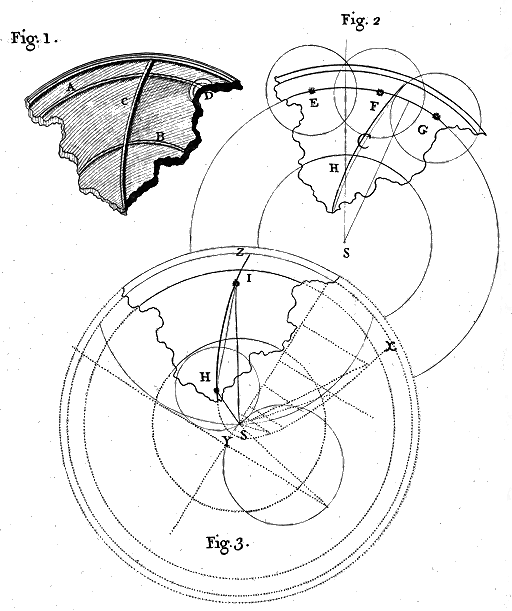
Plate II.
First, by compleating the Circles geometrically from the fourth Book
of Euclid, by the Assistance of any three Points E. F. G. the original
Figure will be restored, as at Fig. 2. And secondly, by assuming any
two Points, as F, E in the Curve C, if admitted a Parabola, by a well-known
Problem in Conic Sections the Heliocentric Portion X. Y. Z. will
easily be projected and shewn, as in Fig. 3. Lastly, join this in Position
to the former, and it will justly supply the Orbit, or Path of some one of
the Comets; and if required, even what Comet may be discovered by
comparing the Perihelion Distance Y. S. with their general Elements or
Theories, in Dr. Hally's Synopsis of the Motion of these Bodies. And if
a farther Confirmation of the Truth of these Conjectures were wanting,
the small concentric Circles at D would now be allowed beyond a Contradiction,
to represent the secondary Orbits of Saturn; and thus the
first Presumption being carried thro' several corroborating Degrees of Probability,
almost past a Dispute, would become a mathematical Certainty;
and the above imperfect Piece of Medallion, would evidently appear beyond
a Contradiction to be Part of a Representation of the said solar System,
and such as is shewn in Plate II. Q. E. D. Thus in many Cases, it often happens,
that from a very small Part of orbicular Things, we are able to determine
the Form and Direction of the Whole: And hence you may
conceive it no very difficult Task to a Mathematician, to describe the Orbits
of all the Planets in the solar System, though he had never observed
them but in one and the same Sign of the Zodiack; thus far I have thought
it would not be amiss to explain to you the Nature of those Steps, by
which we arrive at moral Certainty, and where the Subject will admit of
it, Mathematical Conviction, which will not a little contribute to strengthen
many of the Arguments hereafter made use of, and in some Degree
serve to supply the Place of Proof, where infallible Demonstration cannot
from the Nature of the Thing be discovered.
But besides the indisputable Principles of Geometry, the universal
Law of Analogy and Similitude of things, have a Privilege to assist us,
in Conjectures relating to the heavenly Bodies, and though not of equal
Force with the former, is often as conclusive as the Subject requires. This
sort of probable Evidence (as Dr. Butler observes,) is essentially distinguished
from "Demonstrative by this, that it admits of Degrees; and
of all Variety of them, from the highest moral Certainty to the very
lowest Presumption; and that which chiefly constitutes Probability, is
expressed in the Word Likely, or Natural Likeness, as to State or Being."
This general Way of arguing, I think, is allowed to be evidently natural,
just and conclusive, and unquestionably to have its Weight in various Degrees,
towards determining our Judgment: For Instance, should any ignorant
Person, endowed with rational Principles, cut open a Pomegranate
of the natural Growth of England, and finding it full of small Globules, or
Kernels, upon being presented with an every way similar Fruit, said to be
the Produce of Italy, doubt of its being of the same Nature, and composed
of like globular Seeds within; here indeed would be no mathematical
Evidence to assist the Judgment, the Object of Proof being invisible,
but sure from the external Similitude, the strongest Probability of their
being also internally the same. Again,
Is it natural to suppose, that the first Person who found a Lark's Nest,
and in it several of the Female's Eggs, should have any Apprehensions of
finding none in the Nightingale's, only because he had never seen one before,
I believe the most illiterate Person of the earliest Ages, who had Curiosity
enough for such a Search, would be greatly disappointed in such a Case,
and far from concluding that the Nightingale had none. Farther, should
any one who had seen several Sorts of Fish taken out of the River Thames,
or out of the Nyle, have any sort of Suspicion that he should find no such
Creatures in the Seine or the Ganges, though it should be allowed that he
had never seen any such Creatures that were known to come from thence.
Ocular Demonstration, in such a Case, would sure be unnecessary, and an
Evidence of the first, I believe would be abundantly sufficient to convince
us of what we ought to look for at least in the last: But then the Fishes
of different Seas, and of Rivers are not of the same Species you'll say;
but as it were infinitely diversified through all the aqueous World, this is,
and must be granted, and alike Variety of Species must also be granted, in
the former Case of the Birds: But no Objection can possibly arise from any
such Diversity, since we don't pretend to say, nor is it at all necessary, that
the Beings in the sidereal Planets should be every where the same with
these of our solar System, a Variety must every where be admitted, and will
always be admired, where the Work is Nature's, and the Design God's.
All then that I here pretend to argue for, is a Universality of rational
Creatures to people Infinity, or rather such Parts of the Creation, as from
the Analogy and Nature of Things, we judge to be habitable Seats for
Beings, not unlike the mortal human.
Every Animal, and every Vegetable, that, as it were, naturally exists
by the Virtues, Properties, or Laws of the mineral Kingdom, has something
of a secondary Nature, depending upon it as a Principle; and to
say that the Stars, which are a certain visible sort of Cotemporaries in Space
with the Sun, have no like planetary Bodies with ours moving round them,
because we cannot possibly see them, is no less absurd and ridiculous, than
to argue, that we can have no Reason to expect to find, in the proper
Season, Grapes upon every Vine—Figs upon every Tree—Roses upon
every Bush—only because some of them are at such a Distance, that
neither Rose, Fig or Grape, can be discovered by the Eye.
This sort of Reasoning, though some perhaps may neglect it, I am
perswaded you will look upon as abundantly sufficient for Things out of the
Reach of Science to determine; and that the collective Body of Stars
have not been discovered, to be together a proper Subject for such Conjectures
before, can surely only proceed from the Want of Time, necessary
to compleat the Observations proper for a Foundation to build such an
Hypothesis, or Theory upon. This is the great Article in which the Moderns
have so much, and ever will have, an Advantage over the Antients.
And hence it will appear, That
The Improvements and Discoveries of latter Ages are not at all owing
to the greater Capacity of the Moderns, but from the Advantages received,
or arising from the Inventions and Progress made by the Ancients. We
at first in a manner walked by their Leading-strings, and though many of
them now are broke, or useless, none can deny, but that formerly they
were of great Advantage in promoting and directing philosophical Enquiries.
In an Assembly of the most eminent Men of all Ages, if we may suppose
such a Conference amongst the illustrious Dead, on Purpose to deliver
their several Sentiments familiarly together, on the most interesting Subjects
of natural Knowledge, who would not lament the Disadvantages,
poor old Thales, an Hipparchus, or a Ptolomy, would lie under, who had nothing
but the Eye of Reason to direct them, in Opposition to the Judgment
of a Brahe, or a Galilæus, who reaped so much Benefit from their
compound Opticks? But on the other hand, perhaps if the solar System,
was the Topic of Discourse, a [H]Pythagorean might very pertinently say
to a Newtonian, "You have not gone much farther in the Light with our
Direction, than we did in the Dark alone; for you are still roving
round the same Circles." Much might be said upon this Head; but
I believe it would be a difficult Matter to do Justice to all Parties: So here
I intend to leave them, only must observe, that Posterity will always have
the Advantage over their Predecessors; and that After-ages, in all Probability,
will reap so great a Benefit from the Invention and Improvement
of Fluxions, that scarce any thing, which is the immediate Object
of such Enquiry, will long lie concealed from a true mathematical
Genius.
For this, in which he has surpassed all the Antients, and greatly advanced
the philosophical Sciences, the World is indebted to Sir Isaac Newton.
But as many of his Discoveries, such as relate particularly to the Laws
of the planetary System, are but as so many Confirmations of the Conjectures
and Imaginations of Astronomers and Philosophers before him, it
perhaps will not be amiss to acquaint you a little with the Astronomy of
the Antients concerning the Universe. And before I proceed to those of
my own, shew you in the first Place how far their Speculations in the visible
Creation have been carried; and with these I shall conclude this preparatory
Epistle.
The Universe, or mundane Space, by which the Antients comprehend
all Creation, has, from time to time, according to the Progress of Science,
come under a sort of Necessity of being variously modell'd agreeable to the
Opinion of the several Authors, who have judged themselves wise
enough to write upon it with a mathematical Foundation: And the cosmical
System, by which is meant the Co-ordination of its constituent
Parts has undergone almost as many Changes as its Elements are even capable
of; every Age of the World, as Knowledge has increased, either
from improved Imagination, or repeated Observations, producing something
new concerning it.
Milton, no doubt, had all this Diversity of Opinions in View, as
appears from his supposed Pre-knowledge of Raphael, in the following
Passage, Book. VIII.
Hereafter, when they come to model Heaven,
And calculate the Stars, how they will weild
The mighty Frame! how build, unbuild, contrive
To save Appearances, how gird the Sphere
With centric and eccentric scribbl'd o'er;
Cycle, and Epicycle, Orb in Orb.
But the following Synopsis, I believe, will abundantly convince you
that from certain Observations only, we ought to form all our Notions of
it, if we either hope to arrive at Truth, or expect our Ideas should be
supported by Reason.
Aristotle was of Opinion, that the Universe, or Heaven, was all
one World, and St. Chrysostom, Tertullian, St. Bonaventure,
Tycho Brahe, Longomontanus, Kepler, Bulialdus and Tellez,
were of an united Opinion, that this one Heaven, or Universe, was all
sidereal and fluid. But Aegidius, Hurtadus, Cisalpinus, and Aversa,
believing the same Heaven with them to be all one World, and that
sidereal, yet on the contrary held it to be solid.
Clemens, Acacius, Theodoret, Anastasius, Synaita, Procopius,
Suidus, S. Bruno, and Claudianus Mamertus, supposed
the universal mundane Space as divided into two Heavens, namely,
The Empyræum created the first Day,
And the Firmament created the second Day.
Two Heavens were also held by Justin Martyr, the one sidereal,
and the other aerial. The first supposed by St. Gregory Nyssene, to be
that of the fixed Stars, and the last, that of the Planets. But Mastrius
and Bellutus, though agreeing in the Number of Heavens, calls one the
*Primum Mobile, and the other, the Starry Heaven.
Farther, St. Basil, St. Ambrose, Damascene, Cassiodorus, Genebrardus,
Suarez, Tannerus, Hurtadus, Oviedus, Tellez,
and Borrus, distinguished the Universe as divided into three Portions,
or Heavens.
|
Or, as
Cajetan. |
Tho.
Aquinas. |
| The first called the Empyræum, |
Watery, |
|
| The second supposed Sidereal, |
Sidereal, |
Watery, |
| And the last of all, Aerial. |
Aerial, |
Sidereal. |
Again, St. Athanasius adds to those of the fix'd Stars, the Planets, and
the Air, that of the Empyræum, and makes in all four Heavens.
But as the Number of the Heavens thus increases, and will become
subdivided in the subsequent Account of them, to give you a better Idea
of the Order of these celestial Portions of the mundane Space, it will
not be amiss to form what remains of them into regular Sections of their
proper Spheres and Systems.
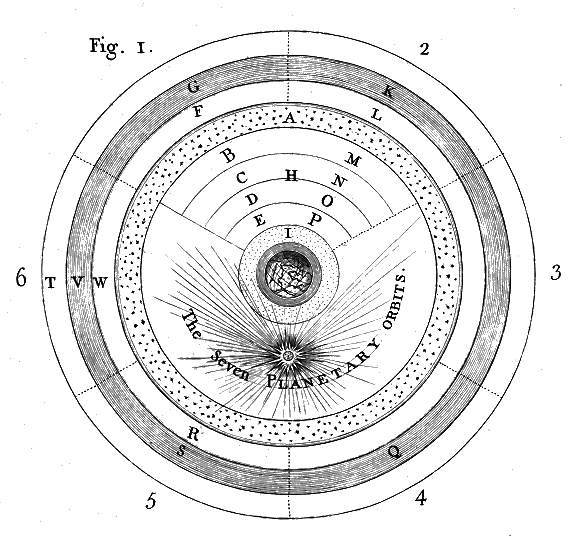
See Plate III. in which Figure, the first represents a Section of the
cosmical Theory of Oviedus and Ricciolus: Both consisting of five Heavens,
viz.
By Oviedus,
sidereal and solid. |
| The fixed Stars, |
A |
| Saturn, |
B |
| Jupiter, |
C |
| Sol, with ♂ ☿ and ♀ included, |
D |
| The Moon. |
E |
|
By Ricciolus,
sidereal and fluid. |
| Empyræum, |
G |
| The Water, |
F |
| The fixed Stars, |
A |
| The Planets, |
H |
| The Air. |
I |
|
Fig. II. represents that of venerable Bede and Rabanus, viz. of Seven
Heavens.
And according to Bede
composed of |
But by Rabanus, |
| The Air, |
P |
The Atmosphere, |
| The Æther, |
O |
The upper Air, |
| Olympus, |
N |
The inferior Fire, |
| The Element of Fire, |
M |
The superior Fire, |
| The Firmament, |
A |
Sphere of the fixed Stars, |
| The Angelical Region, |
L |
The Crystalline Heaven, |
| Realm of the Trinity. |
K |
The Empyræum. |
Fig. III. Represents the Hypotheses of Eudoxus, Plato, Calippus, Cicero,
Riccius, Philo, Remigius, Aben-Ezra, Carthusianus, Lyranus, Tostatus, Brugensis,
Orontius, Cremoninus, Philalethæus, Amicus, and Ruvius; also the
Babylonians and Egyptians.
Consisting of Eight Heavens,
All Sidereal, viz. The Sphere of the fix'd Stars, and those of the Seven
Planets.
Fig. IV. is that of Macrobius, Haly Alpetragius, Rabbi-Josue, Rabbi
Moyses, Scotus, Abraham Zagutus, Sacroboscus, Claromontius, Avigra,
and Arraiga.
All of Nine Heavens,
Comprehend a Primum Mobile Q, or, according to Arriaga, a solid
Empyræum. The Sphere, of fixed Stars A, and the seven Regions of the
solar Planets.
Fig. V. is that of the great Alphonsus, Fernelius, Regiomontanus, Amicus,
Maurolycus and Langius; also of Azabel, Thebit, and Isaac Israelita;
and likewise of Gulielmus Parisiensis, and Johannes Antonius
Delphinus.
Consisting of Ten Heavens, made up of
| A Primum Mobile |
S |
Empyræum. |
| A Sphere of Tripidation in Longitude |
R |
Primum Mobile. |
| The Sphere of the fixed Stars |
A |
|
| And those of the seven solar Planets within. |
|
|
Note, Some Authors place the Sphere of Tripidation in Longitude below
that of the Aplain, or Eighth Sphere.
Lastly, Fig. VI. is the Heaven of Petrus Alliacensis, the College of Conimbra,
Martinensis, (and sometime) of Clavius; and also Johannes Warnerus,
Leopoldus de Austriâ, Johannes Antonius Maginus; and lastly, of Clavius.
In all Eleven Heavens containing,
| T |
A Primum Mobile, or, as others say, an Empyræum. |
| V |
A Sphere of Libration in Latitude. |
| W |
A Sphere of Libration in Longitude. |
| A |
The Sphere of the fixed Stars, and those of the Planets. |
Plate III.
Thus you see how many various Opinions have from time to time
been embraced concerning the Fabric and Formation of the visible Universe;
all of which are now and have long been exploded; and although
at first advanced by Men of the greatest Learning, and of the deepest Penetration
in natural Knowledge, it does not appear from any one of their
Opinions, that they had any the least Notion of infinite Space, but as it
were confined the Divine Being to their limited Notions, as one may
say in an Egg-shell. If therefore what I shall hereafter advance, extend so
far without the known Creation, that you can possibly conceive no Bounds
to the Works of infinite Wisdom and Power, I hope you will be in no
Danger of looking upon it as more ridiculous, or absurd, than what so
many of the wisest Men of every Age have thought proper to attempt,
and have judged worthy of their Attention so long before me. If any thing
less so, I shall think myself happy enough in having broke, or rather passed
the narrow Limits to which the Creation has for so many Years
been confined, in hopes of tempting Men of greater Talents to look up
wards, and pursue so noble a Subject as far as the human Understanding
is capable of comprehending it.
To the Opinions above might be added many more, particularly that
of Johannes Baptista Turrianus, and Fracastorius, who increased the Number
of Heavens to fourteen, viz. seven on each Side the Aplané.
But of this I have said enough; in my next I shall proceed to Matter
better grounded,
And am, &c.
LETTER the THIRD. — PLATE IV. — PLATE V. — PLATE VI. — PLATE VII. — PLATE VIII. — PLATE IX. — PLATE X.
Concerning the Nature, Magnitude, and Motion of the Planetary Bodies
round the Sun, &c.
SIR,
T
The younger Pliny, if I remember right, somewhere says, that
there is, or ought to be, a wide Difference betwixt writing to a
Friend, and writing to the Publick: I have indeed pleased myself
with the one, but am far from thinking myself qualified for the other;
I must therefore rather intreat you, though perhaps you cannot possibly
overlook all my Faults as an Author, to excuse them at least in the Friend,
and by such kind of unlimited Indulgence, you will give me a much greater
Chance to do the Subject some Justice, though I own I despair in this
first Attempt, to reconcile every thing I advance to your more cool and
impartial Reasoning. But to the Business:
As I have no Ambition to have the Substance of my Theory more admired
by you than understood, which is too often the Case in Works of
this Nature, I must beg leave to repeat to you Part of a former Discourse,
which will refresh in your Ideas the principal Laws of the System
of our Sun, and make you properly acquainted with such Things as are
necessary to be known in the now-established Astronomy of [I]Copernicus,
&c. before I proceed to any new Matter.
The Sun, you are not to learn, is the reputed Center of our Planetary
System, and may remember, that the Earth on which we live, and these
five following Erratic Stars, viz. Saturn, Jupiter, Mars, Venus and
Mercury, have been demonstrated to move round him in the Order
and Manner following.
Saturn is found to complete one Revolution round the Sun in twenty-nine
Years, one hundred and seventy-four Days, six Hours, and thirty-six
Minutes; at the Distance of about seven hundred and seventy-seven
Millions of Miles. Jupiter performs a like Revolution in about eleven
Years, three hundred and seventeen Days, twelve Hours, and twenty
Minutes; distant from the Sun about four hundred and twenty-four Millions
of Miles. Mars compleats his Circuit in one Year, three hundred
and twenty-one Days, twenty-three Hours, and twenty-seven Minutes;
and his mean Distance is about one hundred and twenty-three Millions of
Miles.
These three are called superior Planets, as being farther from the Sun
than the Earth, and circumscribing its Orbit.
The Earth circumambulates her Orbit in one solar Year, viz. in three
hundred and sixty-five Days, five Hours, forty-eight Minutes, and fifty-seven
Seconds; at the mean Distance of eighty-one Millions of Miles.
The Radius of Venus's Orbit is about fifty-nine Millions of Miles; and
that of Mercury nearly thirty-two Millions, ditto.
The Heliocentric Revolution of Venus, is made in two hundred and
twenty-four Days, sixteen Hours, forty-nine Minutes, and twenty-seven
Seconds; and that of Mercury, in eighty-seven Days, twenty-three Hours,
fifteen Minutes, and fifty-four Seconds. These two last Planets are called
inferior Ones, as being circumscribed by the Earth.
The Diameter of the Sun being demonstrated to be nearly seven hundred
and sixty-three thousand Miles:
The proportional Magnitudes of all the above Planets will be found
nearly as follows, viz.
|
The Diameter
of the Globe, |
| Of Mercury |
4,240 |
|
Miles |
| Venus |
7,900 |
| the Earth |
7,970 |
| Mars |
4,440 |
| Jupiter |
81,000 |
| and Saturn |
61,000 |
Thus much I have thought proper to premise, and for your immediate
Inspection, have added the following Schemes, that nothing may be wanting
to give a general Idea of the Order of the celestial Bodies in our own
System, before I attempt to lead you through the neighbouring Regions of
the Stars to the more remote Tracts of Infinity.
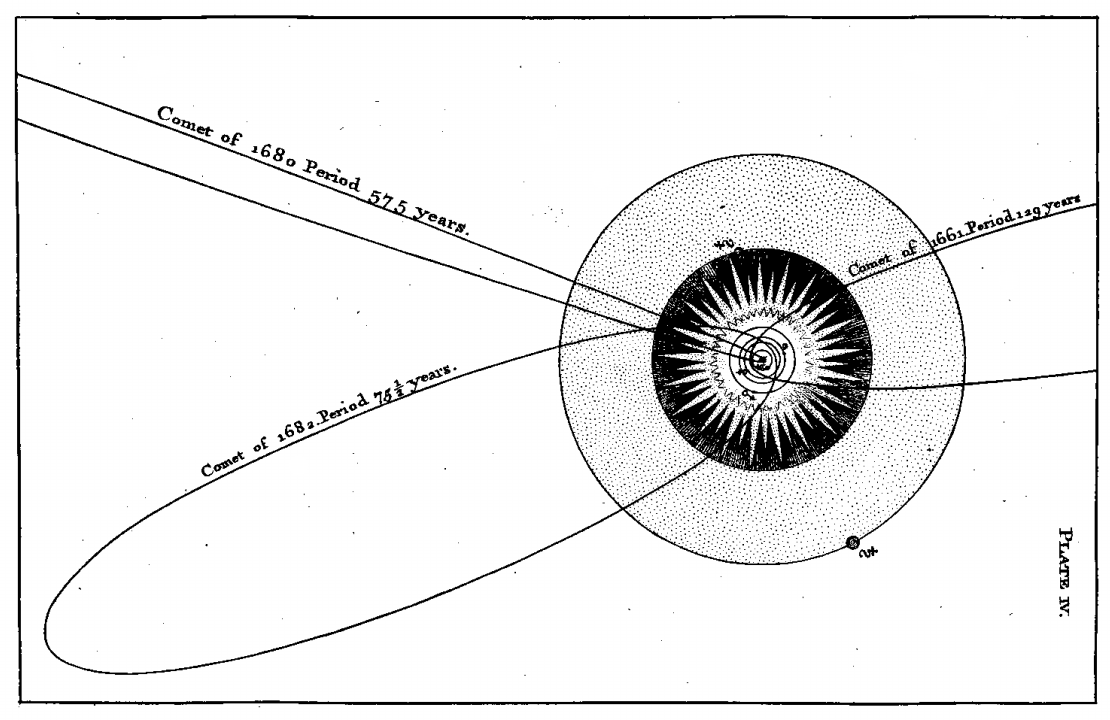
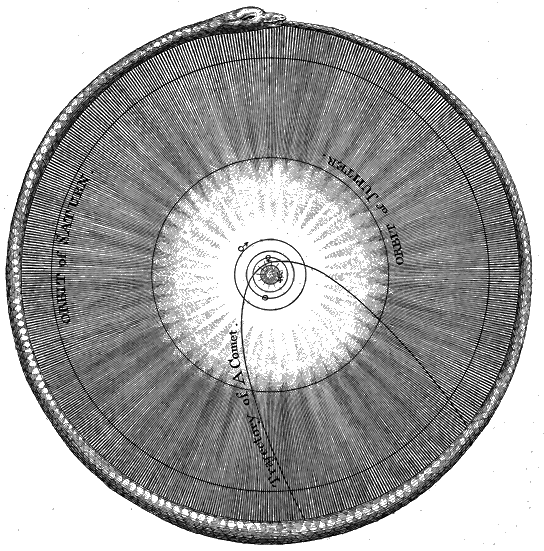
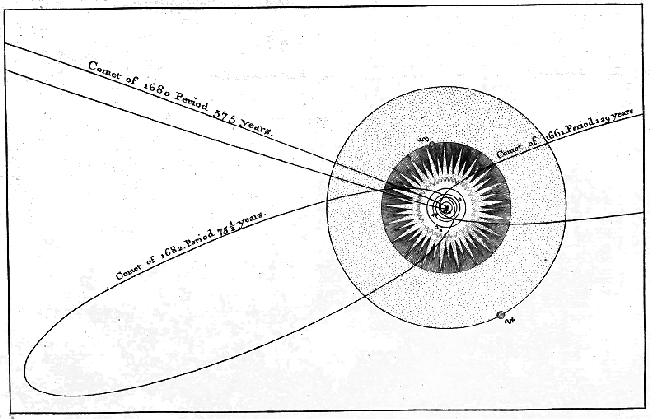
Is a true Delineation of the solar System, with the Trajectories of three
of the principal Comets, whose Periods and Orbits have been accurately
determined, and are represented in their true Proportion and Position to
one another, and the Order of the Planets round the Sun, marked with
their respective Characters, viz. ♄, for Saturn, ♃, Jupiter, ♂, Mars, ♁,
the Earth, ♀, Venus, and ☿, Mercury. The Scale being nearly five hundred
and eighteen Millions of Miles to an Inch.
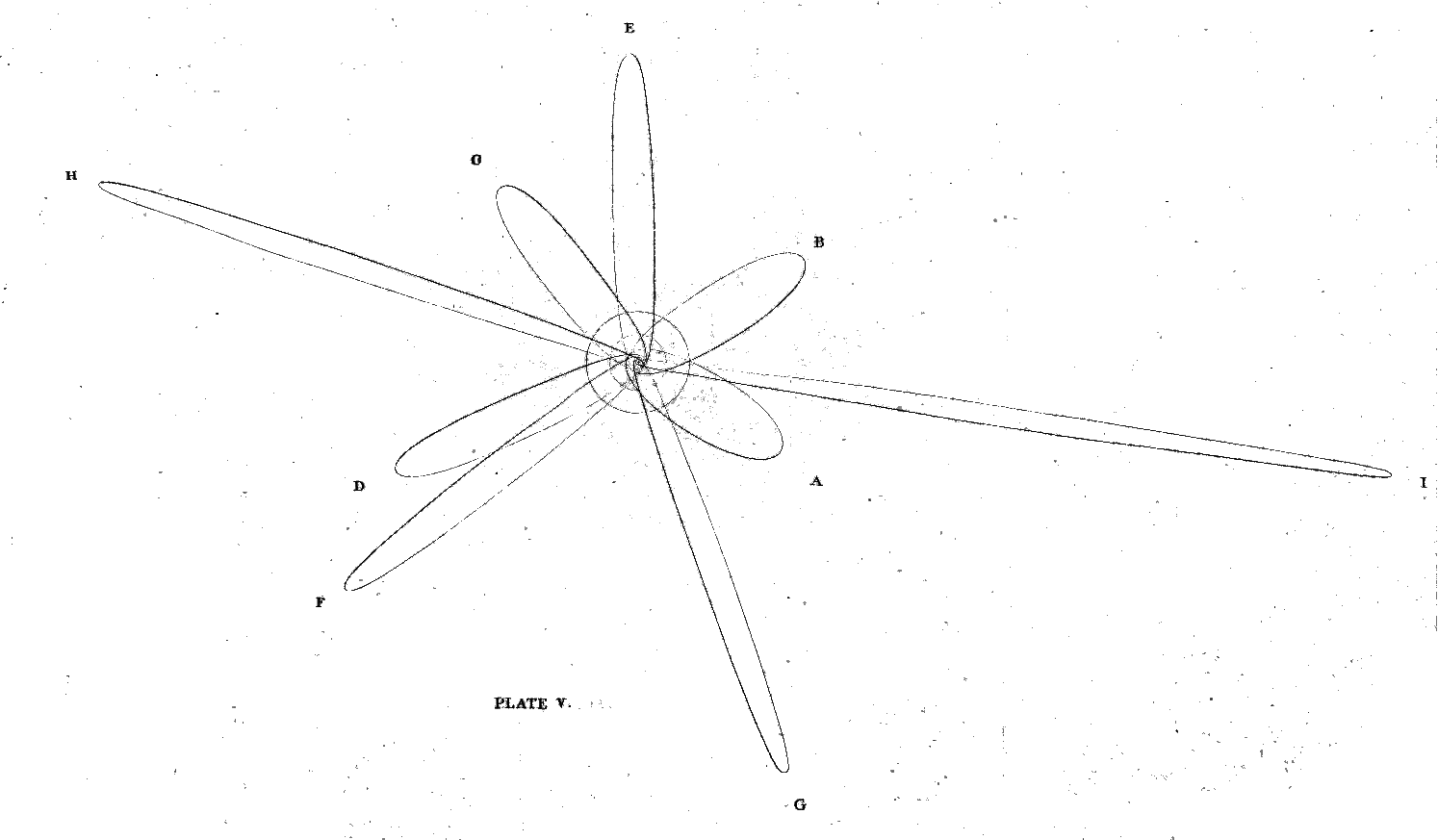
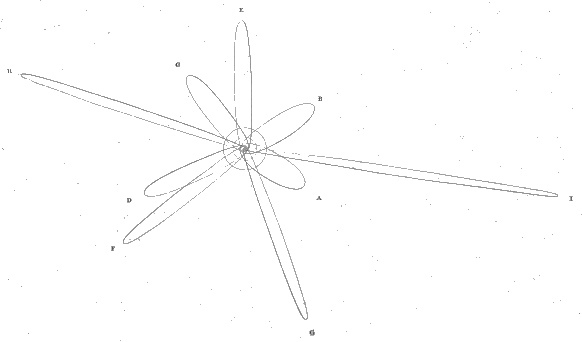
Is a true Projection of the System of the known Comets; in which are
represented nine of the chief Trajectories, from their Aphelii to their Perihelii,
all in just Proportion and Position to the Orbits of Saturn and Jupiter,
which are also represented by the two concentric Circles, supposed
to be drawn round the Sun as their Center.
The Ellipsis, or Trajectory, marked A, shews the Position and Path
of the Comet which appeared in the Year 1684, whose Period is supposed
to be about fifty Years, and has been observed within the Region of the
Planets once.
That mark'd B, is the Way of the Comet of 1682;
The Period conjectured to be about seventy-five
Years and a half, and has been observed thrice.
C, Way of the Comet of 1337;
The Period about 100 Years, observed once.
D, That of the Comet of 1661;
The Period about 129 Years, observed twice.
E, Tract of the Comet of 1618;
The Period about 160 Years, observed once.
F, Way of the Comet of 1677;
The Period about 200 Years, observed once.
G, Way of the Comet of 1744;
The Period about 300 Years, observed once.
H, Way of the Comet of 1665;
The Period about 400 Years, observed once.
I, Way of the Comet of 1680;
The Period about 575 Years, observed thrice.
Plate IV.
 Click on image to view larger.
Plate V.
 Click on image to view larger
The Scale of this System is equal to one Third of the former.
Here I must observe to you, as a Thing I judge may prove of great Consequence
with regard to the System of Comets, which is as yet very imperfect:
That I am strongly of Opinion, that the Comets in general,
through all their respective Orbits, describe one common Area, that is to
say, all their Orbits with regard to the Magnitude of their proper Planes,
are mathematically equal to one another; which, if it once could be proved,
and confirmed by Observation, the Theories of all the Comets that have
been justly observed, might easily be perfected, and their Periods at once
determined, which now we can only guess at, or may wait whole Ages for
more Certainty of. What leads me to believe, that this may prove to
be really the Case is this.
I find by Calculation, that the Orbits of the two last Comets, whose
Elements have been most corrected by Sir Isaac Newton and Dr. Hally, are
to one another, according to their Numbers, nearly as [J]13 to [K]17,
notwithstanding one of them is one of the most erratick that ever came under
our Observation; and the other one of the most neighbouring to the
Sun.
But it is well known to all Mathematicians, that the first of these Comets
moved in so eccentric a Trajectory, that the least Error in its almost
incredible Proximity to the Sun will produce a very sensible Difference
in the Area of the Orbit: And accordingly, if we moderate the Perihelion
Distance of this Comet, by making it but 1000 instead of
[L]612, which is but increasing it a 1/35000th Part of the great Radius
of the Orbit, (which is an Error every Astronomer will readily
grant is very easily made) and we shall find the Orbits of the said two
Comets to be exactly equal.
Further, I must inform you, that the Comet of 1682, which the above is
compared with, seems to have been so accurately observed, that it does
not appear to have altered its Perihelion Distance half a 68th Part in one
intire Revolution. Now, if we can with any Show of Reason, and a
Probability on our Side, bring the Areas of these two extream Comets,
as I may call them, to an Equality, sure we may conclude, it is a Subject
highly worthy to be more considered and enquired into.
Is a true Representation of the satellite Systems, proportionable to one another,
and to the Orb of the Sun's Body, that a just Idea of the Distances
of those secondary Planets, may be easier had from their respective primary
ones.
S represents the solar Body with its Atmosphere. Fig. 1. is the System
of Saturn from the same Scale. Fig. 2. that of Jupiter from
ditto. And Fig. 3. the Orbit of the Moon round the Earth, in the same
Proportion.
But as you can have but a very imperfect Idea of the Magnitude of these
last Circles, with regard to the Body of the Earth or Moon,
Is a true Projection of their real Globes, at their proper Distance from
each other, with their common Center of Gravity, and the Point and
Line of equal Suspension betwixt them, viz.
A, represents the Globe of the Earth.
B, that of the Moon.
C, Point, and C D, Line of equal Suspension betwixt them.
E, Common Center of Gravity, which describes the Orbis Magnus.
E, F, and B, G, is the Orbit of the Moon.
Farther, that nothing may be wanting to give a true Notion of the
whole together,
Is a proportional Drawing of all the primary and secondary Planets together,
distinguished by their Characters, proper to attend a Globe of
twelve Inches Diameter, such a one being supposed to represent the Sun.
Is an exact Scheme of the principal known Comets, in just Proportion,
to the Globe of the Earth represented at A, with the Nucleus, and Part of
the Tail of the Comet of 1680, B, as it was observed in its Assent from the
Sun, viz. a a the Comet's natural Atmosphere, z z z, the Denser Matter
winding itself into the Axis of the Train x x, the inflam'd Atmosphere and
Tail dilated near the Sun. C, represents the Ball of the Comet of 1682,
D, that of 1665, E, that of 1742, and F, the Head of the Comet of
1744.
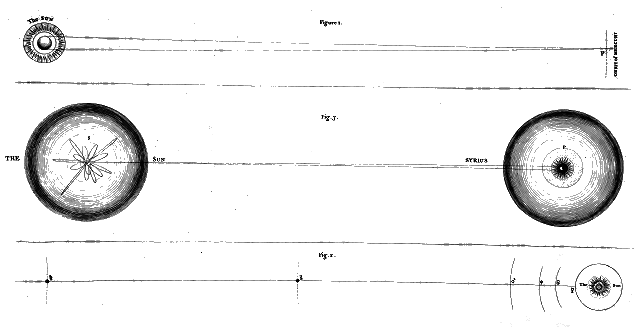
And again, that you may have some Notion of the apparent Magnitudes
of all these Planets and Comets, &c. as they appear at the Earth,
Plate VI.
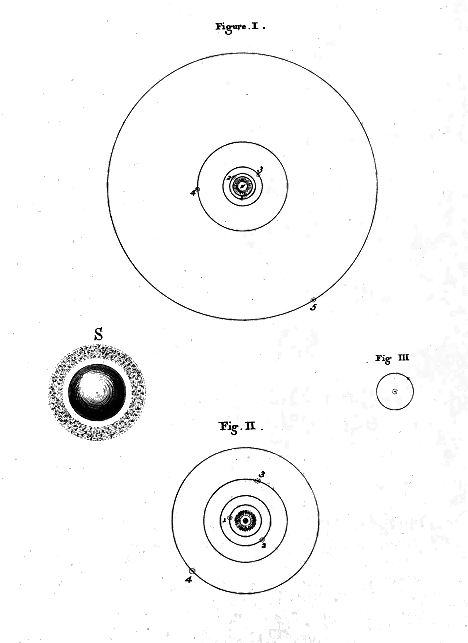
Plate VII.
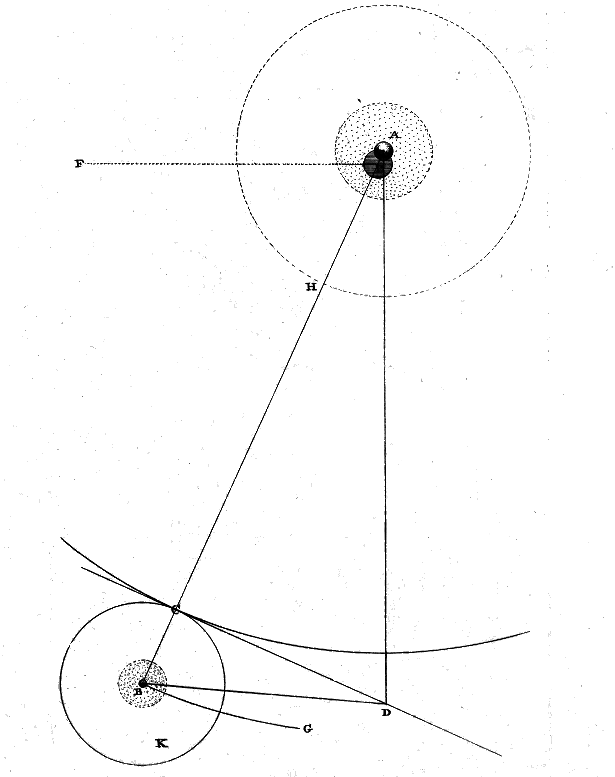
Plate VIII.
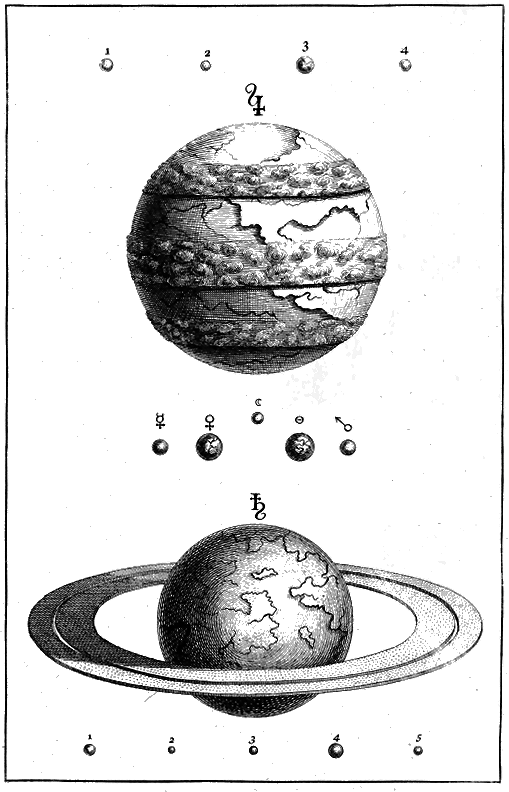
Plate IX.
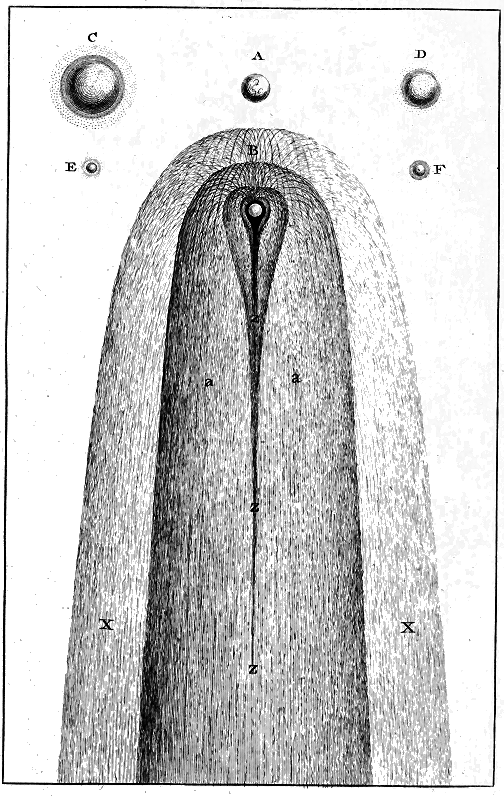
Plate X.
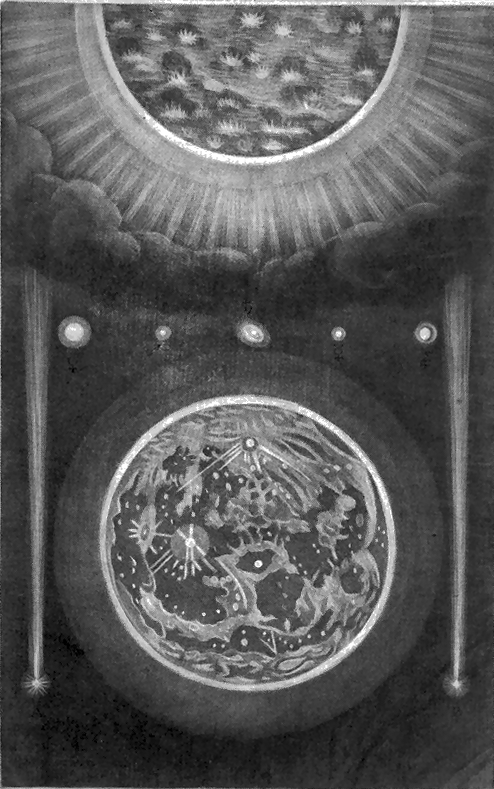
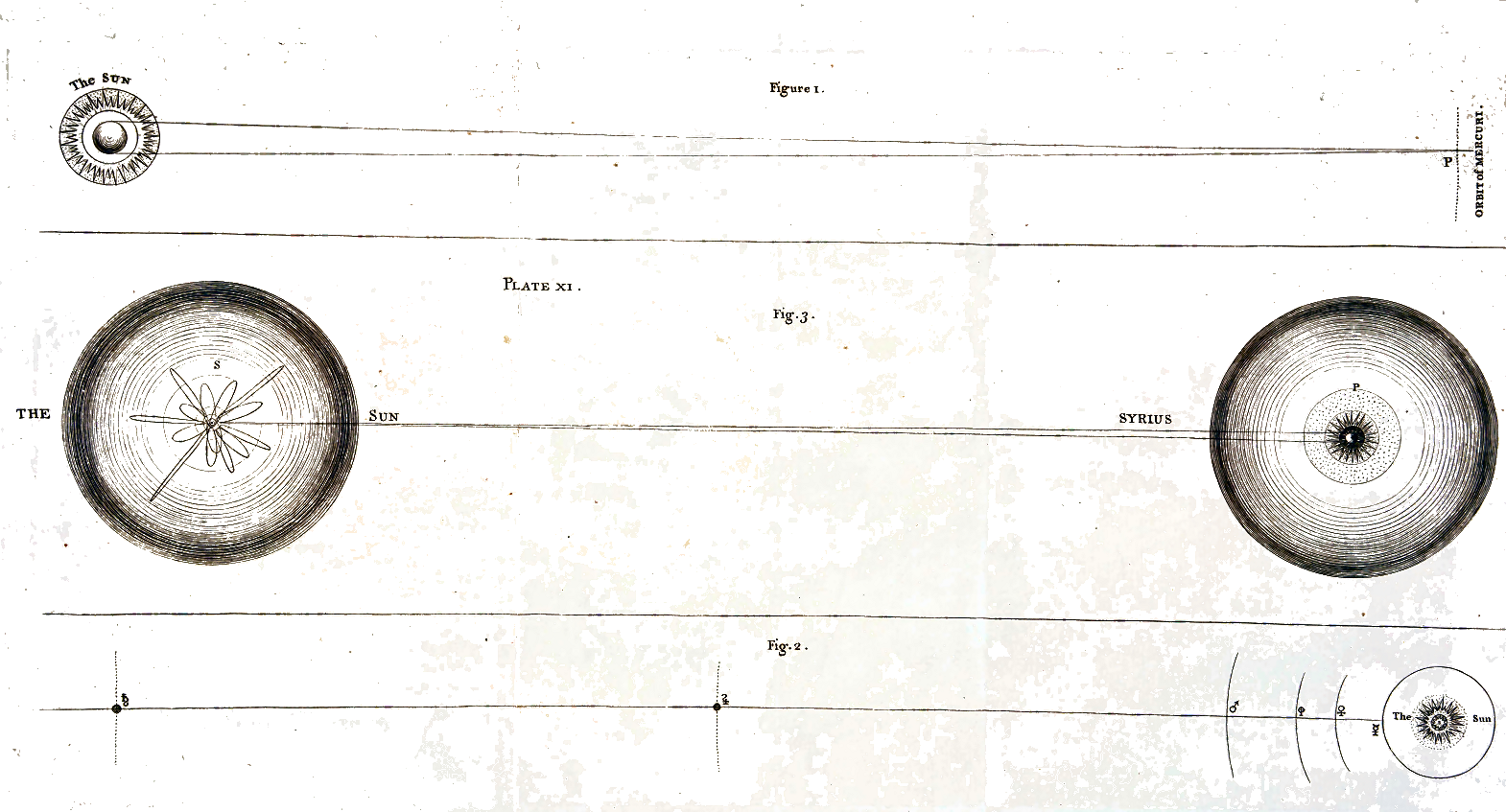
Plate XI.
Click on image to view larger sized.
Represents the Sun and Moon in the just Proportion of their mean Diameters,
with two of the Comets A and B, and the five erratick Planets, as
they are observed at the Earth, in a middle State of their Distances from it.
For a more full and particular Description of all the Parts of the solar
System, and of the home Elements of Astronomy in general, I refer you
to my Clavis Cœlestis, &c. where every thing concerning the Planets, Comets,
and Stars; and their real and apparent Motions, are at large represented,
explained, and accounted for, for the Benefit of such as have not made
the Mathematicks their regular Study.
Now, to convince you that the Planets are all in their own Nature no
other than dark opaque Bodies, reflecting only the borrowed Light of
the Sun, I must recommend to your Observation, this natural and simple
Experiment, which almost any Opportunity of seeing the Moon a little
before the Full, will put into your Power to make; but best and easiest
when the Sun is in any of the North Signs, i. e. in Summer.
At such a time, the Sun being near setting, the Moon will appear in
the eastern Hemisphere; and if there be any bright Clouds northward,
or southward near her, you will plainly perceive, that the Light of the
one is of the same Nature with that of the other; I mean the Light of
the Moon, and that of the Cloud. To me there never appeared any Difference
at all; and I am perswaded, were you to make but two or three
Observations of this kind, which is from Nature itself, a sort of ocular
Demonstration, you cannot fail of being convinced, that the Moon's
Light, such as it is, without Heat, can possibly proceed from no other
Cause than that which illumines the Cloud: For if the Clouds, whose
Composition we know to be but a thin light Fluid, formed of condensed
Vapours only, is capable of remitting so great a Lustre, how much more
may we not allow the Moon, which, Length of Time, and many other
Circumstances, have long confirmed to be a durable and solid Body.
The Increase of her Lustre, indeed, during the Absence of the Sun
from us, to a less penetrating Genius than your's, may possibly afford
some trifling Ground of Objection to the above Conclusions, as being
drawn from the Phænomena of Day-light only; by reason in the Night,
we have no Clouds in equal Circumstances to compare with her.
But this I need not tell you, is all owing to her being seen through a
darker Medium, and not to any real Increase of natural Light emitted
from the Sun. As a Proof of which, were it necessary, you need only,
shut out the Rays of the Atmosphere, by the Help of a sufficiently
long Tube; and the Moon, or any other celestial Body, will appear
through it, as bright in the Day-time as in the Night.
Thus all light Bodies of inferior Lustre, whether shining by their own
natural Radiences, or by a borrowed Reflection, partake of the same Advantage,
when removed from the more potent Influence of a superior one;
and hence it is, that the [M]Aura Ætherea shines out most manifest, when
the Body of the Sun himself is hid, the Stars, and the Via Lactea most
lively and numerous in the Absence of the Moon, and those Exhalations,
or Meteors, vulgarly called Falling-stars, become only visible (like
Glow-worms) in the Night.
Here it may not be improper to tell you, that the Clouds are to us in
effect no other than as so many Moons, whereby we have our artificial
Day prolonged to us several Hours after the Sun is set, and likewise produced
as much sooner before he rises; and were they to ascend by still
stronger Power of Exhalation to an Elevation, all round the Atmosphere,
so as to form a Sphere equal to four Times the Globe of the Earth, there
would then be no such Thing as real nocturnal Darkness to any Part of
the World.
The lunar Light then we may very justly conclude, proceeds originally
from the Sun: And notwithstanding many more Arguments might be
drawn from the Demonstration of her Phases, Eclipses, &c. to prove it,
yet none of them need here be added, to what has been already said, to
convince you of the Truth of it. This being granted, let us now consider
what Effect this, or a like Quantity of borrowed Light, would have,
when removed to a much greater Distance.
I may, I think, suppose, that you know so much of Opticks as to understand,
that all visible Objects apparently decrease in Magnitude, as their
Distance from the Eye increases. Consequently, that, if the Moon's Orbit
was placed as far again from the Earth as it really is, her Globe, or rather Disk,
would then seem to be but half as big as to us she now appears to be, and
of course still farther, were she placed at ten times the Distance she is
known to revolve at, her apparent Diameter would be reduced to a tenth
Part only of what it now appears to be in her present Orbit, that is, one
hundred Times less in visible Magnitude than her neighbouring Disk is
found to be where it now is seen. And such, but something less, the two
Planets Venus and Jupiter, which are frequently, in their Turns, our
Morning and Evening Stars, appear to be through a common Telescope.
Now these two Planets, together with the other three, which we find
moving in regular Orbits round the Sun, are all found subject to the same
[N]Changes of Phænomena, in their various Aspects with the Sun; and who
can doubt but that they are all of the same or like Nature? But you'll say,
perhaps, how are we sure that Venus and Jupiter have no native Light of
their own, since many of the ancient Philosophers, and in particular
Anaximander, allowed even the Moon to have some; and besides, in Philosophy,
as well as in Logick, I think you hold there is no proving a Negative,
at least at such a Distance.
To make you conceive the Impossibility of such a Light, and next to a
Demonstration, convince you of the Unnaturalness of such a Supposition,
I must put you in mind, that some time ago, when I was last in the Country
with you, I think it was about the latter End of Autumn, near the
Winter Solstice, as we were walking one Evening, I bid you take notice
of the Moon, which was then near setting, and about two Days old.
You may remember, her whole Globe appeared to us very conspicuously
within a manifest Circle. You immediately told me, that that kind of Phænomenon
the Country People called a Stork, or the old Moon in the new
one's Arms. This I then endeavoured to explain to you, and I think
made you sensible it was intirely an Effect of the Earth's, and an Appearance
always to be expected at that Time of the Year. The Earth being
then in the State of a Full-Moon to that Part of the lunar Orbit, and near
her Perihelion, at which time, the Earth sends back a Reflection to the
[O]Moon twenty-five times more potent than that of the Moon to us.
Now the Planet Venus, from undeniable Principles of Geometry, is
allowed to be nearly such another Globe as the Earth is; and since the
Earth, as I have just now related, is found to reflect much more Light to
the Moon, by reason of her superior Magnitude, than the Moon can possibly
reverberate to Earth again; and since also 'tis plain, the Earth has no
Light of its own, why then should we imagine Venus to be endowed with a
Lustre, which we can prove to be no more than a similar Body, and governed
by the same Laws as the Earth is?
Anaximander's Mistake, in supposing the Moon in some small Degree
a radiant Body of itself, lay, in not considering, that the faint Illumination
here described, and visible all over her Globe, soon after almost every
Conjunction with the Sun; and probably in Eclipses, also proceeded from
the Earth; but the thing I think is too evident to expect any sort of Contradiction,
therefore I hope you will admit it as a Truth, and consequently
take it for granted, that the planetary Bodies in general, are meer terrestrial,
if not terraqueous Bodies, such as this we live upon; which is
the Thing I have chiefly in this Letter attempted to demonstrate, or
have rather explained; and now I hope, for the future, you will receive
the Idea of a Plurality of Worlds more favourably, and look upon astronomical
Conjectures in a less ridiculous Light than you used to do, especially
since you must allow, they give our unlimited Imaginations a like all
endless Field of Contemplation, not only full of the wonderful Works of
Nature, but also of a visible Providence.
I think I cannot conclude this Letter to you more properly, than with
the following fine Lines of Mr. Addison's from the Spectator, Vol. VI.
No. 465, which I hope you are not so polite as to look upon as an unfashionable
Quotation.
The spacious Firmament on High,
With all the blue ethereal Sky,
And spangl'd Heav'ns, a shining Frame,
Their great Original proclaim:
Th' unwearied Sun, from Day to Day,
Does his Creator's Pow'r display,
And publishes to ev'ry Land
The Work of an Almighty Hand.
Soon as the Ev'ning Shades prevail,
The Moon takes up the wond'rous Tale,
And nightly to the list'ning Earth,
Repeats the Story of her Birth:
Whilst all the Stars that round her burn,
And all the Planets in their Turn,
Confirm the Tidings as they roll,
And spread the Truth from Pole to Pole.
What though, in solemn Silence, all
Move round the Dark terrestrial Ball?
What tho' nor real Voice nor Sound
Amid their radiant Orbs be found?
In Reason's Ear, they all rejoice,
And utter forth a glorious Voice,
For ever singing, as they shine,
"The Hand that made us is divine."
And am, &c.
LETTER the FOURTH. — PLATE XI.
Of the Nature of the heavenly Bodies continued, with the Opinions of the
Antients concerning the Sun and Stars.
SIR,
Y
You tell me you begin to be a tolerable good Copernican, and
would now be glad to have my Opinion further upon the Nature
of the Sun and Stars, with regard to the Suggestion of their being
like Bodies of Fire. This you say will go a great Way towards confirming
you in the Notion you have begun to embrace of a Plurality of Systems,
and a much greater Multiplicity of Worlds than our little solar System
can admit of. Besides, shewing in a very evident Light, that the
Authorities cited in my first Letter are founded upon the clearest Reason.
Anaxagoras, you say, believed the Sun to be a Lump of red-hot Iron;
Euripides thought it a Clod of Gold; and others still more ridiculously
have imagined it to be a dark Body, void of all Heat. That the Sun is
a vast Body of blazing Matter, notwithstanding the various Opinions of
those primitive Sages, will, I think, hardly admit of a Question: Since the
known Warmth of his prolifick Beams, and the visible Effect of the Burning-glass,
puts it quite out of the Power of our present Set of Senses, at
least to argue against it; and how reasonably we may imagine the Stars to
be all of the same or like Nature, will sufficiently appear from these following
Considerations: First, it is well known to all Mathematicians, that
any visible Object of any determined Magnitude may be reduced to the
Appearance of [P]a physical Point, by removing the Eye of the Observer to
a proper or proportionable Distance from it, within the finite View: And
that the apparent Diameter of every luminous celestial Body, will always
be diminished reciprocally, in Proportion to the Distance from the Eye,
till they become altogether imperceptible.
Thus the Disk of the Sun, which appears to us at Earth under an Angle
of about half a Degree, if seen from the Planet Saturn, would appear not
much bigger than the Planet Venus or Jupiter, in their most neighbouring
Vicinity does to us; and consequently to an Eye placed in the Aphelion
Point of the Orbit of the great Comet of 1680, his apparent Diameter
would be so reduced as to seem but little bigger than the largest of the
Stars; and by the same Analogy, or Way of Reasoning, admitting Space
and Distance infinite, which I humbly apprehend is not to be disputed,
were all the Matter in the Universe united, and conglobed in one Mass,
with respect to ocular Sensation, it might be diminished so near to a mathematical
Punctum, as to be almost adequate to our Ideas of Nothing.
This to any tolerable Optician, must be an evident Conviction of the
Truth of the modern Astronomy, which now universally allow all those
radiant Bodies the Stars to be of the same Nature with the Sun; and that
as certainly they are no other than vast Globes of blazing Matter, all undoubtedly
shining by their own native Light.
But as you have often objected to what has been said of the Distance of
the Stars in general, and may possibly from a Supposition, that they are, or
may be, much nearer to us, infer, that their Light, like that of the Planets,
may be also borrowed from the Sun, or from some other radiant Body,
which, from the Nature of the Supposition, must of Consequence be invisible
to us, I judge it will not be amiss to throw a few demonstrative Arguments
in your Way, in order to lead you a little out of the Path of
an early Prejudice, and draw you as it were by Degrees through the Dawn
of astronomical Reasoning, out of your original Error, and rescue your
Imagination from the false Notions imbibed from Phænomena only in
your younger Years. This I guess cannot fail of reconciling you to this
more rational Way of Thinking, and make you acquainted with
Truths of much Consequence, which perhaps you have yet been an intire
Stranger to. The grand Deceptio Visus, which I must first endeavour to
remove, and which as a sort of Paradox in Nature, has, as I may say, imprisoned
the Understanding of many superficial Reasoners, and in general
all incurious Men, is this.
Most People are too apt to think originally, that as the Heavens appear
to be a vast concave Hemisphere, that the Stars must of course, as of
Consequence, be fixed there, like so many radiant Studs of Fire, of various
Magnitudes; and take it for granted, chiefly designed for no other
Purpose than to deck and adorn the Canopy of our Night. This was long
ago the Opinion of Thales the Milesian, and wants not the Authority of
many of the Antients to back it. Others, in particular [Q]Ptolomy of Pelusium
in Africa, who from his Experience in this Science, is called by
some the Prince of Astronomers, believed them to be Loop-holes in the
vast solid celestial Firmament, emitting the Light of the Crystalline Heaven
through it to all within it. The famous Diogenes, Cotemporary
with Plato, conceived them to be of the Nature of Pumice-stones, and inclined
to an Opinion, that they were the Spiracula, or Breathing-holes of
Heaven. Anaxagoras thought them Stones snatched up from the Earth
by the Rapidity of its Motion, and set on Fire in the upper Regions
above the Moon.
But how ridiculous and absurd all these Opinions and Conjectures really
are, will easily appear, if we but once consider the Nature of an unbounded
Æther, and the amazing Property of infinite Space.
This, with what has been said before, will not a little assist your Imagination
towards conceiving the Reasonableness of the Notion modern
Astronomers are now confirmed in, of their being absolutely so many
burning Balls, and which was no doubt, many Years ago, the Opinion
of Manilius, as is evident from these Lines in his Poem of the Sphere.
For how can we the rising Stars conceive
A casual Production; or believe
Of the chang'd Heav'ns the oft renascent State
Sol's [R]frequent Births, and his quotidian Fate.
Sherburne.
And again, in the same Poem:
The fiery Stars, and Æther that creates
Infinite Orbs, and others dissipates.
Zoroaster, the first of all Philosophers we read of who studied the Stars,
is reported to have believed them of a fiery Nature. Empedocles judged
them to be Fire æthereal, struck forth in its Secretion, and blazing in the
upper Regions. Plato thought them Fire, with the Mixture of other Elements
as Cements. Heraclides Worlds by themselves, of Earth, Air, and
Fire; and Aristotle, simple Bodies of the Substance of Heaven, but more
condensed.
But that I may not take up too much of your Time with Opinions
that has been imbibed in the Infancy of Astronomy, and has long ago
been exploded, I shall attempt but one Thing more to confirm your Sentiments
in this new Doctrine.
First, that the Stars are all at a Distance, not to be determined by the
utmost Perfection of human Art, is manifest from their having very little,
or no sensible [S]Parallax; and consequently, that any one of them is absolutely
bigger or less than another, from the simple Laws of Opticks, cannot
possibly come under our Observation to be ascertained; but that they all of
them may be nearly of the same Size or Solidity, is as impossible, with any
Shew of Reason to deny, since it is a known Principle in Geometry, that all
visible Objects naturally diminish, as has been said before, or are magnified
in a certain Proportion to their Distance from the Eye; and hence we may
conclude, and not without Reason in its strongest Light to support us,
that the smallest Stars, to the very least Denomination, are only removed
respectively more distant from the Observer's Station; and that at least this
we may be certain of, that they are all together undoubtedly an Infinity
of like Bodies, distributed either promiscuously, or in some regular Order
throughout the mundane Space: And, as Marino says,
Resplendent Sparks of the first Fire!
In which the Beauty we admire,
And Light of those eternal Rays,
The uncreated Mind displays.
It remains now I think to shew, and endeavour to prove, that the Stars
are not only light Bodies of the Nature of the Sun, but that they are really
so many Suns, all performing like Offices of Heat and Gravity, in a regular
Order, throughout the visible Creation, in opposition to an Opinion
you have formerly hinted at, of their being in another Sense of a secondary
Nature.
All Objects within the sensible Sphere of the Sun's Attraction, or Activity,
are in some measure magnified by a good Telescope: But the
Stars are all placed so far without it, that the best Glasses has no other
Effect upon them than making them appear more vivid or lively, but all
innate opaque Bodies, reflecting only a borrowed Light from some primary
one, contrary to this Property, are all observed to lose their Light, in the
same Proportion, as they are magnified, and through all Glasses become
more dull than otherwise they appear to the naked Eye: And hence we
may infer, without any further Evidence, that the Stars are all light Bodies
endowed with native Lustre; and that Bodies, like the known Planets,
from the same Reasoning, it is as clear they cannot be, because their
Distance, though uncertain as to the Truth of the whole, yet such a
Part of it as cannot be denied, would render them all in such a Case invisible.
A Proof of this will plainly present itself, if we consider the Course of
the known Comets, who all of them, without Exception, become imperceptible,
and intirely disappear; though most of them much bigger
than the Earth, or any of the lesser Planets, long before they arrive at
their respective Aphelions.
But we are under a kind of Necessity to believe them either Suns or
Planets, that is either dark or light Bodies; and since I have shewn the
Improbability; nay, I may venture to say, the Impossibility of their being
the first, it is natural sure to conclude, that they must be of the last
Sort; and I am persuaded, if you but once consider how ridiculous it is to
imagine so vast a Number of Bodies, all rolling round a Number of invisible
Suns, which must otherwise be the Case, since they are seen on all
Sides of ours, and cannot possibly be enlightened by him, or any, how all
of them, by any one else, you cannot possibly have any sort of Difficulty
in this Determination: But that no Arguments may be wanting to enforce
your Belief of what is here concluded, it will not be amiss to put you in
Mind of an optical Experiment or two, which cannot fail of convincing
you of the vast Probability of what is here asserted of them; and next to a
moral Certainty, demonstrate the Truth of what so many of the best Astronomers
have advanced, as before namely, that the Stars are all, or most
of them, Suns like ours.
Place any concave Lense before your Eye, and you will find all visible
Objects will appear through it, as removed to a much greater Distance
than they really are at, and reciprocally as much diminished. Now, if
you look upon one of these Glasses of a proper Concavity, opposed to
the Sun or Moon, you will respectively have the Appearance of a real Star
or Planet, the first exhibited by the Body of the Sun, the other by the
Moon, and either more or less diminished in Proportion to the Surface of
the Sphere the Glass is ground to.
For Example, a double Concave, or Glass of a negative Focus, ground to
a Sphere of about three Inches Diameter, will if opposed to the Sun's Disk
at a proper Distance from the Eye, help you to a very good Idea how the
Sun appears to the Planet Jupiter; and if a proper Regard be had to the
Distance of the Planet Saturn, a Lense still more concave may be formed
to give a just Idea of the Sun's Appearance to Saturn. Again, one much
more concave than the former, proportioned to the Orbit of Mars, will
naturally exhibit the solar Body, as seen from that Planet.
To the Planet Venus and Mercury, the Sun appearing much larger than
to us at the Earth, to have any tolerable Notion of his varied Phænomena
to them, it will be necessary to procure Glasses of a suitable Convexity,
ground to reciprocal Concaves, which may easily be done to any Focus,
so as to shew how the Sun, naturally appears to the Inhabitants of those
two Planets.
The various Appearances of the Planets themselves to us at the Earth,
may also well enough be had, if through Glasses analagous to their respective
Distance and Magnitude, we look at the Moon, particularly all
the Phases of Venus, and even of Mercury, and the Gibosity of Mars,
&c. may be justly and beautifully represented at different Ages of the
Moon, as those Planets appear through the largest and best Telescopes.
This Way you may convince even your Friend * * *, who you tell me
has reasoned all his Senses useless, and yet continues so great an Atheist in
Astronomy, as not to believe the World turns round upon its Axis, though
he gives no better Reason for it than that of his not being giddy.
After all these Arguments, I hope no new Difficulties will arise to retard
your Belief, or deprive the Stars of their solar Nature, so justly due
to them: This Point gained, the next Thing to be considered is, whether
all those glorious Bodies, the far greater Part of whom being invisible to
the naked Eye, were made purely and purposely for the sole Use of this
diminitive World, our little trifling Earth.
——Men, conceited Lords of all,
Walk proudly o'er this pendent Ball,
Fond of their little Spot below,
Nor greater Beings care to know,
But think those Worlds, which deck the Skies,
Were only form'd to please their Eyes.
Duck.
The very Supposition not only implies a profound Ignorance of the Divine
Attributes, but is as impious, and full of Vanity, as it is erroneous
and absurd, and even a Blindness sufficient of itself, were there no other
Cause for it, to introduce Idolatry in the Minds of Mortals, by sinking
the divine Nature so near to the human.
It being granted that the Stars are all of the same Kind, I think it may
be agreed, that what we evince of any one may be allowed to be true of
any other, and consequently of all the rest. This Postulata gained, I
shall next proceed to enquire what the real Use and Design of so many radiant
Bodies are, or may be made for.
The Sun we have justly reduced to the State of a Star, why then in Reason
should he have his attendant Planets round him, more than any of the
rest, his undoubted Equals? No Shadow even of a Reason can be given
for such an Absurdity.
May we not with the greatest Confidence imagine, that Nature as justly
abhors a Vacuum in Place, as much as Virtue does in Time? Surely yes:
And by supposing the Infinity of Stars, all centers to as many Systems of
innumerable Worlds, all alike unknown to us; how naturally do we
open to ourselves a vast Field of Probation, and an endless Scene of Hope
to ground our Expectation of an ever-future Happiness upon, suitable to
the native Dignity of the awful Mind, which made and comprehends
it; and whose Works are all as the Business of an Eternity?
If the Stars were ordained merely for the Use of us, why so much Extravagance
and Ostentation in their Number, Nature, and Make? For a
much less Quantity, and smaller Bodies, placed nearer to us, would every
Way answer the vain End we put them to; and besides, in all Things
else, Nature is most frugal, and takes the nearest Way, through all her
Works, to operate and effect the Will of God. It scarce can be reckoned
more irrational, to suppose Animals with Eyes, destined to live in eternal
Darkness, or without Eyes to live in perpetual Day, than to imagine
Space illuminated, where there is nothing to be acted upon, or brought
to Light; therefore we may justly suppose, that so many radiant Bodies
were not created barely to enlighten an infinite Void, but to make their
much more numerous Attendants visible; and instead of discovering a
vast unbounded desolate Negation of Beings, display an infinite shapeless
Universe, crowded with Myriads of glorious Worlds, all variously
revolving round them; and which form an Atom, to an indefinite Creation,
with an inconceivable Variety of Beings and States, animate and fill the
endless Orb of Immensity.
That the sidereal Planets are not visible to us, can be no Objection to
their actual Existence, and being there, is plain from this; it is well
known, that the Stars themselves, which are their Central, and only radiant
Bodies, are little more to us at the Earth, than mathematical Points.
How ridiculous then is it to expect, that any of their small opaque Attendance,
should ever be perceived so far as the Earth by us; and besides, to
show the Impossibility of such a Discovery, we need only consider, what is,
and what is not to be expected, or known in our own home System. All the
Planets in this our sensible Region, every Astronomer knows, is far
from being visible to one another, in every individual Sphere; for to an
Eye at the Orb of Saturn, this Earth we live upon, which requires Years
to circumscribe, and Ages to be made acquainted with, and is far from
being yet all known, cannot possibly from the above Planet be seen:
And further, since Saturn and Jupiter, two of the most material and considerable
Globes we know of, except the Sun himself, are Bodies apparently
of the same kind, and are observed to have each a Number of lesser
Planets moving round them; why may we not expect with equal Certainty
and Propriety, that all other Bodies, under the same Circumstances,
are in like manner attended; that is, seeing the Sun is found to be the
Center of a System of Bodies, all variously revolving round him? where lies
the Improbability of his fellow Luminaries, the Stars, being surrounded in
like sort, with more or less of such Attendance.
I shall offer but one Thing more to your Consideration in this Affair,
and which I am in great Hopes will be sufficient to make you think these
natural Suggestions a good deal more than probable, and that is this:
The modern Astronomers having, in a great measure, proved that the
Stars are, in all respects, vast Globes of Fire like our Sun. Let us suppose
a new-created Mind, or thinking Being, in a profound State of Ignorance,
with regard to the Nature of all external Objects, but fully endowed with
every human Sense and Force of Reason, suspended in Æther, exactly in
the midway, betwixt [T]Syrius and the Sun; in which Case, both of these
Luminaries would equally appear much about the Brightness of the largest
of our Planets. Now should such a Being, determined either by Accident
or Choice, arrive at this our System of the Sun, and seeing all
the planetary Bodies moving round him, I would ask you what you think
he would imagine to be round Syrius? Your Answer, I think I may venture
to say, would not be nothing; and methinks I already hear you say,
Why Planets such as ours.
Is designed as a geometrical Scale to all the primary Parts of the visible
Creation, with regard to the Distance of Orbits compared with the Globe
of the Sun; by which at once may be conceived, and justly measured in
the Mind, not only the mean Distance of the Planets with regard to one
another, but also that of the Comets, and even the comparative Distances
of the nearest of the Stars, which will, I guess, greatly help you to form
an Idea of the vast Extent of Space necessary to comprehend the whole
Creation.
Fig. 1. Is a Radius of the Orbit of Mercury, in true Proportion to the
Body of the Sun represented at S, shewing at the same time a small Portion
of the opaque Planet's Orbit, and the real Length of its Shadow at P.
Fig. 2. Is a Radius of the whole System of the Planets as far as the
Orbit of Saturn in Proportion to a compleat Orbit of Mercury, much less
than the former; the former serving as a better known Scale to consider
the amazing Distances of the more remote Planets by.
Lastly, Fig. 3. Is a Representation of the least possible Distance of
Syrius and the Sun, proportionable to the Magnitude of the Sphere of our
Comets, &c. represented at S, whereby it evidently appears, that as all the
Planets of Syrius must be included within the small Sphere represented in
the Center P, none of them could possibly be seen at the Sun, not only by
reason of the Smallness of the Angle of Sustension, or Elongation, but also
as being lost in the superior Light of Syrius himself, in so minute an
Orb of Vicinity.
Consequently (as you must perceive) no Arguments can possibly be
drawn to deny the Existence of such Bodies, with any Shew of Reason,
from their not having been seen by us.
Here I must observe to you, that you cannot consider this Scale of Orbits
too much before you look upon Plate XVII.
To conclude, it evidently seems to be the End and Design of Providence,
by this visible Variety of Beings, to lift the Minds of Men above
this narrow Earth, in Search of that powerful Being upon which we are
all so much dependant; and the Creator, no doubt, in this vast Display of
his Wisdom and Power, designed the amazing Whole, as the adequate
Object of every Part, and as such equally open on all Sides, to the penetrating
Progress of human Minds, and through the most extensive
Faculty of Sense, the Sight, to draw our Reason and Understanding by
Degrees, from finite Objects into Infinity; and as the last Result of celestial
Contemplations place within our Reach, a certain Evidence of a
future State, and the manifest Mansions of Rewards and Punishments, suited
no doubt most equitably to all Degrees of Virtue, and to every Vice.
"When I consider (says Mr. Addison, speaking as having taken particular
notice of a fine Evening) that infinite Host of Stars, or to speak more
philosophically of Suns, which were then shining upon me, with those
innumerable Sets of Planets or Worlds, which were then moving round
their respective Suns; when I still enlarge the Idea, and supposed another
Heaven of Suns and Worlds rising still above this which we discovered;
and these still enlightened by a superior Firmament of Luminaries,
which are planted at so great a Distance, that they may appear
to the Inhabitants of the former as the Stars do to us; in short,
whilst I pursued this Thought, I could not but reflect on that little
insignificant Figure which I myself bore amongst the Immensity of
God's Works:" This Reflection, I judge, as you are an Admirer of the
Author, you will not look upon as impertinent in this Place, especially as
it must enforce what I have endeavoured to shew you, namely, the Reasonableness
of a Plurality of sidereal Systems, and their Multiplicity of
Worlds; which, if you are yet in Doubt of, I hope you will at least forgive
so well designed an Attempt with your usual Candour.
I am now prepared to proceed in the chief Design of this Undertaking,
which is to solve the Phænomena of the Via Lactea; and propose in my
next to answer more fully your farther Request.
I am, &c.
LETTER the FIFTH. — PLATE XII, and XIII. — PLATE XIV. — PLATE XV.
Of the Order, Distance, and Multiplicity of the Stars, the Via Lactea, and
Extent of the visible Creation.
SIR,
W
WE are told, and, if I remember right, it is also your Opinion,
that three of the finest Sights in Nature, are a rising Sun at Sea,
a verdant Landskip with a Rainbow, and a clear Star-light
Evening: All of which I have myself often observed with vast Delight
and Pleasure. The first I have frequently beheld, and always with an
agreeable Surprize; the second I have as often taken notice of, with no
small Degree of Admiration; but the last I shall never look up to without
an Astonishment, even mixed with a kind of Rapture. The Night
you last left us, this admirable Scene was in its full Beauty; and, as Milton
says,
Silence was pleas'd: now glow'd the Firmament
With living Saphirs; Hesperus that led
The starry Host rode brightest.——
I found it was impossible to look long upon this stupendious Scene, so
full of amazing Objects, and particularly the Via Lactea, which (the
Moon being absent) was then in great Perfection, without being put in
Mind of my Task. This surprizing Zone of Light being the chief Object
I have undertaken to treat of and demonstrate.
This amazing Phænomenon which have been the Occasion of so many
Fables, idle Romances, and ridiculous Opinions amongst the Antients,
still continues to be unaccounted for, and even in an Age vain enough to
boast Astronomy in its utmost Perfection.
What will you say, if I tell you, it is my Belief we are so far from the
real Summit of the Science, that we scarce yet know the Rudiments of what
may be expected from it. This luminous Circle has often engrossed my
Thoughts, and of late has taken up all my idle Hours; and I am now in
great Hopes I have not only at last found out the real Cause of it, but also
by the same Hypothesis, which solves this Appearance, shall be able to demonstrate
a much more rational Theory of the Creation than hitherto has
been any where advanced, and at the same Time give you an intire new
Idea of the Universe, or infinite System of Things. This most surprizing
Zone of Light, which have employed successively for many Ages past,
the wisest Heads amongst the Antients, to no other Purpose than barely
to describe it; we find to be a perfect Circle, and nearly bisecting the celestial
Sphere, but very irregular in Breadth and Brightness, and in many
Places divided into double Streams.
[U]The principal Part of it runs through the Eagle, the Swan, Cassiopea,
Perseus, and Auriga, and continues its Course by the Head of Monoceros,
along by the greater Dog through the Ship, and underneath the Centaur's
Feet, till having passed the Alter, the Scorpion's Tail, and the Bow of
Aquarius, it ends at last where it begun.
Represents the two Hemispheres, where its true Tract is distinguished
amongst the principal Stars, and may easily be conceived by them to circumscribe
and bisect the whole Heavens.
This is that Phænomena I am about to explain and account for; but
before I proceed farther, I judge it will be no improper Precognita, to give
you the Thoughts of the Antients upon it; the Relation perhaps may require
some Patience; but I guess, that after reading such wild and extravagant
Notions concerning it, you will naturally judge more favourably of
the Conjectures of the Moderns upon it, and particularly of what is concluded
in the succeeding Pages.
Plate XII.
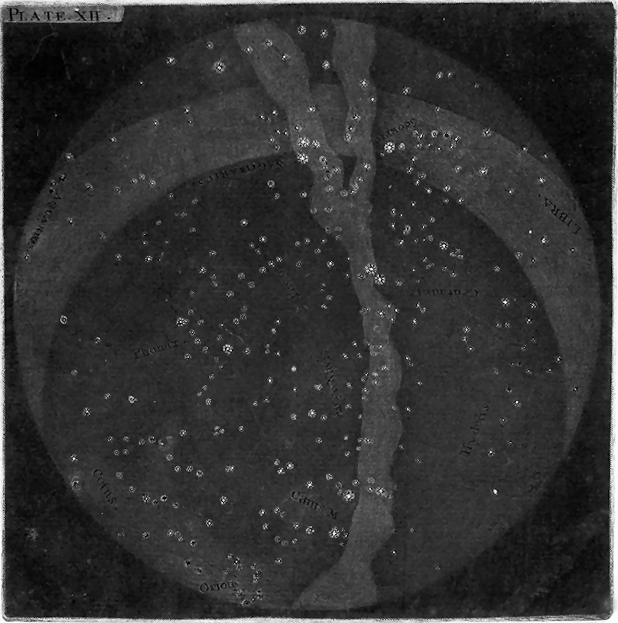
Plate XIII.
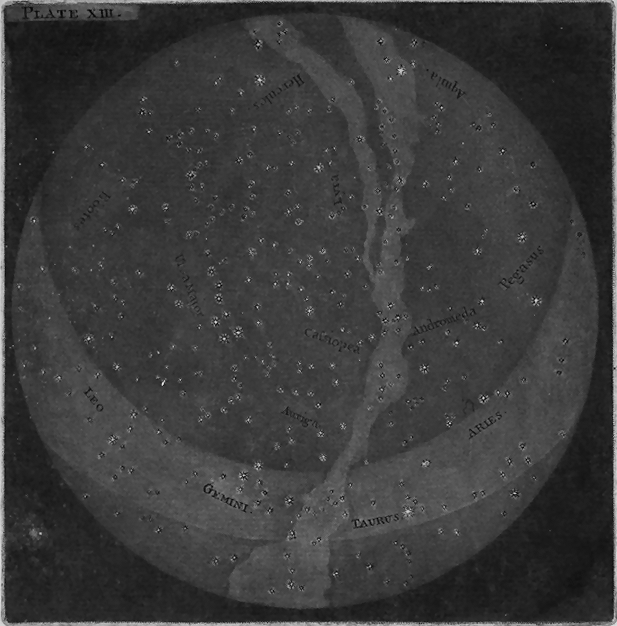
Theophrastus[V] was of Opinion, that the Hemispheres, which, by many
of the Antients were imagined to be solid, was joined together here; and
that this was the soldering of the two Parts into one. [W]Diodorus
thought it celestial Fire, of a dense and compact Nature, seen through the
Clifts or Cracks of the parting Hemisphere: But as Manilius says,
Astonishment must sure their Senses reach,
To see the World's wide Wound, and Heav'n's eternal Breach.
Oenopides[X] believed it the ancient Way of the Sun, till frighted at the
bloody Banquet of Thyestis. [Y]Eratosthenes supposed it Juno's
Milk, spilt whilst giving Suck to Hercules. [Z]Plutarch makes it the
Effect of Phaeton's confused Erratication; but I think it is plain [AA]Ovid
judged them to be Stars, and the ancient Ethnicks believed them to be
the blissful Seats of valiant and heroic Souls.
——Valiant Souls, freed from corporeal Gives,
Thither repair, and lead æthereal Lives.
Manilius.
But [AB]Democritus long ago believed them to be an infinite Number of
small Stars; and such of late Years they have been discovered to be, first by
Gallaleo, next by Keplar, and now confirmed by all modern Astronomers,
who have ever had an Opportunity of seeing them through a good Telescope.
Is from an Observation I made myself, of a bright Part of this Zone near
the Feet of Antinous; which, (by a Mistake of the Engraver) is, as it appears
through a Tube of two convex Glasses. I saw it through a very
good Reflector, and formed the Plan by a Combination of Triangles.
Milton takes notice of this Zone in a most beautiful Manner, where he
describes the Creator's Return from his six Day's Work to Heaven, he introduces
it as a Simile to express his Idea of the eternal Way, or Road to
the celestial Mansions.
——A broad and ample Road, whose Dust is Gold
And Pavement Stars, as Stars to thee appear,
Seen in the Galaxie, that Milky Way,
Which nightly as a circling Zone thou seest
Powder'd with Stars.
But to infer from their Appearance only, that they are really Stars, without
considering their Nature and Distance; and that nothing but Stars
could possibly produce such an Effect, may perhaps be assuming too
much, when we have nothing but the bare Credit of the Belgic Glasses to
support our Conjectures; and although this may be sufficient for any Mathematician,
yet for your greater Satisfaction, I have thought proper to
give two or three more evincing Arguments, to confirm these important
Discoveries. Democritus, as I have said before, believed them to be Stars
long before Astronomy reaped any Benefit from the improved Sciences of
Optics; and saw, as we may say, through the Eye of Reason, full as far
into Infinity as the most able Astronomers in more advantageous Times
have done since, even assisted with their best Glasses: And his Conjectures
are almost as old as the philolaic System of the Planets itself; the
Construction of which, though attempted by many, none have ever yet
been able to confute.
The Light which naturally flows from this Crowd of radiant Bodies is
mixt and confused, chiefly occasioned by the Agitation of our Atmosphere,
and from a Union of their Rays of Light, by a too near Proximity
of their Beams, altogether they appear like a River of Milk, but
more of a pelucid Nature, running all round the starry Regions.
Plate XIV.
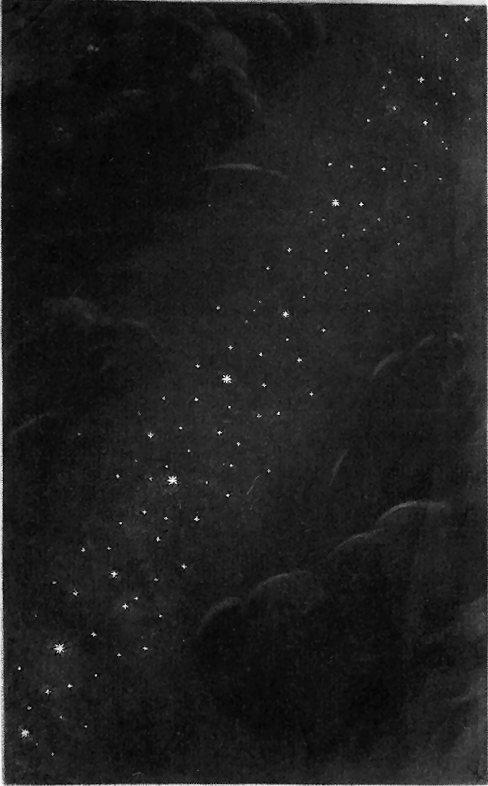
For in the azure Skies its candid Way
Shines like the dawning Morn, or closing Day.
There are also many more such luminous Spaces to be found in the
Heavens of the same Nature with these, which we know to be Stars; in
particular the Nebulæ, or cloudy Star in the Præsepe of 36; a cloudy Star
in Orion of 21; [AC]a cloudy [AD]Knot not far from this in the same Asterism
of 80; in one Degree of the same Constellation 500, and in the whole
Form above [AE]2000. All of which are great Confirmations of the Truth
of our Assertion, i. e. that this Zone of Light proceeds from an infinite
Number of small Stars. Here it will not be amiss to observe, that it has
been conjectured, and is strongly suspected, that a proper Number of Rays,
meeting from different Directions, become Flame; and that hence it may
prove not the Sun's real Body which we daily see, but only his inflamed Atmosphere.
I begin to be of Opinion, and I think not without Reason,
that the true Magnitude of the Sun is not near what the modern Astronomers
have made it; and that it may not possibly be much above two
Thirds of what it appears to us; I don't mean that this Expansion of the
solar Flame is any Part of that dilated Light mentioned by Sir Isaac Newton,
and conceived to be round all light Bodies in general; but you may
consider it as not much differing from it, not of an unlike Nature, only
greater in Degree, and peculiar to the Sun and Stars, who are all, as has
been before in a manner demonstrated to be actually Globes of Fire.
This, tho' I presume to call it at present only meer Hypothesis, will in a
great measure account for the excessive Changes in the Constitution of our
Air and Atmosphere, which we often find very unnatural to the Season;
also be a Means perhaps of reconciling the vast Disproportion so very remarkable
betwixt the Sun and the lesser Planets, and many other Circumstances
in the System of no small Consequence in Astronomy: One of
which Particulars you have frequently expressed a great Mistrust and
Disapprobation of, as suspecting some kind of a Fallacy in the Computation;
and the other is Matter of general Complaint, being by many attributed
to a Change in the Direction of the Earth's Axis[AF]; and by some,
especially the Vulgar, to too near an Approximation of the Earth to some
one of the celestial Bodies. But all this will very naturally be accounted
for by the Levity, or expanding Quality of the Sun's circumambient
Flame, or Atmosphere; and hence, according to its various State, being
more condensed, or rare, we may have Heat or Cold in the greatest Extream,
and alternately so, in a perpetual Vicissitude.
The Truth of this Doctrine will evidently appear from the Observations
of the Sun's Diameter through the Year 1660, by the indefatigable Mouton:
And, I must own, I am not a little surprized to find that no Conclusions
have been drawn from them of this Kind. I am perswaded, if you once
compare those Numbers, you will be very far from thinking this an
improbable Suggestion. But this Digression has led me a little too far
from the Via Lactea, and too near home again; I must now think of returning
to the Stars, and my next Endeavours must be to give you some
Idea of the Number of them. Through very good Telescopes there
have been discovered in many Parts of this enlightened Space, and even
out of it, several thousand Stars in the Compass of one square Degree; in
particular near the Sword of Perseus, and in the Constellations of [AG]Taurus
and Orion.
Represents the Pleides, a well known Knot of Stars in the Sign Taurus,
as they appeared to me thro' a one Foot reflecting Telescope: And
Plate XVI. is a View of the Persides, another surprizing Knot of Stars
in the Constellation Perseus, exactly as they appear through a Tube of
two convex Glasses. There are also other luminous Spaces in the starry
Regions, not unlike the Milky Way, which I have had no Opportunity
of observing; such as the Nebeculæ, near the South Pole, called by the
Seamen Magellanic Clouds; and which likewise viewed through Telescopes,
present us with little Nebulæ, and small Stars interspersed: One of
these Kind is situated between Hydrus and Dorado; and another, something
less than this, betwixt Hydrus and the Toucan.
Now admitting the Breadth of the Via Lactea to be at a Mean but
nine Degrees, and supposing only twelve hundred Stars in every square
Degree, there will be nearly in the whole orbicular Area 3,888,000 Stars,
and all these in a very minute Portion of the great Expanse of Heaven. What!
a vast Idea of endless Beings must this produce and generate in our Minds;
and when we consider them all as flaming Suns, Progenitors, and Primum
Mobiles of a still much greater Number of peopled Worlds, what less than
an Infinity can circumscribe them, less than an Eternity comprehend them,
or less than Omnipotence produce and support them, and where can our
Wonder cease?
Plate XV.
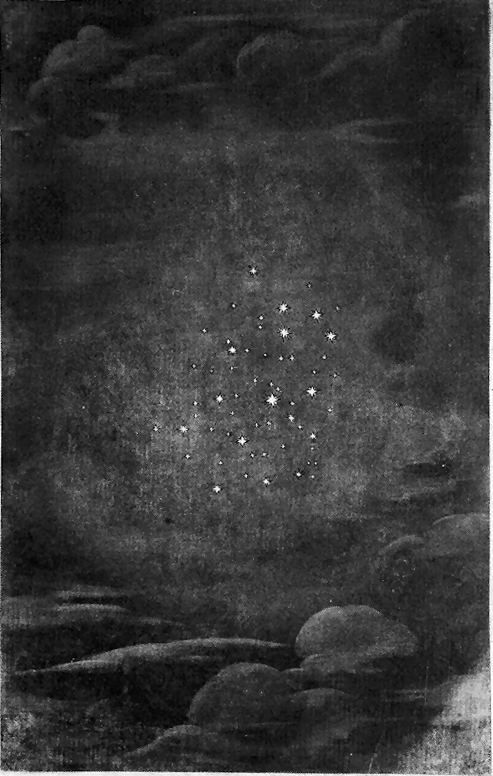
Plate XVI.
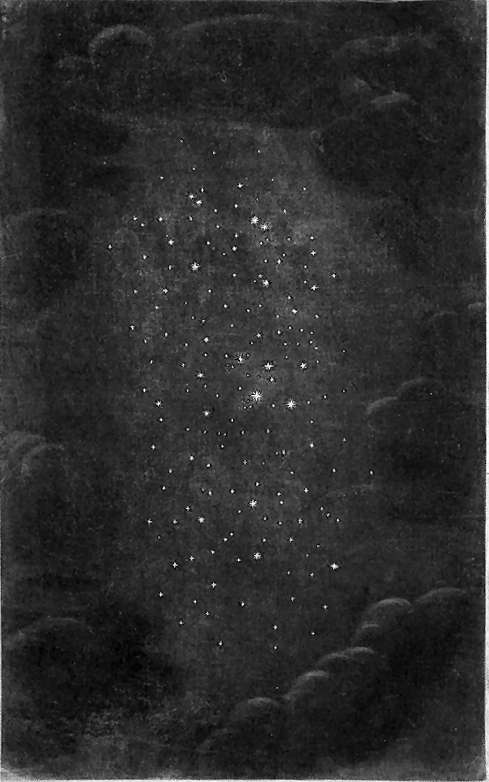
In this Place perhaps I ought not to pass over the astonishing Phenomenon
of several new Stars, &c. which have frequently appeared, and
soon again vanished, in the same Point of the Heavens. But as the Business
of this Theory is rather to solve the general, than any particular
Phænomenon, I shall only here by way of Note subjoin a Table of such
as has been regularly observed, and by whom they were first discovered.
A Table of several new Stars, Nebulæ, and double Stars, &c.
| Nomina Stellarum. |
|
Observationum. |
| Septima Pleiadum |
{ |
Lost after the burning of Troy, but now returned; see Ricciolus. |
A new Star appeared in Cassiopea, nearly
in the same Place with that of 1572. |
{ |
Anno Dom. 945, bright as Jupiter; see Ricciolus. |
| The new Star in Cassiopea's Chair. |
|
Bright as Venus, from November 1572 to March 1574. |
| A new Star in Collo Ceti. |
{ |
Of the 3d Magnitude, is said to have appear'd periodically,
seven Times in six Years, i. e. every three hundred and
thirteen Days: It was first observed in August 1596, for
two Months, by D. Fabricius. |
| A new Star in the Swan's Neck. |
{ |
Observed by Kepler in 1600, of the third Magnitude, till
the Year 1659; then gradually decreasing; in 1661 it
disappeared; in 1666 it became visible again, and is
yet to be seen of the sixth Magnitude. |
| A new Star in the Right Foot of Serpentarius, |
{ |
Bright as Venus from October 1604 to October 1605: see Kepler. |
| A new Star in Andromeda's Girdle, |
|
Seen by Simon Marius and Fabricius, Anno 1612. |
| A new Star in Antinous, |
|
Seen by Justus Byrgius. |
| A new Star seen in the Whale, |
{ |
In 1638, by John Procyclides Holuarda, of the third Magnitude,
which disappeared periodically, every three
hundred and thirty Days. |
| A new Star in the Fox's Head, |
{ |
Of the third Magnitude, seen by Hevelius in July 1670,
and till August 1671, also from March 1672 to September 1672. |
| A new Star in the Swan's Neck. |
{ |
This appear'd periodically every four hundred and four
Days, and about six Months at a Time; it was seen at
its brightest, September 10, 1714. |
Of the Nebulæ, or Cloudy Stars.
Nebulose in Orion's Sword.
Nebulose in Andromeda's Girdle.
Nebulose in the Bow of Sagitarius, Small, but very luminous.
Nebulose in Centaurus, Never seen in England.
A Nebulose preceding the right Foot of Antinous, Obscure, but with a Star in the Middle of it.
Nebulæ in Dorso Herculis, Discovered by Dr. Hally. |
Besides the Nebulæ, and new Stars, it appears from the ancient Catalogues of Hevelius, &c. that
some of the old ones have intirely vanished; in particular, one in the left Thigh of Aquarius, the
contiguous one preceding in the Tail of Capricorn; the second on the Belly of the Whale; the first
of the unformed ones after the Scales of Libra, and several others. Many of the Stars also appear
to be double, as the first Star of Aries and Castor; others triple, as one in the Pleiades; and the
middle one in Orion's Sabre; and others again, quadruple, &c.
I would now willingly help you to conceive the indefinite mutual Distance
of the Stars, in order to give you some small Notion of the Immensity
of Space; but as this will be a Task merely conjectural, I shall
only desire you to believe it as far as your Reason will carry you, safely
supported by an obvious Probability.
Perhaps it may be necessary here to acquaint you, that all the Stars are
so far apparently of different Magnitudes, that no two of them are to be
found in the whole Heavens exactly the same, either in Bigness or Brightness[AH].
The largest we have sufficient Reason to believe is the nearest to us;
the next in Bigness and Brightness more remote; and so on to the least we
see, which we judge to be the most remote of all.
The first Degree, or that of the largest Magnitude, we give to Syrius,
the second to Arcturus, the third to Aldebaran, the fourth to Lyra,
the fifth to Capella, the sixth to Regulus, the seventh to Rigel, the
eighth to Fomahaunt, and the ninth to Antarus: These are all said
to be of the first Class; and besides which, there are at least, within the
Reach of our latest improved Opticks, nine more Denominations within
the Radius of the visible Creation.
Now, by the certain Return of the Comets, which we find are all governed
by the Laws of this System, and supposed to be undisturbed by
any of the others, we cannot avoid concluding, if we consider them at
all to the Purpose, that the nearest Stars cannot be less distant than twice
the Radius of the greatest Orbit belonging to the Sun. Most Mathematicians
think this a great deal too near, as it must of course make all the
Systems join, as in Contact; and I think we may safely add, to separate
their Spheres of Attraction, at least one Half of this Distance more, which
will make in the Whole about four hundred and twenty Semi-orbits of the
Earth, or 33,600,000,000 Miles. This even the ingenious Mr. Huygins
endeavours to prove still much too little, and his Arguments are such as
cannot easily be refuted. His Principle is grounded upon the known Laws
of Analogy, as considered in the Proportion of light Surfaces, and is as
follows. Having reduced the Sun's Disk to the Appearance of the Star
Syrius, by the Help of a small Hole at the End of his Telescope, and
comparing this Part of his Surface to the whole Disk of the Sun, he infers
that the Stars Distance to that of the Sun must be as 27,664 to 1. Hence
Syrius from us will be nearly (avoiding Units) 2,213,120,000,000 Miles:
But this I take to be as much too large as the former is too little; yet, as
Mr. Bradley has, with some Shew of Reason, banished all the Stars out
of the Sphere of Parallax, the last is the only Method we can possibly
make use of with any kind of Confidence; and Sir Isaac Newton endeavours
to recommend it with great Force of Argument, as the only probable
Means by which we can give any tolerable Guess at these immense
Measurements of Space.
To moderate the Matter then if you please, allow me but to make use of
a Mean betwixt the two fore-mentioned Numbers; and we may take it for
granted, a Distance sufficiently exact, to suit all our Wants in the present
Case, namely, to give a very tolerable Idea of the Extent of the visible
Creation, which is all I propose in this Place to attempt; but I mean to
be much more exact in another.
Now as the Distance from the Sun to the Earth is so small in Proportion
to the Distance of the Stars from us, and from one another, we may very
well consider the Sun as the Center of our Station, or Position in the general
System or Frame of Nature. And as the Stars are very visible thro' good
Telescopes, to the ninth or tenth Magnitude, if we multiply the primary
Distance of Syrius, or of any other of his Class, by this Number of common
intermediate Spaces, the Product will be equal to the Radius of the
visible Creation to the solar Eye; which, by this Rule, you will find in
capital Numbers to be [AI]nearly 6,000,000,000,000 Miles, taking in a Star
of the sixth Magnitude, and to a Star of the ninth, 9,000,000,000,000
Miles: But this Computation supposes a mean common Distance of the
Stars in a sort of Syzygia, or Direction of a Right Line, which is not the
real Case; for the Stars cannot be supposed to diminish in a proportional
Magnitude by any mathematical Ratio, but by some geometrical, or rather
musical one; for Instance, if the Distance of a first be 3, that of a
second should be about 5, and of a proportional Third 8,333, &c.
ad infinitum: But as their true proportional Distance is unknown, the above
will be sufficient for our present Purpose; which is only to shew, without
Exaggeration, the Space we now are truly sensible of.
This I have here considered more extensively, to obviate all Objections
that you may make to the Probability of the general Motion of the Stars,
by shewing no Difficulty can possibly arise from their apparent Proximity,
Number, or irregular Distribution: Their Distances being so immensely
large, no Disorder or Confusion can be supposed in any Direction of them,
or Motion whatever. The greatest Distance of the Planets, which all
move undisturbed round the Sun, is about three hundred and fifty-three
Million of Miles: But the least Distance of one Star from another, is
upwards of two thousand eight hundred and thirty-two Times that Distance,
or one Million of Millions of Miles: And as no sensible Disorder
can be observed amongst the solar Planets, what Reason have we
to suppose any can be occasioned amongst the Stars, or that a general Motion
of these primary Luminaries round a common Center, should be any
way irrational, or unnatural?
What an amazing Scene does this display to us! what inconceivable
Vastness and Magnificence of Power does such a Frame unfold! Suns
crowding upon Suns, to our weak Sense, indefinitely distant from each
other; and Miriads of Miriads of Mansions, like our own, peopling Infinity,
all subject to the same Creator's Will; a Universe of Worlds, all
deck'd with Mountains, Lakes, and Seas, Herbs, Animals, and Rivers,
Rocks, Caves, and Trees; and all the Produce of indulgent Wisdom, to
chear Infinity with endless Beings, to whom his Omnipotence may give a
variegated eternal Life.
The astonishing Distance of the starry Mansions undoubtedly was design'd
to answer some wise End: One Consequence is this, and probably is not
without its Use: To every Planet of the same System, the same sidereal
Face of Heaven appears without the least Degree of Change; and as the
remotest Regions upon Earth see the same Moon and Planets, so also the
Inhabitants of the most distant Planets in ours, or in any other System, see
the same Forms and Order of the Stars in common with the rest. The
whole Sphere of Heaven being common and unchangeable through all
their various Revolutions.
Thus those (the People) in the Planet Venus will see the Constellation
of Orion just as we do, and the People in the Planet Saturn, much farther
still removed, alike will view this Constellation in all respects the same;
here then, (in the System of the Sun) the Eye removed from us must only
hope to find a new Earth surrounded with the same sort of Sky: But Beings
in another System, behold not only a new Heaven above, but also new
Earths below; and all the Frame of Nature to them puts on a new Dress,
new Signs, new Seasons, and new Planets roll, and a new Sun renews
the Day.
The Heathen Fables here are all erased with all the Immortality of their
vain earthly Gods and Heroes; Perseus and Alcides are no more, and both
the Bears are vanished; the Pleiades and the Hyads join, and shining Leo,
though boasting two Stars of the first Magnitude with us, there no where
can be found, lost in the common undistinguished Herd. But still Astronomy
will exist, and new-framed Forms may fill the varied Scene.
Perhaps you may expect that I should here give you my Conjectures of
what sort of Beings may be supposed to reside in the Ens Primum, or Sedes
Beatorum of the known Universe, whether mortal, immortal, or Creatures
partaking in some Degree of the Properties of both; as such may be conceiv'd
to change their Natures and States, without a total Dissolution of their Senses
by Death: And farther, it may possibly be judged unpardonable in me not
to point out every blessed Abode, suited to the Virtues, and all the various
States an immortal Soul may be translated to; but this is a Task above
the human Capacity, or is the pure Province of Religion alone; the
Business of a Revelation rather than Reason to discover. Besides, it is
enough for the present Purpose, to prove, that Miriads of celestial Mansions,
are to be discovered within our finite View, and by a kind of ocular
Revelation, which visibly extends the human Prospect, as it were, far beyond
the Grave. It matters not whether a Race of Heroes fill these
Worlds, or a Tribe of happy Lovers people those; whether a Peasant in
the Realms of Orion shall ever become a Prince in the Regions of Arcturus,
or a Patriarch in Procion, a Prophet in the Precepæ. Not to mention
all the Stages human Nature may, or have been destined to in any one
World, as believ'd by the ancient Philosophers, besides the final Coalition
of all Beings much more naturally to be expected in the Sedes Beatorum.
I say, whatever our Case may be with regard to these Queries and
Futurity, the Plan and Principles of this Theory will not be at all changed
by it, since what it is chiefly founded upon may be clearly demonstrated,
so clearly and incontestably, that, with the Reverend Dr. Young, we may
justly conclude,
Devotion! Daughter of Astronomy!
and affirm with him also, That,
An indevout Astronomer is mad.
But I find what I at first proposed will prove too long for this Letter.
However, I will endeavour to reward your Patience in my next, and
continue, &c.
LETTER the SIXTH. — PLATE XVII. — PLATE XVIII. — See PLATE XVIII. Fig. 2. — PLATE XIX. — PLATE XX.
Of General Motion amongst the Stars, the Plurality of Systems, and Innumerability
of Worlds.
SIR,
S
Since my last, you'll find by this, speaking in the Stile of Kercher,
that I have been very far from home, round almost the visible
Creation. I have indeed applied myself very closely to transcribe
my Thoughts to you upon the old Subject the Milky Way, which my
former Letter left imperfected. To return then to the Theory of the
Stars, and that yet unreconciled Phænomenon; let us reason a little upon
the visible Order of the Stars in general, and see what Conclusions can
be drawn from what every Astronomer knows of them, and cannot be
disputed.
First then, that the Stars are not infinitely dispersed and distributed in
a promiscuous Manner throughout all the mundane Space, without Order
or Design, is evident beyond a Doubt from this vast collective Body of
Light, since no such Phænomenon could possibly be produced by Chance,
or exhibited without a designed Disposition of its constituent Bodies.
If any regular Order of the Stars then can be demonstrated that will
naturally prove this Phænomenon to be no other than a certain Effect
arising from the Observer's Situation, I think you must of course grant
such a Solution at least rational, if not the Truth; and this is what I propose
by my new Theory.
To a Spectator placed in an indefinite Space, all very remote Objects
appear to be equally distant from the Eye; and if we judge of the Via
Lactea from Phænomena only, we must of course conclude it a vast Ring
of Stars, scattered promiscuously round the celestial Regions in the Direction
of a perfect Circle.
But when we consider the explanick Position of many other Stars, all
of the same Nature, and not less numerous, together forming the great
Sphere of Heaven, we generally find ourselves quite at a Loss how to reconcile
the two apparent Classes; and I know none who have ever been
successful enough to reduce them to any one general Order.
You'll say probably how shall we make this chaosic Disposition of the
primary Luminaries agree with the secondary Laws, and the just Harmony
observed in the third [AJ]Creation, &c.
The Work now you see is undertaken, and chiefly at your own Request,
therefore I have a Right to expect you'll be very indulgent to the
Author, and pass over all his Faults, and allow him free Argument in
Pursuit of these important Truths, which will in the End open perhaps a
much wider Field of Contemplation to us, than at first could be supposed
to be intended by the Genesis of Moses.
That Description of the Beginning of Nature is not without its Beauty
and Nobleness, suitable to the Dignity both of the Author and Subject.
But should we even in this knowing Age of the World pretend to account
for the Original of Things, as Moses to support his believed divine
Legation, was obliged in some measure to do, we should soon be
reduced to talk in the same Stile, and perhaps with less Probability, than
then at least appeared in his elegant Account of the Origin of the Universe,
especially if we do but consider, that what he wrote, was only to the
Senses of a People who had not yet learnt to make use of their Reason
any other way, but from the Appearance of Things, and upon a Subject
too sublime for vulgar Capacities in any Age, and had only been attempted
in the deepest Learning of Egypt, which, he though well acquainted
with, the Generality of them were totally Strangers to.
In the first Place it must be granted, that the Stars being all of the
same Nature, are either all moveable, or all fixed, that is all governed
by one and the same Principle.
Now to suppose them all fixed, and dispersed in an endless Disorder
thro' the infinite Expanse, which has long been the Opinion of many very
able Astronomers amongst the Antients, and even now received by too
many of the Moderns, implies an Inactivity in those vast and principal
Bodies, so much the Reverse of what may be expected, and what we
daily observe through all the rest of their Attendants, namely, their own
respective Satellites, that we cannot possibly upon any rational Grounds,
advance one single Argument to support so much as a Conjecture towards
it, without betraying the greatest Simplicity, and next to an Affirmation
reduce the whole Frame of Nature, and all corporeal Beings to a wild
unmeaning Chance, arising from an unnatural Discord and Confusion.
For upon the Principles of Locality and Materiality, you having allowed
me the Use of my Senses and Reason, as absolutely necessary towards
conceiving any Idea of our present State, or of Futurity: Upon
these Principles I say, unless our Faculties are useless, if there are no other
Bodies or Beings in the Universe than what we see, and are now sensible
of, we must now at the Height of this our present State, be as near Perfection
as we can reasonably expect, and as such ourselves the supreme Beings
of all Beings. To what End then do we form Ideas of a succeeding
Life, where a more exalted State cannot be hoped for.
How absurd and impious this is I leave to your own Reason and Reflection:
This is the fatal Rock upon which all weak Heads and narrow
Minds are lost and split upon, consequently ought to be the most carefully
avoided, not only as the Nurse of Atheism, but as the dreadful Father of
Despair: "For, say they, these unhappy Wretches, to be always the
same, is inconsistent with a Change; and to be less than what we are,
any where hereafter, is full as difficult to conceive as to be more."
Thus, unless we admit of superior Seats and much more glorious Habitations
than these we are sensible of, we strike at the very Root of a fair
flourishing Tree of Immortality, and must become Authors of our own
Despair. I have often wonder'd how thinking Men could possibly fall into
so gross an Error, as that of a Spirit's Annihilation; and I should be glad
to ask one of those fruitless Students, whether, upon the Evidence of our
present Being, it is not much more rational, to hope for a future, than to
expect a Ne plus ultra upon no Evidence at all. The Affirmative is certainly
much more natural to be conceiv'd than the Negative. But if Chance were
the Case, and that Chance produced all these regular and wondrous Works,
'tis to be wished at least, that Chance might do the same again; and if not
Chance, of course an eternal Direction: But Chance only can effect
Disorder, Discord, and Confusion; ergo, the visible Harmony and Beauty
of the Creation declare for a Direction; and this must of Consequence,
from its perfect Nature, proceed from the Wisdom and Power of an eternal
Being, God of Infinity, the Author of all Ideas: And if this primitive
Power produced us his Creatures from nothing, nothing can be wanting
to revive our Frames again; and if from something, that something
must remain to establish us in a future Life. But to return, how absurd it is
to suppose one Part of the Creation regular, and the other irregular, or a
visible circulating Order of Things, to be mixed with Disorder, and circumscribing
Part of an endless Confusion, is obvious to the weakest Understanding,
and consequently we may reasonably expect, that the Via
Lactea, which is a manifest Circle amongst the Stars, conspicuous to
every Eye, will prove at last the Whole to be together a vast and glorious
regular Production of Beings, out of the wondrous Will or Fecundity of
the eternal and infinite one self-sufficient Cause; and that all its Irregularities
are only such as naturally arise from our excentric View: To demonstrate
bsolutely and incontestibly, we shall only want this one Postulata
to be granted, viz. That all the Stars are, or may be in Motion: This, if
one may be allowed to judge of the Whole by the Similitude and Government
of its Parts, I am perswaded you will think a very reasonable Assumption;
but that you may imbibe a good Opinion of this Assumption,
and entirely come into this much better to be wished Hypothesis, I would
have you consult these following Arguments.
First, it is allowed, as I have endeavoured to shew, by all modern Philosophers,
that the Sun and Stars are all of the same or like Nature; consequently,
that the Stars are all Suns, and that the Sun himself is a Star.
Plate XVII.
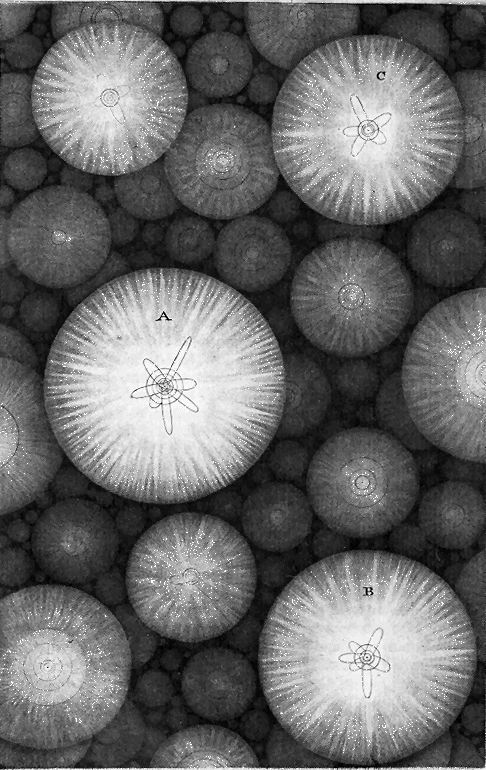
Represents a kind of perspective View of the visible Creation, wherein
A represents the System of our Sun, B, that supposed round Syrius, and
C, the Region about Rigel. The rest is a promiscuous Disposition of all
the Variety of other Systems within our finite Vision, as they are supposed
to be posited behind one another, in the infinite Space, and round every
visible Star. That round every Star then we may justly conjecture a
similar System of Bodies, governed by the same Laws and Principles with
this our solar one, though to us at the Earth for very good Reasons invisible[AK].
Secondly,
The Sun is also observed to have a Motion round his own Axis in about
twenty-five Days. Now, since all the other [AL] Planets which move in
Orbits round him, and are within our Observation, are found to have a
like Rotation round their Axis, may we not as reasonably imagine, that
that Power which was able to give the Sun a Motion round his Axis,
could and would at the same time, with adequate Ease, give him also an
orbitular one? and why not, since no progressive Mutability can either
take from, or disturb the boundless Property of an Infinity; and besides,
seeing to imagine him at rest, is to impose such an unnatural Stagnation
upon the eternal Faculty, quite repugnant to that imparable Power
which we suppose stands in need of neither Sleep nor Rest?
'Tis true, the Sun may be said to be the Governor of all those Bodies
round him; but how? no otherwise than he himself may be governed
by a superior Agent, or a still more active Force; and methinks it is not a
little absurd to suppose he is not, since we have discovered by undoubted
Observations, that the same gravitating Power is common to all; and that
the Stars themselves are subject to no other Direction than that which
moves the whole Machine of Nature.
Thirdly, From many Observations of the polar Points, and the Obliquity
of the Earth's Equator to the Plane of her solar Orbit compared together,
the Sun is very justly suspected to have changed his sidereal Situation;
and this must either arise from a Change in the Position of the Earth's
diurnal Axis, or from a Removal of the Sun himself, out of the primitive
Plane of the Orbis Magnus. I believe you are so much of a Mathematician,
as to know that if either of these Facts be allowed, the Consequence I
want will follow. I shall not therefore here enter into any farther Dispute
about it; but I think it will be necessary to submit some Observations to
your Consideration, that may convince you that there is a Motion somewhere
to be thus discovered, and whether in the Sun, or in the Stars, or
in both, I leave to your own Determination, but to assist your Imagination,
I refer you to
The Globe S is here supposed to represent the Sun, having changed its
Situation by a local Motion from A to C, and B represents the Globe of
the Earth in a permanent Position, with its principal Points and Circles,
respecting the primitive Plane A, B, K. Now in Consequence of the
Angle of Variation, A, B, C, it evidently appears that a new ecliptic Plane,
will be produced, as C, B, and also a Variation in the greatest Declination
of the Sun, North and South from the Line of the Equator D, L. Hence,
as in this Figure, the Obliquity of the Poles P, N, and G, F, will naturally
decrease, and is shewn in Quantity by the Line of Aberration
H, I.
Here follows a Table of the Change observed in the Obliquity of the
Ecliptic by Astronomers of different Ages.
Plate XVIII.
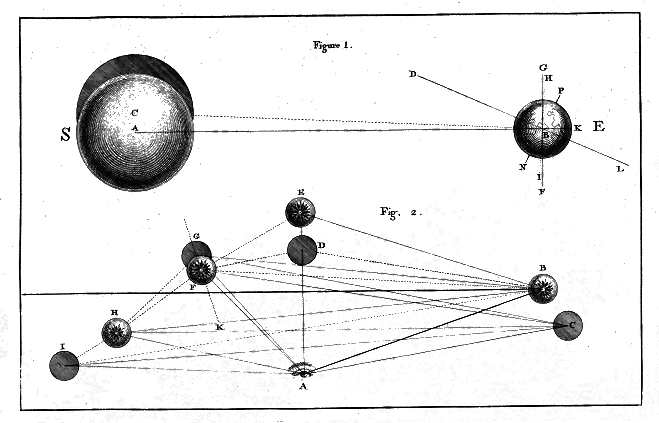
A Table of the Obliquity of the Ecliptic.
| Ante Christi |
|
° |
′ |
| 124 |
Arato |
24 |
00 |
| —— |
Hiparchus |
23 |
51⅓ |
| 127 |
Eratosthenes |
23 |
51½ |
| 140 |
Ptolomy |
23 |
51⅓ |
| 749 |
Abategnius |
23 |
35½ |
| 1070 |
Airahel |
23 |
34 |
| 1140 |
Alomean |
23 |
33 |
| 1300 |
Profatiograd |
23 |
32 |
| 1458 |
Purbacchio |
23 |
29½ |
| 1490 |
Regiomontaus |
23 |
30 |
| 1500 |
Copernicus |
23 |
28½ |
| 1592 |
Tycho Brahe |
23 |
21½ |
| 1656 |
Cassini |
23 |
29½ |
Now sure, if we consider this continual Decrease of the Sun's Declination,
which can proceed from no other Cause than that of his having
moved out of the primitive Plane; we need make no great Difficulty thus
far, to think our Conjectures not irrational.
The following is a Citation from Dr. Edmund Hally, Astronomer-Royal.
See Philosophical Transactions, No. 355. p. 736.
"But while I was upon this Enquiry (of the Obliquity of the Ecliptic)
I was surprized to find the Latitudes of three of the principal Stars in the
Heavens, directly to contradict the supposed greater Obliquity of the Ecliptic,
which seems confirmed by the Latitudes of most of the rest; they
being set down in the old Catalogues, as if the Plane of the Earth's Orbit
had changed its Situation amongst the fixed Stars, about 20′ since the
Time of Hipparchus, particularly all the Stars in Gemini are put down,
those to the Northward of the Ecliptic, with so much less Latitude
than we find, and those to the Southward, with so much more
southerly Latitude; and yet the three Stars Palilicium, Sirius, and
Arcturus, do contradict this Rule: For by it, Palilicium, being in
the Days of Hipparchus, in about 10 gr. of Taurus, ought to be about
15′ more southerly than at present, and Sirius being then in about 15 gr.
of Gemini, ought to be 20′ more southerly than now; yet Ptolomy places
the first 20′, and the other 22′ more northerly in Latitude than we now
find them: Nor are these the Errors of Transcribers, but are proved to
be right by the Declination of them set down by Ptolomy, as observed by
Timocharis, Hipparchus, and himself; which shew, that these Latitudes
are the same as those Authors intended. As to Arcturus, he is too near the
Equinoctial Colour, to argue from him concerning the Change of the Obliquity
of the Ecliptic; but Ptolomy gives him 33′ more North Latitude
than he is now found to have; and that greater Latitude is likewise confirmed
by the Declinations delivered by the abovesaid Observations: So
then these three Stars are found to be above half a Degree more southerly
at this Time than the Antients reckoned them. When, on the contrary,
at the same time, the bright Shoulder of Orion, has, in Ptolomy almost a
Degree more southerly Latitude than at present, what shall we say then?
It is scarce to be believed, that the Antients could be deceived in so plain
a Matter, three Observers confirming each other. Again, these Stars being
the most conspicuous in Heaven, are in all Probability the nearest to
the Earth; and if they have any particular Motion of their own, it is
most likely to be perceived in them, which in so long a Time as eighteen
hundred Years, may shew itself by the Alteration of their Places, though
it be intirely imperceptible in the Space of one single Century of Years:
Yet, as to Syrius, it may be observed, that Tycho Brahe makes him 2 Min.
more northerly than we now find him; whereas he ought to be above as
much more southerly from his Ecliptic (whose Obliquity he makes 2′½
greater than we esteem it at the present) differing in the Whole 4′½.
One Half of this Difference may perhaps be excused, if Refraction were
not allowed in this Case by Tycho; yet 2 Min. in such a Star as Syrius, is
somewhat too much for him to be mistaken in.
But a more evident Proof of this Change is drawn from the Observation
of the Application of the Moon to Palilicium, An. Chris. 509. Mar. 11.
when, in the Beginning of the Night, the Moon was seen to follow that
Star very near, and seemed to have eclipsed it, ἐπέβαλλε γὰρ ὁ ἀστηρ τῳ πᾶρα την
διχοτομίαν μέρει τῆς κυ'ρτυς περιφειας τõυ πεφωτισμένου μερους, i.ve. Stella apposita
erat parti per quam bisecabatur limbus Lunæ illuminatus, as Bullialdus, to
whom we are beholden for this ancient Observation, has translated it. Now,
from the undoubted Principles of Astronomy, this could never be true at
Athens, or near it, unless the Latitude of Palilicium were much less than
we at this Time find it[AM]."
The [AN]Motion of Arcturus seems further confirmed, from the Observations
of Tycho Hevelius and Flamstead; for Hevelius sets down the Distance
of that Star from Lyra 4′ greater than Tycho had observed it seventy-two
Years before him, and Flamstead twenty-two Years after measured
the Distance betwixt the same two Stars, still 3′ greater than Hevelius
found it; so that if Lyra had stood still all that while, there was an Appearance
of Arcturus's having gone 7' out of his Place in the Space of
an hundred Years. See Dr. Long's Astronomy, p. 274.
It is further to be observed, in Confirmation of the Motion of one of
these Stars, that Flamstead found the Distance of Arcturus, from the Head
of Hercules 3′ greater than it is set down by the Prince of Hesse; and that
his Distance from the Lion's Tail was a little decreased with 5½′ less Latitude
than Tycho had observed. Hence, to make these Observations agree,
one or both of them must have moved together equal to 7′. This Change
of Place, which is quite contrary to all known Causes proceeding from the
Earth, must therefore be occasioned either by the Motion of the Sun, or by
a particular Motion of their own; but if, amongst themselves, they must all
move, and if all be in Motion, the Sun must also move.
If these Observations, delivered down to us by very able Astronomers,
be either true or near it, as great Allowances have been made for
the Ignorance of the Ages in which they were taken, and the Inaccuracy
of the Instruments, we may naturally conclude, that these Stars must have
a Motion; and if they move, as has been before observed, the Sun
must also; hence he cannot now be in the original Plane of the
Earth's annual Direction, or at least in the same identical Place he was at
first possessed of: And if so, the Stars must also have the like Motion,
though in different Directions, and all may thus be governed by the same
impulsive Power.
To illustrate this primitive Motion of the Stars, and at the same time to
show that the Variety which appears in the Quantity of Motion can be no
Objection to it,
Where A represents the Eye of an Observer, and B, E, F, H, various
Systems, moving in different Directions thro' the mundane Space; it is evident
that the Sphere B, having moved from C, and that of E, not having
appeared to move at all, there must be a sensible Change in the new
Position of these two Systems to one another, and so of the rest; and tho'
the apparent Motion of H, be much more than that of F, from the
Point A, yet from C, they will appear less different, and from B, they
will appear nearly equal. And farther, as the Direction from H, is in the
Line I, H, and that of F, in the Line K, G, those two Systems will appear
to approximate, and the Magnitude of the Star in the first will be increased,
and in the latter diminished. Thus, many of the Stars in the
oldest Catalogues, which were said to be of the second Magnitude, are now
become of the first, and several of the first are now judged to be of the second,
&c.
But as this apparent Motion of the Stars at the Earth, must, from its
Nature, be very small, so as scarce to be discovered in some of them in
less than an Age, with any Instrument by the nicest Observer, I judge it
will be extremely proper in this Place to propose some Method, by which,
in process of Time, the Truth of the Theory may be ascertained. The
Way I think most likely to succeed is this.
Is a Plan of the principal Stars that form the Pleiades, correctly taken
by a Combination of Triangles, as in the Figure, from whence it will naturally
follow, all the whole Form being comprehended in much less than
one Degree. That the most minute local Motion in any one of those Stars in
a very few Years, will be made sensible to an Eye at the Earth. For
Instance, if any of the Stars that form the Letter A, or T, within the
Term of ten or twenty Years, be found in the least to deviate from the
Lines of their present Position and Direction, it will be evident beyond a
Contradiction, that they have a Motion amongst themselves, and since at
such a Distance they cannot possibly be affected by the Earth, it must be
a Motion of their own; and thus if any one can be proved, to change its
Situation, with regard to the rest, we can have no new Difficulty in concluding
that they all may do the same.
Thus if any of the regular Triangles M B Z, Z P H, A Z M,
Y A Γ, or Π Ο I, &c. in due Time be carefully noted, we may venture
to say with great Safety, that the thousandth Part of a Degree will be
plainly discovered.
Is a true Plan and Combination of the principal Stars that form the Persedes,
in which other Observations may be made in a different Part of
the Heavens, and perhaps with an Opportunity of being still more exact,
the Areas of these Triangles, particularly that of Θ I K, and those of
ρ and δ, being much less than the former, where the least Alteration possible
must render them sensibly distorted. But here it must be considered,
that the real Motion of the Stars, as well as their apparent, may be, and in
all Likelihood, is extreamly slow, for the most minute, visible, local Motion,
will answer all the Purposes we know in Nature, and the greatest
seems to be that of the projectile, or centrifugal Force, which not only
preserves them in their Orbits, but prevents them from rushing all together,
by the common universal Law of Gravity, which otherwise, as
a finite Distribution of either regular or irregular Bodies, they must at length
do by Necessity.
Plate XIX.
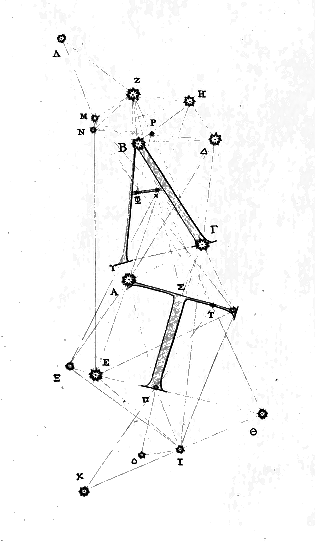
Plate XX.
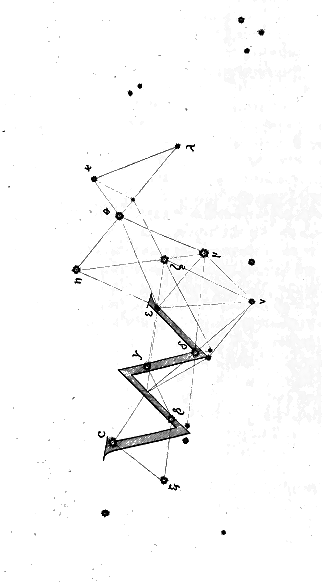
I must now inform you, that the above Observations were compleated
in the Autumn Season, 1747, and were taken by myself; the Letters
A, T, in Plate XIX, and the W in the XXth, as you may see, having
a very near Resemblance, or Similitude, to the Order these Stars are found
to be in, together with the Greek Alphabet, I judged necessary, by way
of Asterism and Nomenclatura, in case such should be wanted, as Data in
future Discoveries.
I come now to the principal Point in Question, which is to find a regular
Disposition of the Stars amongst themselves, which will naturally solve
both their general and particular Phænomena, especially the Nebula
and Milky Way.
I am now, &c.
LETTER the SEVENTH. — PLATE XXIV. — PLATE XXV. — PLATE XXVI. — PLATE XXVII.
The Hypothesis, or Theory, fully explained and demonstrated, proving the
sidereal Creation to be finite.
SIR,
I
I KNOW you are an Enemy to all Sorts of Schemes where they
are not absolutely necessary, and may possibly be avoided; and for
that Reason I have purposely omitted many geometrical Figures, and
other Representations in this Work, which might have been inserted and
in some Places, especially here I might have introduced Diagrams, perhaps
more explicit than Words; but as you have frequently observed, they are
only of Use to the few Learned, and contribute more to the taking away
the little Ideas and Knowledge the more ignorant Many may be endued
with, by a prejudicial Impression of imperfect Images, rather than the
adding any new Light to their Understanding, I have purposely avoided,
as much as possible, both here and every where, all such complex Diagrams
as might be in Danger of betraying any the least such conscious
Diffidence in you, arising from the Want of a proper Precognita in the
Sciences.
This Imperfection, much to be lamented, as greatly to the Disadvantage
of all mathematical Reasoning, I would willingly always prevent, in my
Readers, and to chuse in my Friend; I shall therefore content myself with
referring you to a few orbicular Figures, concave and convex, as may best
suggest to your Fancy the simplest Way, a just Idea of the Hypothesis I
have fram'd, and naturally enough I hope, render my Theory so intelligible,
as to help you sufficiently to conceive the Solution aimed at, of the important
Problem I have attempted.
As I have said before, we cannot long observe the beauteous Parts of
the visible Creation, not only those of this World on which we live, but
also the Myriads of bright Bodies round us, with any Attention, without
being convinced, that a Power supreme, and of a Nature unknown to us,
presides in, and governs it.
The Course and Frame of this vast Bulk, display
A Reason and fix'd Law, which all obey.
Sher. Manilius.
And notwithstanding the many wonderful Productions of Nature in this
our known Habitation, yet the Earth, when compared with other Bodies
of our own System, seems far from being the most considerable in it;
and it appears not only very possible, but highly probable, from what has
been said, and from what we can farther demonstrate, that there is as
great a Multiplicity of Worlds, variously dispersed in different Parts of the
Universe, as there are variegated Objects in this we live upon. Now, as
we have no Reason to suppose, that the Nature of our Sun is different
from that of the rest of the Stars; and since we can no way prove him superior
even to the least of those surprising Bodies, how can we, with
any Shew of Reason, imagine him to be the general Center of the whole,
i. e. of the visible Creation, and seated in the Center of the mundane
Space? This, in my humble Opinion, is too weak even for Conjecture,
their apparent Distribution, and [AO]irregular Order argue so much against
it.
The Earth indeed has long possessed the chief Seat of our System, and
peaceably reigned there, as in the Center of the Universe for many Ages
past; but it was human Ignorance, and not divine Wisdom, that placed
it there; some few indeed from the Beginning have disputed its Right to
it, as judging it no way worthy of such high Eminence. Time at length
has discovered the Truth to every body, and now it is justly displaced
by the united Consent of all its Inhabitants, and instead of being thought
the most majestick of all Nature's lower Works, now rather disgraces the
Creation, so much it is reduced in its present State from what it had
Reason to expect in the former.
Now it is no longer the only terrestrial Globe in the Universe, but is
proved to be one of the least Planets of the solar System, and surprizingly
inferior to some of its Fellow Worlds. The Sun, or rather the System,
has almost as long usurped the Center of Infinity, with as little Pretence
to such Pre-heminence; but now, Thanks to the Sciences, the Scene begins
to open to us on all Sides, and Truths scarce to have been dreamt of,
before Persons of Observation had proved them possible, invades our Senses
with a Subject too deep for the human Understanding, and where our
very Reason is lost in infinite Wonders. How ought this to humble every
Mind susceptible of Reason!
In this Place, I believe, you will pardon a Digression; which, in Answer
to Part of your last Letter, I judge will not be very impertinent, tho'
perhaps just here I cannot so well justify it.
Your late Conversation with our Friend Mr. * * *, I am perswaded,
must have been very entertaining; but I cannot help thinking his Reflections
upon the Wonders of Nature and the Wisdom of Providence, though
I must allow them all to be very just and curious, instead of elevating
the Mind to the Pitch he would have it, rather as considered above, depress
it below the proper, nay I might say necessary, Standard of human
Ideas.
This, probably, you'll say is an odd Turn, and may want some Explanation,
since every Object in the Chain of Nature, must of Force be
granted, a Subject worthy of our Speculations, being all together made,
as in the Maximum of Wisdom: But what I mean is this, since nothing is
more natural for Beings in every State in search after their own Advantages,
and the Enlargement of their Ideas to look upward, sure it may be
presumed, that Time may be mispent, if not lost in inspecting too narrowly
Things so little benefical in States below us; as Mr. Pope says,
Why has not Man a microscopic Eye?
For this plain Reason, Man is not a Fly.
Say what the Use, were finer Opticks given,
To inspect a Mite, not comprehend the Heav'n.
Essay on Man.
Amusement alone can never be supposed to be the sole End of human
Life, where even true Happiness is a Thing we rather taste than enjoy. The
Mind we find capable of much more rational Pleasure than can possibly
fall within the Reach of human Power, either to promise or procure it;
but then this very Defect in our present State of Existence affords us no
less than a moral Assurance, that some where in a future, we may, if we
please, be entitled to the very Plenum of all Enjoyments.
The peculiar Business then of the human Mind naturally precedes its
Amusements, as evidently ordained to soar above all the inferior Beings of
this World; and however our Natures may, thro' Indolence, or thro'
Ignorance, degenerate, that of the Man can never be supposed to sink into
the Mole.
The properest Way then sure for Men to preserve their Pre-heminence
over the Brute Creation, is to make use of that Reason and Reflection,
which so manifestly distinguishes their natural Superiority. A right Application
of which, must of course then direct us to a forward, rather than
a backward Search in the vast visible Chain of our Existence, which clearly
connects all Beings and States as under the Direction of one supreme Agent.
This is all I would have understood by the foregoing Position, which,
in one Word, implies no more than that the sublime Philosophy ought
in all Reason to be preferred to the Minute; but I hope you will not infer
from this my seeming Partiality for the celestial Sciences, that I mean to
insinuate, that the Study of terrestrial Physicks is not a rational Amusement.
Mr. ***, you say, seems to lament the Taste of Mankind in general much
in the same Degree as you do his I readily grant you; a Man who can talk
so well upon an Ant, might make a more entertaining Discourse upon the
Eagle; but I beg his Pardon, and though we are all too ready, and most
apt to condemn all such Pleasures as vain or trifling, which we have no
Share in, or Taste for ourselves; yet I don't think it follows, that those ingenious
Labours of his are useless. The Pleasures arising from natural
Philosophy are all undoubtedly great ones, whether we consider Nature in
her highest, or in her lowest Capacity; the Beauties of the Creation are
every Day varied to us below, as much as they are every Night above, and in
both Cases, through every Object, the Creator shines so manifest, that we
may justly consider him every where smiling full in the Face of all his
Creatures, commanding as it were an awful Reverence, and Respect, due
not only to his Omnipotency, but also to his infinite Goodness and endless
Indulgencies. This is the only Return our Gratitude can make for all those
Blessings he daily bestows upon us, and to this great Author of her Laws;
Nature herself cries aloud through Myriads of various Objects, and after
her own expressive and peculiar Manner, seems to command us with an
attractive Grace, to observe her Sovereign, and admire his Wisdom. The
Majesty, Power, and Dominion of God is best displayed in the external
Direction of Things, his Wisdom and visible Agency in the internal:
Hence, by proper Objects, selected from both, attended with just Reflections,
we may certainly raise our Ideas almost to the Pitch of Immortals;
but how far the human Imagination may possibly go, or how much
Minds like ours may be improved, is a Question not easily determined;
but as natural Knowledge evidently increases daily, and astronomical Enquiries
are the most capable of opening our Minds, and enlarging our
Conception, of consequence they must be most worthy our Attention of
all other Studies. But of this I have said enough, and think it is now
more than Time to attempt the remaining Part of my Theory.
When we reflect upon the various Aspects, and perpetual Changes of
the Planets, both with regard to their[AP] heliocentric and geocentric Motion,
we may readily imagine, that nothing but a like eccentric Position of
the Stars could any way produce such an apparently promiscuous Difference
in such otherwise regular Bodies. And that in like manner, as the
Planets would, if viewed from the Sun, there may be one Place in the Universe
to which their Order and primary Motions must appear most regular
and most beautiful. Such a Point, I may presume, is not unnatural to be
supposed, altho' hitherto we have not been able to produce any absolute
Proof of it. See Plate XXV.
This is the great Order of Nature, which I shall now endeavour to
prove, and thereby solve the Phænomena of the Via Lactea; and in order
thereto, I want nothing to be granted but what may easily be allowed,
namely, that the Milky Way is formed of an infinite Number of small
Stars.
Let us imagine a vast infinite Gulph, or Medium, every Way extended
like a Plane, and inclosed between two Surfaces, nearly even on
both Sides, but of such a Depth or Thickness as to occupy a Space equal
to the double Radius, or Diameter of the visible Creation, that is to take
in one of the smallest Stars each Way, from the middle Station, perpendicular
to the Plane's Direction, and, as near as possible, according to our
Idea of their true Distance.
But to bring this Image a little lower, and as near as possible level to every
Capacity, I mean such as cannot conceive this kind of continued Zodiac,
let us suppose the whole Frame of Nature in the Form of an artificial Horizon
of a Globe, I don't mean to affirm that it really is so in Fact, but
only state the Question thus, to help your Imagination to conceive more
aptly what I would explain[AP]. Plate XXI. will then represent a just
Section of it. Now in this Space let us imagine all the Stars scattered
promiscuously, but at such an adjusted Distance from one another, as to
fill up the whole Medium with a kind of regular Irregularity of Objects.
And next let us consider what the Consequence would be to an Eye situated
near the Center Point, or any where about the middle Plane, as at the
Point A. Is it not, think you, very evident, that the Stars would there appear
promiscuously dispersed on each Side, and more and more inclining to
Disorder, as the Observer would advance his Station towards either
Surface, and nearer to B or C, but in the Direction of the general Plane
towards H or D, by the continual Approximation of the visual Rays,
crowding together as at H, betwixt the Limits D and G, they must infallibly
terminate in the utmost Confusion. If your Opticks fails you before
you arrive at these external Regions, only imagine how infinitely
greater the Number of Stars would be in those remote Parts, arising thus
from their continual crowding behind one another, as all other Objects
do towards the Horizon Point of their Perspective, which ends but with
Infinity: Thus, all their Rays at last so near uniting, must meeting in the
Eye appear, as almost, in Contact, and form a perfect Zone of Light; this
I take to be the real Case, and the true Nature of our Milky Way, and
all the Irregularity we observe in it at the Earth, I judge to be intirely
owing to our Sun's Position in this great Firmament, and may easily be
solved by his Excentricity, and the Diversity of Motion that may naturally
be conceived amongst the Stars themselves, which may here and there, in
different Parts of the Heavens, occasion a cloudy Knot of Stars, as perhaps
at E.
Plate XXI.
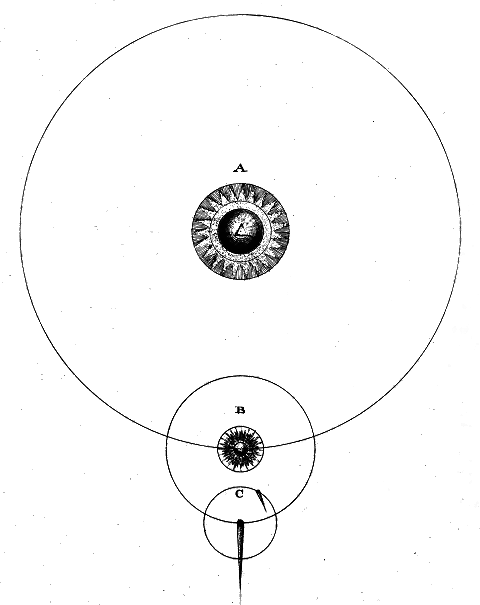
Plate XXII.
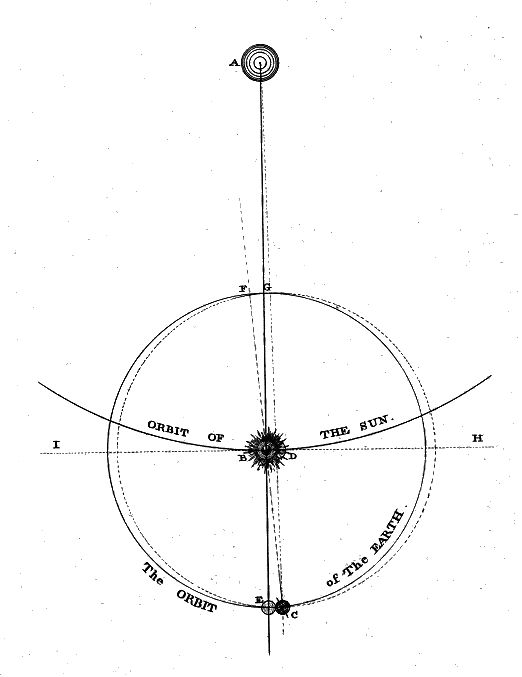
But now to apply this Hypothesis to our present Purpose, and reconcile
it to our Ideas of a circular Creation, and the known Laws of orbicular
Motion, so as to make the Beauty and Harmony of the Whole consistent
with the visible Order of its Parts, our Reason must now have recourse to
the Analogy of Things. It being once agreed, that the Stars are in Motion,
which, as I have endeavoured in my last Letter to shew is not far from
an undeniable Truth, we must next consider in what Manner they move.
First then, to suppose them to move in right Lines, you know is contrary
to all the Laws and Principles we at present know of; and since there are
but two Ways that they can possibly move in any natural Order, that is,
either in right Lines, or in Curves, this being one, it must of course be
the other, i. e. in an Orbit; and consequently, were we able to view them
from their middle Position, as from the Eye seated in the Center of Plate
XXV. we might expect to find them separately moving in all manner of
Directions round a general Center, such as is there represented. It only now
remains to shew how a Number of Stars, so disposed in a circular Manner
round any given Center, may solve the Phænomena before us. There are
but two Ways possible to be proposed by which it can be done, and one
of which I think is highly probable; but which of the two will meet
your Approbation, I shall not venture to determine, only here inclosed I
intend to send you both. The first is in the Manner I have above described,
i. e. all moving the same Way, and not much deviating from the
same Plane, as the Planets in their heliocentric Motion do round the
solar Body. In this Case the primary, secondary, and tertiary constituent
Orbits, &c. framing the Hypotheses, are represented in Plate XXII, and the
Consequence of such a Theory arising from such an universal Law of Motion
in Plate XXIII. where B, D denotes the local Motion of the Sun in
the true Orbis Magnus, and E, C that of the Earth in her proper secondary
Orbit, which of course is supposed, as is shewn in the Figure to change its
sidereal Positions, in the same Manner as the Moon does round the Earth,
and consequently will occasion a kind of Procession, or annual Variation
in the Place of the Sun, not unlike that of the Equinoxes, or Motion of all
the Stars together, from West to East round the Ecliptic Poles, and probably
may in some Degree be the Occasion of it. This Angle is represented,
but much magnified, by the Lines F, C, G, and the Unnaturalness,
or Absurdity of a right Line Motion of the Sun by the Line I, H.
The second Method of solving this Phænomena, is by a spherical
Order of the Stars, all moving with different Direction round one common
Center, as the Planets and Comets together do round the Sun, but
in a kind of Shell, or concave Orb. The former is easily conceived, from
what has been already said, and the latter is as easy to be understood, if
you have any Idea of the Segment of a Globe, which the adjacent Figures,
will, I hope, assist you to. The Doctrine of these Motions will perhaps
be made very obvious to you, by inspecting the following Plates.
Is a Representation of the Convexity, if I may call it so, of the intire
Creation, as a universal Coalition of all the Stars consphered round one
general Center, and as all governed by one and the same Law.
Is a centeral Section of the same, with the Eye of Providence seated
in the Center, as in the virtual Agent of Creation.
Represents a Creation of a double Construction, where a superior Order
of Bodies C, may be imagined to be circumscribed by the former one
A, as possessing a more eminent Seat, and nearer the supream Presence,
and consequently of a more perfect Nature. Lastly,
Represents such a Section, and Segments of the same, as I hope will
give you a perfect Idea of what I mean by such a Theory.
Fig. 1. is a corresponding Section of the Part at A, in Fig. 2. whose
versed Sine is equal to half the Thickness of the starry Vortice A C, or
B A. Now I say, by supposing the Thickness of this Shell, 1. you may
imagine the middle Semi-Chord A D, or A E, to be nearly 6; and consequently
thus in a like regular Distribution of the Stars, there must of course be at
least three Times as many to be seen in this Direction of the Sine, or
Semi-chord A E, itself, than in that of the semi-versed Sine A C, or
any where near the Direction of the Radius of the Space G. Q. E. D.
Plate XXIII.
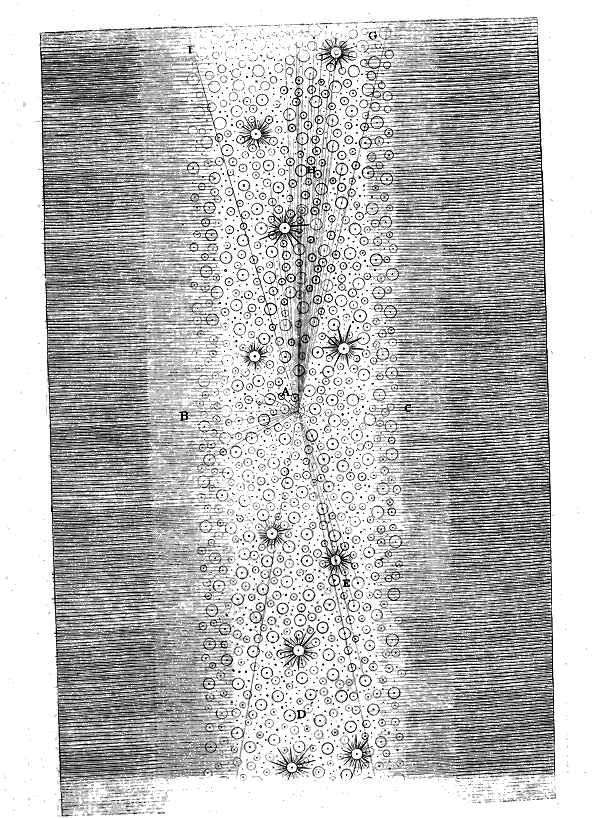
Plate XXIV.
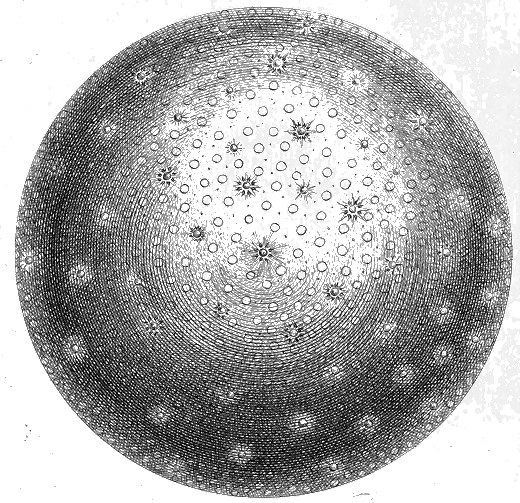
Plate XXV.
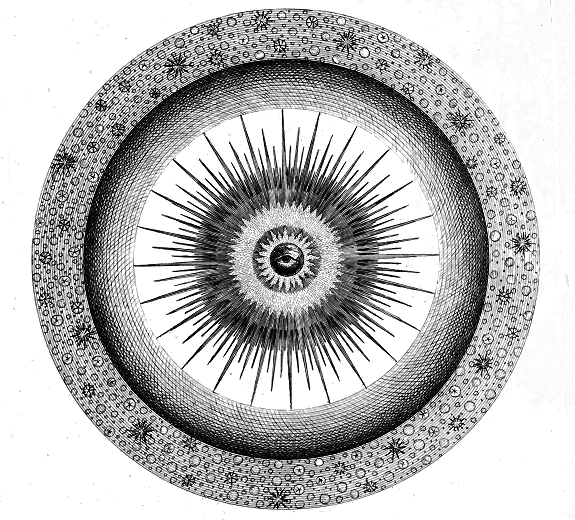
Plate XXVI.
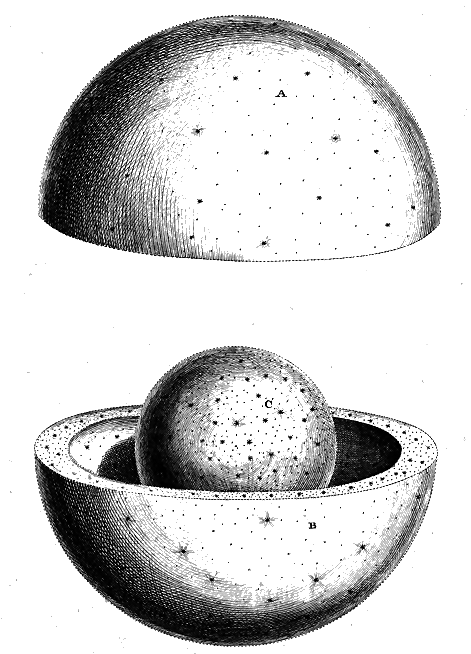
Plate XXVII.
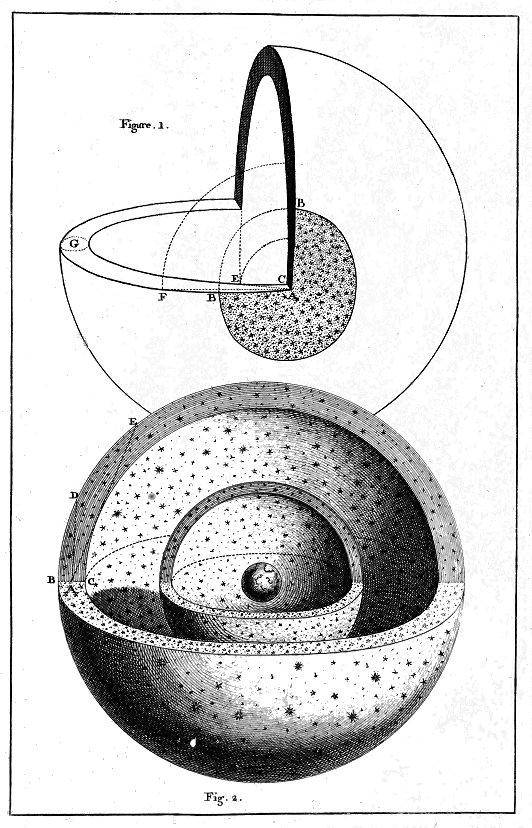
Plate XXVIII.
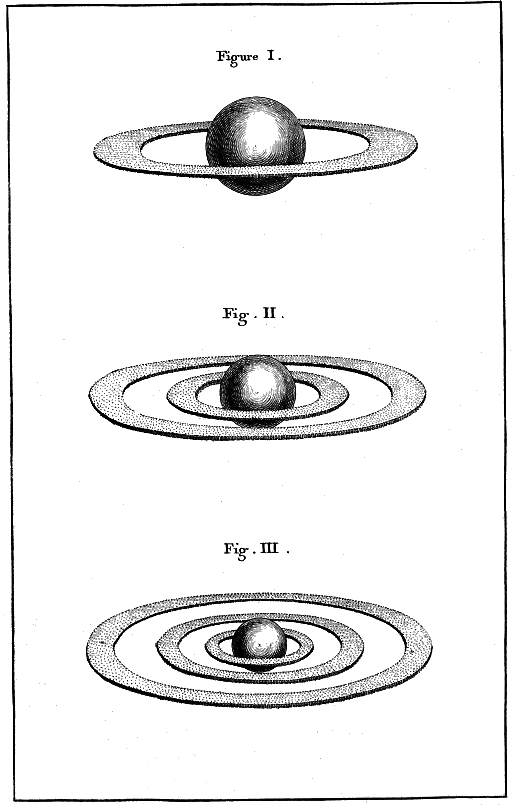
Plate XXIX.
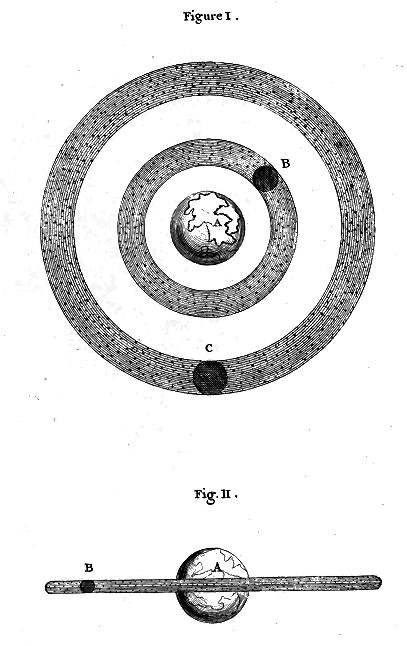
But we are not confined by this Theory to this Form only, there may
be various Systems of Stars, as well as of Planets, and differing probably
as much in their Order and Distribution as the Zones of Jupiter do from
the Rings of Saturn, it is not at all necessary, that every collective Body
of Stars should move in the same Direction, or after the same Model of
Motion, but may as reasonably be supposed as much to vary, as we find
our Planets and Comets do.
Hence we may imagine some Creations of Stars may move in the Direction
of perfect Spheres, all variously inclined, direct and retrograde;
others again, as the primary Planets do, in a general Zone or Zodiack, or
more properly in the Manner of Saturn's Rings, nay, perhaps Ring within
Ring, to a third or fourth Order, as shewn in Plate XXVIII. nothing
being more evident, than that if all the Stars we see moved in one vast
Ring, like those of Saturn, round any central Body, or Point, the general
Phænomena of our Stars would be solved by it; see Plate XXIX. Fig. 1.
and 2. the one representing a full Plane of these Motions, the other a Profile
of them, and a visible Creation at B and C, the central Body A, being
supposed as incognitum, without the finite View; not only the Phænomena
of the Milky Way may be thus accounted for, but also all the cloudy
Spots, and irregular Distribution of them; and I cannot help being of
Opinion, that could we view Saturn thro' a Telescope capable of it, we
should find his Rings no other than an infinite Number of lesser Planets, inferior
to those we call his Satellites: What inclines me to believe it, is this,
this Ring, or Collection of small Bodies, appears to be sometimes very excentric,
that is, more distant from Saturn's Body on one Side than on the other,
and as visibly leaving a larger Space between the Body and the Ring; which
would hardly be the Case, if the Ring, or Rings, were connected, or
solid, since we have good Reason to suppose, it would be equally attracted
on all Sides by the Body of Saturn, and by that means preserve every
where an equal Distance from him; but if they are really little Planets,
it is clearly demonstrable from our own in like Cases, that there may be
frequently more of them on one Side, than on the other, and but very
rarely, if ever, an equal Distribution of them all round the Saturnian
Globe.
How much a Confirmation of this is to be wished, your own Curiosity
may make you judge, and here I leave it for the Opticians to determine.
I shall content myself with observing that Nature never leaves us without
a sufficient Guide to conduct us through all the necessary Paths of Knowledge;
and it is far from absurd to suppose Providence may have every
where throughout the whole Universe, interspersed Modules of every
Creation, as our Divines tell us, Man is the Image of God himself.
Thus, Sir, you have had my full Opinion, without the least Reserve,
concerning the visible Creation, considered as Part of the finite Universe;
how far I have succeeded in my designed Solution of the Via Lactea,
upon which the Theory of the Whole is formed, is a Thing will hardly
be known in the present Century, as in all Probability it may require some
Ages of Observation to discover the Truth of it.
It remains that I should now give you some Idea of Time and Space;
but this will afford Matter sufficient for another Letter.
I am, &c.
LETTER THE EIGHTH. — PLATE XXX.
Of Time and Space, with regard to the known Objects of Immensity and
Duration.
SIR,
T
The Opportunity you gave me in your last Visit, of shewing you
my general Scheme of the Universe, I find, besides the Pleasure
it then gave, is now attended with many useful Advantages.
I now not only hope to be better understood for the future, but have
reason to expect what I now write will merit your Attention more, and
have some Title to your Approbation. The Ideas I have fram'd of
Time and Space, will now more gradually fill your Imagination both
with Wonder and Delight, before they can arise so high as to be lost in
an Eternity and the Infinity of Space. And I am fully perswaded your farther
Inquiries into these vast Properties of the Deity, will here be answered
intirely to your Satisfaction. You must allow me now to be in some
measure a Judge of what I think will please you most, from the Observations
you have made upon my general System, or otherwise you would have
reason to think me perhaps too presuming: But I flatter myself the great
Difficulty is now over; and what remains to be said, will all so naturally
follow from what has gone before, that this Letter, I guess, will go near
to furnish you with all the Ideas you wish to form upon the Subject.
To what you have said of my having left out my own Habitation in my
Scheme of the Universe, having travell'd so far into Infinity as both to lose
sight of, and forget the Earth, I think I may justly answer as Aristotle did
when Alexander, looking over a Map of the World, enquir'd of him for the
City of Macedon; 'tis said the Philosopher told the Prince, That the
Place he sought for was much too small to be there taken Notice of, and
was not without sufficient Reason omitted.
The System of the Sun compar'd but with a very minute Part of the
visible Creation, takes up so small a Portion of the known Universe, that
in a very finite View of the Immensity of Space, I judg'd the Seat of the
Earth to be of very little Consequence, could I have possibly represented
it, as not only being one of the smallest Objects in our Regions, but in a
manner infinitely less than even her own annual Orbit, and had nothing to
do with my main Design, which was to represent all our planetary Worlds
as one collective Body, and begin my comparative Scale of Magnitude
from the Sun only and his Sphere of activity; as the smallest Object I
could with any Propriety pretend to express in such a Plan.
In some Measure to convince you that I have committed no Error
in this, I will try by some less mathematical Method than that of meer
Numbers, to imprint an Idea in your Mind of the true Extent of the solar
System, and the Magnitude of all its moving Bodies, by natural Objects
most familiar to your Senses. When we endeavour to form any Idea
of Distance, Magnitude, or Duration, by Numbers only, we so soon exceed
the Limits of Conception, that this way we find our Faculties of
reasoning as finite as our Senses; and no doubt 'tis right it should be so,
Providence, as it were, having ordain'd that the first should only attend
the last, in such an adequate Degree to a determin'd Distance; but what
Distance or Degree of Knowledge is destin'd to human Nature, none
but the Power that gave it can tell. 'Tis certain that beyond the third or
fourth Place of our Nomenclator, we receive but very faint Impressions
of the thing exprest, and can frame scarce any Notion at all of either
Number, Distance, or Magnitude, signified beyond it: Hence Astronomers
are frequently oblig'd to have recourse to mixt Ideas, and make
Things of different Natures and Properties assist each other, to excite
more adequate Ideas of what they would have conceived. Thus to express
immense Distances and Magnitude, they frequently apply themselves
to Time and Motion; and vice versa, to signify a long Duration, they
have often recourse to Distance and Matter, removing, in Imagination,
Worlds of Sand, Grain after Grain, to some remote known Region.
Hesiod,[AQ] to express his Idea of the Distance from his highest Heaven
to Earth, and from Earth to Hell, or Tartarus, supposes an Anvil to be
let fall from one to the other, which he says in nine natural Days would
reach the Earth from Heaven, and in the same time would fall from the
Earth to Hell. [AR]Homer makes his Vulcan fall from Heaven to the Island
of Lemnos in much less Time, not exceeding one full artificial Day.
Modern Astronomers have made use of the swiftest Velocity of a Cannon-Ball
as continued thro' the Space they would so describe, and in this
Light, the Distance to the Sun has been by many compar'd to twenty-five
Years Motion of a Cannon-Ball, supposing it to travel at the Rate of
100 Fathom in a Moment, i. e. the Pulse of an Artery; and that a Journey
so performed to one of the nearest fix'd Stars, would take the same
Body at least 100,000 Years before it could arrive there. But the Method
I have chose to convey my Ideas of the Magnitude of the planetary Bodies,
and the Extent of the visible Creation to you, I am willing to hope
you will find still more familiar, comprehensive, and easy: And it only
depends upon your Remembrance of a very few known Objects, and their
neighbouring Distances, which may be presumed you are, or have been,
very well acquainted with. You have not only very lately but very often
been in London, and must, I think, retain some Idea of the Dome of St.
Paul's, tho' I own I ought not to be sorry if you should chance to have
forgot it, provided it might prove a Means of making your Visits more
frequent. The Diameter of the Dome of this Church is 145 Feet: Now
if you can imagine this to represent the Surface of the Sun, a spherical
Body 18 Inches diameter, will justly represent the Earth in like Proportion;
and another of only five Inches diameter, will represent the Moon.
The Truths of these Proportions I have shewn in my Clavis Cœlestis; and
the Reason why I have here fixt upon the Dome of this Church for my
first Object of Comparison, will naturally appear from what follows.
From the Magnitude of the Earth on which we live, as from a known
Scale with respect to its Parts compar'd with our own Bodies, we naturally
frame our first Ideas of Extent, and fix our Rationale of Remoteness;
by which we are sufficiently enabled to judge of all other sensible Distances
within one finite View. And hence by the undoubted Principles
of Geometry, having first given the Measurement of the Earth in any
known Proportion with any other Quantity most familiar to our Senses,
and the Angle of Appearance, or Parallax to any perceivable Object, we
can easily find in homogenial Parts its true Distance from the Eye. And
thus allowing for some small tho' unavoidable Errors, that may possibly
arise from the Difficulties of Observation (especially small Angles and minute
Quantities) we can always determine to a sufficient, and very frequently
to a just Exactness, the relative Distance of all visible Bodies, remote
or near, such as the Planets, Comets, and the Sun.
[AS]In this Manner Astronomers having procur'd a comparative Standard,
reduc'd to some known Measure, as English Miles, Leagues, Semi-Orbs or
Orbits, with all the Force of analogical Reasoning, clearly can demonstrate
the Place and Distance of any Object within the Reach of Observation,
and judge of Distances almost indefinite.
Will help you to very correct Ideas of the real Magnitude of the Globe
of the Earth, compar'd with the just Extent of the Island of Great-Britain,
which you will find with Ireland, and the rest of its Islands, seated near
the Center of the Projection. This as a Standard will enable you to judge
of all other Distances more perfectly; and first I shall consider that of
the Sun.
The Sun is found to be mean distant from the Earth nearly 81 Millions
of Miles, or 6877,5 Diameters of the Earth; and Saturn, the remotest
Planet from him is at his greatest Distance from us about 858 Millions
of Miles: Yet these Distances are but the beginning of Space, and
only serve to open our Ideas for farther Search.
The great Comet of 1680, as I have some where said before, was
found to move in so vast an excentrick Orbit, that in its aphelion Point
it would be 14,4 Times as far from the Sun, as the Orbit of Saturn, and
hence at least eleven thousand and two hundred Millions of Miles from us.
Now since the wise Creator hath so dispos'd all the independent Parts of
the Creation, such as the several Systems of primary and secondary Planets,
&c. at so great a Distance from each other, that the Laws of any one
in no wise shall interfere, disturb, or interrupt the Principles of another;
this Comet, which we can easily prove belong'd to our own Sun, we
may well imagine came not near any other; and tho' at that vast Distance
from the solar Body, yet still there must have remain'd a Space sufficient
to divide or seperate the sensible activity of neighbouring Systems, that
they may not rush upon each other. Hence we may reasonably suppose,
that the nearest Star can be no nearer than a triple Radius of its active
Sphere; and provided they are all in regular Order, and much of the same
Magnitude with one another (which no Arguments can possibly contradict)
this Radius we may justly make 2000 times the Distance of our
Earth. For admitting the utmost Limits of the Sun's Attraction to exceed
this Sphere of the Comets, as far as the Sphere of the Comets
exceeds that of the Planets, which is nearly 14,4 times, the Radius of the
solar System will be extended every way 200 Radius's of the Orbit of Saturn,
and consequently the Distance from Star to Star will not be less
than 6000 times the Radius of our Orbis Magnus, and consequently upwards
of 480,000,000,000 Miles. That this is even less than the real
Truth, and may be defended as a very moderate Computation, grounded
upon Reason, we have infallible Demonstration to witness, and make
appear as thus.
Plate XXX.
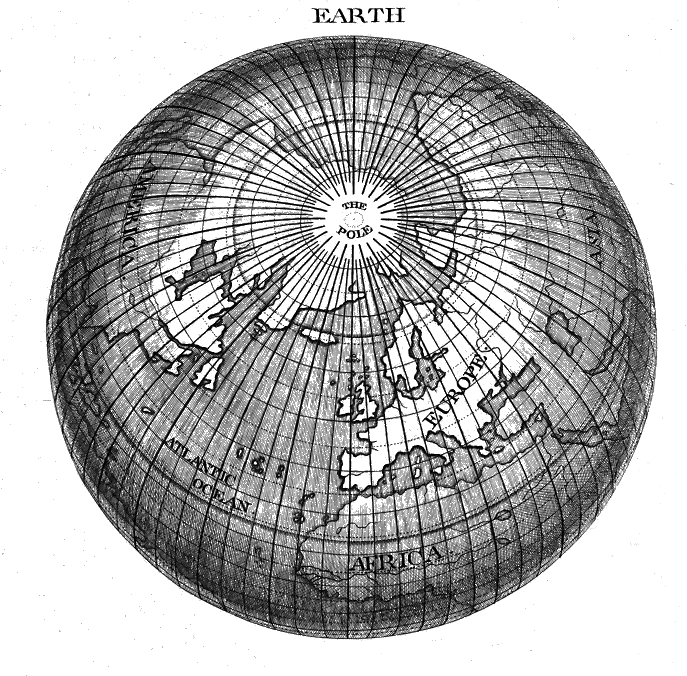
We know from the Nature of Distance and Motion that the Stars may
have an annual Parallax, but it is so very small, that the very best Astronomers
have never yet been able to assign what the Quantity really is. Yet it is
allow'd by universal Consent, that it can't possibly be more that one Minute
of a Degree, and may probably be much less. Mr. Flamstead, by repeated
Observations, made it in some of them upwards of 40″; but Mr.
Bradley has endeavour'd to prove it is every where too small to be determined,
and assigns this Angle to another Cause. This way then we
cannot make their Distance less; and to prove that it is something more
than I have said it is, let us even increase the doubtful Parallax of 40″ to
the most it possibly can be, viz. to 60″ or 1′; and by the Solution of
the Triangle, we shall find that the nearest Star is 6875 times the Radius
of the Earth's Orbit from the Sun: And this tho' more than any other
Proportion makes them, is still undeniably less than the Truth, which
every Mathematician will of course be convinc'd of; and you yourself of
force must believe, when you are told, that the smaller the Angle of Parallax
is, the farther the Body is remov'd from us. By which Rule, according
to Mr. Flamstead's Observations, the Distance must be still greater:
By the optical Experiment of [AT]Mr. Huygins, greater still than this; and
according to Mr. Bradley, so much more as not even too be determin'd.
Now if the rest are in general from each other, allowing the same
Extent of System, and as much to part the like Extreams of active Virtue,
be in such Proportion of aerial Space, it will appear, that to pass
from any one Star to another, we must fly thro' so vast a Tract of pure
Expanse or Ether, that to visit any one of the most neighbouring Systems,
could we travel even as fast as the swiftest Eagle flies, for Instance, 500 Miles
per Day, yet should we be 3,000,000 of Years upon our way before we
could arrive there; and if continuing on to view the Regions of the rest
within the known Creation, Myriads of Ages would be spent, and yet
we could not hope to see the whole of but the smallest Constellation.
But what Idea of Distance can you receive from this sort of Estimation,
where Numbers arise so very high. I own to you mine are soon
quite lost by this Method of counting, either, Distances or Duration.
I believe few People can range their Ideas with such Perspicuity, as to
arrive at any adequate Notion of any Number above a thousand.
To give you therefore a clearer Idea of Distance, and impress the Proportions
of Space more strongly and fully in your Mind, let us suppose
the Body of the Sun, as I have said before, to be represented by the Dome
of St. Paul's; in such Proportion a spherical Body eighteen Inches Diameter,
moving at Mary-le-bone, will justly represent the Earth, and another
of five Inches Diameter, describing a Circle of forty-five Feet and
a half Radius round it, will represent the Orbit and Globe of the Moon.
A Body at the Tower of 9,7 Inches, will represent Mercury; and one
of 17,9 Inches at St. James's Palace will represent the Planet Venus; Mars
may be supposed at a Distance, like that of Kensington or Greenwich, 10
Inches Diameter: Jupiter, imagined to be at Hampton-Court, or Dartford
in Kent; and Saturn, at Cliefden, or near Chelmsford: The first represented
by a Globe 15 Foot 4 Inches Diameter, the latter by one of 11 Feet ¾ Inches
and his Ring four Feet broad: These would all naturally represent the
planetary Bodies of our System in their proper Orbits and proportional
Magnitudes, as moving round the Cupola of St. Paul's, as their common
Center the Sun. And preserving the same natural Scale, the Aphelion
of the first Comet would be about Bury, the second at Bristol, and the
third near the City of Edinburgh. But if you will take into your Idea
one of the nearest Stars; instead of the Dome of St. Paul's, you must
suppose the Sun to be represented by the gilt Ball upon the Top of it, and
then will another such upon the Top of St. Peter's at Rome represent one
of the nearest Stars.
The whole System exhibited in the above Proportion, would be nearly
as follows:
| Diameter of the |
Sun |
145 Feet. |
|
Saturn |
11,587, his Ring 27,54, its Breadth 4. |
| Jupiter, |
15,39. |
| Mars, |
10,15 Inches. |
| the |
Earth, |
18,125. |
|
Venus, |
17,98 |
| Mercury, |
9,715 |
| and |
the Moon, |
4,93 |
| [AU]Distance of |
Saturn from the Sun, |
27 Miles, and 1700 Yards. |
|
Jupiter, |
15 Miles, and 458 Yards. |
| Mars, |
4 Miles, and 751 Yards. |
| the Earth, |
2 Miles, and 1632 Yards. |
| Venus, |
2 Miles, and 217 Yards. |
| Mercury, |
1 Mile, and 267 Yards. |
| and of the Moon, from us, 45 Yards and a half. |
That of the most distant Comet 390, and the nearest of the Stars not
less than 6875,[AV] Radius's of the Orbis Magnus.
Now, if like Creations crowd the vast Depths of Infinity, and if each
are adapted to receive Beings of different Natures, where must our Wonder
and Ideas have end?
As it is evident in the Sign Taurus, in Perseus, and Orion, that we
can plainly perceive Stars to the sixth and ninth Magnitude, the former
with our naked Eye, the other by the Help of Telescopes, the visional
ocular Creation cannot be less than 4,320,000,000,000 Miles in semi Diameter,
and admitting a regular Distribution of those primordial Bodies
amongst themselves, the Depth, or most remote Limits of the Vortex
Magnus from Side to Side, cannot be less than 8 m, m, 640 thousand of
Million of Miles, admitting it is no more than what we see; and lastly,
supposing our System to be situated nearly in the Middle of the Vortex
Magnus (which, from the visible Order of the Stars, we may justly conjecture,
with the highest Probability of Truth) the nearest Distance of the
Ens Primum, in the Realms of eternal Day, will rise to 30,000,000,000,000
Miles, but more probably to 100,000,000,000,000 Miles, making
the Confines of Creation from Verge to Verge in the first Case, upwards
of 68 Million of Millions of Miles, Diameter, and by the last above 200′.
But, if we compute the Distance of the Stars after the Manner of Huygens,
for his Distance of Syrius from the Sun, the Distance of the Region
of Immortality without exceeding Probability may rise to near
1,000,000,000,000,000 Miles.
Now to pass by any progressive Motion from the outward Verge, or
Borders of the Creation, thro' the starry Regions of Mortality, if I may call
them so, as far as the Center of the Ens Primum, or Sedes Beatorum, according
to Homer, or Milton's Manner of measuring Space, a Body falling, or
a Being moving with a Velocity but of 1000 Feet per Minute, i. e. at the
Rate of 20,000 Yards per Hour, or about 300 Miles per Day, would be at
least 300,000,000 Years upon its Journey thither, if not 1,000, m, and
perhaps much more, without offending Probability; but even three Million
Centuries, or Ages, sure is enough to be employ'd, in passing from one Place
to another; therefore, we may conclude, the Soul must have some other
Vehicle than can be found in the Ideas of Matter to convey it so far, at
least at once. Hence we may truly infer, that the Soul must be immaterial,
and that in all Probability there may be States in the Universe so much
more longer lived than ours, that, compared with the Age of Man, the
Age of such Beings may be almost as an Eternity, or rather, as that of
the human Species to that of a Sun-born Insect.
Again, if there are still Stars beyond all these of other Denomination,
which we do not here perceive, how vastly must these Numbers be increased,
to express, almost without Idea, the amazing Whole of this one
visible Creation; but what has been already said, I judge will be sufficient
to show the Immensity of Space, and help you to conceive the stupendious
Nature of an endless Universe; every where the home Possession,
Production, and instantaneous Care, of an infinite good Being, perfectly
wise, and powerful, of whom we can have no Idea more, than a Being in
dark Privation can have of Light, but through the Lustre of his own resplendent
Attributes.
Thus, having attempted to enlarge your Ideas of the Creation in general,
and in some measure having considered the Indefinity of Space, I shall in
the next Place proceed to give you some Account of my Notions of Time.
As Distance is the Measure of Magnitude and of all Extent, and helps our
Imagination to the Ideas of Space, so are progressive Moments the Measure
of Velocity, and makes us sensible of Duration: And as Space may be extended
through all Infinity, so Time may be continued as to Eternity. This
Succession of temporal Ideas impressed, or excited in the Mind, as an
Effect of Matter in Motion, producing a perpetual Change, both of Objects
earthly and celestial, enables us not only to reflect upon past Vicissitudes
of Nature, but from their regular Courses, known Order and Returns,
predict Phænomena to come, and prove the periodical Effects of Nature's
constant Laws so just and certain, that Time may be said with
Truth, to co-exist with Motion.
Measure being a certain Quantity of Sensation interwove with our Ideas
of Distance and Duration, proceeding from a Reflection of what is impressed
upon the Mind by some external Object, I must again return to
our Mother of Ideas the Earth, and from thence, as I did, of Distance,
frame the original Images best suited to the Understanding, proper for our
Judgment of Duration.
Time takes its first Denomination from the diurnal Rotation of the
Earth upon its Axis, which we call a natural Day, and this for obvious
Reasons we subdivide in twenty-four Parts or Hours. This diurnal Motion
having been successively repeated, and the Day renewed three hundred
and sixty-five Times, we find that all the vegetable World has gone
through all its Variegations, and Nature has again put on the same Face,
adapted to the Season; during which Time, and indeed which occasions
this general Change and Repetition, the Earth is found to make one intire
Revolution round the Sun. This Space, or Period of Time, we call a
solar, or rather a natural Year; and from our Sensibility of this, and its constituent
Parts, both horary and diurnal, we form our general Judgment
of Duration.
Saturn, the most remote, and most regular Planet in our System, as has
been said before, performs one Revolution round the Sun in about twenty-nine
of the above solar Years: The great Comet of 1680 makes but one
periodical Return in five hundred and seventy-five of those Years, and the
general Motion of the Stars, arising from the Procession of the Equinoxes,
altogether continually changing their Aspect, or Position, at the Rate of
50″ per Year round the ecliptic Poles, compleats but one Revolution in
25920 Years; in which Time the whole sidereal Frame of Heaven
has changed, and every Star returned to the same Point of the solar Sphere
it set out from. This is by many called the great Saturnian Year: Concerning
which, Mr. Addison has thus translated an eminent Author.
When round the great Saturnian Year has turn'd,
In their old Ranks the wandering Stars shall stand,
As when first marshall'd by the Almighty's Hand.
Addison.
Now, if this sidereal Revolution, arising from a secondary Cause, require
this Number of Years to perfect one Rotation, what must their primitive
Orbits take to circumscribe the Vortex Magnus.
It has been observed, that the biggest Star to us scarce moves a Minute
in an hundred Years, and the most remote as insensibly for Ages, from
whence and what has been already said of the imagined Distance of the general
Center, we may frame this probable and well-grounded Guess, that the
mean Revolution of a Star near the Middle of the Vortex Magnus, cannot be
made in less than a Million of Years, and though to us imperceptible, our
Sun in his own orbicular Direction, may be moving many Miles per Day.
Besides, if local Motion can be proved amongst the Stars, what less than an
Eternity can again restore them to their original Order and primitive State.
Such vast Room in Nature, as Milton finely expresses it, cannot be without
its Use; and nothing but absolute Demonstration is wanting (which
from their Nature and Distance cannot be expected) to confirm the grand
Design, so suited to the Deity's infinite Capacity, and of eternal Benefit
to all his Creatures, especially Beings of a rational Sense, and in particular
Mankind.
Of these habitable Worlds, such as the Earth, all which we may suppose
to be also of a terrestrial or terraqueous Nature, and filled with
Beings of the human Species, subject to Mortality, it may not be amiss in
this Place to compute how many may be conceived within our finite
View every clear Star-light Night. It has already been made appear, that
there cannot possibly be less than 10,000,000 Suns, or Stars, within
the Radius of the visible Creation; and admitting them all to have each
but an equal Number of primary Planets moving round them, it follows
that there must be within the whole celestial Area 60,000,000
planetary Worlds like ours. And if to these we add those of the secondary
Class, such as the Moon, which we may naturally suppose
to attend particular primary ones, and every System more or less of them
as well as here; such Satellites may amount in the Whole perhaps to
100,000,000, or more, in all together then we may safely reckon
170,000,000, and yet be much within Compass, exclusive of the Comets
which I judge to be by far the most numerous Part of the Creation.
In this great Celestial Creation, the Catastrophy of a World, such as
ours, or even the total Dissolution of a System of Worlds, may possibly
be no more to the great Author of Nature, than the most common Accident
in Life with us, and in all Probability such final and general Doom-Days
may be as frequent there, as even Birth-Days, or Mortality with us
upon the Earth.
This Idea has something so chearful in it, that I own I can never look
upon the Stars without wondering why the whole World does not become
Astronomers; and that Men endowed with Sense and Reason, should neglect
a Science they are naturally so much interested in, and so capable of
inlarging the Understanding, as next to a Demonstration, must convince
them of their Immortality, and reconcile them to all those little Difficulties
incident to human Nature, without the least Anxiety.
Such a Prothesis can scarce be called less than an ocular Revelation, not
only shewing us how reasonable it is to expect a future Life, but as it were,
pointing out to us the Business of an Eternity, and what we may with the
greatest Confidence expect from the eternal Providence, dignifying our
Natures with something analogous to the Knowledge we attribute to Angels;
from whence we ought to despise all the Vicissitudes of adverse
Fortune, which make so many narrow-minded Mortals miserable.
I am now, &c.
LETTER the NINTH.
Reflections, by Way of General Scolia, of Consequences relating to the Immortality
of the Soul, and concerning Infinity and Eternity.
SIR,
T
This my last Letter to you, I mean my final astronomical
one, I propose as a General Scolia to the rest, the principle
Matter being Reflections upon what is gone before, with some
Conclusion naturally following or appendant to what has been already said;
but which, I could not in any other Place, so properly remark to you.
The Probability of the foregoing Conjectures, chiefly built upon very
distant Observations, shew an apparent Necessity for some other kind of
Doctrine permitted by Providence, to give Mankind a Knowledge of
their Immortality and Dependance upon it, in the first Ages of the
World.
And for the same Reason it evidently appears, that the ancient Philosophers
had it not in their Power to prove a supream Being and Director
of all Things this Way.
And yet, as by a Sort of Instinct, or natural Reason, and Consciousness
of a good Principle, we see how many noble Steps they made towards
it, and was convinc'd at last of this great Truth, that since there was a
Mind in so imperfect a Creature as Man, the perfect Universe, which
comprehended all Things, could not possibly be without one; and as
Sir Isaac Newton has justly observed in his Principia, "If every Particle
of Space be always, and every individual Moment of Duration
every where; surely the Maker and Lord of all Things, cannot be never
and no where."
To make manifest the infinite Empire and Agency of God, from celestial
Motion, became the Task, but of very late Years; and I can't help
being of Opinion, that by means of these primary Bodies, only, we shall
at length be able to trace the greater Circulations, and Laws of Nature, to
their real original and fountain Head.
These, were any thing wanting, besides the Miracle ourselves, to convince
us of a divine Origination, are all infallible Proofs, that the Universe
is governed by an intelligent and all-powerful Being, whose Existence is too
nearly related to a self-evident Truth to be more clearly demonstrated, than
it is manifest of itself, both from the particular Laws of Nature, and the general
Order of Things. An Argument which has been thought of no small
Force, and well worth observing in the Infancy of Christianity. The invisible
Things of God are clearly seen, being understood by the Things that
are made, even his eternal Power and Godhead. Rom. i. 20.
But 'tis now high time to look back upon my Theory, and tell you
it is a vain Supposition, to imagine I shall ever be able to convince every
Reader, either of the Truth or Probability of what I have advanced to
you: Mathematical Assistance not being to be expected, where perhaps
it has never been thought of; and I allow you, it is much more reasonable
to expect, that fifty Persons will read these Letters without perceiving
the Reasonableness of them, than that five should consider them
with proper Judgment.
I must ingenuously confess to you, that nothing is wanting to convince
me intirely of the Certainty of what I here advance by way of Conjecture
to you. But this you must only look upon as an happy Partiality,
which generally attends all Authors, and always will be the chief Support
of their tedious Labours. I assure you, I have neither Hopes nor Expectation,
no, not the weak Breath of a Wish, to be admitted a proper
Judge of my own Works. But I shall always take their Imperfection to be
rather, (like my own Faults) to be too near me to be seen; I therefore
trust all to my Friend, and if I am so fortunate as to excite his Approbation,
I shall think myself very happy in a very favourite Point; which is,
The advancing nothing which a rational Reader would willingly overlook,
or be ignorant of.
But if I have been so happy as to come so near the Mark, as to border
upon Truth, I believe you will allow me to carry my Conjectures a little
further, and point out some farther pleasing Consequences, which I begin
to perceive may naturally follow.
Should it be granted, that the Creation may be circular or orbicular,
I would next suppose, in the general Center of the whole an intelligent
Principle, from whence proceeds that mystick and paternal Power, productive
of all Life, Light, and the Infinity of Things.
Here the to-all extending Eye of Providence, within the Sphere of its
Activity, and as omnipresently presiding, seated in the Center of Infinity,
I would imagine views all the Objects of his Power at once, and every
Thing immediately direct, dispensing instantaneously its enlivening Influence,
to the remotest Regions every where all round. I know you'll say Astronomers
are never to be satisfied, and I must own where there is so much
rational Entertainment for the human Mind, and so suitable to the
true Dignity of God, and most worthy of Man, it is not easy to
know where to stop in such a Scene of Wonders.
Having, I say, once granted that all the Stars may move round one
common Center, I think it is very natural to one, who loves to pursue
Nature as far as we may, to enquire what most likely may be in that
Center; for since we must allow it to be far superior to any other Point
of Situation in the known Universe, it is highly probable, there may be
some one Body of siderial or earthy Substance seated there, where the divine
Presence, or some corporeal Agent, full of all Virtues and Perfections,
more immediately presides over his own Creation. And here this primary
Agent of the omnipotent and eternal Being, may sit enthroned, as
in the Primum Mobile of Nature, acting in Concert with the eternal
Will. To this common Center of Gravitation, which may be supposed
to attract all Vertues, and repel all Vice, all Beings as to Perfection
may tend; and from hence all Bodies first derive their Spring of Action,
and are directed in their various Motions.
Thus in the Focus, or Center of Creation, I would willingly introduce
a primitive Fountain, perpetually overflowing with divine Grace, from
whence all the Laws of Nature have their Origin, and this I think would
reduce the whole Universe into regular Order and just Harmony, and
at the same time, inlarge our Ideas of the divine Indulgence, open our
Prospect into Nature's fair Vineyard, the vast Field of all our future
Inheritance.
But what this central Body really is, I shall not here presume to say,
yet I can't help observing it must of Necessity, if the Creation is real and
not merely Ideal, be either a Globe of Fire superior to the Sun, or
otherwise a vast terraqueous or terrestrial Sphere, surrounded with an
Æther like our Earth, but more refined, transparent and serene. Which
of these is most probable, I shall leave undetermined, and must acknowledge
at the same time, my Notions here are so imperfect, I hardly dare
conjecture. 'Tis true, I have ventur'd to think it may be one of these,
and since so glorious a Situation can hardly be supposed without its proper
Inhabitants, 'tis most natural to conclude it may be the latter. In
the first Case, besides our having no Idea of Beings existing in Fire, it
would not, notwithstanding its Distance, be so easy to account for its being
invisible; and since the Lustre of the Stars are all innate, they could
receive no Benefit from it, and consequently such a Nature as a solar Composition,
must in this Place be render'd useless; but in the latter Supposition
of its being a dark Body, we have no Difficulty attending us,
having several Instances of like Bodies, moving round an opaque one.
Now when we consider, that all those radient Globes, which adorn the
Skies, those bright ætherial Sparks of elemental Fire, thick strewed like
Seeds of Light all round our Hemisphere, are each to us the Embrio
of a glorious Sun; how awful and stupendious must that Region be,
where all their Beams unite and make one inconceivable eternal Day?
Though the Deity, says a learned Writer "be essentially present thro'
all the Immensity of Space, there is one Part of it in which he discovers
himself in a most transcendent and visible Glory. This is that Place
which is mark'd out in Scripture, under the different Appellations
of Paradice; the third Heaven; the Throne of God, and the Habitation
of his Glory."
This continues the same Author, is "that Presence of God, which
some of the Divines call his glorious, and others his majestick Presence."
It is here, and here only, as in the Center of his infinite Creations,
where he resides in a sensible Magnificence, and in the midst of those
Splendors, which can Effect the Imagination of his Creatures; and though
the most sacred and supreme Divinity be allowed as essentially present in
all other Places as well as in this, as being a Being whose Center is every
where, and Circumference no where; yet it is here only, or in such
Sensorium of his Unity, where he manifests his corporeal Agency,
as in the Foci of his infinite Empire over all created Beings. It is to
this majestick Presence of God, we may apply those beautiful Expressions
of Scripture, "Behold even to the Moon and it shineth not; yea the Stars
are not pure in his Sight."
"The Light of the Sun, and all the Glories of the World, on which
we live, are but as weak and sickly Glimmerings, or rather Darkness
it self, in Comparison of those Splendors, which encompass this
Throne of God."
Here Heav'ns wide Realms an endless Scene displays,
And Floods of Glory thro' its Portals blaze;
The Sun himself lost in superior Light,
No more renews the Day, or drives away the Night:
The Moon, the Stars, and Planets disappear,
And Nature fix't makes one eternal Year.
Here and here alone center'd in the Realms of inexpressible Glory, we
justly may imagine that primogenial Globe or Sphere of all Perfections,
subject to the Extreams of neither Cold nor Heat, of eternal Temperance
and Duration. Here we may not irrationally suppose the Vertues of the
meritorious are at last rewarded and received into the full Possession of
every Happiness, and to perfect Joy. The final and immortal State ordain'd
for such human Beings, as have passed this Vortex of Probation thro' all
the Degrees of human Nature with the supream Applause.
What vast room is here, for infinite Power and Wisdom to act in, and
that so visibly takes Delight to bless all his Beings with his Bounty. And
endless as his Prescience, Attributes, and Goodness, are undoubtedly all
those natural and apparent Joys with which he manifests his Love to all
his Creatures, a Multiplicity of Objects not to be enumerated. For wheresoever
we turn our Eyes, and follow with our Reason, we may meet with
Worlds of all Formations, suited no doubt to all Natures, Tastes, and
Tempers, and every Class of Beings.
Here a Groupe of Worlds, all Vallies, Lakes, and Rivers, adorn'd with
Mountains, Woods, and Lawns, Cascades and natural Fountains; there Worlds
all fertile Islands, cover'd with Woods, perhaps upon a common Sea,
and fill'd with Grottoes and romantick Caves. This Way, Worlds all
Earth, with vast extensive Lawns and Vistoes, bounded with perpetual
Greens, and interspersed with Groves and Wildernesses, full of all Varieties
of Fruits and Flowers. That World subsisting perhaps by soft Rains, this
by daily Dews, and Vapours; and a third by a central, subtle Moisture,
arising like an Effluvia, through the Pores and Veins of the Earth, and
exhaling or absorbing as the Season varies to answer Nature's Calls.
Round some perhaps, so dense an Atmosphere, that the Inhabitants may
fly from Place to Place, or be drawn through the Air in winged Chariots,
and even sleep upon the Waves with Safety; round others possibly,
so thin a fluid, that the Arts of Navigation may be totally unknown to it,
and look'd upon as impracticable and absurd, as Chariot flying may be
here with us; and some where not improbably, superior Beings to the human,
may reside, and Man may be of a very inferior Class; the second,
third, or fourth perhaps, and scarce allow'd to be a rational Creature.
Worlds, with various Moons we know of already; Worlds, with Stars
and Comets only, we equally can prove is very probable; and that there
may be Worlds with various Suns, is not impossible. And hence it is
obvious, that there may not be a Scene of Joy, which Poetry can paint,
or Religion promise; but somewhere in the Universe it is prepared for
the meritorious Part of Mankind. Thus all Infinity is full of States of
Bliss; Angelic Choirs, Regions of Heroes, and Realms of Demi-Gods;
Elysian Fields, Pindaric Shades, and Myriads of inchanting Mansions,
not to be conceived either by Philosophy or Fancy, assisted by the strongest
Genius and warmest Imagination.
All harmoniously crowded and provided with every Object of Beatitude,
that Friendship, Love, or Society can inspire, the Muses or the
Graces Frame; and all as permanent and perfect, that is destin'd to a
Duration, suited to the Nature of their Existence and Degree of Cognisance;
for as a very learned Writer observes upon this same Subject:
"How can we tell, but that there may be above us Beings of greater
Powers, and more perfect Intellects, and capable of mighty Things,
which yet may have corporeal Vehicles as we have, but finer and
invisible? Nay, who knows, but that there may be even of these
many Orders, rising in Dignity of Nature, and Amplitude of Power,
one above another? It is no Way below the Philosophy of these Times,
which seems to delight in inlarging the Capacities of Matter, to assert
the Possibility of this."
From these amazing Ideas of Space in general, and from the particular
Distance of the Stars, which separates as it were, one System of
Bodies from another, and by so prodigious an extent, as scarce to be
suppos'd a temporal Task. I think it naturally follows, had we no other
Way to prove it, or any other Reason to believe it, that the Soul must of
Necessity be immaterial; for as this Space seems so impassible to Matter,
as not to be undertaken and performed without the Loss of Ages, in a
State only of Transmigration, we may well imagine, that Change of
Place is not effected this Way, but by some other Virtue or Property,
more immediate, if not instantaneous.
I own next to Annihilation is the State of Oblivion, and this Way we
may solve all Difficulties with regard to our being sensible of such a Loss
of Existence; but if we allow the Soul to be immaterial, it no longer
has any thing to do with Space, but as operating by Reflection only, or
the Faculty of Thinking; it may be like the Imagination where it pleases
in a Moment.
Objects of the Mind abstracted from the Senses of the Body, has no
real or comparative Magnitude; that is, I would say, an Inch, a Foot,
a Yard, a Mile, or a Million of Miles are all equally indefinite, and is
thus prov'd; every finite Line is formed of an infinite Number of Points,
and no finite Line can be solv'd into more. Thus if you will allow me
the Expression, the Mind being magnified as all Objects are diminished,
what seems impracticable in the natural State of Things, in an Ideal one,
becomes very possible; that is, to make myself more intelligible, though
we can hardly conceive, how any Being can pass from Syrius to the Sun, by
natural Laws in their proper State, yet if proportionally reduced by a
new Modification of Ideas, to the Bigness of a Ball 6 Feet Diameter,
and to be only 680 Miles asunder; the Thing is very comprehensive
and easy.
Plate XXXI.
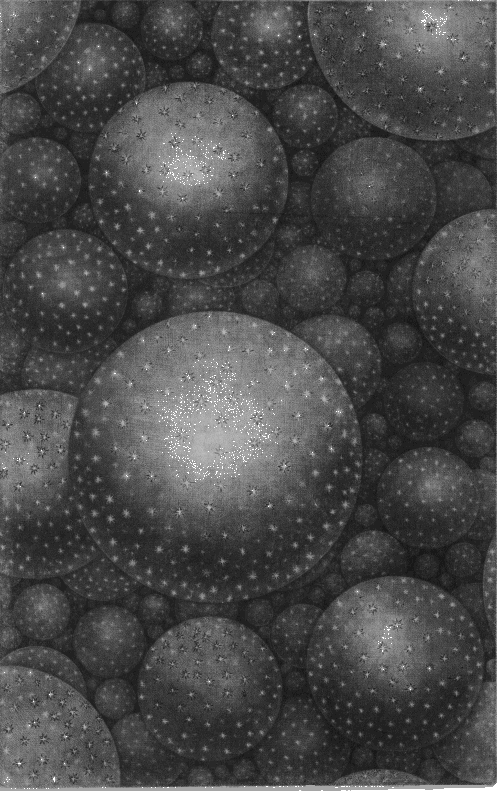
Plate XXXII.
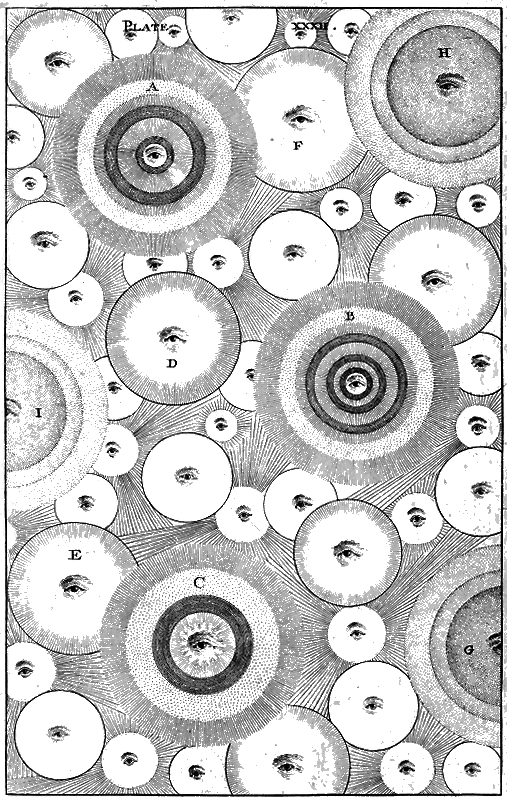
Hence Vision, Light, and Electrical Virtue, seem to be propagated
with such Velocity, that nothing but God can possible be the Vehicle;
and hence we may justly say with St. Paul, Acts xvii, 28. In him we
live, in him we move, in him we have our Being.
It will further appear, from the foregoing Letters, that all the Stars
and planetary Bodies within the finite View, are altogether but a very
minute Part of the whole rational Creation; I mean that vast collective
Body of habitable Beings, which I have endeavoured to demonstrate, are
all govern'd by the same Laws, though variously revolving round one
common Center, in which Center we may not impertinently venture
to suppose the prime Agent of our Natures; or otherwise, the most
perfect of all created Beings, illimitable in his Ideas and Faculties of
Sensation particularly preside.
But tho' past all diffus'd, without a Shore
His Essence; local is his Throne, (as meet)
To gather the disperst, (as Standards call
The listed from afar) to fix a Point;
A central Point, collective of his Suns,
Since finite ev'ry Nature, but his own.
Dr. Young.
And farther since without any Impiety; since as the Creation is, so is
the Creator also magnified, we may conclude in Consequence of an Infinity,
and an infinite all-active Power; that as the visible Creation is
supposed to be full of siderial Systems and planetary Worlds, so on, in like
similar Manner, the endless Immensity is an unlimited Plenum of Creations
not unlike the known Universe. See Plate XXXI. which you may if you
please, call a partial View of Immensity, or without much Impropriety
perhaps, a finite View of Infinity, and all these together, probably diversified;
as at A, B and C. in Plate XXXII. which represents their Sections,
if all may be a proper Term for an infinite or indefinite Number, we may
justly imagine to be the Object of that incomprehensible Being, which
alone and in himself comprehends and constitutes supreme Perfection.
That this in all Probability may be the real Case, is in some Degree
made evident by the many cloudy Spots, just perceivable by us, as far
without our starry Regions, in which tho' visibly luminous Spaces, no one
Star or particular constituent Body can possibly be distinguished; those in
all likelihood may be external Creation, bordering upon the known one,
too remote for even our Telescopes to reach.
With the raptur'd Poet may we not justly say
O, what a Root! O what a Branch is here!
O what a Father! what a Family!
Worlds! Systems! and Creations!
And in Consequence of this
In an Eternity, what Scenes shall strike?
Adventures thicken? Novelties surprize?
What Webs of Wonder shall unravel there?
Night Thoughts.
So many varied Seats where every Element may have its proper Beings
and all adapted to partake of every thing suited to their Natures, argue
such Maturity of Wisdom, and the vast Production such mysterious
Power; 'tis hardly possible for Mortals not to see divine Intelligence
preside, and that every Being somewhere must be happy.
A Universe so well designed, and fill'd with such an endless Structure
of material Beings, and all the Result of Prescience and infinite reflected
Reason, flowing from a Mind all perfect, full of all Ideas, could never
be designed in vain; and tho' our narrow Bounds of Reason limited,
by finite Senses, cannot directly see the Consequence dependant on a Sequel,
yet from what we do see, great Room we have to hope the next Stage of
Existence will be more lasting and more perfect; and it is highly probable,
the noblest Suggestion of the most luxuriant Fancy may fall infinitely
short of what we are designed for.
But here, even in this World, are Joys which our Ideas of Heaven can
scarce exceed, and if Imperfection appear thus lovely, what must Perfection
be, and what may we not expect and hope for, by a meritorious Acquiescence
in Providence, under the Direction, Indulgence, and Protection
of infinite Wisdom and Goodness, who manifestly designs perfect Felicity,
as the Reward of Virtue in all his Creatures, and will at proper Periods
answer all our Wishes in some predestined World.
All this the vast apparent Provision in the starry Mansions, seem to promise:
What ought we then not to do, to preserve our natural Birthright to
it and to merit such Inheritance, which alas we think created all to gratify
alone, a Race of vain-glorious gigantick Beings, while they are confined
to this World, chained like so many Atoms to a Grain of Sand.
I am, &c.
Transcriber Note
Spelling conventions used in the book were retained. On page 5, there is an unattached footnote.
As it refers to The Pendulum Clock and Huygens wrote a book whose
title includes these words, the assumption was made that the footnote
belongs after his name. On page 30, the missing anchor for the footnote
about Parallax was placed before the term in paragraph three. The same
situation occurs on page 54 where a footnote about Motion had no
anchor and was linked to the term in the last paragraph. On page 72,
there is a measurement "11 Feet ¾" to which "Inches" was added.
Plate XXIII was mislabeled as Plate XXI. This was corrected.