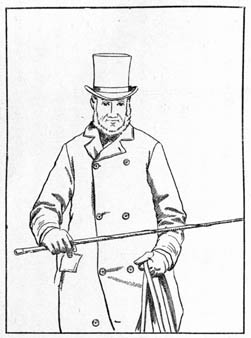
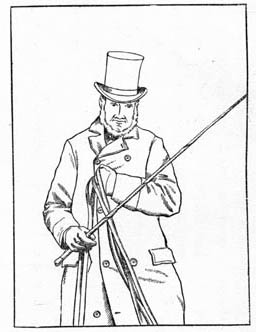
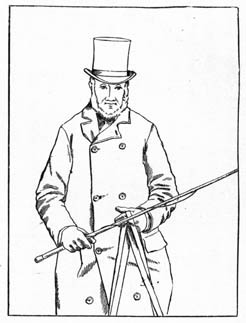
Well, the ideal coachman is now on his box, and I hope with straight
knees, feet close together, and well out in front of him, shoulders
well thrown back, and arms hanging naturally, and without any effort,
to his sides. The left arm should be straight or nearly so, and hand
lightly resting against the outside of the left thigh, with the wrist
slightly rounded and the thumb a little turned up; that is to say,
when the horses are drawing. The difference between his hand when in
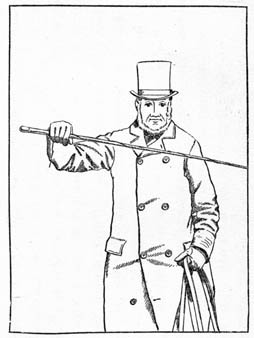
this position and when the elbow is bent and the hand brought up
towards the body, should be just the difference between slack and
tight pole-chains. When more power is wanted the hand will be raised
and the wrist turned so as to bring the back of the hand to the front.
This will throw the elbow a little forward, which will add greatly to
the strength of the arm, and by this time the right hand would most
probably have taken hold of the off-side reins, which of itself lends
much to the power of the other.
I fear I may have made myself but imperfectly understood, but perhaps
the accompanying sketches may assist in explaining what I mean.
The reins, by right, should never be allowed to slip through the
fingers. It looks bad, to say the least of it, to see a coachman
shortening them, and, at night especially, is not safe.
I know that this is not easy to do, and perhaps impossible to most
amateurs, as it requires constant practice to give the necessary
strength to the fingers, and the difficulty is much enhanced by well
cleaned reins, especially if they are thin.
I know that many good coachmen differ with me as to the position of
the left arm, and, like a dear old friend of mine, and good coachman,
now no more, say that a straight arm is not neat. For myself I am
unable to see the want of neatness in it; but even if there is I
cannot consent to sacrifice strength, and I am convinced that no man
can, under all circumstances, be thoroughly powerful on his box, who
drives habitually with a bent arm.
With the fear of being called egotistical before my eyes, I will again
endeavour to enforce what I have advanced by a case in point.
One afternoon on the down journey with the "Harkaway," when within
about a mile from Dolgelly, the skid-pan, though nearly a new one,
broke off at the neck, and the force of the jerk upon the safety hook
broke that also. The whole weight of the load consequently, and it was
a bumper, came immediately upon the necks of the wheel horses,
naturally somewhat startling them; and if I had lost hold of their
heads for a second, they would most likely have been frightened, and
refused to hold, when there would have been nothing but galloping for
it, but by having the left arm in the position I have endeavoured to
explain, I was enabled at the same moment to apply the brake, and keep
a firm hold of the horses' heads.
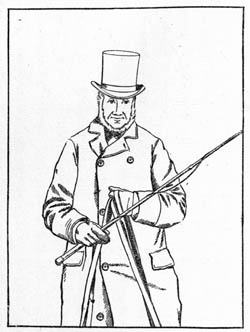
It is from driving with a bent arm that one hears people say they
cannot work their own brakes. If I had been in that form on the
occasion I have mentioned, I must first of all have used the right
hand to shorten the reins through the left, before I could have
employed it to put on the brake. As it was, the wheelers landed the
coach down the hill without serious difficulty, though one of them was
only four years old, and by no means a strong holder.
I cannot understand how any coachman can like to have his brake worked
for him. The want of it differs so much from day to day, depending
upon the load, the state of the road and other causes, that nothing
but his own left hand can tell him how to work it. I am sure I should
have been impossible to please. It is a most invaluable thing when
properly used, but is very liable to be abused. Few things are more
aggravating than to see it so applied as to cause horses to draw down
hill, as I have often witnessed. The change from drawing to holding
back, brings fresh muscles into play, and must therefore be a great
relief to horses, as we know the change from up hill to down, and vice
versa, is to us when walking.
Before leaving the subject of reins, which may be called the "key of
the position," I would venture to raise my voice against what is too
often done, which is to pass the right hand across to pull the near
side reins. Hands across is very proper in a country dance, but a
little of it goes a long way in driving. It is more honoured in the
breach than in the observance.
If the team is well "put together" and the reins are properly held in
the left hand, the wrist should be sufficiently supple to lift a near
wheel horse nearly off his legs.
It is a good test that all is as it should be if, upon pulling up to
unskid, the wheelers will back the coach off the skid-pan without any
difficulty. Of course, the right hand must be used to the off-side
reins, which itself is a help to the left, but no shortening of the
reins through the fingers of the left hand should be wanted, and to
reach the right hand out to grasp the reins in front of the left, as I
have seen done, is absolutely insufferable.
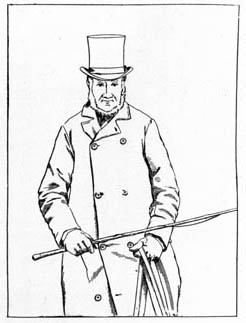
I was once talking on this subject to Charles Tustin, with whose name
I have already taken liberties, when he remarked that a coachman
should take up his reins at the beginning of a stage, and never have
to alter them in his left hand till he throws them down at the end of
it. Some drivers I have seen appear to think it a sign of a light hand
to be constantly fiddling with the reins. I believe it is more a sign
of a fidgeting hand, and I am quite sure, from experience, that
hot-tempered horses settle down much better without it. The less their
mouths are meddled with the better.
There is one use, however, to which the right hand may sometimes be
applied, which is to take hold of the near lead rein and loop it up
under the left thumb upon turning a sharp corner to the left, and also
if a near wheel horse throws himself against the pole in going down
hill or pulling up, to do the same with his rein. From the position a
horse in this posture has placed his pad territs in, the rein will
naturally become slack and useless, and by shortening it in the way I
have described, the left arm resumes its power, and, what is of nearly
as much importance, the right is free to use the whip, which will
probably be wanted at such a crisis.
One hint may not be out of place here as it may not have occurred to
some, and that is, when bringing up the right hand to take hold of the
off-side reins, not to reach forward with it, but to bring it up just
touching the left, and to seize the reins immediately below that hand.
The right hand can then be passed along the reins as far as is
necessary, placing a finger to separate the lead and wheel, when
either can be pulled separately as may be required.
This may seem to some so small a thing, as not to be worth bothering
about, but it is by attending to minutiæ that the accomplished
coachman is made; neither is it of such very small importance, as I
have known a coach upset for want of its being attended to, and it is
especially necessary at night when everything is done by feel.
Old Griffie Williams, as honest a fellow as ever lived, but not the
most accomplished of coachmen, who for many summers partly horsed and
drove the "Tourist" coach between Aberystwith and Dolgelly, when
descending a hill on his up journey, wanted to pull his horses out of
the near side of the road, and, reaching forward too far with his
right hand, he took up the near wheel rein together with the off-side
ones. Of course, the more he pulled at the reins the harder he pulled
the near wheeler towards the near side of the road, and it ended in
the wheels running up the hedge bank, and putting the coach on its
side into the road.
Fortunately he was, as usual, going slowly, and very little harm was
done to anyone. Upon my asking him afterwards how he came to scatter
his passengers, he replied, "Inteed, I was put them down as nice as
was go to bed."
Young coachmen may possibly mistake the weight inseparable from
four-horse reins from having got them too tight, but upon looking they
may see that the curb-chains are slack, and if that is the case the
reins are not too tight. It is not desirable to hold horses too hard,
but if a lot of slack is out a coachman is helpless if a horse falls
or anything else goes wrong. Moreover, horses generally go better for
being well held together. A coachman driving a coach, such as they
used to be, who loosed his horses' heads, was generally soon brought
to the use of his whip, whilst the same horses, well held together,
would be fresh at the end of their stage.
I can now call to mind an instance of this. About half a century ago
it was a common lounge in Shrewsbury for those whose time was not
fully occupied, to collect at the top of the Wyle Cop, where the "Lion
Hotel" was situated, to see the "Hirondelle" and "Hibernia," Liverpool
and Cheltenham coaches, come up the hill, and perhaps sometimes a bet
might be made as to which would be first, for they did a good deal of
racing. Of course, I never let the opportunity slip when I was in that
ancient borough of forming one of this number.
The late Mr. Isaac Taylor had, at that time, a team of chestnuts as
good as could be put to a coach working in the "Hirondelle" on the
down side between Shrewsbury and Leighton, a stage of about eight
miles. Little Bob Leek, a very clever coachman, used to drive the up
side from Shrewsbury, and Jordan, a very powerful man, the down side.
When they met they changed coaches, each returning over his own
ground, which he drove double. Shrewsbury was, I believe, the correct
place for the coaches to meet at, but, as the opposition was keen, it
depended on the racing whether they met in Shrewsbury or a few miles
on either side of it; and I have seen this same team driven by Jordan,
and when he was hard at work with his whip to get up the hill, ascend
it another day when driven by Bob Leek with ease, and he sitting on
his box as if he had nothing to do. And, strange as it may appear to
some, I believe one of the best tests that can be applied to a
coachman is that he should appear to do nothing. I suppose, however,
that this rule applies to most other crafts, for what a man does well
he does easily to himself, and one who is always hard at work may be
set down as a muff. I know from experience that this rule applies to
steering a ship. If a helmsman is seen to be constantly at work with
the wheel, it is a sure proof that he is not a good hand at it. Just
the movement of a spoke or two occasionally is generally enough in the
hands of a good helmsman.
And now I will bring the subject of driving to an end by giving a few
hints, which, though simple in themselves, and probably known to many
of my readers, may not have suggested themselves to some modern
coachmen, for the simple reason that they have never felt the want of
them, but which were well known to those coachmen whose business it
was to get a coach through a country with all sorts of cattle, and
when every little dodge was a help.
One of the commonest evils which befell coachmen was to deal with
jibbers, they caused the loss of so much time. A kicker, especially if
a well-bred one, would kick and keep going too, but a jibber sometimes
stuck to the same ground if not got off with the first attempt. As a
rule, flogging is of no use, though I have a few times in my life
succeeded in making it too hot for them; and, of course, with three
good starters one wheeler may be dragged on if he does not lie down.
Sometimes, however, a whole team was not to be trusted.
I was once travelling from Aberystwith to Oswestry by the "Engineer"
coach, and, as usual, was working, when, upon nearing Machynlleth,
Wigram, the coachman, said to me, "You will find the next a good team,
but they are all jibbers." I asked him if any one of them was a better
starter than the others, to which he replied, "Well, perhaps the off
wheeler is a little." The hint was sufficient, and as soon as I was on
the box I laid the whip quietly over the off wheeler before trying to
start the others, and then immediately pulling the leaders across to
the near side, and at the same time speaking to them, the start was
effected without any trouble.
Perhaps it may be thought by some that this was no very great test, as
the horses were always what was called "running home," that is, they
had always their own stable at each end of the stage. At the risk,
therefore, of tiring the reader and being accused of egotism, I will
venture to mention one other case where there was no assistance from
that cause; and as a failure to start makes a fellow look foolish,
there can be no harm in impressing upon the minds of young coachmen
what will, in nine cases out of ten, save them from being placed in
such a situation.
I was quartered with my regiment, the 72nd Highlanders, in the Royal
Barracks, Dublin, so many years ago that the Garrison Steeplechases
were run off at Maynooth instead of Punchestown as at present, and we
had got up a regimental drag for the occasion, of which I was
waggoner. As we were starting to return home, the off wheeler jibbed,
much to the delight of the Paddies, who had come there for a day's
"divarshun," and had some fun in them in those days. Of course, a
small crowd was fast collected, and everyone was giving advice and
wanting to help, the old Irishman's remedy of lighting a fire under
him not being forgotten. I made everyone stand clear, and would not
allow anybody to touch a horse, and then, after giving them a minute
or two to settle down, I laid the whip lightly over the near wheeler,
and then pulling the leaders across to the off side, spoke to them,
and we were off in a jiffy. The pulling the leaders across is very
important, as it greatly facilitates the draught.
There is also another good result which frequently follows the pulling
of the leaders across in case of a jibbing wheeler, which is, that as
he will probably have only placed his legs with the view of resisting
forward motion, a sudden rough lateral bump of the pole may disconcert
his plans and render it necessary for him to move his feet, in which
case he is more than half conquered, unless, indeed, he lies down,
which the coachman should be too quick to permit.
I think I have already remarked that flogging makes flogging,
especially if the horses' heads are loosed too much. It adds, no
doubt, somewhat to the labour of the coachman, but for all that he
should always keep a good hold of his horses' heads, and a pull of the
reins and then giving back again I have often found more efficacious
than a good deal of whip. This movement used sometimes to be called by
the uncomplimentary name of the "Blackguard's Snatch," but, in spite
of an ugly name, it often had salutary results, and with a weak team,
heavy load, and time to keep, a coachman could not afford to despise
anything.
I have known sluggish leaders very much astonished when hit on the
inside. Having only been accustomed to the punishment coming from the
outside, they do not know what to make of it when coming from another
quarter. It is not difficult to hit the near leader from behind the
off pretty sharply, but it is by no means easy to do the same on the
other side. It requires the elbow to be well raised, and the back of
the hand turned well downwards, for, of course, the thong must be sent
under the bars. If done well these are very neat hits.
Very hard-pulling leaders are often easier brought back by sending the
other one well up to them than by pulling at them. I have had a raking
leader, irritated by a very slow partner, try to bolt, and by hitting
his partner have brought him back directly; but he must be "hit sly,"
so as to make no noise with the whip. The same thing will occur when a
hard-pulling leader has a harder puller put alongside him—he comes
back at once.
With two leaders of unequal strength it is a good plan to cross the
inside traces. It is an assistance to the weaker one, and tends to
keep the coach straight.
Check reins are often of use to bring these sort of horses together,
and I have, with a very hard puller, had a long one from his nose-band
back to the pole-hook.
Lastly, what about kickers, which were, perhaps, the most numerous of
all the reprobates that found their way into coaches. I have known a
short stick placed between the bottom of the collar and the horse's
jaws so as to keep the head raised, in which position he cannot kick
badly; but I never used one myself, as I never knew a good dose or two
of counter irritation over the ears fail to make a sufficient cure of
a wheel horse to enable him to be driven, and a little kicking by a
leader does not so much signify if he will keep moving at the same
time.
There was an old saying, "Point your leaders and shoot your wheelers,"
which, perhaps, some of the younger generation may not have heard. It
does not very often require to be put in practice, especially at the
present time, as it is only really necessary in awkward turns, such as
the "Swan with Two Necks," in Lad Lane, in former days, and, more
recently, the "Belle Vue" yard at Aberystwith. Of course, there were
many more, but these two will suffice as specimens of what I mean. The
latter I have known a coachman of long experience fail to get into, in
consequence, as I suppose, of his not observing this precept.
To get into this yard two turns had to be taken in a very limited
space. The first was to the left, into a street just about wide enough
for two coaches to pass, and as soon as the coach and horses were
straight after completing this turn, it was time to point the leaders
to the right for the narrow entrance to the yard, and if that
operation was not accompanied by a shoot of the wheelers to the left,
the off hind wheel would not pass clear of the gate post.
This "shoot" is a momentary thing, and should be done by a twist of
the left wrist. If the right hand is called in to assist it looks bad.
More like a man playing the harp than driving four horses, and,
moreover, it is wanted to the off-side reins at the same time.
If the turns are in the contrary direction, of course the manipulation
of the reins must be done with the right hand.
The "point and shoot" would be a great assistance at an "obstacle
contest."
While on the subject of turns, perhaps I may be allowed to offer
another small hint, which, though stale news to many, may be a useful
wrinkle for others. It is a good plan, when rounding a sharp corner
with a top-heavy load, to make the turn so as to place the outside
wheels as much as possible on the crest of the road. This can be
effected, if the angle is to the left, by keeping near to the off-side
of the road as you approach the bend, and then making a rather short
turn so as to hug the near side hedge, by which means the outside
wheels will be placed on the highest part of the road, just when the
coach most requires the support, and this also gives the coachman more
freedom in case of his meeting any vehicle in the middle of the turn.
Should the angle be to the right instead of the left, the principle is
just the same.
There yet remain two or three other subjects connected with driving,
which, though of comparatively little importance in the present day,
must, nevertheless, be taken into account in the making of a perfect
"waggoner:" these are the power of using the whip and a capacity to
judge of pace.
We commonly hear a man called a good whip, thereby meaning a good
coachman; but the fact is that comparatively few coachmen in the
present day use their whips really well, for the simple reason that
they are not called upon to do so. Still the necessity might arise,
and then the power of doing so might save an accident. At any rate, a
man who can only use one arm is but half a coachman.
From what I have said on previous occasions, it will not, I think, be
supposed that I am an advocate for "hitting 'em all round," but in
days of yore no man could be considered really safe who was not able
to hit when necessary, and to hit hard.
I received an early lesson on this subject when I was at work on the
Birmingham and Manchester Express, taking a lesson from Wood, who was
my first mentor. There was at off wheel what was called a
"stiff-necked one" that no pulling at was able to turn if he took it
into his head to resist, and I was helplessly approaching a coal cart,
when Wood said, "Why don't you hit him?" I obeyed the hint with so
satisfactory a result, that I have never since forgotten it, and have
to thank it for getting me out of accidents, one of which at once
recurs to my memory, and may perhaps tend to impress it on the minds
of others.
I was driving a coach on the Dover Road, and as we were ascending
Shooter's Hill a four-horse posting job appeared coming towards us at
a good pace, when, upon pulling the reins to draw to the near side of
the road, I found that the off wheel horse refused to obey them, and
persistently hung to the off side. The posting job was coming nearer
with rapid strides. The reins were evidently useless, and it was a
matter for the whip, whether I could hit hard enough. If I could not,
nothing remained but to pull up, and ignominiously beckon to the
postboys to pass on the wrong side.
However, I dropped into him with such effect that he became in as
great a hurry to cross the road as the proverbial duck before thunder.
But perhaps this old road joke may convey no meaning to many in the
present day, so I may as well explain.
It was a favourite conundrum, when some ducks hurried across the road
under the leaders' noses, and apparently at the imminent risk of their
lives, "Why do ducks cross the road before thunder?" Do you give it
up? Because they want to get to the other side.
Perhaps I may be permitted here to introduce another old road story. A
boy in charge of a sow and pigs was asked by a passenger the following
question: "I say, my boy, whose pigs are those?" Boy. "Why,
that old sow's." Querist. "I don't mean that, you stupid boy. I
want to know who's the master of them." Boy. "Oh, the maister
of 'em? why, that little sandy 'un. He's a deuce of a pig to fight."
But to return to ducks for just one minute. It is commonly said that
it is impossible to run over a duck, and in truth, clumsy as they
appear to be on their legs, it is very nearly so, though I did once
accomplish the feat. I was driving fast round a rather sharp turn in
the road, when I suddenly found myself in the middle of them, and one
was unable to waddle off quick enough to save his life.
Then, again, to be a judge of pace, although of little importance now,
should form part of a coachman's education. If a gentleman driving his
private drag thinks he is going at the rate of twelve miles an hour
when he is only going nine, it amuses him and hurts no one, neither is
it very essential for those who drive the modern coaches from
Hatchett's and other places. They, with few exceptions, only run by
day, so that the coachman can consult his watch at every milestone if
he likes, and the horsing is so admirable and the loading so light
that he can experience no difficulty in picking up some lost time. In
the old days, however, it was very different. If only five minutes
were lost, it was often difficult to recover it with full loads and
heavy roads, and, perhaps, weak teams. Moreover, at night the
time-piece could only be seen at the different changes, and then, if
the coachman was no judge of pace, he might easily find at the end of
a ten miles' stage that he had lost five or ten minutes.
To be a good judge of pace requires experience, as the pace that
horses appear to be going is very deceptive. When the draught is heavy
horses step short, and, though their legs move as rapidly as usual,
time is being lost, or at best only kept with difficulty; whilst, on
another day, when circumstances are different, load lighter and road
hard, the horses step out, and the result is that over the same stage
and with the same team, instead of losing time it is hardly possible
to throw it away.
Again at night horses always seem to be going faster than they really
are, and perhaps this may have had something to do with the idea that
horses go better by night than day, so happily explained, as Mr.
Reynoldson tells us, by Billy Williams, who said it was because the
driver had had his dinner.
Apropos of Billy Williams, I may relate an anecdote of him, which I
had from undeniable authority, but which I do not think is generally
known.
His Honour, as he was called, the late Honourable Thomas Kenyon, used
not unfrequently to ask him, or some other coachman, to spend a day or
two at Pradoe, and he also made a practice of driving his own drag to
Chester races on the Cup day. On one of these occasions it happened
that Billy was at Pradoe, and was to accompany the party to Chester.
The day being hot, and His Honour thinking that Billy, whose get up
was always breeches and top boots, would be more comfortable in
lighter clothing, made him a present of a pair of white trousers, such
as were commonly worn by gentlemen of that period. Billy having
received them, went to put them on, and returned looking quite smart
and cool. It turned out, however, afterwards, that he had only worn
them over his usual garments!
There remains one other item to mention, which, though not absolutely
a part of driving, is yet of so much importance that without it all
knowledge may fail at an important crisis.
Nerve is the article I mean, or what may be called the next door to
it, that confidence which is begotten of practice. An inferior
coachman with this is generally safer than one who is his superior in
neatness and knowledge, but without this gift. When a man's nerve
fails him, he loses his head, and then he is unable to make use of any
knowledge he possesses, whereas, one with nerve and strength would
pull through a difficulty and save an accident. Nerve, no doubt, is
largely constitutional, but it is capable of being very much
strengthened by use and practice.
But of all things to try nerve commend me to the locomotive engine.
Though I had driven coaches for many years under all imaginable
circumstances, and my nerve had never failed me, I must confess that I
never thoroughly understood what it meant till I had had the
experience of a ride on a locomotive engine. To find myself travelling
at a high speed, without there being the slightest power of guidance,
caused a sensation I had never experienced before.
All that the engine-driver could have done, if a pointsman had made a
mistake, was to try and stop the engine before it ran into anything
else; whereas, on a road, when the driver has the power of guiding as
well as stopping, if he is unable quite to accomplish the latter he
may do so sufficiently to enable him to escape a collision.
To explain my meaning I will shortly narrate what has happened to
myself.
I was driving rather fast over a nice level length of road, and was
overtaking a waggon drawn by three or four horses. The waggoner very
properly pulled to his own side of the road, and anticipating no
difficulty I kept on at the pace I was previously going, but just as
my leaders arrived within a short distance of the waggon, the horses
overpowered the waggoner and crossed the road immediately in front of
them. To stop the coach was impossible, but I was just able to check
the pace sufficiently to enable me to pull across to the near side of
the road, and pass on the wrong side.
In the case of a railway there would be no such chance. There they
could only stop, or have an accident. One gets used to everything
after a time, and, I suppose, if I had been an engine-driver, I should
become so accustomed to this as to think nothing of it; but, as it
was, I never felt so helpless. I cannot conceive a greater trial of
nerve than to be driving at the rate of twenty miles an hour, or more,
among a labyrinth of rails, and entirely dependent on other people for
safety.
It is not very long ago since I saw in a newspaper an account of a
pointsman being found dead in his box!
I am reminded of the hackneyed saying of an old coachman in the early
days of railways: "If a coach is upset," he said, "why, there you are;
but if an accident happens to a railway train, where are you?"
It is now upwards of twenty years since the last time I handled
four-horse reins, and more than fifty-five since the first time, and I
am not going to say that no improvements have taken place during that
long period of time. Possibly some may have been found, but I must
confess that those I have heard of do not appear to me to come into
that category.
It is a common reply to those who stand up for old systems that they
were slow. That, at any rate, can hardly be alleged in the present
case, for, though I admire the very smart thing done by poor Selby
between London and Brighton, I think, when we consider the fast work
habitually done in coaches in days of yore, and still more on the
first of May and other special occasions, it must be admitted that the
pace has, to say the least, not increased. Indeed, allowing for
stoppages, taking up and putting down passengers, which lost many
minutes in a journey, and the heavy loads carried, by neither of which
was the "Old Times" troubled, I think the Brighton feat, good as it
was, has often been surpassed. The three Birmingham Tally-ho's
generally had a spurt on the first of May, and more than once
performed the journey of a hundred and eight miles under seven
hours—the best record, I believe, in existence.
Pace, however, at last, is a relative thing, and eight or nine miles
an hour on one road may be really as fast as twelve or thirteen on
another. I can safely say that, though I have driven some fast coaches
in my time, I never had a day of harder work to keep time than in
doing eighty miles in ten hours. What with one weak team in the early
part of the journey, hilly roads, a heavy load, and frequent delays
for changing passengers and luggage, the last stage of nine miles had
to be covered in forty-two minutes to bring us in to time and catch
the train.
Before finally bidding adieu to the subject of driving, it may perhaps
be allowed me to say a few words about harness and the fitting of it.
Of course it hardly needs saying that a coachman ought to be
familiar with every strap and buckle of it, though this intimate
knowledge may be dispensed with by those who only drive their own
teams, and are always waited on by one or two good and experienced
servants. Indeed, from what I witnessed in Hyde Park several years
ago, I have had my suspicions whether these same servants are not
sometimes utilised on early mornings in training the teams, and
putting them straight for the masters' driving in the afternoon. I
once saw a drag brought round to the right at the Magazine without the
gentleman in charge of the box touching the off-side reins with his
right hand at all; and I fail to see how this could have been
accomplished unless the horses were as well trained to it as circus
steeds.
Still, however perfect these men may be as gentlemen's servants, their
experience has not generally led them to attend very closely to the
exact fitting of the harness—the collars particularly—which used
often to be the plague of their lives to stage coachmen, and even
might give trouble to a gentleman, if driving an extended tour. A few
hints, therefore, from an old hand may perhaps not be thrown away.
With horses freshly put into harness their shoulders are always liable
to be rubbed, and they require the greatest care and attention; and
one thing should always be insisted on in these cases, which is to
wash the shoulders with cold water after work, and to leave the
collars on till they have become quite dry again. But if care is
necessary in the case of gentlemen's work, what must have been that
required with coach horses—especially if running over long stages,
with heavy loads and in hot weather. Of course, a good deal depended
upon the care of the horse-keeper; but nothing he could do had any
chance of keeping the shoulders sound if the collars "wobbled"
which they certainly always will do if the least light can be seen
between the collar and the upper part of the horse's neck. Then,
again, it is most important for the collar to be the right length to
suit the individual horse. One which carries his head high will
require a longer one in proportion than one which carries it low,
because the former position of the head has the effect of causing the
windpipe to protrude. On stage-coach work we never cared so much about
the weight of the collar as the fitting, and offering a fairly broad
surface to the pressure. Two or three pounds extra weight in a collar
is nothing compared to the comfortable fitting of it, as we ourselves
know to be the case with half-a-pound or so when walking a long
distance in strong boots.
If a wound should appear, after all the care that can be taken, a
paste made of fullers' earth with some weak salt and water will nearly
always effect a cure, if the collar is properly chambered, so as to
remove all pressure from the part. In case of a shoulder showing a
disposition to gall, I always carried in the hind boot two or three
small pads, which I could strap on to the collar, so as to remove the
pressure temporarily till it could be chambered; and any gentleman
embarking on a driving tour would find this to be a good precaution to
take, especially if he is going into out-of-the-way districts.
I will conclude in the words of Horace—
"Si quid noviste rectius istis,
Candidus imperti: si non his utere mecum."
CHAPTER XXIII. THE END OF THE JOURNEY.
And now, ladies and gentlemen, "I leave you here," and trust I have
given you no cause for complaint on the score of either civility or
politeness to my passengers. I fear that in some places the road may
have been heavy and the pace slow. Perhaps it may be thought that the
style is incoherent, to which I can only say that such is usually the
character of chatter; and if I have written anything which has
afforded some interest or amusement, my most ardent hopes are
satisfied.
The tale I have told has, in one sense, been told before, but so many
fresh phases and incidents were so constantly turning up in the old
mode of travelling, that it is not necessarily a twice-told tale.
Probably the first idea of most readers upon closing the book will be,
"How thankful I am that my lot was not cast in the days of my father
or grandfather;" and this naturally leads to the reflection that when
the busy wit of man had not produced so many inventions for evading
the minor ills of life, the first idea was to endure them; but now,
when fresh schemes of all sorts and descriptions are being propounded
every day to render life easy, it is to cure them; and if this does
not go to the length of making artificial wants, no doubt it is the
wisest course to adopt.
To the old hand, however, who has not forgotten his early experiences,
this eagerness to escape all hardship may seem to savour of softness
and effeminacy, but I make no doubt that, though not called forth as
it used to be in the days of yore, there still exists in the youth and
manhood of Old England the same pluck and power of endurance when duty
calls, as there ever was; and that as long as we continue to cherish
our old field sports and games, we are not in much danger of losing
them.
It were folly to stand up for road travelling as against the greater
convenience of railways; still, I confess to a lingering feeling of
regret that what was brought to such a state of perfection should have
so completely vanished, and I think I cannot express these feelings
better than by a short anecdote.
Many years ago, when hunting with the late Sir W. W. Wynn's hounds,
when they had the advantage of the guidance of John Walker, I asked
him which pack, whether the large or small, showed the best sport and
killed the most foxes. His answer was, "Well, I really think the large
pack does kill most foxes and give the best sport altogether, but I
like the little ones." And if asked which is the best mode of
travelling, whether by road or rail, I must confess that, as a
travelling machine for conveying us from one part of the country to
another, the railway is the best both for safety, speed, and economy;
but having said this, I am constrained to make the same sort of
reservation as was made by John Walker, and say, "I like the
coaches."
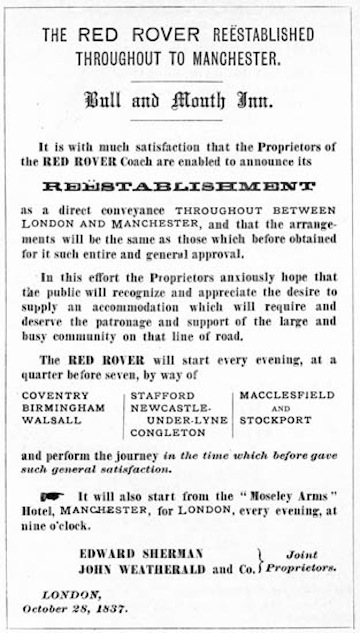
Most noticeable of all, perhaps, was the plucky effort made in 1837 to
revive the favourite "Red Rover" coach between London and Manchester,
which had been discontinued upon the opening of the London and
Birmingham and the Grand Junction Railways. It was "the last charge of
the Old Guard," and shared the same fate. It may be interesting,
however, to append a copy of this singular notice—one more evidence
of the reluctance of Englishmen to be beaten, even at long odds. The
very date at foot is significant, for the enterprise was embarked on
in the teeth of the approaching winter.
An old song may come in here:—
"The road, the road, the turnpike road,
The hard, the brown, the smooth, the broad,
Without a mark, without a bend,
Horses 'gainst horses on it contend.
Men laugh at the gates, they bilk the tolls,
Or stop and pay like honest souls.
I'm on the road, I'm on the road,
I'm never so blithe as when abroad
With the hills above and the vales below,
And merry wheresoe'er I go.
If the Opposition appear in sight,
What matter, what matter, we'll set that all right."
In the introduction I ventured to point out some inaccuracies which I
had observed in a statement made upon the subject of coach fares, and
as it is probably one which few remember anything about, I give a
statement of what would be about the profit and loss of a month's
working of a coach for a hundred miles.
| RECEIPTS. |
| A Full Load on the Way-bill both ways. |
| |
|
£ |
s. |
d. |
| 8 inside passengers |
|
15 |
0 |
0 |
| 14 outside |
|
25 |
4 |
0 |
| Parcels |
|
1 |
0 |
0 |
| Parcels |
£ |
41 |
4 |
0 |
| Month's receipts |
|
988 |
16 |
0 |
| Deduct expenses |
|
113 |
14 |
0 |
| |
£ |
875 |
2 |
0 |
| |
| PAYMENTS. |
| Daily |
| |
|
£ |
s. |
d. |
| 15 toll-gates, at 3s.[3] |
|
2 |
5 |
0 |
| Hire of coach, per mile 2½d. |
|
1 |
0 |
10 |
| Mileage duty, 2d.[4] |
|
0 |
6 |
8 |
| Washing and oiling coaches |
|
0 |
2 |
0 |
| |
£ |
4 |
8 |
6 |
| For 4 weeks |
£ |
106 |
4 |
0 |
| |
| Monthly. |
| 8 road booking-offices |
£ |
4 |
0 |
0 |
| 2 end booking-offices |
|
2 |
0 |
0 |
| Making Share bills |
|
1 |
0 |
0 |
| Oil and trimming lamps, say |
|
0 |
10 |
0 |
| Total |
£ |
113 |
14 |
0 |
| |
This makes £8 15s. to be divided per mile, which, of course, would
give a very handsome profit; but full loading could not be expected
every day, and if it was reduced to half loads, it would not be such a
very fat concern.
The cost of each horse was usually put at 17s. 6d. a week, including
blacksmith, and that, supposing a man to cover a ten-mile stage for
which eight horses would be ample if not running on Sundays, would
cost £7 a week, or £28 a month, leaving, at about half loading, say
£20 profit. But from this has to be deducted saddler, veterinary
surgeon, and wear and tear, the two latter of which depend, to a
certain extent, on circumstances over which he has not much control,
as it depends upon such things as sickness in the stables and
accidents.
- [3]
- It was usual for coaches to come to
terms with the pikers to pay for three horses instead of four.
- [4]
- There had also to be paid £5
licence duty yearly when the plates were taken out.
[ APPENDIX. ]
G. P. O.
APPENDIX.
LIST OF MAIL COACHES WHICH WORKED OUT OF LONDON.
| Bath, through |
{ |
Hounslow, |
} |
From the |
| |
{ |
Maidenhead, |
} |
"Spread Eagle," |
| |
{ |
Reading, |
} |
Gracechurch Street, |
| |
{ |
Newbury, |
} |
and |
| |
{ |
Hungerford, |
} |
"Swan with Two |
| |
{ |
Marlborough, |
} |
Necks," |
| |
{ |
Devizes, |
} |
Lad Lane. |
| |
| Birmingham, through |
{ |
Aylesbury, |
} |
From the |
| |
{ |
Bicester, |
} |
"King's Arms," |
| |
{ |
Banbury, |
} |
Holborn Bridge. |
| |
{ |
Leamington, |
} |
|
| |
{ |
Warwick, |
} |
|
| |
| Brighton, through |
{ |
Croydon, |
} |
From the |
| |
{ |
Reigate, |
} |
"Blossoms Inn," |
| |
{ |
Crawley, |
} |
Lawrence Lane. |
| |
{ |
Cuckfield, |
} |
|
| |
| Bristol, through |
{ |
Hounslow, |
} |
From the |
| |
{ |
Reading, |
} |
"Swan with Two |
| |
{ |
Newbury, |
} |
Necks," |
| |
{ |
Marlborough, |
} |
Lad Lane. |
| |
{ |
Calne, |
} |
|
| |
{ |
Chippenham, |
} |
|
| |
{ |
Bath, |
} |
|
| |
| Carlisle—See Glasgow. |
| |
| Chester, through |
{ |
Barnet, |
} |
From the |
| |
{ |
St. Albans, |
} |
"Golden Cross," |
| |
{ |
Dunstable, |
} |
Charing Cross. |
| |
{ |
Northampton, |
} |
|
| |
{ |
Hinckley, |
} |
|
| |
{ |
Atherstone, |
} |
|
| |
{ |
Lichfield, |
} |
|
| |
{ |
Stafford, |
} |
|
| |
{ |
Nantwich, |
} |
|
| |
{ |
Tarporley, |
} |
|
| |
| Devonport, through |
{ |
Hounslow, |
} |
From the |
| |
{ |
Bagshot, |
} |
"Swan with Two |
| |
{ |
Basingstoke, |
} |
Necks," |
| |
{ |
Andover, |
} |
Lad Lane. |
| |
{ |
Salisbury; |
} |
|
| |
{ |
Sherborne; |
} |
|
| |
{ |
Chard, |
} |
|
| |
{ |
Honiton, |
} |
|
| |
{ |
Exeter |
} |
|
| |
| Dover, through |
{ |
Dartford, |
} |
From the |
| |
{ |
Rochester, |
} |
"Swan with Two |
| |
{ |
Sittingbourne, |
} |
Necks," |
| |
{ |
Faversham, |
} |
Lad Lane. |
| |
{ |
Canterbury, |
} |
|
| |
| Edinburgh, through |
{ |
Ware, |
} |
From the |
| |
{ |
Buntingford, |
} |
"Bull and Mouth," |
| |
{ |
Royston, |
} |
St. Martin's-le-Grand. |
| |
{ |
Caxton, |
} |
|
| |
{ |
Huntingdon, |
} |
|
| |
{ |
Grantham |
} |
|
| |
{ |
Newark |
} |
|
| |
{ |
Doncaster |
} |
|
| |
{ |
Ferry Bridge, |
} |
|
| |
{ |
York, |
} |
|
| |
{ |
Northallerton, |
} |
|
| |
{ |
Darlington, |
} |
|
| |
{ |
Durham, |
} |
|
| |
{ |
Newcastle, |
} |
|
| |
{ |
Alnwick, |
} |
|
| |
{ |
Berwick, |
} |
|
| |
{ |
Dunbar, |
} |
|
| |
{ |
Haddington, |
} |
|
| |
| Exeter, through |
{ |
Basingstoke, |
} |
From the |
| |
{ |
Andover, |
} |
"Bull and Mouth," |
| |
{ |
Salisbury, |
} |
St Martin's-le-Grand. |
| |
{ |
Blandford, |
} |
|
| |
{ |
Dorchester, |
} |
|
| |
{ |
Bridport, |
} |
|
| |
{ |
Axminster, |
} |
|
| |
{ |
Honiton, |
} |
|
| |
| Glasgow, through |
{ |
Barnet, |
} |
From the |
| |
{ |
Hatfield, |
} |
"Bull and Mouth," |
| |
{ |
Baldock, |
} |
St Martin's-le-Grand. |
| |
{ |
Biggleswade, |
} |
|
| |
{ |
Stilton, |
} |
|
| |
{ |
Stamford |
} |
|
| |
{ |
Grantham, |
} |
|
| |
{ |
Newark, |
} |
|
| |
{ |
Doncaster, |
} |
|
| |
{ |
Wetherby, |
} |
|
| |
{ |
Boroughbridge, |
} |
|
| |
{ |
Greta Bridge, |
} |
|
| |
{ |
Appleby, |
} |
|
| |
{ |
Carlisle, |
} |
|
| |
| Gloucester, through |
{ |
Hounslow, |
} |
From the |
| |
{ |
Maidenhead, |
} |
"Cross Keys," |
| |
{ |
Henley, |
} |
Wood Street, |
| |
{ |
Nettlebed, |
} |
and |
| |
{ |
Oxford |
} |
"Golden Cross," |
| |
{ |
Witney, |
} |
Charing Cross. |
| |
{ |
Burford, |
} |
|
| |
{ |
Cheltenham, |
} |
|
| |
| Halifax, through |
{ |
Barnet, |
} |
From the |
| |
{ |
Woburn, |
} |
"Swan with Two |
| |
{ |
Newport-Pagnel, |
} |
Necks," |
| |
{ |
Market Harborough, |
} |
Lad Lane, |
| |
{ |
Nottingham, |
} |
and |
| |
{ |
Sheffield, |
} |
"Bull and Mouth," |
| |
{ |
Huddersfield, |
} |
St. Martin's-le-Grand. |
| |
| Hastings, through |
{ |
Farnborough, |
{ |
From the |
| |
{ |
Tunbridge, |
{ |
"Golden Cross," |
| |
{ |
Lamberhurst, |
{ |
Charing Cross. |
| |
{ |
|
} |
and "Bolt in Tun," |
| |
{ |
|
} |
Fleet Street. |
| |
| Holyhead, through |
{ |
Barnet, |
} |
From the |
| |
{ |
St. Albans, |
} |
"Swan with Two |
| |
{ |
Coventry, |
} |
Necks, |
| |
{ |
Birmingham, |
} |
Lad Lane. |
| |
{ |
Wolverhampton, |
} |
|
| |
{ |
Shrewsbury, |
} |
|
| |
{ |
Oswestry, |
} |
|
| |
{ |
North Wales, |
} |
|
| |
| Hull, through |
{ |
Barnet, |
} |
From the |
| |
{ |
Hertford, |
} |
"Spread Eagle," |
| |
{ |
Biggleswade, |
} |
Gracechurch Street, |
| |
{ |
Stilton, |
} |
and |
| |
{ |
Peterborough, |
} |
"Swan with Two |
| |
{ |
Folkingham, |
} |
Necks," |
| |
{ |
Lincoln, |
} |
Lad Lane. |
| |
{ |
Brigg, |
} |
|
| |
{ |
Across the Humber to |
} |
|
| |
{ |
Kingston-upon-Hull |
} |
|
| |
| Leeds, through |
{ |
Barnet, |
} |
From the |
| |
{ |
Bedford, |
} |
"Bull and Mouth," |
| |
{ |
Higham Ferrers, |
} |
St. Martin's-le-Grand. |
| |
{ |
Kettering, |
} |
|
| |
{ |
Nottingham, |
} |
|
| |
{ |
Sheffield, |
} |
|
| |
{ |
Wakefield, |
} |
|
| |
| Liverpool, through |
{ |
Barnet, |
} |
From the |
| |
{ |
St. Albans, |
} |
"Swan with Two |
| |
{ |
Coventry, |
} |
Necks," |
| |
{ |
Lichfield, |
} |
Lad Lane. |
| |
{ |
Newcastle-u-Lyne, |
} |
|
| |
{ |
Knutsford, |
} |
|
| |
{ |
Warrington, |
} |
|
| |
| Louth, by Boston, through |
{ |
Caxton, |
} |
From the |
| |
{ |
Peterborough, |
} |
"Bell and Crown," |
| |
{ |
Deeping, |
} |
Holborn, and |
| |
{ |
Spalding, |
} |
"Saracen's Head," |
| |
{ |
Spilsby, |
} |
Skinner Street. |
| |
| Manchester, through |
{ |
Barnet, |
} |
From the |
| |
{ |
St. Albans, |
} |
"Swan with Two |
| |
{ |
Dunstable, |
} |
Necks," |
| |
{ |
Northampton, |
} |
Lad Lane. |
| |
{ |
Market Harborough, |
} |
|
| |
{ |
Leicester, |
} |
|
| |
{ |
Derby, |
} |
|
| |
{ |
Ashbourne, |
} |
|
| |
{ |
Congleton, |
} |
|
| |
{ |
Macclesfield, |
} |
|
| |
| Norwich, by Ipswich, through |
{ |
Ilford, |
} |
From the |
| |
{ |
Romford, |
} |
"Spread Eagle," |
| |
{ |
Brentwood, |
} |
Gracechurch Street. |
| |
{ |
Chelmsford, |
} |
|
| |
{ |
Witham |
} |
|
| |
{ |
Colchester, |
} |
|
| |
| Norwich, by Newmarket, through |
{ |
Epping, |
} |
From the |
| |
{ |
Bury St. Edmunds, |
} |
"Belle Sauvage," |
| |
{ |
Thetford, |
} |
Ludgate Hill. |
| |
| Portsmouth, through |
{ |
Kingston, |
} |
From the |
| |
{ |
Esher, |
} |
"White Horse," |
| |
{ |
Guildford, |
} |
Fetter Lane and |
| |
{ |
Godalming, |
} |
"Bolt in Tun," |
| |
{ |
Petersfield, |
} |
Fleet Street. |
| |
| Southampton and Poole, through |
{ |
Hounslow, |
} |
From the |
| |
{ |
Staines, |
} |
"Swan with Two |
| |
{ |
Bagshot |
} |
Necks," |
| |
{ |
Alton, |
} |
Lad Lane, and |
| |
{ |
Alresford |
} |
"Bell and Crown," |
| |
{ |
Winchester, |
} |
Holborn. |
| |
| Stroud, through |
{ |
Hounslow, |
} |
From the |
| |
{ |
Henley, |
} |
"Cross Keys," Wood |
| |
{ |
Abingdon, |
} |
Street, and the |
| |
{ |
Faringdon, |
} |
"Swan with Two Necks," |
| |
{ |
Cirencester, |
} |
Lad Lane. |
| |
| Wells (Norfolk), through |
{ |
Lynn, |
} |
From the |
| |
{ |
Ely, |
} |
"Swan with Two |
| |
{ |
Cambridge, |
} |
Necks," |
| |
{ |
Royston, |
} |
Lad Lane. |
| |
{ |
Ware, |
} |
|
| |
| Worcester, through |
{ |
Uxbridge, |
} |
From the |
| |
{ |
Beaconsfield, |
} |
"Bull and Mouth," |
| |
{ |
High Wycombe, |
} |
St. Martin's-le-Grand. |
| |
{ |
Oxford, |
} |
|
| |
{ |
Woodstock, |
} |
|
| |
{ |
Chipping Norton, |
} |
|
| |
{ |
Moreton-in-Marsh, |
} |
|
| |
{ |
Evesham, |
} |
|
| |
{ |
Pershore, |
} |
|
| |
| Yarmouth, through |
{ |
Romford, |
} |
From the |
| |
{ |
Chelmsford, |
} |
"White Horse," |
| |
{ |
Witham, |
} |
Fetter Lane. |
| |
{ |
Colchester, |
} |
|
| |
{ |
Ipswich, |
} |
|
| |
{ |
Saxmundham, |
} |
|
| |
{ |
Lowestoft, |
} |
|
So much for the main arteries, but the account would
hardly be complete without showing how the more remote
and out-of-the-way districts were provided for. I will, therefore,
add the routes of a few mails which might be considered
as prolongations of some of those already mentioned, but
they were worked under fresh contracts and with fresh
coaches.
South Wales was served by three—one from Bristol and
two from Gloucester, as shown below:—
| Bristol to Milford Haven, by |
{ |
New Passage Ferry, |
| |
{ |
Newport, |
| |
{ |
Cardiff, |
| |
{ |
Cowbridge, |
| |
{ |
Neath, |
| |
{ |
Caermarthen. |
| |
| Gloucester to Milford Haven, by |
{ |
Ross, |
| |
{ |
Monmouth, |
| |
{ |
Abergavenny, |
| |
{ |
Brecon, |
| |
{ |
Llandovery, |
| |
{ |
Caermarthen, |
| |
{ |
Haverfordwest. |
Gloucester to Aberystwith, by Ross, Hereford, Kington, Rhayader,
and Dyffryn Castle.
The Gloucester and Milford was, I think, driven out of Gloucester at
one time by Jack Andrews, a very good coachman, and over the lower
ground there was a man of the name of Jones. I may, perhaps, be told
that that is not a very distinguishing mark of a man in those parts,
perhaps it is not, but if the name failed to convey a knowledge of who
he was, he, at any rate, possessed one very characteristic feature
which was that he always drove without gloves whatever might be the
state of the weather. If he saw his box passenger beating his hands
against his body or going through any other process with the vain hope
of restoring the circulation into his well-nigh frozen fingers, his
delight was to hold out his gloveless hand and say, "Indeed, now there
is a hand that never wore a glove."
And this recalls to my memory another anecdote which was told me a
great many years ago, and which, though it refers to the other
extremities, may not be inappropriately introduced here. It appertains
to a very well known character already mentioned, the well known Billy
Williams, often spoken of as Chester Billy. I am aware that tales are
sometimes engrafted on remarkable characters which are also told of
others, still I believe I shall not be doing a wrong to any one if I
tell this as "'twas told to me," of our old friend Billy. At any rate,
it is too good to be lost, so here it is.
On one very cold winter morning it happened that Billy had a box
passenger who was stamping his feet on the footboard in the vain
attempt to restore the circulation of the blood, which led Billy to
remark, "Your feet seem cold this morning, sir," to which the
gentleman answered, "I should think they were, are not yours?" "No,"
says Billy, "they're not;" adding, "I expect you wash 'em." "Wash
them," says the passenger, "of course I do, don't you?" "No," was the
reply, "I should think not, I iles 'em."
The Manchester mail was also prolonged to Carlisle, though the direct
Carlisle mail went by a rather shorter route, but then the populous
district on the west coast had to be provided for. It travelled
through Preston, Lancaster, Kendal and Penrith. This was, over some of
the ground at any rate, one of the fastest mails in England.
Again, in addition to these, which may be said to have had their
origin in London, there existed a considerable number of what were
called "cross country mails," some of which ran long distances and at
high speed, connecting together many important districts. A few of
them I will mention, beginning with the Bristol and Liverpool, which
was a very fast one.
| Bristol to Liverpool, by |
{ |
Aust Passage Ferry, |
| |
{ |
Monmouth, |
| |
{ |
Hereford, |
| |
{ |
Shrewsbury, |
| |
{ |
Chester, |
| |
{ |
Woodside Ferry. |
| |
| Bristol to Oxford, by |
{ |
Bath, |
| |
{ |
Tetbury, |
| |
{ |
Cirencester, |
| |
{ |
Fairford, |
| |
{ |
Faringdon. |
| |
| Liverpool to Hull, by |
{ |
Warrington, |
| |
{ |
Manchester, |
| |
{ |
Rochdale, |
| |
{ |
Halifax, |
| |
{ |
Bradford, |
| |
{ |
Leeds, |
| |
{ |
Tadcaster, |
| |
{ |
York. |
| |
| Bristol to Birmingham, by |
{ |
Gloucester, |
| |
{ |
Wincanton, |
| |
{ |
Droitwich, |
| |
{ |
Bromsgrove. |
| |
| Birmingham to Sheffield, by |
{ |
Lichfield, |
| |
{ |
Derby, |
| |
{ |
Chesterfield. |
And no doubt there were several others in one part of the country or
another, but I have been unable to meet with any regular list of them,
though it is very unlikely that such a road as that between Bristol
and Exeter by Taunton, for example, should have been left out. This
road certainly had a fast coach on it. The "Royal Exeter" ran from
Cheltenham to Exeter through Gloucester and Bristol, driven between
Cheltenham and Bristol at one time by Capt. Probyn, and afterwards by
William Small. It was a fast coach, stopping for dinner at Nisblete's,
at Bristol, and then proceeding on its journey to Exeter.
Then, again, there was a populous and important district through the
Staffordshire Potteries, from Birmingham to Liverpool and Manchester,
which must have been provided for somehow, but it is not impossible
that this may have been effected by the bags being conveyed to
Lichfield by the Sheffield, and then transferred to the down Liverpool
and Chester mails.
There were also running short distances what were called third class
mails, which carried twelve passengers, and the coachman was in charge
of the bags. On one of them which ran between Shrewsbury and Newtown I
did a good deal of my early practice.
And now, having given a list, more or less perfect, of the mails which
traversed England and Wales, perhaps a few words on the subject of the
pace at which they travelled may not be without interest.
After singling out the London and Birmingham day mail, which was timed
at twelve miles an hour, it is impossible to say, at the present date,
which was the fastest coach. That the "Quicksilver" was the fastest
mail, I have no doubt, though I believe the palm has been disputed by
the Bristol, and perhaps some others; for if a passenger asked a
coachman which was the fastest, he was very likely to be told that the
one he was travelling in was. I cannot, however, believe that any of
these claims could have been supported by facts. "Cui bono?" We
can see at a glance why the Devonport should be pushed along as fast
as possible, because the journey was a long one; but the distance to
Bristol was only one hundred and twenty miles, and whether the mail
arrived there at eight or nine o'clock in the morning would have been
thought little of in those days, but in a journey of two hundred and
twenty-seven miles half a mile an hour makes an appreciable
difference. It would seem reasonable, therefore, that the longer mails
should have been accelerated as much as possible, and so I believe it
really was the case, and that the Holyhead was, after the
"Quicksilver," the fastest out of London. At any rate, I know that,
when travelling by it, we always passed all the other mails going the
same road, and that included a considerable number, as the north road
and the Holyhead were synonymous as far as Barnet, and, moreover, the
Post-Office was likely to have screwed up these two mails the
tightest, as one carried the Irish bags and the other had the
correspondence of an important dockyard and naval station.
To single out the fastest coach would be still more impossible. The
"Wonder" had a world-wide reputation, which was well deserved, both
for the pace and regularity with which she travelled and the admirable
manner in which she was appointed in every way; but what gave that
coach its preponderating name was the fact of its being the first
which undertook to be a day coach over a distance much exceeding one
hundred and twenty miles. The Manchester Telegraph must have surpassed
the "Wonder" in pace, and, certainly, when we consider the difference
of the roads and the hills by which she was opposed in her journey
through Derbyshire, had the most difficult task to accomplish; and,
again, the "Hirondelle" was timed to go the journey of one hundred and
thirty-three miles between Cheltenham and Liverpool in twelve hours
and a half, which is a higher rate of speed than the "Wonder," which
was allowed fifteen and a half hours to cover the one hundred and
fifty-four miles between London and Shrewsbury, and on a far superior
road.
I have been induced to enter into this subject because one sometimes
now-a-days meets with people who appear to have a somewhat hazy idea
about it, and talk glibly of twelve miles an hour as if it was nothing
so very great after all. Well, I am not going to deny that it can be
done, because I know that it has been effected by the Birmingham day
mail, as already stated, and I have also been told by an old inspector
of mails that in the latter days they did contrive to screw some
Scotch mails up to that speed; but I am sure I can safely say that no
mail or stage-coach ever was timed at even eleven miles an hour during
the main coaching days, however much faster they might have gone when
racing or on special occasions, though I believe it would have been
attempted, at any rate, if road travelling had not been put an end to
by the railways.
Twelve miles an hour is very great work to accomplish. Why, when
stoppages of all sorts are allowed for, it means thirteen miles, and
that means galloping for the greater part of the way.
Though the subjoined List is not comprehensive, nor indeed
absolutely accurate, it may be worth inserting, as conveying a fair
idea of what coaches ran.
| PRINCIPAL NIGHT MAILS |
SOME NOTED DAY COACHES |
| Miles from London. |
TO |
Time (including stoppages) of Mail |
|
| |
|
h. |
m. |
|
| 110½ |
Bath |
11 |
0 |
"Beaufort Hunt," "York House," "White Hart." |
| 50 |
Bedford |
|
|
"Times." |
| 119 |
Birmingham |
11 |
56 |
"Tally-Ho," "Tantivy," "Greyhound," "Economist,"
"Rocket," "Eclipse," "Triumph," "Crown Prince," "Emerald," "Albion,"
"Day," etc. |
| |
Brecon |
|
|
"Red Rover." |
| 53 |
Brighton |
|
|
"Red Rover," "Times," "Age," "Quicksilver," "Pearl,"
"Dart," "Arrow," "Vivid." |
| 121 |
Bristol |
11 |
45 |
"Prince of Wales," "Monarch," "Regulator." |
| 50 |
Cambridge |
|
|
"Star." |
| 95 |
Cheltenham (see below) |
|
|
"Berkeley Hunt," "Rival," "Magnet," "Favourite." |
| 181 |
Chester |
|
|
"Criterion." |
| 217½ |
Devonport |
23 |
45 |
"Quicksilver." |
| 71 |
Dover |
|
|
|
| 176 |
Exeter |
19 |
0 |
"Telegraph" (165 miles) 17 hours; "Defiance" (168
miles), 19 hours; "Nonpareil," "Herald." |
| 111 |
Gloucester |
11 |
55 |
|
| 195½ |
Halifax |
20 |
5 |
"Hope." |
| 68 |
Hastings |
|
|
|
| 135 |
Hereford |
|
|
"Champion," "Tiger." |
| 259 |
Holyhead |
26 |
55 |
|
| 172½ |
Hull |
18 |
12 |
|
| 197 |
Leeds |
21 |
0 |
"Courier," "Rockingham.' |
| 201½ |
Liverpool |
20 |
50 |
"Umpire," "Fair Trader," "Express," "Erin-go-bragh." |
| 148 |
Louth |
16 |
0 |
|
| 99 |
Lynn |
10 |
33 |
|
| 185 |
Manchester |
19 |
0 |
Telegraph" (186 miles), 18 hours 15 minutes,
"Beehive", "Estafette," "Peveril of the Peak," "Cobourg," "Red Rover." |
| 129 |
Monmouth |
|
|
"Mazeppa," "Royal Forester." |
| 113½ |
Norwich viâ Ipswich |
11 |
38 |
"Shannon." |
| 117½ |
Norwich viâ Newmarket |
13 |
0 |
"Phenomenon." |
| 106 |
Poole |
|
|
"Phœnix." |
| 73 |
Portsmouth |
|
|
"Diligence," "Regulator," "Hero." |
| 158 |
Shrewsbury |
|
|
"Wonder," (15 hours 45 minutes;) "Nimrod," "Stag,"
"Union," "Oxonian." |
| |
Southampton |
|
|
"Star." |
| 105 |
Stroud |
12 |
9 |
|
| 195 |
Wetherby (Glasgow Mail) |
20 |
36 |
|
| 128 |
Weymouth |
|
|
"King's Royal." |
| 23 |
Windsor |
|
|
"Taglioni." |
| 114 |
Worcester |
12 |
20 |
|
| 197 |
York (Edinburgh Mail) |
20 |
54 |
"Wellington." |
| 30 |
Liverpool and Preston197 |
|
|
|
| 129½ |
Edinburgh and Aberdeen |
|
|
"Defiance" (12 hrs. 10 min., including 30 min. Ferry). |
| |
Cheltenham and Liverpool |
|
|
"Hirondelle," "Hibernia" (see above). |
| |
Shrewsbury and Welshpool and
Aberystwith |
|
|
"Royal Oak," "Nettle," "Engineer." |
Notes.
The fastest coaches were the "Defiance" (Edinburgh and Aberdeen), the
"Wonder" (Shrewsbury and London), for which alone 150 horses were kept,
and the mail from Liverpool to Preston. The next fastest were the
Holyhead, Exeter, and Scotch mails, and those to Bath and Bristol (which
last ones did not stop for meals on the road). The slowest is the Stroud
mail, but formerly was the Worcester mail, which used to be most
frequently overturned of any. The Hastings and Brighton mails had only
two horses. For some reason or other, with which I am not acquainted,
the Liverpool mail, and, I believe, the Halifax also, though leaving
London at the same time as the others, had a day coach on the up
journey, arriving at St. Martin's-le-Grand about 7 p.m. One of the
Birmingham coaches was lighted by gas for a time, as far back as 1834. A
coach running every day between London and Birmingham paid annually for
toll-gates the sum of £1,428. The double miles of the mails
travelling reached at one time 6,619 a journey.
SCOTCH AND IRISH MAILS.
It is interesting to compare the running of the Edinburgh and Glasgow
coaches out of London. Both left St. Martin's at the same hour, but by
a different road. At Alconbury (65 miles out of London) the two
coaches must have frequently been in sight of each other on a
moonlight night—if punctual a bare four minutes divided them (not a
yokel in that part of Huntingdonshire but could discuss the merits of
the rival whips)—and at Grantham (108 miles out) they probably
transferred some mail bags picked up upon their different roads.
At Doncaster (159 miles from London) less than a quarter of an hour
divided the two vehicles after travelling all through the night and
portion of the following day, a feat successfully performed that would
make the hair of a modern South-Eastern Railway guard stand upon end.
Indeed, tradition says that the up and down coaches nearly always
"crossed" within a few yards of the same bridge. Even that northern
metropolis, Newcastle, was treated with scant ceremony; as soon as
fresh horses were attached and the mail bags exchanged, the coach went
forward without pause, the next "stop and examine coach" after York
being at Belford (near Berwick-upon-Tweed).
With the Edinburgh coach there were three halts only upon the road for
refreshments, and these were liable to curtailment in heavy weather
when any minutes had been lost on the way—at the ordinary stages the
changes of horses being sometimes made in less than a minute.
The Glasgow coach, though over a considerably more uneven road, was
slightly the quicker of the two, the rival distances by road being
almost identical. This coach was not encumbered with heavy bags for
the Highlands, and had the additional stimulus for the first dozen
miles or so out of London of racing the Holyhead mail through Barnet.
This celebrated mail made its "first stop" (other than for change of
horses) at Birmingham, its second at Shrewsbury, its third at Corwen,
and its fourth at Bangor. The speed of this mail was no less than nine
and three-quarters miles an hour, or over ten miles if stoppages are
taken into account.
At Shrewsbury five minutes only were allowed for refreshments, and the
timing of this coach was so close that it was due there one minute
before the beautiful, varied, and sonorous clocks of that proud
borough struck the hour of noon (11.59 a.m.). At Wolverhampton it was
timed to arrive also at one minute past the hour (9.1 a.m.), while the
timepieces of the guards were checked once or twice on the road by
special clocks, and the discrepancy, if any, taken note of in writing.
Another notable piece of "good running" was shown by the rival mails
to Caermarthen, which reached there from town the following evening.
The Gloucester coach arrived at eight o'clock (224 miles), and was
followed at only half-an-hour's interval by the Bristol (238 miles)
coming by a different road the whole journey, and having often to face
a rough sea when transferring its passengers at Aust Passage, near
Chepstow. This last mail was one of the quickest of all out of London;
as far as Bristol it was expedited in 1837 to run at the speed of ten
miles and three furlongs an hour, prior to which time it had to cede
the palm to the celebrated Falmouth (or, as it was often miscalled,
Devonport—confusing it with the Plymouth coach) Quicksilver mail. No
doubt a higher speed still would have been attained in the winter
months had these coaches not to include so much night work in their
running.
It is very difficult, unless precise dates are attached, to give now
the absolute distances travelled. Each year roads were straightened
out and bends removed, gradients modified, or minor deviations to
towns of less importance struck out. A list of such accelerations will
be found in Mogg's edition of Paterson and of the principal ordinary
routes traversed in Paterson, Leigh, or Cary.
What prospects the Coventry bicycle might have had before the
arrival of the telegraph and railway epoch it is difficult to
conjecture; but its speed must then have placed it in the first rank
of means of locomotion.
1837. Scotch Mails. DOWN.
| TO THURSO VIÂ EDINBURGH. |
| |
| Miles |
St. Martin's-le-Grand. |
p.m. |
|
| |
LONDON |
dep. |
8. 0 |
night |
| 12½ |
Waltham Cross |
arr. |
9.25 |
—— |
| 22 |
Ware |
" |
10.26 |
—— |
| 35¼ |
Buckland |
" |
11.52 |
—— |
| |
|
a.m. |
|
| 45½ |
Arrington |
" |
12.57 |
—— |
| 60 |
Huntingdon |
" |
2.30 |
—— |
| 65¼ |
Alconbury Hill |
" |
3. 3 |
—— |
| 72¼ |
Stilton |
" |
3.45 |
—— |
| 87 |
Stamford |
" |
5.15 |
—— |
| 95 |
Stretton |
" |
6. 3 |
day |
| 108½ |
GRANTHAM |
arr. |
7.23 |
—— |
| |
|
dep. |
8. 3 |
—— |
| 115¾ |
Long Bennington |
arr. |
8.53 |
—— |
| 122¼ |
Newark |
" |
9.30 |
—— |
| 132¾ |
Scarthing Moor |
" |
10.34 |
—— |
| 145½ |
Barnby Moor |
" |
11.49 |
—— |
| |
|
|
p.m. |
|
| 155¼ |
Rossington Bridge |
" |
12.47 |
—— |
| 159½ |
Doncaster |
" |
1.12 |
—— |
| 166¼ |
Askerne |
" |
1.55 |
—— |
| 179¾ |
Selby |
" |
3.21 |
—— |
| 194 |
YORK |
arr. |
4.54 |
—— |
| |
|
dep. |
5.34 |
—— |
| 207¼ |
Easingwold |
arr. |
6.54 |
night |
| 218 |
Thirsk |
" |
7.58 |
—— |
| 227 |
Northallerton |
" |
8.52 |
—— |
| 243 |
Darlington |
" |
10.28 |
—— |
| |
|
|
a.m. |
—— |
| 261½ |
Durham |
" |
12.23 |
—— |
| 276 |
Newcastle-on-Tyne |
arr. |
1.50 |
—— |
| |
|
dep. |
1.53 |
—— |
| 290½ |
Morpeth |
arr. |
3.22 |
—— |
| 300½ |
Felton |
" |
4.23 |
—— |
| 309¾ |
Alnwick |
" |
5.17 |
—— |
| 324½ |
BELFORD |
arr. |
6.47 |
day |
| |
|
dep. |
7.17 |
—— |
| 339¾ |
Berwick-on-Tweed |
arr. |
8.47 |
—— |
| 353½ |
Houndswood |
" |
0. 9 |
—— |
| 369¼ |
Dunbar |
" |
11.41 |
—— |
| |
|
|
p.m. |
—— |
| 380¼ |
Haddington |
" |
12.45 |
—— |
| 397¼ |
Edinburgh G.P.O. |
" |
2.23 |
—— |
| |
(Time on road 42 h. 23 m. The
quickest train time the journey has been performed in was on August 31,
1888, when the King's Cross train arrived in 7h. 27m.) |
| 444 |
Perth |
arr. |
9. 0 |
night |
| 466 |
Dundee |
" |
11.15 |
—— |
| |
|
|
a.m. |
—— |
| 534 |
Aberdeen |
" |
6.22 |
day |
| |
|
|
p.m. |
—— |
| 641 |
Iverness |
" |
8. 6 |
night |
| |
|
|
a.m. |
—— |
| 783 |
Thurso |
" |
8.10 |
day |
| |
| |
| TO GLASGOW. |
| |
| Miles |
St. Martin's-le-Grand. |
p.m. |
|
| |
LONDON |
dep. |
8. 0 |
night |
| 11¼ |
Barnet |
arr. |
9.18 |
—— |
| 25¼ |
Welwyn |
" |
10.46 |
—— |
| |
|
|
a.m. |
—— |
| 37½ |
Baldock |
" |
12. 6 |
—— |
| 46¾ |
Caldecot |
" |
1. 2 |
—— |
| 55¼ |
Eaton |
" |
1.55 |
—— |
| 65¾ |
Alconbury Church |
" |
2.59 |
—— |
| 75¼ |
Stilton |
" |
3.56 |
—— |
| 90 |
Stamford |
" |
5.28 |
—— |
| 98 |
Stretton |
" |
6.18 |
day |
| 111½ |
GRANTHAM |
arr. |
7.40 |
—— |
| |
|
dep. |
8.20 |
—— |
| 117½ |
Foston |
arr. |
8.56 |
—— |
| 125½ |
Newark |
" |
9.44 |
—— |
| 138½ |
Ollerton |
" |
11. 3 |
—— |
| 143 |
Worksop |
" |
11.52 |
—— |
| |
|
|
p.m. |
—— |
| 151½ |
Bagley |
" |
12.40 |
—— |
| 159¾ |
Doncaster |
" |
1.26 |
—— |
| 174¼ |
Pontefract |
" |
2.53 |
—— |
| ∴ Change for Leeds
and Wakefield |
| 184¼ |
Aberford |
arr. |
3.52 |
—— |
| ∴ Change for Bradford |
| 191¾ |
WETHERBY. |
arr. |
4.36 |
—— |
| |
|
dep. |
5.11 |
—— |
| ∴ Change here for York |
| 204 |
Boroughbridge |
arr. |
6.23 |
night |
| 216 |
Leeming |
" |
7.35 |
—— |
| 227 |
Catterick Bridge |
" |
8.41 |
—— |
| 236 |
Foxhall |
" |
9.35 |
—— |
| 240½ |
Greta Bridge |
" |
10. 2 |
—— |
| 250½ |
New Spital |
" |
11.10 |
—— |
| |
|
|
a.m. |
—— |
| 260 |
Brough |
" |
12.15 |
—— |
| 268 |
Appleby |
" |
1. 7 |
—— |
| 282 |
Penrith |
" |
2.28 |
—— |
| 293 |
Hesketh |
" |
3.23 |
—— |
| Manchester Mail 3.0 p.m., reaches
Carlisle G.P.O. 4.48 a.m. |
| 303 |
CARLISLE G.P.O. |
arr. |
4.17 |
—— |
| |
|
dep. |
5. 0 |
—— |
| 312¾ |
Gretna |
arr.. |
5.55 |
—— |
| 322 |
Ecclefechan |
" |
6.48 |
day |
| 332¾ |
Dunwoodie |
" |
7.49 |
—— |
| 342½ |
Beattock Bridge |
" |
8.42 |
—— |
| 361 |
Abington |
" |
10.26 |
—— |
| 370 |
Douglas Mill |
" |
11.18 |
—— |
| 376 |
Lesmahagow Bar. |
" |
bags dropped |
—— |
| |
|
|
p.m. |
—— |
| 387¼ |
Hamilton |
" |
12.57 |
—— |
| 397¾ |
GLASGOW G.P.O. |
" |
2. 0 |
—— |
| (Time on road, 42 hours.)
|
| |
| 1837. Irish Mails. DOWN. |
| |
| TO KINGSTOWN VIÂ HOLYHEAD. |
| |
| Miles |
St. Martin's-le-Grand. |
p.m. |
|
| |
LONDON |
dep. |
8. 0 |
night |
| 11¼ |
Harriet |
arr. |
—— |
—— |
| 20½ |
St. Albans |
" |
—— |
—— |
| 24½ |
Redbourne |
" |
10.44 |
—— |
| 33½ |
Dunstable |
" |
—— |
—— |
| |
|
|
a.m. |
—— |
| 42¼ |
Brickhill |
" |
12.32 |
—— |
| 51¼ |
Stony Stratford |
" |
1.26 |
—— |
| 59 |
Towcester |
" |
2.12 |
—— |
| 71¼ |
Daventry |
" |
3.25 |
—— |
| 79 |
Dunchurch |
" |
4.11 |
—— |
| 90¼ |
Coventry |
" |
5.18 |
—— |
| 108½ |
BIRMINGHAM |
arr. |
7. 8 |
day |
| |
|
dep. |
7.43 |
—— |
| 116½ |
Wednesbury |
arr. |
8.28 |
—— |
| 122 |
Wolverhampton |
" |
9. 1 |
—— |
| 134½ |
Shiffnal |
" |
10.14 |
—— |
| 142¼ |
Heygate Junction. |
" |
10.59 |
—— |
| 144½ |
Wellington |
" |
11.20 |
—— |
| 152½ |
SHREWSBURY |
arr. |
11.59 |
—— |
| |
|
|
p.m. |
—— |
| |
|
dep. |
12. 4 |
—— |
| 161 |
Netcliffe |
arr. |
12.52 |
—— |
| 170½ |
Oswestry |
" |
1.45 |
—— |
| 176¼ |
Chirk |
" |
—— |
—— |
| 183 |
Llangollen |
" |
2.57 |
—— |
| 193¼ |
CORWEN |
arr. |
3.57 |
—— |
| |
|
dep. |
4.25 |
—— |
| 199½ |
Tynant |
arr. |
5. 1 |
—— |
| 206¼ |
Cernioge |
" |
5.39 |
—— |
| 213½ |
"New Stables" |
" |
6.21 |
night |
| 220¾ |
Capel Curig |
" |
7. 2 |
—— |
| 228¼ |
Tyn-y-maes |
" |
7.46 |
—— |
| |
BANGOR |
arr. |
8.20 |
—— |
| |
|
dep. |
8.25 |
—— |
| |
Anglesea Ferry |
arr. |
8.43 |
—— |
| |
Here cross the Menai Straits at night by ferry until the opening of Telford's Suspension Bridge, in 1826. |
| |
Mona Inn |
arr. |
9.43 |
—— |
| 259 |
Holyhead Post Office |
arr. |
10.55 |
—— |
| |
|
dep. |
|
|
| 323 |
Kingstown |
arr. |
|
|
| 327 |
Dublin |
" |
|
|
| |
(Time on
journey, h. m. Present time on
journey, h. m.) |
| ∴ It may be curious to note that the present train
mail service is under the liability of a penalty of £1 14s. for
each minute it is after time through any avoidable cause. |
| |
| TO WATERFORD (P) VIÂ GLOUCESTER AND MILFORD. |
| |
| Miles |
St. Martin's-le-Grand. |
p.m. |
|
| |
LONDON |
dep. |
8. 0 |
night |
| 12¼ |
Hounslow |
arr. |
9.20 |
—— |
| 19¾ |
Colnbrook |
" |
—— |
—— |
| 23¾ |
Slough |
" |
—— |
—— |
| 29 |
Maidenhead |
" |
11. 8 |
—— |
| 38¼ |
Henley-on-Thames |
" |
—— |
—— |
| 43 |
Nettlebed |
" |
—— |
—— |
| |
|
|
a.m. |
—— |
| 61¼ |
OXFORD |
arr. |
2.38 |
—— |
| |
|
dep. |
—— |
—— |
| 72¾ |
Witney |
arr. |
3.58 |
—— |
| 80 |
Burford |
" |
—— |
—— |
| 89¾ |
Northleach |
" |
5.43 |
—— |
| 97¼ |
Andoverford |
" |
—— |
day |
| 102¾ |
CHELTENHAM |
arr. |
7. 3 |
—— |
| 12 |
|
dep. |
—— |
—— |
| 112 |
GLOUCESTER |
arr. |
8. 0 |
—— |
| 12 |
|
dep. |
—— |
—— |
| 129 |
Ross |
arr. |
10. 8 |
—— |
| 139 |
Monmouth |
" |
11.11 |
—— |
| |
|
|
p.m. |
—— |
| 156 |
Abergavenny |
" |
12.53 |
—— |
| 176 |
Brecon |
" |
3. 1 |
—— |
| 197 |
Llandovery |
" |
5.22 |
—— |
| 224 |
Carmarthen |
" |
8. 0 |
night |
| |
Haverfordwest |
" |
|
|
| |
Hubberston |
" |
|
|
|
∴ Compare the quicker relative time to Carmarthen made
by the Bristol mail immediately following, notwithstanding having
to cross the Bristol Channel.
|
| |
|
TO WATERFORD (P) VIÂ BRISTOL AND PEMBROKE. |
| |
| Miles |
St. Martin's-le-Grand. |
p.m. |
|
| |
LONDON |
dep. |
8. 0 |
night |
| 12¼ |
Hounslow |
arr. |
9.12 |
—— |
| 29 |
Maidenhead |
" |
10.50 |
—— |
| |
Reading |
" |
—— |
—— |
| |
|
|
a.m. |
—— |
| 59 |
Newbury |
" |
1.41 |
—— |
| |
Marlborough |
" |
—— |
—— |
| 90 |
Calne |
" |
4.49 |
—— |
| |
Chippenham |
" |
—— |
—— |
| 109 |
Bath |
" |
6.32 |
day |
| 122 |
BRISTOL |
arr. |
7.45 |
—— |
| 12 |
|
dep. |
—— |
—— |
| 134 |
New Passage Ferry |
arr. |
9.12 |
—— |
| |
Newport |
" |
—— |
—— |
| |
|
|
p.m. |
—— |
| 166 |
CARDIFF |
" |
12.53 |
—— |
| |
Cowbridge |
" |
—— |
—— |
| |
Neath |
" |
—— |
—— |
| 211 |
Swansea |
" |
5.18 |
—— |
| 238 |
Carmarthen |
" |
8.31 |
night |
| |
|
|
a.m. |
—— |
| 273 |
Hobbs Point |
" |
12.34 |
—— |
| |
Pembroke |
" |
1. 9 |
—— |
Western and Foreign Mails.—1837.—Up and Down.
| |
|
|
|
Falmouth
Mail.[5] |
Exeter
Mail. |
Devonport
Mail. |
| ST. MARTIN'S-LE-GRAND |
dep. |
8. 0 |
p.m. |
8. 0 |
p.m. |
8. 0 |
p.m. |
| 12 |
Hounslow |
arr. |
—— |
|
—— |
|
9.12 |
|
| 19 |
Staines |
" |
—— |
|
9.56 |
|
—— |
|
| 23 |
|
Slough |
" |
—— |
|
—— |
|
—— |
|
| 29 |
|
Maidenhead |
" |
—— |
|
—— |
|
10.40 |
|
| 58 |
|
Newbury |
" |
—— |
|
—— |
|
1.53 |
a.m. |
| 77 |
|
Marlborough |
" |
—— |
|
—— |
|
3.43 |
|
| 91 |
|
Devizes |
" |
—— |
|
—— |
|
5. 6 |
|
| 109 |
|
Bath |
" |
—— |
|
—— |
|
7. 0 |
|
| 149 |
|
Bridgewater |
" |
—— |
|
—— |
|
11.30 |
|
| 160 |
|
Taunton |
" |
—— |
|
—— |
|
12.35 |
p.m. |
| 180 |
|
Collumpton |
" |
—— |
|
—— |
|
2.42 |
|
| 29 |
Bagshot |
" |
10.47 |
p.m. |
—— |
|
—— |
|
| 67 |
Andover |
" |
2.20 |
a.m. |
2.42 |
a.m. |
—— |
|
| 84 |
|
Salisbury |
" |
—— |
|
4.27 |
|
—— |
|
| 126 |
|
Yeovil |
" |
—— |
|
8.53 |
|
—— |
|
| 143 |
|
Chard |
" |
—— |
|
11. 0 |
|
—— |
|
| 80 |
Amesbury |
" |
3.39 |
|
2.42 |
|
—— |
|
| 125 |
Ilchester |
" |
7.50 |
|
2.42 |
|
—— |
|
| |
|
Honiton |
" |
11. 0 |
|
12.31 |
p.m. |
. |
|
| |
|
EXETER |
arr. |
12.34 |
p.m. |
2.12 |
|
3.57 |
|
| |
|
dep. |
12.44 |
|
|
|
—— |
|
| 210 |
Newton |
arr. |
—— |
|
|
|
6.33 |
|
| 218 |
Totnes |
" |
—— |
|
|
|
7.25 |
|
| 190 |
|
Ashburton |
" |
2.41 |
|
|
|
—— |
|
| 214 |
|
Plymouth |
" |
5. 5 |
|
|
|
—— |
|
| |
|
DEVONPORT |
arr. |
5.14 |
|
|
|
10. 5 |
|
| |
|
|
dep. |
—— |
|
|
|
|
|
| 234 |
|
Liskeard |
arr. |
7.55 |
|
|
|
|
|
| 246 |
|
Lostwithiel |
" |
9.12 |
|
|
|
|
|
| 254 |
|
St. Austell |
" |
10.20 |
|
|
|
|
|
| 268 |
|
Truro |
" |
11.55 |
|
|
|
|
|
| 279 |
|
FALMOUTH |
" |
1. 5 |
a.m. |
|
|
|
|
| |
Naval Station for the departure of the foreign packets. |
| |
| Miles from London:—Honiton, via Amesbury, 154; via Salisbury, 156. Exeter, via Amesbury, 170; via Salisbury, 173; via,
Taunton, 193. Devonport, via Amesbury, 216; via
Taunton, 243. |
| |
|
Packet arrives from abroad. |
| |
|
FALMOUTH |
dep. |
1.45 |
a.m. |
|
|
|
|
| |
|
Truro |
arr. |
2.55 |
|
|
|
|
|
| |
|
St. Austell |
" |
4.29 |
|
|
|
|
|
| |
|
Lostwithiel |
" |
5.36 |
|
|
|
|
|
| |
|
Liskeard |
" |
6.52 |
|
|
|
|
|
| |
|
DEVONPORT |
arr. |
—— |
|
|
|
|
|
| |
|
|
dep. |
9.30 |
|
|
|
4.45 |
a.m. |
| |
|
Plymouth |
dep. |
—— |
|
|
|
—— |
|
| |
|
Ashburton |
" |
12. 3 |
p.m. |
|
|
—— |
|
| |
Totnes |
" |
—— |
|
|
|
7.30 |
|
| |
Newton |
" |
—— |
|
|
|
8.25 |
|
| |
|
EXETER |
arr. |
2. 0 |
|
|
|
—— |
|
| |
|
|
dep. |
2.20 |
|
11.50 |
p.m. |
10.15 |
|
| |
|
Honiton |
dep. |
4. 4 |
|
1.27 |
a.m. |
—— |
|
| |
Ilchester |
" |
6.49 |
|
—— |
|
—— |
|
| |
Amesbury |
" |
11. 0 |
|
—— |
|
—— |
|
| |
|
Chard |
" |
—— |
|
2.55 |
|
—— |
|
| |
|
Yeovil |
" |
—— |
|
4.30 |
|
—— |
|
| |
|
Salisbury |
" |
—— |
|
8.50 |
|
—— |
|
| |
Andover |
" |
12.19 |
a.m. |
11. 0 |
|
—— |
|
| |
Bagshot |
" |
4. 2 |
|
—— |
|
—— |
|
| |
|
Collumpton |
" |
—— |
|
—— |
|
11.38 |
|
| |
|
Taunton |
" |
—— |
|
—— |
|
1.37 |
p.m. |
| |
|
Bridgewater |
" |
—— |
|
—— |
|
2.52 |
|
| |
|
Bath |
" |
—— |
|
—— |
|
7.30 |
|
| |
|
Devizes |
" |
—— |
|
—— |
|
9.24 |
|
| |
|
Marlborough |
" |
—— |
|
—— |
|
10.49 |
|
| |
|
Newbury |
" |
—— |
|
—— |
|
12.42 |
a.m. |
| |
|
Maidenhead |
" |
—— |
|
—— |
|
3.44 |
|
| |
|
Slough |
" |
—— |
|
—— |
|
—— |
|
| |
Staines |
" |
—— |
|
3.46 |
p.m. |
—— |
|
| |
Hounslow |
" |
—— |
|
—— |
|
5.26 |
|
| |
ST. MARTIN'S-LE-GRAND |
arr. |
6.50 |
|
5.42 |
|
6.40 |
|
| |
| Notes.—Greenwich time throughout. The mails left
London one hour earlier (at 7.0 p.m.) on Sundays. The Falmouth
(nicknamed the "Quicksilver") mail averaged over 10 miles an hour
between London and Devonport. |
- [5]
- Note. The
Falmouth mail was allowed 25 minutes stoppage at Ilminster (8.58 a.m. to
9.23), notwithstanding which it travelled between London and Exeter at
the average speed of 10 miles and 2 furlongs an hour.
Simmons & Botten,
Printers,
London, E.C.
Transcriber's Note:
Minor typographical errors have been corrected
without note.
Irregularities and inconsistencies in the text have
been retained as printed.
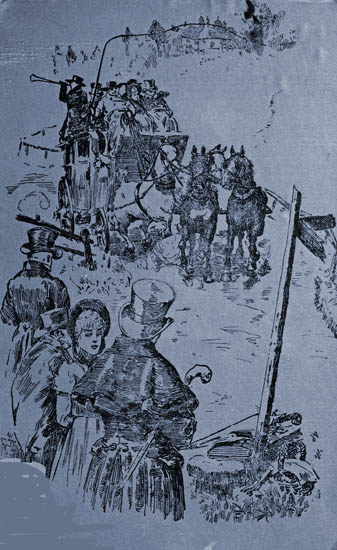
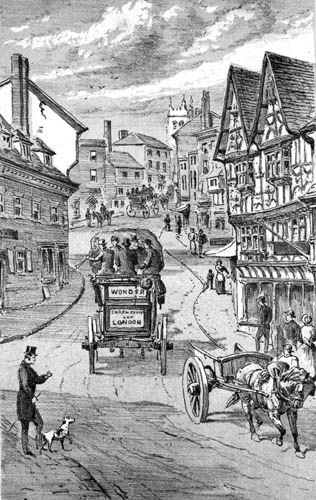
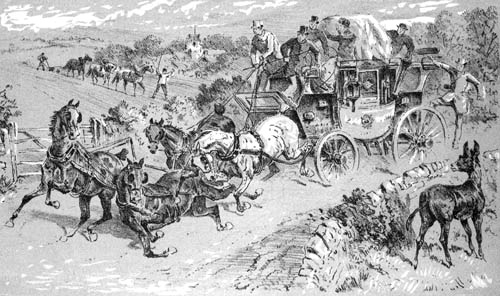
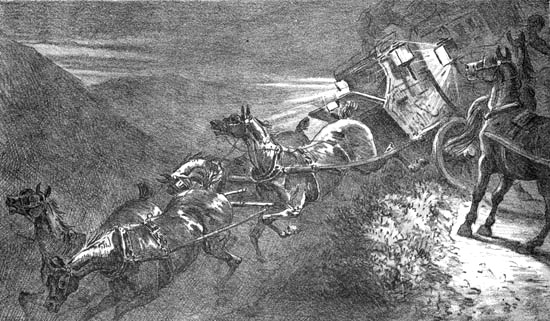
 than usual; but the appearance of the coach was deemed heavy, and as
the load was low, it was thought that the draught would be heavier
than the coaches then in use. Many coaches which loaded heavily with
luggage were already furnished with a receptacle for it denominated
the "slide," which was fixed under the hind axle, and thus, no doubt,
did add considerably to the draught; but to remedy this, as we shall
see, Mr. Milton makes use of unusually high wheels.
than usual; but the appearance of the coach was deemed heavy, and as
the load was low, it was thought that the draught would be heavier
than the coaches then in use. Many coaches which loaded heavily with
luggage were already furnished with a receptacle for it denominated
the "slide," which was fixed under the hind axle, and thus, no doubt,
did add considerably to the draught; but to remedy this, as we shall
see, Mr. Milton makes use of unusually high wheels.