41
Wildest Albania—Warnings not to attempt to travel there—I decide to go,
and take Palok—Prince Nicholas of Montenegro bids us farewell—On
the Lake of Scutari—Arrival at Skodra—Passports, rabble, and backsheesh—Photographing
the fortress in secret—Treading dangerous
ground—Albania the Unknown.
Before leaving London various insurance companies had
flatly declined to accept the risk of “accident,” because
it was known that I intended visiting Albania.
Indeed, no company in the City would insure me, and at
Lloyd’s the premium quoted was exorbitant. This was the
reverse of reassuring. Northern Albania I knew to be the
wildest and most savage country in the East, and the Accursed
Mountains, which I wanted to visit, were held by brigandish
tribes, who shot the traveller at sight or held him to ransom.
So little is known about them that they had always held a
peculiar fascination for me.
I searched through the journals of the Royal Geographical
Society for many years past, but found little mention of
Northern Albania, while of books of actual travel in that
region there were none. These facts had decided me to accept
the risks, whatever these might be, and go into those wild,
inaccessible mountains which bear the name of Accursed.
Everybody warned me of danger. Friends in England
constantly urged me to “take care of myself,” as though
that were possible when in the midst of a hostile tribe; and
in fact there seemed to be a conspiracy on the part of friends,
strangers, and officials to prevent me penetrating the Land
of Mystery.
42When I mentioned my intention in Cettinje, everyone, as I
have already said, held up their hands and raised their eyes.
It was sheer madness, they declared. Nobody’s life was
worth a moment’s purchase outside the town of Skodra—or
Scutari, as it appears on our maps. Outside—beyond
Turkish control—well, I should not be allowed to travel a
couple of miles before I had a bullet through me from behind
a rock at the roadside.
Everybody had some weird or horrible story to tell about
the savagery of the Hoti, the Kastrati, the Skreli, and other
savage tribes inhabiting those high, misty mountains beyond
the Montenegro border. The one or two Albanians—tall,
muscular fellows in white felt skullcap, tight white woollen
trousers heavily braided with black, and a kind of black
bolero with long fringe—whom I had seen in Montenegro
were certainly a sinister-looking, forbidding lot. But I had
come to the Balkans to investigate and to learn the truth;
therefore the more I was urged not to attempt to go into
the mountains, the firmer was my determination to do so.
His Royal Highness, Prince Nicholas himself, had at one
of the audiences he granted me seriously queried the advisability
of undertaking the journey. Almost daily on the Albanian
frontier were raids into Montenegrin territory, and the whole
border was constantly terrorised by the Albanian bands, who
shot the Montenegrins wherever found. Indeed, the market
at Podgoritza, where men squatted with loaded rifles over four
or five fowls or a basket of apples, was sufficient to tell me the
truth; while the daily talk of that town was of fighting with
the wild race who live across the border. The Montenegrin
hates the Albanian, and has surely good cause to do so. Many
a comely Montenegrin maiden—and some of them are exceedingly
beautiful—has been captured in those night raids
and carried across into Turkish territory, to be heard of no
more. And many, too, are the reprisals by the Montenegrins;
mostly, however, with serious losses to themselves.
Palok, whom I had engaged as my guide, had, he said,
been born in Skodra, or, as we call it, Scutari, which causes it
to be confounded with the city on the Bosphorus. He also
43declared that he was well known there, and the fact that he
also spoke Italian caused me to accept his services.
When I asked Fevzi Pasha, the Turkish Minister in Cettinje,
for a passport for Skodra, or “Scutari d’Albanie,” as it appears
on the visa, he granted it, but not without words of caution.
“In Scutari you will have nothing to fear,” he said. “I
will give you a note to the Governor of the town. But do
not go into the country. If you do, you’ll be shot like a dog.”
I thanked him, but had no intention of taking his well-meant
advice.
At half-past three one dark morning I took Palok, and
we drove out on the road that wound high up across the great
lonely mountains to the little town of Ryeka, whence a small
steamer plies down the Lake of Scutari to Skodra. The drive
was cold and weary, through a barren waste of rocks, but the
bright autumn sun was up ere we reached Ryeka, and just
as I boarded the big canoe with long, upturned, pointed prow,
which takes passengers and baggage down the sluggish stream
to the boat at the entrance to the lake, I saw, on the road
above, a fine military figure in pale blue, riding a splendid white
charger and followed by an officer.
In a moment every head was bared. It was Prince
Nicholas, who was staying at his palace at Ryeka, taking his
morning ride.
He espied me, pulled up, and shouted down in Italian—
“Hulloa! Good-morning! Then you are off to Albania
after all, eh?”
“Yes, Monseigneur,” I responded.
“Did you get my message last night?” he inquired, referring
to a confidential matter.
“Thank you, Monseigneur, yes.”
“Very well. Only be careful of yourself, you know, and
when you get back, come and tell me all about it.” And,
laughing, His Royal Highness waved his hand with a merry
“Bon voyage!” and cantered away, while my half a dozen
fellow-travellers in gold-braided costumes regarded me in
wonder that their Prince should stop and converse with
me—a perfect stranger.
44Down the silent river, between steep green hills we glided.
Choked by the tangle and rot of weeds, it was the haunt of
thousands of waterfowl, and, as we passed, the herons rose with
a lazy flapping of wings,—a stream that might well be haunted
by the fairies, for the water was unruffled and the silence deep
and complete.
Boarding the little steamer, the Nettuno, lying at the
mouth of the river, we were soon out in the great green lake,
with the high mountains looming grey in the far distance.
As we steamed due south, the barren mountains of Montenegro
were soon left behind. At Virpasar and Plavnitza we picked up
passengers, a fat Turkish peasant woman carrying two baskets
of fowls, and three young Montenegrins, fully armed with
rifles and revolvers. Because she was not yet in Turkey, the
woman wore no veil; yet in the evening, as soon as Skodra
came in sight, she produced her veil, and carefully adjusted
it, laughing with me the whole time, and wound it until
only her bright dark eyes were visible.
From Virpasar an Italian company is now building a
railway to the Montenegrin port of Antivari, so that in a
couple of years the lake will be connected with the Adriatic,
and form the much-needed trade route for Montenegro. The
Servians, indeed, are hoping also to use Antivari as their
Adriatic port, and thus be free of the excessive Customs dues
and other oppression placed upon them by Austria-Hungary.
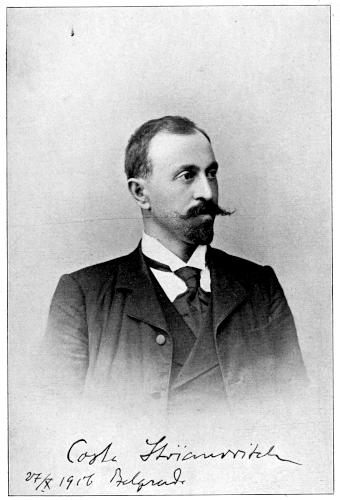
When in Belgrade, M. Stoyanovitch, the Servian Minister of
Commerce, explained to me the several schemes for the construction
of a railroad from Krushevatz, in Servia, by way
of Novi-Bazar, Ipek, Podgoritza, and Ryeka, to join the
Italian line at Virpasar, and so to the Adriatic or to San
Giovanni di Medua. Servia must secure a port, and this line,
whenever made, will be a most paying concern, for by its
extension from Stalacs—on the main Belgrade-Sofia line—to
Orsova, it would receive most of the exports of Southern
Russia to Western Europe.
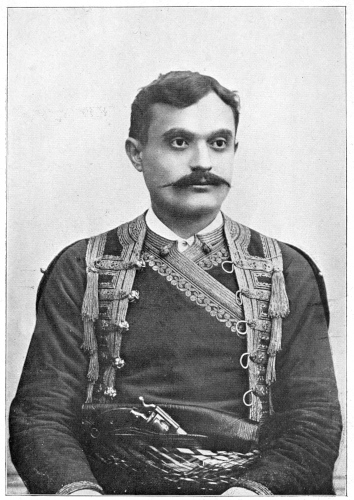
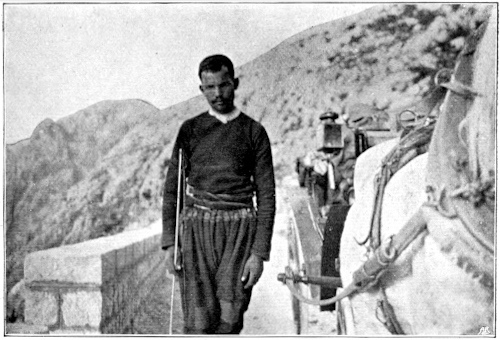
Palok, my companion through the Skreli country.
The mere handful of lake-side dwellings which now constitutes
Virpasar will, ere many years have passed, grow into
an important trade centre, and upon the great silent lake,
45surrounded by those high sheer mountains where the eagle
and the pelican are now the only signs of life, big passenger and
freight steamers will soon ply. The railway, which must be
built ere long, will quickly bring a civilising influence upon
Northern Albania; therefore, if one wishes to see it in all its
wildness, it must be seen to-day. In another decade the
Albanian brigand—the real thing out of the story-book—will
be only a matter of history.
The calm, bright day was perfect. The surface of the
great lake was like a mirror, and the fringe of giant mountain
constantly changed in colour—grey, blue, purple, and rose—as
the hours wore on, and the sun sank westward in all the
crimson glory of the death of the autumn day.
Now and then, with our rifles, we took pot-shots at the
pelicans, but with little result. A young Montenegrin killed
one, and the huge bird came down with a great splash into
the water. At last, in the falling twilight, we cast anchor
at the head of the Boyana River, which empties itself into the
lake, and then, boarding another high-prowed canoe, where
a Turkish soldier sat over us with a loaded rifle, we were
rowed slowly up to the low line of ramshackle buildings,
which was our first sight of Skodra.
With our farewell to the Nettuno we had said good-bye to
civilisation, as represented by sturdy Montenegro. We were
in Albania, the wildest and most turbulent country in the
East.
We landed upon some slimy steps amid a perfect babel of
shouts. Hundreds of unwashed Turks and Albanians were
awaiting us, all shouting in a language of which I understood
not one word. Every man, armed and of ferocious aspect,
seemed ready to make short work of both Palok and myself.
Indeed, so unpleasant is the landing at Skodra, that Palok
himself had already sent a message to a friend of his—a typical
brigand of the first water—to give the Customs officer a tip,
and so make pleasant our path through that dark, evil-smelling
hole where the Turks collect their dues. Palok’s friend,
whom I only saw on that one occasion, and whose name I
could not ascertain, had managed to secure from somewhere
46a mustard-coloured ramshackle fly, the upholstering of which
was in ribbons. The driver, in his white fez, with dirty white
baggy trousers and yellow tunic, came forward and saluted
me with deep obeisance, while I was explaining to the passport
officer—a ragged, consumptive youth—that my name was not
“We, Sir Edward Grey.”
The chief of the Customs was a long, very thin, white-fezzed
Turk with large silver-mounted pistols in his belt,
very tight white trousers, a gold-embroidered jacket, and
pointed slippers that turned up at the toes in the most approved
style. He was a real live Bey, so Palok told me, but he was
not averse to receiving tenpence as a tip. Later, when I left
Scutari (or Skodra) again, I gave him ten Austrian crowns, for
I had in my bag a couple of thousand cigarettes, which, by
Turkish law, are prohibited from leaving the country. His
charge for winking at the contravention is five crowns a
thousand!
Turkish Custom Houses are weird places, and it is no
wonder that the British Ambassador at Constantinople is just
now pressing for some reform. Your belongings are not only
thoroughly examined and heavily assessed for Customs—if you
won’t tip—when you enter Turkish territory, but the same
happens when you leave. Woe-betide those who dispense
with the services of a discreet dragoman and do not tip. All
that you may have bought in Turkey will be found liable to
duty. Gold embroideries will be weighed, and anything that
has the Sultan’s monogram upon it—as so many embroideries
have—will be at once confiscated.
The man in the fez is grave and inexorable. His attitude
is as though he would scorn the offer of a bribe and throw
you into prison for daring to insult an official of His Imperial
Majesty. Yet outside the Custom House he keeps a crafty
ragamuffin who is ready to accept a four-franc piece on his
behalf, and for that he will pass a thousand pounds’ worth
of goods with only a pretence of search! The Custom House
at Galata on the Bosphorus is a case in point. There are
five officials there who share the spoils from the traveller.
Yes, the land of the Crescent is indeed a quaint country.
47The corruption of Turkish Customs officials is no doubt due
to the frequent non-payment of their stipends. They must
live, and do so by accepting bribes. I afterwards spoke to
certain high government officials at Constantinople about it,
and they admitted that they knew bribery existed extensively,
but at present were utterly unable to suppress it.
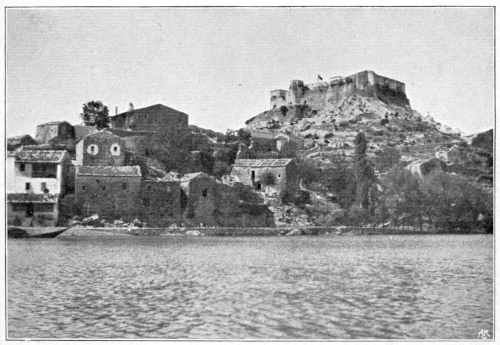
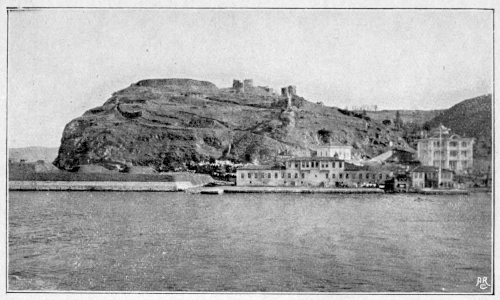
Over the ramshackle Custom House, a dark hole without a
window, frowns a shattered fortress containing one or two
antiquated guns, a photograph of which I afterwards obtained
surreptitiously, and which appears in these pages. Had I
been discovered, I might have spent an unpleasant year or
so in a Turkish prison. But even that offence, so heinous in
Germany, France, or Austria, I suppose I could easily have
expiated with a few piastres of backsheesh. In Turkey you
can do anything—if you are prepared to pay.
Upon that filthy crowd around the Custom House at Skodra,
upon those crumbling buildings, upon that old white fortress,
upon the tower of Skodra itself, a mile away, the centuries
of progress have made no impression. Here is the country
of a mediæval people, the life of an age long ago past and
forgotten.
While our fellow-travellers were squabbling, arguing,
shouting, and cursing the wild, dirty mob who now filled
the Custom House, we, with our baggage—canvas bags,
specially made to sling on mules for mountain travelling—ascended
into the mustard-coloured conveyance and were
driven along a country lane, very English in its appearance,
with bramble hedgerows and ditches; yet the high, thin minaret
of a mosque before us, and the carefully latticed windows
of a house, preventing the women-folk from being seen from
the roadway, and giving the place an air of mystery, showed
us to be in the land of His Majesty the Sultan—in Albania the
Unknown.
48
Fired at in the street of Skodra—My comfortless inn—Panorama of life—Armed
bands of wild mountaineers in the streets—The Sign of the
Cross—Scutarine people—The fascination of Skodra—In the den of
my friend Salko—Making purchases—Short shrift with swindlers—Some
genuine antiques—Ragged and shoeless soldiers of the Sultan—Men
shot in the blood-feud—“It is nothing!”
I had not been in Skodra half an hour before a man fired
at me with his revolver.
It was my welcome to Albania, and I confess that I drew
my own weapon from my belt, prepared to defend myself.
I had arrived at the han, or inn, a poor place dignified by
the name of Hôtel de l’Europe, washed, and descended to the
street, when, on emerging from the doorway, somebody fired
his pistol right in my face. The flash startled me, and in an
instant I was on my guard with my back to the wall. In that
brief second all that I had heard of the insecurity of Albania
flashed back.
My assailant—a tall, ragged-looking, middle-aged Turk in
a scarlet fez—laughed in my face and uttered some words that
I did not understand. He saw my weapon shining in the
dim light, and pushed it away with a laugh. His manner
struck me as friendly, so I dropped my arm; whereupon
another man, in passing, also fired, then another and another,
until, ten seconds later, everybody in the street was firing
indiscriminately, and bullets were flying in all directions.
I held my breath. Had the place actually revolted against
the Turk just at the moment of my arrival? If so, I was in
luck’s way. I knew that the Albanian hated the Turk, for
49Palok had told me that the revolution was only a question
of time, and that one day his people would drive them out
of Skodra. The place was once Servian, and captured by
the Turks in 1479. Yet the Albanian still looks upon the
Turk as a miserable intruder, and intends one day, ere long,
to drive him out.
Around me, on every hand, pistols were being fired, the
flashes showing red in the night, and I stood breathless,
wondering what was happening. The man who had fired
in my face was grinning at my alarm, when Palok dashed out
to me.
“Signore! Signore!” he cried, in Italian. “It is
nothing! Don’t be alarmed. It is only the vigil of the fast
of Ramadan. It is our way of celebrating it!”
By that time every man in the whole town was firing off
his revolver. The din was deafening.
“Very well,” I laughed. “Then I’ll celebrate it too,”
and, raising my arm, I also emptied my weapon in the air.
The grinning Turk who had first fired and alarmed me
saluted me by touching chin and forehead, and then we laughed
together. It was certainly fortunate for him and for myself
that I had not let fly, but he did not seem to heed at all the
danger of firing suddenly upon a foreigner ignorant of what
was about to happen.
The han, with the dignified name of “hotel,” was certainly
an uncomfortable place. Cold roast pork, a trifle “high,” was
all I could get to eat, and this was washed down by a light
red vinegar, which was probably at one time wine. For five
days running I had that very same pork served twice a day,
until I sent Palok into the bazaar to buy me other supplies.
A narrow camp bed, an iron washstand with tin fittings,
a pail and a deal table, comprised my furniture, the best
accommodation that Skodra could afford.
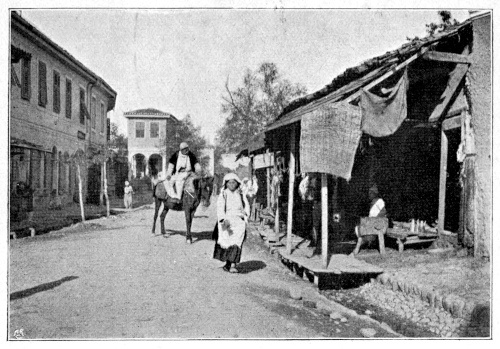
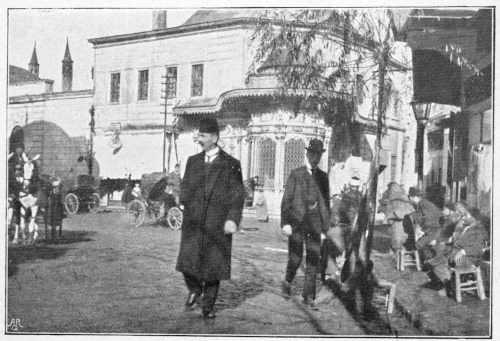
Yet the town is perhaps one of the most interesting in
all the Balkans, and its people the most strangely mixed
and wearing a greater variety of Eastern costume than even
in Constantinople itself.
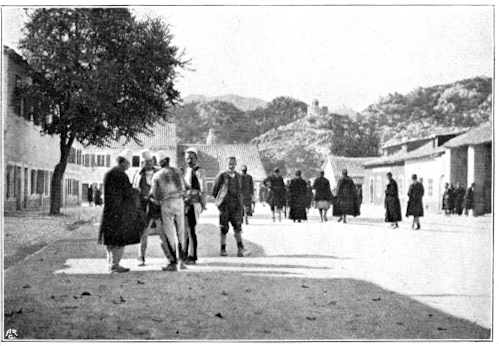
The bazaar, down by the river, is full of quaint types
50and most interesting. Its uneven pavement is quite as unclean
and slippery with the dirt of ages as are the streets
of Constantinople, but its dark little sheds are filled by workers,
silver and copper smiths, embroiderers, armourers, weavers,
jewellers—in fact, one sees every trade being carried on in
the same primitive way and with the same tools as in the
Middle Ages.
Skodra is not a town of progress, for there telephone or
electric light is forbidden; machinery of every kind is against
the law, and neither newspapers nor books are allowed to
enter Albania. Therefore in those crooked streets of the
bazaar the traveller is back in mediæval days, and the town
of to-day is just as Florence was in the days of Boccaccio or
Dante. Like the mediæval Florentines, many of the men
from the mountains shave their heads, leaving a tuft of bushy
hair at the back, which is cut square at the neck. With their
tight-fitting black-and-white striped trousers, black woollen
boleros, their belts filled with cartridges, and a rifle over their
shoulders, they are a fine, manly race, with swaggering gait,
clean-cut features—mostly Catholics, who spit openly at the
lean, ragged, ill-fed soldiers of the Sultan.
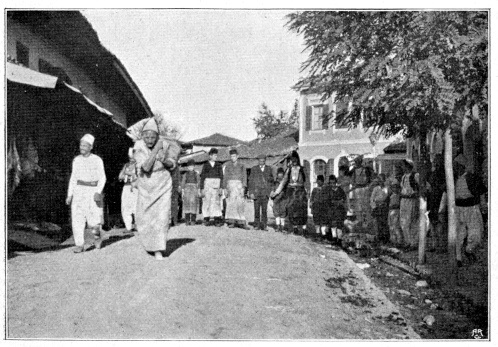
They come down from the mountains in armed bands,
and walk through the town, a dozen or so together, in complete
defiance of the Turk. With men upon whose heads
a price has been set—known brigands or murderers, indeed—I
have chatted and drunk coffee in the bazaar, all wild fellows
who know no law except their own, and who do not acknowledge
the Turk as their ruler. When I inquired of Palok
the reason of their immunity from arrest, he replied—
“Why, signore, if the Turks captured one of these, the
whole of Northern Albania would rise as one man. The
tribes would sweep down from the mountains and sack and
burn Skodra within twenty-four hours. Life in this town is
very uncertain, I can tell you. One never knows when the
rising will take place. All is ripe for it, and when it comes,
then woe-betide the Turk and all the Moslems. Have you
not noticed the Sign of the Cross over the doors of the Christians?
Is that not significant?”
51The Albanian tribesmen are mostly Catholics, together
with some Orthodox; yet they combine religion strangely
with war. They go to the Catholic Cathedral in Skodra
with loaded rifles, which they place before them as they kneel
and pray, and before murdering their enemy they will go
and ask Providence to assist them.
The town Christian of Skodra is, for the most part, a
very excellent fellow. Palok, whom I found was well known,
introduced me to many of them, and in that wild land I received
very many charming kindnesses from perfect strangers.
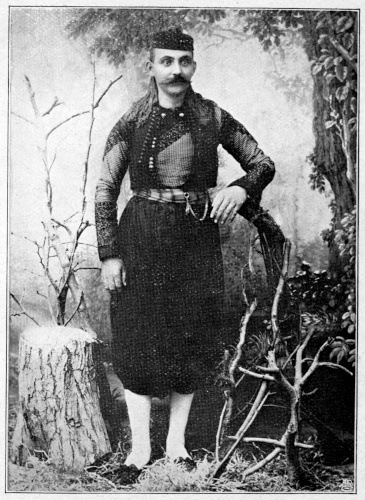
The costume of the Scutarine men is distinctly quaint
and curious. A short dark red jacket, the front and sleeves
of which are so completely braided with narrow black braid
as to almost hide the foundation, and edged with dozens of
oblong brass buttons; a pair of wide, dark blue baggy breeches
reaching to the knee; a round flat fez with a huge blue silk
tassel that falls about the shoulders; a bright, striped silk
sash; their legs in white cotton stockings and feet in patent
leather dress-shoes. Such is the dress of the average Christian
one meets in Skodra.
The attire of the women is even more extraordinary.
They veil, just as do the Mohammedan women, and only
uncover their faces when they go to church. For the most
part they are beautiful when young, with clear, delicate complexions,
handsome features, and dancing black eyes; but
after seventeen appear to soon lose their beauty and become
prematurely wrinkled and old. The outdoor dress is generally
made of the same dark red cloth as the men’s jackets, so
completely embroidered as to appear black. Indeed no
Scutarine, either man or woman, goes out in a dress unless it
is covered with embroidery. In every street you will see a
dozen men squatting cross-legged in a little dark shop, busily
plying the needle upon the narrow black braid, and applying
tiny pieces of green cloth among the braid as additional
ornament. Often the braiding is a marvel of needlework
and design, and some of the outdoor costumes of the women,
though exceedingly ugly, are ornamented in such a manner
as to amaze the Western eye.
52Female outdoor attire is, of course, of the divided skirt
order, trousers of thick braided cloth so clumsy that the
wearer can only walk with difficulty, a long cape, richly
embroidered on the shoulders and reaching to the hips, with
a square kind of sailor collar that is raised and pinned to the
crown of the head. From the bridge of the nose to the knee
falls the white veil, like the Moslem women, while from the
sash are pinned gaily coloured silk handkerchiefs, which,
appearing below the cape, lend additional colour to the most
unwieldy and ugly of all the dresses of the East. The wearer
cannot walk, but can only waddle with difficulty.
The streets of Skodra are, however, a perfect panorama
of costume. In the dark entries the shuffling Mohammedan
women, white-clothed from head to foot and veiled, look
ghostly and mysterious; the Mohammedan unmarried girls
with the striped red-and-white veil wrapped about them;
Albanians from the south in short, stiff cotton skirts like
exaggerated kilts; Turks in greasy frock-coats and discoloured
fezes, strolling slowly, fingering their beads to pass the time
through Ramadan; fierce tribesmen from the mountains in all
sorts of different costumes, fully armed and ready to shoot
in an instant at discovering an enemy even there in the
crowded bazaar; unveiled country women in short, coarse,
black homespun skirts, wearing great iron-studded belts and
savage ornaments in brass, copper, and gold; giggling girls
from the mountains four or five days distant, dressed in their
gorgeous gala dresses, laughing as they bargain with the
voluble keepers of the tiny shops in the bazaar.
Skodra fascinates one. There is no European influence
here: not a soul is in European dress. It is the unchanging
East—the same life that has existed here for centuries. The
Turks are, however, fanatics, and Palok will not allow me
to smoke a cigarette in the street in the daytime, for in the
fast of Ramadan the Mohammedans abstain from all food,
drink, and tobacco from four in the morning till the gun fires
on the fortress at sunset.
Upon Palok’s advice I even wore a fez, so as not to be
too conspicuous.
53When I asked the reason, he simply grinned, shrugged his
shoulders, and said—
“The signore believes Skodra to be a safe place. But it
is not always so. Why run unnecessary risk? And a fez is
very comfortable.”
So after buying a fez, I took it to the ironer, a white-bearded
old Turk, who pressed it and shrunk it and combed out
its tassel with great ceremony, and then I assumed the distinctive
mark of the Sultan’s subjects, evidently to the great
relief of the faithful Palok.
On our first visit to the bazaar Palok discovered a friend.
He was a very tall, thin-legged Albanian, in a white fez, a
white woollen bolero, and the usual black-and-white woollen
trousers and turned-up shoes of raw-hide and interlaced
string. In one of the narrow, tortuous ways of the bazaar,
on a kind of platform before a small ramshackle booth,
where rope and twine were displayed, he was squatting cross-legged,
staring into space and awaiting customers.
Suddenly espying Palok, he seized his slippers, which
stood near him, and sprang out upon the filthy pavement.
Next second the pair were clasped in embrace, and after
many mutual words of warm welcome in Albanian, I was
introduced.
The seller of string looked me up and down critically until
his eye caught my revolver in my belt, and then, apparently
satisfied with my appearance, he touched his chin and brow
in salutation.
We ascended to the little platform, and a box was brought
for me to sit upon. A shout into the narrow alley brought
me a cup of Turkish coffee.
“This is my friend, Salko,” Palok explained, in Italian,
after the pair had been apparently discussing me. “Mio buon
amico. One of the best men in the bazaar. For eight years
we have been parted, and how pleased I am to see him again.”
Salko interrupted, whereupon Palok said—
“My friend apologises, signore, that he cannot take coffee
with you, or offer you a cigarette. It is Ramadan, you know.”
I offered Salko my case, and, taking a cigarette, he placed
54it aside until after sunset, touching his chin and brow and
laughing merrily.
I wanted to buy several things in the bazaar—a piece or
two of old silver, if I could find it—and some antique embroideries
which Palok had told me I could find. He told
Salko this, whereupon he shouted outside to a passer-by, and
in a moment the news was all over the bazaar, and all sorts
and conditions of men appeared with various things for sale:
beautiful silver-mounted and gem-studded pistols and swords,
old silver ornaments, embroideries of the sixteenth century,
genuine antiques of all sorts, old jewellery—in fact, in a
quarter of an hour Salko’s little shed-like shop presented the
appearance of that of an antique dealer.
Two gorgeous Turkish ladies’ costumes attracted me.
The trousers were of silk, and interwoven with real gold and
silver thread; the boleros of rich crimson velvet, wonderfully
embroidered with gold; the sashes gay; and the little fezes,
with golden sequins, smart and coquettish. They were the
real thing, and could be worn at a fancy-dress ball in England
with certain success.
I liked them, for they were the genuine thing. Dresses
such as they were are not made nowadays. Turkish ladies of
to-day prefer the lighter stuffs of the Franks, silks from Paris,
and figured gauzes from Germany. Those dresses had once
graced the harem of some great Pasha—perhaps, indeed, that of
the Sultan himself. So I allowed Salko to bargain for them.
I watched, and was amused.
The man who had them to sell apparently asked a price
that was exorbitant, whereupon my friend, with a wave of
his hand, ordered him to pack them back in the bundle.
High words followed, and I expected every moment the
pair would come to blows. The vendor was a round, fat-faced
eunuch, with an ugly scar across his brown cheek. And
while the controversy was in progress, the others who had
wares to offer squatted about and advised each side as to how
much the costumes were really worth. Then at last both
sides got at loggerheads, hard words were used and insulting
gestures; fists were shaken, and angry scowls exchanged,
55until I momentarily expected that there would be a free
fight and bloodshed.
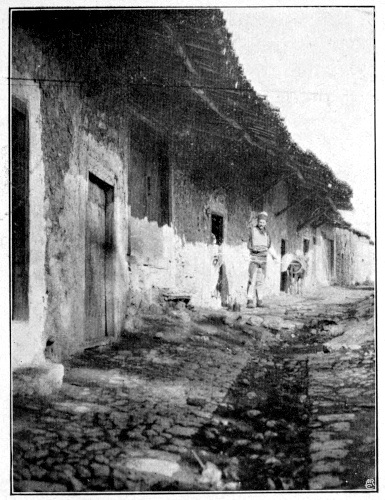
My friend Salko outside his house in Skodra.
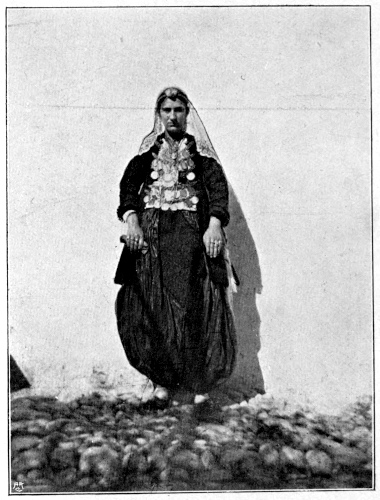
Pietro’s sister-in-law unveiled before the Camera.
One man I noticed who had not spoken was fingering the
hilt of his knife, as though itching to join in the fray.
“I’m going out of this,” I told Palok, whereupon he only
laughed.
“There’s really nothing to fear, signore. It is always so.
They ask double, and Salko is teaching the fellow manners.
You are a foreigner, and you don’t understand.”
I admitted that I did not.
The argument continued, and in the end the fat-faced
eunuch was bundled out by Salko into the dirty alley and his
goods thrown after him.
Nobody smiled. Such treatment seemed usual, and on
the following day I bought the dresses.
The next was a little old Turk with a long white beard,
who had an old silver ornament for sale, one of those triangular
boxes which women wear round their necks containing
scraps of the Koran, supposed to protect them from the
influence of the Evil Eye.
Though he came meek and humble, Salko glared at him.
No. The Englishman was his guest, and he would see that
only what was just was paid. He took the ornament from
me, and weighing it in his hand, judged its worth. Two
other men agreed, and the old man, without being consulted,
was handed the money and told to be gone.
Assuredly business methods are quaint in the town we
Europeans call Scutari.
Another after another—shopkeepers, all of them in the
same category as Salko himself—was interviewed. Those who
offered rubbish were promptly ordered out. And so, before me,
seated upon my box, was unfolded the treasures of the bazaar.
And assuredly some of the curios offered were fit to grace
any museum. Seldom does a foreigner visit Skodra, therefore
it still contains many real antiques; and there being no sale
for them, prices are not exorbitant. It is, indeed, one of the
few places left where one can obtain anything worth having.
A long, lean Christian, in his flat round fez and enormous
56tassel, offered me nine early Greek gold coins that had only
a week before been discovered in a tomb. I doubted the
tomb part of the story, but I was afterwards shown it half a
mile away, and could also have bought the actual vase in
which they had been found. I am not a collector of coins,
so I declined them. One day, however, those coins will, no
doubt, find their way into one of our European national
collections, for they were so perfect that they looked as though
just fresh from the matrix.
I was turning over in my hand a number of antique gem
rings, when of a sudden, just outside, not a dozen yards from
where I sat, there was a loud shout, followed by a pistol-shot.
Then more shouting, and a little crowd gathered. In alarm
I sprang to my feet, and I saw outside a mountaineer, in white
felt skullcap, lying in a pool of blood with part of his face
blown away.
A man in black-and-white trousers stalked past, flourishing
his big pistol and threatening to shoot anybody who dared
to stop him. He was the assassin.
“It is nothing, signore,” Palok declared, reseating himself.
“Only the blood-feud. The men were in sangue, and have
met. In such cases one must always die. The man who
shoots first gets the best of it,” and he grinned.
For fully five minutes the man lay in the filthy gutter
without a hand being placed upon him to see if life were
extinct. Then it occurred to somebody to see. He was
pronounced dead, and a couple of men carried away the corpse.
No police or guard put in an appearance, and the life of the
bazaar went on as though nothing unusual had happened.
But nothing unusual had happened. Such assassinations
occur every day, and nobody takes any heed of them. The
blood-feud is part of the Albanian creed, both Mohammedan
and Christian.
It is not, however, pleasant to have a man shot dead
before one’s eyes, nor does it tend to inspire confidence in
one’s own personal safety.
This was my first experience of the murderous instinct of
the wild Albanian, but ere three days I had still other opportunities
57of reflecting upon Palok’s remark that Skodra was
not so safe a place as it looked.
Indeed, the town itself is, at intervals, threatened with
massacre. Every now and then rumours fly round that the
mountain tribes are about to descend upon the place and drive
out the Turks. Then everybody retires to their houses—each
residence has high walls, and is more or less a fortress—the
bazaar is closed, the shops are barricaded, and the ragged
soldiers of the Sultan assemble under their greasy-tunicked
officers—and wait.
The blow for liberty has not yet been struck by the
Albanians, but it will assuredly come ere long.
I wanted to investigate, and get at the truth. That is
the reason why those high, blue, misty mountains that I
could see afar from the narrow, crooked streets of Skodra
held me in such fascination; that is why I disregarded all
advice to the contrary, and determined to visit the Albanian
at home in his rocky fastness.
That same night, after Salko had bargained for me, I was
eating my evening meal—of pork—when another shot sounded
out in the dark, unlit street.
It was nothing, I was told by Palok five minutes later.
A man had been found dead in the darkness. That was all.
The average number of assassinations in Scutari is about
three per day. Nobody cares, for justice is nobody’s business
except that of the dead man’s brother, or his next-of-kin.
True, there is an Imperial Court of Justice, a lath-built
shed with gaping holes in the roof. Its steps are moss-grown,
and its windows mostly broken or devoid of glass.
Outside the place, after midday, the brave defenders of the
Ottoman Empire, those shoeless men with their ragged uniforms
dropping off them, sell their ration of bread to the
passer-by in order to get money to buy cigarettes. They
remain unpaid, and their bread is their only source of income.
And upon the protection of these Skodra has to rely.
Is it any wonder that when sinister rumour runs through
the bazaar, everybody shoulders his rifle and sits on his wall,
prepared to defend his own home?
58
My friend Pietro—Visit to his house—His wife and sister-in-law unveil and
are photographed—Scutarine hospitality—Forbidden newspapers—I
get one in secret—The Turkish post office—I want to visit the Accursed
Mountains—Difficulties and fears—The Feast of the Madonna—Christians
and Mohammedans—My first meeting with the dreaded Skreli—Shots
in the night.
Those bright, sunny autumn days in Skodra will live for
a long time within my memory.
Though a stranger in that half-savage place, where law
and order are unknown, I received perhaps more genuine
hospitality from perfect strangers than in any other place
in the Balkan Peninsula.
Through Palok’s introduction I quickly found myself
among friends, who exerted their utmost in order to entertain
me, and went out of their way, even in face of their own
national customs and beliefs, to oblige me. The Albanian
idea of hospitality is old-world and charming. A case
in point was one of my friends, a wealthy Scutarine
merchant named Pietro Lekha, whose portrait is here reproduced.
He was a Christian, and spoke a little Italian. At
first, when I was introduced to him in the bazaar, he was
silent and taciturn, apparently regarding me with some suspicion;
but very soon this wore off, and we became the best of
friends. We took coffee together constantly, and he gave me
exquisite cigarettes. In Albania there is no régie, as in other
parts of Turkey, therefore one can choose from the peasant-women
the very best light tobacco in leaf, have it cut, and
59afterwards employ professional cigarette-makers to manufacture
you cigarettes. I did this, and sent a quantity of cigarettes
of the very first quality to England, far milder and sweeter
than any to be purchased in Constantinople—or anywhere
else in the world, for the matter of that.
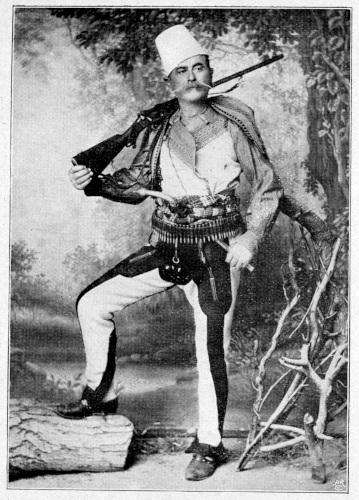
Rok, tribesman of the Skreli.
Finding that I was taking photographs, Pietro became
interested. He accompanied me on my expeditions, and we
had spent some days together before I dared to inquire about
his wife, the veiled lady whom I had once had pointed out
to me in the bazaar.
Palok had told me that Pietro’s brother had, three months
ago, married the most beautiful girl in Skodra, and that he
and his young wife lived at Pietro’s house. A bold thing
then occurred to me—to beg permission to photograph them.
I knew well that these people were averse to having their
photographs taken; nevertheless I very discreetly broached
the subject one day when sipping coffee with Pietro.
He gave me no decided answer. Indeed, he declared
himself ready in any way to serve me, but as to photographing
his women-kind—well, it was against all custom. What
would his friends say if they knew?
I dropped the subject, rather crestfallen. I wanted to be
invited to his house and to meet his wife and sister-in-law, both
of whom were declared to be very beautiful. Yet he seemed
in no way inclined to so far extend his hospitality. I spoke
to Palok and urged him to use his power of persuasion, with
the result that two days later I received an invitation from
Pietro to call upon him at his house at three o’clock to take
coffee, and further, he added—
“If you really wish to bring your camera, you may. I
have spoken to my brother, and he will let you take a picture
of his wife, providing you give your undertaking not to make
any copies for sale, or to show it here to people in Skodra.”
I willingly gave the undertaking, and at the appointed
hour, accompanied by Palok, we rang at the big gate in a
high white, prison-like wall that enclosed my friend’s dwelling,
and were admitted into the garden, in the centre of which
stood a great square house.
60Pietro came forward to greet me, a picturesque figure in
his Scutarine dress, the flat fez with big tassel, the embroidered
coat, baggy trousers, and white stockings. The ground floor
was devoted to stables, but above we found ourselves in a
large square apartment with divans. Upon the floor were
beautiful Eastern rugs. On one side was the big, gaudily
painted dowry-chest, and here and there small low tables.
The room, with its heavy hangings, was very cosy, and over
everything was the sweet odour of otto-of-rose. In one
corner was a great brass brazier, and upon a chiffonier were
a few European knick-knacks, evidently household treasures.
The only picture on the wall was a small oleograph of the
Madonna.
A rush-bottomed chair was produced for me, while Pietro
and Palok squatted cross-legged upon the divans. Then the
servant was sent to inform the ladies of our arrival.
Presently both wife and sister-in-law entered, gorgeous
in silk and gold, the most striking costumes I have ever seen
off the stage. White gauze veils were wrapped about their
heads and corsage, leaving only their eyes visible; and thus
attired they saluted me and, with Pietro acting as interpreter,
welcomed me.
Afterwards they retired, and at Pietro’s order reappeared
without their veils. The younger woman was indeed lovely,
with a fair white skin, beautiful soft lines of beauty, magnificent
black eyes, and lips that puckered into a sweet, modest smile
when I involuntarily expressed my surprise at her marvellous
good looks. I had heard that Albanian ladies were beautiful,
but I certainly never expected to be presented to such a type
of feminine loveliness.
Over her bare chest hung strings of great gold coins, while
across her brow were rows of sequins. Her richly embroidered
dress, the jewels in her ears, the bangles upon her arms, all
enhanced her great personal beauty, while she stood before
me, her face downcast in modesty—for except her husband
and his brother no man had ever beheld her unveiled.
At that moment her husband entered, and I congratulated
him upon the possession of such a beautiful wife. Then we
61all laughed together, and descended to the garden, where I
was allowed to take photographs of her, veiled and unveiled,
as well as of Pietro’s wife, who was, of course, much her senior,
and who, although she had lost her youthful beauty, was still
very charming.
Returning again to the upstairs salon, we all sat round,
while the newly-married beauty brought us first lemonade,
then delicious Turkish coffee in tiny round cups upon a great
gilt tray, followed by rakhi, that spirit so dear to the Turkish
palate, and afterwards real rahat-lakoum, or Turkish delight.
Then, after an interval, veiled again once more, the beautiful
young woman brought me a cigarette and lit it for me,
afterwards wishing me adieu and modestly retiring.
All was done with such perfect grace and modesty as to
create a most charming experience. It was, to say the least,
novel, to sit there with those squatting Albanians and be
waited upon by the prettiest girl in Skodra.
Pietro told me that newspapers and books being forbidden,
anyone found in possession of them was at once arrested.
He, however, gave me surreptitiously a copy of the Rome
Tribuna, which had been smuggled in a day or two before;
and it was welcome, being the first newspaper I had had for
several weeks.
Truly Skodra is a strange place. I had occasion to go to
the Turkish post office one day. It was, I found, a wooden
shed. Inside was a low, filthy truckle bed, a small table—at
which sat a consumptive youth in a fez—a broken chair and
a large iron safe, the door being secured by a piece of string
being tied about it!
Of drainage there is none. Sewage runs down the centre
of most of the streets, especially in the bazaar, and its odour
is the reverse of pleasant on a sunny day. In the neighbourhood
of butchers and slaughterers the gutters run with blood,
which the dogs lap and enjoy, and near the stalls of fruiterers
and vegetable-sellers the piles of refuse rot in the sun and
decay.
Yet everywhere, both in the streets of the Mohammedan
quarter and in those of the Christians, are interesting sights
62at every turn. When night falls the place is dark and
mysterious, for there are no lights save that issuing from
the chinks of a door or from the windows of a barber or a
coffee-seller. Through the windows of a mosque, perhaps,
can be seen the swaying figures of Turks at prayer, faint in
the dim oil lights, while in the blackness of the street the
patrol passes, a dozen Turkish soldiers with loaded rifles,
headed by one man carrying a lantern. The place is insecure
after nightfall, even to the Scutarines themselves, therefore
nobody ventures out, and by nine o’clock every house is
bolted and barred.
At that hour, it being Ramadan, the Turk was feasting
and taking his ease, while opposite the han where I lived a
Turkish soldier would come nightly and sing weird prayers
under the window of the Governor of the vilayet, that perfectly
useless official, whose authority extends only to the
confines of the town itself, and who fears to exercise it lest
he should rouse the slumbering ire of those fierce tribes who
live in the Accursed Mountains above.
Many strange sights I witnessed and many strange things
I heard in Skodra.
Men, fierce mountaineers who, in some cases, bore across
their countenances marks of sword or gun-shot wounds, told
me their stories—exciting narratives of love, war, and the
blood-feud. All were Albanians, and believed Skodra to be
the finest capital in the world. England, because it carried
on no political intrigue among them, like Austria and Italy,
they did not regard as a Power. Mine was a country far
away, I was told, and therefore perfectly harmless. Hardly
anybody had heard of London. Those who had, declared that
it could not be so large or so beautiful as Skodra.
The days I spent there were with the one object of obtaining,
by some means, permission from one or other of the
mountain chieftains to allow me to travel in the country.
Palok had promised to endeavour to arrange it for me,
and so had Pietro, but by their manner I saw that they considered
any such attempt a piece of sheer folly, and far too
hazardous. They were too polite to tell me so, but I read
63in their faces that they did not intend me to go, if it were
possible to prevent me.
Therefore surreptitiously I had recourse to my faithful
friend of the bazaar, Salko, himself a member of the fierce
tribe of the Skreli, who had more than once terrorised the
town. When, through an interpreter, I one evening explained
my desire, he rubbed his chin doubtfully and wagged his head.
He would do his best, but it was dangerous—very dangerous,
he declared.
And yet, he went on, the thing might perhaps be managed.
An Albanian of the mountains, though he might be a brigand
and annoyed the Turks, and though he might shoot Turkish
soldiers like dogs wherever met, was nevertheless a man of
his word. If I was promised safe escort, then I might go
into the mountains without even my revolver, for no harm
would come to me.
Yes; he would promise to see what he could do. But
it was difficult, and it would take time. In the mountains
they had no great love of foreigners.
To the coming Feast of the Madonna many men from
the mountains would arrive, and there would be opportunity
to speak with them. No; he would say nothing to Palok—if
I so wished. Therefore I waited, and hoped.
Now the celebrated Madonna of Loretto was, before the
Turkish occupation of Skodra, at the little ruined church
near the Boyana River, and even now down to the annual festà
come representatives of all the various tribes, men and women,
from sometimes a week’s journey distant, filling the streets
with a perfect panorama of colour and costume.
The Feast of the Madonna is indeed the day to see Skodra
at her best.
You may travel the whole of Europe, from the Channel to
the Urals, or from the White Sea to the Bosphorus, and you
will never see such a variety of types and of costume as during
the two days of that feast.
That clear sunny morning the whole town was agog. The
Christians had it to themselves, for while they feasted the
Mohammedans fasted. The two peoples keep distinctly
64apart during religious festivals, and Turkish soldiers, their
blue uniforms green with age, greasy at the collar, and often
shoeless, patrol the town, ready to fire on the people at the
least provocation. At least, so they say. If, however, they
did fire, then woe-betide them! Every man goes armed in
Skodra, and the garrison would certainly be wiped out were
the alarm once given to those wild fellows up in the mountains.
All is orderly, however—all brilliant. The streets are
full of Christians from the country, the men tall, thin-legged
fellows, with black-and-white striped trousers and black
furry bolero, carrying loaded rifles upon their shoulders; and
the women in the various gay costumes of the tribes, each
wearing profusions of gold coins strung across their breasts,
heavy gold earrings, and the younger married ones with
dozens of gaudy silk handkerchiefs suspended round their
heavy brass or iron studded girdles, presents to them on their
recent marriage. Most of the katunnare (peasant-women
from the plains) are dressed in a short black homespun skirt
and bodice combined, reaching to the knees and embroidered
with red. Around the waist is a heavy hide belt about five
inches broad, studded with iron, and with two big polished
cornelians to form the buckle. Some are of antique silver of
beautiful workmanship, and others, more modern, are gilt.
These women wear nothing on their heads, but the gaily-dressed
malzore (women of the mountains) wear a bright silk
handkerchief arranged very much in the same manner as the
women around Naples. The malzore are extremely good-looking,
and all carry a small embroidered sack over their
shoulder, for in Skodra on the night prior to the Festà of the
Madonna every Christian house is open to receive visitors
and give them food and shelter, whoever they may be. So
these little sacks contain humble presents to the hosts.
Pietro met me in the street as I was going to the Cathedral,
and told me that on the previous night he had given food and
beds to twenty-eight mountaineers of both sexes. Albanian
hospitality is certainly unbounded.
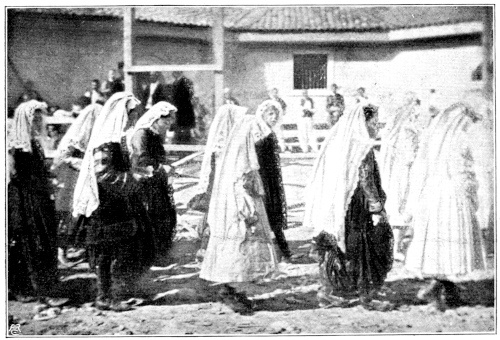
The Procession with an Armed Guard.
As I strolled through the narrow lanes of the Christian
quarter towards the Cathedral, and the gaily-dressed chattering
65women in groups hurried forward to get a place within, I was
struck with their neat and clean appearance. Their finery
was in no way dingy or dusty, and yet many of them had been
a whole week on a journey through perhaps the roughest
region in the whole East.
How different was the festà to that I had known in the
Italian towns!
About the Cathedral there is nothing unusually attractive—a
big bare edifice with high square campanile in modern
Italian style. It stands in the centre of an open space, surrounded
by great high, fortress-like walls, entered by a strong
gate with huge iron bars—significant that one day ere long
it will be held against the Turks. No Mohammedan ever
passes those gates. Even the military patrol lounge outside,
leaning on their rifles.
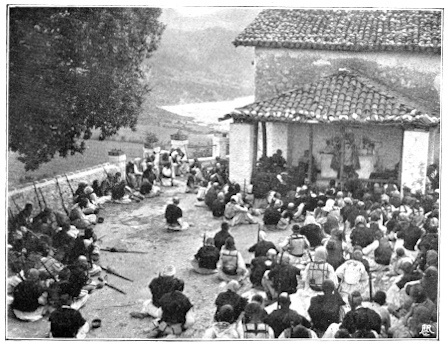
Within the enclosure I found a great crowd of peasant
women; females of the town, veiled with gauze so fine that
one could almost see their faces; Scutarine men in their best
jackets and baggy trousers; and the swaggering, white-capped
warriors from the mountains, men of the Miriditi,—so dreaded
by the Turks that they are allowed to carry their rifles with
them,—of the fierce Skreli, the Hoti, and the Kastrati.
The Skreli, with the Miriditi, are allowed to carry their
rifles because the Turks hold them in fear. The authorities
know full well that to arouse their ire would be to bring destruction
upon the whole vilayet, for they hold the communications,
and if the tribes revolted, as they no doubt would, then
the army of the Sultan would have a very hard task to suppress
the rebellion.
So while the Kastrati and the Hoti—also dwellers in the
Mountains of the Accursed—the Klementi, the Shiala of the
foot-hills, and the others are compelled to leave their rifles
at the entrance to the town, the Skreli and the Miriditi stalk
along in armed bands of twenty or thirty through the streets
to the church, grinning defiance at the Turks, who are supposed
by Europe to be their masters.
Under the trees around the Cathedral the wild, fierce men,
who would hold the traveller to ransom or shoot him with
66less compunction than they would kill a shepherd-dog, were
squatting in rings with their rifles before them, gossiping.
Every man wore a belt full of cartridges and a bandolier
across his shoulders—sometimes even two. War and religion
are strangely mixed in Skodra.
Into the dimly-lit Cathedral I managed to squeeze, and
there, kneeling on the stones and filling the whole place right
out into the grass enclosure, were men of all grades, from the
peaceful Scutarine merchant to the wild tribesman, and
women with their faces uncovered bowed towards the brilliantly
lit altar, where the thin-faced Italian priest mumbled the
prayers.
The sight was strangely impressive; the silence unbroken
save for the low voice of the priest and now and then the
clank of arms.
For two days in the year, to celebrate the Christian
festival, the brigand tribes from the mountains come down,
notwithstanding that upon the heads of many of those
sinister-looking men before me the Turks had long ago set
a price. I stood gazing at that kneeling throng, to whom,
though devout and humble in God’s house, murder was
deemed no wrong.
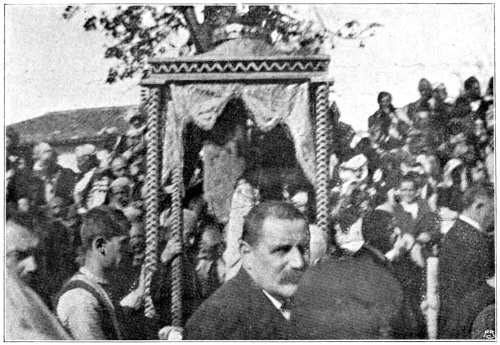
The service ended, a great procession was formed, and
headed by four fine stalwart men of the Skreli with loaded
rifles, made a slow tour from the altar outside and round
the enclosure, while an orchestra in a band-stand opposite
played selections. The sight was curious—those armed men
ready to protect their priests in case of sudden onslaught
by the Turks.
During the whole morning I took many photographs, and
in the afternoon, when I returned, I found the orchestra
playing operatic music, which was being listened to by the
tribesmen with marked attention. They are, I afterwards
found, devoted to music. The programme ranged from
selections from La Bohème and Carmen to the “Segovia”
valse and our old melodious friend, “The Honeysuckle and
the Bee.” The latter air quickly became popular among the
tribesmen, who picked it up and began at once to whistle it.
67Slowly fell the mystic twilight of the East. The glorious
afterglow had deepened into grey, and night was creeping
on quickly when fire balloons were sent up, and then gradually
the whole Cathedral became outlined in fairy lamps against
the steely sky, even to the utmost point of the high square
tower. Men and women gazed upward, and crossed themselves.
Later, while walking back with Palok, we encountered a
group of armed tribesmen talking excitedly, shaking their
fists, and apparently quarrelling. Palok joined the crowd,
and inquired what had happened. Then, turning to me, he
said—
“Oh, it is nothing, signore. The town of Kroia has
revolted. The Turks sent soldiers yesterday, but they were
Albanians, and would not fire on the people. To-day some
artillery arrived, and thirty people have been killed—mostly
women. A man has just ridden in with the news. It
is nothing. We are always fighting the Turks at Kroia.
There will probably be a massacre to-night.” And he deftly
rolled a cigarette as he spat in defiance of the hated Mussulman.
Later that night I was awakened from sleep by a shot
below, and, taking my revolver, went to the window. The
night was black, and I could discern nothing.
I heard men’s voices raised in the street below, and suddenly
saw the red flash of firearms and heard a second report.
Then all was quiet, except receding footsteps.
The shots disturbed nobody, or if they did, nobody
opened door or window. The town was asleep, and by the
distant sound of a tom-tom I knew that the hour was half-past
three; for the music was calling upon the Faithful to eat,
preparatory to the day’s fast.
What had happened? All was silent, therefore I closed
my window and slept again.
In the morning I was told that it was “nothing.” Two
men of the Shiala had been found dead outside.
Was it the blood-feud? I asked.
Palok only raised his shoulders and exhibited his palms.
“It was nothing, signore—really nothing.”
68
Vatt Marashi, chief of the Skreli tribe, invites me to become his guest—Our
start for the Accursed Mountains—Rok, our guide—Independence of
the Skreli—Brigandage and the bessa—A night under a rock—My
meeting with Vatt Marashi and his band—The Skreli welcome—How
they treat the Turks—Vatt’s admissions—I become the guest of brigands—A
chat in the moonlight.
While seated on the box in Salko’s dark little stall in
the bazaar he introduced his friend Rok to me.
A middle-aged tribesman in the regulation costume of
tight white woollen trousers heavily striped with black, black
bolero with deep woollen fringe, and a felt skullcap, once
white, but now not overclean, he squatted opposite me and
touched chin and brow in salute. His loaded rifle lay before
him on the ground.
He eyed me critically up and down, my pigskin gaiters
apparently receiving his admiration.
“Rok, here, is of the Skreli, a fearless fighter of the Turks
and one of my best friends,” Salko went on to explain. “I
have told him of your earnest desire to go and see our country;
that you are neither Austrian nor Italian, but English and
not a spy. Our friend is returning to-day, and has promised
to speak to Vatt Marashi, our chief, on your behalf.”
“Tell the honourable Englishman that if he comes to us
he must be prepared for a rough life. We live in the mountains,”
Rok said through the interpreter, laughing pleasantly
as he lit the cigarette he took from my case.
Coffee was brought, and we sealed our compact of friendliness.
69If Vatt Marashi, the renowned chieftain who so often held
travellers to ransom, and whose influence was so dreaded by
the Turks, consented to allow me to visit him, then Rok
would return, he promised, and be my guide.
For half an hour we chatted and smoked. Then the burly
mountaineer rose, slung his rifle over his shoulder, touched
chin and brow again, grasped my hand warmly, and stalked
out on his three days’ tramp to the wild region in the mountain
mists that was his home.
I waited on in Skodra, and, to my great delight, he one
morning reappeared with a message from his chief that, providing
I took only Palok, and had no escort, he would be
pleased to welcome me and show me all the hospitality in his
power. I need fear nothing, it was added. I was to be guest
of Vatt Marashi, chief of the Skreli. He had issued the order
to the tribe. Any who dared to insult or injure me should
pay for it with their life. Therefore I should be given safe-conduct,
and need not have a moment’s anxiety.
By this, Palok, who had been entirely opposed to the
attempt, became reassured, and soon after noon, with a mule
packed with my lightest baggage, we set our faces out across
the great rolling plain that lies between the town and the
high wall of blue distant mountains—the wildest corner of all
Europe. They are a series of fastnesses, in which any small
army would at once be massacred and where a large one
would starve.
We were a merry trio as we marched forward in the bright
autumn sunlight, but about a kilometre beyond the town the
road ended in a ford, where we crossed a wide shallow river,
and then straight across the plain and past several tumuli
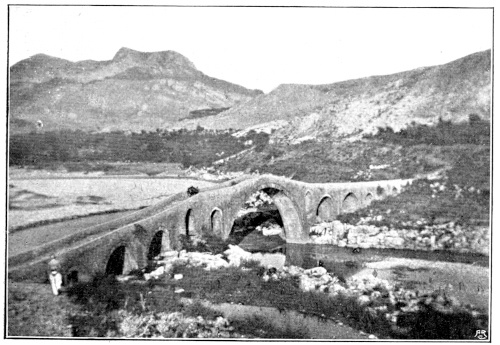
to where a defile showed in the mountains. The ancient
Bridge of Messi, built under the Venetian dominion, was
crossed, and then we had our first experience of the road in
Albania—a rough, narrow way gradually ascending, almost too
bad even for mules.
Nobody who has not visited Northern Albania can have any
idea of the wildness of those bare grey rocks, of the roughness
of the tracks, or the savagery of life there. Northern Albania
70is to-day just as it was under the Roman Empire. The might
of Rome has waned, the Servian has come and gone, the
Venetian has been swept away, and the Turk is now nominally
master. But the country has never, through all the centuries,
been annexed, and those wild tribes, descendants of the savage
people who inhabited those fastnesses before the days of
Greek dominion, have never been tamed. The Northern
Albanian is the last survivor of mediæval days. He has no
written language—indeed, his alphabet, with its many soft
and hard “ssh” sounds, has never yet been determined—therefore
he has no literature and no newspaper. Thin, wiry,
and muscular, he wears raw-hide slippers, in which he moves
with cat-like, stealthy tread—a habit survived from prehistoric
days—while his very dress is protective, rendering
him at a short distance difficult to discern, so like is he in
colour to the rocky background. He looks as though he had
just stepped down from a mediæval Florentine fresco, with
his head half-shaven, hair long at the back and cut square
across the shoulders.
He is entirely unchanged ever since the Turk found him,
except that of late he has adopted the breech-loading rifle
and a particularly heavy pattern of revolver. The black
furry bolero which he wears, without exception, is the sign of
mourning for his great prince, Skender Beg, who died in 1467,
after being at war with the Turks for over twenty years;
therefore with him fashions do not easily change, and “latest
novelties” in dress are unknown. Great are the changes that
have come over the world during the past thousand years
or so, but Northern Albania has remained unaffected by them,
and is still in a measure in the lowest depths of barbarism.
The Turk does not rule. The wild, inaccessible country is
under the various independent tribes, ruled by a chieftain
according to unwritten laws which have been handed down
orally from remote ages, and one of the fiercest and most
independent of these chiefs was Vatt Marashi, the man whose
guest I now was to be.
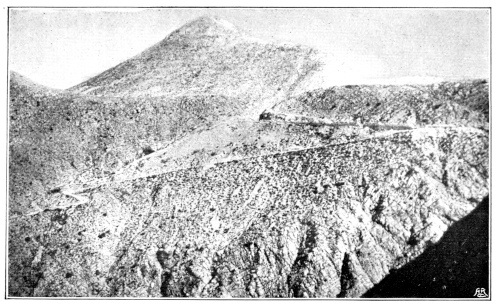
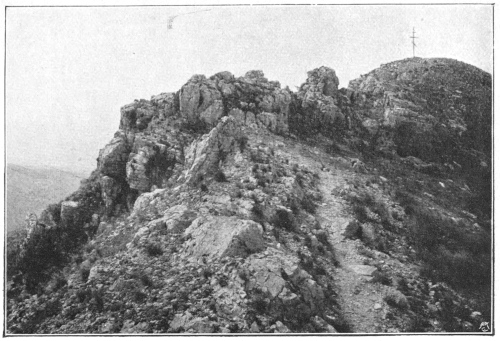
My road in Northern Albania.
Compared with the tribesmen, the Albanian Christian of
Skodra is a puny person. The mountaineers are a barbaric,
71lawless people, without any education save the schools established
by Italian and Austrian monks as part of the political
propaganda; for, truth to tell, both countries have recently
conceived the idea of turning Northern Albania to account
for their own purposes on the day of the downfall of the Turk.
Therefore both Powers are frantically exerting every effort to
curry favour with the people, a fact which is glaringly apparent
even to the rough, uneducated tribesmen themselves.
The Northern Albanian may be entirely uneducated and a
barbarian, but he is at heart a brigand, and is certainly no fool.
My friend Rok was particularly intelligent, and as we
toiled along over those rough, rock-strewn paths he gave me
much information about his country, and declared that both
Austria and Italy were equally their enemy.
After sundown we rested at a point high up above a dark
gloomy defile, where a stream wound away towards the plain,
and there ate some slices of cold mutton and black bread
with a glass of rakhi, our three rifles lying at hand in case of
sudden emergency.
I had noticed the queer, sinuous, almost uncanny way in
which Rok walked. His movements, at even pace whatever
might be the state of the path, were stealthy. Indeed, he
almost crept along, for his feet fell in silence, and with his
rifle ever ready, his keen black eyes were searching on every
side for the enemy which he appeared to expect to meet at
every turn.
Sometimes as he walked in front he would halt, and closely
scan a mass of tumbled rocks, as though he had suspicion of
a lurking enemy, then thoroughly satisfying himself, he would
go forward again without glancing back. He was certain
that no enemy was in his rear.
From his movements and natural caution I could plainly
see that we were traversing a country not altogether friendly,
and when, as we sat over our evening meal, I asked Palok,
his reply was—
“The Shiala are not on very friendly terms with the
Skreli just now. But it is nothing, signore—nothing.”
We went forward until darkness closed in, and then lay
72down to sleep under an overhanging rock almost on the face of
a sheer precipice, a place in which Rok told us he often stayed
on his way down to Skodra. He humorously called it his
han, or hotel.
To light a fire would be to attract hostile attention, and
the cold up there was intense. I tried to sleep, but was unable,
therefore I rose and sat outside in the bright, glorious moonlight
and kept watch, while Rok curled himself up like a dog
and snored soundly in chorus with Palok.
There, in the East, the full moon seems to shine with
greater brilliance than in Europe, and beneath its white rays
those bare, rugged mountains looked like a veritable fairyland.
Only the cry of a night-bird and the low music of the
stream far below broke the stillness of the Oriental night,
and as I sat there I reflected that I was the first Englishman
who had ever been the guest of the redoubtable chieftain,
Vatt Marashi, the man whom the Turks so hate—the man of
whom blood-curdling tales had been told me both in Montenegro
and in Skodra, and whose fame as a leader of a wild
band had not long before been proclaimed by the London
newspapers.
For hours I sat thinking, sometimes of my good fortune,
at others of my perilous position alone in the hands of such a
people. But I had heard that, notwithstanding their barbaric
customs, an Albanian’s word was his bond. Therefore
I reassured myself that I should not be the victim of treachery,
and reported to Constantinople as “missing.”
Slowly at last the moon paled, and I grew sleepy. That
terrible road had worn me out. Therefore I woke Palok to
mount guard, and flung myself down in his place and slept
till the sun, shining in my face, awakened me.
Through the whole day we went forward again, over a
path so bad that I often had to scramble with difficulty. I
tried to ride the mule, but it was out of the question, so I
walked and stumbled and was helped over the rough boulders
by my companions. The Skreli country was surely an unapproachable
region.
That night we slept again in the open, but in a spot less
73sheltered. Then forward again with the first grey of dawn
until, just before noon, Rok halted in the narrow track which
wound round the face of the bare grey mountain, and, drawing
his revolver, fired three times in the air.
The shots reverberated in a series of echoes. It was a
signal, and almost ere they had died away came three answering
shots from no great distance, and I was told that we were
now in the Skreli region, and there was nothing more to fear.
In Podgoritza, in Cettinje, in Skodra, and in Djakova I
had heard terrible stories of this fighting race, and of Vatt’s
fierce hatred of the Turks. Yet everyone had told me that,
the chief having invited me, I need have not a moment’s
apprehension of my personal safety.
So I went forward, reassured, to meet my host.
Half an hour later I came face to face with real brigands—brigands
who looked like an illustration out of a boy’s story-book—the
men who had so often held up travellers and compelled
the Turkish Government to pay heavy ransoms.
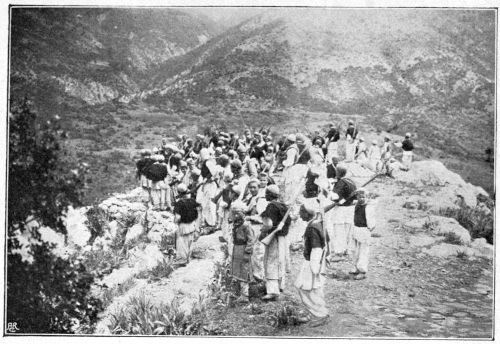
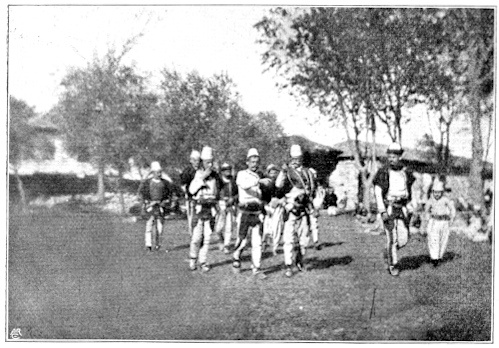
They were about twenty, certainly the fiercest and most
bloodthirsty gang I have ever set my eyes upon. Dressed
in the usual skin-tight white woollen trousers with broad
black bands running down the legs, a short white jacket, also
black-braided, the sleeveless woolly bolero of mourning, hide
shoes with uppers consisting of a network of string, and
small white skullcaps, each man carried in his belt a great
silver-mounted pistol of antique type and a silver-sheathed
curved knife, while around both shoulders were well-filled
bandoliers, and in the hand of each a rifle. Like Rok, the
heads of all were shaved, leaving a long tuft at the back in the
mediæval Florentine style.
With one accord they all raised their rifles aloft and shouted
me welcome, whereupon one man stepped forward—a big,
muscular fellow with handsome face and proud gait—the great
chief Vatt Marashi himself.
Attired very much as his followers, his dress was richer,
the jacket being ornamented with gold braid. The silver hilt
of his pistol was studded with coral and green stones, probably
emeralds, but he carried no rifle. Jauntily, and laughing
74merrily, he approached me and bent until his forehead touched
mine—the Skreli sign of welcome.
And all this in Europe in the twentieth century!
Was I dreaming? Was it real? I was the guest of actual
brigands, those men about whom I had read in story-books
ever since those long-ago days when the weekly Boys of
England formed my chief literature.
Vatt Marashi, holding my hand the while, addressed me.
What he said was interpreted into Italian by Palok as—
“You are welcome here to my country—very welcome.
And you are an Englishman, and have travelled so far to see
us! It is wonderful—wonderful! You live so far away—farther
than Constantinople, they say. Well, I cannot give
you much here or make you very comfortable—not so comfortable
as you have been down in Skodra. But I will do my
best. Come—let us eat.”
I returned his greeting, whereupon the whole crowd of us
walked along to a spot where a cauldron was standing upon
a wood fire, and out of it my host, myself, and Palok had
pieces of boiled chicken and rice, which had specially been
prepared for my coming.
The object of this meal, I afterwards learnt, was to cement
our friendship. The Albanian code of honour is astounding,
even to our Western ideas. A word once given by those
savage tribes is never broken, and if the stranger eats the
food of the Skreli, even though he may be an enemy, his
person is sacred for twenty-four hours afterwards. While
the food remains undigested he may not be injured or captured.
And so while I ate with this wild chieftain, his band squatted
round, apparently discussing me.
It was probably the first time they had seen an Englishman,
Palok explained, and they were at first inclined to regard
me as a secret agent of the Government, until later that
afternoon their chief assured them to the contrary.
Then that wild horde became, to a man, my devoted
servants.
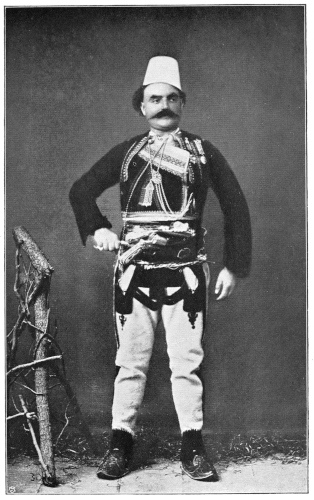
Vatt Marashi, Chief of the Skreli tribe.
Vatt, the Baryaktar (from the Turkish bairakdar, or
standard-bearer), unlike most Albanians, is fair-haired, above
75the average height, extremely muscular, with a constant
smile of hearty good-fellowship. His eyes are fierce and
barbaric; nevertheless he is pleasant of countenance, and I
certainly found him, from first to last, a staunch and excellent
friend.
Lord of those wild, rugged mountains, his word was obeyed
with a precision that amazed me. A striking figure he presented
as, with me, he marched at head of his bodyguard,
his chest thrown out proudly, his head up, his keen eyes ever
searching forward like every Albanian of the hills, one of the
wildest rulers of wildest Europe.
On every side, as we went forward to the tiny cluster of
little houses that formed the village where I was to be quartered,
were bare grey limestone rocks without a single blade
of grass, a desolate mountain region into which no foreigner
had penetrated save when captured and held to ransom.
Through centuries have that same tribe ruled that barren
land, and no conqueror of Albania has ever succeeded in
ousting them.
“You have, no doubt, heard down in Skodra terrible
things about me,” he said, laughing, as, later on, we walked
together. He had rolled me a cigarette and given it to me
unstuck. “I expect you feared to come and see me—eh?”
I admitted that I had heard things of him not altogether
satisfactory.
“Ah!” he laughed, “that is because the Turks do not
like us. Whenever a Turkish soldier puts his foot a kilometre
outside Skodra, we either take away his Mauser and send
him back, or else—well, we shoot him first.”
“But they say that your men capture travellers.”
“And why not?” he asked. “We are Christians. Is it
not permissible for us to do everything to annoy those devils
of Turks? But,” he added, “if they say that I treat my
prisoners badly, they lie. Why, they get plenty of food and
are well treated. I give them some shooting if they like—and
they generally enjoy themselves. But I know. I too
have been told that the Turks say I once cut off a man’s ears.
Bah! all Turks are liars.”
76“Then it is only to annoy the Turks that your men commit
acts of brigandage?”
“Of course. The ransom is useful to us, I admit, but we
live by our flocks, and our wants are few. We are not like
the people down in Skodra. We are better, I hope.”
“And do you always watch the roads on the other side of
the mountains yonder?”
“Always. Our men are there now, all along the route
between Ipek and Prisrend. Who knows who may not pass
along—a rich Pasha perhaps.” And his face relaxed into a
humorous smile at thought of such a prize.
And then I marched along, my rifle over my shoulder—a
brigand for the nonce like my host.
Surely it was one of the quaintest experiences of a varied
and adventurous life.
The tiny house in which I was given quarters had an
earthen floor and consisted of two rooms, the ceilings and
walls of which were blackened by the smoke of years. The
owner was an old man with his wife and daughter, the latter
being a pretty young woman of about nineteen, dressed in
the gorgeous gala costume with golden sequins, the same that
I had seen down at Skodra during the festà. She had on
her best in my honour, I suppose, and her husband, a good-looking
young fellow five years her senior, seemed justly proud
of her. His name was Lûk. I named him Lucky, but he did
not appreciate the wit. He was, I found, one of the chief’s
bodyguard who had come to greet me at the confines of the
Skreli territory, and proved a most sociable fellow, ever ready
to render me a service.
“These good people will look after you and make you as
comfortable as they can,” my host said, when he had introduced
me to them. “I have to go along the ravine, but will
return in time to eat with you this evening. You like good
cigarettes? I will send you some.” And he shook my hands,
and turning, went out, stalking again at the head of his
ferocious-looking band.
The bedroom, occupied in common by the family, was
given over to me. My bed on the floor was a big sack filled
77with dried maize-leaves. It was not inviting, but Palok,
having examined it critically, declared it to be “cosi cosi,”
and having slept out a couple of nights, I was compelled to
accept his verdict.
The girl in the sequins boiled us coffee over the fire,
and with her father and husband I sat outside the house in
the golden sunset, smoking and chatting. Both were full of
curiosity. England was to them a mere legendary land, and
they had never heard of London. When I mentioned it they
declared that it could not possibly be so large as Skodra.
I told them of Cettinje and other towns in Montenegro I
had visited, but they held all Montenegro in contempt, for
were they not always raiding over the frontier? Lûk declared
that he had walked in Podgoritza openly, and in the marketplace
shot a man with whom he was in gyak, or blood-feud.
“I walked out again, and no one dared to stop me,” he
added, with pride. “It would have been worse for them if
they had.”
“But the Montenegrins are no cowards,” I ventured to
remark.
“Certainly not. They are very brave, but they dare not
follow us here. They always get lost in the mountains, and
once they lose their way they lose their lives,” he added, with
a grin. “Our men killed four over yonder mountain a few
days ago.”
“The blood-feud?”
“Of course. It arose out of that.”
From the half-dozen other poor mountain homes came
forth men, women, and children, who grouped around us,
watching in curiosity. According to Palok, rumour had at
first gone round that I was a prisoner, therefore they had
refrained from coming forth to see me. Now, however, they
knew the truth, they welcomed me as their guest.
Just before it grew dark the Baryaktar returned, followed
by the bodyguard, without whom he never seemed to move.
They did his bidding, executed his orders, and were ever at
his beck and call—the picked men of the tribe.
While Vatt squatted on the floor I sat upon my suit-case,
78and together we ate a kind of mutton stew, rather rich, but
not unpalatable. There was an absence of table cutlery,
therefore we ate with the aid of our pocket-knives and fingers.
Now and then the old woman would pick a tit-bit out of the
pot and hand it to me with her fingers. I was compelled to
accept the well-meant hospitality, even though her hands
were not particularly clean.
The hot dish was tasty, but I could not manage the
sour black bread, for it was mouldy, and gritty into the
bargain.
It was a weird picture, the interior of that lowly hut, lit
by the dim oil lamp of almost the same type as used by the
early Greeks. The uncertain firelight glinted upon the gold
of the dresses of the chieftain and of Lûk’s pretty wife, and
threw, now and then, into relief those strangely unfamiliar
faces, the barbarians of an age bygone and forgotten. The
very language they were speaking was, as an unwritten one,
utterly incomprehensible and unintelligible to any but the
born Albanian.
I rubbed my eyes—on account of the smoke—wondering
if it were really only a very few weeks ago that I had driven
a motor from London down to Windsor, that I had seen
The Catch of the Season, and trod the red carpet of the
Savoy afterwards.
And to-night I was actually having supper with real live
brigands of the mountains!
Lûk produced a bottle of rakhi, and Vatt Marashi lifted his
tin mug to me. I took a little of the potent spirit in the
bottom of my own drinking-cup, and tossed it off. It was not
half as bad as I expected.
Then the chief took me outside the house, and in the
clear moonlight we sat down with Palok upon a big rock
to chat.
He rolled me a cigarette of most excellent Turkish tobacco—of
his own growing, he told me—lit one himself, and we
sipped the coffee brought to us by Lûk’s wife.
The scene spread before us was superb—a magnificent
panorama of mountains, some tipped with snow, white and
79brilliant under the moonbeams. Below us, the valley was a
great chasm of unfathomable blackness.
With my strange host I chatted upon many subjects, and
found him far more intelligent than I had believed. Keen-witted,
quick of perception, just in his judgment, and yet
filled with an intense hatred of both Turk and Montenegrin
alike, he explained to me many things of great interest.
He told me of the glorious traditions of his sturdy race
and of the prince of the Skender Beg family, who, they hoped,
would one day come back to rule them.
“We, the chieftains, hold authority from him,” he declared.
“Oh yes, he will come some day. Of that we are
quite certain.”
“Englishmen have never dared to come here, have they?”
I asked, with some curiosity.
“Only once—a year or two ago. I discovered three of
your compatriots poking about in the rocks and chipping
little pieces off. I had them captured, and brought to me.
At first I thought I would hold them to ransom and make
the Turks pay. But they were evidently poor fellows, for
their clothes were worn almost to rags, and they had very
little money. So I gave them their money back and sent
them with an escort down to the plain, forbidding them to
enter our country again. I wonder why they came, and why
they were chipping the rocks?”
I told him that they were evidently mining prospectors;
that Englishmen travelled all over the world to discover
minerals; and that a mine in his country would be a source of
great wealth. But my explanation did not appeal to him.
He could not see why they were chipping off those pieces of
rock. It was not flint, otherwise they might have wanted
them for gun-locks. No, the trio were distinctly suspicious
characters, and he was glad that he had expelled them.
“Have you ever held Englishmen to ransom?” I inquired.
“One. Five years ago. He came here shooting—after
bears, I think. He was evidently a great gentleman, for his
guns were beautiful. The Turks paid promptly.”
“Because he was an Englishman—eh?”
80“Most probably,” he laughed. “Are they afraid of you
English as they are afraid of us?”
And soon afterwards he bade me good-night, and left me to
throw myself down upon my mattress of leaves and listen to
the snoring of Palok and the assembled family in the adjoining
room.
I had thought Skodra barbaric, but here I was in an utterly
unknown corner of the earth, in an absolutely savage land—a
land that knows no law and acknowledges no master; a land
that is the same to-day as it was in the days of Diocletian and
of Constantine the Great—Albania the Unchanging.
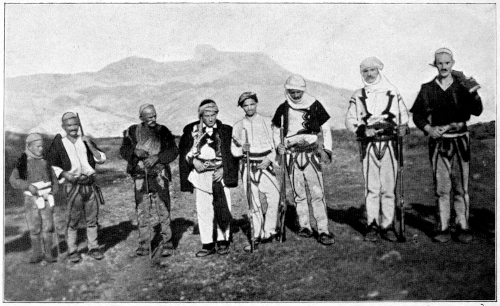
Among the Skreli: Lûk (first on the right) and his friends.
81
The Skreli a lawless tribe—No man’s life safe unless the chief gives his word—Vatt
prophesies a rising against the Turks—Our walks and talks—Our
meeting with our neighbours the Kastrati, and with Dêd Presci
their chief—A woman who avenged her husband’s death—The significant
story of Kol—Manners and customs of the wild tribes—Farewell to my
good friend Dêd—An incident a fortnight later.
The bright sunny days I remained with the Skreli were
full of interest.
On every hand, from Vatt himself down to the humblest
of his tribe, I received only the greatest kindness and hospitality.
If I went out in Vatt’s absence, a dozen armed banditti
followed me, mounting guard over me; for, as they told me,
one never knew what little “accident” might happen. With
the tribes of the Shiala and the Pulati they were not just then
on particularly friendly terms, and there had been a series
of sharp encounters a week ago. Having given their word to
be responsible for my safety, it behoved them to take precautions.
I walked with Vatt Marashi every day, making long excursions
through the mountains by the secret paths known only
to the tribe.
Would I care for some sport? If I cared to come next
year and bring a friend, or even two, he would let me shoot.
My friends would always be welcome, and I could assure
them of their safety. There was plenty of game, and lots of
bears, lynx, and wolves. I should tell my friends in England,
and come back for a month or two. I promised that I would,
82for in our walks I saw quantities of game. My friend shot
several eagles, but I was not successful in bagging one.
As he was stalking at my side one afternoon, his argus
eyes everywhere and a cigarette in his mouth, I returned to
the subject of the Turks and their “occupation” of Albania.
“Bah!” he exclaimed, with a sneering curl of the lip.
“They dare not come here. We, with the Kastrati, the
Hoti, the Klementi, the Pulati, and the Shiala, are masters here.
We have held the land always, and shall hold it still. We
acknowledge no law except our own, and pay no taxes to
anybody. The Turks, when they conquered Northern Albania,
thought they could crush us. They tried to, but soon discovered
their mistake. So ever since that they have left us
severely alone, and retired into Skodra. They know full well
that when we unite with our brothers, the Miriditi, in the south,
then Skodra will be at our mercy.”
“And if the Sultan sends his soldiers here?”
“Well, and what then?” he asked, with a flash in his
eyes. “Do you think we fear them? Many of them are
Albanians, and would not fight us. Again, you have experienced
the road here. What would an army do here? We should
pick them off as fast as they came up. There are forty
thousand of us Skreli alone, remember, without all the other
tribes. If a Turkish army came in here, depend upon it, it
would never get out again.”
“And is there likely to be a rising against the Turks?”
I inquired, much interested.
“Why, of course. The revolt will come one day ere long—when
we are ready. We can, however, afford to wait at
present. Turkey will soon have her hands full with Bulgaria
and Macedonia, and then—well, we shall help Bulgaria, and
in a week there won’t be a Turk in Skodra.”
“You mean there will be a massacre?”
For answer he shrugged his shoulders.
“And after the revolution?”
“After we have driven out the Turk we hope to obtain
our independence under either France or some other far-off
country—England, for instance. Austria and Italy are,
83through their priests, conducting a strenuous propaganda all
through Northern Albania—so strenuous as to be ridiculous.
They foolishly think that we are like children, and that we
do not discern their ulterior motives. Oh, it is very amusing,
I can tell you! We accept their schools and their money, and
put our fingers in our cheeks, for we don’t intend to have
anything to do with either Power when the rising comes. We
will help Servia or Bulgaria, or even Montenegro, to drive the
Turk from Albania, but we will not lift a finger for either
Italy or Austria. The secret agents of both Powers are always
endeavouring to penetrate here among us and carry on their
propaganda. But we do not want them, and will not have
them. More than one has of late—disappeared.”
“Shot?”
He smiled in the affirmative.
“It is true,” he said, “that we kill—and kill often—for
the vendetta—for espionage—and in the frontier disputes with
Montenegro. Alas! we have here but little of the bessa
(truce). But you must remember we are not like you English.
The people have no government, except myself. I make the
law, and they obey. We are Christians. We believe in God
and in the Virgin, and soon we will drive the Mohammedan
fanatics from our land.”
He spoke with an air of conviction, and, judging from
my observations while I was guest of his tribe, I believe
that when war between Turkey and Bulgaria comes—as it
must come one day before long—these wild people will sweep
down upon the Turks and play frightful havoc with them.
Skodra is often alarmed, and the people retire into their
houses and bar their doors because the tribes are believed
to be coming. One day they will come, and when they do
those open drains in the streets will run with blood. The
sign of the cross upon the Christian houses is in preparation
for the day of vengeance.
My walks with Vatt Marashi, though often very fatiguing,
were full of interest. He was never tired of making inquiries
regarding England and England’s power. Did the Sultan
recognise England as an independent state, and did we send
84an Ambassador to the Sublime Porte, like Austria and Germany?
He knew that England once had a Vice-Consul in Skodra—but
he committed suicide, it was said, poor fellow.
Nothing very extraordinary, I remarked inwardly.
Doomed to live in such an out-of-the-world place as Skodra
would be sufficient to drive any European to take his life. Of
brigandage, Vatt Marashi told me that they held up but
few travellers nowadays, and only, indeed, when there was
necessity. Yet a year or two ago they held the worst reputation
of any of the tribes.
One day while we were climbing the rocks—for Vatt and
his bodyguard thought that they might get a shot at a bear—there
was a sudden alarm. The hawk’s eyes of my companions
espied strangers, and a sudden halt was called. In a moment
we were all under cover of the rocks. Every man unslung his
rifle, and Vatt himself, with knit brows, drew his big pistol with
silver butt, while I crouched behind a rock with my rifle ready,
expecting something to happen.
Nothing, however, did happen, for a few moments later
there were shouts from the opposite side of the defile, answered
by my companions, who came forth and waved their rifles over
their heads as sign of greeting.
Vatt, replacing his pistol in his belt, spoke in a loud, sharp
voice, and received an answer. Those mountaineers can
throw their voices long distances, and be heard distinctly, a
fact I often noticed.
Then Palok told me that the strangers were of the neighbouring
tribe, the Kastrati, and that their chief, Dêd Presci,
had come to pay Vatt a visit.
For me this was fortunate, for it gave me an opportunity of
meeting the other ruler of Northern Albania; for next to the
Skreli the Kastrati are most powerful in the Accursed
Mountains.
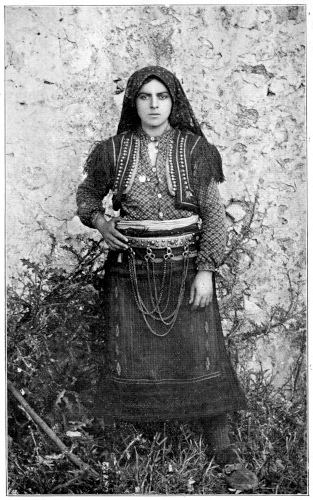
Mrika, the woman who carried on the blood-feud.
Half an hour later we met our visitors. Dressed very
similarly to my companions, they wore white tassel-less fezes
instead of the little white skullcap, and the black stripes
down their trousers were somewhat different. The two chieftains
touched foreheads, and I was afterwards introduced.
85Dêd Presci, a round-faced, pleasant man, rather stout and
burly, his hair cut in mediæval style, gripped me warmly by
the hand, saying—
“I heard that you were in Skodra during the festà. Some
of my men told me there was an Englishman. But I never
expected to meet you. Perhaps you are coming across to see
me—eh? If so, you are quite welcome.”
“I may come next year to shoot, with a couple of English
friends. May I visit you then?”
“Most certainly. You have only to warn me of your
coming through one of our men down in Skodra, and I will
give you safe escort,” was his reply. “If you are fond of
sport, you will find plenty with us. Only bring a tent, and
perhaps some provisions; for our food is not what you foreigners
are used to.”
“Then I shall return one day before long,” I promised.
“Do. You need fear nothing, you know. We never
betray a friend.”
“Or forgive an enemy,” added Vatt, laughing.
“Especially if he be a Turk,” I remarked; whereat both
chiefs laughed in chorus.
That evening I ate with the pair in a small lonely house
on the mountainside, and the moon had long risen before
Palok and I returned to Lûk’s.
My photographic camera was, from the first, regarded with
a good deal of suspicion, and it was with very great difficulty
I persuaded anybody to have his picture taken. Many
surreptitious snap-shots I took with a small “Brownie”
camera, for unfortunately I had run out of films for my own
larger Kodak. But I was able to secure some photographs,
which now appear in this volume.
Early one morning, soon after sunrise, I was walking with
Lûk and Palok when a young woman passed us.
“That is Mrika Kol Marashut,” Lûk remarked.
“And who is she?” I asked.
“Mrika—the woman who carried on the blood-feud,” was
his answer. “Two years ago she was the most beautiful girl
of our tribe, and had a dozen men ready to marry her. She
86married Lez, a smart young man from the Pulati side, and one
of the Baryaktar’s bodyguard, like myself. A month after
their marriage Lez was treacherously killed by his brother,
who lived down by the White Drin, and was violently in love
with her. When she received the news she became half
demented by grief. But, by slow degrees, she formed her
plans for the blood-feud, and having no male relatives, resolved
to take it on herself. She therefore left us and was absent
nearly a year, during which time she persistently followed her
brother-in-law first to Ochrida, in Macedonia, then to Skopia,
Prisrend, and many other places, always awaiting her opportunity
to strike the blow. This came one afternoon when her
husband’s assassin was walking in the main street in Skodra,
and she took Lez’s pistol from her belt and blew his face away.
It was valiant of a woman—was it not? But not only that,”
he went on. “Having killed the murderer, she went straight to
his parents’ house, three days’ journey, and shot them both
dead. Since then she has been back with us, for poor Lez’s
death has been avenged. I was sorry he died,” he added
regretfully, “for he was one of my dearest friends.”
Murder is hardly a crime in Albania, for life is cheap—very
cheap. An enemy or a stranger is shot like a dog, and
left at the roadside.
Palok told me of an incident which truly illustrates the
utter disregard the Albanian has for other people’s lives. He
was once with a man of the Hoti—on the Montenegrin frontier—who
had just obtained a new rifle, probably from a murdered
Turkish soldier. While he was inspecting it a man passed close
by, a stranger, whereupon the man with the new gun raised it
to his shoulder, took aim, and fired. The stranger fell dead.
Palok remonstrated, but his companion merely said that he
was testing his gun’s accuracy. Was it not better, he asked,
to test it that way, instead of waiting till face to face with an
enemy?
The assassin is never punished, except by those who take
up the blood-feud. If the murder takes place in a town the
guilty one escapes to the mountains, or gets away into Macedonia,
or into Servia, where he earns his living by sawing
87firewood. Every few years the Sultan issues an irade “for
the pacification of the blood,” as it is put, and the murderer
then returns. He pays a small tax to the Turkish Government,
after which he cannot be arrested; and if he pays about three
hundred crowns to the relatives of his victim, the blood-feud
is at an end.
This, of course, does not apply to the mountain tribes.
They care not a jot for the Sultan or for his irades. There is
no law—save that of the blood-feud, the vendetta falling upon
the murderer and upon his next male relative. Many were
the curious facts regarding the blood-feud and the Albanian
laws of hospitality told to me.
A case in point was that of a young man named Kol, a
friend of Lûk’s, a tall, wiry youth, of somewhat sinister expression—a
typical bandit out of a book-illustration.
I was talking to Lûk about the hospitality extended by
the various tribes to each other when Kol passed, and he
beckoned him, saying—
“He has just had a curious experience in the Klementi
country. Let him relate it to you.”
So at Palok’s invitation the young fellow accepted one of
my cigarettes, placed his rifle against the wall, and flung himself
down upon a small boulder near us.
He blew a cloud of smoke from his lips, stroked his knees
with his hands, and looked at me with considerable curiosity,
wondering why I should want to know his story.
“The stranger is interested in your adventures with the
Klementi. Tell him all about them.”
“Bah!” he said, with a slight shrug of the shoulders. “It
was nothing—mere chance—luck, if you like to call it so.
There is nothing to tell.”
“But what there is interests the Englishman. He is the
Baryaktar’s guest, remember,” Lûk remarked.
“Well,” said the young man reluctantly, “I was in
blood-feud with a man of the Klementi, and went over there
to kill him. I laid in wait one evening, and as he drove home
his sheep I shot him from behind a rock. He had killed my
father, therefore I had a just right to avenge his blood. My
88shot, however, aroused the whole valley, and I knew that
I, the only stranger, would be suspected and killed. Therefore
I sped away down the valley in the darkness till I reached
a poor little house. An old woman was there, and I craved
food and shelter for the night. She gave me food at once—for,
like ourselves, the Klementi never send a stranger empty away.
I was hungry, for I had crossed into the Klementi region in
secret, and dared not seek food lest my presence became known
to the man I intended to kill.
“Scarcely had I eaten the meat the old woman had
given me when there came the sound of voices outside,
and to my horror I saw four men carrying the body of my
victim.
“‘See!’ they cried to the woman who was befriending
me. ‘One of the Skreli has killed your son!’
“Then I knew that it was the murdered man’s mother who
had given me shelter. A moment later the men, among whom
was the elder brother of the victim, discovered me.
“‘See!’ they cried. ‘There is your son’s murderer.
We will kill him!’
“I stood with my back to the wall, knowing well that
my last moment had come. The dead man’s brother raised his
rifle while I drew my pistol, prepared at least to fire once more
before I died. I was caught like a rat in a trap!
“The old woman, however, seeing my position and my
helplessness, cried—
“‘No. Though he has killed your brother, you may not
touch him. He is beneath our roof; he has eaten our bread,
and our protection must remain over him till to-morrow’s
sunset. Remember, my son. It is our law.’
“The man dropped his rifle, and his friends drew back at
the old woman’s reproof.
“‘Go!’ she said to me, after glancing at her son’s body.
‘You have eaten our bread, and therefore you cannot be
harmed.’
“‘Yes, go,’ added my victim’s brother. ‘Till to-morrow’s
sundown I will not follow. But after that, I shall track you
down, and, before Heaven, I will kill you.’
89“Need I say that I took up my rifle, and leaving the house
travelled quickly all night and all next day, until I returned
here? But,” added Kol, with a slight sigh, “we shall meet one
day—and he will most certainly kill me.”
Is there any other country in the world where such a code
of honour exists? I am inclined to think not.
Had I been in the midst of a highly civilised people—a
foreigner wandering in the wilds of Yorkshire, for example—I
certainly should never have received the many charming
kindnesses that I did at the hands of those rough, uncivilised
tribes. Climbing like cats up the mountainsides as they did,
I was often compelled to lag behind, being unused to such
walking. But, laughing merrily, those armed banditti would
take me by the arms and help me up the steeper places; they
would roll cigarettes for me, carry my rifle when I grew fagged,
and fetch and carry for me like children.
My neat Smith-Wesson hammerless revolver was constantly
admired, as being a much more handy and serviceable weapon
than their own big pistols—Austrian-made revolvers fitted
to antique silver butts that had once done service to flintlocks.
My Browning repeating revolver, with its magazine
holding eight cartridges, was declared a marvel of ingenuity,
and on many occasions Vatt and his men amused themselves
by firing with it at targets.
Once he remarked, with a grim smile, that it would be a
handy weapon against the Turks. Where could he get one?
Was it costly?
And when I promised to send him one through our mutual
friend in the bazaar down in Skodra, as souvenir of my visit,
his joy knew no bounds.
A month later I fulfilled my promise, sending it across
from Sofia, and have since received an acknowledgment of
its safe receipt.
I wonder whether he has yet used it against the hated
Turk? Whether or not, he no doubt struts about with it in
his belt, a greater chief than all the others, because he possesses
the very latest and deadliest of weapons.
When one evening I told my host that I had still a long
90way to go—through Bosnia, Herzegovina, Servia, Bulgaria,
Roumania, and Macedonia—and that I must bid him farewell,
his face fell. He seemed to genuinely regret.
“But you will return soon,” he urged. “You will redeem
your promise, and bring your friends to shoot. Bring that
friend you told me about who shoots tigers in India. I want
to see what sort of shot he is. And the friend who shoots
partridges and pheasants.”
I promised that I would go back to him before long.
“Remember, there will be no danger—none. Tell your
friends that Vatt invites them, and that they are free to go
anywhere—anywhere,” he said, waving his hand over the
wild panorama of mountain and valley that is his indisputable
domain.
Next day I rose, packed my small belongings, and with
a little present to Lûk and to his pretty wife prepared to
leave, when, judge my amazement to find Vatt and his bodyguard
outside, and to hear that the chief had decided to
accompany me right down to Skodra!
This indeed he did, and when we arrived in the town held
by the Turks he strutted down the main street with me,
apparently proud of his guest, and in open defiance of the
scowling ragged soldiers in dirty red fezes.
Though a deadly enemy of the Turks, he openly defied
them. As we walked along the streets there came close behind
us twenty of his faithful followers, armed to the teeth and
carrying their rifles ready loaded in case of trouble.
But there was no trouble. The Turks of Skodra are wise
enough to let the Skreli severely alone.
Trouble will, however, come one day before long, and then
alas for the subjects of the Sultan. The Albanians will avenge
the blood of the Christians now spilt daily in Macedonia, and
the Turk will be driven back southward—or at least what is
left of him.
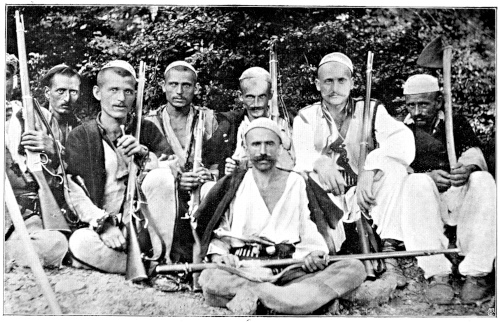
My Body-guard in Northern Albania.
I parted from Vatt at the door of my so-called albergo.
He took a glass of rakhi with me, and afterwards, with a hearty
hand-grip, he told me not to forget my promise to return.
Then he left me, stalking at the head of his armed band, who
91one and all wished me bon voyage, and he went down the
street on his return to his mountain home.
But the irony of Fate followed. A fortnight later I found
myself riding with a strong military escort on the other side
of the mountains, where I had been so hospitably entertained—along
the frontier of the Skreli country.
It was growing dusk, and we were passing through a deep
ravine, our horses stumbling at every step, when of a sudden
the crack of a rifle startled us.
Next instant a dozen rifles flashed fire in the deep shadows
to our left. The Skreli outposts were sniping at us!
In a moment we had all dismounted and sought cover, and
for fully ten minutes returned their fire vigorously, while
the officer of the escort kept up a volley of imprecations on
the heads of my late hosts, who were, of course, in ignorance
that they were firing upon “the Englishman.” We were too
far off each other to do much harm, therefore we simply blazed
away. I was crouched behind a rock with the muzzle of my
rifle poked through a convenient crack, and fired towards the
spot where the flashes showed.
A good deal of powder and bad language were expended,
until at last our friends on the other side of the valley,
apparently thinking we were too far away, ceased firing, and
we of course did the same.
It was a mutual truce. For ten minutes longer we waited
in order to see what would happen. Then, leading our horses,
we crept carefully along on our way northward, out of the
range of our friends’ guns.
Those moments were exciting, however, while they lasted,
yet they were not without their grim humour.