At a period when everybody travels, and the
yearly number of English-speaking visitors
in Switzerland is counted by the hundred thousand,
the writer who presumes to offer the long-suffering
public a book of Swiss impressions
would seem to be courting the yawn reserved
for the Nth repetition of the Utterly Familiar.
But the discoverer of a new country still has,
I believe, some privileges. It might even be
considered selfish of one who had found the
way back to Arcadia to keep the sailing directions
secret. And though there are countless
tourists who know the Swiss hotels and mountain
railroads, numerous villa people well versed
in the tennis and golf facilities of Montreux or
Lucerne, and a goodly company of Alpinists
who can tell you all about guides and ropes and
the ascent of the Matterhorn, there never was
anybody who got out of a Swiss summer precisely
what we did, or who, in fact, knows our
own particular private Switzerland at all.
In the beginning, there were but four—no,
five—of us,—Belle Soeur and my two Babes
and I and our good French Suzanne, who, besides
looking out for the Younger Babe, performed
various useful functions about the
house. After some six weeks Frater and his
college chum, Antonio, dropped in on us from
their commencement across the sea, and a few
days later the Mother.
Now the Husband-and-Father, who is also
the brother of Belle Soeur, and incidentally a
naval officer, had been ordered from the Mediterranean,
where he had been cruising, to the
Philippines, which are not so nice, especially
for Babes, particularly in summer. So, instead
of following him when we gave up our little
villa on the hills above Nice the first of June,
we moved into Switzerland. None of us had
ever been there before except the Chronicler
and the Mother, who had spent the usual sort
of summer there when the Chronicler was a
small child. We knew we wanted to be high
enough for bracing air, as far as possible from
tourist centers and among the really and truly
great and lofty mountains. So we went to
Interlaken for a start and hunted around among
the neighboring mountain villages till we found
what we were after. And on the tenth day we
moved into the Châlet Edelweiss, which lies
about a mile and a half from the Grindelwald
station on the road to the Upper Glacier, and
started housekeeping.
It did not seem very propitious that first
day. It was raining dismally when we got off
the train; the roads were full of mud, and
the clouds had rolled down over the mountains,
so that nothing could be seen but the big
brick Bear Hotel and the ugly village street
lined with shops and restaurants. I tried to
remember how beautiful it had been the day
I was in Grindelwald house-hunting, and the
others tried to act as if they believed what I
was telling them about it, but I knew they
didn’t, and they knew I knew they didn’t.
When we got to the house, it, too, was depressing.
On the bright sunshiny day when I had
seen it before, it had looked primitive enough,
but now it seemed aggressively barren and comfortless.
Was it possible that we could live in
this barn for four months? I could see the
effort the family were making to act as if they
liked it—all but the Younger Babe, who made
no effort at all, but got frankly quivery about
the lower lip and begged to be taken back to
the Villetta Valentine at Nice or even to the
hotel in Interlaken. “I don’t like this house!”
he said. “It’s an ugly house. It’s not a happy
little home. It’s ugly. It hasn’t got any
‘fings’ in it. It hasn’t even got any paper on
the wall!”
Now, this was quite true. Walls, ceilings
and floors were all of the same, well-scrubbed,
unpainted pine boards, and “fings” were limited
to strictly essential furniture of the plainest
type. And it’s wonderful how little is
strictly essential when you get down to it. But
at the age of three material accessories are apt
to assume an exaggerated importance. Every
infant is by nature a snob till the tendency is
reasoned or spanked out of him.
With wholly artificial buoyancy, we wandered
over the house, apportioning beds and
rooms and hunting for something to cheer up
the Babe. We found it to a certain extent in
what he dubbed the two “Charmantes bêtes”
which stood in the dining-room. They were
stuffed chamois, and all summer we intended asking
if the Herr Secundärlehrer had shot them
himself, but somehow we got away without
settling the question. A wreath awarded to
him as first prize at a Schützenfest, which hung
framed on the wall, made it seem quite likely
that he did shoot them. These two bêtes
formed, with a melodion, a narrow deal table
and six chairs, the furniture of the dining-room.
The rooms had only been differentiated into
dining-room, sitting-room and bedrooms for
our benefit. The furniture had all been jumbled
up when I saw the house before, and every
room except the kitchen had had one or more
beds in it.
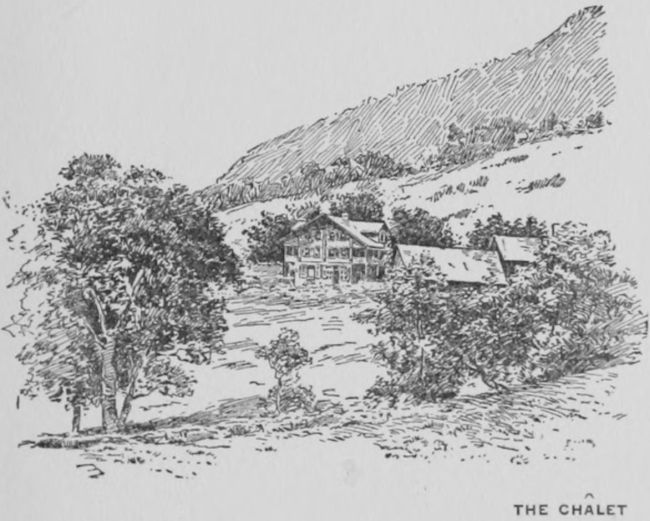
I wonder if I can make you see the Châlet
Edelweiss? It is the regulation Oberland
châlet of the better type,—exactly like the
tooth-pick boxes if you don’t know it otherwise.
The basement is of whitewashed concrete and
contains a small grocery store kept by the Frau
Secundärlehrer when she isn’t teaching school
or farming, and which she said she was sure
would not annoy us because it was so very
small and hardly anybody ever came there to
buy anything. There isn’t any basement at
the back of the house because the sloping hillside
brings the ground to the level of the
kitchen and dining-room windows. Our part
of the châlet consists of two stories of unpainted
wood, surmounted by a big red roof.
The shutters are painted bright green. At
both ends of the house are broad two-storied
balconies. The only staircases are on the balconies.
There are moments when this is inconvenient.
Above the second-story windows
on the front of the house runs a legend in large
black Gothic letters, saying that the Secundärlehrer
and his wife caused this house to be built
by such and such a master carpenter. Some of
the houses in the village have verses or mottoes
painted on them, and we always regretted a
little that ours did not. It was rather nice to
see the wife’s name associated with the husband’s
in this matter. Doubtless her dowry
had helped build the house, certainly her industry
was helping to maintain it. But it was
rather decent of him to recognize the fact.
The châlet has been built only two years, so
its timbers have not acquired the rich sepia
and burnt-Sienna tones which make the old
ones such a joy to the eye. But the new kind
is better to live in!
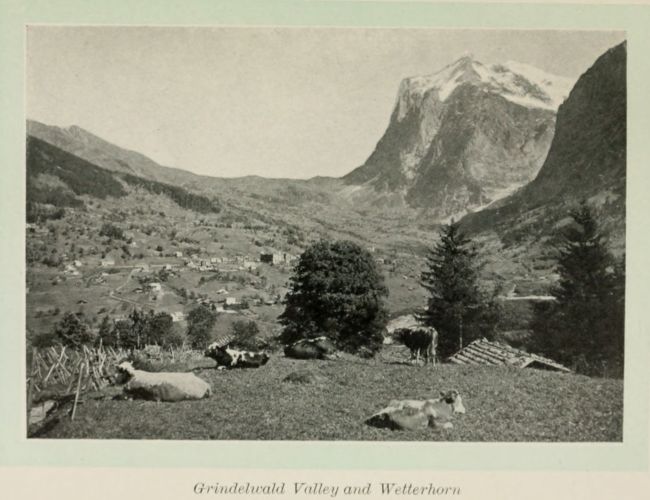
The house stands just above the highroad.
Behind it the green Alpine meadows roll steeply
upward to the Faulhorn ridge, which separates
Grindelwald valley from the depression occupied
by Lake Brienz. There are between four
and five thousand upward feet in this direction,
we being at about the four-thousand-foot level
ourselves. Below the road, the land runs down
rapidly to the rushing Lütschine, the stream
which drains the glaciers. We can hear the
roar of the water plainly, especially at night.
From the other side of the stream rise almost
precipitously the rocky cliffs of the Mettenberg,
getting up about ten thousand feet. To the
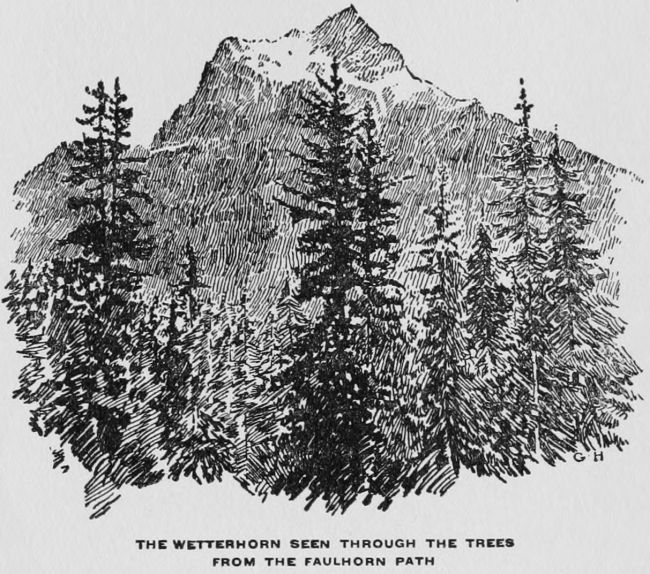
left the gleaming snow and ice of the Upper
Glacier, then the square gray, snow-capped mass
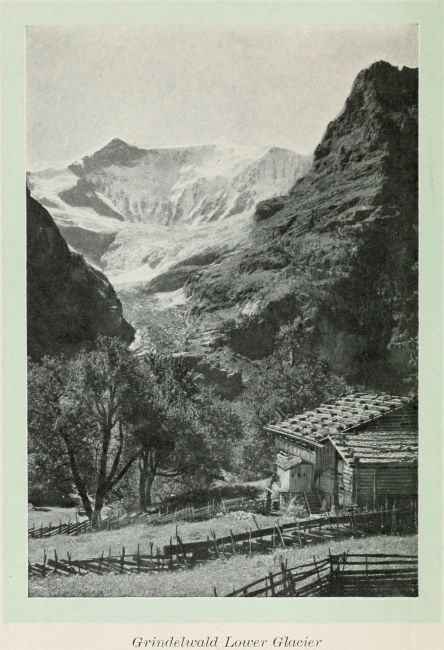
of the Wetterhorn. To the right the Lower
Glacier, with broad white firns and snow peaks,
and to the right of the glacier the knife-edged
Eiger. These three giants fill up our whole
immediate foreground. Far to the right is the
saddle-like depression known as the Kleine
Scheidegg, where the mountain railroad runs
over into the Lauterbrunnen Valley, and to the
left of the Wetterhorn, the narrow end of the
Grindelwald Valley is closed by a similar saddle,—the
Grosse Scheidegg, which separates it
from the Rosenlaui Valley. To the extreme
right is the rift in the mountains through which
the Lütschine escapes and the railroad gets
down to Interlaken. But it was all veiled in
mist the first day. We couldn’t see fifty feet
in any direction. There were some few tantalizing
glimpses as the clouds began to break
apart about sunset. But the family had to take
on faith the “glorious views” I had described
till next morning.
The one heart-warming spot in the chilly interior
of the châlet that first afternoon was
the kitchen, where the Frau Secundärlehrer, in
the kindness of her heart, assisted by her little
Dienst-Mädchen, was beating up the eggs and
milk, which I had asked her to get for me, into
an omelet. We really had no use for an
omelet at half-past four in the afternoon, but
we would not have dampened her hospitable
zeal by letting her see our lack of appetite. So
we sat down dutifully at the deal table between
the melodion and the stuffed chamois and ate
it. Then the Frau and her handmaiden bade
us good-night and left us—masters of all we
surveyed, including a fine crop of partially repressed
blues.
Who would ever have guessed this was the
opening scene of the finest summer that ever
happened?
II
There is nothing particularly joyous about
the process of starting a new house running
anywhere at any time. Experta crede.
But when you are a stranger in a strange land,
whose language you are imperfectly acquainted
with and whose inhabitants are as uncommunicative
as oysters and inclined to regard the foreigner
as an enemy till he has proved the contrary,
the difficulties are considerably aggravated.
Among the rank and file of the people in the
German cantons of Switzerland, there seem
to be three classes:—those who have come in
contact overmuch with tourists and have been
spoiled by it; the low-browed, stupid type,
surly and hostile; and the honest, intelligent,
fresh-cheeked, unspoiled, who are never effusive,
but frank always and friendly to those
who seem to deserve it, staunch, reliable, independent,
self-respecting, in every way admirable,—the
bone and sinew and hope of Switzerland.
The first class are nearly as extortionate
and conscienceless as their confrères in France
and Italy without the charming Latin manners
that make one forgive their iniquity. At their
worst, this type is insufferable. But one can
escape. Two miles off the tourist tracks, one
never finds them.
The second class one can only be sorry for.
It is not their fault that their brains and bodies
are stunted by cretinism or intermarriage of
relatives or insufficient nourishment or too much
carrying of heavy burdens. Their skin is sallow,
eyes dull, features heavy. One usually
finds them tending cattle, whom they closely
resemble, or inhabiting isolated châlets. If you
speak to them, they either stare open-mouthed
and answer nothing, or in the most unsatisfactory
manner. I do not know whether they
are capable of affection for their own people.
They certainly waste none of it on outsiders.
There was a man of this type who lived in
a châlet on the hill above us, who came out
and hit the Elder Babe a resounding cuff on the
head, ejaculating some wrathful Swiss German,
which the poor Babe did not in the least
understand. The Babe was doing nothing more
sinful than looking in the grass for a pen-knife
he had lost, but doubtless this man, with his
poor cramped crooked wits, suspected him of
some deep-dyed villainy.
There was also a boy in the neighborhood
about twelve years old, who used to lie in wait
for the Elder Babe with a large stick and attack
him viciously. I would have let the Babe
(who was seven) fight it out with him, trusting
to the triumph of mind over matter, if the lad
had not been so absolutely unintelligent and
brute-like in appearance that I thought he might
crush the Babe’s skull with a rock or push him
off a precipice if he was angered.
Every once in a while one hears of some queer
stupid outrage in Switzerland—the tires of an
automobile chopped up or obstructions put at
a dangerous turn in the road to upset a traveling
carriage. I imagine it is always one of
these quasi-deficients who is responsible for it.
In the whole world I do not know a finer
people, nor one more charming to deal with,
than the healthy, intelligent class of Swiss, God-fearing,
law-abiding, domestic, industrious,
self-respecting, clean in mind and body. When
I had once beaten my way through their uncommunicativeness
and learned where I could get
the necessities of life, I found it indescribably
restful, after the perpetual battle over trifles
of my eight months’ housekeeping on the
Riviera, to throw myself on the mercy of these
good people, secure in the consciousness that
they would take no advantage of my ignorance,
and that the price of an article would be the
same whether I asked before buying it or after.
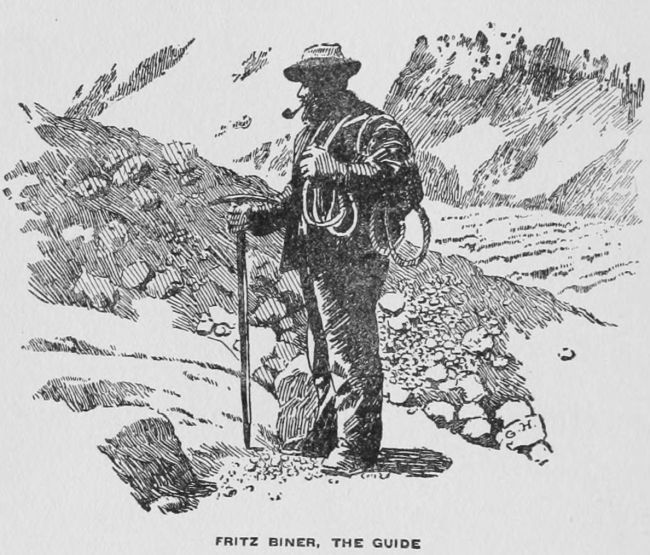
One of the brothers of the family that kept
the meat shop was a guide in his leisure moments
and was building up a fine reputation
for skill and daring. While we were in Grindelwald
he covered himself with glory by successfully
doing some things that had never been
done before. With an Alpinist from Berne,
he crawled along the knife-blade edge of the
Eiger, Heaven knows how many hours without
sleep or rest or proper food, without standing
up or sitting down, just clinging and creeping,—a
feat which had been accomplished only once
many years ago. It was pretty to see how
proud his family were of him. A younger
brother especially, once his shy reserve was overcome
by sympathetic questions, talked about
him as though he had won the Victoria Cross
at the very least. I do really think they were
the only firm of butchers I ever met who did
not need to be watched while weighing the
meat!
The bakery people were admirable, too,
especially the young, rosy-cheeked wife, who
usually tended shop, and the bright-faced little
girl who brought the bread each morning.
They had a small grocery attachment to the
bakery, but I found it was not etiquette for me
to buy there anything which I could get from
the Frau Secundärlehrer in our basement. In
the bakery one day I saw some packages of
tapioca stacked up on a shelf, and, with the
Babes in mind, ordered some sent next morning.
It did not come and, supposing it had been
overlooked, I stopped in later to get it. “My
little girl took it up this morning with the
bread,” said the baker’s wife, smiling sweetly,
“but she found the Frau Secundärlehrer kept
it in stock, so of course she brought it back.”
I must have looked a little blank, for she added,
“The Frau Secundärlehrer might think it
strange if you got it from us instead of her.”
Having learned this local canon, I struggled
dutifully to conform to it, though it was by
no means always convenient. The Frau Secundärlehrer’s
store was open only at odd times
when the Frau was at leisure. It was always
closed during the morning hours when one usually
makes purchases for the day. After sending
the cook to the village in the morning for
marketing and piously leaving some grocery
article to be purchased from the Frau in the
afternoon, it was hardly soothing to find that
she was just out of it or had never had it—and
the nearest other grocery a mile and a half
away!
There may have been other local rules of
procedure equally sacred that I never did find
out, and so unwittingly offended against to the
end. I do not believe the Schweizer would be
forgiving toward shortcomings of this sort. He
is beautifully confident that the Herr Gott approves
of Swiss ways and dislikes foreigners,
and this gives him a virtuous rigidity in resisting
innovations. There may have been some
such all-unconscious sin on my part to account
for the strange behavior of the Herr Secundärlehrer
at the end of the season. But we
won’t worry about that till the time comes.
The way we got our milk is worth describing.
The cattle went up to the high pastures a few
days after our arrival. They went by our
house, and all day long we heard the tinkle of
the cow-bells, the tramping of their patient feet,
and the pushing and rubbing of their heavy
swaying bodies, and the air was full of their
breath as though we were in a dairy-yard. All
the cattle in the valley go up about the middle
of June (as soon as the snow is off the ground)
and come down the latter part of September.
The pasture lands are owned by the commune,
and each burgher of the valley has the right
to keep a certain number of cows there. There
is a head-man in charge of each commune’s cattle,
who, with a corps of assistants, lives up on
the heights all summer. Their chief occupation
is cheese-making. They are allowed such
milk and cheese as they need for themselves
during the summer (which, with coarse black
bread, practically forms the whole of their
diet), and at the end of the season receive a
share of the cheese made in lieu of wages, the
rest going per capita to the cattle-owners. Meat
and eggs are scarce and dear, and this cheese
forms the staple of the valley’s food through
the winter.
In the more distant pastures, all the milk not
drunk by the cattle men is made into cheese,
but from these Alps near Grindelwald a certain
amount of fresh milk is sold, being brought
down six or eight miles each morning strapped
to the back of a man, in a cylinder of white
unpainted wood that must hold from ten to fifteen
gallons.
Do not imagine that we learned all this at
once. It represents the wisdom of the summer,
gathered and pieced together, bit by bit. All
we knew just then was that more cows than
we had ever seen in our lives were going past,
and it was a good thing that they were not
nervous animals, or their bells would surely
drive them crazy. Most of them were small
affairs hung around the neck from a narrow
leather collar. But sometimes the collar was as
much as four inches wide and the bell a great
jangling piece of metal seven or eight inches
long and about the same width. It must have
been a real burden for the cow to carry and
the stiff collar a severe infliction. We never
did learn the philosophy of these vagaries in
cow adornment.
The Herr Secundärlehrer told us, on inquiry,
during those first days, that the Alpine milk
was the best to be had, although it cost more,
and that perhaps he could secure it for us during
the summer (it was a favor, you understand)
if we would say definitely what amount we
would take. It could neither be increased nor
decreased afterwards and it must be paid for
all together at the end of the season. “But I
prefer paying my bills each month,” I said.
“Can’t be done,” he replied. It was very mysterious,
but we let it go at that, and the milk
was delicious.
Later, after the young men and the Mother
had joined us, I found we needed more milk. I
lay in wait for the man who brought the milk,
after the cook had tried her hand on him in
vain, and asked him if there was not some way
by which we could get an extra liter or so per
day. He was one of the stupid variety and his
“Nein” was like the speech of a stone statue
(if stone statues spoke), without a flicker of
expression. Wouldn’t it be possible if we paid
a higher price for it? Nein. Wasn’t there
a head-man who would have the authority to
sell me more if I went to see him? Nein. I
think he regarded me as the Scarlet Woman
referred to in the Scriptures and felt that his
soul would be endangered by further parley.
So he walked off without any nonsense in the
way of apology or farewell.
The only milk then to be bought was what
came up from Interlaken, and even that we
could not buy direct, since the man who sold it
did not go on his rounds so far as our house.
The baker took in a liter for us and we sent for
it in the afternoon, and it was often sour and
always pale and watery.
The admixture of water was not entirely unknown
in our Alpine milk, for Frater one day
came upon a milk-bearer cheerfully filling up
his vessel from a mountain brook. Perhaps he
had stumbled and spilt some, or perhaps he
had been thirsty and drunk some, and of course
he had a precise and definite quantity to deliver.
I will not believe he had sold any on the side.
It would not be in character. And I do not
believe it could have happened often, or the
milk would not have been so good.
For the benefit of intending housekeepers in
the Oberland, I would say that marketing, when
one has learned the ropes, is an easy matter, if
the family is blessed with good appetites and is
contented with simple fare and small variety.
In meat there was always veal and pork to be
had, beef and mutton only occasionally. When
we wanted poultry we had to send to Interlaken
for it, and the price was appalling, thirteen
francs for a pair of small chickens hardly
enough for a meal. Nearly everybody owned
a few chickens, but they would not sell them,
and eggs were often hard to get. As for fresh
vegetables and fruit, we were wholly dependent
on a rascally Italian who kept a fruit shop for
tourists near the station and charged tourist
prices for inferior articles. The only time he
ever gave us good value was toward the end
of the season when Antonio happened to address
him in Italian, and he and his wife glowed all
over and heaped up the grapes in the bag. But
that did not prevent them from palming off a
collection of absolutely rotten pears on my poor
unsuspecting cook the next day! No fruit is
grown in the valley except a few late apples on
the road down to Interlaken, and the little wild
strawberries that come up for themselves in June,
no vegetables except cabbages and carrots and
the like, which each family toilfully raises for
its own use and cannot be induced to sell. The
Frau Secundärlehrer had some lettuce which
she generously invited us to help ourselves to as
long as it lasted, but she would not sell it.
One hardly realizes that it is summer, for one
has to depend so much on canned things. One
learns to eat a lot of the local cheese, which is
always good. And I must not forget the honey.
It is the invariable accompaniment of the Swiss
breakfast, which consists for the rest of rolls
and butter, coffee and milk. When the bees
have gathered their honey from the wild flowers
on the Alpine meadows, the flavor is complexly
delicious. One soon learns to despise
the insipid lowland product.
I must not forget the salt, nor the long morning
spent in hunting for that useful staple. I
ordered it the first day from our basement grocery.
It didn’t come, and I repeated the order.
I was told the Frau had none. I supposed she
was just out of it and asked Belle Soeur, who
was going into the village, to get some at any
grocer’s. She went dutifully to every grocer in
the village and grew more and more puzzled at
being everywhere told they didn’t keep it. She
knew the Swiss used the condiment, for she had
been eating it. She inquired and was told to
go to the post-office. This sounded so perfectly
foolish that she paid no attention to it and inquired
elsewhere. She received the same answer.
After she had been told three times to
go the post-office, she went there, feeling
distinctly idiotic as she asked the old man behind
the stamp window if he sold salt. To
her astonishment, the reply was affirmative.
Salt, it appears, is a government monopoly in
Switzerland, and, in Grindelwald at least, the
postmaster had the exclusive right to sell it. In
time it became perfectly natural to say, “Give
me five postage stamps and a kilo of salt,” but
it required practice.
III
Looking out on cocoa-palms and mango
trees from my Puerto Rican balcony (whatever
bad things may be said about the life of
a naval officer’s wife, nobody ever accused it of
monotony) it is hard to realize that last summer
our outlook was on Alpine meadows and glaciers....
How can I catch and imprison
in words that glorious Swiss air or the more
elusive spiritual atmosphere of it all? How
tint the pictures with that characteristic “local
color” of which we talked so much that it became
family slang?
The air at first was a little thin for us, and
we easily got out of breath. Accustoming ourselves
to it and gradually enlarging our climbing
radius, we were soon doubling and by the
end of the season nearly trebling our altitude
without inconvenience. It was when we went
down to the low levels that we felt oppressed
by the dense air and fatigued by the heat. A
sudden change of altitude either up or down
most of us found produced clicking of the eardrums
alternating with a wad-of-cotton-in-the-ear
sensation. Antonio was like the man who
couldn’t shiver. His eardrums wouldn’t click.
Our assurance to him that there was nothing
especially joyous in the sensation made no difference.
He felt that he wasn’t in the swim,
and it grieved him.
There was certainly a magic in the air. It
made us all healthy and hungry and happy and
filled us with the desire and eventually the ability
to walk almost unlimited distances.
Belle Soeur, the Elder Babe and I did most
of the preliminary exploring together. Shall I
ever forget the beauty of the wild flowers that
first month? They were lovely all summer, but
never so lovely nor so many as during June,
when the Alpine meadows in our vicinity were
all blue with forget-me-nots or yellow and purple
with little Johnny-jump-ups. I don’t remember
the gentians till later, and I know the
Alpenroses blossomed in July. The Swiss have
a great sentiment for this flower, a sort of rhododendron
whose clusters of pink blossoms
growing on low scraggly shrubs color miles of
mountain-side at the proper season. But they
have no such loveliness as the dainty little flowerets
that grow down in the grass. The Edelweiss
cult, of course, is entirely a matter of
sentiment. The furry, pulpy little plant, stalk,
leaves, flowers, all of the same grayish, greenish
white, has no trace of beauty and indeed does
not look like a flower at all. Only its fondness
for growing in dangerous and inaccessible
places could make it desirable. There seems
to be plenty of it, too, if you know where to
go for it. During the season the tourist routes
are lined with little solemn, silent children selling
edelweiss. The supply never fails. But I
may as well confess right here that though of
course we purchased a certain amount of this
article of commerce, we never found a sprig of
it growing. We could doubtless have done so
by paying a native to lead us to a proper place,
but there would have been no sentiment in that.
We were always hoping to come upon it accidentally,
but we never did.
We soon decided that it was a waste of time
to eat our meals in a stuffy little dining-room,
looking out only at an upward slope of grass,
even though it was adorned with two chamois
and a Schützenfest prize. So we had the deal
table and the chairs transferred to the more private
of the lower balconies, the one that did not
communicate with the street; and we found that
the Eiger and Mettenberg and the Lower Glacier,
the whole regal glory of our outlook, added
a wonderful savor to our simple repasts,—changed
the prosaic process of eating, in fact,
into a sort of Magnificat. For it is true that
there are places in this world which make even
a pagan feel religious, and among all the winds
and rains and fields and rivers and beasts and
stars which “praise the Lord,” there are none
which entone their hymns in a voice more inspiringly
audible than the mountains which lift
their snow-crowned heads so near to Heaven.
Is it surprising that the Swiss are a simple
and an honest race? It seems to me it would
be surprising if they were anything else. It
must be almost a physical impossibility to lie in
the presence of a glacier or on the edge of a
precipice. Before these hoary Titans of mountains
the complexities of our life fall away from
us like dust from a shaken garment. All our
artificial distinctions and sophistications become
infinitely unimportant. Perhaps ants feel this
way in the presence of the Pyramids, or flies
who light on the buttresses of Cologne Cathedral.
After all, the Simple Life is not hard to live
if you get the right setting for it.
We breakfasted, lunched, drank tea and dined
on that balcony till the snow drove us indoors
at the end of September. When it rained we
pulled the table back into the shelter of the glass
at the north end of the veranda. When it was
cold, we put on overcoats and golf capes. As
we lived with those mountains day by day, and
grew to know all their moods and manners,
good and bad, as one knows those of one’s truly
intimates, they became to us, not scenery, but
friends and kindred, not anything external, but
a part of our larger selves.
We watched the snow line creep up at the
beginning of the season and down again at the
end. We watched the mountains hide themselves
in black lowering clouds, saw them lit
up by flashes of lightning, heard them roll back
the thunder, saw them repent and hang out a
rainbow from the Wetterhorn precipice across
the white of the Upper Glacier and down in
front of the Mettenberg, the upper peaks shake
off their bad humor and emerge from the clouds
all wet and shiny, rocks as well as snow, in
the happy sunlight. Eiger is the same as ogre,
etymologically, I suppose. Anyhow, it means
giant, I have somewhere read. But when the
wind blew fleecy white clouds across his gray
flank and summit, half-hiding, half-revealing,
the effect was as alluring as a chiffon veil on
a beautiful woman. Then there was the delicate
pink Alpenglow to hope for about simultaneously
with dessert. Sometimes instead
there were eerie green lights among firns and
snowfields and white peaks above the Lower
Glacier, wherefore one of them is named the
Grindelwalder Grünhorn. And later, when
the dinner things had been cleared away and
the moon came up over the mountain walls of
the valley, our world was too beautiful to be
true. It was so exquisite that it almost hurt.
It induced silence and a sort of swelling of the
heart and an overpowering desire to be
good....
Grindelwald Valley and Wetterhorn
I did not mean to be betrayed into a rhapsody.
Permit me to call attention to the dash of
“local color” on our dinner-table furnished by
the cow-bell with which we summoned Suzanne
from the kitchen. I have that cow-bell still
among my most valued possessions. It and the
bowl of wild flowers in the center of the table
(not to mention the view) quite redeemed the
meagerness of the Frau Secundärlehrer’s table
linen and our consciousness that there were just
exactly enough knives, forks, spoons, cups, saucers,
plates and glasses to go around once and
that they had to be washed between courses!
If I wanted to ask anyone to dinner, I would
have to send to the village to buy one more of
everything!
I have now confided to you nearly everything
I know about our housekeeping arrangements,
but I have not even mentioned our good
cook, Anna. This is not surprising, for she was
the most unobtrusive person I ever met in my
life. I secured her through an Interlaken employment
agency, but she was not at all like the
output of an employment agency in our own
glorious land of the free. Her voice was so
low and she was so timid and deprecatory that
it was sometimes extremely difficult to find out
what she was talking about. She was so superlatively
meek that she seemed always to be
inviting one to ill-treat her. I suppose it was
this characteristic which made Suzanne bully
her so at first. At Nice we had had a cook
who kept Suzanne terrorized, drove her out of
the kitchen with a poker and reduced her to
daily tears. The joy of emancipation from
that servitude, combined with Anna’s meekness,
were evidently too much for her. This time
it was Anna who wept. She came to me at the
end of a fortnight and told me she would have
to leave, that she seemed to be able to please
Madame well enough, but that it was quite
impossible to satisfy Suzanne. I told her to
think better of it, reasoned with Suzanne and
appealed to her sympathies (she has the best
heart in the world), and the two soon became
excellent friends.
Dear little mild, meek, faithful Anna, I do
hope she is prospering! She was a widow and
supported her three little children on the thirty-five
francs a month she got from me. I put
it up to forty-five, unsolicited, from pure sympathy,
but I don’t suppose she could get more
than half of that through the winter. She was
bilingual,—French and German,—so it was
easy for all of us to communicate with her, and
she had pretty rosy cheeks and soft, good
eyes.
I remember the time I asked her (speaking
French) what they called a bureau (commode)
in German. “On l’appelle comme ça,” she
murmured flutteringly. “Comme ça?” I repeated.
“But what do they call it?” “On
l’appelle comme ça,” she said again more flutteringly
than before. We bandied this back
and forth until I thought we had struck an impasse
like that of the famous story where the
Englishman asks the Scotchman what there is
in haggis. The Scotchman begins to enumerate,
“There’s leeks intilt,” and the Englishman,
not understanding the word, interrupts,
“But what’s ‘intilt’?” “I’m telling ye,” says
the Scotchman, “there’s leeks intilt.” “But I
want to know what’s ‘intilt.’” “If ye’ll only
keep quiet ye’ll know what’s intilt. There’s
leeks....” And so it goes on forever.
Anna and I would probably be doing the same
until now, her voice growing more frightened
and fluttering each time, had I not lost patience
and exclaimed, “CommeQUOI, mon Dieu?
Say to me in German, ‘There’s a bureau in my
room.’” By which means I discovered that she
meant the same word, commode, was used in
German as in French.
Perhaps this is as good a place as any to tell
a little more about our landlord and his family.
The Herr Secundärlehrer, as might be inferred,
taught in the higher grades at the big school-house,
with so many lovely mottoes painted outside,
at the edge of the village. He was evidently
proud of his learned calling, for his title
was inscribed on his cards and letterheads and
invariably appended to his signature. But that,
of course, is characteristically German. He
was a good-looking man of about thirty, his
face a trifle heavy in repose and just a little
weak, but lighting up charmingly when he
smiled. Like most Swiss, he carried himself
rather slouchily. I don’t know how strenuously
he may have labored during school hours, but
he was nearly always resting out of them. Not
so his wife. She was a teacher in the primary
school, but that was merely an incident in her
life. She also kept the store and cared for her
three small children and took charge of the
family housekeeping (with the aid of the little
dienst-mädchen), did washing and sewing, and
along in the late twilight would be standing by
a table outside the door of the store (ready for
a customer if one should come) ironing till the
last ray of light faded. Or she and the dienst-mädchen
would take hoe and spade and weed
the cabbage patch or get the ground ready for
planting turnips. While they did that, the masculine
head of the family would sit on a bench
smoking. They don’t spoil their women in
Switzerland.
That reminds me of the local newspaper we
subscribed to. It came three times a week and
once in a while contained an illustrated supplement,
with stories and poems, which were not
exciting, but highly moral. The news part contained,
besides local items of occasional interest,
a quaint little summary of what was going
on in the world, from the standpoint of the
Grindelwald valley, and delicious editorials on
such burning topics of the day as Love, Shakespeare,
or the Sphere of Woman.
It was from the last that we culled the useful
phrase, “Housely Herd.” I was reading it
aloud to the assembled family, translating into
English as I went, “The good God is not
pleased,” I read (that editor was always well
posted as to the Almighty’s views and sentiments)—“The
good God is not pleased when
women leave the housely herd and force themselves
into business and professions for which
He never intended them.” Now of course I
should have translated “häuslicher Herd,”
“domestic hearth,” but I honestly thought it
was housely herd at the moment, and the phrase
so beautifully expressed the masculine attitude
of this pastoral people toward their women
that it ought to have been true if it wasn’t.
We therefore put it into our daily vocabulary,
and the feminine part of the family joyously
referred to itself as the Housely Herd all the
rest of the season.
IV
The Younger Babe made friends with an
Italian workman engaged in the construction
of a châlet half a mile up the road and was
presented by him with a piece of wall paper
about a foot square. He bore it home in triumph
and asked me to paste it up on the wall
above his bed. The comfort he took in that
reminder of what he regarded as civilization
was really touching. He said he didn’t mind
the house so much now that it had some wall
paper in it.
Frater said afterwards that the Châlet Edelweiss
must have been conducted as a young
ladies’ boarding school previous to the arrival
of himself and Antonio. This is a mistake
on his part, but it is undoubtedly true that we
led a much more quiet and decorous life before
that invasion of Goth and Vandal. I am sure
that the Secundärlehrer and his Frau held a
much higher opinion of us at that time than
they did later. They had never had the advantage
of living in an American college town and
were not educated up to “rough-house” nor
to the unholy noises which were liable to issue
from the Châlet at any hour of the day or night
and which led Belle Soeur to christen it our
private lunatic asylum.
It is rather curious, as we were none of us
haters of our kind, that in the four months we
spent in Grindelwald we never exchanged a
word with any of the local English colony,
which is fairly numerous. Doubtless most of
the people who thronged the English chapel
of a Sunday were transients, but a good many
of the hotel people were there for the season,
and there were quite a number of English families
keeping house like ourselves in châlets,
though mostly on the other side of the village.
Somehow we seemed to be sufficient unto ourselves.
Our mountains gave us all the outside
company we wanted, and if ever we did pine
for human intercourse there was much more
“local color” in talking with Swiss peasants.
Our wildest form of diversion before the
transatlantic contingent joined us was a picnic.
Mostly it was combined with a tramp too long
to be taken comfortably in half a day, but the
Fourth of July picnic was celebrated very near
the house so that the Younger Babe and Suzanne
could accompany us. We chose a charming
level green spot beside a babbling Alpine
brook which the small boys nearly froze their
feet wading. It was shaded by a fine big tree
under whose branches we got an altogether
glorious view of the Wetterhorn and Upper
Glacier. The Fourth-of-Julyness was represented
by some diminutive American flags we
had purchased at a photograph shop in the
village and six of those engines of war euphoniously
yclept “nigger-chasers,” which we bought
(the entire stock) at the druggist’s. This was
the nearest we could come to fire-crackers. One
was fired when we got up in the morning, a
second after breakfast, one was reserved for
sunset, one went off at high noon, and the remaining
two immediately preceded and followed
the ceremony of lunch.
Among our more distant picnics there stand
out in my memory the climb to the Grosse
Scheidegg and our two trips to the Männlichen.
The first Männlichen trip was spoiled by the
weather. It is often impossible to tell on a
cloudy morning whether the day will prove good
or bad. This time we guessed wrong. Not
having as yet acquired the climbing habit, we
took the train to the Kleine Scheidegg and the
footpath from there to the Männlichen. Instead
of the early clouds blowing away, as we
thought they would, they closed in densely, so
that we found ourselves shivering in a thick
fog, unable to see twenty feet before our noses.
Still hoping the weather might change for the
better, we made our way along the path, which
was fortunately a perfectly plain and unmistakable
one. The path in places ran between
snow banks as high as our heads, and except
these banks we saw no scenery. We sat down
on a damp stone and ate our lunch, which was
curiously cheerless. The weather grew worse
and worse. Finally, just as it was beginning
to rain hard, there loomed out of the mist
ahead of us the Männlichen Inn, where we were
more than glad to find shelter, hot milk and tea,
and a fire.
The rain came down in torrents for several
hours. By the time it let up, it was too late
to catch the afternoon train at Scheidegg. Of
course the sensible thing to do would have been
to make up our minds to spend the night at the
Männlichen Inn. But we had made no provisions
for staying away over-night and knew that
Suzanne and Anna would be very much alarmed
at our failure to return.
Besides, the prospect of passing the rest of
the afternoon and evening at that viewless inn,
with nothing to read and nothing to do, was
nowise alluring. So when it stopped raining
and the clouds rolled down the mountain-side
an eighth of a mile or so, we announced our intention
of taking the footpath down to Grindelwald.
The waitress who pointed out the beginning
of it to us plainly thought we were crazy, and
perhaps we were. For two women and a small
boy to start out at four o’clock in the afternoon
to walk seven miles down a rain-soaked
mountain-side, hunting for a path which for the
first few miles would be a rude cow track, no
different from countless others which would
cross it or branch off from it, knowing that if
they got lost or night overtook them they would
find no human habitation to shelter them—well,
it didn’t sound sensible! But the gods who protect
the imprudent were with us.
We started down light-heartedly enough,
glad to be on the move again, scrambling over
rocks, swinging across the grassy places as fast
as the clinging mud would let us, counteracting
the chill of advancing evening by the strenuousness
of the exercise we were taking. Once we
had the good luck to meet a herd of cows from
whose guardians we got a new set of directions.
And again, just at a place where we were badly
puzzled, we saw a lad toiling upward with an
empty milk can on his back, whom we hailed
and questioned.
Of course this sort of questioning is not an
exact science. It must be remembered that our
German was far from fluent, and that those
people talked a local dialect very considerably
different from the language of Goethe and
Schiller, that they belonged to the dull, inarticulate
section of the population and were not over-fond
of foreigners. Moreover, everything in
Switzerland has a name of its own, and the
topographical directions of a peasant bristle
always with unfamiliar proper names, which one
strains one’s ear to catch, wildly guessing
whether they refer to a forest, a pasturage or
a group of châlets. All distances are given in
time, which is vague at best, and may differ
radically as between a Swiss cowherd in training
and two American women with a small boy.
An unusually clear-spoken and intelligent native
might discourse as follows: “In a quarter
of an hour you will be at Hinter der Egg. Do
not turn off to the right at Eggboden. Cross
the Gundelgraben and continue down for an
hour through the Raufte. When you reach
Geyscheur you will see two paths. You may
take either. Both lead to Grund. You are
two and a half hours from Grindelwald.”
Usually, it is much more involved. And remember
that you are hearing everyone of those
blessed names for the first time. Two turn
out to be cheese huts, one a stream, one a
meadow, one a group of three or four dwelling-houses,
and the last the bottom of the slope
where the Lütschine runs through. But you
don’t learn that from the man who is giving
you directions.
I never knew such a long seven miles. It
seemed as if Grindelwald receded as fast as we
advanced. We tore along the last part of the
time, each taking a hand of the Babe, almost
running, to keep the night from catching us
on the mountain-side. It was nearly dark before
we got home, but as the last part of our
way was over the familiar highroad, it did not
matter. The Châlet Edelweiss looked like
a terrestrial paradise, and never was there a
sensation more luxurious than shedding our
wet, muddy clothes in favor of peignoirs and
putting our tired feet into bedroom slippers,
unless it was furnished by the good hot dinner
that followed.
The other Männlichen trip was vastly different.
The day was clear as a bell—radiant,
perfect. We walked down to the Grund station
and took the train as far as Alpiglen only,
about half way to the Scheidegg. You see we
were learning to climb by then. We took a
lovely (though sometimes unfindable) cross-slanting
path from there to the Männlichen,
and all the way kept opening up more and more
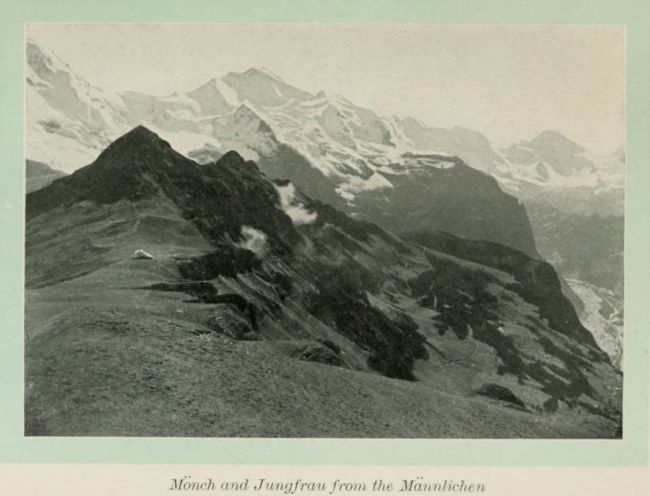
glorious vistas. Starting with a backward look
into the Grindelwald Valley and at our own
Wetterhorn and Eiger, we uncovered the
Mönch first and then the Jungfrau, with her
beautiful shining sub-peaks, the Silberhorn and
Schneehorn, and finally, when we got to the
top of the ridge, there was that surprising
hole in the ground, the Lauterbrunnen Valley,
with all its waterfalls tumbling down the rock
walls of the opposite side. Beyond were more
snow mountains and to the westward Lake
Thun and Lake Brienz, Interlaken and more
snow mountains. I do truly think the view
from the Männlichen is the finest in Switzerland,
if not in the whole world. The view
from the Gornergrat is a wilderness of glaciers,
utterly magnificent, but lacking in variety. The
view from the Rigi is a panorama of distant
objects and lacks the stupendous foreground
supplied for the Männlichen by that trio of
colossi, Eiger, Mönch and Jungfrau.
Our sandwiches and cake were a feast of
the gods that day, with heaven and earth spread
out above, below and all around us—green in
the valley, white on the mountains, blue overhead.
We came home by the path we had followed
so sloppily and doubtfully that other day
and found it perfectly plain, much shorter and
wonderfully transformed as to looks. I remember
that we carried home armloads of Alpenroses
gathered on the higher slopes.
Of our tramp to the Grosse Scheidegg, the
most striking feature was the attack of “mountain
sickness” Belle Soeur had just before
reaching the summit. It is an unpleasant sort
of thing consisting of palpitation of the heart,
faintness, nausea, and turning a greenish white.
The proper treatment is to lie down till it passes
off and take some cognac. We hadn’t any cognac
along that day, so poor Belle Soeur could
only lie down and wait till it got ready to go
away. The Scheidegg is only 6400 feet high.
She never felt it again at any such level as that,
but encountered it on the Gries Pass at about
8000 feet and going over the Strahlegg at somewhere
near 10,000. We always made a practice
after the first time of carrying a small cognac
flask along whenever we were making an
ascent.
The view from the Scheidegg is interesting,
but not at all in the same class as the Männlichen
outlook.
We came home by way of the Grindel Alp
pastures and encountered great herds of cattle,
and wondered whether it was our duty to be
afraid of them, but decided it wasn’t. We lost
our path and tried to cut across the meadows
without one. It looked very easy. We could
see the roof of our own house plainly several
miles distant, but the streams we had to cross,
which ran often through deep ravines, made it
hard and sometimes a little risky. There was
one beautiful spot on a crag overhanging a
stream where we fully intended to return some
day to picnic, but we never could find it again!
That was the day we learned the wonderfully
resting effect on tired and swollen feet
of bathing them in the ice-cold water of a
mountain stream.
In those early days, before the Transatlantics
arrived, the Chronicler used to put in several
hours a day in the polishing of her new novel,
the Elder Babe used to have lessons, Belle
Soeur had an attack of sewing and turned out
wonderful confections for her wardrobe, and
we all improved our minds with Swiss history.
I say “improved our minds” advisedly, for it
certainly did not amuse us. Why is it that,
with all the dramatic material at hand, some
one doesn’t write a history of Switzerland that
the ordinary reader can peruse without going
to sleep? Something must be allowed of
course for the fact that we were not living
in the history-hallowed part of Switzerland.
Nothing ever happened in the Grindelwald
Valley except a battle in 1191, between the
Duke of Zaeringen and some recalcitrant nobles
who did not like his populistic tendencies.
The Duke won the battle and straightway
founded Berne and endowed its burghers with
all sorts of privileges, the more to annoy the
nobles. Or perhaps his motives were really
high and altruistic and he would have been glad
if he could have foreseen that the Bernese
burghers would eventually down nobles and
sovereign too. But I really don’t think that
we were so lacking in imagination that we could
not have been interested in the doings of the
Eidgenossen in the Forest Cantons, over the
Brünig to the eastward, only a few miles after
all, if the histories, French and English alike,
had not been so deadly dull.
It is not only the histories either. There is
something very unsatisfactory about all the literature
concerning Switzerland. Much of it is
painstakingly constructed out of guide-books
like Rollo’s Adventures. Some of the things
that are best as literature were written by men
who got their impressions at second hand.
Schiller wrote Tell and Scott wrote Anne of
Geierstein without ever having set foot on Swiss
soil. The Swissness of both reminds one of
Dr. Johnson’s remark about women’s writing
poetry and dogs walking on their hind legs.
It is not to be expected that they should do it
well, but the surprising thing is that they should
be able to do it at all!
Now Byron did live up at Wengern Alp just
over the Kleine Scheidegg while he was writing
Manfred, and the other day I read it over, anticipating
much. Time was when I thought
Manfred one of the greatest dramatic poems
ever written. It gave me all sort of thrills and
creeps. But this rereading was a grievous disappointment.
There are a few fine lines, but
most of the descriptions are cheap, tawdry and
conventional, fit accompaniments to a third-rate
melodramatic attempt at clothing in false sentiment
a theme essentially rotten.
Hyperion is another old-time favorite that
I have just reread with a chill of disappointment.
The dear poet was obviously bored by
a solitary tramp he took to the Grimsel. He
got the blues in Interlaken when it rained
(which was not surprising), he saw the Jungfrau
from the hotel piazza, took a drive to the
Lauterbrunnen Valley, and for the rest had no
eyes for anything except that uninteresting girl,
Mary Ashburton. The Swiss color of it all
is distinctly thin.
The tales of high climbing are often thrilling
as adventures, but are usually written by people
who don’t know how to write. And one who
has not been bitten by the Alpinist mania can
not help feeling that so much daring and energy
might have been better expended than in breaking
records and necks. It is really a species of
insanity, this high-climbing passion. The world
and its standards must be curiously out of focus
to its victims. They don’t even pay any attention
to scenery. Much of their climbing is
done in the dark (between two A. M. and day-break)
and they are always too pressed for time
to stop to look at a view, their brief rests being
scientifically calculated to restore their exhausted
mind and muscles. Tyndall’s books
are extremely satisfactory in their way. He
was an enthusiastic climber, without being a
crank on the subject, had a scientific object in
his trips and a considerable literary gift in describing
them.
In general, I suppose it is true that where
nature is so overpoweringly magnificent, art is
dwarfed. Those who deeply feel the sublimity
of it all hold their peace, and it is only the
superficial who go home and slop over in printed
twaddle. Of whose number the present Chronicler,
thus self-confessedly, is one.
V
On the epoch-making twenty-first day of
July, Frater and Antonio tramped into
our lives with knapsacks on their backs. We
were not expecting them till the next day.
Frater had written from somewhere up the
Rhine that they would strike us about the 22nd.
In a small parenthesis he had added that they
might arrive by the 21st, but Frater’s hand-writing,
being of the kind sacred to genius, I
had not read this part. They had come up on
the train from Interlaken, but of course we had
not met them at the station, and no one could
tell them where we lived. They wandered out
the highroad to the Upper Glacier, and as it
appeared quite evident we did not live on the
ice-fall or the Wetterhorn cliffs, they turned
back again. Some one told them our châlet
was on the mountain-side, and they started up a
path, but met a peasant of whom they inquired
again. This individual, after stroking his chin
in silent rumination for some time, suddenly
shot out his forefinger in the direction of the
Châlet Edelweiss and said “Dort!” with
such convincing emphasis that they started
down again across the fields. Thus it happened
that our first glimpse of them was from
a most unexpected direction, dropping out of
the clouds as it were, or, to be accurate, climbing
over one of the rare fences behind and
above us. We were not sure of their identity
at first, but the long legs and Cornell sweaters
looked familiar, and Belle Soeur on the balcony
ventured to wave a greeting which was enthusiastically
returned.
We had been just about sitting down to tea,
and I remember the singular inadequacy of the
biscuit supply. Retiring to the kitchen I hastily
sent off Anna to the village for more of
everything for dinner, and it was well that I
did so. I had been catering for a family of
women and children so long that it took some
days to get adjusted to the new circumstances,
and we were perpetually running up against
unexpected vacuums. Anna and Suzanne were
as much distressed over the increased expenditures
as if they had been personally footing
the bills and often cut us short on things that
we really had plenty of just from their instinct
of thriftiness.
We spent the four intervening days before
the Mother’s arrival in showing the boys the
immediate neighborhood of Grindelwald.
They were still a little quiet and shy, especially
Antonio, and the process of transforming the
Young Ladies’ Boarding School into the Private
Lunatic Asylum was not yet in visible operation.
The Mother had been entirely explicit as to
the time of her arrival, and we walked down
to Interlaken to meet her—Belle Soeur, Frater,
Antonio, the Elder Babe and I. It was fourteen
miles, and although it was down grade on
a fine highroad, as we had to arrive at noon,
we made an early start. Even so, we had to
move at so lively a pace that the poor Babe with
his short legs was kept on a trot. The Babe,
however, is game, and he had no notion in the
world of letting his grandmother arrive, unmet
by him.
We lined up on the pier, dusty and thirsty,
a bare five minutes ahead of the Lake Brienz
steamer——. There it comes, puffing along,
tourists thronging the decks! Where is she?
Has she missed connections after all? If we
have come all this way, and she isn’t there—Ah!
But she is there!
It is Antonio who has spied her. Wildly
waving their hats, he and Frater lift up the
strains of the Aguinaldo chorus:
“Well, am I the boss or am I the show?
Am I the Governor General or a ho-o-bo?
Well, I’d like to know
Who’s arunning this show!
Is it me or Emilio Aguinaldo?”
It was the first time Belle Soeur and I had
heard this beautiful ditty, as we had been out
of the country for a year or more. I think it
must have been the first time the people on the
wharf and steamer had heard it, too, for they
looked at the stalwart performers in some surprise.
But the Mother, who had spent the
previous winter in Ithaca and helped the boys
graduate the month before, was thoroughly accustomed
to it and would doubtless have had
her feelings hurt if she had been greeted in
any other way.
It was at this point that Frater committed
the crime of lèse majesté, infanticide and arson
all rolled into one. As the little steamer came
up near the wharf he stepped across the foot
or so of intervening water onto the lower deck
with the sinful intention of greeting his mother
two minutes sooner and carrying her satchel
ashore. As his foot touched the deck, he was
seized by two employees of the steamer in a
state of excitement bordering on apoplexy. It
was against the rules—against all the rules!
No one was allowed on the steamer until all the
passengers had come ashore by the gang-plank.
“Oh, all right,” said Frater good-naturedly,
“I’ll go back on the wharf if it worries you,”
and he started to step back. At that they became
still more excited and held him tighter
than ever. That also was against the rules.
No one could go ashore except over the gang-plank.
Also nobody could go ashore without
giving up his ticket. Frater had no ticket, of
course. What were they going to do about it?
They did not know. They would see. Such
an emergency had never occurred before and
there were no precedents. He was to wait till
all the passengers had gone off, and then they
would decide. All this was said in wild and
very imperfectly comprehended German. There
was no one around who spoke either French
or English. Frater had joined the Mother,
who waited with him for the passengers to go
ashore, in some perturbation of spirit as to what
was to be done to her son. Of course nothing
was done. They walked ashore after the
others. But the double line of uniformed employees
through whom they passed were still
barely able to repress their excitement, and
their lowering brows would have struck terror
to more timorous hearts. It was really as
though some form of sacrilege had been committed,
which they had decided to overlook in
the interests of international comity. This was
the only time we ever ran up against any of the
Powers that Be in our wanderings, which, everything
considered, was, I think, doing uncommonly
well.
Frater and the Mother being safely restored
to us, the late exciting incident became one
thing more to laugh about, and it was a very
merry party who sat down to eat a picnic lunch
in a secluded spot beside the Aar, and washed
it down, subsequently, with Munich beer on
draft at a near-by out-door restaurant, and
caught the Grindelwald train, and were met at
the station by Suzanne and the Younger Babe,
running down the road hand in hand, a trifle
late and greatly out of breath. The Mother,
her baggage, and the Babes were piled into the
Red-headed Man’s carriage, and the rest of us
marched behind singing the Aguinaldo chorus.
You see we were already beginning to thaw out.
The Chronicler, no longer Senior Officer Present,
felt that her extreme dignity could now be
safely relaxed. Frater never was very shy, and
Antonio was getting acquainted.
I think, at the risk of being considered a
gossip, I shall have to tell how those two young
men got to us, because it was so thoroughly
characteristic. They hadn’t either of them the
money to spend on a European trip and had
intended going to work at their respective professions
of electrical and mechanical engineering
as soon as they left college: but what I had
written of our location in Switzerland, the
Mother’s intention of spending the summer
with us, and my entirely sincere, but also entirely
unexpecting suggestion that they should
“come along too” set them to thinking and
planning. They went down to New York,
shipped on a cattle steamer and worked their
way to Antwerp, walked across Belgium, came
up the Rhine by boat (third class) and across
by rail, also third class, from Basel. It had
taken them about a month from New York,
and they had seen a great many interesting
things and places and had spent, as I remember,
in the neighborhood of twenty dollars
apiece!
VI
The next week was devoted to introducing
the Mother to her new surroundings.
Our trips were limited by her tendency to
get asthma when climbing and her inability
to go anywhere near the edge of a precipice.
Even when the path was several feet wide, as
on the way to the Bäregg, the consciousness of
a down-drop made her “dizzy in the knees.”
But there were plenty of beautiful walks to
take within these limits. And her enthusiasm
over the life and the land would have inspired
the rest of us if we had not been already profoundly
convinced of the blessedness of our
lot.
We did one thing during this interval which
I don’t doubt would brand us as proper inmates
for a lunatic asylum in the esteem of all the
good respectable conventional people in the
world. We spent a night on the Männlichen
rolled up in steamer rugs watching the moon!
Frater proposed it first to me. He and I have
a fondness for the Voices of the Night and have
roughed it enough together to know we can
sleep on the ground now and then without catching
cold or feeling cross next morning. Belle
Soeur and Antonio decided that they wanted
to come too, and the noble spirit in which they
bore the hardships of the occasion proved that
they were qualified for admission to the Inner
Circle.
We left in the afternoon, a little later than
we should have done, for we were rather heavily
loaded down with jackets and rugs and our
prospective supper, and we were going all the
way on foot this time by the direct Männlichen
path, which we had only come down before,
and it takes longer to go up than to come down!
However, by pressing our steps to a slightly
uncomfortable degree, we got to the summit
just in time for sunset.
The scene of the next few minutes before
the blood red had faded from the west, is one
of the pictures indelibly burned into my memory.
We stood there silently drinking it in,
the boys for the first time, Belle Soeur and I
loving it the more for having known it before.
For a while we watched the details blurring
under the on-stealing twilight. Then hunger
asserted itself, and we found a place below the
summit, somewhat sheltered from the biting
winds, where we perched ourselves on a ridge
like crows and did ample justice to the contents
of the paper parcels that the boys drew
from their knapsacks.
Then it occurred to us that we had better use
the small remaining aftermath of daylight to
find some spots sheltered from the wind and
level enough to sleep on. It seems absurd to
say that on the whole mountain-side there was
no place level enough to lie down on without
slipping off. Yet it was very nearly true. The
summit was swept by a blast of icy wind. The
snow-drifts had disappeared since we were there
a month before, but it was still very cold after
the warming sun had retired for the night.
On the Lauterbrunnen side there was just plain
precipice, on the Grindelwald side a very steep
descent divided between stones and grass. After
much searching we established ourselves on a
little shelf, barely wide enough for a person to
lie on and sloping down just enough for one to
feel as if one was about to roll off. There was
nothing to hold on to, so we dug our feet into
the ground in a more or less futile attempt to
secure what Frater described as a “toe-grip.”
There was a low growth of thistles in our neighborhood,
too, which drove their prickles
through our steamer rugs in a rather unpleasant
fashion.
Soon the weather began to behave badly.
Great banks of clouds came up out of the depths
and covered the region where the moon was
due to rise. The stars twinkled brightly overhead,
but, barring a sudden change in cloud
conditions, it was evident that no moon would
be visible before the middle of the night. We
hoped against hope so long as we could, keeping
up a desultory talk and a little soft-pedal
singing. Then each rolled up in his or her
steamer rug, sought six feet of shelf room, and—eventually—fell
asleep.
I was awakened by a very penetrating chill
in the marrow of my spinal column, and opening
my eyes, saw that there was a dim pale
radiance over the universe that had been lacking
when I went to sleep. I spoke very low.
Frater answered. We crawled out of our rugs
and clambered up to the Männlichen summit.
I wonder if human eyes ever rested on a
scene of more eerie loveliness? The moon
struggled through and upward at last into the
open sky, and the clouds broke away enough so
that great masses of the Eiger-Mönch-Jungfrau
group came into sight, looking even more
stupendously huge from being partly hidden.
The valleys seemed bottomless abysses—their
floors four thousand feet below being utterly
lost in blackness. And on the other side of the
Lauterbrunnen Valley the billowy snow peaks,
quite free from clouds, rolled away, all silver
in the moonlight.
What a scene for some stupendous cosmic
drama with spirits of the earth and air for actors!
How did we dare to intrude on their
vigils—mere prying interlopers that we were?
Every once in a while we had to stamp around
violently and swing our arms to get warm.
Otherwise we sat quite still and almost silent,
feeling the way one ought to feel in church,
but mostly doesn’t.
At last the clouds caught up with the moon
and hid it, and we stumbled sleepily down and
found our rugs and sections of ledge again.
Just before sunrise it was Antonio who was
awake and ready to accompany me to the summit.
The others were sleeping the sleep of
the just and declined to be aroused. It was
wonderfully beautiful again—the rebirth of the
hidden world, the mountains thrusting up their
mighty shoulders above the foamy cloud-sea
that filled the valleys into the faint pink glow
which was gone almost as soon as seen. As
soon as the glamour of the sunrise had faded
we knew that we were ravenously hungry, and
shaking the sleepers into a similar conviction,
we started for the Männlichen Inn and hot coffee
and rolls and honey.
I do not know where the people at the Inn
supposed we had dropped from at that hour.
No questions were asked and no information
volunteered. The breakfast was excellent and
we set out for home much refreshed. Little
by little, as we walked, our cramped muscles
limbered and our chilled blood warmed—warmed
too much, in fact, before we reached
the Châlet at midday with those ton-a-piece
steamer rugs over our shoulders.
Mönch and Jungfrau from the Männlichen
The moon had not done all we had expected
of it. But we felt it was proved that the quartette
was of the “right stuff” and could safely
venture on a fortnight’s pedestrian trip.
VII
The morning we started out on our first
memorable pedestrian tour, the Mother
and the Elder Babe accompanied us to where
the Grosse Scheidegg path turns off from the
highroad, Suzanne, Anna and the Younger
Babe having previously waved us out of sight
from the balcony of the Châlet.
I felt some qualms of prospective homesickness
as I left them and a twinge of conscience
lest one of the Babes might get sick or the
Mother have trouble with the housekeeping,
but by the time we had dropped over on the
other side of the Scheidegg ridge and could no
longer see the red roof of our Châlet, I had
lost my misgivings and began to enjoy my vacation.
I had not felt so completely free from
the harness for Heaven knows how long, and
as I walked along I could feel the years sliding
off of me and hear them thud as they struck
the ground. I think I must have halted somewhere
about the sixteen-year-old point. That’s
the way I felt, at least. And it is an interesting
fact that I was addressed uniformly as
Fräulein or Mademoiselle by strangers all the
rest of the season. The short skirt may have
had something to do with it, but the Swiss are
entirely used to even elderly ladies in short
dresses.
Perhaps our outfit may be of some interest.
My own skirt and jacket were of corduroy, and
I don’t think the material could be improved
upon. Nothing else will stand so much sun
and rain and dust and mud and still look decent.
With this, downward, gaiters of the same and
heavy-soled hob-nailed boots. Upward, a dark
linen shirt waist and a feather-weight Swiss
straw hat, with a brim broad enough to protect
from the sun. One should have the trimmings
of one’s hat of a warranted-fast color. I did
not and suffered accordingly. The hat I started
out with was trimmed with a garland of red
poppies, and the effect of the first heavy rain
was fearful and wonderful to behold. The
next was trimmed with ribbon and suffered almost
as badly. The third was adorned with
a Scotch plaid that really rose superior to
weather.
The boys made no special preparation for
the trip except to have the soles of their boots
well studded with nails and to invest each in
a soft felt Swiss hat, warranted to stand any
weather, and to stick fast in any wind. Each
of us had strapped over the shoulders a light
canvas Rückensack, containing the absolutely
essential (reduced to the last irreducible minimum)
for a week. We had planned to have
clean clothes meet us by mail at Zermatt at
the end of that time. The Swiss mailing arrangements
are ideal, and one can send a good-sized
hamper anywhere for a few cents. In
the same manner we got rid of our soiled clothes
by mailing them home. Belle Soeur and I
carried alpenstocks, having found them a real
help in climbing steep paths and even more so
in coming down. The boys despised them as
tourist-like and amateurish and would have
nothing to do with them. When we took off
our jackets we put them through the straps
across our shoulders so that our hands (barring
the friendly alpenstocks) were always free.
We didn’t bother with umbrellas or raincoats,
none of us being liable to colds.
We ate our luncheon soon after we dropped
over the Scheidegg into the Rosenlaui Valley.
The character of the landscape had changed
already. We sat on a slope adorned by a group
of Christmas trees and a highly decorative herd
of cattle and saw our old friend the Wetterhorn
in an entirely unfamiliar shape and looked
with interest at the queer rock wings of the
Engelhörner.
Having consumed our last reminder of
Home and Mother, we pushed on, presently
finding ourselves racing for the Rosenlaui hotel
against up-piling clouds that obviously held
rain. The clouds beat, but we got there in
time to save ourselves from an absolute drenching
and sat in a summer-house for some time,
drinking a form of fizzy water which had evidently
(from its price) been diluted with liquid
gold.
If a baptism of fire is the critical moment in
the life of a young soldier, I take it that the
baptism of rain is the touchstone for the inexperienced
pedestrian. If you preserve the
Smile-that-won’t-come-off when your shoes are
soaked through and the water goes chunk-chunk
inside of them, and the mud clings to
the outside, and the rain trickles down your
neck—inside the collar, and your wet skirts
flap about your ankles (if you’re a man you’re
spared that), and the thick clouds shut out all
the mountains you came to see,—why then
you’ve won your spurs.
When the serious part of the rain was over
and we felt that we could afford no more gold-flavored
Apollinaris and had no other excuse for
lingering, we continued down that water-logged
valley. Frater and I kept up our spirits by
singing everything we knew, from Suwannee
River to Anheuser Busch, but it really wasn’t
fair, because Antonio has a musical ear and
must have suffered a lot. We saw some waterfalls,
but were too wet ourselves to be much
cheered by them.
We did get some amusement, though, out of
a solitary French pedestrian who asked us if
we had encountered any rain. The question
was so absurdly superfluous in view of the rain-soaked
condition of ourselves and the whole
world, that we made him repeat it several times
before we gave him a grave and final affirmative.
I think he felt lonely and thought he
would like to join our party, but we choked off
his little attempts at conversation and shook
him without compunction. One has to draw
the line somewhere, and we drew it at making
acquaintances with any one except the native
peasants, and they usually drew the line on us!
Emerging into the Meiringen Valley into
which the Rosenlaui opens, we quickly decided
against Meiringen as too large and sophisticated
a place to be interesting, and, moreover,
several miles out of our way. There was a
village almost straight in front of us which rejoiced
in two names, Innertkirchen and Imhof.
This was unfortunate, as whatever native we
asked the road of always seemed to know it
only by the other name. It proved an elusive
place. We took the wrong turn several times,
and it was beginning to get dark, and it was a
long time since lunch, and this was our first
night as tramps.
We were not made happier by catching up
with the principal inn at last and finding it full.
The other one, on the extreme edge of the village,
seemed hardly more promising at first,
for the landlady said she had just two rooms
left, one with one bed and the other with three.
However, a little persuasion reminded her that
there was another little single room in the third
story, if one of the young gentlemen didn’t
mind. We were not disposed to be critical.
They matched pennies for it, and Antonio was
relegated to the loft.
This inn, with the all-but-universal name of
Alpenrose, proved a good specimen of the
plain, clean, honest and inexpensive Swiss type.
We encountered for the first time a system of
two-priced table d’hôte, of which we were given
our choice, the difference being not in the quality
of the food, but in the number of courses.
Thus: Will you have soup and one kind of
meat with vegetables, followed by fruit, at one
franc fifty, or soup, two kinds of meat with
vegetables, and salad before the fruit, at two
fifty? We chose the cheaper and had plenty,
in spite of our fine appetites. Belle Soeur and
I were also indulging in one-franc-fifty lodgings
for the first time. The boys knew all about
them from their experience between Antwerp
and Grindelwald.
The dining-room had various Schützenfest
prizes hung up around the walls, and we had
our ideas of these functions broadened and our
appreciation of our own Herr Secundärlehrer’s
first prize achievement quickened, when we
found that one was labeled the fifty-seventh
and another the eighty-first prize!
When we emerged on the dusky balcony after
dinner, two mysterious figures were sitting there
whom we took to be nuns in some form of religious
habit. This theory was shaken when
we observed a lighted pipe in the mouth of
one, and closer scrutiny developed a moustache
on the upper lip of the other. We finally
learned from the hotel register that they were
German students on a pedestrian trip, the nun-like
effect being given by voluminous cloaks
with peaked hoods drawn over their heads.
They must have been joyous things to carry
on a walking trip—worse than the steamer rugs
we dragged up the Männlichen!
To our surprise, as soon as it was dark, bonfires
began to break forth from surrounding
mountain-tops. We asked if this illumination
was the regular thing in the Meiringen Valley
and learned that the first of August is the Swiss
form of Fourth of July and that they were celebrating
the oath of the Eidgenossen on the
heights of Rütli. They were doing the same
thing in Grindelwald and indeed all over the
republic.
We wandered into the village to see if any
other form of celebration was going on, but it
was all as quiet as a Presbyterian Sunday. The
only noisy thing we could find was the “Infant
Aar” brawling foamily down under a covered
wooden bridge. We hung over its parapets
for some time, listening to the racket it made
and watching the blazing fires along the mountain-tops,
while Belle Soeur and I tried to impart
such knowledge as we had been able to
gather concerning the worthy representatives
of the Forest Cantons, Schwyz, Uri, and Unterwalden,
who bound themselves by oath somewhere
back in the twelve hundreds, to drive
out the Austrians and make their country free.
Frater and Antonio did not mind being told,
in small doses, but after a brief glance at our
improving assortment of Swiss histories, they
had politely and firmly declined to read them.
VIII
Our second day’s tramp was perhaps the
severest test we met of temper and endurance.
We had purposely planned for an
easy day—about fourteen miles by excellent
highroad (a diligence route) to the Grimsel
Hospice. We had four thousand feet to climb,
but distributed over fourteen miles of carefully
graded road, this was not very terrifying. It
was a test only because we had not yet shaken
down into the habit of continuous tramping.
At Grindelwald, after an all-day’s walk, we always
rested the next day. So we got up feeling
loggy and lazy, muscles still tired and feet
a bit sore. And the situation was made worse
by the weather. We had a series of showers
to contend against with clouds between whiles.
The rain is the worst thing about Switzerland.
Of course if there was not so much of
it, the valleys and lower slopes would not be so
beautifully green. And sometimes there are
several weeks of unbroken sunshine when one
feels promoted to Heaven ahead of time. But,
on the other hand, one has sometimes a straight
fortnight of rain, unspeakably depressing, roads
afloat with mud and all the mountains shut out
from view. Even the on-and-off showers are
trying and apt to trail a skyful of clouds before
and after them.
On leaving Imhof we invested in bread,
cheese, and chocolate for luncheon (the only
articles of food the village store afforded) and
started lazily up the Hasli valley. Everybody
passed us, but we didn’t care. We were not
making records and had plenty of time. It is a
narrow valley, pretty rather than imposing, with
the Infant Aar running down the bottom of it
and the road occupying a ledge just above.
Baedeker calls it the Infant Aar. It is so seldom
that matter-of-fact condenser of useful information
indulges in descriptive epithets that his
occasional poetic flights always filled us with
joy, and none of us, I am sure, will ever think
of the tempestuous mountain torrent we followed
all that day upwards towards its cradle,
except as the Infant Aar.
We took refuge during one shower under a
ledge of rock and were lucky enough to strike
a roadside refreshment house for another,
where we regaled ourselves with hot milk—a
surprisingly restful and thirst-quenching beverage
when one is “on the road,” and, in Switzerland,
almost invariably good.
We discovered a lovely bosky spot for our
luncheon, where the valley floor spread out a
bit and the Infant split itself into streamlets,
forming little wooded, ferny, rocky islets. A
profusion of huckleberries were growing in this
sequestered region, and we found they made
an excellent dessert (though somewhat soured
by the rain) after our dry and not too substantial
luncheon.
It was here that we lost Antonio. He wandered
off with his camera while we were resting
after luncheon and did not come back. We
called him and hunted for him till Frater said
he must have gone on ahead and would doubtless
be waiting for us at the next turn of the
road. He knew Antonio better than the rest
of us did, and claimed that this would be a
highly characteristic procedure—that it would
never occur to him we did not know where he
was. So we went on with rather forced cheerfulness.
I confess to feeling uneasy. The Aar
was a lusty and distinctly rapid Infant, and if,
in jumping across to one of those islets to take
a picture, he had lost his footing?——Frater
jeered at my forebodings and brazenly took a
photograph of our late picnic grounds, labeling
it “last place where Antonio was seen alive”
and saying I could send it to his mother. But
Antonio was not at the first turn of the road
nor the next, nor the next, and we sat down
to take counsel.
We were engaged in a mournfully jocular
manner in composing a letter to his family to
announce his mysterious disappearance, when
we heard a delightfully unghostlike halloa from
the road behind us, and presently the strayed
lamb came into sight. He had actually fallen
asleep among the huckleberry bushes which had
concealed him from our view, and had not
heard us call him, but having found the note
we left among the cheese rinds (we always left
notes for each other when separated) he had
started along at a rapid gait to overtake us—and
he would never have dreamed of such
a thing as going ahead without telling us....
It’s all well that ends well, and the reunited
family proceeded happily.
The Handegg Falls were the chief incident
of the afternoon. A person familiar with
Niagara and Yosemite is not going to burst his
heart with rapture over any of the Swiss waterfalls.
Some are beautiful, some are wild, but
all are on a small scale.
The Handegg, though, is among the most
satisfactory. The Infant Aar furnishes a respectable
volume of water and takes a plunge
here of two hundred and forty feet. Moreover,
there is an admirable place to view it from,
an overhanging ledge on a level with the top
of the falls. And the rainbow in the spray
is charming.
Along about sunset, after we had risen above
timber line, we came upon a tiny road-house
kept by an old man and his daughter. Here,
on a little table just outside the door we decided
to take our supper of what the house
afforded—hot milk, bread and soft-boiled eggs.
We absorbed large quantities of this simple but
nourishing fare, moved our chairs inside when
the rain began, and tried to persuade our hosts
to put us up for the night. They had absolutely
no sleeping accommodations, however,
except for themselves, so perforce, when the
rain let up, we continued along the chilly, desolate
and rapidly darkening road to the Grimsel
Hospice.
That is surely one of the barrenest spots on
God’s earth. There is a bowl-shaped hollow
full of stones. There is a lake at the bottom,
when we first saw it, inky black. There is a
one-story building whose stone walls, some
three feet thick, were built to withstand winter
storms. This used to be a hospice kept for
travelers by monks like the famous one of St.
Bernard, but now it its a hotel run for profit
and patronized by Alpinists and passing tourists.
The snow peaks rise up all around the
bowl, and Finsteraarhorn, the highest mountain
of the Oberland, dwarfed from Grindelwald
by nearer giants, here shows up more
nearly in its true proportions. But Finsteraarhorn
is really a climber’s peak, and we were
not to know it intimately till much later.
Grimsel Hospice
Our three-franc-apiece sleeping accommodations
seemed quite sophisticated after the one-fifty
lodgings of the night before, and the reading-room
in which we gathered to discuss maps
and plans for the morrow, quite a model of
luxury. We wrote some letters, too, not knowing
when we should have so good a chance
again. It was quite a cosmopolitan bunch of
envelopes we put into the mail-box—one for
the Mother in Grindelwald, of course, one to
the Husband in the Philippines, two or three
addressed to the United States, and one to
Antonio’s parents in Brazil.
Have I mentioned that Antonio is a Brazilian?
He is not, however, the undiluted article.
He had an English grandfather who
transmitted to his descendant quite a number
of easily recognizable Anglo-Saxon traits.
In case he should take exception to my manner
of stating this, let me tell him a little parable.
One summer when I was in Korea I met
a native woman at the home of a missionary.
We were not able to talk with each other except
through our interpreter, but we had quite
a friendly time smiling, and after she had left,
the missionary said to me, “She thinks you are
perfectly charming. She says if it wasn’t for
the clothes, you would look exactly like a
Korean.” Now, I had never been conscious of
any special yearning to look like a Korean, but
I considered the source of the remark and decided
it was one of the most thoroughgoing
compliments I had ever received!
The gods were good to us next day. There
was not a cloud in the sky and the air was like
champagne. Our muscles had become disciplined,
our languor was shaken off. After an
excellent breakfast of coffee, rolls and honey,
we started out gayly from the grim stone hospice
that had lodged us, past the twin lakes, blue
as sapphires in the bottom of a cold gray cup,
and up the steep footpath that cuts off the
long loops of the diligence road.
The summit of the pass, just a little over
seven thousand feet high, was soon reached,
and we paused to get our bearings and enjoy
the view. We were on the boundary between
Canton Berne and the Valais, between Protestant
and Catholic Switzerland. But the difference
between the two is more than theological.
Berne, founded by a prince to stand for freedom,
proud and prosperous from the start, one
of the first to join the Forest Cantons in their
Confederation, typifies all that is sturdy and
successful in Switzerland. Poor Valais, on the
other hand, crushed under the heel of Savoie
and harassed by petty local lordlings, passed
through centuries of civil war and uprisings in
the struggle for liberty, and when at last
snatched from her oppressors and joined to the
Swiss Bund, it was in the poor-relation capacity
of “subject canton.” It is only in recent years
that this humiliation has been removed. The
effects still show. All we saw of Valais seemed
poorer, dirtier, less intelligent and enterprising
than the canton we had left.
These peculiarities were not, however, visible
from the top of the pass. We gazed first of all
at the huge Rhone glacier, from which the river
takes its rise—vast, dirty, ungainly, not to be
compared in picturesqueness with our Grindelwald
glaciers. We saw the river meandering
away down the valley, the chains of snow mountains
on the other side, and the zigzag road
from the opposite bank of the glacier over the
Furka Pass, which we were to travel later in
the season. Near at hand was the somber little
Lake of the Dead, so called from the number
of bodies thrown into it after the fight between
the Austrians and French in 1799.
With an affectionate backward glance at Finsteraarhorn
and all the other Bernese snow
peaks we were leaving, we plunged down the
steep incline into the Rhone valley. The hotel
is at the juncture of three great diligence routes—those
of the Furka, the Grimsel, and the
Rhone valley. We found ourselves in a whirl
of arriving and departing tourists and had a
sophisticated lunch in their midst, then shook the
dust of Philistia from our feet and resumed our
staffs and knapsacks. We had been up to the
foot of the glacier before luncheon, scorned its
bareness and dirt and haughtily declined the
invitations of the ice-grotto man, and we were
now free to continue our way down the valley.
A few turns of the road restored us to our
lost Arcadia. The first few miles of the road
led through a wild and picturesque region, with
woods and ravines, and the Infant Rhone brawling
as loudly at the Infant Aar had done the
day before. But this infant was pursuing a
steep-grade downward path, and before long we
found ourselves in a flat open valley, full of
cultivated fields and villages, distinctly warm in
the mid-afternoon sunshine and growing more
so. The infant had become quiet to the verge
of placidity. It might almost have been a canal.
The mountain ridges along each side of the valley
were, comparatively speaking, tame. We
had intended keeping on down the valley to
Brieg, where the railroad begins, but we began
to chafe at the thought of thirty-one miles of
this.
The village of Oberwald impressed itself on
my memory for several things. First, for the
turnip-shaped, almost Mohammedan-looking
spire on its church, which we found to be typical
of this end of the valley. Next for the extreme
difficulty with which we purchased the simple
substance of our supper, which we intended to
take al fresco an hour or so later. There
seemed to be no provision stores at all. After
looking all around we made inquiries and were
directed to a house which seemed to be merely
a dwelling. No one was in sight, nor was there
anything to indicate mercantile pursuits. We
opened the door and found ourselves in an ill-lighted,
ill-kept hallway. The nearest door,
on investigation, proved to open into an almost
dark room, where a deaf old woman rather unwillingly
sold us some hard bread and a big
slice of cheese.
The third thing for which, not only I, but all
of us, remember Oberwald was the liter of
white wine purchased there. We were very,
very thirsty by now, and of course one cannot
drink water in any of these places without serious
risk. The little diligence refreshment place
had no mineral waters, and we had left the
region of milk. So we took white wine—just
a liter—one franc’s worth—between four of
us. It doesn’t sound very desperate. It was
thin and sour and cool and thirst-quenching.
We each drank our glass down rapidly and continued
our walk.
Soon I began to feel strange sensations—a
sort of lightness in the head and far-awayness
of the landscape, a severing of connections with
my feet and uncertainty as to whether they
would continue to walk or in what direction.
We compared notes. The others were feeling
similar symptoms—some more, some less. It
was rather absurd and distinctly mortifying.
We wondered if we “showed it.” Fortunately
we were not likely to meet anyone who would
be interested. We adjured each other to “keep
going” and “walk it off.” I shall never forget
the agonized tone of Antonio’s voice as he
begged, “Give me a hunk of that cheese—quick!—Don’t
stop—keep moving. Maybe it
won’t be so bad when my stomach isn’t empty.”
Even at the time, though, we were aware of
the humorous aspect presented by four individuals
of irreproachable antecedents, some of
whom were feeling the effects of alcohol for the
first time in their lives, tearing at a mad pace
down the Rhone valley, in constant terror of
their own legs, and convinced that if they paused
for a moment they would fall into a stupor by
the wayside!
The treatment (whether usual or not, I don’t
pretend to know) proved efficacious, and we
gradually returned to our normal condition.
The highroad presenting no attractive site for
supper, we cut across a field or so to the river
and sat down under a fringe of trees on its
bank. Here, as soon as the bread and cheese
were disposed of, we got out Baedeker and the
maps and held a council. It was soon decided
to abandon the uninteresting Rhone valley, take
a dip into Italy, and arrive at Brieg by two
sides of the triangle instead of one. It would
require two extra days, but we were no slaves
to a schedule. We would go over the little-traveled
Gries Pass, see the Tosa falls, travel
down the Val Formazza to its joining with the
Simplon road, then back by that famous pass
into Switzerland.
I don’t know that I ever experienced the
gypsy feeling more deliciously than during that
half-hour while, stretched out on the grass by
the babbling Infant Rhone, we discussed this
impromptu excursion into another country
which no one but the Chronicler had ever visited
before! What light-hearted, irresponsible
vagabonds we were!
The lengthening shadows warned us to be
up and moving toward Ulrichen, which was at
once the first village where we could obtain
shelter for the night and the nearest to the
Gries Pass.
Here it seemed as if our good luck was about
to desert us, for the solitary inn was full to
overflowing, and we were told we must go on
to the next village. The landlady looked amiable,
though, and we tried the effect of persuasion.
We were tired—very tired. We had
been walking since early morning. And it was
already dark. Perhaps we would find no room
at Geschenen and would have to go all the way
to Münster. We were going over the Gries
the following day—a long day’s walk at best,
and the added distance back from Münster, or
even Geschenen, would be a real hardship.
Surely there was some way? We would be
content with the simplest accommodations.
Wasn’t there someone in the village who would
rent us two rooms for the night, if they absolutely
could make no place for us at the hotel?
Finally, the good woman weakened. We could
come in and sit down and she would find us
something, somewhere. In the meantime did
we wish any refreshments? Bent on abstemiousness,
we ordered hot milk—but plenty of it!
Along about half-past nine, when the other
guests had all been tucked away out of sight,
and we were nearly dropping asleep in our
chairs, the landlady and two maid servants
bearing candles came to conduct us to our lodgings.
I should hate to have to find that place
again. It seemed miles away and through impenetrable
shadows. We found the man and
woman of the house sitting up with a candle
to greet us and apologize for the poorness of
the accommodations. Then we picked our way
up a rickety outside staircase and were ushered
into the two rooms which were to be ours. We
had been told there was only one bed in each
room, but that they were large ones, very large,
and we had visions of four-posters. We found
just the ordinary single bed. However, it was
quite too late to go elsewhere, and we were quite
too tired. We said we’d manage somehow,
and our guides withdrew.
The boys politely took the smaller room, and
I understand they tossed pennies to see who
should sleep on the floor. The apartment assigned
to Belle Soeur and me was quite spacious
and immaculately clean. Sleepy as we
were, we took time to look at the numerous family
photographs on the wall and to puzzle over
a square soap-stone structure built into the side
of the room, carved with names, dates and symbols.
In size and shape it looked painfully
like a sarcophagus. The names and dates and
crosses on it added to the sepulchral effect.
Could it be the custom of the Valais to keep
departed relatives right on in the house where
they had lived? The idea was so novel that we
almost hoped it was so. In the morning, however,
it proved to be nothing more exciting than
a stove. Our landlady showed us the opening
in the hall through which fuel was introduced
into its interior. I don’t know what became of
the smoke.
Our only other discovery before we lost ourselves
in sleep was the date when the house
was built, 1787, carved in a great rafter over
our heads.
Belle Soeur and I tried to reduce our bulk
by half and share the single bed, but before
long she slipped off the edge without waking
me and betook herself with the crocheted coverlet
to the sofa.
IX
We were called in the gray dawn, and I
remember the chill of the bathing water.
This proved to be the most economical lodging
any of us had ever had, for the charge was a
franc and a half for each bed, so each individual
share was fifteen cents!
We took breakfast at the hotel and had them
put up a lunch for us, but nearly broke their
hearts by declining to take a guide or even
a porter. The faithful Baedeker had said
“guide unnecessary in fine weather” (which it
was), and we had no notion of putting ourselves
in bondage to an attendant unless it was
absolutely unavoidable.
After we turned aside from the Rhone valley,
laid out like a patchwork quilt in cultivated
fields, we saw no human being or habitation or
trace of man’s labor, save an empty cow-hut or
so and the path we were following, till late in
the afternoon. The Eginenbach, whose course
we were following, drained as wild and desolate
a valley as could be imagined. It seemed
to have been a great place for landslides, and
every once in a while we had to pick our way
over masses of fallen rock and débris. We
felt like discoverers and rejoiced accordingly.
After some hours’ walking we found ourselves
at the end of the valley and simultaneously
lost every trace of our path. Now this
was too much of a good thing, and our rejoicing
was suspended.
The end of the valley was closed by a wall of
rock about fifteen hundred feet high, which it
was our business to surmount. On top of it was
the Gries Glacier, which we were to cross, and
which spilled over into our valley in an ice-fall
from the base of which issued the Eginenbach.
Somewhere there was a path, which at need a
pack-horse could follow. But where on earth
did it start from?
The land between us and the foot of the
rock wall was a steep meadow covered with
bowlders and broken cliff-fragments. It had
been subjected to some sort of seismic disturbance,
leaving fissures here and there, some of
them of great depth and quite too wide to
jump. We lost a lot of time retracing our
steps and hunting for a way around, when we
found one of these things in front of us. We
understood now why Baedeker considered a
guide advisable in foggy weather.
At last we all agreed that we had located the
path about half-way up the wall where it crossed
some snow. But how to get to it? Antonio
announced his intention of making a bee-line
scramble for that point, and, if necessary, following
the path down to show us the beginning
of it. The rest of us made a detour to the
left (having already pretty well canvassed the
possibilities to the right as far as the ice-fall),
and were rewarded by finding the end of a
really, truly, unmistakable bridle-path, hacked
out of the rock in ledges and built up with
masonry, which we followed steeply upward.
Belle Soeur got a touch of the mountain sickness
and had to lie down for a while. And I
nearly slid into perdition when we crossed the
hard-frozen snow gully, because I had trodden
my heels over and the nails had worn smooth
and my alpenstock had no iron point! Antonio
was waiting for us on the other bank,
and we continued upward together.
Finally we reached the top and saw before
us the flat Eis-Meer which we were to cross.
We beheld it with interest not untinged with
emotion. For although we had been living in
daily association with glaciers at Grindelwald,
we had never set foot on one, and this was not
only to be our maiden glacier-crossing, but we
were to do it quite, quite alone!
In the meantime we sat down in a row on
the path, our backs against the rock and our
feet protruding out into space and ate the hard-boiled
eggs and sandwiches that had been put
up for us at Ulrichen. We were not as hardened
to precipices then as we later became, and
I remember the shiver with which I tossed egg-shells
over the edge and felt as if I needed
to hold on to keep from going with them.
Some rising clouds warned us to finish our
meal and start on, for we could not afford to
risk being caught by a fog on the Eis-Meer.
The route was indicated by poles stuck up in
the ice, but some were fallen, and even when
standing they were not near enough together
to be visible in thick weather.
It was very thrilling when we had clambered
over the pile of débris at the edge and found
ourselves on the flat, frozen slush of the Eis-Meer.
We did not know what unfamiliar dangers
might be lying in wait for us, but if they
were there, we did not encounter them. There
was no special beauty or grandeur in this view
of a glacier. The ice had a yellowish, muddy
look, and was perfectly flat. The midday sun
was melting its surface, and countless little
streamlets of water were running in all directions
among the corrugations left by last night’s
freeze. Here and there a stream would disappear
suddenly into a fissure or an air-hole.
These seemed to be of indefinite depth, but
none which we saw that day were large enough
to be a menace to life.
The threat of the clouds was not fulfilled,
and we reached the other side of the glacier in
half an hour or less without accident. Just
beyond was the boundary between Switzerland
and Italy, but there was not even a stone to
mark it. Strange to say, we encountered no
custom house on this route either here or later.
Presently we began to descend a path so steep
that it was hard to keep one’s balance. Vegetation
gradually reappeared, then some signs of
humanity, an empty cow-hut or so, and finally,
on a slope below us, we saw a group of men
and women cutting and binding grass. And
oh, the joyful Italianness of it! All the women
had bright-colored kerchiefs on their heads and
one wore a brilliant red skirt.
It was almost sunset when we reached the
first village, Morasco, where, to our surprise,
we found the inhabitants still speaking German.
We asked for milk, and a statuesque girl
brought us big bowls of it, warm from the
cows, which we drank with great gusto, sitting
flat on the little grass-plot around which were
grouped the dirty stone huts which formed the
village. In the next village they spoke Italian
only. My question as to the road, put first in
German, was not understood until turned into
Italian. Think of the isolation of that handful
of villagers in Morasco, shut off by the mountains
from the people of Valais, whose descendants
they doubtless are, and by the even more
impassable language barrier from their neighbors
in the valley!
We quickened our steps and reached the hotel
at the Tosa Falls just before dark. Baedeker
allows six and a half hours’ walk from Ulrichen
to the Falls, but we had consumed nearly double
the time. Of course he allows for no stops,
and we had stopped for luncheon and for milk,
for Belle Soeur’s mountain sickness, and for a
number of photographs and five-minute rests,
and we had lost about an hour hunting for our
path at the head of the Eginen valley; but
these things or others like them have always
to be counted on, and we found it well, as a
general rule, to allow from one and a half to
twice the time given by Baedeker.
The Tosa Falls were disappointing. Baedeker’s
double star and phrase “perhaps the
grandest among the Alps” had raised our hopes
too high. I doubt if any European waterfalls
can look really impressive to an American who
has seen his own country. They were at their
best that evening after dinner when we wandered
down the path a little way below the hotel
and looked across and partly up at them, magnified
in the dim light. There is a drop of
four hundred and seventy feet, over a broad,
bare, unpicturesque rock ledge.
The volume of water is respectable, but nothing
more. I imagine we must have seen the
river unusually full, for the upper valley was
flooded to the extent of making walking difficult
when we passed down.
We had our little growl about the hotel here,
too, which charged more than its tariff given
in Baedeker and showed a disposition, encountered
for the first time on our trip, to run in
extras on the bill. This might be considered a
necessary accompaniment, however, of being in
Italy. It was part of the “local color.”
The extent to which we had grown young
through the simplicity of our life may be inferred
from the character of our amusements.
I can hardly realize now that I was one of four
who found entertainment in the infantile game
of mystifying our fellow-boarders across the
dinner-table that evening by linguistic gymnastics!
They were a row of unprepossessing Italians
of the small-commercial-traveler type. We
spoke French mostly, German a good deal,
Spanish some and English a very little, while
Antonio occasionally burst into Portuguese.
Italian was the one thing we kept clear of, so
they discussed us freely in it. They placed all
our languages except the Portuguese, but what
we were they could not make out. It especially
worried the nervous little old man who subsequently
created some excitement by squeezing
the waitress’ hand as she passed him. Finally
the silent fat man, who had taken no part in
the discussion, stopped guzzling his food long
enough to emit, above his tucked-in napkin, the
following oracular statement, “They are North
Americans.” Evidently the others accepted
this as settling the matter, and we could not
but admire his perspicacity, although he had
missed on Antonio.
X
The following day, during which we progressed
down the Val Formazza to its juncture
with the Simplon road at Crevola and up
that road as far as Iselle, has a color in my memory
all its own. Italy went to our heads. Antonio
reverted to type. All the Latin in him came
to the surface. Up to now, under the influence
of our society and his English grandfather, he
had been the most quiet and reserved of us all.
Now he suddenly warmed up and blossomed
out in shrugs and gesticulations, in song and
laughter. We all caught the contagion more
or less. Our feet had wings down that lovely
wooded valley, and we laughed at nothing for
the pure joy of living. We exchanged greetings
with all the cheerful, friendly peasants
whom we met, so different from the unexpansive
Swiss variety. If we did not actually see Pan
and the mænads, I am sure they were not far
away. The sky above us was different from
the Swiss sky—warmer and brighter somehow.
The vegetation was richer and more luxuriant.
Our northern blood bubbled and effervesced under
the enchanted touch of Italy. And in Antonio
the South claimed her own again.
Even the discomfort of my shoes could not
seriously dampen my enjoyment. Those trodden-over
heels had become nearly unbearable;
but when I caught one between two rocks and
tore it off, the resulting limp was worse. It was
not till the next morning that Frater evolved the
brilliant thought of prying off the other heel to
match, which was a great relief.
Feet and shoes are always a problem on a
long pedestrian trip. A shoe too tight is misery,
but one too large, which allows the foot
to rub and chafe, is almost as bad. Any unhardened
foot is sure to develop blisters after
two or three days’ walking. These rub and
break and leave the flesh raw. It isn’t pleasant,
but in the high altitudes, where there are
no bacteria, everything heals rapidly, and if
one resolutely says nothing about it and keeps
on walking, it isn’t so bad as it sounds. We
were all in the same fix by this time. I know
now that I bestowed more sympathy than was
absolutely necessary on the “blistered and
bleeding feet” of Washington’s army, over
which I used to shed shuddering tears as a little
girl.
At San Rocco, where we lunched, we found
there was still more than fifteen miles between
us and Crevola. So, as we had now struck the
carriage road and the daily diligence was just
about due, we decided to treat ourselves to a
ride.
It was a sort of uncovered omnibus, and
proved to have one vacant place too few for
us, so Antonio sat on the steps. The driver
must surely have been exercising his calling for
the first time, for he did strange and fearful
things all the way. The worst was when he
evolved the wonderful thought of improvising
a brake by putting a piece of stout cord-wood
through the spokes of the two rear wheels. Of
course something had to give way. The spokes
cracked ominously and the wood, catching in
one of the carriage springs as the wheel revolved,
promptly broke it and tilted that side of
the ’bus down most unpleasantly. All the passengers,
except the priest and ourselves, objurgated
the driver in fluent Italian, and the priest
gave him some serious advice. So did Frater
and Antonio, but I think theirs was in English.
After this the driver became very sulky
and took out his bad temper in language addressed
to the poor horses, who really were
not to blame. We were in momentary expectation
of our vehicle’s falling to pieces, but it
providentially held together while we were
in it. I am sure, though, that the catastrophe
must have occurred soon after we dismounted.
We sang most of the way (heaven save the
mark!) partly to distract our minds from the
supposed impending disaster, and partly because
the priest enjoyed it so much. He kept his
breviary open and his eyes fixed on it, but seldom
turned a page and smiled broadly when
the choruses grew joyous. He had a good face,
that priest, and it was nice to see the way everybody
greeted him with “Buon’ giorno, Riverenza”
and “Addio, Riverenza,” on entering
and leaving the stage.
Having reached Crevola, where the roads
join, about four o’clock, perfectly fresh after
our long drive, we decided to walk seven miles
up the Simplon to Iselle before stopping for the
night. The first part of the road was extremely
pretty. There was a deep rocky gorge with a
river at the bottom, feathery-leafed trees, and
pale blue mountains, just like a landscape by
Salvator Rosa. But when we came near Iselle,
where the Italian entrance to the tunnel is located,
the two sides of the road began to close
up with shanties and rookeries. We met some
thousands of workmen returning home after
their day’s labor in the tunnel. Everything
swarmed, reeked and crawled, and we began
to wonder if we could possibly find a place to
sleep in. We purchased a large watermelon,
and ate it sitting on a pile of stones in a wilderness
of cranes and derricks, comforting ourselves
with the reflection that at least the inside
of it must be uncontaminated!
We kept looking for the one hostelry mentioned
by Baedeker, which proved to be at the
extreme end of the long-drawn-out town. Our
hearts sank as we saw it, for it was of an unspeakable
griminess. Evidently it had become
a workman’s boarding-house, pure and simple.
We entered, with the faint hope of finding it
better inside than out, but it wasn’t, and we
were really relieved to learn that they had no
room for us. We retraced our steps to the
other hotel they told us about. It was a blaze
of light. A promiscuous crowd of men were
drinking and smoking on the front balcony, and
a woman was banging concert-hall airs out of
an atrocious piano inside. The air of dirt and
slovenliness was inexpressible, and we were by
no means sure the place was even technically
respectable. The proprietor, who looked like
a brigand, if ever I saw one, offered us one
double room in the hotel and another across the
street. Belle Soeur and I were not particularly
timid, but we agreed that nothing conceivable
would tempt us to spend the night in that hole,
with our natural protectors in another building.
A young German tourist, a pedestrian like
ourselves, understanding our predicament, offered
to share his room with Frater and Antonio,
so as to keep the party under one roof.
We thanked him and held his offer in reserve,
but resolved to try first the one other inn which
we had noticed in passing.
It proved to be kept by a gruff old German-speaking
Swiss, and was, though plain, quite
reasonably clean inside and of a reassuring respectability.
The price—four francs apiece
for lodging—struck us as high in view of the
accommodations, and we said so. The reply
was surprising. “If you had come to me first,
it would have been less. But you visited every
hotel in town and came to me as a last resort.
I saw you when you passed.” The joyous shout
of laughter with which we greeted this explanation
seemed rather to nonplus the old man.
But we made no further protest. His frankness
was worth the money.
The balcony in front of our rooms overhung
the noisiest river I ever heard, while our windows
looked out on the main street, which was
filled till midnight with an equally noisy stream
of people; but it would have taken more than
noise to keep us awake, now that we had clean
sheets and felt safe.
We got away from unprepossessing Iselle as
soon as possible the next morning. Although
we had enjoyed our detour into Italy, I think
all of us experienced a sense of relief when we
passed the custom house a couple of miles up
the road and found ourselves once more in
clean, honest Switzerland.
This was an easy day for us, walking somewhat
lazily up the easy grade of the excellent
post-road which Napoleon was good enough to
build for us. It was rather warm and we spent
the entire day covering fifteen miles lengthwise
and forty-four hundred feet of ascent.
The Simplon road has a great reputation for
scenery, and doubtless it would be imposing if
one came to it from the plains. But to us who
had been living in the heart of the Oberland
and who were fresh from that wild climb over
the Gries Pass, it was disappointingly tame and
sophisticated.
A road-house which we passed had a stone
tablet cut into the wall, announcing that at this
spot Napoleon stopped and drank a glass of
milk. So we did the same (being probably
thirstier than he) and paid several prices for
the association’s sake.
We ate our luncheon under the shade of a
big tree on a velvety meadow running down to
a brook, where we refreshed ourselves by washing
faces, hands and arms in the cold clear water.
By the way, do people generally realize that
glacier water is not clear? It is always thick
and muddy, a regular café-au-lait color. Some
of the mountain streams which do not come
from glaciers are almost as cold and are crystal
clear.
We made it a general rule to drink no water
on our tramps. Sometimes it was a great temptation,
for we would get very thirsty walking,
and we were always crossing cool little streams
that looked the incarnation of innocence.
Doubtless some of them were, but we had no
means of knowing which was which.
Antonio was the thirstiest of our party and
the most inclined to waive prudence and drink,
but a graphic description of his shapely throat
adorned with a large goiter usually had the desired
restraining effect. He didn’t care a rap
about typhoid, of which the danger was much
greater. But we all draw the line somewhere,
and he drew it at goiter!
This reminds me that goiter must be dying
out in Switzerland. I don’t think we saw half
a dozen cases all summer, but I remember it
as one of the horrors of my childhood when I
visited Switzerland before. It seems to me
nearly every other old person had one then.
There is a hotel on top of the Simplon Pass,
and there was no reason in the world why we
should not patronize it; but we decided it would
be much more interesting to lodge at the Hospice
built and endowed by Napoleon and served
by the monks of Saint Bernard.
It is a big, barracks-like stone building approached
by an imposing flight of steps. At
the top is a rope which it is the business of the
visitor to pull. It sets a huge bell vibrating
in the stone hallway and one feels that one has
created an undue disturbance for a mendicant.
A member of the brotherhood responds, one
asks for hospitality for the night, he leads one
to an immaculate bedroom and tells one the
dinner hour.
We had taken a provisional farewell of each
other on the doorstep before pulling the bell-rope,
for we knew nothing of the customs of
the place and had an idea that we feminine
members of the quartette would probably be
herded in some wing apart and not allowed to
communicate with our escorts till we left. Nothing
of the kind occurred. It was just as
though we had been in a hotel, without the
necessity of asking prices. They did not even
expect us to attend chapel. The bare stone
walls and floor lent an air of conventual austerity,
and the presence of the monks reminded us
where we were.
When the dinner-bell rang, we assembled,
along with twenty or thirty other chance guests,
at two long tables, and, to our surprise, the
brotherhood ate with us. The meal, though
plain, was generous in quantity, and they kept
pressing us to eat more with true hospitality.
We found our hosts very interesting to talk to.
One old man took a profound interest in America,
especially in the St. Louis exposition, and
plied us with questions about it. Naturally we
were more interested in asking about their life
and mission, which seemed to us a delightful
but highly incongruous survival of medievalism.
They admitted that the Hospice served no very
useful purpose in summer, but it did a big charity
work spring and fall when thousands of Italian
laborers were tramping into Switzerland
and back, who could not afford to stop at the
hotel, and during winter, when the hotel was
closed, though travelers were few, the Hospice
became a life-saving necessity to those who did
go over the pass. After dinner they showed
us the portrait of himself that Napoleon had
given the Hospice and a few other treasured
relics.
There is no charge whatever made for meals
and lodging at the Hospice, and the offering
one puts into the almsbox is entirely voluntary.
We had to ask where this box was, and I do
not think it would have been brought to our
attention in any way had we failed to do so. I
imagine many fail, or unduly consult economy
in their offerings, for we noticed that our hosts,
who had been most kind throughout, became
positively effusive after we had deposited in
the box—no princely sum at all, but just about
what we calculated we would have expended at
the hotel. I must say most of our fellow guests
looked as if they deserved Frater’s characterization
of “dead beats,” and yet the brothers told
us that travelers often found fault with their
accommodations! Probably the less they paid,
the more fault they found. But even this sordid
company could not spoil the sentiment of
the place for us, and the memory of our night
at the Hospice remains one of the jewels in our
casket.
XI
Next morning, after dipping large hunks
of dry bread into big steaming bowls of
coffee and milk, along with the rest of the beneficiaries,
we took a cordial farewell of our
good hosts, and set out on our way. We soon
reached the highest point of the pass (six thousand
five hundred and ninety feet) and began
the down grade with long swinging steps. This
day, indeed, we could not afford to loiter very
much, for we had a two o’clock train to catch
at Brieg, fifteen miles away, and we must get
our luncheon somewhere along the road in the
meantime.
The scenery was pretty, even beautiful, but
nowhere approaching grandeur on this day’s
walk.
We caught that train—just, having run the
last two blocks of the way, bought our tickets
on the fly, and clambered aboard breathless
and warm at the very last permissible moment.
We felt quite pleased at the Americanness of
our proceeding.
It was a very short ride to Visp, where we
had to wait some time for the train to Zermatt.
Here we were back in the Rhone valley, twenty
odd miles below where we had left it at Ulrichen
three days before! It was fairly palpitating
with the heat that particular afternoon.
In fact it seemed to be doing so whenever we
met it.
I thought we would be less uncomfortable
if we did something, so I pointed out the towers
and spires of what appeared to be a very
picturesque castle on a hill in the center of the
town and dragged off the reluctant family to
visit it. It turned out to be an optical illusion
produced by two churches in line, neither of
which was in the least interesting, but our united
temperature had been raised several degrees in
learning this. I must say that the family took
the matter very amiably.
Finally the Zermatt train got ready to start.
I wouldn’t like to say how many hours it took
us to travel the twenty-two and a half miles of
this road, but we spent the remainder of the
afternoon on it. It is true that we ascended
more than three thousand feet on the way, but
the speed of our train was certainly not excessive.
Zermatt is the highest of the big tourist resorts,
its altitude being five thousand three hundred
and fifteen feet. Its season is short, but
very crowded. The town in itself is exceedingly
ugly—all hotels and tourist shops and the
mushroom air of an American boom-town born
over-night. But the surrounding mountains are
glorious. The Matterhorn, which is close at
hand, we were all gazing at, spellbound, for
the first time. We had never before quite
believed its pictures. Nobody ever does. I
don’t suppose there is such another peak in the
world—bizarre, incredible, rankly impossible,
like the acute-angled mountains children draw
on their slates. It made one shiver to think of
human beings climbing up those all-but-vertical
smooth rock sides to the needle peak nine thousand
feet above us, and it was hardly surprising
to hear that the local graveyard is filled
with the bodies of tourists from many lands
who have attempted it unsuccessfully.
The climbers’ tragedies, repeated each summer,
are tragic enough, the more so for their
utter uselessness. But the poetry which these
have inspired, having missed the sublime, has
fallen into the ridiculous.
One choice bit, taken from one of the local
guides obligingly gotten up by the Swiss government
in all languages and distributed free at
the Bureaus of Information in the principal
cities, filled us with especial glee:
“No dread crevasse, no rugged steep,
No crag on the dizzy height,
But knows the crash of a human heap
Thudding into the night.
* * * * *
Ask not the dead, who slumber now
In the village grave hard by
How they rolled from the mountain brow
And toppled down from the sky.”
The Matterhorn from the outskirts of Zermatt
Isn’t the “crash of a human heap” an
altogether delightful expression? And will you
please imagine anyone’s so violating meter and
manners as to make that foolish inquiry of “the
dead in the village grave”? As for us, we rejoiced
over these gems and others like them
all the way up from Visp (when we weren’t
looking out of the windows), and “toppling
down from the sky” became part of our daily
vocabulary.
The swarms of tourists in Zermatt oppressed
us, and we looked with dread at the caravansaries
which housed them. As usual, there
seemed to be just one long street, and we followed
it to the other end, hoping for a sequestered
spot where we could be at peace with the
mountains. At the very outskirts of the village
we came upon a quiet, clean little house called
the Pension des Gorges du Trift, and here we
straightway resolved to hang up our hats and
knapsacks.
This was the end of our first week’s tramping,
and we all voted it a grand success as we sat
on a damp bench after dinner watching the red
lights on the cascades of the Trift, which was
the special property of our small hostelry. I
don’t care much, as a rule, for artificially lighted
waterfalls, but this seemed to be so entirely
our own private personal illumination of an
otherwise untouched wilderness, and the porter
was so beautifully proud of it that we couldn’t
have found it in our hearts to object.
Bright and early next morning we went to
the post-office and got the first mail we had had
since leaving home. Very delightful it was to
hear that the Babes and the Mother were flourishing,
the household machinery running
smoothly and that we were to stay away as
long as we liked!
The next thing I did, while other members
of the party were renewing kodak supplies, was
to buy a pair of shoes and have the soles well
studded with nails. And what a heavenly relief
it was to get proper footgear again on my
poor feet!
These preliminary errands attended to, we
took the mountain railroad to the Riffelberg
and walked from there to the summit of the
Gornergrat. The railroad goes within a fifteen-minute
walk of the top, but both economy
and pleasure counseled us to get out at the
earlier station.
I recall the fellow-citizen from Keokuk or
Kokomo, I forget which, who sat opposite to us
in the open car going up. He thirsted for some
statistical information, which Antonio, who is
the soul of courtesy, supplied. Whereupon he
fastened like a leech on the poor boy and began
plying him with questions till the rest of us had
to plunge in to rescue him and keep a few tattered
shreds of our personal history from that
relentless cross-examiner! We were glad to
leave him at the Riffelberg.
The view from the Gornergrat is certainly
one of the grandest on God’s earth. Here, as
nowhere else, can the average person, without
danger or fatigue, get into the very heart of the
glacier world. One stands on a rocky ledge,
the Gornergrat, and all around and below sweep
and swirl the great frozen rivers. From their
far brink rise the bare jagged peak of the Matterhorn
and the round snow-clad shoulders of
the Breithorn and Monta Rosa. Way down
below lies the green valley with Zermatt in its
hollow, and away as far as the eye can reach
are ranges upon ranges of snow mountains.
If we could have had it all to ourselves without
the tourists! But then we should have had
to work very much harder for it. It is better
to take the gifts which the gods provide and
be thankful.
It did not seem to me as if I could ever come
to love the Valais mountains as I did those
of the Oberland, but they were magnificent.
We had reached our maximum altitude thus
far for the summer, 10,290 feet. The air was
very thin, and we watched Belle Soeur carefully
for signs of the mountain sickness. But thanks,
I suppose, to our having made all but eighteen
hundred feet of the ascent by rail and the careful
slowness with which we had climbed the
remainder, she escaped this time entirely.
We ate our lunch on a rock overlooking the
great Gorner glacier, just as far from the tourists
and the summit restaurant as we could get.
Then, when we had looked our fill and tried to
store our minds with enough glacier pictures to
last the rest of our lives, we began the long but
delightful descent afoot to Zermatt. All the
way down we kept getting beautiful views, and
I think the Matterhorn never looked finer than
seen between the fir trees of the lower slopes in
the pink glow of sunset.
Who would have guessed that our harmonious
little party was going to be disrupted on
the morrow—and by me, its shepherd and
chaperon!
XII
An exhaustive account of the causes leading
up to my famous elopement with the cash
capital would lead us far afield. If the man
from Kokomo were here to cross-examine me,
he would probably get it all out of me. But
he is not. I shall, therefore, make no attempt
to gain credit for the really noble and altruistic
motives which animated me, and the reader will
have to make his own diagnosis. He will probably
decide that eight days of being called Fräulein
and Mademoiselle had turned my matronly
head and produced an Indian-summer florescence
of the practical-joking age. Or he may
explain my conduct as one of those occasional
eccentric outbursts in usually well-disciplined
characters, such as have been celebrated in a
whole cycle of short stories of “The Revolt
of Mother” and “Wild Oats of a Spinster”
type. It really doesn’t matter. My shoulders
are broad, and my reputation, I think, will stand
the strain. At all events, I hope so.
It happened that on the day following the
Gornergrat trip we resolved to take it easy.
We slept late in the morning, had our lunch put
up for us at the hotel and wandered out with
it in the direction of the Staffel Alp, resolved
not to go all the way unless we felt like it.
Now, we had been living a pretty strenuous life,
and relaxing the bent bow all at once was a
little risky. We were in prime physical condition,
and the masculine half of the party, not
having wholly emerged from the colt stage,
were distinctly feeling their oats. I don’t wish
to go into horrid details, but when it came time
for luncheon Belle Soeur and I found ourselves
without any.
“I give you infants fair warning,” said I,
“that if the bearer of the common purse should
be pushed too far, she might take her doll
rags and go home, and it might prove inconvenient.”
This threat referred to the fact that they had
all given me their money to take care of at the
beginning of the trip, I being the one who made
the business arrangements and paid the bills
and who was supposed to be least likely to
leave it all under a pillow. But Frater replied
jeeringly, “Oh, you can’t frighten me that way!
I’ve got eight francs in my pocket!” And
Antonio chimed in, “I’ve got six-fifty.”
“All right,” said I, “good-bye. Shall we go
get some luncheon, Belle Soeur?”
As soon as we were out of hearing on the
path back to Zermatt, we began to discuss what
we should do. For one wild moment we considered
the expediency of just disappearing—taking
a train and going off somewhere and
leaving the boys to settle the hotel bill with
their fourteen francs fifty as best they could.
We soon decided that this would be too low-down
mean. So little by little we plotted the
details of a modified disappearance, including
the fairy story which was supposed to save our
“face” and the boys’ at the hotel. We rushed
in with an air of great haste. Would they show
us the time-table? Would they get our bill
ready? We had received word which made it
necessary to curtail our visit and go home immediately.
We could not even wait for the
two gentlemen, who had gone on a long tramp
and might not be back till late. We would
leave a note of explanation for them, and they
would doubtless take the first train. Yes, we
would pay for all. It would make it easier for
them if they had just time to catch a train. So
we hustled our belongings into our knapsacks,
and I wrote a letter to Frater saying we had decided
to go to Leuk (on the hill) that evening
by rail, that they could rejoin us there on foot
the next day if they wished to, and that the second
morning, if they had not appeared, we
would continue over the Gemmi Pass and home
according to program. I also mentioned that
the hotel bill had been paid.
All this time we were momentarily expecting
the arrival of the boys to make their peace.
But they did not come.
We took a belated lunch at the station buffet
and had time to perfect our plans a little further.
We had all originally intended to walk
from Zermatt to Visp. It was an easy and
pretty walk, and why should we give it up? And
what on earth could we do with ourselves for a
whole day at Leuk in that hot Rhone valley?
But we had to get out of Zermatt. So we bought
our tickets to a little station called Randa, only
six miles away. And when we got there, having
considerable daylight still on our hands,
walked five or six miles further to St. Niklaus.
We went to the Grand Hotel, which was not
excessively grand, but English curates and such
like eminently respectable people were boarding
there. We felt that it would not just do for
two lone females to experiment in cheap lodgings.
The hotel did not quite rate clean napkins
at each meal, so the curates and their friends
kept theirs from contamination by buttoning
them up, ring and all, in neat little embroidered
shawl-strap covers. It was beautifully in character,
and we loved them for it. We were
further rejoiced by their signatures in the hotel
register, especially that of a very small, dapper,
timid little clerical gentleman who in a microscopic
but superlatively correct hand described
himself as a “Clerk in Holy Orders.”
The excitement of our successful elopement
had put us into the highest spirits. We had
enjoyed our walk greatly. And we had no
compunctions—ah, not the ghost of a one! But
when, after the evening meal was over, we had
retired to our room in the Grand Hotel and
looked out on the darkening landscape, we began
to wish we knew where the boys were.
We were tolerably sure they would be sleeping
in the open air that night. They would hardly
waste any of their small hoard on lodgings.
It wouldn’t hurt them, of course. In fact, it
would do them good. But we wouldn’t greatly
object, now that our dignity was vindicated,
to seeing those long-legged objects with knapsacks
on backs swing into view under our window.
However, they didn’t. And we went to
bed and to sleep.
After an excellent breakfast next morning
we started on our ten-mile walk down the valley
to Visp. We went along laughing and
singing and still enormously pleased with ourselves.
We discussed from time to time such
questions as whether the pretty waitress had
really given Frater my letter, and whether
the boys were now ahead of us or behind us on
the road. I was inclined to the former theory,
but it all depended on how soon after we left
they had reached the Hotel du Trift. If they
had gotten there shortly after our departure,
they would doubtless have started immediately
walking down the road to shorten the next day’s
tramp all they could, for it was about thirty-two
miles from Zermatt to Leuk on the hill.
They should have spent the night in the vicinity
of Randa or even farther along. And people
who sleep out of doors usually do not sleep
late in the morning. So doubtless they arose
some two hours earlier than we did and were
very likely even now ahead of us. If not, with
their more rapid gait, they would soon catch
up.
It was to meet this latter contingency that we
decided it would be a kind attention to leave
bulletins along the road for them. I have already
alluded to our habit of putting notes of
explanation for each other in conspicuous places.
I tore a leaf from my account book and penciled
on it “E. E. W. and M. F. W. passed
this spot at 10:15 A. M., Aug. 10th, heading
north, in excellent health.” Then folded it up
and put Frater’s and Antonio’s initials on
the outside and pinned it to a tree by the
road.
After this we went along like Hop o’ My
Thumb and his white pebbles, leaving a bulletin
every half hour. These were of various sorts.
Some gave little personal items about ourselves
designed to allay any anxiety they might be
supposed to be feeling about us, such as “11:45
A. M., M. F. W. and E. E. W. have just had
a light refection of fruit and seltzer water and
feel much refreshed.” Some were intended to
administer spiritual consolation to our young
friends in case they were feeling the pinch of
any material want. Of this type was the text
“Blessed are they which hunger and thirst
after righteousness, for they shall be filled,”
and “Allah ya tik.” This last is an Arabic
phrase which my husband and I had picked up
in Egypt. It signifies, “God will provide for
you,” and you say it to beggars when you don’t
want to give them anything yourself. One bulletin
was really practical and informed them
that M. F. W. and E. E. W. would lunch at
the station buffet at Visp and take the two
o’clock train to Leuk Susten.
As we approached Visp, it grew hotter and
hotter and hotter. We reached the station
about one o’clock and, choosing a little table
on the shady side of the platform, ordered the
most cooling lunch we could devise.
It was at this time that our hearts began
to melt (no wonder in such a temperature)
and we got rather sorry for the abandoned
boys. The heat waves were fairly dancing out
in the Rhone valley, and it made our heads ache
just to think of walking ten miles in that fiery
furnace to Leuk Susten. And we doubted their
having the wherewithal to buy railroad tickets.
We watched along the road, expecting them
every minute to appear in sight.
“Shall we wait for the four o’clock train,”
suggested Belle Soeur, “so we can take them
along with us?”
“But suppose they are ahead of us and are
actually at this minute staving down that dreadful
Rhone valley? Supposing they get there
before we do and don’t find us? We said we’d
be there, and they would have no way of understanding
our change of program. They’d be
boiled and worn out and penniless and would
think themselves abandoned for sure.” So we
took the train and went on.
The truthful Baedeker says it is only a mile
from Leuk Susten, the station, to old Leuk on
the hill, but Belle Soeur and I agreed as we
toiled up the shadeless road in the middle of
the hot afternoon that it was quite the longest
mile we had ever traversed. It was a picturesque
little old place when we got to it, with a
ruined castle and just two inns, very modest
looking, and obligingly side by side.
We got a room and bespoke another for the
gentlemen of our party when they should arrive.
We cooled ourselves off by dint of bathing
and clean collars, sallied out and had a look
at the ruins of the castle, then found a turn
of the road that commanded all the lower windings
to the railroad station, including a long
bridge across the river, and sat ourselves down
to watch. Every time we saw two specks of
humanity approaching we were sure it was our
boys. We developed various theories. Perhaps
they had economized on eating so as to
come by rail from Visp. If so, that later train
was just in, and they ought to be appearing any
minute. A carriage was seen winding up the
road. “Perhaps they are in it,” suggested
Belle Soeur; “it would be just like their enterprise
to charter a carriage and have themselves
delivered C. O. D.”
But they weren’t in the carriage. And the
various pedestrians whom we had taken for
them turned into peasants returning from work,
women, priests, or commercial travelers, on
nearer approach.
Twilight was stealing over the Rhone valley,
and a little wistful sense of loneliness was stealing
over us. It had been a fine game, this eloping,
but we had now reached the time scheduled
for it to end in a happy reunion—all hands
around and everything forgiven.
We went back to the hotel and got them to
set a little table for our dinner on the balcony
outside the dining-room. Of course it was
cooler and in every way pleasanter out there.
And it also commanded the street.
Afterwards, we sat at our window and
watched that street till bed-time, though we
kept up a pretense of talking. Belle Soeur says
that I jumped up out of bed in the middle of
the night and ran to the window because somebody
was walking by on the stone pavement.
I say she did it. Perhaps both stories are true.
XIII
According to what we had said in our
Zermatt letter, if the boys had not rejoined
us by the morning of August 11th,
we would continue over the Gemmi Pass and
back to Grindelwald by ourselves.
We talked over the pros and cons, but could
see no reason for changing this. We could
not figure out any explanation for their not having
caught up with us, if they had made an effort
to do so. The thirty-two or three miles
down grade on a good road, was a long day’s
walk, especially in view of the heat of the last
part, but it was by no means prohibitive. We
had walked almost as far several times ourselves,
and the young men always gave us to
understand that they had plenty of reserve
strength which our style of walking made no
drafts on. The only inference seemed to be
that they had stayed quietly in Zermatt and
sent home for money. We therefore felt that
we had been abandoned, so we cast the ungrateful
wretches from our minds and started forth.
Strange to say, although deprived of the
stimulus of masculine walking, we kept nearer
to the Baedeker time schedule this day than we
had ever done before. He allows three and a
half hours for the walk from Leuk to Leuk
Baden, which we made in four.
It was rather warm all the way, for our rise
in altitude was just about balanced by the advance
towards midday. For a long time we
were looking down into the Rhone valley and
across to the mountains on the other side, then
we struck north towards the divide, and the
foothills closed up behind us.
We reached Leuk Baden about half-past
eleven, got our lunch in a restaurant that offered
us a little table on a second-story balcony
overhanging the main street, visited the baths,
which were at that hour deserted, and continued
on our way. We felt a mild curiosity
to see the patrons of the baths disporting themselves
in the pools, but not enough to keep us
until the afternoon bathing hour.
The thermal establishments are large, though
rather dingy. Besides many corridors of private
baths, there is the great common pool,
where everybody taking the cure is supposed to
disport himself or herself for several hours
morning and afternoon standing up to the chin
in water, while the public gazes from a balcony.
These rendezvous are said to be very
animated, with plenty of talking and singing.
There are also little trays floating around on
which tea or other refreshments can be served,
or books, or writing materials placed. Why,
in such prolonged promiscuous soaking, the afflicted
do not interchange microbes and emerge
with three or four diseases instead of one, I
do not pretend to say.
There is something peculiarly unattractive
about skin diseases (which is what the Leuk
springs are used for) even if you call them
cutaneous disorders, and Belle Soeur and I
gathered our garments particularly close around
us all the time we were there and avoided touching
things. It was partly because of this
creepy, crawly feeling that we did not wait for
the bathing hour, and partly because we did not
know how long it might take us to climb the
three-thousand-foot rock wall between us and
the pass. Baedeker says two and a half hours,
and if it took us twice that time, we would need
the whole afternoon. It did not look like a
place where one would care to be caught after
dark.
I do not suppose there is anything quite like
the Gemmi Pass anywhere. The cliff is absolutely
vertical. It looks as if you could let
down a bucket by a rope from the top and pull
it up full of water without spilling. The Cantons
of Berne and Valais built the path up it
way back in 1736-41, and a very excellent path
it is, all hewn out of the solid rock and winding
back and forth in steep zigzags or round
and round like a spiral staircase. Baedeker
says the path is five feet wide. I should have
put it at nearer three. But certainly it is wide
enough for entire safety, though a person inclined
to dizziness would not enjoy the look
downward. The grade was so steep that our
feet were bent upwards in an acute angle to the
axis of the leg, and the little-used muscles involved
ached for days afterwards.
It is possible to go up on horseback (though
I think it much pleasanter to trust to one’s
own feet), but the authorities have not allowed
the descent to be made on horseback, since
some fatal accidents occurred. These incidents
are commemorated by little tablets and monuments
whose inscriptions we read in passing.
It was a very interesting climb, and to our
intense surprise, though we did not hurry at all,
and gave ourselves frequent brief rests, we
made it virtually in the Baedeker time. The
ever-expanding view as we mounted upward led
us to expect a great treat when we reached the
summit, but as ill luck would have it, clouds
closed in around us just before we got there and
we had to make a run for the hotel to avoid
a drenching.
We ordered tea, for it was cold up there,
7640 feet in the air, and wrote letters and
waited for it to clear off. We had intended to
spend the night at this hotel, but a restless
spirit was upon us, the hotel struck us as dreary,
and it was still only the middle of the afternoon.
So when it stopped raining we pushed
on.
Our route lay over an almost level plateau,
very slightly down grade, through a desolate
region of bare rock with snow peaks on either
hand, past a bleak Alpine lake. We came in
about an hour to another inn, which we knew
was the last shelter we should find till we reached
Kandersteg on the other side of the pass. But
it was still early, and we were in the mood
for walking, so we kept on.
We passed through what Baedeker aptly calls
“a stony chaos,” thence to a “pasture strewn
with stones and débris, which was entirely devastated
in September, 1895, by a burst of the
glacier covering the slopes of the Attels (11,930’)
to the left. A tablet commemorates the
six persons who lost their lives on this occasion.”
Many glaciers were hanging above us here,
all presumably liable to do the same sort of
thing at any moment. I do not imagine this
was any likelier to happen because of the absence
of the boys, but I think Belle Soeur and I
felt the somber and menacing character of the
scenery more keenly than if we had been in
their enlivening company.
When we reached tree level, all this desolation
vanished. The path ran through a forest
along a ledge cut in the side of a gorge,
and through the foliage we had very lovely
views of the leafy ravine and the mountain
slopes on the other side. The colors were especially
beautiful in the sunset glow, and we regretted
that we could not linger to enjoy it;
but we had no very clear idea how much farther
we had to walk, and there was evidently not
much daylight left.
We quickened our pace, and it was well we
did so. The down grade was now very steep
and we could keep up a tremendous gait, though
at some risk of “toppling down from the sky.”
At last we came to a place where the gorge
we had been following opened out into the
Kander valley, and we could see the village we
were aiming for still a thousand feet at least
below us.
We thought we had been walking as fast
as we could before. But we now began a race
with the oncoming darkness, under the stimulus
of our strong objection to spending the night
in the very chilly atmosphere of this high Alpine
mountain-side, which quite outdid our previous
performances.
This path was not quite so steep as the one
by which we had climbed from Leuk Baden to
the summit, nor was the rock wall as absolutely
perpendicular, but they were close seconds. We
used our alpenstocks practically as vaulting
poles and came down in long kangaroo-like
leaps. We had still a remnant of twilight, as
indeed was absolutely essential to walking on
this path. Darkness and the safe road at the
bottom arrived simultaneously, and we fairly
groped our way the last half mile to the first
hotel, guided only by its lights.
To our great disgust we found the hotel full.
We were just wound up to last that far, and
the few hundred yards to the next hotel seemed
an almost impossible exertion. Besides, the
painful thought occurred to us that maybe it
was contrary to Swiss etiquette to take in unescorted
women after dark, and we would find
all the hotels “full.” However, this dreadful
fear did not prove to be well founded, for at
the next hotel they had a room for us, and we
retired to it joyously. It was a sophisticated
place with brass beds and electric bells and liveried
attendants, and we felt eminently safe
and well cared for.
We had intended taking the diligence from
Kandersteg to Frutigen, but as we found it involved
either starting at 5 A. M. or waiting till
afternoon, we resolved to walk the eight miles
involved at our leisure next morning.
This we did, interrupted only by a shower,
which led us to call on a peasant woman in her
châlet. Our road was adorned by a ruined
castle or so, pertaining to extinct robber barons
who used to lord it over the valley. I remember
the intense interest manifested by the postmaster
of an infinitesimal village post-office we
passed, over a letter I mailed there addressed
to my husband in the Philippines. I had to
give him an epitome of our family history before
I could get away. But somehow his questions
were only amusing, not annoying like
those of the man from Kokomo. In the one
instance one instinctively felt the questions an
impertinence, in the other they were merely
childlike. What is it makes the difference?
Frutigen is a railway terminus. We took the
train from here to Spiez on Lake Thun, thence
another to Interlaken, caught the afternoon express
to Grindelwald, and walked safe and
sound into the Châlet Edelweiss.
XIV
Our first question, after greeting the
Mother and the Babes, was, “Have you
heard from the boys? Do you know where
they are?” The Mother admitted that she
had received a telegram from them at Leuk
Susten the day before, requesting money, and
a letter that morning, and that they would probably
get home the next day.
They did, and the hatchet was buried, and
we swapped yarns about our adventures. It
seems that after we left them on the mountain-side,
they decided it would be healthier for
them not to return to the hotel till our wrath
had had time to cool. So they went on to the
Staffel Alp, got lost, and thought they would
have to stay out all night, but finally found the
path and arrived home, footsore and weary,
long after dark. The pretty waitress handed
them my letter and watched them read it, but
I understand they betrayed no unbecoming emotion
for her satisfaction. It seems that the
claim of wealth they had made to us was a
bluff. When it came to the point, they could
muster only about eight francs between them!
And then that unkind pretty waitress appeared
with our wash clothes which she had succeeded
in getting back from the laundress (we had arranged
to have them sent after us by mail),
and there was four francs to pay on them, and
the poor lads had to fill up their knapsacks with
Belle Soeur’s and my lingerie (that was the unkindest
cut of all) and go forth into the cold
world with only four francs between them.
They were too tired to go any distance. A
mile or so out of Zermatt they encountered a
haymow and slept in it. Next morning they
breakfasted on dry bread and continued down
the road to Visp, but not, I take it, at a very
snappy gait. They found a few of our bulletins,
including the one that told them when
we were going to leave Visp, but they arrived
at the station just too late to catch us there.
If we had waited for the next train, as Belle
Soeur suggested, what a beautiful and touching
reunion we might have had! They had started
down that hot Rhone valley about 3 P. M., still
subsisting on dry bread, had tried short cuts
and brought up in marshes and had to retrace
their steps. Finally, they decided to give it up
and lodged in another haymow. They found
next morning that they were still some miles
from Leuk Susten, so there was no chance of
catching up with us. They therefore went to
a good hotel, had a bath and a square meal on
their expectations and used the last of their
money to telegraph for funds. They got their
reply the same afternoon, but resolved to recuperate
till next morning and start fresh. So
they passed over the Gemmi twenty-four hours
behind us.
Apropos of Belle Soeur’s and my experiences
by ourselves, I want to say that everything went
just as smoothly and pleasantly as if we had
had masculine escorts, and that so far as our
example goes, there would seem to be no reason
why two sensible women should not tramp over
Switzerland by themselves if they feel like it.
Still, I should hesitate to advise it from instances
that later came under my observation
of how objectionable the usually respectable
Schweizer may become under the influence of
liquor.
The day after the boys’ return was the
Mother’s birthday, and we resolved to celebrate
it by a picnic. But mark how soon bad habits
become fixed! We could not get through the
day without splitting up the party! The split,
however, did not occur along the old line of
cleavage, so perhaps, on the whole, it had a
healing effect.
It happened thus: Belle Soeur was making
a birthday cake to be produced at dinner, and
Frater was making candy. The rest of us,
therefore, got ready before they did, and as
the Younger Babe was a slow walker, we
started on ahead with him, the Mother, Antonio,
Suzanne and I, carrying the eatables for
luncheon. The Elder Babe waited for the cake
and candy makers, who were to follow with
the drinkables. We went to the Wetterhorn
Blick—a very beautiful spot on the hillside,
with trees and grass and, as the name indicates,
a remarkably fine view of the Wetterhorn and
Upper Glacier.
We waited and waited and waited until starvation
forced us to begin eating. We went
slowly at first, still hoping the belated ones
would appear. But they didn’t, and our appetites
had grown meanwhile, so we kept on till
the last sandwich and crumb of cake disappeared.
We hadn’t a drop of anything to
drink, but fortunately we had oranges, which
answered the purpose reasonably well.
When we went home to dress for dinner
after a delightful day, we found the absentees
comfortably installed there. They had gotten
lost and couldn’t find us, so they went home and
lunched by themselves. I don’t know what
they ate, but they certainly had plenty to drink!
We thought we would make another try at
a united birthday excursion for the Mother,
and this time we really succeeded, although we
again risked going in two sections! This was
to be an excursion to the temporary terminus
of the Jungfrau railroad then under construction.
The Mother, the Elder Babe and
the luncheon went up to the Kleine Scheidegg
by train, while the pedestrian quartette
walked up. We effected a junction without difficulty
this time and all proceeded together
afoot to the Eiger Glacier.
We led the Mother and the Babe right on
to this glacier and sat them and ourselves down
upon it for luncheon. There were tourists coming
and going all the time, a place for tobogganing,
a vender of postal cards, and all that
sort of thing. But it is a fine glacier notwithstanding
its pollutions.
After luncheon we boarded an ascending
train and went through a long tunnel to what
was then the terminus, the Eigerwand station
(9405 feet high). One finds oneself in an artificial
cavern hewn out of the rock, and an opening
in the side gives a fine bird’s-eye view (if
one cares for that sort of thing) of the Grindelwald
valley, Interlaken and Lake Thun. But
it looks a good deal like a railway map.
Altogether, though we were glad to have
taken the trip so as to be sure we had not
missed anything, we felt that the long ride in
a dark tunnel in order to enjoy this peep-show
view which doesn’t begin to be as fine as the
one we left below us at the Scheidegg, was a
good deal of a fake. Doubtless when the road
is finished, one will have something well worth
making the trip for, and I suppose the railroad
must not be blamed for gathering in what
shekels it can in the meantime, as its expenses
of construction must be tremendous, but it is a
little bit hard on the public!
We spent eleven days in Grindelwald this
time, enjoying the (comparative) comforts of
home and recuperating for another trip. It
rained a good deal. But we managed to work
in a number of walks and another picnic or so,
and we had some moonlight evenings of surpassing
loveliness. Frater ran across two
Princeton men he knew in the village one day,
and I asked them to stay to dinner with a brave
show of hospitality, making rapid mental plans
in the meantime for the acquiring of two more
forks, spoons, knives, plates and glasses. However,
they could not come, so it was all right.
It was during this period that the avalanches
from the Wetterhorn became so numerous.
There is a sheer drop of four or five thousand
feet on the side towards the Grosse Scheidegg
and at the top of it, sloping back steeply, an
immense accumulation of snow. The summer’s
meltings were beginning to tell on this, and
every once in a while a great mass would detach
itself and come sliding down over the edge of
the cliff with a roar like thunder. It looked
like a great foaming cascade, and would often
keep pouring for several minutes, so that the
one who first noticed it would call the others,
who would leave what they were doing and get
to windows or veranda in time to see a part
of it. These phenomena came to be of daily
occurrence, and we finally grew too blasé to
run to the window when called.
Another beautiful effect we enjoyed was the
rainbow that almost always followed a shower.
One end of the bow generally came down in
front of the Mettenberg cliffs, just opposite us,
and lost itself in the foliage growing over the
banks of the Lütschine.
Just before we left we had our first reminder
of autumn in a snow-storm which covered the
Männlichen slopes in front of us and the Faulhorn
and Schwarzhorn ridges behind us with
fine white powder.
XV
On the 27th of August we started out for
our second trip, by rail this time, looking
quite conventional and civilized. The
Mother and the Elder Babe accompanied us
as far as Thun.
From Interlaken to Thun we took the lake
steamer. It is a pretty enough trip, but everybody
does it, and the presence of a swarming
ant-hill of tourists somehow spoils the pleasure
of the Nature-lover, while affording amusement
to the specialist in humanity.
We watched many of our fellow-passengers
with more or less interest, but of them all there
lingers in my memory only the old gentleman
with the Santa Claus white beard whose bare
feet were encased in Greek sandals. This with
an otherwise entirely conventional get-up. We
were by no means the only ones whose attention
was attracted by this devotee of the barefoot
cure. His strength of mind in braving
popular curiosity certainly deserved reward,
and I hope he got it.
At Thun there is a castle of considerable external
picturesqueness, a church effectively located,
quaint streets with highly elevated sidewalks,
and shops affording ample opportunities
to buy the crumbly Thun pottery. After seeing
all these things and eating our noon sandwiches
at a shady little table in what would be
accurately described, I suppose, as a beer garden,
whence we had a fine view of a passing
regiment of artillery, we started the Mother
and Babe on their way back to Grindelwald
and ourselves boarded a third-class carriage in
the train for Berne.
The brief journey thither was without incident
save for the time when our compartment
was snared by two billing and cooing young persons
whose aggressively new clothes as well
as their demonstrative affection proclaimed
them a bride and groom. Perhaps it was because
we were foreigners or perhaps only because
they were so conscious of being legally
and properly married that they took no more
account of our presence than if we had been
signposts.
At Berne we resolved to lodge at a temperance
hotel we had heard of, our idea being that
it would be cheap and that the temperance
feature guaranteed respectability. The experiment
was reasonably satisfactory, but not brilliantly
so.
Frater called Berne a toy city. The phrase
is happy. One feels oneself in the world of
Noah’s ark. The foolish painted fountains one
meets on every hand, above all the one with
the ogre devouring the babies, are surely intended
for children and not for grown-ups.
And it cannot be conceived that any but children
should take in a spirit of serious admiration
the mechanical toy which dwells in the
famous clock tower, where once an hour Father
Time inverts his glass and the giants strike on
the drum, and at noon the procession of Apostles
appears from one open-snapping door above
the clock and disappears jerkily into another.
It is an elaborated cuckoo clock on a large
scale. And surely the cuckoo clock also is for
children.
Our good star led us to the cathedral late
that afternoon just as a violin and vocal rehearsal
was being held. We had the big dim
Gothic church all to ourselves, and out of the
choir-loft, from sources invisible, floated a
woman’s voice and the pure tones of a violin.
That was one of the perfect hours that Chance
sometimes fashions for us better than any Epicurean
foresight could have planned.
There followed a walk through the town
past the bear pits (more of the provisions for
childhood’s amusement surely?) to a height
called the Schänzli, just above the river, where
we dined pleasantly at an out-door table with
Berne at our feet, a long stretch of fertile
country on the other side, and the white-capped
Bernese Alps we had just left fringing the horizon.
After the sunset tints faded away we had
the stars and the lights of the city till we got
tired and returned to our temperance hotel and
the slumbers of the night.
Next morning we visited the federal buildings,
old Rathhaus and several parks and view
points, all of very moderate interest, and took
a train about ten o’clock for Freiburg. Here
we made our way to the Cathedral to find out
at what time the organ recital was due, and discovered,
to our great disgust, that this was the
one day in the week when there wasn’t any!
We had lunch at another open-air restaurant,
looked at two or three things that Baedeker
advised us to and took a walk across the river
to see the picturesque remains of the city’s medieval
walls and towers, whereby we just missed
our train and had to take a limited an hour
later. We never, except by accident like this,
traveled first class in Switzerland, where even
the third is perfectly clean and comfortable,—far
more so than second in Italy or southern
France.
Freiburg is on the line between French and
German Switzerland, and its inhabitants, so far
as our experience went, seemed to be all bilingual.
Somewhere on this trip we were supposed to
get our first glimpse of Mont Blanc, but we
didn’t.
Arrived at Lausanne, we walked and walked
and walked, looking for a place to lodge. Frater
had been feeling badly all day and was utterly
miserable by now, and we seemed to have
wandered completely out of the hotel region.
I do not remember whether some one directed
us to the house we finally reached or whether
a sign in the window proclaimed that furnished
rooms were let. Anyhow we found two vacant,
reasonably habitable rooms, and, under the circumstances,
took them. They were not especially
attractive, but there was really nothing
tangible, as I look back at it, to indicate that
the place was not perfectly respectable, and I
am at a loss to say why we were all so firmly
convinced that it was not. Possibly it was the
undisguised astonishment with which the maid-servant
regarded us. Possibly.... No, I
can’t define it. But I know we were all on pins
and needles till we got away next morning, and
the way Belle Soeur and I barricaded our door
that night was a caution!
Nothing, however, in the least degree exciting
occurred—not even an attempt to over-charge
us! Frater went to bed supperless with
his bilious attack, which worried me greatly
for fear it might be oncoming typhoid, due to
the wayside water he had drunk, when he and
Antonio were living on dry bread between Zermatt
and Leuk Susten. But it wasn’t.
Belle Soeur, Antonio and I started down for
the lake of Geneva, stopping by the way
at a baker’s and a delicatessen shop to lay in
the wherewithal for a picnic supper. We chartered
a row-boat and went out on the lake. It
was just past sunset and utterly lovely. We
ate our supper and decided we would stay out
there a very long time. But pretty soon it got
quite rough and choppy, and our light went out,
and we found we hadn’t any matches. We made
one or two unsuccessful attempts to get some
from another boat. Then we began to wonder
how poor Frater was faring all alone up there
in that place we didn’t like. So we gave it up
and paddled ashore and went home.
Next morning, Frater was better, though not
quite gay. We got our coffee at a near-by restaurant
and visited the castle and the somewhat
barren Gothic church, turned Calvinist, and saw
a statue of that doubtless gallant, but very
injudicious local martyr of patriotism, Major
Davos, who tried to free poor Vaud from the
grip of Berne before the time was ripe for it,
and succeeded only in losing his own life.
We took an inclined railroad that plunged
us suddenly to the lake-side again. Here,
with a lot of other human cattle, we boarded
a lake steamer and set forth for Geneva. It
was on this day, from the water, that we got
our first view of Mont Blanc, a very faint and
distant one.
The steamer stopped at several places on the
southern (French) coast of the lake, and
though we did not go ashore, Belle Soeur and
I went through the form of introducing the
young men to the Pleasant Land of France.
There was a little company of Italian musicians
on board who seemed to please Antonio
in a gently melancholy fashion. Antonio was
suffering that day from a slight attack of homesickness.
In the early afternoon we landed at the quay
in Geneva and were immediately shanghaied.
It was really funny, and turned out extremely
well.
We were still hard-jammed in the steamer
crowd and barely off the gang-plank, when a
stout, motherly-looking, middle-aged woman
asked me in German whether we were strangers,
and if so, where we were going to lodge? I
thought she had just come ashore with us and
supposed she was a guileless stranger and didn’t
know where to go. So I told her in my labored
German that we also were strangers and to our
infinite regret were unable to offer her any advice.
But that wasn’t what she wanted, and
she buzzed on hopefully till by and by I got it
through my head that she had two furnished
rooms she’d like to rent us and that they
were wonderfully clean and pleasant and home-like,
and the location central, and she would
serve us breakfast and charge us only three
francs apiece for it and lodging, and we would
really have great difficulty in finding anything
else so desirable at anything like the price.
Sandwiched in with all this was a large
amount of family history. They were Germans
from some Rhine town and had only been
in Geneva a few months. Her husband had
come here to work. She could not get used
to it. Neither could she speak French, but
she had a daughter who spoke it very nicely.
When her rooms became vacant, she went down
to the pier and watched the people come ashore
from the boat and spoke to some one who
looked likely to understand German. She
nearly always guessed right, and they had had
such nice people in their rooms! Some such
charming Americans! Were we by any chance
Americans? Ah, she had thought so as soon
as she saw us. She seldom made a mistake.
I told her at first automatically, as a matter
of course, that we did not want her rooms, but
she was not easily discouraged and prattled artlessly
on. Her apartment was very near. It
could do us no harm to look at the rooms. We
were nowise bound to take them.
After all, this was quite true, and though
we had a number of addresses, we had no special
reason for going to any of them. She had
as honest a face as one could need to see. We
had stayed at plenty of places about which we
knew absolutely nothing. We did not know
less about this good woman’s rooms. Clearly,
we risked nothing by going with her. So off
we went, her babble of personal and professional
reminiscences running on like a brook.
The apartment was in a house not especially
attractive from the outside, but once we got
within and saw its resplendent cleanliness and
almost luxury of furnishing, we knew we should
search no farther.
Geneva is what is known as a handsome city.
It is clean and modern and tries to be like Paris.
It has good hotels and shops and parks and
quays and drives and public monuments. We
spent that afternoon shopping and sight-seeing,
took dinner at an open-air restaurant in
the Jardin Anglais, attended an organ recital
at the cathedral, which was considerably marred
by the non-working of the blowing apparatus,
and decided as we walked home that we would
have had all we cared for of Geneva by 2 P. M.
the following day.
I remember the gentle irony of the pretty
waitress at the restaurant in the Jardin Anglais.
Frater, who was still feeling under the weather,
ordered two soft-boiled eggs and a cup of hot
milk. Antonio, who always manifested homesickness
by mortification of the flesh, gave an
almost equally simple order and said he would
drink water. He had read somewhere that
Geneva city water was safe. Belle Soeur and
I, who were hungry and not homesick, ordered
a substantial meal and a small bottle of red
wine. Having written this all down, the waitress
turned to Antonio and inquired with a demure
smile whether the gentleman who drank
water would have it hot or plain?
The next morning our landlady brought us
a breakfast that was fit for the gods. The
café-au-lait was excellent, the little rolls delicious,
the fresh butter pats exquisite, and the
honey—where shall I find words to describe its
perfection? We all did well at that breakfast,
but the two boys, who had dined so frugally
the night before, appeared to be hollow to their
toes. Like magic melted out of sight the heaping
plate of rolls, the great pots of coffee and
milk, the dainty pats of butter, and only a trace
in the bottom was left of the pint jar of honey.
Really, it was shocking.
Later, Belle Soeur, Antonio and I, being in
the sitting-room, heard strange sounds of blind
man’s buff and overturned chairs issuing from
the boys’ bedroom. Presently out rushed Frater
with an anxious hunted look, closely followed
by the daughter of the house, who, her
face swollen with tooth-ache and tied up in a
handkerchief, was not at the moment of great
personal attractiveness. “She wants to tell me
something!” groaned Frater. “For heaven’s
sake, find out what it is!” Apparently she had
felt that her message was of a confidential nature
and should be communicated at close range,
and Frater, who is shy—at times—had tried
to keep the center-table between them, and the
strange sounds we had heard were caused by
his flight and her pursuit around and around
this table till he bolted for the door. At least
such is the not very gallant explanation he gave
us later.
Balked in her desire to speak quietly to one
of the gentlemen of the party (the sterner sex
being popularly supposed to be more liberal in
money matters), the young-woman-who-spoke-French
got out to me with great embarrassment
her mother’s message—that she was very
glad we had enjoyed the breakfast, and that
she was prepared to stand by the price she had
quoted to us the day before, but that she had
really not looked forward to such wholesale
consumption of honey, and would be actually
out of pocket unless we would be willing to
pay her twenty-five centimes (five cents) apiece
more. Of course if we didn’t think it right——But
we did, and so assured her!
That morning we called on some friends, a
retired Rear Admiral and his family, at one
of the hotels, and had the novel sensation of
talking “American” for an hour or more, declined
their invitation to lunch, got our letters
and a hamper of clothes from the post-office,
shifted into mountaineering costume again and
returned our traveling outfit by the convenient
mail to Grindelwald.
Belle Soeur and Antonio had noticed the day
before the bill-of-fare of a restaurant outside
its door, the prices of which had struck them
as the most phenomenally low they had ever
seen, and the place looked clean and respectable.
It was on the other side of the river,
on the way to the train we were to take for
Chamonix. So we resolved to get our luncheon
there.
It was not till we were inside and giving our
order that we woke up to the fact that it was
a charitable institution—a sort of soup-kitchen
financially backed by a committee of ladies.
A quick vote taken showed that we declined to
beat a retreat at that late date, so we had a
remarkably fine lunch, thanks to the charitable
ladies, at the interesting price of ten cents
apiece. It included roast beef (a big, tender,
juicy slice), five cents, mashed potatoes, two
cents, bread, one cent, and seltzer water,
two cents. We were later than the conventional
lunch hour and had the place to ourselves,
so could not judge who or what its usual patrons
were; but evidently we were raras aves, to
judge by the stir and amusement we created
among the employees.
XVI
There was nothing very scenically interesting
about the trip from Geneva to
Chamonix. So far as I remember, we played
cards all the way. A certain thrill of emotion
was experienced as we passed over the
French border. The boys felt it because it
was the first time, Belle Soeur and I because we
were back again! The baggy red trousers of
the soldiers of the line loafing about the station—Heavens,
how natural they looked! Frater
called them bloomers, but that was irreverent
of him.
Chamonix reminded us of Zermatt for being
big and full of tourists, and, as at Zermatt, we
yearned to get out of the village. We went
to a hotel mentioned by Baedeker well up on
the hillside, which must have a fine view of
Mont Blanc and the neighboring peaks when
the weather permitted. Just then, low-lying
clouds shut them all out.
It was an attractive place, surrounded by a
garden, rather more sophisticated than the hotels
we generally frequented. But being late
in the season, they gave us beautiful front rooms
at very moderate pension rates.
We laid our plans for an all-day’s excursion
on the morrow and were very much disgusted
when we woke up to find it raining. We loafed
around the house rather disconsolately all the
morning, writing letters and playing cards.
After lunch it had stopped raining, though
the sky was still overcast. So we curtailed our
intended expedition and started out. We betook
ourselves to a spot called Montanvert overhanging
the Mer de Glace, adorned, of course,
by a restaurant, where we had tea and Belle
Soeur bought a pair of woolen socks. She was
weak on nails in her soles, and the socks, put
on over her shoes, were to take their place while
crossing the glacier.
Mont Blanc, Glacier des Bossons
There were streams of tourists here coming
and going and quantities of guides anxious to
take us across, but we assured them that we had
had large experience in glaciers and needed
no assistance. A timid-looking bearded German
overheard us thus assuring the last offering
guide and decided to combine safety and
economy by following us. He said no word
of thanks, explanation or apology, but constituted
himself our shadow. Also, by the grace
of God, he came through alive.
The crossing of the Mer de Glace is hummocky
and requires climbing. It is also slippery.
But there is no danger involved of
anything worse than sitting down hard. The
continuous procession of tourists passing over
makes losing one’s way quite out of the question,
and the function of the guide is only to
lend a steadying hand to the aged and infirm
or to persons unsuitably dressed for scrambling.
There is nothing at all about the Mer de Glace
to justify its reputation. It is simply an average
characteristic sort of glacier, very accessible
to the general tourist, and safe and easy
to walk across.
The path on the other side, after running
along the ridge of the lateral moraine for a
little distance, takes one down the famous
“Mauvais Pas.” It may have been “bad”
at some prehistoric time, though the vertical
distance involved is so small (perhaps a hundred
and fifty feet to the surface of the glacier)
that it can never have been very desperate.
But now there are nice steps cut out in the rock
and an iron hand-rail let into the cliff to hold on
by, and really no one but a cripple, an old lady
or a young child could find it dangerous.
Nevertheless, the French dramatic instinct has
not failed to take advantage of its traditional
terrors. Two little boxes for the poor are attached
to the rock at the beginning and end
of the “Pas” with a request that the traveler
express his gratitude to God for his preservation
by alms-giving. The whole thing was so
delightfully Latin and characteristic that we
stopped and contributed.
It was a long way down through the woods
and home, and we quickened our steps till we
were almost running the last mile or two, for
we had a strong interest in dinner and we knew
that we were late.
The next morning it was raining again!
This was disgusting. We decided, however,
that as it had stopped about noon the day before,
perhaps it would do so this time. So
we ordered our luncheon put up and started
out on the Mont Blanc trail. Besides, I wanted
to try the exercise and fresh air cure on a cold
I was catching. The microbe had established
itself in my throat the morning previous, when
I was sitting on the balcony outside my window,
waiting for it to stop raining. An old
gentleman sitting on his balcony directly overhead
was sneezing and sneezing with great violence.
In the midst of so much fresh air, it
did not occur to me to think of infection, till
all at once I felt a raw scratchiness in the mucous
membrane of my throat, and I knew that
the “invasion” had taken place. I tried to
drive the beast out with listerine, but unfortunately
there was only a spoonful left in the
bottle. So then I tried the mountain air. It
was my misfortune that it could be had just
then only in combination with rain.
It is only just to say that this explanation
of the origin of my cold was not accepted by
my companions, who preferred to lay it on the
weather. But they were all able to bear witness
later to the highly contagious nature of the
malady. Personally, I was and am convinced
that my three months of out-door life in all
weathers had seasoned me beyond any peradventure
of catching cold because my shoes were
damp.
It was only drizzly, for the most part.
When a hard downpour came, we stopped and
took shelter under a shed or dense-leafed tree.
Some distance up the mountain-side, but still
within the tree belt, we came upon a lonely
little refreshment hut, where we stopped and
ordered coffee and hot milk to go with our cold
lunch from the hotel. It was raining pretty
hard just then, and we spread out our lunch
hour as long as possible, keeping up each other’s
spirits by a very conscious, but reasonably successful
effort. Evidently it looked all right
from the outside at least, for when we came to
go, the proprietress of the châlet, a sad-eyed
little Frenchwoman, begged us almost with tears
to stay longer,—not to feel that we must order
anything more either, but just to stay and not
go out in the rain. She would love to have
us stay, we were young and had le cœur gai,
and it did her good to look at us and listen to
us, although she could not understand what we
were saying!
However, though thanking her for her tribute
to our gay hearts and not ungrateful (I at
least) for that incidental tribute to our extreme
youth, we decided it was time to move and
pushed on up the mountain-side. After half
an hour or more we passed the more elaborate
Pavilion de la Pierre Pointue, and then all at
once found ourselves on the brink of the Glacier
des Bossons.
I do not know whether on a clear day it
would have seemed so enormous, so awe-inspiring.
The rain had turned into snow drifting
lazily down on us. The clouds were all
around, above, below. Out of the clouds above
flowed that huge ice-mass,—vast, measureless,
tossed like waves of the sea suddenly frozen.
Down below us the clouds swallowed it again.
What we saw was gigantic. Who could tell
how much more there might be hidden in the
clouds? The Pavilion was lost behind a
corner of rocks. It might have been a thousand
miles away, and any other trace of humanity
as well, for aught that we could see. We
seemed to be in the very heart of Nature—huge,
untrammeled, primordial.
The cold and the increasing thickness of the
snow-storm drove us down, but it was glorious
while it lasted.
The next morning at breakfast we observed
for the last time the amiable manners of the
young Frenchman with the downy moustache
who always kissed his father, mother and two
sisters on the forehead before sitting down to
his coffee, and admired once more the embroidered
napkin-covers of the English family.
Then we asked for our bill. The sun was
really out that morning and the clouds looked
as if they might lift, but we did not feel that
we could stay longer in Chamonix. Antonio’s
time in Switzerland was growing very limited,
and we must give him a few days to rest at
the Châlet Edelweiss before starting on the
homeward journey.
The amiable French proprietress blandly
presented us with a bill about twice the size
agreed upon. Then followed heavy weather.
If there is anything under heaven I hate, it
is an altercation over a bill, but my three companions
stood expectantly beside me, and I can
be voluble in French when I have to be. So I
girded up my loins and did my duty. Back and
forth we hurled the language, up and down we
shrugged our shoulders, using hands and eye-brows
to intensify our effects. She was much
bigger than I, and her voice was louder. Also
she had doubtless had more practice. But the
Three stood firm behind me to block retreat,
and the consciousness of being in the right presumably
buoyed me up.
All at once, without the slightest warning of
an approaching change of front, the proprietress
dropped her blustering voice, yielded the
point at issue with an incredible gracefulness,
made out the bill anew in the way it ought to
be, and devoted the last few minutes of our stay
to making an agreeable impression. The clouds
were lifting. Ah, we should have a view of
Mont Blanc before we left! Quick, François,
bring the big telescope and have it all ready.
Ah—ah—joy! There go the clouds! There
at last is Mont Blanc!
There it was, and we were very glad we did
not have to leave Chamonix without seeing it.
But aside from this academic satisfaction, Mont
Blanc is very disappointing,—a wide, rounded
excrescence on a long mountain range, hardly
any higher apparently than the surrounding
peaks, some of which are infinitely more picturesque
in form. In fact, the dominating feature
of the Chamonix scenery is not that broad
lumpy saddle-back of Mont Blanc, but the serrated
rows of needle peaks called Aiguilles
rising black above the snow, uptilted rock-strata
worn away by erosion, the most spectacular
objects, except the Matterhorn, in all the
Alps.
A party who had ascended Mont Blanc the
day of our arrival, before the rain came on,
and had been imprisoned at the summit ever
since, were taking advantage of this first clearing
to get down. Through the telescope we
could see them plainly—little moving black
specks on the snow field, descending towards
the Grands Mulets.
We left them presently, Madame and François
and the rest of the hotel staff in a perfect
ferment of amiability and politeness, and
walked up the valley to Argentière, then, sharply
turning to the left, followed the diligence road
over the Tête Noire.
XVII
Going over the Tête Noire is another of
the things that everybody does, and like
most things that are so easy, hardly worth
while. I do not mean that there is no good
scenery on the road, but there is nothing that
quickens the pulse or sets one to breathing deep.
Perhaps I may do less than justice to the
Tête Noire road because of my bodily sensations
while passing over it. I certainly was not
happy that day. The beast in my throat had
downed me. I had a headache and a fever,
a cold in the head, and an unpleasant sense of
collapsibility in the legs.
Every few miles I stopped at some wayside
inn or refreshment booth and ordered a liqueur
glass of kirsch (which is a local form of liquid
fire) and a few lumps of sugar, and, by dipping
the sugar in the nostrum, was able little by little
to absorb its fieriness, whereby the legs afore-mentioned
acquired an artificial stiffening that
carried them a few miles farther.
Antonio was greatly distressed at this immoral
method by which I kept going. I think
he had visions of my becoming a dipsomaniac
in consequence of that day’s tippling. If he
had only known how unpleasant the kirsch was,
he would have been less alarmed.
The day passed somehow. There were
showers here and there to add to the rawness
of my throat. We passed back into Switzerland
about noon. At dinner-time we began arriving
at Martignys. There are an indefinite
number of them spread out for miles—old town,
new town, and railroad station. The last
named was our destination. After dinner at
the Hotel de la Gare (a function in which I
was not personally interested, though I took
another kirsch), we boarded a crowded train
for Sion. I have seldom been so glad to get
anywhere as I was to get to bed in the Sion
hotel that night. I was sorry for poor Belle
Soeur having to share my room, for I was well
aware of the infectious character of the microbe
I was harboring, but as they had no more vacant
ones (or said they hadn’t), there seemed
to be no help for it.
The next day I felt worse. Belle Soeur nobly
offered to stay with me at Sion till I got well
and let the boys continue the trip without us.
But I did not want to break up the party, and
knowing I was bound to be miserable that day
anywhere, decided it might as well be on the
road. So Frater filled his pocket flask with
kirsch instead of cognac, and off we started
over the Rawyl.
Now, the Rawyl is one of the least traveled
passes in Switzerland. Baedeker, who takes it
in the reverse direction from ours, gives a very
inadequate description of the path, and says
it takes ten and a half hours from Lenk to
Sion, and that a guide is desirable. We ought
to have taken warning from that ten and a
half hours, for Baedeker’s times allow for no
stops and assume a pretty swinging gait. But
we wanted to go home that way, and we trusted
to luck.
We did not get such an early start as we intended,
and we took the wrong road out of Sion
and walked an extra mile or so before we got
set right. Those of us who had been brave
enough to dig through the Swiss histories were
mildly interested in the roofless, windowless,
grinning skulls of castles that crowned the hill-tops
over the town, the Bishop’s and the
Baron’s. They used to have such lively times
in Sion between their two sets of tyrants!
As always, it was sizzling hot in the Rhone
valley, and we were glad as our road lifted us
out of it. We went through a fine fruit belt
as we rose, and I regret to say we plucked a
plum or a pear or an apple quite frequently as
we walked along.
At Ayent, about half-past ten, we came to
what we knew was the last settlement. Here
we fortified ourselves with a second café-au-lait,
and laid in a stock of bread, sweet chocolate
and hard-boiled eggs. Then we turned our
backs on civilization and went on. We knew
we had to leave the wagon road soon, but were
in great doubt where, till a very intelligent peasant
came along who gave us directions we could
really follow. He also told us that we were
two days’ journey from Lenk—which hardly
sounded encouraging.
That day seemed to me about a hundred years
long. Would there never be an end to this
picking up of one foot and setting down of the
other? And I had to keep pushing the old
things so to make them move! No wonder I
was tired. My head weighed about a ton, and
had a red-hot and very tight iron band around
it. And every bone in my body ached. Oh,
bless the old man at Chamonix! At Ayent I
had happened to look in a glass that hung on the
dining-room wall, and the reflection I saw fairly
frightened me for its ugliness. Did that shiny
red nose, those bleary red eyes, that blotchy red
face really belong to me?
By lunch-time we were among the high pastures
and had opened up a pretty broad view of
the Valais mountains, our old friends around
Zermatt on the other side of the Rhone. We
came upon a spring which had been piped to a
trough for the cattle, and, as we were very
thirsty, thought we would risk drinking from it,
when, fortunately, we looked closer and saw the
water was alive with long squirming hair-thin
eels! They were the most uncanny-looking
beasts I almost ever saw. Antonio suggested
picking them out, as they were extremely visible,
and drinking the expurgated water, but somebody
objected that the water must be full of
their eggs and that it would be so unpleasant
to have them hatch—afterwards. So we ate
our chocolate and hard-boiled eggs and bread,
and kept our thirst for future reference.
We felt that we must surely come upon the
cattle pretty soon and that then we could buy
some milk. The afternoon was half gone,
however, before we saw a trace of anything
alive, and then it was a very small boy leading
a pig way off in the distance. We hailed him
and with some difficulty made him understand
that we wanted to buy milk. The patois of that
region is a fearful and wonderful thing. He
agreed to lead us to the cow châlets, but as it
was away from our path, and seemed very, very
far, we were several times on the point of giving
up the quest. However, he kept encouraging
us, assuring us we were nearly there, and finally
emerging over a grassy shoulder, we came upon
the herd of several hundred cows in a sort of
pocket.
It was the milking hour, and we could not
have struck it better for our wants. The head-man,
or Senn, I suppose, escorted us up to the
cheese-hut and gave us stools to sit on, while he
ladled out foamy warm milk from a bucket in
a half gourd and passed it first to one and then
another, apologizing for his lack of conveniences.
Imagine a dozen men living up there
for four months on end with never a cup or a
bowl or a ladle among them except this solitary
gourd!
There were two huge iron caldrons under
which fires were burning and into which the men
poured their buckets of milk as they brought
them in. This was to make cheese. We asked
them to sell us some, but they said they were not
allowed to. They gave us, however, a bit of
the old, last year’s cheese which they ate themselves
and declined any remuneration for it. As
it was a present, it would be impolite to say
what we thought of it.
All the men crowded into the hut and gazed
at us with interest, but only the two intelligent
ones in charge did any talking. Perhaps the
others spoke only patois, but they were of the
utterly stupid heavy type I have already referred
to.
We asked about our route, and they told us
it was absolutely out of the question for us to
get over the pass that day, as we were not more
than half way, and it was already four o’clock.
We must pass the night at the châlets of Nieder
Rawyl, the last pastures on this side of the summit.
Would the people there give us shelter,
I asked. The man smiled and shrugged his
shoulders. “They will have to,” he said.
Very much refreshed by the milk and the little
rest, we bade farewell to our friends and
made our way back to our path, then onward
at a quickened pace, lest darkness come upon
us before we reached the huts of Nieder Rawyl.
We were getting pretty high now, and the wind
that blew down from the snow belt made us
feel that a night in the open air would not be a
pleasant experience.
For me, the last hour of walking that afternoon
was a nightmare, my head swimming with
weakness and fever, my feet staggering foolishly.
I kept on because I had to. Fortunately,
we had no difficult climbing to do, nothing
requiring steadiness, no precipices to skirt,
just a steep, stony path.
About six o’clock we came in sight of a group
of stone cheese and cattle huts, which we knew
must be what we were in search of. The milking
and cheese-making were just over, and a
group of men were standing in a doorway. We
went up and addressed the most intelligent-looking.
Could they give us shelter for the
night? The sun had already set behind the
mountains, the long shadows were falling over
the valley. It was perfectly obvious that we
could not go on into that bare region of rock
and snow beyond. Very gravely and courteously
the head-man assured us that he had no
way of making us comfortable, but that what
they had was at our service.
He led us to a little one-room stone hut. It
had no windows, and the door consisted of a
couple of boards to keep the cattle from straying
in, I suppose. It did not keep out the
mountain wind, but as there was no other means
of ventilation, perhaps it was as well. There
was a raised stone platform to build a fire on.
Our host brought us some sticks and started
them blazing and hung an iron kettle full of
milk over the fire to heat for us. He owned a
granite-ware cup and a sort of spoon whittled
from a cow’s horn, which he placed at our service.
There was a long wooden bench which
we drew up in front of the fire and sat on
while we made our supper of sweet chocolate
and hot milk. Our bread and eggs were gone
by now.
About half the hut was occupied by a raised
wooden sleeping platform, covered with musty-looking
hay. Four greasy gray blankets were
there, too, which were put at our disposal.
They were not inviting-looking, but the bitter
Alpine cold was getting into our bones, and we
were in no position to pick and choose. We
did not even take our shoes off, but each wrapping
a blanket outside of whatever coats and
wraps we had with us, disposed ourselves on
the hay pile and awaited slumber. Personally,
I could not have held up my head another minute
if the world had been coming to an end.
But tired as I was, I could not sleep.
Our host and another man came in and sat
on the bench, heated milk and drank it with
their supper, which consisted of hunks of black
bread and strips of last year’s cheese, which
they cut off with their pocket-knives from a
stone-hard slab. When they had finished eating
they still sat on the bench and kept up a
desultory talk. Hours passed and they still
stayed. At last one of them lay down on the
platform by the embers of the fire and the other
stretched himself out on the bench. Whether
they slept or not I cannot say, but their conversation
ceased. We had been wondering why
they stayed so late, but it dawned upon us then
that, having given us their beds and blankets,
they had no place else to go. Belle Soeur and
I exchanged whispered comments still from
time to time, but at last she also went to sleep.
Frater and Antonio had dropped off first of all
like nice tired children.
After this I kept vigil with the fleas. Their
name was legion. I have met this voracious
animal in various parts of the world, Italy,
Egypt, California and Japan, but never in such
concentrated swarms! What between them
and my headache and fever, and the place I
was in, and the company I was keeping, I did
not succeed in forgetting my miseries till daylight
was appearing wanly in the doorway.
There had been the pigs, too. It seems our
hut was built on a steep slope, and though we
had entered it from the level of the ground, in
the back it had a basement. This was occupied
by the pigs. And surely those brutes must have
had uneasy consciences, for all night long they
kept up the most unholy noises! There were
also waves of odor from the piggery, which
surged up to us from time to time.
Our hosts had gone out about their work
when I woke up, and my companions were starting
the fire for breakfast. I did not feel very
gay, but the fever was gone and my head was
very much clearer, especially after I had bathed
it in the chilly brook outside. We ate some
more chocolate and drank some more milk and
were ready to set out on our way.
When we wished to settle for our entertainment,
we found our hosts were charging only
for the milk we had consumed, and were quite
dazzled by our munificence in adding five francs
for lodging. Evidently they did not expect it
in the least, and had given up their beds and
blankets to us in a spirit of true hospitality.
One of the men offered to show us the path
if we could wait about half an hour till he finished
his work, but as we had had no great difficulty
in finding the path so far, we fallaciously
argued that it would be the same the rest of
the way, and declined with thanks.
About half a mile beyond the huts the path
came to an abrupt end at the beginning of an
open meadow, bounded on the far side by a
wall of rock. Somewhere beyond that meadow
the path began again and led up the rock wall
into the Alpine wilderness above. But where?
No scanning by the eye could reveal it. Each
of us had a different theory as to likelihood.
We crossed the meadow and skirted the base
of the cliff looking for that vanished path.
At the extreme right, a stream tumbled down
a gully in a series of cataracts. By the near
bank there had been a slide of stones and loose
earth, making a place several hundred feet in
height, which, though terrifically steep, was not,
like most of the wall, absolutely perpendicular.
Above this we saw a horizontal line in the rock,
which might be the path.
Somewhat dubiously we decided to try. I
never encountered anything more discouraging
than that slide of loose stones. With every
step we took upward we slid back about nine-tenths
of a step. Sometimes more. And we
were never sure that we would be able to stop
ourselves till we struck bottom. The higher
we went, the more precarious and crumbly it
became. We clambered on all fours. Belle
Soeur and I could never have gotten up if the
boys had not helped us. Antonio dubbed it
the Gutter Spout of Heaven. I don’t know
about the Heaven part, but the Gutter Spout
was all right.
We kept encouraging each other with the
nearer approach of that horizontal line in the
rocks. When at last we got there, breathless
and exhausted, we found it was not a path, but
merely a natural ledge. How far it led, or
whether it led anywhere, we did not know.
Belle Soeur’s heart was making itself felt
just then, so we had to sit down to let her recover,
and while doing so, we held a council
of war. We were about half-way up the rock
wall now, and none of us wanted to throw away
all the time and labor we had put in getting
there by going back. Also, since the waterfall
marked the extreme right-hand boundary of the
rock wall, the path, if it existed at all, must
lie to the left. Therefore, by following our
hard-won ledge to the left, we should cross the
path,—unless indeed the ledge came to an end
too soon. At all events we decided it was
worth trying, so as soon as Belle Soeur’s heart
had returned to the normal, we started. After
edging our way along the ledge in a gingerly
fashion for about fifteen minutes, our faith was
rewarded, for we made out an unmistakable
path zigzagging upward, and had no further
difficulty in reaching it.
The joy of finding one’s path again is so
great that I do not know but it makes worth
while having lost it! With renewed vigor we
climbed upward to the plateau-like region of
snow drifts and rock ledges that awaited us,
which some ironist has named the “Plain of
Roses.” We should have had fine views of
the Valais mountains but for the clouds which
enveloped them. Our immediate foreground
was wild and desolate enough, but as none of
the peaks were more than two thousand feet
higher than we were, our views lacked grandeur
of outline. For pure bleak Alpine solitude,
though, the walk of the next few hours was
unrivaled.
We quenched our thirst with handfuls of
snow from the virgin drifts around us. This
is said to be a bad thing to do, but we experienced
no ill effects either on this or other
occasions. At noon we sat down on a rock
and ate cheese and chocolate. This was the
fourth meal we had made from this combination
of foodstuffs, with the addition of milk
at the second and third, bread at the first and
hard-boiled eggs at the first and second. This
time there were no accessories. None of us
felt much of a craving for either cheese or chocolate
for some time thereafter.
The summit of the pass (just under eight
thousand feet) is marked by a shelter hut and
a great wooden cross, whose bare arms, stretched
out over the wilderness of rock and snow, have
a singular impressiveness. The cross marks
the boundary between the cantons of Valais
and Berne.
Another hour’s walking, past a cold gray
Alpine lake, brought us to the northern edge
of the plateau, where the green and fertile Simmenthal
lay spread out at our feet between
the piled-up Bernese mountains.
Our path plunged down steeply now, and
about three o’clock we reached the outpost of
civilization, what Baedeker calls a rustic inn—at
Iffigen Alp. We asked with lively interest
what they had to eat and found they had neither
meat nor eggs. What did they have, then?
Coffee, milk, bread, butter, honey and cheese.
We balked at the last-named, but ordered a
large supply of everything else. As soon as
the maid brought it in, we told her to begin
getting ready a second installment just as large.
And how we did eat! Was ever anything so
good as that bread and butter and honey,
except the long drafts of café-au-lait that
washed it down?
All day long my health had been improving
and my cold disappearing, and this ambrosial
meal seemed to complete the cure. We asked
for soap, water and towels, combed our hair
before a looking-glass, put on clean collars, and
looked so respectable that we hardly knew each
other. For myself, I felt as if I had just returned
to life and the joy of it from a most
unpleasant dream. The treatment I had given
my influenza had been heroic,—a sort of kill-or-cure.
But it had happened to cure, and in a
phenomenally short time. The rest of the family,
who took their share comfortably at home,
also took longer to get over it.
Greatly refreshed, we left the “rustic inn”
of blessed memory and swung happily down the
path past the pretty Iffigen waterfalls. We
soon found ourselves on a wagon-road which
led us in the course of a few miles to Lenk, a
village of considerable size with thermal springs
and the attendant hotels and health-seekers.
The specialty here is throat and nose trouble.
We spent the night at Lenk and in the morning
walked the eight and a half miles down the
valley to Zweisimmen.
Bach Lake (Faulhorn Route)
The Simmenthal is famous for its cattle, and
as we happened to have struck the day on
which they were coming home from the high
pastures, the whole eight and a half miles was
through a procession of moist milky cattle.
Sometimes they filled the road so that it required
ingenuity to get past. They were big,
handsome, sleek creatures, and seemed to be
perfectly gentle.
The Rawyl wilderness separates not only the
two cantons, but the two languages as with
a sharp knife. There is no lapping over at
the edges. The herdsmen at Nieder Rawyl
spoke French, but no German, and the waitress
at Iffigen Alp spoke German and never a word
of French.
Zweisimmen is the railway terminus. Here
we took train to Spiez, and hence to Interlaken
and home in the usual manner.
Thus ended the second trip.
XVIII
The next eight days we consecrated, none
too joyously, to the influenza. Frater
and Belle Soeur came down with it almost immediately
and simultaneously and were put in
quarantine. We were determined, if possible,
to protect the Mother from contagion, as a
cold is a long and serious matter with her. So
the two invalids were shut up in the dining-room
with books and easy-chairs and a cribbage-board
and had their meals served there till they
emerged from the fever and sneezing stage.
Just as they were convalescent, the two Babes
and the domestic staff got it, but in a very light
form. Then Antonio, who had been boasting
of his immunity, succumbed and had to postpone
his intended departure. At last everybody
emerged triumphant from quarantine. And it
had been successful. The Mother escaped contagion.
Antonio was to leave for Paris, Liverpool
and New York next day, the 14th of September,
and we were all very sad at the thought of
the first break in our happy family. Also we
wanted to make the most of the remaining time,
so (it sounds singularly idiotic written down in
black and white after this lapse of sobering
time) we sat up all night! The Mother retired
about midnight. Frater had already done
so, but we decided he had better get up.
Then followed an interesting “rough-house”
in which the young men took the star
rôles and Belle Soeur and I acted as chorus. It
would be difficult to give an adequate history of
the night, but it involved an exciting amount of
lockings out and lockings in, climbing to the
second-story balcony, and the smashing of a
kitchen window by a group of “outs” who
wished to be in. This brought Anna and Suzanne
to their windows above in great excitement,
followed by some disgust when they
learned it was only “Les Messieurs qui s’amusent.”
Between three and four we invaded the
kitchen and made coffee and ate up the cake
on hand. Then we played cards till breakfast
time. Subsequently, most of those concerned
took a nap. The housekeeper and mother of
a family, however, was unable to.
Belle Soeur also was unable to slumber long,
as she had promised to produce a birthday cake
before noon. For this same day which was to
witness the flitting of Antonio was further made
notable as the eighth anniversary of the appearance
on this mundane stage of the Elder Babe.
It had been arranged that the birthday feast,
including ice-cream from the village confectioner’s
and the birthday cake with its eight
candles, was to occur at midday, so that Antonio
might take part in it.
It was not a wonderfully gay little party,
though we strove to make it so, for we all felt
that this was the beginning of the end of a
fairy-story summer, the breaking up of our little
band of Arcadians.
It was raining in doleful sympathy as we
walked down to the station with the departing
Antonio and stood on the platform watching
the chunky little train that bore him away to
the every-day workaday world outside of Switzerland.
We missed him very much. The “tropical
bird,” as we had occasionally called him, had
certainly brought an element of color and brilliancy
into our gray Anglo-Saxon lives.
The next day we had a diversion in the shape
of an entirely unexpected call from an American
friend, who stayed to dinner and spent the
evening with us, but flitted away by an early
train the following morning.
It was a very blue and brilliant morning
(the rainclouds all dissolved and scattered),
and we set forth on the Elder Babe’s real birthday
party, which the weather and Antonio’s departure
had made impossible on the day itself.
It was to be a glacier party and involve a guide
and roping!
We picked out the guide haphazard from
the little group we passed just before reaching
the Upper Glacier. He was a heavily-bearded,
short, but powerfully built man of between
forty-five and fifty, and his name was Fritz
Biner. We were destined to know him much
better a little later.
The Mother started out with us, but decided
she was not equal to the trip, so we left her
with her share of the lunch at the Châlet Milchbach
on the lateral moraine, from the veranda
of which she could watch our progress.
We turned over the small boy to the special
care of the guide, who fastened their two waists
together with his rope. Then, for nearly a
thousand feet, we scrambled up the right bank
of the glacier, with the occasional aid of ladders
fastened to the rock, till we reached the
level part above the ice-fall, where the trail
crosses to the Gleckstein Club hut and the summit
of the Wetterhorn. Here, on the edge of
the glacier, we sat down and ate our luncheon.
Then we were all roped together and proceeded
to the opposite side of the hummocky,
but not perilous, glacier, whence, leaving the
trail to the summit, we followed a narrow goat
path on a horizontal ledge of the Wetterhorn
cliff known as the Enge. It was nothing that
presented any terrors to the older members of
the party, who by this time had their heads
pretty well seasoned against dizziness, but it
would have made the writer extremely nervous
to conduct her small son along such a ledge, in
view of the (probably) thousand-foot drop at
our left, had he not been securely roped fore
and aft.
The young person in question, though enjoying
himself greatly, was clearly troubled by a
little doubt whether this highly delectable roping
had not been gotten up as part of the stage-setting
to amuse him and not because it was necessary.
He had imbibed a fine scorn for the
tourists who rope themselves to a guide while
ascending the pleasant path to the Châlet Milchbach,
just so as to say they have done it, and
he clearly did not wish to belong to any such
tribe himself. However, when we had gotten
almost to the end of the ledge and were just
about to unfasten the ropes, the sheer drop
beneath us having decreased to perhaps fifty
feet, the Babe, growing careless, twisted his
feet somehow, slipped and slid straight out in
the air and was brought up sharply by the rope.
This happy incident removed all doubt from
his mind and persuaded him, as nothing else
could have done, that the roping had been a
genuine mountaineering necessity!
Down among the grassy pastures at the end
of the Enge we found the Mother waiting for
us (who fortunately for her peace of mind had
not seen the falling incident), and the united
family tramped home together in great content.
Not, however, till we had made a partial
engagement with Fritz Biner. We asked him
whether the end of the following week would
be too late in the season to go over the Strahlegg;
for we had developed an ambition to wind
up our last long pedestrian trip, which we were
about to start on, with a bit of genuine mountaineering.
He assured us it would not be and
expressed a desire to act as our guide. We
politely voiced the pleasure it would give us
to have him, but indicated that it would seem
simpler to take a guide from the Grimsel than
to have him come over to meet us there. He
replied justly that if a Grimsel guide should
accompany us to Grindelwald, he would have
to go back again, which would be just as far as
for him to go over after us. He further suggested
that at the Grimsel they would decline to
take us over without two guides, or at all events
a guide and a porter, whereas he, having seen
what expert climbers we were (!), would gladly
undertake to bring us over single-handed. This
argument appealed to us, though we left the
matter open that day in order to make inquiries
concerning Biner’s reputation. The result
being favorable, we arranged to telegraph
him from Andermatt what day he was to meet
us at the Grimsel.
XIX
Two days later, we were once more on the
road, Frater, Belle Soeur and I. We
were going up over the Faulhorn to Lake Brienz
on the other side, and just because it was so
easy to step out of our back door and start up
the slope and we had no prick of a train to
catch, we lingered around over last words and
last preparations a good hour longer than we
should have done. And for some reason that
day we did not walk with our usual snap. So
we reached the summit at tea-time instead of at
lunch-time.
It had been a very beautiful trip up, with the
Grindelwald valley sinking lower and lower,
and the white peaks behind the Eiger and Wetterhorn
opening up more and more. The
Schreckhörner are wonderfully impressive from
this view and the Finsteraarhorn attains
nearly the majesty that belongs to it. The
early part of the way the prospect is framed
by the fir trees through which one looks. Above
the tree belt the foreground is still by no means
lacking in picturesque incidents, chief among
which are the cold round little Bach lake and
the jagged Röthihorn and Simelihorn peaks.
On the summit, which is nearly nine thousand
feet high, there is a very solid little stone hotel
constructed to withstand the terrible storms
which sweep over so exposed a spot. Toward
Lake Brienz the drop is very steep,—almost
precipitate at first. One looks way over to
Lake Lucerne, Pilatus and Rigi. But when we
came there that region was covered with fleecy
white clouds, which looked like a great churned-up
foamy lake, with little mountain-peak islands
rising above it here and there. The effect was
singularly beautiful—much more so than any
topographic clearness could have been.
As we drank our tea and enjoyed the view,
we made inquiries of the proprietor as to our
path downward to Giessbach on Lake Brienz.
He tried to dissuade us from attempting it,
saying the path was long, rough, and hard to
find, and we could not possibly get there before
dark. He said that professional delicacy prevented
his urging us to remain where we were
over-night, which would obviously be the most
sensible thing to do, so he would suggest our
going to the Schynige Platte, where we could
arrive before dark and have a fine path all the
way. The Schynige Platte is an excursion
place on a lower spur of the Faulhorn ridge,
connected by rack and pinion railway with Interlaken.
We had resolutely kept away from
it all summer and had no notion of visiting it
now. Neither did we want to stay all night
at the Faulhorn. So we resolved to try for
Giessbach and trust to luck to get some shelter
if we did not make our destination.
The proprietor disapprovingly pointed out
our route as far as he could. No one had been
that way for some days, and in the meantime
there had been a heavy fall of snow, so the first
part of our progress was not rapid, as we sunk
half-way to the knees at each step.
After passing a curious rocky pinnacle like an
upward-pointing finger, which had been our first
land-mark, we got rid of the snow and were
able to descend quite rapidly across a rock-strewn
plain. It was here that we heard the
Whistling Marmots and marked one more of
our life ambitions achieved.
I do not know why we had yearned so intensely
all summer for whistling marmots, but
we had,—even more than for edelweiss, which
is too obvious. Baedeker has a way of mentioning
them in very solitary places like the
Gries Pass or the Rawyl, but we had never met
them as scheduled. We had seen a marmot in
captivity in Grindelwald, but he was a very sad
and depressed little furry beast who would
never have dreamed of whistling. But here,
when we were least thinking of them, we must
have walked right into a marmot colony. We
heard their little voices calling to each other,
whistling unmistakably, and saw them scurrying
to their holes among the rocks as we approached.
We lost our trail a dozen times, but having
some abandoned cheese huts just above the
woods to direct ourselves to, it did not greatly
matter.
Once among the trees, how dark it got all of
a sudden! We took the wrong path and found
ourselves on the edge of nothing, retraced our
steps and started again. We were going just
as fast as we could, racing with the darkness,
but we soon realized that, so far as Giessbach
was concerned, the race would be a losing one.
It was so piercingly cold that a night in the
open air sounded painful, and we kept on in
the hope of finding something.
Just in the last moment of twilight we
emerged from the thick woods onto a grassy
shoulder upon which was an empty cow-shed.
Above it was a loft full of hay. On the ground
was a ladder. Nothing was locked. Perhaps
fifteen hundred feet below us we could see the
roofs of a group of huts, which appeared to be
inhabited—about such a place as Nieder Rawyl.
It was very doubtful if we could find our way
down to them through the woods, so dark had
it become, and we decided that a clean hayloft
to ourselves would be better than the hospitality
they could offer anyhow. So we decided to
stay. Fortunately we had ample left from our
luncheon to serve us for supper, and by skimping
a bit, we could save something for breakfast.
We spent a long time trying to start a bonfire
at which to warm ourselves and dry our
snow-wet shoes. It could have been done by
using loose boards which we saw lying around
outside, but we had conscientious scruples
against making ourselves quite so much at home
(or some of us had) and tried to construct the
fire from brush gathered in the woods, all of
which appeared to be water-soaked.
At last, however, Frater’s bonfire skill triumphed,
and we sat down around a cheerful
little blaze and steamed out our very chilly
water-logged shoes and dress skirts and watched
the moon rise over the mountain top. Then,
when sufficiently warm, dry and sleepy, we
climbed up the ladder into the loft, buried ourselves
deep in the hay, and were soon lost to
consciousness.
Anybody who has a lingering idea that there
is something poetic in sleeping among the fragrant
hay of a loft, had better revise his views.
It is distinctly tickly and scratchy and full of
dust. And the rats run in and out. However,
it is clean and warm, and if you’re tired
enough, it will serve.
In the early gloaming we were awakened
by voices outside. Two men were circumnavigating
our hut engaged in earnest discussion.
Probably they belonged in the huts below, had
seen our bonfire the night before and had come
up to find out what damage had been done.
Being satisfied on this point, they departed.
The ladder was standing against the side of
the barn where the loft door was and Belle
Soeur’s alpenstock was lying on the ground
below, so they must have known we were still
there, but they did nothing to disturb us.
Meanwhile we, having nothing to gain by an
interview, lay low and held our peace. Each
of us thought that the other two were asleep
and he or she was the only moral coward, but
we found later that we were three of a kind!
Really, though, the consciousness of being a
trespasser does put one at a disadvantage, and
the inability to communicate freely with a
patois-speaking peasantry increases the handicap.
After our involuntary hosts had taken themselves
away, we emerged from our several nests
and picked the wisps of hay from each other.
It was very cold and gray at that hour, and the
inadequate fragments of stale sandwiches left
from the day before were not the most cheering
sort of breakfast. When we had consumed
the last crumb and performed scanty ablutions
in an ice-water brook near by and left everything
snug and tight at our late lodgings, we
started downward. Our muscles were painfully
stiff at first, but gradually limbered
up.
About nine o’clock we reached an outlying
refreshment house overhanging the Giessbach,
whose course we had been following for some
time, and here we stopped for a belated, but
much appreciated, café-au-lait.
The rest of the day was, from the point of
view of a trio of tramps who had spent the
night in a hayloft after forgathering with
whistling marmots, distinctly civilized and
commonplace. We reached the level of Lake
Brienz and skirted it to the upper end where
the Aar flows in from the Meiringen Valley.
We cut across to the Brünig Pass road and
followed the gentle grade upward, lunching
late (in view of the nine o’clock breakfast) at
a roadside restaurant.
Brienz Village and Lake
Not only railroad and carriages, but even
automobiles go over the Brünig, so it can be imagined
that it is not strenuous climbing, nor are
its views, though attractive, grandiose.
After leaving the summit, we fairly annihilated
space, and by dinner-time had reached the
village rejoicing in the euphonious name of Giswil.
We put up at a rather comfortable inn
where we seemed to be the only guests, but the
proprietor’s children appeared so incredibly
numerous that we decided he had gone into the
hotel business to get their groceries at trade
rates.
I asked the maid waiting on us at dinner
what time the train left for Lucerne in the
morning. She said she wasn’t sure, and would
I come down and examine the time-table in the
lower hall? It was a very large and complex
sheet, some three feet by six, but I thought I
could master a time-table—any time-table. We
all have our little vanities. I took plenty of
time at it and at last found the column and the
correct direction and emerged triumphant with
the information that the train left at 7.15, and
accordingly gave careful directions that our
coffee was to be ready at 6.30 and we were to
be called at 6.
Things were just a trifle late next morning,
and as we were not sure of the distance to the
station, we bolted our breakfast and hurried
about the paying of our bill and walked at an
uncomfortably rapid gait, arriving with just the
desirable five minutes to spare, according to
our watches. To our surprise the ticket office
was closed. So were the baggage office and the
freight office. There was not an employee in
sight. Were our watches wrong? Had the
train already left? Even so, it seemed incredible
that the premises could have been completely
deserted so quickly. At last, having
nothing else to do, I began to study the time-tables
on the walls. And then I made a discovery.
The train we were trying to take ran
only on Sundays and the 12th of May, and it
wasn’t either! The regular week-day train
wasn’t due for an hour.
I wish to say that the conduct of my companions
at this juncture was truly magnanimous.
The laugh was very distinctly on me, but they
didn’t laugh it. They expended all their risibility
on the 12th of May. That annual date
on which our train ran seemed to tickle their
funny-bones exquisitely. They never once reproached
me for the too-hastily swallowed coffee
and the precious minutes of sleep that might
have been, but wandered off to visit the cemetery
or some such cheerful spot, while I read
Baedeker and kept guard over the knapsacks in
the waiting-room.
If there had been a train when we thought
and we had only five minutes before it was due,
we certainly should have missed it, for I think
it took the station-master a good twenty minutes
to make out our tickets. They involved a whole
ten miles of railroad travel from Giswil to
Alpnachstad, and a boat trip from there to
Lucerne. The tickets were long folding affairs
in many sections, as for a trip across the continent,
filled in at many places with writing
(there was also a book in which the poor man
had to write an extraordinary amount), and I
think they cost us eighteen cents apiece!
The approach to Lucerne by boat instead of
by train must be a very pleasant one in any respectable
sort of weather, but our day had
turned into a gray drizzle with a gale of freezing
wind. Mists and clouds shut out all the
mountains, and the face of the lake was lashed
into a sort of impotent baby fury. It was this
kind of a day, I am sure, when Gesler had
Tell unbound to take charge of the imperiled
row-boat. It was not perilous on a modern lake
passenger boat, but neither was it joyous.
Lucerne, Old Covered Bridge and Water Tower
XX
When we arrived at Lucerne nobody
shanghaied us in the pleasant Geneva
way, and as it was not even lunch-time, we resolved
to walk about and explore the town before
deciding where to lodge. We fed the
ducks and swans, wandered over the covered
wooden bridge inspecting the quaint old paintings
of the Dance of Death, beat around
through the older part of the town, and all at
once coming back to the river, beheld the Gasthaus
zu Pfistern.
We had no sooner seen it than we recognized
our fate. The wall toward us was covered with
frescoes representing a great tree spreading
from cellar to garret, from whose branches, instead
of fruit, hung coats of arms. Away up
near the top in very big figures was the date
1579. Down below stood a gigantic warrior
in coat of mail with curling plumes. He was
a very satisfying warrior. The hotel was built
directly upon the river’s brink and its lowest
story was hollowed out in lovely arcades, where
a fruit market was held.
Let no one suppose it was a stylish hotel. It
had been chosen as the headquarters of the noncommissioned
officers of the artillery regiment
stationed at Lucerne. The dining-room was
full of cartridges and flags belonging to them
and trophies of the Schützenfest societies which
also met there. Otherwise I imagine the patronage
was chiefly from the smaller class of
commercial travelers. Of tourists, there was
never a hint.
How we reveled in it! The clean little bedrooms
looked out pleasantly over the river and
city. But it was the dining-room that charmed
us most, with its great blackened old sideboard
twenty feet broad and the red wine poured from
huge stoneware flagons. They had a genius of
a cook at that place and another genius presiding
over the dining-room. I know not
whether she was an employee or the proprietor’s
wife or daughter, but she was a most cheerful,
capable, tactful young woman who put everyone
in a good humor on the spot. She told us
something of the history of the house. It had
been built in 1579 as a guildhall for the bakers,
whose ancient name, now obsolete, was Pfistern.
The original frescoing had been preserved outside,
with only the necessary touching up from
time to time. This great dining-room, with its
huge rafters and lofty ceiling, had been the original
meeting-place of the craftsmen. Except
that she was evidently a very busy person, I
think we should have lingered to talk to her
half the afternoon instead of going out to see
the city.
Once outside we did, perforce, faute de mieux,
what everybody does, visited the ghastly War
and Peace Museum, the curio shops and Thorwaldsen’s
Lion.
The next morning was scheduled for the ascent
of Rigi, but the weather continued too thick.
We spent the forenoon about Lucerne, shopping,
having a look at the old city ramparts and
the two-spired church. We still had a lingering
hope that it might clear off in time for us to
go up Rigi by rail. But it did not, and we took
an afternoon steamer for Tell’s Chapel, which
marks the spot where he is supposed to have
jumped ashore that day of the storm, pushing
away the boat with his foot as he did so, and
thus escaping Gesler’s vengeance and getting
the chance to arouse the slumbering revolt
against Austrian tyranny.
The Tell Chapel, with its paintings of incidents
in Tell’s life, is a sort of national pilgrimage
spot whose sacredness is not greatly
reduced by the fact that all educated Swiss now
admit that Tell himself was a myth. It is only
sentimental foreigners who know nothing about
him but his name and the apple story and perhaps
Schiller’s play, who insist on believing in
his reality.
From the chapel we walked along the very
beautiful Axenstrasse that skirts the lake to its
terminus at Flüelen, regretting the clouds which
shut out all but the nearest mountains. Thence
we continued by ordinary highroad to Altdorf,
where the hat and apple incidents are supposed
to have taken place. They have a rather fine
but aggressively modern statue of Tell and his
little son (erected in 1895) in the village
square. During the summer the villagers play
Schiller’s Tell, once a week, I think. We had
intended to time our visit to Altdorf for one of
these representations. But the week devoted
to influenza had delayed us just too long, and
the dramatic season was over. The place is so
accessible to tourist routes that the play has
probably become sophisticated anyhow.
We dined that evening at an inn near the
station and played cards to keep awake till the
St. Gotthard train came along. It was a slow
and crowded train, and we were very glad to
arrive about 11 P. M. at Goschenen and follow
the porter of the Lion to that very excellent
hotel.
Next morning we were up betimes and starting
afoot over the St. Gotthard carriage road.
It is a very fine piece of engineering, zigzagging
back and forth in long loops to keep the grade
easy. The scenery is, like that of the Simplon,
Tête Noire and other carriage roads, picturesque
rather than magnificent. One of the chief
scenic elements is furnished by the Reuss, a
foamy mountain stream whose course the road
follows, the interest culminating at the famous
Devil’s Bridge.
Everybody knows the story which has been
attached, with local modifications, to numerous
other bridges and buildings, about the engineer
who, finding his task too great for human skill,
invoked the aid of the Prince of Darkness.
This potentate gave his assistance in return for
the soul of the first passenger who should cross
the bridge. Whereupon the engineer, taking a
mean advantage of the Devil’s confiding nature,
drove over a dog.
On the face of the rock above the bridge
there is a very crude painting much reproduced
on local postal cards of his Satanic Majesty,
very black, with horns and tail and breathing
fire from his nostrils, jumping back in surprised
disgust before the polka-dotted animal of uncertain
species who is trotting across the bridge.
What interested us more than the hackneyed
devil legends was the armored gate with loop-holes
for musketry, whereby the Swiss government
can, when it chooses, effectually close this
road. In connection with the mountain batteries
known to exist on surrounding heights,
this gate would seem to make it practically impossible
for an invading army to get by.
The Banks of the Reuss, Saint Gotthard Pass
While discussing the thoroughness of the
Swiss defenses, we recalled the death of an
Italian staff-officer a few weeks before who had
“accidentally fallen off of a precipice” while
taking notes in the forbidden Swiss zone, and
we decided we did not care to explore the near-by
heights.
Not far from here was the scene of a fight
during the Napoleonic wars, and a monument
with an inscription in exotic characters is dedicated
to the Russians who fell there.
At Andermatt quite a large detachment of
troops is stationed, and indeed we met members
of the Swiss citizen soldiery all along this
road.
It was our intention to go to the summit of
the pass and then return to Hospenthal for the
night, but a thick snow-storm shut in around us,
and at the fork, which we afterwards learned
was only about a mile from the Hospice at the
summit, we evidently took the wrong branch,
and arriving nowhere, grew discouraged and
turned back. We lost nothing in the way of
scenery, as it was impossible to see ten feet in
any direction.
At a considerably lower level we came upon
a little road-house and entered to get thawed
out. Frater and I called for hot milk, but Belle
Soeur rashly ordered coffee. I do not know
of what strange herb this drink was brewed.
Certainly not the coffee bean. We suspected
catnip mixed with a decoction of hay. The
color was green and the flavor incredibly unattractive.
Belle Soeur decided that she also preferred
milk.
We put up that night at the Hotel de la
Poste in Hospenthal, than which I never saw
a cleaner nor more severely plain little inn.
The postmaster’s wife ran it, and we found
her a most admirable Hausfrau. The postmaster
was, I don’t doubt, a most worthy character
also, but he and I had a battle royal over
my mail because I had no passport to claim it
with. I told him a visiting card was enough
at Geneva or Lucerne, and he said the postal
authorities there must be very lax. I showed
him Frater’s passport, which he said was all
right for him, but no good for me. However,
he handed me out my letters after a while, but
declined to turn over a package which Anna,
in a characteristic spasm of caution, had had
the unhappy thought of registering. I knew
just what articles it contained and told him in
detail, even to the darns, requesting him to open
the package if he wished to verify my statement.
This suggestion seemed to alarm the
old man, and he turned it over to me intact,
fortifying himself only by taking my signature
and address in a dozen or so different places.
But he regarded me with strong disapproval,
and frowned when we met, and I suspect his
kind old wife put an extra egg or so into the
omelet to make up!
Hospenthal is a rather quaint little village
dominated by a robber baron’s castle—at
least, I think he was a robber baron. Anyhow
it makes a good photograph, and we took several
next morning as we started out, rejoicing
in sunshine and blue sky.
We bought some black bread and cheese to
carry along for luncheon (all we could get,
but it turned out delicious—no hardship at all),
had the village shoemaker drive some new nails
into our soles, and swung off gayly to the right
on the Furka Pass road. This, with the Grimsel,
is one of the most interesting of the carriage-road
passes, the scenery toward the end
being quite wild and Alpine. The sparklingly
clear and bracing atmosphere added much of
course to our enjoyment.
At a road-house where we stopped to get
something liquid after the dryness of our admirable
bread and cheese, we found the wall
adorned by a charcoal cartoon of slightly bibulous
aspect, left probably by some traveling
artist in lieu of paying his bill, and the following
ingenious poem:
“Das Wasser ist von jeder Zeit
Die Best von aller Menschengaben.
Mir aber lehrt Bescheidenheit
Man muss nicht stets vom Besten haben.”
Which may be translated: Water is at all
times the best of all the gifts to man. Modesty,
however, teaches us that we should not
always take the best.
We had intended stopping for the night at
the hotel on the summit of the pass, but were
so unfavorably impressed by the financial shiftiness
of the polyglot clerk who airily told us
that he spoke equally well “französisch, englisch,
italienisch—Was Sie wollen,” and tried to
double the Baedeker prices on us, that we
turned him down and walked on. Truth to tell,
we felt grave doubt as to whether we should
find any other accommodation short of the
Rhone Glacier Hotel, which it would have been
highly inconvenient for us to go down to. But
principle is a great thing, and we were prepared
to sacrifice ourselves for it.
Luck was with us, though, and we found the
Bellevue, a first-class hotel on the upper brink
of the Rhone Glacier, still open, though preparing
to close on the morrow. We enjoyed
an excellent dinner and night’s rest after watching
the lovely views of glacier, valley and snow
mountains pass through the various phases of
sunset, twilight and full moon.
In the morning we started out with a guide
across the glacier and over the Nägelis Grätli,
a stony height on the far side, from which the
views are very fine, and the path descends
directly to the Grimsel Hospice.
To our surprise we found ourselves making
far better time than the Baedeker schedule.
We mentioned this to the guide, who said that
the path across the glacier had been shortened
several years ago, but Baedeker hadn’t found
it out yet. “Everything in this world changes,
except Baedeker,” he said, and was so much
flattered by our appreciation of his bon mot that
he repeated it at ten-minute intervals during
the rest of the trip.
As soon as we saw our way clear ahead, we
sent back our guide, who was a little unduly
addicted to his cognac bottle as well as to his
Baedeker anecdote, and continued alone.
The Grimsel Hospice and the two turquoise
lakes lay right below us. A yodel came floating
up through the clear air, and standing out
in front of the hotel we soon identified the
stocky form of Fritz Biner waiting for us.
XXI
At the Grimsel we received and sent off
mail, including Belle Soeur’s and my knapsacks,
that we might be in the lightest possible
marching order. We also invested in provisions,—ground
coffee, cheese, bread, chocolate
and hard-boiled eggs. And Frater, at
Biner’s suggestion, humbled his pride so far as
to purchase an alpenstock. Also we indulged
in an excellent lunch.
The weather had been beautiful all the morning,
as it had been the day before, but it did
not look so well after luncheon. The sky was
graying, and there was a suggestion in the air
of approaching snow. However, it was not
definitely bad and might be all right by morning,
so Biner thought there was no reason for
postponing our start.
The method of crossing the Strahlegg is to
leave the Grimsel in the afternoon and spend
the night at the Dollfus Pavilion, one of the
Alpine Club refuge huts, and get a very early
start for the long day’s trip to Grindelwald.
There is another club hut, the Schwarzegg, on
the Grindelwald side of the pass, where the second
night can be spent if one is belated—a most
fortunate circumstance for us as it turned out.
Biner broke to us the news that there was
another party besides ourselves of three “gentlemen”
going to start over the Strahlegg that
afternoon. We were quite disappointed at this,
for we wanted the club hut to ourselves, and
the scenery, too, for that matter, and had supposed
that so late in the season there would be
no trouble about it. However, it was the fortune
of war, and it seemed foolish to wait over
another day and risk bad weather to escape
them. Biner seemed to be rather pleased at
the prospect. He said it would make it much
easier and safer for us to join forces with the
other party and all be roped together for the
next day’s climb. We reserved decision on this
point.
Shortly after lunch we started forth, so as not
to be hurried. The other party were ahead of
us. Our way led over glacier débris and along
a moraine, stony, scrambly, but presenting no
difficulties. We seemed to be charging directly
at the Finsteraarhorn. The “Infant Aar” had
been lost to sight in the great glaciers that
gave it birth. We were approaching the heart
of the High Alps at last.
By way of acquiring information, I asked
Biner as we walked along of what nationality
the gentlemen might be who belonged to the
other party. The question visibly embarrassed
him. “They are Swiss,” he said. “But—well,
they are not gentlemen. They are employees
of the Grimsel hotel, which is about to
close for the season, and they are going home
this way for pleasure. They are all good mountaineers,
so they will be very useful to us.” A
little more questioning elicited the fact that they
were the chief cook, the barber, and a stableman
who often served as porter to climbing
parties and hoped some day to be a guide. We
were rather relieved than otherwise by this information.
Tourists, if underbred, might have
proved annoying in such close quarters, but
these people would doubtless be entirely unobtrusive.
The Dollfus Pavilion is a thick-walled stone
hut built on a cliff overhanging the glacier.
The altitude is 7850 feet. By the time we
reached it, the evening winds were holding high
and chilly carnival around it and the clouds
were closing down.
As we opened the door of the hut, we stepped
into an atmosphere almost unbreathable with
wood smoke from the stove combined with
liquor fumes from a steaming kettle. Half-choking,
we beat a hasty retreat into the open
air. The occupants of the hut rushed out with
exuberant hospitality, begging us to come in
and get warm and partake of the “tea” they
were brewing. The smoke would soon be gone.
The fire had been hard to start, but was all
right now. We thanked them, but said we preferred
the outer air for the present. These
self-effacing hotel employees did not seem to be
turning out exactly as we had expected. We
had not reckoned on the cognac.
It was cold outside and getting colder.
Snowflakes began sifting down on us. Had
there been any possibility of getting back to the
Grimsel we certainly would have done so. But
it was out of the question at that time. Presently
Biner came out and said our supper was
ready. He had had nothing to prepare except
the coffee.
The smoke had cleared away, so we could
see the room, its furniture and occupants.
There was a long deal table with a bench at
each side, set with enamel ware cups and plates.
There was a small but energetic stove and a
simple outfit of cooking utensils. These were
all furnished by the Alpine Club. Printed
notices on the wall requested those availing
themselves of the hut to leave everything clean
and in order. An open door showed us the
hut’s other room. It contained a raised platform
heaped high with straw, long enough for
a dozen people to sleep on in a row. On a
cord above were hung a generous supply of
gray blankets.
Considerably to our disgust, we found that
the other party’s supper and ours were to be
celebrated simultaneously. But in this refuge
provided for all alike, we clearly had no right
to object, if their own sense did not show them
the desirability of keeping to themselves. Our
guide, on the other hand, positively declined
to sit down at the table with us, whether to set
his fellow-countrymen a good example or simply
because he was on duty (which they were
not), I do not know.
We gave Belle Soeur the protected seat in
the middle. Frater had the barber next to
him, and the stable man was next to me, the
cook beyond.
Let me now state that the cook was, so far as
we were concerned, an entirely respectable and
unobjectionable member of society. If he
drank too much of their precious tea and cognac
mixture, he did not show it, and he did not
obtrude himself on us in any way.
The barber did not show any signs of intoxication
at this time, but he was an unthinkably
unpleasant little beast, curled, powdered, perfumed,
dressed in a flamboyant tourist costume
which included plaid golf stockings and knickerbockers,
and possessed of a most colossal
nerve. He evidently regarded himself as a
lady-killer. He knew a few words of English,
and armed with them he proceeded to be polite
to Belle Soeur. Belle Soeur can be pretty chilly
when she likes and Frater’s snubs were of the
knockdown variety, but nothing seemed to make
any impression on the barber’s cuticle. He had
a camera along and offered to take our pictures
in the morning. This was finally declined so
that he understood it, but it took a battle-ship’s
broadside to do it. He appeared to be sure
that our feet must be cold and wet and that
we were too timid to avail ourselves of the
fleece-lined wooden shoes which are part of
the outfit of an Alpine hut. From the time of
our arrival at the front door to our retiring
for the night, he urged these shoes upon us at
fifteen-minute intervals.
During supper the barber and the stableman
vied with each other in pressing upon us each
and every article of their rather elaborate
menu.
The stableman was in the maudlin and verbose
stage. He assured us that among the
eternal snows of the upper Alpine regions all
social distinctions are obliterated, and high and
low, rich and poor, meet on a plane of equality.
(This in explanation of their sharing the table
and benches with us, I suppose.) I said unresponsively
that there could be no objection to
anyone’s poverty and lowliness so long as he
was sober and respectable. At this he almost
dissolved into tears and confided to me that he
knew he had drunk too much, that it was a very
bad thing to do, that he was very sorry, but
what would you? After a summer’s hard work,
the first day of freedom, etc.
Meanwhile, Frater, who could not follow the
German, was wanting to know whether my
neighbor was saying anything sufficiently objectionable
to merit personal chastisement. I reassured
him, and we tried to keep up the
conversation among ourselves, ignoring our
neighbors. But they declined to stay ignored
and kept offering this, that, and the other
article of food or drink. They seemed unable
to believe that our declining these overtures
was prompted by anything but shyness. “The
High Alps are not like cities,” the stableman
explained. “In the High Alps all men
are brothers and share all things equally. No
one feels any hesitation in either giving or receiving.
We are so small and helpless in the
hands of God! We must do all we can to help
one another.”
Shall I ever forget that hideous meal? We
got through as quickly as possible and left the
table. It was snowing too hard and was too
bitterly cold to go outdoors again. We went
through into the other room and shut the door
and held a council of war. Should we sit up
all night? That would involve returning next
day to the Grimsel. We clearly could not sit
up all night and take the trip over the Strahlegg,
too.
It had seemed a matter of course to Belle
Soeur and me at the Nieder Rawyl cheese-hut
to roll up in blankets and go to sleep in an
apartment shared by our escorts and two cowherds.
It was physically uncomfortable, but
not in the least morally so. But the thought
of dividing that hay-heaped sleeping-shelf with
those drunken animals in the next room was
revolting to the point of nausea. It was impossible.
Biner joined us for a few minutes and came
to our rescue with a suggestion. We could
curtain off a portion of the shelf for Belle
Soeur and me with blankets. No sooner said
than done. We chose our end, and in front
and on the unprotected side hung blankets. It
was arranged that Frater was to sleep immediately
outside and Biner next to him, so that
the precious trio of fellow-Alpinists would be
kept at as great a distance as possible.
When we had completed our arrangements,
we sat down and tried to distract our minds
by playing cards. It was one of the saddest
games I ever indulged in. In the next room,
free from the restraint of our presence, the revelry
waxed more and more boisterous as the
cognac tea circulated. I was a bit worse off
than the others for catching a word here and
there of the talk. It did not make me happier
to realize that they were talking about us. I
learned afterwards that they were arranging
the order in which the combined parties were
to be roped next day. But the fragments that
I caught had a singularly unpleasant sound.
I did not wish to be a sensationalist and I knew
the limitations of my German, so I did not say
anything to the others about it, but I am afraid
my game of cards was distrait.
This was my birthday. I had spent the previous
ones in very various quarters of the world
and in very various company—but never anything
like this before, and may the like never
be my lot again!
Belle Soeur and I now retired to our tent,
which, after all, gave us as much privacy as
one gets in a sleeping-car, and Frater rolled
himself along our only unprotected boundary.
Naturally, we did not sleep. Aside from our
nervousness, the men in the next room were
making too much noise. I have no means of
knowing how late they kept it up, but it must
have been till after midnight. There were
moments when they seemed to be quarreling
violently, and we half-hoped they would wind
things up neatly by cutting each others’ throats.
At other times they were merely hilarious.
All at once the door opened, and they rolled
in, still noisy, and bringing with them such a
smell of concentrated liquor as I never imagined.
They paused and gazed at the blanket-wrapped
form of Frater. “Ist das der Herr?”
whispered the barber to one of his companions.
From the depths of the blankets I heard my
brother’s voice growl in disgusted English,
“No, you thundering fool, I’m the two
ladies.”
The revelers now disposed themselves for
slumber, but for another hour or two we heard
their giggles and whispers, and the alcohol
fumes in the close air were unspeakably nauseating.
From time to time Frater pressed my
hand under the blanket curtain to reassure me,
and I did as much for Belle Soeur.
We were of course in no physical danger.
Not only could Frater and the guide have easily
handled the trio, but Frater could have done it,
I doubt not, single-handed. But the unpleasantness
of it was beyond words. We felt as if a
month of spiritual Turkish baths would hardly
make us clean.
I have told this somewhat unsavory story in
all its unsavoriness as a warning to others, the
moral being that a party including ladies should
never plan for a night in an Alpine Club hut
unless they are assured of having it to themselves.
Mountaineering is not all poetry, and
there might be terrors encountered beside which
crevasses and avalanches become attractive.
XXII
Their over-night celebration did not prevent
our fellow-travelers from getting up
about four o’clock so as to get a good start over
the pass. We told Biner we would arise later
and that he need not serve our breakfast till
after the others had gone. They finished their
breakfast, but still did not start. At last it
dawned upon us that they were waiting for us.
We called Biner and expressed our sentiments.
We thought we had been sufficiently
emphatic before, but we left no doubt in his
mind this time that no earthly consideration
would induce us to make the trip in such company
and that if he felt unable to take us over
the pass in safety alone as he had agreed to do,
we would give up the trip and return to the
Grimsel.
He started to tell us that the men were entirely
sober this morning, and were excellent
mountaineers, but I cut him off with a “Ganz
und gar unmöglich.” We added that the
weather was more than doubtful and that last
night’s fall of snow would make the trip more
dangerous and more difficult. In that case, we
said, we would wait over till the next day and
see if conditions improved. Biner sighed and
returned to the next room, where he made
known our decision, and the trio of objectionables
started, the irrepressible barber being the
only one who had the nerve to bid us farewell.
We now emerged and had our breakfast.
We had pretty much decided to stay at the
Pavilion till next day, sending Biner back to the
Grimsel for firewood and provisions. It had
stopped snowing, but the sky was black and
the clouds hung low. However, about eight
o’clock it lightened up a bit, and Biner said he
thought it would do to start. It was late, but
there was always the Schwarzegg hut in case
we could not make Grindelwald.
We were glad enough to escape a day of inaction.
So we bundled ourselves up and
started. My costume included winter flannels,
heavy shoes, high gaiters, corduroy jacket and
skirt, a flannel shirtwaist, a jersey of Frater’s,
buckskin gloves, and my broad-brimmed felt
hat tied down over my ears with a veil. This
had the double advantage of keeping it from
blowing away in some precarious spot where I
could not use my hands and of keeping my ears
from freezing. My costume, however, was inadequate.
I should have had woolen or fur-lined
gloves and fleece-lined shoes. My fingers,
toes, cheeks, and nose were all frost-bitten before
the day was over, and the suffering caused
by the cold was intense.
Biner was the only one who had woolen
gloves, and he shared them with us, keeping
one hand gloved in order to have the use of it,
the other glove circulating among us three. I
do not think we could have kept the use of our
hands through the day had it not been for this
periodical thawing out of one hand at a time.
But how it did hurt! Biner should of course
have seen that we were provided with these
things before starting, but I fancy he credited
us with more knowledge of mountaineering than
we had.
A short distance from the hut we were roped,
Biner first, I next, as interpreter, Frater next
and Belle Soeur bringing up the rear. We
walked up the Unteraar Glacier to its origin,
where the Lauteraar Glacier and Finsteraar
Glacier come together, then followed this latter
to the outlet of the Strahlegg Firn, up which
we turned.
The snowfall of the night before made it
necessary for Biner to sound each step ahead of
him with his ice-pick. It happened several times
that the pick encountered no resistance, and
Biner, kicking aside the loose snow would uncover
a fissure or air-hole in the ice which had
been completely covered. This delayed us
somewhat, but the air was so cold and thin,
and we were in such poor condition, comparatively,
after our almost sleepless night, that I
doubt if we could have gone much faster had
the surface of the ice been clear.
The Strahlegg Firn is a great snow pile, very
steep of surface, flowing between huge walls of
rock, on the right the Lauteraarhörner, on the
left the Finsteraarhorn and Fiescherhorn.
Down this gully, as we turned up it, swept a
bitter icy wind that almost took our breath
away. We had been ascending rapidly since
leaving the Dollfus Pavilion and were now not
far from the ten-thousand foot level. The thinness
of the air made it seem almost impossible
to get enough oxygen to walk with. Each
breath was a labor, each step forward a triumph
of mind over matter. And it seemed each minute
as if that terrible wind would blow our
flickering life-force out like a candle flame.
It would have been sensible, of course, to
turn around and go back. But who likes to accept
defeat? And we kept hoping, with baseless
optimism, that we had done the worst and
would soon strike something easier.
At noon we had climbed nearly to the top of
the firn and stopped in the shelter of a big
bowlder for lunch. Ahead of us loomed a perpendicular
rock wall eight hundred feet high,
as we subsequently learned from one of Tyndall’s
Alpine books. It looked higher. At its
summit was the alleged Strahlegg Pass, which
we knew lacked just five feet of eleven thousand.
There was no sign of a path or any
way of getting up, but we knew human beings
went over there quite frequently, and we supposed
that on nearer approach some sort of a
trail would disclose itself. We did not question
the guide about it. The atmosphere did
not lend itself to extended conversation. We
kept our breath for the serious business of
life.
It was a great relief to get out of the wind,
but the snowdrift we sat down in was by no
means warm, and our feet were by now extremely
painful. Just here Belle Soeur had an
attack of mountain sickness and had to lie down
flat in the snow and couldn’t eat her share of
the bread and cheese. If she was going to do
it, though, it was mighty fortunate she chose
lunch-time rather than a little later. The luxury
of this meal did not tempt us to linger
long, and we were soon under way again. We
had not even unroped.
In the midst of this primeval solitude we
suddenly saw a human being. Nothing could
have surprised us more. It was a little black
speck of a man appearing on the upper brink
of the rock wall and starting to climb down.
Was it one of the party who had gone on ahead
of us, turning back to seek help after an accident?
Biner said not. Biner also said that
unless he was a professional guide, it was very
foolhardy of him to try to get over alone, and
that no guide who knew the route would ever
try to come down where he was starting to make
the descent. Presently his interest increased to
the point of saying that the man would infallibly
be killed if he didn’t turn around and go
back. We were horrified. But it was impossible
to warn the man at such a distance, even
by gesture.
It shows how absorbing our own peril soon
became that we presently forgot all about him,
and when we thought of him some hours later
could only hope he got through all right. As
we heard nothing subsequently of a fatal accident
or of anybody’s disappearing, though we
made numerous inquiries, I suppose he escaped.
He made things unpleasant for us for a time
by detaching stones and rock fragments in his
climbing which hurtled downwards with destructive
force. We made quite a detour to
the right to get out of the danger zone.
We were now at the foot of our rock wall,
and there was no path, no trail, no ledge, no
deviation from the vertical. Still we might
have turned back, but we did not. The very
preposterousness of the thing held us. It was
impossible that there shouldn’t be some way of
getting up this cliff, which was not yet apparent!
We started. Biner felt above his head with
the point of his ice-pick till he found a crack
which held it firm. Then, with surprising agility
for a man of his age and build, he drew himself
up till he could reach it with his fingers,
having previously located some little protuberance
or incision where he could rest his toe.
Keeping his grip with one hand, he leaned over
and helped me up with the other. Frater
climbed to the place I had just vacated and
pulled Belle Soeur up as Biner had pulled me.
By the time we realized the horror of it, we
went on because it seemed on the whole easier
than to go back.
All the way up that eight hundred feet of
rock wall, there was never a ledge large enough
to rest on with the entire two feet at once! I
had read of such things in mountaineering
books, but had cheerfully supposed the descriptions
exaggerated. And we had believed the
Strahlegg Pass was hardly full-fledged mountaineering
anyhow—just something a little more
strenuous than the Gries or Rawyl.
I don’t know what thoughts passed through
the minds of the others, but mine beat a sort of
tattoo in my head like this: “You fool—fool—Fool!
You’ve got two little children in
Grindelwald and a husband in the Philippines.
And you are going to break your neck within
the next ten minutes. And you aren’t accomplishing
anything under heaven by it. It’s just
sheer futile idiocy.”
The numbness of my hands was so great that
my control over them was most uncertain. My
life and that of my companions depended on
the grip I should keep with those cramped,
aching fingers, but though I concentrated my
will-power on them I felt no certainty that the
next minute they would not become rigid and
refuse to obey me.
Every once in a while the distance from ledge
to ledge would be too great for me to reach,
and Biner would lift me by the rope around
my waist. During those instants, when I had
loosened my own hold of hand and foot and
swung clear into space with nothing but an
inch of manila hemp and a man’s grip on it
between me and a horrible death, I thought of
the daily Alpine accidents I had been reading
about in the papers, I thought of the frequency
with which the rope parts at the critical moment,
I thought of my children in Grindelwald—and
I called myself names. The faculty to do a
very extensive amount of thinking seemed to
be concentrated in those instants, the phenomenon
probably being akin to that so often chronicled
of the last moment of consciousness by
those resuscitated from apparent drowning.
I am more particularly relating here my own
sensations because I am most familiar with
them. Those of the others, with the possible
exception of Biner, were undoubtedly equally
vivid. Each of us was perfectly conscious that
if any one of us slipped, all four would go down.
In the nature of things, we had none of us a
grip or foothold sufficiently secure to resist a
sudden jerk such as would come if one were to
fall.
After the first few minutes, I never looked
downward. I was not inclined to dizziness, but
the drop was too appalling. The others told
me afterwards that they also abstained from
looking down. We concentrated eyes and
thoughts on the few feet of rock immediately
around and above us.
Several times on the way up, puffs of biting
wind would come down the face of the cliff
which it seemed must surely blow us loose. At
such moments we stopped climbing and flattened
ourselves against the rock, clinging as
we loved our lives.
Once we got all four on a little ledge not as
wide as the length of our feet, but solid enough
to stand on without balancing. We paused
there to take breath, and somebody said “Cognac.”
Now our experience in the Alpine hut
the night before had nearly made teetotalers of
us. But at this moment we decided that stimulants
might have a legitimate use. Frater produced
his silver pocket flask and handed it
around. We took a swallow in turn, and
it was like liquid life running down our
throats. I never experienced anything so magical.
(Here I am describing my own sensations
again!) I was at the very last point of
endurance. I had lost faith in ever reaching
the summit of the cliff. I had no more physical
force with which to lift my sagging weight upward.
I had lost the will-power that lashes
on an exhausted body. My numb hands were
stiffening. My lungs were choked and laboring.
I could neither go on nor go back. Then
those two teaspoonfuls, or thereabouts, of fiery
cognac that burned down my throat sufficed
to give me back my grip on myself, physical
and mental. I moved my cramped fingers, and
they answered. I took a deep, long breath and
felt strengthened. A hope, almost a confidence,
crept into my heart, that with God’s help we
might reach the top alive.
Then we went on and on and on. The same
thing, with our eyes always upward, but not
far ahead. At last Biner clambered on to
what was evidently a broad ledge, for he knelt
on it and, leaning over, gave me his hand to
help me up. It was a long reach, and as I got
one knee on the ledge and started wearily to
lift the rest of my weight, he gave me a pull
and push that rolled me lengthwise over the
brink, and to my wonderment I found a resting-place
for my whole body.
“This is the summit,” said Biner. I had not
known we were within five hundred feet of it.
XXIII
If Biner had known we were nearing the
top, he kept it to himself. To us three
it came as an entire surprise—and an unspeakably
joyous one. We were still alive. That
was the main point. We had surmounted that
inconceivable cliff and were still alive!
However, we could not stop long to rejoice.
The summit of the pass was barely big enough
to stand on. The wind swept across it furiously
and the cold was unbearable. Above us on
either side rose the rocky, snowy peaks of the
Finsteraarhorn, Lauterhorn and Schreckhorn
groups, only a few thousand feet higher than
we were. Behind us was the precipice we had
just climbed. Before us dropped very, very
steeply, yet not in a precipice, a much longer
slope of snow, at the bottom of which lay a
great glacier. The distance, Biner said, was
three thousand feet, and we absolutely must
not slip, as there would be no stopping-place
short of the bottom. He made Frater and
Belle Soeur change places, so as to put Frater’s
strength at the rear for bracing back should
any of us start sliding. However, he impressed
it upon us that we must not slide. He told us
afterwards that he was much more afraid of
this part of the trip than of the climb up the
cliff, but it was by no means so fear-inspiring
to us, nor so physically exhausting.
It was a shame to leave that tremendous, awesome,
Walpurgisnacht revel of glacierdom visible
from the summit of the pass so soon. But
flesh and blood could not endure the freezing
gale.
The last night’s fall of snow added much to
the danger of the descent, as it made the surface
treacherous. Biner cut out each step ahead
of him with his ice-axe, taking care to get down
to the hard-packed surface beneath. As he
put his foot in it, I put mine in the step he had
just vacated. Belle Soeur took my last resting-place
and Frater hers. It was slow, and we
had our minds firmly fixed on not sliding. But
it was heaven compared with the cliff climb!
The rest of the afternoon’s trip, between
rocks and ice, was strenuous, and we should
have considered it highly perilous before our
last experience. But now we took everything
as a matter of course. We were in the midst
of very wild and magnificent scenery, of which
the continued cloudiness somewhat impaired
our view, while the intense cold and our knowledge
of the flight of time kept us from lingering
to enjoy what we could see. As it was, we just
barely reached the Schwarzegg hut before dark.
To our great relief, we found it empty. The
other party had gone on to Grindelwald.
Never, I am sure, was a refuge more gratefully
and joyously entered. It was not so large as
the Dollfus Pavilion, having only one room.
But it was Waldorf-Astoria and Paradise all
rolled into one to us!
We put two francs in the tin box on the wall
and took a bundle of wood from the closet (at
the Dollfus we had to bring our own fuel with
us), and in a few minutes Biner had a fire
crackling in the stove. We took off our ice-caked
shoes and stood them by the stove whence
arose a steaming vapor for hours. Belle Soeur
and I stuffed our wooden clubhouse shoes full
of straw to keep them on, and getting rid of
our skirts, which were frozen stiff as boards
almost to the waist, we hung them also to steam
near the stove and wrapt ourselves, Indian fashion,
in gray blankets. We were enduring acute
physical pain as our frozen toes and fingers
thawed out, but our minds were so at ease that
we did not care.
Soon Biner was handing us great tin cups full
of steaming coffee.—Oh, the joy of it!—And as
we drank scalding gulps of it between bites of
bread and cheese, we were as happy a little
party as one would care to see. And then we
rolled up in, oh, ever so many blankets, six pairs
apiece, I think, and went to sleep in the straw
on the shelf.
We did not get a very early start next morning.
It was so luxurious to take things easy!
The coffee was a second brewing from last
night’s grounds, and the bread and cheese a
little scanty, but we didn’t mind. We knew we
should soon be where we could get more.
The view in the morning was very, very beautiful.
At first the whole Grindelwald valley
was covered with fleecy white clouds and even
the glacier immediately below thrust only an
ice crag here and there through the foamy mist.
The hut was on a rock ledge over this great
ice river, which, sweeping downward, becomes
the Lower Grindelwald Glacier. Gradually the
air cleared, the upper regions first, the sky above
disclosing itself a dazzling and unspotted blue,
while the cloud strata below us were still intact.
What a magnificent day it would have been
for going over the Strahlegg, had we only
waited!
We stood for a long time outside the hut,
ready to start, but hating to leave the magnificent
spectacle presented as the clouds below us
dissolved.
There is a passage in Manfred which describes
wonderfully just this scene:
“The mists boil up around the glaciers; clouds
Rise curling fast beneath me, white and sulphury,
Like foam from the roused ocean of deep Hell.”
Our way, it is true, did not lead us out of
sight of our magnificent views, but we knew we
could only give them a divided attention when
we had started climbing.
The Schwarzegg hut being put in excellent
order and the last two-francs-for-fuel piece
dropped in the box, we bade the place a grateful
farewell, adjusted the faithful rope once more
and started along the trail—there really is one
from here on—which skirts the right bank of
the glacier. Wherever there is a bad stretch
of rock to be gotten up or down, iron spikes
have been driven in, affording foothold and
handhold. What luxuries iron spikes would
have been the day before in that much more formidable
cliff we had to climb!
I wouldn’t recommend the walk between the
Bäregg and the Schwarzegg hut to children or
invalids, nor should it be undertaken without a
guide, but it presents no real difficulties or dangers
to vigorous young people with steady heads
and a little climbing experience. We were even
able to enjoy the scenery.
The Glacier from below the Schwarzegg Hut looking
towards the Strahlegg and Schreckhorn
The mists gradually all rolled away and revealed
the green Grindelwald valley and its
clustered châlets, not quite so far to the right
as the Edelweiss, but still we felt very close
to home.
After a couple of hours’ climbing, we were
able to dispense with the rope, which we did
with decided relief at regaining our individual
liberty. We had been roped the day before
for ten and a half consecutive hours.
Arriving at the Bäregg inn, we ordered café
complet served at the table outside (for the
thought of a room suffocated us), removed a
few layers of wraps become unnecessary at this
lower level, and had a very refreshing repast.
We were objects of intense interest to a
party of English tourists of both sexes who had
walked up from the valley, whether wholly on
account of our late mountaineering hardships
and achievements, doubtless communicated from
our guide to theirs, or partly because of our
undeniably disreputable appearance, I do not
know. But we had the prestige of the High
Alps about us and did not care for the strange
red glaze which the successive action of frost
and sun had left on our faces or the bloodshot
surface of our eyes. We bore ourselves proudly
as befitted our estate, and were conscious all the
way home of the interest, sometimes not unmixed
with envy, which we excited.
At the turn of the road before reaching
the Châlet Edelweiss, we met the Mother
watching for us, who had become alarmed at
the delay in our arrival. She had decided if
we did not appear by two o’clock (it was then
about half-past one) that she would call on the
curate of the English Chapel, who is also a
famous mountain-climber, and ask him to organize
a search party.
XXIV
The account of our Swiss summer ought
properly to end with our trip over the
Strahlegg. It was certainly the climax of our
experiences. I do not know that any earthly
inducement could persuade us to repeat that
trip (I speak with certainty in my own case).
But, having done it, and having come through
alive, we would not for the world be without
the thrilling memory of it.
Biner said that after our late trip under the
existing conditions, we would find the ascent of
either the Jungfrau or Wetterhorn very easy,
and he would like to take us up. But we were
willing—oh, quite willing—to take this easiness
on faith. We had not forgotten that he had
also called the Strahlegg easy in advance. And
Providence does not like to be tempted too
often.
There was just a week from the day of our
return till the day of Frater’s leaving us to
catch a steamer in Genoa, and just another
week till we should all leave.
The first thing we wanted was rest in wholesale
quantities and the doctoring of feet and
fingers.
Emerging from this, we chose the second
day for the celebrating of my birthday, which
it had not been feasible to do on the proper
date. I was the recipient of some very delightful
gifts, including an elaborate pyramidal bouquet,
with an accompanying note of pleasant
sentiments from Suzanne and Anna. Belle
Soeur made one of her famous cakes and the
candles were sprinkled on top with appalling
thickness—a perfect forest of them.
The birthday dinner turned itself, quite unexpectedly,
into a fancy dress affair. I was making
my toilet for it on the usual lines and had
reached that point in my coiffure, when my
chevelure was disposed in two long ringlets
hanging down each side of my face and neck.
I had just picked up my comb to run through
them, when the Elder Babe, coming into the
room on some errand, began to call out frantically,
“Don’t, don’t touch those curls, Mother!
Leave them just as they are! Come to dinner
that way! You look just like a little girl!”
I smiled and picked up the comb again, but
I had miscalculated the seriousness of my son’s
enthusiasm. He rushed to the sitting-room
door and called his grandmother, aunt and
uncle to his assistance. “Come and look at
Mother! Don’t let her comb out those curls!
Make her come to dinner that way!” He was
prancing around like a little bacchante in the
joy of the thought.
The three grown-ups appealed to entered into
the spirit of the occasion and backed him up.
I yielded the point, gracefully I trust, but stipulated
that if I was to have a little girl’s coiffure
I would wear a little girl’s dress. Belle Soeur
offered me her stock of lingerie to select from,
it being more ornamental than mine, and I was
soon arrayed in a very dainty lace-trimmed
white gown with low neck, short sleeves, and a
skirt slightly below the knees. With the addition
of silk hose and shoon, a sash, shoulder
knots and hair ribbons, all of pink, I really
wasn’t such a bad-looking little girl!
We had a very merry, foolish, light-hearted
evening, the children being in ecstasies over this
new effect in mothers, and the servants almost
equally so.
This sportive little festival seems to me now
like something that happened in another incarnation.
It required the absolutely perfect physical
condition we had all reached by then and
the effervescence of the mountain air to make
it possible. But it was the last exuberance.
The season was nearly over. We were soon
going back to the world of commonplace. With
what reluctant melancholy we clung to those
last days, trying to stretch out the hours past
their natural limit!
One day Frater and I went to Interlaken for
some shopping. He walked both ways, but I
went down by train. We were late starting
back and wasted a mile or so by attempting a
short cut as we left the town. During the summer
the long, long twilight had been a noticeable
feature. It was still daylight at nine
o’clock. But now it got dark by seven or before
and the last hour of our walk was in such
inky darkness that we could scarcely make out
the highroad in front of our feet. We saw the
lights of the village glimmering a welcome long
before we reached it, and had developed a wonderful
appetite for our belated dinner by the
time we arrived at the châlet.
Another day we made our long-projected trip
to the Lauterbrunnen valley. It was one of
those things so perfectly easy to do that all
summer long we had not done it. Frater and
I walked over the divide by way of the Männlichen,
where we ate our lunch and bade an affectionate
farewell to that grandest of panoramas,
passing down the other side through
Byron’s Wengern Alp to the village of Lauterbrunnen,
where at tea-time we met the Mother,
Belle Soeur and the Elder Babe, who had come
by train. The Mother was the only member
of the crowd who felt wealthy enough to take
the trip to Mürren, a summer resort on a great
cliff overlooking the Lauterbrunnen valley on
the far side, commanding a fine view of the
Jungfrau, with the deep valley well in the foreground.
It is reached by a very steep-grade
cable and electric railway. The rest of us contented
ourselves with walking to the Staubbach
Falls.
The waterfalls of the Lauterbrunnen valley
have a great reputation, as they drop over a
cliff about a thousand feet high and turn to
spray long before they reach the bottom. But
their volume is so insignificant that they are
little more than a silver ribbon, and while interesting,
they are certainly not equal to their
reputation. The great falls of the Yosemite
(to which they are often compared) would
dwarf them utterly.
We all walked together down the Interlaken
highroad, turning back frequently to watch the
sunset lights on the Jungfrau, to the joining
of the Lauterbrunnen and Grindelwald valleys,
where we boarded the train for home.
Lauterbrunnen
This was our very last excursion. There
were a few things we had meant to do and
hadn’t had time for, chief of them the ascent
of the Schwarzhorn, a nine-thousand-foot peak
behind us, to the east of the Faulhorn. It
might at this time have been more appropriately
named Weisshorn, for the autumn snows
had covered all its black rock ledges. Belle
Soeur and I had a notion we might still do it
alone during the week after Frater left. But
we didn’t. And there had been a great many
things that we had intended to do over again,
but found no time for.
Before we knew it, it was October 3rd, and
we were seeing off Frater at the station.
I must not forget about the conveyance of
his baggage thither. He and Antonio had
brought no trunks with them, but each had a
large telescope bag, which held as much as a
small steamer trunk. When Antonio left, he
had hired a lad with a hand cart, who lived
in a châlet to the rear of us and was one of a
large and impecunious family who liked odd
jobs and old clothes and the left-overs from our
table, to take it to the station for him. The
day before Frater’s departure, we told Anna
to engage the lad again. What was our surprise,
as the time drew near to leave for the
station, when there appeared, instead of the
boy and his cart, his fourteen-year-old sister
with a rack on her back. She explained that
her brother and the cart had an all-day’s job,
and she had come in his place to take the gentleman’s
valise to the station. The poor girl
already had her shoulders curved by the carrying
of burdens. It seemed brutal to let her do
it, yet even more so to deny her the chance of
earning a little money. Besides, it was quite
too late to get any one else, and Frater admitted
that he was unequal to carrying the
thing a mile and a half. So off we trudged
in a procession, the young portress bringing up
the rear, and we told Frater this little service
from a member of the “housely herd” furnished
the fitting last touch of “local color”
to his Swiss summer.
Our last week was given over to packing and
paying bills and cleaning house and all sorts
of prosaic last things. I do not remember that
we went anywhere except to the Upper Glacier
and the village. I do remember the snow
though. We had said many times during the
season that we wished we could see our beloved
Grindelwald valley in its winter dress, but we
hardly expected our wish to be granted. It
was, though, most fully, and with effects unspeakably
beautiful. We had a regular roaring
blizzard for about three days, during which
we kept the cylinder stove in the lower hall
burning furiously, and abandoned the second
story as uninhabitable. I fancy the owners do
the same in the winter. The little hall stove
and the kitchen stove can hardly be said to have
kept the lower story comfortable. We could
still see our frosted breath. But they made life
endurable.
When it cleared off, we looked out at a veritable
fairyland. All the world was buried
under at least a foot of the purest white snow
imaginable. Every tree was bending its
branches beneath the burden of it. The mountains
were dazzling. Even the rocky cliffs of
Wetterhorn and Mettenberg had the soft white
powder adhering to their perpendicular surfaces.
If we had had any way of keeping ourselves
even half-way comfortable indoors, I do
not see how we could have torn ourselves away
from it!
I regret to have to chronicle that our last
hours were marred, beyond the inevitable sadness
of parting and the inevitable fatigue of
packing, by the inexplicable conduct of the Herr
Secundärlehrer and his Frau. It is the well-known
habit of landlords on the continent to
run up a bill on their tenants for breakage,
wear and tear, and “extras” limited only by
their idea of the workableness of the persons
they are dealing with. But the Herr Secundärlehrer
and his wife had seemed so utterly
honest and straightforward, so trusting and unmercenary,
that I had no anticipation of anything
of the sort from them. They had not
wanted a lease or an inventory or their money
in advance or any of the things the typical landlord
looks out for. They had declined payment
for ever so many things that they might
legitimately have taken it for. So it was a
shock when the bill came in.
I had had great difficulty in getting it. They
were evidently saving it for the last moment.
Finally, after repeated requests and messages
on my part, it was handed through the kitchen
window by the Frau to the cook late Saturday
evening, the Frau immediately vanishing into
the darkness.
The Mother, Belle Soeur and the Elder Babe
were leaving Sunday morning early with most
of the baggage. Suzanne, the Younger Babe,
and I, after the last house-cleaning, were to
leave by the same early train Monday, rejoining
the others at Lucerne. All day Sunday I
tried to get hold of either the Secundärlehrer
or his wife. I was told that he was sick—that
he was asleep—that his wife was busy. Finally,
after an especially emphatic message, late
in the afternoon, the Secundärlehrer appeared,
looking very much the worse for wear (as was
sometimes the case with him on Sunday, I regret
to say, after a convivial Saturday evening
with cronies in the village) and in a very bearish
humor.
I have always been of the opinion that his
wife did not approve of the bill and kept away
because she was ashamed. Certainly she never
appeared again on our horizon to say good-bye,
and I had to send the keys to her by Anna when
we left. I am also of the opinion that the Secundärlehrer
had been put up to that bill
by some of his worldly-wise friends in the
village and coached what to say when I objected.
The bill was about three-quarters of a yard
long, and though it was not very enormous in
its sum total (the extras were inside of a hundred
francs), many of the items were so preposterously
unjust that one could hardly accept
them meekly.
One of the foremost was the bath tub. I
think it was twenty francs that was put down
for the use of it. The bath tub was a full-sized
porcelain-lined one which the Herr had
ordered in a spasm of modernness before he
rented the house to us, but which arrived only
after our installation. They put it down outside
the house and left it there for some days
till I made inquiries. The Herr explained to
me that he thought every progressive family
should own a bath tub and that he had intended
putting it in the little room opening off the
kitchen. This was the only place we had to
keep provisions in, the kitchen itself being quite
too tiny, and I really couldn’t give it up, but
my soul yearned for that bath tub. The Herr
then suggested that it could be put up on the
porch (the one we did not take our meals on),
connected with the water faucet in the kitchen
by a length of garden hose, and surrounded
by curtains. He said his wife would see to the
curtain part if we would permit them to bring
their children over once a week for a bath.
It was so arranged, and a very funny out-door
bathroom it was. The children of the neighborhood
were so much interested in its workings
that one felt little privacy inside, even after
having sent Anna out to shoo them away and
expended a paper of safety pins on the blowing
curtains. When I objected to being charged
for this luxury, the Herr informed me that at
a hotel we would have had to pay a franc apiece
for every bath we took, at which rate it would
have amounted, in the course of the season,
to much more than twenty francs. He knew
this was so, because he had once taken a bath
at a hotel and been charged a franc.
The item of cellar rent was another which I
objected to. There was a small cellar under
the rear part of our house which I had said I
must have the use of when negotiating. It was
much encumbered with many things which they
said they could not move out, but we were quite
welcome to use it too. After about a month
they told Anna that this joint use was inconvenient
to them and that they would give us a cellar
room to ourselves under the neighboring
school-house. It gave Anna a great many extra
steps going over there for milk and
other supplies, but she bore it patiently in order
to be obliging. But to be charged extra for
the discomfort was trying!
When I voiced this sentiment, the Herr Secundärlehrer
launched forth into a most extraordinary
tirade about having lost several hundred
francs from the wine he had bought to
sell to me, which I had not purchased, and his
great magnanimity in not putting this on the
bill. This was so unaccountable that I could
hardly believe my ears. “But I never authorized
you to buy any wine for me,” I naturally
protested. “Of course you didn’t,” was his
astounding reply, “you were entirely too clever
to do that.” Considering that this was the first
time the subject of his selling wine to me had
ever been broached, this was to say the least
puzzling. Was it just plain bluff and bluster
to divert attention from the items on the bill,
or is there some unwritten law in the Oberland
that you buy wine from your landlord when you
rent a house?
I cut the interview short, rather glad that
I did not understand all the words he had used,
paid the somewhat diminished bill, and had
the landlord shown out. Far worse than the
mere disagreeableness of it, was the blow to
my ideals of these simple, honest people. And
yet I will not believe that I had been altogether
mistaken in my first estimate of them. Their
education was a somewhat superficial matter.
The peasant nature, with all its suspiciousness of
the foreigner as such, its obstinacy and intolerance,
was very close to the surface under the
Herr Secundärlehrer’s thin veneer of culture.
I have an idea that he suspected me of having
known at the beginning that Frater and Antonio
were coming and kept it from him, though
as I offered when I informed him of their prospective
visit to pay him either a lump sum extra
or lodging rates according to the time of their
stay, as he preferred, it is a little hard to see
wherein he could have thought advantage was
taken of him. However, I suppose it came
somehow under the head of my unprincipled
cosmopolitan cleverness.
Whether it was this or whether it was some
other thing, I am sure he had had his feeling
of ill usage inflamed by village cronies, grown
worldly-wise among the tourists, and was led
to believe by them that any weapon would do
for getting even. Here is where I think his
wife, a much stronger and finer character than
he, disapproved. I think she held more or less
unflattering views of us (our ways of life were
very different from hers,) but I believe she felt
it unworthy to embody her disapproval in the
bill. While she never appeared again, she did
one or two nice little things at the end for our
comfort which made us feel she was trying to
make up.
If this was a story, it would never end like
this—the merry company scattered, the green
summer gone, the honest couple who should
have been our friends turned into suspicious
hostiles, keeping out of sight and churlishly
avoiding a farewell, the gray cold early dawn,
Anna with her belongings heaped on the porch,
tearfully bidding us good-bye and waiting to
turn over the keys to the Frau Secundärlehrer,
whom she was deadly afraid of, Suzanne, the
Younger Babe and I, all bundled up in winter
wraps climbing into the Red-headed Man’s carriage,
and driving off to the station over the
creaking snow, while all the valley and all the
mountains lay hushed in still white slumber.
But this is not a story. It is a simple chronicle
of facts, which I have told as they happened,
the bad with the good, the sordid with
the beautiful. And this was really the END.