Modern Cave Dwellers — Why They are Better
Treated — Cultural Privileges — Socialists' Courage
and Discipline — Hunger Strikes — Common
Criminals "Unloaded" — A Remarkable Soviet
Pamphlet.
The "politicals and party men" on Solovetsky
Island at the present time number about five
hundred, including a hundred and fifty women
and several dozen children. Children are placed
on the same footing as adult prisoners as regards
rights and obligations, and so receive rations. On
Popoff Island there are now sixty male politicals
and twenty women. Most of them are members
of the Social Revolutionary, Social Democratic,
"Bund" and Anarchist parties, and intermediary
shades, transported to the Solovky for active
opposition to the Soviet power in the years
1917-19 and passive criticism of its actions in the
years that followed.
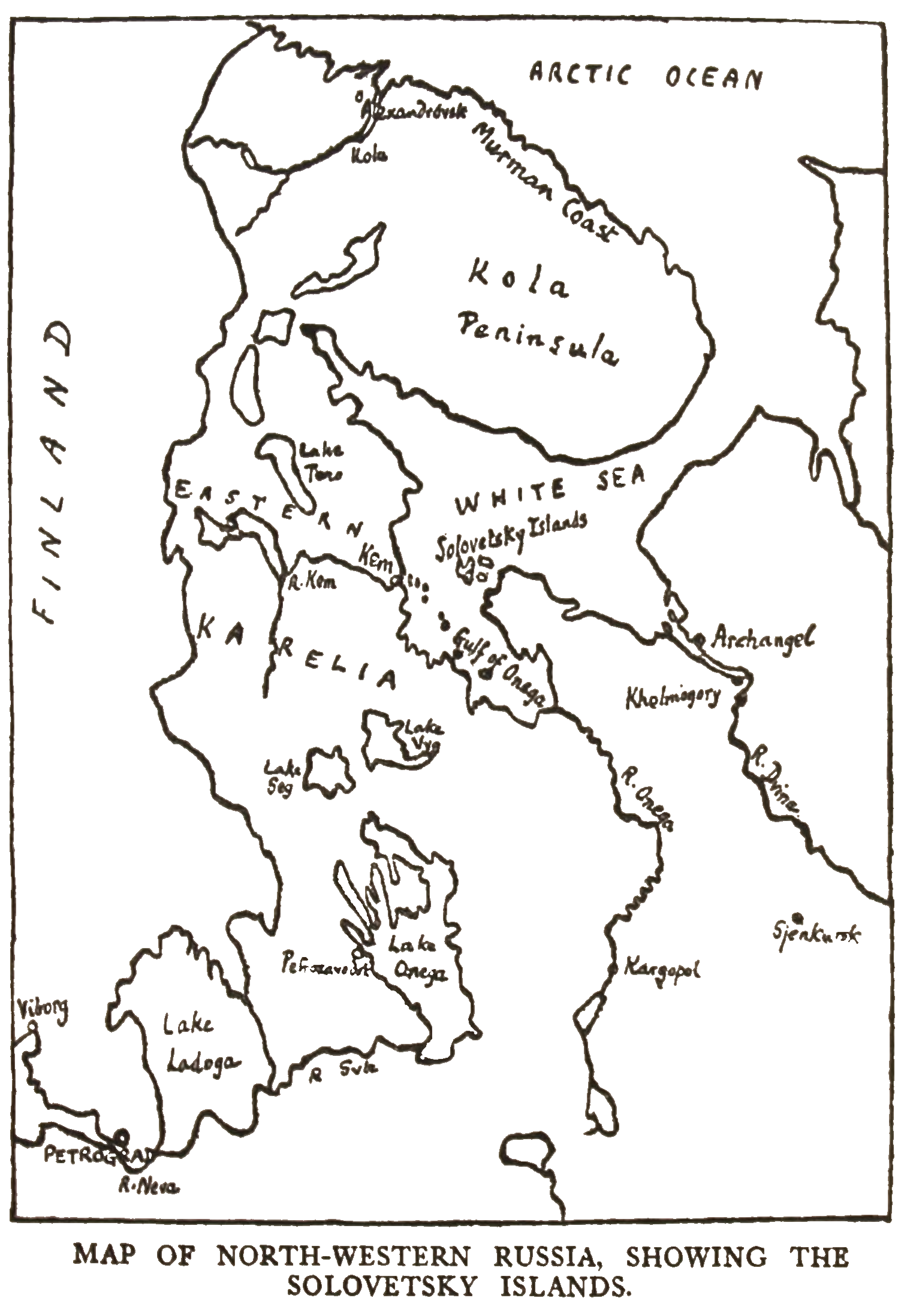
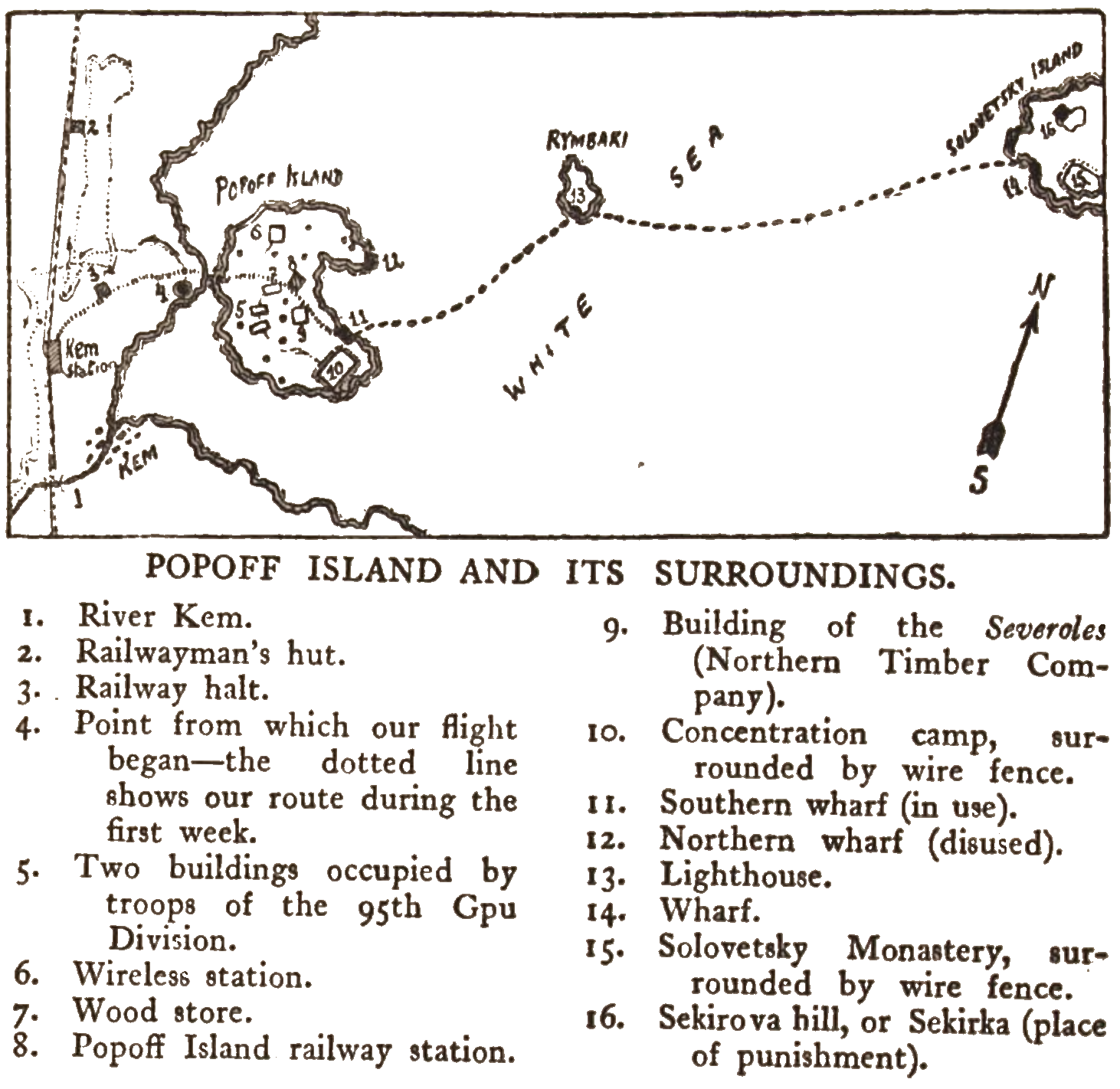
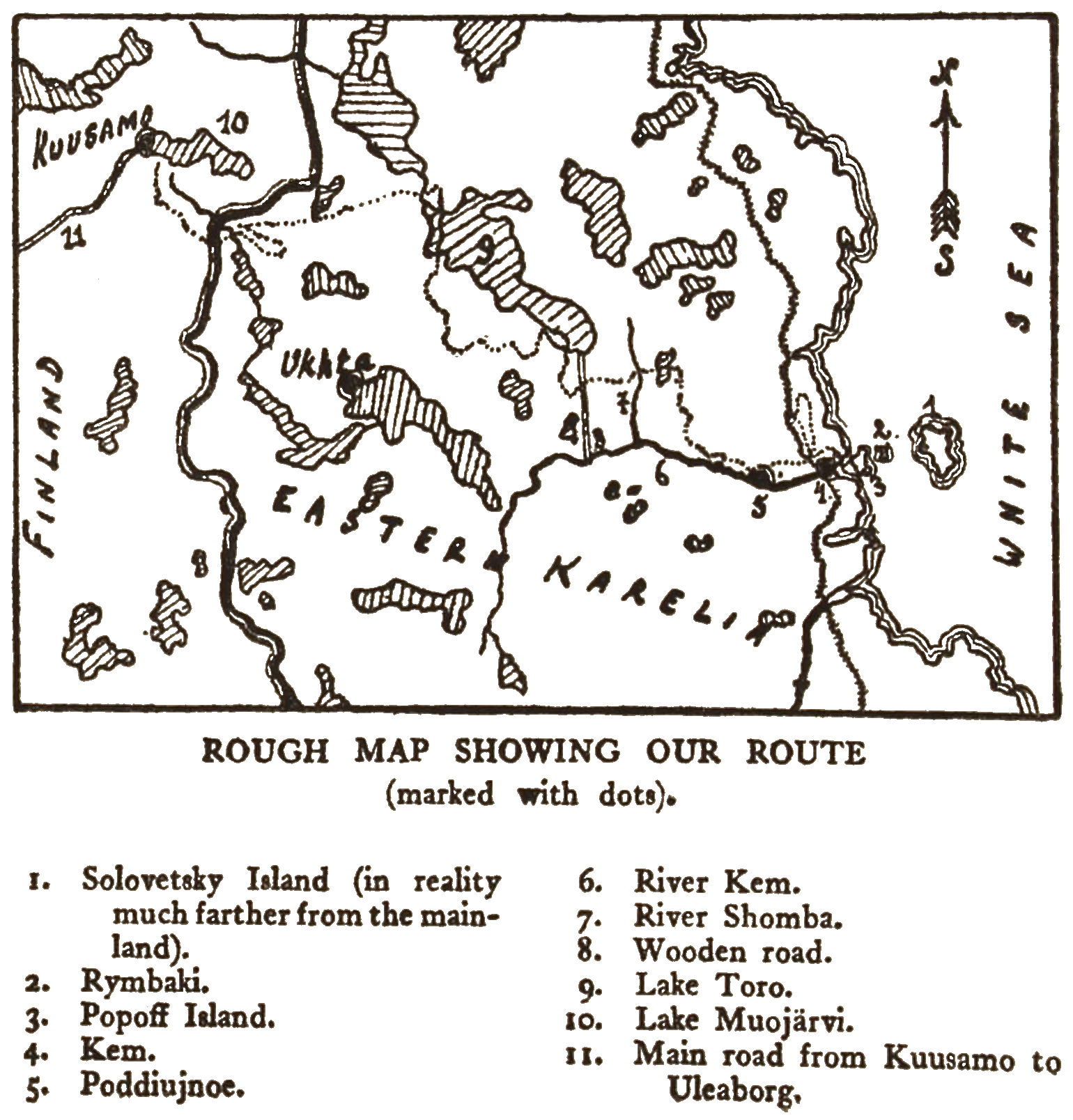
Solovetsky Island is roughly forty miles in
circumference and is rich in caves, inhabited in
bygone days by religious monks, hermits and holy
men vowed to silence. These caves, cut in the
rock, recall mediæval country houses. They are
scattered about the island, the distance from the
monastery varying from three to six or even ten
miles. Here the politicals are settled in parties,
twenty or thirty persons in each cave.
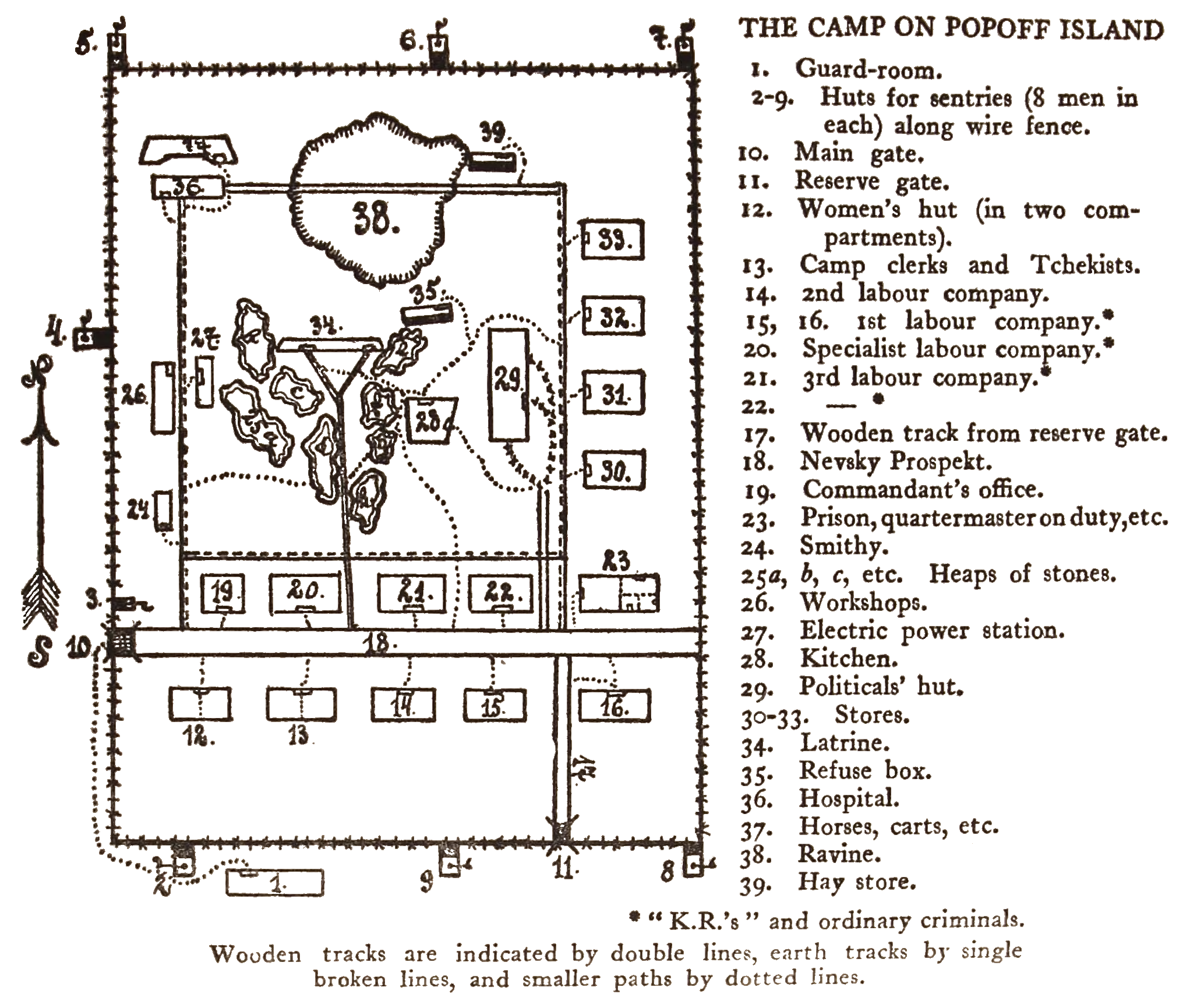
In the Kem camp they live in a special hut,
No. 11 (marked 29 on the plan), which is divided
into two rooms, one for the men and one for the
women and children. The hut is surrounded by a
wire fence and is guarded by special sentries.
On Solovetsky Island the "politicals and party
men" can walk about the island and visit each
other quite freely, without guards. On Popoff
Island they are taken out for exercise with a
sentry, not accompanied by "K.R.'s" or ordinary
criminals.
Standing much closer, in their ideology, to the
Bolsheviks (if the Bolsheviks can be said to have
any ideology) than the "K.R.'s" do, the politicals
naturally receive a certain consideration from the
Soviet authorities and have some attention paid to
their needs and demands. In this respect the
Soviet power is influenced partly by the right wing
of the Communist Party and to a considerable
extent by the Socialists of Western Europe, to
whose utterances the Communists, despite their
assertions to the contrary, listen attentively. The
result is that while it sends "politicals and party
men" to places of exile, it keeps them there under
conditions which are paradise compared to the quite
insupportable existence of the "K.R.'s" in the
Solovky and in the other concentration camps.
It was not till after the "change of cabinet" in
the spring of 1924 that the "K.R.'s" were
permitted to correspond with their relations — the
letters being carefully read by the Tchekists — and
to receive parcels from them. The politicals have
always enjoyed these rights.
If a "K.R." has no relations, or his relations
are not in a position to send him money, food and
other necessaries, he is doomed to death from
starvation, for the camp ration, issued for ten days
in advance, is sufficient for two days only. In this
connection, it should not be forgotten that the
Gpu, when it sends a "K.R." to a place of exile,
generally confiscates all the property belonging to
him and his family. The politicals receive everything
they need in abundance, not only from their
relations, but also from (1) the "Political Red
Cross" presided over by Madame Peshkova,[29]
(2) from foreign Socialist organisations, which
send help on a most generous scale, and (3) from
the "committee for the assistance of Russian
prisoners and exiles." It must be emphatically
stated that the "K.R.'s" did not once receive any
help from this body.
The politicals have their own library, which is
continually supplemented with new Russian and
foreign books. They are allowed to subscribe to
Soviet newspapers and foreign journals of a non-political
character. They are allowed to form
societies for cultural purposes. The leaders of the
politicals read papers on various questions and
organise debates, both in the caves and in hut
No. 11. The politicals are allowed to occupy
themselves with sport. The administration listens
attentively to any complaints they may make.
The "K.R.'s" have no advantages of the kind.
The camp reading-room is at their disposal, but as
the shpana periodically turn it into a latrine, no
"K.R." ever puts his nose inside it. Two publications
are received in the camps, the newspaper
Bednota (Poverty) and the periodical Bezbozhnik
(The Godless One), but even this literature the
"K.R.'s" do not get hold of until two or three
months after its arrival, for it is read first by the
Kem administration, then by the Solovetsky
administration, and then by the Red soldiers. Of
course, the "K.R.'s" are not allowed to carry on
any work of a cultural, let alone a political nature,
and in any case they would have no time, ceaselessly
occupied as they are with work beyond their
strength. How the administration treats complaints
from "K.R.'s" the reader knows already.
Finally, the politicals, according to established
tradition, do no work at all, which is at the same
time an immense privilege and an atrocious
injustice. All the work, both "outside" (outside
the camps) and "inside" (inside the camps), falls
on the shoulders, first and foremost, of the
"K.R.'s" and in a lesser degree of the shpana — the
latter only in quite recent times.
But is it solely due to the sympathy of foreign
Socialists, and a certain degree of conciliatoriness
on the part of the Soviet Government, that the
"politicals and party men" have been able to
secure themselves a more or less bearable existence
in the Solovky? Certainly not. It is in a large
degree the achievement of the politicals themselves.
I am a convinced opponent of the politicals'
social programme, the ultimate aspirations of
which are indistinguishable from those of the
Bolshevist programme and are absolutely Utopian.
But none the less, I will pay due tribute to the
persistency and fearlessness they have shown in
upholding, if need be at personal sacrifice, the
claims put forward by them as a corporate body in
order to alleviate the detestable conditions of their
life as exiles.
The discipline among the Socialists in the
Solovky excels even that of the shpana. They will
face a hunger strike, a rebellion, even death itself
almost without hesitation, to attain the object they
have set before them.
In the winter of 1923 the politicals at the
Solovetsky Monastery, then over a thousand
strong, made a skating rink near one of the caves.
The camp administration observed parties of
skaters on the rink singing revolutionary songs.
They were ordered to stop singing, but did not
obey. Then Nogteff brought a platoon of Red
soldiers down to the rink and opened fire on the
skaters without warning. Nine of them (six men
and three women) were killed and many wounded.
The politicals declared a hunger strike and
demanded that a commission of inquiry should be
sent from Moscow. The whole body of them
took part in the strike, on Popoff Island as well as
on Solovetsky Island. Some of them could not
stand upright from exhaustion, and were taken to
hospital. One of these was the well-known
"S.R." Bogdanoff, who until he was transferred to
the Narym region in April, 1925, was generally
recognised as the leader of the "politicals and
party men" in the Solovky.
Nogteff went to the hospital to persuade them
to stop the hunger strike. He was received with
cries of "Executioner!" Bogdanoff, anxious
that Nogteff should not worry the other sick men
by his presence in the room, told the attendants to
carry him out into the yard on a stretcher. Then
he asked Nogteff:
"What can I do for you?"
Nogteff began again to try to persuade him to
stop the hunger strike.
"Is that all you have to say?" Bogdanoff
replied. "Take me back into hospital. I don't
want to talk to a murderer."
The end of it was that the politicals had their
way. In September of the same year a commission,
consisting of Smirnoff (public prosecutor of
the Supreme Court of the U.S.S.R.), Katanian
(public prosecutor of the Gpu), and Soltz, was
appointed. But the Socialists did not get from
the commission what they expected. Nogteff was
not punished in any way for shooting the nine
persons. The commission found that he had
acted in self-defence!
In the summer of 1924 the politicals again
declared a hunger strike. This time they
demanded that the food should be improved.
The hunger strike lasted thirteen days. Several
persons died, and about a hundred were taken to
hospital. Moscow was appealed to, and this time
granted the politicals' demand. From that time
onward they began to receive daily 2 lbs. of bread
(white and black), 1 lb. of meat, good butter, milk,
eggs, etc., and these rations are still being issued to
them at the time of writing.
At the end of 1924 and the beginning of 1925
students expelled from the universities began to
arrive in the Solovky from Petrograd, Moscow
and other towns. The Soviet Government had
begun to expel and arrest students of bourgeois
origin in order to make room for Communists.[30]
They came in three parties. The first two
parties, consisting of about a hundred persons,
including thirty women students, arrived at Kem
in August, 1924. They included representatives
of all parties (Monarchists, "S.R.'s," "S.D.'s,"
Anarchists, etc.). They declared that they were
prisoners of the "political and party" category
and demanded that they should be quartered in
caves, with the privileges of the other cave
dwellers, and receive the increased ration. The
administration refused their request. The students
declared a hunger strike with the friendly support
of all the politicals. After several persons had
died of starvation the students were recognised as
political prisoners and sent to live in caves on Kond
Island.
Kond Island lies about ten miles from the
monastery. Formerly "seksoty" (secret Gpu
agents) of both sexes used to be sent there; it is
their business to promote espionage and paid delation
among the prisoners. Nogteff bribes useful
people by giving them better rations, gets everything
he wants out of them, and when they are
no longer required, quarters them in remote caves.
The third party of students (twenty-six in
number, including two Anarchists) arrived at Kem
in April, 1925. On the journey from Petrograd
to Kem they smashed up the trucks in which they
were travelling. Their demand to be treated as
politicals was refused by the administration. The
students, again supported by the politicals, declared
a hunger strike, which lasted five weeks. Nogteff
appealed to the Gpu, which ordered him to send
the students back to Petrograd. I do not know
what happened to them afterwards.
The "politicals and party men" carry on
all negotiations with the authorities through
"General" Eichmans, as they object to having
any communication with Nogteff. They dare
even to boycott publicly the most exalted representatives
of the Gpu and the "Narkomyust"
(People's Commissariat for Justice).
At the end of 1924 a so-called "unloading
commission," consisting of Smirnoff, Katanian,
Gleb Boky and a secretary, came to the Solovky.
The prisoners hoped much from it, but their hopes
were not realised. The commission certainly
unloaded the Solovky, but only as regards shpana;
nearly four hundred ordinary criminals were
released, but not a single "K.R." or political.
When bidding farewell to the departing shpana,
Katanian announced to the assembled prisoners:
"If the prisoners who are being released now
reform and become useful citizens of the Soviet
Republic, I shall come back next year and liberate
another batch."
Thus the fate of the "K.R.'s" and politicals
was made dependent on the conduct of ordinary
criminals when set at liberty!
The commission stayed in the Solovky three
days, and spent most of their time out shooting.
The Tchekists exterminated the last survivors of
the wild and tame animals, the latter introduced by
the monks at some earlier period. On the last
day Katanian visited the caves on Solovetsky
Island, but the politicals drove him away with
cries of "Go away, murderer! To hell with the
executioner!"
The public prosecutor of the Supreme Court,
Smirnoff, called a meeting and made a long speech.
His speech was entirely devoted to controverting
"the impudent calumnies of the émigré White
Guard Press and foreign bourgeois newspapers."
He attacked in particular the émigré Socialist paper
Dni[31] for "misleading the proletariat of Europe by
its criminal falsehoods about the Solovky."
On his return to Moscow he wrote and published
a pamphlet entitled "The Solovky" (State
Printing Office, Moscow, 1925), in which he stated
that "complete liberty" prevailed there, that the
food was "excellent," and that the treatment of the
prisoners by the administration was "more than
lenient."
To crown the whole performance, Smirnoff did
not shrink from open mockery of the prisoners.
A large number of copies of the pamphlet were
sent to the Solovetsky camps and distributed to
us — to us, who were tasting every minute of every
day the "liberty," the "excellent food" and
"more than lenient" treatment by the administration
of which Smirnoff talked!
If Nogteff, Eichmans and their fellows listen to
what the politicals have to say, the attitude of the
lower personnel can be taken for granted. The
conversations of the politicals with the commanders
of the labour regiments and companies, quartermasters,
and overseers of the kitchens and workshops
have the tone of orders. Their headman
Bogdanoff, when speaking to any subordinate in
the commandant's office, always began his sentences
with the words "we wish" instead of "we ask."
Before rations were distributed, Bogdanoff used to
go to the quartermaster and choose the best meat,
white bread, and so on, for his section of the
prisoners. His successor as headman, the Social
Democrat Mamuloff, a lawyer from Vladikavkaz,
enjoys the same rights.
The politicals, having plenty of time to themselves,
are able to educate their children, and bring
them up according to their own political views.
One sees a ten-year-old boy, the son of a political,
walking through the huts, greeting the Tchekists
and sentries with abuse, and, when the prisoners
ask him in fun to which party he belongs, replying
proudly:
"I'm a Socialist. Down with the Communist
usurpers!"