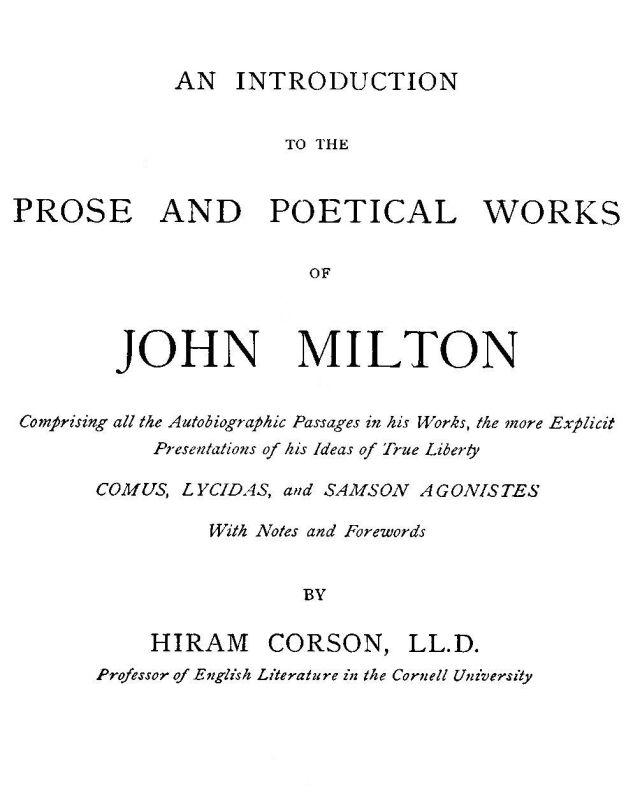
An Introduction to the Prose and Poetical Works of John Milton
by John Milton
★★★★★No ratings yet
Language: English
Sign in to rate this book.
Sign in to shelve this book.
About this eBook
- Author
- Milton, John, 1608-1674
- Title
- An Introduction to the Prose and Poetical Works of John Milton Comprising All the Autobiographic Passages in His Works, the More Explicit Presentations of His Ideas of True Liberty.
- Credits
- Produced by Charlene Taylor, Lisa Reigel, and the Online Distributed Proofreading Team at www.pgdp.net (This file was produced from images generously made available by The Internet Archive/American Libraries.)
- Language
- English
- LoC Class
- PR: Language and Literatures: English literature
- Subject
- English prose literature -- Early modern, 1500-1700
- Category
- Text
- eBook-No.
- 44733
- Project Gutenberg
- https://www.gutenberg.org/ebooks/44733
- Release Date
- January 23, 2014
- Copyright
- Public domain in the USA.
Contents
- 1.AN INTRODUCTION TO THE PROSE AND POETICAL WORKS OF JOHN MILTON
- 2.TABLE OF CONTENTS
- 3.INTRODUCTION
- 4.MILTON'S AUTOBIOGRAPHY made up of all the more important autobiographical passages contained in his prose and poetical works — From the Preface to 'A Defence of the English People' — From the 'Second Defence of the People of England in Reply to an Anonymous Libel, entitled "The Cry of the Royal Blood to Heaven against the English Parricides"' — To Charles Diodati, Milton's schoolfellow at St. Paul's School, and his dearest friend — To Alexander Gill, Jr. ( Familiar Letters , No. III.) — To Thomas Young. ( Familiar Letters , No. IV.) — To Charles Diodati , — Prolusiones quædam Oratoriæ — An English letter to a friend (unknown), who, it appears, had been calling him to account for his apparent indifference as to his work in life — To Alexander Gill, Jr. ( Familiar Letters , No. V.) — To Charles Diodati. ( Familiar Letters , No. VI.) — To Charles Diodati. ( Familiar Letters , No. VII.) — To Benedetto Bonmattei of Florence. ( Familiar Letters , No. VIII.) — Mansus — From the 'Areopagitica: a speech for the liberty of unlicensed printing. To the Parliament of England' — To Lucas Holstenius in the Vatican at Rome. ( Familiar Letters , No. IX.) — Epitaphium Damonis — From 'Of Reformation in England' — From 'Animadversions upon the Remonstrant's Defence,' etc. — From 'The Reason of Church Government urged against Prelaty' — From 'Apology for Smectymnuus' — To Carlo Dati, Nobleman of Florence. ( Familiar Letters , No. X.) — On his Blindness — To the most distinguished Leonard Philaras, of Athens, Ambassador from the Duke of Parma to the King of France. ( Familiar Letters , No. XII.) — To Henry Oldenburg, agent for the city of Bremen in Lower Saxony with the Commonwealth. ( Familiar Letters , No. XIV.) — To Leonard Philaras, Athenian. ( Familiar Letters , No. XV.) — To Cyriac Skinner — On his deceased wife — To the most accomplished Emeric Bigot. ( Familiar Letters , No. XXI.) — To Henry Oldenburg. ( Familiar Letters , No. XXIX.) — From 'Considerations touching the Likeliest Means to remove Hirelings out of the Church.' ( August, 1659 ) — Autobiographic passages in the 'Paradise Lost' — To the very distinguished Peter Heimbach, Councillor to the Elector of Brandenburg. ( Familiar Letters , No. XXXI.)
- 5.PASSAGES IN MILTON'S PROSE AND POETICAL WORKS IN WHICH HIS IDEA OF TRUE LIBERTY, INDIVIDUAL, DOMESTIC, CIVIL, POLITICAL, AND RELIGIOUS, IS EXPLICITLY SET FORTH — From 'The Reason of Church Government urged against Prelaty.' Chap. I. — Peroration of 'The Second Defence of the People of England' — On the Detraction which followed upon my Writing Certain Treatises
- 6.COMUS — THE PERSONS
- 7.LYCIDAS
- 8.SAMSON AGONISTES — OF THAT SORT OF DRAMATIC POEM WHICH IS CALLED TRAGEDY — THE ARGUMENT — THE PERSONS — SAMSON AGONISTES
- 9.NOTES — A Defence of the People of England — The Second Defence of the People of England — To Charles Diodati — To Alexander Gill, Jr. ( Familiar Letters , No. III.) — To Thomas Young. ( Familiar Letters , No. IV.) — To Charles Diodati, making a Stay in the Country — Ad Patrem — An English Letter to a Friend — To Alexander Gill, Jr. ( Familiar Letters , No. V.) — To Charles Diodati. ( Familiar Letters , No. VI.) — To Benedetto Bonmattei of Florence. ( Familiar Letters , No. VIII.) — Mansus — Areopagitica — To Lucas Holstenius. ( Familiar Letters , No. IX.) — Epitaphium Damonis — Of Reformation in England — Animadversions upon the Remonstrant's Defence, etc. — The Reason of Church Government urged against Prelaty — To Carlo Dati. ( Familiar Letters , No. X.) — On his Blindness — To Leonard Philaras. ( Familiar Letters , No. XII.) — To Henry Oldenburg. ( Familiar Letters , No. XIV.) — To Leonard Philaras. ( Familiar Letters , No. XV.) — To Cyriac Skinner — On his deceased wife — To Emeric Bigot. ( Familiar Letters , No. XXI.) — Autobiographic passages in the Paradise Lost — Letter to Peter Heimbach. ( Familiar Letters , No. XXXI.) — Passages in which Milton's Idea of True Liberty is Set Forth — Comus — Lycidas — Samson Agonistes
Community reviews
Sign in to write a review.
No reviews yet.