GROWTH OF THE NATION
To the Middle of the Fourteenth Century
1. The Geography of England.—The British Isles lie northwest of the
Continent of Europe. They are separated from it by the Channel and the
North Sea, at the narrowest only twenty miles wide, and at the
broadest not more than three hundred.
The greatest length of England from north to south is three hundred
and sixty-five miles, and its greatest breadth some two hundred and
eighty miles. Its area, with Wales, is 58,320 square miles, being
somewhat more than one-quarter the size of France or of Germany, just
one-half the size of Italy, and somewhat larger than either
Pennsylvania or New York.
The backbone of the island is near the western coast, and consists of
a body of hard granitic and volcanic rock rising into mountains of two
or three thousand feet in height. These do not form one continuous
chain but are in several detached groups. On the eastern flank of
these mountains and underlying all the rest of the island is a series
of stratified rocks. The harder portions of these strata still stand
up as long ridges,—the "wolds," "wealds," "moors," and "downs" of the
more eastern and south-eastern parts of England. The softer
strata have been worn away into great broad valleys, furnishing the
central and eastern plains or lowlands of the country.
The rivers of the south and of the far north run for the most part by
short and direct courses to the sea. The rivers of the midlands are
much longer and larger. As a result of the gradual sinking of the
island, in recent geological periods the sea has extended some
distance up the course of these rivers, making an almost unbroken
series of estuaries along the whole coast.
The climate of England is milder and more equable than is indicated by
the latitude, which is that of Labrador in the western hemisphere and
of Prussia and central Russia on the Continent of Europe. This is due
to the fact that the Gulf Stream flows around its southern and western
shores, bringing warmth and a superabundance of moisture from the
southern Atlantic.
These physical characteristics have been of immense influence on the
destinies of England. Her position was far on the outskirts of the
world as it was known to ancient and mediæval times, and England
played a correspondingly inconspicuous part during those periods. In
the habitable world as it has been known since the fifteenth century,
on the other hand, that position is a distinctly central one, open
alike to the eastern and the western hemisphere, to northern and
southern lands.
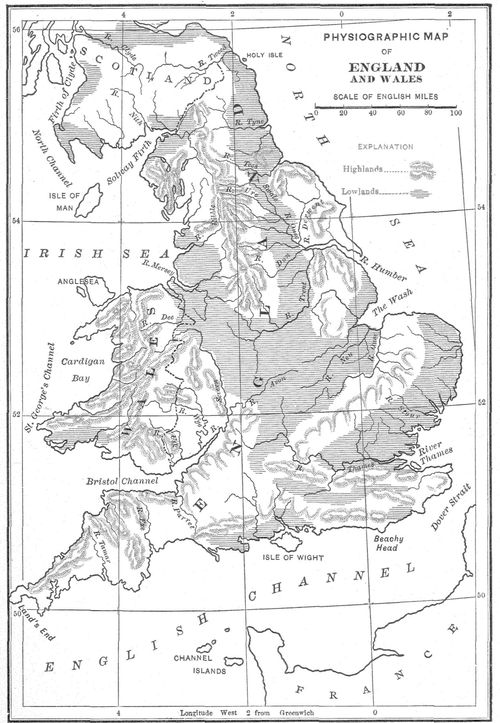
Physiographic Map Of England And Wales.
Engraved By
Bormay & Co., N.Y.
Her situation of insularity and at the same time of proximity to the
Continent laid her open to frequent invasion in early times, but after
she secured a navy made her singularly safe from subjugation. It made
the development of many of her institutions tardy, yet at the same
time gave her the opportunity to borrow and assimilate what she would
from the customs of foreign nations. Her separation by
water from the Continent favored a distinct and continuous national
life, while her nearness to it allowed her to participate in all the
more important influences which affected the nations of central
Europe.
Within the mountainous or elevated regions a variety of mineral
resources, especially iron, copper, lead, and tin, exist in great
abundance, and have been worked from the earliest ages. Potter's clay
and salt also exist, the former furnishing the basis of industry for
an extensive section of the midlands. By far the most important
mineral possession of England, however, is her coal. This exists in
the greatest abundance and in a number of sections of the north and
west of the country. Practically unknown in the Middle Ages, and only
slightly utilized in early modern times, within the eighteenth and
nineteenth centuries her coal supply has come to be the principal
foundation of England's great manufacturing and commercial
development.
The lowlands, which make up far the larger part of the country, are
covered with soil which furnishes rich farming areas, though in many
places this soil is a heavy and impervious clay, expensive to drain
and cultivate. The hard ridges are covered with thin soil only. Many
of them therefore remained for a long time covered with forest, and
they are devoted even yet to grazing or to occasional cultivation
only.
The abundance of harbors and rivers, navigable at least to the small
vessels of the Middle Ages, has made a seafaring life natural to a
large number of the people, and commercial intercourse comparatively
easy with all parts of the country bordering on the coast or on these
rivers.
Thus, to sum up these geographical characteristics, the insular
situation of England, her location on the earth's surface, and the
variety of her material endowments gave her a tolerably
well-balanced if somewhat backward economic position during the Middle
Ages, and have enabled her since the fifteenth century to pass through
a continuous and rapid development, until she has obtained within the
nineteenth century, for the time at least, a distinct economic
precedency among the nations of the world.
2. Prehistoric Britain.—The materials from which to construct a
knowledge of the history of mankind before the time of written records
are few and unsatisfactory. They consist for the most part of the
remains of dwelling-places, fortifications, and roadways; of weapons,
implements, and ornaments lost or abandoned at the time; of burial
places and their contents; and of such physical characteristics of
later populations as have survived from an early period. Centuries of
human habitation of Britain passed away, leaving only such scanty
remains and the obscure and doubtful knowledge that can be drawn from
them. Through this period, however, successive races seem to have
invaded and settled the country, combining with their predecessors, or
living alongside of them, or in some cases, perhaps, exterminating
them.
When contemporary written records begin, just before the beginning of
the Christian era, one race, the Britons, was dominant, and into it
had merged to all appearances all others. The Britons were a Celtic
people related to the inhabitants of that part of the Continent of
Europe which lies nearest to Britain. They were divided into a dozen
or more separate tribes, each occupying a distinct part of the
country. They lived partly by the pasturing of sheep and cattle,
partly by a crude agriculture. They possessed most of the familiar
grains and domestic animals, and could weave and dye cloth, make
pottery, build boats, forge iron, and work other metals, including
tin. They had, however, no cities, no manufactures beyond
the most primitive, and but little foreign trade to connect them with
the Continent. At the head of each tribe was a reigning chieftain of
limited powers, surrounded by lesser chiefs. The tribes were in a
state of incessant warfare one with the other.
3. Roman Britain.—This condition of insular isolation and barbarism
was brought to a close in the year 55 B.C. by the invasion of the
Roman army. Julius Cæsar, the Roman general who was engaged in the
conquest and government of Gaul, or modern France, feared that the
Britons might bring aid to certain newly subjected and still restless
Gallic tribes. He therefore transported a body of troops across the
Channel and fought two campaigns against the tribes in the southeast
of Britain. His success in the second campaign was, however, not
followed up, and he retired without leaving any permanent garrison in
the country. The Britons were then left alone, so far as military
invasion was concerned, for almost a century, though in the meantime
trade with the adjacent parts of the Continent became more common, and
Roman influence showed itself in the manners and customs of the
people. In the year 44 A.D., just ninety years after Cæsar's
campaigns, the conquest of Britain was resumed by the Roman armies and
completed within the next thirty years. Britain now became an integral
part of the great, well-ordered, civilized, and wealthy Roman Empire.
During the greater part of that long period, Britain enjoyed profound
peace, internal and external trade were safe, and much of the culture
and refinement of Italy and Gaul must have made their way even to this
distant province. A part of the inhabitants adopted the Roman
language, dress, customs, and manner of life. Discharged veterans from
the Roman legions, wealthy civil officials and merchants, settled
permanently in Britain. Several bodies of turbulent tribesmen
who had been defeated on the German frontier were
transported by the government into Britain. The population must,
therefore, have become very mixed, containing representatives of most
of the races which had been conquered by the Roman armies. A permanent
military force was maintained in Britain with fortified stations along
the eastern and southern coast, on the Welsh frontier, and along a
series of walls or dikes running across the island from the Tyne to
Solway Firth. Excellent roads were constructed through the length and
breadth of the land for the use of this military body and to connect
the scattered stations. Along these highways population spread and the
remains of spacious villas still exist to attest the magnificence of
the wealthy provincials. The roads served also as channels of trade by
which goods could readily be carried from one part of the country to
another. Foreign as well as internal trade became extensive, although
exports were mostly of crude natural products, such as hides, skins,
and furs, cattle and sheep, grain, pig-iron, lead and tin,
hunting-dogs and slaves. The rapid development of towns and cities was
a marked characteristic of Roman Britain. Fifty-nine towns or cities
of various grades of self-government are named in the Roman survey,
and many of these must have been populous, wealthy, and active,
judging from the extensive ruins that remain, and the enormous number
of Roman coins that have since been found. Christianity was adopted
here as in other parts of the Roman Empire, though the extent of its
influence is unknown.
During the Roman occupation much waste land was reclaimed. Most of the
great valley regions and many of the hillsides had been originally
covered with dense forests, swamps spread along the rivers and
extended far inland from the coast; so that almost the only parts
capable of tillage were the high treeless plains, the hill
tops, and certain favored stretches of open country. The reduction of
these waste lands to human habitation has been an age-long task. It
was begun in prehistoric times, it has been carried further by each
successive race, and brought to final completion only within our own
century. A share in this work and the great roads were the most
permanent results of the Roman period of occupation and government.
Throughout the fourth and fifth centuries of the Christian era the
Roman administration and society in Britain were evidently
disintegrating. Several successive generals of the Roman troops
stationed in Britain rose in revolt with their soldiers, declared
their independence of Rome, or passed over to the Continent to enter
into a struggle for the control of the whole Empire. In 383 and 407
the military forces were suddenly depleted in this way and the
provincial government disorganized, while the central government of
the Empire was so weak that it was unable to reëstablish a firm
administration. During the same period barbarian invaders were making
frequent inroads into Britain. The Picts and Scots from modern
Scotland, Saxon pirates, and, later, ever increasing swarms of Angles,
Jutes, and Frisians from across the North Sea ravaged and ultimately
occupied parts of the borders and the coasts. The surviving records of
this period of disintegration and reorganization are so few that we
are left in all but total ignorance as to what actually occurred. For
more than two hundred years we can only guess at the course of events,
or infer it from its probable analogy to what we know was occurring in
the other parts of the Empire, or from the conditions we find to have
been in existence as knowledge of succeeding times becomes somewhat
more full. It seems evident that the government of the province of
Britain gradually went to pieces, and that that of the different
cities or districts followed. Internal dissensions and the
lack of military organization and training of the mass of the
population probably added to the difficulty of resisting marauding
bands of barbarian invaders. These invading bands became larger, and
their inroads more frequent and extended, until finally they abandoned
their home lands entirely and settled permanently in those districts
in which they had broken the resistance of the Roman-British natives.
Even while the Empire had been strong the heavy burden of taxation and
the severe pressure of administrative regulations had caused a decline
in wealth and population. Now disorder, incessant ravages of the
barbarians, isolation from other lands, probably famine and
pestilence, brought rapid decay to the prosperity and civilization of
the country. Cities lost their trade, wealth, and population, and many
of them ceased altogether for a time to exist. Britain was rapidly
sinking again into a land of barbarism.
4. Early Saxon England.—An increasing number of contemporary records
give a somewhat clearer view of the condition of England toward the
close of the sixth century. The old Roman organization and
civilization had disappeared entirely, and a new race, with a new
language, a different religion, another form of government, changed
institutions and customs, had taken its place. A number of petty
kingdoms had been formed during the fifth and early sixth centuries,
each under a king or chieftain, as in the old Celtic times before the
Roman invasion, but now of Teutonic or German race. The kings and
their followers had come from the northwestern portions of Germany.
How far they had destroyed the earlier inhabitants, how far they had
simply combined with them or enslaved them, has been a matter of much
debate, and one on which discordant opinions are held, even by recent
students. It seems likely on the whole that the earlier
races, weakened by defeat and by the disappearance of the Roman
control, were gradually absorbed and merged into the body of their
conquerors; so that the petty Angle and Saxon kings of the sixth and
seventh centuries ruled over a mixed race, in which their own was the
most influential, though not necessarily the largest element. The
arrival from Rome in 597 of Augustine, the first Christian missionary
to the now heathen inhabitants of Britain, will serve as a point to
mark the completion of the Anglo-Saxon conquest of the country. By
this time the new settlers had ceased to come in, and there were along
the coast and inland some seven or eight different kingdoms. These
were, however, so frequently divided and reunited that no fixed number
remained long in existence. The Jutes had established the kingdom of
Kent in the south-eastern extremity of the island; the South and the
West Saxons were established on the southern coast and inland to the
valley of the Thames; the East Saxons had a kingdom just north of the
mouth of the Thames, and the Middle Saxons held London and the
district around. The rest of the island to the north and inland
exclusive of what was still unconquered was occupied by various
branches of the Angle stock grouped into the kingdoms of East Anglia,
Mercia, and Northumbria. During the seventh and eighth centuries there
were constant wars of conquest among these kingdoms. Eventually, about
800 A.D., the West Saxon monarchy made itself nominally supreme over
all the others. Notwithstanding this political supremacy of the West
Saxons, it was the Angles who were the most numerous and widely
spread, and who gave their name, England, to the whole land.
Agriculture was at this time almost the sole occupation of the people.
The trade and commerce that had centred in the towns and
flowed along the Roman roads and across the Channel had long since
come to an end with the Roman civilization of which it was a part. In
Saxon England cities scarcely existed except as fortified places of
defence. The products of each rural district sufficed for its needs in
food and in materials for clothing, so that internal trade was but
slight. Manufactures were few, partly from lack of skill, partly from
lack of demand or appreciation; but weaving, the construction of
agricultural implements and weapons, ship-building, and the working of
metals had survived from Roman times, or been brought over as part of
the stock of knowledge of the invaders. Far the greater part of the
population lived in villages, as they probably had done in Roman and
in prehistoric times. The village with the surrounding farming lands,
woods, and waste grounds made up what was known in later times as the
"township."
The form of government in the earlier separate kingdoms, as in the
united monarchy after its consolidation, gave limited though
constantly increasing powers to the king. A body of nobles known as
the "witan" joined with the king in most of the actions of government.
The greater part of the small group of government functions which were
undertaken in these barbarous times were fulfilled by local gatherings
of the principal men. A district formed from a greater or less number
of townships, with a meeting for the settlement of disputes, the
punishment of crimes, the witnessing of agreements, and other
purposes, was known as a "hundred" or a "wapentake." A "shire" was a
grouping of hundreds, with a similar gathering of its principal men
for judicial, military, and fiscal purposes. Above the shire came the
whole kingdom.
The most important occurrences of the early Saxon period were the
general adoption of Christianity and the organization of the
church. Between A.D. 597 and 650 Christianity gained acceptance
through the preaching and influence of missionaries, most of whom were
sent from Rome, though some came from Christian Scotland and Ireland.
The organization of the church followed closely. It was largely the
work of Archbishop Theodore, and was practically complete before the
close of the seventh century. By this organization England was divided
into seventeen dioceses or church districts, religious affairs in each
of these districts being under the supervision of a bishop. The
bishop's church, called a "cathedral," was endowed by religious kings
and nobles with extensive lands, so that the bishop was a wealthy
landed proprietor, in addition to having control of the clergy of his
diocese, and exercising a powerful influence over the consciences and
actions of its lay population. The bishoprics were grouped into two
"provinces," those of Canterbury and York, the bishops of these two
dioceses having the higher title of archbishop, and having a certain
sort of supervision over the other bishops of their province. Churches
were gradually built in the villages, and each township usually became
a parish with a regularly established priest. He was supported partly
by the produce of the "glebe," or land belonging to the parish church,
partly by tithe, a tax estimated at one-tenth of the income of each
man's land, partly by the offerings of the people. The bishops, the
parish priests, and others connected with the diocese, the cathedral,
and the parish churches made up the ordinary or "secular" clergy.
There were also many religious men and women who had taken vows to
live under special "rules" in religious societies withdrawn from the
ordinary life of the world, and were therefore known as "regular"
clergy. These were the monks and nuns. In Anglo-Saxon England the
regular clergy lived according to the rule of St. Benedict,
and were gathered into groups, some smaller, some larger, but always
established in one building, or group of buildings. These monasteries,
like the bishoprics, were endowed with lands which were increased from
time to time by pious gifts of kings, nobles, and other laymen.
Ecclesiastical bodies thus came in time to hold a very considerable
share of the land of the country. The wealth and cultivation of the
clergy and the desire to adorn and render more attractive their
buildings and religious services fostered trade with foreign
countries. The intercourse kept up with the church on the Continent
also did something to lessen the isolation of England from the rest of
the world. To these broadening influences must be added the effect
which the Councils made up of churchmen from all England exerted in
fostering the tardy growth of the unity of the country.
5. Danish and Late Saxon England.—At the end of the eighth century
the Danes or Northmen, the barbarous and heathen inhabitants of the
islands and coast-lands of Denmark, Norway, and Sweden, began to make
rapid forays into the districts of England which lay near enough to
the coasts or rivers to be at their mercy. Soon they became bolder or
more numerous and established fortified camps along the English
rivers, from which they ravaged the surrounding country. Still later,
in the tenth and eleventh centuries, under their own kings as leaders,
they became conquerors and permanent settlers of much of the country,
and even for a time put a Danish dynasty on the throne to govern
English and Danes alike. A succession of kings of the West Saxon line
had struggled with varying success to drive the Danes from the country
or to limit that portion of it which was under their control; but as a
matter of fact the northern, eastern, and central portions of England
were for more than a century and a half almost entirely
under Danish rule. The constant immigration from Scandinavia during
this time added an important element to the population—an element
which soon, however, became completely absorbed in the mixed stock of
the English people.
The marauding Danish invaders were early followed by fellow-countrymen
who were tradesmen and merchants. The Scandinavian countries had
developed an early and active trade with the other lands bordering on
the Baltic and North seas, and England under Danish influence was
drawn into the same lines of commerce. The Danes were also more
inclined to town life than the English, so that advantageously
situated villages now grew into trading towns, and the sites of some
of the old Roman cities began again to be filled with a busy
population. With trading came a greater development of handicrafts, so
that the population of later Anglo-Saxon England had somewhat varied
occupations and means of support, instead of being exclusively
agricultural, as in earlier centuries.
During these later centuries of the Saxon period, from 800 to 1066,
the most conspicuous and most influential ruler was King Alfred. When
he became king, in 871, the Danish invaders were so completely
triumphant as to force him to flee with a few followers to the forest
as a temporary refuge. He soon emerged, however, with the nucleus of
an army and, during his reign, which continued till 901, defeated the
Danes repeatedly, obtained their acceptance of Christianity, forced
upon them a treaty which restricted their rule to the northeastern
shires, and transmitted to his son a military and naval organization
which enabled him to win back much even of this part of England. He
introduced greater order, prosperity, and piety into the church, and
partly by his own writing, partly by his patronage of
learned men, reawakened an interest in Anglo-Saxon literature and in
learning which the ravages of the Danes and the demoralization of the
country had gone far to destroy. Alfred, besides his actual work as
king, impressed the recognition of his fine nature and strong
character deeply on the men of his time and the memory of all
subsequent times.
The power of the kingship in the Anglo-Saxon system of government was
strengthened by the life and work of such kings as Alfred and some of
his successors. There were other causes also which were tending to
make the central government more of a reality. A national taxation,
the Danegeld, was introduced for the purpose of ransoming the country
from the Danes; the grant of lands by the king brought many persons
through the country into closer relations with him; the royal judicial
powers tended to increase with the development of law and
civilization; the work of government was carried on by better-trained
officials.
On the other hand, a custom grew up in the tenth and early eleventh
century of placing whole groups of shires under the government of
great earls or viceroys, whose subjection to the central government of
the king was but scant. Church bodies and others who had received
large grants of land from the king were also coming to exercise over
their tenants judicial, fiscal, and probably even military powers,
which would seem more properly to belong to government officials. The
result was that although the central government as compared with the
local government of shires and hundreds was growing more active, the
king's power as compared with the personal power of the great nobles
was becoming less strong. Violence was common, and there were but few
signs of advancing prosperity or civilization, when an entirely new
set of influences came into existence with the conquest by the duke of
Normandy in the year 1066.
6. The Period following the Norman Conquest.—Normandy was a
province of France lying along the shore of the English Channel. Its
line of dukes and at least a considerable proportion of its people
were of the same Scandinavian or Norse race which made up such a large
element in the population of England. They had, however, learned more
of the arts of life and of government from the more successfully
preserved civilization of the Continent. The relations between England
and Normandy began to be somewhat close in the early part of the
eleventh century; the fugitive king of England, Ethelred, having taken
refuge there, and marrying the sister of the duke. Edward the
Confessor, their son, who was subsequently restored to the English
throne, was brought up in Normandy, used the French language, and was
accompanied on his return by Norman followers. Nine years after the
accession of Edward, in 1051, William, the duke of Normandy, visited
England and is said to have obtained a promise that he should receive
the crown on the death of Edward, who had no direct heir. Accordingly,
in 1065, when Edward died and Harold, a great English earl, was chosen
king, William immediately asserted his claim and made strenuous
military preparations for enforcing it. He took an army across the
Channel in 1066, as Cæsar had done more than a thousand years before,
and at the battle of Hastings or Senlac defeated the English army,
King Harold himself being killed in the engagement. William then
pressed on toward London, preventing any gathering of new forces, and
obtained his recognition as king. He was crowned on Christmas Day,
1066. During the next five years he put down a series of rebellions on
the part of the native English, after which he and his descendants
were acknowledged as sole kings of England.
The Norman Conquest was not, however, a mere change of
dynasty. It led to at least three other changes of the utmost
importance. It added a new element to the population, it brought
England into contact with the central and southern countries of the
Continent, instead of merely with the northern as before, and it made
the central government of the country vastly stronger. There is no
satisfactory means of discovering how many Normans and others from
across the Channel migrated into England with the Conqueror or in the
wake of the Conquest, but there is no doubt that the number was large
and their influence more than proportionate to their numbers. Within
the lifetime of William, whose death occurred in 1087, of his two
sons, William II and Henry I, and the nominal reign of Stephen
extending to 1154, the whole body of the nobility, the bishops and
abbots, and the government officials had come to be of Norman or other
continental origin. Besides these the architects and artisans who
built the castles and fortresses, and the cathedrals, abbeys, and
parish churches, whose erection throughout the land was such a marked
characteristic of the period, were immigrants from Normandy. Merchants
from the Norman cities of Rouen and Caen came to settle in London and
other English cities, and weavers from Flanders were settled in
various towns and even rural districts. For a short time these
newcomers remained a separate people, but before the twelfth century
was over they had become for the most part indistinguishable from the
great mass of the English people amongst whom they had come. They had
nevertheless made that people stronger, more vigorous, more
active-minded, and more varied in their occupations and interests.
King William and his successors retained their continental
dominions and even extended them after their acquisition of the
English kingdom, so that trade between the two sides of the Channel
was more natural and easy than before. The strong government of the
Norman kings gave protection and encouragement to this commerce, and
by keeping down the violence of the nobles favored trade within the
country. The English towns had been growing in number, size, and
wealth in the years just before the Conquest. The contests of the
years immediately following 1066 led to a short period of decay, but
very soon increasing trade and handicraft led to still greater
progress. London, especially, now made good its position as one of the
great cities of Europe, and that preëminence among English towns which
it has never since lost. The fishing and seaport towns along the
southern and eastern coast also, and even a number of inland towns,
came to hold a much more influential place in the nation than they had
possessed in the Anglo-Saxon period.
The increased power of the monarchy arose partly from its military
character as based upon a conquest of the country, partly from the
personal character of William and his immediate successors, partly
from the more effective machinery for administration of the affairs of
government, which was either brought over from Normandy or developed
in England. A body of trained, skilful government officials now
existed, who were able to carry out the wishes of the king, collect
his revenues, administer justice, gather armies, and in other ways
make his rule effective to an extent unknown in the preceding period.
The sheriffs, who had already existed as royal representatives in the
shires in Anglo-Saxon times, now possessed far more extensive powers,
and came up to Westminster to report and to present their financial
accounts to the royal exchequer twice a year. Royal
officials acting as judges not only settled an increasingly large
number of cases that were brought before them at the king's court, but
travelled through the country, trying suits and punishing criminals in
the different shires. The king's income was vastly larger than that of
the Anglo-Saxon monarchs had been. The old Danegeld was still
collected from time to time, though under a different name, and the
king's position as landlord of the men who had received the lands
confiscated at the Conquest was utilized to obtain additional
payments.
Perhaps the greatest proof of the power and efficiency of the
government in the Norman period was the compilation of the great body
of statistics known as "Domesday Book." In 1085 King William sent
commissioners to every part of England to collect a variety of
information about the financial conditions on which estates were held,
their value, and fitness for further taxation. The information
obtained from this investigation was drawn up in order and written in
two large manuscript volumes which still exist in the Public Record
Office at London. It is a much more extensive body of information than
was collected for any other country of Europe until many centuries
afterward. Yet its statements, though detailed and exact and of great
interest from many points of view, are disappointing to the student of
history. They were obtained for the financial purposes of government,
and cannot be made to give the clear picture of the life of the people
and of the relations of different classes to one another which would
be so welcome, and which is so easily obtained from the great variety
of more private documents which came into existence a century and a
half later.
The church during this period was not relatively so conspicuous as
during Saxon times, but the number of the clergy, both
secular and regular, was very large, the bishops and abbots powerful,
and the number of monasteries and nunneries increasing. The most
important ecclesiastical change was the development of church courts.
The bishops or their representatives began to hold courts for the
trial of churchmen, the settlement of such suits as churchmen were
parties to, and the decision of cases in certain fields of law. This
gave the church a new influence, in addition to that which it held
from its spiritual duties, from its position as landlord over such
extensive tracts, and from the superior enlightenment and mental
ability of its prominent officials, but it also gave greater occasion
for conflict with the civil government and with private persons.
After the death of Henry I in 1135 a miserable period of confusion and
violence ensued. Civil war broke out between two claimants for the
crown, Stephen the grandson, and Matilda the granddaughter, of William
the Conqueror. The organization of government was allowed to fall into
disorder, and but little effort was made to collect the royal revenue,
to fulfil the newly acquired judicial duties, or to insist upon order
being preserved in the country. The nobles took opposite sides in the
contest for the crown, and made use of the weakness of government to
act as if they were themselves sovereigns over their estates and the
country adjacent to their castles with no ruler above them. Private
warfare, oppression of less powerful men, seizure of property, went on
unchecked. Every baron's castle became an independent establishment
carried on in accordance only with the unbridled will of its lord, as
if there were no law and no central authority to which he must bow.
The will of the lord was often one of reckless violence, and there was
more disorder and suffering in England than at any time since the
ravages of the Danes.
In Anglo-Saxon times, when a weak king appeared, the shire
moots, or the rulers of groups of shires, exercised the authority
which the central government had lost. In the twelfth century, when
the power of the royal government was similarly diminished through the
weakness of Stephen and the confusions of the civil war, it was a
certain class of men, the great nobles, that fell heir to the lost
strength of government. This was because of the development of
feudalism during the intervening time. The greater landholders had
come to exercise over those who held land from them certain powers
which in modern times belong to the officers of government only. A
landlord could call upon his tenants for military service to him, and
for the contribution of money for his expenses; he held a court to
decide suits between one tenant and another, and frequently to punish
their crimes and misdemeanors; in case of the death of a tenant
leaving a minor heir, his landlord became guardian and temporary
holder of the land, and if there were no heirs, the land reverted to
him, not to the national government. These relations which the great
landholders held toward their tenants, the latter, who often
themselves were landlords over whole townships or other great tracts
of land with their population, held toward their tenants. Sometimes
these subtenants granted land to others below them, and over these the
last landlord also exercised feudal rights, and so on till the actual
occupants and cultivators of the soil were reached. The great nobles
had thus come to stand in a middle position. Above them was the king,
below them these successive stages of tenants and subtenants. Their
tenants owed to them the same financial and political services and
duties as they owed to the king. From the time of the Norman Conquest,
all land in England was looked upon as being held from the king
directly by a comparatively few, and indirectly through them
by all others who held land at all. Moreover, from a time at least
soon after the Norman Conquest, the services and payments above
mentioned came to be recognized as due from all tenants to their
lords, and were gradually systematized and defined. Each person or
ecclesiastical body that held land from the king owed him the military
service of a certain number of knights or armed horse soldiers. The
period for which this service was owed was generally estimated as
forty days once a year. Subtenants similarly owed military service to
their landlords, though in the lesser grades this was almost
invariably commuted for money. "Wardship and marriage" was the
expression applied to the right of the lord to the guardianship of the
estate of a minor heir of his tenant, and to the choice of a husband
or wife for the heir when he came of proper age. This right also was
early turned into the form of a money consideration. There were a
number of money payments pure and simple. "Relief" was a payment to
the landlord, usually of a year's income of the estate, made by an
heir on obtaining his inheritance. There were three generally
acknowledged "aids" or payments of a set sum in proportion to the
amount of land held. These were on the occasion of the knighting of
the lord's son, of the marriage of his daughter, and for his ransom in
case he was captured in war. Land could be confiscated if the tenant
violated his duties to his landlord, and it "escheated" to the lord in
case of failure of heirs. Every tenant was bound to attend his
landlord to help form a court for judicial work, and to submit to the
judgment of a court of his fellow-tenants for his own affairs.
In addition to the relations of landlord and tenant and to the power
of jurisdiction, taxation, and military service which
landlords exercised over their tenants, there was considered to be a
close personal relationship between them. Every tenant on obtaining
his land went through a ceremony known as "homage," by which he
promised faithfulness and service to his lord, vowing on his knees to
be his man. The lord in return promised faithfulness, protection, and
justice to his tenant. It was this combination of landholding,
political rights, and sworn personal fidelity that made up feudalism.
It existed in this sense in England from the later Saxon period till
late in the Middle Ages, and even in some of its characteristics to
quite modern times. The conquest by William of Normandy through the
wholesale confiscation and regrant of lands, and through his military
arrangements, brought about an almost sudden development and spread of
feudalism in England, and it was rapidly systematized and completed in
the reigns of his two sons. By its very nature feudalism gives great
powers to the higher ranks of the nobility, the great landholders.
Under the early Norman kings, however, their strength was kept in
tolerably complete check. The anarchy of the reign of Stephen was an
indication of the natural tendencies of feudalism without a vigorous
king. This time of confusion when, as the contemporary chronicle says,
"every man did that which was good in his own eyes," was brought to an
end by the accession to the throne of Henry II, a man whose personal
abilities and previous training enabled him to bring the royal
authority to greater strength than ever, and to put an end to the
oppressions of the turbulent nobles.
7. The Period of the Early Angevin Kings, 1154-1338.—The two
centuries which now followed saw either the completion or the
initiation of most of the characteristics of the English race with
which we are familiar in historic times. The race, the
language, the law, and the political organization have remained
fundamentally the same as they became during the thirteenth and
fourteenth centuries. No considerable new addition was made to the
population, and the elements which it already contained became so
thoroughly fused that it has always since been practically a
homogeneous body. The Latin language remained through this whole
period and till long afterward the principal language of records,
documents, and the affairs of the church. French continued to be the
language of the daily intercourse of the upper classes, of the
pleadings in the law courts, and of certain documents and records. But
English was taking its modern form, asserting itself as the real
national language, and by the close of this period had come into
general use for the vast majority of purposes. Within the twelfth and
thirteenth centuries the Universities of Oxford and Cambridge grew up,
and within the fourteenth took their later shape of self-governing
groups of colleges. Successive orders of religious men and women were
formed under rules intended to overcome the defects which had appeared
in the early Benedictine rule. The organized church became more and
more powerful, and disputes constantly arose as to the limits between
its power and that of the ordinary government. The question was
complicated from the fact that the English Church was but one branch
of the general church of Western Christendom, whose centre and
principal authority was vested in the Pope at Rome. One of the most
serious of these conflicts was between King Henry II and Thomas,
archbishop of Canterbury, principally on the question of how far
clergymen should be subject to the same laws as laymen. The personal
dispute ended in the murder of the archbishop, in 1170, but the
controversy itself got no farther than a compromise. A contest broke
out between King John and the Pope in 1205 as to the right
of the king to dictate the selection of a new archbishop of
Canterbury. By 1213 the various forms of influence which the church
could bring to bear were successful in forcing the king to give way.
He therefore made humble apologies and accepted the nominee of the
Pope for the office. Later in the thirteenth century there was much
popular opposition to papal taxation of England.
In the reign of Henry II, the conquest of Ireland was begun. In 1283
Edward I, great-grandson of Henry, completed the conquest of Wales,
which had remained incompletely conquered from Roman times onward. In
1292 Edward began that interference in the affairs of Scotland which
led on to long wars and a nominal conquest. For a while therefore it
seemed that England was about to create a single monarchy out of the
whole of the British Islands. Moreover, Henry II was already count of
Anjou and Maine by inheritance from his father when he became duke of
Normandy and king of England by inheritance from his mother. He also
obtained control of almost all the remainder of the western and
southern provinces of France by his marriage with Eleanor of
Aquitaine. It seemed, therefore, that England might become the centre
of a considerable empire composed partly of districts on the
Continent, partly of the British Islands. As a matter of fact, Wales
long remained separated from England in organization and feeling,
little progress was made with the real conquest of Ireland till in the
sixteenth century, and the absorption of Scotland failed entirely.
King John, in 1204, lost most of the possessions of the English kings
south of the Channel and they were not regained within this period.
The unification of the English government and people really occurred
during this period, but it was only within the boundaries which were
then as now known as England.
Henry II was a vigorous, clear-headed, far-sighted ruler. He
not only put down the rebellious barons with a strong hand, and
restored the old royal institutions, as already stated, but added new
powers of great importance, especially in the organization of the
courts of justice. He changed the occasional visits of royal officials
to different parts of the country to regular periodical circuits, the
kingdom being divided into districts in each of which a group of
judges held court at least once in each year. In 1166, by the Assize
of Clarendon, he made provision for a sworn body of men in each
neighborhood to bring accusations against criminals, thus making the
beginning of the grand jury system. He also provided that a group of
men should be put upon their oath to give a decision in a dispute
about the possession of land, if either one of the claimants asked for
it, thus introducing the first form of the trial by jury. The
decisions of the judges within this period came to be so consistent
and so well recorded as to make the foundation of the Common Law the
basis of modern law in all English-speaking countries.
Henry's successor was his son Richard I, whose government was quite
unimportant except for the romantic personal adventures of the king
when on a crusade, and in his continental dominions. Henry's second
son John reigned from 1199 to 1216. Although of good natural
abilities, he was extraordinarily indolent, mean, treacherous, and
obstinate. By his inactivity during a long quarrel with the king of
France he lost all his provinces on the Continent, except those in the
far south. His contest with the Pope had ended in failure and
humiliation. He had angered the barons by arbitrary taxation and by
many individual acts of outrage or oppression. Finally he had
alienated the affections of the mass of the population by introducing
foreign mercenaries to support his tyranny and permitting to
them unbridled excess and violence. As a result of this widespread
unpopularity, a rebellion was organized, including almost the whole of
the baronage of England, guided by the counsels of Stephen Langton,
archbishop of Canterbury, and supported by the citizens of London. The
indefiniteness of feudal relations was a constant temptation to kings
and other lords to carry their exactions and demands upon their
tenants to an unreasonable and oppressive length. Henry I, on his
accession in 1100, in order to gain popularity, had voluntarily
granted a charter reciting a number of these forms of oppression and
promising to put an end to them. The rebellious barons now took this
old charter as a basis, added to it many points which had become
questions of dispute during the century since it had been granted, and
others which were of special interest to townsmen and the middle and
even lower classes. They then demanded the king's promise to issue a
charter containing these points. John resisted for a while, but at
last gave way and signed the document which has since been known as
the "Great Charter," or Magna Carta. This has always been considered
as, in a certain sense, the guarantee of English liberties and the
foundation of the settled constitution of the kingdom. The fact that
it was forced from a reluctant king by those who spoke for the whole
nation, that it placed definite limitations on his power, and that it
was confirmed again and again by later kings, has done more to give it
this position than its temporary and in many cases insignificant
provisions, accompanied only by a comparatively few statements of
general principles.
The beginnings of the construction of the English parliamentary
constitution fall within the next reign, that of John's son, Henry
III, 1216-1272. He was a child at his accession, and when he became a
man proved to have but few qualities which would enable him
to exercise a real control over the course of events. Conflicts were
constant between the king and confederations of the barons, for the
greater part of the time under the leadership of Simon de Montfort,
earl of Leicester. The special points of difference were the king's
preference for foreign adventurers in his distribution of offices, his
unrestrained munificence to them, their insolence and oppression
relying on the king's support, the financial demands which were
constantly being made, and the king's encouragement of the high claims
and pecuniary exactions of the Pope. At first these conflicts took the
form of disputes in the Great Council, but ultimately they led to
another outbreak of civil war. The Great Council of the kingdom was a
gathering of the nobles, bishops, and abbots summoned by the king from
time to time for advice and participation in the more important work
of government. It had always existed in one form or another, extending
back continuously to the "witenagemot" of the Anglo-Saxons. During the
reign of Henry the name "Parliament" was coming to be more regularly
applied to it, its meetings were more frequent and its self-assertion
more vigorous. But most important of all, a new class of members was
added to it. In 1265, in addition to the nobles and great prelates,
the sheriffs were ordered to see that two knights were selected from
each of their shires, and two citizens from each of a long list of the
larger towns, to attend and take part in the discussions of
Parliament. This plan was not continued regularly at first, but
Henry's successor, Edward I, who reigned from 1272 to 1307, adopted it
deliberately, and from 1295 forward the "Commons," as they came to be
called, were always included in Parliament. Within the next century a
custom arose according to which the representatives of the shires and
the towns sat in a separate body from the nobles and
churchmen, so that Parliament took on its modern form of two houses,
the House of Lords and the House of Commons.
Until this time and long afterward the personal character and
abilities of the king were far the most important single factor in the
growth of the nation. Edward I was one of the greatest of English
kings, ranking with Alfred, William the Conqueror, and Henry II. His
conquests of Wales and of Scotland have already been mentioned, and
these with the preparation they involved and a war with France into
which he was drawn necessarily occupied the greater part of his time
and energy. But he found the time to introduce good order and control
into the government in all its branches; to make a great investigation
into the judicial and administrative system, the results of which,
commonly known as the "Hundred Rolls," are comparable to Domesday Book
in extent and character; to develop the organization of Parliament,
and above all to enact through it a series of great reforming
statutes. The most important of these were the First and Second
Statutes of Westminster, in 1275 and 1285, which made provisions for
good order in the country, for the protection of merchants, and for
other objects; the Statute of Mortmain, passed in 1279, which put a
partial stop to injurious gifts of land to the church, and the Statute
Quia Emptores, passed in 1290, which was intended to prevent the
excessive multiplication of subtenants. This was done by providing
that whenever in the future any landholder should dispose of a piece
of land it should be held from the same lord the grantor had held it
from, not from the grantor himself. He also gave more liberal charters
to the towns, privileges to foreign merchants, and constant
encouragement to trade. The king's firm hand and prudent judgment were
felt in a wide circle of regulations applying to taxes,
markets and fairs, the purchase of royal supplies, the currency, the
administration of local justice, and many other fields. Yet after all
it was the organization of Parliament that was the most important work
of Edward's reign. This completed the unification of the country. The
English people were now one race, under one law, with one Parliament
representing all parts of the country. It was possible now for the
whole nation to act as a unit, and for laws to be passed which would
apply to the whole country and draw its different sections continually
more closely together. National growth was now possible in a sense in
which it had not been before.
The reign of Edward II, like his own character, was insignificant
compared with that of his father. He was deposed in 1327, and his son,
Edward III, came to the throne as a boy of fourteen years. The first
years of his reign were also relatively unimportant. By the time he
reached his majority, however, other events were imminent which for
the next century or more gave a new direction to the principal
interests and energies of England. A description of these events will
be given in a later chapter.
For the greater part of the long period which has now been sketched in
outline it is almost solely the political and ecclesiastical events
and certain personal experiences which have left their records in
history. We can obtain but vague outlines of the actual life of the
people. An important Anglo-Saxon document describes the organization
of a great landed estate, and from Domesday Book and other early
Norman records may be drawn certain inferences as to the degree of
freedom of the masses of the people and certain facts as to
agriculture and trade. From the increasing body of public records in
the twelfth century can be gathered detached pieces of information as
to actual social and economic conditions, but the knowledge
that can be obtained is even yet slight and uncertain. With the
thirteenth century, however, all this is changed. During the latter
part of the period just described, that is to say the reigns of Henry
III and the three Edwards, we have almost as full knowledge of
economic as of political conditions, of the life of the mass of the
people as of that of courtiers and ecclesiastics. From a time for
which 1250 may be taken as an approximate date, written documents
began to be so numerous, so varied, and so full of information as to
the affairs of private life, that it becomes possible to obtain a
comparatively full and clear knowledge of the methods of agriculture,
handicraft, and commerce, of the classes of society, the prevailing
customs and ideas, and in general of the mode of life and social
organization of the mass of the people, this being the principal
subject of economic and social history. The next three chapters will
therefore be devoted respectively to a description of rural life, of
town life, and of trading relations, as they were during the century
from 1250 to 1350, while the succeeding chapters will trace the main
lines of economic and social change during succeeding periods down to
the present time.
RURAL LIFE AND ORGANIZATION
8. The Mediæval Village.—In the Middle Ages in the greater part of
England all country life was village life. The farmhouses were not
isolated or separated from one another by surrounding fields, as they
are so generally in modern times, but were gathered into villages.
Each village was surrounded by arable lands, meadows, pastures, and
woods which spread away till they reached the confines of the similar
fields of the next adjacent village. Such an agricultural village with
its population and its surrounding lands is usually spoken of as a
"vill." The word "manor" is also applied to it, though this word is
also used in other senses, and has differed in meaning at different
periods. The word "hamlet" means a smaller group of houses separated
from but forming in some respects a part of a vill or manor.
The village consisted of a group of houses ranging in number from ten
or twelve to as many as fifty or perhaps even more, grouped around
what in later times would be called a "village green," or along two or
three intersecting lanes. The houses were small, thatch-roofed, and
one-roomed, and doubtless very miserable. Such buildings as existed
for the protection of cattle or the preservation of crops were closely
connected with the dwelling portions of the houses. In many cases they
were under the same roof. Each vill possessed its church, which was
generally, though by no means always, close to the houses of the
village. There was usually a manor house, which varied in size from
an actual castle to a building of a character scarcely
distinguishable from the primitive houses of the villagers. This might
be occupied regularly or occasionally by the lord of the manor, but
might otherwise be inhabited by the steward or by a tenant, or perhaps
only serve as the gathering place of the manor courts.
Connected with the manor house was an enclosure or courtyard commonly
surrounded by buildings for general farm purposes and for cooking or
brewing. A garden orchard was often attached.
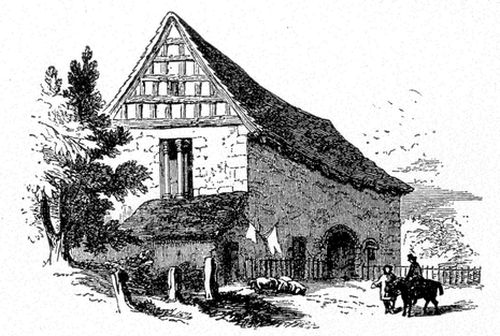
Thirteenth Century Manor House, Millichope, Shropshire.
(Wright, History of Domestic Manners and Sentiments.)
The location of the vill was almost invariably such that a stream with
its border meadows passed through or along its confines, the mill
being often the only building that lay detached from the village
group. A greater or less extent of woodland is also constantly
mentioned.
The vill was thus made up of the group of houses of the villagers
including the parish church and the manor house, all
surrounded by a wide tract of arable land, meadow, pasture, and woods.
Where the lands were extensive there might perhaps be a small group of
houses forming a separate hamlet at some distance from the village,
and occasionally a detached mill, grange, or other building. Its
characteristic appearance, however, must have been that of a close
group of buildings surrounded by an extensive tract of open land.
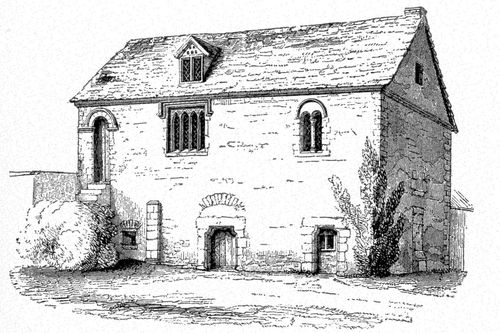
Thirteenth Century Manor House, Boothby Pagnell,
Lincolnshire.
(Turner, Domestic Architecture in England.)
9. The Vill as an Agricultural System.—The support of the vill was in
its agriculture. The plan by which the lands of the whole group of
cultivators lay together in a large tract surrounding the village is
spoken of as the "open field" system. The arable portions of this were
ploughed in pieces equalling approximately acres, half-acres, or
quarter-acres.
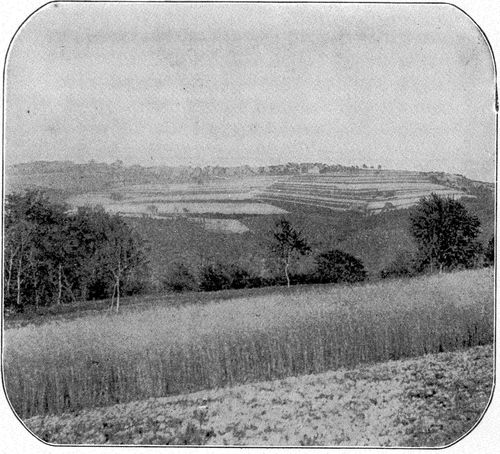
Village with Open Fields, Nörtershausen, near
Coblentz. Germany.
(From a photograph taken in 1894.)
The mediæval English acre was a long narrow strip forty rods in length
and four rods in width, a half-acre or quarter-acre being of
the same length, but of two rods or one rod in width. The rod was of
different lengths in different parts of the country, depending on
local custom, but the most common length was that prescribed by
statute, that is to say, sixteen and a half feet. The length of the
acre, forty rods, has given rise to one of the familiar units of
length, the furlong, that is, a "furrow-long," or the length of a
furrow. A rood is a piece of land one rod wide and forty rods long,
that is, the fourth of an acre. A series of such strips were ploughed
up successively, being separated from each other either by
leaving the width of a furrow or two unploughed, or by marking the
division with stones, or perhaps by simply throwing the first furrow
of the next strip in the opposite direction when it was ploughed. When
an unploughed border was left covered with grass or stones, it was
called a "balk." A number of such acres or fractions of acres with
their slight dividing ridges thus lay alongside of one another in a
group, the number being defined by the configuration of the ground, by
a traditional division among a given number of tenants, or by some
other cause. Other groups of strips lay at right angles or inclined to
these, so that the whole arable land of the village when ploughed or
under cultivation had, like many French, German, or Swiss landscapes
at the present time, something of the appearance of a great irregular
checker-board or patchwork quilt, each large square being
divided in one direction by parallel lines. Usually the cultivated
open fields belonging to a village were divided into three or more
large tracts or fields and these were cultivated according to some
established rotation of crops. The most common of these was the
three-field system, by which in any one year all the strips in one
tract or field would be planted with wheat, rye, or some other crop
which is planted in the fall and harvested the next summer; a second
great field would be planted with oats, barley, peas, or some such
crop as is planted in the spring and harvested in the fall; the third
field would be fallow, recuperating its fertility. The next year all
the acres in the field which had lain fallow the year before might be
planted with a fall crop, the wheat field of the previous year being
planted with a spring crop, and the oats field in its turn now lying
uncultivated for a year. The third year a further exchange would be
made by which a fall crop would succeed the fallow of that year and
the spring crop of the previous year, a spring crop would succeed the
last year's fall crop and the field from which the spring crop was
taken now in its turn would enjoy a fallow year. In the fourth year
the rotation would begin over again.
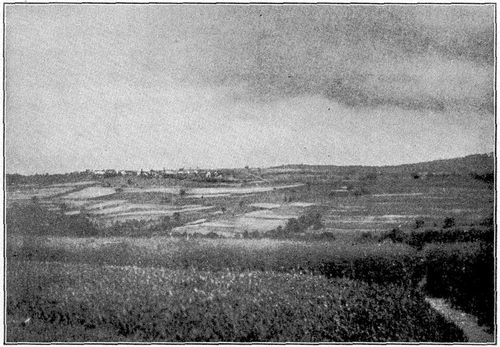
Village with Open Fields, Udenhausen, near Coblentz,
Germany.
(From a photograph taken in 1894.)
Agriculture was extremely crude. But eight or nine bushels of wheat or
rye were expected from an acre, where now in England the average is
thirty. The plough regularly required eight draught animals, usually
oxen, in breaking up the ground, though lighter ploughs were used in
subsequent cultivation. The breed of all farm animals was small, carts
were few and cumbrous, the harvesting of grain was done with a sickle,
and the mowing of grass with a short, straight scythe. The distance of
the outlying parts of the fields from the farm buildings of the
village added its share to the laboriousness of agricultural life.
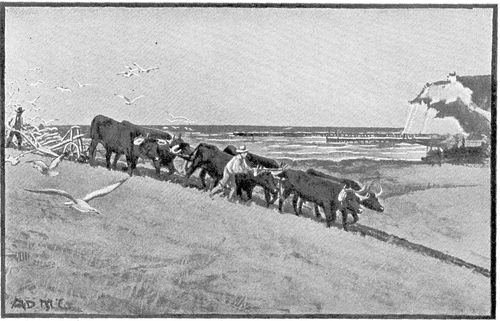
Modern Ploughing with Six Oxen in Sussex.
(Hudson, W. H.: Nature in Downland. Published by Longmans, Green & Co.)
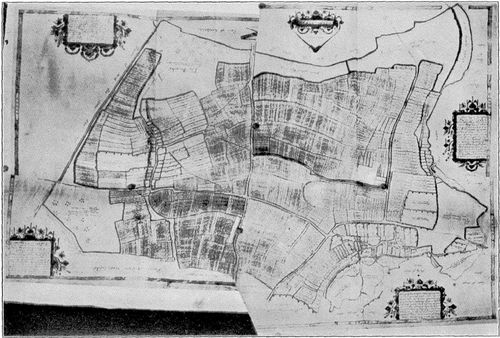
Open Fields of Hayford Bridge, Oxfordshire, 1607.
(Facsimile map published by the University of Oxford.)
The variety of food crops raised was small. Potatoes were of
course unknown, and other root crops and fresh vegetables apparently
were little cultivated. Wheat and rye of several varieties were raised
as bread-stuff, barley and some other grains for the brewing of beer.
Field peas and beans were raised, sometimes for food, but generally as
forage for cattle. The main supply of winter forage for the farm
animals had, however, to be secured in the form of hay, and for this
reliance was placed entirely on the natural meadows, as no clover or
grasses which could be artificially raised on dry ground were yet
known. Meadow land was constantly estimated at twice the value of
arable ground or more. To obtain a sufficient support for the oxen,
horses, and breeding animals through the winter required, therefore, a
constant struggle. Owing to this difficulty animals that were to be
used for food purposes were regularly killed in the fall and salted
down. Much of the unhealthiness of medieval life is no doubt
attributable to the use of salt meat as so large a part of what was at
best a very monotonous diet.
Summer pasture for the horses, cattle, sheep, and swine of the village
was found partly on the arable land after the grain crops had been
taken off, or while it was lying fallow. Since all the acres in any
one great field were planted with the same crop, this would be taken
off from the whole expanse at practically the same time, and the
animals of the whole village might then wander over it, feeding on the
stubble, the grass of the balks, and such other growth as sprung up
before the next ploughing, or before freezing weather. Pasturage was
also found on the meadows after the hay had been cut. But the largest
amount of all was on the "common pasture," the uncultivated land and
woods which in the thirteenth century was still sufficiently
abundant in most parts of England to be found in considerable extent
on almost every manor. Pasturage in all these forms was for the most
part common for all the animals of the vill, which were sent out under
the care of shepherds or other guardians. There were, however,
sometimes enclosed pieces of pasture land in the possession of the
lord of the manor or of individual villagers.
The land of the vill was held and cultivated according to a system of
scattered acres. That is to say, the land held by any one man was not
all in one place, but scattered through various parts of the open
fields of the vill. He would have an acre or two, or perhaps only a
part of an acre, in one place, another strip not adjacent to it, but
somewhere else in the fields, still another somewhere else, and so on
for his whole holding, while the neighbor whose house was next to his
in the village would have pieces of land similarly scattered through
the fields, and in many cases probably have them adjacent to his. The
result was that the various acres or other parts of any one man's
holding were mingled apparently inextricably with those of other men,
customary familiarity only distinguishing which pieces belonged to
each villager.
In some manors there was total irregularity as to the number of acres
in the occupation of any one man; in others there was a striking
regularity. The typical holding, the group of scattered acres
cultivated by one man or held by some two or three in common, was
known as a "virgate," or by some equivalent term, and although of no
universal equality, was more frequently of thirty acres than of any
other number. Usually one finds on a given manor that ten or fifteen
of the villagers have each a virgate of a given number of acres,
several more have each a half virgate or a quarter. Occasionally, on
the other hand, each of them has a different number of
acres. In almost all cases, however, the agricultural holdings of the
villagers were relatively small. For instance, on a certain manor in
Norfolk there were thirty-six holdings, twenty of them below ten
acres, eight between ten and twenty, six between twenty and thirty,
and two between thirty and forty. On another, in Essex, there were
nine holdings of five acres each, two of six, twelve of ten, three of
twelve, one of eighteen, four of twenty, one of forty, and one of
fifty. Sometimes larger holdings in the hands of individual tenants
are to be found, rising to one hundred acres or more. Still these were
quite exceptional and the mass of the villagers had very small groups
of acres in their possession.
It is to be noted next that a large proportion of the cultivated
strips were not held in virgates or otherwise by the villagers at all,
but were in the direct possession and cultivation of the lord of the
manor. This land held directly by the lord of the manor and cultivated
for him was called the "demesne," and frequently included one-half or
even a larger proportion of all the land of the vill. Much of the
meadow and pasture land, and frequently all of the woods, was included
in the demesne. Some of the demesne land was detached from the land of
the villagers, enclosed and separately cultivated or pastured; but for
the most part it lay scattered through the same open fields and was
cultivated by the same methods and according to the same rotation as
the land of the small tenants of the vill, though it was kept under
separate management.
10. Classes of People on the Manor.—Every manor was in the hands of a
lord. He might be a knight, esquire, or mere freeman, but in the great
majority of cases the lord of the manor was a nobleman, a bishop,
abbot, or other ecclesiastical official, or the king. But whether the
manor was the whole estate of a man of the lesser gentry, or
merely one part of the possessions of a great baron, an ecclesiastical
corporation, or the crown, the relation between its possessor as lord
of the manor and the other inhabitants as his tenants was the same. In
the former case he was usually resident upon the manor; in the latter
the individual or corporate lord was represented by a steward or other
official who made occasional visits, and frequently, on large manors,
by a resident bailiff. There was also almost universally a reeve, who
was chosen from among the tenants and who had to carry on the demesne
farm in the interests of the lord.
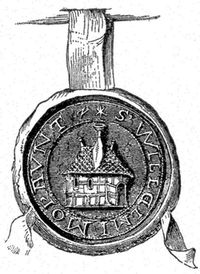
Seal, with representation of a Manor House.
(Turner, Domestic Architecture in England.)
The tenants of the manor, ranging from holders of considerable amounts
of land, perhaps as much as a hundred acres, through various
gradations down to mere cotters, who held no more than a cottage with
perhaps a half-acre or a rood of land, or even with no land at all,
are usually grouped in the "extents" or contemporary descriptions of
the manors and their inhabitants into several distinct classes. Some
are described as free tenants, or tenants holding freely. Others, and
usually the largest class, are called villains, or customary tenants.
Some, holding only a half or a quarter virgate, are spoken of as half
or quarter villains. Again, a numerous class are described by some
name indicating that they hold only a dwelling-house, or at least that
their holding of land is but slight. These are generally spoken of as
cotters.
All these tenants hold land from the lord of the manor and
make payments and perform services in return for their land. The free
tenants most commonly make payments in money only. At special periods
in the year they give a certain number of shillings or pence to the
lord. Occasionally they are required to make some payment in kind, a
cock or a hen, some eggs, or other articles of consumption. These
money payments and payments of articles of money value are called
"rents of assize," or established rents. Not unusually, however, the
free tenant has to furnish precariæ or "boon-works" to the lord. That
is, he must, either in his own person or through a man hired for the
purpose, furnish one or more days' labor at the specially busy seasons
of the year, at fall and spring ploughing, at mowing or harvest time.
Free tenants were also frequently bound to pay relief and heriot.
Relief was a sum of money paid to the lord by an heir on obtaining
land by inheritance. Custom very generally established the amount to
be paid as the equivalent of one year's ordinary payments. Heriot was
a payment made in kind or in money from the property left by a
deceased tenant, and very generally consisted by custom of the best
animal which had been in the possession of the man, or its equivalent
in value. On many manors heriot was not paid by free tenants, but only
by those of lower rank.
The services and payments of the villains or customary tenants were of
various descriptions. They had usually to make some money payments at
regular periods of the year, like the free tenants, and, even more
frequently than they, some regular payments in kind. But the fine paid
on the inheritance of their land was less definitely restricted in
amount, and heriot was more universally and more regularly collected.
The greater part of their liability to the lord of the manor
was, however, in the form of personal, corporal service. Almost
universally the villain was required to work for a certain number of
days in each week on the demesne of the lord. This "week-work" was
most frequently for three days a week, sometimes for two, sometimes
for four; sometimes for one number of days in the week during a part
of the year, for another number during the remainder. In addition to
this were usually the precariæ or boon-works already referred to.
Sometimes as part of, sometimes in addition to, the week-work and the
boon-work, the villain was required to plough so many acres in the
fall and spring; to mow, toss, and carry in the hay from so many
acres; to haul and scatter so many loads of manure; carry grain to the
barn or the market, build hedges, dig ditches, gather brush, weed
grain, break clods, drive sheep or swine, or any other of the forms of
agricultural labor as local custom on each manor had established his
burdens. Combining the week-work, the regular boon-works, and the
extra specified services, it will be seen that the labor required from
the customary tenant was burdensome in the extreme. Taken on the
average, much more than half of the ordinary villain's time must have
been given in services to the lord of the manor.
The cotters made similar payments and performed similar labors, though
less in amount. A widespread custom required them to work for the
lord one day a week throughout the year, with certain regular
payments, and certain additional special services.
Besides the possession of their land and rights of common pasture,
however, there were some other compensations and alleviations of the
burdens of the villains and cotters. At the boon-works and other
special services performed by the tenants, it was a matter of custom
that the lord of the manor provide food for one or two meals
a day, and custom frequently defined the kind, amount, and value of
the food for each separate meal; as where it is said in a statement of
services: "It is to be known that all the above customary tenants
ought to reap one day in autumn at one boon-work of wheat, and they
shall have among them six bushels of wheat for their bread, baked in
the manor, and broth and meat, that is to say, two men have one
portion of beef and cheese, and beer for drinking. And the aforesaid
customary tenants ought to work in autumn at two boon-works of oats.
And they shall have six bushels of rye for their bread as described
above, broth as before, and herrings, viz. six herrings for each man,
and cheese as before, and water for drinking."
Thus the payments and services of the free tenants were principally of
money, and apparently not burdensome; those of the villains were
largely in corporal service and extremely heavy; while those of the
cotters were smaller, in correspondence with their smaller holdings of
land and in accordance with the necessity that they have their time in
order to make their living by earning wages.
The villains and cotters were in bondage to the lord of the manor.
This was a matter of legal status quite independent of the amount of
land which the tenant held or of the services which he performed,
though, generally speaking, the great body of the smaller tenants and
of the laborers were of servile condition. In general usage the words
villanus, nativus, servus, custumarius, and rusticus are
synonymous, and the cotters belonged legally to the same servile
class.
The distinction between free tenants and villains, using this word, as
is customary, to include all those who were legally in servitude, was
not a very clearly marked one. Their economic position was
often so similar that the classes shaded into one another. But the
villain was, as has been seen, usually burdened with much heavier
services. He was subject to special payments, such as "merchet," a
payment made to the lord of the manor when a woman of villain rank was
married, and "leyr," a payment made by women for breach of chastity.
He could be "tallaged" or taxed to any extent the lord saw fit. He was
bound to the soil. He could not leave the manor to seek for better
conditions of life elsewhere. If he ran away, his lord could obtain an
order from a court and have him brought back. When permission was
obtained to remain away from the manor as an inhabitant of another
vill or of a town, it was only upon payment of a periodical sum,
frequently known as "chevage" or head money. He could not sell his
cattle without paying the lord for permission. He had practically no
standing in the courts of the country. In any suit against his lord
the proof of his condition of villainage was sufficient to put him out
of court, and his only recourse was the local court of the manor,
where the lord himself or his representative presided. Finally, in the
eyes of the law, the villain had no property of his own, all his
possessions being, in the last resort, the property of his lord. This
legal theory, however, apparently had but little application to real
life; for in the ordinary course of events the customary tenant, if
only by custom, not by law, yet held and bequeathed to his descendants
his land and his chattels quite as if they were his own.
Serfdom, as it existed in England in the thirteenth century, can
hardly be defined in strict legal terms. It can be described most
correctly as a condition in which the villain tenant of the manor was
bound to the locality and to his services and payments there by a
legal bond, instead of merely by an economic bond, as was
the case with the small free tenant.
There were commonly a few persons in the vill who were not in the
general body of cultivators of the land and were not therefore in the
classes so far described. Since the vill was generally a parish also,
the village contained the parish priest, who, though he might usually
hold some acres in the open fields, and might belong to the peasant
class, was of course somewhat set apart from the villagers by his
education and his ordination. The mill was a valued possession of the
lord of the manor, for by an almost universal custom the tenants were
bound to have their grain ground there, and this monopoly enabled the
miller to pay a substantial rent to the lord while keeping enough
profit for himself to become proverbially well-to-do.
There was often a blacksmith, whom we find sometimes exempted from
other services on condition of keeping the demesne ploughs and other
iron implements in order. A chance weaver or other craftsman is
sometimes found, and when the vill was near sea or river or forest
some who made their living by industries dependent on the locality. In
the main, however, the whole life of the vill gathered around the
arable, meadow, and pasture land, and the social position of the
tenants, except for the cross division of serfdom, depended upon the
respective amounts of land which they held.
11. The Manor Courts.—The manor was the sphere of operations of a
manor court. On every manor the tenants gathered at frequent periods
for a great amount of petty judicial and regulative work. The most
usual period for the meeting of the manor court was once every three
weeks, though in some manors no trace of a meeting is found more
frequently than three times, or even twice, a year. In these
cases, however, it is quite probable that less formal meetings
occurred of which no regular record was kept. Different kinds of
gatherings of the tenants are usually distinguished according to the
authority under which they were held, or the class of tenants of which
they were made up. If the court was held by the lord simply because of
his feudal rights as a landholder, and was busied only with matters of
the inheritance, transfer, or grant of lands, the fining of tenants
for the breach of manorial custom, or failure to perform their duties
to the lord of the manor, the election of tenants to petty offices on
the manor, and such matters, it was described in legal language as a
court baron. If a court so occupied was made up of villain tenants
only, it was called a customary court. If, on the other hand, the
court also punished general offences, petty crimes, breaches of
contract, breaches of the assize, that is to say, the established
standard of amount, price, or quality of bread or beer, the lord of
the manor drawing his authority to hold such a court either actually
or supposedly from a grant from the king, such a court was called a
court leet. With the court leet was usually connected the so-called
view of frank pledge. Frank pledge was an ancient system, according to
which all men were obliged to be enrolled in groups, so that if any
one committed an offence, the other members of the group would be
obliged to produce him for trial. View of frank pledge was the right
to punish by fine any who failed to so enroll themselves. In the court
baron and the customary court it was said by lawyers that the body of
attendants were the judges, and the steward, representing the lord of
the manor, only a presiding official; while in the court leet the
steward was the actual judge of the tenants. In practice, however, it
is probable that not much was made of these distinctions, and that the
periodic gatherings were made to do duty for all business of
any kind that needed attention, while the procedure was that which had
become customary on that special manor, irrespective of the particular
form of authority for the court.
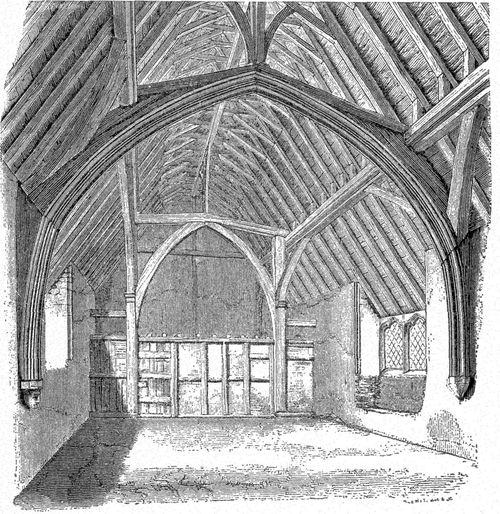
Interior of Fourteenth Century Manor House, Sutton
Courtenay, Berkshire.
(Domestic Architecture in the Fourteenth
Century.)
The manor court was presided over by a steward or other officer
representing the lord of the manor. Apparently all adult male tenants
were expected to be present, and any inhabitant was liable to be
summoned. A court was usually held in each manor, but sometimes a lord
of several neighboring manors would hold the court for all
of these in some one place. As most manors belonged to lords who had
many manors in their possession, the steward or other official
commonly proceeded from one manor or group of manors to another,
holding the courts in each. Before the close of the thirteenth century
the records of the manor courts, or at least of the more important of
them, began to be kept with very great regularity and fulness, and it
is to the mass of these manor court rolls which still remain that we
owe most of our detailed knowledge of the condition of the body of the
people in the later Middle Ages. The variety and the amount of
business transacted at the court were alike considerable. When a
tenant had died it was in the meeting of the manor court that his
successor obtained a regrant of the land. The required relief was
there assessed, and the heriot from the property of the deceased
recorded. New grants of land were made, and transfers, leases, and
abandonments by one tenant and assignments to another announced. For
each of these processes of land transfer a fine was collected for the
lord of the manor. Such entries as the following are constantly found:
"John of Durham has come into court and taken one bond-land which
Richard Avras formerly held but gave up because of his poverty; to
have and hold for his lifetime, paying and doing the accustomed
services as Richard paid and did them. He gives for entrance 6s.
8d.;" "Agnes Mabeley is given possession of a quarter virgate of land
which her mother held, and gives the lord 33s. 4d. for entrance."
Disputes as to the right of possession of land and questions of dowry
and inheritance were decided, a jury being granted in many cases by
the lord at the petition of a claimant and on payment of a fee.
Another class of cases consisted in the imposition of fines or
amerciaments for the violation of the customs of the manor,
of the rules of the lord, or of the requirements of the culprit's
tenure; such as a villain marrying without leave, failure to perform
boon-works or bad performance of work, failure to place the tenant's
sheep in the lord's fold, cutting of wood or brush, making unlawful
paths across the fields, the meadows, or the common, encroachment in
ploughing upon other men's land or upon the common, or failure to send
grain to the lord's mill for grinding. Sometimes the offence was of a
more general nature, such as breach of assize, breach of contract,
slander, assault, or injury to property. Still another part of the
work of the court was the election of petty manorial officers; a
reeve, a reaper, ale-tasters, and perhaps others. The duty of filling
such offices when elected by the tenants and approved by the lord or
his steward was, as has been said, one of the burdens of villainage.
However, when a villain was fulfilling the office of reeve, it was
customary for him to be relieved of at least a part of the payments
and services to which he would otherwise be subject. Finally the manor
court meetings were employed for the adoption of general regulations
as to the use of the commons and other joint interests, and for the
announcement of the orders of the steward in the keeping of the peace.
12. The Manor as an Estate of a Lord.—The manor was profitable to the
lord in various ways. He received rents in money and kind. These
included the rents of assize from free and villain land tenants, rent
from the tenant of the mill, and frequently from other sources. Then
came the profits derived from the cultivation of the demesne land. In
this the lord of the manor was simply a large farmer, except that he
had a supply of labor bound to remain at hand and to give service
without wages almost up to his needs. Finally there were the profits
of the manor courts. As has been seen, these consisted of a
great variety of fees, fines, amerciaments, and collections made by
the steward or other official. Such varied payments and profits
combined to make up the total value of the manor to the landowner. Not
only the slender income of the country squire or knight whose estate
consisted of a single manor of some ten or twenty pounds yearly value,
but the vast wealth of the great noble or of the rich monastery or
powerful bishopric was principally made up of the sum of such payments
from a considerable number of manors. An appreciable part of the
income of the government even was derived from the manors still in the
possession of the crown.
The mediæval manor was a little world in itself. The large number of
scattered acres which made up the demesne farm cultivated in the
interests of the lord of the manor, the small groups of scattered
strips held by free holders or villain tenants who furnished most of
the labor on the demesne farm, the little patches of ground held by
mere laborers whose living was mainly gained by hired service on the
land of the lord or of more prosperous tenants, the claims which all
had to the use of the common pasture for their sheep and cattle and of
the woods for their swine, all these together made up an agricultural
system which secured a revenue for the lord, provided food and the raw
material for primitive manufactures for the inhabitants of the vill,
and furnished some small surplus which could be sold.
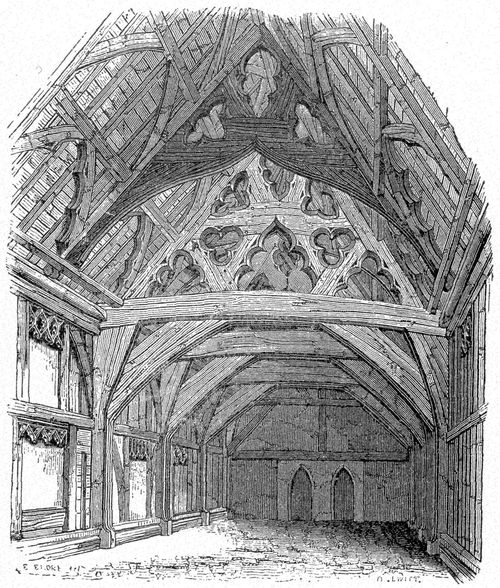
Interior of Fourteenth Century Manor House, Great
Malvern, Worcestershire.
(Domestic Architecture in the Fourteenth
Century.)
Life on the mediæval manor was hard. The greater part of the
population was subject to the burdens of serfdom, and all, both free
and serf, shared in the arduousness of labor, coarseness and lack of
variety of food, unsanitary surroundings, and liability to the rigor
of winter and the attacks of pestilence. Yet the average
condition of comfort of the mass of the rural inhabitants of England
was probably as high as at any subsequent time. Food in proportion to
wages was very cheap, and the almost universal possession of some land
made it possible for the very poorest to avoid starvation. Moreover,
the great extent to which custom governed all payments, services, and
rights must have prevented much of the extreme depression
which has occasionally existed in subsequent periods in which greater
competition has distinguished more clearly the capable from the
incompetent.
From the social rather than from the economic point of view the life
of the mediæval manor was perhaps most clearly marked by this
predominance of custom and by a second characteristic nearly related.
This was the singularly close relationship in which all the
inhabitants of the manor were bound to one another, and their
correspondingly complete separation from the outside world. The common
pasture, the intermingled strips of the holdings in the open fields,
the necessary coöperation in the performance of their daily labor on
the demesne land, the close contiguity of their dwellings, their
universal membership in the same parish church, their common
attendance and action in the manor courts, all must have combined to
make the vill an organization of singular unity. This self-centred
life, economically, judicially, and ecclesiastically so nearly
independent of other bodies, put obstacles in the way of change. It
prohibited intercourse beyond the manor, and opposed the growth of a
feeling of common national life. The manorial life lay at the base of
the stability which marked the mediæval period.
GENERAL WORKS
Certain general works which refer to long periods of economic history
will be mentioned here and not again referred to, excepting in special
cases. It is to be understood that they contain valuable matter on the
subject, not only of this, but of succeeding chapters. They
should therefore be consulted in addition to the more specific works
named under each chapter.
Cunningham, William: Growth of English Industry and Commerce, two
volumes. The most extensive and valuable work that covers the whole
field of English economic history.
Ashley, W. J.: English Economic History, two volumes. The first
volume is a full and careful analysis of mediæval economic conditions,
with detailed notes and references to the primary sources. The second
volume is a work of original investigation, referring particularly to
conditions in the fifteenth and sixteenth centuries, but it does not
give such a clear analysis of the conditions of its period as the
first volume.
Traill, H. D.: Social England, six volumes. A composite work
including a great variety of subjects, but seldom having the most
satisfactory account of any one of them.
Rogers, J. E. T.: History of Agriculture and Prices; Six Centuries
of Work and Wages; Economic Interpretation of History. Professor
Rogers' work is very extensive and detailed, and his books were
largely pioneer studies. His statistical and other facts are useful,
but his general statements are not very valuable, and his conclusions
are not convincing.
Palgrave, R. H. I.: Dictionary of Political Economy. Many of the
articles on subjects of economic history are the best and most recent
studies on their respective subjects, and the bibliographies contained
in them are especially valuable.
Four single-volume text-books have been published on this general
subject:—
Cunningham, William, and McArthur, E. A.: Outlines of English
Industrial History.
Gibbins, H. de B.: Industry in England.
Warner, George Townsend: Landmarks in English Industrial History.
Price, L. L.: A Short History of English Commerce and Industry.
Special Works
Seebohm, Frederic: The English Village Community. Although written
for another purpose,—to suggest a certain view of the origin of the
medieval manor,—the first five chapters of this book furnish the
clearest existing descriptive account of the fundamental facts of
rural life in the thirteenth century. Its publication marked an era in
the recognition of the main features of manorial organization. Green,
for instance, the historian of the English people, seems to have had
no clear conception of many of those characteristics of ordinary rural
life which Mr. Seebohm has made familiar.
Vinogradoff, Paul: Villainage in England.
Pollock, Sir Frederick, and Maitland, F. W.: History of English Law,
Vol. 1.
These two works are of especial value for the organization of the
manor courts and the legal condition of the population.
Sources
Much that can be explained only with great difficulty becomes clear to
the student immediately when he reads the original documents. Concrete
illustrations of general statements moreover make the work more
interesting and real. It has therefore been found desirable by many
teachers to bring their students into contact with at least a few
typical illustrative documents. The sources for the subject generally
are given in the works named above. An admirable bibliography has been
recently published by
Gross, Charles: The Sources and Literature of English
History from the Earliest Times to about 1485. References to abundant
material for the illustration or further investigation of the subject
of this chapter will be found in the following pamphlet:—
Davenport, Frances G.: A Classified List of Printed Original
Materials for English Manorial and Agrarian History.
Sources for the mediæval period are almost all in Latin or French.
Some of them, however, have been more accessible by being translated
into English and reprinted in convenient form. A few of these are
given in C. W. Colby: Selections from the Sources of English
History, and G. C. Lee: Source Book of English History.
In the Series of Translations and Reprints from the Original Sources
of European History, published by the Department of History of the
University of Pennsylvania, several numbers include documents in this
field. Vol. III, No. 5, is devoted entirely to manorial documents.
Discussions of the Origin of the Manor
The question of the origin of the mediæval manorial organization,
whether it is principally of native English or of Roman origin, or
hewn from still other materials, although not treated in this
text-book, has been the subject of much interest and discussion. One
view of the case is the thesis of Seebohm's book, referred to above.
Other books treating of it are the following:—
Earle, John: Land Charters and Saxonic Documents, Introduction.
Gomme, G. L.: The Village Community.
Ashley, W. J.: A translation of Fustel de Coulanges, Origin of
Property in Land, Introduction.
Andrews, Charles M.: The Old English Manor, Introduction.
Maitland, F. W.: Domesday Book and Beyond.
Meitzen, August: Siedelung und Agrarwesen, Vol. II, Chap. 7.
The writings of Kemble and of Sir Henry Maine belong rather to a past
period of study and speculation, but their ideas still lie at the base
of discussions on the subject.
TOWN LIFE AND ORGANIZATION
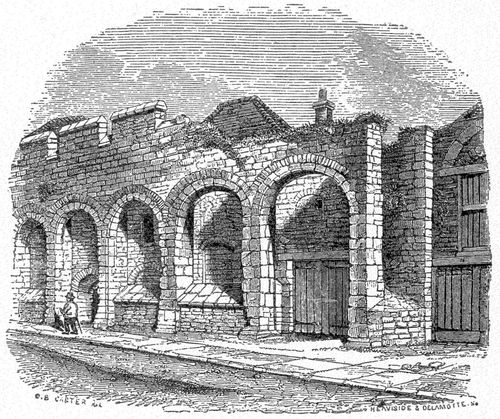
Town Wall of Southampton, built in the Thirteenth
Century.
(Turner: Domestic Architecture in England.)
14. The Town Government.—In the middle of the thirteenth century
there were some two hundred towns in England distinguishable by their
size, form of government, and the occupations of their inhabitants,
from the rural agricultural villages which have just been described.
London probably had more than 25,000 inhabitants; York and Bristol may
each have had as many as 10,000. The population of the others varied
from as many as 6000 to less than 1000. Perhaps the most usual
population of an English mediæval town lay between 1500 and 4000. They
were mostly walled, though such protection was hardly necessary, and
the military element in English towns was therefore but slightly
developed. Those towns which contained cathedrals, and were therefore
the seats of bishoprics, were called cities. All other organized towns
were known as boroughs, though this distinction in the use of the
terms city and borough was by no means always preserved. The towns
differed widely in their form of government; but all had charters from
the king or from some nobleman, abbey, or bishopric on whose lands
they had grown up. Such a charter usually declared the right of the
town to preserve the ancient customs which had come to be recognized
among its inhabitants, and granted to it certain privileges,
exemptions, and rights of self-government. The most universal and
important of these privileges were the following: the town paid the
tolls and dues owed to the king or other lord by its
inhabitants in a lump sum, collecting the amount from its own citizens
as the latter or their own authorities saw fit; the town courts had
jurisdiction over most suits and offences, relieving the townsmen from
answering at hundred and county court suits which concerned matters
within their own limits; the townsmen, where the king granted the
charter, were exempt from the payment of tolls of various kinds
throughout his dominions; they could pass ordinances and regulations
controlling the trade of the town, the administration of its property,
and its internal affairs generally, and could elect officials to carry
out such regulations. These officials also corresponded and negotiated
in the name of the town with the authorities of other towns and with
the government. From the close of the thirteenth century
all towns of any importance were represented in Parliament. These
elements of independence were not all possessed by every town, and
some had special privileges not enumerated in the above list. The
first charter of a town was apt to be vague and inadequate, but from
time to time a new charter was obtained giving additional privileges
and defining the old rights more clearly. Nor had all those who dwelt
within the town limits equal participation in its advantages. These
were usually restricted to those who were known as citizens or
burgesses; full citizenship depending primarily on the possession of a
house and land within the town limits. In addition to the burgesses
there were usually some inhabitants of the town—strangers, Jews,
fugitive villains from the rural villages, or perhaps only poorer
natives of the town—who did not share in these privileges. Those who
did possess all civil rights of the townsmen were in many ways
superior in condition to men in the country. In addition to the
advantages of the municipal organization mentioned above, all
burgesses were personally free, there was entire exemption from the
vexatious petty payments of the rural manors, and burgage tenure was
thee nearest to actual land ownership existent during the Middle Ages.
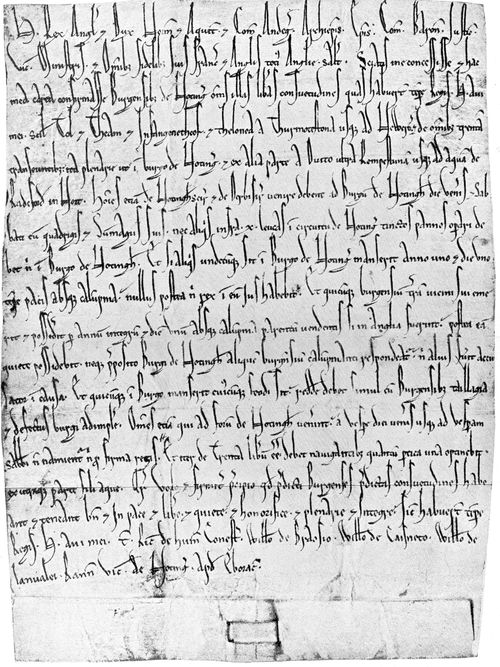
Charter of Henry II to the Borough of Nottingham.
(Records of Borough of Nottingham. Published by the Corporation.)
15. The Gild Merchant.—The town was most clearly marked off from the
country by the occupations by which its people earned their living.
These were, in the first place, trading; secondly, manufacturing or
handicrafts. Agriculture of course existed also, since most townsmen
possessed some lands lying outside of the enclosed portions of the
town. On these they raised crops and pastured their cattle. Of these
varied occupations, however, it was trade which gave character and,
indeed, existence itself to the town. Foreign goods were brought to
the towns from abroad for sale, the surplus products of
rural manors found their way there for marketing; the products of one
part of the country which were needed in other parts were sought for
and purchased in the towns. Men also sold the products of their own
labor, not only food products, such as bread, meat, and fish, but also
objects of manufacture, as cloth, arms, leather, and goods made of
wood, leather, or metal. For the protection and regulation of this
trade the organization known as the gild merchant had grown
up in each town. The gild merchant seems to have included all of the
population of the town who habitually engaged in the business of
selling, whether commodities of their own manufacture or those they
had previously purchased. Membership in the gild was not exactly
coincident with burgess-ship; persons who lived outside of the town
were sometimes admitted into that organization, and, on the other
hand, some inhabitants of the town were not included among its
members. Nevertheless, since practically all of the townsmen made
their living by trade in some form or another, the group of burgesses
and the group of gild members could not have been very different. The
authority of the gild merchant within its field of trade regulation
seems to have been as complete as that of the town community as a
whole in its field of judicial, financial, and administrative
jurisdiction. The gild might therefore be defined as that form of
organization of the inhabitants of the town which controlled its trade
and industry. The principal reason for the existence of the gild was
to preserve to its own members the monopoly of trade. No one not in
the gild merchant of the town could buy or sell there except under
conditions imposed by the gild. Foreigners coming from other countries
or traders from other English towns were prohibited from buying or
selling in any way that might interfere with the interests of the
gildsmen. They must buy and sell at such times and in such places and
only such articles as were provided for by the gild regulations. They
must in all cases pay the town tolls, from which members of the gild
were exempt. At Southampton, for instance, we find the following
provisions: "And no one in the city of Southampton shall buy anything
to sell again in the same city unless he is of the gild merchant
or of the franchise." Similarly at Leicester, in 1260, it
was ordained that no gildsman should form a partnership with a
stranger, allowing him to join in the profits of the sale of wool or
other merchandise.
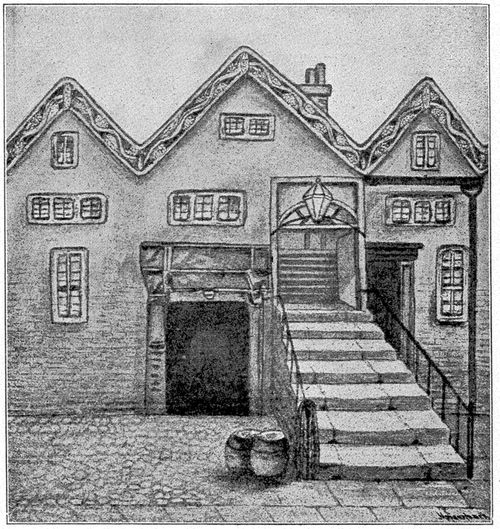
Hall of Merchants' Company of York.
(Lambert: Two
Thousand Years of Gild Life. Published by A. Brown & Sons, Hull.)
Interior of Hall of Merchants' Company of York.
(Lambert: Two Thousand Years of Gild Life. Published by A. Brown &
Sons, Hull.)
As against outsiders the gild merchant was a protective body, as
regards its own members it was looked upon and constantly spoken of as
a fraternity. Its members must all share in the common expenditures,
they are called brethren of the society, their competition with one
another is reduced to its lowest limits. For instance, we find the
provision that "any one who is of the gild merchant may share in all
merchandise which another gildsman shall buy."
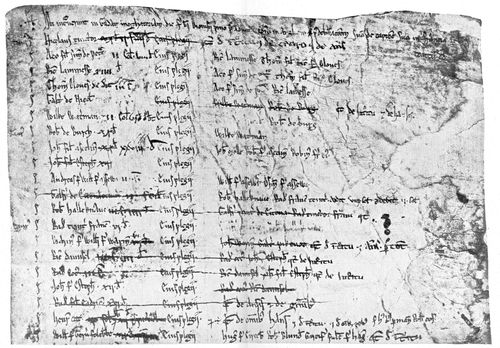
Earliest Merchant Gild Roll of the Borough of
Leicester.
(Bateson: Records of the Borough of Leicester. Published
by C. J. Clay & Sons, Cambridge.)
The presiding officer was usually known as the alderman,
while the names given to other officials, such as stewards, deans,
bailiffs, chaplains, skevins, and ushers, and the duties they
performed, varied greatly from time to time.
Meetings were held at different periods, sometimes annually, in many
cases more frequently. At these meetings new ordinances were passed,
officers elected, and other business transacted. It was also a
convivial occasion, a gild feast preceding or following the other
labors of the meeting. In some gilds the meeting was regularly known
as "the drinking." There were likewise frequent sittings of the
officials of the fraternity, devoted to the decision of disputes
between brethren, the admission of new members, the fining or
expulsion of offenders against the gild ordinances, and other routine
work. These meetings were known as "morrowspeches".
The greater part of the activity of the gild merchant consisted in the
holding of its meetings with their accompanying feasts, and in the
enforcement of its regulations upon its members and upon outsiders. It
fulfilled, however, many fraternal duties for its members. It is
provided in one set of statutes that, "If a gildsman be imprisoned in
England in time of peace, the alderman, with the steward and with one
of the skevins, shall go, at the cost of the gild, to procure the
deliverance of the one who is in prison." In another, "If any of the
brethren shall fall into poverty or misery, all the brethren are to
assist him by common consent out of the chattels of the house or
fraternity, or of their proper own." The funeral rites, especially,
were attended by the man's gild brethren. "And when a gildsman dies,
all those who are of the gild and are in the city shall attend the
service for the dead, and gildsmen shall bear the body and bring it to
the place of burial." The gild merchant also sometimes
fulfilled various religious, philanthropic, and charitable duties, not
only to its members, but to the public generally, and to the poor. The
time of the fullest development of the gild merchant varied, of
course, in different towns, but its widest expansion was probably in
the early part of the period we are studying, that is, during the
thirteenth century. Later it came to be in some towns
indistinguishable from the municipal government in general, its
members the same as the burgesses, its officers represented by the
officers of the town. In some other towns the gild merchant gradually
lost its control over trade, retaining only its fraternal, charitable,
and religious features. In still other cases the expression gradually
lost all definite significance and its meaning became a matter for
antiquarian dispute.
16. The Craft Gilds.—By the fourteenth century the gild merchant of
the town was a much less conspicuous institution than it had
previously been. Its decay was largely the result of the growth of a
group of organizations in each town which were spoken of as crafts,
fraternities, gilds, misteries, or often merely by the name of their
occupation, as "the spurriers," "the dyers," "the fishmongers." These
organizations are usually described in later writings as craft gilds.
It is not to be understood that the gild merchant and the craft gilds
never existed contemporaneously in any town. The former began earlier
and decayed before the craft gilds reached their height, but there was
a considerable period when it must have been a common thing for a man
to be a member both of the gild merchant of the town and of the
separate organization of his own trade. The later gilds seem to have
grown up in response to the needs of handicraft much as the gild
merchant had grown up to regulate trade, though trading occupations
also were eventually drawn into the craft gild form of
organization. The weavers seem to have been the earliest occupation to
be organized into a craft gild; but later almost every form of
industry which gave employment to a handful of craftsmen in any town
had its separate fraternity. Since even nearly allied trades, such as
the glovers, girdlers, pocket makers, skinners, white tawyers, and
other workers in leather; or the fletchers, the makers of arrows, the
bowyers, the makers of bows, and the stringers, the makers of
bowstrings, were organized into separate bodies, the number of craft
gilds in any one town was often very large. At London there were by
1350 at least as many as forty, at York, some time later, more than
fifty.
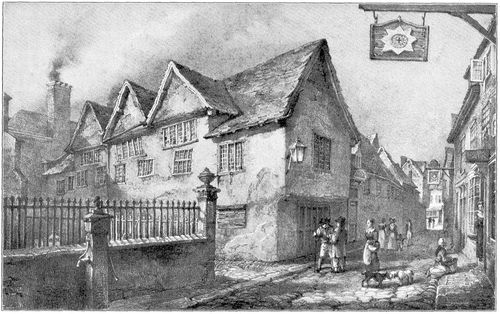
Old Townhall of Leicester, formerly Hall of Corpus
Christi Gild.
(Drawing made in 1826.)
The craft gilds existed usually under the authority of the town
government, though frequently they obtained authorization or even a
charter from the crown. They were formed primarily to regulate and
preserve the monopoly of their own occupations in their own town, just
as the gild merchant existed to regulate the trade of the town in
general. No one could carry on any trade without being subject to the
organization which controlled that trade. Membership, however, was not
intentionally restricted. Any man who was a capable workman and
conformed to the rules of the craft was practically a member of the
organization of that industry. It is a common requirement in the
earliest gild statutes that every man who wishes to carry on that
particular industry should have his ability testified to by some known
members of the craft. But usually full membership and influence in the
gild was reached as a matter of course by the artisans passing through
the successive grades of apprentice, journeyman, and master. As an
apprentice he was bound to a master for a number of years, living in
his house and learning the trade in his shop. There was usually a
signed contract entered into between the master and the
parents of the apprentice, by which the former agreed to provide all
necessary clothing, food, and lodging, and teach to the apprentice all
he himself knew about his craft. The latter, on the other hand, was
bound to keep secret his master's affairs, to obey all his
commandments, and to behave himself properly in all things. After the
expiration of the time agreed upon for his apprenticeship, which
varied much in individual cases, but was apt to be about seven years,
he became free of the trade as a journeyman, a full workman. The word
"journeyman" may refer to the engagement being by the day, from the
French word journée, or to the habit of making journeys from town to
town in search of work, or it may be derived from some other origin.
As a journeyman he served for wages in the employ of a master. In many
cases he saved enough money for the small requirements of setting up
an independent shop. Then as full master artisan or tradesman he might
take part in all the meetings and general administration of the
organized body of his craft, might hold office, and would himself
probably have one or more journeymen in his employ and apprentices
under his guardianship. As almost all industries were carried on in
the dwelling-houses of the craftsmen, no establishments could be of
very considerable size, and the difference of position between master,
journeyman, and apprentice could not have been great. The craft gild
was organized with its regular rules, its officers, and its meetings.
The rules or ordinances of the fraternity were drawn up at some one
time and added to or altered from time to time afterward. The approval
of the city authorities was frequently sought for such new statutes as
well as for the original ordinances, and in many towns appears to have
been necessary. The rules provided for officers and their powers, the
time and character of meetings, and for a considerable
variety of functions. These varied of course in different trades and
in different towns, but some characteristics were almost universal.
Provisions were always either tacitly or formally included for the
preservation of the monopoly of the crafts in the town. The hours of
labor were regulated. Night work was very generally prohibited,
apparently because of the difficulty of oversight at that time, as was
work on Saturday afternoons, Sundays, and other holy days. Provisions
were made for the inspection of goods by the officers of the gild, all
workshops and goods for sale being constantly subject to their
examination, if they should wish it. In those occupations that
involved buying and selling the necessities of life, such as
those of the fishmongers and the bakers, the officers of the
fraternity, like the town authorities, were engaged in a continual
struggle with "regrators," "forestallers," and "engrossers," which
were appellations as odious as they were common in the mediæval town.
Regrating meant buying to sell again at a higher price without having
made any addition to the value of the goods; forestalling was going to
the place of production to buy, or in any other way trying to outwit
fellow-dealers by purchasing things before they came into the open
market where all had the same opportunity; engrossing was buying up
the whole supply, or so much of it as not to allow other dealers to
get what they needed, the modern "cornering of the market." These
practices, which were regarded as so objectionable in the eyes of
mediæval traders, were frequently nothing more than what would be
considered commendable enterprise in a more competitive age. Another
class of rules was for mutual assistance, for kindliness among
members, and for the obedience and faithfulness of journeymen and
apprentices. There were provisions for assistance to members of the
craft when in need, or to their widows and orphans, for the visitation
of those sick or in prison, for common attendance at the burial
services of deceased members, and for other charitable and
philanthropic objects. Thus the craft gild, like the gild merchant,
combined close social relationship with a distinctly recognized and
enforced regulation of the trade. This regulation provided for the
protection of members of the organization from outside competition,
and it also prevented any considerable amount of competition among
members; it supported the interests of the full master members of the
craft as against those in the journeyman stage, and enforced the
custom of the trade in hours, materials, methods of manufacture, and
often in prices.
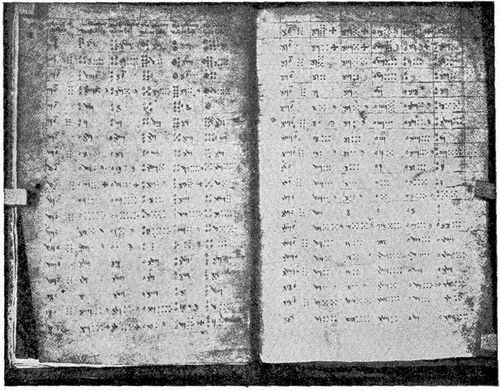
Table of Assize of Bread in Record Book of City of
Hull.
(Lambert: Two Thousand Years of Gild Life. Published by A.
Brown & Sons, Hull.)
The officers were usually known as masters, wardens, or
stewards. Their powers extended to the preservation of order among the
master members of the craft at the meetings, and among the journeymen
and apprentices of the craft at all times; to the supervision, either
directly or through deputies, of the work of the members, seeing that
it conformed to the rules and was not false in any way; to the
settlement, if possible, of disputes among members of the craft; to
the administration of its charitable work; and to the representation
of the organized body of the craft before town or other authorities.
Common religious observances were held by the craftsmen not only at
the funerals of members, but on the day of the saint to which the gild
was especially dedicated. Most fraternities kept up a shrine or chapel
in some parish church. Fines for the breach of gild rules were often
ordered to be paid in wax that the candles about the body of dead
brethren and in the gild chapel should never be wanting. All the
brethren of the gild, dressed in common suits of livery, walked in
procession from their hall or meeting room to the church, performed
their devotions and joined in the services in commemoration of the
dead. Members of the craft frequently bequeathed property for the
partial support of a chaplain and payment of other expenses connected
with their "obits," or masses for the repose of their souls and those
of their relatives.
Closely connected with the religious observances was the convivial
side of the gild's life. On the annual gild day, or more frequently,
the members all gathered at their hall or some inn to a feast, which
varied in luxuriousness according to the wealth of the fraternity,
from bread, cheese, and ale to all the exuberance of which the Middle
Ages were capable.
Somewhat later, we find the craft gilds taking entire charge
of the series or cycles of "mystery plays," which were given in
various towns. The words of the plays produced at York, Coventry,
Chester, and Woodkirk have come down to us and are of extreme interest
as embryonic forms of the drama and examples of purely vernacular
language. It is quite certain that such groups of plays were given by
the crafts in a number of other towns. They were generally given on
Corpus Christi day, a feast which fell in the early summer time, when
out-door pleasures were again enjoyable after the winter's
confinement. A cycle consisted of a series of dialogues or short
plays, each based upon some scene of biblical story, so arranged that
the whole Bible narrative should be given consecutively from the
Creation to the Second Advent. One of the crafts, starting early in
the morning, would draw a pageant consisting of a platform on wheels,
to a regularly appointed spot in a conspicuous part of the town, and
on this platform, with some rude scenery, certain members of the gild
or men employed by them would proceed to recite a dialogue in verse
representative of some early part of the Bible story. After they had
finished, their pageant would be dragged to another station, where
they repeated their performance. In the meantime a second company had
taken their former place, and recited a dialogue representative of a
second scene. So the whole day would be occupied by the series of
performances. The town and the craftsmen valued the celebration
because it was an occasion for strangers visiting their city and thus
increasing the volume of trade, as well as because it furnished an
opportunity for the gratification of their social and dramatic
instincts.
It was not only at the periodical business meetings, or on the feast
days, or in the preparation for the dramatic shows, that the gildsmen
were thrown together. Usually all the members of one craft lived on
the same street or in the same part of the town, and were
therefore members of the same parish church and constantly brought
under one another's observation in all the daily concerns of life. All
things combined to make the craft a natural and necessary centre for
the interest of each of its members.
17. Non-industrial Gilds.—Besides the gilds merchant, which included
persons of all industrial occupations, and the craft gilds, which were
based upon separate organizations of each industry, there were gilds
or fraternities in existence which had no industrial functions
whatever. These are usually spoken of as "religious" or "social"
gilds. It would perhaps be better to describe them simply as
non-industrial gilds; for their religious and social functions they
had in common, as has been seen, both with the gild merchant and the
craft organizations. They only differed from these in not being based
upon or interested in the monopoly or oversight of any kind of trade
or handicraft. They differed also from the craft gilds in that all
their members were on an equal basis, there being no such industrial
grades as apprentice, journeyman, and master; and from both of the
organizations already discussed in the fact that they existed in small
towns and even in mere villages, as well as in industrial centres.
In these associations the religious, social, and charitable elements
were naturally more prominent than in those fraternities which were
organized primarily for some kind of economic regulation. They were
generally named after some saint. The ordinances usually provided for
one or more solemn services in the year, frequently with a procession
in livery, and sometimes with a considerable amount of pantomime or
symbolic show. For instance, the gild of St. Helen at Beverly, in
their procession to the church of the Friars Minors on the day of
their patron saint, were preceded by an old man carrying a
cross; after him a fair young man dressed as St. Helen; then another
old man carrying a shovel, these being intended to typify the finding
of the cross. Next came the sisters two and two, after them the
brethren of the gild, and finally the officers. There were always
provisions for solemnities at the funerals of members, for burial at
the expense of the gild if the member who had died left no means for a
suitable ceremony, and for prayers for deceased members. What might be
called the insurance feature was also much more nearly universal than
in the case of the industrial fraternities. Help was given in case of
theft, fire, sickness, or almost any kind of loss which was not
chargeable to the member's own misdoing. Finally it was very customary
for such gilds to provide for the support of a certain number of
dependents, aged men or women, cripples, or lepers, for charity's
sake; and occasionally educational facilities were also provided by
them from their regular income or from bequests made for the purpose.
The social-religious gilds were extremely numerous, and seem
frequently to have existed within the limits of a craft, including
some of its members and not others, or within a certain parish,
including some of the parishioners, but not all.
Thus if there were men in the mediæval town who were not members of
some trading or craft body, they would in all probability be members
of some society based merely on religious or social feeling. The whole
tendency of mediæval society was toward organization, combination,
close union with one's fellows. It might be said that all town life
involved membership in some organization, and usually in that one into
which a man was drawn by the occupation in which he made his living.
These gilds or the town government itself controlled even the affairs
of private economic life in the city, just as the customary
agriculture of the country prevented much freedom of action there.
Methods of trading, or manufacture, the kind and amount of material to
be used, hours of labor, conditions of employment, even prices of
work, were regulated by the gild ordinances. The individual gildsman
had as little opportunity to emancipate himself from the controlling
force of the association as the individual tenant on the rural manor
had to free himself from the customary agriculture and the customary
services. Whether we study rural or urban society, whether we look at
the purely economic or at the broader social side of existence, life
in the thirteenth and fourteenth centuries was corporate rather than
individual.
18. BIBLIOGRAPHY
Gross, Charles: The Gild Merchant, two volumes. The first volume
consists of a full account and discussion of the character and
functions of the gild merchant, with a number of appendices on cognate
subjects. The second volume contains the documents on which the first
is based.
Seligman, E. R. A.: Two Chapters on Mediæval Gilds.
Brentano, L.: The History and Development of English Gilds. An essay
prefixed to a volume of ordinances of English Gilds, edited by T.
Smith. Brentano's essay is only referred to because of the paucity of
works on the subject, as it is fanciful and unsatisfactory. No
thorough and scholarly description of the craft gilds exists. On the
other hand, a considerable body of original materials is easily
accessible in English, as in the following works:—
Riley: Memorials of London and London Life.
Smith, Toulmin: English Gilds.
Various documents illustrative of town and gild history will also be
found in Vol. II, No. 1, of the Translations and Reprints,
published by the Department of History of the University of
Pennsylvania.
Better descriptions exist for the position of the gilds in special
towns than for their general character, especially in London by
Herbert, in Hull by Lambert, in Shrewsbury by Hibbert, and in Coventry
by Miss Harris.
MEDIÆVAL TRADE AND COMMERCE
19. Markets and Fairs.—Within the towns, in addition to the ordinary
trading described in the last chapter, much buying and selling was
done at the weekly or semi-weekly markets. The existence of a market
in a town was the result of a special grant from the king, sometimes
to the burgesses themselves, sometimes to a neighboring nobleman or
abbey. In the latter case the tolls paid by outsiders who bought or
sold cattle or victuals in the market did not go to the town or gild
authorities, but to the person who was said to "own" the market. Many
places which differed in scarcely any other way from agricultural
villages possessed markets, so that "market towns" became a
descriptive term for small towns midway in size between the larger
boroughs or cities and mere villages. The sales at markets were
usually of the products of the surrounding country, especially of
articles of food consumption, so that the fact of the existence of a
market on one or more days of the week in a large town was of
comparatively little importance from the point of view of more general
trade.
Far more important was the similar institution of periodical fairs.
Fairs, like markets, existed only by grant from the king. They
differed from markets, however, in being held only once a year or at
most semi-annually or quarterly, in being invariably in the possession
of private persons, never of town governments, and in the fact that
during their continuance as a rule all buying and selling
except at the fairs was suspended within a considerable circuit.
Several hundred grants of fairs are recorded on the rolls of royal
charters, most of them to abbeys, bishoprics, and noblemen; but
comparatively few of them were of sufficient size or importance to
play any considerable part in the trade and commerce of the country.
Moreover, the development of the towns with their continuous trade
tended to draw custom away from all the fairs except those which had
obtained some especial importance and an international reputation. Of
these, however, there was still a considerable number whose influence
was very great. The best known were those of Winchester, of
Stourbridge near Cambridge, of St. Ives belonging to the abbot of
Ramsay, and of Boston. In early times fairs were frequently held in
the churchyards, but this came to be looked upon as a scandal, and was
prohibited by a law of 1285. The fairs were in many cases held just
beyond the limits of a town in an open field or on a smooth hillside.
Each year, some time before the opening day of the fair, this ground
was formally occupied by the servants of the owner of the fair, wooden
booths were erected or ground set apart for those who should put up
their own tents or prefer to sell in the open. Then as merchants
appeared from foreign or English towns they chose or were assigned
places which they were bound to retain during the continuance of the
fair. By the time of the opening of the fair those who expected to
sell were arranged in long rows or groups, according to the places
they came from, or the kind of goods in which they dealt. After the
opening had been proclaimed no merchant of the nearby town could buy
or sell, except within the borders of the fair. The town authorities
resigned their functions into the hands of the officials
whom the lord of the fair had placed in charge of it, and for the time
for which the fair was held, usually from six to twelve days,
everything within the enclosure of the fair, within the town, and in
the surrounding neighborhood was under their control.
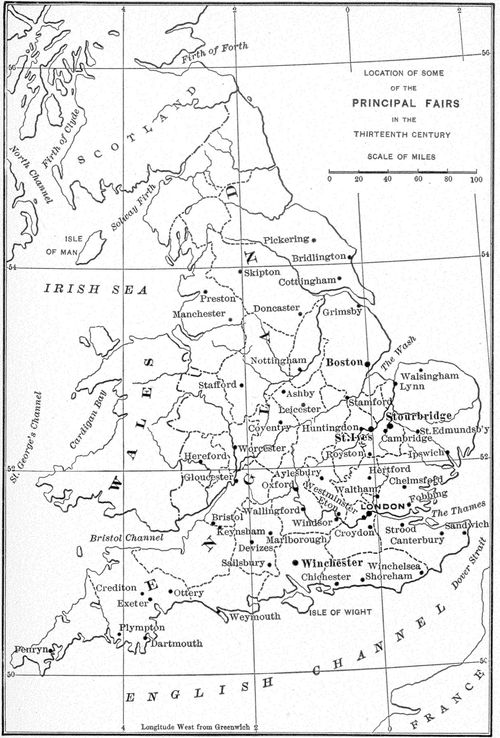
Location Of Some Of The Principal Fairs In The
Thirteenth Century
Tolls were collected for the advantage of the lord of the fair from
all goods as they were brought into or taken out from the bounds of
the fair, or at the time of their sale; stallage was paid for the rent
of booths, fees were charged for the use of space, and for using the
lord's weights and scales. Good order was preserved and fair dealing
enforced by the officials of the lord. To prevent offences and settle
disputes arising in the midst of the busy trading the officials of the
lord formed a court which sat continually and followed a summary
procedure. This was known as a court of "pie-powder," that is pied
poudré, or dusty foot, so called, no doubt, from its readiness to
hear the suits of merchants and wayfarers, as they were, without
formality or delay. At this court a great variety of cases came up,
such as disputes as to debts, failure to perform contracts of sale or
purchase, false measurements, theft, assault, defamation, and
misdemeanors of all kinds. Sometimes the court decided offhand,
sometimes compurgation was allowed immediately or on the next day,
sometimes juries were formed and gave decisions. The law which the
court of pie-powder administered was often referred to as the "law
merchant," a somewhat less rigid system than the common law, and one
whose rules were generally defined, in these courts and in the king's
courts, by juries chosen from among the merchants themselves.
At these fairs, even more than in the towns, merchants from a distance
gathered to buy the products peculiar to the part of England where the
fair was held, and to sell their own articles of importation
or production. The large fairs furnished by far the best markets of
the time. We find mention made in the records of one court of
pie-powder of men from a dozen or twenty English towns, from Bordeaux,
and from Rouen. The men who came from any one town, whether of England
or the Continent, acted and were treated as common members of the gild
merchant of that town, as forming a sort of community, and being to a
certain extent responsible for one another. They did their buying and
selling, it is true, separately, but if disputes arose, the whole
group were held responsible for each member. For example, the
following entry was made in the roll of the fair of St. Ives in the
year 1275: "William of Fleetbridge and Anne his wife complain of
Thomas Coventry of Leicester for unjustly withholding from them 55s.
2½d. for a sack of wool.... Elias is ordered to attach the
community of Leicester to answer ... and of the said community Allan
Parker, Adam Nose and Robert Howell are attached by three bundles of
ox-hides, three hundred bundles of sheep skins and six sacks of wool."
20. Trade Relations between Towns.—The fairs were only temporary
selling places. When the time for which the fair was held had expired
the booths were removed, the merchants returned to their native cities
or travelled away to some other fair, and the officials were
withdrawn. The place was deserted until the next quarter or year. But
in the towns, as has been already stated, more or less continuous
trade went on; not only petty retail trade and that of the weekly or
semi-weekly markets between townsmen or countrymen coming from the
immediate vicinity, but a wholesale trade between the merchants of
that town and those from other towns in England or on the Continent.
It was of this trade above all that the gild merchant of
each town possessed the regulation. Merchants from another town were
treated much the same, whether that town was English or foreign. In
fact, "foreigner" or "alien," as used in the town records, of Bristol,
for instance, may apply to citizens of London or Oxford just as well
as to those of Paris or Cologne. Such "foreign" merchants could deal
when they came to a town only with members of the gild, and only on
the conditions required by the gild. Usually they could buy or sell
only at wholesale, and tolls were collected from them upon their sales
or purchases. They were prohibited from dealing in some kinds of
articles altogether, and frequently the duration of their stay in the
town was limited to a prescribed period. Under such circumstances the
authorities of various towns entered into trade agreements with those
of other towns providing for mutual concessions and advantages.
Correspondence was also constantly going on between the officials of
various towns for the settlement of individual points of dispute, for
the return of fugitive apprentices, asking that justice might be done
to aggrieved citizens, and on occasion threatening reprisal.
Southampton had formal agreements with more than seventy towns or
other trading bodies. During a period of twenty years the city
authorities of London sent more than 300 letters on such matters to
the officials of some 90 other towns in England and towns on the
Continent. The merchants from any one town did not therefore trade or
act entirely as separate individuals, but depended on the prestige of
their town, or the support of the home authorities, or the privileges
already agreed upon by treaty. The non-payment of a debt by a merchant
of one town usually made any fellow-townsman liable to seizure where
the debt was owed, until the debtor could be made to pay. In 1285, by
a law of Edward I, this was prohibited as far as England was
concerned, but a merchant from a French town might still
have his person and property seized for a debt of which he may have
had no previous knowledge. External trade was thus not so much
individual, between some Englishmen and others; or international,
between Englishmen and Frenchmen, Flemings, Spaniards, or Germans, as
it was intermunicipal, as it has been well described. Citizens of
various towns, London, Bristol, Venice, Ghent, Arras, or Lubeck, for
instance, carried on their trade under the protection their city had
obtained for them.
21. Foreign Trading Relations.—The regulations and restrictions of
fairs and town markets and gilds merchant must have tended largely to
the discouragement of foreign trade. Indeed, the feeling of the body
of English town merchants was one of strong dislike to foreigners and
a desire to restrict their trade within the narrowest limits. In
addition to the burdens and limitations placed upon all traders not of
their own town, it was very common in the case of merchants from
abroad to require that they should only remain within the town for the
purpose of selling for forty days, and that they should board not at
an inn but in the household of some town merchant, who could thus keep
oversight of their movements, and who would be held responsible if his
guest violated the law in any way. This was called the custom of
"hostage."
The king, on the other hand, and the classes most influential in the
national government, the nobility and the churchmen, favored foreign
trade. A series of privileges, guarantees, and concessions were
consequently issued by the government to individual foreign merchants,
to foreign towns, and even to foreigners generally, the object of
which was to encourage their coming to England to trade. The most
remarkable instance of this was the so-called Carta Mercatoria
issued by Edward I in 1303. It was given according to its own
terms, for the peace and security of merchants coming to England from
Germany, France, Spain, Portugal, Navarre, Lombardy, Tuscany,
Provence, Catalonia, Aquitaine, Toulouse, Quercy, Flanders, Brabant,
and all other foreign lands. It allowed such merchants to bring in and
sell almost all kinds of goods, and freed them from the payment of
many tolls and payments habitually exacted by the towns; it gave them
permission to sell to strangers as well as to townsmen, and to retail
as well as sell by wholesale. It freed them from the necessity of
dwelling with native merchants, and of bringing their stay to a close
within a restricted time. Town and market authorities were required by
it to give prompt justice to foreigners according to the law merchant,
and it was promised that a royal judge would be specially appointed to
listen to appeals. It is quite evident that if this charter had been
enforced some of the most familiar and valued customs of the merchants
of the various English towns would have been abrogated. In consequence
of vigorous protests and bitter resistance on the part of the townsmen
its provisions were partly withdrawn, partly ignored, and the position
of foreign merchants in England continued to depend on the tolerably
consistent support of the crown. Even this was modified by the steady
policy of hostility, limitation, and control on the part of the native
merchants.
With the exception of some intercourse between the northern towns and
the Scandinavian countries, the foreign trade of England was carried
on almost entirely by foreigners. English merchants, until after the
fourteenth century, seem to have had neither the ability, the
enterprise, nor the capital to go to continental cities in any numbers
to sell the products of their own country or to buy goods which
would be in demand when imported into England. Foreigners
were more enterprising. From Flemish, French, German, Italian, and
even Spanish cities merchants came over as traders. The product of
England which was most in demand was wool. Certain parts of England
were famous throughout all Europe for the quality and quantity of the
wool raised there. The relative good order of England and its
exemption from civil war made it possible to raise sheep more
extensively than in countries where foraging parties from rival bodies
of troops passed frequently to and fro. Many of the monasteries,
especially in the north and west, had large outlying wastes of land
which were regularly used for the raising of sheep. The product of
these northern and western pastures as well as the surplus product of
the demesnes and larger holdings of the ordinary manors was brought to
the fairs and towns for sale and bought up readily by foreign
merchants. Sheepskins, hides, and tanned leather were also exported,
as were certain coarse woven fabrics. Tin and lead were well-known
products, at that time almost peculiar to England, and in years of
plentiful production, grain, salt meat, and dairy products were
exported. England was far behind most of the Continent in industrial
matters, so that there was much that could be brought into the country
that would be in demand, both of the natural productions of foreign
countries and of their manufactured articles.
Trade relations existed between England and the Scandinavian
countries, northern Germany, southern Germany, the Netherlands,
northeastern, northwestern, and southern France, Spain and Portugal,
and various parts of Italy. Of these lines of trade the most important
were the trade with the Hanse cities of northern Germany, with the
Flemish cities, and with those in Italy, especially Venice.
22. The Italian and Eastern Trade.—The merchandise which
Venice had to offer was of an especially varied nature. Her prosperity
had begun with a coastwise trade along the shores of the Adriatic.
Later, especially during the period of the Crusades, her training had
been extended to the eastern Mediterranean, where she obtained trading
concessions from the Greek Emperor and formed a half commercial, half
political empire of her own among the island cities and coast
districts of the Ionian Sea, along the Dardanelles and the Sea of
Marmora, and finally in the Black Sea. From these regions she brought
the productions peculiar to the eastern Mediterranean: wines, sugar,
dried fruits and nuts, cotton, drugs, dyestuffs, and certain kinds of
leather and other manufactured articles.
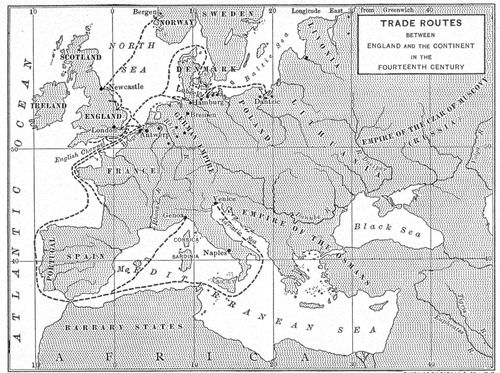
Trade Routes Between England And The Continent In The
Fourteenth Century Engraved By Bormay And Co., N.Y.
Eventually Venice became the special possessor of a still more distant
trade, that of the far East. The products of Arabia and Persia, India
and the East Indian Islands, and even of China, all through the Middle
Ages, as in antiquity, made their way by long and difficult routes to
the western countries of Europe. Silk and cotton, both raw and
manufactured into fine goods, indigo and other dyestuffs, aromatic
woods and gums, narcotics and other drugs, pearls, rubies, diamonds,
sapphires, turquoises, and other precious stones, gold and silver, and
above all the edible spices, pepper, ginger, cinnamon, cloves, and
allspice, could be obtained only in Asia. There were three principal
routes by which these goods were brought into Europe: first, along the
Red Sea and overland across Egypt; second, up the Persian Gulf to its
head, and then either along the Euphrates to a certain point whence
the caravan route turned westward to the Syrian coast, or along the
Tigris to its upper waters, and then across to the Black Sea at
Trebizond; third, by caravan routes across Asia, then across the
Caspian Sea, and overland again, either to the Black Sea or
through Russia to the Baltic. A large part of this trade was gathered
up by the Italian cities, especially Venice, at its various outlets
upon the Mediterranean or adjacent waters. She had for exportation
therefore, in addition to her own manufactures, merchandise which had
been gathered from all parts of the then known world. The Venetian
laws regulated commerce with the greatest minuteness. All goods
purchased by Venetian traders must as a rule be brought first to the
city and unloaded and stored in the city warehouses. A certain amount
of freedom of export by land or water was then allowed, but by far the
greater proportion of the goods remained under the partial control of
the government. When conditions were considered favorable, the Senate
voted a certain number of government galleys for a given voyage. There
were several objective points for these voyages, but one was regularly
England and Flanders, and the group of vessels sent to those countries
was known as the "Flanders Fleet." Such an expedition was usually
ordered about once a year, and consisted of two to five galleys. These
were put under the charge of an admiral and provided with sailing
masters, crews of rowers, and armed men to protect them, all at the
expense of the merchants who should send goods in the vessels.
Stringent regulations were also imposed upon them by the government,
defining the length of their stay and appointing a series of stopping
places, usually as follows: Capo d'Istria, Corfu, Otranto, Syracuse,
Messina, Naples, Majorca, certain Spanish ports, Lisbon; then across
the Bay of Biscay to the south coast of England, where usually the
fleet divided, part going to Sluys, Middleburg, or Antwerp, in the
Netherlands; the remainder going to Southampton, Sandwich, London, or
elsewhere in England. At one or other of the southern ports
of England the fleet would reassemble on its return, the whole outward
and return voyage usually taking about a year.
The merchants who had come with the fleet thereupon proceeded to
dispose of their goods in the southern towns and fairs of England and
to buy wool or other goods which might be taken back to Venice or
disposed of on the way. A somewhat similar trade was kept up with
other Italian cities, especially with Genoa and Florence, though these
lines of trade were more extensive in the fifteenth century than in
the fourteenth.
23. The Flanders Trade and the Staple.—A trade of greater bulk and
greater importance, though it did not include articles from such a
distance as that of Italy, was the trade with the Flemish cities. This
was more closely connected with English wool production than was that
with any other country. Ghent, Bruges, Ypres, Courtrai, Arras, and a
number of other cities in Flanders and the adjacent provinces of the
Netherlands and France had become populous and rich, principally from
their weaving industry. For their manufacture of fine fabrics they
needed the English wool, and in turn their fine woven goods were in
constant demand for the use of the wealthier classes in England.
English skill was not yet sufficient to produce anything more than the
crudest and roughest of textile fabrics. The fine cloths, linens,
cambrics, cloth of gold and silver, tapestries and hangings, were the
product of the looms of the Flemish cities. Other fine manufactured
goods, such as armor and weapons, glass and furniture, and articles
which had been brought in the way of trade to the Netherlands, were
all exported thence and sold in England.
The Flemish dealers who habitually engaged in the English trade were
organized among themselves in a company or league known as
the "Flemish Hanse of London." A considerable number of towns held
such membership in the organization that their citizens could take
part in the trade and share in the benefits and privileges of the
society, and no citizen of these towns could trade in England without
paying the dues and submitting himself to the rules of the Hanse. The
export trade from England to the Netherlands was controlled from the
English side by the system known as the "Staple." From early times it
had been customary to gather English standard products in certain
towns in England or abroad for sale. These towns were known as
"staples" or "staple towns," and wool, woolfells, leather, tin, and
lead, the goods most extensively exported, were known as "staple
goods." Subsequently the government took control of the matter, and
appointed a certain town in the Netherlands to which staple goods must
be sent in the first place when they were exported from England. Later
certain towns in England were appointed as staple towns, where all
goods of the kinds mentioned above should be taken to be registered,
weighed, and taxed before exportation. Just at the close of the period
under discussion, in 1354, a careful organization was given to the
system of staple towns in England, by which in each of the ten or
twelve towns to which staple goods must be brought for exportation, a
Mayor of the Staple and two Constables were elected by the "merchants
of the staple," native and foreign. These officials had a number of
duties, some of them more particularly in the interest of the king and
treasury, others in the interest of the foreign merchants, still
others merely for the preservation of good order and the enforcement
of justice. The law merchant was made the basis of judgment, and every
effort made to grant protection to foreigners and at the same time
secure the financial interests of the government. But the
policy of the government was by no means consistent. Both before and
after this date, the whole system of staples was repeatedly abolished
for a time and the whole trade in these articles thrown open. Again,
the location of the staple towns was shifted from England to the
continent and again back to England. Eventually, in 1363, the staple
came to be established at Calais, and all "staplers," or exporters of
staple goods from England, were forced to give bonds that their
cargoes would be taken direct to Calais to be sold.
24. The Hanse Trade.—The trade with Germany was at this time almost
all with the group of citizens which made up the German Hanse or
League. This was a union of a large number of towns of northern
Germany, such as Lubeck, Hamburg, Bremen, Dantzig, Brunswick, and
perhaps sixty or eighty others. By a series of treaties and agreements
among themselves, these towns had formed a close confederation which
acted as a single whole in obtaining favorable trading concessions and
privileges in various countries. There had been a considerable trade
between the merchants of these towns and England from an early time.
They brought the products of the Baltic lands, such as lumber, tar,
salt, iron, silver, salted and smoked fish, furs, amber, certain
coarse manufactures, and goods obtained by Hanseatic merchants through
their more distant trade connections, such as fine woven goods, armor
and other metal goods, and even spices and other Eastern goods,
obtained from the great Russian fairs. The Hanse cities had entered
into treaties with the English government, and possessed valuable
concessions and privileges, and imported and exported quite
extensively. The term "sterling," as applied to standard English
money, is derived from the word "Easterling," which was used
as synonymous with "German," "Hansard," "Dutch," and several other
names descriptive of these traders.
The trade with the cities of northwestern France was similar to that
with the neighboring towns of Flanders. That with northwestern France
consisted especially of salt, sail-cloth, and wine. The trade with
Poitou, Gascony, and Guienne was more extensive, as was natural from
their long political connection with England. The chief part of the
export from southern France was wine, though a variety of other
articles, including fruits and some manufactured articles, were sent
to England. A trade of quite a varied character also existed between
England and the various countries of the Spanish Peninsula, including
Portugal. Foreign trade with all of these countries was destined to
increase largely during the later fourteenth and the fifteenth
century, but its foundations were well laid within the first half of
the fourteenth. Vessels from all these countries appeared from time to
time in the harbors of England, and their merchants traded under
government patronage and support in many English towns and fairs.
25. Foreigners settled in England.—The fact that almost all of the
foreign trade of England was in the hands of aliens necessarily
involved their presence in the country temporarily or permanently in
considerable numbers. The closely related fact that the English were
distinctly behind the people of the Continent in economic knowledge,
skill, and wealth also led foreigners to seek England as a field for
profitable exercise of their abilities in finance, in trade, and
manufactures. The most conspicuous of these foreigners at the close of
the thirteenth century and during the early part of the fourteenth
were the Italian bankers. Florence was not only a great trading and
manufacturing city, but a money centre, a capitalist city.
The Bardi, Peruzzi, Alberti, Frescobaldi, and other banking companies
received deposits from citizens of Florence and other Italian cities,
and loaned the money, as well as their own capital, to governments,
great nobles, and ecclesiastical corporations in other countries. When
the Jews were expelled from England in 1290, there being no
considerable amount of money among native Englishmen, the Italian
bankers were the only source from which the government could secure
ready money. When a tax had been authorized by Parliament, but the
product of it could be obtained only after a year or more spent in its
collection, the Florentines were at hand to offer the money at once,
receiving security for repayment when the receipts from the tax should
come in. Government monopolies like the Cornwall tin mines were leased
to them for a lump sum; arrangements were made by which the bankers
furnished a certain amount of money each day during a campaign or a
royal progress. The immediate needs of an impecunious king were
regularly satisfied with money borrowed to be repaid some months
afterward. The equipment for all of the early expeditions of the
Hundred Years' War was obtained with money borrowed from the
Florentines. Payments abroad were also made by means of bills of
exchange negotiated by the same money-lenders. Direct payment of
interest was forbidden by law, but they seem to have been rewarded by
valuable government concessions, by the profits on exchange, and no
doubt by the indirect payment of interest, notwithstanding its
illegality.
The Italian bankers evidently loaned to others besides the king, for
in 1327 the Knights Hospitallers in England repaid to the Society of
the Bardi £848 5d., and to the Peruzzi £551 12s. 11d. They
continued to loan freely to the king, till in 1348 he was
indebted to one company alone to the extent of more than £50,000, a
sum equal in modern value to about $3,000,000. The king now failed to
repay what he had promised, and the banking companies fell into great
straits. Defalcations having occurred in other countries also, some of
them failed, and after the middle of the century they never held so
conspicuous a place, though some Italians continued to act as bankers
and financiers through the remainder of the fourteenth and fifteenth
century. Many Italian merchants who were not bankers, especially
Venetians and Genoese, were settled in England, but their occupation
did not make them so conspicuous as the financiers of the same nation.
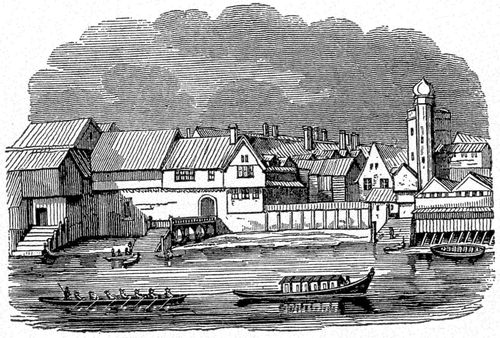
The Steelyard in the Seventeenth Century.
(Herbert:
History of London Livery Companies.)
The German or Hanse merchants had a settlement of their own in London,
known as the "Steelyard," "Gildhall of the Dutch," or the
"Easterling's House." They had similar establishments on a smaller
scale in Boston and Lynn, and perhaps in other towns. Their
permission to own property and to live in their own house instead of
in the houses of native merchants, as was the usual custom, was
derived, like most privileges of foreigners, from the gift of the
king. Little by little they had purchased property surrounding their
original grants until they had a great group of buildings, including a
meeting and dining hall, tower, kitchen, storage house, offices and
other warehouses, and a considerable number of dwelling-houses, all
enclosed by a wall and fences. It was located immediately on the
Thames just above London Bridge so that their vessels unloaded at
their own wharf. The merchants or their agents lived under strict
rules, the gates being invariably closed at nine o'clock, and all
discords among their own nation were punished by their own officers.
Their trade was profitable to the king through payment of customs, and
after the failure of the Italian bankers the merchants of the
Steelyard made considerable loans to the English government either
directly or acting for citizens at home. In 1343, when the king had
been granted a tax of 40s. a sack on all wool exported, he
immediately borrowed the value of it from Tiedemann van Limberg and
Johann van Wolde, Easterlings. Similarly in 1346 the Easterlings
loaned the king money for three years, holding his second crown as
security. Like the Florentines, at one time they took the Cornwall tin
mines at farm. They had many privileges not accorded generally to
foreigners, but were exceedingly unpopular alike with the population
and the authorities of the city of London. There were some other
Germans domiciled in England, but nowhere else were they so
conspicuous or influential as at the Steelyard.
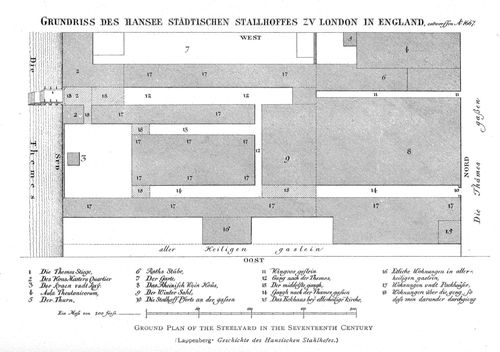
Ground Plan of the Steelyard in the Seventeenth Century
(Lappenberg. Geschichte des Hansischen Stahlhofes.)
The trade with Flanders brought Flemish merchants into England
temporarily, but they do not seem to have formed any
settlement or located permanently in any one place. Flemish artisans,
on the other hand, had migrated to England from early times and were
scattered here and there in several towns and villages. In the early
part of the fourteenth century Edward III made it a matter of
deliberate policy to encourage the immigration of Flemish weavers and
other handicraftsmen, with the expectation that they would teach their
art to the more backward native English. In 1332 he issued a charter
of protection and privilege to a Fleming named John Kempe, a weaver of
woollen cloth, offering the same privilege and protection to all other
weavers, dyers, and fullers who should care to come to England to
live. In 1337 a similar charter was given to a body of weavers coming
from Zealand to England. It is believed that a considerable number of
immigrants from the Netherlands came in at this period, settled
largely in the smaller towns and rural villages, and taking English
apprentices brought about a great improvement in the character of
English manufactures. Flemings are also met with in local records in
various occupations, even in agriculture.
There were other foreigners resident in England, especially Gascons
from the south of France, and Spaniards; but the main elements of
alien population in the thirteenth and fourteenth centuries were those
which have just been described, Italians, Germans from the Hanse
towns, and Flemings. These were mainly occupied as bankers, merchants,
and handicraftsmen.
26. BIBLIOGRAPHY
Dr. Cunningham's Growth of English Industry and Commerce is
particularly full and valuable on this subject. He has given further
details on one branch of it in his Alien Immigrants in England.
Schanz, Georg: Englische Handelspolitik gegen Ende des
Mittelalters. This work refers to a later period than that included
in this chapter, but the summaries which the author gives of earlier
conditions are in many cases the best accounts that we have.
Ashley, W. J.: Early History of the Woolen Industry in England.
Pauli, R.: Pictures from Old England. Contains an interesting
account of the Steelyard.
Pirenne, Henri: La Hanse flamande de Londres.
Von Ochenkowski, W.: England's Wirthsschaftliche Entwickelung im
Ausgange des Mittelalters.
THE BLACK DEATH AND THE PEASANTS' REBELLION
Economic Changes of the Later Fourteenth and Early Fifteenth Centuries
27. National Affairs from 1338 to 1461.—For the last century or more
England had been standing with her back to the Continent. Deprived of
most of their French possessions, engaged in the struggle to bring
Wales, Scotland, and Ireland under the English crown, occupied with
repeated conflicts with their barons or with the development of the
internal organization of the country, John, Henry III, and the two
Edwards had had less time and inclination to interest themselves in
continental affairs than had Henry II and Richard. But after 1337 a
new influence brought England for the next century into close
connection with the rest of Europe. This was the "Hundred Years' War"
between England and France. Several causes had for years combined to
make this war unavoidable: the interference of France in the dispute
with Scotland, the conflicts between the rising fishing and trading
towns on the English and the French side of the Channel, the desire of
the French king to drive the English kings from their remaining
provinces in the south of France, and the reluctance of the English
kings to accept their dependent position in France. Edward III
commenced the war in 1338 with the invasion of France, and it was
continued with comparatively short intervals of peace until 1452.
During its progress the English won three of the most
brilliant military victories in their history, at Crécy, Poitiers, and
Agincourt, in 1346, 1356, and 1415. But most of the campaigns were
characterized by brutality, destructive ravaging, and the reduction of
cities by famine. The whole contest indeed often degenerated into
desultory, objectless warfare. A permanent settlement was attempted at
Bretigny in 1360. The English required the dismemberment of France by
the surrender of almost one-third of the country and the payment by
the French of a large ransom for their king, who had been captured by
the English. In return King Edward withdrew any other claims he might
have to territory, or the French crown. These terms were, however, so
humiliating to the French that they did not adhere to them, the war
soon broke out again, and finally terminated in the driving out of the
English from all of France except the city of Calais, in the middle
years of the next century.
The many alliances, embassies, exchanges of visits, and other
international intercourse which the prosecution of the Hundred Years'
War involved brought England into a closer participation in the
general life of Europe than ever before, and caused the ebb and flow
of a tide of influences between England and the Continent which deeply
affected economic, political, and religious life on both sides of the
Channel.
The Universities continued to flourish during almost the whole of this
period. It was from Oxford as a centre, under the influence of John
Wycliffe, a lecturer there, that a great revival and reforming
movement in the church emanated. From about 1370 Wycliffe and others
began to agitate for a more earnest religious life. They translated
the Bible into English, wrote devotional and polemic tracts, preached
throughout the country, spoke and wrote against the evils in
the church at the time, then against its accepted form of
organization, and finally against its official teachings. They thus
became heretics. Thousands were influenced by their teachings, and a
wave of religious revival and ecclesiastical rebellion spread over the
country. The powers of the church and the civil government were
ultimately brought to bear to crush out the "Lollards," as those who
held heretical beliefs at that time were called. New and stringent
laws were passed in 1401 and 1415, several persons were burned at the
stake, and a large number forced to recant, or frightened into keeping
their opinions secret. This religious movement gradually died out, and
by the middle of the fifteenth century nothing more is heard of
Lollardry.
Wycliffe had been not only a religious innovator, but a writer of much
excellent English. Contemporary with him or slightly later were a
number of writers who used the native language and created permanent
works of literature. The Vision of Piers Plowman is the longest and
best of a number of poems written by otherwise unknown men. Geoffrey
Chaucer, one of England's greatest poets, wrote at first in French,
then in English; his Canterbury Tales showing a perfected English
form, borrowed originally, like so much of what was best in England at
the time, from Italy or France, but assimilated, improved, and
reconstructed until it seemed a purely English production. During the
reign of Edward III English became the official language of the courts
and the usual language of conversation, even among the higher classes.
Edward III lived until 1377. Through his long reign of half a century,
during which he was entirely dependent on the grants of Parliament for
the funds needed to carry on the war against France, this body
obtained the powers, privileges, and organization which made
it thereafter such an influential part of the government. His
successor, Richard II, after a period of moderate government tried to
rule with a high hand, but in 1399 was deposed through the influence
of his cousin, Henry of Lancaster, who was crowned as Henry IV.
Henry's title to the throne, according to hereditary principles, was
defective, for the son of an older brother was living. He was,
however, a mere child, and there was no considerable opposition to
Henry's accession. Under the Lancastrian line, as Henry IV, Henry V,
and Henry VI, who now reigned successively, are called, Parliament
reached the highest position which it had yet attained, a position
higher in fact than it held for several centuries afterward. Henry VI
was a child at the death of his father in 1422. On coming to be a man
he proved too mild in temper to control the great nobles who, by the
chances of inheritance, had become almost as powerful as the great
feudal barons of early Norman times. The descendants of the older
branch of the royal family were now represented by a vigorous and
capable man, the duke of York. An effort was therefore made about 1450
by one party of the nobles to depose Henry VI in favor of the duke of
York. A number of other nobles took the side of the king, and civil
war broke out. After a series of miserable contests known as the "Wars
of the Roses" the former party was successful, at least temporarily,
and the duke of York became king in 1461 as Edward IV.
28. The Black Death and its Effects.—During the earlier mediæval
centuries the most marked characteristic of society was its stability.
Institutions continued with but slight changes during a long period.
With the middle of the fourteenth century changes become more
prominent. Some of the most conspicuous of these gather around a
series of attacks of epidemic disease during the latter half of the
century.
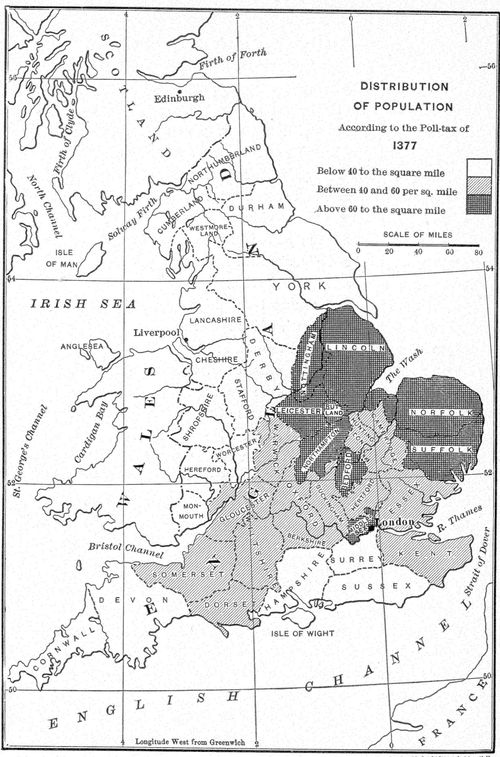
Distribution Of Population According To The Poll-Tax Of
1377.
Engraved By Bormay & Co., N.Y.
From the autumn of 1348 to the spring of 1350 a wave of
pestilence was spreading over England from the southwest northward and
eastward, progressively attacking every part of the country. The
disease was new to Europe. Its course in the individual case, like its
progress through the community, was very rapid. The person attacked
either died within two or three days or even less, or showed signs of
recovery within the same period. The proportion of cases which
resulted fatally was extremely large; the infectious character of the
disease quite remarkable. It was, in fact, an extremely violent
epidemic attack, the most violent in history, of the bubonic plague,
with which we have unfortunately become again familiar within recent
years.
From much careful examination of several kinds of contemporary
evidence it seems almost certain that as each locality was
successively attacked in 1348 and 1349 something like a half of the
population died. In other words, whereas in an ordinary year at that
time perhaps one-twentieth of the people died, in the plague year
one-half died. Such entries as the following are frequent in the
contemporary records. At the abbey of Newenham, "in the time of this
mortality or pestilence there died in this house twenty monks and
three lay brothers, whose names are entered in other books. And
Walter, the abbot, and two monks were left alive there after the
sickness." At Leicester, "in the little parish of St. Leonard there
died more than 380, in the parish of Holy Cross more than 400, in that
of St. Margaret more than 700; and so in every parish great numbers."
The close arrangement of houses in the villages, the crowding of
dwellings along narrow streets in the towns, the promiscuous life in
the monasteries and in the inns, the uncleanly habits of living
universally prevalent, all helped to make possible this sweeping away
of perhaps a majority of the population by an attack of
epidemic disease. It had devastated several of the countries of Europe
before appearing in England, having been introduced into Europe
apparently along the great trade routes from the far East. Within a
few months the attack in each successive district subsided, the
disease in the southwestern counties of England having run its course
between August, 1348, and May, 1349, in and about London between
November, 1348, and July, 1349, in the eastern counties in the summer
of 1349, and in the more northern counties through the last months of
that year or within the spring of 1350. Pestilence was frequent
throughout the Middle Ages, but this attack was not only vastly more
destructive and general than any which had preceded it, but the
disease when once introduced became a frequent scourge in subsequent
times, especially during the remainder of the fourteenth century. In
1361, 1368, and 1396 attacks are noticed as occurring more or less
widely through the country, but none were so extensive as that which
is usually spoken of as the "Black Death" of 1348-1349. The term
"Black Death" was not used contemporaneously, nor until comparatively
modern times. The occurrence of the pestilence, however, made an
extremely strong impression on men's minds, and as "the great
mortality," "the great pestilence," or "the great death," it appears
widely in the records and the literature of the time.
Such an extensive and sudden destruction of life could not take place
without leaving its mark in many directions. Monasteries were
depopulated, and the value of their property and the strictness of
their discipline diminished. The need for priests led to the
ordination of those who were less carefully prepared and selected. The
number of students at Oxford and Cambridge was depleted; the building
and adornment of many churches suspended. The war between
England and France, though promptly renewed, involved greater
difficulty in obtaining equipment, and ultimately required new devices
to meet its expense. Many of the towns lost numbers and property that
were never regained, and the distribution of population throughout
England was appreciably changed.
But the most evident and far-reaching results of the series of
pestilences occurring through the last half of the fourteenth century
were those connected with rural life and the arrangement of classes
described in Chapter II.
The lords of manors might seem at first thought to have reaped
advantage from the unusually high death rate. The heriots collected on
the death of tenants were more numerous; reliefs paid by their
successors on obtaining the land were repeated far more frequently
than usual; much land escheated to the lord on the extinction of the
families of free tenants, or fell into his hands for redisposal on the
failure of descendants of villains or cotters. But these were only
temporary and casual results. In other ways the diminution of
population was distinctly disadvantageous to the lords of manors. They
obtained much lower rents for mills and other such monopolies, because
there were fewer people to have their grain ground and the tenants of
the mills could therefore not make as much profit. The rents of assize
or regular periodical payments in money and in kind made by free and
villain tenants were less in amount, since the tenants were fewer and
much land was unoccupied. The profits of the manor courts were less,
for there were not so many suitors to attend, to pay fees, and to be
fined. The manor court rolls for these years give long lists of
vacancies of holdings, often naming the days of the deaths of the
tenants. Their successors are often children, and in many cases whole
families were swept away and the land taken into the hands
of the lord of the manor. Juries appointed at one meeting of the manor
court are sometimes all dead by the time of the next meeting. There
are constant complaints by the stewards that certain land "is of no
value because the tenants are all dead;" in one place that a
water-mill is worthless because "all the tenants who used it are
dead," in another that the rents are £7 14s. less than in the
previous year because fourteen holdings, consisting of 102 acres of
land, are in the hands of the lord, in still another that the rents of
assize which used to be £20 are now only £2 and the court fees have
fallen from 40 to 5 shillings "because the tenants there are dead."
There was also less required service performed on the demesne lands,
for many of the villain holdings from which it was owed were now
vacant. Last, and most seriously of all, the lords of manors suffered
as employers of labor. It had always been necessary to hire additional
labor for the cultivation of the demesne farm and for the personal
service of the manor, and through recent decades somewhat more had
come to be hired because of a gradual increase of the practice of
commutation of services. That is, villain tenants were allowed to pay
the value of their required days' work in money instead of in actual
service. The bailiff or reeve then hired men as they were wanted, so
that quite an appreciable part of the work of the manor had come to be
done by laborers hired for wages.
After the Black Death the same demesne lands were to be cultivated,
and in most cases the larger holdings remained or descended or were
regranted to those who would expect to continue their cultivation.
Thus the demand for laborers remained approximately as great as it had
been before. The number of laborers, on the other hand, was vastly
diminished. They were therefore eagerly sought for by employers.
Naturally they took advantage of their position to demand
higher wages, and in many cases combined to refuse to work at the old
accustomed rates. A royal ordinance of 1349 states that, "because a
great part of the people, especially of workmen and servants, have
lately died in the pestilence, many, seeing the necessity of masters
and great scarcity of servants, will not serve unless they may receive
excessive wages." A contemporary chronicler says that "laborers were
so elated and contentious that they did not pay any attention to the
command of the king, and if anybody wanted to hire them he was bound
to pay them what they asked, and so he had his choice either to lose
his harvest and crops or give in to the proud and covetous desires of
the workmen." Thus, because of this rise in wages, at the very time
that many of the usual sources of income of the lords of manors were
less remunerative, the expenses of carrying on their farming
operations were largely increased. On closer examination, therefore,
it becomes evident that the income of the lords of manors, whether
individuals or corporations, was not increased, but considerably
diminished, and that their position was less favorable than it had
been before the pestilence.
The freeholders of land below lords of manors were disadvantageously
affected in as far as they had to hire laborers, but in other ways
were in a more favorable position. The rent which they had to pay was
often reduced. Land was everywhere to be had in plenty, and a threat
to give up their holdings and go to where more favorable terms could
be secured was generally effective in obtaining better terms where
they were.
The villain holders legally of course did not have this opportunity,
but practically they secured many of its advantages. It is probable
that many took up additional land, perhaps on an improved
tenure. Their payments and their labor, whether done in the form of
required "week-work," or, if this were commuted, done for hire, were
much valued, and concessions made to them accordingly. They might, as
they frequently did, take to flight, giving up their land and either
obtaining a new grant somewhere else or becoming laborers without
lands of their own.
This last-named class, made up of those who depended entirely on
agricultural labor on the land of others for their support, was a
class which had been increasing in numbers, and which was the most
distinctly favored by the demand for laborers and the rise of wages.
They were the representatives of the old cotter class, recruited from
those who either inherited no land or found it more advantageous to
work for wages than to take up small holdings with their burdens.
But the most important social result of the Black Death and the period
of pestilence which followed it was the general shock it gave to the
old settled life and established relations of men to one another. It
introduced many immediate changes, and still more causes of ultimate
change; but above all it altered the old stability, so that change in
future would be easy.
29. The Statutes of Laborers.—The change which showed itself most
promptly, the rise in the prevailing rate of wages, was met by the
strenuous opposition of the law. In the summer of 1349, while the
pestilence was still raging in the north of England, the king, acting
on the advice of his Council, issued a proclamation to all the
sheriffs and the officials of the larger towns, declaring that the
laborers were taking advantage of the needs of their lords to demand
excessive wages, and prohibiting them from asking more than had been
due and accustomed in the year before the outbreak of the
pestilence or for the preceding five or six years. Every laborer when
offered service at these wages must accept it; the lords of manors
having the first right to the labor of those living on their manors,
provided they did not insist on retaining an unreasonable number. If
any laborers, men or women, bond or free, should refuse to accept such
an offer of work, they were to be imprisoned till they should give
bail to serve as required. Commissioners were then appointed by the
king in each county to inquire into and punish violations of this
ordinance.
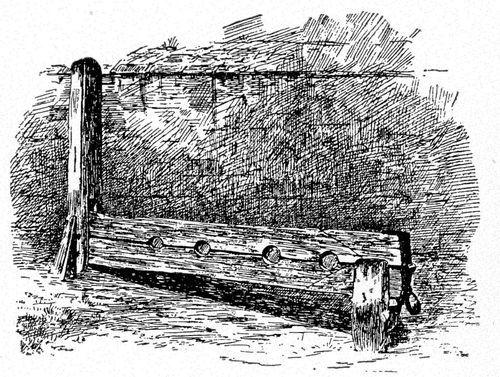
The Stocks at Shalford, near Guildford.
Present State.
(Jusserand: English Wayfaring Life in the Fourteenth Century.
Published by G. P. Putnam's Sons.)
When Parliament next met, in February, 1351, the Commons sent a
petition to the king stating that his ordinance had not been obeyed
and that laborers were claiming double and treble what they had
received in the years before the pestilence. In response to the
petition what is usually called the "First Statute of Laborers" was
enacted. It repeated the requirement that men must accept work when it
was offered to them, established definite rates of wages for various
classes of laborers, and required all such persons to swear twice a
year before the stewards, bailiffs, or other officials that they would
obey this law. If they refused to swear or disobeyed the law, they
were to be put in the stocks for three days or more and then sent to
the nearest jail till they should agree to serve as required. It was
ordered that stocks should be built in each village for this purpose,
and that the judges should visit each county twice a year to inquire
into the enforcement of the law. In 1357 the law was reënacted, with
some changes of the destination of the fines collected for its breach.
In 1361 there was a further reënactment of the law with additional
penalties. If laborers will not work unless they are given higher
wages than those established by law, they can be taken and imprisoned
by lords of manors for as much as fifteen days, and then be
sent to the next jail to await the coming of the justices. If any one
after accepting service leaves it, he is to be arrested and sued
before the justices. If he cannot be found, he is to be outlawed and a
writ sent to every sheriff in England ordering that he should be
arrested, sent back, and imprisoned till he pays his fine and makes
amends to the party injured; "and besides for the falsity he shall be
burnt in the forehead with an iron made and formed to this letter F in
token of Falsity, if the party aggrieved shall ask for it." This last
provision, however, was probably intended as a threat rather than an
actual punishment, for its application was suspended for some months,
and even then it was to be inflicted only on the advice of
the judges, and the iron was to remain in the custody of the sheriff.
The statute was reënacted with slight variations thirteen times within
the century after its original introduction; namely, in addition to
the dates already mentioned, in 1362, 1368, 1378, 1388, 1402, 1406,
1414, 1423, 1427, 1429, and 1444.
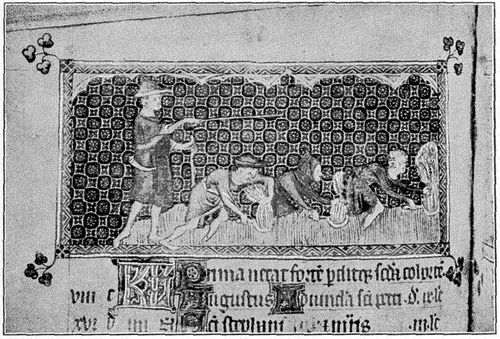
Laborers Reaping.
From a Fourteenth Century Manuscript.
(Jusserand: English Wayfaring Life in the Fourteenth Century.
Published by G. P. Putnam's Sons.)
The necessity for these repeated reissues of the statutes of laborers
indicates that the general rise of wages was not prevented. Forty
years after the pestilence the law of 1388 is said to be passed,
"because that servants and laborers are not, nor by a long time have
been willing to serve and labor without outrageous and excessive
hire." Direct testimony also indicates that the prevailing rate of
wages was much higher, probably half as much again, as it
had been before the pestilence. Nevertheless, the enforcement of the
law in individual cases must have been a very great hardship. The
fines which were collected from breakers of the law were of sufficient
amount to be estimated at one time as part payment of a tax, at
another as a valuable source of income to the lords of manors. Their
enforcement was intrusted at different times to the local justices of
the peace, the royal judges on circuit, and special commissioners.
The inducement to the passage of the laws prohibiting a rise in wages
was no doubt partly the self-interest of the employing classes who
were alone represented in Parliament, but partly also the feeling that
the laboring class were taking advantage of an abnormal condition of
affairs to change the well established customary rates of remuneration
of labor. The most significant fact indicated by the laws, however,
was the existence of a distinct class of laborers. In earlier times
when almost all rural dwellers held some land this can hardly have
been the case; it is quite evident that there was now an increasing
class who made their living simply by working for wages. Another fact
frequently referred to in the laws is the frequent passage of laborers
from one district to another; it is evident that the population was
becoming somewhat less stationary. Therefore while the years following
the great pestilence were a period of difficulty for the lords of
manors and the employing classes, for the lower classes the same
period was one of increasing opportunity and a breaking down of old
restrictions. Whether or not the statutes had any real effect in
keeping the rate of wages lower than it would have otherwise become is
hard to determine, but there is no doubt that the efforts to enforce
the law and the frequent punishment of individuals for its violation
embittered the minds of the laborers and helped to throw
them into opposition to the government and to the upper classes
generally. The statutes of laborers thus became one of the principal
causes of the growth of that hostility which culminated in the
Peasants' Rebellion.
30. The Peasants' Rebellion of 1381.—From the scanty contemporary
records still remaining we can obtain glimpses of a widespread
restlessness among the masses of the English people during the latter
half of the fourteenth century. According to a petition submitted to
Parliament in 1377 the villains were refusing to pay their customary
services to their lords and to acknowledge the requirements of their
serfdom. They were also gathering together in great bodies to resist
the efforts of the lords to collect from them their dues and to force
them to submit to the decisions of the manor courts. The ready
reception given to the religious revival preached by the Lollards
throughout the country indicates an attitude of independence and of
self-assertion on the part of the people of which there had been no
sign during earlier times. The writer who represents most nearly
popular feeling, the author of the Vision of Piers Plowman, reflects
a certain restless and questioning mysticism which has no particular
plan of reform to propose, but is nevertheless thoroughly dissatisfied
with the world as it is. Lastly, a series of vague appeals to revolt,
written in the vernacular, partly in prose, partly in doggerel rhyme,
have been preserved and seem to testify to a deliberate propaganda of
lawlessness. Some of the general causes of this rising tide of
discontent are quite apparent. The efforts to enforce the statutes of
laborers, as has been said, kept continual friction between the
employing and the employed class. Parliament, which kept petitioning
for reënactments of these laws, the magistrates and special
commissioners who enforced them, and the landowners who appealed to
them for relief, were alike engaged in creating class antagonism and
multiplying individual grievances. Secondly, the very improvement in
the economic position of the lower classes, which was undoubtedly in
progress, made them doubly impatient of the many burdens which still
pressed upon them. Another cause for the prevalent unrest may have
lain in the character of much of the teaching of the time. Undisguised
communism was preached by a wandering priest, John Ball, and the
injustice of the claims of the property-holding classes was a very
natural inference from much of the teachings of Wycliffe and his "poor
priests." Again, the corruption of the court, the incapacity
of the ministers, and the failure of the war in France were all
reasons for popular anger, if the masses of the people can be supposed
to have had any knowledge of such distant matters.
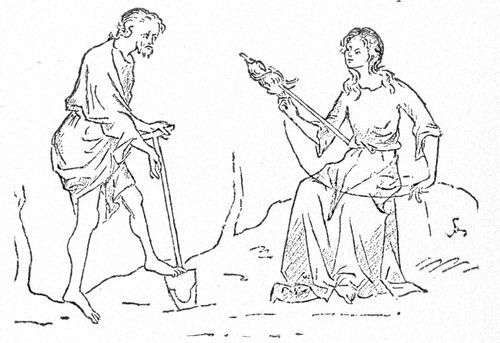
Adam and Eve.
From a Fourteenth Century Manuscript.
(Jusserand: English Wayfaring Life in the Fourteenth Century.
Published by G. P. Putnam's Sons.)
But the most definite and widespread cause of discontent was probably
the introduction of a new form of taxation, the general poll tax.
Until this time taxes had either been direct taxes laid upon land and
personal property, or indirect taxes laid upon various objects of
export and import. In 1377, however, Parliament agreed to the
imposition of a tax of four pence a head on all laymen, and
Convocation soon afterward taxed all the clergy, regular and secular,
the same amount. Notwithstanding this grant and increased taxes of the
old forms, the government still needed more money for the expenses of
the war with France, and in April, 1379, a graduated poll tax was laid
on all persons above sixteen years of age. This was regulated
according to the rank of the payer from mere laborers, who were to pay
four pence, up to earls, who must pay £4. But this only produced some
£20,000, while more than £100,000 were needed; therefore in November
of 1380 a third poll tax was laid in the following manner. The tax was
to be collected at the rate of three groats or one shilling for each
person over fifteen years of age. But although the total amount
payable from any town or manor was to be as many shillings as there
were inhabitants over fourteen years of age, it was to be assessed in
each manor upon individuals in proportion to their means, the more
well-to-do paying more, the poorer paying less; but with the limits
that no one should have to pay more than £1 for himself and his wife,
and no one less than four pence for himself and his wife.
The poll tax was extremely unpopular. In the first place, it was a new
tax, and to all appearances an additional weight given to
the burden of contributing to the never ending expenses of the
government of which the people were already weary. Moreover, it fell
upon everybody, even upon those who from their lack of property had
probably never before paid any tax. The inhabitants of every cottage
were made to realize, by the payment of what amounted to two or three
days' wages, that they had public and political as well as private and
economic burdens. Lastly, the method of assessing the tax gave scope
for much unfairness and favoritism.
In addition to this general unpopularity of the poll tax there was a
special reason for opposition in the circumstances of that imposed in
1380. As the returns began to come in they were extremely
disappointing to the government. Therefore in March, 1381, the king,
suspecting negligence on the part of the collectors, appointed groups
of commissioners for a number of different districts who were directed
to go from place to place investigating the former collection and
enforcing payment from any who had evaded it before. This no doubt
seemed to many of the ignorant people the imposition of a second tax.
The first rumors of disorder came in May from some of the villages of
Essex, where the tax-collectors and the commissioners who followed
them were driven away violently by the people. Finally, during the
second week in June, rioting began in several parts of England almost
simultaneously. In Essex those who had refused to pay the poll tax and
driven out the collectors now went from village to village persuading
or compelling the people to join them. In Kent the villagers seized
pilgrims on their way to Canterbury and forced them to take an oath to
resist any tax except the old taxes, to be faithful to "King Richard
and the Commons," to join their party when summoned, and never to
allow John of Gaunt to become king. A riot broke out at
Dartford in Kent, then Canterbury was overrun and the sheriff was
forced to give up the tax rolls to be destroyed. They proceeded to
break into Maidstone jail and release the prisoners there, and
subsequently entered Rochester. These Kentish insurgents then set out
toward London, wishing no doubt to obtain access to the young king,
who was known to be there, but also directed by an instinctive desire
to strike at the capital of the kingdom. By Wednesday, the 12th of
June, they had formed a rendezvous at Blackheath some five miles below
the city. Some of the Essex men had crossed the river and joined them,
others had also taken their way toward London, marching along the
northern side of the Thames. At the same time, or by the next day,
another band was approaching London from Hertfordshire on the north.
The body of insurgents gathered at Blackheath, who were stated by
contemporary chroniclers, no doubt with the usual exaggeration, to
have numbered 60,000, succeeded in communicating with King Richard, a
boy of fourteen years, who was residing at the Tower of London with
his mother and principal ministers and several great nobles, asking
him to come to meet them. On the next day, Corpus Christi day, June
12th, he was rowed with a group of nobles to the other bank of the
river, where the insurgents were crowding to the water side. The
confusion and danger were so great that the king did not land, and the
conference amounted to nothing. During the same day, however, the
rebels pressed on to the city, and a part of the populace of London
having left the drawbridge open for them, they made their way in. The
evening of the same day the men from Essex entered through one of the
city gates which had also been opened for them by connivance from
within. There had already been much destruction of property and of
life. As the rebels passed along the roads, the villagers
joined them and many of the lower classes of the town population as
well. In several cases they burned the houses of the gentry and of the
great ecclesiastics, destroyed tax and court rolls and other
documents, and put to death persons connected with the law. When they
had made their way into London they burned and pillaged the Savoy
palace, the city house of the duke of Lancaster, and the houses of the
Knights Hospitallers at Clerkenwell and at Temple Bar. By this time
leaders had arisen among the rebels. Wat Tyler, John Ball, and Jack
Straw were successful in keeping their followers from stealing and in
giving some semblance of a regular plan to their proceedings. On the
morning of Friday, the 14th, the king left the Tower, and while he was
absent the rebels made their way in, ransacked the rooms, seized and
carried out to Tower Hill Simon Sudbury, archbishop of Canterbury, who
was Lord Chancellor, Robert Hales, Grand Master of the Hospitallers,
who was then Lord Treasurer, and some lower officials. These were all
put through the hasty forms of an irregular trial and then beheaded.
There were also many murders throughout the city. Foreigners
especially were put to death, probably by Londoners themselves or by
the rural insurgents at their instigation. A considerable number of
Flemings were assassinated, some being drawn from one of the churches
where they had taken refuge. The German merchants of the Steelyard
were attacked and driven through the streets, but took refuge in their
well-defended buildings.
During the same three days, insurrection had broken out in several
other parts of England. Disorders are mentioned in Kent, Essex,
Hertfordshire, Middlesex, Suffolk, Norfolk, Cambridge, Huntingdon,
Hampshire, Sussex, Somerset, Leicester, Lincoln, York, Bedford,
Northampton, Surrey, and Wiltshire. There are also
indications of risings in nine other counties. In Suffolk the
leadership was taken by a man named John Wrawe, a priest like John
Ball. On June 12th, the same day that the rendezvous was held on
Blackheath, a great body of peasants under Wrawe attacked and pillaged
a manor house belonging to Richard Lyons, an unpopular minister of the
last days of Edward III. The next day they looted a parish church
where were stored the valuables of Sir John Cavendish, Chief Justice
of the Court of King's Bench and Chancellor of the town of Cambridge.
On the 14th they occupied Bury, where they sacked the houses of
unpopular men and finally captured and put to death Cavendish himself,
John of Cambridge, prior of the St. Edmund's Abbey, and John of
Lakenheath, an officer of the king. The rioters also forced the monks
of the abbey to hand over to them all the documents giving to the
monastery power over the townsmen. There were also a large number of
detached attacks on persons and on manor houses, where manor court
rolls and other documents were destroyed and property carried off.
There was more theft here than in London; but much of the plundering
was primarily intended to settle old disputes rather than for its own
sake. In Norfolk the insurrection broke out a day or two later than in
Suffolk, and is notable as having among its patrons a considerable
number of the lesser gentry and other well-to-do persons. The
principal leader, however, was a certain Geoffrey Lister. This man had
issued a proclamation calling in all the people to meet on the 17th of
June on Mushold Heath, just outside the city of Norwich. A great
multitude gathered, and they summoned Sir Robert Salle, who was in the
military service of the king, but was living at Norwich, and who had
risen from peasant rank to knighthood, to come out for a conference.
When he declined their request to become their leader they
assassinated him, and subsequently made their way into the city, of
which they kept control for several days. Throughout Norfolk and
Cambridgeshire we hear of the same murders of men who had obtained the
hatred of the lower classes in general, or that of individuals who
were temporarily influential with the insurgents. There were also
numerous instances of the destruction of court rolls found at the
manor houses of lay lords of manors or obtained from the muniment
rooms of the monasteries. It seems almost certain that there was some
agreement beforehand among the leaders of the revolt in the eastern
districts of England, and probably also with the leaders in Essex and
Kent.
Another locality where we have full knowledge of the occurrences
during the rebellion is the town and monastery of St. Albans, just
north of London. The rising here was either instigated by, or, at
least, drew its encouragement from, the leaders who gathered at
London. The townsmen and villains from surrounding manors invaded the
great abbey, opened the prison, demanded and obtained all the charters
bearing on existing disputes, and reclaimed a number of millstones
which were kept by the abbey as a testimony to the monopoly of all
grinding by the abbey mill. In many other places disorders were in
progress. For a few days in the middle of June a considerable part of
England was at the mercy of the revolted peasants and artisans, under
the leadership partly of men who had arisen among their own class,
partly of certain persons of higher position who had sufficient reason
for throwing in their lot with them.
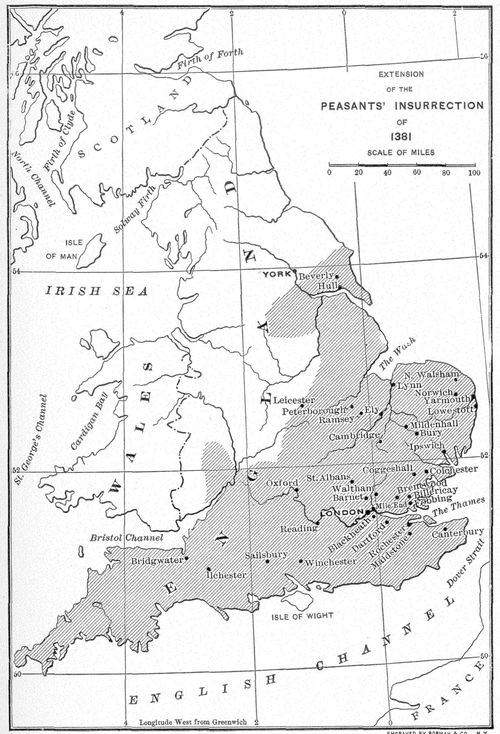
Extension Of The Peasant's Insurrection Of 1381.
Engraved By Bormay & Co., N.Y.
The culmination of the revolt was at the time of the execution of the
great ministers of government on Tower Hill on the morning of the
14th. At that very time the young king had met a body of
the rebels, mostly made up of men from Essex and Hertfordshire at Mile
End, just outside of one of the gates of London. In a discussion in
which they stated their grievances, the king apparently in good faith,
but as it afterward proved in bad, promised to give them what they
demanded, begged them to disperse and go to their homes, only leaving
representatives from each village to take back the charters of
emancipation which he proceeded to have prepared and issued to them.
There had been no intentional antagonism to the king himself, and a
great part of the insurgents took him at his word and scattered to
their homes. The charters which they took with them were of the
following form:—
"Richard, by the grace of God, King of England and France, and Lord of
Ireland, to all his bailiffs and faithful ones, to whom these present
letters shall come, greeting. Know that of our special grace, we have
manumitted all of our lieges and each of our subjects and others of
the County of Hertford; and them and each of them have made free from
all bondage, and by these presents make them quit. And moreover we
pardon our same lieges and subjects for all kinds of felonies,
treasons, transgressions, and extortions, however done or perpetrated
by them or any of them, and also outlawry, if any shall have been
promulgated on this account against them or any of them; and our most
complete peace to them and each of them we concede in these matters.
In testimony of which things we have caused these our letters to be
made patent. Witness, myself, at London, on the fifteenth day of June,
in the fourth year of our reign."
The most prominent leaders remained behind, and a large body of
rioters spent the rest of Friday and the following night in London.
The king, after the interview at Mile End, had returned to
the Tower, then to the Queen's Wardrobe, a little palace at the other
side of London, where he spent the night with his mother. In the
morning he mounted his horse, and with a small group of attendants
rode toward the Tower. As he passed through the open square of
Smithfield he met Wat Tyler, also on horseback, accompanied by the
great body of rebels. Tyler rode forward to confer with the king, but
an altercation having broken out between him and some of the king's
attendants, the mayor of London, Sir William Walworth, suddenly dashed
forward, struck him from his horse with the blow of a sword, and while
on the ground he was stabbed to death by the other attendants of the
king. There was a moment of extreme danger of an attack by the
leaderless rebels on the king and his companions, but the ready
promises of the king, his natural gifts of pretence, and the strange
attachment which the peasants showed to him through all the troubles,
tided over a little time until they had been led outside of the city
gates, and the armed forces which many gentlemen had in their houses
in the city had at last been gathered together and brought to where
they had the disorganized body of rebels at their mercy. These were
then disarmed, bidden to go to their homes, and a proclamation issued
that if any stranger remained in London over Sunday he would pay for
it with his life.
The downfall of Tyler and the dispersion of the insurgents at London
turned the tide of the whole revolt. In the various districts where
disorders were in progress the news of that failure came as a blow to
all their own hopes of success. The revolt had been already
disintegrating rather than gaining in strength and unity; and now its
leaders lost heart, and local bodies of gentry proportionately took
courage to suppress revolt in their own localities. The most
conspicuous and influential of such efforts was that of Henry de
Spencer, bishop of Norwich. This warlike prelate was in Rutlandshire
when the news of the revolt came. He hastened toward Norwich; on his
way met an embassy from the rioters to the king; seized and beheaded
two of its peasant members, and still pushing on met the great body of
the rebels near Walsham, where after a short conflict and some
parleying the latter were dispersed, and their leaders captured and
hung without any ceremony other than the last rites of religion. As a
matter of fact the rising had no cohesion sufficient to withstand
attack from any constituted authority or from representatives of the
dominant classes.
The king's government acted promptly. On the 17th of June, two days
after the death of Tyler, a proclamation was issued forbidding
unauthorized gatherings of people; on the 23d a second, requiring all
tenants, villains, and freemen alike to perform their usual services
to their lords; and on the 2d of July a third, withdrawing the
charters of pardon and manumission which had been granted on the 15th
of June. Special sessions of the courts were organized in the
rebellious districts, and the leaders of the revolt were searched out
and executed by hanging or decapitation.
On the 3d of November Parliament met. The king's treasurer explained
that he had issued the charters under constraint, and recognizing
their illegality, with the expectation of withdrawing them as soon as
possible, which he had done. The suggestion of the king that the
villains should be regularly enfranchised by a statute was declined in
vigorous terms by Parliament. Laws were passed relieving all those who
had made grants under compulsion from carrying them out, enabling
those whose charters had been destroyed to obtain new ones under the
great seal, granting exemption from prosecution to all who
had exercised illegal violence in putting down the late insurrection,
and finally granting a general pardon, though with many exceptions, to
the late insurgents.
Thus the rising of June, 1381, had become a matter of the past by the
close of the year. The general conditions which brought about a
popular uprising have already been discussed. The specific objects
which the rioters had in view in each part of the country are a much
more obscure and complicated question.
There is no reason to believe that there was any general political
object, other than opposition to the new and burdensome taxation, and
disgust with the existing ministry. Nor was there any religious object
in view. No doubt a large part of the disorder had no general purpose
whatever, but consisted in an attempt, at a period of confusion and
relaxation of the law, to settle by violence purely local or personal
disputes and grievances.
Apart from these considerations the objects of the rioters were of an
economic nature. There was a general effort to destroy the rolls of
the manor courts. These rolls, kept either in manor houses, or in the
castles of great lords, or in the monasteries, were the record of the
burdens and payments and disabilities of the villagers. Previous
payments of heriot, relief, merchet, and fines, acknowledgments of
serfdom, the obtaining of their land on burdensome conditions, were
all recorded on the rolls and could be produced to prove the custom of
the manor to the disadvantage of the tenant. It is true that these
same rolls showed who held each piece of ground and defined the
succession to it, and that they were long afterward to be recognized
in the national courts as giving to the customary holder the right of
retaining and of inheriting the land, so that it might seem
an injury to themselves to destroy the manor court records. But in
that period when tenants were in such demand their hold on their land
had been in no danger of being disturbed. If these records were
destroyed, the villains might well expect that they could claim to be
practically owners of the houses and little groups of acres which they
and their ancestors had held from time immemorial; and this without
the necessity for payments and reservations to which the rolls
testified.
Again, lawyers and all connected with the law were the objects of
special hostility on the part of insurgents. This must have been
largely from the same general cause as that just mentioned. It was
lawyers who acted as stewards for the great lords, it was through
lawyers that the legal claims of lords of manors were enforced in the
king's courts. It was also the judges and lawyers who put in force the
statutes of laborers, and who so generally acted as collectors of the
poll tax.
More satisfactory relations with their lords were demanded by
insurgents who were freeholders, as well as by those who were
villains. Protests are recorded against the tolls on sales and
purchases, and against attendance at the manorial courts, and a
maximum limit to the rent of land is asked for. Finally, the removal
of the burdens of serfdom was evidently one of the general objects of
the rebels, though much of the initiative of the revolt was taken by
men from Kent, where serfdom did not exist. The servitude of the
peasantry is the burden of the sermon of John Ball at Blackheath, its
abolition was demanded in several places by the insurgents, and the
charters of emancipation as given by the king professed to make them
"free from all bondage."
These objects were in few if any cases obtained. It is extremely
difficult to trace any direct results from the rising other
than those involved in its failure, the punishment of the leaders, and
the effort to restore everything to its former condition. There was
indeed a conservative reaction in several directions. The authorities
of London forbade the admission of any former villain to citizenship,
and the Commons in Parliament petitioned the king to reduce the rights
of villains still further. On the whole, the revolt is rather an
illustration of the general fact that great national crises have left
but a slight impress on society, while the important changes have
taken place slowly and by an almost imperceptible development. The
results of the rising are rather to be looked for in giving increased
rapidity and definite direction to changes already in progress, than
in starting any new movement or in obtaining the results which the
insurgents may have wished.
31. Commutation of Services.—One of these changes, already in
progress long before the outbreak of the revolt, has already been
referred to. A silent transformation was going on inside of the
manorial life in the form of a gradual substitution of money payments
by the villain tenants for the old labor for two, three, or four days
a week, and at special times during the year. This was often described
as "selling to the tenants their services." They "bought" their
exemption from furnishing actual work by paying the value of it in
money to the official representing the lord of the manor.
This was a mutually advantageous arrangement. The villain's time would
be worth more to himself than to his lord; for if he had sufficient
land in his possession he could occupy himself profitably on it, or if
he had not so much land he could choose his time for hiring himself
out to the best advantage. The lord, on the other hand, obtained money
which could be spent in paying men whose services would be
more willing and interested, and who could be engaged at more
available times. It is not, therefore, a matter of surprise that the
practice of allowing tenants to pay for their services arose early.
Commutation is noticeable as early as the thirteenth century and not
very unusual in the first half of the fourteenth. After the
pestilence, however, there was a very rapid substitution of money
payments for labor payments. The process continued through the
remainder of the fourteenth century and the early fifteenth, and by
the middle of that century the enforcement of regular labor services
had become almost unknown. The boon-works continued to be claimed
after the week-work had disappeared, since labor was not so easy to
obtain at the specially busy seasons of the year, and the required few
days' services at ploughing or mowing or harvesting were
correspondingly valuable. But even these were extremely unusual after
the middle of the fifteenth century.
This change was dependent on at least two conditions, an increased
amount of money in circulation and an increased number of free
laborers available for hire. These conditions were being more and more
completely fulfilled. Trade at fairs and markets and in the towns was
increasing through the whole fourteenth century. The increase of
weaving and other handicrafts produced more wealth and trade. Money
coming from abroad and from the royal mints made its way into
circulation and came into the hands of the villain tenants, through
the sale of surplus products or as payment for their labor. The sudden
destruction of one-half of the population by the Black Death while the
amount of money in the country remained the same, doubled the
circulation per capita. Tenants were thus able to offer regular
money payments to their lords in lieu of their personal services.
During the same period the number of free laborers who could
be hired to perform the necessary work on the demesne was increasing.
Even before the pestilence there were men and women on every manor who
held little or no land and who could be secured by the lord for
voluntary labor if the compulsory labor of the villains was given up.
Some of these laborers were fugitive villains who had fled from one
manor to another to secure freedom, and this class became much more
numerous under the circumstance of disorganization after the Black
Death. Thus the second condition requisite for the extensive
commutation was present also.
It might be supposed that after the pestilence, when wages were high
and labor was so hard to procure, lords of manors would be unwilling
to allow further commutation, and would even try to insist on the
performance of actual labor in cases where commutation had been
previously allowed. Indeed, it has been very generally stated that
there was such a reaction. The contrary, however, was the case.
Commutation was never more rapid than in the generation immediately
after the first attack of the pestilence. The laborers seem to have
been in so favorable a position, that the dread of their flight was a
controlling inducement to the lords to allow the commutation of their
services if they desired it. The interest of the lords in their labor
services was also, as will be seen, becoming less.
When a villain's labor services had been commuted into money, his
position must have risen appreciably. One of the main characteristics
of his position as a villain tenant had been the uncertainty of his
services, the fact that during the days in which he must work for his
lord he could be put to any kind of labor, and that the number of days
he must serve was itself only restricted by the custom of the manor
His services once commuted into a definite sum of money, all
uncertainty ceased. Moreover, his money payments to the lord, although
rising from an entirely different source, were almost
indistinguishable from the money rents paid by the freeholder.
Therefore, serf though he might still be in legal status, his position
was much more like that of a freeman.
32. The Abandonment of Demesne Farming.—A still more important change
than the commutation of services was in progress during the fourteenth
and fifteenth centuries. This was the gradual withdrawal of the lords
of manors from the cultivation of the demesne farms. From very early
times it had been customary for lords of manors to grant out small
portions of the demesne, or of previously uncultivated land, to
tenants at a money rent. The great demesne farm, however, had been
still kept up as the centre of the agricultural system of the vill.
But now even this was on many manors rented out to a tenant or group
of tenants. The earliest known instances are just at the beginning of
the fourteenth century, but the labor troubles of the latter half of
the century made the process more usual, and within the next hundred
years the demesne lands seem to have been practically all rented out
to tenants. In other words, whereas, during the earlier Middle Ages
lords of manors had usually carried on the cultivation of the demesne
lands themselves, under the administration of their bailiffs and with
the labor of the villains, making their profit by obtaining a food
supply for their own households or by selling the surplus products,
now they gave up their cultivation and rented them out to some one
else, making their profit by receiving a money payment as rent. They
became therefore landlords of the modern type. A typical instance of
this change is where the demesne land of the manor of Wilburton in
Cambridgeshire, consisting of 246 acres of arable land and
42 acres of meadow, was rented in 1426 to one of the villain tenants
of the manor for a sum of £8 a year. The person who took the land was
usually either a free or a villain tenant of the same or a neighboring
manor. The land was let only for a certain number of years, but
afterward was usually relet either to the same or to another tenant.
The word farmer originally meant one of these tenants who took the
demesne or some other piece of land, paying for it a "farm" or
firma, that is, a settled established sum, in place of the various
forms of profit that might have been secured from it by the lord of
the manor. The free and villain holdings which came into the hands of
the lord by failure of heirs in those times of frequent extinction of
families were also granted out very generally at a money rent, so that
a large number of the cultivators of the soil came to be tenants at a
money rent, that is, lease-holders or "farmers." These free renting
farmers, along with the smaller freeholders, made up the "yeomen" of
England.
33. The Decay of Serfdom.—It is in the changes discussed in the last
two paragraphs that is to be found the key to the disappearance of
serfdom in England. Men had been freed from villainage in individual
cases by various means. Manumission of serfs had occurred from time to
time through all the mediæval centuries. It was customary in such
cases either to give a formal charter granting freedom to the man
himself and to his descendants, or to have entered on the manor court
roll the fact of his obtaining his enfranchisement. Occasionally men
were manumitted in order that they might be ordained as clergymen. In
the period following the pestilences of the fourteenth century the
difficulty in recruiting the ranks of the priesthood made the practice
more frequent The charters of manumission issued by the king
to the insurgents of 1381 would have granted freedom on a large scale
had they not been disowned and subsequently withdrawn. Still other
villains had obtained freedom by flight from the manors where they had
been born. When a villain who had fled was discovered he could be
reclaimed by the lord of the manor by obtaining a writ from the court,
but many obstacles might be placed in the way of obtaining this writ,
and it must always have involved so much difficulty as to make it
doubtful whether it was worth while. So long as a villain was anywhere
else than on the manor to which he belonged, he was practically a free
man, but few of the disabilities of villainage existing except as
between him and his own lord. Therefore, if a villain was willing to
sacrifice his little holding and make the necessary break with his
usual surroundings, he might frequently escape into a veritable
freedom.
The attitude of the common law was favorable to liberty as against
servitude, and in cases of doubt the decisions of the royal courts
were almost invariably favorable to the freedom of the villain.
But all these possibilities of liberty were only for individual cases.
Villainage as an institution continued to exist and to characterize
the position of the mass of the peasantry. The number of freemen
through the country was larger, but the serfdom of the great majority
can scarcely have been much influenced by these individual cases. The
commutation of services, however, and still more the abandonment of
demesne farming by the lords of manors, were general causes conducive
to freedom. The former custom indicated that the lords valued the
money that could be paid by the villains more than they did their
compulsory services. That is, villains whose services were paid for in
money were practically renters of land from the lords, no
longer serfs on the land of the lords. The lord of the manor could
still of course enforce his claim to the various payments and
restrictions arising from the villainage of his tenants, but their
position as payers of money was much less servile than as performers
of forced labor. The willingness of the lords to accept money instead
of service showed as before stated that there were other persons who
could be hired to do the work. The villains were valued more as
tenants now that there were others to serve as laborers. The occupants
of customary holdings were a higher class and a class more worth the
lord's consideration and favor than the mere laborers. The villains
were thus raised into partial freedom by having a free class still
below them.
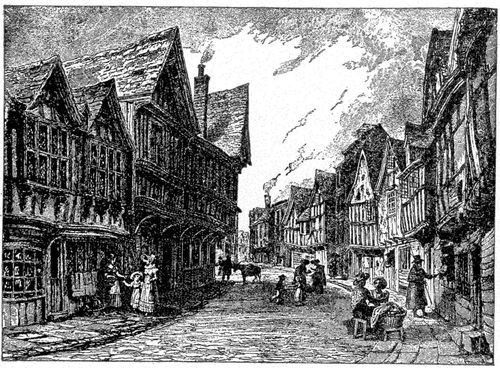
An Old Street in Worcester.
(Britton: Picturesque
Antiquities of English Cities.)
The effect of the relinquishment of the old demesne farms by the lords
of the manors was still more influential in destroying serfdom. The
lords had valued serfdom above all because it furnished an adequate
and absolutely certain supply of labor. The villains had to stay on
the manor and provide the labor necessary for the cultivation of the
demesne. But if the demesne was rented out to a farmer or divided
among several holders, the interest of the lord in the labor supply on
the manor was very much diminished. Even if he agreed in his lease of
the demesne to the new farmer that the villains should perform their
customary services in as far as these had not been commuted, yet the
farmer could not enforce this of himself, and the lord of the manor
was probably languid or careless or dilatory in doing so. The other
payments and burdens of serfdom were not so lucrative, and as the
ranks of the old villain class were depleted by the extinction of
families, and fewer inhabitants were bound to attend the manor courts,
they became less so. It became, therefore, gradually more common, then
quite universal, for the lords of manors to cease to enforce the
requirements of serfdom. A legal relation of which neither
party is reminded is apt to become obsolete; and that is what
practically happened to serfdom in England. It is true that many
persons were still legally serfs, and occasionally the fact of their
serfdom was asserted in the courts or inferred by granting them
manumission. These occasional enfranchisements continued down into the
second half of the sixteenth century, and the claim that a certain man
was a villain was pleaded in the courts as late as 1618. But long
before this time serfdom had ceased to have much practical importance.
It may be said that by the middle of the fifteenth century the mass of
the English rural population were free men and no longer serfs. With
their labor services commuted to money and the other conditions of
their villainage no longer enforced, they became an indistinguishable
part either of the yeomanry or of the body of agricultural
laborers.
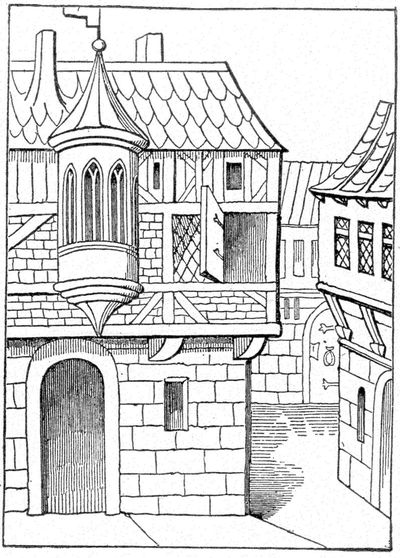
Town Houses in the Fifteenth Century.
(Wright, T.:
History of Domestic Manners and Sentiments.)
34. Changes in Town Life and Foreign Trade.—The changes discussed in
the last three sections apply in the main to rural life. The economic
and social history of the towns during the same period, except in as
far as it was part of the general national experience, consisted in a
still more complete adoption of those characteristics which
have already been described in Chapter III. Their wealth and
prosperity became greater, they were still more independent of the
rural districts and of the central government, the intermunicipal
character of their dealings, the closeness of connection between their
industrial interests and their government, the completeness with which
all occupations were organized under the "gild system," were all of
them still more marked in 1450 than they had been in 1350. It is true
that far-reaching changes were beginning, but they were only
beginning, and did not reach an important development until a time
later than that included in this chapter. The same thing is true in
the field of foreign trade. The latter part of the fourteenth and the
early fifteenth century saw a considerable increase and development of
the trade of England, but it was still on the same lines and carried
on by the same methods as before. The great proportion of it was in
the hands of foreigners, and there was the same inconsistency in the
policy of the central government on the occasions when it did
intervene or take any action on the subject. The important changes in
trade and in town life which have their beginning in this period will
be discussed in connection with those of the next period in Chapter
VI.
35. BIBLIOGRAPHY
Jessop, Augustus: The Coming of the Friars and other Essays. Two
interesting essays in this volume are on The Black Death in East
Anglia.
Gasquet, F. A.: The Great Pestilence of 1349.
Creighton, C.: History of Epidemics in Britain, two volumes. This
gives especial attention to the nature of the disease.
Trevelyan, G. M.: England in the Age of Wycliffe. This
book, published in 1899, gives by far the fullest account of the
Peasant Rising which has so far appeared in English.
Petit-Dutaillis, C., et Reville, A.: Le Soulèvement des Travailleurs
d'Angleterre en 1381. The best account of the Rebellion.
Powell, Edgar: The Peasant Rising in East Anglia in 1381. Especially
valuable for its accounts of the poll tax.
Powell, Edgar, and Trevelyan, G. M.: Documents Illustrating the
Peasants' Rising and the Lollards.
Page, Thomas Walker: The End of Villainage in England. This
monograph, published in 1900, is particularly valuable for the new
facts which it gives concerning the rural changes of the fourteenth
century.
THE BREAKING UP OF THE MEDIÆVAL SYSTEM
Economic Changes of the Later Fifteenth and the Sixteenth Centuries
36. National Affairs from 1461 to 1603.—The close of the fifteenth
and the opening of the sixteenth century has been by universal consent
settled upon as the passage from one era to another, from the Middle
Ages to modern times. This period of transition was marked in England
by at least three great movements: a new type of intellectual life, a
new ideal of government, and the Reformation. The greatest changes in
English literature and intellectual interests are traceable to foreign
influence. In the fifteenth century the paramount foreign influence
was that of Italy. From the middle of the fifteenth century an
increasing number of young Englishmen went to Italy to study, and
brought back with them an interest in the study of Greek and of other
subjects to which this led. Somewhat later the social intercourse of
Englishmen with Italy exercised a corresponding influence on more
courtly literature. In 1491 the teaching of Greek was begun at Oxford
by Grocyn, and after this time the passion for classical learning
became deep, widespread, and enthusiastic. But not only were the
subjects of intellectual interest different, but the attitude of mind
in the study of these subjects was much more critical than it had been
in the Middle Ages. The discoveries of new routes to the far East and
of America, as well as the new speculations in natural
science which came at this time, reacted on the minds of men and
broadened their whole mental outlook. The production of works of pure
literature had suffered a decline after the time of Wycliffe and
Chaucer, from which there was no considerable revival till the early
part of the sixteenth century. Sir Thomas More's Utopia, written in
Latin in 1514, was a philosophical work thrown into the form of a
literary dialogue and description of an imaginary commonwealth. But
writing became constantly more abundant and more varied through the
reigns of Henry VIII, 1509-1547, Edward VI, 1547-1553, and Mary,
1553-1558, until it finally blossomed out into the splendid
Elizabethan literature, just at the close of our period.
A stronger royal government had begun with Edward IV. The conclusion
of the war with France made the king's need for money less, and at the
same time new sources of income appeared. Edward, therefore, from
1461, neglected to call Parliament annually, as had been usual, and
frequently allowed three or more years to go by without any
consultation with it. He also exercised very freely what was called
the dispensing power, that is, the power to suspend the law in certain
cases, and in other ways asserted the royal prerogative as no previous
king had done for two hundred years. But the true founder of the
almost absolute monarchy of this period was Henry VII, who reigned
from 1485 to 1509. He was not the nearest heir to the throne, but
acted as the representative of the Lancastrian line, and by his
marriage with the lady who represented the claim of the York family
joined the two contending factions. He was the first of the Tudor
line, his successors being his son, Henry VIII, and the three children
of Henry VIII, Edward VI, Mary, and Elizabeth. Henry VII was an able,
shrewd, far-sighted, and masterful man. During his reign he
put an end to the disorders of the nobility; made Parliament
relatively insignificant by calling it even less frequently than
Edward IV had done, and by initiating its legislation when it did
meet. He also increased and regulated the income of the crown, and
rendered its expenditures subject to control. He was able to keep
ambassadors regularly abroad, for the first time, and in many other
ways to support a more expensive administration, though often by
unpopular and illegal means of extortion from the people. He formed
foreign political and commercial treaties in all directions, and
encouraged the voyages of the Cabots to America. He brought a great
deal of business constantly before the Royal Council, but chose its
members for their ability rather than for their high rank. In these
various ways he created a strong personal government, which left but
little room for Parliament or people to do anything except carry out
his will. In these respects Henry's immediate successors and their
ministers followed the same policy. In fact, the Reformation in the
reign of Henry VIII, and new internal and foreign difficulties in the
reign of Elizabeth, brought the royal power into a still higher and
more independent position.
The need for a general reformation of the church had long been
recognized. More than one effort had been made by the ecclesiastical
authorities to insist on higher intellectual and moral standards for
the clergy and to rid the church of various evil customs and abuses.
Again, there had been repeated efforts to clothe the king, who was at
the head of all civil government, with extensive control and oversight
of church affairs also. Men holding different views on questions of
church government and religious belief from those held by the general
Christian church in the Middle Ages, had written and taught and found
many to agree with them. Thus efforts to bring about changes
in the established church had not been wanting, but they had produced
no permanent result. In the early years of the sixteenth century,
however, several causes combined to bring about a movement of this
nature extending over a number of years and profoundly affecting all
subsequent history. This is known as the Reformation. The first steps
of the Reformation in England were taken as the result of a dispute
between King Henry VIII and the Pope. In the first place, several laws
were passed through Parliament, beginning with the year 1529,
abolishing a number of petty evils and abusive practices in the church
courts. The Pope's income from England was then cut off, and his
jurisdiction and all other forms of authority in England brought to an
end. Finally, the supremacy of the king over the church and clergy and
over all ecclesiastical affairs was declared and enforced. By the year
1535 the ancient connection between the church in England and the Pope
was severed. Thus in England, as in many continental countries at
about the same time, a national church arose independent of Rome.
Next, changes began to be made in the doctrine and practices of the
church. The organization under bishops was retained, though they were
now appointed by the king. Pilgrimages and the worship of saints were
forbidden, the Bible translated into English, and other changes
gradually introduced. The monastic life came under the condemnation of
the reformers. The monasteries were therefore dissolved and their
property confiscated and sold, between the years 1536 and 1542. In the
reign of Edward VI, 1547-1553, the Reformation was carried much
further. An English prayerbook was issued which was to be used in
all religious worship, the adornments of the churches were removed,
the services made more simple, and doctrines introduced which
assimilated the church of England to the contemporary
Protestant churches on the Continent.
Queen Mary, who had been brought up in the Roman faith, tried to make
England again a Roman Catholic country, and in the later years of her
reign encouraged severe persecutions, causing many to be burned at the
stake, in the hope of thus crushing out heresy. After her death,
however, in 1558, Queen Elizabeth adopted a more moderate position,
and the church of England was established by law in much the form it
had possessed at the death of Henry VIII.
In the meantime, however, there had been growing up a far more
spontaneous religious movement than the official Reformation which has
just been described. Many thousands of persons had become deeply
interested in religion and enthusiastic in their faith, and had come
to hold different views on church government, doctrines, and practices
from those approved of either by the Roman Catholic church or by the
government of England. Those who held such views were known as
Puritans, and throughout the reign of Elizabeth were increasing in
numbers and making strenuous though unsuccessful efforts to introduce
changes in the established church.
The reign of Elizabeth was marked not only by the continuance of royal
despotism, by brilliant literary production, and by the struggle of
the established church against the Catholics on the one side and the
Puritans on the other, but by difficult and dangerous foreign
relations.
More than once invasion by the continental powers was imminent.
Elizabeth was threatened with deposition by the English adherents of
Mary, Queen of Scots, supported by France and Spain. The English
government pursued a policy of interference in the internal conflicts
of other countries that brought it frequently to the verge of war with
their governments and sometimes beyond. Hostility bordering
on open warfare was therefore the most frequent condition of English
foreign relations. Especially was this true of the relations with
Spain. The most serious contest with that country was the war which
culminated in the battle of the Armada in 1588. Spain had organized an
immense fleet which was intended to go to the Netherlands and convoy
an army to be taken thence for the invasion of England. While passing
through the English Channel, a storm broke upon them, they were
attacked and harried by the English and later by the Dutch, and the
whole fleet was eventually scattered and destroyed. The danger of
invasion was greatly reduced after this time and until the end of
Elizabeth's reign in 1603.
37. Enclosures.—The century and a half which extends from the middle
years of the fifteenth century to the close of the sixteenth was, as
has been shown, a period remarkable for the extent and variety of its
changes in almost every aspect of society. In the political,
intellectual, and religious world the sixteenth century seemed far
removed from the fifteenth. It is not therefore a matter of surprise
that economic changes were numerous and fundamental, and that social
organization in town and country alike was completely transformed.
During the period last discussed, the fourteenth and the early
fifteenth century, the manorial system had changed very considerably
from its mediæval form. The demesne lands had been quite generally
leased to renting farmers, and a new class of tenants was consequently
becoming numerous; serfdom had fallen into decay; the old manorial
officers, the steward, the bailiff, and the reeve had fallen into
unimportance; the manor courts were not so active, so regular, or so
numerously attended. These changes were gradual and were
still uncompleted at the middle of the fifteenth century; but there
was already showing itself a new series of changes, affecting still
other parts of manorial life, which became steadily more extensive
during the remainder of the fifteenth and through much of the
sixteenth century. These changes are usually grouped under the name
"enclosures."
The enclosure of land previously open was closely connected with the
increase of sheep-raising. The older form of agriculture,
grain-raising, labored under many difficulties. The price of labor was
high, there had been no improvement in the old crude methods of
culture, nor, in the open fields and under the customary rules, was
there opportunity to introduce any. On the other hand, the inducements
to sheep-raising were numerous. There was a steady demand at good
prices for wool, both for export, as of old, and for the manufactures
within England, which were now increasing. Sheep-raising required
fewer hands and therefore high wages were less an obstacle, and it
gave opportunity for the investment of capital and for comparative
freedom from the restrictions of local custom. Therefore, instead of
raising sheep simply as a part of ordinary farming, lords of manors,
freeholders, farming tenants, and even customary tenants began here
and there to raise sheep for wool as their principal or sole
production. Instances are mentioned of five thousand, ten thousand,
twenty thousand, and even twenty-four thousand sheep in the possession
of a single person. This custom spread more and more widely, and so
attracted the attention of observers as to be frequently mentioned in
the laws and literature of the time.
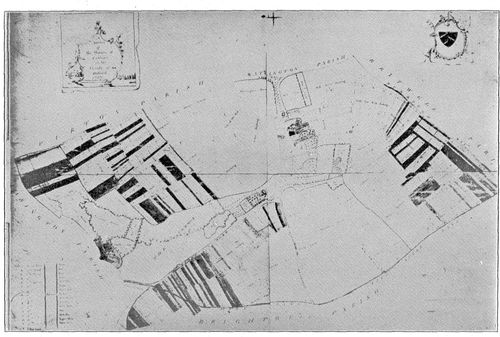
Partially enclosed Fields of Cuxham,
Oxfordshire, 1767.
(Facsimile map, published by the University of
Oxford.)
But sheep could not be raised to any considerable extent on land
divided according to the old open field system. In a vill whose fields
all lay open, sheep must either be fed with those of other
men on the common pasture, or must be kept in small groups by
shepherds within the confines of the various acres or other small
strips of the sheep-raiser's holding. No large number could of course
be kept in this way, so the first thing to be done by the sheep-raiser
was to get enough strips together in one place to make it worth while
to put a hedge or other fence around them, or else to separate off in
the same way a part or the whole of the open pastures or meadows. This
was the process known as enclosing. Separate enclosed fields, which
had existed only occasionally in mediæval farming, became numerous in
this time, as they have become practically universal in modern farming
in English-speaking countries.
But it was ordinarily impracticable to obtain groups of adjacent acres
or sufficiently extensive rights on the common pasture for enclosing
without getting rid of some of the other tenants. In this way
enclosing led to evictions. Either the lord of the manor or some one
or more of the tenants enclosed the lands which they had formerly held
and also those which were formerly occupied by some other holders, who
were evicted from their land for this purpose.
Some of the tenants must have been protected in their holdings by the
law. As early as 1468 Chief Justice Bryan had declared that "tenant by
the custom is as well inheritor to have his land according to the
custom as he which hath a freehold at the common law." Again, in 1484,
another chief justice declared that a tenant by custom who continued
to pay his service could not be ejected by the lord of the manor. Such
tenants came to be known as copyholders, because the proof of their
customary tenure was found in the manor court rolls, from which a copy
was taken to serve as a title. Subsequently copyhold became one of
the most generally recognized forms of land tenure in
England, and gave practically as secure title as did a freehold. At
this time, however, notwithstanding the statements just given, the law
was probably not very definite or not very well understood, and
customary tenants may have had but little practical protection of the
law against eviction. Moreover, the great body of the small tenants
were probably no longer genuine customary tenants. The great
proportion of small farms had probably not been inherited by a long
line of tenants, but had repeatedly gone back into the hands of the
lords of the manors and been subsequently rented out again, with or
without a lease, to farmers or rent-paying tenants. These were in most
cases probably the tenants who were now evicted to make room for the
new enclosed sheep farms.
By these enclosures and evictions in some cases the open lands of
whole vills were enclosed, the old agriculture came to an end, and as
the enclosers were often non-residents, the whole farming population
disappeared from the village. Since sheep-raising required such a
small number of laborers, the farm laborers also had to leave to seek
work elsewhere, and the whole village, therefore, was deserted, the
houses fell into ruin, and the township lost its population entirely.
This was commonly spoken of at the time as "the decaying of towns,"
and those who were responsible for it were denounced as enemies of
their country. In most cases, however, the enclosures and depopulation
were only partial. A number of causes combined to carry this movement
forward. England was not yet a wealthy country, but such capital as
existed, especially in the towns, was utilized and made remunerative
by investment in the newly enclosed farms and in carrying on the
expenses of enclosure. The dissolution of the monasteries between 1536
and 1542 brought the lands which they had formerly held into
the possession of a class of men who were anxious to make them as
remunerative as possible, and who had no feeling against enclosures.
Nevertheless, the changes were much disapproved. Sir Thomas More
condemns them in the Utopia, as do many other writers of the same
period and of the reign of Elizabeth. The landlords, the enclosers,
the city merchants who took up country lands, were preached against
and inveighed against by such preachers as Latimer, Lever, and Becon,
and in a dozen or more pamphlets still extant. The government also put
itself into opposition to the changes which were in progress. It was
believed that there was danger of a reduction of the population and
thus of a lack of soldiers; it was feared that not enough grain would
be raised to provide food for the people; the dangerous masses of
wandering beggars were partly at least recruited from the evicted
tenants; there was a great deal of discontent in the country due to
the high rents, lack of occupation, and general dislike of change. A
series of laws were therefore carried through Parliament and other
measures taken, the object of which was to put a stop to the increase
of sheep-farming and its results. In 1488 a statute was enacted
prohibiting the turning of tillage land into pasture. In 1514 a new
law was passed reënacting this and requiring the repair by their
owners of any houses which had fallen into decay because of the
substitution of pasture for tillage, and their reoccupation with
tenants. In 1517 a commission of investigation into enclosures was
appointed by the government. In 1518 the Lord Chancellor, Cardinal
Wolsey, issued a proclamation requiring all those who had enclosed
lands since 1509 to throw them open again, or else give proof that
their enclosure was for the public advantage. In 1534 the
earlier laws were reënacted and a further provision made that no
person holding rented lands should keep more than twenty-four hundred
sheep. In 1548 a new commission on enclosures was appointed which made
extensive investigations, instituted prosecutions, and recommended new
legislation. A law for more careful enforcement was passed in 1552,
and the old laws were reënacted in 1554 and 1562. This last law was
repealed in 1593, but in 1598 others were enacted and later extended.
In 1624, however, all the laws on the subject were repealed. As a
matter of fact, the laws seem to have been generally ineffective. The
nobility and gentry were in the main in favor of the enclosures, as
they increased their rents even when they were not themselves the
enclosers; and it was through these classes that legislation had to be
enforced at this time if it was to be effective.
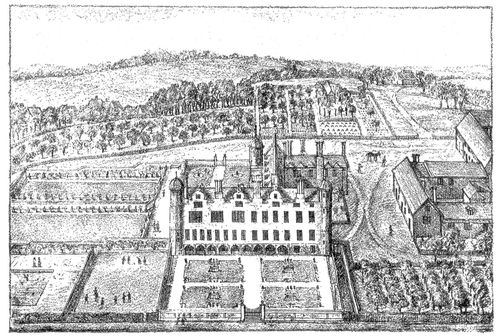
Sixteenth Century Manor House and Village, Maddingley,
Cambridgeshire.
Nichols: Progresses of Queen Elizabeth.
Besides the official opposition of the government, there were
occasional instances of rioting or violent destruction of hedges and
other enclosures by the people who felt themselves aggrieved by them.
Three times these riots rose to the height of an insurrection. In 1536
the so-called "Pilgrimage of Grace" was a rising of the people partly
in opposition to the introduction of the Reformation, partly in
opposition to enclosures. In 1549 a series of risings occurred, the
most serious of which was the "camp" under Kett in Norfolk, and in
1552 again there was an insurrection in Buckinghamshire. These risings
were harshly repressed by the government. The rural changes,
therefore, progressed steadily, notwithstanding the opposition of the
law, of certain forms of public opinion, and of the violence of mobs.
Probably enclosures more or less complete were made during this period
in as many as half the manors of England. They were at their height in
the early years of the sixteenth century, during its latter
half they were not so numerous, and by its close the enclosing
movement had about run its course, at least for the time.
38. Internal Divisions in the Craft Gilds.—Changes in town life
occurred during this period corresponding quite closely to the
enclosures and their results in the country. These consisted in the
decay of the gilds, the dispersion of certain town industries through
the rural districts, and the loss of prosperity of many of the old
towns. In the earlier craft gilds each man had normally been
successively an apprentice, a journeyman, and a full master craftsman,
with a little establishment of his own and full participation in the
administration of the fraternity. There was coming now to be a class
of artisans who remained permanently employed and never attained to
the position of master craftsmen. This was sometimes the result of a
deliberate process of exclusion on the part of those who were already
masters. In 1480, for instance, a new set of ordinances given to the
Mercers' Gild of Shrewsbury declares that the fines assessed on
apprentices at their entry to be masters had been excessive and should
be reduced. Similarly, the Oxford Town Council in 1531 restricts the
payment required from any person who should come to be a full brother
of any craft in that town to twenty shillings, a sum which would equal
perhaps fifty dollars in modern value. In the same year Parliament
forbade the collection of more than two shillings and sixpence from
any apprentice at the time of his apprenticeship, and of more than
three shillings and fourpence when he enters the trade fully at the
expiration of his time. This indicates that the fines previously
charged must have been almost prohibitive. In some trades the masters
required apprentices at the time of indenture to take an oath that
they would not set up independent establishments when they
had fulfilled the years of their apprenticeship, a custom which was
forbidden by Parliament in 1536. In other cases it was no doubt the
lack of sufficient capital and enterprise which kept a large number of
artisans from ever rising above the class of journeymen.
Under these circumstances the journeymen evidently ceased to feel that
they enjoyed any benefits from the organized crafts, for they began to
form among themselves what are generally described as "yeomen gilds"
or "journeymen gilds." At first the masters opposed such bodies and
the city officials supported the old companies by prohibiting the
journeymen from holding assemblies, wearing a special livery, or
otherwise acting as separate bodies. Ultimately, however, they seem to
have made good their position, and existed in a number of different
crafts in more or less subordination to the organizations of the
masters. The first mention of such bodies is soon after the Peasants'
Rebellion, but in most cases the earliest rise of a journeyman gild in
any industry was in the latter part of the fifteenth or in the
sixteenth century. They were organizations quite similar to the older
bodies from which they were a split, except that they had of course no
general control over the industry. They had, however, meetings,
officers, feasts, and charitable funds. In addition to these functions
there is reason to believe that they made use of their organization to
influence the rate of wages and to coerce other journeymen. Their
relations to the masters' companies were frequently defined by regular
written agreements between the two parties. Journeymen gilds existed
among the saddlers, cordwainers, tailors, blacksmiths, carpenters,
drapers, ironmongers, founders, fishmongers, cloth-workers, and
armorers in London, among the weavers in Coventry, the tailors in
Exeter and in Bristol, the shoemakers in Oxford, and no doubt in some
other trades in these and other towns.
Among the masters also changes were taking place in the same
direction. Instead of all master artisans or tradesmen in any one
industry holding an equal position and taking an equal part in the
administration of affairs of the craft, there came, at least in some
of the larger companies, to be quite distinct groups usually described
as those "of the livery" and those "not of the livery." The expression
no doubt arose from the former class being the more well-to-do and
active masters who had sufficient means to purchase the suits of
livery worn on state occasions, and who in other ways were the leading
and controlling members of the organization. This came, before the
close of the fifteenth century, in many crafts to be a recognized
distinction of class or station in the company. A statement of the
members in one of the London fraternities made in 1493 gives a good
instance of this distinction of classes, as well as of the subordinate
body last described. There were said to be at that date in the
Drapers' Company of the craft of drapers in the clothing, including
the masters and four wardens, one hundred and fourteen, of the
brotherhood out of the clothing one hundred and fifteen, of the
bachelors' company sixty. It was from this prominence of the liveried
gildsmen, that the term "Livery Companies" came to be applied to the
greater London gilds. It was the wealthy merchants and the craftsmen
of the livery of the various fraternities who rode in procession to
welcome kings or ambassadors at their entrance into the city, to add
lustre to royal wedding ceremonies, or give dignity to other state
occasions. In 1483 four hundred and six members of livery companies
riding in mulberry colored coats attended the coronation procession of
Richard III. The mayors and sheriffs and aldermen of London were
almost always livery men in one or another of the companies. A
substantial fee had usually to be paid when a member was
chosen into the livery, which again indicates that they were the
wealthier members. Those of the livery controlled the policy of the
gild to the exclusion of the less conspicuous members, even though
these were also independent masters with journeymen and apprentices of
their own.
But the practical administration of the affairs of the wealthier
companies came in many cases to be in the hands of a still smaller
group of members. This group was often known as the "Court of
Assistants," and consisted of some twelve, twenty, or more members who
possessed higher rights than the others, and, with the wardens or
other officials, decided disputes, negotiated with the government or
other authorities, disposed of the funds, and in other ways governed
the organized craft or trade. At a general meeting of the members of
the Mercers of London, for instance, on July 23, 1463, the following
resolution was passed: "It is accorded that for the holding of many
courts and congregations of the fellowship, it is odious and grievous
to the body of the fellowship and specially for matters of no great
effect, that hereafter yearly shall be chosen and associated to the
wardens for the time being twelve other sufficient persons to be
assistants to the said wardens, and all matters by them finished to be
holden firm and stable, and the fellowship to abide by them." Sixteen
years later these assistants with the wardens were given the right to
elect their successors.
Thus before the close of the sixteenth century the craft and trading
organizations had gone through a very considerable internal change. In
the fourteenth century they had been bodies of masters of
approximately equal position, in which the journeymen participated in
some of the elements of membership, and would for the most part in due
time become masters and full members. Now the journeymen had
become for the most part a separate class, without prospect of
mastership. Among the masters themselves a distinct division between
the more and the less wealthy had taken place, and an aristocratic
form of government had grown up which put the practical control of
each of the companies in the hands of a comparatively small,
self-perpetuating ruling body. These developments were all more
marked, possibly some of them were only true, in the case of the
London companies. London, also, so far as known, is the only English
town in which the companies were divided into two classes, the twelve
"Greater Companies," and the fifty or more "Lesser Companies"; the
former having practical control of the government of the city, the
latter having no such influence.
39. Change of Location of Industries.—The changes described above
were, as has been said, the result of development from within the
craft and trading organizations themselves, resulting probably in the
main from increasing wealth. There were other contemporary changes in
these companies which were rather the result of external influences.
One of these external factors was the old difficulty which arose from
artisans and traders who were not members of the organized companies.
There had always been men who had carried on work surreptitiously
outside of the limits of the authorized organizations of their
respective industries. They had done this from inability or
unwillingness to conform to the requirements of gild membership, or
from a desire to obtain more employment by underbidding in price, or
additional profit by using unapproved materials or methods. Most of
the bodies of ordinances mention such workmen and traders, men who
have not gone through a regular apprenticeship, "foreigners" who
have come in from some other locality and are not freemen of
the city where they wish to work, irresponsible men who will not
conform to the established rules of the trade. This class of persons
was becoming more numerous through the fifteenth and sixteenth
centuries, notwithstanding the efforts of the gilds, supported by
municipal and national authority. The prohibition of any workers
setting up business in a town unless they had previously obtained the
approval of the officials of their trade was more and more vigorous in
the later ordinances; the fines imposed upon masters who engaged
journeymen who had not paid the dues, newcomers into the town, were
higher. The complaints of the intrusion of outsiders were more loud
and frequent. There was evidently more unsupervised, unregulated
labor.
But the increase in the number of these unorganized laborers, these
craftsmen and traders not under the control of the gilds, was most
marked in the rural districts, that is to say, in market towns and in
villages entirely outside of the old manufacturing and trading
centres. Even in the fourteenth century there were a number of
weavers, and probably of other craftsmen, who worked in the villages
in the vicinity of the larger towns, such as London, Norwich, and
York, and took their products to be sold on fair or market days in
these towns. But toward the end of the fifteenth century this rural
labor received a new kind of encouragement and a corresponding
extension far beyond anything before existing. The English cloth-making
industry at this period was increasing rapidly. Whereas during the
earlier periods, as we have seen, wool was the greatest of English
exports, now it was coming to be manufactured within the country. In
connection with this manufacture a new kind of industrial organization
began to show itself which, when it was completed, became
known as the "domestic system." A class of merchants or manufacturers
arose who are spoken of as "clothiers," or "merchant clothiers," who
bought the wool or other raw material, and gave it out to carders or
combers, spinners, weavers, fullers, and other craftsmen, paying them
for their respective parts in the process of manufacture, and
themselves disposing of the product at home or for export. The
clothiers were in this way a new class of employers, putting the
master weavers or other craftsmen to work for wages. The latter still
had their journeymen and apprentices, but the initiative in their
industry was taken by the merchants, who provided the raw material and
much of the money capital, and took charge of the sale of the
completed goods. The craftsmen who were employed in this form of
industry did not usually dwell in the old populous and wealthy towns.
It is probable that the restrictions of the gild ordinances were
disadvantageous both to the clothiers and to the small master
craftsmen, and that the latter, as well as journeymen who had no
chance to obtain an independent position, now that the town craft
organizations were under the control of the more wealthy members, were
very ready to migrate to rural villages. Thus, in as far as the
weaving industry was growing up under the management of the employing
clothiers, it was slipping out from under the control of the town
gilds by its location in the country. The same thing occurred in other
cases, even without the intermediation of a new employing class. We
hear of mattress makers, of rope makers, of tile makers, and other
artisans establishing themselves in the country villages outside of
the towns, where, as a law of 1495 says, "the wardens have no power or
authority to make search." In certain parts of England, in the
southwest, the west, and the northwest, independent weavers now set up
for themselves in rural districts as those of the eastern
counties had long done, buying their own raw materials, bringing their
manufactures to completion, and then taking them to the neighboring
towns and markets to sell, or hawking them through the rural
districts.
These changes, along with others occurring simultaneously, led to a
considerable diminution of the prosperity of many of the large towns.
They were not able to pay their usual share of taxation, the
population of some of them declined, whole streets or quarters, when
destroyed by fire or other catastrophe, were left unbuilt and in
ruins. Many of the largest and oldest towns of England are mentioned
in the statutes of the reign of Henry VIII as being more or less
depleted in population. The laws and literature of the time are
ringing with complaints of the "decay of the towns," where the
reference is to cities, as well as where it is to rural villages.
Certain new towns, it is true, were rising into greater importance,
and certain rural districts were becoming populous with this body of
artisans whose living was made partly by their handicraft, partly by
small farming. Nevertheless the old city craft organizations were
permanently weakened and impoverished by thus losing control of such a
large proportion of their various industries. The occupations which
were carried on in the country were pursued without supervision by the
gilds. They retained control only of that part of industry which was
still carried on in the towns.
40. The Influence of the Government on the Gilds.—Internal divisions
and external changes in the distribution of industry were therefore
alike tending to weaken the gild organization. It had to suffer also
from the hostility or intrusion of the national government. Much of
the policy of the government tended, it is true, as in the case of the
enclosures, to check the changes in progress, and thus to
protect the gild system. It has been seen that laws were passed to
prohibit the exclusion of apprentices and journeymen from full
membership in the crafts. As early as 1464 a law was passed to
regulate the growing system of employment of craftsmen by clothiers.
This was carried further in a law of 1511, and further still in 1551
and 1555. The manufacture of rope in the country parts of Dorsetshire
was prohibited and restricted to the town of Bridport in 1529; the
cloth manufacture which was growing up through the "hamlets, thorps,
and villages" in Worcestershire was forbidden in 1553 to be carried on
except in the five old towns of Worcester, Evesham, Droitwich,
Kidderminster, and Bromsgrove; in 1543 it was enacted that coverlets
were not to be manufactured in Yorkshire outside of the city of York,
and there was still further legislation in the same direction.
Numerous acts were also passed for the purpose of restoring the
populousness of the towns. There is, however, little reason to believe
that these laws had much more effect in preventing the narrowing of
the control of the gilds and the scattering of industries from the
towns to the country than the various laws against enclosures had, and
the latter object was practically surrendered by the numerous
exceptions to it in laws passed in 1557, 1558, and 1575. All the laws
favoring the older towns were finally repealed in 1623.
Another class of laws may seem to have favored the craft
organizations. These were the laws regulating the carrying on of
various industries, in some of which the enforcement of the laws was
intrusted to the gild authorities. The statute book during the
sixteenth century is filled with laws "for the true making of pins,"
"for the making of friezes and cottons in Wales," "for the true
currying of leather," "for the making of iron gads," "for
setting prices on wines," for the regulation of the coopers, the
tanners, the makers of woollen cloth, the dyers, the tallow chandlers,
the saddlers and girdlers, and dozens of other occupations. But
although in many of these laws the wardens of the appropriate crafts
are given authority to carry out the requirements of the statute,
either of themselves or along with the town officials or the justices
of the peace; yet, after all, it is the rules established by
government that they are to carry out, not their own rules, and in
many of the statutes the craft authorities are entirely ignored. This
is especially true of the "Statute of Apprentices," passed in the
fifth year of the reign of Queen Elizabeth, 1563. This great
industrial code, which remained on the statute book for two hundred
and fifty years, being repealed only in 1813, was primarily a
reënactment of the statutes of laborers, which had been continued from
time to time ever since their introduction in 1349. It made labor
compulsory and imposed on the justices of the peace the duty of
meeting in each locality once a year to establish wages for each kind
of industry. It required a seven years' apprenticeship for every
person who should engage in any trade; established a working day of
twelve hours in summer and during daylight in winter; and enacted that
all engagements, except those for piece work, should be by the year,
with six months' notice of a close of the contract by either employer
or employee. By this statute all the relations between master and
journeyman and the rules of apprenticeship were regulated by the
government instead of by the individual craft gilds. It is evident
that the old trade organizations were being superseded in much of
their work by the national government. Freedom of action was also
restricted by the same power in other respects also. As early as 1436
a law had been passed, declaring that the ordinances made by
the gilds were in many cases unreasonable and injurious, requiring
them to submit their existing ordinances to the justices at
Westminster, and prohibiting them from issuing any new ones until they
had received the approval of these officials. There is no indication
of the enforcement of this law. In 1504, however, it was reënacted
with the modification that approval might be sought from the justices
on circuit. In 1530 the same requirement was again included
in the law already referred to prohibiting excessive entrance fees. As
the independent legislation of the gilds for their industries was
already much restricted by the town governments, their remaining power
to make rules for themselves must now have been very slight. Their
power of jurisdiction was likewise limited by a law passed in 1504,
prohibiting the companies from making any rule forbidding their
members to appeal to the ordinary national courts in trade disputes.
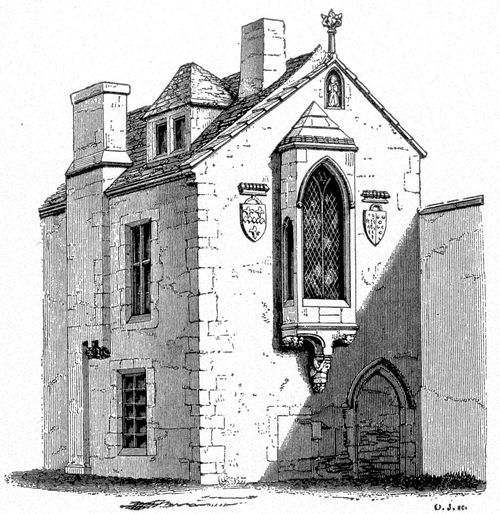
Residence of Chantry Priests of Altar of St. Nicholas,
Near Lincoln Cathedral.
(Domestic Architecture in the Fourteenth
Century.)
But the heaviest blow to the gilds on the part of the government came
in 1547, as a result of the Reformation. Both the organizations formed
for the control of the various industries, the craft gilds, and those
which have been described in Chapter III as non-industrial, social, or
religious gilds, had property in their possession which had been
bequeathed or given to them by members on condition that the gild
would always support or help to support a priest, should see that mass
was celebrated for the soul of the donor and his family, should keep a
light always burning before a certain shrine, or for other religious
objects. These objects were generally looked upon as superstitious by
the reformers who became influential under Edward VI, and in the first
year of his reign a statute was passed which confiscated to the crown,
to be used for educational or other purposes, all the properly of
every kind of the purely religious and social gilds, and that part of
the property of the craft gilds which was employed by them for
religious purposes. One of the oldest forms of voluntary organization
in England therefore came to an end altogether, and one of the
strongest bonds which had held the members of the craft gilds together
as social bodies was removed. After this time the companies had no
religious functions, and were besides deprived of a considerable
proportion of their wealth. This blow fell, moreover, just
at a time when all the economic influences were tending toward their
weakening or actual disintegration.
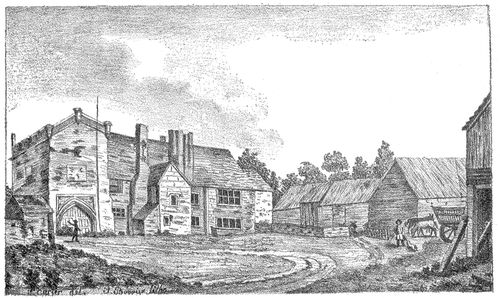
Monastery turned into a Farmhouse, Dartford Priory,
Kent.
Nichols: Progresses of Queen Elizabeth.
The trade and craft companies of London, like those of other towns,
were called upon at first to pay over to the government annually the
amount which they had before used for religious purposes. Three years
after the confiscation they were required to pay a lump sum
representing the capitalized value of this amount, estimated for the
London companies at £20,000. In order to do so they were of course
forced to sell or mortgage much of their land. That which they
succeeded in retaining, however, or bought subsequently was relieved
of all government charges, and being situated for the most part in the
heart of London, ultimately became extremely valuable and is still in
their possession. So far have the London companies, however, departed
from their original purpose that their members have long ceased to
have any connection with the occupations from which the bodies take
their names.
41. General Causes and Evidences of the Decay of the Gilds.—An
analogous narrowing of the interests of the crafts occurred in the
form of a cessation of the mystery plays. Dramatic shows continued to
be brought out yearly by the crafts in many towns well into the
sixteenth century. It is to be noticed, however, that this was no
longer done spontaneously. The town governments insisted that the
pageants should be provided as of old, and on the approach of Corpus
Christi day, or whatever festival was so celebrated in the particular
town, instructions were given for their production, pecuniary help
being sometimes provided to assist the companies in their expense. The
profit which came to the town from the influx of visitors to see the
pageants was a great inducement to the town government to
insist on their continuance. On the other hand, the competition of
dramas played by professional actors tended no doubt to hasten the
effect of the impoverishment and loss of vitality of the gilds. In the
last half of the sixteenth century the mystery plays seem to have come
finally to an end.
Thus the gilds lost the unity of their membership, were weakened by
the growth of industry outside of their sphere of control, superseded
by the government in many of their economic functions, deprived of
their administrative, legislative, and jurisdictional freedom, robbed
of their religious duties and of the property which had enabled them
to fulfil them, and no longer possessed even the bond of their
dramatic interests. So the fraternities which had embodied so much of
the life of the people of the towns during the thirteenth, fourteenth,
and fifteenth centuries now came to include within their organization
fewer and fewer persons and to affect a smaller and smaller part of
their interests. Although the companies continued to exist into later
times, yet long before the close of the period included in this
chapter they had become relatively inconspicuous and insignificant.
One striking evidence of their diminished strength, and apparently a
last effort to keep the gild organization in existence, is the curious
combination or consolidation of the companies under the influence of
the city governments. Numerous instances of the combination of several
trades are to be found in the records of every town, as for instance
the "company of goldsmiths and smiths and others their brethren," at
Hull in 1598, which consisted of goldsmiths, smiths, pewterers,
plumbers and glaziers, painters, cutlers, musicians, stationers and
bookbinders, and basket-makers. A more striking instance is to be
found in Ipswich in 1576, where the various occupations were all drawn
up into four companies, as follows: (1) The Mercers;
including the mariners, shipwrights, bookbinders, printers,
fishmongers, sword-setters, cooks, fletchers, arrowhead-makers,
physicians, hatters, cappers, mercers, merchants, and several others.
(2) The Drapers; including the joiners, carpenters, innholders,
freemasons, bricklayers, tilers, carriers, casket-makers, surgeons,
clothiers, and some others. (3) The Tailors; including the cutlers,
smiths, barbers, chandlers, pewterers, minstrels, peddlers, plumbers,
pinners, millers, millwrights, coopers, shearmen, glaziers, turners,
tinkers, tailors, and others. (4) The Shoemakers; including the
curriers, collar-makers, saddlers, pointers, cobblers, skinners,
tanners, butchers, carters, and laborers. Each of these four companies
was to have an alderman and two wardens, and all outsiders who came to
the town and wished to set up trade were to be placed by the town
officials in one or the other of the four companies. The basis of
union in some of these combinations was evidently the similarity of
their occupations, as the various workers in leather among the
"Shoemakers." In other cases there is no such similarity, and the only
foundation that can be surmised for the particular grouping is the
contiguity of the streets where the greatest number of particular
artisans lived, or their proportionate wealth. Later, this process
reached its culmination in such a case as that of Preston in 1628,
where all the tradesmen of the town were organized as one company or
fraternity called "The Wardens and Company of Drapers, Mercers,
Grocers, Salters, Ironmongers, and Haberdashers." The craft and
trading gilds in their mediæval character had evidently come to an
end.
42. The Growth of Native Commerce.—The most distinctive
characteristic of English foreign trade down to the middle of the
fifteenth century consisted in the fact that it had been
entirely in the hands of foreigners. The period under discussion saw
it transferred with quite as great completeness to the hands of
Englishmen. Even before 1450 trading vessels had occasionally been
sent out from the English seaport towns on more or less extensive
voyages, carrying out English goods, and bringing back those of other
countries or of other parts of England. These vessels sometimes
belonged to the town governments, sometimes to individual merchants.
This kind of enterprise became more and more common. Individual
merchants grew famous for the number and size of their ships and the
extent of their trade; as for instance, William Canynges of Bristol,
who in 1461 had ten vessels at sea, or Sturmys of the same town, who
at about the same time sent the first English vessel to trade with the
eastern Mediterranean, or John Taverner of Hull, who built in 1449 a
new type of vessel modelled on the carracks of Genoa and the galleys
of Venice. In the middle of the fourteenth century the longest list of
merchants of any substance that could be drawn up contained only 169
names. At the beginning of the sixteenth century there were at least
3000 merchants engaged in foreign trade, and in 1601 there were about
3500 trading to the Netherlands alone. These merchants exported the
old articles of English production and to a still greater extent
textile goods, the manufacture of which was growing so rapidly in
England. The export of wool came to an end during the reign of Queen
Elizabeth, but the export of woven cloth was more than enough to take
its place. There was not so much cloth now imported, but a much
greater variety and quantity of food-stuffs and wines, of articles of
fine manufacture, and of the special products of the countries to
which English trade extended.
The entrance of English vessels into ports of towns or
countries whose own vessels had been accustomed to the control of the
trade with England, or where the old commercial towns of the Hanseatic
League, of Flanders, or of Italy had valuable trading concessions, was
not obtained without difficulty, and there was a constant succession
of conflicts more or less violent, and of disputes between English and
foreign sailors and merchants. The progress of English commerce was,
however, facilitated by the decay in the prosperity of many of these
older trading towns. The growth of strong governments in Denmark,
Sweden, Norway, Poland, and Russia resulted in a withdrawal of
privileges which the Hanseatic League had long possessed, and internal
dissensions made the League very much weaker in the later fifteenth
century than it had been during the century and a half before. The
most important single occurrence showing this tendency was the capture
of Novgorod by the Russian Czar and his expulsion of the merchants of
the Hanse from their settlement in that commercial centre. In the same
way most of the towns along the south coast of the Baltic came under
the control of the kingdom of Poland.
A similar change came about in Flanders, where the semi-independent
towns came under the control of the dukes of Burgundy. These
sovereigns had political interests too extensive to be subordinated to
the trade interests of individual towns in their dominions. Thus it
was that Bruges now lost much of its prosperity, while Antwerp became
one of the greatest commercial cities of Europe. Trading rights could
now be obtained from centralized governments, and were not dependent
on the interest or the antagonism of local merchants.
In Italy other influences were leading to much the same results. The
advance of Turkish conquests was gradually increasing the
difficulties of the Eastern trade, and the discovery of the route
around the Cape of Good Hope in 1498 finally diverted that branch of
commerce into new lines. English merchants gained access to some of
this new Eastern trade through their connection with Portugal, a
country advantageously situated to inherit the former trade of Italy
and southern Germany. English commerce also profited by the
predominance which Florence obtained over Pisa, Genoa, and other
trading towns. Thus conditions on the Continent were strikingly
favorable to the growing commercial enterprise of England.
43. The Merchants Adventurers.—English merchants who exported and
imported goods in their own vessels were, with the exception of the
staplers or exporters of wool and other staple articles, usually
spoken of as "adventurers," "venturers," or "merchants adventurers."
This term is used in three different senses. Sometimes it simply means
merchants who entered upon adventure or risk by sending their goods
outside of the country to new or unrecognized markets, as the
"adventurers to Iceland," "adventurers to Spain." Again, it is applied
to groups of merchants in various towns who were organized for mutual
protection or other advantage, as the "fishmongers adventurers" who
brought their complaints before the Royal Council in 1542, "The
Master, Wardens, and Commonalty of Merchant Venturers, of Bristol,"
existing apparently in the fourteenth century, fully organized by
1467, and incorporated in 1552, "The Society of Merchants Adventurers
of Newcastle upon Tyne," or the similar bodies at York and Exeter.
But by far the most frequent use of the term is that by which it was
applied to those merchants who traded to the Netherlands and adjacent
countries, especially as exporters of cloth, and who came within this
period to be recognized and incorporated as the "Merchants
Adventurers" in a special sense, with headquarters abroad, a coat of
arms of their own, extensive privileges, great wealth, influence, and
prominence. These English merchants, trading to the Netherlands in
other articles than those controlled by the Staplers, apparently
received privileges of trade from the duke of Brabant as early as the
thirteenth century, and the right of settling their own disputes
before their own "consul" in the fourteenth. But their commercial
enterprises must have been quite insignificant, and it was only during
the fifteenth century that they became numerous and their trade in
English cloth extensive. Just at the beginning of this century, in
1407, the king of England gave a general charter to all merchants
trading beyond seas to assemble in definite places and choose for
themselves consuls or governors to arrange for their common trade
advantage. After this time, certainly by the middle of the century,
the regular series of governors of the English merchants in the
Netherlands was established, one of the earliest being William Caxton,
afterward the founder of printing in England. On the basis of these
concessions and of the privileges and charters granted by the home
government the "Merchants Adventurers" gradually became a distinct
organization, with a definite membership which was obtained by payment
of a sum which gradually rose from 6s. 8d. to £20, until it was
reduced by a law of Parliament in 1497 to £6 13s. 4d. They had
local branches in England and on the Continent. In 1498 they were
granted a coat of arms by Henry VII, and in 1503 by royal charter a
distinct form of government under a governor and twenty-four
assistants. In 1564 they were incorporated by a royal charter by the
title of "The Merchants Adventurers of England." Long before that time
they had become by far the largest and most influential
company of English exporting merchants. It is said that the Merchants
Adventurers furnished ten out of the sixteen London ships sent to join
the fleet against the Armada.
Most of their members were London mercers, though there were also in
the society members of other London companies, and traders whose homes
were in other English towns than London. The meetings of the company
in London were held for a long while in the Mercers' hall, and their
records were kept in the same minute book as those of the Mercers
until 1526. On the Continent their principal office, hall, or
gathering place, the residence of their Governor and location of the
"Court,", or central government of the company, was at different times
at Antwerp, Bruges, Calais, Hamburg, Stade, Groningen and Middleburg;
for the longest time probably at the first of these places. The larger
part of the foreign trade of England during the fifteenth and most of
the sixteenth century was carried on and extended as well as
controlled and regulated by this great commercial company.
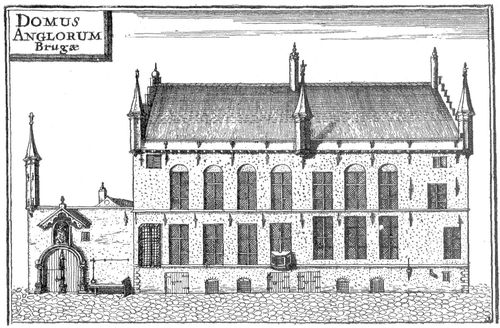
Hall of the Merchants Adventurers at Bruges.
(Blade:
Life of Caxton. Published by Kegan Paul, Trench, Trübner & Co.)
During the latter half of the sixteenth century, however, other
companies of merchants were formed to trade with various countries,
most of them receiving a government charter and patronage. Of these
the Russia or Muscovy Company obtained recognition from the government
in 1554, and in 1557, when an ambassador from that country came to
London, a hundred and fifty merchants trading to Russia received him
in state. In 1581 the Levant or Turkey Company was formed, and its
members carried their merchandise as far as the Persian Gulf. In 1585
the Barbary or Morocco Company was formed, but seems to have failed.
In 1588, however, a Guinea Company began trading, and in 1600 the
greatest of all, the East India Company, was chartered. The
expeditions sent out by the Bristol merchants and then by
the king under the Cabots, those other voyages so full of romance in
search of a northwest or a northeast passage to the Orient, and the no
less adventurous efforts to gain entrance to the Spanish possessions
in the west, were a part of the same effort of commercial companies or
interests to carry their trading into new lands.
44. Government Encouragement of Commerce.—Before the accession of
Henry VII it is almost impossible to discover any deliberate or
continuous policy of the government in commercial matters. From this
time forward, however, through the whole period of the Tudor monarchs
a tolerably consistent plan was followed of favoring English merchants
and placing burdens and restrictions upon foreign traders. The
merchants from the Hanse towns, with their dwellings, warehouses, and
offices at the Steelyard in London, were subjected to a narrower
interpretation of the privileges which they possessed by old and
frequently renewed grants. In 1493 English customs officers began to
intrude upon their property; in 1504 especially heavy penalties were
threatened if they should send any cloth to the Netherlands during the
war between the king and the duke of Burgundy. During the reign of
Henry VIII the position of the Hansards was on the whole easier, but
in 1551 their special privileges were taken away, and they were put in
the same position as all other foreigners. There was a partial regrant
of advantageous conditions in the early part of the reign of
Elizabeth, but finally, in 1578, they lost their privileges forever.
As a matter of fact, German traders now came more and more rarely to
England, and their settlement above London Bridge was practically
deserted.
The fleet from Venice also came less and less frequently. Under Henry
VIII for a period of nine years no fleet came to English
ports; then after an expedition had been sent out from Venice in 1517,
and again in 1521, another nine years passed by. The fleet came again
in 1531, 1532, and 1533, and even afterward from time to time
occasional private Venetian vessels came, till a group of them
suffered shipwreck on the southern coast in 1587, after which the
Venetian flag disappeared entirely from those waters.
In the meantime a series of favorable commercial treaties were made in
various directions by Henry VII and his successors. In 1490 he made a
treaty with the king of Denmark by which English merchants obtained
liberty to trade in that country, in Norway, and in Iceland. Within
the same year a similar treaty was made with Florence, by which the
English merchants obtained a monopoly of the sale of wool in the
Florentine dominions, and the right to have an organization of their
own there, which should settle trade disputes among themselves, or
share in the settlement of their disputes with foreigners. In 1496 the
old trading relations with the Netherlands were reëstablished on a
firmer basis than ever by the treaty which has come in later times to
be known as the Intercursus Magnus. In the same year commercial
advantages were obtained from France, and in 1499 from Spain. Few
opportunities were missed by the government during this period to try
to secure favorable conditions for the growing English trade. Closely
connected as commercial policy necessarily was with political
questions, the former was always a matter of interest to the
government, and in all the ups and downs of the relations of England
with the Continental countries during the sixteenth century the
foothold gained by English merchants was always preserved or regained
after a temporary loss.
The closely related question of English ship-building was
also a matter of government encouragement. In 1485 a law was passed
declaring that wines of the duchies of Guienne and Gascony should be
imported only in vessels which were English property and manned for
the most part by Englishmen. In 1489 woad, a dyestuff from southern
France, was included, and it was ordered that merchandise to be
exported from England or imported into England should never be shipped
in foreign vessels if sufficient English vessels were in the harbor at
the time. Although this policy was abandoned during the short reign of
Edward VI it was renewed and made permanent under Elizabeth. By
indirect means also, as by the encouragement of fisheries, English
seafaring was increased.
As a result of these various forms of commercial influence, the
enterprise of individual English merchants, the formation of trading
companies, the assistance given by the government through commercial
treaties and favoring statutes, English commerce became vastly greater
than it had ever been before, reaching to Scandinavia and Russia, to
Germany and the Netherlands, to France and Spain, to Italy and the
eastern Mediterranean, and even occasionally to America. Moreover, it
had come almost entirely into the hands of Englishmen; and the goods
exported and imported were carried for the most part in ships of
English build and ownership, manned by English sailors.
45. The Currency.—The changes just described were closely connected
with contemporary changes in the gold and silver currency. Shillings
were coined for the first time in the reign of Henry VII, a pound
weight of standard silver being coined into 37 shillings and 6 pence.
In 1527 Henry VIII had the same amount of metal coined into 40
shillings, and later in the year, into 45 shillings. In 1543 coin
silver was changed from the old standard of 11 ounces 2
pennyweights of pure silver to 18 pennyweights of alloy, so as to
consist of 10 ounces of silver to 2 ounces of alloy; and this was
coined into 48 shillings. In 1545 the coin metal was made one-half
silver, one-half alloy; in 1546, one-third silver, two-thirds alloy;
and in 1550, one-fourth silver, three-fourths alloy. The gold coinage
was correspondingly though not so excessively debased. The lowest
point of debasement for both silver and gold was reached in 1551. In
1560 Queen Elizabeth began the work of restoring the currency to
something like its old standard. The debased money was brought to the
mints, where the government paid the value of the pure silver in it.
Money of a high standard and permanently established weight was then
issued in its place. Much of the confusion and distress prevalent
during the reigns of Henry VIII and Edward VI was doubtless due to
this selfish and unwise monetary policy.
At about the same time a new influence on the national currency came
into existence. Strenuous but not very successful efforts had long
been made to draw bullion into England and prevent English money from
being taken out. Now some of the silver and gold which was being
extorted from the natives and extracted from the mines of Mexico and
Peru by the Spaniards began to make its way into England, as into
other countries of Europe. These American sources of supply became
productive by about 1525, but very little of this came into general
European circulation or reached England till the middle of the
century. After about 1560, however, through trade, and sometimes by
even more direct routes, the amount of gold and silver money in
circulation in England increased enormously. No reliable statistics
exist, but there can be little doubt that the amount of money in
England, as in Europe at large, was doubled, trebled,
quadrupled, or perhaps increased still more largely within the next
one hundred years.
This increase of money produced many effects. One of the most
important was its effect on prices. These had begun to rise in the
early part of the century, principally as a result of the debasement
of the coinage. In the latter part of the century the rise was much
greater, due now, no doubt, to the influx of new money. Most
commodities cost quite four times as much at the end of the sixteenth
century as they did at its beginning.
Another effect of the increased amount of currency appeared in the
greater ease with which the use of money capital was obtained. Saving
up and borrowing were both more practicable. More capital was now in
existence and more persons could obtain the use of it. As a result,
manufacturing, trade, and even agriculture could now be conducted on a
more extensive scale, changes could be introduced, and production was
apt to be profitable, as prices were increasing and returns would be
greater even than those calculated upon.
46. Interest.—Any extensive and varied use of capital is closely
connected with the payment of interest. In accord with a strict
interpretation of certain passages in both the Old and the New
Testament, the Middle Ages regarded the payment of interest for the
use of money as wicked. Interest was the same as usury and was
illegal. As a matter of fact, most regular occupations in the Middle
Ages required very little capital, and this was usually owned by the
agriculturists, handicraftsmen, or merchants themselves; so that
borrowing was only necessary for personal expenses or in occasional
exigencies. With the enclosures, sheep farming, consolidation of
farms, and other changes in agriculture, with the beginning
of manufacturing under the control of capitalist manufacturers, with
the more extensive foreign trading and ship owning, and above all with
the increase in the actual amount of money in existence, these
circumstances were changed. It seemed natural that money which one
person had in his possession, but for which he had no immediate use,
should be loaned to another who could use it for his own enterprises.
These enterprises might be useful to the community, advantageous to
himself, and yet profitable enough to allow him to pay interest for
the use of the money to the capitalist who loaned it to him. As a
matter of fact much money was loaned and, legally or illegally,
interest or usury was paid for it. Moreover, a change had been going
on in legal opinion parallel to these economic changes, and in 1545 a
law was passed practically legalizing interest if it was not at a
higher rate than ten per cent. This was, however, strongly opposed by
the religious opinion of the time, especially among men of Puritan
tendencies. They seemed, indeed, to be partially justified by the fact
that the control of capital was used by the rich men of the time in
such a way as to cause great hardship. In 1552, therefore, the law of
1545 was repealed, and interest, except in the few forms in which it
had always been allowed, was again prohibited. But the tide soon
turned, and in 1571 interest up to ten per cent was again made lawful.
From that time forward the term usury was restricted to excessive
interest, and this alone was prohibited. Yet the practice of receiving
interest for the loan of money was still generally condemned by
writers on morals till quite the end of this period; though lawyers,
merchants, and popular opinion no longer disapproved of it if the rate
was moderate.
47. Paternal Government.—In many of the changes which have
been described in this chapter, the share which government took was
one of the most important influences. In some cases, as in the laws
against enclosures, against the migration of industry from the towns
to the rural districts, and against usury, the policy of King and
Parliament was not successful in resisting the strong economic forces
which were at work. In others, however, as in the oversight of
industry, in the confiscation of the property of the gilds devoted to
religious uses, in the settlement of the relations between employers
and employees, in the control of foreign commerce, the policy of the
government really decided what direction changes should take.
As has been seen in this chapter, after the accession of Henry VII
there was a constant extension of the sphere of government till it
came to pass laws upon and provide for and regulate almost all the
economic interests of the nation. This was a result, in the first
place, of the breaking down of those social institutions which had
been most permanent and stable in earlier periods. The manor system in
the country, landlord farming, the manor courts, labor dues, serfdom,
were passing rapidly away; the old type of gilds, city regulations,
trading at fairs, were no longer so general; it was no longer
foreigners who brought foreign goods to England to be sold, or bought
English goods for exportation. When these old Customs were changing or
passing away, the national government naturally took charge to prevent
the threatened confusion of the process of disintegration. Secondly,
the government itself, from the latter part of the fifteenth century
onward, became abler and more vigorous, as has been pointed out in the
first paragraph of this chapter. The Privy Council of the king
exercised larger functions, and extended its jurisdiction
into new fields. Under these circumstances, when the functions of the
central government were being so widely extended, it was altogether
natural that they should come to include the control of all forms of
industrial life, including agriculture, manufacturing, commerce,
internal trade, labor, and other social and economic relations.
Thirdly, the control of economic and social matters by the government
was in accordance with contemporary opinions and feelings. An
enlightened absolutism seems to have commended itself to the most
thoughtful men of that time. A paternalism which regulated a very wide
circle of interests was unhesitatingly accepted and approved. As a
result of the decay of mediæval conditions, the strengthening of
national government, and the prevailing view of the proper functions
of government, almost all economic conditions were regulated by the
government to a degree quite unknown before. In the early part of the
period this regulation was more minute, more intrusive, more evidently
directed to the immediate advantage of government; but by the close of
Elizabeth's reign a systematic regulation was established, which,
while not controlling every detail of industrial life, yet laid down
the general lines along which most of industrial life must run. Some
parts of this regulation have already been analyzed. Perhaps the best
instance and one of the most important parts of it is the Statute of
Apprentices of 1563, already described in paragraph 40. In the same
year, 1563, a statute was passed full of minute regulations for the
fishing and fish-dealing trades. Foreign commerce was carried on by
regulated companies; that is, companies having charters from the
government, giving them a monopoly of the trade with certain
countries, and laying down at least a part of the rules under which
that trade should be carried on. The importation of most
kinds of finished goods and the exportation of raw materials were
prohibited. New industries were encouraged by patents or other
government concessions. Many laws were passed, of which that of 1571,
to encourage the industry of making caps, is a type. This law laid
down the requirement that every person of six years old and upward
should wear on every Sunday and holy day a woollen cap made in
England.
The conformity to standard of manufactures was enforced either by the
officers of companies which were established under the authority of
the government or by government officials or patentees, and many of
the methods and standards of manufacture were themselves defined by
statutes or proclamation. In agriculture, while the policy was less
consistent, government regulation was widely applied. There were laws,
as has been noted, forbidding the possession of more than two thousand
sheep by any one landholder and of more than two farms by any one
tenant; laws requiring the keeping of one cow and one calf for every
sixty sheep, and the raising a quarter of an acre of flax or hemp for
every sixty acres devoted to other crops. The most characteristic laws
for the regulation of agriculture, however, were those controlling the
export of grain. In order to prevent an excessive price, grain-raisers
were not allowed to export wheat or other grain when it was scarce in
England. When it was cheap and plenty, they were permitted to do so,
the conditions under which it was to be allowed or forbidden being
decided, according to a law of 1571, by the justices of the peace of
each locality, with the restriction that none should be exported when
the prevailing price was more than 1s. 3d. a bushel, a limit which
was raised to 2s. 6d. in 1592.
Thus, instead of industrial life being controlled and regulated
by town governments, merchant and craft gilds, lords of
fairs, village communities, lords of manors and their stewards, or
other local bodies, it was now regulated in its main features by the
all-powerful national government.
48. BIBLIOGRAPHY
Professor Ashley's second volume is of especial value for this period.
Green, Mrs. J. R.: Town Life in England in the Fifteenth Century,
two volumes.
Cheyney, E. P.: Social Changes in England in the Sixteenth Century,
Part I, Rural Changes.
A discussion of the legal character of villain tenure in the sixteenth
century will be found in articles by Mr. I. S. Leadam, in The English
Historical Review, for October, 1893, and in the Transactions of the
English Royal Historical Society for 1892, 1893, and 1894; and by
Professor Ashley in the English Historical Review for April, 1893,
and Annals of the American Academy of Political Science for January,
1891. (Reprinted in English Economic History, Vol. II, Chap. 4.)
Bourne, H. R. F.: English Merchants.
Froude, J. A.: History of England. Many scattered passages of great
interest refer to the economic and social changes of this period, but
they are frequently exaggerated, and in some cases incorrect. Almost
the same remark applies to Professor Rogers' Six Centuries of Work
and Wages and Industrial and Commercial History of England.
Busch, Wilhelm: A History of England under the Tudors. For the
economic policy of Henry VII.
THE EXPANSION OF ENGLAND
Economic Changes of the Seventeenth and Early Eighteenth Centuries
49. National Affairs from 1603 to 1760.—The last three rulers of the
Tudor family had died childless. James, king of Scotland, their
cousin, therefore inherited the throne and became the first English
king of the Stuart family. James reigned from 1603 to 1625. Many of
the political and religious problems which had been created by the
policy of the Tudor sovereigns had now to come up for solution.
Parliament had long been restive under the almost autocratic
government of Queen Elizabeth, but the danger of foreign invasion and
internal rebellion, long-established habit, Elizabeth's personal
popularity, her age, her sex, and her occasional yielding, all
combined to prevent any very outspoken opposition. Under King James
all these things were changed. Yet he had even higher ideas of his
personal rights, powers, and duties as king than any of his
predecessors. Therefore during the whole of the reign dispute and ill
feeling existed between the king, his ministers, and many of the
judges and other officials, on the one hand, and the majority of the
House of Commons and among the middle and upper classes of the
country, on the other. James would willingly have avoided calling
Parliament altogether and would have carried on the government
according to his own judgment and that of the ministers he selected,
but it was absolutely necessary to assemble it for the
passing of certain laws, and above all for the authorization of taxes
to obtain the means to carry on the government. The fall in the value
of gold and silver and the consequent rise of prices, and other
economic changes, had reduced the income of the government just at a
time when its necessary expenses were increasing, and when a
spendthrift king was making profuse additional outlays. Finances were
therefore a constant difficulty during his reign, as in fact they
remained during the whole of the seventeenth century.
In religion James wished to maintain the middle course of the
established church as it had been under Elizabeth. He was even less
inclined to harsh treatment of the Roman Catholics. On the other hand,
the tide of Puritan feeling appealing for greater strictness and
earnestness in the church and a more democratic form of church
government was rising higher and higher, and with this a desire to
expel the Roman Catholics altogether. The House of Commons represented
this strong Protestant feeling, so that still another cause of
conflict existed between King and Parliament. Similarly, in foreign
affairs and on many other questions James was at cross purposes with
the main body of the English nation.
This reign was the period of foundation of England's great colonial
empire. The effort to establish settlements on the North American
coast were at last successful in Virginia and New England, and soon
after in the West Indies. Still other districts were being settled by
other European nations, ultimately to be absorbed by England. On the
other side of the world the East India Company began its progress
toward the subjugation of India. Nearer home, a new policy was carried
out in Ireland, by which large numbers of English and Scotch
immigrants were induced to settle in Ulster, the
northernmost province. Thus that process was begun by which men of
English race and language, living under English institutions and
customs, have established centres of population, wealth, and influence
in so many parts of the world.
Charles I came to the throne in 1625. Most of the characteristics of
the period of James continued until the quarrels between King and
Parliament became so bitter that in 1642 civil war broke out. The
result of four years of fighting was the defeat and capture of the
king. After fruitless attempts at a satisfactory settlement Charles
was brought to trial by Parliament in 1649, declared guilty of
treason, and executed.
A republican form of government was now established, known as the
"Commonwealth," and kingship and the House of Lords were abolished.
The army, however, had come to have a will of its own, and quarrels
between its officers and the majority of Parliament were frequent.
Both Parliament and army had become unpopular, taxation was heavy, and
religious disputes troublesome. The majority in Parliament had carried
the national church so far in the direction of Puritanism that its
excesses had brought about a strong reactionary feeling. Parliament
had already sat for more than ten years, hence called the "Long
Parliament," and had become corrupt and despotic. Under these
circumstances, one modification after another was made in the form of
government until in 1653 Oliver Cromwell, the commander of the army
and long the most influential man in Parliament, dissolved that body
by military force and was made Lord Protector, with powers not very
different from those of a king. There was now a period of good order
and great military and naval success for England; Scotland and
Ireland, both of which had declared against the
Commonwealth, were reduced to obedience, and successful foreign wars
were waged. But at home the government did not succeed in obtaining
either popularity or general acceptance. Parliament after Parliament
was called, but could not agree with the Protector. In 1657 Cromwell
was given still higher powers, but in 1658 he died. His son, Richard
Cromwell, was installed as Protector. The republican government had,
however, been gradually drifting back toward the old royal form and
spirit, so when the new Lord Protector proved to be unequal to the
position, when the army became rebellious again, and the country
threatened to fall into anarchy, Monk, an influential general, brought
about the reassembling of the Long Parliament, and this body recalled
the son of Charles I to take his hereditary seat as king.
This event occurred in 1660, and is known as the Restoration. Charles
II reigned for twenty-five years. His reign was in one of its aspects
a time of reaction in manners and morals against the over-strictness
of the former Puritan control. In government, notwithstanding the
independent position of the king, it was the period when some of the
most important modern institutions came into existence. Permanent
political parties were formed then for the first time. It was then
that the custom arose by which the ministers of the government are
expected to resign when there proves to be a majority in Parliament
against them. It was then that a "cabinet," or group of ministers
acting together and responsible for the policy of the king, was first
formed. The old form of the established church came again into power,
and harsh laws were enacted against Presbyterians, Baptists, Quakers,
and members of the other sects which had grown up during the earlier
part of the century.
It was to escape these oppressive laws that many emigrated to
the colonies in America and established new settlements. Not only was
the stream of emigration kept up by religious persecutions, but the
prosperity and abundant opportunity for advancement furnished by the
colonies attracted great numbers. The government of the Stuart kings,
as well as that of the Commonwealth, constantly encouraged distant
settlements for the sake of commerce, shipping, the export of English
manufactured goods, and the import of raw materials. The expansion of
the country through its colonial settlements therefore still
continued.
The great literature which reached its climax in the reign of
Elizabeth continued in equal variety and abundance throughout the
reigns of James and Charles. The greater plays of Shakespeare were
written after the accession of James. Milton belonged to the
Commonwealth period, and Bunyan, the famous author of Pilgrim's
Progress, was one of those non-conformists in religion who were
imprisoned under Charles II. With this reign, however, quite a new
literary type arose, whose most conspicuous representative was Dryden.
In 1685 James II succeeded his brother. Instead of carrying on the
government in a spirit of concession to national feeling, he adopted
such an unpopular policy that in 1688 he was forced to flee from
England, and his son-in-law and daughter, William and Mary, were
elected to the throne. On their accession Parliament passed and the
king and queen accepted a "Bill of Rights." This declared the
illegality of a number of actions which recent sovereigns had claimed
the right to do, and guaranteed to Englishmen a number of important
individual rights, which have since been included in many other
documents, especially in the constitutions of several of the American
states and the first ten amendments to the Constitution of
the United States. The Bill of Rights is often grouped with the Great
Charter, and these two documents, along with several of the Acts of
the Parliaments of Charles I accepted by the king, make the principal
written elements of the English constitution. The form and powers
attained by the English government have been, however, rather the
result of slight changes from time to time, often without intention of
influencing the constitution, than of any deliberate action. Important
examples of this are certain customs of legislation which grew up
under William and Mary. The Mutiny Act, by which the army is kept up,
was only passed for one year at a time. The grant of taxes was also
only made annually. Parliament must therefore be called every year in
order to obtain money to carry on the work of government, and in order
to keep up the military organization.
As a result of the Revolution of 1688, as the deposition of James II.
and the appointment of William and Mary are called, and of the changes
which succeeded it, Parliament gradually became the most powerful part
of government, and the House of Commons the strongest part of
Parliament. The king's ministers came more and more to carry out the
will of Parliament rather than that of the king. Somewhat later the
custom grew up by which one of the ministers by presiding over the
whole Cabinet, nominating its members to the king, representing it in
interviews with the king, and in other ways giving unity to its
action, created the position of prime minister. Thus the modern
Parliamentary organization of the government was practically complete
before the middle of the eighteenth century. William and Mary died
childless, and Anne, Mary's sister, succeeded, and reigned till 1714.
She also left no heir. In the meantime arrangements had been made to
set aside the descendants of James II, who were Roman
Catholics, and to give the succession to a distant line of Protestant
descendants of James I. In this way George I, Elector of Hanover, of
the house of Brunswick, became king, reigned till 1727, and was
succeeded by George II, who reigned till 1760. The sovereigns of
England have been of this family ever since.
The years following the Revolution of 1688 were a time of almost
constant warfare on the Continent, in the colonies, and at sea. In
many of these wars the real interests of England were but slightly
concerned. In others her colonial and native dependencies were so
deeply affected as to make them veritable national wars. Just at the
close of the period, in 1763, the war known in Europe as the Seven
Years' War and in America as the French and Indian War was brought to
an end by the peace of Paris. This peace drew the outlines of the
widespread empire of Great Britain, for it handed over to her Canada,
the last of the French possessions in America, and guaranteed her the
ultimate predominance in India.
50. The Extension of Agriculture.—During the seventeenth and the
first half of the eighteenth century there are no such fundamental
changes in social organization to chronicle as during the preceding
century and a half. During the first hundred years of the period the
whole energy of the nation seems to have been thrown into political
and religious contests. Later there was development and increase of
production, but they were in the main an extension or expansion of the
familiar forms, not such a change of form as would cause any
alteration in the position of the mass of the people.
The practice of enclosing open land had almost ceased before the death
of Elizabeth. There was some enclosing under James I, but it
seems to have been quite exceptional. In the main, those common
pastures and open fields which had not been enclosed by the beginning
of this period, probably one-half of all England, remained unenclosed
till the recommencement of the process long afterward. Sheep farming
gradually ceased to be so exclusively practised, and mixed agriculture
became general, though few if any of those fields which had been
surrounded with hedges, and come into the possession of individual
farmers, were thrown open or distributed again into scattered
holdings. Much new land came into cultivation or into use for pasture
through the draining of marshes and fens, and the clearing of forests.
This work had been begun for the extensive swampy tracts in the east
of England in the latter years of Elizabeth's reign by private
purchasers, assisted by an act of Parliament passed in 1601, intended
to remove legal difficulties. It proceeded slowly, partly because of
the expense and difficulty of putting up lasting embarkments, and
partly because of the opposition of the fenmen, or dwellers in the
marshy districts, whose livelihood was obtained by catching the fish
and water fowl that the improvements would drive away. With the
seventeenth and early eighteenth centuries, however, largely through
the skill of Dutch engineers and laborers, many thousands of acres of
fertile land were reclaimed and devoted to grazing, and even grain
raising. Great stretches of old forest and waste land covered with
rough underbrush were also reduced to cultivation.
There was much writing on agricultural subjects, and methods of
farming were undoubtedly improved, especially in the eighteenth
century. Turnips, which could be grown during the remainder of the
season after a grain crop had been harvested, and which would provide
fresh food for the cattle during the winter, were introduced from the
Continent and cultivated to some extent, as were clover and
some improved grasses. But these improvements progressed but slowly,
and farming on the whole was carried on along very much the same old
lines till quite the middle of the eighteenth century. The raising of
grain was encouraged by a system of government bounties, as already
stated in another connection. From 1689 onward a bounty was given on
all grain exported, when the prevailing price was less than six
shillings a bushel. The result was that England exported wheat in all
but famine years, that there was a steady encouragement even if
without much result to improve methods of agriculture, and that
landlords were able to increase their rents. In the main, English
agriculture and the organization of the agricultural classes of the
population did not differ very much at the end of this period from
that at the beginning except in the one point of quantity, the amount
of produce and the number of the population being both largely
increased.
51. The Domestic System of Manufactures.—Much greater skill in
manufacturing was acquired, principally, as in earlier periods,
through the immigration of foreign artisans. In Queen Elizabeth's time
a great number of such men with their families, who had been driven
from the Netherlands by the persecutions of the duke of Alva, came to
England for refuge. In Sandwich in 1561 some twenty families of
Flemings settled and began their manufactures of various kinds of
cloth; in 1565 some thirty Dutch and Walloon families settled in
Norwich as weavers, in Maidstone a body of similar artisans who were
thread-makers settled in 1567; in 1570 a similar group carrying on
various forms of manufacture settled at Colchester; and still others
settled in some five or six other towns. After 1580 a wave of French
Huguenots, principally silk-weavers, fled from their native
country and were allowed to settle in London, Canterbury, and
Coventry. The renewed persecutions of the Huguenots, culminating in
the revocation of the Edict of Nantes in 1685, sent many thousands
more into exile, large numbers of silk and linen weavers and
manufacturers of paper, clocks, glass, and metal goods coming from
Normandy and Brittany into England, and settling not only in London
and its suburbs, but in many other towns of England. These foreigners,
unpopular as they often were among the populace, and supported in
their opportunities of carrying on their industry only by royal
authority, really taught new and higher industries to the native
population and eventually were absorbed into it as a more gifted and
trained component.
There were also some inventions of new processes or devices for
manufacture. The "stocking frame," or machine knitting, was invented
in the time of Queen Elizabeth, but did not get into actual use until
the next century. It then became for the future an extensive industry,
especially in London and Nottingham and their vicinity. The weaving of
cotton goods was introduced and spread especially in the northwest, in
the neighborhood of Manchester and Bolton. A machine for preparing
silk thread was invented in 1719. The printing of imported white
cotton goods, as calicoes and lawns, was begun, but prohibited by
Parliament in the interest of woven goods manufacturers, though the
printing of linens was still allowed. Stoneware was also improved.
These and other new industries introduced by foreigners or developed
by English inventors or enterprising artisans added to the variety and
total amount of English manufacture. The old established industries,
like the old coarser woollen goods and linen manufacture, increased
but slowly in amount and went through no great changes of method.
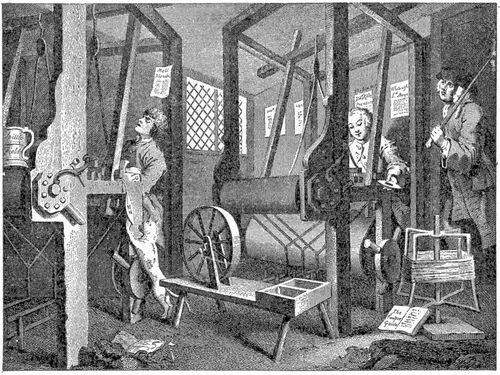
Hand-loom Weaving.
(Hogarth: The Industrious and the
Lazy Apprentice.)
These industries old and new were in some cases regulated and
supervised as to the quality of ware and methods of manufacture, by
the remaining gilds or companies, with the authority which they
possessed from the national government. Indeed, there were within the
later sixteenth and the seventeenth centuries some new companies
organized or old ones renewed especially for this oversight, and to
guard the monopoly of their members over certain industries in certain
towns. In other cases rules were established for the carrying on of a
certain industry, and a patent or monopoly was then granted by the
king by which the person or company was given the sole right to carry
on a certain industry according to those rules, or to enforce the
rules when it was carried on by other people. In still other
industries a government official had the oversight and control
of quality and method of manufacture. Much production,
however, especially such as went on in the country, was not supervised
at all.
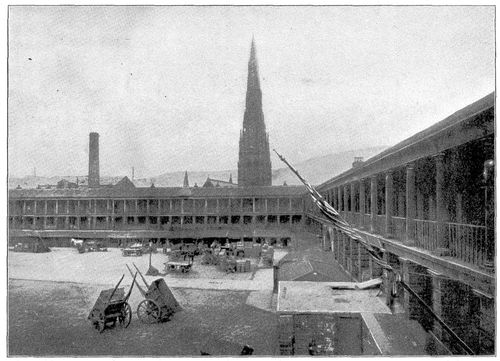
Old Cloth-hall at Halifax.
Far the greater part of manufacturing industry in this period was
organized according to the "domestic system," the beginnings of which
have been already noticed within the previous period. That is to say,
manufacturing was carried on in their own houses by small masters with
a journeyman and apprentice or two. Much of it was done in the country
villages or suburbs of the larger towns, and such handicraft was very
generally connected with a certain amount of cultivation of the soil.
A small master weaver or nail manufacturer, or soap boiler or potter,
would also have a little farm and divide his time between the two
occupations. The implements of manufacture almost always belonged to
the small master himself, though in the stocking manufacture and the
silk manufacture they were often owned by employing capitalists and
rented out to the small manufacturers, or even to journeymen. In some
cases the raw material—wool, linen, metal, or whatever it might
be—was purchased by the small manufacturer, and the goods were either
manufactured for special customers or taken when completed to a
neighboring town on market days, there to be sold to a local dealer,
or to a merchant who would transport it to another part of the country
or export it to other countries. In other cases the raw material,
especially in the case of cotton, was the property of a town merchant
or capitalist, who distributed it to the small domestic manufacturers
in their houses in the villages, paying them for the processes of
production, and himself collecting the completed product and disposing
of it by sale or export. This domestic manufacture was especially
common in the southwest, centre, and northwest of England,
and manufacturing towns like Birmingham, Halifax, Sheffield, Leeds,
Bolton, and Manchester were growing up as centres around which it
gathered. Little or no organization existed among such small
manufacturers, though their apprentices were of course supposed to be
taken and their journeymen hired according to the provisions of the
Statute of Apprentices, and their products were sometimes subjected to
some governmental or other supervision.
Thus in manufacturing and artisan life as in agricultural the period
was marked by an extension and increase of the amount of industry, on
the same general lines as had been reached by 1600, rather than by any
considerable changes.
52. Commerce under the Navigation Acts.—The same thing is true of
commerce, although its vast extension was almost in the nature of a
revolution. As far back as the reign of Elizabeth most of the imports
into England were brought in English vessels by English importers, and
the goods which were exported were sent out by English exporters. The
goods which were manufactured in scattered villages or town suburbs by
the domestic manufacturers were gathered by these merchants and sent
abroad in ever increasing amounts. The total value of English exports
in 1600 was about 10 million dollars, at the close of the century it
was some 34 millions, and in 1750 about 63 millions. This trade was
carried on largely by merchants who were members of those chartered
trading companies which have been mentioned as existing already in the
sixteenth century. Some of these were "regulated companies"; that is,
they had certain requirements laid down in their charters and power to
adopt further rules and regulations, to which their members must
conform. Others had similar chartered rights, but all their members
invested funds in a common capital and traded as a joint stock
company. In both kinds of cases each company possessed a
monopoly of some certain field of trade, and was constantly engaged in
the exclusion of interlopers from its trade. Of these companies the
Merchants Adventurers, the oldest and one of the wealthiest,
controlled the export of manufactured cloth to the Netherlands and
northwestern Germany and remained prominent and active into the
eighteenth century. The Levant, the Eastland, the Muscovy, and the
Guinea or Royal African, and, greatest of all, the East India Company,
continued to exist under various forms, and carried on their distant
commerce through the whole of this period. With some of the nearer
parts of Europe—France, Spain, Portugal, and Italy—there was much
trading by private merchants not organized as companies or only
organized among themselves. The "Methuen treaty," negotiated with
Portugal in 1703, gave free entry of English manufactured goods into
that country in return for a decreased import duty on Portuguese wines
brought into England.
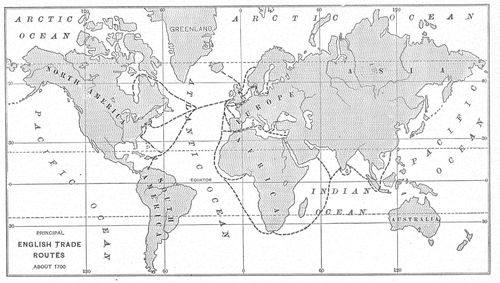
Principal English Trade Routes About 1700
The foreign lands with which these companies traded furnished at the
beginning of this period the only places to which goods could be
exported and from which goods could be brought; but very soon that
series of settlements of English colonists was begun, one of the
principal inducements for which was that they would furnish an outlet
for English goods. The "Plantation of Ulster," or introduction of
English and Scotch settlers into the north of Ireland between 1610 and
1620, was the beginning of a long process of immigration into that
country. But far the most important plantations as an outlet for trade
as in every respect were those made on the coast of North America and
in the West Indies. The Virginia and the Plymouth Companies played a
part in the early settlement of these colonies, but they were soon
superseded by the crown, single proprietaries, or the
settlers themselves. Virginia, New England, Maryland, the Carolinas,
and ultimately New York, Pennsylvania, and Georgia on the mainland;
the islands of Bermudas, Barbadoes, and Jamaica, and ultimately
Canada, came to be populous colonies inhabited by Englishmen and
demanding an ever increasing supply of English manufactured goods.
These colonies were controlled by the English government largely for
their commercial and other forms of economic value. The production of
goods needed in England but not produced there, such as sugar,
tobacco, tar, and lumber, was encouraged, but the manufacture of such
goods as could be exported from England was prohibited. The purchase
of slaves in Africa and their exportation to the West Indies was
encouraged, partly because they were paid for in Africa by English
manufactured goods, partly because their use in the colonies made the
supply of sugar and some other products plentiful and cheap.
Closely connected with commerce and colonies as a means of disposing
of England's manufactured goods and of obtaining those things which
were needed from abroad was commerce for its own sake, for the profits
which it brought to those engaged in it, and for the indirect value to
the nation of having a large mercantile navy.
The most important provision for this end was the passage of the
"Navigation Acts." We have seen that as early as 1485 certain kinds of
goods could be imported only in English vessels. But in 1651 a law was
passed, and in 1660 under a more regular government reënacted in still
more vigorous form, which carried this policy to its fullest extent.
By these laws all importation of goods into England from any ports of
Asia, Africa, or America was forbidden, except in vessels belonging to
English owners, built in England and manned by English seamen; and
there was the same requirement for goods exported from
England to those countries. From European ports goods could be brought
to England only in English vessels or in vessels the property of
merchants of the country in which the port lay; and similarly for
export. These acts were directed especially against the Dutch
merchants, who were fast getting control of the carrying trade. The
result of the policy of the Navigation Acts was to secure to English
merchants and to English shipbuilders a monopoly of all the trade with
the East Indies and Africa and with the American colonies, and to
prevent the Dutch from competing with English merchants for the
greater part of the trade with the Continent of Europe.
The characteristics of English commerce in this period, therefore,
were much the same as in the last. It was, however, still more
completely controlled by English merchants and was vastly extended in
amount. Moreover, this extension bid fair to be permanent, as it was
largely brought about by the growth of populous English colonies in
Ireland and America, and by the acquisition of great spheres of
influence in India.
53. Finance.—The most characteristic changes of the period now being
studied were in a field to which attention has been but slightly
called before; that is, in finance. Capital had not existed in any
large amounts in mediæval England, and even in the later centuries
there had not been any considerable class of men whose principal
interest was in the investment of saved-up capital which they had in
their hands. Agriculture, manufacturing, and even commerce were
carried on with very small capital and usually with such capital as
each farmer, artisan, or merchant might have of his own; no use of
credit to obtain money from individual men or from banks for
industrial purposes being ordinarily possible. Questions connected
with money, capital, borrowing, and other points of finance
came into somewhat greater prominence with the sixteenth century, but
they now attained an altogether new and more important notice.
Taxation, which had been looked upon as abnormal and occasional during
earlier times, and only justifiable when some special need for large
expenditure by the government arose, such as war, a royal marriage, or
the entertainment of some foreign visitor, now, after long conflicts
between King and Parliament, which are of still greater constitutional
than financial importance, came to be looked upon as a regular normal
custom. In 1660, at the Restoration, a whole system of excise duties,
taxes on imports and exports, and a hearth tax were established as a
permanency for paying the expenses of government, besides special
taxes of various kinds for special demands.
Borrowing, by merchants and others for ordinary purposes of business,
became much more usual. During most of the seventeenth century the
goldsmiths were the only bankers. On account of the strong vaults of
these merchants, their habitual possession of valuable material and
articles, and perhaps of their reputation for probity, persons who had
money beyond their immediate needs deposited it with the goldsmiths,
receiving from them usually six per cent. The goldsmiths then loaned
it to merchants or to the government, obtaining for it interest at the
rate of eight per cent or more. This system gradually became better
established and the high rates decreased. Payments came to be made by
check, and promissory notes were regularly discounted by the
goldsmiths.
The greatest extension in the use of credit, however, came from the
establishment of the Bank of England. In 1691 the original proposition
for the Bank was made to the government by William Patterson. In 1694
a charter for the Bank was finally carried through
Parliament by the efforts of the ministry. The Bank consisted of a
group of subscribers who agreed to loan to the government £1,200,000,
the government to pay them an annual interest of eight and one-half
per cent, or £100,000 in cash, guaranteed by the product of a certain
tax. The subscribers were at the same time incorporated and authorized
to carry on a general business of receiving deposits and lending out
money at interest. The capital which was to be loaned to the
government was subscribed principally by London merchants, and the
Bank began its career in the old Grocers' Hall. The regular income of
£100,000 a year gave it a nucleus of strength, and enabled it to
discount notes even beyond its actual deposits and to issue its own
notes or paper money. Thus money could be borrowed to serve as capital
for all kinds of enterprises, and there was an inducement also for
persons to save money and thus create capital, since it could always
bring them in a return by lending it to the Bank even if they were not
in a position to put it to use themselves. Along with the normal
effect of such financial inventions in developing all forms of trade
and industry, there arose a remarkable series of projects and schemes
of the wildest and most unstable character, and the early eighteenth
century saw many losses and constant fluctuations in the realm of
finance. The most famous instance of this was the "South Sea Bubble,"
a speculative scheme by which a regulated company, the South Sea
Company, was chartered in 1719 to carry on the slave-trade to the West
Indies and whale-fishing, and incidentally to loan money to the
government. Its shares rose to many fold their par value and fell to
almost nothing again within a few months, and the government and vast
numbers of investors and speculators were involved in its failure.
The same period saw the creation of the permanent national
debt. In earlier times kings and ministers had constantly borrowed
money from foreign or native lenders, but it was always provided and
anticipated that it would be repaid at a certain period, with the
interest. With the later years of the seventeenth century, however, it
became customary for the government to borrow money without any
definite contract or expectation as to when it should be paid back,
only making an agreement to pay a certain rate of interest upon it.
This was satisfactory to all parties. The government obtained a large
sum at the time, with the necessity of only paying a small sum every
year for interest; investors obtained a remunerative use for their
money, and if they should need the principal, some one else was always
ready to pay its value to them for the sake of receiving the interest.
The largest single element of the national debt in its early period
was the loan of £1,200,000 which served as the basis for the Bank; but
after that time, as for a short time before, sums were borrowed from
time to time which were not repaid, but became a permanent part of the
debt: the total rising to more than £75,000,000 by the middle of the
century. Incidentally, this, like the deposits at the goldsmiths and
the Bank, became an opportunity for the investment of savings and an
inducement to create more capital.
Fire insurance and life insurance both seem to have had their origin
in the later decades of the seventeenth century.
Thus in the realm of finance there was much more of novelty, of
actually new development, during this period than in agriculture,
manufacturing, or commerce. Yet all these forms of economic life and
of the social organization which corresponded to them were alike in
one respect, that they were quite minutely regulated by the
national government. The fabric of paternal government which we saw
rising in the time of the Tudor sovereigns remained almost intact
through the whole of this period. The regulation of the conditions of
labor, of trade, of importation and exportation, of finance, of
agriculture, of manufacture, in more or less detail, was part of the
regular work of legislation or administrative action. Either in order
to reach certain ulterior ends, such as government power, a large
navy, or a large body of money within the country, or simply as a part
of what were looked upon at the time as the natural functions of
government, laws were constantly being passed, charters formulated,
treaties entered into, and other action taken by government, intended
to encourage one kind of industry and discourage another, to determine
rates of wages and hours of labor, prescribe rules for agriculture, or
individual trades or forms of business, to support some kind of
industry which was threatened with decay, to restrict certain actions
which were thought to be disadvantageous, to regulate the whole
economic life of the nation.
It is true that much of this regulation was on the books rather than
in actual existence. It would have required a much more extensive and
efficient civil service, national and local, than England then
possessed to enforce all or any considerable part of the provisions
that were made by act of Parliament or ordered by the King and
Council. Again, new industries were generally declared to be free from
much of the more minute regulation, so that enterprise where it arose
was not so apt to be checked, as conservatism where it already existed
was apt to be perpetuated. Such regulation and control, moreover, were
quite in accord with the feeling and with the economic and political
theories of the time, so there was but little sense of
interference or tyranny felt by the governed. A regulated industrial
organization slowly expanding on well-established lines was as
characteristic of the theory as it was of the practice of the period.
54. BIBLIOGRAPHY
Gardiner, S. R.: The History of England, 1603-1642, ten volumes.
Many scattered passages in this work and in its continuations, like
those in Froude's history, referred to in the last chapter, apply to
the economic and social history of the period, and they are always
judicious and valuable.
Hewins, W. A. S.: English Trade and Finance, chiefly in the
Seventeenth Century.
For this period Cunningham, Rogers, and Palgrave, in the books already
referred to, are almost the only secondary authorities, except such as
go into great detail on individual points. Cunningham's second volume,
which includes this period, is extremely full and satisfactory.
Macpherson, D.: Annals of Commerce is, however, a book of somewhat
broader interest.
THE PERIOD OF THE INDUSTRIAL REVOLUTION
Economic Changes of the Later Eighteenth and Early Nineteenth
Centuries
55. National Affairs from 1760 to 1830.—The seventy years lying
between these two dates were covered by the long reign of George III
and that of his successor George IV. In the political world this
period had by no means the importance that it possessed in the field
of economic development. Parliament had already obtained its permanent
form and powers, and when George III tried to "be a king," as his
mother urged him, the effort to restore personal government was an
utter failure. Between 1775 and 1783 occurred the American Revolution,
by which thirteen of England's most valued colonies were lost to her
and began their progress toward a greater destiny. The breach between
the American colonies and the mother country was brought about largely
by the obstinacy of the king and his ministers in adopting an
arbitrary and unpopular policy. Other political causes no doubt
contributed to the result. Yet the greater part of the alienation of
feeling which underlay the Revolution was due not to political causes,
but to the economic policy already described, by which American
commerce and industry were bent to the interests of England.
In the American war France joined the rebellious colonies against
England, and obtained advantageous terms at the peace. Within ten
years the two countries had again entered upon a war, this
time of vastly greater extent, and continuing almost unbroken for more
than twenty years. This was a result of the outbreak of the French
Revolution. In 1789 the Estates General of France, a body
corresponding in its earlier history to the English Parliament, was
called for the first time for almost two hundred years. This assembly
and its successors undertook to reorganize French government and
society. In the course of this radical process principles were
enunciated proclaiming the absolute liberty and equality of men,
demanding the participation of all in government, the abolition of
aristocratic privileges, and finally of royalty itself. In following
out these ideas, so different from those generally accepted in Europe,
France was brought into conflict with all the other European states,
including Great Britain. War broke out in 1793. Fighting took place on
sea and land and in various parts of the world. France in her new
enthusiasm developed a strength, vigor, and capacity which enabled her
to make head against the alliances of almost all the other countries
of Europe, and even to gain victories and increase her territory at
their expense. No peace seemed practicable. In her successive internal
changes of government one of the generals of the army, Napoleon
Bonaparte, obtained a more and more influential position, until in
1804 he took the title of Emperor. The wars of the French Revolution
therefore were merged in the wars of Napoleon. Alliance after alliance
was made against Napoleon, England commonly taking the initiative in
the formation of them and paying large monthly subsidies to some of
the continental governments to enable them to support their armies.
The English navy won several brilliant victories, especially under
Nelson, although her land forces played a comparatively small part
until the battle of Waterloo in 1815.
The naval supremacy thus obtained made the war a matter of
pecuniary profit to the English nation, notwithstanding its enormous
expense; for it gave to her vessels almost a complete monopoly of the
commerce and the carrying trade of the world, and to her manufactures
extended markets which would otherwise have been closed to her or
shared with other nations. The cutting off of continental and other
sources of supply of grain and the opening of new markets greatly
increased the demand for English grain and enhanced the price paid for
it. This caused higher rents and further enclosure of open land. Thus
the war which had been entered upon reluctantly and with much
opposition in 1793, became popular, partly because of the feeling of
the English people that it had become a life and death struggle with
France, but largely also because English industries were flourishing
under it. The wars came to an end with the downfall of Napoleon in
1815, and an unwonted period of peace for England set in and lasted
for almost forty years.
The French Revolution produced another effect in England. It awakened
a certain amount of admiration for its principles of complete liberty
and equality and a desire to apply them to English aristocratic
society and government. In 1790 societies began to be formed, meetings
held, and pamphlets issued by men who sympathized with the popular
movements in France. Indeed, some of these reformers were suspected of
wishing to introduce a republic in England. After the outbreak of the
war the ministry determined to put down this agitation, and between
1793 and 1795 all public manifestation of sympathy with such
principles was crushed out, although at the cost of considerable
interference with what had been understood to be established personal
rights. Much discontent continued through the whole period
of the war, especially among the lower classes, though it did not take
the form of organized political agitation. It was a period, as will be
seen, of violent economic and social changes, which, although they
enriched England as a whole and made it possible for her to support
the unprecedented expenses of the long war, were very hard upon the
working classes, who were used to the old ways.
After the peace of 1815, however, political agitation began again. The
Whig party seemed inclined to resume the effort to carry certain
moderate reforms which had been postponed on account of the war, and
down below this movement there was a more radical agitation for
universal suffrage and for a more democratic type of government
generally. On the other hand, the Tory government, which had been in
power during almost the whole war period, was determined to oppose
everything in the nature of reform or change, on the ground that the
outrages accompanying the French Revolution arose from just such
efforts to make reforming alterations in the government. The radical
agitation was supported by the discontented masses of the people who
were suffering under heavy taxes, high prices, irregular employment,
and many other evils which they felt to be due to their exclusion from
any share in the government. The years intervening between 1815 and
1830 were therefore a period of constant bitterness and contention
between the higher and the lower classes. Mass meetings which were
called by the popular leaders were dissolved by the government,
radical writers were prosecuted by the government for libel, the
habeas corpus act was suspended repeatedly, and threatened rioting was
met with severe measures. The actions of the ministers, while upheld
by the higher classes, were bitterly attacked by others as being
unconstitutional and tyrannical.
In 1800 the union of the group of British Islands under one
government was completed, at least in form. Scotland had come under
the same crown as England in 1603, and the two Parliaments had been
united in 1707, the title Great Britain having been adopted for the
combined nations. The king of England had held the title of Lord of
Ireland from the time of the first conquest, and of King of Ireland
since the adoption of the title by Henry VIII. The union which now
took place consisted in the abolition of the separate Irish Parliament
and the election of Irish members to the combined or "Imperial"
Parliament of the three kingdoms sitting at Westminster. The official
title of the united countries has since been "The United Kingdom of
Great Britain and Ireland."
56. The Great Mechanical Inventions.—As the eighteenth century
progressed one form of economic growth seems to have been pressing on
the general economic organization. This was the constant expansion of
commerce, the steadily increasing demand for English manufactured
goods for export.
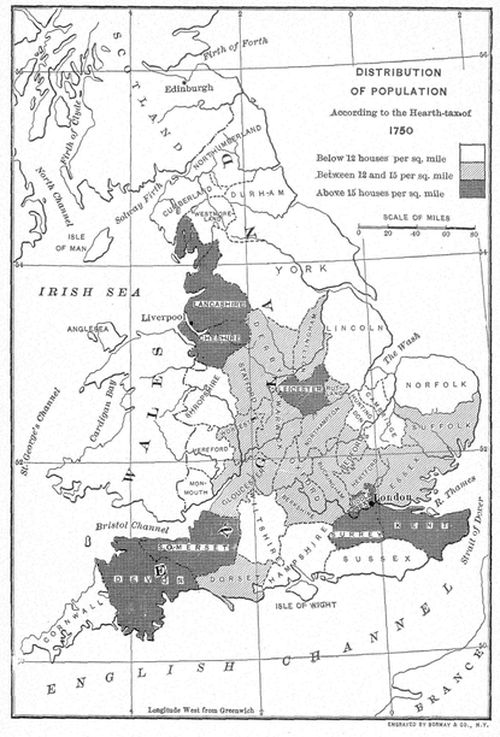
Distribution Of Population According To The Hearth-Tax
Of 1750.
Engraved By Bormay & Co., N.Y.
The great quantities of goods which were every year sent abroad in
English ships to the colonies, to Ireland, to the Continent, to Asia
and Africa, as well as those used at home, continued to be
manufactured in most cases by methods, with instruments, under an
organization of labor the same as that which had been in existence for
centuries. The cotton and woollen goods which were sold in the West
Indies and America were still carded, spun, and woven in the scattered
cottages of domestic weavers and weaver-farmers in the rural districts
of the west and north of England, by the hand cards, the
spinning-wheel, the cumbrous, old-fashioned loom. The pieces of goods
were slowly gathered from the hamlets to the towns, from the
towns to the seaports, over the poorest of roads, and by
the most primitive of conveyances. And these antiquated methods of
manufacture and transportation were all the more at variance with the
needs and possibilities of the time because there had been, as already
pointed out, a steady accumulation of capital, and much of it was not
remuneratively employed. The time had certainly come for some
improvement in the methods of manufacture.
A closer examination into the process of production in England's
principal industry, cloth-making, shows that this pressure on old
methods was already felt. The raw material for such uses, as it comes
from the back of the sheep, the boll of the cotton plant, or the
crushed stems of the flax, is a tangled mass of fibre. The first
necessary step is to straighten out the threads of this fibre, which
is done in the case of wool by combing, in the others by carding, both
being done at that time by hand implements. The next step is spinning,
that is drawing out the fibres, which have been made parallel by
carding, into a slender cord, and at the same time twisting this
sufficiently to cause the individual fibres to take hold one of
another and thus make a thread of some strength. This was sometimes
done on the old high wheel, which was whirled around by hand and then
allowed to come to rest while another section of the cotton, wool, or
flax was drawn from the carded mass by hand, then whirled again,
twisting this thread and winding it up on the spindle, and so on. Or
it was done by the low wheel, which was kept whirling continuously by
the use of a treadle worked by the foot, while the material was being
drawn out all the time by the two hands, and twisted and wound
continuously by the horseshoe-shaped device known as the "flyer." When
the thread had been spun it was placed upon the loom; strong, firmly
spun material being necessary for the "warp" of upright
threads, softer and less tightly spun material for the "woof" or
"weft," which was wrapped on the shuttle and thrown horizontally by
hand between the two diverging lines of warp threads. After weaving,
the fabric was subjected to a number of processes of finishing,
fulling, shearing, dyeing, if that had not been done earlier, and
others, according to the nature of the cloth or the kind of surface
desired.
In these successive stages of manufacture it was the spinning that was
apt to interpose the greatest obstacle, as it took the most time. From
time immemorial spinning had been done, as explained, on some form of
the spinning-wheel, and by women. One weaver continuously at work
could easily use up the product of five or six spinners. In the
domestic industry the weaving was of course carried on in the
dwelling-house by the father of the family with the grown sons or
journeymen, while the spinning was done for the most part by the women
and younger children of the family. As it could hardly be expected
that there would always be as large a proportion as six of the latter
class to one of the former, outside help must be obtained and much
delay often submitted to. Many a small master who had agreed to weave
up the raw material sent him by the master clothier within a given
time, or a cloth weaver who had planned to complete a piece by next
market day, was obliged to leave his loom and search through the
neighborhood for some disengaged laborer's wife or other person who
would spin the weft for which he was waiting. One of the very few
inventions of the early part of the century intensified this
difficulty. Kay's drop box and flying shuttle, invented in 1738, made
it possible for a man to sit still and by pulling two cords
alternately throw the shuttle to and fro. One man could therefore
weave broadcloth instead of its requiring two as before, and
consequently weaving was more rapid, while no corresponding change had
been introduced into the process of spinning.
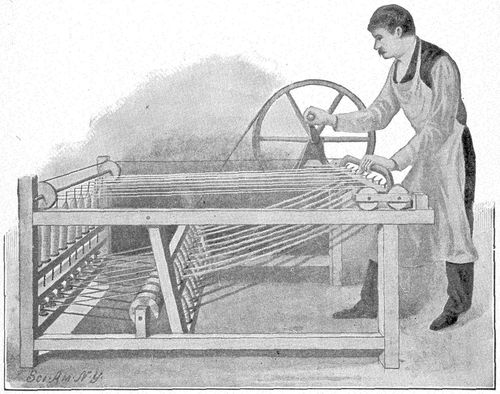
Spinning-jenny.
(Byrn, Invention in the Nineteenth
Century. Published by the Scientific American Company.)
Indeed, this particular difficulty was so clearly recognized that the
Royal Society offered a prize for the invention of a machine that
would spin several threads at the same time.
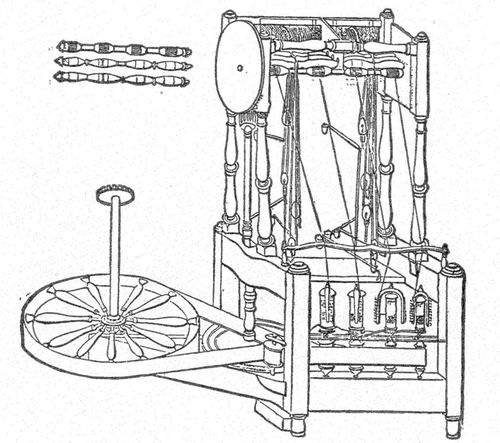
Arkwright's First Spinning-machine.
(Ure: History of
the Cotton Manufacture.)
No one claimed this reward, but the spirit of invention was
nevertheless awake, and experiments in more than one mechanical device
were being made about the middle of the century. The first to be
brought to actual completion was Hargreaves' spinning-jenny, invented
in 1764. According to the traditional story James
Hargreaves, a small master weaver living near Blackburn, on coming
suddenly into the house caused his wife, who was spinning with the old
high wheel, to spring up with a start and overset the wheel, which
still continued whirling, but horizontally, and with its spindle in a
vertical position. He was at once struck with the idea of using one
wheel to cause a number of spindles to revolve by means of a
continuous band, and by the device of substituting for the human hand
a pair of bars which could be successively separated and closed, and
which could be brought closer to or removed from the spindles on
wheels, to spin several threads at the same time. On the basis of this
idea and with the help of a neighboring mechanic he constructed a
machine by which a man could spin eight threads at the same time. In
honor of his wife he named it the "Spinning-jenny." The secret of this
device soon came out and jennies spinning twenty or thirty
or more threads at a time came into use here and there through the old
spinning districts. At the same time a much more effective method was
being brought to perfection by Richard Arkwright, who followed out
some old experiments of Wyatt of Northampton. According to this plan
the carded material was carried through successive pairs of rollers,
each pair running more rapidly than the previous pair, thus stretching
it out, while it was spun after leaving the last pair by flyers
adapted from the old low or treadle spinning-wheel. Arkwright's first
patent was taken out in 1769, and from that time forward he invented,
patented, and manufactured a series of machines which made
possible the spinning of a number of threads at the same time very
much more rapidly than even the spinning-jenny. Great numbers of
Arkwright's spinning-machines were manufactured and sold by him and
his partners. He made others for use in cotton mills carried on by
himself with various partners in different parts of the country. His
patent was eventually set aside as having been unfairly obtained, and
the machines were soon generally manufactured and used. Improvements
followed. An ingenious weaver named Samuel Crompton, perceiving that
the roller spinning was more rapid but that the jennies would spin the
finer thread, combined the two devices into one machine, known from
its hybrid origin as the "mule." This was invented in 1779, and as it
was not patented it soon came into general use. These inventions in
spinning reacted on the earlier processes and led to a rapid
development of carding and combing machines. A carding cylinder had
been invented by Paul as far back as 1748, and now came into general
use, while several wool-combing machines were invented in 1792 and
1793.
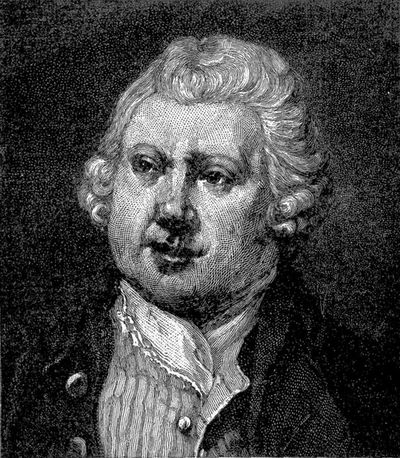
Sir Richard Arkwright.
(Portrait by Wright.)
So far all these inventions had been in the earlier textile processes.
Use for the spun thread was found in giving fuller employment to the
old hand looms, in the stocking manufacture, and for export; but no
corresponding improvement had taken place in weaving. From 1784 onward
a clergyman from the south of England, Dr. Edward Cartwright, was
gradually bringing to perfection a power loom which by the beginning
of the nineteenth century began to come into general use. The value
put upon Cartwright's invention may be judged from the fact that
Parliament voted him a gift of £10,000 in 1809. Arkwright had already
won a large fortune by his invention, and in 1786 was knighted in
recognition of his services to the national industry.
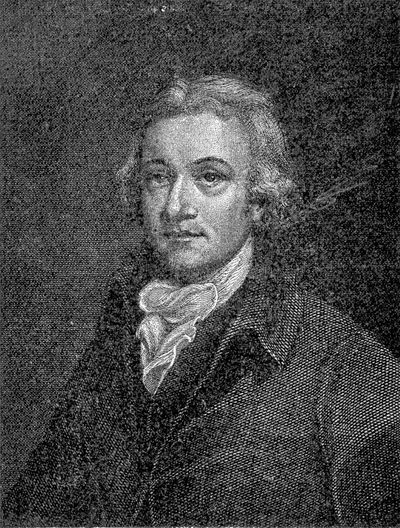
Rev. Edmund Cartwright.
(Portrait by Robert Fulton.)
While Cartwright was experimenting on the power loom, an
invention was made far from England which was in reality an essential
part of the improvement in the manufacture of cotton goods. This was
the American cotton gin, for the removal of the seeds from the fibre
of the boll, invented by Eli Whitney in 1792. Cotton had been
introduced into the Southern states during the Revolutionary war. Its
cultivation and export now became profitable, and a source of
supply became available at the very time that the inventions
for its manufacture were being perfected.
Spinning-jennies could be used in the household of the weaver; but the
later spinning-machines were so large and cumbrous that they could not
be used in a dwelling-house, and required so much power and rapidity
of motion that human strength was scarcely available. Horse power was
used to some extent, but water power was soon applied and special
buildings came to be put up along streams where water power was
available. The next stage was the application of steam power. Although
the possibility of using steam for the production of force had long
been familiar, and indeed used to some extent in the pumping out of
mines, it did not become available for general uses until the
improvements of James Watt, patented in 1769 and succeeding years. In
partnership with a man named Boulton, Watt began the manufacture of
steam-engines in 1781. In 1785 the first steam-engine was used for
power in a cotton mill. After that time the use of steam became more
and more general and by the end of the century steam power was
evidently superseding water power.
57. The Factory System.—But other things were needed to make this new
machinery available. It was much too expensive for the old cottage
weavers to buy and use. Capital had, therefore, to be brought into
manufacturing which had been previously used in trade or other
employments. Capital was in reality abundant relatively to existing
opportunities for investment, and the early machine spinners and
weavers drew into partnership moneyed men from the towns who had
previously no connection with manufacturing. Again, the new industry
required bodies of laborers working regular hours under the control of
their employers and in the buildings where the machines were placed
and the power provided. Such groups of laborers or "mill
hands" were gradually collected where the new kind of manufacturing
was going on. Thus factories, in the modern sense, came into
existence—a new phenomenon in the world.
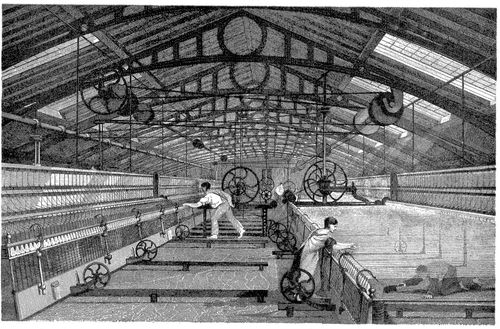
Mule-spinning in 1835.
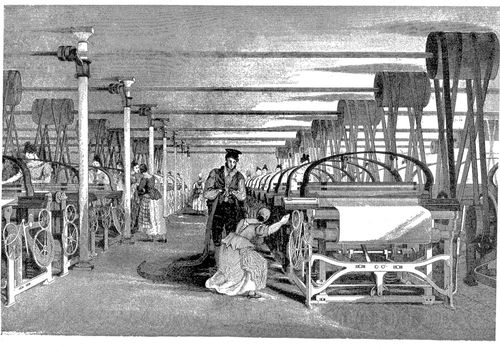
Power-loom Weaving in 1835. (Baines: History of Cotton
Manufacture.)
These changes in manufacturing and in the organization of labor came
about earliest in the manufacture of cotton goods, but the new
machinery and its resulting changes were soon introduced into the
woollen manufacture, then other textile lines, and ultimately into
still other branches of manufacturing, such as the production of
metal, wooden, and leather goods, and, indeed, into nearly all forms
of production. Manufacturing since the last decades of the eighteenth
century is therefore usually described as being done by the "factory
system," as contrasted with the domestic system and the gild system of
earlier times.
The introduction of the factory system involved many changes: the
adoption of machinery and artificial power, the use of a vastly
greater amount of capital, and the collection of scattered laborers
into great strictly regulated establishments. It was, comparatively
speaking, sudden, all its main features having been developed within
the period between 1760 and 1800; and it resulted in the raising of
many new and difficult social problems. For these reasons the term
"Industrial Revolution," so generally applied to it, is not an
exaggerated nor an unsuitable term. Almost all other forms of economic
occupation have subsequently taken on the main characteristics of the
factory system, in utilizing improved machinery, in the extensive
scale on which they are administered, in the use of large capital, and
in the organization of employees in large bodies. The industrial
revolution may therefore be regarded as the chief characteristic
distinguishing this period and the times since from all earlier ages.
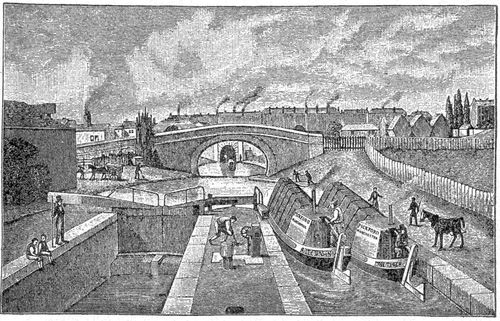
A Canal and Factory Town in 1827.
58. Iron, Coal, and Transportation.—A vast increase in the
production of iron and coal was going on concurrently with the rise of
the factory system. The smelting of iron ore was one of the oldest
industries of England, but it was a declining rather than an advancing
industry. This was due to the exhaustion of the woods and forests that
provided fuel, or to their retention for the future needs of
ship-building and for pleasure parks. In 1760, however, Mr. Roebuck
introduced at the Carron iron-works a new kind of blast furnace by
which iron ore could be smelted with coal as fuel. In 1790 the
steam-engine was introduced to cause the blast. Production had already
begun to advance before the latter date, and it now increased by
thousands of tons a year till far into the present century.
Improvements were introduced in puddling, rolling, and other processes
of the manufacture of iron at about the same time. The production of
coal increased more than proportionately. New devices in mining were
introduced, such as steam pumps, the custom of supporting
the roofs of the veins with timber instead of pillars of coal, and Sir
Humphry Davy's safety lamp of 1815. The smelting of iron and the use
of the steam-engine made such a demand for coal that capital was
applied in large quantities to its production, and more than ten
million tons a year were mined before the century closed.
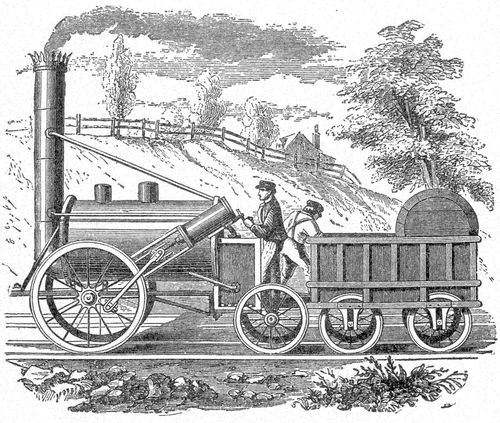
"The Rocket" Locomotive, 1825.
(Smiles: Life of George
Stephenson.)
Some slight improvements in roads and canals had been made and others
projected during the seventeenth and early eighteenth centuries; but
in the last quarter of the century the work of Telford, Macadam, and
other engineers, and of the private turnpike companies or public
authorities who engaged them, covered England with good roads. The
first canal was that from Worsley to Manchester, built by
Brindley for the duke of Bridgewater in 1761. Within a few years a
system of canals had been constructed which gave ready transportation
for goods through all parts of the country. The continuance of this
development of transportation and its fundamental modification by the
introduction of railways and steamboats has been one of the most
striking characteristics of the nineteenth century.
59. The Revival of Enclosures.—The changes which the latter half of
the eighteenth century and the early part of the nineteenth brought
were as profound in the occupation and use of the land as they were in
the production and transportation of manufactured goods. An
agricultural revolution was in progress as truly as was the
industrial.
The improvements in the methods of farming already referred to as
showing themselves earlier in the century became much more extensive.
The raising of turnips and other root crops spread from experimental
to ordinary farms so that a fallow year with no crop at all in the
ground came to be almost unknown. Clover and artificial grasses for
hay came to be raised generally, so that the supply of forage for the
winter was abundant. New breeds of sheep and cattle were obtained by
careful crossing and plentiful feeding, so that the average size was
almost doubled, while the meat, and in some cases the wool, was
improved in quality in even greater proportion. The names of such men
as Jethro Tull, who introduced the "drill husbandry," Bakewell, the
great improver of the breeds of cattle, and Arthur Young, the greatest
agricultural observer and writer of the century, have become almost as
familiar as those of Crompton, Arkwright, Watt, and other pioneers of
the factory system. The general improvement in agricultural methods
was due, not so much to new discoveries or inventions, as it
was to the large amount of capital which was introduced into their
practice. Expensive schemes of draining, marling, and other forms of
fertilizing were carried out, long and careful investigations were
entered upon, and managers of large farms were trained in special
processes by landlords and farmers who had the command of large sums
of money; and with the high prices prevalent they were abundantly
remunerated for the outlay. Great numbers of "gentlemen farmers," such
as Lord Townshend, the duke of Bedford, and George III himself, who
wrote articles for the agricultural papers signed "Farmer George,"
were leaders in this agricultural progress. In 1793 a government Board
of Agriculture was established, and through the whole latter part of
the century numerous societies for the encouragement of scientific
tillage and breeding were organized.
In the early years of the eighteenth century there had been signs of a
revival of the old process of enclosures, which had been suspended for
more than a hundred years. This was brought about by private acts of
Parliament. An act would be passed by Parliament giving legal
authority to the inhabitants of some parish to throw together the
scattered strips, and to redivide these and the common meadows and
pastures in such a way that each person with any claim on the land
should receive a proportionate share, and should have it separated
from all others and entirely in his own control. It was the usual
procedure for the lord of the manor, the rector of the parish, and
other large landholders and persons of influence to agree on the
general conditions of enclosure and draw up a bill appointing
commissioners, and providing for survey, compensation, redistribution,
and other requirements. They then submitted this bill to Parliament,
where, unless there was some special reason to the contrary,
it was passed. Its provisions were then carried out, and although
legal and parliamentary fees and the expenses of survey and enclosure
were large, yet as a result each inhabitant who had been able to make
out a legal claim to any of the land of the parish received either
some money compensation or a stretch of enclosed land. Such private
enclosure acts increased slowly in number till about the middle of the
century, when the increase became much more rapid.
The number of enclosure acts passed by Parliament and the approximate
extent of land enclosed under their provisions were as follows:—
| 1700-1759 |
244 |
Enclosure |
Bills |
337,877 |
Acres |
| 1760-1769 |
385 |
" |
" |
704,550 |
" |
| 1770-1779 |
660 |
" |
" |
1,207,800 |
" |
| 1780-1789 |
246 |
" |
" |
450,180 |
" |
| 1790-1799 |
469 |
" |
" |
858,270 |
" |
| 1800-1809 |
847 |
" |
" |
1,550,010 |
" |
| 1810-1819 |
853 |
" |
" |
1,560,990 |
" |
| 1820-1829 |
205 |
" |
" |
375,150 |
" |
| 1830-1839 |
136 |
" |
" |
248,880 |
" |
| 1840-1849 |
66 |
" |
" |
394,747 |
" |
In 1756, 1758, and 1773 general acts were passed encouraging the
enclosure for common use of open pastures and arable fields, but not
enclosing or dividing them permanently, and not providing for any
separate ownership.
In 1801 an act was passed to make simpler and easier the passage of
private bills for enclosure; and in 1836 another to make possible,
with the consent of two-thirds of the persons interested, the
enclosing of certain kinds of common fields even without appealing to
Parliament in each particular case. Finally, in 1845, the general
Enclosure Act of that year carried the policy of 1836 further and
appointed a body of Enclosure Commissioners, to determine on
the expediency of any proposed enclosure and to attend to carrying it
out if approved. Six years afterward, however, an amendment was passed
making it necessary that even after an enclosure had been approved by
the Commissioners it should go to Parliament for final decision.
By measures such as these the greater part of the lands which had
remained unenclosed to modern times were transformed into enclosed
fields for separate cultivation or pasture. This process of enclosure
was intended to make possible, and no doubt did bring about, much
improved agriculture. It exerted incidentally a profound effect on the
rural population. Many persons had habitually used the common pastures
and open fields for pasture purposes, when they had in reality no
legal claim whatever to such use. A poor man whose cow, donkey, or
flock of geese had picked up a precarious livelihood on land of
undistinguished ownership now found the land all enclosed and his
immemorial privileges withdrawn without compensation. Naturally there
was much dissatisfaction. A popular piece of doggerel declared that:—
"The law locks up the man or woman
Who steals the goose from off the common;
But leaves the greater villain loose
Who steals the common from the goose."
Again, a small holder was frequently given compensation in the form of
money instead of allotting to him a piece of land which was considered
by the commissioners too small for effective use. The money was soon
spent, whereas his former claim on the land had lasted because it
could not readily be alienated.
A more important effect, however, was the introduction on these
enclosed lands of a kind of agriculture which the small landholder was
ill fitted to follow. Improved cultivation, a careful
rotation of crops, better fertilizers, drainage, farm stock, and labor
were the characteristics of the new farming, and these were ordinarily
practicable only to the man who had some capital, knowledge, and
enterprise. Therefore, coincidently with the enclosures began a
process by which the smaller tenants began to give up their holdings
to men who could pay more rent for them by consolidating them into
larger farms. The freeholders also who owned small farms from time to
time sold them to neighboring landowners when difficulties forced them
or high prices furnished inducements.
60. Decay of Domestic Manufacture.—This process would have been a
much slower one but for the contemporaneous changes that were going on
in manufacturing. As has been seen, many small farmers in the rural
districts made part of their livelihood by weaving or other domestic
manufacture, or, as more properly described, the domestic
manufacturers frequently eked out their resources by carrying on some
farming. But the invention of machinery for spinning not only created
a new industry, but destroyed the old. Cotton thread could be produced
vastly more cheaply by machinery. In 1786 a certain quantity of a
certain grade of spun yarn was worth 38 shillings; ten years later, in
1796, it was worth only 19 shillings; in 1806 it was worth but 7
shillings 2 pence, and so on down till, in 1832, it was worth but 3
shillings. Part of this reduction in price was due to the decrease in
the cost of raw cotton, but far the most of it to the cheapening of
spinning.
It was the same a few years later with weaving. Hand-loom weavers in
Bolton, who received 25 shillings a week as wages in 1800, received
only 19 shillings and 6 pence in 1810, 9 shillings in 1820, and 5
shillings 6 pence in 1830. Hand work in other lines of manufacture
showed the same results. Against such reductions in wages
resistance was hopeless. Hand work evidently could not compete with
machine work. No amount of skill or industry or determination could
enable the hand workers to make their living in the same way as of
old. As a matter of fact, a long, sad, desperate struggle was kept up
by a whole generation of hand laborers, especially by the hand-loom
weavers, but the result was inevitable.
The rural domestic manufacturers were, as a matter of fact, devoting
themselves to two inferior forms of industry. As far as they were
handicraftsmen, they were competing with a vastly cheaper and better
form of manufacture; as far as they were farmers, they were doing the
same thing with regard to agriculture. Under these circumstances some
of them gave up their holdings of land and drifted away to the towns
to keep up the struggle a little longer as hand-loom weavers, and then
to become laborers in the factories; others gave up their looms and
devoted themselves entirely to farming for a while, but eventually
sold their holdings or gave up their leases, and dropped into the
class of agricultural laborers. The result was the same in either
case. The small farms were consolidated, the class of yeomanry or
small farmers died out, and household manufacture gave place to that
of the factory. Before the end of the century the average size of
English farms was computed at three hundred acres, and soon afterward
domestic spinning and weaving were almost unknown.
There was considerable shifting of population. Certain parts of the
country which had been quite thickly populated with small farmers or
domestic manufacturers now lost the greater part of their occupants by
migration to the newer manufacturing districts or to America. As in
the sixteenth century, some villages disappeared entirely. Goldsmith
in the Deserted Village described changes that really
occurred, however opposed to the facts may have been his description
of the earlier idyllic life whose destruction he deplored.
The existence of unenclosed commons and common fields had been
accompanied by very poor farming, very thriftless and shiftless
habits. The improvement of agriculture, the application of capital to
that occupation, the disappearance of the domestic system of industry,
and other changes made the enclosure of common land and the
accompanying changes inevitable. None the less it was a relatively
sudden and complete interference with the established character of
rural life, and not only was the process accompanied with much
suffering, but the form which took its place was marked by some
serious disadvantages. This form was brought about through the rapid
culmination of old familiar tendencies. The classes connected with the
land came to be quite clearly distinguished into three groups: the
landlords, the tenant farmers, and the farm laborers. The landlord
class was a comparatively small body of nobility and gentry, a few
thousand persons, who owned by far the greater portion of the land of
the country. Their estates were for the most part divided up into
farms, to the keeping of which in productive condition they
contributed the greater part of the expense, to the administration of
which trained stewards applied themselves, and in the improvement of
which their owners often took a keen and enlightened interest. They
received high rents, possessed unlimited local influence, and were the
favored governing class of the country. The class of farmers were men
of some capital, and frequently of intelligence and enterprise, though
rarely of education, who held on lease from the landlords farms of
some one, two, or three or more hundred acres, paying relatively large
rents, and yet by the excellence of their farming making for
themselves a liberal income. The farm laborers were the residuum of
the changes which have been traced in the history of landholding; a
large class living for the most part miserably in cottages grouped in
villages, holding no land, and receiving day wages for working on the
farms just described.
Notwithstanding the improvements in agriculture and the increase in
the extent of cultivated land, England ceased within the eighteenth
century to be a self-supporting country in food products. The form
which the "corn laws" had taken in 1689 had been as follows: the
raising of wheat was encouraged by prohibiting its importation and
paying a bounty of about eightpence a bushel for its exportation so
long as the prevailing price was less than six shillings a bushel.
When it was between six shillings and six shillings eightpence a
bushel its importation was forbidden, but there was no bounty paid for
exportation. Between the last price and ten shillings a bushel it
could be imported by paying a duty of a shilling a bushel. Above the
last price it could be imported free. Nevertheless, during the latter
half of the eighteenth century it became evident that there was no
longer a sufficient amount of wheat raised for the needs of the
English people. Between 1770 and 1790 exports and imports about
balanced one another, but after the latter year the imports always
exceeded the exports.
This was of course due to the great increase of population and to its
employment in the field of manufactures. The population in England in
1700 was about five millions, in 1750 about six millions and a half,
in 1800 about nine millions, and in 1850 about eighteen millions. That
is to say, its progress was slow during the first half of the
eighteenth century, more rapid during the latter half, and vastly more
rapid during the nineteenth century.
61. The Laissez-faire Theory.—A scarcely less complete
change than that which had occurred in manufactures, in agriculture,
and in social life as based upon these, was that which was in progress
at the same time in the realm of ideas, especially as applied to
questions of economic and social life. The complete acceptance of the
view that it was a natural and desirable part of the work of
government to regulate the economic life of the people had persisted
well past the middle of the eighteenth century. But very different
tendencies of thought arose in the latter part of the century. One of
these was the prevailing desire for greater liberty. The word liberty
was defined differently by different men, but for all alike it meant a
resistance to oppression, a revulsion against interference with
personal freedom of action, a disinclination to be controlled any more
than absolutely necessary, a belief that men had a right to be left
free to do as they chose, so far as such freedom was practicable.
As applied to economic interests this liberty meant freedom for each
person to make his living in the way he might see fit, and without any
external restriction. Adam Smith says: "The patrimony of a poor man
lies in the strength and dexterity of his hands; and to hinder him
from employing this strength and dexterity in what manner he thinks
proper, without injury to his neighbor, is a plain violation of this
most sacred property. It is a manifest encroachment upon the just
liberty both of the workman and of those who might be disposed to
employ him. As it hinders the one from working at what he thinks
proper, so it hinders the other from employing whom they think
proper." Government regulation, therefore, in as far as it restricted
men's freedom of action in working, employing, buying, selling, etc.,
was an interference with their natural liberty.
A second influence in the same direction was the prevalent
belief that most of the evils that existed in society were due to the
mistakes of civilization, that if men could get back to a "state of
nature" and start again, things might be much better. It was felt that
there was too much artificiality, too much interference with natural
development. Arthur Young condemned the prevailing policy of
government, "because it consists of prohibiting the natural course of
things. All restrictive forcible measures in domestic policy are bad."
Regulation was unwise because it forced men's actions into artificial
lines when it would have been much better to let them follow natural
lines. Therefore it was felt not only that men had a right to carry on
their economic affairs as they chose, but that it was wise to allow
them to do so, because interference or regulation had been tried and
found wanting. It had produced evil rather than good.
A third and by far the most important intellectual influence which
tended toward the destruction of the system of regulation was the
development of a consistent body of economic teaching, which claimed
to have discovered natural laws showing the futility and injuriousness
of any such attempts. Adam Smith's Wealth of Nations was published
in 1776, the year of the invention of Crompton's mule, and in the
decade when enclosures were more rapid than at any other time, except
in the middle years of the Napoleonic wars. This was, therefore, one
of the earliest, as it was far the most influential, of a series of
books which represent the changes in ideas correlative to the changes
in actual life already described. It has been described as having for
its main object "to demonstrate that the most effectual plan for
advancing a people to greatness is to maintain that order of things
which nature has pointed out, by allowing every man, as long
as he observes the rules of justice, to pursue his own interests in
his own way, and to bring both his industry and his capital into the
freest competition with those of his fellow-citizens." But the most
distinct influence exercised by the writings of Adam Smith and his
successors was not so much in pointing out that it was unjust or
unwise to interfere with men's natural liberty in the pursuit of their
interests, as in showing, as it was believed, that there were natural
laws which made all interference incapable of reaching the ends it
aimed at. A series of works were published in the latter years of the
eighteenth and the early years of the nineteenth century by Malthus,
Ricardo, Macculloch, James Mill, and others, in which principles were
enunciated and laws formulated which were believed to explain why all
interference with free competition was useless or worse. Not only was
the whole subject of economic relations clarified, much that had been
regarded as wise brought into doubt, and much that had been only
doubted shown to be absurd, but the attainment of many objects
previously sought for was, apparently, shown to be impossible, and to
lie outside of the realm of human control.
It was pointed out, for instance, that because of the limited amount
of capital in existence at any one time, "a demand for commodities is
not a demand for labor;" and therefore a law like that which required
burial in a woollen shroud did not give added occupation to the
people, but only diverted them from one occupation to another. Ricardo
developed a law of wages to the effect that they always tend to the
amount "necessary to enable the laborer to subsist, and to perpetuate
his race without either increase or diminution," and that any
artificial raising or lowering of wages is impossible, or else causes
an increase or diminution in their number which, through
competition, soon brings back the old rate. Rent was also explained by
Ricardo as arising from the differences of quality between different
pieces of land, and as measured by the difference in the productivity
of the land under consideration and that of the poorest land under
cultivation at the time; and therefore being in its amount independent
of direct human control. The Malthusian law of population showed that
population tended to increase in a geometrical ratio, subsistence for
the population, on the other hand, only in an arithmetical ratio, and
that poverty was, therefore, the natural and inevitable result in old
countries of a pressure of population on subsistence. The sanction of
science was thus given alike to the desires of the lovers of freedom
and to the regrets of those who deplored man's departure from the
state of nature.
All these intellectual tendencies and reasonings of the later
eighteenth century, therefore, combined to discredit the minute
regulation of economic society, which had been the traditional policy
of the immediately preceding centuries. The movement of thought was
definitely opposed to the continuance or extension of the supervision
of the government over matters of labor, wages, hours, industry,
commerce, agriculture, or other phenomena of production, distribution,
exchange, or consumption. This set of opinions is known as the
laissez-faire theory of the functions of government, the view that
the duties of government should be reduced to the smallest possible
number, and that it should keep out of the economic sphere altogether.
Adam Smith would have restricted the functions of government to three:
to protect the nation from the attacks of other nations, to protect
each person in the nation from the injustice or violence of other
individuals, and to carry on certain educational or similar
institutions which were of general utility, but not to any
one's private interest. Many of his successors would have cut off the
last duty altogether.
62. Cessation of Government Regulation—These theoretical opinions
came to be more and more widely held, more and more influential over
the most thoughtful of English statesmen and other men of prominence,
until within the first half of the nineteenth century it may be said
that their acceptance was general and their influence dominant. They
fell in with the actual tendencies of the times, and as a result of
the natural breaking down of old conditions, the rise of new, and the
general acceptance of this attitude of laissez-faire, a rapid and
general decay of the system of government regulation took place.
The old regulation had never been so complete in reality as it was on
the statute book, and much of it had died out of itself. Some of the
provisions of the Statute of Apprentices were persistently
disregarded, and when appeals were made for its application to farm
work in the latter part of the eighteenth century Parliament refused
to enforce it, as they did in the case of discharged soldiers in 1726
and of certain dyers in 1777. The assize of bread was very irregularly
enforced, and that of other victuals had been given up altogether.
Many commercial companies were growing up without regulation by
government, and in the world of finance the hand of government was
very light. The new manufactures and the new agriculture grew up to a
large extent apart from government control or influence; while the
forms to which the old regulation did apply were dying out. In the new
factory industry practically the whole body of the employees were
without the qualifications required by the Statute of Apprentices, as
well as many of the hand-loom weavers who were drawn into the industry
by the abundance and cheapness of machine-spun thread. In
the early years of the nineteenth century a strenuous effort was made
by the older weavers to have the law enforced against them. The whole
matter was investigated by Parliament, but instead of enforcing the
old law they modified it by acts passed in 1803 and 1809, so as to
allow of greater liberty. The old prohibition of using fulling mills
passed in 1553 was also repealed in 1809. The Statute of Apprentices
after being weakened piecemeal as just mentioned, and by a further
amendment removing the wages clauses in 1813, and after being referred
to by Lord Mansfield as "against the natural rights and contrary to
the common law rights of the land," was finally removed from the
statute book in 1814. Even the "Combination Acts," which had forbidden
laborers to unite to settle wages and hours, were repealed in 1824.
Similar changes took place in other fields than those of the relations
between employers and employees. The leading characteristics of
legislation on questions of commerce, manufactures, and agriculture
during the last quarter of the eighteenth century and the first half
of the nineteenth consist in the fact that it almost wholly tended
toward freedom from government control. The proportions in which the
influence of the natural breaking down of an outgrown system, of the
new conditions which were arising, and of pure theory were combined
cannot of course be distinguished. All were present. Besides this
there is always a large number of persons in the community who would
be primarily benefited by a change, and who therefore take the
initiative or exercise a special pressure in favor of it.
The Navigation Acts began to go to pieces in 1796, when the old rule
restricting importations from America, Asia, and Africa to British
vessels was withdrawn in favor of the United States; in 1811 the same
permission to send goods to England in other than British
vessels was given to Brazil, and in 1822 to the Spanish-American
countries. The whole subject was investigated by a Parliamentary
Commission in 1820, at the request of the London Chamber of Commerce,
and a policy of withdrawal from control determined upon. In 1823 a
measure was passed by which the crown was empowered to form
reciprocity treaties with any other country so far as shipping was
concerned, and agreements were immediately entered into with Prussia,
Denmark, Hamburg, Sweden, and within the next twenty years with most
other important countries. The old laws of 1660 were repealed in 1826,
and a freer system substituted, while in 1849 the Navigation Acts were
abolished altogether. In the meantime the monopoly of the old
regulated companies was being withdrawn, the India trade being thrown
open in 1813 and given up entirely by the Company in 1833. Gradually
the commerce of England and of all the English colonies was opened
equally to the vessels of all nations.
A beginning of removal of the import and export duties, which had been
laid for the purpose of encouraging or discouraging or otherwise
influencing certain lines of production or trade, was made in a
commercial treaty entered into by Pitt with France in 1786. The work
was seriously taken up again in 1824 and 1825 by Mr. Huskisson, and in
1842 by Sir Robert Peel. In 1845 the duty was removed from four
hundred and thirty articles, partly raw materials, partly
manufactures. But the most serious struggle in the movement for free
trade was that for the repeal of the corn laws. A new law had been
passed at the close of the Napoleonic wars in 1815, by which the
importation of wheat was forbidden so long as the prevailing price was
not above ten shillings a bushel. This was in pursuance of
the old traditional policy of encouraging the production of grain in
order that England might be at least partially self-supporting, and
was further justified on the ground that the landowners paid the great
bulk of the taxes, which they could not do if the price of grain were
allowed to be brought down by foreign competition. Nevertheless an
active propaganda for the abolition of this law was begun by the
formation of the "Anti-Corn Law League," in 1839. Richard Cobden
became the president and the most famous representative of this
society, which carried on an active agitation for some years. The
chief interest in the abolition of the law would necessarily be taken
by the manufacturing employers, the wages of whose employees could
thus be made lower and more constant, but there were abundant other
arguments against the laws, and their abandonment was entirely in
conformity with the spirit of the age. At the close of 1845,
therefore, Peel proposed their repeal, the matter was brought up in
Parliament in the early months of 1846, and a sliding scale was
adopted by which a slight temporary protection should continue until
1849, when any protective tariff on wheat was to cease altogether,
though a nominal duty of about one and a half pence a bushel was still
to be collected. This is known as the "adoption of free trade."
It remains to be noted in this connection that "free trade in land"
was an expression often used during the same period, and consisted in
an effort marked by a long series of acts of Parliament and
regulations of the courts to simplify the title to land, the processes
of buying and selling it, and in other ways making its use and
disposal as simple and uncontrolled by external regulation as was
commerce or any form of industry.
Thus the structure of regulation of industry, which had been
built up in the sixteenth and seventeenth centuries, or which had
survived from the Middle Ages, was now torn down; the use of the
powers of government to make men carry on their economic life in a
certain way, to buy and sell, labor and hire, manufacture and
cultivate, export and import, only in such ways as were thought to be
best for the nation, seemed to be entirely abandoned. The
laissez-faire view of government was to all appearances becoming
entirely dominant.
63. Individualism.—But the prevailing tendencies of thought and the
economic teaching of the period were not merely negative and opposed
to government regulation; they contained a positive element also. If
there was to be no external control, what incentive would actuate men
in their industrial existence? What force would hold economic society
together? The answer was a plain one. Enlightened self-interest was
the incentive, universal free competition was the force. James
Anderson, in his Political Economy, published in 1801, says,
"Private interest is the great source of public good, which, though
operating unseen, never ceases one moment to act with unabating power,
if it be not perverted by the futile regulations of some short-sighted
politician." Again, Malthus, in his Essay on Population, in 1817,
says: "By making the passion of self-love beyond comparison stronger
than the passion of benevolence, the more ignorant are led to pursue
the general happiness, an end which they would have totally failed to
attain if the moving principle of their conduct had been benevolence.
Benevolence, indeed, as the great and constant source of action, would
require the most perfect knowledge of causes and effects, and
therefore can only be the attribute of the Deity. In a being so
short-sighted as man it would lead to the grossest errors, and soon
transform the fair and cultivated soil of human society into
a dreary scene of want and confusion."
In other words, a natural and sufficient economic force was always
tending to act and to produce the best results, except in as far as it
was interfered with by external regulation. If a man wishes to earn
wages, to receive payment, he must observe what work another man wants
done, or what goods another man desires, and offer to do that work or
furnish those goods, so that the other man may be willing to
remunerate him. In this way both obtain what they want, and if all
others are similarly occupied all wants will be satisfied so far as
practicable. But men must be entirely free to act as they think best,
to choose what and when and how they will produce. The best results
will be obtained where the greatest freedom exists, where men may
compete with one another freed from all trammels, at liberty to pay or
ask such wages, to demand or offer such prices, to accept or reject
such goods, as they wish or can agree upon. If everybody else is
equally free the man who offers the best to his neighbor will be
preferred. Effort will thus be stimulated, self-reliance encouraged,
production increased, improvement attained, and economy guaranteed.
Nor should there be any special favor or encouragement given by
government or by any other bodies to any special individuals or
classes of persons or kinds of industry, for in this way capital and
labor will be diverted from the direction which they would naturally
take, and the self-reliance and energy of such favored persons
diminished.
Therefore complete individualism, universal freedom of competition,
was the ideal of the age, as far as there is ever any universal ideal.
There certainly was a general belief among the greater number of the
intelligent and influential classes, that when each person was freely
seeking his own best interest he was doing the best for
himself and for all. Economic society was conceived of as a number of
freely competing units held in equilibrium by the force of
competition, much as the material universe is held together by the
attraction of gravitation. Any hindrance to this freedom of the
individual to compete freely with all others, any artificial support
or encouragement that gives him an advantage over others, is against
his own real interest and that of society.
This ideal was necessarily as much opposed to voluntary combinations,
and to restrictions imposed by custom or agreement, as it was to
government regulation. Individualism is much more than a mere
laissez-faire policy of government. It believes that every man
should remain and be allowed to remain free, unrestricted, undirected,
unassisted, so that he may be in a position at any time to direct his
labor, ability, capital, enterprise, in any direction that may seem to
him most desirable, and may be induced to put forth his best efforts
to attain success. The arguments on which it was based were drawn from
the domain of men's natural right to economic as to other freedom;
from experience, by which it was believed that all regulation had
proved to be injurious; and from economic doctrine, which was believed
to have discovered natural laws that proved the necessary result of
interference to be evil, or at best futile.
The changes of the time were favorable to this ideal. Men had never
been so free from external control by government or any other power.
The completion of the process of enclosure left every agriculturist at
liberty to plant and raise what he chose, and when and how he chose.
The reform of the poor law in 1834 abolished the act of settlement of
1662, by which the authorities of each parish had the power
to remove to the place from which they came any laborers who entered
it, and so far as the law was concerned, farm laborers were now free
to come and go where they chose to seek for work. In the new
factories, systems of transportation, and other large establishments
that were taking the places of small ones, employees were at liberty
to leave their engagements at any time they chose, to go to another
employer or another occupation; and the employer had the same liberty
of discharging at a moment's notice. Manufacturers were at liberty to
make anything they chose, and hire laborers in whatever proportion
they chose. And just as early modern regulation had been given up, so
the few fragments of mediæval restrictive institutions that had
survived the intervening centuries were now rapidly abandoned in the
stress of competitive society. Later forms of restriction, such as
trade unions and trusts, had not yet grown up. Actual conditions and
the theoretical statement of what was desirable approximated to one
another more nearly than they usually have in the world's history.
64. Social Conditions at the Beginning of the Nineteenth Century.—Yet
somehow the results were disappointing. More and better manufactured
goods were produced and foreign goods sold, and at vastly lower
prices. The same result would probably have been true in agriculture
had not the corn laws long prevented this consummation, and instead
distributed the surplus to paupers and the holders of government bonds
through the medium of taxes. There was no doubt of English wealth and
progress. England held the primacy of the world in commerce, in
manufactures, in agriculture. Her rapid increase in wealth had enabled
her to bear the burden, not only of her own part in the Napoleonic
wars, but of much of the expense of the armament of the continental
countries. Population also was increasing more rapidly than
ever before. She stood before the world as the most prominent and
successful modern nation in all material respects. Yet a closer
examination into her internal condition shows much that was deeply
unsatisfactory. The period of transition from the domestic to the
factory system of industry and from the older to the new farming
conditions was one of almost unrelieved misery to great masses of
those who were wedded to the old ways, who had neither the capital,
the enterprise, nor the physical nor mental adaptability to attach
themselves to the new. The hand-loom weavers kept up a hopeless
struggle in the garrets and cellars of the factory towns, while their
wages were sinking lower and lower till finally the whole generation
died out. The small farmers who lost the support of spinning and other
by-industries succumbed in the competition with the larger producers.
The cottagers whose commons were lost to them by enclosures frequently
failed to find a niche for themselves in their own part of the
country, and became paupers or vagabonds. Many of the same sad
incidents which marked the sixteenth century were characteristic of
this period of analogous change, when ultimate improvement was being
bought at the price of much immediate misery.
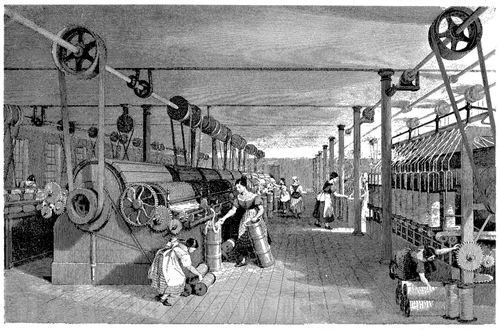
Carding, Drawing, and Roving in 1835.
(Baines: History
of Cotton Manufacture.)
Even among those who were supposed to have reaped the advantages of
the changes of the time many unpleasant phenomena appeared. The farm
laborers were not worse, perhaps were better off on the average, in
the matter of wages, than those of the previous generation, but they
were more completely separated from the land than they had ever been
before, more completely deprived of those wholesome influences which
come from the use of even a small portion of land, and of the
incitement to thrift that comes from the possibility of rising. Few
classes of people have ever been more utterly without enjoyment or
prospects than the modern English farm laborers. And one
class, the yeomen, somewhat higher in position and certainly in
opportunities, had disappeared entirely, recruited into the class of
mere laborers.
In the early factories, women and children were employed more
extensively and more persistently than in earlier forms of industry.
Their labor was in greater demand than that of men. In 1839, of 31,632
employees in worsted mills, 18,416, or considerably more than half,
were under eighteen years of age, and of the 13,216 adults, 10,192
were women, leaving only 3024 adult men among more than 30,000
laborers. In 1832, in a certain flax spinning mill near Leeds, where
about 1200 employees were engaged, 829 were below eighteen, only 390
above; and in the flax spinning industry generally, in 1835, only
about one-third were adults, and only about one-third of these were
men. In the still earlier years of the factory system the proportion
of women and children was even greater, though reliable general
statistics are not available. The cheaper wages, the easier control,
and the smaller size of women and children, now that actual physical
power was not required, made them more desirable to employers, and in
many families the men clung to hand work while the women and children
went into the factories.
The early mills were small, hot, damp, dusty, and unhealthy. They were
not more so perhaps than the cottages where domestic industry had been
carried on; but now the hours were more regular, continuous, and
prolonged in which men, women, and children were subjected to such
labor. All had to conform alike to the regular hours, and these were
in the early days excessive. Twelve, thirteen, and even fourteen hours
a day were not unusual. Regular hours of work, when they are moderate
in length, and a systematized life, when it is not all
labor, are probably wholesome, physically and morally; but when the
summons to cease from work and that to begin it again are separated by
such a short interval, the factory bell or whistle represents mere
tyranny.
Wages were sometimes higher than under the old conditions, but they
were even more irregular. Greater ups and downs occurred. Periods of
very active production and of restriction of production alternated
more decidedly than before, and introduced more irregularity into
industry for both employers and employees. The town laborer engaged in
a large establishment was, like the rural laborer on a large farm,
completely separated from the land, from capital, from any active
connection with the administration of industry, from any probable
opportunity of rising out of the laboring class. His prospects were,
therefore, as limited as his position was laborious and precarious.
The rapid growth of the manufacturing towns, especially in the north,
drawing the scattered population of other parts of the country into
their narrow limits, caused a general breakdown in the old
arrangements for providing water, drainage, and fresh air; and made
rents high, and consequently living in crowded rooms necessary. The
factory towns in the early part of the century were filthy, crowded,
and demoralizing, compared alike with their earlier and their present
condition.
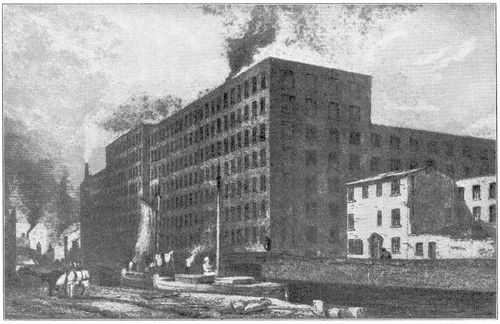
Cotton Factories in Manchester.
(Baines: History of
Cotton Manufacture.)
In the higher grades of economic society the advantages of the recent
changes were more distinct, the disadvantages less so. The rise of
capital and business enterprise into greater importance, and the
extension of the field of competition, gave greater opportunity to
employing farmers, merchants, and manufacturers, as well as to the
capitalists pure and simple. But even for them the keenness of
competition and the exigencies of providing for the varying
conditions of distant markets made the struggle for success a harder
one, and many failed in it.
In many ways therefore it might seem that the great material advances
which had been made, the removal of artificial restrictions, the
increase of liberty of action, the extension of the field of
competition, the more enlightened opinions on economic and social
relations, had failed to increase human happiness appreciably; indeed,
for a time had made the condition of the mass of the people worse
instead of better.
It will not, therefore, be unexpected if some other lines of economic
and social development, especially those which have become more and
more prominent during the later progress of the nineteenth century,
prove to be quite different in direction from those that have been
studied in this chapter.
65. BIBLIOGRAPHY
Toynbee, Arnold: The Industrial Revolution of the Eighteenth Century
in England.
Lecky, W. E. H.: History of England in the Eighteenth Century, Vol.
VI, Chap. 23.
Baines, E.: History of the Cotton Manufacture in Great Britain.
Cooke-Taylor, R. W.: The Modern Factory System.
Levi, L.: History of British Commerce and of the Economic Progress of
the British Nation.
Prothero, R. E.: The Pioneers and Progress of English Farming.
Rogers, J. E. T.: Industrial and Commercial History.
Smith, Adam: An Inquiry into the Nature and Causes of the Wealth of
Nations.
THE EXTENSION OF GOVERNMENT CONTROL
Factory Laws, the Modification of Land Ownership, Sanitary
Regulations, and New Public Services
66. National Affairs from 1830 to 1900.—The English government in the
year 1830 might be described as a complete aristocracy. The king had
practically no powers apart from his ministers, and they were merely
the representatives of the majority in Parliament. Parliament
consisted of the House of Lords and the House of Commons. The first of
these Houses was made up for the most part of an hereditary
aristocracy. The bishops and newly created peers, the only element
which did not come in by inheritance, were appointed by the king and
usually from the families of those who already possessed inherited
titles. The House of Commons had originally been made up of two
members from each county, and two from each important town. But the
list of represented towns was still practically the same as it had
been in the fifteenth century, while intervening economic and other
changes had, as has been seen, made the most complete alteration in
the distribution of population. Great manufacturing towns had grown up
as a result of changes in commerce and of the industrial revolution,
and these had no representation in Parliament separate from the
counties in which they lay. On the other hand, towns once of
respectable size had dwindled until they had only a few dozen
inhabitants, and in some cases had reverted to open farming
country; but these, or the landlords who owned the land on which they
had been built, still retained their two representatives in
Parliament. The county representatives were voted for by all "forty
shilling freeholders," that is, landowners whose farms would rent for
forty shillings a year. But the whole tendency of English landholding,
as has been seen, had been to decrease the number of landowners in the
country, so that the actual number of voters was only a very small
proportion of the rural population.
Such great irregularities of representation had thus grown up that the
selection of more than a majority of the members of the House of
Commons was in the hands of a very small number of men, many of them
already members of the House of Lords, and all members of the
aristocracy.
Just as Parliament represented only the higher classes, so officers in
the army and to a somewhat less extent the navy, the officials of the
established church, the magistrates in the counties, the ambassadors
abroad, and the cabinet ministers at home, the holders of influential
positions in the Universities and endowed institutions generally, were
as a regular thing members of the small class of the landed or
mercantile aristocracy of England. Perhaps one hundred thousand out of
the fourteen millions of the people of England were the veritable
governing classes. They alone had any control of the national and
local government, or of the most important political and social
institutions.
The "Reform of Parliament," which meant some degree of equalization of
the representation of districts, an extension of the franchise, and
the abolition of some of the irregularities in elections, had been
proposed from time to time, but had awakened little interest until it
was advocated by the Radicals under the influence of the French
Revolution, along with some much more far-reaching
propositions. Between the years 1820 and 1830, however, a moderate
reform of Parliament had been advocated by the leaders of the Whig
party. In 1830 this party rather unexpectedly obtained a majority in
Parliament, for the first time for a long while, and the ministry
immediately introduced a reform bill. It proposed to take away the
right of separate representation from fifty-six towns, and to reduce
the number of representatives from two to one in thirty-one others; to
transfer these representatives to the more populous towns and
counties; to extend the franchise to a somewhat larger number and to
equalize it; and finally to introduce lists of voters, to keep the
polls open for only two days, and to correct a number of such minor
abuses. There was a bitter contest in Parliament and in the country at
large on the proposed change, and the measure was only carried after
it had been rejected by one House of Commons, passed by a new House
elected as a test of the question, then defeated by the House of
Lords, and only passed by them when submitted a second time with the
threat by the ministry of requiring the king to create enough new
peers to pass it, if the existing members refused to do so. Its
passage was finally secured in 1832. It was carried by pressure from
below through all its stages. The king signed it reluctantly because
it had been sent to him by Parliament, the House of Lords passed it
under threats from the ministry, who based their power on the House of
Commons. This body in turn had to be reconstructed by a new election
before it would agree to it, and there is no doubt that the voters as
well as Parliament itself were much influenced by the cry of "the
Bill, the whole Bill, and nothing but the Bill," raised by mobs,
associations, and meetings, consisting largely of the masses of the
people who possessed no votes at all. In the last resort,
therefore, it was a victory won by the masses, and, little as they
profited by it immediately, it proved to be the turning point, the
first step from aristocracy toward democracy.
In 1867 a second Reform Bill was passed, mainly on the lines of the
first, but giving what amounted to almost universal suffrage to the
inhabitants of the town constituencies, which included the great body
of the workingmen. Finally, in 1884 and 1885, the third Reform Bill
was passed which extended the right of voting to agricultural laborers
as well, and did much toward equalizing the size of the districts
represented by each member of the House of Commons. Other reforms have
been adopted during the same period, and Parliament has thus come to
represent the whole population instead of merely the aristocracy. But
there have been even greater changes in local government. By laws
passed in 1835 and 1882 the cities and boroughs have been given a form
of government in which the power is in the hands of all the taxpayers.
In 1888 an act was passed through Parliament forming County Councils,
elected by universal suffrage and taking over many of the powers
formerly exercised by the magistrates and large landholders. In 1894
this was followed by a Parish Council Bill creating even more
distinctly local bodies, by which the people in each locality, elected
by universal suffrage, including that of women, may take charge of
almost all their local concerns under the general legislation of
Parliament.
Corresponding to these changes in general and local government the
power of the old ruling classes has been diminished in all directions,
until it has become little more than that degree of prominence and
natural leadership which the national sentiment or their economic and
intellectual advantages give to them. It may be said that England,
so far as its government goes, has come nearer to complete
democracy than any other modern country.
In the rapidity of movement, the activity, the energy, the variety of
interests, the thousand lines of economic, political, intellectual,
literary, artistic, philanthropic, or religious life which
characterize the closing years of the nineteenth century, it seems
impossible to choose a few facts to typify or describe the period, as
is customary for earlier times.
Little can be done except to point out the main lines of political
movement, as has been done in this paragraph, or of economic and
social development, as will be done in the remaining paragraphs of
this and the next chapter. The great mass of recent occurrences and
present conditions are as yet rather the human atmosphere in which we
are living, the problem which we are engaged in solving, than a proper
subject for historical description and analysis.
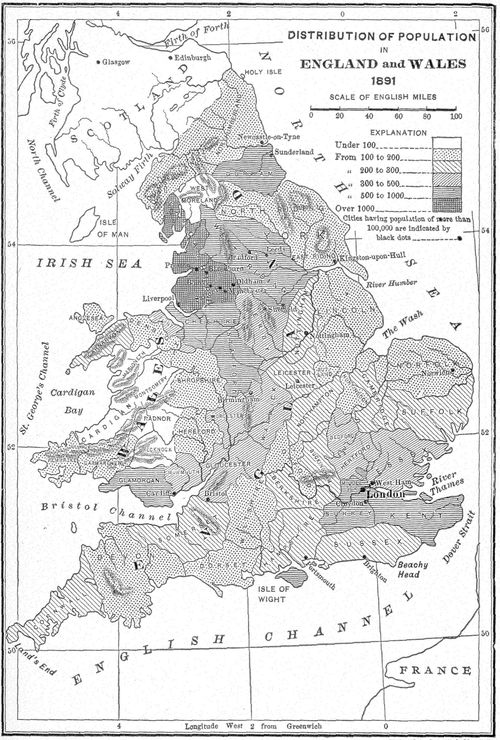
Distribution Of Population In England And Wales 1891.
Engraved By Bormay & Co., N.Y.
67. The Beginning of Factory Legislation.—One of the greatest
difficulties with which the early mill owners had to contend was the
insufficient supply of labor for their factories. Since these had to
be run by water power, they were placed along the rapid streams in the
remote parts of Yorkshire, Lancashire, Derbyshire, and
Nottinghamshire, which were sparsely populated, and where such
inhabitants as there were had a strong objection to working in
factories. However abundant population might be in some other parts of
England, in the northwest where the new manufacturing was growing up,
and especially in the hilly rural districts, there were but few
persons available to perform the work which must be done by human
hands in connection with the mill machinery. There was, however, in
existence a source of supply of laborers which could furnish almost
unlimited numbers and at the lowest possible cost. The parish
poorhouses or workhouses of the large cities were overcrowded
with children. The authorities always had difficulty in
finding occupation for them when they came to an age when they could
earn their own living, and any plan of putting them to work would be
received with welcome. This source of supply was early discovered and
utilized by the manufacturers, and it soon became customary for them
to take as apprentices large numbers of the poorhouse children. They
signed indentures with the overseers of the poor by which they agreed
to give board, clothing, and instruction for a certain number of years
to the children who were thus bound to them. In return they put them
to work in the factories. Children from seven years of age upward were
engaged by hundreds from London and the other large cities, and set to
work in the cotton spinning factories of the north. Since there were
no other facilities for boarding them, "apprentice houses" were built
for them in the vicinity of the factories, where they were placed
under the care of superintendents or matrons. The conditions of life
among these pauper children were, as might be expected, very hard.
They were remotely situated, apart from the observation of the
community, left to the burdens of unrelieved labor and the harshness
of small masters or foremen. Their hours of labor were excessive. When
the demands of trade were active they were often arranged in two
shifts, each shift working twelve hours, one in the day and another in
the night, so that it was a common saying in the north that "their
beds never got cold," one set climbing into bed as the other got out.
When there was no night work the day work was the longer. They were
driven at their work and often abused. Their food was of the coarsest
description, and they were frequently required to eat it while at
their work, snatching a bite as they could while the machinery was
still in motion. Much of the time which should have been
devoted to rest was spent in cleaning the machinery, and there seems
to have been absolutely no effort made to give them any education or
opportunity for recreation.
The sad life of these little waifs, overworked, underfed, neglected,
abused, in the factories and barracks in the remote glens of Yorkshire
and Lancashire, came eventually to the notice of the outside world.
Correspondence describing their condition began to appear in the
newspapers, a Manchester Board of Health made a presentment in 1796
calling attention to the unsanitary conditions in the cotton factories
where they worked, contagious fevers were reported to be especially
frequent in the apprentice houses, and in 1802 Sir Robert Peel,
himself an employer of nearly a thousand such children, brought the
matter to the attention of Parliament. An immediate and universal
desire was expressed to abolish the abuses of the system, and as a
result the "Health and Morals Act to regulate the Labor of Sound
Children in Cotton Factories" was passed in the same year. It
prohibited the binding out for factory labor of children younger than
nine years, restricted the hours of labor to twelve actual working
hours a day, and forbade night labor. It required the walls of the
factories to be properly whitewashed and the buildings to be
sufficiently ventilated, insisted that the apprentices should be
furnished with at least one new suit of clothes a year, and provided
that they should attend religious service and be instructed in the
fundamental English branches. This was the first of the "Factory
Acts," for, although its application was so restricted, applying only
to cotton factories, and for the most part only to bound children, the
subsequent steps in the formation of the great code of factory
legislation were for a long while simply a development of the same
principle, that factory labor involved conditions which it
was desirable for government to regulate.
At the time of the passage of this law the introduction of steam power
was already causing a transfer of the bulk of factory industry from
the rural districts to which the need for water power had confined it
to the towns where every other requisite for carrying on manufacturing
was more easily obtainable. Here the children of families resident in
the town could be obtained, and the practice of using apprentice
children was largely given up. Many of the same evils, however,
continued to exist here. The practice of beginning to work while
extremely young, long hours, night work, unhealthy surroundings,
proved to be as common among these children to whom the law did not
apply as they had been among the apprentice children. These evils
attracted the attention of several persons of philanthropic feeling.
Robert Owen, especially, a successful manufacturer who had introduced
many reforms in his own mills, collected a large body of evidence as
to the excessive labor and early age of employees in the factories
even where no apprentice labor was engaged. He tried to awaken an
interest in the matter by the publication of a pamphlet on the
injurious consequences of the factory system, and to influence various
members of Parliament to favor the passage of a law intended to
improve the condition of laboring children and young people. In 1815
Sir Robert Peel again brought the matter up in Parliament. A committee
was appointed to investigate the question, and a legislative agitation
was thus begun which was destained to last for many years and to
produce a series of laws which have gradually taken most of the
conditions of employment in large establishments under the control of
the government. In debates in Parliament, in testimony before
government commissions of investigation, in petitions,
pamphlets, and newspapers, the conditions of factory labor were
described and discussed. Successive laws to modify these conditions
were introduced into Parliament, debated at great length, amended,
postponed, reintroduced, and in some cases passed, in others defeated.
68. Arguments for and against Factory Legislation.—The need for
regulation which was claimed to exist arose from the long hours of
work which were customary, from the very early age at which many
children were sent to be employed in the factories, and from various
incidents of manufacturing which were considered injurious, or as
involving unnecessary hardship. The actual working hours in the
factories in the early part of the century were from twelve and a half
to fourteen a day. That is to say, factories usually started work in
the morning at 6 o'clock and continued till 12, when a period from a
half-hour to an hour was allowed for dinner, then the work began again
and continued till 7.30 or 8.30 in the evening. It was customary to
eat breakfast after reaching the mill, but this was done while
attending the machinery, there being no general stoppage for the
purpose. Some mills ran even longer hours, opening at 5 A.M. and not
closing till 9 P.M. In some exceptional cases the hours were only 12;
from 6 to 12 and from 1 to 7. The inducements to long hours were very
great. The profits were large, the demand for goods was constantly
growing, the introduction of gas made it possible to light the
factories, and the use of artificial power, either water or steam,
seemed to make the labor much less severe than when the power had been
provided by human muscles. Few or no holidays were regarded, except
Sunday, so that work went on in an unending strain of protracted,
exhausting labor, prolonged for much of the year far into the night.
To these long hours all the hands alike conformed, the
children commencing and stopping work at the same time as the grown
men and women. Moreover, the children often began work while extremely
young. There was a great deal of work in the factories which they
could do just as well, in some cases even better, than adults. They
were therefore commonly sent into the mills by their parents at about
the age of eight years, frequently at seven or even six. As has been
before stated, more than half of the employees in many factories were
below eighteen years, and of these a considerable number were mere
children. Thirdly, there were certain other evils of factory labor
that attracted attention and were considered by the reformers to be
remediable. Many accidents occurred because the moving machinery was
unprotected, the temperature in the cotton mills had to be kept high,
and ventilation and cleanliness were often entirely neglected. The
habit of keeping the machinery in motion while meals were being eaten
was a hardship, and in many ways the employees were practically at the
mercy of the proprietors of the factories so long as there was no form
of oversight or of united action to prevent harshness or unfairness.
In the discussions in Parliament and outside there were of course many
contradictory statements concerning the facts of the case, and much
denial of general and special charges. The advocates of factory laws
drew an extremely sombre picture of the evils of the factory system.
The opponents of such legislation, on the other hand, declared that
their statements were exaggerated or untrue, and that the condition of
the factory laborer was not worse than that of other workingmen, or
harder than that of the domestic worker and his family had been in
earlier times.
But apart from these recriminations and contradictions,
there were certain general arguments used in the debates which can be
grouped into three classes on each side. For the regulating laws there
was in the first place the purely sentimental argument, repulsion
against the hard, unrelieved labor, the abuse, the lack of opportunity
for enjoyment or recreation of the children of the factory districts;
the feeling that in wealthy, humane, Christian England, it was
unendurable that women and little children should work longer hours,
be condemned to greater hardships, and more completely cut off from
the enjoyments of life than were the slaves of tropical countries.
This is the argument of Mrs. Browning's Cry of the Children:—
"Do ye hear the children weeping, O my brothers,
Ere the sorrow comes with years?
They are leaning their young heads against their mothers.
And that cannot stop their tears.
The young lambs are bleating in the meadows;
The young birds are chirping in the nest;
The young fawns are playing with the shadows;
The young flowers are blowing toward the west;
But the young, young children, O my brothers!
They are weeping bitterly.
They are weeping in the play-time of the others
In the country of the free.
'For oh!' say the children, 'we are weary,
And we cannot run or leap:
If we cared for any meadows, it were merely
To drop down in them and sleep.'
They look up with their pale and sunken faces,
And their look is dread to see,
For they mind you of their angels in high places,
With eyes turned on Deity.
'How long,' they say, 'how long, O cruel nation,
Will you stand, to move the world on a child's heart
Stifle down with a mailed heel its palpitation
And tread onward to your throne amid the mart?'"
Secondly, it was argued that the long hours for the children
cut them off from all intellectual and moral training, that they were
in no condition after such protracted labor to profit by any
opportunities of education that should be supplied, that with the
diminished influence of the home, and the demoralizing effects that
were supposed to result from factory labor, ignorance and vice alike
would continue to be its certain accompaniments, unless the age at
which regular work was begun should be limited, and the number of
hours of labor of young persons restricted. Thirdly, it was claimed
that there was danger of the physical degeneracy of the factory
population. Certain diseases, especially of the joints and limbs, were
discovered to be very prevalent in the factory districts. Children who
began work so early in life and were subjected to such long hours of
labor did not grow so rapidly, nor reach their full stature, nor
retain their vigor so late in life, as did the population outside of
the factories. Therefore, for the very physical preservation of the
race, it was declared to be necessary to regulate the conditions of
factory labor.
On the other hand, apart from denials as to the facts of the case,
there were several distinct arguments used against the adoption of
factory laws. In the first place, in the interests of the
manufacturers, such laws were opposed as an unjust interference with
their business, an unnecessary and burdensome obstacle to their
success, and a threat of ruin to a class who by giving employment to
so many laborers and furnishing so much of the material for commerce
were of the greatest advantage to the country. Secondly, from a
somewhat broader point of view, it was declared that if such laws were
adopted England would no longer be able to compete with other
countries and would lose her preëminence in manufactures. The factory
system was being introduced into France, Belgium, the United
States, and other countries, and in none of these was there any legal
restriction on the hours of labor or the age of the employees. If
English manufacturers were forced to reduce the length of the day in
which production was carried on, they could not produce as cheaply as
these other countries, and English exports would decrease. This would
reduce the national prosperity and be especially hard on the working
classes themselves, as many would necessarily be thrown out of work.
Thirdly, as a matter of principle it was argued that the policy of
government regulation had been tried and found wanting, that after
centuries of existence it had been deliberately given up, and should
not be reintroduced. Laws restricting hours would interfere with the
freedom of labor, with the freedom of capital, with the freedom of
contract. If the employer and the employee were both satisfied with
the conditions of their labor, why should the government interfere?
The reason also why such regulation had failed in the past and must
again, if tried now, was evident. It was an effort to alter the action
of the natural laws which controlled employment, wages, profits, and
other economic matters, and was bad in theory, and would therefore
necessarily be injurious in practice. These and some other less
general arguments were used over and over again in the various forms
of the discussion through almost half a century. The laws that were
passed were carried because the majority in Parliament were either not
convinced by these reasonings or else determined that, come what
might, the evils and abuses connected with factory labor should be
abolished. As a matter of fact, the factory laws were carried by the
rank and file of the voting members of Parliament, not only against
the protests of the manufacturers especially interested, but in spite
of the warnings of those who spoke in the name of
established teaching, and frequently against the opposition of the
political leaders of both parties. The greatest number of those who
voted for them were influenced principally by their sympathies and
feelings, and yielded to the appeals of certain philanthropic
advocates, the most devoted and influential of whom was Lord Ashley,
afterward earl of Shaftesbury, who devoted many years to investigation
and agitation on the subject both inside and out of Parliament.
69. Factory Legislation to 1847.—The actual course of factory
legislation was as follows. The bill originally introduced in 1815,
after having been subjected to a series of discussions, amendments,
and postponements, was passed in June, 1819, being the second "Factory
Act." It applied only to cotton mills, and was in the main merely an
extension of the act of 1802 to the protection of children who were
not pauper apprentices. It forbade the employment of any child under
nine years of age, and prohibited the employment of those between nine
and sixteen more than twelve hours a day, or at night. In addition to
the twelve hours of actual labor, at least a half-hour must be allowed
for breakfast and an hour for dinner. Other minor acts amending or
extending this were passed from time to time, till in 1833, after two
successive commissions had made investigations and reports on the
subject, an important law was passed. It applied practically to all
textile mills, not merely to those for the spinning of cotton. The
prohibition of employment of all below nine years was continued,
children between nine and thirteen were to work only eight hours per
day, and young persons between thirteen and eighteen only twelve
hours, and none of these at night. Two whole and eight half holidays
were required to be given within the year, and each child must have a
surgeon's certificate of fitness for labor. There were also
clauses for the education of the children and the cleanliness of the
factories. But the most important clause of this statute was the
provision of a corps of four inspectors with assistants who were sworn
to their duties, salaried, and provided with extensive powers of
making rules for the execution of the act, of enforcing it, and
prosecuting for its violation. The earlier laws had not been
efficiently carried out. Under this act numerous prosecutions and
convictions took place, and factory regulation began to become a
reality. The inspectors calculated during their first year of service
that there were about 56,000 children between nine and thirteen, and
about 108,000 young persons between thirteen and eighteen, in the
factories under their supervision.
The decade lying between 1840 and 1850 was one of specially great
activity in social and economic agitation. Chartism, the abolition of
the corn laws, the formation of trade unions, mining acts, and further
extensions of the factory acts were all alike under discussion, and
they all created the most intense antagonism between parties and
classes. In 1844 the law commonly known as the "Children's Half-time
Act" was passed. It contained a large number of general provisions for
the fencing of dangerous machinery, for its stoppage while being
cleaned, for the report of accidents to inspectors and district
surgeons, for the public prosecution for damages of the factory owner
when he should seem to be responsible for an accident, and for the
enforcement of the act. Its most distinctive clause, however, was that
which restricted the labor of children to a half-day, or the whole of
alternate days, and required their attendance at school for the other
half of their time. All women were placed by this act in the same
category as young persons between thirteen and eighteen, so far as the
restriction of hours of labor to twelve per day and the
prohibition of night work extended.
The next statute to be passed was an extension of this regulation,
though it contained the provision which had long been the most
bitterly contested of any during the whole factory law agitation. This
was the "Ten-hour Act" of 1847. From an early period in the century
there had been a strong agitation in favor of restricting by law the
hours of young persons, and from somewhat later, of women, to ten
hours per day, and this proposition had been repeatedly introduced and
defeated in Parliament. It was now carried. By this time the more
usual length of the working day even when unrestricted had been
reduced to twelve hours, and in some trades to eleven. It was now made
by law half-time for children, and ten hours for young persons and
women, or as rearranged by another law passed three years afterward,
ten and a half hours for five days of the week and a half-day on
Saturday. The number of persons to whom the Ten-hour Act applied was
estimated at something over 360,000. That is, including the children,
at least three-fourths of all persons employed in textile industries
had their hours and some other conditions of labor directly regulated
by law. Moreover, the work of men employed in the same factories was
so dependent on that of the women and the children, that many of these
restrictions applied practically to them also.
Further minor changes in hours and other details were made from time
to time, but there was no later contest on the principle of factory
legislation. The evil results which had been feared had not shown
themselves, and many of its strongest opponents had either already, or
did eventually, acknowledge the beneficial results of the laws.
70. The Extension of Factory Legislation.—By the successive
acts of 1819, 1833, 1844, and 1847, a normal length of
working day and regulated conditions generally had been established by
government for the factories employing women and children. The next
development was an extension of the regulation of hours and conditions
of labor from factories proper to other allied fields. Already in 1842
a law had been passed regulating labor in mines. This act was passed
in response to the needs shown by the report of a commission which had
been appointed in 1840. They made a thorough investigation of the
obscure conditions of labor underground, and reported a condition of
affairs which was heart-sickening. Children began their life in the
coal mines at five, six, or seven years of age. Girls and
women worked like boys and men, they were less than half clothed, and
worked alongside of men who were stark naked. There were from twelve
to fourteen working hours in the twenty-four, and these were often at
night. Little girls of six or eight years of age made ten to twelve
trips a day up steep ladders to the surface, carrying half a hundred
weight of coal in wooden buckets on their backs at each journey. Young
women appeared before the commissioners, when summoned from their
work, dressed merely in a pair of trousers, dripping wet from the
water of the mine, and already weary with the labor of a day scarcely
more than begun. A common form of labor consisted of drawing on hands
and knees over the inequalities of a passageway not more than two feet
or twenty-eight inches high a car or tub filled with three or four
hundred weight of coal, attached by a chain and hook to a leather band
around the waist. The mere recital of the testimony taken precluded
all discussion as to the desirability of reform, and a law was
immediately passed, almost without dissent, which prohibited for the
future all work underground by females or by boys under thirteen years
of age. Inspectors were appointed, and by subsequent acts a whole code
of regulation of mines as regards age, hours, lighting, ventilation,
safety, licensing of engineers, and in other respects has been
created.
Children's Labor in Coal Mines.
Report of Children's
Employment Commission of 1842.
Women's Labor in Coal Mines.
(Report of Children's
Employment Commission, 1842.)
In 1846 a bill was passed applying to calico printing works
regulations similar to the factory laws proper. In 1860, 1861, and
1863 similar laws were passed for bleaching and dyeing for lace works,
and for bakeries. In 1864 another so-called factory act was passed
applying to at least six other industries, none of which had any
connection with textile factories. Three years later, in 1867, two
acts for factories and workshops respectively took a large number of
additional industries under their care; and finally, in
1878, the "Factory and Workshop Consolidation Act" repealed all the
former special laws and substituted a veritable factory code
containing a vast number of provisions for the regulation of
industrial establishments. This law covered more than fifty printed
pages of the statute book. Its principle provisions were as follows:
The limit of prohibited labor was raised from nine to ten years,
children in the terms of the statute being those between ten and
fourteen, and "young persons" those between fourteen and eighteen
years of age. For all such the day's work must begin either at six or
seven, and close at the same hour respectively in the evening, two
hours being allowed for meal-times. All Saturdays and eight other days
in the year must be half-holidays, while the whole of Christmas Day
and Good Friday, or two alternative days, must be allowed as holidays.
Children could work for only one-half of each day or on the whole of
alternate days, and must attend school on the days or parts of days on
which they did not work. There were minute provisions governing
sanitary conditions, safety from machinery and in dangerous
occupations, meal-times, medical certificates of fitness for
employment, and reports of accidents. Finally there were the necessary
body of provisions for administration, enforcement, penalties, and
exceptions.
Since 1878 there have been a number of extensions of the principle of
factory legislation, the most important of which are the following. In
1891 and 1895, amending acts were passed bringing laundries and docks
within the provisions of the law, making further rules against
overcrowding and other unsanitary conditions, increasing the age of
prohibited labor to eleven years, and making a beginning of the
regulation of "outworkers" or those engaged by "sweaters."
"Sweating" is manufacturing carried on by contractors or
subcontractors on a small scale, who usually have the work done in
their own homes or in single hired rooms by members of their families,
or by poorly paid employees who by one chance or another are not in a
free and independent relation to them. Many abuses exist in these
"sweatshops." The law so far is scarcely more than tentative, but in
these successive acts provisions have been made by which all
manufacturers or contractors must keep lists of outworkers engaged by
them, and submit these to the factory inspectors for supervision.
In 1892 a "Shop-hours Act" was passed prohibiting the employment of
any person under eighteen years of age more than seventy-four hours in
any week in any retail or wholesale store, shop, eating-house, market,
warehouse, or other similar establishment; and in 1893 the "Railway
Regulation Act" gave power to the Board of Trade to require railway
companies to provide reasonable and satisfactory schedules of hours
for all their employees. In 1894 a bill for a compulsory eight-hour
day for miners was introduced, but was withdrawn before being
submitted to a vote. In 1899 a bill was passed requiring the provision
of a sufficient number of seats for all female assistants in retail
stores. In 1900 a government bill was presented to Parliament carrying
legislation somewhat farther on the lines of the acts of 1891 and
1893, but it did not reach its later stages before the adjournment.
71. Employers' Liability Acts.—Closely allied to the problems
involved in the factory laws is the question of the liability of
employers to make compensation for personal injuries suffered by
workmen in their service. With the increasing use of machinery and of
steam power for manufacturing and transportation, and in the general
absence of precaution, accidents to workmen became much more
numerous. Statistics do not exist for earlier periods, but in 1899
serious or petty accidents to the number of 70,760 were reported from
such establishments. By Common Law, in the case of negligence on the
part of the proprietor or servant of an establishment, damages for
accident could be sued for and obtained by a workman, not guilty of
contributory negligence, as by any other person, except in one case.
If the accident was the result of the negligence of a fellow-employee,
no compensation for injuries would be allowed by the courts; the
theory being that in the implied contract between employer and
employee, the latter agreed to accept the risks of the business, at
least so far as these arose from the carelessness of his
fellow-employees.
In the large establishments of modern times, however, vast numbers of
men were fellow-employees in the eyes of the law, and the doctrine of
"common employment," as it was called, prevented the recovery of
damages in so many cases as to attract widespread attention. From 1865
forward this provision of the law was frequently complained of by
leaders of the workingmen and others, and as constantly upheld by the
courts.
In 1876 a committee of the House of Commons on the relations of master
and servant took evidence on this matter and recommended in its report
that the common law be amended in this respect. Accordingly in 1880 an
Employers' Liability Act was passed which abolished the doctrine of
"common employment" as to much of its application, and made it
possible for the employee to obtain compensation for accidental injury
in the great majority of cases.
In 1893 a bill was introduced in Parliament by the ministry of the
time to abolish all deductions from the responsibility of employers,
except that of contributory negligence on the part of
workmen, but it was not passed. In 1897, however, the "Workmen's
Compensation Act" was passed, changing the basis of the law entirely.
By this Act it was provided that in case of accident to a workman
causing death or incapacitating him for a period of more than two
weeks, compensation in proportion to the wages he formerly earned
should be paid by the employer as a matter of course, unless "serious
and wilful misconduct" on the part of the workman could be shown to
have existed. The liability of employers becomes, therefore, a matter
of insurance of workmen against accidents arising out of their
employment, imposed by the law upon employers. It is no longer damages
for negligence, but a form of compulsory insurance. In other words,
since 1897 a legal, if only an implied part of the contract between
employer and employee in all forms of modern industry in which
accidents are likely to occur is that the employer insures the
employee against the dangers of his work.
72. Preservation of Remaining Open Lands.—Turning from the field of
manufacturing labor to that of agriculture and landholding it will be
found that there has been some legislation for the protection of the
agricultural laborer analogous to the factory laws. The Royal
Commission of 1840-1844 on trades then unprotected by law included a
report on the condition of rural child labor, but no law followed
until 1873, when the "Agricultural Children's Act" was passed, but
proved to be ineffective. The evils of "agricultural gangs," which
were bodies of poor laborers, mostly children, engaged by a contractor
and taken from place to place to be hired out to farmers, were
reported on by a commission in 1862, and partly overcome by the
"Agricultural Gangs Act" of 1867. There is, however, but little
systematic government oversight of the farm-laboring class.
Government regulation in the field of landholding has taken a
somewhat different form. The movement of enclosing which had been in
progress from the middle of the eighteenth century was brought to an
end, and a reversal of tendency took place, by which the use and
occupation of the land was more controlled by the government in the
interest of the masses of the rural population. By the middle of the
century the process of enclosing was practically complete. There had
been some 3954 private enclosure acts passed, and under their
provisions or those of the Enclosure Commissioners more than seven
million acres had been changed from mediæval to modern condition. But
now a reaction set in. Along with the open field farming lands it was
perceived that open commons, village greens, gentlemen's parks, and
the old national forest lands were being enclosed, and frequently for
building or railroad, not for agricultural uses, to the serious
detriment of the health and of the enjoyment of the people, and to the
destruction of the beauty of the country. The dread of interference by
the government with matters that might be left to private settlement
was also passing away. In 1865 the House of Commons appointed a
commission to investigate the question of open spaces near the city of
London, and the next year on their recommendation passed a law by
which the Enclosure Commissioners were empowered to make regulations
for the use of all commons within fifteen miles of London as public
parks, except so far as the legal rights of the lords of the manors in
which the commons lay should prevent. A contest had already arisen
between many of these lords of manors having the control of open
commons, whose interest it was to enclose and sell them, and other
persons having vague rights of pasturage and other use of them,
whose interest it was to preserve them as open spaces. To
aid the latter in their legal resistance to proposed enclosures, the
"Commons Preservation Society" was formed in 1865. As a result a
number of the contests were decided in the year 1866 in favor of those
who opposed enclosures.
The first case to attract attention was that of Wimbledon Common, just
west of London. Earl Spencer, the lord of the manor of Wimbledon, had
offered to give up his rights on the common to the inhabitants of the
vicinity in return for a nominal rent and certain privileges; and had
proposed that a third of the common should be sold, and the money
obtained for it used to fence, drain, beautify, and keep up the
remainder. The neighboring inhabitants, however, preferred the
spacious common as it stood, and when a bill to carry out Lord
Spencer's proposal had been introduced into Parliament, they contended
that they had legal rights on the common which he could not disregard,
and that they objected to its enclosure. The parliamentary committee
practically decided in their favor, and the proposition was dropped.
An important decision in a similar case was made by the courts in
1870. Berkhamstead Common, an open stretch some three miles long and
half a mile wide, lying near the town of Berkhamstead, twenty-five
miles north of London, had been used for pasturing animals, cutting
turf, digging gravel, gathering furze, and as a place of general
recreation and enjoyment by the people of the two manors in which it
lay, from time immemorial. In 1866 Lord Brownlow, the lord of these
two manors, began making enclosures upon it, erecting two iron fences
across it so as to enclose 434 acres and to separate the remainder
into two entirely distinct parts. The legal advisers of Lord Brownlow
declared that the inhabitants had no rights which would prevent him
from enclosing parts of the common, although to satisfy them
he offered to give to them the entire control over one part of it. The
Commons Preservation Society, however, advised the inhabitants
differently, and encouraged them to make a legal contest. One of their
number, Augustus Smith, a wealthy and obstinate man, a member of
Parliament, and a possessor of rights on the common both as a
freeholder and a copyholder, was induced to take action in his own
name and as a representative of other claimants of common rights. He
engaged in London a force of one hundred and twenty laborers, sent
them down at night by train, and before morning had broken down Lord
Brownlow's two miles of iron fences, on which he had spent some £5000,
and piled their sections neatly up on another part of the common. Two
lawsuits followed: one by Lord Brownlow against Mr. Smith for
trespass, the other a cross suit in the Chancery Court by Mr. Smith to
ascertain the commoner's rights, and prevent the enclosure of the
common. After a long trial the decision was given in Mr. Smith's
favor, and not only was Berkhamstead Common thus preserved as an open
space, but a precedent set for the future decision of other similar
cases. Within the years between 1866 and 1874 dispute after dispute
analogous to this arose, and decision after decision was given
declaring the illegality of enclosures by a lord of a manor where
there were claims of commoners which they still asserted and valued
and which could be used as an obstacle to enclosure. Hampstead Heath,
Ashdown Forest, Malvern Hills, Plumstead, Tooting, Wandsworth,
Coulston, Dartford, and a great many other commons, village greens,
roadside wastes, and other open spaces were saved from enclosure, and
some places were partly opened up again, as a result either of
lawsuits, of parliamentary action, or of voluntary agreements and
purchase.
Perhaps the most conspicuous instance was that of Epping
Forest. This common consisted of an open tract about thirteen miles
long and one mile wide, containing in 1870 about three thousand acres
of open common land. Enclosure was being actively carried on by some
nineteen lords of manors, and some three thousand acres had been
enclosed by rather high-handed means within the preceding twenty
years. Among the various landowners who claimed rights of common upon
a part of the Forest was, however, the City of London, and in 1871
this body began suit against the various lords of manors under the
claim that it possessed pasture rights, not only in the manor of
Ilford, in which its property of two hundred acres was situated, but,
since the district was a royal forest, over the whole of it. The City
asked that the lords of manors should be prevented from enclosing any
more of it, and required to throw open again what they had enclosed
during the last twenty years. After a long and expensive legal battle
and a concurrent investigation by a committee of Parliament, both
extending over three years, a decision was given in favor of the City
of London and other commoners, and the lords of manors were forced to
give back about three thousand acres. The whole was made permanently
into a public park. The old forest rights of the crown proved to be
favorable to the commoners, and thus obtained at least one tardy
justification to set against their long and dark record in the past.
In 1871, in one of the cases which had been appealed, the Lord
Chancellor laid down a principle indicating a reaction in the judicial
attitude on the subject, when he declared that no enclosure should be
made except when there was a manifest advantage in it; as contrasted
with the policy of enclosing unless there was some strong reason
against it, as had formerly been approved. In 1876
Parliament passed a law amending the acts of 1801 and 1845, and
directing the Enclosure Commissioners to reverse their rule of action
in the same direction. That is to say, they were not to approve any
enclosure unless it could be shown to be to the manifest advantage of
the neighborhood, as well as to the interest of the parties directly
concerned. Finally, in 1893, by the Commons Law Amendment Act, it was
required that every proposed enclosure of any kind should first be
advertised and opportunity given for objection, then submitted to the
Board of Agriculture for its approval, and this approval should only
be given when such an enclosure was for the general benefit of the
public. No desire of a lord of a manor to enclose ground for his
private park or game preserve, or to use it for building ground, would
now be allowed to succeed. The interest of the community at large has
been placed above the private advantage and even liberty of action of
landholders. The authorities do not merely see that justice is done
between lord and commoners on the manor, but that both alike shall be
restrained from doing what is not to the public advantage. Indeed,
Parliament went one step further, and by an order passed in 1893 set a
precedent for taking a common entirely out of the hands of the lord of
the manor, and putting it in the hands of a board to keep it for
public uses. Thus not only had the enclosing movement diminished for
lack of open farming land to enclose, but public opinion and law
between 1864 and 1893 interposed to preserve such remaining open land
as had not been already divided. Whatever land remained that was not
in individual ownership and occupancy was to be retained under control
for the community at large.
73. Allotments.—But this change of attitude was not merely
negative. There were many instances of government interposition for
the encouragement of agriculture and for the modification of the
relations between landlord and tenant. In 1875, 1882, and 1900 the
"Agricultural Holdings Acts" were passed, by which, when improvements
are made by the tenant during the period in which he holds the land,
compensation must be given by the landlord to the tenant when the
latter retires. No agreement between the landlord and tenant by which
the latter gives up this right is valid. This policy of controlling
the conditions of landholding with the object of enforcing justice to
the tenant has been carried to very great lengths in the Irish Land
Bills and the Scotch Crofters' Acts, but the conditions that called
for such legislation in those countries have not existed in England
itself. There has been, however, much effort in England to bring at
least some land again into the use of the masses of the rural
population. In 1819, as part of the administration of the poor law,
Parliament passed an act facilitating the leasing out by the
authorities of common land belonging to the parishes to the poor, in
small "allotments," as they were called, by the cultivation of which
they might partially support themselves. Allotments are small pieces
of land, usually from an eighth of an acre to an acre in size, rented
out for cultivation to poor or working-class families. In 1831 parish
authorities were empowered to buy or enclose land up to as much as
five acres for this purpose. Subsequently the formation of allotments
began to be advocated, not only as part of the system of supporting
paupers, but for its own sake, in order that rural laborers might have
some land in their own occupation to work on during their spare times,
as their forefathers had during earlier ages. To encourage this plan
of giving the mass of the people again an interest in the
land the "Allotments and Small Holdings Association" was formed in
1885. Laws which were passed in 1882 and 1887 made it the duty of the
authorities of parishes, when there seemed to be a demand for
allotments, to provide all the land that was needed for the purpose,
giving them, if needed, and under certain restrictions, the right of
compulsory purchase of any particular piece of land which they should
feel to be desirable. This was to be divided up and rented out in
allotments from one quarter of an acre to an acre in size. By laws
passed in 1890 and 1894 this plan of making it the bounden duty of the
local government to provide sufficient allotments for the demand, and
giving them power to purchase land even without the consent of its
owners, was carried still further and put in the hands of the parish
council. The growth in numbers of such allotments was very rapid and
has not yet ceased. The approximate numbers at several periods are as
follows:—
| 1873 |
246,398 |
| 1888 |
357,795 |
| 1890 |
455,005 |
| 1895 |
579,133 |
In addition to those formed and granted out by the public local
authorities, many large landowners, railroad companies, and others
have made allotments to their tenants or employees. Large tracts of
land subdivided into such small patches are now a common sight in
England, simulating in appearance the old open fields of the Middle
Ages and early modern times.
74. Small Holdings.—Closely connected with the extension of
allotments is the movement for the creation of "small holdings," or
the reintroduction of small farming. One form of this is that by which
the local authorities in 1892 were empowered to buy land for
the purpose of renting it out in small holdings of not more than
fifteen acres each to persons who would themselves cultivate it.
A still further and much more important development in the same
direction is the effort to introduce "peasant proprietorship," or the
ownership of small amounts of farming land by persons who would
otherwise necessarily be mere laborers on other men's land. There has
been an old dispute as to the relative advantages of a system of large
farms, rented by men who have some considerable capital, knowledge,
and enterprise, as in England; and of a system of small farms, owned
and worked by men who are mere peasants, as in France. The older
economists generally advocated the former system as better in itself,
and also pointed out that a policy of withdrawal by government from
any regulation was tending to make it universal. Others have been more
impressed with the good effects of the ownership of land on the mental
and moral character of the population, and with the desirability of
the existence of a series of steps by which a thrifty and ambitious
workingman could rise to a higher position, even in the country. There
has, therefore, since the middle of the century, been a widespread
agitation in favor of the creation of smaller farms, of giving
assistance in their purchase, and of thus introducing a more mixed
system of rural land occupancy, and bringing back something of the
earlier English yeoman farming.
This movement obtained recognition by Parliament in the Small Holdings
Act of 1892, already referred to. This law made it the duty of each
county council, when there seemed to be any sufficient demand for
small farms from one to fifty acres in size, to acquire in any way
possible, though not by compulsory purchase, suitable land, to adapt
it for farming purposes by fencing, making roads, and, if
necessary, erecting suitable buildings; and then to dispose of it by
sale, or, as a matter of exception, as before stated, on lease, to
such parties as will themselves cultivate it. The terms of sale were
to be advantageous to the purchaser. He must pay at least as much as a
fifth of the price down, but one quarter of it might be left on
perpetual ground-rent, and the remainder, slightly more than one-half,
might be repaid in half-yearly instalments during any period less than
fifty years. The county council was also given power to loan money to
tenants of small holdings to buy from their landlords, where they
could arrange terms of purchase but had not the necessary means.
Through the intervention of government, therefore, the strict division
of those connected with the land into landlords, tenant farmers, and
farm laborers has been to a considerable extent altered, and it is
generally possible for a laborer to obtain a small piece of land as an
allotment, or, if more ambitious and able, a small farm, on
comparatively easy terms. In landholding and agriculture, as in
manufacturing and trade, government has thus stepped in to prevent
what would have been the effect of mere free competition, and to bring
about a distribution and use of the land which have seemed more
desirable.
75. Government Sanitary Control.—In the field of buying and selling
the hand of government has been most felt in provisions for the health
of the consumer of various articles. Laws against adulteration have
been passed, and a code of supervision, registry, and enforcement
constructed. Similarly in broader sanitary lines, by the "Housing of
the Working Classes Act" of 1890, when it is brought to the attention
of the local authorities that any street or district is in such a
condition that its houses or alleys are unfit for human
habitation, or that the narrowness, want of light or air, or bad
drainage makes the district dangerous to the health of the inhabitants
or their neighbors, and that these conditions cannot be readily
remedied except by an entire rearrangement of the district, then it
becomes the duty of the local authorities to take the matter in hand.
They are bound to draw up and, on approval by the proper superior
authorities, to carry out a plan for widening the streets and
approaches to them, providing proper sanitary arrangements, tearing
down the old houses, and building new ones in sufficient number and
suitable character to provide dwelling accommodation for as many
persons of the working class as were displaced by the changes. Private
rights or claims are not allowed to stand in the way of any such
public action in favor of the general health and well-being, as the
local authorities are clothed by the law with the right of purchase of
the land and buildings of the locality at a valuation, even against
the wishes of the owners, though they must obtain parliamentary
confirmation of such a compulsory purchase. Several acts have been
passed to provide for the public acquisition or building of
workingmen's dwellings. In 1899 the "Small Dwellings Acquisition Act"
gave power to any local authority to loan four-fifths of the cost of
purchase of a small house, to be repaid by the borrower by instalments
within thirty years.
Laws for the stamping out of cattle disease have been passed on the
same principle. In 1878, 1886, 1890, 1893, and 1896 successive acts
were passed which have given to the Board of Agriculture the right to
cause the slaughter of any cattle or swine which have become infected
or been subjected to contagious diseases; Parliament has also set
apart a sufficient sum of money and appointed a large corps of
inspectors to carry out the law. Official analysts of fertilizers
and food-stuffs for cattle have also since 1893 been
regularly appointed by the government in each county. Adulteration has
been taken under control by the "Sale of Food and Drugs Act" of 1875,
with its later amendments and extensions, especially that of 1899.
76. Industries Carried on by Government.—In addition to the
regulation in these various respects of industries carried on by
private persons, and intervention for the protection of the public
health, the government has extended its functions very considerably by
taking up certain new duties or services, which it carries out itself
instead of leaving to private hands.
The post-office is such an old and well-established branch of the
government's activity as not in itself to be included among newly
adopted functions, but its administration has been extended since the
middle of the century over at least four new fields of duty: the
telegraph, the telephone, the parcels post, and the post-office
savings-bank.
The telegraph system of England was built up in the main and in its
early stages by private persons and companies. After more than
twenty-five years of competitive development, however, there was
widespread public dissatisfaction with the service. Messages were
expensive and telegraphing inconvenient. Many towns with populations
from three thousand to six thousand were without telegraphic
facilities nearer than five or ten miles, while the offices of
competing companies were numerous in busy centres. In 1870, therefore,
all private telegraph companies were bought up by the government at an
expense of £10,130,000. A strict telegraphic monopoly in the hands of
the government was established, and the telegraph made an integral
part of the post-office system.
In 1878 the telephone began to compete with the telegraph,
and its relation to the government telegraphic monopoly became a
matter of question. At first the government adopted the policy of
collecting a ten per cent royalty on all messages, but allowed
telephones to be established by private companies. In the meantime the
various companies were being bought up successively by the National
Telephone Company which was thus securing a virtual monopoly. In 1892
Parliament authorized the Postmaster General to spend £1,000,000,
subsequently raised to £1,300,000, in the purchase of telephone lines,
and prohibited any private construction of new lines. As a result, by
1897 the government had bought up all the main or trunk telephone
lines and wires, leaving to the National Telephone Company its
monopoly of all telephone communication inside of the towns. This
monopoly was supposed to be in its legal possession until 1904, when
it was anticipated that the government would buy out its property at a
valuation. In 1898, however, there was an inquiry by Parliament, and a
new "Telegraph Act" was passed in 1899. The monopoly of the National
Company was discredited and the government began to enter into
competition with it within the towns, and to authorize local
governments and private companies under certain circumstances to do
the same. It was provided that every extension of an old company and
every new company must obtain a government license and that on the
expiring of this license the plant could be bought by the government.
In the meantime the post-office authorities have power to restrict
rates. An appropriation of £2,000,000 was put in the hands of the
Postmaster General to extend the government telephone system. It seems
quite certain that by 1925, at latest, all telephones will be in the
hands of the government.
The post-office savings-bank was established in 1861. Any
sum from one shilling upward is accepted from any depositor until his
deposits rise to £50 in any one year, or a total of £200 in all. It
presents great attractions from its security and its convenience. The
government through the post-office pays two and one-half per cent
interest. In 1870 there was deposited in the post-office savings-banks
approximately £14,000,000, in 1880 £31,000,000, and ten years later
£62,000,000. In 1880 arrangements were made by which government bonds
and annuities can be bought through the post-office. In 1890 some
£4,600,000 was invested in government stock in this way.
The parcels post was established in 1883. This branch of the
post-office does a large part of the work that would otherwise be done
by private express companies. It takes charge of packages up to eleven
pounds in weight and under certain circumstances up to twenty-one
pounds, presented at any branch post-office, and on prepayment of
regular charges delivers them to their consignees.
In these and other forms each year within recent times has seen some
extension of the field of government control for the good of the
community in general, or for the protection of some particular class
in the community, and there is at the same time a constant increase in
the number and variety of occupations that the government
undertakes. Instead of withdrawing from the field of intervention
in economic concerns, and restricting its activity to the narrowest
possible limits, as was the tendency in the last period, the
government is constantly taking more completely under its regulation
great branches of industry, and even administering various lines of
business that formerly were carried on by private hands.
77. BIBLIOGRAPHY
Jevons, Stanley: The State in Relation to Labor.
"Alfred" (Samuel Kydd): The History of the Factory Movement from the
Year 1802 to the Enactment of the Ten Hours Bill in 1847.
Von Plener, E.: A History of English Factory Legislation.
Cooke-Taylor, R. W.: The Factory System and the Factory Acts.
Redgrave, Alexander: The Factory Acts.
Shaftesbury, The Earl of: Speeches on Labour Questions.
Birrell, Augustine: Law of Employers' Liability.
Shaw-Lefevre, G.: English Commons and Forests.
Far the best sources of information for the adoption of the factory
laws, as for other nineteenth-century legislation, are the debates in
Parliament and the various reports of Parliamentary Commissions, where
access to them can be obtained. The early reports are enumerated in
the bibliography in Cunningham's second volume. The later can be found
in the appropriate articles in Palgrave's Dictionary. For recent
legislation, the action of organizations, and social movements
generally, the articles in Hazell's Annual, in its successive issues
since 1885, are full, trustworthy, and valuable.
THE EXTENSION OF VOLUNTARY ASSOCIATION
Trade Unions, Trusts, and Coöperation
78. The Rise of Trade Unions.—One of the most manifest effects of the
introduction of the factory system was the intensification of the
distinction between employers and employees. When a large number of
laborers were gathered together in one establishment, all in a similar
position one to the other and with common interests as to wages, hours
of labor, and other conditions of their work, the fact that they were
one homogeneous class could hardly escape their recognition. Since
these common interests were in so many respects opposed to those of
their employers, the advantages of combination to obtain added
strength in the settlement of disputed questions was equally evident.
As the Statute of Apprentices was no longer in force, and freedom of
contract had taken its place, a dispute between an employer and a
single employee would result in the discharge of the latter. If the
dispute was between the employer and his whole body of employees, each
one of the latter would be in a vastly stronger position, and there
would be something like equality in the two sides of the contest.
Under the old gild conditions, when each man rose successively from
apprentice to journeyman, and from journeyman to employer, when the
relations between the employing master and his journeymen and
apprentices were very close, and the advantages of the gild
were participated in by all grades of the producing body,
organizations of the employed against the employers could hardly
exist. It has been seen that the growth of separate combinations was
one of the indications of a breaking down of the gild system. Even in
the later times, when establishments were still small and scattered,
when the government required that engagements should be made for long
periods, and that none should work in an industry except those who had
been apprenticed to it, and when rates of wages and hours of labor
were supposed to be settled by law, the opposition between the
interests of employers and employees was not very strongly marked. The
occasion or opportunity for union amongst the workmen in most trades
still hardly existed. Unions had been formed, it is true, during the
first half of the eighteenth century and spasmodically in still
earlier times. These were, however, mostly in trades where the
employers made up a wealthy merchant class and where the prospect of
the ordinary workman ever reaching the position of an employer was
slight.
The changes of the Industrial Revolution, however, made a profound
difference. With the growth of factories and the increase in the size
of business establishments the employer and employee came to be
farther apart, while at the same time the employees in any one
establishment or trade were thrown more closely together. The hand of
government was at about the same time entirely withdrawn from the
control of wages, hours, length of engagements, and other conditions
of labor. Any workman was at liberty to enter or leave any occupation
under any circumstances that he chose, and an employer could similarly
hire or discharge any laborer for any cause or at any time he saw fit.
Under these circumstances of homogeneity of the interests of
the laborers, of opposition of their interests to those of the
employer, and of the absence of any external control, combinations
among the workmen, or trade unions, naturally sprang up.
79. Opposition of the Law and of Public Opinion. The Combination
Acts.—Their growth, however, was slow and interrupted. The poverty,
ignorance, and lack of training of the laborers interposed a serious
obstacle to the formation of permanent unions; and a still more
tangible difficulty lay in the opposition of the law and of public
opinion. A trade union may be defined as a permanent organized
society, the object of which is to obtain more favorable conditions of
labor for its members. In order to retain its existence a certain
amount of intelligence and self-control and a certain degree of
regularity of contributions on the part of its members are necessary,
and these powers were but slightly developed in the early years of
this century. In order to obtain the objects of the union a "strike,"
or concerted refusal to work except on certain conditions, is the
natural means to be employed. But such action, or in fact the
existence of a combination contemplating such action, was against the
law. A series of statutes known as the "Combination Acts" had been
passed from time to time since the sixteenth century, the object of
which had been to prevent artisans, either employers or employees,
from combining to change the rate of wages or other conditions of
labor, which should be legally established by the government. The last
of the combination acts were passed in 1799 and 1800, and were an
undisguised exercise of the power of the employing class to use their
membership in Parliament to legislate in their own interest. It
provided that all agreements whatever between journeymen or other
workmen for obtaining an advance in wages for themselves or
for other workmen, or for decreasing the number of hours of labor, or
for endeavoring to prevent any employer from engaging any one whom he
might choose, or for persuading any other workmen not to work, or for
refusing to work with any other men, should be illegal. Any justice of
the peace was empowered to convict by summary process and sentence to
two months' imprisonment any workmen who entered into such a
combination.
The ordinary and necessary action of trade unions was illegal by the
Common Law also, under the doctrine that combined attempts to
influence wages, hours, prices, or apprenticeship were conspiracies in
restraint of trade, and that such conspiracies had been repeatedly
declared to be illegal.
In addition to their illegality, trade unions were extremely unpopular
with the most influential classes of English society. The employers,
against whose power they were organized, naturally antagonized them
for fear they would raise wages and in other ways give the workmen the
upper hand; they were opposed by the aristocratic feeling of the
country, because they brought about an increase in the power of the
lower classes; the clergy deprecated their growth as a manifestation
of discontent, whereas contentment was the virtue then most regularly
inculcated upon the lower classes; philanthropists, who had more faith
in what should be done for than by the workingmen, distrusted their
self-interested and vaguely directed efforts. Those who were
interested in England's foreign trade feared that they would increase
prices, and thus render England incapable of competing with other
nations, and those who were influenced by the teachings of political
economy opposed them as being harmful, or at best futile efforts to
interfere with the free action of those natural forces which, in the
long run, must govern all questions of labor and wages. If
the average rate of wages at any particular time was merely the
quotient obtained by dividing the number of laborers into the wages
fund, an organized effort to change the rate of wages would
necessarily be a failure, or could at most only result in driving some
other laborers out of employment or reducing their wages. Finally,
there was a widespread feeling that trade unions were unscrupulous
bodies which overawed the great majority of their fellow-workmen, and
then by their help tyrannized over the employers and threw trade into
recurring conditions of confusion. That same great body of
uninstructed public opinion, which, on the whole, favored the factory
laws, was quite clearly opposed to trade unions. With the incompetency
of their own class, the power of the law, and the force of public
opinion opposed to their existence and actions, it is not a matter of
wonder that the development of these working-class organizations was
only very gradual.
Nevertheless these obstacles were one by one removed, and the growth
of trade unions became one of the most characteristic movements of
modern industrial history.
80. Legalization and Popular Acceptance of Trade Unions.—During the
early years of the century combinations, more or less long lived,
existed in many trades, sometimes secretly because of their
illegality, sometimes openly, until it became of sufficient interest
to some one to prosecute them or their officers, sometimes making the
misleading claim of being benefit societies. Prosecutions under the
combination laws were, however, frequent. In the first quarter of the
century there were many hundred convictions of workmen or their
delegates or officers. Yet these laws were clear instances of
interference with the perfect freedom which ought theoretically to be
allowed to each person to employ his labor or capital in the
manner he might deem most advantageous. Their inconsistency with the
general movement of abolition of restrictions then in progress could
hardly escape observation. Thus the philosophic tendencies of the time
combined with the aspirations of the leaders of the working classes to
rouse an agitation in favor of the repeal of the combination laws. The
matter was brought up in Parliament in 1822, and two successive
committees were appointed to investigate the questions involved. As a
result, a thoroughgoing repeal law was passed in 1824, but this in
turn was almost immediately repealed, and another substituted for it
in 1825, a great series of strikes having impressed the legislature
with the belief that the former had gone too far. The law, as finally
adopted, repealed all the combination acts which stood upon the
statute book, and relieved from punishment men who met together for
the sole purpose of agreeing on the rate of wages or the number of
hours they would work, so long as this agreement referred to the wages
or hours of those only who were present at the meeting. It declared,
however, the illegality of any violence, threats, intimidation,
molestation, or obstruction, used to induce any other workmen to
strike or to join their association or take any other action in regard
to hours or wages. Any attempt to bring pressure to bear upon an
employer to make any change in his business was also forbidden, and
the common law opposition was left unrepealed. The effect of the
legislation of 1824 and 1825 was to enable trade unions to exist if
their activity was restricted to an agreement upon their own wages or
hours. Any effort, however, to establish wages and hours for other
persons than those taking part in their meetings, or any strike on
questions of piecework or number of apprentices or machinery or
non-union workmen, was still illegal, both by this statute and by
Common Law. The vague words, "molestation," "obstruction,"
and "intimidation," used in the law were also capable of being
construed, as they actually were, in such a way as to prevent any
considerable activity on the part of trade unions. Nevertheless a
great stimulus was given to the formation of organizations among
workingmen, and the period of their legal growth and development now
began, notwithstanding the narrow field of activity allowed them by
the law as it then stood. Combinations were continually formed for
further objects, and prosecutions, either under the statute or under
Common Law, were still very numerous. In 1859 a further change in the
law was made, by which it became lawful to combine to demand a change
of wages or hours, even if the action involved other persons than
those taking part in the agreement, and to exercise peaceful
persuasion upon others to join the strikers in their action. Within
the bounds of the limited legal powers granted by the laws of 1825 and
1859, large numbers of trade unions were formed, much agitation
carried on, strikes won and lost, pressure exerted upon Parliament,
and the most active and capable of the working classes gradually
brought to take an interest in the movement. This growth was
unfortunately accompanied by much disorder. During times of industrial
struggle non-strikers were beaten, employers were assaulted, property
was destroyed, and in certain industrial communities confusion and
outrage occurred every few years. The complicity of the trade unions
as such in these disorders was constantly asserted and as constantly
denied; but there seems little doubt that while by far the greatest
amount of disorder was due to individual strikers or their
sympathizers, and would have occurred, perhaps in even more intense
form, if there had been no trade unions, yet there were cases where
the organized unions were themselves responsible. The frequent
recurrence of rioting and assault, the losses from
industrial conflicts, and the agitation of the trade unionists for
further legalization, all combined to bring the matter to attention,
and four successive Parliamentary commissions of investigation, in
addition to those of 1824 and 1825, were appointed in 1828, 1856,
1860, and 1867, respectively. The last of these was due to a series of
prolonged strikes and accompanying outrages in Sheffield, Nottingham,
and Manchester. The committee consisted of able and influential men.
It made a full investigation and report, and finally recommended,
somewhat to the public surprise, that further laws for the protection
and at the same time for the regulation of trade unions be passed. As
a result, two laws were passed in the year 1871, the Trade Union Act
and the Criminal Law Amendment Act. By the first of these it was
declared that trade unions were not to be declared illegal because
they were "in restraint of trade," and that they might be registered
as benefit societies, and thereby become quasi-corporations, to the
extent of having their funds protected by law, and being able to hold
property for the proper uses of their organization. At the same time
the Liberal majority in Parliament, who had only passed this law under
pressure, and were but half hearted in their approval of trade unions,
by the second law of the same year, made still more clear and vigorous
the prohibition of "molesting," "obstructing," "threatening,"
"persistently following," "watching or besetting" any workmen who had
not voluntarily joined the trade union. As these terms were still
undefined, the law might be, and it was, still sufficiently elastic to
allow magistrates or judges who disapproved of trade unionism to
punish men for the most ordinary forms of persuasion or pressure used
in industrial conflicts. An agitation was immediately begun for the
repeal or modification of this later law. This was
accomplished finally by the Trade Union Act of 1875, by which it was
declared that no action committed by a group of workmen was punishable
unless the same act was criminal if committed by a single individual.
Peaceful persuasion of non-union workmen was expressly permitted, some
of the elastic words of disapproval used in previous laws were omitted
altogether, other offences especially likely to occur in such disputes
were relegated to the ordinary criminal law, and a new act was passed,
clearing up the whole question of the illegality of conspiracy in such
a way as not to treat trade unions in any different way from other
bodies, or to interfere with their existence or normal actions.
Thus, by the four steps taken in 1825, 1859, 1871, and 1875, all trace
of illegality has been taken away from trade unions and their ordinary
actions. They have now the same legal right to exist, to hold
property, and to carry out the objects of their organization that a
banking or manufacturing company or a social or literary club has.
The passing away of the popular disapproval of trade unions has been
more gradual and indefinite, but not less real. The employers, after
many hard-fought battles in their own trades, in the newspapers, and
in Parliament, have come, in a great number of cases, to prefer that
there should be a well-organized trade union in their industry rather
than a chaotic body of restless and unorganized laborers. The
aristocratic dread of lower-class organizations and activity has
become less strong and less important, as political violence has
ceased to threaten and as English society as a whole has become more
democratic. The Reform Bill of 1867 was a voluntary concession by the
higher and middle classes to the lower, showing that political dread
of the working classes and their trade unions had
disappeared. The older type of clergymen of the established church,
who had all the sympathies and prejudices of the aristocracy, has been
largely superseded, since the days of Kingsley and Maurice, by men who
have taken the deepest interest in working-class movements, and who
teach struggle and effort rather than acceptance and contentment.
The formation of trade unions, even while it has led to higher wages,
shorter hours, and a more independent and self-assertive body of
laborers, has made labor so much more efficient that, taken in
connection with other elements of English economic activity, it has
led to no resulting loss of her industrial supremacy. As to the
economic arguments against trade unions, they have become less
influential with the discrediting of much of the theoretical teaching
on which they were based. In 1867 a book by W. T. Thornton, On Labor,
its Wrongful Claims and Rightful Dues, successfully attacked the
wages-fund theory, since which time the belief that the rate of wages
was absolutely determined by the amount of that fund and the number of
laborers has gradually been given up. The belief in the possibility of
voluntary limitation of the effect of the so-called "natural laws" of
the economic teachers of the early and middle parts of the century has
grown stronger and spread more widely. Finally, the general popular
feeling of dislike of trade unions has much diminished within the last
twenty-five years, since their lawfulness has been acknowledged, and
since their own policy has become more distinctly orderly and
moderate.
Much of this change in popular feeling toward trade unions was so
gradual as not to be measurable, but some of its stages can be
distinguished. Perhaps the first very noticeable step in the general
acceptance of trade unions, other than their mere legalization, was
the interest and approval given to the formation of boards
of conciliation or arbitration from 1867 forward. These were bodies in
which representatives elected by the employers and representatives
elected by trade unions met on equal terms to discuss differences, the
unions thus being acknowledged as the normal form of organization of
the working classes. In 1885 the Royal Commission on the depression of
trade spoke with favor cf trade unions. In 1889 the great London
Dockers' strike called forth the sympathy and the moral and pecuniary
support of representatives of classes which had probably never before
shown any favor to such organizations. More than $200,000 was
subscribed by the public, and every form of popular pressure was
brought to bear on the employers. In fact, the Dock Laborers' Union
was partly created and almost entirely supported by outside public
influence. In the same year the London School Board and County Council
both declared that all contractors doing their work must pay "fair
wages," an expression which was afterward defined as being union
wages. Before 1894 some one hundred and fifty town and county
governments had adopted a rule that fair wages must be paid to all
workmen employed directly or indirectly by them. In 1890 and 1893 and
subsequently the government has made the same declaration in favor of
the rate of wages established by the unions in each industry. In 1890
the report of the House of Lords Committee on the sweating system
recommends in certain cases "well-considered combinations among the
laborers." Therefore public opinion, like the formal law of the
country, has passed from its early opposition to the trade unions,
through criticism and reluctant toleration, to an almost complete
acceptance and even encouragement. Trade unions have become a part of
the regularly established institutions of the country, and few persons
probably would wish to see them go out of existence or be seriously
weakened.
81. The Growth of Trade Unions.—The actual growth of trade
unionism has been irregular, interrupted, and has spread from many
scattered centres. Hundreds of unions have been formed, lived for a
time, and gone out of existence; others have survived from the very
beginning of the century to the present; some have dwindled into
insignificance and then revived in some special need. The workmen in
some parts of the country and in certain trades were early and
strongly organized, in others they have scarcely even yet become
interested or made the effort to form unions. In the history of the
trade-union movement as a whole there have been periods of active
growth and multiplication and strengthening of organizations. Again,
there have been times when trade unionism was distinctly losing
ground, or when internal dissension seemed likely to deprive the whole
movement of its vigor. There have been three periods when progress was
particularly rapid, between 1830 and 1834, in 1873 and 1874, and from
1889 to the present time. But before the middle of the century trade
unions existed in almost every important line of industry. By careful
computation it is estimated that there were in Great Britain and
Ireland in 1892 about 1750 distinct unions or separate branches of
unions, with some million and a half members. This would be about
twenty per cent of the adult male working-class population, or an
average of about one man who is a member of a trade union out of five
who might be. But the great importance and influence of the trade
unionists arises not from this comparatively small general proportion,
but from the fact that the organizations are strongest in the most
highly skilled and best-paid industries, and in the most thickly
settled, highly developed parts of the country, and that they contain
the picked and ablest men in each of the industries where they do
exist. In some occupations, as cotton spinning in
Lancashire, boiler making and iron ship building in the seaport towns,
coal mining in Northumberland, glass making in the Midland counties,
and others, practically every operative is a member of a trade union.
Similarly in certain parts of the country much more than half of all
workingmen are trade unionists. Their influence also is far more than
in proportion to their numbers, since from their membership are chosen
practically all workingmen representatives in Parliament and local
governments and in administrative positions. The unions also furnish
all the most influential leaders of opinion among the working classes.
82. Federation of Trade Unions.—From the earliest days of trade-union
organization there have been efforts to extend the unions beyond the
boundaries of the single occupation or the single locality. The
earliest form of union was a body made up of the workmen of some one
industry in some one locality, as the gold beaters of London, or the
cutlers of Sheffield, or the cotton spinners of Manchester. Three
forms of extension or federation soon took place: first, the formation
of national societies composed of men of the same trade through the
whole country; secondly, the formation of "trades councils,"—bodies
representing all the different trades in any one locality; and,
thirdly, the formation of a great national organization of workingmen
or trade unionists. The first of these forms of extension dates from
the earliest years of the century, though such bodies had often only a
transitory existence. The Manchester cotton spinners took the
initiative in organizing a national body in that industry in 1829; in
1831 a National Potters' Union is heard of, and others in the same
decade. The largest and most permanent national bodies, however, such
as the compositors, the flint-glass makers, miners, and
others were formed after 1840; the miners in 1844 numbering 70,000
voting members. Several of these national bodies were formed by an
amalgamation of a number of different but more or less closely allied
trades. The most conspicuous example of this was the Amalgamated
Society of Engineers, the formation of which was completed in 1850,
and which, beginning in that year with 5000 members, had more than
doubled them in the next five years, doubled them again by 1860, and
since then has kept up a steady increase in numbers and strength,
having 67,928 members in 1890. The increasing ease of travel and
cheapness of postage, and the improved education and intelligence of
the workingmen, made the formation of national societies more
practicable, and since the middle of the century most of the important
societies have become national bodies made up of local branches.
The second form of extension, the trades council, dates from a
somewhat later period. Such a body arose usually when some matter of
common interest had happened in the labor world, and delegates from
the various unions in each locality were called upon to organize and
to subscribe funds, prepare a petition to Parliament, or take other
common action. In this temporary form they had existed from a much
earlier date. The first permanent local board, made up of
representatives of the various local bodies, was that of Liverpool,
formed in 1848 to protect trade unionists from prosecutions for
illegal conspiracy. In 1857 a permanent body was formed in Sheffield,
and in the years immediately following in Glasgow, London, Bristol,
and other cities. They have since come into existence in most of the
larger industrial towns, 120 local trades councils existing in 1892.
Their influence has been variable and limited.
The formation of a general body of organized workingmen of
all industries and from all parts of the country is an old dream.
Various such societies were early formed only to play a more or less
conspicuous rôle for a few years and then drop out of existence. In
1830 a "National Association for the Protection of Labor" was formed,
in 1834 a "Grand National Consolidated Trades Union," in 1845 a
"National Association of United Trades for the Protection of Labor,"
and in 1874 a "Federation of Organized Trade Societies," each of which
had a short popularity and influence, and then died.
In the meantime, however, a more practicable if less ambitious plan of
unification of interests had been discovered in the form of an "Annual
Trade Union Congress." This institution grew out of the trades
councils. In 1864 the Glasgow Trades Council called a meeting of
delegates from all trade unions to take action on the state of the law
of employment, and in 1867 the Sheffield Trades Council called a
similar meeting to agree upon measures of opposition to lockouts. The
next year, 1868, the Manchester Trades Council issued a call for "a
Congress of the Representatives of Trades Councils, Federations of
Trades, and Trade Societies in general." Its plan was based on the
annual meetings of the Social Science Association, and it was
contemplated that it should meet each year in a different city and sit
for five or six days. This first general Congress was attended by 34
delegates, who claimed to represent some 118,000 trade unionists. The
next meeting, at Birmingham, in 1869, was attended by 48 delegates,
representing 40 separate societies, with some 250,000 members. With
the exception of the next year, 1870, the Congress has met annually
since, the meetings taking place at Nottingham, Leeds, Sheffield, and
other cities, with an attendance varying between one and two hundred
delegates, representing members ranging from a half-million
to eight or nine hundred thousand. It elects each year a Parliamentary
Committee consisting of ten members and a secretary, whose duty is to
attend in London during the sittings of Parliament and exert what
influence they can on legislation or appointments in the interests of
the trade unionists whom they represent. In fact, most of the activity
of the Congress was for a number of years represented by the
Parliamentary Committee, the meetings themselves being devoted largely
to commonplace discussions, points of conflict between the unions
being intentionally ruled out. In recent years there have been some
heated contests in the Congress on questions of general policy, but on
the whole it and its Parliamentary Committee remain a somewhat loose
and ineffective representation of the unity and solidarity of feeling
of the great army of trade unionists. As a result, however, of the
efforts of the unions in their various forms of organization there
have always, since 1874, been a number of "labor members" of
Parliament, usually officers of the great national trade unions, and
many trade unionist members of local government bodies and school
boards. Representative trade unionists have been appointed as
government inspectors and other officials, and as members of
government investigating commissions. Many changes in the law in which
as workingmen the trade unionists are interested have been carried
through Parliament or impressed upon the ministry through the
influence of the organized bodies or their officers.
The trade-union movement has therefore resulted in the formation of a
powerful group of federated organizations, including far the most
important and influential part of the working classes, acknowledged by
the law, more or less fully approved by public opinion, and
influential in national policy. It is to be noticed that
while the legalization of trade unions was at first carried out under
the claim and with the intention that the workingmen would thereby be
relieved from restrictions and given a greater measure of freedom, yet
the actual effect of the formation of trade unions has been a
limitation of the field of free competition as truly as was the
passage of the factory laws. The control of the government was
withdrawn, but the men voluntarily limited their individual freedom of
action by combining into organizations which bound them to act as
groups, not as individuals. The basis of the trade unions is
arrangement by the collective body of wages, hours, and other
conditions of labor for all its members instead of leaving them to
individual contract between the employer and the single employee. The
workman who joins a trade union therefore divests himself to that
extent of his individual freedom of action in order that he may, as he
believes, obtain a higher good and a more substantial liberty through
collective or associated action. Just in as far, therefore, as the
trade-union movement has extended and been approved of by law and
public opinion, just so far has the ideal of individualism been
discredited and its sphere of applicability narrowed. Trade unions
therefore represent the same reaction from complete individual freedom
of industrial action as do factory laws and the other extensions of
the economic functions of government discussed in the last chapter.
83. Employers' Organizations.—From this point of view there has been
a very close analogy between the actions of workingmen and certain
recent action among manufacturers and other members of the employing
classes. In the first place, employers' associations have been formed
from time to time to take common action in resistance to trade unions
or for common negotiations with them. As early as 1814 the
master cutlers formed, notwithstanding the combination laws, the
"Sheffield Mercantile and Manufacturing Union," for the purpose of
keeping down piecework wages to their existing rate. In 1851 the
"Central Association of Employers of Operative Engineers" was formed
to resist the strong union of the "Amalgamated Engineers." They have
also had their national bodies, such as the "Iron Trade Employers'
Association," active in 1878, and their general federations, such as
the "National Federation of Associated Employers of Labor," which was
formed in 1873, and included prominent shipbuilders, textile
manufacturers, engineers, iron manufacturers, and builders. Many of
these organizations, especially the national or district organizations
of the employers in single trades, exist for other and more general
purposes, but incidentally the representatives of the masters'
associations regularly arrange wages and other labor conditions with
the representatives of the workingmen's associations. There is,
therefore, in these cases no more competition among employers as to
what wages they shall pay than among the workmen as to what wages they
shall receive. In both cases it is a matter of arrangement between the
two associations, each representing its own membership. The liberty
both of the individual manufacturer and of the workman ceases in this
respect when he joins his association.
84. Trusts and Trade Combinations.—But the competition among the
great producers, traders, transportation companies, and other
industrial leaders has been diminished in recent times in other ways
than in their relation to their employees. In manufacturing, mining,
and many wholesale trades, employers' associations have held annual or
more frequent meetings at which agreements have been made as to
prices, amount of production, terms of sale, length of
credit, and other such matters. In some cases formal combinations have
been made of all the operators in one trade, with provisions for
enforcing trade agreements. In such a case all competition comes to an
end in that particular trade, so far as the subjects of agreement
extend. The culminating stage in this development has been the
formation of "trusts," by which the stock of all or practically all
the producers in some one line is thrown together, and a company
formed with regular officers or a board of management controlling the
whole trade. An instance of this is the National Telephone Company,
already referred to. In all these fields unrestricted competition has
been tried and found wanting, and has been given up by those most
concerned, in favor of action which is collective or previously agreed
upon. In the field of transportation, boards of railway presidents or
other combinations have been formed, by which rates of fares and
freight rates have been established, "pooling" or the proportionate
distribution of freight traffic made, "car trusts" formed, and other
non-competitive arrangements made. In banking, clearing-house
agreements have been made, a common policy adopted in times of
financial crisis, and through gatherings of bankers a common influence
exerted on legislation and opinion. Thus in the higher as in the lower
stages of industrial life, in the great business interests, as among
workingmen, recent movements have all been away from a competitive
organization of economic society, and in the direction of combination,
consolidation, and union. Where competition still exists it is
probably more intense than ever before, but its field of application
is much smaller than it has been in the past. Government control and
voluntary regulation have alike limited the field in which competition
acts.
85. Coöperation in Distribution.—Another movement in the
same direction is the spread of coöperation in its various forms.
Numerous coöperative societies, with varying objects and methods,
formed part of the seething agitation, experimentation, and discussion
characteristic of the early years of the nineteenth century; but the
coöperative movement as a definite, continuous development dates from
the organization of the "Rochdale Equitable Pioneers" in 1844. This
society was composed of twenty-eight working weavers of that town, who
saved up one pound each, and thus created a capital of twenty-eight
pounds, which they invested in flour, oatmeal, butter, sugar, and some
other groceries. They opened a store in the house of one of their
number in Toad Lane, Rochdale, for the sale of these articles to their
own members under a plan previously agreed to. The principal points of
their scheme, afterward known as the "Rochdale Plan," were as follows:
sale of goods at regular market prices, division of profits to members
at quarterly intervals in proportion to purchases, subscription to
capital in instalments by members, and payment of five per cent
interest. There were also various provisions of minor importance, such
as absolute purity and honesty of goods, insistance on cash payments,
devoting a part of their earnings to educational or other
self-improvement, settling all questions by equal vote. These
arrangements sprang naturally from the fact that they proposed
carrying on their store for their own benefit, alike as proprietors,
shareholders, and consumers of their goods.
The source of the profits they would have to divide among their
members was the same as in the case of any ordinary store. The
difference between the wholesale price, at which they would buy, and
the retail market price, at which they would sell, would be the gross
profits. From this would have to be paid, normally, rent for their
store, wages for their salesmen, and interest on their
capital. But after these were paid there should still remain a certain
amount of net profit, and this it was which they proposed to divide
among themselves as purchasers, instead of leaving it to be taken by
an ordinary store proprietor. The capital they furnished themselves,
and consequently paid themselves the interest. The first two items
also amounted to nothing at first, though naturally they must be
accounted for if their store rose to any success. As a matter of fact,
their success was immediate and striking. They admitted new members
freely, and at the end of the first year of their existence had
increased in numbers to seventy-four with £187 capital. During the
year they had done a business of £710, and distributed profits of £22.
A table of the increase of this first successful coöperative
establishment at succeeding ten years' periods is as follows:—
| Date |
Members |
Capital |
Business |
Profits |
| |
| 1855 |
1,400 |
£ 11,032 |
£ 44,902 |
£ 3,109 |
| 1865 |
5,326 |
78,778 |
196,234 |
25,156 |
| 1875 |
8,415 |
225,682 |
305,657 |
48,212 |
| 1885 |
11,084 |
324,645 |
252,072 |
45,254 |
| 1898 |
12,719 |
———— |
292,335 |
———— |
They soon extended their business in variety as well as in total
amount. In 1847 they added the sale of linen and woollen goods, in
1850 of meat, in 1867 they began baking and selling bread to their
customers. They opened eventually a dozen or more branch stores in
Rochdale, the original Toad Lane house being superseded by a great
distributing building or central store, with a library and reading
room. They own much property in the town, and have spread their
activity into many lines.
The example of the Rochdale society was followed by many
others, especially in the north of England and south of Scotland. A
few years after its foundation two large and successful societies were
started in Oldham, having between them by 1860 more than 3000 members,
and doing a business of some £80,000 a year. In Liverpool, Manchester,
Birmingham, and other cities similar societies grew up at the same
period. In 1863 there were some 454 coöperative societies of this kind
in existence, 381 of them together having 108,000 members and doing an
annual business of about £2,600,000. One hundred and seventeen of the
total number of societies were in Lancashire and 96 in Yorkshire. Many
of these eventually came to have a varied and extensive activity. The
Leeds Coöperative Society, for instance, had in 1892 a grist mill, 69
grocery and provision stores, 20 dry goods and millinery shops, 9 boot
and shoe shops, and 40 butcher shops. It had 12 coal depots, a
furnishing store, a bakery, a tailoring establishment, a boot and shoe
factory, a brush factory, and acted as a builder of houses and
cottages. It had at that time 29,958 members. The work done by these
coöperative stores is known as "distributive coöperation," or
"coöperation in distribution." It combines the seller and the buyer
into one group. From one point of view the society is a store-keeping
body, buying goods at wholesale and selling them at retail. From
another point of view, exactly the same group of persons, the members
of the society, are the customers of the store, the purchasers and
consumers of the goods. Whenever any body of men form an association
to carry on an establishment which sells them the goods they need,
dividing the profits of the buying and selling among the members of
the association, it is a society for distributive coöperation.
A variation from the Rochdale plan is that used in three or
perhaps more societies organized in London between 1856 and 1875 by
officials and employees of the government. These are the Civil Service
Supply Association, the Civil Service Coöperative Society, and the
Army and Navy Stores. In these, instead of buying at wholesale and
selling at retail rates, sharing the profits at the end of a given
term, they sell as well as buy at wholesale rates, except for the
slight increase necessary to pay the expenses of carrying on the
store. In other words, the members obtain their goods for use at cheap
rates instead of dividing up a business profit.
But these and still other variations have had only a slight connection
with the working-class coöperative movement just described. A more
direct development of it was the formation, in 1864, of the Wholesale
Coöperative Society, at Manchester, a body holding much the same
relation to the coöperative societies that each of them does to its
individual members. The shareholders are the retail coöperative
societies, which supply the capital and control its actions. During
its first year the Wholesale Society possessed a capital of £2456 and
did a business of £51,858. In 1865 its capital was something over
£7000 and business over £120,000. Ten years later, in 1875, its
capital was £360,527 and yearly business £2,103,226. In 1889 its sales
were £7,028,994. Its purchasing agents have been widely distributed in
various parts of the world. In 1873 it purchased and began running a
cracker factory, shortly afterward a boot and shoe factory, the next
year a soap factory. Subsequently it has taken up a woollen goods
factory, cocoa works, and the manufacture of ready-made clothing. It
employs something over 5000 persons, has large branches in London,
Newcastle, and Leicester, agencies and depots in various
countries, and runs six steamships. It possesses also a banking
department. Coöperative stores, belonging to wholesale and retail
distributive coöperative societies, are thus a well-established and
steadily, if somewhat slowly, extending element in modern industrial
society.
86. Coöperation in Production.—But the greatest problems in the
relations of modern industrial classes to one another are not
connected with buying and selling, but with employment and wages. The
competition between employer and employee is more intense than that
between buyer and seller and has more influence on the constitution of
society. This opposition of employer and employee is especially
prominent in manufacturing, and the form of coöperation which is based
on a combination or union of these two classes is therefore commonly
called "coöperation in production," as distinguished from coöperation
in distribution. Societies have been formed on a coöperative basis to
produce one or another kind of goods from the earliest years of the
century, but their real development dates from a period somewhat later
than that of the coöperative stores, that is, from about 1850. In this
year there were in existence in England bodies of workmen who were
carrying on, with more or less outside advice, assistance, or control,
a coöperative tailoring establishment, a bakery, a printing shop, two
building establishments, a piano factory, a shoe factory, and several
flour mills. These companies were all formed on the same general plan.
The workmen were generally the members of the company. They paid
themselves the prevailing rate of wages, then divided among themselves
either equally or in proportion to their wages the net profits of the
business, when there were any, having first reserved a sufficient
amount to pay interest on capital. As a matter of fact, the
capital and much of the direction was contributed from outside by
persons philanthropically interested in the plans, but the ideal
recognized and desired was that capital should be subscribed, interest
received, and all administration carried on by the workmen-coöperators
themselves. In this way, in a coöperative productive establishment,
there would not be two classes, employer and employee. The same
individuals would be acting in both capacities, either themselves or
through their elected managers. All of these early companies failed or
dissolved, sooner or later, but in the meantime others had been
established. By 1862 some 113 productive societies had been formed,
including 28 textile manufacturing companies, 8 boot and shoe
factories, 7 societies of iron workers, 4 of brush makers, and
organizations in various other trades. Among the most conspicuous of
these were three which were much discussed during their period of
prosperity. They were the Liverpool Working Tailors' Association,
which lasted from 1850 to 1860, the Manchester Working Tailors'
Association, which flourished from 1850 to 1872, and the Manchester
Working Hatters' Association, 1851-1873. These companies had at
different times from 6 to 30 members each. After the great strike of
the Amalgamated Society of Engineers, in 1852, a series of iron
workers' coöperative associations were formed. In the next twenty
years, between 1862 and 1882, some 163 productive societies were
formed, and in 1892 there were 143 societies solely for coöperative
production in existence, with some 25,000 members. Coöperative
production has been distinctly less prosperous than coöperative
distribution. Most purely coöperative productive societies have had a
short and troubled existence, though their dissolution has in many
cases been the result of contention rather than ordinary
failure and has not always involved pecuniary loss. In addition to the
usual difficulties of all business, insufficiency of capital,
incompetency of buying and selling agents and of managers, dishonesty
of trusted officials or of debtors, commercial panics, and other
adversities to which coöperative, quite as much as or even more than
individual companies have been subject, there are peculiar dangers
often fatal to their coöperative principles. For instance, more than
one such association, after going through a period of struggle and
sacrifice, and emerging into a period of prosperity, has yielded to
the temptation to hire additional employees just as any other employer
might, at regular wages, without admitting them to any share in the
profits, interest, or control of the business. Such a concern is
little more than an ordinary joint-stock company with an unusually
large number of shareholders. As a matter of fact, plain, clear-cut
coöperative production makes up but a small part of that which is
currently reported and known as such. A fairer statement would be that
there is a large element of coöperation in a great many productive
establishments. Nevertheless, productive societies more or less
consistent to coöperative principles exist in considerable numbers and
have even shown a distinct increase of growth in recent years.
87. Coöperation in Farming.—Very much the same statements are true of
another branch of coöperative effort,—coöperation in farming.
Experiments were made very early, they have been numerous, mostly
short-lived, and yet show a tendency to increase within the last
decade. Sixty or more societies have engaged in coöperative farming,
but only half a dozen are now in existence. The practicability and
desirability of the application of coöperative ideals to agriculture
is nevertheless a subject of constant discussion among those
interested in coöperation, and new schemes are being tried from time
to time.
The growth of coöperation, like that of trade unions, has been
dependent on successive modifications of the law; though it was rather
its defects than its opposition that caused the difficulty in this
case. When coöperative organizations were first formed it was found
that by the common law they could not legally deal as societies with
non-members; that they could not hold land for investment, or for any
other purpose than the transaction of their own business, or more than
one acre even for this purpose; that they could not loan money to
other societies; that the embezzlement or misuse of their funds by
their officers was not punishable; and that each member was
responsible for the debts of the whole society. Eight or ten statutes
have been passed to cure the legal defects from which coöperative
associations suffered. The most important of these were the "Frugal
Investment Clause" in the Friendly Societies Act of 1846, by which
such associations were allowed to be formed and permitted to hold
personal property for the purposes of a society for savings; the
Industrial and Provident Societies Act, of 1852, by which coöperative
societies were definitely authorized and obtained the right to sue as
if they were corporations; the Act of 1862, which repealed the former
acts, gave them the right of incorporation, made each member liable
for debt only to the extent of his own investment, and allowed them
greater latitude for investments; the third Industrial and Provident
Societies Act of 1876, which again repealed previous acts and
established a veritable code for their regulation and extension; and
the act of 1894, which amends the law in some further points in which
it had proved defective. All the needs of the coöperative movement, so
far as they have been discovered and agreed upon by those
interested in its propagation, have thus been provided for, so far as
the law can do so.
Coöperation has always contained an element of philanthropy, or at
least of enthusiastic belief on the part of those especially
interested in it, that it was destined to be of great service to
humanity, and to solve many of the problems of modern social
organization. Advocates of coöperation have not therefore been content
simply to organize societies which would conduce to their own profit,
but have kept up a constant propaganda for their extension. There was
a period of about twenty years, from 1820 to 1840, before coöperation
was placed on a solid footing, when it was advocated and tried in
numerous experiments as a part of the agitation begun by Robert Owen
for the establishment of socialistic communities. Within this period a
series of congresses of delegates of coöperative associations was held
in successive years from 1830 to 1846, and numerous periodicals were
published for short periods. In 1850 a group of philanthropic and
enthusiastic young men, including such able and prominent men as
Thomas Hughes, Frederick D. Maurice, and others who have since been
connected through long lives with coöperative effort, formed
themselves into a "Society for promoting Working Men's Associations,"
which sent out lecturers, published tracts and a newspaper, loaned
money, promoted legislation, and took other action for the
encouragement of coöperation. Its members were commonly known as the
"Christian Socialists." They had but scant success, and in 1854
dissolved the Association and founded instead a "Working Men's
College" in London, which long remained a centre of coöperative and
reformatory agitation.
So far, this effort to extend and regulate the movement came
rather from outside sympathizers than from coöperators themselves.
With 1869, however, began a series of annual Coöperative Congresses
which, like the annual Trade Union Congresses, have sprung from the
initiative of workingmen themselves and which are still continued.
Papers are read, addresses made, experiences compared, and most
important of all a Central Board and a Parliamentary Committee elected
for the ensuing year. At the thirty-first annual Congress, held in
Liverpool in 1899, there were 1205 delegates present, representing
over a million members of coöperative societies. Since 1887 a
"Coöperative Festival," or exhibition of the products of coöperative
workshops and factories, has been held each year in connection with
the Congress. This exhibition is designed especially to encourage
coöperative production. At the first Congress, in 1869, a Coöperative
Union was formed which aims to include all the coöperative societies
of the country, and as a matter of fact does include about
three-fourths of them. The Central Coöperative Board represents this
Union. It is divided into seven sections, each having charge of the
affairs of one of the seven districts into which the country is
divided for coöperative work. The Board issues a journal, prints
pamphlets, keeps up correspondence, holds public examinations on
auditing, book-keeping, and the principles of coöperation, and acts as
a statistical, propagandist, and regulative body. There is also a
"Coöperative Guild" and a "Women's Coöperative Guild," the latter
with 262 branches and a membership of 12,537, in 1898.
The total number of recognized coöperative societies in existence at
the beginning of the year 1900 has been estimated at 1640, with a
combined membership of 1,640,078, capital of £19,759,039, and
investments of £11,681,296. The sale of goods in the year
1898 was £65,460,871, and net profits had amounted to £7,165,753.
During the year 1898, 181 new societies of various kinds were formed.
88. Coöperation in Credit.—In England building societies are not
usually recognized as a form of coöperation, but they are in reality
coöperative in the field of credit in the same way as the associations
already discussed are in distribution, in production, or in
agriculture. Building societies are defined in one of the statutes as
bodies formed "for the purpose of raising by the subscription of the
members a stock or fund for making advances to members out of the
funds of the society." The general plan of one of these societies is
as follows: A number of persons become members, each taking one or
more shares. Each shareholder is required to pay into the treasury a
certain sum each month. There is thus created each month a new capital
sum which can be loaned to some member who may wish to borrow it and
be able and willing to give security and to pay interest. The borrower
will afterward have to pay not only his monthly dues, but the interest
on his loan. The proportionate amount of the interest received is
credited to each member, borrower and non-borrower alike, so that
after a certain number of months, by the receipts from dues and
interest, the borrower will have repaid his loan, whilst the members
who have not borrowed will receive a corresponding sum in cash.
Borrowers and lenders are thus the same group of persons, just as
sellers and consumers are in distributive, and employers and employees
in productive coöperation. The members of such societies are enabled
to obtain loans when otherwise they might not be able to; the
periodical dues create a succession of small amounts to be loaned,
when otherwise this class of persons could hardly save up a sufficient
sum to be used as capital; and finally by paying the
interest to their collective group, so that a proportionate part of it
is returned to the borrower, and by the continuance of the payment of
dues, the repayment of the loan is less of a burden than in ordinary
loans obtained from a bank or a capitalist. Loans to their members
have been usually restricted to money to be used for the building of a
dwelling-house or store or the purchase of land; whence their name of
"building societies." Their formation dates from 1815, their
extension, from about 1834. The principal laws authorizing and
regulating their operations were passed in 1836, 1874, and 1894. The
total number of building societies in England to-day is estimated at
about 3000, their membership at about 600,000 members with £52,000,000
of funds. The history of these societies has been marked by a large
number of failures, and they have lacked the moral elevation of the
coöperative movement in its other phases. The codifying act of 1894
established a minute oversight and control over these societies on the
part of the government authorities while at the same time it extended
their powers and privileges.
The one feature common to all forms of coöperation is the union of
previously competing economic classes. In a coöperative store,
competition between buyer and seller does not exist; and the same is
true for borrower and lender in a building and loan association and
for employer and employee in a coöperative factory. Coöperation is
therefore in line with other recent movements in being a reaction from
competition.
89. Profit Sharing.—There is a device which has been introduced into
many establishments which stands midway between simple competitive
relations and full coöperation. It diminishes, though it does not
remove, the opposition between employer and employee. This is "profit
sharing." In the year 1865 Henry Briggs, Son and Co.,
operators of collieries in Yorkshire, after long and disastrous
conflicts with the miners' trade unions, offered as a measure of
conciliation to their employees that whenever the net profit of the
business should be more than ten per cent on their investment,
one-half of all such surplus profit should be divided among the
workmen in proportion to the wages they had earned in the previous
year. The expectation was that the increased interest and effort and
devotion put into the work by the men would be such as to make the
total earnings of the employers greater, notwithstanding their
sacrifice to the men of the half of the profits above ten per cent.
This anticipation was justified. After a short period of suspicion on
the part of the men, and doubt on the part of the employers, both
parties seemed to be converted to the advantages of profit sharing, a
sanguine report of their experience was made by a member of the firm
to the Social Science Association in 1868, sums between one and six
thousand pounds were divided yearly among the employees, while the
percentage of profits to the owners rose to as much as eighteen per
cent. This experiment split on the rock of dissension in 1875, but in
the meantime others, either in imitation of their plan or
independently, had introduced the same or other forms of profit
sharing. Another colliery, two iron works, a textile factory, a
millinery firm, a printing shop, and some others admitted their
employees to a share in the profits within the years 1865 and 1866.
The same plan was then introduced into certain retail stores, and into
a considerable variety of occupations, including several large farms
where a share of all profits was offered to the laborers as a "bonus"
in addition to their wages. The results were very various, ranging all
the way from the most extraordinary success to complete and
discouraging failure. Up to 1897 about 170 establishments
had introduced some form of profit sharing, 75 of which had
subsequently given it up, or had gone out of business. In that year,
however, the plan was still in practice in almost a hundred concerns,
in some being almost twenty years old.
A great many other employers, corporate or individual, provide
laborers' dwellings at favorable rents, furnish meals at cost price,
subsidize insurance funds, offer easy means of becoming shareholders
in their firms, support reading rooms, music halls, and gymnasiums, or
take other means of admitting their employees to advantages other than
the simple receipt of competitive wages. But, after all, the entire
control of capital and management in the case of firms which share
profits with their employees remains in the hands of the employers, so
that there is in these cases an enlightened fulfilment of the
obligations of the employing class rather than a combination of two
classes in one.
With the exception of profit sharing, however, all the economic and
social movements described in this chapter are as truly collective and
as distinctly opposed to individualism, voluntary though they may be,
as are the various forms of control exercised by government, described
in the preceding chapter. In as far as men have combined in trade
unions, in business trusts, in coöperative organizations, they have
chosen to seek their prosperity and advantage in united, collective
action, rather than in unrestricted individual freedom. And in as far
as such organizations have been legalized, regulated by government,
and encouraged by public opinion, the confidence of the community at
large has been shown to rest rather in associative than in competitive
action. Therefore, whether we look at the rapidly extending sphere of
government control and service, or at the spread of voluntary
combinations which restrict individual liberty, it is
evident that the tendencies of social development at the close of the
nineteenth century are as strongly toward association and regulation
as they were at its beginning toward individualism and freedom from
all control.
90. Socialism.—All of these changes are departures from the purely
competitive ideal of society. Together they constitute a distinct
movement toward a quite different ideal of society—that which is
described as socialistic. Socialism in this sense means the adoption
of measures directed to the general advantage, even though they
diminish individual freedom and restrict enterprise. It is the
tendency to consider the general good first, and to limit individual
rights or introduce collective action wherever this will subserve the
general good.
Socialism thus understood, the process of limiting private action and
introducing public control, has gone very far, as has been seen in
this and the preceding chapter. How far it is destined to extend, to
what fields of industry collective action is to be applied, and which
fields are to be left to individual action can only be seen as time
goes on. Many further changes in the same direction have been
advocated in Parliament and other public bodies in recent years and
failed of being agreed to by very small majorities only. It seems
almost certain from the progress of opinion that further socialistic
measures will be adopted within the near future. The views of those
who approve this socialistic tendency and would extend it still
further are well indicated in the following expressions used in the
minority report of the Royal Commission on Labor of 1895. "The whole
force of democratic statesmanship must, in our opinion, henceforth be
directed to the substitution as fast as possible of public for
capitalist enterprise, and where the substitution is not yet
practicable, to the strict and detailed regulation of all
industrial operations so as to secure to every worker the conditions
of efficient citizenship."
There is a somewhat different use of the word socialism, according to
which it means the deliberate adoption of such an organization of
society as will rid it of competition altogether. This is a complete
social and philosophic ideal, involving the consistent reorganization
of all society, and is very different from the mere socialistic
tendency described above. In the early part of the century, Robert
Owen developed a philosophy which led him to labor for the
introduction of communities in which competition should be entirely
superseded by joint action. He had many adherents then, and others
since have held similar views. There has, indeed, been a series of
more or less short-lived attempts to found societies or communities on
this socialistic basis. Apart from these efforts, however, socialism
in this sense belongs to the history of thought or philosophic
speculation, not of actual economic and social development. Professed
socialists, represented by the Fabyan Society, the Socialist League,
the Social Democratic Federation, and other bodies, are engaged in the
spread of socialistic doctrines and the encouragement of all movements
of associative, anti-individualistic character rather than in efforts
to introduce immediate practical socialism.
91. BIBLIOGRAPHY
Webb, Sidney and Beatrice: The History of Trade Unionism. This
excellent history contains, as an Appendix, an extremely detailed
bibliography on its own subject and others closely allied to it.
Howell, George: Conflicts of Labor and Capital.
Rousiers, P. de: The Labour Question in Britain.
Holyoake, G. I.: History of Coöperation, two volumes. This
is the classical work on the subject, but its plan is so confused, its
style so turgid, and its information so scattered, that, however
amusing it may be, it is more interesting and valuable as a history of
the period than as a clear account of the movement for which it is
named. Mr. Holyoake has written two other books on the same subject:
A History of the Rochdale Pioneers and The Coöperative Movement of
To-day.
Pizzamiglio, L.: Distributing Coöperative Societies.
Jones, Benjamin: Coöperative Production.
Gilman, N. P.: Profit Sharing between Employer and Employee; and A
Dividend to Labor.
Webb, Sidney and Beatrice: Problems of Modern Industry.
Verhaegen, P.: Socialistes Anglais.
A series of small modern volumes known as the Social Science Series,
most of which deal with various phases of the subject of this chapter,
is published by Swan, Sonnenschein and Co., London, and the list of
its eighty or more numbers gives a characteristic view of recent
writing on the subject, as well as further references.