I. The wallflower.—After noticing the general habit of growth
of a wallflower plant (Fig. 57), and especially the shape
and venation of the leaves, make out the following parts in one of its flowers.
On the top of the flower-stalk (called the receptacle) are:
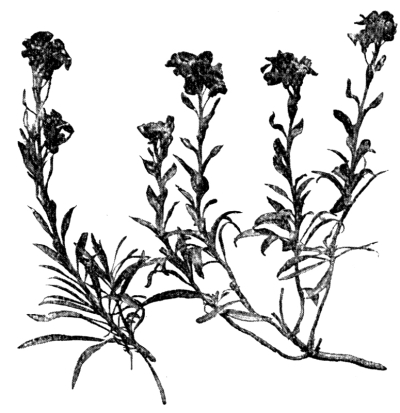
Fig. 57.—Wallflower. (× ⅙.)
(a) Four small, narrow, purplish leaves, called sepals. The four
sepals together constitute the calyx. Take off the sepals one by one.
Notice that two opposite sepals are bulged out at their bases, forming
pouches containing nectar. Try to get out a small drop of nectar on the
point of a pencil and taste it.
(b) Four showy leaves arranged in the form of a Maltese cross,
called petals. They are yellow, or red, or purplish in colour, are
delicately scented, and have beautiful velvety surfaces. The four
petals together constitute the corolla. Take off the petals one by
one.
(c) Six stamens, each consisting of a greenish stalk or filament
surmounted by a yellow, boat-shaped body, called the anther. The
anther is a four-chambered box containing an enormous number of tiny
yellow grains called pollen grains. Two of the stamens are shorter,
and are fixed at a lower level on the receptacle than the remaining
four. Take off the stamens one by one.
(d) A central pistil, shaped somewhat like a slender bottle. At
the top, where the cork would come in a real bottle, is the notched
stigma, slightly sticky. The neck is called the style, and the part
corresponding to the body of the bottle is the ovary. Tear open the
ovary with a needle to see the ovules, which in an undisturbed flower
would have become seeds.
Watch bees visiting flowers. Does each bee confine itself to one kind
(species) of flower at each journey, or does it visit several kinds
indiscriminately? Try to discover what the bees are doing. Avoid
alarming them.
The work of flowers.—The roots, stem, and leaves of a plant do
a great deal of work, but, as it is performed for the benefit of the
plant itself, it is all, in a sense, selfish work. Plants, however,
like animals, grow old in time, and at last die. If they are not to
become extinct it is evident that they must devote part of their
energies to producing new individuals, and to sending these forth into
the world as well equipped as possible for the battle of life. This
unselfish and self-sacrificing part of a plant’s life-work is called
reproduction; in the higher plants it is carried out by flowers.
The structure of a wallflower blossom.—The flowers of different
groups of plants vary greatly in structure, but a good general idea of
the arrangement of the parts of a flower can be obtained by examining
the blossoms of a wallflower plant (Fig. 58). Other
flowers may afterwards be compared and contrasted.
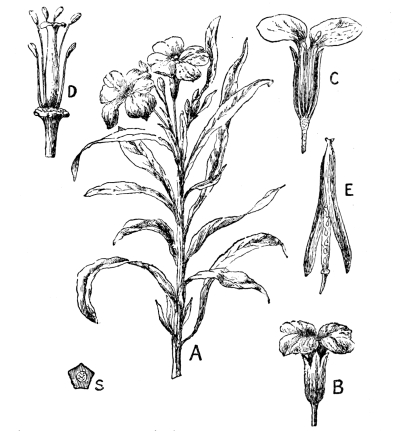
Fig. 58.—Wallflower. A,
branch, bearing leaves and flowers; B, flower; C, longitudinal
section of flower; D, stamens and pistil; E, fruit; S,
transverse section of stem, (× ½.)
There are evidently at least eight leaves in the flower, but, unlike
the green foliage leaves, these are not arranged spirally, but stand
at nearly the same level on the end—called the receptacle—of
the flower-stalk. The most external leaves are four in number, small,
narrow, and purplish in colour. Each of these leaves is called a
sepal, and the four sepals together constitute the calyx
of the flower. Two opposite sepals are pouched at the base, forming
pockets, in which a sugary fluid, called nectar, collects. Before the
bud opens, the calyx is the only part of the flower which is visible.
It is probably developed in the wallflower solely for the protection of
the more delicate structures within. Next, inside the sepals, placed
alternately with them, and standing a little higher on the receptacle,
are four showy leaves arranged in the form of a Maltese cross. These
leaves are called petals, and the four petals together form the
corolla. The petals are delicately scented, and their surfaces
have a beautiful velvety sheen.
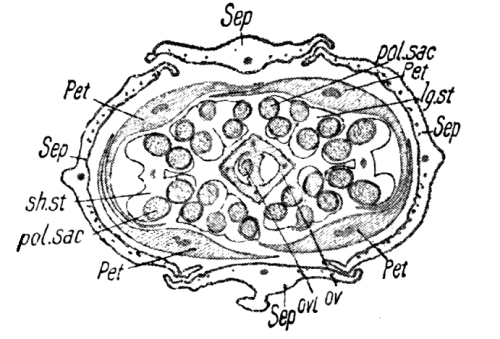
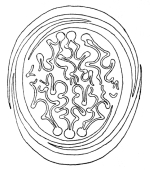
Fig. 59.—Cross section
through a Wallflower bud. Sep, sepals; Pet, petals; lg.st.,
anther of a long stamen; sh. st., anther of a short stamen;
pol.sac., pollen sacs; Ov, wall of ovary; Ovl, ovule. (× 8.)
When the sepals and petals are removed, there remain standing on
the receptacle six stamens surrounding a centrally-placed
pistil (Fig. 58, D). The stamens are the male part,
and the pistil is the female part, of the flower. Each stamen consists of a
greenish stalk or filament, surmounted by a yellow boat-shaped
body called the anther. The anther is a box with four
compartments (Fig. 59). When it is ripe, each compartment
contains an enormous number of tiny, yellow grains called pollen grains;
and when the anther bursts (as it does as soon as the flower opens) its
inner face is covered by the yellow dust of the pollen.
The pistil bears a rough resemblance to a slender bottle, and
consists of three distinct parts. The neck of the “bottle,” called the
style, is short in the wallflower, and differs from an ordinary
bottle-neck in being solid instead of tubular. At the top of the neck,
where the cork would come in a real bottle, is a body called the
stigma. The stigma of the wallflower pistil is hairy, notched,
and slightly sticky, from the presence of a sugary solution which forms
upon it. The part of the pistil, corresponding to the body of the
bottle, is the ovary. It contains four rows of little white
ovules, which are destined to become seeds capable of growing up
and forming new wallflower plants.
The relations of the parts of the flower are well seen in
Fig. 59.
Fertilisation.—In order that an ovule may become a seed, its
contents must mix with the contents of a pollen grain. The fusion of
the two constitutes fertilisation. For fertilisation to take
place, the pollen grain must first of all gain access to the stigma
of the pistil. If this be prevented the flowers will wither without
forming ripe seeds. (This may be proved easily by Expts. 18,
3 and 21, 2.) The sugary solution at the top of the stigma
stimulates the pollen grains to growth, and each puts out a long tube
which grows down the style. The living matter of the grains keeps near
the tips of the tubes as these continue their journey down the style.
At length the tubes enter the ovary and find the ovules. Each ovule has
at one end a minute pore (the micropyle—p. 6), and a pollen
tube finds this and enters it. The living matter of the pollen tube fuses with
that of the ovule in the neighbourhood of the pore, and fertilisation
is effected. It is now easy to understand that the comparatively
insignificant stamens and pistil are the all-important parts of a
flower.
How the wallflower advertises.—Botanists have proved that a
flower produces more, and also better, seeds when it is fertilised by
pollen from another flower of the same species. This is called cross
fertilisation. The wallflower relies upon bees for the transference
of the pollen from one flower to another; and it is solely to attract
them that the petals are so delicately scented and brilliantly
coloured, and that sweet nectar collects in the sepal-pouches. The
gaily coloured petals are therefore advertisement placards which are
hung out to attract the attention of bees. A bee comes to a wallflower
for the sake of both nectar and pollen—the “bee-bread.” As the bee
thrusts its proboscis down between stamens and pistil in search of the
sweet liquid in the pouches, its head is pretty certain to come in
contact with, and to brush off, some of the pollen dust hanging loose
on the inner faces of the anthers. When the bee flies off to another
wallflower and continues its search for nectar, it almost invariably
leaves some of the pollen, from the first flower, on the hairy and
sticky stigma of the second.
In almost all cases when a flower is brightly coloured it depends upon
the help of insects for cross fertilisation.
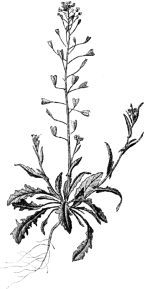
Fig. 60.—Shepherd’s
Purse. (× ½.)
1. Shepherd’s purse.—Compare the shepherd’s purse (Fig. 60)
with the wallflower. The flower is very much smaller, and white, but
the parts have the same arrangement as in the wallflower, viz., four
sepals, four petals arranged in the form of a cross, six stamens (two
short and four long), and a central pistil, all arranged separately
on the receptacle. Look down the plant, and notice that in the oldest
(lowest) flowers, everything but the pistil has dropped off, and that
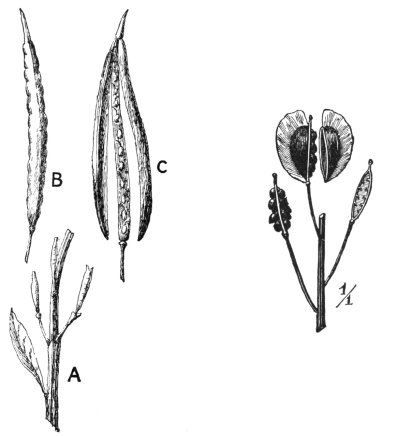
this has become greatly enlarged to form a fruit. Cut some fruits
open, both lengthwise and crosswise, and observe that each consists
of two pocket-like chambers, separated by a thin partition on which
the seeds are borne. Notice the manner in which the oldest fruits have
opened naturally.
2. Other relatives of the wallflower.—Compare also the flowers
and fruits of the stock and candytuft, and also cress, mustard, radish
(Fig. 61), cabbage, and turnip, which have been
allowed to “run to seed.” Examine the roots of the turnip and radish.
Make a note of the earliest dates on which you see the above plants
in flower.
The wallflower family.—The plants of the family to which
the wallflower belongs are of very great importance to mankind; for
while not one of them is poisonous, many are extremely valuable as
food-crops. They are all dicotyledons; that is, their seeds contain
two cotyledons or “makeshift leaves,” as has already (Chapter I.)
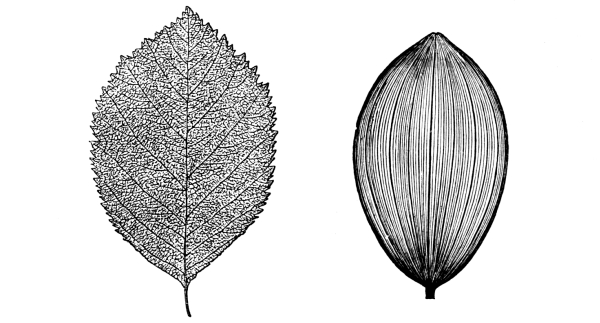
been seen in the case of the mustard. The net-like venation of the
leaves of the full-grown plant also indicates this. There is a great
family likeness between the flowers of this group, and they are easily
recognised (Fig. 61 a, c) by the cross-shaped
corolla and the six stamens (two short and four long). All the parts of the flower—sepals,
petals, stamens, and pistil—are fixed separately on the top of the
flower stalk or receptacle. The cross-arrangement of the petals has
led to these plants being called Crucifers (cross-bearers). The
shepherd’s purse (Fig. 60)—so-called from the
shape of its fruit—is a common weed with small, white flowers. All stages of the
flower may generally be found on the same plant. While at the top the
buds may still be unopened, the flowers below have been fertilised
(in this case generally self-fertilised); the sepals, petals, and
stamens—having fulfilled their duties—have fallen off; the ovules
have become seeds, and the ovule-box or ovary has become a seed-box or
fruit, consisting of two bags separated by a partition which bears two
rows of seeds on each side (Fig. 62).
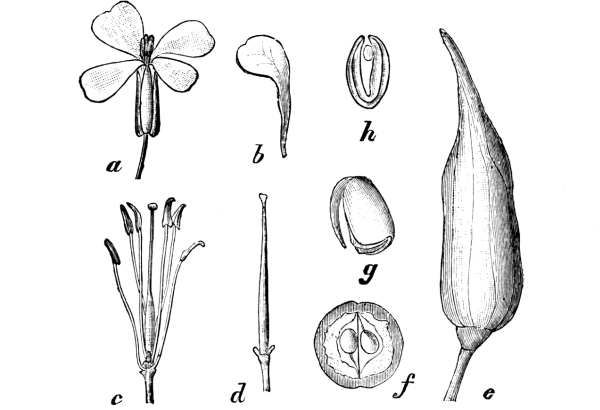
Fig. 61.—Wild Radish. a, flower (nat. size);
b, petal; c, stamens and pistil (× 2); d, pistil (× 2); e,
fruit (× 1); f, cross section of fruit; g and h, embryo (mag.)
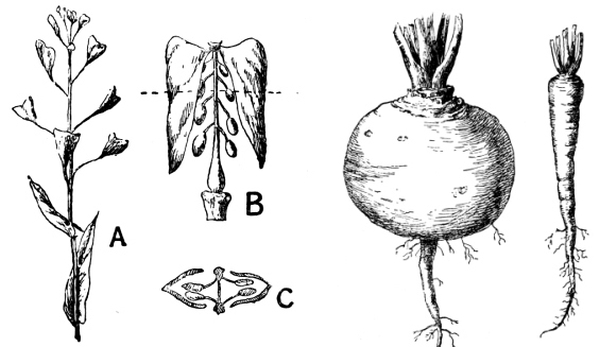
Fig. 62.—A,
Fruits of Shepherd’s Purse (× ½);Fig. 63.—Root of
Fig. 64.—Root
B, a single open fruit (mag.); C, cross section of B.
Turnip. (× ⅓.)of Radish. (× ½.)
Useful crucifers.—The turnip and the radish are largely
cultivated for their roots (Figs. 63 and 64), and are then taken out of
the ground at the end of their first season. As these plants naturally
flower in their second year of growth and then die, they are called
biennials. The production of flowers and fruit is a great strain
on a plant, and it is to prepare for the effort that the turnip and
radish store so much food in their roots during the first year as to
give them a globular and spindle shape respectively. A carrot is not a
crucifer, but it also adopts this device.
The cabbage is grown for its leaves. Varieties of the cabbage are
Brussels sprouts, broccoli, and cauliflower; it is the very small
flower-buds of the last two which are eaten. Cress and white mustard
are eaten in the seedling stage. The seeds of the black mustard are
ground and eaten as a condiment.
1. The buttercup.—Notice the habit of growth, characters of
the leaves, etc. Is the buttercup a dicotyledon? Make this
observation with all flowering plants. (See, however, Chap. VIII., p. 163.)
In the flowers of a buttercup (Fig. 65) make out:
(a) The calyx of five green, separate sepals; they are
the only parts to be seen in young, unopened buds. Take off
the sepals of a fully-opened flower one by one.
(b) The corolla of five, golden-yellow, separate
petals, alternate with the sepals. Notice the nectary—a
little pocket—near the base of the upper surface of each
petal. Take off the petals one by one and observe that they
are fixed on the receptacle, a little higher than the sepals.
(c) The large number of separate stamens, inserted
still higher on the receptacle.
(d) On the top of the receptacle the large number of
separate, flask-shaped bodies, which together make up the
pistil. Each of these is called a carpel.
Watch bees and other insects visiting buttercups and notice how they
stand on the flower to obtain the nectar from the nectaries. Does a bee
on leaving go to another buttercup, or does it change to another kind
of flower?
In a flower from which the sepals, petals, and stamens have fallen,
notice the compound fruit (Fig. 66), consisting
of ripened carpels. Open a carpel with a needle and pick out the single seed.
2. Other plants of the buttercup family.—Notice that in the
anemone (Fig. 67) and marsh marigold
(Fig. 68), the sepals appear to be absent (the
three leaves under the anemone flower are not parts of the flower; they
are called bracts). The apparent petals are really the sepals; it is
the corolla which is absent. Observe the large number of stamens, and
notice that the pistil consists of several separate carpels.
In what kind of ground have you seen these plants growing wild?
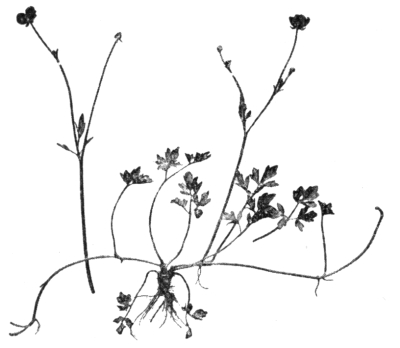
Fig. 65.—Buttercup.
(× ¹⁄₁₀.)
The buttercup family.—The buttercup (Fig. 65) and
its relatives resemble the crucifers (1) in being dicotyledons (as is indicated
(p. 40) by the venation of the leaves), and (2) in the fact
that, of the parts which compose the flower, each group is arranged separately on
the receptacle. For example, the stamens are not connected with either
the calyx, the corolla or the pistil. Having noted these points of
resemblance, however, we are met by some important differences. In the
buttercup there are usually five sepals and five petals; there may be
twenty or more stamens; and the pistil is not a single structure, but
consists of a number of separate parts, each of which is called a
carpel, and contains a single ovule. The pistil of a crucifer
consists of only two carpels; these are welded together into a single
structure, and until the fruit ripens a slight notch in the stigma is
the only external indication that the pistil is in two parts.
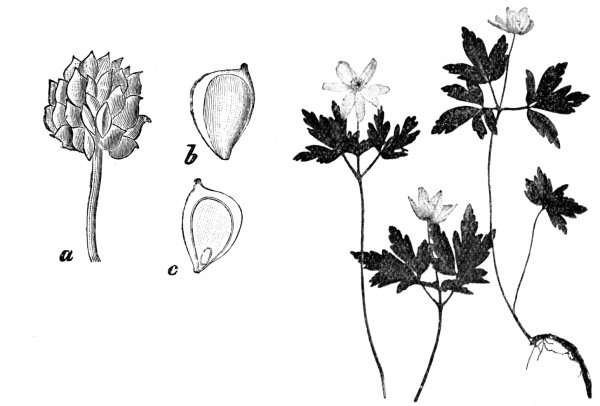
Fig. 66.—a, Compound fruit of Buttercup (× 2½);
Fig. 67.—Anemone. (× ⅓.)
b, a carpel (× 4); c,
carpel in longitudinal section (× 4).
Insects visit buttercups for the sake of nectar and pollen, and whilst
creeping about the flower transfer pollen to the stigmas of the
carpels. The insects may have brought some of this pollen from other
flowers, and then cross-fertilisation is caused. If the pollen is
derived from the same flower self-fertilisation is the result.
After fertilisation the ovules become seeds; the sepals, petals, and
stamens drop off; and the carpels swell up, forming a dry compound
fruit (Fig. 66), consisting of several nutlets.
Two other common plants of this family are the anemone (Fig. 67)
and marsh marigold (Fig. 68). In neither of these cases has the
flower any petals, but the calyx has taken on the appearance of a
corolla. In the marsh marigold it is large and yellow; in the anemone
it is white or purple. The three green leaves immediately beneath the
flower of the anemone are called bracts. They should not be mistaken for sepals.
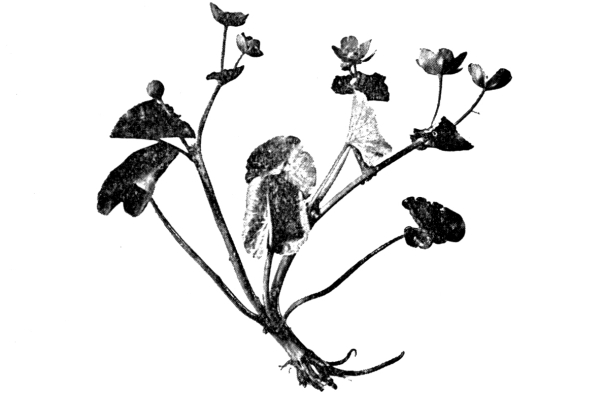
Fig. 68.—Marsh Marigold. (× ⅙.)
The plants of the buttercup family are as generally poisonous as the
crucifers are wholesome. Monkshood is especially poisonous, and its
root has been mistaken, with fatal results, for that of horse-radish.
It is often noticed that grazing cattle avoid the buttercups in a
field. The bitter and disagreeable taste of the leaves is of course a
valuable protection to the plant.
1. The garden pea.—Notice again the habit of the plant: its
compound, net-veined leaves with large stipules, and its method of
climbing by tendrils which are modified leaflets. Examine the flower
and make out (a) the calyx of five united sepals; (b) the
curiously shaped corolla. The large upper petal is called the
standard, the two at the side are the wings, and the lowest
(really two locked together) is the keel; (c) the ten stamens.
One (opposite the standard) is separate; the remaining nine have the
lower parts of their filaments united to form a tube. Slit open the
filament-tube and remove the stamens, noticing how they are attached to
the other parts of the flower; (d) the pistil. Slit open the ovary
and see the ovules in it. Watch the various stages of the formation of
the fruit (pod).
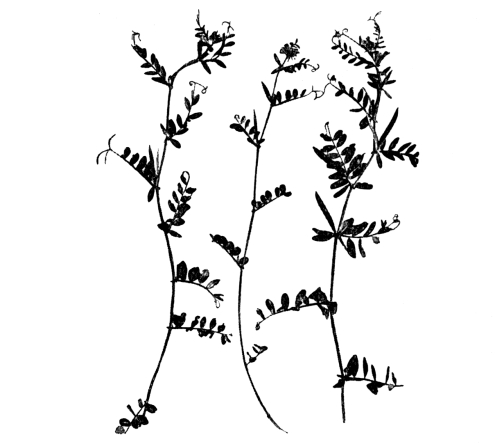
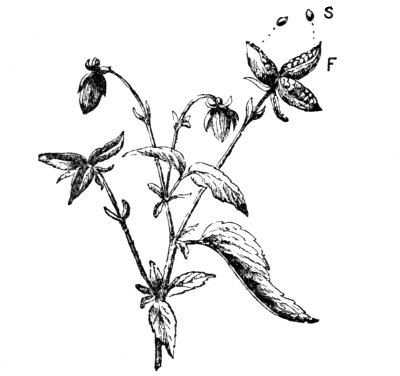
Fig. 69.—Vetch. (× ⅓.)
Watch bees visiting the flowers. The insect alights on the wings, and
its weight pulls them down and lowers the keel, bringing the stamens
against the bee’s body.
Cut a complete flower down the middle with a sharp knife, and notice
that calyx, corolla, and stamens seem not to be inserted separately on
the receptacle, but to spring from a common base.
2. Other plants of the pea family.—Examine also bean, vetch
(Fig. 69), meadow vetchling (Fig. 70),
clover (Fig. 71), laburnum (Fig. 73),
and broom. Compare the habits of growth of the plants, and notice
that they all have the same peculiar shape of flower. Dissect a flower
of each. Notice that in laburnum and broom the ten stamens are all
united. In clover the flowers are in heads. Notice how the leaflets
of the clover plant close at sunset.
3. Fertilisation.—Dig up several red clover plants in early
summer and pot them. Cover about half the plants with gauze, so fixed
on wire frames that insects cannot get inside, and then put all
the plants together where they will get plenty of sun. Water them
regularly, and notice which plants ripen seed. How do you account for
the differences?
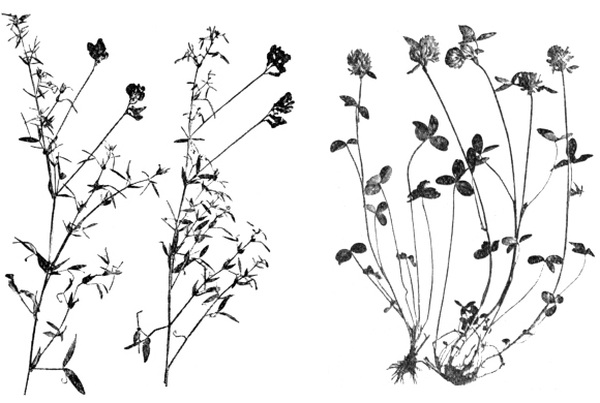
Fig. 70.—Meadow Vetchling. (× ¼.)
Fig. 71.—Red Clover. (× ⅙.)
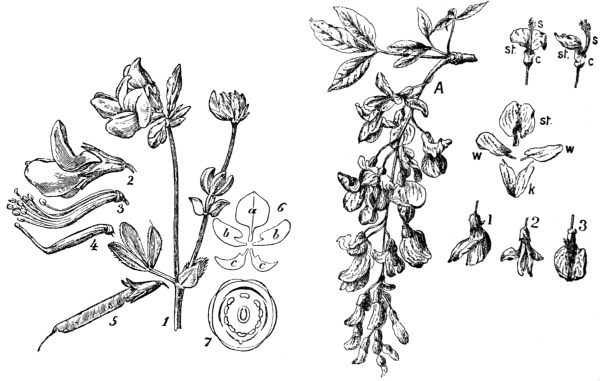
Fig. 72.—Bird’s-foot Trefoil. 1, flowering branch (× ⅔);
Fig. 73.—Flowering branch of Laburnum; st,
2, flower; 3, pistil and stamens; 4, pistil (× 1¹⁄₉); 5,
standard; w, wings; k, keel; 1, 2, 3, the flower
fruit (× ⅔); 6, corolla; a, standard; b, wings; c, keel; 7,
from different points of view. (× ½.)
diagram of flower.
The pea family.—Plants of the pea family are found in all
quarters of the earth. They are of very diverse size and habit of
growth; the laburnum, for example, is a tree; the gorse is a bush;
the broad bean has a strong, erect, herbaceous stem; the pea is a
weak-stemmed climbing plant; the clovers are small herbs with flowers
forming “heads.” Most of the members of the family agree in having
a “butterfly-shaped” corolla (Figs. 72 and 73), which consists
of three well-marked parts, viz., a large standard, a pair of
wings, and two closely-connected petals which form a boat-shaped
keel. There are ten stamens, and the filaments of nine of these
usually cohere to form a tube surrounding the ovary. In the laburnum,
gorse, and a few others, all the ten stamens are united. When a bee
visits the flower, in search of nectar, it alights on the “wings” of
the flower, and its weight depresses these and pulls down the keel. The
anthers of the stamens are so placed with respect to the keel that this
results in a mass of pollen being scraped off the anthers and forced
out at the beak of the keel, or in the stamens being
suddenly liberated and scattering pollen on the bee. The
pollen sticks to the bee’s body, and some of it is almost
certainly transferred to the stigma of the next flower visited.
The quaint shape of the corolla is thus definitely adapted to
the visits of insects; for the nectar is so placed that to
obtain it the insect must carry off some of the pollen.
The calyx, corolla, and stamens are not obviously—as in
the wallflower and buttercup—inserted separately on the
receptacle, but seem to spring from a common base.
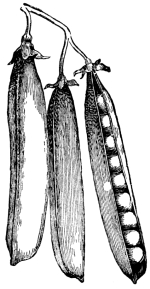
The fruit is a pod (Fig. 3), which
opens when ripe along both margins and liberates the seeds. Laburnum
seeds are poisonous, but the seeds of many other plants of the family
(peas, beans, lentils, etc.) are valuable foods.
1. The wild rose (Fig. 75).—With
a sharp knife cut vertically through the middle of a wild rose. Notice
that the receptacle forms a deep cup, and that the carpels of the
pistil are enclosed in the cup. From the edge of the cup spring the
five sepals, five petals, and numerous stamens. What is the great
difference between a rose and a buttercup?
Trace the formation of the succulent fruit or hip from the receptacle
cup of the flower. Cut through a rose hip, and observe the ripened
carpels in the interior.
2. The blackberry.—Similarly examine a blackberry flower
(Fig. 76). This is still more like a buttercup,
but—as in the rose and the pea—the calyx, corolla, and stamens seem to
spring from a common base, and not to be inserted separately on the
receptacle.
Trace the formation of the compound fruit, and notice that each part is
like a little plum or cherry.
3. The cherry.—Similarly examine cherry blossom (Fig. 77).
The pistil consists of one carpel, and is fixed at the bottom of the
receptacle-cup, while the calyx, corolla, and stamens are fixed on the
margin of the cup. Trace the origin of each part of the fruit.
Compare the plum and apricot.
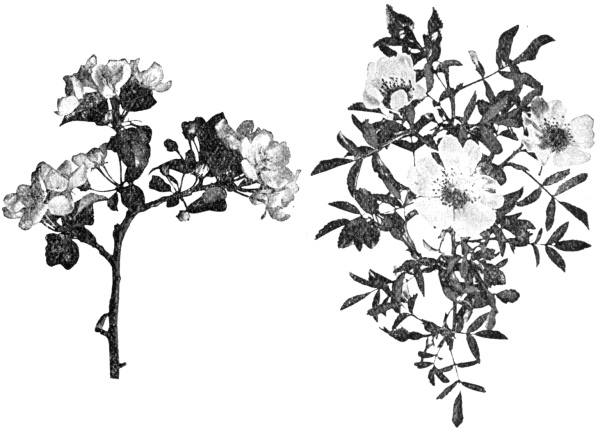
Fig. 74.—Apple Blossom. (× ⅓.)
Fig. 75.—Wild Rose. (× ⅓.)
4. The apple and pear.—Cut vertically through an apple blossom
(Fig. 74) or pear blossom (Fig. 78), and notice that
the ovary is embedded in the receptacle, and that calyx, corolla, and stamens
are fixed on the top of this. Cut across the ovary and see the five
divisions (carpels).
The eatable part of the fruit is the swollen receptacle.
Compare the hawthorn.
The wild rose.—The plants of the rose family are, most
commonly, woody trees or shrubs. The leaves are provided with stipules
in nearly all cases. The wild rose (Fig. 75) may be
taken as a type of the group. It bears a superficial resemblance to a buttercup,
but on dissection considerable difference in the arrangement of the
parts is seen. In the rose, the receptacle is urn-shaped; from the
margin of the urn spring the five sepals, five petals, and numerous
stamens; while inside the urn the separate carpels of the pistil are
inserted. In the blackberry (Fig. 76), raspberry,
and strawberry the receptacle is knob-shaped, and the carpels are
arranged on the outside of the knob, somewhat as in the buttercup. Here
again, however, the calyx, corolla, and stamens differ from those of
the buttercup in seeming to arise from a common base.
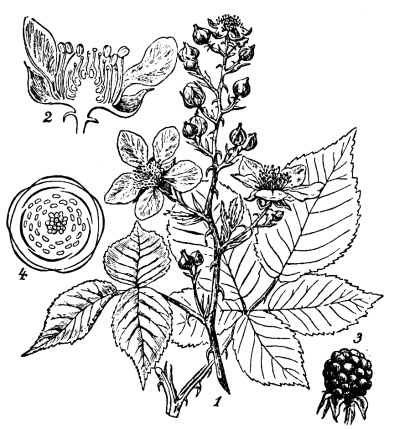
Fig. 76.—Blackberry. 1, flowering branch
(× ⅓);
2, longitudinal section of flower (× 1);
3, fruit (× ⅓); 4,
diagram of flower.
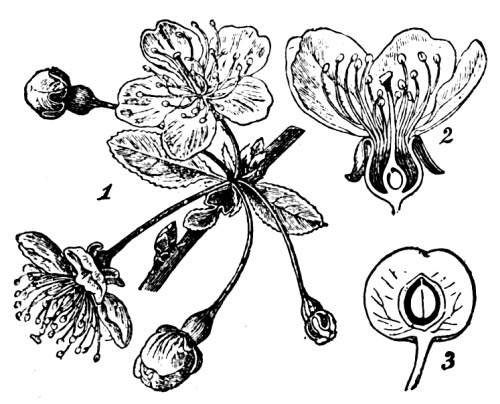
Fig. 77.—Cherry. 1, flowering branch (× ⅔);
2, longitudinal section of flower;
3, longitudinal section of fruit.
The differences between the rose, blackberry, raspberry, and strawberry
are more marked when the pistil has become a fruit. The fleshy part of
the rose hip is the urn-shaped receptacle which encloses the ripened
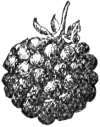
carpels. In the case of the blackberry and raspberry the receptacle
is dry, and is surrounded by the compound fruit (Fig. 76, 3)
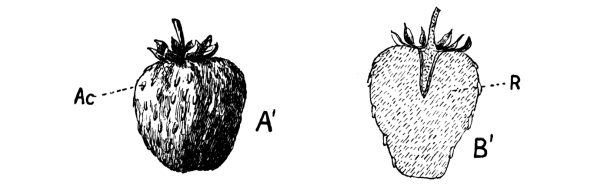
of the several bodies like little plums or cherries. The eatable part of the
strawberry fruit (Fig. 144) is the swollen receptacle, on the outside
of which are the little yellow nutlets derived from the carpels of the flower.
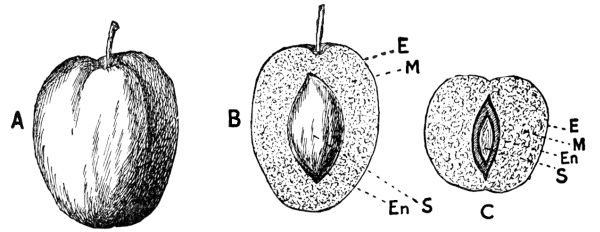
In the cherry (Fig. 77), plum,
and apricot the pistil consists of only one carpel, which is
enclosed in the urn-like receptacle. After fertilisation, the greater
part of the wall of the ovary becomes fleshy, and one of the two
ovules contained in it becomes a seed. The “stone” is formed from the
innermost part of the ovary wall.
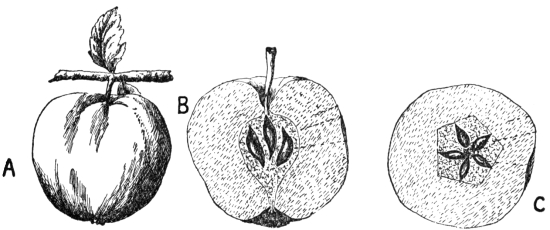
The apple (Fig. 74) and pear
(Fig. 78) have their five carpels embedded in the
receptacle, and the rest of the flower stands on this part. The eatable
portion of the fruit is the swollen receptacle. The hawthorn has
usually only two carpels, and in the fruit the part derived from the
receptacle becomes hard and horny. In other respects it is very similar
to the apple.
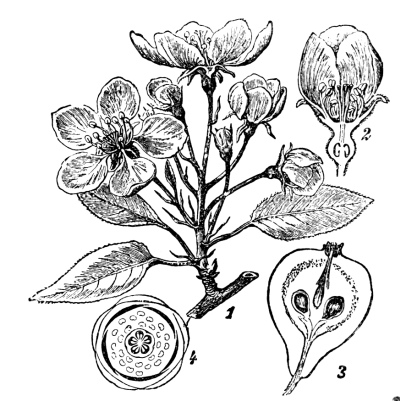
Fig. 78.—Pear. 1, flowering branch
(× ⅔);
2, longitudinal section of flower;
3, longitudinal section of
fruit;
4, diagram of flower.
The rose family is widely distributed, especially in temperate regions.
1. The poison hemlock.—Examine this plant (Fig. 79)
very carefully, remembering that it is poisonous. Notice the general habit
of growth; the characters of the sheathing, compound leaves; the
hollow ribbed stem; and also the arrangement of the flowers, which is
characteristic of the family. From the top of a main flower-stalk
several smaller stalks come off together, like the ribs of an umbrella.
From the top of each of these spring the stalklets which bear the small
white flowers. Notice the bracts at the points of origin of the
stalks. Examine the flowers, and watch insects visiting them. Which
insects are most commonly found on the flowers?
Compare the cow parsnip, the water hemlock, carrot, parsley, parsnip,
and celery, carefully noting the points of resemblance and difference.
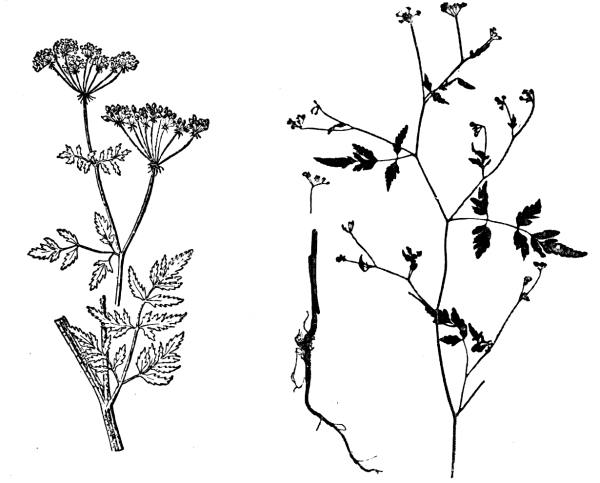
Fig. 79.—Poison Hemlock. (× ¼.)
Fig. 80.—Hedge Parsley. (× ⅙.)
The parsley family.—The plants of this family may be recognised
easily by the arrangement of the flowers. Several stalks spring
together from the top of the main flower stalk and each of these again
gives rise at its tip to a number of smaller stalks, at the ends of
which the small flowers are borne (Figs. 79 and 80). The
flowers are fertilised by the aid of insects, and as the nectar is on the surface
it is accessible to small insects such as flies, beetles, etc. The
flowers are rendered more conspicuous by being placed close together.
The stems are usually hollow, and the leaves are alternate, and
generally compound, with sheathing bases. Many of the plants of this
family are very poisonous, and such should be carefully distinguished
and whenever possible exterminated.
The poison hemlock (Fig. 79) varies
in height from two to seven feet. It has a hollow stem which is spotted
with purple in the lower part, and when bruised the leaves give off a
smell like that of mice. Cattle are often poisoned by eating the plant
in hay, and children have been poisoned even by blowing whistles made
from the stem. The water-hemlock is extremely poisonous. It
grows along the sides of pools. The stem is hollow, and the leaflets
of the compound leaves are finely toothed. The root is a cluster of
fleshy swellings, and has unfortunately a rather pleasant taste.
Other poisonous plants of the family are the water dropwort
and the fool’s-parsley. Among the harmless and useful members
of the group are celery (when cultivated), carrot,
parsnip, and parsley.
1. The primrose.—Examine the habit (Fig. 81)
of the plant, its underground stem, its spoon-shaped leaves—arranged in a
rosette—and the manner in which the flowers spring from the stem. In the flower
make out (a) the calyx, 5-pointed and with united sepals; (b)
the corolla, consisting of 5 petals united below into a tube. Tear
down the corolla-tube to see (c) the 5 stamens inserted on the
corolla-tube. In some (“thrum-eyed”) flowers the anthers are at the top
of the tube; in others (“pin-eyed”), they are halfway down; (d) the
pistil, consisting of stigma, style, and ovary. In thrum-eyed flowers
the style is short and the stigma is halfway down the corolla-tube;
while in pin-eyed flowers the style is long and the stigma is at the
top of the tube. Do you find both pin-eyed and thrum-eyed flowers on
the same plant, or does one plant bear only one kind?
2. Fertilisation.—Cover up a plant of each kind with gauze, to
keep insects from the flowers, and notice whether the covered flowers
ripen seeds like the others.
3. The cowslip.—Compare the cowslip (Fig. 83),
and notice that the main stalk gives off from the same point several smaller
stalks, each of which bears a flower. Observe that the cowslip also has both
pin-eyed and thrum-eyed forms of flowers.
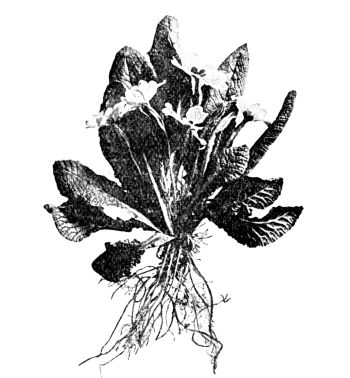
Fig. 81.—Primrose. (× ¼.)
The primrose and cowslip.—In the primrose we have flowers
of a type differing from all those previously considered in this
chapter. Not only are the sepals joined together to form a five-toothed
calyx-tube, but the five petals are also joined together to form
a corolla-tube, and the stamens are fixed on the corolla-tube.
There are two kinds of primroses, known to country children as pin-eyed
and thrum-eyed flowers respectively (Fig. 82). The two
forms grow on separate plants. In a pin-eyed primrose the style is long, and
the stigma—looking somewhat like the head of a pin—is at the top of the
corolla-tube; while the stamens are halfway down. The thrum-eyed
primroses have their stamens at the top, while the stigma of the pistil
is halfway down the tube, exactly opposite the place where, in the
pin-eyed form, the stamens are inserted. This curious state of things
was a great puzzle to botanists until Darwin cleared up the mystery. A
bee, thrusting its proboscis down a pin-eyed primrose in search of the
nectar at the bottom, dusts it with pollen about halfway down—just in
the place which will come in contact with the stigma when the animal
visits a thrum-eyed flower. And the pollen from the thrum-eyed form
adheres to the part of the bee which will presently touch the stigma of
a long-styled flower. This beautiful and simple arrangement makes it
practically certain that each primrose shall be fertilised by pollen
from the other form. In the thrum-eyed form, however, it is possible
for pollen to fall upon the stigma and produce self-fertilisation.
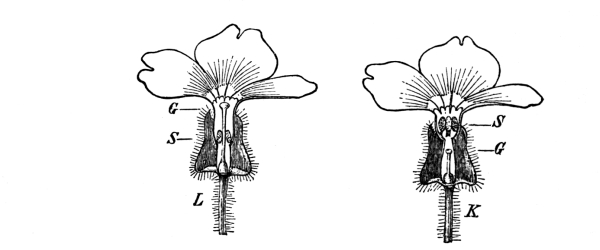
Fig. 82.—Chinese Primrose.
L, long-styled (“pin-eyed”) flower;
K, short-styled (“thrum-eyed”)
flower; G, stigma; S, anthers.
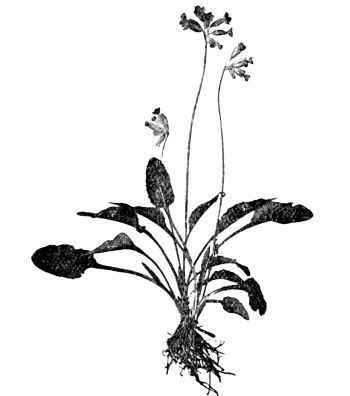
Fig. 83.—Cowslip. (× ⅙.)
It is obvious that the cowslip (Fig. 83) is closely related
to the primrose. The difference lies chiefly in the character of the
flower-stalk. In the cowslip this is long, and it bears at its top
several stalklets, each of which ends in a flower. As in the primrose,
cross-fertilisation is secured by some flowers being pin-eyed (long
styled) and others thrum-eyed (short styled).
1. The daisy.—Take up several daisy plants (Fig. 84)
entire, and wash away the soil from the roots. Notice how the stems—some
of which are underground—are connected together. Draw a leaf. What
advantage is it to the plant to have leaves of the shape noticed? Cut
vertically through the “head,” and notice that what is usually called
the “flower” really consists of a large number of small flowers.
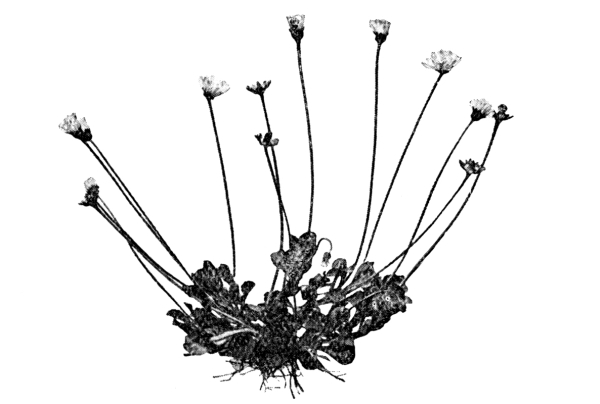
Fig. 84.—Daisy. (× ¼.)
The central or disc flowers are tubular. Which disc flowers open
first, those near the middle or those nearer the edge of the disc?
Pick off a flower and notice the 5-toothed corolla. Tear the corolla
down with a needle, and observe the tiny stamens (5) fixed on the
corolla-tube. The anthers are joined together. Notice the divided
stigma of the pistil. The white and pink ray flowers have
strap-shaped corollas. They have no stamens, but each has a pistil
like that of a disc flower. What do you think is the object of the ray
flowers being so conspicuous? Why do they close over the disc at night?
Notice the large number of green bracts below the disc.
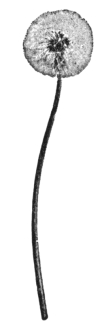
2. The dandelion.—Compare the dandelion (Fig. 85).
Notice that all the flowers are strap-shaped, like the ray flowers of the daisy.
Pull one out, and make out the strap-like corolla, the five stamens
with joined anthers, and the double stigma (Fig. 86, 2).
Notice the tuft of fine hairs below the corolla and above the knob-like ovary.
The tuft of hairs is the top of the calyx-tube.
When the flowers have been fertilised, the yellow corollas wither, and
each calyx-tube elongates until it is about an inch long, the tuft
of fine hairs being still at the top (4). Blow a “clock,” and notice
how easily the fruits are detached from the disc and how slowly they
settle. What advantage is this to the plant?
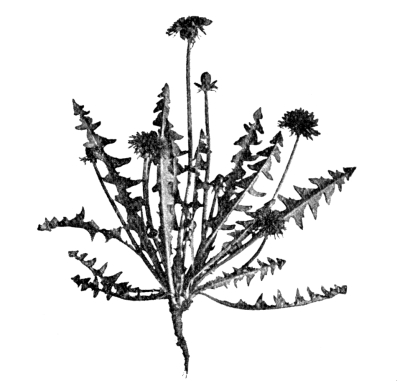
Fig. 85.—Dandelion. (× ¼.)
3. The thistle.—Compare the thistle (Fig. 87).
The bracts are very prickly. Is this an advantage? Are the flowers tubular
or strap-shaped? Examine the fruits (“thistle down”) and compare with
those of dandelion.
The daisy.—What is generally called the “flower” of the daisy
(Fig. 84) really consists of a very large number of small separate
flowers set close together on a flattened disc or receptacle. The
group of flowers is called a head. On the lower surface of
the head are several green leaves, or bracts, which protect the bud
before it opens. The flowers of a daisy-head are of two kinds. The
white or pink straps set round the edge of the head are the corollas
of the ray flowers. They have no stamens, but a pistil with a divided
stigma is present in each. The disc flowers are yellow and tubular. The
corolla consists of five united petals. On it are fixed five stamens,
the anthers of which are joined together. The pistil is like that of a
ray flower. No calyx is present in either the ray or disc flowers of
the daisy.
The daisy is fertilised by the aid of insects which are attracted by
the strap-like corollas of the ray flowers.
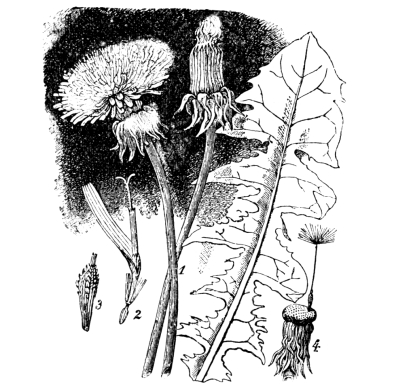
Fig. 86.—Dandelion.
1, two heads and a leaf (× ⅔);
2, a single flower (× 2); 3, fruit
(× ⁸⁄₃);
4, receptacle, with one fruit.
The dandelion “flower” (Fig. 85) is also really
a head consisting of a great many separate flowers. There are often between
two and three hundred of these little flowers present in one head.
Below the head are several green bracts, and these protect the flowers
both in the bud and at night (Fig. 86). The flowers
of the dandelion are all of one type. The corolla is strap-shaped
(Fig. 86, 2), and of a
beautiful yellow colour to attract insects. On the end of the strap may
be seen five small teeth which indicate that it really consists of five
united petals. At the base of the corolla is a tuft of fine hairs,
which is the top of the calyx-tube, and at the bottom of the flower
is a little white knob—the ovary. The five stamens are fixed on the
inside of the corolla-tube. Their anthers are united to form a tube
through which the upper part of the style, and the forked stigma
protrude.
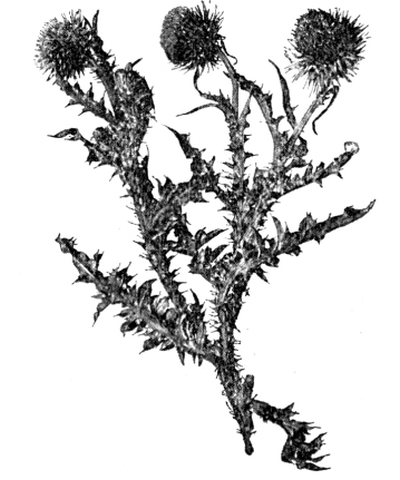
Fig. 87.—Thistle. (× ¼.)
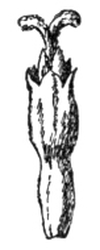
Fig. 88.—Tubular
flower of Thistle
(magnified).
It will be noticed that a dandelion flower is practically like a ray
flower of a daisy, with the addition of calyx and stamens.
The thistle (Fig. 87) is another common member
of the family. Its bracts are prickly, and are a protection from the attacks of
animals. The flowers (Fig. 88) are all tubular. The common
thistle distributes its fruit by a plume of radiating fine hairs—the calyx.
The fruit is commonly known as “thistle down.”
The Compositae, as plants of this family are called, are found
in all parts of the world. The family is the largest in the vegetable
kingdom, and many of the plants included in it are of considerable
importance.
1. The foxglove.—Examine a flowering plant of foxglove (Fig. 89).
Notice the general habit of growth. In the flower make out the
five-lobed calyx, the irregular corolla with five petals joined to form
a tube, the four stamens (two long and two short) fixed on the corolla
tube (Fig. 90), and the form and attachment of the pistil. Watch bees
visiting the flower. 2. The speedwell.—Compare the speedwell
(Fig. 91), and notice that the corolla is more nearly regular
than is the case with the foxglove, that it consists of four combined petals,
and that two stamens are fixed upon it.
3. The musk.—Compare the musk. Dissect a flower and notice the
forms and positions of the parts. Especially examine the pistil with
its two-lobed stigma. With a hair, carefully touch one of the lobes of
the stigma of a growing flower and watch how the lobes close. Do the
lobes open again? Put a little pollen on, and watch to see if this time
the lobes open again after closing.
Watch insects visiting the flowers and try to make out how the
pollination of the stigmas is brought about.
The foxglove family.—In the primrose and the disc-flowers
of the daisy are seen examples of regular, dicotyledonous flowers
with five petals fused to form a corolla tube, and with five stamens
inserted on the corolla. In the strap-shaped flowers of the dandelion
the corolla is irregular, but still consists of five fused petals and
bears the five stamens.
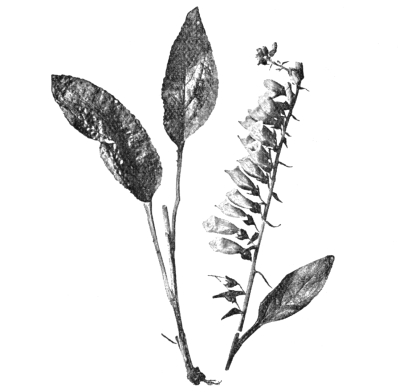
Fig. 89.—Foxglove, (× ⅙.)
The foxglove (Fig. 89) and its relatives have also
irregular corollas of joined petals on which the stamens are fixed; but the
stamens are usually only four in number, two being long and two short
as in Fig. 90, b. In the foxglove the stamens ripen
and shed their pollen before the pistil of the same flower is mature. This prevents
self-fertilisation, but bumble bees in passing from one flower to
another convey the ripe pollen of the younger flowers to the stigmas of
flowers which are ready for fertilisation.
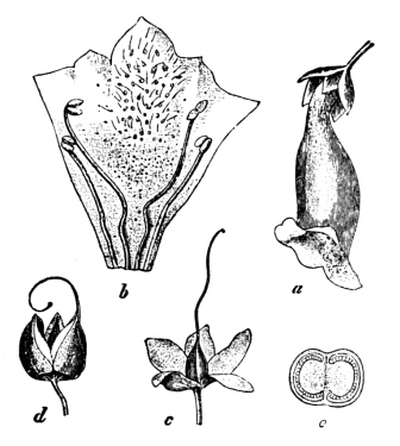
Fig. 90.—Foxglove.
a, flower; b, corolla cut open and spread out;
c, calyx and pistil; d, fruit; e, section of fruit. (× ⅔.)
The pretty blue speedwell (Fig. 91) is closely related
to the foxglove, but its corolla has only four lobes instead of five, and some
times these seem of almost equal size at the first glance. Generally,
however, the corolla is very plainly irregular. The speedwell has only
two stamens, while mullein has five.
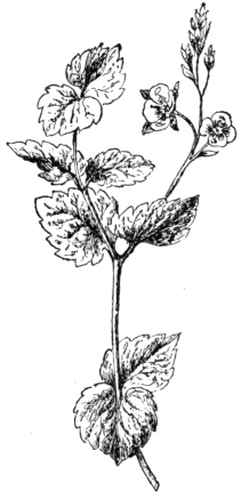
Fig. 91.—Speedwell. (× ½.)
Calceolaria, musk, gloxinia, and
snapdragon—other members of the family—are often cultivated in
gardens.
The flowers of the musk are especially interesting, because they show
so well what is called irritability,—the power which all living
things possess of acting in a definite manner in response to a definite
irritation or stimulus. We have already seen good examples of
plant-irritability in the way a climbing stem winds itself round a
support. The stigma of the musk flower has two flaps. If these are
touched with a hair or bristle they quickly close together, but
presently open again as if they had found out that they had been
tricked. When, however, a little pollen is put on the flaps they close
finally, for their whole object is accomplished.
Some of the plants in this family are poisonous, the foxglove being
especially so in all its parts.
1. The deadnettle.—Examine a deadnettle plant (Fig. 92).
Notice the habit of growth, and write down a description of the shape and
appearance of the stem and leaves. What is the shape of the flower? How
many sepals, petals, and stamens has it? Do the stamens ripen first, or
does the pistil? What insects do you find visiting the flower? Try to
find out how they pollinate the stigma.
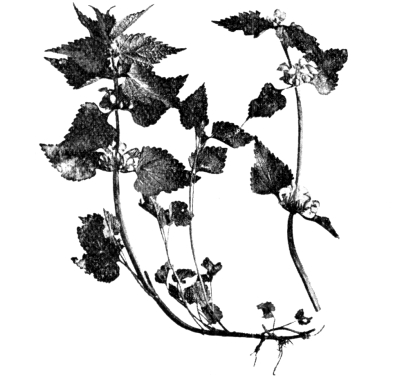
Fig. 92.—White Deadnettle. (× ⅙.)
2. Other labiates.—Compare the sage (especially in respect
of its relation to bees), rosemary, thyme, marjoram, and mint, and
distinguish between their various flowers, leaves, and scents.
The labiates.—The deadnettle is a type of an easily recognisable
family of plants. The stem is square in section, and the leaves are
arranged upon it in opposite pairs at right angles to each other.
The plants are hairy and have distinctive odours. The aroma of
thyme, mint, marjoram, sage, etc., has led
to the plants being used for flavouring food. None of the labiates is
poisonous.
The shape of the flower is very characteristic, and is specially
adapted to the visits of bees. The flowers are so modified that the
lowest part of the corolla forms a platform on which the bee may
conveniently alight, while the upper petals unite into an arched roof
which protects the pistil and stamens.
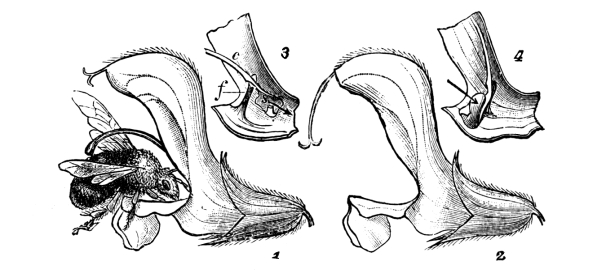
Fig. 93.—Pollination of the
Sage by a bumble bee.
For explanation see text. (× 1.)
The mechanism of cross-pollination is particularly well shown in the
case of the sage (Fig. 93). The flower contains four
stamens, but two of these have lost their use, and the others are modified in a
strange manner. The whole stamen has somewhat the shape of a capital
T, and at each end of the cross-piece is a pollen box. Usually the
cross-piece (c, Fig. 93, 3) is not at right angles to
the filament, but is swung up—the junction acts as a hinge—until it is nearly
vertical (Fig. 93, 4). The pollen box s, which is at the
lower end of the cross-piece c when this is vertical, contains hardly any pollen.
The entrance to the honey tube is thus guarded by two pillars, the
filaments (f) of the stamens; and the lower pollen box (s) of the
cross-piece of each stamen is directly in front of the bee’s head as it
stands on the lower lip of the flower. When it pushes forward its head
to reach the nectar it comes in contact with the lower pollen boxes,
and the cross pieces swing round on their hinges, bringing the upper
pollen boxes down with a smack on the bee’s back (Fig. 93, 1),
and sprinkling it liberally with pollen dust. Having shed their pollen the
stamens shrivel up, and the pistil comes to maturity. As the pistil
ripens, the stigma arches over (Fig. 93, 2) so as to scrape
along the back of any bee visiting the flower for the nectar, and thus to wipe
off the pollen which has been brought from a younger flower.
1. The hyacinth.—Take up a plant (Fig. 94) entire
and notice the underground bulb with roots springing from its lower surface, and
the long narrow leaves. Is the venation of the leaves parallel or
net-like? Is the hyacinth a monocotyledon or a dicotyledon? See the
bract at the base of each flower-stalklet.
Examine the flower. Its leaves cannot be distinguished into calyx
and corolla, but are quite similar to each other in size, shape, and
colour. They are therefore called the perianth. The perianth leaves
are united to form a tube. Tear down the tube to see the six stamens
fixed on it. Are they all on the same level? Examine the pistil and cut
the ovary across to see the ovules in the three joined carpels. Which
is fixed at the higher level, the perianth or the base of the pistil?
2. Other plants of the lily family.—Examine also the white
lily, tulip, star of Bethlehem, and lily of the valley, and notice that
in spite of small differences they are all monocotyledons (how do you
know this?) and all have the perianth fixed below the ovary.
3. The snowdrop.—Compare and contrast the snowdrop (Fig. 95).
Make out that it is a monocotyledon, but that its perianth is inserted
above the ovary. This is the great point of difference from the lily
family. Notice also how the stamens are fixed.
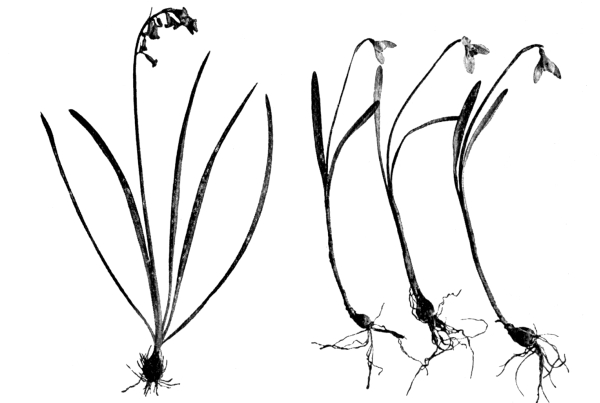
Fig. 94.—Wild Hyacinth.
(× ¹⁄₁₀.)
Fig. 95.—Snowdrops. (× ¼.)
4. Other plants of the snowdrop family.—Examine the daffodil
(Figs. 55 and 96)
and narcissus. Arising from the short perianth tube of the daffodil
is a longer one which is often mistaken for a corolla; it is called
the corona. None of the flowers hitherto described contains anything
corresponding to a corona. The corona in the narcissus is short. As in
the snowdrop, the perianth is fixed above the ovary. Observe how the
stamens are fixed, and notice the dry leaf beneath the flower.
The lily family.—Either the wild hyacinth (Fig. 94)
or the cultivated single hyacinth may be taken as a good representative of
this family. The first point which strikes the student on examining the
general “habit” of the plant is the character of the long sheathing
leaves. Their veins do not form an obvious network, such as is
seen in the leaves of dicotyledons, but run lengthwise and roughly
parallel to each other in the manner characteristic of grasses and
other monocotyledons (p. 40). The leaves are narrow, and
are not divided into blade and stalk; they and the flower stalk spring from
an underground bulb (p. 84) which consists chiefly of the
swollen leaf-bases of a previous season. A separate calyx and corolla are not
to be distinguished in the flower; the six leaves being all alike in
size, shape, and colour. These six leaves hence receive a special name,
and are called the perianth. The perianth leaves are united into
a tube, on the inside of which the six stamens are arranged in two
series of three each. In the middle of the flower, and fixed above
the insertion of the perianth, is the pistil, which consists of three
united carpels.
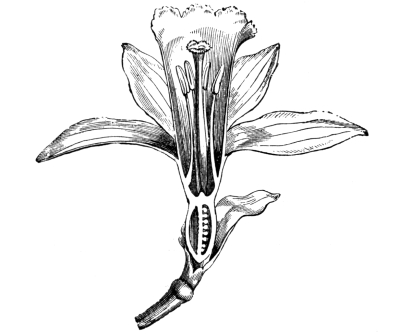
Fig. 96.—Daffodil flower,
cut down the middle. (× ⅔.)
It will be noticed that the parts of the flower are in threes. There
are six united perianth leaves (three inner and three outer), six
stamens (also in two series), and three united carpels. This is very
common—though by no means universal—in monocotyledons.
All the plants of the lily family—including the tulips, the true
lilies, lily of the valley, asparagus, onion, etc.—agree in being
monocotyledons, and in their flowers having a conspicuous perianth (for
attracting insects) and six stamens, and in the ovary being above the
insertion of the perianth.
The snowdrop family.—Plants of this family are very similar to
those of the lily family; in fact in only one respect can any sharp
line of demarcation be drawn between the two groups; in the snowdrop
and its relatives the other parts of the flower stand upon the ovary
(Fig. 96). The flowers of some plants of the family,
e.g. the daffodil, possess a tubular outgrowth of the perianth, which
is called a corona. It is often mistaken for a corolla.
26. THE ARUM LILY.
1. The cuckoo-pint.—Examine the habit of the plant, and then
cut open the “flower.” You will probably find a number of small flies
inside. Examine the central rod and make out the stamens and pistils on
it. Which ripen first?
The arum “lily,” with its humble relative the cuckoo-pint
(Fig. 97), merits special mention; for, in the first place,
it is not a lily at all, and secondly, it furnishes an extremely interesting
example of pistils coming to maturity before anthers, which is rather
rare.
What is generally called the “flower” of the cuckoo-pint, or “lords and
ladies,” consists of a big curled leaf with a purple rod sticking up in
the middle. Near the bottom of the rod, but hidden from sight by the
lower part of the leaf, the true flowers arise. The chamber containing
them is shut in by a series of stiffish hairs which point downwards.
Below the hairs the rod supports a series of anthers and, near the
bottom of the chamber, several pistils. On cutting open the chamber one
nearly always finds a number of small flies, covered with pollen, which
they have brought from another arum. The flies get in easily enough,
but once in they are prisoners, for the down-pointing hairs prevent
them from getting out again. The pistils near the bottom of the rod
ripen, and are fertilised by the pollen the flies have brought. After
a time the anthers above ripen and shed their welcome pollen on the
hungry captives. Soon after this the hairs at the top of the chamber
shrivel up, and the flies, once more covered with pollen, are at
liberty to return to the outer world and, untaught by experience, to
repeat the experiment on another “flower.”
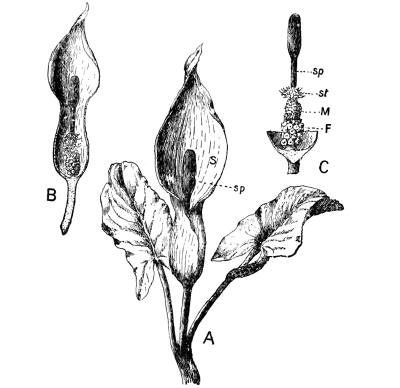
Fig. 97.—A, Cuckoo-pint. (× ¼.)
In B, the front of the leaf is cut away to show
the rod sp (C). F, female flowers;
M, male
flowers; st, undeveloped male flowers.
EXERCISES ON CHAPTER VI.
1. Describe the arrangement of the stamens in the
wallflower, the sage, and the primrose.
2. Describe the pistil of the deadnettle, the primrose, and
the shepherd’s purse. (1895)
3. In what respects does the flower of the buttercup differ
from that of the wild rose?
4. Explain the arrangement and form of the stamens in some
flower selected by yourself. Describe the structure and
contents of the anther. (1897)
5. Where is the pollen of a flower formed? What is its use? (1898)
6. Name one or two plants which do not ripen seed if insects
are excluded, and show why they do not. (1898)
7. Name two plants which would be in flower in each of the
months from March to August inclusive, and state in what
localities they would be found? (N.F.U.)
8. In what ways are insects attracted to visit flowers? Give
examples, with an explanation and drawing in each case, of
any special structure which may be a means of attraction. (N.F.U.)
9. Name ten flowering plants which may be found, (a) in a
shady wood, (b) in a meadow, in late spring.
10. Name any fresh specimens of flowers which usually could
be obtained growing wild in March, June, and October
respectively. (N.F.U.)
11. What wild flowers would you expect to find in early
April in your part of the country? In what kinds of places
would you look for them? (N.F.U.)
12. Name the parts of any flower you have examined which
are concerned with the production of seed. (King’s Scholarship, 1904)