[1] It is with no slight degree of satisfaction that the authors
of the present work observe the progress the science it recommends
has made in the public estimation since the first publication
of this volume: so that the complaint made in the above
paragraph must now be regarded as applicable only to a former
state of the science.
[2] Dr. Aikin.
[3] See Harris's Aurelian under Papilio Cinxia.
[4] The genera Eumolpus, Lamprima, Rynchites.
[5] Cryptorhynchus corruscans. N.B. Germar (Insect. Spec. Nov. i. 216—) regards this insect as synonymous with Illiger's Eurhin cupratus,
the description of which I had not seen when the Century of
Insects (Linn. Trans. xii.) was written, nor am I able now to speak
decisively on the subject.—K.
[6] Helicopis Cupido, Argynnis Passifloræ, Lathonia, &c.
[7] Pepsis fuscipennis, argentata, &c.
[8] The species of the genus Trox.
[9] Many of the Scarabæidæ, Dynastidæ, &c.
[10] Many caterpillars of Butterflies. Merian Surinam, t. xxii. xxv.
&c. and of Sawflies. Reaum. v. t. xii. f. 7, 8-14.
[11] Various species of the genera Locusta and Mantis, F.
[12] Many species of Phasma.
[13] De Geer, I. t. 3. f. 1-34, &c.
[14] Vanessa Io.
[15] Culex, Chironomus, and other Tipulariæ.
[16] Pterophorus.
[17] Hairs of many of the Apidæ. Mon. Ap. Ang. I. t. 10, ** d. 1. f. 1. b.
[18] Ptinus imperialis, L.
[19] Trichius delta, F.
[20] Acrocinus longimanus, F. Vanessa, C. album, Acronycta ψ, Plusia γ.
[21] On the underside of the primary wings near the margin in Argynnis
Aglaia, Lathonia, Selene, &c.
[22] Empis, Asilus.
[23] Onthophagus Taurus, Curtis Brit. Ent. t. 52.
[24] Lucanus Cervus.
[25] Oryctes.
[26] Dynastes Hercules.
[27] Andrena spinigera. Melitta. ** c. K.
[28] Hispa.
[29] This insect belonged to the late Mr. Francillon, and was purchased
at his sale by Mr. MacLeay. Mr. W. S. MacLeay informs us
that he has given the name of Eusceles to the group to which it
belongs.
[30] Raphidia ophiopsis.
[31] This idea seems to have been present to the mind of Linné and
Fabricius, when they gave to insects such names as Belzebub, Belial,
Titan, Typhon, Nimrod, Geryon, and the like.
[32] Plin. Hist. Nat. l. 11. c. 2.
[33] Gen. xi. 3.
[34] Megachile muraria.
[35] The white ants.
[36] Megachile Papaveris.
[37] The late ingenious Mr. Paul, of Harleston in Norfolk, under the
bark of a tree discovered a considerable portion of a fabric of this
kind, which from its amplitude must have been destined for some
other purpose.
[38] The common wasp.
[39] Polistes nidulans.
[40] Argyroneta aquatica.
[41] Tinea serratella, L.
[42] 1 Kings iv. 33. Prov. vi. 6-8.
[43] Gen. ii. 19.
[44] Linn. Fn. Suec. Præf.
[45] Rom. i. 19, 20.
[46] Levit. xi. 21, 22. Lichtenstein in Linn. Trans. iv. 51, 52.
[47] Levit. xi. 20. conf. Bochart. Hierozoic. ii. l. 4. c. 9. 497-8.
[48] 1 Kings iv. 33.
[49] Luke xii. 27.
[50] Ibid. x. 19, 20.
[51] "Quæri fortasse à nonnullis potest, Quis Papilionum usus sit?
Respondeo, Ad ornatum Universi, et ut hominibus spectaculo sint:
ad rura illustranda velut tot bracteæ inservientes. Quis enim eximiam
earum pulchritudinem et varietatem contemplans mira voluptate non
afficiatur? Quis tot colorum et schematum elegantias naturæ ipsius
ingenio excogitatas et artifici penicillo depictas curiosis oculis intuens,
divinæ artis vestigia eis impressa non agnoscat et miretur?"
Rai. Hist. Ins. 109.
[52] Nat. Theol. 213.
[53] Kirby, in Linn. Trans. iv. 232. 235. See also a letter signed C.
in the Gent. Mag. for August 1795. This little insect produces no
galls like the other species of the genus (Latr. Gen. Crust. et Ins. iv.
253. Meig. Dipt. i. 94.), yet it corresponds with the characters of
Cecidomyia laid down both by Latreille and Meigen.
[54] P. 192.
[55] See Latr. Familles Naturelles du Règne Animal, 429.
[56] Collet, in Month. Mag. xxxii. 320.
[57] Roesel I. iv. 170.
[58] Phytologia, 518.
[59] Fn. Suec. 567, 1383.
[60] Amoreux, 276.
[61] Rai. Cat. Cant. 45. Hist. Ins. 341.
[62] Comment. in Dioscor. I. 1. c. 23. 214. Lesser. L. ii. 280.
[63] De Geer, iv. 275-6.
[64] Detharding de Insectis Coleopteris Danicis, 9.
[65] Reaum. ii. 289. This insect and its caterpillar is finely figured
in Mr. Curtis's elegant and scientific British Entomology, t. 147.
[66] Faun. Suec. 822.
[67] Nat. Hist. of Barbad. 85.
[68] Quoted in Mouffet, 107.
[69] Reaum. i. 667.
[70] Reaum. vi. 99-100. Kirby Mon. Ap. Ang. i. 157-8.
[71] Southey's Madoc, 4to, Notes, 519.
[72] Haworth Lepid. Brit. 44. 57.
[73]
Oft have I smiled the happy pride to see
Of humble tradesmen in their evening glee,
When of some pleasing fancied good possest,
Each grew alert, was busy and was blest:
Whether the call-bird yield the hour's delight,
Or magnified in microscope the mite;
Or whether tumblers, croppers, carriers seize
The gentle mind; they rule it and they please.
There is my friend the weaver; strong desires
Reign in his breast; 'tis beauty he admires:
See to the shady grove he wings his way,
And feels in hope the rapture of the day—
Eager he looks, and soon to glad his eyes,
From the sweet bower by nature form'd arise
Bright troops of virgin moths, and fresh born butterflies.
He fears no bailiff's wrath, no baron's blame,
His is untax'd and undisputed game.
Crabbe's Borough, p. 110.
[74] Linn. Trans. ii. 315.
[75] Letter to Dr. Wharton. Mason's Life of Gray, p. 28.
[76] Illig. Mag. ii. 33. iv. 3.
[77] Andrews's Anecdotes, 152.
[78] Swartz in Kongl. Vet. Ac. Nya. band. ix. 40. Plate XXIII. Fig. 10.
[79] Young's Annals of Agriculture, xi. 406.
[80] No one knew Reaumur's Abeille Tapissiere until Latreille, happily
combining system with attention to the economy of insects, proved it
to be a new species—his Megachile Papaveris.—Hist. de Fourmis, 297.
[81] Bibliothek. vii. 310.
[82] Tour on the Continent, iii. 150.
[83] Shakespear's intention however in this passage was evidently
not, as is often supposed, to excite compassion for the insect, but
to prove that
The sense of Death is most in apprehension,
the actual pang being trifling. Measure for Measure, Act iii. Scene 1.
[84] Dr. Smith's Tour, i. 162. Journ. de Phys. xxv. 336.
[85] "Cœnis etiam non vocatus ut Musca advolo." Aristophon in
Pythagorista apud Athenæum. (Mouffet, 56.)
[86] Gentils, or gentles, is a synonymous word employed by our old
authors, but is now obsolete, except with anglers. Thus Tusser, in
a passage pointed out to me by Sir Joseph Banks:—
"Rewerd not thy sheep when ye take off his cote
With twitches and patches as brode as a grote;
Let not such ungentlenesse happen to thine,
Least fly with her gentils do make it to pine."
[87] For different kinds of larvæ, see Plates XVII. XVIII. XIX.
[88] Hist. Anim. l. 5. c. 10.
[89] Plate XVI. Fig. 6-9.
[90] In explanation of the terms Lepidoptera, Lepidopterous, Coleoptera,
&c. which will frequently occur in the following pages before
coming regularly to definitions, it is necessary here to state that they
have reference to the names given by entomologists to the different
orders or tribes of insects, as under:
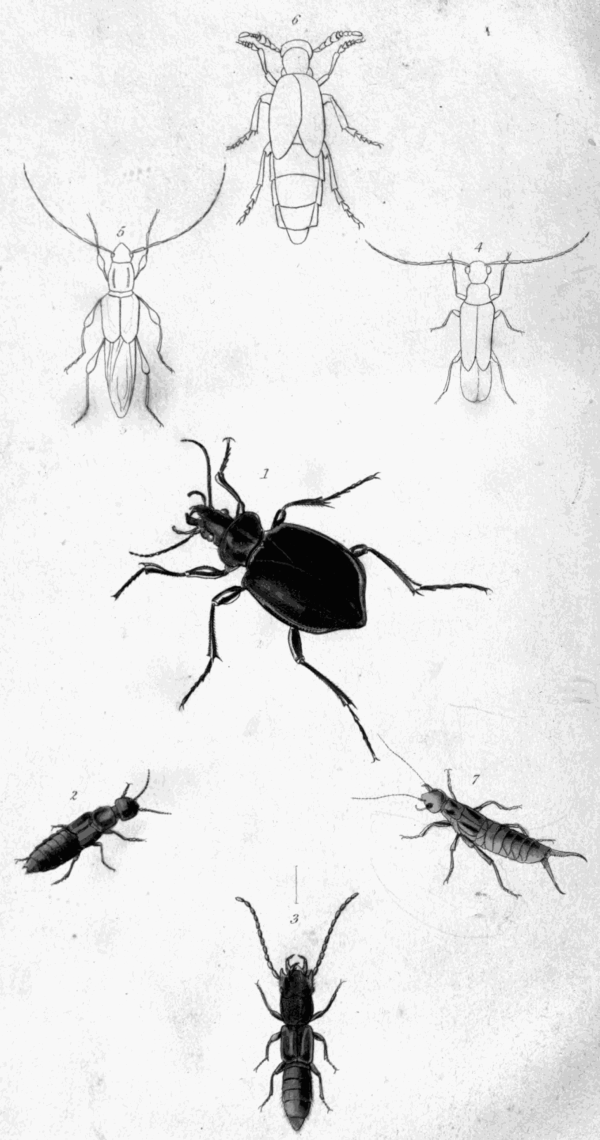
1 Coleoptera consisting of Beetles. Plate I. Fig. 1-6.
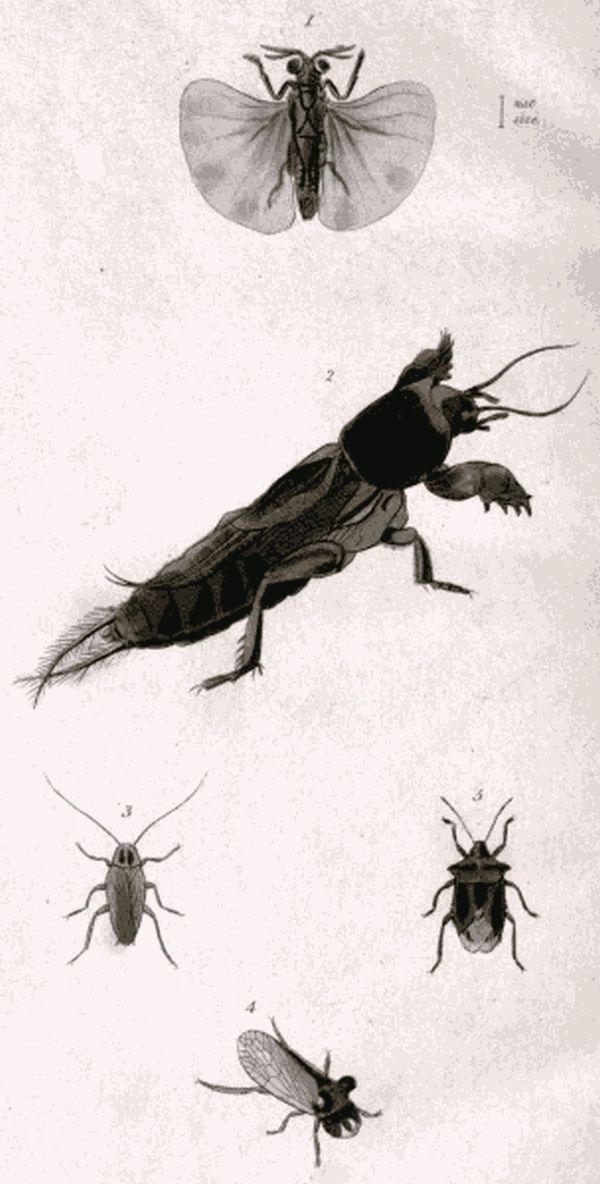
2 Strepsiptera——of the genera Xenos and Stylops. Plate II.
Fig. 1.
3 Dermaptera——of the Earwigs. Plate I. Fig. 7.
4 Orthoptera——of Cockroaches, Locusts, Grasshoppers,
Crickets, Spectres, Mantes, &c. Plate II. Fig. 2. 3.
5 Hemiptera consisting of Bugs, Cicadæ, Water-scorpions, Water-boat-men,
Plant-lice, Cochineal Insects, &c. Plate II. Fig. 4. 5.
6 Trichoptera consisting of the flies produced by the various species
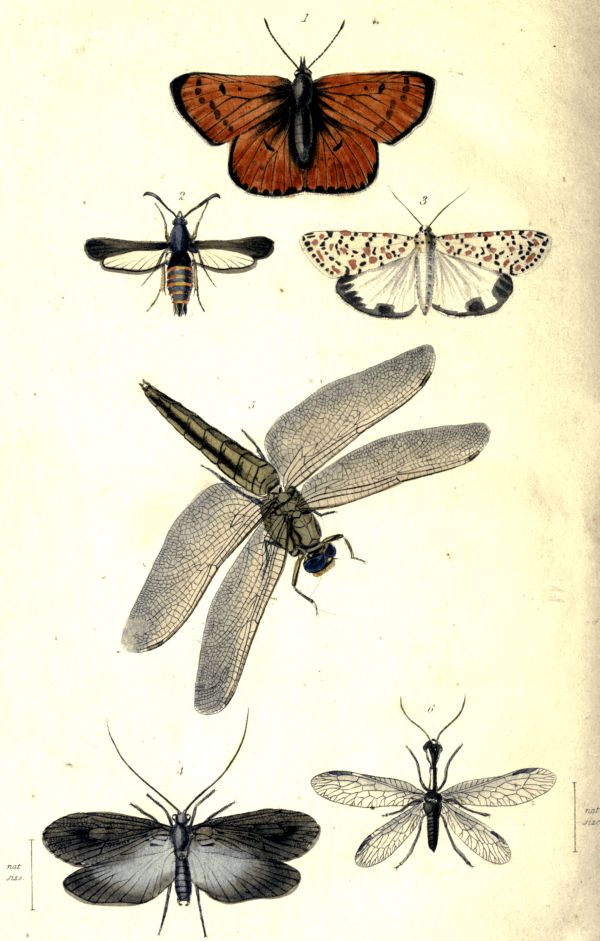
of Case-worms, Phryganea, L. Plate III. Fig. 4.
7 Lepidoptera consisting of Butterflies, Hawkmoths, and Moths.
Plate III. Fig. 1-3.
8 Neuroptera consisting of Dragon-flies, Ant-lions, Ephemeræ, &c.
Plate III. Fig. 5. 6.
9 Hymenoptera consisting of Bees, Wasps, and other insects armed
with a sting or ovipositor, and its valves. Plate IV. Fig. 1-3.
10 Diptera consisting of Flies, Gnats, and other two-winged insects.
Plate IV. Fig. 4. 5. Plate V. Fig. 1.
11 Aphaniptera consisting of the Flea tribe. Plate V. Fig. 2.
12 Aptera——of Mites, Lice, &c. Plate V. Fig. 3-6.
[91] Plate XVI. Fig. 10-13.
[92] Plate XVI. Fig. 4. 5.
[93] Plate XVII. Fig. 1-4.
[94] Plate XVII. Fig. 2.
[95] Plate XVII. Fig. 5-10.
[96] Epist. Dedicat.
[97] "A priest who has drunk wine shall migrate into a moth or fly,
feeding on ordure. He who steals the gold of a priest shall pass a
thousand times into the bodies of spiders. If a man shall steal honey,
he shall be born a great stinging gnat; if oil, an oil-drinking beetle;
if salt, a cicada; if a household utensil, an ichneumon fly." Institutes
of Menu, 353.
[98] Hill's Swamm. ii. 24. t. 37. f. 2. 4.
[99] De Bombyce, 29.
[100] Reaum. i. 359.
[101] Hill's Swamm. i. 127 a.
[102] Do you not perceive that we are caterpillars, born to form the
angelic butterfly?
[103] It is worthy of remark, that in the north and west of England
the moths that fly into candles are called saules (souls), perhaps from
the old notion that the souls of the dead fly about at night in search
of light. For the same reason, probably, the common people in Germany
call them ghosts (geistchen).
[104] Nares's Essays, i. 101-2.
[105] A few vertebrate animals, viz. frogs, toads, and newts, undergo
metamorphoses in some respects analogous to those of insects; their
first form as tadpoles being very different from that which they afterwards
assume. These reptiles too, as well as snakes, cast their skin
by an operation somewhat similar to that in larvæ. There is nothing,
however, in their metamorphoses at all resembling the pupa state
in insects.
[106] Joel ii. 25.
[107] On the Blight in Corn, p. 9.
[108] Leeuw. Epist. 98. 1696.
[109] Bingley, Anim. Biogr. first edition, iii. 437. St. Pierre's Studies,
&c. i. 312.
[110] Hist. Animal. l. 5. c. 31.
[111] From the terms employed by Aristotle and Dr. Mead in their
Account of these cases, it appears that the animal they meant could
not be maggots, but something bearing a more general resemblance
to lice.
[112] On Cutaneous Diseases, 87, 88; and t. 7. f. 4.
[113] Latreille at first considered this as belonging to a distinct genus
from the common mite (Acarus domesticus), which he named Sarcoptes;
but upon its being discovered that it also has mandibles, he
has suppressed it. N. Dict. d'Hist. Nat. xxi. 221.
[114] On Morbid Poisons, 306, 307.
[115] Mouffet, 267.
[116] Medica Sacra, 104, 105.
[117] It is to be hoped this new word may be admitted, as the laying
of eggs cannot otherwise be expressed without a periphrasis. For
the same reason its substantive Oviposition will be employed.
[118] Mém. Apterologique, 19.
[119] Insecta ejusmodi minutissima, forte Acaros diversæ speciei causas
esse diversorum morborum contagiosorum, ab analogia et experientia
hactenus acquisita, facili credimus negotio. Amœn. Ac. v. 94.
[120] Amœn. Ae. v. 94-98.
[121] Mouffet, 266.
[122] Acarus sub ipsa pustula minimè quærendus est, sed longius recessit,
sequendo rugam cuticulæ observatur. Amœn. Ac. v. 95. not. **.
[123] Observations, &c. 296.
[124] Extractus acu et super ungue positus, movet se si solis etiam calore
adjuvetur. ubi supr. Ungui impositus vix movetur: si vero oris
calido halitu affletur, agilis in ungue cursitat. Fn. Suec. 1975.
[125] Neque Syrones isti sunt de pediculorum genere, ut Johannes
Langius ex Aristotele videtur asserere: nam illi extra cutem vivunt,
hi vero non. ubi supr.
[126] Imo ipsi Acari præ exiguitate indivisibiles, ex cuniculis prope
aquæ lacum quos foderunt in cute, acu extracti et ungue impositi,
caput rubrum, et pedes quibus gradiuntur ad solem produnt. p. vi.
[127] Teredo sive exiguus vermiculus, qui subter cutim erodit agitque
cuniculos in pruriginosis manibus. Gouldman tells us these Acari
were also called Hand-worms. Another English name is given in
Mouffet, viz. Wheale-worms.
[128] Osservazioni intorno à pellicelli del corpo umano fatte dal Dottor
Gio Cosimo Bonomo, &c. f. 1-3. Baker On Microsc. i. t. 13. f. 2.
[129] De Geer, vii. t. 5. f. 12. 14.
[130] Mém. Apterologique, 79.
[131] I am informed by my learned friend Alexander MacLeay, Esq.
late Secretary to the Linnean Society, that, in the north of Scotland,
the insect of the itch is well known, and easily discovered and extracted.
[132] This opinion Dr. Bateman thinks probably the true one. Cutan.
Dis. 197.
[133] It may be mentioned here as a remarkable fact, that the Acarus
Scabiei was discovered by M. Latreille upon a New Holland quadruped
(Phascolomys fusca, Geoffr.) of the Marsupian tribe. N. Dict.
d'Hist. Nat. xxi. 222.
[134] Amœn. Ac. ubi supr. 101.
[135] Traités de Chirurgie, &c. Leipsig. 1792.
[136] Mém. Apterolog. 78.
[137] In Artaxerx.
[138] Il. χ. l. 599. ω l. 414.
[139] Τα δε εντομα παντα σκωληκοτοκει. De Generat. Animal. l. 2. c. 1.
[140] Il. υ. l. 654-5.
[141] Γης εντερα. De Animal. Incessu, c. 9. De Generat. Animal. l. 3. c. 11.
[142] Mark ix. 44. 46. 48.
[143] Σκωληκοβρωτος. Acts xii. 23.
[144] Linn. Lach. Lapp. ii. 32. note *.
[145] Latreille after De Geer (vii. 153—.) supposes the Pique and Nigua
of Ulloa to be synonymous with Ixodes americanus, L. Hist. Nat. vii.
364. but it is evident from Ulloa's description (Voy. i. 63. Engl. Trans.)
that they are synonymous with the Chigoe, or Pulex penetrans.
[146] See above p. 50.
[147] Captain Hancock, late commander of His Majesty's ship the Foudroyant,
to whose friendly exertions I am indebted for one of the
finest collections of Brazil insects ever brought to England, informs
me that they will attack any exposed part of the body. He had
them once in his hand.
[148] Piso and Margr. Ind. 289.
[149] p. 65.
[150] Personal Narrative, E. T. v. 101.
[151] Natural. Miscell., ii. t. 42.
[152] Lindley in the Royal Military Chronicle for March 1815, p. 459.
[153] I owe this information to the late Robinson Kittoe, Esq. formerly
clerk of the Cheque in the King's Yard, Woolwich.
[154] Lesser L. ii. 222, note *.
[155] De Geer, vii. 154-60.
[156] Theatr. Ins. 270. This happened in 1503; which circumstance
refutes Southall's opinion that bugs were not known in England
before 1670.
[157] Rai. Hist. Ins. 7. Mouffet. 269. They were called also punez,
from the French punaise.
[158] Hence our English word Bug-bear. In Matthews's Bible, Ps. xci. 5.
is rendered, "Thou shalt not nede to be afraid of any bugs by night."
The word in this sense often occurs in Shakespear. Winter's Tale,
act iii. sc. 2. 3. Hen. VI. act v. sc. 2. Hamlet, act v. sc. 2. See Douce's
Illustrations of Shakespear, i. 329.
[159] The Banian hospital at Surat is a most remarkable institution.
At my visit, the hospital contained horses, mules, oxen, sheep, goats,
monkeys, poultry, pigeons, and a variety of birds. The most extraordinary
ward was that appropriated to rats and mice, bugs, and other
noxious vermin. The overseers of the hospital frequently hire beggars
from the streets, for a stipulated sum, to pass a night amongst the
fleas, lice, and bugs, on the express condition of suffering them to enjoy
their feast without molestation. Forbes's Oriental Memoirs.
[160] Nicholson's Journal, xvii. 40.
[161] Proboscis in cutem intrusa acerrimum dolorem excitat, qui tamen
brevi cessat. Rai. Hist. Ins. 58.
[162] One took eight drops from Reaumur, iv. 230. Plate VII. Fig. 5.
[163] Bartram's Travels, 383.
[164] i. 127. The West India sand-fly was noticed by the late Robinson
Kittoe, Esq., who however did not recollect their fetching blood.
[165] See above, p. 48-49.
[166] Travels, &c. i. 126.
[167] See Curtis' Brit. Ent. t. 122.
[168] It has been generally supposed by naturalists, that the Mosquitos
of America belong to the Linnean genus Culex; but the celebrated
traveller Humboldt asserts that the term Mosquito, signifying
a little fly, is applied there to a Simulium, Latr. (Simulia, Meig.), and
that the Culices, which are equally numerous and annoying, are called
Zancudoes, which means long legs. The former, he says, are what the
French call Moustiques, and the latter Maringouins. Personal Narrative,
E. T. v. 93.
[169] Plin. Hist. Nat. l. xi. c. 28. Aristot. Hist. Animal. l. i. c. 5.
[170] Pliny was aware of this double office of the proboscis of a gnat,
and has well described it. "Telum vero perfodiendo tergori quo
spiculavit ingenio? Atque ut in capaci, cum cerni non possit exilitas,
ita reciproca geminavit arte, ut fodiendo acuminatum pariter
sorbendoque fistulosum esset." Hist. Nat. l. xi. c. 2.
[171] Humboldt has described several South American species. Personal
Narrative, v. 97. note *. Engl. Tr.
[172] Germar's Magazin der Entomologie, i. 137.
[173] Philos. Trans. 1767, 111-13. I once witnessed a similar appearance
at Maidstone in Kent.
[174] Weld's Travels, 8vo. edit. 205. Yet Mouffet affirms the same:
"Morsu crudeles et venenati, triplices caligas, imo ocreas, item perforantes."
81.
[175] Acerbi's Travels, ii. 5. 34-5. 51. Linn. Flor. Lapp. 380-1.
Lach. Lapp. ii. 108. De Geer, vi. 303-4.
[176] Reaum. iv. 573.
[177] Dr. Clarke's Travels, i. 388.
[178] Jackson's Marocco, 57.
[179] Travels, ii. 93. Mr. W. S. MacLeay, in a letter I recently received from him, observes, speaking of his residence at the Havana;
"The disagreeables are ants, scorpions, mygales, and mosquitos. The
latter were quite a pest on my first arrival within the tropics; but
now I mind them about as much as I did gnats in England."
[180] Humboldt's Personal Narrative, E. T. v. 87-. Most writers by
the term mosquitos mean gnats; and for them it is here chiefly employed,
but may be regarded as including both plagues.
[181] Theodorit. Hist. Eccl. 1. ii. c. 30.
[182] Mouffet, 85. Amoreux, 119.
[183] Viz. Mosquito Bay in St. Christopher's; Mosquitos, a town in
the Island of Cuba; and the Mosquito country in North America.
[184] Mouffet, 85.
[185] Deut. vii. 20. Josh. xxiv. 12.
[186] Amoreux, 242.
[187] Philos. Trans. i. 201.
[188] Hawkesworth's Cook, iii. 223.
[189] Stedman, ii. 94.
[190] Bingley, iii. 385, first edit.
[191] Knox's Ceylon, 24.
[192] Stedman, ii. 142.
[193] Ulloa's Voy. i. 61, 62. Dr. Clarke's Travels, i. 486. Amoreux,
197. Mr. W. S. MacLeay relates to me that soon after his arrival
at the Havana he was stung by an immense scorpion, but was agreeably
surprised to find the pain considerably less than the sting of a
wasp, and of incomparably shorter duration.
[194] Andrews's Anecdotes, 427. See on the subject of Scorpions Amoreux,
41-54. 176-205.
[195] Fab. Suppl. 294. 2.
[196] Catal. Ham. 1797. 151-195.
[197] Plate VII. Fig. 13. a".
[198] Ulloa's Voyage, i. 61.
[199] Amoreux, 217-226. See also 67-70.
[200] p. 31.
[201] Jackson's Marocco, second edit.
[202] Ulloa, i. 64. Probably the Cafafi, a white fly noticed by Humboldt,
is synonymous with this of Ulloa, which could only be prevented
from creeping between the threads of the curtains by keeping
them wet. Personal Narrative, E. T. v. 107.
[203] Lach. Lapp. i. 208, 209. Fl. Lapp. 382, 383. It appears however,
from other authors, that they do bite.
[204] Young's Travels in France, i. 298. These flies are equally troublesome
and tormenting in Sweden. See Amœn. Acad. iii. 343.
[205] Cowhage has been administered with success as an anthelminthic,
as has likewise spun glass pounded; the spicula of these substances
destroying the worms. The hair of the caterpillars here alluded to,
and perhaps also of the larva of Euprepia Caja, (the Tiger-Moth,)
might probably be equally efficacious.
[206] Reaum. ii. 191-5.
[207] Mouffet, 185. Plin. Hist. Nat. l. xxxviii. c. 9. Amoreux, 158.
[208] Amoreux, 210-212.
[209] Ulloa's Voyage, b. vi. c. 3. Hamilton (Travels in Colombia, as
quoted in the Literary Gazette, April 28, 1827.) also mentions a
spider called the Caya, rather large, found in the broken ground and
among the rocks, from the body of which a poison so active is emitted,
that men and mules have died in an hour or two after the venomous
moisture had fallen on them. This is evidently the same insect
with that mentioned by Ulloa, and confirms the above account
of its venomous effects.
[210] Waterton (Wanderings in S. America, 53.) gives the recipe by
which the Macousho Indians prepare the poison, in which they dip their arrows. It consists of a vine called the Wourali, which is the
principal ingredient; the roots and stalks of some other plants; two
species of ants, the sting of one of which is so venomous that it produces
a fever; a quantity of the strongest Indian pepper (Capsicum),
and the pounded fangs of two kinds of serpents.
[211] Tulpius, Obs. Med. l. ii. c. 51. t. 7. f. 3. Edinb. Med. and Surg.
Journ. n. 35. 42-48. Derham, Physic. Theol. 378. note b. Lowthorp,
Philos. Trans. iii. 135.
[212] Philos. Trans. 1665. x. 391. Shaw's Abridg. ii. 224.
[213] Mead, Med. Sacr. 105.
[214] London Medical Review, v. 340.
[215] Philos. Trans. ubi supra.
[216] Fulvius Angelinus et Vincentius Alsarius De verme admirando per
nares egresso. Ravennæ 1610.
[217] Azara, 217. I cannot help suspecting this to be synonymous with
the Œstrus Hominis next mentioned.
[218] From Pallas N. Nord. Beytr. i. 157.
[219] Essai sur la Géograph. des Plantes, 136.
[220] Clark in Linn. Trans. iii. 323, note.
[221] Leeuw. Epist. Oct. 17, 1687.
[222] Edinb. Med. and Surg. Journ.
ubi supra. De Geer, vi. 26, 27.
[223] 216.
[224] Lempriere On the Diseases of the Army in Jamaica, ii. 182.
[225] In passing through this parish last spring, I inquired of the mail-coachman
whether he had heard of this story; and he said the fact
was well known.
[226] Philos. Mag. ix. 366.
[227] Bonnet, v. 144.
[228] Mém. Apterolog. 79.
[229] Universal History, iv. 70. Ed. 1779.
[230] Wisd. xvii. 12.
[231] See above, p. 110.
[232] Once travelling through Cambridgeshire
with a brother entomologist in a gig, our horse was in the condition
here described, from the attack of Tabanus rusticus.
[233] De Geer, vii. 158.
[234] See Mr. W. S. MacLeay in Linn. Trans. xiv. 355—.
[235] De Geer, vi. 295.
[236] Amœn. Acad. iii. 358.
[237] Linn. Flor. Lapp. 376. Lach. Lapp. i. 233, 234. This insect
from Linné's description is probably no Culex, but perhaps a Simulium,
Latr. (Simulia, Meig.).
[238] Life of General Thomas, 186.
[239] Linn. It. Scand. 182. De Geer, v. 227-30.
[240] Plate XVI. Fig. 3. Mr. Clark, however, is of opinion that the
Œstrus does not pierce the skin of the animal, but only glues its eggs
to it. Essay on the Bots of Horses and other Animals, p. 47.
[241] Much of the information here collected is taken from Reaum.
iv. Mem. 12; and Clark in Linn. Trans. iii. 289.
[242] The writer of the present letter is possessor of this specimen,
which he took on himself in a field where oxen were feeding.
Plate V. Fig. 1.
[243] In the Systema Antliatorum (p. 56) Fabricius most strangely
considers this insect as synonymous with Culex reptans, L. calling it
Scatopse reptans, and dropping his former reference to Pallas, and
account of its injurious properties. Meigen (Dipt. i. 294) makes
this insect a Simulia under the name of S. maculata.
[244] Fabr. Ent. Syst. Em. iv. 276. 22. Latr. Hist. Nat. &c. xiv. 283.
Leipz. Zeit. Jul. 5, 1813, quoted in Germar's Mag. der Ent. ii. 185.
[245] It is by no means clear that the Œstrus of modern entomologists
is synonymous with the insects which the Greeks distinguish by that
name. Aristotle not only describes these as blood-suckers (Hist. Animal. l. viii. c. 11.) but also as furnished with a strong proboscis (l. iv.
c. 7.). He observes likewise that they are produced from an animal
inhabiting the waters, in the vicinity of which they most abound
(l. viii. c. 7.). And Ælian (Hist. l. vi. c. 38.) gives nearly the same
account. Comparing the Œstrus with the Myops (synonymous perhaps
with Tabanus, Latr., except that Aristotle affirms that its larvæ
live in wood, l. v. c. 19,) he says, the Œstrus for a fly is one of the
largest; it has a stiff and large sting, (meaning a proboscis,) and
emits a certain humming and harsh sound—but the Myops is like
the Cynomyia—it hums more loudly than the Œstrus, though it has
a smaller sting.
These characters and circumstances do not at all agree with the
modern Œstrus, which, so far from being a blood-sucker furnished
with a strong proboscis, has scarcely any mouth. It shuns also the
vicinity of water, to which our cattle generally fly as a refuge from
it. It seems more probable that the Œstrus of Greece was related
to Bruce's Zimb, represented in his figure with a long proboscis,
which makes its appearance in the neighbourhood of rivers, and belongs
to the Tabanidæ. For further information the reader should
consult Mr. W. S. MacLeay's learned paper on the insect called
Oistros and Asilus by the ancients. Linn. Trans. xiv. 353—.
[246] Bruce's Travels, 8vo. ii. 315.
[247] Heb. בעל זבוב literally "Lord-Fly." See 2 Kings, i. 2; and Bochart.
Hierozoic. ps. ii. l. 4. c. 9. p. 490.
[248] Burn-Cow or Ox, from βους bos, and πρηθω inflammo. M. Latreille
translates it Crève-bœuf, but improperly.
[249] Annales du Muséum.—Xe Ann. No xi. p. 129.
[250] Observations de plusieurs Singularités, &c. l. i. c. 45. p. 73 of the
Edition in Sir Joseph Banks's Library.
[251] Hist. Nat. l. xxix. c. 4.
[252] See Curtis, Brit. Ent. t. 142.
[253] Mr. Curtis (Brit. Ent. t. 106) under the name of Œstrus pictus
has figured a fine species of Gad-fly taken in the New Forest, which
he conjectures may be bred from the Deer. It may probably be one
of the species here alluded to.
[254] Reaum. v. 69. Dictionnaire de Trevoux, article Cerf.
[255] For the account of the Œstrus, of the deer, see Reaum. v. 67-77.
[256] Linn. Lach. Lapp. ii. 45. In the passage here referred to, Linné
speaks of two species of Œstrus, though the mode of expression indicates
that he considered them as the same. One was Œ. nasalis
from which they freed themselves by snorting, &c., the other Œ.
Tarandi which formed the pustules in their backs. In Syst. Nat. 969. 3. he strangely observes under the former species, "Habitat in equorum
fauce, per nares intrans!" confounding probably Œ. veterinus
of Mr. Clark with the true Œ. nasalis.
[257] Lach. Lapp. i. 280.
[258] Flor. Lapp. 79.
[259] Linn. Flor. Lapp. 379.
[260] Mr. Kittoe.
[261] Plate V. Fig. 3.
[262] Melittophagus, Mus. Kirby. See Mon. Ap. Angl. ii. 168. I copy
the following memorandum respecting M. Melittæ from my common-place-book,
May 7, 1812. On the flowers of Ficaria, Taraxacum
and Bellis, I found a great number of this insect, which seemed
extremely restless, running here and there over the flowers, and over
each other, with great swiftness mounting the anthers, and sometimes lifting themselves up above them, as if looking for something. One
or two of them leaped upon my hand. Near one of these flowers I
found a small Andrena or Halictus, upon which some of these creatures
were busy sucking the poor animal, so that it seemed unable to
fly away. When disclosed from the egg, I imagine they get on the top
of these flowers to attach themselves to any of the Andrenidæ that may
alight on them, or come sufficiently near for them to leap on it.—K.
[263] Latreille, Hist. des Fourmis, 307-20.
[264] See above, p. 34.
[265] Naturforscher Stk. xvi. 74.
[266] Quoted from Campbell's Travels in South Africa, in the Quarterly
Review for July 1815. 315.
[267] Huber. Pref. xi-xiii.
[268] De Geer, ii. 83.
[269] Considered by Mr. Clark as a new genus, which he has named
Cuterebra, and of which he has described three species. Essay on
the Bots of Horses, &c. p. 63. t. 2. f. 24-29.
[270] Linn. Trans. ix. 156-61.
[271] Germar's Mag. der Ent. i. 1-10. Mr. Stephens, in his Illustrations
of British Entomology (No. I. p. 4.), very judiciously asks,
"May not these herbivorous larvæ have been the principal cause of the mischief to the wheat, while those of the Zabrus contributed
rather to lessen their numbers than to destroy the corn." But this
query does not account for their being found, when in the perfect
state, attacking the ear. I have seen cognate beetles devouring the
seeds of umbelliferous plants.
[272] Act. Stockh. 1778. 3. n. 11. and 4. n. 4. Marsham in Linn. Trans.
ii. 79.
[273] Linn. Trans. ii. 76-80.
[274] Encyclopæd. Britann. viii. 480-95.
[275] Young's Annals of Agriculture, xi. 471.
[276] Tipula Tritici, K., belonging to Latreille's genus Cecidomyia. (See
above, p. 28. notea.) Marsham and Kirby in Linn. Trans. iii. 242-5.
iv. 225-39. v. 96-110.
[277] Oliv. ii. n. 19. 3-4.
[278] Curculio testaceus, Ent. Brit.
[279] Marsham in Linn. Trans. ii. 80. De Geer notices the injury done
by this fly to rye, and observes that before it had been attributed to
frost. ii. 68.
[280] Act. Stockh. 1750. 128. Reaum. ii. 480, &c.
[281] This insect was taken in maize by Mr. Sparshall of Norwich.
[282] Smith's Abbott's Insects of Georgia, 191.
[283] I say this upon the authority of Mr. Wolnough of Hollesley (late
of Boyton) in Suffolk, an intelligent agriculturist, and a most acute
and accurate observer of nature.
[284] Reaum. vi. 566.
[285] Kalm's Travels, i. 173.
[286] Amoreux, 288.
[287] I have raised plants from this seed, which appear from the foliage
to belong either to Phaseolus or Dolichos.
[288] Markwick, Marsham and Lehmann in Linn. Trans. vi. 142-.
and Kirby in ditto, ix. 37. 42. n. 19. 23.
[289] Plate XVII. Fig. 12.
[290] Philos. Trans. 1741. 581.
[291] De Geer, ii. 341. Amœn. Acad. iii. 355.
[292] Farmer's Mag. iii. 487.
[293] Pallas's Travels in South Russia, i. 30.
[294] Plate XVIII. Fig. 4.
[295] Marsham in Communications to the Board of Agriculture, iv. 412.
Plate xviii. fig. 4. and Linn. Trans. ix. 60.
[296] Plate XXIV. Fig. 3.
[297] The wire-worm is particularly destructive for a few years in gardens
recently converted from pasture ground. In the Botanic Garden
at Hull thus circumstanced a great proportion of the annuals sown
in 1813 were destroyed by it. A very simple and effectual remedy
in such cases was mentioned to me by Sir Joseph Banks. He recommended
that slices of potato stuck upon skewers should be buried
near the seeds sown, examined every day, and the wire-worms which
collect upon them in great numbers destroyed.
This plan of decoying destructive animals from our crops by offering
them more tempting food, is excellent, and deserves to be pursued
in other instances. It was very successfully employed in 1813
by J. M. Rodwell, Esq. of Barham Hall near Ipswich, one of the most
skilful and best informed agriculturists in the county of Suffolk, to
preserve some of his wheat-fields from the ravages of a small gray
slug, which threatened to demolish the plant. Having heard that
turnips had been used with success to entice the slugs from wheat, he
caused a sufficient quantity to dress eight acres to be got together;
and then, the tops being divided and the apples sliced, he directed
the pieces to be laid separately, dressing two stetches with them and
omitting two alternately, till the whole field of eight acres was gone
over. On the following morning he employed two women to examine
and free from the slugs, which they did into a measure, the tops and
slices; and when cleared they were laid upon those stetches that had
been omitted the day before. It was observed invariably, that in the
stetches dressed with the turnips no slugs were to be found upon the
wheat or crawling upon the land, though they abounded upon the
turnips; while on the undressed stetches they were to be seen in great numbers both on the wheat and on the land. The quantity
of slugs thus collected was near a bushel.—Mr. Rodwell is persuaded
that by this plan he saved his wheat from essential injury.
[298] Reaum. v. 11.
[299] Two species are confounded under the appellation of the grub,
the larvæ namely of Tipula oleracea and cornicina, which last is very
injurious, though not equally with the first. In the rich district of
Sunk Island in Holderness, in the spring of 1813, hundreds of acres
of pasture have been entirely destroyed by them, being rendered as
completely brown as if they had suffered a three months drought,
and destitute of all vegetation except that of a few thistles. A square
foot of the dead turf being dug up, 210 grubs were counted in it!
and, what furnishes a striking proof of the prolific powers of these
insects, the next year it was difficult to find a single one.
[300] Stickney's Observations on the Grub.
[301] De Geer, i. 487.
[302] I owe this information to the late Robinson Kittoe, Esq.
[303] Castle in Philos. Trans. xxx. 346.
[304] Browne's Civil and Nat. Hist. of Jamaica, 430.
[305] Essai sur la Géographie des Plantes, 136.
[306] M'Kinnen, 171. Browne ubi supr. Merian, Ins. Sur. 10.
[307] Smith's Abbott's Insects of Georgia, 199.
[308] Illiger, Mag. i. 256.
[309] The farmers would do well to change the name of this insect
from turnip-fly to turnip-flea, since from its diminutive size and activity
in leaping the latter name is much the most proper. The term,
the fly, might with propriety be restricted to the Hop-aphis.
[310] Young's Annals of Agriculture, vii. 102.
[311] Marshall in Philos. Trans. lxxiii. 1783.
[312] See above, p. 167-168.
[313] Swamm. ii. 81. col. b.—Gyllenhal in describing the last-named
species, so common on the flowers of siliquose plants (Insecta Suecica,
iii. 142.), asks if his R. sulcicollis (C. Pleurostigma, E. B.), which
agrees with it in most respects, except in having toothed thighs, be
not the other sex? This query I can solve in the negative, having
taken the sexes of R. assimilis in coitu, which do not differ, save that
the male has a somewhat shorter rostrum.
[314] Spence's Observations on the Disease in Turnips called Fingers
and Toes. Hull 1812. 8vo.
[315] Reaum. ii. 471.
[316] See above, p. 29.
[317] De Geer, ii. 440. In the summer of 1826 when at Brussels, I
observed that delicious vegetable of the cabbage tribe so largely cultivated
there under the name of Jets de choux, and which in England we call Brussels sprouts, to be materially injured in the later stages
of its growth by the attacks of the turnip-flea, and other little beetles
of the same genus (Haltica), which were so numerous and so universally
prevalent, that I scarcely ever examined a full-grown plant
from which a vast number might not have been collected. Some
plants were almost black with them, the species most abundant being
of a dark æneous tinge. They had not merely eroded the cuticle
in various parts, so as to give the leaves a brown blistered appearance,
but had also eaten them into large holes, at the margin of
which I often saw them in the act of gnawing; and the stunted and
unhealthy appearance of the plants sufficiently indicated the injurious
effect of this interruption of the proper office of the sap. What
was particularly remarkable, considering the locomotive powers of
these insects, was that the young turnips, sown in August after the
wheat and rye, close to acres of Brussels sprouts, (which all round
Brussels are planted in the open fields among other crops,) infested
by myriads of these insects, were not more eaten by them than they
usually are in England, and produced good average crops. It would
seem, agreeably to a fact already mentioned, (see Vol. I. 4th Edit.
p. 389,) that they prefer the taste of leaves to which they have been
accustomed, to younger plants of the same natural family; and hence
perhaps the previous sowing of a crop of cabbage-plants in the
corner of a field meant for turnips, might allure and keep there the
great bulk of these insects present in the vicinity, until the turnips
were out of danger.
[318] Perhaps this fly is the same which Linné confounded with
Tachina Larvarum, which he says he had found in the roots of the
cabbage (Syst. Nat. 992. 78.) I say "confounded," because it is not
likely that the same species should be parasitic in an insect, and also
inhabit a vegetable.
[319] In lately examining, however, some young garden peas and beans
about four inches high, I observed the margins of the leaves to be
gnawed into deep scollops by a little weevil (Sitona lineata), of which
I found from two to eight on each pea and bean, and many in the
act of eating. Not only were the larger leaves of every plant thus
eroded, but in many cases the terminal young shoots and leaves were
apparently irreparably injured. I have often noticed this and another
of the short-snouted Curculios (S. tibialis) in great abundance in
pea and bean fields, but was not aware till now that either of them
was injurious to these plants. Probably both are so, but whether
the crop is materially affected by them must be left to further
inquiry.
[320] Reaum. ii. 479.
[321] Description of S. Ceparum.—Cinereous, clothed with distant
black hairs, proceeding, particularly on the thorax, from a black point.
Legs nigrescent. Back of the abdomen of the male with an interrupted
black vitta down the middle. Wings immaculate. Poisers
and alulæ pale yellow. Length 3½ lines.
[322] Barton in Philos. Magaz. ix. 62.
[323] Reaum. ii. 337.
[324] Apis. **. c. 2. α. K.
[325] Reaum. iv. 499.
[326] Rai. Hist. Ins. Prolegom. xi.
[327] This kind of misnomer frequently occurs in entomological authors.—Thus,
for instance, the Curculio (Rynchites) Alliariæ of
Linné feeds upon the hawthorn, and Curculio (Cryptorhynchus) Lapathi
upon the willow (Curtis in Linn. Trans. i. 86.); but as Alliaria
is common in hawthorn hedges, and docks often grow under willows,
the mistake in question easily happened: when, however, such mistakes
are discovered, the Trivial Name ought certainly to be altered.
[328] I consider this insect as the type of a new subgenus (Phyllopertha, K.
MS.), which connects those tribes of Melolontha, F. that have
a mesosternal prominence with those that have not. Of this subgenus
I possess six species. It is clearly distinct from Anisoplia, under
which DeJean arranges it.
[329] Wiener Verzeich. 8vo. 29.
[330] Fabricius seems to have regarded the saw-fly that feeds upon the
sallow (Nematus Capreæ), not only as synonymous with that which
feeds upon the osier, but also with our little assailant of the gooseberry
and currant. Yet it is very evident from Reaumur's account,
whose accuracy may be depended upon, that they are all distinct species.
Fabricius's description of the fly agrees with the insect of the
gooseberry, but that which he has given of the larva belongs to the animal inhabiting the sallow. Probably, confounding the two species,
he described the imago from the insect of the former, and the larva
(if he did not copy from Reaumur or Linné) from that of the latter.
Linné was correct in regarding Reaumur's three insects as distinct
species, though he appears to be mistaken in referring to him under
N. flavus, as the saw-fly of the currant and gooseberry is not wholly
yellow.
[331] Peck's Nat. Hist. of the Slug-worm, 9.
[332] Trost Kleiner Beytrag. 38.
[333] Reaum. ii. 477.
[334] On the Apple and Pear, 158. The beetle Mr. Knight alludes to
is probably the Polydrosus oblongus, which answers his description,
and is common on pear-trees.—In Holland, it is stated in a little
tract on this subject (Verhandeling ten bewijze &c. door F. H. van
Berck. 8vo. Haarlem 1807), that the great destroyer of the blossoms
of their apple- and pear-trees is the larva of another weevil, Anthonomus
Pomorum, which from the name and Gyllenhal's addition to
the habitat given by Linné—"quas destruit"—should seem to be
injurious in Sweden also.
[335] Reaum. ubi supr. 475.
[336] On Fruit Trees, 271.
[337] On the Apple and Pear, 45.
[338] Reaum. ii. 499.
[339] Mr. Scales.
[340] See Observations on this Insect in the 2nd volume of the Horticultural
Society's Transactions, p. 25. By W. Spence.
[341] Reaum. iv. 69. t. 5. f. 6, 7.
[342] A solution of quick-lime is recommended in the Gardener's Magazine
for January 1828, a periodical work which every friend of
Horticulture ought to possess.
[343] This Aphis is evidently the insect described in Illiger's Magazin,
i. 450. under the name of A. lanigera, as having done great injury to
the apple-trees in the neighbourhood of Bremen in 1801. That it is
an Aphis and no Coccus is clear from its oral rostrum and the wings
of the male, of which Sir Joseph Banks possesses an admirable drawing
by Mr. Bauer. On this Aphis see Forsyth, 265; Monthly Mag.
xxxii. 320; and also for August 1811; and Sir Joseph Banks in the
Horticultural Society's Transactions, ii. 162. Those Aphides that
transpire a cottony excretion are now considered as belonging to a
distinct genus, under the name of Myzoxyla.
[344] M. de la Hire in Reaum. ii. 478.
[345] Dr. Smith Barton's Letter in Philos. Magaz. xxii. 210. William
Davy, Esq. American Consul of the Port of Hull, long resident in
the United States, informed me that though he had abundance of
peaches at his country-house, German Town near Philadelphia, he could never succeed with the nectarine, the fruit constantly falling
off perforated by the grub of some insect.
[346] Descr. of the I. of St. Helena, 147.
[347] A mode of destroying this hurtful insect is given in a Number
of that useful and interesting work, the Gardener's Magazine, just
quoted.
[348] Reaum. ii. 505.
[349] Ibid. ii. 507. and Hasselquist's Travels in the Levant, 428.
[350] That is "High and Low," Judges ix. 13.
[351] Sturm Deutschlands Fauna, i. 5.
[352] Latreille, Hist. Nat. xi. 66. 331.
[353] Host in Jacquin. Collect. iii. 297.
[354] Pallas's Travels in S. Russia, ii. 241.
[355] Jacquin. Collect. ii. 97.
[356] Deut. xxviii. 39.
[357] Travels, ii. 6.
[358] Collinson in Philos. Trans. liv. x. 65.
[359] Rösel, I. ii. 15.
[360] Reaum. ii. 122.
[361] Mouffet, 160.
[362] Philos. Trans. xix. 741.
[363] Reaum. i. 387. These larvæ were so extremely numerous in
1826 on the limes of the Allée Verte at Brussels, that many of the
trees of that noble avenue, though of great age, were nearly deprived
of their leaves, and afforded little of the shade which the unusual
heat of the summer so urgently required. The moths which in autumn
proceeded from them, when in motion towards night, swarmed
like bees, and subsequently on the trunk of every tree might be seen
scores of females depositing their down-covered patch of eggs. In
the Park they were also very abundant; and it may be safely asserted
that if one half of the eggs deposited were to be hatched, in 1827
scarcely a leaf would remain in either of these favourite places of
public resort. Happily, however, this calamity seems likely to be prevented.
Of the vast number of patches of eggs which I saw on almost
every tree in the park about the end of September, I could
two months afterwards to my no small surprise, discover scarcely one,
though the singularity of the fact made me examine closely. For
their disappearance I have no doubt the inhabitants of Brussels are
indebted to the tit-mouse (Parus), the tree-creeper (Certhia familiaris),
and other small birds known to derive part of their food from
the eggs of insects, and which abound in the park, where they may
be often seen running up and down the trunks of the trees, at once
providing their own food and rendering a service to man, which all
his powers would be inadequate completely to effect.
Reaumur (ii. 106) in certain seasons found these patches of eggs so numerous, that in the Bois de Boulogne there was scarcely an oak,
the under side of the branches of which were not covered by them
for an extent of seven or eight feet. He informs us that the eggs
are not hatched till the following spring.
[364] Wiener Verzeich. 8vo. 75.
[365] Curtis Brit. Ent. t. 117.
[366] De Geer, ii. 452.
[367] Kalm's Travels, ii. 7.
[368] The same intelligent gentleman related to me, that a person having
taken some land at Bahia in the Brazils, he was compelled by
these ants, which were so numerous as to render every effort to destroy
them ineffectual, to relinquish the occupation of it. Their nests
were excavated to the astonishing depth of fourteen feet. Merian Insect.
Sur. 18. Smeathman on Termites, Phil. Trans. lxxi. 39. note 35.
[369] Stedman, ii. 142.
[370] Hist. Nat. l. xi. c. 12.
[371] Curtis Brit. Ent. t. 60.
[372] Lewin in Linn. Trans. iii. 1.—Curtis in do. i. 86.
[373] Curtis Brit. Ent. t. 104.
[374] MacLeay in Edinburgh Philos. Journ. n. xxi. 123. Curtis Brit.
Ent. t. 43.
[375] Wilhelm's Recreations from Nat. Hist. quoted by Latreille Hist.
Nat. xi. 194.
[376] Reaum. ii. 502.
[377] Bochart, Hierozoic. P. ii. l. iv. c. 5. 475.
[378] Bochart, ubi supr. c. 6. 485.
[379] Exod. x. 5. 14, 15.
[380] Hist. Nat. l. xi. c. 29. A similar law
was enacted in Lemnos, by which every one was compelled to bring
a certain measure of locusts annually to the magistrates. Plin. ibid.
[381] Oros. contra Pag. l. v. c. 2.
[382] Lesser, L. 247. note 46.
[383] Mouffet, 123.
[384] Bingley, iii. 258.
[385] Philos. Trans. 1686.
[386] Elements of Agricultural Chemistry, 233.
[387] Philos. Trans. xlvi. 30.
[388] Major Moor, author of The Narrative of Captain Little's Detachment,
The Hindu Pantheon, &c.
[389] Travels, i. 348.
[390] Travels, &c. 257.
[391] Southey's Thalaba, i. 171.
[392] Genes. xvi. 12.
[393] Jackson's Travels in Marocco, 54.
[394] See Bochart, Hierozoic. P. l. iv. c. 5. 474-5.
[395] Southey's Thalaba, i. 169.
[396] Of the symbolical locusts in the Apocalypse it is said—"And the
sound of their wings was as the sound of chariots, of many horses
running to battle." ix. 9.
[397] Joel ii. 2-10. 20.
[398] Voyage to the Levant, 444.
[399] Voyage to the Levant, p. 446-7.
[400] See p. 219.
[401] Travels, 54.
[402] Travels, i. 366.
[403] Travels, 455.
[404] Travels, 447.
[405] Amœn. Acad. iii. 345.
[406] Sparrman, i. 103. This insect, by Swedish entomologists, is supposed
to be a species of Anobium, F., (Ptinus, L.,) but the specimen
preserved in the Linnean cabinet is Silpha rosea of Mr. Marsham
(Cacidula pectoralis, Meg.). A small beetle of the first family of Cryptophagus
of Major Gyllenhal swarms often in the ship biscuit, and
may probably be the insect Sparrman here complains of under the
name of Dermestes paniceus.
[407] See above, p. 172.
[408] De Geer, v. 46. This insect appears nearly related to Mr. Marsham's
Corticaria pulla (E. B. i. 11. 14. Latridius porcatus, Herbst),
if it be not the same insect.
[409] Amœn. Acad. iii. 345.
[410] This name has long been given to this insect, and the Characters
of the genus were drawn by Mr. Curtis before the publication
of Meigen's fifth volume (in which the genus is called Piophila); it is
therefore retained. See Curtis Brit. Ent. t. 126.
[411] Reaum. iii. 276.
[412] Leeuwenh. Epist. 99.
[413] Ceylon, 307.
[414] Voyage, &c. 72.
[415] Williamson's East India Vade Mecum.
[416] Calcutta, a Poem, 85.
[417] Ptinus piceus, Marsh.
[418] On examining ninety-two chests of opium, part of the cargo saved
from the Charlton, previously to reshipping them from Chittagong
for China, thirteen were found to be full of white ants, which had
almost wholly devoured the opium. Article from Chittagong, Nov.
1812, in one of the Newspapers, July 31, 1813.
[419] Ptinus rubellus, Marsh.
[420] Bibl. Nat. i. 125. b. 126. a.
[421] Sir Geo. Staunton's Voy. 8vo. 189.
[422] Kerr in Philos. Trans. 1781.
[423] Reaum. iii. 266.
[424] Ibid. 59.
[425] Reaum. iii. 42.
[426] Ibid. 257.
[427] Amœn. Acad. iii. 346.
[428] Kirby in Linn. Trans. v. 250.
[429] Curculio lignarius, Marsh. Rhinosimus ruficollis, Latr.
[430] The species of the genus Dorcadion separated from Lamia are
discovered to live upon the roots of grass.
[431] The larva of a Callidium (which Dr. Leach has discovered to be
C. Bajulus) sometimes does material injury to the wood-work of the
roofs of houses in London, piercing in every direction the fir-rafters,
and, when arrived at the perfect state, making its way out even
through sheets of lead one-sixth of an inch thick, when they happen
to have been nailed upon the rafter in which it has assumed its final
metamorphosis. I am indebted to the kindness of Sir Joseph Banks
for a specimen of such a sheet of lead, which, though only eight inches long and four broad, is thus pierced with twelve oval holes, of some
of which the longest diameter is a quarter of an inch! Mr. Charles
Miller first discovered lead in the stomach of the larva of this insect.
[432] P. 310.
[433] See Kirby, ubi supr. 253.—More than a hundred species of the
Capricorn tribe, many of them nondescripts, were collected in the
neighbourhood of Rio de Janeiro by Captain Hancock, of the Foudroyant.
[434] In Linn. Trans. x. 399.
[435] Syst. Nat. 565. 2.
[436] Smith's Introduction to Botany, Pref. xv.
[437] Afzelius in Linn. Trans. iv. 261.
[438] Linn. Trans. x. 403.
[439] Kirby, Mon. Ap. Ang. i. 152-194. Latreille, Gen. iv. 161—.
[440] In order to ascertain how far pure sea water is essential to this
insect, and consequently what danger exists of its being introduced
into the woodwork of our docks and piers communicating with our
salt-water rivers, as at Hull, Liverpool, Bristol, Ipswich, &c., where
it might be far more injurious than even on the coast, I have, since
December 15th 1815, when Mr. Lutwidge was so kind as to furnish
me with a piece of oak full of the insects in a living state, poured a
not very strong solution of common salt over the wood, every other
day, so as to keep the insects constantly wet. On examining it this
day (Feb. 5th 1816) I found them alive; and, what seems to prove
them in as good health as in their natural habitat, numbers have established
themselves in a piece of fir-wood which I nailed to the oak, and
have in this short interval, and in winter too, bored many cells in it.
[441] See p. 226.
[442] Reaum. iii. 270.
[443] Schrank Enum. Ins. Austr. 513. 1058.
[444] Horne's Introd. to Bibliography, i. 311.
[445] It appears from Humboldt (Personal Narrative, E. T. v. 116.)
that the destructive insects called by this name, are Termites.
[446] Ulloa, i. 67.
[447] Amœn. Acad. iii. 345.
[448] Drury's Insects, iii. Preface.
[449] It is not its hardness that protects the teak, as the Asiatic Termites
attack Lignum Vitæ, but probably some essential oil disagreeable
to them with which it is impregnated. This is the more likely,
since they will eat it when it is old and has been long exposed to the
air. Tannin has been conjectured to be the protecting substance,
but erroneously, as leather of every kind is devoured by them. Williamson's
East India Vade Mecum, ii. 56. It is its hardness probably
that protects the iron-wood from the African Termites. Smeathman
in Philos. Trans. 1781. 11. 47.
[450] Japan, ii. 127.
[451] Political Essay on New Spain, iv. 135.
[452] This account of the Termites is chiefly taken from Smeathman
in Philos. Trans. 1781, and Percival's Ceylon, 307—.
[453] Oriental Memoirs, i. 362.
[454] Morning Herald, Dec. 31st, 1814.
[455] The ship here alluded to was the Albion, which was in such a
condition from the attack of insects, supposed to be white ants, that,
had not the ship been firmly lashed together, it was thought she would
have foundered on her voyage home.—The late Mr. Kittoe informed
me that the Droguers or Draguers, a kind of lighter employed in the
West Indies in collecting the sugar, sometimes so swarm with ants,
of the common kind, that they have no other way of getting rid of
these troublesome insects than by sinking the vessel in shallow water.
[456] Luke x. 19.
[457] Sparrman's Voyage, i. 367.
[458] The Coprion, Cantharus, and Heliocantharus of the ancients was
evidently this beetle, or one nearly related to it, which is described
as rolling backwards large masses of dung, and attracted such general
attention as to give rise to the proverb Cantharus pilulam. It should
seem from the name, derived from a word signifying an ass, that the
Grecian beetle made its pills of asses' dung; and this is confirmed by
a passage in one of the plays of Aristophanes, the Irene, where a
beetle of this kind is introduced, on which one of the characters
rides to heaven to petition Jupiter for peace. The play begins with
one domestic desiring another to feed the Cantharus with some bread,
who afterwards orders his companion to give him another kind of
bread made of asses' dung.
[459] Plate XXII. Fig. 4, 5.
[460] See Latr. Gen. i. 275.
[461] This property in the carrion insects may be turned to a good account
by the comparative anatomist, who has only to flay the body
of one of the smaller animals, anoint it with honey, and bury it in an
ant-hill; and in a short time he will obtain a perfect skeleton, denudated
of every fibril of muscle, though with the ligaments and cartilages
untouched.
[462] Gleditsch, Abhandlungen, iii. 200.
[463] It is to be observed that in our cold climates, during the winter
months, when excrement and putrescent animal matter are not so
offensive, they are left to the action of the elements, insects being
then torpid.
[464] Curtis Brit. Ent. t. 5.
[465] Surely Mr. Marsham's name for this genus, Boletaria, is much
more proper than that of Fabricius, Mycetophagus (Agaric-eater),
since these insects seldom eat agarics.
[466] Œcon. Nat. Amœn. Ac. ii. 50. Stillingfleet's Tracts, 122.
[467] Maupertuis observes, that in Lapland he saw many birch-trees
lying on the ground, which had probably been there for a very long
time, with the bark entire, though the wood was decayed. Hence
we may probably infer, that in that country there are few or none of
the bark-boring insects.
[468] Latreille, Observations nouvelles sur les Hyménoptères. Annal. de
Mus. 11.
[469] Nat. Hist. of Carolina, ii. 105.
[470] Reaum. vi. 282. St. Pierre's Voyage, 72.
[471] Bartram in Philos. Trans. xlvi. 126.
[472] The larvæ of some species of Coccinellæ feed, according to Prof.
D. Reich, solely on the leaves of plants; as that of C. hieroglyphica,
which eats the leaves of common heath (Erica vulgaris) after the manner
of the larvæ of Lepidoptera. I suspect, however, that there is
some mistake in this statement. Der Gesellschaft naturf. Fr. in Berlin
Mag. &c. iii. 294.
[473] Latreille denominates this family, as he calls it, Pupivora: if by
this he alludes to their devouring the young of insects, from the classical
meaning of the word pupa, the term is very proper; but this
should be borne in mind, as the majority of readers would imagine
it to refer to the pupa state of insects, in which they are not so generally
devoured by their parasites.
[474] Not having had it in my power to consult Dalman's work on the
Chalcidites of Latreille, referred to by that learned Entomologist in
his Familles Naturelles du Règne Animal, I am not able to refer them
to their proper genera.
[475] Plate XVI. Fig. 1.
[476] Marsham in Linn. Trans. iii. 26.
[477] See above, p. 169-170.
[478] Alysia Manducator; and another species allied to Alomyia Debellator,
which I have named A. Stercorator.
[479] De Geer, ii. 863.
[480] Ibid. 851-5.
[481] Reaum. ii. 419.
[482] De Geer, i. 196. vi. 14. 24.
[483] Reaum. ii. 440-4.
[484] Linn. Trans. xi. 86.
[485] Kirby's Mon. Ap. Ang. ii. 110-113.
[486] Rossi Fn. Etrusc. Mant.
[487] Preys. Bömisch. Insekt. 59. 61.
[488] Plate XVII. Fig. 13.
[489] Entom. Helvétique, ii. 158.
[490] In the former edition of this work (Vol. IV. p. 392), this tribe is
denominated Eupodina; but as this seems too near to M. Latreille's
Eupoda, belonging to a different tribe of beetles, we have substituted
the above name, which means the same.
[491] One was taken at Aldeburgh in Suffolk by Dr. Crabbe, the celebrated
poet; another by a young lady at Southwold, which is now in
the cabinet of W. J. Hooker, esq.; and a third by a boy at Norwich,
crawling up a wall, which was purchased of him by S. Wilkin, esq.
[492] Latr. Hist. Nat. x. 181.
[493] Linn. Trans. vi. 149. Kirby, Ibid. ix. 42. 23.
[494] The late R. Kittoe, Esq.
[495] p. 123.
[496] Voyages, i. 185.
[497] Percival's Ceylon, 307.
[498] Mr. Knight made the same observation in 1806, and supposes
the scarcity of neuters arose from the want of males to impregnate
the females. Philos. Trans. 1807, p. 243.
[499] St. Pierre, Voy. 72.
[500] Lesser, L. i. 263, note.
[501] Reaum. vi. 400. t. 36-38. Plate XVI. Fig. 5. a.
[502] Thiebaut de Berneaud's Voyage to Elba, p. 31.
[503]
"Even Tiger fell and sullen Bear
Their likeness and their lineage spare.
Man only mars kind nature's plan,
And turns the fierce pursuit on Man!"
Scott's Rokeby, canto iii. 1.
[504] Reaumur, ii. 413.
[505] De Geer, i. 533. iii. 361. v. 400. vi. 91.
[506] Rösel, iv. 96.
[507] Thunberg's Travels, ii. 66.
[508] De Geer, vii. 335.
[509] De Geer, vii. 180.
[510] Bingley, ii. 374.
[511] Bingley, iii. 27.
[512] Collinson in Philos. Trans. 1763.
[513] Sparrman, ii. 180.
[514] St. Pierre, Voy. 73.
[515] Reaum. vi. 479-487.
[516] Swamm. Bib. Nat. i. c. 4. 106. b.
[517] In Col. Venable's Experienced Angler, a vast number of insects
are enumerated as good baits for fish, under the names of Bob, Cadbait,
Cankers, Caterpillars, Palmers, Gentles, Bark-worms, Oak-worms,
Colewort-worms, Flag-worms, Green-flies, Ant-flies, Butterflies, Wasps,
Hornets, Bees, Humble-bees, Grasshoppers, Dors, Beetles, a great
brown fly that lives upon the oak like a Scarabee—(Melolontha vulgaris
or Amphimalla solstitialis?) and flies (i. e. may-flies) of various
sorts.
[518] Anderson's Recreations in Agricult. &c., iv. 478. Latr. Hist. Nat.
xiv. 154.
[519] According to Mr. Heckewelder (Trans. Am. Phil. Soc. iv. 124.)
L. Excubitor, called in America the nine-killer, from an idea that it
transfixes nine individuals daily, treats in this manner Grasshoppers
only; while L. Collurio would seem to restrict itself chiefly to Geotrupes,
two of which Mr. Sheppard once observed transfixed in a
hedge that he knew to be the residence of this bird. Kugellan even
thinks that it impales only G. vernalis, which he has often found
transfixed, but never G. stercorarius. (Schneid. Mag. 259.) I must
remark, however, that I last summer observed two humble-bees quite
alive, impaled on the thorns of a hedge near my house, which had
most probably been so placed by this species, L. Excubitor being rarely
found except in mountainous wilds. (Bewick's Birds, i. 61.) And
Prof. Sander states that on opening this bird (L. Collurio) he has
sometimes found in its stomach nothing but grasshoppers, and at
others small beetles and other insects. Naturforscher Stk. xviii. 234.
[520] Stillingfl. Tracts, 175. Linn. Trans. v. 105. noteb.
[521] Bingley, ii. 287-290.
[522] Sparrman, ii. 186.
[523] See above p. 208. noteb. and Bewick's Birds. i. Pref. xxii. 130.
[524] Bib. Nat. i. 126. b.
[525] Travels, i. 110.
[526] Reaum. ii. 408.
[527] Bingley, ii. 374.
[528] White's Selborne, i. 181.
[529] Philos. Mag. xxxix. 107.
[530] Small flies are sometimes found sticking to the glutinous stigma
of some of the Orchideæ like birds on a limed twig: (Sprengel Entdecktes
Geheimniss, 21—) and ants are not unfrequently detained in
the milky juice which the touch of even their light feet causes to
exude from the calyxes of the common garden lettuce. Ann. of Bot.
ii. 590.
[531] Elements of the Science of Botany, 62.
[532] Smith's Introduction to Botany, 195.
[533] Mouffet, 319.
[534] Smith's Tracts, 165. Kölreuter, Ann. of Bot. ii. 9.
[535] Chr. Conr. Sprengel Entdecktes Geheimniss, &c. Berlin 1793,
4to. quoted in Ann. of Bot. i. 414.
[536] Grundriss der Kräuterkunde, 353. A writer however in the Annual
Medical Review (ii. 400.) doubts the accuracy of this fact, on the
ground that he could never find C. pennicornis, though A. Clematitis
has produced fruit two years at Brompton. Meigen (Dipt. i. 100. e.)
places this amongst his doubtful Cecidomyiæ. Fabricius considers
it as a Chironomus.
[537] I have frequently observed Dermestes flavescens, Ent. Brit. (Byturus)
eat both the petals and stamens of Stellaria Holosteum; and
Mordellæ will open the anthers with the securiform joints of their
palpi to get at the pollen.
[538] Hasselquist's Travels, 253. Latr. Hist. Nat. xiii. 204.
[539] Willd. Grundriss, 352.
[540] Phil. Trans. xlvi. 536.
[541] Walpole in Clarke's Travels, ii. 187. Even Mr. Boyle speaks with
abhorrence of eating raw oysters. Walton's Angler, Life, p. 12.
[542] Baron Humboldt asks (Person. Narr. VI. i. 8. note)—"What
are those worms (Loul in Arabic) which Captain Lyon, the fellow traveller
of my brave and unfortunate friend Mr. Ritchie, found in the
pools of the desert of Fezzan, which served the Arabs for food, and
which have the taste of Caviare? Are they not insects' eggs resembling
the Aguautle, which I saw sold in the markets of Mexico, and
which are collected on the surface of the lakes of Texcuco?" For
this latter fact he refers to the Gazeta de Litteratura de Mexico.
1794. iii. No. 26. p. 201. It appears from this note of the illustrious
traveller that insects are used as food in their egg as well as their
other states.
[543] Herbst and Schönherr call this distinct genus Rhyncophorus; but
as this is too near the name of the tribe (Rhyncophora), we have
adopted Thunberg's name, altering the termination to distinguish
it from Cordyle a genus of Lizards.
[544] Ælian. Hist. l. xiv. c. 13. quoted in Reaum. ii. 343.
[545] Ins. Sur. 48.
[546] Hist. Nat. l. xvii. c. 24.
[547] Wisdom of God, 9th ed. 307. Ray first adopted the opinion here
maintained, that the Cossi were the larvæ of some beetle; but afterwards,
from observing in the caterpillar of Cossus ligniperda a power
of retracting its prolegs within the body, he conjectured that the
hexapod larva from Jamaica, (Prionus damicornis?) given him by
Sir Hans Sloane, might have the same faculty, and so be the caterpillar
of a Bombyx.
[548] Amoreux has collected the different opinions of entomologists
on the subject of Pliny's Cossus, which has been supposed the larva
of Cordylia Palmarum by Geoffroy; of Lucanus Cervus by Scopoli;
and of Prionus damicornis by Drury. The first and last, being neither
natives of Italy nor inhabiting the oak, are out of the question. The
larvæ of Lucanus Cervus and Prionus coriarius, which are found in the oak as well as in other trees, may each have been eaten under this
name, as their difference would not be discernible either to collectors
or cooks. Amoreux, 154.
[549] Merian Ins. Sur. 24.
[550] St. Pierre, Voy. 72.
[551] Smeathman, 32.
[552] Reaum. ii. 344.
[553] Phytol. 364.
[554] Diod. Sic. l. iii. c. 29. Strabonis Geog. l. xvi. &c.
[555] Hist. Nat. l. xi. c. 29.
[556] Travels, 232.
[557] Hieroz. ii. l. 14. c. 7.
[558] Sparrman, i. 367.
[559] Rev. ix. 2, 3.
[560] Hieroz. ii. l. 4. c. 7. 492.
[561] Pliny, Hist. Nat. l. vi. c. 30.
[562] Id. ibid.
[563] Jackson's Travels in Marocco, 53. The Rev. R. Sheppard caused
some of our large English grasshopper (Acrida viridissima) to be
cooked in the way here recommended, only substituting butter for
vinegar, and found them excellent.
[564] Travels, 230.
[565] Hom. Il. γ. 150-4.
[566] Arist. Hist. An. l. v. c. 30.
[567] Vide Bochart, Hieroz. ii. l. 4. c. 7. 491.
[568] Hist. Nat. l. xi. c. 26.
[569] P. Collinson in Phil. Trans. 1763. n. x.
[570] One species however has been found in Hampshire in the New
Forest. See Samouelle's Entomologist's Useful Compendium, t. v. f. 2.
[571] Reaum. ii. 341.
[572] Ray's Letters, 135.
[573] Sparrman, i. 201.
[574] Sir G. Staunton's Voy. iii. 246.
[575] Phytol. 364.
[576] Sparrman, i. 363.
[577] Captain Green relates that, in the ceded districts in India, they
place the branches of trees over the nests, and then by means of smoke
drive out the insects; which attempting to fly, their wings are broken
off by the mere touch of the branches.
[578] Smeathman, 31.
[579] Letters written in a Mahratta Camp in 1809.
[580] Knox's Ceylon, 25.
[581] Piso, Ind. l. v. c. 13. 291.
[582] Travels in Sweden, 118.
[583] Ibid.
[584] Smith's Introd. to Bot. 346. Olivier's Travels, i. 139.
[585] Reaum. iii. 416.
[586] Scop. Carniol. 337. See above, p. 229. noteb.
[587] Lat. Hist. Nat. viii. 93.
[588] Sparrman, i. 201.
[589] Voyage à la recherche de la Perouse, ii. 240.
[590] Reaum. ii. 342.
[591] Shaw, Nat. Misc.
[592] Hist. Nat. vii. 227.
[593] Rösel, iv. 257.
[594] Personal Travels, ii. 205.
[595] For this list of remedies, see Lesser, L. ii. 171-3.
[596] Gerbi. The same virtues have been ascribed to Coccinella septempunctata,
L.
[597] Latr. Hist. Nat. des Fourmis, 48. 134.
[598] Jackson's Marocco, 83. Some doubt however attaches to this
statement, from the circumstance of the figure which Mr. Jackson
gives of his beetle (Dibben Fashook) being clearly a mere copy of that
of Mr. Bruce's Zimb!
[599] Illiger Mag. i. 256.
[600] Hist. Nat. l. xix. c. 4.
[601] Vol. v. 213.
[602] Carabus, Oliv. Entom. iii. 69. t. iii. f. 26. Compare Philanthropist,
ii. 210.
[603] Molina's Chili, i. 174.
[604] Ent. Carniol. 264.
[605] Captain Green was accustomed to put a fire-fly under the glass
of his watch, when he had occasion to rise very early for a march,
which enabled him, without difficulty, to distinguish the hour.
[606] Molina, i. 171, 285.
[607] Latr. Hist. Nat. x. 143.
[608] Encyclop. Insect. vi. 281. It had better, perhaps, as compound
Trivial Names are bad, be called Cynips Scriptorum.
[609] Olivier's Travels in Egypt, &c. ii. 64.
[610] The colour communicated by Kermes with alum, the only mordant
formerly employed, is blood red: but Dr. Bancroft found (i. 404.)
that with the solution of tin used with cochineal it is capable of imparting
a scarlet quite as brilliant as that dye, and perhaps more permanent.
At the same time, however, as ten or twelve pounds contain
only as much colouring matter as one of cochineal, the latter at
its ordinary price is the cheapest.
[611] Bochart, Hierozoic. ii. l. iv. c. 27. Beckmann's History of Inventions,
Engl. Trans. ii. 171-205. Brancroft on permanent Colours. i. 393.
See also Parkhurst's Heb. Lexicon under תלע and שנה.
[612] Rai. Hist. Plant. i. 401.
[613] Bancroft, i. 401.
[614] Bancroft, i. 413. Reaum. iv. 88.
[615] Humboldt's Political Essay on New Spain, iii. 72-9.
[616] Ibid. iii. 64.—Dr. Bancroft estimates the present annual consumption
of cochineal in Great Britain at about 750 bags, or 150,000 lbs.—worth
at the present price 375,000l.
[617] Lesser, L. ii. 165.
[618] Bancroft on permanent Colours, ii. 20. 49.
[619] Reaum. iii. Preface, xxxi.
[620] Lach. Lapp. i. 258.
[621] Trans. of the Soc. of Arts, xxiii. 411.
[622] Reaum. iii. 95.
[623] Political Essay, iii. 62.
[624] Voyage dans l'Amer. Merid. i. 162.
[625] Grosier's China, i. 439.
[626] Quoted in Southey's Thalaba, ii. 166.
[627] Embassy to China, i. 400.
[628] Phil. Trans. 1794. xxi.
[629] Voyage dans l'Amer. Merid. i. 164.
[630] Molina's Chili, i. 174.
[631] Communications to the Board of Agricult. vii. 286.
[632] Mills on Bees, 77.
[633] Latr. in Humboldt and Bonpland, Recueil d'Observ. de Zoologie,
&c. (Paris, 1805) 300.
[634] Hill in Swammerdam, i. 181, note.
[635] Latr. ubi supr. 300.
[636] Knox's Ceylon, 25.
[637] Voy. dans l'Amer. Merid. i. 162.
[638] M. Latreille appears to have described this bee under the name
of Apis unicolor. Mém. sur les Abeilles, 8. 39.
[639] Latr. Hist. Nat. xiv. 20.
[640] Latr. in Humboldt and Bonpland, Recueil, &c. 302.
[641] Vorlesungen, 324. I have read somewhere, but neglecting
to make a memorandum I cannot refer to the author, (Latreille?)
that a species of wasp in South America collects and stores up
honey.
[642] Colebrook in Asiatic Researches, v. 61.
[643] Milton's Comus.
[644] Hist. Animal. l. v. c. 19. A French gentleman, M. Vaucanson,
has invented a mill for unwinding the cocoons of the silkworm.
Scott's Visit to Paris, 4th ed. 304.
[645] Pausanias, quoted by Goldsmith, vi. 80.
[646] Pliny Hist. Nat. l. xi. c. 22.
[647] Aristot. ubi supr. He does not expressly say the pupa, but this we
must suppose. The larva he means could not be the common silk-worm,
since he describes it as large, and having as it were horns.
[648] vii. 33-48. Compare Lord Valentia's Travels, i. 78.
[649] xxiii. 235.
[650] Vorlesungen, 325.
[651] Latr. Hist. Nat. xiv. 150. Three modern species of Saturnia
were formerly considered as varieties only, and distinguished by the
trivial name of Pavonia major, media, and minor; these are now
called S. Pyri, Spini, and Carpini. Ochsenh.
[652] Pullein in Phil. Trans. 1759. 54.
[653] Annals of Botany, ii. 104.
[654] Political Essay on N. Spain, iii. 59.
[655] Voyage dans l'Amer. Merid. i. 212. It may here be observed as
a benefit derived by the higher walks of philosophy from insects—that
astronomers employ the strongest thread of spiders, the one namely
that supports the web, for the divisions of the micrometer. By its
ductility this thread acquires about a fifth of its ordinary length.
Nouv. Dict. d'Hist. Nat. ii. 280.
[656] American Phil. Trans. v. 325.
[657] Anderson's Recreations in Agriculture, &c. iv. 399.
[658] P. 147, &c.
[659] Clark in Linn. Trans. iii. 304.
[660] Bonnet, ii. 344.
[661] The Rev. Dr. Sutton of Norwich made similar observations upon
the proceedings of this insect in his garden for two successive seasons.
[662] Rai. Hist. Ins. 254.
[663] Reaum. vi. 252.
[664] By this term I would distinguish the tribe of Fossores of Latreille,
which the French call Wasp-Ichneumons, and which form the Linnean
genus Sphex, divisible into several families as Sphecidæ, Pompilidæ,
Bembecidæ, &c.
[665] Mr. W. S. MacLeay in his very remarkable and learned work
(Horæ Entomologicæ) has very properly restored its name to the
true Scarabæus of the ancients, which gives its name to this group.
[666] Mouffet, 153.
[667] J. Pierii Valeriani Hieroglyphica, 93-5. Mouffet, 156.
[668] Travels, ii. 306. Compare M. Latreille's learned Memoir entitled
Des Insectes peints ou sculptes sur les Monumens antiques de
l'Egypte. Ann. du Mus. 1819.
[669] Gleditsch Physic. Bot. Oecon. Abhandl. iii. 200-227.
[670] Natural Theology, 497.
[671] Latreille denominates this tribe Securifera; but as the tool of
these insects resembles a saw and not a hatchet, we have ventured to
change it to Serrifera, which is more appropriate.
[672] Prof. Peck's Nat. Hist. of the Slug-worm, t. 12. f. 12-14. Plate XV.
Fig. 21.
[673] Linn. Trans. iii. 23.
[674] Apis. **. c. 2. γ. K.
[675] Plate XVI. Fig. 1.
[676] See Kirby in Linn. Trans. v. 254. t. 12. f. 15.
[677] See above, 150.
[678] Bonnet, ix. 398.
[679] liii. 37. Pelopæus spirifex?
[680] Reaum. vi. 269.
[681] De Geer, iii. 262.
[682] De Geer, iii. 548.
[683] Bonnet, ii. 435.
[684] De Geer, vii. 194.
[685] De Geer, vii. 268.
[686] Huber, 69.
[687] De Geer, ii. 1099.
[688] Gould, 37.
[689] Huber, 74.
[690] Huber, 78.
[691] The Russian shepherds ingeniously avail themselves of the attachment
of ants to their young, for obtaining with little trouble a
collection of the pupæ, which they sell as a dainty food for nightingales.
They scatter an ants' nest upon a dry plot of ground, surrounded
with a shallow trench of water, and place on one side of it
a few fir branches. Under these the ants, having no other alternative,
carefully arrange all their pupæ, and in an hour or two the shepherd
finds a large heap clean and ready for market. Anderson's Recreations
in Agriculture, &c. iv. 158.
[692] Huber, 83.
[693] Ibid. 93.
[694] p. 35.
[695] Huber, 110.
[696] Huber, 109.—Gould had, long before Huber, observed that female
ants cast their wings, pp. 59, 62, 64. I have frequently observed
them, sometimes with only one wing, at others with only fragments
of the wings; and again, at others they were so completely
pulled off, that it could not be known that they formerly had them,
only by the sockets in which they were inserted.
[697] Huber, 93.
[698] See Willughby in Rai. Hist. Ins. 251. and Reaum.
[699] Reaum. vi. 174.
[700] It is not unlikely that it may undergo some other alteration in
the bee's stomach, which may possibly secrete some peculiar substance,
as John Hunter discovered that the crop of the pigeon does.
[701] Dr. Johnson was ignorant of the etymology of this word. It is
clearly derived from the German Hummel or Hummel Biene, a name
probably given it from its sound. Our English name would be more
significant were it altered to Humming-bee or Booming-bee.
[702] Linn. Trans. vi. 247 &c.
[703] Ephem. German. An. xii. Obs. 58. Rai. Hist. Ins. 261.
[704] Linn. Trans. xi. 11. t. 3. f. 5-7.
[705] De Geer, iv. 210.
[706] Brahm, Insekten Kalender, i. 190.
[707] Reaum. iv. 280.
[708] De Geer, vi. 112.
[709] Reaum. vi. 271.
[710] Entomologische Bemerkungen (Braunschweig 1799), p. 6.
[711] Latreille, Obs. sur les Hymenoptères. Ann. de Mus. xiv. 412.
[712] Reaum. iii. 257.
[713] Ibid. iii. 277.
[714] Ibid. ii. 324.
[715] For an instance in which an insect, usually subsisting upon
animal food, derived nutriment from a mineral substance, see Philos.
Magaz. &c. for January 1823. 2—.
[716] Lesser, L. i. 259.
[717] x. 458.
[718] Dictionnaire Physique.
[719] In the controversy between the commentators on Shakespeare,
as to whether shard[720] means wing-cases, dung, or a fragment of earthenware,
and whether born should be spelled with or without the e, it
might have thrown some weight into the scale of those who contend
for the orthography adopted above, and that the meaning of shard in
this place is dung, if they had been aware that the beetle (Geotrupes
stercorarius) is actually born amongst dung, and no where else; and
that no beetle which makes a hum in flying can with propriety be said,
as Dr. Johnson has interpreted the epithet in his Dictionary, "to be
born amongst broken stones or pots." That Shakespeare alluded to
the Beetle, and not to the Cockchafer (Melolontha vulgaris), seems
clear from the fact of the former being to be heard in all places almost
every fine evening in the summer, while the latter is common
only in particular districts, and at one period of the year. S.
[720] Sharn is the common name of cow-dung in the North: therefore
Shakespeare probably wrote sharn-born. Mr. MacLeay.
[721] De Geer, vii. 123.
[722] Id. ibid. 126.
[723] Plate VI. Fig. 4, 5. 10, 11. 24-26.
[724] For a full description of this instrument see Reaum. i. 125, &c.
Plate VI. Fig. 13.
[725] The mode, however, in which this is effected in all insects furnished
with a proboscis, can scarcely be by suction, strictly so called,
or the abstraction of air, since the air-vessels of insects do not communicate
with their mouths: it is more probably performed in part
by capillary attraction; and, as Lamarck has suggested, (Syst. des
Anim. sans Vertèbres, p. 193.) in part by a succession of undulations
and contractions of the sides of the organ.
[726] Plate VI. Fig. 16-19.
[727] Plate VII. Fig. 5.
[728] Plate VII. Fig. 8. 10.
[729] Obs. on the Animal Œconomy, p. 221. Compare Reaum. ii. 167.
[730] Redi de Insectis, 39.
[731] New Travels, i. xxxix.
[732] Phil. Trans. 1740, p. 441. I confess, notwithstanding Mr. Baker's
general accuracy, that I suspect some mistake here.
[733] Leeuw. Op. ii. 363.
[734] Not having ever met with another specimen, I am unable to say
of what precise species of aphidivorous fly it is the larva, nor can I
find a figure of it, though it approaches near to one given by De Geer
(vi. t. 7. f. 1-3). Its shape is oblong-oval, length about four lines,
and colour pale red speckled with black. Each of the seven or
eight segments which compose the body projects on each side into
three serrated flat aculei or teeth; three or four similar but smaller
aculei arm the head: and two, much larger than the rest, the anus,
one on each side of the usual bifid protuberance which bears the
respiratory plates. A bifid tubercular elevation is also placed in the
middle of the back of each segment.
[735] Reaum. Mem. de l'Acad. de Paris, An. 1713.211.—De Geer, vii. 187.
See also Hoole's Leeuwenhoek, i. 41.—t. 2. f. 20-22. Leeuwenhoek examined a spinner that was not so big as a common grain of sand,
and the number of tubes issuing from it was more than a hundred.
He affirms that, besides the larger spinners, in the space between
them there are four smaller ones, each furnished with organs for
spinning threads, but smaller and fewer in number. Latreille speaks
only of a thousand spinners from each teat, and of six thousand
threads from the whole—but he does not enter further into the subject.
Nouv. Dict. d'Hist. Nat. ii. 278.
[736] Hist. Anim. Ang. p. 8.
[737] De Geer, vii. 189.
[738] Leeuw. Opusc. iii. 317. f. 1.
[739] 1 Sam. xxiv. 4.
[740] Lesser, L. ii. 291.
[741] L. xi. c. 24.
[742] I am not certain whether the garden spider does not more frequently
form one or two of the principal radii of the net, before
she spins the exterior lines.
[743] Treatise on the Apple and Pear, p. 97.
[744] Some time after making this experiment I stumbled upon a passage
in Redi (De Insectis, p. 119.) from which it appears that Blancanus,
in his Commentaries upon Aristotle, has related a series of observations
which led him to precisely the same result. Lehmann,
too, in a paper in the Transactions of the Society of Naturalists at
Berlin (translated in the Philosophical Magazine, xi. 323.) has given
an explanation somewhat similar of the operations of this very spider,
but I am inclined to think erroneous in some particulars. He describes it as emitting numerous floating threads at the commencement
of its descent. That he is mistaken in supposing these threads to be
more than one, is proved by the fact which I have observed—that
even that one sometimes breaks by the weight of the spider. How
then could an insect almost as big as a gooseberry be supported by a
line of the tenuity here attributed to it?
[745] An. vii. Vindemiaire. Translated in Phil. Mag. ii. 275.
[746] Hist. Anim. Ang. p. 7.
[747] Plin. Hist. Nat. l. xi. c. 17.
[748] May not the spinners mentioned by Leeuwenhoek (see above
p. 404, note) be peculiar to the retiary spiders, and furnish this viscid
thread?
[749] Brez, La Flore des Insectophiles, 129.
[750] Lister, Hist. Anim. Ang. 32, tit. 4.
[751] Phil. Tr. 1668, p. 792.
[752] Embassy to China, i. 343.
[753] Bemerkungen auf einer Reise um die Welt. i. 63.
[754] Plate XIX. Fig. 8.
[755] The nests of this animal which I saw at Fontainebleau (in the
pit producing the fossil named after that place) were scarcely half
the dimensions here given, but they might probably be younger insects.
I kept one in a box of sand several days, in which it regularly
formed its pit, whenever obliterated by shaking. The bottom
of the box unfortunately came out as I was upon my return to England,
and the animal was killed.
[756] Reaum. vi. 333-78. Bonnet, ii. 380.
[757] Bonnet, ix. 414. De Geer, vi. 168. t. 10.
[758] Melitta. *. a. K.
[759] Grew's Rarities of Gresham Colledge, 154. Kirby, Mon. Ap.
Angl. i. 131. Melitta. *. a.
[760] Curtis Brit. Ent. t. 61.
[761] Mon. Ap. Angl. i. 173. Apis. **. c. 2. α. From later observations
I am inclined to think that these cells may possibly, as in the
case of the humble-bee, be in fact formed by the larva previously to
becoming a pupa, after having eaten the provision of pollen and honey
with which the parent bee had surrounded it. The vermicular
shape, however, of the masses with which the cases are surrounded,
does not seem easily reconcileable with this supposition, unless they
are considered as the excrement of the larva.
[762] Apis. **. d. 2. β. K.
[763] Reaum. vi. 39-50. Mon. Ap. Angl. i. 189. Apis. **. α. 2. β.
[764] Ann. du Mus. x. 236.
[765] Reaumur plausibly supposes that it has been from observing this
bee thus loaded, that the tale mentioned by Aristotle and Pliny, of
the hive-bee's ballasting itself with a bit of stone previously to flying
home in a high wind, has arisen.
[766] Reaum. vi. 57-88. Mon. Ap. Angl. i. 179.
[767] Apis. **. c. 2. δ. K.
[768] Apis. **. c. 2. α. K.
[769] Reaum. vi. 139-148.
[770] Latr. Hist. Nat. des Fourmis, 297.
[771] Reaum. vi. 971-24. Mon. Ap. Angl. i. 157. Apis. **. c. 2. α.
[772] Reaum. vi. 251-7. t. xxvi. f. 1.
[773] Latr. Fourmis, 419.
[774] See above, p. 317—.
[775] Aikin's Dictionary of Chemistry, i. 455. What have probably
been taken by Mr. Aikin for "kernels," in the imperforated nuts,
are the cocoons of the inhabitants of these galls in the pupa state,
which often extremely resemble the seeds of a capsule, as Reaumur
(iii. 429.) has remarked.
[776] Reaum. iii. 417, &c.
[777] Introd. to Botany, 349.
[778] Reaum. iii. 474.
[779] Ibid. 479.
[780] Ibid. 501.
[781] Ibid. 479.
[782] De Insectis, 233 &c.
[783] Reaum. iii. t. 38. f. 2, 3.
[784] Ibid. iii. 448.
[785] Ibid. 455.
[786] De Geer, vi. 409.
[787] De Geer, vi. 421.
[788] Jacquin Collect. ii. 255.
[789] Reaum. iii. 427.
[790] Lyonet, Anat. of Coss. 9.
[791] P. 307, 392.
[792] Lewin's Prodromus Entomology (sic!), p. 8.
[793] Bonnet, ix. 188.
[794] Reaum. iii. 100-120.
[795] Ibid. 146.
[796] Forsyth on Fruit Trees, 4to edit. 271.
[797] Goeze Natur. Menschenleben und Vorsehung. Anderson's Recreations,
ii. 409. See above p. 16.
[798] Reaum. iii. 206. Plate XVII. Fig. 9.
[799] Germar's Mag. für Entomologie, i. 40.
[800] x. 458.
[801] Reaum. iii. 183.
[802] The larvæ of the males intermix with the pieces of twigs, which
are less closely and regularly arranged, bits of dried leaves and other
light materials. See the excellent elucidation of the history of this
tribe, whose mode of generation is so singular, by Von Scheven, in the Naturforscher Stk. xx. 61, &c. also a valuable paper by
Dr. Zincken genannt Sommer, in Germar's Mag. für Ent. i. 19-40.
[803] Reaum. iii. 148-9. T. 11. f. 10. 11.
[804] Fuessly, Archiv. 53. t. 31. Germar's Mag. für Ent. i. 136.
[805] See above, p. 165.
[806] Aristot. Hist. Anim. l. viii. c. 27.
[807] Reaum. iii. mem. 8.
[808] Nat. Theol. 230.
[809] Reaum. iii. 130.
[810] Plate XVII. Fig. 10.
[811] Reaum. iii. 156-9.
[812] Sowerby's Nat. Miscell. No. ix. t. 51.
[813] De Geer, ii. 564.
[814] De Geer, ii. 564.
[815] Reaum. iii. 179.
[816] Sauvages Hist. de l'Acad. des Sc. de Paris, 1758, p. 26. Perhaps
this, as well as M. cæmentaria, belongs to Latreille's genus Cteniza.
Familles Naturelles du Règne Animal, 313.
[817] Latr. Hist. Nat. vii. 165.
[818] Mémoire pour servir à commencer l'Histoire des Araignées Aquatiques,
12mo.
[819] Reaum. ii. 128.
[820] Reaum. ii. 179.
[821] Huber, Recherches sur les Mœurs des Fourmis, p. 21-29.
[822] Huber, Recherches sur les Mœurs des Fourmis, p. 168.
[823] Stedman's Surinam, i. 169.
[824] Huber, Recherches, &c. 30-40.
[825] Huber, Recherches, &c. 45.
[826] Ibid. 53.
[827] Ibid. 61.
[828] Hawkesworth's Cook's Voyages, iii. 223.
[829] Reaum. v. 390.
[830] Father Boscovich observes, that all the angles that form the
planes which compose the cell are equal, i. e. 120°: and he supposes
that this equality of inclination facilitates much the construction of
the cell, which may be a motive for preferring it, as well as economy.
He shows that the bees do not economize the wax necessary for
a flat bottom in the construction of every cell, near so much as
MM. Kœnig and Reaumur thought.
MacLaurin says, that the difference of a cell with a pyramidal
from one with a flat bottom, in which is comprised the economy of
the bees, is equal to the fourth part of six triangles, which it would be necessary to add to the trapeziums, the faces of the cell, in order
to make them right angles.
M. L'Huillier, professor of Geneva, values the economy of the bees
at 1/51 of the whole expense; and he shows that it might have been
one-fifth if the bees had no other circumstances to attend to; but
he concludes, that if it is not very sensible in every cell, it may be
considerable in the whole of a comb, on account of the mutual setting
of the two opposite orders of cells. Huber, Nouvelles Observations,
&c. ii. 34.
[831] Memoirs of the Wernerian Society, ii. 259. This however has
been denied, and seems inconsistent with the account given by Huber
hereafter detailed.
[832] Vide Mon. Ap. Ang. t. 12. * * e. 1. neut. fig. 19.
[833] Reaum. v. 424.
[834] Nouvelles Observations sur les Abeilles, par François Huber, ii.
101-288. I have observed the bees collecting propolis in the spring
from the buds of Populus balsamifera.
[835] Lindley in R. Military Chronicle, March 1815. 449.
[836] Apis. **. e. 2. K.
[837] Huber, Linn. Tr. vi. 215-298.
[838] Reaum. vi. 7-10.
[839] Memoirs of the Wernerian Society, ii. 260.
[840] Reaumur says decaying wood, vi. 182; but White asserts (and
my own observations confirm his opinion) that wasps obtain their
paper from sound timber; hornets, only from that which is decayed.
White's Nat. Hist. by Markwick, ii. 228.
[841] Reaum. vi. Mem. 6.
[842] Annales du Mus. d'Hist. Nat. i. 289.
[843] vi. t. 19. f. i. 2.
[844] Rösel Vesp. t. 7. f. 8.
[845] Rösel II. viii. 30.
[846] Reaum. vi. 224.
[847] The most elevated of the pyramids of Egypt is not more than
600 feet high, which, setting the average height of man at only five
feet, is not more than 120 times the height of the workmen employed.
Whereas the nests of the Termites being at least twelve
feet high, and the insects themselves not exceeding a quarter of an
inch in stature, their edifice is upwards of 500 times the height of
the builders; which, supposing them of human dimensions, would
be more than half a mile. The shaft of the Roman aqueducts was
lofty enough to permit a man on horseback to travel in them.