Persis Holmes was walking slowly down the
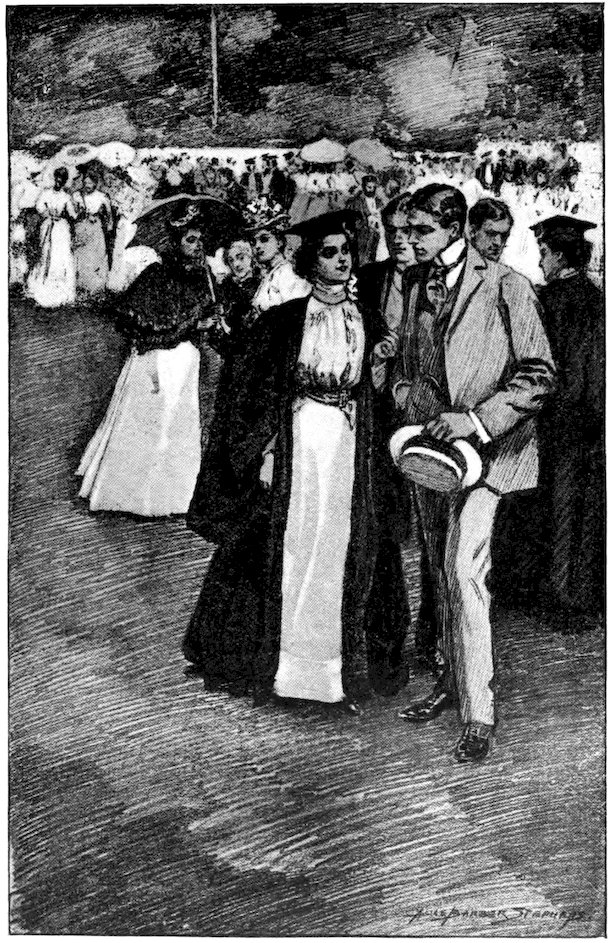
street. The summer breeze swept her college gown
around her in swirling lines, and ruffled her hair so
that once or twice she put up her hand to tuck back
the straying locks under her “mortar board.” She
was coming from one of the dormitories, and her
goal was the gray building farther down the street.
She had not yet reached the long walk which led
the way, between pleasant stretches of green sward,
up to the door of the principal college building, when
she heard some one running behind her. “Stop, Persis,”
a voice called.
Persis paused and waited for a little dumpling of
a girl who came up nearly out of breath. “I thought
I’d never catch you,” she panted. “You look just
12like a poster girl, Perse, with those spiral folds wrapping
around you. I want to know if you’ve heard
from Annis.”
Persis looked down smilingly at Patty Peters’s little
roly-poly figure. Persis was not much over medium
height, but she quite towered above Patty. “I did
have a letter this very morning,” she replied. “It
was written from Heidelberg, and the boys had been
there.”
“Tell me what she said.” And Patty gave a little
skip in order to keep up with her friend’s longer pace.
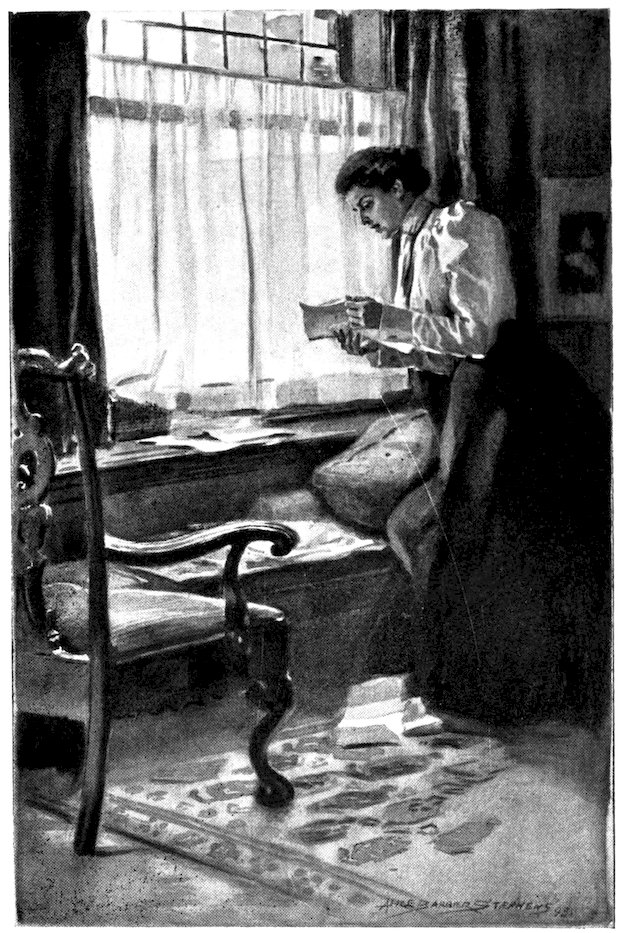
Persis took a letter from one of her note-books.
“We’ll go to the reading-room, and I can tell you.”
Patty agreed, and, swinging open the heavy door
at the entrance of the building, Persis led the way,
and the two girls settled themselves in a corner for a
whispered conference.
They were laughing heartily when they were joined
by Nettie Greene. “What are you two chuckling
over?” she asked.
“Why, Persis has just been reading a letter from
Annis,” Patty replied. “Tell her, Persis.”
“Why, it is only a story about one of our college
boys; the captain of a foot-ball team he is. You
know how the students in Heidelberg think they
display their prowess by slashing each other, and
duelling, and all that foolishness. Well, Harvey Dana
is there studying, and one day, as he was walking
down the street, two German students stepped up,
and one of them struck him square in the face. You
can imagine Harvey’s rage. He just drew off and
13gave the fellow a blow, and a twist that sent him
rolling over and over in the gutter. Then he squared
on the second one, and for a moment the volumes
of German and English words of wrath made the
place tremble, but the first fellow picked himself up,
and they all looked at each other, and then the Germans
broke out into a roar of laughter, and apologized,
asking to shake hands, and wanting Harvey
to take a glass of beer with them. They just wanted
to test him.”
“Well, they found out the stuff of which he is
made,” said Nettie. “Of course, Annis is having a
lovely time, but you must miss her very much,
Persis.”
“I do miss her. Yes, she is having the treat of
her life, and the voyage did her good. Annis is not
very strong,—that is, she has not the endurance that
I have, and Mrs. Brown thought a year of Europe
would do more for her than this last year of college.”
“How do you like living in the Boarding Hall?”
asked Nettie. “You had such a pleasant home with
the Browns; it seemed too bad that you had to give
it up just at the last.”
“So much the better that I did not have to give it
up before. I don’t mind the experience. I’m rather
fond of new experiences. I am finding out a lot
about human nature, and the truth of the saying,
that you don’t know people till you come to live
with them, is daily becoming more and more borne
in upon me. The girls here are truly a motley crew.”
“I know,” returned Nettie. “I tried it last year,
14you know. The first and second year Margaret and
I were together, but this last year mamma thought
I might be trusted to behave myself outside of college
walls, and so I’ve had rather a freer time. I
must say I don’t like being hedged in by rules and
regulations.”
“I don’t mind those much,” replied Persis, “but I
must confess I don’t like to be quite so close to some
of my neighbors. There is one girl who is the most
pervasive person I ever saw. She slams her door so
that it shakes the building every time she goes in or
out her room; her tread upon the stairs is like an
elephant’s, and she screams through the halls like a
fish-woman. I can’t imagine what sort of a home
she has lived in, and yet she is supposed to belong
to nice people.”
Nettie smiled. “Like a girl who has been boarding
where I do,” she remarked. “She makes her
boast that she can be ready for breakfast three minutes
after the bell rings, and that she never gets up
till she hears it. I told her I hoped she didn’t do it
often, for if cleanliness were next to godliness she
must be miles away from the latter. It was very
rude of me to say so, but she provoked me to it.”
Persis laughed. “How did the three-minute maid
like that?”
“She was furious, naturally, but I noticed after
that she was much later in coming down to breakfast.
She is horrid anyhow. So very ill-bred, and
the most vulgarly exacting creature you ever saw.
She pays less board than any of us, and seems to
15think our dear, kind Mrs. Scott keeps boarders simply
because it is a privilege to have such young persons
under her roof. I can’t bear the idea of demanding
more than you pay for, and I wish you could see
this fussy and fastidious young woman. Such actions
as hers prove her no Christian, if they do not prove
that she is underbred.” And Nettie sniffed contemptuously.
“Mothers are very right when they tell us that
they are judged by our actions,” put in Patty. “I
always get my idea of a girl’s home from the way
she behaves away from it, and perhaps it is not
always fair to her mother.”
“Let’s adjourn to my room,” Persis proposed,
bouncing up. “I only came over to hunt up a reference,
and then I’ll be ready to go back. Mell sent
me a big box of home-made caramels to-day, and
they’re fine.”
“Where is the girl who could withstand such a
treat?” replied Nettie. “I’m ready to sample them.
What do you hear from home, Perse? All well?”
“All are well. Grandmother has had a cold, but
she is better. Father is busy on his new book. Lisa
and mamma are absorbed in wedding-clothes. Mell
has been sulking for some time past, and sent me the
caramels as a peace-offering.”
Nettie looked up inquiringly.
Persis laughed. “Oh, it’s nothing, only Aunt Esther
invited me to spend a part of the summer holidays
with her. She has a project for a trip in which
I am included. Mell has always felt that, in some
16way, she had a pre-empted right on Aunt Esther, and
she didn’t relish being set aside on this occasion. It’s
mean of me to tell it, but you know her so well.”
Persis was always contrite when she came suddenly
to a realizing sense of having said more than was
necessary. She turned to the bookcases, wishing
she could hold herself in check more readily.
But these, her special friends, did not censure her,
for they knew the Holmes girls of old. Nettie Greene
and her sisters, in particular, had been the playmates
of Persis and her sisters ever since they could toddle,
and Nettie was fonder of Persis than of Lisa and
Mellicent. Lisa, the eldest, was soon to marry a
young naval officer. Mellicent, the youngest, had
just finished her studies at Miss Adams’s school,
and did not care to undertake a higher course. She
was fond of admiration and pleasure, and, being an
exceedingly pretty girl, was likely to have both. She
had sweet, affectionate, appealing ways, generous she
was, and devoted to the friends who professed a fondness
for her, or who admired her, but she was quite
ready to turn from them at a word of dispraise, or at
the slightest appearance of lack of admiration. Of
the three Holmes girls, she was, so far as mere
external beauty went, perhaps the most attractive.
Lisa, in her way, was quite as handsome, and possessed
of a really finer character. She was, however,
imperious and haughty, and needed the discipline
of sorrow to develop her. Persis, the middle
one, had her faults. She was quick-tempered, decided
in her opinions, and rather too ready to express
17them, but she was forgiving and sympathetic, selfsacrificing
and loyal to the last degree, ready for self-reproach
when she realized that she was at fault, and
willing to admit her error. She was at this time
slightly above medium height, with an erect carriage
which made her look taller. Her intelligent speaking
countenance reflected every emotion, and her
earnest gray eyes spoke of truth and sincerity. She
did not look at all like her sisters, and although the
mere casual observer was ordinarily attracted to the
other two, Persis’s friends perceived a beauty which
mere outline of feature was not required to express.
Having sought out her reference, Persis closed the
book she was consulting and put it carefully back on
the shelf. She loved all books too well to treat any
one of them carelessly. “Come girls,” she said, and
the three took their way towards a tall brick building
about a block farther up the street, known as the
Boarding Hall. Patty Peters was Persis’s next-door
neighbor on her right; on the left was the room of
“the girl with the elephantine tread,” as Persis called
her.
The girls made themselves comfortable in Persis’s
pretty room. Here her originality and individuality
showed themselves very plainly.
Nettie, nibbling at the caramels, looked around and
said, “Perse, you always do have such a way of
making places cosey. There is nothing bleak and
bare about this room, and yet it is cool and refreshing.
I believe if you were in an Esquimaux hut you’d
find a way to make it look bright and cheerful.”
18“I should try,” returned Persis. “I believe in being
bright and cheery, and in doing all one can to make
the rest of the world feel so; and Patty feels the
same way.” Persis cast an affectionate glance towards
her little neighbor. “Patty is a cure for the blues
any day,” she continued. “She is naturally a bit of
sunshine. As for myself, I decided long ago that I
could be either gloomy, miserable, and burdensome,
or cheerful, happy, and helpful, just as I cultivated a
contented spirit. It is mainly a matter of cultivation.
I used to think it was much more interesting and
romantic to be repining, and to bemoan the weariness
of existence and the joylessness of the world, but
I’ve found out since I came to college that the persons
who are always sighing, and fancying trouble at
every turn, are not the ones who succeed or who
help to raise the world to a better condition; therefore
my motto is, ‘unwavering cheerfulness.’”
“But one can’t wear butterfly wings all the time,”
Nettie made reply.
“No. I don’t mean that one needs to be frivolous
and unsympathetic. I think it requires a lot of
strength and determination to be cheerful all the
time, but it helps more than anything. Why, the
girls who come in here ready to flop on some one,
and get into perfect panics over supposed future
miseries, quite wear me out. There is one in particular
who is a perfect ‘old man of the sea:’ she
hangs around your neck, and you have to carry her
everywhere.”
Nettie was thoughtful. “I don’t believe I ever
19thought of my blues hindering other persons’ lives,”
she remarked after a pause.
“But they do,” replied Persis, earnestly. “Don’t
you see that if some one has to carry her own real
burdens and others’ real burdens, if you add to them
yours which are only possible, you are giving them
an extra weight?”
“I’ll be cheerful, Perse, from this out. I know now
what our old nurse meant when she used to say,
‘He that seeks trouble it is a pity he should miss it,’
and ‘Worry is a worse dog than Want.’ I know
mother tells me I help her the most when I don’t
worry.”
“That is true,” returned Persis. “I believe we
could all give more help to those we love by looking
on the bright side for them and with them. It takes
all the heart out of those who are trying to have
every sort of possible misery suggested.”
“Let’s make a compact and call ourselves ‘The
Cheerful Three,’” Patty proposed.
“Good! we will,” cried the other two.
“Then we will be helpers and not hinderers,”
Patty continued.
“True enough, Miss Patty-Cake. Goodness!
what’s that?” And Nettie gave a start.
The others laughed. “It’s only ‘My Lady Slam-bang,’”
Persis told her friend.
“How can you stand it? I never heard such a
noise. And what a voice! Was she brought up in the
backwoods? Has she no consideration for others?”
“I think, very little of anything but thoughtlessness.
20And as to her rearing, I think she must have
lived in a saw-mill, where there are no doors, or in a
restaurant, where the doors swing both ways,” returned
Persis.
“Or else in a tent,” put in Patty. “I’m afraid,
come to think of it, that the Cheerful Three are disposed
to be critical.”
“All girls are,” asserted Nettie, helping herself to
a particularly toothsome caramel. “Do you know,
to change the subject, that you girls must promise
to come and spend next Saturday night with me?”
“Three in a bed!” exclaimed Persis, aghast.
“No, there need be but one doubling up. The
three-minute maid is going to leave us; her room is
next to mine, so I have spoken for it; for the new
boarder will not come till Monday.”
“I hope the room will be well cleaned,” observed
Persis.
“It will be. I’ll see that the windows are left open
so as to rid the place of any lingering odor of scented
soap or cheap perfume, for I know your aversion to
them, Perse. Anyhow, I think we’ll put Patty in
there, and you can bunk in with me; I promise you
no ‘German cologne’ nor ‘Cashmere bouquet’ is to
be found in my apartment.”
“Then we’ll come; at least, I will. How about
you, Patsy?”
“Oh, I’ll be glad to join you. What’s the special
frolic, Nettie?”
“I can’t tell you. I promised not to. By the way,
Persis, do you hear from Basil Phillips often? Why
21didn’t he take up his studies here instead of going
abroad? He could have taken a post-graduate course.”
“Oh, he wanted to study at the Beaux Arts. He
is going to be an architect, you know,” replied Persis,
passing over the first part of the question.
“Has Annis seen him?”
“Oh, yes.” Persis did not pursue the subject, but
exclaimed, “I do believe it’s something to do with
the college boys.”
“What is?” asked Patty.
“Why, Nettie’s wanting us on Saturday.”
“I’ll not tell,” cried she. “You can’t make me.”
“We don’t want to know. Do we, Patty?”
“Of course not; we’d much rather be surprised.”
“Oh, of course,” returned Nettie. “All the same,
you are wild with curiosity.”
The other two protested, and, to show their indifference,
began to discuss college topics.
Persis was an ambitious, good student, and was
taking her four years’ course in three years. The
departure of Annis Brown for Europe lost Persis her
special chum, for her cousin Annis was her bosom
friend, and she missed her sadly. However, she perhaps
devoted herself all the more assiduously to her
work, and looked eagerly forward to the next summer
when she should be a full-fledged graduate, and
could take up life seriously.
“Dear me! Persis, do put those caramels away,”
Nettie exclaimed at last. “I have made a perfect
gourmand of myself, and I am so thirsty.”
“Oh, are you? I can offer you a real home-made
22beverage,” replied Persis, going to a little cupboard.
“Grandma knows I am fond of raspberry vinegar,
and she made a fine lot of it last summer. It is such
a quenchative, as we say at home.”
“You all do have the most original sayings,”
Nettie observed. “I remember how puzzled I was
when I was a little girl, and was once spending the
day with you; for when luncheon was announced,
you said, ‘I must go and brush my rabbit before I
go down.’”
“What did she mean?” inquired Patty, looking
puzzled.
“She meant brush her hair, a hare being called
a rabbit.”
Patty gave a groan, but Persis now had ready her
glasses of the cool, ruby-colored draught, and offered
it to her guests.
“How delicious it looks! and it tastes so, too.”
And Nettie sipped, with an air of satisfaction, from
the thin tumbler Persis handed her.
But she had hardly more than tasted its contents
before she sprang to her feet, crying, “What is that?”
for something fell heavily against the door, and the
other two girls jumped up.
Persis stood a moment, and then cautiously turned
the knob. There was a push, a sound of scurrying
feet, and into the room fell a nondescript figure, constructed
out of pillows, and wearing a man’s clothes.
“It’s some of Bessie Taylor’s nonsense,” began Persis.
But she stopped short as she perceived a movement
on the part of the figure lying prostrate on the floor.
23“Oh, there is something alive! Oh, girls, suppose
it should be a mouse,” cried Nettie, jumping up on a
chair.
“A mouse! Who’s afraid of a mouse?” returned
Persis, scornfully. “Don’t be a goose, Nettie. I think
mice are dears, myself.” And she proceeded to examine
the pinned-up coat-sleeve, which appeared to
be animated by something inside it, and, as the pins
were withdrawn, out scampered a little black kitten.
“Oh, the poor little thing!” cried Patty, trying to
catch the small, frightened creature, which took refuge
under the bed.
“It’s the cook’s pet,” Persis told them. “We
must take her up to the kitchen.”
“Up!” said Nettie, descending from her perch on
the chair.
“Yes. You forget the dining-room and kitchen
are on the top floor.”
“To be sure. I had forgotten. Now, what can
we do to pay back those girls?”
“We’ll carry Mr. Man to Bessie’s door,” Persis
decided, after a moment’s reflection. “He shall carry
this sphinx-like riddle: ‘From what was cast down
one may be set up. From what was a terror, produce
a delight. Who finds, keeps.’ I’ll put a box of
caramels ’way down among the pillows, and they’ll
wonder and wonder what the mystery is.”
“What made you think of that?” questioned Patty.
“Reading about Samson, I suppose,” rejoined Persis,
crowding her box down as far as she could into
the coat-sleeve. “Come, help me carry Mr. Man back
24again.” The girls started, but before they had gone
far they saw the matron at the other end of the corridor.
If Mrs. Nevins happened not to be in an amiable
mood, there might be a lecture in store for them; so
the girls scampered back, dragging their burden with
them. But, watching for a second opportunity, they
found the coast clear, and bore out the figure with the
riddle written on a piece of paper, conspicuously
pinned to his coat. They stood it up against Bessie’s
door, and tiptoed back to Persis’s room.
A little scream half an hour later told them the
manikin had been discovered, and they chuckled
over their secret.
“I think it is a pretty, amiable, nice way to pay
them back,” Nettie declared. “But Perse, you always
were given to doing nice things.”
Persis laughed. “Except when I stirred up our
club at home by refusing to abide by their rules.”
“That was a nice thing in reality.”
“Yes, in the end; but what a hubbub it created!”
And Persis smiled at the recollection.
As Nettie parted from her two friends she heard a
great chattering in Bessie’s room, and knew that a
bevy of girls was there, puzzling over Persis’s riddle.
High above the others came shrilly the voice of My
Lady Slam-bang. Nettie caught a perfect torrent of
slang, and once a piercing whistle.
“What a boisterous hoyden of a girl! She’d tone
herself down if she knew the impression she makes,”
thought Nettie.
25
CHAPTER II. A SERENADE.
The Cheerful Three met in Nettie’s room the next
Saturday evening. The house where she boarded
stood several squares beyond the college and nearer
the suburbs.
“I’ve brought some XXX sugar,” Persis announced,
“and we can make some candy. Patty
has nuts and two or three kinds of extracts, and—oh,
yes, I have eggs, so we can proceed to make
ever so many kinds.”
“Good,” cried Nettie. “You’ve solved a difficulty
for me, girls. But we must have some chocolate,
too. Who’ll run out with me to get some? The
shops are still open, and we can get anything we
want.”
Both girls signified their willingness to visit the
shops, and all three started forth.
“If we had a brother or a cousin or some reliable
masculine escort, we’d go down to market and buy
some taffy,” Patty remarked. “You know its quite
a frolic, and nowhere do they have such a Saturday
26night market as here. In fact, I believe there are
few such markets anywhere. Did you ever go down
on Christmas-eve? It is a real carnival on the street
where the market is, and it is getting livelier every
year. But, of course, you have always been at home
for the holidays.”
“No, not always. The first year I was here the
family were all abroad,” rejoined Persis. “And
grandma and I spent the winter at Mrs. Brown’s.
You remember she took a house here.”
“To be sure, I had forgotten. And the Phillips boys
came that first holiday. Oh, yes, and that friend of
yours, Mr. Danforth.” And Nettie gave Patty a little
knowing look which Persis did not see.
“Dear me!” exclaimed Nettie, suddenly, after
they had returned from their shopping expedition.
“I don’t know what to make the candy in. I hate
to bother Mrs. Scott to loan me anything.”
“Take that big flower-pot,—the yellow one over
there,” Persis suggested. “It will make an excellent
bowl.”
“Sure enough; and let me see—we’ll just use
sheets of white paper to spread the candies on. I’ll
have to light my lamp, for I want to melt the chocolate
over the gas. How will I do it?”
“Can’t you set your hot-water kettle on the little
gas-stove, or whatever it is, and put the chocolate in
that mug? It will fit in the top of the kettle, won’t
it?” Persis was always ready with expedients.
“That will do exactly. Now we’re all right.”
For an hour or two the girls chattered away, stirring,
27tasting, and patting into shape their confections
until they were tired out.
“Goodness, Nettie,” exclaimed Persis, viewing their
work. “I don’t see why we made such a lot. We’ll
never get all this stuff eaten up before it gets stale.”
“What a remark to make in a community that
boasts of four hundred girls, each possessing her own
special sweet tooth!” rejoined Nettie.
“Oh, well, if you are going to scatter them broadcast,
all right,” Persis returned, sitting on the floor
and hugging her knees. “What are you doing now?”
For Nettie was packing away an assortment of the
candies in little boxes which she had fished out from
the lower part of her washstand.
“Oh, I’m just disposing of these,” replied Nettie,
nonchalantly. “What time is it, girls?”
Patty glanced at the small clock ticking away on
the dressing-table. “Ten o’clock! who would believe
it! I’m going to bed. You know I was always
a regular sleepy-head. Mother says that’s why I’m
such a roly-poly. I sleep so soundly.”
“Do you sleep soundly?” And Nettie smiled.
“Yes.”
“Then leave your door open. Perse and I may
want to call you if we are ill from overeating.”
Patty laughed, and the girls proceeded to prepare
for bed. They were a long time about it, however,
and it was nearly eleven before their heads were on
their pillows.
It seemed to Persis that she had only travelled
half-way to Slumberland, and sweet sounds were
28already weaving themselves into her dreams, when
she was awakened by a whisper from Nettie.
“Listen, Persis.”
“Hm?” said Persis, drowsily, for she could not
detach the music from her consciousness.
Nettie gave her a little shake. “Come, get up,”
she said.
“What for?”
“We must waken Patty.”
“Why?”
“Don’t you hear? Why, we are being serenaded.”
At this, Persis sat bolt upright, and realized that
“Nellie was a lady,” was being sung by a quartette
of manly young voices just below the window.
“Oh, how lovely!” she whispered. “Oh, Nettie,
did you know about it? I never heard a real serenade.
Isn’t it romantic to be wakened this way?
Who are they?”
“Some of the University boys. They asked me
if you girls could manage to spend a night with me,
for they wanted to serenade us, and they didn’t dare
to go to the boarding hall of your college.”
“Of course it wouldn’t do. But isn’t it fine? I’ll
go give Patty a shake; nothing short of a downright
yell will waken her, unless I do.” And Persis slipped
out of bed and ran to the other room.
Sleepy Patty at first only grunted, but at last she
was made to realize what was going on. Then the
girls threw something around their shoulders and
stole to the windows in order to catch more of the
melody. The moon was shining brightly, and they
29could very plainly see the dark figures in the little
garden below.
“That is Walter Dixon with the banjo, and Rob
Maxfield with the guitar; and I don’t know who has
the mandolin. Joe Chapman is singing tenor, and
Matt Ward bass, but I don’t know the baritone. I
wonder who he is.” Nettie was peeping stealthily
through the shutters.
“They seem to be strong on the Nellie songs,”
said Persis. “They are starting up ‘The Quilting
Party.’ What are you going to do, Nettie?”
“I’m going to let down these boxes of candy to
them. See I’ve tied them to a string, kite-tail fashion.
I think they deserve some sort of recognition.”
Carefully, very carefully, the girls secreted themselves
behind the curtains and dropped the long string
over the window-sill. There was a cessation in the
music, and then the girls’ college yell, followed by
that of the boys’ own college, quite startled the neighborhood
by the vigor with which they were given.
One more parting song was given, and then the
boys departed, the tinkling of the mandolin and
guitar being heard more and more faintly as they
took their way down the street.
“Oh, it was just lovely,” sighed Persis. “I had
visions of the Alhambra, and of Spanish cavaliers,
and all sorts of things. I think the boys were just
dear to think of it, and I’ll tell Walter so the next
time I see him.”
“I wonder if they ever serenade Connie,” observed
Nettie, as they crept back to bed.
30“I don’t know, but I should suppose they would.
Connie has grown to be the nicest sort of a girl. I
always did like her, although her family did not
attract me.”
“Oh, well, they are simply no relation at all to
her. They are simply the children of her father’s
wife, so we can overlook their untutored ways,” returned
Nettie. “Mrs. Dixon is just as fond of Connie
as she can be. I wish she and Walter would marry.
Do you think they will?”
“I don’t know. I hardly think so. They are
more like brother and sister. I’m going to spend a
day or two with them next week. You know the
Cooking Club meets there, and we are going to give
the boys a supper, some of Walter’s friends, and one
or two of the boys from home.”
“Who?” asked Nettie, wickedly.
“Oh, only Mr. Dan and Porter Phillips. They are
coming on to be here at class-day, too. You know
Mrs. Phillips is still abroad, and Porter is at our
house.”
“You don’t call Mr. Danforth a boy, do you?”
“No, not exactly; but we have known him so long,
we always class him in with home folks.”
The next Saturday found a merry party of young
people in Mrs. Dixon’s roomy kitchen, baking and
stewing, and stirring and tasting.
“Aren’t we lucky in having such a cool evening?”
said Connie, who, with a white apron before her, was
carefully compounding the dressing for a salad.
“Cool! Do you call this cool?” exclaimed Patty
31Peters, who was lifting something from the oven, her
round red cheeks glowing from the proximity to the
fire.
“Not inside that oven, of course.”
“No, nor within a mile of it.”
“What’s that? It smells so good,” observed
Porter Phillips, sniffing at the contents of the pan
Patty was turning around.
“It is Patty-cake, Patty-cake, baker’s man, of
course,” averred Walter Dixon, who, with a blue-and-white
checked apron tied around his waist, was executing
high kicks.
“Oh, now, come off. Have we got to have much
of that sort of thing?” Porter said, in a disgusted
tone.
“Of course you have, wherever Walter is,” put in
Connie. “Which of you boys is going to grind the
coffee? You’re here to help, remember. No work,
no eat.”
“Didn’t I turn that ice-cream freezer till I nearly
had vertigo?” returned Walter. “You ought to let
me off, Con, and give these other fellows a chance.”
“For shame, lazy-bones. You are host here,
and ought to set them a good example. Never mind,
Mr. Danforth has come to the rescue.”
“You’d better let Mr. Dan make the coffee,” Persis
suggested. “He can make the finest you ever
tasted.”
“No, he mustn’t be allowed to make it. The men
are only to do the work that requires muscle. We
furnish the brains,” replied Connie, saucily. “My,
32what a noise! with a coffee-mill and an egg-beater
going at the same time. Here, Walter, taste this
dressing. Does it need more vinegar?”
“No, not a bit. You fellows over there picking
out crab meat, are you most through? The lady
over here says she is in a devilish humor, and wants
you to hurry up.”
“Oh, Walter!” cried Persis. “I said nothing of
the kind. I said I was ready for the crab meat.”
“Well, aren’t you going to devil them, and aren’t
you in the humor for it?”
“Don’t explain, don’t explain, that only makes it
worse. I wish I had a pump handy, so as to give
you a sousing.”
“Souse? did I hear correctly? Are we going to
have pigs’ feet? You didn’t mention it before.”
“Hush, at once. You are too silly to live,” cried
Persis, peremptorily. “Go get that crab meat from
those boys before you say another word.”
Walter only grinned and went off, returning with
the dish. “Do you know why I always insist upon
having sausage on my birthday?” he asked.
“No, silly. I’ve no time to guess your idiotic
conundrums.”
“I’ll give you a hint. I was born on the second
of February.”
“I don’t care when you were born, and if you
don’t behave yourself better I’ll wish you never had
been born. Take your fingers out of that dish.
Who wants to know your conundrums?”
“You do. You know you do. See what a sweet,
33forgiving spirit I have, for I will tell you, for all your
harshness towards me. I insist upon having sausage
because my birthday comes on ground-hog day.”
“Mr. Dan! Mr. Dan!” Persis called. “I wish you
would come and sit on Walter; he is getting worse
and worse.”
“Is that slang, or do you mean literally, Miss
Persis?” asked Mr. Dan, approaching.
“I mean both, if it requires the two constructions
to keep him quiet.”
“Persis is most wofully wanting in appreciation,”
Walter complained. “I had another first-class conundrum
to spring on her, and now I am squelched.”
“Keep it till supper time,” Mr. Danforth advised.
“As a favor,” interposed Persis.
“Are you going to have favors? I didn’t know
that?”
“We are going to have sense.”
“What kind?”
“What kind? Why, common sense. You, perhaps
would best not appear,” retorted Persis, filling
her shells carefully with the mixture she had prepared.
“Oh, I didn’t know but what you meant sweet
scents; little bottles of cologne at each place, or
something of that kind.”
Persis made no reply, but stalked to the range to
place therein her devilled crabs, Patty having removed
her pans.
“There!” she said; “my contribution will soon
be ready. How are you coming on Con?”
34“Finely. My salad is a thing of beauty. Wilson
Vane says he thinks he can eat it all, but I have
my doubts. We will cook the lobster Newburg
on the chafing dish, of course. Now, let me see.
Nettie Greene made angel cake this morning, and
Bessie Taylor has chocolate cake and maccaroons.
Nina Barker made Maryland biscuits and jellied
chicken, and there are three kinds of sandwiches,
besides salted almonds and bread and pickles. So,
I think we’ll do very well. What are those boys
up to?”
“They’re finishing the crab-claws.”
“Boys!” called Connie. “Wilson, you and Porter
stop that; you won’t have any appetite for your
supper.”
“Won’t we? I’ve an appetite I wouldn’t take
fifty dollars for. I’ve been saving it up for a week,
and the family thought I was going into a decline.
I promise, though, that I’ll not take off the edge of it.”
And Wilson threw down the claw he had been cracking
and came over to where Persis and Connie sat
perched on the window-sill.
“What a fellow Mr. Dan is,” he said. “He’s helping
everybody, and seems to know just what to do.
Generally I feel like a fish out of water, in a kitchen,
although this affair is great fun, but Mr. Dan takes
hold like an old hand.”
“He has always been a home boy,” replied Persis.
“His mother was a widow and an invalid. Mr. Dan
was her only child, and did so much for her. Her
loss, however, was a terrible blow to him.”
35“I can imagine it. Strange, for all his domestic
ways, he’s as mannish a fellow as ever I saw.”
“Yes, he is.” Persis spoke a little wistfully. “He
has more noble qualities than any man I ever met,”
she then said, steadily.
Wilson looked at Connie and smiled. Persis knew
perfectly well what they were thinking. “That is no
reason why I shouldn’t give him his due,” she told
herself. Then she continued, “He is just as thoughtful
a friend as he was a son. He is a great tower of
strength, and has been an immense help to Porter
and Basil.”
“Yes, I believe that. I used to think Port was a
little shaky in some directions.”
“He’s not perfect,” Persis acknowledged, regretfully,
“but he has the making of a fine man in him
if he’s not spoiled by flattery and success.”
“Well, I’m half starved. When do we start in?”
asked Wilson.
“As soon as my crabs are browned. Are they
done, Connie? Then we are ready. Come, boys,
help us to carry in the dishes. I hope your labors
have given you appetites.”
“Don’t fear,” they cried, scrambling from their different
corners, and from the door-steps, where most
of them had congregated.
“Fall in line,” called Walter. “I’ll carry the
crabs.”
“Better let Mr. Dan have the coffee-pot,” said
Porter, “he’s the steadiest. Give me that dish of
salad. I’ll try not to stump my toe, and spoil this
36fine structure. My, but it’s jolly-looking—all those
little tricks around it. I’m tempted to snake one of
those fat olives.”
“Don’t you do it, for your life,” Connie commanded.
“You shall have all you want at the
table.” And Porter refrained.
Connie had clever fingers, and had painted pretty
cards, which Persis’s wit had helped out by apt and
sly hits which the inscriptions contained.
“We ought to have put you in a dish, Con,” said
Walter, pausing between satisfying bits of lobster.
“Why?” she asked, innocently.
“Because a Stew-art thou.”
“He’s off,” cried Porter.
Walter smiled complacently. “Oh, Con doesn’t
mind. She’s used to my little spicings, and couldn’t
enjoy a meal without, could you, Con? Here’s the
next. You all needn’t listen if you don’t want to. I’ll
get it off for Con’s benefit.” And Connie nodded to
him indulgently. “Why do we know that Adam
was a gambler? This is as new and fresh——”
“As you are,” interrupted Porter.
“Oh, eat your supper,” responded Walter. “Say,
Con, have you guessed it?”
“No; I’m thinking of gambling on the green, and
that sort of thing.”
“No, no; ’way off. Give it up? Because, when
he came from the garden of Eden, he left a Par-a-dise
behind him.”
“Now, that isn’t so bad,” interposed Porter, grandly.
“We’ll admit that, Walt. You are improving.”
37“Hear the infant. One would think him a Senior
at least. You’re just barely out of the Fresh class
yourself, remember. Look here, fellows, we haven’t
said a word about the ‘wittles.’ Aren’t they first-class?”
“By the way they are disappearing I should judge
we thought so,” replied Wilson. “Nothing less than
speeches, toasts drunk in silence and standing, will
express our appreciation. I say we don’t stop to air
our opinions now, but wait till the festive board is
cleared. We don’t have to wash the dishes, do
we?”
“No,” Mrs. Dixon, who chaperoned the party, told
them. “It seemed to me that getting the supper
was quite enough for these girls, and I have provided
dish-washers. So you will be free to follow your
own sweet fancies after supper. Boys, you know you
must vote on the bestowing of the prize.”
“Prize! What prize?”
“Why,” Persis informed them, “we always give a
prize to the one who has shown the most culinary
skill on such occasions.”
“But isn’t it largely a question of taste,” Mr. Danforth
remarked. “If I like chicken-salad better than
devilled crabs, I should naturally vote for the salad.”
“Oh, but you see what a fine, impartial, and discriminating
sense it requires. It is not a question
of what you like, but what shows the best cooking,”
Mrs. Dixon explained.
“We’re in for it!” cried Wilson, in mock despair.
“Think of it, fellows. The fate of eight fair damsels
38hanging upon our votes. It is enough to make a
man commit suicide.”
“You don’t vote for the damsels. You are to consider
them only negative conditions. The dishes
themselves, as proud personalities, are to be passed
upon.”
“Bread, and pickles, and everything?”
“Yes, except the butter; that is not home-made.”
“By the way, who made the bread? It is uncommonly
good,” observed Mr. Danforth.
“Don’t tell, girls. As many articles as possible
shall go on their own merits,” said Persis. “Then
no partiality will be shown them on account of the
makers. I don’t believe any of the boys know who
is the bread-maker.”
“I believe you made it,” Mr. Danforth remarked,
in an undertone, to Persis at his side. But she only
laughed merrily, and refused to tell. And, lo! when
the votes were counted, bread came first, and pickles
second.
“Aren’t we out of it nicely?” cried Wilson. “No
one can accuse us of partiality.”
“Except those whose dishes you do know,” replied
Patty, demurely. “For example, you saw me make
the chicken-patties.”
“And didn’t vote for them! Done for! What
an ostrich I am! I forgot entirely that the not voting
for specials gave us away.”
“But who is the bread-winner?” inquired Mr.
Danforth. “I am really anxious to know.”
“Who but Patty herself,” Connie announced.
39“Bless you, Patty dear. I’m proud of you,”
Persis laughed, gleefully, and cast a mocking glance
at Mr. Danforth, who returned it with one of discomfiture.
“I was sure it was you,” he said, in a low tone.
However, no one grudged little Patty her prize,—a
pretty lace-pin, the head of which represented a
tiny broiling-iron.
“There ought to be a second prize for the pickles,”
declared Walter. “I constitute myself a committee
of one to provide it in behalf of the guests. Here,
Con.” And, taking out his own scarf-pin, he tossed it
across the table.
“But, Walter, I made the pickles,” Connie informed
him, in a surprised tone.
“I know it,” he replied, calmly, helping himself to
an olive.
A little flush mounted to Connie’s cheek, and she
laughed somewhat nervously as she said, “Thank
you, kind sir.”
Walter nodded in reply, and then called, “Speech!
speech! Here’s to the prize-winners, may they never
fail to rise to an emergency, and may they never get
in a pickle.”
“Can’t you respond to the honor shown you,
Patty? Say something, just a few words,” whispered
Persis; but Patty was dumb, and looked confusedly
at her plate.
“Oh, Persis, I can’t,” she whispered back.
“Answer for her,” said Persis, turning quickly to
Mr. Dan, who arose and made a speech which won
40great applause, not only for the speaker, but for the
blushing Patty, who, hearing her accomplishments so
eulogized, felt that after Mr. Dan’s recommendations
she might receive a proposal from any one of the
young men before her.
“Now, my sweet pickle, to you,” said Walter,
waving his cup towards Connie.
“Oh, Walter!” protested she.
“You’ve got to. We’re not going to do the toasting
and the speechifying too for you girls. You’ve
got a chance to talk without interruption, so go ’long
and do it.”
Connie paused in embarrassment before she began
in a little prim way, but catching a sight of Walter’s
face, and seeing that the girls looked disappointed,
she launched forth into a perfect torrent of fun and
nonsense, so that she sat down amid shouts of mirth
and was applauded to the echo.
Connie’s effort set the ball rolling, and the fun
grew fast and furious till Mrs. Dixon asked them if
they realized that they had been three hours at the
table.
“It has been a great success,” the boys assured
the young cooks.
“My only regret is that you didn’t make the
bread,” were Mr. Danforth’s parting words to Persis,
as, after an hour on the cool porch, the guests departed.
“Well, I can make bread, if it gives you any consolation
to know it,” Persis replied, “But I cannot
guarantee that it is as good as Patty’s.”
41“Will you make some for me some day?”
“Perhaps. Just now I’ve enough to do in getting
ready for class-day. I can’t think about bread nor
anything except mental food.”
The boys went off singing, and the June night,
with its warmth, its sweetness, its thrill, typified the
gladness of their youth.
42
CHAPTER III. FAREWELL, ALMA MATER.
With the question of themes, examinations, and
other college matters to fill her mind, Persis had little
time for frivolities for the next ten days. Wilson
Vane, Porter Phillips, and Mr. Danforth had returned
the day after the supper, and the girls were preparing
to break up their college associations when once the
more important matters connected with their studies
were done with.
“I hate to disarrange my pretty room,” said Persis,
as she began to unpin the sketches adorning her
walls. “Thank you, Patty! you’re always on hand
to help. I’ll do the same for you when you’re ready
to begin the work of tearing up.” And she handed
her neighbor a picture to place in a safe spot. “Dear
me, how much stuff one does accumulate in a year!”
she went on to say, as she stepped down from her
chair and looked around her at the dismantled apartment.
“I cannot possibly get all this into my trunks,
and I’ll have to box a great deal of it.”
“My books are packed,” Patty said, “but I shall
43have to get your help about my pictures. I’m
such a ‘little runt,’ as my old mammy used to call
me, that I can’t reach anywhere scarcely. Persis,
I’ve been thinking about the supper.”
“Have you? What about it?”
“Don’t you think it was queer for Walter to give
Connie that pin before all of us?”
“Why, I don’t know. I hadn’t thought of it. It’s
just like Walter; he’s so impulsive. Why, did it
strike you as being queer?”
“No-o, not till I heard some of the other girls talking
about it. They thought it was not very good taste,
since the supper was given in the Dixons’ own house.”
“Well, if it had been a prearranged thing, I suppose
it wouldn’t have been, but it was simply a generous
impulse. I could see the motive, and it made
me think twice as much of Walter. He couldn’t
bear to have Con left out, and I think it was very
nice of him to do just what he did.”
“That’s a much better and kinder way to look at
it, and I’ll tell the girls so. Here comes Nettie; let
us hear her side.”
“The Cheerful Three are on hand,” cried Persis from
her high stand on the dressing-table. “I’ll say how
do you do, Nettie, when I’ve unpinned this drapery.
There it comes. Now these fans and these peacock
feathers. Who says they’re unlucky? They never
brought me any ill-fortune. There! My, how blank
it looks! Throw some of that trash on the floor,
Nettie, and find a place to sit down. I have scarcely
seen you for a week.”
44“No; nobody has seen anybody, we’ve all been so
busy. However, I have been a little gay in some of
my doings.”
“What doings?”
“I went down the bay on a revenue cutter with
some friends, and had a jolly time at a funny little
fishing-shore up one of the creeks. I wish you had
gone, Perse. Why didn’t you both go? Connie said
you were asked.”
“So we were, but we had a lot of other things to
do and had to decline. Tell us about it, Nettie.”
“There’s not much to tell, except that it was such
a queer place, and they served supper, deliciously
cooked, on long pine tables out under the trees, where
we could throw our fish bones and chicken bones out
on the grass, where they were immediately snapped
up by a parcel of strange-looking dogs which sat
around and waited for them. It was rather a novel
sort of experience, and one which you, especially,
would have enjoyed.”
“Who all went?”
“The Dixons, including Connie, of course, Rob
Maxfield, and some others I didn’t know. Connie
kept wishing for you.”
Persis and Patty glanced at each other, and then
Patty put her question about the pin.
“Why, I don’t think it was anything at all out of
the way,” Nettie told them. “Girls are such hateful
things sometimes. I don’t believe one of the boys
thought twice about it. I wish girls were not so
petty.” Netty looked quite provoked.
45“Girls are small,” Persis admitted. “They see
some little insignificant thing, and they pick at it and
pick at it till they have made a big hole in some one’s
character, and then they say, ‘Oh, see that careless
person. Why doesn’t she mend it?’”
Patty laughed. “That is just it. Why, those girls
have talked and talked and buzzed and buzzed about
poor Connie till you’d think she had done something
dreadful.”
“So, she has gotten into a pickle after all.”
“Yes, in a way; but she doesn’t know it, and she
must not.”
“Of course she mustn’t. Who would be so mean
as to tell her?”
“Some girls would like nothing better. I believe
I know some who can’t be anything else but mean.”
“Well, let’s whistle them down the wind. We
don’t care about them, do we?” And Persis smiled
on her friends.
“Not a whit. We had a glorious time, didn’t
we?”
“We did, indeed,” Patty agreed. “No hatred
or uncharitableness to make bitter sauce for our
supper.”
“Some of the girls are inclined to scorn our cooking
club,” Nettie told them. “They think it is beneath
college-bred girls to give their attention ‘to
such debasing things as appealing to the senses,’
they say.”
“That’s all nonsense,” declared Persis, emphatically.
“I believe in doing well whatever one has to
46do, and I’ll venture to say half, at least, of the girls
in this college will undertake to be house-keepers
without a qualm of conscience as to whether they are
capable of making a real home. They’ll think that
they are superior beings so far as brains go. That’s
all right enough. Women do need to fit themselves to
be true companions to their husbands, but a knowledge
of all the books in the world isn’t going to
satisfy a man if he is in need of a good dinner.”
“Hear! hear!” cried Nettie.
“You know the old saying that the way to a man’s
heart is——”
“Never mind, don’t finish; it is too gross a suggestion
to be uttered within these hallowed walls.”
“I’ll spare you, then; but I will say that the art of
cookery is not to be despised, and if it were meant
that we should live on sawdust, why in the world
were so many dainty and delicious articles of food
created? I don’t believe in this lofty scorn of good
housewifery. I think the woman who makes the
inmates of her home comfortable, and thinks up
dainty meals for them is much more to be commended
than one who spends her time over her own
purely selfish employments.”
“One needn’t go to extremes in either direction,”
interposed Nettie.
“That’s just it; we do go to extremes, we women.
I’ve always maintained, and still do, that the more
a woman has cultivated her mind the better judgment
she ought to have in all directions,” put in Patty.
“That’s the truth, too,” replied Nettie. “And if
47ever I am a home-maker, I hope I’ll make a real
home, neglecting neither the moral, mental, nor
physical side of it.”
“There, now, we’ve settled it,” laughed Patty.
“Let’s change the subject. What a fine-looking
fellow Porter Phillips is getting to be. I hadn’t seen
him for a long time. He’s better looking than his
brother, isn’t he?”
“He’s not half so good-looking,” returned Persis.
“Why, Perse, do you really think so?” asked
Nettie.
“I don’t mean handsome. I mean he is a better
fellow, and his face shows it. I don’t mean that
Porter is bad, for he isn’t. He is just a little vain,
and selfish, and thoughtless, and Basil is just the
opposite.” Persis’s eyes were very bright.
“You are always such a stanch defender, Perse,”
returned Nettie. “And how about Mr. Dan? I
heard you sounding his trumpet the other day.”
“Mr. Dan is a good fellow, too, but——”
“But what?”
“Oh, nothing. We’re very good friends, but——”
“‘But,’ again.”
“Oh, well, don’t let’s compare them. They are
very different. What do you think of Wilson Vane,
Patty?”
And now it was Patty’s turn to look confused, as
she answered, “I think he seems a very pleasant
person.”
“What a tall, spidery fellow he is,” said Nettie.
“But I like him. He’s not so silly as his sister.”
48“No; he is quite sensible in most directions. To
be sure, he has his little foibles and fopperies that
make him seem foolish, but I think he’s outgrowing
them. He is something of an Anglomaniac, and
while the craze lasts is likely to be laughed at; but
no doubt he’ll get more wisdom with age. Patty
dear,” turning suddenly to her plump little friend,
“you’d be just the nice, sensible body for him.
You’d be the making of him.”
“Oh, Persis!” And Patty blushed a vivid crimson.
“You needn’t ‘Oh, Persis!’ me. He was mightily
taken with you, any one could see, and the bread
was the finishing stroke.”
“I’d like to know what Mr. Dan meant by asking
you if you’d make bread for him some day,” put in
Nettie.
“Did you hear that?” Persis asked, with a little
embarrassment. “Oh, that was just a bit of fun.
For a sensible man Mr. Dan can be very trifling at
times.”
Nettie kept her own counsel, but she was not surprised
on class-day to see Persis examining with a
pleased face the cards in two baskets of flowers,
one of gorgeous red Jacqueminots and mignonette;
the other pure white Niphetos roses.
“York and Lancaster,” cried Nettie. “Who sent
them, Perse?”
“Mr. Dan and Basil. Wasn’t it sweet of Basil to
remember, when he was away over in Paris?”
“And his are——?”
49“The white ones. Oh, Nettie, there they are,—mamma
and papa, and the girls, and—oh, Nettie—grandma,
and—no, it can’t be; yes, it is—Basil. Oh,
when did he come?” And the newly made graduate
hurried down to meet her friends, who with smiling
faces were waiting for her.
“I was so afraid you wouldn’t get here,” cried
Persis. “How lovely to think you could all come.”
“We barely managed it,” Professor Holmes told
her. “My freedom came last night when our exercises
were over, so we concluded to wait and all
come together.”
The tall young man standing by Lisa’s side held
out his hand. “Haven’t you a word for a returned
voyager?” he asked, smiling.
Persis looked up with glowing face. “Oh, Basil!”
she exclaimed; “I never dreamed of seeing you.
A word for you? I have about a hundred thousand
as soon as I get a chance to pour them
forth.”
“Shall we retire and afford you the opportunity?”
asked Lisa.
Persis blushed and stammered, and then recovered
herself. “You mean girl,” she cried. “Of course,
I want every one of you, and I have as many words
for each one, only Basil has been away the longest.
Did I conduct myself with credit? What did you
think of my theme, papa? Oh, Lisa, I have a million
things to ask you, but I must go now and speak to
the professors. I see two or three hovering around
on the outskirts, as it were. Oh, there come Mr.
50Dan and Porter. Just think what a centre of interest
I am to-day. Never mind, Lisa, your turn comes
next.” And with a gay nod she turned to greet
the young men who were making their way towards
her.
Porter hurried forward and grasped both of her
hands. “Hallo, Perse!” he said. “Awfully glad
you came out so well. How you must have worked
to manage it in three years. You don’t look any
the worse for it. Does she, Mr. Dan? I thought
these last two weeks might knock you up.”
Mr. Dan was looking at Persis critically. “No,”
he said. “I don’t believe it has hurt her. She’s a
little thinner, perhaps. My congratulations are ready
for you, Miss Persis.”
Persis expressed her thanks, and then, remembering
suddenly that here was the giver of the red roses,
she added, “And the lovely roses, Mr. Dan. Thank
you so much for them.” She had not forgotten
Basil’s offering, but that recognition was to be contained
in the hundred thousand words.
“I suppose to-day represents the summit of your
ambition,” Mr. Danforth remarked.
“No,” replied the young graduate, “the goal always
recedes as we approach it, and I am sighing
for new worlds to conquer. Now I am longing to
go abroad.”
A shade of disappointment passed over the young
man’s face, but before he could say anything, Persis,
who was on the lookout for friends, exclaimed, “Oh,
there are the Dixons. Come, let us go and find
51them; they’ll never discover us in this crowd.” And
they proceeded to where this last group was standing.
More congratulations, and the exuberant enthusiasm
of her young friends was very sweet to
Persis.
“We’re like a snowball,” she said, laughingly, to
Connie. “Every time we make a turn we gather an
accretion of some kind.”
“Persis would say ‘accretion,’” cried Walter.
“She must appear erudite upon such an occasion.”
“Never mind,” returned Connie. “Persis is all
right.”
“What’s the matter with Persis? She’s all——”
began Walter.
“Never mind,” Persis interrupted him. “This is
not an election. I see Aunt Esther and Uncle
Wickes over there. The world and his grandmother
seem to be here to-day. At least, my world. I
wonder who the distinguished-looking old somebody
is with Aunt Esther.”
The stranger proved to be nothing less than, as
Persis said, “a sure-enough admiral,” whose first
visit to the college this was.
Persis felt quite grand as she piloted him around,
and half wished that all her classmates knew what
an honorable guest they had.
“You have a great many friends here,” the old
man said, as Persis nodded right and left.
“Yes,” she replied; “but most of those in the
crowd here are only acquaintances. My own, own
people are standing over there by the door.”
52“Suppose we sit down here, and you tell me about
them,” the admiral suggested.
Persis, nothing loath, agreed.
“The two very pretty girls, are they your sisters?”
asked the admiral.
“Yes: the darker one is Lisa. She is to be married
in a couple of weeks to—— Oh, perhaps you
know her betrothed: he is in the navy,—Lieutenant
Griffith—Richard Griffith.”
The old man knitted his brows thoughtfully, and
then seemed to remember. “Yes, yes,” he nodded.
“I know him. A nice fellow. So, that’s his sweetheart.
She’s very handsome.”
“Yes, isn’t she? And the other one,” Persis went
on, “the fair one, is Mellicent. She looks lovely to-day,
doesn’t she?”
The admiral smiled at the unaffected expression
of admiration. “She does, indeed,” he answered.
Then he looked at Persis critically.
She laughed. “You are wondering why I am so
different from them. Their coloring is quite unlike,
but their features are like, and mine are totally different
I am the middle one, but I’m quite used to
being the ugly duckling,” she added, archly, “and I
don’t mind it in the least.”
The admiral smiled again, thinking how very attractive
was the speaking face under her college cap.
“Your costume is very becoming,” he assured her,
“but you do not resemble your sisters.”
“Now, let me tell you who the others are. The
tall man with the little bald spot on top of his head
53is my father, and the old lady by his side, the one
with white hair, is my grandmother, and my mother
stands next to her. The tallest of those young men
is Basil Phillips, the one with the smooth face; he
always reminds me of an old colonial picture. The
one with the budding moustache is his brother, Porter.
They are my father’s wards. The one talking
to grandmother is Mr. Danforth, a journalist. He
used to be our tutor. We have known him since we
were children. The other young man is Walter
Dixon, and the girl with him is Constance Steuart,
and that is Mrs. Dixon talking to mamma. Aunt
Esther Wickes and the captain you know.”
“And I do not doubt but that you are very happy
to-day.” The admiral looked down on the eager
young face, as if he envied this fresh, enthusiastic
spirit.
“Yes; my only regret is that my cousin, Annis
Brown, is not here. We have been chums for so
long, and expected, in our early school-days, to be
graduated the same year, but I found I could get
through my course a year earlier, and Annis, somehow,
did not seem to be very strong, so she left college,
and has been abroad with her mother for some
months.”
“And what are you going to do with all this learning?”
asked the admiral.
“I? Oh, I have several schemes. I used to think
I should like to try journalism, but I don’t know. I
want to go abroad for a while, and then I shall make
something my special work.”
54“You will not be a new woman, I hope.”
“In the ordinary sense, no; but I will be an independent
woman, and try to live the life for which I
am best suited.”
“I am old-fashioned, I suppose,” returned the
admiral. “You will pardon me if I say that I think
home is a woman’s true kingdom.”
“We are old-fashioned, too,” replied Persis. “I
have not been brought up to ignore any of the purely
domestic acquirements. I can cook almost anything,
and I enjoy doing it. I went through a real siege
of learning to sew, and if I find I am to make a
home, I hope I shall do it the more intelligently
because of my studies. I don’t despise small duties,
nor do I undervalue the real, true, beautiful home,
such as my mother has made for her husband and
children. But I will not accept such a life unless I
can honestly believe it to be for my truest happiness
and my best development.”
The old man looked a little disapprovingly at the
eager girl. “My dear child,” he said, “don’t be too
independent We men need the home-makers.”
“I do believe a happy marriage is the best life,
and the one that brings the best development,” returned
Persis. “But, missing the requisites for a
happy marriage, isn’t it much better to live a useful,
single life, contributing to universal good, than to
pass your days in repining over an unwise choice,
and regretting a mistake made in a frivolous, unthinking
way?”
“Yes, yes. I believe you are right. There would
55be fewer unhappy men and women, if more girls
thought as soberly as you do.”
Persis laughed. “Sober! I’m not usually called
sober.” And, indeed, her laughing face bespoke
anything but seriousness just at that moment.
“Will you present me to your parents?” asked the
admiral.
Persis willingly complied, and they joined the little
company of her friends.
She soon found herself standing with Basil somewhat
apart from the others. “It is so nice to see
you again, Basil,” she said. “And, oh, the roses
were so sweet. I am going to put one away and keep
it forever in memory of my class-day. Now tell me
about Annis.”
“Annis is fine,” returned he, heartily. “We had
great times over there, Persis. I wish you had been
with us.”
“I wish so, too; but I couldn’t be there and here,
too. And now I have it in anticipation. Do you
know I always tell myself that, when I have not been
to some special place, or have not seen a thing that
others are talking about, I say, There is one more
enthusiasm I have not outlived.”
“You dear, cheerful soul,” replied Basil. “You’re
like bottled-up sunshine.”
Persis ignored the remark except by the happiness
in her eyes. “Tell me some more. Is Annis
coming back in time for the wedding? It is two
weeks off. Basil, it was so dear of you to come
home for this.”
56“Well, I was coming for the wedding anyhow,
and I thought I might as well stretch the time that
little.”
“Are you going back?”
“Perhaps so. I have not decided. Mother would
like to stay over, and Porter is so safe with you all.
I wish, if I do go, that you could take your trip then,
Perse. You could join mother, and have a fine time
travelling about.”
Persis’s eyes took on a wistful look. “I should
like to, but when I go it will be for study, I think.
Not this year, though, Basil. You know Lisa is so
soon to be married that I should not want to go and
leave my dear people, when I’ve been away three
years at college. Think of it, Basil, four years since
you designed the Greek dress for me, when I was
graduated from Miss Adams’s school.”
For answer, Basil took a little note-book from his
pocket, and showed Persis a small photograph. It
was herself in the pretty classic dress.
“Oh,” cried she. “Have you that still? I remember
when Walter came over with his kodak.
And you’ve kept that all this time.”
Basil made no answer, but looked from the picture
to the girl before him. “You’re like wine, Persis,”
he said. “You improve with age.”
Persis made a profound courtesy. “I’m not used
to compliments from you,” she declared. “This comes
of your living among Frenchmen. You’ll have to
scold me a little before I can really believe you are
home again.”
57And then there was a stir in the company, leave-takings,
and plans made for future meetings. The
crowd began to grow less, and soon the doors of the
college hall closed after Persis.
She looked back with a little sigh as she walked
down the path. Then she waved her hand to the
gray walls. “Good-bye, Alma Mater,” she said.
Mellicent looked over her shoulder at her. “Why,
Persis actually has tears in her eyes,” she remarked.
58
CHAPTER IV. LISA’S WEDDING-DAY.
The sweet, perfume-laden air of June swept through
Lisa’s room, where she and Persis were busily engaged
in packing away various small articles. These
were Lisa’s treasures, each suggesting some period
of her girlhood, and seeming alive with memories
which more than once brought the tears to the eyes
of herself and her sister.
“Oh, Lisa! Lisa!” Persis exclaimed, in a burst of
emotion. “It will never be the same again. Girlhood
will be gone for you in a few days. We shall
never be together in just the same way again.”
The bright drops stood on Lisa’s lashes. “Don’t,
Persis, don’t. It isn’t like you to see the shadowy
side.”
“I know it.” And, remembering the Cheerful
Three, she gulped down a sob. “But then I don’t
have sisters getting married every day,” she said, in
excuse.
“I should hope not,” returned Lisa. And that
59turned the balance, so that instead of crying they
both laughed.
A moment after, Mellicent came running up the
steps. “Another express package, Lisa. Hurry
and open it.” And in the presence of this new excitement,
the little pile of mementos on the bed was
swept into a box and thrust aside to make room for
this last addition to the wedding-presents.
The three girls stood with their heads together to
catch a sight of the gift, which proved to be a fine
piece of cut glass.
“That makes three bowls,” Mellicent announced.
“How will you ever manage to carry so many breakables
over the face of the earth, Lisa?”
“I shall not try to. I’ll leave them here, and if
we ever do settle down in one place we can have
them.”
At this moment there came to their hearing a little
bustle of excitement in the hall below, and a voice
was heard saying, “Where is she? Where is she?”
Then came hurried footsteps up the stairs and along
the entry.
Persis sprang to her feet and flew to the door.
“It’s Annis!” she cried. “Oh, Annis, you darling!”
And the two girls threw themselves into each other’s
arms.
“I’m glad you’ve come,” cried Lisa. “Let’s look
at you, Annis. Now Persis will perhaps be comforted
for my loss, over which she has been mourning.”
“Oh, yes. You mustn’t forget to pay your respects
60to Lisa. She is the most important person in
the family just now. Think of it, a bride in the
house! We haven’t had one since our dolls were
married.”
Annis embraced her other two cousins with a little
less effusion, but it was evident that they were glad
to see her.
“Let’s see how you look, Annis,” Mellicent said.
“We want to observe your Paris style.”
“You won’t see much, I am afraid. This costume
is quite English, you know. Do I look like a travelled
lady?”
“You look fine.” Persis held her off at arm’s
length and took in the details of the quiet, tailormade
gown, the sweet little face, with its touch of
sunburn, under the sailor hat, the soft blue eyes full
of affection, and she flung her arms again around
her cousin. “Oh, Annis, you don’t know how glad
I am to have you again,” she repeated. “Aren’t
you glad to be back? Come, tell me all about everything,
and then we’ll talk about the great event.”
“Let’s talk about the wedding first. The account
of my travels will keep.”
“And the wedding will not? Well, there is some
truth in that. And you’ll want to see the presents,—a
hundred and nine so far.”
“And mine will make a hundred and ten.”
“Put it down, Mell,” cried Lisa. “A hundred and
ten. I’m crazy to see it, Annis.”
“Well, you shall as soon as our trunks come. It’s
nothing very magnificent, but I think you will like it.”
61“It’s just like Christmas-time, isn’t it? Only the
presents all come for me, and I don’t have to hang
up my stocking.”
“Do tell me all about the plans,” Annis entreated.
“You see I haven’t heard anything, for I’ve not had
letters for two or three weeks.”
“Well it’s to be a real out and out high noon,
bridesmaid affair. Lisa is nothing if not stylish, you
know. A breakfast afterwards here at home,” Persis
informed her. “I, of course, am to be best girl;
then the bridesmaids are to be you and Mell, Mr.
Griffith’s sister and Margaret Greene, Nellie Hall and
Kitty Carew.”
“And the ushers?”
“Why, they are—let me see—Basil and Porter,
Walter Dixon and Ned Carew; think of poor Ned’s
being called upon for such a service. Then, there
are two friends of Mr. Griffith’s.”
“Persis will not call him Richard,” Lisa complained.
“I simply cannot,” declared Persis. “I should be
sure to forget and call him Dicky-bird some day,
and disgrace myself. I’ll wait till he is actually my
brother-in-law. Oh, dear, fancy a brother-in-law.”
“He’s a dear,” interposed Mellicent. “I just love
him, Annis.”
“Well, you see, I don’t know him so well as the
others do, for I’ve been at college most of the time
that the rest have been making his acquaintance,”
Persis explained.
“Oh, yes, and college; there’s all that to talk
62about, Persis. How is it Mr. Dan is not one of the
ushers?”
“He was to have been, but I don’t think he could
stand the strain upon his feelings.”
“Now, Persis,” Lisa cried, reprovingly. “You
know better than to say such a thing.”
“I couldn’t have known better, or I should not
have said it,” returned Persis, laughing. “Oh, Annis,
you know that Audrey Vane is married, and she has
gone to Ireland—or is it Spain?—to hunt up the grave
of her ancestor, King Milesius.”
“Now, Persis,” came a second reproachful voice.
This time it was Mellicent’s. “You know it is no
such thing.”
“Annis, your coming has just sent Persis off on
her high horse,” Lisa remarked. “She hasn’t been
so wicked since she came home from college.”
“It’s nervous excitement,” Persis excused herself
by saying. “I’m not responsible for what I say, or
do, at this present time. Pardon me, Pigeon, if I
show any seeming disrespect to her highness, Lady
Audrey Vane—I mean Lady O’Flannigan.”
“It isn’t O’Flannigan,” Mellicent corrected. “You
always say that, and it’s Mallory.”
“Well, I knew there was a distinctly Hibernian
flavor about it.” And Persis flashed a mischievous
look at her sister.
“Come, Annis, let’s go see the presents. Come,
girls, we’ve not made our manners to Mrs. Brown.”
And the three followed the speaker down-stairs.
A week later there came a fair day, for the dawn of
63which Persis had been watching since the first peep
of the earliest robin. Fresh and sweet came the
morning air through her vine-hung window, and as
rosy clouds sent their flushes up the sky, and she
saw that the day promised to be all that could be
desired, she went to Lisa’s door and tapped softly.
To Lisa’s “Come in,” Persis responded by flying to
her as she sat up in bed. It was to each of them
almost the most solemn moment in the day as they
sat clasped in each other’s arms, not saying a word.
It was Persis who broke the silence by saying,
“Oh, Lisa, I’m so glad we don’t quarrel as dreadfully
as we used to.”
“So am I,” returned Lisa. “I wonder what made
us such scratch-cats.”
“Too much Ego.” Persis contributed this with a
wise look on her face, at which Lisa laughed.
“Well,” she responded. “This is the one day in
all my life in which I suppose I may be considered
to have the right to give my Ego full rein.”
“So you may. Oh, Lisa, have you noticed what
an exquisite morning it is? I was so afraid it was
going to be very warm, and I don’t think it will be.
Are you very nervous?”
“No, I think not very. I do feel queer when I remember
that after to-day I shall never be Lisa
Holmes again.”
“How many times have you written ‘Mrs. Richard
Griffith’ on slips of paper which no one would see?”
asked Persis, laughing.
Lisa blushed, but laughed, too. “What do you
64know about such things, miss? You, who have
never been in love?”
And it was Persis’s turn to blush. “That’s turning
the tables nicely,” she answered, merrily. “I
don’t know a thing from experience, only from being
a looker-on. I may have rummaged your scrapbasket
some time.”
“I don’t believe it. You don’t do such mean,
sneaky things.”
“Thank you, ma’am. See, Lisa, it is broad daylight.
I am going to get up, for there is a deal to do
before you can be ready to walk up the middle aisle.
How gorgeous it will be to see so many uniforms
and pretty summer gowns. I think June is surely
the month for weddings.”
“Shall I have the pleasure of attending yours next
year, Miss Holmes?”
“Oh, I shall be Miss Holmes after to-day, sure
enough. No, madam. No wedding for me this
year, I fell up the steps yesterday. Lisa, did you
ever see any one look lovelier than Mellicent in her
bridesmaid frock? She will make a sensation to-day
among the naval officers.”
“Yes. I want to have you both down to the ball
at Annapolis, if we ever are stationed there.”
“How fine! But, indeed, we must dress, Lisa.”
And Persis slipped out of bed and ran to her own
room.
The presence of a lot of young people took away
from the seriousness which might have been felt at
the breakfast-table. Annis Brown, Basil and Porter
65Phillips were present, and the chatter went on in the
liveliest manner. Porter usually had a fund of anecdotes
and jokes, and was really quite a brilliant
talker. Basil, though usually quiet, had a keen
appreciation of humor, and when he did say anything
funny it was extremely droll, consequently
even Grandmother Estabrook laughed till the tears
came to her eyes.
“We cannot spend any more time in giving ourselves
over to this unseemly mirth,” declared Persis.
“We’ve got to dress the bride and each other, and
see that mamma’s hair is arranged just right, and
that grandma carries out her reputation for dignified
elegance.”
“She never fails to,” put in Basil, who was a
stanch champion of Mrs. Estabrook’s.
“Of course. We know that, but the eyes of the
American navy are upon us to-day, and we want to
put on some extra touches so as to impress the
guests with a due sense of our importance. There’s
Richard. I did call him Richard that time. Did
you notice?” And Persis turned to Lisa. But
Lisa’s eyes were for the young naval officer who
appeared at the door with his sister, a girl about
seventeen.
“Marjorie couldn’t wait,” Richard informed them.
“She said you expected her to dress here, and she
charged all the bell-boys in the hotel to call her at
six o’clock. So here she is.” Lieutenant Griffith
was a pleasant-looking fellow, not specially handsome,
“a real thoroughbred,” Porter called him.
66His manner was charming and his voice rarely well
modulated. He was desperately proud of having
won Lisa, whose beauty he was never tired of gazing
upon.
“I’m only afraid he will spoil our girl,” Mrs.
Holmes had said to her mother. “She is already
too imperious.”
“I always felt that Mr. Danforth would have suited
her better in many ways,” Mrs. Estabrook confessed;
“that she would have developed into a finer woman
through his influence; but we can be thankful that
Richard is such a dear, good, sweet-tempered fellow,
and Lisa has chosen more wisely than we at one
time imagined she might.”
From breakfast-time on the bustle grew greater.
One after another of the relatives arrived; belated
presents appeared; the bridesmaids fluttered up- and
down-stairs; Porter and Basil rushed in and out to
see after certain forgotten matters, and all went merry
as the traditional marriage-bell.
Porter was bent upon carrying out one or two
practical jokes which he had planned for the occasion.
In vain Lisa had said, with her haughtiest air,
that it was ill-bred and vulgar to do such things.
In vain Persis had declared insistently that it was
coarse and unkind. Porter was bent upon his
scheme, and the girls had determined to outwit
him. They said nothing, but it was a prearranged
plan that Lisa’s baggage should be sent out of the
house several days before she left it a bride. Consequently
the conspicuously placed trunks upon
67which Porter had determined to paste enormous red
paper hearts, were simply dummies, and to thwart
the too zealous well-wishers in the matter of rice
and old shoes was the next puzzle.
At last the bells rang out high noon, and as the
last echo died away the six bridesmaids appeared at
the chancel of the beautiful old church, and walking
down the aisle met the bride, who wore the conventional
white satin, her veil being rare old lace, a
family heirloom. Persis, in white, was the maid of
honor; Mellicent and Marjorie Griffith came next
in costumes of faint gauzy pink; then Annis and
Margaret Greene in pale buff, and lastly Nellie Hall
and Kitty Carew in delicate green. All the bridesmaids
wore picturesque hats, and were truly lovely.
Persis, all excitement, felt perhaps as keenly as did
her sister, since she was of a more emotional temperament.
It was with difficulty that she could keep
back the tears, especially as, walking down the aisle,
she saw her mother’s lips trembling, and caught sight
of her grandmother’s downcast eyes.
“Oh, I shall never, never marry,” she told the girls,
as she found herself in the carriage being whirled
back to the house. “It is too dreadfully solemn a
thing.”
But half an hour later it did not seem so dreadful
as she stood watching with Basil the wedding-guests
who filled the room.
“See how devoted Dr. Wheeler is to Mellicent,”
she whispered. “Isn’t he handsome? They make
a fine-looking pair. Don’t you think so?”
68“Yes, but I don’t want Mellicent to fell in love
with him.”
“Why? Do you want her yourself?” asked Persis,
flippantly.
“No-o.” Basil spoke as if giving the subject a
little thought. “I don’t believe I do.”
Persis laughed. “I really believe you are considering
the matter.”
“No; I was thinking of some one else.”
“Oh.” Persis followed his glance, and saw that it
sought out Porter, who, though devoting himself to
a pretty girl, cast dour looks once in a while in
Mellicent’s direction. “Is that it?” she cried, with
sudden enlightenment.
“What?”
“Why, Porter. I never dreamed of it. He’s too
young to think of such things; so is Mellicent, for
that matter. She is scarcely seventeen, and he is
only a boy.”
“A pretty big one.”
“Yes, but I don’t believe it is a real feeling. He’ll
get over it, Basil. Men always do.”
“Do they? How do you know so much?”
“That is what every one asks me when I offer my
nuggets of wisdom. I do know cousin Ambrose
Peyton didn’t, to be sure, but he’s the exception that
proves the rule. Oh, Basil, don’t let Porter go to
the railroad station. We don’t want him to badger
that long-suffering bride and groom.”
“How can we keep him?”
“Mellicent can, maybe.”
69“I don’t doubt it. What a wise head! but we’ll
have to give her a word on the subject. Hallo!
There’s Mr. Dan.”
“I didn’t see him at church.”
“I did.”
“Did you? Oh, but you had a fine chance to see
every one.”
“Shall I tell him where you are?”
Persis glanced up at her companion to see if she
could discover any underlying motive in his question,
but Basil looked down at her with serene eyes.
“Yes, go tell him, if you want to,” she said, a trifle
impatiently. And Basil went. A moment later Persis
saw him at Annis’s side, while Mr. Danforth stood
before her. For some reason a spirit of coquetry
totally foreign to her took possession of the girl, and
she looked up with a glance which set the young
man’s pulses beating.
“Why did you refuse to help us out with what
Porter calls ‘the ushing’?” she asked.
“I wasn’t sure of being able to keep an engagement
of that kind, and I know what a nuisance
it is to have plans disarranged at the very last
moment.”
“You always are so very thoughtful.” Persis
looked down at her roses.
“I have hardly seen you since your return from
college. Haven’t you a lot to tell me?”
“I have, indeed, and I have a lot to ask.”
“Your position as editor of the children’s department
is still waiting for you.”
70“Not waiting. Miss Bond does very well, doesn’t
she?”
“Yes, quite well.”
“Then I think she would best keep the position a
while longer. By refusing to take her place I shall
be doing an act of mercy in more than one direction.”
“But not in all.”
“Why?”
The young man was silent a moment. “Not in
mine,” he said at last.
Persis flushed, and turned abruptly. “Oh, Lisa
has gone up to change her dress,” she exclaimed,
glad of an excuse to escape. “I must go to her,
Mr. Dan.” And she fled to her sister, whom she
found bidding her mother a tearful farewell.
“Oh, mother dear, don’t cry,” said Persis. “You
know there is so much sunshine, Lisa will have
rainbows before her eyes all the way if she weeps in
this way, and the landscape will look as if it had
been painted by a rank impressionist. Mrs. Griffith,
we have managed beautifully. Wild horses can’t
drag Porter to the station, and everything else is
smooth sailing.”
“Mrs. Griffith! How funny it sounds. I am
Mrs. Griffith, but just the same, dear, dear people, I
am always your Lisa,” the bride said, with a little
catch in her voice. Then with one more close embrace
she left her mother and ran to the steps.
“Where’s your bouquet? You must throw it,”
cried a dozen voices.
Persis ran back for it, and Lisa gave it a toss.
71“Look at the hands stretched out for it,” laughed
Persis. “What a comment upon the desire for a
speedy marriage. Oh, see who has it!” Annis had
caught it and had given a swift little glance at Basil,
who stood by her side.
Then came a shower of rice, and, as the newly
married pair started off, a dozen old shoes went
flying after them, a particularly disreputable one
lodging on top of the carriage, which fast elicited a
mocking cheer from the boys.
Fifteen minutes later, however, Mellicent announced,
triumphantly, “You needn’t be so jubilant,
Porter, Lisa outwitted you. There was another
carriage waiting for them around the corner, they
just transferred themselves into that, and Lisa’s baggage
was sent by express a week ago.”
“I vow!” cried Porter, looking so crestfallen that
a burst of laughter went up from all present.
It was evening before the last guest had departed,
but the sunshine had gone out of her day long ere
this for Persis. “Oh Lisa! Lisa!” she sighed, as
she sought her sister’s empty room, and perhaps the
tears which rose to her eyes were not altogether on
Lisa’s account.
72
CHAPTER V. RUFFLED FEATHERS.
“Now, Melly, how can I help it?” Persis was
saying a few mornings after the wedding. “You
know perfectly well I didn’t fish for an invitation. I
don’t do such things. And I suppose the reason
Aunt Esther asked me was because you and Lisa
have both had such famous trips. Just think, you
have been to Europe and to Egypt, and Lisa to
California and Japan, as well, while I had to stay at
home and delve at my studies.”
“Well, you can go anywhere you want to now,”
returned Mellicent. “I’m sure you have money
enough. No one ever left me ten thousand dollars
as Cousin Ambrose Peyton did you, and I have no
husband to buy me pretty things as Lisa has. I’m
sure I’m much the worst off.” Mellicent was nothing
if not a martyr on all available opportunities,
and she spoke plaintively.
“You know I would willingly share half my income
with you, if grandma had not said that she
73could do ever so much more now that there was
only one of us to buy extras for.”
Still Mellicent’s air of injured innocence remained,
and Persis, looking at the stubborn set of her chin,
was suddenly exasperated into saying, bluntly, “Well,
I can’t help it if Aunt Esther does want me. I know
very well why she’s not so fond of you nowadays.”
Mellicent’s blue eyes took on a coldly defiant
look. “Go on, I’d like to know why.”
“Oh, Mell! I ought not to have said it, maybe,”
Persis began, contritely. “But I do know it is because
you haven’t been quite truthful with Aunt
Esther, and she does hate insincerity and deceit.”
“It isn’t true.” Mellicent began to sob. “Call me
anything you want. I’m always misunderstood and
abused. I think you might have stood up for me to
Aunt Esther, and have shown some sisterly feeling,
instead of listening to such tales.” And with a
handkerchief to her eyes she left the room.
Persis stood looking after her. “Oh dear!” she
sighed, after a moment. “Perhaps I should not
have said it, and I couldn’t tell her that Aunt Esther
never said a word to me about it, but that it was Lisa
who told me. Yet, after all, it is true, and I should
be a poor sister if I didn’t try to help Mell to mend
her faults. Maybe, though, I didn’t go about it the
right way,” both of which conclusions were right.
Mellicent could not bear to be blamed. She would
twist and turn any accusation so that it might rebound
upon the accuser, and never could she recognize
as a friend one who showed her a fault. Whether
74she really believed herself incapable of doing wrong,
or whether she thought that by persistent contradiction
she could persuade away a fact, she was a
most slippery person to deal with when it came
to the question of a misdeed. First; denial came
promptly; next came an air of injured innocence,
and even in the face of proof positive she took
refuge behind such a martyr-like expression that
Persis often felt condemned at pressing the matter,
and dropped the subject, all the time chafing under
the implied charge of persecution and ill-temper,
which Mellicent’s manner conveyed. Such a course,
however, was not in the long run to win Mellicent
much respect, and she was fast winning from certain
persons a contempt which could never be felt towards
her elder sisters.
As a little child Mellicent had been the favorite of
her Aunt Esther Wickes, her pretty appealing ways
having gained her this preference; but as she grew
older, and her character developing showed vanity,
affectation, and a certain vacillation of principle.
Persis’s frank, unaffected manner and her strict integrity
won her the first place in Aunt Esther’s respect
and regard, a fact which aroused Mellicent’s
easily awakened envy, and she accused Persis of robbing
her of her rights.
Poor Persis felt quite like a culprit before Mellicent’s
attack, but had no final way of establishing
her innocence beyond saying, “Why, Mell, I haven’t
done a thing but be myself.” That was just it.
Each had been herself, and Persis’s self had proved
75a more acceptable fact than Mellicent’s; a fact that
no amount of persistent protest could deny; a fact
that was visible under every cloak of pretence.
The elder sister stood looking after the younger
as she went out of the room. “Dear me,” she said,
“I wonder why here at home I must rub some one
the wrong way. It used to be Lisa, and now it is
Mellicent. I get along beautifully everywhere else,
and am never considered unamiable. I see I will
have to do as I used, and go talk it over with grandmother.”
It seemed to Persis that she detected a growing
feebleness in her beloved grandmother, a transparency
of the fair pure skin which betokened a
nearer approach to spirituality, but the smile with
which she greeted her favorite granddaughter had
nothing of pain in it.
“Oh, grandsie dear,” said this middle one, bending
to kiss her, “here comes the same old sixpence.
You’d suppose that three years of college
would have taught me to unravel my difficulties
without any one’s help, but as soon as I get home
again I find myself lapsing into the old ways.”
“Dear child, I’m glad of it. It makes you seem
less grown up. I cannot quite get used to your
being a woman.”
“I can’t myself, I think I’ll be a long time getting
to the real grown-up point. Sometimes I actually feel
as if I should like to play with my dolls. I do like
to dress them, even yet, and there are some other
infantile delights which still appeal to me strongly.”
76“Such as——?”
“Scraping the preserving kettle and eating cake
dough.”
“Truly infantile. Anything else?”
“Yes: I like to make faces at myself in the glass.
I can get into shrieks of laughter, when I am entirely
alone, at some of my contortions.”
“You are a child, Persis.”
“I said so. But now, grandsie dear, tell me what
is your full and unbiassed opinion of Mellicent.”
“Mellicent?” Grandmother looked astonished.
“Yes. Do you all spoil her, or is she a little
fraud who gulls everybody, or what?”
Mrs. Estabrook looked sober. “My dear, that is
a serious question.”
“I know it.” And then Persis told her late experience.
“I’ve been afraid for some time that Mellicent
was not developing the nobler side of her nature,”
was the remark Mrs. Estabrook made when Persis
had finished. “She has been so delicate that your
father and mother have considered her health before
anything else. I hope when she is really a woman,
and her health is established, that she will be stronger
morally. Her great trouble is that she wants to be
considered first with every one, just as she is so considered
at home.”
“The everlasting Ego again,” returned Persis,
laughing.
“Yes, and she does not realize that her very self-adoration,
her love of admiration and attention, are
77winning her just the opposite from what she most
ardently desires.”
“She poses for an angel, and cannot fly.”
“Something like that. She longs to be beloved
as one who possesses the highest qualities, and the
qualities are missing.”
“Emerson goes into all that so well in his ‘Spiritual
Laws,’ although, in a nutshell, what he says is,
‘A man passes for what he is worth.’”
“Yes; but Persis dear, don’t grow exacting and
critical to such a degree as to see faults before virtues.
Mellicent has many virtues.”
“I know, grandma, and I wouldn’t confess to any
other human being that she hadn’t them all.”
“Very good, then. She is so young. Let us try
to help her by example, by a steadfast upholding of
principle, rather than by hammering at her.”
Persis flashed out a smile. “That’s my way, isn’t
it? Thank you for the us you so deftly inserted into
that remark. I am a sad hammerer, I’m afraid. Now
grandma, I do feel very bad about Aunt Esther’s
disaffection, and yet, after all, I think the sole reason
she invites me on this trip is because I’ve had fewer
opportunities for travel than Lisa and Mellicent.”
“I’ve no doubt that is so.”
“But, nevertheless, I’d like to make it up to Mell
in some way. Do you know of any place where she
would specially like to go for a couple of weeks?
And could you—would you go with her?”
Mrs. Estabrook gave the question a moment’s
thought, then she replied, “I think Mellicent has a
78great longing to go to Narragansett Pier, for she has
said so many times.”
“Well, grandma dear, that much is settled. Now
the other.”
“About my going with her? Why, yes, I could,
but I don’t believe it would be the cheapest trip in
the world.”
“You would want to stop at a nice hotel, and I
mean you shall.”
“You mean.”
“Yes, ma’am, if you please. I shall settle all the
bills. You see,” she went on, eagerly, “this invitation
from Aunt Esther will save me ever so
much, and I have a little reserve fund, you know.”
“That you are saving towards a trip to Europe.”
“Never mind Europe; it won’t sink, like the lost
Atlantis.”
“And how about the new furnishings for your
room.”
“My room has served me as it is for many years;
I think I shall still manage to be comfortable in it.
Now, don’t say a word, grandma. I know you think
it is an extravagant scheme, and want to tell me
that I am not at all thrifty to lavish my money on
a trip like that; but please, ma’am, let me humor
myself this time. It is purely a selfish wish, for I
couldn’t enjoy my own trip if I knew Mell were not
having a good time; besides, it will do you both
good. They say the Narragansett air is delicious,
and you both need a change. Say that you’ll do
me the favor to smile on my plan.”
79“Well, dear, since you put it that way.”
“And I want Mellicent to think it is just one of
the regular summer plans and no special treat. I
don’t want to be mentioned in the matter.”
“Why not?”
“Because I need a little wholesome discipline myself.
I might be top-lofty, and I need some meekness
in my composition. Don’t I, truly, grandma?”
“A little, perhaps, at times.”
“If there is anything I hate, too, it is to see a
person make a parade of any little generous act,
assuming an attitude before the world as if he would
say, ‘Now, everybody look at me. I’ve just been
real liberal, and I want all the credit for it I can get.’
It disposes one to think such acts are rare on the
part of that special individual.”
Mrs. Estabrook smiled. “There is another thing
which I quite as much dislike, and that is a lack of
recognition of that same generous act by the person
who is the recipient. Now, I think it would be only
gracious and right for Mellicent to be able to say,
‘This outing was given me by the generosity of my
sister.’ A person has no right to accept a thing of
that kind without giving due recognition for it. For
my own part, I think I should be rather ashamed to
accept a thing I could not tell about.”
“Nevertheless, I’m obstinate enough to want my
way this time. Perhaps some time you might tell
her, after the summer is over. Will you let it be
that way?”
“Yes, if you so desire it.”
80“Thank you. You’re a darling. One thing more.
I wish to give and transfer, without reservation, the
amount I intend to be spent into your hands, and
you can find out if Mell would rather spend more
of it on purple and fine linen, or whether she would
rather go with what she would ordinarily have, and
let the rest be spent in extending your stay. That’s
all, I believe.”
“And quite enough.”
“Now, do you mean I am a bore?”
“What about that wholesome humility?”
“It is needed this moment. You needn’t answer
my question. I’m going to hunt up Annis. Doesn’t
she look sweet and pretty these days?”
“She does, truly. Where are you off to?”
“A game of golf, I think.”
“Isn’t it too warm for exercise?”
“Oh, we can sit down between strokes if we
choose.”
“Is Mellicent going?”
“I don’t know. I suppose she is preparing her
garments for the stake, or is reading ‘Joan of Arc,’
maybe, or Fox’s ‘Book of Martyrs.’”
“Now, Persis.”
“That wasn’t nice of me, was it? Can’t help it,
grandma; I’se drefful wicked sometimes.”
“If Mellicent isn’t going out, send her to me.”
“And you’ll sweeten her misery by giving her
our scheme to turn over in her mind. That’s good
of you. I go much more serenely now I know that
she will not be weaving the sacrificial robes. There!
81don’t say anything more. I repent. I shall be
covered with dust, and will probably sit in it before
long.” And Persis fled. She gave Mellicent her
grandmother’s message, after finding out that golf
was not included in her sister’s plans for the afternoon,
and then she went out to find Basil and Porter
Phillips, with Annis, waiting for her on the porch,
and they all started for the golf links together.
“Some day,” Persis said, as she switched a pebble
with her stick, “some day I hope so to focus my
mind that I shall be able to avoid all angles.”
“What does that remarkably deep and occult
observation mean?” asked Basil, who was walking
beside her.
“It means that although angles may be necessary
in the structure of human existence, nevertheless
there is no reason why one should be forever bruising
one’s self by running against them.”
“Somewhat more lucid, but still veiled in semiobscurity.”
“In other words, you’d like to know what has
been ruffling my feathers.”
“That’s it.”
“The general contemplation of problems in general
and my own life problem in particular. What’s the
reason, Basil, to come down to plain hard sense,
what is the reason that one may live for years with
certain persons and be considered amiable and sweet-tempered,
and suddenly a change of base discovers
him or her to be as full of angles as a polygon?”
“‘A prophet is not without honor save in his own
82country and among his own kin,’” quoted Basil,
sententiously.
“That’s not it, altogether.”
“No; but who is it says that two human beings
are like globes which can touch only in one point,
and while these remain in contact all other points
remain inert?”
“Very true, to a certain limit; but when even a
sphere is covered with sharp protuberances there is
no telling where the opposite one may be touched.”
“What in the world is all that metaphysical talk
about?” asked Porter, turning around. “Come down
out of the clouds, you two. Say, Perse, why didn’t
Mellicent come?”
“She had other fish to fry, she informed me. She
was going to talk to grandma about a proposed trip
to Narragansett.”
“Narragansett!”
“Yes, my lord.”
“Humph!” Porter gave his golf stick a thwack
against an unoffending stone by the way.
“You do not approve, fair sir.”
“I approve right enough, but I thought we were
all going on that trip through Virginia. It would
have been lots more fun than playing the society act
at a fashionable watering-place.”
“For you, maybe; but, as I heard a woman say
once, ‘Some’s ideas differs.’”
“I believe, after all,” Porter remarked, “I don’t
care to play golf to-day. Don’t let us go to the
links; suppose we go to the cricket club instead,
83and have a game of tennis. We can get rackets
there.”
“I’d rather play with my own,” Persis said.
“That’s mean of you, Porter, to want to desert
us,” interposed Basil. “We started out for golf.”
“I’ve a right to change my mind,” Porter retorted.
“You all can go golfing if you like. I’m going to
the club.”
“Never mind then,” Annis’s gentle voice broke in.
“Let’s all go to the club. We’ll see lots of the girls
there, Persis, and it will be fun to talk to them, even
if we don’t play. The boys can do as they choose,
and we can come home together when we are ready.”
Persis agreed, and they turned towards the pretty
little club-house nestled in among the trees. It was
a favorite resort for the young people of the neighborhood,
and generally showed groups of pretty girls
in their outing dresses or little parties of young men
in their flannels. To-day there was quite a merry
company gathered, and the girls were soon the centre
of a jolly crowd. Several of their old school-fellows
and the college-mates of Porter and Basil collected
in one corner of the porch, and the youthful spirits
made the most of the occasion, the place ringing
with their merriment.
It was innocent fun, and Persis thoroughly enjoyed
it. She had been so long under a certain restraint
at college that this entire freedom was very acceptable.
“You’re not a bit spoiled, Persis, by being a college
graduate,” said Kitty Carew. “I thought you’d
84be too much of a bluestocking ever to glance at the
club or its frivolous members.”
“I enjoy frivole,” returned Persis. “I believe I
enjoy it more than ever after so much digging. It
doesn’t make boys feel themselves too superior to
have fun when they go to college, and I don’t see
why it should make girls feel so.”
“And now, what do you intend to do?” Kitty
asked.
“Enjoy myself for a season, and then, like the
traditional bee, ‘I’ll be busy, too.’”
“‘For Satan finds some mischief still,’” Porter
quoted; “and there’ll be the mischief to pay if we
don’t all get home. There’s a thunder-storm ‘bruisin,’
as Patrick says.” And the company scattered at
sight of the threatening clouds.
85
CHAPTER VI. DEAR DELIGHTS.
The prospect of her much-coveted trip, and a
little flattery from one of her admiring friends, had
so far restored Mellicent’s good-humor that by the
next day she was all smiles, and Persis felt that she
might follow her own plans without the marring
element of envy.
When the time came for them to be starting away
in opposite directions, the two sisters parted with
the best sort of feeling. Mellicent was beaming.
She had a pretty new travelling costume, and a
trunk full of such dainty frocks as girls love; she
was going to Narragansett, and she had nothing
more to wish. Persis, too, felt very complacent.
She was never very fond of display, but in her
well-fitting blue serge, her sailor hat, neat gloves
and shoes, she had an air of elegance which rather
outdid Mellicent, who inclined towards showiness,
and was often a trifle overdressed.
Persis, too, had not a desire beyond that which the
summer promised to fulfil. Mrs. Brown and Annis,
86Mrs. Phillips and her two sons were her travelling
companions. At Baltimore they were to be joined
by Mrs. Dixon, her son Walter, and Connie Steuart,
and at Washington Mrs. Wickes would welcome
them, Captain Wickes being now stationed at this
latter place.
“After all the scatterations, what fun for us all to
be together again,” said Persis. “I wish Lisa and
Richard were here. You see,” turning to Basil, “I
am cultivating the habit of speaking of him as a
sister should.”
“Where are the doves?” asked Connie. “Have
they finished their wedding-journey?”
“Oh, yes; they are in Brooklyn now. Mamma
and papa are going to see them soon. They are
quite old married folks, and are talking of the most
prosaic sorts of things. Won’t Aunt Esther have a
big houseful to-night? It is what she most enjoys,
however, and that roomy old place of hers over in
Georgetown is just fine.”
Washington was looking its fairest, for the June
roses still held their own, although it was the last
of the month, and the many pretty houses with their
green and flowery accompaniments seemed a very
agreeable sight after the staring rows of hideous little
brick houses which filled the Monumental City.
“How I do wish Baltimore could add more grace
to her other virtues,” Mrs. Dixon said, looking
around. “I love the city so dearly, and yet I never
saw a place where brick walls so crowded one, even
to the very outskirts. So much open country in
87every direction and scarce a bit of green before the
houses to relieve the eye. Philadelphia does much
better with her western section and her many pretty
suburban places, and New York does not show more
monotony in her rows of brown-stone fronts. However,
I suppose we cannot have everything. We
surely have a great deal.”
“Indeed, you have,” Mrs. Phillips agreed, heartily;
“but I, too, have often wondered why there is such
an unpleasant sameness in the streets of Baltimore,
and why the houses, if they must be nearly all alike,
are not at least set back so that a variety in gardens
might relieve the lines of red brick. But here we
are.”
In a pleasant old-timey house surrounded by a garden
they found Mrs. Wickes expecting them. “The
neighbors will think you have suddenly opened a
boarding-house,” were Persis’s first words. “These
boys insist upon going to a hotel, Aunt Esther.”
“They’ll do nothing of the kind,” declared Mrs.
Wickes, extending a cordial hand to her friends.
“Come in, every one of you. I have had your rooms
all prepared, and there’s not a sign of a reason why
any one should leave me—unless he prefers to,” she
added, with a bright glance at the three young men.
This was quite enough, and not another word was
said about going to a hotel.
“Now, what is your plan of operation?” Mrs.
Dixon asked. “We hear, Esther, that you have
laid out a delightful trip for us, and so we rely entirely
on your generalship.”
88“The trip I had planned awaits your endorsement,
of course,” Mrs. Wickes returned. “I will
give you it in outline, if you choose to consider yourselves
‘personally conducted’ by me. I thought we
would start by taking the steamer down the Potomac
to Norfolk, see that quaint old place, and then go to
Virginia Beach for a few days; returning, take the
boat up the James River to Richmond, then cut
across the country to the Natural Bridge. There
we can settle ourselves and take driving trips to the
many different springs within comfortable distance.
After we have wearied of that we can make our way
home by way of Shenandoah Valley, stopping at
Luray if we choose, and will, I think, have made a
very pleasant circuit.”
“Fine!” exclaimed every one.
“Just where I’ve always longed to go,” announced
Persis.
“Nothing could be jollier,” the boys declared.
“But how about that sight of the Great Falls of
the Potomac? Does that come in on the trip?”
asked Porter.
“Great Falls of the Potomac?” echoed Mrs.
Phillips. “I never even heard of them.”
“No, I suppose not,” replied Mrs. Wickes. “If
they were in Europe all the guide-books would
mention them as one of the wonderful sights of the
continent, or if they were even in the region of our
Yankee neighbors, they would not be left unsung.
But they are certainly worth seeing. However, they
do not lie on the route of our journey, but are only
89fourteen miles above us here on the river, and we
can drive there any day when we get back, if you
can wait, Porter. I am short one hand, and my
household arrangements are not quite so complete
as they will be later.”
“And we pounced down upon you in this way!”
exclaimed Mrs. Phillips.
“That does not make the slightest difference. It
is only that my butler can more easily be pressed
into doing duty as one of our coachmen a little
later. I always prefer to have him drive a second
carriage instead of depending upon a strange man.
Pardon my discussing my domestic affairs, but you
are all such old friends, and I wanted Porter to know
why I postpone the expedition. I think I must tell
you, however, of the absurd trick my house-maid
had played upon her, and which accounts for her
absence. She came to me in great distress yesterday,
saying, ‘Mis’ Wickes, I got word that my
sister’s ve’y low, ma’am, an’ I is ’bleedged to go
home fo’ a few days.’ I knew refusal meant simply
that Eliza would take French leave, so I gave her
the permission. This morning my cook told me
that it was all a scheme to get Eliza home; that her
mother wanted her, and had bidden her sister to go
lie down in the cellar. ‘Aun’ Philly say Rosy kyarnt
be much lower’n dat,’ said Sophy, ‘an’ she ain’t
tellin’ no lie to ‘Liza, for Rosy sutt’nly are ve’y low.’
‘Why didn’t you tell Eliza before she went?’ I asked.
‘I aint heerd it mahse’f twel to-day,’ Sophy said.
‘’Liza tol’ me dis mawnin’.’ ‘You saw Eliza this
90morning. Why didn’t she come back to her work
when she found out the trick?’ ‘’Liza say you done
tell her she kin stay away a few days,’ was the reply.
Such are the ideas of service which prevail about
here among the colored people.”
They all laughed, and the company broke up into
little groups, the elder ladies finding comfortable
chairs in one corner of the wide porch, where they
could drink in sweet odors of roses and honeysuckle,
and the young folks flocking together.
Persis and Annis had long been devoted friends.
There was a little jealousy in Persis’s composition,
and she liked to have Annis all to herself. She had
for a little time suspected that Annis liked Basil
more than she cared to suppose, but this idea had
vanished altogether, and she was learning to conquer
the impulse which led her to be exacting, and was
trying to see that real love would cause her to desire
her friend’s happiness at any cost. More and more
was Persis learning this. So when Annis said she
should enjoy a little walk, Persis saw her wander off
with Basil, and turned to join the others. “You
come too,” said Basil; but Persis shook her head,
for Annis did not second the invitation. Walter and
Porter were both given over to fun, and in a few
moments Connie and Persis were laughing at their
nonsense, and were surprised when Basil and Annis
returned, so short a time had they been away.
“Come, Persis,” said Basil; “Annis and I are no
help to each other. I want you to tell me about
such a fine old place up beyond here.”
91“Oh, I know where you mean. It is the old
Tudor place, of course.” Persis arose and joined
Basil. “Aren’t you coming, too?” she asked Annis,
who lingered.
“No, I have seen it. I’ll stay.” And Persis took
her turn.
“It is a beautiful old place,” she agreed with Basil.
“It was built about the time that Mount Vernon was.”
“I should like to own just such a spot. When
are we going to start on our trip, Persis? I want
to see something of Washington. There have been
some good buildings put up since I was here.”
“Yes; and we ought to go to Mount Vernon.
Annis has never been there, but we can do all that
when we get back. I think Aunt Esther would
rather we’d start on our longer trip first, and I, for
one, should like to consider her convenience.”
“You are given to considering the convenience of
every one, aren’t you, Persis?”
“I? No, I don’t believe I do always. I’m very
likely to look to my own. Isn’t this a contradictory
old town: decayed elegance, tumble-down poverty,
pretentious newness, and solid comfort all combined,
one next door to the other, as like as not. See,
Basil! I know you’ll like that place.”
“Yes, I do. That’s another thing: you always
know just what I’m going to like.”
“It seems to me that you’re very appreciative of
my good qualities this evening.”
“I have always been, I think; and since we are
together again after so long a separation, they strike
92me more forcibly than ever. Tell me, Persis, what
about Mr. Dan?”
“What about him? Why, I don’t know. What
should there be about him?”
“I didn’t know but that he was to be everlastingly
about you?”
“Oh, Basil, don’t you, like so many others, get
that notion. I never have had, and never will have,
any but a real good, comfortable, all-around feeling
of comradeship for Mr. Dan.”
“Humph!”
“Don’t be humphing at me. It is true. Cross
my heart.”
Basil walked along, absently striking at a little
stick with the switch he carried. “I’m glad I asked,”
he said presently.
“I am, too. I’ve been thinking for some time that
you were carrying about with you some such idea.
Here we are at the top of the hill. I wish it were
light enough for us to see the beautiful view of the
river from the college grounds. We could walk
over that way, but I’m afraid it is too dark. Shall
we go back?”
“As you say.”
“I think it hardly seems quite fair to leave the
others very long, and it is scarce light enough to see
any more architecture to-night. Basil, we will see
some ideal old places in Virginia. You’ll just love
them.”
“Yes, I expect to. I think we are going to have
a fine time for the next few weeks, don’t you?”
93“Don’t I?” There was a ring of utter gladness
in Persis’s voice. “It is an Elysian dream, Basil.”
“Seems pretty much that way to me. I could
ask nothing better than just such a trip in just such
company.”
Persis flashed him an answering smile. “What a
bright face she has, and how pretty she looks to-night!”
thought Basil.
Annis seemed very quiet that evening, Persis
thought, and after a while the latter managed to get
close to her friend and slip an arm around her.
“Tired, Annis?” she whispered.
“A little.”
“We won’t sit up late. I hope Aunt Esther has
put us in a room together.”
“Very likely she has arranged to have me room
with mamma.”
“And put Connie with me? I’d so much rather
it would be you, dear. I’m going to ask.”
A little later Persis followed her aunt into the
house, and upon coming out again she nodded to
Annis. “It’s all right,” she told her. “There are
nine of us; the three boys bunk in one big room
together, Connie is to have a cot in the little dressing-room
off Mrs. Dixon’s room, Mrs. Phillips and
Mrs. Brown each has a room to herself, and we
go shares. Aunt Esther always does just the right
thing.”
“These are fine large rooms, aren’t they?” Annis
observed, when they had reached their quarters.
“Yes, it is a nice, old-fashioned, roomy house, and
94I like it. Don’t you remember, Annis, how we discussed
the old and the new when you were looking
for a house? Doesn’t that seem ages ago?”
“It does, indeed. I don’t believe I was ever so
happy.”
“Why, dearie, aren’t you happy now?” Persis
put her arms around the slender figure, and looked
down anxiously with eyes full of love.
Annis gave a little sigh. “Yes, I am sometimes,
and I could be under some circumstances, but as
one grows up there are so many unexpected experiences
coming to one. It scares me sometimes
to look ahead.”
“Well, there is only pleasure to look forward to
just now. Don’t you think so?”
“Oh, yes, I do, indeed.”
“Then don’t get vaporish, dear little cuzzy-wuzzy.
It’s a beautiful world. We ought to, we must, be
happy.” Persis could see no possibility of any other
condition on this night.
But Annis did not respond as her cousin felt that
she ought, and after they were in bed Persis turned
the matter over in her mind as she lay quietly by
Annis’s side. Then she said, suddenly, “Annis, did
you see any one in Europe that you liked immensely,
more than—more than you ever did?”
Annis was silent for a moment, then she said,
hesitatingly, “Yes, I did.” And having confessed
this much, nothing further could be had from her
that night.
Persis, however, in silent sympathy, slipped an
95arm over and felt for Annis’s hand, which she held
closely till both were asleep.
“Six young persons start on a trip with four
chaperons, how many does each one have? That is
a question in mental arithmetic which will take all
our spare time while we are away to solve.” Persis
gave utterance to this as they were seating themselves
on the deck of the steamer, the boys having
brought them chairs, placing them where they could
be the most comfortable.
“Nonsense,” replied Mrs. Wickes. “It is easy
enough to solve that. Each takes her proper charge.
Mrs. Brown, Mrs. Dixon, and I take a girl apiece,
leaving the boys to their respective mothers.”
“That gives my mother more than her share,”
Walter put in. “I should say that the fairest plan
would be to leave me out. I don’t mind; I always
was ready to give up to others. Or else each chaperon
could give two-thirds of her time to each one,
and the remaining one-third of the time we could
go scot free.”
“Either would be much more to your liking, I’ve
no doubt; but you will have to walk a chalk line,
I tell you, sir,” returned his mother.
As Walter did precisely as he pleased, and managed
to convince his mother that whatever he did
was all right, this was an idle threat, and amused
every one.
Annis and Porter had never been on the best of
terms, at least they were not congenial, and consequently
Persis usually felt that she must not couple
96them together, and often allowed herself to be paired
off with Porter when another arrangement would
have suited her better. Since her questioning of
Annis she had felt a new jealousy for her cousin, and
wondered more than once who it could be who had
won her heart. Once she asked Basil, “Did you
see any one specially attentive to Annis while she
was abroad?”
Basil considered for a moment. “No-o, I can’t
say that I did. I believe there were two or three
fellows who hung around the party, but I never
noticed any one specially gone on her. Why?”
“Oh, nothing. I just wondered.”
“Harvey Dana used to be with us more than any
one; but then you know I was only with the crowd
a comparatively short time, and there might have
been all sorts of goings on which I didn’t see.”
“True,” agreed Persis. “Well, whoever does fall
in love with Annis will get a treasure.”
“Yes, she’s a mighty nice girl. Hasn’t quite as
much go as you have, Persis.”
“But she is a dear, and is twice as sweet-tempered
as I am,” interrupted Persis, eagerly; “and she is as
true as steel.”
“No one contradicts you, you fierce little body.
You always amuse me, Perse, when you bristle up
that way, like a hen when a hawk is after her
chickens.”
“Do I bristle up? Well, I can’t help it, I love
my friends so hard, Basil. Love isn’t worth anything
unless it is given unstintedly, it seems to me.
97I believe I care more for my friends than they do
for me.”
Basil gave her a slow side glance. “Exceptions
prove the rule,” he said, enigmatically. They were
leaning over the side of the boat watching the light
dancing on the waves. The stars were out, and the
night was still and calm. Neither seemed to be in
a very talkative mood, but yet Persis felt strangely
peaceful and happy. Anything, everything worth
living for seemed possible, and yet, and yet, ambition
was slowly fading away at the approach of another
mysterious presence.
She gave a long sigh just as Porter sauntered up
and said, “What are you two mooning about off
here? You’re as silent as two clams.”
“It is so delightfully serene under this sky,” Persis
replied.
“And I disturb the serenity. I’ll go back.”
“No.” She laid a detaining hand on his arm.
“We’ll all go together in a moment. What are they
all doing?”
“Oh, the chaperons are reminiscing. And Walt
and Connie are chaffing and frivoling, as ‘’tis their
nature to.’”
“Why don’t you frivol likewise?”
“I can’t go off by myself and poke my own ribs
and cackle, can I?”
“No, you poor, neglected creature, you can’t.
We’ll all have to hang together. Come.”
Just such little situations were all that marred the
trip. Connie and Walter seemed daily to show a
98more decided preference for each other’s society, so
the other four young people were apt to make up a
party to drive or walk together.
Of all places, Persis declared herself the most
entirely pleased with the Natural Bridge. “It is the
most satisfying place I ever saw,” she declared. “It
does not disappoint one a bit. It’s just as big and
just as wonderful as I imagined it would be.”
They had arrived late in the afternoon, and Persis
could hardly wait to see the great arch. Basil had
quietly made a few inquiries, and gravely piloted her
down a piece of road quite near the hotel.
“Is it far?” asked she.
“No; quite near.”
“Which direction shall I look?”
“Come here.” Basil stepped to the side of the
road on which they were walking and held aside the
bushes. “I want to show you something, Perse,”
he said. “Give me your hand. There, look over.”
“Oh!” cried she, in amazement; “we’re on it!
Oh, Basil, why didn’t you tell me? I never dreamed
of it. Isn’t it strange? Why, it looks just like any
old road till you look over.”
“That’s just what it does. I wanted to surprise
you, Persis.”
“Well, you succeeded. Can we go down under
it?”
“Yes, we will after supper. I believe there is a
special party here, which gives a definite occasion for
lighting it up, and we’ll have a fine show.”
True enough, it was weirdly and bewilderingly
99grand, and thrilled them to look up from below at
the huge chasm with its noble span.
“That is what I call a bridge of size,” remarked
Walter to Connie.
She laughed, and Porter groaned. “Even here
we have to listen to such things from you, Walter.”
“I feel as if I were in a queer sort of a dream,”
Persis whispered. “As we came down that dim
woodsy path lighted by torches, I was more and
more assured that I was living in a fairy story. Oh,
see, they are sending off fire-works! How mysterious
it makes everything seem! Oh, I’d like to
stay here always.”
“Wait till the daylight comes. You may be disenchanted,”
her aunt suggested.
But Persis was not disappointed even then, and
from the moment that she sprang out of bed to see
the mists rolling from the peaks about her, till the
sun dipped behind them that evening, she was in a
state of exaltation that surprised most of the others.
“It has been such a reverential day,” she said to
Basil that night.
He nodded. Basil always understood.
100
CHAPTER VII. A SUMMER SHOWER.
“Isn’t it fun to dash off this way!” Connie was
wont to exclaim, as day after day driving trips were
planned. “I believe, after all, we have lost something
by the invention of steam. The good old
way of coaching it must have been very satisfactory.”
“I’d like you to try it for a year,” Walter replied.
“You’d be glad enough to go back to Pullman cars
and rapid service.”
“I suppose I should, having once had it, but I do
think this leisurely way of travel is fine. We see so
much, and are so independent, without the bother of
time-tables or trunk checks.”
They were on their way to one of the many
springs which are so plentiful in that part of the
country. Basil, Walter, Mrs. Dixon, Connie, and
Persis were in one three-seated carriage, the remainder
of the party occupying another. They were
wont to change about on every trip, “So as not to
be clannish,” Mrs. Wickes said, and the plan worked
101very well. If the distance to be covered were great,
and there were no hostelries along the way, luncheon
was provided, and was eaten along the road-side.
And so long as they reached comfortable lodgings
by night it was all that was asked. A little luggage
was carried in case they elected to remain two or
three days at some specially attractive spot. And
thus, with care thrown to the winds, the days were
slipping along in an ideally happy manner.
“No matter where we go, I’m always glad to get
back to the Bridge,” Persis declared over and over
again. The place never lost its fascination for her,
and in after years she looked back upon the time
spent there as one of her happiest memories. There
were days when the driving trips were set aside, and
those who did not care to spend their time on the
porches of the old inn could wander at will over
the mountain-paths; and this, too, was a delight.
“At last the time has come for folding our tents,”
Mrs. Wickes announced one morning at breakfast.
“I suppose you young people never would be ready
to go back, but as I have left behind a long-suffering
and patient husband, I shall have to return to Washington.
You all, however, do not need to go just
because I do, much as I want you.”
“As if we would desert our general,” cried the
boys. “No, we must see that beautiful Shenandoah
Valley and those wonderful caves. Give us your
orders.”
“Suppose, then, we spend one more day here, and
then go right through to Luray.”
102“The fiat has gone forth. One more day of respite.
Who will, may follow my example. I am
going to spend that one day above, about, and below
the bridge,” announced Persis.
“Above, around, about, athwart,” Walter repeated;
“sounds like a list of prepositions.”
“No matter what it sounds like, I’m off. I’ll
pack my trunk after dinner. I can’t miss these
morning sights.” And Persis sprang off the porch
and was proceeding towards a little nook in among
the bushes, where she loved “to sit and hold her
breath,” as she said.
This morning Basil joined her before she reached
the spot. “The grass is damp, don’t go there yet,”
he warned her. “Let’s keep to the road for a while.”
“I just hate to think of leaving, don’t you, Basil.”
“Why, I’m about ready for a change of base. I
think we’ve seen all there is to see.”
“We never could see all there is to see, for every
day is different. How beautiful it must be in the
winter and at early spring. I’d like to see the place
under all aspects.”
“You are the most enthusiastic visitor the bridge
has ever had, I believe.”
“I wonder if I am. Ever since I was a little child
and used to pore over those old volumes of Harper’s
Magazine that are in our library I have longed for
just this trip. You remember Porte Crayon’s ‘Virginia
Illustrated,’ don’t you? Well, that I used to
read and re-read, and now I have realized my dream
of going over the same ground.”
103“So, you’ve had your heart’s desire.”
“Yes, and the beauty of it is that I’m not in the
least disappointed.”
“Don’t you want to take one more horseback
ride this afternoon?”
“Oh, yes, I should love to.”
“Just you and I will go. Will Mrs. Wickes object?”
“Aunt Esther? No, I think not. Who could
be a safer companion than my brother Basil?”
Basil frowned slightly, but he made no comment.
And no objection being made by Mrs. Wickes, the
two started off down the mountain-road, Persis’s
bright face glowing with happiness under her ridinghat,
her neat habit showing off her pretty figure to
advantage. She looked back and waved her hand
as she rode away.
“How well Perse looks on horseback,” Walter
remarked. “I wish you liked to ride, Connie.”
“I wish I did, but I don’t. Persis rides just as
she does everything, as well as possible. She never
lets anything down her; whatever she undertakes
she goes into heart and soul. Now, I’m not that
way. I feel timid and doubtful over most things
which I undertake. I’m scared to death on a horse.
I might ride on a pillion, if you choose to take me
behind you in that fashion.”
Walter laughed. “I don’t choose. We’ll take a
walk instead. What’s become of Annis?”
“She said she was going to pack her trunk, and
Porter has gone down to the junction on the stage.”
104“Oh, all right. The mater is giving herself up to
a nap, and told me to see after you. She’s afraid
you might fall off the bridge. So we seem to be
left to follow our noses.”
“Will you follow mine, or shall I follow yours?”
“You shall walk by the side of mine.”
“Don’t let’s pursue the subject, we might say something
silly. Suppose we talk sense for a change.”
And the two started forth and were soon out of
sight.
“What have you decided to do with yourself
next winter?” Persis was asking Basil at the same
moment.
“I’ve about concluded to settle down somewhere.
Where would you advise a fellow to live?”
“Right here.”
“Nonsense! How many houses should I be likely
to plan in a year?”
“You might plan a great many. You’d have
plenty of time for it.”
“You’re right; but who would want to build
them?”
“I’m sure I don’t know. I didn’t agree to inform
you on that point. I’m not at all practical on this
occasion. I can’t think of anything but sky and
trees and summer weather; weeds by the wayside
and flowers in the fields. Don’t let us take thought
for the morrow.”
“But summer will not last always.”
“No, there’s the pity of it. Yet I want to enjoy
it, and be as care-free as I can, during this outing.
105Don’t talk about planning houses and suggesting
bricks and mortar, or even fat bank accounts.”
“All right; we’ll wait till the summer-time has
gone and we’re home again. I was going to ask
what are your plans, Persis?”
“I don’t know. I’ll sit down some day after we
are all at home again, and I’ll think very hard over
the problem of life; then you shall know the result.”
“If I am there; and if I’m not, you can write to
me about it.”
“If you’re not there? Why, where will you be?”
“I thought you didn’t want me to think about it.”
“I don’t; but I suppose all women are contradictory,
and since you have started the train of thought
I must needs follow it out; and then——”
“And then—— Go on.”
“I don’t like the idea of your being in some too distant
place where a body can never get a chance to
mend your gloves, or sew up a rip in the lining of
your overcoat.”
“Persis!”
“Is that spoken in a tone of reproach, mockery,
or appeal?”
“It is a combination of so many emotions, I’d
better not attempt to describe them.”
“Well, that, too, can be ‘another story.’ Now let
us settle your settlement.”
“I had thought of Washington as a desirable
place for a young and ambitious architect.”
“Yes, Washington will do finely. Let’s call it
Washington, and be done with it.”
106“You’re not particular, after all.”
“Oh, yes; only I don’t want you to be beyond the
possibility of occasional reach.”
“Persis!”
“There is that same ‘Persis!’ I shall be so curious
about her presently that I shall repent my decision
to let explanations go till another time.”
“Shall I explain?”
Persis shot him a glance. Basil had an earnest
face, but just now it was more than usually so, and
his companion, seeing it, felt close to a confession.
Truly, women are contradictory. She gave a little
nervous laugh, and, touching her horse lightly, she
briskly cantered down the road.
Basil was not long in overtaking her.
“‘Seeing riding’s a joy for me, I ride,’” she
quoted. “I want to ride fast. I want just this day
of sweetness to linger. No past, no future. Will
any one hear me, Basil, if I sing or shout?”
“I shall.”
“Oh, you wouldn’t mind. I can’t express the
voice of my mountain spirit in ordinary speech.”
“Then don’t try.” Basil felt that somehow a
golden moment had slipped him. The elusiveness
of Persis’s mood had piqued him a little.
“Oh, you dry old body, why don’t you, too, feel
the strange music of the Pan pipes and the songs of
the wood-nymphs on every side?”
“Because something else speaks to me so loudly
that I can hear nothing else.”
Persis gave him a second quick look, and again
107touched up her horse. “Then I’ll go off yonder
and answer the forest voices, and you needn’t come;
you can just watch me from afar. Oh, no, I can’t
go, either. We’re coming to a little town, and I
must be on my good behavior. Oh, Basil, see! there
are beehives in that garden. Do you believe we
could get some bread and honey if we turned up
that lane and asked at that house? I’m half starved.
This mountain air gives one sixteen appetites a day.”
“I confess to a similar experience. We’ll try for
the bread and honey.”
They rode towards the house and accosted a little
tow-headed child who stood among the flaming rows
of zinnias.
“Have you any honey?” Persis asked.
The little girl ran swiftly to the house, and came
back with a motherly looking woman, who smilingly
granted the request made her, sending out by a
colored boy a plate of biscuits, a dish of honey, and
glasses, herself bringing a pitcher of milk.
“This mountain air does make us so hungry,”
Persis explained, as she took the biscuit Basil had
spread for her.
“Won’t you alight and come in?” asked the
woman. “It is kind of unhandy eating perched up
there.”
“Oh, no; I like it,” Persis returned. “What good
biscuits! and such delicious milk!”
“Can’t I get you something else?” the woman
asked, hospitably,—“a piece of cold chicken or
ham?”
108“Oh, no; this is just what we want.”
“You all are not from anywhere around here,
are you?” was the next question addressed to
Persis.
“No; we are stopping over at the Bridge, and are
only out for a ride. We’ve never been in this direction
before. That’s quite a little town beyond
here, I should judge.”
“Yes, it’s right smart of a place; but mighty
few strangers come to it, being off the line of the
railroad.”
“Oh, I see.”
Persis instinctively felt that it would not do to
offer pay to this kindly woman who proffered her
food so promptly and plentifully, but she saw that
Basil closed the fingers of the child’s little fat hand
over a coin, and noticed that the colored boy grinned
from ear to ear as he bowed and scraped; so she
knew the kindness was not unrecognized.
“It looks like we’d have a thunder-gust,” said their
entertainer, as they turned to go. “You’d better
wait till it’s over.”
“Oh!” Persis looked at the clouds rolling up
from the horizon. “Do you think it is near?”
“I can’t say. One doesn’t know; up here in the
mountains these summer showers come up very
quickly sometimes.”
“I think if we ride fast we can get back,” Basil
assured her; and with a nod and a pleasant good-bye,
they started at a smart pace up the road.
“We didn’t get to the village after all, and I
109wanted to see it,” Persis said, regretfully. “It is
truly a land flowing with milk and honey.”
“Yet you would not make it a land of promise,”
Basil remarked, under his breath.
Persis did not reply, for just then a flash of lightning
startled her, and the big drops began to patter
down. They were scarce a mile beyond the house
where they had stopped, when the storm broke in
all its fury.
“There, ahead,” Basil cried. “There is some
sort of a little house in the woods.” And they
turned their horses towards it, going at full gallop.
A rude school-house with a rough porch in front
it proved to be, but it was a shelter for them and
even for their horses.
“We’d better get as far in as possible,” Basil
said, lifting Persis from her saddle. “Are you very
wet?”
“Scarcely any, worth mentioning. My habit is
quite heavy, you know, and we really only had a
fair sprinkle. But, dear me, how it is coming down
now!”
“Well, we’re in luck to come upon this place.
Of course, we could have gone back to that house,
but we should have been drenched getting there.”
“At any rate, we’re not hungry; and if the storm
does not keep up too long we can get back before
dark, can’t we?”
“I think so. The roads will be muddy, but that
will be all. There’s not much danger on horseback
even if there should be washouts.”
110“We’ll hope there’ll not be——” A terrific crash
of thunder interrupted her, and Persis started. Basil
took her hand in a protecting clasp. “I’m not
afraid,” she whispered; “only, it is awe-inspiring.”
The storm was at its worst now. The two standing
under the old porch said very little. Once there
came a rivening bolt which shattered a tree in the
forest beyond, and the rain fell in torrents; but the
shelter was secure, and no leaks of any account gave
them discomfort. A second terrific roar made Persis
cower closer to her companion. He looked down
at her with a gently assuring smile, but said nothing
except, “We’re safe, Persis.”
“Yes, I know; only, it’s startling,” she answered.
At last the mutterings of thunder became fainter
and fainter. Away off the rolling clouds displayed
zigzag streaks incessantly, but above them there
was a rift in the gray.
“We’ll get pretty wet as it is,” Basil remarked.
“Shall we wait a little, Persis? the trees drip so; if
we were in an open road it wouldn’t matter
much.”
“I think we’d better not wait long, for it will soon
be dark, and that will be worse than a wetting.”
It was rather precarious riding, after all. Little
purling brooks had become swift torrents, which the
horses breasted bravely, but which gave Persis cold
shivers to cross; and once she had to draw her feet
up on the saddle, so near did the water come to the
horse’s head. The sun was setting in a gorgeous
111sky and a half-moon was faintly struggling through
broken masses of clouds when the two finally reached
the inn, and found an anxious company on the outlook
for them.
Persis noticed that Annis looked particularly pale
and wistful. “Did you think we were drowned?”
she asked. “Why, Annis dear, one would think
you were the one worst scared. Was the storm
very sharp here?”
Annis turned away abruptly, murmuring something
about a headache, and Persis followed her up the
stairs to their rooms; but Annis shut her door, and
Persis stood longingly outside before she concluded
not to disturb her. “She must have a bad headache,
poor dear, and now that she knows we are safe she
has gone to lie down,” she told herself.
The next evening found them at Luray, looking
across the mountains, over which the moon shone
softly. One day there was given to the caves, which
Persis declared roused her wonder less than the
bridge. “They make me feel my insignificance, I
must confess,” she told her aunt. “And when I
consider that it took hundreds of years to form an
inch of those giant stalactites and stalagmites, I feel
that I could comprehend a little better that man
‘cometh up like a flower.’ It is all so weird and
wonderful that I cannot talk much about it, Aunt
Esther. Basil would tell me I don’t have to,” she
added, smiling.
“We American women do talk too much, I suspect,”
Mrs. Wickes replied. “We are a restless set,
112and like to hear ourselves chatter, whether we say
anything worth hearing or not.”
“Perhaps I would do well to cultivate that golden
silence which grandma used to talk to me so much
about.” And Persis smiled, remembering some episodes
of her earlier girlhood. “I wonder what sort
of an experience it would take to develop taciturnity
in me.”
“Nothing less than solitary confinement,” avowed
Porter, at her elbow.
“Now, Porter, that is mean of you,” Persis answered.
“I’ll remember that the next time you are
moping by yourself and wishing for a little friendly
notice. Then I’ll treat you with spurn.”
“I take it all back,” Porter responded. “I was
just chaffing. Honest, Perse.”
“All right, we’ll see. Oh, dear! I’m beginning to
realize that our trip is about over.”
“What are you going to do next?” Porter inquired.
“Have you heard from the family?”
“Yes; a budget came for me this morning.
Grandma and Mell have left the Pier and have joined
mamma and papa at some little unhay-feverish place
up near the White Mountains.”
“I suppose Mellicent had a fine time.”
“She did, indeed, and mourns that she does not
possess a cottage at Narragansett. Mamma says I
may either join them or go with Mrs. Brown and
Annis.”
“And which shall you do?”
“I haven’t decided. I shall stay a few days with
113Aunt Esther. You know we haven’t quite come to
the end of our junketing. There are plans to be
made all around.”
“Yes, so my mother says. We, too, have to settle
the rest of our summer’s campaign. There, the others
are ready to start. The train must be coming.”
114
CHAPTER VIII. A COMING SHADOW.
“August in Washington is not the most exhilarating
season,” Basil remarked, after a return from an
exhaustive and exhausting study of the city’s architecture.
“Still, I am vastly inclined towards the
place, and have actually been looking at offices,
Persis.”
“That is attending to business with a vengeance,”
she replied. She was sitting in the cool drawingroom,
drumming softly on the piano when Basil
came in. She stopped the little waltz which lightly
tinkled from the keys, and looked up. “Wasn’t it
awfully hot and discouraging over in town?” she
asked.
“Not so very. There are so many open squares,
and cross angles and trees, that except where the
sun shines on the asphalt it isn’t oppressive. It is
deliciously cool in here, and that dim blue frock of
yours makes you look as if you didn’t know what
it was to be warm.”
“Do you like this? I made it myself, and it
115cost five cents a yard, a mid-summer bargain. I
believe I have a genius for being poor.”
“Or, at least, for making the most out of very little.
Where are the others?”
“Scattered around in various cool spots. Walter,
Connie, Porter, and Mrs. Dixon are on the back
porch; Annis—ah! here she is. Come in, ‘my
dearest, dear little heart,’” for Annis stood hesitatingly
in the door-way. “Oh, do you want me? I
forgot all about that pattern I promised to hunt up.
I’ll do it now.”
“And I must go and find mother,” said Basil.
Persis put her arm around Annis as they passed
up the wide stairway. “This hot weather completely
wilts you, doesn’t it, Annis?” she said. “You
were never buxom, but now you look really droopy.
I don’t believe, as I come to think of it, that you
looked much better even when we were in the mountains,
for, although you never were a rattle-pate, you
have been quieter and less merry than usual.” They
had reached the door of their room, and Persis took
Annis’s face between her hands, gently kissing her.
“Darling,” she went on to say, “you are troubled
about something. Tell me what it is. Can I do
anything?”
Annis dropped her eyes. “You could,” she made
answer, “but I wouldn’t have you for a million
worlds.”
Persis drew back and looked at her. “Why,
Annis, aren’t you ashamed not to let me? You
know I’d do anything—anything at all, even to the
116giving to you the half of my kingdom,” she concluded,
with a smile.
“I know it.”
“You don’t love me, then.”
“Oh, Persis, I do, I do! I’m a wretched, weak,
silly girl. I’ve no force of character at all, and you
are so strong. Oh, Persis, I do love you! Don’t
let that come.”
“What?” Persis cuddled the smaller girl’s head
against her shoulder.
“Why, anything—any cloud.”
“I’ve thought some days that there was a little
cloud.” Persis spoke slowly. “Once or twice, Annis,
you were so offish. I didn’t understand it. It was
so very unlike you.”
“I know I’m horrid, I know I am; but I’ve not
been happy.”
“I could see that. Is it—is it because of that—that
unknown you met in Europe?” The question
came in a whisper. Annis lifted her head and
looked half startled. The color rushed up to her
cheeks, and she broke away from her cousin with a
little gesture of protest, which Persis interpreted as
meaning to do away with the subject.
“We won’t talk about it then.” She attempted to
change the subject by saying, “But I wish you’d let
me do that, whatever it is.”
Annis shook her head decidedly, and Persis turned
the topic by announcing, “To-morrow we go to the
Great Falls. Oh, Annis, you will like it, I know.
The only reason I don’t want to go is that I don’t
117want it over, for that means a breaking up of the
party. I suppose the next day there will be the
beginning of the separation, for the Dixons will go
then. To think we have been on the go for over
eight weeks, and now the summer is nearly over.
Has your mother decided yet where you will spend
the rest of it? I wish you’d go to New England
with me.”
“Mamma thinks she doesn’t care for New England
this year, and so we shall very likely go to the Water
Gap for two or three weeks in September.”
“And then go back home and take your house
again? I wonder if Mrs. Phillips will stay in the
city with Porter, or come here to Washington with
Basil.”
“Mamma thinks she will not take the house for
another year. The tenants want to keep it,” Annis
replied. Then, after a pause, she asked, “Has Basil
decided to settle here?”
“I think so.” Persis spoke unconcernedly. “Oh,
don’t you hope it will be clear to-morrow?” she
added. “I went once to the Falls when it rained all
day, and it was so drippy, and the rocks were so
slippery.”
Persis’s hopes were realized, for it proved to be a
fine day, a shower having cooled the air and laid the
dust. As the horses trotted up the Conduit Road,
over Cabin John Bridge, and on up the river road,
the occupants of the three carriages caught glimpses
of the blue Potomac between the trees, and the
opposite shores of Virginia.
118Mr. Danforth had promised to join this expedition,
and was on hand the evening before they were to
start. He was always an addition to a travelling
party, and, as a good driver, good athlete, good
comrade, was always greeted with a warm welcome.
All the boys liked him, and on this occasion he was
in the best of spirits.
Arrived at the old hotel by the side of the road,
the party proceeded across the canal lock to the rocks.
“Such a way,” exclaimed Connie, “I never saw!
Is it the best they can do? The idea of having to
scramble across boards and over beams! and, oh,
dear! have we got to cross that dreadful shaky little
bridge? I can never do it in the world.” And,
indeed, it did seem to be a venturesome undertaking,
so much so that Mrs. Phillips could not be persuaded
to try it, and Mrs. Brown, having gone a few steps,
turned back, and no amount of coaxing could induce
her to make a second attempt.
“But, mother, it is perfectly safe,” Basil assured
her. “It is too bad to have come this far and not
to go over to where you can get a view.”
But Mrs. Phillips flatly refused to budge, and the
others went on their way. The boys made nothing
of it; Annis turned very pale as Basil guided her
over; Connie pranced, and protested with little shrieks
that she never in the world could venture, even with
Walter to go with her. “It swings and teeters so!”
she exclaimed. “I am more afraid with the two of
us on it than if I were alone, and yet I can’t go by
myself.”
119“You act just like a skittish horse,” Walter told
her. “To be sure, it does sway, but it is perfectly
safe.” And at last, with Walter holding her hand,
she managed to get on the other side. “Oh, dear!”
she sighed, as she reached solid earth; “I feel like a
mouse in a trap, for we’ve got to go back the same
way, and I dread it so.”
Mr. Danforth and Porter piloted the older ladies,
but Persis persisted in making the journey alone.
“I can do it better,” she told them.
“You always are brave.” Basil spoke in an aside
to her. “I never knew you yet to be wanting in
courage, either moral or physical.”
“I’ve not had many tests as yet,” she answered;
“and this surely cannot be dangerous, or so many
persons would not use it.”
The scramble to the top of the rocks did not
seem difficult, and here the view of the falls was
obtained.
“Well, it is fine,” Mrs. Dixon declared, as she
looked at the eager rushing flood tossing over the
rocks. “It is really grand. We’ll sit here and enjoy
it, and you young folks can scramble about all you
please.”
Naturally that was exactly what the young folks
wanted to do, and one after another went farther and
farther, fascinated by the invitation which the rocks
offered for such explorations.
“I’ve come to the end of my limit at last,” Persis
announced, having left Annis a few feet away.
Connie, still farther behind, had begun to retrace
120her steps. The boys were not satisfied, however,
and were leaping from one jutting rock to another.
“Here, Annis, give me your hand,” said Persis;
“I’m sure you can make one more jump. This is a
nice flat rock, there is plenty of room for both of us
on it.” And she turned to lend her aid.
At that moment a shout from Mr. Danforth was
heard. “Look out, there, Basil! I wouldn’t try that.
It looks treacherous.” But he was too late, Basil
had made the leap; and as Annis and Persis, clinging
together, turned their eyes in Basil’s direction they
saw him slip and fall. Sucked in by a swift eddy,
he was being borne on down towards the rapid,
relentless current.
Mr. Danforth did not lose an instant. Calling to
Porter to follow, he made a short cut along the
rocks nearer shore, having taken in at a glance the
possibility of Basil’s being swept that way, on account
of there being a divergence in the flood at that
point.
Persis gave one smothered, horror-stricken cry,
and clutched Annis fiercely, who uttered a shrill
scream of terror. “Oh, Persis! Persis!” Annis cried;
“can we do nothing? Oh! must he be killed? I
cannot stand it, I cannot! I wish I might go, too;
I cannot live if he is gone. Oh, Persis! oh, what
shall I do? Oh, Basil! Basil! I would die for you.
Oh, save him! save him!” The words came brokenly
from the girl’s very heart, and for one second Persis’s
hold on her lessened, then she gathered her closer
to her.
121“Hush, Annis, hush,” she besought her. “All
we can do is to pray God to spare him.” And with
quivering lips and quickly beating hearts, they stood
for what seemed an eternity waiting the result.
Mr. Danforth had thrown himself flat across one
of the large rocks, bidding Porter to hold him fast,
and as Basil, still clutching feebly at the slippery,
elusive crags, reached him, he was caught in the
strong arms, which managed to draw him out of
danger. Battered and bruised, he was but living.
“Is he safe? Is he badly hurt?” Persis’s voice
came, sharp with anxiety.
“He’ll be all right, I think,” came back Mr.
Danforth’s reassurance. “I wish we had a drop
of brandy.”
“I’ll go get some; I’ll be back in a minute.” She
knew on these excursions her Aunt Esther always
carried a little flask in her bag, in case of emergency,
and she sprang from rock to rock, never thinking of
fear or anything but Basil. Once or twice in her
haste she fell, but she scrambled up again and went
on to the top of the rocks. “Give me the brandy,
quick, quick!” she cried, as she came in sight of
the figures sitting together.
Mrs. Wickes started to her feet. “What is the
matter? Who needs it?” she asked, sharply.
“Basil.” The reply came breathlessly. “I can’t
stop. Oh, quick! Walter is coming, he’ll tell you.”
For Walter had followed, thinking to overtake Persis
in her flight, but she encountered him half-way down
the bluff.
122“Give it to me,” he cried. “I can get back
quicker.” And Persis relinquished the little flask.
Walter’s long legs and sure footing took him
swiftly to where Porter and Mr. Danforth were with
Basil. By degrees they managed to get the unconscious
form to a place of more security, and
by degrees they managed to restore consciousness.
Other visitors to the place gathered with ready offers
of help, and difficult and toilsome as the trip was
to the hotel, it was at last accomplished.
“It was a close shave,” some one told them. “A
young fellow was drowned here last year through
just such an accident.”
A doctor who was at hand pronounced no bones
broken, and no internal injuries so far as could be
discovered. “He must be kept very quiet,” he advised.
“I don’t see how he got off so well as this.
A little more and it would have been impossible.”
It was a very solemn and subdued party that
travelled slowly back to town. Mrs. Wickes hastened
on ahead, and by the time they were able to
get Basil to the house all was ready for him.
“Oh, Mr. Dan,” said Persis, with such a ghastly
face as was only matched by Annis, “if it hadn’t
been for you we should not have Basil.”
Annis’s lips quivered as she, too, gave her praise
for courage and promptness.
“It was lucky we were all close together,” Mr.
Danforth said. “I could not have managed alone.
It was the knowledge that Porter was behind me
and Walter behind him that made it possible.”
123Poor Mrs. Phillips was completely overcome by
the catastrophe, as she realized how perilously near
grief and loss had been.
By night Basil was pronounced safe, although he
was feverish, and was aching from head to foot.
“He needs quiet and care, and will come out all
right,” the doctor assured them. “He has a good
constitution, and no bad habits to stand in nature’s
way, I judge. A clean, wholesome life is a great
safeguard in accident cases,” he added.
“Then Basil has the best of chances,” Mr. Danforth
certified. “I’ve known him from boyhood,
and his record will bear any sort of a search-light
thrown on it.”
“And so the end of the lovely summer has been
disaster,” Persis said to her cousin. “How dreadful
to think that in the twinkling of an eye such things
can come!”
Annis was more than usually subdued. Persis
alone knew her secret, and she had feared to be left
alone with the older and stronger girl, but when
night came, here they were together, and Persis had
no word of reproach for her.
But outwardly calm as she was, Persis’s brain was
in a whirl. The discovery of what Annis felt was a
revelation to her. She did not suspect it. The hint
about the somebody abroad had completely misled
her. And now that the assurance of Basil’s safety
was theirs, this must be met and settled. Happiness
for herself at the cost of misery for Annis, that was
what it meant; and yet—and yet. “I know which
124of us Basil cares for,” Persis told herself, “and he is
not a flirt; he is not one who makes love to every
girl he meets. I’m sure of that.”
She sat so long at the window in the dimly lighted
room that after a time Annis said, timidly, “Persis,
aren’t you coming to bed?”
“After a while,” was the answer. “I have so
much to think about, Annis.”
The little figure in the bed sat up and held out
two supplicating hands. “Oh, Persis! Persis!” came
the cry. “Why did you ever want me for a friend?
I have brought you only misery.”
“Hush!” Persis’s voice was sharp and peremptory.
Then she left her place by the window
and went over to the bedside. “I wanted you because
I loved you,” she said. “I can’t talk it all out
now. I will after a while.”
“But he—he loves you.”
“Does he? He has never told me so. There, I
said I was not ready to talk.” And she resumed her
seat by the window.
The great thing that she could do for her cousin.
This was it,—she could give up Basil. A great thing.
How great a thing was it? What did it mean to
her? Care for him herself? Of course she did.
She always had cared. She knew that now. It had
been a natural growth, not a sudden fancy. And
Basil, he had been more than once on the verge of
a confession. She knew that. If she had only let
him tell her that day of their mountain ride in the
storm, then it would all have been settled, and her
125duty would be to him, to him alone, but now——Oh,
but Annis had deceived her by saying she cared
for some one in Europe. No, she didn’t say that.
She said she saw some one in Europe for whom she
cared. So she did. She saw Basil, and poor, little,
unhappy Annis would have gone through life without
ever yielding up her secret, but for that dreadful,
sudden horror which wrenched it from her.
But Basil doesn’t care for her, Persis next told
herself, but might he not if he could be made to
believe that she, herself, regarded him only as a good
comrade, as a dear counsellor, an old crony, or anything
of the kind? Annis, with no one but her
mother, a delicate woman who might leave her desolate
in a few short years, and she, Persis, so rich in
affection, father, mother, sisters, grandmother. Why,
she was selfish, of course she was. She would give
Annis a chance, at least she could do that, and then,
if after that it so happened that Basil persisted in
caring for the wrong girl, why, she couldn’t help it.
So she settled it, not without a last struggle, but,
as Basil had only that day told her, Persis was
always brave. She went to where Annis lay watching
her. There was something motherly in the way
she leaned over her friend. “Annis,” she began,
“nothing must come between us. You must think
of me as Basil’s sister, not as anything else. Tell
me, dear, has he—did you think, in those days at
Paris, that he cared for you? Don’t lock away in
your heart anything which will help us to understand.”
126“Oh, Persis, how strong you are! I think no girl
ever had so loyal a friend.”
“Oh, yes,” the reply came, a little sadly. “Girls,
real true, loving, womanly girls, are always loyal. I
know they say that you can trust your friends in all
affairs save those of love, but I think even there
girls can be honest to each other. Tell me all about
yourself and Basil. I know he has always liked you
and admired you.”
“Yes. I think we have always liked each other,
and I used to think, at first, that you and Mr. Dan
were fond of each other, so I didn’t try not to care.”
“And in Paris?”
“And there I saw him constantly. He was very
good to mamma and me, and went everywhere with
us. Mamma used to say it was because we were
old friends, and because he felt as if he had a
sort of claim on us, since I was your cousin; but—but
I hoped it was because he really liked me.
Don’t think he ever said sentimental things to me,
he never did, but I—perhaps I imagined when he
sent me flowers that they meant more. I suppose it
was because I wanted to think it was so. But after
we came back, and I saw him with you, I felt that
all his attentions were because I was your dearest
friend; that he liked to be with me because I could
talk about you. Not being able to get pudding, he
took pie,” she concluded, with a little attempt at
jocularity.
“And you have been miserable over it. It is
dreadful. But Annis dear, when he finds poor pudding
127isn’t good for him, and, besides, that it is not
attainable, he will conclude that never was anything
quite so absolutely satisfactory as good pie.”
“Oh, Persis! No, no! I won’t have you talk so.
I believe you are going to do a dreadful thing.”
“How, dreadful?”
“Why you’ll ruin his life for the sake of my
foolish, foolish fancy.”
“Ruin his life? not a bit of it. His little preference
for me is only a flash in the pan.” Persis spoke
lightly. She wondered as she did so, if she were
sure that what she said was true. “Now, dear
heart,” she continued, “don’t be miserable, I’m
going to make a business of persuading your mother
that no place in the world will suit you so well as
Deal Beach, where the Phillipses are going, and that
the Water Gap is horrid, and so you see propinquity
may do a great deal. Will you try and be happy
for me?”
“I will. Oh, Persis, I was so afraid you did really
care. What a friend you are! But promise me, if,
after all, you discover that no one but you can make
him happy, that you will try to be fonder of him.”
Persis shook her head. “I can’t make any such
promise; besides, that is a contingency we don’t have
to contemplate just now. He is not going to have
the chance to consider me for a moment. It is out
of the question, as he will soon find out. It is the
kindest way all around.”
She was very brave, there is not a doubt of it,
yet it was she who lay wide awake till the gray
128dawn came stealing into the room, and it was her
heart, which, brave as it was, felt a very sorrowful
ache as she lay quietly by the side of fair little
Annis, to whom hope brought happier dreams than
had visited her pillow for many a night.
129
CHAPTER IX. YOUR GOOD COMRADE.
Basil continued to improve, but only his mother
and brother were allowed to see him for the next
day or two. The Dixons took their departure the
evening following the accident, and Mr. Danforth
went at the same time.
The next morning Persis found her way out of a
certain difficulty which had presented itself to her.
The doctor advised as speedy a removal as possible
of the patient to the sea-shore, and to the same place
Persis persuaded Mrs. Brown it would be best to
take Annis.
“She didn’t improve in the mountains,” said the
artful Persis. “And I think, Mrs. Brown, that it
will be so pleasant for you all to be together. Annis
doesn’t make friends at once, you know, and it will
be so nice for her to have the boys as company.”
So Mrs. Brown had yielded, and that much was
settled.
Mrs. Wickes would not allow her remaining guests
to shorten their stay by one day. She had long
130wanted a visit from Mrs. Brown and Annis, and declared
that now she had them, she meant to keep
them. The Phillips family were old friends, and
their stay was quite as hospitably insisted upon.
Mrs. Wickes was one of the few house-keepers who
did not impress her guests with a sense of their
presence being an added care. There was no attempt
at over-entertainment, yet everything in the
most unobtrusive way was provided to add to the
comfort of those in the house. At the same time
there was no striving at effect visible, neither did
there appear an oppressive anxiety. Captain Wickes,
whole-souled, hearty, and kind, was the essence of
hospitality, and gave his guests to feel that it was a
privilege to receive them under his roof, consequently
Basil could not have been more fortunately
situated.
Persis had expected to remain till the others were
ready to go. She rather dreaded seeing Basil. She
felt that a sight of him, as one rescued from death,
would appeal to deepest emotions; that she would
find it difficult to keep back words which might
mean too much, and she wished for an escape, which
fortunately just then came.
“Too bad,” she said one morning, after having
looked through her mail; “I shall have to go home
at once. Papa must have some papers from his
desk, and needs them right away; so, as I am the
only one within a respectable distance, I am delegated
to get them and send them or take them on. I shall
have to get ready and go off to-day, Aunt Esther.”
131“Oh, my dear girl, I hate to have you go off
alone,” said her aunt. “Must you really go?”
“Yes; papa is very anxious to have the papers by
a certain date, and has sent me the key of the desk.
You know old Prue keeps the house open, and I’ll
be very comfortable there over night. I’ll only stop
long enough to see to the matter and to repack my
trunk, and then go right on.” She was rather glad
that, after all, fate had taken certain things out of
her hands. She could not see Basil if she wanted
to, and no one could question her excuse for taking
a sudden departure.
Just before she was ready to leave her room she
gave Annis a little note, saying, “I have written this
for you to give to Basil. I’ve sent him a message
by Mrs. Phillips besides.” Annis’s blue eyes were
full of tears. She had an uneasy feeling that Persis
was giving up more than she would admit. “Read
the note,” her cousin said, gently. And Annis read,—
“Dear Basil,—The doctor has made a cast-iron
rule that no one is to be permitted to see you, so I
must say good-bye by other means than a hand-shake.
Perhaps the hand-shake would be too vigorous,
after all, for I am so thankful you still have a
hand and are going to get well soon. Good-bye,
dear old fellow; make haste and get strong, so that
when I see you I shall behold your hearty self.
You’ll be glad to know that Annis and her mother
are going to the shore, too. I know when you can
begin to potter about on the sands you will see that
132Annis has a good time. She is sort of doncie, I
think, and needs chirking up; so I hope you’ll do
each other lots of good for your own sakes and that
of your old crony.
“Persis.”
Annis slipped the note back into the envelope.
“Persis,” she said, “I’m not going to the shore.
I’ve thought it over, and I will not.”
“You will.” Persis spoke determinedly. She
took Annis by the shoulders. “Promise you will,
if you want me to go away satisfied; promise me.”
“I promise. Oh, Persis, I couldn’t believe you
really wanted me to.”
For answer she was kissed and held in a close
embrace. Her cousin felt that the strength of her
renunciation was in this parting. Strange, she was
not more jealous of Basil than of Annis, and into
her devotion to the latter had come an element
which increased its fervor. “Annis, Annis,” she
said brokenly, “if you don’t keep on loving me I
can’t stand it.”
“Oh, my dear, my darling, no one but mamma
ever was to me what you are,” whispered Annis.
“You are worth the whole world to me.” And
Persis went away satisfied.
Nevertheless, when the excitement of these last
days was over, and when she was by herself on the
train which was bearing her swiftly away from those
who had been her daily companions for all these
weeks, she felt a sinking at heart, a sense of desolation
133began to creep over her. She winked away
tears that would rise to her eyes and set herself to
force other thoughts than those which would fill her
mind, do what she would. “All these years I’ve been
away from my dear home people, and almost as soon
as I was back I traipsed off. I ought to be ashamed
not to be gladder that I’m going to them now.
I must think about them. They must come first.”
But, for all, the unquiet spirit would not down. As
fate would have it, there had come to her a second
source of trouble and regret in a letter which that
morning’s mail had brought her from Mr. Danforth.
She had rather snubbed Mr. Dan of late until his
effort in Basil’s behalf had brought from her an
effusiveness born of gratitude, and this was the result.
He had waited till she had finished her college course,
till she had completed this coveted trip, and now had
asked her to marry him.
“Oh, what a contrary world!” sighed poor Persis.
“How easily it might be settled if I had only a reasonable,
manageable heart! Dear, good Mr. Dan, I
like him so well, and he saved Basil’s life; that alone
ought to compel my deepest feeling towards him;
but I cannot, I cannot pretend to more than I do feel.
I should be so pleased to admit him to any other
relation but that of lover and husband. If I only
could fall in love with him, or if he and Annis had
fancied each other; dear, oh, dear! either would be
so satisfactory to everybody; but it isn’t that way
a bit. It is the horrid contradictory thing that’s
sure to happen. Annis is just that quiet, still kind
134of a person who feels deeply. She never could get
over this, never, and she is not the one to turn to
something else and fill her life with it, as I believe
I can do—as I must do. It will be a tug for me,
but I never was downed, and I won’t let myself be
now. Bless my dear old Basil! If he were a little
less dear, how glad I should be; but Annis will suit
him far better than I could. No one could doubt it
for a moment.” With such thoughts did Persis fill
her mind during her trip home.
She never remembered being in her native city at
this season, and it seemed very desolate and lonely,—houses
closed, heavy shutters barring windows,
streets dusty and deserted. In her own neighborhood,
to be sure, it was not so, for the pleasant
grounds around each house and the wide porches
were an invitation to remain at home, which many
families accepted rather than to be crowded into
close quarters at some watering-place.
Finding the front door closed, but the library
windows leading on a porch open, Persis entered by
the latter means, and passed through the house to
the kitchen, where old Prue was, with a protector in
the person of her grandson, a lad nearly grown.
The old colored woman was stirring up biscuits,
and lifted her floury hands in surprise as Persis
entered, exclaiming, “Law, Miss Persy, hit ain’t
yuh! I ‘clar I thought yuh was a ha’nt comin’ in
so suddint. What in the worl’ fetched yuh home,
honey?”
“Why, nothing very dreadful,” laughed Persis.
135“I have come from Aunt Esther’s, and am going to
join the family up in the mountains. Can you give
me some supper? And—yes, I’ll sleep in mamma’s
room, it will be cooler there. I have to hunt up
some papers in the library to-night. What time is
it, anyhow?”
“Hit’s arter six. Me an’ Mose was gwine ter hev
a bite when I bakes dese biscuits, but I reckon yuh
want sumpin’ better’n biscuits an’ bacon.”
“No, I don’t, unless it is a glass of milk.”
“Dey plenty ‘serbs, honey, I done put up whilst
yo’ mah been away,—blackbe’ies an’ cu’ants an’
raspbe’ies.”
“Well, I’ll have some blackberry-jam, or no—I
have some fine peaches with me, and Aunt Esther has
stowed a lot of cakes in my bag. I think she had
an idea the city would be a desert waste, and that I
should find it hard to get food. I’ll go put on a
cooler frock, Aunt Prue, and I’ll be ready by the
time the biscuits are.” Having finished her solitary
supper, for which, after all, the traveller did not feel
much appetite, she gave orders for breakfast, and then
went to look up the papers she was to find. “I shall
take a train for New York about noon,” she told Aunt
Prue, “for I want to get the Sound boat. My trunk
will be here presently. Let it be taken up-stairs; I
want to repack it in the morning.”
She turned to the library. It was still quite light.
“I shall have plenty of time to get the papers before
dark,” she said to herself, “and I’d better be sure of
them to-night. Let me see, in a tin box in one of
136the drawers of the desk.” She fitted the key which
her father had sent her, and found no trouble in
gaining access to the desk. She opened one or two
compartments, and finally came upon one which held
two long, narrow boxes and a number of packets of
papers. A little padlock was attached to each box.
“Oh, yes. Papa told me I should find a bunch of
keys in the small drawer to the left.” After fumbling
around a little, she came across the bunch, and,
trying one or two of the keys, found one which
opened the larger of the two boxes which she had
taken out.
“How much shorter the evenings are! It is nearly
dark. I’ll take these to the window,” she soliloquized.
This she did and began to examine the
papers. “A deed from H. B. Holmes. That isn’t
it. Old bills, no.” Suddenly she started and hastily
picked up the next paper she saw. She bent over
it eagerly, fear, dread, a dozen different emotions,
causing her to tremble. On the back of the envelope
which she held to the light she read, “The adoption
papers of Anne Maitland, now known as Persis E.
Holmes;” then followed the date, nearly a year after
Persis herself was born.
She bent over it eagerly.
“What does it mean? What does it mean?” she
whispered, with cold lips. She flung the paper from
her as if it had been some pestilential thing, and
sank down on the floor, covering her face with her
hands. She felt numb, terror-stricken, and dared
not move. The light faded, the room grew dimmer
and dimmer, the evening breeze sprang up and
137drifted the scent of petunias and the strange sweet
odor of opening moon-flowers into the room.
“I must have become suddenly crazy,” said the
girl at last as she rose to her feet. “What a trick
for the twilight to play me.” She felt weak, and her
knees trembled as she crossed the room to make a
light. Twice, three times she essayed to pick up
the paper which she had flung from her. The tin box
still rested upon the window-sill. As she took it up
to replace the other papers which she had taken
from it, Persis saw at the very bottom a little
package tied with a white ribbon. She took the
box over to the light, and lifted out the small bundle.
On it she read, “One of little Persis’s curls cut from
her head when she died.” The year only was given;
it was the same as that on the larger packet which
Persis had flung from her. “I was a year old then,”
she murmured. She opened the paper; a shining
bit of golden hair fell in a little spiral heap on the
table. Persis laughed hysterically. “My hair is
black. It was always black. I have always been
told that it was never any other color. And this—whose
is this?” She went over and picked up the
paper which had fallen from the envelope. “I have
a right to read this, I surely have,” she whispered.
And she unfolded it. All she could learn was that a
certain Anne Maitland was legally adopted by H. B.
Holmes, and that she was henceforth to be called
Persis Estabrook Holmes. How long she sat puzzling
over it Persis did not know. She would not
read anything more. This concerned herself, and
138her father had given her free access to it. Herself!
She gave a little shudder. Was she—this Anne
Maitland? Why, she must be! The child with the
golden hair was dead—was dead. This was why
she was so unlike her sisters. She dropped into a
chair, and great sobs shook her. Few tears came
to her eyes, only those dreadful racking gasps convulsed
the form that cowered there in the silent
room.
“Oh, it is too cruel, too cruel!” she moaned.
“They never meant me to know. I can see it all
now. The little baby Persis with the golden hair
like Mellicent’s died, and I was chosen to take her
place. If I had only been told at the first, I could
have borne it, but to know it now! Oh, it is terrible,
terrible! How could they deceive me! I remember,
now, that mamma has often told me that I was not
named till I was over a year old. It is only too true
that I am Anne Maitland. Why,”—Persis sat up
straight again,—“they have even let me join a
patriotic society, and have let me claim the same
ancestors as Mellicent and Lisa. Perhaps they knew
I had a right to them; perhaps I am a relative; but
who? who?” She struck her hands helplessly together
and turned her head from side to side as one
in delirium. “I cannot stand it. I cannot bear to
live a lie, and all of them, even grandma—no, no,”—she
drew her breath with a little hissing sound,—“no,
she isn’t mine. Not even grandma is mine. I have
nobody in the world!”
After a while she became calmer. She picked up
139the papers one by one, and restored them to their
place in the box. Her fingers shook as she gathered
up the little coil of fair hair in the palm of her hand,
and tied the paper in which she replaced it with the
bit of white ribbon. She locked the box and put it
back where she had found it. Then she proceeded
to hunt for the paper which Mr. Holmes wanted,
finding it without difficulty in the second box. She
laid it aside, and then sat down again. She heard
Mose come through the hall to close the shutters.
He stood irresolutely on the threshold.
“Shall I shut up the house now, Miss Persis?” he
asked.
The girl started, and gathered up her keys and
papers hastily. “Yes; I will go up-stairs,” she replied.
She dreaded to have any one see her; and,
passing by the room which had been prepared for
her, she took refuge in her own bedchamber.
There stood her familiar belongings, among them
the old writing-desk which her cousin,—“not her
cousin,” came the thought,—Mr. Ambrose Peyton,
had given her; and this brought another subject to
be considered. He had believed her to be the actual
granddaughter of his beloved Persis, and in consequence
had left her this desk and contents,—those
contents which turned out to be the little fortune of
ten thousand dollars. She had no right to that now,
even though she had been made Mrs. Estabrook’s
namesake. No, no; it had all been fraud. Yet, how
could they, how could they, those dear, honorable
guardians of her youth, how could they permit it?
140“Of course,” Persis reflected, “they argued that I
was really legally their daughter; that I was in reality
the representative of the little Persis who was born
to them. And they love me, they do, they do,”
she murmured. “They have been as if I were
really their very own, and I have never known the
difference. And grandma has loved me best of all.
She must have known, of course she must; and if
she countenanced it, why, it must be right. And
yet—oh, I cannot stand it! I cannot!”
She opened her desk and sat down to write, first
to Mr. Danforth,—that was an easy task now,—then
to—no, not to Basil, but to Annis, and, last, to those
still so dear, so very dear.
“My beloved ones,” she wrote to those whom she
had called her parents, “I have learned what you
never intended I should know. I opened the box
by mistake. I cannot understand all the mystery,
but this much is plain to me, that I am not your
child. For all your kind care, your loving care, of
me I am very grateful; but I cannot yet come to
you, knowing that I am not your very own. I could
not bear to see your other”—this was scratched out
and “own” substituted—“daughters possessing a
claim on you which is not mine by inheritance.
Some day, perhaps, when I have come to be calmer
and can get used to the thought, I may be willing to
take my place again in the family—if you will allow
me—with all those whom I so dearly, oh, so dearly,
love. Never doubt this for a minute, that I love
you; I love you all. Please see that the ten thousand
141dollars from Mr. Ambrose Peyton go to the
real claimant. I cannot feel that I have a right to it.
Some time I may see you again. I am going to
make my own living. I can do it; do not be afraid
for me, and do not blame me. I shall suffer less by
doing this way.
“Although I have no real right to the name, I
must for the last time sign myself,
“Your loving daughter,
“Persis.”
This letter, blistered by hot tears and written in
an irregular manner, unlike the writer’s usual neat
style, was enclosed with the paper desired by Mr.
Holmes. Persis next set to work to gather together
certain of her possessions. “They will not grudge
me anything, I know. They would have me take
all, but I shall only carry away what I am likely to
need.” She therefore packed two trunks,—one with
winter clothing, the other with the plainer attire
belonging to her summer wardrobe. She selected
a few of her favorite books, some little trifles which
held an association very dear to her, the photographs
of the family and her dearest friends. She gathered
together all Basil’s letters, meaning to burn them.
For a moment she held them lovingly in her hand.
Such pleasant letters they were, telling of boyish
experiences, of life at college and in Paris, and of days
of travel. Persis took out one or two from their
envelopes and glanced over them wistfully; then she
made a package of them, sealed them up closely,
142and left them in her desk with sundry other packets,
leaving a note of request that they should be left so
until she should come to claim them, or, if that never
happened, to burn them when it was certain that she
would “no longer care for earthly matters.”
There was a little touch of tragical display in
some of the things which she did that an older
woman would not have included in such a leavetaking;
but Persis was young, she was emotional,
and her bravery approached heroics at times.
She was conscious of the “chir-chir” of the insects
in the trees outside, of that faint odor of the
moon-flowers, accompaniments to that August night
which always brought it back to her in after years.
It was nearly daylight when she had at last finished
her work, and she threw herself across the bed
without undressing, worn out, but tingling with
nervous thrills which did not permit her to sleep
except fitfully.
143
CHAPTER X. UNTO THE HILLS.
A tap on the door aroused the sleeper, and she
sprang up hastily to see the anxious face of old
Prue. “Law, honey,” she exclaimed, “I sutt’nly was
skeered. Huccome yuh ain’t sleep down in yo’ ma’s
room? All higglety-pigglety up hyar. An’ yuh ain’t
sleep on dat baid ’thout no kivers, is yuh?”
Persis tried to smile, but it was a poor attempt;
the increasing pain which her brave heart felt had
come with sharper force with the day. “I had so
much to do,” she faltered. “I just threw myself
down here when I had finished.”
Aunt Prue sniffed disapprovingly. “That ain’t no
way o’ doin’,” she declared. “Yuh look lak yuh
been drawed th’ough a knot-hole. Po’ chile! yuh
sholy is plum wo’ out. Come down an’ git a good
cup o’ coffee. I done fix yuh up a good breakfus’.
Is yuh ready soon?”
Persis looked at her dishevelled attire. Her
usually dainty habits asserted themselves, however
miserable she might be. “I’ll take my bath first.
144I’ll not be long,” she replied. She felt feverish and
thirsty, but breakfast was not a pleasing prospect,
and to Aunt Prue’s dissatisfaction she only nibbled
at the chicken and waffles.
“Yuh sholy is plum wo’ out,” repeated the old
woman. “Yuh ain’t gwine ter do no trab’lin’ dis
day, chile, not if I kin he’p hit. Yuh is white as a
ghos’, an’ yo’ eyes is all holler in yo’ face. Yuh ain’t
fittin’ fo’ no trab’lin.”
“I must go, I must. Oh, Prue!” For a moment
the impulse came to confide in the old woman, who
had so long been a faithful servitor in the family.
No doubt she could tell her all she wanted to know,
but a shrinking from discussing the subject at all
forbade her to unburden her heart, and she sipped
her coffee slowly, wishing that Aunt Prue would not
be quite so solicitous. She was nervous and weary,
but still was unshaken in her purpose.
The expressman came for her trunk, and the moment
arrived when the break must come. She went
from room to room, feeling strangely weak, but she
did not falter in her decision. It seemed to her that
Mrs. Estabrook’s room was the hardest to leave. A
dozen little familiar objects reminded her so acutely
of the dear old lady’s presence. The comfortable
chair by the sunny window; the little work-table;
the row of books on the shelf above; the footstool;
the clock and the old-fashioned ornaments on the
mantel, all seemed to bring the owner vividly before
her. There had always been a peculiar bond between
Persis and Mrs. Estabrook, which made them
145closer in their confidences and sympathies than is
usual between persons of such a disparity of age.
“How sorry she must always have been for me,”
Persis thought, “for not even papa and mamma
seemed to care so much for me. Lisa was always
her mother’s favorite, and Mellicent her father’s. Of
course, I could not be the same to them, but they
tried, they did try to love me, yet how could they?”
She sighed, and then two tears splashed on the
chintz cover of grandma’s easy-chair, as the girl
bent over and kissed it.
At the last moment she threw her arms around
old Prue with a clinging touch, at which the old
woman wondered. “Oh, dear old Prue,” she said,
“don’t forget me.”
“Law, chile, you sutt’nly is quare. I ain’t gwine
fo’get yuh in two or free weeks. I ain’t got such a
terr’ble good remember; ‘taint so good as hit used to
be, but it’ll las’ dat long, honey.” And she chuckled
at the idea. Yet she felt very anxious about the
girl. “She in fo’ a spell o’ sickness, dat I know,”
said Prue, as she watched Persis go down the street.
It was not northward that Persis turned her face,
however, for she took a train which bore her back
over the ground she had but lately left. She showed
almost the craftiness of one insane in the way she
arranged her plans, for she had consulted maps and
time-tables, and had selected as her destination a
little town in an unfrequented part of Virginia. From
thence she had determined to make her way to the
village near which she and Basil had been overtaken
146by the storm. Her yearning was for the mountains.
“If I can find peace anywhere, it will be there,” she
said to herself, sighing wearily, as she laid her head
back against the cushions of the car.
She was tired out mind and body, but the wearisome
round of thought kept up its treadmill, and
she could not rid herself of going over and over the
same ground. To-morrow and to-morrow and to-morrow
it would be the same. She could see no
respite ahead.
She thought of all her wise philosophies, of how
loftily she had maintained that an exterior cheerfulness
was always possible for those who would but
think so. “The Cheerful Three!” What a different
being it was who had been one of them; and, yes,
it was a very different being; that was Persis Holmes,
this was Anne Maitland.
The place of her destination was not reached till
about nine o’clock. Persis had not realized that it
would be so late, and that she did not know whether
or not she could find accommodations in the town;
but she plucked up heart, and consulted the conductor.
“Can you tell me if there is a safe place to stop
at the next station?” she asked him,—“for a lady,
I mean.”
“Why, yes, I reckon there is. There’s the Mansion
House. Ladies most always go there. It’s all
right.”
“Can I find my way easily?”
The conductor reflected. “Well, I can’t tell you
147just how to get there; but there’ll be some one
from the house down at the station, I reckon.”
Persis thanked him; and when the train drew up
at her stopping-place she stepped out and looked
around. A building bearing the name “City Hotel”
stood across the street, but that Persis knew was
not where she had been directed to go.
The train thundered on, and she was left almost
alone on the platform, in the dim light of a kerosene
lamp which hung by the door of the little waitingroom.
A couple of men standing by looked at her
curiously. One of them stepped up to her. “Were
you expecting some one to meet you?” he asked,
respectfully.
“No,” replied the traveller; “I want to go to the
Mansion House. Is there any one from there meeting
this train?”
“Why, there doesn’t happen to be for this train.
They don’t always come. Bill!” raising his voice;
“none of Clark’s folks around, are there?”
“No; John came down, but he didn’t stay.”
Persis looked distressed.
The man called Bill came forward.
“Mr. Haines will go up with you,” said the first
speaker. “He’ll see you get there all right. He’s
our policeman.”
So, under the escort of the village policeman Persis
was piloted across the street, up a bit of road, and
down a long lane, at the end of which an old-fashioned
stuccoed house stood. Mr. Haines swung his
lantern cheerfully and warned Persis of mud-puddles
148and rocks in the way. He ushered her into the
house without ceremony, and went to hunt up the
host, who presently appeared. The policeman evidently
departed as soon as his business was finished,
for Persis did not see him again.
“Can you give me a room?” asked the newly
arrived guest.
“I reckon we can, if you all don’t mind the first
floor.”
Persis did not mind anything of that kind. The
hobgoblins which terrorized her were not such as a
strange room in a strange house could furnish.
The man disappeared, and soon returned, bringing
fresh towels hung over his arm and a slip of paper
in his hand. “I ain’t got a register handy,” he
remarked. “Just put your name here.”
Persis was startled for a moment. She had not
thought of being obliged to decide so quickly as to
which of her names she would bear; but she did
not hesitate long, and “Anne Maitland” was written
on the slip which the man left lying on the table,
while he requested Persis to follow him.
She was shown into a lofty, old-fashioned room,
which was furnished comfortably enough, but which
seemed close and stuffy.
The man filled the pitcher, brought matches, and
hung the towels on the rack, being evidently used
to performing any office which came his way.
“Shall you all want breakfast?” he asked, pausing
at the door.
“Yes,” was the reply.
149“What time?”
“About eight o’clock.”
“All right; she’ll see that you have it. If I ain’t
around just go hunt her up.”
Who this mysterious she might be, Persis did not
inquire, but she was given an opportunity to find out
the next morning. She was too utterly exhausted
not to sleep, despite the rather too hard bed and too
soft pillows; and although she was early awakened
by the tramp of feet overhead and by the running
down the uncovered stairs of several persons, she
did not get up till the sun was high.
She left her room, to find no one in sight, and she
proceeded to examine her surroundings. The house
was an old country mansion set in the midst of a
garden. The mountains—once more the mountains—rose
up on every side, but at this hour covered
with the mist which obscured their peaks.
After standing on the porch a few minutes, Persis
went to hunt up her hostess, whom she found in a
back room.
“He said you’d be along about eight,” was her
greeting, given with a smile. “I reckon you all are
hungry as a hunter. Like corn-cakes? I’m just
stirring up some. Just go in and set down,” opening
a door leading to another room, “and I’ll have
your breakfast right in. Si! Si! you Si! bring me
in some wood.”
A little woolly-headed darky popped up from some
dark corner and scuttled out. He was the only servant
Persis saw while she was in the house. When
150the breakfast was ready,—fried fish, crisp bacon and
fresh eggs, fried potatoes, butter, bread, and corn-cakes,—Persis
was able to eat more than at first she
thought possible, although her hostess protested that
she didn’t eat more than a bird, and was evidently disappointed
that her efforts were not more substantially
appreciated.
Persis asked about the little village nestled in the
mountains, where she had determined to go.
“Black Rock? Why, yes; it’s about eight or ten
miles, I reckon,” the woman informed her.
“Can I get any one to take me over there, me and
my trunks?”
“How many trunks?”
“Two.”
“Hm! I reckon you must be the new school-teacher,”
thought the mistress of the Mansion
House. “I heard they were going to have a strange
teacher there this year,” she remarked, irrelevantly,
as it seemed to Persis. “I reckon some of the folks
in town can take you. Want to go to-day?”
“I think I should like to.”
“Si! Si!” called the woman; “you go tell Marster
Torm to come in.”
The small darky departed, and Persis returned to
her room.
Later in the day she was jogging along a country
road towards the little village of Black Rock, her
trunks piled up behind her in the wagon, and herself
seated by the side of a lazy-looking, good-natured
countryman, who drove a pair of dun mules,
151and only now and then, to his companion’s relief,
made any remark.
Persis had clung persistently to the one idea of
reaching this place. For some reason it seemed to
offer her the surest haven. If she could only be
received under the roof of the kind woman at whose
gate she and Basil had stopped—was it less than two
weeks ago? Was it not years? she thought.
“Do you know the house to which I want to go?”
she said to the man who accompanied her. “It is
the last house in the village before you reach the
school-house.”
“T’other end?”
“Yes, I think so; on the road to—to the Natural
Bridge.”
The man nodded. “I know,—Jim Temple’s.”
He had concluded that Persis was the new
teacher, and began to make a few remarks about the
school, which were not interrupted. Indeed, Persis
was scarcely listening to what he said. She was
looking closely at the little village through which
they were passing. Suppose this Mrs. Temple
should absolutely refuse to take her in. What
then? “She must! She must!” The girl had so
persistently decided this, that now that the possibility
of a refusal met her she was anxious and
worried.
The same little child came shyly out. “Hallo,
sissy, anybody about?” asked the man, who pulled
up his mules before the gate.
And again, as before, the kind-looking woman appeared.
152Persis had been helped down from her high
seat, and stood eagerly waiting. She held out her
two hands as the child’s mother approached.
“Oh, Mrs. Temple,” she said, “can you take me
in? Oh, please!”
The woman looked at her in surprise. Then her
face cleared. “Oh, you’re the new teacher. Why,
yes, of course. The teacher most always boards
here, if she doesn’t happen to live near. Come
right in.”
Persis hesitated; she could live under no more
false pretences, she thought. “I’m not the new
teacher,” she replied; “but if you have room for me,
let me stay at least a little while.” Then, seeing
hesitation visible on Mrs. Temple’s face, she added,
“Please do. I do not know where else to go.”
“Poor child!” from the motherliness of her nature
Mrs. Temple spoke out. “I don’t reckon he’ll mind.
You all can leave the trunks, John.”
The big man was lifting down the luggage, which
he set on the porch; and after accepting what Persis
considered a very modest trifle for his services, he
drove off and left a lonely girl to take up a strange
new life.
“I made sure you all were the teacher,” Mrs.
Temple began as they went inside. “She sent word
to the trustees that she was sick, and mightn’t be
able to begin next Monday.” The thought that here
was a possible opening came like an inspiration to
Persis.
“Oh, then, if she doesn’t come, do you think they
153would take me till she is well? I have been to
college. I could take an examination if necessary.”
“Well, now, perhaps you could, then. I know
the trustees were mighty put out. They were talking
it over day before yesterday. The one who had
it last year got married this summer, and they
thought some one who didn’t live in the neighborhood
could discipline the scholars better. She knew
everybody, and they thought she was partial, and I
reckon maybe she was. She certainly had her own
kin to teach, and she wasn’t going to get into hot
water with their fathers and mothers, her own
cousins. Where have I seen you before? Your
face certainly does look mighty familiar.”
Persis flushed up. She was too truthful to evade
the question. “I stopped here on horseback one
day, and you gave me and my companion some
biscuits and honey.”
“Why, to be sure; I remember. I wondered if
you got caught in that storm. Did you get cold?
You look like you had been sick.”
“We found shelter under the school-house porch,
and did not get very wet. I know, Mrs. Temple,”
she went on, “that my coming seems strange to
you, and I cannot tell you a great deal about myself.
I have had a great sorrow since I was here. My
name is Anne Maitland. I have been well educated,
and am able and willing to support myself. I had a
little money, but I gave it up, because I found out I
was not the person for whom it was intended. Is
that enough for you to know? I wish I could tell
154you more. I don’t want you to think I am an
adventuress.”
“Bless your heart, child, no one would ever think
such a thing. I can see you look pale, as if you had
been ill. That’s why I didn’t recognize you at
first.”
“No, I’m not ill, only tired, very tired; and oh,
trouble that comes so suddenly is very hard to
bear.”
“Poor dear, poor dear; there, never mind, you’re
safe. I’m not going to turn out a homeless girl
while I’ve a place for her. Now, miss, come up and
take off your hat, and get the dust off. Here, Mattie,
take this lady, Miss Maitland, up to the spare room,
and tell Columbus to get some fresh water for her.”
With a sudden impulse Persis turned and held
out her hands, her eyes dim with tears. “Thank
you! how good you are!” she murmured. “I knew
you were the one to whom I could come. I have
felt it all along.”
“Indeed, did you? I declare. You remembered
me? I didn’t know you came a-purpose. I thought
it was because they told you the teacher boarded
here always, and you thought we took regular
boarders.”
“No, no; it was because I remembered you.”
A pleased smile gave Mrs. Temple’s face a kindlier
expression than even before. “I declare,” she repeated.
“I’m sure I’m glad you feel so. Hurry up,
Mattie. Did you find Columbus?”
The aforesaid Columbus, a very black, lank, barefooted
155darky boy, appeared. As soon as his eyes fell
on Persis an eager and pleased look came into them.
His mistress laughed softly, as he whispered something
to her. “Go ’long Columbus, you’re clean
daft. Hurry now, and get the young lady some
fresh water.” And Persis, preceded by the little
Mattie, and followed by the eager-eyed boy, was
ushered into a big upper room, the dormer windows
of which showed deep recesses in the walls which
sloped in a long slant from the peaked roof.
As the door closed behind her, Persis gave a sigh
of relief. A sure refuge, this she believed it to be.
These were good, kind people, plain and homely, but
full of generous hospitality and a sweet charity, and
she sank on her knees at the window where the last
sunbeams were shining. Before her rose, peak after
peak, the steadfast mountains, in all their solemn,
tranquil majesty, and there came to the weary girl in
her sorrow a verse which she had often heard her
grandmother repeat,—“I will lift up mine eyes unto
the hills, from whence cometh my help.”
156
CHAPTER XI. THE NEW TEACHER.
Persis had acted impulsively. Had she been too
prompt in her decision? she asked herself that night,
as she lay in her big four-posted bed. The mountains
had already begun to show their influence upon
her. She had always been a decided sort of person,
who acted promptly, and without a dependence
upon the opinions of others. She was too sore and
hurt at first to consider whether her action would
bring sorrow to any one, but she had told herself
that no other course was possible. The right of it
was a question which she allowed her own share in the
matter alone to determine. For the present she could
see only the fact that she had been led to believe
what was not strictly true, and the truth, as she perceived
it, made it impossible for her to live any
longer in the old relation till she should have adjusted
herself to present conditions. There returned
to her a hundred incidents which her fancy
imbued with a deeper meaning than she had recognized
in them before. Every little possible indifference
157she magnified; each word of censure returned
doubly charged with bitterness, and yet the longing
for mother and home increased day by day.
Mr. Temple listened rather dubiously to his wife’s
account of the stranger within their gates. “You
don’t know anything about her, Martha,” he said.
“I certainly don’t approve of taking in a stranger
that way. Where did she come from? Who sent
her here?”
“She came herself,” Mrs. Temple replied. And
then she recounted what Persis had said.
“Humph!” Mr. Temple ejaculated. “She got
around you that way, did she?”
“Oh, but Jim, any one can see that she is a lady,
and I believe that nice-looking young man who
stopped here with her that day is at the bottom of
all her trouble,” Mrs. Temple said, emphatically.
“Perhaps she’s had a falling out with him, or perhaps
he’s some way mixed up with her business
affairs. There are queer things like that always
happening. Maybe she had to give up her fortune
or marry him, and she’s taken this way so as not to
be persecuted.”
“That’s just like a woman. She always scents a
love affair,” returned Mr. Temple.
“Well, you’ll see.” Mrs. Temple maintained her
belief.
“All right,” Mr. Temple rejoined. “The next
time any of us goes over to the Bridge we’ll inquire
if a Miss Maitland stopped there, and if anybody
knows anything about her. Meanwhile, I suppose
158it won’t hurt for her to stop here till the teacher
comes, anyhow; but I wash my hands of any mess
you get into. If you find yourself getting into
trouble, you’ll have to make your own way out of it.
You always were too soft, Martha.” This last was
said with a smile. Mr. Temple would not, for the
world, have had his wife any less tender-hearted,
and he himself was very much interested in the new
arrival.
Mrs. Temple took advantage of the smile, and followed
it up with, “Jim, won’t you see the trustees
and find out about that Miss Collins? If she doesn’t
come, it’ll be like a providence for Miss Maitland to
be right on hand.”
“Humph! Yes, I’ll see, but I reckon it won’t do
any good,” mentally determining that it should, and
feeling rather important over being able to solve the
difficulty of providing a substitute for the delinquent
Miss Collins.
He came in with a beaming smile on Sunday
evening and looked over knowingly at his wife.
“Well, Martha,” he said, “Miss Collins ain’t coming,
after all. Some of the trustees went up to Staunton
to see about her, and the truth of the matter is, she’s
been trying to get out of coming here, because she
found she could get a school nearer home.”
“Why didn’t she say so?” exclaimed Mrs. Temple.
“Oh, she thought she’d play sick, and slip out of
it that way. Made it easier, she thought.”
“Well, have they got another teacher?” Mrs.
Temple asked, eagerly.
159“No, not exactly. They said if Miss Maitland
could give satisfactory references, and could show
her certificate, and all that, they’d try her, if she
wanted to apply.” He looked over to where Persis
was sitting.
“But I can’t,” she made answer. “I cannot show
any certificate or diploma. All I can do is to take
an examination.” Persis looked distressed.
“Pshaw! that’s too bad,” returned Mr. Temple.
But, seeing the look on her face, he added, “Maybe
we can fix it up somehow. Suppose you go up to
the village with me to-morrow and see the trustees.
Perhaps if you talk it over you can make out to get
the school.”
“Oh, you are very kind. I will go, gladly.”
“The only one you’re likely to have any trouble
with is Dr. Rivers,” Mr. Temple informed her. “He’s
a great stickler on education, and if you can contrive
to convince him that you know a heap, he’ll
give in. We are to meet at his house.”
“And Mr. Boone is the next fussiest,” Mrs. Temple
told her. “If you can manage those two you are
all right.”
Both these good friends looked the girl over
critically as she appeared to take her drive with Mr.
Temple the next day. She had given some care to
her toilet. “I will try to look my best,” she said to
herself; “then, perhaps, they will take it for granted
that I am what I appear to be, even if I cannot carry
my family tree under my arm.” Her gloves and
shoes were faultless; her gown a well-fitting one of
160handsome material, but made simply; her hat
matched it; and, surveying herself in the glass,
Persis felt the first pleasurable excitement she had
known since she left home. She was going, perhaps,
to solve the difficulty of earning her bread.
“My! but you all look nice!” Mrs. Temple observed,
approvingly; and Persis smiled, gratified by
the hearty praise.
It was something of an ordeal, after all. These
men, in their rough clothes, were gentlemen, however,
men who read much, and whose old libraries,
descending from father to son, showed that more
than one generation had been inclined towards literary
tastes. They represented the most important men
of the neighborhood and of the village, and were
authorities upon all momentous questions concerning
the dwellers therein.
Dr. Rivers seemed to be specially formidable. He
questioned and cross-questioned, and at last launched
out into a hot argument on some point to the modern
acceptation of which Persis held. The doctor
waxed more and more ferocious, and as the two kept
up a brisk passage-at-arms, the remaining three
trustees lapsed into silence and listened with attention.
At last Persis made a specially good point.
She was thoroughly at home with her subject, and
her college training stood her in good stead, even
though she could show no diploma. She was not to
be won over to the doctor’s way of thinking, and was
so spirited in her defence that the listeners smiled
more than once.
161At last the young applicant was surprised to see
the doctor throw himself back in his chair and
laugh heartily. “Well, Miss Maitland,” he said, “I
haven’t enjoyed such a tilt since I can’t tell you when.
I don’t know but that you have the best of me.
What do you think, gentlemen?”
“That Miss Maitland has proved herself no mean
opponent,” said Mr. Boone. “She certainly gave a
Roland for your Oliver, doctor. I should like, if
you have no objection, to ask Miss Maitland to show
her qualifications in mathematics.”
“A written examination, do you propose?”
“Do you agree, Miss Maitland?”
“Readily. I am quite at your service.”
The four men put their heads together, and
from the doctor’s book-shelves selected one or
two old books, from which problems were chosen
for Persis to solve. Here, too, she acquitted herself
well, and the trustees withdrew to the porch
for a conference, while Persis was left to await her
fate.
Dr. Rivers was spokesman on their return to the
office where the interview had taken place. “In
view of the lateness of the season, Miss Maitland,”
he said, “we are willing to waive the question of any
other reference than that which Mr. Temple personally
offers. He declares himself entirely willing to
stand responsible for you.”
Persis looked up at Mr. Temple with a gratified
smile. He had not told her that he would do this,
and she had not expected it. He looked slightly
162embarrassed, but bowed gravely to Dr. Rivers as he
made this announcement.
“And we think it but fair,” the doctor continued,
“to add that the examination to which you have
been subjected was not an ordinary one, but of a
much higher standard than that usually required.
You have our hearty congratulations for having
passed it successfully. All that remains is the question
of discipline; we hope you will be able to maintain
good order. The children you are to teach,
with one or two exceptions, are not of the better
class, and what we really need is a teacher who has
tact rather than a profound knowledge of the
classics.”
“I think I can manage them,” replied Persis. “I
will do my best.”
“I believe that,” returned the doctor, kindly.
“Now, my dear young lady, we feel ourselves responsible
for you to the community, and at the same
time you are under our protection. I trust in any
difficulty that you will feel yourself free to consult
any one of us. Personally I can say that I shall be
happy at any time to place myself at your service.”
“Professionally?” put in Mr. Boone, facetiously.
The doctor waived aside such an imputation.
“Far from it. Marshall, my dear sir, Miss Maitland,
I trust, understands.”
“Oh, I do, and I thank you very much, and all of
you.” And Persis turned, making a pretty little gesture,
which included the five men.
163“And I shall also be delighted,” the doctor continued,
with a twinkle in his eye, “at any time to
discuss such questions as we have had under consideration
this morning.”
Persis laughed. The old man was really delightful,
and she promised him that she would take advantage
of any such opportunity afforded her.
“You will be ready to begin to-morrow?” was the
final question, which was answered in the affirmative,
and the newly appointed teacher went off, feeling
very well satisfied with her success.
She had, indeed, done a better morning’s work
than she realized; for as an entire stranger, dropped
suddenly in their midst, surrounded by mystery, she
had been approached with caution and reserve; but
her lack of self-consciousness, her gentle dignity, and
evident sincerity won her the recognition she deserved.
Mr. Temple was scarcely less pleased. “Well,
you couldn’t have done better if you’d known them
for years, and had studied the doctor’s blind side,”
he told her. “Dr. Rivers is right strong in his
prejudices, but if he is once convinced he is like
flint. You’ve got about the best backer you could
find in this neighborhood. He prides himself upon
being able to read character, and I’ll warrant you’ll
find you’ve won a pretty favorable opinion. I never
saw him more gracious.”
“I am so glad,” rejoined Persis; “and, oh, Mr.
Temple, I want to thank you for standing by me. It
is so very, very kind, so good of you to believe so
164entirely in an absolute stranger, and to answer for
me. I can never forget it.”
The truth was that the chivalric spirit of these
Virginia gentlemen had been deeply stirred; that she
was worthy was almost of less account than that she
was a woman, young, unprotected, and trustful, who
had appeared suddenly among them desiring to win
her way honestly. Not one of these men who did
not immediately place his own daughter in such a
position; and not only were their hospitable instincts
aroused, but those which should belong to
the disinterested chivalry which asks no questions
beyond that which is answered by “a maiden in
distress.”
And therefore the following morning Persis started
out to take up these new duties. In one week what
changes! and what wind of good fortune it was that
blew her this way!
She approached the weather-beaten little old
school-house with varied emotions, the past and the
future curiously mingled,—curiosity, a little dread, a
deal of confident belief in her being able to fulfil the
calling of a successful school-mistress, and, lastly,
that strange tumult at heart, born of the fact that
here she and Basil had stood on that day which she
could now never forget. On the porch, over whose
floors the feet of shy little urchins were now treading,
she had spent an hour with Basil—with Basil; and
if she had permitted it——No. She gave her head
a little shake, and smiled down at the small Mattie
who was to be her companion to and from school.
165The little country children stared hard at the new
teacher, at her neat, pretty frock, at the golden-rod
in her belt, and the day went fairly well.
“Blessed be work!” Persis said to herself, as, tired,
but more glad of spirit than she had hoped to be,
she took her way home.
She threw herself heart and soul into her labors.
Persis never did anything by halves. It was all or
nothing. Renunciation could not be made in part
any more than could acceptance of a duty be made
in a faint-spirited way. Connie spoke truly when
she said that whatever Persis did she did well.
At first the excitement and newness of the position
prevented monotony, but as the weeks wore on
and the cold weather approached, there were many
nights when the weary teacher went heart-sick and
homesick to bed. The little elegancies and luxuries
of life were missing here, and although kindness
prevailed, nothing could make up for mother-love
and the comradeship of life-long friends. The only
link which existed between herself and the old home
was the newspaper which came regularly, and to
which Persis had subscribed. “I can keep up with
them in that way,” she told herself, “and if anything
dreadful happens, I shall know it, and then——”
What she might do in such an event she did not
dare to ask. The sharp, sharp pain was giving way
to a dull ache, and the quiet of the mountains was
beginning to pervade her spirit. The children at
school were commencing to show timid expressions
of affection towards their new teacher. Autumn
166flowers and bright leaves were laid upon her desk,
rosy apples and little hoards of nuts were awkwardly
offered, and one day a little bit of a tot, who was
deeply in love with his teacher, appeared hugging a
wee tortoise-shell kitten.
“We’ve got three more at home,” he piped up, as
he came running in, “and mother said I might give
you this one.” He had lugged the small creature
all the way from where he lived, a distance of three
or four miles.
Persis snuggled her face against kitty’s little furry
coat, and was as pleased as a child at the gift. She
knew Mrs. Temple was too kindly disposed to all
creatures to object to another member being brought
into her household, for tame chickens, ducks, and
turkeys were wont to wander into her kitchen, and
cats galore roamed at will about the premises.
The kitten behaved very discreetly during school
hours, and was given a sumptuous luncheon. Persis
carried it home in her arms. Something of her very
own to love. She inwardly thanked the small scholar
over and over again, for the little kitten became a
great comfort, watched for her return from school
each day, and lay in her lap, or on her writing-table,
at night.
Poor Persis had few letters to write these days,
for she had resolved to correspond with no one for
the present, and but for magazines, with which she
provided herself, would have had many dreary
evenings.
The mountains in autumn. She had told Basil that
167she would like to see them at all seasons. And
what a constant source of pleasure they were, gorgeous
in their coloring on clear days, or wrapped in
the soft purple haze which the season brought!
“You all seem like you had been raised in the
mountains, you’re that fond of them,” Mrs. Temple
said to her one Sunday as they were on their way
home from church.
“I am fond of them,” Persis replied. “I love
them dearly. There is something so peaceful about
their silent, immovable peaks, and yet they are never
surrounded by just the same conditions. They do
not change themselves, yet they appear to. I think
help does come from them,” she added, half to herself.
“I’ve often thought that,” was the unexpected
response. This plain, motherly, domestic Mrs. Temple
was wonderfully sympathetic. Her intuitions
were very quick, and more often than Persis knew
she felt a responsiveness to the girl’s remarks.
Little Mattie adored “Miss Anne,” but the village
girls looked upon her with a reserved admiration.
They didn’t understand her, and that she held aloof
from social gatherings was attributed to her being
either “stuck up,” or, as some maliciously averred,
she was “probably afraid to associate with people
who might find her out,” for she gave no confidences.
Golden silence had, at last, come to form a large part
of Persis’s code.
168
CHAPTER XII. NEW FRIENDS.
Meantime, how fared it with those whom Persis
had left behind?
The incoherent letter which had been mailed on
the day of the girl’s departure from home reached
its destination about the time she herself arrived at
Black Rock.
Mr. Holmes, seeing that the paper sent was the
proper one, did not at first perceive the enclosure,
and remarked, “Persis has sent the paper all right.”
“Did she say she would go with the Browns?”
asked Mrs. Holmes.
“Perhaps there is a note inside the envelope.
Look and see, my dear.” And Mr. Holmes, deep in
the perusal of a business letter, passed the envelope
over to his wife, who shook from it Persis’s poor
little note.
She read it over twice before she could take in
any part of its meaning. Then she gave a little cry.
“Oh, Horace!” she exclaimed; “read this. This is
169terrible! Oh, the poor, poor child! What shall
we do?”
Mr. Holmes dropped his letter and hastily scanned
Persis’s note. “I can’t make it out,” he said, looking
puzzled.
“Why, don’t you see? Don’t you understand
what she has discovered? Oh, Horace! where has
she gone? What will become of her? Those papers
in the other box!—you have not forgotten what they
are?”
Mr. Holmes nodded thoughtfully. He was beginning
to take in the situation. “But surely,
surely——” he began. “Why, Mary, that was so
long ago—why, she cannot mean——Yes, I agree
with you; it is terrible. I must go on at once and
stop her.”
“Where will you go?”
Mr. Holmes looked bewildered. “Why, my dear,
there will be no trouble. Do you think she can
have disappeared without a trace? Those things
don’t happen, except in books.” He was trying to
reassure his wife, but he was heavy at heart.
At this moment Mrs. Estabrook entered with a
letter in her hand. “I’ve just heard from Esther,”
she informed them. “She says Persis has left her
and had decided to join us. She should be here
to-day, shouldn’t she?”
“Oh, mother! mother!” cried Mrs. Holmes; “read
this. Isn’t it terrible? Who could have dreamed
that such a result would come from what was a real
kindness?”
170“I don’t understand,” replied Mrs. Estabrook,
looking up from the note after reading it. “Does
she mean—can she really have left her home and
have gone away among strangers?”
“Oh, I wonder if she has?” returned Mrs. Holmes.
“Surely not!” Mrs. Estabrook said. “She is
probably with Annis and her mother.”
“Where are they?” asked Mrs. Holmes.
“Oh, yes; I believe Esther wrote that they were
still with her. The Dixons, then—somewhere with
friends.”
“I shall go and find out,” Mr. Holmes said, resolutely.
“But, Horace, your hay-fever. You can send a
despatch.”
But he shook his head. “It would only be wasting
time if she has gone off alone.”
“Then let me go. I’ll get some one to help me
find her,—Mr. Danforth or Dr. Dixon.”
Still Mr. Holmes was determined. “No; we can
both go, if you wish. I must see just what the
papers are to which she alluded. I have almost
forgotten even the name.”
“Anne Maitland,” Mrs. Holmes replied, in a
whisper.
He nodded in reply; and the first train to be had
bore them towards home.
Old Prue greeted them with, “How Miss Persy?”
“Oh, Prue! that is what we want to know,” answered
Mrs. Holmes. “Tell us just what she said
and did.”
171“I ‘low she in fo’ a spell o’ sickness,” replied Prue.
“She look lak a po’ little white ghos’, an’ she gimme
good-bye lak she know she ain’t gwine see me no
mo’.”
“Oh, Horace! then she has gone—gone, who
can tell where? Oh, my poor little girl! How
could she! how could she!”
Mr. Holmes had gone directly to the desk and
had taken out the larger box. “These are what she
has found, Mary,” he said. “Do you wonder that
she felt as she did?”
“No, no; but if she had only trusted us; if she
had only not been so impetuous!”
“Don’t blame her.” Mr. Holmes spoke unsteadily.
“She thought we had not trusted her; that we had
deceived her. I can understand how it hurt her
proud, young spirit.”
“Yes, I know. Oh, my poor little girl! Oh,
Horace, I must see her! We must find her. I want
her in my arms again.” Mrs. Holmes was crying
hopelessly.
“Don’t, Mary, don’t. We know Persis too well to
believe she will do anything radically wrong. She
has acted hastily under the pressure of a terrible
grief, but she will do nothing to be ashamed of.”
“But if she is ill among strangers,—if she should
die,” Mrs. Holmes sobbed.
Mr. Holmes compressed his lips. It was a hard
thought that such was a possibility, but he would
not yield to it. “I do not believe it,” he said, firmly.
Knowing her fondness for the Bridge, a despatch
172was sent there, but, as might be supposed, the answer
gave no clue to her wherabouts. All search, all
inquiry, seemed to end where it began. Persis had
left home, presumably to go to New York. Not a
trace of her could be found after that.
“She means to stay,” Mrs. Holmes decided, after
searching Persis’s rooms and finding what remained
of her possessions. “She has provided for the
winter.”
Their search was not over when the first message
came from Persis:
“My dear People,—I am well, and am making
my own living honorably. Do not worry about me,
and do not try to find me. I do not forget you one
moment, but I cannot bear the thought of what a
different life I should have to face if I were to come
to you. If I can learn not to shrink from it, I will
see you, even though it can never, never be the
same again.
“From one who was your daughter,
“Persis.”
This the girl had managed to give to some one on
the train which she took one Saturday for the purpose
of making a little tour of investigation to one
or two of the nearest towns. She was restless, and
had always greatly liked to visit new places. It
suddenly occurred to her that here would be an
opportunity of sending a message without disclosing
her identity to the village people at Black Rock,
173and she wrote the little note, placed a stamp upon it,
and slipped it in her pocket.
“Are you going through to Washington?” she
asked a lady in the seat ahead of her. A reply in
the affirmative decided the questioner, who took out
her letter. “Would you be kind enough to mail
this for me at the station when you arrive? I
should like it to go from Washington. I would be
so very much obliged if you send it.”
Thinking that she meant to insure a speedier delivery
of the letter, the lady very readily promised.
And thus it reached her home, and brought a subdued
pleasure.
“She is safe, as you said,” Mrs. Holmes told her
husband. “We shall have to let time work out the
result, I am afraid.”
“Considering her point of view, she is doing what
might be expected of one of her temperament,” returned
Mr. Holmes. “All we can do is to wait
events, my dear.”
Mellicent wept bitterly on hearing what had happened,
and became suddenly aware that she had not
appreciated Persis. Her grandmother had divulged
Persis’s secret, thinking the time had come for it, and
Mellicent knew that to Persis was due her trip to
Narragansett Pier.
Lisa, too, was crushed when she heard of the
trouble. “Dear, loving Persis,” she said to her husband.
“No one did appreciate her when she was at
home. Now that she is gone, we are all discovering
what a generous, unselfish girl she was. Oh, if we
174could only see her again, she should know how
much we love her.”
But the mountains around about Persis kept their
secret well, and in time the family at home came to
accept her absence as a fact which, however it
might be deplored, must nevertheless be borne with
resignation. There was no less desire to discover
her whereabouts, but the effort to do so became less
active.
It was hard to explain matters, and only to intimate
friends was an attempt made to do so. To
mere acquaintances it was easy to say, “Persis is
trying her wings. She wants to know how it feels
to be absolutely independent.”
“I should think you would want her at home,”
one friend said to Mrs. Holmes. “Now that your
eldest daughter is married, and Persis has finished
her college course, how could you let her leave
you?”
“I do want her,” Mrs. Holmes replied, quietly,
“but I also want what is best for Persis.” And there
was no more said on the subject.
Annis could not disabuse her mind of a feeling of
guiltiness towards her cousin, although the little
hasty note which reached her assured her that no
one was accountable for her going away. “I do not
know whether, after all, I am your cousin or not,”
Persis had written. “Grandma can tell you, but oh,
Annis dear, try to love me anyhow.”
“As if I should not,” Annis said to Basil. “As
if there were ever any one so well worth loving.”
175Basil was silent. He felt so, too. Of all her
friends, he seemed best able to grasp the situation.
“She wants to be let alone,” he said after a while.
“She will come back when she is ready. I am not
afraid but that she will.” It was he who first suggested
that she might have gone to the Bridge, and
when all search seemed fruitless, he maintained his
opinion that they would soon hear from her, or that
she might return any day.
Mr. Danforth, too, felt the loss of his friend deeply,
but Persis’s answer to his letter had made him understand
that only as a friend did she consider him.
Moreover, her independence in deciding so summarily
to leave home rather disappointed him. He
was one of the men who prefer the part of the oak,
and would have all women accept the character of
the vine, and he thought Persis might have asked
for advice before acting so hastily. Persis would
have been surprised if she had known that it was he,
and not Basil, who spent the winter in Washington,
for, having had an offer which promised well for his
journalistic career, his work took him to the capital,
and fortunately he was removed from associations
which would have proved very unhappy ones for him.
But there were many who mourned her in the
little circle of her long-known and intimate friends.
Persis was far from knowing what a very lovable
person she was, and how much she was missed.
“It is strange,” Mellicent said, plaintively, “that
every one is so devoted to Persis. I believe the
boys have all been more or less in love with her.”
176“Why, Mellicent, what makes you say so?” said
her mother.
“Well, I am sure of it. When I speak of her
to Mr. Dan, he immediately looks as if I had told
him he were going to be hung, and Basil scowls and
bites his lips, as if he would like to say something
but didn’t dare, while Porter mourns openly, and
Walter Dixon says she is the finest girl in the land,
and if he had a sister he should want her to be just
like Persis.”
Mrs. Holmes sighed, and Mellicent began to look
very “teary ’round the lashes.” She had many
weeps over Persis’s absence. She, too, felt with
Annis that she had somehow pushed her off. It
looked as if this absent member of the family might
expect a very great spoiling if ever she did return.
But as yet she had no such intention. It was
a very alien sort of life for her, yet not one from
which she shrank. A city girl, bred in a home of
comfort and even of luxury, to be suddenly transported
to this wild neighborhood, one would suppose
would fret greatly against conditions which robbed
her of her ordinary comforts, but she took the walk
to school ’mid cold and wet. She gave out her best
to the eager little pupils, and returned home to her
room up under the eaves to pass the evening in
study, or, taking her work, would spend it with the
family in the sitting-room.
There were three younger children besides Mattie,
and at first it was hard for the new inmate of the
household to become used to their noise and chatter,
177but she had the blessed quality of adaptability, and
managed to fit in comfortably.
“Miss Anne and Dr. Rivers are great friends, I
tell you,” Mr. Temple would remark, jocularly. “If
he were a widower, I’d think he had an eye on her.”
“Now, Jim, you know the doctor is old enough
to be Miss Anne’s father,” Mrs. Temple would reply,
and her husband would laugh at her earnest tone.
It was, nevertheless, a fact that the doctor had
taken a great fancy to the new teacher, and no one
dared to say a word in her disfavor before him. Mrs.
Rivers, too, shared her husband’s opinion, and it
became a weekly habit for Persis to spend Sunday
with this kind couple. Mrs. Rivers, it must be admitted,
was the more curious of the two regarding
the girl’s history, and often said, “I wish, doctor,
that Miss Anne would tell us more about herself.”
“She’ll tell when she gets ready,” would be the
reply. “Don’t go badgering her, mother; it is a
sore subject with her, and it isn’t kind to be curious
about it.”
Yet Persis was on the point of revealing her story
more than once, and often caught herself, in a burst
of confidence, referring to scenes and persons at
home. Therefore the doctor, who had travelled
more than his neighbors, came to a pretty shrewd
conclusion as to where she belonged; but he was too
honorable to make any use of his conjecture, and
never hinted at knowing more than Persis actually
told him.
There was one person who from the first had
178given the stranger a dog-like devotion, and this was
the colored boy, Columbus, a great, lanky, overgrown
fellow, with the simplicity of a little child and the
tastes of a girl. He loved nothing so well as a doll
which he could dress up, and could pretend to be a
person of importance. Were there a marriage in the
village, the doll wore bridal array, and for the nonce
became the interesting bride; were there a funeral,
the doll appeared in deep mourning. Did a stranger
attend the church, Columbus went home with the
cut of her gown distinctly pictured on his mind, and
at the next opportunity she was reproduced in
miniature. To give him a few scraps of silk or
velvet was to win his heart, and Persis was his ideal
of all that was stylish and lovely.
“I always said Columbus ought to have been a
girl,” Mrs. Temple would say. “We took him to
the county fair once, and all he did was to sit and
look at the people’s clothes. He would sneak off
any time I would let him for the sake of getting at
his box of pieces.”
Yet Columbus was a well-trained servant, for Mrs.
Temple was a notable house-keeper, and the boy was
a model waiter, and was handy in many directions.
His privilege of privileges was to be allowed to bring
his doll and his box of pieces in the evening and sit
with the family in one corner of the room. He had
a really wonderful gift of imitation, and the costumes
he evolved from his little store of goods were actually
astonishing.
The first time Persis saw herself reproduced she
179was quite taken aback. The cut of her gown, the
blazer jacket, shirt-waist, and even the smart collar
and tie, were exact, while the doll’s hat was a marvel
of art. That such a taste should be developed in a
poor little ignorant colored boy seemed a strange
freak, but one which amused Persis, and she fostered
it by many a gift of dress-stuff, and won an almost
adoring worship from Columbus by promising to
send away for a fine new doll for him.
The boy could whistle like a bird, and on the long,
dark evenings which November brought never failed
to go up the road to meet Persis and follow her home
from school, his sweet, piercing whistle always announcing
his approach. No matter what he was
doing, whether forbidden or not, nothing stood in
the way of his seeing that she reached home in
safety.
“But, Columbus, you mustn’t leave your work,”
Persis expostulated.
“I ain’t gwine let nothin’ tech you alls, Miss
Anne,” he would say. “I jes’ ’bleedged an’ compelled
to come. I couldn’t he’p it, nohow.”
If anything detained her in the school-house, he
would wait outside till she should be ready, and then
trot along a couple of yards behind her, carrying her
lunch basket. It must be confessed that his presence
did rob the long, lonely walk of its terrors, and his
came to be an accepted office at last.
Persis’s little kitten was another source of pleasure
and amusement. She named it Comfort; and on
long winter evenings, when the wind howled through
180the pines and swept across the mountain fastnesses,
the little creature did indeed bring her mistress solace
as she sat by her fire which crackled away in the
wood-stove. What pictures arose before the tired
girl at such times those about her little knew; and
sometimes the hot tears would fall on Comfort’s
sleek coat, till she, roused from her doze, would
climb up on her mistress’s shoulder, and with her
small red tongue would strive to give furtive little
licks to the girl’s cheek, as if she would show her
the affection she craved. And then Persis would
bury her face in the soft fur, and tell the unconscious
little animal the secrets she dared not divulge to any
other. And so November went by, and the time
neared Christmas. How Persis dreaded that day to
come! She had managed to send off a little package
from the nearest town, to which she rode with Mr.
and Mrs. Temple to make a few Christmas purchases.
There was no express office in the village.
“I wonder why I am so persistent in not letting
them know where I am?” on her return she asked
herself. “It is that dreadful feeling that comes up
whenever I think of seeing any of them. Mine and
not mine. No, no; I must stand exile till I can feel
more reconciled to the change.” And she gave a
deep sigh. “‘An exile from home, pleasures dazzle
in vain,’” she quoted. “Christmas-eve, and here I
am.” Then her lip trembled, and she sank down
on her knees, sobbing, “Oh, mother, father, I want
you so! I want you so!”
181
CHAPTER XIII. THE CHRISTMAS-TREE.
Winter in the mountains! When Persis awoke
on Christmas-morning she looked out upon a white
world, and the feathery flakes were still drifting down.
“How beautiful!” she exclaimed.
But just then came the soft clamor of small hands
patting on her door; and little voices cried, “Merry
Christmas, Miss Anne! Hurry down and see our
Christmas-tree.”
Then came Columbus’s mellow, “Chris’mus gif,
Miss Anne! Is yo’ fiah bu’nin’ all right? Hyah’s
yo’ hot watah.”
“The fire is fine,” Persis answered. “I’ll be down
directly. Merry Christmas, little folks!”
The children danced around outside her door until
she opened it, and then she saw Columbus sitting on
the top step with the baby, wrapped in a blanket, in
his arms, while the others were battering their heels
against the floor.
“Here she is!” came a chorus. And, attended by
these satellites, Persis descended the stairs.
182The little pile of gifts by her plate seemed very
paltry compared with her usual fine array; but she
was grateful for these, for she had expected not so
much as a penny’s worth. These were only trifles,
but they expressed much,—the white aprons from
Mrs. Temple, the carefully hemmed handkerchief
from little Mattie, the balsam pillow from one of her
older pupils, and last, but not least, a remarkable
necktie over which poor Columbus had toiled, and
for which he had reserved his choicest piece of satin.
This brought the tears to her eyes.
But the rapture with which Columbus received
his new doll, with her chestnut locks and blue eyes,
showed him to be quite the happiest person in the
house; and he went off to the kitchen holding his
treasure gingerly, but with his big adoring eyes so
fixed upon it that it was as much as he could do to
walk straight.
“Don’t you look so much at that doll that you
can’t bake any cakes for us, Columbus,” called Mrs.
Temple after him. “You’d better get that griddle
going pretty quick, or we’ll keep that doll in here.”
That was sufficient warning for Columbus. “‘Deed
an’ ‘deed, Miss Marth’, I ain’t gwine cas’ my eyes
to’ds her twel de cakes is bake,” he replied, fervently;
and the promptness with which he supplied the table
bore out his resolution.
“You have made Columbus more your slave than
ever,” Mrs. Temple said, laughing. “I’m afraid he
will have eyes for nothing but the doll to-day.” But
a few decided conditions established only spurred
183Columbus up to do his work properly, and the
way he flew around proved that happiness is a great
promoter of industry.
About noon Dr. Rivers’s sleigh came dashing up
to the door, and the doctor, well muffled up, came
stamping in. The snow had ceased to fall, but not
before it had made good sleighing. “I’ve come to
carry off Miss Anne,” he announced to Mrs. Temple.
“Indeed, then, doctor, you’ll not. She’s going to
eat Christmas-dinner with us. Have I been fattening
up my biggest turkey for you all to come and carry
off my only guest? You can’t do it. Here she is.
Let her speak for herself. Miss Anne, are you going
to desert us to-day?”
“Why, no. Who says so?”
“The doctor.”
Persis turned inquiringly to where the doctor stood
slapping his big fur mittens together.
“You see, Miss Anne, our boy is home from
college. You haven’t met him, and we want a sort
of jollification for him. Some of the young folks
will be in this evening, and my wife sent word that
you must come and stay all night. It’s holiday-time,
you know.”
“Oh, but doctor, I can’t, I’m afraid. You see, I
have fixed up a Christmas-tree for the school children.
Some of them, poor little souls, never saw one.
These mountaineers, many of them, never make any
account of Christmas, if they ever even heard of it.
Of course, I can’t do much, but I have some little
bags of candies and some cheap toys for them. I’m
184afraid, however, that the snow will keep some of
them away.”
“Don’t you believe it,” the doctor replied. “They’ll
come, every mother’s son of them.” He looked at
her sharply, and then he added, “Miss Anne, do you
know you’re the first teacher who ever thought of
doing such a thing for that school. Heretofore the
teachers have seemed to be more eager for a holiday
than the scholars, and have turned the key in the
door of the school-house as early as the law allowed,
and shut out any thought of it till they had to return.”
Persis smiled. “Then I’m glad I’ve established a
precedent; but you see, doctor, I couldn’t disappoint
them.”
“I do, indeed, see. Will you let me come?”
“It is a trustee’s privilege, I believe, to visit the
school whenever he may wish,” returned Persis,
demurely.
“Then I’ll stop by, and take you up there, and
you can go home with me after your performance is
over. What time shall you begin?”
“At two o’clock; but I shall go over as soon as
we have finished dinner.”
“Then I’m afraid I shall not be able to do more
than be on hand at the last minute.”
“Columbus can drive her and Mattie up there,”
Mrs. Temple spoke up.
“Oh, but Mrs. Temple, that will interfere with his
work. He will not be through with his dishes,”
Persis expostulated.
“Never mind. I’ve got old Ginny in the kitchen
185to-day. Columbus can be spared as well as not.”
And to Columbus’s great joy, it was so arranged,
and the little festival at the school-house was made
ready for its guests.
It was cold as Greenland, but Persis found a huge
fire already blazing in the stove. Some one had
seen to it that the teacher should not be nipped by
Jack Frost. The oldest of the boys were expectantly
waiting outside when the sleigh, driven by Columbus,
came up.
“Miss Anne! Miss Anne!” they shouted. “Here
she is! Help her out, Josh. Come in, Miss Anne.
Merry Christmas, miss! Here, Columbus, fetch
along that fur robe.”
“No, no!” Persis remonstrated. “Put that over
the horse; he’ll freeze to death in that little cold
shed. Make him good and comfortable, Columbus.
I shouldn’t be happy, boys, if I knew a horse was
shivering outside here. My, what a roaring fire!
Why, Josh, what is that?”
“It’s a pair of kind of fur shoes to put on over
your others on cold days, and when you all go out
sleigh-riding, Miss Anne.”
“And you made them for me? Why, how clever
you are! Aren’t they warm? They are like moccasins,
only warmer. Here, Columbus, put them on
for me. Why, they are fine. How did you know
what size to make them? Thank you very much,
Josh. I never had a Christmas-gift like this before.”
Josh, in clumsy expression of delight, shuffled
from one foot to the other, the other boys looking
186on enviously. Persis’s heart warmed towards these
uncouth sons of still more uncouth mountaineers,
so grateful for the little grace and love she had
given them.
“Come, boys, let’s get up the greens,” she said.
“There, see how pretty we can make it. That
bunch of red berries in the pitcher on my desk.
Doesn’t the tree stand nice and straight? We’ll
have to hurry to get it ready; the bags first; now
the strings of pop-corn. Can you fasten on the
candles? Not too close together. There, we have
it.” And ordering, encouraging, appreciating the
work, Persis was the controlling spirit.
The boys gazed in open-eyed admiration. The
last candle was hardly made secure before the jingle
of bells and the stamping of feet announced the
approach of the partakers in the festivities, and, what
with parents and children, Persis thought she could
hardly find room for them, but at last she managed.
There was not much time to be wasted in exercises.
Only a Christmas carol or two; the story of
the first Christmas told in the simplest way, another
carol, and then the tree was lighted and the gifts
were distributed.
Such eager children, such wonder and delight,
gave Persis a thrill of something between pleasure
and pity. “Oh! oh!” came in subdued exclamations,
and on every one of the rough faces of men gathered
in the corners was a pleased smile.
Dr. Rivers, by the door, took it all in, and as the
hearty voices shouted, “Hark the herald angels sing,”
187he made his way towards the teacher standing in
among the wreaths of green.
Every one knew Dr. Rivers. He had watched by
many a sick bed, eased many a pain for those present,
and when he spoke they all listened. It was only a
Christmas greeting he gave them, the desire to do so
born of Persis’s little effort, but it warmed the hearts
of all of them, and they went off, having gone a step
nearer to a knowledge of what Christmas might mean.
Persis had worn her prettiest frock, partly because
of the doctor’s coming jollification, and partly because
she felt it would give pleasure to her pupils.
She had a bunch of red berries in her belt, and a
few were tucked in her black hair. The doctor
thought he had never seen her look so well. She
was lifted out of herself. The doing for others had,
for the time being, made her own troubles take a
place in the background. “She’s a dear, good girl,
whatever any one says,” thought the doctor.
“What a judicial expression,” she interrupted his
cogitations by saying, as she noticed his steadfast
regard of her. “I’m afraid you’re very critical,
doctor, and haven’t quite approved of my little
parade.”
“My dear girl,”—the doctor pronounced it “gyurl,”—“I
never approved more heartily of anything in my
life. I wish a dozen more I could mention had been
here.”
“I am so glad you do feel so, and I thank you so
much for your little address. It was just what was
needed for a climax. This has really made me have
188a very happy day, and I dreaded it more than I can
tell you.”
“The Christmas spirit,” said the doctor, slowly,
“is not that which gives what is not of ourselves.”
Persis looked up. She had not heard the doctor
say such a thing before. He was wont to show
rather a mocking, sarcastic side.
“That is what grandma says,” replied she, forgetting
where she was. Then she bit her lip, and
flushed up. She went on hurriedly. “I know what
you mean, doctor. We must give of ourselves or
else it is not a gift. Do you know, I have had two
or three presents to-day which have touched me to
the very heart? They represent loving sacrifice,
and mean more than dozens of elegant presents I
have had bestowed upon me in times gone by.”
And then she told him of the fur shoes and the
necktie. “Josh is one of my very best scholars,”
she went on to say. “He has a very receptive mind,
and is so deeply and tenderly interested in animals.
I try to make my boys, and girls, too, develop a care
for dumb creatures. I found Josh one day with a
little bird whose leg was broken. He had splinted
it nicely and took the little thing home, where it got
entirely well. I have great hopes for Josh, and my
children here are teaching me true values,” she concluded,
soberly. They had been standing in the
empty school-house, but Persis was soon snuggled
down under the robes in the doctor’s sleigh, and
they were driving at a spanking pace towards the
village.
189“We must get up a sleighing party while my boy
is here,” said the doctor. “I speak for your being
one of it, Miss Anne. You’ve no excuse now that
there is no school to use up your vitality. We
have not insisted before on your joining our frolics
in the village, because you did have that excuse.”
The doctor was always head and front in any social
event. Any sort of festivity without his presence
would have seemed lacking its principal guest.
“I think I can promise to be one of a sleighing
party,” replied Persis, “if I can depend upon you and
Mrs. Rivers for my companions.”
“Now, is that flattery, or a distinct desire for our
company?” asked the doctor.
“It is the latter.”
“I know one or two boys who will jump at the
chance of escorting you. Indeed, I had thought my
son might be the accepted swain on that occasion.”
“But I haven’t seen him,” laughed Persis. “And
even as it is, I am willing to give his parents the
preference.”
“Wait till you do see him. I’ll not make any
promise till then.” The doctor was very proud of
this big son, the child of his old age; for Dr. Rivers
had not married young, and the two fair daughters
born to him had died in early youth. It was ten
years later that a boy made glad the hearts of the
desolate couple, and he was their idol.
A tall, handsome fellow was this Pendleton Rivers,
who ran down the steps as Persis and the doctor
stopped before the gate. He had been very eager
190to see this new teacher, around whom a halo of
mystery and romance clung, and he was disposed to
be very attentive to her.
It had grown quite dark by this time, and he could
not very well see the girl, hooded, veiled, and generally
bundled up from the cold; but once she had
laid aside her wraps, and stood with her cheeks rosy
from the frosty air, she looked very like the old
Persis, and Pen regarded her admiringly, at the same
time feeling that her face was a familiar one. “Where
have I seen the girl before?” he asked himself.
A little later on Persis herself felt a fear of recognition.
“I never thought to ask which is your college,
Mr. Rivers?” she said. “I suppose, of course,
it is the University of Virginia or William and Mary?”
“No; I am a Johns Hopkins man. This is my
junior year.”
And Persis felt her hands grow cold. A classmate
of Walter Dixon’s, of Rob Maxfield’s, and
half a dozen boys that she knew. And she quickly
changed the subject to matters relating strictly to
Virginia soil.
But after supper came another season of anxiety.
It was before guests had arrived, and while the doctor
and his son were talking over college affairs. As
boys will do, Pen was recounting his little escapades.
The doctor was enjoying his boy’s visit hugely,
Persis could see. He rubbed his hands as Pen told
of a recent exploit. “That reminds me of my old
days in Baltimore, when Walt Dixon and I were
chums. Have you come across him, by the way?”
191“Who, the doctor? Why, yes; his son turns out
to be a college-mate of mine, and we never knew it
till this year. Dr. Dixon is fine—fine as silk, and
Walter is a chip of the old block. They say he’s
engaged to that Miss Steuart who lives at the
Dixon’s. Dr. Dixon is her guardian, or something.”
Persis clasped her hands nervously. “What a
small world, after all! Connie and Walter! to hear
of them in this out-of-the-way place!” She leaned
forward with parted lips.
“Nice girl, is she?” queried the doctor.
“Yes, a real jolly girl. Not exactly pretty, but
just the jolliest sort, kind and thoughtful, and
bright as a button. I believe the Dixons like her
immensely. I was there a few nights ago. There
was a Miss Peters there, from Virginia originally,
and a Mr. Phillips, a young student from the
Quaker City.”
The blood surged up into Persis’s face, and then
left it pale as a ghost’s. The doctor was watching
her, but she was not aware of it. “What Peters
family is that?” he asked. “Any kin of old Tom’s?”
“I don’t know, sir. I think the same family, probably.
I liked young Phillips. He told me he spent
some time at the Bridge last summer, and praised it
quite enough to suit even a Virginian.”
Poor Persis! a small world, after all, it was, indeed.
Questions which she dared not utter crowded to her
lips, but she overcame the temptation to ask what
she so desired, and changed her seat from the chair
by the table to a low stool near the open fire, where,
192screening her face with her hand, she listened for
what might come next.
“I’d like to have the Dixons down here. Pity
you hadn’t found them out sooner. I had lost track
of them entirely for the past few years. I’m glad
you’ve come across them.”
“You see, Walter and I are in different departments,”
Pen explained. “He is studying electrical
engineering, and I’m in the classical course, so we
didn’t happen to meet till the latter part of last year,
and then I somehow didn’t associate the name
with your chum. This year, however, we’ve often
met in the gym, and one day found out that our
fathers were old friends; since then we’ve been
very chummy. You never met Mrs. Dixon, did
you, mother?” turning to Mrs. Rivers.
“No; but I have met the doctor. Did you say
that the son was down this way last summer?”
“Why, yes, as a matter of fact, he was; but I
spoke of young Phillips. There was quite a party
of them making a trip through Virginia, and from
what they said they must have had a jolly good
time.”
“Too bad, too bad,” the doctor repeated. “To
think they were within such a short distance, and
we didn’t know it.” His hospitable instincts were
quite outraged. “Well, well, we’ll not let them go
to a hotel next time, will we Becky?”
“Indeed, we will not; but Miss Anne must think
us very rude, doctor, to be talking about people she
never heard of. Here we’ve brought her and made
193her sit in a corner to listen to this boy’s talk. Come,
Miss Anne, we want to hear about that frolic at the
school-house. Doctor, tell us about it; Miss Anne
is too modest to praise it properly.”
The doctor launched out into a humorous account,
and Persis added some funny descriptions of her
company; of how one of the children had never
seen a Christmas-tree, and set up a scream when the
first candle was lighted, thinking the tree was on fire.
And so the talk went on till a smart rapping came at
the door, and a dozen young people flocked in.
Persis had nimble fingers for dance music, and had
hoped to fill the office of musician; but she had only
played two or three tunes when there arrived an old
darky fiddler, and so there was no escape for the
“teacher,” who soon found herself floating off in a
dreamy waltz, which the old man played with an
ecstatic throwing back of his head and a gentle pat
of his long, flat foot.
Pen Rivers found his partner so good a dancer
that he claimed her again and again; and she, who
had always enjoyed nothing more, gave herself up
to the pleasure, although, had she known of certain
developments which would result, she would have
been less ready to dance with Pen Rivers.
194
CHAPTER XIV. A SLEIGHING PARTY.
It was after midnight when the guests departed,
and, since Mrs. Rivers had matters to see to in the
dining-room, and Pen had escorted home one of the
beauless damsels, Persis was left alone with the
doctor.
“We are those ‘who tread alone a banquet-hall
deserted,’ aren’t we, doctor?” said the girl, who stood
with one slender foot resting on the brass fender. “By
the way, why didn’t you ask me to dance with you?”
“Because I thought you had a better match in
Pen. The young scamp dances well, doesn’t he?”
“He does, indeed.”
“And so do you, I heard more than one say.
You’re not a novice in that accomplishment.”
“No, and I am very fond of it. The mere pleasure
of the motion, the rhythm, fascinates me, and I believe
I used to enjoy dancing with the girls quite as
much as I did going to the assembly in——” She
paused, and the doctor supplied the word,—the name
of her native city.
195Persis started. “Oh, doctor!” she exclaimed;
“what—how——”
“How did I know? There, my child, I don’t
believe you have done anything so dreadful that you
need look so scared. It is your secret just as much
as it ever was. I have gathered my knowledge from
what you have said at different times. A doctor has
cause for the exercise of his perceptive faculties, and
you have, perhaps, said more to me than you realize.
Now, don’t tell me a word if you don’t want to. I
saw this evening that you were very visibly moved
by Pen’s talk, and I inferred that you were more
than ordinarily interested in the persons of whom he
spoke.”
“Yes; I know them, every one. I wish I could
tell you.”
“I do not ask you to. I have thought sometimes
that you ought to provide some one with the address
of your friends in case of serious illness, or such
trouble; but I have trusted you entirely from the
first, and you know I have no wish to force your
confidence.”
“Yes, I do know, and I cannot tell you how grateful
I am that you have been so kind and considerate.
I had no right to expect it.”
“Not ordinarily, perhaps; but every honest, well-intentioned
person has a right to expect the recognition
due him or her; and you have done nothing
to win other than the entire respect of us all since
you have been here.”
“Thank you. I think, doctor, in the presence of
196such trust in me, that I may have been wrong not
to tell you more about myself. Until just before I
came here I believed myself to be the own daughter
of those who had taught me to call them parents. I
suddenly discovered that I was an adopted child, and
the name by which you know me is the one which
was first mine.”
“You were legally adopted?”
“Yes.”
“Then you have a legal right to the name given
you at adoption; it is, in fact, your rightful one.”
“But I cannot bear to use it. You do not know,
doctor, what a dreadful, dreadful revelation it was to
me. I came upon the knowledge suddenly, without
warning.”
“You are sure of what you say?”
“I saw the written proof, the adoption papers, and
I left home.”
“Without your parents’ knowledge or consent?”
“Yes; I could not bear the thought of seeing them,
knowing they were not my real parents. Oh, doctor,
I cannot bear the thought, even now.”
“And they do not know where you are?”
“No; I have let them hear from me twice. They
know I am well and that I am self-supporting. I
am of age, you know, and should not be dependent.”
“Do you think it was quite just to them, after their
loving care of you, to leave them in that way? They
must have loved you greatly to make you feel so
strongly in the matter. If you never knew the difference
between them and your own parents, their
197devotion to you must have been marked, and they
must be greatly distressed at your leaving them.”
“I don’t know; I don’t know. I was too sore and
hurt to think of anything but myself, I am afraid.
You think I was very wrong, doctor?”
“I think you have made an error of judgment,
and that it would have been better to have had a
fair and clear explanation of the whole affair.”
“But nothing could have altered my position.
Nothing could make them really my very own, nor
change me to their flesh and blood, and—and I
dread so to learn my own parentage. It is that
which haunts me, which makes me fear to know
more.”
“Maitland is a good name,” said the doctor,
thoughtfully; “and although I cannot entirely approve
of what you have done, Miss Anne, I can see,
for one of your temperament, wherein the provocation
lay; and since you say they know you are safe,
I think they will by this time have come to understand
how very strong was the feeling which prompted
you to flee from their protection. I will keep your
secret, my child, and we will not refer to it unless
you wish. One word more. Were you their only
child?”
“No, they have two other daughters.”
“And you have never known any difference?”
“Scarcely any. They are both very beautiful
girls, while I, you know, am not. I used to be a
little unhappy because of it, and used to think
mamma preferred the elder sister and papa the
198younger because of their beauty, but perhaps I was
over-sensitive.”
The doctor smiled. There was such an entire
lack of self-consciousness in the speech, and yet,
thought he, she is such a charming girl; to be sure
she has not a Grecian nose, and her mouth is a trifle
too small, but she is pretty, very pretty, and, what is
more, she has that irresistible quality of attracting
persons which is worth more than beauty.
Persis watched him wistfully. “You don’t mind
my not telling you my other name? And you
will still be my friend? I do need friends very
much.”
“Of course I will be your friend, even if you are a
runaway, and I don’t care a picayune about the other
name.”
“Don’t suppose for a moment, doctor, that I don’t
realize how much love and care has been lavished
upon me, or that I don’t appreciate that I might, if
left to the lot to which I was born, have now been—Heaven
knows where or what. It is that which
nearly kills me. I might have been a beggar, a
criminal, or—who can tell?”
“You are morbid about it, Miss Anne. I doubt if
you would, even under the different environments
which you imagine, have become anything very
dreadful, and, as it is, I think you were probably the
child of friends or perhaps relatives.”
“Oh, do you think so?”
“It seems probable. If your adopted parents had
been without children, they might have taken you
199from some institution; but with one daughter already
they were scarcely likely to do that.”
“Oh, thank you for saying so.”
“I cannot help wishing that your people could
know where you are. I think you wrong them and
yourself by this secrecy.”
“I will let them know, when I can bring myself to
the point. I am trying very hard to do it. I had
not thought it would be so long, but it is a hard,
hard struggle. I think this day has helped me,
doctor; my dreadful self, which has been staring me
in the face these months past, has not seemed quite
so important. I am trying to think more of helping
others and less of pleasing myself.”
The doctor cleared his throat and turned away.
The brave look in the girl’s eyes, which, too, had a
pathetic expression, moved him, and he was glad
when a step on the porch announced Pen’s return.
The good old man gave the girl’s shoulder an
affectionate little pat. “Never mind, child,” he said,
reassuringly. “You are safe, and so is your secret;
no one but ourselves shall catch an inkling of it.”
Having unburdened herself thus far, Persis felt a
great sense of relief. She was no longer sailing
under false colors, so far as the doctor was concerned,
and he had promised to stand her friend.
The next day she wrote out Mr. Holmes’s address,
and, enclosing it in an envelope, she gave it to the
doctor. “I have taken your advice,” she told him.
“If anything happens to me, you will find the address
of my adopted father in this envelope.”
200“That’s right,” replied the doctor. “That makes
me feel easier. We don’t want to lose our teacher,
yet I wish you would go a little further and write
them more fully.”
But Persis shook her head. “Not yet. I can’t
just yet. I think I am getting more used to the
thought each day, but I can’t bring myself to more
quite now.”
“Well, well, I won’t press it. Let’s talk about
that sleighing party. Are you still determined to go
with the old folks?”
“Yes, I should prefer it.”
“Then Pen shall go, too, and we’ll make a compromise
by taking the double sleigh. Becky and I
will settle ourselves comfortably in the back seat,
and Pen shall drive, with you on the front seat.”
“Doctor, you are very good,” returned Persis.
“Indeed, as I think of it, there are a great many
good people in the world.”
“Because I want you to ride on the front seat?”
laughed the doctor.
“Yes,” returned the girl, gravely. “Not every
father would encourage it, not knowing any more
about me than you do.”
“Nonsense,” was the reply. “I know you are a
very charming young woman, but I told you I
trusted you entirely. Besides, we agreed not to
mention that subject again.”
But alas! the doctor’s arrangements for the
sleighing party did not meet with favor in all directions.
More than one girl in the village had her
201eye upon the young collegian. In consequence,
there were several indignant maidens who aired their
views to each other, and to certain swains who
thought that Pen Rivers was “getting touched up
with city airs.”
“They are mighty exclusive, aren’t they?” said
Sid Southall to her younger sister, Virgie. “There
was a time when I was quite good enough for Pen
Rivers to go sleighing with, but this city girl seems
to run the whole Rivers family. Who is she, anyhow?”
Sidney felt that she had more than one
grievance against Persis, for not only had there been
a childish affair between herself and Pendleton, but
Sidney had hoped to get the school this year. She
therefore regarded the new teacher with jealous
eyes.
Sid Southall was thought to be quite the prettiest
girl in the village, and was rather spoiled in consequence.
She had not dreamed that the school would
be refused her if she wanted it; but Dr. Rivers had
his own views concerning Sidney’s qualifications, and
had set his face against any such proposition. He
knew perfectly well, too, what sort of a dance Sidney
was likely to lead Pen, if she were given the opportunity,
and he knew that a pretty girl was something
it was hard for Pen to withstand. So the astute
old doctor chuckled to himself after he had told his
son what was expected of him. “You see, Pen,”
said the father, “Miss Maitland is our guest, and of
course it would not do for you to invite another
girl.”
202“Of course not, sir; I know that,” Pen had replied,
readily enough.
“She’s the nicest girl I’ve seen for many a day,”
continued the doctor.
“And from what Dr. Dixon tells me, you ought
to be an authority on that point,” returned Pen,
slyly.
“Look here, sir! tell Walt Dixon he always did
talk too much. What’s he been saying to you?”
“He simply asked me if I liked the society of
young ladies; and when I owned to such a weakness,
he remarked that, considering whose son I was,
he thought I came honestly by my taste in that
direction.”
“Well, sir, suppose he did; it is nothing to be
ashamed of. I’ll venture to say I’m a better man to-day
by reason of the girls I knew when I was your
age.”
“I never for one moment, sir, felt the smallest
desire to hide my face on account of my inheritance
in that or any other direction; and if the companions
I choose make me as good a man as my father, I
shall be mighty well satisfied with myself.”
The doctor gave a queer twist of a smile, but he
was pleased at the pride his boy took in him, although
his only answer was, “Then we’ll consider
that our sleighing party is all arranged.”
“So far as I am concerned, yes, sir. I shall be
delighted to be paired off with Miss Maitland. By
the way, dad, has any one seen about our having
music at the Inn? And how about supper?”
203“That’s all settled. I sent word to the colonel
yesterday. We’ll have our supper and you’ll have
your dance all right. The colonel won’t be there
himself, but he’ll arrange it for us.”
And therefore, an evening or two later, a dozen
sleighs dashed out of the village towards the Bridge.
It was bright moonlight; the snow was crisp and
well packed, and Persis, cuddled down under a pile
of buffalo-robes, her fur shoes on her feet, and hot
bricks in the sleigh as additional warmth, felt something
of her old love of fun returning, and made herself
very entertaining. Persis at her best was no
mean companion, and the doctor thought he had
never heard her laugh so merrily. “I never thought
to ask where we are going,” she said.
“There is only one place to go,” replied Pendleton,
“and that is the Bridge. It will be a fine sight to-night.
We are to have supper at the old Inn and
have a dance.”
“The Inn?” Persis echoed.
“Yes. Has no one driven you over there? I
say, father, that’s too bad. Here Miss Maitland has
been within ten miles of the bridge all this time, and
no one has taken the trouble to show it to her.”
“I have seen it,” replied Persis, faintly. “I was
there one summer.”
“Oh, that’s all right, then; but I really believe it is
finer in winter.”
“Can we see it plainly from the road?”
“In this moonlight, yes. There is just one point
where it stands out finely.”
204The merriment was hard to force for a while after
this. The Inn! How many associations it brought
up! Suppose some one should recognize her there.
She gave a little shiver, which Pen attributed to the
cold. Attention to the comfort of a lady under his
charge had been taught him from the time he could
walk. Gallantry of the real old-fashioned sort was
made his by precept and example, and he tucked the
robes closer around the girl by his side, and asked,
solicitously, if she were comfortable.
“I couldn’t be more so,” she replied, determined
to shake off the chilling fear which had taken possession
of her. “With only the tip of my nose
visible, and in this nest of furs, I couldn’t be cold.”
“There, we can see the bridge,” Pen announced,
and Persis looked. It was beautiful, like, yet unlike,
the place as she remembered it, and she was thankful
for the snowy wreathing which took away the too
familiar look. She breathed a sigh of relief as she
gazed around at the landscape wearing its winter
face. “It is very beautiful,” she said, quietly. “I
think I never saw so beautiful a sight. It is worth a
much colder ride than this.”
The absence of the genial colonel was a second
source of congratulation to the girl, who had dreaded
to see the kind old host, for he would be sure to
recognize her; and therefore, with no haunting fears,
she resolved to throw care to the winds, and to
enjoy herself, and show her appreciation to those
good friends who so desired her pleasure.
Pen Rivers found Persis too good a dancer not to
205lead her out oftener than Sid Southall thought
necessary; and Persis, finding that Pendleton’s step
matched hers so well, and that the doctor and Mrs.
Rivers were evidently pleased that she should dance
often with their boy, consented to be his partner as
often as he desired.
But at the last she insisted on the doctor’s dancing
the Virginia reel with her, but he laughingly protested.
“I know you were a dancer in your college
days; wasn’t he, Mrs. Rivers?” persisted the girl.
“I should think so.”
“So were you, mother,” put in Pen. “Haven’t I
heard how you captured father’s heart at the White
Sulphur, and how you wore—what was it? Come,
come, you must dance. Will you compel a lady to
ask you twice, father? Where is your gallantry?”
And thus beset, the doctor laughingly gave his arm
to Persis, while Pen bowed low before his mother.
After a bountiful supper of chicken, waffles, ham,
biscuits, sandwiches, salads, cake, and coffee, the
sleighs were brought out and the return journey was
begun, every one being in the best of spirits.
During a lull in the gay talk, in which Persis
managed to do her part, Pen started up a college
song, and the girl beside him could not resist joining
in. Then, as they struck into some old ballads,
the doctor’s bass was heard, and they kept up the
music for the greater part of the remaining way
home.
“Where did you learn all the college songs, Miss
Maitland?” asked Pen.
206“I have had a number of college friends,” she
replied. “Do you belong to the Glee Club, Mr.
Rivers?”
“No, but I go out with the boys serenading once
in a while. The last time that we serenaded the
girls was in the summer. I didn’t know the girls,
but it was all the same. What was that girl’s name
where we went? Black? White? No, Greene; that
was it. Hetty—no; that’s the rich woman. Nettie;
that’s it,—Nettie Greene.”
Persis, under her buffalo-robes, smiled. Pen Rivers
had been one of the boys who serenaded “The
Cheerful Three.”
207
CHAPTER XV. PITFALLS.
The Christmas holidays were soon over, and
Persis again took up the routine of her daily life.
The early breakfast, the walk to school, the busy
hours following, and the walk home again; a little
rest, an early supper, an hour with the family, and
then the seclusion of her own room, this was the
round.
Columbus’s new doll in her various characters
was one of the amusements which the teacher really
enjoyed. On the day after her return from her
Christmas visit at Dr. Rivers’s, she found Columbus
in a corner of the kitchen. The doll, in a frock
which was an exact imitation of Persis’s Christmas
attire, stood in front of a tiny cedar-tree, which
Columbus had decked with bright bits of paper;
arrayed in the foreground was a company of clothespins
representing the school children. The doll
was holding a Christmas festival. It was all such
a funny little burlesque that the looker-on laughed
heartily, and Columbus seemed rather abashed by
her amusement.
208“Never mind, Columbus,” she said. “I know
you didn’t mean to make fun of me.”
“‘Deed an’ ‘deed, Miss Anne, I ain’t mek no fun.
I jes’ think dat fessible were gran’, an’ I laks to hev
it ober uvery day.” He had caught the tune of the
Christmas hymn, although he garbled the words in
a most absurd way, and as Persis passed out of the
room she heard him strike up, “Hark! the hurry
angey sing.”
“We’ve had the Christmas entertainment over
every day,” Mrs. Temple told her, “and I wish you
could hear Columbus’s attempt at repeating the
doctor’s speech. It’s the funniest performance you
ever heard.” And Persis agreed with her when
later she had an opportunity of hearing it.
The teacher’s hold upon her pupils she had considered
to be very sure, but after Christmas there
seemed to creep into the school a discordant element.
For some time it was too subtle to be directly traced.
The very pupils who were supposed to be the most
rebellious were her firm supporters. These were the
big, rough boys who had not heretofore learned to
be law-abiding citizens either at home or elsewhere,
but this new teacher had been the first to open their
eyes to certain facts which had never before appeared
clearly to their dim perceptions. She told them
about the boys she had known; of what was considered
honor among them. She appealed to the
best within them, and from first to last they adored
her. The leaven which was at work in raising a
spirit of discord was, therefore, not started by the
209boys, and Persis, all unsuspicious, did not know that
the sleighing party was the indirect cause of this
new element of rebellion, and that the head rebel
was Virgie Southall. The first inkling the teacher
had of what was going on came during one recess,
when, having gone to a window to raise it, she heard
a voice on the porch say, “And she’s not who she
says she is, anyhow. My sister says she is passing
herself off for somebody else. Some one told her
so; and I’d like to see me mind her. Dick says
he wouldn’t, and that she’s no right to come down
here among respectable people and palm herself
off for quality.”
Persis started back, her cheeks flaming. Were
they perhaps talking of her—of her? She went
back to her desk and leaned her head on her hand.
The noon recess was longer than usual that day.
From this time out on the side of the girls in the
school there was visible defiance. The eldest girl
there was the daughter of a blacksmith, whose shop
stood half a mile or so beyond the school-house.
Josephine Flint was a pretty creature with big black
eyes and a quantity of tawny hair. She was ambitious
and had a bright mind, but one or two hints
as to her abominable taste in dress had not been
taken in good part, and she was ready to join forces
with Virgie; and the two made themselves disagreeable
in the thousand ways which girls of that
age find it possible to do. Sly little pin-pricks were
their thrusts, but harder to deal with than open
defiance. The little girls in some cases took their
210cue from the older ones, and from having a well-organized,
perfectly controlled school, a certain sort
of disorder began to prevail. Lessons were slighted,
insolent bearing became common. But the teacher
set herself doggedly to work to fathom the cause of
it and to find the remedy. Fortunately the boys
stood by her, and the little girls did not all of them
forget the Christmas-tree.
It is a great pity that girls can be so sly and
mean; that they are willing to wreak out their petty
spite by a refinement of torture which boys would
not know how to use. So Persis reflected as she
watched her scholars carefully, and one day, having
caught Josephine in an act of open defiance to the
rules, she kept her in after school.
A sullen fire shone in the offender’s eyes, as she
was requested to keep her place. She did not dare
to disobey; there were too many boys around who
would not fail to uphold the teacher, and who would
not stand a moment upon running after the delinquent
and bringing her back if she attempted to run
away. So she sat still, determining that she would
get the best of it in the end. Except for the tick-tick
of the little clock on the shelf, the school-house
was very quiet after all had tramped out leaving the
two together. The days had almost reached their
limit of being shorter than the nights, and Persis
looked back, reflecting that nearly three months had
passed since the Christmas-tree stood in its place.
She felt sorry for the girl before her, and wondered
how she could reach her as she sat there
211stolid and sullen. “Josephine,” said the teacher
after awhile, “will you tell me why you object to
obeying the rules? You used to find no difficulty in
doing it. What has happened since Christmas?”
The girl remained obstinately silent.
“Grandma used to say that the surest way to
reach people was to love away their faults,” Persis
said to herself, and she arose and went towards the
refractory scholar, putting a kind arm around her.
“Josey,” she said, “we are in this world to help
each other. You are the oldest girl in the school. I
need your help just as much as you do mine. I
haven’t a hard feeling against any one of my pupils,
and I do want to love them and do my very best for
them. Will you tell me if you have any grievance?
I think if I could see your side of the question we
might come to understand each other better. I am
talking as woman to woman. You are old enough
not to be treated as a naughty child.”
Josephine shot a swift look at her. She saw only
anxious solicitude in the face at her side, but she was
not prepared to give in. She was eager to learn,
but she was resolved not to be coerced in any direction.
It was a question of conduct, not of lessons.
Seeing no sign of relenting, Persis returned to her
seat, saying, “When you are ready to speak, Josephine,
I am ready to hear any excuse you may
have to offer for infringing the rules.”
She had hardly reached her desk when she heard
a movement. Josephine had arisen and was fleeing
down the room. She caught her shawl and hat from
212a nail by the door, and, before her teacher could
overtake her, had flung open the door and was gone
like a flash.
For a moment Persis was too greatly astonished
to be angry, and then she felt incensed as well as
piqued by such a proceeding, but, seeing nothing to
be done, she went to the door, where Columbus was
waiting to be told to close the shutters. Mattie had
gone on ahead with some of the other children.
The next morning Josephine was present as usual,
a triumphant smile on her face, and before the day
was over the offence of the previous afternoon had
been repeated, and a second time the girl was detained,
this being Friday afternoon.
“I must keep my temper, and I must deal gently
with her,” said poor Persis to herself. But all the
patient teacher’s talk proved of no avail, and, during
her period of “dealing” with the culprit there was
an alert, watchful look on her face which Persis could
not understand, and yet the scholar made no attempt
to break from her durance vile.
The afternoon was waning, but neither teacher nor
pupil would give in. After a time was heard some
one fastening the shutters, and then came a rap on
the door. “Columbus thinks it is high time for me
to go home,” thought Persis. “I shall have to have
another seance on Monday I am afraid. Come in,”
she said, as a second rap was heard.
The door opened and there entered, not Columbus,
but Dick Southall. “Come, Joe,” he said. The girl
arose to her feet with a glance at Persis.
213“Sit down,” ordered the teacher. Josephine hesitated.
“If you will wait on the porch for a few minutes,
Mr. Southall,” Persis said, quietly, “Josephine will be
ready.”
“I don’t propose to wait,” he replied, coolly.
“You shall not keep her here one minute.”
“Who questions my right?”
“I do. You’ve no business here, anyway, with
your shamming. I don’t intend my sister, nor this
young lady either, shall obey you. Perhaps you
don’t think I know about you, and perhaps you
don’t know that you were seen at the Bridge last
summer passing yourself off under a different name.
If the trustees knew that, where would you be?”
Persis paled, but she stood her ground. “Dr.
Rivers knows my history,” she said, coolly. “He is
at liberty to give the trustees any information he
may see fit.”
The young man looked taken aback.
“I am responsible only to the trustees,” Persis
went on, following up her advantage, “and I intend
to have my rules obeyed while I am in this school.
Josephine must remain till I give her permission to
go.”
But Josephine had already possessed herself of
her hat and shawl, and at a given signal from her
confederate she darted out, the young man following,
shutting the door and locking it behind him, while
Persis was left alone in the closed school-house.
She waited a few moments and then she tried the
214door, but it was fast, and so were the shutters, which
fastened on the outside, after a primitive fashion.
She knocked loudly on the door, and called, “Columbus!
Columbus! open the door!” But there
was no response. Where was her faithful henchman?
She was furiously angry. “The idea of such insolence!”
she exclaimed. “We will see whether the
trustees have any control over such things. That
dreadful, impertinent Dick Southall shall pay for this.”
She listened eagerly for a sound of some one outside,
but there was nothing to be heard but the March
wind in the trees. It was not very cold, and there
was a pile of fire-wood in the box. Persis put a stick
into the stove, and then opened a window so as to
ventilate the room through the chinks in the shutters.
She did not for an instant think that she would have
to pass the night there. Columbus would return,
or, when it was found that she did not come, some
one would hunt her up. Yet who could imagine
that she was locked in the school-house. Slowly
the hours wore away, and there came no hope of
release. Then the prisoner grew hungry, and hunted
around for scraps of food in her lunch basket. She
found the few bits left from her always bountiful
noon-day meal. She ate the scraps eagerly, with
an apple which one of the children had brought her.
She had no light save that of the fire, which gave
little enough, since it was in a close wood-stove
which smoked badly if its door were left open. At
last she drew two benches together and laid upon
them the sheepskin which was spread under her
215desk. It was one which Mr. Temple’s thoughtfulness
had provided. Then making a pillow of some
papers and rolling herself up in her coat, she lay
down to get what rest she could.
She was aroused by a pounding on the door. It
was so dark in the room that at first she thought
it was the middle of the night, but a faint streak of
light shining under the door told her that it was
brighter outside. “Who is there?” she asked, going
closer to the door.
A deep voice replied by asking, “Are you there,
Miss Maitland?”
“Yes. Who is it?”
“Jake Flint.”
“I have no key. You will have to unbar the
shutters from the outside.”
There was heard the slipping of a wooden bar, and
then the early dawn was let into the room through
the gray square at the side, and Persis opened the
window. “Mr. Flint,” she said, “is it you?”
“Yes. This is a pretty bad business, Miss Maitland.
Are you able to climb out?”
“Yes; I will get a chair.”
“Give me your hand. There, miss, are you all
right? Here, my wife sent this. I hope it isn’t
altogether cold.” And going to his mud-splashed
buggy, he produced a little basket. “Not a word,
please, miss, till you have taken this.” He poured
out from a flask some strong coffee and gave it to
her. She drank it thirstily. A sandwich was next
offered, which was accepted, and eaten hungrily.
216“I believe I was faint,” Persis said, smiling.
“There, I feel much better.”
“Will you get in, then, and let me take you to
our house?”
“Oh, not to Mr. Temple’s?”
The man looked troubled. He began to busy
himself in something about the harness. “If you
wouldn’t mind going home with me, miss, I’d like
you all to see Joe before school takes in on Monday,
and if you wouldn’t mind doing me the favor, miss.”
“Why, yes, I will go.” Persis hesitated a little.
“But please tell me how you knew I was in the
school-house.”
Mr. Flint had settled himself by her side and was
turning his horse up the road. “I knew because
Joe told me after I brought her home from driving
off with that scoundrel.”
“Who? Dick Southall?”
“Yes!” The irate father broke out into a fierce
expletive. “He was trying to get my girl to run
away with him, and I caught them. He marry her,
indeed! a girl of mine! I don’t care if my mother
and father were ‘po’ white trash,’ as he calls em,
Dick Southall’s not good enough for a girl of mine.
I’d like to know how he’d take care of her; and,
what’s more, he’s already promised a girl up near
Charlottesville to marry her; and I’ll have no such
double-dyed rascals hanging around my house.”
“Oh, poor Josey!”
The man turned quickly around. “You say that,
Miss Maitland, after the way she’s behaved! Oh,
217I knowed all about it! She told me herself. I’d
ought to have dragged her over to the school-house
by the hair of her head and made her get down on
her knees to you, but her mother felt sorry for her,
she cried so.”
“Oh, but Mr. Flint, she is so young; and I’ve
no doubt but that she is really sorry. I don’t suppose
for a moment she thought I’d be kept shut up
there. She knows Columbus always comes for me.”
“Well, to do her justice, she didn’t, not till it was
too late to do any good. That evil scamp told her
as a good joke that he’d locked the door and had
thrown away the key. I’d like to horsewhip him.”
“Oh, no, please, Mr. Flint. Don’t you see that
the less noise over it the better for Josey and me,
and for all of us?”
“And after all you’ve done for that school. Why,
Miss Maitland, I could ha’ cried about it, I could.
When I see those little chaps singing that Christmas
hymn, and knowed what that there Christmas-tree
meant to some of ’em, I felt—I dunno’ how I felt.
And Josey, she was so pleased with her lessons, and
the way you all helped her. She’s our youngest,
and we ain’t been able to do much for the others;
but she’s keen as a razor to learn, and I mean her to
be eddycated, even if I warn’t. I’ve worked hard,
and I will work hard to keep her going. Why, I
could ha’ cried to think how Josey set her face agen’
you all, after all you’ve done for her, and I feel like
I couldn’t face my neighbors if they knowed about
her doin’s. They all set such sto’ by you, and
218we alls done the same.” The man was so really
distressed that Persis was touched.
“Well, Mr. Flint,” she replied, “let us be thankful
that it isn’t too late to save Josey from a greater
heartache than she has given us. I confess that I
have had trouble of late with several of the girls, but I
did, and I still do, want to help them in every way.”
“That’s what my wife said. She begged and pled
that I’d go get you all, and let us talk it over without
no publicity.”
“Sometimes great good comes out of great evil,”
returned Persis, slowly. “Perhaps, Mr. Flint, it required
this to show Josey that Dick Southall was
not what she thought him to be, and it may be the
turning-point for her. We must forgive her. She
requires a great deal of sympathy, I think.”
The man was silent. There was a grim look on
his face which spoke nothing of forgiveness. Persis
saw it, and was troubled for his daughter. “You
will forgive her, won’t you?” she said.
“I might for her disobedience to me, but not to
you.”
“Oh!” Persis exclaimed. “Are you going to
punish me, too?”
“God forbid!”
“But you will, if you do that. For my sake, Mr.
Flint, please.”
The man looked at her eager face, pale from fatigue
and anxiety. “She don’t deserve it,” he broke out.
“Why, when I look at you all, I’d like to thrash her
within an inch of her life.”
219“But she is my pupil, and if you make her hard
and sullen it will be much harder for me.”
“Well, we’ll see how she behaves. I’m not goin’
to have no foolishness. She’s got to eat humble-pie.”
It was growing lighter, and they were close to
the blacksmith’s house, from the chimney of which
smoke was rising.
“Mrs. Flint said she’d have breakfast ready,” said
the man. “I reckon you all can eat a little.”
“I don’t know. I know I wanted that coffee you
were so kind as to bring. Shall I go right in, Mr.
Flint?”
“Yes. I reckon you’ll find her in the kitchen.”
Persis wasn’t quite sure whether Mrs. Flint or Josey
was meant, but she lifted the latch of the door and
went in.
A woman with sad eyes, a thin face, and scant hair
came forward. “Oh, miss, I’m so glad you come!”
she exclaimed. “He’s terrible down on Joe.”
“We’ll have to see that he isn’t too hard,” replied
Persis.
Mrs. Flint dropped into a chair and began crying.
“He said so; he said you’d forgive her, po’ gyurl!
He said you all were so good you’d do it. But I
didn’t see how you could.”
At that moment Mr. Flint entered, and his wife
sprang to her feet and began nervously to set the
breakfast on the table.
“Where’s Joe?” asked the father.
“She’s up-stairs yet,” returned his wife, meekly.
220“You said she wasn’t to come down, daddy, and she
ain’t.”
“Then let her stay there,” said the man. “Come,
miss, won’t you jine us in our meal o’ wittles?”
“I don’t reckon we’ve got nothin’ you all can eat,
but maybe you can make out,” Mrs. Flint said,
deprecatingly.
“Your coffee was so refreshing, and I did need it
so much,” Persis told her. “And down this way you
do have such good egg-pone. Yes, thank you, I’m
very fond of chicken.” And in spite of the coarse
table-ware and the fact that Mr. Flint drank copiously
from his huge saucer, and used his knife and
fork indiscriminately, Persis made a good breakfast
and actually enjoyed it.
221
CHAPTER XVI. THE HOUSE OF THE BLACKSMITH.
It went to the heart of the teacher to see how
proudly, yet how kindly, these mountaineers offered
their hospitality. Evidently the best the house
afforded had been set before her, and the guest did
all within her power to show appreciation.
“Josey, she’s our youngest,” Mrs. Flint told her.
“The other gyurls are all married, and the boys are
working away from home; but we all has always set
great sto’ by Joe; we sort o’ favored her, bein’ young
an’ ambitious.”
“She is a very bright scholar,” Persis told them;
“and there is no reason why she should not do you
credit. May I see her?” she asked, as they rose
from the table.
Mrs. Flint looked at her husband. “Shall the
teacher go up?” She put the question timidly.
“Why, if she don’t mind——” he began, awkwardly.
“Oh, no, I don’t mind. I think, if you don’t
object, that it would be easier to see her alone,” put
in Persis.
222“Poor little, rebellious, ungoverned girl!” she said
to herself, as she mounted the steep stairs to the
room above.
Mrs. Flint knocked at the door. “Joe!” she
called. “Joe!”
There was no answer, and she turned the knob.
Then she beckoned to Persis, who went in, and the
mother withdrew. The furniture of the room was
very plain and meagre. Across the bed was thrown
the figure of the girl.
Persis laid her hand softly on the mass of red-gold
hair. “Josey,” she said, “poor little Josey, won’t
you speak to me?”
The girl lifted her head and showed her eyes
swollen with weeping.
“I’m so sorry for you,” whispered Persis. “I have
had trouble too. Won’t you tell me all about
it?”
“Don’t! don’t!” cried the girl; “don’t talk to me
that way. I ain’t worth your wipin’ your shoes on.”
She hid her face in the bedclothes again.
“Come, come, that is not the way to talk. I, too,
have known bitter sorrow. I know how you must be
suffering. I think, perhaps, I understand better than
any one else could. Won’t you tell me?” She put
her arm about the prostrate figure, and the girl
sprang up.
“Oh, Miss Anne,” she cried, “how can you do it
when I’ve been so bad? I didn’t mean to get you
shut up. I wonder you don’t hate me. How can
you help it?”
Across the bed was thrown the figure of the girl.
223“I don’t hate you at all. You know I said we
could help each other, if we would.”
“Yes, I know, I know. I wanted to give in
then, but—but——”
“But what?”
“They wouldn’t let me. I’d promised I wouldn’t.”
“Who are they?”
“Sid and Virgie Southall—and—and Dick.” This
last in a whisper.
“And did you care so much to please them?”
“I did, but I hate ’em now, all of ’em. I know
now that they look down on me, and that they just
flattered me up so’s to get me to be on their side.
Daddy said I shouldn’t go with Dick, and that made
me fierce to go, and he said I shouldn’t marry him,
and I said I would. I didn’t really, ’deed, Miss
Anne, I didn’t really care so much, but daddy was
so terrible set against it, and it made me keen the
other way. It was because he was so down on Dick
that I took up for him. He said he was a wu’thless,
lazy, fool man, and I stood out he wasn’t.”
“And is he?” Persis put the question gently.
“He’s lazy, and I reckon he’s pretty much of a
fool, but I liked him to like me.”
“You were flattered because he did. I see. But,
dear child, you would be very miserable married to
him. Don’t you think so?”
“Yes’m. I know he’d boss me. He always tried
to. I’d a given him up long ago if daddy hadn’t
been so cantankerous, and so set against me.”
“But Josey, your father loves you dearly.”
224“He doesn’t.”
“He does. He is heart-broken over all this. He
may not take the wisest way of showing it, but he
said as much to me.”
“Oh, Miss Anne!”
“Yes, I can assure you he has, Josey dear. You
could make your father and mother so proud of you.
Why, you might teach school yourself some day,
and think how pleased that would make them. They
have worked so hard, and your mother has really
needed your help. Instead of asking it, she has
done all the work, and let you go to school.”
“I know.”
“Then you will study hard after this?”
“You ain’t goin’ to let me go back to school?”
Josey cried, in astonishment.
“Why not?”
“After the way I have acted?”
“No one knows but ourselves and Dick Southall.
I think your father will settle him.” Persis remembered
the grim look on the man’s face.
“Oh, Miss Anne!” Josephine fell on her knees by
her teacher’s side and humbly kissed her hand.
“There! Why, Josey, don’t.” Persis really felt
embarrassed. “I am as anxious as possible to have
you come back, and help me get the school into its
former good order.”
“The Southalls can’t abide you, and they’ll do all
they can to kick up a fuss with the rest of the
scholars.”
“Then we must do our very best to prevent it. I
225do not see why they dislike me so much. I know
Miss Sidney did want the school, but that doesn’t
seem enough to warrant such enmity.”
“Oh, don’t you know why it is? You won’t mind,
Miss Anne, if I tell you? Sid Southall thinks you
cut her out with Mr. Pen Rivers.”
“Why, I never heard of such an idea!” Persis
spoke her surprise.
“It’s at the bottom of all of it. It’s why Dick
was agen’ you.”
“Against, you mean.”
“Yes, ma’am, against you. And why Virgie set
us all to actin’ so, and why Sid tried to get up some
sort of tales about you.”
Persis looked very thoughtful. Looking back, she
remembered things which bore out Josephine’s statements.
“Well, never mind all that,” she said after a
pause, and with a return of dignity. “Can you tell
me how it happened that no one came from Mr.
Temple’s to look me up?”
Josey hung her head. “Dick met Mattie and told
her you wouldn’t be home last night.”
“I suppose they thought that I had gone to Dr.
Rivers’s.”
“That’s what he meant them to think.”
The two were silent a few moments, then Josey
asked, “Is father very angry, Miss Anne?”
“I’m afraid he is.”
“Will he thrash me?”
“Why, goodness! I hope not.” The idea gave
Persis a shock.
226“Yes, he will. I’m so afraid, I’m so afraid.”
Josey hid her face in Persis’s skirts.
“Why, you poor child, he wouldn’t, he couldn’t——”
She was going to say, “he couldn’t do
such a degrading thing,” but she remembered that
Mr. Flint had expressed his opinion. However, she
was determined that his daughter should be spared
such a degradation.
“Josey,” she said, “I shall ask him to forgive you.
I think if you go and tell him that you are sorry;
that you and I have settled it, and that you are to
come back to school and be my best helper, that it
will be all right.”
“Will you go with me?”
“Why, certainly. Come, let us have it over with.”
And, holding Josey’s hand, she led her to her father’s
presence, and took the initiative by saying, “Mr.
Flint, Josey has something to tell you.”
“I’m sorry, daddy, I am sorry,” repeated the girl,
in a voice full of tears.
The father scowled. “I reckon you’ll be sorrier
yet,” he remarked.
“Mr. Flint,” said Persis, her cheeks burning, “I
know Josey has done wrong, but she has confessed
it, and what more can she do? She is nearly a
woman, and she is aware that she fully deserves
your anger. You say you want her to be a lady.
You want her to live so you can be proud of her.
You can’t beat a girl into being a lady. Gentlemen
don’t strike women.”
The man quailed before Persis’s scornful tone.
227He meant to do right, but he knew no other punishment
than that which brute force could bestow.
“Miss Maitland,” he answered, “that’s a hard word
for you to say, but I see, Miss, what you mean. I
reckon I ain’t always took the right way.”
“My grandmother used to say that love is the
best master. Josey says you do not love her, and
she believes it.”
“Don’t love my child! Why, Joe!”
“Oh daddy, do you?” the girl asked, eagerly.
“I’ll knock down any fellow that says I don’t.”
“Oh, then——” Josey ran forward and hid her
face in her father’s rough sleeve.
“Then it’s forgive and forget all around,” Persis
interposed. “If you don’t forgive Josey, Mr. Flint,
I can’t forgive you.”
“For what, miss?” he asked.
“For rousing me up at four o’clock and making
me drink cold coffee.” And the words relieved the
strain, for Mr. Flint smiled, and his hand sought
the rough tawny head of his daughter.
“Come, Joe,” he said, “you ain’t had no breakfast;
and I must drive Miss Maitland home.” And then
Persis knew that she had gained her point.
“You’ll be sure to be on hand early Monday
morning,” Persis whispered as she bade Josey good-bye.
“I shall depend on you, you know.”
Josey nodded.
Mrs. Flint’s worn face was lighted up by a smile.
“Oh, Miss Maitland,” she said, bashfully, “I wish
I could say what I feel, but, indeed, ma’am, I’ll
228never forget you all, never. It’s not likely you’ll
ever want to come to our poor place again, but,
indeed, I’d be so proud to see you.”
“Why, of course I’ll come. And may I have
some more of that good egg-pone the next time?”
Mrs. Flint smiled delightedly at the gracious
tactful acceptance of her invitation.
“What do you suppose Dick Southall did with
the school-house key?” Persis asked Mr. Flint as
they drove off.
“I’ll be dog-goned if I know. I’ll run back and
ask Joe.” He left Persis half-way down the lane,
and came back with the information that Dick had
thrown away the key. “It’s pretty big, and I reckon
we kin find it; and if we can’t, I can easy make
another. If I put my shoulder agen’ the door I
reckon it won’t stay shut long; but I thought I’d
better not bust it in this morning.”
The “bustin’-in” process was not found necessary,
for the key was discovered a short distance from the
porch, in among a clump of weeds; and the teacher
went in to gather up certain books and other of
her belongings, and then she was taken on to Mr.
Temple’s, although she expostulated, and declared
herself perfectly able to walk.
“Remember, Mr. Flint,” she said at parting, “no
one is to know anything about this matter. I think
the trustees would best not know of it at present.
It is an affair between ourselves.”
“Joe don’t deserve that you all should screen
her,” he replied; “but I’m glad enough not to say
229nothin’ about it, though all the same I mean to take
it out of Dick Southall’s hide.”
Just how he fulfilled his threat Persis at that time
did not learn, although she heard that Dick Southall
had left the neighborhood, and eventually it was told
her that he had married the girl near Charlottesville.
Virgie brought the news to school and announced
it with an air of triumph in the presence of Josey
and Persis. The former looked at her teacher, and
gave a little laugh in which there was neither malice
nor chagrin. Joe had learned several things by that
time.
Persis felt quite weak and exhausted when she
reached home after the strain upon her which the
last twenty-four hours had brought, and she was
glad that it was Saturday and that she had no
special duties to perform.
“You could have knocked me down with a feather
when I saw you driving up with Jake Flint this early
in the morning,” said Mrs. Temple. “How in the
world did you happen to come with him? I thought
you were at Dr. Rivers’s.”
“No; I went to the Flints’,” returned Persis, coolly.
Mrs. Temple stared. “You went there! Well,
if that don’t beat me out. I shouldn’t think they
were your kind of people. Not that Jake Flint isn’t
a good, honest man, and his wife a hard-working,
nice, good woman, but they come of a real common
family, not the kind you’re used to associating
with.” Mrs. Temple had a great deal of pride in
Miss Anne.
230“I judge they are not the most cultured persons
in the world,” returned Persis; “but a teacher has
certain duties to perform, and Josey needed me.”
“Josey, yes, she’s a pretty thing; and I’ve seen
her look quite the lady, and Dick Southall thinks so.
His family are dead set against it.”
“No more than hers.”
“The Southalls are ’way above the Flints.”
“In point of family, perhaps; in point of morals,
I doubt it. Josey is worth a dozen of Dick Southall.”
“I reckon you’re right, but ’tisn’t every one that
thinks so down this way.”
“No; money counts for the most in some places,
family in others; morals come first in very few,
I often think.” And Persis went up to her room
thinking that she could boast of neither family nor
money, “and sometimes I doubt about the morals,”
she sighed. “Sometimes I think that, after all, I
may have done very wrong to leave home, and yet—I
believe I am doing a little good, and am learning
that to merge the Ego into universal good is to gain
a power that will live through the ages. What is it
Emerson says?—
“‘Nor knowest thou what argument
Thy life to thy neighbor’s creed has lent.’
I mean to do all I can to make a fine woman out
of Josey. Heigho! I’m glad there is no school to-day,
and that my only duty is to darn my stockings.
Atlas must have grown very weary of carrying the
world on his shoulders.”
231Virgie Southall was surprised and provoked on
Monday morning to find that her strongest ally had
deserted to the enemy. She cared nothing whatever
for Josey, and would have scorned her as a sister-in-law,
but as a means to an end she was worth cultivating.
However, Josey withstood all overtures,
and acted so decorously and sedately that even the
boys opened their eyes, and Joshua Harman, who
at one time had secretly admired the blacksmith’s
daughter, began to return to his allegiance.
Persis resolved to make more of a companion of
Josey. She loaned her books and magazines, gave
her hints about her dress and her deportment, showed
her that simplicity need not express either poverty
or inelegance, and that cheap, flimsy materials elaborately
trimmed display a vulgar ostentation which
stamps the wearer as possessing an uncultivated
taste. The country girls, unfortunately, were most
of them inclined towards flashiness, and adorned
their cheap, badly cut garments with coarse trimmings
which only added to their lack of grace. “If
you want to look like a lady,” Persis told Josey,
“you must dress quietly. Only wealthy persons
can afford startling costumes. If you have any
money to spend, put it all in the best material you
can buy, and never mind the garnishing. Let your
frocks fit well, and you will look all right.”
Josey did at first secretly rebel, but even though
she could not always perceive it, she made up her
mind that what her teacher said was bound to be
right, and she expanded like a flower under the
232warmth of a woman’s loving influence, so that
even the trustees noticed her improvement in every
direction.
More than once Persis went to the Flints’ and
spent a Saturday. Sometimes the big, rough sons,
or the hard-working married daughters would come
shyly in, having walked a long distance to get a
sight of Josey’s teacher, who was so wonderful. By
degrees the school slipped back to its former record
for orderliness, the only really rebellious spirit being
Virginia Southall, who maintained a scornful mien.
There were some minor offences committed,—as
in what school are there not?—but on the whole
Persis felt quite proud of her little flock.
“I always meant to be a journalist or a writer,”
she told herself, “and yet here I am, a country
school-teacher, in a mountain district at that, and
miles removed from a city. It might be a worse lot,”
she concluded.
Yet ever that underlying longing for home existed,
and she knew that sooner or later she must yield to
its controlling force. Once she read in her home
paper that Professor Holmes was ill with the grippe,
and she could scarcely restrain the impulse to fly.
“But who will take my place here?” she said to herself.
“I owe a duty in this spot. I have chosen it
deliberately.” And she stayed, watching eagerly for
the news which announced Mr. Holmes’s recovery.
Several times she saw Mellicent’s name mentioned
among the society items, and one day she came across
a little piece of news which interested her greatly:
233“The engagement of Miss Patty Peters, of Washington,
to Mr. Wilson Vane, of this city, is announced.”
“I knew that would come,” exclaimed Persis. But
it had the effect of making her absent and dreamy
for the rest of the day; it brought back so vividly all
the dear old times, the old friends. Patty, cheerful
little Patty. “What a mockery for me to have
joined the Cheerful Three!” sighed Persis. “There
is more than time stretched between me and my old
friends. It can never, never be the same again.”
234
CHAPTER XVII. “JES’ MISS ANNE.”
Columbus was sitting out in the wood-shed one
morning late in March. He was absorbed in picking
over a pan of chicken feathers, from which he had
selected such as he thought might be suitable to
adorn a new hat for his doll. “Your doll ought to
have an Easter bonnet,” Persis had told him.
“What are Eastah, Miss Anne?” Columbus asked,
and “Miss Anne” explained, as best she could, concluding
with the remark, “In the city, where I used
to live, Columbus, everybody likes to dress up in
something new for Easter.”
“I wisht I could see ’em, Miss Anne.”
“Perhaps you can some day, when you have
grown to be a man, and have become a famous
dress-maker, with an establishment like Worth’s or
Redfern’s.”
Columbus grinned. It was a favorite joke with
him and Miss Anne. He was thinking of Easter
now. “An’ I gwine git Miss Anne some Eastah aigs
lak she done tell me ‘bout; I cyarnt git none o’ dem
little mek-believe rabbits what she say dey has, too;
235but I gwine git her rabbit-foot fo’ good luck. Lef’
han’ hin’ foot o’ a rabbit cotched in a grabeyard in
de dark ob de moon. Dat what ole Han’bal say.
Ole Unc’ Han’bal say dat, an’ I mek up mah min’
Miss Anne ’bleedged ter hev one. I thes knows she
are. Dey ain’t all de bestes’ frien’s to’ds Miss Anne
‘roun’ hyar, dat dey ain’t; an’ I ‘low I ain’t gwine
let her git inter no kin’ o’ trouble ef I kin he’p it,
’deedy I ain’t.” Thus Columbus soliloquized over his
pan of feathers.
He picked out a particularly long, prancing cock’s
feather, and held it out at arm’s length. “Dat thes
what I lookin’ fo’,” he exclaimed, “an’ I cyarnt do no
better’n dat ef I tries all day. I has my eye on dat
fedder befo’ dish yer ole rooster git he neck twis’. I
been watchin’ dis long, droopy fedder dis many a day.
I knowed ole rooster gwine drap hit some time or
nur’r, or essen I gwine fin’ hit in de pan whilst he
a-bilin’ in de pot. Lemme see, dat all? Who dat
a-comin’ lickety-split up de lane? My lan’!”
Columbus dropped his pan and fled with long,
springing leaps towards the road. Two horses were
dashing furiously up the lane. They were harnessed
to a buggy, in which sat Persis, vainly tugging at the
lines. It was Dr. Rivers’s vehicle. He was that
day trying a pair of new horses, and was bringing
Persis home behind them. Getting out to open a
gate, he had left her to hold the lines. The horses had
taken fright at a white chicken which suddenly started
up in the road, and now the pair were running away.
Columbus took in the situation at a glance. He
236did not hesitate a moment. If the horses should
swerve ever so little, it would, perhaps, mean death
to his adored Miss Anne, and he ran full tilt towards
them. The terrified creatures came on faster
and faster. The boy made a grasp at one of the
check-reins and seized it, but he was dragged forward,
stumbling, falling, but still holding on. At
last, with this weight tugging at his bit, the horse
stopped, and the other, prancing, trembling, tossing
his head, also came to a stand-still just before the
last gate-way was reached, but not before poor
Columbus had been dragged along, had received
more than one blow from the sharp hoofs, and now
lay on the ground, stunned, bleeding, but still holding
the rein.
By this time Dr. Rivers came up. “Miss Anne,
are you all right?” he asked, anxiously. “Thank
God, you did not try to jump.”
“Oh, never mind me, doctor; see to poor Columbus.
Oh, don’t tell me he is killed!” And Persis
looked, shuddering, at the limp figure which the
doctor dragged from under the wheels.
“Poor fellow, I’m afraid he is done for,” he said.
“Oh, no, no,” cried Persis, beginning to climb out
of the buggy.
“Wait,” the doctor advised. “I must fasten these
horses. There, now, you may get out, Miss Anne.
That is the last of this team for any one. I fancy
these blacks have run away before, or they wouldn’t
have shied at a chicken. A horse that has once run
away is never safe.”
237Persis was leaning over the unconscious form of
the poor boy. “Oh, doctor, he has saved my life,
and has given his own.” And the tears rained down
her cheeks.
By this time Mrs. Temple, Aunt Ginny, and others
had gathered around, and Columbus was gently
lifted and carried to the house.
The doctor shook his head gravely, as he made a
careful examination. “I’m afraid he can’t live long.
He may linger awhile, but there is not much chance
of ultimate recovery. All we can do is to make him
as easy as possible, after I have dressed his hurts;
that one on his head is pretty bad.”
Persis was kneeling by the boy’s side. One of his
hands still held the feather which he had borne to
the scene of the accident, and which clung to the
flesh where it was cut through.
He opened his eyes after a while. “Miss Anne,”
he said, faintly.
“I’m here, Columbus.”
“Yuh ain’t killed?”
“No, I am not even hurt.”
“Den, I done hit.”
“Yes, you saved me. If the horses had reached
the gate-posts, the chances are that I should have
been flung out. Oh, Columbus!”
The doctor shook his head at her. “He must be
kept perfectly quiet. It is his only chance. We’ll
do our best for him, but even if he should live he
would probably be a cripple. I think partial paralysis
is likely to ensue, so he would be useless.”
238“Not useless, with such a brave soul,” whispered
Persis.
“Aunt Ginny is a good nurse,” the doctor went
on. “You’d better let her take charge of him, and
go lie down. Your nerves are pretty well shaken.
I’ll give you a composing draught.”
But Persis could not be satisfied to give Columbus
up entirely to his old grandmother’s care, and spent
many an hour by his side in the next few days; and,
strange to say, Columbus did seem to get better.
“His internal injuries were not so great as I at
first thought them,” the doctor told them.
After a while the boy began to hobble about on
crutches, still very weak and hollow-eyed, but patient
and uncomplaining. Miss Anne, his beloved
doll, and his box of pieces seemed to be sufficient to
fill him with content.
Persis robbed one of her own hats that the doll
should have a marvellous Easter bonnet. “After all,”
she sighed, “it would have been an easy solution of
many difficulties if I had gone out of the world,”
but she reproached herself the next moment. “While
I can be useful I have no right to say such a thing.”
Easter was coming very near, and Columbus had
not given up his idea of getting Miss Anne a rabbit’s
foot. There was something connected with its supposed
mysterious influence which somehow in his
simple mind seemed to make it an appropriate Easter
offering. He had strange ideas concerning the year’s
spring festival. If Easter-eggs and rabbits, why not a
rabbit’s foot? And so he laboriously set forth to hobble
239off to a cabin in the woods where lived an old
colored man who had promised to secure him the
luckiest kind of a voodoo charm in the shape of a
rabbit’s foot, in return for the boy’s long-hoarded
store of pennies, and Columbus returned with it in
his pocket. He felt weak and exhausted after his
unusual effort, and a few days after was “down sick”
Aunt Ginny told them.
The old woman’s little cabin stood not far from
the house. It was a remarkable-looking place inside,
with the queerest jumble of things on the mantel
and other shelves. It had always had a fascination
for Persis, who thought the nodding mandarin
figures of coarse plaster, the cheap glass-ware, the
skins and stuffed birds, the big black fireplace with
its crane and its baking kettle, all made it as grotesque
an apartment as she had ever seen.
“Columbus he plum sick agin,” Aunt Ginny
brought word to the house.
“What seems to be the matter?” asked Mrs.
Temple.
“He got a misery in he haid, an’ he say he th’oat
feel mighty quare. I ast him do he want nothin’, an’
he say ‘jes’ Miss Anne.’”
“I’ll go see him right after breakfast,” Persis decided
promptly. And this she did.
The boy’s eyes were very bright and his speech
hoarse and thick, but he smiled a welcome. “Miss
Anne,” he said, huskily, “when dat Eastah?”
“Day after to-morrow, Columbus.”
“I feels lak I ain’t gwine ter see hit.”
240“Oh, yes, you will. Why, Columbus, you were so
near to dying a while ago, and see how you came
through it.”
He shook his head.
“His throat seems to hurt him. Have you looked
at it?” Persis asked Aunt Ginny.
“No, I ain’t ‘zackly look. I give him a winegar
goggle dis mawnin’.”
“I think the doctor ought to see him,” Persis remarked.
“I’ll go after him. I promised to go there
to-day anyhow.”
Columbus turned his big mournful eyes on her.
“Is you cornin’ back befo’ dat Eastah?” he asked.
“I think so, but I am not sure.”
“Den, granny, please ma’am, jes’ put yo’ han’
un’neat’ my pillow, an’ get me out dat little passel
yuh fin’ dere.”
Granny obeyed, and Columbus took it in his hand.
“I ain’t got de aigs what I was a gwine ter git, but I
has a rabbit-foot fo’ yuh, Miss Anne; hit lucky, an’
I done got hit fo’ yuh.”
Persis recoiled. She could not bear to touch the
uncanny thing, but she saw the eager look in the
boy’s, face and she accepted the gift with all the
grace she could summon.
“Hit boun’ter bring yuh luck; hit de mos’ luck’es’
kin’,” continued Columbus; “an’ yo en’mies ain’t
gwine ter do yuh no mo’ ha’m.”
“Dat so,” chimed in Aunt Ginny. “Whar you
git hit at, ’Lumbus?”
“Ole Unc’ Han’bal’s.”
241“Yuh ain’t been dar?”
“Why, Columbus, that’s ’way off in the woods
two miles, isn’t it? and through the swamp and all.
How could you manage it?” exclaimed Persis.
“I ain’t thinkin’ ‘bout de furness ob hit,” said
Aunt Ginny. “What I thinkin’ is dat uvery blessed
one o’ Unc’ Han’bal’s gran’chilluns is got de diphthery.
Dat what I a-thinkin’. Yuh ain’t oughter
be hyar, Miss Anne. Dat what got ’Lumbus. I
’bleedged ter go tell Miss Marthy; she set out ter
come hyar torreckly.”
“Go tell her, and I’ll stay here. I’d better not go
back to the house myself till I’ve seen the doctor.
Bring my hat and coat and my gloves, Aunt Ginny.”
Aunt Ginny made her exit, and Persis remained.
“I knowed I ain’t gwine see dat Eastah,” whispered
Columbus, still more huskily. “Miss Anne,
ef I dies, will yuh dress my doll in her mo’nin’?”
“Why,—oh, Columbus, don’t think of such things.”
“Please, Miss Anne?”
“Yes, yes; I will.”
“An’ will yuh tek her an’ tek keer o’ her twel de
day I’se bu’ied, an’ den dress her in her white frock
an’ let her be bu’ied with me?”
“Oh, yes, certainly; but please don’t talk so, Columbus.
You’ll get well—you must.”
“I wisht you’d put on her new frock an’ dat pretty
hat an’ set her hyar on de baid, please, ma’am.”
And Persis obeyed, feeling strangely apprehensive.
She had just finished tying the hat on the doll’s
head, when Aunt Ginny returned.
242“I’ll go right off,” Persis said. “Columbus, I’m
going to send the doctor here to make you well;
and we’ll have a nice Easter, I’m sure. I’ll come
back as soon as I can. Did you tell Mrs. Temple,
Aunt Ginny?”
“Yass, miss; an’ she say huccome yuh don’t come
back, she know why.”
“Very well. Good-bye, Columbus.” And she
was soon on her way down the road towards the
village. She found the doctor in his office, and told
her errand.
“Humph!” he said; “and you’ve been there exposing
yourself to the contagion. You’d better not
go back to Mrs. Temple and those children.”
Persis looked distressed.
“You just stay here,” added the doctor. “The
mischief’s done, I suppose; but there are no children
in this house, and here you stay, miss. Let me see,—you
have holiday to-day.”
“Yes; it is Good-Friday.”
“So much the better. If you were to take diphtheria
it wouldn’t do to carry it to your scholars.”
“Indeed, no; but I hope I’m safe.”
“I’ll try to keep you so, but you’re in just the
state to take it.”
“Now, doctor, why try to scare me?”
“I’m not; I’m simply showing you that you must
take care of yourself. You’re not given to doing it,
and you’re run down and peaked-looking. You’ve
had too much of a strain lately. You need a tonic.”
“Oh, I’m always rather less hearty in the spring.”
243“Yes, yes, no doubt; but I know you’ve had a
dozen things to pull you down lately,—nursing that
nigger boy and fussing over that girl of Flint’s,
besides the nervous shocks you have had.”
“Doctor, it’s no use trying to keep secrets from
you. I believe you have second sight, or are the
seventh son of a seventh son, or something of that
kind.”
“I’m not a blind idiot. I know that two and two
make four.”
“Where did you find the two twos?”
“You mean in that Flint affair? Well, one of
the school children whom I was attending told me
how Joe Flint had acted, and also how she believed
Virginia Southall had put her up to it. You must
remember that a patient has a good chance to dispense
gossip. And then Dick Southall called on
me to give him a little attention, which it was quite
evident he needed. Young men don’t fall out of
their buggies and get quite that kind of marks on
them. Patient number three tells me that Miss
Anne actually goes and takes tea at the Flints’, and
that Joe fairly worships the ground she walks on.
You see, my multiplication table doesn’t have to be
carried on very far.”
Persis smiled, “I think perhaps I’d better give
you the inside facts, and let you scold me.” And
she told him of her night in the school-house, of
the events which led to it, and its sequel, sparing
Josephine as much as she could.
But the doctor did no scolding. He fumbled
244around in his medicine closet, and made no remark
for some minutes. “Here,” he said at last, pouring
something out in a glass, “take this, and go up-stairs
and tell Mrs. Rivers that I say to see that you
have some good chicken broth for dinner, and that
your room is dry and warm, and that you don’t sit
in draughts.”
“And you won’t let me go back to poor Columbus.”
“I see myself!”
“Then I will try to submit gracefully. Oh, I
forgot, I’m proof against all evil.” And she produced
her rabbit’s foot. “I forgot to tell you, or
did I say? that Columbus had been to Uncle Hannibal’s,
where they have three cases of diphtheria, and
that he got the rabbit’s foot from there.”
The doctor held out his hand for Columbus’s
gift and, opening the door of the stove, he threw
it inside. “That’s the best thing to do with that,”
he remarked.
“Thank you,” returned Persis. “I hated to touch
it. I am too fond of little Molly Cotton-tails to want
their poor little feet as charms.”
“No, you don’t need them,” returned the doctor,
picking up his hat.
His report of Columbus’s case was not encouraging.
“The boy has been in a pretty bad way
all along,” he said. “He couldn’t have stood any
disease, and I’m afraid he’ll not pull through; but
we’ll make a fight for it.”
The tears came to Persis’s eyes. “And all for
me,” she murmured. “Doctor, it is a dreadful responsibility,
245this of our duty towards our neighbor.
I’ve done so little for that poor boy, and he sacrificed
his life for me. I can’t get him out of my
mind.”
“You’d better,” replied the doctor. “See here,
Miss Anne, you’ve got a way of taking things too
much to heart. You must get over it.”
“I can’t, and I do not know that I want to.”
The doctor gave her a glance which expressed
several things,—disapproval that she made light of
her own dangers; approval that she was willing to
bear others’ burdens. “I never had but one crow
to pick with you,” he said.
“And that is——?”
“That you don’t let those good people at home
know where you are.” And he left the room.
This was on Saturday. On Easter morning Persis
was standing on the porch in the spring sunshine,
just after the doctor had driven off, when a little
scrap of a darky came up the steps.
“Dis Miss Anne?” he asked.
“Yes; did you want to see me?”
“Aun’ Ginny she say ’Lumbus mighty bad.”
“Oh, poor boy!”
“An’ is de doctah gwine let you come see ’im?”
“Why?”
“Kase he keep a-sayin, ‘I wants Miss Anne.
Jes’ Miss Anne,’ Aun’ Ginny say.”
“Tell her I’ll come.”
The small bow-legged specimen of humanity
soberly dropped an old-fashioned bow, pulling at the
246tuft of wool on his expansive forehead as he did so,
and then he turned and went up the road.
Persis entered the house and sought Mrs. Rivers.
“What shall I do?” she said. “That poor boy is
begging for me. And oh, Mrs. Rivers, he did not
regard his danger, but flung himself before those
horses to save me. Can I let him lie there longing
to see me, and not go to him? I don’t believe I’m
in any greater danger than at first, and I was with
him then, you know.”
Mrs. Rivers looked thoughtful. “I’m afraid to
advise. I know what the doctor would say.”
“What?”
“Don’t go”
“‘Greater love hath no man than this,’ and it
is Easter-day. Mrs. Rivers, I must. Don’t say a
word. I take my life in my hands, perhaps, but,
after all, what is it?”
“Don’t stay long, and come right back. I’ll see
that you are provided with the necessary safeguards.
You’d better have this bottle of camphor, and—well,
Miss Anne, I know how you feel, and I think I
should do just as you are doing if I were in your
place.”
“Thank you. I’ll do my best.” And in a few
moments she was on her way. The light of the
Easter promise hung over the land. The spring was
near at hand, yet Persis felt conscious, even then, of
a chilliness and of a tightness about her throat.
She came in sight of Aunt Ginny’s cabin; a flood
of sunlight struck its whitewashed walls. “What a
247glorious Easter-day!” thought the girl. Just then
the door of the little dwelling opened, and she met
the doctor face to face. His face was very grave.
“How is he?” inquired Persis. “Oh, doctor, he
asked for me, and I could not deny a poor dying
boy on Easter-day. I could not.” She paused.
“May I go in, please, and see him, just one minute?”
The doctor shook his head. “Columbus knows
better than we do the meaning of Easter,” he answered,
gently. “Come home with me, Miss Anne.”
248
CHAPTER XVIII. A DREAM FULFILLED.
“Miss Anne, you have a chill,” exclaimed, the
doctor, as he bundled his charge into the buggy.
“You ought to have stayed at home, close in-doors.”
“On this beautiful day? Why, doctor, I must go
to church. I wouldn’t miss it for anything, especially
now. Poor—no, happy Columbus! Such an innocent,
simple, loving soul! Oh, doctor, I promised to
do one thing for him. You will let me do it?”
“What is it?” And Persis told him what Columbus
had requested concerning his doll.
“I’ll see to it,” the doctor assured her. “You
must not go near there.”
“Not even to the funeral?”
“No. I’m going to take you home and put you
to bed. You’re shaking yet.”
“It is only a nervous chill, I know. I was so
startled, so shocked.”
“How does your throat feel?”
“My throat? Why, a little stiff. I think that,
too, comes from nervousness.”
249The doctor hurried her into his office and examined
her pulse, her throat. “To bed with you,” he
ordered. “I’ve been afraid of it.” And sure enough,
before night Persis was in a raging fever, and the
white patches on her throat had spread alarmingly.
Night and day she was watched over by the doctor
and his wife, who gave her unremitting care. “I
was afraid of it from the first,” the doctor told Mrs.
Rivers. “The boy Columbus was a very bad case,
and Miss Anne was just in a condition to contract
any disease.”
It was noised throughout the neighborhood that
Miss Maitland was dangerously ill. The children
gathered in the school-house one morning, but there
was no teacher. Mr. Boone drove up about half an
hour after the usual time for opening. “I’m sorry to
be obliged to announce that there is no one to take
charge of the school,” he said. “Your teacher is
very ill. We are not at all inclined to close the
school, and will try and have a substitute in a day or
two.”
Across the school-room the eyes of Joshua Harman
and Josephine Flint met. Josh arose, flushing to
the roots of his hair, but there was always a dogged
persistence about the boy which prevented his allowing
anything to stand in the way of duty. He saw
a chance to help Miss Anne. “If you don’t object,
sir, and the scholars are willing,” he began, “I’ll
do my best to keep them together. I reckon the
boys will stand by me. I cyarnt be so sure of the
gyurls. Josey Flint’s ahead of the rest; if she’ll
250take the gyurls, I’ll do my best with the boys.” And
Josh sat down.
“I don’t see but that you have suggested an
admirable plan,” Mr. Boone assured him. “You
two are the oldest, as well as the most advanced
pupils, I think I have heard Miss Maitland say, and
you know her methods. Yes, I think that is a very
good plan, and we’ll be much obliged to you if you
can carry it out. If you have the slightest trouble,
report to the doctor or me.” And Mr. Boone
mounted his horse and drove off well pleased.
Then Josh addressed himself to the school. Rather
an uncouth sort of a speech it was, but it meant,
“We’ll stand by Miss Anne shoulder to shoulder,
and even if we can’t make much headway we won’t
slide back.”
Virginia Southall gathered up her books and departed.
“She did not mean to be under Joe Flint,”
she announced.
“So much the better for me,” Josey thought.
And therefore, each helping the other, Josh and Joe
started in.
Meantime, Persis lived in a strange, unreal world.
She felt herself floating off, with the buoyancy of a
spirit untramelled by fleshly conditions, as she had
often before dreamed herself doing, out of the window,
over the tops of trees, out—out above the
earth, yet all that time something was clutching at
her throat. What was it? Then again Columbus
was calling her to come; he wanted her. “Jes’ Miss
Anne, jes’ Miss Anne.” She heard it over and over
251again, and they would not let her go. And, last of
all, she thought she was at home again, and that her
mother bent over her and called her “darling daughter.”
This dream lasted the longest, for whenever
she opened her eyes she saw her mother before
her.
And one day she became aware that it was no
dream, but that her mother was really there by her
side. Then it came to her that she had been dreaming
many strange things: that she had gone from
home, and had been through many queer experiences;
but that thought, too, vanished into the unreal
world, and nothing seemed an absolute truth
but that her mother was there by her side.
“Mamma,” she said, weakly.
“Yes, my darling.”
“It is you? I’m not dreaming?”
“It is I, dear.”
“I dreamed you were not my mother; wasn’t it
queer?”
“Very queer. Don’t talk, darling. Take this.
There, now shut your eyes.”
“Mamma.”
“Yes, dearest.”
“Please hold my hand; I want to be sure I’m not
dreaming.” And she fell asleep with her mother’s
hand clasping hers. For there had come a time
when Persis’s recovery looked very dubious to Dr.
Rivers, and he had gone to his desk and had taken
from it the envelope the sick girl had given him.
“If ever there was to come a time for using this, it
252is here,” he said, and before long a message flashed
over the wires, a message which brought Mrs.
Holmes post-haste to the patient’s bedside. It was
a struggle, for Persis was very near the dark river,
but the doctor never left her till he had overcome
the disease, and then followed a low fever, which,
after all traces of diphtheria had gone, threatened
to sap the patient’s remaining strength. But the
unflagging devotion of those about her brought the
invalid up out of the valley of the shadow of death,
and it was with a leap of thankfulness at her heart
that Mrs. Holmes at last saw that she was conscious
and in a more natural state, very weak, but better.
“I am sure she is better,” she said, anxiously scanning
the doctor’s face.
He felt her pulse, took her temperature, and smiled.
“Yes, she shows the most favorable signs I have
seen yet. I think we may hope, Mrs. Holmes.”
That was the day on which Persis first recognized
her mother. The next time she awoke her mind
seemed still clearer.
“Mamma,” was the word which first sprang to
her lips.
“Yes, my dearest one.”
“It is really you?”
“Yes, really your own mother.”
“But that dream, mamma; it was so very vivid.
I seem to have been a long time somewhere else,
where I was not myself but some other person, and
I wasn’t your daughter. I am your daughter; tell
me so, mamma.”
253“Yes, my very own dear, darling daughter.”
“You are not saying that because I am so weak?”
“No, dear; you are my very own.”
Just then the doctor came in, and Persis turned
a startled look on him. She clutched her mother’s
hand nervously. “Mamma,” she whispered, “he is
one of the persons in the dream. Why isn’t Dr.
Armstrong here?”
“He couldn’t be, dear.”
“Oh, yes; and he has sent this doctor instead.
But why does he look so natural, so very familiar?
I haven’t just dreamed about him.”
“There, dear, don’t bother about it. It is all right,
all right,” her mother said, soothingly.
“And you won’t go and leave me?”
“No; I’ll stay right here.”
“But this is a strange room, mamma. Am I in
a hospital?”
“No; in the house of a friend, Persis, a very dear
friend.”
“Why, you said Persis. I thought my name
was—— What was my name?”
“Never mind; don’t try to think of anything but
that you are my dear, dear daughter. You must
try to keep quiet, my child.”
The doctor ordered a quieting medicine, and for
the time being the patient was soothed. But as
strength returned the old questions arose, and one
day it all came back to her, and she turned on her
pillow and wept softly.
Her mother found her thus, the tears trickling
254through her wasted fingers. “My precious child,
what is it?” she asked. “Are you in pain?”
“No; but oh, mamma, even if you are not my
own mother, it isn’t so hard as I thought it would
be; and I can’t, I can’t have you leave me.”
“Why, my dearest, I have no idea of leaving you.
What is it that is not so hard?”
“The seeing you.”
“And why should it be?”
“Because, oh, mamma, you know I am not really
yours. I remember now how I found the papers,
and it hurt me so. Oh, I have been so wretched,
so wretched! I couldn’t, I couldn’t reconcile myself
to it. I said, ‘I won’t! I won’t have it!’ And then
I went away. I remember it all now.”
“But my dearest girl, I told you that you were my
own, my very own. Don’t you remember that?”
“Yes; but I know you only said it because I was
so sick and weak, and you didn’t want to agitate
me.”
“But I tell you so again.”
Persis tried hard to rise, but fell back on her
pillow, too weak to make the exertion. “You’re
doing it again! you’re doing it again!” she cried,
the tears coursing down her cheeks.
“Hush, my precious one; try and be quiet, and
I will tell you all about it. You must not be so
disturbed, it is not good for you. Listen, dear: you
found a paper in a box and you thought it related to
yourself. Why did you think so?”
“Because it was signed H. B. Holmes, and because
255I found the little golden curl of the baby that died,
and I knew it must have belonged to the real Persis.
She had hair like Mellicent’s.”
“But she was not the real Persis.”
“Oh, no, no! You are not trying to deceive me?
No, no! I cannot bear it.”
“My darling, I wouldn’t deceive you for my right
hand. Your father and I never had an adopted
daughter. The only Persis we ever called daughter
was our very own child, a little baby with black hair
like my mother’s, our own dear little baby, who
now that she is grown insists upon calling herself
by another name.”
“Oh, mamma! mamma!”
“Yes, dear, you are Persis Holmes. It has always
been your name since you had a name at all.”
“And Anne Maitland?”
“Anne Maitland was a little baby girl who died
when she was not two years old. Can you remember
anything about your Uncle Will’s wife,
Persis? She married a second time after Uncle
Will died. She lives in Italy. Helen Foscari is
her name.”
“Yes; but I never remember seeing her.”
“No, I don’t suppose you do. Her maiden name
was Helen Bancroft. She had a sister who married
a man by the name of Maitland, a very cruel, bad
man, who deserted his wife. On her death-bed Mrs.
Maitland gave her baby to her sister Helen, who
legally adopted her; and because the child had
been called Anne, after Mr. Maitland’s mother, Helen
256determined that she would change the name. She
was very fond of your grandmother, so she asked
if she might name the little one after her, for she
said, ‘I never want the child in any way to be
reminded of her father or his family.’ You may
remember having been told that for a long time you
were not given a name. Your father wanted you
called Mary, after me; your Aunt Esther was very
anxious that you should be her namesake; and I
wanted to name you Persis, after your grandmother;
so when there was no longer any little Persis, Aunt
Esther and your father compromised, and agreed
that you should be named as I so greatly desired
you should be. The adoption papers for little Anne
were made out legally, and, unfortunately, instead
of Helen’s signing her full name she simply signed
H. B. Holmes. Your father’s initials are the same,
and you made a very natural mistake, although if
you had examined closely you would have seen a
difference in the signatures, although they do closely
resemble each other. Moreover, if you had read all
the papers you would have learned the truth. The
little baby did not live long, but Helen loved her
devotedly; and after your uncle’s death, when she
went abroad, she left the box containing the papers
and the lock of hair in your father’s charge, and
they have been in his desk ever since.”
Persis’s eyes were fastened on her mother’s face as
though she would never remove her gaze.
“We had almost forgotten about them,” continued
Mrs. Holmes, “until your discovery brought the old
257story to mind, and so, dear child, you see how very
easy it is to make a mistake, even with the proof of
what we call ‘black and white.’”
Persis drew her mother’s hand towards her, and
laid her cheek upon it. She could scarcely realize
yet that all these months had not been a dream, but
she felt that one great and good blessing was hers,
that her mother, her own mother, was by her side,
and she sighed. “Oh, I am so thankful, so thankful.”
She lay very still, only now and then pressing
the dear hand closer. After a time she looked at
her mother wistfully and said, “Dear mamma, did
you feel very bad when your naughty child ran
away?”
“How could I help it, darling? And yet I knew
my child so well that I could understand how she,
of all my daughters, would be likely to suffer the
most at such a discovery as she believed she had
made.”
“I ought not to have taken so much for granted,
but it seemed so very, very plain. Why had I never
heard about the little baby that died?”
“Because, dear, we have not spoken much of
your uncle’s wife, she lived so far away, and I suppose
we felt a little disapproval of her second marriage,
and a coolness seemed to arise after it took
place. We have not seen her for nearly twenty
years.”
“I see. Everything seemed to conspire to make
me take the wrong view.”
“Yes, it does seem as if it did.”
258“Oh, mamma dear, think of how much there is
for me to know. You will not leave me?”
“I shall not go till you are able to go with me.”
“But my school.”
“Never mind the school. The doctor will not
consent to any such labors on the part of his patient
for many weeks, I am sure, and then the school session
will be over.”
Dr. Rivers came in soon after this. “Well, Miss
Anne,” he said, cheerfully, “how goes it to-day?”
“But I’m not Miss Anne any more,” she said,
smiling.
“You will be to me, to the end of the chapter.”
“Very well, I don’t care. I am quite willing to
be called anything as long as I know——Has
mamma told you, doctor, what a strange mistake I
made?”
“Yes, I was told long ago.”
“Nobody seems to scold me very much, yet I
think I deserve it.” And the tears began to flow
again.
“I think your punishment was inflicted by yourself,
and that it has been quite severe enough,” Mrs.
Holmes remarked.
“But I had no right to punish you, only I thought—I
didn’t believe you could care so very, very much,
for I thought only an own mother could, and I didn’t
dream I was making my own dear ones feel unhappy
over me.”
“Or you wouldn’t have done it, of course. It’s
as clear as mud,” said the doctor, laughing. “But
259you’ve had excitement enough for one day. Will
you let this precious mother out of your sight long
enough to give her a chance for a breath of fresh
air?”
“Oh, yes.”
“But you’d rather not, I’ll venture to say.”
“No matter what I’d rather. Take her right
along before I get so silly as to object.”
After this Persis recovered rapidly. There was so
much that she was eager to learn, that when she was
able to be propped up in bed she asked so many
questions that her mother declared it kept her busy
from morning till night answering them.
“Tell me about Annis,” was one of the first requests.
Mrs. Holmes looked grave. “Annis has had a
sad time,” she replied. “She has met with a great
loss.”
“Oh, mamma, not her mother!”
“Yes, dear.”
“Oh, my poor, poor little Annis? Where is
she?”
“With your Aunt Esther. Mrs. Brown died in
Washington last October, and Aunt Esther has kept
Annis with her ever since. Excepting our family,
Aunt Esther is, you know, about her nearest relative.”
“And I was away when the poor darling needed me
most. Oh, mamma, how many dreadful things happen
to make one reproach one’s self! How does
Annis bear it?”
260“She is, of course, almost heart-broken, but I
think she is becoming calmer now. Mr. Danforth
seems to be a great comfort to her.”
“Mr. Dan?” Persis’s eyes opened wide.
“Yes.” And Mrs. Holmes told of the young man’s
work in Washington. “He is very kind-hearted,
and at the time of Mrs. Brown’s death did everything
in his power. I hardly know how Aunt Esther
could have managed without him, for the captain
was laid up with rheumatism, and Mr. Danforth relieved
them of all trouble in the matter. His having
lost his own mother so recently has made him feel a
very keen sympathy for Annis. They are each comparatively
alone in the world, and that is a great
bond between them.”
Persis looked very grave and thoughtful. “Mamma,”
she said, “where is Basil? Is he in Washington,
too?”
“No; didn’t I tell you that he went abroad again,
soon after his accident? The doctor thought the
voyage would do him good, and Basil is such an
earnest fellow, his friends all advised him not to
settle down to business for another year, and his
mother insisted that he should travel, since he had
seen very little of any of the noted places, except
Paris. And so now he is hunting up the best examples
of architecture, and I dare say it is much
better for his profession that he is doing just what
he is. Porter and his mother have lived in Mrs.
Brown’s house all winter. It is Annis’s house now,
of course.”
261“Yes; doesn’t it seem strange? I wonder——”
Persis paused.
“What, dear?”
“Nothing much. I was wondering about Mr.
Dan, that is all. It seems strange that I never
thought of his liking Annis, but they would suit
each other perfectly. Mr. Dan is so strong and reliable
and likes to take responsibilities, while Annis is
dependent and needs some one on whom she can
lean. I think Mr. Dan always hoped I’d outgrow
my independent ideas, and come to accept him as
my oracle.”
Mrs. Holmes smiled. “I knew he was fond of
you, Persis; he told your father so.”
“Then it is not such a secret. Yes, he was too
fond of me, and I was sorry. He is such a good
man, such a fine character, yet I couldn’t like him
just in that way. I hope he has recovered from his
fancy.”
“I think he has. He is not the man to let such
a thing overwhelm him; and from all I hear he is
likely to be consoled.”
Persis smiled. All the snarls were beginning to
unravel. How she should like to see Annis, and
hear about all her experiences!
It was very delightful to receive letters from all
the dear people. Grandma wrote such a long, loving
epistle, and then came one from Mr. Holmes. After
this the missives poured in very fast. Mellicent,
Annis, every one, wrote.
“What is that letter, mamma?” asked Persis, the
262first day she was able to be up and dressed, for her
mother’s eyes looked very “weepy,” as the children
used to say, over a letter she had been reading.
“It is a letter from grandma, dear.”
“And why, mamma? Has anything happened?”
Persis looked nervous and anxious.
“Nothing but what we are glad to hear. Think
of it, Persis. I am grandma now, and grandma is
great-grandmother. Lisa has a little son.”
“Oh, mamma, has she, really? And you are not
with her!”
“No, but grandma is, and Mellicent is keeping
house for them all. I did not tell you, for fear you
would grow impatient, but Lisa came home before I
left.”
“Oh, I shall be glad to be at home again, mamma;
and yet—and yet, isn’t it strange? I feel very sorry
to leave this place. Did you ever see such dear,
good people as Dr. and Mrs. Rivers? And the
Temples, too, are so kind.”
“They have been friends, indeed. We owe them
a great debt of gratitude, which we shall never be
able to repay. But for them I should have lost my
precious child, I am afraid.”
“Oh, mamma, it is dreadful, dreadful to think what
one mistake can do! I think I shall bear the marks
of it to my dying day. But maybe—I do think it
has done me some good.”
“My dear one, I think it has, sad as it has been
for us all. Sorrow is a wonderful friend, if we could
but learn to think so.”
263Persis nodded thoughtfully. She looked very pale
and thin, and her eyes were big and shadowy. She
was very unlike the rosy girl who had so blithely
started away for her summer outing.
“Mamma,” she said, after a moment’s silence, “I
don’t believe I shall ever be quite the same again;
but one thing I do know, I shall never, never want
to leave you and papa and grandma again.”
264
CHAPTER XIX. LEAVE-TAKINGS.
There was a crowd of eager little faces to be seen
in the old school-house one morning in the latter part
of May. It had been nearly two months since Miss
Anne had been obliged to forsake her flock, and
now she was coming to see them.
Joshua and Josey had kept steadily on with the
work, and, although there was some disaffection on
the part of the scholars, the school for the most part
did the self-instituted teachers credit. Josh tackled
the mathematics; Joe gave herself over to interesting
the little ones and in trying to foster a love of reading
in the older children. Persis’s magazines and
books had been the rounds, and showed hard wear,
but they had done a good work. Dr. Rivers’s
watchful eye saw the earnest effort given by the two
young teachers, and he had his own views, which
he meant should be carried out, although, as yet,
he was not ready to make them known even to
Persis.
On this bright May morning, when everything was
265throbbing with new life, when, Persis thought, the
world never looked fairer, she stepped once more on
the porch, her mother and the doctor having driven
some distance farther.
There was a little buzz among the children inside
the school-house. “Here she comes! here she
comes!” was whispered; and presently, still pale and
thin, but looking smiling and happy, “Miss Anne”
appeared.
“I have only come to say good-bye,” she told
them.
“Ah-h!” came a disappointed chorus.
“But,” she continued, “I want to sit here and
hear just what you can all do, and how you have
come on since I last saw you. I want to see all the
blots on the copy-books. I want to know if Johnny
Fairbanks can work an example in long division
without making a mistake, and if Susie Hart knows
her multiplication table, and all that.”
For an hour she sat there absorbed in the work,
and when the wheels of Dr. Rivers’s carriage were
heard returning, she arose and looked around lovingly
upon the children. “I want my dear mother to see
you,” she told them. “Perhaps some of you have
heard that my name is not Anne Maitland, but Persis
Holmes, and that I believed myself to be an adopted
child. It is a story you all may hear remarked
upon, so I want to tell you myself all about it.”
“But we want to call you Miss Anne,” piped up
one little voice.
“Well, you may. Miss Anne I will be to you
266all, if you prefer it. I shall never forget you, and I
hope I shall see you often again.” Then she gave
them some words of loving encouragement which
really came from her heart; and, seeing her mother
had arrived, she brought her in and presented her
to the scholars; then came the word for recess,
and the scholars trooped out, only Josh and Josey
staying behind. “And these are my right-hand
helpers,” Persis told her mother. She had an intuitive
feeling that one day they would conclude to
go through life as mutual helpers, for she noted
how Josh followed Joe as she moved about, and
how Joe’s face lighted up when Josh spoke to her.
“If I can ever help you in any way, I hope you will
let me know. I owe you a debt, remember,” she
said to them.
“Oh, Miss Anne,” protested Joe, “never say that!
I do want to study and learn more, but I shall miss
you so. I shall miss you so much! No other
teacher will be the same.”
“Write, and tell me all your difficulties,” Persis
encouraged her by saying. “And Joe dear, we’ll try
and see what can be done about a better education.”
“And Josh, he wants so much to be a doctor,”
replied Joe, with a pretty blush.
“He does? Well, now, that, too, will have to be
looked into.” As indeed it was; and if any one
chooses to look far enough ahead she may be able
to see the fulfilment of Josh’s hopes in Dr. Rivers’s
present interest in him, and her prophetic eye may
further see the old doctor’s young assistant riding
267about the country, dreaming of the day when a new
sign, bearing the name “Dr. Joshua Harman,” shall
hang under the old one on which “Dr. Rivers”
stands dimly forth. She can fancy, too, if she
wishes, how pretty Josephine looks as she rides
around by the side of her husband, the young
doctor. But all this is too far ahead for any one
to picture very clearly just now.
There were other good-byes to be made,—a last
visit to the blacksmith’s, and a day or two with the
Temples, where Persis gathered up her belongings
and, with many regrets that she must leave her pet,
took her kitten to Mrs. Rivers, who was devoted to
cats and who promised to care for the little creature.
“I shall be glad enough to have her,” she said,
“for it will be like a link to you, Miss Anne dear.”
“Yes,” put in the doctor, “the cat will be well
spoiled, I can promise you.”
“Now, doctor, you know well enough you’ll be
the first one to spoil her,” Mrs. Rivers predicted, as
the doctor slyly offered a bit of chicken to Mistress
Comfort, who took advantage of this attention to
jump up on the giver’s shoulder.
“I was going to say,” continued the doctor, turning
to Persis, “that Mrs. Rivers and I were talking
it over this morning, and if you think you’d like
to try again to be an adopted daughter, why we
would not object to playing the part of the adopted
parents.”
“Now, doctor,” Persis protested, “there is a small
arrow hidden in that seemingly polite speech; nevertheless,
268I shall not allow it to hurt me, but will
consider how very flattering the offer is. Oh, you
dear people!” she added; “it goes hard to leave you,
even when I am going to my very own.”
“I wish that boy of ours were in your city,” the
doctor remarked.
“Perhaps he will decide to settle there, and then,
sir, what a chance we will have to pay off old
scores,” responded Persis. “By the way, doctor,
there is one thing I should like to do, and that is,
I want to place a little stone over poor Columbus’s
grave. I have ordered it, and will you see that it
is put up properly?”
“I will, indeed.”
“And tell me, was the doll buried with him?”
“Yes.” The doctor did not say that with his
own hands he had arrayed the beloved doll in her
white frock, and had at the last moment laid her by
Columbus’s side. There was nothing irreverent in
the act, but he had thought best not to create comment
among the colored people, who had strange
superstitious ideas, and so no one but the doctor
knew when it was done, and none saw it. “Let me
see,” observed the doctor, “I seem to have been
given several grave responsibilities. I am to make
a doctor of Joshua Harman, a lady of Joe Flint, a
model institution of the district school, and what
else?—oh, yes, a perfectly contented cat out of a
spoiled kitten. Don’t you think, Miss Anne, I’m
rather too old to take on so many burdens?”
“Not a bit of it,” returned Persis, sturdily. “It
269will do you good, and you’ll delight in doing it.
Oh, doctor, I found out long ago that you are a
great fraud in some directions. You pretend to be
a lazy, cynical, blasé old martinet, and there’s not a
word of truth in it. You can’t scare me again.”
“Did I ever scare you?”
“Yes, on that day when I came for my examination.”
The doctor laughed. “You took up the cudgels
with a pretty good grip for a scared girl.”
“Well, I knew it was no use to do anything else,
and I’ve not often shrunk from doing a thing, no
matter how much it frightened me.”
Mrs. Holmes laughed. “Yes, I can vouch for
that. You used to be terribly afraid of dogs when
you were a tot, but you always stood perfectly still
if you saw one coming, a block away, and would
say, in a very loud voice, ‘Go ’way, dog.’”
“Well, Miss Anne,” said the doctor, rising, “if
you want to have a last glimpse of the bridge, we’d
better go there to-day.”
“Mamma,” Persis said, as they were starting out
for their drive, “isn’t it strange how often our idle
wishes come true? I said to Basil that I should
like to see the bridge at all seasons, and so I shall
have.” Her eyes took on a far-away look as she
let them rest on the beautiful gray-green landscape.
“The tender grace of a day that is dead,” she murmured
to herself, and then she nestled close to her
mother, saying, “Oh, mamsie, dearest mamsie, once
in a while it comes over me that I lost you and
270have found you again. That ought to make up for
everything, shouldn’t it?”
“And does it?”
“Yes, I think it does.” The reply was given
slowly, but with conviction. “See, there!” she presently
exclaimed, with animation; “there, mamma,
is the bridge; but you must go on it and look down,
and under it to look up, before you can have a real
idea of its grandeur.”
And this was the last outing before the final one,
which meant farewell to the village of Black Rock.
“You’re not to desert us entirely, remember,”
were the doctor’s parting words. “We want you as
often as you will come. I suppose I shall need some
looking after in fulfilling all those offices you have
left for me. You’ll have to come and prod me up,
or I may fail in my duty.”
“I’m not afraid,” returned Persis. “Nevertheless,
I shall want to come. Oh, doctor, I am sorry to
leave you all.” A grinding of wheels, a puffing of
steam, and the train moved, bearing away Persis
Holmes, and leaving behind all that pertained to
Anne Maitland.
“Shall we stop in Washington and make a call on
Aunt Esther?” asked Mrs. Holmes.
“If you really want to, mamma, but——”
“But what, dear? Would you rather go right
through?”
“Oh, mamma, I would. Now that I am fairly on
the way, it seems as if I could not wait, and yet I
long to see Annis.”
271“I think, perhaps, after all, you would better not.
It would be a trial to meet Annis, and I doubt if you
are strong enough. So we will go straight on, if
you can stand the continuous ride.”
“Oh, I can, since we have taken a sleeper. We
shall get there—when, mamma?”
“In the morning, about eleven o’clock.” And at
the appointed hour they arrived.
“Do they expect us?” asked Persis.
“Yes; the doctor sent a despatch to your father.
Why, Persis dear, you are trembling all over. There,
dear! This trip has been too much for you, I’m
afraid. You were not strong enough to stand it.”
The train had stopped, and Persis had risen to her
feet. The passengers were crowding out into the
big station. “Don’t hurry, dear,” cautioned Mrs.
Holmes. But Persis had given a little cry, and made a
step forward, to be caught in the arms of her father.
Nearly every one had left the car, and the girl
stood for a moment with her head hidden on her
father’s shoulder. “Oh, papa! oh, papa!” she said,
brokenly. “It is so good—so good to see you
again!”
“I was afraid you hadn’t come,” he said.
“I didn’t want Persis to be pushed and jostled in
the crowd. She isn’t very strong, as you can see,”
Mrs. Holmes replied.
Mr. Holmes scanned his daughter with concern.
He had never seen her so pale and thin. “Come,
now, let us get ourselves out of this gloomy station,”
he urged. “Come, daughter.”
272“Oh, papa,” again exclaimed Persis, “I love to
hear you say that.”
He smiled. “Well, you poor little runaway, I’ll
say it as often as you like. There, now, this is the
carriage I ordered. Get in, Mary. Get in, daughter.
Now home.”
The door of the carriage snapped together, and in
another moment Persis was being whirled up the
familiar streets towards her home.
“How lovely and dear it all looks!” she sighed.
“Oh, there are some new houses, and oh, who are
the people in Mr. Todd’s house? The wistaria is in
bloom. How full it is this year! Oh, mamma,
papa, we’re home!”
The door stood wide open. A girlish form appeared.
Mellicent came running down the walk, to
be clasped in her sister’s arms. “Oh, Persis, Persis!
Oh, you poor darling! How queer to see you so
thin! Can I help you? Let me take that bag.
Don’t carry anything. Can you walk?”
“Can I walk? Why, of course,” Persis laughs.
“I am not quite such an invalid; am I, mamma? Oh,
Mellie dear, it is really you. Let me look at you.
How lovely it is to see you!”
At the door stood Mrs. Estabrook, holding out
eager, trembling hands. She ran down the steps and
folded Persis to her heart.
“Oh, grandma! dear, dear grandma!”
“My dear one, we have you once more.”
“Let us have a chance,” came a voice from the
hall-way, and there stood Lisa, looking very lovely,
273with a new and tender light in her face, as she
held out her baby towards her sister. “See him,
Persis. Isn’t he a darling? Go to auntie, my precious!”
“Oh, may I take him?” cried Persis. “Isn’t he
dear? Oh, you cunning thing! And you are really
my nephew! Oh, Lisa, how queer to think of
it!”
“Yes, isn’t it? And he’s used to being quite the
most important person in the house, so you mustn’t
put his nose out of joint. But oh, Perse, you do look
as if you had been ill. You mustn’t hold the baby
too long. I’ll take my son, if you please. Aunt Prue
is waiting to speak to you.”
“Fo’ de Lawd, Miss Persy, I sholy is glad to see
yuh. I nuver ‘spected to see yuh no mo’. Law,
honey, ain’t yuh white? An’ dem big eyes looks lak
gre’t big owl-eyes. Praise de Lawd, yuh’s home
agin! Yaas, honey, I’se tollable, thank yuh.”
“Come, child, you look fagged out. I think,
Mary, she’d better go lie down after her journey,”
said grandmother.
“I think so too,” agreed Mrs. Holmes.
“Oh, please, don’t send me off by myself,” begged
Persis. “Let me go in the sitting-room and lie on
the lounge, where I can see you all. It has been so
long, you know, and I have had so many weary
hours alone.”
“Poor child!” said grandmother; “you have suffered
so much. Yes, we’ll all go up in the sitting-room.
It is time for baby’s nap; but Lisa can come
274after she has put him to sleep. Aren’t you hungry,
dear? Hadn’t you better let Prue get you a little
lunch?”
The tears sprang to Persis’s eyes. “Oh,” she said,
“the prodigal’s return is surely made a season of
rejoicing.”
“Bring out the best robe and put it on her,” cried
Mellicent. “There, my first effort in the direction of
dress-making is for you. I’ve made you a wrapper
all myself. Don’t you want to put it on?”
“Oh, Melly, how good of you! Now, there. Yes,
it fits beautifully, or will when I’ve a little more flesh
on my bones. Now, just let me lie still and look at
you all.”
The scent of the wistaria came in through the
window; the drowsy hum of the bees among the
blossoms, the sweet, perfume-laden air soothed and
refreshed her, and at last one after another stole out
of the room that she might sleep.
“How frail and ill she still looks!” Mrs. Estabrook
said to her daughter, seeing the dark shadows
under the eyes where the long black lashes rested.
“I was shocked at her appearance.”
“She has been at death’s door,” returned Mrs.
Holmes. “I felt at one time that she was lost to us
indeed. It makes reproach and censure fade very
far into the background when one finds a loved one
hovering so very near the border-land, and you do
not know how the poor child has suffered mentally.
Yet she did a noble work, and has made very close
friends. Even had what she believed to be true
275actually happened, she would never have let it spoil
her character.”
“I am sure of that,” replied Mrs. Estabrook.
“Whatever error was hers she has atoned for it.
She has gone through more than any of us realized,
and has had a bitter cup to drink.”
“Dear girl! dear girl!” murmured grandmother,
resolving that nothing but love and sympathy should
meet the return of the wanderer.
Once in a while a little troubled sigh came from
the sleeper, and her forehead contracted as if in pain,
but at last she stirred, and smiled to see her grandmother
sitting close by her. “Dearest grandsie,”
she said, “I still have bad dreams, and I was so
glad to wake up and see you. Oh, grandma, how
glad I am to get home again! I don’t deserve to be
loved, but please do love me.”
“Love you, darling! You never were more beloved.
We have missed you sorely, dear, and your old
granny more than any of the others. Now, don’t
you want to see your room? We have given Lisa
and the baby the spare room on this floor, and the
little room next it. So your old quarters are waiting
for you. Richard will come for his family in a few
days, and take them back to Brooklyn. He is a
nice fellow, Persis, and we have grown very fond of
him.”
Persis followed her grandmother and Mellicent,
who joined them, to her old room. Grandma
opened the door, and the room’s returned occupant
gave an exclamation of pleasure. The new furnishings
276which she had so desired were there: a pretty
brass and enamel bedstead, new curtains, a comfortable,
soft lounge, a long cheval glass, a beautiful old-fashioned
dressing-table, and handsome Oriental
rugs, all had been added. The old desk, beautifully
polished, stood in its accustomed place near the
window.
“Oh, grandma! oh, Mellicent!” exclaimed Persis.
“What a lovely surprise! Who did it?”
“All of us,” Mellicent told her. “The table is
from grandma, the glass and lounge from papa and
mamma, the rugs from Richard and Lisa, and the
curtains from your baby sister.”
“And all those pretty toilet furnishings?”
“Oh, Annis contributed those, and oh, I forgot,
that rocking-chair is from Aunt Esther.”
“How dear, how lovely of you all! Was ever girl
so blest! And to think that Richard, too, should
join in; he is a real brother, isn’t he? I am even
better off than I used to be, and I once thought——”
her lip trembled.
“Never mind, dear child.” Grandmother’s arms
were around her. “Let all that go with the rest of
the bad dreams. We are once more together, a
united circle.”
277
CHAPTER XX. AT LAST.
The Cheerful Three were sitting in Persis’s room.
One by one had the old friends been admitted to see
the convalescent, who as yet could not stand much
excitement.
“And so, Miss Patty,” she was saying, “I was
right, and you did like Wilson. I am heartily glad
we are to have you for a neighbor; and when is the
wedding to be?”
“Not till fall,” returned Patty. “Oh, Persis, it is
very nice to have you back again. What a romantic
time you must have had!”
Persis looked grave, she could not yet, without
shrinking, look back upon the ordeal through which
she had passed.
“And were you always cheerful, Persis?” asked
Nettie, slyly.
“Indeed, I was not, although I tried to be. What
presumptuous creatures we are when we first flaunt
our wings in the sunshine, and how we talk of high-flying,
and scorn those poor maimed creatures who
278crawl. Yet, I still maintain that a certain amount of
cheerfulness is possible under most conditions, and
when those nearest and dearest are close to us, well,
and in no dire need or disgrace, nothing else seems
of much account.”
“How queer that you should have been teaching
in Pen Rivers’s country. You met him, didn’t you?”
Nettie said.
“Yes, and he is a nice boy; but his parents are
nicer, I think. No one could have been kinder than
they were to me.”
“Did you meet any nice girls?” asked Patty.
“Not very many,” Persis returned, with a thoughtful
smile. “There were not more than a dozen girls
in the village.”
“Well, I hope they behaved with more grace than
some girls I met once in a country community
where I visited,” Nettie remarked. “They made a
rule never to present any of the young men of the
neighborhood to a girl visiting there. Of course,
sometimes they couldn’t help it, but they never
asked them to call, or in any way tried to secure
attention for the girls who came as strangers.”
“Now, Nettie, that’s hard to believe. Where
would you find girls so ill-bred and selfish? Surely
not in a Christian country,” Patty responded.
Nettie laughed. “If I mentioned the locality you
wouldn’t believe it.”
“It must be in the vicinity of Hong Kong, or
somewhere around Bagdad,” returned Patty, “for it
certainly does seem hard to believe that girls anywhere
279in an enlightened land could so far transgress
the first law of Christianity.”
“Which is, do as you would have done to you,”
interposed Persis, “and that gives us to understand
what Patty would like. However, I think in almost
every community there are one or two such girls.
I have come across a few,” remembering Sid Southall.
“I’m glad you didn’t say you had met many,”
returned Patty. “I wonder what those same girls
would think if the tables were turned when they
went visiting.”
“They would be indignant, of course. I was so
surprised, girls, when Mr. Rivers spoke of the Dixons,”
Persis said. “Do tell me, is it really true that
Walter and Connie are engaged? I imagined last
summer that it would be so.”
“Oh, yes, they really are, and as happy as can be,”
Nettie replied.
“And your sister Margaret is married. Dear,
dear, how all the girls are leaving me to pine on the
stem.”
“Oh, Perse, it isn’t time for you to talk that
way. Any girl with your attractions,” protested
Patty.
“I think it would be too bad for Persis to marry,”
put in Nettie. “She has so much ability, and could
make a name for herself.”
“Without changing it, eh? Well, I don’t know.
So far, all I have done is to succeed in teaching a
district school seven months out of the year.”
“And all I’ve done is to go and fall in love, and
280promise to be married. That’s what my college
education has done for me,” said Patty.
“Never mind, Patsy dear,” replied Persis, patting
the plump little hand on which Wilson’s ring shone.
“I’ll tell you what I think. A woman’s best, purest,
and highest ambition is that which is exercised in
the making of a home. It will require all the knowledge
she can acquire in any direction if she can fill
her place as wife and mother wisely and nobly. If
she is self-seeking, or if she desires self-gratification,
pleasure, and admiration more than her best development,
she would best not marry, for she will
not do her duty. There is little room for Ego in a
woman’s kingdom. I beg your pardon, girls, for
delivering a lecture. I’ve been a school-marm, remember.”
“It sounds like old times; go on,” said Patty.
“That’s one side of it, but a woman may do her
duty, and fail of success because she has married a
selfish, domineering man, or a weak, silly one. Give
us a lecture on that, Miss School-marm,” put in
Nettie.
“Oh, I’m speaking of ideal marriages, I suppose.
I think a happy marriage brings the most complete
life. Yes, it is a thousand times better to remain
single than to marry a man you cannot respect, who
wins your contempt because he is a petty tyrant, or
whom you despise because he is a cringing slave,
without principle or backbone. If you don’t meet
a man whom you know will make you a better, as
well as a happier woman, you would much better
281go unmated. A very noble, beautiful, independent
and happy life can be lived by the unmarried woman
who has some definite aim, who doesn’t care one
whit whether she is called an old maid or not, and
who can scatter her fine experiences broadcast for the
benefit of her poor, married sisters who have never
had the chance of stepping outside a given circle.”
Nettie laughed, and Patty looked very thoughtful.
“You have scared Patty to death,” said the former.
“I believe this minute she is contemplating sending
back Wilson’s ring. If you do, Miss Patty, I’ll send
you back to Washington to-morrow.”
“I was contemplating nothing of the kind,” she
replied. “I was only thinking of what a responsibility
I am going to take, and hoping I should be all
that Persis said.”
“Her words of wisdom fell on good ground, it
seems. Dear old Perse, it is good to have you with
us again, even when you do say such solemn things.
It takes me back to college when we used to settle
the affairs of the nation. Ah, me! those were good
old times. Now tell us your plans. You’ll not go
away again, I hope.”
“Not unless I go with my parents. There is
some talk of papa’s taking another trip to Greece
and Egypt; and since his eyes have been troubling
him, I could help him in his work. I think I should
find it very fascinating. There is talk of taking some
queer sort of a villa in one of the isles of Greece.”
“‘The isles of Greece! the isles of Greece!’”
quoted Nettie.
282“Yes, that very romantic locality; and there we
may remain a year or two.”
“And you would really like it!”
“Yes, immensely, for we could all go. Grandma,
and all of us.”
“Lisa, and the baby?”
“Well, no, they would have to stay this side the
Atlantic, I suppose. Still, this is all very vague
at present. Just now the family seem to consider
that my whole duty consists in absorbing everything
nourishing that any one of them happens to
suggest. Here comes some one now, and I’ll venture
to say it is Mell, with broth or jelly or milk,
or something. Do stay girls, and let me take it
by proxy.” For the girls had risen to take their
leave.
“Thank you, no; we ought to have gone long
ago,” they replied. “We have overstayed our time
as it is, but we were so glad to see you again, Persis.
Take the broth, or whatever it is, so as to get strong
soon. Good-bye.”
The footsteps Persis had heard on the stair halted
at the top of the first flight, but in a little while were
heard coming nearer; then there was a gentle tap at
the door, and in a moment a little figure in deep
mourning had entered the room.
“Annis!” cried Persis; “oh, Annis!” And, at the
flood of memories which overcame them both, they
rushed together and burst into tears.
“Oh, Persis! Persis! my poor darling Persis!
I have wanted you so,” murmured Annis. “It
283seemed as if I had lost everything; as if you, too,
I should never see again.”
“Oh, Annis, I know! I know! I wish I could
tell you how I feel about it,—about everything.”
And the two girls in each other’s arms stood silent
for some moments.
It was Annis who finally lifted her head from her
cousin’s shoulder and looked searchingly in her face.
“Dear,” she said, “I forgot that you are not strong.
Come sit down, and let me look at you. Why,
Persis, how ill you must have been to still look so!”
“Now, Annis,” she replied, “that is discouraging.
I was flattering myself that I was beginning to look
quite well. You should have seen me six weeks
ago.”
“It is not only that you are thinner, but you are
somehow different.”
“How, different?”
“You have a new look in your eyes. I think it
is because you went away a girl and have come
back a woman.”
“Perhaps that is it. Take my lovely, big comfortable
chair, Annis, and I will lie on the lounge.
Am I not fine with all these new things?”
“Yes; I heard of them. To think, Persis, you
have been home two weeks, and I have just seen
you. I could not come before; there were some
matters I had to attend to.”
For the rest of the morning the two girls sat and
talked over the many things that had happened
since they parted, and at last Annis said, “Persis
284dear, there is one thing I want you to know. From
the moment you went away I realized what a weak,
disloyal creature I had been—you know—about
Basil. I made up my mind right then that it was
a foolish, foolish fancy, for I saw at once not only
that he cared for you,—oh, Persis, you do not know
how much!—but that it was unwomanly and altogether
dishonorable for me to think of him for one
moment. You know, he went abroad only a few
weeks after you left us. He wrote to me when dear
mamma was gone, and I answered. It was not hard
then; nothing was hard compared to the one great
trouble that swallowed up everything else. And
now I think it seems—I cannot understand why
I ever cared for—there is—some one else.”
Persis held out her hand and took Annis’s in
a close clasp. “I know, dear,” she said; “it is
Mr. Dan.”
Annis looked down; then she lifted her head
proudly. “Yes, it is. Oh, Persis, you cannot imagine
what a help and comfort, what a rock of refuge,
he has been to me. It seems now as if we had
always belonged to each other. I know he cared
for you. I used only to think of him as your lover.
I feel proud that he was; I don’t know why it has
never troubled me to know it. I think, perhaps, it is
this: that if after being fond of you he could turn to
me, that he pays me the highest compliment he could.
Perhaps it seems very soon for me to feel so, but
it isn’t because I forget dear mamma. I was so
lonely, so lonely! and he, too, is all alone, and that
285is why, out of the whole world, it seems as if we
ought to have chosen each other. You don’t know
how good and thoughtful he is.”
“Don’t I know? Why, Annis, if I had searched
the world over, I could not have chosen better
for you. I do like him so much, I always have;
and now, why, Annis, it is just like a story-book:
all the tangles are straightened out. Oh, my dear,
I wasn’t sure; but now I am very, very happy.”
“And Basil,” Annis continued. “Persis, you must,
must care for him. Why, Mr. Dan says he can see
now how much you have always been to each other,
and how Basil has felt all along. He wonders that
we were all so blind. Persis, you must, must care.
Don’t say that, after all, you are indifferent.”
“I’m like the tar-baby, ‘I keep on a-sayin’ nuffin’,’”
laughed Persis. “It would be perfectly nonsensical
for me to give up all my ideas of living a life of
single-blessedness, instead, as Walter very elegantly
expressed it, instead of one of ‘double-cussedness.’
It would be so commonplace, so conventional for
us all to marry. Just think of it! not one of us
started up the ladder of fame. It is not at all
according to my notion of what ought to be.”
Nevertheless, there came a day, not long after,
when Persis had to decide the question. It was a
soft June morning. She was lying on the sitting-room
lounge, in her pretty pale-blue wrapper which
Mellicent had made her. She was half asleep, and
scarcely heard some one who came softly in, but,
opening her eyes, she saw Basil bending over her.
286She had not believed that she would be so unutterably
glad to see him; but before she could say a
word he had dropped on his knees beside her, and
had gathered her hands in his.
“Oh, Persis, my poor, dear little Persis!” he began,
brokenly. “No, no, don’t get up; let me stay here
and tell you something. I took the first steamer I
could catch after the news came that you were home
again. The vessel got in this morning. I have
just seen your grandmother, and she told me I
should find you here. Persis, tell me, why did you
go to that little village? Was it because we were
there together? You knew that day what I wanted
to say. You knew I cared. Why did you put me
off? You were such a witch. Why did I let you
elude me? My dear, my dear, don’t you know you
are a part of my life? No, I shall not let you escape
me again.”
The same old spirit of mischief took possession of
Persis. “Basil, that is taking a mean advantage of
me. You know I can’t run away this time.”
“I know it. I don’t mean to have you. I could
not stand it to lose you a second time. Why, Persis,
I have kept you in my heart of hearts for years, ever
since I first knew you. My love has grown with my
growth and strengthened with my strength. If you
had——” His voice faltered, and he buried his face
in the pillows.
“Don’t, Basil, don’t. Why, Basil,” Persis murmured,
“I never dreamed you cared like that.”
He had dropped on his knees beside her, and had gathered her hands in his.
287He lifted his head. “No, I never was the stormy
kind; but if I had lost you, Persis,—now that I know
how near you were to another world, for you are so
white and frail-looking, I can realize it,—it seems as
if I could not bear the thought of what might have
been. I should have gone through life maimed and
halting. I thought at one time that you were fond
of Mr. Dan, and how miserable I was!”
“Oh, Basil, Basil, I never dreamed you were. I
was jealous, too.”
“Then you cared, you cared.”
“Of course I care. Didn’t you know it? I, too,
have always cared, always. Let me stand up, Basil,
so you can see I am not such an invalid as you
think. There, do I look so very ill? I am well,
and I am getting stronger every day.”
For answer he clasped her in his arms, and she
whispered, “I know now, Basil, that part of my
misery was giving you up. I didn’t tell myself so,
but it was, it was.”
“But, my darling, you didn’t have to. Nothing
would have made any difference.”
“I thought I had to, and that was just as bad;
but I know now, if at any time I had seen you for
one minute, that I never, never could have done it.
As soon as I saw you just now I knew it. But,
Basil, there is one thing I don’t see how I can bring
myself to do.”
“And that is——?”
“Change my name again. It is too much to expect
of any girl.” And she looked up with laughing
eyes.
288He smiled in his old way. “You won’t have to.
I’ll only build an addition to it.”
“There spoke the architect.”
“And you can call yourself Mrs. Holmes Phillips.”
“With a hyphen?”
“I will even submit to the hyphen if it will make
you happy.”
“But, Basil, I could never, never go away from
home, even so far as Washington, to live.”
“You shall not. I have resolved to settle right
here, where all my friends are.”
“And it will be years—years before I could make
up my mind to leave home at all.”
“Even if we could live next door, or across the
street, or if I were to build a house on the first vacant
lot nearest?”
“Well, perhaps; but it is a very open question,
and needn’t be mentioned at all for centuries.”
“And to think,” Persis said to her grandmother as
they sat in the twilight,—“to think that all my sufferings
were useless. I needn’t have made one sacrifice.”
“Were they useless?” replied Mrs. Estabrook. “I
doubt it. All sorrow is for our advantage, dear
child. We need the strength, the knowledge of
spiritual laws, which it gives us.”
“Yes, I suppose we do need a sort of moral gymnastics
to keep us from being weak and flabby.”
“That sounds more like my old Persis than anything
I have heard for a year.”
“It is because I am so entirely, deliciously happy.
Grandma, did you know all along about Basil?”
289“Yes, I believe I did.”
“Do you think I am a silly, sentimental goose?”
“Why, my blessed child, no, a thousand times
no. And your father and mother will be more
than content. There is no one who is so like a son
to them, whom they love more. Basil has the first
place among the boys, and he is very, very dear to
me.”
“I am so glad. Isn’t it strange that each should
have had such a narrow escape? But it has brought
us very close together.”
“It is the sorrowful things which do.”
“Yes, I know. It is the same with Annis and Mr.
Dan. If I had not gone away, I do not believe that
it would ever have been just like this for them, or for
me, either.”
“Grief is, after all, a friend.”
“Yes, I begin to understand that; and, grandma,
I believe, because of it, Basil and I will be able to be
truer and finer and stronger. I could not—I always
said I could not—marry a man who did not
respond to the best within me.”
There was a sound of welcoming laughter in the
hall below, and Mellicent came flying up the steps.
“Come, Perse; Mr. Dan has come, and Lisa has
had a despatch saying Richard will be here directly.
Isn’t it fine? Three arrivals in one day! And oh,
Perse! Basil——” She paused, and looked from her
sister to her grandmother. “Why,” she went on, “I
believe I have guessed something. Papa and Basil
have been talking in the library for an hour, and papa
290has come out looking as happy as a lord, and he actually
had his arm around Basil. Papa! So, miss, I
verily believe—yes, I am confident, from your modest,
drooping eye—that you have something to do with
it. Yes, you. Tell me, am I good at guessing?”
“Yes, most sapient maiden,” returned her sister,
“you are.”
“Good! Dear old Baz! Why, he’s like a brother
already. The blessed old fellow, I shall go hug him
if he’ll let me.” And she was off like a flash.
“One of the good things which has come from
sorrow is that Mellicent is improving,” Mrs. Estabrook
said. “Nothing has ever stirred her up and
caused her to forget herself like this year’s trouble.”
“Here we all are,” cried Lisa, as Persis approached.
“Come, speak to Richard, Perse. He’s
consumed with longing to see you. There, Mr.
Dan, you’ve made a long enough speech.”
Persis looked around from one to the other. All
her best beloved ones were gathered about her.
The first faint color appeared in her cheeks; her eyes
shone. “Why, you look quite like yourself,” said
Richard. “I expected to see a poor, puny invalid.”
“Happiness is a great healer,” replied Persis, “and
I am very happy.”
“I think it is about as beaming a crowd as I’ve
seen in a long time,” returned Richard. “Each
seems to have some especial inward satisfaction,
which is visibly apparent in a protracted and expansive
smile. There must be some reason for it.
Which of you men is open to congratulations?”
291“Mr. Dan,” cried Persis.
“Basil,” cried Annis. And every one laughed.
“Never mind, Melly, your time will come,” Richard
said, teasingly. “Rome wasn’t built in a day.”
Mellicent made a saucy reply, and the party separated.
In a few moments Annis and Mr. Danforth had
wandered to the porch; Persis and Basil walked up
and down the garden with Mrs. Estabrook; Mr. and
Mrs. Holmes sat listening to Lisa singing up-stairs
a gentle lullaby; at the gate stood Mellicent, an expectant
look on her face.
THE END.
TRANSCRIBER’S NOTES
Typos fixed; non-standard spelling and dialect retained.