
 T the commencement of the twelfth century, Rahere or Raherus, who had
been jester and minstrel to Henry the First, obtained from that monarch
permission to found a Priory. The site, also given by the king, was
without the city walls, not far from one of its gates, on a morass,
which extended some considerable distance. Stowe tells us, that in his
time, there was a great water here. The spot being intersected by many
brooks, much difficulty was experienced in forming even a foundation;
but after the expenditure of a considerable amount of time and labour
this was accomplished, and a grand building arose of which we purpose to
speak, and whose noble remains testify to its simple, solid grandeur,
and cause us to regret that so little is left to us of the original
structure.
T the commencement of the twelfth century, Rahere or Raherus, who had
been jester and minstrel to Henry the First, obtained from that monarch
permission to found a Priory. The site, also given by the king, was
without the city walls, not far from one of its gates, on a morass,
which extended some considerable distance. Stowe tells us, that in his
time, there was a great water here. The spot being intersected by many
brooks, much difficulty was experienced in forming even a foundation;
but after the expenditure of a considerable amount of time and labour
this was accomplished, and a grand building arose of which we purpose to
speak, and whose noble remains testify to its simple, solid grandeur,
and cause us to regret that so little is left to us of the original
structure.
Rahere, we are told, was a man “sprung and born from low kynage,” not
having cunning of liberal science—but that is more eminent than all
cunning—for he was rich in purity of conscience. His goodness showed
itself towards “God by devotion, towards his brethren by humility,
towards his enemies by benevolence.” And thus himself he exercised them,
patiently suffering; whose proved purity of soul, bright manners with
honest probity, expert diligence in divine service, prudent business in
temporal manifestations, in him were greatly to praise and commendable.
In feasts he was sober, and namely the follower of hospitality.
Tribulations of wretches, and necessities of the poor people opportunely
admitting; patiently supporting, competently spending. In prosperity not
yre prided; in adversity patient.
Such is a simple outline of the character of the man by a contemporary
biographer after his conversion; he having passed the flower of his
youth amidst the licentiousness of the soldiers’ camp and the feudal
castle, and joining in all the wild revelries of that time.
It is related he was wont to haunt the households of noblemen, and, when
under their observation, to spread their cushions with gapes and
flatterings detestable, anointing their eyes by this manner to draw to
him their friendship. He also frequented the King’s Palace, and by his
suavity and intelligence forced himself amongst the noiseful press of
that tumultuous court, into the presence of the king, and became his
minstrel.
At length he felt the emptiness of all these pleasures and excesses, and
their inability to supply his soul’s longings, and became “penytent of
his synnes;” “the inward seer and merciful God of all, the which out of
Mary Magdalen cast out seven fiends, the which to the fisher gave the
keys of heaven, mercifully converted this man from the error of his way,
and added to him so many gifts of virtue.” Influenced by the spirit of
his age he undertook a pilgrimage to Rome, and there, at the shrine of
the blessed Apostles Peter and Paul, he, weeping his deeds, prayed to
our Lord for remission of them.
While at Rome he was seized with a grievous sickness, which brought him
to the verge of the grave. In his extremity, being full of dread on
account of his unatoned sins, he vowed that if health God would him give
that he might return to his country, he would found an hospital for the
benefit of poor men.
His prayers and repentance were heard and accepted; for not long after
the benign and merciful Lord beheld this weeping man, gave him his
health, and approved his vow. After this Rahere beheld a vision, full of
dread and sweetness. “It seemed to him that he was borne up on high of a
certain beast, having four feet and two wings, and set him in a high
place; and when he from so great a height would inflect and bow down his
eye to the lower part downward, he beheld a horrible pit, whose
beholding impressed him with great dread, for the deepness of the same
pit was deeper than any man might attain to see; he deemed himself to
slide into that cruel adowncast, and therefore he quaked, and for fear
trembled, and great cries out of his mouth proceeded. To whom appeared a
certain man, in majesty like a king of great beauty and imperial
authority, and fastened on him his eye.” “O man,” he said, “what and how
much service shouldst thou give to Him that in so great a peril hath
brought help to thee?” Anon he answered to this saint, “whatsoever might
be of heart and of might, diligently should I give in recompense to my
Deliverer.”
And then said he, “I am Bartholomew, the Apostle of Jesus Christ, and
come to succour thee in thine anguish, and to open to thee the secret
mysteries of Heaven; know me truly, by the will and commandment of the
Holy Trinity and the common favour of the celestial court and council,
to have chosen a place in the suburbs of London at Smithfield, where in
my name thou shalt found a church. The spiritual house Almighty God
shall inhabit and hallow it, and glorify it. Wherefore doubt thee
nought, only give thy diligence, and my part shall be to provide
necessaries, direct, build, and end this work.”
Rahere came to London deeply impressed with this vision, and often spoke
of the work he intended to do to the Nobles and Barons, and also to the
King, since the place where he was to erect his building was contained
within the King’s market.
The King lent a willing ear to his petition, and granted him permission
to build the Priory on the spot desired. It was on a very marshy piece
of ground, water everywhere abounding; the only land above the water dry
was deputed and ordained to be the gallows of thieves, and to the
torment of others that were condemned by judicial authority. The work
undertaken by him required a large amount of labour and perseverance,
and like all earnest men he set to work with the determination to
conquer all difficulties, and at length succeeded in raising a glorious
fane.
It is recorded, that feigning himself an idiot, he collected daily a
little band of children, lepers, and poor people, and with these efforts
gathered stones from the waste and morass around for the use of his
building, thus showing the many difficulties with which he had to
contend, both from man and the spot where his church was to be built.
Rahere feigned himself an idiot, to hide from his enemies, who were
numerous about the court, his ultimate design, and also to enlist the
sympathy of the people, for in that superstitious age it was believed
that idiots were under the care of a special providence.
Rahere at length cast aside his assumed idiotcy, and began his Apostolic
work by instructing with cunning of Truth, and saying the word of God in
divers churches, and constantly exhorting the multitude both of clerks
and laity to follow and fulfil those things which were of charity and
alms deed. He did not make these appeals in vain, and his purity was not
unknown at Court, and after patient waiting and labour, his church was
founded in March, Anno Domini 1113.
The edifice was of comely stonework tablewise, and an hospital house a
little longer off from the church, which was founded for the service of
the poor, the sick, and pregnant women, with the care of such children,
till seven years old, as lost their mother at birth. The year of its
completion differs as given by various authorities, but about 1123 is
the generally received date at which the Priory was finished. The
completion of the work under all the circumstances and difficulties,
created a great amount of wonder and admiration, mixed with
superstitious awe, its grandeur astonishing the beholders by its
contrast with the desolation that previously reigned around.
Rahere was appointed first Prior. He was Prior 22 years and 6 months,
and was succeeded by Thomas, one of the Canons of the church of St.
Osyth, who continued prelate about 30 years; in age 100 winters when he
died. We then have Gregory, Canon of St. Osyth, made Prior 1213, who a
few days after became monk at Abingdon.
Licence to elect a successor was granted by the King in 1256 on the
cession of Peter, 40 Henry III. Robert, the Sub-prior, was elected, and
the King consented Nov. 23 of that year.
Gilbert de Woledon was appointed 46th Henry III. The King gave his
consent, and restored temporalities Nov. 24.
John Baccen was elected 48th Henry III., Jan. 11, 1264.
Edward I. granted a license to elect a Prior March 11, 1295, on the
death of Brother Hugh. 11th Edward II. the King was advised of the death
of the Prior, and granted a license to elect another Nov. 4, 1317.
24th Edward III. license was obtained to elect a Prior on the death of
John de Packendon, May 25, 1352.
29th Edward III., on the cession of Edward de Braughgrg, John de
Carleton was appointed.
Thomas de Watford died June 4, 1381.
William Gidney became Prior June 10. Here were at that time 21 monks.
William Gidney died 1390, and John Renyndon, alias Eyton, was elected
March 3rd.
Brother John succeeded him, 1407.
Brother Reginald was elected May 1, 1437, John in 1439, and William
Bolton in 1509, and who died April 15, 1532. He perhaps was the most
comfort-seeking of them all. We here introduce his Rebus—“He was Prior
Bolton, with his Bolt-in Tun.”
Robert Fuller, Abbot of Waltham Holy Cross, the last Prior, was elected
in 1532, and held the Priory with his Abbey, as Prior commendatory. He
surrendered this house to the King October 25, 1540, 31st Henry VIII.,
and his Abbey of Waltham March 23rd of the same year.
During the life of Rahere the Priory flourished, and great gifts of
money and other offerings were made by the people, and it became
subsequently the richest of the thirty-six religious houses founded in
the Middle Ages.
Its fame was greatly increased by the miracles Rahere is said to have
worked; the two following are appended as specimens:—
“A woman whose tongue was so swollen she could not shut her mouth, was
brought to the church and offered to Rahere the Prior, who being a man
of mercy and great benignity, took compassion on her, and after having
revolved the relics that he had of the Cross, dipped them in water and
worked her tongue therewith, painting on it the token of the Cross, and
in the same hour the swelling went its way.”
The second is much more astonishing. “A child had been blind from its
birth, was brought to the solemnity of the glorious Apostle, and as he
entered the church fell down on the earth, and there awhile turned
himself now this way, now that way, and while tarrying there anon the
inward-born blindness fled away; and then he knew his parents with open
eyes, that never he saw before, and sundry things by their proper names
he called.”
These wonderful cures were celebrated by magnificent festivals, the
produce of which helped to swell the exchequer, and enabled Rahere to
extend his charitable operations.
Rahere found though his fame increased his difficulties did not
decrease; members of his own house rebelled against him, and he was
accused of being a deceiver. At length his position became so trying
that he appealed to the King for protection; the King listened to his
appeals, and prohibited by his royal authority, “whether his minister or
any other in his whole land, to be troublesome to Rahere the Prior, or
the aforesaid church, concerning anything that belongs thereto; and that
no man of the clergy or laity presume to usurp dominion of that place,
or introduce himself without the consent of the Prior or brethren.”
In his difficulties he was much helped and encouraged by the counsel of
an old man named Alfun, who not long before had built the adjoining
church of St. Giles, Cripplegate, also just without the city walls, the
most perfect remains of which are still to be seen in the churchyard.
Having obtained these concessions from the King he purposed going to
Rome to lay before the authorities there his calamities, but death
intervened, after a prelacy of 22 years and 6 months. And thus ended the
life of this man, “subject to the King of bliss, with all meekness;
provided with all diligence that were necessary to his subjects; and so
providing increased daily to himself; before God and man grace; to the
place reverence; to his friends gladness; to his enemies pain; to his
after-comers joy.”
At the time of Rahere’s death there were 13 Canons, “with little land
and right few rents.” “When the day of his nativity into heaven was
known, it was solemnized with great joy and dancing on earth;” and
though the solemnities of miracles ceased, and less means flowed into
the church in consequence, yet “by copious oblations of the altar, and
by helping of the populous city,” it seems to have prospered very well
till it was dissolved by Henry VIII., in 1542, having enjoyed its
privileges 427 years. At its dissolution the six bells were taken out of
the church and sold to the parish of St. Sepulchre.
During the reign of Mary an attempt was made to revive the Catholic
worship here by presenting the Church to the Black Friars; but in the
first year of Elizabeth’s reign they were expelled, and the reformed
service performed, which has continued to this day.
The present church was originally the choir of the priory; it in all
probability extended to the gate in Smithfield, which was the entrance
into the southern aisle of the nave.
The exterior of the church, as we now see it, consists of a brick tower,
75 feet high, erected in 1628; by its side, where the nave has been cut
away, a wall and large window have been built.
The foundations of the nave are still below the soil of the churchyard,
and near the wall on the right some fragments of columns may be seen.
There is a curious custom still observed on Good Friday; the
churchwardens proceed to a certain grave, on the stone of which are
placed 21 sixpences; 21 poor, aged people have to stoop and take them
off the stone; some are so old and decrepit as scarcely to be able to do
so; the minister is also paid the like number of sixpences.
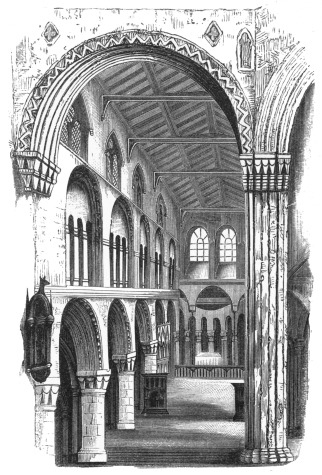 VIEW OF INTERIOR, LOOKING EAST.
We will now enter the Church. Over the space before reaching the Choir
the Tower originally stood; it was supported on four arches, which still
remain. Passing on, we come to the Choir; how striking is the solid
grandeur of the massive Norman columns, more than seven hundred years
old, and seemingly built to stand for ever. These support the fine
semi-circular arches of the edifice. An open triforium interposes, as
usual, between them and the roof, thus leaving the rafters exposed to
view, which is not to be seen in any other London church. The strong
timber roof is similar to that in Peterborough Cathedral.
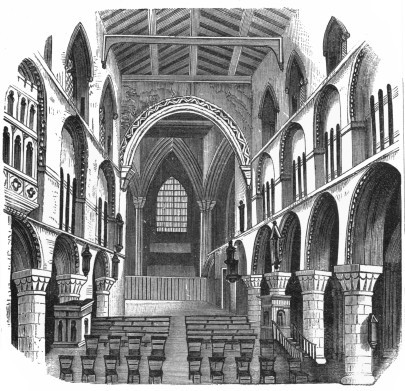 VIEW OF INTERIOR, LOOKING WEST.
At the north-east angle of the Choir is the beautiful Tomb of the
venerable Founder and first Prior of the Monastery. This monument,
supposed to have been erected at the beginning of the fourteenth
century, was restored by Prior Bolton. Its preservation is still ensured
by a legacy bequeathed for the purpose of keeping it in constant repair.
The effigy of Rahere is doubtless a likeness; he is habited in black
robes; two Canons kneel at his feet, reading from a Bible open at the
51st chapter of Isaiah, with the following words:—“The Lord shall
comfort Zion; He will comfort all her waste places; and He will make her
wilderness like Eden, and her desert like the garden of the Lord; joy
and gladness shall be found therein, thanksgiving, and the voice of
melody.”
Below him on the front of the monument are four splendid coats of arms,
sculptured and painted; and above him a rich canopy with ogee arches.
The tomb is altogether a handsome and interesting work.
On the opposite side of the Choir, directly facing Rahere’s Tomb, and on
a level with the triforium, is a beautiful oriel window erected by Prior
Bolton; it communicated with his house at the east end of the church. He
could see therefrom whether the Canons were properly performing their
duties; the centre spandril contains his rebus, the Bolt and Tun.
There are some other interesting monuments in the Choir; one to Robert
Chamberlain, in dark brown or black marble, it represents a man in
armour kneeling under a canopy and two angels drawing aside a curtain.
Very near this is the Monument of James Rivers, with the following
inscription:—
“Within this hollow vault there rests the frame
Of the high soul which once informed the same;
Torn from the service of the state in ’s prime
By a disease malignant at the time.
Whose life and death designed no other end
Than to serve God, his country, and his friend;
Who when ambition, tyranny, and pride
Conquer’d the age, conquer’d himself and died.”
Beyond this, in the South Aisle, is a magnificent and elaborate one of
coloured marbles and giltwork, to the memory of Walter Mildmay, founder
of Emmanuel College, Cambridge; he held office under Henry VIII., Edward
VI., was Chancellor of the Exchequer to Queen Elizabeth, and with Lord
Burleigh was deputed to treat with Mary Queen of Scots, and to deliver
to her a letter from Elizabeth at Fotheringay Castle, charging her with
treason and conspiracy.
There is a curious one to the Smallpage family, containing two heads,
the one a male, the other a female in ruffs, of the period 1558, this in
dark marble.
Another to Edward Cooke, with the following lines:—
“Unsluice your briny flood; what! can you keep
Your eyes from tears, and see the marble weep?
Burst out for shame, or, if you find no vent
For tears, yet stay, and see the stones relent.”
There is also a Monument to the memory of Eliza Freshwater, in dark
marble; it represents a woman kneeling in prayer at an altar in a niche.
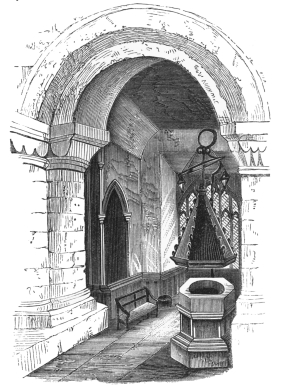 THE FONT.
In the South Aisle, at the west end, the Font stands, with a curious
cover, and two ornamental weights on chains for raising it. Hogarth was
christened at this Font.
The Aisles are about 12 feet wide, having arched or vaulted roofs; on
one side are pilasters, with the arches springing from them and joining
the massive Norman pillars of the Choir. The Aisles are lighted by
windows of different sizes and slightly pointed. At the west end of the
North Aisle may be seen a cluster of columns, of which a view is given
above.
Behind the Altar is a curious stone coffin, so shaped at one end as to
fit the head of its occupant; and no doubt in its cold embrace some
ancient Brother of the Priory was once clasped.
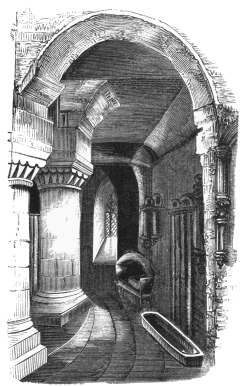 THE AMBULATORY.
The “Ambulatory” is somewhat gloomy, but very picturesque with its
Rembrandt effect; we here introduce a view of the spot. It has long
been called the Purgatory, from being used as a charnel or bone house.
At the east end of the South Aisle is a doorway that led to Bolton’s
House, in the upper right hand corner of which we again meet with
Bolton’s Rebus.
The house is now used as a fringe manufactory; the upper rooms were the
dormitory and infirmary of the Monastery; the following view shows part
of the exterior where it joins the Church.
Near one of the doors is a massive staircase with handrail of oak,
undoubtedly part of the original structure, but most of the interior has
been modernized, leaving few of its ancient features.
The North Aisle presents several admirable views which form most
pleasing pictures.
Having taken a general survey of the interior, we will now examine some
external objects of interest.
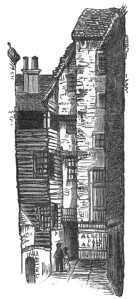 ENTRANCE TO CLOTH FAIR FROM LONG LANE.
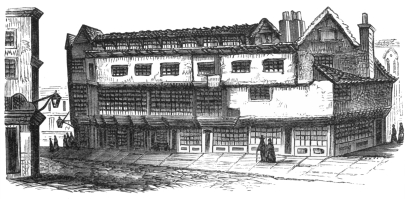
Passing into Cloth Fair we find some old houses, probably in existence
when the martyrdoms took place; we here present a group of these
buildings, seen on the right soon after entering that locality.
Having passed this group, and turning by the blacksmith’s, we obtain a
glimpse of the exterior of the church, with some very picturesque,
antique houses; forming together a quaint bit of Old London, worth a
journey to see.
Going through the narrow passage under the houses we come to a portion
of the building now used as the boys’ school.
The neighbourhood of Cloth Fair abounds with old houses; thither the
clothiers and drapers of London repaired, and had their booths and
standings within the churchyard of this Priory, closed in with walls and
gates, locked every night and watched, for safety of men’s “goods and
wares;” but Stowe says that in place of booths within the churchyard,
only let out in the fair time, and closed all the year after, are many
large houses built.
Rahere’s establishment was originally of considerable extent; it
included the Close of St. Bartholomew, le Fermery, le Dorter, le Feuter,
les Cloysters, les Galleries, le Hall, le Kitchen, le Buttery, le
Pantry, le Olde Kitchen, le Woodhouse, le Garner, and le Prior’s Stable,
the Prior’s House and Mulberry Garden. It was entirely enclosed with
walls; the North Wall ran from Smithfield, along the south side of Long
Lane to the East Wall near Aldersgate Street; and the West Wall from the
south-west corner of Long Lane, along Smithfield to the Gate House, now
the principal entrance to Bartholomew Close. The South Wall commenced at
this Gate, ran east to Aldersgate Street, forming an angle, and joined
the corner of the Eastern Wall, which ran parallel with Aldersgate
Street.
How little of the original building now remains. At the time of its
suppression by Henry VIII. it was nearly demolished for the value of the
materials. Fortunately Rahere did not see its destruction, or even
imagine that the Faith he had laboured so hard to spread would one day
be superseded by a pure one; and all the pomp and ceremony of his ritual
by a simple, reformed service.
For we are told that the Prior, with his officers and satellites waving
censers, cross, relique, and banners, issued forth from the gate to
offer the hospitality of his poor house to the King and his nobles when
they attended the jousts and tournaments, so frequently held in the open
space of Smithfield.
In Edward III.’s reign there was a tournament which lasted several
days, and the King with his mistress, Alice Piers, was present.
In 1396, Richard II. on his marriage held a tournament, when sixty
knights, accompanied by ladies, were to tilt for two days at Michaelmas.
Heralds were sent through England, Scotland, France, Hainault, Germany,
and Flanders. It began at three o’clock on Sunday after Michaelmas Day;
sixty horses, richly caparisoned and surmounted by an Esquire of honour,
proceeded in great state from the Tower; sixty ladies of rank, richly
dressed, followed on their palfreys, and leading by a silver chain a
Knight completely armed for tilting; minstrels and trumpets accompanied
them. The Queen and her fair train received them. They tilted at each
other till dark, then partook of a sumptuous banquet; and dancing was
kept up till they were all fatigued. During the next two days the
warlike sport was continued; the nights being spent in the same manner
as before. The pomp and state must have been of the most magnificent
description. All this took place just outside the Priory, on the spot
that Rahere had been at so much trouble to level and fill up when Henry
I. gave it him, and which was afterwards called “Smoothfield,” from his
success in levelling it, and subsequently “Smithfield,” from the smith’s
furnace used here.
We now introduce one of the celebrated executions that took place in
Edward I. reign. Wallace was betrayed and arrested, brought to London,
dragged in chains to Smithfield, hung on the gallows (which stood under
the elms on the spot now called Cow Lane), taken down before he was
dead, disembowelled, his head struck off by the executioner, and his
body quartered and distributed over the kingdom. This happened in 1305.
We pass on to a scene enacted after the Reformation, in Queen Mary’s
reign. An attempt was made to restore the Catholic religion here, by
presenting the church to the Black Friars. When the great bell of St.
Bartholomew’s tolled the crowd separated, the military cleared the way,
and the sheriff, riding up to the gate of the Priory, claimed the bodies
of those condemned in the Chapter-house; the spiritual delivering them
to the sheriff, the representative of the temporal power, who delivered
them to the executioner, when they were bound to that cursed post cased
with iron to be devoured in the ruthless flames. The spot is now marked
by a memorial nearly opposite the gateway which forms the entrance to
the Church, and which still retains much of the ancient beauty of its
arch; a representation of which forms the title page of this book.
 H.FORT.DEL.
 T appears that an Organ was set up here by the celebrated Richard
Bridge, builder of those at St. Ann’s, Limehouse (destroyed by fire,
1850), St. George-in-the-East, St. Leonard, Shoreditch, St. Luke’s, Old
St. Christ Church, Spital Fields, &c.
T appears that an Organ was set up here by the celebrated Richard
Bridge, builder of those at St. Ann’s, Limehouse (destroyed by fire,
1850), St. George-in-the-East, St. Leonard, Shoreditch, St. Luke’s, Old
St. Christ Church, Spital Fields, &c.
In Hopkins’ and Rimbault’s Organ Book is the following extract from the
“Daily Advertiser” of October 27th, 1731:—“We hear that the curious
new Organ, made by Mr. Bridge for the Church of St. Bartholomew the
Great, is to be opened on Sunday next with an Anthem.”
When the Church was about to be restored, in 1868, this instrument was
removed, and is said to have been “warehoused for preservation, but
ultimately lost.”
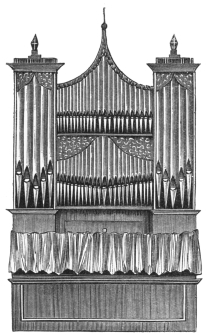
The above engraving of it, from an original sketch made many years ago,
and believed to be the only one extant, will perhaps prove the more
interesting now that the fine old work of art can be no longer seen and
heard in the venerable place for which it was built. It is to be hoped
that the wooden erection at the entrance to the Choir may soon give
place to a screen, surmounted by an organ, after the manner of that at
St. Lawrence, Guildhall. Its case might present three fronts of pipes, a
very fine example of which (probably the only one in or near London)
exists at the Church of St. James the Great, Bethnal Green.





