How few people who build houses give proper attention
to the plan and construction of the kitchen! Pains
may be taken to have the exterior of the building attractive,
the halls broad, the parlors spacious and finely finished,
the dining-room bright and inviting, the chambers
airy and sunny, but the plan of the kitchen generally
receives much less thought than its importance deserves,
if one be seeking to make the house as nearly perfect as
is practicable. The trouble is not wholly due to unwillingness
to expend more money than may have been
at first appropriated. A little extra thought alone is
needed to effect many improvements on the average
kitchen when a house is in process of construction, but
this extra thought usually is missing. Of course, in
order to have a model kitchen, one must be willing to
pay a good price for it; yet the price will not be so high
that one will ever regret the expenditure; indeed, most
persons will promptly admit that the money has been
used as profitably as that used for any other part of
the house. The object of this chapter is to show how
a model kitchen may be arranged; and although few
people may adopt the recommendations as a whole, it
is hoped that every reader may find some suggestions of
value, to be followed whether the house be already built
or yet to be erected.
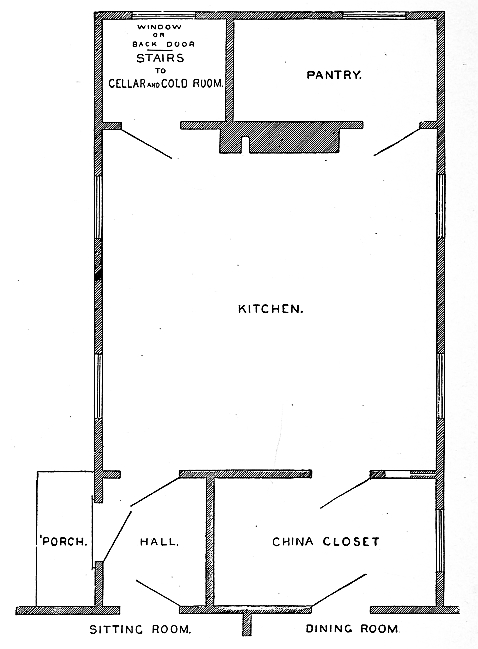
The first matter to be considered is the size of the
room. While it is important to have ample space for
range, sink, dresser, tables, and chairs, and for free movements,
it also is important to avoid having the room so
large as to oblige one to take many steps to and from
range, sink, table, and pantry. A good size is 16 × 16
or 15 × 17 feet.
Be particular to have the ventilation as good as possible;
for the comfort of not only those who have duties
in the kitchen, but of the entire household, is in a measure
dependent upon it. If the ventilation be poor, the
strength of those who work in the room will needlessly
become exhausted, and they are likely to get irritated
easily. Moreover, odors of cooking will escape to other
parts of the house instead of passing to the open air.
The room should be high, and have large windows that
can be raised or dropped easily. If the kitchen be
located in a one-story extension, almost perfect ventilation
may be secured by means of a ventilator in the roof
or by a skylight; or it may be found easy to have a
ventilator placed in the chimney. If expense be no
obstacle, it will be well to have a separate chimney for
the kitchen, as this is one of the surest ways of preventing
odors of food from reaching other rooms. Although
the room may be admirably arranged and finished, it will
not be a model apartment unless there be good ventilation
and an abundance of light. Most kitchens have
some dark corners, but there should be none.
Excepting the ceilings, every part of the room, as well
as of the pantry and the adjoining closets, should be finished
in a way that permits of washing. A hard-wood
floor is desirable. Avoid spruce. Hard pine, if carefully
selected, makes a good floor; but the best wood is
maple or birch, in strips not more than three inches
wide. If soft wood be used, splinters will in time get
torn up. Oil-cloth often is used for covering the floor.
It may look bright and clean, but is too cold, and frequently
causes rheumatism. Lignum, which somewhat
resembles oil-cloth, but is thicker and warmer, is as good
a covering as can be found. It is clean and durable.
Tiles are sometimes recommended for the floor of a
kitchen; they can be kept clean and will wear well, but
they tire the feet, and for that reason should not be
used.
It is well to have the woodwork in a kitchen oiled. A
wainscot is desirable. Have the walls painted a rather
light color. If one can afford it, the walls about the
range and sink should be tiled. At the outset tiles may
appear costly, but after experience one finds it is really
a saving to use them. They can easily be kept perfectly
clean, and will last as long as the house itself. English
or Dutch tiles should be used, and there is nothing more
appropriate than the blue and white. The price for furnishing
and setting such tiles is from seventy cents to a
dollar per square foot. Probably the time will come
when nobody will think of finishing a house without
them.
Do not be satisfied with a small sink. Have one of
good size, and of iron, with a sloping and grooved shelf
at one end, on which to drain dishes after washing them.
Let the sink rest on iron legs. The space under it should
not be enclosed, as every dark place is a source of temptation
to a slovenly domestic.
One caution in regard to the sink: have the strainer
screwed down firm. Anything that will not pass through
the strainer should not go into the pipes. The hinged or
loose strainer gives but little protection, as the temptation
to lift it and let sediment pass through is very
great. With an immovable strainer and the use, once
a fortnight, of the hot solution of soda described in the
chapter on “Care of Utensils,” there will be no trouble
with pipes, unless it be caused by wear or freezing.
After using the hot soda, flush the pipes with cold
water. This plan has been followed in the care of the
plumbing of a large house for many years, with the
most satisfactory results. Put hooks under the sink, for
dish-cloths, dish-pans, etc. Unless there be tiles above,
below, and at the sides of the sink, all this space should
be finished in hard wood. If tiles be used, have a broad
capping of hard wood extend across the upper edge of
the top row, in which to place brass hooks for the various
small utensils in frequent use at the sink.
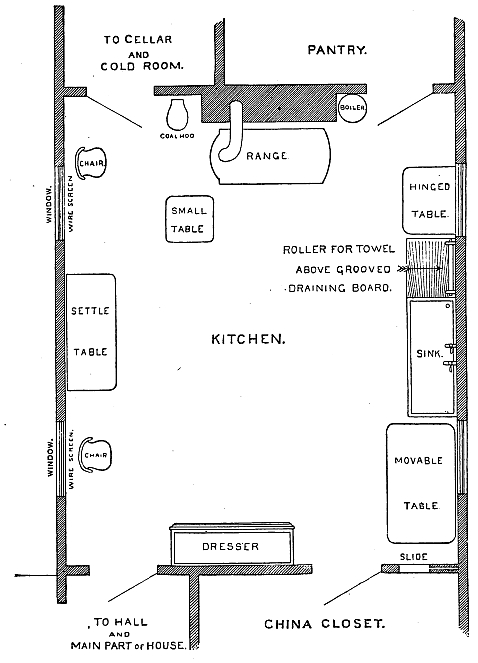
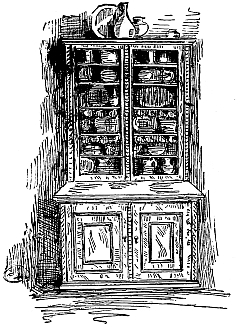
Between the doors leading to the china closet and the
hall have a dresser. Here can be kept the kitchen table-ware
and some utensils. Near the back part of each
shelf have a groove, so that plates and platters may be
placed on edge without danger of their falling. There
also should be two drawers, and below the drawers two
closets containing shelves. The doors of the upper part
of the dresser should be made in part of glass, and instead
of swinging on hinges they should slide one in
front of the other.
Allow enough room for the tables, so as to avoid
crowding and confusion when a meal is being prepared
or served. Swinging tables are convenient, as they occupy
no space when not in use. At one end of the sink
have a table, about 2½ × 3½ feet, containing one drawer
for knives, forks, and spoons, and one for towels. This
table should be placed on castors, so that it can easily
be moved to the centre of the room. There should be
a small table, about the height of the range, for use as a
resting-place for utensils when omelets, waffles, griddle-cakes,
etc., are made. Its top should be covered with
zinc. When not in use this table may be moved to some
other part of the room. There should be one more table
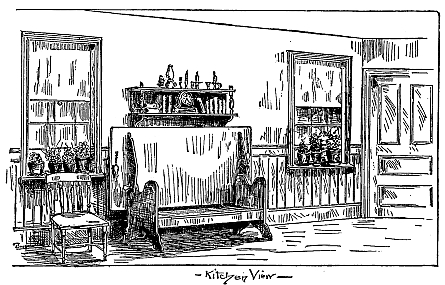
in the kitchen, between two windows if the space will
permit,—a settle table, which serves as a seat when
not in use for ironing or some other purpose. Above
the table have two shelves,—one for a clock, and the
other for cook-books, the grocer’s and marketman’s order-books,
etc. It is a good idea to have the corners of all
the tables rounded, so that nobody shall be hurt by
striking against them.
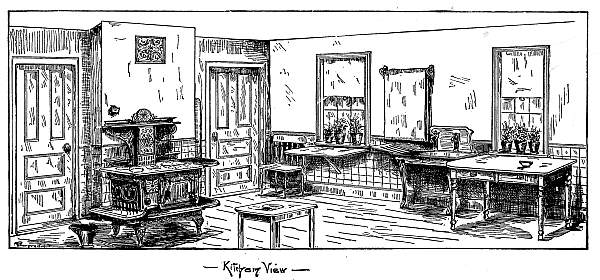
Have broad window-seats, in order to keep a few pots
of flowers, herbs, or other plants in the room. Flowers
brighten a kitchen wonderfully, and seem to grow better
there than in any other part of the house. One other
point about the windows; they should be supplied with
wire screens in summer. Swarms of flies will get in
unless this precaution be taken. The same barrier is
needed at the outside door as much as at the windows.
The most important piece of furniture is the range.
Many housekeepers find it difficult to decide which is
better, a set or a portable range. Each has merits. Less
room is required for set ranges; broiling and roasting
can be done before the fire, and a constant supply of
hot water is insured. But set ranges are rather slow to
respond to draughts and checks; they consume a great
deal of coal; the hearth becomes hot, and uncomfortable
to stand on; and there is but one side of the range to
approach, which necessitates the frequent lifting and
moving of heavy utensils.
Now, a portable range can be so placed as to permit
of one’s walking almost around it; it can be used as
advantageously as a set range, with about half the same
quantity of coal; there is a prompt response to the
opening or closing of a draught; one’s feet do not get
heated by standing near it; there are no dark corners;
the need of moving utensils is to a large extent avoided,
and it can be so managed that there shall be a hot oven
at any time of the day. But roasting must be done in
the oven, and broiling over the coals, and the supply of
hot water is limited.
With a set range there must be a broad hearth of tiles,
slate, or best face-brick. If a portable range be used,
only a large piece of zinc will be required under it.
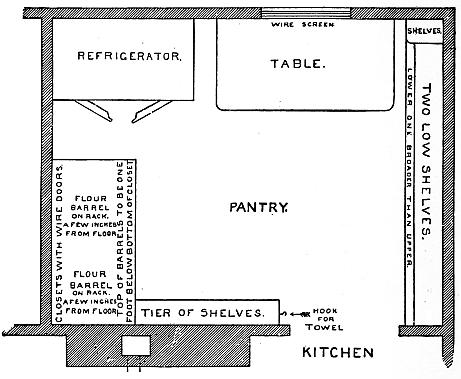
And now the pantry. It should be about 12 × 8 feet.
The window should have a wire screen, and inside folding
blinds will be found a great convenience,—indeed,
they are a necessity. A large, strong table, containing
two drawers, should be placed at this window. There
should be hooks at the ends of the table, from which to
suspend the pastry-board, the board on which cold meats
are cut, and that on which bread and cake are cut. In
one drawer the rolling-pin, knives, pastry and cake
cutters, and a few other utensils may be kept; and in the
other drawer, spices, flavoring extracts, etc.
At one end of the room the wall should be covered
with hooks on which to hang saucepans. At the same
end, about a foot from the floor, there should be a broad
shelf on which to keep heavy pots and kettles, turned
upside down to keep out dust. Two feet above this
shelf there should be a narrow one for the covers of the
utensils just mentioned. By following this plan one
can keep all these articles together and always in sight,
and no time need be lost in searching for any of them.
There will be space in this end of the room for small
shelves for the glass jars in which to keep materials
used frequently, such as tapioca, barley, rice, baking-powder,
soda, cream-of-tartar, ginger, split peas, etc.
Here, also, may be kept small pasteboard boxes containing
herbs.
In the window-frame put brass hooks, on which to
hang the egg-beater, spoons, graded measuring-cups, a
whisk, etc.
At the lower end of the pantry have a strong rack,
a few inches from the floor, on which to place flour-barrels.
This plan insures the circulation of air under
the barrels, keeping their contents sweet. About a foot
above the barrels have a wall closet, with shelves about
twenty inches wide. This should be supplied with a
lock, as it is designed for keeping cooked food and such
groceries as raisins, currants, and citron, in glass jars,
besides fresh fruit. The door or doors should be made
partly of wire.
Extending the length of one side of the room have a
tier of shelves, beginning about a foot from the floor and
running as high as the top of the wall closet. Tin cans
of meal and sugar, stone jars of salt, and jugs of molasses
and vinegar may be kept on the lower shelves; and
mixing-bowls, mixing-pans, stone-china measuring-cups,
etc.,—indeed, all utensils for which no other place has
been provided,—may be kept on the upper shelves.
In some place near the door of the pantry have a hook
or a roller for a towel, in order to avoid taking steps
across the kitchen whenever the hands require wiping.
Now, if a kitchen and pantry be built or reconstructed
on this plan, the cooking can be done with comfort, and
the washing of dishes will not seem so burdensome as
it does in the ordinary kitchen. Even if one find it
impracticable to follow all or many of the suggestions
made, pains ought to be taken—whatever the plan of the
kitchen be—to concentrate the work, obtain good light,
good ventilation, and ample table-room; and all measures
which are calculated to insure cleanliness and to
make the kitchen an attractive place should be adopted.
There must be a closet near by for brooms, brushes,
dusters, etc.; and there should be a cold room near the
kitchen, in which to keep most of the perishable stores.
In case there be no room of this kind, it will be well to
keep the refrigerator in the pantry.
A storeroom well arranged and properly managed is
a source of economy, security, and comfort to a housekeeper.
It should be kept locked except when stores
are being put in or taken out. Light should be furnished
by a small window. For a household of moderate
size a room 7 × 5 feet will suffice. In the ground-plan
given on page 10 no provision is made for such a room
on the first floor, but there would be space for one if the
china closet were made smaller and there were no closets
in the back hall.
Broad shelves should run all round the room, and
there should be a movable set of broad, firm steps—say
two or three steps—for use in reaching the upper
shelves. The floor and shelves should be planed smooth,
that there may be no grooves nor defective places where
any substance which may be spilled will lodge, giving
a disagreeable odor to the room. The shelves must be
made strong, so that no danger shall arise from putting
a great weight of stores on them. A tier of three shelves
will be enough. Have a space of about twenty inches
between the shelves. Do not have any of the woodwork
painted. The walls may be plastered or sheathed. If
plastered, they may be whitened each spring, if necessary.
This will freshen and sweeten the room. The
shelves and floor may be cleaned once a month, and the
other woodwork washed twice a year. Care must be
taken not to use much water. The room should be kept
dry, as well as clean, cool, and dark.
Use the lower shelves for such supplies as are frequently
drawn upon, and the upper ones for those stores
which are used the least. On the upper shelves there
may also be kept such kitchen utensils as may be required
to replace those which become worthless,—such
as bowls and cups, saucepans, etc., which a wise housekeeper
will always keep in reserve.
If flour be kept in a barrel in the storeroom, there
should be a strong rack, a few inches from the floor (as
recommended for the pantry), on which to place the
barrel; the idea being to get a free circulation of air
under the barrel and prevent dampness. Such groceries
as molasses, granulated sugar, vinegar, wine, cider,
washing-soda, etc., may be kept on the floor. A strip
of wood into which are screwed half a dozen or more
hooks, may be fastened on one side of the room, and
on it can be hung the brushes, brooms, etc., required to
replace those which become worn out.
Following is a list of supplies which should be kept
in the storeroom. In sections of the country where such
articles as shrimp and lobster can always be found fresh
it will not be necessary to use canned goods. Again, in
those places where fish and oysters are never found
fresh, it is well, on account of the saving in cost,
to buy them by the quantity, as one would buy canned
peas, tomatoes, mushrooms, etc. In some parts of the
country the people depend almost wholly upon condensed
milk rather than upon the fresh fluid. If canned milk
must be used, a considerable saving can be made by buying
a large quantity at one time. Then, too, if one be so
placed that it would not be possible to obtain an extra
quantity of milk in an emergency, it will be well to keep
a few cans of condensed milk on hand.
Time and money will be saved by purchasing by the
dozen such canned goods as peas, tomatoes, mushrooms,
peaches, apricots, as well as gelatine, etc. Soap and
Sapolio, candles and starch, all should be bought by the
box. It is well to have peas of two qualities,—the
small French peas for use as a vegetable, and the larger
and cheaper kind for making soups and purées. Truffles,
caviare, sardines, anchovies in various forms, and a few
other things, are luxuries in which many housekeepers
never indulge; and in any case a small can or bottle
is all that one will require in a storeroom, provided one
lives in or near a large city where such articles can be
obtained.
In the list of supplies which follows these remarks
are mentioned many things not actually essential, but
which are very useful in giving variety to the fare. It
may surprise some readers that dried or smoked fish,
ham, bacon, salt pork, brown soap, and some other articles
are not included in the list. The reason is, that
they have moisture or a strong odor, two things to be
avoided in a storeroom where delicate groceries are kept.
A cold room where there is a free circulation of air is
a better place for them.
Experience has proved that tin boxes are the best
receptacles for all kinds of food that would attract mice
or weevils. Tin boxes are, to be sure, much more expensive
than wooden buckets; but as they are lasting and
perfectly secure, it is, in the end, economical to buy
them. Each box should be labelled; and if they be
made to order, it will be well to have the labels painted
on them at the time. Such boxes as cracker-manufacturers
use will answer for this purpose, and a housekeeper
may obtain them through her grocer if no more
convenient way presents itself. When made to order,
tin boxes are expensive.
First Shelf.—Graham, corn meal, both white and yellow,
oatmeal, rye meal, hominy, buckwheat, rice, soda,
cream-of-tartar, tapioca, powdered and block sugar, dried
peas, beans, barley, picked raisins, currants that have
been cleaned, eggs, cheese, gelatine, tea, coffee, chocolate,
starch, bluing, candles; all the articles, except the last
three and the gelatine, to be kept in tin boxes.
Second Shelf.—Olive oil, vanilla, lemon, orange, and
almond extracts, Santa Cruz rum, eau-de-vie de Dantzic,
maraschino, brandy, white wine, tarragon vinegar, olives,
capers, liquid rennet; table salt, macaroni, spaghetti,
vermicelli, crackers, lime-water, stove-polish, Sapolio,
Castile soap, toilet soap, chloride of lime.
Preserved ginger, pickles, anchovy paste, chutney
sauce, extract of meat in small jars, arrowroot, cornstarch,
potted ham, tongue, and chicken, French paste
for coloring soups and sauces, devilled ham, anchovies
in oil and in salt, Russian caviare, sardines, orange marmalade,
jellies, canned and preserved fruits, almonds,
citron, candied lemon and orange peel, tomato, walnut,
and mushroom ketchup, essence of anchovy, curry-powder,
white and red pepper, essence of shrimp, Worcestershire
or Leicestershire sauce, and these whole spices,-nutmegs,
cloves, cinnamon, mace, allspice, pepper-corns,
and ginger; these ground spices,—mace, cinnamon, clove,
allspice, ginger; these whole herbs,—sage, savory, thyme,
parsley, sweet-marjoram, summer savory, tarragon; these
ground herbs,—sage, summer savory, thyme, parsley,
sweet-marjoram.
Third Shelf.—These canned vegetables,—button
onions, cauliflower, peas, string beans, shelled beans,
mixed vegetables, tomatoes, and corn; also, canned
cèpes, mushrooms, truffles, salmon, lobster, shrimp,
chicken and tongue, and dessert biscuit, prunes, twine,
chamois skin, whiting, household ammonia, clothes-pins.
Floor.—Molasses, cider, vinegar, granulated sugar,
wine, coarse salt for freezing, washing-soda for the
plumbing.
This room should be on the north side of the house,
and should have two small windows, on two sides of the
room, if possible. A broad beam should extend across
one end of the room, at least one foot from the wall.
Strong meat-hooks should be fastened in this beam, on
which to hang ham, bacon, smoked tongue, smoked salmon,
and fresh meat or poultry that is to be kept a day
or more. At the other end of the room there should be
broad, strong shelves on which to put the tubs or jars in
which pork, lard, pickles, etc., are kept. All the things
which should be kept very cold, such as fruits, vegetables,
preserves, etc., may be stored in this room.
If one have a good light cellar, the cold storeroom
may be arranged there. The entrance should be near
the kitchen stairs. In most modern cellars the furnace
gives so much heat that a separate place is required for
storage purposes. If one be about to build a house, it
will be well to take this matter under consideration.
Have a separate cellar under the kitchen, and keep it
for vegetables and a storeroom. In the larger cellar
have the furnace, fuel-bins, and a workshop, if one be
needed. If the cellar extend the entire length of the
house, a cold room may be made by building a brick
partition at the end of the cellar farthest from the
furnace. The room, whether on the ground floor or
downstairs, should be so arranged that it can be made
light when necessary. The windows should have inside
blinds.
In most households the cellar will be found to be the
most desirable place for a cold room, because the temperature
will be more even than in a place above ground.
Dry atmosphere, light, and ventilation are the special
points to keep in mind. Even in an old house, where
the light is insufficient, large windows may be put in,
and the trouble thus easily remedied. Perfect cleanliness
and frequent airing are necessary for the preservation
of food in this room.
Of course, it is desirable to have the room divided into
two parts,—a thin partition will suffice,—that the milk
and butter in one compartment shall not absorb the
flavor of meats, fish, fruits, or vegetables kept in the
other. If there be no refrigerator in the pantry, have
one in this room. Ice will not melt so quickly here as
in other parts of the house.
A writer who has given considerable thought to the
subject of ventilation says that “a great mistake is sometimes
made in ventilating cellars and milk-houses. The
object of ventilation is to keep the cellars cool and dry,
but this object often fails of being accomplished by a
common mistake, and instead the cellar is made both
warm and damp. A cool place should never be ventilated
unless the air admitted is cooler than the air
within, or is at least as cool as that, or only a very little
warmer. The warmer the air the more moisture it holds
in suspension. Necessarily, the cooler the air the more
this moisture is condensed and precipitated. When a
cool cellar is aired on a warm day, the entering air being
in motion appears cool; but as it fills the cellar the cooler
air with which it becomes mixed chills it, the moisture
is condensed, and dew is deposited on the cold walls, and
may often be seen running down them in streams. Then
the cellar is damp, and soon becomes mouldy. To avoid
this, the windows should only be opened at night, and
late,—the last thing before retiring. There is no need
to fear that the night air is unhealthful; it is as pure
as the air of midday, and is really drier. The cool air
enters the apartment during the night and circulates
through it. The windows should be closed before sunrise
in the morning, and kept closed and shaded through
the day. If the air of the cellar be damp, it may be thoroughly
dried by placing in it a peck of fresh lime in an
open box. A peck of lime will absorb about seven
pounds, or more than three quarts, of water; and in this
way a cellar or milkroom may soon be dried, even in the
hottest weather.”
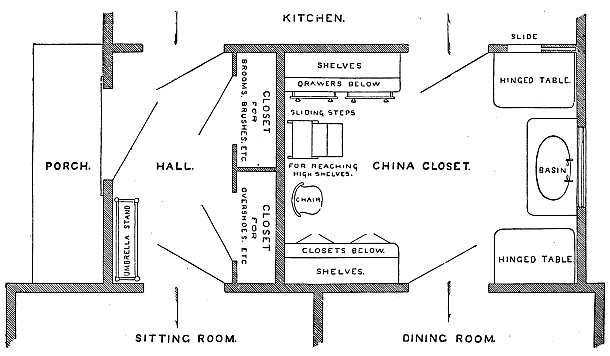
Between the kitchen and dining-room there should
be a closet where the dining-room dishes (except rare
glass and china) can be kept, and where the glassware,
silver, and delicate china—if not all the china—can be
washed. A window is needed in this room. Have the
floor made of hard wood, unless it is to be covered. If
covered, use lignum. A woollen carpet never should be
laid in a china closet. The walls may be sheathed, or
plastered and painted. Everything considered, sheathing
with well-finished hard wood is the best plan.
On one side of the room have closets about three feet
high, beginning at the floor. Above the closets have
broad shelves. These should have deep grooves, so that
meat dishes may be placed on edge and inclined against
the wall. On the opposite side of the room have a similar
tier of shelves, with drawers, instead of closets,
under the lowest. If the room be planned like that in
the design given, there will be space between the two
tiers of shelves already mentioned for still another tier,
although it will be better to save this space for the steps
needed for reaching the high shelves. These steps
should be broad, as a precaution against accidents to
anybody and damage to dishes.
The shelves should be made of smooth hard wood,
which is easily kept clean. It adds considerably to the
cost of the room, but also considerably to the convenience,
to have sliding glass doors in front of the shelves.
They will exclude a great deal of the dust which otherwise
would collect.
At one end of the room, near the window, have a sink
for washing dishes,—not such a sink as that in the
kitchen, but a rather small basin, say of copper, about
eighteen inches long, twelve wide, and eight or nine
deep. Copper is especially recommended because it
wears better than zinc. A soapstone sink or a porcelain-lined
pan would be desirable but for the greater liability
of breaking dishes. It is a good idea to have a small
cedar tub—they are made with brass hoops, and look
very neat—for the washing of the most delicate china
and glassware, which is likely to get marred or broken
if crowded into a pan with other heavier articles.
On each side of the sink have a swinging table, on
which to place dishes. The tables will at times be
convenient when making salads and other similar
dishes. Above the table nearest the kitchen have a
slide in the wall, that dishes may be passed to and from
the kitchen. This small space will not admit odors or
the hot air as the door would if kept open. In case
there be two or more servants in the household, the
door from the closet to the kitchen need not be opened
at all while a meal is served, all dishes being passed
through the slide.
The small closets in the room are for the sugar, tea,
condiments, and the cake, bread, and cracker boxes.
There should be one small closet for the articles used
in cleaning the table-ware, such as soap, whiting, alcohol,
ammonia, brushes, chamois skin, etc. The drawers
under the shelves are intended for the table linen, clean
dish-towels, etc.
A towel-rack that can be fastened to the window-casing
is a necessity. In case the walls be plastered or
tiled, a broad moulding of wood should be placed just
above the sink. Brass hooks screwed into this moulding
will prove to be a great convenience.
This room is often called the butler’s pantry.
Miss Parloa’s
Cook Books
Can be procured from any
bookseller in the United
States.
Her name in connection
with cooking is a household
word.