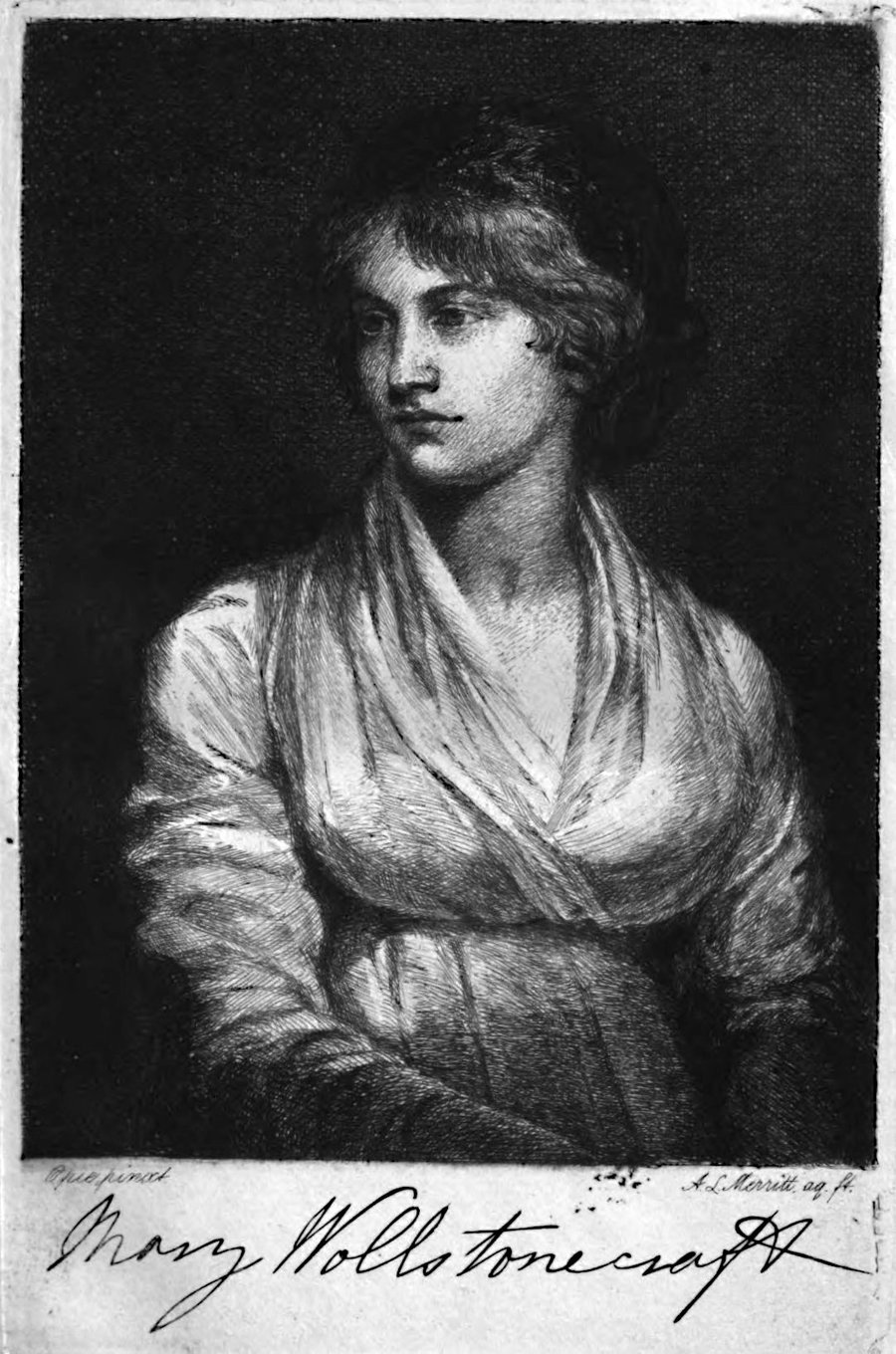
An historical and moral view of the origin and progress of the French revolution
Whole book · 8 sections
AN HISTORICAL AND MORAL VIEW OF THE ORIGIN AND PROGRESS OF THE FRENCH REVOLUTION; AND THE EFFECT IT HAS PRODUCED IN EUROPE.
Transcriber’s Note:
The cover image was created by the transcriber and is placed in the public domain.
BY MARY WOLLSTONECRAFT.
VOLUME THE FIRST.
LONDON:
PRINTED FOR J. JOHNSON, IN ST. PAUL’S CHURCH-YARD.
1794.
ADVERTISEMENT.
iii
This history, taking in such a variety of
facts and opinions, has grown under my
hand; especially as in writing I cannot avoid
entering into some desultory disquisitions,
and descriptions of manners and things which,
though not strictly necessary to elucidate the
events, are intimately connected with the
main object; I have also been led into several
theoretical investigations, whilst marking
the political effects that naturally flow from
the progress of knowledge. It is probable,
therefore, that this work will be extended to
two or three more volumes, a considerable
part of which is already written.
PREFACE.
v
The revolution in France exhibits a scene,
in the political world, not less novel and interesting
than the contrast is striking between
the narrow opinions of superstition, and the
enlightened sentiments of masculine and improved
philosophy.
To mark the prominent features of this
revolution, requires a mind, not only unsophisticated
by old prejudices, and the inveterate
habits of degeneracy; but an amelioration
of temper, produced by the exercise of
the most enlarged principles of humanity.
The rapid changes, the violent, the base,
and nefarious assassinations, which have
clouded the vivid prospect that began to
vispread a ray of joy and gladness over the
gloomy horizon of oppression, cannot fail to
chill the sympathizing bosom, and palsy intellectual
vigour. To sketch these vicissitudes
is a task so arduous and melancholy, that, with
a heart trembling to the touches of nature, it
becomes necessary to guard against the erroneous
inferences of sensibility; and reason
beaming on the grand theatre of political
changes, can prove the only sure guide to direct
us to a favourable or just conclusion.
This important conclusion, involving the
happiness and exaltation of the human character,
demands serious and mature consideration;
as it must ultimately sink the
dignity of society into contempt, and its members
into greater wretchedness; or elevate
it to a degree of grandeur not hitherto anticipated,
but by the most enlightened statesmen
and philosophers.
Contemplating then these stupendous events
with the cool eye of observation, the judgement,
viidifficult to be preserved unwarped
under the pressure of the calamitous horrours
produced by desperate and enraged factions,
will continually perceive that it is the uncontaminated
mass of the french nation, whose
minds begin to grasp the sentiments of freedom,
that has secured the equilibrium of
the state; often tottering on the brink of annihilation;
in spite of the folly, selfishness, madness,
treachery, and more fatal mock patriotism,
the common result of depraved manners,
the concomitant of that servility and
voluptuousness which for so long a space of
time has embruted the higher orders of this
celebrated nation.
By thus attending to circumstances, we
shall be able to discern clearly that the revolution
was neither produced by the abilities
or intrigues of a few individuals; nor was the
effect of sudden and short-lived enthusiasm;
but the natural consequence of intellectual improvement,
gradually proceeding to perfection
viiiin the advancement of communities, from a
state of barbarism to that of polished society, till
now arrived at the point when sincerity of
principles seems to be hastening the overthrow
of the tremendous empire of superstition and
hypocrisy, erected upon the ruins of gothic
brutality and ignorance.
CONTENTS. — BOOK I. — CHAPTER I. INTRODUCTION. PROGRESS OF SOCIETY. END OF GOVERNMENT. RISE OF POLITICAL DISCUSSION AMONGST THE FRENCH. REVOLUTION IN AMERICA. VIRTUE ATTEMPTED TO BE BUILT ON FALSE PRINCIPLES. THE CROISADES, AND THE AGE OF CHIVALRY. ADMINISTRATION OF RICHELIEU, AND OF CARDINAL MAZARIN. THEATRICAL ENTERTAINMENTS, AND DRAMATIC POETS OF THE FRENCH,—MOLIERE,—CORNEILLE,—RACINE. LOUIS XIV. THE REGENCY. LOUIS XV. — CHAPTER II. MARIE-ANTOINETTE. LOUIS XVI. ADMINISTRATION OF NECKER, AND OF CALONNE. NOTABLES CONVENED. CALONNE DISGRACED,—AND OBLIGED TO FLEE THE KINGDOM. HIS CHARACTER. CAUSES OF THE ENSLAVED STATE OF EUROPE. — CHAPTER III. ADMINISTRATION OF DE BRIENNE. DISSOLUTION OF THE NOTABLES. LAND TAX AND STAMP DUTY RECOMMENDED BY THEM, BUT REFUSED TO BE SANCTIONED BY THE PARLIAMENT. BED OF JUSTICE. THE PARLIAMENT BANISHED TO TROYES,—BUT SOON COMPROMISED FOR IT’S RECALL. STRUGGLES OF THE COURT PARTY TO PREVENT THE CONVOCATION OF THE STATES-GENERAL. BANISHMENT OF THE DUKE OF ORLEANS, AND TWO SPIRITED MEMBERS OF THE PARLIAMENT. COUR PLENIERE. REMARKS ON THE PARLIAMENTS. IMPRISONMENT OF THE MEMBERS. DEPUTIES OF THE PROVINCE OF BRITANNY SENT TO THE BASTILLE. THE SOLDIERY LET LOOSE UPON THE PEOPLE. — CHAPTER IV. NECKER RECALLED. HIS CHARACTER. NOTABLES CONVENED A SECOND TIME. COALITION OF THE NOBILITY AND CLERGY IN DEFENCE OF THEIR PRIVILEGES. PROVINCIAL ASSEMBLIES OF THE PEOPLE. POLITICAL PUBLICATIONS IN FAVOUR OF THE TIERS-ETAT. GENERAL REFLECTIONS ON REFORM,—ON THE PRESENT STATE OF EUROPE,—AND ON THE REVOLUTION IN FRANCE.
ix
BOOK I.
CHAPTER I.
Introduction. Progress of society. End of government. Rise of political discussion amongst the french. Revolution in America. Virtue attempted to be built on false principles. The croisades, and the age of chivalry. Administration of Richelieu, and of Cardinal Mazarin. Theatrical entertainments, and dramatic poets of the french—Moliere,—Corneille,—Racine. Louis XIV. The regency.—Louis XV.
Marie-Antoinette. Louis XVI. Administration of Necker, and of Calonne. Notables convened. Calonne disgraced,—and obliged to flee the kingdom. His character. Causes of the enslaved state of Europe.
xAdministration of de Brienne. Dissolution of the notables. Land tax and stamp duty recommended by them, but refused to be sanctioned by the parliament. Bed of justice. The parliament banished to Troyes,—but soon compromised for its recall. Struggles of the court party to prevent the convocation of the states-general. Banishment of the duke of Orleans, and two spirited members of the parliament. Cour pléniere. Remarks on the parliaments. Imprisonment of the members. Deputies of the Province of Britanny sent to the Bastille. The soldiery let loose upon the people.
Necker recalled. His character. Notables convened a second time. Coalition of the nobility and clergy in defence of their privileges. Provincial assemblies of the people. Political publications in favour of the tiers-etat. General reflections on reform,—on the present state of Europe,—and on the revolution in France.
xiRetrospective view of grievances in France—the nobles—the military—the clergy—the farmers general. Election of deputies to the states-general. Arts of the courtiers. Assembly of the states. Riots excited at Paris. Opening of the states-general. The king’s speech. Answer to it by the keeper of the seals. Speech of Mr. Necker. Contest respecting the mode of assembling. Tacit establishment of the liberty of the press. Attempt of the court to refrain it. The deputies declare themselves a national assembly.
The national assembly proceed to business. Opposition of the nobles, bishops, and court. A séance royale proclaimed, and the hall of the assembly surrounded by soldiers. The members adjourn to the tennis-court, and vow never to separate till a constitution should be completed. The majority of the clergy and two of the nobles join the commons. Séance royale. The king’s speech. Spirited behaviour of the assembly. Speech of Mirabeau. Persons of the deputies declared inviolable. Minority of the nobles join the commons. At the request of the king the minority of the clergy do the same,—and are at length followed by the majority of the nobles. Character of the queen of France,—of the king,—and of the nobles. Lectures on liberty at the palais royal. Paris surrounded by troops. Spirit of liberty infused into the soldiers. Eleven of the french guards imprisoned because they would not fire on the populace, and liberated by the people. Remonstrance of the national assembly. The king proposes to remove the assembly to Noyon, or Soissons. Necker dismissed. City militia proposed. The populace attacked in the garden of the Thuilleries by the prince of Lambesc. Nocturnal orgies at Versailles.
Preparations of the parisians for the defence of the city. The guards, and city watch join the citizens. The armed citizens appoint a commander in chief. Conduct of the national assembly during the disturbances at Paris. They publish a declaration of rights,—and offer their mediation with the citizens,—which is haughtily refused by the king. Proceedings at Paris on the 14th of July. Taking of the bastille. The mayor shot. Proceedings of the national assembly at Versailles. Appearance of the king in the assembly. His speech.
Reflections on the conduct of the court and king. Injurious consequences of the complication of laws. General diffusion of knowledge. State of civilization amongst the ancients. It’s progress. The croisades, and the reformation. Early freedom of Britain. The british constitution. State of liberty in Europe. Russia. Decline of the Aristotelian philosophy, Descartes. Newton. Education improved. Germany. Frederick II. of Prussia.
xiiiA deputation of the national assembly arrives at Paris. Baillie chosen mayor, and La Fayette commander in chief of the national guards. Resignation of the ministry. Necker recalled. The king visits Paris. Character of the parisians. The revolution urged on prematurely. Emigrations of several of the nobility and others. Calonne advises the french princes to stir up foreign powers against France. Foulon killed.
The duke of Liancourt chosen president. The people arm for the defence of the country. The municipal officers appointed under the old government superseded by committees. Some people treacherously destroyed by springing a mine at a civic feast. The genevese resident taken up by the patrole. The french suspicious of the designs of Britain. Necker returns. General amnesty resolved by the debtors of Paris. Debate on a declaration of rights. Declaration of rights separate from the constitution determined on. Sacrifices made by the nobles, clergy, &c.
Reflections on the members of the national assembly. Secession of several pseudo-patriots. Society ripe for improvement throughout Europe. War natural to men in a savage state. Remarks on the origin and progress of society. The arts—property—inequality of conditions—war. Picture of manners in modern France.
Opinions on the transactions of the fourth of August. Disorders occasioned by those transactions. Necker demands the assembly’s sanction to a loan. A loan decreed. Tithes abolished. Debate on the declaration of rights. The formation of a constitution. Debate on the executive power. The suspensive veto adopted. Pretended and real views of the combination of despots against France. Debate on the constitution of a senate. Means of peaceably effecting a reform should make a part of every constitution.
Observations on the veto. The women offer up their ornaments to the public. Debate whether the spanish branch of the Bourbons could reign in France. Conduct of the king respecting the decrees of the fourth of August. Vanity of the french. Debates on quartering a thousand regulars at Versailles. Individuals offer their jewels and plate to make up the deficiency of the loan. The king sends his rich service of plate to the mint. Necker’s proposal for every citizen to give up a fourth of his income. Speech of Mirabeau on it. His address to the nation.
Errour of the national assembly in neglecting to secure the freedom of France. It’s conduct compared with that of the american states. Necessity of forming a new constitution as soon as an old government is destroyed. The declaring of the king inviolable a wrong measure. Security of the french against a counter-revolution. The flight of the king meditated.
xviEntertainment at Versailles. The national cockade trampled under foot. A mob of women proceed to the hôtel-de-ville—and thence to Versailles. The king’s reply to the national assembly’s request, that he would sanction the declaration of rights and the first articles of the constitution. Debates on it. Arrival of the mob at Versailles. The king receives a deputation from the women, and sanctions the decree for the free circulation of grain. The assembly summoned. La Fayette arrives with the parisian militia. The palace attacked by the mob—who are dispersed by the national guards. Reflections on the conduct of the duke of Orleans.
The mob demand the king’s removal to Paris. This city described. The king repairs to the capital, escorted by a deputation of the national assembly and the parisian militia. The king’s title changed. Proceedings of the national assembly. Reflections on the declaration of rights.
Progress of reform. The encyclopedia. Liberty of the press. Capitals. The french not properly qualified for the revolution. Savage compared with civilized man. Effects of extravagance—of commerce—and of manufactures. Excuse for the ferocity of the parisians.
When we contemplate the infancy of
man, his gradual advance towards maturity,
his miserable weakness as a solitary being, and
the crudeness of his first notions respecting
the nature of civil society, it will not appear
extraordinary, that the acquirement of political
knowledge has been so extremely slow;
2or that public happiness has not been more rapidly
and generally diffused.
The perfection attained by the ancients, it
is true, has ever afforded the imagination of
the poetical historian a theme to deck with the
choicest flowers of rhetoric; though the cool
investigation of facts seems clearly to prove,
that the civilization of the world, hitherto, has
consisted rather in cultivating the taste, than
in exercising the understanding. And were
not these vaunted improvements also confined
to a small corner of the globe, whilst, the
political view of the wisest legislators seldom
extending beyond the splendour and
aggrandizement of their individual nation,
they trampled with a ferocious affectation of
patriotism on the most sacred rights of humanity?
When the arts flourished in Greece,
and literature began to shed it’s blandishments
on society, the world was mostly inhabited by
barbarians, who waged eternal war with their
more polished neighbours, the imperfection
of whose government sapping it’s foundation,
the science of politics necessarily received a
check in the bud—and when we find, likewise,
the roman empire crumbling into
atoms, from the germ of a deadly malady implanted
3in it’s vitals; whilst voluptuousness
stopped the progress of civilization, which
makes the perfection of the arts the dawn of science;
we shall be convinced, that it demanded
ages of improving reason and experience in
moral philosophy, to clear away the rubbish,
and exhibit the first principles of social order.
We have probably derived our great superiority
over those nations from the discovery
of the polar attraction of the needle, the perfection
which astronomy and mathematics
have attained, and the fortunate invention of
printing. For, whilst the revival of letters
has added the collected wisdom of antiquity
to the improvements of modern research, the
latter most useful art has rapidly multiplied
copies of the productions of genius and compilations
of learning, bringing them within
the reach of all ranks of men: the scientific
discoveries also have not only led us to new
worlds; but, facilitating the communication
between different nations, the friction of arts
and commerce have given to society the
transcendently pleasing polish of urbanity;
and thus, by a gradual softening of manners,
the complexion of social life has been completely
changed. But the remains of superstition,
4and the unnatural distinction of privileged
classes, which had their origin in barbarous
folly, still fettered the opinions of
man, and sullied his native dignity; till
several distinguished english writers discussed
political subjects with the energy of men, who
began to feel their strength; and, whilst only
a rumour of these sentiments roused the attention
and exercised the minds of some men
of letters in France, a number of staunch disputants,
who had more thoroughly digested
them, fled from oppression, to put them to
the test of experience in America.
Locke, following the track of these bold
thinkers, recommended in a more methodical
manner religious toleration, and analyzed the
principles of civil liberty: for in his definition
of liberty we find the elements of The
Declaration of the Rights of Man, which, in
spite of the fatal errours of ignorance, and the
perverse obstinacy of selfishness, is now converting
sublime theories into practical truths.
The revolution, it is true, soon introduced
the corruption, that has ever since been corroding
british freedom.—Still, when the rest
of Europe groaned under the weight of the
most unjust and cruel laws, the life and property
5of englishmen were comparatively safe;
and, if an impress-warrant respected the distinction
of ranks, when the glory of England
was at stake, splendid victories hid this flaw
in the best existing constitution; and all exultingly
recollected, that the life or liberty of a
man never depended on the will of an individual.
Englishmen were then, with reason, proud
of their constitution; and, if this noble pride
have degenerated into arrogance, when the
cause became less conspicuous, it is only a
venial lapse of human nature; to be lamented
merely as it stops the progress of civilization,
and leads the people to imagine, that their
ancestors have done every thing possible to
secure the happiness of society, and meliorate
the condition of man, because they have done
much.
When learning was confined to a small
number of the citizens of a state, and the investigation
of it’s privileges was left to a number
still smaller, governments seem to have
acted, as if the people were formed only for
them; and, ingeniously confounding their
rights with metaphysical jargon, the luxurious
grandeur of individuals has been supported
6by the misery of the bulk of their fellow
creatures, and ambition gorged by the
butchery of millions of innocent victims.
The most artful chain of despotism has ever
been supported by false notions of duty, enforced
by those who were to profit by the
cheat. Thus has the liberty of man been restrained;
and the spontaneous flow of his
feelings, which would have fertilized his
mind, being choked at the source, he is rendered
in the same degree unhappy as he is
made unnatural. Yet, certain opinions, planted
by superstition and despotism, hand in hand,
have taken such deep root in our habits of
thinking, it may appear daringly licentious,
as well as presumptuous, to observe, that what
is often termed virtue, is only want of courage
to throw off prejudices, and follow the inclinations
which fear not the eye of heaven,
though they shrink from censure not founded
on the natural principles of morality. But
at no period has the scanty diffusion of knowledge
permitted the body of the people to participate
in the discussion of political science;
and if philosophy at length have simplified
the principles of social union, so as to render
them easy to be comprehended by every sane
7and thinking being; if appears to me, that
man may contemplate with benevolent complacency
and becoming pride, the approaching
reign of reason and peace.
Besides, if men have been rendered unqualified
to judge with precision of their civil
and political rights, from the involved state
in which sophisticating ignorance has placed
them, and thus reduced to surrender their
reasoning powers to noble fools, and pedantic
knaves, it is not surprizing, that superficial
observers have formed opinions unfavourable
to the degree of perfection, which our intellectual
faculties are able to attain, or that despotism
should attempt to check the spirit of
inquiry, which, with colossian strides, seems
to be hastening the overthrow of oppressive
tyranny and contumelious ambition.
Nature having made men unequal, by giving
stronger bodily and mental powers to one
than to another, the end of government ought
to be, to destroy this inequality by protecting
the weak. Instead of which, it has always
leaned to the opposite side, wearing itself out
by disregarding the first principle of it’s organization.
8It appears to be the grand province of government,
though scarcely acknowledged, so
to hold the balance, that the abilities or riches
of individuals may not interfere with the equilibrium
of the whole. For, as it is vain to
expect, that men should master their passions
during the heat of action, legislators should
have this perfection of laws ever in view,
when, calmly grasping the interest of humanity,
reason assures them, that their own
is best secured by the security of the commonweal.
The first social systems were certainly
founded by passion; individuals wishing to
fence round their own wealth or power, and
make slaves of their brothers to prevent encroachment.
Their descendants have ever
been at work to solder the chains they forged,
and render the usurpations of strength secure,
by the fraud of partial laws: laws that can be
abrogated only by the exertions of reason,
emancipating mankind, by making government
a science, instead of a craft, and civilizing
the grand mass, by exercising their understandings
about the most important objects
of inquiry.
After the revolution in 1688, however,
political questions were no longer discussed in
9England on a broad scale; because that degree
of liberty was enjoyed, which enabled
thinking men to pursue without interruption
their own business; or, if some men complained,
they attached themselves to a party,
and descanted on the unavoidable misery produced
by contending passions.
But in France the bitterness of oppression
was mingled in the daily cup, and the serious
folly of superstition, pampered by the sweat
of labour, stared every man of sense in the
face. Against superstition then did the writers
contending for civil liberty principally direct
their force, though the tyranny of the court
increased with it’s viciousness.
Voltaire leading the way, and ridiculing
with that happy mixture of satire and gaiety,
calculated to delight the french, the inconsistent
puerilities of a puppet-show religion,
had the art to attach the bells to the
fool’s cap, which tinkled on every side, rousing
the attention and piquing the vanity of
his readers. Rousseau also ranged himself on
the same side; and, praising his fanciful state
of nature, with that interesting eloquence,
which embellishes reasoning with the charms
10of sentiment, forcibly depicted the evils of a
priest-ridden society, and the sources of oppressive
inequality, inducing the men who
were charmed with his language to consider
his opinions.
The talents of these two writers were particularly
formed to effect a change in the sentiments
of the french, who commonly read
to collect a fund for conversation; and their
biting retorts, and flowing periods, were retained
in each head, and continually slipped
off the tongue in numerous sprightly circles.
In France, indeed, new opinions fly from
mouth to mouth, with an electrical velocity,
unknown in England; so that there is not
such a difference between the sentiments of
the various ranks in one country, as is observable
in the originality of character to be
found in the other. At our theatres, the
boxes, pit, and galleries, relish different
scenes; and some are condescendingly born
by the more polished part of the audience, to
allow the rest to have their portion of amusement.
In France, on the contrary, a highly
wrought sentiment of morality, probably
rather romantic than sublime, produces a burst
11of applause, when one heart seems to agitate
every hand.
But men are not content merely to laugh
at oppression, when they can scarcely catch
from his gripe the necessaries of life; so that
from writing epigrams on superstition, the
galled french began to compose philippics
against despotism. The enormous and iniquitous
taxes, which the nobles, the clergy,
and the monarch, levied on the people, turned
the attention of benevolence to this main
branch of government, and the profound
treatise of the humane M. Quesnai produced
the sect of the economists, the first champions
for civil liberty.
On the eve of the american war, the enlightened
administration of the comptroller general
Turgot, a man formed in this school,
afforded France a glimpse of freedom, which,
streaking the horizon of despotism, only served
to render the contrast more striking. Eager
to correct abuses, equally impolitic and
cruel, this most excellent man, suffering his
clear judgment to be clouded by his zeal,
roused the nest of wasps, that rioted on the
honey of industry in the sunshine of court
favour; and he was obliged to retire from
12the office, which he so worthily filled. Disappointed
in his noble plan of freeing France
from the fangs of despotism, in the course of
ten years, without the miseries of anarchy,
which make the present generation pay very
dear for the emancipation of posterity, he has
nevertheless greatly contributed to produce
that revolution in opinion, which, perhaps,
alone can overturn the empire of tyranny.
The idle caprices of an effeminate court
had long given the tone to the awe-struck
populace, who, stupidly admiring what they
did not understand, lived on a vive le roi,
whilst his blood-sucking minions drained
every vein, that should have warmed their
honest hearts.
But the irresistible energy of the moral and
political sentiments of half a century, at last
kindled into a blaze the illuminating rays of
truth, which, throwing new light on the
mental powers of man, and giving a fresh
spring to his reasoning faculties, completely
undermined the strong holds of priestcraft and
hypocrisy.
At this glorious era, the toleration of religious
opinions in America, which the spirit
of the times, when that continent was peopled
13with persecuted europeans, produced, aided, not
a little, to diffuse these rational sentiments, and
exhibited the phenomenon of a government
established on the basis of reason and equality.
The eyes of all Europe were watchfully fixed
on the practical success of this experiment in
political science; and whilst the crowns of the
old world were drawing into their focus the
hard-earned recompense of the toil and care
of the simple citizens, who lived detached
from courts, deprived of the comforts of life,
the just reward of industry, or, palsied by
oppression, pined in dirt and idleness; the
anglo-americans appeared to be another race
of beings, men formed to enjoy the advantages
of society, and not merely to benefit those
who governed; the use to which they had
been appropriated in almost every state; considered
only as the ballast which keeps the
vessel steady, necessary, yet despised. So conspicuous
in fact was the difference, that, when,
frenchmen became the auxiliaries of those
brave people, during their noble struggle
against the tyrannical and inhuman ambition
of the british court, it imparted to them that
stimulus, which alone was wanting to give
wings to freedom, who, hovering over France,
14led her indignant votaries to wreak their
vengeance on the tottering fabric of a government,
the foundation of which had been laid
by benighted ignorance, and it’s walls cemented
by the calamities of millions that mock calculation—and,
in it’s ruins a system was entombed,
the most baneful to human happiness
and virtue.
America fortunately found herself in a
situation very different from all the rest of the
world; for she had it in her power to lay the
first stones of her government, when reason
was venturing to canvass prejudice. Availing
herself of the degree of civilization of the
world, she has not retained those customs,
which were only the expedients of barbarism;
or thought that constitutions formed by
chance, and continually patched up, were
superiour to the plans of reason, at liberty to
profit by experience.
When society was first regulated, the laws
could not be adjusted so as to take in the
future conduct of it’s members, because the
faculties of man are unfolded and perfected
by the improvements made by society: consequently
the regulations established as circumstances
required were very imperfect.
15What then is to hinder man, at each epoch
of civilization, from making a stand, and new
modelling the materials, that have been hastily
thrown into a rude mass, which time alone
has consolidated and rendered venerable?
When society was first subjugated to laws,
probably by the ambition of some, and the
desire of safety in all, it was natural for men
to be selfish, because they were ignorant how
intimately their own comfort was connected
with that of others; and it was also very
natural, that humanity, rather the effect of
feeling than of reason, should have a very
limited range. But, when men once see,
clear as the light of heaven,—and I hail the
glorious day from afar!—that on the general
happiness depends their own, reason will give
strength to the fluttering wings of passion, and
men will “do unto others, what they wish they
should do unto them.”
What has hitherto been the political perfection
of the world? In the two most
celebrated nations it has only been a polish of
manners, an extension of that family love,
which is rather the effect of sympathy and
selfish passions, than reasonable humanity.
And in what has ended their so much extolled
16patriotism? In vain glory and barbarity—every
page of history proclaims. And why
has the enthusiasm for virtue thus passed away
like the dew of the morning, dazzling the
eyes of it’s admirers? Why?—because it was
factitious virtue.
During the period they had to combat
against oppression, and rear an infant state,
what instances of heroism do not the annals
of Greece and Rome display! But it was
merely the blaze of passion, “live smoke;”
for after vanquishing their enemies, and making
the most astonishing sacrifices to the glory
of their country, they became civil tyrants,
and preyed on the very society, for whose
welfare it was easier to die, than to practise
the sober duties of life, which insinuate
through it the contentment that is rather felt
than seen. Like the parents who forget all
the dictates of justice and humanity, to aggrandize
the very children whom they keep
in a state of dependence, these heroes loved
their country, because it was their country,
ever showing by their conduct, that it was
only a part of a narrow love of themselves.
It is time, that a more enlightened moral
love of mankind should supplant, or rather
17support physical affections. It is time, that
the youth approaching manhood should be
led by principles, and not hurried along by
sensations—and then we may expect, that the
heroes of the present generation, still having
their monsters to cope with, will labour to
establish such rational laws throughout the
world, that men will not rest in the dead
letter, or become artificial beings as they
become civilized.
We must get entirely clear of all the notions
drawn from the wild traditions of original sin:
the eating of the apple, the theft of Prometheus,
the opening of Pandora’s box, and the other
fables, too tedious to enumerate, on which
priests have erected their tremendous structures
of imposition, to persuade us, that we are
naturally inclined to evil: we shall then leave
room for the expansion of the human heart,
and, I trust, find, that men will insensibly render
each other happier as they grow wiser. It
is indeed the necessity of stifling many of it’s
most spontaneous desires, to obtain the factitious
virtues of society, that makes man vicious,
by depriving him of that dignity of character,
which rests only on truth. For it is not
paradoxical to assert, that the social virtues
18are nipt in the bud by the very laws of society.
One principal of action is sufficient—Respect
thyself—whether it be termed fear
of God—religion; love of justice—morality;
or, self-love—the desire of happiness. Yet,
how can a man respect himself; and if not,
how believe in the existence of virtue; when
he is practising the daily shifts, which do not
come under the cognisance of the law, in order
to obtain a respectable situation in life?
It seems, in fact, to be the business of a civilized
man, to harden his heart, that on it he may
sharpen the wit; which, assuming the appellation
of sagacity, or cunning, in different characters,
is only a proof, that the head is clear,
because the heart is cold.
Besides, one great cause of misery in the
present imperfect state of society is, that the
imagination, continually tantalized, becomes
the inflated wen of the mind, draining off the
nourishment from the vital parts. Nor would
it, I think, be stretching the inference too
far, to insist, that men become vicious in the
same proportion as they are obliged, by the
defects of society, to submit to a kind of self-denial,
which ignorance, not morals, prescribes.
19But these evils are passing away; a new
spirit has gone forth, to organise the body-politic;
and where is the criterion to be found,
to estimate the means, by which the influence
of this spirit can be confined, now enthroned
in the hearts of half the inhabitants of the
globe? Reason has, at last, shown her captivating
face, beaming with benevolence; and it will
be impossible for the dark hand of despotism
again to obscure it’s radiance, or the lurking
dagger of subordinate tyrants to reach her
bosom. The image of God implanted in our
nature is now more rapidly expanding; and,
as it opens, liberty with maternal wing seems
to be soaring to regions far above vulgar
annoyance, promising to shelter all mankind.
It is a vulgar errour, built on a superficial
view of the subject, though it seems to have
the sanction of experience, that civilization
can only go as far as it has hitherto gone, and
then must necessarily fall back into barbarism.
Yet thus much appears certain, that a state will
infallibly grow old and feeble, if hereditary
riches support hereditary rank, under any
description. But when courts and primogeniture
are done away, and simple equal laws are
established, what is to prevent each generation
20from retaining the vigour of youth?—What
can weaken the body or mind, when the great
majority of society must exercise both, to earn
a subsistence, and acquire respectability?
The french revolution is a strong proof
how far things will govern men, when simple
principles begin to act with one powerful
spring against the complicated wheels of ignorance;
numerous in proportion to their weakness,
and constantly wanting repair, because
expedients of the moment are ever the
spawn of cowardly folly, or the narrow calculations
of selfishness. To elucidate this
truth, it is not necessary to rake among the
ashes of barbarous ambition; to show the
ignorance and consequent folly of the monarchs,
who ruled with a rod of iron, when
the hordes of european savages began to form
their governments; though the review of this
portion of history would clearly prove, that
narrowness of mind naturally produces ferociousness
of temper.
We may boast of the poetry of those ages,
and of those charming flights of imagination,
which, during the paroxysms of passion, flash
out in those single acts of heroic virtue, that
throw a lustre over a whole thoughtless life;
21but the cultivation of the understanding, in
spite of these northern lights, appears to be
the only way to tame men, whose restlessness
of spirit creates the vicious passions, that lead
to tyranny and cruelty. When the body is
strong, and the blood warm, men do not like
to think, or adopt any plan of conduct, unless
broken-in by degrees: the force that has often
spent itself in fatal activity becomes a rich
source of energy of mind.
Men exclaim, only noticing the evil, against
the luxury introduced with the arts and
sciences; when it is obviously the cultivation
of these alone, emphatically termed the arts of
peace, that can turn the sword into a ploughshare.
War is the adventure naturally pursued
by the idle, and it requires something of
this species, to excite the strong emotions
necessary to rouse inactive minds. Ignorant
people, when they appear to reflect, exercise
their imagination more than their understanding;
indulging reveries, instead of pursuing
a train of thinking; and thus grow romantic,
like the croisaders; or like women, who are
commonly idle and restless.
If we turn then with disgust from ensanguined
regal pomp, and the childish rareeshows
22that amuse the enslaved multitude, we
shall feel still more contempt for the order of
men, who cultivated their faculties, only to enable
them to consolidate their power, by leading
the ignorant astray; making the learning they
concentrated in their cells, a more polished
instrument of oppression. Struggling with so
many impediments, the progress of useful
knowledge for several ages was scarcely perceptible;
though respect for the public opinion,
that great softner of manners, and only substitute
for moral principles, was gaining ground.
The croisades, however, gave a shake to
society, that changed it’s face; and the spirit
of chivalry, assuming a new character during
the reign of the gallant Francis the first, began
to meliorate the ferocity of the ancient
gauls and franks. The point d’honneur being
settled, the character of a gentleman, held
ever since so dear in France, was gradually
formed; and this kind of bastard morality,
frequently the only substitute for all the ties
that nature has rendered sacred, kept those
men within bounds, who obeyed no other
law.
The same spirit mixed with the sanguinary
treachery of the Guises, and gave support to
23the manly dignity of Henry the fourth, on
whom nature had bestowed that warmth of
constitution, tenderness of heart, and rectitude
of understanding, which naturally produce an
energetic character.—A supple force, that,
exciting love, commands esteem.
During the ministry of Richelieu, when
the dynasty of favouritism commenced, the
arts were patronized, and the italian mode of
governing by intrigue tended to weaken
bodies, polished by the friction of continual
finesse. Dissimulation imperceptibly slides into
falshood, and Mazarin, dissimulation personified,
paved the way for the imposing pomp
and false grandeur of the reign of the haughty
and inflated Louis 14th; which, by introducing
a taste for majestic frivolity, accelerated
the perfection of that species of civilization,
which consists in the refining of the senses at
the expence of the heart; the source of all
real dignity, honour, virtue, and every noble
quality of the mind. Endeavouring to make
bigotry tolerate voluptuousness, and honour
and licentiousness shake hands, sight was lost
of the line of distinction, or vice was hid under
the mask of it’s correlative virtue. The glory
of France, a bubble raised by the heated breath
24of the king, was the pretext for undermining
happiness; whilst politeness took place of
humanity, and created that fort of dependance,
which leads men to barter their corn
and wine, for unwholesome mixtures of they
know not what, that, flattering a depraved
appetite, destroy the tone of the stomach.
The feudal taste for tournaments and martial
feasts was now naturally succeeded by a
fondness for theatrical entertainments; when
feats of valour became too great an exertion
of the weakened muscles to afford pleasure,
and men found that resource in cultivation of
mind, which renders activity of body less
necessary to keep the stream of life from stagnating.
All the pieces written at this period, except
Moliere’s, reflected the manners of the
court, and thus perverted the forming taste.
That extraordinary man alone wrote on the
grand scale of human passions, for mankind
at large, leaving to inferiour authors the task
of imitating the drapery of manners, which
points out the costume of the age.
Corneille, like our Dryden, often tottering
on the brink of absurdity and nonsense, full
of noble ideas, which, crouding indistinctly
25on his fancy, he expresses obscurely, still delights
his readers by sketching faint outlines
of gigantic passions; and, whilst the charmed
imagination is lured to follow him over enchanted
ground, the heart is sometimes unexpectedly
touched by a sublime or pathetic
sentiment, true to nature.
Racine, soon after, in elegant harmonious
language painted the manners of his time,
and with great judgement gave a picturesque
cast to many unnatural scenes and factitious
sentiments: always endeavouring to make his
characters amiable, he is unable to render
them dignified; and the refined morality,
scattered throughout, belongs to the code of
politeness rather than to that of virtue[1]. Fearing
to stray from courtly propriety of behaviour,
and shock a fastidious audience, the
gallantry of his heroes interests only the
gallant, and literary people, whose minds are
open to different species of amusement. He
was, in fact, the father of the french stage.
Nothing can equal the fondness which the
26french suck in with their milk for public
places, particularly the theatre; and this taste,
giving the tone to their conduct, has produced
so many stage tricks on the grand
theatre of the nation, where old principles
vamped up with new scenes and decorations,
are continually represented.
Their national character is, perhaps, more
formed by their theatrical amusements, than
is generally imagined: they are in reality the
schools of vanity. And, after this kind of
education, is it surprising, that almost every
thing is said and done for stage effect? or
that cold declamatory extasies blaze forth,
only to mock the expectation with a show of
warmth?
Thus sentiments spouted from the lips
come oftner from the head than the heart.
Indeed natural sentiments are only the characters
given by the imagination to recollected
sensations; but the french, by the continual
gratification of their senses, stifle the reveries
of their imagination, which always requires
to be acted upon by outward objects; and
seldom reflecting on their feelings, their sensations
are ever lively and transitory; exhaled
27by every passing beam, and dissipated by the
slightest storm.
If a relish for the broad mirth of fun
characterize the lower class of english,
the french of every denomination are
equally delighted with a phosphorical, sentimental
gilding. This is constantly observable
at the theatres. The passions are deprived
of all their radical strength, to give
smoothness to the ranting sentiments, which,
with mock dignity, like the party-coloured
rags on the shrivelled branches of the tree of
liberty, stuck up in every village, are displayed
as something very grand and significant.
The wars of Louis were, likewise, theatrical
exhibitions; and the business of his life was
adjusting ceremonials, of which he himself
became the dupe, when his grandeur was in
the wane, and his animal spirits were spent[2].
But, towards the close even of his reign, the
writings of Fenelon, and the conversation of
his pupil, the duke of Burgundy, gave rise
to different political discussions, of which the
28theoretical basis was the happiness of the people—till
death, spreading a huge pall over the
family and glory of Louis, compassion draws
his faults under the same awful canopy, and
we sympathize with the man in adversity,
whose prosperity was pestiferous.
Louis, by imposing on the senses of his
people, gave a new turn to the chivalrous
humour of the age: for, with the true spirit
of quixotism, the french made a point of
honour of adoring their king; and the glory
of the grand monarque became the national
pride, even when it cost them most dear.
As a proof of the perversion of mind at
that period, and the false political opinions
which prevailed, making the unhappy king
the slave of his own despotism, it is sufficient
to select one anecdote.
A courtier assures us,[3] that the most
humiliating circumstance that ever happened
to the king, and one of those which gave him
most pain, was the publication of a memorial
circulated with great diligence by his enemies
throughout France. In this memorial the
allies invited the french to demand the assembling
of their ancient states-general. They
29tell them, “that the ambition and pride of
the king were the only causes of the wars
during his reign; and that, to secure themselves
a lasting peace, it was incumbent on
them not to lay down their arms till the
states-general were convoked.”
It almost surpasses belief to add, that, in
spite of the imprisonment, exile, flight, or
execution of two millions of french, this memorial
produced little effect. But the king,
who was severely hurt, took care to have a
reply written[4]; though he might have comforted
himself with the recollection, that,
when they were last assembled, Louis XIII
dismissed them with empty promises, forgotten
as soon as made.
The enthusiasm of the french, which, in
general, hurries them from one extreme to
another, at this time produced a total change
of manners.
During the regency, vice was not only bare-faced,
but audacious; and the tide completely
turned: the hypocrites were now all ranged
30on the other side, the courtiers, labouring to
show their abhorrence of religious hypocrisy,
set decency at defiance, and did violence to
the modesty of nature, when they wished to
outrage the squeamish puerilities of superstition.
In the character of the regent we may
trace all the vices and graces of false refinement;
forming the taste by destroying the
heart. Devoted to pleasure, he so soon exhausted
the intoxicating cup of all it’s sweets,
that his life was spent in searching amongst
the dregs, for the novelty that could give a
gasp of life to enjoyment. The wit, which
at first was the zest of his nocturnal orgies,
soon gave place, as flat, to the grossest excesses,
in which the principal variety was
flagitious immorality. And what has he
done to rescue his name from obloquy, but
protect a few debauched artists and men of
letters? His goodness of heart only appeared
in sympathy. He pitied the distresses of the
people, when before his eyes; and as quickly
forgot these yearnings of heart in his sensual
stye.
He often related, with great pleasure, an
anecdote of the prior de Vendôme, who
31chanced to please a mistress of Charles II,
and the king could only get rid of his rival by
requesting Louis XIV to recall him.
At those moments he would bestow the
warmest praises on the english constitution;
and seemed enamoured of liberty, though authorising
at the time the most flagrant violations
of property, and despotic arts of cruelty. The
only good he did his country[5] arose from
this frivolous circumstance; for introducing
the fashion of admiring the english, he led
men to read and translate some of their masculine
writers, which greatly contributed to
rouse the sleeping manhood of the french.
His love of the fine arts, however, has led
different authors to strew flowers over his unhallowed
dust—fit emblem of the brilliant
qualities, that ornamented only the soil on
which they grew.
The latter part of the reign of Louis XV
is notorious for the same atrocious debaucheries,
unvarnished by wit, over which modesty
32would fain draw a veil, were it not necessary
to give the last touches to the portrait of that
vile despotism, under the lash of which
twenty-five millions of people groaned; till,
unable to endure the increasing weight of
oppression, they rose like a vast elephant,
terrible in his anger, treading down with
blind fury friends as well as foes.
Impotence of body, and indolence of mind,
rendered Louis XV the slave of his mistresses,
who sought to forget his nauseous embraces
in the arms of knaves, who found their account
in caressing them. Every corner of
the kingdom was ransacked to satiate these
cormorants, who wrung the very bowels of
industry, to give a new edge to sickly appetites;
corrupting the morals whilst breaking
the spirit of the nation.
33
During this general depravation of manners,
the young and beautiful dauphine arrived;
and was received with a kind of idolatrous
adoration, only to be seen in France;
for the inhabitants of the metropolis, literally
speaking, could think and talk of nothing
else; and in their eagerness to pay homage,
or gratify affectionate curiosity, an immense
number were killed.
In such a voluptuous atmosphere, how
could she escape contagion? The profligacy
of Louis XIV, when love and war were his
amusements, was soberness, compared with
the capricious intemperance of the inebriated
imagination at this period. Madame du Barry
was then in the zenith of her power, which
quickly excited the jealousy of this princess,
whose strongest passion was that intolerable
family pride, which heated the blood of the
34whole house of Austria. An inclination for
court intrigue, under the mask of the most
profound dissimulation, to preserve the favour
of Louis XV, was instantly called into action;
and it soon became the only business of her
life, either to gratify resentment, or cheat the
satiety, which the continual and unrestrained
indulgence of pleasure produced.
Her character thus formed, when she became
absolute mistress, the court of the passive
Louis, not only the most dissolute and
abandoned that ever displayed the folly of
royalty, but audaciously negligent with respect
to that attention to decency, which is
necessary to delude the vulgar, was deserted
by all persons, who had any regard for their
moral character, or the decorum of appearances.
Constrained by the etiquette, which
made the principal part of the imposing grandeur
of Louis XIV, the queen wished to
throw aside the cumbersome brocade of ceremony,
without having discernment enough
to perceive, that it was necessary to lend
mock dignity to a court, where there was not
sufficient virtue, or native beauty, to give interest
or respectability to simplicity. The harlot
is seldom such a fool as to neglect her
35meretricious ornaments, unless she renounces
her trade; and the pageantry of courts is the
same thing on a larger scale. The lively predilection,
likewise, of the queen for her native
country, and love for her brother Joseph,
to whom she repeatedly sent considerable
sums, purloined from the public, tended
greatly to inspire the most ineffable contempt
for royalty, now stript of the frippery which
had concealed it’s deformity: and the sovereign
disgust excited by her ruinous vices,
completely destroying all reverence for that
majesty, to which power alone lent dignity,
contempt soon produced hatred.
The infamous transaction of the necklace,
in which she was probably the dupe of the
knaves she fostered, exasperated also both the
nobility and the clergy; and, with her messalinian
feasts at Trianon, made her the common
mark of ridicule and satire.
The attention of the people once roused
was not permitted to sleep; for fresh circumstances
daily occurred, to give a new spring
to discussions, that the most iniquitous and
heavy taxes brought home to every bosom;
till the extravagance of the royal family became
36the general subject of sharpening execrations.
The king, who had not sufficient resolution
to support the administration of Turgot,
whom his disposition for moderation had
chosen, being at a loss what measures to
take, called to the helm the plausible Necker.
He, only half comprehending the plans of his
able predecessor, was led by his vanity cautiously
to adopt them; first publishing his
Comte-rendu, to clear the way to popularity.
This work was read with astonishing rapidity
by all ranks of men; and alarming the courtiers,
Necker was, in his turn, dismissed. He
retired to write his observations on the administration
of the finances, which kept alive the
spirit of inquiry, that afterwards broke the
talisman of courts, and showed the disenchanted
multitude, that those, whom they had been
taught to respect as supernatural beings, were
not indeed men—but monsters; deprived by
their station of humanity, and even sympathy.
Several abortive attempts were then made
by two succeeding ministers, to keep alive
public credit, and find resources to supply the
expenditure of the state, and the dissipation of
37the court, when the king was persuaded to
place the specious Calonne at the head of
these embarrassed affairs.
During the prodigal administration of this
man, who acted with an audacity peculiar to
the arrogance common in men of superficial
yet brilliant talents, every consideration was
sacrificed to the court; the splendid folly and
wanton prodigality of which eclipsing all that
has been related in history, or told in romance,
to amuse wondering fools, only served to accelerate
the destruction of public credit, and
hasten the revolution, by exciting the clamourous
indignation of the people. Numberless
destructive expedients of the moment brought
money into the state coffers, only to be dissipated
by the royal family, and it’s train of
parasites; till all failing, the wish of still supporting
himself in a situation so desirable as
that of comptroller general of the finances, determined
him to convene an assembly of
notables: whose very appellation points them
out as men in the aristocratical interest.
Louis XVI, with a considerable portion of
common sense, and a desire to promote useful
reformation, though always governed by those
around him, gave without hesitation the necessary
38orders for calling together the assembly,
that afforded the wearied nation the most
pleasing prospect, because it was a new one;
but conveyed to their astonished minds at the
same time the knowledge of the enormity of
a deficit, which a series of vice and folly had
augmented beyond all precedent.
The immoralities of Calonne, however, had
created a general distrust of all his designs:
but with an overweening presumption, the
characteristic of the man, he still thought, that
he could dexterously obtain the supplies
wanted to keep the wheels of government in
motion, and quiet the clamours of the nation,
by proposing the equalization of taxes; which,
humbling the nobility and dignified clergy,
who were thus to be brought down from their
privileged height, to the level of citizens,
could not fail to be grateful to the rest of the
nation. And the parliaments, he concluded,
would not dare to oppose his system, lest they
should draw on themselves the distrust and
hatred of the public.
Without canvassing Calonne’s intentions,
which the most enlarged charity, after his
former extravagance, can scarcely suppose to
have been the interest of the people, moderate
39men imagined this project might have been
productive of much good; giving the french
all the liberty they were able to digest; and,
warding off the tumults that have since produced
so many disastrous events, whilst coolly
preparing them for the reception of more, the
effervescence of vanity and ignorance would
not have rendered their heads giddy, or their
hearts savage. Yet some sensible observers,
on the contrary, rather adopted the opinion,
that as the people had discovered the magnitude
of the deficit, they were now persuaded,
that a specific remedy was wanting, a new
constitution; to cure the evils, which were
the excrescences of a gigantic tyranny, that
appeared to be draining away the vital juices
of labour, to fill the insatiable jaws of thousands
of fawning slaves and idle sycophants.
But though the people might, for the present,
have been satisfied with this salutary reform,
which would gradually have had an effect,
reasoning from analogy, that the financier did
not take, into his account, the nobility were not
sufficiently enlightened to listen to the dictates
of justice or prudence. It had been, indeed,
the system of ministers, ever since Richelieu,
to humble the nobles, to increase the power
40of the court; and as the ministry, the generals,
and the bishops, were always noble,
they aided to support the favourite, who
depressed the whole body, only for the chance
of individual preferment. But this bare-faced
attempt to abolish their privileges raised a nest
of hornets about his ears, eager to secure the
plunder on which they lived; for by what
other name can we call the pensions, places and
even estates of those who, taxing industry,
rioted in idleness duty free[6]?
41An approaching national bankruptcy was
the ostensible reason assigned for the convening
of the notables in 1787; but the convocation,
in truth, ought to be ascribed to the voice of
reason, founded through the organ of twenty-five
millions of human beings, who, though
under the fetters of a detestable tyranny, felt,
that the crisis was at hand, when the rights
of man, and his dignity ascertained were to be
enthroned on the eternal basis of justice and
humanity.
The notables, once assembled, being sensible,
that their conduct would be inspected by an
awakened public, now on the watch, scrupulously
examined into every national concern;
and seriously investigated the causes, that had
produced the deficit, with something like the
independent spirit of freemen. To their inquiries,
however, the minister gave only the
42evasive reply, ‘that he had acted in obedience
to the pleasure of the king:’ when it was
notorious to all Europe, that his majesty was
merely a cipher at Versailles; and even the
accusation brought against Calonne, by La
Fayette, of exchanging the national domains,
and appropriating millions of it’s revenue to
gratify the queen, the count d’Artois, and the
rest of the cabal, who kept him in place, was
generally believed. In fact, the state had
been fleeced, to support the unremitting demands
of the queen; who would have dismembered
France, to aggrandize Austria, and
pamper her favourites. Thus the court conniving
at peculation, the minister played a
sure game; whilst the honest labourer was
groaning under a thousand abuses, and yielding
the solace of his industry, or the hoards,
which youthful strength had reserved for
times of scarcity or decrepit age, to irritate
the increasing wants of a thoughtless, treacherous
princess, and the avarice of her unprincipled
agents.
This artful, though weak, machiavelian
politician suffered no other person to approach
the king; who, seduced into confidence by
his colloquial powers, could not avoid being
43dazzled by his plausible schemes. He had,
nevertheless, a powerful enemy to contend
with, in M. de Breteuil; who, having gratified
some of the little passions of the dauphine,
during her first struggles for dominion, was
now protected by the absolute power of the
queen. Endeavouring to measure his strength
with her’s, the minister was discomfited;
and the whole swarm of flatterers, who had
partaken of the spoil of rapine, were instantly
alert to open the eyes of Louis, over
which they had long been scattering poppies,
and soon convinced him of the perfidy of his
favourite; whilst the two privileged orders
joined their forces, to overwhelm their common
enemy, attending to their vengeance at
the very time they followed the dictates of
prudence.
The accusations of La Fayette served, perhaps,
as the ostensible reason with the public,
and even with the king; yet it can hardly
be supposed, that they had any effect on the
cabal, who invented, or connived at the plans
necessary to raise a continual supply for their
pleasures. The fact is, that, most probably
being found unequal to the task, or no longer
choosing to be a docile instrument of mischief,
he was thrown aside as unfit for use.
44Disgraced, he quickly retired to his estate;
but was not long permitted to struggle with
the malady of exiled ministers, in the gloomy
silence of inactivity; for, hearing that he had
been denounced by the parliament, he fled in
a transport of rage out of the kingdom, covered
with the execrations of an injured people, in
whose hatred, or admiration, the mellowed
shades of reflection are seldom seen.
The extravagance of his administration exceeded
that of any other scourge of France;
yet it does not appear, that he was actuated
by a plan, or even desire, of enriching himself.
So far from it, with wild prodigality
he seems to have squandered away the vast
sums he extorted by force or fraud, merely to
gratify or purchase friends and dependents;
till, quite exhausted, he was obliged to have
recourse to Necker’s scheme of loans. But
not possessing like him the confidence of the
public, he could not with equal facility obtain
a present supply, the weight of which would
be thrown forward to become a stumbling-block
to his successors. Necker, by the advantageous
terms which he held out to money-holders,
had introduced a pernicious system
of stock-jobbing, that was slowly detected,
45because those who could best have opened the
eyes of the people were interested to keep
them closed.—Still Calonne could not induce
the same body of men to trust to his offers;
which, not choosing to accept, they made a
point of discrediting, to secure the interest and
exorbitant premiums that were daily becoming
due.
With an uncommon quickness of comprehension,
and audacity in pursuing crude
schemes, rendered plausible by a rhetorical flow
of words, Calonne, a strong representative of
the national character, seems rather to have
wanted principles than feelings of humanity;
and to have been led astray more by vanity
and the love of pleasure, which imperceptibly
smooth away moral restraints, than by those
deep plans of guilt, that force men to see the
extent of the mischief they are hatching,
whilst the crocodile is still in the egg. Yet,
as mankind ever judge by events, the inconsiderate
presumption, if not the turpitude of
his conduct, brought on him universal censure:
for, at a crisis when the general groans
of an oppressed nation proclaimed the disease
of the state, and even when the government
was on the verge of dissolution, did he not
46waste the treasures of his country, forgetful
not only of moral obligations, but the ties of
honour, of that regard for the tacit confidence
of it’s citizens, which a statesman ought
to hold sacred? since which he has been
caressed at almost every court in Europe, and
made one of the principal agents of despotism
in the croisades against the infant liberty of
France.
Reflecting on the conduct of the tools of
courts, we are enabled in a great measure to
account for the slavery of Europe; and to discover,
that it’s misery has not arisen more from
the imperfection of civilization, than from the
fallacy of those political systems, which necessarily
made the favourite of the day a knavish
tyrant, eager to amass riches sufficient to save
himself from oblivion, when the honours, so
hardly wrestled for, should be torn from his
brow. Besides, whilst ministers have found
impunity in the omnipotence, which the seal
of power gave them, and in the covert fear of
those who hoped one day to enjoy the same
emoluments, they have been led by the prevalence
of depraved manners, to the commission
of every atrocious folly. Kings have
been the dupes of ministers, of mistresses,
47and secretaries, not to notice sly valets and
cunning waiting-maids, who are seldom idle;
and these are most venal, because they have
least independence of character to support;
till in the circle of corruption no one can
point out the first mover. Hence proceeds
the great tenacity of courts to support them;
hence originates their great objection to republican
forms of government, which oblige
their ministers to be accountable for delinquency;
and hence, likewise, might be traced
their agonizing fears of the doctrine of civil
equality.
48
After the dismission of Calonne, M. de
Brienne, a man whose talents Turgot had overrated,
was now chosen by the queen, because
he had formerly seconded her views, and was
still the obsequious slave of that power, which
he had long been courting, to obtain the so
much envied place of minister. Having taken
more pains to gain the post than to prepare
himself to fulfil it’s functions, his weak and
timid mind was in a continual tumult; and he
adopted with head-long confusion the taxes
proposed by his predecessor; because money
must be had, and he knew not where to turn
49to procure it by an unhacknied mode of extortion.
The notables were now dissolved; and it
would have been a natural consequence of
the dismission of the minister who assembled
them, even if their spirited inquiries had not
rendered their presence vexatious to the court.
This, however, was an impolitic measure;
for they returned highly disgusted to their
respective abodes, to propagate the free opinions,
to which resentment and argumentation
had given birth.
Before the breaking up of the notables,
they were nevertheless prevailed upon to recommend
a land and stamp tax; and the
edicts were sent to the parliament to be enregistered.
But these magistrates, never forgetting
that they enjoyed, in virtue of their
office, the privileged exemption from taxes,
to elude sanctioning the first, which was to
have been an equal impost, took advantage
of the public odiousness of the second; thus
avoiding, with a show of patriotism, an
avowed opposition to the interest of the people,
that would clearly have proved, how
much dearer they held their own.
50The gaudy and meretricious pageantry of
the court was now displayed, to intimidate
the parliament, at what was termed a bed of
justice, though in reality of all justice a
solemn mockery; and, whilst pretending to
consult them, the edicts were enregistered by
a mandate of state. The parliament, in the
mean time, making a merit of necessity, declared,
that the right of sanctioning the impost
belonged only to the states-general, the
convocation of which they demanded. Provoked
by their sturdy opposition, the court
banished them to Troyes; and they compromised
for their recall by enregistering the
prolongation of the deuxieme vingtieme, a
cowardly desertion of their former ground.
A century before (a proof of the progress
of reason) the people, digesting their disappointment,
would have submitted, with brutal
acquiescence, to the majestic WILL of the
king, without daring to scan it’s import; but
now, recognizing their own dignity, they
insisted, that all authority, which did not
originate with them, was illegal and despotic,
and loudly resounded the grand truth—That
it was necessary to convoke the states-general.
The government, however, like a
51dying wretch cut off by intemperance, whilst
the lust of enjoyment still remaining prompts
him to exhaust his strength by struggling with
death, fought some time longer inauspiciously
for existence, depending on the succour of
the court empirics, who vainly flattered themselves,
that they could prevent it’s dissolution.
From the moment, indeed, that Brienne succeeded
Calonne, all the machinery, which
the demon of despotism could invent, was
put in motion, to divert the current of opinion,
bearing on it’s fair bosom the new sentiments
of liberty with irresistible force, and overwhelming,
as it swelled, the perishing monuments
of venerable folly, and the fragile barriers
of superstitious ignorance.
But supplies were still wanting; and the
court, being fruitful in stratagems to procure
a loan, which was the necessary lever of it’s
insidious designs, coalesced with some of the
members of the parliament, and the agreement
was to have been ratified in a séance
royale. Yet, as the parliament had determined
to be governed by a clear majority, the
scheme of the keeper of the seals, who intended
to have the business hurried over without
telling the votes, was completely defeated.
52The discovery of this unfair attempt made the
indignant magistrates, glad to seize an occasion
to recover their popularity, maintain with
boldness their own character, and the interest
of the people. The duke of Orleans, also,
somewhat tauntingly suggesting to the king,
that this was only another bed of justice, was
exiled, with two other members, who had
remonstrated with courage. These magistrates,
now become the objects of public adoration,
were considered by the grateful public as their
only bulwark against the attacks of the ministry;
which continued to harrass invention,
to contrive means to counteract a concurrence
of circumstances, that were driving before
them all opposition.
The court, for I consider the government, at
this period, completely at an end, continued to
stumble out of one blunder into another, till at
last they rested all their hopes on the popular
reforms projected by Brienne, in conjunction
with Lamoignon, a man with more strength of
character, to cajole the people and crush the
parliament. Several strokes, the feeble blows
of angry men, who wished still to retain the
stolen sweets of office, were aimed at this
body, calculated to mislead the people, who
53were also promised a reformed code of penal
laws. But the time when partial remedies
would have been eagerly swallowed was past,
and the people saw distinctly, that their will
would soon be law, and their power omnipotent.
But the minister, Brienne, not aware
of this, to steer clear of further opposition,
proposed the plan of a cour pléniere: an heterogeneous
assembly of princes, nobles, magistrates,
and soldiers. A happy substitute,
as he imagined, for the parliament; and
which, by restoring the ancient forms of the
kings of France, would awe and amuse the
people. He did not consider, that their minds
were now full of other objects, and their enthusiasm
turned into another channel.
This conduct proved more destructive to
the court than any former folly it’s advisers
had committed. Imbecility now characterized
every measure. The parliament however fell
into the snare, and forfeited the esteem and
confidence of the people by opposing some
popular edicts; particularly one in favour
of the protestants, which they themselves had
demanded ten years before, and to which they
now objected, only because it came from
another quarter. Yet the court, regardless of
54experience, endeavoured to restore it’s credit
by persecution; whilst, making all the clashing
movements that fear could dictate to manifest
it’s power and overawe the nation, it
united all parties, and drew the whole kingdom
to one point of action.
The despotic and extravagant steps taken,
to give efficiency to the cour pléniere, awakened
the sensibility of the most torpid; and the
vigilance of twenty-five millions of centinels
was roused, to watch the movements of the
court, and follow it’s corrupt ministers,
through all the labyrinths of sophistry and
tergiversation, into the very dens of their
nefarious machinations. To prevent the different
parliaments from deliberating, and
forming in consequence a plan of conduct
together, the edict to sanction this packed
cabinet was to be presented to them all on the
same day; and a considerable force was
assembled, to intimidate the members, who
should dare to prove refractory. But, they
were forewarned in time, to avoid being surprised
into acquiescence: for, having received
an intimation of the design, a copy of the edict
had been purloined from the press, by means
of the universal engine of corruption, money.
55Warmed by the discovery of this surreptitious
attempt to cheat them into blind obedience,
they bound themselves by an oath, to act in
concert; and not to enregister a decree, that
had been obtained through a medium, which
violated the privilege they had usurped of
having a share in the legislation, by rendering
their sanction of edicts necessary to give them
force: a privilege that belonged only to the
states-general. Still, as the government had
often found it convenient to make the parliaments
a substitute for a power they dreaded
to see in action, these magistrates sometimes
availed themselves of this weakness, to remonstrate
against oppression; and thus, covering
usurpation with a respectable veil, the
twelve parliaments were considered by the
people as the only barriers to resist the encroachments
of despotism. Yet the sagacious
chancellor L’Hôpital, not deceived by their
accidental usefulness, guarded the french
against their illegal ambition: for was it not
a dangerous courtesy of the people, to allow
an aristocracy of lawyers, who bought their
places, to be as it were the only representatives
of the nation? Still their resistance had
frequently been an impediment in the way of
tyranny, and now provoked a discussion,
56which led to the most important of all questions—namely,
in whose hands ought the sovereignty
to rest?—who ought to levy the
impost, and make laws?—and the answer was
the universal demand of a fair representation,
to meet at stated periods, without depending
on the caprice of the executive power. Unable
to effect their purpose by art or force, the
weak ministry, stung by the disappointment,
determined at least to wreak their vengeance
on two of the boldest of the members. But
the united magistrates disputing the authority
of the armed force, it was necessary to send to
Versailles, to make the king sign an express
order; and towards five o’clock the next
morning the sanctuary of justice was profaned,
and the two members dragged to prison, in
contempt of the visible indignation of the
people. Soon after, to fill up the measure of
provocations, a deputation sent by the province
of Brittany, to remonstrate against the
establishment of the cour pléniere, were condemned
to silence in the Bastille.
Without money, and afraid to demand it,
excepting in a circumlocutory manner, the
court, like mad men, spent themselves in idle
exertions of strength: for, whilst the citizens
57of Paris were burning in effigy the two obnoxious
ministers, who thus outraged them
in the person of their magistrates, they were
delivered up to the fury of the hired slaves of
despotism, and trampled under foot by the
cavalry; who were called in to quell a riot
purposely excited.
Cries of horrour and indignation resounded
throughout the kingdom; and the nation,
with one voice, demanded justice—Alas!
justice had never been known in France.
Retaliation and vengeance had been it’s fatal
substitutes. And from this epoch we may
date the commencement of those butcheries,
which have brought on that devoted country
so many dreadful calamities, by teaching the
people to avenge themselves with blood!
The hopes of the nation, it is true, were
still turned towards the promised convocation
of the states-general; which every day became
more necessary. But the infatuated
ministers, though unable to devise any scheme
to extricate themselves out of the crowd of
difficulties, into which they had heedlessly
plunged, could not think of convening a
power, which they foresaw, without any
58great stretch of sagacity, would quickly
annihilate their own.
The ferment, mean time, continued, and
the blood that had been shed served only to
increase it; nay, the citizens of Grenoble prepared
with calmness to resist force by force,
and the myrmidons of tyranny might have
found it a serious contest, if the intelligence
of the dismission of the ministers had not produced
one of those moments of enthusiasm,
which by the most rapid operation of sympathy
unites all hearts. Touched by it, the
men who lived on the wages of slaughter
threw down their arms, and melting into tears
in the embraces of the citizens whom they came
to murder, remembered that they were countrymen,
and groaned under the same oppression:
and, their conduct, quickly applauded
with that glow of sensibility which excites
imitation, served as an example to the whole
army, forcing the soldiers to think of their
situation, and might have proved a salutary
lesson to any court less depraved and insensible
than that of Versailles.
59
Such were the measures pursued to exasperate
a people beginning to open their eyes, and
now clamourously demanding the restitution of
their long-estranged rights; when the court,
having in vain attempted to terrify or deceive
them, found it expedient to still the storm by
recalling Necker. This man had the confidence
of France, which he in some degree
merited for the light he had thrown on the
state of the revenue, and for the system of
economy, that he had endeavoured to adopt
during his former administration: but unfortunately
he did not possess talents or political
sagacity sufficient to pilot the state in this
perilous season. Bred up in a counting-house,
he acquired that knowledge of detail,
and attention to little advantages, so necessary
60when a man desires to amass riches with what
is termed a fair character: and, having accumulated
a very large fortune by unremitting
industry; or, to borrow the commercial
phrase, attention to the main chance, his house
became the resort of the men of letters of his
day.
The foibles of a rich man are always fostered,
sometimes perhaps insensibly, by his numerous
dependents and visitants, who find his
table amusing or convenient. It is not then
surprizing, that, with the abilities of a tolerable
financier, he was soon persuaded, that
he was a great author, and consummate
statesman. Besides, when the manners of a
nation are very depraved, the men who wish
to appear, and even to be, more moral than
the multitude, in general become pedantically
virtuous; and, continually contrasting their
morals with the thoughtless vices around
them, the artificial, narrow character of a
sectary is formed; the manners are rendered
stiff, and the heart cold. The dupes also of
their flimsey virtue, many men are harshly
called hypocrites, who are only weak; and
popularity often turns the head giddy, that
61would have soberly fulfilled the common
duties of a man in the shade of private life.
Having adopted with a timid hand many
of the sagacious plans of his model, the clear
headed, unaffected Turgot, Necker was considered
by the greater part of the nation as a
consummate politician: neither was it surprizing,
that the people, snatched from despondency,
should have mistaken the extent
of his political knowledge, when they
had estimated it by that of the greatest statesman,
which France, or, perhaps, any other
country, ever produced.
Having written on a subject, that naturally
attracted the attention of the public, he had
the vanity to believe, that he deserved the
exaggerated applause he received, and the
reputation of wise, when he was only
shrewd. Not content with the fame he acquired
by writing on a subject, which his
turn of mind and profession enabled him to
comprehend, he wished to obtain a higher
degree of celebrity, by forming into a large
book various metaphysical shreds of arguments,
which he had collected from the conversation
of men, fond of ingenious subtilties;
and the style, excepting some declamatory
62passages, was as inflated and confused as the
thoughts were far fetched and unconnected[7].
As it is from this period, that we must date
the commencement of those great events,
which, outrunning expectation, have almost
rendered observation breathless, it becomes
necessary to enter on the task with caution;
as it ought not to be more the object of the
historian to fill up the sketch, than to trace
the hidden springs and secret mechanism,
which have put in motion a revolution, the
most important that has ever been recorded
in the annals of man. This was a crisis that
demanded boldness and precision; and no
man in France, excepting Necker, had the
reputation of possessing extensive political
talents; because the old system of government
scarcely afforded a field, in which the abilities
of men could be unfolded, and their judgment
matured by experience. Yet, whilst
the kingdom was in the greatest fermentation,
he seems to have thought of none but those
timid half-way measures, which always prove
disastrous in desperate cases, when the wound
requires to be probed to the quick.
63The old government was then only a vast
ruin; and whilst it’s pillars were trembling on
their baseless foundations, the eyes of all
France were directed towards their admired
minister. In this situation, with all his former
empiricism he began his second career,
like another Sangrado. But the people could
no longer bear bleeding—for their veins were
already so lacerated, it was difficult to find
room to make a fresh incision; and the emollient
prescriptions, the practice of former
times, were now insufficient to stop the progress
of a deadly disease. In this situation,
listening to the voice of the nation, because he
was at a loss what step to take to maintain his
popularity, he determined to hasten the convocation
of the states-general: first recalling
the exiled magistrates, and restoring the parliaments
to the exercise of their functions.
His next care was to dissipate all apprehension
of a famine; a fear that had been artfully
excited by the court agents, in order to have
a pretext to form magazines of provision for
an army, which they had previously resolved
to assemble in the vicinity of Paris.
Thus far he seems to have acted with some
degree of prudence, at least; but, inattentive
64to the robust strength which the public opinion
had then acquired, he wavered as to the
mode of constituting the states-general, whilst
the parliament passed a decree to prevent their
assembling in any other manner than they
did in 1614. This obstinate pretention to
legislate for the nation was no longer to be
tolerated, when they opposed the wishes of
the people: yet, with the common instinct
of corporate bodies, they wrapped themselves
up in the precedents that proved their winding-sheet,
provoking universal contempt; for
the herculean force of the whole empire was
now clearing away every obstacle to freedom.
At this critical moment, the minister, enjoying
great popularity, had it in his power,
could he have governed the court, to have
suggested a system, which might ultimately
have proved acceptable to all parties; and thus
have prevented that dreadful convulsion,
which has shook the kingdom from one extremity
to the other. Instead of that, he
convened a second time the notables, to take
their opinion on a subject, respecting which
the public had already decided, not daring
himself to sanction it’s decision. The strongest
65proof he could give, that his mind was not
sufficiently elastic to expand with the opening
views of the people; and that he did not
possess the eye of genius, which, quickly distinguishing
what is possible, enables a statesman
to act with firm dignity, resting on his
own centre.
Carried away by the general impulsion,
with the inconsiderate fervour of men, whose
hearts always grow hard as they cool, when
they have been warmed by some sudden glow
of enthusiasm or sympathy, the notables
showed, by their subsequent conduct, that,
though they had been led by eloquence to
support some questions of a patriotic tendency,
they had not the principles necessary to impel
them to give up local advantages, or personal
prerogatives, for the good of the whole community,
in which they were only eventually
to share. Indeed romantic virtue, or friendship,
seldom goes further than professions;
because it is merely the effect of that fondness
for imitating great, rather than acquiring
moderate qualities, common to vain people.
The notables had now two essential points
to settle; namely, to regulate the election of
66the deputies, and how they were afterwards
to vote. The population and wealth of
several provinces, from commercial advantages
and other causes, had given a new face to the
country since the former election; so much
so, that, if the ancient division were adhered
to, the representation could not fail to be very
unequal. Yet if the natural order of population
were followed, the grand question of
voting by orders or by voices seemed to be
prejudged by the great increase of the members
of the tiers-etat.
The nobles and the clergy immediately
rallied round the standard of privileges, insisting,
that France would be ruined, if their
rights were touched: and so true were they
now to their insulated interest, that all the
committees into which the notables were
divided, excepting that of which monsieur
was president, determined against allowing
the tiers-etat that increase of power necessary
to enable them to be useful. Whilst, however,
these disputes and cabals seemed to promise
no speedy determination, the people, weary
of procrastination, and disgusted with the
obstacles continually thrown in the way of the
meeting of the states-general, by a court that
67was ever secretly at work, to regain the trifling
privileges, which it pretended to sacrifice to
the general good, began to assemble, and even
to decide the previous question, by deliberating
together in several places. Dauphine
set the example; and the three orders uniting
sketched a plan for the organization of the
whole kingdom, which served as a model for
the other provincial states, and furnished
grounds for the constituent assembly to work
on when forming the constitution. Though
the rumour was spread abroad, the court,
still so stupidly secure as not to see, that the
people, who at this period dared to think for
themselves, would not now be noosed like
beasts, when strength is brought into subjection
by reason, beheld with wonder the
arrival of deputations from different quarters,
and heard with astonishment the bold tones
of men speaking of their rights, tracing society
to it’s origin, and painting with the
most forcible colours the horrid depredations
of the old government. For after the minds
of men had been fatigued by the stratagems of
the court, the feeble measures of the minister,
and the narrow, selfish views of the parliaments,
they examined with avidity the productions
68of a number of able writers, who
were daily pouring pamphlets from the press,
to excite the tiers-etat, to assert it’s rights on
enlarged principles, and to oppose vigorously
the exorbitant claims of the privileged orders,
who stood up for ancient usurpations, as if
they were the natural rights of a particular
genus of man. Those of the abbé Sieyes and
the marquis de Condorcet were the most
philosophical; whilst the unctuous eloquence
of Mirabeau softened these dry researches, and
fed the flame of patriotism.
In this posture of affairs, Necker, perceiving
that the people were grown resolute, prevailed
on the council to decree, that the number of
the deputies of the tiers-etat should be equal
to that of the two other orders taken together:
but whether they were to vote by chambers,
or in the same body, was still left undetermined.
The people, whose patience had been worn
out by injuries and insults, now only thought
of preparing instructions for their representatives.—But,
instead of looking for gradual
improvement, letting one reform calmly produce
another, they seemed determined to
strike at the root of all their misery at once:
69the united mischiefs of a monarchy unrestrained,
a priesthood unnecessarily numerous,
and an over grown nobility: and these hasty
measures, become a subject worthy of philosophical
investigation, naturally fall into two
distinct subjects of inquiry.
1st. If, from the progress of reason, we be
authorized to infer, that all governments will
be meliorated, and the happiness of man
placed on the solid basis, gradually prepared
by the improvement of political science: if
the degrading distinctions of rank born in
barbarism, and nourished by chivalry, be
really becoming in the estimation of all sensible
people so contemptible, that a modest man,
in the course of fifty years would probably
blush at being thus distinguished: if the
complexion of manners in Europe be completely
changed from what it was half a century
ago, and the liberty of it’s citizens tolerably
secured: if every day extending freedom
be more firmly established in consequence
of the general dissemination of truth
and knowledge: it then seems injudicious for
statesmen to force the adoption of any opinion,
by aiming at the speedy destruction of obstinate
prejudices; because these premature reforms,
instead of promoting, destroy the comfort
70of those unfortunate beings, who are under
their dominion, affording at the same
time to despotism the strongest arguments to
urge in opposition to the theory of reason.
Besides, the objects intended to be forwarded
are probably retarded, whilst the tumult of internal
commotion and civil discord leads to
the most dreadful consequence—the immolating
of human victims.
But, 2dly, it is necessary to observe, that,
if the degeneracy of the higher orders of
society be such, that no remedy less fraught
with horrour can effect a radical cure; and if
enjoying the fruits of usurpation, they
domineer over the weak, and check by all the
means in their power every humane effort, to
draw man out of the state of degradation, into
which the inequality of fortune has sunk him;
the people are justified in having recourse to
coercion, to repel coercion. And, further,
if it can be ascertained, that the silent sufferings
of the citizens of the world under the
iron feet of oppression are greater, though
less obvious, than the calamities produced by
such violent convulsions as have happened in
France; which, like hurricanes whirling
over the face of nature, strip off all it’s blooming
71graces; it may be politically just, to pursue
such measures as were taken by that regenerating
country, and at once root out those
deleterious plants, which poison the better half
of human happiness. For civilization hitherto,
by producing the inequality of conditions,
which makes wealth more desirable than
either talents or virtue, has so weakened all
the organs of the body-politic, and rendered
man such a beast of prey, that the strong have
always devoured the weak till the very signification
of justice has been lost sight of, and
charity, the most specious system of slavery,
substituted in it’s place. The rich have for
ages tyrannized over the poor, teaching them
how to act when possessed of power, and now
must feel the consequence. People are rendered
ferocious by misery; and misanthropy is ever
the offspring of discontent. Let not then the
happiness of one half of mankind be built on
the misery of the other, and humanity will
take place of charity, and all the ostentatious
virtues of an universal aristocracy. How, in
fact, can we expect to see men live together
like brothers, when we only see master and
servant in society? For till men learn mutually
to assist without governing each other, little
72can be done by political associations towards
perfecting the condition of mankind.
Europe will probably be, for some years to
come, in a state of anarchy; till a change of
sentiments, gradually undermining the strongholds
of custom, alters the manners, without
rousing the little passions of men, a pack of
yelping curs pampered by vanity and pride.
It is in reality these minor passions, which
during the summer of idleness mantle on the
heart, and taint the atmosphere, because the
understanding is still.
Several acts of ferocious folly have justly
brought much obloquy on the grand revolution,
which has taken place in France; yet, I
feel confident of being able to prove, that the
people are essentially good, and that knowledge
is rapidly advancing to that degree of
perfectibility, when the proud distinctions of
sophisticating fools will be eclipsed by the
mild rays of philosophy, and man be considered
as man—acting with the dignity of
an intelligent being.
From implicitly obeying their sovereigns,
the french became suddenly all sovereigns;
yet, because it is natural for men to run out of
one extreme into another, we should guard
73against inferring, that the spirit of the moment
will not evaporate, and leave the disturbed
water more clear for the fermentation. Men
without principle rise like foam during a
storm sparkling on the top of the billow, in
which it is soon absorbed when the commotion
dies away. Anarchy is a fearful state,
and all men of sense and benevolence have
been anxiously attentive, to observe what use
frenchmen would make of their liberty, when
the confusion incident to the acquisition should
subside: yet, whilst the heart sickens over a
detail of crimes and follies, and the understanding
is appalled by the labour of unravelling
a black tissue of plots, which exhibits the
human character in the most revolting point
of view; it is perhaps, difficult to bring ourselves
to believe, that out of this chaotic mass
a fairer government is rising than has ever
shed the sweets of social life on the world.—But
things must have time to find their level.
75
AN
HISTORICAL AND MORAL VIEW
OF THE
FRENCH REVOLUTION.
BOOK II. — CHAPTER I. RETROSPECTIVE VIEW OF GRIEVANCES IN FRANCE—THE NOBLES—THE MILITARY—THE CLERGY—THE FARMERS GENERAL. ELECTION OF DEPUTIES TO THE STATES-GENERAL. ARTS OF THE COURTIERS. ASSEMBLY OF THE STATES. RIOTS EXCITED AT PARIS. OPENING OF THE STATES-GENERAL. THE KING’S SPEECH. ANSWER TO IT BY THE KEEPER OF THE SEALS. SPEECH OF MR. NECKER. CONTEST RESPECTING THE MODE OF ASSEMBLING. TACIT ESTABLISHMENT OF THE LIBERTY OF THE PRESS. ATTEMPT OF THE COURT TO RESTRAIN IT. THE DEPUTIES DECLARE THEMSELVES A NATIONAL ASSEMBLY. — CHAPTER II. THE NATIONAL ASSEMBLY PROCEED TO BUSINESS. OPPOSITION OF THE NOBLES, BISHOPS, AND COURT. A SEANCE ROYALE PROCLAIMED, AND THE HALL OF THE ASSEMBLY SURROUNDED BY SOLDIERS. THE MEMBERS ADJOURN TO THE TENNIS COURT, AND VOW NEVER TO SEPARATE TILL A CONSTITUTION SHOULD BE COMPLETED. THE MAJORITY OF THE CLERGY AND TWO OF THE NOBLES JOIN THE COMMONS. SEANCE ROYALE. THE KING’S SPEECH. SPIRITED BEHAVIOUR OF THE ASSEMBLY. SPEECH OF MIRABEAU. PERSONS OF THE DEPUTIES DECLARED INVIOLABLE. MINORITY OF THE NOBLES JOIN THE COMMONS. AT THE REQUEST OF THE KING, THE MINORITY OF THE CLERGY DO THE SAME,—AND ARE AT LENGTH FOLLOWED BY THE MAJORITY OF THE NOBLES—CHARACTER OF THE QUEEN OF FRANCE,—OF THE KING,—AND OF THE NOBLES. LECTURES ON LIBERTY AT THE PALAIS ROYAL. PARIS SURROUNDED BY TROOPS. SPIRIT OF LIBERTY INFUSED INTO THE SOLDIERS. ELEVEN OF THE FRENCH GUARDS IMPRISONED BECAUSE THEY WOULD NOT FIRE ON THE POPULACE, AND LIBERATED BY THE PEOPLE. REMONSTRANCE OF THE NATIONAL ASSEMBLY. THE KING PROPOSES TO REMOVE THE ASSEMBLY TO NOYON, OR SOISSONS. NECKER DISMISSED. CITY MILITIA PROPOSED. THE POPULACE ATTACKED IN THE GARDEN OF THE THUILLERIES BY THE PRINCE OF LAMBESC. NOCTURNAL ORGIES AT VERSAILLES. — CHAPTER III. PREPARATIONS OF THE PARISIANS FOR THE DEFENCE OF THE CITY. THE GUARDS, AND CITY WATCH, JOIN THE CITIZENS. THE ARMED CITIZENS APPOINT A COMMANDER IN CHIEF. CONDUCT OF THE NATIONAL ASSEMBLY DURING THE DISTURBANCES AT PARIS. THEY PUBLISH A DECLARATION OF RIGHTS,—AND OFFER THEIR MEDIATION WITH THE CITIZENS,—WHICH IS HAUGHTILY REFUSED BY THE KING. PROCEEDINGS AT PARIS ON THE FOURTEENTH OF JULY. TAKING OF THE BASTILLE. THE MAYOR SHOT. PROCEEDINGS OF THE NATIONAL ASSEMBLY AT VERSAILLES. APPEARANCE OF THE KING IN THE ASSEMBLY. HIS SPEECH. — CHAPTER IV. REFLECTIONS ON THE CONDUCT OF THE COURT AND KING. INJURIOUS CONSEQUENCES OF THE COMPLICATION OF LAWS. GENERAL DIFFUSION OF KNOWLEDGE. STATE OF CIVILIZATION AMONGST THE ANCIENTS, IT’S PROGRESS. THE CROISADES, AND THE REFORMATION. EARLY FREEDOM OF BRITAIN. THE BRITISH CONSTITUTION. FATE OF LIBERTY IN EUROPE. RUSSIA. DECLINE OF THE ARISTOTELIAN PHILOSOPHY. DESCARTES. NEWTON. EDUCATION IMPROVED. GERMANY. FREDERIC II. OF PRUSSIA.
Before we enter on the grand business
produced by the meeting of the states-general,
it is necessary to take a retrospective glance
over the oppressions of which frenchmen so
loudly complained; and, whilst we trace
their justness, the question will only be, why
they did not sooner raise their shoulders to
76heave off the mighty load. To ascertain this
truth, we need not enter into deep researches,
though it may be difficult to collect all the
parts of the feudal chain, which linked the
despotism of sixty thousand nobles, who not
only exercised all the tyranny that the system
authorized, but countenanced the still more
extensive depredations of their numerous dependents.
What, indeed, could equal the slavery
of the poor husbandman; not only
pillaged by the tythe and game laws, but
even obliged to let whole flocks of pigeons
devour his grain, without daring to destroy
them, because those pigeons belonged to the
chateau; and afterwards forced to carry the
scanty crop to be tolled at the mill of monseigneur,
which, to follow a frenchman’s
staff of life through all it’s stages of taxation,
must then be baked at the privileged
oven?
It would be captious, perhaps, to dwell on
some of the abominable tenures of personal
servitude, which, though grown obsolete,
were not abrogated; especially as more specious,
if not less grinding, not less debasing
exactions were in force, to deprave every
77moral feeling of the two divisions of society;
the governing, and governed.
When chased from the country, of which the
chief charm is independence, by such worrying
restraints, a man wished to pursue any
occupation in a town, he must previously
purchase a patent of some privileged person,
to whom this tax had been sold by a farmer-general,
or the parasite of a minister.
All lived by plunder; and it’s universality
gave it a sanction, that took off the odium,
though nothing could varnish the injustice.
Yet, such was the insensibility of the great,
the pleasures these extortions procured were
not less grateful to the senses, because paid
by the sweat of industry.—No; like Vespasian’s
obnoxious tax, money was money;
and who cared on what it was levied? Thus
the rich necessarily became robbers, and the
poor thieves. Talking of honour, honesty
was overlooked; and, custom giving a soft
name to different atrocities, few thought it a
duty to investigate disregarded principles; or
to relinquish their share of the plunder, to
satisfy a romantic singularity of opinion,
which excited ridicule rather than imitation.
78The military, a pest in every country,
were here also all noble, and leagued with a
hundred thousand privileged persons, of different
descriptions, to support their prerogative
of receiving a revenue, which was a dead
weight on agriculture; whilst they were not
obliged, in a direct way, to advance any
thing towards defraying the public expenditure.
The gabelle, the corvée, the obligation to
supply horses to transport the troops from one
part of the kingdom to another, even when
most necessary at the farm; clogs on husbandry,
equally unjust and vexatious; were
riveted only on the ankles of labour. Activity
then being continually damped by such various
restrictions, instead of being braced by
encouragement, an invincible impediment was
thrown in the way of agricultural improvements;
for each individual, insulated by oppression,
lived, strictly speaking, from hand
to mouth; not caring to store up comforts, at
the expence of extraordinary toil, when the
enjoyment depended on so many casualties.
Yet, never beginning to be sensible of the
effect, the people were not, probably, aware
of the cause; and only exclaimed against new
79impositions, because they did not think sufficiently
deep to detect the old.
Beside which, France maintained two
hundred thousand priests, united in the same
spirit of licentiousness; who indulged themselves
in all the depraved pleasures of cloaked
immorality, at the same time they embruted
the people by sanctifying the most diabolical
prejudices; to whose empire every consideration
of justice and political improvement was
sacrificed.
Added to evils of this magnitude, there
were the canker-worms that lurked behind
monastic walls. For sixty thousand persons,
who by renouncing the world cut the thread
of nature, served as a prop to the priesthood
that enjoyed more than a fourth of the produce
of all France; independent of the estates
it possessed, which were immense. And this
body of men, the leeches of the kingdom,
the idols of the ignorant, and the palladium
of tyranny, contributed not a farthing to the
support of the hydra, whom they were anxious
to protect, as a guard to themselves.
Ostentatiously boasting of their charity, whilst
revelling on the spoil of fraud, by a sacrilege
the most nefarious, their whole lives were a
80mockery of the doctrines, which they taught,
and pretended to reverence. Beside these,
and other vexations, almost innumerable, one
entangled in another; each petty monopoly
contributed to strengthen the massy fabric of
despotism, which reared it’s head in defiance
of time and reason. Much, indeed, depended
on the caprice of the individuals of the privileged
orders, whom the court could actuate
at will, giving them occasionally a sop to
silence any peevish growl.
There were also the farmers general, with
their army of fifty thousand collectors, who,
by their manner of levying and amassing the
revenue, gave an additional gripe to an oppression,
the most wringing that could be invented,
because it’s very principles led to the
exercise of the vilest peculation; and impunity
was secured by a coalition of robbers,
that multitude of men in office, whose families
and flatterers all lived, and fattened on the
spoil of their continual war with justice. And,
whilst the interest of the people was continually
sacrificed by the parliaments, the inferiour
courts of law were still more venal,
because composed of those litigious practitioners,
81who thicken like spawn on putrid
bodies, when a state is become corrupt.
Such were the grievances!—Such the impositions,
‘that, taken together, levied a tax
on the kingdom,’ says Rabaud, ‘which the
imagination is afraid to calculate.’ This body
of men we may consider as constituting
France, till the great bulk of the people, who
were slaves and dwarfs, bursting their shackles
and rising in stature, suddenly appeared with
the dignity and pretentions of human beings:
Yes; With the same feelings; or perhaps
stronger, because more natural; and claiming
equal rights with those nobles, who, like the
giants of old, were only great by the courtesy
of the imagination. Who is so callous
to the interest of humanity as to say it was
not a noble regeneration? Who is so benumbed
by selfish fears, as not to feel a glow of
warmth, at seeing the inhabitants of a vast
empire exalted from the lowest state of beastly
degradation to a summit, where, contemplating
the dawn of freedom, they may breathe
the invigorating air of independence; which
will give them a new constitution of mind?
Who is so much under the influence of prejudice,
as to insist, that frenchmen are a
82distinct race, formed by nature, or by habit,
to be slaves; and incapable of ever attaining
those noble sentiments, which characterize a
free people? When the dawn of them appeared
conspicuously at the elections for the
states-general, which were the preparatory
struggles to make a change of opinion produce
an essential alteration in government.
Six millions of men were now in motion to
choose the deputies, and prepare their instructions;
and in these assemblies the commons
commenced their political career; discussing,
on new ground, subjects that quickly became
the only interesting topics throughout the
kingdom.
In some few places, the three orders meeting
together seemed to decide the important
question respecting the equality of the representatives
but, in general, the first two
chambered themselves to guard tenaciously
their trembling prerogatives; and the third,
with a cautious jealousy, to demand the redress
of grievances, which they could scarcely
expect the others to denominate by so harsh
a name.
Great decorum reigned in the chamber of
the nobility, though split into various ranks;
83the lower of which had ill brooked, for a
long time, the overbearing insolence of those
princes and peers, who haughtily contested
every step of honour. Still all agreed, to
resign their pecuniary privileges, and joined
in vague terms, with the public voice, to demand
a constitution.
The same divisions produced more visible
effects amongst the clergy: for considerable
tumults were the consequence of the struggle
of the parish-priests, the commons of this
order, to have their due weight in the scale;
and their success seemed a sure prognostic of
the turn things were going to take in the
nation. In fact, every diocess was become
the centre of a petty despotism, more galling
than the great, because at each man’s elbow;
and the parish-priests, who were not in the
high road to preferment, most oppressed, led
the van in the new contest for equality;
whilst disrespect for the mitre paved the way
to a contempt for the crown.
Indivisible as had hitherto been the clerical
body, the indecent pride of the dignitaries of
the church, at this juncture, produced the
schism, which induced the majority of the
clergy to side with the people; whilst only a
84small minority of the nobility deserted the
common cause of the party. The parish-priests,
in fact, appeared, from the time of
their election, a corps in reserve for the third-estate;
where they sought for the consequence
they were denied in their own chamber, finding
themselves more nearly allied by interest,
as well as inclination, to this order than to
the rich pastors, who, separating the sheep
from the goats, bade them stand aloof, as
possessing less riches—the holiness of that
body, as of all others. The electing of so
many of the inferiour clergy, in spite of the
menaces and intrigues of their numerous
superiours, was a striking proof, that the power
of the church was in the wane; and that the
people were beginning to feel their own
strength. The disturbances at this time
seemed the rumbling of the approaching tempest;
and orators, formed in these provincial
assemblies, to figure afterwards in national,
were encouraged by applause to persevere.
Having the same mark in view, an uniformity
of sentiment breathed throughout the
instructions of the third-estate; principally
levelled at the privileges of the two other
orders: for on these abuses the most popular
85publications had hinged, rivetting conviction
in the minds of the suffering people. A celebrated
pamphlet, written by the abbé Sieyes,
went through sixty editions; and the duke
of Orleans, piqued at the royal family, took
great pains to spread abroad opinions, which
were far from being congenial with his own;
thus, with purblind ambition, labouring to
overturn a court, the ruins of which have rebounded
on his own head.
But the temper of the nation, sore with
suffering, and warmed by these discussions,
so ran a-head of their judgment, as to lead
the electors, with hasty zeal, to instruct their
representatives, to demand the immediate suppression
of a host of abuses, without guarding
against the consequences.—Such, unfortunately,
is always the conduct pursued by
exasperated passions; for, during the rage to
correct abuses, one is, too frequently, only
exchanged for another. So difficult is it to
impress the salutary lessons of experience on
irritated minds!—And so apt are men, in the
moment of action, to fly from one extreme
to the other, without considering, that the
strongest conviction of reason cannot quickly
change a habit of body; much less the manners
86that have been gradually produced by
certain modes of thinking and acting.
With one voice, however, the whole nation
called for a constitution, to establish equal
rights, as the foundation of freedom; and to
guard against the depredations of favourites,
whether they attacked person or property.
So that the liberty of the press, and the abolition
of lettres de cachet, were, in general,
the articles that followed the positive injunction
of confining the right of taxation to the
representative body of the nation. The institution
of juries was recommended, and the
deputies were requested to take into consideration,
whether the number of capital punishments
could not be lessened, or totally abolished;
remarks were made on the evil tendency
of lotteries, and on the vexatious impediments
thrown in the way of trade, by barriers and
monopolies. In short, against the tyranny
and injustice of the court, the nobility, and
the clergy, all remonstrated; unmasking one
species of oppression, and dilating on another;
yet, among these numerous animadversions,
prayers and praises alone were addressed to
the king; and nothing like a glance at republicanism
87rendered their sincerity doubtful.
To divert the gathering storm from breaking
over their heads, the cabal determined to
rest all their hopes on the aid of the foreign
troops; which they were collecting from different
parts of the kingdom, not caring to
trust to the french soldiery, who were assuming
the character of citizens. Mean while,
with the usual chicanery of courtiers, they
continued to amuse the deputies, till they
could crush them at once; and effectually
blast the hopes of the people. The human
heart is naturally good, though so often the
dupe of passion.—For though it’s feelings be
sophisticated, or stifled; though the head
contrives the blackest machinations; even in
the silence of solitude, who will whisper to
himself that he is a villain? Will he not rather
try, like Milton’s devil, to find out a damned
plea of necessity, to cover his guilt?—paying
homage, in spite of himself, to the eternal
justice he violates under the pretext of self-preservation.
But, it is not alone the virtues of
man, those changing hues, of which the colour
is undecided, that proclaim his native dignity.
No; his vices have the same stamp of the
88divinity: and it is necessary to pervert the
understanding, before the heart can be led
astray. Men, likewise, indolently adopt the
habits of thinking of their day, without
weighing them. Thus these very courtiers,
who could coolly contemplate the massacre,
which must be the consequence of assembling
the foreign troops, because it was a continuance
of the established course of things, have
since started, probably with real horrour,
from the contemplation of the butcheries,
which their very tenacity produced. Such is
the deceitfulness of the human heart, and so
necessary is it to render the head clear to make
the principles of action pure.
The deputies, however, who were mostly
collected from remote parts of the country,
had become in their villages the hale sons of
independence. And, though the french mania,
of adoring their monarch, extended to
every part of the kingdom, it only gave
hilarity to the cheering glass at the homely
tables of which they were masters; or activity
to the dance, that was a real burst of
animal spirits. Very different from the lascivious
provocations to vice, exhibited at the
opera, which, by destroying the social affections
89that attach men to each other, stifle all
public spirit; for what is patriotism but the
expansion of domestic sympathy, rendered
permanent by principle? Besides, the writings
that had awakened the spirit of these men had
a little inebriated their brain. Such is, for
the most part, the baneful effect of eloquence,
that, persuading instead of convincing, the
glory of the enthusiasm it inspires is sullied
by that false magnanimity, which vanity and
ignorance continually mistake for real elevation
of soul; though, like the scorching rays
of the sun after rain, it dries into sterility the
heart, whose emotions are too quickly exhaled.
The courtiers, despising their rusticity, and
still considering the people as ciphers, continued
to discharge the usual routine of office, by
adjusting the ceremonials of reception; all
which tended to insult the third-estate, and
show, that the deputies of the privileged
orders were to be still treated as if they were
a distinct class of beings. The insolence of
such proceedings could not fail to provoke the
honest indignation, and pique the vanity of
those, who had been discussing on a broad
scale the rights of man; whilst a little disconcerted
90by the ceremony that constrained them,
they were obliged, every moment, to recollect,
that they were the equals of these courtiers;
and blushed even to own to themselves,
that they could for an instant have been awed
by such childish pomp. Nor were they more
astonished at the pageantry of Versailles, than
disgusted with the haughtiness of a court,
whose magnificence was a proof how much
they had impoverished the people, who now
demanded emancipation. Full, therefore, of
the new notions of independence, which
made them spurn at every idea of a distinction
of men, they took advantage of the
majority accorded them by the council, and
began to rally their forces. Perceiving also,
as they acted decidedly, that they possessed
the confidence of the people, who, forgetting
vive le roi, exclaimed only vive le tiers-etat!—they
every day became more firm.
The courtiers immediately fixed on a house
of rendezvous, where they were regularly to
concert the best measures to crush the rising
power of the commons; and these, not without
a portion of the mistrust, which characterizes
the nation, assembled in different
places, till a mutual interest united them in
91that chosen by the deputies from Brittany.
The disrespect, likewise, which the orders
relative to their dress announced, prepared
them for the contempt they were destined to
receive, when separated like the indian casts,
amongst whom a man fears to be polluted by
the touch of an inferiour: for true to the inveterate
prejudice in favour of precedents[8],
the nobility were gaudily caparisoned for the
show, whilst the commons were stupidly commanded
to wear the black mantle, that distinguishes
the lawyers. But, the tide of
opinion once turned, every thing contributes
to accelerate it’s course.
Before the meeting of the states-general,
the question that was first to agitate the various
interests, whether they were to vote by
orders or poll, had been so thoroughly discussed,
that it made, in many of the instructions,
one of the foremost articles. For it
was evident to the nation, were the different
orders allowed to assemble in their separate
chambers, each invested with the old privilege
of putting a negative on the decisions of the
92other two, that they should be gulled with
promises of reform, whilst the coffers of the
court were replenished with a show of legality.
It was, in fact, prudent in the court
party to maintain this ground, because it appeared
to be the only way to render abortive
all the plans of reformation that struck at
their authority. This then was the prefatory
business, by which they were to measure their
strength; and, would to God! the vigour
manifested on this occasion had always been
displayed by the representatives of those misled
people.
We have seen the plots of this weak, headstrong
cabinet every where defeated, and
traced their bloody footsteps; but we shall
find them still true to their scent, having recourse
again to violence, when fraud was of
no avail.
To furnish a pretext to introduce adroitly
a considerable military force, at the time of
the assembling of the states-general, two or
three riots had been excited at Paris, in which
many of the thoughtless populace were killed.
One in particular, though still involved in the
shades of mystery, occasioned great confusion
93and considerable slaughter, just at the eve of
their meeting.
A respectable manufacturer in the suburbs
of Paris, with the fairest character, employed
a number of poor, whom he paid liberally;
yet against this man some idle stories were
industriously circulated, well contrived to
mislead and exasperate the people, because
they touched their vanity, and their most
pressing want, the want of bread. The
scarcity, real or factitious, of this article, has
always been taken advantage of by those who
wished to excite tumults in Paris; and at this
juncture the duped parisians rose, at the instigation
of the court agents, to destroy themselves.
The riot was permitted to get a-head
before any serious attempts to quell it were
taken, which rendered the interference of a
little army, the point aimed at, necessary;
and established an opinion, that the turbulent
mob required to be awed by the presence
of troops, whilst the states-general deliberated.
During this effervescence, or, at least, when
it was subsiding, the states-general was opened,
the 5th of may, 1789, by a speech from
the throne, to which courtiers, in the usual
94phraseology, would naturally tack the epithet—gracious.
The king commenced with a
heartless declaration of his satisfaction at seeing
himself surrounded by the representatives of
the people; and then enumerating the heavy
debts of the nation, a great part of which had
been accumulated during his reign, he added
one of those idle falsehoods, which swelled
his declamation without throwing dust into
any one’s eyes, that it was in an honourable
cause; when it was notorious, that the cause
ought to have been reckoned most dishonourable,
if power had not hitherto been the true
philosopher’s stone, that transmuted the basest
actions into sterling honour. He afterwards
alluded to the spirit of innovation, that had
taken possession of the minds of the people,
and the general discontent that agitated the
nation: but, in the true cant of courts, dictating
whilst complimenting, he assured them,
that he depended on their wisdom and moderation;
concluding with the words of course,
the humble servant of kings, a declaration of his
attachment to the public welfare.
The disregarded speech of the keeper of
the seals was, like the reply usually made to
the king’s, in the house of commons in England,
95merely an echo of his majesty’s, recommending
moderation in the measures adopted
to reform the abuses of government, with
the necessary quantum of panegyric on the
goodness of the king.
Attention and applause, however, awaited
Necker, though followed by weariness and
disgust. He spoke for three hours, introducing,
with his customary pomp of words,
a number of trivial observations; trying thus
to escape, in a mist of rhetorical flourishes,
from the subject he feared to bring forward,
because he was equally apprehensive of
offending the court, and desirous of maintaining
his reputation with the people. Not a
word was uttered relative to the sole right
of the states-general to levy taxes, the first
demand of the nation. And men who for
some time had been talking of nothing but
liberty and reform, were astonished, and
dissatisfied, that he avoided all mention of a
new constitution. Leaning to the side of the
privileged orders, he asserted, that the mode
of deliberating and voting in separate assemblies
was the pillar of the nation—yet, cautiously
adding a salvo, to have a pretext to use
another language should it be necessary, he
96remarked, that sometimes it was better to poll.
This ill-timed management naturally displeased
both parties, as is always the case,
when men of weak, compound characters,
who have not the courage to act right, want
effrontery to brave the censure, that would
follow an open avowal of their undecided
opinions; or rather, their determination to
keep well with the strongest. Dwelling on
the arrangement of the finances, he assured
them, that a public bankruptcy might easily
be avoided; and that even the deficit, which
had been exaggerated by France, and Europe,
was only fifty-six millions; and would appear
of less consequence, when they recollected,
that, since his administration, the
revenue was augmented twenty-five millions.
It is true, that, on entering into details, the
greater part of this sum was found to be still
in perspective; and at the same time was to
be raised by taxes, which all good citizens
hoped would soon disappear. In short, the
french, after applauding with rapture this
brilliant bird’s-eye view, observed, with the
shrug of sang froid, ‘that these hypothetical
resources were merely faith and hope, on
condition that they should be charitable.’
97With respect to the abolishing of privileges, that
warred with humanity, he made use of some
of the same species of jesuitical arguments,
which are employed by the opposers of the
abolition of the infamous traffic for slaves;
that, as these privileges were a kind of property,
it was necessary to find out a compensation,
an indemnity, before they could be
done away—with justice.
Thus has the spirit of justice—it is difficult
to keep down indignation when attacking
such sophisms—been always outraged by the
mock respect of selfishness; for, without parrying
off tergiversation, it is sufficient to
prove, that certain laws are not just, because
no government had a right to make them;
and, though they may have received what is
termed a legal sanction during the times of
ignorance, “the duty lies in the breach and
not in the observance.” Besides, these pitiful
arguments are an insult to the common sense,
and to the distress of a people.—Where, indeed,
could the french, or english, find a
fund to indemnify the privileged orders or
the planters? The abuses then, must continue
to the end of time—out of sheer respect to the
sacredness of public faith!
98Thus spoke the king and Necker; but
these addresses, instead of conciliating, only
rendered both parties more obstinate; so that
the smothering dispute respecting the manner
of voting broke out immediately, when they
met to constitute themselves a legal assembly.
For the next day, even the deputies of the
third-estate repaired to the common hall, and
agreed, that the three orders should proceed
to verify their powers together; clearly perceiving,
that, were the orders once allowed
to do business separately, an union would be
impracticable, and all their efforts to obtain
a constitution null, should they attempt to
make equality of rights the basis. The nobility
and clergy not joining the commons, they
resolved to renew their meeting the following
morning; only as an aggregate of individuals,
who had no power to act, not having yet a
political character. This very contest seemed
to call upon them to support their claim to
equality, because it emphatically warned them,
that all their operations would be rendered
perfectly nugatory, should they permit the
orders to be a check on each other. The
most sensible men of the commons being of
opinion, that all expectations of a permanent
99reform were chimerical, unless the whole
representation was formed into an indivisible
assembly, encouraged the more undecided
to persevere; though the nobles signified to
them, the 13th, that they had ascertained the
legality of their election.
The clergy, however, divided in their interest,
proceeded with more caution; and the
most discerning of them, perceiving that their
order was becoming obnoxious to the people,
who now deified the third-estate, proposed a
committee of conciliation, with a view, as
they pretended, to promote a good understanding
between all parties. The king also,
in his turn, when the nobles rejected the
mediation of the clergy, offered a plan of
accommodation; a mighty nothing, that the
court brought forth.—But this tub, thrown
out to the whale, did not divert the attention
of either party from the main object; though
the nobles, many of whom were in the secret
of the approach of the army, should things
be carried to extremes, pretended to acquiesce;
yet guarding carefully at the same time all
their ancient pretentions: and this insincerity
drew on them the universal odium they
merited, mixed with the contempt which ineffectual
100struggles always produce. Conciliatory
measures, in fact, were only a solemn
farce at this time; though the clergy, rather
insidiously, to ingratiate themselves with the
people, lamenting the high price of bread,
requested, that deputies from the three orders
should meet to deliberate how this grievance
might be lessened. The deputies of the commons,
with becoming dignity, tempered with
prudence, adhered to their point; and dexterously
parrying off the artful stroke levelled at
their popularity, they represented to the
clergy, that this was another powerful motive,
to make them entreat all parties to rally round
the same point, to remedy evils, which excited
equal sympathy in their bosoms.
The inactivity occasioned by these disputes
could not fail to inflame the public mind,
especially as fresh publications were daily
affording it fuel. For the liberty of the press
was now tacitly established, and the freest
sentiments uttered, with the heat of superficial
knowledge, in defiance of court manifestoes.
Still, as a proof that the court merely endured,
for a season, what they could not prevent,
the journal of the proceedings of the states-general
was stopped, by an express order;
101to evade which it was continued in the form
of letters from Mirabeau to his constituents.
This prohibition was probably dictated by
a desire of keeping the provinces quiet in the
stupor of ignorance, in which they had so
long dozed; but it was injudicious to awaken
attention by rigorous steps, that, quickly
abandoned, had the very contrary effect,
exciting, instead of intimidating, the spirit of
opposition. In reality, the eyes of all France
were at present directed towards the commons.
The hopes of the nation rested on their magnanimity;
and the future happiness of millions
depended upon their perseverance. It was in
this state of things, that they afforded a convincing
proof to the whole world, and to
posterity, that vigour and precision alone are
requisite in the representatives of a people, to
give dignity to their proceedings, and to
secure them against the machinations of all
the combined powers of despotism.
Almost five weeks having elapsed, and the
patience of the nation being quite exhausted by
the delay, the commons resolved to present
an address to the king, written by Mirabeau,
explanatory of their motives, and then to proceed
102to business. But, previously, they sent
a deputation to the other orders, for the last
time, to invite them once more to repair to
the common hall, that their powers might be
verified together; adding, that in default of
their appearance, they should constitute themselves,
and act accordingly. This determination
was a deadly blow to the power of the
two other chambers, and struck directly at
the root of all distinction.
The nobles, whose inveterate pride and
ignorance had prevented them from joining
the third-estate at the first assembling of the
deputies, now saw with dismay, that their
power and influence, like the musty rolls of
their pedigree, were mouldering into common
dust. The clergy, however, more
adroit, or rather a few of the parochial
priests, by degrees, attended the summons, and
repaired to the hall. There can be little doubt,
but that the commons, at the first meeting,
and for a long time after, would gladly have
coalesced with the nobles; by which means
the latter would have retained many of their
privileges, and preserved a weight in the nation,
necessary to hinder that preponderance,
on the side of the people, which it was easy
103to foresee would be productive of many excesses.
This conclusion continual experience
warranted; because it generally happens, that
men, who are not directed by practical knowledge,
in whatever business they engage, run
precipitately from one extreme to the other.
And certainly, from the state of servility in
which the french nation was sunk, retaliation
was to be expected; or, at least, dreaded,
from unbridled liberty. Like boys dismissed
from school, they might wish to ascertain
their freedom by acts of mischief; and by
showing a total disregard of the arbitrary commands,
that kept down their spirits without
exercising their understandings. However,
the stupid arrogance of the nobles stript them,
before the time reason would have determined,
of those idle distinctions of opinion, the symbols
of barbarism, which were not completely
worn out of esteem.
The minister, still afraid to act independent
of the court, blamed this spirited conduct of
the commons, as an act of temerity, which
the king ought not to sanction. Yet they,
firm and resolute, though fearing that the
court, like a dying savage, mortally wounded
by his enemy, might, during the agonies of
104death, aim a desperate stroke at them, took
the most prudent precautions, to avoid exasperating
the falling foe. But these mild resolutions
having been mistaken by the infatuated
nobles, who confounded the true fortitude of
moderation with cowardice, the die was cast,
and the deputies declared themselves a NATIONAL
ASSEMBLY.
Enthusiasm fired every heart, and extended
itself like thought from one end of the kingdom
to the other. The very novelty of this
measure was sufficient to animate a people
less volatile than the french; and, perhaps,
it is impossible to form a just conception of
the transports which this decision excited in
every corner of the empire. Europe also
heard with astonishment what resounding
through France excited the most lively emotions;
and posterity must read with wonder
the recital of the follies and atrocities committed
by the court and nobles at that important
crisis.
The Social Contract of Rousseau, and his
admirable work on the origin of the inequalities
amongst mankind, had been in the hands
of all France, and admired by many, who
could not enter into the depth of the reasoning.
105In short, they were learned by heart,
by those whose heads could not comprehend
the chain of argument, though they were
sufficiently clear to seize the prominent ideas,
and act up to their conviction. Perhaps, the
great advantage of eloquence is, that, impressing
the results of thinking on minds alive
only to emotion, it gives wings to the slow
foot of reason, and fire to the cold labours of
investigation. Yet it is observable, that, in
proportion as the understanding is cultivated,
the mind grows attached to the exercise of
investigation, and the combination of abstract
ideas. The nobles of France had also
read these writings for amusement; but they
left not on their minds traces of conviction
sufficiently strong to overcome those prejudices
self-interest rendered so dear, that they
easily persuaded themselves of their reasonableness.
The nobility and clergy, with all
their dependents under the influence of the
same sentiments, formed a considerable proportion
of the nation, on the rest of which they
looked down with contempt, considering
them as merely the grass of the land, necessary
to clothe nature; yet only fit to be
trodden under foot. But these despised
106people were beginning to feel their real consequence,
and repeated with emphasis the
happy comparison of the abbé Seiyes, ‘that
the nobility are like vegetable tumours,
which cannot exist without the sap of the
plants they exhaust.’ Nevertheless, in
treating with the nobles, the angles of pride,
which time alone could have smoothed silently
away, were, perhaps, too rudely knocked off,
for the folly of distinctions was rapidly wearing
itself out, and would probably have
melted gradually before the rational opinions,
that were continually gaining ground, fructifying
the soil as they dissolved; instead of
which it was drifted by a hurricane, to spread
destruction around as it fell.
Many of the officers, who had served in
America during the late war, had beheld the
inhabitants of a whole empire living in a state
of perfect equality; and returned, charmed
with their simplicity and integrity, the concomitants
of a just government, erected on
the solid foundation of equal liberty, to scan
the rectitude, or policy of a different system.
Convinced of their inutility as nobles, these,
when fired with the love of freedom, seconded
the views of the commons with heart and
107voice. But the sycophants of the court, and
the greater part of the nobility, who were
grossly ignorant of every thing that was not
comprised in the art of living in a continual
round of pleasure, insensible of the precipice
on which they were standing, would not, at
first, recede a single step to save themselves;
and this obstinacy was the chief cause that
led to the entire new organization of the constitution,
framed by the national assembly.
The french in reality were arrived, through
the vices of their government, at that degree
of false refinement, which makes every man,
in his own eyes, the centre of the world;
and when this gross selfishness, this complete
depravity, prevails in a nation, an absolute
change must take place; because the members
of it have lost the cement of humanity,
which kept them together. All other vices
are, properly speaking, superfluous strength,
powers running to waste; but this morbid
spot shows, that there is death in the heart.
Whatever, indeed, may be the wisdom or
folly of a mixed government of king, lords,
and commons, is of no consequence in the
present history; because it appears sufficiently
obvious, that the aristocracy of France destroyed
108itself, through the ignorant arrogance
of it’s members; who, bewildered in a thick
fog of prejudices, could discern neither the
true dignity of man, nor the spirit of the
times.
It also deserves to be noted, that the regeneration
of the french government, at this
crisis, depended on the fortitude of the
national assembly at the outset of the contest
for, if the court party had prevailed, the
commons would have rested in their usual
state of insignificancy, and their whole proceedings
proved only a solemn farce. They
would have wrapped themselves up in their
black mantles, like the herd of undertaker’s
men at a funeral, merely to follow with
servile steps the idle cavalcade to it’s resting
place; and the people would only have seen
their ancient tyranny revive, tricked out in
new habiliments.
109
The third-estate, having constituted themselves
a national assembly, now proceeded to
business, with calm prudence, taking into
consideration the urgent necessities of the state.
110Closely also attending to their instructions,
they first pronounced, that all taxes not enacted
by the consent of the representatives of the
people were illegal; and afterwards gave a
temporary sanction to the present levies, to
avoid dissolving one government before they
had framed another. They then turned their
attention to the object next in importance,
and declared, that, as soon as, in concert with
his majesty, they should be able to fix the
principles of national regeneration, they
would employ themselves to examine and
liquidate the national debt; mean time the
creditors of the state were declared to be under
the safe-guard of the honour of the french
nation. These decrees concluded with a
resolve, that the assembly, now become active,
should dedicate it’s first moments to inquire
into the cause of the scarcity that afflicted the
kingdom; and to search for a remedy the
most prompt and effectual.
The nobles, bishops, and, in fact, the
whole court, now seriously began to rally all
their forces; convinced that it was become
necessary, to oppose their united strength
against the commons, to prevent their carrying
every thing before them.
111The chamber of the clergy had been engaged
for several days, in discussing the question,
where they should verify their powers.
A number of them, during this discussion,
appear to have advanced, feeling their way;
for when they now came to divide, the majority
decided to join the national assembly.
Alarmed by the prospect of this junction,
one of the members of the chamber, which
almost arrogated to itself the prerogative of
legislation, that of the nobles, proposed
an address to the king, beseeching him to
dissolve the states-general; whilst the cause
of the people was there vigorously supported
by a minority, feeble as to numbers, but
powerful in argument, animated by the
popularity, which their bold declaration could
not fail to produce during the reign of enthusiasm.
This was a moment pregnant with great
events. The court still trusted to subterfuge,
and, holding the representatives of the people
in superlative contempt, affected in some
degree to yield to the prayer of the nation;
though signifying, that the king was the only
fountain of justice, and that he would grant
every thing which his faithful subjects could
reasonably demand. A trick as palpable as
112the design was flagrant; for at the instant
they were pretending to see some reason in
their requisitions, they were guarding against
their obtaining the only thing that could secure
their rights, an equal representation; holding
for this purpose mischievous councils, composed
of characters most obnoxious in the eyes
of the people. In these meetings it was resolved,
to amuse the commons, until the army
could be assembled; and then, in case of obstinacy,
they would draw on themselves the
consequence. Accordingly the 20th of june,
the day on which the majority of the clergy
was to join the commons, the herald proclaimed
a séance royale; and a detachment of
guards surrounded the hall of the national
assembly, to take care (such was the shallow
pretext) that it should be properly prepared
for the reception of the king. The deputies
came to the door at the usual hour; but only
the president (Baillie) and the secretaries were
permitted to enter to take away their papers;
and they saw, that the benches were already
removed, and that all the entrances were
guarded by a great number of soldiers.
Courage is seldom relaxed by persecution;
and the firm and spirited proceedings of the
assembly on this day, gave the decided blow
113to the stratagems of the court. During the
first tumult of surprise, it is true, some of
the deputies talked of going immediately to
Marly, to invite the king to come among
them, and in a truly paternal manner to unite
his power with their’s to promote the public
good; and thus by an energetic appeal to his
heart and understanding, to convince him
that they spoke the language of truth and
reason. But others, more experienced in
ministerial wiles, calmly advised to adjourn
the sittings to the neighbouring tennis-court.
For they knew, that the hearts of courtiers
are fortified with icy prejudices; and that,
though a moment of sympathy, a flow of
life-blood, may thaw them at the instant, it
is only to render them more hard, when the
glow of genial heat is passed.
Assembled at the tennis-court, they encouraged
each other; and one mind actuating
the whole body, in the presence of an
applauding crowd, they joined hands solemnly,
and took God to witness, that they would
not separate, till a constitution should be
completed. The benedictions that dropped
from every tongue, and sparkled in tears of
joy from every eye, giving fresh vigour to
114the heroism which excited them, produced
an overflow of sensibility that kindled into a
blaze of patriotism every social feeling. The
dungeons of despotism and the bayonets
sharpened for massacre, were then equally
disregarded even by the most fearful; till, in
one of those instants of disinterested forgetfulness
of private pursuits, all devoted themselves
to the promotion of public happiness, promising
to resist, to the last extremity, all the
efforts of such an inveterate tyranny. The
absent deputies were sent for; and one, who
happened to be sick, had himself carried to
unite his feeble voice with the general cry.
The very soldiers also, disobeying their
officers, came to be willing centinels at the
entrance of the sanctuary of liberty, eagerly
imbibing the sentiments, which they afterwards
spread through their garrisons.
This indignity offered to the third-estate
could not fail to excite new sensations of
disgust at Paris; and give a fresh spring to
the animation of the people at large. Yet,
this spirited behaviour of the commons excited
only supercilious contempt at court. For the
gay circles there were so far sunk in fastidious
delicacy, and squeamish respect for polished
115manners, that they could not even discover
magnanimity in the conduit of a peasant, or
a shopkeeper; much less grandeur in an assembly
regardless of ceremonials. And not
to be deficient themselves in these respects,
the séance royale was put off another day, in
order that the galleries, which had been
erected for the accommodation of spectators
by the national assembly, might be removed.
This was another injudicious step on the
part of the cabinet; because it afforded time
for the clergy to unite with the commons,
who were in search of a place sufficiently capacious
to contain such a body. At length,
collected in a church, the clergy, with several
bishops at their head, and two nobles of
Dauphine, joined them; and the place, seeming
to reflect a sanctity on their union, tended
to consolidate, under a nobler concave, the
resolution taken in the tennis-court.
The following day, the séance royale really
took place, with all the exteriour splendour
usually exhibited at these shows; which hitherto
could scarcely be termed empty, because
they produced the desired effect. But
the public, having their attention turned to
116other things, now viewed with contempt,
what had formerly inspired almost idolatrous
respect. The deputies of the third-estate were
again ordered to enter by a separate door, and
even left a considerable time standing exposed
to a heavy shower. The people, who were
totally excluded, formed themselves into
groups, making indignant comments on the
repeated affronts offered to their representatives,
whole minds likewise recoiled at the
idle attempt to impress them with an opinion
of their insignificancy; when the very pains
taken to do it proclaimed their growing importance
in the state.
The object of the king’s speech, on this
occasion, was to annul the whole proceedings
of the national assembly, and to hold out certain
benefits, as lures to submission, which
the king meant to grant to the people; as if,
observes Mirabeau, ‘the rights of the people,
were the favours of the king.’ A declaration
of his sovereign will and pleasure was
then read, in which, making an insidious attempt
to withdraw from the assembly the
confidence of the public, he declared, that,
is they abandoned him, he would provide for
the happiness of his people, without their assistance,
117knowing the purport of the instructions
given to the deputies. The first article
of the king’s benevolent intentions, was to
grant to the states-general the power of furnishing
supplies; carefully specifying, however,
that it was to consist of the three orders,
who were to vote according to the ancient
mode. Some other salutary plans of reform
were also brought forward; but always with
artful modifications, that would enable the
old abuses to keep a sure footing. For example,
the taxes were to be levied equally;
yet a cautious respect for property sanctioned
almost every other feudal privilege; and the
absolute abolition of lettres de cachet,[9] though
his majesty wished to secure personal freedom,
was hinted at as incompatible with public
safety, and the preservation of the honour of
private families. The liberty of the press was
allowed to be necessary; but the states-general
were requested to point out a mode of
rendering it compatible with the respect due
118to religion, to morality, and to the honour of
the citizens. The tenour of all the rest of the
articles was the same; commencing with a
plan of reform, and concluding with the ifs
and buts, that were to render it void.—Then,
winding round to the grand object of the
meeting, the king terminated his discourse,
with saying, forgetful that this was not the
period to imagine himself reigning at Constantinople,
‘I command you to separate immediately,
and to attend, each of you, to-morrow,
at the chamber appropriated for
your order, there to resume your sittings;
and I have commanded, in consequence, the
grand master of the ceremonies to order the
halls to be prepared.’
The majority of the nobles, and the minority
of the clergy, obeyed this peremptory
order, and obsequiously followed the king,
like the trained horses of his court. The
members of the national assembly, however,
remained sitting, preserving a silence, more
menacing and terrible, than the I will, or I
command, of the cabinet; when the grand master
of the ceremonies entered, and addressing
himself to the president, reminded him, in
the king’s name, of the order given to separate
119immediately. The president answered,
‘that the assembly was not constituted to receive
orders from any person;’ but Mirabeau,
who thought this reply too tame, started
up, and addressing the messenger, said:
‘yes; we have heard the intentions which
the king has been induced to utter; and you
cannot be his organ in this assembly.—You,
who have neither seat, nor right to speak,
ought not to remind us of his discourse.
However, to avoid all equivocation or delay,
I declare to you, that if you are charged
to make us go from hence, you should
demand orders to employ force; for only
the bayonet can oblige us to quit our places.’
It is difficult to conceive the ardour inspired
by this prompt eloquence. It’s fire flew from
breast to breast, whilst a whisper ran round,
that what Mirabeau had just uttered, gave a
finishing stroke to the revolution.
A warm debate ensued; and the assembly
declaring their adherence to their former decrees,
the abbé Sieyes said, in his dry, cogent
manner: ‘gentlemen, you are to day what
you were yesterday.’ A motion was then
made, by Mirabeau, who suggested, as a prudent
precaution against the measures of a desperate
120cabal, that the person of each deputy
should be pronounced inviolable; and,
after a slight discussion, it was carried unanimously.
From this moment we may consider the nation
and court at open war. The court had
at their command the whole military force of
the empire, amounting, at least, to 200,000
men. The people, on the contrary, had only
their bare arms, invigorated, it is true, by the
new-born love of freedom, to oppose to the
various weapons of tyranny. But the army,
partaking of the common misery, were not
deaf to the complaints or arguments of their
fellow citizens: and they were particularly
led to consider them with complacency, because
a just apprehension, or prudent foresight,
had induced many of the popular assemblies,
to insert a clause in their instructions,
recommending, that the pay of the soldiers
should be augmented. Thus recognized as
fellow citizens, this class of men, whom it
had been the policy of the despots of Europe
to keep at a distance from the other inhabitants,
making them a distinct class, to oppress
and corrupt the rest, began to feel an
interest in the common cause. But the court,
121who either could not, or would not, combine
these important facts, rashly precipitated
themselves into the very quicksand, into
which they were vainly endeavouring to drive
the commons.
As Necker had not attended in his place, at
the séance royale, it gave colour to the rumour,
which had for some time prevailed, that he
purposed to retire from the ministry: so that,
when the king returned, he was followed by
an immense crowd, who could not conceal
their discontent. Under the influence also of
the same fear, a number of the deputies
hastened to Necker, to entreat him not to resign.
And the consternation increasing, the
queen, who has ever been the first to desert
her own plans, when there appeared a shadow
of personal danger, sent for him; and, the
better to cover the project of the cabinet, prevailed
on him not to quit his post. The object
of the cabinet he either had not the penetration
to discover; or he had not sufficient
magnanimity to resign a place, that gratified
equally his pride and his avarice. This measure
tended to tranquillize the minds of the
people, though it was undermining their
cause; for trusting to the integrity of this minister,
122who promised, ‘to live or die with
them,’ they did not perceive, that he wanted
the energy of soul necessary to enable him
to act up to the principles he professed. However,
the cause of liberty, as circumstances
have proved, did not depend on the talents of
one or two men.—It was the fiat of the nation;
and the machinations of the tyrants of
Europe have not yet been able to overturn it;
though false patriots have led them, in their
ardour for reform, to the commission of actions
the most cruel and unjust. Every thing
was effected by natural causes; and we shall
find, is we take a cursory view of the progress
of knowledge, that it’s advance towards simple
principles is invariably in a ratio, which
must speedily change the tangled system of
european politics.
The séance royale produced so little effect,
that the assembly, as if their sittings had never
been interrupted, met the next day at the old
hall; and the day after, the minority of the
nobles, which consisted of forty-seven members,
came to incorporate themselves with the
commons. All of these, and particularly the
duke of Orleans, who led them, acquired by
this popular conduct, the love and confidence
123of the nation. How far they merited it, deceiving
the public, or themselves, their future
conduct will best explain.
The interesting events, in fact, which almost
daily occurred, at the commencement of
the revolution, fired the fancies of men of different
descriptions; till, forgetting every selfish
consideration, the rich and poor saw through
the same focus. But, when the former had
time to cool, and felt more forcibly than the
latter the inconveniences of anarchy, they returned
with fresh vigour to their old ground;
embracing, with redoubled ardour, the prejudices
which passion, not conviction, had
chased from the field, during the heat of action.
This was a strong reinforcement for the
staunch aristocrats; because these were mostly
good, but short-sighted people, who really
wished, that justice might be established, as
the foundation of the new government, though
they flinched when their present ease was disturbed;
and it was necessary to give more
than good wishes.
This minority of nobles must certainly be
allowed to have acted more prudently than
their peers; and several of them, the most respectable
men of that class, both in talents and
124morals, were probably actuated by half comprehended
principles. The great body of the
nobles, nevertheless, and the minority of the
clergy, continued to meet in different chambers,
where their idle deliberations marked
their decayed influence. For, shrinking into
nothing, their present struggles to regain their
power were as fruitless, as their former efforts
had been presumptuous. Yet the jealousies
and contumely of the nobility continued to
agitate the commons; who, animated by a
consciousness of the justice of their cause, and
feeling, that they possessed the confidence of
the public, determined to proceed with the
objects of their meeting, without the concurrence
of the first order; proving to them,
when it was too late to preserve their factitious
distinctions, that their power and authority
were at an end. In vain were they
told, that they were acting contrary to their
true interest, and risking the salvation of
their privileges. In vain did one of the most
moderate of the deputies[10] remonstrate with
them, on what, most probably, would be the
consequence of their obstinacy. No argument
could move them; and, blind to the danger
125with which they were threatened, they persisted
to attend their councils, without any
determinate rule of action. It is true, the
duke of Luxembourg declared, in a private
committee held by the king, the 26th of june,
that ‘the division of the orders would controul
the exorbitant claims of the people,
and preserve those of the monarch; united,’
added he, ‘they know no master, divided,
they are your subjects:’ and he concluded,
with emphatically saying, that ‘it would save
the independence of the crown, and stamp
with nullity the proceedings of the national
assembly.’ These were manly, though not
patriotic sentiments; and if the court had rallied
round them, and defended them to the
last extremity, they would at any rate have
prevented their disgrace, by avoiding the
crooked path of treachery. But abandoning
all dignity of conduct, they trusted to the art
of manœuvring, which defeated by the people,
they were left entirely at their mercy.
With respect to the improvement of society,
since the destruction of the roman empire,
England seems to have led the way, rendering
certain obstinate prejudices almost null,
by a gradual change of opinion. This observation,
126which facts will support, may be
brought forward, to prove, that just sentiments
gain footing only in proportion as the
understanding is enlarged by cultivation, and
freedom of thought, instead of being cramped
by the dread of bastilles and inquisitions. In
Italy and France, for example, where the
mind dared to exercise itself only to form the
taste, the nobility were, in the strictest sense
of the word, a cast, keeping aloof from the
people; whilst in England they intermingled
with the commercial men, whose equal or superiour
fortunes made the nobles overlook
their inequality of birth: thus giving the first
blow to the ignorant pride that retarded the
formation of just opinions respecting true dignity
of character. This monied interest, from
which political improvement first emanates,
was not yet formed in France; and the ridiculous
pride of her nobles, which led them to
believe, that the purity of their families would
be sullied, if they agreed to act in the same
sphere with the people, was a prevailing motive,
that prevented their junction with the
commons. But the more licentious part of
the clergy, who followed with a truer scent
their own interest, thought it expedient to
127espouse, in time, the cause of the power, from
whence their influence derived its greatest
force; and from which alone they could
hope for support. This schism proved, as it
promised, dangerous to the views of the
court.
The desertion of the clergy rendered the
mobility outrageous, and hastened the crisis
when the important contest was to be brought
to an issue.—Then it was that the king perceived
how contemptible his undecided conduct
had been, and exclaiming, it is said confidently,
‘that he remained ALONE in the
midst of the nation, occupied with the establishment
of concord.’ Vain words! and
this affectation was particularly reprehensible,
because he had already given orders for
the assembling of the foreign troops: the object
of which was to establish concord with
the point of the bayonet.
This total want of character caused him to
be flattered by all parties, and trusted by none.
Insignificancy had distinguished his manners
in his own court. Actions without energy,
and professions without sincerity, exhibiting
a conduct destitute of steadiness, made the cabinet
concert all their measures regardless of
128his opinion, leaving to the queen the task of
persuading him to adopt them. The evil did
not rest even here; for the different parties
following separate views, the flexibility of his
temper led him to sanction things the most at
variance, and most dangerous to his future
honour and safety. For it appears obvious,
that whatever party had prevailed, he could
only be considered as an instrument; which,
becoming useless when the object should be
achieved, would be treated with disrespect.
Periods of revolution drawing into action the
worst as well as the best of men; and as audacity,
in general, triumphs over modest merit,
when the political horizon is ruffled by
tempest; it amounted to a moral certainty,
that the line of conduct pursued by the king
would lead to his disgrace and ruin.
Seeing, however, that the people were unanimous
in their approbation of the conduct
of their representatives, and watchful to discover
the designs of their enemies; it could
not but occur to the cabinet, that the only
way to lull attention to sleep, was to affect to
submit to necessity. Besides, fearing, if they
continued to resort to their different chambers,
that their plot would take wind before
129all the agents were assembled, a fresh instance
of dissimulation evinced, that their depravity
equalled their stupidity. For the king was
now prevailed on to write to the presidents of
the nobility, and the minority of the clergy,
requesting them, to represent to those two orders
the necessity of uniting with the third,
to proceed to the discussion of his proposals,
made at the séance royale.
The clergy immediately acquiesced; but
the nobility continued to oppose a junction so
humiliating, till the court invented a pretext
of honour to save the credit of their mock
dignity, by declaring, that the life of the king
would be in imminent danger, should the nobles
continue to resist the desire of the nation.
Pretending to believe this report, for the secret
of the cabinet was buzzed amongst them,
and appearing to wish to bury all rivalry in
royalty, they attended at the common hall,
the 27th. Yet even there, the first step they
took was to enter a protest, in order to
guard against this concession being made a
precedent.
A general joy succeeded the terrour which
had been engendered in the minds of the people
by their contumelious perverseness; and
130the parisians, cherishing the most sanguine
expectations, reckoned, that an unity of exertions
would secure to them a redress of
grievances.
It is perhaps unnecessary to dwell, for a
moment, on the insensibility of the court, and
the credulity of the people; as they seem the
only clues, that will lead us to a precise discrimination
of the causes, which completely
annihilated all confidence in the ministers,
who have succeeded the directors of those infamous
measures, that swept away the whole
party; measures which involved thousands of
innocent people in the same ruin, and have
produced a clamour against the proceedings of
the nation, that has obscured the glory of her
labours. It is painful to follow, through all
their windings, the crimes and follies produced
by want of sagacity, and just principles
of action. For instance, the séance royale was
held on the 23d, when the king, not deigning
to advise, commanded the deputies to repair
to their different chambers; and only four
days after he implored the nobility and clergy
to wave every consideration, and accede to
the wish of the people. Acting in this contradictory
manner, it is clear, that the cabal
131thought only of rendering sure the decided
blow, which was to level with the dust the
power, that extorted such humiliating concessions.
But the people, easy of belief, and glad to
be light-hearted again, no sooner heard that
an union of the orders had taken place, by the
desire of the king, than they hurried from all
quarters, with good-humoured confidence,
called for the king and queen, and testified,
in their presence, the grateful joy this acquiescence
had inspired. How different was this
frankness of the people, from the close hypocritical
conduct of the cabal!
The courtly, dignified politeness of the
queen, with all those complacent graces which
dance round flattered beauty, whose every
charm is drawn forth by the consciousness of
pleasing, promised all that a sanguine fancy
had pourtrayed of future happiness and peace.
From her fascinating smiles, indeed, was
caught the careless hope, that, expanding the
heart, makes the animal spirits vibrate, in
every nerve, with pleasure:—yet, she smiled
but to deceive; or, if she felt some touches of
sympathy, it was only the unison of the moment.
132It is certain, that education, and the atmosphere
of manners in which a character is
formed, change the natural laws of humanity;
otherwise it would be unaccountable,
how the human heart can be so dead to the
tender emotions of benevolence, which most
forcibly teach us, that real or lasting felicity
flows only from a love of virtue, and the practice
of sincerity.
The unfortunate queen of France, beside
the advantages of birth and station, possessed a
very fine person; and her lovely face, sparkling
with vivacity, hid the want of intelligence.
Her complexion was dazzlingly clear;
and, when she was pleased, her manners were
bewitching; for she happily mingled the most
insinuating voluptuous softness and affability,
with an air of grandeur, bordering on pride,
that rendered the contrast more striking. Independence
also, of whatever kind, always
gives a degree of dignity to the mien; so that
monarchs and nobles, with most ignoble souls,
from believing themselves superiour to others,
have actually acquired a look of superiority.
But her opening faculties were poisoned in
the bud; for before she came to Paris, she had
133already been prepared, by a corrupt, supple
abbé, for the part she was to play; and,
young as she was, became so firmly attached
to the aggrandizement of her house, that,
though plunged deep in pleasure, she never
omitted sending immense sums to her brother,
on every occasion. The person of the king,
in itself very disgusting, was rendered more
so by gluttony, and a total disregard of delicacy,
and even decency in his apartments:
and, when jealous of the queen, for whom he
had a kind of devouring passion, he treated
her with great brutality, till she acquired sufficient
finesse to subjugate him. Is it then
surprizing, that a very desirable woman, with
a sanguine constitution, should shrink abhorrent
from his embraces; or that an empty
mind should be employed only to vary the
pleasures, which emasculated her circean
court? And, added to this, the histories of the
Julias and Messalinas of antiquity, convincingly
prove, that there is no end to the vagaries
of the imagination, when power is unlimited,
and reputation set at defiance.
Lost then in the most luxurious pleasures,
or managing court intrigues, the queen became
a profound dissembler; and her heart
134hardened by sensual enjoyments to such a degree,
that when her family and favourites
stood on the brink of ruin, her little portion
of mind was employed only to preserve herself
from danger. As a proof of the justness of
this assertion, it is only necessary to observe,
that, in the general wreck, not a scrap of her
writing has been found to criminate her; neither
has she suffered a word to escape her to
exasperate the people, even when burning
with rage, and contempt. The effect that adversity
may have on her choked understanding
time will show[11]; but during her prosperity,
the moments of languor, that glide into
the interstices of enjoyment, were passed in
the most childish manner; without the appearance
of any vigour of mind, to palliate
the wanderings of the imagination.—Still she
was a woman of uncommon address; and
though her conversation was insipid, her
compliments were so artfully adapted to flatter
the person she wished to please or dupe,
and so eloquent is the beauty of a queen, in
the eyes even of superiour men, that she seldom
failed to carry her point when she endeavoured
135to gain an ascendancy over the
mind of an individual. Over that of the king
she acquired unbounded sway, when, managing
the disgust she had for his person, she
made him pay a kingly price for her favours.
A court is the best school in the world for
actors; it was very natural then for her to
become a complete actress, and an adept in
all the arts of coquetry that debauch the mind,
whilst they render the person alluring.
Had the hapless Louis possessed any decision
of character, to support his glimmering
sense of right, he would from this period
have chosen a line of conduct, that might
have saved his life by regulating his future
politics. For this returning affection of the
people alone was sufficient to prove to him,
that it was not easy to eradicate their love for
royalty; because, whilst they were contending
for their rights with the nobility, they were
happy to receive them as acts of beneficence
from the king. But the education of the heir
apparent of a crown must necessarily destroy
the common sagacity and feelings of a man;
and the education of this monarch, like that
of Louis XV, only tended to make him a
sensual bigot.
136Priests have, in general, contrived to become
the preceptors of kings; the more surely
to support the church, by leaning it against
the throne. Besides; kings, who without
having their understandings enlarged, are set
above attending to the forms of morality, which
sometimes produce it’s spirit, are always particularly
fond of those religious systems, which,
like a sponge, wipe out the crimes that haunt
the terrified imagination of unsound minds.
It has been the policy of the court of
France, to throw an odium on the understanding
of the king, when it was lavishing
praises on the goodness of his heart. Now
it is certain, that he possessed a considerable
portion of sense, and discernment; though
he wanted that firmness of mind, which constitutes
character; or, in more precise words,
the power of acting according to the dictates
of a man’s own reason. He was a tolerable
scholar; had sufficient patience to learn the
english language; and was an ingenious
mechanic. It is also well known, that in the
council, when he followed only the light of
his own reason, he often fixed on the most sage
measures, which he was afterwards persuaded
to abandon. But death seems to be the sport
137of kings, and, like the roman tyrant, whose
solitary amusement was transfixing flies, this
man, whose milkiness of heart has been perpetually
contrasted with the pretended watriness
of his head, was extremely fond of seeing
those grimaces, made by tortured animals,
which rouse to pleasure sluggish, gross sensations.
The queen, however, prevailed on
him not to attempt to amuse her, or raise a
forced laugh, in a polite circle, by throwing
a cat down the chimney, or shooting an
harmless ass. Taught also to dissemble, from
his cradle, he daily practised the despicable
shifts of duplicity; though led by his indolence
to take, rather than to give the tone to
his domineering parasites.
The french nobility, perhaps, the most corrupt
and ignorant set of men in the world,
except in those objects of taste, which consist
in giving variety to amusement, had never
lived under the controul of any law, but the
authority of the king; and having only to
dread the Bastille for a little time, should they
commit any enormity, could not patiently
brook the restraints, the better government of
the whole society required. Haughtily then
disregarding the suggestions of humanity, and
138even prudence, they determined to subvert
every thing, sooner than resign their privileges;
and this tenacity will not appear
astonishing, if we call to mind, that they
considered the people as beasts of burden, and
trod them under foot with the mud. This
is not a figure of rhetoric; but a melancholy
truth! For it is notorious, that, in the narrow
streets of Paris, where there are no footways
to secure the walkers from danger, they
were frequently killed, without slackening,
by the least emotion of fellow-feeling, the
gallop of the thoughtless being, whose manhood
was buried in a factitious character.
I shall not now recapitulate the feudal tyrannies,
which the progress of civilization has
rendered nugatory; it is sufficient to observe,
that, as neither the life nor property of the
citizens was secured by equal laws, both were
often wantonly sported with by those who
could do it with impunity. Arbitrary decrees
have too often assumed the sacred majesty of
law; and when men live in continual fear,
and know not what they have to apprehend,
they always become cunning and pusillanimous.
Thus the abject manners, produced
by despotism of any species, seem to justify
139them, in the eyes of those who only judge
of things from their present appearance. This
leads, likewise, to an observation, that partly
accounts for the want of industry and cleanliness
in France; for people are very apt to
sport away their time, when they cannot
look forward, with some degree of certainty,
to the consolidation of a plan of future ease.
Every precaution was taken to divide the
nation, and prevent any ties of affection, such
as ought always to unite man with man, in
all the relationships of life, from bringing the
two ranks together with any thing like equality
to consolidate them. If, for instance, the
son of a nobleman happened so far to forget
his rank, as to marry a woman of low birth;
what misery have not those unfortunate creatures
endured!—confined in prisons, or
hunted out of the common nest, as contagious
intruders. And if we remember also, that,
while treated with contempt, only a twentieth
part of the profit of his labour fell to the
share of the husbandman, we shall cease to
inquire, why the nobles opposed innovations,
that must necessarily have overturned the
fabric of despotism.
140The inveterate pride of the nobles, the
rapacity of the clergy, and the prodigality of
the court, were, in short, the secret springs
of the plot, now almost ripe, aimed at the
embryo of freedom through the heart of the
national assembly. But Paris, that city which
contains so many different characters—that
vortex, which draws every vice into it’s centre—that
repository of all the materials of
voluptuous degeneracy—that den of spies and
assassins—contained likewise a number of enlightened
men, and was able to raise a very
formidable force, to defend it’s opinions.
The cabinet saw it’s rising spirit with suspicion;
and, resorting to their old wiles, produced
a scarcity of bread, hoping that, when
the people should be disheartened, the approaching
army under Broglio would bring
the whole affair to a speedy issue. But circumstances
seemed favourable to the people;
for the electors of Paris, after they had chosen
their deputies, the election having been protracted
very late, continued to meet at the
Hôtel-de-Ville, to prepare the instructions,
which they had not time to digest before the
assembling of the states-general.
141At this juncture also, a spacious square,
equally devoted to business and pleasure,
called the Palais Royal, became the rendezvous
of the citizens. There the most spirited
gave lectures, whilst more modest men read
the popular papers and pamphlets, on the
benefits of liberty, and the crying oppressions
of absolute governments. This was the centre
of information; and the whole city flocking
thither, to talk or to listen, returned home
warmed with the love of freedom, and determined
to oppose, at the risk of life, the
power that should still labour to enslave them—and
when life is put on the cast, do not
men generally gain that for which they strive
with those, who, wanting their enthusiasm,
set more value on the stake?
The turbulence of the metropolis, produced
in great measure by the continual arrival of
foreign troops, furnished, nevertheless, a
plausible pretext for blockading it; and thirty-five
thousand men, at least, mostly consisting
of hussars and mercenary troops, were drawn
from the frontiers, and collected round Versailles.
Camps were traced out for still more;
and the posts, that commanded the roads
leading to Paris, were filled with soldiers.
142The courtiers, then unable to repress their
joy, vaunted, that the national assembly would
soon be dissolved, and the rebellious deputies
silenced by imprisonment, or death. And
should even the french soldiers abandon them,
among whom there were some symptoms of
revolt, the court depended on the foreign
troops, to strike terrour into the very heart
of Paris and Versailles. The gathering army
was already a very formidable force; but the
spirit of enthusiasm, and a keen sense of injuries,
rendered more sharp by insults, had
such an effect on the people, that, instead of
being intimidated, they coolly began to prepare
for defence.
All had heard, or were now informed, of
the efforts made by the americans to maintain
their liberty.—All had heard of the glorious
firmness of a handful of raw bostonian
militia, who, on Bunker’s-hill, resisted the
british disciplined troops, crimsoning the
plains of Charles-town with the blood of the
flower of their enemy’s army. This lesson
for tyrants had resounded through the kingdom;
and it ought to have taught them, that
men determined to be free are always superiour
143to mercenary battalions even of
veterans.
The popular leaders had also taken the
surest means to ingratiate themselves with the
soldiery, by mixing with them, and continually
insinuating, that citizens ought not
to allow the base ministers of power, to treat
them like passive instruments of mischief.
Besides, it was natural to expect, that the
military, the most idle body of men in the
kingdom, should attend to the topics of the
day, and profit by the discussions, that disseminated
new political principles. And such
an influence had the arguments in favour of
liberty on their minds, that, so early as the
23d of june, during a slight riot, two companies
of the grenadiers refused to fire on the
people, whom they were sent to disperse.
But these symptoms of refractoriness roused
the resentment of the court, instead of putting
it on it’s guard: consequently several were
sent to prison, and the troops were confined
to their barracks; yet, regardless of these
orders, they came in crowds to the Palais
Royal, a day or two after, eager to unite their
voices with the general shout, vive la nation,
which spoke the present sentiments of the
144people. The regiments of french, also, that
now arrived, to be stationed with the foreign
troops round Paris, were conducted to this
hot-bed of patriotism; and, meeting with the
most cordial reception, they listened with interest
to the lively representations of the enormities
committed by their old government,
and of the meanness of those men, who could
live on the bread earned by butchering their
fellow citizens.
Whilst these opinions were taking root, the
people heard, that eleven of the french guards,
confined in the abbey, because they would
not obey the order to fire on the populace,
were to be transferred to the Bicetre, the most
ignominious of all the prisons. The contest
now commenced; for the people hastened to
deliver them, and, forcing their way, emancipated
their friends; and even the hussars,
who were called out to quell the disturbance,
laid down their arms. Yet, attentive to justice,
they sent back to confinement a soldier,
who had been previously committed by the
police, for some other misdemeanour.
Exasperated as they were, the people, not
yet become lawless, guarded the men they
had rescued; whilst they sent a deputation to
145the national assembly, to intercede with the
king in their behalf. This spirited, yet prudent,
behaviour produced the desired effect;
and the assembly named a certain number of
the deputies, who with scrupulous decorum
were to demand this grace of the king: and
he accordingly granted their pardon, laying a
cautious stress on it’s being the first request
made by the assembly. But it was still questionable,
whether this extorted act of lenity
were not done, like the other actions of the
court, only to blind the preparations that
were making, to humble effectually the soldiery,
the metropolis, and the assembly.
During this period of general suspicion, the
presence of such a considerable force, as now
was encamped on every side of the capital,
particularly alarmed the electors, who held
their deliberations very constantly to watch
over the public peace; and, in order to avert
the threatening storm, they proposed raising
the city militia. Yet, before they determined,
they sent to apprise the national assembly of
their intention; wishing the king to be informed,
that, if an armed force were
necessary to secure the public tranquillity,
the citizens themselves were the most proper
146persons to be entrusted with the commission.
The unsettled state of Paris, now suffering
from a scarcity of bread, furnished, however,
a plausible pretext for the augmentation of
the troops, which increased the calamity.
‘When it is with the greatest difficulty,’ says
one of the electors, ‘that we can procure
provision for the inhabitants, was it necessary
to increase the famine and our fears, by
calling together a number of soldiers, who
were dispersed through all the provinces?
These troops,’ he adds, ‘were destined to
guard the frontiers, whilst the representatives
of the nation are deliberating on the
formation of a constitution. But this constitution,
desired by the king, and demanded
by all the provinces of France, has to cope
with dangerous interiour enemies.’
The national assembly, likewise, could not
but perceive, that more soldiers were stationed
near them, than would have been sufficient
to repel a foreign invasion; and Mirabeau,
with his usual fervour, animated them to
action, by a lively picture of their situation.
‘Thirty-five thousand men,’ he observed, ‘are
now distributed between Paris and Versailles;
147and twenty thousand more are expected.
Trains of artillery follow them;
and places are already marked out for batteries.
They have made sure of all the
communications.—All our entrances are intercepted;
our roads, our bridges, and our
public walks, are changed into military
posts. The notorious events, the secret
orders, and precipitate counter-orders—in
short, preparations for war, strike every
eye, and fill with indignation every heart.
Gentlemen, if the question were only the
insulted dignity of the assembly, it would
demand the attention of the king himself;
for should he not take care, that we be
treated with decency, since we are deputies
of the nation from which his glory emanates,
which alone constitutes the splendour of the
throne?—Yes; of that nation, who will
render the person of the king honourable in
proportion as he respects himself? Since his
wish is to command free men, it is time to
banish the old odious forms, those insulting
proceedings, which too easily persuade the
courtiers, who surround the prince, that
royal majesty consists in the abasing relation
of master and slave; that a legitimate and
148beloved king ought on all occasions to show
himself with the aspect of an irritated tyrant;
or, of those usurpers condemned by their
melancholy fate, to mistake the tender and
flattering sentiments of confidence.—And
who will dare to say, that circumstances
have rendered necessary these menacing
measures? On the contrary, I am going to
demonstrate, that they are equally useless
and dangerous, considered either with respect
to good order, the quieting of the public, or
the safety of the throne: and, far from appearing
the fruit of a sincere attachment to
the person of the monarch, they can only
gratify private passions, and cover perfidious
designs. Undoubtedly I do not know every
pretext, every artifice of the enemies of reformation,
since I cannot divine with what
plausible reason they have coloured the
pretended want of troops, at a moment,
when not only their inutility, but their
danger strikes every mind.
‘With what eye will the people, harassed
by so many calamities, see this swarm of idle
soldiers come to dispute with them their
morsel of bread? The contrast of the plenty
enjoyed by one, with the indigence of the
149other; of the security of the soldiers, to
whom the manna falls, without it’s being
necessary for them to think of to-morrow,
with the anguish of the people, who obtain
nothing but by hard labour and painful
sweat; is sufficient to make every heart sink
with despondency. Added to this, gentlemen,
the presence of the troops heats the
imagination of the populace; and, by continually
presenting new fears, excites an
universal effervescence, till the citizens are
at their very fire-sides a prey to every kind
of terrour. The people, roused and agitated,
form tumultuous assemblies; and, giving
way to their impetuosity, precipitate themselves
into danger—for fear neither calculates
nor reasons!’ He concluded with moving
an address to the king, representing, that the
people were extremely alarmed by the assembling
of such a number of troops, and the
preparations made to form camps during this
season of scarcity; and to remonstrate respecting
the conduct of those, who sought to destroy
the confidence that ought to subsist between
the king and the representatives of the
people—a confidence, which alone can enable
them to fulfil their functions, and establish
150the reform expected from their zeal by a
suffering nation.
This speech produced the desired effect;
and the motion being carried, Mirabeau was
requested to prepare an address for their consideration.
The purport of the address was an abridgement
of the above speech; respectful; nay,
even affectionate; but spirited and noble.
Yet this remonstrance, so well calculated
to preserve the dignity of the monarch, and
appease the agitation of the public, produced
no other effect than a supercilious answer,
that only tended to increase the want of confidence,
to which disgust gave a new edge.
For, instead of attending to the prayer of the
nation, the king asserted, that the tumultuous
and scandalous scenes, which had passed
at Paris, and at Versailles, under his own
eyes, and those of the national assembly, were
sufficient to induce him, one of whose principal
duties it was to watch over the public
safety, to station troops round Paris.—Still,
he declared, that, far from intending to interrupt
their freedom of debate, he only
wished to preserve them even from all apprehension
of tumult and violence. If, however,
151the necessary presence of the troops continue
to give umbrage, he was willing, at the request
of the assembly, to transfer the states-general
to Noyon or Soissons; and to repair
himself to Compiégne, in order to maintain
the requisite intercourse with the assembly.
This answer signified nothing; or, rather, it
formally announced, that the king would not
send away the troops. Obvious as was the
meaning, and contemptible as was the dissimulation;
yet, as it came from the sovereign,
the fountain of fortune and honours,
some of the supple hands of the deputies applauded.—But,
Mirabeau was not to be
cajoled by such shallow fallacy. ‘Gentlemen,’
said he, impatiently, ‘the goodness of the
king’s heart is so well known, that we might
tranquilly confide in his virtue, did he always
act from himself.—But, the assurances of
the king are no guarantee for the conduct
of his ministers, who have not ceased to
mislead his good disposition.—And have we
yet to learn, that the habitual confidence of
the french in their king is less a virtue than
a vice, if it extend to all parts of the administration?
152‘Who amongst us is ignorant, in fact, that
it is our blind, giddy inconsideration, which
has led us from century to century, from
fault to fault, to the crisis that now afflicts
us, and which ought at last to open our
eyes, if we have not resolved to be headstrong
children and slaves, till the end of
time?
‘The reply of the king is a pointed refusal.
The ministry would have it regarded only
as a simple form of assurance and goodness;
and they have affected to think, that we
have made our demand, without attaching
much interest to it’s success, and only to appear
to have made it. It is necessary to
undeceive the ministry—Certainly, my opinion
is, not to fail in the confidence and respect
which we owe to the virtues of the
king; but I likewise advise, that we be no
more inconsistent, timid, and wavering in
our measures.—Certainly, there is no need
to deliberate on the removal proposed; for,
in short, notwithstanding the king’s answer,
we will not go to Noyon, nor to Soissons—We
have not demanded this permission; nor
will we, because it is scarcely probable, that
we should ever desire to place ourselves between
153two or three bodies of troops; those
which invest Paris, and those which might
fall upon us from Flanders and Alsace. We
have demanded the removal of the troops—that
was the object of our address!—We
have not asked permission to flee before them;
but only that they should be sent from the
capital. And it is not for ourselves, that we
have made this demand; for they know
very well, that it was suggested by a concern
for the general interest, not by any sentiment
of fear. At this moment, the presence
of the troops disturbs the public order, and
may produce the most melancholy events.—Our
removal, far from preventing, would,
on the contrary, only aggravate the evil. It is
necessary, then, to restore peace, in spite of
the friends of disorder; it is necessary, to be
consistent with ourselves; and to be so, we
have only to adhere to one line of conduct,
which is to insist, without relaxing, that the
troops be sent away, as the only sure way
to obtain it.’
This speech, delivered on the 11th of
july, produced no further decision in the
assembly, though it kept the attention of the
members fixt to a point.
154But things were now drawing rapidly to a
crisis; for this very day Necker, who had been
retained in place, only to hoodwink the people,
was dismissed, with an injunction not to
mention his dismission; and to leave the
kingdom in twenty-four hours. These orders
he servilely obeyed; and, with all the promptitude
of personal fear, said, without the least
emotion, to the nobleman, who brought the
king’s commands, ‘we shall meet this evening
at the council;’ and continued to converse,
in his usual strain of smoothness, with the
company at dinner. Miserable weakness!
This man, who professed himself the friend
of the people, and who had so lately promised
‘to live or die with them,’ had not, when,
brought to the test, sufficient magnanimity to
warn them where danger threatened.—For he
must have known, that this dismission was
the signal of hostilities: yet, fleeing like a
felon, he departed in disguise, keeping the
secret with all the caution of cowardice.[12]
The next day, the appointment of the new
ministry, men particularly obnoxious to the
155public, made it known to the people; who
viewed with melancholy horrour the awful horizon,
where had long been gathering the storm,
now ready to burst on their devoted heads.
The agitation of the public mind, indeed, resembled
a troubled sea; which, having been
put in motion by a raging tornado, gradually
swells, until the whole element, wave rolling
on wave, exhibits one unbounded commotion.
All eyes were now opened, all saw the approaching
blast; the hollow murmurs of
which had inspired a confused terrour for some
time past.
It had been proposed on the 10th, at the
Hôtel-de-Ville, as a regulation of the Garde-Bourgeoise,
that twelve hundred men should
be raised at a time, to be relieved every week;
and the capital having been divided, at the
election, into sixty districts, only twenty
would be called out of each. And it was further
resolved, that the districts should rest embodied
until the entire evacuation of the
troops, excepting those who formed the common
compliment of the guards. The following
day it was decreed; an address was voted
to the national assembly, to request their mediation
with the king, to sanction immediately
156the city militia; and the sittings of the committee
were adjourned till monday, the 13th.
But some of the electors, having heard on sunday,
that the populace were all repairing to the
Hôtel-de-Ville, hastened there about six o’clock
in the evening, and found the hall indeed
crowded with people of all conditions. A
thousand confused voices demanded arms,
and orders to found the tocsin.
At eight o’clock, the patrol guard was
relieved, at the Hôtel-de-Ville, and the multitude
pressed on the soldiers to disarm them;
redoubling the cry for arms at the moment;
and even threatened to set fire to the hall.
But, still observing some respect for subordination,
they demanded, a little imperiously, it
is true, an order, in virtue of which, the
citizens might arm themselves to repulse the
danger that menaced the capital—and amidst
these clamours, several precipitate reports
painted, in the most lively colours, this
danger.
One of the crowd said, that, no sooner had
the news of the dismission of Necker reached
Paris, than the people hastened to a sculptor’s,
and, seizing the bulls of that minister, and of
the duke of Orleans, they were now actually
carrying them through the streets:—Another
157informed them, that the multitude had rushed
into the different theatres, at the hour of opening
them, and required, that they should be
instantly shut;[13] and that in consequence all
the spectators had been sent away:—A third
announced four cannons, placed at the entrance
of the Champs Elysées, with their cannoneers
ready to light their matches, which were to
begin the combat; and that these four cannons
were supported by a regiment of cavalry,
which, advancing under the command of the
prince de Lambesc to the place of Louis 15th,
was stationed by the bridge that leads to the
Thuilleries. He added also, that a cavalier
of this regiment, passing by a soldier of the
french guards, had fired his pistol at him;
and, that the prince de Lambesc himself had
galloped into the garden, sabre in hand, followed
by a detachment, who put to flight the
old men, women, and children, that were
peaceably taking their customary walk; nay,
that he had actually killed, with his own
hand, an old man, who was escaping from
the tumult. The reporter, it is true, forgot
158to notice, that the populace had begun to pelt
the prince with the stones, that were lying
ready, near the buildings which were not
finished. Startled, perhaps, by this resistance,
and despising the mob, that he expected, only
by his presence, to have intimidated, in a
delirium, most probably, of terrour and
astonishment, he wounded an unarmed man,
who fled before him. Be that as it may, this
wanton outrage excited the indignation necessary
to fire every spirit.
The electors being still pressed for arms,
and unable to furnish them, at eleven o’clock
decreed, that the districts should be immediately
convoked; and that they would
repair to all the posts of armed citizens, to beg
them, in the name of their country, to avoid
all species of riot.—But this was not the moment
to talk of peace, when all were making
ready for battle.—The tumult now became
general. To arms! To arms! re-echoed
from all quarters—and the whole city was
instantly in motion, seeking for weapons of
defence. Whilst the women and children
rent the air with shrieks and lamentations, the
cannons were fired; and the tocsins of the
159different parish churches joined by degrees, to
excite, and continue, the universal alarm.
Still all their thoughts were turned on defensive
measures. Many of the citizens, by
ransacking the warehouses of arms, and catching
up spits and pokers, appeared with weapons
in their hands to second their determinate
countenances; and being joined by some of
the french guards, more completely accoutred,
forced those foreign mercenaries, who had first
awakened their fury, to retreat, fleeing like
the beasts of the desert, before the bold and
generous lion. Though victorious in this
midnight fray, because determined to conquer,
still they had scarcely any fire arms; and
were as inexpert in the use of those they found,
as the inhabitants of capitals commonly are—But
indignation made each of them, so restless
was their courage, seize something to defend
himself with: hammers, axes, shovels,
pikes, all were sought for, and clenched in
hands nerved by heroism; yes, by true
heroism, for personal safety was disregarded
in the common danger. Wives assisted to
beat out pikes for their husbands, and children
ran about to pile up stones in readiness for to-morrow.
To increase the apprehensions of
160the night, one of the barriers was set on fire;
and a band of desperate robbers, taking advantage
of the confusion, began to pillage
some houses. To arms! was the cry of
danger, and the watch-word of the city—for
who could close their eyes? Whilst the tocsin
drowning the murmurs of rage, and distress,
made the confusion solemn.
Different sounds excited different emotions
at Versailles; for there the heart, beating
high with exultation, gave way to the most
intemperate joy.—Already the courtiers imagined,
that the whole mischief was crushed,
and that they had the assembly at their mercy.
Intoxicated by success, a little too soon
reckoned on, the queen, the count d’Artois,
and their favourites, visited the haunt of the
bribed ruffians, who were lurking in ambush,
ready to fall upon their prey; encouraging
them by an engaging affability of behaviour,
and more substantial marks of favour, to forget
every consideration, but their commands.
And so flattered were they by the honied
words, and coquetish smiles of the queen,
that they promised, as they drained the cup in
her honour, not to sheath their swords, till
France was compelled to obedience, and the
161national assembly dispersed. With savage
ferocity they danced to the sound of music
attuned to slaughter, whilst plans of death and
devastation gave the zest to the orgies, that
worked up their animal spirits to the highest
pitch. After this account, any reflections on
the baneful effects of power, or on the unrestrained
indulgence of pleasure, that could
thus banish tenderness from the female bosom,
and harden the human heart, would be an
insult to the reader’s sensibility.
How silent is now Versailles!—The solitary
foot, that mounts the sumptuous stair-case,
rests on each landing-place, whilst the eye traverses
the void, almost expecting to see the
strong images of fancy burst into life.—The
train of the Louises, like the posterity of
the Banquoes, pass in solemn sadness, pointing
at the nothingness of grandeur, fading
away on the cold canvass, which covers the
nakedness of the spacious walls—whilst the
gloominess of the atmosphere gives a deeper
shade to the gigantic figures, that seem to be
sinking into the embraces of death.
Warily entering the endless apartments,
half shut up, the fleeting shadow of the pensive
wanderer, reflected in long glasses, that
162vainly gleam in every direction, slacken the
nerves, without appalling the heart; though
lascivious pictures, in which grace varnishes
voluptuousness, no longer seductive, strike
continually home to the bosom the melancholy
moral, that anticipates the frozen lesson of
experience. The very air is chill, seeming to
clog the breath; and the wasting dampness
of destruction appears to be stealing into the
vast pile, on every side.
The oppressed heart seeks for relief in the
garden; but even there the same images glide
along the wide neglected walks—all is fearfully
still; and, if a little rill creeping through
the gathering moss down the cascade, over
which it used to rush, bring to mind the description
of the grand water works, it is only
to excite a languid smile at the futile attempt
to equal nature.
Lo! this was the palace of the great king!—the
abode of magnificence! Who has
broken the charm?—Why does it now inspire
only pity?—Why;—because nature, smiling
around, presents to the imagination materials
to build farms, and hospitable mansions,
where, without raising idle admiration, that
gladness will reign, which opens the heart to
163benevolence, and that industry, which renders
innocent pleasure sweet.
Weeping—scarcely conscious that I weep,
O France! over the vestiges of thy former oppression;
which, separating man from man
with a fence of iron, sophisticated all, and
made many completely wretched; I tremble,
lest I should meet some unfortunate being,
fleeing from the despotism of licentious freedom,
hearing the snap of the guillotine at his
heels; merely because he was once noble, or
has afforded an asylum to those, whose only
crime is their name—and, if my pen almost
bound with eagerness to record the day, that
levelled the Bastille with the dust, making the
towers of despair tremble to their base; the
recollection, that still the abbey is appropriated
to hold the victims of revenge and suspicion,
palsies the hand that would fain do justice
to the assault, which tumbled into heaps
of ruins walls that seemed to mock the resistless
force of time.—Down fell the temple of
despotism; but—despotism has not been buried
in it’s ruins!—Unhappy country!—when
will thy children cease to tear thy bosom?—When
will a change of opinion, producing a
change of morals, render thee truly free?—When
164will truth give life to real magnanimity,
and justice place equality on a stable
seat?—When will thy sons trust, because they
deserve to be trusted; and private virtue become
the guarantee of patriotism? Ah!—when
will thy government become the most
perfect, because thy citizens are the most virtuous!
165
Early in the morning of the 13th, the
electors hastened to the centre of the general
alarm, the hôtel-de-ville, and, urged by the necessity
of the moment, passed the decrees, under
deliberation, for the immediate embodying
the garde-bourgeoise, without waiting for
the requested sanction of the national assembly.
The greater number then withdrew, to
convoke their districts; whilst the few that
remained endeavoured to calm the tumult,
that was every moment augmenting, by informing
the people of this decree; representing
at the same time, to the citizens, the cogent
motives which should induce them to separate,
and each repair to his own district to be
166enrolled. But the crowd again called for
arms, pretending, that there was a great number
concealed in an arsenal, which nobody
could point out. To quiet these clamours for
a moment, the people were referred to the
prévot des marchands[14]. He accordingly came,
and requested, that the multitude would confirm
his nomination to the function, which
his majesty had confided to him. A general
acclamation was the signal of their consent;
and the assembled electors immediately turned
their attention to the serious business before
them.
They then established a permanent committee,
to keep up a constant intercourse with
the different districts, to which the citizens
were again exhorted instantly to return, with
all the arms they had collected; that those
arms might be properly distributed amongst
the parisian militia. But, it was impossible to
pursue these important deliberations, with
any degree of order, for a fresh multitude was
continually rushing forward, to report fresh
intelligence; often false or exaggerated, and
always alarming. The barriers, they were
told, were on fire; a religious house had been
167pillaged; and a hostile force was on the road,
in full march, to fall upon the citizens. An
immense number of coaches, waggons, and
other carriages, were actually brought to the
door of the hotel; and the demands of the
concourse, who had been stopped going out
of Paris, mingling with the cries of the multitude,
eager to be led towards the troops,
whose approach had been announced, were
only drowned by the more lively instances of
the deputies of the sixty districts, demanding
arms and ammunition, to render them active.
To appease them, and gain time, the mayor
promised, if they would be tranquil till five
o’clock in the evening, then to distribute a
number of fusils; which were to be furnished
by the director of a manufactory.
These assurances produced a degree of calm.
Taking advantage of it, the committee determined,
that the parisian militia, for the present,
should consist of 48,000 citizens; and
that the officers should be named by each district.
Many subordinate decrees also passed,
all tending to prevent the disasters naturally
produced by confusion; and to provide for
the subsistence of the city. The french guards,
who had during the night assisted the citizens,
168now came to testify their attachment to
the common cause; and to beg to be enrolled
with them. The commander of the city
watch, a military body, likewise presented
himself; to assure the committee, that the
troops under his direction were disposed to
obey their orders, and assist in defending the
city.
Among the carriages stopped was one of
the prince de Lambesc. The people imagined,
that they had caught the prince himself; and,
when they were convinced of their mistake,
it was impossible to save the coach, though
the horses were put into a neighbouring stable;
and the portmanteau, carefully detached,
was lodged in the hall. This trivial circumstance
is worthy of notice, because it shows
the respect then paid to property; and that
the public mind was entirely fixed on those
grand objects, which absorb private passions
and interests. Stung also to the quick by the
insulting disregard of their claims, the people
forcibly felt an indignant sense of injustice,
which rendered the struggle heroic.
Preparations of a warlike cast were made
during the whole course of this day; and
every thing was conducted with a degree of
169prudence scarcely to have been expected from
such impetuosity. Trenches were thrown up,
several of the streets unpaved, and barricadoes
formed in the suburbs.—Defence was the sole
object of every person’s thoughts, and deriding
personal danger, all were preparing to
sell their lives at a dear rate, furbishing up
old weapons, or forging new. The old men,
women, and children, were employed in making
pikes, whilst the able bodied men paraded
the streets, in an orderly manner, with most
resolute looks, yet avoiding every kind of
violence: there was, in fact, an inconceivable
solemnity in the quick step of a torrent of
men, all directing their exertions to one
point, which distinguished this rising of the
citizens from what is commonly termed a
riot.—Equality, indeed, was then first established
by an universal sympathy; and men of
all ranks joining in the throng, those of the
first could not be discriminated by any peculiar
decency of demeanour, such public spirited
dignity pervaded the whole mass.
A quantity of powder had been carried to
the hôtel-de-ville, which the populace, for
the most unruly always collected round this
central spot, would probably have blown up
170in seizing, if a courageous elector[15] had not,
at the continual risk of his life, insisted on
distributing it regularly to the people. This
engaged their attention a short time; but in
the evening the demand for arms became more
pressing than ever, mingled with a hoarse cry
of perfidy and treason, levelled against the
mayor; which, for a while, was silenced by
the arrival of a number of military chests,
thought to contain arms, and these were supposed
to be those promised by the mayor. Every
possible precaution was immediately taken by
the electors, to have them speedily conveyed
into the cellar, that they might be given to those
who knew best how to make use of them;
instead of being caught up by the unskilful.
The french guards had merited the confidence
of the citizens; and four members of the
committee, after some deliberation, were appointed
to hasten to them, to request that
they would come and take charge of the
distribution. In short, great preparations were
171made, previous to the opening of the chests;
but—when the chests were at last opened,
in the presence of a concourse of people, and
found to contain only pieces of old candlesticks,
and such like rubbish, the impatience
of the multitude, whose courage and patriotism
had been played with all day, instantly
changed into indignation and fury; and the
suspicion of treason on the part of the mayor
was extended to the whole committee, whom
they threatened to blow up in their hall.
One of the electors, the marquis de la
Salle, now observed, ‘that the greatest inconvenience
in their present cruel situation
was the want of order, and subordination;
and that a correspondence of the different
parts of the grand machine, so necessary
to promote expedition and success, could
not subsist without a commander, known
and acknowledged by the public: for
all the citizens, become soldiers, are perpetually,’
he adds, ‘exposed to spend their
zeal and intrepidity in superfluous efforts;
sometimes even counteracting their own designs.
It is necessary then to name a general
of the first abilities and experience; I am
far from thinking myself worthy of your
172choice, though I offer all that I can offer,
my fortune and my life; and shall willingly
serve in any post.’ This motion produced
a new discussion; and the duke d’Aumont
was appointed commander in chief. But,
he half declining it, though he tried to procrastinate
his refusal, the post devolved to the
marquis de la Salle, who had been unanimously
named second; and he entered immediately
on the discharge of this important
trust. And this nomination contributed to
support the exertions of the committee; for
in spite of the chaotic shock, which seemed
to have thrown into confusion all the parts
of this great city, the centre of union formed
at the hôtel-de-ville, by the assembling of the
electors, was in a great measure the salvation
of the public. This municipal power, created
by circumstances, and tacitly consented to by
the citizens, established a great degree of order
and obedience, even in the midst of terrour
and anarchy. The garde-bourgeoise had been
assembled in all the districts; and the patrols
relieved with the greatest exactness. The
streets were illuminated, to prevent confusion
or dismay during the night; private property
was respected, and all the posts carefully superintended;
173but, at the barriers, every carriage
and every person was stopped, and obliged to go
to the hôtel-de-ville to give an account of themselves.
The public particularly mistrusted the
design of those who were going to Versailles, or
coming from it. Deputations had been regularly
sent, to inform the national assembly of
the disturbances, which their danger and the
dread of a siege had occasioned in Paris, and
of the measures pursued to restrain the head-long
fury of the people.
The national assembly, indeed, now appeared
with the dignified aspect becoming the
fathers of their country; seeing their own
danger, without timidly shrinking from the
line of conduct, which had provoked the
violence of the court: and the president, an
old man, not being thought equal to the
present toils of office, a vice-president was
appointed.
To fill this post, the marquis la Fayette was
chosen: a deputy for several reasons popular.
In America, where he voluntarily risked
his life and fortune, before the french nation
espoused their cause, he had acquired certain
just principles of government; and these he
digested to the extent of his understanding,
174which was somewhat confined. He possessed
great integrity of heart, though he was not without
his portion of the national vanity. He had already
distinguished himself at the meeting of
the notables, by detecting, and exposing the
peculation of Calonne, and opposing the arbitrary
proceedings of the count d’Artois.
Governed by the same motives, he had proposed,
likewise, during their sittings, some
bold plans of reform, calculated to reduce the
public revenue, and lessen the grievances of
the nation, at the same stroke.—Amongst
these was a motion for the abolition of the
Bastille, and other state prisons, throughout
the kingdom; and the suppression of lettres de
cachet. And still having the same objects in
view, he, the very day the king’s sneering
reply was received (the 11th), laid before
the assembly a proposal for a DECLARATION
OF RIGHTS, similar to that of some of the
american states. The marquis de Condorcet
had published a declaration of this kind, to
instruct the deputies, previous to their meeting.
La Fayette had transmitted a copy of
his declaration of rights to the assembled electors,
to be read to the people; and nothing
could be better adapted to keep them firm,
175telling them to what point they ought to
adhere, than the short address with which
it commenced.—‘Call to mind the sentiments,
that nature has engraven on the
heart of every citizen; and which take a
new force, when recognized by all.—For a
nation to love liberty, it is sufficient that she
knows it; and, to be free, it is sufficient
that she wills it[16].’
Mirabeau, even whilst supporting tenaciously
the dignity of the national assembly, felt
a pang of envy, that another should bring
forward such an important business, as the
sketch of a new constitution; avowedly that
the world might know how they had been
employed, and what they were contesting for,
should they become the victims of their magnanimity.
It was impossible now for the whole assembly
not to see in the change of the ministry
the danger at hand, the approach of which
some had affected to treat as a chimera. Determined,
however, to continue their labours,
in the very face of such hostile preparations;
yet taking every prudent precaution to secure
176their safety, they sent to inform the king of
the disturbances at Paris; and to point out
the evils which menaced the state, if the
troops that invested the metropolis were not
sent to more distant quarters:—offering, at
the same time, to throw themselves between
the army and the citizens, to endeavour to
ward off the calamities that were likely to
ensue. But the king, obstinately bent to support
the present measures, or controlled by
the cabal, replied, ‘that he was the only
judge of the necessity of withdrawing the
troops;’ and, treating the offered interposition
of the deputies with the most ineffable
contempt, told them, ‘that they could be of
no use at Paris, and were necessary at Versailles,
to pursue those important labours,
which he should continue to recommend.’
This answer was no sooner communicated,
than La Fayette moved, that the present
ministry should be declared responsible for the
consequence of their obstinacy: and the assembly
further decreed, that Necker and the rest
of the ministry, who had just been sent away,
carried with them their esteem and regret:—that,
alarmed by the apprehensions of danger
produced by the reply of the king, they
177would not cease to insist on the removal of
the troops, and the establishment of a garde-bourgeoise.—They
repeated their declaration,
that no intermediate power can subsist between
the king and the national assembly:—and
that the public debt, having been placed
under the safe-guard of french honour, the
nation not refusing to pay the interest of it,
no power had a right to utter the infamous
word—bankruptcy.—In short, the assembly
declared, that they persisted in their former
decrees:—and that the present resolves should
be presented to the king, by the president,
and printed for the information of the public.
Still the court, despising the courageous
remonstrances of the assembly, and untouched
by the apprehensions of the people, which
seemed to be driving them to the desperation
that always conquers, stimulated the king to
persist in the prosecution of the measures,
which they had prevailed on him to adopt.
The assembly, thus rendered vigilant by the
various tokens, that the crisis was arrived,
which was to determine their personal and
political fate, in which that of their country
178was involved, thought it prudent to make
their sittings permanent. Animated and united
by the common danger, they reminded each
other, ‘that, should they perish, their country
still surviving would recover it’s vigour;
and that their plans for the good of the public
again warming the hearts of frenchmen,
a brave and generous people would erect on
their tomb, as an immortal trophy, a constitution
solid as reason, and durable as
time:—whilst their martyrdom would serve
as an example, to prove, that the progress
of knowledge and civilization is not to be
stopped by the massacre of a few individuals.’
Whatever might have been the object of
the court, respecting the national assembly,
which was probably the slaughter or imprisonment
necessary to disperse them, and disconcert
their theories of reform, it is certain, that
their situation wore the most threatening
aspect; and their escape was owing to the
courage and resolution of the people; for the
breast of the cabinet was too callous, to feel
either respect or repugnance, when emoluments
and prerogatives were in question.
179It was a circumstance favourable to the
people, and the cause of humanity, that the
want of common foresight in the court prevented
their guarding against resistance. For
so negligent were they, that the citizens, who
were early in the morning of the 14th every
where scouring about in search of arms, requested
of the committee an order to demand
those they heard were stored up at the hôtel
des invalides; and one of the electors was accordingly
sent with them, to desire the governor
to give up to the nation all the arms
and ammunition committed to his care. He
replied, that a body of citizens having already
been with him, he had sent to Versailles for
orders, and entreated them to wait till the
return of the courier, whom he expected in
the course of an hour or two. This, answer at
first satisfied the people, who were preparing
to wait contentedly, till one of them observing,
that this was not a day to lose time,
they insisted on entering immediately; and
instantly made themselves masters of all the
arms they found, to the amount of 30,000
muskets, and six pieces of cannon. A considerable
quantity of different sorts of arms
180were also carried away from the garde meuble,
by a less orderly party; and fell into the
hands of vagabonds, who always mix in a
tumult, merely because it is a tumult. A
hundred and fifty persons of this description
had been disarmed the preceding night at
the hôtel-de-ville, where they had dropped
asleep on the stairs and benches, stupefied by
the brandy they had stolen: but, when they
awoke, and requested work, not having any
money or bread, they were sent to assist in
the making of pikes, and the fabricating of
other weapons, which required little skill.
None of the citizens appeared, in fact, without
some weapon, however uncouth, to brandish
defiance, whilst sixty thousand men,
enrolled and distributed in different companies,
were armed in a more orderly, though
not in a more warlike manner. The army
of liberty now, indeed, assumed a very formidable
appearance; yet the cabinet, never
doubting of success, neglected in the thoughtlessness
of security, the only way left to oblige
the roused people to accept of any terms.
Paris, that immense city, second, perhaps,
to none in the world, had felt a scarcity of
181bread for some time, and now had not sufficient
flour to support the inhabitants for
days to come[17].
If, therefore, the mareschal Broglio had
cut off the supplies, the citizens would have
been reduced to the alternative of starving, or
marching in confusion to fight his army, before
they could have been disciplined for a
regular action. But directed only by the depraved
sentiments of tyranny, they deemed
182assassination the most speedy method of bringing
the contest to an end favourable to their
designs. Unaccustomed to govern freemen,
they dreamt not of the energy of a nation
shaking off it’s fetters; or, if their classical
reveries had taught them a respect for man,
whilst reading the account of that brave handful
of spartans, who drove back, at the
straits of Thermopylæ, millions of marshalled
slaves; they had no conception, that the cause
of liberty was still the same, and that men
obeying her impulse will always be able to
resist the attacks of all the enervated mercenaries
of the globe.
The imaginations of the parisians, full of
plots, created hourly many of the objects of
terrour from which they started; though the
troops being in motion around Paris naturally
produced many false alarms, that their suspicious
temper might have exaggerated sufficiently,
without the help of invention. Various accounts
of massacres and assassinations were
consequently brought to the hôtel-de-ville,
which inflamed the people, though afterwards
they proved to be the idle rumours of fear.
Thus much, however, appeared certain; a
squadron of hussars had actually been seen
183hovering about the entrance of the fauxbourg
Saint-Antoine, who disappeared when two
companies of the french guards approached.
The people of the same fauxbourg observed
also, that the cannons of the Bastille were
turned towards their street. On receiving
this information, a message was sent from the
committee to the governor of the Bastille, to
expostulate with him; and one to each of
the districts, desiring them to sound an alarm
throughout, to break up the pavement of the
streets, dig ditches, and oppose every obstacle,
in their power, to the entrance of the troops.
But, though the accounts of the hostile demeanour
of some of the detachments in the
skirts of Paris excited terrour, there was still
reason to doubt the real disposition of the
soldiery; for a considerable number, belonging
to different regiments, had presented
themselves at the barriers with arms and baggage,
declaring their decided intention to enter
into the service of the nation. They were
received by the districts, and conducted to the
hôtel-de-ville: and the committee distributed
them amongst the national troops, with the
precaution necessary to guard against the surprise
of treason.
184The deputation, sent to the Bastille, now
returned, to give an account of their mission.
They informed the committee, that the people,
rendered furious by the menacing position
of the cannon, had already surrounded
the walls; but that they had entered without
much difficulty, and were conducted to the
governor, whom they had requested to change
the disposition of his cannons; and that the
reply he gave was not as explicit as they could
have wished. They then demanded to pass
into the second court, and did not without
great difficulty obtain permission. The little
draw-bridge, they continued, was let down;
but the great one, which led to this court
yard was raised, and they entered by an iron
gate, opened at the call of the governor. In
this court they had seen three cannons ready
for action, with two cannoneers, thirty-six
swiss, and a dozen of invalids, all under
arms; and the staff officers were also assembled.—They
immediately summoned them,
in the name of the honour of the nation, and
for the sake of their country, to change the
direction of the cannons; and, at the instance
even of the governor himself, all the
officers and soldiers swore, that the cannons
185should not be fired, or would they
make any use of their arms, unless they were
attacked. In short, another deputation from
one of the districts had likewise been received
with great politeness by the governor; and
while they were taking some refreshment, he
had actually ordered the cannons to be drawn
back; and a moment after they were informed,
that the order was obeyed.
To calm the people, these very men descended
the stair-case of the hôtel-de-ville, to
proclaim the assurances they had received of
the amicable intentions of the governor; but,
whilst the trumpet was sounding to demand
silence, the report of a cannon from the
quarter of the Bastille was heard; and at the
same moment, an immense crowd precipitated
themselves into the square, fronting the hotel,
with the cry of treason. And to support the
charge, they brought with them a citizen,
and a soldier of the french guards, both
wounded. The rumour was, that fifteen or
twenty more, wounded at the same time,
were left to be taken care of, in different
houses on the way; for that the governor,
Delaunay, had let down the first draw-bridge
to engage the people to approach, who were
186demanding arms; and that they, entering
with confidence on this invitation, had immediately
received a discharge of all the musketry
of the fortress. This report, confirmed
by the presence of the two wounded men,
demonstrated to the committee the perfidy of
the troops who guarded the Bastille, and the
necessity of sending succour to those, who,
without order or sufficient force, had commenced
the attack. Mean time the fury of
the people was directed against the mayor,
who endeavoured by various subterfuges to
appease the rage which had been excited by
his vain promises of procuring arms. He
had, it is true, several times dispersed the
multitude by sending them to different places
with orders for arms, where he knew they
were not to be found; and now, to silence
the suspicions that threatned to break out in
some dreadful acts of violence, involving the
whole committee in the same destruction, he
offered to make one of the third deputation;
the second appearing to be detained, to remonstrate
with Delaunay, and try to prevent
an effusion of blood. A drum and colours
were ordered to attend them, because it was
supposed, that the want of some signal had
187prevented the others from executing their
commission.
Shortly after their departure, however, the
second deputation returned, and informed the
committee, that, in their way to the Bastille,
they had met a wounded citizen, carried by
his companions, who informed them, that he
had received a shot from a fusil, fired from
the Bastille into the street St. Antoine;
and that immediately after they had been
stopped by a crowd, who were guarding three
invalids, taken firing on their fellow citizens.
Judging by these events, added they, that the
danger was increasing, we hastened our steps,
animated by the hope of putting a stop to
such an unequal combat. Arrived within a
hundred paces of the fortress, we perceived
the soldiers on the towers firing upon the
street St. Antoine, and we heard the report
of the guns of the citizens in the court, discharged
on the garrison. Drawing nearer,
we made several signals to the governor, which
were either unobserved, or disregarded. We
then approached the gate, and saw the people,
almost all without any thing to defend themselves,
rushing forward exposed to the brisk
fire of artillery, that hailed directly down
188upon them, making great havoc. We prevailed
on those who had arms, to stop firing
for a moment, whilst we reiterated our signal
of peace; but the garrison, regardless of it,
continued their discharges, and we had the
grief to see fall, by our sides, several of the
people, whose hands we had stopped. The
courage of the rest, again inflamed by indignation,
pushed them forward.—Our remonstrances,
our prayers, had no longer any
effect; and they declared, that it was not a
deputation they now wished for.—It was the
siege of the Bastille—the destruction of that
horrible prison—the death of the governor,
that they demanded, with loud cries. Repulsed
by these brave citizens, we partook
their momentary indignation, so fully justified
by the abominable act of perfidy, with
which they charged the governor.—They
then repeated to us the information which
has already reached you—that in the morning
a crowd having approached the Bastille
to demand arms, the governor had allowed a
certain number to enter, and then had fired
upon them. Thus the treason of the governor
had been the first signal of a war, that he
himself had begun with his fellow citizens,
189and seemed willing to continue obstinately,
since he refused to attend to the deputation.
Through all parts it was now resounded.—‘Let
us take the Bastille!’—And five pieces of cannon,
conducted by this cry, were hastening to
the action.
Some time after, the third deputation also
came back, and recounted, that, at the sight of
their white flag, one had been hoisted on the top
of the Bastille, and the soldiers had grounded
their arms;—that, under the auspices of these
ensigns of peace, the deputies had engaged the
people, in the name of the permanent committee,
to retire to their districts, and take the
measures the most proper to re-establish tranquillity—and,
that this retreat was actually
taking place; the people all naturally passing
through the court where the deputation remained.—When,
notwithstanding the white
emblem of a pacific disposition, displayed on
the tower, the deputies saw a piece of cannon
planted directly at the court, and they received
a sudden discharge of musketry, which
killed three persons at their feet—that this
atrocity, at the moment they were calming
the people, had thrown them into a transport
of rage; and many of them had even
held their bayonets at the breasts of the deputies;
190saying, ‘you are also traitors, and have
brought us here that we might be more
easily killed’—and it would have been difficult
to calm them, is one of the deputies had not
bid them observe, that they shared the same
danger. The effervescence then abating, they
hastened back and met 300 of the french guards,
followed by the cannons taken at the invalids,
all marching with a quick step, crying that
they were going to take the Bastille. One
of the deputies, who had been separated from
the rest, further recited;—that having been
obliged to scramble over the dead and dying
to escape, the people, who recognized him as
an elector, desired him to save himself—for
that the treason was manifest. ‘It is rather
you, my friends, he replied, who ought to
retire; you who hinder our soldiers and
cannons from entering this encumbered court,
where you are all going to perish, for no
purpose.’ But, that they interrupted him
in a transport, exclaiming—‘No!—No! our
dead bodies will serve to fill up the trench.’
He therefore retired with the balls hissing
about his ears. These recitals, and the rumour
of the second act of treachery, spreading
191through the city, violently agitated minds
already alive to suspicion.
Fresh crowds continually rushed into the
hôtel-de-ville, and again they threatened to set
fire to it, repeating how many times the
mayor had deceived them. And, when he
attempted to calm them by making plausible
excuses, they stopped his mouth by saying,
with one voice,—‘he seeks to gain time by
making us lose our’s.’ Two intercepted billets
also having been read aloud, addressed to
the principal officers of the Bastille, desiring
them to stand out, and promising succour;
increased the public fury, principally directed
against the governor of the Bastille,
the mayor, and even the permanent committee.—Outcry
followed outcry, and naked
arms were held up denouncing vengeance—when
an old man exclaimed, my friends, what
do we here with these traitors!—Let us
march to the Bastille! at this cry, as at a
signal of victory, all the people hastily left
the hall, and the committee unexpectedly
found themselves alone.
In this moment of solitude and terrour, a
man entered with affright visible on every
feature, saying, that the square trembled with
192the rage of the people; and that they had
devoted all of them to death.—‘Depart!’ he
exclaimed, running out, ‘save yourselves
while you can—or you are all lost!’ But
they remained still; and were not long permitted
in silence to anticipate the approach of
danger; for one party of people following
another, brought in a number of their wounded
companions:—and those who brought
them, described with passion the carnage of
the citizens sacrificed under the ramparts of
the Bastille. This carnage, the military officers
attributed to the disorder of the attack, and
to the intrepidity of the assailants still greater
than the disorder.
The accounts of the slaughter, nevertheless,
were certainly very much exaggerated; for
the fortress appears to have been taken by the
force of mind of the multitude, pressing forward
regardless of danger. The ardour of
the besiegers, rather than their numbers, threw
the garrison into confusion; for the Bastille
was justly reckoned the strongest and most
terrific prison in Europe, or perhaps in the
world. It was always guarded by a considerable
number of troops, and the governor had
been previously prepared for it’s defence; but
193the unexpected impetuosity of the parisians
was such as nothing could withstand. It is
certain, that Delaunay, at first, despised the
attempt of the people; and was more anxious
to save from injury or pillage, a small elegant
house he had built in the outer court, than
to avoid slaughter. Afterwards, however, in
the madness of despair, he is said to have
rolled down large masses of stone from the
platform on the heads of the people, to have
endeavoured to blow up the fortress, and
even to kill himself. The french guards, it is
true, who mixed with the multitude, were
of essential service in storming the Bastille, by
advising them to bring the cannon, and take
some other measures, that only military experience
could have dictated; but the enthusiasm
of the moment rendered a knowledge
of the art of war needless; and resolution,
more powerful than all the engines and batteries
in the world, made the draw-bridges
fall, and the walls give way.
Whilst then the people were carrying every
thing before them, the committee only
thought of preventing the further effusion of
blood. Another deputation was therefore
nominated, more numerous than had hitherto
194been sent; and they were just setting out on
this errand of peace, when some voices announced,
that the Bastille was taken. Little
attention, however, was paid them; and the
news was so improbable, that the impression
made by the rumour was not sufficiently
strong to stop the outrages of the mob, who
still were menacing the mayor and the committee.—When
a fresh uproar, heard at first
at such a distance that it could not be distinguished,
whether it were a cry of victory or
of alarm, advancing with the crash and rapidity
of a tempest, came to confirm the unlooked for
intelligence.—For the Bastille was taken!
At the instant even the great hall was
inundated by a crowd of all ranks, carrying
arms of every kind.—The tumult was
inexpressible—and to increase it, some one
called out, that the hotel was giving way,
under the mingled shout of victory and treason!
vengeance and liberty!—About thirty
invalids and swiss soldiers were then dragged
into the hall, whose death the multitude imperiously
demanded.—Hang them! Hang
them! was the universal roar.
An officer of the queen’s regiment of guards
(M. Elie) was brought in on the shoulders of
195the conquerors of the Bastille, and proclaimed
by them, as the first of the citizens, who had
just made themselves masters of it. The efforts
he used to repress the testimonies of honour,
which were lavished on him, were of no avail;
and he was placed, in spite of his modesty, on a
table opposite the committee, and surrounded
by the prisoners, who seemed to be standing
in fearful expectation of their doom. In this
situation he was crowned, and trophies of
arms awkwardly placed around, to which
sentiment and circumstances gave dignity.
All the plate taken at the Bastille was brought
to him, and his comrades pressed him, in the
most earnest manner, to accept it, as the richest
spoil of the vanquished enemy. But he refused
with firmness, explaining the motives
of his refusal so eloquently, he persuaded all
who heard him, that the spoil did not belong
to them; and that patriotism, jealous only of
glory and honour, would blush at receiving
a pecuniary recompense.—And, making a
noble use of the ascendency which he had
over the people, he began to recommend
moderation and clemency.—But he was soon
interrupted by the account of the death of
Delaunay; seized in the court of the Bastille,
196and dragged by the furious populace almost
to the hôtel-de-ville, before he was massacred.—And
soon after the death of three other
officers was reported.
The prisoners listened to these tales with
the countenances of victims ready to be
sacrificed, whilst the exasperated crowd demanded
their instant execution. One of
the electors spoke in their favour, but was
scarcely permitted to go on. The people,
indeed, were principally enraged against three
of the invalids, whom they accused of being
the cannoneers, that had fired so briskly on
the citizens. One of them was wounded, and
consequently inspired more compassion. The
marquis de la Salle placed himself before this
poor wretch, and forcing, in some degree, the
people to hear him, he insisted on the authority
which he ought to have as commander in
chief; adding, that he only wished to secure
the culprits, that they might be judged with
all the rigour of martial law. The people
seemed to approve of his reasoning; and taking
advantage of this favourable turn, he made
the wounded invalid pass into another apartment.—But,
whilst he was preserving the life
of this unfortunate man, the mob hurried the
197other two out of the hall, and immediately
hung them on the adjacent lamp-post[18]. The
effervescence, nevertheless, in spite of this
overflowing of fury, still continued, and was
not even damped by these cruel acts of retaliation.
Two sentiments agitated the public
mind—the joy of having conquered, and the
desire of vengeance. Confused denunciations
of treason resounded on all sides, and each
individual was eager to show his sagacity in
discovering a plot, or substituted suspicion
instead of conviction with equal obstinacy.
The mayor, however, had given sufficient
proofs of his disposition to support the court,
to justify the rage which was breaking out
against him; and a general cry having been
raised around him, that it was necessary for
him to go to the palais royal, to be tried by
his fellow citizens, he agreed to accompany
the people.
Mean time the clamour against the rest
of the invalids redoubled. But the french
guards, who entered in groups, requested
as a recompense for the service which
they had rendered to their country the pardon
198of their old comrades; and M. Elie
joined in the request; adding, that this favour
would be more grateful to his heart, than all
the gifts and honours which they wished to
lavish on him. Touched by his eloquence,
some cried out—Pardon! and the same emotion
spreading throughout the circle—Pardon!
Pardon! succeeded the ferocious demand of
vengeance, which had hitherto stifled sympathy.
And to assure their safety, M. Elie
proposed making the prisoners take an oath of
fidelity to the nation and the city of Paris: and
this proposition was received with testimonies
of general satisfaction. The oath being administered,
the french guards surrounded the
prisoners and carried them away, in the midst
of them, without meeting with any resistance.
The committee now endeavoured to re-establish
something like order, for in the
tumult the table had been broken down, and
destruction menaced on every side—when a
man entered to inform them, that an unknown,
but, indeed, a merciful hand had
shot the mayor, and thus by the only possible
mean snatched him from the popular
fury, The whole tenour of his conduct, in
fact, justified the charge brought against him,
199and rendered at least this effect of public
indignation excusable.—So excusable, that
had not the passions of the people, exasperated
by designing men, afterwards been directed
to the commission of the most barbarous atrocities,
the vengeance of this day could hardly
be cited as acts of injustice or inhumanity.
The Bastille was taken about four o’clock
in the afternoon; and after the struggle to
save the prisoners, some necessary regulations
were proposed, to secure the public safety.
The conduct of the men in office had so irritated
the people, that the cry against aristocrats
was now raised; and a number of persons
of distinction were brought to the
hôtel-de-ville this evening, by the restless
populace, who, roving about the streets,
seemed to create some of the adventures, which
were necessary to employ their awakened spirit.
Breathless with victory, they, for the
moment, gave a loose to joy; but the sounds
of exultation dying away with the day, night
brought back all their former apprehensions;
and they listened with fresh affright to the
report, that a detachment of troops was preparing
to enter one of the barriers. Not,
therefore, allowing themselves to sleep on
200their conquering arms, this was, likewise, a
watchful night; for the taking of the Bastille,
though it was a proof of the courage and resolution
of the parisians, by no means secured
them against the insidious schemes of the
court. They had shown their determination
to resist oppression very forcibly; but the
troops that excited their resistance were still
apparently waiting for an opportunity to destroy
them. Every citizen then hurried to
his post, for their very success made them the
more alive to fear. The tocsin was again rung,
and the cannon that had forced the Bastille
to surrender dragged hastily to the place of
alarm. The pavement of the adjacent streets
was torn up, with astonishing quickness, and
carried to the tops of the houses; where the
women, who were equally animated, stood
prepared to hurl them down on the soldiers.—All
Paris, in short, was awake; and this
vigilance either frustrated the designs of the
cabal, or intimidated the hostile force, which
never appeared to have entered with earnestness
into it’s measures. For it is probable,
that some decisive stroke had been concerted;
but that the officers, who expected by their
presence only to have terrified into obedience
201the citizens, whose courage, on the contrary,
they roused, were rendered irresolute
by the disaffection of the soldiers. Thus was
the nation saved by the almost incredible
exertion of an indignant people; who felt, for
the first time, that they were sovereign, and
that their power was commensurate to their
will. This was certainly a splendid example,
to prove, that nothing can resist a people
determined to live free; and then it appeared
clear, that the freedom of France did not
depend on a few men, whatever might be
their virtues or abilities, but alone on the will
of the nation.
During this day, while the parisians were
so active for it’s safety, the national assembly
was employed in forming a committee, to be
charged with digesting the plan of a constitution,
for the deliberation of the whole body:
to secure the rights of the people on the eternal
principles of reason and justice; and
thereby to guarantee the national dignity and
respectability. Towards the evening, the uncertainty
of what was passing at Paris, the
mysterious conduct of the cabinet, the presence
of the troops at Versailles, the substantiated
facts, and the suspected proscriptions,
202gave to this sitting the involuntary emotions,
that must naturally be produced by the approach
of a catastrophe, which was to decide
the salvation or destruction of a state. Mirabeau,
firm to his point, showed the necessity
of insisting on the sending away the troops
without delay; and soon after the viscount de
Noailles, arriving from Paris, informed them,
that the arms had been taken from the hôtel des invalides;
and that the Bastille was actually
besieged. The first impulse was for them
to go altogether, and endeavour to open the
king’s eyes; but, after some reflection, a
numerous deputation was nominated;—to insist
on the removal of the troops; and to
speak to his majesty with that energetic frankness,
so much more necessary as he was deceived
by every person by whom he was surrounded.
Whilst they were absent, two persons,
sent by the electors of Paris, informed
the assembly of the taking of the Bastille, and
the other events of the day; which were repeated
to them, when they returned with the
king’s vague answer.
A second deputation was then immediately
sent, to inform him of these circumstances:—To
which he replied—‘You more and
203more distress my heart, by the recitals you
bring me of the miseries of Paris. But I
cannot believe, that the orders which I have
given to the troops, is the cause of them: I
have, therefore, nothing to add to the
answer that you have already received from
me.’
This reply tended to increase the general
alarm; and they determined again to prolong
the sitting all night; either to be ready to
receive the enemy in their sacred function, or
to make a last effort near the throne to succour
the metropolis. Nothing could surpass
the anxious suspense of this situation; for the
most resolute of the deputies were uneasy
respecting their fate, because their personal
safety was connected with the salvation of
France. Their nocturnal conversation naturally
turned on the late events that had taken place
at Paris; the commotions in the provinces;
and the horrours of famine, ready to consume
those whom a civil war spared. The old men
sought for an hour of repose upon the tables
and carpets; the sick rested on the benches.—All
saw the sword suspended over them, and
over their country—and all feared a morrow
still more dreadful.
204Impressed by their situation, and the danger
of the state, one of the deputies (the duke de
Liancourt) left his post, and sought a private
audience with the king, with whom he
warmly expostulated, pointing out the critical
situation of the kingdom; and even of the
royal family, should his majesty persist to
support the present measures. Monsieur, the
king’s eldest brother, and not only the most
honest, but the most sensible of the blood
royal, immediately coincided with the duke,
silencing the rest of the cabal. They had at
first treated with contempt the intelligence
received of the Bastille’s being taken; and
now were so stunned by the confirmation,
that, at a loss how to direct the king, they
left him to follow the counsel of whoever
dared to advise him.—And he, either convinced,
or persuaded, determined to extricate
himself out of the present difficulties, by
yielding to necessity.
On the morning of the 15th, the national
assembly, not informed of this circumstance,
resolved to send another remonstrance to the
king;—and Mirabeau, giving a sketch of the
address, drew a rapid and lively picture of
the exigencies of the moment. ‘Tell him,’
205said he, ‘that the hordes of foreigners, by
whom we are besieged, have yesterday been
visited by the princes and princesses, their
favourites, and their minions, who, lavishing
on them caresses and presents, exhorted them
to perseverance—tell him, that the whole
night these foreign satellites, gorged with gold
and wine, have, in their impious camp,
predicted the subjugation of France, and,
that they invoked, with brutal vehemence,
the destruction of the national assembly—tell
him, that, even in his own palace, the
courtiers have mingled in the dance to the
sound of this barbarous music—and, tell him,
that such was the scene, which announced
St. Bartholomew.
‘Tell him, that the Henry, whose memory
the world blesses, the ancestor, whom he
ought to wish to take for a model, allowed
provision to pass into Paris in a state of revolt,
when he was in person besieging it;
whilst his ferocious counsellors are turning
back the flour, that the course of commerce
was bringing to his faithful and famished
city.’
The deputation left the hall; but was
stopped by the duke de Liancourt; who informed
206them, that the king was then coming
to restore them to tranquillity and peace.
Every heart was relieved by this intelligence;
and a cynic, probably, would have found less
dignity in the joy, than the grief of the assembly.
A deputy, however, moderated these
first emotions, by observing, that those transports
formed a shocking contrast with the
distress which the people had already endured.—He
added, ‘that a respectful silence was
the proper reception of a monarch during a
moment of public sorrow: for the silence of
the people is the only lesson of kings.’
Shortly after, the king appeared in the assembly,
standing uncovered; and without any
attention to ceremony. He addressed the
representatives of the people with artful affection:
for as it is impossible to avoid comparing
his present affectionate style, with the cold
contempt with which he answered their repeated
remonstrances the preceding evening,
it is not judging harshly to despise the affectation,
and to suggest, that it was dictated
rather by selfish prudence than by a sense of
justice, or a feeling of humanity. He
lamented the disorder that reigned in the
capital, and requested them to think of some
207method to bring back order and tranquillity.
He alluded to the report, that the personal
safety of the deputies had been menaced; and,
with contemptible duplicity asked, if his
well-known character did not give the lie to
such a rumour.—Reckoning then, he concluded,
on the love and fidelity of his subjects,
he had given orders to the troops to repair to
more distant quarters—and he authorized,
nay, invited them, to make known his intentions
to the metropolis.
This speech was interrupted and followed
by the most lively expression of applause;
though the sagacity of a number of the deputies
could not possibly have been clouded by
their sympathy: and the king returning to
the palace on foot, great part of the assembly
escorted him, joined by a concourse of people,
who rent the air with their benedictions.
The declaration of Louis, that, trusting to
the representatives of the people, he had
ordered the troops to withdraw from Versailles,
being spread abroad, every person, feeling
relieved from the oppression of fear, and
unshackled from the fetters of despotism,
threw off care; and the national assembly
immediately appointed eighty-four of it’s most
208respectable members, to convey to Paris the
glad intelligence; that the harrassed parisians
might participate in the joy they had procured
the assembly, by the most noble exertions.
Arrived at Paris, they were received with
enthusiasm, as the saviours of their country;
and saw there more than a hundred thousand
men in arms, formed into companies; showing
the superiority of a nation rising in it’s
own defence, compared with the mercenary
machines of tyranny. The transports of the
people, and the sympathy of the deputies,
must have formed a highly interesting scene:
success elevating the heart for the moment,
and hope gilding the future prospect.—But
the imagination would languidly pourtray
this dazzling sunshine, depressed by the recollection
of the sinister events, that have since
clouded the bright beams. Precluded then
by melancholy reflections from rejoicing with
the happy throng, it is necessary to turn our
attention to the circumstances, from which
mankind may draw instruction:—and the
first that present themselves to our notice are
those which disconcerted the flagitious plan
of the ministry;—the regulations that preserved
order in the metropolis;—the astonishing
209reduction of the Bastille;—the union of
the french guards with the citizens;—the
prompt establishment of a city militia;—and,
in short, the behaviour of the people, who
showed neither a thirst for pillage, nor a fondness
for tumult.
The court by their criminal enterprises had
entirely disorded the political machines, that
sustained the old worn out government[19];
which, worm-eaten in all it’s pillars, and
rotten in all it’s joints, fell at the first shock—never
to rise again. The destruction of the
Bastille—that fortress of tyranny! which for
two centuries had been the shame and terrour
210of the metropolis[20], was the sentence of death
of the old constitution.
The junction of the three orders in fact securing
the power of the national assembly, and
making the court appear a cipher, could not fail
to prove sorely mortifying to it’s old minions;
and the success of the people on the 14th of
july proclaiming their supremacy, the courtiers,
resorting to their old arts, suggested to
the king a line of conduct the most plausible
and flattering to the inconsiderate partizans of
a revolution; whilst it betrayed to the more
discerning a dissimulation as palpable as the
motives of the advisers were flagrantly interested.
For their views being narrowed by
the depravity of their character, they imagined,
that his apparent acquiescence, exciting the
admiration and affection of the nation, would
be the surest mode of procuring him that consequence
211in the government, which ultimately
might tend to overthrow what they termed
an upstart legislature; and, by the appropriation
of chances, reinstate the tyranny of unlimited
monarchy.
This serious farce commenced previous to
that memorable epocha; and in marking the
prominent features of the events that led to
the disasters, which have sullied the glory of
the revolution, it is impossible to keep too
near in view the arts of the acting parties;
and the credulity and enthusiasm of the people,
who, invariably directing their attention
to the same point, have always been governed
in their sentiments of men by the most popular
anarchists. For this is the only way to
form a just opinion of the various changes of
men, who, supplanting each other, with such
astonishing rapidity, have produced the most
fatal calamities.
The cabinet, indeed, the better to disguise
their secret machinations, made the king declare,
the 23d of june, that ‘he annulled and
dissolved all powers and restrictions, which
by cramping the liberty of the deputies
would hinder them either from adopting the
212form of deliberation by orders separately, or
in common, by the distinct voice of the
three orders,’ absolutely gave his sanction for
constituting the national assembly one and indivisible.—And
in the same declaration, article
the 6th, he says, ‘that he will not suffer the
cahiers, or mandates, to be regarded as dictatorial;
for they were only to be considered as
simple instructions, entrusted to the conscience
and free opinion of the deputies, who have
been chosen.’ This was giving them unbounded
latitude for their actions.—This was
not only a tacit consent to their proceedings;
but it was granting them all his authority to
frame a constitution.—It was legalizing their
actions, even according to the arbitrary rules
of the old despotism; and abrogating in a
formal manner that imaginary authority, the
sanction of which, at a former period, would
have been necessary to their existence as representatives
of the people.—But happily that
period had passed away; and those men, who
had known no rule of action paramount to
the commands of their sovereign, were now
sufficiently enlightened, to demand a restitution
of their long-estranged rights;—and a
constitution, upon which they could consolidate
their liberty and national fraternity.
213This imperious demand was irresistible;
and the cabinet, unable to check the current
of opinion, had recourse to those stratagems,
which, leading to their ruin, has buried in
the wreck all that vain grandeur elevated on
the spoil of industry, whilst it’s gilding obscured
the sad objects of misery that pined
under it’s shade. Lively sanguine minds,
disgusted with the vices and artificial manners
produced by the great inequality of conditions
in France, naturally hailed the dawn of a new
day, when the Bastille was destroyed; and
freedom, like a lion roused from his lair, rose
with dignity, and calmly shook herself.—With
delight they marked her noble pace,
without ever supposing that the tiger, who
thirsts for blood, and the whole brutal herd,
must necessarily unite against her.—Yet this
has been the case; the dogs of war have been
let loose, and corruption has swarmed with
noxious life.—But let not the coldly wise
exult, that their heads were not led astray by
their hearts; or imagine, that the improvement
of the times does not betoken a change
of government, gradually taking place to
meliorate the fate of man; for, in spite of the
214perverse conduct of beings spoilt by the old
system, the preponderancy of truth has rendered
principles in some respects triumphant
over men; and instruments of mischief have
wondered at the good which they have unwittingly
produced.
215
The effect produced by the duplicity of
courts must be very great, when the vicissitudes,
which had happened at Versailles,
could not teach every person of common
sense, that the moment was arrived, when
subterfuge and treachery could no longer
escape detection and punishment; and that
the only possibility of obtaining the durable
confidence of the people was by that strict attention
to justice, which produces a dignified
sincerity of action. For after the unravelling
of the plot, contrived to cheat the expectation
of the people, it was natural to suppose, that
they would entertain the most wakeful suspicion
of every person who had been privy
to it.
216It would have been fortunate for France,
and the unhappy Louis, if his counsellors
could have profited by experience. But, still
pursuing the old track, bounding over the
mine, the bursting of which had for a moment
disconcerted them, we shall find, that the
continual dissimulation of the king, and the
stratagems of his advisers, were the principal,
though perhaps not the sole cause of his ruin.
He appears to have sometimes mistrusted the
cabal; yet, with that mixture of facility and
obstinacy in his character, the concomitants
of indolence of mind, he allowed himself to
be governed without attempting to form any
principle of action to regulate his conduct.
For if he had ever really desired to be useful
to his people, and to lighten their accumulated
burdens, as has been continually insisted,
he was astonishingly defective in judgment
not to see, that he was surrounded with
sycophants, who fattened on their hearts
blood, using his own hand to brand his name
with infamy. It may possibly be urged in
reply, that this yielding temper was a proof
of the king’s benign desire to promote the felicity
of his subjects, and prevent the horrours
of anarchy. To confute such remarks, it is
217only necessary to state, that the preparations
which had been made to dissolve the national
assembly, and to reduce the people to entire
subjection, if they were not his immediate
contrivance, must have had his sanction, to
give them efficiency; and that the tergiversation,
which he employed on this occasion,
was sufficient to make every other transaction
of his reign suspected. And this will be found
to be the case in all the steps he afterwards
took to conciliate the people, which were little
regarded after the evaporation of the lively
emotions they excited; whilst the want of
morals in the court, and even in the assembly,
made a prevailing mistrust produce a capriciousness
of conduct throughout the empire.
Perhaps, it is vain to expect, that a depraved
nation, whatever examples of heroism, and
noble instances of disinterested conduct, it may
exhibit on sudden emergencies, or at the first
statement of an useful reform, will ever pursue
with steadiness the great objects of public
good, in the direct path of virtuous ambition.
If the calamities, however, which have followed
in France the taking of the Bastille, a
noble effort, be attributed partly to ignorance,
218or only to want of morals, the evils are in no
degree lessened; neither does it justify the
conduct of the virulent opposers of those
manly exertions inspired by the voice of reason.
The removal of a thousand grinding
oppressions had been demanded;—and promised,
to delude the public; who finding, at
last, that the hopes, which had softened their
misery, were likely to be blasted by the intrigues
of courtiers, can we wonder, that the
worm these courtiers were trying to crush,
turned on the foot prepared to stamp it to nothing.
The complication of laws in every country
has tended to bewilder the understanding of
man in the science of government; and whilst
artful politicians have taken advantage of the
ignorance or credulity of their fellow citizens,
it was impossible to prevent a degeneracy of
morals, because impunity will always be a
stimulus to the passions. This has been the
cause of the insincerity, which has so long disgraced
the courts of Europe, and pervading
every class of men in their offices or employ,
has extended it’s poison throughout the higher
orders of society; and it will require a simplification
of laws, an establishment of equal
219rights, and the responsibility of ministers, to
secure a just and enlightened policy. But till
this be effected, it ought not to surprize us,
should we hear the mock patriots of the day
declaiming about public reform, merely to
answer sinister purposes; or should we chance
to discover, that the most extolled characters
have ben actuated by a miserable selfishness,
or prompted by corroding resentment, to exertions
for the public good; whilst historians
have ignorantly attributed the political advantages,
which have been attained by a gradual
improvement of manners, to their resolution,
and the virtuous exercise of their talents.
And we ought not to be discouraged from
attempting this simplification, because no
country has yet been able to do it; since it
seems clear, that manners and government
have been in a continual and progressive state
of improvement, and that the extension of
knowledge, a truth capable of demonstration,
was never at any period so general as at
present.
If at one epocha of civilization we know,
that all the improvements which were made
in arts and sciences were suddenly overturned,
both in Greece and Rome, we need not inquire,
220why superficial reasoners have been induced
to think, that there is only a certain
degree of civilization to which men are capable
of attaining, without receding back to a
state of barbarism, by the horrid consequences
of anarchy; though it may be necessary to
observe, that the causes which produced that
event can never have the same effect again:—because
a degree of knowledge has been diffused
through society by the invention of
printing, which no inundation of barbarians
can eradicate. Besides, the improvement of
governments do not now depend on the genius
of particular men; but on the impetus
given to the whole society by the discovery of
useful truths. The opposers then of popular
governments may tell us, if they please, that
Themistocles had no motive in saving his
country, but to gratify his ambition; that
Cicero was vain, and Brutus only envious of
the growing greatness of Cæsar.—Or, to approach
our own times;—that, if the supercilious
Wedderburne had not offered an indignity
to Franklin, he never would have become
an advocate for american independence; and
that, if Mirabeau had not suffered in prison,
he never would have written against the lettres
221de cachet, or espoused the cause of the
people.—All of which assertions I am willing
to admit, because they exactly prove what I
wish to enforce; namely, that—though bad
morals, and worse laws, have helped to deprave
the passions of men to such a degree, as
to make the benefits which society has derived
from the talents or exertions of individuals
to arise from selfish considerations, still
it has been in a state of gradual improvement,
and has arrived at such a pitch of comparative
perfection, that the most arbitrary governments
in Europe, Russia excepted, begin to
treat their subjects as human beings, feeling
like men, and with some powers of thinking.
The most high degree of civilization
amongst the ancients, on the contrary, seems
to have consisted in the perfection the arts,
including language, attained; whilst the people,
only domesticated brutes, were governed
and amused by religious shows, that stand on
record as the most egregious insult ever offered
to the human understanding. Women
were in a state of bondage; though the men,
who gave way to the most unbridled excesses,
even to the outraging of nature, expected that
they should be chaste; and took the only
222method to render them so in such a depraved
state of society, by ruling them with a rod of
iron; making them, excepting the courtezans,
merely household, breeding animals.
The state of slavery, likewise, of a large
proportion of men, tended probably, more
than any other circumstance, to degrade the
whole circle of society. For whilst it gave
that air of arrogance, which has falsely been
called dignity, to one class, the other acquired
the servile mien that fear always impresses on
the relaxed countenance. It may be delivered,
I should imagine, as an aphorism, that
when one leading principle of action is founded
on injustice, it sophisticates the whole character.
In the systems of government of the ancients,
in the perfection of the arts, and in
the ingenious conjectures which supplied the
place of science, we see, however, all that the
human passions can do to give grandeur to the
human character; but we only see the heroism
that was the effect of passion, if we except
Aristides. For during this youth of the
world, the imagination alone was cultivated,
and the subordinate understanding merely exercised
to regulate the taste, without extending
223to it’s grand employ, the forming of principles.
The laws, made by ambition rather than
reason, treated with contempt the sacred equality
of man, anxious only to aggrandize, first
the state and afterwards individuals: consequently,
the civilization never extended beyond
polishing the manners, often at the expence
of the heart, or morals; for the two
modes of expression have, I conceive, precisely
the same signification, though the latter
may have more extent. To what purpose
then do semi-philosophers exultingly show,
that the vices of one country are not the vices
of another; as if this would prove, that morality
has no solid foundation; when all their
examples are taken from nations just emerging
out of barbarism, regulating society on
the narrow scale of opinions suggested by their
passions, and the necessity of the moment?
What, indeed, do these examples prove? Unless
they be allowed to substantiate my observation,
that civilization has hitherto been
only a perfection of the arts; and a partial
melioration of manners, tending more to embellish
the superiour rank of society, than to
improve the situation of all mankind. Sentiments
224were often noble, sympathies just—yet
the life of most men of the first class was
made up of a series of unjust acts, because the
regulations thought expedient to cement society,
did violence to natural justice. Venerable
as age has rendered many of these regulations,
cold substitutes for moral principles,
it would be a kind of sacrilege not to
strip them of their gothic vests. And where
then will be found the man who will simply
say—that a king can do no wrong; and that,
committing the vilest crimes to sully his mind,
his person still remains sacred?—Who will
dare to assert, that the priest, who takes advantage
of the dying fears of a vicious man,
to cheat his heirs, is not more despicable than
a highwayman?—or that obedience to parents
should go one jot beyond the deference
due to reason, enforced by affection?—And
who will coolly maintain, that it is just to
deprive a woman, not to insist on her being
treated as an outcast of society, of all the
rights of a citizen, because her revolting heart
turns from the man, whom, a husband only
in name, and by the tyrannical power he has
over her person and property, she can neither
love nor respect, to find comfort in a more
225congenial or humane bosom? These are a
few of the leading prejudices, in the present
constitution of society, that blast the blossoms
of hope, and render life wretched and useless—And,
when such were tolerated, nay,
reckoned sacred, who can find more than
doubtful traces of the perfection of man in a
system of association pervaded with such
abuses? Voluptuousness alone softened the
character down to tenderness of heart; and
as taste was cultivated, peace was sought, rather
because it was convenient, than because
it was just. But, when war could not be
avoided, men were hired by the rich to secure
to them the quiet enjoyment of their luxuries;
so that war, become a trade, did not render
ferocious all those who directly, or indirectly
waged it.
When, therefore, the improvements of civil
life consisted almost entirely in polishing
the manners, and exercising the transient
sympathies of the heart, it is clear, that this
partial civilization must have worn itself out
by destroying all energy of mind. And
the weakened character would then naturally
fall back into barbarism, because the highest
degree of sensual refinement violates all the
226genuine feelings of the soul, making the understanding
the abject slave of the imagination.
But, when the advances of knowledge
shall make morality the real basis of social
union, and not it’s shadow the mask of selfishness,
men cannot again lose the ground
so surely taken, or forget principles, though
they may accomplishments.
And that a civilization founded on reason
and morality is, in fact, taking place in the
world, will appear clear to all those, who
have considered the atrocious vices and gigantic
crimes, that sullied the polish of ancient
manners. What nobleman, even in the
states where they have the power of life and
death, after giving an elegant entertainment,
would now attract the detestation of his company,
by ordering a domestic to be thrown
into a pond to fatten the fish.[21]—What tyrant
would dare, at this time, to poison his brother
at his own table; or stab his enemy’s
mother, not to mention his own, without colouring
227over the deed? and do not the exclamations
against boxing matches, in England,
also prove, that the amphitheatre would not
now be tolerated, much less enjoyed? If the
punishment of death be not yet abolished,
tortures worse than twenty deaths are exploded,
merely by the melioration of manners.
A human being is not now forced to
feed the lamp that consumes him; or allowed
vainly to call for death, whilst the flesh is
pinched off his quivering limbs. Are not,
likewise, many of the vices, that formerly
braved the face of day, now obliged to lurk,
like beasts of prey, in concealment, till night
allows them to roam at large. And the odium
which now forces several vices, that then
passed as merely the play of the imagination,
to hide their heads, may chase them out of
society, when justice is common to all, and
riches no longer stand in the place of sense
and virtue. Granting then to the ancients
that savage grandeur of imagination, which,
clashing with humanity, does not exclude tenderness
of heart, we should guard against paying
that homage to sentiment, only due to
principles formed by reason.
228Their tragedies, this is still but a cultivation
of the passions and the taste, have been
celebrated and imitated servilely; yet, touching
the heart, they corrupted it; for many of
the fictions, that produced the most striking
stage effect, were absolutely immoral. The
sublime terrour, with which they fill the
mind, may amuse, nay, delight; but whence
comes the improvement? Besides, uncultivated
minds are the most subject to feel astonishment,
which is often only another name
for sublime sensations. What moral lesson,
for example, can be drawn from the story of
Oedipus, the favourite subject of such a number
of tragedies?—The gods impel him on,
and, led imperiously by blind fate, though
perfectly innocent, he is fearfully punished,
with all his hapless race, for a crime in which
his will had no part.
Formerly kings and great men openly despised
the justice they violated; but, at present,
when a degree of reason, at least, regulates
governments, men find it necessary to
put a gloss of morality on their actions,
though it may not be their spring. And even
the jargon of crude sentiments, now introduced
into conversation, shows to what side
229leans vanity, the true thermometer of the
times.—An affectation of humanity is the affectation
of the day; and men almost always
affect to possess the virtue, or quality, that is
rising into estimation.
Formerly a man was safe only in one civilized
patch of the globe, and even there his
life hung by a thread. Such were the sudden
vicissitudes, which, keeping the apprehension
on the stretch, warmed the imagination, that
clouded the intellect. At present a man may
reasonably expect to be allowed tranquilly to
follow any scientific pursuit; and when the
understanding is calmly employed, the heart
imperceptibly becomes indulgent. It is not
the same with the cultivation of the arts. Artists
have commonly irritable tempers; and,
inflaming their passions as they warm their
fancy, they are, generally speaking, licentious;
acquiring the manners their productions
tend to spread abroad, when taste, only the refinement
of weakened sensations, stifles manly
ardour.
Taste and refined manners, however, were
swept away by hordes of uncivilized adventurers;
and in Europe, where some of the
seeds remained, the state of society slowly
230meliorating itself till the seventeenth century,
nature seemed as much despised in the arts,
as reason in the sciences. The different professions
were much more knavish than at present,
under the veil of solemn stupidity.
Every kind of learning, as in the savage state,
consisted chiefly in the art of tricking the vulgar,
by impressing them with an opinion of
powers, that did not exist in nature—The
priest was to save their souls without morality;
the physician to heal their bodies without medicine;
and justice was to be administered by
the immediate interposition of heaven:—all
was to be done by a charm. Nothing, in short,
was founded on philosophical principles; and
the amusements being barbarous, the manners
became formal and ferocious. The cultivation
of the mind, indeed, consisted rather in acquiring
languages, and loading the memory
with facts, than in exercising the judgment;
consequently, reason governed neither law,
nor legislation; and literature was equally devoid
of taste. The people were, strictly speaking,
slaves; bound by feudal tenures, and still
more oppressive ecclesiastical restraints; the
lord of the domain leading them to slaughter,
like flocks of sheep; and the ghostly father
231drawing the bread out of their mouths by the
idlest impositions. The croisades, however,
freed many of the vassals; and the reformation,
forcing the clergy to take a new stand,
and become more moral, and even wiser, produced
a change of opinion, that soon appeared
in humanizing the manners, though not in
improving the different governments.
But whilst all Europe was enslaved, suffering
under the caprice or tyranny of despots,
whose pride and restless ambition continually
disturbed the tranquillity of their neighbours;
the britons, in a great degree, preserved the
liberty that they first recovered. This singular
felicity was not more owing to the insular
situation of their country, than to their spirited
efforts; and national prosperity was the reward
of their exertions. Whilst, therefore,
englishmen were the only free people in existence,
they appear to have been not only
content, but charmed with their constitution;
though perpetually complaining of the abuses
of their government. It was then very natural,
in such an elevated situation, for them to
contemplate with graceful pride their comparative
happiness; and taking for granted, that
it was the model of perfection, they never
232seem to have formed an idea of a system more
simple, or better calculated to promote and
maintain the freedom of mankind.
That system, so ingenious in theory, they
thought the most perfect the human mind was
capable of conceiving; and their contentions
for it’s support contributed more to persuade
them, that they actually possessed an extensive
liberty, and the best of all possible governments,
than to secure the real possession.
However, if it had no specific basis beside
magna charta, till the habeas corpus act passed;
or before the revolution of 1688, but the
temper of men; it is a sufficient demonstration,
that it was a government resting on
principles emanating from the consent, if not
from the sense of the nation.
Whilst liberty had been consumed by the
lascivious pleasures of the citizens of Venice
and Genoa;—corroded in Switzerland by a
mercenary aristocracy;—entombed in the
dykes of the covetous Hollanders;—driven
out of Sweden by an association of the nobles;—and
hunted down in Corsica by the
ambition of her neighbours;—France was insensible
to her value;—Italy, Spain, and Portugal,
cowering under a contemptible bigotry,
233which sapped the remains of the rude
liberty they had enjoyed, formed no political
plans;—and all Germany was not only enslaved,
and groaning beneath the weight of
the most insulting civil tyranny, but it’s
shackles were riveted by a redoubtable military
phalanx.—Despotism, in fact, had existed
in that vast empire for a greater length of time
than in any other country;—whilst Russia
stretched out her arms with mighty grasp,
embracing Europe and Asia. Sullen as the
amphibious bear of the north; and so chilled
by her icy regions, as to be insensible to the
charms of social life, she threatened alternate
destruction to every state in her vicinity.
Huge in her projects of ambition, as her empire
is extensive, the despotism of her court
seems as insatiable, as the manners of her
boors are barbarous.—Arrived at that stage of
civilization, when the grandeur and parade of
a palace are mistaken for the improvement of
manners, and the false glory of desolating
provinces for wisdom and magnanimity, the
tzarina would sooner have abandoned her favourite
plan of imitating the conduct of Peter
the great, in labouring to civilize her kingdom,
than have allowed freedom to find a
234firm seat in her dominions to assist her. She
has vainly endeavoured, indeed, to make the
sweet flowers of liberty grow under the poisonous
shade of despotism; giving the russians
a false taste for the luxuries of life before
the attainment of it’s conveniences. And
this hasty attempt to alter the manners of a
people has produced the worst effect on their
morals: mixing the barbarism of one state of
society, deprived of it’s sincerity and simplicity,
with the voluptuousness of the other,
void of elegance and urbanity, the two extremes
have prematurely met.
Thus pursued and mistaken, liberty, though
still existing in the small island of England,
yet continually wounded by the arbitrary proceedings
of the british ministry, began to flap
her wings, as if preparing for a flight to
more auspicious regions—And the anglo-americans
having carried with them to their
place of refuge the principles of their ancestors,
she appeared in the new world with renovated
charms, and sober matron graces.
Freedom is, indeed, the natural and imprescriptible
right of man; without the enjoyment
of which, it is impossible for him to become
either a reasonable or dignified being.
235Freedom he enjoys in a natural state, in it’s
full extent: but formed by nature for a more
intimate society, to unfold his intellectual
powers, it becomes necessary, for carrying
into execution the main objects, which induces
men to establish communities, that they should
surrender a part of their natural privileges,
more effectually to guard the most important.
But from the ignorance of men, during the
infancy of society, it was easy for their leaders,
by frequent usurpations, to create a despotism,
which choking up the springs that would have
invigorated their minds, they seem to have
been insensible to the deprivations under
which they lived; and existing like mere
animals, the tyrants of the world have continued
to treat them only as machines to promote
their purposes.
In the progress of knowledge, which however
was very tardy in Europe, because the
men who studied were content to see nature
through the medium of books, without making
any actual experiments themselves, the
benefits of civil liberty began to be better understood:
and in the same proportion we find
the chains of despotism becoming lighter.
Still the systematizing of pedants, the ingenious
236fallacy of priests, and the supercilious
meanness of the literary sycophants of courts,
who were the distinguished authors of the day,
continued to perplex and confound the understandings
of unlettered men. And no sooner
had the republics of Italy risen from the ashes
of the roman jurisprudence, than their principles
were attacked by the apostles of Machiavel,
and the efforts made for the revival of
freedom were undermined by the insidious
tenets which he gave to his prince.
The arts, it is true, were now recovering
themselves, patronized by the family of the
Medicis: but the sciences, that is, whatever
claimed the appellation, had still to struggle
with aristotelean prejudices; till Descartes
ventured to think for himself; and Newton,
following his example, explained the laws of
motion and gravity, displaying the mechanism
of the universe with wonderful perspicacity;
for the analysis of ideas, which has
since diffused such light through every branch
of knowledge, was not before this period applied
even to mathematics. The extension of
analytical truths, including political, which
at first were only viewed as splendid theories,
now began to pervade every part of Europe;
237stealing into the very seminaries of learning
in Germany, where formerly scholastic,
dry theology, laborious compilations of the
wanderings of the human understanding, and
minute collations of the works of the ancients,
had consumed the fervour of youth, and wasted
the patience of age. The college and the
court are always connected:—and literature
beginning to attract the attention of several of
the petty sovereigns of the empire, they were
induced to patronize those daring men who were
persecuted by the public for attacking religious
or political prejudices; and allowing them
an asylum at their courts, they acquired a
relish for their conversation. The amusements
of the chace then yielding to the pleasures
of colloquial disquisition on subjects of
taste and morals, the ferocity of northern
despotism began imperceptible to wear away,
and the condition of it’s slaves to become
more tolerable.
Education, in particular, has been studied;
and the rational modes of instruction in useful
knowledge, which are taking place of the
exclusive attention formerly paid to the dead
languages, promise to render the germans, in
the course of half a century, the most enlightened
people in Europe. Whilst their simplicity
238of manners, and honesty of heart are
in a great degree preserved, even as they
grow more refined, by the situation of their
country; which prevents that inundation of
riches by commercial sources, that destroys
the morals of a nation before it’s reason arrives
at maturity.
Frederic the IId of Prussia, with the most
ardent ambition, was nevertheless as anxious
to acquire celebrity as an author, as he was
fame as a soldier. By writing an examination
of Machiavel’s Prince, and the encouragement
he gave to literary talents and abilities, he
contributed very much to promote the acquirement
of knowledge in his dominions; whilst,
by granting his confidence to the philosophical
Hertzberg, the administration of his government
grew considerably milder.
His splendid reputation as a soldier continued
to awe the restless ambition of the
princes of the neighbouring states, which
afforded an opportunity to the inhabitants of
the empire to follow, during the reign of
tranquillity, those literary pursuits, which
became fashionable even at the half civilized
court of Petersbourg. It now, indeed, appeared
certain, that Germany would gain in
239future important political advantages; for
men were beginning to presume to think,
and scanned the conduct of the supercilious
Joseph with freedom, treating his vanity
with contempt.
It is by thus teaching men from their youth
to think, that they will be enabled to recover
their liberty; and useful learning is already
so far advanced, that nothing can stop it’s
progress:—I say peremptorily nothing; for
this is not the era hesitatingly to add, short
of supernatural events. And though the unjustifiable
proceeding of the english courts of
justice, or rather of the arbitrary chief judge
Mansfield, who established it as a law precedent,
that the greater the truth the greater
the libel, tended materially to prevent the
authors of the american war from being
attacked for those tyrannical steps, that ultimately
tended to stop the progress of knowledge
and the dissemination of political truth;
yet the clamour which was raised against
that unpopular war is a proof, that, if justice
slept, liberty of thought had not forsaken the
island.
The overweening presumption, however,
of men ignorant of true political science;
240who beheld a nation prosperous beyond example,
whilst all the neighbouring states were
languishing, and knew not how to account for
it; foolishly endeavouring to preserve this prosperity,
by mad attempts to throw impediments
in the way of those very principles, which had
raised Great Britain to the elevated rank she has
attained in Europe, served only to accelerate
their diffusion. And France being the first
among the nations on the continent, that had arrived
at a civilization of manners, which they
have termed the only art of living, we find
was the first to throw off the yoke of her old
prejudices.
It was at this crisis of things, that the
despotism of France was completely overturned,
and twenty-five millions of human
beings unloosed from the odious bands, which
had for centuries benumbed their faculties,
and made them crouch under the most ignominious
servitude—And it now remains to
observe the effect of this important revolution,
which may fairly be dated from the taking
of the Bastille.
241
AN
HISTORICAL AND MORAL VIEW
OF THE
FRENCH REVOLUTION.
BOOK III. — CHAPTER I. A DEPUTATION OF THE NATIONAL ASSEMBLY ARRIVES AT PARIS. BAILLIE CHOSEN MAYOR, AND LA FAYETTE COMMANDER IN CHIEF OF THE NATIONAL GUARDS. RESIGNATION OF THE MINISTRY. NECKER RECALLED. THE KING VISITS PARIS. CHARACTER OF THE PARISIANS. THE REVOLUTION URGED ON PREMATURELY. EMIGRATIONS OF SEVERAL OF THE NOBILITY AND OTHERS. CALONNE ADVISES THE FRENCH PRINCES TO STIR UP FOREIGN POWERS AGAINST FRANCE. FOULON KILLED. — CHAPTER II. THE DUKE OF LIANCOURT CHOSEN PRESIDENT. THE PEOPLE ARM FOR THE DEFENCE OF THE COUNTRY. THE MUNICIPAL OFFICERS APPOINTED UNDER THE OLD GOVERNMENT SUPERSEDED BY COMMITTEES. SOME PEOPLE TREACHEROUSLY DESTROYED BY SPRINGING A MINE AT A CIVIC FEAST. THE GENEVESE RESIDENT TAKEN UP BY THE PATROL. THE FRENCH SUSPICIOUS OF THE DESIGNS OF BRITAIN. NECKER RETURNS. GENERAL AMNESTY RESOLVED BY THE ELECTORS OF PARIS. DEBATE ON A DECLARATION OF RIGHTS. DECLARATION OF RIGHTS SEPARATE FROM THE CONSTITUTION DETERMINED ON. SACRIFICES MADE BY THE NOBLES, CLERGY, &C. — CHAPTER III. REFLECTIONS ON THE MEMBERS OF THE NATIONAL ASSEMBLY. SECESSION OF SEVERAL PSEUDO-PATRIOTS. SOCIETY RIPE FOR IMPROVEMENT THROUGHOUT EUROPE. WAR NATURAL TO MEN IN A SAVAGE STATE. REMARKS ON THE ORIGIN AND PROGRESS OF SOCIETY. THE ARTS—PROPERTY—INEQUALITY OF CONDITIONS—WAR. PICTURE OF MANNERS IN MODERN FRANCE.
The presence of the deputies had diffused
throughout the capital the most intoxicating
joy—for where is joy expressed with such infantile
playfulness, such entire forgetfulness of
to-morrow, as at Paris? and the citizens,
with their usual burst of gratitude, which
always resembles adoration, made choice of
Baillie, the first acting president of the national
242assembly, for mayor, and of La Fayette for
commander in chief of the national guards:
the name now given to the garde-bourgeoise,
and the other soldiers incorporated with them.
But the rapture of the parisians, as transient
as lively, dwindled, as their spirits were exhausted,
into the murmurs of suspicion.—The
ministry, said they, who were chosen to depress
us, are not yet dismissed; and the
troops, that were to have been their instruments
of mischief, still hover round Paris,
and are even augmented by the arrival of two
fresh regiments at St. Denis. A rumour was
spread, that a convoy of flour had been intercepted
by the order of the ministers, in it’s
way to Paris; and some disturbances at the
Bastille had given colour to a report, that they
had attempted to make themselves once more
masters of this important fortress. The night
of the 15th was then another devoted to
watchfulness and anxiety; and in the morning
a deputation was sent to the national
assembly, praying them to demand the dismission
of the present ministry, and the recall
of Necker.
The assembly took the subject into deliberation;
but still attentive to etiquette, they debated
243about the decorum of interfering with
the appointment of the executive power.
This roused the genius of Mirabeau; and
the bubbles of fear, and the straw-like objections
of timidity, were carried away by
the torrent of his eloquence. The discussion
grew warm; yet for the present occasion
soon became of little importance, because the
ministry, finding that they could not stand
the brunt of the storm, resigned; Necker
also, in whom the public had still the most
implicit confidence, was invited to return;—and
the king, appearing to be anxious to give
every proof of his desire to establish general
tranquillity, signified, that he wished to visit
Paris. A short time after they were officially
informed that the troops were promptly removing
to more distant quarters. The national
assembly accordingly sent some of their
members to communicate to the parisians this
welcome intelligence, to prepare for the reception
of the king by calming the fears of
the people.
And he, adhering to his purpose, left Versailles
the next day (the 17th), though his
family ridiculously endeavoured to dissuade
him; insinuating, that he ought not to trust
244his sacred person to the mercy of an enraged
multitude; whilst rumours of projected assassinations
were repeated before him, with exaggerated
comments. But, being a man of
considerable animal courage, and now almost
perceiving, that all the evils with which he was
struggling had been produced by his headstrong
advisers, he seemed determined, at least for
the present, not to be governed by their
dangerous councils. And he had even the
sagacity to foresee, that, convulsed as the
kingdom was, they would occasion a civil
war, and his life might then be still more exposed.
In this instance, as we shall find in
many others, Louis appears to have been
directed by a kind of glimmering instinct of
propriety; for at the present juncture it was
particularly discreet, considering the little
effect the pageantry of the court had produced
at the séance royale, to meet the people without
the parade of robes or guards. And, in
fact, the hundred deputies who followed him,
were now the only retinue that would have
appeared respectable in the eyes of the people.
What too must have been his surprise, in
spite of all he had heard, to pass through an
immense avenue of armed parisians with such
245a new aspect.—Till now he had always seen
a timid multitude flying before the watch,
giving vent to their vengeance in vain songs,
and to their grief in feeble murmurs:—to-day
he saw them triumphant, moving orderly
along, calling out on every side, during the
procession, for a constitution and laws! marching
in unison with their reflections, they advanced,
but slowly; for, almost afraid to
hope, they proceeded with the measured step
of thought, or rather sadness; and the people,
whose mind was still agitated, as the
swell of the sea continues after the storm has
subsided, uttered not the shout of gladness—vive
le roi;—but the menacing memento—vive
la nation.
This was as ominous a sound, as the woe!
woe! resounding through the silent streets
of a besieged city—for it was equally the
voice of fate, proclaiming the will of the people,
disgusted with courts, and suspicious even
of the king. Louis seems to have been forcibly
struck by the energy every where displayed;
and not more by the eloquent discourses addressed
to him at the hôtel-de-ville, than by
the countenance of each citizen: for the fire
of liberty had already lighted up in every
246face the serene lustre of manly firmness.—So
impressed, indeed, was his mind by the whole
scene, that, when the animated speakers were
silent, he exclaimed in reply—‘My people!
my people, may always rely on my love.’—And
taking the national cockade from the
hands of the mayor, he appeared at the
window with his heart in his eyes, as if eager
to convince the multitude of his sincerity: and
perhaps conscious, that, first submitting to
necessity, he now yielded to feeling. At these
words, the repetition of which flew like lightning
from rank to rank, the whole concourse
of people caught the electrical sympathy.—Vive le roi
was shouted from every quarter;
and revived affection glowed with the fresh
fervour, that effaces the remembrance of
doubts, and makes the fear of having been
unjust, the most powerful spring of tenderness.
And persuading themselves, for the
moment, that the disposition of the king was
not so much at variance with their happiness
as his conduct, they poured blessings on him,
bestowing all their execrations on his counsellors.
Pleasure, now almost mounting to a feverish
height, set all Paris quickly in motion; and
247the sound of the thundering artillery was the
swift harbinger of the tidings of reconciliation
to Versailles, where the royal family must
have been anxiously alive to the events of the
day.
These sudden transitions from one extreme
to another, without leaving any settled conviction
behind, to confirm or eradicate the
corroding distrust, could not be seen in such
a strong light any where as at Paris, because
there a variety of causes have so effeminated
reason, that the french may be considered as a
nation of women; and made feeble, probably,
by the same combination of circumstances, as
has rendered these insignificant. More ingenious
than profound in their researches;
more tender than impassioned in their affections;
prompt to act, yet soon weary; they
seem to work only to escape from work, and
to reflect merely how they shall avoid reflection.
Indolently restless, they make the elegant
furniture of their rooms, like their
houses, voluptuously handy. Every thing,
in short, shows the dexterity of the people,
and their attention to present enjoyment.
And so passive appears to be their imagination,
it requires to be roused by novelty; and
248then, more lively than strong, the evanescent
emotions scarcely leave any traces behind
them. From being devoted to pleasure in
their youth, old age is commonly passed in
such merely animal gratifications, that a respectable
looking aged man or woman is very
rarely to be seen. Independent, likewise, of
the vanity which makes them wish to appear
polite, at the very moment they are ridiculing
a person, their great susceptibility of disposition
leads them to take an interest in all the
sensations of others, which are forgotten
almost as soon as felt. And these transient
gusts of feeling prevent their forming those
firm resolves of reason, that, bracing the
nerves, when the heart is moved, make sympathy
yield to principles, and the mind
triumph over the senses.
Besides, the climate of France is so genial,
and the blood mounted so cheerily in the
veins, even of the oppressed common people,
that, living for the day, they continually
basked in the sunshine, which broke from
behind the heavy clouds that hung over
them.
It is impossible, after tracing the horrid
conspiracy formed by the court against the
249lives and liberty of the people, not to feel the
most ineffable contempt for that kind of
government, which leaves the happiness of a
nation at the mercy of a capricious minister
of state. The awful and interesting lesson,
which the developement of this treachery
afforded, was such as ought to have made an
indelible impression on their minds.—It was
a lesson, the very thought of which stops for
a moment the genial current of the heart.—It
was a lesson, that should be repeated to
mankind, to bring home to their very senses
a conviction of the lengths to which a depraved
and absolute government will go, for
the sake of holding fast it’s power.—It was,
in short, a deduction of experience, which
will teach posterity that life, and every thing
dear to man, can be secured only by the preservation
of liberty.
The want of decision in the character of
Louis seems to have been the foundation of
all his faults, as well as of all his misfortunes;
and every moment fresh occasions to
make the observation arise as we trace his
misconduct, or compassionate his situation.
To give a striking instance, it is only necessary
to turn our attention to the fatal effects
250that flowed from his consenting to assemble
an army of foreigners, to intimidate the states-general.
He could not resist the court, who
counselled this measure; or silence the misgivings
of his heart, which made him averse to
the troops taking any decisive step, that might
lead to slaughter. And still governed by these
undisciplined feelings, when he dismissed the
army, he pursued the advice of the very
cabal, that had led him into this errour; giving
way to the wishes of the people, yet dissembling
with them even in the act of reconciliation.
Thus, for ever wavering, it is difficult
to mark any fixt purpose in his actions;
excepting that which does him honour—the
desire to prevent the shedding of blood. This
principle has, in general, directed his conduct;
though the short-sighted measures of
timid humanity, devoid of strength of mind,
turned all his efforts to a very contrary
effect.
From the presence of these troops, and
their abortive attempt to crush liberty in the
egg, the shell was prematurely broken, and
the enthusiasm of frenchmen excited before
their judgment was in any considerable degree
formed. Intoxicated by conquest, each began
251to descant on the existing abuses, to show his
own cleverness in pointing out the remedy;
and arms being once in the hands of the people,
it was difficult to persuade them to give
them up for the occupations of peace. It is
true, had the national assembly been allowed
quietly to have made some reforms, paving
the way for more, the Bastille, though tottering
on it’s dungeons, might yet have stood
erect.—And, if it had, the sum of human
misery could scarcely have been increased.
For the guillotine not finding it’s way to the
splendid square it has polluted, streams of innocent
blood would not have flowed, to
obliterate the remembrance of false imprisonment,
and drown the groans of solitary grief
in the loud cry of agony—when, the thread
of life quickly cut in twain, the quivering
light of hope is instantly dashed out—and the
billows suddenly closing, the silence of death
is felt!—This tale is soon told.—We hear not
of years languished away in misery, whilst
dissolution by inches palsies the frame, or disturbs
the reason: yet, who can estimate the
sum of comfort blasted; or tell how many
survivors pine the prey of an imagination distracted
by sorrow?
252The character of the french, indeed, had
been so depraved by the inveterate despotism
of ages, that even amidst the heroism which
distinguished the taking of the Bastille, we are
forced to see that suspicious temper, and that
vain ambition of dazzling, which have generated
all the succeeding follies and crimes.
For, even in the most public-spirited actions,
celebrity seems to have been the spur, and the
glory, rather than the happiness of frenchmen,
the end.—This observation inforces
the grand truth on mankind, that without
morality there can be no great strength of
understanding, or real dignity of conduct.
The morals of the whole nation were destroyed
by the manners formed by the government.—Pleasure
had been pursued, to
fill up the void of rational employment; and
fraud combined with servility to debase the
character;—so that, when they changed their
system, liberty, as it was called, was only the
acme of tyranny—merely with this difference,
that, all the force of nature being roused, the
magnitude of the evil promised, by some
mighty concussion, to effect it’s own cure.
The reunion of the king and people not
only routed, but terrified, the cabal; and as
253cowardly in adversity, as presumptuous in
prosperity, they immediately took to flight
different ways, and even disguised. One man,
who had long been obnoxious to the people
on account of inordinate covetousness, and,
vulgar tyranny, not softened by the graceful
condescension of the nobility, caused it to be
reported, that he was dead. The renowned
mareschal Broglio sought an asylum at Luxemburgh,
whilst madame Polignac fled to
Basle. Thus went into exile an amiable
woman, who had been the instrument of the
ambition of a family, that rapaciously availed
themselves of her great favour with the queen,
whose strange predilection for handsome women
blighted the reputation of every one,
whom she distinguished.
The count d’Artois, with several others of
the blood royal and principal nobility, likewise
thought it prudent to leave the kingdom
for the present; either to provide for their
safety, or to seek vengeance. At Brussels they
met the unquiet Calonne, who, having heard
of the dismission of Necker, was lured back
by the first glimpse of hope. For wishing to
wipe away the indignity, which he had so
impatiently brooked; and fondly believing,
254that the army had had sufficient time to quash
the verbal disputes of the nation; he was
hastening towards France, to be ready to come
in for his share of the triumph.
To his country this meeting has proved a
source of evil, that could only have been
hatched in such an unprincipled brain, fertile
in plans of mischief, and prone to puzzle the
cause which he wanted force to subvert. His
last effort for power had been to obtain a seat
in the states-general. And, had not the remembrance
of his former administration stood
in his way, it is probable he would have succeeded,
and there have become a flaming
patriot, could he have been the leader of a
party; for he possessed the showy talents
necessary to procure instantaneous applause
in a popular assembly—a deceiving, rather
than a commanding eloquence. Mirabeau,
on the contrary, seems to have had from nature
a strong perception of a dignified propriety
of conduct; and truth appearing to
give earnestness to his arguments, his hearers
were compelled to agree with him out of
respect to themselves. Leaving then plausibility
far behind, he always stood forth as the
sturdy champion of reason; even when, laying
255down his club, he loitered to dally with the
imagination. Whilst therefore Mirabeau was
teaching the national assembly dignity[22], the
resentment of the vain-glorious Calonne,
sharpened to the keenest edge by disappointment,
made him suggest to those crest-fallen
princes, the necessity of engaging foreign aid, to
reinstate the king in his former plenitude of
power, and to heal their wounded pride. Unfortunately,
the plausibility of his manners, and
the ingenuity of his arguments, awakened their
fears, and nourished their prejudices; and quickly
persuaded to assert what they wished to believe,
they protested against the conduct of the
national assembly; insinuating, that the body
of the people did not support their pretensions.
The delusion, however, did not rest
here; for he even convinced them, that, if the
appeal made to the national honour of the
french did not recall crowds to their chivalrous
allegiance, it would not be a difficult task to
engage all the powers of Europe in behalf of
his most christian majesty, by showing them,
256that, if freedom were once established in France,
it would soon extend beyond it’s confines,
bounding over the Alps and Pyrenees.
Such are the opposite sentiments, or rather
conduct of court parasites, and men struggling
to be free, that it is sufficient to contrast
them. The deputies, whose lives had been
threatened, and their persons grossly insulted,
not only excused the ill advised monarch for
the countenance which he had given to the
violation of the most sacred principles; but
expressed a conciliatory disposition to all parties.
The mob, it is true, in the heat of rage,
inhumanly butchered two of the vile instruments
of despotism. But this violence offered
to justice ought not to be attributed to the
temper of the people, much less to the connivance
of the national assembly, who acted
with a degree of magnanimity, at this time,
of which it can never be enough lamented
that they have since lost sight. The behaviour
however of the hardened children of oppression
in all countries is the same; whether in
the amphitheatre at Rome, or around the lantern-post
in Paris.
The king’s eldest brother alone remained
with the court, a man with more resources
257of understanding in himself, than the rest of
his family; yet, making it a point of honour
to be treated like his younger brother the
count d’Artois, he contributed by his rapacity
to drain the royal treasure, though such
an expensive variety of amusements was
not necessary to give a zest to his pleasures.
The noble depredators had now escaped;
yet Foulon, the minister, the most desperate
and pusillanimous of the gang, was taken,
in spite of his mock funeral.—I purposely use
the word gang; for a squeamish delicacy with
respect to terms makes us sometimes confound
characters to such a degree, that the
great villain is not stigmatized with the epithet
associated with the idea of a gallows; because,
by the grossest subversion of reason, the
aggravation of guilt has so palliated the punishments,
that the head, which would have
disgraced a halter, has been respectfully severed
on a block.
Once seized, no authority could prevent
the murder of this miserable wretch; and the
same evening the intendant of Paris, his son-in-law,
met a death still more shocking, being
258prolonged by the humane interposition of the
respectable mayor, and La Fayette, in his favour.
Strange, that a people, who often leave
the theatre before the catastrophe, should
have bred up such monsters! Still we
ought to recollect, that the sex, called
the tender, commit the most flagrant acts
of barbarity when irritated.—So weak is
the tenderness produced merely by sympathy,
or polished manners, compared with
the humanity of a cultivated understanding.
Alas!—It is morals, not feelings,
which distinguish men from the beasts of
prey! These were transactions, over which,
for the honour of human nature, it were to
be wished oblivion could draw the winding-sheet,
that has often enwrapped a heart, whose
benevolence has been felt, but not known.
But, if it be impossible to erase from the memory
these foul deeds, which, like the stains
of deepest dye revived by remorse in the conscience,
can never be rubbed out—why dwell
circumstantially on the excesses that revolt
humanity, and dim the lustre of the picture,
on which the eye has gazed with rapture,
259often obliged to look up to heaven to forget
the misery endured on earth? Since, however,
we cannot ‘out the damned spot,’ it
becomes necessary to observe, that, whilst despotism
and superstition exist, the convulsions,
which the regeneration of man occasions,
will always bring forward the
vices they have engendered, to devour their
parents.
Servility, destroying the natural energy of
man, stifles the noblest sentiments of the soul.—Thus
debased, heroic actions are merely
directed by the head, and the heart drops
not into them it’s balm, more precious
than the trees of Arabia ever distilled!
Ought we then to wonder, that this dry
substitute for humanity is often burnt up
by the scorching flame of revenge? This
has now actually been the case; for there
has been seen amongst the french a spurious
race of men, a set of cannibals,
who have gloried in their crimes; and
tearing out the hearts that did not feel for
them, have proved, that they themselves had
iron bowels. ‘But, if the anger of the people
be terrible,’ exclaims Mirabeau, ‘it is
260the sang froid of despotism, that is atrocious;
those systematic cruelties, which have
made more wretches in a day than the popular
insurrections have immolated in a
course of years![23] We often fear,’ adds he,
‘the people, because we have injured them;
and thus are forced to fetter those we oppress.’
The example of the capital was followed
by the provinces; and all the citizens flew to
arms, whilst the soldiers grounded their’s,
swearing not to stain their hands with the
blood of their fellow citizens. Added to the
account of the conspiracy to dissolve the states-general,
261and massacre their representatives, a
number of idle rumours of present danger
tended to make the country people not only
eager to guard against they scarcely knew
what, but also desirous to enter into the adventures,
and share the honours of the parisians.
In all civil wars, personal vengeance mixing
with public, or taking advantage of it,
has directed the dagger of the assassin: and in
France it ought particularly to have been
dreaded; because, when fear induces a man
to smother his just resentment, the festering
wound is only to be cured by revenge. It is
then highly probable, that most of the barbarities
in the towns were the effervescence of
private anger, or the sport of depraved, uncultivated
minds, who found the same pleasure
in tormenting men, as mischievous boys
in dismembering insects; for public indignation,
directed against aristocratical tyranny,
was elsewhere, in general, displayed only in
burning the country castles, and the archives
of nobility. But, in the country, indeed, men
rarely commit such crimes, as lift up their
reptile heads in the capital, where the rank
262atmosphere affords the noxious particles necessary
to give virulence to the poison. The
vices of villagers are, in fact, rather the rich
exuberance of the passions, than the vile dregs
of exhausted nature.
263
The duke of Liancourt, whose warning
voice had made the king look around him,
when danger was at his heels, was now chosen
president. At this moment the obstacles,
which at first clogged the exertions of the assembly,
seemed to have been overcome: still
fresh ones starting up threw a damp on their
exultation; and the apprehensions of a famine,
real or factitious, were not the least alarming,
though the most frequent.
New conspiracies were already formed on
the borders of France, by the princes, and
those who had subsisted by the corruptions of
264the old system. But this only proved a stimulus;
because the nation, being determined
to secure the rights it had so suddenly regained,
raised new regiments in every part of the
country, and was soon in a situation to repel
any attack, which it was possible for all Germany
to have made; the only quarter from
which the fugitive princes, at that period,
could expect assistance. So rapid was the spirit,
so general the momentum, that in the
course of a week upwards of three millions of
men in arms were formed into companies by
a common interest resembling an electrical
sympathy. Such was the quick succession of
events—Such the unanimous sense of the nation;
and such the formidable force which
instantly opposed itself to the impotent threats
of departing despotism. History will record
this memorable era, when the disciplined
forces of the most puissant tyranny vanished
before the force of truth, though still but half
unveiled; obliging the haughty sycophants
to search for shelter in the recesses of a forest,
whither they stole under cover of the night
from the presence of an injured people.
The conduct of the garde-bourgeoise, during
the progress of the revolution, without varnishing
265over the excesses produced by ebullitions
of zeal, is of itself sufficient to prove,
that a national militia should every where take
place of standing armies, did not experience
invariably attest, that the laws were never respected
by men, whose business is war, unless
they are reduced to mere machines by despotism.
The old municipal officers, mostly suspected,
because nominated by the friends of the
court, were now obliged to give place to committees
elected by the common voice. These
taking the administration of public business
into their hands, a new order of things began
every where to prevail. Still, however, the
disturbed imagination of the people was filled
with plots, to which some mysterious and fatal
incidents gave life.
The municipality of Soissons informed the
national assembly, that troops of banditti had
cut down the corn before it was ripe, and
obliged the villagers to take refuge in the
towns. But on further inquiry, it appeared,
that this report arose from a simple quarrel of
the peasants amongst themselves, which had
alarmed some labourers, who flew to the
266neighbouring town, imagining that they had
thousands of banditti at their heels.
Paris was also disturbed by an idle rumour
of a riot at St. Denis; so seriously affirmed by
those, who declared that they had been eye-witnesses
of the violence, that troops and cannon
were sent, but they could find no traces
of the disturbance.
Another, more serious, had exasperated the
people against the nobility, and roused the indignation
of the national assembly. A nobleman
and counsellor of the parliament gave a
civic feast in his castle to the inhabitants of
his village; from which, on some pretext, he
was absent. All was joy and festivity; but
in the midst of the dance of gladness, the
sudden explosion of a mine spread around affright
and death.—Hearing of this treachery,
the people, catching up their rustic weapons,
firebrands, hastened to the neighbouring
castles; some of which they burnt, others they
demolished by pulling them down.
The recital of this atrocity produced a great
effect in the national assembly; and, says Mirabeau,
‘though great assemblies are often much
too susceptible of theatrical emotions; and
267this narration was accompanied with circumstances,
of which the invention is seldom
presumed; and though it was also attested
by a public officer; yet the atrocity of the
crime gave it an air of improbability.’ This
wanton act of barbarity, which the historian
also would fain believe a monstrous chimera
of heated brains, was, nevertheless, as well
substantiated, as such a fact could be; which
nothing, but the confession of the guilty party,
can render absolutely certain, because it
seems equally foolish and barbarous.
These disorders, warmly represented by
Lally-Tolendal, determined the assembly, on
the 23d of july, to publish a proclamation,
inviting all good citizens to the maintenance
of order; and declaring, that to try and punish
for all crimes of leze-nation was the sole
prerogative of the national assembly, till, by
the constitution which it was about to establish,
a regular tribunal should be instituted, for
the trial of such offences. After endeavouring
to excuse the violence, or, more properly
speaking, to account for it, Mirabeau observed
to the assembly, ‘that they ought to be
thoroughly convinced, that the continuation
of this formidable dictator would expose liberty
268to as much risk as the stratagems of
her enemies. Society,’ he continues, ‘would
soon be dissolved, if the multitude, accustomed
to blood and disorder, placed themselves
above the magistrates, and braved the
authority of the law. Instead of running to
meet freedom, the people would soon throw
themselves into the abyss of servitude; for
danger too often rallies men round the standard
of absolute power; and in the bosom of
anarchy, a despot even appears a saviour.
For Carthage is not yet destroyed; there remains
a mass of instruments to impede our
operations, and to excite divisions in an
assembly, that has only been united by
danger.’
Some trifling incidents, swelled into importance
by supposition, kept alive the inventive
mistrust of the nation, to which some innocent
victims were sacrificed, without allaying
it’s brooding propensity to produce, like
jealousy, the evil it feared. Suspecting every
body, and a little vain of authority, the patroles
of parisian citizens sometimes officiously
arrested whomever they thought fit, without
assigning a sufficient cause; and among the
rest, they stopped the resident in France from
269Geneva. Three letters were found on him;
and one of them being addressed to the count
d’Artois, rendered suspicious the circumstance
of his tearing a fourth.
The letters were sent by the mayor of Paris
to the assembly; and the facts laid before
them afforded Mirabeau an opportunity, to
display his eloquence on a subject, that recalled
to his mind abuses, which had formerly
touched himself—the violation of private correspondence.—Though
this did not appear to
be exactly the present question; for they were
not intercepted letters, but letters to which
chance had annexed some suspicious characters,
to point them out for inspection. The
despotism of opening indiscriminately all letters,
to enable the government to judge of
the character and sentiments of each individual,
is too obvious to need animadversion.—And
who, indeed, will not exclaim against the
tyranny, be it even parental, that dares to
steal into the secrets of the heart; or the impertinent
curiosity, that seeks for information
only to diversify an idle life? The latter may
be termed petty larceny; yet often the peace
of whole families is invaded by these cowardly
thefts, and quarrels are rendered irreconcilable,
270by giving air to angry expressions, the utterance
solely of the passion of the moment. The
allowing letters, also, surreptitiously obtained,
to appear as evidence, in courts of justice, is
a gross violation of the first principle of law;
because no letters can lawfully be opened, but
as other suspected things are sought for—after
information given to a magistrate. But, when
seals are broken at the discretion of an individual,
and brought forward to criminate a
person, it is to the full as unjust, as to make
a man plead against himself.—And for justice
to be awarded in consequence of an act of injustice,
is an abuse that demands investigation.
But the present was not a case in point. It
was not a clandestine ransacking of all letters,
to search for the clue of some suspected
plot; or like the reading of the correspondence
of a babbling conspirator, after the danger
was over, whose letters might contain a
list of timid accomplices, who would be
driven to desperation by publicity. However,
the decided turn was given to the question by
the bishop of Langres observing, that all ages
had applauded the generosity of Pompey,
who committed to the flames the letters, which
the senators had addressed to Sertorius. The
271mania of imitating the romans on this began
to appear, producing one of those instances
of false magnanimity, that always arise from
imitation: yet so trifling, indeed, in it’s present
consequence, that it would scarcely deserve
to be ridiculed, much less censured, had
not the same affectation afterwards brought
forth more serious and even fatal follies.
The temper also of the parisians, who mix
in the world very early in life, leads them to
imagine, that they have acquired the profound
knowledge of the springs of human passions,
which enables a sagacious man almost to foresee
future events, only because they have often detected
the weaknesses of the human heart. This
made them now suppose, that the court of
Great Britain was about to profit by their intestine
troubles. The phraseology had long
been in both countries, that they were the
natural enemies of each other; and the mistrustful
french quickly imagined, that the
english meant immediately to take vengeance
for their interference in favour of the americans,
by seizing some of their West-India
islands. The duke of Dorset, in his justification
of England, only changed the object of
mistrust, by giving rise to some vague conjectures
272respecting a conspiracy for delivering
Brest into the hands of the english; and, as
there was no clue to lead to the discovery of the
traitors, several nobles of Brittany, probably
innocent, were arrested.
These were, nevertheless, but slight impediments;
for the invigorating voice of the
awakened nation gave energy to the assembly,
who now named committees to expedite
the present business, preparatory to
their grand talk of framing a constitution.
The authority and respectability of the assembly
being acknowledged, they attentively considered
the state of the kingdom; and, mindful
of the present distress of the people, issued
orders for the free circulation of provision,
which had been obstructed by the ancient
forms, so opposite to the true principles of
political economy.
At this juncture, Necker, still esteemed by
the nation, unfortunately returned. Intoxicated
by popularity, this minister had not sufficient
prudence to decline the honours, which
he could not support by that dignity of conduct
the present crisis required. In his way
to Paris, having heard, that the life of the
baron de Benzenval, commandant of the swiss
273guards, who had been with Broglio, was in
danger, he humanely interposed to stop the
hand of violence; and so far he deserves praise.
But when, arrived at Paris, he was received,
by the lively inhabitants, as the tutelar genius
of France, this apotheosis had it’s usual effect;
and assuming the demi-god, at the Hôtel-de-Ville,
he was not content to preserve this victim
from the public fury, without recommending
a general amnesty; a measure which
was as inconsiderately adopted, as proposed.
For the electors pretending to issue laws for
the whole nation, gave great umbrage to the
parisians, who had winked at the stretch of
their power, which the pressing exigency of
circumstances required, during the moment
danger menaced the capital. The wild current
thus turned, the men, who in the morning
had declared, ‘that liberty was safe, since
Necker was allowed to watch over her,’ now
accused him of ambition, and a desire to keep
well with the court, by facilitating the return,
or escape, of it’s minions. Such in fact was
the inconstancy of a people, always running
after theatrical scenes, that the tocsin was rung
to denounce Necker as a courtier in one quarter
of the city, at the very time the Palais
274Royal was illuminated to celebrate his return
as a patriot.
The business, however, being referred to
the national assembly, with a modifying explanation,
they decided it mildly, paying the
respect due to the good intentions from which
it proceeded, though they did not pretend to
sanction the hasty resolve of the electors.
After this tumult had subsided the narrow
capacity of the minister did not allow him to
take a determined part in the grand work, in
which the deputies were engaged. His mind
had not sufficient strength to burst the shackles
of it’s old opinions; and, acting with his
usual commercial calculations, he seems to
have been one cause of the divisions, which
began to agitate an assembly, united rather by
circumstances than by sentiments. Besides,
the sudden emancipation of the people occasioned
a delirium of joy, which required to
be managed with the greatest delicacy. A
vigorous ministry was certainly necessary to
check the licentious spirit manifesting itself
continually by acts of violence, in so many
parts of the kingdom, where tumults and
assassinations were the effects of the giddiness
of unexpected success. Whilst complaining
275of the old government, every man in his
sphere seemed to be eager to try how he himself
could govern, and make up for the time
he had delegated his authority. Besides, the
procrastination of the relief looked for as the
immediate consequence of the Revolution,
however unavoidable, made the people not
only murmur, but, disregarding all reason,
attempt to gain more by force than could, for
a long time, be granted by justice—even had
justice been unbiased by self-interest.
The nation called for a constitution; and
the assembly debated about the declaration of
rights inherent to man, and those he gives
up when he becomes a citizen, on which they
designed to rest it, as an explanatory support.
Several members argued, that the declaration
ought to conclude, and not precede the
constitution; insisting, that it was dangerous
to awaken a somnambulist on the brink of a
precipice; or to take a man to the top of a
mountain, to show him a vast country that
belonged to him, but of which he could not
immediately claim the possession. ‘It is a
veil,’ said they, ‘that it would be imprudent
to raise suddenly.—It is a secret, that it is
276necessary to conceal, till the effect of a good
constitution puts them into a situation to hear
it with safety[24].’
But Barnave terminated the sitting, though
the question was still in debate, by observing,
‘that the declaration of rights was in two
respects practically useful;—first, as it fixed
the spirit of the legislation, in order that it
might not vary in future;—and, secondly, as
it would direct the representatives of the nation
in the formation of laws, in all the details
of legislation, the completion of which
could only be the work of time. As to the
apprehension expressed of the people abusing
these rights, when they acquire a knowledge
of them, it is,’ said he, ‘futile,—and we need
only turn over the page of history, to lose
these vain fears; for we shall constantly
find the people tranquil in the same proportion
as they are enlightened.’
Poizing thus the pillars of equal liberty,
the discussion was the next day interrupted
by the report made by the committee appointed
for the purpose of digesting the information
sent to the assembly, of the melancholy
277intelligence which they daily received
from the provinces.—‘The taxes, the rents
were no longer paid, the revenue was exhausted,
the laws were without force; and
the social ties almost broken.’ To remedy
so many evils, the committee proposed to the
assembly to publish, as soon as possible, a
solemn declaration to testify their deep sense
of the misery of the provinces, and their
disapprobation of the non-payment of taxes
and rents; and to declare, that, till the assembly
had time to consider the decrees necessary
to be passed to regulate these objects, there
did not exist any cause to justify similar refusals.
This proposition occasioned a warm
debate.
Some of the deputies represented, that the
feudal laws were too iniquitous,—the taxes
too unequally assessed—the wretchedness too
general, to hope for any happy effect from
such a declaration—it would soon fall into
oblivion, as had done the proclamation for
peace:—it would aggravate the misery of the
state, by manifesting the impotence of the
national assembly:—it would irritate even the
people, who had need of comfort; and of
whom they could not, without a kind of
278derision, in their present circumstances, require
the payment of taxes, of which they
knew well that each of them felt the injustice.
Others did not fail to insist on the danger
of letting the disorder increase; on the sacredness
of property; and on the immense deficit
with which the nation was menaced; adding,
that the national assembly would become contemptible,
if it did not take the most vigorous
measures.—They further dilated on the necessity
of re-establishing the authority of the
courts of justice;—and other arguments
of the same tendency, which would have
been more conclusive, more useful, if the
supporters of the declaration had brought forward
the shadow of a mode to assure it’s
execution. The debate from being warm
became bitter, till it was at length resolved,
that a declaration should be issued for the
security of property, and that the remaining
proposals of the committee should be discussed
the next evening, the 4th of august.
But, before they separated, the assembly
was informed, that Broglio had ordered all
the arms, deposited at the town-house of
Thionville, to be carried away.—This step
279appeared to them the height of imprudence,
at a moment when the community was
obliged to arm itself to watch over the public
safety.
The following morning it was decided by
a great majority, that there should be a declaration
of rights separate from the constitution.
The sitting of the evening was impatiently
expected, and the opposers of a new
proclamation flattered themselves, that they
should secure the general suffrage, by making
it appear, that patriotism demanded great
sacrifices; and that instead of the vain formality
of an exhortation, soon despised by
the people, it was necessary to carry real
offerings to the altar of peace.—This was the
purport of a speech made by one of the
nobles, the viscount de Noailles; who showed,
in a very forcible manner, ‘that the kingdom,
at this moment, fluctuated between
the alternative of the destruction of society,
or of a government which would be admired
and imitated by all Europe. How is this
government to be obtained?’ said he, ‘how
are the relaxed ties of society to be strengthened?
By calming the people,’ he continues,
‘by letting them see, that we are really employed
280for their good; and that we resist
them only where it is manifestly conducive
to their interest, that they should be resisted,—To
attain then this tranquillity, so necessary,
I propose:
‘1st. That it be declared, before the proclamation
digested by the committee, that
the representatives of the nation have decided
to levy the impost, henceforward, in
proportion to the income of each individual.
‘2dly. That all the public charges shall, in
future, be equally supported by the whole
community.
‘3dly, That all the feudal claims shall be
redeemable, on a fair valuation.
‘4thly, That all the manorial claims, the
mains-mortes, and other personal services,
shall be done away, without any ransom.
‘5thly. That the manorial rents in poultry,
and other kinds of provision, shall be redeemable
by the proprietor or contractor, at
a just valuation.’
The duke d’Aiguillon seconded this motion,
which had been warmly applauded; or
rather made another tending to the same end.
For dreading the suppression of his pension,
281when the Livre Rouge should be reviewed, he
suddenly, from being a minion of the old
court, became a loud patriot. And further to
evince his zeal in the cause of liberty, he declared,
‘that the insurrection sound it’s excuse
in the vexations to which the people
were subject. The lords of manors,’ he
observes, ‘seldom commit the excesses of
which their vassals complain; but their
agents are often devoid of humanity, and the
wretched husbandmen, subject to the barbarous
feudal laws still in force, groan under
the restriction to which they become the
victims. At this happy era, when united
for the public good, and disengaged from all
personal interest, we are going to labour for
the regeneration of the state, it seems to me,
gentlemen, that it is necessary, before establishing
this constitution, so desired by the
nation, to prove to all the citizens, that our
intention is to establish, as soon as possible,
that equality of rights which alone can assure
their liberty.’
It too frequently happens, that men run
from one extreme to another, and that despair
adopts the most violent measures. The french
people had long been groaning under the lash
282of a thousand oppressions; they were the
hewers of wood, and drawers of water, for
the chosen few. It was, therefore, to be apprehended,
after they had once thrown off the
yoke, which had imprinted on their character
the hateful fears of servitude, that they would
expect the most unbridled freedom, detesting
all wholesome restraints, as reins they were not
now bound to obey. From observing, perhaps,
that this was the disposition of the
times, the political empirics have continually
inflamed the foibles of the multitude, by
flattering them. Thus the nobility, whose
order would probably lose most by the revolution,
made the most popular motions, to
gain favour with the people; tickling the spirit
they could not tame. Thus also we have
seen the desperate leaders of factions selecting
ingeniously the terms sans-culottes, citoyen,
and egalité, in order to cajole the minds of the
vulgar; and hence it has happened, that, in
proportion as this cajolery was more highly
seasoned, the power of ruling has descended
to the most desperate and impudent of the
smatterers in politics; whilst public anarchy,
and private discord, have been productive of
the dreadful catastrophes, and wanton outrages,
283which have given such home thrusts to the
dignity of freedom.
The feudal claims that insult humanity,
and show how near man is to the brute creation
when laws are first made, were afterwards
attempted to be enumerated; but a
general cry of indignation and horrour prevented
the deputy from finishing the frightful
picture of human debasement and brutality.
The vestiges of these direful oppressions,
however, were still held dear by these very
men, who, not having the compass of
morality to direct their politics, were humane
rather through weakness of nerves than soundness
of understanding.
Be this as it may, the motion of the
viscount de Noailles excited a sudden enthusiasm,
mixed with anger. The members of
the privileged orders, like children, seemed
to say, by their actions, if you force me to
give up this toy, it is fair that you should
resign your sugar-plumb.—One gave a blow
in the face; and the retort courteous was a
back-handed stroke. For a member, that the
duke d’Aiguillon should not be generous at
the expence of others, proposed the immediate
suppression of all places and emoluments
284granted so profusely by the court, as the
heaviest burthen of the people—because
obliged to support with their necessaries the
luxuries of the great; who, detained as a
kind of guards at court, were not only prevented
from enlivening the provinces by their
presence, but distressed them by drawing away
their produce. Distinguishing, however, between
the pensions obtained by intrigue, and
those that were the reward of actual services,—he
moved, that the former should be suppressed,
and the latter reduced.
A motion was then made, that not only
feudal rights, but all the jurisdiction of the
lords of manors, established on the same arbitrary
ground, should be abolished.
The president now, according to rule, perceiving
that no one attempted to speak against
the motion, was proceeding to put it to the
vote—but he paused, reproaching himself for
attempting to put an end to such an interesting
discussion before such among the clergy,
as wished to speak, had had an opportunity
of declaring their sentiments.
This artful compliment roused the bishop
of Nancy to declare, ‘that, the continual and
sympathizing witnesses of the misery of the
285people, the clergy undoubtedly sighed after
an opportunity to contribute to their relief;
and that the motion anticipated their desire:
yet, to show their entire approbation of it,
he must be permitted to propose in addition,
that the price of the ransom of ecclesiastical
feudalities should not be converted to the
profit of the actual incumbent; but thrown
into a fund for the relief of the poorer part
of the body.’
The bishop of Chartres, after approving of
the sacrifices already made, demanded, that
the suppression of the game laws should be
joined to them. This worthy prelate painted
the injustice of those laws, not less absurd
than oppressive, which force the farmer to be
the tranquil spectator of the ravages of his
harvest; condemning him to endure cruel
punishments, if he follow the first impulse
of nature, which would lead him to kill the
animals that injure him. A number of the
nobility concurred in these sentiments; for
who would be outdone in heroism? and demanded
the renunciations of these unnatural
privileges.
The president de Saint-Fargeau now rose,
to demand an explanation relative to the taxes
286of which the clergy and nobility offered to divide
the weight. ‘We have given,’ said he,
‘hopes to the people; but we ought to give
them something more substantial; we have
decreed, that, provisionally, the taxes should
continue to be paid as they have been hitherto;
that is to say, we have reserved to the
clergy and the nobility the benefit of their
exemptions, till they are expressly revoked.—Why
do we delay to pronounce this revocation,
so strictly imposed in almost all our
instructions?—I propose, therefore, that not
only for the last six months, but from the
very commencement of the year, all privileged
persons, without exception, support
their proportional part of the public impost.’
As the discussion of the propositions of the
viscount de Noailles advanced, the necessity
of effacing all the traces of servitude became
more and more obvious; and all the members
seemed eager to point out to their colleagues
the new sacrifices, that ought to be
made to the good of their country. One demanded
the suppression of the exclusive right
to warrens;—another that of fisheries; a
287third the sale of offices, and that justice should
be administered gratuitously.
The parish priest of Soupes, in the name
of his brethren, joined the oblations of the
poor to the hecatombs, of which the most
part cost nothing to those who proposed them;
‘he declared, that, animated by a desire to
contribute to the relief of the people, they
would relinquish, from the present time, all
their casual (or surplice) fees.’ This offer,
made with great simplicity of heart, affected
the assembly; nor could a very different proposal,
made by the duke du Châtelet, respecting
the buying up of the tithes, efface it entirely.
The transition to gaiety, when a member
asked permission to offer also his sparrow, was
very natural in a people, who always mix a
degree of sarcastic pleasantry, the good-humoured
face of which first appears, with
the most serious things. However, after the
laughter ceased,—he continued to make his
demand more seriously, by observing, that an
object, trifling in appearance, was a real
grievance to the husbandmen; he moved,
therefore, for the total demolition of all the
dove-cotes throughout the kingdom.
288The respectable duke de la Rochefoucault,
after having applauded all these propositions,
remarked, that the king had given the example
of freeing the serfs in his demesnes;
and that the moment was come, to extend
this benefit to all the kingdom. This benevolent
citizen did not stop here; but added a
wish, that, before the close of the sessions,
the assembly would take into consideration
the fate of the unhappy victims of covetousness,
retained in slavery under another hemisphere.
A member now made a motion, that excited
testimonies of the most sincere satisfaction
from the assembly; it was to augment
the stipends of the parish priests, the most
respectable part of the clergy.
Several dignitaries of the church, possessing
two or more benefices, unwilling to be left behind
in generosity, followed with a declaration,
that, conformable to the canons, they were resolved
to limit themselves to a single one.
The deputies of the provinces enjoying
peculiar privileges receiving a hint, that the
appellation of french citizens, all partaking
the same rights, was the most glorious they
could bear, immediately came forward to
289renounce them. A number of propositions,
more or less important, brought up the rear.
The suppression of the first fruits; the rights
of wardenship; and the abrogation of those
barbarous vows, which fetter unfortunate
beings for life.—In short, full and entire liberty
for the non-catholics.—Admission of all the
citizens into all offices, ecclesiastical, civil,
and military.—Abolition of the plurality of
ecclesiastical pensions.—And then, not forgetting
their national character, it was proposed,
that a medal should be struck in commemoration
of this night[25]; and a decree also
passed, conferring gratuitously on the king
the august title, it might savour of a style
that scarcely befits the dignity of history, to
say nick-name, of RESTORER OF FRENCH
LIBERTY. A deputation was accordingly
appointed to carry this new mark of homage
to the king, and to request his presence at a
solemn Te Deum, to be celebrated throughout
the kingdom.—And behold night closed on
the renowned 4th of august!
It is not possible, says a journalist of the
day, to give a distinct description of the
290scenes which were continually shifting during
this sitting.—The vivacity of the sentiments,
the quick transition from a generous emotion
to an epigrammatical sensation, the disorder
which made sensibility predominate over
legislative dignity—the reciprocal mistrust,
and the combat of generosity—all diversified
by the amiable and seducing enthusiasm, so
characteristic of the nation, made this an
epocha in the history of the revolution, on
which the contemplative mind, accustomed
to consider the varied character of man, will
ponder.
Another observation, also, naturally occurs;
for it is just to remark, as a proof of the
crudeness of the political notions, not to mention
principles, of these legislators, that all
talked of sacrifices, and boasted of generosity,
when they were only doing common justice,
and making the obvious practical comment
on the declaration of rights, which they had
passed in the morning.—If such were the
rights of man—they were more or less than
men, who withheld them; and the resignation,
rather a resumption of their reason than
a sacrifice of their property, was called for,
the moment they acknowledged the sovereignty
291of the people by becoming their representatives.
It is very possible, that the next morning
the different parties could scarcely believe,
that they had more than the imperfect recollection
of a dream in their heads. So quick,
indeed, had been the determinations of the
meeting, which encroached on the midnight
hour, that they had not the sober cast of
thought to give them dignity. They seem in
reality to have been mostly the effect of passion,
of ambition, or a vain desire of vengeance;
for those who were led only by enthusiasm,
and the vanity of the moment,
esteemed their conduct as highly extravagant,
when they had time to cool. But the commons,
who had the deepest views, knew to
what they had urged them, and would not
let them recede.
It is true, the abolition of these privileges
and powers had been strictly enjoined, in the
instructions given to the deputies by their
constituents; but, it is doubtful, whether
they would have been attended to, had not
the most sagacious foreseen, that the neglect
might occasion a civil war. Knowing, that
then property would not be cautiously respected,
292they began by attacking that of their
presumptuous adversaries; and actually surprised
the assembly into the unanimous renunciation
of all revenues arising from feudal
dues, and even into the abolition of tithes.
The nobility, also, who saw, that they should
gain more by the suppression of tithes, than
they should lose by the sacrifice of the obnoxious
manorial fees, came into the same
system. The steps likewise taken to increase
the salaries of the indigent clergy, the most
numerous part of the body in the assembly,
secured their influence. And by destroying
the monopoly of municipal and judicial employments,
the support of the cities was obtained.—Thus
the national assembly, without
a struggle, found itself omnipotent. Their
only enemies were individuals, seemingly of
importance, it is true, as they had been accustomed
to lead the great corporate bodies;
but what was their empire, when all their
former subjects were withdrawn from their
control? of these enemies, the church dignitaries
were of the most consequence; but,
after the confiscation of ecclesiastical property,
it would have been impossible for the court,
even supposing a counter-revolution, to provide
293for them; as they would have been a
dead weight on the royalists.
Unfortunately, almost every thing human,
however beautiful or splendid the superstructure,
has, hitherto, been built on the vile foundation
of selfishness; virtue has been the
watch-word, patriotism the trumpet, and
glory the banner of enterprize; but pay and
plunder have been the real motives. I do
not mean to assert, that there were not any
real patriots in the assembly.—I know there
were many. By real patriots, I mean men
who have studied politics, and whose ideas
and opinions on the subject are reduced to
principles; men who make that science so
much their principal object, as to be willing
to give up time, personal safety, and whatever
society comprehends in the phrase, personal
interest, to secure the adoption of their
plans of reform, and the diffusion of knowledge.
But most of the leaders of the national
assembly were guided by the vulgar import
of the word, a vain desire of applause, or
deep schemes of emolument. The Lameths,
for instance, who had been the obsequious
slaves of the queen, were among the hottest
294advocates for popular power; and throughout
the assembly there were traces of a similar
spirit.
During the first struggle, the national assembly
and the people were divided into republicans
and royalists; but we shall find, from
the moment all danger of disturbance appeared
to be over, the higher class were receding
from the patriots, and recruiting from
the royalists, to form for themselves, under
the appellation of the impartiaux, the elements
of a growing aristocracy.
295
The despotism of the former government
of France having formed the most voluptuous,
artificial characters, in the higher orders of
society, makes it less extraordinary to find
the leading patriots men without principles or
political knowledge, excepting what they had
casually gleaned from books, only read to
while away an idle hour not employed in
pleasure. So superficial indeed was their
acquaintance with any subject that demanded
thought—and so great the degeneracy of
their manners, it was natural for every man
of reflection to infer, that a considerable
length of time must elapse before the new
order of things, which they were about to
create, could attain stability. But this was
296not a discouraging consideration, when it was
obvious, that important advantages had already
been gained by the people; and by the improvement
of morals, which would necessarily
follow, it was to be presumed, that the
evils, the old system produced, would vanish
before gradual amendments; whilst, by a
practical knowledge of political and civil liberty,
the great objects of the revolution would
be ascertained; namely, just laws, and equal
liberty.
The depravity of the higher class, and the
ignorance of the lower respecting practical
political science, rendered them equally incapable
of thinking for themselves; so that
the measures which flattered the foibles, or
gratified the weakness of either, were sure to
have great influence in producing a schism in
the public mind; which gave an opportunity
to the enemies of the revolution to impede it’s
course. And the number of the lower class
having it’s due weight, when they became
free, the most daring innovators became
the greatest favourites with the public, to
whose will every prudential consideration was
obliged to yield.
Much had been gained on the 4th of
august by the nation: the old forms of
297feudal vassalage were completely overturned—and
France then stood at the point the most
advantageous in which a government was ever
constructed.—She stood fair as the dawn of
her liberty, having shaken off the prejudices
of ages; and reason was tracing out the road,
which leads to virtue, glory, and happiness—Still
ambitious selfishness, melancholy drawback!
governed too great a proportion of the
assembly; and the nobles and clergy who
had been averse to the junction of the orders
now intriguing, every debate became a bitter
or violent contest, in which the popular
advocates continued to gain an ascendency.
This disposition to intrigue, and want of
sincerity, so generally remarked in the
French character, laid the foundation of universal
distrust; and the coalesced parties, who
had not been actuated by a love of liberty, or
regard for the prosperity of the kingdom, but
dexterously fell in with the spirit of the day,
were not aware, that a watchful, suspicious
multitude, would be as likely to mistrust them
in their turn, as the court, which had thriven
on the ruin of their happiness. This was a
blindness so gross, that it appears not a little
wonderful, after considering the different
298characters, who succeeded each other in the
ministry, or directed the helm of the state,
that men should not acquire sufficient judgment
to adopt the integrity of conduct, with
which alone people in their senses, awake
to their interest and rights, will ever be
satisfied.
For a vain-glorious ambition, mixing with
the abortions of giddy patriotism, acts as the
most fatal poison to political disquisitions, during
seasons of public ferment. The solid
views of deep thinkers are adapted to the
spirit of the times, and the state of reason of
their compeers. And if they find, that the
current of opinion, in overturning inveterate
prejudices, and the decayed walls of laws,
that no longer suit the manners, threatens the
destruction of principles the most sacred;
they ought firmly to wait at their post, until,
the fervour abating, they could, by diverting
the stream, gradually restrain it within proper
bounds.—But such patriotism is of slow
growth; requiring both a luxuriant public
soil, and to be fostered by virtuous emulation.
Yet this emulation will never flourish in a
country where intriguing finesse, supplying the
place of exalted merit, is the surest ladder to
299distinction. It was by debasing artifices, under
the old government, that men obtained
favour and consequence; and whilst such men,
men who were educated and ossified by the
ancient regimen, act on the political stage of
France, mankind will be continually distressed
and amused by their tragic and comic exhibitions.
Art applied to art, and stratagem against
stratagem, may produce, for a time, alternate
defeats; but ultimately the most cunning will
triumph.
Vanity had made every frenchman a theorist,
though political aphorisms were never
ascertained under the reign of tyranny or
caprice. The sagacious part of the nation,
it is true, clearly perceived, that the period
was arrived, when a revolution was inevitable;
but selfishness being incompatible with
noble, comprehensive, or laudable views, it
is not wonderful, keeping in sight the national
foible, that at the meeting of the states-general
every deputy had his particular plan
to suggest. Few of the leaders embraced the
same; and acting, without coalescing, the most
violent measures were sure to be the most
applauded. We shall find also, that some of
the most strenuous advocates for reforming
300abuses, and establishing a constitution, when
their favourite systems were exploded, peevishly
retired in disgust: and by afterwards venting
it, have hurried into action a race of monsters,
the most flagitious that ever alarmed the world
by the murder of innocents, and the mockery
of justice; and whilst the profanation of her
temple, besprinkled with blood, has branded
with an indelible stigma the sanguinary brutes,
the deserters cannot escape without a share of
the odium.
Contemplating the progress of the revolution,
a melancholy reflection is produced by
observing, that almost every precipitate event
has been the consequence of a tenacity and
littleness of mind in the political actors, whilst
they were affecting a roman magnanimity of
conduct—to which they appear to have been as
great strangers, as they were destitute of legitimate
patriotism, and political science.
We have first seen Calonne, in order to
secure his popularity and place, proposing an
equalization of taxes; and, when he found
that his consequence and power were lost,
abandoning his country in disgust, and employing
the most unwarrantable means to involve
his fellow citizens in all the horrours of a civil
301war. We shall find, likewise, several other
declaimers, for their subsequent conduct
obliges me to consider them in no better light,
when their plans were disregarded, if not
acting the same shameful part, yet leaving
their posts; their patriotism expiring with
their popularity.—And it will be only necessary
to keep in mind the conduct of all the leading
men, who have been active in the revolution,
to perceive, that the disasters of the nation
have arisen from the same miserable source of
vanity, and the wretched struggles of selfishness;
when the crisis required, that all enlightened
patriots should have united and formed a
band, to have consolidated the great work;
the commencement of which they had accelerated.
In proportion as these desertions have
taken place, the best abilities which the country
contained have disappeared. And thus it
has happened, that ignorance and audacity
have triumphed, merely because there were
not found those brilliant talents, which, pursuing
the straight forward line of political
economy, arrest, as it were, the suffrage of
every well disposed citizen.—Such talents
existed in France: and had they combined,
and directed their views by a pure love of
302their country, to one point; all the disasters,
which in overwhelming the empire have destroyed
the repose of Europe, would not have
occurred to disgrace the cause of freedom.
Every great reform requires systematic
management; and however lightly weak
daring heads may treat the gravity of such a
remark, the pacific progress of every revolution
will depend, in a very material degree,
on the moderation and reciprocity of concessions
made by the acting parties. It is true,
that in a nation chiefly celebrated for wit so
much prudence could scarcely be expected—yet
that is not a sufficient reason for condemning
all the principles, that produced the revolution:
for liberty cannot be considered as
belonging exclusively to any particular climate,
or temper of mind, as a physical effect. It
was peculiarly urgent, indeed, to form such a
coalition, to counteract the dangerous consequences
of old prejudices. The stubborn
habits of men, whom personal interest kept
firm to their ground, it was morally certain
would interrupt the tranquil march of the
revolution: it would have been prudent then
for men, who agreed in the main objects, to
have overlooked trifling differences of opinion,
303till they were secured: and of this several
members seem to have been aware.[26]
Had the conduct of men been sincere, and
had they really pursued that fraternity, about
which they so continually declaimed; they
might, in consolidating the rights of french
citizens, have established every political advantage,
which the then state of reason was
capable of adopting for the immediate benefit
304of society. But resentment bursting forth,
which had long lain concealed (the effect of servitude
and contumely), joined with the vanity
of excelling all other nations in the science of
government, to produce an insolent audacity
of conduct, which, aiming at overturning
every thing, discouraged the wavering, and
frightened the timid. Designing knaves then
conceived the plan of rising to eminence by
the accumulating foibles of the multitude, who,
loosened from all restraint, were easily caught
by the insidious arts of the most contemptible
anarchists.
The object of those monsters, who were
meditating the violation of the sacred ties of
honour and humanity, was early perceived by
the more penetrating; but instead of opposing
themselves to their designs, they for the most
part became initiated into their clubs; whilst
others, more haughty, though perhaps less
under the direction of principles,—if there
were any among them,—emigrated, leaving
their country verging towards the whirlpool
of civil discord, and all it’s concomitant
wretchedness.
It is necessary for us to attend closely to
these considerations, in order to be enabled to
305form a just opinion of the various revolutions
which have succeeded each other:—because,
from a superficial view of things of this nature,
we frequently attribute to the passions,
or innate turpitude of man, what was merely
the effect of moral depravity. Hence it has
happened, that so many of the admirers of the
revolution, in its infancy, now talk of extravagant
innovations, tending to overturn all the
barriers of justice,—to trample on the feelings
of humanity, and to destroy every thing
splendid and beautiful,—the production of
ages, industry, taste, and learning.
But this revolution did not interest frenchmen
alone; for it’s influence extending
throughout the continent, all the passions and
prejudices of Europe were instantly set afloat.
That most favoured part of the globe had
risen to an astonishing pre-eminence, though
every where it’s inhabitants have had to contend
with distinctions the most unnatural, and
prejudices the most veteran. But, having
overcome those formidable obstacles to the
happiness of her citizens, society seems to
have arrived at that point of civilization,
when it becomes necessary for governments to
meliorate it’s condition, or a dissolution of
306their power and authority will be the consequence
of a wilful disregard of the intimations
of the times. This is a truth, which the people
have perceived; but which the parasites
of courts, and the advocates for despotism
have not been willing to believe. And besides,
their support, it might be said existence, being
attached to the continuation of those
savage abuses, they have fought with unusual
intrepidity in their defence. Thus wars have
been the business of courts, in which they
have artfully interested the passions of the
people.
Men in a savage state, without intellectual
amusements, or even fields or vineyards to
employ them, depending for subsistance on
the casual supply of the chace, seem continually
to have made war, one with another, or
nation with nation; and the booty taken from
their enemies formed the principal object of
contest, because war was not, like industry, a
kind of abridgement of their liberty. But the
social feelings of man, after having been exercised
by a perilous life, flow over in long
stories, when he reaches garrulous old age.
Whilst his listening progeny wondering at his
feats, their hearts are fired with the ambition
307of equaling their fire. His soul also warmed
by sympathy, feeling for the distresses of his
fellow creatures, and particularly for the helpless
state of decrepit age; he begins to contemplate,
as desirable, associations of men, to
prevent the inconveniencies arising from loneliness
and solitude. Hence little communities
living together in the bonds of friendship,
securing to them the accumulated powers of
man, mark the origin of society: and tribes
growing into nations, spreading themselves
over the globe, form different languages,
which producing different interests, and misunderstandings,
excite distrust.
The invention of the arts now affords him
employment; and it is in proportion to their
extension that he becomes domestic, and attached
to his home. For whilst they were in
their infancy his restless temper, and savage
manners, still kept alive his passion for war and
plunder; and we shall find, if we look back to
the first improvement of man, that as his
ferocity wore away, the right of property grew
sacred. The prowess or abilities of the leaders
of barbarians gave them likewise an ascendency
in their respective dynasties; which gaining
strength in proportion to the ignorance of the
308age, produced the distinctions of men, from
which the great inequality of conditions has
originated; and they have been preserved
long since the necessity has ceased to exist.
During the reign of ignorance, the disagreements
of states could be settled only by
combats; and the art of dexterously murdering
seems to have decided differences,
where reason should have been the arbitrator.
The custom then of settling disputes at the
point of the bayonet, in modern Europe, has
been justified by the example of barbarians;
and whilst fools continually argue from the
practice of inhuman savages, that wars are
necessary evils, courts have found them convenient
to perpetuate their power: thus slaughter
has furnished a plausible pretext for peculation.
Fortunately, in spite of the various impediments
that have thwarted the advancement
of knowledge, the blessings of society have
been sufficiently experienced to convince us,
that the only solid good to be expected from
a government must result from the security of
our persons and property. And domestic
felicity has given a mild lustre to human happiness
superiour to the false glory of sanguinary
309devastation, or magnificent robberies. Our
fields and vineyards have thus gradually become
the principal objects of our care—and
it is from this general sentiment governing
the opinion of the civilized part of the world,
that we are enabled to contemplate, with
some degree of certainty, the approaching age
of peace.
All that could be done by a body of manners,
without a soul of morals, to improve
mankind, had been tried in France—The result
was polished slavery; and such an inordinate
love of pleasure, as led the majority to
search only for enjoyment, till the tone of
nature was destroyed. Yet some few really
learned the true art of living; giving that
degree of elegance to domestic intercourse,
which, prohibiting gross familiarity, alone can
render permanent the family affections, whence
all the social virtues spring.
It is a mistake to suppose that there was
no such thing as domestic happiness in France,
or even in Paris. For many french families,
on the contrary, exhibited an affectionate
urbanity of behaviour to each other, seldom
to be met with where a certain easy gaiety
does not soften the difference of age and condition.
310The husband and wife, if not lovers,
were the civilest friends and the tenderest
parents in the world—the only parents, perhaps,
who really treated their children like
friends; and the most affable masters and
mistresses. Mothers were also to be found,
who, after suckling their children, paid a
degree of attention to their education, not
thought compatible with the levity of character
attributed to them; whilst they acquired
a portion of taste and knowledge rarely
to be found in the women of other countries.
Their hospitable boards were constantly open
to relations and acquaintance, who, without the
formality of an invitation, enjoyed there cheerfulness
free from restraint; whilst more select
circles closed the evening, by discussing literary
subjects. In the summer, when they retired
to their mansion houses, they spread gladness
around, and partook of the amusements of the
peasantry, whom they visited with paternal
solicitude. These were, it is true, the rational
few, not numerous in any country—and
where is led a more useful or rational
life?
In the provinces, likewise, more simplicity
of manners prevailing, their morals were more
311pure: though family pride, as in England,
made the most noble house the royal family
of each village, who visited the grand court
only to import it’s follies. Besides, in France,
the women have not those factitious, supercilious
manners, common to the english; and
acting more freely, they have more decision
of character, and even more generosity.
Rousseau has taught them also a scrupulous
attention to personal cleanliness, not generally
to be seen elsewhere: their coquetry is
not only more agreeable, but more natural:
and not left a prey to unsatisfied sensations,
they were less romantic indeed than the
english; yet many of them possessed delicacy
of sentiment.
It is, perhaps, in a state of comparative
idleness—pursuing employments not absolutely
necessary to support life, that the finest
polish is given to the mind, and those personal
graces, which are instantly felt, but cannot
be described: and it is natural to hope,
that the labour of acquiring the substantial
virtues, necessary to maintain freedom, will
not render the french less pleasing, when they
become more respectable.
313
AN
HISTORICAL AND MORAL VIEW
OF THE
FRENCH REVOLUTION.
BOOK IV. — CHAPTER I. OPINIONS ON THE TRANSACTIONS OF THE FOURTH OF AUGUST. DISORDERS OCCASIONED BY THOSE TRANSACTIONS. NECKER DEMANDS THE ASSEMBLY’S SANCTION TO A LOAN. A LOAN DECREED. TITHES ABOLISHED. DEBATE ON THE DECLARATION OF RIGHTS. THE FORMATION OF A CONSTITUTION. DEBATE ON THE EXECUTIVE POWER. THE SUSPENSIVE VETO ADOPTED. PRETENDED AND REAL VIEWS OF THE COMBINATION OF DESPOTS AGAINST FRANCE. DEBATE ON THE CONSTITUTION OF A SENATE. MEANS OF PEACEABLY EFFECTING A REFORM SHOULD MAKE A PART OF EVERY CONSTITUTION. — CHAPTER II. OBSERVATIONS ON THE VETO. THE WOMEN OFFER UP THEIR ORNAMENTS TO THE PUBLIC. DEBATE WHETHER THE SPANISH BRANCH OF THE BOURBONS COULD REIGN IN FRANCE. CONDUCT OF THE KING RESPECTING THE DECREES OF THE FOURTH OF AUGUST. VANITY OF THE FRENCH. DEBATES ON QUARTERING A THOUSAND REGULARS AT VERSAILLES. INDIVIDUALS OFFER THEIR JEWELS AND PLATE TO MAKE UP THE DEFICIENCY OF THE LOAN. THE KING SENDS HIS RICH SERVICE OF PLATE TO THE MINT. NECKER’S PROPOSAL FOR EVERY CITIZEN TO GIVE UP A FOURTH OF HIS INCOME. SPEECH OF MIRABEAU ON IT. HIS ADDRESS TO THE NATION. — CHAPTER III. REFLECTIONS ON THE NEW MODE OF RAISING SUPPLIES. NO JUST SYSTEM OF TAXATION YET ESTABLISHED. PAPER MONEY. NECESSITY OF GRADUAL REFORM.
The numerous offerings made to their
country by the deputies, on the 4th of
august, excited loud applause; but not without
a mixture of sarcastic censure, and murmurs
of disapprobation.
Some blamed the decrees, which, said
they, have sacrificed the property of several
314thousand families to the vain desire of
popularity.—Others complained of the neglect
of those forms, by which every assembly, that
aspires at putting some maturity into it’s decrees,
ought to direct it’s debates;—they disapproved
of an afternoon sitting;—of the
rapid succession of subjects, not allowing
time for any to be weighed;—of the multiplicity
of them;—and of the continual acclamations,
which rendered a calm discussion
physically impossible.—‘What!’ they continued,
‘shall the most important business always
be treated with the levity, which characterized
us before we deserved to be
termed a nation? Eternally the sport of our
vivacity, a happy turn decides with us the
most serious point; and gay sallies are ever
our substitutes for arguments.—We do
madly the wisest things; and even our
reason is always connected by some filament
or other to inconsistency.—The national
assembly had been a long time reproached
for dwelling on trifling objects; and not
attending sufficiently to the promotion of
general good.—When suddenly—in a single
night, more than twenty important laws are
decided by an uproar. So much done, in
315such a short time, is so astonishing, that it
appears like a dream.’
In reply it was said—‘Why deliberate,
when all are agreed?—Does not a general
good always appear self-evident?—Was
it not sufficient to declare these patriotic
propositions to prove their justness?—The
first person, who pointed out a new tribute
to the public interest, only gave utterance to
what we all before felt—there was no need
then of discussion or eloquence, to make
that be adopted, which had already been
resolved by the greater number of the deputies,
and commanded by the awful authority
of the nation, in their mandates.—The
assembly might have proceeded more methodically;
but the result could not have
been more advantageous. It seemed as if
all the old effects, all the mouldering titles
of feudal oppressions were then put up to
auction: and the kind of mistrust of the
different orders, which provoked reciprocal
concessions, was still for the public good.’
The nobles and clergy of the provinces,
who had not been carried away by the enthusiasm
of the 4th of august, felt themselves
particularly aggrieved. Those who were
316recently noble did not like to mix again on
equal terms in towns where they had received
the homage paid to princes; and the people,
eager to exercise their liberty, began to hunt
down the game, regardless of the mischief
they did to the standing corn. The very concessions
of the nobility seemed to rouse the
vengeance it ought to have allayed; and the
populace vented their rage by burning the
castles, which had been, as it were, legally
dismantled of their feudal fortifications.
The clergy, in particular, complained, that
their deputies had exceeded all bounds in
voting away the private property of the body;
for they would not allow, that tithes came
within the description of feudal tenures. The
want of provision, likewise, tended to make
the people clamour about present grievances,
without suffering the prospect of future comfort
and respectability to have it’s due force
towards calming their minds. All, therefore,
flew to arms, and three millions of men
wearing the military garb, showed the natural
disposition of the nation; and their present
resolve, no longer to couch supinely under
oppression. Many excesses were the consequence
of this sudden change; and it is
317notorious, that the people, in some instances,
became the instruments of the routed party;
who continued to use every stratagem to render
the nation dissatisfied with the revolution.
It is the nature of man, either in a savage
state or living in society, to protect his
property; and it is wise in a government
to encourage this spirit. For the example
now displayed by France is a notable
proof of the inexpediency of standing armies,
so long as the people have an interest in supporting
the political system under which they
live. The national assembly, aware of this,
invited the militia and the municipalities, to
endeavour to quell the disorders which did
violence to persons and property; and they
were particularly requested to take the most
watchful care, that the convoys of wheat and
flour were not stopped by the idle and lawless.
For several of the most fatal tumults
had originated from this cause.
The decrees of the 4th of august, were then
brought forward to be examined and explained;
and some attempts were made to
argue away the essence of many of the vaunted
sacrifices.—But the discussion was interrupted,
318to attend to business of a more pressing nature.
The present state of the nation was most
alarming; and the ministers, not knowing
how to act under the new trammels of responsibility,
came to represent to the assembly;—that
the laws were without force;—the
courts of justice without activity;—and
they requested them, immediately to point out
the coercive measures necessary to give to the
executive authority the influence it had lost.—‘For,’
observed they, ‘whether the irritated
sense of the abuses, which the king wishes
to reform, and you desire to proscribe for
ever, have led the people astray; or, the declaration
of an universal regeneration have
shaken the various powers upon which the
social order reposed—or whatever, in fact,
be the cause, gentlemen, the truth is, that
public order and tranquillity are disturbed in
aloft every part of the kingdom.’
Necker, afterwards, having explained the
deplorable state of the finances, the extraordinary
expences, and the diminution in the
produce of the revenue, demanded, in the
name of the king, that the assembly would
sanction a loan of thirty millions of livres, to
fulfil the engagements, and discharge the inevitable
319expenditure of the two approaching
months; by which time, he presumed, the
constitution would be nearly established.
Thinking also, that the patriotism of moneylenders
was not to be reckoned upon, he proposed
to add to the five per cent. he mentioned
some allurements of speculation, to quicken
the determination of the lenders—and he further
inferred, that private interest would then
tend to quiet the kingdom, whilst they were
advancing in the formation of the constitution,
which was to secure it’s future tranquillity, and
provide a permanent revenue.
This proposal produced the most warm and
loud applause.—One member proposed,
that the loan should instantly be voted in
the presence of the minister, as a mark
of their entire satisfaction—another offered
six hundred thousand livres as a security,
that he would raise the loan in his own
province. This effervescence, so contagious,
which is after all only physical sensibility,
excited by a commotion of the animal spirits,
proves, that a considerable length of time is necessary
to accustom men to exercise their rights
with deliberation; that they may be able to
defend themselves from a kind of instinctive
320confidence in men; and to make them substitute
respect for principles, to a blind faith in
persons, even of the most distinguished abilities.—But
to elevate a numerous assembly to
this calm grandeur; to that permanent dignity,
which represses the emotions of the moment,
demands, it is probable, a more advanced
state of reason.
Lally-Tolendal supported the necessity of
adopting the measures proposed for the obtaining
a loan to supply the exigencies of government,
which were become very urgent;
and he refuted the objection, made by several
deputies, who were against the grant, that in
their instructions they had been strictly enjoined
not to sanction any tax or loan before
the constitution was formed. On this side
Mirabeau ranged himself; for with all his
great talents and superiority of genius, he
could not avoid envying inferiour abilities,
when they attracted the least popularity. He
therefore, with plausible rhetoric, but shallow
arguments, opposed the loan; and with great
parade moved, that the deputies should offer
their individual credit, instead of departing
from the very letter of their instructions.
This was one of those instances of pretended
321disinterestedness, or false patriotism, calculated
to dazzle the people, whilst it involved the nation
in fresh embarrassments.
The plan was referred to the consideration
of the committee, appointed to make financial
reports: and they accordingly acknowledged
the necessity of a prompt supply; but
thought, that the loan might now be obtained
without the additional advantages, which
Necker mentioned as a necessary bait. The
discussion was then renewed with great heat,
and even personality; till at last the interest
of the loan was fixed at four and an half per
cent.; and to slip through the knot they were
afraid to cut, it was to be sanctioned under the
wing of the decrees of the 4th of august.
It did not, however, prove productive; for
in the course of three weeks, only two millions,
six hundred thousand livres were subscribed.
And this delay of business induced
the assembly to adopt, with less scruple, another
proposal for a fresh loan, instead of the
one that did not promise to answer, at a rate
less advantageous to the nation: or rather
they yielded to the necessity, into which they
had plunged themselves; and lest the mode
of obtaining it to the executive power, in
spite of their former objection. But it was
322not an easy task to inspire the bankers and
money-holders with sufficient faith in the new
government, to induce them to come forward
to support it; besides, the previous discussion
had converted caution into timidity;
and the more desperate the state of the
finances appeared, the stronger grew the suspicion,
that threw insurmountable obstacles
in the way of a temporary relief.
Settling the precise terms of the decrees,
which were to abolish feudal vassalage, the
question respecting the including of tithes
was agitated with most earnestness; and the
objections urged against the abolition were
not only ingenious, but reasonable[27]. The
abbé Sieyes spoke with great good sense,
asserting, ‘that the tithes were not a tax
levied on the nation; but a rent-charge, for
which a proper allowance had been made to
the present possessors of the estates, to not
one of whom they actually belonged. He,
therefore, insisted, that, if the sacrifice were
323necessary, it ought to be made to the public,
to relieve the people, and not to enrich
the proprietors; who were, generally speaking,
of the most opulent part of the community.’
He advised the assembly to be
on their guard, lest avarice, under the mask
of zeal, should deceive them, leading the nation
to reward rather than indemnify the
nobility. The fact was, that the landed interest
were only resigning obsolete privileges,
which they scarcely dared exercise, to secure
a solid advantage. Society has hitherto been
constructed in such a vicious manner, that to
relieve the poor you must benefit the rich.
The present subject was a delicate one; the
abolition of tithes would remove a very heavy
vexatious clog, that had long hung on the
neck of industry; yet it were to be wished,
that it could have been settled in such a way
as not to have secured a great pecuniary advantage
to the nobility. For though it was
physically impossible, to make this sacrifice
to society at large immediately; because the
proprietors, and more particularly the leaseholders
of the estates, could not have redeemed
the tithes, without distressing themselves
to a degree, that would nearly have
324stopped the course of husbandry; not to mention
agricultural improvements, so necessary
in France, and to be looked for as the fruit
of liberty:—yet a gradual tax on the original
landlord would have prevented the nobility
from being the great gainers by their so much
extolled disinterestedness, in their fallacious
sacrifice of privileges. Because, for all real
property they were to be reimbursed; and
for the obnoxious feudal tenures, such as
personal servitude, with others they were
ashamed to enumerate as being due from man
to man, the tithes were an ample indemnity;
or more properly speaking clear profit, except
to those who parted with the plumes
which raised them above their fellows with
great regret. It was, indeed, very difficult
to separate the evil from the good, that would
redound to the nation by the doing away of
this tax.—The clergy, however, cut the debate
short, by resigning their right, offering
to trust to the justice of the public for the
stipend in return necessary to enable them to
support the dignity of their function.
On the 13th, therefore, the whole discussion
closed; for the other articles did not admit
of much disputation. The president accordingly
325waited on the king, who received
his new title with the decrees, to which he
afterwards made some objections, though the
assembly considered them as virtually sanctioned[28].
A committee of five had been employed to
digest a declaration of rights, to precede the
constitution. The opinion of those, who
thought that this declaration ought to have
been kept back, has already been alluded to;
yet the subject seems to require a little further
consideration. And, perhaps, it will appear
just to separate the character of the philosopher,
who dedicates his exertions to promote the welfare,
and perfection of mankind, carrying his
views beyond any time he chooses to mark;
from that of the politician, whose duty it is
to attend to the improvement and interest of
the time in which he lives, and not sacrifice
any present comfort to a prospect of future
perfection or happiness. If this definition be
just, the philosopher naturally becomes a
passive, the politician an active character. For
though the desire of loudly proclaiming the
326grand principles of liberty to extend them
quickly, be one of the most powerful a benevolent
man, of every description of mind, feels;
he no sooner wishes to obey this impulse, than
he finds himself placed between two rocks.—Truth
commands him to say all; wisdom
whispers to him to temporize.—A love of
justice would lead him to bound over these
cautious restraints of prudence; did not humanity,
enlightened by a knowledge of
human nature, make him dread to purchase
the good of posterity too dearly, by the misery
of the present generation.
The debates respecting the adoption of the
declaration of rights became very spirited;
and much heterogeneous matter was introduced,
to lengthen the discussion, and heat
the disputants, as the different articles were
reviewed. The article respecting religion
particularly arrested the attention of the assembly,
and produced one of those tumultuous
scenes, which have so often disgraced
their deliberations. The intolerant sentiments
uttered; and even the insertion of some
amendments, which could not, without a
contradiction in terms, find a place in a declaration
of rights; proved, that the assembly
327contained a majority, who were still governed
by prejudices inimical to the full extent of
that liberty, which is the unalienable right
of each citizen, when it does not infringe on
the equal enjoyment of the same portion by
his neighbour[29]. The most sensible part of
the assembly asserted, that religion ought not
to be mentioned, unless to declare, that the
free exercise of it was a right in common with
the free utterance of all opinions; which
came under civil cognizance only when they
assumed a form, namely, when they produced
effects, that clashed with the laws; and even
then it was the criminal action, not the passive
opinion, which was proscribed by the
penalty of punishment.
In this declaration are found the principles
of political and civil liberty, introduced by a
very solemn exordium:—Declaring ‘that, as
ignorance, forgetfulness, and contempt of the
rights of men, are the sole causes of public
grievances, and of the corruption of governments,
the assembly had resolved to re-establish,
328in a solemn declaration, the natural,
imprescriptible, and sacred rights of man;
in order that this declaration, constantly
present to all the members of the social
body, may continually remind them of their
rights, and of their duties; that, having it
in their power every moment to compare
the acts of the legislative and executive
authorities with the purpose of all political
institutions, they may the more respect
them; and that the remonstrances of the
citizens, founded, in future, on simple and
incontestible principles, may always tend to
support the constitution, and to promote the
happiness of the whole community.’
Some temporary business, towards restoring
public tranquillity, and to give force to the
laws, insulted by the licentious conduct of
men inebriated merely by the expectation of
freedom, scented from afar, being dispatched,
the formation of a constitution became
the standing labour of the assembly.
The first question naturally fell under this
head—what share of power ought the king
to be allowed to possess in the legislature?
This was an important consideration for men,
who were all politicians in theory; and many
329of whom, having suffered under the absolute
sway of the king’s ministers, still felt the
smart of their oppression, and a contempt for
the power that authorized their dominion:
whilst the blind zealots for the indefeasible
rights of kings, though they were ashamed
of the phrase, heated the imagination of their
party, by the most inflated encomiums on the
benefits arising from extensive kingly prerogatives,
and vapid remarks on the british constitution,
and other forms of government,
obviously to display their erudition. The
most noisy indecorus debates ensued, and the
assembly seemed to meet rather to quarrel
than deliberate. A division the most decided
consequently took place; which, under different
appellations, and professing different
principles, has ever since continued to convulse
the senate; if the legislative assembly,
or the convention, deserve a name so dignified.
In discussing whether the royal sanction
should be necessary to the validity of the acts
of the legislative body, a variety of extraneous
subjects, and others prematurely brought
forward, so entangled the main question, as
to render it difficult to give a clear and brief
330account of the debates; without lending a
degree of reasonableness to them, that the
manner of arguing, rudely personal, and
loudly uncivil, seemed to destroy. For good
lungs soon became more necessary in the
assembly than sound arguments, to enable a
speaker to silence the confusion of tongues;
and make known his opinion to men, who
were eager only to announce their own. Thus
modest men had no chance to be heard,
though persuasion dwelt on their lips: and
even Mirabeau, with his commanding eloquence,
and justness of thought, procured
attention as much by the thundering emphasis,
which he gave to his periods, as by his
striking and forcible association of ideas.
As a nation, the french are certainly the
most eloquent people in the world; their
lively feelings giving the warmth of passion
to every argument they attempt to support.
And speaking fluently, vanity leads them
continually to endeavour to utter their sentiments,
without considering whether they
have any thing to recommend them to notice,
beside a happy choice of expressions. Only
thinking then of speaking, they are the most
impatient of hearers, coughing, hemming, and
331scraping with their feet, most audibly, to
beguile the time. Laying aside also, in the
assembly, not only their national politeness,
but the common restraints of civility; good
manners seldom supply the place of reason,
when they are angry. And as the slightest
contradiction sets them on fire, three parts
out of four of the time, which ought to have
been employed in serious investigation, was
consumed in idle vehemence. Whilst the
applauses and hisses of the galleries increased
the tumult; making the vain still more eager
to mount the stage. Thus every thing contributing
to excite the emotions, which lead
men only to court admiration, the good of
the people was too often sacrificed to the desire
of pleasing them. And so completely
was the tide of their affection for the king
turned, that they seemed averse to his having
any portion of legislative authority in the
new constitution.
The duke de Liancourt divided the question
respecting the share of power he was to
enjoy as a part of the government. 1st. Is
the royal sanction indispensably necessary, to give
the actual force of law to the decrees of the
national assembly? 2dly. Ought the king to be
332an integrant portion of the legislature? In England
the phrase royal assent has been adopted,
as expressive of a positive act; but the french,
rather choosing to distinguish the same act of
power by a negative, fixed on the latin word
veto, I forbid. And then it became a question,
how far this veto ought to extend, supposing
the prince to be invested with it.—Was
it decisively to obstruct the enaction of
a law passed by the legislative body? or only
to suspend it, till an appeal could be made to
the people by a new election?
The assembly in this instance seem to have
acted with strange confusion of mind, or a
total ignorance of the nature of a mixed
government: for either the question was
nugatory, or a king useless. Lally-Tolendal,
Mounier, and Mirabeau, argued for the
absolute veto.—‘Two powers,’ says Mirabeau,
‘are necessary to the existence of the
body-politic, in the orderly discharge of it’s
functions:—To will—and to act. By the
first, society establishes the regulations which
ought all to conspire to one end—the good
of all:—By the second, these regulations
are carried into execution; and public authority
is exerted, to make society triumph
333over the obstacles, which might arise from
the opposite wills of individuals. In a great
nation, these two powers cannot be exercised
by the people: whence comes the
necessity of representatives, to exercise the
faculty of willing, or the legislative power;
and also of another species of representation,
to exercise the faculty of acting; or, the
executive power.’
He further insists, that ‘the possession of
this power is the only way to render a king
useful, and to enable him to act as a check
on the legislative body: the majority of
which might tyrannize in the most despotic
manner, even in the senate, to the very
expulsion of the members, who dared to
thwart the measures they could not approve.
For under a weak prince, a little
time and address alone would be necessary,
to establish legally the dominion of an army
of aristocrats; who, making the royal authority
only the passive instrument of their
will, might replunge the people into their
old state of debasement.
‘The prince, therefore, being the perpetual
representative of the people, as the deputies
334are their representatives elected at certain
periods, is equally their safe-guard.
‘No person exclaims against the veto of the
national assembly; which is, in reality,
only a right the people have confided in
their representatives, to oppose every proposition,
that would tend to re-establish
ministerial despotism. Why then object to
the veto of the prince, which is but another
right, especially confided in him by the people,
because he and they are equally interested
to prevent the establishment of an aristocracy?’
He proceeds to prove, ‘that, whilst the
legislative body is respectable, the veto of
the king cannot do harm, though it is a
salutary check on their deliberations; and
granting, that the influence of the crown
has a tendency to increase, a permanent
assembly would be a sufficient counterpoise
for the royal negative. Let us,’ he concludes,
‘have an annual national assembly,
let ministers be made responsible; and the
royal sanction, without any specified restrictions,
but, in fact, perfectly limited, will be
the palladium of national liberty, and the
335most precious exercise of the liberty of the
people.’
Having suffered by the abuse of absolute
power, many of the deputies, afraid to entrust
their constitutional monarchs with any,
opposed the veto; lest it should palsy the
operations of the national assembly, and bring
back the old despotism of the cabinet. The
discussion likewise extending beyond it’s walls,
was as superficially and as warmly treated by
those, who thought only of the old government,
when they talked of framing a new
one. And as the people were now led by
hot-headed men, who found it the shortest
way to popularity, to deliver exaggerated
elogiums on liberty, they began to look for
a degree of freedom in their government, incompatible
with the present state of their
manners; and of which they had no perfect
idea. It is not then surprising, that it should
become a mark of patriotism, to oppose the
veto; though Mirabeau never gave a stronger
proof of his, than in supporting it; convinced
that it was the interest of the people
he was espousing, whilst he risked their favour.
336The will of the public was, in reality, so
decided, that they would scarcely allow the
veto to be mentioned; and the assembly, to
steer a middle course, adopted the suspensive
veto; after considering some other important
elements of the constitution, which seemed
to them to be intimately connected with the
royal prerogative.
Certainly a few of the most judicious deputies
must have perceived the impolicy of the
suspensive veto; and they could only have
agreed to fall into the measure, under an
idea that the minds of the people not being
completely ripe for a total change of government—from
absolute despotism to complete
republicanism, it was politically necessary still
to maintain the shadow of monarchy. ‘To assign,’
says one of the deputies, ‘a term to
the veto, is at last to force the king to execute
a law of which he disapproves: and
making him thus a blind and passive instrument,
a secret war is fomented between him
and the national assembly. It is, in short,
to refuse him the veto; though those who
refuse it have not the courage openly to say,
that France has no longer any need of a
king.’
337But, from the commencement of the revolution,
the misery of France has originated
from the folly or art of men, who have
spurred the people on too fast; tearing up
prejudices by the root, which they should
have permitted to die gradually away. Had
they, for example, allowed the king to have
enjoyed the share in the government promised
by the absolute veto, they would have let him
gently down from the altitude of unlimited
sway, without making him feel the ground he
lost in the descent. And this semblance of
his former authority would have gratified him;
or rather, breaking his fall, have induced him
to submit patiently to other restraints, less
humiliating to him, though more beneficial to
the people. For it is evident from experience,
and might have been foreseen, that the
determination on this question was one grand
source of the continual bickerings of the assembly
with the court and ministry; who
took care to make the king see, that he was
set up as an idol, merely to receive the mock
respect of the legislative body, till they were
quite sure of the people.
Could it, indeed, have been ascertained,
that Louis, or rather the queen, would have
338tamely born with such a diminution of power,
this measure might have been deemed prudent;
because it was then morally certain, that the
monarchy would have expired naturally with
the dissolution of the king. But, when the
pride and restless spirit of the queen were
well known; and that it was probable, from
the whole tenour of her former life, she would
contrive to have the ministry composed of the
most dissolute and headstrong men; it must
appear the height of folly only to have left
the king the power of perplexing their proceedings,
after they had piqued his pride.
And when, to give, as it were, efficiency to the
conspiracies, which would naturally be formed
by the courtiers, to recover the authority rest
from them, we find they afterwards voted
such an enormous sum to defray the civil list, as
was sufficient to move like puppets hundreds
of the corrupt french; it must be confessed,
that their absurdity and want of discernment
appear not less reprehensible, than the subsequent
conduct of the court flagitious.
The constitutional committee had given it
as their opinion, that the contested veto did
not concern the national assembly then existing;
which, being a constituting body, it was
339their duty to see that the constitution was accepted,
not sanctioned. This report carries
with it an air of imbecility, which renders it
almost incredible: for, if the assembly were
determined to oblige the king to accept their
decrees, they had better have told him so with
becoming dignity, and made provision for his
retiring from a post in which he was useless.
Instead of this, he was in a manner shuffled
off the throne; and treated with cruelty as
well as contempt. It would have been at least
ingenuous, and might be deemed magnanimous,
had they allowed him to retire with a
third of the stipend, which they afterwards
voted him, when he continued to appear like
a theatrical king, only to excite the pity of
the vulgar, and to serve as a pretext for the
despots of Europe to urge in justification of
their interference. The liberating an imprisoned
monarch was a plausible motive, though
the real one was obviously to stop the progress
of principles, which, once permitted to
extend themselves, would ultimately sap the
foundation of their tyranny, and overturn all
the courts in Europe. Pretending then only
to have in view the restoration of order in
France, and to free an injured king, they
340aimed at crushing the infant brood of liberty.
Similar sentiments must have occurred to
every thinking person, who ever seriously reflected
on the conduct of the germanic courts,
which has actually destroyed the tranquillity
of Europe for centuries past. War is the natural
consequence of their wretched systems
of government.—They are supported
by military legions; and without wars they
could not have veteran soldiers. Their aggrandisement
then, and half-lived pleasures, cast
in a mould of ceremony, spring out of the
miseries, and are fostered by the blood of human
beings; whom they have sacrificed with
as much sang froid, sending them in herds to
slaughter, as the hard-hearted savage romans
viewed the horrid spectacle of their prize-fighters;
from the bare idea of which the
mind turns, disgusted with the whole empire,
and particularly with the government that
dared to boast of it’s heroism and respect for
justice, when not only tolerating, but encouraging
such enormities.
To the sympathizing princes of the continent,
therefore, the king should have been
given up; or, if it were necessary to humour
341the prejudice of the nation, and still suffer
frenchmen to have a most christian king, or
grand monarque, to amuse them by devouring
capons or partridges before them; it would
have been but just, both in reason and policy,
to have allowed him such a portion of liberty
and power, as would have formed a consistent
government. This would have prevented those
clamours, which were sure to draw together an
host of enemies, to impede the settlement of rational
laws; flowing from a constitution, that
would peaceably have undermined despotism,
had it been allowed gradually to change the
manners of the people. Though had this power
been granted, it might have been productive
perhaps of great inconveniences; as it is not
likely, that a court accustomed to exercise unbridled
sway would contentedly have co-operated
with the legislature, when possessing
only reasonable prerogatives.
Some apprehensions of this kind may have
occurred to the assembly: though it rather appears,
that they were either influenced by a
ridiculous pride, not being willing to take the
british constitution, so far as it respected the
prerogative, for their model; or intimidated
by the people, who, during the long debate, had
342outrageously expressed their will, and even
handed about a list of proscriptions, in which
the vetoists were denounced as traitors worthy
of death. Be this as it may, they determined
on a half-way measure, that irritated the court
without appeasing the people. Having
previously decreed, that the national assembly
should be permanent, that is always existing,
instead of being dissolved at the close of every
session, they resolved, that the veto of the king
should suspend the enaction of a law only
during two legislatures. ‘The wisdom of this
law,’ says Rabaud, ‘was universally acknowledged:’
though the folly of it rather merited
universal reprobation.
From the manner indeed, in which the
assembly was constituted, it was to be dreaded,
that it’s members would not long sustain
the dignity, with which they commenced the
career of their business: because the party, that
opposed with such bitterness the junction of the
three orders, still opposing with rancorous
heat, and wily stratagems, every measure proposed
by the really patriotic members, were
indirectly seconded by the insincere and wavering;
who, having no motive to govern
their conduct, but the most detestable
343selfishness, the offspring of vanity or avarice,
always took the side best calculated to gratify
the crude wishes of the multitude. And this
unyoked multitude, now suddenly initiated
into the science of civil and natural rights,
all become consummate politicians, began to
control the decisions of a divided assembly,
rendered timid by intestine broils.
There were besides many circumstances,
which tended to make any attempt to counteract
this influence very difficult. At the meeting
of the states-general, the whole court party,
with the greater proportion of both the
nobility and clergy, were in opposition to the
third-estate: and though the number of the
latter was equal to that of the other two orders,
they had also to contend with the inveterate
prejudices of ages. The court had
thought only of devising means to crush
them; and had the soldiery acted with the
blind zeal common to men of this profession,
it would of itself have been sufficient to have
completely disconcerted their views. This
conduct of the cabinet, and the discovery of
the atrocious conspiracy, which had been
formed against the people and their idolized
representatives, provoking the resentment and
344vengeance of the nation, palsied all authority,
and rendered the laws that had emanated from
it contemptible. To oppose this torrent
of opinions, like an impetuous current,
that after heavy rains, defying all resistance,
bears away on it’s raging bosom every obstacle,
required the most enlightened prudence
and determined resolution.
So much wisdom and firmness seldom fall
to the lot of any country: and it could scarcely
have been expected from the depraved and
volatile french; who proudly, or ignorantly,
determining to follow no political track, seem
to have fixed on a system proper only for a
people in the highest stage of civilization;—a
system of itself calculated to disorganize the
government, and throw embarrassments into
all it’s operations. This was an errour so gross,
as to demand the severest animadversions. For
this political plan, ever considered as utopian
by all men who had not traced the progress
of reason, or calculated the degree of
perfectibility the human faculties are capable
of attaining, was, it might be presumed, the
most improper for the degenerate society of
France. The exertions of the very admirers
of the revolution were, likewise, far from being
345permanent; and they could hardly have
been expected to possess sufficient virtue to
support a government, the duration of which
they at least feared would be short. The men
termed experienced believed it physically impossible;
and no arguments were cogent
enough to convince them of the contrary: so
that, they leaving the task to mock patriots
and enthusiasts, a fresh odium has been
thrown on principles, which, notwithstanding
are gaining ground. Things must be left to
their natural course; and the accelerating progress
of truth promises to demonstrate, what
no arguments have hitherto been able to
prove.
The foundation of liberty was laid in the
declaration of rights; the first three articles
of which contain the great principles of natural,
political, and civil liberty.—First, that
men are born, and always continue, free, and
equal in respect to their rights:—civil distinctions,
therefore, can be founded only on public
utility. Secondly, the end of all political associations
is the preservation of the natural and
imprescriptible rights of man: which rights
are—liberty, property, security, and resistance
of oppression. Thirdly, the nation is the
346source of all sovereignty: no body of men,
no individual, can then be entitled to any authority,
which is not derived from it. The
first article, establishing the equality of man,
strikes at the root of all useless distinctions:—the
second, securing his rights against oppression,
maintains his dignity:—and the third,
acknowledging the sovereignty of the nation,
confirms the authority of the people.—These
are the essential points of a good government:
and it is only necessary, when these
points are ascertained by a nation, and solemnly
ratified in the hearts of it’s citizens, to
take care, in the formation of a political system,
to provide against the abuse of the executive
part; whilst equal caution should be
observed, not to destroy it’s efficiency, as on
that depend it’s justice, vigour, and promptitude.
The other articles are explanatory of
the nature and intent of these rights, and
ought to have had more attention paid to
them, when the structure was raised, to which
they served as a basis.
Whilst defining the authority of the king,
or rather determining, that he should have no
authority, unless the option of disturbing
the legislation deserve that name, they debated
347the question of two chambers with
equal inconsideration, and all the puerile self-sufficiency
of ignorance. The opposers of two
chambers, without allowing, that there was
any political wisdom in appointing one house
of representatives to reconsider the resolves of
the other, ridiculed the idea of a balance of
power, and instanced the abuses of the english
government to give force to their objections.
At the same time fearing, that the nobles of
the court would contend for an hereditary senate,
similar to the british house of peers; or,
at least, for a seat during life, paramount to the
representatives who they determined should be
elected every two years; they fought to bring
the business to a speedy issue. The very division
of the nobility served to hasten it, and
strengthened the arguments of the popular
members; who finding that they could rely on
the concurrence of the parish-priests, whose
wishes in favour of the unity of the assembly
were quickly betrayed by the opinions of their
leading orators, demanded the decision of a
question, that had been agitated in the most
tumultuous manner.
Mirabeau wished to prove, that the decision
of the question respecting the permanency of
348the assembly had prejudged that of the two
chambers; and the plan of a senate, proposed
by the constitutional committee, only excited
fresh apprehensions, that the ancient hydra
would again rear it’s head. They represented
this senate as the cradle of a new aristocracy;
as a dangerous counterpoise to popular violence,
because it would still foster the prejudices,
which produced inequalities amongst
men, and give continual play to the overbearing
passions, that had hitherto degraded mankind.
And to show previously their entire disinterestedness,
as well as fear of allowing the exercise
of power to become familiar, much less necessary
to any members of the community,
they unanimously voted, that for each legislature,
the name given to the meeting of the representatives,
a total change of the deputies should
take place.
The very nobility, in fact, were far from
being united in support of two chambers.
The order was a numerous one: and to establish
an equality of privileges, it was necessary,
that they should all concur to elect the upper
chamber, as the representatives of the whole
body; whilst the nobles of the court, and of
the ancient houses, secretly indulged the hope
349of establishing a peerage; which would not
only raise them above the commons, but keep
at a proper distance the upstart nobility, with
whom they had heretofore impatiently jostled.
There was even another cause of jealousy:
for it was presumed, that the forty-seven nobles,
who first joined the assembly, would
now be rewarded. In short, the idle fears and
more contemptible vanity of the different parties
now operated so much in favour of an
indivisible senate, that the question was decided
by a great majority, to the entire satisfaction
of the public, who were almost as
eager for one chamber, as averse to the veto.
The deputies, who opposed the upper chamber
to promote the good of society, did it
from a belief, that it would be the asylum of
a new aristocracy; and from a total ignorance,
or obscurity of ideas, respecting it’s
utility. Whilst the oppressions of the feudal
system being still present to the minds of the
people, they considered a division of the legislative
body as inconsistent with the freedom
and equality they were taught to expect as
the prime blessings of a new constitution.
The very mention of two chambers carried
them back to the old dispute, respecting the
350negative of the different orders; and seemed
to subvert the revolution. Such fears, degenerating
into weakness, can only be accounted
for by recollecting the many cruel thraldoms,
from which they had so recently escaped.
Besides, the remembrance of their former
servitude, and the resentment excited by the late
struggle to prove they were men, created in
their enthusiastic imaginations such a multitude
of horrours, and fantastic images of new
dangers, as did not allow them to exercise the
full powers of their reason. So that to convince
them of the propriety of a new institution,
and heat the supporters of it, nothing
more was necessary, than to show, that it was
the very reverse of those maintained by the
partizans of the old government.
The wisdom of giving to the executive
part of a government an absolute veto might
very justly have been questioned; as it seems
to be giving a power to one man to counteract
the will of a whole people—an absurdity
too gross to merit refutation. Still, whilst
crowns are a necessary bauble to please the
multitude, it is also necessary, that their dignity,
should be supported, in order to prevent
an overweening aristocracy from concentrating
351all authority in themselves. This seems to
have been expedient, likewise, as long as the
manners of barbarians remained: as savages
are naturally pleased with glass and beads, in
proportion as they afford a striking contrast to
the rude materials of their own fabrication.
In the progressive influence of knowledge
on manners, both dress and governments appear
to be acquiring simplicity; it may therefore
be inferred, that, as the people attain dignity
of character, their amusements will flow
from a more rational source than the pageantry
of kings, or the view of the fopperies exhibited
at courts. If these have been supported
hitherto by childish ignorance, they seem to
be losing their influence, as the understanding
of the world approaches to manhood: for, as
they grow wiser, the people will look for the
solid advantages of society; and watching with
sufficient vigilance their own interest, the
veto of the executive branch of the government
would become perfectly useless; though in the
hands of an unprincipled, bold chief magistrate,
it might prove a dangerous instrument.
In forming a representative plan of government
it appears necessary then to take care
only, that it be so constructed, as to prevent
352hasty decisions; or the carrying into laws
dangerous, impolitic measures, which have
been urged by popular declaimers, who are
too apt to gain an ascendancy in a numerous
assembly. Until the principles of governments
become simplified, and a knowledge of
them be disseminated, it is to be feared, that
popular assemblies will often be influenced by
the fascinating charms of eloquence: and as
it is possible for a man to be eloquent without
being either wise or virtuous, it is but a common
precaution of prudence in the framers
of a constitution, to provide some check to
the evil.
Besides, it is very probable, in the same state
of reason, that a faction may arise, which
will control the assembly; and, acting contrary
to the dictates of wisdom, throw the
state into the most dangerous convulsions of
anarchy: consequently, it ought to form a
primary object with a constituting assembly,
to prevent, by some salutary contrivance, the
mischief flowing from such sources. The obvious
preventative is a second chamber, or
senate, which would not, it is most likely, be
under the influence of the same faction; and
it is at least certain, that it’s decisions would
353not be directed by the same orators. The
advantage would be more certain if business
were not conducted in the two chambers in a
similar manner. Thus by making the most numerous
assembly the most active, the other
would have more time to weigh the probable
consequence of any act or decree, which would
prevent those inconveniences; or, at least, many
of them, the consequence of haste or faction.
This system in an old government is susceptible
of improvement. The minds of
young men generally having more fire, activity,
and invention, it would be politically
wise to restrict the age of the senators to
thirty-five, or forty years; at which period
of life they most likely would have gone
through a certain routine of business; and become
more sage, and steady, they would be
better calculated to decide respecting the
policy, or wisdom of the acts of the chamber
of representatives.
It is true France was in such a state at the
time of the revolution, that a like improvement
could not have been instantly carried into
execution, because the aristocratical influence
was justly to be dreaded. The constituting
assembly then should have remained indivisible;
354and as the members became in some measure
acquainted with legislative business, they
would have prepared senators for the upper
chamber. All the future legislatures being divided
into two chambers, a house of representatives,
and a senate, the members of the national assembly
might have been permitted to be elected
for the senate, though they should not have
attained the age prescribed; for the restriction
needed not to have taken place until the government
found it’s level, and even then, the
members of the preceding house of representatives
might have been allowed to be returned
for the senate.
It has been a common remark of moralists,
that we are the least acquainted with our own
characters. This has been literally the case
with the french: for certainly no people stand
in such great need of a check; and, totally
destitute of experience in political science, it
must have been clear to all men of sound understanding,
that some such plan alone would
have enabled them to avoid many fatal
errours.
The first efforts of the national assembly
were truly magnanimous; but the character
of the men was too light, to maintain the
355same heroism, when not warmed by passion—too
giddy, to support with grave dignity the
splendour of sudden glory. Their vanity was
also unbounded; and their false estimate of
disinterestedness of conduct, whilst they betrayed
puerility of sentiment, was not among
the least of the misfortunes, which have befallen
that unhappy country. Their hearts
had been too long sophisticated, to suggest the
best mode of communicating freedom to
millions; and their heads were still less calculated
to lay down a practicable plan of government,
adapted to the state of knowledge
of the age. So much so, that they seem to
have selected from books only the regulations
proper for a period of perfect civilization.
The revolutions of states ought to be gradual;
for during violent or material changes
it is not so much the wisdom of measures, as
the popularity they acquire by being adapted
to the foibles of the great body of the community,
which gives them success.—Men are
most easily led away by the ingenious arguments,
that dwell on the equality of man,
and these are always employed by the different
leaders of popular governments.
356Whilst the most ingenious theorists, or
desperate partizans of the people, take advantage
of this infirmity of our nature, the
consequences must sometimes prove destructive
to society, is they do not end in the most
dreadful anarchy. For when the members of
a state are not directed by practical knowledge,
every one produces a plan of polity,
till the confusion becomes general, and the
nation plunges into wretchedness, pursuing
the schemes of those philosophers of genius
who, advancing before their age, have
sketched the model of a perfect system of
government. Thus it happened in France,
that Hume’s idea of a perfect commonwealth,
the adoption of which would be eligible only
when civilization has arrived at a much
greater degree of perfection, and knowledge
is more generally diffused than at the present
period, was nevertheless chosen as the model
of their new government, with a few exceptions,
by the constituent assembly: which choice
doubtless proceeded from the members not having
had an opportunity to acquire a knowledge
of practical liberty. Some of the members,
it is true, alluded to the improvements made
357by the americans on the plan of the english
constitution; but the great majority, despising
experience, were for forming, at once, a
system much more perfect. And this self-sufficiency
has produced those dreadful outrages,
and attacks, made by the anarchists of
that country, on personal liberty, property,
and whatever else society holds sacred.
These melancholy considerations seem to
me to afford irrefragable arguments, to prove
that it is necessary for all governments, which
have for their object the happiness of the people,
to make the power of altering peaceably
a fundamental principle of their constitution.
Still, if the attempt to carry prematurely
into execution the sublime theory, which has
occupied some of the best heads to form, have
afforded an opportunity to superficial politicians,
to condemn it as absurd and chimerical,
because it has not been attended with immediate
success, the advocates for the extension
of truth and reason ought not to despair.
For when we contemplate the slow improvement,
that has been made in the science of
government; and, that even the system of the
british constitution was considered, by some
of the most enlightened ancients, as the sublimest
358theory the human mind was able to conceive,
though not reducible to practice, they
should not relax in their endeavours to bring
to maturity a polity more simple—which
promises more equal freedom, and general
happiness to mankind.
359
After the national assembly had determined,
that the legislative body should consist
of one house, to be renewed every two years,
they appear to have had some suspicion of
the impolicy of the decree; but not allowing
themselves time to comprehend the use of a
senate taken from the body of the people,
they attempted to silence the fears, some
moderate men entertained, of the bad consequences
which might arise from the decisions
of an impetuous assembly without a check,
by assuring them, that the delay, the veto360would occasion, was a sufficient counterpoise.
They represented the king’s veto as the negative
archetype of the national will; adding,
that it would be the duty of the sovereign to
examine with vigilance the justice or wisdom
of their decrees; and by the exertion of his
power prevent the hasty establishment of any
laws inimical to the public good. So easy is
it for men to frame arguments, to cover the
homely features of their own folly—so dangerous
is it to follow a refined theory, however
feasible it may appear, when the happiness
of an empire depends on it’s success; and so
inconsiderately did the national assembly act
in this great business, that they did not wait
even to determine the precise meaning of the
word sanction.
If the king then represented the negative
will of the nation, which the assembly pretended
to say he did; and if he possessed
the supreme wisdom and moderation necessary
to guaranty that will, which supposing
he did not, it was a folly too gross to require
any comment; in the name of common sense—why
was his veto suspensive?
The truth is obvious,—the assembly had
not sufficient courage to take a decided part.—They
361knew, that the king and court could
not be depended upon; yet they had not the
magnanimity to give them up altogether.
They justly dreaded the depravity and influence
of the nobles; but they had not the
sagacity to model the government in such a
manner, as would have defeated their future
conspiracies, and rendered their power nugatory;
though they had the example of the
Thirteen States of America before them, from
which they had drawn what little practical
knowledge of liberty they possessed.—But,
no; the regeneration of France must lead to
the regeneration of the whole globe. The
political system of frenchmen must serve as a
model for all the free states in the universe!—Vive
la liberté was the only cry—and la bagatelle
entered into every debate—whilst the
whole nation, wild with joy, was hailing the
commencement of the golden age.
The women too, not to be outdone by the
roman dames, came forward, during this discussion,
to sacrifice their ornaments for the
good of their country. And this fresh example
of public spirit was also given by
the third-estate; for they were the wives and
daughters of artizans, who first renounced
362their female pride—or rather made one kind
of vanity take place of another. However,
the offering was made with theatrical grace;
and the lively applauses of the assembly were
reiterated with great gallantry.
Another interruption had likewise occurred,
of a more serious nature.—For after they had
decreed, with an unanimous voice—That the
person of the king is sacred and inviolable, that
the throne is indivisible; that the crown is hereditary,
in the males of the reigning family, according
to the order of primogeniture, to the perpetual
exclusion of females, a deputy proposed, that,
before going any further, they should decide
‘whether the branch reigning in Spain could
reign in France, though it had renounced
the crown of the latter kingdom by the most
authentic treaties.’
Several of the most respectable members
represented, that this was a delicate business,
with which it was impolitic to meddle at
present, and as unnecessary as imprudent.
Mirabeau was of this opinion; but when he
found, that much time was likely to be consumed
in idle debates, and contemptible vehemence,
he endeavoured to cut the matter short
by moving a new question—namely, ‘that
363no one could reign in France, who was not
born in the kingdom.’
But nothing could prevent the agitation of
the same subject for three days; prolonged
either by the fears of one party, or the desire
of another to embroil the assembly, and
retard the formation of a constitution. Mirabeau
made several severe, but just remarks, on
the character of Louis XIV, whose ambition
had produced the dispute; and reprobated
with dignity, their manner of treating a people,
as if they were the property of a chief.
Should any difficulty arise, in future, he
maintained, that the nation would then be
competent to judge of it; and had an equal
right to determine the succession, as to choose
a new system of government.
The assembly, though generally so inattentive
to the suggestions of sound policy,
despising moderation, became now beyond
measure scrupulous. Some deputies represented
the danger of alienating to the english
the commerce of Spain, by disgusting it’s
court; and others anticipated the intestine
troubles, which a doubt respecting the unchangeable
descent of the crown might produce.
At last they resolved to add to the
declaration, respecting the monarchy, that
364they did not mean to make the decree, by any
means prejudge the effect of renunciations.
Whilst they were settling these things in
the assembly, the refractory nobles and clergy
were intriguing to prevent the king from giving
his assent to the promulgation of the decrees
of the 4th of august. The royal sanction
had been demanded before the import of
the word was scanned; and the court taking
advantage of this ambiguity, made the king
pretend he misunderstood the demand; and
imagined that they merely asked for his opinion,
and not to know his will. Instead then
of a simple monosyllable, he replied by a
memoire. He approved, in general, of the
spirit of these determinations; but entered
into an investigation, more or less copious, of
every article. He weighed the advantages
and inconveniences; and pointed out precautions
and modifications, which appeared
to him necessary to realize the former and
prevent the latter. He objected particularly
to the abolition of some rents; which, though
substitutes for personal service, were now
actual property; he suggested some difficulty
that might attend the abolition of tithes; and
hinted, that the german princes, who had
365possessions in Alsace, secured to them by
treaty, might resent the infringement. In
answer to the last objection, a member observed,
that the inhabitants of this province, who
had long been sinking under the weight of
these privileges, daily augmented by the connivance
of ministers, had inserted an article
in their instructions expressly demanding the
abolition of this destructive system; which
reduced them to despair, and forced them continually
to emigrate. Several of the deputies
wished to have the king’s reply referred to
the examination of a committee; yet, a great
majority insisting, that the decrees of the 4th
of august were not new laws, to be carried
into force by the executive power, but
abuses which it was absolutely necessary to
clear away before the formation of the constitution,
demanded their immediate promulgation.
Accordingly they resolved, that the
president should wait on the king and request
him immediately to order the promulgation
of the decrees; assuring him at the same
time, that the national assembly, when considering
each article separately, would pay
the most scrupulous attention to the observations
communicated by his majesty.
366This imperative petition had the desired
effect, and the king acceded, the 20th of
september, to their will, sanctioning decrees
he did not approve.
This was the first glaring instance of the
constituting assembly acting contrary to it’s
pretensions; and the king, long in the habit of
dissembling, always yielding to the pressure
of remonstrances, no matter from what quarter
they came, with criminal insincerity acknowledging
himself a cipher, laid the foundation
of his own insignificancy, by ordering
the promulgation of decrees, which he believed
were incompatible with justice, and
might involve the french monarchy in disagreeable
disputes with foreign princes, when
peace was particularly necessary to calm it’s
internal convulsions.
If a chief magistrate be of any consequence
to a state, his wisdom ought to appear in the
dignity and firmness of his actions.—But, if
he be considered as the fountain of justice
and honour, and do not possess the abilities
and magnanimity of a common man, in what
a wretched light must he be viewed by the
eyes of discernment and common sense?—And,
if the framers of a constitution create a
367power that must continually act at variance
with itself, they not only undermine the pillars
of their own fabric, but they insert the
scion of a disease the most destructive to truth
and morals.
After complying with this compulsatory
request, Louis, who, finding that he was
left without any share of power, seems to
have thought very little of his suspensive veto,
determined to play a part that would give an
air of sincerity to his present conduct, whilst
his object was secretly to favour the efforts
of the counter-revolutionists; and if possible
effect his own escape.—But, in the mean time,
he endeavoured to make such use of it as might
prevent the total derangement of the old system,
without unveiling his secret views, and intentions.
It is difficult to determine which was
the most reprehensible, the folly of the assembly,
or the duplicity of the king. If Louis
were without character, and controlled by a
court without virtue, it amounted to a demonstration,
that every insidious mean would
be employed by the courtiers to reinstate the
old government; and recover, if possible,
their former splendour and voluptuous ease.
For, though they were dispersed, it was notorious
368to all France, nay, to all Europe, that
a constant correspondence was kept up between
the different parties, and their projects concerted
by one of the most intriguing of disappointed
men[30]. It was obvious, therefore,
to Mirabeau, that the king ought to be gained
over to the side of the people; and made to
consider himself as their benefactor, in order
to detach him from the cabal. But in this
respect he was unfortunately over-ruled. This
mixture of magnanimity, and timidity, of
wisdom and headstrong folly, displayed by
the assembly, appears, at the first view, to
involve such a contradiction, that every person
unacquainted with the french character
would be ready to call in question the truth
of those undeniable facts, which crowd on
the heels of each other during the progress
of the great events, that formed the revolution.
A superficial glance over the circumstances,
will not enable us to account for
an inconsistency, which borders on improbability.—We
must, on the contrary,
ever keep in our thoughts, that, whilst
they were directed in their political plans,
by a wild, half comprehended theory, their
369sentiments were still governed by the old
chivalrous sense of honour, which diffusing a
degree of romantic heroism into all their
actions, a false magnanimity would not permit
them to question the veracity of a man,
on whom they believed they were conferring
favours; and for whom they certainly made
great allowance, if they did not forgive him
for countenancing plots, which tended to undermine
their favourite system.
It is, perhaps, the characteristic of vanity,
to become enamoured with ideas, in proportion
as they were remote from it’s conception,
until brought to the mind by causes so natural,
as to induce it to believe, that they are the
happy and spontaneous flow of it’s own prolific
brain. Their splendour then eclipsing
his judgment, the man is hurried on by enthusiasm
and self-sufficiency, like a ship at
sea, without ballast or helm, by every breath
of wind: and, to carry the comparison still
further, should a tempest chance to rise in
the state, he is swallowed up in the whirlpools
of confusion, into the very midst of
which his conceit has plunged him; as the
vessel, that was not prepared to stem the
370violence of a hurricane, is buried in the raging
surge.
The occasions of remarking, that frenchmen
are the vainest men living, often occur,
and here it must be insisted on; for no sooner
had they taken possession of certain philosophical
truths, persuading themselves, that the
world was indebted to them for the discovery,
than they seem to have overlooked every other
consideration, but their adoption. Much evil
has been the consequence; yet France is certainly
highly indebted to the national assembly
for establishing many constitutional principles
of liberty, which must greatly accelerate
the improvement of the public mind, and
ultimately produce the perfect government,
that they vainly endeavoured to construct
immediately with such fatal precipitation.
The consideration of several other articles
of the constitution was continually interrupted,
and not more by the variety of business,
which came under the cognizance of the
assembly, than by the want of a proper arrangement
of them. Much time was lost
in disputing about the choice of subjects of
deliberation; and the order in which they
371ought to proceed. The business of the day
was perpetually obliged to give place to episodical
scenes; and men, who came prepared
to discuss one question, being obliged to turn
to another, lost in some measure the benefit
of reflection, and the energy, so different
from the enthusiasm of the moment, with
which a man supports a well digested opinion.
Two or three slight debates had arisen on
the subject of quartering a thousand men, of
the regular troops, at Versailles. The commandant
of the guards had requested permission
of the municipality; pointing out the
necessity for the security of the town, the
national assembly, and the person of the
king. The necessity did not appear so obvious
to the public, and, in fact, the demand
seemed calculated to provoke the tumults,
against which they were so officiously
guarding. Mirabeau also observed, ‘that the
executive power had undoubtedly a right to
augment the military force, in any particular
place, when private information, or urgent
circumstances, appeared to require it; and
that the municipality had, likewise, a right
to demand the troops they judged necessary;
372yet he could not help thinking it singular,
that the ministers should have entrusted the
municipality with a secret, which they did
not communicate to the assembly,—who
might be supposed at least as anxious to take
every precaution for the safety of the town
and the king’s person.’ To these pertinent
remarks no attention was paid; and a letter
from the mayor of Paris, informing the
assembly, that a great number of the districts
of the metropolis had remonstrated against the
introduction of regular troops into Versailles,
to awe the national guards, was equally
neglected; whilst a letter to the president, in
the name of the king, informing him, that
he had taken the different measures necessary
to prevent any disturbances in the place where
the national assembly were sitting, was thrown
aside without any comment.
The loan still failing, several individuals
made magnificent presents; sacrificing their
jewels and plate, to relieve the wants of their
country. And the king sent his rich service
to the mint, in spite of the remonstrances of
the assembly.—The disinterestedness of this
action, it is absurd to talk of benevolence,
may fairly be doubted; because, had he
373escaped, and the escape was then in contemplation,
it would have been confiscated;
whilst the voluntary offer was a popular step,
which might serve for a little time to cover
this design, and turn the attention of the
public from the subject of the reinforcement
of the guards to the patriotism of the king.
These donations, which scarcely afforded
a temporary supply, rather amused than relieved
the nation; though they suggested a
new plan to the minister. Necker, therefore,
incapable of forming any great design for the
good of the nation, yet calculating on the
general enthusiasm, which pervaded all descriptions
and ranks of people, laid before the
assembly the ruinous state of the finances,
proposing at the same time, as the only mode
of remedying the evil, to require of the
citizens a contribution of one-fourth of their
income. The assembly was startled by this
proposal, but Mirabeau, believing that the
people would now grant whatever their representatives
required, prevailed on the assembly,
by a lively representation of the perilous
state of the kingdom, to adopt the only plan
of salvation which had yet been suggested—insisting,
that this was the only expedient to
374avoid an infamous national bankruptcy.
‘Two centuries of depredations and pillage,’
he exclaimed, ‘have hollowed out an immense
gulph, in which the kingdom will
soon be swallowed. It is necessary to fill
up this frightful abyss. Agreed!—Choose
out the rich, that the sacrifice may fall on
the fewer citizens; but, determine quickly!
There are two thousand notables, who have
sufficient property to restore order to your
finances, and peace and prosperity to the
kingdom. Strike; immolate without pity
these victims!—precipitate them into the
abyss—it is going to close on them—ye
draw back, with horrour—ye men! pusillanimous
and inconsistent!—and see ye not
in decreeing a bankruptcy, or, which is still
more contemptible, rendering it inevitable,
ye are sullied by an act a thousand times
more criminal?’
But it is impossible to do justice to this
burst of eloquence, in a translation; besides,
the most energetic appeals to the passions
always lose half their dignity, or, perhaps,
appear to want the support of reason, when
they are coolly perused.—Nothing produces
conviction like passion—it seems the ray from
375heaven, that enlightens as it warms.—Yet
the effect once over, something like a fear of
having been betrayed into folly clings to the
mind it has most strongly influenced; and
an obscure sense of shame lowers the spirits
that were wound up too high.
From the whole tenour of this speech it is
clear, that Mirabeau was in earnest; and that
he had fired his imagination, by considering
this plan as an act of heroism, that would
ennoble the revolution, and reflect lasting
honour on the national assembly. In this
extemporary flow of eloquence, probably the
most simple and noble of modern times, mixed
none of the rhetoric which frequently entered
into his studied compositions; for his periods
were often artfully formed;—but it was
the art of a man of genius. He proposed to
the assembly to address their constituents on
this occasion; and he was accordingly requested
to prepare an address for their consideration.
His address to the nation is, indeed, a
master-piece; yet, being written to persuade,
and not spoken to carry a point immediately,
and overwhelm opposition, there is more
reasoning in it; and more artful, though less
376forcible, appeals to the passions. And, though
this expedient appears to be the most wild
that folly could have blundered upon, the
arguments ought to be preserved with which
it was glossed over.
To expect a man to give the fourth of
what he lived on; and that in the course of
fifteen months, leaving it to him to make the
estimate, was expecting that from virtue,
which could only have been produced by
enthusiasm. All the ancient acts of heroism,
were excited by the spur of present danger;
and of this kind of virtue the french were
equally capable; yet, though the plan afforded
them an opportunity to give a splendid
proof of their patriotism, it by no means
answered; because, it being the effect rather of
temper than of principle, selfishness had time
to find a plausible pretext to elude it; and
vanity is seldom willing to hide it’s good
works in the common measure.
As the removing the national assembly to
Paris forms an epocha in the history of the
revolution, it seems proper to close this chapter
with Mirabeau’s address.
‘The deputies of the national assembly
suspend a while their labours to lay before
377their constituents the wants of the state, and
to call upon their patriotism to second the
measures, which a country in danger demands.
‘It were betraying you to dissemble. Two
ways are open—the nation may stride forward
to the most glorious pre-eminence, or
fall head-long into a gulph of misfortune.
‘A great revolution, the very plan of
which some months ago would have appeared
chimerical, has taken place amongst
us. Accelerated by unforeseen circumstances,
the momentum has suddenly overthrown
our ancient institutions. Without allowing
us time to prop what must be preserved, or
to replace what ought to be destroyed, it
has at once surrounded us with ruins.
‘Our efforts to support the government are
fruitless, a fatal numbness cramps all it’s
powers. The public revenue is no more;
and credit cannot gain strength at a moment,
when our fears equal our hopes.—This spring
of social power unbent, has weakened the
whole machine; men and things, resolution,
courage, and even virtue itself, have
lost their tension. If your concurrence do
not speedily restore life and motion to the
378body-politic, the grandest revolutions, perishing
with the hopes it generated, will
mingle again in the chaos, whence noble
exertions have drawn it; and they, who
shall still preserve an unconquerable love of
liberty, will refuse to unworthy citizens
the disgraceful consolation of resuming their
fetters.
‘Since your deputies have buried all their
rivalry, all their contending interests, in a
just and necessary union, the national assembly
has laboured to establish equal laws for
the common safety. It has repaired great
errours, and broken the links of countless
thraldoms, which degraded human nature:
it has kindled the flame of joy and hope in
the bosoms of the people, the creditors of
earth and nature, whose dignity has been
so long tarnished, whose hearts have been
so long discouraged: it has restored the
long-obscured equality of frenchmen, estabblished
their common right to serve the state,
to enjoy it’s protection, to merit it’s rewards:
in short, conformably to your instructions,
it is gradually erecting, on the
immutable basis of the imprescriptible rights
of man, a constitution mild as nature, lasting
379as justice, and the imperfections of which,
the consequence of the inexperience of it’s
authors, will easily be repaired. We have
had to contend with the inveterate prejudices
of ages, whilst harassed by the thousand uncertainties
which accompany great changes.
Our successors will have the beaten track of
experience before them; we have had only
the compass of theory to guide us through
the pathless desert. They may labour peaceably;
though we have had to bear up against
storms. They will know their rights, and
the limits of their power: we have had to
recover the one, and to fix the other. They
will consolidate our work—they will surpass
us—What a recompense! Who shall dare,
mean while, to assign limits to the grandeur
of France? Who is not elevated by hope?
Who does not felicitate himself on being a
citizen of it’s empire?
‘Such, however, is the crisis of the finances,
that the state is threatened with dissolution
before this grand order of things can
find it’s centre. The cessation of the revenue
has banished specie. A thousand circumstances
hasten it’s exportation. The
sources of credit are exhausted; and the
380wheels of government are almost at a stand.
If patriotism then step not forward to the
succour of government, our armies, our
fleets, our subsistence, our arts, our trade,
our agriculture, our national debt, our country
itself, will be hurried towards that catastrophe,
when she will receive laws only from
disorder and anarchy—Liberty would have
glanced on our sight, only to disappear for
ever, only to leave behind the bitter consciousness,
that we did not merit the possession.
And to our shame, in the eyes of the
universe, the evil could be attributed solely
to ourselves. With a soil so fertile, industry
so productive, a commerce so flourishing,
and such means of prosperity—what is this
embarrassment of our finances? Our wants
amount not to the expence of a summer’s
campaign—and our liberty, is it not worth
more than those senseless struggles, when
even victory has proved ruinous?
‘The present difficulty overcome, far from
burdening the people, it will be easy to
meliorate their condition. Reductions, which
need not annihilate luxury; reforms, which
will reduce none to indigence; a commutation
of the oppressive taxes, an equal assessment
381of the impost, together with the equilibrium
which must be restored between our revenue
and our expenditure; an order that must be
rendered permanent by our vigilant superintendency.—These
are the scattered objects of
your consolatory perspective.—They are
not the unsubstantial coinage of fancy; but
real, palpable forms—hopes capable of
proof, things subordinate to calculation.
‘But our actual wants—the paralysis of our
public strength, the hundred and sixty extra
millions necessary for this year, and the
next—What can be done? The prime minister
has proposed as the great lever of the
effort, which is to decide the kingdom’s fate,
a contribution proportional to the income of
each citizen.
‘Between the necessity of providing instantly
for the exigencies of the public, and
the impossibility of investigating so speedily
the plan before us; fearing to enter into a
labyrinth of calculations, and seeing nothing
contrary to our duty in the minister’s proposal,
we have obeyed the dictates of our consciences,
presuming they would be yours.
The attachment of the nation to the author
of the plan, appeared to us a pledge of it’s
382success; and we confided in his long experience,
rather than trust to the guidance of
our speculative opinions.
‘To the conscience of every citizen is left
the valuation of his income: thus the effect
of the measure depends on your own patriotism.
When the nation is bursting from
the nothingness of servitude to the creation
of liberty—when policy is about to concur
with nature in unfolding the inconceivable
grandeur of her future destiny—shall vile
passions oppose her greatness? interest stay
her flight? and the salvation of the state
weigh less than a personal contribution?
‘No; such madness is not in nature; the
passions even do not listen to such treacherous
reckonings. If the revolution, which
has given us a country, cannot rouse some
frenchmen out of the torpor of indifference,
at least the tranquillity of the kingdom, the
only pledge of their individual security, will
influence them. No; it is not in the whirl
of universal overthrow, in the degradation of
tutelary authority, when a crowd of indigent
citizens, shut out from the work-shops, will
be clamouring for impotent pity; when the
soldiery disbanded will be forming itself into
383hungry gangs of armed plunderers, when
property will be violated with impunity, and
the very existence of individuals menaced—terrour
and grief waiting at the door of every
family—it is not amidst such complicated
wretchedness, that these cruel and selfish
men will enjoy in peace the hoards
which they denied their country. The only
distinction that awaits them, in the general
wreck, will be the universal opprobrium
they deserve, or the useless remorse that will
corrode the inmost recesses of their hearts.
‘Ah! how many recent proofs have we
of the public spiritedness, which renders all
success so easy! With what rapidity was
formed the national militia, those legions of
citizens armed for the defence of the country,
the preservation of tranquillity, and the
maintenance of the laws! A generous emulation
has beamed on all sides. Villages,
towns, provinces, have considered their privileges
as odious distinctions, and solicited
the honour of depriving themselves of peculiar
advantages, to enrich their country.
You know it: time was not allowed to draw
up the mutual concessions, dictated by a
purely patriotic sentiment, into decrees; so
384impatient was every class of citizens to restore
to the great family whatever endowed
some of it’s members to the prejudice of
others.
‘Above all, since the embarrassment of our
finances, the patriotic contributions have increased.
From the throne, the majesty of
which a beneficent prince exalts by his virtues,
has emanated the most striking example.—O
thou, so justly the dearly beloved
of thy people—king—citizen—man of worth!
it was thine to cast a glance over the magnificence
that surrounded thee, and to convert
it into national resources. The objects
of luxury which thou hast sacrificed, have
added new lustre to thy dignity; and whilst
the love of the french for thy sacred person
makes them murmur at the privation, their
sensibility applauds thy magnanimity; and
their generosity will repay thy beneficence
by the return it covets, by an imitation of
thy virtues, by pursuing thy course in the
career of public utility.
‘How much wealth, congealed by ostentation
into useless heaps, shall melt into
flowing streams of prosperity! How much
the prudent economy of individuals might
385contribute to the restoration of the kingdom!
How many treasures, which the piety of our
forefathers accumulated on the altars of our
temples, will forsake their obscure cells without
changing their sacred destination! “This
I set apart, in times of prosperity;” says religion;
“it is fitting that I dispense it in the
day of adversity. It was not for myself—a
borrowed lustre adds nothing to my greatness—it
was for you, and the state, that I
levied this honourable tribute on the virtues
of your forefathers.”
‘Who can avoid being affected by such
examples? What a moment to display our
resources, to invoke the aid of every corner
of the empire!—O prevent the shame, with
which the violation of our engagements,
our most sacred engagements, would stain
the birth of freedom! Prevent those dreadful
shocks, which, in overturning the most
solid institutions, and shattering the most
established fortunes, would leave France covered
with the sad ruins of a shameful hurricane.
How mistaken are those, who at a
certain distance from the capital contemplate
not the links, which connect public faith with
national prosperity, and with the social contract!
386They who pronounce the infamous
term bankruptcy, are they not rather a herd
of ferocious beasts, than a society of men
just and free? Where is the frenchman who
will dare to look his fellow citizens in the
face, when his conscience shall upbraid him
with having contributed to empoison the
existence of millions of his fellow creatures?
Are we the nation to whose honour it’s enemies
bear witness, who are about to sully the
proud distinction by a BANKRUPTCY?—Shall
we give them cause to say, we have
only recovered our liberty and strength to
commit, without shuddering, crimes which
paled even the cheek of despotism?
‘Would it be any excuse to protest, that
this execrable mischief was not premeditated?
Ah! no: the cries of the victims,
whom we shall scatter over Europe, will
drown our voice. Act then!—Be your
measures swift, strong, sure. Dispel the
cloud, that lowers over our heads, the gloom
of which sheds terrour into the hearts of the
creditors of France.—If it burst, the devastation
of our national resources will be more
tremendous than the terrible plague, which
has lately ravaged our provinces.
387‘How will our courage in the exercise of
the functions, you have confided to us, be
renewed! With what vigour shall we labour
in forming the constitution, when secured
from interruption! We have sworn to
save our country—judge of our anguish,
whilst it trembles on the verge of destruction.
A momentary sacrifice is sufficient;
a sacrifice offered to the public good, and
not to the encroachments of covetousness.
And is this easy expiation of the faults and
blunders of a period, stigmatized by political
servitude, above our strength? Think
of the price which has been paid for
liberty by other nations, who have shown
themselves worthy of it:—for this, rivers of
blood have streamed—long years of woe,
and horrid civil wars, have every where
preceded the glorious birth!—Of us nothing
is required, but a pecuniary sacrifice—and
even this vulgar offering is not an impoverishing
gift:—it will return into our
bosom, to enrich our cities, our fields;
augmenting our national glory and prosperity.’
388
The task certainly was very difficult, at
this crisis, for a minister to give satisfaction
to the people, and yet supply the wants of
the state; for it was not very likely that the
public, who had been exclaiming against the
incessant demands of the old government,
would have been pleased with new burdens,
or patiently endured them. Still it is always
the height of folly in a financier, to attempt
to supply the exigencies of government by
any but specific and certain means: for such
vague measures will ever produce a deficit,
the consequences of which are most pernicious
to public credit and private comfort.
A man, who has a precise sum to live upon,
generally takes into his estimate of expences
a certain part of his income as due to the government,
for the protection and social advantages
it secures him. This proportion of
his income being commonly the same from
389period to period, he lays it by for that particular
purpose, and contentedly enjoys the remainder.
But, should a weak minister, or a
capricious government, call on him for an additional
sum, because the taxes have proved
unproductive, either through the inability of
some of the members of the state, or that they
were laid on articles of consumption, and the
consumption has not been equal to the calculation;
it not only deranges his schemes of
domestic economy, but may be the cause
of the most serious inconvenience.
A man who has a limited income, and a
large family, is not only obliged to be very
industrious to support them, but he is likewise
necessitated to make all his arrangements
with the greatest circumspection and
exactness; because a trifling loss, by involving
him in debt, might lead to his ruin, including
that of his family. The rich man,
indeed, seldom thinks of these most cruel
misfortunes; for a few pounds, more or less,
are of no real importance to him. Yet the
poor man, nay even the man of moderate
fortune, is liable to have his whole scheme
of life broken by a circumstance of this kind,
390and all his future days embittered by a perpetual
struggle with pecuniary vexations.
Governments, which ought to protect, and
not oppress mankind, cannot be too regular
in their demands; for the manner of levying
taxes is of the highest importance to political
economy, and the happiness of individuals.
No government has yet established a just system
of taxation[31]: for in every country the
expences of government have fallen unequally
on the citizens; and, perhaps, it is
391not possible to render them perfectly equal,
but by laying all the taxes on land, the mother
of every production.
In this posture of affairs, the enthusiasm of
the french in the cause of liberty might have
been turned to the advantage of a new and
permanent system of finance. An able, bold
minister, who possessed the confidence of the
nation, might have recommended with success
the taking of the national property under
the direct management of the assembly; and
then endeavouring to raise a loan on that
property, he would have given respectability
to the new government, by immediately procuring
the supplies indispensably necessary not
only to keep it, but to put it in motion.
In times of civil commotion, or during a
general convulsion, men who have money,
and they are commonly most timid and cautious,
are very apt to take care of it, even at
the expence of their interest; and, therefore,
it was to be presumed, that the monied men
of France would not have been very ready to
subscribe to the different loans proposed by
the minister, unless the security had been
obvious, or the speculative advantages exorbitant.
But if Necker, whom the prudent
392usurer adored as his tutelar god, had said to
the nation ‘there is a property worth
4,700,000,000 l. independent of the property
of the emigrants, take it into your
immediate possession; and, whilst the sales
are going on, give it as a guarantee for the
loan you want. This just and dignified
measure will not only relieve your present
necessities, but it will be sufficient to enable
you to fulfil great part of your former engagements.’
There would have been then no
need of the eloquence of Mirabeau; reason
would have done the business; and men, attending
to their own interest, would have promoted
the public good, without having their
heads turned giddy by romantic flights of heroism.
The immediate and incessant wants of a
state must always be supplied; prudence therefore,
requires, that the directors of the finances
should rather provide by anticipation
for it’s wants than suffer a deficit. The government
being once in arrears, additional
taxes become indispensable to bring forward
the balance, or the nation must have recourse
to paper notes; an expedient, as experience
has shown, always to be dreaded, because
393by increasing the debt it only extends the
evil. And this increasing debt, like a ball of
snow, gathering as it rolls, soon attains a
wonderful magnitude. Every state, which
has unavoidably accumulated it’s debt, ought,
provided those at the helm wish to preserve
the government, and extend the security and
comforts of it’s citizens, to take every just
measure to render the interest secure, and to
fund the principal; for as it augments, like the
petrifying mass, it stands in the way of all
improvement, spreading the chilling miseries
of poverty around—till the evil baffling all
expedients, a mighty crash produces a new
order of things, overwhelming, with the ruins
of the old, thousands of innocent victims.
The precious metals have been considered
as the best of all possible signs of value, to
facilitate the exchange of commodities, to
supply our reciprocal wants: and they will
ever be necessary to our comfort, whilst by the
common consent of mankind they are the standards
of exchange. Gold and silver have a specific
value, because it is not easy to accumulate
them beyond a certain quantity. Paper, on
the contrary, is a dangerous expedient, except
under a well established government: and
394even then the business ought to be conducted
with great moderation and sagacity.—Perhaps
it would be wise, that it’s extent should be
consistent with the commerce of the country,
and the quantity of species actually in it—But
it is the spirit of commerce to stretch credit
too far. The notes, also, which are issued
by a state before it’s government is well established,
will certainly be depreciated; and in
proportion as they grow precarious, the gold
and silver, which was formerly in circulation
will vanish, and every article of trade, and
all the comforts of life, will bear a higher
price.
These are considerations, which ought to
have occurred to the french minister, and have
led him to take decided measures. The interest
of the national debt was 255,395,141 l.
by a report for the year 1792.—Necker,
by his account dated the 1st of may, 1789,
states the income at 475,294,000 l., and the
expences at 531,533,000 l.: consequently there
was a deficiency of 56,239,000 l.; and it was
not probable, it could not even be expected,
that during the convulsions of a revolution,
the taxes would be regularly paid: the debt,
395then, and the demands of the state, must increase.
The credit of every government greatly
depends on the regulation of it’s finances;
and the most certain way to have given stability
to the new system, would have been by
making such arrangements as would have insured
promptitude of payment. No minister
ever had it so much in his power to have taken
measures glorious for France, beneficial to
Europe, happy for the people of the day, and
advantageous to posterity. No epocha, since
the inflated system of paper (the full blown
bladders of public credit, which may be destroyed
by the prick of a pin) was invented,
ever appeared so favourable as that juncture in
France, to have overturned it completely:
and by overlooking these circumstances, the
nation has probably lost most of the advantages,
which her finances might have gained
by the revolution.
Such mistakes, whilst they involve in them
a thousand difficulties, prove the necessity of
gradual reform; lest the light, suddenly
breaking-in on a benighted people, should
overpower the understanding it ought to direct.
The line in which Necker had been accustomed
396to move, by restraining what little
energy his mind was capable of exerting, precluded
the possibility of his seeing the faint
lines marked on an expansive scale, which afforded
the data for calculations; and the nation,
confiding to him the direction of a business
for which he had not sufficient talents,
seems to have contemplated in imagination a
prospect, which has not yet been realized; and
whilst expectation hovered on it’s margin, the
dazzling scenery was obscured by clouds the
most threatening and tremendous.
These are evils that from the beginning of
time have attended precipitate and great
changes. The improvements in philosophy
and morals have been extremely tardy. All
sudden revolutions have been as suddenly overturned,
and things thrown back below their
former state. The improvements in the science
of politics have been still more slow in
their advancement than those of philosophy
and morals; but the revolution in France has
been progressive. It was a revolution in the
minds of men; and only demanded a new
system of government to be adapted to that
change. This was not generally perceived;
and the politicians of the day ran wildly from
397one extreme to the other, without recollecting,
that even Moses sojourning forty years
in the wilderness could but conduct the jews
to the borders of the promised land, after the
first generation had perished in their prejudices;
the most inveterate sins of men.
This is not a discouraging consideration.
Our ancestors have laboured for us; and we,
in our turn, must labour for posterity. It is
by tracing the mistakes, and profiting from
the discoveries of one generation, that the next
is able to take a more elevated stand. The
first inventor of any instrument has scarcely
ever been able to bring it to a tolerable degree
of perfection; and the discoveries of
every man of genius, the optics of Newton
excepted, have been improved, if not extended,
by their followers.—Can it then be expected,
that the science of politics and finance,
the most important, and most difficult of all
human improvements; a science which involves
the passions, tempers, and manners of
men and nations, estimates their wants, maladies,
comforts, happiness, and misery, and
computes the sum of good or evil flowing from
social institutions; will not require the same
gradations, and advance by steps equally slow
398to that state of perfection necessary to secure
the sacred rights of every human creature?
The vanity and weakness of men have continually
tended to retard this progress of
things: still it is going forward; and though
the fatal presumption of the headstrong
french, and the more destructive ambition of
their foreign enemies, have given it a check,
we may contemplate with complacent serenity
the approximation of the glorious era, when
the appellations of fool and tyrant will be
synonymous.
399
AN
HISTORICAL AND MORAL VIEW
OF THE
FRENCH REVOLUTION.
BOOK V. — CHAPTER I. ERROUR OF THE NATIONAL ASSEMBLY IN NEGLECTING TO SECURE THE FREEDOM OF FRANCE. IT’S CONDUCT COMPARED WITH THAT OF THE AMERICAN STATES. NECESSITY OF FORMING A NEW CONSTITUTION AS SOON AS AN OLD GOVERNMENT IS DESTROYED. THE DECLARING THE KING INVIOLABLE A WRONG MEASURE. SECURITY OF THE FRENCH AGAINST A COUNTERREVOLUTION. THE FLIGHT OF THE KING MEDITATED. — CHAPTER II. ENTERTAINMENT AT VERSAILLES. THE NATIONAL COCKADE TRAMPLED UNDER FOOT. A MOB OF WOMEN PROCEED TO THE HOTEL-DE-VILLE—AND THENCE TO VERSAILLES. THE KING’S REPLY TO THE NATIONAL ASSEMBLY’S REQUEST, THAT HE WOULD SANCTION THE DECLARATION OF RIGHTS AND THE FIRST ARTICLES OF THE CONSTITUTION. DEBATES ON IT. ARRIVAL OF THE MOB AT VERSAILLES. THE KING RECEIVES A DEPUTATION FROM THE WOMEN, AND SANCTIONS THE DECREE FOR THE FREE CIRCULATION OF GRAIN. THE ASSEMBLY SUMMONED. LA FAYETTE ARRIVES WITH THE PARISIAN MILITIA. THE PALACE ATTACKED BY THE MOB—WHO ARE DISPERSED BY THE NATIONAL GUARDS. REFLECTIONS ON THE CONDUCT OF THE DUKE OF ORLEANS. — CHAPTER III. THE MOB DEMAND THE KING’S REMOVAL TO PARIS. THIS CITY DESCRIBED. THE KING REPAIRS TO THE CAPITAL, ESCORTED BY A DEPUTATION OF THE NATIONAL ASSEMBLY AND THE PARISIAN MILITIA. THE KING’S TITLE CHANGED. PROCEEDINGS OF THE NATIONAL ASSEMBLY. REFLECTIONS ON THE DECLARATION OF RIGHTS. — CHAPTER IV. PROGRESS OF REFORM. THE ENCYCLOPEDIA. LIBERTY OF THE PRESS. CAPITALS. THE FRENCH NOT PROPERLY QUALIFIED FOR THE REVOLUTION. SAVAGE COMPARED WITH CIVILIZED MAN. EFFECTS OF EXTRAVAGANCE—OF COMMERCE—AND OF MANUFACTURES. EXCUSE FOR THE FEROCITY OF THE PARISIANS.
The conduct of the assembly in losing so
much time—the most precious time to secure
the happiness of their country, and enable
the present generation to participate in the
blessings they were preparing for posterity,
instead of having to encounter all the miseries
of anarchy, can never be sufficiently
lamented. France had already gained her
freedom; the nation had already ascertained
400certain, and the most important, political
truths: it ought, therefore, to have been the
next consideration, how these were to be
preserved, and the liberty of the empire consolidated
on a basis that time would only render
more firm.
Moderate men, or real patriots, would
have been satisfied with what had been gained,
for the present, allowing the rest to follow
progressively. It was the most political
and the most reasonable way to secure the
acquisition. In this situation France had to
contend with the prejudices of half Europe,
at least, and to counteract the influence of
the insidious intriguers, who were opposing
themselves to her regeneration; to facilitate
which the assembly ought to have made it
one of their main objects to render the king
contented with the change; and then the
machinations of all the underminers of the
revolution, would not have loosened one fundamental
stone, to endanger the rising edifice.
Such is the difference between men acting
from a practical knowledge, and men who
are governed entirely by theory, or no principle
whatever. Most of the United States
401of America formed their separate constitutions
within a month, and none took more than
three, after the declaration of their independence
by congress. There certainly was a
vast distinction between those States, then the
colonies of Great Britain, and France after
the 14th of july; but both countries were
without a government. America with an
enemy in the heart of their empire, and
France threatened with an attack. The leading
men of America, however, knew, that
there was a necessity of having some kind of
government, and seem to have perceived the
ease, with which any subsequent alterations
could be effected. The members of the
national assembly, on the contrary, found
themselves surrounded with ruins; and aiming
at a state of perfection for which the
minds of the people were not sufficiently mature;
affecting likewise to be directed by a
magnanimous disinterestedness, they not only
planted the germ of the most dangerous and
licentious spirit, but they continued to irritate
the desperate courtiers, who, having determined
to oppose stratagem to force, and not
succeeding, rested all their future hopes on
the king’s escape.
402The liberty of the press, which had been
virtually established, at this period, was a
successful engine employed against the assembly.
And to a nation celebrated for epigrammatic
fancy, and whose taste had been so refined
by art, that they had lost the zest of
nature, the simplicity of some of the members,
their awkward figures, and rustic gait,
compared with the courtly mien, and easy
assurance of the chevaliers of Versailles, afforded
an excellent subject. Some of these
satires were written with considerable wit,
and such a happy turn of caricature, that it
is impossible not to laugh with the author,
though indirectly ridiculing the principles
you hold sacred. The most respectable decrees,
the most important, and serious discussions,
were twisted into jests; which divided
the people without doors into two
distinct parties; one, speaking of the assembly
with sovereign contempt, as a set of upstarts
and babbling knaves; and the other,
setting up new thrones for their favourites,
and viewing them with blind admiration, as
if they were a synod of demi-gods. The
contenancing of this abuse of freedom was ill-judged.
The different parties were already
403sufficiently heated; yet it would have been
impossible, perhaps, to have restrained the
temper of the times, so strong is the intoxication
of a new folly, though it would have
been easy for the assembly to have passed a
decree respecting libels. But so ardent was
become their passion for liberty, that they
were unable to discriminate between a licentious
use of that important invention, and
it’s real utility. Treating then with an untimely
disdain the many abusive publications,
which were sold within the very walls where
they were sitting, they were not aware of the
effect which they produced on the minds of
mock heroes, who, having no principle but
honour, were ready to risk their lives to
sooth distressed beauty, no matter what produced
it; or to alleviate the sufferings of a
king, though the consequence of his turpitude
or tergiversation.
After the wreck of a government the plan
of a new constitution ought to be immediately
formed, that is, as soon as circumstances will
possibly admit, and presented to the citizens
for their acceptance; or rather the people
should depute men for that purpose, and
give them a limited time for framing one.
404A constitution is a standard for the people to
rally round. It is the pillar of a government,
the bond of all social unity and order. The
investigation of it’s principles makes it a fountain
of light; from which issue the rays of
reason, that gradually bring forward the mental
powers of the whole community. And
whenever the wheels of government, like
the wheels of any other machine, are found
clogged, or do not move in a regular manner,
they equally require alteration and improvement: and
these improvements will
be proportionably perfect as the people become
enlightened.
The authority of the national assembly had
been acknowledged nearly three months previous
to this epocha, without their having
taken any decided steps to secure these important
ends. Indeed it does not appear to
have been their first object. They seem not
to have known, or at least not to have been
apprehensive, that, in proportion to the length
of time that the people are without an established
government, anarchists gain an ascendancy
over their minds; and it then becomes
no easy task to form a constitution adapted to
their wayward tempers.
405When a few fundamental principles are
ascertained, and the state has determined
that they shall form the basis of it’s polity, it
seems to be no difficult matter to give motion
to the new springs of government. It is
true, that many of the prejudices of frenchmen
were still inveterate, and in some measure
influenced them; and it is also certain,
that their total ignorance of the operations
of any rational system of government was an
impediment to this motion; but it is nevertheless
to be presumed, that, the liberty of
frenchmen having been previously secured by
the establishment of the declaration of rights,
if the assembly had formed some kind of a
constitution, and proposed it to the nation,
and to the king, if he were considered as
forming a part of it, for their acceptation,
the dispute between the people and court
would have been brought to a speedy issue;
and the public attention directed to a point
would have given dignity and respectability
to their proceedings. If such measures had
been followed, and it appears a little strange
they were not, most probably the king and
court, perceiving that their future consequence
wholly depended on their acquiescence
406with the state of reason, and temper of the
times, would have relinquished all those absurd
and dangerous projects for overturning
the rising political fabric of the nation, which
anarchy fostered.
It is the pillars of a building, which indicate
it’s durability, and not the minor beams
that are inserted through them, in order to
rear the structure. The natural, civil, and
political rights of man are the main pillars of
all social happiness; and by the firm establishment
of them, the freedom of men will
be eternally secured. The moment, therefore,
a state has gained those important and
sacred privileges, it is clear, that it ought to
form some kind of government, grounded
upon this firm and broad basis, that being the
only possible way to give them permanency.
But the constituent assembly, unmindful of the
dreadful effects beginning to flow from an
unbounded licentiousness, continued to pursue
a romantic sublimity of character, dangerous
to all sublunary laws; whilst most interestedly
attentive to things that should have
been subordinate to their first object, they
were led into a procrastination, which in
407it’s consequence has been fatal in the extreme.
The decree which made the king inviolable,
passed on the 15th of September, at the
time the crown was declared hereditary, and
the empire indivisible, was the most idle, if
not the most dangerous measure, both for
him and France, which could have been devised.
The former life of Louis had exhibited
a series of follies, and displayed an
insincerity not to be tolerated, much less encouraged;
and it was likely, if this doctrine,
a relict of the abasement of ignorance, that
kings can do no wrong, should be carried
into a law, forming part of the constitution,
that he would avail himself of the decree of
the assembly to cover his contempt of the
national sovereignty. When kings are considered
by the government of a country merely
as ciphers, it is very just and proper, that
their ministers should be responsible for their
political conduct: but at the moment when a
state is about to establish a constitution on the
basis of reason, to undermine that foundation
by a master-piece of absurdity, appears a
solecism as glaring as the doctrine itself is
laughable, when applied to an enlightened
408policy. In fact, whilst Mirabeau contended
for the infallibility of the king, he seems to
have had no right from reason to deride those
who respected that of the church: for, if the
government must necessarily be supported by
a pious fraud, one was as respectable as the
other.
The bigotry of Louis was well known;
nay, it was notorious, that he employed his
confessor to erase from his tender conscience
the remembrance of the vices he resolved to
indulge, and to reconcile the meanest dissimulation
with a servile fear of the Being whose
first attribute is truth.—This man, whose
bestiality had been carefully pampered by
the queen and count d’Artois, because in
those moments of revelry, prolonged to the
most disgusting excess of gluttony and intoxication,
he would sanction all their demands,
was made in his person and conduct
sacred and unimpeachable. This was the
extreme folly of weakness. But, when it is
also kept in view, that, at the very period
when he was declared inviolable, he was
suspected, in concert with the court, to be
actually meditating his flight, there seems to
be a pusillanimity in it as contemptible as the
409pretended dignity of the assembly was ridiculous.
True firmness consists in doing whatever is
just and reasonable, uninfluenced by any other
consideration. The defining the power of
the crown in the assembly to be subordinate
to the authority of the people must have appeared
to the kings of Europe a dangerous
encroachment on their indefeasible rights:—a
heresy tending to undermine their privileges,
should such audacity pass unchastized,
and to destroy the splendour of royalty by
presuming to control it’s omnipotence. It
was then scarcely to be expected, that their
resentment would be appeased by shielding
the person of Louis against the danger of
intrigue and violence. It was not, indeed,
the preservation of the life of this unfortunate
man, that interested them so sensibly as to
appall the sycophants of Europe.—No; it
was the attack made on despotism; and the
attempt to draw aside the splendid curtain
which concealed it’s folly, that threw them
into a general ferment and agitation. This
agitation could not fail to inspire the court of
Versailles with hope, and they stood prepared
to take advantage of the gathering storm, as
410eagerly as a distressed mariner, who has long
laid becalmed, perceiving at length a gentle
heaving of the sea, and feeling the undulating
motion of his bark, foresees the approaching
breeze, and spreads his sails to catch the
first breath of wind. The effect of the feigned
or real pity of many of the admirers of the
old system, who were deeply wounded by
the wrong done, as they insisted, to their
king, was to be dreaded; for it was not to
be supposed, that the chivalrous spirit of
France would be destroyed in an instant,
though swords had ceased to leap out of their
scabbards when beauty was not deified. It
was then undoubtedly to be feared, that they
would risk their lives and fortunes to support
the glory of their master, and their own
notions of honour: and the assembly, by
making Louis not accountable for any of his
actions, however insincere, unjust, or atrocious,
was affording all his abettors a shelter,
encouraging at the same time his hypocrisy,
and relaxing the little energy of character,
which his misfortune seemed to be calling
into play.
Mistaken lenity in politics is not more
dangerous than a false magnanimity is palpable
411littleness in the eyes of a man of simple
integrity. Besides, had the representatives
of the people considered Louis merely as a
man, it is probable he would have acted
more like one. Instead of palliating the matter,
they should, on the contrary, have proclaimed
to all Europe, with a tone of dignified
firmness, that the french nation, willing
for themselves, regardless of the rights and
privileges of others, though respecting their
prejudices, finding that no compromise could
be formed between the court and people,
whose interest neither justice nor policy ever
required should be distinct, do not consider
themselves accountable to any power or congress
on earth, for any measure they may
choose to adopt in framing a constitution to
regulate their own internal polity. That
treating their monarch like a man, and not
as a mere idol for state pageantry, they would
wish, by establishing the dignity of truth and
justice, to give stability to the freedom of
frenchmen, and leave a monument in their
institutions to immortalize a sincere and acquiescing
king. But that, though their ideas
might differ greatly from those of their neighbours,
with whom they desired to live on the
412most amicable terms, they would pursue the
path of eternal reason in consolidating the
rights of man; and by a striking example lay
the foundation of the liberty of the whole
globe, of that liberty which had hitherto
been confined to the small island of England,
and enjoyed imperfectly even there.
The house of Austria was at this period
engaged in a war with the turks, which
obliged it to withdraw most of it’s troops
from Flanders; and the intelligence, that the
flemings, highly discontented with the innovations,
which the vain weathercock Joseph
the Second had made in their form of worship,
were on the eve of an insurrection,
more against the folly of the man than the
despotism of his court, calmed the fears of
the french, as to the danger of being immediately
attacked by Germany. This security,
for they had no dread of Sardinia, made them
consider the possibility of a counter-revolution
being effected by foreign enemies as far
from alarming. It is true, there was not any
just cause of apprehension, unless they took
into the calculation, that the policy of Europe
for ages past had been subject to sudden
changes; a state of profound tranquillity giving
413place to sanguinary scenes of confusion,
and inhuman butcheries—often about such
trifling insults and idle pretentions, as individuals
would be ashamed to make a pretext
for quarrelling; and having reason to expect
these changes as long as the systems of courts
preserve their existence, France could not
reckon, with any degree of certainty, on the
continuation of peace.—Neither did the national
assembly appear to have calculated upon
it; for they undoubtedly betrayed symptoms
of pusillanimity, when they suffered their
conduct to be in the smallest degree influenced
by the apprehension of a combination of the
crowned heads of Europe to replace the royal
diadem of France, should the most brilliant
of it’s jewels be touched by profane hands.
These fears, perhaps, were the secret cause,
combined with the old habit of adoring the
king, as a point of honour, and loving the
court, as an affair of taste, that induced them
to preserve the shadow of monarchy in the
new order of things. It’s preservation might
have been politically necessary; because, before
abolishing any ancient form, it is necessary
to secure whatever political good may
have flowed from it, and guard against being
414exhausted by cutting off an excrescence.—But,
if the continuance of a king in the new
system were expedient to avert present evil,
they should have allowed him the power
necessary to give energy to the government;
and making him responsible for the rectitude
of his actions, the man would have had a fair
trial, and posterity, judging of his conduct,
would have been enabled to form a just estimate
of a kingly government.
Machiavelian cunning, however, still directed
the movements of all the courts of
Europe; and these political moles, too well
perceiving the timidity that was mixed with
the blustering courage of the assembly, only
waited for a favourable season to overturn
the rising edifice. Their agents had private
instructions to promote the escape of Louis,
as the surest mode of making a decided schism
in the national politics; and they firmly believed,
that the affection still subsisting for
his christian majesty would facilitate the execution
of their plan. The court also presuming
on the divisions and lenity of the assembly,
took the most indefatigable pains to foster
in the mind of the public, nay, in that of all
Europe, pity for the degraded person of the
415king, and detestation of the sacrilege, which
had been committed on the dignity of royalty.
Their continual theme was the ignominious
state to which the most mild of the Bourbons
was reduced, by men, who usurped the reins
of government, and trampled on the honours
of that august and ancient family. Restraining
the authority of a throne, which supported
the most abominable tyranny, they were shaking
the despotism, which held in bondage
nine-tenths of the inhabitants of the world.
These were alarming signals to a certain
class of men, to the drones and myrmidons
who live on the spoil and blood of industry
and innocence. The intrusion of knowledge,
which was sure to render them an useless set
of beings in society, was to be prevented by
ingenious clamours, whilst a great number of
weak, well-meaning people, and still more
knaves, enlisted under their banner.
The universal damp, which the revolution
had given to the courts of Europe, producing
among them a lively sympathy for the sombre
atmosphere of Versailles, a general sorrow was
consequently expressed by all their minions,
and expressed with unfeigned concern; for
the want of the usual routine of amusements
416tended to make it real. Hope, indeed, began
again to animate them, when the king was
prevailed on to concert his escape; yet their
eagerness to accelerate his departure for the
frontiers, where they purposed to erect the
royal standard, to avail themselves of the
proximity of german connections, was in a
great degree the cause of defeating that ill-contrived
design.
A design formed very early, and systematically
pursued, was probably rendered entirely
abortive by the obstinacy of the court; who
still persisted to cherish the belief, that the
public opinion was changed only for the moment,
and that their deeply rooted love of
royalty would bring them back to what they
termed their duty, when the effervescence
excited by novelty had subsided. And thinking,
that the cordial reception given by the
parisians to the soldiery had contributed to
estrange them, and effect the revolution, they
determined to regain their lost ground, and
dazzle them by feasts, instead of stealing on
their affections by hospitality.—Still, bearing
impatiently their humiliating situation, the
courtiers could not help vauntingly exposing
their project; and the babbling of joy showed
417the weakness of the heads, that could so soon
be intoxicated by hope.
A preparatory step was thought necessary
to awaken a sense of allegiance in the
breasts of the people, and to promote a division
amongst them, if not their entire concurrence,
after the cabinet should have securely
in their possession the person of the
king; and this division would then enable
them to calculate their strength, and act accordingly.
For this purpose, in spite of the
comments that had been made on the festivity
at Versailles, which seemed before to insult
the misery of the people, and greatly tended
to provoke the exertions that overturned the
Bastille and changed the whole face of things,
they projected another entertainment to seduce
the military, encouraged to throng round the
court, whilst famine was at the very gates of
Paris. But previously the old french guards,
who had been incorporated with the garde-bourgeoise, began to manifest some symptoms
of discontent at not being allowed to guard
the person of the king. Whether they considered
their honour as wounded, or were
spirited up to aspire at regaining this privilege,
is not decided; but it is clear, that the court,
418either to facilitate the entrance of fresh troops,
or from a real dislike to men, who had taken
such an active part in disconcerting their first
plot, opposed their wish; and even the
municipality, as has been already noticed, was
induced to request, that a regiment of fresh
troops might be called in to guard the person
of the king, and keep the peace, which this
trifling dispute, swelled into an insurrection in
the report, threatened to disturb.
The king’s body-guards, whose time of service
expired the first of october, were still retained
with those who came to replace them;
and an immense crowd of supernumeraries continued
daily to increase this corps, which had
not yet sworn allegiance to the nation. The
officers, in particular, flocked to Versailles, amounting
to between eleven or twelve hundred,
constantly parading together. The universal topic
was commiseration of the king’s fate, and
insinuations respecting the ambition of the assembly.
Yet, even there the court party
seemed to be prevailing: a president attached
to loyalty was elected; and Mirabeau’s remonstrances,
respecting the augmentation of
the troops, were disregarded.
419Mean time, not only the officers of the new
regiment, but those of the national guards,
were caressed by the court, whilst the citizens,
with more sagacity, were lavish of their attention
to the soldiers. The cabinet had not sufficient
discernment to perceive, that the people
were now to be led, not driven; and the popular
promoters of anarchy, to serve their
private interest, availed themselves, unfortunately,
but too well of this want of judgment.—Thus
whilst one party, declaiming on
the necessity of order, seemed to be endeavouring
to rivet on them the chains of servitude,
the other lifted them above the law
with vain glorious notions of their sovereignty.—And
this sovereignty of the people,
the perfection of the science of government,
only to be attained when a nation is truly enlightened,
consisted in making them tyrants;
nay the worst of tyrants, because the instruments
of mischief of the men, who pretended
to be subordinate to their will, though acting
the very part of the ministers whom they
execrated.
420
On the first of october, in consequence of
these fresh machinations, a magnificent entertainment
was given in the name of the king’s
body-guards; but really by some of their
principal officers, at the opera-house of the
castle. The affectation of excluding the dragoons,
distinguished for their attachment to
liberty, seemed to show, but too plainly, the
end in view, rendered still more conspicuous
by the unusual familiarity of persons of the first
rank with the lowest soldiers.
421When their heads were heated by a sumptuous
banquet, by the tumult of an immense
crowd, and the great profusion of delicious
wines and liqueurs, the conversation, purposely
turned into one channel, became unrestrained,
and a chivalrous scene completed the folly.
The queen, to testify her satisfaction for the
homage paid to her, and the wishes expressed
in her favour, exhibited herself to this half-drunken
multitude; carrying the dauphin
in her arms, whom she regarded with a mixture
of sorrow and tenderness, and seeming to
implore in his favour the affection and zeal of
the soldiers.
This acting, for it is clear that the whole
was a preconcerted business, was still more
intoxicating than the wine.—The exclamation
vive le roi, vive la reine, resounded from
all sides, and the royal healths were drunk
over drawn swords, whilst that of the nation
was rejected with contempt by the body-guards.
The music, the choice could not have
been the effect of chance, played the well
known air—O Richard! O my king! the
universe abandons thee[32]! and during this
422moment of fascination some voices, perhaps
bribed for the occasion, mingled execrations
against the assembly. A grenadier even darted
from the midst of his comrades, and accusing
himself of having been unfaithful to his prince,
endeavoured, several times, to plunge his
sword into his bosom. His held arm was not
indeed allowed to search for the disloyal
heart; but some blood was permitted to
flow—and this theatrical display of sensibility,
carried to the highest pitch, produced emotions
almost convulsive in the whole circle, of
which an english reader can scarcely form an
idea. The king, who is always represented
as innocent, though always giving proofs that
he more than connived at the attempts to recover
his power, was likewise prevailed on to
show himself at this entertainment. And some
of the same soldiery, who had refused to second
the former project of the cabal, were
now induced to utter insults and menaces
against the very authority, they then supported.
‘The national cockade,’ exclaimed Mirabeau,
‘that emblem of the defenders of
liberty, has been torn in pieces, and stamped
under foot; and another ensign put in it’s
place.—Yes; even under the eye of the monarch,
423who allowed himself to be styled—Restorer
of the rights of his people, they have
dared to hoist a signal of faction.’
The same scene was renewed two days after,
though with less parade; and invitations
for a similar treat were given for the following
week.
The rumour respecting them, which reached
Paris, contained many exaggerated circumstances;
and was regarded as the commencement
of fresh hostilities, on the part of the
court. The cry now was, that the stunned
aristocracy had again reared it’s head; and
that a number of old officers, chevaliers of
St. Louis, had signed a promise to join the
body-guards in a new attempt. This list was
said to contain thirty thousand signatures;
and idle as the tale was, it seemed to be confirmed
by the appearance of white and black
cockades, which inconsiderate individuals displayed
at the risk of their lives. These, said
the parisians, are the first indications of a projected
civil war—the court wish only to have
the king safe to head them before they speak
out:—he ought, therefore, to be removed to
Paris, inferred the politicians of the palais
royal. The exasperating of the people in this
424manner was certainly the most absurd blundering
folly that could have ruined a party,
who apparently saw the necessity of dividing
the people in order to conquer them. It was,
in fact, a species of madness, and can be accounted
for only by recollecting the ineffable
contempt really felt by the court for the canaille,
which made them still imagine the revolution
to be only a temporary convulsion,
not believing it possible, in spite of the daily
events, that they could be crushed by the mass
they despised. Their presumption proceeded
from their ignorance, and was incurable.
The queen was supposed to be at the head
of this weak conspiracy, to withdraw the
soldiery from siding with the people. She
had presented colours to the national guards
of Versailles, and when they waited on her
to express their thanks, she replied, with
the most winning affability, ‘the nation and
the army ought to be as well affected to the
king as we ourselves are. I was quite
charmed with what passed on thursday.’
This was the day of the feast.
A scarcity of bread, the common grievance
of the revolution, aggravated the vague fears
of the parisians, and made the people so desperate,
425that it was not difficult to persuade
them to undertake any enterprize; and the
torrent of resentment and enthusiasm required
only to be directed to a point to carry every
thing before it. Liberty was the constant
watch word; though few knew in what it
consisted.—It seems, indeed, to be necessary,
that every species of enthusiasm should be fermented
by ignorance to carry it to any height.
Mystery alone gives full play to the imagination,
men pursuing with ardour objects indistinctly
seen or understood, because each
man shapes them to his taste, and looks for
something beyond even his own conception,
when he is unable to form a just idea.
The parisians were now continually brooding
over the wrongs they had heretofore only
enumerated in a song; and changing ridicule
into invective, all called for redress, looking
for a degree of public happiness immediately,
which could not be attained, and ought not
to have been expected, before an alteration in
the national character seconded the new system
of government.
From the enjoyment of more freedom than
the women of other parts of the world, those
of France have acquired more independence
426of spirit than any others; it has, therefore,
been the scheme of designing men very often
since the revolution, to lurk behind them as
a kind of safe-guard, working them up to some
desperate act, and then terming it a folly,
because merely the rage of women, who were
supposed to be actuated only by the emotions
of the moment. Early then on the fifth of
october a multitude of women by some impulse
were collected together; and hastening
to the hôtel-de-ville obliged every female they
met to accompany them, even entering many
houses to force others to follow in their train.
The concourse, at first, consisted mostly of
market women, and the lowest refuse of the
streets, women who had thrown off the virtues
of one sex without having power to assume
more than the vices of the other. A
number of men also followed them, armed
with pikes, bludgeons, and hatchets; but
they were strictly speaking a mob, affixing
all the odium to the appellation it can possibly
import; and not to be confounded with the
honest multitude, who took the Bastille.—In
fact, such a rabble has seldom been gathered
together; and they quickly showed, that their
movement was not the effect of public spirit.
427They first talked of addressing the committee
appointed by the municipality to superintend
the operations necessary to obtain
provision for the city, and to remonstrate respecting
their inattention or indifference to the
public calamity. Mean time a new cord was
fixed to the notorious lamp-iron, where the
amusement of death was first tolerated. The
national guards, forming a hedge of bayonets
to prevent the women from entering the hotel,
kept them in suspense a few moments.—When,
uttering a loud and general cry, they
hurled a volley of stones at the soldiers, who,
unwilling, or ashamed, to fire on women,
though with the appearance of furies, retreated
into the hall, and left the passage
free. They then sought for arms; and breaking
open the doors of the magazines, soon
procured fusils, cannons, and ammunition; and
even took advantage of the confusion to carry
off money and notes belonging to the public.
In the interim some went to search for the volunteers
of the Bastille, and chose a commander
from among them to conduct the
party to Versailles; whilst others tied cords
to the carriages of the cannons to drag them
along.—But these, being mostly marine artillery,
did not follow with the alacrity
428necessary to accord with their wishes; they,
therefore, stopped several coaches, forcing
the men to get out and the ladies to join
them; fastening the cannons behind, on
which a number of the most furious mounted,
brandishing whatever weapon they had found,
or the matches of the cannons. Some drove
the horses, and others charged themselves
with the care of the powder and ball, falling
into ranks to facilitate their march. They
took the road by the Champs Elysées about
noon, to the number of four thousand, escorted
by four or five hundred men, armed
with every thing on which they could lay their
hands.
Mean time the tocsin sounded from all
parts; the french guards, still urged on by
wounded pride, loudly declared, that the
king ought to be brought to Paris; and many
of the citizens, not on duty, concurred with
the rest of the national guards in the same
opinion, particularly those accustomed to attend
the harangues at the Palais Royal. La
Fayette, refusing to accompany, endeavoured
to calm them. But finding, that the tumult
increased, and that prayers were giving place
to menaces, he offered to make known to the
429king, at their head, the wishes of the capital,
if the municipality gave him orders to this
effect. Their council was now assembled;
yet prolonging the deliberation till between
four and five o’clock in the afternoon, the
people became so very impatient, that it was
thought prudent to allow them to set out:
and the exclamations of the populace proved
how easy it was to govern, or lead them
astray, by every fresh hope.
Few events have happened at Paris, that
have not been attributed by the different parties
to the machinations of the leaders on the
other side; to blacken whose characters, when
they had the upper hand, the most audacious
falsehoods have been industriously circulated;
the detection of which has induced many
calm observers to believe, that all the accounts
of plots and conspiracies were fabricated in
the same manner; not considering, that even
the universality of these suspicions was a proof
of the intriguing character of the people,
who from a knowledge of themselves became
thus mistrustful of others. It was currently
reported, that very considerable sums had
been distributed amongst the mob, before it
marched to Versailles; and, though many
430fabulous stories of showers of gold have since
been retailed by the credulous, this seems,
from their subsequent conduct, to have had
some foundation: for nothing like the
heroism, the disinterestedness, appeared, which,
in most other risings of the parisians, has
formed a striking contrast with their barbarity;
sometimes sufficient to oblige us,
lamenting the delusions of ignorance, to give
the soft name of enthusiasm to cruelty; respecting
the intention, though detesting the
effects. Now, on the contrary, acting like
a gang of thieves, they gave colour to the
report—that the first instigators of the riot
were hired assassins.—And hired by whom?—The
public voice repeats, on every side,
the despicable duke of Orleans, whose immense
estate had given him an undue influence
in the bailliages, and who still exercised
all the means that cunning could devise, and
wealth produce, to revenge himself on the
royal family. He was particularly incensed
against the queen, who having treated him
with the contempt which he doubtless merited,
and even influenced the king to banish him to
one of his country seats, when he uttered some
popular sentiments, he continued to nourish the
431most implacable hatred to her person, whilst
the changing sentiments of the nation respecting
the present branch of his family excited
in him hopes, that would at once have gratified
both his revenge and his ambition.
There is no calculating the mischief which
may be produced by a revengeful cunning
knave, possessing the forcible engine of gold
to move his projects, and acting by agency,
which, like a subterraneous fire, that for a
long time has been putting the combustible
matter into a state of fusion, bursts out unexpectedly,
and the sudden eruption spreads
around terrour and destruction.
The agents of despotism, and of vengeful
ambition, employed the same means to agitate
the minds of the parisians; and covered
as they now are with foul stains, it is an acknowledgement
due to their original good
disposition, to note, that at this period they
were so orderly it required considerable
management to lead them into any gross
irregularity of conduct. It was, therefore,
necessary for the duke’s instruments to put in
motion a body of the most desperate women;
some of whom were half famished for want of
bread, which had purposely been rendered
432scarce to facilitate the atrocious design of
murdering both the king and queen in a
broil, that would appear to be produced solely
by the rage of famine.
The shameless manner in which the entertainment
of the officers of the body-guards
had been conducted; the indiscreet visit of
the queen to interest the army in the cause
of royalty, coming in artfully after the rabble
of soldiers had been allowed to enter; together
with the imprudent expressions of which she
afterwards made use; served as pretexts,
nay, may have been some of the causes of
these women suspecting, that the dearth of
bread in the capital was owing to the contrivance
of the court, who had so often produced
the same effect to promote their sinister
purposes. They believed then, that the only sure
way to remedy such a grievous calamity, in
future, would be to implore the king to reside
at Paris: and the national militia, composed
of more orderly citizens, who thought the
report of a premeditated escape was not without
foundation, imagined, that they should
nip a civil war in the bud, by preventing the
king’s departure, and separate him effectually
433from the cabal, to whom they attributed all
his misconduct.
Whilst the multitude were advancing, the
assembly were considering the king’s reply to
their request to sanction the declaration of
rights, and the first articles of the constitution,
before the supplies were granted. The reply
was couched in terms somewhat vague, yet
it’s meaning could not be misunderstood.—He
observed, that the articles of the constitution
could be judged of only in their connection
with the whole; nevertheless he thought
it natural, that at the moment the nation was
called upon to assist the government by a
signal act of confidence and patriotism, they
should expect to be re-assured respecting their
principal interest.—‘Accordingly,’ he continues,
‘taking it for granted, that the first
articles of the constitution, which you have
presented to me, united to the completion
of your labours, will satisfy the wishes of
my people, and secure the happiness and
prosperity of the kingdom, conformably to
your desire I accept them; but with one
positive condition, from which I will never
depart; namely, that from the general result
of your deliberations the executive power
434shall have it’s entire effect in the hands of
the monarch. Still it remains for me to
assure you with frankness, that, if I give
my sanction of acceptance to the several
articles, which you have laid before me, it
is not because they indiscriminately give me
an idea of perfection; but I believe it laudable
in me to pay this respect to the wishes
of the deputies of the nation, and to the
alarming circumstances, which so earnestly
press us to desire above all things the
prompt re-establishment of peace, order, and
confidence.
‘I shall not deliver my sentiments respecting
your declaration of the rights of man
and of citizens. It contains excellent maxims
proper to direct your deliberations; but
principles susceptible of application, and
even of different interpretations, cannot be
justly appreciated, and have only need of
being so when their true sense is determined
by the laws, to which they ought to be the
basis.’
In the subterfuge employed in this answer,
the profound dissimulation of the king appears;
and that ‘pitiful respect for false
honour,’ which makes a man boggle at a
435naked untruth, even when uttering a number
of contemptible prevarications. Thus did he
at first struggle against every concession,
against granting any real freedom to the people;
yet afterwards unable to maintain his
ground, he impotently gave way before the
storm he had raised, every time losing a part
of the authority which depended on opinion.
The assembly manifested an universal discontent.
One of the members remarked, that
the king withheld his acceptance of the declaration
of rights; and only yielded to circumstances
in accepting the constitutional
articles: he, therefore, moved, that no taxes
should be levied, before the declaration of
rights and the constitution should be accepted,
without any reservation.—Another asserted,
that the king’s reply ought to have been
counter-signed by one of the ministers. What
an absurdity! yet the inviolability of the king
standing in their way, it seemed to be necessary
to secure ministerial responsibility, to
render it null; not only to prevent the ministers
from finding shelter behind it, but to
make it utterly useless to the king, who was
thus, literally speaking, reduced to a cipher.
436Mirabeau, however, after alluding with
energy to the entertainment, which, out of
derision, had been termed patriotic, made
three or four motions. One was, ‘that no
act emanating from the king should be declared
without the signature of a secretary
of state.’—So inconsistent was the man, who
argued with such eloquence for the absolute
veto:—Another was, ‘that his majesty would
please to be explicit; and not by a conditional
consent, extorted by circumstances,
leave any doubt of his sincere concurrence
in the mind of the people.’ It was also
noticed, to corroborate the inference, that the
king was only yielding, for the moment, to
opinions which he hoped to see exploded, that
the decree for the circulation of grain had
been altered before the publication, and the
usual preamble, for such is our pleasure, formed
a strange contrast with an acknowledgement
of the legislative rights of the nation. Robespierre,
particularly, maintained, that the
nation had not any need of the assistance of
the monarch to constitute itself—that the
king’s reply was not an acceptance, but a
censure; and, consequently, an attack on the
rights of the people.
437This seemed virtually the opinion of the
assembly, though Mirabeau’s soft style of expressing
their will was adopted. It was particularly
in this decision, that the deputies
displayed a great degree of the weakness,
which mistakes temerity for courage, and the
shadow of justice for verity.—And affecting
to say, to reconcile a contradiction, that the
authority of kings is suspended as often as the
sovereign is occupied in framing the elements of
the constitution, or altering fundamental laws,
they demonstrated the inconsistency of their
own system, and acknowledged it’s absurdity;
which is still more flagrantly shown in Mirabeau’s
irrational declaration, that, ‘by a pious
fiction of the law, the king cannot himself
deceive; but the grievances of the people
demanding victims, these victims are the
ministers.’
At this juncture of the debate the tumultuous
concourse of women arrived at Versailles: but
it must not be unnoticed, that
there was a number of men with them, disguised
in women’s clothes; which proves,
that this was not, as has been asserted, a sudden
impulse of necessity, There were besides
men in their own garb armed like ruffians,
438with countenances answerable, who, swearing
vengeance against the queen and the
body-guards, seemed to be preparing to put
their threats in execution. Some barbarians,
volunteers in guilt, might perhaps have
joined, spurred on solely by the hope of
plunder, and a love of tumult; but it is clear,
that the principal movers played a surer game.
The women had taken two routes; and one
party, without arms, presented themselves at
the gate of the assembly, whilst the other
clustered round the palace waiting for them.
The avenues were already filled with body-guards,
the flanders regiment was drawn up
in ranks; in short, the soldiers were gathered
together quickly in one quarter, though the
people of Versailles were exceedingly alarmed,
and particularly by the appearance of
the vagabonds, who followed the female
mob.
With some difficulty the women were prevailed
on to allow a few to enter orderly into
the assembly, with a spokesman to make
known their demand; whilst crowds, taking
refuge in the galleries from the rain, presented
there the strange sight of pikes, fusils,
439and tremendous sticks bound with iron. Their
orator represented the grievances of the people,
and the necessity of continually providing
for their subsistence: he expressed the concern
of the parisians on account of the slow
formation of the constitution, and attributed
this delay to the opposition of the clergy. A
bishop then presided in the absence of Mounier,
the president, who had been dispatched
by the assembly with their expostulatory petition
to the king. A deputy, to spare
him the embarrassment of a reply to the insinuation
against his order, reprimanded the
petitioner for calumniating that respectable
body. He accordingly made an apology,
yet justified himself by declaring, that he only
reported the purport of the discontentment
of Paris. They were informed, in reply, by
the vice-president, that a deputation was already
sent to the king, requesting his sanction
of a decree to facilitate the interiour circulation
of grain and flour: and finding, that it
was impossible to attend to the business of the
day, he adjourned the assembly, without
waiting for the return of the president.
The women about the palace entered into
conversation with the soldiers, some of whom
440said, ‘that were the king to recover all his
authority, the people would never want
bread!’ This indiscreet insinuation exasperated
them; and they replied in the language,
that is proverbial for being the most
abusive. A fray also ensuing, brought on
by a dispute relative to the affair of the
cockades, one of the body-guards drew his
sword, which provoked a national guard of
Versailles to give him a blow with his musket,
that broke his arm.
The national troops were eager to convince
the mob, that they were equally offended at
the disrespect paid to the emblem of liberty;
and the flemish regiment, though they were
in battle array, made the women let their
rings drop into their guns, to be convinced
that they were not charged: saying, ‘It was
true, they had drunk the wine of the body
guards; but what did that engage them to
do? They had also cried, vive le roi, as the
people themselves did every day; and it
was their intention to serve him faithfully,
but not against the nation!’—with
other speeches to the same effect;—adding,
‘that one of their officers had ordered a thousand
cockades; and they knew not why
441they were not distributed!’ Enraged by the
tenour of this discourse, a body-guard’s man
struck one of the soldiers talking thus, who,
in return, fired on him, and fractured his
arm. All was now confusion; and every
thing tended to render the body-guards more
odious to the populace.
The king arrived in the midst of it from
hunting, and admitted at the same time the
deputation from the national assembly, and an
address from the women. He received the latter
with great affability, testified his sorrow on
account of the scarcity of bread at Paris, and
immediately sanctioned the decree, relative to
the free circulation of grain, which he had
just received from the assembly. The woman
who spoke, attempting to kiss his hand,
he embraced her with politeness, and dismissed
them in the most gentleman-like
manner. They immediately rejoined their
companions, charmed by the reception they
had met with; and the king sent orders to
the guards not to make use of their arms.
The count d’Estaing, the commander in
chief, announced likewise to the militia of
Versailles, that the body-guards would the
next day take the oath of allegiance to the
442nation, and put on the patriotic cockade.
‘They are not worthy,’ was the indignant
growl of the multitude.
Some women now returning to Paris, to
report the gracious behaviour of the king,
were unfortunately maltreated by a detachment
of body-guards, commanded by a nobleman;
and the volunteers of the Bastille
coming to their assistance, two men, and
three horses, were killed on the spot. These
same irritated women meeting, likewise, the
parisian militia, on their way to Versailles,
gave them an exaggerated description of the
conduct of the guards.
The court now taking the alarm, fearing
that their plan would be defeated, by the
king’s being obliged to go to Paris, urged
him immediately to get out for Metz, and the
carriages were actually prepared. It is scarcely
credible that they would have gone so far
without his concurrence.
One loaded coach had been permitted to
go out of the gate; but the national troops
beginning to suspect what was going forward,
obliged it to re-enter. The king then, with
his usual address, finding his escape at that
time impracticable, and not wishing to shed
443blood in forcing his way, made a merit of necessity,
and declared he would rather perish
than see the blood of frenchmen streaming
in his quarrel! So easy is it for a man, versed
in the language of duplicity, to impose on the
credulous; and to impress on candid minds a
belief of an opinion that they would gladly
receive without any doubting allay, did not
other circumstances more strongly contradict
the persuasion. This declaration, however,
which was re-echoed with great eagerness,
was considered as a manifest proof of the
purity of his intentions, and a mark of his
fixed adherence to the cause which he affected
to espouse. Yet, to prove the contrary,
it is only necessary to observe, that he
put off the acceptance of the declaration of
rights, and the first articles of the constitution,
till after the attempt to escape was frustrated:
for it was near eleven o’clock when
he sent for the president, to put into his hands
a simple acceptation, and to request him to
convoke the assembly immediately, that he
might avail himself of their counsel at this
crisis; alarmed by the mob without, who, exposed
to all the inclemency of the weather,
it being a very wet and stormy night, were
444uttering the most horrid imprecations against
the queen and the body-guards.
A drum instantly summoned the assembly;
and La Fayette arriving with his army in less
than an hour after, the president was again
called for, who returned to the assembly with
the king’s assurance, that he had not even
thought of leaving them, nor would he ever
separate himself from the representatives of
the people.
La Fayette had previously assured the
king of the fidelity of the metropolis, and that
he had been expressly sent by the municipality
of Paris to guard his august person. A
rumour had prevailed, ever since the arrival
of the women, that the parisian militia were
coming to second them; but as the commune
of Paris had not determined till late in the
afternoon, the messenger from La Fayette to
the palace could not have reached Versailles
long before him: but the court supposing
that they would come, and having heard of
the wish of the parisians to bring the king to
Paris, where they had always spies to give
them the earliest notice of what was going
forward, pressed him to set out without loss
of time; still they were actuated solely by
445the desire of getting him away, and not from
any apprehension that his life was in danger.
After tranquilizing the king, La Fayette
joined the parisian militia in the avenue, to
inform them, that the king had sanctioned the
decree of the assembly for expediting the
more speedy circulation of provisions; that
he accepted, without any reservation, of the
declaration of rights, with the first articles of
the constitution, declaring at the same time
his unshaken resolution to remain among his
people; and that he consented also to have a
detachment of the national troops of Paris
to contribute to guard his person.
Joy now took place of dread at Versailles;
and the citizens distributed their addresses
amongst the soldiers, offering them lodgings;
they having been previously requested, by the
beating of a drum, to receive as many of the
parisian militia as they possibly could. The
rest, after passing several hours in arms
round the palace, sought for shelter, as the
morning began to dawn, in the churches.
Every thing appearing quiet, the harassed
king and queen were prevailed on to seek the
repose they needed; and La Fayette, about
five in the morning, retired to his chamber,
446to write to the municipality an account of his
proceedings, before he likewise endeavoured
to snatch a little rest.
Scarcely an hour after, the restless mob,
great part of which had taken refuge in the
hall and galleries of the assembly, began to
prowl about. The most decent of the women,
who had been pressed into the service,
stole away during the night. The rest, with
the whole gang of ruffians, rushed towards
the palace, and finding its avenues unguarded,
entered like a torrent; and some among them,
most probably, conceived, that this was the
moment to perpetrate the crime for which
they had been drawn from their lurking-holes
in Paris.
Insulting one of the body-guards who opposed
their entrance, he fired, and killed a
man. This was a fresh pretext for entering
to search for the murderer, as he was termed
by these rioters; and driving the guards before
them up the grand stair-case, they began
to break into the different apartments, vowing
vengeance against the body-guards, in which
were mingled the bitterest curses, all levelled
at the queen.
447Catching one unfortunate guard by himself,
he was dragged down the stairs; and
his head, instantly severed from his body,
was mounted on a pike, which rather served
to irritate than glut the fury of the monsters,
who were still hunting after blood or plunder.
The most desperate found their way to the
queen’s chamber, and left for dead the man
who courageously disputed their entrance.
But she had been alarmed by the tumult,
though the miscreants were not long in
making their way good, and, throwing a
wrapping-gown around her, ran, by a private
passage, to the king’s apartment, where she
found the dauphin; but the king was gone
in quest of her: he, however, quickly returning,
they waited together in a horrid
state of suspense. Several of the guards,
who endeavoured to keep back the mob, were
wounded; yet all this happened in a very
short space of time.
The promptitude and rapidity of this movement,
taking every circumstance into consideration,
affords additional arguments in support
of the opinion, that there had been a
premeditated design to murder the royal family.
448The king had granted all they asked
the evening before; sending away great part
of the multitude delighted with his condescension;
and they had received no fresh provocation
to excite this outrage. The audacity
of the most desperate mob has never led
them, in the presence of a superiour force, to
attempt to chastise their governors; and it is
not even probable that banditti, who had
been moved by the common causes of such
insurrections, should have thought of murdering
their sovereign, who, in the eyes of
the greater number of frenchmen, was still
shrouded by that divinity, tacitly allowed to
hover round kings, much less have dared to
attempt it.
La Fayette was quickly roused; and, sending
his aides-de-camp to assemble the national
guards, he followed the ruffians with equal
celerity. They had actually forced the king’s
apartment at the moment he arrived; and the
royal family were listening to the increasing
tumult as the harbinger of death,—when all
was hushed,—and the door opening a moment
after, the national guards entered
respectfully, saying they came to save the
king;—‘and we will save you too, gentlemen,’
449added they, addressing the body-guards,
who were in the chamber.
The vagabonds were now pursued in their
turn, and driven from room to room, in the
midst of their pillage, for they had already
begun to ransack that sumptuously furnished
palace. From the palace they repaired to the
stables, still intent on plunder, and carried
away some horses, which were as quickly retaken.
Every where they pursued the body-guards,
and every where the generous parisian
troops, forgetting their piqued pride and
personal animosity, hazarded their lives to
save them.—Till, at length, order was perfectly
established.
Such was the termination of this most
mysterious affair; one of the blackest of the
machinations that have since the revolution
disgraced the dignity of man, and sullied the
annals of humanity. Disappointed in their
main object, these wretches beheaded two of
the guards, who fell into their hands; and
hurried away towards the metropolis, with
the insignia of their atrocity on the points of
the barbarous instruments of vengeance—showing
in every instance, by the difference
450of their conduct, that they were a set of
monsters, distinct from the people.
Whilst nature shudders at imputing to any
one a plan so inhuman, the general character
and life of the duke of Orleans warrant the
belief, that he was the author of this tumult.
And when we compare the singularly ferocious
appearance of the mob, with the brutal
violation of the apartment of the queen, there
remains little doubt, but that a design was on
foot against the lives of both her and the
king.—Yet in this, and most other instances,
the man has wanted courage to consummate
his villany, when the plot he had been following
up was ripe.
It is, perhaps, not the least noble faculty
of the mind, to question the motives of action,
which are repugnant to the feelings of nature,
outraging the most sacred feelings of the human
soul. But it is the developement of a
character, that enables us to estimate it’s depravity;
and had the conduct of that wretch
ever varied, the veil of mystery might still
have remained unrent, and posterity, hearing
of the judgment of the châtelet, would have
believed Egalité innocent. The court had
become highly obnoxious to the nation, and
451with it the king was implicated, in spite of
the efforts of Mirabeau, and some other favourites
of the people, to render him respectable;
so that there wanted not a plausible:
reason for suspecting, that the duke might
aspire at obtaining the regency, though Louis
was neither massacred, nor allowed to escape.
But the present scheme being disconcerted,
fear, for a while, damped his ambition: and
La Fayette, finding that these suspicions still
formed a pretext to excite commotions, with a
view to quiet the minds of the parisians, seconded
the importunities of the duke, who wished to
visit England, till the affair blew over. The
king, therefore, was prevailed on to give
him a nominal commission, to be made use
of as a plea to obtain liberty of absence from
the assembly, of which he was a member.
He was certainly very apprehensive of an
investigation of the business; and revenge
and ambition equally giving way to personal
fear, he left his colleagues to finish the constitution,
and his agents to recover his fame,
by representing the story as a calumny of the
royalists, against whom the public were sufficiently
enraged to credit any aspersion.
452The bold tone he assumed the july following
was far from being a proof of his innocence;
because it was not very probable,
that a cunning man should take his measures
in such a critical affair without due precaution.—On
the contrary, he would labour to
sink so entirely into the back-ground of the
plot, as to render it difficult, if not impossible,
for him to be perceived. And this was
practicable to a man, who was willing, in the
promotion of his purpose, to dissipate the
most splendid fortune.
To a disposition for low intrigue was added
also a decided preference of the grossest libertinism,
seasoned with vulgarity, highly congenial
with the manners of the heroines, who
composed the singular army of the females.
Having taken up his abode in the centre
of the palais royal, a very superb square, yet
the last in which a person of any delicacy,
not to mention decorum, or morality, would
choose to reside; because, excepting the people
in trade, who found it convenient, it was entirely
occupied by the most shameless girls of
the town, their hectoring protectors, gamesters,
and sharpers of every denomination. In
short, by the vilest of women; by wretches,
453who lived in houses from which the stript
bodies, often found in the Seine, were supposed
to be thrown[33]—and he was considered
as the grand sultan of this den of iniquity.
Living thus in the lap of crime, his
heart was as tainted as the foul atmosphere
he breathed.—Incapable of affection, his
amours were the jaundiced caprices of satiety;
and having proved in the affair of Keppel and
d’Orvilliers, that he wanted the courage of a
man, he appears to have been as fit for dark
under-hand assassinations as he was unequal to
any attempt flowing from virtuous ambition.
That a body of women should put themselves
in motion to demand relief of the king,
or to remonstrate with the assembly respecting
their tardy manner of forming the constitution,
is scarcely probable; and that they
should have undertaken the business, without
being instigated by designing persons, when
all Paris was dissatisfied with the conduct and
the procrastination of the assembly, is a belief
which the most credulous will hardly swallow,
unless they take into their view, that
the want of bread was the bye word used by
454those, who in a great measure produced it;
for perceiving the turn the public mind was
taking, they drove the mob on to perpetrate
the mischief long designed, under the sanction
of national indignation.
It is evident, that the court was not concerned,
however desirous the cabinet might
have been to render the people discontented
with the new order of things; for they seem
to have been entirely occupied with the
scheme, on which they built the most sanguine
expectation, of prevailing on the king to retire
to Metz. Besides, the course the project
took is a circumstantial evidence, that, designed
against Versailles, it was not meditated
there.
That the Châtelet should not have been
able to substantiate any proof of his guilt, is
not in the least extraordinary.—It is only necessary
to be acquainted with the general propensity
of the french to intrigue, to know, that
there is no service, however dangerous, or
purpose, however black, for which gold will
not find a man. There were wretches, who
would have considered exile as an escape from
the continual dread of menaced detection,
could they carry with them a sum to commence
455anew their fraudulent practices in another
country; and money the duke did not
spare to gratify his passions, though sordidly
mean when they were out of the question.
His remaining also in England for such a
length of time, merely to avoid disturbing
the tranquillity of the state, when it was possible,
that by it’s disorder and agitation he
might gain a sceptre, cannot be credited; because
it is well known, that he never sacrificed
any selfish consideration to the general
good. Such examples of self-denial and true
patriotism are uncommon, even from the most
virtuous men; and it is idle to imagine, that
a man, whom all the world allowed to be vicious,
should risk the popularity, which he had
been at such pains to acquire, unless it were to
guard his life.
On his return, nevertheless, finding that
all was safe, he appeared in the assembly, provoking
the inquiry from which he had before
skulked; and braving detection, when the
danger was passed, he had the address to
persuade the public of his innocence. Nay,
the mock patriots of the day, pretending to
despise princes, were glad to have a prince
on their side.
456The report, that Mirabeau, always an
avowed advocate for a limited monarchy, was
concerned in the plot, was certainly a calumny;
because it is notorious, that he had an
habitual contempt for the duke, which had
even produced a decided coolness some time before.
And, if any collateral proof of his innocence
were necessary, it would be sufficient to
add, that the abbé Maury, his competitor in
eloquence, and opponent in opinion, declared
there was no ground for his impeachment.
It is unfortunate, indeed, that some of the
villains employed were not immediately interrogated.
The soldiery, in chasing them
from one quarter to another, gave proofs not
only of their intrepidity, but attachment to
the new government; and the only reprehensible
part of their conduct was suffering the
murderers to escape, instead of apprehending
as many as they could, and bringing them to
condign punishment. Such an omission, it
was to be feared, would produce the most fatal
consequences, because impunity never fails
to stimulate the wretches, who have arrived at
such a pitch of wickedness, to commit fresh,
and, if possible, still more atrocious crimes;
and it is by suspending the decrees of justice,
457that hardened miscreants, made so by oppression,
give full scope to all the brutality of
their sanguinary dispositions.
This neglect, in their turn, was not the
least reprehensible or fatal errour, produced by
the factions of the assembly. The crisis demanded
vigour and boldness.—The laws had
been trampled on by a gang of banditti the
most desperate—The altar of humanity had
been profaned—The dignity of freedom had
been tarnished—The sanctuary of repose, the
asylum of care and fatigue, the chaste temple
of a woman, I consider the queen only as
one, the apartment where she consigns her
senses to the bosom of sleep, folded in it’s
arms forgetful of the world, was violated with
murderous fury—The life of the king was
assailed, when he had acceded to all their
demands—And, when their plunder was
snatched from them, they massacred the
guards, who were doing their duty.—Yet
these brutes were permitted triumphantly to
escape—and dignified with the appellation of
the people, their outrage was in a great measure
attempted to be excused by those deputies,
who sometimes endeavoured to gain an
458undue influence through the interposition of
the mob.
At this moment the assembly ought to have
known, that the future respectability of their
laws must greatly depend on the conduct they
pursued on the present occasion; and it was
time to show the parisians, that, giving freedom
to the nation, they meant to guard it by
a strict adherence to the laws, that naturally
issue from the simple principles of equal justice
they were adopting; punishing with just severity
all such as should offer to violate, or
treat them with contempt. Wisdom, precision,
and courage, are the permanent supports
of authority—the durable pillars of every just
government, and they only require to be, as
it were, the porticos of the structure, to obtain
for it, at once, both the admiration and
obedience of the people. To maintain subordination
in a state by any other means is
not merely difficult, but, for any length of
time, impossible.
They ought to have stood up as one man
in support of insulted justice; and by directing
the arm of the law, have smothered in
embryo that spirit of rebellion and licentiousness,
which, beginning to appear in the metropolis,
459it was to be feared would attain herculean
strength by impunity, and ultimately
overturn, with wanton thoughtlessness, or
headstrong zeal, all their labours. Yet, so
contrary was their conduct to the dictates of
common sense, and the common firmness of
rectitude of intention, that they not only permitted
that gang of assassins to regain their
dens; but instantly submitted to the demand
of the soldiery, and the peremptory wish of
the parisians—that the king should reside
within the walls of Paris.
The firmness of conduct, which the representatives
of a people should always maintain,
had been wanting in the assembly from the
moment their power had been acknowledged;
for instead of being directed by any regular
plan of proceeding, a line equally marked out
by integrity and political prudence, they were
hurried along by a giddy zeal, and by a burlesque
affectation of magnanimity; as puerile
as the greater part of their debates were frivolous.
Whilst their vanity was gratified by
the lively applauses lavished on their inflated
and popular declamation, they set fire to the
foibles of the multitude, teaching their desperate
demagogues to become their rivals in this
460species of eloquence, till the plans of the
leaders of clubs, and popular societies, were
generally admired and pursued.
The will of the people being supreme, it is
not only the duty of their representatives to
respect it, but their political existence ought
to depend on their acting conformably to the
will of their constituents. Their voice, in
enlightened countries, is always the voice of
reason. But in the infancy of society, and
during the advancement of the science of political
liberty, it is highly necessary for the governing
authority to be guided by the progress
of that science; and to prevent, by judicious
measures, any check being given to it’s
advancement, whilst equal care is taken not to
produce the miseries of anarchy by encouraging
licentious freedom. The national assembly,
however, delighted with their blooming honours,
suffered themselves to be hurried forward
by a multitude, on whom political light
had too suddenly flashed, and seemed to have
no apprehension of the danger, which has so
fatally resulted from their tame acquiescence.
The people of Paris, who have more than
their portion of the national vanity, believed
that they had produced the revolution; and
461thinking themselves both the father and mother
of all the great events, which had happened
since it’s commencement, and that the
national assembly, whose conduct indeed betrayed
symptoms of an understanding not
adult, ought to be directed by their leading-strings,
frequently declared, that liberty would
not be secured, until the court and the assembly
were brought within the walls of the capital.
This was the subject of club debates,
decided with legislative pomposity, on the rumour
of the intended evasion of the king;
and the insult offered to the national cockade,
the first of october, brought them to the determination—that
it was proper he should be
there.—Such was their will, the capital of
the nation—now sovereign. Foreseeing also,
as they had already dreaded, that the only security
for infant freedom would be to guard
the court, and place in the centre of information
their infant representatives; whom they
alternately idolized and suspected.
The decorum of manners in a people, long
subordinate to the authority of their magistrates,
had on several occasions, and even on
the fifth of october, controlled the impetuous
populace, who had undertaken, or joined in
462the enterprize; and considering the manner
in which they were pushed on, it is extraordinary,
that they did not commit greater depredations.
For with all their brutality, and
eagerness to plunder the palace, they did not
attempt to pillage Versailles, though half famished.
The army of La Fayette indeed, principally
composed of citizens, behaved not only
in an irreproachable manner; but the celerity
of their movements, their obedience to the discipline
which they had so promptly acquired,
joined to the clemency and moderation they
displayed, excited the gratitude and respect of
all parties.—Still, trembling for the rights that
had been so gloriously snatched out of the
clinched hand of despotism—it was the wish
of all the leaders to have the king at Paris.
It was in fact the general sentiment at Paris,
and of the greater part of the nation.
That city, which had contributed so essentially
in effecting the revolution, viewed with
anxiety the influence of a party spirit in the
assembly, though themselves split into several
political sects, who almost execrated each
other. And finding, that the indecision of
the members had given fresh hopes to the
463court, which at last might render their emancipation
merely a dazzling meteor, they were
restlessly bent on having the king and assembly
more immediately in their power. The report,
likewise, of Louis’s intended escape;
which had he effected, it was probable, that
he would have been in the next place prevailed
on to join the discontented princes and
nobles, thus producing a schism in the kingdom,
that must infallibly have brought on not
only a cruel civil war, but have embroiled
them with all the different powers of Europe;
was a still more urgent motive: for whilst
they were constantly affecting to believe in
the goodness of his heart, they never showed
by their conduct, that they had any confidence
in his sincerity.—Their opinion of the
assembly was equally unfixed.—One day a
deputy was extolled as the hero of liberty,
and the next denounced as a traitorous pensioner
of despotism.
These sentiments were dangerous to the
authority of the new government; but they
were sentiments which never would have been
promulged, even had they existed, had the
assembly acted with integrity and magnanimity.
Because, though the people do not always
464reason in the most logical or rhetorical
style, yet they generally perceive in what consists
the defects of their legislators. And in
every free government, when the deputies of
the state, convened to form laws, do not act
with precision and judgment, they will be
sure to lose their respectability; and the consequence
will be a dissolution of all authority.
It appears to amount to a certainty, that
the assembly did not at that time possess the
implicit confidence of the people, by their
demanding, that the king should be obliged
to reside within the barriers of the capital.—It
was surely as possible to guard him at Versailles
as at Paris; and if it were necessary,
that he should be kept as a prisoner of state,
or hostage, the government was the proper
authority to determine how, and where:—and
in giving up this necessary privilege of
authority, they surrendered their power to
the multitude of Paris.
Or rather a minority of the assembly, who
wished to be removed to the capital, by exciting
and humouring the people, directed the
majority; and in the same manner has the
dignity of the representative body ever since
465been trampled under foot by selfishness, or the
blind zeal of vanity.—It is in reality from
this epocha, not forgetting such a leading circumstance,
that the commencement of the reign
of anarchy may be fairly dated. For, though
a tolerable degree of order was preserved a
considerable time after, because a multitude
long accustomed to servitude do not immediately
feel their own strength; yet they soon
began to tyrannize over one part of their
representatives, stimulated by the other. They,
however, continued to respect the decrees of
the national assembly especially as there were
rarely any passed on which the public opinion
had not been previously consulted, directed as
it was by the popular members, who gained
their constant suffrage by the stale trick of
crying out for more freedom. It was the indispensable
duty of the deputies to respect
the dignity of their body—Instead of which,
for sinister purposes, many of them instructed
the people how to tyrannize over the assembly;
thus deserting the main principle of representation,
the respect due to the majority.
This first grand desertion of the principles,
which they affected to adopt in all their purity,
led to public misery; involving these
466short-sighted men in the very ruin they had
themselves produced by their mean intrigues.
The authoritative demand of the parisians
was striking so directly at the freedom of the
assembly, that they must either have been
conscious of wanting power, or they had no
conception of dignity of action, otherwise
they would not have suffered the requisition
of the people to have been complied with.
Yet they seem to have considered it, if it be
not paradoxical to assert it, as an advancement
of their independence; or, perhaps, as
giving security to their authority, childishly
proud of regulating the business of the nation,
though under the influence of the parisian
despotism.
It is true, such things are the natural consequence
of weakness, the effects of inexperience,
and the more fatal errours of cowardice.
And such will always be the effects of
timid, injudicious measures. Men who have
violated the sacred feelings of eternal justice,
except they are hardened in vice, are
never afterwards able to look honest men in
the face; and a legislature, watched by an
intelligent public, a public that claims the
right of thinking for itself, will never after
467go beyond it, or pass one decree which is not
likely to be popular.
To consult the public mind in a perfect
state of civilization, will not only be necessary,
but it will be productive of the happiest
consequences, generating a government emanating
from the sense of the nation, for which
alone it can legally exist. The progress of
reason being gradual, it is the wisdom of the
legislature to advance the simplification of it’s
political system, in a manner best adapted to
the state of improvement of the understanding
of the nation. The sudden change which
had happened in France, from the most fettering
tyranny to an unbridled liberty, made
it scarcely to be expected, that any thing
should be managed with the wisdom of experience:
it was morally impossible. But it
is nevertheless a deplorable reflection, that
such evils must follow every revolution, when
a change of politics equally material is required.—Thus
it becomes more peculiarly the
duty of the historian to record truth; and
comment with freedom.
Every nation, deprived by the progress of
it’s civilization of strength of character, in
468changing it’s government from absolute despotism
to enlightened freedom, will, most
probably, be plunged into anarchy, and have
to struggle with various species of tyranny
before it is able to consolidate it’s liberty;
and that, perhaps, cannot be done, until the
manners and amusements of the people are
completely changed.
The refinement of the senses, by producing
a susceptibility of temper, which from it’s
capriciousness leaves no time for reflection,
interdicts the exercise of the judgment. The
lively effusions of mind, characteristically
peculiar to the french, are as violent as the
impressions are transitory: and their benevolence
evaporating in sudden gusts of sympathy,
they become cold in the same proportion
as their emotions are quick, and the combinations
of their fancy brilliant. People who
are carried away by the enthusiasm of the
moment, are most frequently betrayed by
their imagination, and commit some errour,
the conviction of which not only damps their
heroism, but relaxes the nerve of common
exertions. Freedom is a solid good, that requires
to be treated with reverence and respect.—But,
469whilst an effeminate race of
heroes are contending for her smiles, with all
the blandishments of gallantry, it is to their
more vigorous and natural posterity, that
she will consign herself with all the mild
effulgence of artless charms.
470
After the wild tumult, on the morning
of the 6th of october, abated, the king
showed himself to the people, in the balcony,
and the queen followed with the dauphin in
her arms. At first, he vainly attempted to
speak; but La Fayette informed the people,
that his majesty came forward to assure them,
that it should be the business of his life to
contribute to the happiness of his people.
The king at Paris, exclaimed a voice, which
was quickly re-echoed by the crowd. ‘My
children,’ replied the king, ‘you wish me
to be at Paris, and I will go; but it is on
the condition, that my wife and family accompany
me.’ A loud shout of vive le roi
testified the extacy of the moment. The king
made a sign to demand silence; and then,
471with tears in his eyes addressed them again.—‘Ah!
my children, run to the relief of
my guards.’ Immediately two or three appeared
in the balcony with the national
cockade in their hats, or the cap of liberty
on their heads. The king threw his arms
round one of them, and the people following
his example embraced those whom they had
taken prisoners in the court. One sentiment
of gladness seemed to animate the whole concourse
of people; and their sensibility produced
as mad demonstrations of joy as lately
had been displayed of ferocity. The soldiery
all mingled together, exchanging swords,
hats, or shoulder belts—exhibiting in the most
striking manner the prominent features of the
french character.
Meanwhile the assembly, instead of instantly
examining into the particulars of that
alarming convulsion, and exerting themselves
to cause a proper respect to be paid to the
sovereignty of the law, childishly gave way
to the universal transport: instead of considering
the peremptory wish of the people
to remove the king to Paris as a distrust of
their wisdom, as well as of the veracity of
the court, which was in some measure the
472case, they unanimously agreed to the motion
of Mirabeau, seconded by Barnave, ‘that
the king and assembly should not be separated
during the present sessions.’ Mirabeau,
and other popular members, were probably
glad to have the person of the king secured,
without being obliged to appear, in an ostensible
manner, in the affair; because they always
endeavoured to keep a little hold on
the court, whilst they led the people. Such
are the pitiful shifts of men, who are not
guided by the compass of moral principles,
which alone render the character dignified or
consistent. Readily then acquiescing in a
measure the most fatal and contemptible, they
decreed, that the assembly was inseparable
from the person of the king, and sent a deputation
to inform him of this resolve, previous
to his departure.
That Louis, finding all his projects for
the present defeated, and after such a narrow
escape for his life, should readily have acceded
to the demand of the multitude, is not
in the least extraordinary.—But, that the
representatives of the nation should, without
resistance or remonstrance, have surrendered
their authority, and thrown themselves head-long
473into the heart of a city, which could be
suddenly agitated, and put into the most
disorderly and dangerous commotion, by the
intrigues or folly of any desperate or factious
leader of the multitude—suffering themselves
to be environed by it’s wall, shut in by it’s
barriers—in a word—choosing to live in a
capacious prison; for men forced, or drawn
into any such situation, are in reality slaves
or prisoners,—almost surpasses belief. This
absurd conduct, in fact, can be accounted for
only by considering the national character,
and the different though equally interested
views, of the court and popular parties, in
the assembly.
Independent of the additional incense of
praise, with which Mirabeau wished to be
continually regaled, in the metropolis, he had
a decided preference for it, frequently asserting,
that it was the only place where society
was truly desirable; the people and place, in
spite of their vices and follies, equally attaching
the taste they cultivated.
Exclaiming against capitals, the impartial
observer must acknowledge, that much has
been done to render this a superb monument
of human ingenuity.
474The entrance into Paris, by the Thuilleries,
is certainly very magnificent. The roads
have an expansion that agrees with the idea
of a large luxurious city, and with the beauty
of the buildings in the noble square, that first
attracts the travellers eye. The lofty trees
on each side of the road, forming charming
alleys, in which the people walk and lounge
with an easy gaiety peculiar to the nation,
seem calculated equally to secure their
health and promote their pleasure. The barriers,
likewise, are stately edifices, that tower
with grandeur, rendering the view, as the
city is approached, truly picturesque.
But—these very barriers, built by Calonne,
who liked to have Paris compared with
Athens, excite the most melancholy reflections.—They
were first erected by despotism
to secure the payment of an oppressive tax,
and since have fatally assisted to render anarchy
more violent by concentration, cutting off
the possibility of innocent victims escaping
from the fury, or the mistake, of the moment.—Thus
miscreants have had sufficient influence
to guard these barriers, and caging the
objects of their fear or vengeance, have slaughtered
them; or, violating the purity of justice,
475have coolly wrested laws hastily formed
to serve sinister designs—changing it’s sacred
sword into a dagger, and terming the assassin’s
stab the stroke of justice, because given
with the mock ceremonials of equity, which
only rendered the crime more atrocious.
The tyrant, who, bounding over all restraint,
braves the eternal law he tramples on, is not
half so detestable as the reptile who crawls
under the shelter of the principles he violates.
Such has been the effect of the enclosure of
Paris: and the reflections of wounded humanity
disenchanting the senses, the elegant
structures, which served as gates to this great
prison, no longer appear magnificent porticos.
Still the eye of taste rests with pleasure on
its buildings and decorations: proportion and
harmony gratify the sight, whilst airy ornaments
seem to toss a simple, playful elegance
around. The heavens too smile, diffusing
fragrance: and as the inhabitants trip along
the charming boulevard, the genial atmosphere
seems instantaneously to inspire the
animal spirits, which give birth to the varied
graces that glide around. Clustering flowers,
with luxuriant pomp, lend their sweets, giving
476a freshness to the fairy scene—nature and
art combining with great felicity to charm
the senses, and touch the heart, alive to the
social feelings, and to the beauties most dear
to fancy.
Why starts the tear of anguish to mingle
with recollections that sentiment fosters—even
in obedience to reason?—For it is wise to be
happy!—and nature and virtue will always
open inlets of joy to the heart. But how
quickly vanishes this prospect of delights! of
delights such as man ought to taste!—The cavalcade
of death moves along, shedding mildew
over all the beauties of the scene, and blasting
every joy! The elegance of the palaces and
buildings is revolting, when they are viewed
as prisons, and the sprightliness of the people
disgusting, when they are hastening to view
the operations of the guillotine, or carelessly
passing over the earth stained with blood.
Exasperated humanity then, with bitterness of
soul, devotes the city to destruction; whilst
turning from such a nest of crimes, it seeks
for consolation only in the conviction, that, as
the world is growing wiser, it must become
happier; and that, as the cultivation of the
soil meliorates a climate, the improvement of
477the understanding will prevent those baneful
excesses of passion which poison the heart.
A deputation of the national assembly accompanied
the royal family to Paris, as well
as the parisian militia. A number of the
women preceded them, mounted on the carriages
which they had taken in their way to
Versailles, and on the cannons, covered with
national cockades, and dragging in the dirt
those that were considered as symbols of
aristocracy. Soon after they set out, either
by chance, or, which is more probable, pursuant
to a plan contrived by some person in
power, forty or fifty loads of wheat and flour
fell into the procession, just before the king,
giving weight to the exclamation of the populace,
that they had brought the baker and
his family to town.
The assembly continued to sit at Versailles
till the nineteenth; and several interesting debates
were entered upon, particularly one
brought forward by the bishop of Autun, respecting
the appropriation of the estates of
the clergy to supply the exigences of the government.
The abolition of lettres de cachet
was considered, and a fresh organization of
the municipalities proposed; but as none of
478these motions were carried before they were
more fully discussed at Paris, it seems best to
bring the different arguments on those important
subjects under one point of view.
Settling the articles of the constitution,
however, which previously occupied them,
several frivolous discussions, respecting the
style of expression to be adopted to signify
the king’s acceptance of their decrees, were
lengthened out with warmth, and puerile objections
made to ancient forms—that were
merely forms. After some disputation, the
title of the monarch was changed from king
of France, with the rest of the formule, for
that of king of the French; because Rousseau
had remarked, perhaps fastidiously, that the
title ought to express rather the chief of the
people, than the master of the soil.
The intended removal of the assembly to
Paris also produced several warm debates.
This resolution, indeed, excited, not without
reason, apprehensions in the breasts of
some of the deputies, relative to their personal
safety, should they, in future, venture to
oppose any of the motions of the popular party,
which that party instructed the mob of Paris
to support.
479The president, Mounier, pleading his bad
state of health, begged to be dismissed; and
Lally-Tolendal, thinking that he could not
stem the torrent, retired from public business
at the same time. A great many of the members
hinting their fears, that the assembly would
not be free at Paris, on various pretexts
demanded such a number of passports, as to
make the president express some apprehension
lest the assembly should thus indirectly dissolve
itself; whilst other deputies uttered a profusion
of indecent sarcasms on a conduct, which
the behaviour of the populace, and even of
these very orators, seemed to justify. Mirabeau,
who so earnestly desired to be at Paris,
ridiculed with unbecoming bitterness
every opposition made to the removal of the
assembly; yet, listening to the representation,
that the allowing so many malecontents to
retire into the provinces might produce dangerous
fermentations, he proposed that no
passport should be granted, till the deputy who
demanded it had made known his reason for
so doing to the assembly. A letter from the
king, notifying his intention of residing most
part of his time at Paris, and expressing his
assurance, that they did not mean to separate
480themselves from him, now requested them to
send commissioners to Paris, to search for a
proper place, where they might in future hold
their sessions. They accordingly determined
to go thither, conformably to the decree of the
sixth of october, when a convenient situation
should be found.
After this determination, several members
gave an account of the gross insults they had
received at Paris. One in particular, who
was not obnoxious to the public, narrowly
escaped with life, only because he was mistaken
for a deputy against whom the mob
had vowed vengeance. Another, who had
also been insulted, with proper spirit moved,
that a decree respecting libels should instantly
be passed. ‘Are we,’ he asked, ‘to be led
to liberty only by licentiousness? No; the
people, deceived and intoxicated, are rendered
furious. How many times (he added)
have I lamented the impetuosity of this assembly,
who have accustomed the public,
seated in our galleries, to praise, to blame,
to deride our opinions, without understanding
them.—And who has inspired them with
this audacity?’—He was interrupted by
signs of disapprobation; and personalities now
481disgraced the debate, in which Mirabeau
mingled satirical observations and retorts, that
did more credit to his abilities than to his
heart. But, a day or two after, recollecting
himself, he presented the plan of a decree to
prevent riots, which he introduced, by saying,
that it was an imitation, though not a
copy, of the English riot act.
The evening before the departure of the
assembly for Paris, passports being still demanded
with earnestness, a decree was made,
‘that passports should be granted only for a
short and determinate time, on account of
urgent business; and that unlimited passports,
in cases of ill health, should not be granted
before the deputies were replaced by their
substitutes;’ and further, cutting a knot
that might have revived old claims and animosities,
had it been brought forward alone,
they decreed, ‘that in future the substitutes
should be nominated by the citizens at large;
and that, eight days after the first session at
Paris, there should be a call of the house;
suspending till then the consideration of the
propriety of printing and sending to the provinces
the list of the absent deputies.’
482The constraining so many members to remain
at their posts, and condemning a man
to a state of ignominious servitude, whilst
they were talking of nothing but liberty, was
as contemptibly little, as the policy was injudicious.
For if the king pretended to acquiesce
in their measures the better to disguise
his real intention, which doubtless was
to fly as soon as he could find an opportunity,
or was at liberty, what did they gain?
For as they must have known, that his
emancipation would be the consequence of
his acceptance of the constitution, his imprisonment
could only tend to retard their
operations: yet they had neither the magnanimity
to allow him to depart with an
handsome stipend, if such were his wish; nor
to grant him such a portion of power, in the
new constitution, as would, by rendering
him respectable in his own eyes, have reconciled
him to the deprivation of the rest. But,
as things were settled, it was morally certain,
that, whenever his friends were ready, a
blow would be directed against them, which
they were then as well prepared to meet as
they could be at a subsequent period.
483Under the influence of fixed systems, certain
moral effects are as infallible as physical.—That
every insidious attempt would be
made by the courts of Europe, to overturn the
new government of France, was therefore
certain; and, unless they had all been overturned
at the same time, was as much to be
expected as any effect from a natural cause.
The most likely mean then to have parried
the evil would have been a decided firmness
of conduct, which, flowing from a real
love of justice, produces true magnanimity;
and not a parading affectation of the virtues
of romans, with the degenerate minds of their
posterity.
Precision, wisdom, and courage, never fail
to secure the admiration and respect of all
descriptions of people; and every government
thus directed will keep in awe it’s licentious
neighbours. But fear and timidity betray
symptoms of weakness, that, creating
contempt and disrespect, encourage the attempts
of ambitious despots; so that the
noblest causes are sometimes ruined or vilified
by the folly or indiscretion of their directors.
All Europe saw, and all good men
saw with dread, that the french had undertaken
484to support a cause, which they had
neither sufficient purity of heart, nor maturity
of judgment, to conduct with moderation
and prudence; whilst malevolence has been
gratified by the errours they have committed,
attributing that imperfection to the theory
they adopted, which was applicable only to
the folly of their practice.
However, frenchmen have reason to rejoice,
and posterity will be grateful, for what
was done by the assembly.
The economy of government had been so
ably treated by the writers of the present age, that
it was impossible for them, acting on the great
scale of public good, not to lay the foundations
of many useful plans, as they reformed
many grievous and grinding abuses.—Accordingly
we find, though they had not sufficient
penetration to foresee the dreadful consequences
of years of anarchy, the probable
result of their manner of proceeding, still by
following, in some degree, the instructions
of their constituents, who had digested, from
the bright lines of philosophical truths, the
prominent rules of political science, they, in
laying the main pillars of the constitution,
established beyond a possibility of obliteration,
485the great principles of liberty and
equality.
It is allowed by all parties, that civilization
is a blessing, so far as it gives security to person
and property, and the milder graces of
taste to society and manners. If, therefore,
the polishing of man, and the improvement
of his intellect, become necessary to secure
these advantages, it follows, of course, that
the more general such improvement grows,
the greater the extension of human happiness.
In a savage state man is distinguished only
by superiority of genius, prowess, and eloquence.
I say eloquence, for I believe, that
in this stage of society he is most eloquent,
because most natural. For it is only in the
progress of governments, that hereditary distinctions,
cruelly abridging rational liberty,
have prevented man from rising to his just
point of elevation, by the exercise of his improveable
faculties.
That there is a superiority of natural genius
among men does not admit of dispute;
and that in countries the most free there will
always be distinctions proceeding from superiority
of judgment, and the power of acquiring
486more delicacy of taste, which may be
the effect of the peculiar organization, or
whatever cause produces it, is an incontestible
truth. But it is a palpable errour to suppose,
that men of every class are not equally
susceptible of common improvement: if therefore
it be the contrivance of any government,
to preclude from a chance of improvement
the greater part of the citizens of the state, it
can be considered in no other light than as a
monstrous tyranny, a barbarous oppression,
equally injurious to the two parties, though
in different ways. For all the advantages of
civilization cannot be felt, unless it pervades
the whole mass, humanizing every description
of men—and then it is the first of blessings,
the true perfection of man.
The melioration of the old government of
France arose entirely from a degree of urbanity
acquired by the higher class, which insensibly
produced, by a kind of natural courtesy,
a small portion of civil liberty. But, as
for political liberty, there was not the shadow
of it; or could it ever have been generated
under such a system: because, whilst men
were prevented not only from arriving at
public offices, or voting for the nomination
487of others to fill them, but even from attaining
any distinct idea of what was meant by
liberty in a practical sense, the great bulk of
the people were worse than savages; retaining
much of the ignorance of barbarians, after
having poisoned the noble qualities of nature
by imbibing some of the habits of degenerate
refinement. To the national assembly it is,
that France is indebted for having prepared
a simple code of instruction, containing all
the truths necessary to give a comprehensive
perception of political science; which will
enable the ignorant to climb the mount of
knowledge, whence they may view the ruins
of the ingenious fabric of despotism, that had
so long disgraced the dignity of man by it’s
odious and debasing claims.
The declaration of rights contains an aggregate
of principles the most beneficial; yet
so simple, that the most ordinary capacity
cannot fail to comprehend their import. It
begins by asserting, that the rights of men are
equal, and that no distinctions can exist in a
wholesome government, but what are founded
on public utility. Then showing, that political
associations are intended only for the
preservation of the natural and imprescriptible
488rights of man, which are his liberty, security
of property, and resistance against oppression;
and asserting also, that the nation is the source
of all sovereignty; it delineates, in a plain
and perspicuous manner, in what these rights,
and this sovereignty, consist. In this delineation
men may learn, that, in the exercise of
their natural rights, they have the power of
doing whatever does not injure another; and
that this power has no limits, which are not
determined by law—the laws being at the
same time an expression of the will of the
community, because all the citizens of the
state, either personally, or by their representatives,
have a right to concur in the formation.
Thus, having taught the citizens the fundamental
principles of a legitimate government,
it proceeds to show how the opinion
of each may be ascertained; which he has a
right to give personally, or by his representatives,
to determine the necessity of public contributions,
their appropriation, mode of assessment,
and duration.
The simplicity of these principles, promulged
by the men of genius of the last and
present ages, and their justness, acknowledged
489by every description of unprejudiced men,
had not been recognised by any senate or
government in Europe; and it was an honour
worthy to be reserved for the representatives
of twenty-five millions of men, rising to the
sense and feeling of rational beings, to be the
first to dare to ratify such sacred and beneficial
truths—truths, the existence of which
had been eternal; and which required only
to be made known, to be generally acknowledged—truths,
which have been fostered by
the genius of philosophy, whilst hereditary
wealth and the bayonet of despotism have
continually been opposed to their establishment.
The publicity of a government acting conformably
to the principles of reason, in contradistinction
to the maxims of oppression,
affords the people an opportunity, or at least
a chance, of judging of the wisdom and
moderation of their ministers; and the eye
of discernment, when permitted to make
known it’s observations, will always prove a
check on the profligacy or dangerous ambition
of aspiring men.—So that in contemplating
the extension of representative systems
of polity, we have solid ground on which to
490rest the expectation—that wars and their
calamitous effects will become less frequent,
in proportion as the people, who are obliged
to support them with their sweat and blood,
are consulted respecting their necessity and
consequences.
Such consultations can take place under
representative systems of government only—under
systems which demand the responsibility
of their ministers, and secure the publicity of
their political conduct. The mysteries of
courts, and the intrigues of their parasites,
have continually deluged Europe with the
blood of it’s most worthy and heroic citizens,
and there is no specific cure for such evils,
but by enabling the people to form an opinion
respecting the subject of dispute.
The court of Versailles, with powers the
most ample, was the most busy and insidious
of any in Europe; and the horrours which
she has occasioned, at different periods, were
as incalculable, as her ambition was unbounded,
and her councils base, unprincipled, and
dishonourable. If, then, it were only for
abolishing her sway, Europe ought to be
thankful for a change, that, by altering the
political systems of the most improved quarter
491of the globe, must ultimately lead to universal
freedom, virtue, and happiness.
But it is to be presumed, when the effervescence,
which now agitates the prejudices
of the whole continent, subsides, the justness of
the principles brought forward in the declaration
of the rights of men and citizens will
be generally granted; and that governments,
in future, acquiring reason and dignity, feeling
for the sufferings of the people, whilst
reprobating the sacrilege of tyranny, will
make it their principal object, to counteract
it’s baneful tendency, by restraining within
just bounds the ambition of individuals.
492
People thinking for themselves have
more energy in their voice, than any government,
which it is possible for human wisdom
to invent; and every government not aware
of this sacred truth will, at some period, be
suddenly overturned. Whilst men in a savage
state preserve their independence, they adopt
no regular system of policy, nor ever attempt
to digest their rude code of laws into a constitution,
to ensure political liberty. Consequently
we find in every country, after it’s
civilization has arrived at a certain height,
that the people, the moment they are displeased
with their rulers, begin to clamour
against them; and, finally rejecting all authority
but their own will, in breaking the
shackles of folly or tyranny, they glut their
resentment by the mischievous destruction of
493the works of ages, only considering them as
the moments of their servitude.
From the social disposition of man, in proportion
as he becomes civilized, he will
mingle more and more with society. The
first interest he takes in the business of his
fellow-men is in that of his neighbour; next
he contemplates the comfort, misery, and happiness
of the nation to which he belongs, investigates
the degree of wisdom and justice in
the political system, under which he lives,
and, striding into the regions of science, his
researches embrace all human kind. Thus
he is enabled to estimate the portion of evil
or good which the government of his country
produces, compared with that of others;
and the comparison, granting him superiour
powers of mind, leads him to conceive a
model of a more perfect form.
This spirit of inquiry first manifests itself
in hamlets; when his views of improvement
are confined to local advantages: but the approximation
of different districts leading to
further intercourse, roads of communication
are opened, until a central or favourite spot
becomes the vortex of men and things. Then
the rising spires, pompous domes, and majestic
494monuments, point out the capital; the
focus of information, the reservoir of genius,
the school of arts, the seat of voluptuous
gratification, and the hot-bed of vice and
immorality.
The centrifugal rays of knowledge and
science now stealing through the empire, the
whole intellectual faculties of man partake of
their influence, and one general sentiment governs
the civil and political body. In the
progress of these improvements the state undergoing
a variety of changes, the happiness
or misery produced occasions a diversity of
opinions; and to prevent confusion, absolute
governments have been tolerated by the most
enlightened part of the people. But, probably,
this toleration was merely the effect of
the strong social feelings of men; who preferred
tranquillity, and the prosperity of their
country, to a resistance, which, judging from
the ignorance of their fellow citizens, they
believed would bring more harm than good in
it’s train. In short, however long a combination
of tyranny has retarded the progress,
it has been one of the advantages of the large
cities of Europe] to light up the sparks of reason,
and to extend the principles of truth.
495Such is the good and evil flowing from the
capitals of states, that during the infancy of
governments, though they tend to corrupt and
enervate the mind, they accelerate the introduction
of science, and give the tone to the
national sentiments and taste.
But this influence is extremely gradual;
and it requires a great length of time, for the
remote corners of the empire to experience
either the one, or the other of these effects.
Hence we have seen the inhabitants of a metropolis
feeble and vitiated, and those of the
provinces robust and virtuous. Hence we
have seen oppositions in a city (riots as they
are called) to illegal governments instantly
defeated, and their leaders hanged or tortured;
because the judgment of the state was
not sufficiently matured to support the struggle
of the unhappy victims in a righteous
cause. And hence it has happened, that the
despots of the world have found it necessary
to maintain large standing armies, in order to
counteract the effects of truth and reason.
The continuation of the feudal system,
however, for a great length of time, by giving
an overgrown influence to the nobility of
France, had contributed, in no small degree,
496to counteract the despotism of her kings. Thus
it was not until after the arbitrary administration
of Richelieu, who had terrified the whole
order by a tyranny peculiar to himself, that
the insidious Mazarine broke the independent
spirit of the nation by introducing the sale of
honours; and that Louis XIV, by the magnificence
of his follies, and the meretricious
decorations of stars, crosses, and other marks of
distinction, or badges of slavery, drew the nobles
from their castles; and, by concentrating the
pleasures and wealth of the kingdom in Paris,
the luxury of the court became commensurate
to the product of the nation. Besides, the
encouragement given to enervating pleasures,
and the venality of titles, purchased either
with money, or ignoble services, soon rendered
the nobility as notorious for effeminacy
as they had been illustrious for heroism in the
days of the gallant Henry.
The arts had already formed a school, and
men of science and literature were hurrying
from every part of the kingdom to the metropolis,
in search of employment and of honour;
and whilst it was giving it’s tone to
the empire, the parisian taste was pervading
Europe.
497The vanity of leading the fashions, in the
higher orders of society, is not the smallest
weakness produced by the sluggishness into
which people of quality naturally fall. The
depravity of manners, and the sameness of
pleasure, which compose a life of idleness, are
sure to produce an insupportable ennui; and,
in proportion to the stupidity of the man, or
as his sensibility becomes deadened, he has
recourse to variety, finding a zest only from
a new creation of charms; and commonly
the most unnatural are necessary to rouse sickly,
fastidious senses. Still in the same degree
as the refinement of sentiment, and the improvement
of taste advance, the company of
celebrated literary characters is sought after
with avidity; and from the prevalence of
fashion, the empire of wit succeeds the reign
of formal insipidity, after the squeamish palate
has been rendered delicate even by the
nauseous banquets of voluptuousness.
This is the natural consequence of the
improvement of manners, the harbinger of
reason; and from the ratio of it’s advancement
throughout society, we are enabled to
estimate the progress of political science. For
no sooner had the disquisition of philosophical
498subjects become general in the select parties
of amusement, extending by degrees to every
class of society, than the rigour of the ancient
government of France began to soften; till
it’s mildness became so considerable, that superficial
observers have attributed the exercise
of lenity in the administration to the wisdom
and excellence of the system itself.
A confederacy of philosophers, whose opinions
furnished the food of colloquial entertainment,
gave a turn for instructive and useful
reading to the leaders of circles, and drew
the attention of the nation to the principles of
political and civil government. Whilst by
the compilation of the Encyclopedia, the repository
of their thoughts, as an abstract
work, they eluded the dangerous vigilance of
absolute ministers; thus in a body disseminating
those truths in the economy of finance,
which, perhaps, they would not have had
sufficient courage separately to have produced
in individual publications; or, if they had,
they would most probably have been suppressed.
This is one of the few instances of an
association of men becoming useful, instead
of being cramped by joint exertions. And
499the cause is clear:—the work did not require
a little party spirit; but each had a distinct
subject of investigation to pursue with solitary
energy. His destination was traced upon a
calm sea, which could not expose him to the
Scylla or Charybdis of vanity or interest.
The economists, carrying away the palm,
from their opponents, showed that the prosperity
of a state depends on the freedom of
industry; that talents should be permitted to
find their level; that the unshackling of commerce
is the only secret to render it flourishing,
and answer more effectually the ends for
which it is politically necessary; and that the
imposts should be laid upon the surplus remaining,
after the husbandman has been reimbursed
for his labour and expences.
Ideas so new, and yet so just and simple,
could not fail to produce a great effect on
the minds of frenchmen; who, constitutionally
attached to novelty and ingenious speculations,
were sure to be enamoured with a
prospect of consolidating the great advantages
of such a novel and enlightened system;
and without calculating the danger of attacking
old prejudices; nay, without ever considering,
that it was a much easier task to
500pull down than to build up, they gave themselves
little trouble to examine the gradual
steps by which other countries have attained
their degree of political improvement.
The many vexatious taxes, which under
the french government not only enervated the
exertions of unprivileged persons, stagnating
the live stream of trade, but were extremely
teasing inconveniences to every private man,
who could not travel from one place to another
without being stopped at barriers, and
searched by officers of different descriptions,
were almost insuperable impediments in the
way of the improvements of industry: and
the abridgment of liberty was not more grievous
in it’s pecuniary consequences, than in
the personal mortification of being compelled
to observe regulations as troublesome as they
were at variance with sound policy.
Irritations of the temper produce more
poignant sensations of disgust than serious injuries.
Frenchmen, indeed, had been so long
accustomed to these vexatious forms, that,
like the ox who is daily yoked, they were no
longer galled in spirit, or exhaled their angry
ebullitions in a song. Still it might have
been supposed, that after reflecting little, and
501talking much, about the sublimity and superiour
excellence of the plans of french writers
above those of other nations, they would become
as passionate for liberty, as a man restrained
by some idle religious vow is to possess
a mistress, to whose charms the imagination
has lent all it’s own world of graces.
Besides, the very manner of living in
France gives a lively turn to the character of
the people; for by the destruction of the animal
juices, in dressing their food, they are
subject to none of that dulness, the effect of
more nutritive diet in other countries; and
this gaiety is increased by the moderate quantity
of weak wine, which they drink at their
meats, bidding defiance to phlegm. The
people also living entirely in villages and
towns are more social; so that the tone of
the capital, the instant it had a note distinct
from that of the court, became the key of the
nation; though the inhabitants of the provinces
polished their manners with less danger
to their morals, or natural simplicity of character.
But this mode of peopling the country
tended more to civilize the inhabitants,
than to change the face of the soil, or lead
to agricultural improvements. For it is by
502residing in the midst of their land, that farmers
make the most of it, in every sense of
the word—so that the rude state of husbandry,
and the awkwardness of the implements
used by these ingenious people, may be imputed
solely to this cause.
The situation of France was likewise very
favourable for collecting the information, acquired
in other parts of the world. Paris,
having been made a thoroughfare to all the
kingdoms on the continent, received in it’s
bosom strangers from every quarter; and itself
resembling a full hive, the very drones buzzed
into every corner all the sentiments of liberty,
which it is possible for a people to possess,
who have never been enlightened by the
broad sunshine of freedom; yet more romantically
enthusiastic, probably, for that very
reason. Paris, therefore, having not only
disseminated information, but presented herself
as a bulwark to oppose the despotism of
the court, standing the brunt of the fray,
seems with some reason, to pride herself on
being the author of the revolution.
Though the liberty of the press had not
existed in any part of the world, England and
America excepted, still the disquisition of political
503questions had long occupied the intelligent
parts of Europe; and in France, more
than in any other country, books written with
licentious freedom were handed from house to
house, with the circumspection that irritates
curiosity. Not to lay great stress on the universality
of the language, which made one
general opinion on the benefits arising from
the advancement of science and reason pervade
the neighbouring states, particularly Germany;
where original compositions began to
take place of that laborious erudition, which being
employed only in the elucidation of ancient
writers, the judgment lies dormant, or is
merely called into action to weigh the import
of words rather than to estimate the value of
things. In Paris, likewise, a knot of ingenious,
if not profound writers, twinkled their
light into every circle; for being caressed by
the great, they did not inhabit the homely
recesses of indigence, rusticating their manners
as they cultivated their understandings;
on the contrary, the finesse required to convey
their free sentiments in their books, broken
into the small shot of innuendoes, gave an
oiliness to their conversation, and enabled
them to take the lead at tables, the voluptuousness
504of which was grateful to philosophers,
rather of the epicurean than the stoic sect.
It had long been the fashion to talk of liberty,
and to dispute on hypothetical and logical
points of political economy; and these
disputations disseminated gleams of truth, and
generated more demagogues than had ever
appeared in any modern city.—The number
exceeded, perhaps, any comparison with that
of Athens itself.
The habit also of passing a part of most
of their evenings at some theatre gave them
an ear for harmony of language, and a fastidious
taste for sheer declamation, in which
a sentimental jargon extinguishes all the simplicity
and fire of passion: the great number
of play-houses[34], and the moderate prices of
the pit and different ranges of boxes, bringing
it within the compass of every citizen to
frequent the amusement so much beloved by
the french.
The arrangement of sounds, and the adjustment
of masculine and feminine rhymes,
being the secrets of their poetry, the pomp of
505diction gives a semblance of grandeur to common
observations and hackneyed sentiments;
because the french language, though copious
in the phrases that give each shade of sentiment,
has not, like the italian, the english,
the german, a phraseology peculiar to poetry;
yet it’s happy turns, equivocal, nay
even concise expressions, and numerous epithets,
which, when ingeniously applied, convey
a sentence, or afford matter for half a
dozen, make it better adapted to oratorical
flourishes than that of any other nation. The
french therefore are all rhetoricians, and they
have a singular fund of superficial knowledge,
caught in the tumult of pleasure from the
shallow stream of conversation; so that if
they have not the depth of thought which is
obtained only by contemplation, they have
all the shrewdness of sharpened wit; and their
acquirements are so near their tongue’s end,
that they never miss an opportunity of saying
a pertinent thing, or tripping up, by a smart
retort, the arguments with which they have
not strength fairly to wrestle.
Every political good carried to the extreme
must be productive of evil; yet every poison
has it’s antidote; and there is a pitch of
506luxury and refinement, which, when reached,
will overturn all the absolute governments in
the world. The ascertainment of these antidotes
is a task the most difficult; and whilst it
remains imperfect, a number of men will
continue to be the victims of mistaken applications.
Like the empirics, who bled a patient
to death to prevent a mortification from
becoming fatal, the tyrants of the earth have
had recourse to cutting off the heads, or torturing
the bodies, of those persons who have
attempted to check their sway, or doubt their
omnipotence. But, though thousands have
perished the victims of empirics, and of despots,
yet the improvements made both in medicine
and moral philosophy have kept a sure,
though gradual pace.—And, if men have
not clearly discovered a specific remedy for
every evil, physical, moral, and political, it is
to be presumed, that the accumulation of experimental
facts will greatly tend to lessen
them in future.
Whilst, therefore, the sumptuous galas of
the court of France were the grand source of
the refinement of the arts, taste became the
antidote to ennui; and when sentiment had
taken place of chivalrous and gothic tournaments,
507the reign of philosophy succeeded
that of the imagination. And though the
government, enveloped in precedents, adjusted
still the idle ceremonials, which were no
longer imposing, blind to the imperceptible
change of things and opinions, as if their
faculties were bound by an eternal frost, the
progress was invariable; till, reaching a certain
point, Paris, which from the particular
formation of the empire had been such an
useful head to it, began to be the cause of
dreadful calamities, extending from individuals
to the nation, and from the nation to
Europe. Thus it is, that we are led to blame
those, who insist, that, because a state of
things has been productive of good, it is always
respectable; when, on the contrary,
the endeavouring to keep alive any hoary
establishment, beyond it’s natural date, is often
pernicious and always useless.
In the infancy of governments, or rather
of civilization, courts seem to be necessary to
accelerate the improvement of arts and manners,
to lead to that of science and morals.
Large capitals are the obvious consequences
of the riches and luxury of courts; but as,
after they have arrived at a certain magnitude
508and degree of refinement, they become
dangerous to the freedom of the people, and
incompatible with the safety of a republican
government, it may be questioned whether
Paris will not occasion more disturbance in
settling the new order of things, than is
equivalent to the good she produced by accelerating
the epocha of the revolution.
However, it appears very certain, that
should a republican government be consolidated,
Paris must rapidly crumble into decay.
It’s rise and splendour were owing
chiefly, if not entirely, to the old system of
government; and since the foundation of it’s
luxury has been shaken, and it is not likely
that the disparting structure will ever again
rest securely on it’s basis, we may fairly infer,
that, in proportion as the charms of
solitary reflection and agricultural recreations
are felt, the people, by leaving the villages
and cities, will give a new complexion to the
face of the country—and we may then look
for a turn of mind more solid, principles more
fixed, and a conduct more consistent and
virtuous.
The occupations and habits of life have a
wonderful influence on the forming mind;
509so great, that the superinductions of art stop
the growth of the spontaneous shoots of nature,
till it is difficult to distinguish natural
from factitious morals and feelings; and as
the energy of thinking will always proceed, in
a great measure, either from our education
or manner of living, the frivolity of the
french character may be accounted for, without
taking refuge in the old hiding place of
ignorance—occult causes.
When it is the object of education to prepare
the pupil to please every body, and of
course to deceive, accomplishments are the
one thing needful; and the desire to be admired
ever being uppermost, the passions are
subjugated, or all drawn into the whirlpool
of egotism[35]. This gives to each person,
however different the temper, a tincture of
vanity, and that weak vacillation of opinion,
which is incompatible with what we term
character.
Thus a frenchman, like most women, may
be said to have no character distinguishable
from that of the nation; unless little shades,
510and casual lights, be allowed to constitute an
essential characteristic. What then could
have been expected, when their ambition
was mostly confined to dancing gracefully,
entering a room with easy assurance, and
smiling on and complimenting the very persons
whom they meant to ridicule at the
next fashionable assembly? The learning to
fence with skill, it is true, was useful to a
people, whose false notions of honour required
that at least a drop of blood should
atone for the shadow of an affront. The
knack also of uttering sprightly repartees became
a necessary art, to supply the place of
that real interest only to be nourished in the
affectionate intercourse of domestic intimacy,
where confidence enlarges the heart it opens.
Besides, the desire of eating of every dish at
table, no matter if there were fifty, and the
custom of separating immediately after the
repast, destroy the social affections, reminding
a stranger of the vulgar saying—‘every
man for himself, and God for us all.’ After
these cursory observations, it is not going too
far to advance, that the french were in some
respects the most unqualified of any people
511in Europe to undertake the important work
in which they are embarked.
Whilst pleasure was the sole object of living
among the higher orders of society, it
was the business of the lower to give life to
their joys, and convenience to their luxury.
This cast-like division, by destroying all
strength of character in the former, and debasing
the latter to machines, taught frenchmen
to be more ingenious in their contrivances
for pleasure and show, than the
men of any other country; whilst, with respect
to the abridgment of labour in the
mechanic arts, or to promote the comfort of
common life, they were far behind. They
had never, in fact, acquired an idea of that
independent, comfortable situation, in which
contentment is sought rather than happiness;
because the slaves of pleasure or power can
be roused only by lively emotions and extravagant
hopes. Indeed they have no word in
their vocabulary to express comfort—that state
of existence, in which reason renders serene
and useful the days, which passion would
only cheat with flying dreams of happiness.
512A change of character cannot be so sudden
as some sanguine calculators expect: yet by
the destruction of the rights of primogeniture,
a greater degree of equality of property is
sure to follow; and as Paris cannot maintain
it’s splendour, but by the trade of luxury,
which can never be carried to the same height
it was formerly, the opulent having strong
motives to induce them to live more in the
country, they must acquire new inclinations
and opinions.—As a change also of the system
of education and domestic manners will
be a natural consequence of the revolution,
the french will insensibly rise to a dignity of
character far above that of the present race;
and then the fruit of their liberty, ripening
gradually, will have a relish not to be expected
during it’s crude and forced state.
The late arrangement of things seems to
have been the common effect of an absolute
government, a domineering priesthood, and
a great inequality of fortune; and whilst it
completely destroyed the most important end
of society, the comfort and independence
of the people, it generated the most shameful
depravity and weakness of intellect; so that
we have seen the french engaged in a business
513the most sacred to mankind, giving, by their
enthusiasm, splendid examples of their fortitude
at one moment, and at another, by
their want of firmness and deficiency of judgment,
affording the most glaring and fatal
proofs of the just estimate, which all nations
have formed of their character.
Men so thoroughly sophisticated, it was to
be supposed, would never conduct any business
with steadiness and moderation: but it
required a knowledge of the nation and their
manners, to form a distinct idea of their disgusting
conceit and wretched egotism; so far
surpassing all the calculations of reason, that,
perhaps, should not a faithful picture be now
sketched, posterity would be at loss to account
for their folly; and attribute to madness, what
arose from imbecility.
The natural feelings of man seldom become
so contaminated and debased as not sometimes
to let escape a gleam of the generous fire, an
ethereal spark of the soul; and it is these
glowing emotions, in the inmost recesses of
the heart, which have continued to feed feelings,
that on sudden occasions manifest themselves
with all their pristine purity and vigour.
But, by the habitual slothfulness of rusty intellects,
514or the depravity of the heart, lulled
into hardness on the lascivious couch of pleasure,
those heavenly beams are obscured, and
man appears either an hideous monster, a
devouring beast; or a spiritless reptile, without
dignity or humanity.
Those miserable wretches who crawl under
the feet of others are seldom to be found
among savages, where men accustomed to
exercise and temperance are, in general,
brave, hospitable, and magnanimous; and it
is only as they surrender their rights, that
they lose those noble qualities of the heart.
The ferocity of the savage is of a distinct nature
from that of the degenerate slaves of
tyrants. One murders from mistaken notions
of courage; yet he respects his enemy in
proportion to his fortitude, and contempt of
death: the other assassinates without remorse,
whilst his trembling nerves betray the weakness
of his affrighted soul at every appearance
of danger. Among the former, men are respected
according to their abilities; consequently
idle drones are driven out of this society;
but among the latter, men are raised to
honours and employments in proportion as a
talent for intrigue, the sure proof of littleness
515of mind, has rendered them servile. The
most melancholy reflections are produced by
a retrospective glance over the rise and progress
of the governments of different countries,
when we are compelled to remark, that
flagrant follies and atrocious crimes have
been more common under the governments of
modern Europe, than in any of the ancient
nations, if we except the jews. Sanguinary
tortures, insidious poisonings, and dark assassinations,
have alternately exhibited a race
of monsters in human shape, the contemplation
of whose ferocity chills the blood, and
darkens every enlivening expectation of humanity:
but we ought to observe, to reanimate
the hopes of benevolence, that the perpetration
of these horrid deeds has arisen from
a despotism in the government, which reason
is teaching us to remedy. Sometimes, it is
true, restrained by an iron police, the people
appear peaceable, when they are Only
stunned; so that we find, whenever the mob
has broken loose, the fury of the populace
has been shocking and calamitous. These considerations
account for the contradictions in
the french character, which must strike a
stranger: for robberies are very rare in
516France, where daily frauds and sly pilfering,
prove, that the lower class have as little
honesty as sincerity. Besides murder and
cruelty almost always show the dastardly
ferocity of fear in France; whilst in England,
where the spirit of liberty has prevailed, it
is usual for an highwayman, demanding your
money, not only to avoid barbarity, but to
behave with humanity, and even complaisance.
Degeneracy of morals, with polished manners,
produces the worst of passions, which
floating through the social body, the genial
current of natural feelings has been poisoned;
and, committing crimes with trembling inquietude,
the culprits have not only drawn
on themselves the vengeance of the law, but
thrown an odium on their nature, that has
blackened the face of humanity. And whilst
it’s temple has been sacrilegiously profaned
by the drops of blood, which have issued
from the very hearts of the sad victims of
their folly; a hardness of temper, under the
veil of sentiment, calling it vice, has prevented
our sympathy from leading us to examine
into the sources of the atrocity of our
517species, and obscured the true cause of disgraceful
and vicious habits.
Since the existence of courts, whose aggrandisement
has been conspicuous in the
same degree as the miseries of the debased
people have accumulated, the convenience
and comfort of men have been sacrificed to
the ostentatious display of pomp and ridiculous
pageantry. For every order of men,
from the beggar to the king, has tended to
introduce that extravagance into society,
which equally blasts domestic virtue and happiness.
The prevailing custom of living
beyond their income has had the most baneful
effect on the independence of individuals of
every class in England, as well as in France;
so that whilst they have lived in habits of
idleness, they have been drawn into excesses,
which, proving ruinous, produced consequences
equally pernicious to the community,
and degrading to the private character. Extravagance
forces the peer to prostitute his
talents and influence for a place, to repair his
broken fortune; and the country gentleman,
becomes venal in the senate, to enable himself
to live on a par with him, or reimburse himself
for the expences of electioneering, into
518which he was led by sheer vanity. The professions,
on the same account, become equally
unprincipled. The one, whose characteristic
ought to be integrity, descends to chicanery;
whilst another trifles with the health, of
which it knows all the importance. The
merchant likewise enters into speculations
so closely bordering on fraudulency, that
common straight forward minds can scarcely
distinguish the devious art of selling any thing
for a price far beyond that necessary to ensure
a just profit, from sheer dishonesty, aggravated
by hard-heartedness, when it is to take
advantage of the necessities of the indigent.
The destructive influence of commerce, it
is true, carried on by men who are eager by
overgrown riches to partake of the respect
paid to nobility, is felt in a variety of ways.
The most pernicious, perhaps, is it’s producing
an aristocracy of wealth, which degrades
mankind, by making them only exchange
savageness for tame servility, instead
of acquiring the urbanity of improved reason.
Commerce also, overstocking a country with
people, obliges the majority to become manufacturers
rather than husbandmen; and then
the division of labour, solely to enrich the
519proprietor, renders the mind entirely inactive.
The time which, a celebrated writer
says, is sauntered away, in going from one
part of an employment to another, is the
very time that preserves the man from degenerating
into a brute; for every one must
have observed how much more intelligent are
the blacksmiths, carpenters, and masons in the
country, than the journeymen in great towns;
and, respecting morals, there is no making a
comparison. The very gait of the man, who
is his own master, is so much more steady
than the slouching step of the servant of a
servant, that it is unnecessary to ask which
proves by his actions he has the most independence
of character.
The acquiring of a fortune is likewise the
least arduous road to pre-eminence, and the
most sure; thus are whole knots of men
turned into machines, to enable a keen speculator
to become wealthy; and every noble
principle of nature is eradicated by making a
man passes his life in stretching wire, pointing
a pin, heading a nail, or spreading a sheet of
paper on a plain surface. Besides, it is allowed,
that all associations of men render
them sensual, and consequently selfish; and
520whilst lazy friars are driven out of their cells
as stagnate bodies that corrupt society, it may
admit of a doubt whether large work-shops do
not contain men equally tending to impede
that gradual progress of improvement, which
leads to the perfection of reason, and the establishment
of rational equality.
The deprivation of natural, equal, civil
and political rights, reduced the most cunning
of the lower orders to practise fraud, and the
rest to habits of stealing, audacious robberies,
and murders. And why? because the rich
and poor were separated into bands of tyrants
and slaves, and the retaliation of slaves is always
terrible. In short, every sacred feeling,
moral and divine, has been obliterated, and
the dignity of man sullied, by a system of policy
and jurisprudence as repugnant to reason,
as at variance with humanity.
The only excuse that can be made for the
ferocity of the parisians is then simply to observe,
that they had not any confidence in the
laws, which they had always found to be
merely cobwebs to catch small flies. Accustomed
to be punished themselves for every
trifle, and often for only being in the way of
the rich, or their parasites; when, in fact,
521had the parisians seen the execution of a noble,
or priest, though convicted of crimes beyond
the daring of vulgar minds?—When justice,
or the law, is so partial, the day of retribution
will come with the red sky of vengeance, to
confound the innocent with the guilty. The
mob were barbarous beyond the tiger’s
cruelty: for how could they trust a court that
had so often deceived them, or expect to see
it’s agents punished, when the same measures
were pursuing?
Let us cast our eyes over the history of
man, and we shall scarcely find a page that is
not tarnished by some foul deed, or bloody
transaction. Let us examine the catalogue of
the vices of men in a savage state, and contrast
them with those of men civilized; we
shall find, that a barbarian, considered as a
moral being, is an angel, compared with the
refined villain of artificial life. Let us investigate
the causes which have produced this degeneracy,
and we shall discover, that they are
those unjust plans of government, which have
been formed by peculiar circumstances in
every part of the globe.—Then let us coolly
and impartially contemplate the improvements,
which are gaining ground in the formation
522of principles of policy; and I flatter
myself it will be allowed by every humane
and considerate being, that a political system
more simple than has hitherto existed would
effectually check those aspiring follies, which,
by imitation, leading to vice, have banished
from governments the very shadow of justice
and magnanimity.
Thus had France grown up, and sickened on
the corruption of a state diseased. But, as
in medicine there is a species of complaint in
the bowels which works it’s own cure, and,
leaving the body healthy, gives an invigorated
tone to the system, so there is in politics: and
whilst the agitation of it’s regeneration continues,
the excrementitious humours exuding
from the contaminated body will excite a
general dislike and contempt for the nation;
and it is only the philosophical eye, which
looks into the nature and weighs the consequences
of human actions, that will be able to
discern the cause, which has produced so many
dreadful effects.
END OF THE FIRST VOLUME.
1. What else could be expected from the courtier, who
could write in these terms to madame de Maintenon: God
has been so gracious to me, madam, that, in whatever company I
find myself, I never have occasion to blush for the gospel or the
king.
2. For example, the reception of a portuguese adventurer,
under the character of a persian ambassador. A farce made
by the court to rouse the blunted senses of the king.
4. In this reply will be found many of the reasons, that
have been lately repeated; and some (a proof of the progress
of reason), which no one had the audacity to repeat, when
standing up in defence of privileges.
5. It is well known, that for a long time he wished to convoke
the states-general; and it was not without difficulty,
that Dubois made him abandon this design. During the year
1789, a curious memorial has been reprinted, which he wrote
on this occasion; and it is, like the author, a model of impudence.
6. Since the constituent assembly equalized the impost,
Calonne has boasted, that he proposed a mode of levying
equal taxes; but that the nobility would not listen to any
such motion, tenaciously maintaining their privileges. This
blind obstinacy of opposing all reform, that touched their
exemptions, may be reckoned among the foremost causes,
which, in hurrying the removal of old abuses, tended to introduce
violence and disorder.—And if it be kept in remembrance,
that a conduct equally illiberal and disingenuous warped
all their political sentiments, it must be clear, that the people,
from whom they considered themselves as separated by
immutable laws, had cogent grounds to conclude, that
it would be next to impossible to effect a reform of the
greater part of those perplexing exemptions and arbitrary
customs, the weight of which made the peculiar urgency, and
called with the most forcible energy for the revolution.
Surely all the folly of the people taken together was less reprehensible,
than this total want of discernment, this adherence to
a prejudice, the jaundiced perception of contumelious ignorance, in a class of men, who from the opportunity they had
of acquiring knowledge, ought to have acted with more
judgment. For they were goaded into action by inhuman
provocations, by acts of the most flagrant injustice, when they
had neither rule nor experience to direct them, and after
their temperance had been destroyed by years of sufferings,
and an endless catalogue of reiterated and contemptuous
privations.
8. ‘The code of étiquette’, says Mirabeau, ‘has been
hitherto the sacred fire of the court and privileged orders.’
9. Under the reign of Louis XV two hundred and thirty
thousand lettres de cachet had been issued; and after this, who
will assert, that this was not an inveterate evil, which ought
to be eradicated; for it is an insult to human reason, to talk
of the modification of such abuses, as seem to be experiments
to try how far human patience can be stretched.
15. This man, the abbé Lefebure, remained all night, and
the greater part of the next day, standing over a barrel of
gun-powder, persisting to keep off the people, with undaunted
courage, though several of them, to torment him, brought
pipes to smoke near it; and one actually fired a pistol close
by, that set fire to his hair.
16. Lally-Tolendal said of La Fayette, at this time, that
‘he spoke of liberty as he had defended it.’
17. The supplying of Paris with provision always depended
on a nice arrangement of circumstances, capable of being
controlled by the government of the state. It is not like
London, and other great cities, the local position of which
was previously pointed out by nature, and of which the welfare
depends on the great and perpetual movements of commerce,
which they themselves regulate. To cut off the provision
from London, you must block up the port, and interdict
in an open manner an intercourse, on which the wealth
of the nation in a great measure depends. Paris, on the
contrary, might be famished in a few days by a secret order
of the court. All the people of the place would feel the
effect, and no person be able to ascertain the cause. These
considerations render it easy to account for the continued
scarcity of provision in Paris during the summer of 1789.
No person can doubt, but the court viewed the revolution
with horrour; and that, among the measures which they
took to prevent it, they would not overlook so obvious an
expedient, as that of cutting off the supplies from the
capital; as they supposed the people would lay the blame
on the new order of things, and thus be disgusted with the
revolution.
18. The lamp-posts, which are only to be found in squares,
and places where there are not two rows of houses, are much
more substantial than in England.
19. ‘In August 1778,’ says Lally-Tolendal, ‘the laws were
overturned; and twenty-five millions of men without justice
or judges;—the public treasury without funds, and without
resource;—the sovereign authority was usurped by the
ministers;—and the people without any other hope than
the states-general;—yet without confidence in the promise
of the king.’
And, Mounier also gives a similar sketch. ‘We have not
a fixed or complete form of government—we have not a
constitution, because all the powers are confounded—because
no boundary is traced out.—The judicial power is
not even separated from the legislative.—Authority is
dispersed; it’s various parts are always in opposition; and
amidst their perpetual shocks the rights of the lower class
of citizens are betrayed.—The laws are openly despised,
or rather we are not agreed what ought to be called laws.’
20. In the Bastille, it is true, were found but seven prisoners.—Yet,
it ought to be remarked, that three of them had
lost their reason—that, when the secrets of the prison-house
were laid open, men started with horrour from the inspection
of instruments of torture, that appeared to be almost
worn out by the exercise of tyranny—and that citizens
were afraid even for a moment to enter the noisome dungeons,
in which their fellow creatures had been confined for years.
21. The cruelties of the half civilized romans, combined
with their unnatural vices, even when literature and the arts
were most cultivated, prove, that humanity is the offspring
of the understanding, and that the progress of the sciences
alone can make men wiser and happier.
22. Mirabeau appears to have been continually hurt by the
want of dignity in the assembly.—By the inconsistency, which
made them stalk as heroes one moment, with a true theatrical
stride, and the next cringe with the flexible backs of habitual
slaves.
23. ‘Let us compare,’ he further adds, ‘the number of innocents
sacrificed by mistake, by the sanguinary maxims of
the courts of criminal judicature, and the ministerial vengeance
exercised secretly in the dungeons of Vincennes, and
in the cells of the Bastille, with the sudden and impetuous
vengeance of the multitude, and then decide on which side
barbarity appears. At the moment when the hell created
by tyranny for the torment of it’s victims opens itself to the
public eye; at the moment when all the citizens have been
permitted to descend into those gloomy caves, to poize the
chains of their friends, of their defenders; at the moment
when the registers of those iniquitous archives are fallen
into all hands; it is necessary, that the people should be essentially
good, or this manifestation of the atrocities of ministers
would have rendered them as cruel as themselves!’
24. These members seem to have formed a just estimate of
the french character.
25. Some french wags have laid a great stress on these decrees
passing after dinner.
26. Lally-Tolendal, in particular; for giving his opinion
on the subject of two chambers, he said:—‘It is not doubtful
at present, and for this first assembly, that a single
chamber is preferable, and perhaps necessary—There are
so many difficulties to be surmounted, so many prejudices
to be conquered, so many sacrifices to be made, such old
habits to root out, so great a power to control; in a word
so much to destroy, and almost all to create anew. This
moment, gentlemen, which we are so happy as to have seen,
of which it is impossible a description can be given—when
private characters, orders of men, and provinces, are vying
with each other, who will make the greatest sacrifices to the
public good—when all press together at the tribune, to
renounce voluntarily, not only odious privileges, but even
those just rights, which appear to you an obstacle to the
fraternity and equality of all the citizens. This moment,
gentlemen, this noble and rich enthusiasm which hurries
you along, this new order of things which you have begun—all
this—most assuredly, could never have been produced
but from the union of all persons, of all opinions, and of
all hearts.’—
27. ‘It is worthy of remark, that the divine right of tithes
was never insisted on,’ says a french writer, ‘even by the
clergy, during this debate. Yet the year before, when
the same question was brought forward in the irish house
of parliament, great stress was laid on this gothic idea of
their origin.’
28. It is observable, that the satisfaction of the people was
by no means equal to the discontent manifested by the privileged
orders.
29. See the article 10. ‘No man ought to be molested on
account of his opinions, not even on account of his religious
opinions, provided his avowal of them does not disturb
the public order established by law.’
31. In Holland almost all the taxes are collected in the
shape of excise.
In France, formerly, the taxes were generally internal;
but, since the mode established of making a revenue of
300,000,000 l. by the land and house tax part of the
580,000,000 l. estimated to be the peace establishment, it appears,
that this was too great a proportion to be obtained in
that way. Hence the revenue of France has lately failed in
a great degree.
In America the taxes of the federal government have been
lately established solely on the customs, that is to say, on
goods imported. These operate two ways; encouraging
home manufactures, and discouraging the manufactures of
other countries.
Great Britain has levied her revenue on customs both inwards
and outwards; on excise, principally internal; on
stamps, which operate both internally and externally; and
on fixed objects, as well as internal consumption, (as salt).
33. They used to lie to be owned in a conspicuous part of
the city.
34. There are upwards of thirty scattered throughout the
city.
35. I use this word according to the french acceptation,
because we have not one to express so forcibly the same signification.
Lately published,
RIGHTS OF WOMAN.
By Mary Wollstonecraft.
THE SECOND EDITION:
(PRICE SIX SHILLINGS IN BOARDS.)
PRINTED FOR J. JOHNSON IN ST. PAUL’S CHURCH-YARD.
Where may be had,
1. MARY: A Fiction. 3s. sewed.
2. THOUGHTS on the EDUCATION of
DAUGHTERS. 2s. 6d. sewed.
3. ORIGINAL STORIES from REAL LIFE;
calculated to regulate the Affections, and form
the Mind to Truth and Goodness. 2s. 6d. bound,
with cuts; or 2s. without.
4. ELEMENTS of MORALITY, with fifty
copper-plates. 3 vols. 10s. 6d. bound.
5. YOUNG GRANDISON: Letters from
Young Persons to their Friends. 2 vols. 6s.
bound.
6. The FEMALE READER: Select Pieces in
Prose and Verse, from the best Writers, for the
Improvement of Young Women. With a
Preface on Female Education. 3s. 6d.
bound.
TRANSCRIBER’S NOTES
Silently corrected obvious typographical errors and variations in spelling.
Retained archaic, non-standard, and uncertain spellings as printed.